
Editor's Choice: Scroll below for our monthly blend of mainstream and November 2025 news and views
Note: Excerpts are from the authors' words except for subheads and occasional "Editor's notes" such as this.
Nov. 30

President Trump continues to post on his Truth Social website images showing himself with chiseled, movie-star looks and preparing for a third presidential term in 2028 forbidden by the U.S. Constitution, as above. Meanwhile, actual photos show him as increasingly aged, argumentative, erratic and at times as sleeping in public appearances, as shown below.

The New Republic, Commentary: There’s No Doubt About It: The Great MAGA Crack-Up Has Begun, Michael Tomasky, right, Nov. 28-30, 2025.  Trump's Approval Rating Drops to 36%, New Second-Term Low. Every single prominent member of the Trump administration has had a very, very bad week.
Here we are, Black Friday, officially Christmastime now. America is in a sour mood. Grocery prices are up, and so are energy prices. Donald Trump lies incessantly about both.
 There’s No Doubt About It: The Great MAGA Crack-Up Has BegunEvery single prominent member of the Trump administration has had a very, very bad week.
The American people are onto him. They’re pessimistic about the future.The distrust goes way beyond the economy. Over these last few weeks, ever since the government shutdown, it’s finally begun to sink in on people that Trump and his entire administration are a bunch of raging ideologues or incompetents or both, peddling a fantasy version of their strength that people no longer buy.
 There’s no longer any doubt about it: The MAGA crack-up has begun.
Look at a few things that have happened in just the last week:Trump tried to sell Ukraine down the river to Putin. The howls of outrage were instant, loud, and bipartisan to some extent. The administration backpedaled. Or appeared to.
But then, on Tuesday, we got the leaked transcript of the phone call between envoy Steve Witkoff, left, and a top Putin aide in which Witkoff offered tips to the Kremlin to help sweet-talk Trump. (Remember: Our ally here is Ukraine!) The fact that something like this was leaked, whether by  someone inside or outside the United States, is a clear sign that people aren’t afraid of this administration the way they might have been six months ago.
Trump, bumbling around on domestic policy because he knows nothing, desperately said he was considering extending the Obamacare coverage subsidies on Monday. Congressional Republicans were up in arms. It would actually be a sane thing to do, but it would never get through Congress, and he sounds ridiculous, considering that he just kept the government shut down for 43 days over this very issue.
Trump and Pentagon chief Pete Hegseth’s push to reinstate Senator Mark Kelly as an active-duty soldier (he’s 61!) so they can court-martial him is quickly turning into one of the leading disasters of this administration. There is no chance they’re going to convince a majority of Americans that a guy who flew 30-something combat missions is a disloyal American.

U.S. Sen. Mark Kelly, Democrat of Arizona, shown at left before his Senate career as a medal-winning Naval combat pilot and officer, and U.S. Secretary of Defense Pete Hegseth, known as a hard-drinking Fox News talk show host before his appointment to office as one of the most powerful Trump cabinet members
Hegseth’s tweets chastising the Arizona senator for the state of his uniform only drew attention to Kelly’s heroism—and made the defense secretary seem ridiculous and the whole saga seem petty.
Kelly and the other five Democrats who made that video advising troops not to follow illegal orders no doubt have surprised Trump & company  by not taking this lying down.
The revenge crusade is crashing and burning.It was a disastrous week for Attorney General Pam Bondi, right, as she stood there watching a federal judge dismiss the laughable indictments she directed against James Comey and Letitia James. And she stood up there, in perfect East German Communist Party circa 1957 fashion, repeating the assertion that everyone knows to be a lie, that Lindsey Halligan is “an excellent U.S. attorney.
 FBI Director Kash Patel, left, somehow had a worse week than Bondi. He acknowledged that the Epstein files may never be released in full. He took more stick for spending taxpayer dollars providing his country-singer girlfriend with security and then exploded when he learned they ditched her right before she was set to sing the national anthem at an NRA convention in Georgia. They’re now openly leaking that Patel is on the way out. He’s been every bit as horrible as many people predicted he would be.
Department of Homeland Security Secretary Kristi Noem, right, was revealed by a Justice Department court filing to have personally ordered the continuation of those flights to Central America after a federal judge said they had to stop. This involved, you may recall, loading 261 people onto three planes and sending them to El Salvador, many to the notorious CECOT facility where they endured subhuman conditions. Noem, in other words, directly violated an order from a federal court. This is illegal. It could lead to contempt of court charges—and fines and even imprisonment.
I could go on. RFK Jr.’s been on a pretty bad streak too. There was the Olivia Nuzzi stuff, which was titillating even if perhaps not of overwhelming public interest—except that it might indeed be a matter of public interest if Nuzzi is correct that the ex-junkie in charge of the nation’s health is still using drugs, which she writes he admitted to her. And before  that, he took the country further into dangerous surreality on vaccines and autism.
That’s pretty much the whole murderers’ row of Trump’s awful appointments (well, the top-tier ones). All except Tulsi Gabbard, right. Wonder what happened with her. Surely she did something stupid too. It just hasn’t been reported. (Actually, surprise surprise, she did do something pretty  weird.)
Everywhere you look, in other words, Trump and his people are wrecking the country. He doesn’t know what to do about the economy. Presidents don’t have a ton of power to lower prices in the first place, and people are now understanding that fact, and that Trump swindled them last year. He’s going to give Putin most of what he wants. His pursuit of his perceived political enemies is going to be massively unpopular and drive his numbers down into the mid-30s before too long if he keeps it up. And all these incompetent and corrupt henchpeople aren’t helping. The movement is collapsing.
And this will embolden both Trump’s opponents and those he’s had in his gunsights. Seven months ago, law firms and universities were terrified of Trump. I bet not so much now. It’s been so inspiring and important to see citizens in Chicago and Evanston and so many other places rise up to oppose Trump and his masked agents in their roundups. It was gratifying to see Zohran Mamdani run circles around him, and Trump’s passive demeanor that day was telling. Even the Beltway Democrats, or some of them anyway, are showing some game.People may not hate incompetence. They may not hate corruption. And they may not hate extremism. But all three at once? It’s getting to be too much for people, and it’s a great way to close out the year.

 New York Times, News Analysis: In Announcing Pardon of Drug Trafficker While Threatening Venezuela, Trump Displays Contradictions, Tyler Pager, Nov. 30, 2025 (print ed.). President Trump’s statements on social media less than 24 hours apart showed the dissonance in his campaign against drug trafficking.
President Trump and his top aides have said that drug cartels present one of the most pressing dangers to the United States, and have promised to eradicate them from the Western Hemisphere.
 As part of that effort, Mr. Trump signaled on Saturday that he was ratcheting up his campaign against drug cartels, saying in a social media post that airspace above and surrounding Venezuela should be considered “CLOSED IN ITS ENTIRETY.”
Less than 24 hours earlier, Mr. Trump had announced on social media that he was granting a full pardon to Juan Orlando Hernández, a former president of Honduras who had been convicted in the United States of drug trafficking charges in what was seen as a major victory for authorities in a case against a former head of state. That pardon has not yet been officially granted.
The two posts displayed a remarkable dissonance in the president’s strategy, as he moved to escalate a military campaign against drug trafficking while ordering the release of a man prosecutors said had taken “cocaine-fueled bribes” from cartels and “protected their drugs with the full power and strength of the state — military, police and justice system.” In fact, prosecutors said that Mr. Hernández, for years, allowed bricks of cocaine from Venezuela to flow through Honduras en route to the United States.
Senator Tim Kaine, Democrat of Virginia, called the pardon “unconscionable” and said that Mr. Trump’s actions were more evidence of a “bogus narrative” around his strategy to counter illicit drugs.
“It completely undercuts the administration’s claim that they really care about narco-trafficking, and that raises the question of what is really going on with the Venezuela operation,” he said.
The Trump administration has struggled to provide a clear strategic rationale for why it has amassed such a large military presence in the Caribbean. The president has most often pointed to counternarcotics operations, but the size of the U.S. forces in the region suggests bigger ambitions. In private, the president has shown an interest in Venezuela’s oil reserves, while he and his aides also have said they want to oust Mr. Maduro.
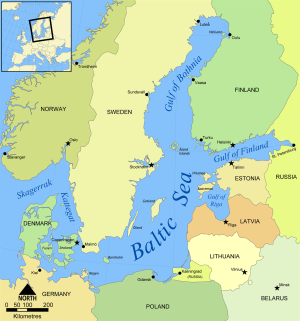 PPR Global, Russia's Baltic Link Is Gone—Europe Cuts Off All Railways to Kaliningrad-Moscow, Staff Report, Nov. 30, 2025. In this video, we analyze the Baltic states' ingenious "Win Without Fighting" strategy and the geopolitical trap it creates for Putin:
🔹 LOGISTICS SURGERY: Latvia's rail dismantling depletes Russia's heavy munitions transport capacity, forcing Russian tanks into narrow Kill Zones with no escape for NATO's HIMARS. This action is a Legal Trap that keeps military tensions below the threshold of a hot conflict.🔹  BRELL COLLAPSES: Lithuania, Estonia, and Latvia have completely disconnected themselves from the Soviet-era BRELL power grid, forever destroying Moscow's blackmail card of plunging the Baltic capitals into darkness in the dead of winter. Their electricity now comes from Europe (ENTSO-E).
🔹 KALININGRAD TRAP: Lithuania has systematically shut down Russia's vital fuel (Lukoil) and supply lines to  Kaliningrad via Belarus. The dismantling of the tracks has diverted Kaliningrad's supply to a single weak point (the Suwałki Corridor),transforming this Russian military stronghold into a logistical "Death Trap."🔹 TRACK WIDTH AMPUTATION: The Baltics are accelerating the transition from the Soviet-standard 1520mm track system to European standards. This is an irreversible "logistical amputation," meaning Russian trains are physically unable to enter these territories.
More On U.S. Politics, Governance
The Parnas Perspective, Important Sunday Evening News Update, Aaron Parnas, right,  Nov. 30, 2025. This week is shaping up to be one of the most consequential we have faced.
The United States is edging closer to a potential war with Venezuela, with strikes possible as early as tonight. At the same time, we are continuing to investigate credible allegations of war crimes tied to orders issued by the Secretary of Defense. And on Tuesday, a special election in Tennessee could fundamentally reshape control of the House of Representatives.
Here’s some news from today:
Trump said he wasn’t aware of any second strike on wounded people, noted Pete Hegseth said didn’t know about it either, and added he would not have wanted a second strike, saying the first strike was already very lethal and “fine.”
Pete Hegseth now faces Congressional investigations led by Republicans in both chambers of Congress. Previously, the United States Senate, led by Roger Wicker the Senior Republican on the Armed Services Committee, announced an investigation into Hegseth for possible war crimes violations. Now, the House Armed Services Committee has done the same.
Trump said he would release his “perfect” MRI results if needed, claimed he did not know what part of his body was scanned, and insisted it was not his brain because he had already “aced” a cognitive test, which he said the reporter would be “incapable” of doing.
Homeland security secretary Kristi Noem claimed the suspect in a DC national guard shooting was radicalized in the US and blamed Biden’s administration, despite the suspect’s asylum being approved under Trump, while also defending her decision to continue deportation flights in defiance of a judge’s order and criticizing “activist” judges.
Noem further admitted that she was the one who ordered the flights to El Salvador to take off despite a court order to the contrary. This comes as contempt proceedings have restarted against the Administration.
Experts and former officials warn that the Trump administration’s mass firing of DHS civil rights watchdogs and dismantling of oversight offices has left immigration detention and enforcement with virtually no accountability, creating conditions where abuses can occur with impunity.
Donald Trump is growing increasingly nervous about this week’s special election on Tuesday, urging his supporters to vote for the Republican in the race:
Donald Trump granted clemency to private-equity CEO David Gentile—who had just begun serving a seven-year sentence for orchestrating a $1.6bn fraud that diverted investor money to luxury personal expenses—freeing him less than two weeks after he reported to prison, despite regulators’ findings that thousands of investors lost their savings and ongoing questions about any ties between Gentile and Trump.
A mass shooting at a child’s birthday party in Stockton, California left four people dead, ages 8, 9, 14 and 21, and 11 others wounded, with the suspected gunman still at large as officials say the attack appears targeted and are asking the public for help in an active, ongoing investigation.
According to NBC, several protesters in New York City were arrested after blocking streets and a parking garage in an effort to stop federal agents from conducting an immigration raid, as DHS said activists obstructed officers following social media calls to “shut down” the operation while police and federal agents worked to clear the area and restore access.
According to The Daily Beast, White House Press Secretary Karoline Leavitt is facing scrutiny after the mother of her nephew, Bruna Ferreira, accused her of downplaying their relationship following Ferreira’s detention by ICE, with Ferreira’s attorney saying she remained closely involved with Leavitt’s family, attended her son’s recent soccer game alongside them, and even chose Leavitt as her son’s godmother, contradicting White House claims that the two had not spoken in years.
Senior Ukrainian officials met US negotiators Marco Rubio, Steve Witkoff and Jared Kushner in Florida to revise a controversial US-Russia draft peace framework ahead of planned talks with Putin, as Kyiv—under military strain and political turmoil—pushes back against proposals seen as too favorable to Moscow and insists any deal must protect Ukraine’s sovereignty, territorial integrity and long-term security.
According to the Associated Press, Rubio said today’s meeting was “quite productive,” noting that negotiators made real progress toward a potential peace deal, but he stressed that “we still have work to do” and emphasized that any agreement will ultimately require addressing the position of the conflict’s other central actor, Russia.
Public health and farmworker groups have filed a legal petition urging the EPA to ban the annual spraying of 8 million pounds of medically important antibiotics and antifungals on US crops, warning that the practice is fueling dangerous drug-resistant “superbugs,” endangering farmworkers, contaminating food and water, and offering only short-term agricultural benefits at the expense of long-term public health.
Letters from an American, Historical Commentary: November 29, 2025 [U.S. War Crimes?], Heather Cox Richardson, right,  Nov. 30, 2025.
In the wake of yesterday’s report from Alex Horton and Ellen Nakashima of the Washington Post that Defense Secretary Pete Hegseth ordered Special Operations to kill the survivors of a September 2 strike on a small boat off Venezuela, the Senate and the House Armed Services Committees have announced they intend to conduct “vigorous oversight” and “gather a full accounting” of the operation.
The two committees referred to the Department of Defense by that name, rather than by the “Department of War” rebrand Hegseth and Trump have pushed.
Today former judge advocate generals (JAGs), military lawyers, in the Former JAGs Working Group issued a statement declaring that it unanimously “considers both the giving and the execution of these orders, if true, to constitute war crimes, murder, or both,” and called for “anyone who issues or follows such orders [to] be prosecuted for war crimes, murder, or both.”
The Former JAGs Working Group organized in February 2025 after Hegseth purged JAGs from the Army and Air Force and systematically dismantled the military’s legal guardrails. “Had those guardrails been in place,” they wrote, “we are confident they would have prevented these crimes.”
Congress appears to be stepping up on this issue, and that willingness to cross Trump suggests members are recalculating Trump’s power relative to their own. Josh Marshall of Talking Points Memo noted: “This is genuinely big news…. Republicans are challenging Trump now because he seems weak. No one wants to back a weak horse.”
A Gallup poll released yesterday shows President Donald J. Trump’s job approval rating at 36% with disapproval at 60%. Since last month, Trump’s approval has plummeted 11 points. Republicans’ approval of Trump has fallen seven points to a second-term low, while approval among Independents has fallen eight points to its lowest point in either term. Only 3% of Democrats approve of his job performance. Although war conditions usually help a president’s popularity, Trump’s threat to attack Venezuela attracts the support of only 30% of Americans. Seventy percent oppose such military action.
There are signs that the MAGA coalition is fracturing. A Politico poll released yesterday shows that just 55% of those who voted for Trump in 2024 see themselves as MAGA. While the MAGA 55% remain largely loyal to Trump, 38% do not consider themselves as MAGA and are less enamored of him than are his MAGA loyalists.
Last week a new feature on X that permitted users to see where accounts originate revealed that a number of high-engagement MAGA accounts that claim to be those of patriotic Americans are in fact from Russia, Eastern Europe, India, Nigeria, Thailand, and Bangladesh. Since X pays certain content creators for tweets that drive engagement, posters from other countries have a financial incentive to post material that feeds the anger of American users and thus will get reposted.
The splintering of the MAGA coalition showed when Representative Marjorie Taylor Greene (R-GA) announced on November 21 she would not run for reelection in a public letter that attacked Trump and “Establishment Republicans.” She called out Trump’s threats to primary her, and said, “I refuse to be a ‘battered wife’ hoping it all goes away and gets better.”
Three days later, Jake Sherman of Punchbowl News said her letter “rang true to” many House Republicans. One senior House Republican wrote to Sherman: “This entire White House team has treated ALL members like garbage. ALL. And Mike Johnson has let it happen because he wanted it to happen. That is the sentiment of nearly all—appropriators, authorizers, hawks, doves, rank and file. The arrogance of this  White House team is off putting to members who are run roughshod and threatened. They don’t even allow little wins like announcing small grants or even responding from agencies. Not even the high profile, the regular rank and file random members are more upset than ever. Members know they are going into the minority after the midterms.
“More explosive early resignations are coming. It’s a tinder box. Morale has never been lower. Mike Johnson will be stripped of his gavel and they will lose the majority before this term is out.”
Today, Representative Troy Nehls (R-TX), a staunch Trump ally, announced he would not seek reelection in 2026, saying he intends to “focus on my family.” Nehls co-sponsored legislation to put Trump on the $100 bill—although federal law prohibits using a living person’s likeness on U.S. currency—and to rename Washington Dulles International Airport, which serves the nation’s capital, after Trump.
Florida governor Ron DeSantis, a Republican, recently joined California governor Gavin Newsom, a Democrat, in speaking out against the Trump administration’s plan to offer up to 34 offshore drilling leases off the coasts of Alaska, California, and Florida.
CNN’s Erin Burnett recently interviewed chief executive officer of JPMorgan Chase Jamie Dimon, left. His answer to her questions as to why his company has not contributed to Trump’s proposed ballroom suggested he is anticipating a change in administration. “We have an issue,” he 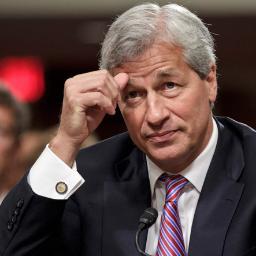 answered, “which is anything we do, since we do a lot of contracts with governments here and around the world, we have to be very careful how anything is perceived, and also how the next D[epartment] O[f] J[ustice] is going to deal with it. So we’re quite conscious of risks we bear by doing anything that looks like…buying favors….”
Dissatisfaction with Trump and his MAGA party is showing in Indiana, too, where administration officials have put extraordinary pressure on state legislators to redistrict the state to try to net the Republicans more seats in the U.S. House of Representatives. On Wednesday, November 26, Andy East of the Indianapolis Daily Journal reported on Indiana state senator Greg Walker, a Republican who is standing firm on his refusal to vote in favor of redistricting. “I was taught as a child the difference between right and wrong,” Walker told The (Columbus) Republic, “and this is just wrong on so many levels.”
Walker said Trump invited him for an Oval Office visit on November 19. Walker declined, suggesting the invitation violated the Hatch Act, which prohibits federal employees from using public resources for partisan purposes. He said he would have reported the violation to federal authorities “if I thought that there was anyone of integrity in Washington that would follow through on my accusation and actually cause someone to lose their job over it.”
He continued: “How does [Trump] have the time to mess with a nobody like me with all of the important matters that are to take his attention as the leader of the executive branch in this nation? There is no way that he should have time to have a conversation with me about Indiana mapmaking when that’s not his business, for starters. But secondly, doesn’t he have anything better to do? I can make a big list of things that are more important for him to focus on.”
Mid-decade redistricting was “the president trying to save his own skin by holding a majority in Congress,” Walker said. “It’s so that he’s not impeached again. That’s all this is about.”
Lincoln Square Media, Commentary: Trump’s Approval Drops to 36% in Gallup Survey as Economy Weighs on Americans, Brian Daitzman, Nov. 30, 2025. The survey finds the president near his all-time low, with independents and Republicans registering steep declines thanks to a record-long government shutdown and persistent cost pressures.
 The poll, conducted Nov. 3 to Nov. 25, found that 60 percent of Americans disapproved of his job performance, while 4 percent expressed no opinion. Gallup said the November figure represented a five-point drop from the October survey.
Presidential approval is closely monitored because it has historically correlated with midterm outcomes, according to archives maintained by the Roper Center for Public Opinion Research. In several midterm cycles dating back to the 1970s, presidents with approval ratings below 45 percent saw their party lose House seats. The Gallup findings arrive as national economic indicators remain mixed. The Bureau of Labor Statistics reported that food-at-home prices in October were 4.3 percent higher than a year earlier. In separate analyses, the Congressional Budget Office noted in 2024 that elevated prices placed outsized strain on lower-income households.
Independent approval dropped from 33% to 25%.
Gallup reported that the November field period overlapped “the longest federal government shutdown in U.S. history,” which ended Nov. 12. The shutdown occurred after Congress failed to enact appropriations under the Antideficiency Act, triggering an automatic halt of non-essential federal operations. The Congressional Budget Office stated that the shutdown delayed multiple agency services and temporarily suspended pay for hundreds of thousands of federal workers. Gallup said respondents cited the shutdown environment as one factor shaping November attitudes.
Support for the president declined across several groups Gallup measures regularly. Republican approval fell from 91 percent in October to 84 percent in November. Independent approval dropped from 33 percent to 25 percent. Gallup described that figure as “the lowest independent approval for Trump in either term.” Approval among Democrats held at 3 percent. The firm stated that the shifts represented “broad erosion in key blocs.”
Demographic patterns in the November data aligned with earlier 2025 findings. Approval among women remained below that among men. Adults ages 18 to 34 recorded the lowest approval of any age group. Approval among non-white adults continued to trail that of white adults. Pew Research Center said in an August report that these demographic gaps had persisted across multiple indicators of political sentiment throughout the year.
The survey also assessed the president’s handling of nine policy areas, and all nine showed net disapproval. Crime produced the highest rating at 43 percent approval and 52 percent disapproval. Foreign affairs and foreign trade followed at 41 percent and 39 percent approval. Ratings on immigration, the economy, the federal budget, the situation in the Middle East, Ukraine and health care ranged from 30 to 37 percent approval. Health care was the lowest, at 30 percent approval and 63 percent disapproval.
Several issue ratings had declined since earlier in 2025. Approval on immigration fell nine points since February. Economic approval fell six points. Approval on the federal budget dropped twelve points since March, according to Gallup’s trend comparisons. Approval on Ukraine fell ten points since March. In its release, Gallup said these results showed “significant erosion in policy domains that had previously shown relatively stronger evaluations.”
Congress received some of its weakest ratings in years. Fourteen percent of Americans approved of the job Congress is doing, while 80 percent disapproved. Republican approval of the Republican-led Congress fell sharply, dropping from 54 percent in September to 23 percent in November. Approval among independents stood at 15 percent, and approval among Democrats at 4 percent. Gallup said the congressional rating reflected “institutional strain,” noting that Congress last registered a single-digit approval level in late 2013 following a shutdown.
Other national indicators echoed the November findings. Pew said in October that majorities disapproved of the administration’s handling of economic conditions, immigration and federal priorities over the course of 2025. Gallup stated that affordability pressures, the shutdown and GOP losses in recent off-year elections contributed to the declines recorded in the November survey.
Trump, Cronies, Money-Making
New York Times, Trump Frees Fraudster Just Days Into Seven-Year Prison Sentence, Kenneth P. Vogel, Nov. 29, 2025. David Gentile had been found guilty for his role in what prosecutors described as a $1.6 billion scheme that defrauded thousands of investors.
President Trump has set free a private equity executive who had served less than two weeks of a seven-year sentence for his role in what prosecutors described as a $1.6 billion scheme that defrauded thousands of victims.
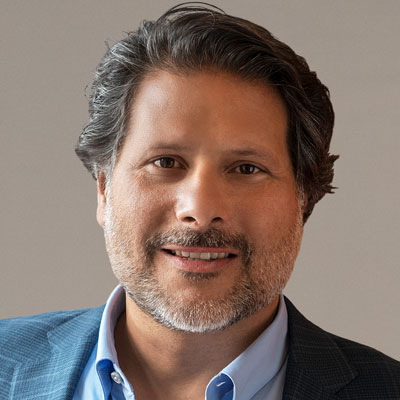 David Gentile, 59, left, a onetime resident of Nassau County, N.Y., had reported to prison on Nov. 14, and was released on Wednesday, according to Bureau of Prisons records and a White House official who was not authorized to discuss the matter.
Mr. Gentile and a co-defendant, Jeffry Schneider, were convicted in August 2024 of securities and wire fraud charges, and sentenced in May. Unlike a pardon, the commutation granted to Mr. Gentile will not erase his conviction.
Mr. Schneider, who was sentenced to six years, does not appear to have received clemency from Mr. Trump.
In a social media post on Thanksgiving, Alice Marie Johnson, Mr. Trump’s “pardon czar,” said she was “deeply grateful to see David Gentile heading home to his young children.”
Mr. Trump has used the unfettered presidential clemency power to forgive an array of white-collar crimes and to make political points, including by casting prosecutions of his supporters as corrupt witch hunts like those that he claims had targeted him.
It was not immediately clear whether Mr. Gentile had connections to Mr. Trump or to the president’s supporters.
Lawyers for Mr. Gentile and Mr. Schneider declined to comment. Mr. Gentile did not respond to a request for comment.
In court filings, prosecutors said that Mr. Gentile and Mr. Schneider over several years used private equity funds controlled by Mr. Gentile’s company, GPB Capital, to defraud 10,000 investors by misrepresenting the performance of the funds and the source of money used to make monthly distribution payments.Editors’ PicksThe Beguiling, Misunderstood ThereminFor Detectives on TV, the Messiest Case Is Often at HomeIs It OK to Binge Drink Occasionally?
More than 1,000 people submitted statements attesting to their losses, according to prosecutors, who characterized the victims as “hardworking, everyday people,” including small business owners, farmers, veterans, teachers and nurses.
“I lost my whole life savings,” one wrote, adding, “I am living from check to check.”
In a statement after the sentencing in May, Joseph Nocella Jr., the U.S. attorney in the Eastern District of New York, said that Mr. Gentile and Mr. Schneider had “raised approximately $1.6 billion from individual investors based on false promises of generating investment returns from the profits of portfolio companies, all while using investor capital to pay distributions and create a false appearance of success.”
The sentences, Mr. Nocella added, were “a warning to would-be fraudsters that seeking to get rich by taking advantage of investors gets you only a one-way ticket to jail.”
But the White House official argued that prosecutors had falsely characterized the business as a Ponzi scheme. The official said that in 2015, GPB disclosed to investors the possibility that investor capital might be used to pay some distributions.
As of Saturday, the text of the commutation had yet to be posted on the Justice Department’s website.
It was not clear whether the commutation would affect any financial penalties.
In June, prosecutors asked the judge in the case to order Mr. Gentile to forfeit more than $15.5 million and Mr. Schneider to forfeit more than $12 million.
And in September, prosecutors indicated in a letter to the judge that a court-appointed receiver had access to more than $700 million, “which is likely to be distributed to investors.”
Civil claims against Mr. Gentile’s firm will continue, said Adam Gana, a lawyer who represents investors pursuing arbitration against GPB Capital.
“The stories that we’ve heard are just heartbreaking, and it’s just unbelievable that somebody like that would receive a commutation,” Mr. Gana said. “This is not a case that should be political. This guy belongs in prison.”
New York Times, Silicon Valley’s Man in the White House Is Benefiting Himself and His Friends, Cecilia Kang, Tripp Mickle, Ryan MacDavid Yaffe-Bellany and Theodore Schleifer, Nov. 30, 2025. David Sacks, the Trump administration’s A.I. and crypto czar, has helped formulate policies that aid his Silicon Valley friends and many of his own tech investments.
In July, David Sacks, right, 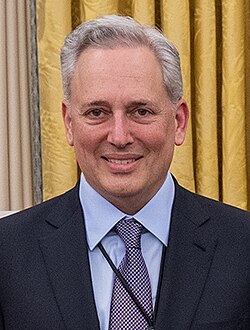 one of the Trump administration’s top technology officials, beamed as he strode onstage at a neoclassical auditorium just blocks from the White House. He had convened top government officials and Silicon Valley executives for a forum on the booming business of artificial intelligence.
The guest of honor was President Trump, who unveiled an “A.I. Action Plan” that was drafted in part by Mr. Sacks, a longtime venture capitalist. In a nearly hourlong speech, Mr. Trump declared that A.I. was “one of the most important technological revolutions in the history of the world.” Then he picked up his pen and signed executive orders to fast-track the industry.
Almost everyone in the high-powered audience — which included the chief executives of the chipmakers Nvidia and AMD, as well as Mr. Sacks’s tech friends, colleagues and business partners — were poised to profit from Mr. Trump’s directives.
Among the winners was Mr. Sacks himself.
Since January, Mr. Sacks, 53, has occupied one of the most advantageous moonlighting roles in the federal government, influencing policy for Silicon Valley in Washington while simultaneously working in Silicon Valley as an investor. Among his actions as the White House’s artificial intelligence and crypto czar:
Mr. Sacks has offered astonishing White House access to his tech industry compatriots and pushed to eliminate government obstacles facing A.I. companies. That has set up giants like Nvidia to reap an estimate of as much as $200 billion in new sales.
Mr. Sacks has recommended A.I. policies that have sometimes run counter to national security recommendations, alarming some of his White House colleagues and raising questions about his priorities.
Mr. Sacks has positioned himself to personally benefit. He has 708 tech investments, including at least 449 stakes in companies with ties to artificial intelligence that could be aided directly or indirectly by his policies, according to a New York Times analysis of his financial disclosures.
His public filings designate 438 of his tech investments as software or hardware companies, even though the firms promote themselves as A.I. enterprises, offer A.I. services or have A.I. in their names, The Times found.
Mr. Sacks has raised the profile of his weekly podcast, “All-In,” through his government role, and expanded its business.
No event better illustrates Mr. Sacks’s ethical complexities and how his intertwined interests have come together than the July A.I. summit. Mr. Sacks initially planned for the forum to be hosted by “All-In,” which he leads with other tech investors. “All-In” asked potential sponsors to each pay it $1 million for access to a private reception and other events at the summit “bringing together President Donald Trump and leading A.I. innovators,” according to a proposal viewed by The Times.
U.S. Law, Crime, Courts, Justice

Hopium Chronicles, Pro-Democracy Advocacy: Vetting The Trump Regime's Corruption, Lawlessness, And Betrayal Front And Center In Our Politics, Simon Rosenberg, right,  Nov. 30, 2025. Let's make December a very good month for our democracy.
Our elected leaders in Washington need to hear our loud roar of disapproval of Trump’s malevolent regime and his enablers in Congress. As the regime fails and grows more unpopular, and the lawlessness and corruption impossible to ignore, little cracks are becoming bigger cracks - and we need to keep the pressure on. This weekend the Republican Chairs of The Senate and House Armed Services Committees announced probes into what sure appears to be illegal actions, and even possible war crimes, by Secretary Pete Hegseth and other senior members of the Pentagon.
From The Washington Post:
Republican-led committees in the Senate and the House say they will amplify their scrutiny of the Pentagon after a Washington Post report revealing that Defense Secretary Pete Hegseth gave a spoken order to kill all crew members aboard a vessel suspected of smuggling drugs in the Caribbean Sea several weeks ago.
A live drone feed showed two survivors from the original crew of 11 clinging to the wreckage of their boat after the initial missile attack Sept. 2, The Post reported Friday afternoon. The Special Operations commander overseeing the operation then ordered a second strike to comply with Hegseth’s directive, according to two people with direct knowledge of the operation, killing both survivors. Those people, along with five others in the original report, spoke on the condition of anonymity because of the matter’s sensitivity.
Late Friday, Sen. Roger Wicker (R-Mississippi), the chairman of the Senate Armed Services Committee, and Sen. Jack Reed (Rhode Island), the committee’s top Democrat, issued a statement saying that the committee “is aware of recent news reports — and the Department of Defense’s initial response — regarding alleged follow-on strikes on suspected narcotics vessels.” The committee, they said, “has directed inquiries to the Department, and we will be conducting vigorous oversight to determine the facts related to these circumstances.”
The leaders of the House Armed Services Committee, Rep. Mike D. Rogers (R-Alabama) and Rep. Adam Smith (D-Washington), followed suit late Saturday. In a brief joint statement, the pair said they are “taking bipartisan action to gather a full accounting of the operation in question.” The committee, they noted, is “committed to providing rigorous oversight of the Department of Defense’s military operations in the Caribbean.”
As we go forward these next few weeks I think Democrats will need to start making the crimes, corruption, betrayal, and malevolence of Trump’s top advisors -- Hegseth, Noem, Witkoff, Bondi, Kennedy, Vought, Sacks -- a major topic in our discourse, and a way of further weakening the legitimacy of the regime. Here at Hopium we’ve long advocated for Democrats to start issuing criminal referrals to DOJ for crimes being committed by the regime (with the expectation nothing will happen) so there is a greater public understanding that laws are being repeatedly broken by our country’s leaders. It also important that people who work for Trump be fearful that accountability -- reputational or legal -- may some day occur.
Here’s Senator Mark Kelly on CNN this morning talking openly about Hegseth, war crimes, and accountability:
Yesterday JP Morgan Chase’s CEO Jamie Dimon broached the issue of future accountability and Trumpian corruption -- "pay for favors” -- in this now widely viewed CNN segment:
The lead story in the Washington Post today was about Republicans launching war crimes investigations. The NYT lead with this extraordinary story detailing just mindboggling levels of self-dealing and corruption in the White House:
From the NYT story…….
Since January, Mr. Sacks, 53, has occupied one of the most advantageous moonlighting roles in the federal government, influencing policy for Silicon Valley in Washington while simultaneously working in Silicon Valley as an investor. Among his actions as the White House’s artificial intelligence and crypto czar:
Mr. Sacks has offered astonishing White House access to his tech industry compatriots and pushed to eliminate government obstacles facing A.I. companies. That has set up giants like Nvidia to reap an estimate of as much as $200 billion in new sales.
Mr. Sacks has recommended A.I. policies that have sometimes run counter to national security recommendations, alarming some of his White House colleagues and raising questions about his priorities.
Mr. Sacks has positioned himself to personally benefit. He has 708 tech investments, including at least 449 stakes in companies with ties to artificial intelligence that could be aided directly or indirectly by his policies, according to a New York Times analysis of his financial disclosures.
His public filings designate 438 of his tech investments as software or hardware companies, even though the firms promote themselves as A.I. enterprises, offer A.I. services or have A.I. in their names, The Times found.
Mr. Sacks has raised the profile of his weekly podcast, “All-In,” through his government role, and expanded its business.
Yesterday the Wall Street Journal led with this epic deep dive into one of the most extraordinary and dangerous corruption scandals in modern history - the rump-Witkoff-Kushner selling out of Ukraine, Europe and democracies everywhere to Putin for coin.
These basket of issues - corruption and self-dealing, law breaking, abandonment of our Constitutional order, desecration of symbols of our democracy, gilded ballrooms - all can be woven together into a deeply damaging indictment of them that reinforces our core narrative - that they are for the oligarchs who are stripping our great country for parts, and that we are for the people, for democracy, and for the United States of America. As they grow weaker we must become stronger, more creative, and more ambitious - and make December a very, very good one for our democracy and democracies throughout the world.
Current models of Trump’s ballroom have it dwarfing the original White House structure - via the NYTNow, Let’s Get To Work People!!!!!!!!!!!!!!!!!!!!!!!!!
 All Rise News, Rising This Week: The next domino to fall? Adam Klasfeld, Nov. 30, 2025. The lineup of Trump-installed prosecutors rebuked by judges keeps growing. John Sarcone may be next.
That’s because the dismissals represent the natural endpoint of a once-unprecedented phenomenon: the disqualification of a Trump-loyalist lawyer unlawfully transformed into an ersatz U.S. Attorney. No other president before Trump insisted upon installing loyalists in top prosecutor positions who couldn’t be confirmed by the Senate or approved by the judges of their districts. Not even Trump tried that gambit during his first term, but it’s now a routine feature of Trump 2.0.
The trend began with Trump’s one-time civil lawyer Alina Habba, who was the first Acting U.S. Attorney toppled from her perch in the District of New Jersey. Then, failed Nevada Attorney General candidate Sigal Chattah was disqualified from her top federal prosecutor perch, followed by the Central District of California’s Bill Essayli. Halligan’s downfall was more dramatic because she took the Comey and James cases down with her.
On Thursday, it will be the Northern District of New York’s John Sarcone’s time over the barrel during a hearing examining the legitimacy of his appointment.
A former Trump campaign lawyer, Sarcone fits in Halligan’s mold: An inexperienced loyalist who never previously served as a prosecutor before picking up a separate criminal investigation into the New York Attorney General whom his boss hates. If it were possible, Sarcone’s grand jury probe stands on even more shaky ground: He is investigating whether James violated criminal civil rights laws by bringing a pair of successful lawsuits against Trump’s business empire and the National Rifle Association.
James sued to quash Sarcone’s subpoena on multiple grounds, but the only argument before the court this week is whether Sarcone is illegitimately serving in his position. Every defendant who has made this argument during Trump’s second term has prevailed, a record that currently stands at 4-0.
All Rise News will be in federal court on Thursday to cover the arguments in Albany, N.Y.Subscribed
It’s like a game of Whac-A-Mole.
Another loyalist, inexperienced, former Trump lawyer or GOP political operative turned purported U.S. Attorney pops up inside a federal judicial district after a judge knocks down a different one.
It’s easy to forget or get desensitized to the fact that this sequence of events was unprecedented in U.S. history until this year.
All Rise News is dedicated to following this issue because it’s at the core of whether U.S. federal prosecutors are answerable only to Trump or to the democratic checks and balances of the Constitution’s Appointments Clause and U.S. law.
U.S. Foreign Policy, Security
MSNOW, GOP voters backed Trump as the 'anti-war' candidate. Now many back action in Venezuela, Philip Bump, right, Nov. 30, 2025. Many Trump supporters bought his questionable line about not starting any “new wars” — but new polling shows they’re supportive of military action against  Venezuela.
 You might recall that Trump’s 2016 campaign was centered on the idea that he, unlike most prominent Republicans, had opposed the invasion of Iraq before it occurred. This wasn’t true: His comments generally tracked with public opinion over the course of the conflict, including initial support. But it was a useful argument: He was smart about conflict in a way that people such as George W. Bush and John McCain were not.
On the trail in 2024, Trump ran the same play. He would frequently insist that there had been no new wars during his first four years in office, a claim presented in order to attack or split his opponents. He would suggest that incumbent President Joe Biden was somehow at fault for the expanded Russian invasion of Ukraine (an event Trump said he would have somehow prevented). He elevated the conflict in Gaza because it was deeply divisive on the left.
Philip Bump is a data journalist and creator of the “How To Read This Chart” newsletter. He spent 11 years at The Washington Post and is the author of the 2023 book “The Aftermath.”
More Global News

New York Times, Fed Up With the Taliban, Pakistan Expels Masses of Afghans, Elian Peltier and Zia ur-Rehman, Visuals by Asim Hafeez, Nov. 30, 2025. Labeling Afghans a national security threat, Pakistan has forced out about a million this year, depriving them of a haven from Afghanistan’s turmoil.
As Pakistan and Afghanistan have escalated military clashes and closed their borders, the Pakistani authorities have intensified mass expulsions of Afghans, saying they can no longer accommodate the decades-old refugee community.
 So far this year, about one million of the three million Afghans living in Pakistan have been deported or forced to return to Afghanistan, a country where many have never lived and where jobs and affordable housing are scarce amid a worsening humanitarian crisis. Many have lived their whole lives in Pakistan, which had served as a haven during Afghanistan’s successive wars since the Soviet Union’s invasion in 1979.
It no longer is.
On a recent evening on the outskirts of Karachi, Pakistan’s largest city, four families with children, including an infant just 7 days old, were loading a truck with their lifelong possessions: bed frames, chickens, water jerrycans and a few pieces of luggage.
Saifuddin, who goes by one name, said they had decided to leave before the crackdown on Afghans got worse. They had heard calls to go back to Afghanistan both at the mosque where they prayed and from the loudspeakers on police cars patrolling their slum.
“Even after 45 years here, this isn’t our land,” he said. “And we don’t have a single home in Afghanistan.”ImageFour barefoot children stand on dusty ground in front of a dark, ornate metal gate. A child in a light-brown tunic stands in the foreground, facing away.Children playing outside their house inside an unregulated Afghan camp in the suburbs of Karachi, Pakistan, in September.ImageA person on a red three-wheeled motorcycle that is hauling a trailer is prominent on a dusty street with other people and vehicles.Afghan residents inside an unregulated Afghan camp in Karachi in September.
Large numbers of Afghans have moved back and forth for decades, especially in the countries’ border areas that share linguistic and cultural ties. Expulsions are not new, but the indiscriminate nature of the current drive is. Pakistan has vowed to expel all Afghans, no matter what their immigration status is or if they face danger upon their return to Afghanistan.
Pakistan’s push overlaps with moves by Western nations to restrict or prohibit Afghans from entering. The Trump administration said that it had stopped processing immigration applications from Afghanistan, and that it would review the status of Afghan asylum seekers already in the United States, including those who worked for American or NATO forces during the U.S.-led war, after the shooting on Wednesday of two National Guard members in Washington. The main suspect is Afghan.
Iran, another of Afghanistan’s neighbors, has also deported or forced out more than 1.5 million Afghans this year. The large Afghan refugee communities abroad have served as a lifeline for Afghanistan, sending money back home and driving cross-border trade that has helped keep a battered Afghan economy afloat.
But as Pakistan and Iran have faced their own economic crises, their governments have amped up the xenophobic rhetoric in recent months and accelerated large-scale expulsions that they initiated in 2023. Since then, the two nations have expelled or forcibly returned more than 4.5 million Afghans. More than half of those — 2.5 million — were driven out this year.
The Pakistani authorities have urged landlords to kick Afghan families out of apartments and encouraged citizens in at least one province to help them deport Afghans through a whistle-blower system. They have already arrested 12 times as many Afghans this year as in all of last year, according to the United Nations’ refugee agency.
New York Times, India Is a Rising Power, but Its Capital Is a Lethal Gas Chamber, Mujib Mashal, Pragati K.B. and Hari Kumar, Visuals by Anindito Mukherjee, Nov. 30, 2025. With little being done to clean the skies over New Delhi, the huge city struggles with its toxic air.
New Delhi wakes up to toxic smog and goes to sleep in the same harmful conditions.
 In the hours between, the 30 million residents of India’s capital region trudge along with chronic headaches and itchy eyes, symptoms of this rising superpower’s failure to provide its people with a most basic need: breathable air.
Experts at the nation’s top research hospital call the air “severe and life-threatening.” The level of toxic pollutants — from cars, factories and crop-waste burning by farmers — has been as many as 20 times above recommended levels for safe breathing.
The problem persists in New Delhi, even while other once-polluted capitals, like Beijing, have succeeded in cleaning their skies.
This past week, as the air grew so hazardous that the government was forced to order half of its workers to work from home, journalists for The New York Times traveled around the city, from the pre-dawn hours to midnight, to chronicle the struggle with bad air.
A daily PM2.5 level — a measure of the most harmful particulates — of 15µg/m³ is the standard for safe breathing. We used an air-quality monitor to take our own measurements of the PM2.5 at key spots, which we cross-checked against official data.
What we found was a city with no escape from severely toxic air, and a population resigned to a public health emergency as its everyday reality.6 a.m., at India Gate
Joggers began arriving before dawn. They went through warm-ups and began to run down the central avenue that separates two New Delhi monuments — the India Gate and the president’s house. Even at this early hour, the smog was so thick that each was invisible from the other.
Not far away, Dinesh Kamath, 72, was out for his hourlong morning walk in a public park. For older residents like him, the winter, when pollution is at its worst, brings the same dilemma every year: to stay home and miss health-affirming exercise, or to stretch their legs outside at the cost of their lungs.
“I have to walk,” said Mr. Kamath, who leads an organization promoting the ancient Sanskrit language. “There is no other way.”7:30 a.m., at Safdarjang Road
U.S. Inflation, Economy, Markets, Jobs, Consumer Issues
New York Times, The New Price of Eggs.’ The Political Shocks of Data Centers and Electric Bills, David W. Chen, Nov. 30, 2025. Democrats zeroed in on utilities and affordability to win Republican support in upset elections in Georgia and Virginia. Can the same playbook work in 2026?
As loyal Republicans, Reece Payton said that he and his family of cattle ranchers in Hogansville, Ga., had one thing on their minds when they cast their ballots in November for the state’s utility board — “to make a statement.”
They were already irked by their escalating electric bills, not to mention an extra $50 a month levied by their local utility to cover a new nuclear power plant more than 200 miles away. But after they heard a data center might be built next to their Logos Ranch, about 60 miles southwest of Atlanta, they had enough of Republicans who seemed far too receptive to the interests of the booming artificial intelligence industry.
“That’s the first time I ever voted Democrat,” Mr. Payton, 58, said.
In some of Georgia’s reddest and most rural counties, Republicans crossed party lines this month and helped propel two Democrats, Peter Hubbard and Alicia Johnson, to landslide upsets, ousting the incumbent candidates on the Georgia Public Service Commission. No Democrat has served on the five-person commission, which regulates utilities and helps set climate and energy policy, since 2007.
Across the country, Democrats have seized on rising anxiety over electricity costs and data centers in what could be a template for the 2026 midterm elections.
In Virginia, Governor-elect Abigail Spanberger pledged during her campaign to lower energy bills and make data centers pay more. In the House of Delegates, one Democratic challenger unseated a Republican incumbent by focusing on curbing the proliferation of data centers in Loudoun County and the exurbs of the nation’s capital.
In New Jersey, Governor-elect Mikie Sherrill promised to declare a state of emergency on utility costs and freeze rates. And in Memphis, State Representative Justin J. Pearson, who is challenging Representative Steve Cohen in a high-profile Democratic primary next year, has vowed to fight a supercomputer by Elon Musk’s artificial intelligence company, xAI, that would be located in a predominantly Black neighborhood.
Strong opposition by citizens forced the Tucson City Council in August to pull the plug on an Amazon data center slated for that Arizona city, and then in September forced Google to call off one in Indianapolis.
U.S. Religion, Charity, Media, Education

New York Times, Opinion: ‘I’ve Been Doing This Work for 25 Years and I’ve Never Seen Such Fear,’ David French,  right, Nov. 30, 2025. Matt DeMateo, the chief executive of New Life Centers of Chicagoland, described the impact of Operation Midway Blitz on the immigrant community he serves succinctly: “I’ve been doing this work for 25 years and I’ve never seen such fear.”
When ICE arrived in force in Chicago, the immigrant community was plunged into a state of panic. Kids stayed home from school. Parents stayed home from work. Families were afraid to go to church. For New Life Centers, the crisis was a call to action. As DeMateo told me over the phone, at New Life, they asked one another, “How do we come together and take care of our neighbors no matter what?”
New Life Centers was born 20 years ago from the New Life Community Church, an nondenominational church with more than two dozen locations across the Chicago area. It began as a nonprofit aimed at addressing the acute needs of people in the church’s neighborhood, andfrom that beginning it grew, and it kept growing — as neighbors asked New Life Centers to respond to more needs, New Life Centers created new programs.
As DeMateo told me, its mentoring programs reach 600 kids. There’s also an athletic program that reaches 2,500 young people who play basketball, softball, baseball and more. Many of these kids live in the city’s most dangerous communities.
New Life also dedicated itself to peacemaking. Volunteers patrol the streets to try to build relationships, provide support for people without jobs, and prevent violence. DeMateo told WGN News that they’ve seen an 80 percent drop in shootings and homicides, year to date, in Little Village, a neighborhood in Chicago.Sign up for the Opinion Today newsletter Get expert analysis of the news and a guide to the big ideas shaping the world every weekday morning. Get it sent to your inbox.
The ministry also feeds thousands — 10,000 people per month, according to DeMateo. Many of them come to New Life’s Pan de Vida Fresh Market. Families can come twice per month to pick up fresh food and produce for free at a place that is set up to look like a grocery store, not a food bank. The Fresh Market provides a welcoming, dignified place for distressed families to shop.
When the migrants began to arrive by the thousands by bus in 2022, New Life responded. As DeMateo told me, buses full of migrants would arrive from Texas, dropping off people in random spots around the city. New Life opened a warehouse for emergency supplies, created a “landing zone” to welcome new arrivals, and helped put 6,000 people in furnished apartments.
In the book of Leviticus, God says to his people, “When a stranger sojourns with you in your land, you shall not do him wrong. You shall treat the stranger who sojourns with you as the native among you, and you shall love him as yourself, for you were strangers in the land of Egypt: I am the Lord your God.”
Providing care for immigrants is one of scripture’s clearest commands. It is one of the great tragedies of our time that millions of Christians are cheering and applauding the administration’s brutal crackdown on immigrants.Editors’ PicksJason Schwartzman Finds Peace at the LibraryHow to Live to 100, According to Dick Van DykeCan I Use My Parents’ Address to Get Our Kids Into a Better School?
But not all Christians. There are believers, Catholic and Protestant alike, who are rallying to treat migrants with dignity, compassion and respect. New Life gets government funding for parts of its work, but DeMateo told me that when it began to support immigrant families during Operation Midway Blitz, it did so entirely on its own.
New Life has also lost staff members to ICE. It saw, in DeMateo’s words, people who represented the “heartbeat and lifeblood of the immigrant community” taken away, with some families separated from loved ones, desperate to find out where they were.
And so New Life went to migrants’ homes. It brought them food. It brought them diapers. It helped them try to find their loved ones.
The story of America is far from perfect, but if there is one constant in our history it’s that American darkness is always answered by American light.
The masked agents of ICE make headlines with their aggression. But it’s important to answer those headlines with a different story, of volunteers who fulfill God’s command to love their neighbor — with their time, their money and their friendship.
My family lives in Chicago now — we relocated to be close to our children and grandchildren — and we can see that it’s a city in distress. But the people of Chicago give us hope, and New Life Centers helped give us that hope. They deserve our unstinting support.
New York Times, The Shocking Crash That Led One County to Reckon With the Dangers of E-Bikes, David Darlington, Nov. 30, 2025. Unregulated e-bikes are a growing danger on American streets. In one Bay Area town, a terrible accident finally led to reform.
In September 2023, Amelia Stafford was 15 and beginning her sophomore year at Terra Linda High School in eastern Marin County, Calif. An honor student who loved reading, played the trumpet, did well at science and aspired to work for NASA, Amelia often rode her bike to school.
Both of her parents — Monica, who works for the Golden Gate National Parks Conservancy, and Scot, an Emmy-winning composer and a founder of the Pollen Music Group — have histories as cyclists: He grew up riding to school in San Francisco, and she commuted to her job on her bicycle across the Golden Gate Bridge. “It was very important to me that my kids grow up learning how to ride bikes,” Scot says.Listen to this article, read by James Patrick Cronin
“I wanted them to get exercise,” Monica adds, so Amelia’s bike didn’t have a motor. In the wake of the pandemic, electric bicycles were proliferating. Many of Amelia’s classmates had gotten e-bikes — or faster machines now known as e-motos — for birthdays and holidays. On a warm Saturday night after a football game, a group of kids was playing around with one.
Coral Billisi, Amelia’s best friend, recalls that Amelia got on the bike behind someone and rode up and down the street. She says it was such a short ride that wearing a helmet didn’t occur to anyone. When the bike toppled over, “our immediate reaction was that we all started laughing — we just thought it was so funny,” she says. “Like, Ha ha, they’re so stupid, they can’t even ride bikes.”
Then they saw the blood on the pavement around Amelia’s head.
....
A study by the University of California, San Francisco, found that from 2017 to 2022, head injuries from e-bike accidents increased 49-fold. As in Marin, casualties in other parts of the country included e-bike riders themselves and people they ran into.
New York Times, Trump Declares Venezuelan Airspace Closed, Helene Cooper and Julian E. Barnes, Nov. 29, 2025. President Trump said days earlier that the United States could “very soon” expand its campaign of killing people at sea suspected of drug trafficking to attacking Venezuelan territory.
President Trump warned airlines and pilots on Saturday that the airspace near Venezuela was closed, ratcheting up what his administration has characterized as a war against drug cartels.
In a post on social media “to all airlines, pilots, drug dealers and human traffickers,” the president wrote that the airspace “above and surrounding Venezuela” should be considered “closed in its entirety.”
Mr. Trump did not go into further detail in his post, but it came after he warned on Thursday night that the United States could “very soon” expand its killings of suspected drug traffickers in the waters off Venezuela to attacks on its territory.
As president of the United States, Mr. Trump has no authority over Venezuelan airspace. But his social media post could deter airlines from flying into and out of Venezuela and is bound to cause havoc with air travelers, further disrupting Venezuelan commerce and economic traffic.
The United States has built up a substantial military presence in the Caribbean aimed at Venezuela. Administration officials have said their goal is to deter drug smuggling but have also made clear that they want to see Mr. Maduro removed from power, possibly by force.
 On Friday, The New York Times reported that Mr. Trump had spoken by phone last week with Nicolás Maduro, right, the Venezuelan leader, and discussed a possible meeting between them, even as the United States continued to threaten military action against Venezuela.
The conversation took place late in the week, two people with knowledge of the discussion said. It included a discussion about a possible meeting in the United States between the two men, according to the people with knowledge of the matter, who spoke on condition of anonymity because they were not authorized to discuss the matter publicly. There are no plans at the moment for such a meeting, one of the people said.
People briefed on the Trump administration’s Venezuelan strike deliberations have said that the initial targets could be drug-related facilities, including production or storage facilities used by Colombian cartels that ship cocaine through Venezuela. American spy agencies have given the military intelligence about the location of such facilities in both Venezuela and Colombia.
But U.S. military officials have developed a range of target options for Mr. Trump, including Venezuelan military units that profit from the drug trade or support Mr. Maduro.
Other options have included oil-related facilities. Those strikes could be justified as part of a counterdrug initiative, though they would likely be an attempt to weaken Mr. Maduro’s hold on power by cutting off access to his funding and dramatically ramping up the pressure on him.
Mr. Trump has consistently talked about Venezuela as a source of drugs and illegal immigration into the United States.
But in reality, Venezuela plays only a small part in the drug trade in America. Cocaine produced in Colombia does pass through Venezuela, but most of it goes to Europe. Colombian cocaine that is headed to the United States is exported through the Pacific Ocean. And U.S. agencies have determined that fentanyl is produced almost entirely in Mexico, not in Venezuela, with chemicals imported from China.
The immigration story is more complicated. Large numbers of Venezuelans have come to the United States. But many have fled Mr. Maduro’s authoritarian government. While the Trump administration has accused a Venezuelan prison gang of fueling violence, it has ignored assessments saying that Mr. Maduro does not control the group, Tren de Aragua, and instead has tried to manipulate the intelligence.
Meidas Touch Network, Commentary: EVIDENCE OF WAR CRIMES, Ben Meiselas, right, Nov. 29, 2025. According to new reporting from The  Washington Post, Trump’s Defense Secretary Pete Hegseth allegedly issued an illegal order during a Caribbean strike: “Kill them all.”
SEAL Team 6 hit the boat, saw survivors clinging to the wreckage—and then, per the report, commanders ordered a second strike to finish them off.
 Experts in the law of war say these killings weren’t just immoral—they may be criminal. Because there is no legitimate armed conflict between the U.S. and alleged traffickers, one former military lawyer told the Post that killing these men “amounts to murder.”
Even if there were a war, executing survivors unable to fight back would be a textbook war crime.Since that first strike, the Pentagon has launched at least 22 more attacks, killing 71 additional people.
Yet the administration has withheld unedited footage and provided no evidence that those killed were terrorists.
Rep. Seth Moulton warns prosecutions will come: “Killing survivors is blatantly illegal.”Everyone involved in the strikes could very well face war crimes prosecutions once they are out of office.

Senior military leaders look on as Defense Secretary Pete Hegseths warms up the crowd before remarks by President Trump at Marine Corps Base Quantico on September 30, 2025 in Quantico, Virginia.
Emptywheel, Analysis: Murder, Emptywheel (Marcy Wheeler, right), Nov. 29, 2025.  We don't know why Rahmanullah Lakanwal allegedly targeted two members of West Virginia's National Guard, just like we don't know the real reason Pete Hegseth keeps targeting boats for murder in the Caribbean. We do know that Hegseth more obviously failed the vetting to prevent such tragedies.
 In the last few days, we’ve got allegations of murder against two men who worked in counterinsurgency in Afghanistan, Whiskey Pete Hegseth and Rahmanullah Lakanwal.
We don’t yet know why Lakanwal, left, drove from Bellingham, WA, across the country, to allegedly ambush two members of the West Virginia National Guard, Sarah Beckstrom and Andrew Wolfe. Spencer Ackerman noted that if Lakanwal came to the US committed to terrorism, he learned that commitment — and a great deal of military skills — from Americans.
[T]he most sobering fact about Wednesday’s slayings is that the alleged killer, Rahmanullah Lakanwal, was all too compatible with Western Civilization.
 CIA Director John Ratcliffe, left, issued an extraordinary statement revealing that the 29-year-old Lakanwal was a “member of a partner force in Kandahar.” While a knowledgeable source with deep experience in Afghanistan cautions that the US sponsored a variety of proxy forces in southern Afghanistan, much additional reporting has identified Lakanwal as a member of the Zero Units, death squads used by the CIA during the US’s longest overseas war.
 In other words, contrary to Miller and Trump, Lakanwal’s shooting spree is not the result of importing Afghan culture to America.While much will surely be revealed in Lakanwal’s upcoming trial, it looks more like the result of importing American culture to Afghanistan. The realities ofblowback – the violence America experiences as the unintended consequences of the violence of US foreign policy – are what the US needs to examine in the wake of this horrifying murder if it expects to prevent the next one.
But even Ackerman doesn’t consider the possibility that something happened since — quite possibly in the last year, as Trump keeps dicking around allies of all sorts who’ve helped the United States in the past — that led Lakanwal to drive across the country only to target members of the Guard who had been uprooted from their homes to avenge Ed “Big Balls” Coristine.
The list of Republican governors who will uproot Guardsmen from their home, family, and (for many of them) regular jobs to go to DC continues to grow:
Ohio Governor Mike DeWine, South Carolina Governor Henry McMaster, West Virginia Governor Patrick Morrisey, Tennessee Governor Bill Lee, Mississippi Governor Tate Reeves, Louisiana Governor Jeff Landry
All of these men believe protecting Big Balls is a higher priority than protecting their own constituents.
How soon we forget that the entire reason why Trump invaded DC is that Ed “Big Balls” Coristine, right, one of the DOGE boys hired by the richest  man in the world to snoop through the private heath and social security data of Americans, got beat up by unarmed teenagers?
Contrary to what Trump and his propagandists keep squealing, Lakanwal was vetted over and over again.
The Afghan national accused of shooting two National Guard members near the White House this week underwent thorough vetting by counterterrorism authorities before entering the United States, according to people with direct knowledge of the case.
Rahmanullah Lakanwal, 29, arrived in the U.S. through Operation Allies Welcome (OAW), a Biden-era program that helped resettle Afghan nationals after the U.S. military withdrawal from Afghanistan in 2021.
[snip]
A key question from critics has been whether any evacuees managed to enter the U.S. without proper vetting. Lakanwal, however, would not have been among them, according to the individuals, who requested anonymity because of the sensitivity of the investigation. One of the individuals said Lakanwal was vetted years ago, before working with the CIA in Afghanistan, and then again before he arrived in the U.S. in 2021. Those examinations involved both the National Counterterrorism Center as well as the CIA, the person said.
Lakanwal was also granted asylum earlier this year, a process that would have brought its own scrutiny, according to #AfghanEvac, a coalition that supported the relocation effort — an assertion the White House did not dispute.
But no amount of vetting can forestall every awful possibility of violence.
Similarly, we can’t even say what led our Crusader-tatted Secretary of Defense to personally order the murder of two men who survived the first murderboat operation on September 2.
Defense Secretary Pete Hegseth gave a spoken directive, according to two people with direct knowledge of the operation. “The order was to kill everybody,” one of them said.
A missile screamed off the Trinidad coast, striking the vessel and igniting a blaze from bow to stern. For minutes, commanders watched the boat burning on a live drone feed. As the smoke cleared, they got a jolt: Two survivors were clinging to the smoldering wreck.
The Special Operations commander overseeing the Sept. 2 attack — the opening salvo in the Trump administration’s war on suspected drug traffickers in the Western Hemisphere — ordered a second strike to comply with Hegseth’s instructions, two people familiar with the matter said. The two men were blown apart in the water.
Trump claims these murderboat operations combat drug trafficking. That was always suspect. Not only are many of the people killed at most low-level shippers, but killing traffickers was less useful than capturing them.
 And Trump’s promise to pardon former President of Honduras, Juan Orlando Hernández, above, who was a major drug trafficker, suggests Trump is not so much opposed to drug trafficking, he just wants a cut.
What we do know about Hegseth, the man who ordered defenseless men to be murdered, is that the Fox News host repeatedly failed efforts to vet him — first when he was excluded from defending the Capitol after January 6, and then the multiple warnings of abuse, incompetence, and addiction reviewed during his confirmation process.
 And so it was that Pete Hegseth happily uprooted Sarah Beckstrom from her home to serve as a prop for Trump’s authoritarian theater, where she was as predicted, targeted.
[M]ilitary commanders had warned that their deployment represented an easy “target of opportunity” for grievance-based violence. The troops, deployed in an effort to reduce crime, are untrained in law enforcement; their days are spent cleaning up trash and walking the streets in uniform. Commanders, in a memo that was included in litigation challenging the high-visibility mission in D.C., argued that this could put them in danger. The Justice Department countered that the risk was merely “speculative.” It wasn’t. There are costs to performatively deploying members of the military—one of which is the risk of endangering them.
Hegseth kept Beckstrom deployed even after Judge Jia Cobb ruled, six days before Beckstrom was shot, that state governors, including WV’s Patrick Morrisey, don’t have the authority to send their Guard to DC without being invited by DC.
[T]he out-of-state National Guards are likely operating in the District in a manner contrary to law. Under section 502(f), state law defines the permissible use of the National Guard under state control—i.e., which missions the governors can order their units to conduct. Here, the state governors whose units are currently operating in the District lack authority to order these missions because the District has not properly sought their aid under D.C. law and the EMAC.
This vetting failure, Pete Hegseth, happily obeyed Trump’s order to bring even more Guard troops to DC, whose mission of “crime deterrence and passive patrolling” will now require more Metropolitan Police Department effort to protect the Guard from being targeted again.
Two alleged murderers brought demons with them from Afghanistan to the US. Both together got a young woman with all her dreams and life ahead of her killed.
And yet we’re not removing the more obvious vetting problem to prevent further disasters.
News Round-up
The Parnas Perspective, Group of Military Lawyers Conclude Hegseth Committed War Crimes, Murder, or Both, Aaron Parnas, right, Nov. 29, 2025. Today, a group of former military lawyers concluded that Pete Hegseth has committed war crimes or murder, and that anyone who assisted in his illegal strikes in the southern Caribbean may also be implicated.
At the same time, a Congressional inquiry led by a Republican has opened into Hegseth just as Trump pushes America closer to armed conflict in Venezuela.
Ultimately, whether accountability reaches Hegseth or anyone else involved will come down to Congress or a future administration with the will to act. For now, the question is open and the stakes are rising.
If you have not subscribed yet, or can upgrade or share this Substack with someone who would, this is the moment when your support truly matters. We are building something real here, and every subscription strengthens the journalism, the access, and the independence that make this work possible. Your backing is what keeps this reporting alive and sharp.Subscribed
Here’s what you missed:

From Just Security: Former U.S. military lawyers (the Former JAGs Working Group) warn that if reports of Pentagon “no quarter” orders in Caribbean boat strikes are accurate, both issuing and carrying out such orders would amount to war crimes, murder, or both.
The stunning statement continues by outlining if we are not in an armed conflict, then Hegseth and anyone under him committed murder under United States law:
The statement concludes with the conclusion that the actions taken over the past several months would amount to war crimes, murder, or both.
Pete Hegseth openly questioned in his 2024 book whether the U.S. should “follow the Geneva Conventions,” a reminder that the warning signs were visible long before the current controversy.
A Wall Street Journal–reported peace plan backed by Trump envoys centers on leveraging $300 billion in frozen Russian assets and creating joint U.S.–Russia investment projects—including energy and reconstruction ventures—while proposing major territorial concessions by Ukraine, limits on its military, and a ban on NATO membership, with significant profit potential for U.S. business partners involved in drafting the plan.
 Trump biographer Michael Wolff, above, says Trump is showing growing physical decline, mental inconsistency, and weakening control over his own party, pointing to erratic policy flip-flops, GOP fatigue, and high-profile defections like Marjorie Taylor Greene as signs the president is “losing his grip.”
Defense Secretary Pete Hegseth is hosting a Pentagon “New Media Week” for a hand-picked corps of pro-Trump influencers—after nearly all traditional reporters walked out over his restrictive press rules—giving loyal outlets like Gateway Pundit, Turning Point USA, Tim Pool, and Laura Loomer exclusive access while effectively shutting out independent journalism.
CNN reports that Trump is blaming Biden’s Afghan vetting for a DC shooting, even though the suspect, an Afghan evacuee who once worked with the CIA, had undergone years of multi-agency screening and was actually granted asylum by the Trump administration, with experts saying the incident reflects one individual’s actions, not a vetting failure, even as Trump uses it to justify a sweeping new immigration crackdown.
Trump used the DC National Guard shooting to aggressively escalate his anti-immigration agenda, ordering mass re-vetting of green cards, pausing asylum decisions, blocking visas for Afghans, and pushing for a “permanent pause” on migration from dozens of countries—even though the Afghan suspect had been repeatedly vetted for years and was granted asylum by Trump’s own administration.
Venezuela condemned Trump’s declaration that all airspace over and around the country is “closed,” calling it a colonialist threat that violates international law, amid escalating U.S. military operations, covert actions, and deadly drug-boat strikes in the region.
The Guardian reports that FDA vaccine chief Vinay Prasad—backed by Health Secretary RFK Jr—has imposed a far stricter, politically charged vaccine-approval regime after claiming (without published evidence) that Covid vaccines killed 10 children, a move experts warn is “dangerous and irresponsible” and could severely slow vaccine development and undermine long-standing immunization practices.
Rep. Troy Nehls, a staunch Trump ally and key supporter of his immigration agenda, is retiring from Congress — with his brother immediately launching a bid to replace him while pledging to “stand shoulder-to-shoulder with President Trump.”
Global News
New York Times, News Analysis: In Firing His No. 2, Zelensky Loses Both a Negotiator and an Enforcer, Andrew E. Kramer, Nov. 29, 2025. Andriy Yermak had ensured internal discipline in Ukraine’s wartime politics. He also led the country’s peace negotiations, which now must go on without him.
President Volodymyr Zelensky’s dismissal of his longtime right-hand man opens a window for a political overhaul that has been long deferred by the war in Ukraine. But it also injects uncertainty into Mr. Zelensky’s government at a delicate moment, leaving him without his key political enforcer as Ukraine is under pressure on the battlefield and at the negotiating table.
 The departure of the aide, Andriy Yermak, on Friday amid a corruption investigation removes Ukraine’s lead negotiator from peace talks to end the largest war in Europe in generations. A Ukrainian delegation is scheduled to continue negotiations this weekend in the United States, now without Mr. Yermak, and Ukrainian officials insisted that the dynamics of the talks would not fundamentally change.
Mr. Yermak, a former movie producer who has been close to Mr. Zelensky for years, had been a sharp-elbowed and imperious political operative, ensuring such strict discipline in Ukraine’s competitive politics that opposition politicians and journalists accused him of repression and abuse. Many cheered his exit.
In diplomacy to end the war, too, Mr. Yermak seized a central role. He sidelined a former foreign minister who had good working relations with American and European governments. In the latest round of talks with the Trump administration, Mr. Zelensky had appointed Mr. Yermak to lead Ukraine’s delegation, despite a looming corruption investigation.
Mr. Yermak’s insistence on remaining, nearly always, physically close to the president had drawn notice both in Ukraine and in foreign capitals. A tall, strapping man, he struck an almost cartoonish contrast to the diminutive Mr. Zelensky in photographs when both appeared wearing matching green military-style clothing. In both the Trump and Biden administrations, Mr. Yermak had rubbed officials the wrong way, diplomats say.
Swapping out Ukraine’s top negotiator will not alter the weighty underlying issues of security for Ukraine and Europe in the talks.ImageVolodymyr Zelensky, right, in a black jacket, smiles, with his hand on his chest. Andriy Yermak, in a gray suit, stands next to him.
New York Times, Russia Bombards Ukraine for Nearly 10 Hours in a Deadly Assault, Cassandra Vinograd and Oleksandr Chubko, Nov. 29, 2025. The attack came as U.S. officials were expected to hold peace talks with Ukrainian and Russian officials in the coming days.
Russia unleashed a nearly 10-hour air assault across Ukraine on Saturday, killing at least two people in the capital and injuring dozens more, according to the Ukrainian authorities.
 The attack, which involved dozens of Russian missiles and hundreds of drones, came as Trump administration officials were expected to meet with Ukrainian and Russian officials in the coming days as part of a diplomatic push to end the war.
The Russian assault started just before midnight, with the capital, Kyiv, coming under the heaviest fire. The all-clear was given around 9:30 a.m. Under a thick white fog, emergency workers scrambled to respond to fires and tend to the wounded in seven districts of Kyiv.
The city’s mayor, Vitali Klitschko, said two people had been killed and at least 37 injured. A third person was killed outside the city.
New York Times, News Analysis: Latin American Leaders Face Both Trump and Voters Deported by the U.S., Annie Correal, Nov. 29, 2025. The upcoming election in Honduras shows how politicians must balance cooperation with the Trump administration with their obligation to undocumented citizens in the United States who may be deported.
Four years ago, Delmar Méndez and Doris Palada jumped on a motorcycle to vote on Election Day, celebrating when their candidate won.
They believed President Xiomara Castro would help other Hondurans like them: people worn down by organized crime, joblessness and rising prices. Even after threats from criminals drove them to seek asylum in the United States, they hoped Ms. Castro would stand up for Honduran migrants against President Trump.
It did not work out that way.
Ms. Castro started the year by threatening to oust the U.S. military from a base in Honduras, in response to Mr. Trump’s sweeping deportation plans. But she soon changed course, turning Honduras into a hub for those deportations, accepting military deportation flights and deportees bound for El Salvador and Venezuela.
“What she did was make an agreement with Trump,” Ms. Palada, 45, said of the president.
On Sunday, Hondurans head to the polls again. The contentious presidential election has pitted Ms. Castro’s left-wing party against two conservative rivals and has become a flashpoint in American politics, too: After endorsing one of the conservative candidates this week, Mr. Trump vowed to pardon a former Honduran president who was convicted in the United States on drug-trafficking charges.
The election has also drawn renewed attention to Ms. Castro’s cooperation with the Trump administration on deportations, reflecting a bind for politicians around Latin America in Mr. Trump’s second term.
On one side, they face the potential wrath of the U.S. president, who has shown he will punish resistance or even criticism of his plans, threatening tariffs and other penalties on leaders who do not cooperate.
U.S. Governance, Politics

New York Times, F.D.A. Seeks More Oversight of Vaccine Trials and Approvals, Christina Jewett, Updated Nov. 29, 2025. The agency’s top vaccine regulator proposed broad changes, claiming that a new review linked 10 children’s deaths to the Covid vaccine. But public health experts questioned the findings, wanting to examine the data.
The Trump administration is casting more doubt on the safety of vaccines, with an internal memo from the Food and Drug Administration linking the deaths of at least 10 children to the Covid vaccine and proposing new regulatory measures as a result.
The memo was obtained by The New York Times and not publicly released. It did not provide details such as the ages of the children, whether they had any health problems or how the agency determined the vaccine-death link. Nor did it disclose the maker of the vaccines involved.
The findings have not been published in a peer-reviewed medical journal, drawing suspicion from some critics of Health Secretary Robert F. Kennedy Jr., who has repeatedly criticized the Covid shots as deadly despite the scientific consensus that they are safe.
The memo was written by Dr. Vinay Prasad, the director of the F.D.A.’s vaccine division. He sent it to agency staff members, outlining findings from a review of reports concerning childhood deaths and attributing them to myocarditis, or inflammation of the heart muscle.
The Covid vaccine, like many other immunizations, carries some health risks in certain cases and mainstream scientists have been studying the vaccine’s effects on people for years, especially the incidence of myocarditis in teenage boys and young men.
Politico, Texas lawmaker to retire,Gregory Svirnovskiy, Nov. 29, 2025. Rep. Troy Nehls (R-Texas), a longtime ally of President Donald Trump, announced plans to leave Congress after the legislative session in a Saturday post on X.
 His relationship with the president, whom Nehls has pushed to honor with a spot on the $100 bill, was highlighted.
“Before making this decision, I called President Trump personally to let him know of my plans,” Nehls wrote. “President Trump has always been a strong ally for our district and a true friend, and I wanted him to hear it from me first.”
The three-term lawmaker was first elected to the House after a hard-fought primary victory in 2020. He now serves as chair of the House Aviation Subcommittee and has emerged as a helpful figure in Trump’s immigration agenda. Nehls’ REMOVE Act, which aims to remove legal barriers to deportation for undocumented residents, passed through the House Judiciary Committee in mid-November.
He’s also faced controversy in Congress. In June 2024, Nehls stopped wearing a pin for infantrymen or Special Forces who took part in active military combat amid allegations from GOP colleagues of “stolen valor.” In August of that year, he was sued by a former employee who accused Nehls of discriminating against him for his sexuality.
Nehls’ retirement is the culmination of a decades-long career in public service, which started in the U.S. Army Reserve and continued when he served two terms as the county sheriff in Texas’ Fort Bend County, before later running for Congress.
“Serving this country in the military, serving our community in law enforcement, and serving this district in Congress has been the honor of my life,” he wrote. “Thank you for your trust, your friendship, and your prayers.”
Later on Saturday, Trever Nehls, the lawmaker’s brother, announced on Facebook that he was running for the open seat.
“District 22 needs a Representative who will follow in Troy’s footsteps and stand shoulder-to-shoulder with President Trump to defend our conservative values, secure the border, protect our families, and oppose the reckless and radical agenda that Democrats continue to press upon the American people,” he wrote. “I’m ready to take up that fight.”
Meidas Touch Network, UH OH! Trump’s Health TAKES TURN FOR WORSE over HOLIDAYS, Nov. 29, 2025. MeidasTouch host Ben Meiselas reports on Donald Trump’s health looking even worse over the Holiday weekend and finally the media is taking notice.
Meidas Touch Network, Trump DECLARES MAGA is DEAD as MTG Gets FINAL REVENGE, Nov. 29, 2025. MeidasTouch host Ben Meiselas reports on how Donald Trump is now rebranding MAGA with a bizarre new named as Marjorie Taylor Greene has taken the MAGA base with her and Trump does not know what to do.
New York Times, Inside Trump’s Push to Make the White House Ballroom as Big as Possible, Luke Broadwater, Nov. 29, 2025. President Trump’s ever-growing vision has caused tension with contractors. His architect has taken a step back as the president personally manages the project.
As President Trump took a stroll on the White House roof in August, generating headlines and questions about what he was up to, the man walking beside him was little noticed.
Wearing his signature bow tie, James McCrery, a classical architect who runs a small Washington firm known for its work building Catholic churches, was discussing how to execute Mr. Trump’s vision for a ballroom on the White House grounds.
Mr. McCrery’s work has been embraced by conservatives who believe federal buildings should be designed with an eye toward the grandeur of ancient Greek and Roman structures. He often talks of how his design work is carried out in service of God and the church, according to people who have worked with him.
It might have seemed an odd pairing: a man who designs cathedrals working for a man who once built casinos, and is now president of the United States.
But McCrery Architects got to work on the initial drawings for the project, sketching out a design with high ceilings and arched windows reminiscent of Versailles’s Hall of Mirrors. It would have the latest security features, including bulletproof glass. Gold furniture, known to please the president, was added to the renderings.
It was flashy enough to impress a man of Mr. Trump’s tastes, while largely matching the style of the historic White House without overshadowing it.
That’s when things got tricky.
In offering up his initial design, Mr. McCrery could not have known that Mr. Trump’s vision for the project was growing. What started as a 500-seat ballroom connected to the East Wing grew to 650 seats. Next, he wanted a 999-seat ballroom, then room for 1,350. Even as Mr. Trump assured the public in July that the ballroom would not touch the existing structure, he already had approved plans to demolish the East Wing to make way for something that could hold several thousand people, according to three people familiar with the timeline.
The latest plan, which officials said was still preliminary, calls for a ballroom much larger than the West Wing and the Executive Mansion. Mr. Trump has said publicly that he would like a ballroom big enough to hold a crowd for a presidential inauguration.
More On U.S. Justice System
Meidas Touch Network, Trump PANICS as His Scheme COLLAPSES Spectacularly, Nov. 28, 2025. Talking Feds host Harry Litman and MeidasTouch host Ben Meisela break down Donald Trump getting sued by Democratic Congressman Eric Swalwell for stealing his private mortgage records before Trump was able to indict Swalwell.
More Global News

New York Times, Where Hundreds of Undocumented Migrants Have Died in Custody, Zunaira Saieed and Richard C. Paddock, Nov. 29, 2025. Malaysia launched a “year of enforcement” in response to a surge in undocumented migrants, many of them from Myanmar. Some faced nightmarish fates.
Ben Za Min was working as a junior government clerk in Myanmar when the military seized power nearly five years ago, setting off a chain of events that would lead to his death 1,300 miles from home.
He quit his job in a small town in western Chin State and joined nationwide protests. When the junta cracked down and violence erupted throughout the country, he fled first to India and then, in 2023, to Malaysia, where he worked illegally in construction, making a modest living.
 But his life was thrown into turmoil again after the Malaysian government, facing a surge of undocumented immigrants, declared 2025 to be “the year of enforcement” and ramped up arrests.
Immigration agents raided Mr. Ben Za Min’s worksite in northern Malaysia in mid-September, detaining him and a dozen others.
Three weeks later, he died at a hospital while in custody after a cut on his lower right leg turned septic. It is unclear how or when he was injured. He was sent to the nearby hospital for treatment at one point, returned to his cell, and then was admitted again right before he died, at age 32.
“I believe he wasn’t given proper medical treatment before being sent back,” said Lin, his sister, who lives in Myanmar and asked to be identified by one name because she feared reprisal. “I think they dismissed him as someone without documentation and treated him with no respect.”
New York Times, The Ukrainians Stuck in Russia’s New Gulag, Jeffrey Gettleman, Nov. 29, 2025. Even if a peace can be reached, it won’t be easy to solve the problem of Ukrainian civilians languishing in Russian jails. This is one prisoner’s story.
At the beginning of the war in Ukraine, Mykola Zakhozhyi, a 37-year-old father of two young boys, jumped on his motorcycle and zoomed off from his house in the suburbs of Kyiv.
He told his wife he wanted to see what was going on with the Russian troops who had just invaded their area.
He did not come back that night. Or the next. Or that month. Or the month after that.
“I was in shock,” said his wife, Iryna. “And the kids kept asking: When’s Dad coming home?”
Dad, a heating and water technician, had become one of hundreds of Ukrainian civilians taken by Russian forces from occupied areas of Ukraine and shunted through a constellation of Russian prisons in a new kind of gulag.
They are a class of prisoners languishing incommunicado deep within the penal system of an enemy state. Some have died in captivity, and relatively few have been released. Those who have been freed, like Mr. Zakhozhyi, say they were tortured, nearly starved and tormented constantly.
He described his nearly yearlong ordeal, which he said included regular beatings with a plastic pipe and a paltry diet of ground-up fish heads, in a series of face-to-face interviews from Makariv, his suburb outside of Kyiv, Ukraine’s capital.
He also provided paperwork showing he had been incarcerated in Russia. Ukrainian human rights investigators and government officials corroborated that he had been taken prisoner by Russian forces and the accounts of a half-dozen others like him who were interviewed by The New York Times.
The details of how Mr. Zakhozhyi said he was treated could not be verified independently, but everything he said fit with a growing body of reports and investigations into the abuse of prisoners in Russian custody. The other former prisoners interviewed by The Times shared similar stories.
The Ukrainians call these prisoners “civilian hostages.” Their fates are likely to be one of the most difficult issues to resolve if Ukraine and Russia ever agree on a peace deal, which the Trump administration is pushing hard again.
Uniformed soldiers captured on the battlefield are routinely exchanged between the two sides. They are P.O.W.s — prisoners of war — and there is an established channel for them. Trading them is part of modern warfare.
Media, Education, Culture
The Parnas Perspective, Important Update: Donald Trump Uses Official White House Website to Attack the Free Press in Major Escalation, Aaron Parnas, right, Nov. 29, 2025. The Trump White House has opened a new and troubling chapter in its ongoing confrontation with the American press.
What began as rhetorical attacks during the 2016 campaign has now evolved into an institutionalized effort: the launch of an official government webpage dedicated to publicly calling out journalists and news outlets whose reporting the president disputes.
As the White House escalates its attacks on journalists, independent reporting has never been more essential.
Unveiled over the weekend, the site brands itself with the tagline “Misleading. Biased. Exposed.” and showcases a rotating “Hall of Shame.”
The feature highlights selected stories from news organizations the administration claims have misrepresented the president’s actions or statements. Among this week’s targets are the Boston Globe, CBS News, and the Independent, which the page accuses of inaccurately reporting on comments in which President Donald Trump allegedly suggested that six Democratic lawmakers should be executed—claims the outlets reported after releasing a video urging military personnel to refuse illegal orders.
Public criticism of the media is nothing new for Trump, who has spent years describing journalists as “dishonest,” “corrupt,” and “enemies of the people.” But the creation of an official government website dedicated to singling out journalists marks a significant escalation. No longer confined to social media posts or campaign rallies, the administration’s attacks have been formalized into a government-branded digital tool.
By hosting media-targeting content on an official .gov domain, the White House is using the apparatus of the federal government to amplify the president’s grievances and shape public perception of the press. This step blurs the line between partisan messaging and government communication, raising concerns among First Amendment scholars and press freedom advocates.
The launch of the site coincides with a wave of intensified personal attacks against individual journalists, particularly women, from major outlets including ABC, CBS, The New York Times, and Bloomberg. These confrontations—often broadcast live during press briefings or shared widely on social media—serve to both discredit the reporters involved and discourage others from asking probing questions.
This strategy aims to suppress independent scrutiny of the administration by intimidating journalists and eroding public trust in reputable news sources. The public shaming component of the new government webpage further reinforces this dynamic.
The administration’s tracker has included a wide array of mainstream news organizations, signaling that no outlet is too large or too established to escape the president’s criticism. Among the media organizations featured are:
The use of official government platforms to attack journalists represents a significant moment in the relationship between the executive branch and the free press. While presidents have long sparred with reporters, the formalization of these attacks into government infrastructure risks normalizing hostility toward the press as a governing strategy.
By leveraging the power and visibility of official channels, the administration amplifies its message that the press is untrustworthy, biased, or malicious—an assertion many fear could erode democratic norms that rely on independent journalism as a check on power.
As the Trump White House continues to escalate its confrontations with reporters, the implications extend far beyond the political news cycle. What is at stake is not just the credibility of individual stories, but the future of a free and independent press in the United States.
Meidas Touch Network, Commentary: The President Who Cannot Be Questioned, Michael Cohen, right, Nov. 29, 2025.  Trump doesn’t dodge tough questions; he attacks them, revealing a president who lashes out because the truth, not the reporter, is the thing he can’t control.
If you grew up with siblings; or hell, if you survived the emotional Thunderdome known as American grade school, you learned early on that there were lines you didn’t cross. Call your brother “stupid,” you got grounded. Tell a girl on the playground she’s “ugly,” you got marched to the principal’s office by the ear. “Piggy”?
That bought you a note home, a stern talking-to, and, depending on your zip code, a slipper to the backside. SubscribedBut what do you do when the kid hurling playground insults isn’t eight years old with chocolate milk on his breath, but the 79-year-old President of the United States, the most powerful man on the planet, who keeps talking like the world’s oldest third-grader caught in an endless lunchroom tantrum?
Where do you send him? Time-out? Detention? Mar-a-Lago already is detention, only with more comfortable seating.
This week, America got another reminder that something is fundamentally off-kilter inside Trump’s operation, and it’s bleeding straight out of his own mouth. And no, it’s not a diagnosis. It’s not a medical issue. It’s the consequences of pressure, bad advice, and a political strategy built on grievance gasoline with a match permanently lit. When the walls start closing in, Trump doesn’t adapt; he detonates.
Let’s start with Mar-a-Lago, where good questions go to die. CBS’s Nancy Cordes, professional, prepared, and doing the job the First Amendment demands, asked the president about Rahmanullah Lakanwal, the suspect in the D.C. shooting of two National Guard members. Lakanwal isn’t the cartoon villain Trump’s been selling. The man worked with the CIA in Kabul for a decade. He came in during the evacuation and later received asylum under Trump’s own administration.
Cordes asked a reasonable question: If the inspector general found Afghan evacuees were thoroughly vetted, then why blame Biden?
Trump’s answer? His greatest hit: “Are you stupid? Are you a stupid person?”
It wasn’t strategy. It wasn’t strength. It was a man feeling cornered by facts and defaulting to the same insult arsenal he used as a New York tabloid curiosity.
This is what happens when a president surrounds himself with people who tell him every problem is someone else’s fault, every question is an attack, and every woman who challenges him is “disrespectful.” Bad advice produces bad behavior, and America is reacting exactly the way you’d expect: with frustration, exhaustion, and increasingly, concern.
But Cordes wasn’t the only target. Katie Rogers of The New York Times co-writes a careful, fact-based piece about the president’s age, mobility, stamina, schedule, and the MRI he disclosed, all documented and observable. Trump shredded her as “third rate” and “ugly, both inside and out.”
He denounced the Times as a “rag” and “the enemy of the people,” never mentioning her male co-author.
Then Bloomberg’s Catherine Lucey asked about the Epstein files, a sensitive topic for reasons Trump pretends are obvious “witch hunts” rather than legitimate scrutiny. His response: “Quiet. Quiet, piggy.”
And ABC’s Mary Bruce dared to ask a question about Jamal Khashoggi’s murder, a murder U.S. intelligence squarely linked to the Saudi Crown Prince. Trump scolded her for “embarrassing” MBS, then called her a “terrible person” and her question “insubordinate.”Insubordinate.
As if he’s royalty and the White House press corps are disobedient subjects.
So what’s really going on here?
Here’s the truth from someone who lived inside the machine longer than any sane person should:
Donald Trump is under pressure—public pressure, media pressure, political pressure—and the advice he’s getting is telling him to treat that pressure like enmity.
Karoline Leavitt stepped up and called this barrage “honesty” and “frankness,” as if “Are you stupid?” is presidential transparency. As if “piggy” is a bold new chapter in communicative candor. As if calling a journalist ugly is something the press should appreciate.
But America isn’t buying it. People see the hostility. They see the thin skin. They see a president absorbing the weight of a job his own advisers have convinced him is a battlefield, not a responsibility.
So here’s what we know: When presidents feel confident, they lead.
When they feel cornered, they lash out.Trump isn’t lashing out because he’s strong; he’s lashing out because he’s under pressure, badly advised, and increasingly aware that the media questions he hates are questions millions of Americans are asking too.
And the women asking those questions aren’t the problem.They’re the truth-tellers.They’re the accountability he can’t silence.
And that, more than anything, is the truth he’s afraid you’ll hear.
 Politico, Northwestern reaches $75M deal with Trump administration to get federal funding reinstated, Bianca Quilantan and Gloria Gonzalez, Nov. 28, 2025. The school expects federal funds will start flowing within days and be fully restored within 30 days.
Northwestern University agreed to pay $75 million to the federal government as part of a deal with the Trump administration to restore millions in frozen federal research dollars.
The university said Friday the agreement would end probes by the Department of Health and Human Services and the Department of Education on the school’s compliance with anti-discrimination laws. The deal would also permanently close all pending probes by the Department of Justice’s Civil Rights Division on the university’s compliance with Title VI of the Civil Rights Act’s prohibition against discrimination based on race in admissions.
In April, the administration froze $790 million in federal research grants and contracts, making Northwestern the first institution outside of the Ivy League to be targeted by the White House in response to alleged civil rights violations, including their responses to antisemitism on campus.
Northwestern expects federal funds will start flowing within days and be fully restored within 30 days. The school will also be treated as eligible for future grants, contracts and awards from the federal government.
“This is not an agreement the University enters into lightly, but one that was made based on institutional values,” Henry Bienen, the university’s interim president, said in a message sent to the school community Friday.
The university had “several hard red lines we refused to cross,” including control over who it hires and what students it would admit, he said.
“Northwestern runs Northwestern,” he said. “Period.”
The university did agree to establish a special committee of the Board of Trustees to ensure compliance with the agreement, continue compliance with federal anti-discrimination laws and provide “safe and fair opportunities for women, including single-sex housing for any woman, defined on the basis of sex, who requests such accommodations and all-female sports, locker rooms and showering facilities.”
The university also committed to taking steps to protect Jewish members of its community.
Education Secretary Linda McMahon called the deal a “huge win” for the school community and higher education.
“The deal cements policy changes that will protect students and other members of the campus from harassment and discrimination, and it recommits the school to merit-based hiring and admissions,” she said in a statement.
Justice Department officials praised the school for reaching the deal.
“Universities that receive federal funding have a responsibility to comply with the law, including protecting against racial discrimination and antisemitism,” said Harmeet K. Dhillon, assistant attorney general of the Justice Department’s Civil Rights Division. “We appreciate the significant improvements Northwestern has made and are gratified to reach an agreement that safeguards of rights of all the university’s applicants, students, and employees.”
Former Northwestern President Michael Schill, who resigned in September, testified before the House education panel last year on his institution’s response to the campus protests. House Republicans slammed Schill’s efforts to deal with student protesters to disband their pro-Palestinian encampments.
New York Times Magazine, The Interview, Simon Cowell Is Sorry, Softer and Grieving Liam Payne, Lulu Garcia-Navarro, Nov. 29, 2025. Simon Cowell, the famously caustic judge from “American Idol” and “X Factor,” has mellowed.
Part of that is age (he’s now 66), but he has also suffered the loss of his parents, become a father, gone to therapy and more recently grappled with the death of Liam Payne, whom he discovered on “X Factor” and cast in the megafamous boy band One Direction. So when I met Cowell at his home in southwest London this month, I found him in a reflective mood.
The music mogul started his career in Britain as a talent scout and became known for putting out popular novelty records based on TV shows like “Teletubbies” and “Power Rangers” — music that his label peers used to sneer at. He had his first hit single with the artist Sinitta in the 1980s and his first boy-band success with Westlife before becoming a judge on all the shows (“Idol,” “X Factor,” “Britain’s Got Talent,” “America’s Got Talent” and more).
Cowell is now thinking about his legacy. His latest project is a Netflix documentary series called “Simon Cowell: The Next Act.” In it, Cowell goes back to his roots, auditioning and training a group of teenagers to be in his new boy band. The series shows Cowell’s more nurturing side as a family man and a builder of talent, but also his desire for relevance: It has been several years since Cowell launched artists like Camila Cabello and Susan Boyle from his competition shows, and he is trying to prove to himself, and to people who know him only as the guy mouthing off behind a judging desk, that he can still make a hit (even though he doesn’t have a phone and hates the main driver of new music, TikTok).
I don’t really know if Cowell can pick yet another winner or if the world even wants a boy band that isn’t K-pop, but to me that’s almost beside the point. What interested me most in talking to Cowell was his evolution away from his harsh public persona and what that says about him and the broader culture that he helped shape.
Nov. 28

Among the images President Trump released in the days before the 2025 Thanksgiving holiday portraying himself as a America's supreme ruler was the above via his Truth Social Network, portraying himself as King, with three Senate Democrats, Sens. Charles Schumer, left, Elizabeth Warren and Adam Schiff, kneeling at his feet, , seemingly awaiting the punishment he has long threatened against them.
The Parnas Perspective, Political Commentary, Governor Demands Trump Release MRI Results After Trump Uses Slur Against Walz and Launches New Attacks on Female Reporters, Aaron Parnas, right, Nov. 28, 2025.Overnight, Donald Trump launched another round of attacks by targeting a third female reporter in just a month and calling her “stupid,” attacking Governor Tim Walz by calling him “seriously r*tarted,” and demanding that the United States end migration from most countries. In response, Governor Walz and others are now calling for Trump’s MRI results to be released.
Despite the severity of these overnight attacks, much of the media is already shrugging them off. They have become numb to the name-calling, the bullying, and the escalating rhetoric from the President. I refuse to do that. I will not accept this as Trump being Trump because it is not normal and it is not acceptable.
For speaking out, I have already been targeted by people aligned with the White House. I will not back down. If you believe in holding power accountable, subscribe, support this work, and let us keep fighting for the truth together.Subscribed
Here’s what you missed:
Governor Tim Walz, right, and others are demanding that Donald Trump release the full results of the MRI conducted during his recent “mid-year”  physical at Walter Reed Medical Center. The call comes after the President waited until nearly midnight to issue a Thanksgiving message that devolved into attacks on immigrants and included referring to Walz as “seriously r*tarted.” Walz responded by urging transparency regarding the President’s medical evaluation. This behavior is unacceptable, and I refuse to treat it as normal.
After the D.C. National Guard shooting, President Trump escalated his immigration rhetoric by promising to permanently pause migration from what he called “third world countries,” pursue large-scale deportations, revoke benefits for noncitizens, reexamine Green Card holders from 19 countries, and target Somali and Afghan communities, prompting strong criticism from U.N. agencies and immigrant advocacy groups.
The President of the United States lashed out against a female reporter for the third time in a matter of weeks, once again calling a reporter “very stupid” for fact-checking him in realtime about the fact that his Administration vetted the D.C. National Guard shooting suspect.
Donald Trump concluded his press conference abruptly when being asked again about the fact that the shooting suspect worked with American intelligence in Afghanistan and was fully vetted by his Administration.
US financial regulators told Sen. Elizabeth Warren they are taking seriously her allegations that major banks, including JP Morgan and former  executive Jes Staley, may have facilitated Jeffrey Epstein’s criminal activity, reviewing concerns about Epstein’s extensive banking relationships and signaling potential action for any misconduct as Congress prepares for the release of unclassified federal records related to Epstein and Ghislaine Maxwell.
The World Health Organization is now warning that rapidly rising measles cases signal dangerous drops in global vaccination rates, increasing the risk of outbreaks of other diseases such as whooping cough and polio, while the United States faces its own surge with nearly 1,800 cases in 42 states, multiple growing clusters, and the potential loss of its measles elimination status for the first time in decades.
The FDA, under an order signed by Health Secretary Robert F. Kennedy Jr, right, is preparing to withdraw a proposed rule that would have required asbestos testing in talc-based cosmetics, alarming health advocates who warn that asbestos contamination in talc is a well-documented cancer risk and arguing the move contradicts the administration’s stated toxin-reduction goals, while industry opposition and concerns over effects on drugmakers appear to have driven the reversal.
Video from Jenin shows Israeli security forces shooting and killing two unarmed Palestinian men who appeared to be surrendering during an operation in the West Bank, prompting outrage from U.N. officials and Palestinian authorities, while Israeli officials say the men were wanted militants and have opened a review of the incident amid rising settler violence and intensified IDF activity in the area.
Ukraine’s anti-corruption agencies searched the home of President Zelenskyy’s top aide Andriy Yermak as part of a widening probe into an alleged kickback scheme tied to the state nuclear company Energoatom, a scandal involving figures close to Zelenskyy that has already led to ministerial firings and public outrage amid wartime energy shortages, and which resurfaced just as Yermak leads sensitive peace negotiations with the United States.
Good news:
A three-year-old boy with severe Hunter syndrome became the first patient to receive a new stem-cell–based gene therapy that fixes the defective IDS gene, and within months showed near-normal development, offering a breakthrough for an otherwise fatal disorder that current treatments cannot fully address, though his older brother is beyond the trial’s treatment window.
Brazilian researchers have identified a peptide in the venom of the Amazonian scorpion Brotheas amazonicus that destroys breast cancer cells in lab tests with effectiveness comparable to the chemotherapy drug paclitaxel, offering a potential new anti-tumor therapy as scientists continue exploring venom-derived compounds for medical applications.
A hiker in Norway uncovered a remarkably preserved 1,500-year-old wooden reindeer trap and associated hunting gear that had recently emerged from melting ice on the Aurlandsfjellet Plateau, giving archaeologists rare insight into Iron Age mass-capture hunting practices and daily life in early Norwegian society.

Andrew Wolfe, above left, and Sarah Beckstrom are the West Virginia National Guard members who were shot and critically wounded on Nov. 26, 2025, while deployed in Washington, DC.
New York Times, National Guard Soldier Dies From Wounds in D.C. Shooting, Hamed Aleaziz, Campbell Robertson, Elian Peltier and Julian E. Barnes, Nov. 28, 2025 (print ed.). The C.I.A. said that the suspect, whom officials identified as a 29-year-old Afghan, came to the United States in 2021 after the American military withdrawal. Two National Guard members were in critical condition after the shooting on Wednesday.
One of the two National Guard troops shot in Washington died on Thursday, a day after officials said an Afghan man who was once part of an anti-Taliban force supported by the C.I.A. opened fire on the soldiers just a few blocks from the White House.
Army Specialist Sarah Beckstrom, 20, succumbed to her injuries, President Trump told service members by video from his Mar-a-Lago resort and residence. “She was savagely attacked,” he said. “She’s dead.”
The other victim was identified as Air Force Staff Sgt. Andrew Wolfe, 24. Both of them, members of the West Virginia National Guard, had been deployed to Washington as part of what Mr. Trump had described as a crackdown on crime in the capital.
Earlier Thursday, Specialist Beckstrom’s father said in a brief interview that she had received a “mortal wound.” A man who answered the phone at Sergeant Wolfe’s home asked for “prayers for my son,” but would not speak further.
The suspect, who was in custody after being badly wounded during the attack, was identified as Rahmanullah Lakanwal, left. The authorities said he had driven across the country from Washington State to carry out the attack. Overnight, F.B.I. agents searched an apartment complex in Bellingham, Wash., where the suspect had been living. One neighbor said that a man had been pulled from his unit and was restrained. No further information was immediately available.
Mr. Lakanwal had entered the United States through Operation Allies Welcome, a Biden-era immigration program for Afghans fleeing the Taliban takeover. After he was identified as the suspect, the Trump administration vowed a sweeping re-examination of immigrants from 19 nations “of concern” including Afghanistan. The administration said it would re-examine “every Green Card” for immigrants from the countries upon which he had imposed a travel ban on in June, which also included Haiti and Venezuela.
 Administration officials quickly criticized the Biden administration for allowing Mr. Lakanwal into the country in 2021 and said they were reviewing all asylum requests approved by the previous administration. Mr. Lakanwal, however, was granted asylum in April, after Mr. Trump’s return to office, according to three people with knowledge of the case who spoke on the condition of anonymity because they were not authorized to speak publicly.
Mr. Trump described the suspect as “nuts” and said there was “no vetting” by the Biden administration. Asked whether his administration had granted the asylum request, Mr. Trump deflected: “When it comes to asylum, when they’re flown in, it’s very hard to get them out,” he said. “No matter how you want to do it, it’s very hard to get them out, but we’re going to be getting them all out now.”
Jeanine Pirro, the U.S. attorney in Washington, told reporters on Thursday morning that the suspect used a .357 revolver, shooting one of the Guard members and then firing again after the member fell to the ground before turning to fire on the other Guard member.
New York Times, Trump Announces Pardon for Honduran Ex-President Convicted in Drug Case, Shawn McCreesh, Annie Correal and Jeff Ernst, Nov. 28, 2025. President Trump said he would pardon Juan Orlando Hernández, who prosecutors said partnered with cocaine traffickers as Honduras’s president and is serving a 45-year sentence.
President Trump announced on Friday afternoon his intention to grant “a Full and Complete Pardon” to a former president of Honduras, Juan Orlando Hernández, who was found guilty by an American jury last year of conspiring to import cocaine into the United States in a sweeping drug case.
The pardon announcement came in a pair of social media posts by Mr. Trump, who has repeatedly weighed in on that country’s upcoming election on Sunday. He had already endorsed a candidate, a former mayor from the conservative National Party named Nasry “Tito” Asfura.
“Tito and I can work together to fight the Narcocommunists, and bring needed aid to the people of Honduras,” wrote Mr. Trump, who was spending the holiday weekend at his Mar-a-Lago resort.
Mr. Asfura, who belongs to the same party as Mr. Hernández, spent much of a highly contested race courting leaders in Washington, including members of Mr. Trump’s inner circle. The cause of Mr. Hernández, who was also convicted of possessing and conspiring to possess “destructive devices,” including machine guns, has been taken up separately by figures including Roger Stone, the conservative political operative.
The announced pardon of a leader convicted in a drug conspiracy case came as the Trump administration has launched an aggressive military campaign in the Caribbean that it describes as a counterdrug operation. More than 80 people have been killed since early September in attacks on boats that U.S. officials have said were carrying drugs. They have provided little evidence for that claim, and U.S. lawmakers from both parties and experts have questioned the legality of the strikes.”
The White House did not immediately respond to a request for comment.
“CONGRATULATIONS TO JUAN ORLANDO HERNANDEZ ON YOUR UPCOMING PARDON,” Mr. Trump wrote in one of his posts on Friday, minutes after he returned to Mar-a-Lago following a day spent at his nearby golf club. “MAKE HONDURAS GREAT AGAIN!”
Mr. Hernández, a major figure in Honduras’s National Party, served as his country’s president from 2014 to 2022. When he won the presidency, he was seen as a willing, albeit flawed ally by the United States. But his first term was plagued by massive corruption scandals that led to widespread protests.
His tenure was also defined by the fraught election of 2017, when he secured a second term despite a constitutional ban on re-election. Widespread accusations of fraud set off demonstrations and post-electoral violence involving the military, a period of unrest in which nearly two dozen people were killed.
o kill. If either of the Guard members did not survive, she added, he would be charged with first-degree murder.

Then-U.S. Senate Foreign Relations Committee Chair Robert Menendez (D-NJ) and his wife, Nadine Arslanian Menendez (Associated Press 2023 photo by Susan Walsh).
New York Times, Why Nadine Menendez Still Hasn’t Visited Her Husband in Prison, Tracey Tully, Nov. 28, 2025. Robert Menendez, a former Democratic senator, has been in prison since June. He hasn’t seen his wife, who is set to begin serving her sentence next summer.
Robert Menendez was at the pinnacle of power in the U.S. Senate when he and his girlfriend, Nadine Tabourian Arslanian, wed after a whirlwind romance. Three years later, their overheard terms of endearment — “What else can the love of my life do for you?” — would become damning evidence supporting explosive bribery charges against Mr. Menendez, a longtime Democratic power broker, and his new wife.
In court, each blamed the other. Both were convicted. He began serving an 11-year sentence in June; she is expected to report to prison this summer after undergoing breast cancer surgery.
But in the five months that Mr. Menendez, 71, has been in prison, the couple has been barred by the U.S. Bureau of Prisons from seeing each other, even though the federal judge who sentenced them and the prosecutors who tried the case have said they have no objection to such visits.
In September, after the judge, Sidney H. Stein, sentenced Ms. Menendez to four and a half years in prison, he appeared taken aback when told that she had been blocked from visiting her husband. He went out of his way to include a recommendation to the prison bureau in Ms. Menendez’s official criminal judgment, noting that “the court has no objection to Nadine Menendez visiting her husband at the correctional facility where he may be held.”
The prison has denied several of Mr. Menendez’s written requests for his wife to visit on weekends and holidays, Ms. Menendez and her lawyer, Sarah Krissoff, said. Other family members have been allowed to visit, Ms. Menendez said.
“It’s only me,” she said in her first interview since being sentenced. “Even friends, regular friends, have gone.”
Mr. Menendez’s prison term is the longest sentence ever issued to a U.S. senator. Ms. Menendez, 58, said their enforced separation — during what are likely to be her final months of freedom for several years — felt like a vindictive, and unnecessary, additional penalty.
“People left and right, everybody — my closest friends — tell me how stupid I am and I should leave him,” Ms. Menendez said.
“But I love my husband,” she said, “and I am not leaving him for anything.”
Jurors were told that greed and Ms. Menendez’s dire finances had led the couple to trade the former senator’s political clout for gold, cash and a Mercedes-Benz, even as questions over who had crafted the audacious, yearslong plot that involved the government of Egypt went largely unanswered.
More On DC Shooting, U.S. Immigration Policy
New York Times, D.C. Shooting: For Shooting Suspect, a Long Path of Conflict From Afghanistan to America, Campbell Robertson, Hamed Aleaziz and Jack Healy, Nov. 28, 2025 (print ed.). Rahmanullah Lakanwal was among the Afghans who came to the United States after the Taliban takeover of Afghanistan. Earlier, he served in a paramilitary unit that worked with U.S. forces.
Rahmanullah Lakanwal’s path from a village in Afghanistan to the corner in Washington, D.C., where authorities say he opened fire on two National Guard troops was forged by America’s longest war.
He was 5 years old when the U.S. military invaded after the Sept. 11, 2001, attacks, and as a young man he enlisted with a “Zero Unit,” an Afghan paramilitary force that worked with Americans.
That connection appears to have given Mr. Lakanwal a ticket out of Afghanistan when the Taliban toppled the American-backed government in 2021, allowing him to flee with his wife and children. They began a new life in Bellingham, Wash., where he worked as a delivery driver and his children played soccer in the hallways of their modest apartment complex.
On Thursday, the authorities were scrambling to understand what motivated Mr. Lakanwal to forgo that new start, drive cross-country to Washington, where officials say he fatally shot one Guard member and critically wounded another outside a Metro station.
It was also unclear why he chose the street corner where Air Force Staff Sgt. Andrew Wolfe and Army Spc. Sarah Beckstrom of the West Virginia National Guard were patrolling on Wednesday afternoon. Officials say he ambushed them outside the Farragut West Metro station, firing repeatedly at one Guard member with a .357 revolver and then turning it on the other before he was shot himself.
Currently Mr. Lakanwal is under watch at a Washington, D.C., hospital, where he is being treated for his wounds. He is being charged with three counts of assault with intent to kill while armed, said Jeanine Pirro, the U.S. Attorney for the District of Columbia. President Trump announced on Thursday evening that Specialist Beckstrom had died of her wounds, which meant the suspect was now expected to be charged with first-degree murder.
Mr. Lakanwal was raised in a village in the province of Khost in southeastern Afghanistan, growing up in a country at war. At some point, he joined a Zero Unit, according to a person briefed on the investigation and an Afghan intelligence officer familiar with the matter. Zero Units, which were formally part of the Afghan intelligence service but operated outside the usual chain of command, were largely recruited, trained, equipped and overseen by the C.I.A., according to Human Rights Watch.
These units specialized in night raids and clandestine missions; Taliban officials and human rights groups described them as “death squads.” Human Rights Watch said it had documented several instances in which the units were responsible for “extrajudicial executions and enforced disappearances, indiscriminate airstrikes, attacks on medical facilities, and other violations of international humanitarian law.” The C.I.A. has denied such allegations of brutality, saying they were the result of Taliban propaganda.
Mr. Lakanwal’s unit was based in Kandahar, a city that was devastated by bombings and assassinations during the war. According to an intelligence officer, one of Mr. Lakanwal’s brothers was the unit’s deputy commander.
A childhood friend, who asked to be identified only as Muhammad because he feared Taliban reprisals, said that Mr. Lakanwal had suffered from mental health issues and was disturbed by the casualties his unit had caused.
“He would tell me and our friends that their military operations were very tough, their job was very difficult, and they were under a lot of pressure,” Muhammad said.
Zero Units ended up playing a pivotal role in the U.S. military’s withdrawal from Afghanistan in 2021, securing the remaining U.S. and NATO bases and the Kabul airport. As the Taliban retook control, many members of the Kandahar unit were evacuated with U.S. help. Many resettled in the Seattle area.
Mr. Lakanwal was among the thousands of Afghans who were brought to the United States as part of a temporary program called Operation Allies Welcome. That program was put in place under President Biden to manage the immigration of Afghan nationals fleeing Taliban rule, including those who had helped U.S. troops.
The program allowed about 76,000 evacuated Afghans to enter the United States for humanitarian reasons after the U.S. military’s chaotic retreat, according to the Washington-based Migration Policy Institute.
The State Department approved Whatcom County, Wash., on the Canadian border, as a resettlement location for World Relief, a Christian humanitarian organization that helps refugees navigate their first 90 days in the United States. Dozens of Afghan families arrived in the county in the weeks after the Taliban takeover.
Mr. Lakanwal ended up in Bellingham, the Whatcom County seat. Authorities said he lived there with his wife and several children.
He received asylum from the U.S. government in April, according to three people with knowledge of the case who were not authorized to speak publicly.
The Real Michael Cohen, Political Opinion: Policy By Panic, Michael Cohen, right, Nov. 28, 2025. While America sleeps off its feast, tragedy is digested for political theater, cruelty garnished with absurdity, and citizens are offered the illusion that fear can be legislated.
Remember: the shooting of the two National Guardsmen in D.C. happened right before Thanksgiving. The tragedy unfolded before the holiday tables were set, before the turkey knives were sharpened, before families gathered. And yet, while the rest of the country chewed through cranberry sauce and tried to swallow the day’s grief, the administration seized the moment. Not to heal. Not to investigate gun culture or domestic radicalization. Not even to confront obvious problems like weapon access and online extremism.
No. They went right for the thing they always go for when they want to make an ideological point: immigration.
Within hours of the attack; and crucially, before millions sat down to their Thanksgiving dinner, USCIS (U.S. Citizenship and Immigration Service) announced a “full scale, rigorous reexamination” of every Green Card holder from “countries of concern.” The list? Nineteen nations flagged in the June proclamation: Afghanistan, Burma, Chad, Congo, Equatorial Guinea, Eritrea, Haiti, Iran, Libya, Somalia, Sudan, Yemen, with partial restrictions on Burundi, Cuba, Laos, Sierra Leone, Togo, Turkmenistan, and Venezuela.
If you’re keeping score, that sequence matters. The shooting was not some sleepy post-holiday talking point. It was the spark. The administration didn’t wait for answers, didn’t wait for due process, didn’t wait for evidence. Instead, it used the tragedy as a cudgel to advance the same pre-existing agenda: shrink the definition of who counts as American until it fits a Norman Rockwell painting come to life, only darker and entirely fictional.
Let’s call this what it is: “policy by panic”.The new order equates entire nations with imminent threats and treats legal permanent residents; people who have passed more background checks than half the administration, as enemies within. Green Card holders who pay taxes, raise families, run businesses, and serve communities are suddenly up for review because the administration has decided fear is a better governing principle than facts.
This is not security.This is performative exclusion.
We’ve seen the playbook: the “Muslim ban,” children in cages, asylum shutdowns, the weaponization of bureaucratic red tape, cruelty disguised as policy. Swap out the dog whistles for a bullhorn and you get today’s directive; icy, sweeping, and politically convenient.
And the rhetoric? Predictable. USCIS tells us “American safety is non-negotiable,” a phrase designed to close hearts and borders simultaneously. Then the President throws the verbal grenade: a promise to “permanently pause migration from all Third World Countries” so the system can “fully recover.” As if immigration is a sprained ankle instead of the lifeblood of a nation built by, and sustained through, newcomers.
If the administration actually cared about preventing violence against service members, it would invest in mental health, investigate domestic extremist networks, strengthen targeted intelligence, and focus on individuals; not entire populations. But nuance doesn’t fire up the base. Broad brushes do. Scapegoats do. Whole nations cast as villains do.
And make no mistake: once policy targets groups instead of bad actors, the path leads straight to stereotyping and systemic discrimination. Today they reexamine Green Card holders from nineteen countries. Tomorrow they expand the list. Next week it’s travelers. Then residents. Then naturalized citizens. The final stage is cultural cleansing wrapped in the flag and stamped “national security.”
So as you wipe the last of the gravy from your chin and debate whether cold turkey on toast counts as breakfast (it does), remember the actual order of events: the shooting happened before Thanksgiving. The crackdown came immediately after. That timing is not coincidence; it’s strategy.
Tragedy was the match.And, the administration struck it with enthusiasm.
So, let’s wake up. Leftovers can wait. Democracy cannot.

New York Times, Recent Afghan Arrivals Fear Their Futures in the U.S. Are Now in Jeopardy, Allison McCann and Pooja Salhotra, Nov. 28, 2025 (print ed.). Many are anxious after the Trump administration vowed to undertake sweeping reviews of immigrants after the shooting of two National Guard troops.
Tens of thousands of Afghans who resettled in the United States over the past four years could see their immigration statuses in jeopardy following Wednesday’s shooting of two National Guard troops.
The person suspected of carrying out the attack was one of the more than 190,000 Afghans who had resettled in the United States since 2021 through Operation Allies Welcome or Enduring Welcome, programs created by the Biden administration for Afghans fleeing the Taliban takeover.
Hours after the shooting on Wednesday, U.S. Citizenship and Immigration Services announced it would pause processing all immigration requests from Afghan nationals. More changes were announced on Thursday: The Department of Homeland Security said it had begun a review of asylum cases that were approved under the Biden administration, and Joseph Edlow, the director of U.S. Citizenship and Immigration Services, said on X that the agency will undertake a “rigorous re-examination of every Green Card for every alien from every country of concern,” meaning the 19 countries from which travel is currently restricted.
The sweeping pronouncements on immigration left many recent Afghan immigrants shaken and anxious.
“It was very shocking, sad news for us last night,” said Toryalai Takal, 40, who worked with the U.S. government as an air traffic controller at the Kabul International Airport and was evacuated out of the country in September 2021 as part of Operation Allies Welcome, which allowed many Afghan nationals — including some who had assisted the American war effort — temporary legal status in the United States after the Taliban retook control of the country. The program was later extended under the name Enduring Welcome.
Mr. Takal resettled in Houston on his own before moving to Bristol, Va., where his wife and children later joined him. His asylum claim was approved but his green-card application is still pending, and his wife and children have not yet been able to apply for legal permanent residency.
“Now the actions of one individual are affecting my legal status, and it’s causing anxiety for every family and every individual who left Afghanistan,” he said. “One person, and now an entire community will pay for that?”
Associated Press, Federal judge says trial for Wisconsin judge accused of helping immigrant will go on next month, Staff Report, Nov. 28, 2025. A  federal judge said Wednesday that the trial for a Wisconsin judge charged with illegally helping an immigrant evade federal agents will go on as planned next month, brushing past talk of a possible plea agreement.
U.S. District Judge Lynn Adelman told prosecutors and attorneys representing Milwaukee County Circuit Judge Hannah Dugan during a hearing to assume the trial will begin as planned on Dec. 11 with jury selection.
Federal prosecutors charged Dugan in April with obstruction and concealing an individual to prevent arrest. According to court documents, Dugan was set to hear a state battery case in April against 31-year-old Eduardo Flores-Ruiz, an immigrant who was in the country illegally. Federal agents learned he was scheduled to appear in her courtroom and traveled to the Milwaukee County Courthouse to apprehend him.
Dugan learned the agents were outside her courtroom and led Flores-Ruiz out through a private door, according to the documents. He found his way outside the courthouse but agents caught him after a foot chase. The Department of Homeland Security announced this month that he has been deported.
Related StoriesProsecutor says plea talks underway with Wisconsin judge accused of helping immigrant dodge agentsProsecutor says plea talks underway with Wisconsin judge accused of helping immigrant dodge agentsImmigrant who allegedly dodged ICE with Wisconsin judge's help has been deportedImmigrant who allegedly dodged ICE with Wisconsin judge's help has been deportedImmigrant who a judge allegedly helped avoid arrest gets time served, and will soon be deportedImmigrant who a judge allegedly helped avoid arrest gets time served, and will soon be deported
Dugan faces six years in prison if she’s convicted on both the obstruction and concealment charges. U.S. Attorney Brad Schimel said last week that plea negotiations were underway but Dugan wasn’t interested in a deal.
Her defense team has insisted she’s innocent and is preparing for trial, arguing that she was acting in her official capacity as a judge when she led Flores-Ruiz out of her courtroom. Still, Schimel’s remarks raised questions about what might happen next in the case.
No one from Schimel’s office or Dugan’s attorneys mentioned the prospect of a deal during Wednesday’s hearing, the last one scheduled ahead of Dugan’s trial. They instead focused on the logistics of jury selection and trial procedure.
Steven Biskupic, Dugan’s lead attorney, told Adelman that the two sides have already stricken 34 potential jurors based on responses to a questionnaire they sent out gauging their political biases. The two sides said they may need two days to select jurors from the pool of 90 or so remaining prospects.
Dugan’s indictment has intensified the clash between President Donald Trump’s administration and local authorities over the Republican’s sweeping immigration crackdown.What was never in dispute, however, was the couple’s bond.
Associated Press, College freshman is deported flying home for Thanksgiving surprise, despite court order, Staff Report, Nov. 28,2025. A college freshman trying to fly from Boston to Texas to surprise her family for Thanksgiving was instead deported to Honduras in violation of a court order, according to her attorney.
Any Lucia Lopez Belloza, 19, had already passed through security at Boston Logan International Airport on Nov. 20 when she was told there was an issue with her boarding pass, said attorney Todd Pomerleau. The Babson College student was then detained by immigration officials and within two days, sent to Texas and then Honduras, the country she left at age 7.
“She’s absolutely heartbroken,” Pomerleau said. “Her college dream has just been shattered.”
According to U.S. Immigration and Customs Enforcement, an immigration judge ordered Lopez Belloza deported in 2015. Pomerleau said she wasn’t aware of any removal order, however, and the only record he’s found indicates her case was closed in 2017.
“They’re holding her responsible for something they claim happened a decade ago that she’s completely unaware of and not showing any of the proof,” the lawyer said.
The day after Lopez Belloza was arrested, a federal judge issued an emergency order prohibiting the government from moving her out of Massachusetts or the United States for at least 72 hours. ICE did not respond to an email Friday from The Associated Press seeking comment about violating that order. Babson College also did not respond to an email seeking comment.
Lopez Belloza, who is staying with her grandparents in Honduras, told The Boston Globe she had been looking forward to telling her parents and younger sisters about her first semester studying business.
“That was my dream,” she said. “I’m losing everything.”
More On U.S. Law, Justice, Crime, Courts
FBI Director Kash Patel, a former congressional aide and podcaster who has advanced by floating conspiracy theories claiming that gangsters aligned with Democrats threaten America, as indicated by his investigations and book "Government Gangsters" (shown below)
Emptywheel, Analysis: Did the Comey Dismissal Render Kash Patel’s Grand Conspiracy “Just Someone Else’s Fantasy?” Emptywheel (Marcy Wheeler, right), Nov. 26, 2025.
There’s something missing from all the analysis (and this, from Politico, is quite good --Politico, Lindsey Halligan is disqualified — but there are major questions about what comes next, Kyle Cheney and Josh Gerstein) of what might happen in the wake of Judge Cameron Currie’s dismissal of at least the Jim Comey indictment, and possibly even the Letitia James one: the way the dismissal might help or hurt Trump’s plans to charge a Grand Conspiracy in Florida.
After all, if the ultimate goal was always to charge Jim Comey as part of some 20-person conspiracy indictment claiming a bunch of people arranged to have Donald Trump investigated as a ploy to undercut his first term and damage his 2024 election chances (yeah, seriously, that is the theory!), then the statute of limitations expiration was always a mere speed bump.
 And in the same way that the dismissal without prejudice leaves unresolved the larger issue of illegal weaponization of DOJ, it also leaves a number of things the Loaner AUSAs might have wanted resolved unresolved.
Understand, two things that had no business being in the Comey indictment are absolutely critical to the Grand Conspiracy theory.
The Grand Conspiracy would start at least by August 9, 2016, when Peter Strzok responded to Lisa Page’s question, “He’s not ever going to become president, right? Right?!” by saying, “No. No he’s not. We’ll stop it.”
From there, Kash Patel’s conspiracy theory about the “Clinton Plan” CIOL would take over.

Shown above in file photos: Former FBI Director James Comey, left, and 2016 Democratic Presidential Nominee Hillary Clinton.
The Grand Conspiracy conspiracy theory is that the “Clinton Plan” was real, and that it should have given the FBI notice that Hillary had a plan to frame Donald Trump. [I should emphasize, not only don’t I endorse this theory, much of it is false and even more of it is batshit insane, but it nevertheless is being pursued by a Senate-confirmed US Attorney in SDFL, Jason Reding Quiñones.]
But, the Grand Conspiracy conspiracy theory goes, when Peter Strzok got notice of the Clinton Plan on September 7, he made sure it never got shared with the people beginning to investigate why George Papadopoulos knew of Russia’s plan to help Trump in advance because, the Grand Conspiracy conspiracy goes, it would have led him to open an investigation into Hillary rather than Trump.
Again, not true, insane, but nevertheless what has everyone from the Deputy Attorney General and FBI Director on down to the people unlawfully accessing raw data collected years ago aroused.
 Fast forward to 2020. According to the Grand Conspiracy conspiracy theory, when Jim Comey told Lindsey Graham the “Clinton Plan” — as misleadingly described in a John Ratcliffe letter no doubt drafted with Kash’s help — didn’t ring a bell for him, he was lying to cover up how the FBI ignored warning signs about leads from Hillary.
Fast forward even further to 2025. When Kash found a burn bag of materials that had not been destroyed, including the “Clinton Plan” CIOL that might have been brought to the FBI Director’s Office with a bunch of other Durham investigation materials, he and Jack Eckenrode instead assumed that Comey partisans were trying to protect Comey and Strzok’s devious plot to ignore the CIOL back in 2016.
You need the “Clinton Plan” CIOL for the Grand Conspiracy conspiracy theory because that’s what makes their wildly misleading claims about the treatment of the Steele dossier in the 2017 Intelligence Community Assessment damning. The Steele dossier should never have been used at all, the Grand Conspiracy conspiracy theory says, because the FBI had notice that Clinton wanted to frame Trump, but instead Comey, with Brennan’s involvement (the Grand Conspiracy conspiracy theory claims), demanded its inclusion and based (the Grand Conspiracy conspiracy theory claims) the judgment that Russia wanted Trump to win on it, and when Brennan lied about all that in 2023 (the Grand Conspiracy conspiracy theory claims), he was trying to cover up this devious plot.
You also need Comey’s decision to release the memo he wrote up memorializing Trump’s corrupt attempt to shut down the Mike Flynn investigation and with it the communications with Dan Richman. You need that, plus Comey’s overt wish that by releasing the memo a Special Counsel might be (and was) appointed, because it ties (the Grand Conspiracy conspiracy theory claims) Strzok’s stated intent to “stop” Trump from becoming President to the investigation that dominated his first term. The Grand Conspiracy conspiracy theory turns the very legal release of a memo demonstrating Trump’s corruption into the crime of depriving Donald Trump of his right to fully exploit the presidency the Russian government gave him.
Now consider how charging Jim Comey with lying and obstructing fucked the Grand Conspiracy conspiracy plans.
First, the “Clinton Plan” CIOL.
EDVA successfully prevented Comey from explaining the problem with the “Clinton Plan” CIOL before attempting to charge him for lying about it. In his first discovery letter, Pat Fitzgerald noted that he had offered to meet with prosecutors on September 17.
In that regard, on September 17, 2025, I wrote the DOJ to ask for a meeting to discuss why the case should not be brought but never received a substantive response, much less a meeting.
And his motion to dismiss because Lindsey the Insurance Lawyer failed to actually get an indictment revealed that EDVA even refused to engage with the offer to toll the statute of limitations.
In fact, Mr. Comey’s counsel requested a meeting with the U.S. Attorney’s Office the week before the indictment was obtained and offered to toll the statute of limitations to allow for that meeting. A prosecutor in the Office told Mr. Comey’s counsel that the Office had been directed not to engage with defense counsel.
Prosecutors at EDVA — supposedly the good guys who got fired — didn’t want any truths Fitzgerald might share to fuck up their larger Grand Conspiracy conspiracy.
In one of his two replies for release of grand jury materials, Comey laid out how stupid all this is.
On September 30, 2020, Mr. Comey testified before the Senate Judiciary Committee about the Crossfire Hurricane counterintelligence investigation into alleged links between President Trump’s 2016 campaign and the Russian government. See Oversight of the Crossfire Hurricane Investigation: Day 3, Hearing Before the U.S. Senate Committee on the Judiciary, 116th Cong. (Sept. 30, 2020),. The night before, he was sent a copy of the Ratcliffe Letter, described above, which purported to summarize the September 7, 2016 CIOL in one sentence. Mr. Comey was not provided an opportunity to review the September 7, 2016 CIOL at issue prior to his testimony.
[snip]
There is no evidence whatsoever that Mr. Comey received the CIOL at issue, much less that he reviewed it. The materials in discovery make clear that every day, numerous CIOLs come to the FBI addressed to the Director—from a variety of federal agencies in a variety of formats—and are routed to employees other than the Director. Because the Midyear Exam investigation had been closed for more than two months, there is no reason to believe that any CIOL related to Ms. Clinton would have been sent to Mr. Comey (and the government has produced no proof that it was). There is no electronic trail showing that Mr. Comey received the CIOL at issue. There is no paper trail showing that he received it. And there is no witness who says that Mr. Comey either received it or discussed it with him. Full stop.
This total lack of evidence is extremely troubling in light of credible press reporting that not only does a declination memorandum exist in this case,11 but it made clear that with respect to the CIOL in particular, a prior investigation found that Mr. Comey’s statement could not support a false-statement charge because there was insufficient evidence Mr. Comey had ever seen the CIOL.12 Ms. Halligan was also reported to have been advised by career prosecutors in that declination memorandum that “seeking the charges would violate DOJ policy, raise serious ethics issues, and risk being rejected by the grand jury.” Id.
In a footnote, he noted that this is all based on Russian disinformation.
10 Indeed, it appears this information was created by Russian intelligence, and did not accurately reflect particular emails. See Charlie Savage & Adam Goldman, ‘Clinton Plan’ Emails Were Likely Made by Russian Spies, Declassified Report Shows, N.Y. Times (July 31, 2025).
Worse still, a grand jury determined there was not probable cause that Comey lied about the “Clinton Plan” CIOL (though the Loaner AUSAs were trying to backdoor that as a crime in the obstruction charge).
Todd Blanche whisked the criminal investigation into whether Brennan lied in 2023 about his enthusiasm for the Steele dossier away to SDFL before a prosecutor wrote up a declination memo. Having arrived in Florida, US Attorney Jason Reding Quiñones sent out a bunch of subpoenas that everyone recognizes to be entirely performative (because they ask for highly classified things none of the subpoena recipients would have in their private possession).
But Blanche didn’t whisk this “Clinton Plan” CIOL off to Florida (which might have happened had Trump not demanded Pam Bondi intervene) before Lindsey the Insurance Lawyer did real damage to it.
And by bringing in Loaner AUSAs who actually care about their bar licenses, Blanche also did grave damage to their plan to use the Comey memos in the Grand Conspiracy conspiracy. The Loaner AUSAs attempted (or rather, fronted for James Hayes’ attempt) to use this investigation to get a filter team approved to turn the clearly privileged materials Miles Starr and Jack Eckenrode could have read because Kash Patel’s FBI turned off the filters applied under Bill Barr into crime-fraud excepted communications, at least ostensibly because they reflected a conspiracy to leak classified materials but in reality to serve their larger Grand Conspiracy conspiracy.
But instead of getting their filter protocol, the EDVA effort resulted in an order from William Fitzpatrick prohibiting the government from reviewing those privileged materials.
ORDERED that the Government, including any of its agents or employees, shall not review any of the materials seized pursuant to the four 2019 and 2020 search warrants at issue until further order of the Court;
And then Fitzpatrick issued an opinion effectively holding that DOJ violated Comey’s attorney-client privilege in 2020 by not permitting him to assert privilege.
However, the government never engaged Mr. Comey in this process even though it knew that Mr. Richman represented Mr. Comey as his attorney as of May 9, 2017, and three of the four Richman Warrants authorized the government to search Mr. Richman’s devices through May 30, 2017, 21 days after an attorney-client relationship had been formed. ECF Nos. 38 at 2 and 138-11 at 33 (Aug. 2019 Office of the Inspector General Report) (noting that Mr. Comey informed the Office of Inspector General that “the day after his removal, or ‘very shortly thereafter,’ he retained attorneys Patrick Fitzgerald, David Kelley, and Daniel Richman.”).
[snip]
At the time the Richman Warrants were executed, the government was aware not only that Mr. Richman represented Mr. Comey, but also that he maintained ongoing attorney-client relationships with other individuals, as the FBI materials regarding his resignation from Special Government Employee status noted his intention to represent a defendant in a federal criminal prosecution. Id. As a result, when the government obtained the first Richman Warrant in 2019, it was clearly foreseeable that Mr. Richman’s devices contained potentially privileged communications with numerous third parties, including Mr. Comey. Nevertheless, in 2019 and 2020, the government made a conscious decision to exclude Mr. Comey from the filter process, even though Mr. Comey, as the client, is the privilege holder, not Mr. Richman. The government’s claim at the November 5, 2025 hearing that Mr. Richman, at the time himself the subject of a criminal investigation and represented by separate counsel, was in a position to effectively assert Mr. Comey’s privilege is entirely unreasonable.
Fitzpatrick noted that had prosecutors obtained a new warrant to investigate Comey’s alleged leaks, it would be narrowly scoped. (He doesn’t say this, but it is the case that a new warrant would have prohibited any searches after February 7, 2017, the day Richman left the FBI, and therefore prohibited the review of the Comey memo exchanges even on the Richman side.)
If a new warrant had been sought by the government and issued by the Court, the Fourth Amendment would have required it to be narrowly tailored, authorizing access only to materials within a limited time frame and relevant to the new offenses under investigation. See Williams, 592 F.3d at 519. In addition, any new warrant would have imposed strict procedural safeguards to ensure privileged information was not reviewed by the prosecution team. As a result, the parameters of the 2025 search would inevitably have had a different and much narrower scope than the Richman Warrants. Faced with this prospect, the government chose to unilaterally search materials that were (1) seized five years earlier; (2) seized in a separate and since closed investigation; (3) that were never reviewed to determine whether the seized information was responsive to the original warrants; (4) that were likely improperly held by the government for a prolonged period of time; (5) that included potentially privileged communications; (6) did so without ever engaging the privilege holders; and (7) did so without seeking any new judicial authority.
And he described that DOJ had permitted Miles Starr to remain on the investigative team even after having been tainted by privileged communications.
Agent-3, rather than remove himself from the investigative team until the taint issue was resolved, proceeded into the grand jury undeterred and testified in support of the pending indictment. ECF 179. In fact, Agent-3 was the only witness to testify before the grand jury in support of the pending indictment. Id. The government’s decision to allow an agent who was exposed to potentially privileged information to testify before a grand jury is highly irregular and a radical departure from past DOJ practice.
The Fitzpatrick opinion was absolutely devastating for the Grand Conspiracy conspiracy, because it rendered Comey’s side of the Comey memo exchanges unlawfully seized.
And then Donald Trump DOJ responded the way Trump always does, by claiming bias. The Loaner AUSAs made a specious claim that Fitzpatrick’s comments about Lindsey the Insurance Lawyer’s misstatements to the jury reflected bias.
Federal courts have an affirmative obligation to ensure that judicial findings accurately reflect the evidence. Canon 2(A) of the Code of Conduct for United States Judges requires every judge to “act at all times in a manner that promotes public confidence in the integrity and impartiality of the judiciary” and to avoid orders that “misstate or distort the record.” Canon 3(A)(4) requires courts to ensure that factual determinations are based on the actual record, not assumptions or misrepresentations. Measured against these obligations and the rule of law, the magistrate’s reading of the transcript cannot stand.
 And, that very same day, Lindsey the Insurance Lawyer, right, lied to the NYPost in a bid to claim that Michael Nachmanoff himself is biased.
 Interim US Attorney Lindsey Halligan suggested Wednesday that the Biden-appointed judge overseeing the criminal case against former FBI Director James Comey violated judicial conduct rules by asking if she was a “puppet” of President Trump.
District Judge Michael Nachmanoff asked Comey’s defense lawyer if he thought Halligan, the prosecutor who brought the indictment against the former FBI boss, was acting as a “puppet” or “stalking horse” of the commander in chief, during a hearing in an Alexandria, Va., courtroom.
“Personal attacks — like Judge Nachmanoff referring to me as a ‘puppet’ — don’t change the facts or the law,” Halligan exclusively told The Post.
By November 19, the day of these twin bullshit claims of judicial misconduct, the Comey prosecution in EDVA had done grave damage to the Grand Conspiracy conspiracy. But the plan was to discredit everything the judges did.
 Except for Cameron Currie, above. They forgot to include Judge Currie, and her order dismissing the indictment without prejudice — making the indictment and everything that happened after that a legal nullity — left all of this wildly unresolved.
DOJ is on notice that they broke the law and that their Grand Conspiracy conspiracy theories are bullshit. But that notice has become a legal nullity, with no way for them to rebut it in EDVA.
I can tell you what the plan was. It was (as Charlie Savage recently laid out) to whisk this all away to Aileen Cannnon’s courthouse to make the crimes FBI committed go away.
I have no fucking clue what the plan is now, because I have no idea what the legal import is of these legal statements that have been rendered a legal nullity by the Currie order.
I do know, however, that when imagining what might come next, you have to consider that SDFL investigation, which may be why Comey’s statement predicted that, “I know that Donald Trump will probably come after me again.”
Update: In somewhat related news, the 11th Circuit has upheld the judgment and sanctions against Trump and Alina Habba for their frivolous lawsuit very much paralleling the Grand Conspiracy theory.
Meaning, Jim Comey has beaten Trump in court twice in a holiday-shortened week.
 Trump White House Aides Lindsey Halligan, center, and Susie Wiles, left, join a Women's History celebration at the White House hosted by President Trump in March 2025 (Public domain photo).
Lawfare, The Situation: You Get To Play Lindsey Halligan’s Hand, Katherine Pompilio and Benjamin Wittes, right,  Nov. 26, 2025. She made her bed. Now you get to lie in it.
 You are Lindsey Halligan. You have a tough hand to play. Your case against James Comey has just been tossed out. You have been informed that you do not even occupy your office legally. Do you fold? Appeal? Reindict? Are you confused about what move comes next for you?
Don’t worry. We’re here to help. We made you a nifty flowchart of your options in the Comey case. It reflects all the many, many ways you can lose this case—how to dig yourself in deeper, throw good money after bad, and go all in on the weakest of weak cards.
Our suggestion is that you play this flowchart game a few dozen times before deciding your next move. Here’s what you’ll see if you go through this exercise: You lose. One way or another, embarrassingly or with a modicum of dignity. There is only one path to victory for you in this chart, and it involves the most inside of inside straights. In other words, your chances of success are slim.
Choose your own adventure by following the text here (and clicking the relevant links) or moving through the flowchart below:
1. On Nov. 24, U.S. District Judge Cameron McGowan Currie ruled that you were not lawfully appointed and threw your case against former FBI Director James Comey out of court. Do you appeal this decision? If yes, go to [13], if no, go to [22].
2. Did you even manage to present the indictment properly to the grand jury? If so, go to [3]. If not, go to [12].
3. Did you bring the indictment vindictively? If so, go to [12]. If not, go to [4].
4. Did you indict Comey over a Q&A too vague to support a criminal charge or for which Comey gave a literally true answer? If so, go to [12]. If not, go to [5].
5. Did the FBI violate the Fourth Amendment in 2019 or 2020 when it seized messages and emails between Comey and Daniel Richman? If so, go to [9]. If not, go to [6].
6. Did the FBI violate the Fourth Amendment in 2025 when it rifled through those messages without a separate warrant? If so, go to [9], if not, go to [7].
7. Did you infringe the attorney-client privilege when you presented the case to the grand jury using as your only witness an FBI agent who had been exposed to privileged materials from those searches? If so, go to [9], if not, go to [8].
8. Did you corrupt the grand jury process when you made erroneous legal statements to the grand jury? If so, go to [9]. If not, go to [15].
9. Does the court dismiss on this basis? If so, go to [12]. If not, does Comey file a motion to suppress evidence on the basis of this? If so, go to [10]. If not, go to [6].
10. Does this motion prevail? If so, go to [11]. If not, go to [15].
11. Do you still have enough evidence to go to trial? If so, go to [15]. If not, go to [27].
12. The case is dismissed. Is it dismissed with prejudice? If so, go to [13]. If not, go to [14].
13. Do you prevail at either the Fourth Circuit Court of Appeals or at the Supreme Court? If yes, go to [23]. If not, go to [22].
14. Do you or your successor try to reindict? If so, go to [25]. If not, go to [27].
15. Does Comey file any other motions to dismiss? If so, go to [16]. If not, go to [17].
16. Do any of them prevail? If not, go to [17]. If so, go to [12].
17. The case goes to trial. After hearing evidence, does the judge let the case go to jury or dismiss the case under Rule 29? If it goes to a jury, go to [19]. If not, go to [18].
18. Comey is acquitted. You lose, and there is no appeal.
19. The case goes to a jury. Can you persuade a jury unanimously using admissible evidence only that Comey is actually guilty. If not, go to [18]. If yes go to [20]. If there is a hung jury, go to [21].
20. Congratulations! You win! At least at district court level. Now Comey appeals on all those motions you prevailed on! How do you like your chances at the Fourth Circuit? Go to [13].
21. Do you want to retry the case? If yes, go to [17]. If not, go to [27].
22. You lose. The court will appoint some other prosecutor to be interim U.S. attorney, and that person is most unlikely to try to reindict Comey, whose case might now be barred by the statute of limitations in any event. You are out of the case.
23. Congratulations, your case has been reinstated. You now get to run an extensive gauntlet of additional motions. Go to [2].
24. You lose. The case is over.
25. Is the case now barred by the statute of limitations? If yes, go to [27]. If not, go to [26].
26. Can you persuade a new grand jury to indict in this case? If yes, go to [3]. If not, go to [24].
27. You drop your own case. You lose.
Legal AF Podcast, Trump PANICS as GHISLAINE FORCES Trump's DOJ's HAND AGAIN?!?! Michael Popock, Nov. 28, 2025. As Ghislaine  Maxwell demands a SECOND immunity agreement because her crimes against children and her pathological lying about them are just that bad, the Epstein Files release hangs in the balance with AG Pam Bondi paused to follow her boss's orders and BLOCK them again.
The Legal AF Podcast shines a light on it, and how it can be stopped.
U.S. Media, Education, Culture

News Corp. leader Rupert Murdoch, founder and controller of such other outlets as Fox News, is shown at the 2009 World Economic Forum.
Meidas Touch Network, Advocacy: Meidas Responds to Murdoch’s Threats Against Us, Ben Meiselas, right, Nov. 28, 2025. How does it feel, Rupert? Is this what you wanted?
When you and Lachlan ordered Fox executives to attack the MeidasTouch Network and “bring us to our knees,” is this what you expected? I warned you repeatedly to cease and desist or we would respond in a way that would thoroughly embarrass you and Fox. And here we are. We made good on our promise.Subscribed
We just got the digital charts for views and engagement on Thanksgiving Day, Rupert. Fox came in fourth place on the YouTube charts across all genres. That’s respectable, I guess. MrBeast came in at number 2. But guess who was number 1, Rupert? Yup — the MeidasTouch Network. You used your propaganda machine to try to blame Biden for the DC shooting. You thought your rage machine would get you views. We won with the truth and explained that the shooter was granted asylum by Trump in April 2025.
We also covered Trump’s disastrous press conference where he called a female reporter “stupid.” He then went on a rant at midnight and  called the Governor of Minnesota “seriously retarded.”
Hey Rupert, your propaganda machine can try to defend the heinous invasive species that is Trump all you want, but the people are leaving you and him, and they are now becoming Meidas viewers.
It’s true that revenge is a dish best served cold. I guess you can say it’s all a dish best served with turkey, as the MeidasTouch Network made a powerful statement on Thanksgiving Day that not only would we not be destroyed by Rupert Murdoch’s billion-dollar machine, but that we would beat Murdoch in front of the entire world on one of the biggest days of the year.
U.S. Economy, Markets, Jobs, Tariffs
Paul Krugman via Substack, Political-Economy Commentary: Getting Ready to Party Like It’s 2008, Paul Krugman, right, Nov. 28, 2025. Trump’s  cronies are undermining financial stability.
On Sept. 15, 2008 Lehman Brothers failed. Within weeks the whole U.S. financial system was caught in the downward spiral of a massive bank run, on a scale not seen since the 1930s. Yet there was an important difference from the 1930s bank runs: in 2008, the panic mainly resulted in flight from “shadow banks,” nonbank institutions that performed bank-like functions. Conventional banks were largely immune from the 2008 panic because deposit insurance and federal regulations – a consequence of the 1930s bank runs – protected them.
While the U.S. economy was already in recession when Lehman fell, the financial crisis pushed it off a cliff into a deep recession. Despite frantic efforts to stabilize the financial markets, including large bailouts and huge lending by the Federal Reserve, America lost 6 million jobs in the year following Lehman’s fall. Total employment didn’t return to pre-recession levels until 2014. The share of prime-working-age adults with jobs remained depressed until the late 2010s: A graph with green lines and black text AI-generated content may be incorrect.
The clear lesson of 2008 is that effective financial regulation is essential. For three generations after the great bank runs of 1930-31, America avoided “systemic” banking crises — crises that threaten the whole financial system, as opposed to individual institutions. This era, which Yale’s Gary Gorton calls the Quiet Period, was the result of New-Deal-era protections — especially deposit insurance — and regulations that limited banks’ risk-taking.
But post 1980, finance was increasingly deregulated. In particular, the government failed to extend bank-type regulation to shadow banks that posed systemic bank-type risks. And the crisis came.
In a way, the laxity that made the 2008 crisis possible was understandable. By the 2000s nobody in government or the financial markets remembered what a real financial crisis was like. And no, watching “It’s a Wonderful Life” on Christmas Day doesn’t count.
But here we are in 2025, and 2008 wasn’t that long ago. Many of us still have vivid memories of the gut-wrenching panic that gripped the world when Lehman fell.
Yet Donald Trump’s allies and cronies are now moving rapidly to dismantle the precautionary regulations introduced after 2008 to reduce the risk of future financial crises. I say “allies and cronies” advisedly. There’s no indication that Trump himself has any idea what’s happening on his watch. But key players in Congress, within the administration, and, alas, at the Federal Reserve, are apparently determined to make a 2008 rerun possible.
The MAGA war on financial stability is being waged largely on two fronts. First, there’s an ongoing effort within some parts of the Federal Reserve to drastically weaken bank supervision — oversight of banks to prevent them from taking risks that could threaten the financial system.
The Fed has multiple roles: in addition to setting interest rates, it also has primary responsibility for bank supervision.
 The Fed is supposed to be quasi-independent, and so far it has preserved its interest-rate-setting independence in the face of intense pressure by Trump to cut rates. Yet a Trumpian agenda is attempting to overtake the Fed’s bank supervision operations. In June, Michelle Bowman, a Trump appointee, became the Fed’s vice-chair of supervision. She is in the process of reducing staffing at the Fed’s supervisory and regulatory unit by 30 percent, while hiring new staffers drawn from the banking industry.
Bowman is expected to substantially loosen capital requirements. Capital requirements – requirements that a bank’s shareholders put a significant amount of their own money at risk to fund loans, and not just depositors’ money – are a critical component of reducing risk throughout the banking sector. Bowman has also sent out a memo sharply curtailing the ability of Fed staff to issue warnings about what they consider risky bank practices.
While it’s impossible to predict the precise effect of any of these moves, Bowman’s actions will clearly increase the banking industry’s profits in the short run while increasing the risk of another financial crisis – a risk that will inevitably fall on taxpayers’ shoulders, as they did in 2008.
The second front of MAGA’s war on financial stability is on behalf of the crypto industry. The Trump administration and its allies in Congress — including, I’m sorry to say, a number of Democrats in this case — are moving to promote wider use of crypto. In particular, the GENIUS Act (gag me with an acronym), passed in July, aims to promote stablecoins. And the fact is that stablecoins are effectively an alternative, weakly regulated and poorly supervised form of banking.
What are stablecoins? They’re privately issued tokens supposedly fixed in value at one dollar. They are, in effect, sort of a digital version of the bank notes that circulated during America’s private banking era in the 19th century — an era in which gold coins were the only official U.S. currency, with paper money consisting of notes issued by private banks that promised to redeem these notes for gold or silver on demand. The most famous of these bank notes was the $10 “Dix” note issued by the Citizens’ Bank of Louisiana, which may have given the South its nickname: dix
Private banking had many serious problems: private banks frequently collapsed, thereby losing depositors’ money. Without effective government supervision, private banks could issue notes without the resources to honor their promise to redeem those notes on demand. Indeed, there was a proliferation of “wildcat banking” — establishing banks in remote locations “where the wildcats roamed,” thus making it difficult for noteholders to present their notes for redemption.
How do stablecoins compare with 19th century private banking? One fact rarely mentioned about the stablecoin industry is that it’s dominated by two big issuers, Tether and USDC, with the rest consisting of a grab-bag of minor coins that collectively are much smaller than either:
 Tether has attracted the most scrutiny, in large part because it has, as The Economist puts it, become “money launderers’ dream currency.”
Leaving aside its role in facilitating global crime and viewing it as in effect a bank, how sound is Tether? On Wednesday S&P Global Ratings issued a scathing report, questioning the quality of Tether’s assets and noting that the company is highly secretive, giving outsiders no good way to assess its claims to be financially stable.
But aren’t government regulators keeping an eye on Tether? Um, no. Tether isn’t a U.S. company. It’s headquartered in and overseen by El Salvador, whose authoritarian ruler Nayib Bukele is best known in financial circles for his expensive, failing attempt to force Salvadorans to use Bitcoin as currency. El Salvador’s prudential guidelines for Tether are very lax, and how much faith do we have that even these weak rules are being enforced?
How did Tether respond to S&P’s assessment? With conspiracy theories, accusing S&P of being a tool of the “traditional finance propaganda machine.”
In short, as far as I can tell, Tether is a 21st century version of a wildcat bank, issuing tokens while deliberately making it hard for anyone to know whether it has the resources to honor them. And it’s not an outlier — it’s most of the industry.
Does Tether satisfy the rules of the GENIUS Act? No. This means that in principle, once the act is fully implemented, Tether won’t be able to issue its coins in the United States. The company has floated the idea of issuing a separate coin that does obey GENIUS rules, but that hasn’t happened yet.
Maybe other stablecoins will emerge that do honor U.S. rules. But there are worrisome loopholes in those rules that are likely to make stablecoins risky. And anyway, with resources and staff for financial supervision being slashed, how will these rules be enforced? A special source of concern is the worry that stablecoins will draw money out of conventional bank deposits into institutions that will, at best, be less well regulated.
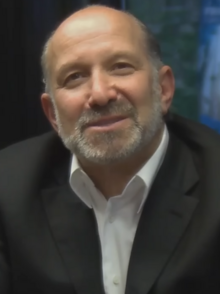 Why are Trump and his allies undermining financial stability? There may be an element of free-market dogma. But as always with this administration, you shouldn’t underestimate the importance of simple corruption. Tether is closely connected with the financial firm Cantor Fitzgerald, formerly run by Howard Lutnick, right, Trump’s secretary of commerce. On joining the government, Lutnick left his role at Cantor Fitzgerald — and handed it over to his sons.
This post is already long, so I’ll stop with a warning: Along with its many other sins, the Trump administration is doing its best to make a future financial crisis more likely. I hope the Democrats are paying attention and won’t let themselves be seduced by Wall Street and, worse, the blandishments of the crypto bros. Because if they don’t, they could set themselves for a 2008-type crash during a Democratic administration. And we can guess who will get the blame.Trump’s cronies are undermining financial stability.
U.S. Governance, Politics
Lincoln Square Media, Trump TERRIFIED After Epstein Email Leak Reveals Hidden Plot Inside WH! Rick Wilson, Nov. 28, 2025.
Nov. 27
Andrew Wolfe, above left, and Sarah Beckstrom are the West Virginia National Guard members who were shot and critically wounded on Nov. 26, 2025, while deployed in Washington, DC.
New York Times, Here’s What We Know About the National Guard Shooting Victims, Christina Morales and Bernard Mokam, Nov. 27, 2025. The father of one of the West Virginia National Guard members said his daughter had a “mortal wound.” A man at the other member’s home asked for prayers for his son.
Two members of the West Virginia National Guard remained in critical condition in a hospital on Thursday, officials said, a day after they were ambushed just a few blocks from the White House.
Officials identified the Guard members as U.S. Air Force Staff Sgt. Andrew Wolfe, 24, and U.S. Army Specialist Sarah Beckstrom, 20.
Sergeant Wolfe, of Martinsburg, W.Va., entered the service on Feb. 5, 2019, and was assigned to the Force Support Squadron, 167th Airlift Wing of the West Virginia Air National Guard.
Specialist Beckstrom, of Summersville, W.Va., started her service on June 6, 2023, and was assigned to the 863rd Military Police Company, 111th Engineer Brigade of the West Virginia Army National Guard.
Both had been deployed to Washington since August, when President Trump ordered troops to the capital as part of what his administration described as a crackdown on crime.
“All we need right now are prayers for my son,” a man at Sergeant Wolfe’s family home told a reporter. He declined to speak more.
Specialist Beckstrom’s father said his daughter was unlikely to recover. “I’m holding her hand right now,” Gary Beckstrom said when reached by phone. “She has a mortal wound. It’s not going to be a recovery.” He declined to speak further.
The Parnas Perspective, Major Update: The Trump Administration Caught Lying About D.C. Shooting Suspect as CIA Ties Exposed, Aaron Parnas, right, Nov. 27, 2025. As many of us finish our Thanksgiving meals and try to enjoy a peaceful holiday, misinformation is spreading at full speed—and this one is too significant to ignore. A major falsehood circulating online, amplified by the White House and echoed by several media figures,claims that the D.C. National Guard shooting suspect was an undocumented immigrant who slipped through broken vetting procedures.
That narrative is simply false. I am debunking it on Thanksgiving so that every American knows the truth. If you value this kind of reporting, please consider subscribing today so I can keep expanding this platform and bring it to millions more households.Subscribed
The truth? The suspect was a vetted CIA-affiliated Afghan ally of the United States . Here are the verified facts:
These facts have been reported by Jennifer Griffin, a veteran Fox News national security correspondent with extensive access to intelligence and military sources.
According to Griffin’s reporting and senior U.S. officials:
Lakanwal began working with the CIA around 2011.
Before the CIA employed him, the agency conducted its own vetting using multiple intelligence databases, including the NCTC database.
During Operation Allies Welcome in 2021, NCTC performed a full background investigation before he was allowed entry to the United States. Nothing indicated ties to terrorism, radical networks, or security concerns.
He worked for the CIA at the Kandahar base, reportedly with a U.S. intelligence task force, and was among the Afghan allies evacuated by U.S. forces as Kabul fell. Having a CIA badge placed him in the “highest-trust” category during evacuation processing. This is from Griffin:
U.S. agencies have been conducting continuous, annual vetting of Afghan evacuees since 2021, especially following a disrupted 2023 terror plot in Oklahoma. Lakanwal again showed no red flags.
 Upon resettlement, he applied for asylum and received it in April—approved by the Trump administration.
Despite this well-documented vetting history, some political figures—most recently U.S. Attorney Jeanine Pirro—are claiming that this attack occurred because individuals are being admitted into the country “without proper vetting.”
This is demonstrably untrue.
Donald Trump himself parroted the idea that this man entered America without proper vetting, despite his own Administration vetting him:
It is not merely a misunderstanding—it is a manufactured narrative that contradicts intelligence records, contradicts the procedures used over the last decade, and contradicts the public statements of senior officials across multiple administrations, including Trump’s own.
This misinformation is dangerous for several reasons:
At a moment when accuracy matters most, false claims create confusion and resentment. We owe the truth—not only to ourselves, but to the allies who stood beside American troops for twenty years.
The D.C. National Guard shooting suspect was not an undocumented immigrant.He was a long-vetted CIA partner, screened repeatedly by U.S. intelligence, and legally admitted through a rigorous process overseen by both major parties.
Facts matter. And no amount of political spin can rewrite them.
New York Times, U.S. Reviews Biden Asylum Cases After Shooting, Hamed Aleaziz, Nov. 27, 2025. A Homeland Security Department spokeswoman accused the previous administration of failing to vet asylum applicants “on a massive scale.”
The Trump administration said on Thursday that it was reviewing all asylum cases that were approved under the Biden administration, signaling a broad crackdown in the wake of the shooting of two National Guard members.
Officials said that a 29-year-old Afghan man shot the Guard members and that he had entered the United States through a Biden-era program that brought tens of thousands of Afghans into the country. The accusation has renewed questions about the vetting process for a variety of entry programs, including asylum.
Tricia McLaughlin, a Homeland Security Department spokeswoman, in announcing the review of asylum cases, accused the previous administration of failing to vet the applicants “on a massive scale.”
The man identified as the suspect was said to have worked with the C.I.A. and fled Afghanistan in 2021 under Operation Allies Welcome, a program born after the sudden fall of the Afghan government in 2021, when the United States withdrew its forces and the Taliban took control of the country.
At the time, the Biden administration faced accusations of abandoning allies in the country, as fears grew that those who helped the U.S. military and people involved in civil society, like journalists, would face serious threats.
Biden administration officials insisted then that Afghan nationals who came through the program had been properly vetted and screened, though an inspector general report later found significant flaws in the process.
“The screening and vetting process involves biometric and biographic screenings conducted by intelligence, law enforcement, and counterterrorism professionals,” the agency said in a statement in September 2021, days after the evacuation of Americans and allies as the Taliban took control.
Homeland Security Department officials said that people who failed the checks would not be allowed to fly into the United States and that if Afghans who had already arrived and received further checks had any concerning information they could be turned back.
An advocacy group for Afghan nationals brought to the United States, #AfghanEvac, said in a statement on Wednesday that the shooting was not a reflection of the wider Afghan community. “This violent act does not reflect the Afghan community, which continues to contribute across the United States and undergoes some of the most extensive vetting of any immigrant population.”
According to a 2022 audit of the vetting process, it was supposed to include obtaining biometric information from the Afghans, running the information through databases to ensure there wasn’t any “derogatory” information or potential threats, and another inspection when the Afghans arrived at U.S. airports.
But the report, from the Homeland Security Department inspector general’s office, found serious flaws in the process.
The office found that the department “did not always have critical data to properly screen, vet, or inspect Afghan evacuees arriving” and that “some of the information used to vet evacuees through U.S. government databases, such as name, D.O.B., identification number, and travel document data, was inaccurate, incomplete or missing.”
The report found that the Department of Homeland Security had allowed at least two people into the United States who posed security risks and might have admitted more “individuals of concern.”
The agency disputed that claim at the time, criticizing the inspector general’s report and saying it had properly vetted all the Afghans who arrived in the United States.
“At times, D.H.S. may be alerted to new derogatory information after individuals are admitted or paroled,” the department said in 2022. In the two cases in the report, “D.H.S. and our interagency partners immediately acted upon this new derogatory information; this is indicative of a vetting system that works as designed.”
New York Times, U.S. to Press Europe and Other Allies on ‘Mass Migration,’ Document Says, Edward Wong and Hamed Aleaziz, Nov. 27, 2025 (print ed.). American diplomats were told to raise U.S. concerns about “violent crimes associated with people of a migration background.”
Secretary of State Marco Rubio has ordered American diplomats in Europe and in Canada, Australia and New Zealand to press their host governments to restrict most immigration and to file reports if the governments appear to be overly supportive of immigrants, according to a document sent to U.S. embassies and consulates.
Mr. Rubio told the diplomats to emphasize the effects of criminal acts by immigrants to encourage greater entry restrictions, according to the document, which is a diplomatic cable dated Nov. 21. The text of the cable, which was obtained by The New York Times, has not been previously reported.
 Diplomats should “regularly engage host governments and their respective authorities to raise U.S. concerns about violent crimes associated with people of a migration background” and “any related human rights abuses,” the cable said. It said that those episodes were “widespread disruptors of social cohesion and public safety.”
The diplomats should send reports on crime linked to immigrants to State Department headquarters as well as analysis of how host governments handle the issues, including “policies that unduly favor migrants at the expense of local populations.”
The goal of these actions is to build “host government and stakeholder support to address and reform policies related to migrant crime, defending national sovereignty, and ensuring the safety of local communities,” the cable said.
The Trump administration often uses the term “sovereignty” to describe its efforts to get other countries to allow in fewer foreign citizens and harden their borders — even as it tries to impose policies on sovereign nations.
President Trump, his top aides and many of their supporters have talked about large numbers of migrants and immigrants as a scourge in the United States and Europe. They are determined to get governments to take draconian measures to limit immigration and increase deportations, even though statistics show that irregular border crossings in Europe have been dropping for many months and were decreasing in the United States late in the Biden administration.
In a speech at the United Nations in September, Mr. Trump denounced the “globalist migration agenda.” Stephen Miller, Mr. Trump’s deputy chief of staff for policy, and Vice President JD Vance have been equally vocal. “We cannot rebuild Western civilization, we cannot rebuild the United States of America or Europe, by letting millions and millions of unvetted illegal migrants come into our country,” Mr. Vance said in February.
Mr. Rubio, the son of Cuban immigrants, shifted his views on immigration policy during his 14 years as a Republican senator from Florida, and he and his deputy, Christopher Landau, now push the State Department to help enforce the Trump administration’s hard-line positions.
Associated Press via Politico, Israeli soldiers appear to kill Palestinian men in West Bank after they surrender, Staff Reports, Nov. 27, 2025. The Israeli military said it was investigating the killings, which were captured in two videos shown on Arab TV stations.Israeli soldiers are seen during an army raid in the West Bank town of Tubas.
Israeli soldiers on Thursday appeared to kill a pair of Palestinian men in the occupied West Bank after they had surrendered to troops, drawing Palestinian accusations that the men were executed “in cold blood.” The Israeli military said it was investigating.
The killings, captured in a pair of videos shown on two Arab TV stations, came as Israel pressed ahead with its latest offensive in the West Bank, where the army has stepped up its activities over the past two years. Israel says it is cracking down on militants, but Palestinians and rights groups accuse Israel of using excessive force and say dozens of unarmed civilians have been killed.
Israel has been fighting on a number of fronts as a shaky ceasefire in Gaza moves forward. On Thursday, Israel carried out another round of airstrikes on suspected Hezbollah sites in southern Lebanon. Ongoing conflicts in the region have fueled concerns that unrest could spill over and undermine the fragile truce in Gaza.
A Palestinian-American teenager held in Israeli detention for nine months was also released on Thursday night. The 16-year-old emerged visibly thin and was embraced by his crying family.Soldiers accused of executing Palestinian men
The Israeli military announced it was opening an investigation into the deaths Thursday of the two men, which Palestinians have called an execution.
In video shown by the Egyptian TV station Al-Ghad, which have no sound, the men are seen on the ground in front of the troops. They are then ordered to the entrance of a garage. Both men lifted up their shirts to show they are not carrying explosives or large weapons, and one of the men held his hands in the air as they moved. As they are on the ground and surrounded by troops, gunshots are heard and the men slump down, apparently lifeless. At least one soldier appears to fire his weapon.
In a statement, the Israeli military said the two men were wanted militants in the northern town of Jenin who had thrown explosives and opened fire at troops.
It said that after the men surrendered and exited a building, “fire was directed toward the suspects.” It said was the incident was “under review” and would be referred “to the relevant professional bodies.”
Palestinians and human rights groups say such investigations yield few results, and Israeli troops are rarely prosecuted.
In Ramallah, the Palestinian prime minister’s office accused Israel of executing the men “in cold blood.” It called the shooting “an outright extrajudicial killing in blatant violation of international humanitarian law.”
U.S. Culture, History, Media, Education
Happy Thanksgiving!
Letters from an American, Historical Commentary: November 26, 2025 [The True History of Thanksgiving], Heather Cox Richardson, right, Nov. 27, 2025. Thanksgiving is the quintessential American holiday…but not for the reasons we generally remember.
The Pilgrims and the Wampanoags did indeed share a harvest celebration together at Plymouth in fall 1621, but that moment got forgotten almost immediately, overwritten by the long history of the settlers’ attacks on their Indigenous neighbors.
In 1841 a book that reprinted the early diaries and letters from the Plymouth colony recovered the story of that three-day celebration in which ninety Indigenous Americans and the English settlers shared fowl and deer. This story of peace and goodwill among men who by the 1840s were more often enemies than not inspired Sarah Josepha Hale, who edited the popular women’s magazine Godey’s Lady’s Book, to think that a national celebration could ease similar tensions building between the slave-holding South and the free North. She lobbied for legislation to establish a day of national thanksgiving.
And then, on April 12, 1861, southern soldiers fired on Fort Sumter, a federal fort in Charleston Harbor, and the meaning of a holiday for giving thanks changed.
Southern leaders wanted to destroy the United States of America and create their own country, based not in the traditional American idea that “all men are created equal,” but rather in its opposite: that some men were better than others and had the right to enslave their neighbors. In the 1850s, convinced that society worked best if a few wealthy men ran it, southern leaders had bent the laws of the United States to their benefit, using it to protect enslavement above all.
 In 1860, northerners elected Abraham Lincoln, above, to the presidency to stop rich southern enslavers from taking over the government and using it to cement their own wealth and power. As soon as he was elected, southern leaders pulled their states out of the Union to set up their own country. After the firing on Fort Sumter, Lincoln and the fledgling Republican Party set out to end the slaveholders’ rebellion.
The early years of the war did not go well for the U.S. By the end of 1862, the armies still held, but people on the home front were losing faith. Leaders recognized the need both to acknowledge the suffering and to keep Americans loyal to the cause. In November and December, seventeen state governors declared state thanksgiving holidays.
New York governor Edwin Morgan’s widely reprinted proclamation about the holiday reflected that the previous year “is numbered among the dark periods of history, and its sorrowful records are graven on many hearthstones.” But this was nonetheless a time for giving thanks, he wrote, because “the precious blood shed in the cause of our country will hallow and strengthen our love and our reverence for it and its institutions…. Our Government and institutions placed in jeopardy have brought us to a more just appreciation of their value.”
The next year, Lincoln got ahead of the state proclamations. On July 15 he declared a national day of Thanksgiving, and the relief in his proclamation was almost palpable. After two years of disasters, the Union army was finally winning. Bloody, yes; battered, yes; but winning. At Gettysburg in early July, Union troops had sent Confederates reeling back southward. Then, on July 4, Vicksburg had finally fallen to U. S. Grant’s army. The military tide was turning.
President Lincoln set Thursday, August 6, 1863, for the national day of Thanksgiving. On that day, ministers across the country listed the signal victories of the U.S. Army and Navy in the past year and reassured their congregations that it was only a matter of time until the United States government put down the southern rebellion. Their predictions acknowledged the dead and reinforced the idea that their sacrifice had not been in vain.
In October 1863, President Lincoln declared a second national day of Thanksgiving. In the past year, he declared, the nation had been blessed.
In the midst of a civil war of unequaled magnitude and severity, he wrote, Americans had maintained their laws and their institutions and had kept foreign countries from meddling with their nation. They had paid for the war as they went, refusing to permit the destruction to wreck the economy. Instead, as they funded the war, they had also advanced farming, industry, mining, and shipping. Immigrants had poured into the country to replace men lost on the battlefield, and the economy was booming. And Lincoln had recently promised that the government would end slavery once and for all. The country, he predicted, “with a large increase of freedom,” would survive, stronger and more prosperous than ever. The president invited Americans “in every part of the United States, and also those who are at sea, and those who are sojourning in foreign lands” to observe the last Thursday of November as a day of Thanksgiving.
In 1863, November’s last Thursday fell on the 26th. On November 19, Lincoln delivered an address at the dedication of a national cemetery at Gettysburg, Pennsylvania. He reached back to the Declaration of Independence for the principles on which he called for Americans to rebuild the severed nation:
”Four score and seven years ago our fathers brought forth on this continent, a new nation, conceived in Liberty, and dedicated to the proposition that all men are created equal.”
Lincoln urged the crowd to take up the torch those who fought at Gettysburg had laid down. He called for them to “highly resolve that these dead shall not have died in vain—that this nation, under God, shall have a new birth of freedom—and that government of the people, by the people, for the people, shall not perish from the earth.”
The following year, Lincoln proclaimed another day of Thanksgiving, this time congratulating Americans that God had favored them not only with immigration but also with the emancipation of formerly enslaved people. “Moreover,” Lincoln wrote, “He has been pleased to animate and inspire our minds and hearts with fortitude, courage, and resolution sufficient for the great trial of civil war into which we have been brought by our adherence as a nation to the cause of freedom and humanity, and to afford to us reasonable hopes of an ultimate and happy deliverance from all our dangers and afflictions.”
In 1861, Americans went to war to keep a cabal from taking control of the government and turning it into an oligarchy. The fight against that rebellion seemed at first to be too much for the nation to survive. But Americans rallied and threw their hearts into the cause on the battlefields even as they continued to work on the home front for a government that defended democracy and equality before the law.
And in 1865, at least, they won.
U.S. Justice, Law, Crime
 MSNOW, Opinion: Donald Trump hates James Comey and Letitia James too much to give up now, Jessica Levinson, Nov. 27, 2025. Though career prosecutors apparently concluded there wasn’t enough evidence to charge James Comey and Letitia James, and a judge threw out their indictments, don’t expect President Donald Trump’s administration to give up.
After U.S. District Court Judge Cameron Currie tossed federal criminal cases against former FBI Director James Comey and New York Attorney General Letitia James into the dumpster where they belong, the question now is if the federal government has any moves left in its pursuit of Comey and James. Against all norms, Trump famously publicly leaned on Attorney General Pam Bondi to bring charges against Comey and James.
Against all norms, Trump famously publicly leaned on Attorney General Pam Bondi to bring charges against Comey and James.
Though career prosecutors who looked at the cases apparently concluded there wasn’t enough evidence to charge Comey with lying to Congress or obstructing a congressional proceeding, or to charge James with mortgage fraud, the answer is yes: The government does have moves it can make. It can appeal Currie’s ruling, as Bondi has already vowed to do, or try to find another lawyer to bring the charges.
But whether those moves will result in a successful restart of the two deeply problematic cases, to say nothing in whether they’ll lead to either of the two being convicted of anything, remains to be seen.
To catch you up on why the indictments against Comey and James were dismissed, Judge Currie ruled that the person responsible for persuading a grand jury to indict them, Trump’s former personal attorney Lindsey Halligan, was wrongly appointed as interim U.S. attorney for the Eastern District of Virginia. Halligan was put in the position after interim U.S. Attorney Erik Siebert — who refused to bring charges against James — was forced out, and Currie ruled that her appointment violated not just the Constitution’s Appointments Clause, but also a federal law regarding how to fill vacancies.‘DOJ has a real problem’: Former FBI official on judge tossing cases against Comey, JamesOctober 8, 2025 / 07:46
The gist of it is that Halligan wasn’t, and isn’t, lawfully in her position as the U.S. attorney for the Eastern District of Virginia, and therefore had no authority to bring indictments. Think of her like an elementary school student who at 10 a.m. announces to her class that it’s lunch time. There’s no authority behind such a declaration. In the same way, Halligan had no authority to bring cases before a grand jury or to declare that Comey and James have been accused of crimes.
As for the government’s options now, the first and most obvious route is to appeal Currie’s ruling to the U.S. Court of Appeals for the Fourth Circuit, which Attorney General Pam Bondi has already said the government will do. If the Circuit disagrees with Currie’s analysis that Halligan was wrongly appointed to the position of, then the government could be free to move forward with its cases.
But the judge’s argument against Halligan’s appointment is strong. It’s rooted in the Constitution and in how much power the executive should and shouldn’t have. Currie found that allowing Halligan’s appointment to stand would amount to an unconstitutional end-run around the Senate and its authority.
Currie found that allowing Halligan’s appointment to stand would amount to an unconstitutional end-run around the Senate and its authority.
The Appointments Clause says “principal officers” must be nominated by the president and confirmed by the Senate but that Congress can give the power to appoint “inferior officers” to the president. Currie found that U.S. attorneys are nominated by the president and confirmed by the Senate. But Halligan, like Siebert, the interim U.S. attorney who preceded her, hasn’t been confirmed.
When there is a vacancy for a U.S. attorney, an interim U.S. attorney can serve for 120 days, and if there’s still no permanent U.S. attorney then, the judges for that district can appoint someone to serve as U.S. attorney until the vacancy is filled. Judges appointed Siebert to the role after his 120 days ran out, but Currie correctly concluded that it would fly in the face of federal law to allow the attorney general to put Halligan in the position and give her 120 days.
If that were permissible, an administration could ditch the Senate confirmation process altogether; the attorney general could just continue appointing different people on an interim basis.‘Russian doll of blunders’: Ex-Trump official slams DOJ incompetence October 8, 2025 / 07:46
That’s why the government’s appeal should go nowhere.
As for the second option: Finding someone else at the Department of Justice to make a case to a grand jury and lead a prosecution against Comey and James, that’s easier said than done. Remember, Siebert was forced out when he refused to bring charges against James, and in a sign that few, if any, career prosecutors thought there was enough of a “there there” to bring federal charges against Comey and James, Halligan was the only prosecutor to bring the cases and sign the indictments.
In fact, NBC News reported that career prosecutors sent Halligan a memo explaining why they believed there was no criminal case to be made against Comey.
Expect Bondi’s DOJ to keep trying to find someone even though the previous refusal by career prosecutors to touch these cases is indicative of how weak they are.
It is worth mentioning that Comey and James have also alleged that they are the victims of selective and vindictive prosecution, and if they are successful in one or both of those arguments, that would provide an independent ground to dismiss both of their cases.
The previous refusal by career prosecutors to touch these cases is indicative of how weak they are.
Depending on what happens in an appeal, the government needs to address the statute of limitations issue in Comey’s indictment. Halligan brought Comey’s indictment mere days before the statute of limitations ran on the charges against him. Currie specifically noted in her ruling that an invalid indictment does not toll, meaning pause, the statute of limitations. If Currie’s ruling and rationale stands, then the DOJ is time-barred from trying to refile the same charges against Comey. This is true regardless of who the prosecutor bringing the charges is.
The same is not true for the case against James. In that case, even if Currie’s ruling stands, there is still time to refile the same charges against James. Of course, the DOJ would still have the difficulty of finding a prosecutor willing to bring those charges.New reporting confirms Trump accidentally posted DM to Bondi ordering prosecutionsOctober 8, 2025 / 07:46
Setting aside the timing issues for a moment, if the government is not able to win on appeal, its best hope of resurrecting these cases is to appoint a new U.S. attorney. The cleanest route would be for the president to nominate someone and for the Senate to confirm that person. Another possible option would be for Bondi to assign a different, properly appointed U.S. attorney, or to appoint a special attorney under a different federal law, to refile the charges.
Of course even if a new prosecutor is appointed, the federal government will still need to answer to claims that federal charges were only brought against Comey and James because Trump, to use a non-legal term, hates them. Again, both Comey and James have plenty of reasons to allege that they are the victims of selective or vindictive prosecution.
Ultimately, it remains to be seen whether Currie’s ruling is the death knell for two of the most politically charged and divisive federal criminal cases to be brought in decades. But it ought to be.
New York Times, ICE Detains Woman With Family Ties to White House Press Secretary, Amanda Holpuch, Nov. 26, 2025 (print ed.). Bruna Caroline Ferreira, the mother of a nephew of the White House press secretary, Karoline Leavitt, was pulled over and arrested on her way to pick up her son from school, Ms. Ferreira’s lawyer said.
A woman from Brazil with family ties to the White House press secretary, Karoline Leavitt, right, is being detained at an Immigration and Customs Enforcement facility in Louisiana, the authorities said.
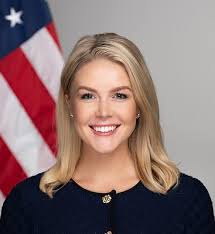 Bruna Caroline Ferreira, the mother of Ms. Leavitt’s 11-year-old nephew, was pulled over and arrested on Nov. 12 on her way to pick up her son from school in a suburb of Boston, Ms. Ferreira’s lawyer, Todd Pomerleau, said.
Mr. Pomerleau said that Ms. Ferreira, 33, is seeking a green card and was arrested without due process. The Department of Homeland Security said in a statement that Ms. Ferreira was in the country illegally and had entered the United States from Brazil when she was a child, on a B-2 tourist visa that required her to leave the country by June 6, 1999.
Ms. Ferreira was previously engaged to Ms. Leavitt’s brother, Michael Leavitt, but they never married, Mr. Pomerleau said. They have shared custody of their son, who lives with Mr. Leavitt in New Hampshire, he added. Ms. Ferreira lives in Revere, Mass.
Mr. Leavitt said in a text message, “My only concern has always been the safety, well being, and privacy of my son.”
A person familiar with the situation, speaking on the condition of anonymity to discuss private details, said that Ms. Leavitt and Ms. Ferreira had not spoken in years.
Mr. Pomerleau said that after Ms. Ferreira’s parents brought her to the United States as a child, she received temporary protection from deportation under the Deferred Action for Childhood Arrivals program, known as DACA. She had not been able to renew her DACA status and was no longer under its protection at the time of her arrest, Mr. Pomerleau said, because she was seeking a permanent form of legal status, a green card. She had attended a green card hearing in the spring, he said, and was waiting for a final hearing.
The Homeland Security Department said that Ms. Ferreira was being held at the South Louisiana ICE processing center. Ms. Ferreira had been previously arrested on suspicion of battery, the D.H.S. statement said, but it did not specify if she was charged after the arrest.
The D.H.S. statement described Ms. Ferreira as a criminal, but Mr. Pomerleau said that she has no criminal record. “Show us the proof,” he said.
Ms. Ferreira’s sister is a United States citizen and her mother has a green card, he said.
“These aren’t criminal illegal aliens. These are taxpayers, working mothers,” Mr. Pomerleau said. “They were living the American dream and now it’s a dystopian nightmare that we’re dealing with.”
Ms. Ferreira’s sister, Graziela Dos Santos Rodrigues, started a GoFundMe campaign to raise money to help cover the legal costs and other expenses related to Ms. Ferreira’s detention. On the fund-raiser page, Ms. Dos Santos Rodrigues said her sister was brought to the United States in December 1998.
The Trump administration is seeking to remake the country’s immigration system and has aggressively targeted immigrants for arrest and deportation, taking an expansive view of who can be subjected to these enforcement acts. People who are in the country legally or are attempting to get legal status have been swept up in the crackdown.
As Department of Homeland Security resources have been diverted to immigration enforcement, the agency has made fewer arrests for drug crimes and seized fewer weapons than it did the previous fiscal year, according to internal government documents reviewed by The New York Times.
Mr. Pomerleau said that aside from Ms. Ferreira’s ties to the White House, this case was in line with the type his firm, Rubin Pomerleau, sees daily. Immigrants are arrested without warning or explanation, then are quickly sent to immigration detention centers far from their homes and loved ones while trying to get in contact with lawyers.
Jeffrey Rubin, another lawyer at the firm, said that there has always been injustice in the immigration system, but it has skyrocketed under the Trump administration. “The volume and the just lack of complete discretion is what’s been new,” he said.
The Enforcement Archives, Trump’s Epstein Panic Explodes — Cash Patel Just Became His Emergency Scapegoat, Steve Schmidt, Nov. 27, 2025. Trump’s Epstein panic has erupted into full public view, and in this video, Steve Schmidt breaks down why Cash Patel has suddenly become Trump’s emergency scapegoat.
As Steve Schmidt explains, the flood of resignations, leaked files, and desperation inside Trump’s circle reveals a leader cornered by his own chaos.
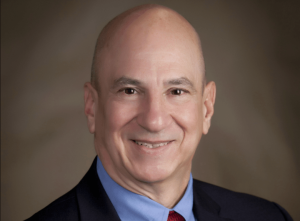 Emptywheel, Analysis: In Dismissing Georgia RICO Case, Peter Skandalakis Fabricates Jack Smith Conclusion, Emptywheel (Marcy Wheeler, right), Nov. 26, 2025. I am not surprised that Peter Skandalakis, above, asked to dismiss the Georgia prosecution against Donald Trump. The fault for its dismissal lies primarily with Fani Willis for giving him the opportunity to dismiss it.
But Skandalakis’ dismissal is dishonest in many places and outright false in one case: notably, in his claim that Jack Smith concluded that he could not prosecute the case after SCOTUS interfered:
The strongest and most prosecutable case against those seeking to overturn the 2020 Presidential election results andprevent the certification of those votes was the one investigated and indicted by Special Counsel Jack Smith. Although Special Counsel JackSmith’s federal case encompassed evidence from multiple states, he ultimately concluded the federal case could not be prosecuted because of the U. S. Supreme Court’s decision in Trump v. United States and the re-election of President Donald J. Trump.
Special Counsel Jack Smith wrote in his report, “Conversely, a select few of Mr. Trump’s agents and elector nominees had insight into the ultimate plan to use the fraudulent elector certificates to disrupt the congressional certification on January 6 and willingly assisted…. In each of the targeted states, Mr. Trump and his co-conspirators successfully organized enough elector nominees and substitutes to gather on December 14, cast fraudulent electoral votes on his behalf, and send them to Washington, D.C., for the congressional certification.”28
 The criminal conduct alleged in the Atlanta Judicial Circuit’s prosecution was conceived in Washington, D.C., not the State of Georgia. The federal government is the appropriate venue for this prosecution, not the State of Georgia. Indeed, if Special Counsel Jack Smith, with all the resources of the federal government at his disposal, after reviewing the evidence in this case and considering the U.S. Supreme Court’s decision in Trump v.United States, along with the years of litigation such a case would inevitably entail, concluded that prosecution would be fruitless, then I too find that, despite the available evidence, pursuing the prosecution of all those involved in State of Georgia v. DonaldTrump, et al. on essentially federal grounds would be equally unproductive.
The evidence had nothing to do with Smith’s decision to drop the case when Trump was reelected. Indeed, before the election he had laid out how he still planned to do so, as he laid out in his immunity brief.
This motion provides a comprehensive account of the defendant’s private criminal conduct; sets forth the legal framework created by Trump for resolving immunity claims; applies that framework to establishthat none of the defendant’s charged conduct is immunized because it either was unofficial or anypresumptive immunity is rebutted; and requests the relief the Government seeks, which is, at bottom, this: that the Court determine that the defendant must stand trial for his private crimes as would any other citizen.
This was a cowardly and partisan dodge by Skandalakis, one that sacrifices the integrity of Georgia’s democracy.

New York Times, Robert L. Dear Jr., Who Killed 3 at Colorado Planned Parenthood, Dies in Prison, Rylee Kirk, Nov. 26, 2025 (print ed.). Four police officers were among those wounded by Mr. Dear in his 2015 rampage when he targeted the clinic in Colorado Springs.
Robert L. Dear Jr., who opened fire at a Planned Parenthood clinic in Colorado in 2015, killing three and wounding nine others, died in federal prison over the weekend, according to inmate records.
Mr. Dear, 67, died Saturday at a medical facility for federal prisoners in Springfield, Mo., according to a statement from the Federal Bureau of Prisons.
On Nov. 27, 2015, in Colorado Springs, Mr. Dear attacked the clinic after having stopped his pickup truck multiple times to seek directions before calling the clinic itself. He had rifles, handguns, propane canisters and over 500 rounds of ammunition.
The episode lasted for hours, with 24 people being evacuated, some after the authorities rammed an armored vehicle into the building to rescue them. After almost six hours, Mr. Dear surrendered to officers.
Mr. Dear told the police that he had attacked the clinic because he was “upset with them performing abortions and the selling of baby parts,” according to court documents. He also told a detective he revered Paul Hill, who was executed in Florida in 2003 for killing an abortion doctor and his volunteer escort.
Mr. Dear killed three people: Garrett Swasey, 44, a University of Colorado Colorado Springs police officer; Ke’Arre M. Stewart, 29, an Army specialist in Iraq; and Jennifer Markovsky, 35, a mother from Hawaii.
After surrendering, Mr. Dear faced 179 felony charges, including multiple counts of murder and attempted murder. He was indicted on 68 counts in federal court.
As of September, Mr. Dear’s federal case was still pending, according to his criminal court docket. His court proceedings were often loud and disruptive. He declared himself a “warrior for the babies,” declared that he was guilty and sought to be his own lawyer.
New York Times, Senator Agrees to Pay Over $5 Million in Back Taxes to I.R.S., Karoun Demirjian, Nov. 26, 2025 (print ed.). Senator Jim Justice, a Republican and former governor of West Virginia, agreed to pay just hours after the tax agency sued to collect unpaid taxes from 2009.
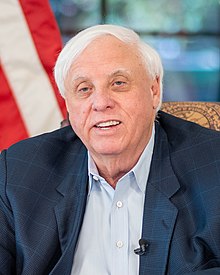 Senator Jim Justice, right, Republican of West Virginia, and his wife have agreed to pay the Internal Revenue Service more than $5 million to cover unpaid taxes from 2009, settling part of a legal fight he has claimed is politically motivated.
 The agreement, filed in federal court on Monday, came just hours after the I.R.S. sued Mr. Justice and his wife, Cathy, accusing them of having “neglected or refused to make full payment” of their taxes for 2009. In the lawsuit, the I.R.S. said that as of early August, the Justices owed over $5.16 million in back taxes and interest from that year.
Under the settlement, the Justices have agreed to pay that amount, plus any additional interest they accrue before the bill is paid in full. The filing, in the U.S. District Court for the Southern District of West Virginia, did not give a deadline or schedule for payment. The agreement, known as a consent judgment, was still awaiting a judge’s signature on Tuesday morning.
A spokesman for Mr. Justice’s Senate office did not respond to a request for comment.
Last month, Mr. Justice asserted during a news conference that the 2009 tax assessment against him and his wife, which was levied in 2015, and other assessments since then, were politically motivated. “If you don’t think these are political moves, you’re crazy,” he told reporters. He suggested that President Joe Biden’s administration might have targeted him during his 2024 run for the Senate, but did not offer specifics.
A spokeswoman for Mr. Biden declined to comment on Mr. Justice’s claims. Mr. Biden was president when the I.R.S. issued more recent tax assessments against the Justices, but he was the vice president in 2015, when the initial assessment for missed 2009 taxes was issued. He had left the White House by the time the I.R.S. filed tax lien notices against the Justices earlier this year for being in arrears in multiple tax years.
In 2009, Mr. Justice was a private citizen with holdings in the coal industry. He did not explain why he believed he would have been a target of tax officials in the Obama administration. In 2015, he began a successful campaign to become West Virginia’s governor as a Democrat, six months before the I.R.S. assessed that he owed back taxes for 2009. Four years later, after building an alliance with President Trump, Mr. Justice ran for re-election — and won — as a Republican.
Mr. Justice also said that he was pursuing the I.R.S. for what he claimed, without providing evidence, were about $40 million in outstanding tax refunds. He predicted that he and his spouse would ultimately “end up with significantly more dollars from the I.R.S. than what we owe the I.R.S.” He added: “It’s just a situation we’ve got to go through.”
Mr. Justice, who was governor from 2017 until he took office as a senator in January, got into politics after a long career running a family coal business that owned dozens of mines in several states.
More On U.S. Governance and Politics
Politico, ‘I never want to hear again that the Democratic Party has a problem with young men,’ Jacob Wendler, Nov. 27, 2025. Democrats stormed back with young men in off-year elections. But the biggest test will come next year.
Democrats overperformed with young men in the off-year elections. Now comes the hard part: Replicating those results in the midterms amid an ideological divide in the party.
While Democrats across the board outdid their party’s performance in 2024 by wide margins, their gains with young male voters were even more drastic in several races. Party leaders are bullish Democrats can maintain that momentum heading into next year.
“I never want to hear again that the Democratic Party has a problem with young men,” DNC Chair Ken Martin said at a press conference. “We’re going to keep working hard to keep them in our camp and our coalition, for sure, but we won across the board with every major constituency that left our party last year, and that should tell you something again, that the Democratic Party is back.”
 Martin said young people feel “disillusioned” by the lack of opportunities in the job market, a sentiment that he thinks voters largely attribute to the Trump administration. That hypothesis played out in several key races where Democrats’ consistent messaging on affordability paid off.
In Virginia, Gov.-elect Abigail Spanberger won men aged 18-29 by a larger margin than any other age group of male voters, per network exit polls. In New Jersey, Mikie Sherrill beat GOP opponent Jack Ciattarelli by a 14-point margin with the demographic. And in New York City, more than 6 in 10 men in the youngest age group went for democratic socialist Zohran Mamdani.
Democrats’ strong showing with young male voters comes amid constant worries from within the party that the economic anxiety, cultural alienation and the allure of conservative manosphere content pulled young men toward the Republican Party in recent years.
But the across-the board wins paper over an ideological divide that’s brewing in the party: Will young men be won back by moderation, or by
Jane Rayburn, a Democratic pollster who worked on the Mamdani campaign, said Democrats succeeded in making an affirmative case for their party rather than simply offering a negative attack on Republicans, an approach that she sees as key to winning young male voters.
Still, Republicans argue that Democrats’ gains this year were an aberration and not a reversal of a trend of young men racing toward the GOP. Republican strategist Matt Gorman said young men tend to tack closer to the median voter and are more prone to electoral swings than female voters — which he says presents an opening for Republicans to win them back in the midterms, particularly as President Donald Trump and other Republicans pivot toward an affordability message.
MeidasTouch Network, Trump LOSES IT on THANKSGIVING DAY as WALLS CLOSE IN, Ben Meiselas, right, Nov. 27, 2025. As the Trump administration scrambles to explain its role in granting asylum to the D.C. shooter, the nation faces soaring holiday costs, gutted counterterrorism infrastructure, and a president MIA.
On Thanksgiving morning, Donald Trump went uncharacteristically silent. No rage-filled posts, no incoherent rants, none of the typical holiday vitriol. And that silence speaks volumes. Trump is panicking, and for good reason. Multiple sources have now confirmed what we reported on the MeidasTouch Network: the Trump regime granted asylum to the D.C. shooter back in April.Subscribed
That news was forced into the open when Kristi Noem, serving as head of the Department of Homeland Security, confirmed it publicly. Fox News followed suit. The regime’s own officials corroborated it. And yet, Trump has gone dark, holed up in Florida on the taxpayer dime, likely golfing, while his government scrambles to limit the political damage.
According to Fox’s Jennifer Griffin, one of the last reputable national security reporters at that network, the alleged shooter “was vetted before working with the CIA by the National Counterterrorism Center and the CIA.” Multiple intelligence sources confirm he worked with the CIA in Afghanistan, that he was part of the task force in Kandahar, and that he was among Afghan allies airlifted out during the withdrawal. Having a CIA badge placed him in a highly vetted category. Griffin reported that “there was nothing in his background when he arrived in the U.S. on September 8, 2021, that suggested links to terrorism.”
He applied for asylum late last year. He received asylum in April, under the Trump administration.
Yet when pressed at a D.C. press conference this morning, FBI Director Kash Patel refused to take responsibility. Instead, he redirected reporters to Noem, saying, “I believe Kristi Noem put that out… that’s a DHS matter.” Patel, a former podcast host installed to run the FBI, apparently couldn’t bring himself to admit that the very administration he serves granted the asylum he now pretends to question. That’s the throughline of this regime: projection, denial, and deflection. They simply want to blame former President Biden for all the nation’s woes, without providing the American people with all the facts. Just tell us the damn facts and stop gaslighting us!!!
The absurdity doesn’t end there. Trump appointed a 22-year-old former landscaper, Thomas Fugate, to head the FBI’s counterterrorism division. No experience. No training. Not a single day worked in the FBI. Just a devoted Trump superfan elevated to one of the most sensitive national security posts in the country. Predictably, the regime then gutted the nation’s counterterrorism capabilities, diverting agents to conduct politically motivated raids on migrant workers at farms, factories, and restaurants.
And today, when confronted with the consequences, Trump’s top federal prosecutor in D.C., former Fox host Jeanine Pirro, declared, “This is what happens when people are allowed in who are not properly vetted.” But her own administration performed the final vetting. Her own administration granted the asylum. Her own administration elevated unqualified loyalists into national security leadership. The regime created the very failures it now blames on imaginary enemies.

New York Times, Where the Waters Are Rough, a Fishing Town Confronts Trump’s Priorities, Anna Griffin, Photographs and Video by Ruth Fremson, Nov. 27, 2025. First, Newport, Ore., lost its Coast Guard rescue chopper. Then came the swirl of rumors and evidence that Immigration and Customs Enforcement was coming to town.
The welcome signs on the edge of Newport, Ore., celebrate recent high school sports championships, point tourists toward the local aquarium and highlight two of its defining attributes — the National Oceanic and Atmospheric Administration’s Pacific fleet and its designation as one of the nation’s 37 “Coast Guard cities.”
But the central coast town’s long, warm relationship with the federal government has been upended in recent weeks. First, a Coast Guard rescue helicopter was redeployed from the municipal airport to North Bend, Ore., 95 miles down the coast, with no warning to civic leaders, elected officials or the commercial fishing families who work the treacherous waters off the Oregon coast and sleep better at night knowing quick rescue is available.
Then local businesses began getting calls gauging their interest in providing basic services — like water delivery and solid waste removal — to what many concluded could only be an Immigration and Customs Enforcement detention facility at the airport, especially if it is free of the rescue chopper’s operation.
Taken with similar developments elsewhere, including Staten Island, where another Coast Guard facility is being considered for an ICE takeover, people around Newport have reached what they see as a demoralizing conclusion. To them, the Department of Homeland Security, which oversees both the Coast Guard and ICE, is prioritizing immigration enforcement over coastal safety, and partisan politics over a legacy of trust and communication.
“It’s mind-boggling that the decision was made to move this helicopter, but it’s just as mind-boggling that nobody bothered to talk to us about it,” said Taunette Dixon, a leader of the nonprofit Newport Fishermen’s Wives. “I don’t understand why the approach has to be adversarial here.”
Politico, Mike Johnson set to huddle with Indiana Republicans amid redistricting fight, Adam Wren, The meeting is an escalation of the speaker's involvement.
Speaker Mike Johnson, right, is expected to huddle via conference call with Indiana House Republicans this weekend ahead of their upcoming state House session to redraw congressional maps, according to two people familiar with the planning and an invitation viewed by Politico.
 The meeting, ahead of next week’s session, represents an escalation of Johnson’s involvement in mid-cycle redistricting, a process driven by the White House: He has routinely said it’s an issue for individual states and one in which he has no direct involvement.
House Republicans are expected to talk with Johnson on a conference call at 1 p.m. Saturday before convening on Dec. 1.
Politico reported last week that Johnson called GOP Indiana Senate President Pro Tempore Rodric Bray last Wednesday, after Bray, whose caucus has largely resisted redistricting, said Senate Republicans would not convene to advance new maps.
In the call, Johnson expressed the importance of holding Republicans’ thin majority in the House ahead of the midterms, according to Bray. Indiana Republicans are weighing redrawing the 1st and 7th congressional districts, potentially yielding Johnson two additional seats.
But earlier this week, Bray reversed course, saying his caucus would make a final decision on redistricting when they are expected to reconvene on Dec. 8.
More Global News
New York Times, Trump Cut Europe Out of Ukraine Talks. Here’s How Europe Pushed Back, Jeanna Smialek, Christopher F. Schuetze and Lara Jakes, Nov. 27, 2025. European leaders were blindsided by President Trump’s 28-point-plan to end the Ukraine war, setting off a dash for influence.
When Chancellor Friedrich Merz of Germany first learned of the Trump administration’s peace plan for Ukraine last Thursday, he was stunned by both the content and the way he found out.
Instead of hearing of it from American officials, Mr. Merz learned about the plan from a news headline. His team had to reach out several times to set up a call on Friday night with President Trump for an explanation, according to officials with knowledge of the events.
The content was alarming, from a European perspective. The leaked 28-point plan would ensure that Russia paid little price for invading Ukraine in 2022. It would hand it more territory than the Russian Army has captured on the battlefield. And it would force NATO to formally refuse to admit Ukraine, countermanding a European desire for the Ukrainians to join the alliance.
Senior European officials had known the Trump administration was working on some kind of plan, but nothing that favored Russia to this extent. When it surfaced, they realized that Europe had been cut out of the Trump administration’s efforts to end the continent’s biggest land war since World War II.
This account of how Mr. Trump sidelined Europe in discussions about its own backyard, based on interviews with 16 officials with knowledge of the diplomatic wrangling, paints a picture of a continent squeezed between competing powers, its leaders grasping for influence in a world their nations once dominated. Most of the officials spoke on the condition of anonymity to discuss sensitive political matters.
In the days since the plan was leaked, European leaders, including Mr. Merz, have worked frantically to reverse the slide, using persuasion and behind-the-scenes maneuvering to nudge Mr. Trump’s administration toward a more acceptable position. Plans were upended, frenzied huddles arranged. Several envoys took the first possible flight from Johannesburg, where they were meeting counterparts from the G20, to Geneva to try to persuade U.S. officials to change course.
That huge diplomatic effort, mounted across major European countries and institutions, meant that by Sunday evening, Europe’s leaders had managed to forestall some of what they saw as the worst excesses of the Trump plan for Ukraine.
Sidelined by Mr. Trump last week, Europe’s “coalition of the willing” had become a “coalition of the waiting,” Anders Fogh Rasmussen, a former NATO chief, said in an interview.
“Now, the Europeans understand that they must do much more,” Mr. Rasmussen said.

South African leader Cyril Ramaphosa (Reuters photo).
New York Times, Trump Says South Africa Is Not Invited to G20 Summit in U.S. in 2026, John Eligon, Nov. 27, 2025 (print ed.). The president did not attend this year’s annual gathering in South Africa, which has been a frequent target of his attacks.
President Trump said on Wednesday that South Africa would not be invited to next year’s Group of 20 summit in the United States, just days after South Africa finished hosting the annual gathering, in the latest of a series of attacks on Africa’s largest economy.
 Mr. Trump did not attend the meeting, a gathering of the world’s largest economies, citing the false narrative that white South Africans are being indiscriminately killed and having their land seized. In a post on Truth Social on Wednesday, the president repeated the claim.
He said he was excluding South Africa because its president, Cyril Ramaphosa, had refused to ceremonially hand over the summit to the acting U.S. ambassador; South African officials have said that the handover had to be done to another head of state, not a diplomat.
During an Oval Office meeting in May, Mr. Trump ambushed Mr. Ramaphosa with the same claims of white persecution. He played a slickly produced video that he said supported his claims, leaving the South African president stunned and sinking his country’s relationship with the United States to a low point.
Mr. Trump also said on Wednesday that the United States would “stop all payments and subsidies” to South Africa, though it was not clear to exactly what he was referring. Most U.S. aid to South Africa has already been suspended, through an executive order earlier this year and other cuts by the Trump administration to foreign aid. Almost all of the American funding to South Africa was in the form of funding to fight H.I.V. and AIDS.Want to stay updated on what’s happening in South Africa? Sign up for Your Places: Global Update, and we’ll send our latest coverage to your inbox.
“South Africa has demonstrated to the world they are not a country worthy of membership anywhere,” Mr. Trump wrote in his post.
Mr. Ramaphosa pushed back against Mr. Trump’s assertion that South Africa was not invited to next year’s gathering.
“South Africa is a sovereign constitutional democratic country and does not appreciate insults from another country about its worth in participating in global platforms,” Mr. Ramaphosa said in a statement. “South Africa will continue to participate as a full, active and constructive member of the G20.”
The G20 brings together the world’s 19 largest economies, as well as the European Union and the African Union, in an effort to reach consensus on shared goals and strategies for tackling some of the world’s most pressing issues, like climate change and global financial stability.Editors’ PicksWhat Is Agentic A.I., and Would You Trust It to Book a Flight?Wines, Spirits and More to Bring to Any Holiday GatheringRed Corduroys and Sentimental Jewelry
Each year, a different member state takes on the presidency of the group, allowing it to set the agenda that is ultimately discussed at the heads of state summit toward the end of the year. This was the first year that the summit was held in Africa.

New York Times, France Creates Voluntary Military Service as Europe Faces Russian Threat, Ségolène Le Stradic, Nov. 27, 2025. The effort is aimed at young people and came after an army chief angered many by saying the country must accept the possible loss of children in a future war.
France is creating a paid, voluntary military service for young people and aims to enroll up to 50,000 of them over the next decade, President Emmanuel Macron of France said on Thursday.
The announcement came days after the French Army chief, Gen. Fabien Mandon, set off a national uproar for saying that France must accept the possible loss of its children in a potential future conflict. Those comments were made against the backdrop of a growing threat from Russia since its full-scale invasion of Ukraine in 2022.
“There is a generation ready to stand up for their country, and our military is the natural outlet for this desire to serve,” Mr. Macron said in a speech on Thursday as he visited a mountain infantry brigade in Varces-Allières-et-Risset, a small town in the French Alps near Grenoble, in southeastern France.
“In this uncertain world where force prevails over law and war is a reality, our nation cannot be afraid, ill-prepared or divided,” he added.
Open to men and women, the voluntary service is expected to last 10 months, including one month of training, Mr. Macron said. Volunteers will receive a monthly stipend, a uniform and gear, he said.
New York Times, Hong Kong’s Worst Fire in Generations Fuels Scrutiny of Safety Lapses, Alexandra Stevenson, Joy Dong, Tiffany May and Keith Bradsher, Nov. 27, 2025. In Hong Kong, a city where millions of residents sleep, eat and work high above the ground in towers pressed together like books on a shelf, there has long been the threat that a massive fire could trap people inside their high-rises.
By Thursday, the scale of that nightmare emerged, as an inferno that had begun with one 32-story building and quickly engulfed six other towers at an aging apartment complex killed at  least 65 people, with dozens of people still unaccounted for. It was the deadliest blaze in Hong Kong since a tenement fire killed 59 people in 1957.
Hundreds of firefighters worked to put out flames that continued to burn in three buildings of the Wang Fuk Court complex in Tai Po district 24 hours after they were first reported on Wednesday afternoon. They searched for survivors who had been trapped inside the buildings, pulling both people and corpses out. Around 70 others were in the hospital, some in critical condition.  Outside a nearby community center, dozens of people whose relatives were missing waited in line within a police cordon to see if their loved ones were among those whose bodies had been found.
Investigators began piecing together how the flames had moved so swiftly, homing in on the green construction netting that had shrouded the buildings slated for renovation, as well as polystyrene foam that had apparently been installed on windows. The police arrested two directors and a consultant linked to a construction company that had installed the construction materials, saying they were suspected of manslaughter and gross negligence.
The authorities said flammable netting and foam boards may have fueled the city’s deadliest blaze in nearly 70 years, killing at least 65 and prompting arrests.

A cropped version of the official portrait of Pope Leo XIV, published by the Vatican on May 10, 2025.
New York Times, Heading to the Mideast, Pope Leo May Show ‘Who He Really Is,’ Motoko Rich, Nov. 27, 2025. The pontiff begins a trip to Turkey and Lebanon on Thursday — the first foreign voyage of his papacy, and his biggest test yet.
As Pope Leo XIV embarks on his first foreign voyage as pontiff on Thursday, the congenial Midwestern-born pope is unlikely to make headlines like his freewheeling predecessor. It was on Pope Francis’s first international trip in 2013 that he asked “who am I to judge?” about gay priests, setting the tone for his revolutionary papacy.
Yet Leo’s six-day trip to the Middle East may test his mild temperament, challenge his geopolitical mettle and show how this measured, soft-spoken man manages some of the world’s thorniest diplomatic questions.
In Turkey, where he heads first, Leo is set to meet a president, Recep Tayyip Erdogan, who has been accused of undermining the nation’s democratic institutions, and attempt to soothe a millennium-long rift between Catholic and Orthodox Christians. In Lebanon, Leo will try to rally a community of Catholics, the largest in the Middle East, who are living in a country facing economic collapse and rising emigration amid continuing airstrikes from Israel.
“He might seize the opportunity to say something about his vision of the world and how he sees the role of the Catholic Church and Christians in the world,” said Massimo Faggioli, a professor of theology at Trinity College Dublin. “So far he’s been cautious on almost everything, but Turkey and Lebanon is the moment where we could see something more systematic or something more organized.”
Nov. 26

President Trump (New York Times file photo by Kenny Holston).
New York Times, Shorter Days, Signs of Fatigue: Trump Faces Realities of Aging in Office, Katie Rogers and Dylan Freedman, Nov. 26, 2025 (print ed.). President Trump has always used his stamina and energy as a political strength. But that image is getting harder for him to sustain.
The day before Halloween, President Trump landed at Joint Base Andrews after spending nearly a week in Japan and South Korea. He was then whisked to the White House, where he passed out candy to trick-or-treaters. Allies crowed over the president’s stamina: “This man has been nonstop for DAYS!” one wrote online.
A week later, Mr. Trump appeared to doze off during an event in the Oval Office.
With headline-grabbing posts on social media, combative interactions with reporters and speeches full of partisan red meat, Mr. Trump can project round-the-clock energy, virility and physical stamina. Now at the end of his eighth decade, Mr. Trump and the people around him still talk about him as if he is the Energizer Bunny of presidential politics.
The reality is more complicated: Mr. Trump, 79, is the oldest person to be elected to the presidency, and he is aging. To pre-empt any criticism about his age, he often compares himself to President Joseph R. Biden Jr., who at 82 was the oldest person to hold the office, and whose aides took measures to shield his growing frailty from the public, including by tightly managing his appearances.
Mr. Trump has hung a photo of an autopen in a space where Mr. Biden’s portrait would otherwise be, and disparages his predecessor’s physicality often.
“He sleeps all the time — during the day, during the night, on the beach,” Mr. Trump said about Mr. Biden last week, adding: “I’m not a sleeper.”
Mr. Trump remains almost omnipresent in American life. He appears before the news media and takes questions far more often than Mr. Biden did. Foreign leaders, chief executives, donors and others have regular access to Mr. Trump and see him in action.
Still, nearly a year into his second term, Americans see Mr. Trump less than they used to, according to a New York Times analysis of his schedule. Mr. Trump has fewer public events on his schedule and is traveling domestically much less than he did by this point during his first year in office, in 2017, although he is taking more foreign trips.
He also keeps a shorter public schedule than he used to. Most of his public appearances fall between noon and 5 p.m., on average.
And when he is in public, occasionally, his battery shows signs of wear. During an Oval Office event that began around noon on Nov. 6, Mr. Trump sat behind his desk for about 20 minutes as executives standing around him talked about weight-loss drugs.
At one point, Mr. Trump’s eyelids drooped until his eyes were almost closed, and he appeared to doze on and off for several seconds. At another point, he opened his eyes and looked toward a line of journalists watching him. He stood up only after a guest who was standing near him fainted and collapsed.
Mr. Trump has prompted additional questions about his health by sharing news about medical procedures he has had, but not details about them. While in Asia, Mr. Trump revealed that he had undergone magnetic resonance imaging at Walter Reed National Military Medical Center in early October.
“I gave you the full results,” Mr. Trump told reporters, mischaracterizing the summary that was released by his physician, which did not say that Mr. Trump had an M.R.I. scan and contained few other details.
“I have no idea what they analyzed,” Mr. Trump told reporters aboard Air Force One recently after he was again asked about his M.R.I. “But whatever they analyzed, they analyzed it well, and they said that I had as good a result as they’ve ever seen.”
Mr. Trump also applies makeup to a bruise on the back of his right hand, adding speculation about a medical condition that his physician and aides say is caused by taking aspirin and shaking so many hands. In September, the bruising on his hand, coupled with swollen ankles, caused observers on the internet to speculate wildly about his health.
In response to a list of questions about Mr. Trump’s health, including about the results of his M.R.I. and whether or not he was falling asleep in the Oval Office, Karoline Leavitt, the White House press secretary, praised the president’s energy and pointed to Mr. Biden.
New York Times, Live Updates: Two National Guard Members Shot Near White House, Campbell Robertson, Anton Troianovski and Karoun Demirjian, Nov. 26, 2025. West Virginia’s governor said the Guardsmen had been killed, then backtracked. The defense secretary said President Trump had ordered him to deploy 500 more troops to Washington. Officials said the suspect was in custody. Here’s the latest.
Two members of the West Virginia National Guard were shot near the White House on Wednesday afternoon, the state’s governor said on social media, adding that there were conflicting reports about their condition.
The governor initially said the two Guard members, part of a deployment ordered in August by President Trump, had been killed in the attack, but quickly backtracked, saying it was now unclear if they had survived.
The suspect was identified as Rahmanullah Lakanwal, according to two of the people familiar with the investigation, who asked to speak anonymously because they weren’t authorized to share details publicly. One of the people said the suspect was 29.
President Trump, who was in Florida, said on social media that the gunman would “pay a very steep price.” He also ordered a deployment of 500 additional troops to Washington in response, according to Pete Hegseth, the defense secretary.
Over 2,000 National Guard members from West Virginia, the District of Columbia and several other states are currently on duty in the nation’s capital, part of a deployment that the president first ordered in August as a highly visible way to crack down on crime.
Tim Moye, 48, who is in town for Thanksgiving and visiting his son who he said works in the White House, was in the area when he heard what he described as five shots. “I just saw a bunch of people start running as soon as those shots came,” he said.
Here are the details:
Kash Patel, the F.B.I. director, said that the Guardsmen who were shot are not dead but are in critical condition. The assailant will be charged with assault on a federal officer, he said.
The Defense Department will deploy 500 additional National Guard troops to Washington, Defense Secretary Pete Hegseth said, after two West Virginia troops were shot near the White House on Wednesday.
Hegseth, speaking on the steps of the Pentagon, called the shooting “cowardly” and “dastardly,” and said that it would “only stiffen our resolve to ensure that we make Washington D.C. safe and beautiful.”
It was unclear where the new troops being deployed would come from.
The shooting of two members of the National Guard took place at the entrance to the Farragut West Metro Station, according to two people familiar with the investigation. For months, National Guard personnel have maintained a daily presence at that metro station, often riding up and down the entrance escalators through the day.
The shots rang out on the touristy side of the city, where several bystanders reported hearing a short burst of gunfire, followed by a longer barrage.
 Medias Touch Network, ‘Slayer of the Deep State”— Trump Shared Sword Themed QAnon Posts, J.D. Wolf, Nov. 26, 2025. Trump continues to amplify fringe content.
Trump again elevated QAnon content on his social media feed, sharing two AI-generated images that draw directly from the conspiracy movement’s slogans and iconography. One post featured an apparent AI rendering of Trump holding a sword amid lightning, with the phrases “time to obliterate the deep state” and “NCSWIC,” the QAnon acronym for “nothing can stop what is coming.”
The imagery mirrors the apocalyptic, militaristic themes common in QAnon propaganda, which Trump has continued to circulate despite years of concern over the movement’s ties to extremist rhetoric.
In a second post, Trump shared another AI depiction of himself holding a sword in front of the U.S. Capitol with the caption “slayer of the deep state.” The image also includes the “Q+” symbol on his collar.
Trump Amplified a QAnon Account That Claimed Obama is Hitler’s Grandson, The reposts underscore how Trump continues to embrace the fringe movement that portrays him as a messianic figure battling shadowy enemies.
New York Times, Analysis: Trump’s Retribution Push Has Expanded Even as It Hits Legal Barriers, Michael S. Schmidt, Nov. 26, 2025 (print ed.). A judge dismissed indictments against two of the president’s foes, but a new Pentagon investigation of a prominent Democrat shows how he is using a whole-of-government approach to punish those who cross him.
Shortly before noon on Monday, the Pentagon announced a highly unusual investigation into Senator Mark Kelly, Democrat of Arizona, who had infuriated President Trump by saying in a video last week that members of the military could refuse to obey illegal orders.
Less than an hour later, a federal judge dismissed indictments that the Trump administration had brought against two of the figures that Mr. Trump had demanded be prosecuted by the Justice Department: James B. Comey, the former F.B.I. director, and Letitia James, New York’s attorney general.
The back-to-back developments demonstrate two important truths that are emerging from Mr. Trump’s retribution campaign as he enters the 11th month of his second term.
The first is that Mr. Trump is facing obstacles as he tries to use the Justice Department to investigate, prosecute and jail those he targets.
The second is that he has other options for pursuing and penalizing those he perceives to have crossed or undermined him.
Not limiting himself to pursuing his foes through the criminal justice system, his administration is using a whole-of-government approach to imposing some kind of penalty on his foes.
Mr. Trump’s political appointees are harnessing a range of departments, obscure agencies and rarely used powers outside the Justice Department to inflict pain.

Fani Willis, left, is the district attorney for Atlanta-based Fulton County in Georgia. Her office began probing Donald Trump's claims beginning in 2020 of election fraud in Georgia and elsewhere.
New York Times, Judge Dismisses Georgia Election Interference Case Against Trump, Richard Fausset and Danny Hakim, Nov. 26, 2025. The president has now seen three criminal cases against him dissolve since he was re-elected last year.
A judge in Georgia dismissed the last pending criminal prosecution against President Trump on Wednesday, effectively ending efforts to hold him criminally responsible for attempts to overturn the 2020 election.
The president has now seen three criminal cases against him dissolve since he was re-elected last year. A number of his allies (shown below) were defendants in the Georgia racketeering case as well, including Rudolph W. Giuliani, his former personal lawyer, and Mark Meadows, the former White House chief of staff.

The Georgia case had been seen as one of the most serious legal threats to Mr. Trump, because state criminal convictions are not subject to presidential pardons.
A motion to end the prosecution was filed Wednesday morning by Pete Skandalakis, the executive director of the state’s nonpartisan prosecutor council. In his 22-page filing, Mr. Skandalakis, a career prosecutor who ran for office early in his career as a Democrat but later as a Republican, shredded the case originally brought by Fani T. Willis, the Fulton County district attorney, taking it apart charge by charge. He asserted that “it is not illegal to question or challenge election results.”
Mr. Skandalakis, below, concluded that the federal inquiry undertaken by Jack Smith, the special counsel appointed by the Justice Department under President Biden, was the more appropriate venue for an investigation of Mr. Trump’s attempts to stay in power after the 2020 election. He added that the idea of pursuing a case against a sitting president in Georgia was impractical.
He noted that the U.S. Supreme Court’s ruling last year, which granted presidents “absolute immunity” from criminal prosecution for acts within their constitutional authority, meant that it would take “months, if not years” to litigate immunity issues in the Georgia courts — and that all of that would have to occur after Mr. Trump leaves office in 2029.
“Bringing this case before a jury in 2029, 2030 or even 2031 would be nothing short of a remarkable feat,” Mr. Skandalakis wrote, adding that “the citizens of Georgia are not served by pursuing this case in full for another five to ten years.”
In a statement, Steve Sadow, Mr. Trump’s lead lawyer in the Georgia case, said, “The political persecution of President Trump by disqualified D.A. Fani Willis is finally over. This case should never have been brought. A fair and impartial prosecutor has put an end to this lawfare.”
 Ms. Willis’s office had no immediate comment.
Mr. Trump’s indictment in August 2023 prompted a unique moment in the history of the American presidency, when he traveled to Atlanta to be booked at the county jail. Mr. Trump, who was out of office at the time, would soon embrace his scowling mug shot, right, as a symbol of defiance; his campaign organization still markets the image on coffee mugs, posters and pins.
New York Times, Robert L. Dear Jr., Who Killed 3 at Colorado Planned Parenthood, Dies in Prison, Rylee Kirk, Nov. 26, 2025 (print ed.). Four police officers were among those wounded by Mr. Dear in his 2015 rampage when he targeted the clinic in Colorado Springs.
Robert L. Dear Jr., who opened fire at a Planned Parenthood clinic in Colorado in 2015, killing three and wounding nine others, died in federal prison over the weekend, according to inmate records.
Mr. Dear, 67, died Saturday at a medical facility for federal prisoners in Springfield, Mo., according to a statement from the Federal Bureau of Prisons.
On Nov. 27, 2015, in Colorado Springs, Mr. Dear attacked the clinic after having stopped his pickup truck multiple times to seek directions before calling the clinic itself. He had rifles, handguns, propane canisters and over 500 rounds of ammunition.
The episode lasted for hours, with 24 people being evacuated, some after the authorities rammed an armored vehicle into the building to rescue them. After almost six hours, Mr. Dear surrendered to officers.
Mr. Dear told the police that he had attacked the clinic because he was “upset with them performing abortions and the selling of baby parts,” according to court documents. He also told a detective he revered Paul Hill, who was executed in Florida in 2003 for killing an abortion doctor and his volunteer escort.
Mr. Dear killed three people: Garrett Swasey, 44, a University of Colorado Colorado Springs police officer; Ke’Arre M. Stewart, 29, an Army specialist in Iraq; and Jennifer Markovsky, 35, a mother from Hawaii.
After surrendering, Mr. Dear faced 179 felony charges, including multiple counts of murder and attempted murder. He was indicted on 68 counts in federal court.
As of September, Mr. Dear’s federal case was still pending, according to his criminal court docket. His court proceedings were often loud and disruptive. He declared himself a “warrior for the babies,” declared that he was guilty and sought to be his own lawyer.
New York Times, Senator Agrees to Pay Over $5 Million in Back Taxes to I.R.S., Karoun Demirjian, Nov. 26, 2025 (print ed.). Senator Jim Justice, a Republican and former governor of West Virginia, agreed to pay just hours after the tax agency sued to collect unpaid taxes from 2009.
Senator Jim Justice, right, Republican of West Virginia, and his wife have agreed to pay the Internal Revenue Service more than $5 million to cover unpaid taxes from 2009, settling part of a legal fight he has claimed is politically motivated.
The agreement, filed in federal court on Monday, came just hours after the I.R.S. sued Mr. Justice and his wife, Cathy, accusing them of having “neglected or refused to make full payment” of their taxes for 2009. In the lawsuit, the I.R.S. said that as of early August, the Justices owed over $5.16 million in back taxes and interest from that year.
Under the settlement, the Justices have agreed to pay that amount, plus any additional interest they accrue before the bill is paid in full. The filing, in the U.S. District Court for the Southern District of West Virginia, did not give a deadline or schedule for payment. The agreement, known as a consent judgment, was still awaiting a judge’s signature on Tuesday morning.
A spokesman for Mr. Justice’s Senate office did not respond to a request for comment.
Last month, Mr. Justice asserted during a news conference that the 2009 tax assessment against him and his wife, which was levied in 2015, and other assessments since then, were politically motivated. “If you don’t think these are political moves, you’re crazy,” he told reporters. He suggested that President Joe Biden’s administration might have targeted him during his 2024 run for the Senate, but did not offer specifics.
A spokeswoman for Mr. Biden declined to comment on Mr. Justice’s claims. Mr. Biden was president when the I.R.S. issued more recent tax assessments against the Justices, but he was the vice president in 2015, when the initial assessment for missed 2009 taxes was issued. He had left the White House by the time the I.R.S. filed tax lien notices against the Justices earlier this year for being in arrears in multiple tax years.
In 2009, Mr. Justice was a private citizen with holdings in the coal industry. He did not explain why he believed he would have been a target of tax officials in the Obama administration. In 2015, he began a successful campaign to become West Virginia’s governor as a Democrat, six months before the I.R.S. assessed that he owed back taxes for 2009. Four years later, after building an alliance with President Trump, Mr. Justice ran for re-election — and won — as a Republican.
Mr. Justice also said that he was pursuing the I.R.S. for what he claimed, without providing evidence, were about $40 million in outstanding tax refunds. He predicted that he and his spouse would ultimately “end up with significantly more dollars from the I.R.S. than what we owe the I.R.S.” He added: “It’s just a situation we’ve got to go through.”
Mr. Justice, who was governor from 2017 until he took office as a senator in January, got into politics after a long career running a family coal business that owned dozens of mines in several states.
New York Times, Former News Anchor Sentenced to 10 Years in Prison Over Pandemic Fraud, Alexandra E. Petri, Nov. 24, 2025 (print ed.). The former anchor, Stephanie Hockridge, who once worked for a Phoenix station, participated in an elaborate scheme that illegally obtained more than $63 million, prosecutors said.
A former news anchor in Arizona who co-owned a company that defrauded a pandemic-era loan program of more than $63 million was sentenced to 10 years in prison, the Justice Department said on Friday.
From about April 2020 to May 2021, the former anchor, Stephanie Hockridge, 42, of Rio Grande, P.R., participated in an elaborate scheme that swindled tens of millions of dollars in Paycheck Protection Program loans, the government’s $800 billion relief effort for small businesses, the Justice Department said.
Ms. Hockridge was charged in November 2024, and she was convicted in June on one count of conspiracy to commit wire fraud. Ms. Hockridge was acquitted of four counts of fraud in the case, according to court records and her lawyer.
Chief District Judge Reed O’Connor of the U.S. District Court for the Northern District of Texas sentenced Ms. Hockridge to 120 months in federal prison followed by two years of supervised release. She had faced up to 20 years in prison.
She was also ordered to pay more than $63 million in restitution, the Justice Department said.
Ms. Hockridge worked as a news anchor for ABC15, an ABC-affiliated television station in Phoenix, from 2011 to 2018, according to the station.
Richard E. Finneran, a lawyer for Ms. Hockridge, said in a statement he was confident her conviction would be overturned on appeal.
“Ms. Hockridge was sentenced to 10 years in prison for loans that the prosecutors never proved were fraudulent in the first place,” said Mr. Finneran, of the law firm Bryan Cave Leighton Paisner.
In April 2020, Ms. Hockridge, with her husband and others, founded a company called Blueacorn to help small businesses obtain Paycheck Protection Program loans, according to the criminal indictment.
The company became a breakout star of the federal aid program and stepped in to help the smallest and neediest businesses, but Blueacorn also helped itself, federal prosecutors said.
As part of the scheme, Ms. Hockridge and others offered a personalized service called “VIPPP” to help potential borrowers complete loan applications. According to the indictment, Ms. Hockridge and Nathan Reis, her husband and co-owner, recruited co-conspirators to work as referral agents and to coach borrowers on how to submit false loan applications.
Federal prosecutors said Ms. Hockridge and her co-conspirators fabricated payroll records, tax documentation and bank statements to obtain larger loans for certain applicants, and they charged borrowers kickbacks based on a percentage of the funds received.
In one instance in June 2020, Ms. Hockridge, with the help of Mr. Reis, submitted a “materially false” application for a software company called Body Politix to obtain a P.P.P. loan of $19,382, according to the indictment. Ms. Hockridge submitted another false application in February 2021 to obtain a loan of $20,832, which was eventually electronically wired into her account, the indictment said. These details were part of a fraud count that she was ultimately acquitted of.
Ms. Hockridge and her co-conspirators processed more than $63 million in fraudulent program loans, the Justice Department said.
In 2022, a congressional panel issued a report that detailed the government’s rush to get cash out the door to help devastated businesses. The report, which was highly critical of Blueacorn, found that weak government oversight created conditions ripe for fraud.
The report portrayed Blueacorn as a tiny company operating with insufficient staffing, lax internal controls and little interest in separating legitimate loan applications from fraudulent ones.

Ghislaine Maxwell and Jeffrey Epstein (File photo from Justice Department trial and conviction of Maxwell on sex trafficking charges in a conspiracy with Epstein)
The Parnas Perspective, Justice Department Asks for Permission to Release Epstein Files as FBI Raced to Complete Redactions, Aaron Parnas, right, Nov. 26, 2025. We are now learning exactly what the Justice Department will release.
We have a major update concerning the Epstein files. I have just received a filing from the Justice Department where it is seeking judicial approval to publicly release a wide array of evidence gathered in the federal investigations of Jeffrey Epstein and Ghislaine Maxwell, marking a significant step toward complying with the federal transparency mandate. The move could open a trove of long-sealed records that have remained out of public view for years.
I will not allow this story to disappear, and I am committed to exposing every hidden record. But real accountability takes collective strength. If you value fearless journalism and the pursuit of truth, subscribe today and stand with me as we shine a light on those who would rather remain unseen.Subscribed
In a letter submitted Wednesday to the judge overseeing Maxwell’s now-closed criminal case, federal prosecutors asked the court to lift a protective order that previously barred the public dissemination of sensitive material exchanged during the discovery process. The order had been put in place to protect classified, confidential, and victim-related information as Maxwell prepared for trial.
According to prosecutors, the materials covered by the protective order are extensive and span nearly every aspect of the Epstein-Maxwell investigations. They include:
Together, these documents represent some of the most closely guarded records related to the two high-profile cases—files that survivors, journalists, and lawmakers have long pushed to have released.
Recent reporting from Bloomberg’s FOIA Files has shed new light on what has been happening inside federal agencies as they prepare the Epstein records for public release. The internal emails obtained by journalist Jason Leopold reveal a massive and complicated effort inside the FBI to review, process, and heavily redact more than 300 gigabytes of Epstein related material. The work involved thousands of overtime hours, specialized training sessions, and strict protocols that agents were instructed to follow inside a secure facility in Winchester, Virginia. This is one email obtained from Bloomberg’s reporting:
One of the most striking revelations concerns the redaction practices applied to the Epstein files. The FBI’s internal communications describe a project known as the Epstein Transparency Project. According to earlier FOIA releases, this project resulted in the repeated removal of President Donald Trump’s name from certain documents. The bureau cited standard exemptions, but these redactions have intensified public scrutiny and have become a significant point of debate in understanding how political figures were handled within the larger Epstein investigation.
As the Justice Department now seeks court approval to lift protective orders and release additional records, questions remain about how and why specific names, including Trump’s, were treated during earlier phases of the review. Documents withheld under exemptions related to ongoing investigations and privacy protections suggest that the public still has only a limited view of what the government collected over years of inquiry.
The stakes of transparency are increasing. Congress has passed the Epstein Files Transparency Act, which requires broader disclosure. Federal judges are considering requests to unseal financial records, travel logs, search warrants, interview notes, and grand jury transcripts. Survivors and their attorneys are contacting prosecutors with concerns about how these releases will be handled and whether sensitive information will be disclosed without proper context or protection.
I am working around the clock to track these developments, pursue additional documents, and analyze every new release. Independent reporting is essential if the public is to understand how these redactions were made and what information was withheld. If you believe in accountability and in journalism that follows the evidence wherever it leads, subscribe today and help keep this investigation moving forward.
More On U.S. Governance, Politics
Politico, Trump rages about New York Times story on age: ‘PERFECT PHYSICAL EXAM AND A COMPREHENSIVE COGNITIVE TEST,’ Gregory Svirnovski, Nov. 26, 2025. The president, now 79, is the oldest person ever elected to the Oval Office.
President Donald Trump lashed out at The New York Times for a story this week that pointed to his advanced age and a diminished White House schedule, extolling what he sees as his administration’s wins and accusing the publication of unfair coverage.
“[T]he Radical Left Lunatics in the soon to fold New York Times did a hit piece on me that I am perhaps losing my Energy, despite facts that show the exact opposite,” he wrote Wednesday on Truth Social. “They know this is wrong, as is almost every thing that they write about me, including election results, ALL PURPOSELY NEGATIVE.”
Trump, now 79, is the oldest person ever elected to the Oval Office. The Times report pointed to several examples in which Trump’s increased age has made this term different from his first.
The president holds fewer public events than he did at this point in his first term, the paper found. And he maintains a shorter public schedule, with appearances regularly taking place between noon and 5 p.m. The story also highlighted an event in October in which Trump appeared to nod off in the Oval Office and recalled an MRI scan Trump revealed he’d undergone in October.
“There will be a day when I run low on Energy, it happens to everyone, but with a PERFECT PHYSICAL EXAM AND A COMPREHENSIVE COGNITIVE TEST (‘That was aced’) JUST RECENTLY TAKEN, it certainly is not now!” the president boasted on social media.
Trump’s post escalates his long-running feud with the Times, which the president has regularly asserted is “failing.” He sued the publication for $15 billion in September, accusing it of being “a fullthroated mouthpiece of the Democrat Party.” A judge threw out the suit just several days later, but Trump refiled an amended complaint in mid-October.
“The Times’s reporting is accurate and built on first hand reporting of the facts,” Charlie Stadtlander, a spokesperson for The New York Times, said in a statement. “Name-calling and personal insults don’t change that, nor will our journalists hesitate to cover this administration in the face of intimidation tactics like this.”
New York Times, Trump Administration Live Updates: President Discloses List of Transition Donors, Staff Reports, Nov. 26, 2025.
Transition donors: President Trump has disclosed a list of 46 donors who helped pay for his transition to power, a year after making a public pledge to do so. The list includes billionaires like Jeff Yass and Paul Singer, as well as several supporters who went on to become appointees in the current administration. The transition team said it raised slightly more than $14 million, but did not specify the amount contributed by each donor. It said $13.7 million was spent on the transition effort. Read more ›
Education: A coalition of educators, school districts, unions and an advocacy organization for people with disabilities sued the Trump administration in federal court on Tuesday, arguing that the government’s latest attempt to dismantle the Education Department was unlawful. Read more ›
National parks: The Trump administration said on Tuesday that it will raise prices and add new fees next year for international tourists visiting national parks, the latest change amid steep cuts, understaffing and bureaucratic turmoil at the National Park Service, as well as a significant decline in foreign tourism. Read more ›
New York Times, U.S. Nuclear Arms Chief Warns Against Leaks of Secret Information, William J. Broad, Nov. 26, 2025. The email sent to atom bomb officials by Brandon Williams highlights the managerial challenge faced by the former one-term congressman.
Brandon M. Williams was just weeks into his job of supervising the nation’s arsenal of thousands of nuclear bombs and warheads when President Trump put him at the center of a storm over whether the United States should change its posture on nuclear weapons testing.
Now, Mr. Williams, head of the National Nuclear Security Administration, has ordered his subordinates to step up their vigilance against leaks of classified information, signaling a need to preserve the secrets that empower the world’s deadliest weapons.
“This is not a suggestion,” he wrote on Saturday in a memo emailed to the heads of the nation’s nuclear weapons labs and their associated physical plants. “It is an order. Our national security permits no alternative.” The subject line of the note read: “URGENT: Upholding Our Oath.”
The message seemed unusual for its harsh tone and wide distribution.
The email was shared with The New York Times by a former official with knowledge of the nuclear weapon complex who was not authorized to speak publicly about its inner workings.
Mariza Smajlaj, a spokeswoman for the N.N.S.A., did not reply to a request for a comment on the administrator’s letter and the agency’s security concerns.
Unlike many of his predecessors, Mr. Williams has no deep technical roots or experience in running the nation’s nuclear weapons complex. The former Navy officer and one-term congressman from upstate New York was described in a lengthy 2022 Syracuse.com profile as a multimillionaire who starts each morning by reading a section of the Bible.
In taking the N.N.S.A. job, Mr. Williams inherited what some federal and private experts consider an aging world of incompatible parts that can verge on ungovernability. The agency has a budget this year of roughly $25 billion, and its facilities employ some 65,500 people at sites from coast to coast.
“Look at how many contractors they have,” said Henry D. Sokolski, formerly a nuclear policy official in the Defense Department. He added, “You have to accept that your ability to control information, and how the money is spent, takes a hit when you contract out.”
In recent decades, federal officials have taken enforcement actions against scores of offenders involved in security breaches, according to the Department of Energy, which oversees the N.N.S.A. Many involve the nuclear weapon labs.
Last month, President Trump made a surprise announcement that the United States would resume explosive testing, throwing the nuclear complex into disputes over his proposed agenda. Among the objections were those by officials at the N.N.S.A., according to CNN.
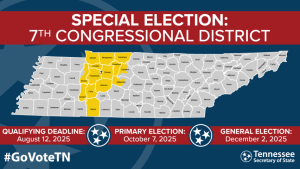 Hopium Chronicles, U.S. Political Advocacy: Aftyn Behn Tied In New Emerson Poll, Simon Rosenberg, right, Nov. 26, 2025. Some Holiday Thoughts About Trump's Failed Project And Working With Much Greater Ambition Now.
First some breaking news - Emerson, a right-aligned pollster, just dropped a poll of TN-07 that has the race statistically tied, a toss up:
“The special election in Tennessee’s 7th District will come down to what groups are motivated to turnout on election day, and who stays home,” Spencer Kimball, executive director of Emerson College Polling, said. “Those who report voting early break for Behn, 56% to 42%, whereas those who plan to vote on Election Day break for Van Epps, 51% to 39%. Voters under 40 are Behn’s strongest group, 64% of whom support her, while Van Epps’ vote increases with age, to 61% of those over 70.”
“There is also a stark gender divide; men break for Van Epps by nine points, 51% to 42%, whereas women break for Behn by six, 50% to 44%,” Kimball added.
Behn, above right, and Van Epps each have a 47% favorable rating among voters, and a 41% unfavorable rating.
“Similar to the gender divide on the ballot test, 54% of women have a favorable view of Behn, compared to 41% of men, and 52% of men have a favorable view of Van Epps, and 42% of women have a favorable view of Van Epps,” Kimball noted.
President Trump holds a 47% job approval rating among Tennessee 7th District voters, and a 49% disapproval rating.
“President Trump’s approval rating is a stark reversal from last November, when he carried the district by 22 points. The decline is driven by independents, among whom 59% disapprove and just 34% approve,” Kimball said.
The economy is the top issue for 38% of Tennessee voters, followed by housing affordability (15%), healthcare (13%), threats to democracy (13%), immigration (6%), crime (5%), and education (5%).
 If you haven’t gotten to it yet watch my new uplifting conversation with Aftyn from yesterday afternoon. She is a remarkable and inspiring candidate who has turned a +22 Trump district into a competitive race, and terrified the national GOP who are now pouring enormous sums in against her. Please consider contributing to her campaign today. We’ve already blown through our $25,000 goal (over $28,000 this am!!!!!!) and are now shooting for $50,000 by Friday.
Later today I will be sending along an interview and writeup of a second candidate we are now endorsing, Eileen Higgins, who is in a December 9 run-off election for Mayor of Miami, Florida. Look for that email early this afternoon. A Democrat has not been elected Mayor of Miami since the 1990s. With our support Eileen Higgins can win this race and help us end this year on a joyous uplifting note.
We can do this people!!!!!!!!!!!!!!!!!!!!!!!!!!!!!!!!!!!!!!!!!!!!!!!!!!!!!!!!!!!!!!!!!!!!!!!!!!!!!!!!!!!!!!!!!!!!!!!!!!!!!!!!!!!
Some Notes On Working With Greater Ambition Now, From Strength And Confidence Not Fear, And Finding A Higher Gear - I have a lot to say this morning - particularly after Trump’s threats to execute six members of Congress, his despicable feting of MBS, his selling out of Ukraine to Russia, his unyielding lies, his epic corruption, his ongoing cover up of the Epstein files, his tearing down of the East Wing to build himself a gilded ballroom - for I am incredibly pissed off and while ready for a restful holiday I am also ready to fight with even greater commitment when we get back on Monday. I won’t be able to get this all out the way I want it but here we go……
Trump is doing enormous harm to the country in every conceivable way - our economy, our security, our freedoms, our future. A majority of the country has woken up to what is happening, and people are pissed. We just had a blow out election, winning by huge, seldom seen margins all across the country. We are competing now in a +22 Republican seat in Tennessee and have a serious chance to flip the city of Miami in two weeks. Prominent Republican pollsters are now warning that without a serious course correction Republicans are facing a disastrous election next year. With the current national landscape we are favored to win the House and the Senate is absolutely in play. Incredibly, despite their extraordinary propaganda machine, Trump’s poll numbers just keep dropping. This week two polls found him at 35%, his lowest of 2025:
The Economist/YouGov weekly track has him at 38%-57%, their lowest reading this year. He’s now regularly polling in the 30s in job approval, and in the 60s in disapproval. His agenda is even more unpopular than he is. Here’s my weekly break out of the Econ/YouGov track that documents how much he has unraveled this year. It’s incredible. He truly is both a lame duck and a fuck up. No matter what he does he just keeps dropping and Republican prospects grow dimmer. And as I’ve written, I think things are more likely to get worse for Trump and the Rs in the coming months as the state and local communities start coming to terms with what these guys have done to them, and the country rejects his wag the dog invasion of Venezuela as they have rejected every other major policy initiative this year (with the exception of border security):
Trump is now a failed President; a diminished and desperate politician; a leader surrounded by quislings and incompetent fools; and he is old, in ill health, and increasingly living in a world distant from facts and reality making it far more likely he keeps making enormous mistakes (like vaingloriously invading Venezuela). Just read his post this morning. It’s complete and utter put the guy in a stretcher crazy talk.
So we will go fight out these two new election opportunities in the next two weeks and work to end the year strong. But there are two things now that I think we must really focus on, and work to achieve together -
We just learned in the shutdown fight and in the November elections that when we fight Trump we can win. And now we must far more forcefully contest his regime itself and not accept the level of damage he is doing to the country, nor be content with leaving it to the courts. We must build a far more powerful politics of opposition to the regime itself.
 Democracy Docket, Eye On The Right: Inside a secretive gathering of Cleta Mitchell’s anti-voting group, Matt Cohen, Nov. 26, 2025. Democracy Docket obtained the agenda and notes from the fall summit of Cleta Mitchell’s Election Integrity Network, where election deniers, anti-
 voting activists, and friendly state legislators discussed plans to push for severely limiting early and mail voting. Also in this week’s Eye On The Right: A former Arizona GOP lawmaker and top Turning Point USA official pleaded guilty to voter fraud, and an update on Tina Peters.
Anti-voting activists met earlier this month in Worcester, Mass. for the annual fall summit of the New England chapter of Cleta Mitchell’s influential Election Integrity Network. I obtained the agenda and notes from the confab, where Mitchell, shown above in a file photo, and other anti-voting activists and election deniers, as well as two friendly state lawmakers, discussed plans to push for severely limiting early and mail voting.
“In-person voting on Election Day should be primary,” Mitchell said at one of the event’s panels, explaining to attendees that nearly all voting should take place in person on Election Day. Her voting policy wishlist is close to what President Donald Trump has called for, and would radically curtail access to the ballot, taking the U.S. back decades to the era of one-day elections.
Throughout the panel, Mitchell spread a stream of voting conspiracy theories, including false claims that early-voting polling places are more prone to voter fraud and that Service Employees International Union members who work at care homes for the elderly frequently steal ballots from their patients.
One of the state lawmakers who spoke at the event was a Maine Republican who marched on the U.S. Capitol Jan. 6, 2021, and has falsely accused Capitol Police of trying to incite violence that day.
North Carolina restricted student voting after 'influence campaign' by… Mitchell
The web of Mitchell’s anti-voting influence stretches far and wide, as evidenced by a recent court filing in the legal challenge to a North Carolina voter suppression law that targets student voting.
According to the filing, the restrictive North Carolina law changing the rules for same-day voter registration — allowing election officials to throw out a ballot if just one piece of mail sent to verify the voter’s address is returned as undeliverable — came after an intense “influence campaign” from Mitchell and fellow election integrity activist Jim Womack.
Mitchell previously testified against student voting policies, claiming that a vast majority of student voters will vote for Democrats. “College students can just roll out of bed, vote, and get back into bed,” Mitchell said at the deposition.
A former Arizona GOP lawmaker and one-time senior official with Charlie Kirk's Turning Point Action pleaded guilty to voter fraud
You can’t make this stuff up: Austin Smith, a former Arizona state legislator who was a member of the Arizona Freedom Caucus — which has a history of spreading false claims of voter fraud — pleaded guilty last week to… voter fraud. During his reelection campaign in 2024, Smith reportedly forged more than 100 signatures on his nominating petitions.
Smith also served in a leadership position at Turning Point Action — the advocacy arm of Turning Point USA, the conservative group founded by the late Charlie Kirk.
As a member of the state legislature’s Freedom Caucus, Smith helped to spread false claims of election fraud in the 2020 election and pushed to pass a slew of anti-voting laws within the state. When Smith was indicted back in June, he dropped the reelection bid and resigned from Turning Point Action.
U.S. Markets, Consumers, Jobs, Eonomy
Letters from an American, Historical Commentary: November 25 2025 [Consumers, Boycotts In America With A Female Factor], Heather Cox Richardson, right, Nov. 26, 2025. Last week, a poll conducted for Global EV Alliance, made up of electric vehicle driver associations around the world, found that 52% of Americans would avoid buying a Tesla for political reasons.
Tesla chief executive officer Elon Musk pumped more than $290 million into electing President Donald J. Trump and supporting the Republicans in 2024. After taking office, Trump named Musk to head the “Department of Government Efficiency,” a group that slashed through government programs and fired civil servants.
In response, protesters organized “Tesla Takedowns,” gathering at Tesla dealerships to urge people not to buy the vehicles. The protests spread internationally. In March, Trump advertised Teslas on the South Lawn of the White House to try to help slumping sales, to no avail.
In September, consumers flexed their muscle over parent company Disney’s suspension of Jimmy Kimmel’s late night talk show on ABC after pressure from Federal Communications Commission chair Brendan Carr over Kimmel’s comments following the murder of right-wing activist Charlie Kirk. About three million subscribers canceled Disney+ in September, while Hulu, which Disney owns, lost 4.1 million. Monthly cancellations previously had averaged 1.2 million and 1.9 million, respectively. While not all of those cancellations could be chalked up to consumer anger over Kimmel’s suspension—Disney subscription prices went up at around the same time—Kimmel was back on the air in five days.
Every day, I am struck by all the ways in which we are reliving the 1890s.
In that era too, consumers organized, using their buying power to affect politics. As the first general secretary of the National Consumers League, Florence Kelley, put it: “To live means to buy, to buy means to have power, to have power means to have responsibility.”
After the Civil War, an economic boom in the North combined with the loss of young men in the war to make education more accessible to young white women. By 1870, girls made up the majority of high school graduates. Fewer than 2% of college-age Americans went to college; women made up 21% of that group. Away from the confines of home, these privileged young women studied social problems and the means of addressing them while they developed friendships with like-minded classmates.
In the mid-1880s, those women began to experiment with using their talents and newfound friendships to repair the nation’s social fabric that had been torn by urbanization and industrialization. To recreate a web of social responsibility in the growing industrial cities, young middle-class women moved into ethnic working-class neighborhoods to minister to the people living there. Jane Addams, who opened Chicago’s Hull-House with Ellen Gates Starr in 1889, rejected the idea of a nation divided by haves and have-nots. She believed that all individuals were fundamentally interconnected. “Hull-House was soberly opened on the theory that the dependence of classes on each other is reciprocal,” Addams later wrote.
The people who lived in these “settlement houses” dedicated themselves to filing down the sharp edges of industrialization, with its tenement housing, low wages, long hours, child labor, and disease, along with polluted air and water and unregulated food. They turned their education to addressing the immediate problems in front of them, collecting statistics to build a larger picture of the social costs of industrialization, and lobbying government officials and businessmen to improve the condition of workers, especially women and children.
They soon discovered a different lever for change.
In the midterm election of 1890, politicians recognized the power of women to swing the vote for or against a political party. When Republicans got shellacked, their leaders blamed women, who were increasingly the family shoppers, for urging their husbands to vote against the party that had forced through the McKinley Tariff of that year, raising tariff rates and thus raising consumer prices. Thomas Reed, the Republican speaker of the House, complained the party had been defeated by “the Shopping Woman.”
Historian Kathy Peiss notes that between 1885 and 1910, the six women’s magazines known as the “big six” were founded, including Ladies Home Journal, McCall’s, and Good Housekeeping. By 1895, advertisements were strategically placed near recipes throughout the magazines, and brand names were scattered through their stories, a recognition of women’s role as shoppers.
Increasingly, reform-minded women were turning to women’s roles as consumers to reshape American industrialism. They came to believe that the “ultimate responsibility” for poor conditions “lodge[s] in the consumer.” Leveraging the power of consumption could force employers to pay higher wages, establish better conditions, and protect workers. In 1891, Josephine Shaw Lowell, whose brother Robert Gould Shaw had commanded Black soldiers in the Massachusetts 54th in the 1863 Second Battle of Fort Wagner, helped to form the Consumer’s League of the City of New York (CLCNY), patterned after a similar English organization, to rally consumers to support better conditions for the workers who made the goods they bought.
In 1899, Lowell and Jane Addams founded the National Consumers League, with Florence Kelley at its head. The organization worked to combat child labor and poor working conditions and, in an era when milk was commonly adulterated with chalk and formaldehyde and candies were decorated with lead paint, lobbied for government regulation of food and drugs.
Today, the relationship between consumption and reform has taken on heightened meaning after the Tesla and the Disney boycotts. The day after Thanksgiving is the start of the holiday shopping season, and like their predecessors of a century ago, reformers are focusing on consumers’ power to push back on the policies of the Trump administration, launching a campaign they call “We Ain’t Buying It.” “We aren’t just consumers; we’re community builders,” their website says. “We’re driving the change we want to see, and demanding respect.”
As Joy-Ann Reid put it in an Instagram video: “Dear retailers who’ve decided you don’t like diversity, equity, and inclusion, or you really love ICE and you have no problem with them busting into your establishments to drag people away: Here’s the thing. We ain’t buying it. I mean, for real, for real, we ain’t buyin’ it.”
She explained: “We’re gonna spend our money with businesses who actually respect our dollars, respect our communities, and respect our diversity, equity, and inclusion. We are going to buy from people who respect immigrants, who respect immigrants’ rights, and respect freedom and liberty. We are going to buy from establishments that respect our right to vote and our right to live in a free society. And if you ain’t that, we ain’t buying it.”
“Let’s show them our power,” she told listeners. “Let’s show them what we can do together.”
Paul Krugman via Substack, Political-Economy Commentary: Warning: The Fed Can’t Rescue AI, Paul Krugman, right, Nov. 26, 2025. Lessons from the dotcom crash. Lessons from the dotcom crash
While everything feels political now – a kind of fin de siècle chaos politics – I want to take a brief break from the political today. Instead I want to talk about asset markets and the Fed.
We could say that the US economy in 2025 was schizoid. On the one hand Donald Trump abruptly reversed 90 years of U.S. trade policy, breaking all our international agreements, and pushed tariffs to levels not seen since the 1930s. Worse, the tariffs keep changing unpredictably. This uncertainty is clearly bad for business and is depressing the economy. On the other hand, there has simultaneously been a huge boom in AI-related investment, which is boosting the economy.
As many people have already noted, the AI boom bears an unmistakable resemblance to the tech boom of the late 1990s — a boom that turned out to be a huge bubble. The Nasdaq didn’t regain its 2000 peak until 2014.There’s intense debate about whether AI investment is similarly a bubble, which I would summarize as a shoving match: “Is not!” “Is too!” “Is not!” “Is too!”
While my personal guess is that AI is indeed in the midst of a bubble, I won’t devote today’s post to that debate. Instead, I want to talk about one recent aspect of market behavior that is very striking and carries strong echoes of the tech bubble a generation ago. Namely, AI-related stocks, like tech stocks back then, are reacting very strongly to perceptions about the Fed’s short-term interest rate policy.
Now as then, these strong reactions don’t make sense. How valuable will data centers currently under construction be 5 years from now? Will they be worth anything 10 years from now? A realistic answer to these questions surely implies that the Fed’s interest policy should have little to no impact on Mag 7 valuations, or the sustainability of the tech boom.
As we saw on Monday, however, Fed policy and rumors about future Fed policy can sometimes affect AI-stock prices in the short run. But by the straight economics, these movements are more the result of market psychology than of any objective assessment of future returns.
So as doubts about AI creep in, I’m hearing growing chatter to the effect that the Fed can and should save the industry. But the lesson from the last big tech bubble is that it can’t. In fact, I have doubts about whether the Fed can head off a broader recession if the tech boom collapses — but that’s a topic for a future post.
For now, my point is that if you’re worried about an AI bubble, don’t expect Jerome Powell or his Trump-appointed successor — rumors are not encouraging — to come to the rescue. They can’t.
The Hartmann Report, Pro-Democracy Advocacy: What Happens When the AI Bubble Blows Up on Main Street? Thom Hartmann, right, Nov. 26, 2025.  When this bubble bursts, the collapse won’t hit Google’s coders — it’ll hit the electricians, nurses, teachers, retirees, renters, and low-income families who never got a penny from the boom…
The number one most-read story in the Financial Times yesterday was headlined, “Nvidia shares fall on signs Google gaining upper hand in AI.” It turns out that Google’s AI software/product is doing about as well as its competitors but isn’t using Nvidia’s “must have” AI super-chips, shocking the market.
But even with that, we ain’t seen nothing yet: get ready for the Moores’ Law shock and a few others that seem increasingly inevitable.
For months now, the tech world has been drunk on the language of inevitability. AI will transform everything. AI demand for electricity will double America’s power consumption. AI data centers will be the new steel mills, the new auto plants, the new engines of prosperity.
Wall Street has inflated this into a bubble so big that it’s hard to see where the hype ends and the real economy begins.
But if history teaches us anything, it’s that bubbles don’t pop harmlessly; they burst outward. And when they do, the people who had nothing to do with inflating them are usually the ones who end up paying the biggest part of the price.
We’ve seen this movie before. When the dot-com bubble collapsed in 2000, it wasn’t just stock traders who felt the pain. Entire cities that had boomed on tech spending suddenly cratered. Construction, retail, restaurants, and transit systems all took the hit.
It wiped out retirement savings, yes, but it also wiped out jobs for working people who never owned a share of Pets.com. Economists later found that the recession following the dot-com crash fell hardest on lower-income workers who had been pulled into booming metro economies that vanished overnight.
Then came the housing and derivatives bubble of 2008. Once again, the story was sold as something contained within the financial sector. Exotic mortgage-backed securities. Credit default swaps. CDOs squared.
Most Americans had no idea what any of that meant, but when that bubble burst, they didn’t need a glossary. They felt it in lost jobs, lost homes, gutted neighborhoods, and a social safety net that was suddenly overwhelmed.
George Bush made sure that his Wall Street donor executives walked away with billion-dollar golden parachutes instead of going to jail, while average Americans endured a decade of lower wages, higher rents, and shredded public services.
When banksters crashed the S&L banking system during Reagan’s presidency in the 1980s, he prosecuted over 3,000 of them and sent more than 1,000 to prison. But Republicans stopped respecting the rule of law in a big way around the time five corrupt Republicans on the Supreme Court handed the White House to Bush in 2000.
And then, of course, five corrupt Republicans on the Court legalized political bribery with Citizens United in 2010, so now the banksters own DC and have bought a lot of deregulation recently. As a result, the risks now are even greater than they were in 1999 or 2008.
Bubbles don’t stay on Wall Street: they metastasize through the entire economy. And the AI bubble today is no different; in some ways, it’s even more deeply wired into the lives of people who may never touch ChatGPT, Midjourney, or a Nvidia chip.
Right now, electric utilities from Arizona to Georgia are spending billions building power plants and upgrading transmission lines because they’ve been told AI demand will explode for decades.
Utilities aren’t like normal businesses; when they make a bad bet, they don’t absorb the loss. Instead, they pass it on to you. And that means that if the AI bubble bursts — if the rosy forecasts don’t materialize — average Americans could end up paying higher electric bills for a generation to cover infrastructure built for a demand that never arrived.
After Bush’s 2008 housing crash, public pension systems all over the country were left with massive unfunded liabilities that led to service cuts, higher contribution rates, and reduced benefits. The same pattern is already being written into the AI bubble, brick by brick, stock by stock.
Worst of all, an AI crash could hit at a moment when tens of millions of Americans have no margin left. Inflation has been punishing, and Trump’s incoherent tariff policies have made him and his kids rich (as they use tariffs to extort foreign governments to give them billions in cash, build Trump resorts, and even gift Trump a jet plane), but they’re relentlessly jacking inflation on the rest of us.
Global News
New York Times, Israel is striking at will in Lebanon, killing enemies and innocents, Roger Cohen, Visuals by David Guttenfelder, Nov. 26, 2025. Hezbollah is weakened, but its supporters remain defiant. A fragile cease-fire teeters on the edge of collapse.
Beaufort Castle, atop a towering cliff that rises from the Litani River in southern Lebanon, is a 900-year-old Crusader fortification offering a magnificent panorama. These days, it may also be a place from which to view a killing.
The sky was a cloudless blue on a late September afternoon as the hum of an Israeli drone disturbed the beguiling beauty of the surrounding olive groves and vineyards. Steadily it drew closer.
 Then, with a screeching whistle, the drone fired a missile that turned a white car on the highway hundreds of feet below the stone castle into a ball of fire. The explosion reverberated in the valley. Other cars careened to a helter-skelter halt.
About a half-hour later, a New York Times photographer, David Guttenfelder, and I reached the incinerated carcass of the car. The driver’s seat was blown to oblivion. Two distraught young men, dressed in black, picked up small pieces of charred flesh, one by one. They dropped them into plastic bags to be buried the next day.
So goes the cease-fire between Israel and Hezbollah, reached a year ago on Thursday. Almost daily Israeli strikes against Hezbollah, including the killing this week in Beirut of one of the militant group’s top commanders, punctuate a fraying peace. Lebanon exists in a gray zone between war and peace, which could also be the fate of Gaza as Hamas resists disarming and Israel strikes selected targets.
In effect, the war that spilled into Lebanon after the Oct. 7, 2023, Hamas attack on Israel has slowed but never stopped.
“The Israelis say they can’t leave unless Hezbollah disarms, and Hezbollah says how can we disarm as long as the Israelis don’t?” Nawaf Salam, the Lebanese prime minister, said in an interview. “Hezbollah knows things have changed in the region but are still trying to resist.”
A morass of mistrust had now led to a dangerous escalation, and the Trump administration’s target for Hezbollah to disarm completely by the end of the year looks implausible.
Across the region, the United States is pressing to transform the Middle East by new means. “Democracy” is not part of President Trump’s lexicon. Prosperity, not the ballot box, is put forward as the new panacea. But a journey of several weeks to Lebanon, Israel and Turkey suggests that, for now, renewed war is likelier than spreading peace.
The situation in Lebanon offers a compelling example of a new Middle East where Israel’s reach is near ubiquitous. The Iran-led “axis of resistance,” of which Hezbollah has been a central part, is a shadow of its former self. Iran, battered by Israel in a brief June war, is weaker. Syria, after the fall of the Assad regime last year, is no longer a friend of Tehran; nor is it the pipeline for Iranian arms to Hezbollah that it once was.
The region is adapting to what Abdulkhaleq Abdulla, a prominent political scientist in the United Arab Emirates, calls an “imperial Israel,” a country that will kill enemies anywhere: from Lebanon to Syria, Gaza to Iran, Yemen to Qatar. Pre-emptive Israeli strikes are the new norm.
Given such dominance, the United States will have to decide what constraints, if any, it will impose on Israel in the interests of furthering peace in the region. One way to achieve this may be strengthening the militaries of other regional players, like Saudi Arabia or Turkey, which Mr. Trump seems intent on doing.
 Morning Shots via The Bulwark, Political Opinion: Who’s Driving This Car? Cathy Young,Nov. 26, 2025. The 28-point “Trump peace plan” for Ukraine—likely parroted, as an explosive Bloomberg report seems to confirm, from a Russian paper slipped to Trump envoy Steve Witkoff by Vladimir Putin’s emissary Kirill Dmitriev—is now an ex-parrot. After talks in Geneva, the United States and Ukraine have agreed on a 19-point plan not only pared down but substantially revised from the first version—which Trump says was not really a plan but just “a concept” anyway. (Where have we heard that before?)
 So far, we don’t know what’s in the new plan. The good news is that the demand to surrender Ukrainian territories to Russia appears to be gone, with the territorial details to be hashed out between Volodymyr Zelensky and Donald Trump. (The bad news: Trump still thinks that Russia will soon take all of the Donetsk and Luhansk provinces, so Ukraine might as well give them up the easy way.) Also apparently off the table is the 600,000 cap on the Ukrainian armed forces and the permanent ban on Ukraine’s NATO membership under some further NATO expansion.
Ukraine is said to have basically accepted the new proposal, though “sticking points” remain. On the other hand, Russian foreign minister Sergei Lavrov now asserts that the Kremlin “welcomed” the first plan and hints that the amended version will likely be rejected. (When the original 28-point plan was released, Lavrov’s ministry was dismissive, saying only that it had not been conveyed through diplomatic channels.) Kremlin spokesman Dmitry Peskov, meanwhile, complained about the “information bacchanal” surrounding the peace plan—which is rich considering that Dmitriev was likely behind the first leak (there have now been many) that unleashed this current frenzy.
After some talk of a Zelensky visit to the White House on Thanksgiving Day, Trump now says he will meet with Putin and Zelensky when the peace deal is “in its final stages.” Meanwhile, there’s a lot of frenetic activity. Secretary of the Army Dan Driscoll is meeting with both Russian and Ukrainian officials in Abu Dhabi, where Ukraine’s enigmatic military intelligence chief Gen. Kyrylo Budanov is also reportedly talking to the Russians and the Americans. And Witkoff will soon head to Moscow for another Putin huddle, possibly with Trump’s son-in-law Jared Kushner.
Witkoff’s involvement is particularly concerning after Bloomberg revealed his role as a de facto Russian lobbyist, not only coaching the Russians on how to pitch a proposal to Trump but also advising that Putin place a phone call to Trump ahead of Zelensky’s October 17 White House visit—which likely helped scuttle the delivery of Tomahawk missiles to Ukraine.
So what do we know, besides the obvious fact that the administration’s foreign policy is a clown show?
Is a peace deal really close? There are good reasons to remain skeptical. Ukraine is prepared to accept an agreement that leaves Russia in de facto control of Ukrainian territories it currently occupies. But whether Putin would accept that alone is doubtful. The Kremlin autocrat may not have even accepted the earlier “deal.” He still wants to subjugate all of Ukraine—and has good reasons to fear that peace now will mean upheaval at home.
The “peacemaking” efforts from the Russian side could be a psy-op to buy time and stave off the worst of U.S. sanctions, or an attempt by a relatively dovish Kremlin faction to coax Putin into ending the war. Ukraine’s supporters should recognize this possible state of play. And they should continue to apply pressure to ensure that Ukraine not only isn’t forced into a bad peace—but that it continues to receive essential aid should the war go on.
The Atlantic Daily, Why does Steve Witkoff keep taking Russia’s side? Anne Applebaum, Nov. 26, 2025. Trump’s envoy isn’t promoting peace. His interventions are helping Vladimir Putin.
Pay attention to the dates, because the timing matters. Steve Witkoff, right, spoke with Yuri Ushakov, a Russian official, on October 14. Ukrainian President Volodymyr Zelensky held a meeting with President Donald Trump in Washington, D.C., on October 17. Trump had been hinting that he would offer to sell Tomahawks, long-range cruise missiles, to the Ukrainian army. But he did not.
Why not? Perhaps because Ushakov listened to Witkoff’s advice and persuaded Russian President Vladimir Putin to call Trump on October 16. Witkoff, in other words, may have helped block that sale. And that would make Witkoff responsible for prolonging the war.
Let me back up and explain.
Witkoff, a former real-estate developer, is supposed to be negotiating a peace settlement between Russia and Ukraine. He is in theory acting on behalf of the United States but also on behalf of millions of people who want peace in Ukraine and security in Europe. Ushakov, a former Russian ambassador to the United States, has different interests: Like his boss, he wants Russia to win the war.
A tape of the October 14 conversation has been leaked to Bloomberg. That’s how we know Witkoff suggested to Ushakov that Putin call Trump. He also offered advice about what Putin should say. The Russian leader should flatter Trump, of course, which is standard advice for speaking to the American president: “Compliment him on his great success in Gaza, congratulate the president on this achievement.” After that, Witkoff said, “It’s going to be a really good call.”
Then, Witkoff advised, Putin should impress upon Trump this idea: “The Russian Federation has always wanted a peace deal. That’s my belief. I told the president I believe that.” Together, the two of them would cook up a peace plan, just like Trump’s recent Gaza peace plan.
Ushakov gave Putin this advice. Putin followed it. How do we know? Because Putin did, in fact, call Trump, on October 16. The call lasted for more than two hours. Trump said the call was productive, and that the two leaders would soon meet, potentially in Budapest (which never happened). During his meeting with Zelensky on the following day, he did not offer Tomahawk missiles to Ukraine. Instead, he became emotional and angry.
In keeping with a long-standing Russian demand, Trump tried to persuade the Ukrainians to give up Ukrainian land in Donetsk province that they currently control—land that the Russians have not been able to conquer after more than a decade of fighting. This is what Putin wants: to obtain Ukrainian territory without fighting for it, to weaken Ukraine, and to use any temporary cease-fire as an opportunity to plan the next invasion.
“With a single phone call,” one insider told Politico last month, “Putin appears to have changed President Trump’s mind on Ukraine once again.” This was Witkoff’s achievement. Working with another Kremlin insider, Kirill Dmitriev, he went on last week to propose the 28-point peace plan that could, if carried out, temporarily stop the fighting but position Russia to invade a weakened Ukraine at a later date.
I’ve written this before, but it cannot be repeated often enough: This war will end only when Russia stops fighting. The Russians need to halt the invasion, recognize the sovereignty of Ukraine, and drop their imperial ambitions. Then Ukraine can discuss borders, prisoners, and the fate of thousands of kidnapped Ukrainian children.
But the only way to persuade Russia to stop fighting is to put pressure on Russia. Not Ukraine, Russia. The Ukrainians have already said they will stop fighting and agree to a cease-fire right now, on the current lines of conflict. Yet Witkoff is seeking to persuade Trump not to put pressure on Russia, and we don’t really know why.
Witkoff has no previous diplomatic experience, so perhaps he is naive. He spent many years in New York real estate, at a time when Russians were spending fortunes on property, so perhaps he feels gratitude. Maybe he’s helping Russia win because he has “the deepest respect for President Putin,” as he told Ushakov, and admires his brutality. Maybe he, or others in the White House entourage, have business interests tied to Russia—or hope to. In addition to discussing “peace,” Witkoff has also been, according to the document made public last week, talking with the Russians about American investments “in the areas of energy, natural resources, infrastructure, artificial intelligence, data centers, rare earth metal extraction projects in the Arctic.”
Whatever the reason, Witkoff is prolonging the conflict. He is not promoting peace. His call to Ushakov was not, as Trump said last night, a normal negotiating tactic. Every time he intervenes, advocating for Putin’s positions, he encourages the Russians to think they can get Trump on their side, pull America away from Europe, break up NATO, and win the war. In other words, every time he intervenes on behalf of the Russians, he contributes to the deaths of Ukrainians, the attacks on infrastructure, the ongoing tragedy that affects millions of people.
If this were a normal American administration, he would be fired immediately. But nothing about this negotiation, or this administration, is normal at all.
Morning Shots via The Bulwark, Political Opinion: This Guy Gets Trump, Andrew Egger, Nov. 26, 2025. There’s so much that’s crazy about the aforementioned Bloomberg News release of an October 14 phone call transcript between Steve Witkoff and Putin apparatchik Yuri Ushakov that it’s hard to know where to begin.
Why is Witkoff, the man tapped by Donald Trump as America’s pointman for diplomatic negotiations on a host of foreign conflicts, actively helping Russia strengthen its negotiating hand by reminding Putin what forms of flattery will land best with Trump and tipping him off when he should call the president for maximum effect? Why is Witkoff offering ministry-of-truth analysis like, “I told the president that the Russian Federation has always wanted a peace deal” in describing a war where Russia is the unequivocal and single aggressor? Why is Witkoff, a random billionaire with ties to Russian oligarchs, in this role at all? Why was Secretary of State Marco Rubio seemingly shoved out of the picture only to now regain a foothold?
But the thing I found most striking about the call was what it revealed about Witkoff’s assessment of what motivates the president. Trump, in Witkoff’s telling, has no particular asks or sticking points when it comes to this negotiation. Don’t have Putin talk about particulars on the call with Trump at all, Witkoff advises Ushakov. “Now, me to you, I know what it’s going to take to get a peace deal done: Donetsk and maybe a land swap somewhere. But I’m saying instead of talking like that, let’s talk more hopefully, because I think we’re going to get to a deal here. And I think, Yuri, the president will give me a lot of space and discretion to get to a deal.”
What does “talking more hopefully” entail? Simple: a lot of flattery about how successful Trump’s negotiation in Gaza was and how glad Russia is that he is a “man of peace.” This sort of thing, Witkoff, right, suggests, will put Trump in a good enough mood that he’ll be happy to hand the actual sausage-making back to Witkoff himself with little additional bother. And Putin should do it, Witkoff suggests, in time to preempt a planned meeting with Zelensky, in which Trump could be flattered in Ukraine’s direction.
Ushakov appears to get the message: “I agree with you that Putin will congratulate. He will say Mr. Trump is a real peace man and so and so.”
Amazingly, this appears to be exactly what happened. Putin did time his call to preempt Zelensky’s mid-October visit and did indeed open with flattery about Trump’s deal in Gaza. Trump responded just as Witkoff seemed to believe he would: “I have just concluded my telephone conversation with President Vladimir Putin of Russia, and it was a very productive one,” he posted then on Truth Social. “President Putin congratulated me and the United States on the Great Accomplishment of Peace in the Middle East, something that, he said, has been dreamed of for centuries. I actually believe that the Success in the Middle East will help in our negotiation in attaining an end to the War with Russia/Ukraine.”
In retrospect, that moment led inexorably to the one we’re in now, with Trump—seemingly paying only half attention—blessing the peace agreement Witkoff brought him from the Russians, just as Witkoff predicted he would.
It makes you wonder whether there is any daylight at all between Witkoff’s view of what drives Trump and ours? We write all the time about Trump’s childlike solipsism—the way his assessment of other people depends entirely on how they treat him, personally. This, of course, makes Trump historically easy to manipulate, and Witkoff is in a position to wield that knowledge to world-historical effect. It’s too bad he’s decided to deploy it in the maniacal aim of bringing Putin’s war to a Putin-satisfying conclusion.
New York Times, News Analysis: The Question Hanging Over Peace Talks: What Will Putin Accept? Paul Sonne, Nov. 26, 2025. A U.S. proposal may cross a number of red lines for the Russian leader, who sees little to lose and much potentially to gain from continuing to fight.
Ukrainian and European officials exhaled after scrambling to soften President Trump’s surprise Kremlin-friendly peace plan. But an uncomfortable reality looms over the diplomatic frenzy: It will all come down to what President Vladimir V. Putin of Russia is willing to accept.
The Russian leader has signaled that he is prepared to continue fighting the war, despite high battlefield losses and economic pain at home, with the aim of forcing Ukraine to embrace demands that would subordinate the nation to Russia.
The realities on the ground, analysts say, give Mr. Putin little reason to temper his terms. Ukraine is relinquishing territory at a quickening pace. It is struggling with a domestic corruption scandal. It is also running low on money and soldiers, as well as losing the patience of the United States.
For the Russian leader, holding out for a broader Ukrainian collapse could deliver even bigger concessions.
“The essence of his war is to weaken Ukraine,” said Tatiana Stanovaya, a senior fellow at the Carnegie Russia Eurasia Center.
Nov. 25
Letters from an American, Historical Commentary: November 24, 2025 [Trump-ordered indictments voided], Heather Cox Richardson, right, Nov. 25, 2025. U.S. District Judge Cameron McGowan Currie of South Carolina (shown above in a file photo) today dismissed the indictments of former Federal Bureau of Investigation director James Comey and New York Attorney General Letitia James, ruling that President Donald J. Trump’s appointment of Lindsey Halligan as interim U.S. attorney for the Eastern District of Virginia was invalid.
Trump had demanded the indictment of the two. When he was FBI director, Comey had refused to drop an investigation into Trump’s then–national security advisor Mike Flynn, who had lied to the FBI about his conversations with a Russian operative before Trump took office. James had successfully sued Trump, several of his children, and the Trump Organization for fraud, and when the interim U.S. attorney in the Eastern District of Virginia, Erik Seibert, said there was not enough evidence to indict them, Trump forced him out of office and replaced him with Halligan, a former insurance lawyer and Trump aide.
Within days, Halligan obtained a grand jury indictment for Comey, charging him with lying to Congress, and another for James, charging her with alleged mortgage fraud. As David Kurtz points out in Talking Points Memo, the indictments were widely understood to be targeted prosecutions of those Trump considered enemies.
By law, after a Senate-confirmed U.S. attorney leaves the job, the attorney general can appoint an interim U.S. attorney for 120 days. If the position still has not been filled, the right to make another interim appointment goes to the district court, which has sole authority over the position until the Senate confirms a president’s nominee. This provision prevents a president from making an end run around the Senate’s duty to advise and consent by making consecutive 120-day appointments.
The Trump administration attempted to thwart this law. Trump appointed Seibert the interim U.S. attorney for the Eastern District of Virginia on January 21, and as the 120-day deadline approached, he nominated Seibert for the position. The district judges voted unanimously to keep Siebert on as the interim U.S. attorney as his nomination proceeded. But then Siebert declined to prosecute Comey and James, and Trump forced him out, pushing Attorney General Pam Bondi to put Halligan into his place as a new interim appointment.
Today, Currie found that Halligan’s appointment violated not only the law, but also the appointment clause of the U.S. Constitution, which requires the president to obtain the “advice and consent of the Senate” for such appointments. That unlawful appointment means that all of Halligan’s actions undertaken as a U.S. attorney are invalid. Because she was the only prosecutor to sign off on the Comey and James prosecutions, they, too, are invalid.
Currie wrote that if the indictments were to stand, “the Government could send any private citizen off the street—attorney or not—into the grand jury room to secure an indictment so long as the Attorney General gives her approval after the fact. That cannot be the law.”
After the judge’s decision, Comey posted a video saying that while the case mattered to him personally, “it matters most because a message has to be sent that the president of the United States cannot use the Department of Justice to target his political enemies. I don’t care what your politics are. You have to see that as fundamentally un-American and a threat to the rule of law that keeps all of us free.” He called for Americans to “stand up and show the fools who would frighten us, who would divide us, that we’re made of stronger stuff, that we believe in the rule of law, that we believe in the importance of doing things by the law.”
Attorney General Bondi said the government will “be taking all available legal action, including an immediate appeal.”
Shut down by the courts, Trump is turning to military justice to enforce his will.
Since six lawmakers released a video last week reminding servicemembers that they must refuse to carry out unlawful orders, Trump and his loyalists have continued to insist that such a reminder is “SEDITIOUS BEHAVIOR… punishable by DEATH!”
Their argument appears to be that by reiterating the law, the lawmakers implied that Trump has issued unlawful orders and therefore that they made troops question their orders and thus directly attacked the chain of command. It’s a convoluted argument, one that administration officials are using to claim that the lawmakers’ reminder that troops must not obey an unlawful order is actually encouragement not to obey lawful orders.
Administration officials insist that the lawmakers’ video is an attack on Trump because all of his orders have been lawful, although lawyers, lawmakers, and military personnel have expressed concerns about the legality of the administration’s deadly strikes on civilians in small boats near Venezuela.
This morning, the administration escalated its attacks on the lawmakers. The social media account of the “Department of War” posted that the department is investigating Captain Mark Kelly, a retired Navy officer who is now a Democratic senator from Arizona and who participated in the video, after “serious allegations of misconduct.” It suggested that Kelly, a retired Navy officer, could be recalled to active duty “for court-martial proceedings or administrative measures.”
Turning to military tribunals harks back to QAnon, a conspiracy theory that took off in 2017. It maintained Trump was leading a fight against an international ring of pedophiles that he would bring to justice through military tribunals. As recently as during the 2024 presidential campaign, Trump called for those he perceives to be his enemies to be prosecuted in military tribunals, saying, for example, that former representative Liz Cheney (R-WY) was “guilty of treason” because she participated in the House Select Committee to Investigate the January 6th Attack on the U.S. Capitol. Trump’s social media page has been reposting QAnon sayings.
Attacking Kelly appeals to Trump’s base, but it was impetuous. As law professor John Pfaff noted: “There’s clearly no adult in the room to say ‘wait, maybe don’t go after the charismatic war hero turned literal astronaut who ran [for office] after his wife was a victim of political violence.’” On social media, a post circulated showing a picture of Kelly in his dress uniform juxtaposed with a photograph of Defense Secretary Pete Hegseth guzzling from a bottle; the caption compared Kelly’s “shirt covered with medals” with Hegseth’s “shirt covered with booze.”
Kelly punched back. He posted on Facebook: “When I was 22 years old, I commissioned as an Ensign in the United States Navy and swore an oath to the Constitution. I upheld that oath through flight school, multiple deployments on the USS Midway, 39 combat missions in Operation Desert Storm, test pilot school, four space shuttle flights at NASA, and every day since I retired—which I did after my wife Gabby was shot in the head while serving her constituents.
“In combat, I had a missile blow up next to my jet and flew through anti-aircraft fire to drop bombs on enemy targets. At NASA, I launched on a rocket, commanded the space shuttle, and was part of the recovery mission that brought home the bodies of my astronaut classmates who died on Columbia. I did all of this in service to this country that I love and has given me so much.
“Secretary Hegseth’s tweet is the first I heard of this. I also saw the President’s posts saying I should be arrested, hanged, and put to death.
“If this is meant to intimidate me and other members of Congress from doing our jobs and holding this administration accountable, it won’t work. I’ve given too much to this country to be silenced by bullies who care more about their own power than protecting the Constitution.”
In a conversation with MS NOW’s Rachel Maddow, Kelly was less formal: “I’ve had a missile blow up next to my airplane,” he told her. “I’ve been…nearly shot down multiple times. I’ve flown a rocket ship into space four times, built by the lowest bidder, and my wife Gabby Giffords, meeting with her constituents, shot in the head. Six people killed around her. A horrific thing. She spent six months in the hospital. We know what political violence is, and we know what causes it, too…. The statements that Donald Trump made… incite others…. He should be careful with his words. But I’m not going to be silenced here…. I’m going to show up for work every day, support the Constitution, do my job, hold this administration accountable, hold this president accountable when he is out of line. That’s the responsibility of every U.S. senator and every member of Congress. He’s not going to silence us.”
News Roundup
New York Times, Swalwell Files Suit Against Housing Official, Claiming Privacy Law Violations, Zach Montague, Nov. 25, 2025. The lawsuit claims that repeated disclosures by Bill Pulte, the director of the Federal Housing Finance Agency, were intended to damage prominent Democrats over their criticism of the president.
 Representative Eric Swalwell of California, right, on Tuesday filed a lawsuit against Bill Pulte, the director of the Federal Housing Finance Agency, claiming Mr. Pulte breached federal privacy laws by repeatedly disclosing documents intended to accuse prominent Democrats of mortgage fraud.
Mr. Pulte referred Mr. Swalwell to the Justice Department for investigation after accusing him of mortgage fraud, an allegation Mr. Swalwell has denied.
That accusation followed similar claims Mr. Pulte has made this year against New York’s attorney general, Letitia James; Senator Adam B. Schiff of California; and Lisa Cook, a Federal Reserve governor appointed by former President Joseph R. Biden Jr.
All have denied wrongdoing and accused Mr. Pulte of weaponizing his access to federal mortgage documents in order to assist President Trump’s efforts to prosecute or otherwise take aim at political targets. Mr. Swalwell’s lawsuit called the notion that he had committed fraud “patently false” and a “gross mischaracterization of reality.”
Mr. Pulte did not immediately respond to a request for comment.
The suit, filed in Federal District Court in Washington, argues that Mr. Pulte “abused his position by scouring databases” of mortgage records, selectively looking for records with which to “concoct fanciful allegations of mortgage fraud” in making his Nov. 13 referral.
It asks a federal judge to declare Mr. Pulte’s actions illegal and direct Mr. Pulte and the Federal Housing Finance Agency to withdraw the criminal referral.
Mr. Swalwell’s lawyers wrote that Mr. Pulte’s actions have collectively been planned to provide fodder for a Justice Department campaign against the president’s rivals. The lawsuit notes that the documents Mr. Pulte has produced provide no solid evidence of unlawful activity.
“Since taking office, President Trump has engaged in unprecedented efforts to leverage the power of the federal government to seek retribution against his political enemies,” the complaint read.
The challenge argues that Mr. Pulte breached federal privacy laws prohibiting officials from “leveraging their access to citizens’ private information as a tool for harming their political opponents.” It also raises First Amendment violations, contending that the effort to get the Justice Department to investigate Mr. Swalwell was retaliatory, intended to punish the congressman for his political speech.Editors’ PicksThe Basketball Star Who Accidentally Became a Country Music HeartthrobThe Moon Was an Inside JobRuth Asawa Turned Wire Into Her Lifeline
“Director Pulte has combed through private records of political opponents. To silence them,” Mr. Swalwell said in a statement. “There’s a reason the First Amendment — the freedom of speech — comes before all others.
Mr. Swalwell, who also helped manage the 2021 impeachment case against Mr. Trump, has been a fierce critic of the president. Last week, he announced his intention to run governor of California. Regardless of the outcome, the lawsuit could help Mr. Swalwell demonstrate his willingness to do combat with Mr. Trump and his allies.
Mr. Pulte’s previous referrals resulted in pressure against the president’s political targets, even in cases that did not produce criminal charges. Earlier this year, Mr. Trump cited Mr. Pulte’s findings in an attempt to fire Ms. Cook from the Federal Reserve Board, a move that would have handed the president a vacancy he could fill as he sought more control over the central bank.
The Parnas Perspective, Top Trump Aide Under Fire for Coaching Senior Russian Official About how to Handle Donald Trump, Aaron Parnas, right, Nov. 25, 2025. We have a political earthquake to cover.
Newly released audio reveals Steve Witkoff, one of Trump’s closest aides and his handpicked peace envoy, actively coaching senior Kremlin officials on how Vladimir Putin should push Trump into accepting a Russia-favored Ukraine peace deal. This is an extraordinary breach of protocol and comes at the very moment Trump has aligned himself with the 28-point plan shaped around Moscow’s demands, raising profound questions about who is truly steering U.S. foreign policy.
I am also tracking the nationwide “Mass Blackout” beginning today, an unprecedented economic protest aimed squarely at major retailers and corporate power. It intentionally exempts small businesses, including independent newsrooms like mine. If you value this reporting, please consider subscribing. As we head into the holidays, I want to say sincerely: your support gives me the privilege of doing the work I love every single day. Thank you.Subscribed
Here’s what you missed:
Bloomberg reports that Trump envoy Steve Witkoff, right, told top Kremlin aide Yuri Ushakov in an Oct. 14 call how Vladimir Putin should pitch a joint Ukraine peace plan to Trump, including arranging a Trump-Putin call and using the Gaza deal as a model ahead of Zelenskiy’s visit to the White House.
Trump’s overriding priority in Ukraine peace talks is to end the war quickly, with no firm red lines and openness to major Ukrainian concessions, prompting criticism from some Republicans and concern in Europe, even as U.S. officials keep revising his proposal from an initial 28-point plan to a 19-point version amid tense negotiations with Kyiv and Moscow.
CNN reports that Trump officials are discussing potential Cabinet shakeups after the president’s one-year mark in his second term—possibly affecting the Homeland Security and Energy departments—though no decisions are made and changes wouldn’t occur until early next year; the White House denies the report, insisting Trump is satisfied with his Cabinet, while the context recalls high-profile departures during his first administration.
Reports from MS Now say Trump is considering firing FBI Director Kash Patel amid growing frustration over accusations that he misused bureau resources—including using a government jet and SWAT agents for his girlfriend’s security—as well as internal clashes and ill-timed public posts, though the White House publicly defends Patel and says he remains a key member of the administration.
The FBI is seeking to interview six Democratic lawmakers after Trump accused them of “seditious behavior” for releasing a video urging military and intelligence personnel not to follow illegal orders — a move the lawmakers call an intimidation tactic enabled by a weakened DOJ oversight structure, as they vow to keep speaking out and defend constitutional principles.
Four Democratic House members who appeared in a video urging troops to refuse illegal orders say the FBI has sought interviews with them, accusing Trump of using the bureau to intimidate them as they insist they will uphold their constitutional oath and “not be bullied.”
The Washington Post is reporting that the Trump EPA is abandoning its defense of a Biden-era rule that tightened limits on deadly fine-particle pollution, arguing the agency lacked authority even as scientists warn the rollback will mean dirtier air and more premature deaths, and environmental groups accuse the administration of siding with polluters over public health.
A coalition of grassroots groups has begun a weeklong “Mass Blackout,” asking Americans to withdraw from major economic activity from Nov. 25 to Dec. 2, avoiding online and in-store shopping (except small businesses), streaming, travel, and restaurant spending to protest corporate power, political corruption, and the Trump administration.
Organizers chose the peak shopping week of Black Friday and Cyber Monday to maximize visibility, urging people to “support small, local businesses only” and pay in cash if they must spend. While similar boycotts have had limited impact on overall sales, leaders say the goal is to show collective power, model unity across movements, and push back against what they describe as a political system captured by corporate interests.
Legal experts say Trump may have unintentionally issued a sweeping federal pardon for any US citizen who committed voter-related crimes in 2020, because the language in his pardon for Rudy Giuliani and other fake-elector participants broadly covers anyone whose “supporting, voting, or advocating” conduct related to slates of presidential electors. Defense lawyers for Matthew Alan Laiss—accused of casting ballots in both Pennsylvania and Florida for Trump—argue this wording shields him from prosecution, a claim scholars say is plausible given how imprecise and expansive the pardon is.
The Department of Health and Human Services has confirmed that Louisiana Surgeon General Ralph Abraham, a critic of Covid vaccines and an ally of the “Make America Healthy Again” movement, has been appointed principal deputy director of the CDC, a powerful role that has drawn concern from public health experts given his vaccine skepticism, lack of board certification in family medicine, and past moves to halt mass vaccination campaigns.
According to NBC, Manhattan prosecutors will retry Pedro Hernandez after his 2017 conviction for the 1979 kidnapping and killing of 6-year-old Etan Patz was overturned because an appeals court found the trial judge gave flawed instructions to jurors.
Twenty state attorneys general and two governors sued the Trump administration over major cuts and new ideological conditions placed on HUD’s Continuum of Care homelessness program, arguing the shifts from permanent to transitional housing and restrictions on LGBTQ-inclusive organizations are unlawful and could put up to 170,000 people at risk of losing stable housing.
Virginia police are searching for missing high school football coach Travis Turner, who is now a fugitive wanted on 10 charges involving child pornography and computer solicitation of a minor, as investigators continue the case and his undefeated team moves forward in the playoffs without him.
Brazil’s supreme court has ordered former president Jair Bolsonaro to begin serving a 27-year sentence for plotting a coup to stop Lula from taking office, with Bolsonaro and several ex-military and political allies now headed to prison as his influence wanes and only small groups of supporters protest.
D.C. mayor Muriel Bowser announced she will not seek a fourth term, saying she’ll finish her tenure in 2027 after a turbulent year marked by Trump’s federal takeover of the city’s police force and National Guard deployments, while defending her approach as pragmatic under legal constraints and celebrating her decade of service.
Ms. Cook sued over the dismissal. In October, the Supreme Court allowed Ms. Cook to remain in her position until the court can consider the case in January.
More On U.S. Governance, Politics
Morning Shots via The Bulwark, Political Opinion:, Amateur Hour At 1600 Pennsylvania Ave., Bill Kristol, Andrew Egger and Jim Swift, ov. 25, 2025. The White House is in free fall. How long will it last?
The New York Times notes that the Trump administration’s habit of buying ownership shares in companies it likes now involves $10 billion in taxpayer funds and “shows little sign of slowing.”
Remember, kids: Government ownership of the means of production turns out to be good, but socialism is still bad. Happy Tuesday.
The Contrarian, Opinion: Words & Phrases We Can Do Without, Jennifer Rubin, right,  Nov. 25, 2025. ‘Mr. President’? Not for this brute.
“Mr. President.”
I always figured that George Washington came up with title as a means of eschewing royal titles (“your highness,” “your majesty”). However, the history is more complicated, as NPR explained:
 “In April of 1789, Washington was making his way to New York City to be inaugurated, and Congress started to have this discussion about how are we going to address him once he gets here?” said author and historian Kathleen Bartoloni-Tuazon.
The king was “Your Majesty,” while governors at the time were addressed as “Your Excellency.” What would they call Washington? . ...
“President” just seemed too plain to the Senate, and they brainstormed a bunch of alternatives.
“Elective majesty, sacred majesty, elective highness, illustrious highness, serene highness,” Bartoloni-Tuazon said. “The Senate actually went on record as recommending, ‘His Highness, President of the United States and Protector of Their Liberties.’ Now that’s a mouthful.”
On the other side, the House was unanimously against anything but president alone. They were afraid that anything more would make the executive leader into a kind of monarch.
The debate went on for three arduous weeks …. In the end, the Senate relented, writing they wished to preserve harmony with the House.
So “Mr. President” became the preferred usage. But that’s a courtesy, a norm such as, I dunno, the norm of allowing the Kennedy Center to operate as an independent arts organization or the norm of preserving White House’s historical character (rather than bulldozing the East Wing to make way for a garish, privately-funded ballroom). You get the point.
The current Oval Office occupant has systematically leveled every norm, trampled on every custom, and violated every rule of decorum. It seems incongruous, at the very least, to maintain any honorific tradition for someone who:
And these are just a few examples of things he says—aside from what he does to wreck our democracy. Maybe someone of that ilk should not get the benefit of customary niceties.
Trump’s vile behavior is not accidental. Rudeness is part of the autocrat’s playbook. “The anarchocapitalist branding, the rude tone, the obscenities, and the underlying message of hostility toward elites were basic features of [Argentine’s Javier] Milei’s political character,” the Journal of Democracy explained recently. Sounds very Trumpian.
This is not simply a matter of manners (although throwing ketchup against the wall was a new low in dining etiquette). As a doctoral candidate at University of Alabama at Birmingham noted, “When Donald Trump became president, he sought to break what standard decorum was in order to justify his desires as president.” Breaking the rules of decorum while engaged in nonstop lying, demagoguery, and lawlessness has allowed him to “challenge the norms within American democracy.” These decorum-defying behaviors help promote his aim to sow division, polarize the country, and do lasting damage to our democracy.
Trump uses brazen rudeness, obscene language (including regular f-bombs), and all manner of unpresidential behavior (e.g. sleeping in meetings, attacking Oval Office guests, demeaning women, dining with antisemites) to demonstrate that he operates above and beyond any rules, norms, constraints, and customs. The gulf between the White House press corps who call him “Mr. President” and the chief executive who responds to one of them by stating, “Quiet, quiet piggy,” could not be starker—nor could it be more revealing of his desire for total domination. His language conveys his intention to subjugate ordinary Americans who feel compelled to adhere to cultural and social norms.
Trump abuses language and decorum in service of his abuse of power.
Bullies, oligarchs, and White supremacists often inveigh against the loss of “civility” or “manners” when those protesting injustice disturb their “polite society” and cocoon of denial. That transparent but effective trap seeks to keep “those people” in their “place.”
Columnist, lecturer, and author Susan Campbell wrote critically of Democrats who joined Republicans in censuring Rep. Al Green (D-Tex.) for calling out Trump during a joint session of Congress. “In the name of decorum, we will Robert’s Rules ourselves right out of business,” Campbell warned. We are faced with a “fascist wanna-be dictator,” eager to cut off life-saving services and trample on constitutional rights, she reiterated. “But sure. Let’s keep our voices down,” she observed. “Decorum is dead. Donald Trump killed it.”Subscribed
So please, let’s drop the honorific “Mr. President” when we’re addressing or discussing a man who defiles the Constitution, blows up every norm, and torments Americans. We do not “respect the presidency” by using the same title for an insulting, crude autocrat as we have bestowed on Washington, Lincoln, the Roosevelts, or even lesser lights who attained the office. Maintaining decorum while he flouts it, granting deference while he bullies, and using honorifics when he insults others will only smooth the way for further effort to intimidate and dominate ordinary Americans as well as political adversaries. (As an alternative, those in his presence can try “Mr. Trump,” or “Sir.” When speaking about him, “Donald Trump” or “Convicted Felon Donald Trump” will do.)
Certainly, depriving Trump of a form of respect he craves is far from the most important element of the resistance. We must deploy a range of responses (e.g., lawsuits, elections, public advocacy for the Trump’s victims, mass mobilization, congressional and media investigations, consumer boycotts, Prop. 50, etc.) to short-circuit his dictatorial ambitions. However, denying Trump an undeserved nicety can amplify the larger and more meaningful message: We are his boss, not the other way around.
Paul Krugman via Substack, Political-Economy Commentary: DOGE Was a Harbinger of Trump’s Assault on Decency and Privacy, Paul Krugman, right, Nov. 25, 2025. Democrats will have to repair the damage.
My first post after I brought this Substack back to life almost a year ago was about DOGE, the not-exactly-part-of-the-government organization, headed by Elon Musk, that Donald Trump was creating to save money by eliminating “waste, fraud and abuse.” DOGE would, I predicted, fail. And it did indeed fail, even more spectacularly than I expected: Although DOGE still has eight months left on its original charter, it has already been quietly disbanded.
But although DOGE is gone, its malign legacy endures. Arguably DOGE’s biggest “achievement” was shutting down the U.S. Agency for International Development. And the dismantling of USAID has left a legacy of death. According to one recent study, closing the agency “has already caused the deaths of six hundred thousand people, two-thirds of them children.”
Back at home, DOGE wreaked havoc on the U.S. government through a combination of arrogance, ignorance and sheer incompetence.
Readers may remember when DOGE staffers summarily fired hundreds of staffers at the National Nuclear Security Administration, which protects America’s nuclear weapons, then desperately scrambled to get them back when they realized what those workers do. You may also remember Musk’s claim that millions of dead people are receiving Social Security benefits, nonsense based on a misunderstanding of how the Social Security Administration’s databases work.
Musk is gone, at least for now, from the Trump administration. So are many of the young acolytes he parachuted into temporary positions of power in government agencies, although some have managed to worm their way into longer-term positions.
Although DOGE is no longer, the damage persists. In addition to the needless loss of hundreds of thousands of lives around the world and the trashing of America’s global reputation, all for some flashy headlines, DOGE also seriously compromised the functioning of the US government. Thousands of dedicated federal employees were pushed out, taking their expertise and institutional knowledge with them, while those who remain are demoralized. Future recruitment of high-quality government workers will be much more difficult given the way their predecessors were treated.
Less obvious, but arguably just as important, is DOGE’s misappropriation of Americans’ personal information along with the destruction of institutional norms on safeguarding that information.
Like any modern government, the U.S. federal government must collect information about the people it represents. A government can’t collect taxes or provide benefits without acquiring a lot of information about individuals’ incomes and their lives in general. It can’t supervise banks, mitigating the risk of financial crisis, without acquiring a lot of information about people’s finances. It can’t conduct essential surveys, like the surveys we use to track the economy and the Census, without finding out a lot about the people surveyed.
Historically, however, government agencies have followed rules designed to avoid putting all this information in one place, which would risk turning America into a surveillance state. Some of these rules are embodied in legislation, notably the Privacy Act of 1974. Others are norms or fall into a legal gray area. But there has been a general understanding that we want to respect privacy, on practical as well as moral grounds. For example, as the New York Times reports,
The I.R.S. has long encouraged undocumented migrants to file a tax return, and many tax lawyers and immigration activists had trusted the agency would not use tax information to deport people. In a report, the Yale Budget Lab estimates that in 2023, unauthorized immigrant workers paid $66 billion in federal taxes, with roughly $43 billion of that taking the form of the payroll taxes that fund Social Security and Medicare.
But the Muskenjugend — people like 19-year-old Edward Coristine, aka Big Balls — got access to the databases of many government agencies through threats and intimidation. Their access to sensitive data was so much at variance with previous norms that a number of former DOGE staffers now reportedly fear that they may face criminal charges.
And they should be afraid. If Democrats regain power in 2028, which seems increasingly likely given Trump’s cratering popularity, they can’t do another Merrick Garland, repeating their past mistake of letting past lawbreaking go unpunished. Demanding accountability is the only way to restore faith in government.
Now, we don’t know everything Musk’s people did with this data, or whether they took some of the data — which are highly valuable to private businesses — with them when they left. We do know that DOGE sought to pool all federal data into a single database. And Trump signed an executive order “seeking to eliminate ‘information silos’ and promote inter-agency data sharing” — an executive order that is still in effect even though DOGE is gone. So DOGE was a harbinger of a major weakening of the standards that used to protect Americans’ privacy.
Why is this a problem? For one thing, it undermines effective government. As the Times reports, since Trump took office the I.R.S., breaking its past promises, has turned over more than a million taxpayers’ addresses to ICE, even though
Federal law tightly controls the use of taxpayer information, and several top I.R.S. officials quit this spring over concerns that giving tax records to ICE on a large scale could be illegal.
A few days ago a federal judge put a hold on this information sharing. But a great deal of damage has already been done.
Beyond that, breaking down the barriers that normally protect privacy opens the door to political abuse. Again, many readers are probably aware that the Trump administration has accused Lisa Cook, a Federal Reserve governor, of mortgage fraud, and has leveled similar charges against Letitia James, New York’s attorney general, and Adam Schiff, senator from California.
The charges are completely spurious. But the weakness of the government’s cases aside, what’s striking is that Bill Pulte, the Trumpist director of the Federal Housing Finance Agency, got access to individuals’ mortgage records and used them to engage in obviously political harassment. To do so, he bypassed the FHFA’s inspector general — who was fired last week as he was reportedly preparing to send a letter to Congress reporting that the agency was not cooperating with his office.
DOGE didn’t cause all of these abuses. But the organization’s rise was, as I said, a harbinger of a broad assault on privacy and growing political misuse of government data. And while DOGE is gone, the abuses will remain until and unless Democrats make sure that the abusers pay a steep price.
Medias Touch Network, Trump Announces Six-Day Palm Beach Getaway, J.D. Wolf, Nov. 25, 2025. Trump will remain in Florida from Tuesday to Sunday, with most days free of public events.
Trump and the Melania have announced a six-day Palm Beach getaway over Thanksgiving, according to new White House guidance that lists no public events for the president on Wednesday, Friday, or Saturday. After the annual turkey pardon on Tuesday, Trump departs the White House for Florida and remains there until Sunday afternoon.
Trump dancing at Mar-a-Lago in his golf outfit
The extended stay includes a call to service members on Thanksgiving, but otherwise is an empty schedule which strongly suggests multiple golf outings at his nearby club, a familiar pattern during prior Palm Beach trips.
The light holiday itinerary comes as the administration faces intensifying scrutiny over rising costs and major campaign promises still in limbo. Affordable Care Act premiums are projected to spike in 2026, yet the White House has not implemented a concrete plan to prevent the increases.Trump
Trump Warns of Impeachment in Thanksgiving Themed Fundraising EmailRead More
Trump’s stretch of leisure time in Florida stands in contrast to his campaign promise other work tirelessly to solve problems and make people's lives better.
Medias Touch Network, Trump Continues Asking for Cash While Dangling $2,000 Checks, J.D. Wolf, Nov. 25, 2025. Supporters are asked to donate to show they support his tariff rebate ideaTrump is continuing to send out fundraising emails built around his proposed “tariff rebate checks,” even though the idea has no legislative backing. The latest cash grab messages sent under his name urge supporters to answer a poll asking whether they would accept a $2,000 rebate check signed by him.
With no congressional approval and no legal mechanism to distribute rebate payments, the emails function primarily as a fundraising tool, blurring the line between political messaging and policy promises.Trump campaign
Trump is willing to dangle the checks as Americans struggle. These same people are prompted to donate to Trump to show support for the checks.
One of the emails claims to be the “only” tariff rebate message authorized by Trump, even as his campaign continues to send them out.
Morning Shots via The Bulwark, Political Opinion: The Trump Train Jumps the Tracks, Andrew Egger, Nov. 25, 2025.
Ben Wittes famously summed up the spirit of the first Trump presidency as “malevolence tempered by incompetence.” But earlier this year, it looked like Trump might be rewriting that formula.
He had roared back into office with two things he didn’t have the first time: a sweeping set of actual plans and a vetted group of true believers who were determined to help him put them into action. For months, Trump rampaged through the government—purging “disloyal” intelligence and law enforcement officers, shuttering agencies, tearing up federal contracts, ramping up deportations without due process, pardoning J6 rioters, slinging around tariffs, flirting with open defiance of the courts, and so on. The overwhelming feeling was of sudden, surreal descent into lawlessness—into Hannah Arendt’s totalitarian world where “everything was possible” and “nothing was true.” Worse, it all felt deliberate, planned, rolled out on a schedule. What would be next? Would he actually deport U.S. citizen criminals for imprisonment in El Salvador? Would he try to seize Greenland, or the Panama Canal? He was doing the rest of his wish list—why stop there?
It wasn’t long before you could feel that overwhelming momentum start to slow. In retrospect, the Supreme Court’s slapdown of his lawless deportations to El Salvador was one inflection point; his shambolic rollout and subsequent panicked walkback of his “Liberation Day” tariffs was another.
But now, in the wake of the government shutdown, we seem to be hitting a third phase in Trump’s second term, in which his forward momentum is in danger of stopping altogether. And in that environment, the incompetence so endemic in term one is making itself known again, with a vengeance.
Suddenly, everywhere you look, you see a White House flailing.
Trump’s poll numbers are near historic lows, with many of the coalitions who helped him back to the White House last time, including young people and minority voters, expressing remarkable levels of buyer’s remorse. Meanwhile, his greatest political strength—the remarkable depth and durability of the MAGA base’s passion for him—suddenly appears less impregnable after MAGA zealots in Congress forced him to blink on the Epstein files.
His hamfisted tinkering with U.S. trade has put a pillow over the face of many American businesses, slowing hiring, spreading uncertainty, and creating the conditions for an economy whose health relies nearly entirely on the speculative AI sector, even as anxiety about a possible AI bubble continues to grow.
His policy agenda is adrift without sail. Consider his recent muddled attempts to triangulate on healthcare. After insisting for months that the government should not re-fund expiring Obamacare subsidies—to the point of being willing to shut down the government rather than give Democrats concessions on the issue—Trump seemingly had a change of heart. Yesterday, he planned to roll out a proposal to extend those subsidies temporarily while making some changes, like stricter income phase-outs. But he was forced to turn on a dime when congressional Republicans got wind of the plan and sent him an unambiguous message: No way are we supporting this. The White House, having apparently not thought to get congressional buy-in before floating the plan publicly, had to hurriedly cancel the rollout. It’s no longer clear when a plan will be introduced.
Even the stuff Trump cares about most deeply—wielding the might of government to punish anyone who has ever wronged him—is blowing up on the launchpad. The president was willing to move heaven and earth to get criminal indictments against former FBI Director James Comey and New York Attorney General Letitia James. He even handed an entire U.S. attorney’s office over to an insurance lawyer on his staff with no prosecutorial experience because she was the only person he was confident would bring charges against the pair. But those indictments didn’t even manage to last two months. Yesterday, a judge threw them both out on the grounds that Trump’s lawyer, Lindsey Halligan, had been wrongfully appointed to the interim U.S. attorney post. This may have come as a relief to Halligan—none of the embarrassing, amateurish errors she was making in prosecuting the cases ended up mattering—but it remains a major embarrassment to Trump.
In theory, Trump could recognize the futility and cut his losses. After all, his failing attempts to get retribution are damaging him politically. Polls keep showing that strong majorities believe Trump is leaning on the Justice Department to file unjustified charges against his foes. And those foes aren’t even getting punished! Look at James Comey over there on Instagram, talking over the dismissal of his case! He’s positively glowing! The desired effect is not occurring!
But Trump seems only to be doubling down. As his ongoing political prosecutions fall apart, he is reaching more and more erratically for crazier and crazier forms of retribution against increasingly outlandish targets. After Democratic lawmakers shot a video reminding U.S. troops of their obligation not to obey unlawful orders, Trump appeared to order Defense Secretary Pete Hegseth to crack down. Yesterday, Hegseth obliged: The Defense Department announced it had opened a military investigation into Sen. Mark Kelly for actions “intended to interfere with the loyalty, morale, or good order and discipline of the armed forces.” Elevating a retired Navy captain whose wife survived an assassination attempt was a peculiar choice. One congressional Republican called it “amateur hour.” A top conservative commentator was left perplexed, as well.
But that’s been the best word to describe the second half of the first year of Trump’s second term—perplexing. Here is a White House that spent weeks portraying Zohran Mamdani as a communist boogeyman only for the president to welcome him with open arms in the Oval. Here is a president who introduced a “peace plan” for the Ukraine war without, apparently, getting the buy-in of anyone in Congress (or maybe even his own Secretary of State). Here is an administration that turned so fast on Marjorie Taylor Greene for her heresy of demanding the Epstein files be released that now a number of other House Republicans are quietly saying they may follow MTG’s lead and resign, as well.
Trump could, in theory, take a different course. He could triangulate. He could retreat and regroup, finding a new strategy to bring into the midterms. Voters have short memories; there is plenty of time.
But the obstacle isn’t time. It’s Trump himself. He didn’t get where he is today by triangulating—he got here by always being fully, undeniably himself. It looked like it was working for a while this time. But now the Trump Train is starting to jump the tracks.
Whatever’s happening to the Trump Train, the Bulwark train is still gathering steam.
The Parnas Perspective, Political Commentary, Mike Johnson Loses Control of House as Republican Caucus FracturesPolitical Commentary, Mike Johnson Loses Control of House as Republican Caucus Fractures, Aaron Parnas, right, Nov. 25, 2025.
Mike Johnson, below left, is at risk of losing his caucus in the House of Representatives. Under Speaker Johnson’s slim GOP majority, discharge petitions have surged, with bipartisan coalitions and especially frustrated Republicans using them five times in two years to bypass his control and force votes on widely supported bills, including releasing Epstein records, expanding Social Security payments, securing voting accommodations for new parents, sanctioning Russia, and extending health care subsidies.
The rise reflects deep dissatisfaction with Johnson’s leadership, his alignment with Trump, and a growing determination among rank-and-file members to override House leaders, aided by Democrats’ strategic use of procedural groundwork and a political environment where even majority-party lawmakers are willing to defy their own speaker to advance legislation that would otherwise be stalled.
A bloc of liberal Senate Democrats—dubbed the “Fight Club”—is openly challenging Chuck Schumer’s 2026 election strategy, accusing him and party leadership of favoring establishment candidates, resisting progressive energy, and mishandling key races, signaling unusually deep internal dissent and frustration within the Democratic caucus.
Pete Hegseth is putting out partisan tweets attacking Democratic Senator Mark Kelly suggesting that he will be court martialed:
Sen. Ruben Gallego warned that the military would face consequences if it pursued disciplinary action against Sen. Mark Kelly over a video urging troops to refuse unlawful orders, accusing Defense Secretary Pete Hegseth of cowardice, criticizing the Pentagon’s investigation as political, and insisting that service members simply follow the Constitution while politicians fight out the dispute.
Leavitt said “Not a single order this president or administration has given to our military has ever been illegal, nor will it ever be. This administration respects and abides by the law.”
CBS is reporting that after a court ruled that Lindsey Halligan was unlawfully appointed U.S. Attorney in Virginia, prosecutors were told to replace her name on case filings with that of an assistant U.S. attorney, but the instruction was abruptly reversed two hours later and they were told to keep using Halligan’s name.
Transportation Secretary Sean Duffy urged Americans to improve “civility” in air travel by dressing more respectfully and avoiding pajamas and slippers on flights, saying better attire encourages better behavior amid a sharp rise in in-flight disturbances since 2019.
According to CNN, a U.S. official claims Ukraine has essentially agreed to a U.S.–brokered peace deal with Russia, saying only minor details remain, while Zelensky and Ukrainian officials strike a more cautious tone—acknowledging major progress in recent Geneva and Abu Dhabi talks but stressing that further work, European support, and a future Zelensky visit to the U.S. are still needed to finalize any agreement.
NATO Ambassador Matthew Whitaker acknowledged that “there’s some truth” to criticisms that Vladimir Putin has not made any concessions in the ongoing negotiations.
Sen. Jim Justice of West Virginia agreed to pay over $5 million in back taxes shortly after the Justice Department sued him and his wife for failing to settle long-overdue federal tax debts dating back to 2009, with the settlement awaiting a judge’s approval.
Axios reports that President Trump plans to speak directly with Venezuela’s Nicolás Maduro even as his administration labels Maduro a terrorist leader, signaling a shift toward diplomacy after lethal U.S. strikes on alleged drug-smuggling boats and reflecting a strategy that mixes pressure, covert operations and the threat of force with an openness to talks aimed at curbing narcotrafficking and pressuring Maduro’s regime.
Rep. Salazar said the United States would be helping itself, including its children, economy and oil industry, as well as Venezuelans seeking freedom by supporting efforts to “liberate” Venezuela.
U.S. Treasury yields edged higher as investors anticipated new inflation figures expected to show producer prices rising again, ending a short rally in government bonds and raising concerns that renewed inflation pressures could undermine expectations for future Federal Reserve interest rate cuts.
According to the Guardian, experts say the anti-fascist groups newly labeled by the U.S. as foreign terrorist organizations barely exist, pose no threat to Americans, and were designated for political reasons aimed at intimidating the left and diverting attention from rising far-right violence.
President Trump initiated calls with China’s Xi Jinping and Japan’s Prime Minister Sanae Takaichi amid escalating China-Japan tensions over Taiwan, signaling stable U.S.-China relations while avoiding public commentary on Taiwan even as China condemned Japan’s recent actions and rhetoric; both Beijing and Tokyo emphasized continued communication with Washington as China ramps up military pressure and diplomatic retaliation over Taiwan.
According to NBC, a popemobile once used by the late Pope Francis has been converted into a mobile clinic intended to treat children in Gaza, with Christian leaders unveiling the vehicle in Bethlehem and expressing hope it can enter the enclave soon despite ongoing Israeli strikes and delays in aid access.
President Trump signed an executive order launching the “Genesis Mission,” a major federal initiative to accelerate U.S. artificial intelligence research by expanding computing power, opening access to vast federal datasets, and strengthening public-private partnerships, with officials comparing its scale and urgency to the Manhattan Project.
According to the Guardian, the U.S. State Department is preparing to suspend 38 universities including Harvard, Yale, Stanford and Duke from its Diplomacy Lab program because of alleged DEI-related hiring practices, reflecting a broader Trump administration effort to limit participation by institutions that do not align with its anti-DEI agenda.
The UN says at least 127 Lebanese civilians have been killed by Israeli strikes since the November ceasefire, prompting calls for impartial investigations into potential violations of international law as both Israel and Hezbollah accuse each other of undermining the agreement and tens of thousands remain displaced.
Morning Shots via The Bulwark, Political Opinion: A Historian Speaks, William Kristol, right, Nov. 25, 2025.
 Last week, the American Enterprise Institute honored with its annual Irving Kristol Award the distinguished professor emeritus of history at Brown University, Gordon Wood. Wood is a preeminent American historian, especially well known for his detailed studies of the American revolution and founding.¹
Wood’s extensive and impressive scholarship doesn’t fit into easy political categories, and in his long career, he has largely avoided opining on contemporary politics. At the AEI dinner, Wood pulled off the impressive feat of keeping the attention and interest of a D.C. audience for half an hour while never mentioning such passing preoccupations as Donald Trump, MAGA, JD Vance, Joe Biden, Kamala Harris, or Zohran Mamdani. Wood limited his political remarks to noting that he had been an Adlai Stevenson voter in his first presidential election in 1956, but that, over the next couple of decades, he’d been “one of those liberals mugged by reality.”
Though he didn’t explicitly address today’s controversies, Wood had something important to say to us about today. He delivered his core message up front:
There has been some talk recently that we aren’t and shouldn’t be a creedal nation—that beliefs in a creed are too permissive, too weak a basis for for citizenship and that we need to realize that citizens with ancestors who go back several generations have a stronger stake in the country than more recent immigrants.
I reject this position as passionately as I can.
Wood went on to describe the efforts of American statesmen, especially in the early years of the republic, to deal with the fact that the United States was never “a nation like other nations.” He quoted John Adams’s doubts about this new nation where there was nothing like “the patria of the Romans, the Fatherland of the Dutch, or the Patrie of the French.” He noted Adams’s lament that the U.S. featured “such a Hotch potch of people, such an omnium gatherum of English, Irish, German, Dutch, Swedes, French, &c. that it is difficult to give a name to the Country.”
Immigration continued after the founding period, and the country became even more ethnically diverse. Yet Americans devised a way—thanks especially to Abraham Lincoln, “who found in Jefferson’s Declaration a solution to the great problem of American identity”—to forge “a bond that holds together the most diverse nation history has ever known.”
And so Wood concluded, “To be an American is not to be someone, but to believe in something. That is why we are at heart a creedal nation, and that is why the 250th anniversary of the Declaration next year is so important.”
(Do watch the talk or read the whole text here, or read excerpts published in the Wall Street Journal here.)
I’ll take the liberty of taking Wood’s conclusion one step further. If “to be an American is to believe in something,” then it is both urgent and important for us today to reject the nativism and ethnonationalism that has reared its ugly head. And it is both right and proper, as we celebrate the last Thanksgiving of our first 250 years, to be thankful that we live in an exceptional nation, conceived in liberty, and dedicated to the proposition that all men are created equal.
AROUND THE BULWARK
Global News
New York Times, Russia Strikes Ukraine and Signals Resistance to Amended Peace Plan, Maria Varenikova and Aurelien Breeden, Nov. 25, 2025. The attack killed at least seven people in Kyiv, the authorities said, as Moscow suggested it would resist changes negotiated by Ukraine.
Russia launched a deadly barrage of missiles and drones on the Ukrainian capital on Tuesday, as Kremlin officials signaled they would resist changes negotiated by Ukraine to President Trump’s peace plan.
The attack on Kyiv, the capital, killed at least seven people and injured 20 others, according to the city’s mayor. It came as the Trump administration was working to maintain diplomatic momentum behind its efforts to end the nearly four-year-old war, which were jump-started last week when it presented a 28-point peace plan to Ukraine.
American and Russian officials held talks on Tuesday in Abu Dhabi, the capital of the United Arab Emirates, about the proposed deal, which heavily favored Russia in its initial form and was amended and streamlined in talks between Ukraine and the Trump administration over the weekend. Ukraine has indicated that its president, Volodymyr Zelensky, was prepared to go to Washington to finalize a deal with Mr. Trump.
Sergey V. Lavrov, Russia’s foreign minister, said that Russia was waiting for the United States to submit an “interim” version of the modified plan.
“Then we will see,” Mr. Lavrov said after a meeting in Moscow with his Belarusian counterpart.
If the plan “erased” what Mr. Lavrov called “the spirit and letter of Anchorage” — referring to an August meeting in Alaska where Mr. Trump sided with Russia’s approach to end the conflict — then “it will be a fundamentally different situation,” he said, suggesting that Russia would resist rolling back the maximalist positions that were in the plan.
Some of Ukraine’s Western allies, who make up a so-called coalition of the willing and were not involved in the Trump administration’s initial plan, met on Tuesday by video conference to discuss the peace efforts and future security guarantees for Ukraine. Those guarantees are among the major points still under negotiation, along with issues involving Ukraine’s territory, military capacity and aspirations for membership in NATO.
Mr. Zelensky said that Moscow’s attack on Kyiv ran counter to the efforts to end the war.
“Last night, Russia launched another attack — at a time when Ukraine, together with America, Europe and many others around the world, are working virtually around the clock to stop the bloodshed,” Mr. Zelensky said on social media.
Lev Remembers, Commentary:Trump-Putin “Peace Plan” EXPOSED as Russia’s War Trap on Ukraine, Lev Parnas, right, Nov. 25, 2025. While cable  news sells you a fake peace, Russia slams Ukraine with a massive overnight attack – I connect the dots between Putin’s kompromat on Trump, back-channel deals, and why Ukraine is being push.
Cable news is already salivating over its next “historic breakthrough.”
Producers are lining up panels. Graphics teams are building slick banners: NEW U.S. PEACE PLAN GAINING MOMENTUM. The usual suspects are getting their hair and makeup done so they can sit under studio lights and tell you that, finally, there might be “a path to peace” between Russia and Ukraine.
And I’m sitting here thinking: Here we go again.
Because I need you to understand something that almost nobody on TV will say out loud:
This was never a peace plan.
It was always a delay tactic.
Part of the plan.
And the proof of that is written in fire across the night sky over Ukraine.
Last night, while the world was talking about frameworks, clauses, and “constructive talks,” my phone started blowing up. Messages from Kyiv. From Kharkiv. From people who have nothing to do with politics and everything to do with just trying to stay alive through another winter.
It wasn’t diplomatic language.
It was:
“They’re hitting everything.”
“More drones.”
“We’re in the stairwell with the kids.”
Russia didn’t send negotiators. Russia sent hundreds of drones and missiles into Ukraine’s cities and power grid. Hypersonic missiles, cruise missiles, attack drones—launched in waves so thick that even with Ukraine’s air defenses knocking most of them down, enough got through to tear open apartment buildings, warehouses, and energy facilities.
Kyiv took it hard. Whole sections of high-rises ripped open like dollhouses. Families pulled out of basements and blown-out stairwells in the dark. Fires in logistics hubs that feed supermarket chains. Lights going off in region after region as the grid took hit after hit. Elderly people wrapped in blankets in stairwells, waiting out another “peace initiative” under the sound of air raids.
That’s what Moscow does on the very same night we’re told there’s a “serious process” underway.
More On U.S. Law, Courts, Crime
Emptywheel, Analysis: MAGAts Outraged Comey Indictment Dismissed on Same “Technicality” Trump’s Was! Emptywheel (Marcy Wheeler, right), Nov. 25, 2025. Right wing Trump supporters are outraged that Jim Comey's indictment was dismissed based on the very same "technicality" that Trump's stolen documents indictment was.
In the wake of Judge Cameron Currie’s order dismissing the Jim Comey and Letitia James’ indictments, right wing Trump supporters have contorted themselves into knots trying to claim that Comey and James got special treatment, rather than simply the application of clear precedent to their case.A technicality!!!!!!
The funniest wail from these MAGAts is their claim that Comey and James only got off on a “technicality,” so we can go ahead and consider them guilty.
In point of fact, Comey pointed out in a filing last week that the Loaner AUSAs have yet to point to any instance that fits the terms of their claimed alleged lie.
Here, the government has repeatedly failed to provide a coherent factual basis for its theory that Mr. Comey authorized Mr. Richman to be an “anonymous source” in news reports regarding the Midyear Exam investigation while Mr. Richman was “at the FBI.” Of the communications following Mr. Comey’s October 28, 2016 letter that the government cites in both briefs, none reflect Mr. Comey authorizing Mr. Richman to be an anonymous source. For instance, the communications show Mr. Richman discussed materials that were already public, like Mr. Comey’s letter to Congress. See, e.g., Opp. at 3 (“Wittes and I are spending a lot of time saying your letter means exactly, and only what it says.” (emphasis added)); id. at 3-4 (quoting the defendant as telling Mr. Richman that Richman’s contributing to a New York Times Opinion piece “would [be] shouting into the wind,” and “that they would ‘figure it out’” without Richman’s contributions). And even where the government alleges that Mr. Comey encouraged Mr. Richman to speak to the press in late October and early November 2016, there is no indication that Mr. Richman did so anonymously; to the contrary, one of the exhibits the government cites references Mr. Richman’s televised interview with Anderson Cooper. Opp. at 4 (citing ECF No. 138-6, 138- 7). The remaining communications cited by the government in its Opposition to Defendant’s Motion to Dismiss Indictment Based on Vindictive and Selective Prosecution suffer from numerous defects, but most critically, all occurred after February 7, 2017, when Mr. Richman left the FBI. This alone makes the government’s theory that Mr. Richman was “at the FBI” when these communications occurred incomprehensible.
And exhibits another Loaner AUSA submitted in the government’s response to James’ vindictive prosecution claim show that Lindsey the Insurance Lawyer was gaslighting Anna Bower when she was stalking her.
More astonishing, though, is that these indictments were dismissed on the very same “technicality” — that the prosecutor was unlawfully appointed — that Judge Aileen Cannon invoked to dismiss Trump’s far better substantiated stolen document case (though Cannon was a newbie judge departing from decades of precedent, while Currie is a senior judge simply following existing precedent).
Nov. 24
 Former FBI Director James Comey, left, and New York State Attorney General Letitia James, below right, have been indicted by the Trump Administration amidst the president's vows of vengeance, thereby creating two of the most important federal prosecutions in recent American history.
 The Justice Integrity Project has curated recent expert commentary and concluded that prompt pre-trial dismissals or jury acquittals are likely for both prosecutions based on weak evidence and serious procedural flaws by the Justice Department.
New York Times, Trump Administration Live Updates: Judge Tosses Criminal Charges Against James Comey and Letitia James, Charlie Savage, Nov. 24, 2025. Where Things Stand
A footnote in the Comey opinion underscores a tricky issue his defense lawyers might raise if the Trump administration were to try to refile charges even though the statute of limitations has expired. Although federal law says the government gets another six months to bring new charges if an indictment is dismissed for “any reason,” there are also court precedents that say if an indictment is invalid, it is a “nullity” that cannot be used to delay the expiration of the statute of limitations — at least for the purpose of later filing a superseding indictment.
The rulings dismissing the James Comey and Letitia James cases also cite a passage from the decision in July 2024 by Judge Aileen M. Cannon in Florida to dismiss the indictment against President Trump in the classified documents case. The cited line is about how if a prosecutor who obtained an indictment was not validly appointed, the only remedy is to dismiss the case.
Cannon’s ruling concerned the rules for appointing special counsels, rather than an interim U.S. attorney as in the Comey and James cases. Her conclusion that the special counsel, Jack Smith, was not validly appointed broke with decades of higher-court precedents dating back to the Watergate investigation. But Cannon’s decision did not face definitive judicial scrutiny because the Justice Department dropped its appeal after Trump won the 2024 election.
While the government could apparently try to refile the case against James Comey if this ruling stands, there is a further complication: The federal court for the Eastern District of Virginia — not President Trump or Attorney General Pam Bondi — would decide whom to appoint to serve as the interim U.S. attorney until any Senate confirmation of a Trump nominee for that role. Given the history of the Comey case, which was only brought by the president’s handpicked prosecutor after her predecessor quit rather than prosecute Comey, it is not clear that anyone the court would pick would resubmit this indictment.
The dismissal of the Comey and James indictments were “without prejudice,” which means the executive branch can try again to bring new charges. And even though the Comey indictment centered on testimony he delivered in September 2020, which means the five-year statute of limitations for charging him has now expired, the case can apparently be refiled. A federal statute about dismissed indictments, Section 3288 of Title 18 of the United States code, still gives the government another six months to bring a new case against him if today’s ruling stands.
The rulings by the judge dismissing the indictments of James Comey and Letitia James is littered with citations to conservative justices, including opinions by Justices Clarence Thomas and Neil Gorsuch, a book on statutory interpretation cowritten by the late Justice Antonin Scalia, and a Justice Department memo written by the future Justice Samuel A. Alito.
A federal judge on Monday tossed out separate criminal charges against the former F.B.I. director James B. Comey and New York’s attorney general, Letitia James, saying the loyalist prosecutor installed by President Trump to bring the cases was put into her job unlawfully.
The twin rulings, by Judge Cameron McGowan Currie, were the most significant setback yet to the president’s efforts to force the criminal justice system to punish his perceived foes.The case dismissals also served as a rebuke to Attorney General Pam Bondi, who had rushed to carry out Mr. Trump’s orders to appoint the prosecutor, Lindsey Halligan, as the U.S. attorney for the Eastern District of Virginia.
The dismissals, while embarrassing for the White House and the Justice Department, are unlikely to be the last word on an issue of constitutional authority that many legal experts expect could be appealed to the Supreme Court. And the way Judge Currie rendered her decision left open the possibility that another prosecutor could refile the charges against both Mr. Comey and Ms. James.
Judg Currie’s orders center on Mr. Trump’s unorthodox decision to appoint Ms. Halligan to her prosecutorial position in an interim capacity, replacing his previous pick, who was also serving in a temporary role. Within days after assuming her new post, Ms. Halligan rejected the advice of the career prosecutors in her new office and moved single-handedly to indict both Mr. Comey and Ms. James, two of the president’s most reviled targets.
In her rulings on Monday, Judge Currie said that it was unlawful to appoint two interim prosecutors in succession, and dismissed the charges against Mr. Comey and Ms. James without prejudice.
That meant that the government could try to refile the charges, whatever the outcome of the ultimate legal fight over the appointment of Ms. Halligan, a former White House staffer and personal lawyer to Mr. Trump.
The administration is also likely to appeal the judge’s ruling, rather than acquiesce to the death of two high-profile cases just weeks after the president demanded they be brought.
A Justice Department spokesman did not immediately respond to a request for comment.
Ms. James’s lawyer, Abbe Lowell, said the court ruling showed Mr. Trump “went to extreme measures to substitute one of his allies to bring these baseless charges after career prosecutors refused. This case was not about justice or the law; it was about targeting Attorney General James for what she stood for and who she challenged.”
Judge Currie’s ruling stems from a series of machinations that Mr. Trump undertook earlier this fall.
In late September, he rushed to oust Ms. Halligan’s predecessor, Erik S. Siebert, the career U.S. attorney in the Eastern District of Virginia who had expressed concern that there was not sufficient evidence to indict Mr. Comey and Ms. James. The president then replaced Mr. Siebert with Ms. Halligan who had no previous experience as a prosecutor.
When Ms. Halligan did the president’s bidding by hurrying to charge Mr. Comey and Ms. James, it was a generational erosion in the tradition of the White House keeping distance from the affairs of the Justice Department.
The indictment she secured against Mr. Comey charged him with lying to and obstructing Congress during testimony he gave in September 2020 about whether, as F.B.I. director, he had authorized leaks to the media about sensitive political investigations. Not long after, Ms. James was charged with bank fraud and making false statements in loan documents for a home she had purchased in Norfolk, Va.
Ms. James said in a written statement that she was “heartened by today’s victory and grateful for the prayers and support I have received from around the country.”
The timing of the Comey indictment, and the manner in which the judge dismissed it, could now lead to a legal fight over whether the government can try to refile the charges with another grand jury.
Mr. Comey was indicted just days before the five-year statute of limitations was set to run out on any charges stemming from his congressional testimony. His lawyers, and a magistrate judge, have said the statute has now expired, meaning charges could not be refiled.
Government prosecutors, however, have argued in court that the statute has not expired, because the clock was essentially paused when the indictment was returned.
Judge Currie said that Mr. Trump and his attorney general, Ms. Bondi, had circumvented the law through the manner in which Ms. Halligan was elevated to oversee one of the country’s most important federal prosecutors’ offices.
The judge noted that both Ms. Halligan and Mr. Siebert had been serving in an interim capacity.
But the attorney general is permitted to appoint only one interim U.S. attorney to serve for a temporary 120-day period, Judge Currie noted. The law does not permit the appointment of successive interim prosecutors, the judge said, or else the White House could simply keep installing pliant people in powerful positions and get around the constitutional requirement for the Senate to confirm them.
Judge Currie wrote that if she did not dismiss the indictments, the consequences to the criminal justice system would be enormous.
“It would mean the government could send any private citizen off the street — attorney or not — into the grand jury room to secure an indictment so long as the attorney general gives her approval after the fact,” she wrote. “That cannot be the law.”
Patrick Cotter, a former federal prosecutor now in private practice in Chicago, said the judge’s rulings were not particularly surprising for most lawyers.
“The rationale the judge puts forward as to why this was an unconstitutional appointment is pretty sound; it’s just logic,” he said. Mr. Cotter said dismissing the charges “without prejudice,” meaning the charges could be refiled with another grand jury, gavde prosecutors options to try to revive the cases.
“Under current federal law, when an indictment is dismissed, the government has six months to try to refile charges, and it may be even longer because of appeals,” he said.
Mr. Cotter said the rulings would probably put on hold other legal fights over whether the James and Comey cases were vindictive prosecutions of political foes.
Judge Currie, an appointee of President Bill Clinton who normally sits in South Carolina, was assigned to hear the question of Ms. Halligan’s appointment after the local federal judges were forced to step back to avoid any appearance of conflict in deciding on the fate of the U.S. attorney they routinely deal with.
Other federal judges have already ruled that Mr. Trump’s Justice Department unlawfully used similar procedural maneuvers to put loyalists in place at three other U.S. attorney’s offices. Those include Alina Habba, who was put in charge of the U.S. attorney’s office in New Jersey; Sigal Chattah, who was named the acting U.S. attorney for Nevada; and Bilal Essayli, whom Mr. Trump put in the top job at the U.S. attorney’s office in the Central District of California.
But Ms. Halligan’s involvement in the James and Comey cases was in many ways unique. In both matters, she appeared alone in front of the grand juries that returned indictments and was the sole prosecutor to have formally signed the charging documents. Because no other colleagues joined her in presenting to grand juries, Judge Currie ruled that the indictments she secured were invalid.
Although the charges against Mr. Comey and Ms. James were brought separately, their lawyers joined forces in challenging Ms. Halligan’s appointment.

Russian President Vladimir Putin shakes hands with US envoy Steve Witkoff, left, a New York real estate investor and longtime companion of President Trump, during a meeting in Saint Petersburg, Russia, on April 11, 2025 [Gavriil Grigorov/Sputnik/Pool via Reuters].
 "This is one of the most serious geopolitical mistakes of my lifetime"
-- U.S. Sen. Angus King (Independent, Maine, right) on Trump's rancid betrayal betrayal of Ukraine and the West
Hopium Chronicles, Pro-democracy advocacy: 'Rancid Betrayal;' Simon Rosenberg, below right, Nov. 23-24, 2025. U.S. negotiators are meeting in Genevatoday with representatives from Ukraine and Europe in an emergency session brought on by our corrupt, madman leader’s outrageous threats this week to end all support for Ukraine by this Thursday (hey, why not? What about Friday?) if they don’t agree to a Russian-crafted plan to end the conflict.
Events are likely to over take this post today, but we learned a few things yesterday worth sharing……
First, this horribly corrupt and dangerous plan (see my post from yesterday for more) was forged in part here in the United States in late October by Special Envoy Witkoff, Jared Kushner and a Putin emissary Kirill Dmitriev (Yes, a sanctioned Russian was allowed to enter the US).
It must be noted that Dmitiriev is a banker, not a diplomat, who runs one of the largest sovereign wealth funds in the world, and that this new American-backed proposal has various provisions that would enrich American investors and Trump itself. So I can write here without hyberbole that Witkoff-Kushner-Trump (and Vance) are attempting to sell out Ukraine, Europe, and democracies throughout the world in part to enrich themselves.
Second, Secretary of State Rubio, who is also the national security advisor to Trump, told alarmed Senators on a call yesterday that the plan was a Russian wish list not backed by the US.
A few hours later he reversed course, and claimed that in fact it was an American plan not a Russian one. The lying, incompetence, confusion, recklessness, malevolence - it’s all jawdropping, and incredibly dangerous. Here’s how the NYT described these extraordinary turn of events:
 Secretary of State Marco Rubio said on Saturday that the United States “authored” a 28-point peace plan to end the war in Ukraine, after a Republican senator asserted that Mr. Rubio had distanced himself from the proposal and called it a Russian initiative.
Mr. Rubio made the assertion on social media after Senator Mike Rounds, Republican of South Dakota, said Mr. Rubio had earlier on Saturday held a call with a bipartisan group of U.S. lawmakers attending a security conference in Canada. Mr. Rounds said that in the call, Mr. Rubio had suggested that it was a Russian proposal, not a U.S. plan.
“He made it very clear to us that we are the recipients of a proposal that was delivered to one of our representatives,” Mr. Rounds said Saturday at a news conference at the Halifax International Security Forum, speaking about Mr. Rubio. “It is not our recommendation. It is not our peace plan.”
 Mr. Rounds, left, said Mr. Rubio “made it clear that it was an opportunity to have received” the plan. “You now have one side being presented, and the opportunity for the other side to respond,” Mr. Rounds said. Some critics of the plan have said it would force Ukraine to make unreasonable concessions to Russia.
Tommy Pigott, a State Department spokesman, on Saturday denied an allegation that the plan was essentially a Russian wish list, saying that this was “blatantly false.”
“As Secretary Rubio and the entire Administration has consistently maintained, this plan was authored by the United States, with input from both the Russians and Ukrainians,” Mr. Pigott wrote on social media.
 The plan, which was initially negotiated between the United States and Russia without direct Ukrainian involvement and has not officially been made public but has been widely leaked, would involve Ukraine ceding land it currently holds, limiting the size of its military and foregoing any attempt to join NATO. In the past, Ukraine has rejected these steps as a capitulation, and Ukraine’s allies have pushed back against the proposal.
Lots of reporting this morning that Vance is the lead in this traitorous new effort to appease Putin and throw Europe and Ukraine under the bus:
And this from a top WSJ reporter:
All of this is happening now in my view because Trump’s decline is accelerating, everyone knows it [as indicated by the self-portrait below he posted over the weekend portraying himself as King, with three Congressional Democrats at his feet], and factions in the regime are starting to make power graps and go full on Game of Thrones on one another……..
What is happening here is incredibly dangerous and not fucking OK. We need to hit the phones at 9am EST and demand that our Congressional leaders fight this incredible, historic sell out of our national interests and appeasement of Putin.
Trump was rebuked a few weeks ago when the Senate voted three times to roll back his terrible tariffs. He was rebuked again, powerfully, in the 2025 elections. Last week Congress delivered one of the most aggressive legislative rebukes of a President in all of our history. And now we must rebuke him again for this outrageous “plan” and attempt to sell out Ukraine, Europe, and democracies all across the world, including our own.
We need to be loud, very, very loud.
Letters from an American, Historical Commentary: November 23, 2025 [Confused, Deceptive, Weak American Policies], Heather Cox Richardson, right, Nov. 24, 2025. “Do I understand correctly that there is now a dispute within the administration about whether this ‘peace plan’ was written by Russians or Americans?” foreign affairs journalist Anne Applebaum asked last night on social media.
Applebaum was referring to confusion over a 28-point plan for an end to Russia’s war on Ukraine reported by Barak Ravid and Dave Lawler of Axios last week. After the plan was leaked, apparently to Ravid by Kirill Dmitriev, an ally of Russian president Vladimir Putin who is under U.S. sanctions, Vice President J.D. Vance came out strongly in support of it.
But as scholar of strategic studies Phillips P. OBrien noted in Phillips’s Newsletter, once it became widely known that the plan was written by the Russians, Secretary of State Marco Rubio tried to back away from it, posting on social media on Wednesday that “[e]nding a complex and deadly war such as the one in Ukraine requires an extensive exchange of serious and realistic ideas. And achieving a durable peace will require both sides to agree to difficult but necessary concessions. That is why we are and will continue to develop a list of potential ideas for ending this war based on input from both sides of this conflict.”
And yet, by Friday, Trump said he expected Ukraine president Volodymyr Zelensky to sign onto the plan by Thanksgiving: next Thursday, November 27. Former senate majority leader Mitch McConnell (R-KY) said: “Putin has spent the entire year trying to play President Trump for a fool. Rewarding Russian butchery would be disastrous to America’s interests.”
Yesterday a group of senators, foreign affairs specialists gathered in Halifax, Nova Scotia, for the Halifax International Security Forum, told reporters they had spoken to Rubio about the plan. Senator Angus King (I-ME) said Rubio had told them that the document “was not the administration’s position” but rather “a wish list of the Russians.” Senator Mike Rounds (R-SC) said: “This administration was not responsible for this release in its current form.” He added: “I think he made it very clear to us that we are the recipients of a proposal that was delivered to one of our representatives,” Rounds said. “It is not our recommendation, it is not our peace plan.”
But then a spokesperson for the State Department, Tommy Pigott, called the senators’ account of the origins of the plan “blatantly false,” and Rubio abruptly switched course, posting on social media that in fact the U.S. had written the plan.
Anton La Guardia, diplomatic editor at The Economist, posted: “State Department is backpedalling on Rubio’s backpedal. If for a moment you thought the grown-ups were back in charge, think again. We’re still in the circus. ‘Unbelievable,’ mutters one [of the] disbelieving senators.”
Later that day, Erin Banco and Gram Slattery of Reuters reported that the proposal had come out of a meeting in Miami between Trump’s special envoy Steve Witkoff, Trump’s son-in-law Jared Kushner, and Dmitriev, who leads one of Russia’s largest sovereign wealth funds. They reported that senior officials in the State Department and on the National Security Council were not briefed about the plan.
This morning, Bill Kristol of The Bulwark reported rumors that Vice President J.D. Vance was “key to US embrace of Russia plan on Ukraine, Rubio (and even Trump) out of the loop.” He posted that relations between Vance and Rubio are “awful” and that Rubio did, in fact, tell the senators what they said he did.
Yaroslav Trofimov, chief foreign affairs correspondent of the Wall Street Journal, posted: “Foreign nations now have to deal with rival factions of the U.S. government who keep major policy initiatives secret from each other and some of which work with foreign powers as the succession battle for 2028 begins, is how one diplomat put it.”
The elections of 2026 and 2028 are clearly on Republicans’ minds as polls show Trump’s policies to be increasingly unpopular.
On Friday, Trump met at the White House with New York City mayor-elect Zohran Mamdani. Although Trump had previously called Mamdani a “communist lunatic” and a “stupid person” and had threatened to withhold federal funding from New York City if Mamdani won, the meeting was friendly. Trump, who has seemed warm and affable since snarling “Quiet, Piggy!” to a reporter on Air Force One on November 14, praised the mayor-elect and said he’d “feel very comfortable” living in New York City after Mamdani takes the reins.
Trump’s friendly banter with Mamdani appeared a way to acknowledge voters’ frustration with the economy. During his campaign, Mamdani promised to address those economic frustrations. Trump told reporters: “We agree on a lot more than I thought. I want him to do a great job, and we’ll help him do a great job.” This embrace of a politician MAGA Republicans had attacked as a communist left Trump’s supporters unsure how to respond.
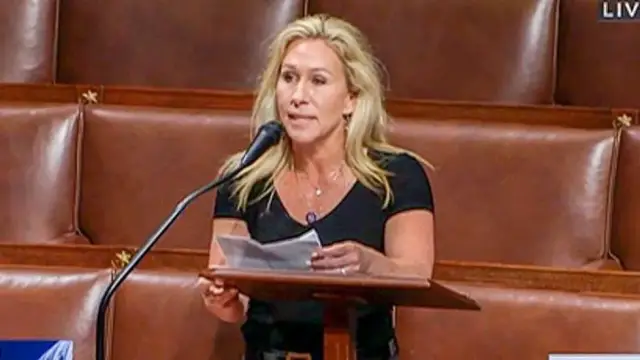 On Friday, Representative Marjorie Taylor Greene (R-GA), above, announced she is resigning from Congress. Her last day will be January 5, 2026, days after she secures her congressional pension. In her four-page announcement, she maintained she was frustrated that those like her, who she said represent “the common American people,” cannot get their measures passed because “the Political Industrial Complex of both Political Parties” ignores them in favor of “[c]orporate and global interests.”
She blamed Trump for forcing her out of Congress, saying: “I have too much self respect and dignity, love my family way too much, and do not want my sweet district to have to endure a hurtful and hateful primary against me by the President we all fought for, only to fight and win my election while Republicans will likely lose the midterms. And in turn, be expected to defend the President against impeachment after he hatefully dumped tens of millions of dollars against me and tried to destroy me.”
Greene appears to be shifting to fit into a post-Trump future. “When the common American people finally realize and understand that the Political Industrial Complex of both parties is ripping this country apart, that not one elected leader like me is able to stop Washington’s machine from gradually destroying our country, and instead the reality is that they, common Americans, The People, possess the real power over Washington,” she wrote, “then I’ll be here by their side to rebuild it.”
Another scandal coming from the Cabinet will not help the administration dig out from its cratering popularity.
Just after midnight Friday night, the former fiancé of the journalist who had a romantic relationship with Health and Human Services Secretary Robert F. Kennedy Jr. dropped another installment of his version of the saga. It included a graphic pornographic poem that would have ended a cabinet member’s career in any normal administration. The ex-fiancé said other poems he had found were even more explicit.
This revelation came the day after Kennedy acknowledged that he had personally told the Centers for Disease Control and Prevention (CDC) to change information on the CDC website to say the claim that vaccines do not cause autism is not “evidence-based.” As Sheryl Gay Stolberg of the New York Times notes, Kennedy admits that studies have shown no link between vaccines and autism, but he wanted the change because there are still other studies to be done. As Stolberg wrote, “He said he is not saying vaccines cause autism; he is simply saying there is no proof that they don’t.”
Kennedy is neither a doctor nor a scholar of public health, and Stolberg notes that “[i]t is highly unusual for a health secretary to personally order a change to scientific guidance.”
In order to get support for his cabinet nomination, Kennedy promised Senator Bill Cassidy (R-LA), a physician, that he would not remove from the CDC website a statement saying that vaccines do not cause autism. That statement is still at the top of the “Autism and Vaccines” page of the CDC website, but now it has an asterisk keyed to a footnote saying it had not been removed because of Kennedy’s promise to Cassidy, and the text of the page says that “studies supporting a link have been ignored by health authorities.”
Today, CNN’s Jake Tapper said to Cassidy: “He lied to you.” Cassidy answered: “Well, first let me say, what is most important to the American people, speaking as a physician, vaccines are safe. As has been pointed out, it’s actually not disputed. It’s actually quite well proven that vaccines are not associated with autism. There’s a fringe out there that thinks so, but they’re quite a fringe. President Trump agrees that vaccines are safe.”
Cassidy tried to suggest that focusing on Kennedy’s lie was “titillating” but that Americans needed to move on. Tapper answered: “This isn’t about titillation. This is about the fact that you are the chairman of the health committee and you voted to confirm somebody that by all accounts from the medical and scientific community and his own family…is actually making America less healthy.”
 Thinking About....Diplomatic Analysis: Russian Unreality and American Weakness, Timothy Snyder,
 right, Nov. 24, 2025. Notes from a bizarre moment of diplomatic history.
The history of diplomacy is full of strangeness. Touch the surface of the dusty books and peculiar characters spring forth to demand that their tales be heard. And yet the American diplomacy of the past few days, I believe, will stand out as something peculiarly gruesome -- not simply incompetent, but openly courting national and global catastrophe.
A document suddenly appeared a few days ago under the inapplicable (and too-often repeated) heading of “peace plan” regarding the Russo-Ukrainian war. It would be more accurately described as a plan to intensify the war to the profit of a few Russians and Americans. It seems to have produced entirely or mostly by Russians, and then leaked by a Russian negotiator to an American outlet. It was then claimed by a fraction within the White House, endorsed (sight unseen) by the president of the United States, who insisted (at least at first) that Ukraine had to accept it.
Since then there have been many denials, denials of denials, and obfuscations. The scandal will perhaps clarify problems of process in Washington. It is not that we -- America -- are trying to sell out Ukraine. American public opinion is favorable to Ukraine. Republican voters support Ukraine. A majority in Congress supports Ukraine. It is rather that a few Russians and a few Americans have the ability to define as a “peace plan” what is essentially the furtherance of personal economic interests combined with a strengthening of Russia’s capacity for warfighting and a weakening of Ukraine’s. Along the way, it contradicts every major principle of international law and furthers a world dominated by China and its Russian ally.
This suggests the absence of American statecraft.
It looks a lot like (details below) that Russians are seeking to bribe Americans to allow Russia to win a war it would otherwise lose. Having allowed Russians in this instance to design our policy, we then rely on our European and Ukrainian allies to serve as a check on us. We (or rather some powerful Americans) scold them for doing what they have to do, not only in their own interests but in ours and in the interest of avoiding general disaster. A
So much for procedure.
This document that begins in a Russian unreality. Rather than summarizing what has actually happened, a Russian invasion of Ukraine, the authors work instead to communicate the implicit premises that the war was caused by the West, and that Ukraine is not in fact a real country. Its total silence on the basic facts of the Russian invasion leads to the conclusion that Russia should be celebrated and rewarded -- as should specific American individuals.
In this text, there is no history, except that of Russian grievance. There is no law, except that as might be invoked to enable commercial transactions that enrich Russians (and a few Americans). There is no war itself. There is no discussion of anything that Russia would do to end its invasion. A purported peace plan applies itself at no point to the invader or the invader’s actions. By removing the war itself from consideration, Russians can claim huge gains while continuing to fight for yet more -- against a Ukraine that is weakened by the “peace plan.”
While everything is demanded of Ukraine, nothing is asked of Russia. This is a capitulation document written by the aggressor and served to the victim, at a time when the aggressor is not doing well on the battlefield. Indeed, it is only through a document such s this one, harnessing the power of the United States for Russian purposes, that Russia could possibly achieve its own announced purposes. By leaping right to the idea that Russia should be rewarded rather than punished, the document executes a very typical Russian maneuver: crime for Russians without punishment, and punishment for others without crime.
One way to criticize the text is to imagine that it is intended as a peace settlement and then note some shortcomings. But this is to normalize a document that obviously has other purposes than peace: namely, imperialism and profiteering. The fundamental problem of this text is its deliberate and characteristically Russian unreality. The text begins from the world as it is not. It acts to make the United States and Europe and Ukraine much weaker by drawing them to endorse things that are not true and forgetting things that are true. This is how Russian diplomacy works. It lulls you to a mental realm in which you then do harm to your own interests without seeing the alternatives.
Feel free to stop reading now if you like! I have made the general argument. But to se
New York Times, Ukraine and U.S. Cite Progress in Talks on Ending War With Russia, Cassandra Vinograd and Nick Cumming-Bruce, Updated Nov. 24, 2025. President Trump lashed out at Ukraine even as the talks on his peace proposal were still taking place, accusing the country’s leadership of being ungrateful for American support.
Ukrainian and American officials said they had made good progress on Sunday in talks about a contentious U.S. plan to end the war with Russia, even as President Trump lashed out at Ukraine, accusing its leaders of ingratitude.
Mr. Trump has set a deadline of Thursday for Ukraine to agree to the 28-point peace plan, an early draft of which many Ukrainians dismissed as capitulation because it acceded to longstanding Kremlin demands.
The talks, which began in Geneva on Sunday, were cast as an effort to bridge the gaps, and in a joint statement released after the discussions, Ukraine and the United States both said that much had been accomplished.
“They reaffirmed that any future agreement must fully uphold Ukraine’s sovereignty and deliver a sustainable and just peace,” the statement read. “As a result of the discussions, the parties drafted an updated and refined peace framework.”
The statement added that “Ukraine and the United States agreed to continue intensive work on joint proposals in the coming days.”
Earlier in the day, Mr. Rubio said the American and Ukrainian teams were working through the peace plan point by point and making adjustments, “narrowing the differences and getting closer to something” that both Kyiv and Washington would be “comfortable with.”
He said he was “very optimistic” that an agreement could be reached “in a very reasonable amount of time.”Want to stay updated on what’s happening in Russia and Ukraine? Sign up for Your Places: Global Update, and we’ll send our latest coverage to your inbox.
Mr. Rubio noted that “obviously the Russians get a vote here” and will “have to agree to this.” He later left Geneva to return to Washington, a State Department official said.
Andriy Yermak, the head of Ukraine’s delegation, had earlier spoken of “very good progress” and told reporters that discussions would continue in the days ahead.Editors’ PicksWant to Save Money on Skiing? Here Are 6 Ways to Pay LessAl Rockoff’s War Is Still Being FoughtSmart, Sizzling New Romance Novels
The cautiously optimistic — and seemingly aligned — remarks, followed by the joint statement, came despite a lengthy missive that Mr. Trump posted on social media criticizing Ukraine, as well as its European allies, which have been largely excluded from the plan.
“Ukraine ‘leadership’ has expressed zero gratitude for our efforts,” Mr. Trump wrote, “and Europe continues to buy oil from Russia.”
He also again appeared to blame Ukraine for Russia’s full-scale invasion, saying that the war “would have NEVER HAPPENED” had there been “strong and proper” Ukrainian leadership.
It was not the first time that the American president had accused Ukraine of insufficient gratitude, or of responsibility for the war that Russia started. During a disastrous meeting with Mr. Zelensky in the Oval Office in February, Mr. Trump told the Ukrainian leader that he was not doing enough to thank the United States for its support.
Since then, Mr. Zelensky and other members of his administration have taken pains to express their thanks.
Morning Shots via The Bulwark, Political Opinion: On Illegal War and Immoral Peace, William Kristol, Andrew Egger, Cathy Young and Jim Swift, Nov. 24, 2025. Why we should be dubious of both the coming actions in Venezuela and the ‘peace’ proposal for Ukraine.
Well, it’s official: the Department of Government Efficiency, which launched to great fanfare early in Trump’s term but which sputtered to a halt after the departure of Elon Musk, is no more.
Reuters reported this weekend that the administration is now acknowledging that the government-slashing group “doesn’t exist” anymore, despite eight months more of designated time left on the clock.
As the Economist’s Mike Bird notes, DOGE exits the stage without leaving a dent in federal spending, which is tracking to end 2025 significantly above 2024 levels. But the DOGE bros can console themselves that they did manage to fire a random assortment of late-career bureaucrats, inflicting immeasurable brain drain on the federal government, and doom an unspeakable number of children and vulnerable people around the world to deaths of disease, thirst, and starvation via their cuts to USAID.
Hell of a job, boys. Happy Monday
U.S. Economy, Markets, Tariffs, Jobs
Paul Krugman via Substack, Political-Economy Commentary: The Trump Trade is Unraveling, Paul Krugman, right, Nov. 24, 2025. Tells from the crypto crash.
What is Bitcoin good for? It isn’t money — that is, it isn’t a medium of exchange, something you can use to make payments. It isn’t a hedge against inflation. It isn’t a hedge against financial risks — on the contrary, the price of Bitcoin has generally moved in the same direction as the AI-related stocks driving the stock market these days, but with even greater volatility.
To the extent that Bitcoin has a use case, it is covering your financial tracks: crypto facilitates anonymous transactions that don’t leave a paper trail. Such transactions aren’t necessarily criminal, but many are.
By the way, anonymity doesn’t just enable crime by crypto users, it also enables crime against them. If you possess a Bitcoin’s key, the code that unlocks it, it’s yours, no matter who you are and how you got it. In that sense, getting your hands on a Bitcoin key is similar to getting your hands on a bag full of $100 bills.
This feature has led to a wave of abductions of major crypto investors by criminals demanding their keys. Indeed, such abductions have become so common that a major recent Bitcoin conference included a daylong “counter-kidnapping” workshop, in which participants learned, among other things, how to gnaw their way through zipties.
In addition to facilitating crime, Bitcoin has increasingly become an engine of predation. Crypto — or, worse, shares in companies that buy crypto with borrowed money — is heavily sold to naïve investors who don’t realize what they’re getting into. They do well when Bitcoin’s price is rising, but many probably don’t understand how badly they can suffer when it falls.
And crypto has fallen a lot recently. Bitcoin has actually held up better than smaller, more obscure coins, but even so it’s down roughly 25 percent since late October.
It’s possible that Bitcoin will bounce back, because it’s more than an asset, it’s a cult. When I spoke with Hasan Minhaj and Bitcoin came up, his immediate reaction to my criticism was “I don’t want to get memed, the Bitcoin boys have already come after me.” This cult status has allowed Bitcoin to recover from setbacks and scandals that would have sunk any normal investment, because true believers respond to any drop in its price by piling in more than ever. And maybe that will happen again.
But maybe not, because at this point Bitcoin is largely a Trump trade. Bitcoin’s price surged after Donald Trump won last year, and its recent plunge coincides with a series of Trump political setbacks.
Why is Bitcoin a Trump trade? Partly because Trump, whose family has in effect received massive bribes from the crypto industry, has been rewarding that investment with pro-crypto policies. Notably, Trump has signed an executive order intended to allow ordinary Americans — who, again, generally don’t know what they’re getting into — to invest money from their 401(k)s in crypto assets.
More broadly, crypto is, as I’ve suggested, increasingly a tool for financial predators, and the Trump administration is extremely predator-friendly. Ask Changpeng Zhao, founder of the cryptocurrency exchange Binance, who was found guilty of violating U.S. money-laundering laws — then pardoned by Trump.
The administration has been doing all it can to dismantle institutions, like the Consumer Financial Protection Bureau, that were created to help keep investors and markets safe after the 2008 financial crisis. Scott Bessent, the Treasury secretary, and other Trump officials and allies — including some officials at the Federal Reserve — have also been doing all they can to undermine bank supervision, which tries to limit the kind of risk-taking that brought on the 2008 crisis.
All of this is bad for small investors and bad for financial stability. But it’s good for financial schemers like the people and institutions promoting Bitcoin.
So how should we understand Bitcoin’s recent crash? Think of it as the unraveling of the Trump trade. Trump remains as determined as ever to reward the industry that made his family rich, and those around him are as determined as ever to make America safe for predators of all kinds. But Trump’s power is visibly diminishing, so the price of Bitcoin, which has in effect become a bet on Trumpism, has plunged.
Why is Trump suddenly looking weaker? Polls have given him very low marks since the spring, but his net approval has declined significantly over the past month. And while Trump just claimed that he has THE HIGHEST POLL NUMBERS OF MY “POLITICAL CAREER” — nobody knows what poll, if any, he’s referring to — most doubts about the validity of polls showing his extreme unpopularity were dispelled by blowout Democratic victories in Virginia and New Jersey on Nov. 4.
These electoral defeats have shaken the willingness of Republicans in Congress to keep showing lockstep obedience to Trump. At the same time, the growing furor over Trump’s ties to Jeffrey Epstein has rattled the MAGA base. Many political analysts, I suspect, don’t fully appreciate the extent to which many members of that base truly believed that Trump was protecting the world against Democratic pedophiles, and the degree to which they have been shaken by the growing realization that they may have gotten their heroes and villains mixed up.
Is it a stretch to link Trump’s political woes to the price of crypto? No. As Josh Marshall often emphasizes, power is unitary. A weakened Trump is less able to work his will on all fronts, including his efforts to promote crypto.
I’ll talk more about the politics/crypto linkage in future posts. For now, let me just reiterate that Bitcoin has become a Trump trade, and Bitcoin’s declining price is an indicator of Trump’s declining dominance over the G.O.P.
More On Trump Administration
Meidas Touch Network, Truth Social“Do It Q”— Trump Boosts Slew of QAnon-Linked Posts, J.D. Wolf, Nov. 24, 2025. Trump continues to amplify the fringe movement
Donald Trump spent the weekend amplifying multiple QAnon-themed posts from the X account “spiritual street fighter,” an account he has also boosted on Truth Social. The posts rely heavily on AI-generated imagery portraying Trump as a heroic or quasi-mythic figure and repeats core QAnon slogans that have long circulated.Trump
One post shows an AI-stylized Trump beside a skyline with the caption “Remember your oath,” a phrase frequently used in QAnon spaces to imply a coming purge of political enemies.Trump
Another depicts Trump with “tick tock” circling his head and the label “Q+” on his collar. QAnon believe Trump is a covert leader of their movement about to unleash his wrath towards his enemies at any moment.Trump
A third image (above) shows Trump standing before the U.S. Capitol amid lightning, with “Time To Obliterate The Deep State!!” and “Do it Q” emblazoned on his jacket.Trump
The final post features a masked figure alongside one of the movement’s most notorious slogans: “Nothing Can Stop What Is Coming.”Trump QTrump Posted a QAnon Video Boasting of Nations and Leaders Submitting to HimRead More
Trump’s decision to repeatedly share QAnon content underscores his embrace, at least politically, of the conspiracy movement that believes an evil cabal of blood drinking elites controls the world.
Morning Shots via The Bulwark, Political Opinion: Caribbean Twist, William Kristol, right, Nov. 24, 2025. As the Trump administration reportedly plans broader military action against Venezuela, the chairman of the Joint Chiefs of Staff, General Dan Caine, has arrived in Puerto Rico. Caine will be consulting with Southern Command senior officers and will be visiting some of the 15,000 troops currently in the region.
The New York Times explains, “General Caine’s visit comes as President Trump has approved several measures to pressure Venezuela and prepare for possible military action, according to multiple people briefed on the matter.”
So the Trump administration seems to be moving from blowing up small speedboats in the region that are allegedly transporting drugs, to more direct attempts to topple the Maduro government in Venezuela.
As the Times points out, ”The U.S. Navy has routinely been positioning warships near Venezuela’s coast in locations far from the Caribbean’s main drug-smuggling routes.”
On Saturday, the Federal Aviation Administration warned of “worsening security situation and heightened military activity around Venezuela,” leading airlines to cancel flights to and from the country.
Also on Saturday a senior administration official, speaking on condition of anonymity, told Reuters that the president did not rule anything out regarding Venezuela. “President Trump is prepared to use every element of American power” against the Maduro regime, the official said.There’s one problem: In our constitutional republic, the decision “to use every element of American power” is not supposed to be a decision left simply to the discretion of one man.
If we’re intent on using every element of American power, Congress must authorize that use.But Congress hasn’t authorized it. Congress has barely debated it. Senior officials haven’t briefed key congressional committees privately. Nor have they testified before Congress publicly. And neither the president nor his Cabinet has made a case for war to the American people.
Perhaps they should try making that case. Because while a broader war with Venezuela appears imminent, the public is not on board with it.A new CBS News poll shows only 24 percent of respondents believing the Trump administration has clearly explained the U.S. position on military action against Venezuela; 76 percent don’t think there’s been a clear explanation. Only 30 percent of the American public favors military action against Venezuela; 70 percent of the American public would oppose it. And three in four Americans—including over half of Republicans—say Trump should get congressional approval before taking military action in Venezuela.
So Donald Trump is seeking to go to war without the authorization of Congress and without the support of the American people. Even leaving aside the dubious merits of the case for this war at this time, deciding to go to war without the support of lawmakers or the public is a recipe for disaster.
Nicolas Maduro is a dictator. We should pursue—as we have been pursuing through actions of our executive and legislative branches—political, diplomatic and economic means to try to help the Venezuelan people remove him. If the president now wants to make the case for the use of military force against him, he can do so.He hasn’t. And it would be a total abdication of responsibility for Congress to sit by timidly as Trump unilaterally launches an illegal and unauthorized war of choice.It is right and proper for our most senior military officer to visit troops about to go into harm’s way.
But there is currently no authorization for the president to send those troops into harm’s way. We have already been engaging in acts of war on the high seas without legal justification. Now we are going to escalate that war with no congressional authorization.
One of the charges in the Declaration of Independence was that the King of Great Britain sought “to render the military independent of and superior to civil power.” We have no kings here. The Constitution gives Congress the authority to choose whether to take the nation to war. Congress should insist on its right and its duty to make that choice.
More Global News
New York Times, News analysis: Brazil Defied Trump and Won, Jack Nicas, Nov. 24, 2025. President Trump tried to keep the former Brazilian president, Jair Bolsonaro, out of prison. He failed, and now he is moving on
 “That’s too bad.”
It was a telling response from President Trump on Saturday when he learned the news from reporters that his once close ally, the former Brazilian president Jair Bolsonaro, had just been arrested.
Did he have any thoughts?
“No,” Mr. Trump replied. “I just think it’s too bad.”
What a difference a few months make.
 In July, Mr. Trump sent an angry letter to the current Brazilian president, Luiz Inácio Lula da Silva, left, demanding that the authorities drop charges that Mr. Bolsonaro had attempted a coup. Mr. Trump slapped 50 percent tariffs on Brazilian imports and imposed sanctions on a Brazilian Supreme Court justice to try to keep Mr. Bolsonaro — a right-wing politician sometimes called the Trump of the Tropics — out of prison.
Five months later, Mr. Trump has all but admitted defeat.
Mr. Bolsonaro, 70, is in a prison cell, starting a 27-year sentence. And Mr. Trump — after a chummy meeting with Mr. Lula — has just removed the most significant tariffs against Brazil.
The outcome highlights the stunning contrast in the fates of Mr. Trump and Mr. Bolsonaro, right, after they each tried to hold on to power after losing an election.
 It is also a stark example of the limits to Mr. Trump’s ability to bend foreign governments to his will and of his willingness to drop allies and side with a rival when he views it in his interest.
His intervention in Brazil was an extraordinary attempt to sway an ally’s most important legal case in decades, using some of the strongest tools at his disposal. But Brazil’s institutions essentially ignored him. Mr. Trump’s seeming capitulation shows that his efforts were basically for naught.
If anything, one could argue they backfired. The Brazilian tariffs increased prices in the United States for beef, coffee and other products just as the White House faces mounting pressure to ease prices for Americans. Mr. Lula — a leader of the Latin American left — exited the scuffle with Washington even stronger politically than when he went in.
Many analysts say they believe Brazil’s Supreme Court gave Mr. Bolsonaro a longer sentence because of Mr. Trump’s intervention. And Mr. Bolsonaro’s son, Eduardo — one of the most prominent members of Congress in Brazil and a potential political successor to his father — is now facing his own criminal charges over his efforts to lobby the White House on the case.
When Mr. Trump intervened, Mr. Bolsonaro was seen as a big winner. It is now clear that no one involved has lost more.ImageJair Bolsonaro looks ahead with a furrowed brow. A black car and blurred uniformed people are visible in the background.The former Brazilian president Jair Bolsonaro in Brasília in September. Many analysts say they believe Mr. Bolsonaro received a longer sentence because of Mr. Trump’s intervention.Credit...Sergio Lima/Agence France-Presse — Getty Images
Mr. Bolsonaro was unexpectedly imprisoned on Saturday after the authorities received an alert that he had tampered with the ankle monitor he was wearing under house arrest. (He is still exhausting appeals.) Mr. Bolsonaro told the police that he had tried to burn the device off with a soldering iron. He later blamed his medication for causing him to hallucinate.
A lexandre de Moraes, left, the Supreme Court justice overseeing the case, ordered Mr. Bolsonaro’s arrest because he deemed him a flight risk,noting that Mr. Bolsonaro lived near the U.S. Embassy, where he could have sought asylum. (The New York Times revealed that Mr. Bolsonaro slept at the Hungarian Embassy last year in an apparent bid for asylum.)
After Mr. Bolsonaro’s conviction, U.S. officials promised retaliation. But it never came.
Instead, Mr. Trump began a relationship with Mr. Bolsonaro’s adversary, Mr. Lula.
In his address to the United Nations in September, Mr. Trump spoke ad lib over prepared remarks criticizing the prosecution of Mr. Bolsonaro, saying that he and Mr. Lula had “great chemistry” when they met moments before.
A month later, Mr. Trump and Mr. Lula sat down for talks. Before the meeting, a reporter asked Mr. Trump about Mr. Bolsonaro. “I always thought he was a straight shooter, but …” Mr. Trump replied, trailing off. “He’s gone through a lot.”ImageA person with tattooed arms and a red top raises a can overhead, mouth open. Other people stand nearby against a blue wall with colorful posters.Celebrating the arrest of Mr. Bolsonaro in Brasília on Sunday. Mr. Bolsonaro told the police that he had tampered with an ankle monitor while under house arrest.Credit...Victor Moriyama for The New York Times
After the meeting, Mr. Trump mentioned only Mr. Lula: “He’s a very vigorous guy actually. I was very impressed,” he said. He then wished the Brazilian president, who turned 80 the day of the meeting, a happy birthday. Mr. Lula is seeking a fourth term next year.
On Thursday, Mr. Trump signed an executive order removing the most significant tariffs he imposed to protect Mr. Bolsonaro, including on Brazilian beef and coffee, citing progress in negotiations with Mr. Lula. Beef and coffee prices have risen sharply in the United States.
As part of the negotiations, analysts expect Washington to seek greater access to Brazil’s stockpiles of critical minerals, including rare earth metals. The Trump administration has made that a part of deals with other Latin American countries.
Still, Washington has not lifted the sanctions on Justice Moraes, the judge who prosecuted Mr. Bolsonaro. The judge’s aggressive tactics to prosecute Mr. Bolsonaro and his allies — including ordering social networks to bar people with little room for appeal — have raised concerns about whether they posed their own democratic threat.
On Sunday, Mr. Lula was asked about Mr. Trump’s reaction to Mr. Bolsonaro’s arrest. Mr. Lula dismissed it: “Trump needs to understand that we are a sovereign country.”
New York Times, Send Troops to Venezuela? In Florida, the Question Splits a Community, Patricia Mazzei, Nov. 24, 2025. President Trump’s military actions and immigration policies have divided Venezuelans in South Florida, many of whom fled the Maduro regime.
Anxious uncertainty hangs over Venezuelan Americans like Liz Rebecca Alarcón of Doral, Fla., a heavily Venezuelan city outside Miami. Routine conversations at the grocery store or at Ross Dress for Less have been overtaken by questions about whether, when and how President Trump might escalate its use of force against Venezuela.
“What’s going to happen?” friends, neighbors and shopkeepers ask each other, Ms. Alarcón said. “We don’t know what the outcome is going to be or what the strategy is.”
The administration has been ratcheting up its pressure campaign against Venezuela for months, with deadly boat strikes, which a range of experts in laws governing the use of armed force have denounced as illegal, and a significant buildup of U.S. Naval forces in the Caribbean. Recent days have felt like whiplash, Ms. Alarcón and several other Venezuelan Americans said, as military intervention seemed imminent, only to have Mr. Trump say he would be open to talks with his Venezuelan counterpart, Nicolás Maduro.
Yet the many Venezuelans who fled to South Florida over the past two and a half decades — after Hugo Chávez and then Mr. Maduro, his successor, came to power — do not all agree on what should happen. The differences of opinion, complicated by unease over Mr. Trump’s immigration policies, are creating tense divisions among Venezuelans in South Florida, as supporters of U.S. intervention try to drown out critics whom they consider a small minority.
“In theory, we should be united by the same thing, which is liberty for Venezuela,” said Esteban Hernández Ramos, 30, who lives in Fort Lauderdale. “In practice, there’s this division.”
Mr. Hernández left Venezuela when he was 16 and now works for a right-wing media outlet that publishes pro-Trump news in Spanish. He wants the U.S. military to occupy Venezuela for a sustained period, not only to take down Mr. Maduro, who is widely seen as having stolen the country’s 2024 presidential election, but also to dismantle the military leadership that has kept him in power.ImageLiz Rebecca Alarcón, 36, was born in the United States and works as a Democratic political analyst. Credit...Saul Martinez for The New York Times
Ms. Alarcón, 36, was born in the United States and works as a Democratic political analyst. She wants a peaceful transfer of power from Mr. Maduro to Edmundo González, the diplomat who defeated Mr. Maduro in a presidential election last year by more than 2 to 1, according to the Venezuelan opposition’s vote count. But she said she was cynical that Mr. Trump’s pressure would result in her desired outcome.
Venezuelans’ ties to South Florida date back decades, but their numbers grew significantly during the Chávez era and again after Mr. Maduro came into power. Embraced by Miami’s influential Cuban exiles, who saw them as ideological brethren fleeing a dictatorship, Venezuelan American voters were courted by Republican politicians, who succeeded in winning over many of them.
Now, disagreeing with Mr. Trump is seen among many Venezuelan Americans as unpatriotic and disloyal — including some old enough to remember past disastrous U.S. military interventions in Latin America.
“It’s like, if you’re not 1,000 percent with them or you don’t want a military intervention, then you’re a collaborator,” said Luis Fernando Atencio, 32, a co-founder of the Venezuelan-American Caucus, a Miami-based activist group allied with the left-leaning Latino Victory Project. He said he feared military intervention because it could result in Venezuelans’ being injured or killed.
The vast majority of Venezuelans in the United States oppose Mr. Maduro and would like to see him gone, said José Antonio Colina, a former Venezuelan military officer who fled his country for Miami in 2003.
New York Times, He Saw the Best of America and Then Fought for Russia in Ukraine, Greg Jaffe and Paul Sonne, Nov. 24, 2025. Col. Andrei Demurenko’s war story began at Fort Leavenworth, Kan., at a moment of hope and peace. It ended with a mortar blast in Ukraine.
He believed that a good leader should experience the worst of war alongside his soldiers.
So, at the age of 67, Andrei Demurenko, a Russian colonel, traveled from his command post in eastern Ukraine to see his most vulnerable frontline troops, crawling from trench to trench in the rain and sleeping in ankle-deep mud.
In the distance he could hear artillery cannons booming. Nearby, the city of Bakhmut was burning.
It was a world away from the neatly groomed grounds of Fort Leavenworth, Kan., where in 1992 he had arrived as a rising star, the first and only Russian commander ever chosen to study alongside American troops at the U.S. Army’s Command and General Staff College.
His time in the United States was supposed to be a small but important step toward ushering in a new era of possibility and peace after decades of the Cold War. “The end of history,” one scholar called it, when Washington and Moscow could finally coexist without enmity, and even cooperate.
Among the most hopeful were Mr. Demurenko and the American officers whom he came to see as lifelong friends.
But their noble aspirations were dashed. Even after his time in the United States, Colonel Demurenko still believed the Kremlin narrative that Ukrainian “Nazis,” backed by the United States and the West, were threatening Russia’s existence. He had absorbed these distortions so completely that by 2023 he had come out of retirement to wage war in Ukraine.
Later that year, Mr. Demurenko told the story of his life and war to a small Russian military journal. Officials at the U.S. Embassy in Moscow, the Army’s European headquarters and the Pentagon began reading and sharing it.
Mr. Demurenko’s journey from Kansas to the carnage in Ukraine seemed to encapsulate the arc of the U.S.-Russian relationship. It also stirred some big questions: How had things turned out so badly, and who was to blame?
Life at the front was “dirty, bad, savage,” Mr. Demurenko said in an interview with The New York Times. The temperature was close to freezing. Almost all of his men were sick, he recalled. Some, stricken with pneumonia or bronchitis, were coughing up blood.After two days, pinned down by sniper fire and drones, he set off on foot for a car that would drive him back to his regimental headquarters. It was around 3 a.m. and pitch dark. He had turned 68 just hours earlier.
Without warning, a mortar exploded over his head, throwing him into a tree about 10 feet away. His troops dragged him into a trench. A medic injected him with a painkiller.
Mr. Demurenko, cold, muddy and wet, marched for about a mile before he made it to the waiting car. The blast had broken his nose, fractured bones in his skull and face, and caused bleeding in his brain.
His head was foggy. His eyes, he said, “became like those of the red devil.”
Eventually, word of Mr. Demurenko’s wounds reached his old friends from Fort Leavenworth, who had no idea that he had fought in Ukraine. They worried about his health and wondered why Mr. Demurenko, a man they remembered fondly, had volunteered to take part in a war that had caused so much destruction and slaughtered so many innocents.
How, they asked, had their friend become a battlefield foe?
Mr. Demurenko had been weighing a similar question: How would he explain his decision to go to war?
U.S. Media, Culture, Education
Lincoln Square Media, Political Opinion: All The President's Pigs, Lisa Senecal, Nov. 24, 2025. When Donald Trump called a female reporter 'piggy,' MAGA women rushed in to rationalize the abuse.
No authoritarian leader achieves and maintains power without enablers and enforcers — those who willingly whitewash, normalize, tolerate, and justify the piggish words and deeds of a strongman who uses fear, threats, dehumanization, and denigration to dominate, punish, and silence.
Donald Trump is no different. There are countless examples of Trump’s immediate and aggressive attacks on anyone who dares to cross him. But he reserves his greatest degree of ire and contempt for women who do not show him the deference he believes himself entitled to or, worse still, challenge his authority.
Deference. Submission. Flattery. Unfettered access. Donald Trump’s sense of entitlement when it comes to women and girls is well-documented and might become more so as documents connected to Jeffrey Epstein continue to trickle into public view. Though some who admire and seek to emulate Trump see his treatment of women as evidence of his masculine strength, it seems painfully obvious that it is likely the opposite: a pathological fear of being exposed as weak or lacking in his twisted definition of what makes a man a man. This fear and his resulting desire to diminish and degrade the value and role of women in public and private spaces made him the perfect vessel for the far-right white Christian nationalist movement that is a dominant force in his second term.Subscribed
The current Trump Administration is dominated by white men. Its policies and goals, spelled out clearly in Project 2025, were primarily crafted by and for the benefit of white Christian nationalist men. For those rolling their eyes that this is yet another commentary attacking men, make note of the previous sentence. Trump 2.0 is designed by and to benefit white Christian nationalist men. There’s really no reason to take offense at that description. White Christian nationalist men make no secret about their belief that women should be subservient and deferential to men, and that there are clear gender-prescribed biblical roles by which we should all be forced to live. The offensive part isn’t calling it out; it’s that this subset of misogynists believes all of humanity should have to submit to their worldview.
But it’s not only men who are the enablers. White women who benefit — or are temporarily benefiting and just don’t realize it’s temporary — are some of the most effective enforcers and whitewashers of Trump’s misogyny. Case in point, Marjorie Taylor Greene, one of Trump’s longest and loudest supporters, has resigned from Congress after being attacked as a traitor by Trump for insisting on the release of the Epstein files. That Trump considers a person a traitor for urging the release of documents connected to a convicted pedophile is an admission that boggles the mind, but we are where we are. I find it nearly impossible to feel sympathy for the long list of people who were confident they were so unique and special that Trump would not turn on them once they were no longer useful.
It might appear to be a flaw in my argument that there are women who support Trump and his back-to-the-bad-old-days movement who are in positions of power. It’s not. These women, and more specifically, white women, are useful tools, so they are praised and put forward as evidence that there’s really nothing to see here. If we’re offended by Trump’s policies, words, or deeds, we’re mistaken. For example, if Trump lashes out at a female reporter and tells her, “Quiet, piggy,” for asking him a question about the release of the Epstein files, it’s not evidence of his hostility toward women. How silly of us to see it that way. She was obviously asking for it.
An unidentified White House official explained Trump’s behavior this way, stating, “This reporter behaved in an inappropriate and unprofessional way towards her colleagues on the plane. If you’re going to give it, you have to be able to take.”
For the record, this was Lacey’s question that drew Trump’s ire, “Sir, if there’s nothing incriminating in the files …”
Rep. Maria Elvira Salazar (R-Fla.) attributed Trump’s abusive, degrading comment to him being “a very picturesque and difficult and different type of politician.” I’ll give her “difficult” and “different.” As for “picturesque,” Oxford defines the word as an adjective meaning “visually attractive, especially in a quaint or pretty style,” and I just can’t get on board with that as a description of Trump. In Salazar’s defense, I believe she was trying to say that Trump uses evocative language. If so, she was explaining that Trump was verbally painting a picture for us of a woman as a pig. How that is a defense, I will never understand.
Karoline Leavitt, right, Trump’s chief White House whitewasher, went further and explained that women should be grateful that Trump calls them  pigs to their faces, rather than avoiding speaking to them at all.
“So, I think the president being frank and open and honest to your faces, rather than hiding behind your backs, is frankly a lot more respectful than what you saw in the last administration, when you had a president that lied to your face and then didn’t speak to you for weeks, and hid upstairs and didn’t take your questions,” Leavitt said. “So I think everyone in this room should appreciate the frankness and the openness that you get from President Trump on a near daily basis.”
This year, as people gather at their Thanksgiving tables and give voice to what they’re thankful for, America’s women can express their gratitude that we have a president who won’t just call us pigs in private; he’ll say it right to our faces.
Popular Information, Accountability Journalism: What’s our next story? Judd Legum, right, Nov. 24, 2025. Today, to help guide  our future work, we would like to hear from you. We are headed into 2026, a critical election year. What stories should Popular Information focus on in the weeks and months ahead?
You can leave your thoughts in the discussion thread linked below, starting now. I’ll be stopping by later to answer any questions.
New York Times, Opinion: QAnon Isn’t So Thrilled About the Epstein Revelations, Will Sommer (author of Trust the Plan: The Rise of QAnon and the Conspiracy That Unhinged America), Nov. 24, 2025. The past few weeks of Epstein revelations — with more expected should the government’s trove of files open to the public — should be a dream for QAnon believers, and for a few of them, it is.
Vincent Fusca, a man whose scruffy good looks and ever-present fedora have led some QAnon supporters to believe he is John F. Kennedy Jr., not-in-fact dead and in disguise, texted me that “of course” the latest batch of Epstein emails proved QAnon right.
“You are finally getting it!” Mr. Fusca wrote happily.
What was harder to explain, for many believers, was why Mr. Trump spent so long resisting the release of the key evidence that would confirm what they suspected was happening all along. Celebrants like Mr. Fusca are outliers; much of QAnon’s response to Washington’s Epstein excitement has been strangely muted, even dismayed. But with revelations about Mr. Trump’s relationship to Mr. Epstein mounting, the default QAnon position has become that Mr. Epstein just isn’t that interesting anymore.
That’s partly because QAnon believers no longer stand out so brightly in the conspiracy-minded Republican mainstream. And because Congress’s mostly sober, evidence-based Epstein investigation bears little relation to the grand fantasies of elite exposure that QAnon dreamed up at its height. But for QAnon, the real problem with the Epstein revelations is that Mr. Trump sits uncomfortably close to the center of them.
A day after the House passed a bill to order the Justice Department to release its Epstein files, Jon Herold, a QAnon promoter who broadcasts under the name Patel Patriot, seemed disappointed that more of Mr. Epstein’s crimes might be revealed. “All the awful things that people are saying, I hope it’s not true,” Mr. Herold said. “I don’t want to see any of it.”
Given that the conspiracy theory doubles as a cult of personality built around Mr. Trump, this sort of reaction isn’t particularly surprising. But the new emails do suggest the conspiracy theorists were right about Mr. Epstein’s significance — albeit not in the ways they thought.Sign up for the Opinion Today newsletter Get expert analysis of the news and a guide to the big ideas shaping the world every weekday morning. Get it sent to your inbox.
Drawing from cryptic message board posts written by the anonymous clue-giver known as Q from 2017 to 2022, QAnon adherents posit a world in which institutions like the Democratic Party, Hollywood and Wall Street are secretly controlled by a cabal of Satan-worshiping elites. While interpretations of QAnon vary, believers generally think that these elites torture children in rituals and drink their “adrenochrome” — a sort of fountain-of-youth liquid generated by terrified children. Only Mr. Trump can stop this evil, they say, and as president, he is expected to initiate the “Storm,” an apocalyptic day when top Democrats will be arrested, diseases will be cured and the world will be at peace.
Mr. Epstein should matter to QAnon because he was a rare example of the supposed sex-trafficking cabal’s machinations coming out in the open. While Mr. Epstein was mentioned relatively rarely in QAnon before his 2019 indictment, his mysterious death propelled QAnon recruitment and provided endless alleys for its amateur internet sleuths to explore.
But Mr. Trump’s long friendship with Mr. Epstein has always been awkward for QAnon believers to explain. Why was Mr. Trump, supposedly the ultimate avenger of abused children, videotaped palling around with Mr. Epstein? Why was he calling a known sex trafficker who paid dozens of girls, some as young as 14, to have sex with him, a “terrific guy?” Why did he appoint Alex Acosta, the prosecutor in Florida who helped give Mr. Epstein a sweetheart plea deal in 2007, to his cabinet?
The traditional QAnon explanation for the pair’s closeness has been that Mr. Trump was getting close to Mr. Epstein just to bring more publicity to his crimes. It’s not the most compelling argument, even by QAnon standards, and it’s looked even shakier as more Epstein emails about Mr. Trump have come out.
But maybe the Epstein story provided them with something after all. Interviewing QAnon believers and attending their rallies over six years, I overwhelmingly heard that what drew them together was dispossession. Supporters could pinpoint their moments of radicalization with clarity, often pointing out a moment of personal crisis — a financially ruinous illness, or a child’s mental disability that went ignored at school.
QAnon believers’ responses to the knowledge that they were on their own in America were typically bizarre, if not dangerous. After being denied disability payments for a difficult skin condition, one man I interviewed moved into a desert compound led by a QAnon splinter leader named Baby Q. Deluded QAnon believers have murdered family members, blocked a highway, and fought (and, in some cases, died) in the Jan. 6 riot.
Even so, they sensed that something was wrong with how average people were treated in the United States and they correctly identified that many elites really didn’t care about their struggles. The Epstein emails suggest as much, showing how figures like Larry Summers, the former president of Harvard, were still close with Mr. Epstein even after his predatory behavior was exposed.
QAnon’s retreat from the Epstein story is striking because there remain real questions about Mr. Epstein that could make for a rich vein of new theorizing. How exactly did Mr. Epstein get so rich? Why were so many wealthy, powerful men friends with him? Why did he move so easily through the global financial system?
But for most QAnon believers the priority is protecting Mr. Trump at all costs. Even if it means no longer asking questions. Even if it means letting the moment they finally got something right pass them by. Even if it means continuing to thirst for a storm that will never come.
New York Times, Former News Anchor Sentenced to 10 Years in Prison Over Pandemic Fraud, Alexandra E. Petri, Nov. 24, 2025 (print ed.). The former anchor, Stephanie Hockridge, who once worked for a Phoenix station, participated in an elaborate scheme that illegally obtained more than $63 million, prosecutors said.
A former news anchor in Arizona who co-owned a company that defrauded a pandemic-era loan program of more than $63 million was sentenced to 10 years in prison, the Justice Department said on Friday.
From about April 2020 to May 2021, the former anchor, Stephanie Hockridge, 42, of Rio Grande, P.R., participated in an elaborate scheme that swindled tens of millions of dollars in Paycheck Protection Program loans, the government’s $800 billion relief effort for small businesses, the Justice Department said.
Ms. Hockridge was charged in November 2024, and she was convicted in June on one count of conspiracy to commit wire fraud. Ms. Hockridge was acquitted of four counts of fraud in the case, according to court records and her lawyer.
Chief District Judge Reed O’Connor of the U.S. District Court for the Northern District of Texas sentenced Ms. Hockridge to 120 months in federal prison followed by two years of supervised release. She had faced up to 20 years in prison.
She was also ordered to pay more than $63 million in restitution, the Justice Department said.
Ms. Hockridge worked as a news anchor for ABC15, an ABC-affiliated television station in Phoenix, from 2011 to 2018, according to the station.
Richard E. Finneran, a lawyer for Ms. Hockridge, said in a statement he was confident her conviction would be overturned on appeal.
“Ms. Hockridge was sentenced to 10 years in prison for loans that the prosecutors never proved were fraudulent in the first place,” said Mr. Finneran, of the law firm Bryan Cave Leighton Paisner.
In April 2020, Ms. Hockridge, with her husband and others, founded a company called Blueacorn to help small businesses obtain Paycheck Protection Program loans, according to the criminal indictment.
The company became a breakout star of the federal aid program and stepped in to help the smallest and neediest businesses, but Blueacorn also helped itself, federal prosecutors said.
As part of the scheme, Ms. Hockridge and others offered a personalized service called “VIPPP” to help potential borrowers complete loan applications. According to the indictment, Ms. Hockridge and Nathan Reis, her husband and co-owner, recruited co-conspirators to work as referral agents and to coach borrowers on how to submit false loan applications.
Federal prosecutors said Ms. Hockridge and her co-conspirators fabricated payroll records, tax documentation and bank statements to obtain larger loans for certain applicants, and they charged borrowers kickbacks based on a percentage of the funds received.
In one instance in June 2020, Ms. Hockridge, with the help of Mr. Reis, submitted a “materially false” application for a software company called Body Politix to obtain a P.P.P. loan of $19,382, according to the indictment. Ms. Hockridge submitted another false application in February 2021 to obtain a loan of $20,832, which was eventually electronically wired into her account, the indictment said. These details were part of a fraud count that she was ultimately acquitted of.
Ms. Hockridge and her co-conspirators processed more than $63 million in fraudulent program loans, the Justice Department said.
In 2022, a congressional panel issued a report that detailed the government’s rush to get cash out the door to help devastated businesses. The report, which was highly critical of Blueacorn, found that weak government oversight created conditions ripe for fraud.
The report portrayed Blueacorn as a tiny company operating with insufficient staffing, lax internal controls and little interest in separating legitimate loan applications from fraudulent ones.
More On Law, Crime
 Emptywheel, Analysis: Buh Bye Lindsey! Emptywheel (Marcy Wheeler, right), Nov. 24, 2025. Judge Cameron Currie has ruled that Lindsey Halligan was unlawfully appointed, dismissed both the Jim Comey and Letitia James indictments without prejudice, and put the EDVA judges in charge of picking the US Attorney who will serve in EDVA until such time as Trump can get someone confirmed.
Judge Cameron Currie has issued her ruling in Jim Comey and Letitia James’ efforts to disqualify Lindsey Halligan as unlawfully appointed.
In both cases, she dismissed the indictments without prejudice.
On September 25, 2025, Lindsey Halligan, a former White House aide with no prior prosecutorial experience, appeared before a federal grand jury in the Eastern District of Virginia. Having been appointed Interim U.S. Attorney by the Attorney General just days before, Ms. Halligan secured a two-count indictment charging former FBI Director James B. Comey, Jr. with making false statements to Congress and obstructing a congressional proceeding.
Mr. Comey now moves to dismiss the indictment on the ground that Ms. Halligan, the sole prosecutor who presented the case to the grand jury, was unlawfully appointed in violation of 28 U.S.C. § 546 and the Constitution’s Appointments Clause. As explained below, I agree with Mr. Comey that the Attorney General’s attempt to install Ms. Halligan as Interim U.S. Attorney for the Eastern District of Virginia was invalid. And because Ms. Halligan had no lawful authority to present the indictment, I will grant Mr. Comey’s motion and dismiss the indictment without prejudice.
But she also ruled that the judges in EDVA will choose the US Attorney until such time as Trump can get one confirmed by the Senate, which might, in theory, lead Erik Siebert to be reinstated.
The power to appoint an interim U.S. Attorney for the Eastern District of Virginia pursuant to 28 U.S.C. § 546 during the current vacancy lies with the district court until a U.S. Attorney is nominated by the President and confirmed by the Senate under 28 U.S.C. § 541.
This decision will be appealed. And given that Currie stopped short of dismissing the indictment with prejudice, it may not moot Comey’s other challenges to his indictment (or James’, which are not yet fully briefed).
Update: This language seems to prohibit Bondi from trying to reindict Comey again, but does not moot his other legal challenges.
Update: Comey has posted a video. And James posted this statement:
I am heartened by today’s victory and grateful for the prayers and support I have received from around the country. I remain fearless in the face of these baseless charges as I continue fighting for New Yorkers every single day.
Nov. 23
New York Times, Ukrainian and U.S. Officials Meet to Discuss Trump’s Plan to End War With Russia, Cassandra Vinograd, Nov. 23, 2025. The talks, which Ukraine said would include European officials, come as the Trump administration’s pushes Kyiv to accept a 28-point peace plan.
Ukrainian and American officials sat down for talks in Switzerland on Sunday as part of President Trump’s push to get Kyiv to accept a peace plan to end its war with Russia.
Mr. Trump has set a deadline of Thursday for Ukraine to agree to the 28-point peace plan that was drafted without input from Kyiv or its European allies. The proposal contains many conditions that Ukraine has long rejected as nonstarters, including surrendering territory, slashing the size of its army and giving up some types of weaponry.
Secretary of State Marco Rubio and Steve Witkoff, Mr. Trump’s special envoy, were meeting on Sunday with Ukraine’s delegation at the U.S. mission in Geneva, according to a U.S. official. Daniel Driscoll, the Army secretary, was also participating in the talks, the official added, saying that the discussions would include “more formal engagements with the U.S. leaders and Ukrainians to continue ironing out the peace agreement.”
 President Volodymyr Zelensky of Ukraine sent a delegation led by Andriy Yermak, his chief of staff, to Geneva for the talks. “Our representatives know how to defend Ukraine’s national interests and exactly what must be done to prevent Russia from launching a third invasion, another strike against Ukraine — just as it has repeatedly committed crimes against our people and against other nations in the past.” Mr. Zelensky said on Saturday night.
Mr. Yermak confirmed on Sunday that he had met with senior British, French and German officials in Geneva ahead of the meeting with the American delegation.
“We are in a very constructive mood,” he wrote on social media.
Many Ukrainians have dismissed the U.S. plan as a capitulation offer, given that it echoes longstanding Kremlin demands.
There also seemed to be continued confusion about the plan, including among lawmakers. A group of U.S. senators claimed on Saturday that Mr. Rubio had told them that the document “was not the administration’s plan” but a “wish list of the Russians.”
The State Department said that was “blatantly false,” and Mr. Rubio also rejected the characterization, writing on social media that “the peace proposal was authored by the U.S.”
“It is offered as a strong framework for ongoing negotiations,” he added. “It is based on input from the Russian side. But it is also based on previous and ongoing input from Ukraine.”Ukraine’s European allies, including the leaders of Britain, France and Germany, said in a joint statement on Saturday that the U.S. proposal was a starting point and called for “additional work.” They urged changes to the plan’s most objectionable points for Ukraine — including the proposal’s requirement that Kyiv’s military be capped.
While Mr. Trump has said he wants Ukraine’s response to the proposal by Thursday, he has left open the possibility that the deadline could be extended “if things are working well.”
And when asked by reporters on Saturday whether this was his “final offer” on Ukraine, Mr. Trump said “No.”
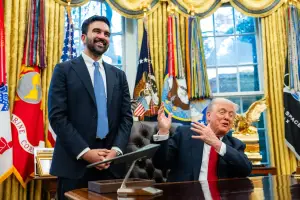
President Trump meets New York City Mayor-elect Zohran Mamdani in the White House Oval Office during a meeting with a Democratic Socialist that surprised obversers by its mutually friendly tone (New York Times Photo by Kenny Holston on Nov. 21, 2025).
Emptywheel, Analysis: “Groceries,” and Other Secrets of Managing Donald Trump, Emptywheel (Marcy Wheeler, right), Nov. 23, 2025. Three developments that have befuddled observers -- Trump's fawning praise of Zohran Mamdani, Kirill Dmitriev's latest success at manipulating Trump advisors, and Marjorie Taylor Greene's departure -- tell us a lot about how to manage Trump in a time of his diminishing power.
Three things happened in the last week that have befuddled a lot of observers, but which might best be understood as the kinds of developments we’ll see increasingly as the power structure around Trump grows fragile and fluid:
All of these, in my opinion, arose out of and reflect Trump’s increasing political weakness, his separate mental and physical decline, and the fight for power that results.
Mamdani speaks of Trump voters, groceries, and building
Much of the focus on the Trump-Mamdani meeting was on what Trump did, such as his interruption before Mamdani had to answer whether he believed Trump was a fascist, rather than on what Mamdani said. But if you look closely at what Mamdani said — which was often simply a restatement of his campaign pitch — he managed to say them in such a way that Trump parroted them as his own.
Both men centered their statements on their shared love of New York City, which is real and has been underplayed.
Mamdani’s first comment did so — as did his relentlessly disciplined campaign did — in terms of affordability; Mamdani mentioned “groceries,” the awkward shorthand Trump’s handlers have had him use to address affordability.
Mr. Trump: You know, we had some interesting conversation, and some of his ideas really are the same ideas that I have. A big thing on cost. The new word is “affordability.” Another word, it’s just groceries. It’s sort of an old-fashioned word, but it’s very accurate. They are coming down. They are coming down.
Mamdani repeatedly spoke in terms of Trump’s voters (again, a line directly from his campaign).
Trump had no idea that Mamdani targeted Trump voters, and as the coalition that elected him last year abandons him in the polls, Trump took notice when Mamdani explained that.
When I spoke to New Yorkers who had voted for the president last November on Hillside Avenue and Fordham Road, I asked them why. I heard, again and again, two major reasons. One was that they want an end to forever wars — they wanted an end to the taxpayers’ dollars we had funding violations of human rights, and they wanted to address the cost-of-living crisis. And I appreciated the chance to discuss both of those things.
Mr. Trump: He said a lot of my voters actually voted for him.
Mr. Mamdani: One in 10.
Mr. Trump: And I’m OK with that.
[snip]
Reporter: First of all, for the mayor-elect: You’re both from different parts of the political perspective. You’re both populist, though, and I just wonder to what extent the president’s campaign styles — his techniques, his social media use — inspired any part of your campaign?
Mr. Mamdani: Well, I actually told the president that, you know, so much of the focus of our campaign has been on the cost-of-living crisis, and when we asked those New Yorkers who had voted for the president — when we saw an increase in his numbers in New York City, that came back to the same issue. Cost of living. Cost of living. Cost of living.
And they spoke about the cost of groceries, the cost of rent, the cost of Con Ed, the cost of child care.

New York Times, Patel Under Scrutiny for Use of SWAT Teams to Protect His Girlfriend, Alan Feuer, Adam Goldman and Glenn Thrush, Nov. 23, 2025. The F.B.I. director’s travel on government jets has contributed to growing questions inside the administration about whether he is using taxpayer-funded resources inappropriately.
When Alexis Wilkins, an aspiring country singer dating the F.B.I. director, Kash Patel (shown above together in a photo via Instagram), sang “The Star-Spangled Banner” at the National Rifle Association’s annual convention in Atlanta in the spring, she arrived with a formidable protective posse — a SWAT team from the bureau’s local field office.
The two agents, members of a specialized unit trained to storm barricaded buildings and rescue hostages, had been sent there on Mr. Patel’s orders. But seeing that the event at the Georgia World Congress Center had been secured, and that Ms. Wilkins was in no apparent danger, they left before the event was over, according to six people with knowledge of the incident.
She noticed. So did her boyfriend.
 Soon after, Mr. Patel ripped into the team’s commander, saying that his girlfriend had been left without taxpayer-funded defenders, and slamming what he saw as failure to communicate their movements up the chain of command during her time on the convention floor — where she sang and chatted with attendees, the people said.
He was concerned that Ms. Wilkins, a high-profile conservative, might be attacked by people who had threatened her online.
Mr. Patel’s heavy use of taxpayer-funded resources during his first nine months on the job has contributed to growing questions inside the administrationabout whether it exceeds the bounds of standard practice. This includes an intense use of security to protect himself and his girlfriend.
He has also used a government jet for some of his recreational travel, such as a golf trip with buddies to a private resort in Scotland over the summer.
Directors must fly on government aircraft for their travel because of required access to secure communications equipment. But using government jets for business trips, or to return home if they have left settled lives in other parts of the country to serve in Washington, requires planning and coordination.
Government security protection for Ms. Wilkins to attend events or performances has drawn particular attention, including criticism from some of the same right-wing online personalities that supported his efforts to shake up the bureau.
“Is she considered Kash’s spouse?” Grace Chong, an influencer who works for a Trump ally, Stephen K. Bannon, asked on X recently about Ms. Wilkins’s use of bureau resources. “Is that why she’s getting protection because if not then why are we paying for this?”
New York Times, News Analysis: As Trump’s Inquisitors Face Scrutiny, a Divisive Figure Could Play a New Role, Charlie Savage, Nov. 23, 2025. The prosecutor running an inquiry into those who investigated President Trump has established a grand jury under Judge Aileen M. Cannon, whose scuttling of the documents case made her a White House favorite.
The U.S. attorney in Miami, who is running a sprawling investigation into former officials who investigated President Trump, has been granted an unusual request to convene an extra grand jury at the federal courthouse in Fort Pierce, Fla. The location ensures that just one judge can oversee it: Aileen M. Cannon.
That raises a question with intriguing political and legal overtones. Could Judge Cannon again end up as a key player in a Trump-centric case, this one centered not on accusations of wrongdoing by him but on whether the Russia investigation and the charges against him after he left office in 2021 amount to a conspiracy against him?
 Judge Cannon, right, whom Mr. Trump nominated in the final year of his first term, handled the case involving his retention of classified documents while out of office. She temporarily disrupted the inquiry after the F.B.I. in 2022 searched Mr. Trump’s club and residence, Mar-a-Lago, before an appeals court reversed her decision. In July 2024, she dismissed his indictment on procedural grounds, a decision that flew in the face of previous court decisions.
The U.S. attorney, Jason A. Reding Quiñones, a Trump loyalist, has already been using a grand jury in Miami to subpoena former officials involved in an intelligence assessment that concluded Russia was trying to help Mr. Trump win the 2016 election. He has not said why he is putting an extra grand jury 130 miles away in Judge Cannon’s courthouse.
But Mike Davis, a conservative legal activist and lawyer who is close to Mr. Reding Quiñones, has suggested that the purpose is to ensure that Judge Cannon will have a hand in any legal issues about the inquiry.ImageJason A. Reding Quiñones, the Trump-appointed U.S. attorney for the Southern District of Florida.Credit...Olga Fedorova/EPA, via Shutterstock
If that is the case, it would put Judge Cannon in charge of disputes like requests by recipients of subpoenas to quash them, on grounds ranging from an expired statute of limitations to claims of privilege, or requests by prosecutors to compel such witnesses to testify under threat of being jailed for contempt of court.
Judge Cannon declined to comment via the clerk of the courts for the Southern District of Florida. The Justice Department also declined to comment.
Justice Department officials are prohibited from talking about grand jury matters. But Mr. Davis, who has been a leading proponent of a “grand conspiracy” investigation into those who scrutinized Mr. Trump, has become vocal on social media and television in making a connection between Judge Cannon and the investigation.
In an interview, Mr. Davis said that he had been calling for a grand jury investigation in Fort Pierce to investigate whether there was a conspiracy to violate Mr. Trump’s civil rights, and that he had also worked to persuade the White House to appoint Mr. Reding Quiñones to his role.
“I’m very pleased that he has successfully got the court to agree to this grand jury in Fort Pierce,” he continued. “To these lawfare Democrats, I say, ‘Lawyer up.’”
But Mr. Davis was coy when asked directly whether he knew what Mr. Reding Quiñones’s purpose in obtaining the extra Fort Pierce-based grand jury was for the grand conspiracy investigation. On that question, he declined to comment.
Mr. Trump’s deputy attorney general, Todd Blanche, has been supervising Mr. Reding Quiñones’s actions in the grand conspiracy investigation through Christopher-James DeLorenz, a lower-level official in his office who had been Judge Cannon’s law clerk until August 2024, according to current and former officials who spoke on the condition of anonymity.
Mr. Blanche was one of Mr. Trump’s defense lawyers in the documents case before Judge Cannon. An official familiar with the matter who spoke on condition of anonymity said that Mr. DeLorenz’s job includes interacting with U.S. attorneys’ offices.
After Mr. Trump won the 2024 election, the Justice Department dropped its indictment of him for trying to overturn the 2020 election and its appeal of Judge Cannon’s dismissal of the elections indictment. After he took office in January, Mr. Trump installed a series of his defense lawyers in key roles atop the department, including Mr. Blanche and Attorney General Pam Bondi.
When Mr. Trump went to the Justice Department in March for a triumphant speech, he praised Judge Cannon as a “courageous” and “amazing judge” who had endured unfair criticism by legal experts he said had tried to bully her into convicting him.
More On Global News

Associated Press via Politico, Pope calls on kidnappers in Nigeria to free 265 students and teachers after 50 pupils escape, Staff Report, Nov. 23, 2025. No group has yet claimed responsibility for the abductions.
Fifty of the 303 schoolchildren abducted from a Catholic school in north-central Nigeria’s Niger state have escaped captivity and are now with their families, the school authority said Sunday, as the pope called for the immediate release of those still missing.
The schoolchildren, aged between 10 and 18, escaped individually between Friday and Saturday, according to the Most Rev. Bulus Dauwa Yohanna, chairman of the Christian Association of Nigeria in Niger state and the proprietor of the school.
A total of 253 schoolchildren and 12 teachers are still being held by the kidnappers, Yohanna said in a statement. “We were able to ascertain this when we decided to contact and visit some parents,” he added.
Meanwhile, 38 worshippers kidnapped during a deadly church attack in central Nigeria’s Kwara state have regained their freedom, Kwara Gov. AbdulRahman AbdulRazaq said in a statement.
Gunmen had attacked the Christ Apostolic Church in Kwara’s Eruku town on Tuesday, killing two people and taking others hostage. Nigeria’s President Bola Tinubu, in a separate statement, attributed the freedom of the worshippers to “the efforts of security agencies” without giving further details.
The Niger state pupils and students were seized together with their teachers by gunmen who attacked the St. Mary’s School, a Catholic institution in Niger state’s remote Papiri community, on Friday.
No group has yet claimed responsibility for the abductions and Nigerian authorities have not shared any update on rescue efforts. It was not immediately clear where the Niger state children were being held or how they managed to return home.
The Niger state school is located near a major road linking the towns of Yelwa and Mokwa, and is in a region of Nigeria where armed gangs often operate out of vast forests that connect different states and conflict hot spots.
“As much as we receive the return of these 50 children that escaped with some sigh of relief, I urge you all to continue in your prayers for the rescue and safe return of the remaining victims,” the Yohanna said.
Pope Leo XIV called for the immediate release of the schoolchildren and staff of the school, saying at the end of a mass in St.Peter’s square on Sunday that he was “deeply saddened” by the incident.
Politico, Trump says Ukraine plan ‘not my final offer’ after EU leaders warn deal needs work, Gabriel Gavin, Nov. 23, 2025. Kyiv's European allies held crisis talks after details of the U.S. plan first came to light, amid fears it could constitute another ultimatum from Washington.
U.S. President Donald Trump appeared to back away Saturday evening from demanding that Kyiv accept a controversial proposal that would see Ukraine give up territory to Russia, slash its military and give the United States a major cut of reconstruction profits.
Speaking to reporters outside the White House, Trump was asked whether the 28-point blueprint developed by special envoy Steve Witkoff was the administration’s final offer for Kyiv.
“No — not my final offer,” Trump replied. “I’d like to get to peace; it should have happened a long time ago … one way or another we have to get it ended.”
If Ukrainian President Volodymyr Zelenskyy, who has expressed grave concerns over the U.S. proposals, does not accept it, “then he can continue to fight his little heart out,” Trump said. The American president had previously given Kyiv until Thanksgiving — this Thursday — to agree.
European allies held crisis talks the same day after details of the plan first came to light, amid fears it could constitute another ultimatum from the U.S. administration and was developed bilaterally with Russia rather than in partnership with European capitals or Ukraine.
Meanwhile, U.S. Secretary of State Marco Rubio was forced to distance himself from reports he described the plan as a wish-list made in Moscow that did not reflect Washington’s position. He issued a statement early Sunday that said “the peace proposal was authored by the U.S.” and had taken account of “previous and ongoing input from Ukraine.”
Polish Prime Minister Donald Tusk has been among those questioning the origin of the U.S. framework. “Before we start our work, it would be good to know for sure who is the author of the plan and where was it created,” Tusk wrote online.
After discussions on the sidelines of a G20 meeting of major economies in South Africa on Saturday, European Council President António Costa welcomed American efforts to secure peace but said Trump’s proposal “is a basis which will require additional work.”
An EU official, granted anonymity to speak freely, underlined that “the U.S. draft of the 28-point plan includes important elements that will be essential for a just and lasting peace. We are ready to engage on that basis in order to ensure that a future peace is sustainable. But further work is required.”
Costa’s chief of staff, Pedro Lourtie, and top European Commission official Bjoern Seibert are expected to take part in talks brokered by the Americans in the coming days for further negotiations and the bloc has reiterated its continued support for Ukraine. Only one EU leader — Hungary’s Kremlin-friendly Prime Minister Viktor Orbán — has unconditionally backed Witkoff’s plan, which critics say makes disproportionate concessions to Russia.
Lev Remembers, Opinion: EXPOSED: The 28-Point ‘Peace Plan’ Was a Russian Play — Laundered Through Trump’s Inner Circle, Lev Parnas, right, Nov. 23, 2025. How a Kremlin-written dossier was translated, sanitized, and pushed into U.S. policy channels —The October handoff, and the backchannel that’s turning American foreign policy into an oligarch pipeline.
I have some extremely disturbing news today — news I’ve been warning you about for the past several weeks, and news that is finally being confirmed publicly.Subscribed
What Washington has been calling a “28-point peace plan” for Ukraine was never a U.S. plan. It was never negotiated. It never went through the State Department. And it was never the product of American diplomacy.
Multiple sources familiar with the drafting process — including individuals with direct insight into earlier versions — now confirm that the original document contained 30 points, not 28. And those two missing points were removed for one reason: they were so blatantly pro-Russian that leaving them in would have exposed the document instantly as a Kremlin creation.
What we are looking at is not diplomacy. It’s not policy. This was a Russian plan disguised as American strategy, laundered through Trump’s shadow network. And for several days, the Trump Administration allowed this Russian document to circulate across Washington as though it carried the weight and authority of the United States government.
This is not a misunderstanding. This is a national security breach.
A Foreign Power Delivered the Plan — Not the U.S. Government
 My sources have confirmed for weeks what Senators Rounds and King finally acknowledged publicly: this document came from Russia, delivered through an intermediary into Marco Rubio’s orbit.
But here is the part the public still hasn’t fully absorbed:
In October, Kirill Dmitriev, left, handed this plan directly to Trump’s unofficial envoy, Steve Witkoff, right— Trumps loyal fixer, not a diplomat — who then pushed it into U.S. channels almost word-for-word. The language wasn’t even changed. It was translated from Russian. That’s it.
Earlier drafts — the 30-point version — included two explosive demands:
1. A requirement for the U.S. and Western investors to bail out Russia’s economy after the war.
2. A proposed U.S.–Russia “Christian union” alliance aimed against China.
These are not ideas American diplomats would ever put on paper. These are pure Kremlin objectives. They were removed only to make the plan look American enough for Trump’s circle to push. This is how propaganda becomes “policy.”
This is how foreign powers infiltrate the machinery of the United States government when private envoys replace real diplomats.
And While Trump Plays Power Games, Ukrainians Are Burying Their Children
We cannot lose sight of the human cost. While Trump’s inner circle tries to run shadow diplomacy with Moscow, Ukrainian families are in the ground right now, burying their sons and daughters — killed by the very regime that drafted the document Trump’s people attempted to slip into the bloodstream of American foreign policy. These operations have consequences measured in human lives. And I will not stop telling you the truth about this.
Now the Same Network Is Targeting Venezuela
While this crisis unfolds in Ukraine, my sources are warning that a parallel operation has begun in Venezuela, running through many of the same channels, intermediaries, and Trump-aligned power brokers.
Let me say this clearly:
This is not humanitarian policy. This is not democratic reform. This is regime change engineered by Trump insiders who have been circling Venezuela’s oil reserves for years.My sources describe the objective as simple and brutal:
Install a government aligned with Trumpworld’s business interests and gain control over one of the largest oil reserves on Earth.
The Ukraine plan shows you the playbook. Venezuela is the sequel. Enough talk. It’s time for action. What I’m exposing here is not a small story. It is a threat to democracy, to global security, and to the integrity of American foreign policy. Trump’s network is trying to run a private foreign policy — with Moscow’s fingerprints on the documents, and with American lives and strategic interests on the line.
And yes, bringing you this information puts me in danger. There are people who do not want these backchannels exposed. But I’m not stopping. I can’t. Because the truth is the only weapon we have left against a movement built on secrecy and deception.
But I cannot do this alone.Here’s how you can help — right now
1. Become a paid subscriber. You make this work possible. Your support keeps this reporting independent and protects my ability to keep exposing these networks.
2. Support Ukraine directly. While Trump plays empire with oligarchs, Ukrainians are fighting and dying to survive.
New York Times, In Russian-Occupied Mariupol, Everything Ukrainian Must Go, Neil MacFarquhar, Milana Mazaeva and Anna Lukinova, Nov. 23, 2025. Russia is remaking Mariupol, which was devastated by a brutal siege in 2022. Ukrainians seeking to move back are finding it hard to recognize the city, or to reclaim their property.
Oleksandra Stolyar was living near Kyiv when she learned that her apartment in the occupied Ukrainian port city of Mariupol would be confiscated by the Russian-installed government.
The problem was that she, like tens of thousands of others, had fled war-torn Mariupol several years ago, and hadn’t re-registered her property because she didn’t become a Russian citizen. She considered the idea of taking a Russian passport morally repugnant.
“I had already bid farewell to my apartment, to the furniture, to all the stuff that I had there,” said Ms. Stolyar, a 46-year-old kindergarten music teacher, adding, “but I am sad that the life we had has been taken away from us.”
More than three years after Russian troops captured Mariupol in May 2022, after a brutal three-month siege, the Kremlin is pouring billions of dollars into remaking the city, constructing scores of sparkling new apartment buildings and rebuilding some neighborhoods.
But in interviews with 14 current or former residents of Mariupol, they offered a mixed picture of the reconstruction effort.ImageA person with red hair sits on a quilted couch, wearing a blue embroidered shirt. They look toward blue-green sheer curtains.Oleksandra Stolyar at home in Berdychiv, Ukraine, last month. She fled Mariupol in 2022, when Russia invaded the city. Credit...Brendan Hoffman for The New York TimesImageBright orange and yellow flames explode from a large building. Smoke billows and debris flies above residential roofs.A strike on an apartment on Mytropolytska Street in Mariupol, in March 2022. The siege devastated the infrastructure of the city; according to the United Nations, the estimated death toll, which was never confirmed, started in the thousands.Credit...Evgeniy Maloletka/Associated Press
They said most Ukrainian residents could not afford the new apartments, which start around $100,000. The property of some others, like Ms. Stolyar’s, has been declared “abandoned” and confiscated. In video appeals posted online, groups of other residents say the Russian-installed city government has reneged on promises to distribute new housing to all those left homeless by the war.
In the interviews, some residents praised the changes, but others described the reconstruction as a “Potemkin village,” an ornamental facade camouflaging problems created by Moscow’s invasion, like a chronic water shortage.
“Despite all the construction going on, local people don’t see a holistic approach to the development of the city,” said Nikolay Osychenko, the former head of a Mariupol television station who now hosts a You Tube talk show from Kyiv. “They cannot see its future.”
Many of the residents interviewed spoke anonymously out of fear of arrest and other retribution from the authorities.
More On U.S. Law, Crime, Courts
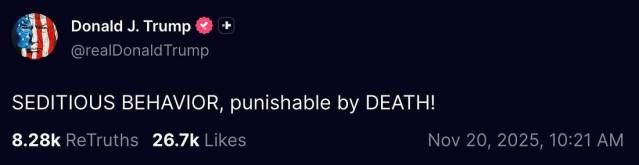
Letters from an American, Historical Commentary: November 22, 2025 [Unlawful Orders and Sedition], Heather Cox Richardson, right, Nov. 23, 2025. On Tuesday, six Democratic lawmakers, themselves veterans of the U.S. military or intelligence services, released a video telling service members that they would stand behind them as they refused to obey unlawful orders.
On Thursday, President Donald J. Trump posted on social media that the message in the video was “SEDITIOUS BEHAVIOR AT THE HIGHEST LEVEL. Each one of these traitors to our Country should be ARRESTED AND PUT ON TRIAL. Their words cannot be allowed to stand—We won’t have a Country anymore!!! An example MUST BE SET.” He followed that post with another saying: “SEDITIOUS BEHAVIOR, punishable by DEATH!” He has continued to attack the lawmakers over the past two days.
For the president of the United States of America to call elected lawmakers traitors and demand they be arrested, tried, and sentenced to death for making statements he perceives as threats to his policies is bizarre, outrageous, and anti-American. But it is not unprecedented.
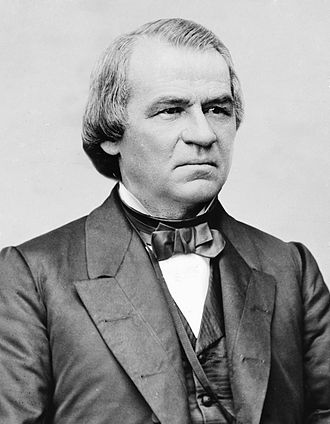 In 1866, President Andrew Johnson (shown at left in a portrait by Matthew Brady) accused Republicans of trying to overthrow the government, called congressmen traitors, and called for them to be hanged.
A former tailor from Tennessee, Johnson considered himself the representative of poor white men who he believed had been crushed before the Civil War by the elite southern enslavers who dominated the economy. Johnson opposed their rising oligarchy, but that did not mean he had any interest in protecting the rights—or even the lives—of formerly enslaved Black Americans.
Johnson was a southern Democrat who hated the congressional Republicans who wanted to protect Black rights and rebuild the nation on the basis of free labor. He thought they were expanding the federal government mostly to keep their party in power permanently, while the taxes their new bureaucracy required to protect Black Americans would destroy poor whites by raising taxes.
Elevated to the White House by the death of President Abraham Lincoln, Johnson intended to “restore” the Union much as it had been before the war except for the abolition of enslavement, an abolition he strongly supported because he believed slavery was what had enabled elite southern planters to amass their fortunes. Because Congress had adjourned in March and was not scheduled to reconvene until the following December, Johnson had free rein for eight months to rebuild the nation as he wished.
In summer 1865 he told the governors of the former Confederate states to organize new constitutional conventions and then he required those conventions to ratify the Thirteenth Amendment, ending human enslavement in the U.S. except as punishment for crime, nullify the ordinance of secession, and repudiate the Confederate war debts, essentially defaulting on loans so that future rebels would find it hard to raise money to fund their rebellion.
They did so—more or less—but then went on to pass “Black Codes,” laws that differed from state to state but that generally pushed Black Americans back into subservience to their white neighbors. The codes bound Black Americans to yearlong contracts working for white men, prohibited them from owning guns or gathering in groups, demanded submissive behavior, and permitted corporal punishment for those failing to obey the codes.
Black Americans had no right to vote to challenge these laws, and no right to sit on juries or to testify in court. So they were at the mercy of any white man who cheated them or any gang that raped, assaulted, or murdered freedpeople.
When southern states held elections to send representatives to Congress in fall 1865, voters reelected old leaders who had led the South out of the Union in 1861, including Alexander Stephens of Georgia, the former vice president of the Confederacy. In late November 1865, these southern leaders traveled to Washington, D.C., to take their seats in Congress.
On December 4, Johnson greeted the new Congress by congratulating it that Reconstruction was over. While congress members had been out of session, he explained, he had reorganized the former Confederate states. All that was left to do to restore the government was for Congress to seat the South’s representatives. They were already in Washington, D.C., marveling at the changes the war had wrought in what was, just four years before, a sleepy southern town.
Republicans were appalled by Johnson’s “restoration,” recognizing that it delivered Black Americans who had fought for the United States into the hands of those men who had fought to destroy it. Johnson was permitting southerners who had lost the war to win the peace. The Chicago Tribune declared: “The men of the North will convert the State of Mississippi into a frog-pond before they will allow any such laws to disgrace one foot of soil in which the bones of our soldiers sleep and over which the flag of freedom waves.”
Congress rejected Johnson’s solution to reconstruct the nation. There was no way northern lawmakers were going to rebuild southern society on the old, pre–Civil War blueprint, especially since the upcoming 1870 census would count Black Americans as whole persons for the first time in the nation’s history, giving southern states even more power in Congress and the Electoral College after the war than they had had before it.
Congress refused to seat the southern delegates. Then, to come up with their own plan for reconstruction, congressmen appointed a committee of thirteen lawmakers as the Joint Committee on Reconstruction. After months of hearings and deliberation, the committee proposed to reconstruct the nation on an entirely new basis. At the end of April 1866, it called for amending the Constitution for the fourteenth time.
They wrote an amendment that began by reiterating the Constitution had provided that “[a]ll persons born or naturalized in the United States, and subject to the jurisdiction thereof, are citizens of the United States and of the State wherein they reside.” This was an explicit rejection of the 1857 Dred Scott decision that denied Black Americans could be U.S. citizens.
Then it said: “No State shall make or enforce any law which shall abridge the privileges or immunities of citizens of the United States; nor shall any State deprive any person of life, liberty, or property, without due process of law; nor deny to any person within its jurisdiction the equal protection of the laws.” This outlawed the discriminatory laws put in place in southern states under the Black Codes and said the federal government would guarantee that states could not pass legislation that gave some citizens more rights than others.
The new amendment gave Congress the power to “enforce, by appropriate legislation, the provision of this article.”
Congress required southern states to ratify the amendment before being readmitted to the Union.
Johnson hated the proposed Fourteenth Amendment. He hated its broad definition of citizenship; he hated its protection of equal rights within the states; he hated its assertion of the power of the federal government to protect that equality.
So Johnson told southern politicians to ignore Congress’s order to ratify the Fourteenth Amendment. He assured them that Democrats would win the 1866 midterm elections and that once back in power, Democrats could repudiate Republican “radicalism” and allow Johnson’s plan for reconstruction of the Union to proceed.
Johnson’s position energized ex-Confederates, who made the summer of 1866 a bloody one. In July, when a Unionist convention in New Orleans called for taking the vote away from former Confederates and giving it to loyal Black Americans, white mobs attacked the building where the convention was in session. The ensuing riots killed thirty-seven Black delegates and three white delegates to the convention.
Rather than condemning the violence in the South, Johnson egged it on. After denouncing Congress as an illegal body—because it had not seated southern representatives— and saying Republican lawmakers were trying to undermine the Constitution, he decided to rally voters to his side before the 1866 midterm elections with a speaking campaign. In August 1866 he set out on a “Swing Around the Circle,” speaking at rallies on a circuit from Washington to New York, Chicago, St. Louis, and back through the Ohio River valley to the capital.
In February, shortly after congressional Republicans had rejected his plan for reconstruction, Johnson had suggested that those Republicans were trying to overthrow the government and were no better than the Confederates. But on September 4, 1866, he went further. In Cleveland, Ohio, facing a crowd heckling him for his stand against Congress, Johnson called those who opposed his plan for reconstruction “traitors” and suggested they should be hanged.
It was a stunning moment. Just a year after the end of the devastating civil war, a president had called for hanging members of Congress because they did not support his policies.
Americans wanted no part of it. Johnson’s extremism and his supporters’ violence created a backlash. Northerners were not willing to hand control of the country to the former Confederates rioting in the South and a president who called for the hanging of congressmen. Rather than rebuking the Republicans in the midterm elections as Johnson had predicted, voters repudiated Johnson. They stood behind the principles in the Fourteenth Amendment and gave Republicans a two-thirds majority of Congress.
Now firmly in control of rebuilding the South, the Republicans worked to make the Fourteenth Amendment a reality. But in every southern state other than Tennessee (where locals so hated their native son Johnson that they ratified the Fourteenth Amendment just to spite him), white men had ignored Congress’s plan for reconstruction.
So, on March 2, 1867, Congress passed the Military Reconstruction Act, which divided the ten unreconstructed southern states into five military districts and, as Johnson’s plan had done, required new constitutional conventions to rewrite the state constitutions. Unlike his plan, though, the new law permitted Black men to vote for delegates to the conventions. It also required the states to guarantee Black male suffrage in their new constitutions and to ratify the Fourteenth Amendment.
With the Military Reconstruction Act, Republicans asserted that all men, poor and underprivileged as well as rich and educated, should have a say in American government. Leading Republican politician James G. Blaine later reflected that the Military Reconstruction Act was of “transcendent importance and…unprecedented character. It was the most vigorous and determined action ever taken by Congress in time of peace. The effect produced by the measure was far-reaching and radical. It changed the political history of the United States. But it is well to remember that it could never have been accomplished except for the conduct of the Southern leaders.”
On July 9, 1868, the final state ratified the Fourteenth Amendment, making it part of the Constitution of the United States of America.

Convicted sex trafficker and rapist of underaged girls Ghislaine Maxwell and Donald Trump (file photo via U.S. Department of Justice).
Meidas Touch Network /Talking Feds Podcast, Trump’s Ghislaine Gamble BACKFIRES in STUNNING Fashion, Nov. 23, 2025. Talking FedsPodcast host Harry Litman and MeidasTouch host Ben Meiselas report on Donald Trump and Ghislaine Maxwell suffering the consequences of their wayward and despicable plan to cover up their dark past.
New York Post, Married teacher who paid students, plied them with booze and drugs for sex gets 10 years in prison, Ariel Zilber, Nov. 22,2025. A 30-year-old former substitute teacher was sentenced to 10 years in prison on Wednesday after she was convicted of paying middle school students for sex as well as providing them with drugs and alcohol.
 Carissa Jane Smith of Dixon, Mo., right, was arrested in November of last year and charged with 19 felony counts including statutory rape and child sex trafficking, the Kansas City Star reported.
Smith utlimately pleaded guilty to lesser charges this past September. According to authorities, Smith, who worked at multiple schools within the Dixon R-1 School District, would pay students $100 or more either in cash or through CashApp in exchange for sex acts, KRCG-TV reported. Smith is also alleged to have supplied students with alcohol or marijuana in exchange for sex.
Trump Administration
1100 Pennsylvania Avenue: News on the return of Donald Trump's for-profit presidency, Exclusive: Trump crypto partner may have violated SEC rules, Zach Everson, Nov. 23, 2025. From my latest for Forbes:
Alt5 Sigma [Nasdaq: ALTS] said its board suspended CEO Peter Tassiopoulos effective Oct. 16 without explaining the move in a filing it made with the SEC four business days later.
An internal email sent to employees on Sept. 4—six weeks earlier—says the board had placed Tassiopoulos on temporary leave by that day, according to a copy shown to Forbes by two sources close to the company.
That message, sent by Alt5 Sigma’s chief operations officer and director Ron Pitters and signed by director David Danziger, said a special board committee was investigating unspecified “certain matters concerning the company” and that chief revenue officer Vay Tham also had been placed on leave.
Under SEC rules, public companies must report within four business days when their executive officer effectively stops serving in that role, and experts told Forbes that materially false or misleading filings can violate anti-fraud laws, although establishing such a violation can be difficult.
A World Liberty Financial attorney told Forbes that Tassiopoulos remains an Alt5 Sigma employee and is also still on its board, while an Alt5 Sigma spokesperson said its board’s special committee is investigating, among other matters, a subsidiary’s legal troubles in Rwanda—where it was found criminally liable for illicit enrichment and money laundering, a verdict it is appealing while claiming it was the victim of fraud—though the company did not say whether that issue led to the executives being placed on temporary leave.
Publicly traded Alt5 Sigma accumulated $1.5 billion of World Liberty Financial cryptocurrency in August as part of a circular deal that routed more than an estimated $500 million to an entity affiliated with President Donald Trump.
There’s a lot more in there—Eric Trump’s disappearing board seat! Details about Rwanda! Appliance recycling!—so please check it out.
Politico Magazine, Kyrsten Sinema Took a 15-Hour Psychedelic Trip. Now She’s All in on MAHA, Erin Schumaker, Nov. 23, 2025. In a new interview, the one-time Democrat says the movement for psychedelic medicine should capitalize on the Trump administration.Kyrsten Sinema’s old enemies on the left better brace themselves: The former senator is now embracing psychedelics and cozying up to MAHA.
 After infuriating progressives time and again for stonewalling their priorities, the Arizona Democrat-turned-Independent decided not to seek reelection last year and instead became a senior adviser at the law and lobbying firm Hogan Lovells. She’s since taken up the cause of psychedelic medicine — pro bono, she says.
Her drug of choice? Ibogaine, a psychedelic derived from an African shrub, and which she went down to Mexico to try for herself. She and other advocates want ibogaine studied in state-funded clinical trials and eventually hope to win Food and Drug Administration approval of the drug as a mental health treatment.
And she thinks now is their chance with President Donald Trump in office.
“We are in this magical, unique time,” Sinema, right, said of Trump’s health department, led by Secretary Robert F. Kennedy Jr., below left, a longtime believer in psychedelics’ potential to help people, particularly veterans, with illnesses like post-traumatic stress disorder and depression.
Sinema was making her remarks earlier this month before roughly 200 attendees at a conference of Americans for Ibogaine, a group co-founded by Rick Perry, the former Texas GOP governor who has made psychedelic medicine advocacy his life’s work after leaving government.
Advocates have had some recent success. Texas GOP Gov. Greg Abbott signed a bill in June that secured $50 million in state funding for ibogaine research. In Arizona, Sinema successfully lobbied Democratic Gov. Katie Hobbs to include $5 million in ibogaine research funding in the state’s budget.
In an interview with POLITICO Magazine at the conference, Sinema noted the crowd included “super conservative people in the room — MAGA, MAHA — and then there’s full-on hippies.”
And like Kennedy’s “Make America Healthy Again” agenda, which also unites odd bedfellows on the right and left, the embrace of ibogaine faces skepticism from many in the medical establishment.
That’s in part because ibogaine poses heart risks and robust research hasn’t been done on its effects. The Drug Enforcement Administration also lists ibogaine on its schedule of drugs with no currently acceptable medical use and a high risk of abuse.
But Sinema’s not one to shy away from controversy, or from courting MAHA forces and Kennedy in particular.
U.S. Education, Media, Technology, Culture
New York Times, Pabst, Pamphlets and a Petition: A Harvard-Yale Tailgate in the Trump Era, Mark Arsenault, Nov. 23, 2025. Students and alumni set aside rivalries at the 141st Harvard-Yale football game on Saturday to summon support against attacks on higher education under the Trump administration.
In the hours before the 141st meeting of the Harvard and Yale football teams on Saturday, a vast and raucous tailgate party sprung to life across grassy fields on the Yale University campus. Students and alumni dressed in Harvard crimson and Yale blue played cornhole, grilled chicken, devoured bagels, swilled Pabst Blue Ribbon and drank wine straight from the bottle.
Sticking out only slightly were Regina Schwartz, a Harvard alum, who was dressed as a turkey (an informal Harvard mascot); and Erica Newland, who graduated from Yale and its law school, cosplaying as a Yale bulldog, inside a full over-the-head mask, like a superhero impersonator working for tips in Times Square.
Their mission amid the revelry: Persuading partying football fans to “stand firm against attacks” on higher education, as their handouts said.ImageA person dressed in a Yale bulldog costume hands out pamphlets to students crowded around.Erica Newland, a Yale graduate, worked the tailgate party in a bulldog costume, passing out information to students and alumni.Credit...Christopher Capozziello for The New York Times
“Do you want to stand up for academic freedom and the First Amendment?” Ms. Schwartz asked a group of students, shouting above a cacophony of portable sound systems, each playing songs with different beats. “How would you feel about doing that?”
“Good?” came one reply.
The tailgate evangelists from the two schools set traditional rivalries aside for the first Harvard-Yale football game since the Trump administration embarked on its campaign to remake American higher education and strike deals with schools that accept the White House’s priorities.
The groups — “Crimson Courage” and “Stand Up for Yale” — cosponsored a party tent at the tailgate, under a banner reading “Foes on the Field, Allies for Academic Freedom.” They collected signatures on a petition urging leaders of both schools to reject agreements with the Trump administration that would bring the government’s hand into running universities.
The Harvard-Yale football matchup has deep significance for Ms. Newland. Her relationship with her husband began at the 2006 game in Cambridge, she said, when she drank too much Manischewitz, and he walked her to an ambulance. She seemed unsure about sharing the story for the record, but then decided it would be “the wedding announcement I never got in The Times.”
Though Yale has so far largely avoided the close scrutiny and sanctions from the Trump administration that other schools have experienced, especially those in the Ivy League, Ms. Newland said all universities are stronger if they present a united front.
“Hang together or hang separately,” she said.
Of course, Harvard and Yale are within the Ivy League bubble, separated by their enormous wealth and influence, which could make it difficult for them to persuade other schools to risk a loss of federal funding to stick up for universities that seem to have every advantage.
University leaders across the country have signed an open letter against “government overreach,” and schools have filed amicus briefs supporting Harvard in its legal case against funding cuts by the Trump administration.
Around midmorning on Saturday, as the tailgate revved up, the Crimson Courage co-chair Miles Rapoport, a former secretary of state of Connecticut, pointed into the crowd and asked, “Hey, is that George Conway?”
Wandering past the tent was indeed Mr. Conway, a lawyer and one of America’s most vocal anti-Trump activists. He graduated from Harvard in 1984 and Yale Law School in 1987, and he was there on Saturday to watch football with two old friends. Mr. Rapoport smoothly intercepted Mr. Conway and redirected him to the tent, where the lawyer gamely allowed himself to be plastered with Crimson Courage and Stand Up for Yale stickers.
Nov. 22
Zohran Mamdani, the mayor-elect of New York City, and President Trump speaking with reporters in the Oval Office on Friday. (New York Times, photo by Eric Lee.)
New York Times, White House Memo: ‘Fascist’? ‘Communist’? For an Afternoon, They Were Just 2 Guys From Queens, Shawn McCreesh, Updated Nov. 22, 2025. Acid insults were set aside as New York’s mayor-elect and the president promoted their shared goals.
There was one moment in particular when Zohran Mamdani seemed like he might have bitten off a little more than he could chew by making his lonely pilgrimage down to the lion’s den that is President Trump’s blinged-out Oval Office.
The 34-year-old mayor-elect of New York was pressed by a reporter on whether he thought his host, who was sitting about four inches away, was really “a fascist.”
How terribly awkward.
But before Mr. Mamdani could even get out one of his slick and diplomatic answers, the president jumped in to throw him a lifeline.
“That’s OK, you could just say, ‘Yes,’” Mr. Trump said, looking highly amused by the whole thing. He waved his hand, as if being called the worst term in the political dictionary was no big deal.
“OK, all right,” Mr. Mamdani said with a smile.
“It’s easier,” Mr. Trump said. “It’s easier than explaining it.” Chuckling good-naturedly, he reached up and gave Mr. Mamdani a pat on the arm. “I don’t mind,” he added.
It was like the oddest screwball buddy comedy in American politics. The “fascist” and the “communist.” The president and the mayor. The old man and the Young Turk.
Were these really the same two guys who had spent the last many months flicking acid darts at one another?
Mr. Trump had falsely claimed that Mr. Mamdani, a naturalized U.S. citizen, might be here illegally, and had threatened to have him arrested. He had demonized him as a “communist” who would drive his beloved hometown into the gutter.
Mr. Mamdani didn’t shy from a scrap. In a memorable zinger from his victory speech earlier this month, he shot back, “So, Donald Trump, since I know you’re watching, I have four words for you: Turn the volume up.”
But if there is one thing Mr. Trump respects, it’s a winner. He made it clear Friday that he was impressed Mr. Mamdani had triumphed as an underdog against the political establishment. “He came out of nowhere,” the president said. “What’d you start off at, one or two? I watched, I said, ‘Who is this guy?’”
Mr. Trump also appreciates a good media spectacle, and he was keenly aware that he had one on his hands. “The press has eaten this thing up,” he marveled to the phalanx of cameras crowded into the Oval Office. “I’ve had a lot of meetings with the heads of major countries, nobody cared. This meeting — you people have gone crazy.”
Mr. Mamdani, for his part, was clever about deploying certain facts that would help disarm his host. He made a point of talking about how Mr. Trump had gained votes in New York in the last presidential election, and described talking to Trump voters on Hillside Avenue in Queens and Fordham Road in the Bronx.
“When we spoke to those voters who voted for President Trump, we heard them speak about cost of living,” Mr. Mamdani said. “We focus on that same cost of living.”
“He said a lot of my voters actually voted for him,” Mr. Trump chuckled, “and I’m OK with that.”
The two did a kind of populist pas de deux that would have been unthinkable in a previous political age.
For once, there was no talk of crypto, billionaires or a gilded ballroom. It was as though Mr. Mamdani was bringing out in Mr. Trump his original focus on economic issues, one that powered his political rise but which some influential figures in the MAGA movement have lately been accusing Mr. Trump of abandoning.
Things took a turn for the surreal when Mr. Trump stepped in to defend Mr. Mamdani from hard-edge questions being flung at him by the conservative media in the room.
One such type grilled Mr. Mamdani about why he had flown on a plane to Washington instead of taking a train, noting the latter would have been “greener.”
“If he flew, that’s a lot quicker,” Mr. Trump said. He then turned to his guest, adding, “I’ll stick up for you.”
The president is in the midst of one of the trickiest periods of his second term, with some members of his own party beginning to break away on certain issues and his poll numbers dipping. He lashed out at reporters this week, even calling one “piggy,” and made dark threats against Democratic lawmakers, accusing them of treason, which he said was “punishable by death.”
His meeting with Mr. Mamdani was the happiest he had seemed in a while. There are few things that perk him up like talking about the five boroughs, and at times the pair just seemed like two guys from Queens, yukking it up over a couple of steaks at Keens.
They talked a lot about the city, commiserating over high Con Edison prices (a reference to the local utility that may have escaped many viewers). When Mr. Mamdani was asked about policing, Mr. Trump jumped in to praise him for retaining the commissioner of the N.Y.P.D., Jessica Tisch. He explained that his daughter Ivanka considered Ms. Tisch a “good friend.”
The Parnas Perspective, Analysis: Chaos Erupts as Trump and Vance Push Russian Authored "Wishlist" as "American Peace Plan," Aaron Parnas, right, Nov. 22, 2025. We have major news this evening, and there is chaos within the State Department.
We have potentially explosive news tonight, and it now appears that a major foreign policy scandal may be far more serious than anyone initially realized. I am writing this from thirty five thousand feet in the air because the urgency of what we have just learned cannot wait. If you value this kind of real time reporting, even when I am mid flight, I hope you will consider subscribing. I am committed to getting this information to you the moment it breaks, and not even being in the sky will slow me down.
For the past week, a twenty eight point proposal for ending the war in Ukraine has circulated widely in Washington and across European capitals. The plan called for Ukraine to surrender large portions of its territory in exchange for a ceasefire. It sparked outrage from bipartisan groups of senators and drew criticism from European leaders who warned that the plan would reward aggression and undermine international law. Until now, most of the world believed this proposal had originated from American political figures close to President Donald Trump.
New information suggests that this assumption may have been entirely wrong.
This evening, Republican Senator Mike Rounds revealed that the document was not American at all. According to Rounds, after conversations  with Secretary of State Marco Rubio, left, it appears the plan was in fact a Russian-authored proposal that eventually found its way into the hands of American representatives.
Rounds explained the situation in detail. He stated that Rubio had informed lawmakers that they were merely recipients of a proposal delivered to one of their representatives. It was never a United States government recommendation and never a sanctioned American peace plan. Rounds emphasized that the document had been shared only as an intermediary gesture and that it had been leaked to the public without the involvement of any member of Congress. He added that Ukraine would have the opportunity to respond to the proposal, but what the world has seen so far reflects only one party’s interests.
This revelation raises new questions about how the document entered the public narrative and why it was so widely interpreted as an American initiative. Senator Angus King backed Rounds up.
Earlier this week, Axios published the twenty-eight point plan and framed it as a proposal tied to American political actors. That reporting an embarrassing moment online when Steve Witkoff, right, one of Trump’s chief negotiators, accidentally posted a private message on social media. The message indicated that Axios had received the proposal from an individual referred to only  as “K.”
Observers suspected this was a reference to a Russian official or intermediary. Today’s confirmation that the plan likely originated with Russia strengthens that interpretation.
While the media treated the proposal as American in origin, prominent Republican figures leaned into it. Vice President J.D. Vance and President Trump both embraced the twenty eight point list and urged Ukraine to accept its terms before Thanksgiving.
Their support appeared to give the document legitimacy and created the impression that the United States was pressuring Ukraine to surrender territory.
Meanwhile, tonight, the United States Department is saying that the several Senators are lying about what Marco Rubio allegedly told them:
Rubio just tweeted, from his personal (not his official account, that seemingly this was a United States plan, calling the Senators liars?
If today’s statements are accurate, the reality is starkly different. What was widely believed to be an American peace plan was in fact a Russian wishlist that had been mischaracterized, leaked, and then amplified at the highest levels of American politics. The implications are significant both for United States foreign policy and for the credibility of the officials who championed the proposal.
The situation continues to develop, but tonight’s revelations point to a major breakdown in communication, vetting, and political judgment. What looked like a controversial but genuine American initiative now appears to have been a foreign document that managed to shape the American political conversation for days. It is a stunning moment with far reaching consequences for diplomacy, media accountability, and national security.
As more information emerges, the central question becomes clear. How did a Russian authored proposal come to be reported as American policy, and why were leading politicians willing to endorse it before its origins were fully understood? And, who is lying? Rubio or the Senators?
Letters from an American, Historical Commentary: November 21, 2025 [A Trump Sellout of Ukraine To Putin?], Heather Cox Richardson, right, Nov. 22, 2025. Ukraine’s president Volodymyr Zelensky addressed the Ukrainian people today.
The current moment, he said, is “one of the most difficult” for the country. “Ukraine may soon face an extremely difficult choice. Either the loss of dignity or the risk of losing a key partner. Either 28 complicated points or the hardest winter yet—and the risks that follow,” Zelensky said.
Zelensky’s use of the word “dignity” recalled Ukraine’s 2014 “Revolution of Dignity” that ousted Russian-aligned president Viktor Yanukovych and turned the country toward Europe.
Zelensky was responding to a 28-point “peace” plan President Donald J. Trump is pressuring him to sign before Thanksgiving, November 27. The plan appears to have been leaked to Barak Ravid of Axios by Kirill Dmitriev, a top ally of Russia’s president Vladimir Putin, and reports say it was worked out by Dmitriev and Trump’s envoy Steve Witkoff, right.
Ukrainian representatives and representatives from Europe were not included. Laura Kelly of The Hill reported on Wednesday that Congress was blindsided by the proposal, which Mark Toth and Jonathan Sweet of The Hill suggest Russia may be pushing now to take advantage of a corruption scandal roiling Ukraine’s government.
Luke Harding of The Guardian noted that the plan appears to have been translated from Russian, as many of the phrases in the text read naturally in that language but are awkward and clunky in English.
The plan is a Russian wish list. It begins by confirming Ukraine’s sovereignty, a promise Russia gave Ukraine in 1994 in exchange for Ukraine giving up its nuclear weapons but then broke when it invaded Ukraine in 2014.
The plan gives Crimea and most of the territory in Ukraine’s four eastern oblasts of Kherson, Zaporizhzhia, Donetsk, and Luhansk to Russia, and it limits the size of the Ukrainian military.
It erases any and all accountability for the Russian attacks on Ukrainian civilians, including well-documented rape, torture, and murder. It says: “All parties involved in this conflict will receive full amnesty for their actions during the war and agree not to make any claims or consider any complaints in the future.”
It calls for $100 billion in frozen Russian assets to be invested in rebuilding and developing Ukraine. Since the regions that need reconstruction are the ones Russia would be taking, this means that Russian assets would go back to Russia. The deal says that Europe, which was not consulted, will unfreeze Russian assets and itself add another $100 billion to the reconstruction fund. The plan says the U.S. “will receive 50 percent of the profits from this venture,” which appears to mean that Europe will foot the bill for the reconstruction of Ukraine—Russia, if the plan goes through—and the U.S. and Russia will split the proceeds.
The plan asserts that “Russia will be reintegrated into the global economy,” with sanctions lifted and an invitation to rejoin the Group of Seven (G7), an informal group of countries with advanced economies—Canada, France, Germany, Italy, Japan, the United Kingdom, and the United States, along with the European Union—that meets every year to discuss global issues. Russia was excluded from the group after it invaded Ukraine in 2014, and Putin has wanted back in.
According to the plan, Russia and “[t]he US will enter into a long-term economic cooperation agreement for mutual development in the areas of energy, natural resources, infrastructure, artificial intelligence, data centres, rare earth metal extraction projects in the Arctic, and other mutually beneficial corporate opportunities.”
The plan requires Ukraine to amend its constitution to reject membership in the North Atlantic Treaty Organization (NATO). It says “[a] dialogue will be held between Russia and NATO, mediated by the US, to resolve all security issues and create conditions for de-escalation to ensure global security and increase opportunities for cooperation and future economic development.”
Not only does this agreement sell out Ukraine and Europe for the benefit of Russia—which attacked Ukraine—it explicitly separates the U.S. from NATO, a long-time goal of Russia’s president Vladimir Putin.
NATO grew out of the 1941 Atlantic Charter. Months before the U.S. entered World War II, U.S. president Franklin Delano Roosevelt and British prime minister Winston Churchill and their advisors laid out principles for an international system that could prevent future world wars. They agreed that countries should not invade each other and therefore the world should work toward disarmament, and that international cooperation and trade thanks to freedom of the seas would help to knit the world together with rising prosperity and human rights.
The war killed about 36.5 million Europeans, 19 million of them civilians, and left many of those who had survived homeless or living in refugee camps. In its wake, communism backed by the Soviet Union began to push east into Europe. In 1949, France, the U.K., Belgium, the Netherlands, and Luxembourg formed a military and economic alliance, the Western Union, to work together, but nations understood that resisting Soviet aggression, preventing the revival of European militarism, and guaranteeing international cooperation would require a transatlantic security agreement.
In 1949 the countries of the Western Union joined with the U.S., Canada, Portugal, Italy, Norway, Denmark, and Iceland to make up the twelve original signatories to the North Atlantic Treaty. In it, the countries reaffirmed “their desire to live in peace with all peoples and all governments” and their determination “to safeguard the freedom, common heritage and civilisation of their peoples, founded on the principles of democracy, individual liberty and the rule of law.”
They vowed that any attack on one of the signatories would be considered an attack on all, thus deterring war by promising strong retaliation. This system of collective defense has stabilized the world for 75 years. Thirty-two countries are now members, sharing intelligence, training, tactics, equipment, and agreements for use of airspace and bases. In 2024, NATO countries reaffirmed their commitment and said Russia’s invasion of Ukraine had “gravely undermined global security.”
They did so in the face of Russian aggression.
Putin invaded Crimea in 2014 after Ukrainians ousted Yanukovych, earning economic sanctions and expulsion from what was then the G8. But Crimea wasn’t enough: he wanted Ukraine’s eastern oblasts, the country’s industrial heartland. Former secretary of state Hillary Clinton, who was running for the U.S. presidency against Donald Trump in 2016, would never stand for that land grab. But Trump was a different story.
According to Special Counsel Robert Mueller’s 2019 report on Russian interference in the 2016 presidential election, in summer 2016, Trump campaign manager Paul Manafort discussed with his business partner, Russian operative Konstantin Kilimnik, “a ‘backdoor’ means for Russia to control eastern Ukraine.” According to the Republican-dominated Senate Intelligence Committee, the plan was for Trump to say he wanted peace in Ukraine and for him to appoint Manafort to be a “special representative” to manage the process. With the cooperation of Russian and Russian-backed Ukrainian officials, Manafort would help create
“an autonomous republic” in Ukraine’s industrialized eastern region and would work to have Russian-backed Yanukovych, for whom Manafort had worked previously, “elected to head that republic.”
According to the Senate Intelligence Committee, the men continued to work on what they called the “Mariupol Plan” at least until 2018. Putin has been determined to control that land ever since. And now it appears Russia is pushing Trump to deliver it.
This plan, complete with its suggestion that the U.S. is no longer truly a part of NATO but can broker between NATO and Russia, would replace the post–World War II rules-based international order with a new version of an older order. In the world before NATO and the other international institutions that were created after World War II, powerful countries dominated smaller countries, which had to do as their powerful neighbors demanded in order to survive.
Politico, Ukraine’s allies rush to counter Trump’s ‘non-starter’ peace plan, Tim Ross, Nov. 22, 2025. Leaders of the EU, Britain and other Kyiv allies voice ‘concern’ at U.S.’s proposed peace deal with Russia.
More than a dozen leaders including Germany’s Friedrich Merz, France’s Emmanuel Macron, the U.K.’s Keir Starmer, the EU’s Ursula von der Leyen and Canada’s Mark Carney met for an urgent discussion on the sidelines of the G20 world leaders' summit in Johannesburg.— Ukraine’s staunchest allies held emergency talks on the sidelines of the G20 summit in South Africa in an attempt to stop Donald Trump forcing Kyiv to hand swathes of territory to Russia in an unbalanced peace deal.
Western governments were privately shocked and dismayed at the new 28-point outline for a peace deal from the U.S. president’s team this week, seeing it as an attempt to force Ukraine to give Vladimir Putin everything he wants.
European leaders are now frantically working up counter-proposals to put to Trump in an effort to mitigate the worst of the U.S. plan, according to multiple officials familiar with the matter, granted anonymity to speak candidly.
More than a dozen leaders including Germany’s Friedrich Merz, France’s Emmanuel Macron, the U.K.’s Keir Starmer, the EU’s Ursula von der Leyen, Finland’s Alexander Stubb and Canada’s Mark Carney met for an urgent discussion at the G20 summit in Johannesburg to coordinate their response with Ukrainian President Volodymyr Zelenskyy.
“The draft is a basis which will require additional work,” the leaders said in a joint statement after discussing Trump’s plan. “We are clear on the principle that borders must not be changed by force. We are also concerned by the proposed limitations on Ukraine’s armed forces, which would leave Ukraine vulnerable to future attack.”
The leaders reiterated the “strength” of their continued support for Ukraine and insisted that any provisions in a peace deal that affected the EU or NATO would require proper “consent” from the members of these multinational blocs.
Ukraine intends to hold high-level talks with U.S. officials in Switzerland in the coming days, according to Rustem Umerov, secretary of the Ukrainian national defense and security council.
The main aim of Ukraine’s friends is to strengthen Zelenskyy’s position and ensure he has their public backing for whatever comes next. While none of Ukraine’s allies has been involved in drafting Trump’s plan or has said they think it is fair, they took care not to reject the 28-point blueprint outright, for fear of antagonizing the unpredictable American president. Crisis talks
Instead, Kyiv’s allies are working intensively behind the scenes to devise alternatives to Trump’s plan that would better protect Ukrainian and European interests, the officials said. However, it is clear that none of Ukraine’s friends and allies believe the raw Trump plan is acceptable and some do not want to give it any credibility at all.
One EU diplomat said engaging with the U.S. proposal would “lend legitimacy to something that has been drawn up without Ukrainian or European involvement, while its impact would directly affect us. As such it’s a non-starter.”
The crisis talks in Johannesburg came as the Trump administration piled pressure on Zelenskyy to agree to the terms of the plan by a deadline of Thanksgiving, next Thursday. If Zelenskyy refuses, Trump could cut off access to U.S. intelligence on Russian activities, as well as halt American military support, both of which have been critical in keeping Ukraine in the fight for the past three-and-a-half years.
Then Ukraine would be left almost entirely reliant on aid from Europe, and EU leaders are already struggling to work out how to help.
“We have been working for a just and sustainable peace with Ukraine and for Ukraine together with our friends and partners,” European Commission President von der Leyen said after a meeting with Zelenskyy on Friday. “We have discussed the current situation and we are clear that there should be nothing about Ukraine without Ukraine.”
The Atlantic, The President Is Losing Control of Himself, Tom Nichols, Nov. 21-22, 2025. Trump’s outbursts on social media this week were different than usual.
 Presidents often lose control over their agenda, or the policy process, or pieces of legislation. Sometimes, they even lose control of their party. But Donald Trump seems to have lost control over the one thing every person, and especially those with immense power, should always maintain control over: himself. Yesterday the president called for the arrest and execution of elected American officials for the crime—as he sees it—of fidelity to the Constitution.
It would be easy merely to note, yet again, that the president is a depraved man and a menace to the American system of government. As remarkable as it is to say it, however, the outbursts of this past week are different, and were likely triggered by Trump’s panic over the release of files about his former friend, the dead sex offender Jeffery Epstein. No one should treat this new phase in the president’s aggression against democracy as just another episode in the Trump reality show.
A group of Democratic legislators—all of them either military veterans or former national-security officials—may have helped to push the president over the edge. On Tuesday, they issued a video reminding members of the U.S. Armed Forces that their oath of service requires them to refuse illegal orders, and that their loyalty is owed not to any one president, but to the Constitution itself. Normally, legislators don’t feel the need to make such an obvious declaration, but the president is using the military—including deploying troops to U.S. cities and ordering the killing of people on the high seas—in ways that almost certainly involve illegal orders. Members of Congress have a right, even an obligation, to speak up.
The president was already showing strain before his attack on the legislators. Last Friday, he lashed out at a female journalist who asked about the Epstein files, calling her “piggy.” (Trump seems to revel in getting away with speaking to women as president in ways that would land him on the sidewalk back in Queens.) On Tuesday, as he sat next to the Saudi crown prince, a man credibly accused by U.S. intelligence of murdering an American journalist, he lashed out at yet another female reporter: He called Mary Bruce of ABC “insubordinate”—a rather telling choice of words—and threatened to use the FCC to attack her network. Tuesday, of course, was the day the Epstein Files Transparency Act passed the House by a vote of 427–1. The next day, it passed the Senate by unanimous consent, and a humiliated Trump signed the bill into law.
Yesterday, Trump seemed to lose the last bit of his grip on his emotions as he fired off a fusillade of Truth Social posts. (“Trump must not have slept well Wednesday night,” Bill Kristol and Andrew Egger of The Bulwark observed today.) “This is really bad,” the president wrote, “and Dangerous to our Country. Their words cannot be allowed to stand. SEDITIOUS BEHAVIOR FROM TRAITORS!!! LOCK THEM UP???”
“Lock them up” is a favorite Trump chant, but he did not end with this classic demand. He went on: “Each one of these traitors to our Country should be ARRESTED AND PUT ON TRIAL. Their words cannot be allowed to stand - We won’t have a Country anymore!!! An example MUST BE SET.” The charge, according to the chief executive? “SEDITIOUS BEHAVIOR, punishable by DEATH!” He also reposted a comment that said: “HANG THEM GEORGE WASHINGTON WOULD !!”
News Roundup
The Parnas Perspective, Lawmakers Receive Thousands of Death Threats and Bomb Threats After Trump Called for Their Execution, Aaron Parnas, right, Nov. 22, 2025. Greene set to resign and shrink the GOP majority, Veterans turn on Trump over threats.
Good morning, everyone, and Happy Saturday. Today’s update is more serious than most. The Democratic lawmakers whom Donald Trump called to execute earlier this week are now facing thousands of death threats, and one senator received a bomb threat at her home overnight. This is an extremely dangerous moment. Veterans and military law experts, including some who once supported Trump, are openly condemning his rhetoric as reckless and destabilizing.
At the same time, Marjorie Taylor Greene’s resignation will further shrink the GOP’s already razor-thin majority, making it even harder for Mike Johnson to pass legislation and pushing Congress further into dysfunction.
This is exactly why we cannot allow the 24/7 news cycle to bury or normalize what is happening. A president calling for the execution of elected officials is not a story that gets one day of coverage and disappears. I am committed to continuing to uplift and amplify these developments, even when mainstream outlets move on.
If you value honest and unflinching reporting on these threats to our democracy, please subscribe to support this work. Together, we can ensure the American people stay informed and that these stories are not forgotten.Subscribed
Here’s what you missed:
U.S. veterans and military law experts condemned Trump for accusing Democratic lawmakers of “sedition punishable by death” after they urged troops to refuse unlawful orders, warning that his rhetoric endangers lawmakers, politicizes the military, confuses service members about their legal obligations, and undermines long-standing principles that orders are presumed lawful except in extreme, clearly criminal cases.
Sen. Elissa Slotkin received a bomb threat at her home shortly after she and other Democratic lawmakers released a video urging military and intelligence personnel to refuse illegal orders from the Trump administration; Trump responded by accusing them of “seditious behavior” punishable by death and amplifying violent threats online, prompting law enforcement protection for Slotkin even though police later confirmed no danger at her residence.
Sen. Mark Kelly, whose wife Gabby Giffords survived a 2011 assassination attempt, says he fears heightened threats to his family after Trump accused him and other Democrats of “seditious behavior punishable by death” for urging service members to refuse illegal orders, warning that Trump’s rhetoric is dangerous amid rising political violence.
Congressman Jason Crow posted a video highlighting several of the death threats he has received following Trump’s call for his execution:
Rep. Marjorie Taylor Greene announced she will resign in January 2026 after escalating clashes with President Trump, citing his withdrawal of support, looming primary threats, and a desire to spare her district a “hurtful” Trump-driven fight, marking a dramatic break from one of his formerly closest allies and creating further strain on the GOP’s already thin House majority
Here’s what could happen next if Democrats over-perform in upcoming special elections for the House:
The Trump administration moved to resume sharing Medicaid recipients’ personal data with ICE from 22 states, despite an ongoing multistate lawsuit and a judge’s prior injunction, prompting new legal challenges as Democratic attorneys general argue the plan is unlawful and intended to intimidate immigrant communities.
The Trump administration said it will not grant exceptions to its travel ban for Haitian spectators hoping to attend the 2026 World Cup in the U.S., meaning Haiti’s fans, unlike players and team personnel, will be barred from entry despite the country’s first qualification since 1974, a decision expected to spark backlash within the global soccer community.
Justice Samuel Alito temporarily reinstated Texas’ Republican-drawn congressional map, which could net the GOP up to five additional House seats in 2026, while the Supreme Court reviews a lower court ruling that struck down the map for likely unconstitutional racial gerrymandering.
Arizona Attorney General Kris Mayes asked the state supreme court to reinstate her prosecution of Trump’s 2020 allies after lower courts tossed the indictment on procedural grounds, keeping alive a case that accuses top Trump figures and “false electors” of plotting to overturn Biden’s win and marking the latest revival of stalled criminal cases tied to Trump’s election subversion efforts.
U.S. officials told NATO allies they intend to pressure Zelenskyy to accept a harsh U.S.–Russia–brokered peace plan by Thanksgiving, warning Ukraine that rejecting it will lead to an even worse deal later, despite widespread allied concern over secret negotiations, required territorial concessions, and an amnesty for war crimes.
Washington state reported the world’s first known human death from the rare H5N5 bird flu strain in an older adult with underlying conditions whose backyard poultry had contact with wild birds, though officials say the public risk is low and there is no sign of human-to-human transmission.
The Bureau of Labor Statistics canceled October’s inflation report due to the prolonged government shutdown, leaving the Fed without key CPI data as it debates possible rate cuts amid economic uncertainty, political pressure from Trump, and mixed labor market signals.
The EU and US will resume high-level trade talks next week as Washington presses Brussels to speed up implementation of their July tariff deal, with disputes still unresolved over steel and aluminum duties, new “hidden” steel-related tariffs, food and drink levies, and broader efforts to protect domestic industries from cheap Chinese imports.
While nearly 200 nations met at COP30 to advance global climate action, the U.S., absent from the summit, unveiled sweeping rollbacks that open new offshore drilling, weaken Clean Water Act protections, and dilute Endangered Species Act safeguards, signaling a major retreat from environmental regulation and drawing sharp criticism from scientists, environmental groups, and bipartisan officials.
Federal prosecutors rejected a defense effort to remove the death penalty from Luigi Mangione’s case, arguing that Attorney General Pam Bondi has full authority despite her public comments, while also defending the warrantless search of his backpack and pushing back on claims that Trump administration rhetoric has prejudiced the trial.
MeidasTouch Network, Trump’s Catastrophic Morning Reveals a President in Freefall, Ben Meiselas, Nov. 22, 2025. New reporting revealed that Trump administration officials pushed through military strikes in the Caribbean and Pacific that U.S. military lawyers explicitly warned were illegal. One former official told The Washington Post, “We don’t even know if what we’re doing is legal.”
It’s not.These are extrajudicial killings.War crimes.
The legacy media can mince words all they want. We won’t.
And senior DOJ officials, including Pam Bondi, overrode legal objections to push them through anyway.
Let me be clear: military personnel have a legal obligation to refuse unlawful orders. That has been the law since Nuremberg. Anyone in that chain of command who authorized illegal killings will face accountability. It may not come today, but it will come.
Take all of this together, the Gaza crisis, the crypto crash, the racist tirades, the orchestrated fraud, the imploding polls, the internal feuds, the state media contortion, and a picture emerges of a presidency unraveling under its own weight.
U.S. Inflation, Jobs, Economy
New York Times, What to Know About the Nearly 10% Climb in a Key Medicare Expense for 2026, Mark Miller, Nov. 22, 2025. The rapidly rising premium for Part B, which covers retirees’ outpatient services, reflects the fast pace of growth for health care costs nationally.
If you’re enrolled in Medicare, you know that the cost has been hitting your wallet harder lately.
But the program’s rapidly rising premiums and out-of-pocket charges came into sharp relief last week when Medicare officials announced that the standard Part B premium, which covers services such as physician visits and hospital outpatient care, will be $202.90 a month — up 9.7 percent. Next year is the first time the monthly premium will exceed $200 — and it will be 66 percent higher than a decade ago.
The annual Part B deductible will also climb, to $283, up 70.5 percent over the past 10 years.
The Part B premium is just one component of senior health spending, but it’s a closely watched number for many, because typically it is deducted from retirees’ Social Security checks.
The net annual cost-of-living, or COLA, increase in Social Security benefits depends on the dollar amount of the Part B premium increase. Next year, the Part B rise will consume a substantial portion of the 2.8 percent Social Security COLA announced last month. The average retired worker receives $2,008 per month; the premium increase, $17.90, will reduce that worker’s effective COLA to 1.9 percent. For a lower-income beneficiary receiving $1,000 per month, the effective COLA is just 1 percent.
“Many people will not receive the COLA they might be anticipating, because the premium eats part of it,” said Tricia Neuman, senior vice president of KFF, a health care research nonprofit.
Earlier, Medicare trustees forecast an 11.6 percent Part B increase. Medicare’s announcement said a crackdown on expensive bandages made from “skin substitutes” had prevented an $11 larger premium jump.
Medicare sets Part B premiums to cover roughly 25 percent of projected program costs, so premiums rise alongside overall program spending.Why the big jump?
The new numbers reflect general increases in the cost of health care. National health expenditures rose about 8 percent in 2024, federal data shows, and are expected to outpace gross domestic product growth over the coming decade. Another cause for the rising Part B costs is a shift in health care delivery from hospitals to outpatient settings. More care and medications are being delivered in these settings, Dr. Neuman said.
The growth of Medicare Advantage plans — which now account for more than half of total enrollment — plays a role as well. These privately offered alternatives to government-run traditional Medicare often reduce upfront costs by including prescription drug coverage. They also include out-of-pocket caps ($5,320 this year) without the Medigap policies that provide that protection in traditional Medicare. That comes with trade-offs, including health care provider networks and frequent red-tape hassles with coverage approvals, known as prior authorizations.
Medicare spends about $80 billion more annually for Medicare Advantage enrollees than it would if they were enrolled in traditional Medicare, leading to higher spending for both Part A (which covers hospitalization) and Part B.
l“The higher spending contributes to higher Part B premiums that are paid by beneficiaries in both traditional Medicare and Medicare Advantage,” Dr. Neuman said.
Lower-income seniors feel the burden of rising Medicare costs most. Over seven million beneficiaries, more than 10 percent, spent at least 10 percent of their annual income on Part B premiums in 2024, according to KFF, not including other out-of-pocket costs such as dental or long-term care.
Federal programs can help. Medicare Savings Programs cover premiums and out-of-pocket costs for low-income seniors and automatically enroll them in the Low Income Subsidy program for Part D prescription drugs. Yet only about 60 percent of eligible seniors participate, often because they are unaware of the programs or find enrollment complex.
Wealthier seniors face the additional expense of surcharges through the Income-Related Monthly Adjustment Amounts, known as IRMAA. The income levels that trigger the surcharges are calculated from the modified adjusted gross income on your tax return. Next year, IRMAA charges begin for single filers with modified adjusted gross income above $109,000 and joint filers above $218,000 — they will pay an extra $81.20 per month, with smaller IRMAA charges added to Part D premiums. There are four additional brackets for seniors with even higher incomes.
These surcharges are based on tax returns from two years prior, but Social Security will recalculate for qualifying “life-changing events,” including retirement.
“If your income was $250,000 a year and now it’s going to be less than $100,000, that’s a lot of money you can save just by filing a two-page form,” said Dr. Carolyn McClanahan, a physician and certified financial planner in Jacksonville, Fla. To file an appeal, use Form SSA 44.
Some studies try to project the total cost of health care in retirement. Fidelity Investments, for example, reported this year that a 65-year-old retiree with an average life span can expect to spend an average of $172,500 in health care expenses throughout retirement.
But Dr. McClanahan urges her clients to think about health care costs as part of an annual budgeting process that may change from year to year along with their health and medical needs. The projection should include insurance premiums, out-of-pocket expenses and any extras such as hearing, vision or dental services or an expected long-term-care need.
“Health care costs need to be planned for as a cash-flow item, just like anything else,” she said.
More On U.S. Politics, Governance
Lincoln Square Media, Political Opinion: Donald Trump Is Weak and Failing, Stuart Stevens, right, Nov. 22, 2025. The recent elections were a reality check for anyone who thought the 2024 presidential election was transformative.
As someone who helped create the modern Republican Party – God help me – I am baffled by the conventional wisdom that emerged about the 2024 presidential election.
It was all nonsense, as the recent elections proved. This is how societies end up worshipping volcanoes. There’s a drought, the volcano belches, and it rains. Next thing you know, you’re sacrificing virgins to honor the Volcano God.
Donald Trump won an election in 2024 by one of the smallest margins in modern history. Had Harris won Michigan, Wisconsin, and Pennsylvania, she’d be president. Trump’s winning margin in those states was a cumulative 230,000 votes. That’s 0.15% of the total votes.
But the tiny margin of victory isn’t really the story.
On Election Day 2024, President Biden’s approval rating was 40%. In modern political history, no incumbent party has received more than 2% higher than the president’s approval. When asked, “Do you think America is heading in the right direction?” only 27% chose the right direction. No incumbent party has won a presidential race when the right track was below 45%.
What do those numbers tell us? 2024 was a great year for a challenger to run against an incumbent president. It is entirely delusional to interpret Trump’s narrow victory as an endorsement of Trumpism. Any credible challenger would have done considerably better than Trump. Polls showed that Nikki Haley overperformed Trump by five to seven points.
The recent elections were a reality check for anyone who thought the 2024 presidential election was transformative. In Florida Congressional races, Republican margins dropped by 50%. In Wisconsin, there was a 12-point shift toward the Democrat.
None of this should be surprising. Unless you think we live in a pre-2024 and post-2024 divided political world. (Hot tip: we don’t.) In the presidential campaign, Trump world did everything possible to disavow any connection to Project 2025 because they knew it was poison. Now that Trump is forcing the country to drink the poison, it’s only grown worse.
For the millions of words written and spoken about the crisis of the Democratic Party, they are far better positioned than the MAGA Republican Party. An old friend and former client, Governor Haley Barbour of Mississippi, had a favorite saying, “Sooner or later in politics, it’s good to be for what people like.”
On that score, Democrats are way ahead of Republicans. Turns out, Americans actually like the constellation of basic social net programs that ketamine-fueled weirdo Elon Musk is trying to slash. Nearly four in five Americans (79%) oppose any reductions to Social Security benefits. For all the hate MAGA piles on the Americans who depend on SNAP, Medicaid, and housing assistance, 41% say that the government should do more to help those in need; 27% say the government does too much.Articles
New York Times, News Analysis: For Marjorie Taylor Greene, a Rough Education in MAGA Politics, Robert Draper, Nov. 22, 2025. The Georgia congresswoman, above, strove to be both the ultimate Trump warrior and to be taken seriously. She wound up in political exile.
Marjorie Taylor Greene arrived in Washington in January 2021 as a lusty warrior for the recently defeated President Donald J. Trump. Less than five years later, she appears to have lost all appetite for fighting.
On Friday, even her close associates were stunned after the three-term Georgia congresswoman posted a 10-minute video on X announcing that she would be vacating her office on Jan. 5, one year before her term expires. One associate said that she did not inform her inner circle until about 20 minutes before her video went up.
In it, Ms. Greene insisted that her decision had everything to do with her disillusionment with the current sorry state of politics and was not a politically calculated “4-D chess game” on her part.
Few believed her.
The question, “What is going on with MTG?” has consumed Washington in recent weeks.
The answer, according to interviews with friends and associates, is that she had become politically isolated, feeling betrayed by Mr. Trump, disgusted with her own party and friendless among the Democratic opposition. When Mr. Trump announced on Truth Social last week that he had had enough of Ms. Greene’s apostasies, labeling her “Marjorie Traitor Greene” and threatening to run a primary opponent in her district, Ms. Greene felt blindsided.
Terrified by the ensuing wave of death threats aimed at her and her family from apparent supporters of Mr. Trump, she could no longer see any upside to duking it out in the political arena.
National Taxpayers Union Foundation, Blog Marjorie Taylor Greene’s Resignation Timing Secures Her Congressional Pension by Three Days, Demian Brady, Nov. 22, 2025. In a surprise announcement, Representative Marjorie Taylor Greene (R-GA) said she will resign from Congress on January 5, 2026 — giving her 46 more days in office. The timing matters more than people may realize.
Under federal law, Members of Congress qualify for a pension, funded in part with taxpayer contributions, only after completing five full years of service. Greene began serving on January 3, 2021, and her departure date leaves her with 1,829 days of service — five years and three days, just enough to meet the eligibility threshold. Her pension would start at $8,717 at age 62, and based on actuarial data, could total more than $265,000 over her lifetime.
Under the Federal Employees Retirement System (FERS), Members qualify for a full, deferred pension at age 62 if they have completed at least five years of service. Because Greene entered Congress after 2013, she falls under the standard FERS pension formula for Members. Her pension is based on three factors: how long she served in federal roles, the average of her highest three years of salary (“high-3”), and an accrual rate of 1 percent per year. Rank-and-file Members earn $174,000 annually — a figure that has remained frozen for years due to Congress voting repeatedly to block its own cost-of-living adjustments (the subject of a lawsuit by several former Members that could cost taxpayers $70 million).
Using the FERS formula, Greene becomes eligible for a starting annual pension of $8,717 in 2036, when she reaches age 62. Because she divorced in 2022, it is unclear if the standard spousal-annuity reduction would apply to her benefit. Greene’s estimated pension amount is lower than the average, according to available data NTUF compiled from the Congressional Research Service.
Based on the Social Security Administration’s life-expectancy calculator, a woman Greene’s age today can expect to live roughly another 34.2 years — putting her projected lifespan at about 85 years. If she begins collecting her pension at age 62 in 2036, she could receive benefits for an additional 23 years. Assuming an average 2% annual cost-of-living adjustment, her total lifetime payout would exceed $265,000. That amount could be higher or lower depending upon actual inflation over time. Under a law enacted in 2004, members are not able to opt out of FERS.
As part of a major 1983 reform that aligned federal retirement benefits with the Social Security system, Members of Congress began paying into Social Security like most American workers. Under FERS, lawmakers also have access to the Thrift Savings Plan—a defined-contribution account with employee and agency contributions—allowing them to supplement their pension with additional retirement savings.
For decades, National Taxpayers Union and NTU Foundation have tracked and analyzed congressional pensions and other retirement benefits to promote transparency and accountability. Most recently, we estimated that former House Speaker Nancy Pelosi’s retirement after this Congress will net her an annual pension starting at nearly $108,800, among the highest available under FERS. Our research has informed bipartisan efforts such as the Honest Leadership and Open Government Act, the STOCK Act, and 2024’s No CORRUPTION Act, which aim to strengthen ethical standards and maintain public trust in government.share
Lincoln Square Media, Political Opinion: The Shutdown Blame Game Is Over — and Trump Lost, Andrew Wilson, Nov. 22, 2025. The numbers are in, and the American people know who’s responsible for the government shutdown: Donald Trump and the Republican Party.
How about those tax cuts? Guess what? Cut taxes for billionaires sucks as a political rallying cry. This isn’t some Bernie Sanders niche “eat the rich” issue. In 2020, only a quarter of voters thought the Trump tax cuts were positive. A recent Navigator survey found that by a 10-point margin, Americans believe that Trump’s tax plan will “hurt people like me.”
The 2024 Trump campaign became the first to run only negative advertising. Their Harris attack on supporting transgender surgery for prisons helped define Democrats as out-of-touch woke activists.
But its effectiveness was largely due to the lack of response by Democrats. It’s easy to win a fight if one side isn’t punching. The Lincoln Project produced a highly effective response to the Trump attack, pointing out that the policy was adopted in 2018 by Trump’s appointed head of prisons. The Harris campaign never responded, while the Democratic Senate candidates who went on camera to rebut – Jacky Rosen in Nevada, Ruben Gallego in Arizona, Tammy Baldwin in Wisconsin, and Elissa Slotkin in Michigan – all won. Bob Casey in Pennsylvania didn’t respond. He lost.
But Trump’s success using trans as a wedge issue doesn’t obscure the broad sentiment that most Americans support LGBTQ rights. Most of the Republican party never really accepted same sex marriage but shut up about it when it became a loser politically. Now, they are using the trans issue as a vehicle to vent their anger. Their typical overreach limits their effectiveness in future elections. The simple truth is that the Democratic Party represents the consensus view of Americans on the role of government policing sexual activity between consenting adults.
Yes, Americans broadly support immigration reform. It should be an easy unifying issue to build the sort of broad coalition that drives a president’s popularity upward. But few Americans voted for an army of masked thugs ripping American citizens out of their cars because they are a darker shade of pale than Stephen Miller.
Then there’s the issue of public health. Does anybody other than the MAGA faithful believe that gutting the Centers for Disease Control make their lives better? Or that a former heroin addict nutcase should be in charge of America’s public health?
Make Canada the 51st state? Invade Greenland? Pull out of NATO? Loving on Vladimir Putin?
U.S. Law, Courts, Crime
Former FBI Director James Comey, now facing a deeply flawed federal indictment brought by the Trump Administration (File photo). The Justice Integrity Project attended by the federal court hearing in Alexandria, VA that is the main subject of the column below.
Emptywheel, Analysis: Blind Man's Bluff in the Jim Comey Docket, Emptywheel (Marcy Wheeler, right), Nov. 22, 2025. Jim Comey's latest motion to dismiss his prosecution is a bid to air certain complaints before Judges Nachmanoff and Currie decide on other of his challenges to his indictment.
The very last thing Judge Michael Nachmanoff asked Michael Dreeben in Wednesday’s hearing on Jim Comey’s bid to throw out his indictment for vindictive prosecution, before turning to prosecutors’ argument, was whether he should wait and address all of Comey’s challenges at once or deal with vindictive prosecution on its own.
THE COURT: All right. Thank you. But before you sit down, let me just ask you, do you think that the other pending motions, including the issue of literal truth and ambiguity and the other matters that are yet to be litigated, are so wrapped up in vindictive prosecution that the Court should deal with them all at one time, or do you think that the Court can and should deal with vindictive prosecution separately?
MR. DREEBEN: I think vindictive prosecution, like our motion based on the appointment of the U.S. attorney, are threshold matters that the Court should resolve as a threshold. Mr. Comey would like to see both of those motions resolved because they both go to the very heart of whether a prosecution in this case is permissible, one by virtue of a challenge to the official who brought it, the other by virtue of whether it complies with the Constitution to bring a prosecution at all.
Our other motions are very important, and we have a series of them that challenge other aspects of the prosecution. As I’m sure the Court is well aware, there are issues relating to the conduct of the prosecutor in the grand jury. But this one and the appointments issue stand at the threshold. They’re the gateway to all further motions, and those should be resolved at the outset of the case, in our view.
Dreeben, calling vindictive prosecution and disqualification (which Judge Cameron Currie had heard the week before) “threshold” matters, said they should be decided at the outset.
That may explain Nachmanoff’s decision at the very end of the hearing to deny Jessica Carmichael’s request to move up the next motions hearing — the one that would address the other issues Nachmanoff asked Dreeben about — from December 9, what would be almost three weeks (including the Thanksgiving holiday) from that day, to the prior week.
The Comey prosecution may go away, pending appeal, in less than 20 days, via one of at least two ways. Indeed, given Judge Currie’s promise to rule before Thanksgiving, it could go away in the next week (again, pending appeal).
The only crime Comey committed was exposing Donald Trump’s corruption, which led to a Special Counsel investigation that showed abundant evidence Trump obstructed the investigation into his ties with Russia.
Media, Technology, Education, Culture
 White House Chronicle, ‘Whacking the Cut’: A Different View of the BBC Crisis, Llewellyn King, above, Nov. 22, 2025. The BBC has fallen on its sword.
The director general has resigned and so has the head of news over the splicing of tape of President Donald Trump's rambling speech on Jan. 6, 2021, which preceded the sacking of the Capitol.
 The editor and the technician who did the deed for the esteemed BBC program "Panorama" haven't been publicly identified.
Agreed, they shouldn't have done what they did. But was there malice?
Journalism is a business of serial judgment. It is replete with mistakes — things that we who practice the craft wish we hadn't done.
I have worked as an editor in film, with tape and on newspapers, and I have seen how the paranoia of politicians can cast a whole news organization as a biased enemy when that wasn't the intent.
Before a single sentence or an article appears in a newspaper or a video appears on television, dozens of judgments have been made — not by teams of academics or by ethicists or by juries, but by individuals responding to time pressure and what they judge to be newsworthy.
The unsaid pressure to keep it interesting, to have news worth something, is always there. The reader has to be kept reading or the viewer watching.
After something is published or broadcast, it can be beacon-clear what should have been done or corrected, but in the moment, those defects are opaque.
Let me take you behind the veil.
It is a hot night in 1972. There is a presidential election brewing and among those running for the Democratic nomination is Henry "Scoop" Jackson, the well-known Democratic senator from the state of Washington.
I am working in the composing room of The Washington Post as the editor in charge of liaising between the printers and the editors. The job is sometimes called a stone editor after the "stone," big metal tables that held the pages and where the newspaper was assembled in the days of hot type.
It was a busy news night, and it was when David Broder was the political reporter without rival. He was industrious and thorough, dedicated and prolific. As the night wore on, Broder would often add new stuff to his story, and it would grow in length.
In desperation when things got tough and deadlines were pressing, we would cut back the size of the photos, which had run in the first edition. The editor on duty would just ask the printers to do this: It was known as "whacking the cut."
In short, the photo would be reduced in size by cutting it down physically. The engraving would be put in a guillotine and some of it would be cut off, whacked.
That night, we had a large photo of Jackson addressing a large crowd.
But as the night wore on and different editions and mini editions, known as replates, were assembled, I ordered the cut whacked and whacked again. The result was that by the time the main edition went to press, the good senator was talking to a much smaller audience — although it did suggest that many more were there but not seen.
Jackson thought this was a deliberate bias by The Post to suggest that he couldn't draw a large audience, and he called the legendary editor Ben Bradlee.
Bradlee asked the national editor, Ben Bagdikian, who was to become an authority on newspaper ethics, what happened. When they came to me, I explained how we trimmed the pictures.
While Bradlee was amused, Bagdikian added it to his concern about newspaper ethics.
Journalism is executed by individuals under pressure. It is a business of multiple judgments made sequentially, often without a lot of contemplation.
I once worked at the BBC in London, and the same pressures were present. I was scriptwriter and editor on the evening news. You made decisions all the time: This frame in, those 20 frames out. An outsider might imagine prejudice and foul intent in the way one clip was used and others were not.
In the news trade, judgments trip you up, but judgment is essential. Later the judge is judged, as at the BBC.
The Guardian, Chomsky had deeper ties with Epstein than previously known, documents reveal, Ramon Antonio Vargas, Nov. 22, 2025. The philosopher and the sex trafficker were in contact long after Epstein was convicted of soliciting prostitution from a minor, documents reveal.
 The prominent linguist and philosopher Noam Chomsky called it a “most valuable experience” to have maintained “regular contact” with Jeffrey Epstein, who by then had long been convicted of soliciting prostitution from a minor, according to emails released earlier in November by US lawmakers.
Such comments from Chomsky, or attributed to him, suggest his association with Epstein – who officials concluded killed himself in jail in 2019 while awaiting trial on federal sex-trafficking charges – went deeper than the occasional political and academic discussions the former had previously claimed to have with the latter.
 Chomsky, 96 (shown in a 2017 photo at right), had also reportedly acknowledged receiving about $270,000 from an account linked to Epstein while sorting the disbursement of common funds relating to the first of his two marriages, though the Massachusetts Institute of Technology (MIT) professor has insisted not “one penny” came directly from the infamous financier.The banality of evil: how Epstein’s powerful friends normalised himRead more
The emails disclosed on 12 November by the Republican members of the US House oversight committee generally detailed the correspondence Epstein had with political, academic and business luminaries, including the Bill Clinton White House’s treasury secretary Larry Summers and Steve Bannon, the longtime ally of Donald Trump. Further, they reveal Epstein and Chomsky were close enough to discuss musical interests and even potential vacations.
Perhaps the most telling of the Chomsky-related document in question was a letter of support for Epstein attributed to Chomsky with the salutation “to whom it may concern”. It is not dated, but it contains a typed signature with Chomsky’s name and citing his position as a University of Arizona laureate professor, a role he began in 2017, as first reported by the Massachusetts news outlet WBUR.
Epstein pleaded guilty in 2008 in Florida to state charges of solicitation of prostitution and solicitation if prostitution with a minor. He served 13 months of an 18-month sentence and was released in July 2009.
“I met Jeffrey Epstein half a dozen years ago,” read the letter of support from Chomsky that was reviewed by the Guardian after its Republican House oversight committee release. “We have been in regular contact since, with many long and often in-depth discussions about a very wide range of topics, including our own specialties and professional work, but a host of others where we have shared interests. It has been a most valuable experience for me.”
It is unclear whether Chomsky sent the letter to anyone. Nonetheless, it exalts Epstein for teaching Chomsky “about the intricacies of the global financial system” in a way “the business press and professional journals” had not been able to do. It boasted about how well connected Epstein was.
“Once, when we were discussing the Oslo agreements, Jeffrey picked up the phone and called the Norwegian diplomat who supervised them, leading to a lively interchange,” the letter read. The letter recounted how Epstein had arranged for Chomsky – a political activist, too – to meet with someone he had “studied carefully and written about”: the former Israeli prime minister Ehud Barak.
Epstein had – “with limited success” – aided efforts from Chomsky’s second wife, Valeria, to introduce him “to the world of jazz and its wonders”, the letter continued.
It concluded, “The impact of Jeffrey’s limitless curiosity, extensive knowledge, penetrating insights and thoughtful appraisals is only heightened by his easy informality, without a trace of pretentiousness. He quickly became a highly valued friend and regular source of intellectual exchange and stimulation.”
Another notable communication involving Chomsky and Epstein is a 2015 email in which the latter offers the former use of his residences in New York and New Mexico.
The emails don’t indicate whether Chomsky took advantage of the offer, whose particulars surfaced as certain officials are striving to investigate allegations of crimes by Epstein at a ranch compound he owned outside Santa Fe, New Mexico.
Interest in the Epstein case has surged in recent months after Trump – a former friend of his – pledged to release a full list of the late financier’s clients while successfully running for a second presidency in 2024. However, after he took office in January, Trump’s justice department declared no such list existed and said that it would not be releasing any additional files related to Epstein’s prosecution, igniting a bipartisan furor that the president sought to dismiss as a Democratic “hoax”.
Yet the pressure was enough that Trump on Wednesday signed a legislative bill directing his justice department to release more of what has come to be collectively known as the Epstein files.
Noam Chomsky Background (From Wikipedia): Avram Noam Chomsky[a] (born December 7, 1928) is an American professor and public intellectual known for his work in linguistics, political activism, and social criticism.
Sometimes called "the father of modern linguistics", Chomsky is also a major figure in analytic philosophy and one of the founders of the field of cognitive science. He is a laureate professor of linguistics at the University of Arizona and an institute professor emeritus at the Massachusetts Institute of Technology (MIT).
Among the most cited living authors, Chomsky has written more than 150 books on topics such as linguistics, war, and politics. In addition to his work in linguistics, since the 1960s Chomsky has been an influential voice on the American left as a consistent critic of U.S. foreign policy, contemporary capitalism, and corporate influence on political institutions and the media.
In 2023, Chomsky suffered a massive stroke and was flown to a hospital in São Paulo, Brazil, to recuperate. He can no longer walk or communicate, making his return to public life improbable, but he continues to follow current events such as the Gaza war. He was discharged in June 2024 to continue his recovery at home.
Emails related to the activities of convicted child sex offender Jeffrey Epstein released by the House Oversight Committee in November 2025 revealed that Chomsky befriended him after his 2008 conviction; remained in contact with him at least through 2017; and called him a “highly valued friend.”

New York Times, Vanity Fair Is Reviewing Its Ties to Olivia Nuzzi, Ginia Bellafante, Nov. 22, 2025 (print ed.). The magazine, which recently hired the journalist, said it had been “taken by surprise” by new claims in an essay by her former fiancé, Ryan Lizza.
The editor Mark Guiducci has made two big moves since taking the helm of Vanity Fair in June. He decided to put only male actors on the cover of the magazine’s annual Hollywood issue, and he hired the scandal-plagued journalist Olivia Nuzzi as its West Coast editor.
 Now, after the publication of an essay that raised new questions about Ms. Nuzzi’s adherence to journalistic ethics, the magazine is looking into the allegations against her, according to a Vanity Fair spokeswoman.
Ms. Nuzzi, 32, lost a previous high-profile job — as the Washington correspondent at New York magazine — when her bosses learned in September 2024 that she had engaged in a close personal relationship with Robert F. Kennedy Jr., whom she had profiled for the publication the year before.
The concern at Vanity Fair came about in the wake of a Substack essay written by Ms. Nuzzi’s former fiancé, the political journalist Ryan Lizza.
His lengthy piece, “Part I: How I Found Out,” set social media alight when it appeared on Monday. In it, Mr. Lizza claimed that Ms. Nuzzi had engaged in an affair with another powerful man she had written about for New York magazine: Mark Sanford, the former governor of South Carolina and a onetime Republican presidential candidate.
Ms. Nuzzi’s article on Mr. Sanford was published in September 2019, and she appeared to have started a relationship with him months after that, Mr. Lizza wrote.
Asked if Ms. Nuzzi would continue in her new role at Vanity Fair in the wake of Mr. Lizza’s claims, a spokeswoman for the magazine said, “We were taken by surprise, and we are looking at all the facts.”
Ms. Nuzzi declined to comment on the matter.
Hours before Mr. Lizza posted his Substack essay, Vanity Fair’s website featured an excerpt from Ms. Nuzzi’s forthcoming book, “American Canto,” in which she describes her ardent feelings for a Kennedy-like character she calls the Politician.
In response to the allegations in Mr. Lizza’s post, Ms. Nuzzi’s lawyer, Ari Wilkenfeld, said in a statement, “In ‘American Canto,’ Ms. Nuzzi discusses the only instance in her long career as a journalist in which she had an improper relationship with someone she was covering.”
He added that his client would “not dignify efforts to impugn her character with any future response.”
Nov. 21
President Trump (New York Times file photo by Kenny Holston).
The Hartmann Report, Opinion: If Threatening to Hang Members of Congress Isn’t Impeachable, What Is? Thom Hartmann, right, Nov. 21, 2025. If Trump wants veterans in Congress killed for affirming U.S. law, doesn’t that make him the very danger the Founders warned would destroy the republic, the kind impeachment was designed for?
Trump just called for the execution of American veterans — all of them also elected members of Congress — because they reminded our active duty soldiers that it’s a violation of both American and international law to commit war crimes.
If that’s not impeachable, what is?
This is his most dangerous and insane escalation yet, because it crosses a bright red line the Founders themselves warned about: a president openly demanding the execution of members of Congress for telling U.S. service members to obey the law.
And the horror of it isn’t subtle. It’s not, like in the days of Nixon and Reagan, even coded. It’s not even wink-and-nod stochastic terrorism.
This is the President of the United States calling for hanging lawmakers — by name — for the “crime” of reminding military personnel that their oath is to the Constitution, not to him.
That is the precise scenario the Founders feared when they warned that a would-be tyrant could try to transform the military from defenders of the republic into enforcers of a single man’s will.
What these senators and representatives said in their video is not controversial, not partisan, and not new. It’s bedrock American law. It’s the Uniform Code of Military Justice. It’s every ethics class, every commissioning oath, every baseline principle of civilian-controlled government in a constitutional republic.
Trump’s reaction — psychotic, paranoid, and dripping with bloodlust — makes one thing painfully clear: he’s terrified of the military remembering who they actually work for.
Morning Shots via The Bulwark, Political Opinion: Brace Yourself for … Full. Blown. Panic, Bill Kristol, Tim Miller, Andrew Egger and Jim Swift, Nov. 21, 2025. The craziest thing about Trump’s slowly weakening grip over Republicans in Congress isn’t that it’s happening.
It’s that some Republicans are even starting to say it’s happening, right out loud. “He’d be the outlier if it didn’t happen,” Sen. Kevin Cramer (R-N.D.) told the New York Times yesterday. “The closer you get to the midterms and then beyond, everybody is measuring their own state or congressional district, and maybe people are a little more independent.”
We’re sure Trump will take that well.
 President Trump addresses about 800 U.S. generals and admirals in a political-rally-style speech at Quantico, VA on Sept. 30, 2025, preceded by Secretary of Defense Pete Hegseth, a former National Guard officer who prefers to call himself "Secretary of War" instead of the congressionally mandated term "Secretary of Defense."
Senior military leaders look on at Marine Corps Base Quantico on September 30, 2025 in Quantico, Virginia.
Letters from an American, Historical Commentary: November 20, 2025 [Trump Threatens Death To Critics In Congress], Heather Cox Richardson, right, Nov. 21, 2025. Trump spent this morning calling a group of military veterans in Congress traitors and saying they “should be ARRESTED AND PUT ON TRIAL.” Their crime, in Trump’s eyes, was their release Tuesday of a video reminding military and intelligence officers that they must refuse illegal orders.
The video features Senator Elissa Slotkin (D-MI), Senator Mark Kelly (D-AZ), and Representatives Chris Deluzio (D-PA), Maggie Goodlander (D-NH), Chrissy Houlahan (D-PA), and Jason Crow (D-CO). Slotkin is a former Central Intelligence Agency (CIA) officer. Kelly was a captain in the U.S. Navy. Deluzio served in the U.S. Navy. Goodlander is a former intelligence officer. Houlahan served in the Air Force. Crow is a former paratrooper and Army Ranger.
Speaking in turns in the video, the lawmakers say: “We want to speak directly to members of the military and the intelligence community who take risks each day to keep Americans safe. We know you are under enormous stress and pressure right now. Americans trust their military, but that trust is at risk. This administration is pitting our uniformed military and intelligence community professionals against American citizens.
“Like us, you all swore an oath to protect and defend this Constitution. Right now, the threats to our Constitution aren’t just coming from abroad, but from right here at home. Our laws are clear: You can refuse illegal orders; you must refuse illegal orders. No one has to carry out orders that violate the law or our Constitution. We know this is hard and that it’s a difficult time to be a public servant. But whether you’re serving in the CIA, the Army, our Navy, the Air Force, your vigilance is critical.”
“Know that we have your back, because now, more than ever, the American people need you. We need you to stand up for our laws, our Constitution, and who we are as Americans.
They end with the famous line delivered by Captain James Lawrence, who commanded USS Chesapeake in 1813 when it engaged in a naval battle with HMS Shannon during the War of 1812. In the battle, Lawrence was mortally wounded. As his men carried him below, he ordered:
“Don’t give up the ship.”
White House deputy chief of staff Stephen Miller promptly posted on social media, “Democrat lawmakers are now openly calling for insurrection,” but Trump did not appear to notice the video yesterday when he was entertaining Saudi Crown Prince Mohammed bin Salman Al Saud, known as MBS, at the White House. But something had called his attention to it by last night—perhaps Crow’s appearance on Martha MacCallum’s Fox News Channel show last night in which his advocacy for the military appeared to throw her off balance.
Trump reposted comments from a Washington Examiner article about the video that called for the lawmakers to be arrested, “thrown out of their offices,” “frog marched out of their homes at 3:00 AM with FOX News cameras filming the whole thing,” and “charged with sedition.” He reposted “Insurrection. TREASON!” and a message from a user who wrote: “HANG THEM GEORGE WASHINGTON WOULD !!”
At 9:08 this morning, Trump posted, “It’s called SEDITIOUS BEHAVIOR AT THE HIGHEST LEVEL. Each one of these traitors to our Country should be ARRESTED AND PUT ON TRIAL. Their words cannot be allowed to stand—We won’t have a Country anymore!!! An example MUST BE SET. President DJT”
At 9:17 he reposted the Washington Examiner article with the note: “This is really bad, and Dangerous to our Country. Their words cannot be allowed to stand. SEDITIOUS BEHAVIOR FROM TRAITORS!!! LOCK THEM UP??? President DJT”
At 10:21 he posted: “SEDITIOUS BEHAVIOR, punishable by DEATH!”
And so an American president called for the arrest and execution of elected lawmakers.
Restating the law is not sedition, and Fox News Channel legal analyst Andy McCarthy promptly wrote: “There is no insurrection or sedition without the use of force. Disobeying a lawful order is insubordination, not insurrection or sedition. Disobeying an unlawful order is required. That is all.”
Professor of the early American republic Joanne Freeman wrote that she was “[n]ot going to repost DJT’s howling threats against Democratic lawmakers. I’ll just say: 1. We still have free speech here. 2. People can still oppose the president. 3. No—George Washington wouldn’t have hanged the lawmakers because HE WAS VERY CAREFUL TO STAY STRICTLY WITHIN THE BOUNDS OF HIS OFFICE AS PRESIDENT. He didn’t want to be a king or dictator. Plus, he was in his right mind.”
By noon, the White House was doing cleanup. At 1:58, CBS News senior White House and political correspondent Ed O’Keefe reported from Reuters: “TRUMP DOES NOT WANT TO EXECUTE MEMBERS OF CONGRESS, WHITE HOUSE SAYS,” an astonishing sentence to see coming from the government of the United States of America.
Hours later, White House press secretary Karoline Leavitt, right, tried to defuse the crisis of the president calling for the execution of members of Congress by claiming the Democratic lawmakers were the ones encouraging violence. When asked about it, Leavitt said, “They are literally saying to 1.3 million active duty service members to defy the chain of command, not to follow lawful orders.” A reporter interrupted: “Actually, they said…illegal orders.” Leavitt claimed, “They’re suggesting…that the president has given illegal orders, which he has not. Every single order that has given [sic] to this United States military by this commander-in-chief and through this chain of command through the secretary of war is lawful.”
In fact, Gordon Lubold, Courtney Kube, and Dan De Luce of NBC News reported yesterday that the senior judge advocate general, or JAG, at U.S. Southern Command in Miami, the command that oversees the U.S. strikes on the small boats near Venezuela, expressed concern that the 82 deaths from the strikes were extrajudicial killings. If so, they would expose service members participating in the operations to legal repercussions.
According to the reporters, the opinion of a command’s top JAG on the legality of a military operation typically would determine whether the operation went forward. It is possible for higher officials to overrule their findings, but their concerns are typically addressed before the operation begins. In this case, though, the reporters write, officials at the Office of Legal Counsel in the Justice Department and other senior government officials overruled him.
This new information adds fuel to the concerns of lawyers and lawmakers of both parties about the legality of the boat strikes just as lawmakers are pushing back on the administration’s refusal to honor the 1973 War Powers Act that requires the president to get Congress’s permission to continue strikes for more than 60 days. That deadline passed on November 2, and now the administration appears to be considering a broader assault on Venezuela.
On Tuesday, November 18, Representatives Gregory Meeks (D-NY), top Democrat on the House Foreign Affairs Committee; Adam Smith (D-WA), top Democrat on the House Armed Services Committee; Jim Himes (D-CT), top Democrat of the House Permanent Select Committee on Intelligence; Bennie Thompson (D-MS), top Democrat of the House Homeland Security Committee; Jason Crow (D-CO), top Democrat of the House Armed Services Subcommittee on Intelligence and Special Operations; and Ilhan Omar (D-MN) introduced a War Powers Resolution to stop the administration, as they said, “from continuing to use U.S. Armed Forces to conduct strikes in the Caribbean and the eastern Pacific, operations the administration has carried out for more than 60 days without congressional authorization.”
In the last week, Trump’s iron grip on congressional Republicans has appeared to be slipping. All but one member of Congress voted for the Epstein Files Transparency Act, and then enough Republicans crossed the aisle to sign a second discharge petition to force a House vote on a bipartisan bill to repeal Trump’s executive order stripping union protections from federal workers. If there is anything but a demand for absolute power behind his insistence that Democrats are traitors, it might be a hope of winning wavering Republicans away from budding bipartisanship and back to his MAGA standard.
Some Trump loyalists did indeed jump to the president’s defense. More stayed silent.
After Trump’s threats, the six lawmakers who made the video—Slotkin, Kelly, Deluzi0, Goodlander, Houlahan, and Crow—issued a statement:
“We are veterans and national security professionals who love this country and swore an oath to protect and defend the Constitution of the United States. That oath lasts a lifetime, and we intend to keep it. No threat, intimidation, or call for violence will deter us from that sacred obligation.
“What’s most telling is that the President considers it punishable by death for us to restate the law. Our servicemembers should know that we have their backs as they fulfill their oath to the Constitution and obligation to follow only lawful orders. It is not only the right thing to do, but also our duty.
“But this isn’t about any one of us. This isn’t about politics. This is about who we are as Americans. Every American must unite and condemn the President’s calls for our murder and political violence. This is a time for moral clarity.
“In these moments, fear is contagious, but so is courage. We will continue to lead and will not be intimidated.
“Don’t Give Up the Ship!”
New York Times, News Analysis: The U.S. Tightens the Vise on an Already Besieged Zelensky, Andrew E. Kramer and Paul Sonne, Nov. 21, 2025. The Ukrainian president’s options are narrowing as he is confronted with a 28-point proposal drafted by American and Russian envoys.
President Volodymyr Zelensky of Ukraine, already in a crucible of pressure from a corruption scandal and battlefield setbacks, is now facing one of the deepest quandaries of his presidency in a new peace plan from the United States.
The 28-point proposal favors Russia in pivotal aspects, including requiring Ukraine to cede territory and cap the size of its postwar army, while offering financial and geopolitical incentives to Moscow. Ukraine has rejected many of the conditions before, but Kyiv’s room for maneuver is shrinking as the Trump administration pushes for a response by next week.
Mr. Zelensky referred to the tightening vise in a speech to the nation on Friday. He cast the American proposal as a dilemma between losing the United States as an ally and acquiescing to Russian demands. He seemed to suggest that the United States had threatened to withhold what assistance it still provided, which was mostly limited to intelligence sharing.
“Now is one of the most difficult moments in our history,” Mr. Zelensky said. “Now Ukraine may face a very difficult choice: either loss of dignity or the risk of losing a key partner.”
Ukraine would have to accept concessions, he said, or face “an extremely difficult winter, the most difficult, and further risks.”
Mr. Zelensky said of the United States, “They will expect an answer from us.” He said that he would adhere to Ukraine’s constitution and would “offer alternatives,” and that Ukraine should not be cast as shunning diplomacy to end the war.
The Ukrainian leader responded to the increasing pressure by turning, as he has before, to European allies. He held a conference call with President Emmanuel Macron of France, Chancellor Friedrich Merz of Germany and Prime Minister Keir Starmer of Britain. In a statement, Mr. Zelensky said that Ukraine would coordinate its next moves with the European leaders.
How effectively Mr. Zelensky can negotiate with the Trump administration will largely depend on how much continued European support he can muster.
New York Times, Former Reform U.K. Politician Sent to Prison for Taking Pro-Russia Bribes, Lizzie Dearden, Nov. 21, 2025, Nathan Gill was sentenced to 10 and a half years on Friday after admitting he was paid to make pro-Russian speeches in the European Parliament.
 A former politician in Nigel Farage’s Reform U.K. party was sentenced on Friday to 10 and a half years in prison for taking bribes to make pro-Russia statements in the European Parliament.
Nathan Gill, 52, admitted to being paid between 2018 and 2020 to make speeches and media appearances that were scripted by Oleg Voloshyn, a Ukrainian politician who had been an official in the Kremlin-backed government of Viktor Yanukovych. Mr. Voloshyn was a member of a pro-Russian political party at the time of the offenses.
Sanctions were imposed on Mr. Voloshyn by the United States and Britain in 2022. The British accused him of “spreading disinformation and pro-Russian narratives which support Russia’s actions in Ukraine.”
WhatsApp messages that were presented in court showed that Mr. Voloshyn ordered Mr. Gill to find other Brussels lawmakers to take on some tasks, including appearing on a pro-Russian television channel, 112 Ukraine, which was later banned from broadcasting in Ukraine.
Cmdr. Dominic Murphy of Britain’s Metropolitan Police said at a news briefing on Thursday that his team were investigating several former British lawmakers in the European Parliament who had been asked by Mr. Gill to raise parliamentary questions, make speeches or appear in the media at the behest of Mr. Voloshyn.
Commander Murphy said he could not name the ex-politicians but that several had attended voluntary interviews. “It is an ongoing investigation, and we will continue to follow that investigation wherever it goes,” he said.
The police believe that several other Brussels lawmakers may have been instructed directly by Mr. Voloshyn. A joint investigation team has been started involving the Metropolitan Police and forces from the countries those lawmakers represented in the European Parliament,  Commander Murphy said.
He said that Mr. Farage, left, who also had led the right-wing U.K. Independence Party and the Brexit Party, and represented them in the European Parliament, was not among the politicians under investigation. Mr. Gill later became the leader of Reform U.K. in Wales, but left in May 2021 after failing to be elected to the Welsh parliament.
Speaking at Friday’s sentencing, Peter Wright, Mr. Gill’s defense lawyer, said that Mr. Farage was “never the subject of any proposition nor indeed of any agreement” relating to Mr. Gill’s pro-Russian activities.
More On U.S. Politics, Governance
Politico, Marjorie Taylor Greene resigns from Congress after clash with Trump, Aaron Pellish, Nov. 21, 2025. The former Trump loyalist (shown above in a C-SPAN screenshot) said she will step down Jan. 5.
Marjorie Taylor Greene, the onetime MAGA loyalist who rose to prominence for her ardent support of President Donald Trump, says she is resigning from Congress after a public feud with him.
In a statement released Friday, the Georgia Republican criticized the direction of the political movement she once supported.
Her relationship with Trump soured after she joined calls from Democrats to release files related to the investigation into convicted sex offender Jeffrey Epstein, which Trump had initially opposed. Trump subsequently rescinded his endorsement of Greene and broke with her last week.
New York Times, Supreme Court, For Now, Keeps in Place Texas Republican-Friendly Congressional Map, Abbie VanSickle, Nov. 21, 2025. State officials have asked the justices to allow it to use a newly redrawn map for the 2026 midterms, part of a nationwide redistricting push by President Trump
The Supreme Court on Friday evening temporarily allowed Texas to use its newly redrawn, Republican-friendly congressional voting map for the 2026 midterm elections.
The decision blocked, for now, a lower-court ruling that had said Texas could not use the map. Justice Samuel A. Alito Jr., who is assigned to handle emergency applications from that region of the country, issued the administrative stay, a temporary ruling designed to give the full court time to consider the issue.
The Texas attorney general earlier in the evening had filed an emergency application with the justices, asking them to allow the state to use the new map.
Justice Alito requested that the civil rights groups that had challenged the map respond to the attorney general’s request by Monday at 5 p.m., signaling the court would likely consider the issue speedily.
Texas sought the justices’ intervention after a panel of federal judges in El Paso on Tuesday blocked the map from going into effect in time for the elections, a setback for an aggressive push by Texas Republicans and President Trump to flip Democratic seats in the state.
By a vote of 2 to 1, the divided panel had sided with the civil rights organizations, arguing it was an unconstitutional racial gerrymander. In the court’s ruling, Judge Jeffrey V. Brown of the U.S. District Court for the Southern District of Texas, a Trump appointee, wrote that “substantial evidence shows that Texas racially gerrymandered the 2025 map.”
Got a news tip about the courts? If you have information to share about the Supreme Court or other federal courts, please contact us.See how to send a secure message at nytimes.com/tips
In the 160-page ruling, the judges blocked the use of the new map while litigation continues over its legality. In the meantime, they ordered the state to use a map enacted by the Texas Legislature in 2021 for the November 2026 elections.
Texas’ Republican-controlled State Legislature redrew its map this summer, creating five new Republican-favored seats as part of a strategy by Mr. Trump to block Democrats from taking control of the House of Representatives.
After the appeals court ruling, Texas’ attorney general, Ken Paxton, announced that the state would appeal to the Supreme Court. In a statement, Mr. Paxton said he fully expected “the court to uphold Texas’ sovereign right to engage in partisan redistricting.”Editors’ PicksI Am Ambivalent About My Boyfriend. Who Can I Talk to About It?Manhattans in Brooklyn, and 25 Must-Try Cocktails in New York CityKissing Has Existed for at Least 16 Million Years, Scientists Say
The Texas legal loss was the latest challenge for the president’s effort to redraw state congressional maps to favor Republicans in the lead-up to the midterms. Last week, Indiana Republicans rejected the president’s request that they redraw congressional districts.
The fight over the Texas map is also the latest in a string of voting and elections-related challenges facing the justices. In October, they heard a challenge to Louisiana’s congressional voting map. In that case, a group of white voters argued that the state’s new map, redrawn after the latest census to include a second majority-Black district, was an illegal racial gerrymander that violated the Constitution’s guarantee of equal protection.
A decision in the case is expected by the end of June or early July, and it could shape how the court views the Texas challenge. In Texas, challengers have argued that even as lawmakers sought to create new districts to achieve a partisan advantage, they in fact gerrymandered based on race.
New York Times, Trump Administration Live Updates: President Heaps Praise on Mamdani and New York’s Future, Tyler Pager, Emma G. Fitzsimmons and Dana Rubinstein, Nov. 21, 2025. After months of warning voters against Zohran Mamdani, President Trump said he found common ground with the mayor-elect in an Oval Office meeting.
After spending the last several months warning that Zohran Mamdani posed an existential threat to New York City, President Trump ended his first face-to-face meeting with the mayor-elect stressing common goals and trading praise.
 “I feel very confident that he can do a good job,” Mr. Trump said Friday afternoon in the Oval Office. “I think he is going to surprise some conservative people actually.”
In a striking turnabout, Mr. Trump and Mr. Mamdani, right, who had lobbed labels like “communist” and “despot” at one another during a mayoral campaign filled with vitriol, nodded when the other spoke and smiled at each other supportively. But they also sidestepped questions that might have highlighted their most polarizing positions.
Mr. Mamdani, standing beside Mr. Trump, called their meeting “productive” and said that he looked forward to working with the president to improve life in New York. The outcome of their meeting — and their relationship in the coming months — could be hugely consequential for the nation’s largest city.
“We agree on a lot more than I would have thought,” Mr. Trump said about Mr. Mamdani, New York’s first Muslim mayor. While this public posture is quite a change for the president, Mr. Trump has privately complimented Mr. Mamdani in recent weeks.
Mr. Mamdani acknowledged that he and Mr. Trump had been clear with one another on their opposing views, and said that their meeting focused on the “shared purpose” they had in serving New Yorkers and not on their differences. Mr. Trump said he expected to be a “big help” for Mr. Mamdani, and when asked if he felt comfortable living in a city governed by Mr. Mamdani, Mr. Trump said he “absolutely” would.
“I would feel very, very comfortable living in New York,” Mr. Trump said.
Mr. Trump also rejected the characterization made by his ally Representative Elise Stefanik of New York, a conservative Republican, who has called Mr. Mamdani a “jihadist terrorist sympathizer.” Mr. Mamdani, Mr. Trump said, is a “rational person.”
Mr. Mamdani, a Democrat and democratic socialist, ran for mayor arguing that only he could stand up to Mr. Trump, whom he has described as a threat to democracy. Mr. Mamdani has noted, however, that many New Yorkers voted for both of them.
Mr. Mamdani has reason to lower the tension with Mr. Trump ahead of his inauguration on Jan. 1. Mr. Trump has threatened to send the National Guard into New York City and to remove billions of dollars in federal funding.
Fabien Levy, a spokesman for Mayor Eric Adams, reacted to the meeting with frustration. He said that Mamdani sounded a lot like Adams in agreeing to work with the president. Levy added: “Mayor Adams never stood by President Trump’s side in the Oval Office like this.”
Meidas Touch Network, A Few Good Dems Told the Truth and Trump Couldn't Handle It, Conor Lamb, Nov. 21, 2025. Former Rep. Conor Lamb argues that Democrats were right to remind troops to refuse unlawful orders, and Trump’s furious calls for their execution only prove their point.
In the last couple of days, there has been a heated debate online about Democratic members of Congress reminding our troops that they should refuse unlawful orders. In response to the video, Trump called for the Democrats to be put on trial, locked up, and even hanged.
In other words, Trump lost his cool even faster than Colonel Nathan R. Jessep (Jack Nicholson) did in the 1992 classic movie, A Few Good Men.
A Few Good Men (directed by Rob Reiner and based on a play by Aaron Sorkin) is often thought of as a courtroom drama, which it is. It made me want to become a judge advocate. However, at the end of the day, the film is as much about Lance Corporal Harold W. Dawson (below) as it is about Nicholson’s character or any of the lawyers (like Tom Cruise).
A rational question you might ask, in response to the Democratic members of Congress reminding troops to disobey unlawful orders, is how would Lance Corporal Dawson know if an order he received was lawful or unlawful? Isn’t that asking too much?Subscribed
It wasn’t too much for the jury in the movie, which convicted Dawson for “conduct unbecoming,” even though the jury knew he was following an order. That’s why his example is so useful. Dawson and another Marine were put on trial for giving a weaker Marine a “Code Red,” a form of hazing that accidentally resulted in his death. We suspect that Colonel Jessep ordered them to do it, which is later proven at the trial in the famous “You can’t handle the truth” scene. But the two Marines are convicted anyway, because it was an unlawful order. They shouldn’t have obeyed it.
When Dawson salutes Tom Cruise at the end, it shows that he understands he was wrong. “We were supposed to fight for people who couldn’t fight for themselves,” he says. In that moment, he demonstrates the meaning of honor, as it is properly understood even by junior Marines.
In other words, it was not at all unreasonable for the jurors to have expected Dawson to know that it was unlawful for him to haze another Marine, not because he should have consulted a law book, but because he should have checked his moral compass. In the Marines particularly, the concept of the moral compass is taught during basic training, and referred to constantly. We were taught with real-life examples that there are basic issues of life and death about which they need to maintain moral clarity. Not conducting Code Reds would have been one at Guantanamo Bay in the early nineties, at least according to the film. When I was going through officer training, we talked a lot about My Lai, because Marines had been involved in the Haditha case not long before that.
Honor is essential if we are going to continue to have an apolitical military. America has succeeded because our military swears allegiance to the Constitution, not to an individual president or their personal agenda. That is exactly what Democratic members of Congress were trying to reaffirm for the troops. The fact that Trump wants them to die is what we lawyers might call “hard evidence” of his disrespect for the Constitution, and his desire for the military to serve him, not the interests of the nation.
This is exactly why someone besides him needs to be talking to our servicemembers about these killings at sea. Especially because senior commanders who know that President Trump, or any U.S. President, unilaterally ordering strikes on boats in the Caribbean is wrong are being pushed aside.
You may have read that Admiral Holsey, who was overseeing the Venezuelan boat strikes, suddenly stepped down recently. He had been in uniform for 37 years, and had two years left in that command. Clearly, he saw something was wrong. Then today we learned that the top lawyer in the same combatant command believed the boat strikes were unlawful before they ever began, and even considered them to be “extrajudicial killings,” but his views were sidelined.
Since Admiral Holsey isn’t there anymore, and we don’t know the status of the JAG officer(s), these Democratic members of Congress were filling an important gap. Pete Hegseth seems to only want to talk about shaving and fitness, and it would not surprise me in the slightest if some day, people like him try to pin blame for things they ordered on the junior-most troops involved, like Jessep tried to do in A Few Good Men. Hopefully this time, the Lance Corporal Dawsons of the world will get the message from someone else before it’s too late.
Conor Lamb is a former U.S. Representative from Pennsylvania (PA-17), federal prosecutor, and Marine officer. He is currently a lawyer at Kline & Specter and an avid town hall participant.
Morning Shots via The Bulwark, Political Opinion: A Panicking Trump Is a Dangerous Trump, William Kristol, right, Nov. 21, 2025. On Tuesday of this week, Donald Trump was loving life.
In the Oval Office, Crown Prince Mohammed bin Salman Al Saud, an autocrat Trump admires and envies, was laying the flattery on thick. At that evening’s White House state dinner, American elites were striving for new heights of shameless sycophancy.
Cristiano Ronaldo was hanging out in the Oval. Elon Musk was singing his praises. What was not to like?
And then, 24 hours later, Donald Trump had to sign the Epstein Files Transparency Act. This was something not to like.
Trump tried to put on the best face he could. In a long post on Truth Social Wednesday evening, he took credit for the bill’s passage. He predicted it “would backfire on the Democrats” because of their “associations with Jeffrey Epstein.” And he urged one and all not to let any of this…
…distract from our AMAZING Victories, including THE GREAT BIG BEAUTIFUL TAX CUT BILL, Strong Borders, No Men in Women’s Sports or Transgender for Everyone, ending DEI, stopping Biden’s Record Setting Inflation, lowering Prices, Biggest Tax and Regulation Cuts in History, ending EIGHT Wars, rebuilding our Military, knocking out Iran’s Nuclear capability, getting Trillions of Dollars INVESTED in the U.S.A., creating the “HOTTEST” Country anywhere in the World, and even delivering a HUGE DEFEAT to the Democrats on the recent Shutdown Disaster.
One thinks the man doth protest too much.
Trump must not have slept well Wednesday night. Because when he woke Thursday he unleashed no less than sixteen frenzied posts and reposts accusing Democratic members of Congress of treason and sedition. Six Democratic lawmakers, all of whom had served in the military or in the intelligence community—Sens. Elissa Slotkin (D-MI) and Mark Kelly (D-AZ), and Reps. Chris Deluzio (D-PA), Maggie Goodlander (D-NH), Chrissy Houlahan (D-PA), and Jason Crow (D-CO)—had on Tuesday released a video reminding military and intelligence officers that they should not obey illegal orders.
First, Trump reposted comments from others accusing the veterans of “TREASON!” among other things. Then at 9:08 am, Trump explained matters in his own voice:
It’s called SEDITIOUS BEHAVIOR AT THE HIGHEST LEVEL. Each one of these traitors to our Country should be ARRESTED AND PUT ON TRIAL. Their words cannot be allowed to stand—We won’t have a Country anymore!!! An example MUST BE SET. President DJT.
An hour later, Trump elaborated, “SEDITIOUS BEHAVIOR, punishable by DEATH!”Subscribed
This was too much even for Senate majority leader John Thune, who acknowledged when pressed that he disagreed with the president’s call for the execution of his colleagues. And it provoked a rebuke from National Review and Fox News legal analyst Andy McCarthy: “There is no insurrection or sedition without the use of force. Disobeying a lawful order is insubordination, not insurrection or sedition. Disobeying an unlawful order is required. That is all.”
Even Trump’s spokesperson, Karoline Leavitt, had to sort of walk back Trump’s statement a few hours later, leading to the remarkable spectacle of a breaking news alert informing the public that, no, the president did not want members of the opposition party killed.
It’s obviously beyond irresponsible for a president to call for death for members of Congress who had the temerity to restate the law of the land. It’s also dangerous. Rep. Houlahan’s office filed a threat complaint to the Capitol Police against “the president,” and she was right to do so.
In a normal political world such behavior by a president would call for censure by Congress, if not impeachment, and would provoke talk about invoking the 25th Amendment. We don’t, alas, live in a normal political world. But we do still live in a world in which Trump can’t simply suppress dissent. We do still live in a world in which Trump doesn’t simply get his way. Much to his disappointment, President Trump is no Crown Prince Mohammed bin Salman Al Saud.
And so Trump lashed out. And it’s surely not an accident that this explosion came in the immediate wake of signing the Epstein files legislation.
Trump really does not want those files released. He knows it’s not going to be so easy for Attorney General Pam Bondi to refuse to release them, or to release them only selectively. Such an effort would be very difficult to cover up, and would lead to further controversy.
The prospect of either the files’ release or further disputes about their release will hang over Trump for quite a while. That makes it all the more likely that a cornered and angry Trump will lash out not just in speech but in deed, with deployments of ICE and the Border Patrol to additional cities, with an attack on Venezuela, with further attempts to purge the military, and with new moves to intimidate dissent and attack opponents.
Presidential panic isn’t pretty. It’s also a danger to the republic.
In 1974, as the Watergate crisis came to a head, Secretary of Defense James Schlesinger ordered military leaders that he be informed of any attempt by the Nixon White House to give unauthorized orders to military units. Secretary of State Henry Kissinger also tightened the reins on foreign policy decision making. They both worked with White House chief of staff Al Haig and to some degree even with Vice President Gerald Ford to contain the effects of Richard Nixon’s panicked meltdown.
Needless to say, Pete Hegseth is no Jim Schlesinger, Marco Rubio is no Henry Kissinger, Susie Wiles is no Al Haig, and JD Vance is no Gerald Ford. We have a president in panic surrounded by weaklings who will submit to his diktats and sycophants happy to egg him on. And so we enter a period more dangerous than the last months of Nixon.
The Trump presidency won’t end well. The question is whether the harm to the nation can be contained. All honor to Senators Slotkin and Kelly and Representatives Crow, Goodlander, Houlahan, and Deluzio for taking a step to try to limit the damage.
News Roundup
 The Parnas Perspective, Trump’s Base Fractures Amid Soaring Costs and Chaos Within the Department of Homeland Security, Aaron Parnas, right, Nov. 21, 2025. Trump voters are regretting their support of the President over increasing prices, DHS reverses a policy that would have allowed swastikas and nooses, and FBI spies on activist's signal chats.Nov 21 READ IN APP
Trump voters who have backed him for more than a decade are now openly turning on him over his administration’s failure to lower the cost of living, and most recently, the stunning decision to allow swastikas and nooses in the Coast Guard, a move reversed only after public outrage.
I’m also keeping front and center something the mainstream media has already moved on from: the President of the United States explicitly calling for the execution of lawmakers. We cannot afford to forget that. We cannot normalize it. My reporting has led to those that support the White House calling for my arrest.
Here’s what you missed:
Records obtained by a transparency nonprofit show the FBI secretly accessed a private, encrypted Signal group used by New York  immigration court-watch volunteers, quoting their conversations in an August 2025 report that baselessly labeled them “anarchist violent extremists”; the surveillance appears to have come from an inside source, prompting civil liberties advocates to warn that the government is criminalizing lawful, nonviolent observation of public immigration hearings and reviving tactics reminiscent of past FBI spying on activists.
A three-time Trump voter said they feel “very, very let down” by Trump’s promise to lower the cost of living, believing the situation has only gotten worse.
After backlash over an internal draft describing swastikas and nooses as merely “potentially divisive,” the U.S. Coast Guard abruptly issued a stricter policy explicitly banning all hate symbols across its facilities, insisting it never intended to weaken prior rules as lawmakers and advocacy groups condemned any suggestion of softening restrictions amid rising extremism and antisemitism.
The Trump administration unveiled a major plan to expand offshore oil and gas drilling—including new leases off California and Florida for the first time in decades—drawing sharp backlash from Florida Republicans and California Democrats, as the proposal outlines up to 34 leasing auctions from 2026–2031 and underscores Trump’s broader rollback of Biden-era climate policies in favor of fossil fuel expansion.
The Washington Post editorial board opposed releasing the Epstein files—calling them lacking in public interest despite not having reviewed them—and praised Rep. Clay Higgins for being the sole vote against disclosure.
Vice President JD Vance said he texted Washington Post owner Jeff Bezos urging him to hire Breitbart’s Matt Boyle to run the paper’s political coverage, highlighting Vance’s push to shift the Post further right as critics accuse Bezos of courting Trump while the paper faces internal turmoil and an exodus of veteran journalists.
 A federal judge sharply criticized the Trump administration for repeatedly violating her orders after it improperly deported an asylum seeker known as “Cristian” to El Salvador—then lost track of him after a U.S.-brokered prisoner swap sent him to Venezuela, where he is now missing—though she declined to initiate contempt proceedings due to diplomatic complexities and the State Department not being a party to the case.
Kennedy Center chief Ric Grenell is under Senate investigation after reports alleging he turned the institution into a favoritism hub for Trump allies, granting steep discounts, waiving millions in rental fees, and canceling programming for politically connected groups, prompting Grenell to angrily deny accusations of corruption, cronyism, and misuse of the prestigious arts venue.
President Trump and New York mayor-elect Zohran Mamdani — political adversaries throughout the campaign — will meet in the Oval Office for the first time, with Mamdani saying he’ll push Trump on affordability issues despite their sharp disagreements as Trump signals he may withhold funds from NYC and continues labeling the democratic socialist mayor-elect a “communist.”
Ukraine is reviewing a new U.S.-backed peace plan reportedly offering major concessions to Russia—including giving up Donbas, capping its military, and renouncing NATO—sparking alarm among allies as Kyiv faces battlefield setbacks and a corruption scandal while Moscow pressures Zelenskyy to accept a deal the Kremlin claims it hasn’t formally seen.
Schumer warns that Congress is stalling on extending ACA premium tax credits expiring this year, urging immediate action as Democrats push back against GOP-backed alternatives like prepaid HSAs that critics say won’t help people struggling to afford insurance premiums.
A grizzly bear mauled a group of elementary schoolchildren and teachers on a trail in Bella Coola, British Columbia, injuring 11 people — including two critically — before fleeing, prompting authorities to warn residents to stay indoors as the community reels and the local First Nation closes schools and offers counseling.
A 70-year-old Air Force veteran, Dana Briggs, had felony assault charges dropped after video showed ICE agents knocking him down at an Illinois protest; he’s now weighing a civil lawsuit over injuries and treatment in custody, as his case joins a growing pattern of military veterans being arrested or hurt during confrontations with federal agents amid Trump-era immigration crackdowns.
Former Vallejo police chief Shawny Williams testified that he resigned in 2022 after enduring racist harassment, anonymous threats, and internal retaliation for attempting to reform a police department long criticized for excessive force, saying the hostility – including threats from colleagues, “Black Jesus” slurs, and pressure from police union allies – made it unsafe and impossible for him to continue leading.
A thinktank report finds hundreds of English-language websites are inadvertently amplifying a massive pro-Kremlin disinformation operation known as the Pravda network—now publishing up to 23,000 articles a day—with experts warning Russia may be trying to “groom” AI models like ChatGPT and Gemini by flooding the internet with pro-Russia narratives that search engines and chatbots may learn from.
New York Times, Trump’s All-but-Forgotten Border Wall Reaches an Angry Laredo, Texas, Pooja Salhotra, Photographs and Video by Ruth Fremson, Nov. 21, 2025. Once the symbol of the president’s immigration policies, the wall has been eclipsed by his deportation efforts, but with $46.5 billion from Congress, construction is ramping up on the Rio Grande.
Roque Haynes aimed his appeal directly at the mayor of Laredo last Friday as the border city in South Texas confronted an adversary that its citizens have been battling for nearly a decade: President Trump’s border wall.
“At this dark hour for Laredo, we need a man of courage, a man of conviction,” Mr. Haynes, a 56-year-old environmentalist, implored Mayor Victor D. Treviño at the Laredo City Council meeting, which had been called to address the border barrier that was once the symbol of Mr. Trump’s immigration policies. “We need from you the strength of a Winston Churchill to defeat this looming threat, not the appeasement and weakness of a Neville Chamberlain.”
Laredo may not be Munich on the Rio Grande, but for Mayor Treviño, who is also a family physician, Churchillian resolve seemed to be in short supply.
His city faces a determined administration in Washington, allied with a conservative state government and supplied by an accommodating Congress that this summer approved tens of billions of dollars to build a wall that had stalled during Mr. Trump’s first term.
For as long as the federal government has talked about a border wall, people in Laredo have opposed it. They’ve called it an “ugly monstrosity” that would trample over residents’ property and damage ties to Mexico, a critical trading partner with a shared history.
But the wall is coming “regardless of whether it works or not,” the mayor said in an interview. He added, “we might as well collaborate, or negotiate.”
In Mr. Trump’s first term, the border wall came to symbolize the president’s desire to address illegal immigration. But in the face of a stingy Congress and a barrage of lawsuits from landowners and environmental groups, his administration built about 453 miles of border wall, far short of the nearly 2,000 miles once promised. Then, President Joseph R. Biden Jr. largely halted construction.
During Mr. Trump’s second term, unauthorized border crossings have plunged, and federal immigration policies have shifted to interior enforcement and mass deportations. To the public, the wall has almost been forgottenMr. Trump has not forgotten.
In July, Congress approved $46.5 billion for the border wall as part of the president’s signature domestic budget and spending law, a staggering increase from the $5 billion that Mr. Trump requested in 2018. Ten construction contracts, totaling $4.5 billion, were awarded in September for sections of the barrier outside of Laredo. In October, Kristi Noem, the Homeland Security secretary, waived federal procurement laws across the entire U.S.-Mexico border in order to assign construction contracts more swiftly.
The Real Michael Cohen, Trump Bus Rolls Over MAGA Mike, Michael Cohen, right, Nov. 21, 2025. Mike Johnson discovers what every loyalist eventually learns: the Trump bus never stops, and sooner or later, everyone hears the engine rev as it rolls over them.
There’s a certain look people get right before Donald Trump throws them under the bus. I’ve seen it up close; hell, I’ve lived it. It’s a queasy cocktail of panic and delusion: panic because they know the wheels are already turning, and delusion because they still refuse to believe he’d do it to them. The latest to experience that special MAGA stomach drop is none other than Speaker Mike Johnson, a man whose spine has the structural integrity of a bendy straw and whose entire political identity is defined by one conviction: loyalty to Trump at all costs.
And what does he get for it?
A nice, clean, public shanking over the “Epstein files” discharge petition.
Welcome to the bus-tire club, Mike. Membership includes Jeff Sessions, Michael Flynn, Bill Barr, Mark Meadows, Jim Mattis, John Bolton, Rudy Giuliani, Nikki Haley, Reince Priebus, Chris Christie, Omarosa Manigault Newman, and Rex Tillerson; and of course, yours truly, the charter member and cautionary tale. It’s a long, sad, endlessly expanding roster of suckers who genuinely believed loyalty to Trump came with some kind of warranty. We even joke that the club motto should be: “We came for the power, we stayed for the betrayal.” Grab a seat. The snacks are terrible, the stories are depressing, and the only thing longer than the grievances list is the line of people waiting to get run over next.
Let’s cut to the chase: Trump yanked the rug from under Johnson so fast the man is probably still spinning like a church carnival ride. For months; months, Speaker Mike Johnson treated the Epstein files like radioactive waste sealed inside a suitcase hand-delivered by the devil himself. He cut the August week short when Democrats pushed votes to release the files. Then he kept the House out of session for nearly two months, conveniently slowing down the discharge petition from Thomas Massie and Ro Khanna. In Washington, a two-month delay isn’t an oversight; it’s strategy.
Johnson even went on record moaning about the “reckless disregard” used in drafting the petition. And trust me: when a man whose entire political worldview is built on reckless disregard for democratic norms suddenly discovers restraint, you know something is off.
But then comes the pivot; the kind of abrupt, calculated political shift that has defined the last decade of Washington. Trump reversed course, announced Republicans should vote for the measure, and said he would sign it. It wasn’t impulsive; it was strategic. When a topic becomes unavoidable, when the nation’s attention sharpens, when pressure builds, leaders make decisions based on the moment, the temperature, and the stakes. And in one move, months of Johnson’s behind-the-scenes maneuvering simply became irrelevant.
Mike Johnson learned the hardest lesson in Trumpworld: loyalty is a one-way street, and the traffic all moves toward Mar-a-Lago
Now here’s the part that would be funny if it weren’t so embarrassing: Johnson is out here insisting that nothing has changed. Axios quotes a source saying “Johnson’s posture hasn’t changed,” like that’s some kind of intellectual stance. But on Monday, after Trump’s announcement, Johnson suddenly “opened the door” to supporting the bill; of course with conditions, because apparently he’s now the bouncer at a nightclub where truth and transparency need a VIP wristband.
“My support will be conditioned upon an agreement in the Senate,” he tells reporters, trying desperately to sound in control. Mike, my friend, the Senate doesn’t negotiate with political hostages; especially ones with bad haircuts and worse approval ratings. And sure enough; they passed it before Mike even remembered which elevator took him to his office.
The truth is simple: Johnson has been opposed to this thing from day one. He quietly warned his members to stay away from the discharge petition. He claimed the House Oversight Committee’s investigation would reveal “more information,” which in Hill-speak means: stall and hope the news cycle moves on.
And then there’s his favorite talking point: that the bill doesn’t “adequately protect Epstein’s victims.” Let me be crystal clear because I’ve dealt with this tactic before; using victims as human shields for political cowardice is the lowest form of moral bankruptcy. The bill explicitly directs the DOJ to redact identifying details and any child sexual abuse materials. Johnson knows that. He’s counting on the public not knowing that.
Here’s the part MAGA never learns: Trump demands absolute loyalty when it serves him, and then; like any political figure operating in pure self-interest, he moves in whatever direction reality requires. That’s politics. But Johnson, like so many before him, made the fatal mistake of thinking Trump’s political instincts wouldn’t eventually collide with his own self-preservation.
Mike Johnson thought he was different. They all do. We all do. He thought proximity to Trump’s orbit meant protection. But nobody is safe from political gravity; not from the truth, not from the files, and definitely not from the consequences of their own cowardice.
So yes, Mike Johnson is the newest addition to Trump’s ever-growing bus-tire collection. And trust me, the imprint never really fades.
The only remaining question; the one Johnson won’t ask himself, because denial is the glue holding MAGA together, is this:
Now that he’s been flattened by the very man he worships, does Mike Johnson finally see the light… or does he dutifully crawl back under the chassis and wait for the next wheel?
If history tells us anything, stupidly, it’s the latter.
Morning Shots via The Bulwark, Political Opinion: A Funeral From a Different Time, Tim Miller, Nov. 21, 2025. State funerals carry with them a politics of their own.
Some resemble a symbolic passing of a torch to a new generation. Others are thinly veiled excuses for power players to rub elbows. In the past, they have offered opportunities for political rapprochement or steely eyed snubs. In certain cases, a political funeral can be a galvanizing moment—even in grief—for an entire movement that sees itself as ascendant, as we saw in Arizona earlier this year.
Thursday’s celebration for the life of Richard Bruce Cheney was none of those things.
It had the setting of a state funeral. The Navy Sea Chanters echoing through the National Cathedral, the patriotic regalia, the secret service, past presidents and vice presidents. The Battle Hymn of the Republic was the recessional.
But there was no active politicking, or passing of the torch, or sense of generational change or political ascension. Because the political movement Cheney was a part of no longer exists.
In his book This Town, Mark Leibovich starts his seminal documentation of Washington culture at another D.C. vigil. The prologue begins: Tim Russert is dead, but the room was alive.
At Cheney’s funeral—in the same place as Russert’s—the room was cadaverous.
The back of the cathedral was dotted with late middle-aged, increasingly gray GOP operatives who came of age in the Bush-Cheney aughts and have mostly left political life for corporate pastures. When, in hallowed Washington tradition, I inquired about the current work of past colleagues, the phrase I heard most was about how they are trying to “stay out of all of this.” The “this” being, of course, the world of politics; the life’s work of the man we were there to memorialize.
Toward the front were the politicians and the honored guests. There were far more former-Republican elected officials there than current ones. It was a who’s-who of Never Trumpers and Bush-era operators who have been pushed from the Washington powers centers. Of present-day Republican elected officials, only a retiring Mitch McConnell and fellow Wyomingite Sen. John Barrasso caught my eye.
There was nary a notable official from the current administration. Not the current VP. Nor the leaders of either chamber in Congress. Lindsey Graham tweeted that he had been present.
The talk of the tabernacle was the presence of Rachel Maddow, the lefty polemicist who spent years haranguing Cheney, and dedicated her first book—”Drift: The Unmooring of American Military Power”—to him.¹ She told me that she had spent the week perusing the Bush-era torture memos to get her soul right for the event. There was no sign of her Fox News counterparts, only the retired Chris Wallace, long past getting run out of Murdoch-land for offending Mr. Trump’s delicate sensibilities.
Leibovich himself was there. And as we walked out together I tried to squeeze even a drop of juice out of the sharp-eyed chronicler of D.C. excess. The only gossip we could muster was about Politico’s Jonathan Martin choosing to wear a tan suit. In the alcove, I stumbled upon a man who once would’ve commanded a mob of attention at an event such as this. But on this day, Karl Rove was standing alone. He greeted me warmly saying he was feeling guilty that the party and country he once orchestrated were in shambles, while he was doing well on the outside. The only intrigue that could be detected was around John Bolton, unabashed in public in the midst of being targeted by the Trump regime. I gave him a little punch on the shoulder and he offered an uncharacteristically wide grin, with thanks for the support.
The present state of affairs in our nation’s capitol was a matter largely avoided. From the lectern, there were a few light jabs at the man who displaced Bush and Cheney atop the party. But there was no sense that a battle was ongoing, as there had been at the McCain funeral a few years ago.
In the eulogy for the man he entrusted with finding his vice president before deciding to dispense with the search and give him the role, former President Bush itemized the various qualities that made Cheney special. Among the traits that caught my ear: rectitude, mature judgment, courteousness, being without airs, having a disciplined mind, orderly, unexcitable.
Needless to say, these are qualities that are not inhabited by our current political leadership, nor valued by our current political culture. In many ways, they are seen as vices by a party and a president that achieves power by maxing out on airs and vulgarity.
And even if it wasn’t explicitly expressed, everyone in the room knew it.
From the eulogistic odes to the strong, silent men of yore to the painfully waning power of those in attendance, the gathering felt not just like a funeral for a man, but for a time in Washington that is gone forever. Very few seem to miss it.
Alas.
AROUND THE BULWARK
Quick Hits
EAT PRAY VAX: Bill Cassidy isn’t the kind of guy to live with regrets. Sure, the GOP senator and doctor might have gotten totally hosed by Health and Human Services Secretary Robert F. Kennedy Jr. during the latter’s confirmation hearings, during which Kennedy gave Cassidy all sorts of vaccine-related assurances that turn out to have been complete lies. But come on, man—that’s all in the past. Asked in a Punchbowl News interview yesterday whether he regrets voting to confirm Kennedy, Cassidy grew zen: “Life is lived forward,” he replied. “What I have to do is do my best to reassure the American people that vaccines are safe, that the president believes in vaccines—Operation Warp Speed is one of his crowning achievements. . . . We have to work against unfortunate attempts to undermine faith.”
One can certainly imagine some ways Cassidy might live his life forward—by making it his mission in the Senate to take down the lunatic he helped put atop America’s public-health ministries in the first place. Somehow we don’t think that’s quite what he has in mind. Also, it’s starting to get a little odd, this idea—based on one policy initiative from five years ago—that Donald Trump is some sort of vaccine champion. Maybe Cassidy can remind us who Kennedy’s boss is today.
MIKE WEIGHS IN: House Speaker Mike Johnson has been a helpful ally to Donald Trump this year, assuming Mike Pence’s vacated role as the guy who puts a folksy, Evangelical-tinted spin to the president’s more insane outbursts in order to keep America’s social conservatives feeling comfortable. But even Johnson struggled to explain away Trump’s violent rants yesterday calling for the death of Democratic lawmakers. The speaker told reporters that Trump was merely “defining the crime of sedition.”
“That is a factual statement,” Johnson said, before pivoting to denouncing the conduct of the Democrats who released the video that prompted Trump’s ire. “For a senator like Mark Kelly or any member of the House or Senate to behave in that kind of talk is to me so just beyond the pale.”
That’s right, folks: to Mike Johnson, looking into a camera and saying that military personnel are under no obligation to follow unlawful orders is morally repulsive behavior. Calling for the immediate arrest, trial, and execution of people who say such things—hey, that’s basically just reading the dictionary. Later in the day, Johnson would clarify that of course he doesn’t agree with the idea that those Democrats should be hanged. But he pleaded again for reporters to recognize that those Dems were the real villains in this saga.
OPEN COMMUNICATION: Earlier this week, Donald Trump snapped at a female Bloomberg reporter who asked him a question he didn’t want to hear: “Quiet, piggy.” Yesterday, White House Press Secretary Karoline Leavitt was asked: What did he mean by that?
“Look, the president is very frank and honest with everyone in this room,” Leavitt said with a smile. “I think the president being frank and open and honest to your faces, rather than hiding behind your backs, is frankly a lot more respectful than what you saw in the last administration, where you had a president who lied to your face and then didn’t speak to you for weeks and hid upstairs and didn’t take your questions.”
She’s right about one thing: Nobody could accuse Trump of keeping his intrusive thoughts to himself—a fact that even the manosphere is starting to take notice of. Shane Gillis, a comedian with a significant MAGA fanbase, pointed to the “quiet, piggy” comment this week as evidence that Trump’s mind is short-circuiting with age: “He’s definitely not at Biden brains yet,” Gillis said on his show Matt & Shane’s Secret Podcast, “but he’s circling the drain.”
 The Contrarian, Opinion: Another Undaunted City Jennifer Rubin, right, Nov. 21, 2025. Charlotte defends democracy and decency.
North Carolina was Donald Trump’s past week’s site for a violent, chaotic, wasteful, and abusive invasion of Custom and Border Patrol agents. Beginning in Charlotte and quickly spreading to other cities, the operations have not focused on the “worst of the worst” as Donald Trump and his Homeland Security thugs falsely claim. Photo by Brendon Schaumburg
Once again, horrifying scenes have played out of immigrants and U.S. citizens alike being snared by masked agents in unmarked cars. “Eyewitness accounts and video circulated online show federal agents in tactical gear detaining people at locations across the city, including storefronts and public spaces,” Newsweek reported. “In one incident, members of a church congregation in east Charlotte said masked agents entered a yard where congregants were working and detained a man.”
The video is of an arrest of a Honduran-born U.S. citizen, Willy Aceituno, during which his car window was smashed and he was shoved to the ground, went viral. Aceituno said he voted for Trump but now concedes, “It was the worst decision of my life.” He was later released.
In response to the mayhem, state and city officials—as did those in Los Angeles, Chicago, and Portland—have risen to the occasion. In concert with magnificent displays of peaceful protest and community solidarity, state and local officials have been sending a powerful message that they are prepared to defend their neighbors against the predation of an unhinged, racist autocrat and his underlings.
“Charlotte Mayor Vi Lyles on Monday, Nov. 17 expressed concern about how Border Patrol officers were carrying out an immigration enforcement operation in the city. Federal officers have been seen throughout Charlotte since Saturday, Nov. 15, when agents began detaining people,” WBTV reported. Faced with roving, violent squads of CBP agents indiscriminately seizing Latinos, both Lyles and Gov. Josh Stein (D) insisted constitutional rights be upheld and signaled that they stood in solidarity with their people.
Lyle urged that “all agencies operating here to conduct their work with respect for those values.” She continued: “We also recognize the emotional and economic impact these operations can have on families, neighborhoods, and local businesses. Charlotte is a diverse, vibrant city, and when any part of our community feels threatened or destabilized, it affects us all.”
Meanwhile, Stein’s video statement released on Sunday excoriated federal agents for racially profiling Charlotte residents, rounding up hard-working laborers, and even entering churches. He also called on Congress to fix immigration laws and create a pathway for citizenship. Finally, as JB Pritzker did in Chicago, Stein called on local residents to document abuses.
Charlotte residents evidently looked to Chicago for inspiration as well. As CNN reported, “People throughout Charlotte were seen Monday using many of the tactics employed in Chicago—including watching for raids, blowing warning whistles and carrying signs advising people of their rights.” Some businesses closed their doors to prevent CBP from targeting customers and employees; one laundromat owner took to locking the doors “while customers are inside in an attempt to keep them safe.”
Most impressively, tens of thousands of students stayed out of class to register their objections to the federal invasion. Instead, they protested peacefully. “High school students in the district staged a walkout Tuesday morning to protest immigration enforcement in the city,” CNN reported. “Several hundred students gathered around the edge of a football field at East Mecklenburg High School, many wearing black and holding flags,” an aerial photo of the demonstration showed.
On Wednesday, hundreds of residents protested outside a Home Depot demanding the chain store not participate in the random raids. (The company quickly put out a statement denying it was cooperating with CBP.)
The Charlotte Observer captured the reaction of locals, both heartfelt and whimsical:
Norm Perreault, of Matthews, said he was protesting because he was angry with President Donald Trump’s administration sending Border Patrol and ICE to Charlotte. “It centers from the fact that they say they’re deporting the worst of the worst,” Perreault said. “But day laborers are the best of the best.”
A woman who lives in a neighborhood behind the Home Depot, dressed as a frog, said her name was “Froggy Frog.” It was the first time she was able to wear the blow up costume, which has become a symbol of anti-ICE and anti-Border Patrol protests in other cities.
The woman in the frog costume compared Border Patrol’s presence to that of the Gestapo, the secret police force in Nazi Germany. “I’m 64 and have never, in my life, been confronted by what my parents were confronted with in World War II,” she said. “We have to stop that from happening here.”
Frances Platock, who also lives near the Home Depot, said Border Patrol was bypassing due process and kidnapping people off the street, including citizens, to stoke fear. “We need to get back to humanity,” Platock said. “We need to get back to decency.”
Just as immigration dragnets and racial profiling in Los Angeles emptied workplaces, Charlotte’s construction sites were soon deserted. Wherever Trump attacks the lifeblood of cities—hardworking immigrants—economic chaos and deprivation follow.
If Trump’s vicious assault on Charlotte and other North Carolina cities was meant to intimidate locals or alienate them from migrant neighbors, his operation backfired spectacularly. Charlotte coalesced around immigrants and vigorously protested the lawless regime. The cameras again captured rogue agents abusing their power.
Each arrest, assault, detention, and deportation of a hard-working, law abiding resident who poses no threat to anyone is a tragedy for the immigrants, their loved ones, their co-workers, their religious communities, the local economy, and the moral and emotional climate of the cities where immigrants have lived and worked (in some cases) for decades.
However, when undaunted local and state officials, neighbors, business owners, and civic organizations stand together, as they did in Charlotte, they deprive Trump of the aura of invincibility he seeks, and instead reassert our national belief in democracy, the rule of law, and decency. Trump and CBP agents look small and mean; ordinary Americans and local and state officials appear strong, brave, and principled. We salute Charlotte and all those who answer the call when our democracy and humanity are under siege.
New York Times, News Analysis: Congressional Republicans Begin to Look Beyond Trump, Carl Hulse, Nov. 21, 2025 (print ed.). Election defeats earlier this month and the approach of 2026 have G.O.P. lawmakers cautiously asserting themselves.
President Trump has always defied the laws of political gravity, seemingly impervious to setbacks that would sink any other figure and immune from the traditional ebb and flow of campaign cycles.
But his capitulation in the fight over releasing the Epstein files, and other recent developments, suggest that, when it comes to Congress, the president is subject to at least some of the same currents as his predecessors, as the first signs of his lame duck status emerge.
The willingness of congressional Republicans to defy Mr. Trump and back legislation requiring the disclosure of federal files on Jeffrey Epstein, the convicted sex offender and one-time Trump friend, was the clearest evidence yet that G.O.P. lawmakers are starting to look beyond Mr. Trump’s tenure to their self-preservation in midterm elections next year.
There are other signs as well, notably the refusal by Senate Republicans to bow to Mr. Trump’s demand to gut the filibuster during the shutdown fight, and resistance in some states to his intense push to redraw House district maps to cement the G.O.P.’s hold and prevent a Democratic takeover that would imperil the president.
Mr. Trump’s previously ironclad grip on the Republican Congress might even be weakening earlier than usual, before the more typical loss of power by a sitting president following midterm elections. Republicans are reacting in real time to the drubbing their party took in off-year elections earlier this month, defeats that were much worse than anticipated.
Polling also shows Mr. Trump and his party in a weakened state on a number of fronts headed into a 2026 election cycle that will determine control of Congress, with Americans citing rising costs and a dour view of the economy that Mr. Trump had pledged to fix to their benefit.
The president continues to hold an outsized grip on his party given his massive popularity with his far-right base, and observers are quick to caution that his political strength has survived through many episodes when it had appeared to be waning.
But even Republicans concede that there is a shift underway that was probably inevitable, given the history of presidential power and the rapidity with which it can dissipate.
New York Times, The A.I. Boom Has Found Another Gear. Why Can’t People Shake Their Worries? Cade Metz, Nov. 21, 2025 (print ed.). It is a time of superlatives in the tech industry, with historic profits, stock prices and deal prices. It’s enough to make some people very nervous.
It would not be a stretch to describe this period of hyperactive growth in the tech industry as a historic moment.
Nvidia, which makes computer chips that are essential to building artificial intelligence, said on Wednesday that its quarterly profit had jumped to nearly $32 billion, up 65 percent from a year earlier and 245 percent from the year before that.
Just three weeks ago, Nvidia became the first publicly traded company to be worth $5 trillion. Microsoft, Google, Apple and Amazon are also now valued in the trillions. In their most recent quarters, the four companies reported more than $110 billion in combined profits.
“There’s been a lot of talk about an A.I. bubble,” said Jensen Huang, Nvidia’s chief executive, after his company’s blowout quarterly report. “From our vantage point, we see something very different.”
But some industry insiders say there is something ominous lurking behind all this bubbly news. They look at the same eye-popping growth and the same stunning wealth creation as Mr. Huang and see a house of cards. And they say it is hard to know what the damage will be if it collapses.
Even Nvidia’s growth can be explained away. Demand for the company’s chips doesn’t mean people want to use A.I. It merely means that companies are building giant A.I. systems in hopes someone will pay to use them. The Nvidia-led rally on Wall Street lasted only a few hours, after all, and the company’s share price was down about 3 percent at the end of trading on Thursday. A sharp reversal in tech stocks pulled the whole market lower, with the S&P 500 dropping 1.6 percent for the day.
The heart of the pessimist’s case against the A.I. boom, however, is the money pouring into the start-up world and the billions upon billions those companies are spending on data centers.
OpenAI, the company that kicked off the boom three years ago, is now worth an estimated $500 billion, making it the most valuable start-up in the world. Anthropic, OpenAI’s archrival, is worth an estimated $183 billion. And Thinking Machines Labs, which was started in February, is already believed to be valued in the tens of billions of dollars.
OpenAI is not profitable and doesn’t expect to be until 2030. Anthropic is also in the red. Thinking Machines just put out its first product.
New York Times, Anxiety Over A.I. Spending Returns to Global Markets, River Akira Davis, Updated Nov. 21, 2025. A sharp reversal in Asian and European stocks, after a rally fueled by Nvidia’s strong earnings, underscores how fears of an A.I. bubble are driving broad market swings.
Stocks in Asia and Europe tumbled on Friday, reversing gains from a rally the previous day, as investor anxiety about a potential investment bubble in artificial intelligence bled over from the United States.
Benchmark indexes in South Korea and Taiwan fell nearly 4 percent, driven by declines in chip companies, including South Korea’s SK Hynix, which plummeted more than 8 percent. Taiwan Semiconductor Manufacturing Company shed more than 4 percent.
In Japan, the Nikkei 225 index declined 2 percent. Advantest, a Japanese manufacturer of semiconductor equipment, was down more than 12 percent, while shares of SoftBank, a big investor in A.I. companies including OpenAI, sank almost 11 percent.
European markets joined the sell-off. The Stoxx Europe 600 fell about 1 percent, along with Germany’s blue-chip DAX index. The benchmark indexes in London and Paris dropped about half a percent. U.S. stocks are expected to open slightly weaker, futures trading suggests.
In recent weeks, investors have been increasingly concerned that tech companies’ lavish spending on A.I. hardware like semiconductors and data centers — which has helped to fuel a rally in A.I.-related stocks over the past three years — might be outpacing actual demand. That has prompted a slump in the shares of many large global technology firms.
More On U.S. Crime, Justice, Law
Emptywheel, Analysis: The Graymail Cometh, Emptywheel (Marcy Wheeler, right), Nov. 21, 2025. With another wave of dismissed assault charges filed against protestors and the release of Sara Ellis' opinion on CBP/ICE abuses during their invasion of Chicago, Greg Bovino's credibility has been thoroughly destroyed.
I’ve written extensively about how Kash Patel and John Durham chased a particular intelligence report — one we now know to have been based on Russian fabrications — for four years.
Kash, left, John Ratcliffe, Durham, his lead investigator Jack Eckenrode (who leads this investigation), Bill Barr — all of them! — believed that because the FBI received a single intelligence report repeating a Russian claim that Hillary planned to hold Trump accountable for his ties to Russia, it was proof that Hillary had intentionally fabricated the Steele dossier (disinformation into which was probably injected by Paul Manafort buddy Oleg Deripaska) and the Alfa Bank anomalies.
The case against Jim Comey renews that goose chase, perhaps (because Durham concluded it was likely fabricated) criminally so.
In his bid to obtain the grand jury transcripts submitted yesterday, Comey laid out how important it was for him to see how Lindsey Halligan instructed the jury on this matter, especially given that the grand jury rejected the charge specifically pertaining to that intelligence, but Loaner AUSAs plan to use it to prove Count Two of the existing indictment. As part of that discussion, he lays out how obscene it was to even charge him for not remembering something simply because Kash and Ratcliffe had developed an obsession over it.
Note, I have generally referred to that intelligence report as the “Clinton Plan,” which is how Durham referred to it, though without the scare quotes making clear that Durham himself fabricated parts of this theory. Comey, in his filings, uses the FBI term for all such referrals, CIOL (Counterintelligence Operational Lead).
Comey’s description starts with a detail I should have known, but did not: When Comey was asked, three times during the September 30, 2020 hearing, about the “Clinton Plan” CIOL, he had not been shown it.
On September 30, 2020, Mr. Comey testified before the Senate Judiciary Committee about the Crossfire Hurricane counterintelligence investigation into alleged links between President Trump’s 2016 campaign and the Russian government. See Oversight of the Crossfire Hurricane Investigation: Day 3, Hearing Before the U.S. Senate Committee on the Judiciary, 116th Cong. (Sept. 30, 2020). The night before, he was sent a copy of the Ratcliffe Letter, described above, which purported to summarize the September 7, 2016 CIOL in one sentence. Mr. Comey was not provided an opportunity to review the September 7, 2016 CIOL at issue prior to his testimony.
Ratcliffe had sent Lindsey Graham a misleading letter about it the night before the hearing, but he didn’t release the memo itself (which was itself redacted in a misleading way, and then shared with the Federalist) for another week. I first posted about it on October 11 of that year.
 Nevertheless, Lindsey Graham highlighted it in the hearing and then Josh Hawley followed up. The focus on the referral was an ambush, probably intended to support the Durham investigation. And that’s what Kash is trying to criminalize, because doing so sustains his batshitinsane theory that Hillary was treated better than Trump in the 2016 election when two criminal investigations into her dominated and the investigation into Trump’s aides remained secret.
To make things worse, Trump is trying to criminalize something which there’s no evidence Comey ever saw (Comey lays this out without even mentioning that Durham, right, couldn’t find any proof that anyone else had seen it, either).
There is no evidence whatsoever that Mr. Comey received the CIOL at issue, much less that he reviewed it. The materials in discovery make clear that every day, numerous CIOLs come to the FBI addressed to the Director—from a variety of federal agencies in a variety of formats—and are routed to employees other than the Director. Because the Midyear Exam investigation had been closed for more than two months, there is no reason to believe that any CIOL related to Ms. Clinton would have been sent to Mr. Comey (and the government has produced no proof that it was). There is no electronic trail showing that Mr. Comey received the CIOL at issue. There is no paper trail showing that he received it. And there is no witness who says that Mr. Comey either received it or discussed it with him. Full stop.
This total lack of evidence is extremely troubling in light of credible press reporting that not only does a declination memorandum exist in this case,11 but it made clear that with respect to the CIOL in particular, a prior investigation found that Mr. Comey’s statement could not support a false-statement charge because there was insufficient evidence Mr. Comey had ever seen the CIOL.12 Ms. Halligan was also reported to have been advised by career prosecutors in that declination memorandum that “seeking the charges would violate DOJ policy, raise serious ethics issues, and risk being rejected by the grand jury.” Id. 13
11 The government’s refusal to answer basic questions about the existence of this declination memorandum and decision to hide behind a flimsy claim of privilege to stonewall the Court’s inquiries, see ECF No. 207, should be taken as confirmation that such a memorandum exists. See ECF No. 174 at 21.
12Katherine Faulders, et al., Ex-special counsel John Durham undercut case against James Comey in interview with prosecutors: Sources, ABC News (Oct. 6, 2025), https://perma.cc/M2JC-CQGQ.
13 Katherine Faulders, et al., Prosecutors’ memo to new US attorney found no probable cause to charge James Comey: Sources (Sept. 25, 2025), https://perma.cc/8KT5-LHAG.
As noted, this was a key part of Comey’s bid to get the grand jury transcripts, something that goes to the heart of the problem with simply cut-and-pasting the two true billed charges into a new indictment.
Emptywheel, Analysis: "Shitshow:" Greg Bovino's Zero Success Rate, Emptywheel (Marcy Wheeler, right), Nov. 21, 2025. With another wave of dismissed assault charges filed against protestors and the release of Sara Ellis' opinion on CBP/ICE abuses during their invasion of Chicago, Greg Bovino's credibility has been thoroughly destroyed.
Back on October 8, I noted that of the eleven people DHS claimed had been arrested at a September 27 protest at the Broadview ICE facility in Chicago, a protest at which Greg Bovino had promised a “shitshow,” the cases of all but one had been dismissed.
 Bovino, right, I noted, was batting just 9% on his claims that protestors had engaged in violence.
Well, yesterday, the case of Dana Briggs, a 70-year old Air Force veteran charged with assault when he fell as officers were pushing him back, was dismissed too. He had planned to call Bovino as a witness at his December trial. Bovino’s success rate at substantiating his claim therewere any rioters from that day is now zero.
Briggs is not actually the most stunning dismissal from yesterday. The case against Marimar Martinez (and her co-defendant Anthony Ruiz) was also dismissed, just before a follow-up hearing on the things the CBP agent, Charles Exum, did and said before and after he shot her.
At a press hearing afterward, Martinez’ attorney Christopher Parente suggested they would still be seeking vindication for her, so hopefully we’ll still get to learn what DOJ dropped the case in hopes of suppressing.
The Magistrate Judge who dismissed Briggs case (who had also signed the arrest warrants for the five actual arrests on September 27), Gabriel Fuentes, wrote a long opinion about the collapse of the September 27 cases.
Examining more closely the five September 27 Broadview criminal arrest cases, all of which came before the undersigned magistrate judge, the Court notes the following facts:
1) The initial complaints charged four (Collins, Robledo, Ivery, and Briggs) of the foregoing five persons with felony violations of Section 111(a). Only the complaint against Mazur was filed as a misdemeanor.
2) With today’s dismissal of the Briggs criminal information, none of these cases remains pending today – all have been dismissed.
3) As the docket entries reflect in all five of the cases, the undersigned magistrate judge obtained a sworn statement from the affiants in each affidavit, at the time of complaint issuance, that not only were the affidavit allegations true, but that video evidence of the encounters existed, that the affiants had reviewed the video evidence, and that the video evidence corroborated the version of events set forth in the affidavits. Mazur (D.E. 11); Collins/Robledo (D.E. 26); Ivery (D.E. 13); and Briggs (D.E. 14).
[snip]
4) Each of the five persons arrested on September 27 from Broadview on Section 111 charges endured official detention (or other government restrictions on their liberty) after their arrests.
[snip]
Importantly, nothing in this order should be construed as scolding the government for dismissing in these cases. Dismissing appears to be the responsible thing for the government to have done, in light of the government’s judgment and discretion. But the Court cannot help but note just how unusual and possibly unprecedented it is for the U.S. Attorney’s Office in this district to charge so hastily that it either could not obtain the indictment in the grand jury or was forced to dismiss upon a conclusion that the case is not provable, in repeated cases of a similar nature. Federal arrest brings federal detention, even for a short time. It brings the need to obtain counsel, to appear at court hearings, to answer the charges (as Briggs did in this case, pleading not guilty), and to prepare for trial (as Briggs also has had to do in this case). Being charged with a federal felony, even if it is later reduced to a misdemeanor, is no walk in the park.
He also noted, repeatedly, that Briggs’ case was dismissed when he noticed his intent to call Bovino to testify.
Also yesterday, Judge Sara Ellis released her 233-page opinion in the Civil Rights case against the ICE/CBP invasion (my weekend reading, I guess), which catalogs the depredations done during that invasion, including her judgement that Bovino is a liar.
Turning to Bovino, the Court specifically finds his testimony not credible. Bovino appeared evasive over the three days of his deposition, either providing “cute” responses to Plaintiffs’ counsel’s questions or outright lying. When shown a video of agents hitting Rev. Black with pepper balls, Bovino denied seeing a projectile hit Rev. Black in the head. Doc. 191- 3 at 162:21–165:17; Doc. 22-44 (Ex. 44 at 0:10–12, available at https://spaces.hightail.com/space/ZzXNsei63k). In another video shown to Bovino, he obviously tackles Scott Blackburn, one of Plaintiffs’ declarants. Doc. 191-3 at 172:13–173:7; Doc. 22-45 (Ex. 45 at 0:19–30, available at https://spaces.hightail.com/space/ZzXNsei63k). But instead of admitting to using force against Blackburn, Bovino denied it and instead stated that force was used against him. Doc. 191-3 at 173:9–176:11, 179:11–181:5. Bovino also testified that, in Little Village on October 23, 2025, several individuals associated with the Latin Kings were found taking weapons out of the back of their car, and that they, as well as at least one individual on a rooftop and one person in the crowd of protesters, all wore maroon hoodies. Id. at 227:2– 228:21. He further testified that he believed the “maroon hoodies . . . would signify a potential assailant or street gang member that was making their way to the location that I was present” and that “there did begin to appear, in that crowd, maroon hoodies, both on top of buildings and in the crowd.” Doc. 237 at 18:22–19:10. But Bovino also admitted that he could not identify a street gang associated with the color maroon, id. at 19:11–13, although Hewson acknowledged that while Latin Kings members usually wear black, “they also can throw on maroon hoodies,” Doc. 255 at 264:17–20.10 Even were maroon hoodies to signify gang membership, the only evidence on footage from the relevant date of individuals dressed in maroon protesting in Little Village consists of a male wearing a maroonish jacket with an orange safety vest over it, Alderman Byron Sigcho-Lopez wearing a maroon sweater with a suit jacket over it, a female in a maroon shirt, a female in a maroon sweatshirt, and a man with a maroon hoodie under a green shirt and vest. Axon_Body_4_Video_2025-10-23_1053_D01A38302 at 10:03–10:33; Axon_Body_4_Video_2025-10-23_1106_D01A32103 at 16:12–17:17. Bovino’s and Hewson’s explanations about individuals in maroon hoodies being associated with the Latin Kings and threats strains credulity.
Most tellingly, Bovino admitted in his deposition that he lied multiple times about the events that occurred in Little Village that prompted him to throw tear gas at protesters. As discussed further below, Bovino and DHS have represented that a rock hit Bovino in the helmet before he threw tear gas. See Doc. 190-1 at 1; Homeland Security (@DHSgov), X (Oct. 28, 2025 9:56 a.m.), https://x.com/dhsgov/status/1983186057798545573?s=46&t=4rUXTBt_W24muWR74DQ5A. Bovino was asked about this during his deposition, which took place over three days. On the first day, Bovino admitted that he was not hit with a rock until after he had deployed tear gas. Doc. 191-3 at 222:24–223:18. Bovino then offered a new justification for his use of chemical munitions, testifying that he only threw tear gas after he “had received a projectile, a rock,” which “almost hit” him. Doc. 191-3 at 222:24–223:18. Despite being presented with video evidence that did not show a rock thrown at him before he launched the first tear gas canister, Bovino nonetheless maintained his testimony throughout the first and second days of his deposition, id. at 225–27; Doc. 237 at 11–17. But on November 4, 2025, the final session of his deposition, Bovino admitted that he was again “mistaken” and that no rock was thrown at him before he deployed the first tear gas canister. Doc. 238 at 9:12–21 (“That white rock was . . . thrown at me, but that was after . . . I deployed less lethal means in chemical munitions.”); id. at 10:20–23 (Q. [Y]ou deployed the canisters, plural, before that black rock came along and you say hit you in the head, correct? A. Yes. Before the rock hit me in the head, yes.”).
This is what the complete collapse of credibility looks like.
It should have happened after Bovino got caught prevaricating on the stand in Brayan Ramos-Brito’s Los Angeles trial in September, another protestor charged with assault but ultimately exonerated.
But unless and until an Appeals Court disrupts Ellis’ finding (the Seventh Circuit has stayed her order with respect to remedy, not fact-finding), the word of Greg Bovino will be utterly useless in any court in the United States.
Greg Bovino and his violent goons have moved on, at least to Charlotte (where — as Chris Geidner laid out — Bovino doesn’t understand he’s the guy trying to kill Wilbur, not the clever spider who thwarts that effort), possibly already onto New Orleans.
But his reputation as a liar will now follow him wherever he goes.
All Rise News, Legal Commentary: 'Not the typical case': John Bolton has a slow road to trial ahead, Adam Klasfeld, Nov. 21, 2025. The classified information at the heart of the case is too sensitive for just any facility, prosecutors say.
Donald Trump’s former National Security Advisor John Bolton has a slow road to trial ahead.
Though a trial date hasn’t been set, a federal judge scheduled a status conference for October 2026.
 Bolton, above, stands accused of sending “diary”-like entries from his notes during Trump’s first term to his wife and daughter via unsecured emails and text messages. Prosecutors say that the notes included information that was classified up to the Top Secret level, and Bolton’s email account was compromised by Iranian government hackers.
As Bolton’s lawyer Abbe Lowell said in court, this “is not the typical” Espionage Act case where the defendant stands accused of unlawfully retaining documents with classified markings. The indictment charges Bolton with retaining and transmitting diary entries that allegedly contained national defense information.
During a hearing lasting a little more than an hour, Assistant U.S. Attorney Thomas Sullivan suggested that the 10 diary entries at the heart of the case are of such a sensitive nature that the typical classified storage facility isn’t secure enough to review them.
“This isn’t information that can be stored in any SCIF,” Sullivan said, using the acronym for a Sensitive Compartmented Information Facility for reviewing classified documents.
He said that a temporary SCIF is being built for the defense to review the documents in Washington, D.C., before one is made available within the District of Maryland.
For much of the hearing, U.S. District Judge Theodore D. Chuang sharply questioned the need for a seven-month delay until trial.
“I’m still having trouble why we need seven months for this,” Chuang told the government. “Help me out.”
The hearing revealed more about the universe of documents at issue.
Prosecutors say that 10 diary-like entries are at the “heart” of the case, which are being reviewed by the U.S. intelligence community. The government established a filter team to determine whether some of the documents are subject to attorney-client privilege.
Those 10 diary entries fall within a total universe of 65 documents being reviewed through this process, prosecutors say.
Bolton’s legal team agreed to the government’s proposed schedule. Lowell explained in court that the filter team must sift through a “few thousand pages,” and the nature of the case requires a determination of “what line in a private diary is classified.”
Ultimately warming up to the government’s proposal, Judge Chuang laid out an extensive schedule for discovery disclosures and possible motions extending through autumn of next year. Lowell didn’t reveal anything regarding his defense strategy, stating that he would decide what motions to bring depending on what he learns about the charged diary entries and privilege determinations.
Semafor, Fugees founder jailed in foreign agent case, Staff Report, Nov. 21, 2025. A US court jailed Fugees founder Pras Michél for 14 years for illegally funneling foreign funds to former US President Barack Obama, in a tangled case involving a Malaysian businessman and actor Leonardo DiCaprio.
 In one of the strangest political stories in years, the Grammy-winning rapper befriended Malaysian financier Jho Low in 2006. Low embezzled billions in Malaysian state funds and employed Michél to divert cash to Obama’s campaign and then, in President Donald Trump’s first term, to Republicans, Bloomberg reported in 2023. Michél also became an intermediary between Washington and Beijing over a Chinese billionaire who alleged state corruption. His trial saw testimony from DiCaprio, whose film The Wolf of Wall Street was partly financed by Low.
More On U.S. Politics
New York Times, Trump Administration Live Updates: President and Mamdani to Meet for First Time, Staff Reports, Nov. 21, 2025 (print ed.). Where Things Stand
Mamdani visits: President Trump was scheduled to host Zohran Mamdani, right, New York City’s mayor-elect, at the White House on Friday afternoon, in a meeting that will be closely watched after the two men have repeatedly attacked each other. Mr. Mamdani sought to play down the potential for conflict and spoke about trying to find common ground with Mr. Trump on issues like bringing down grocery prices. Read more ›
California students: The Justice Department sued California in federal court on Thursday over a policy that allows some undocumented students to pay in-state tuition rates at public universities. The lawsuit, which argues that the practice discriminates against Americans from out of state who pay higher fees, is the third filed by the Justice Department against California in a week. Read more ›
Global News
New York Times, European Leaders Back Zelensky After U.S. Plan Leaves Them Out, Aurelien Breeden and Christopher F. Schuetze, Nov. 21, 2025. The 28-point proposal would require Kyiv to surrender territory, reduce the size of its army and relinquish some weaponry, according to officials familiar with the proposal.
European leaders on Friday warned that the Ukrainian army should not be defanged and that they should be consulted on talks to end the war in Ukraine, as they scrambled to respond to a U.S.-Russian peace plan that has largely excluded them and Kyiv.
The plan, which was drafted without Ukrainian or European involvement, would require Kyiv to surrender significant slices of territory, reduce the size of its army and relinquish some types of weaponry, according to officials familiar with the proposal.
Stefan Kornelius, a spokesman for Chancellor Friedrich Merz of Germany, said in a statement that Mr. Merz and the leaders of France and the United Kingdom had assured President Volodymyr Zelensky of Ukraine during a call on Friday of “their continued and full support on the path to a lasting and just peace.”
The statement did not explicitly mention the U.S.-Russian plan, which reflects the maximalist demands the Kremlin has made throughout the war, which Ukraine has long rejected.
The leaders welcomed the U.S. efforts to end the war but insisted on the need to protect “vital European and Ukrainian interests in the long term.”
That includes the fact that “the Ukrainian armed forces must remain capable of effectively defending Ukraine’s sovereignty,” and that “any agreement affecting European states, the European Union, or NATO requires the consent of European partners or a consensus among allies,” the statement said.
South African leader Cyril Ramaphosa (Reuters photo).
Semafor, US-S. Africa G20 tensions, Staff Report, Nov. 21, 2025. US, S. Africa G20 spat deepens.
Tensions intensified between the US and South Africa after they exchanged conflicting remarks about whether American officials would attend the upcoming G20 summit in Johannesburg. T
The dispute — centered on US President Donald Trump’s boycott of the meeting over disputed allegations that Pretoria discriminates against its white population — threatened to sap attention from the talks, which South African President Cyril  Ramaphosa wants to focus on issues such as global inequality and debt restructuring.
Yet the lack of high-level buy-in means any progress may be limited: Along with Trump, the leaders of Argentina, China, Indonesia, and Mexico are also skipping what will be the first G20 on African soil.
Semafor, Trump walks back Brazil tariffs, Staff Report, Nov. 21, 2025. US President Donald Trump lifted tariffs on a raft of Brazilian agricultural products, a reversal of his trade policy that comes in response to rising domestic food costs.
Duties will be scrapped on Brazilian imports including beef, coffee, and fruits, a move that follows Washington’s lifting of levies on foodstuffs from several Latin American countries and the Philippines.
Trump had imposed 40% tariffs on Brazil — with which the US has a trade surplus — in response to what he said was Brasília’s unjust prosecution of rightist former President Jair Bolsonaro, right.
The change comes as Trump’s economic approval rating plummets amid rising inflation, with several polls showing only around a third of respondents agree with his handling of the economy.
Nov. 20
 New York Times, Trump Loyalist Admits Grand Jury Never Saw Final Comey Indictment, Alan Feuer and Devlin Barrett, Nov. 20, 2025 (print ed.). Grand jurors have to vote on indictments to approve them, but a prosecutor told the judge in the case that only the foreperson formally approved the second charging document, a move that could cripple the case.
A federal judge put the prosecutors pursuing charges against James B. Comey, the former F.B.I. director (shown above in a file photo), through the wringer on Wednesday, interrogating them with a series of questions that underscored irregularities in the case, including that the full grand jury did not see the indictment it was supposed to have approved.
The grilling by the judge, Michael S. Nachmanoff, took place at an excruciatingly awkward hearing in Federal District Court in Alexandria, Va., that was nominally held to consider the narrow issue of whether the charges against Mr. Comey had been filed as an act of vindictive retribution by President Trump.
But Judge Nachmanoff peppered prosecutors with questions on a range of topics, including Mr. Trump’s own statements about wanting Mr. Comey to be indicted, and an earlier decision by career members of the U.S. attorney’s office in Alexandria to forgo bringing charges.
In one remarkable moment, the judge posed some of his questions directly to Lindsey Halligan, (shown above in a file photo) the U.S. attorney handpicked by Mr. Trump to bring the case, quizzing her on how she had presented it to the grand jury. Just this week, that subject led another judge involved in the case to suggest that she may have engaged in prosecutorial misconduct.
Judge Nachmanoff’s inquiries were extraordinary by almost any measure. But the answers prosecutors gave him in return were even more so.
At one point, Ms. Halligan admitted that she had never shown the second — and final — version of the Comey indictment to the full grand jury before the foreperson signed the charging document. Mr. Comey’s lawyers immediately seized on that irregularity, calling it another reason to dismiss the case entirely.
At another point, one of Ms. Halligan’s subordinates, Tyler Lemons, acknowledged that someone in the deputy attorney general’s office had instructed him not to discuss in open court whether his predecessors had — or had not — written a memo laying out their reasons for not bringing charges, because that was privileged information.
In the end, Mr. Lemons, appearing unnerved under questioning, confessed that the prosecutors who had previously handled the case had indeed written a draft of a memo declining prosecution.
The spectacle, which played out over nearly 90 minutes of tense courtroom colloquy, drove home just how slapdash the prosecution of Mr. Comey appeared to have been from its inception. Judge Nachmanoff declined to issue a ruling from the bench on Mr. Comey’s claims that the case was brought vindictively. But he appeared to be leaning in that direction. Given the other revelations of the day, he could now have more reasons to throw out the charges.Editors’ PicksIs the Suit Making a Comeback?Parasitic Queen: Now She’s Stealing an Ant FiefOur 100 Easiest-Ever Thanksgiving Sides
The most surprising development might have been the government’s admission, first delivered by Mr. Lemons, that Ms. Halligan had never showed the revised indictment in the case — the one that was ultimately used to charge Mr. Comey — to all of the grand jurors. Grand jurors have to vote on indictments to approve them, but Mr. Lemons told Judge Nachmanoff that only the foreperson formally approved the second charging document, a move that could in theory cripple the case.
When Ms. Halligan first went into the grand jury, she had initially sought a three-count indictment against Mr. Comey. And after the grand jurors rejected one of the charges, she did not re-present the case with only two counts, but simply had the original indictment redrafted to reflect the failure of a third.
Judge Nachmanoff seemed stunned by the events, and asked Ms. Halligan to stand up in court to answer questions. He asked her whether the entire grand jury had the opportunity to see the second indictment.
She told him it had not. He thanked her and told her to sit down.
The government’s team consisted of Ms. Halligan, a former White House aide and personal lawyer to Mr. Trump who is working on the first criminal case of her career. She was accompanied by Mr. Lemons and another assistant U.S. attorney, Gabriel Diaz, both of whom have experience with criminal proceedings but were brought in from a U.S. attorney’s office in North Carolina after no one in the Alexandria office would take the job.
Speaking for Mr. Comey, by contrast, was Michael R. Dreeben, a former deputy solicitor general who has argued more than 100 cases in front of the Supreme Court.
Mr. Dreeben got right to the point, telling Judge Nachmanoff that the charges should be thrown out as a violation of the First Amendment and due process rights, because Mr. Trump had used the Justice Department to “punish and deter those who would speak out against him.”
“This is an extraordinary case, and it merits an extraordinary remedy,” Mr. Dreeben said. “The president of the United States caused the executive branch to prosecute a perceived political enemy.”
He urged Judge Nachmanoff to put an end to what he described as the White House’s abuse of the criminal justice system.
“This has to stop,” he told the judge. “This court is the first to confront the issue of whether a message needs to be sent to the executive branch.”
At the heart of Mr. Dreeben’s presentation was the story of how Mr. Trump strong-armed top Justice Department officials into charging Mr. Comey over a weekend in September.
The president, in an angry social media post, ordered his attorney general, Pam Bondi, to prosecute Mr. Comey, his longtime foe. Those demands came shortly after Mr. Trump ousted Erik S. Siebert, the U.S. attorney for the Eastern District of Virginia, who had refused to indict Mr. Comey, and just before he chose the inexperienced loyalist, Ms. Halligan, as his replacement.
Within four days of taking the post, Ms. Halligan presented the charges to the grand jury — by herself and for her very first time — and came out with an indictment.
Mr. Comey was accused of lying to and obstructing Congress during testimony before the Senate Judiciary Committee in September 2020. At the hearing, he was asked about whether he had authorized anyone at the F.B.I. to serve as an anonymous source in newspaper articles about sensitive political investigations.
Motions for vindictive prosecution are generally recognized as being difficult to win. They require defendants to prove that prosecutors displayed a clear animus toward them while they were trying to exercise their rights, and that charges would never have been brought except for that animus.
But Mr. Dreeben said that dismissal was warranted in this case because Mr. Trump had consistently attacked Mr. Comey since firing him as F.B.I. director in May 2017, almost always in response to criticism raised by Mr. Comey. He also pointed out that Ms. Halligan had brought the charges at Mr. Trump’s command, an assertion that the judge appeared to agree with.
“So Ms. Halligan was the stalking horse, or to use a different word — a puppet — for the president?” Judge Nachmanoff asked.
Mr. Dreeben said that while he did not want to call anyone names, it was his view that Ms. Halligan “did what she was told.”
When Mr. Lemons rose to provide his own presentation, the judge seemed less susceptible to his arguments.
He said, for instance, that Ms. Halligan — who was no “puppet,” he insisted — had made her own evaluation of the case and came to a decision to charge Mr. Comey regardless of the pressure brought on her by Mr. Trump.
Judge Nachmanoff appeared skeptical of that assertion, reminding Mr. Lemons that Ms. Halligan had sought the indictment days after taking the job of U.S. attorney. That, the judge went on, did not give her much time for deliberation.
There was a similar back-and-forth about Mr. Trump’s online post directing Ms. Bondi to bring charges. Mr. Lemons claimed that Ms. Halligan did not interpret the presidential message as an order to do anything — another claim that did not go over well.
Shortly after, Mr. Lemons brought his presentation to an end, thanking the judge and moving toward his seat. But the judge was not ready to let him go.
“I have couple more questions,” he said before he started in on his inquiries about Ms. Halligan’s time in the grand jury.
New York Times, Trump Administration Live Updates: President Calls Democratic Lawmakers ‘Traitors’ Over Video to Military, Staff Reports, Nov. 20, 2025. Democrats immediately condemned President Trump’s posts on Thursday.
Sedition accusation: President Trump accused a half-dozen Democrats of sedition — “punishable by DEATH” — on Thursday after the lawmakers implored members of the military to reject any illegal orders they may receive. The lawmakers, all veterans of the military or intelligence community, had posted a video reminding service members of their obligation to refuse orders that violate the law. Mr. Trump’s response, coming as he is beset by challenges on many sides, was a flurry of posts that called them traitors and amplified a call to “HANG THEM.” Read more ›
Intelligence sharing: The House Intelligence Committee’s top Democrats want answers from the administration about reports that some allies, including Britain, are sharing less information. New limits put in place by British military intelligence reflect the unease among U.S. allies over the legality of American strikes on purported drug boats. Read more ›
C.D.C. website: A Centers for Disease Control and Prevention website created to fight misinformation about vaccines and autism now says that studies “have not ruled out the possibility” of a connection between them. It previously said studies had shown “no link between receiving vaccines and developing autism spectrum disorder.” Read more ›
In other news:
The F.C.C. chair questioned the BBC over edits to a Trump speech. Brendan Carr, the chairman of the Federal Communications Commission, this week sent a letter to the chief executive of the BBC, along with the leaders of its American partners PBS and NPR, asking whether a speech by President Trump had aired in the United States in an edited form.
The letter concerned a BBC program about Mr. Trump that has drawn scrutiny over accusations of a misleading edit of a speech given by the president on Jan. 6, 2021, the day of the riot at the Capitol.
In a letter this month, the BBC’s board chair said that “the way the speech was edited did give the impression of a direct call for violent action.”
Mr. Trump has threatened to sue over the program.
“For my part, as chairman of the F.C.C., I am writing to determine whether any F.C.C. regulations have been implicated by the BBC’s misleading and deceptive conduct,” wrote Mr. Carr, who has scrutinized news organizations for perceived bias since being named to lead the agency earlier this year.
Mr. Carr previously waded into the debate over comments by the late-night host Jimmy Kimmel following the assassination of the right-wing activist Charlie Kirk, after which Mr. Kimmel’s show on ABC was briefly pulled from the air.
A spokeswoman for the BBC said it had received the letter. A spokesman for PBS, Jeremy Gaines, said PBS stations “did not air any of the video in question and have replied to the F.C.C. with that information.” NPR did not immediately respond to a request for comment.
Letters from an American, Historical Commentary: November 19, 2025 [A Day In The Trump Administration's Life], Heather Cox Richardson, right, Nov. 20, 2025.Yesterday the House of Representatives passed the Epstein Files Transparency Act. This measure gives the Department of Justice 30 days to release the files the Federal Bureau of Investigation collected when investigating the late sex abuser Jeffrey Epstein. The vote was 427 to 1, with Representative Clay Higgins (R-LA) casting the only nay vote. After the vote, Epstein survivors in the galleries cheered.
The strong vote in favor came after President Donald J. Trump, who had tried to kill the release of the Epstein files for months, on Sunday night suddenly reversed course. After failing to stop dozens of House Republicans from giving their support to the measure, he said he didn’t care if it passed, starting a stampede of Republicans eager to be on the popular side of the issue.
House speaker Mike Johnson (R-LA) evidently went along with this strategy because he expected Senate majority leader John Thune (R-SD) to stall the measure with amendments. If it finally passed nonetheless, the House would have to take it up again and could delay it further. After the House passed the bill, Johnson told reporters he would “insist upon” amendments.
But Thune was not inclined to play along. Johnson has been openly doing Trump’s bidding and jamming the Senate to force it to comply, and Thune appears to have had enough. Before the measure went to the Senate, Senate minority leader Chuck Schumer asked for unanimous consent to pass the measure when it arrived. The Senate agreed, and thus the bill passed the Senate automatically by a unanimous vote in favor.
On social media, Just Jack posted: “Anytime you’re feeling embarrassed, remember that Clay Higgins woke up this morning to the realization he was the only one in the whole *ss Congress who voted to defend pedophiles.”
Mike Johnson did not take the news of the Senate passage particularly well, telling MS NOW congressional reporter Mychael Schnell: “I am deeply disappointed in this outcome…. It needed amendments. I just spoke to the president about that. We’ll see what happens.” Johnson said both he and the president “have concerns” about the bill.
Trump seemed to sense last night that the jig was up. “I don’t care when the Senate passes the House Bill,” he wrote in the early evening. “Whether tonight, or at some other time in the near future, I just don’t want Republicans to take their eyes off all the Victories that we’ve had….” He went on to record his usual list of exaggerations and fantasy successes, but the message seemed as if he was acknowledging defeat. Tonight, in the midst of another long rant on social media, Trump announced: “I HAVE JUST SIGNED THE BILL TO RELEASE THE EPSTEIN FILES!”
Meanwhile, those combing through the files from Epstein’s estate released by the House Oversight Committee last week are turning up more disturbing information. Just a week before his arrest in 2019, Epstein wrote to Trump ally Steve Bannon: “Now you can understand why trump wakes up in the middle of the night sweating when he hears you and I are friends.”
Trump’s attempts to distance himself from the horrors around Epstein will not be made easier by news reported yesterday by Robert Faturechi and Avi Asher-Schapiro of ProPublica that the Trump White House intervened to make Customs and Border Protection return the electronic devices they seized from accused sex trafficker Andrew Tate and his brother Tristan when they arrived in Florida earlier this year. The two have been accused of sex trafficking in Romania and the U.K.
Today Attorney General Pam Bondi said the Department of Justice would release the files within 30 days as the law requires, but suggested the administration might try to bottle up the files because, at Trump’s demand, she opened an investigation into the Democrats named in them. She told reporters that she couldn’t comment on that investigation because “it is a pending investigation.”
A Reuters/Ipsos poll released yesterday showed Trump’s job approval rating has fallen another two percentage points since a similar poll in early November. A Marist poll released today shows that registered voters prefer Democrats to Republicans on a generic ballot for the 2026 midterms by an astonishing 14%. In November 2024, voters’ preference was divided evenly: 48% to 48%.
Trump’s hope of rigging the 2026 midterm elections took another hit yesterday when a panel of three federal judges said Texas could not use the new, mid-decade district map Trump demanded to shift five Democratic-dominated districts to Republican domination. In the 2019 Rucho v. Common Cause decision, the Supreme Court said that federal courts cannot review partisan gerrymandering, and so the Texas Republicans who redrew the districts insisted their gerrymandering was strictly about partisanship.
But two judges disagreed. Judge Jeffrey Brown, a Trump appointee, wrote that “[s]ubstantial evidence shows that Texas racially gerrymandered the 2025 Map.” Texas House minority leader Gene Wu, who led the Democratic lawmakers’ August walkout to prevent the redistricting, said the decision stopped “one of the most brazen attempts to steal our democracy that Texas has ever seen.”
Texas immediately appealed to the Supreme Court.
This afternoon the third judge, 79-year-old Reagan appointee Jerry Smith, released a scathing dissent, attacking Judge Brown personally and writing that “[t]he main winners from Judge Brown’s opinion are [Open Society Foundations founder] George Soros and [Democratic California governor] Gavin Newsom.”
The administration faced not just a loss but embarrassment in the Justice Department’s indictment of former FBI director James Comey. Trump holds a grudge against Comey, who in 2017 refused to drop an investigation into Trump’s then-national security advisor Mike Flynn’s contacts with a Russian operative shortly before Trump took office.
In September of this year, then–U.S. attorney for the Eastern District of Maryland Erik Seibert, a career prosecutor, said there was insufficient evidence for an indictment against Comey. Under pressure from Trump, Siebert resigned on September 19. The next day, the president posted on social media a message to Bondi that he apparently intended to be a private message, demanding the Justice Department indict Comey and others. That night, Trump appointed Lindsay Halligan, a White House aide who had no experience as a prosecutor, to replace Seibert; the legality of her appointment is being challenged in court.
Days later, Halligan returned a grand jury indictment against Comey for obstruction of justice and making false statements to Congress. Comey pleaded not guilty, his lawyers arguing that the charges were an act of vindictive prosecution by the president.
As Joyce White Vance explained in Civil Discourse, in the process of working through some of the disagreements between the parties before trial in front of Magistrate Judge William Fitzpatrick, it emerged that the government had ignored rules for gathering evidence and also that Halligan appeared to have misled the grand jury, suggesting the grand jurors could “be assured the government has more evidence, perhaps better evidence,” than it had shown them. Vance called this “staggeringly wrong.” It also appeared that Halligan may have misled the jury by suggesting that Comey had to prove he was not guilty, when the actual requirement in a criminal case is that the government has to prove a defendant’s guilt.
Fitzpatrick also noted irregularities in the grand jury proceedings. As David French explained in the New York Times, Halligan initially tried to get an indictment on three counts, but the jury refused one of the charges. Somehow, Halligan signed two different indictments. The first “indicated that the grand jury failed to find probable cause as to any count,” and the second had two, rather than three, charges.
Today, in a hearing to consider whether Trump was prosecuting Comey vindictively, U.S. District Court Judge Michael Nachmanoff questioned Halligan herself, who admitted she had shown the final Comey indictment not to the whole grand jury but to only two of the grand jurors. Then one of the lawyers working with Halligan told the judge that the prosecutors who had handled the case before Halligan had drafted a memo explaining why they would not prosecute Comey. He noted that someone in the deputy attorney general’s office told him not to admit that information in court.
Comey’s lawyer, Michael Dreeben, is a national expert on criminal law who, in his time at the solicitor general’s office, represented the United States before the Supreme Court more than a hundred times. Dreeben urged the judge to throw out the case and strike a blow at Trump’s use of the criminal justice system to attack his perceived enemies.
Dreeben told the judge: “This has to stop.”
More On Trump Indictments, Law, Courts, Crime
All Rise News, Legal Commentary: 'You may sit down': James Comey's prosecutor under fire, Adam Klasfeld,  right, Nov. 20, 2025. Inside the briefexchange compounding rookie prosecutor Lindsey Halligan's woes in the Comey case.
During nearly every pretrial hearing in the James Comey case, Donald Trump’s former personal lawyer turned rookie prosecutor Lindsey Halligan remained virtually silent in court.
At Comey’s arraignment, Halligan uttered only two words: her name. As Lawrence O’Donnell memorably put it, she got that wrong. She forgot to register her appearance for the record by adding that she (purportedly) represented the United States. Comey’s pending motion will decide whether she, in effect, has been appearing in court as a private citizen.
Since that time, Halligan avoided repeating that mistake by having her assistants note her appearances in court for her. She was on track for another wordless appearance at the prosecution table until U.S. District Judge Michael Nachmanoff prompted her to explain whether the full grand jury actually saw Comey’s final indictment.
The transcript reflects Halligan’s hesitancy and anxiety during the brief exchange. She interrupts the judge about his interpretation before admitting what she couldn’t deny:
THE COURT: You can. Ms. Halligan, you can come to the podium. You’re counsel of record. You can address the Court. It might be easier. Good morning.
MS. HALLIGAN: Good morning.
THE COURT: So am I correct that, as is the usual —
MS. HALLIGAN: No, your honor.
THE COURT: — practice, that the grand jurors were not present, just the foreperson?
MS. HALLIGAN: The foreperson and another grand juror was also present, and Judge Vaala corrected the record in open court, and the foreperson said in open court, ‘We only no true billed Count One. We want to true bill Count Two and Three,’ and the foreperson signed that indictment.
THE COURT: I’m familiar with the transcript.
MS. HALLIGAN: Okay.
THE COURT: But I just wanted to make sure that the entire grand jury never had the opportunity to see the second indictment. You may sit down. Thank you.
“A couple more questions”
Before that moment, Judge Nachmanoff, right, grilled her assistant Tyler Lemons about what happened during the more than two-hour gap in the  grand jury transcript. After a series of questions about Comey’s vindictive prosecution motion, the judge sharply pivoted.
“Well,” the judge said.
He took a pregnant pause before adding: “I have a couple more questions before you sit down.”
Nachmanoff began his inquisition by joining the growing list of judges questioning whether Trump’s Justice Department is entitled to the presumption of regularity, once routinely granted to the government.
“At the beginning of your remarks, you said that the grand jury had returned an indictment and there’s a presumption of regularity with what happened, but as we know from other litigation in this case, there have been some questions and some attempts to resolve those issues,” Nachmanoff said.
The outlet Just Security has catalogued at least 58 instances in which federal judges found Trump’s government took “arbitrary and capricious” actions and numerous findings that the presumption of regularity had been “forfeited.”
Comey’s grand jury transcript is silent between 4:28 p.m. and 6:40 p.m. Eastern Time on Sept. 25.
Halligan insisted in a court declaration that the panel deliberated throughout that time without interacting with government lawyers, but Nachmanoff noted that there were two versions of the indictment.
Signed in blue ink, the first version reported that the grand jurors “did not concur in finding an indictment in this case.” A hand-drawn notation in black indicated that the no-bill was as to “Count 1 only.”
Under heavy questioning by the judge, Lemons said that “no government personnel appeared in front of the grand jury again” after deliberations began. The prosecutor’s explanation veers into passive voice frequently from there. Halligan “was informed by another person in the [U.S. Attorney’s] office” about the first indictment, and she “was handed” a revision.”
Cutting to the chase, Nachmanoff asked Lemons whether he was saying that “someone in the U.S. Attorney’s Office drafted a new indictment, but that new indictment was never presented to the entire grand jury in the grand jury room.”
Lemons conferred privately with Halligan before conceding, rather circuitously, that this was true.
Nachmanoff repeated: “Let me be clear that the second indictment, the operative indictment in this case that Mr. Comey faces, is a document that was never shown to the entire grand jury or presented in the grand jury room; is that correct?”
“Standing here in front of you, your honor: Yes, that is my understanding,” Lemons confirmed.
Halligan’s confirmation fell shortly after that.
The fallout of the admission remains to be seen: Judge Nachmanoff asked the parties to brief appellate court precedent of a case, Gaither v. United States, where an indictment survived a similar grand jury discrepancy.
But Nachmanoff appeared taken aback by the revelation, which raises the question about whether Comey is under federal indictment at all.
“Briefly on the colloquy that you had with counsel on the indictment, it appears that counsel is acknowledging that the operative indictment in this case was never shown to the grand jury and that there is no indictment that Mr. Comey is facing that was returned before the elapse of the statute of limitations,” Comey’s lawyer Michael Dreeben said.
The Justice Department, for its part, is preparing for the worst — with a misleading personal attack against Nachmanoff, over the judge’s eyebrow-raising exchange with Comey’s attorney.
“So your view is that Ms. Halligan is a stalking horse or a puppet, for want of a better word, doing the president’s bidding?” Nachmanoff said, referring to the basis of Comey’s vindictive prosecution motion.
“Well, I don’t want to use language about Ms. Halligan that suggests anything other than she did what she was told to do,” Dreeben said, diplomatically.
Halligan, who was in court to hear the accurate exchange, told reporters: “Personal attacks — like Judge Nachmanoff referring to me as a ‘puppet’ — don’t change the facts or the law.”
Nachmanoff said that he would take the matter “under advisement,” calling the matters “too weighty and too complex” for a ruling from the bench. It remains to be seen whether the case will survive a motion to disqualify Halligan that U.S. District Judge Cameron Currie indicated she would rule on before Thanksgiving.
Emptywheel, Analysis: What We Know about the Day of Jim Comey’s Indictment, Emptywheel (Marcy Wheeler, right), Nov. 20, 2025. Let’s assume for the moment that, to the extent the players involved in indicting Jim Comey understand the least little bit about what went down, they’re telling the truth.
Here’s what Lindsey Halligan’s big day would look like.
In the morning, “the team” worked together to prepare the indictment against Comey. According to CNN, that team included the FBI agents from the FBI Director’s Advisory Team pursuing this case and FBI attorneys.
Halligan, left, spent hours preparing with a group that included FBI attorneys and the agents who had led the investigation, the sources said.
Halligan participated in a number of “practice runs” and spent hours going through the exhibits in preparation, the sources said.

Then-FBI Director James Comey delivering a speech at a conference on civil rights and law enforcement in 2016 (Public domain photo).
Lawfare, Legal Commentary: Comey, James, and ‘Animus Through a Megaphone,’ Molly Roberts, Nov. 20, 2025. Claims of vindictive prosecution are usually hard to win. But James Comey and Letitia James both have unusual cases
James Comey and Letitia James both know that getting a case dismissed for selective and/or vindictive prosecution is typically a tall order for a defendant. They say as much in their respective motions requesting just that. They also both point out why this time might be different: As James’s motion colorfully puts it, “Here, the Executive has shouted six years of direct evidence of genuine animus through a megaphone.”
The manner in which the two separate filings chronicle this animus is similar—and similarly striking. But the differences reveal almost as much. They show the breadth and depth of the manners in which the current Justice Department has perverted the prosecutorial process to satisfy a president seeking retribution against his political enemies.
Selective and/or Vindictive Prosecution
The word “vindictive” seems to perfectly describe President Trump’s prosecutorial campaigns against his longtime adversaries—to a layman, at least. Legally, however, the bar for dismissal for selective or vindictive prosecution (separate flaws, though often coupled by defense teams) is high.
As Ema Rose Schumer writes in Lawfare, safeguards against vindictive prosecution are rooted in the Due Process Clause. To prevail on such a claim, a defendant must either prove that charges were directly in retaliation for exercising a legal right or “show facts sufficient to create a ‘realistic likelihood of vindictiveness,’” at which point the government must justify its decision to bring a case as reasonable. Another common way of putting it: The defendant has to show he wouldn’t have been prosecuted “but for” the vindictive motive.
Selective prosecution draws on the Equal Protection Clause principle that the government can’t discriminate between “similarly situated” defendants: prosecuting one member of a class while neglecting to prosecute others outside that class who may have broken the same rules. Here, a defendant must show that the prosecution had not only a discriminatory effect but also a discriminatory purpose—that a case was brought “because of” a protected characteristic or activity rather than “in spite of” it.
In Oyler v. Boles, the Supreme Court found that protected characteristics for these purposes could be “race, religion, or other arbitrary classifications.” Protected activity, meanwhile, is usually a constitutional prerogative such as the First Amendment’s guarantee of free expression, though, according to Comey and James, statutory duties also count—duties like carrying out one’s professional responsibilities as FBI director or New York attorney general.
“I’M COMING AFTER YOU!”
 Comey, right, and James both set about establishing the retaliatory nature of the charges against them by cataloguing President Trump’s relentless insults and his demands for “justice” to be served against them. For Comey, six years of direct evidence of animus are nothing; Trump has been railing against him for almost a decade now. The 60-page appendix of attacks—tweets, throwaway lines at rallies, and more—accompanying his motion reflects this extended timeline.
“This is an extraordinary case,” attorney Michael Dreeben said in his argument for the defense during a Nov. 11 hearing on the motion, “and it merits an extraordinary remedy.”
The tale begins in May of 2017, a week before Comey was fired as FBI director, with a missive reading, “FBI Director Comey was the best thing that ever happened to Hillary Clinton in that he gave her a free pass for many bad deeds! The phony…”—an apparent reference to Comey’s supervision of the “Midyear Exam” investigation into Hillary Clinton’s alleged mishandling of classified information as secretary of state.
The intervening years of rants and raves make clear precisely what has angered Trump: not just “Midyear Exam,” but “Crossfire Hurricane”—or what he calls the “Russia Hoax.” Comey’s own critiques of Trump (“a person… for whom affirmation is like oxygen”; “a near-existential threat to the rule of law”; “a strange and slightly sad old guy yelling at you to get off his lawn, echoed by younger but no less sad people in red hats”) only fueled the president’s fury.
What did the president want done about this? That’s also no secret. The Comey story ends this September with a series of Truth Social tirades, including a now-notorious post addressed to the attorney general, or “Pam”:
What about Comey, Adam ‘Shifty’ Schiff, Leticia [sic]??? They’re all guilty as hell, but nothing is going to be done… We can’t delay any longer, it’s killing our reputation and credibility. They impeached me twice, and indicted me (5 times!), OVER NOTHING. JUSTICE MUST BE SERVED, NOW!!!
Finally, Trump celebrated the indictment that the Justice Department eventually secured:
The level of enthusiasm by the FBI was incredible, but only caused by the fact that they knew Comey for what he is, and was, a total SLIMEBALL! Again, thank you to the FBI and, specifically, those that worked on this case with U.S. Attorney Lindsey Halligan, and the DOJ.
During the hearing, the defense emphasized that there is a deeper pattern to the case than intermittent flurries of vituperative tweets. Instead, every time Comey expressed one of his opinions—from his initial testimony before Congress on the heels of his fire; to his book, “A Higher Loyalty”; to his remarks about Trump’s fitness for office surrounding the 2024 election—he triggered a barrage of vulgar and venomous responses from the president that often included calls for his jailing. In contrast, when Comey went silent, “so did the president.” This persistent phenomenon of action and reaction, Dreeben said, reveals that Trump hoped to use the “awesome weight of threatening to deprive somebody of liberty as a means of deterring somebody from speaking out, punishing their speech and expressing personal animosity.”
Unsurprisingly, the animus explicated in James’s motion broadly matches—even if the particulars vary. She has managed to amass an impressive 113 pages of examples of Trump’s animus toward her, perhaps to compensate for the shorter period during which she has been on his list of adversaries. Her hearing will take place on Dec. 5.
James’s tale starts with her pursuing the Trump Organization on charges of illegally inflating the value of various assets. Soon after her investigation began, Trump retweeted legal “analysis” from conservative influencers:
AG Letitia James of New York is abusing her power by targeting the POTUS. Using the Attorney General office as a weapon to deliberately target the President because of Political Bias should be against the Law and a violation of the Hatch Act!
This marked the beginning of a flurry of tweets about James—nine in the next two days, the motion says—including odd monikers (“Letitia ‘Peekaboo’ James”) and other name-calling (“racist,” “fraud”) as well as 14 calls for her prosecution leading up to his trial. One of these is practically the dictionary definition of retaliatory: “IF YOU GO AFTER ME, I’M COMING AFTER YOU!”
“JUSTICE MUST BE SERVED, NOW!!!”
Even extensive records of animus as exuberantly articulated as President Trump’s aren’t necessarily enough to win on a motion to dismiss for selective and/or vindictive prosecution. When it comes to showing that the government had no reasonable basis to bring a case—and that, indeed, it wouldn’t have brought a case if not for the chief executive’s desire for revenge—Comey and James’s arguments aren’t just similar. They’re nearly identical.
The post addressed to “Pam”—apparently intended as a direct message—represents only one instance in a highly unusual series of events culminating in the indictments of both defendants.
U.S. Jobs, Markets, Economy
New York Times, Live Updates: Jobs Report for September Could Show a Cooling Market, Lydia DePillis, Updated Nov. 20, 2025. The report was delayed by the government shutdown, which has also interfered with data gathering in October.
The jobs data for September is likely to show of a labor market under stress.ImagePeople standing around at a job fair, looking at papers.A job fair in Chicago in October. The latest employment data was delayed by the federal government shutdown.Credit...Akilah Townsend for The New York Times
Employment numbers for September will be revealed on Thursday, the most significant release of economic data since the federal government shut down on Oct. 1, along with most of its surveys of workers and firms.
In this fast-changing economy, the delayed report is already out of date.
Economists believe that the labor market hit at least a statistical pothole in October. That report, which will be released in partial form in December, will reflect the more than 100,000 federal workers who formally came off payrolls after accepting delayed resignations, likely leading to an overall loss in jobs for the month.
The post-shutdown data fog has been slowly clearing, and already reveals some substantial changes in the more than five weeks that statistical agencies were closed. Imports sank 5.1 percent in August, for example, the Commerce Department reported on Wednesday.
Employment growth in September appears to have been positive but lackluster.
Job growth has been weighed down in recent months by President Trump’s erratic trade policies, as well as a hangover from rapid hiring over the past few years. Mr. Trump’s crackdown on immigrants has lowered the number of additional jobs required to absorb people newly looking for work — the Department of Homeland Security said 527,000 people have been deported since January, with more leaving under pressure. Even so, analysts expect the unemployment rate will continue to rise through early next year.
“At the moment, growth in demand has slowed more than supply,” said Samuel Tombs, chief U.S. economist with Pantheon Macroeconomics. Although initial claims for unemployment insurance have been tame, he noted that they don’t capture everyone. “I think these data sets understate the degree of labor market slack that we’re seeing at the moment.”
Other indicators reinforce the picture of sluggish growth. The payroll processor ADP clocked negative private-sector job growth in September, before an October recovery that may have already faded. On the job search website Indeed, openings are as low as they’ve been in four years. In surveys by the Conference Board, the share of people who see jobs as being “hard to get” is the highest it’s been since 2021.
New York Times, Family Affair: Commerce Secretary’s Sons Cash In on A.I. Frenzy, Eric Lipton, Michael Rothfeld, David Yaffe-Bellany and Ana Swanson, Nov. 20, 2025. Howard Lutnick is helping push data center projects. His family companies are profiting from them.
Kyle Lutnick, the 29-year-old scion of his family’s real estate business, traveled in July to Amarillo, Texas, to walk a dusty tract of land with the head of an artificial intelligence start-up called Fermi America.
He was touring the site of a future data center with Toby Neugebauer, a billionaire who is building one of the behemoth facilities that will power the next generation of A.I. Mr. Lutnick’s company was helping raise capital for the center, banking millions in fees in the process.
“Polite young man,” Mr. Neugebauer said in an interview.
A month later, Kyle’s father, Howard Lutnick, was photographed with Mr. Neugebauer at an event near the White House that celebrated Fermi’s partnership with a South Korean company on the same data center project.
This sequence of events — a son making money on a project his father is boosting as a federal official — has come up repeatedly since President Trump tapped Howard Lutnick to head the Commerce Department, according to an investigation by The New York Times.
In that role, Mr. Lutnick has twisted the arms of American allies, dangling policy favors in exchange for investments in U.S. industrial projects. At times, these tactics have created opportunities for his family’s clients to gain access to much-needed foreign capital, The Times found.
Mr. Lutnick, for example, demanded that the South Korean government invest billions of dollars in U.S. industry to reduce tariffs. Mr. Neugebauer is vying for a share of those investment dollars to build the data center that Mr. Lutnick’s family is also helping to finance.
The job of commerce secretary has always been to promote American industry through deal-making at home and abroad, and the position has traditionally been populated with titans of industry who were expected to bring a business sensibility to meetings filled with career government workers.
But never in modern U.S. history has the office intersected so broadly and deeply with the financial interests of the commerce secretary’s own family, according to interviews with ethics lawyers and historians.
New York Times, Holiday Hiring Slows, Frustrating Job Seekers, Kailyn Rhone, Nov. 20, 2025. Retailers are adding fewer of the seasonal roles that many Americans rely on to make ends meet.
Taylor Gusman has been searching for a full-time job since graduating from Saint Mary’s College of California two years ago.
With a bachelor's degree in communications, and a marketing internship under her belt, she hoped a seasonal job in her field this holiday season might help her transition into full-time work, but she has applied to more than 30 positions without hearing back from most.
“It’s honestly just very scary,” said Ms. Gusman, 24, who lives in San Francisco. “I don’t know what’s going to happen. I’m not sure when I’ll land it.”
Employers are signaling a more cautious approach to holiday hiring this year. Retailers that normally add staff for the Thanksgiving-to-Christmas rush, such as Macy’s and UPS, haven’t released their typical hiring targets. Others, like Kroger, have said they expected to bring on fewer temporary workers than last year.
Economic headwinds have made the companies more guarded. The longest-ever government shutdown, tariff costs and artificial intelligence tools that have been reshaping certain roles have made it harder for many Americans to find work. Searches for holiday jobs are up 27 percent from last year while seasonal postings are up 2.7 percent, according to a report from Indeed.
“This is going to be a more competitive seasonal hiring season,” said Cory Stahle, an economist at Indeed.
The National Retail Federation expects retailers to hire between 265,000 and 365,000 seasonal workers this year, down from 442,000 in 2024. Challenger, Gray & Christmas, a research firm, reported that holiday staffing could slip to its lowest level in more than a decade.
“The cautious pace of announcements so far suggests that companies are not betting on a big seasonal surge,” said Andy Challenger, the senior vice president of Challenger, Gray & Christmas. “This year may be more about doing more with less.”
U.S. Immigration Law
All Rise News, Legal Commentary: Judge doubts Kilmar Abrego Garcia has final deportation order, Adam Klasfeld, Nov. 20, 2025. The government's fourth effort to whisk Abrego to a faraway African nation seems bound to flop.
Between travel, lodging, transcripts, and other costs, on-the-ground coverage requires support. Subscribers are sustaining this newsletter’s week-long live coverage in major cases.
The Trump administration’s fourth effort to deport Kilmar Abrego Garcia to a faraway African nation hit a basic stumbling block on Thursday.
During an evidentiary hearing, a federal judge could not confirm that the government obtained a final order of removal.
“If your honor finds there’s no removal order, then there’s no basis for immigration detention whatsoever,” Abrego’s attorney Andrew Rossman said during a hearing on Thursday.
U.S. District Judge Paula Xinis grilled senior Justice Department lawyer Drew Ensign on the matter. Ensign cited a document in the record, but Xinis told him that the file had no indication that it ordered Abrego’s removal.
“Not in so many words, your honor,” Ensign said.
“Not at all,” Xinis shot back.
Ensign said that an immigration judge “meant” to order Abrego’s removal.
Whatever the immigration judge meant, Xinis said: “This doesn’t look anything like [a removal order]. It’s not even close.”
The Supreme Court precedent of Zadvydas v. Davis bars indefinite immigration detention, generally imposing a 90-day limit after a final order of removal, subject to certain exceptions. It’s a key precedent Abrego’s lawyers argue for his release.“Quite a journey”
In the words of one of Abrego’s lawyers in court, “It’s been quite a journey.”
This past March, Trump’s Department of Homeland Security hustled Abrego out of the country to a brutal terrorism prison in El Salvador, where a court order blocked his removal. After five court orders demanding his return, the government returned him to the United States for prosecution on allegations that he smuggled immigrants in 2022.
Once Abrego won the right to pre-trial release, the government offered Abrego a plea deal that would end in his deportation to Costa Rica. Prosecutors reneged on that offer once Abrego decided to defend himself at a trial. Immigration authorities put him in detention immediately following his release and have fought for months to avoid a trial entirely by deporting Abrego to a series of African countries: Uganda, Eswatini, Ghana and finally, Liberia.
The first three countries publicly refused to accept Abrego, who has no ties to any of those nations.
New York Times, Appeals Court Blocks Release of Hundreds of Chicago-Area Immigration Detainees, Mitch Smith, Nov. 20, 2025. The order temporarily halts a federal judge’s call to release several hundred people arrested during the Trump administration’s immigration crackdown in Illinois
A federal appeals court temporarily blocked a judge’s order on Thursday that had called for the release of hundreds of people arrested by immigration agents in the Chicago area.
The administrative stay issued by the U.S. Court of Appeals for the Seventh Circuit, which the Trump administration requested, halts the release of those detainees while the government’s appeal moves forward. Appellate judges are scheduled to hear oral arguments in the case on Dec. 2.
Last week, Judge Jeffrey Cummings of the U.S. District Court ordered that most of the detainees in a group of 615 people be released on bond by this Friday while their immigration cases move forward. The order did not apply to people in that group who had already been deported, or to a handful of those detainees who were deemed by the government to pose a high risk to public safety.
Judge Cummings’s ruling came in a long-running case that was filed in 2018, during President Trump’s first term, and resulted in a consent decree during the presidency of Joseph R. Biden Jr. That consent decree restricted the circumstances in which immigration enforcement agents in six states, including Illinois, could apprehend and hold people without a warrant.
Judge Cummings said several of the people arrested during the Trump administration’s immigration crackdown in the Chicago area, known as Operation Midway Blitz, had been held in violation of that consent decree. “It stands to reason that a significant number of additional violations will be uncovered as plaintiffs receive and analyze the arrest records of the remaining arrestees,” the judge wrote.https://
Lawyers for the plaintiffs in that lawsuit, whose clients maintain that they were wrongly arrested by immigration agents, said they believed that many of the recent arrests had been carried out without warrants and in violation of the terms of the decree. In a statement on Thursday, the National Immigrant Justice Center and the American Civil Liberties Union of Illinois, whose lawyers represent the plaintiffs, described the appellate court decision as deeply disappointing.
“The Seventh Circuit stay means that Chicago-area families will face, at minimum, weeks more separation, and people will continue to languish in inhumane immigrant detention centers, at risk of deportation without due process,” the statement said.
Officials at the Department of Homeland Security criticized the district judge’s decision last week and said it put lives at risk.
“At every turn, activist judges, sanctuary politicians and violent rioters have actively tried to prevent our law enforcement officers from arresting and removing the worst of the worst,” Tricia McLaughlin, a spokeswoman for the department, said in an emailed statement.
Federal immigration agents flooded the Chicago area for more than two months, arresting thousands of people and sometimes clashing with residents. That crackdown appears to have slowed in recent days as federal officials began carrying out new immigration operations in North Carolina.
Judge Cummings, who was nominated to his seat by Mr. Biden, was one of several federal judges in Chicago who raised concerns about the government’s actions during the immigration crackdown.
One judge described what he considered “unnecessarily cruel” conditions inside an immigration detention center and ordered the government to make improvements. Another temporarily blocked Mr. Trump from deploying National Guard troops over the governor’s objections. And another, saying that immigration agents were using force in a way that “shocks the conscience,” imposed limits on when agents could use tear gas and other riot control weapons.
The Trump administration has repeatedly defended its work in Illinois.
The stay issued on Thursday by the Seventh Circuit was the administration’s second appellate success this week. On Wednesday, a three-judge panel of the Seventh Circuit blocked the restrictions that were imposed in the case concerning tear gas and use of force, saying the district judge’s limits were “overbroad” and “too prescriptive.”
Nov. 19

President Trump and Mohammed bin Salman, the crown prince and prime minister of Saudi Arabia, in the Oval Office on Tuesday (New York Times photo by Kenny Holston).
New York Times, Trump Lauds Saudi Prince in Lavish Visit, Brushing Off Journalist’s Killing, Katie Rogers, Updated Nov. 19, 2025. President Trump rejected a U.S. intelligence report finding that Crown Prince Mohammed bin Salman had ordered the murder of a journalist.
President Trump welcomed Crown Prince Mohammed bin Salman, Saudi Arabia’s autocratic leader, to the White House on Tuesday, hailing him as a protector of human rights and a frequent phone friend. And in a remarkable Oval Office outburst, Mr. Trump defended him against a U.S. intelligence report that he had ordered the murder of a journalist.
It was a chummy scene that underscored the president’s desire to maintain strong relations with Saudi Arabia during a tumultuous period in the Middle East. Mr. Trump’s defense of his guest obscured the crown prince’s role in cracking down on domestic dissent and in the killing and  dismemberment of a Washington Post columnist, Jamal Khashoggi, left, in 2018.
“We’ve been really good friends for a long period of time,” Mr. Trump told reporters, cabinet officials and members of the Saudi delegation who had gathered there. “We’ve always been on the same side of every issue.”
The 42-minute appearance contained plenty of talk about business deals and diplomatic partnerships, as well as a presidential fit over pointed questions from reporters that was striking even for Mr. Trump, who is no stranger to televised dramatics. As he berated a reporter for asking about Mr. Khashoggi’s murder and about people who have accused the Saudi government of supporting the hijackers behind the Sept. 11 attacks, Mr. Trump brushed off the killing, appearing even more agitated about the question than his guest of honor.
 “A lot of people didn’t like that gentleman that you’re talking about,” Mr. Trump said, referring to Mr. Khashoggi. Mr. Trump defended the crown prince, who sat next to him, looking down and inspecting his hands: “Whether you like him, or didn’t like him, things happen. But he knew nothing about it, and we can leave it at that. You don’t have to embarrass our guest by asking a question like that.”
Throughout their joint appearance, Mr. Trump seemed more interested in producing a smooth, lavish visit that could pave the way for up to $1 trillion of Saudi investment into the United States than the implications of the findings of U.S. intelligence agencies. During the Biden administration, U.S. intelligence officials released a report that determined that the crown prince had ordered Mr. Khashoggi’s killing, but declined to take direction against the crown prince. Prince Mohammed has denied his involvement.
The Warning with Steve Schmidt, Trump Welcomes Saudi Arabian Dictator with Open Arms, Nov. 19, 2025. Steve Schmidt, After meeting with Saudi Arabian dictator Mohammed Bin Salman in the White House, it's clear Trump can be bought by anyone. Steve Schmidt reacts to this meeting and highlights the corruption in Trump's regime and beyond.
New York Times, Once a Pariah, Saudi Prince Resets U.S. Relations on His Own Terms, David E. Sanger, Nov. 19, 2025 (print ed.). Seven years ago, Crown Prince Mohammed bin Salman couldn’t visit Washington. When he arrived at the White House on Tuesday, he got F-35s, the world’s fastest chips and the central role in the remaking of the Middle East.
Seven years after Crown Prince Mohammed bin Salman of Saudi Arabia, right, was effectively banished from Washington after the murder of a prominent Saudi dissident, he returned on Tuesday to a welcome meant to signal that he sat at the center of President Trump’s effort to build a  new Middle East.
It was, perhaps, the most astounding geopolitical restoration of modern times. The de facto leader of the largest and richest of the Arab states, who President Joseph R. Biden Jr. said should be treated as a “pariah” six years ago, reset relations on his own terms.
The crown prince got a commitment from Mr. Trump for F-35 stealth fighters, over Israel’s objections. At the same time, he managed to push off, most likely for years, any discussion of Saudi Arabia joining the Abraham Accords and recognizing the Jewish state.
“We want to be part of the Abraham Accords, but we also want to be sure that we secure a clear path of a two-state solution,” Prince Mohammed said in the Oval Office, uttering the phrase he knew that Prime Minister Benjamin Netanyahu would reject outright, as would much of the rest of Israel’s political establishment.
“We want peace with the Israelis,” he insisted. “We want peace with the Palestinians, we want them to coexist peacefully.”
Then, with the traditional business of the past 75 years of Middle East diplomacy pushed aside, Prince Mohammed uttered the words he knew his host wanted to hear, promising upward of a trillion dollars in purchases and investments in the United States — more than the size of his country’s sovereign wealth fund. (The crown prince carefully avoided saying over what period of time the investments would be made, recognizing that the president sought a big dollar figure, whether it was realistic or not.)
In return, it appears Prince Mohammed has a commitment for access to America’s most advanced computer chips, critical to building the vast data servers central to his plan to turn his country into an artificial intelligence powerhouse, with the electricity-hungry processors powered by a mix of Saudi oil and renewable energy.
And without ever mentioning China, he made it clear in the run-up to the visit that Beijing was willing to step in to supply any technology that Washington hesitated to provide.
“We are seeing the ultimate ‘comeback visit,’” said Meghan O’Sullivan, an energy expert and former Bush administration official who now directs the Belfer Center at Harvard.
“M.B.S. has made Saudi Arabia more relevant to U.S. interests than ever before,” she said, referring to Prince Mohammed by his initials. She said he was “aligning an aggressive tech strategy and an oil policy which is helping keep prices low.”
“At the same time,” she added, “he has skillfully played the China card, suggesting that what Washington holds back will effectively be supplied by Beijing, undermining Washington arguments for restraint.”

From left: American real estate developer Donald Trump and his girlfriend (and future wife), former model Melania Knauss, financier (and future convicted sex offender) Jeffrey Epstein, and British socialite Ghislaine Maxwell pose together at the Mar-a-Lago club, Palm Beach, Florida, February 12, 2000 (Getty Images).
New York Times, Trump Administration Live Updates: President Signs Bill on Release of Epstein Files, Luke Broadwater, Nov. 19, 2025. Mr. Trump announced on social media that he had signed the legislation, but the release of all the files is not guaranteed.
Relenting to pressure from his base, President Trump on Wednesday announced on social media that he signed legislation calling on the Justice Department to release its files on the convicted sex offender Jeffrey Epstein within 30 days.
Mr. Trump’s signature does not guarantee the release of all the files. The bill contains significant exceptions, including a provision protecting continuing investigations, which could mean many documents would stay confidential.
In a lengthy announcement on Truth Social, Mr. Trump focused on Democrats who were connected to Mr. Epstein and said the furor over the documents was a distraction to hurt his administration. “Democrats have used the ‘Epstein’ issue, which affects them far more than the Republican Party, in order to try and distract from our AMAZING Victories,” he said.
In his post, the president sought to portray the bill’s passage as the result of a directive to his party. “As everyone knows, I asked Speaker of the House Mike Johnson, and Senate Majority Leader John Thune, to pass this Bill in the House and Senate, respectively,” Mr. Trump said. “Because of this request, the votes were almost unanimous.”
But, in fact, his call for Republicans to approve the measure came only after it became clear Mr. Trump had lost a political battle on the issue. Against Mr. Trump’s wishes, House Democrats and a few Republicans joined together to force a vote on the bill, and as the vote neared, other Republicans signaled they would approve the measure.
Convicted sex trafficker and rapist of underaged girls Ghislaine Maxwell and Donald Trump (file photo via U.S. Department of Justice).
Maria Farmer, the first abuse survivor to report Mr. Epstein and his former girlfriend Ghislaine Maxwell to law enforcement in 1996, hailed the development.
“After being left in the dark for decades, having my repeated calls for transparency and action ignored, and living through nearly five administrations that turned a blind eye to this enormous travesty of justice, Congress finally listened to survivors,” Ms. Farmer said in a statement.
The White House has maintained that it has already made public tens of thousands of pages of documents tied to the Epstein investigation, and that nothing will satisfy Mr. Trump’s critics.
New York Times, Lawrence Summers to Stop Teaching at Harvard While It Investigates His Epstein Ties, Mark Arsenault and Mike Isaac, Nov. 19, 2025. The former Harvard president had previously stepped down from other positions following revelations about his longtime connections to Jeffrey Epstein.
Lawrence H. Summers, right, a Harvard University economist and the university’s former president, will step back from his teaching duties while the  university investigates his ties to the disgraced financier and sex offender Jeffrey Epstein, a spokesman for Mr. Summers said Wednesday.
The spokesman, Steven Goldberg, said in a statement that Mr. Summers would also leave his role as director of the Mossavar-Rahmani Center for Business and Government at the Harvard Kennedy School. A Harvard spokesman confirmed that Mr. Summers had told the university of his decision, which was first reported by the Harvard Crimson.
Just hours earlier, Mr. Summers also resigned from the board of OpenAI, which he joined in 2023 after a failed boardroom coup briefly ousted the company’s chief executive, Sam Altman.
Mr. Summers’s connection with Mr. Epstein had been known for years. But a tranche of emails that a House committee released last week revealed a cozy relationship between the two men, who exchanged messages after Mr. Epstein served jail time for sex crimes with minors. Among other topics, the men discussed a woman in whom Mr. Summers, who is married, was romantically interested. Mr. Epstein described himself as Mr. Summers’s wingman.
Mr. Summers has expressed regret for maintaining his connection to Mr. Epstein after the financier had gone to jail.
His spokesman said that his co-teachers will finish instructing his classes this semester, and he was not scheduled to teach next semester. But Mr. Summers will keep his tenured status at Harvard while he pauses teaching during the investigation, and he is only on leave at the Mossavar-Rahmani Center.
At OpenAI, Mr. Summers was seen as instrumental to repairing the fractured board, working with additional independent directors including Bret Taylor, a former Salesforce executive, and Paul M. Nakasone, a retired U.S. Army general. He sat on different board committees, including one responsible for auditing the company’s finances.
Over the past two years, OpenAI has since stabilized and gone on to attract tens of billions of dollars in private capital investment while developing closer ties with the federal government. President Trump has said that A.I. development is key to the country’s economic future.
More On U.S. Justice, Crime, Courts
Emptywheel, Analysis: Lindsey Halligan Was Never Alone with the Grand Jury; EDVA’s Grand Jury Coordinator Was, Emptywheel (Marcy Wheeler, right), Nov. 19, 2025. Additional disclosures from the Loaner AUSAs on the Jim Comey case confirm that Lindsey Halligan, above, was never alone with any member of the grand jury. But the EDVA grand jury coordinator was.
In Lindsey Halligan’s first attempt to explain why there were two grand jury indictments, she was at pains to deny that any of her actions were missing from the transcript.
5. During the intermediary time, between concluding my presentation and being notified of the grand jury’s return, I had no interaction whatsoever with any members of the grand jury. This time represents the grand jury’s private deliberation which was done in secret with no one but the members of the grand jury present, consistent with Federal Rule of Criminal Procedure 6(d)(2).
6. I was never present in front of the grand jury alone. At every moment I was in front of the grand jury, the court reporter was also present.
An email from the transcription service, submitted as an exhibit to the government’s bid to stave off Jim Comey getting the grand jury transcript, notes that — aside from Lindsey’s difficulties running ELMO, the AV system — there’s nothing untoward in the recording.
With the high profile nature of these cases, we went back through the audio and transcript for the J.C. case again and can confirm that no audio was missed and no testimony was left out. There was one instance where the prosecutor had technical issues with ELMO and some of the jurors assisted and came in to assist as well. That is detailed out in the transcript. When the prosecutor was finished presenting her case, she and the court reporter left the room, as is standard procedure, to let the jury deliberate. It was about 2 hours of deliberations. Both the court reporter and the CSO remained in the Grand Jury area (outside the jury room but in the secure area where the breakroom and restrooms are) during the deliberation period. When the deliberations were finished and the jurors were released, the court reporter went back into the jury room, transferred the audio files and annotations to the envelope and brought the envelope to our offices. The length of the audio files match to the timestamps in the annotations and nothing was missed or otherwise left out of the transcript.
But Lindsey also claimed all interaction with the grand jury was captured by the transcript.
There was no additional presentation, interaction, or discussion with the grand jury outside of what is reflected in the transcript.
That’s false. The transcription service’s description lays out that the court reporter left after “the jurors were released” and they “transferred the audio files and annotations to the envelope.”
Which means the other key disclosure in this filing happened without a court reporter as witness.
After the grand jury coordinator learned the jury had rejected one charge, “the coordinator was informed,” passive voice, by a prosecutor at EDVA to revamp the indictment. The grand jury coordinator “presented” the “corrected” indictment to the grand jury foreperson and deputy foreperson.
As a result of the grand jury’s determination that probable cause existed to believe that defendant had committed two of the charges set forth in the proposed indictment, the draft indictment was amended to remove the first count and keep the remaining two counts on which the grand jury had concurred. 23
23 After the Nov. 19, 2025, hearing on the defendant’s vindictive prosecution memorandum, the EDVA Grand Jury coordinator informed the undersigned that the grand jury foreperson informed her they had returned a true bill as to counts two and three, and not as to count one. The coordinator was informed by the Deputy Criminal Chief to amend the indictment by removing the text of former count one, and moving the remaining counts, two and three, to reflect as counts one and two. The grand jury coordinator then returned to the grand jury room and presented the corrected indictment to the grand jury foreperson and the deputy foreperson.
Lindsey the Insurance Lawyer was never alone with the grand jury. But the EDVA grand jury coordinator was.
Sure, maybe nothing substantive happened. But you have no proof that’s true.
Emptywheel, Analysis: Lindsey the Insurance Lawyer Confesses There Is No Indictment, Emptywheel (Marcy Wheeler, right), Nov. 19, 2025. Lindsey Halligan has now confessed that she never re-presented the indictment against Jim Comey, which almost certainly means there is no indictment against him.
As I have suspected since at least Friday, there is no Jim Comey indictment.
That’s because, rather than re-presenting the case after the jury no-billed on one count, Lindsey Halligan never re-presented the remaining two counts.
Here’s CNN. (See also Politico, ABC, and WaPo.)
In a shocking back and forth, prosecutors said that instead of presenting a new indictment to the grand jury after it declined to approve one of the counts, Halligan simply brought an altered version to the magistrate’s courtroom for the grand jury’s foreperson to sign.
“The new indictment wasn’t a new indictment,” Lemons said, attempting to justify that it was only reviewed by the foreperson.
Judge Michael Nachmanoff quickly called Halligan, who was the only prosecutor who presented the case to the grand jury, to the lectern, asking her to confirm that the entire grand jury was never presented the altered indictment.
The judge started, “Am I correct -”
“No, you’re not,” Halligan interrupted. She said that there was one additional grand juror in the magistrate’s courtroom and quoted her back-and-forth with that judge.
“I’m familiar with the transcript,” Nachmanoff said. He then told her to sit down.
Apparently Michael Dreeben declared, correctly, that therefore there is probably no indictment, period, because the full grand jury did not vote to support it.
The problem goes beyond just the basics of how a grand jury works. As I noted here, Lindsey’s Loaner AUSAs already confessed that they want to rely on the no-billed count to support their obstruction case.
[A]s provided in discovery and via the indictment, the government intends to seek the admission of evidence at trial on this count regarding the defendant’s statements to senators during the September 30, 2020, committee hearing. For instance, the defendant’s statements to Senators Grassley and Cruz regarding his use of Richman as an anonymous source concerning the Clinton email investigation and his statements to Senators Graham and Hawley regarding his alleged lack of memory concerning the so-called Clinton plan to “tie Trump” to Russia.
And it’s worse than the poor Loaner AUSAs seem to realize.
The September 30, 2020 hearing had a specific scope, which could fairly be taken as the scope of the investigation the Senate was pursuing at the time. The Clinton email investigation was not included in that scope.
1 Before the hearing, the committee agreed that it would be limited to four specific topics: (i) “Crossfire Hurricane,” (ii) the December 2019 Department of Justice Inspector General report’s “Review of Four FISA Applications and Other Aspects of the FBI’s Crossfire Hurricane Investigation,” (iii) the Carter Page FISA applications, and (iv) Christopher Steele’s source network and primary sub-source.
Without the no-billed count, nothing charged against Comey would be included in the scope of the hearing.
Her fuck-ups continue to snowball!
Emptywheel, Analysis: Kash Patel’s Taint, Emptywheel (Marcy Wheeler, right), Nov. 19, 2025. The Jim Comey prosecution seems more focused on clearing up the taint arising out of their fishing expedition into Comey's privileged communications that it is on actually convicting him in this particular prosecution.
In advance of today’s hearing (at 10AM ET) on Jim Comey’s vindictive prosecution claim, I want to lay out two aspects of the Comey prosecution that likely doom it, and may doom the larger fever dream of a grand conspiracy case.
Both arise out of the way that Lindsey Halligan was prepped not by prosecutors, but by FBI agents working on the “Director’s Task Force” we know to be led by Jack Eckenrode, the guy who chased Russian disinformation for years based off Kash Patel’s misleading packaging of classified documents back in 2020.
This post will argue that likely all of them, possibly up to and including Kash himself, have tainted themselves by snooping in Jim Comey’s privileged communications. A follow-up will lay out the increasing evidence that Jim Comey’s grand jury presentment is a crime scene.
On September 12, FBI agents working on the Director’s Task Force were prepping for EDVA’s September 16 interview with Dan Richman, then led by Erik Siebert. They were searching the full Cellebrite extraction from Richman’s phone, and stumbled on communications Richman conducted using a pseudonym. They didn’t use those communications for the Richman interview, almost certainly because that interview would have been focused on actual suspected crimes rather than the fever dreams of conspiracists.
But after that interview led prosecutors to conclude there was no crime that could be charged, Trump removed Siebert, leading Pam Bondi to appoint overt partisan Maggie Cleary, on September 20 (Cleary becomes important for the follow-up). But that wasn’t good enough. Then Trump publicly demanded Bondi install Lindsey Halligan, which Bondi did on September 22. That week, Cleary reportedly heeded prosecutors’ view the case could not — should not — be charged.
But Lindsey the Insurance Lawyer instead prepped with FBI agents working on the Director’s Task Force. Importantly, because DOJ wouldn’t provide Lindsey the Insurance Lawyer with outside help, those FBI agents prepped Lindsey, who knew nothing about how to prosecute a case, themselves.
DOJ headquarters declined to provide lawyers to assist Halligan, and FBI agents and lawyers working to prepare her were denied their request for a para-legal professional to assist in the presentation, according to two people familiar with the matter.
New York Times, Florida Lawmaker Stole FEMA Funds for House Campaign, Prosecutors Say, Hannah Ziegler, Nov. 19, 2025. Representative Sheila Cherfilus-McCormick misused $5 million in Covid-related funds during the pandemic in part to finance her campaign, according to the Justice Department.
A Democratic congresswoman from Florida was charged on Wednesday with stealing federal disaster funds and using the money to support her congressional campaign, prosecutors said.
The lawmaker, Representative Sheila Cherfilus-McCormick, and several co-defendants were indicted by a grand jury in U.S. District Court for the Southern District of Florida, the Justice Department said in a news release. Prosecutors allege that Ms. Cherfilus-McCormick used $5 million in funds from the Federal Emergency Management Agency on a congressional campaign in South Florida.
In 2021, Ms. Cherfilus-McCormick and her brother, Edwin Cherfilus, worked through their family health-care company, Trinity Healthcare Services, on a FEMA-funded contract to register people for Covid vaccines.
The company received an overpayment of $5 million in FEMA funds in July 2021, prosecutors said.
The authorities say Ms. Cherfilus-McCormick and her brother routed that money through several accounts to disguise its source and ultimately used “a substantial portion” on her campaign to represent Florida’s 20th Congressional District, which includes parts of Broward and Palm Beach Counties.
Ms. Cherfilus-McCormick and another defendant also funneled funds from the company’s FEMA contract to friends and relatives, who passed off the money donated to her campaign as their own personal contributions, prosecutors said.
Ms. Cherfilus-McCormick was the chief executive of Trinity Healthcare Services at the time.
It was not immediately clear if Ms. Cherfilus-McCormick had a lawyer. A spokeswoman for Ms. Cherfilus-McCormick did not immediately respond to a request for comment on Wednesday evening.
If convicted, Ms. Cherfilus-McCormick could face up to 53 years in prison. Her brother faces up to 35 years.
“Using disaster relief funds for self-enrichment is a particularly selfish, cynical crime,” Attorney General Pam Bondi said in a news release. “No one is above the law, least of all powerful people who rob taxpayers for personal gain.”
Ms. Cherfilus-McCormick represents a heavily Democratic district in South Florida. She entered Congress in 2022 after winning a special election to replace Representative Alcee Hastings, who died in April 2021.
Prosecutors also charged Ms. Cherfilus-McCormick and her 2021 tax preparer with conspiring to file a false federal tax return.
New York Times, Comey’s Lawyers Head to Court to Argue Vindictive Prosecution by Trump, Alan Feuer, Nov. 19, 2025. James B. Comey’s lawyers are expected to argue that the Justice Department effectively allowed itself to be taken captive by the president’s desire for political revenge.
From the moment James B. Comey, the former F.B.I. director, was charged with lying to and obstructing Congress, his lawyers have asserted that the prosecution was little more than an act of vindictive retribution fueled by President Trump’s longstanding animus against him.
On Wednesday morning, the lawyers are set to appear in court to make that argument and to persuade a federal judge that the case should be dismissed because the Justice Department effectively allowed itself to be taken captive by Mr. Trump’s desire to seek political revenge.
At a hearing in Federal District Court in Alexandria, Va., Mr. Comey’s legal team — led by his old friend and former federal prosecutor Patrick J. Fitzgerald — are likely to recount the extraordinary story of how Mr. Trump strong-armed top department officials into charging Mr. Comey over a weekend in September.
It was then that the president, in an angry social media post, ordered his attorney general, Pam Bondi, to prosecute Mr. Comey, one of his most reviled opponents. Those demands came shortly after Mr. Trump ousted the U.S. attorney for the Eastern District of Virginia, who had refused to indict Mr. Comey, and just before he chose as his replacement an inexperienced loyalist who quickly filed an indictment in what turned out to be the first criminal case she had ever handled.
Motions for vindictive prosecution are generally recognized as being difficult to win. They require defendants to prove that prosecutors displayed a clear animus toward them while they were trying to exercise their rights, and that charges would never have been brought except for that animus.
But Mr. Comey’s lawyers are likely to have an easier time than most given that Mr. Trump has consistently attacked Mr. Comey since firing him as F.B.I. director in May 2017. At the time, Mr. Comey was overseeing an investigation into ties between Russia and Mr. Trump’s 2016 presidential campaign. Mr. Trump has repeatedly declared ever since that he should be prosecuted, referring to Mr. Comey with a litany of insults, such as “leaker,” “liar,” “untruthful slime ball,” “weasel” and “corrupt piece of garbage.”
The defense has also claimed that Mr. Trump’s animosity toward Mr. Comey runs “so deep” that it extended to his relatives, many of whom have showed up in court to support him. The lawyers have pointed out that in July the Justice Department fired Mr. Comey’s daughter, Maurene Comey, from her post as a federal prosecutor in Manhattan with “no justification.”
The prosecutors working for Lindsey Halligan, the U.S. attorney handpicked by Mr. Trump to secure an indictment in the case, have sought in court papers to play down the president’s demands that charges should be filed. Mr. Comey’s lawyers have described Mr. Trump’s orders to Ms. Bondi as “smoking-gun evidence” of vindictiveness, but the prosecutors have claimed that it was “hardly evidence at all” and merely part of “a mix of news reports, social-media posts and speculation” used to accuse the president of bias.
They have also argued that the indictment of Mr. Comey was not born out of spite or vengeance but was instead a legitimate means of seeking justice against “a former F.B.I. director who lied to Congress about his conduct while at the helm of the nation’s primary federal law-enforcement agency.”
The charges against Mr. Comey accuse him of perjury and obstruction stemming from testimony he provided in September 2020 to the Senate Judiciary Committee. At the hearing, he was asked about whether he had authorized anyone at the F.B.I. to serve as an anonymous source in newspaper articles about sensitive political investigations.
Mr. Comey’s vindictive prosecution claims will be heard by Judge Michael S. Nachmanoff, a Biden appointee, who will take the bench for the first time in the case to consider a major motion.
Other judges have already raised serious doubts about the way in which Ms. Halligan has handled the prosecution. On Monday, for example, William E. Fitzpatrick, the magistrate judge working under Judge Nachmanoff, issued an extraordinary ruling saying that Ms. Halligan had engaged in “a disturbing pattern of profound investigative missteps” that could result in the charges against Mr. Comey being dismissed.
U.S. Governance, Politics
New York Times, Democratic Lawmakers Tell Military to Refuse Illegal Orders, Greg Jaffe, Nov. 19, 2025 (print ed.). Six lawmakers, who all served in the military or the intelligence community, released the message in a video. The Trump administration sharply criticized the effort.
Six Democratic lawmakers who served in either the military or the intelligence community are reminding their still-serving counterparts in a short online video that they are obligated to refuse illegal orders.
The stark message, posted on Tuesday, was organized by Senator Elissa Slotkin of Michigan, a former C.I.A. analyst who served multiple tours in Iraq. The lawmakers took turns reading a statement in which they cautioned that the “threats to our Constitution aren’t just coming from abroad, but from right here at home.”
“Our laws are clear,” said Senator Mark Kelly of Arizona, a Navy veteran and former astronaut. “You can refuse illegal orders.”
“You must refuse illegal orders,” added Representative Chris Deluzio of Pennsylvania, who also served in the Navy.
The Democratic lawmakers’ message did not focus on a specific order or scenario. “We know you are under enormous stress and pressure right now,” they said. “This administration is pitting our uniform military and intelligence community against American citizens.”
Ms. Slotkin has repeatedly raised concerns, most notably during a hearing this summer with Defense Secretary Pete Hegseth, that President Trump might deploy active-duty U.S. military troops to American cities to quell protests.
She reminded Mr. Hegseth that one of his predecessors, Defense Secretary Mark T. Esper, wrote in his memoir that he had been asked by Mr. Trump during his first term why the military could not “just shoot” protesters in Washington in the legs.
Mr. Hegseth laughed and suggested that the scenario Mr. Esper outlined was implausible.
In an interview with The New York Times, Ms. Slotkin said that she had heard from active-duty troops who were concerned about the legality of strikes that have targeted people accused by the Trump administration of trafficking narcotics by sea. Some wondered whether they could be held personally liable for the deaths, she said.
“There’s a real issue there of morale and a feeling like they don’t have a lot of senior leaders who are protecting them,” Ms. Slotkin said. “There’s a lot of folks in the rank and file who feel very alone.”Mr. Kelly raised similar concerns in an interview with NBC about the fate of sailors, airmen and Marines involved in the 20 strikes on boats in the Caribbean. “What does this mean for their future if they find out later that they did this without legal justification?” he asked. “It puts them in legal jeopardy at some point.”
The video drew a sharp response from Trump administration officials, who charged that it was encouraging the military to rebel against its commander in chief.
“Democrat lawmakers are now openly calling for insurrection,” Stephen Miller, President Trump’s deputy chief of staff, wrote on social media.
Senator Eric Schmitt, Republican of Missouri, said in another social media post that the Democratic lawmakers were “mad the American people chose Trump” and were “calling on the Military and Intelligence Community to intervene.”
Some analysts questioned whether the Democratic lawmakers’ video was necessary. “The Constitution gives Congress a lot of power and responsibility,” said Peter Feaver, a political science professor at Duke University who studies the military and its relationship to its civilian leaders. “It is troubling that Congress is not using the full extent of its power to probe the legal foundations of the president’s policies.”
But Ms. Slotkin said that she and her Democratic colleagues had pressed the Trump administration repeatedly for assurances that they would follow the law and had often been dismissed.
“I feel I’ve been a one-note song on these issues from the moment I entered the Senate, and they do not respond,” Ms. Slotkin said.
The other lawmakers in the video are Representative Jason Crow of Colorado, a former Army Ranger; Representative Maggie Goodlander of New Hampshire, a former Navy reservist; and Representative Chrissy Houlahan of Pennsylvania, a former Air Force officer.
U.S. Politics, Governance
Lincoln Square Media, Political Opinion: The MAGA Civil War: How the Monster Turned on Itself, Rick Wilson, right, Nov. 19, 2025. We’ve all lived through a decade where the coalition Donald Trump built looked inevitable. Impervious to facts, reason, and  compassion.
It was a coalition held together by loyalty to one man.
And now, it’s a coalition at war with itself.
You can feel it if you spend any time in that world.
The smiles are tighter. The knives are increasingly out, not for the hated “socialists” but for one another.
The people who once lived to “own the libs” spend more of each day subtweeting each other, accusing one another of being disloyal to MAGA, of being globalist plants, Soros puppets, or, worst of all in that ecosystem, insufficiently devoted to Dear Leader.
This is what happens when you build a movement on raw power and loyalty checks instead of principle, paranoia instead of policy, vibes instead of values.
Eventually, the purity tests get so extreme that no one can pass them. The circle keeps getting smaller until the last three guys in it are accusing each other of being communist Deep State sleeper agents.
The MAGA revolution did more damage to America than we can recount.
It wrecked the old GOP, of course, and hollowed out conservative institutions, transforming them into arms of a new nationalism and statism that would have made Ronald Reagan recoil.
It gave every crank with a ring light and a microphone a sense of enormous entitlement and a platform.
But here’s the funny part.
Once you train everyone to think in terms of enemies and traitors, of obedience and betrayal, they can’t stop when the Democrats are out of the room.
They turn the weapons on one another.
The Epstein Files imbroglio is just today’s most immediate example. Sure, we’ve got the White House trying to keep the cover-up going with a modified limited hangout by “allowing” the House to vote on releasing the scubbed, redacted, edited, and sanitized version, but the damage is done. A meaningful fraction of the base believes Trump is hiding his connections to Epstein. (Spoiler: he is.)
The damage is done.
All the 2028 aspirants are shanking one another. The influencers are attacking the think tanks. The Groypers attacking the “respectable” right. The populists are attacking the donor class. The donor class is on an extractive sprint before Trump dies. The online true believers are attacking the politicians who actually need to win elections. It is a five-alarm, all-hands-on-deck circular firing squad.
And if you think that means they are weak, I have bad news. Movements in crisis are often at their most dangerous, but we’ll get to that.
If you rewind to the early Obama years, you can see the prequel. The Tea Party rage. The town hall meltdowns. “Take our country back” and “Govt hands off my Medicare!” signs were clumsily written in rage and Sharpie. The party establishment thought it could ride that tiger. They wanted the energy without the responsibility, the anger without the accountability, the votes without the venom.
Whoopsie.
They told themselves it was about deficits, the Constitution, and small government. It was not. It was about the pissy grievances of suburban and rural dudes with fake Oakleys and erectile dysfunction who are just positive their job was being taken by a Mexican, not a McKinsey consultant and a private equity firm.
It was about cultural panic. It was about race. It was about people who felt the country drifting away from them and wanted someone to promise they could roll history back to 1958 (or perhaps 1858) by yelling at immigrants on Fox.
Then came the escalator moment in 2015. Donald J. Trump descended into American politics like a rancid orange meteor and said out loud what the talk radio guys and Facebook uncles had muttered for years. “They’re not sending their best.” “I alone can fix it.” “Build the wall.”
He distilled every bitter little resentment on the right into a single-malt of wretched hatred. Overnight, all the old constraints of Republican politics, the donor class, the gentry conservative think tanks, the “serious” media ecosystem, and the alleged principles of the religious wing went out the window.
The old Republican Party did not die on election night in 2016. It died in stages, slow, humiliating, and for some, lucrative. You’ve heard the tale by now: sure, everyone knew better, but they decided to play along.
Surely they could contain him. Surely they could guide him. Surely with enough adults in the room, even Donald Trump could be managed.
Spoiler: they could not.
Total loyalty to Trump or exile. You were in or you were out.
There was no neutral ground. There was no “agree with him on policy, disagree on tone.” Remember those days? “I didn’t see the Tweet” became “I read the tweet and had it tattooed on my back to show how much I love Donald Trump.”
You either wore the red hat or you were a traitor.
And here is the important thing: once you teach people that loyalty to a person is the highest good, they never stop hunting for disloyalty.
They started asking who is secretly a RINO. Who is secretly woke. Who is secretly “controlled opposition.” They started by looking sideways at one another and wondering who was going to be the next one thrown off the sled.
They trawled through millions of tweets, parsing every word, every connection, every bit of writing, peering with intent for any sign someone might not be true to the Dear Leader and the cause.
That is the DNA of the MAGA civil war. A movement built on loyalty, grievance, and paranoia eventually runs out of external enemies and starts eating its own.ArticlesDonald Trump’s Imperial Presidency Is ImperiledSusan J. Demas · Jun 18Donald Trump’s Imperial Presidency Is Imperiled
I’ve always believed that the theory that Donald Trump is, at his core, a sulky toddler, downplays the extreme danger he poses — not just to America, but the entire world order.
Read full storyThe Bannon Rule Comes Due
There is a rule in modern right-wing politics that I have talked about for years. It is the Bannon Rule: no enemies to my right.
It sounds tactical. It sounds like a clever way to maintain a coalition. What it really means is, “I will never criticize anyone more extreme than me, no matter how vile, because I might need their clicks, their votes, or their mob later.”
For a long time, that rule kept the MAGA coalition together.
You had country club Republicans who liked the tax cuts, megachurch types who liked the social conservative judges, libertarian-ish guys who liked deregulation, and increasingly, overy white nationalists who liked the racism.
Nobody ever said, “You, the guy in the Nazi costume, have to leave.” They said, “Well, I do not like his tone, but he votes the right way.”
They looked away. They excused. They rationalized.
The QAnon freak show, the Groypers, the Christian nationalists, the accelerationist weirdos with their pixelated avatars and anime profile pictures — they were all invited to the big party as long as they pledged fealty to Trump and hated the right enemies.
And for about a decade, that worked. The coalition marched in lockstep, eating the old guard, wrecking institutions, and primarying anyone who did not bow low enough.
But here is the problem with “no enemies to the right.”
It is a one-way ratchet.
Every time you refuse to draw a line, the line moves. Every time you decide that the Nazi is just “controversial,” the Nazi gets braver. Every time you say nothing when the Holocaust denier shows up on a major platform, you are telling the world that the Holocaust denier is in the club.
And when you never set a boundary, one day you wake up and realize the people you used to think of as the fringe have moved into the main house. They have the keys. They have the mics. They have the audience and the attention. They staff the Members of Congress and the Administration, a pipeline from 4chan to 1600 Pennsylvania, no one saw coming.
And, to the shock of gentry conservatives who made their peace with Trump, the newcomers hate them with the fire of a million suns.
Now the people who thought they were running MAGA — the think tank presidents, the big donors, the elected officials — are suddenly being told they are the RINO, squish moderates. They are the weak ones. They are the sellouts. They are the “Judeo-Christian” boomers the new hard right despises.
They are just now discovering the movement they fed and armed does not care about “respectable” anything. In the eyes of the new hardliners, Heritage and company are not the vanguard. They are the soft old guard waiting to be pushed into retirement.
The Groypers and explicit far right are the Nick Fuentes kids.
Angry young men who talk about “white identity,” the “JQ,” and dream of a Christian nationalist techno-monarchy when they’re not nihilist dipshit edgelords. They hate the old “Judeo-Christian” language of the Reagan era. They think Trump was a warm-up act and that the real revolution starts when they take the wheel. Like Fuentes, they are overtly anti-Semitic and anti-Israel. Scratch the surface, and you’ll hear about the “JQ” and “Zionist bankers.”
To them, Turning Point USA is a boomer cringe festival. Ben Shapiro is the enemy. Fox is controlled opposition. They want blood, not panel discussions.
The populist economic nationalists actually believed the speeches about tariffs, factories, and an American economy hermetically sealed from global trade. They see farmers getting hammered, grocery prices up, chaos in supply chains, and they want someone’s head.
They blame the donor class, the consultants, the “globalist banksters” at the Federal Reserve, anyone except the guy who nuked America with tariffs and shrugged when it went sideways.
The donor and business class wanted three things: (even) lower taxes, zero regulation, and friendly judges. They got all three. They signed up for the crazy because it penciled out in their quarterly reports. Now they are looking at the wreckage, the tariffs, the shutdowns, the boycotts, the political instability, and quietly saying in green rooms, “This is bad for business.”
They will not say it on the record because the base will melt down, but you can hear the panic in their checkbooks.
The would-be heirs are the most pathetic and the most dangerous. Senators and governors practicing Trump’s hand gestures in the mirror. Media stars who believe ratings equal anointment. Tech bros who think buying a platform is the same as buying the movement.
They are trying to be MAGA enough to keep the base, but distinct enough to inherit the movement when Trump finally ages out, flames out, or is carried out. They flatter him in public while building shadow networks of donors and influencers in private.
In a normal party, that is called succession planning. In a cult of personality, that is called disloyalty. Thus, the knives.
And hovering over all of it is MAGA media: the Fox hosts still pretending they run the show, the podcasters who actually move the numbers, the Twitter shitposters and Rumble streamers who live on super-chats and outrage. Their business model is simple: permanent, escalating conflict.
If the left is quiet, they will light a fire inside their own camp. If ratings dip, they will destroy one of their own on camera. They are not interested in “unity.” They are interested in clicks. The civil war is not a bug; it is the content.
The Groypers are not going away. They are trying to seize the machinery while the “respectable” crowd is wobbling. The Court of Trump will respond with loyalty tests, purges, and new conspiracy fevers. The heirs will try to out-Trump Trump on cruelty to prove they are ready for the crown.
All of that plays out in real institutions. In state legislatures that pass new voter suppression laws to lock in power before another faction can take it. In courts that become even more partisan, and law enforcement as a tool of factional political revenge.
If you think January 6 was a one-time thing, you haven’t been paying attention. That was a test balloon for “if we lose, we break the system.” A movement at war with itself may try that again, not only against democracy, but against its own internal rivals.
The civil war inside MAGA is not the end of the story.
It is the next chapter.
Our job, if we care about something bigger than the Trump family drama and influencer hunger games, is to make damn sure the cost of their chaos is not the republic itself.
Global News
New York Times, U.S.-Russian Peace Plan Would Force Ukraine to Cede Land and Cut Army, Andrew E. Kramer and Maria Varenikova, Nov. 19, 2025. The 28-point proposal, which comes as the Trump administration tries to restart settlement talks, includes demands long rejected by Kyiv as nonstarters.
A plan to end the war in Ukraine, negotiated between the Trump administration and Russia, right, would require Kyiv to surrender territory, significantly reduce the size of its army and relinquish some types of weaponry, according to officials familiar with the proposal.
The 28-point proposal, drafted without Ukrainian involvement, reflects the maximalist demands the Kremlin has made throughout the war, which Ukraine has long denounced as amounting to capitulation. Parts of the plan were described by two officials who asked not to be named because they were not authorized to speak publicly — one Ukrainian and one who did not want to be identified by country.
It is the latest effort by the Trump administration to reinvigorate stalled settlement talks in the nearly four-year-old war. But some Ukrainian commentators also saw the proposal as a bid by Russia to press Ukraine for concessions while the government of President Volodymyr Zelensky is weakened by a high-level corruption scandal, which could dissuade allies from sending aid. Kyiv is also under growing pressure on the battlefield, as Moscow’s forces make gains against a Ukrainian military that is stretched thin.
“One thing is clear,” said Kostiantyn Yelisieiev, a former presidential foreign policy adviser. “Ukraine’s position right now is not strong, and this is seen not only inside the country but also by our partners, including the United States, and of course by the aggressor.” Mr. Yelisieiev is in the political opposition to Mr. Zelensky.
The White House did not comment on the contents of the proposal. Asked by reporters about the plan, Stephen Miller, a White House deputy chief of staff, said, “Don’t have any news or announcement to make on that.”
The United States is reviving its diplomatic efforts after meetings over the summer between Ukrainian and Russian officials, and between President Trump and President Vladimir V. Putin of Russia, produced no breakthroughs. As part of this push, the Trump administration has pressed Russia and Ukraine to present in writing terms for a settlement that could become a basis of negotiations.
A delegation of senior U.S. military officials arrived in Kyiv on Wednesday for talks with Ukrainian officials about breaking the impasse.
Mr. Zelensky, too, is seeking to resurrect long-dormant peace talks. He met on Wednesday in Turkey, where Ukraine and Russia have engaged in previous rounds of discussions, with President Recep Tayyip Erdogan. Mr. Erdogan has offered to mediate between Russia and Ukraine.
The U.S.-Russian plan emerged from talks between Steve Witkoff, a Trump administration envoy, and a Russian counterpart, Kirill Dmitriev. A senior Ukrainian official said the Trump administration had informed Ukraine of the talks but had not sought Kyiv’s input. The terms in the plan were unacceptable to Kyiv, the official said.
The proposal would require Ukraine to surrender to Russia the entire eastern Donbas region, even lands that Russian forces have not captured, according to the Ukrainian official. At the current rate of advance, Russia would have to fight an additional four years to seize that territory, according to DeepState, a group with ties to the Ukrainian military that maps the battlefield.
The proposed settlement would also cap the size of Ukraine’s army far below its current levels and would recognize the Crimean Peninsula and other occupied areas as Russian, the senior Ukrainian official said.
Another official familiar with the proposal said Russia was demanding that foreign troops be prohibited on Ukrainian-controlled territory after a cease-fire. This would rule out a French and British proposal to deploy what has been called a reassurance force to stabilize security in postwar Ukraine.
The plan, that official said, would also require Ukraine to relinquish some long-range weapons. Ukraine now routinely fires domestically made exploding drones at targets in Russia hundreds of miles from its border, including in Moscow.
The settlement proposal is similar to one that Russia presented in talks in 2022. Moscow subsequently lost about half of the territory it had captured in the initial invasion, before recapturing some in bloody, drawn-out fighting.
This fall, the tide has turned in Russia’s favor, as its forces have menaced long-held Ukrainian positions on the battlefield. Russia is advancing in small units into a partially surrounded city in eastern Ukraine, Pokrovsk, signaling momentum. Most analysts expect the city to fall soon.
The Ukrainian Army is strained, running short of soldiers. Analysts and members of Ukraine’s Parliament say gaps of more than 600 yards have opened along some stretches of the front line. Increasingly, Ukraine is relying not on infantry in trenches but on soldiers flying exploding drones to slow the onslaught.
Russia has signaled a willingness to keep up its costly, incremental advances until Ukraine acquiesces to concessions limiting its security ties to the West. Kyiv says that such concessions would reward Russian aggression and leave Ukraine weak and vulnerable, arguing that Russia would use a cessation in fighting to recoup its strength for another invasion in the future.
U.S. Markets, High Tech, Economy, Wealth, Jobs
New York Times, December Rate Cut in Doubt as Fed Fault Lines Deepen, Minutes Show, Colby Smith, Nov. 19, 2025. Last month for a second cut in a row, according to minutes from October’s meeting.The central bank’s decision to lower interest rates last month was more divisive than it first appeared as officials splintered over how to weigh a weakening labor market against rising inflation.
Many officials at the Federal Reserve did not think the central bank should lower interest rates in December when they voted l
The record of the latest gathering, released on Wednesday, highlighted a divide that has only deepened since officials opted for a quarter-point cut that brought interest rates down to a range of 3.75 percent to 4 percent. Some policymakers who supported the reduction could have also supported the Fed standing pat, the minutes said, while several were against a cut.
“In discussing the near-term course of monetary policy, participants expressed strongly differing views about what policy decision would most likely be appropriate at the committee’s December meeting,” the minutes said.
Most policymakers thought the Fed should be lowering interest rates over time, but several of those officials suggested that a cut in December was not the right call. Overall, the minutes said that many participants at last month’s meeting wanted to keep interest rates unchanged for the remainder of the year. At the same time, several policymakers also thought a December cut “could well be appropriate.”
October’s decision was already divisive. It featured a rare two-way dissent. Stephen I. Miran, whom President Trump recently picked to join the Fed’s board of governors, again voted for a larger, half-point reduction and Jeffrey R. Schmid, president of the Federal Reserve Bank of Kansas City, voted against any move at all. It was the third meeting in a row in which the interest rate decision was not unanimous.
At a news conference after the meeting, Jerome H. Powell, the Fed’s chair, was unexpectedly candid about how splintered officials had become. He even went so far as to say that a reduction at the Dec. 9-10 meeting, which up until then was seen as a done-deal, was not a “foregone conclusion.”
Rather, Mr. Powell said fractures had emerged about not only the economic outlook but also the degree to which officials felt comfortable tolerating either the risk of inflation staying elevated or the labor market buckling under pressure.
If the Fed does not cut interest rates next month, that will surely inflame tensions with President Trump, who has repeatedly lambasted Mr. Powell and attacked the politically independent central bank for not lowering borrowing costs as swiftly as he would like. On Wednesday, Mr. Trump revived a threat to remove Mr. Powell before his term ends in May, saying that he would “love to fire his ass.”
The minutes on Wednesday shed greater light on the nature of the debate and the sticking points that have kept officials at odds with one another even as the December decision draws nearer.
The core of the disagreement revolves around how to balance a labor market that has started to show some signs of strain against inflation, which has gained momentum because of Mr. Trump’s tariffs and moved even further from the Fed’s 2 percent target.

New York Times, Nvidia’s Profit Jumps 65% to $31.9 Billion. Is It Enough for Wall Street? Tripp Mickle, Nov. 19, 2025. The company, which makes the computer chips essential to the artificial intelligence boom, also said revenue in its recent quarter rose to $57 billion.
Just three weeks ago, Nvidia became the first publicly traded company to be worth more than $5 trillion thanks to the cutting edge computer chips it makes for artificial intelligence.
On Wednesday, Nvidia provided a reminder of just how much the world craves those chips. The company said that in its most recent quarter, its profit was $31.9 billion, up 65 percent from a year ago and 245 percent from the year before that. Among the tech industry’s giants, only Google’s parent company, Alphabet, made more money in the same quarter.
Nvidia controls about 90 percent of the market for the chips used in A.I. projects, and its financial performance has become a bellwether for what can be expected of the rest of the tech industry, which is investing trillions of dollars in big data centers all over the world.
Nvidia’s eye-popping profits could be enough to calm nerves on Wall Street, where there are increasing concerns that lavish spending is getting way ahead of demand for the products and services Silicon Valley’s engineers are building.
The S&P 500 is down 3.6 percent since Nvidia, the most valuable publicly traded company in the world, hit its $5 trillion milestone. Shares of Nvidia have fallen 10 percent during that time, though they are still up 34 percent so far this year.
Nvidia has experienced heady growth since the A.I. boom started three years ago, and the most recent quarter was no different. In the three months that ended in October, the company said sales of its chips for A.I. data centers rose 44 percent to $51 billion. The business helped lift the company’s total revenue to $57 billion, eclipsing Wall Street’s expectations for sales of $55.2 billion.
Importantly, Nvidia also provided hints that a company with a stranglehold on an essential product can continue growing fast, even as total sales mushroom. Nvidia’s revenue in the current quarter is projected to rise 65 percent from a year ago to $65 billion, in line with recent quarters. The forecast blew past Wall Street’s forecast for sales of $57 billion.
New York Times, How Trump and Nvidia’s C.E.O. Became Partners on the International Stage, Tripp Mickle and Ana Swanson, Nov. 19, 2025.Over the last 10 months, President Trump has become close with Jensen Huang, Nvidia’s chief executive, as the company’s chips have become a tool in trade and peace talks.
At a summit in South Korea last month, President Trump halted a speech he was giving about how he was doing more than any other president ever to build data centers and employ American workers, and asked about a new friend.
“Jensen, who’s an incredible guy, he might be here,” Mr. Trump said of Jensen Huang, the chief executive of the chip maker Nvidia. “I don’teven know. Is Jensen here? I think he’s around. Somebody said he’s here. How is he? Pretty good, right?”
Speaking at a conference in Washington within hours of Mr. Trump, Mr. Huang also had fond words for the president, praising the White House for dismantling regulations and encouraging investment in artificial intelligence. Mr. Trump had “completely changed the game” for A.I., Mr. Huang said. Then he jumped on a flight to try to join Mr. Trump in South Korea.
Those mutual words of admiration spoke to what has arguably become the most important relationship between the Trump administration and the business world, an unlikely pairing of a Silicon Valley engineer turned mogul and a New York real estate mogul turned president.
Nvidia, which makes powerful computer chips that are essential to A.I. projects, has been one of the first American tech companies to follow through on promises to President Trump to bring some of their manufacturing to the United States. And Mr. Trump, who closely watches how the stock market is performing, is keenly aware that Nvidia has become the most valuable publicly traded company in the world.
The company’s chips have also given the president a powerful bargaining lever with a variety of countries, including Saudi Arabia, Britain and China. They have even a played a role, which has never been reported before, in the administration’s peace mediations between several nations.
Much as the United States offered nuclear technology in the 1950s to countries that agreed to use it peacefully, the Trump administration has discussed selling A.I. technology to countries that end conflicts, including Armenia and Azerbaijan, said two people familiar with the administration’s actions who spoke on the condition of anonymity because of sensitivities around an emerging strategy.
New York Times, Nvidia and Walmart Could Ease Wall St.’s Jitters. Or Make Them Worse, Joe Rennison, Nov. 19, 2025. After four consecutive down days, the stock market is looking increasingly queasy. Earnings reports from Nvidia, Walmart and Target could hint at what’s ahead.
Two reasons have been repeatedly offered to explain why the economy and the stock market have proved so resilient since the coronavirus pandemic: the unexpected strength of consumer spending and the revolutionary impact of artificial intelligence.
Both of those drivers are about to be tested.
After the market closes on Wednesday, Nvidia, the chipmaker that has become the poster company for the A.I. boom, will report its latest quarterly financial results. Its statement will be bookended by earnings from two bellwethers of consumer spending. Target lowered its full-year forecast on Wednesday and warned of slumping holiday sales as consumers pull back on spending; its shares fell 2 percent in premarket trading. Walmart will report earnings on Thursday.
Also on Thursday, the Labor Department will release delayed jobs data for September, with the potential for the numbers to add to concerns about a slowdown in hiring.
It could be a bumpy ride. The S&P 500 is forecast to move 1.4 percent in either direction, according to Citi analysts and based on bets in the options market. Nvidia is expected to move more than 6 percent.
Adding to the uncertainty, the approaching end of the year is a time when investors who have already notched decent returns are likely to pull back from the market, said Stuart Kaiser, an analyst at Citi.
“The calendar really matters,” he said. “It has been a hard year. If you are having a decent year at this point, then the last thing you want to do is risk that.”
Paul Krugman via Substack, Political-Economy Commentary: Reminder: Crypto Is a Trump Trade, Paul Krugman, right, Nov. 19, 2025. The industry bought a president. Bad investment?
Obviously politics is dominating the news. I have no deep insights, except to echo Josh Marshall: Power is unitary. Trump seems to be collapsing on multiple fronts, with the collapse on each front reinforcing the collapse on others. The Epstein affair is coming to a head even as the public loses all faith in his economic policy, and the whole structure of fear on which his regime rests appears to be evaporating.
He also seems to be unraveling personally. We always knew that President “Piggy” despised women and admired tyrants, seeing nothing wrong with hacking up your critics with a bone saw. But even a few months ago I think he would have been self-controlled enough to be less obvious about it.
I don’t know how this ends, but all of a sudden a rapid implosion looks possible. No, I don’t know what that looks like. But the U.S. political universe looks very different than it did a few weeks ago.
Meanwhile, stuff is happening in the markets. Most dramatically, crypto is crashing.
I’ll probably be ready to write something substantive on this subject soon, but today just a reminder that crypto and the political crisis aren’t independent.
As I wrote last month, crypto has become a Trump trade. An industry that’s still having very little success in finding legal use cases for its products basically bought itself a president. For a while that looked like a great investment. But with Trump’s power evaporating, it’s starting to look like money down the drain. And I believe that the crypto crash in part reflects a realization that the political patronage the industry was relying on may not continue.
Popular Information, Accountability Journalism: How Trump’s trillion-dollar war machine enriches the 1%, Stephen Semler, Nov. 19, 2025. Congress will decide in the coming weeks whether to approve a $1 trillion military budget for 2026.
The House-passed National Defense Authorization Act (NDAA) proposes $893 billion in military spending, while the Senate version proposes $926 billion. Whichever total prevails, the White House plans to add another $119 billion from the One Big Beautiful Bill Act. All told, next year’s pending military budget stands between $1.012 trillion and $1.045 trillion.
Money is policy. Should Congress approve such a historic sum, it would not only enable many of Trump’s dangerous and unjust policies — including military occupations of US cities, the resumption of nuclear weapons testing, and rushing toward wars in Mexico, Nigeria, and Venezuela — it would also trigger a historic redistribution of wealth from the public to private arms companies and their shareholders.A looming half-trillion-dollar privatization of wealth
More than half of next year’s trillion-dollar Pentagon budget would likely go to private companies. A recent study from Brown University’s Costs of War project found that over half of Pentagon spending from 2020 to 2024 went to for-profit contractors. For Popular Information, I expanded the report’s sample size by another 20 years (I should know how to do this, as I co-authored the Brown study.¹) Since 2000, 53% of Pentagon spending has gone to contracts.² By that figure, the 2026 military budget would likely privatize well over $500 billion in public funds. Pentagon has spent more than $20 trillion since 2000, over half of it on contractors. This line chart shows cumulative Pentagon spending from 2000 to 2024, totaling $20.3 trillion, and cumulative Pentagon spending on contractors during the same stretch, totaling $10.8 trillion. Figures are in constant 2025 dollars. Data: Treasury, DOD Comptroller. More: popularinformation.substack.com Four military contractors, ten years, $103 billion in taxpayer-funded buybacks and dividends
More than a quarter of next year’s Pentagon contract dollars will likely go to just four companies: Lockheed Martin, Raytheon (now RTX), General Dynamics, and Northrop Grumman.³
A review of each contracting giant’s 10-K filings over the last decade reveals what should be a scandal: Taxpayers are subsidizing arms company shareholders. Based on their share of revenue from sales to the US government, Lockheed Martin, Raytheon (RTX), General Dynamics, and Northrop Grumman used public funds to cover $103 billion in buybacks and dividends over the last decade. US taxpayers covered two out of every three dollars these companies spent enriching their shareholders.⁴ This is a conservative estimate.⁵
Two main factors make these billions in shareholder subsidies possible. First, the extent to which these firms rely on public funds. Here’s how much of their 2015–2024 revenue came from US government contracts:
Second, despite these firms effectively being public firms, US political leaders allow them to spend vast amounts of taxpayer dollars rewarding their shareholders. In 2024, each spent an average of $4.3 billion on stock buybacks and dividends — well above the S&P 500 average of $3.1 billion — and collectively paid out $154 billion in buybacks and dividends over the last decade. Taxpayers funded over $100 billion in buybacks, dividends from four arms companies in ten years. This stacked column chart compares the reported stock buybacks plus dividends and the stock buybacks plus dividends funded by US taxpayers. In billions of dollars: Lockheed Martin, 59 and 43; Raytheon (RTX), 43 and 22; General Dynamics, 26 and 17; Northrop Grumman, 26 and 22; Total, 154 and 103. Data: 2015–2024. Taxpayer-funded buybacks and dividends were estimated by multiplying the reported buybacks and dividends in company 10-K filings by each firm’s share of revenue from US government sales. More: popularinformation.substack.com Class warfare
To review, it’s likely that more than half of next year’s $1 trillion military budget will be privatized through contracts, over a quarter of those contracts will go to just four firms, and more than one in ten federal dollars these firms receive will go to their shareholders.⁶
Military spending’s redistribution of wealth produces few winners and many losers. Winners include the top 1%, who own 50% of stocks and mutual funds, compared to the bottom 50%, who own just 1%.
The buybacks and dividends further enrich wealthy shareholders and represent lost wages for arms industry employees. This is part of the reason why, despite surging Pentagon budgets, arms industry salaries are declining — executive pay being the exception.
The working and middle classes will bear the brunt of the trade-offs of the $1 trillion budget itself. To offset the cost of historic levels of military spending, social programs were cut, leaving most Americans worse off.
This is not a sign of a country on the ascent. Rather, it suggests a state in decline and addicted to war, two traits that often go together.1
See William D. Hartung and Stephen N. Semler, Profits of War: Top Beneficiaries of Pentagon Spending, 2020–2024, Costs of War at Brown University’s Watson Institute for International and Public Affairs, July 8, 2025.2
Disregarding funding and looking only at the share of each year’s budget obligated to contracts, 53% is also the mean, median, and mode over this 25-year period.3
From 2015–2024, these four firms received over 26% of Pentagon contract dollars ($981,427,237,126 / $3,763,250,977,116 = 26.1%).4
This estimate was calculated by dividing a company’s sales to the US government by its total revenue, then multiplying that share by its spending on buybacks and dividends. This process was conducted 40 times (four firms × ten years).5
Revenue from foreign arms sales brokered by the US government, which can also be funded in part by the US government, is accounted for separately in company 10-K reports and is therefore excluded from this analysis.6
Estimate based on the share of the four companies’ revenue from US government sales ($57,544,050,287) divided by their total US government sales from 2021–2024 ($570,276,000,000) = 10.1%.
U.S. Religion, Media, Education
New York Times, Orthodox Church Pews Are Overflowing With Converts, Ruth Graham, Nov. 19, 2025. “In the whole history of the Orthodox Church in America, this has never been seen,” a priest said about the surge of young men drawn to the demanding practice of Christianity. “The Orthodox Church is the only church that really coaches men hard, and says, ‘This is what you need to do,’” said an attendee of All Saints Orthodox Church in Raleigh, N.C
Something is changing in an otherwise quiet corner of Christianity in the United States, one that prides itself on how little it has changed over time. Priests are swapping stories about record attendance numbers. Older members are adjusting — or not — to the influx of new attendees. Parishes are strategizing about how to accommodate more prospective converts than existing clergy can reasonably handle on their own.
Across the country, the ancient tradition of Orthodox Christianity is attracting energetic new adherents, especially among conservative young men. They are drawn to what they describe as a more demanding, even difficult, practice of Christianity. Echoing some of the rhetoric of the so-called manosphere, new waves of young converts say Orthodoxy offers them hard truths and affirms their masculinity.
“In the whole history of the Orthodox Church in America, this has never been seen,” the Very Rev. Andrew Damick, an Antiochian Orthodox priest and author in Eastern Pennsylvania, said of the large groups of young people showing up at many parishes. “This is new ground for everyone.”
In the United States, Orthodox Christianity is by far the smallest and least-known of the three major branches of Christianity, representing about 1 percent of the population, compared with about 40 percent who are Protestant and 20 percent who are Catholic. Orthodox pews here have historically been occupied by immigrants from Ukraine, Greece and other countries with large Orthodox populations. Their American-born children often drift to other churches.
But a homegrown Orthodox Christianity is strikingly emergent. Many of the young Americans new to the pews have been introduced to Orthodoxy by hard-edge influencers on YouTube and other social media platforms. Critics call the enthusiastic young converts “Orthobros.”
One night this summer, the young adults of All Saints Orthodox Church in Raleigh, N.C., gathered at a bookshop and bar on the city’s north side. At the event’s peak, there were a mere handful of women present, and more than 40 men. The men noticed, and believed they knew why.
Nov. 18
New York Times, Trump Administration Live Updates: Senate Agrees to Quickly Clear Bill Seeking Release of Epstein Files, Annie Karni, Nov. 18, 2025. Here’s the latest. The move means the measure, which the House approved in a 427-to-1 vote, will be passed by the Senate on receipt and be forwarded to the president’s desk for his signature.
The House on Tuesday approved a bill directing the Justice Department to release all files related to its investigation into the convicted sex offender Jeffrey Epstein, in a near-unanimous vote that was a stunning turn for an effort that Republicans had worked for months to kill.
Hours later, Senator Chuck Schumer, Democrat of New York and the minority leader, won unanimous agreement for the Senate to pass the measure as soon as it arrived in the chamber, which would clear it for President Trump’s signature.
Mr. Trump, who toiled for months to derail the bill but reversed himself once it was clear it would pass overwhelmingly, has said he would sign it.
In the House, the 427-to-1 vote came after Democrats, joined by a tiny group of Republican defectors, succeeded in forcing the legislation to the floor over the vehement opposition of President Trump and G.O.P. leaders. It reflected how the Epstein affair and the president’s handling of it has fractured Mr. Trump’s political coalition and suggested a slip in his iron grip on his party.
The sole lawmaker to vote “no” was Representative Clay Higgins, a far-right Republican from Louisiana.
Even as they voted to demand the release of the files, Republican leaders dismissed the measure as a “political show vote” driven by Democrats who were only feigning interest in the Epstein saga in the hopes of inflicting political damage on Mr. Trump. And even though the president has said he would sign the bill if it were to reach his desk, its proponents raised questions about whether the Justice Department would ultimately release the files.
“I’ve been opposed to it all along,” Speaker Mike Johnson, right, said at a morning news conference before the vote, standing next to a poster board with five bullet points citing the “dangers” of a measure that he ultimately supported, along with his entire conference.
Acknowledging the reason he had tried for months to keep the bill off the floor, Mr. Johnson said he had no choice but to support a piece of legislation he considered deeply flawed because of the political blowback he would receive for voting no.
“None of us want to go on record and in any way be accused of not being for maximum transparency,” he said.
The same dynamic was at play later in the day in the Senate, where Mr. Schumer’s swift move to call for the House-passed bill’s immediate passage effectively dared any Republican to object and go on the record against it. None did.
Thomas Massie, the Kentucky Republican who cosponsored the measure and led the charge to force a vote on it, said the vote was overdue.
“The speaker was dragged to it kicking and screaming, but here we are,” he said. “It’s not necessarily a rebalancing of the branches of government, but a rebalancing of the people against the executive branch.”
Proponents of the measure worked to keep pressure on Mr. Trump to follow through and release the files, something that does not require an act of Congress but that he has chosen not to do.
“The real test will be, will the Department of Justice release the files, or will it all remain tied up in investigations?” Representative Marjorie Taylor Greene, the Georgia Republican who broke hard with Mr. Trump on the Epstein matter, said at a morning news conference outside the Capitol.
There, she was joined by some of the victims of Mr. Epstein, the disgraced financier who died in prison in 2019 while facing sex-trafficking charges. Standing outside the Capitol, some of the survivors directed their remarks at Mr. Trump.
“While I do understand that your position has changed on the Epstein files, and I’m grateful that you have pledged to sign this bill, I can’t help to be skeptical of what the agenda is,” said Haley Robson, who met Mr. Epstein when she was 16 and has said she recruited friends to his sex-trafficking ring after being abused herself.
The vote capped a monthslong effort by Republicans to make sure that this day never came to pass. Mr. Trump leaned aggressively on three Republicans who signed a petition that made it possible for the proponents to circumvent leadership and force the floor vote to happen.
He called the holdouts personally and had White House officials issue warnings to the rank-and-file that support for the discharge petition would be viewed as a “hostile act” by the administration.
But the pressure campaign backfired. In the case of the three hard-right Republicans — all women — who refused to remove their names, people familiar with their thinking said, it only caused them to dig in more.
In the House, Mr. Johnson vociferously opposed the petition. He claimed that the bill did not do enough to protect victims’ privacy, even though it included language that did so. He said it was unnecessary given that a House committee was investigating the handling of the Epstein case. And for weeks after her special election victory in Arizona, Mr. Johnson refused to seat Representative Adelita Grijalva of Arizona, who had said she would provide the final signature needed to force the vote on the floor as soon as she was sworn in.
Mr. Johnson finally did so last week and Ms. Grijalva signed, putting the petition at the 218-signature threshold to represent a House majority and guarantee a floor vote.
Unwilling to take what was certain to be a humiliating loss on the House floor, Mr. Trump then reversed himself on the matter and called on his party to back the bill.
Many Republicans in Congress followed suit, embracing a bill they claimed to have supported all along.

New York Times, Live Updates: Trump Praises Saudi Prince and Dismisses Question About Killing of Journalist, Katie Rogers and Vivian Nereim, Nov. 18, 2025. Hosting Crown Prince Mohammed bin Salman, President Trump brushed off the murder of Jamal Khashoggi by Saudi agents, saying, “Things happen.” Fighter jets and investment deals are on the leaders’ agenda today.
President Trump brushed aside a reporter’s question about the role Saudi Arabia’s crown prince, Mohammed bin Salman, right, played in the death and dismemberment of a Washington Post journalist in 2018, praising the kingdom’s de facto ruler in a joint Oval Office appearance that was heavy on flattery.
Mr. Trump strongly defended Prince Mohammed, who U.S. intelligence has said ordered the killing of Jamal Khashoggi, left, the journalist who was killed by Saudi agents. Prince Mohammed has denied involvement.
“A lot of people didn’t like that gentleman that you’re talking about, whether you like him or didn’t like him, things happen,” Mr. Trump said, referring to Mr. Khashoggi.
Mr. Khashoggi, a frequent critic of the Saudi government, disappeared on Oct. 2, 2018 after entering the Saudi consulate in Istanbul, where he had hoped to obtain a visa for his Turkish fiancée. Saudi officials eventually admitted that he had been killed there after what they claimed was a botched mission to bring him back to Saudi Arabia. A recording obtained by Turkish intelligence captured Mr. Khashoggi’s struggle against Saudi agents, his killing and the sounds of a bone saw being used on his body.
Prince Mohammed said Saudi Arabia “did all the right steps” to investigate Mr. Khashoggi’s death. “It’s painful and it’s a huge mistake,” he said. Eight people were eventually imprisoned in connection with the killing.
The visit to the White House was a striking diplomatic turnabout for the crown prince, who had not been on U.S. soil since Mr. Khashoggi was killed. During the Biden administration, U.S. intelligence officials released a report determining that the crown prince had ordered the killing, but the White House declined to take direct action against him.
When a reporter asked Prince Mohammed about that finding in the Oval Office on Tuesday, Mr. Trump interjected. “He knew nothing about it,” the president said. “You don’t have to embarrass our guest by asking something like that.”
The prince arrived at the White House with some of his objectives already accomplished: Mr. Trump said on Monday that he intended to sell the kingdom F-35 fighters despite concerns raised by the Pentagon about the risks involved with selling the technology to an ally that has a security partnership with China.
The arrival ceremony exceeded the typical pomp for a visiting foreign leader: A Marine band played as officers on horseback carried the Saudi and American flags, and advanced fighter jets flew over the White House in a V formation.
Before the visit, a host of other U.S.-Saudi agreements were in process, including one on artificial intelligence, a mutual defense pact and an agreement that would eventually offer Saudi Arabia access to the United States’ nuclear technology.
Here’s what else to know:
Investment: Mr. Trump said the U.S. can “count on $600 billion” in Saudi investments in the United States, a figure that economists say is highly unrealistic as the kingdom faces mounting fiscal constraints because of subdued oil prices and Prince Mohammed’s high spending on megaprojects. Prince Mohammed said that Saudi Arabia “believes in the future of America” and would increase its pledge to almost $1 trillion — a number the size of Saudi Arabia’s entire sovereign wealth fund.
Family business: Mr. Trump denied conflicts of interest stemming from his family’s business connections in Saudi Arabia, saying he had “nothing to do with the family business.” This week, the Trump Organization and its Saudi-based development partner, Dar Al Arkan, announced a new project allowing cryptocurrency investors to buy into Trump-branded real estate projects, and Jared Kushner, the president’s son-in-law, runs a private equity firm that has taken $2 billion from a fund led by the crown prince. “What my family does is fine,” he said. “They do business all over.”
Military deals: Mr. Trump’s willingness to sell American-made military technology must first overcome production bottlenecks and get congressional approval. Mr. Trump is likely to encounter criticism from other allies, namely Israel, for his willingness to sell advanced U.S. military technology to the Saudis. There are also concerns that China could eventually gain access to it.
Israel: Prince Mohammed said he wants Saudi Arabia to be part of the Abraham Accords and establish ties with Israel, but must be sure of “a clear path to a two-state solution” before that. Such a deal is unlikely anytime soon.
Red-carpet welcome: Prince Mohammed was not receiving a state visit because he is not the head of state, a distinction that lies with his father, King Salman bin Abdulaziz. Still, the visit comes with all the trappings of one. Prince Mohammed will be treated to a black-tie dinner with business leaders and lawmakers later on Tuesday at the White House. On Wednesday, he will travel with Mr. Trump to a business investment conference in Washington.
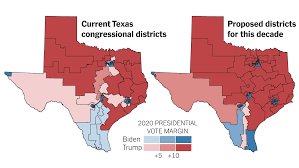
Politico, In blow to Trump, federal judges block new Texas congressional map, Andrew Howard and Josh Gerstein, Nov. 18, 2025. The decision is a massive blow in the White House’s push to redistrict across the country.
A panel of federal judges has blocked Texas’ newly redrawn congressional map — which made five districts in the state more favorable to Republicans — saying the plan appeared to be an illegal race-based gerrymander.
In a 2-1 ruling, the court ordered Texas to rely instead on the boundaries legislators drew in 2021. The new map, the majority concluded, appears likely to be unconstitutional and was drawn at the urging of the Trump administration.
“The map ultimately passed by the Legislature and signed by the Governor — the 2025 Map — achieved all but one of the racial objectives that DOJ demanded,” U.S. District Judge Jeffrey Brown, a Galveston-based Trump appointee, wrote for the panel majority.
The decision is a massive blow in the White House’s push to redistrict across the country. Texas’ five-seat map represented the biggest gains for the GOP through redrawing. Republicans are expected to immediately appeal the ruling to the Supreme Court.
Brown was joined by U.S. District Judge David Guaderrama, an El Paso-based Obama appointee. Fifth Circuit Court of Appeals Judge Jerry Smith, a Houston-based Reagan appointee, dissented but did not immediately release an opinion explaining his reasoning.
The majority repeatedly derided the Justice Department’s effort to goad Texas into targeting the four districts with non-white majorities — known as “coalition districts.” That effort, Brown said, began on July 7, with a letter from DOJ’s Civil Rights Division that was “challenging to unpack … because it contains so many factual, legal, and typographical errors.”
According to the court, the letter selected the four districts “based entirely on their racial makeup” and was the key factor that spurred Texas Republicans to take up the extraordinary redistricting effort. The bulk of Brown’s 160-page opinion delves into the mindset of the state lawmakers and advisers who drew the new maps, suggesting that their motives clearly aligned with DOJ’s race-based push and that their characterization of the new maps as based only on race-blind partisanship were not believable.
The White House and Justice Department did not immediately respond to a request to comment.
Texas Gov. Greg Abbott’s office, in a statement, pushed back against the ruling and suggestion that the newly drawn maps are unfair or biased.
“Any claim that these maps are discriminatory is absurd and unsupported by the testimony offered during ten days of hearings,” he stated. “This ruling is clearly erroneous and undermines the authority the U.S. Constitution assigns to the Texas Legislature by imposing a different map by judicial edict. The State of Texas will swiftly appeal to the United States Supreme Court.”
The court also downplayed the notion that scrapping Texas’ new maps would lead to chaos in the midterm elections. Though the judges acknowledged that it would scramble the calculus of some candidates who had announced their bids for office based on the new maps, they said filing deadlines had not yet elapsed.
“Simply put, the 2026 congressional election is not underway,” Brown wrote. “In any event, any disruption that would happen here is attributable to the Legislature, not the Court. The Legislature—not the Court—set the timetable for this injunction. The Legislature—not the Court—redrew Texas’s congressional map weeks before precinct-chair and candidate-filing periods opened. The State chose to ‘toy with its election laws close to’ the 2026 congressional election, though that is certainly its prerogative.”
The state’s candidate filing deadline is rapidly approaching: Dec. 8. Courts and state election officials are generally hesitant to move deadlines, but they can if necessary.
Two other states — Missouri and North Carolina — have passed maps that net Republicans one red-leaning seat each. And in Ohio, which was legally required to redraw its maps this year, Republicans and Democrats cut a deal that made two Democratic-held seats redder, but Democrats insist both will remain competitive in 2026.
Democrats have also filed legal challenges in North Carolina and Missouri, and they have long prioritized the courts as a way to stop Republican gerrymandering efforts.
Without the Texas map in place, Democrats’ five-seat pickup in California through Proposition 50 fully thwarts the GOP’s gains so far, though other red states are still being pressured by the White House to take up the issue ahead of next year’s midterms.
The decision is likely to put even more pressure on Indiana Republicans, who are being asked to draw a new map that would give the GOP two more red-leaning districts. So far, Indiana GOP Senate President Pro Tempore Rodric Bray has resisted calls to alter maps in the state, making a path forward very difficult for the redistricting effort.
Lawmakers in the Hoosier State are already facing threats of primaries from the White House after Bray said his caucus did not have the votes to pass a new map, and President Donald Trump said Republican Gov. Mike Braun “must produce on this” in a social media post Tuesday.
The ruling in Texas is the latest in a saga that took the summer by storm, when Texas Democrats decamped from the state in an effort to stop the new map from being passed.
New York Times, Summers, ‘Ashamed’ Over Epstein Ties, Steps Back From Public Commitments, Vimal Patel, Updated Nov. 18, 2025. New emails showed that Lawrence H. Summers, a former Harvard president, had stayed in touch with Jeffrey Epstein for years after Mr. Epstein faced sex trafficking charges.
Lawrence H. Summers, right, Harvard’s former president and a former Treasury secretary, said Monday that he would be stepping back from public commitments following the release of emails between him and Jeffrey Epstein, a convicted sex offender.
“I am deeply ashamed of my actions and recognize the pain they have caused,” Mr. Summers said in a statement Monday. “I take full responsibility for my misguided decision to continue communicating with Mr. Epstein.”
Mr. Summers added that he would continue teaching as an economics professor at Harvard, though he did not specify which public commitments he would be stepping back from. But the Yale Budget Lab said Mr. Summers has indicated he would be withdrawing from his role in its advisory group. And a spokeswoman for the Center for American Progress, a left-leaning think tank, said he would be ending his fellowship there immediately.
The relationship between Mr. Summers and Mr. Epstein was previously known. Mr. Summers had sought money from Mr. Epstein for a poetry foundation led by his wife, Elisa New, an emerita Harvard literature professor.
 But emails released last week showed a cozier relationship that included Mr. Summers seeking romantic advice and trading banter with Mr. Epstein over several years. The communications stretched to 2019, long after Mr. Epstein had pleaded guilty in 2008 to charges related to soliciting a minor for prostitution. In 2018, The Miami Herald published a deeply reported article about Mr. Epstein’s abuse of young girls. Mr. Epstein died while in custody in 2019, which was ruled a suicide.
Harvard did not respond to a request for comment.
Earlier on Monday, Senator Elizabeth Warren of Massachusetts, right, had called on Harvard and other institutions to sever their relationship  with Mr. Summers.
“For decades, Larry Summers has demonstrated his attraction to serving the wealthy and well connected, but his willingness to cozy up to a convicted sex offender demonstrates monumentally bad judgment,” Ms. Warren, a former Harvard Law School professor, said in a statement on Monday, which was first reported by CNN.
“If he had so little ability to distance himself from Jeffrey Epstein even after all that was publicly known about Epstein’s sex offenses involving underage girls, then Summers cannot be trusted to advise our nation’s politicians, policymakers and institutions — or teach a generation of students at Harvard or anywhere else.”
Others also criticized the relationship. The Revolving Door Project, a watchdog group, called on prominent institutions to cut their ties with Mr. Summers, including Harvard, OpenAI, Bloomberg and The New York Times. (Mr. Summers is a contributing writer for the Times Opinion section.)
On Friday, President Trump, under fire for his own ties to Mr. Epstein, said he would direct his administration to investigate the financier’s connections to Democrats, including Bill Clinton and Mr. Summers, “to determine what was going on with them.”
Mr. Clinton has denied having a close relationship with Mr. Epstein. In 2019, his office said Mr. Clinton had not spoken to Mr. Epstein in more than a decade. Mr. Trump was friendly with Mr. Epstein for at least 15 years, but said they later became rivals in a real estate battle.
The latest emails were part of a trove of more than 20,000 pages of documents released by House Republicans.
New York Times, Trump Administration Live Updates: House Expected to Vote to Release Epstein Files, Staf Reports, Nov. 18, 2025. Where Things Stand
Emptywheel, Analysis: OPERATION ‘GET COMEY’ ON THE ROCKS, (Marcy Wheeler, right), Nov. 18, 2025. Lindsey Halligan, above, may have come into the job of acting U.S. attorney for Eastern Virginia as an insurance lawyer with zero prosecutorial experience. But what she lacked in polish she was supposed to make up for with total loyalty to the president and steely devotion to the project of punishing his enemies with criminal charges.
There’s just one problem: It turns out total loyalty and steely devotion may not be enough to get the charges to stick.Politico reports that “a cascade of apparent errors” in Halligan’s prosecution of former FBI Director James Comey, right, has led to a remarkable rebuke from the federal judge overseeing the case:
The magistrate judge, William Fitzpatrick, ordered prosecutors Monday to quickly turn over records of secret grand jury proceedings to defense attorneys as they seek to dismiss the false-statement and obstruction-of-Congress charges pending against Comey in federal court in Alexandria, Virginia.
“The Court recognizes this is an extraordinary remedy,” Fitzpatrick wrote in a 24-page opinion, “but given the factually based challenges the defense has raised to the government’s conduct and the prospect that government misconduct may have tainted the grand jury proceedings, disclosure of grand jury materials under these unique circumstances is necessary.”
It’s amazing how many rakes Halligan has managed to step on already in her short time on the job.
 When Letitia James, right, submitted her vindictive and selective prosecution motion on November 7, DOJ’s efforts to cover up Bill Pulte’s FHFA shenanigans got relegated to a footnote in the section in the request for discovery.
The current record of “outrageous conduct” is more than sufficient to dismiss this indictment. But even if this Court finds that AG James should be required to point to more to meet her burden to prove outrageous government conduct, the basis for discovery and an evidentiary hearing has been well established. The facts outlined above merit, at the very least, fulsome discovery into the government’s conduct in bringing this case, including all communications among and between President Trump, AG Bondi, Ms. Halligan, Mr. Martin, Director Pulte, and their staffs regarding AG James.
That comes, of course, mere weeks after Judge Jamar Walker ordered a litigation hold in response to Lindsey Halligan’s stalking of Anna Bower.
And yet James may have to follow up on that order, given a letter from Jamie Raskin to Eagle Ed Martin demanding that he stop using Signal chats to weaponizing government against Trump’s adversaries.
My staff have received credible allegations that you have been using personal devices, platforms, and applications that do not adhere to federal laws and DOJ policies regarding records retention to conduct official DOJ business. This deliberate evasion of relevant rules of record retention appears to be part of an effort to conceal the Weaponization Working Group’s activities and your own conduct. Such conduct violates not only the Federal Records Act (FRA) and DOJ policy but also potentially relevant criminal statutes.4
The FRA requires all federal agencies and their employees to “make and preserve records containing adequate and proper documentation of the organization, functions, policies, decisions, procedures, and essential transactions of the agency.”5 This obligation applies to all recorded information, “regardless of form or characteristics.”6 DOJ policies reinforce these statutory requirements. DOJ Policy Statement 0801.04, for instance, states that personal email and other electronic accounts should not be used for DOJ business except under “exigent circumstances,” and when used, employees must comply with FRA requirements by forwarding communications to official accounts.7
Instead of preserving those records, however, you are reportedly concealing and potentially destroying them. As you are well aware, as one of America’s top-ranking federal lawyers charged with supervising enforcement of these laws, you are obligated to follow the law yourself and preserve messages related to your DOJ work in the official DOJ systems. Your purported failure to do so is not only illegal but it also suggests that you are knowingly covering up incriminating conversations that you need to keep off the books.
It’s unlikely that Lindsey’s single Loaner AUSA will ever be able to prove the case against James, 2TB of data and all.
But along the way, she and her co-conspirators are leaving a trail of corruption and crime a mile wide. They’re doing it in the same courthouse where Lindsey the Insurance Lawyer’s conduct is already the focus of scrutiny.
Trump’s DOJ won’t prosecute this, and Trump will pardon all of his minions at some point. But they decided to perform their corruption for judges, and that may not work out the way they want.
Global News
New York Times, Investigation: Recycling Lead for U.S. Car Batteries Is Poisoning People, Peter S. Goodman, Will Fitzgibbon and Samuel Granados, Visuals by Finbarr O’Reilly and Carmen Abd Ali, Nov. 18, 2025. This is what the auto industry wants people to see: sparkling factories turning reclaimed lead into batteries for Ford, Toyota, GM and the rest. But in Africa’s lead recycling capital, reality looks very different.
Factories are poisoning people. We know because we tested them.
This dirty lead goes into American cars.
Poisonous dust falls from the sky over the town of Ogijo, near Lagos, Nigeria. It coats kitchen floors, vegetable gardens, churchyards and schoolyards.
The toxic soot billows from crude factories that recycle lead for American companies.
With every breath, people inhale invisible lead particles and absorb them into their bloodstream. The metal seeps into their brains, wreaking havoc on their nervous systems. It damages livers and kidneys. Toddlers ingest the dust by crawling across floors, playgrounds and backyards, then putting their hands in their mouths.
Lead is an essential element in car batteries. But mining and processing it is expensive. So companies have turned to recycling as a cheaper, seemingly sustainable source of this hazardous metal.
As the United States tightened regulations on lead processing to protect Americans over the past three decades, finding domestic lead became a challenge. So the auto industry looked overseas to supplement its supply. In doing so, car and battery manufacturers pushed the health consequences of lead recycling onto countries where enforcement is lax, testing is rare and workers are desperate for jobs.
Seventy people living near and working in factories around Ogijo volunteered to have their blood tested by The New York Times and The Examination, a nonprofit newsroom that investigates global health. Seven out of 10 had harmful levels of lead. Every worker had been poisoned.
Dust and soil samples showed lead levels up to 186 times as high as what is generally recognized as hazardous. More than 20,000 people live within a mile of Ogijo’s factories. Experts say the test results indicate that many of them are probably being poisoned.
Lead poisoning worldwide is estimated to cause far more deaths each year than malaria and H.I.V./AIDS combined. It causes seizures, strokes, blindness and lifelong intellectual disabilities. The World Health Organization makes clear that no level of lead in the body is safe.
The poisoning of Ogijo is representative of a preventable public health disaster unfolding in communities across Africa. One factory’s lead soot falls onto tomato and pineapple farms near a village in Togo. Another factory has contaminated a soccer field in Dar es Salaam, Tanzania’s largest city. In Ghana, a recycler melts lead next door to a family’s chicken coop.
Factories in and around Ogijo recycle more lead than anywhere else in Africa. The United States imported enough lead from Nigeria alone last year to make millions of batteries. Manufacturers that use Nigerian lead make batteries for major carmakers and retailers such as Amazon, Lowe’s and Walmart.A girl jumps over a ditch in an open field
The auto industry touts battery recycling as an environmental success story. Lead from old batteries, when recycled cleanly and safely, can be melted down and reused again and again with minimal pollution.
But companies have rejected proposals to use only lead that is certified as safely produced. Automakers have excluded lead from their environmental policies.
Battery makers rely on the assurances of trading companies that lead is recycled cleanly. These intermediaries rely on perfunctory audits that make recommendations, not demands.
The industry, in effect, built a global supply system in which everyone involved can say someone else is responsible for oversight.
Nigeria, the economic engine of West Africa, is among the fastest-growing sources of recycled lead for American companies.
More On U.S. Immigration, Law, Crime, Justice
Popular Information, Accountability Journalism: EXCLUSIVE: How the Trump administration sparked a health crisis for ICE detainees, Judd Legum, right, and Noel Sims, Nov. 18, 2025. An abrupt decision on October 3 left thousands of ICE detainees without access to vital medical care — a crisis that is ongoing.
For more than two decades, the Department of Veterans Affairs (VA) played a limited but essential role in ensuring that people in the custody of Immigration and Customs Enforcement (ICE) received necessary medical care. When an ICE detainee needed medication or medical treatment outside ICE facilities, the VA Financial Services Center processed those claims for reimbursement. ICE paid the VA to provide this service, so that no resources were diverted from veterans.
But then, according to previously unreported ICE documents, the VA “abruptly and instantly terminated” its agreement with ICE on October 3. According to the partially redacted documents, which were quietly posted to a government contracting website on November 12, the termination left ICE with “no mechanism to provide prescribed medication” and unable to “pay for medically necessary off-site care.” Among the services ICE said it could not provide were “dialysis, prenatal care, oncology, [and] chemotherapy.”
The situation was described by ICE as an “absolute emergency” that needed to be resolved “immediately” to “prevent any further medical complications or loss of life.” The documents detailed the justifications for why ICE was seeking no-bid contracts to replace the services previously provided by the VA. According to government contracting records, ICE signed two no-bid contracts on October 25. However, the ICE Health Service Corps website indicates that the new systems are not yet functioning and cannot yet process claims. Providers are instructed to “hold all claim submissions while we work to bring the new system online.” In the interim, it is unclear how or if ICE detainees are receiving medication or obtaining outside medical care. According to a federal class action lawsuit filed on behalf of detainees in California, numerous ICE detainees have not been receiving medically necessary care since October 3.
The lawsuit, filed on November 12, involves the treatment of detainees at the California City Detention Facility in the Mojave Desert. The lawsuit alleges that since Fernando Gomez Ruiz, a plaintiff in the lawsuit, arrived at the facility in mid-October, “he has been denied regular doses of insulin, leading to elevated blood sugar levels and a large, oozing ulcer on the bottom of his foot.” According to the complaint, Gomez Ruiz “has also been denied proper wound care for his ulcer, which he is forced to cover with soiled bandages and bloody shoes.”
Another plaintiff in the lawsuit, Fernando Viera Reyes, has prostate cancer but claims he “has not seen a urologist or received the testing urgently needed to diagnose and treat his condition.” Viera Reyes, according to the complaint, is “bleeding with urination” and believes “his cancer may have metastasized while he has been waiting for an appointment.”
Yuri Alexander Roque Campos arrived at the California City Detention Facility in September. Since then, the lawsuit alleges, he “has been denied his heart medications for days at a time.” The lawsuit says that Roque Campos’ inability to obtain heart medications has resulted in several seizures but he “has yet to see a cardiologist.”
Another class action lawsuit filed on October 30 regarding conditions at an ICE facility in Broadview, Illinois, describes similar incidents. The complaint alleges detainees “lack access to adequate medical care, even for pre-existing medical conditions.” Further, ICE often does “not provide detainees with prescription medication.”
One plaintiff, Claudia Carolina Pereira Guevara, who came to the Broadview facility on October 2, said she woke up one morning vomiting and “numb from the waist down.” According to Guevara, despite her condition, officers at the facility “refused to take me to see a doctor or to the hospital.”
These are precisely the sort of life-threatening situations that ICE warned would result from the VA’s termination of the agreement.
ICE and the VA did not respond to a request for comment.Why did the VA terminate its agreement with ICE?
In 2023 and 2024, many Republican officials criticized the VA’s agreement with ICE, falsely claiming that the Biden administration diverted resources from veterans to undocumented immigrants. In reality, ICE fully compensated the VA, and the system was implemented by the George W. Bush administration and maintained during Trump’s first term.
The controversy over the arrangement between ICE and the VA began when Sen. Tommy Tuberville (R-AL) and Rep. Mike Bost (R-IL) introduced the No VA Resources for Illegal Aliens Act in December 2023. The bill aimed to “prohibit the Secretary of Veterans Affairs from providing health care to, or engaging in claims processing for health care for” undocumented immigrants.
Ultimately, the bill never made it out of committee in either chamber of Congress, but its sponsors took the opportunity to accuse then-President Joe Biden of prioritizing immigrants over veterans. Tubberville said Biden was “robbing veterans to pay off illegals.” Bost said, “Biden’s failed border policies have created a humanitarian and national security crisis. Now it appears he’s taking resources away from our veterans to facilitate healthcare for illegal migrants.” Democratic officials were critical of the bill and of the claims Republicans were making, calling it “intentional conflation and opportunistic messaging.”
The effort also received coverage from prominent right-wing outlets like the New York Post and Fox News.
On August 12, 2024, the Daily Signal, a publication founded by the Heritage Foundation but now nominally independent, published a podcast featuring Army veteran Derick Carver. In the podcast, Carver claimed that “the VA was caught moving processors from the VA to support [ICE] processing detainee medicals.” Carver, a fellow at the Heritage Foundation, claimed “the care that the detainees are getting is better than a lot of what the veterans are getting.”
A week later, the Center to Advance Security in America (CASA), a small right-wing non-profit, submitted two FOIA requests related to Carver’s claims.
But after Trump was elected in November 2024, concerns about the VA’s small role in ensuring ICE detainees receive medical treatment were more muted. Republicans largely stopped mentioning the issue, and Trump continued to use the VA to process reimbursement claims for ICE detainees.
Then, on September 30, 2025, CASA filed a lawsuit against the VA, claiming that it had never received a substantive response to its FOIA request. Three days later, apparently without any warning or contingency plans in place, the VA ended its agreement with ICE.
The CASA lawsuit was covered exclusively by the Daily Signal. In the article, VA press secretary Pete Kasperowicz told the Daily Signal that during the Biden administration, “VA was focused on all sorts of completely unnecessary activities, such as helping Veterans attempt to change their sex and processing health care claims for illegal immigrants.” But, Kasperowicz emphasized, “[u]nder President Trump, the department has abandoned these radical liberal priorities.”
Kasperowicz did not mention that the VA abruptly stopped processing health care claims for ICE just three days earlier, with no contingency plans or regard for the human impact of the decision.
New York Times, Under Trump, Immigrants Are More Fearful but Determined to Stay, Poll Finds, Luis Ferré-Sadurní, Ruth Igielnik and Ana Ley, Graphics by Ashley Cai, Nov. 18, 2025.A national survey found that half of all immigrants in the United States say they feel less safe since President Trump took office. Still, many say their future remains bright.
As the Trump administration seeks to remake the immigration system and deports tens of thousands of people, many immigrants are more scared about living in the United States, and yet their resolve to remain here is largely unchanged.
A new national survey of immigrants in the country — both documented and undocumented, and varying widely in how and when they arrived — found that about half of all immigrants say they feel less safe since President Trump took office. The survey was done by The New York Times and KFF, a nonprofit that conducts polling and research about health policy.
Among the immigrants surveyed — whether they are here legally or not, or have been naturalized as citizens — concern that they or a family member could be detained or deported has risen significantly since before Mr. Trump’s return to power.
Still, large majorities also say their own future, and that of their children, remains bright, with the concept of the American dream retaining its powerful appeal. About 70 percent said that if they could go back in time, they would still make the choice to migrate to the United States.
The survey captured a snapshot of immigrant life against a backdrop of enormous change in the United States, with many people standing by their choice to come — sometimes illegally — even as their image of the country as a welcoming place has been shaken. Immigrants feel that, across every measure, they are better off in the United States compared with the living conditions that propelled them to leave their homelands.
The survey, of 1,805 immigrants across the country, is a broad look at a group for which there is often very little data to understand their views and experiences, given that the U.S. Census Bureau does not ask specifics about immigration status. The group is also a small share of the population and too difficult to reach to be measured with accuracy by most surveys.
[Read more about how this survey was conducted here and see all the questions that were asked here.]
The poll reflected the breadth of immigrants in the United States, including a significant share who find Mr. Trump’s immigration policies “necessary” and some who are “proud” of increased enforcement.
For many Americans, the archetype of an immigrant may be someone who has recently arrived in the country. But a vast majority of immigrants living in the United States — more than 70 percent — have been in the country for 10 or more years, according to the available data from the Census Bureau. A little more than half are U.S. citizens, and 53 percent say they speak English exclusively or at least very well.
Emptywheel, Analysis: The United States Can't Afford the Opportunity Cost of Stephen Miller's Bigotry, Emptywheel (Marcy Wheeler, right), Nov. 18, 2025. Americans can't have nice things -- the nice things they used to have -- because Republicans in Congress gave much of money spent on government employees who give you nice things and instead gave it to Stephen Miller to spend on snatching your neighbor.
HuffPo had a story describing how Trump has hired 50,000 new people while firing a bunch more in the parts of government that make your lives better,
The U.S. government has hired 50,000 employees since President Donald Trump took office, his top personnel official said, with the new staff largely in national security positions reflecting the administration’s policy focus.
The bulk of the new hires, reported first by Reuters, work at Immigration and Customs Enforcement, said Scott Kupor, the federal government’s human resources director, in an interview on Thursday night.
The staff changes are part of Trump’s campaign to recast the government while sharply cutting other federal jobs.
“It’s about reshaping the workforce to focus on the priorities that we think are most important,” Kupor said.
The administration brought on the new employees while freezing hiring and laying off workers in other parts of the government, such as the Internal Revenue Service and the Department of Health and Human Services.
The administration expects to shed about 300,000 workers this year, Kupor said in August.
Meanwhile, the Daily Beast has yet another story about the continued shitshow of the effort to expand Kristi Noem’s goon squad, this time with the price tag associated with getting people to do such morally repugnant work.
DHS insiders said the money on offer has lured back former executive-level leaders from HSI and Enforcement and Removal Operations (ERO)—with some of them taking home north of $250,000 for office-based shiftwork, per multiple sources who spoke to the Beast.
According to those familiar with the packages, the most senior HSI rehires return as GS-13s on the federal pay scale. With locality pay in high-cost areas—such as parts of Texas, California, and New York—adding 35 percent or more to a basic salary, agents can earn up to $137,000 in the majority of the country. This rises to $171,268 in more expensive parts of the country, such as San Jose and San Francisco.
Law Enforcement Availability Pay (LEAP) adds a further 25 percent for being available for substantial unscheduled duty beyond 40 hours. Add in ongoing federal pensions worth around $8,000–$9,000 a month, and some rehires can land well in excess of a quarter of a million annually, sources said.
50,000 ICE goons in, 300,000 people out, including people who cure cancer, help learning disabled kids get through school, protect our National Parks, ensure your Social Security comes on time, and care for veterans.
After I pointed this out, Christopher Ingraham did a handy graphic to show the trade-off.
Stephen Miller’s dragnet is unpopular in the abstract and wildly unpopular in the lived sense, even — if meekly — among local Republican leaders.
But it still retains support of a big chunk of the population, probably because Trump officials routinely blame their own failures to address American problems on migrants, when as often as not, Trump’s response to immigration is the source of the problem.
America can’t have nice things, like cures for cancer and welcoming public schools, because Republicans in Congress took the money used to pay for those things and gave it to Stephen Miller to use to invade America’s neighborhoods.
We need to start making that more obvious.
Emptywheel, Analysis: Trump Trips over Own Feet Hastening Parallel Retreats, Emptywheel (Marcy Wheeler, right), Nov. 18, 2025.
It is official conventional wisdom. Trump is retreating on Jeffrey Epstein.
But it’s important to note that these retreats are happening in parallel, not least because tariffs are one area where Republicans have always agreed with Democrats, even while hoping someone else would make the problem go away.
More On Trump-Epstein Scandals
The Contrarian, Opinion: Words & Phrase We Could Do Without, Jennifer Rubin, right, Nov. 18, 2025. The Epstein scandal...er...Trump coverup scandal.
Last week, the “Epstein scandal” took center stage once again. But that terminology is such an antiseptic way to describe the fallout from a pedophile ring that victimized hundreds of children and Donald Trump’s gob-smacking efforts to cover up the extent of his relationship with Jeffrey Epstein and his accomplice Ghislaine Maxwell.
Moreover, the present scandal is not about Epstein, but rather about other men who may be named in the documents, the financial institutions that enabled Epstein, and most of all, Trump’s role in perpetuating the conspiracy of silence and non-accountability.
After three especially incriminating emails were released last week, Trump’s refusal to come clean by immediately releasing all documents—and the House Republicans willingness to condone a cover-up—reminded Americans how thoroughly Trump has corrupted the normal operation of government.
“The emails were turned over to the committee in response to a set of subpoenas Democrats effectively forced Republicans to issue for files related to Mr. Epstein,” the New York Times reported. “So far, the Justice Department has provided the panel with little that was not already public. Democrats and a few Republicans have been pressing for a far broader set of disclosures from the administration’s Epstein investigation, a move that Mr. Trump and G.O.P. leaders in Congress vehemently oppose.” In other words, Trump’s cover-up continues with the full acquiescence of the MAGA flunkies in Congress.
Julie K. Brown, the Miami Herald reporter who spent years investigating Epstein and the lack of robust investigation of his far-flung criminal enterprise, has remarked that even she was surprised by how frequently Trump’s name came up in the trove of documents. She and her fellow Miami Herald reporters recounted, “Trump and his acolytes promised transparency of Epstein’s crimes and his accomplices, and said he would release all the government files on the various investigations conducted over the years prior to his election. However, shortly after he was elected, Trump’s attorney general, Pam Bondi, and his FBI director, Kash Patel, abruptly changed their minds – effectively closing the files.” The coverup was in full swing. Should we believe Bondi that the documents reveal no “credible” evidence of other crimes? What about other people’s (e.g., her boss’s) knowledge of crimes?
Brown has also zeroed in on the regime’s bizarre treatment of the convicted sex offender. “What does she know? Who is she talking to? Why is she getting this?” Brown said in a recent interview. “As journalists, we try to find patterns and things that try to tie things together. And one of the things that ties this together are some of these leaks—by the way, the majority of which happened when she got transferred to this Club Fed.”
The list of questions grows by the day:
On Friday, Trump “demanded that the Justice Department investigate a list of powerful men mentioned in the emails, his own name was nowhere to be seen — he had singled out only Democrats.” That panicked, poorly reasoned response only underscores the depth of his corruption.Subscribed
Democrats are more than happy to see everyone investigated. Moreover, Trump’s refusal to name Republicans only underscores his desperation to protect himself and his “side,” and of course underscores his pattern of vindictive investigations and prosecutions.
The New York Times was bluntly unimpressed with Trump’s transparent dodge. “Mr. Trump’s response to this week’s Epstein revelations was the reprise of a deflective tactic he has often deployed in instances of crisis: When the spotlight begins to burn, Mr. Trump deflects, points fingers or changes the conversation. He even tries to pull his adversaries, often one of the Clintons, into the scene with him—then he exits stage right.”
The mere whiff of any association of a president with a pedophile ring, let alone refusal to come clean on all documents regarding that association, would in any normal administration unleash at the very least a firestorm from the press, demands for a special counsel (who trusts Bondi or anyone she handpicks to ensure all documents are released?), and cries for Bondi to resign. If Trump has lied about his association with Epstein, ordered Blanche to try to silence Maxwell or cut a deal with her, or instructed the Justice Department to withhold documents from congressional demands, shouldn’t that be grounds for impeachment?
The House is likely to vote (with dozens of Republicans in favor) on the discharge petition to release the documents. Then the scene shifts to the Senate. What possible excuse could there be for not bringing it to the floor? Until Majority Leader John Thune does so, Senate Democrats should hold the floor for as long as they can, perhaps reading into the record all 20,000 or so documents dumped last week. Certainly, those interested in full disclosure and justice for the victims will force Republicans take the vote, and hold them accountable if they continue the coverup.
This is why “Epstein scandal” is an entirely inapt description of what we are facing. The shorthand minimizes the underlying, horrific criminal enterprise, airbrushing out the victims and their quest for justice. It shields Trump, Bondi, and the entire Justice Department from the appropriate level of scrutiny. And it lessens pressure on congressional Republicans to distance themselves from this travesty and conduct a full investigation. Worst of all, it treats Trump as a bystander.
We should stop using the euphemism for an unspeakable crime and its vile, corrupt cover-up. This is the Trump pedophile document coverup.
Letters from an American, Historical Commentary: November 17, 2025 (Monday) [], Heather Cox Richardson, right, Nov. 18, 2025. President Donald J. Trump spent the weekend flooding social media with posts claiming that his economic policies are working and that his 34 felony convictions and the investigations into his 2016 campaign’s ties to Russian operatives were illegitimate, and posting angrily about those people calling out his association with Jeffrey Epstein.
He even reposted a statement from one of his own lawyers saying, “If Jeffrey Epstein had any dirt on Donald Trump, he would have had great leverage in the criminal case against him at the time he died,” which perhaps conveys a different message than he intended.
Then, after fighting furiously against the upcoming House vote over releasing the Epstein files the FBI collected as part of its investigation into the convicted sex abuser, at 9:15 p.m. last night Trump abruptly reversed course, saying that House Republicans should vote in favor of releasing the files “because we have nothing to hide.” “I DON’T CARE!” he posted.”
But of course, he does care, as is evident from how deeply he fought the release of the files the FBI collected during its investigation of Epstein right up until the final signature on the House discharge petition that would force the House to vote on a measure to require the Justice Department to release the files. As Meredith Kile of People magazine reported, when a female Bloomberg reporter at a press gaggle aboard Air Force One November 14 asked him if there was anything “incriminating” in the Epstein files, he pointed a finger in her face and said: “Quiet! Quiet, Piggy.”
In the hours before House speaker Mike Johnson (R-LA) swore in Representative Adelita Grijalva (D-AZ) at 4:00 on Wednesday, Trump and his loyalists worked to pressure Representative Lauren Boebert (R-CO) to remove her name from the discharge petition. She refused. As soon as Johnson swore her into office, Grijalva signed the petition, teeing up a vote on a bill requiring the release of the files.
On Thursday, November 13, the people behind the White House social media account seemed to be trying to combat the Epstein story by pushing the image of Trump as a happily married family man. The account posted an image of Trump and First Lady Melania Trump listening to the U.S. Marine Band and chatting, then a video of Trump behind the Oval Office desk, giving a medallion and a pen each to four small children. The caption read, “The best president,” with a heart emoji.
On Friday, November 14, the White House social media account posted an image of Trump and the First Lady embracing under the caption “I can’t help falling in love with you,” along with an emoji of musical notes and a heart. On Sunday, November 16, it posted a picture of the two of them striding toward the cameras holding hands, under the caption “America’s power couple,” with an eagle and an American flag emoji.
That Trump’s hand is weakening showed on Friday, when the leader of the Indiana Senate announced that it would not hold a meeting  in December to gerrymander all nine of Indiana’s districts to favor Republicans. Currently, the Indiana delegation to the House of Representatives has seven Republicans and two Democrats. Trump and Indiana governor Mike Braun have put great pressure on the legislature to redistrict, but even though Republicans hold a supermajority in the Indiana legislature, not enough Republican senators are willing to face the anger of voters to back the plan.
Then, over the weekend, rumors spread that as many as 100 House Republicans would vote in favor of the measure. Their constituents are eager for the release of the files, which Trump promised on the campaign trail, and the material already released from the Epstein estate has been damaging enough that representatives have reason to worry whether the material in the FBI files is even worse, leaving them in the position of having defended that behavior if they continue to cover it up. On Sunday, Representative Thomas Massie (R-KY) told Jonathan Karl of ABC News’s This Week that he was hoping to get a veto-proof majority in favor of the release.
The signs were clear: Trump had lost control of the House Republicans.
This is a big deal. The public outrage over ABC’s suspension of comedian Jimmy Kimmel’s show in September demonstrated in a much more public way than court losses had that the administration was not all-powerful. That outcry forced first ABC’s parent company, Disney, and then broadcast station owners Nexstar Media Group and Sinclair Broadcast Group to backtrack and to reinstate Kimmel’s show.
While individual Republican lawmakers have groused about one or another of the administration’s actions, only a few have broken with Trump. He has generally been able to command loyalty by threatening to sic his supporters on those who step out of line and by warning that he will support primary challengers against them. Notably, over the weekend he hammered at one of those lawmakers, his former loyalist Representative Marjorie Taylor Greene (R-GA), calling her a traitor, “wacky,” and a “ranting Lunatic.” He said he was withdrawing his endorsement of her and would support another Republican to replace her.
His usual threats didn’t work; dozens of House Republicans still said they were going to vote in favor of releasing the Epstein files. So to get back in front of the party, Trump suddenly called for lawmakers to pass the measure, later telling reporters he would sign it if it came to his desk. Lawmakers who just hours before had maintained they would vote no suddenly switched to yes, indicating that Trump still commands many of them.
But his change in direction makes it far more likely senators, too, will vote to pass the bill. Tonight Trump loyalist Senator Tommy Tuberville (R-AL) said he would vote for the measure, likely realizing a vote against it will hurt him in his upcoming campaign for governor, which is quite something considering Alabama’s previously strong support for Trump.
Don’t hold your breath for the release of the files, though: Trump’s post saying he didn’t care about the release included the qualification that “the House Oversight Committee can have whatever they are legally entitled to,” suggesting he will continue his stonewalling with the help of the Department of Justice. Remember: all the congressional machinations are only to force the release of the files. He could release them himself any time he wanted to.
On Sunday, Trump posted angrily about the Indiana Republicans’ failure to do his bidding, calling those Republican opponents of redistricting “RINOs,” or Republicans in name only, and accusing them of “depriving Republicans of a Majority in the House, A VERY BIG DEAL!” He went on: “It’s weak ‘Republicans’ that cause our Country such problems—It’s why we have crazy Policies and Ideas that are so bad for America.” He blamed Braun for “not working the way he should to get the necessary Votes,” and said “Any Republican that votes against this important redistricting, potentially having an impact on America itself, should be PRIMARIED.” He singled out two senators—one of whom had not publicly said he opposed the bill—saying if they didn’t “DO THEIR JOB, AND DO IT NOW!..., let’s get them out of office, ASAP.”
Hours later, one of the senators was the victim of a “swatting” incident, in which the police department received an email falsely saying someone in the home had been harmed, a malicious action designed to prompt police to launch a massive response to a potentially dangerous situation, thus putting the victims in danger.
Trump seems to be losing his iron grip on the Republican Party. Although Steve Peoples of the Associated Press reported yesterday that White House officials and other Washington, D.C., leaders say there is no affordability problem in the country, Trump is popular, and the way to win in 2026 is to stick with him, not everyone is so sure, especially after the party’s big losses earlier this month in elections across the country.
On Monday, November 11, Fox News Channel personality Laura Ingraham pushed Trump on issues that have cost him support. Although consumers have expressed concern over rising prices, Trump insisted prices are “way down.” Ingraham asked: “Are you saying voters are misperceiving how they feel?” She took on the administration’s recent call to address housing costs by issuing 50-year mortgages, noting that the proposal “has enraged your MAGA friends,” who recognize that such a mortgage would benefit banks over buyers and nearly double the time it would take for Americans to own a home.
“Don’t forget, MAGA was my idea,” Trump defended himself. “MAGA was nobody else’s idea. I know what MAGA wants better than anybody else, and MAGA wants to see our country thrive.”
Yesterday Trump defended right-wing podcaster Tucker Carlson, who has been under fire for his interview platforming white nationalist Nick Fuentes. Fuentes traffics in racism and sexism and has openly admired Hitler, insisting that many of the Republicans currently in office are too moderate. When the head of the Heritage Foundation, once thought of as the intellectual heart of the modern Republican Party, supported Carlson, at least six people resigned from the foundation, expressing dismay at the direction it was taking.
Today Representative Jared Golden (D-ME) announced that a bipartisan bill to repeal Trump’s executive order stripping the union rights from federal workers now has enough votes on a discharge petition to bring it before the House. Golden and Representative Brian Fitzpatrick (R-PA) introduced the bill in April, but Johnson refused to bring it up. In June, Golden launched a discharge petition to force it to the floor.
Democrats and three Republicans signed the petition, but it was still two votes short of adoption. Today, Republican lawmakers Nick LaLota and Mike Lawler of New York signed it, bringing the number of signatures on the petition to 218. Enough Republican members have joined with the Democrats to override Johnson and challenge Trump’s executive order.
New York Times, Trump Bows to Reality in Epstein Reversal, Beating a Rare Retreat, Annie Karni and Tyler Pager, Updated Nov. 18, 2025. Faced with a mass defection on a bill to demand the release of the Epstein files, the president rushed to avoid an embarrassing loss, suggesting a slip in his iron grip on the G.O.P.
President Trump denounced calls for the release of the Epstein files as a Democratic hoax. He dispatched aides to warn Republicans that backing it would be seen as a “hostile act.” He placed personal calls to those who dared to do so, and even dispatched his attorney general and F.B.I. director to meet with one in the White House Situation Room in efforts to get her to flip.
In the end, none of it worked. And on Sunday night, Mr. Trump did something he has rarely been forced to do: He caved in the face of pressure from his party and called on House Republicans to go ahead and back a bill that would order his Justice Department to release all of its investigative files on the convicted sex offender Jeffrey Epstein.
By Monday, he was saying, “Sure,” he would sign the legislation he has spent months trying to kill.
It’s not clear that doing so would have any concrete impact; Mr. Trump could have ordered the release of the files without an act of Congress, and has not. And it remains to be seen whether his Justice Department will ultimately release the files.
But his reversal has opened the floodgates of Republican backing for the bill, which is expected to come to a vote in the House as early as Tuesday and appears likely to pass unanimously. It has also raised questions about Mr. Trump’s ability to impose his will on Republicans and the nation, suggesting a slip in his iron grip on his party amid his falling polling numbers, rising prices and rifts within his political coalition.
For the first 10 months of his presidency, Mr. Trump has steered the narrative and bullied Congress into doing whatever he wanted with almost no pushback. But as Republicans gear up for midterm elections and some begin to plot a future after Mr. Trump, the Epstein episode is a rare instance in which he has lost control.
Morning Shots via The Bulwark, Political Opinion: MTG Won the Battle. Can She Win the War? Andrew Egger, Nov. 18, 2025. Can MTG Survive Our Strange New Respect?
So far, at least, it sure looks like Marjorie Taylor Greene’s winning her breakup with Donald Trump.
The president is running his usual playbook for slapping down internal enemies—the barrage of personal attacks, the accusations of sour grapes, the public brainstorming process for mean nicknames. But none of it seems to be having the usual effect. The shock-and-awe tactics are supposed to cow their target and set them crawling to Mar-a-Lago for forgiveness. But Greene seems unbothered. While Trump’s unsubtle declarations of open war against a Republican are supposed to function as marching orders for the broader MAGA base and Trump infotainment apparatus, Greene appears to be shielded by her own, hard-won MAGA cachet.
It is Trump, not Greene, who is beating a hasty retreat on the matter that sparked their fight in the first place. Despite his bullying, she has persisted in her support for releasing the full Epstein files, while he has been forced to pretend he suddenly supports it too, lest he suffer the embarrassment of seeing a huge swath of the House GOP vote to release them over his objections.
All these developments would have seemed impossible just a month or two ago. And it suggests that we may be witnessing a hinge point for MAGA, a motley coalition of groups that has long been held together only by the personal gravity of Trump. If Trump continues to falter, the power vacuum he will begin to create will be gargantuan. Plainly, Greene senses the opportunity to put herself forward as the leader of a possible successor faction. Well, so far so good for her.
But can it last?
Greene seems unambiguously to have won the early days of the fight. But those early victories may actually prove dangerous to her long-term chances, because she’s starting to get the strange-new-respect treatment from all the wrong people.
It’s a pattern we saw time and again in the first Trump term. Some Republican gets in a fight with Trump. Because Trump is the perpetual main character of our discourse, this fight shoves that Republican into the main-stage spotlight—maybe even into a spot on the January 6th committee. Suddenly they’re all over mainstream media, getting unusually sympathetic write-ups in the discourse and unusually charitable interviews from the establishment talking heads—perhaps about how they stood up to Trump’s efforts to steal the 2020 elections.
Compared to the MAGA crowd who’s by now beating that Republican silly online, the mainstream response seems downright warm and loving to the Republican who has “seen the light.” They get correspondingly less prickly in their own rhetoric, more prone to bromides about bipartisanship and so on.
But of course this usually ends up playing right into Trump’s hands. He understands deep in his lizard brain that his base’s central driving concern remains what it has always been: owning the libs. Any non-hostile interaction between an elected Republican and a hated outsider—Democrats, the media, whatever—is inherently, deeply suspicious. And Trump channels that suspicion straight back into his own quarrel with the Republican—look, all our mutual enemies are rallying around THEM! They were a RINO all along!
Greene now presents an interesting test case. She is no establishment politician. She never wore MAGA like a skinsuit. She has lived and breathed it for her entire political career. Will this give her the antibodies she needs to withstand this sort of attack?¹
She’d better hope so, because she doesn’t appear to be strategically triangulating away from this playbook in the slightest. The first few major interviews she’s done since her pivot seem like they could have been chosen specifically for their base-alienating properties: A panel on The View, followed shortly by a CNN interview with Dana Bash in which she apologized for her own history of wacky, stuntish behavior—the same behavior that made her a MAGA star in the first place. In that same interview, she spoke about “ending the toxic infighting in politics” and said Trump’s attacks were putting her life in danger.
In many ways, yes, she’s winning the breakup. But let me leave you with the top Breitbart comment on the writeup of Greene’s interview with Bash: “When you go on CNN crying about Trump, you get what you deserve.”
The Real Michael Cohen, Opinion: Rep. Plaskett Owes Americans the Truth, Michael Cohen, right, Nov. 18, 2025. Rep. Stacey Plaskett texting Jeffrey Epstein during a live congressional hearing proves the rot in politics where access, money, and loyalty matter more than morality, decency, or justice.
I’ve spent years trying to outrun a version of my story that was never fully mine to begin with; twisted, exaggerated, and weaponized by a government machine that doesn’t lose. A lot of what was said about me simply wasn’t true, but when you’re up against the United States government, truth becomes a technicality and survival becomes the only strategy. You don’t fight the system; you endure it. You absorb it. You crawl out of it. And even now, long after I’ve paid the price, I’m still dragging the weight of their narrative behind me like a sentence that never quite ends.
Maybe that’s why I’m still angry. Not because I refuse responsibility; believe me, I’ve taken more than my share, but because the people who demanded I tell the truth under oath are the same people now dancing around their own. The same politicians who held me up as a symbol of accountability have gone silent when confronted with their own moral rot. They used me when it suited their agenda, then disappeared the second my truth became inconvenient.
When Congress subpoenaed me, they expected a circus. They expected the former fixer to fold, take the Fifth, protect Donald Trump the way everyone assumed I still would. But instead, I told them everything; ugly, raw, humiliating truth laid out on national television. I didn’t hide behind lawyers. I didn’t claim privilege. I didn’t retreat into cowardice. I did what the law demanded of me, even though it destroyed my life and continues to do so.
And while I was testifying; while my entire world was being dissected in real time, something happened in that hearing room that is turning my stomach.
 Enter Congresswoman Stacey Plaskett, above. House member from the Virgin Islands.
A Democrat. A former prosecutor. A self-appointed guardian of morality. A woman people point to as some kind of ethical north star.
And also; let’s speak plainly, a recipient of donations from one of the worst sex traffickers in modern history. A man responsible for the destruction of children. A predator. A serial rapist. A human ruin in a tailored suit.
So why the hell was she texting him during my Oversight Committee hearing?
Why did he have her number?Why was she engaging with him at all?How does a woman; especially a woman, justify any association with someone who preyed on children?
The statement from her office is pure fiction. Word salad designed to distract from the truth. They’re hoping the public is too exhausted, too overwhelmed, too numb to ask follow-up questions. They’re counting on the same thing all powerful people rely on when they get caught: short attention spans and long political memories.
Well, I’m not playing along; and neither should you.
Because I did what was demanded of me through subpoena. I told the truth, knowing the weight it would place on my back. And that weight didn’t end at the hearing room door; it followed me straight into prison.
People forget what happened after my testimony. Correctional officers abused me. I was denied things every other inmate was allowed. I was thrown into solitary confinement for 51 days; fifty-one, because I refused to stop writing Disloyal. I was denied a pillow. Denied a change of clothes for 30 days. Denied food for three days. Treated like an animal because some powerful people didn’t like that I was telling my story.
And now those same people expect me to believe that Stacey Plaskett’s engagement with a child predator during my testimony was “nothing”? That it was “misinterpreted”? That the real scandal is me daring to demand an explanation?
Give me a freakin break.
Morality doesn’t come with party labels. Corruption doesn’t choose sides. Predators don’t limit their donations to Republicans. And silence; especially from those who claim to defend survivors, is its own kind of violence.
A woman in Congress texting with a man who brutalized children should disturb every single American, regardless of whether there’s a D or an R after their name. The fact that she accepted money from him at all is horrifying. The fact that she refused to return the funds is grotesque. But engaging with him during a congressional hearing about truth and accountability? That’s not a scandal; it’s a betrayal.
And let me be crystal clear: I’m not asking these questions because I want revenge. I’m asking because the country deserves answers. Survivors deserve answers. And I deserve the truth from the same people who demanded mine pursuant to subpoena.
Because if I’m expected to live with the consequences of my past, then so should they.
I didn’t outrun my story. I din’t try. I faced it. I took the punches, the humiliation, the prison cell. I lived through the consequences. And I am trying to rebuild myself daily; piece by piece in the sunlight, not in the shadows.
Now I’m asking the people who sit behind microphones and pound their fists about moral leadership to live up to the standard they imposed on me. Where are the leaders of our party? Where are the calls for her resignation?
How are they not asking, why did Stacey Plaskett have contact with a monster who harmed children?Why was she communicating with him during my hearing?And why is everyone pretending we shouldn’t be asking?
We need answers.We deserve answers.And until we get them, the story doesn’t go away. I refuse to let it!
Not for her.Not for Congress.Not for anyone who thinks power entitles them to silence.
Because the truth always catches up; no matter how many people try to outrun it.
U.S. Politics, Governance
Lincoln Square Media, Political Opinion: Run, Susie, RunPolitical Opinion: Run, Susie, Run, Rick Wilson, right, Nov. 18, 2025. ETTD (Everything Trump Touches Dies) is coming for you.
There’s a moment in every Trump story when the camera pulls back and you realize the person standing by his side, all rictus grins and extended thumbs, knew better. They weren’t some Twitter troll or Adderall-fried Telegram anon or a Facebook uncle who thinks JFK Jr. is alive and well thanks to secret MedBed technology.
They were a pro. They had a résumé. They understood the game, the stakes, and the damage. And they did it anyway.
It takes sane people to run a White House, even one as evil and shambolic as the Trump White House, and they do it for a combination of three reasons. Power itself, that delicious drug, is often the first to blame, and rightly so. The White House Chief of Staff is the pinnacle of the slippery pyramid of unelected politics.
After power comes the beautiful life that being a former Chief of Staff unveils: absurdly lucrative lobbying contracts, a lifetime of paid corporate board assignments, speaking gigs, university sinecures, and cable news contributor contracts. Finally, a small few have their own agenda or loyalty to the principal, but that is rare.
 Which brings us to Susie Wiles, right.
For a long time, the myth around Wiles was that she was the adult in the room. The “normie.” The one in sensible shoes and a blazer, not a gold lamé tracksuit, pneumatic lips, store-bought boobs, and high hair.
In a White House and campaign orbit stacked with cranks, weirdos, crypto, neo, and old-school fascists, dark-web racists, and people who eat roadkill and believe alchemy was the pinnacle of medical science, she was supposed to be the professional political operative. The Florida hand (and pound for pound, we produce more top political operators than any other state) who had worked with governors and senators, knew county chairs by name, and could get the trains to run on time while the rest of the circus screamed about harvesting adrenochrome.
She was the Trump Whisperer. She was powerful.
Now, she’s becoming the target. Not of hapless Democrats or supine media.
She’s becoming the target of MAGA.
Run, Susie, run.
Because here’s the problem: Everything Trump Touches Dies is not a slogan. It is the most reliable law of American politics in the last decade. It is gravity. And you are not the exception.
Look at the wreckage behind you.
Ask Michael Cohen how it felt to go from trusted consigliere to prison inmate to hate object. He took a fall. Trump walked. Cohen still gets death threats from the base and a lifetime of Trump cult weirdos showing up in his mentions.
Ask Bill Barr, who, for a brief shining moment, thought that if he bent the law, corrupted the DOJ, and turned “unitary executive” into “actual monarch,” he would be rewarded. The second he publicly acknowledged reality, Trump and MAGA declared him a traitor.
Ask Mike Pence, who gave this man his entire political future, humiliating himself daily, only to be turned into a human piñata for a mob chanting about hanging him. He did everything right in Trumpworld except the final leap into outright sedition. That one moment of obedience to the Constitution instead of the cult cost him everything.
Ask John Kelly, Rex Tillerson, Jim Mattis, Jeff Sessions, Nikki Haley, the whole rogues’ gallery of formerly “serious” Republicans who believed they could ride the tiger and then discovered they were just meat with security clearances. I will not tell you to ask Ron DeSantis, former MAGA golden boy turned outcast crank, because Ron and Casey betrayed you, and that is why you went to Trump in the first place.
Susie, ETTD does not negotiate. It consumes.
You have watched this pattern repeat for ten years. You have watched Trump and the MAGA movement chew through loyal staff, burn donors, destroy reputations, and then feed the base a new villain whenever the Leader needs someone else to blame. You know the rhythm by heart now.
First, he lards on the praise, the seduction, and the sunny attention of his entire constellation of hallelujah bots, calling you “highly respected” and praising your centrality to his cause.
Then you get the gig, high or low.
You try to build systems. You try to establish a paper flow. You try to keep him off the phone with a thousand randos. You try never to sleep, because then a Bill Pulte will sneak in with a moronic idea like a 50-year mortgage. (This week, you are likely trying to prevent Marco Rubio from talking him into nuking Caracas.)
Then, when his chaotic, uncontrollable, idiotic, and impulsive actions start blowing up, you try to fix it, but once he has made a mistake, he never walks it back. Someone else has to take the blame.
Then, the growing paranoia about whether you are really “with him” sets in. As always, you will have a thousand lesser MAGA underlings looking to slip the knife into your back. A perceived slight, a bad headline, a soft poll, a leak from someplace “close to the boss” will percolate inside MAGA’s social media and political ecosystem.
Feel familiar? It should.
Then, the sudden heel turn. The whisper campaign starts. The angry Truth Social posts are like a signal flare, summoning attacks on you from across the MAGAverse. The nickname. Suddenly, you are not in the meetings, not in the travel party, not on the plane.
Exile is coming if you are lucky. In this era, prosecution is in the cards if you are not.
Right now, in the first eleven months of Trump’s second term, you are near the top of the pyramid. That means you are also in the blast radius.
You have been the one who makes the madness work. You moved the paperwork that shut down SNAP. You are hip-deep in the Epstein cover-up. You helped package tariff carnage as “tough love” to the base. You green-lit the messaging that shrugged at Ukraine being hung out to dry because the boss likes Putin and hates Zelensky. You have been there for the ICE raids, the vengeance executive orders, the loud purges in DOJ and the Pentagon, the daily cruelty and destruction that defines this administration.
You were not the Q-addled staffer in a cheap suit yelling about chemtrails; you were the polished pro who knew precisely what it meant and did it anyway. You are not Stephen Miller.
You knew better. I think you still know better.
Morning Shots via The Bulwark, Congress’s Next Backbone, William Kristol, right, Nov. 18, 2025. Today the House of Representatives will pass the Epstein Files Transparency Act, something President Trump bitterly opposed for months. This will be taken, correctly, as a suggestion that Trump may be beginning to lose his iron grip on the Republican party.
Could the president also be losing his iron grip on Congress?
That grip has been made possible by the fact that in the Trump era, partisan loyalty has swamped institutional responsibility. Could today’s vote be a sign that members of Congress are re-awakening to the fact that they were elected to serve as our representatives in a co-equal branch of the government, not as mere rubber stamps for the executive?
It’s possible. Representative Jared Golden (D-ME) announced yesterday that a bill to repeal Trump’s executive order stripping union rights from federal workers now has enough signatures on its own discharge petition to bring it before the House. The discharge petition had previously languished two votes short of the necessary 218, but yesterday Republican representatives Nick LaLota and Mike Lawler of New York signed on. So that piece of legislation, opposed by the administration, should also soon come to the floor for a vote.
These are only modest steps on the path back to Congress retaking its proper place in our constitutional structure. But a major and necessary stride in the right direction is available for the taking: Congress should insist on having a say before Trump leads us into war with Venezuela.
Over the past two-and-a-half months, the Trump administration has attacked almost two dozen alleged drug boats in international waters, killing over 80 foreign nationals, with no serious legal justification for (or detailed explanation of) its actions, and without congressional authorization or oversight. Indeed, after notifying Congress pursuant to the War Powers Act, the administration has exceeded the time frame for executive action laid out in that legislation. Congress has so far failed to enforce that law.
Trump has, over this period, repeatedly raised the prospect for far wider military action, including the possibility of bombing targets within Venezuela. Then, on Sunday night, his secretary of state, Marco Rubio, announced that the U.S. was designating Cartel de los Soles—a group he claimed is headed by Venezuela’s president—as a foreign terrorist organization.
Let’s leave aside that it’s very doubtful this amorphous group is an actual terrorist organization. “They’re designating a non-thing that is not a terror organization as a terrorist organization,” said Brian Finucane, a former government war powers lawyer. And let’s leave aside that such a designation does not provide any legal justification for military action. What seems evident is that the administration considers this designation a useful rhetorical predicate to military action.
That certainly appears to be the direction this is heading. On Sunday night, the Pentagon announced that its most advanced aircraft carrier, the USS Gerald Ford, had crossed into the Caribbean Sea. And then, yesterday, in response to a question, President Trump wouldn’t rule out the use of military force against Venezuela, even including ground troops. “We just have to take care of Venezuela,” he said.
But you know who is supposed to be a crucial part of the “We” in that sentence? The United States Congress.
In Article 1, Section Eight, the Constitution prescribes that, “The Congress shall have Power . . . To declare War,” and “To Make Rules for the Government and Regulation of the land and naval Forces.”
Donald Trump wants to lead us into war without authorization from or even consultation with Congress. And he will use the precedent of unconstrained presidential control of the military to lay the predicate not just for action in Venezuela but for threats to our own liberties here.
Congress should vote to release the Epstein files. It should prepare to vote on union rights for federal workers. But if it fails to assume its responsibility on the fundamental question of war and peace, those promising steps will, I fear, prove to be mere footprints on the sand, soon covered over and forgotten as the Trump administration proceeds apace on its authoritarian project.
AROUND THE BULWARK
Nov. 17

New York Times, In Major Breakthrough, U.N. Security Council Adopts U.S. Peace Plan for Gaza, Farnaz Fassihi, Nov. 17, 2025. Russia and China abstained. The vote provides a legal mandate for the Trump administration’s vision of how to move past the cease-fire to rebuild the war-ravaged enclave after two years of war.
The United Nations Security Council on Monday approved President Trump’s peace plan for Gaza, a breakthrough that provides a legal U.N. mandate for the administration’s vision of how to move past the cease-fire and rebuild the war-ravaged Gaza Strip after two years of war.
The Council’s vote was also a major diplomatic victory for the Trump administration. For the past two years, as the conflict between Israel and Hamas has raged, the United States had been isolated at the United Nations over its staunch support for Israel.
The U.S. resolution calls for an International Stabilization Force to enter, demilitarize and govern Gaza. The proposal, which has attached Mr. Trump’s 20 point cease-fire plan, also envisions a “Board of Peace” to oversee the peace plan, though it does not clarify the composition of the board.
The resolution passed with 13 votes in favor and zero vetoes. Russia and China, either of which could have vetoed the resolution, abstained, apparently swayed by the support for it from a number of Arab and Muslim nations.
Mike Waltz, the U.S. ambassador to the United Nations, who addressed the Council before the vote, called Gaza “hell on earth” and held up a copy of the resolution, describing it as “a lifeline.” After the vote, Mr. Waltz thanked the Council for “joining us in charting a new course for Israelis, Palestinians and all the people in the region alike.”Want to stay updated on what’s happening in East Asia, Eastern Europe and the Middle East? Sign up for Your Places: Global Update, and we’ll send our latest coverage to your inbox.
Security Council resolutions are considered legally binding international law, and although the Council does not have a mechanism for enforcing such resolutions, it can take measures to punish violators with penalties such as sanctions.
“It’s a win-win,” said Richard Gowan, the U.N. director of the International Crisis Group, a conflict-preventing organization. “It’s a diplomatic victory for Trump but also a recognition that the U.N. matters.”
Still, the path forward is still plagued by many uncertainties with Israeli strikes continuing in Gaza and outbreaks of violence in the West Bank. Among the next steps would be naming members of the Board of Peace, the body in charge of overseeing the transition in Gaza, and clarify under whose authority the stabilization forces would operate.
The resolution says that if the Palestinian Authority, which partly governs the West Bank, undergoes reforms and the redevelopment of the shattered Gaza Strip advances, the conditions “may finally be in place for a credible pathway to Palestinian self-determination and statehood.”Editors’ PicksThis 1,200-Page Poetry Book Affirms Seamus Heaney’s Towering GeniusMy Landlord Is Trying to Cheat Me on a Lease Renewal‘Chess’ Review: At Least They Have the Music
That language drew objections from Israel, with Prime Minister Benjamin Netanyahu saying on Sunday that “our opposition to a Palestinian state in any territory has not changed.”
The resolution went through multiple revisions in negotiations last week and faced significant pushback from many Council members, including Europeans, who demanded more clarity on Palestinian statehood and the Board of Peace.
At one point late last week, objections by China and Russia, which typically coordinate their positions around resolutions by the United States, threatened to derail the U.S. resolution altogether. Russia drafted its own 10-point counterresolution on Gaza, which called outright for Palestinian statehood and said the Israeli-occupied West Bank and Gaza should be joined as a state under the Palestinian Authority.
New York Times, Judge Says Justice Dept. May Have Committed Misconduct in Comey Case, Alan Feuer, Nov. 17, 2025. The magistrate judge raised the question of whether “government misconduct” in the case might require dismissing the charges against the former F.B.I. director, James B. Comey, altogether.
A federal magistrate judge said on Monday that the criminal case against James B. Comey, the former F.B.I. director, could be in trouble because of a series of apparent errors committed in front of the grand jury by Lindsey Halligan, the inexperienced prosecutor picked by President Trump to oversee the matter.
The remarkable rebuke of Ms. Halligan came in a 24-page ruling in which the magistrate judge, William E. Fitzpatrick, ordered her to give Mr. Comey’s lawyers all of the grand jury materials she used to obtain the indictment and raised the question of whether “government misconduct” in the case might require dismissing the charges altogether.
In his ruling, Judge Fitzpatrick said that when Ms. Halligan appeared — by herself — in front of the grand jury in September to seek an indictment accusing Mr. Comey of lying to and obstructing Congress in 2020 testimony, she made at least two “fundamental and highly prejudicial” misstatements of the law. He also pointed out that the grand jury materials he ordered her to turn over to him for his review this month appeared to be incomplete and “likely do not reflect the full proceedings.”
“The court is finding that the government’s actions in this case — whether purposeful, reckless or negligent — raise genuine issues of misconduct, are inextricably linked to the government’s grand jury presentation and deserve to be fully explored by the defense,” Judge Fitzpatrick wrote.
As part of his ruling, the judge ordered prosecutors to provide Mr. Comey’s lawyers by Monday evening with the same grand jury materials that he himself has already looked at — a measure he described as “an extraordinary remedy.” Typically, grand jury notes are kept secret before trial, even from defendants and their lawyers.
But the disclosure was needed, Judge Fitzpatrick said, to permit Mr. Comey’s legal team to delve into the question of whether Ms. Halligan and an F.B.I. agent who testified in front of the grand jury had conducted themselves properly when they secured the indictment.
Minutes before the first portion of the grand jury notes were to be handed over to Mr. Comey’s legal team, prosecutors filed an emergency request seeking to halt Judge Fitzpatrick’s order. Calling it “contrary to law,” the prosecutors said they wanted to quickly raise objections to the ruling in front Judge Michael S. Nachmanoff, the district court judge who is overseeing the case.
The ruling by Judge Fitzpatrick was only the most recent setback in the Justice Department’s efforts to bring charges against Mr. Comey — a decision that was initially rejected by Ms. Halligan’s predecessor as U.S. attorney for the Eastern District of Virginia, Erik S. Siebert. In an extraordinary move, Mr. Trump ousted Mr. Siebert in September to make way for Ms. Halligan after he suggested there was insufficient evidence to file an indictment against Mr. Comey.
Judge Fitzpatrick’s harsh words came just days after a different judge involved in the Comey case raised doubts about a separate question pertaining to Ms. Halligan: namely, whether Attorney General Pam Bondi had lawfully appointed her to her post as U.S. attorney in the first place. The judge overseeing that issue said she would make a decision on the matter by Thanksgiving.Editors’ PicksThis 1,200-Page Poetry Book Affirms Seamus Heaney’s Towering GeniusMy Landlord Is Trying to Cheat Me on a Lease Renewal‘Chess’ Review: At Least They Have the Music
The indictment against Mr. Comey charges him with lying to and obstructing Congress during an appearance he made in September 2020 in front of the Senate Judiciary Committee. At the hearing, he was asked questions about whether he had authorized anyone at the F.B.I. to serve as an anonymous source in newspaper articles about sensitive investigations.
Ms. Halligan, who had never worked on a criminal case until she was thrust into the Comey prosecution, has faced extensive scrutiny from the moment Mr. Trump installed her atop the U.S. attorney’s office in the Eastern District of Virginia against the wishes of many career prosecutors there. Her critics have pointed out that her previous experience in the law was limited to working as an insurance lawyer and serving as a personal lawyer to Mr. Trump.
It is extremely unusual for judges to examine how prosecutors act in front of grand juries, let alone to openly criticize their conduct. But that is exactly what Judge Fitzpatrick did to Ms. Halligan.
He noted that during her grand jury presentation she appears to have misrepresented a basic tenet of the law by suggesting that Mr. Comey did not have the right, under the Fifth Amendment, to avoid testifying at his own trial.
She also appears to have made another astonishing error, Judge Fitzpatrick said. In his ruling, he pointed out that she told grand jurors that they did not have to rely solely “on the record before them” to return an indictment against Mr. Comey, but instead “could be assured the government had more evidence — perhaps better evidence — that would be presented at trial.”
The judge also said that Ms. Halligan appears to have botched her efforts to pare down the three-count indictment she had initially sought against Mr. Comey after grand jurors rejected one of the charges. Moreover, he noted that the grand jury transcripts he later received from her did not appear to contain her presentation of the second, two-charge indictment to the grand jury, leaving the record incomplete.
If, however, a second presentation was never made, then the court “is in uncharted legal territory,” he went on.
That would suggest, he wrote, “that the indictment returned in open court was not the same charging document presented to and deliberated upon by the grand jury.”
“Either way,” the judge concluded, “this unusual series of events, still not fully explained by the prosecutor’s declaration, calls into question the presumption of regularity generally associated with grand jury proceedings, and provides another genuine issue the defense may raise to challenge the manner in which the government obtained the indictment.”
Judge Fitzpatrick mentioned one more potential problem with the government’s grand jury presentation. He questioned whether the F.B.I. agent who was the sole witness to have testified may have inadvertently disclosed information that should not have been revealed because of the attorney-client privilege.
Ultimately, the decision about whether to dismiss the case based on these purported grand jury errors will lie with Judge Nachmanoff, the district court judge. Judge Nachmanoff has already scheduled a hearing for early December to consider separate but related claims by Mr. Comey’s lawyers that Ms. Halligan had abused the grand jury process.

New York Times, The Unraveling of the Justice Department, Emily Bazelon and Rachel Poser, Photographs by Stephen Voss, Nov. 16-17, 2025 (interactive). Sixty attorneys describe a year of chaos and suspicion.
“If we’re indicting people because the president hates them, that’s counter to the whole point of doing my job.”
-- Mike Romano, former prosecutor in the Public Integrity Section
“Our job wasn’t to engage in fact-finding investigations; our job was to find the facts that would fit the narrative.”
-- Dena Robinson, former lawyer in the Civil Rights Division
“They didn’t want the ethics office calling them up and telling them what to do.”
-- Joseph Tirrell, former director of the Departmental Ethics Office
President Trump’s second term has brought a period of turmoil and controversy unlike any in the history of the Justice Department. Trump and his appointees have blasted through the walls designed to protect the nation’s most powerful law enforcement agency from political influence; they have directed the course of criminal investigations, openly flouted ethics rules and caused a breakdown of institutional culture. To date, more than 200 career attorneys have been fired, and thousands more have resigned. (The Justice Department says many of them have been replaced.)
What was it like inside this institution as Trump’s officials took control? It’s not an easy question to answer. Justice Department norms dictate that career attorneys, who are generally nonpartisan public servants, rarely speak to the press. And the Trump administration’s attempts to crack down on leaks have made all federal employees fearful of sharing information.
But the exodus of lawyers has created an opportunity to understand what’s happening within the agency. We interviewed more than 60 attorneys who recently resigned or were fired from the Justice Department. Much of what they told us is reported here for the first time.
Beginning with Trump’s first day in office, the lawyers narrated the events that most alarmed them over the next 10 months. They described being asked to drop cases for political reasons, to find evidence for flimsy investigations and to take positions in court they thought had no legitimate basis. They also talked about the work they and their colleagues were told to abandon — investigations of terrorist plots, corruption and white-collar fraud.
Some spoke on the condition of anonymity because they feared retaliation against them or their new employers. We corroborated their accounts with multiple sources, interviewing their colleagues to confirm the details of what they described and reviewing court documents and contemporaneous notes. We also sent a list of questions to the Justice Department and the White House. “This story is a useless collection of recycled, debunked hearsay from disgruntled former employees,” a spokeswoman for the D.O.J. responded in an email. “Targeting the department’s political leadership while ignoring the questionable conduct of former attorneys who do not have the American people’s best interest at heart shows exactly how biased this story is, and further illustrates why Americans are turning away from biased, outdated legacy media platforms.”
Abigail Jackson, a White House spokeswoman, sent this statement: “These are nothing more than pathetic complaints lodged by anti-Trump government workers. President Trump is working on behalf of the millions of Americans who voted for him all across the country, not the D.C. bureaucrats who try to stymie the American people’s agenda at every turn.”
The attorneys who spoke to us for this project, many of whom have spent decades in government service, disagree.
 The Parnas Perspective, Epstein Survivors Release Powerful PSA to Members of Congress as Trump Panics Ahead of Epstein Files Vote, Aaron Parnas, right, Nov. 16-17, 2025. Epstein Survivors release the most powerful PSA I have ever seen, while Trump is panicking inside the White House. The time for truth is now.
This is the most important update I have given you so far. Several Epstein survivors have sent me a public service announcement they need the world to see. It is one of the most powerful PSAs I have ever encountered. It arrives only days before a critical vote in the House of Representatives, a vote that could determine whether these survivors finally move one step closer to justice, accountability, and transparency.
Watch the powerful PSA here:
For me, this is the most important story in the current news cycle. It is something I have fought for over many months and something I will continue to fight for until survivors receive real answers. The White House and its allies have not been pleased with our reporting, but that will not stop me from exposing the truth. If you want this work to continue while others try to silence it, subscribe and stand me.
The urgency behind this message is intensifying as the White House enters a state of complete panic. President Trump is now attempting a last-ditch effort to pull House Republicans away from supporting the release of Epstein related files.
The upcoming vote has become a defining test of GOP loyalty to the president. Trump already failed to block a critical House petition from reaching 218 signatures last week, a threshold that forced the House to act. Four Republicans joined Democrats in signing the petition, and their decision triggered the vote now set for this week. The proposal would require the Justice Department to hand over its Epstein files.
It is expected to pass with unanimous Democratic support and at least some Republican votes, and any further defections would reveal the limits of the White House’s influence at a moment when it is trying to maintain control.
Survivors understand how much hinges on public pressure, which is why they are now calling on the country to act. Jess Michaels, one of the survivors, issued a plea that captures the exhaustion and determination felt by those who have waited decades for the truth to come out. She wrote:
“URGENT: What can you do on MONDAY? Call and email your representatives in both parties and tell them that voting for The Epstein Transparency Act is a vote for justice that has been denied for decades. Delays, distractions, negligence, and cover ups are unacceptable. Tell them their vote will show you who they are, whether they protect the American people or protect powerful predators. We need millions of you to advocate for us, with us, on Monday. Signed, an Epstein survivor.”
Her words reflect not only a call to action but a painful reminder of how long survivors have been dismissed, ignored, or silenced. This week’s vote offers a rare moment when the public can influence an outcome that could break through decades of secrecy.
Survivors are asking the country to stand with them as they demand answers that institutions have repeatedly shielded. Their voices have carried this fight farther than anyone in power expected, and now the outcome depends on whether millions choose to help push it the final distance.
This is the moment to stand with them. This is the moment to make sure justice is not delayed again.
New York Times, Trump Administration Live Updates: President Reverses Stance on Epstein Files Ahead of House Vote, Staff Reports, Nov. 17, 2025. Where Things Stand.
The Trump administration intensified its pressure campaign against Venezuela on Sunday by placing an aircraft carrier in the Caribbean, announcing that it would designate a Venezuelan group as a foreign terrorist organization and saying that it had struck another boat that it said was trafficking drugs.
But President Trump also left open the possibility of negotiations, telling reporters that the United States “may be having some discussions” with President Nicolás Maduro of Venezuela.
“We may be having some discussions with Maduro, and we’ll see how that turns out,” Mr. Trump said, speaking at an airport in West Palm Beach, Fla. He added that Venezuela “would like to talk” but would not elaborate on what he meant.
“What does it mean? You tell me, I don’t know,” Mr. Trump said. When a reporter asked if he was interested in negotiations, he shrugged. “I talk to anybody,” he said. “I talk to you.”
The Trump administration has been building up its military presence in the Caribbean and reviewing options for potential strikes inside Venezuela, even as Mr. Trump’s aides provide conflicting accounts of what they are seeking to achieve.
It has also launched 21 known strikes on boats it claimed were trafficking narcotics in the waters off Central and South America, killing at least 83 people since September in a campaign that many legal experts say violates international law.
The Trump administration has said the campaign is about stopping the flow of drugs in the region, but has yet to provide evidence that any of these boats were moving drugs. And the discussion by Mr. Trump and his top aides has focused on removing Mr. Maduro from office. The United States and its allies do not recognize Mr. Maduro as the legitimate leader of Venezuela after last year’s election.
On Sunday, the U.S. Navy announced that the U.S.S. Gerald R. Ford, the country’s largest and most advanced aircraft carrier, had arrived in the Caribbean with its accompanying warships and attack planes. Defense Secretary Pete Hegseth had ordered its deployment to the region last month. Mr. Maduro has placed Venezuela’s military on high alert.
The carrier’s arrival adds to the U.S. military’s ability to conduct boat strikes or potential attacks on Venezuelan soil. The American force in the region has now reached 15,000 soldiers and sailors, the largest in decades.
Later on Sunday, the U.S. military announced the details of its latest strike in the eastern Pacific of a boat the Trump administration said was smuggling drugs by sea. The strike on Saturday killed three people.
In a social media post on Sunday, the U.S. Southern Command said that the boat was being operated by a “designated terrorist organization” and was trafficking narcotics in the eastern Pacific. It did not provide evidence for those claims. The post included a video that showed a boat being struck.
In another move to escalate the pressure campaign against Mr. Maduro, Secretary of State Marco Rubio on Sunday announced that the State Department would designate a Venezuelan group, Cartel de Los Soles, as a foreign terrorist organization. The designation restricts financial transactions of the group or anyone associated with it.
Mr. Rubio said the group is “headed” by Mr. Maduro and high-ranking individuals in his government. A federal indictment from 2020 accuses Maduro of drug trafficking charges related to the group. He has denied the charges.
New York Times, News Analysis: The ‘Donroe Doctrine’: Trump’s Bid to Control the Western Hemisphere, Jack Nicas, Nov. 17, 2025. President Trump has tightened the U.S. grip on the Americas by rewarding allies and punishing rivals. That has upended the region’s politics.
President Trump opened the year with pledges to seize the Panama Canal, take control of Greenland and rename the Gulf of Mexico as the Gulf of America.
He is ending it by bombing boats from South America, stationing the world’s largest aircraft carrier in the Caribbean and exploring military options against Venezuela’s autocratic leader.
In a sharp shift of decades of U.S. foreign policy, the Western Hemisphere has become the United States’ central theater abroad. In addition to military threats and action, the White House this year has carried out punishing tariffs, severe sanctions, pressure campaigns and economic bailouts across the Americas.
Mr. Trump has said he is seeking to stop drugs and migrants from entering the United States. But, in other moments, top administration officials have been explicit that their overarching goal is to assert American dominance over its half of the planet.
“He believes this is the neighborhood we live in,” said Mauricio Claver-Carone, Mr. Trump’s special envoy to Latin America until June, who continues to advise the White House. “And you can’t be the pre-eminent global power if you’re not the pre-eminent regional power.”
The United States has long tried to tip the scales around Latin America, where it has supported military coups, conducted covert operations and invaded Panama.
That U.S. foreign policy was often tied to ideology. During the Cold War, there was the effort to champion capitalism — even if it meant backing dictators. In recent decades, as attention drifted to wars and competition in the other hemisphere, the focus was on democracy and free trade in Latin America.
Mr. Trump’s approach appears purely pragmatic: What is in it for the United States?
Stronger control of the hemisphere, and particularly Latin America, promises major benefits. Ample natural resources, strategic security positions and lucrative markets are all in play.Backed by a team of hawks with a long history in Latin America, most prominently Secretary of State Marco Rubio, Mr. Trump is overhauling U.S. policy in the region to try to extract those prizes.

Proof, Investigative Commentary: Donald Trump’s Supposed Reversal on the Epstein Files Is Not What It Appears to Be, Seth Abramson, left, Nov. 17-18, 2025. The president has instructed members of his party in the House of Representatives and Senate to vote for the release of  the Epstein Files. But that’s only where the story begins—it gets much weirder.
 The simple fact is that, throughout the 1990s, both Epstein and Trump, at a time they were the closest of friends, had a shared dream each wanted to build for themselves but with aid from the other: An international sex trafficking operation in which extremely young (sometimes underage) girls would be imported from impoverished circumstances in Europe (as nearly all the girls had to be white) to be married out to rich friends of the two men—specifically, friends who they wanted to do big business with or who they planned to blackmail should their pals use these women as prostitutes rather than brides.
If this sounds like Trump and Epstein planned to be indirectly linked co-conspirators in a child sex trafficking scheme that handed out underage sex like party favors, and if it sounds like in fact Trump got much farther along in this scheme than Epstein did—as by the end of the 1990s Trump had already created Trump Model Management and found himself an imported younger-model European bride, had been pimping young models at the Plaza Hotel for many years, and had control of a series of pageants and judging positions that let him abuse women and even teenagers at will; meanwhile, Epstein was trying and failing to let a fake modeling agency off the ground well into the 2000s, and appears to have had only limited success in using female “employees” to lure new foreign and foreign-linked contacts like (if the existing allegations are true) Leon Black, Prince Andrew, and Ehud Barak—that’s because that’s exactly what appears to have happened: Donald Trump was a more successful and savvy a human trafficker than Epstein, it turns out. And Epstein ended up dead in Trump’s custody while Trump ended up the 45th and 47th President of the United States of America.
And even this broader picture of two men with illicit, sociopathic career ambitions gets dwarfed in complexity and strangeness by the fact that both men saw the sort of international trafficking operations they were interested in as being fundamentally the work of governments, despots, mafias, and intelligence agencies—meaning that if they wanted to get really rich and really powerful they would need to expand beyond a merely parochial human-, child sex-, and sex-trafficking operation into one that could run on the sort of Bribery, Money Laundering, and international Criminal Conspiracy that one can only accomplish properly if one is a despotic head-of-state (Trump) or a money manager to a despotic head-of-state (as Epstein was for Saudi Arabia’s MBS, by way of example).
Understanding the Trump-Epstein Scandal goes well beyond merely compiling harrowing testimonials from hundreds of innocent victims, the main investigative work of the Epstein Investigation. It requires understanding Epstein’s uncontested (and in a few cases, contested) connections to foreign intelligence, which are central to Trump’s role in the Trump-Epstein Scandal also but are almost certain not to ever appear in the Epstein Files. Why? Because those files relate to a criminal case, not a counterintelligence investigation. And one of Trump’s many prophylactics here—circumstances that keep him safe—are that intelligence analyses are almost never released to the American people (this happens to be the reason, by the way, that so many of the vengeance-fueled federal criminal investigations Trump is pushing now relate to the Trump-Russia intelligence analysis the USIC released in January 2017, which of course didn’t impact the 2016 election but which Trump feels never should have been shown to the public at all).
We are, at present, so far from Trump being in actual danger from the actual Trump-Epstein Scandal that it can honestly be said that stage one of such an investigation—simply knowing your suspect—is a stage most Americans haven’t reached with Trump, for all that some people think they know him because they can’t stop taking what he says about himself (and he says so much about himself) at face value.
For instance, how many Americans have seen the long roster of Trump pals who are pedophiles, human traffickers, rapists, child abusers, and/or virulent misogynists?
Most Americans think that network of Trump associates begins and ends with the TV host (Billy Bush) Trump was using so-called “locker-room talk” with in the Access Hollywood Tape; and they believe that—that is, that Trump’s confession to being a serial sexual predator and career sex criminal was just casual bluster—because that’s what Trump told American voters and corporate media was the truth and voters and media did little to discover that, no, Trump was in fact (for a change) exactly and accurately describing his past conduct in the Access Hollywood Tape, to include multiple sexual assaults in which he literally did “grab [a woman] by the pussy.” (See much more on all of that in Proof of Cruelty, here).So What Is Trump Up To? What’s the Con Here?
Someone must have recently convinced Trump that not only was the Epstein Files battle one he potentially stood to lose—though it was going to be close, and Trump, as a matter of personality and temperament, continues fighting battles he’s bound to lose every single day—but far more importantly, that the Epstein Files are not the danger to him that he has long believed.
And the number of people who would have been in a position to get him to see his this is virtually unlimited. His lawyer Pam Bondi has seen the Files; his lawyer Kash Patel has seen the Files; his lawyer Todd Blanche has seen the Files. He trusts all of them and their legal advice. He also trusts his top presidential adviser, Stephen Miller, who has almost certainly seen the Files (indeed, we recently learned that Miller’s liaison to the Files-controlling Patel was given a polygraph waiver by the FBI). Heck, it’s possible that even Trump’s son-in-law Jared—who has gotten every security clearance waiver a POTUS can legally offer and then some—has seen enough of the Files to advise his father-in-law on whether they are actually a direct or indirect, near or distant danger to him.
And none of this even takes into account that some of the Files could have been, as first noted above, destroyed or doctored. None of this takes into account that even if the House and Senate pass a bill on the Epstein Files Trump would still have time to change his mind and either veto it (if the vote wasn’t vetoproof), challenge it in court, claim that the Files have come to be implicated in a pending federal criminal probe, or even—by far the most banal option, but also the most likely—simply find a way to convince most Americans that a document some are calling incriminating actually is not. Trump has spent such a long time clearing a path for Americans to profoundly misunderstand what he has done in the past, what he is capable of, who he associates with, what motivates him, and specifically what Jeffrey Epstein was to him that there is little chance that corporate media (let alone the average American) even knows how to read the Epstein Files in a way that points us toward a Trump-Epstein Scandal writ large.
And even beyond all this, Trump knows he’ll never be prosecuted for anything anyway.
He has the strongest presidential immunity any president has ever had.
The statute of limitations for many of his past crimes has run.
The head of the FBI and the DOJ are his personal lawyers and lackeys, and will do (or not do) whatever he commands them to do (or not do).
The current Supreme Court was significantly appointed by him, and has shown no appetite whatsoever to curtail his conduct—even as Congress is even more in thrall to him that the Court is, having already shown that it can’t or won’t convict him at an impeachment trial even if he leads an armed rebellion against the United States on social media and live television.
And beyond all that, Trump well understands—in the view of this Trump biographer and Trump presidential historian—that he doesn’t plan to leave his current office, or leave American democracy and American elections infrastructure intact, over the next two years. Which means that the institutions and systems and processes that could bring him to account for any eventual revelations in the Trump-Epstein Scandal are candidly not going to exist for much longer. Trump is already clearly confident that, through the combined work of Stephen Miller, Kristi Noem, and Pete Hegseth, he has his nation’s military and paramilitary forces under cultish (as opposed to constitutional) thrall. Indeed, every bit as much as he already does both the FBI and DOJ. This might even explain why Trump decided to let the House vote go forward rather than simply releasing the Epstein Files tonight, as he very much could on his own authority; if he instead lets achingly slow D.C. processes play out in the Senate (another vote), the White House (a signing event), the FBI and DOJ (which will surely drag their feet on gathering together the materials Congress is demanding), and House subcommittees (which will control when and how the received materials are published), he can earn himself two, three, or even four more months to prepare for martial law without the Epstein Files seeing the light of day. Why do today what you’d prefer happen never, and can at least delay by a few months—maybe even more—by doing nothing at all?
So the about-face we’re now seeing from Donald Trump is more about the president finally coming to understand the historically bulletproof political situation he has crafted for himself—and finally coming to understand that the only way he can even conceivably undermine that position is to take the one subject of public attention on which he’s cataclysmically underwater in the polls, his handling of the Epstein Files, and turn it into an election-year cause célèbre for the entire Democratic Party.
It’s this explanation for recent events that tracks with how Donald Trump has framed and manipulated past personal and political scandals, from him savagely attacking Stormy Daniels’ looks (to leave the impression he would never have slept with her) to covering up his backchannel outreach to Venezuela’s Nicolás Maduro (via Erik Prince and Rudy Giuliani) with warlike language suggesting he wants Putin’s puppet in South America dead, from pretending his tax records couldn’t be released due to federal audits to pretending that the medical records he’s released to Americans weren’t personally dictated by him to his doctor (putting aside, here, all the cases in which he lied about the contents of unreleased medical records after making his docs sign illegal NDAs, allowing him the comfort of knowing his lies wouldn’t be gainsaid).
It’s this explanation for recent events that takes into account Trump’s obsession with polls, his confidence that the American intelligence community won’t publish any damaging documents about his past—as it refused to do so even when Barack Obama was president, and again when Joe Biden was president, though the knowledge that community held (and holds still) might have saved American democracy—and his comfort level with the aforementioned bulletproof legal and political position his Supreme Court has gifted him.
And as for the aforementioned forms of political subterfuge Trump could still use—like claiming to be helpless to force DOJ to release the Files despite being the self-described “chief law enforcement officer of the United States”; or secretly lobbying the narrowly divided Senate to vote down a bill he just publicly endorsed; or vetoing a non-vetoproof congressional vote on a bill that, once again, he just publicly endorsed—it’s not so much that Trump or his aides and other enablers aren’t contemptuous enough of the American voting public to pursue these maneuvers, but that they are also extremely lazy in all the ways purported public servants can be lazy, so the idea that they’d pursue a byzantine or even Rube Goldberg-like political machination here when they could have just lobbied Senate Republicans against creating a veto-proof vote on the Epstein Files is… well, extremely far-fetched.Conclusion
Up until a matter of hours ago, the expectation of every American was that Trump would either veto any non-vetoproof Epstein bill, bank on the Senate voting such a bill down, or in a pinch order DOJ or the FBI to refuse to release the Files to Congress (whether with an eye toward federal litigation over executive branch powers or by exploiting some ersatz “we don’t discuss active criminal investigations” explanation).
The very fact that Americans expected some portion of all that to happen underscores that, even with Trump underwater in the polls on his handling of the Epstein Files, he was not likely to worsen that already rock-bottom situation by doing no more and no less than what American voters already expected him to do. Between 80% and 90% of Americans have been saying they want the Epstein Files released for a year now, and it wasn’t until mere hours ago that Trump relented. That’s not a sign of a man who is feeling a sudden heat that had never been applied to him before. The heat has been on him since last winter, and he never budged until now.
So it’s far more likely, if still not yet definite, that what we’re seeing here is in fact a sea change inside the second Trump administration that has the following characteristics:
The Epstein Matter will henceforth be used exclusively as a weapon by Trump and his allies. They will use it to arrest political rivals, to advance the conspiracy theories (see, e.g., QAnonism) favored by their most ardent political supporters, and even—potentially—to advance unprecedented arguments about executive-branch legal authority and national emergencies. If Trump can declare standard international drug-smuggling a “foreign invasion” that constitutes a “war” on America, he can surely find a way to turn an alleged international child sex trafficking ring into something that gives him unprecedented new executive powers.
Trump will tighten his intraparty grip on the Epstein Narrative. What this means is that any Republican who intends to stay a Republican will be permitted to excoriate Epstein and child sex trafficking as long as they also underscore the permanent Trumpist line on Epstein: Epstein was far closer with Democrats than he ever was with Trump (a lie); Trump cut ties with him the moment he learned about his pedopholia (a lie); the political manifestation(s) of the Epstein Matter are all manufactured by a leftist political party that doesn’t actually care about children or crime or human trafficking (a lie); and Trump has from the start been clear that he has nothing to hide and has acted like he has nothing to hide (a lie).
The Epstein Matter will now be lumped in with other so-called “hoaxes.” Now that Trump has freed himself to speak openly about the Epstein situation—i.e., now that his new framing of the situation doesn’t treat every public mention of it as a political time-bomb—it’ll be referenced in the same breath as what Trump calls the “Russia Russia Russia hoax” (and yes, that’s the President of the United States using a Brady Bunch edgelord reference like it actually means something to most people) or the “climate hoax” or the “COVID hoax” (he eventually had to retire that line) or the “stolen election hoax”—all legitimate scandals whose Big Bad was actually Trump himself. These were also, not coincidentally, all scandals that were exponentially worse than any of Watergate (see Republican president Richard Nixon), Teapot Dome (see Republican president Warren Harding), The Whiskey Ring (see Republican president Ulysses S. Grant), The Crédit Mobilier Scandal (Grant once again), or the Iran-Contra Affair (see Republican president Ronald Reagan).
Trump loves to accuse his enemies of what he himself has done. He loves to turn his weaknesses into strengths. He loves to make scandalous false allegations about others—particularly if those allegations involve sex, drugs, or violence. His reclaiming of the Epstein Narrative will allow him to commit new acts of libel and slander all across the country with impunity.
Trump loves to use crises—especially manufactured crises—as an excuse to expand his political powers. Trump loves to move the Overton Window. Trump loves to go on offense rather than play defense. Trump loves to frustrate media expectations. Trump loves to flaunt his contempt for what polls say by lying about what they say—which lies he then uses to ignore whatever the polls say.
His new tack on Epstein allows him to return to all of these pet practices, and lets him shed the weak, defensive, mumble-mouthed stance he’s previously employed with respect to all things Epstein. So who was it who finally convinced him that he really is, at this point, above the law, above American democracy, above any future elections or forms of accountability? Perhaps Stephen Miller. Perhaps Steve Bannon. Perhaps a communique from Ghislaine Maxwell underscored for him that he can do anything he likes to whomever he likes without consequences—a real-life articulation of what he theoretically was only joking about a decade ago, when he playfully told America that he could commit premeditated mass murder in the middle of New York City and the whole country would still love him just as much as it had before.
If there’s one thing we know about Trump, it’s that he’s not a man of sudden personal revelations. Nor, candidly, is he usually much for being advised. But there are certain men—predictably, the most unscrupulous operators in his inner and outer circles—who are able to advise him, and they do this by simply appealing to his very worst instincts. For Trump is, ultimately, a man of base instincts. Those Trump critics who presume his latest about-face was a strategic or tactical maneuver are imagining that Trump’s dominant chakra is much, much higher inside his 5’11” body than it really is.
And in all this, it’s also worth remembering that Trump makes his decision about how to proceed in the Epstein Matter having seen how U.S. media and U.S. voters reacted to the disclosure of new Epstein materials—the Epstein Estate Documents—that are significantly closer to his own misconduct then Epstein’s criminal investigative file is likely to be. As already noted, the Epstein Estate Documents focus simply on Epstein’s social circle rather than the sort of materials law enforcement would necessarily be interested in, and yet those materials included implications by Epstein that Trump has been involved in Money Laundering for foreign nations, Sexual Misconduct with respect to certain beauty pageants, and possible Fraud with respect to both the size and the delivery methods of his absolutely massive inheritance from his late father. Yet did we see federal law enforcement activities in response to these emails? No. When and where independent journalists pointed out damning new investigative leads from these materials, did major media follow up on those leads? No. Has the general public demanded that there be new investigations? No. All of which is to say that the past few days have taught Trump something very important about the Epstein Matter: that his fear of how it’ll play out is based on his own secret knowledge of crimes he committed, not the will of the American people or American media to pursue further knowledge of those crimes. At this point the country’s will to do much more than gripe is as low as it has ever been. We’re worn down by a decade of Trump’s gaslighting and deceit.
So this new move by Trump feeds every element of his personal and political id, ego, and lifetime of criminal instincts. It appeals to him as a defiler of all things decent, honest, and pure. It appeals to him as a man who profoundly detests, perhaps even more than the man himself could realize, every aspect of the nation that allowed a grotesque carnival barker and con man like him to become materially successful. It appeals to his impish yearning for anarchy, his childish satisfaction at getting away with something very very bad, and his need to wrongfoot the world as a means of compelling and maintaining its attention on him.∙
U.S. Immigration, Law, Crime
New York Times, Border Patrol Fans Out Across Charlotte, N.C., Arresting 81 People on First Day, Eduardo Medina and Sonia A. Rao, Nov. 17, 2025 (print ed.). Border Patrol agents descended on Charlotte this weekend searching for immigrants in the country illegally. It remains unclear how long the agents will stay.
A flea market that is typically filled with Hispanic vendors was canceled this weekend. Nightclubs that play reggaeton music on Saturday nights decided not to open. And Catholic churches, which tend to have many immigrant parishioners, were unusually empty on Sunday morning.
The Trump administration crackdown on illegal immigrants arrived in Charlotte this weekend, resulting in 81 arrests on Saturday. It continued on Sunday, with Border Patrol agents fanning out across the largest city in North Carolina.
An immigrant rights group said the tally, reported by a senior Border Patrol official on social media, was the largest number of immigrant arrests in the state’s recent history.
The presence of the agents, led by Gregory Bovino, who directed similar operations in Chicago and Los Angeles this year, has startled people in one of the fastest-growing cities in the country. Much of that growth has been spurred by international migration, especially from Latin America. The city is also home to large corporations in the retail, banking and manufacturing sectors.
The increase in immigration has drawn the attention of Trump administration officials, who have been targeting communities with large immigrant populations for enforcement efforts.
The North Carolina operation, dubbed “Charlotte’s Web” — a reference to the children’s book that tells the story of friendship and an effort to save the life of a beloved barnyard pig — has already drawn criticism for its aggressive tactics, with local officials telling people to record their interactions with agents.Sign up for the Race/Related Newsletter Join a deep and provocative exploration of race, identity and society with New York Times journalists. Get it sent to your inbox.
Mr. Bovino has already declared the North Carolina mission to be a success, confirming the 81 arrests in a social media post on X. He also posted photos of six detained people who he said had criminal histories.
Neither Mr. Bovino, who is from western North Carolina, nor the Department of Homeland Security has said exactly how many of the 81 people arrested on Saturday had criminal histories.
Few of the hundreds of people who were arrested in earlier operations in Chicago and Los Angeles had serious criminal backgrounds. But the Trump administration has said that it considers anyone who is present in the United States without legal status to be a criminal, and have used that view to justify its enforcement operations.Editors’ PicksHow to Treat HyperpigmentationWhere to Travel After a BreakupWant to Buy a Work of Art at Auction? Here’s What to Know.
In Charlotte, lawyers and immigrant advocacy groups said a familiar pattern appeared to be emerging there as well. The people who were arrested or approached by agents on Saturday, they said, included a man participating in a church cleanup day, workers at a Home Depot, a landscaper putting up Christmas decorations and a Hispanic U.S. citizen whose truck window was shattered by an agent.
“This is a day of shame,” said Nikki Marín Baena, co-director of Siembra NC, an immigrant advocacy group. “It’s a shameful day for the North Carolina Republican Party, who hailed the arrival of so-called law enforcement officers carrying out terrorist operations, and echoed Greg Bovino’s talking points about ‘going after criminals.’”
Siembra NC said that before Saturday, the largest numbers of immigrant arrests in the state in one day were 30 people in June and 27 in February 2019.
On Saturday, Matt Mercer, a spokesman for the North Carolina Republican Party, said: “We’re grateful to see these brave men and women in federal law enforcement following through on President Trump’s promise to remove violent criminal illegals from our country and those stoking fear about these targeted operations must stop at once.”
Peter Han, whose family owns Super G Mart, an international grocery store chain in North Carolina, said that more than half of the 80 employees at the store’s Pineville location had called out of work Sunday after an altercation with the Border Patrol on Saturday afternoon.
Mr. Han said that around 2 p.m. on Saturday, five of his employees were in the parking lot bringing grocery carts back into the building when several SUVs pulled to a stop in front of them. Some of the employees, intimidated by the armed officers, panicked and ran, he said.
Mr. Han said two border patrol agents dragged an employee in his twenties outside the store, pinned his face into the concrete and then put him in the back of their vehicle. The agents also took two other employees, he said. Mr. Han said customers were yelling and some of the store’s cashiers, who are still in high school, were so afraid they hid in the bathroom.
On Sunday morning, Mr. Han said he saw border patrol agents drive by again. “Everybody’s on high alert right now,” he said. “It’s definitely taking a toll on our business.”
Officials in Charlotte and in Mecklenburg County, which includes the city, had been bracing for Mr. Bovino’s operation this week, and had warned residents who wished to protest to do so peacefully and not allow the agents’ presence to provoke them. Gov. Josh Stein, a Democrat, expressed concern about the agents’ arrival, saying in a statement that “when we see injustice, we bear witness.”
“If you see any inappropriate behavior, use your phones to record and notify local law enforcement, who will continue to keep our communities safe long after these federal agents leave,” Mr. Stein said. “That’s the North Carolina way.”
The arrival of the Border Patrol in Charlotte, a moderately Democratic city known for its booming banking industry, has puzzled many people in the state. Federal law limits the Border Patrol’s focus to the country’s 6,000 miles of international borders and a zone extending about 100 miles inland from the borders and the coastline. Charlotte is about 170 miles from the nearest point on the coast.
It remains unclear how long the operation in Charlotte will last. The federal agents are expected to head next to New Orleans. Mayor Esther Manheimer of Asheville, N.C., said on Friday that her city might also become a target in the future.
Popular Information, Accountability Journalism: Grand theft government, Judd Legum, right, Nov. 17, 2025. President Trump is in the process of sending millions of dollars in taxpayer money directly to his political allies — and himself.
One of the biggest beneficiaries may be Michael Flynn, Trump’s first national security advisor. Flynn was charged in 2017 with “knowingly and willfully making materially false statements” to the FBI regarding his conversations with Russian diplomats the previous year.
On the same day he was charged, Flynn “signed a Plea Agreement and Statement of Offense in which he agreed to plead guilty to the charged offense and admitted under penalty of perjury to the factual basis” of the charges. He subsequently testified in open court that he was pleading guilty because he was, in fact, guilty. The prosecution by Special Counsel Robert Mueller was part of a larger investigation into alleged Russian interference in the 2016 presidential campaign.
Flynn’s sentencing was delayed so he could cooperate with the government’s inquiry. In January 2020, Flynn requested to withdraw his guilty plea and filed a motion to dismiss the case. Then, in May 2020, Timothy Shea, the United States Attorney for the District of Columbia during the first Trump administration, filed a motion to dismiss the case against Flynn. Shea essentially argued that any lies Flynn told the FBI were immaterial.
The move to dismiss the charges was widely viewed as part of the Trump administration’s efforts to undermine the legitimacy of the Mueller investigation. The judge did not immediately accept the motion. In November 2020, before the judge issued a ruling, Trump pardoned Flynn. The case was dismissed as moot.
Flynn now alleges he was the victim of “abuse of process and malicious prosecution.” He sued the federal government in March 2023, seeking at least $50 million.
In general, the United States Government is immune from civil lawsuits. Flynn filed his lawsuit under the Federal Tort Claims Act (FTCA), which provides very limited exceptions to that immunity.
The suit by Flynn under the FTCA is extraordinarily weak. Among other things, a successful claim would require there to be an “absence of probable cause” for the charges. In Flynn’s case, he not only agreed there was probable cause but pled guilty to the charges. Further, a successful claim would require that the prosecution against Flynn be terminated in his favor. Securing a pardon does not resolve the case in his favor. Flynn’s case was dismissed as moot because of the pardon. There was no finding that the government failed to prove its case.
In December 2024, a federal judge dismissed Flynn’s complaint. The court found that, even accepting all the claims in his complaint as true, it did not meet the legal standard for malicious prosecution or abuse of process. The court gave Flynn the opportunity to refile a new complaint by January 2025.
After Trump took office for his second term, both sides repeatedly agreed to delays in Flynn filing an amended complaint. Flynn finally filed an amended complaint in June 2025. There is no indication that it resolves any of the legal issues that doomed the first complaint.
Nevertheless, Trump administration repeatedly requests delays to respond to the amended complaint. In September 2025, the government filed an unopposed motion to delay its time to respond to the revised suit, stating that “parties are currently engaging in settlement discussions, and the additional time will allow the parties to continue these discussions.” In November 2025, the Trump administration asked for another lengthy delay, saying the parties had “agreed to pursue neutral mediation proceedings in an effort to resolve this case without further judicial intervention.”
Flynn’s original attorneys have withdrawn, and he is now represented by Jesse Binnall, who has previously represented Trump personally. In a statement to Bloomberg News, Binnall said the charges against Flynn were part of “a soft coup against President Trump” that cost Flynn “millions in lost opportunities and legal fees.”
Obtaining a judgment against the federal government under FTCA is difficult in virtually every circumstance, and Flynn’s case is deeply flawed. So why is the Trump administration so eager to settle? Following his prosecution, Flynn ingratiated himself with Trump by being an outspoken proponent of the false claim that the 2020 presidential election was stolen.
In the aftermath of the vote, Flynn suggested that “Trump could invoke martial law as part of his efforts to overturn the election that he lost to President-elect Joe Biden.” In a December 2020 appearance on Newsmax, Flynn said that Trump “he could take military capabilities, and he could place those in [swing] states and basically rerun an election in each of those states.” Flynn argued that declaring martial law is “not unprecedented.”
Flynn was closely aligned with lawyer Sydney Powell, who advanced some of the most outlandish conspiracy theories about the 2020 election. When Flynn was called before the January 6 Select Committee to testify, he “pleaded the Fifth to avoid self-incrimination.”
By all appearances, as a reward for his loyalty, the Trump administration is poised to pay Flynn millions of taxpayer dollars to resolve a case that, at present, he cannot even convince a court to consider on the merits.Trump’s 9-figure taxpayer-financed settlement with himself
Trump is also seeking a large settlement from the federal government. Like Flynn, Trump argues that he was subjected to malicious prosecution during the Russia investigation. He also argues that his privacy rights were violated during a search of Mar-a-lago in 2022. But Trump is seeking a much larger payout of $230 million.
Trump said his lawsuit against the federal government “was doing very well” when he took office in 2025. Trump, however, has not even filed suit under the FTCA. Instead, he has submitted administrative claims that begin the process. These administrative claims are almost always rejected or ignored. After six months, the person who files the claim is allowed to bring a lawsuit but Trump has not done so.
Trump says that he will decide how much to pay himself. “I’m the one that makes the decision, and that decision would have to go across my desk, and it’s awfully strange to make a decision where I’m paying myself,” Trump said last month.
Justice Department regulations require Deputy Attorney General Todd Blanche to sign off on any settlement in excess of $4 million. Blanche is Trump’s former personal attorney who represented Trump in some matters that are part of his FTCA claim.Republican Senators seek $500,000 in taxpayer cash
Tucked into the bill that ended the longest government shutdown was an unusual provision that would allow eight Republican Senators to be paid $500,000 in taxpayer funds.
The language, reported inserted by Majority Leader John Thune (R-SD), allows Senators to sue the federal government and receive $500,000 if their electronic records are subpoenaed without notice.
According to reports, eight Republican Senators had their phone records subpoenaed as part of Special Counsel Jack Smith’s investigation into the 2020 election and the January 6 attack on the United States Capitol. The records involved the phone records of the Senators – including the call time, duration and number – for a 4-day period around the January 6 attack.
In 2023, the Department of Justice changed its procedures to require notifying Senators about such subpoenas. But Smith’s actions predated the policy change.
Senator Lindsay Graham (R-SC) said he will take advantage of the provision and seek payment from the federal government. Other Republican Senators are less enthusiastic. House Speaker Mike Johnson (R-LA) said he plans to introduce langage to repeal the provision. It is not clear whether the Senate would approve a repeal.
New York Times, The Crypto Industry’s $28 Billion in ‘Dirty Money,’ David Yaffe-Bellany, Spencer Woodman and Sam Ellefson, Nov. 17, 2025. As President Trump has championed crypto and the industry has gone mainstream, funds from scammers and other criminal groups have flowed onto major crypto exchanges.
President Trump has started his own cryptocurrency business and vowed to make the United States the world’s “crypto capital.” Crypto companies have declared themselves safe and secure. And a procession of major industries, from Wall Street banks to online retailers, have experimented with digital coins.
But even as the crypto industry gains mainstream acceptance, at least $28 billion tied to illicit activity has flowed into crypto exchanges over the last two years, according to an examination by the International Consortium of Investigative Journalists, The New York Times and 36 other news organizations around the world.
The money came from hackers, thieves and extortionists. It was traced to cybercriminals in North Korea and scammers whose schemes stretched from Minnesota to Myanmar. Over and over, the analysis showed, these groups have moved money onto the world’s largest exchanges, which are online marketplaces where people can convert U.S. dollars or euros into Bitcoin, Ether and other digital coins.
Among the recipients of this “dirty money” was Binance, the world’s biggest crypto exchange, which participated in a $2 billion business deal with Mr. Trump’s crypto firm in May. The money also flowed into at least eight other prominent exchanges, including OKX, a global platform with a growing footprint in the United States, according to the analysis.
“Law enforcement can’t cope with the overwhelming amount of illicit activity in the space,” said Julia Hardy, a co-founder of zeroShadow, a crypto investigations firm. “It can’t go on like this.”
The early days of digital currencies were dominated by thieves and drug dealers, who were attracted by the speed and anonymity of crypto, which make it a useful vehicle for money laundering. Bitcoin, the most popular virtual currency, underpinned dark-web markets where merchants sold narcotics and other outlawed substances, leading to overdose deaths and criminal charges.
Since then, the crypto industry has grown exponentially and become professionalized, with billions of dollars a day in legitimate transactions. The largest exchanges have pledged to crack down on criminals who use crypto to move funds. Binance pleaded guilty to money-laundering violations in 2023 and agreed to pay a $4.3 billion penalty to the U.S. government after processing transactions for terrorist groups like Hamas and Al Qaeda. Last year, it declared that the crypto industry was “an extremely unwelcoming place to bad actors.”
More On U.S. Politics, Governance
The Contrarian, Opinion: The Chicago Invasion After-Action Report, Jennifer Rubin, right, Nov. 17, 2025. ‘Blitz’ or FUBAR?
Adopting a term (Midway Blitz) for its Chicago immigration operation that has its origin in the Nazi’s lightning-fast pulverization of Western Europe and destruction of civilian neighborhoods was a telling choice for the Trump regime—which is infamous for spouting white nationalism tropes and deploying violence against its own people.
Sure enough, instead of measured, lawful exercise of civilian immigration enforcement in Chicago, Donald Trump cooked up a dystopian fantasy, tried (but failed) to roll out the military, and dispensed brutal, undisciplined, and reckless Customs and Border Protection forces. The feds terrorized Chicago neighborhoods and garnered judicial rebukes for their illegal conduct and inhumane detention of suspected undocumented immigrants. Judged by their goal of removing the “worst of the worst,” however, it was a humiliating blunder.
ProPublica investigated one of the most notorious episodes during the operation. On Sept. 30, “some 300 agents from Border Patrol, the FBI and other agencies stormed the 130-unit apartment complex.” Using tactics sure to traumatize civilians, “SWAT teams rappelled from a helicopter, knocked down doors and hurled flash-bang grenades.” Though they did arrest 37  immigrants, the feds “also zip-tied and, for several hours, detained many U.S. citizens.” None of them, it seems, turned out to be gang members, let alone criminals.
The details shock the conscience. “During the raid, panicked tenants hid under beds, climbed into elevator shafts and jumped out of windows…. Six Venezuelan men said agents hit or kicked them.,” ProPublica recounted. “A law enforcement dog bit a Nigerian tenant, leaving blood on the floor of an apartment,” while the invading agents charged into one unit forcing the occupant to his knees. “His 6-year-old nephew clung to him, sobbing.”
It would have been one thing if agents were using force to subdue armed, dangerous gang members. But ProPublica found: “Federal prosecutors have not filed criminal charges against anyone who was arrested. Nor have they revealed any evidence showing that two immigrants arrested in the building belonged to the Tren de Aragua gang, or even provided their names.” Instead, detainees were either deported or agreed to leave voluntarily, “a sign that they are not seen as a serious threat and can apply for return to the United States.” This assault was a purely performative drama meant to intimidate all immigrants.
In another high-profile event distinguished for its reckless inhumanity, armed agents stormed into a Chicago daycare center “without a warrant and went room to room searching while children were present.” They violently dragged a screaming woman out of the building. But, again, the agents’ uber-aggression proved utterly unnecessary. A federal judge found the detention “unlawful” and has set a bond hearing.
Meanwhile, the Broadview detention facility, symbolic of the entire deployment, provided a mix of illegality, cruelty, and chaos. Attorneys for the detainees went to court to ask the federal judge to return to the pre-invasion status quo governed by a consent decree. Under that decree, they argued, mandatory detention should have applied only to those “‘noncitizens who recently arrived at a border or port of entry,’ not to people who have lived in the country for an extended period of time.” (It also barred warrantless searches, which, the judge held, still applied.) Paul Goyette from Chicago, USA
As WBEZ reported, U.S. District Judge Jeffrey Cummings agreed and ordered the release of over 600 people who should not have been subject to mandatory detention. The release included one man whose story reveals the regime’s utter lack of humanity:
Among those detained under the Trump administration’s reading of the law was Ruben Torres Maldonado. His detention last month disrupted his 16-year-old daughter’s cancer treatment, and U.S. District Judge Jeremy Daniel later ordered that he be given a bond hearing.
“There is no dispute here that [Maldonado], a noncitizen, was ‘already in the country,’” Daniel wrote in an order. “He has been here for more than two decades.”
An immigration judge later ordered Maldonado’s release.
Justice Department attorneys have not appealed in Maldonado’s case. Maldonado went on to testify at a separate hearing about unsanitary conditions inside the ICE facility in Broadview, where he’d been held.
How typical of the thoroughly warped and cruel Trump regime: It chooses to sweep up and dump in the Broadview hellhole (which one judge said “shocked the conscience”) a father who lived and worked in America for 20 years and was tending to a seriously ill child. (We will know bad Broadview conditions truly are when another federal court judge releases her report based on her four-hour tour with counsel from both sides. )
After all this, the CBP began pulling out last week, although it threatened to return in March. Illinois Gov. JB Pritzker noted that the reason for the evacuation was unclear. “All I can say is, whether it was the loss in the elections a week ago that led to Donald Trump to pull [U.S. Customs and Border Protection] out, or the fact Greg Bovino is a snowflake, on a day you can see snowflakes, whatever it is, the people of Chicago have deserved better,” he said last Tuesday. “I would not say we’re now going to be free of these terrorized neighborhoods, because ICE and CBP will probably still be here.” There will be fewer thugs, however, and Pritzker vowed to “continue to protect our neighbors and our friends and our families.” In short, the “blitz” ended in retreat.Subscribed
Trump’s extravagant claim to have reduced crime in Chicago simply beggars belief. “Trump is a liar,” Pritzker said. “He cannot steal credit from our violence prevention and law enforcement efforts that have reduced crime for four years straight—long before his masked agents showed up.”
By one estimation, the feds have spent nearly half a billion dollars on operations in Chicago, Los Angeles, Washington, D.C., and Memphis. Chicago alone cost over $12 million. Fortunately, lower federal court judges stepped in time and time again to stop the regime’s reign of terror. But despite the judicial intervention, the outpouring of community support, and the demonstration of leadership in Chicago, the regime wreaked havoc on the city; Trump’s goons did nothing to make Americans safer or more prosperous.
Instead of “blitz,” this might be better described by other military terms—FUBAR or SNAFU. The cost and human toll can be tallied in the numbers of disrupted lives, of families torn apart, of wrongfully detained and terrorized people, and of traumatized children. We fully expect the campaign of violence to continue so long as MAGA xenophobes control the White House and Congress. Until that changes, the courts, state and local officials, and the public must step up to throw sand in the gears of Trump’s police state. Our country’s democracy and decency depend on it.
Morning Shots via The Bulwark, Political Opinion:, Trump’s Epstein Humiliation Grows, William Kristol, right, Nov. 17, 2025. The president saw defeat and ran. But that doesn’t mean the fight over releasing the files is over.
At 9:15 p.m. ET yesterday, Donald Trump threw in the towel, writing on Truth Social: “The House Oversight Committee can have whatever they are legally entitled to, I DON’T CARE.”
This is, of course, a lie. Everything Trump did in recent months shows that he cared deeply about not releasing the Department of Justice’s Jeffrey Epstein files. I’m sure he still cares a lot. But he’s now recognized defeat, at least a temporary defeat. And so he’s changed his tune.
It’s worth recalling how consistently and how insistently Trump fought the release of these files. In early July, his Attorney General and FBI Director announced they’d completed an “exhaustive review” of the files, after which they informed Trump of what he surely wanted to hear—that they had “found no basis to revisit the disclosure” of any of the Epstein materials.
Ever since, Trump has attacked those who called for the files’ release. Most notably, he tried to pressure the four Republican signers of the discharge petition to force a floor vote on the legislation mandating their release. This culminated in the remarkable spectacle of Colorado Rep. Lauren Boebert being summoned to the White House Situation Room last Wednesday to meet with Pam Bondi and Kash Patel to get her arm twisted. But the four Republican holdouts—Thomas Massie of Kentucky, Boebert, Marjorie Taylor Greene of Georgia, and Nancy Mace of South Carolina—held firm.
Meanwhile Trump’s lapdog, Speaker Mike Johnson, sent the House home early in late July to stop a growing Republican revolt on Epstein. He then kept the House out of session during the government shutdown, in part to avoid having to swear in the newly-elected Democratic Rep. Adelita Grijalva of Arizona, who would be the decisive 218th signatory of the discharge petition. But the shutdown ended, the House came back, and on Wednesday Grijalva was sworn in. She went straight to the well of the House to provide the signature needed to bring the petition to the floor.
Meanwhile, in the course of the last four-and-a-half months, we learned more about why Trump cared about information coming out on his relationship with Epstein. The revelations ranged from the salacious card in Epstein’s birthday book to the recently released 2019 email from Epstein, in which he writes that “of course [Trump] knew about the girls.” What’s striking is that none of these revelations led Trump to make the judgment: Well, the worst is already out there, so I might as well order the files’ release. So one has to suspect that Trump thought or knew that there would be even worse to come from the release of the Justice Department files. And one has to suspect that’s why he fought it.
But as House Republicans prepared to desert en masse, Trump last night acknowledged defeat. The House will pass the Epstein Files Transparency Act, likely tomorrow. The Senate will very likely follow suit quickly now that Trump has backed down. We will then see if Trump will sign the measure.
Of course, were he to sign it, Trump, along with Bondi and Patel, would no doubt work on minimizing the scale of the defeat. The Justice Department could withhold materials and limit the scope of the release of the files. And it will be hard to know what isn’t being released.
So this fight is by no means over. Democrats and the truth-seeking Republicans will have to keep the pressure on—by cross-checking the files that are released with what survivors and others know to be in them, by insisting on a full accounting of what hasn’t been released, by demanding hearings and testimony from Bondi and Patel under oath, and the like. And this is to say nothing of the fact that various documents and records might have conveniently gone missing in the course of Bondi and Patel’s exhaustive review.
Given how hard Trump has fought the release, it would be very foolish to assume that all will go smoothly now. There is material in there that Trump did not want us to see and still does not want us to see. So this is nowhere close to the end. It is merely the end of the beginning of the fight for full release of the Epstein files.
But we can draw lessons from this still incomplete and uncertain victory.
1) It was easier in this case to fracture the MAGA coalition than to get “responsible” Republicans to defect from Trump. The four Republicans who signed the discharge petition are not Republican “moderates” or “institutionalists.” Greene and Boebert are true believers. Many of their beliefs are foolish or deplorable. But they showed far more courage or at least stubbornness than all their more mainstream counterparts who have proved to be weaklings under pressure.
So: It may be more fruitful in the effort to weaken Trump to find and exploit fractures in the MAGA coalition than to try to find moderates to step up.
2) The four Republicans who held firm deserve a lot of credit. But they only were able to make a difference because the entire Democratic conference signed the discharge petition. And the entire conference signed up because some—mainly California’s Rep. Ro Khanna—insisted on seizing the issue.
I’m sure that Khanna and others were constantly being told by Democratic “strategists” not to let Epstein “distract” from the focus on “kitchen table” issues. I can’t even count how many meetings and conferences I’ve been at over the past months at which the Epstein issue was either downplayed or ignored, as Democratic consultants went over their polling data on health care. When some of us would politely—or sometimes not so politely!—point out that releasing the Epstein files polled even better than saving Medicaid, we were pretty much ignored. And we were sometimes privately reprimanded for indulging in this distraction.
We were also reminded time and again that Democrats are in the minority, and that it was important to stress to their supporters the limits of what they could do. But it turns out that Democrats are not powerless! They can sometimes make a difference. There are some levers of power—such as discharge petitions!—that are available. One has to pull on all those levers, and one often doesn’t know ahead of time which one might work.
So: Democrats should ignore much of the advice of the Democratic consultant-pollster-industrial complex. And in general, fighting is superior to finding reasons not to fight. You don’t score any goals if you don’t take any shots, even if they seem at first like long shots.
3) Finally, what we’ve already seen of the Epstein emails offers a remarkable window into the bipartisan decadence and depravity of many of our elites. Democrats should run against not just Trump and the GOP, but against elites in general in 2026, and I dare say in 2028.
So: For those of us who’d prefer centrist policies to leftist ones, we need centrist candidates that are also credibly anti-elitist. There will be no market for a return to the good old days of the Clintons and their like. Not when they can be found next to Trump in the Epstein files canon.
We shouldn’t overstate this moment. There are many, many challenges ahead on every front. Indeed, the chances of an intensification of the Trump administration’s authoritarianism at home and abroad may have increased because of Trump’s forced retreat on the Epstein files.
Ten months into Trump’s second term, we are nowhere near turning the corner in the fight against Trump and Trumpism. But that turning point may, just may, be coming into sight.

U.S. Rep. Matt Gaetz (R-FL, at center, former Florida State Rep. Chris Dorworth, left, then of the Ballard Partners lobbying firm, and former Seminole County Tax Collector Joel Greenberg, at right, posed for the photograph above outside the White House in June of 2019.

Letters from an American, Historical Commentary: November 16, 2025 [Wealth, Poverty, Child Sex Trafficking], Heather Cox Richardson, right, Nov. 17, 2025. On Thursday, November 13, Michael Schmidt reported in the New York Times the story of the 17-year-old girl the House Ethics Committee found former representative Matt Gaetz (R-FL) likely paid to have sex with him. The girl was a homeless high schooler who needed to supplement the money she made from her job at McDonald’s to be able to pay for braces.
Through a “sugar dating” website that connected older men with younger women, she met Florida tax collector Joel Greenberg, who introduced her to Gaetz. Both men allegedly took drugs with her and paid her for sex, allegedly including at a party at the home of a former Republican member of the Florida legislature, Chris Dorworth.
The Justice Department charged Greenberg with sex trafficking a minor and having sex with a minor in exchange for money. He pleaded guilty and was sentenced to a decade in prison. The Justice Department did not charge Gaetz. In 2022 the girl’s lawyers asked Gaetz and Dorworth about reaching a financial settlement with her. She didn’t sue, but Dorworth sued her, sparking depositions and disclosure of evidence. Dorworth dropped the case. That material has recently been released and made up some of Schmidt’s portrait of the girl.
Schmidt’s story added another window into the world depicted in the more than 20,000 documents the House Oversight Committee dropped from the estate of Jeffrey Epstein the day before. Those emails show a network of elite people—mostly but not exclusively men—from politics, business, academia, foreign leadership, and entertainment who continued to seek chummy access to the wealthy Epstein, the information he retailed, and his contacts despite his 2008 guilty plea for soliciting prostitution from a minor.
When accusations against Epstein resurfaced in 2018, along with public outrage over the sweetheart deal he received in 2008 from former U.S. attorney Alexander Acosta—who in 2018 was secretary of labor in Trump’s first administration—Trump ally Stephen Bannon worked together to combat the story. As Jason Wilson of The Guardian notes, Epstein and Bannon treated the crisis as a publicity problem to fix as they pushed Bannon’s right-wing agenda and supported Trump.
As David Smith of The Guardian put it, Epstein’s in-box painted a picture of “a world where immense wealth, privileged access and proximity to power can insulate individuals from accountability and consequences. For those inside the circle, the rules of the outside world do not apply.”
On Tuesday, November 4, Elizabeth Dwoskin of the Washington Post described the ideology behind this world. She profiled Chris Buskirk of the Rockbridge Network, a secretive organization funded by tech leaders to create a network that will permit the MAGA movement to outlive Trump. Dwoskin wrote that political strategists credit the Rockbridge Network with pushing J.D. Vance—one of the network’s members—into the vice presidency.
Dwoskin explains that Buskirk embraces a theory that says “a select group of elites are exactly the right people to move the country forward.” Such an “aristocracy”—as he described his vision to Dwoskin—drives innovation. It would be “a proper elite that takes care of the country and governs it well so that everyone prospers.” When he’s not working in politics, Buskirk is, according to Dwoskin, pushing “unrestrained capitalism into American life.” The government should support the country’s innovators, network members say.
We have heard this ideology before.
In 1858, in a period in which a few fabulously wealthy elite enslavers in the American South were trying to take over the government and create their own oligarchy, South Carolina senator James Henry Hammond explained to his colleagues that “democracy” meant only that voters got to choose which set of leaders ruled them. Society worked best, he said, when it was run by natural leaders: the wealthy, educated, well-connected men who made up the South’s planter class.
Hammond explained that society was naturally made up of a great mass of workers, rather dull people, but happy and loyal, whom he called “mudsills” after the timbers driven into the ground to support elegant homes above. These mudsills supported “that other class which leads progress, civilization, and refinement,” one that modeled itself on the British aristocracy. The mudsills needed the guidance of their betters to produce goods that would create capital, Hammond said. That capital would be wasted if it stayed among the mudsills; it needed to move upward, where better men would use it to move society forward.
Hammond’s ideology gave us the 1857 Dred Scott v. Sandford decision, in which the Supreme Court found that Black Americans “are not included, and were not intended to be included, under the word ‘citizens’ in the Constitution, and can therefore claim none of the rights and privileges which that instrument provides for and secures to citizens of the United States.”
In 1889, during the Gilded Age, industrialist Andrew Carnegie embraced a similar idea when he explained that the concentration of wealth and power in the hands of a few was not only inevitable in an industrial system, but was beneficial. The wealthy were stewards of society’s money, administering it for the common good by funding libraries, schools, and so on, to uplift everyone, rather than permitting individual workers to squander it in frivolity. It was imperative, Carnegie thought, for the government to protect big business for the benefit of the country as a whole.
Carnegie’s ideology gave us the 1905 Lochner v. New York Supreme Court decision declaring that states could not require employers to limit workers’ hours in a bakery to 10 hours a day or 60 hours a week. The court reasoned that there was no need of such a law for workers’ welfare or safety because “there is no danger to the employ[ee] in a first-class bakery.” The court concluded that the Fourteenth Amendment to the Constitution protected “freedom of contract”: the right of employers to contract with laborers at any price and for any hours the workers could be induced to accept.
In 1929, after the Great Crash tore the bottom out of the economy, Treasury Secretary Andrew Mellon did not blame the systemic inequality his policies had built into the economy. He blamed lazy Americans and the government that had served greedy constituencies. He told President Herbert Hoover not to interfere to help the country.
“Liquidate labor, liquidate stocks, liquidate the farmers, liquidate real estate,” he told Hoover. “It will purge the rottenness out of the system. High costs of living and high living will come down. People will work harder, live a more moral life. Values will be adjusted, and enterprising people will pick up the wrecks from less competent people.”
Mellon’s ideology gave us “Hoovervilles”—shantytowns built from packing boxes and other salvaged materials—and the Great Depression.
Today, an ideology of “aristocracy” justifies the fabulous wealth and control of government by an elite that increasingly operates in private spaces that are hard for the law to reach, while increasingly using the power of the state against those it considers morally inferior.
Yesterday Arian Campo-Flores of the Wall Street Journal reported that the net worth of the top 0.1% of households in the U.S. reached $23.3 trillion this year, while the bottom 50% hold $4.2 trillion. Campo-Flores outlined a world in which the “ultrarich” are living in luxury and increasingly sealed off from everyday people. “They don’t wait in lines. They don’t jostle with airport crowds or idle unnecessarily in traffic,” Campo-Flores writes. “Instead, an ecosystem of exclusive restaurants, clubs, resorts and other service providers delivers them customized and exquisite experiences as fast as possible. The spaces they inhabit are often private, carefully curated and populated by like-minded and similarly well-heeled peers.”
On the other end of the spectrum is the Trump administration’s crusade against not just undocumented immigrants but also against legal immigrants and darker-skinned Americans in general.
But using the power of the state against those outside the “aristocracy” is more widespread than attacks on Brown Americans. Ellen Barry and Jason DeParle reported on October 29 in the New York Times that the future of Trump’s policy for criminalizing unhoused people is taking shape in Utah. On the outskirts of Salt Lake City, the state is building a facility where it will commit 1,300 inmates. Refocusing homeless initiatives from providing housing toward rehabilitation and moral development, the involuntary confinement will end a harmful “culture of permissiveness” and guide homeless people “towards human thriving” through social and addiction services, according to political appointee Randy Shumway, who chairs the state’s Homeless Services Board and whose business promotes software used in case management for unhoused people.
Critics note that funds are not currently available for those seeking such services, and with the Republicans’ deep cuts to Medicaid it’s hard to see where more funding will come from, although at least some of it is being redirected from currently-operating housing programs.
On November 6 the Supreme Court reinstated a Trump policy requiring all new passports to reflect a person’s biological sex at birth. As Steve Vladeck explained in One First, from 1992 to 2010 the State Department had allowed people who had undergone surgical reassignment to change their identification on their passports; from 2010 to 2025 they could submit a certificate from a doctor saying they had undergone clinical treatment for gender transition.
When he took office on January 20, Trump issued an executive order overturning this 33-year policy, saying “[i]t is the policy of the United States to recognize two sexes, male and female,” which it defined as “an individual’s immutable biological classification” as assigned “at conception.” Transgender identity, the order said, is “false” and “corrosive” to the country. Plaintiffs led by Ashton Orr sued, and on April 18 U.S. District Judge Julia E. Kobick granted a motion to make the case a class action. She also granted a stay, finding that the plaintiffs would likely win on the merits of their claim that the new policy violates their right to equal protection under the Fifth Amendment. The administration went to the Supreme Court for emergency relief.
In Trump v. Orr the right-wing justices on the Supreme Court reinstated Trump’s policy, writing: “Displaying passport holders’ sex at birth no more offends equal protection principles than displaying their country of birth—in both cases, the Government is merely attesting to a historical fact without subjecting anyone to differential treatment.” In addition to using a passport to travel, transgender Americans who live in states that don’t recognize their transition often use their passports as identification in the U.S. On Friday the State Department updated its website, committing to the new policy that effectively erases those people and forces them to conform to the MAGA ideology.
In 1858, the year after the Dred Scott decision, rising politician Abraham Lincoln explained to an audience in Chicago what a system that set some people above others meant. Arguments that those deemed “inferior” “are to be treated with as much allowance as they are capable of enjoying; that as much is to be done for them as their condition will allow…are the arguments that kings have made for enslaving the people in all ages of the world,” he said. “[T]hey always bestrode the necks of the people, not that they wanted to do it, but because the people were better off for being ridden…. [This] argument…is the same old serpent that says you work and I eat, you toil and I will enjoy the fruits of it.”
“Turn in whatever way you will—whether it come from the mouth of a King, an excuse for enslaving the people of his country, or from the mouth of men of one race as a reason for enslaving the men of another race, it is all the same old serpent….”
In Lincoln’s day, and in the Gilded Age, and in the 1930s, Americans pushed back against those trying to establish an aristocracy in the United States. That project appears to be gaining speed as well in today’s America, where the rich and powerful are increasingly operating in cryptocurrencies and avoiding accountability, but where a majority of people would prefer to live in a world where a child does not have to sell her body to older men in order to save enough money to get braces on her teeth.
U.S. Education, Media, Religion
New York Times, New International Student Enrollments Plummeted This Fall, Survey Finds, Alan Blinder, Nov. 17, 2025. The overall number of international students enrolled in U.S. colleges and universities, including those who enrolled in prior years or who are working after graduation, fell only slightly.
The number of international college students enrolling in their American schools for the first time decreased by 17 percent this fall, according to data published on Monday.
The Trump administration has explicitly sought to curb the enrollment of college students from abroad, and its broader quest to remake the American higher education system has unnerved prospective pupils and led universities to limit graduate school admissions.
In a report on Monday, the Institute of International Education said that the overall number of international students on American campuses — including students who started in prior years — was nearly steady, declining about 1 percent from the last academic year. Although information about international students can be murky and caveat-laden, the slight change roughly aligns with separate Department of Homeland Security data about students on visas.
But the downturn in new enrollments suggests that the United States could see steeper decreases in the coming years, as current students finish their studies or leave their campuses for other reasons.
The data released on Monday, part of a project backed by federal money, was somewhat narrow, stitching together statistics from less than a quarter of the nation’s degree-granting colleges and universities. But it included schools that often account for large international student counts, and is seen by officials in higher education as an important snapshot of enrollment.
The institute said that 57 percent of the approximately 825 institutions that provided data reported decreases in new enrollments from abroad. Amid months of Trump administration wrangling over immigration policy, nearly all of those schools said that concerns about obtaining student visas contributed to falling enrollments, and more than two-thirds pointed to travel restrictions.
The survey found a rise in new undergraduate students, reflecting a rebound from pandemic-era declines, but a 12 percent decrease among new graduate students. (The majority of international students in the U.S. are graduate students.)
Global News
New York Times, Bangladesh Court Sentences Former Leader Sheikh Hasina to Death, Saif Hasnat and Anupreeta Das, Nov. 17, 2025. The former prime minister, who is in exile, was convicted in absentia of crimes against humanity in connection with a bloody crackdown on protests last year.
A tribunal in Bangladesh sentenced former Prime Minister Sheikh Hasina to death on Monday after convicting her of crimes against humanity, including murder and ordering the use of lethal weapons against protesters during the student uprising that ultimately ousted her last year.
The trial, which was conducted in absentia because Ms. Hasina fled into exile, was the first sign for many Bangladeshis that justice would be delivered for the killings of hundreds of civilians during the protests, which began peacefully but turned into a violent revolution after security forces moved to brutally suppress the movement.
Ms. Hasina fled to India after her government fell in August 2024. It is unlikely that India, which considers Ms. Hasina a close ally, will allow her extradition.
New York Times, After Hundreds of Gazans Arrive on Mystery Flights, South Africa Asks How, John Eligon and Zimasa Matiwane, Nov. 17, 2025. A little-known group sold passage to desperate Palestinians who didn’t know their destination, catching the South African government by surprise.The circumstances seemed shady.
The man on the phone said he worked for a humanitarian organization that could arrange to fly Ahmed Shehada and his family out of war-ravaged Gaza if he paid $1,600 per person to a crypto account. He demanded the money upfront.
Mr. Shehada thought it was a scam and declined. But after he learned of a friend who escaped Gaza through the same group, he decided to take a chance.
That decision led Mr. Shehada, 37, his wife and their two young children on a jittery 24-hour journey in two separate bus convoys, through tense Israeli checkpoints, onto a flight with an unknown destination and eventually to South Africa, a country to which he had never been.
“The situation in Gaza is so dreadful, you would take such a risk,” he said.
Mr. Shehada, a doctor, arrived in South Africa with his family last month, among the hundreds of Palestinians who have landed there recently aboard two flights, under conditions that the South African government has deemed suspicious.
The flights were arranged by Al-Majd Europe, a group with a scant public profile that South African officials said they knew little about. South Africa’s foreign minister, Ronald Lamola, suggested on Monday that Israel was behind what he called “a clear agenda to cleanse the Palestinians out of Gaza and the West Bank” — an accusation Israel has denied.
“It does seem like they were being, you know, flushed out,” said President Cyril Ramaphosa of South Africa, adding that his government had a duty to accept Palestinians because they are “a different and special case of a people that we have supported as a country.”
Nov. 16
New York Times, Investigataion: Homeland Security Department Shifts Its Focus to Deportations, Nicholas Nehamas, Michael H. Keller, Alexandra Berzon, Hamed Aleaziz and Zolan Kanno-Youngs, Nov. 16, 2025. The Department of Homeland Security was established to keep Americans safe. Under President Trump, it has so shifted its focus to illegal immigration that other aspects of its mission are suffering.
The reporters spent months reviewing documents and interviewing dozens of current and former federal officials about how President Trump’s immigration crackdown is disrupting the Department of Homeland Security.
The Department of Homeland Security has diverted thousands of federal agents from their normal duties to focus on arresting undocumented immigrants, undermining a wide range of law enforcement operations in response to mounting pressure from President Trump, a New York Times investigation has found.
Homeland security agents investigating sexual crimes against children, for instance, have been redeployed to the immigrant crackdown for weeks at a time, hampering their pursuit of child predators.
A national security probe into the black market for Iranian oil sold to finance terrorism has been slowed down for months because of the shift to immigration work, allowing tanker ships and money to disappear.
And federal efforts to combat human smuggling and sex trafficking have languished with investigators reassigned to help staff deportation efforts.
The changes have extended deep into D.H.S.’s public-safety mission, as the Coast Guard has diverted aircraft to transport immigrants between detention centers and the department’s law enforcement academy has delayed training for many agencies to prioritize new immigration officers.
The Times investigation is based on previously undisclosed internal documents from D.H.S. — including statistical reports about department workloads, search warrants and arrests — obtained through a Freedom of Information Act lawsuit. The Times also spoke with more than 65 officials who have worked in the federal government during the current Trump administration, in addition to local authorities and others who collaborate with the department. Most of them spoke on the condition of anonymity to discuss sensitive matters and out of fear of retribution.
The overhaul represents a striking departure for the behemoth agency that Congress created in response to the Sept. 11, 2001, terrorist attacks. The Homeland Security Department was tasked with preventing terrorism, protecting the president, investigating transnational crime and responding to natural disasters, among other duties. Immigration enforcement was one of many responsibilities, but it was not envisioned as D.H.S.’s singular function.
Today, the Trump administration has remade the agency into a veritable Department of Deportation.
The shift has had consequences.
Homeland security investigators worked approximately 33 percent fewer hours on child exploitation cases from February through April compared to their average in prior years, according to a Times analysis of data obtained through the F.O.I.A. lawsuit.
“It’s heartbreaking,” said Hany Farid, a computer scientist who helped create software used by law enforcement and technology companies to detect child sexual abuse material. “You can’t say you care about kids when you’re diverting actual resources that are protecting children.”
New York Times, Epstein Emails Reveal a Lost New York, Shawn McCreesh, Nov. 16, 2025. The disgraced financier’s recently released documents are steeped in a clubby world that is all but gone.Jeffrey Epstein in 2004.
Washington went nuts — and the White House went on the defensive — after lawmakers dumped more than 20,000 emails belonging to Jeffrey Epstein into the public domain on Wednesday. The central intrigue was the late financier’s relationship with the president, but there were other stories buried in the mass of documents.
The emails are like a portal back to a lost Manhattan power scene. Mr. Epstein’s inbox was larded with boldface names — many of them now faded or forgotten — that once meant everything to status-obsessed New Yorkers. It was the world that Donald Trump came out of, and the one that Mr. Epstein had so effectively beguiled after having grown up in a middle-class household in Coney Island.
As the emails stretch through the years, they show how that protected realm vanished into the mists of time, pulled under by the rising forces of the internet and the #MeToo movement. Mr. Epstein and some of his male correspondents seem to squirm as they notice society changing around them.
The bulk of the documents come from an email address (
The newly available emails continue into the summer of 2019, when Mr. Epstein was arrested and imprisoned after federal prosecutors charged him with sex trafficking. (He was found dead in his cell at Metropolitan Correctional Center in Manhattan on Aug. 10, 2019.)
The earliest documents in the collection depict the twilight of an old guard made up of Wall Street billionaires, media-industry heavyweights, politicians and old-money socialites, many of whom gathered at Mr. Epstein’s seven-story townhouse on the Upper East Side — a mansion that one guest, Woody Allen, compared to Dracula’s castle.
In those days, print newspapers and magazines still held sway, and Mr. Epstein had close ties to many key players in the news media and adjacent industries. He exchanged emails with a number of insiders, including the real estate magnate Mortimer B. Zuckerman, who was then the owner of The New York Daily News.
Along with the journalist Michael Wolff, Mr. Zuckerman and Mr. Epstein had been part of a group that made an unsuccessful bid for New York Magazine in 2003. Mr. Zuckerman and Mr. Epstein were at it again the next year, when they tried to buy Radar magazine.
The cache of emails includes exchanges about going to dinner at Rao’s, the uptown Italian restaurant where it was famously hard to get a table, and an invitation for Mr. Epstein to the 25th anniversary party for The New York Observer (it was a weekly paper, printed on salmon-colored newsprint and read by the city’s elite) at the Four Seasons restaurant (where the elite once power-lunched; it’s now closed) co-hosted by Michael Bloomberg (he was the mayor) and Jared Kushner (who owned The Observer). The guest list included Matt Lauer and Harvey Weinstein. You’ve probably heard about what happened with them.
“The celebration is going to be one of those quintessential New York nights,” read the party invitation, which was sent by the publicist Peggy Siegal, who was one of the city’s social gatekeepers until her reputation was tarnished by her association with Mr. Epstein.
Ms. Siegal is all over his inbox, and her emails carry with them the atmosphere of a New York that no longer exists. She would send Mr. Epstein articles she had written for Avenue Magazine (a society publication one would encounter in the lobbies of doorman buildings on the Upper East Side) and dispatches from her nights out at The Monkey Bar, back when that restaurant was co-owned by Graydon Carter, then the editor of Vanity Fair.
Mr. Epstein was also in contact with Landon Thomas Jr., a reporter at The New York Times from 2002 to 2019. Mr. Thomas, who wrote a feature story on Mr. Epstein for New York Magazine in 2002, left The Times after “his failure to abide by our ethical standards,” according to a Times spokeswoman. The lapse came when Mr. Thomas was found to have solicited a donation from Mr. Epstein for a cultural center in Harlem.
As print began to fade, Mr. Epstein hired a digital consultant to try to squelch negative articles about himself from search results, but it didn’t seem to work. Mr. Epstein sent a series of screenshots to the consultant in 2014 showing that, when he searched his name from a new computer in the Virgin Islands, the results remained the same.
Mr. Wolff popped into Mr. Epstein’s inbox often to brainstorm about how to shape his media coverage, suggesting publications that might accept an opinion piece, or a reporter who could prove sympathetic.
Mr. Wolff also offered up his own column inches to help his friend. He had joined USA Today as a freelance columnist; and he mentioned in 2015 that he could use New York Magazine. In 2016, Mr. Wolff advised Mr. Epstein to try to do some reputational repair work with an appearance on Charlie Rose’s PBS talk show.
U.S. Law, Prisons, Crime, Justice
New York Times, Investigation: In a Brutal Mississippi Jail, Inmates Say They Were Enlisted as Enforcers, Brian Howey, Mukta Joshi and Nate Rosenfield, Photographs by Rory Doyle, Nov. 16, 2025. High-ranking inmates known as trusties were ordered to do guards’ bidding, former inmates and guards said, and the culture of violence in the jail went straight to the top.
This article was reported in collaboration with Mississippi Today and Reveal from the Center for Investigative Reporting as part of The Times’s Local Investigations Fellowship.
For years, guards in a jail outside Jackson, Miss., terrorized those in their care, according to dozens of people who say they endured, witnessed or participated in violent assaults.
Guards dragged inmates into blind corners, where cameras couldn’t capture acts of violence. They beat people behind closed doors. And they encouraged favored inmates to join in on the brutality.
Former inmates and guards said the violence at the Rankin County jail created a culture of fear and was widely accepted by officials as a way of keeping order, an investigation by The New York Times and Mississippi Today has found.
More than a dozen former inmates recounted being beaten for nonviolent infractions, like talking back to guards or getting caught with contraband. Many said a special group of inmates, known as trusties, helped guards beat troublemakers, lending fists whenever needed. Sometimes, the jail’s highest-ranking officials instigated the punishments or handed them down themselves, according to former guards and inmates.
The Rankin County Sheriff’s Department, which runs the jail, has a documented history of brazen violence. Last year, the Justice Department began investigating the agency for potential civil rights violations after The Times and Mississippi Today revealed that a group of detectives and patrol deputies, some of whom called themselves the “Goon Squad,” had been torturing suspected drug users for nearly 20 years.
This portrait of life inside the Rankin County jail is drawn from interviews with more than 70 former inmates. Many of their descriptions of widespread violence are supported by medical records and photographs, as well as incident reports written by guards and a video that shows guards shocking a man with an electrified vest.
Legal AF, Trump DOJ BLOWS CASE as Bondi Tries to SAVE Halligan from DEMISE, Michael Popok, Nov. 15, 2025. AG Bondi just made a losing hand worse to save her favorite federal prosecutor Lindsey Halligan by submitting a new "back dated" document, trying to introduce improper "new evidence" not presented at this week's motion to disqualify hearing, and then filing a sworn declaration that begs more questions than it answers.
Popok explains why this new filing shows that Bondi is panicked and knows Judge Currie is likely to rule against her and disqualify Halligan from being the prosecutor of FBI Director Comey and NYAG Tish James, imperiling their indictments too.
Global News
New York Times, What’s More Dangerous Than India’s Frequent Heat Waves? Heat Stress, Anupreeta Das, Visuals by Anindito Mukherjee, Nov. 16, 2025. Women who face long-term heat exposure in workplaces and homes are finding it takes a heavy toll on their health and income.
Every summer morning, Kantaben Kishen Parmar, a 45-year-old vegetable seller in the Indian city of Ahmedabad, settles onto a patch of ground the size of a large rug, sandwiched between the warming asphalt and a simmering sky, to sell peppers and tomatoes. She doesn’t get back home until 10 p.m.
Over the decades, summers have gotten longer and hotter — average temperatures can hover around 105 degrees Fahrenheit, or 40 Celsius, between March and June — but Ms. Parmar’s hours have remained the same. The toll on her health is growing.
Three years ago, she collapsed during an especially scorching April day and was rushed to a hospital, where she was treated for severe dehydration. Ms. Parmar, who is diabetic, has suffered from urinary tract infections, dizzy spells and heavy bleeding during her period, conditions that medical experts often attribute to heat stress.
“It’s hot from above, it’s hot from the pavement,” said Ms. Parmar as she deftly tossed green peppers onto a weighing scale with her right hand, which bears the tattoo of a heart pierced by an arrow encasing the letters “KK.” The other “K” stands for Kishen, her husband and partner in the business.
“Where are we poor folks going to go?” Ms. Parmar said. “We have no option but to sit here.”
More than a billion Indians face heat waves every year. Hundreds of millions of them work in the informal sector, toiling outdoors or doing piecework in a stifling factory, and are especially at risk as intense bouts of scorching weather become more frequent and higher temperatures stick around for longer.
New York Times, How Many People Die in India From Hot Weather? Nobody Really Knows, Anupreeta Das, Nov. 16, 2025. Officials have yet to grasp the magnitude of heat-related deaths, let alone effectively deal with the problem, public health experts and scientists say.
India is getting hotter, faster.
The grim present presages a grimmer future for the world’s most populous country, which is experiencing more frequent and severe heat waves. But India — with 1.4 billion people, many of whom are impoverished and particularly vulnerable to climate change — is yet to grasp the magnitude of the problem and may be underequipped to deal with it, public health experts and scientists say.How Are Heat Deaths Counted?
The problem starts with counting. Heat-related deaths generally occur when a body overheats and cannot cool itself because the ambient temperature, including humidity, is too high. But many happen when an underlying illness reduces a person’s ability to cope with extreme heat. Numerous studies suggest that India undercounts such deaths. In part, that is because most government doctors follow a narrow definition of what classifies as a heat-related death, sticking to easily identifiable causes like heat stroke, experts say.

New York Times, The Unlikely Mother of a Movement, on a Hunger Strike to Avenge Her Son, Lara Jakes, Visuals by Vladimir Zivojinovic, Nov. 16, 2025. Since her son was killed with 15 others in a railway station collapse in Serbia, Dijana Hrka has become the face of widespread anti-government protests.
As a teenager growing up during years of war in the Western Balkans, Dijana Hrka learned to live with hunger. There was no food, no electricity and little water when her Serbian community went into hiding under enemy bombardment, but she survived.
Now Ms. Hrka, 48, is again without food — this time by choice.
She is two weeks into a hunger strike outside Serbia’s Parliament to avenge the deaths of 16 people, including her 27-year-old son, Stefan. They were crushed by a falling concrete canopy at a recently renovated train station in northern Serbia last November.
The disaster fueled public fury over government negligence and corruption, prompting some of the largest anti-government demonstrations in Serbia since the fall of the former dictator Slobodan Milosevic in 2000.
U.S. Education, Media, Religion, Culture

New York Times, Former U.Va. President Details Justice Department Pressure That Led to Ouster, Michael S. Schmidt, Nov. 16, 2025 (print ed.). In an extraordinary 12-page letter, James E. Ryan described the pressure campaign leading to his resignation as akin to a “hostage situation.”
The former president of the University of Virginia, in his most expansive statement since he resigned in June, described in a letter to the faculty on Friday the immense pressure the Justice Department had directed at him and the school in his final days in the position and said that his ouster had been publicly mischaracterized.

In an extraordinary 12-page letter, the former president, James E. Ryan, above, said the school’s board had been unwilling to take on theTrump administration and had essentially traded his resignation for a deal to spare the school investigations and fines.
The Justice Department has said it never told the school to oust Mr. Ryan. The school’s board, however, has said that the department wanted him to step aside. Mr. Ryan said in the letter that on June 26, a member of the board and two lawyers for the university told him that, following a call with a top Justice Department official, he had four hours to resign, or severe punitive measures would be leveled against the school by the Trump administration.
“The call for my resignation, right until the end, seemed so outlandish as not to be entirely believable,” Mr. Ryan said. “It also felt like a hostage situation, where the kidnapper threatens harm if you do not keep information about the demands confidential. I was repeatedly told to keep this threat confidential and scolded for sharing the information with some close colleagues to help me think through the best path.”
Mr. Ryan added: “I worried that if I went public, U.Va. would lose funding and get attacked by the Trump administration, and I would still end up being fired or forced to resign regardless.”
The letter from Mr. Ryan is likely to inflame tensions in Virginia around the school’s deal with the Trump administration, which was announced last month and has become a major political issue in the state. Democrats have characterized it as an act of capitulation, the school’s board has claimed that it protects academic freedom and conservatives have praised the ouster of Mr. Ryan.
On Wednesday, Virginia’s governor-elect, Abigail Spanberger, asked the board to put off choosing a successor until after she takes office. The current governor, Glenn Youngkin, has criticized Ms. Spanberger for trying to interfere in the school’s matters before she takes over and said that she does not have a full understanding of the Justice Department’s deal with the school.
A top official in Governor Youngkin’s office said that throughout the entire negotiations it had been of “the utmost importance” to the governor that the school be in compliance with the Justice Department’s view of federal civil rights law, and protect its federal funding. The official added that members of the school’s board had ultimately lost faith that Mr. Ryan could accomplish that.
Spokesmen for the Justice Department and the University of Virginia did not respond to messages seeking comment about Mr. Ryan’s letter.
In the letter, Mr. Ryan described in detail how the Trump Justice Department had ramped up its pressure on the University of Virginia earlier this year, at the same time that it was waging a wide-ranging campaign against Harvard University that threatened its federal funding, ability to enroll foreign students and accreditation. The Justice Department said it was investigating Harvard’s diversity, equity and inclusion policies and whether it was complying with federal law and judicial rulings.
While the administration was moving on that front against Harvard, two top Justice Department lawyers who were also University of Virginia alumni took the lead in dealing with the school. One of them was Harmeet Dhillon, the head of the civil rights division.
Mr. Ryan says it all came to a head on a Thursday in late June. The New York Times had just reported that the Justice Department was pressuring Mr. Ryan to step down as a condition for resolving a range of issues with the school, including investigations. Mr. Ryan said he had been told he had to resign within four hours or “D.O.J. would basically rain hell on U.Va.”
Nov. 15
Senior military leaders look on at Marine Corps Base Quantico on September 30, 2025 in Quantico, Virginia.
New York Times, Trump Escalates Pressure on Venezuela, but Endgame Is Unclear, David E. Sanger, Eric Schmitt Tyler Pager and Zolan Kanno-Youngs, Updated Nov. 15, 2025. President Trump’s aides have provided conflicting accounts of what, exactly, they are seeking to achieve, as America’s largest aircraft carrier heads toward the Caribbean region.
The Trump administration is rapidly escalating its pressure campaign against Venezuela, with America’s largest aircraft carrier, the Ford, about to take up a position within striking distance of the country, even as President Trump’s aides provide conflicting accounts of what, exactly, they are seeking to achieve.
Mr. Trump held back-to-back days of meetings at the White House over the past two days, reviewing military options, including the use of Special Operations forces and direct action inside Venezuela.
It is still not clear whether Mr. Trump has made a decision about what kind of action to authorize, if any. On Friday, he told reporters on Air Force One that “I sort of made up my mind.” “I can’t tell you what it is,” he said, “but we made a lot of progress with Venezuela in terms of stopping drugs from pouring in.”
It is possible Mr. Trump is relying on the arrival of so much firepower to intimidate the government of Nicolás Maduro, who the United States and many of its allies say is not Venezuela’s legitimate president. Mr. Maduro, right, has put his forces on high alert, leaving the two countries with their weapons cocked and ready for war.
There were signs that the administration was moving into a new and more aggressive posture. Shortly after a meeting on Thursday, Defense Secretary Pete Hegseth posted on social media that the mission in the Caribbean now had a name — “Southern Spear.” He described its goal in expansive terms, saying the operation “removes narco-terrorists from our Hemisphere.”
“The Western Hemisphere is America’s neighborhood,” he wrote, “and we will protect it.” With the arrival of the Ford and three accompanying missile-firing Navy destroyers, there are now 15,000 troops in the region, more than there have been at any time in decades.
The only thing missing is a strategic explanation from the Trump administration that would clarify why the United States is amassing such a large force. Mr. Hegseth’s posting on X was only the latest in a series of statements from administration officials that, at best, are in tension with one another. Some are outright contradictory.
Mr. Trump has been the most consistent, saying it is all about drugs. But that would not explain why the Ford was rushed from the eastern Mediterranean Sea to the Caribbean region, adding to an American force that has now reached 15,000 soldiers and sailors, to attack small boats that until early September had been intercepted by the Coast Guard. Nor would it explain why Colombia or Mexico — Mexico being the main conduit for fentanyl — are not in the Navy’s sights.
So far, the United States has launched 20 strikes on speedboats, killing at least 80 people in an operation that legal experts said might violate international law.
In private, Mr. Trump has talked to aides about Venezuela’s huge oil reserves, estimated at 300 billion barrels, the largest in the world. He had an offer from Mr. Maduro that would have essentially given the United States rights to much of it, without resorting to military action. Mr. Trump called off those talks, though on Friday a senior administration official, speaking on condition of anonymity to discuss the situation, said the talks were not entirely dead — and that the deployment of the aircraft carrier was a means to gain leverage over Mr. Maduro.
If so, it would be a return to the era of “gunboat diplomacy,” a phrase that became popular in the 19th century as great powers used their naval capabilities to intimidate lesser powers — including Venezuela, which was the target of a European-led naval blockade from 1902 to 1903. Just as the blockade was ending, the U.S. Navy intervened to support Panama’s secession from Colombia, paving the way for the construction of the Panama Canal.
And then there is the question of whether Mr. Trump is pursuing regime change in Venezuela, in hopes of installing a government friendlier to the United States. When Secretary of State Marco Rubio held a private meeting with House and Senate leaders last week, he insisted that ousting Mr. Maduro was not the administration’s objective, and that any reporting to the contrary was a creation of the press.
MeidasTouch Network, Trump Has Saturday Meltdown as Crash Out Over Epstein Gets Even Worse, Ben Meiselas, Nov. 15, 2025. This has been a meltdown of historic proportions. Saturday mornings in this country used to mean something predictable… Coffee, breakfast, maybe a quiet moment before the day begins. Remember those days?
Under Donald Trump, they’ve become a rolling crisis broadcast in real time from Mar-a-Lago, funded, as always, by the American taxpayer.
Meidas+ is a reader-supported publication. To receive new posts and support our work, consider becoming a free or paid subscriber.Subscribed
This morning, Trump’s crash out is escalating. He spent the morning erupting online, unleashing tirade after tirade at members of his own party and spiraling into increasingly erratic behavior, all in the wake of the 23,000 Epstein emails whose release has shattered what remains of Trump’s political equilibrium.
We now know that Trump’s name appears on more than half of the Epstein email threads, an extraordinary and deeply disturbing fact. And the president’s reaction is somehow even more revealing. His posts were a frenzy of projection and panic. He’s been calling Marjorie Taylor Greene “a disgrace,” before renaming her “lightweight Marjorie Taylor Brown.” He accused her of “turning left,” “becoming a RINO,” and “betraying the entire Republican Party.” Trump added: “Green grass turns Brown when it begins to ROT!” This is not strategy. This is collapse.
At the same time, the White House, now operating more like a crisis PR bunker than the seat of government, attempted a strange counter-programming campaign. They posted a photo of Trump and Melania embracing, captioned “I can’t help falling in love with you” as the Internet was abuzz regarding one email thread where Epstein and his brother discussed whether Vladimir Putin “has the photos of Trump blowing Bubba.” They posted a video of Trump and young children as his relationship with Epstein once again became the biggest news story. This is not normal.
I could not help but be reminded of all of Trump’s public obsessions and bizarre actions and comments on stage. There was nothing funny about it then, and there is certainly nothing funny about it now. The clips speak for themselves, from Trump miming sex acts on a microphone to retelling tales about Arnold Palmer’s anatomy during official events. These weren’t harmless eccentricities; they were symptoms of a leader unfit for any public office, let alone the presidency.
But the Epstein emails reveal something even darker than what we saw on stage. They expose a world of proximity, access, and leverage, with communications between Epstein, his network, and Trump’s orbit that raise profound national security concerns. And instead of addressing any of it, Trump has turned to distraction: inviting authoritarian leaders into the Oval Office for photo ops, spraying perfume on the Syrian dictator, and negotiating real estate deals with Saudi Arabia even as he promises them advanced U.S. fighter jets. Our entire national security has been traded for personal profit.
Foreign governments have taken notice. When a Swiss delegation visited the White House recently, they presented Trump with a $130,000 gold bar and a luxury Rolex desk clock. According to one Trump administration official, “It was tough to beat Apple.” Week after week, we see bribe after bribe. And it’s all in plain view.
Fortunately, not every institution is capitulating. In California, Governor Gavin Newsom and the University of California leadership fought back successfully as a federal judge issued an injunction preventing the Trump regime from stripping all UC funding based on fabricated claims of antisemitism. As Judge Rita Lin noted, this was transparently retaliatory. It’s a familiar pattern: invent a pretext, punish dissent, demand loyalty.
And Trump’s physical and cognitive state continues raising alarms. In a recent interview, he said he didn’t know which body part had been scanned during a recent MRI. “I have no idea what they analyze,” he said. No one who has ever received an MRI talks like that. As medical experts have made clear, this is “25th Amendment territory.”
Trump’s allies are scrambling to clean up the fallout. Alan Dershowitz attempted to redefine Epstein’s crimes on television. Megyn Kelly insisted Epstein was merely “into the barely legal type,” as though that were a defense. Jesse Watters actually argued we should “believe Ghislaine Maxwell.” This is the moral rot of MAGA: excuse the inexcusable, diminish the indefensible, protect the powerful at any cost.
Our country cannot continue like this. We deserve normalcy, competence, safety, and truth, not chaos, corruption, and the normalization of abuse. What we are witnessing is not strength. It is unraveling. It is dangerous. And it demands a democratic response rooted in accountability and the rule of law.
Thankfully, the tide is turning. Fast. The American people are wide awake. And that’s all thanks to you.
MeidasTouch Network, Epstein Survivors Release Public Letter Praising Rep. Marjorie Taylor Greene and Calling for Transparency, Aaron Parnas, Nov. 15, 2025. Survivors unite behind a rare bipartisan demand: full transparency and long-denied accountability.
In a powerful collective statement, more than twenty survivors of Jeffrey Epstein’s abuse have released a letter addressed to Rep. Marjorie Taylor Greene, thanking her for what they describe as her willingness to “stand up against the intimidation, silencing, and abuse” they have faced for decades.
The letter, issued under the banner of solidarity and signed by survivors who have long pushed for greater transparency and the release of all Epstein-related files, marks one of the most unified public messages from Epstein victims in recent years.
The survivors open the letter by expressing gratitude toward the congresswoman for speaking openly about the pressure and retaliation that those connected to the Epstein case have experienced.
“When you speak the truth and refuse to bow to threats, you become a survivor by proxy — an ally who carries part of the fight with us. That courage matters,” the letter reads. The signatories say Greene’s posture on the issue has earned their “full support,” describing her as standing against the same forces they believe have tried to suppress their voices.
The message is as much a thank-you as it is a declaration of unity.
“We stand united with you against any attempt to bully, rewrite history, or shut down accountability,” the survivors write, tying their own decades-long struggle against institutional silence to Greene’s public refusal to back down on calls for full disclosure.
Despite growing political tensions surrounding the case, the survivors emphasize that their mission is not partisan and not aimed at fueling conflict. Instead, they frame their demands around ending entrenched cycles of exploitation, secrecy, and manipulation.
The survivors close the letter with an emotional expression of gratitude — “From the bottom of our hearts: thank you. We will defend you with everything we have.” — followed by a blunt, urgent demand that has become a rallying cry for many who believe the full scope of Epstein’s network has yet to be brought to light:
“Release. The. Files.”
The phrase, stark and punctuated, encapsulates the survivors’ core plea: the full disclosure of every document, every name, and every piece of evidence tied to Epstein and his associates. The survivors argue that only complete transparency can bring true justice, prevent future abuse, and end decades of institutional concealment.
The Parnas Perspective, News Roundup: Donald Trump Privately is Feeling "Cornered" Over Epstein Files as he Enters Lame-Duck Era, Aaron Parnas, right, Nov. 15, 2025. Donald Trump is privately feeling "cornered" and is "freaking out" due to the fallout of the Epstein files, and I have received an exclusive letter from the survivors demanding action.
Tonight, the atmosphere inside the White House is one of genuine alarm. Donald Trump is growing increasingly panicked and cornered by the fallout from the Epstein files. While that chaos unfolds behind closed doors, I’ve received an exclusive letter from Epstein survivors addressed directly to Marjorie Taylor Greene—powerful, emotional, and impossible for her to ignore. And as I continue combing through the thousands of emails and documents, I’ve uncovered even more critical files that the public deserves to see.
Meanwhile, the pushback online has intensified. Allies of the administration—some inside the White House—are furious at my reporting. They’ve told me to stop, accused me of lying, and tried to intimidate me into silence. Let me be perfectly clear: I will not stop. The truth is too important, and the stakes are too high.
Here’s what you missed:
Michael Wolff, above, says Trump is “completely freaking out” and visibly cornered over the release of thousands of newly exposed Jeffrey Epstein emails, with the White House in chaos, unsure how to manage revelations including Epstein’s claims that Trump “knew about the girls” and that he could “take Trump down.”
This comes as Trump has become a lame-duck President with Republicans on Capitol Hill increasingly likely to rebuke him, both privately and publicly.
Rep. Marjorie Taylor Greene says she’s receiving safety warnings and threats after President Trump publicly attacked her, withdrew his endorsement, and suggested backing a primary challenger—escalating a rift fueled by her recent criticisms of his agenda and her push to release Epstein-related files.
Several survivors of Jeffrey Epstein release new letter directed at Marjorie Taylor Greene, expressing their support for her as Donald Trump and those around him publicly attack her.
On Christmas 2016, just weeks before Trump’s inauguration, Epstein wrote that he was “in Palm with all the Trump boys … fun.”
May be a Twitter screenshot of text that says 'From: jeffrey E. Sent: 12/25/2016 8:15 To: Boris Nikolic Subject: Re: 4th im in palm with all the trump boys.. fun On Sun, Dec 25, 2016 at 8:13 PM. Boris Nikolic When are you back in NYC?'
A 2017 Epstein travel note shows him coordinating plans with Larry Summers and two unnamed individuals, simply remarking that “Trump is in town that week.”
In February 2018, Epstein told Emirati businessman Sultan Bin Sulayem he had become friends with Steve Bannon and claimed reports that Trump disliked him were untrue.
The Justice Department quietly replaced several Nov. 7 pardons after observers noticed they featured identical copies of Trump’s signature, prompting questions about autopen use; officials blamed a “technical error,” insisted Trump personally signed all pardons, and defended their validity amid renewed political clashes over presidential signatures and clemency practices.
A detailed report from the Atlantic describes how Trump’s attempt to project strength backfired after two Oval Office moments went viral: he stood apart and appeared disengaged as officials rushed to help a person who fainted, and earlier was seen repeatedly nodding off for nearly 20 minutes during remarks—imagery that critics say reinforces growing concerns about his energy, attentiveness, and overall presidential command.
A ProPublica investigation reveals that a heavily televised, militarized Chicago immigration raid—ordered by DHS Secretary Kristi Noem as the flagship of “Operation Midway Blitz,” complete with a Black Hawk helicopter, flash-bang grenades, and 300 armed agents—resulted in zero criminal charges, despite DHS touting it as a major bust of Venezuelan “terrorists”; instead, terrified families, children, and even U.S. citizens were zip-tied, injured, or dragged from their homes
After high-level briefings and a major U.S. military buildup in the Caribbean, Trump signaled he has “sort of” made a decision on potential military action in Venezuela—reviewing options ranging from airstrikes to targeting drug routes as the USS Gerald R. Ford and 15,000 U.S. troops deploy—while Maduro warns intervention could ignite a Vietnam- or Gaza-like conflict and experts caution Trump risks a long, politically costly war.
Border Patrol launched arrest operations across Charlotte, prompting widespread fear as agents detained people in multiple neighborhoods, while local leaders emphasized that city police are not participating; migrant advocates distributed legal-rights cards, business owners reported families being separated, and officials warned the federal crackdown mirrors previous controversial raids in other U.S. cities.
Although food stamps resumed after the shutdown, millions are poised to lose SNAP permanently under the GOP’s new tax-and-spending law, which imposes stricter work requirements, shifts costs to states, and cuts eligibility for many legal immigrants—including refugees—creating the largest safety-net rollback in decades as food banks warn they cannot absorb the surge in need.
Sen. John Fetterman returned home and said he’s fully recovered after a fall caused by a dangerous cardiac episode, receiving 20 stitches for facial injuries; doctors say his pacemaker-defibrillator detected the issue but couldn’t prevent the split-second fall.
A New Yorker documentary reveals that Trump’s immediate shutdown and dismantling of USAID—ordered on Day 1 of his second term and enforced by Secretary Rubio and Elon Musk—has already caused an estimated 600,000 deaths, mostly children, by abruptly halting global health programs that once prevented HIV, TB, malaria, and childhood malnutrition deaths; with monitoring systems dismantled and supplies frozen, countries like Kenya are seeing soaring child mortality and collapsed health services, a stark example of what experts call “public man-made death,” whose full toll may not be known until UN data is released years from now.
Trump issued new pardons for two additional January 6 defendants — militia member Dan Wilson, whose Kentucky firearms convictions were not covered by his January mass pardon, and Suzanne Kaye, who threatened to shoot FBI agents — framing both actions as correcting “weaponization” by Biden’s DOJ, even as courts had ruled Wilson’s original pardon did not apply to his gun charges.
New York Times, Former Fed Official Violated Trading Rules, Disclosures Show, Colby Smith, Nov. 15, 2025. Adriana D. Kugler, who stepped down as a governor in August, reported trades in stocks, including Apple and Southwest Airlines, in 2024.
Adriana D. Kugler, right,  who abruptly stepped down from her role as a governor at the Federal Reserve in August, repeatedly violated the central bank’s trading rules, according to a report from the U.S. Office of Government Ethics released on Saturday.
The new disclosures showed multiple purchases and sales of shares in individual stocks including Apple, Southwest Airlines and Cava, a restaurant group — many of which took place during the so-called blackout period ahead of policy meetings in which officials are not allowed to make such trades.
Ms. Kugler specified in the disclosure forms that the transactions were carried out by her husband without her knowledge and that “her spouse did not intend to violate any rules or policies.”
The Fed tightened trading rules in 2022 after several policymakers were found to have been actively participating in financial markets while the central bank was taking aggressive steps to support the economy at the onset of the pandemic. Three officials resigned in 2021 and 2022 as a result.
The rules, which apply to other senior members of the Fed as well as policymakers’ spouses and children, bar trades in individual companies and limit purchases to mutual funds and other diversified investments. They also banned trading in cryptocurrencies, foreign exchange and commodities and prohibited any transactions during the roughly two-week period before policymakers gather to vote on interest rates.
Ms. Kugler’s disclosures clear up some of the questions around her unexpected exit from the Fed months before her term was set to expire in January. At the time, she said she was leaving to return to Georgetown University to teach.
Some of the improper trades, which ranged from as little as $1,000 to as much as $250,000, were flagged to the Fed’s internal watchdog in early 2025. That came after meetings that Ms. Kugler had with compliance officers at the central bank in the fall of 2024 about the institution’s trading rules and the process to disclose transactions, according to a Fed official.
This is not the first time Ms. Kugler violated the Fed’s trading rules. She said in a financial disclosure form in February 2024 that four trades in individual stocks “were carried out by my spouse, without my knowledge, and I affirm that my spouse did not intend to violate any rules.”
The disclosures for 2024 were due in May, a deadline met by all of the policymakers except Ms. Kugler, who had requested an extension.
Days before the July 29-30 policy meeting, Ms. Kugler asked Jerome H. Powell, right, the Fed chair, to grant her a waiver so that she could  trade during the blackout period in order to get rid of impermissible holdings, the official said. That request was denied.
Despite participating in several of the Fed’s briefings ahead of the July gathering, Ms. Kugler did not attend the meeting. Her absence was announced by the Fed the morning the meeting was set to begin, citing a “personal matter.” On Aug. 1, she announced her resignation. Ms. Kugler had served as a governor since September 2023 after being nominated by former President Joseph R. Biden Jr.
Ms. Kugler did not immediately respond to a request for comment.
Her exit came at a tumultuous time for the Fed, which was under intense scrutiny by the Trump administration over renovations underway at the central bank’s headquarters in Washington. President Trump, who was looking for ways to pressure the Fed to lower interest rates, had just visited the central bank for a tour of the construction site and had gotten into a public spat with Mr. Powell over the costs of the project.
Ms. Kugler’s departure gave Mr. Trump an opening to appoint one of his top economic advisers to the Fed, Stephen I. Miran, who has in his first two meetings has called for aggressive cuts to borrowing costs.
The president tried to force another opening just weeks later by attempting to oust Lisa D. Cook, a governor, over allegations that she committed mortgage fraud before joining the Fed. The Supreme Court recently ruled that Ms. Cook could stay on in her role at the Fed as the case is being litigated. The judges will hear arguments in January.
U.S. Law, Crime, Courts
Politico, Trump re-pardons a Jan. 6 defendant to erase unrelated gun conviction, Kyle Cheney, Nov. 15, 2025. The new pardon ends a legal clash over the limits of Trump’s sweeping Day One clemency for those who stormed the Capitol.Trump supporters storm the U.S. Capitol.
President Donald Trump has — for the second time — pardoned Dan Wilson, a militia member who joined the Capitol riot on Jan. 6, 2021 and was also convicted of illegally possessing firearms in his Kentucky home.
Trump had already erased Wilson’s felony conviction for his role in the riot when he issued his Inauguration Day pardon for all of the participants in the attack. But Wilson was one of a handful of Jan. 6 defendants who remained incarcerated for other federal crimes. He was due to be released from prison in 2028.
Trump’s new “full and unconditional” pardon, dated Nov. 14, explicitly references Wilson’s firearms case, which ended with him pleading guilty to two felony gun offenses. Wilson, who has identified himself as a member of the Oath Keepers and Gray Ghost Partisan Rangers militia, had also pleaded guilty for his conduct on Jan. 6, which included a charge of conspiring to impede or injure a federal officer. U.S. District Judge Dabney Friedrich, a Trump appointee, sentenced Wilson to five years in prison, a sentence that began shortly before Trump took office.
“Dan Wilson is a good man. After more than 7 months of unjustified imprisonment, he is relieved to be home with his loved ones,” said Wilson’s attorneys, George Pallas and Carol Stewart, in a statement to POLITICO. “This act of mercy not only restores his freedom but also shines a light on the overreach that has divided this nation.”
In February, the Trump administration argued that Trump’s pardon did not cover Wilson’s firearms conviction, saying it was unrelated to the Jan. 6 attack. But within weeks, the Justice Department reversed course, saying it had reconsidered and believed the pardon should apply to Wilson’s gun crimes because they were discovered during an FBI search related to the riot.
Friedrich sharply rejected the administration’s shifting position, saying it had stretched the bounds of Trump’s pardon too far. She noted the Justice Department had taken inconsistent positions in other cases across the country. Trump, she said, could always issue a second pardon to cover the firearms offenses. An appeals court later backed her up, requiring Wilson to remain in prison while he appealed Friedrich’s ruling.
New York Times, U.S. Attorney Under Pressure After Order to Investigate Democrats, Jonah E. Bromwich, Benjamin Weiser and William K. Rashbaum, Nov. 15, 2025. Jay Clayton, who heads the Southern District of New York, has so far managed to keep clear of President Trump’s most politically charged directives. Now, come the hard choices.
When an embattled President Trump on Friday demanded that the Justice Department investigate ties between Jeffrey Epstein and prominent Democrats, it did not take long for the U.S. attorney general, Pam Bondi, to announce who would be in charge.
She declared the leader of that explicitly political assignment to be Jay Clayton, right, an ally of Mr. Trump who oversees the U.S. attorney’s office in Manhattan and whom  Ms. Bondi called “one of the most capable and trusted prosecutors in the country.”
Mr. Clayton is a corporate lawyer of long experience who had not been a prosecutor before he took over the Manhattan office in April. Until Friday, he had mostly managed to avoid the type of political directives that have put other U.S. attorney’s offices in situations that range from uncomfortable to untenable.
Now, his response to the explosive order from Mr. Trump will help determine the future of a prosecutor’s office once defined by its independence from Washington.
Cyrus R. Vance Jr., the former Manhattan district attorney who investigated Mr. Trump and who has known Mr. Clayton for years, called him “a smart, serious, well-respected independent lawyer who will not put either himself or the office at risk in order to please the president.”
The next months will put that proposition to the test.
Mr. Clayton, who was S.E.C. chairman during Mr. Trump’s first term, has had a quiet tenure thus far. He and his deputies have not brought high-profile cases, and there has been no public indication of progress on another politically charged assignment: a Justice Department directive to investigate a group funded by George Soros, the billionaire donor.
Still, Mr. Clayton’s deference toward Washington has drawn ire from office veterans. He was blindsided by the abrupt firing of one of the agency’s trial lawyers, Maurene Comey. He said nothing publicly about it.
In a recent appearance on CNBC, asked about the prosecutions of the president’s enemies, he took the opportunity to criticize “prestigious members of the bar” for failing to scrutinize the Justice Department’s actions under President Biden.
“They stayed silent during the prosecutions of Donald Trump,” he said. “You did not hear from them.”
The Legal Breakdown, Prosecutor reveals REAL REASON Bondi announced new Epstein probe, Brian Tyler Cohen, Nov. 15, 2025. From former prosecutor Glenn Kirschner, here’s why Pam Bondi’s new Epstein investigation helps Trump.
Newsweek, Donald Trump ‘Blowing Bubba’ Message in Epstein Emails Under Scrutiny, Kate Plummer, Nov. 14, 2025. An email in the Jeffrey Epstein files that references U.S. President Donald Trump "blowing Bubba" has attracted scrutiny on social media.
 On Wednesday, U.S. lawmakers released more than 20,000 pages of documents connected to Epstein, a convicted sex offender who died by suicide in a New York jail in 2019 while awaiting sex trafficking charges.
Some of the documents mentioned Trump, including one from Epstein's brother, Mark, which references photos of Trump "blowing Bubba."
"Bubba" is a nickname of former president Bill Clinton, but Mark Epstein told Newsweek the individual was not Clinton. He did not provide any additional details about the identity of “Bubba” or the meaning of the emails.
U.S. Politics, Governance
Politico, RFK Jr. calls for unity after supporters attack Trump aides, Carmen Paun, Nov. 14, 2025. Some supporters of Health Secretary Robert F. Kennedy Jr. have pointed to Susie Wiles’ past work for the lobbying firm Mercury, which counts Pfizer among its clients, as proof that she didn’t buy into the MAHA agenda.
Health Secretary Robert F. Kennedy Jr., right, defended top Trump administration aides Susie Wiles and Stefanie Spear Friday after some of his supporters accused them of working against Kennedy’s ‘Make America Healthy Again’ movement.
“The MAHA movement has no better friend in Washington than @SusieWiles, who has supported every effort to end the chronic disease epidemic and restore health freedom to every American,” Kennedy wrote in an X post about President Donald Trump’s chief of staff.
Kennedy’s post in support of Wiles came after one recently fired Department of Health and Human Service employee said that he believes Wiles is behind a plan to destroy Kennedy and his MAHA movement.
 “They didn’t want the status quo changed, and they’ve jumped into bed with Big Pharma,” Steve Hatfill said in an interview posted on X Wednesday, referring to Wiles and other aides who he believes are getting in Kennedy’s way.
Hatfill, a longtime government biodefense expert, was fired last month because he was overstating his authority at HHS, according to one senior HHS official. Hatfill has denied that was the case and argued that his firing was in retaliation for his actions to push Kennedy’s agenda.
Why it matters: Turnover at high levels has marked Kennedy’s tenure at HHS. The health secretary this summer fired his first chief of staff, Heather Flick Melanson, and Hannah Anderson, the deputy chief of staff for policy.
A month later, he ousted CDC Director Susan Monarez, whom he had picked and the Senate had confirmed just a month before. Monarez said it stemmed from disagreements about potential changes to the childhood vaccination schedule. Kennedy said he asked her to resign because Monarez told him she wasn’t trustworthy.
Some of Kennedy’s supporters, who believe Covid shots are dangerous, have grown frustrated that the health secretary, also a critic of the shots, hasn’t yet banned them. Some of them think Kennedy aides like Spear or White House aides like Wiles have stood in the way.
Some Kennedy supporters have lately amplified Hatfill’s criticism, pointing to Wiles’ past work for the lobbying firm Mercury, which counts Pfizer among its clients, as proof that she didn’t buy into Kennedy’s agenda. Kennedy has long criticized pharmaceutical companies.
In his X post Friday, Kennedy said that “a small number of chaos agents are now targeting Susie out of ignorance or malice.”
Mary Talley Bowden, a physician known for promoting ivermectin to treat Covid-19 despite FDA warnings that the drug is ineffective against the disease and can cause harm, responded to Kennedy: “Calling dissenters “chaos agents” is a CIA tactic,” she wrote in an X post.
Bowden hosted the interview with Hatfill in which he criticized Wiles, and another former HHS adviser, Gray Delany, who criticized Spear. Delany was fired in August.
More Global News
New York Times, Trump Organization Is Said to Be in Talks on a Saudi Government Real Estate Deal, Vivian Nereim and Rebecca R. Ruiz, Nov. 15, 2025. The chief executive of a Saudi firm says a Trump-branded project is “just a matter of time.” The Trump Organization’s major foreign partner is also signaling new Saudi deals.
The Trump Organization is in talks that could bring a Trump-branded property to one of Saudi Arabia’s largest government-owned real estate developments, according to the chief executive of the Saudi company leading the development.
The negotiations are the latest example of Mr. Trump blending governance and family business, particularly in Persian Gulf countries. Since returning to office, the president’s family and businesses have announced new ventures abroad involving billions of dollars, made hundreds of millions from cryptocurrency, and sold tickets to a private dinner hosted by Mr. Trump.
Mr. Trump is set to host Crown Prince Mohammed bin Salman, Saudi Arabia’s de facto ruler, in Washington next week.
The prince is overseeing a $63 billion project that is set to transform the historic Saudi town of Diriyah into a luxury destination with hotels, retail shops and office space. The Trump business has a history of lending its name to mixed-use projects touting “iconic luxury.”
“Nothing announced yet, but soon to be,” Jerry Inzerillo, chief executive of the Diriyah development and a longtime friend of President Trump, said in an interview. He said it was “just a matter of time” before the Trump Organization sealed a deal.
Saudi officials toured the Diriyah development with Mr. Trump during the president’s official state visit in May, with the goal of piquing his interest in the project, Mr. Inzerillo said.
“It turned out to be a good stroke of luck and maybe a little bit clever of us to say, ‘OK, let’s appeal to him as a developer’ — and he loved it,” Mr. Inzerillo said.
Next week, Prince Mohammed is expected to make his first visit to the United States in seven years. He hopes to sign a mutual defense agreement with Washington and potentially advance a deal to transfer American nuclear technology to Saudi Arabia.
That sets up a scenario in which Mr. Trump discusses matters of national security with a foreign leader who is also a key figure in a potential business deal with the president’s family.
Deal-making and diplomacy are increasingly intertwined for Mr. Trump and his family members. Some have engaged in business talks around the world in tandem with his statecraft, mingling profit-making ventures with political relationships.
New York Times, Displaced Gazans Face More Misery as Torrential Rain Lashes Enclave, Bilal Shbair, Abu Bakr Bashir and Aaron Boxerman, Nov. 15, 2025. Heavy rainfall and chilling winds have added to the challenges facing people still forced to live in tents in the devastated territory.
 Hussein Owada has spent much of the past two days in a losing battle to prevent his tattered tent in southern Gaza from flooding as heavy rainfall pummeled the devastated enclave.
“The rain was heavy, and the holes were too many. Our mattresses and blankets were flooded,” said Mr. Owada, 23, who lives in the tent with his parents and three younger siblings.
“I have no plan, I gave up planning long time ago. With zero resources, planning is meaningless,” he added. “We are just trying to survive here.”
The punishing rain and chilling winds that have swept through Gaza since Friday are a bitter reminder that despite a cease-fire that went into effect last month, life remains far from normal for the enclave’s two million people.
After more than two years of a war set off by the Hamas-led Oct. 7, 2023, attack on southern Israel, many in Gaza are still displaced and living in tent camps without access to running water or electricity.
U.S. Media, Education, Culture, Religion
Newsbreak, Arrested Student Raises Jaw-Dropping Funds for Legal Defense Following Anti-Semitic Incident With Dave Portnoy, Manhaz Muntaha, Nov. 15, 2025. Hatred turns into money. This became a ground reality, something nobody saw coming.Student Who Targeted Dave Portnoy Raises $37K Donation for Legal Defense.
A Mississippi college student, Patrick McClintock, recently yelled antisemitic slurs at Dave Portnoy outside a Mississippi pizza joint. For the obvious reason, he got arrested.
But nobody had imagined that his legal defense fund would explode past $37,000. After hearing the jaw-dropping figure, fans on social media lost their minds.Student Who Targeted Dave Portnoy Raises $37K Donation for Legal Defense
The 20-year-old student confronted Barstool Sports founder Portnoy during a pizza review outside Boardtown Pizza and Pints in Starkville on November 7.
Exclusive footage captured McClintock yelling “F— the Jews” and throwing coins at Portnoy. The clip has since turned viral online. Cops later arrested McClintock on Monday and charged him with disturbing the peace but he got released on a $2,500 bond.
Most surprisingly, a GiveSendGo fundraiser titled “DEFEND PATRICK MCCLINTOCK” has raised over $37,000 according to the latest reports. The campaign description calls him an “American patriot” who got arrested for “mean words.”
Supporters argue that the First Amendment protects McClintock’s remarks and say Portnoy used his influence to shut down criticism. But his own university turned on him.
They confirmed McClintock withdrew from the institution on Monday and is no longer a student there. Mississippi State spokesperson Sid Salter said what happened “didn’t reflect the culture and values of university.” Additionally, campus officials described the behavior as “deeply offensive and not in keeping with campus values.
Nov. 14

President Trump Meets Russian President Vladimir Putin in a 2019 meeting in Japan, whereby they exchanged their typically friendly remarks about one another.
The Hartmann Report, Investigative Commentary: Did Epstein’s Knowledge of Trump Become Putin’s Most Dangerous Weapon Against Ukraine? Thom Hartmann, right, Nov. 14, 2025. From the halls of Mar-a-Lago to the ruins of Ukrainian hospitals, the toxic bond between Trump, Putin, and Epstein may have reshaped the world and cost the lives of countless children…
The child victims of Jeffrey Epstein’s crimes are apparently not the only ones who‘ve paid the price for Donald Trump’s long relationship with that notorious pedophile.
Epstein’s “partying” with Trump has apparently also led to thousands of civilian deaths abroad, the collapse of America’s credibility around the world, and a serious threat to the future of democracy in Europe.
Trump’s coverup may well represent a form of treason, the aid and comfort to an enemy attacking an ally during time of war. It should lead, at the very least, to impeachment.
Right now, the largest nation in Europe, a democracy and an ally, is under violent attack by a brutal dictator intent on reestablishing the Soviet empire. In a threat to European democracy itself, Ukraine is getting pummeled every day because Donald Trump refuses to respond in a meaningful way.
But why?
In Epstein’s emails, he boasts of offering to advise Russia’s senior-most officials about how to manipulate Trump:
“I think you might suggest to putin that [Russian Foreign Minister Sergey] lavrov can get insight on [Trump by] talking to me…”
Consider Trump’s secretive and beta-submissive behavior toward Vladimir Putin, especially in Helsinki when he trashed our intelligence agencies and sucked up to Putin, and more recently with his red carpet in Alaska, and it’s impossible to ignore what this newest Epstein revelation implies.
If Trump’s betrayal of Ukraine is a direct or indirect result of things Trump did with Epstein, it’s naked treachery. Consider the pattern: ever since Trump came back into the White House, Russia’s attacks on Ukraine have exploded in their ferocity and brutality.
Recently, a missile strike by Russian forces hit the city of Kryvyi Rih in Ukraine and killed at least 20 people including nine children. Apartments collapsed around weeping parents who pulled bodies from the rubble; a baby only a few months old was among the victims.
In another attack, a children’s hospital in southern Ukraine was struck, shattering windows, strewing blood-soaked medical stretchers across the grounds, all while about a hundred people were inside.
Schools, kindergartens and residential buildings have been leveled in multiple towns, as the Russian military targets civilian infrastructure with vicious abandon. They’re daily destroying Ukraine’s fuel and electric grids with the goal of freezing that country’s people into submission as winter approaches.
These are not accidents of war. They’re the deliberate targeting of civilians, children, doctors, classrooms, apartment buildings, homes, and hospitals. Russian drones hunt civilians down the streets of Ukrainian cities, sometimes smashing the windows of their homes as they chase people indoors to kill them.
And all of this — the horror of what’s happening in plain sight that’s the clear result of Trump’s repeated and pathetic kowtowing to Putin — appears, from the Epstein emails, that it may be getting so much worse over the past 10 months because Putin took Epstein’s advice and threatened Donald Trump with exposure.
We still don’t know what was said in that room in Helsinki because Trump covered it up, making sure we’d never know. He ordered his American interpreter to move away from his private conversation with Putin, and afterward seized and destroyed her notes.
Similarly and more recently, in Alaska, Trump dismissed his aides and rode with Putin privately in his car where they engaged in another lengthy, secretive conversation.
That’s the behavior of a man with something to hide, who’s terrified by some horrible secret; it’s not the behavior of a leader defending the national interest of the United States or our European allies.
On top of that, Trump has been placing private phone calls to Putin repeatedly ever since he was reinstalled in the Oval Office.
No previous American president throughout our 249 year history had ever conducted such meetings and repeated communications in secret with the murderous leader of a hostile foreign power. None has ever tried to cover up meetings with such men.
When we place Trump’s bizarre, unprecedented secrecy next to Epstein’s emails in which the billionaire pedophile tells European and Russian contacts that he could offer “insight” into Trump, the outlines of a deeply troubling possibility emerge.
At this moment, it’s only speculation, but it’s one hell of a big if. Because Trump himself keeps doing things — including trashing NATO and betraying Ukraine in ways that only benefit Putin — and therefore demand a serious, honest investigation.
We now know — from the emails released this week — that Epstein wrote that Sergei Lavrov could “get insight” from him and that Russian Ambassador Churkin “understood Trump” after their talks.
And the Russians, as the world knows, never, ever let such juicy material go to waste. Former KGB senior intelligence officer Vladimir Putin is a man trained to find the soft spot in any opponent and apply the exact right pressure to make them bend to his will, and it’s looking more every day like that’s exactly what’s happening here.
Trump was “best friends” with Epstein for more than a decade. They lived near each other in both New York and Palm Beach, and partied publicly together. They traveled on Epstein’s jet repeatedly. They allegedly shared women.
These don’t prove blackmail, but the possibility that Epstein passed along compromising details to Lavrov or even Putin is staggering.
Imagine Putin, alone with Trump in Helsinki way back in 2018, quietly signaling that he knew more about Epstein, Trump, and underage girls than Trump could survive being exposed.
A soft whisper. Perhaps simply sliding a note card to Trump with the words “Epstein, girls” on it.
And then Trump goes out to meet the press after their meeting, shoulders down looking beaten, and lavishes Putin with praise while trash-talking his own intelligence and military officials. What the hell?
Even former Harvard President Larry Summers was horrified, writing to his friend Jeffrey Epstein on July 16, 2018, moments after the Helsinki meeting:
“Do the Russians have stuff on Trump? Today was appalling even by his standards.”
Epstein replied to Summers the next day:
“My email is full with similar comments. wow. Im sure his view is that it went super well. he thinks he has charmed his adversary.. Admittedly he has no idea of the symbolism. He has no idea of most things.”
The idea that Putin threatened Trump in that first private meeting is only a hypothesis, of course. But the secrecy Trump immediately imposed — and his repeatedly whipped-dog-like servile behavior to this murderous dictator in the years since — makes such a moment impossible to rule out.
If something like that did occur, if Putin delivered even the hint of a threat and Trump immediately bent over and bowed down and has ever since, it would explain Trump’s world-changing behavior and why he’s so seriously damaged the interests of America while abandoning our European allies.
Is there anything else that could possibly explain why Trump has spent years refusing to confront Putin for anything, no matter how shocking or monstrous the Russian dictator’s behavior?
It would also explain his silence in the face of Russian assassinations, Putin’s bounties on American soldiers in Afghanistan, and now the horrific nightly devastation of Ukraine and Putin‘s kidnapping of tens of thousands of Ukrainian children.
If Trump was intimidated in that private moment, if Putin used Epstein’s information as a weapon, then the cost of Trump’s fear of exposure has been measured in thousands of Ukrainian civilian deaths, including far more children then even Epstein himself victimized.
It’s been measured in the suffering of the millions of Ukrainians now facing the possibility of freezing to death this winter without power, as Putin relentlessly and nightly targets their energy grid while Trump plays golf, bulldozes the White House, and throws elaborate parties.
It’s measured in America’s humiliation on the world stage and in the bone-deep terror felt across Europe as Putin tests the resolve of NATO and his officials explicitly threaten the Baltics.
The sheer scale of harm that could have flowed from this one corrupt, degenerate, perverted man’s desperation to protect himself is absolutely breathtaking.
If it turns out that this is what actually happened, it would make historic betrayals like Benedict Arnold, Vidkun Quisling, Robert Hanssen, and even the petty treacheries that toppled ancient republics look small by comparison, because none of them placed the survival of modern, worldwide democracy itself at risk.
This isn’t an accusation: it’s the unavoidable suspicion forced upon us by Trump’s own secrecy.
He hid his conversations with Putin from his own government and even from the American people. He created a vacuum where certainty should exist. And now, into that vacuum, flows Epstein’s boast that he was willing to provide Russia with usable, exploitable insights into Trump’s vulnerabilities and psychology.
Trump has refused the basic transparency required of every president who interacts with a hostile foreign leader. If he’d behaved like every president before him, we wouldn’t be having this conversation.
But he didn’t.
Instead, he has bizarrely, inexplicably kissed Putin‘s ass repeatedly and publicly in ways that have astonished and horrified our intelligence and military officials, as well as those of our allies.
And now he’s in the process of purging any among our military ranks and intelligence services who he appears to suspect may not go along with his inexplicable behavior.
Because Trump’s so frequently surrendered America’s, Ukraine’s, and NATO’s best interests to Putin’ s desires — and now we learn Epstein offered to advise Putin on how to blackmail (or at last control) him — we must now investigate every plausible explanation for his actions, no matter how disturbing.
Just releasing Epstein’s emails isn’t even close to enough to answer these questions.
Congress, what’s left of our independent media, and the FBI must investigate not only Epstein’s crimes and connections but the terrifying possibility that American foreign policy has been warped by a president desperately trying to shield himself from the exposure of unforgivable behavior.
That investigation must be thorough, public, and relentless; it must meet the high standards of the internal and public investigations into Richard Nixon‘s criminality in 1974, at the very least.
If true, the possibilities raised by Trump’s betrayal of Ukraine and kowtowing to Putin are far worse than anything Nixon could have conceived in his wildest fantasies.
If Republicans have an ounce of integrity left they’ll not only sanction investigations that could lead to criminal prosecutions; they’ll convene impeachment proceedings.
The American people deserve to know whether blackmail, intimidation, and Trump’s personal vulnerability have cost thousands of Ukrainian lives and shaken the foundations of Western democracy. As well as ignoring — or participating in — the destruction of the lives of hundreds of young girls.
The stakes are too high, the damage too great, and the possible treason too severe to accept anything less.
Meidas Touch Network, Commentary: Friday Afternoon Updates as Trump Crashes Out Over Epstein Revelations, Ben Meiselas, right, Nov. 14, 2025. Donald Trump is in a full-blown meltdown. There’s no other way to describe what the country has witnessed today as the White House and the broader MAGA apparatus erupted in panic over the newly released emails from the Epstein estate that implicate Trump and the forthcoming vote to release the Epstein Files.
Instead of addressing the substance, Trump launched into a frenzy of late-night and early-morning posts declaring that “everything relating to Jeffrey Epstein is a hoax.” He announced, without legal basis, that he is “hereby launching an investigation into the hoax” and ordering the Department of Justice and FBI to investigate Bill Clinton, Larry intends to devote “all of the resources” of federal law enforcement to target Democrats. (Side note: Not sure that’s the best deflection as he too was a Democrat during the height of Epstein’s criminal activity).
The more he deflects, the more he tries to focus the attention on others, the more devastating it appears these files are for Trump. Have you heard of the “Streisand Effect”? Trump is taking that to a whole other level. Perhaps we should call it the Trump-Epstein Effect.
The emails obtained by the House Oversight Committee, documents Republicans spent years blocking, show Epstein and his brother joking about keeping “your daughter away from this guy,” referring to Trump, a chilling warning coming from a man running the most prolific child sex trafficking operation in modern history. Other emails show Epstein boasting to a former prime minister of Norway that he was giving advice to Russian officials about Trump ahead of the Helsinki summit. Another describes Trump as “the dog who hasn’t barked” and places him at Epstein’s home alongside known victims.
These aren’t rumors. These aren’t political attacks. These are written communications from the center of Epstein’s operation. Emails Trump and his allies desperately hoped would never see the light of day.
And Trump’s panic is palpable.
Trump’s social media feed morphed from stunned silence into a torrent of lies. He claimed that the DOJ released “50,000 pages of documents” in response to the scandal, when in reality, no new documents have come from DOJ at all. The only new releases came from recent Congressional subpoenas to the Epstein estate.
Meanwhile, MeidasTouch was the first to break a huge scoop this morning related to the Epstein Files. Twenty-four survivors of Jeffrey Epstein and Ghislaine Maxwell’s crimes, have issued an emotional and urgent appeal to the U.S. Senate and House of Representatives, demanding that Congress vote to release the files. The letter was also signed by at least four women who’ve accused Trump of sexual assault or misconduct.
And Trump’s lies today go far beyond Epstein. Trump insisted Thanksgiving prices were “25% lower than last year,” even as Americans face record-high costs. He declared that “gas is at a five-year low,” another easily disproven fiction.
As I reported, Trump has ordered Agriculture Secretary Brooke Rollins to force all 42–44 million SNAP recipients to reapply for food benefits, creating a massive bottleneck that will almost certainly push vulnerable families off the rolls. Meanwhile, internal polling from the National Republican Congressional Committee, yes, the Republicans’ own polling, shows voters who care most about the economy now prefer a generic Democrat by double digits. For the first time in two years, the GOP’s own data shows a wipeout approaching.
The panic isn’t isolated to Trump. Speaker Mike Johnson scrambled onto Fox News to claim Democrats are “manufacturing some sort of hoax,” even as the evidence sits in plain view. Johnson argued that if Democrats “really cared,” they would have released the files years earlier, but the simple truth is that Republicans controlled the committees, blocked the subpoenas, and shielded Trump every step of the way. Not to mention that many of these documents were sealed due to the ongoing court cases and investigations into Epstein and Maxwell.
Trump’s meltdown has even begun destabilizing U.S. foreign policy. Iran reportedly seized a tanker in the Strait of Hormuz. China is shifting exports away from the United States. Members of Congress are warning that Trump is exploring military action in Venezuela without making any public case to the American people. The world is recalibrating to a president too consumed with his own scandals to manage global crises.
And now, the repercussions are spreading. Ghislaine Maxwell’s attorneys have signaled they are preparing a habeas petition, exactly as I predicted the moment Trump began calling her prosecution a “Democratic hoax.” She will use the president’s own words to challenge her conviction, arguing that if the government itself says Epstein’s crimes were invented by Democrats, why is she in prison?
This is what happens when a president prioritizes self-preservation over truth, accountability, or the rule of law.
Trump is not behaving like an innocent man. He is behaving like someone who knows the public has seen only the first sliver of what’s in the Epstein files, and that the full truth within the actual files could destroy what remains of his presidency.
The panic is real. And for the first time, Trump seems to know it.
 Rachel and the City, GriftMatrix Analysis: Why was a former U.S. Treasury Secretary asking a convicted sex trafficker about Trump, Rachel Hurley, above left, Nov. 14, 2025. In the 23,000 documents released this week, there’s an email from July 2018, right after the Helsinki summit where Trump met with Putin. It raises a question worth examining.
Why was Larry Summers, right, asking Jeffrey Epstein if the Russians had kompromat on Trump?
Let me be clear about who Larry Summers is. This isn’t some conspiracy theorist with a blog. This is the former Treasury Secretary under Bill Clinton. Former president of Harvard. Former director of the National Economic Council under Obama. One of the most respected economists in the country. A man with access to the highest levels of government, finance, and academia.
And on July 17, 2018, the day after Trump’s disastrous press conference with Putin in Helsinki, Summers sent Epstein an email. “Do the Russians have stuff on Trump?” he wrote. “Today was appalling even by his standards.”
Think about what that means. Summers didn’t ask a government official. He didn’t ask a intelligence analyst. He didn’t ask a journalist covering the Russia beat. He asked a convicted sex offender who was already a registered predator when this email was sent.Epstein’s response is almost as interesting as the question. He called Trump “totally predictable” and said he’d explain by phone. He wrote that Trump thinks “he has charmed his adversary” but “has no idea of the symbolism. He has no idea of most things.”
This wasn’t Epstein speculating. This was Epstein speaking with authority. And Summers was treating him as a credible source.
Here’s what makes this so damning. In June 2018, one month before Summers asked that question, Epstein had been reaching out to Russian officials offering to provide “insight” on Trump. He contacted the former Prime Minister of Norway, who was then leading the Council of Europe, suggesting that Russian Foreign Minister Sergey Lavrov “can get insight on talking to me.” Epstein bragged that he’d already briefed Russia’s UN ambassador Vitaly Churkin, writing “Churkin was great. He understood Trump after our conversations.”
So when Summers asked Epstein if the Russians had kompromat on Trump, Epstein was actively positioning himself as someone who could explain Trump to Russian officials. Which means Summers either knew Epstein had these connections, or Epstein had told him enough to establish credibility as someone who would know the answer.
Let that sink in. A former Treasury Secretary believed that a convicted sex trafficker would have better intelligence about potential Russian kompromat on the sitting president than anyone in government.
This is the pattern in these documents. The story isn’t just what Epstein knew. The story is who believed he knew it. And why they thought asking him was a reasonable thing to do.Summers wasn’t alone.
The emails show multiple people in elite circles treating Epstein as an intelligence source after his conviction. Former Obama White House Counsel Kathy Ruemmler was exchanging emails with him about Trump’s behavior. Michael Wolff was having “100 hours” of conversations with him about Trump’s psychology. People were asking him about everything from Trump-Russia connections to whether Trump would survive politically.
The question isn’t whether Epstein actually had kompromat. The question is why so many powerful people acted like he did.
There are only a few possible explanations. Either Epstein was lying to all of them and they were gullible enough to believe it. Or Epstein had demonstrated enough knowledge over the years that they had reason to take him seriously. Or they knew something about Epstein’s operation that made him a credible source on this specific topic.
None of those explanations are good. And all of them suggest something much bigger than a few damaging emails.The Helsinki summit, by the way, was widely considered a disaster. Trump stood next to Putin and said he believed Putin’s denial of election interference over his own intelligence agencies.
Republicans called it a disgrace. Democrats called it treason. The whole thing looked like Trump was either compromised or just completely out of his depth.
And the day after, Larry Summers asked a sex trafficker if the Russians had something on him.
Summers has since said his relationship with Epstein was a “lapse in judgment.” He told the Wall Street Journal in 2023 that he regretted maintaining contact. But he hasn’t explained why he thought Epstein would be the right person to ask about Russian kompromat. He hasn’t explained what made him think Epstein would know.
The emails between Summers and Epstein span from 2013 to 2019. Hundreds of messages. Summers was asking Epstein’s advice on Harvard projects. Epstein was planning to donate $500,000 to a television show run by Summers’ wife. They met multiple times. This wasn’t a casual acquaintance.
And through all of that, at no point did Summers apparently think it was strange to consult a convicted sex criminal about matters of national security and presidential kompromat.
This is what the GriftMatrix is documenting. Not just what Epstein did, but how elite circles treated him. Not just whether he had leverage, but why powerful people acted like he did. Not just the scandals, but the system that enabled them.Because if a former Treasury Secretary thought asking Epstein about Russian kompromat was normal, what else did these people think was normal?And what else were they asking him?
 Convicted sex trafficker Ghislaine Maxwell with her co-trafficker and sometime boyfriend Jeffrey Epstein (Getty images).
The Parnas Perspective, Trump Demands DOJ Re-Open Epstein Investigation to Target Democrats and Avoid Republicans, Aaron Parnas, Nov. 14, 2025. Trump has ordered the DOJ and FBI to investigate Democrats and institutions connected to Epstein, telling them to avoid investigating Republicans, as he tries to shift blame from his own connections.
Trump’s demand arrives despite the fact that his own Justice Department and the FBI previously concluded that they found no credible evidence linking other individuals to Epstein’s crimes, and as he desperately wants the public to stop talking about his own links to Epstein.
This White House is in a panic mode, and now more than ever, we need to hold their feet to the fire to get the truth. Trump wants to distract the American public away from his own associations. I will not let that happen. Subscribe to support my work as I continue reporting what the White House does not want you to hear.Subscribed
Donald Trump has frequently referred to the broader Epstein case as a hoax, even though his administration oversaw an extensive internal review. That review examined investigative files, video footage, witness statements, and forensic evidence. It resulted in a written memo that found no proof of a secret client list and no verified information supporting allegations that Epstein trafficked victims to additional named individuals. This memo, as you know, has since been scrutinized and was simply an effort to steer the public away from demanding full disclosure of the files. It did not work.
But, despite the findings from his own administration, Trump is now urging a new inquiry that focuses only on Democrats. He is specifically pushing investigators to examine former President Bill Clinton, former Treasury Secretary Larry Summers, businessman Reid Hoffman, and financial institutions including J. P. Morgan and Chase. Trump is also urging investigators to avoid examining Republicans who had any historical connection, real or alleged, to Epstein. Republicans, including himself.
It is important to acknowledge a simple reality. Accountability should not depend on political identity. If Epstein had accomplices, regardless of whether they were Republicans, Democrats, or independents, the public deserves answers. What is happening now, however, is a president publicly demanding an investigation that targets only one party while dismissing prior findings from his own federal agencies.
Just minutes ago, President Trump posted the following message on Truth Social.
The president’s statement conflicts directly with prior testimony from high-ranking officials in his own administration. Earlier this year, a Justice Department memo stated that investigators found no evidence of a client list or a conspiracy involving additional named individuals. The memo also reported that the department had reviewed extensive video footage that supported the conclusion that Epstein died by suicide.
Kash Patel, who later became FBI Director under Trump, delivered sworn testimony on Capitol Hill during the same period. When asked by Senator John Kennedy, “Who, if anyone, did Epstein traffic these young women to,” Patel responded, “There is no credible information, none, that he trafficked to other individuals.”
That statement directly contradicted public arguments Patel made in media interviews in 2023. In one exchange, he suggested the FBI was withholding information about Epstein’s alleged associates and stated that a so called black book was under the control of the FBI Director.
Those comments were made before Patel assumed leadership of the bureau.
Trump’s new demands are nothing more than an attempt to shift attention away from his own associations and placing political pressure uniquely on Democrats.
The American public deserves clarity on the Epstein case, clarity based on evidence rather than partisan aims. Many questions remain unresolved. The country needs transparency, and it needs investigations that follow facts rather than political directives.
The nation is once again confronting a major controversy. The American people, and especially, the survivors, deserve answers. Right now, this White House, and htis President, are not providing them.

 Paul Krugman via Substack, Political-Economy Commentary: The Decline and Fall of the Heritage Foundation, Paul Krugman, right, Nov. 14, 2025. Its descent into conspiracy-mongering and blatant bigotry was utterly predictable.
There’s deep turmoil at the Heritage Foundation, the right-wing “think tank” that calls itself “America’s most influential policy organization,” and is responsible for Project 2025. I’ll explain the scare quotes in a minute.
As many readers know, Tucker Carlson recently invited Nick Fuentes, a white nationalist who espouses antisemitic conspiracy theories, onto his podcast. This was shocking but not surprising: It has been obvious for a long time that virulent antisemitism was a growing force within the American right, especially among young people. Last month Politico reported on the contents of private chats between a number of Young Republican leaders that include declarations that “I love  Hitler,” jokes about gas chambers, and more.
So should it come as a surprise that Kevin Roberts, right, Heritage’s president, put out a video defending Carlson and attributing the uproar to “the globalist class,”  a turn of phrase routinely used to attack Jews?
It was clearly a surprise to Roberts that his defense of Carlson provoked a widespread backlash. And displaying the complete refusal to accept responsibility we’ve come to expect from leading conservatives, Roberts now claims that he was just reading a script written by an aide, saying “I didn’t know much about this Fuentes guy.” He explained his ignorance by saying “I actually don’t have time to consume a lot of news. I consume a lot of sports.”
Yeah, right.
Why did Roberts weigh in on the Carlson-Fuentes controversy? He obviously felt he needed to express support for the right of conservatives to be conspiracy-theory antisemites -- despite the fact that Heritage itself has an antisemitism task force. Unsurprisingly, many of the task force members have now resigned.
Media reporting on this story has been excellent and revealing. However, I believe that much of the commentary misjudges the true nature of Heritage, portraying it as a genuine think tank that picked the wrong leader or was corrupted by MAGA.
Because the truth is that Heritage has always been a fraud. It has always been a propaganda mill cosplaying as a research institution – a scam that worked for a long time. Heritage’s problem now is that its original scam was designed for a different era — a Reaganesque era in which plutocrats could discreetly leverage bigotry and intolerance to elect Republicans, who then delivered deregulation and tax cuts. Heritage was an integral cog within this scheme, giving superficial respectability to policies that were in fact deeply regressive and discriminatory, and overwhelmingly to the benefit of the moneyed class.
I first began paying serious attention to Heritage early in my New York Times career, when I was writing about rising inequality. At the time Heritage was leading the charge in the campaign to eliminate the estate tax, making it easier to inherit very large fortunes.
Heritage’s position wasn’t surprising. What I did find surprising was its decision to present the estate tax as a massive burden on small businesses and farms, which was simply a lie. In 2004 only around 300 small businesses and farms owed any estate tax at all. No, I’m not missing zeroes. And the number has gone down over time. These days basically no small businesses or farms pay the tax.
So Heritage wasn’t doing research. It was just pumping out dishonest propaganda.
Another Heritage moment came in 2011, when it released widely ridiculed projections about the effects of Paul Ryan’s budget proposals. (Remember him?) Again, Heritage was in the business of producing propaganda on behalf of the 1 percent, not doing genuine economic research.
But telling lies on behalf of the wealthy isn’t enough in the MAGA era. To be a right-winger in good standing you also have to be a sexist, a racist, and an antisemite, while promoting Qanon and other conspiracy theories.
You can see the devolution of Heritage in its choices of chief economist.
Back in 2014 Heritage hired Stephen Moore, right, who has had a remarkable career in the right-wing universe, repeatedly landing plum jobs despite his utter incompetence. I’m not being hyperbolic here: He has repeatedly shown an almost pathological inability to get facts and numbers right. But he hasn’t, as far as I know, promoted racism and bigotry. And to his credit, he severed his connection with Heritage after the Carlson/Fuentes scandal broke.
Today, Heritage’s chief economist is E.J. Antoni, left, whom Donald Trump tried to install as head of the Bureau of  Labor Statistics after firing the previous head because he didn’t like a weak jobs report. Antoni is, if anything, even less competent than Moore. But he still might have gotten the job if Wired and CNN hadn’t uncovered his since-deleted Twitter account. As CNN put it,
President Donald Trump’s nominee to lead the Bureau of Labor Statistics operated a since-deleted Twitter account that featured sexually degrading attacks on Kamala Harris, derogatory remarks about gay people, conspiracy theories, and crude insults aimed at critics of President Donald Trump … The account posted at least five sexually suggestive tweets implying that then Sen. Kamala Harris had advanced her career through sexual favors.
Incidentally, when I first read the CNN report, I somehow missed this passage:
He also repeatedly tweeted that liberal economist Paul Krugman was a pedophile, a smear for which there is no evidence – and one he also hurled at former President Joe Biden and former FBI director James Comey. [Emphasis added]
As they say, every accusation by the modern right is really a confession.
Antoni didn’t get the BLS job, but Heritage still lists him as its chief economist. What this tells us is that under Roberts Heritage was already becoming Groyperized, that is, taken over by the racist and antisemitic movement Fuentes represents. What Roberts did in that video wasn’t out of character, either for him or for the institution he runs. His only mistake was pulling back the curtain too soon.
Again, it’s important to get the story of Heritage correct, because it is also the story of the modern right as a whole. Heritage was never a respectable institution doing honest research. It was always in the business of telling lies on behalf of its wealthy supporters. But now it’s trying to turn itself into a MAGA/Groyper institution, less focused on telling economic lies and more focused on bigotry and conspiracy theories.
And if this shocks and surprises you, well, you just weren’t paying attention.
The Contrarian, Opinion: Undaunted, Jennifer Rubin, right, Nov. 14, 2025. Rep. Robert Garcia shows Democrats how to fight MAGA.
On a rollercoaster week, we witnessed the end of the government shutdown followed by the stunning release of more than three Jeffrey Epstein emails suggesting Donald Trump’s not only knew about “the girls” and pedophile ring, he allegedly spent “hours” with one survivor. On both dramatic issues, Rep. Robert Garcia (D-Cal.)—ranking member on the Oversight Committee, a member of the Transportation Committee, and key to shaping the House Democrats’ message linking the shutdown to Democrats defense of affordable health care—played a critical role.
After the 7 Senate Democrats and 1 Independent capitulated, Garcia declared,
This is not a deal, it’s a surrender to Trump. Senate Democrats should reject this plan that does nothing to prevent healthcare premiums from skyrocketing for millions of Americans. I’ll be a HELL NO in the House.
 Indeed, throughout the shutdown, Garcia, right, was one of the most effective and focused House Democrats in pounding home the message that the shutdown was the doing of MAGA Republicans unwilling to solve the healthcare insurance crisis of their own making. Whether on social or legacy media, he delivered robust arguments explaining why Democrats were unwilling to throw their constituents under the bus.
If Republicans really cared about ‘waste, fraud, and abuse,’ they would go after the billionaires in this country who steal wealth from everyday Americans. Instead, they facilitate this injustice and spin lies about life-saving programs like SNAP and the Affordable Care Act.
On Sunday, in an MSNBC appearance, he denounced the continued Epstein coverup and the special treatment Epstein’s co-conspirator Ghislaine Maxwell has apparently been receiving in her upgraded prison. He also slammed the incompetent regime for the air traffic controller crisis intentionally made worse by Trump’s foot soldiers, intent on maximizing pain to Americans. Throughout the appearance, he kept up the drumbeat on MAGA Republicans’ indifference to soaring healthcare costs for everyday Americans.
Notwithstanding the eventual capitulation of some Senate Democrats, Garcia—and the entire House Democratic caucus—adeptly put blame where it belonged. The proof was in the polling that consistently showed Americans recognition of Donald Trump and congressional Republicans for being at fault for the shutdown and for continuing it in order to keep Americans from getting priced out of their healthcare insurance.
The Associated Press reported: “The survey from The Associated Press-NORC Center for Public Affairs Research [that] was conducted after Democrats’ recent victories in off-year elections but before Congress took major steps to try to end the longest shutdown in U.S. history. . .shows that only 33% of U.S. adults approve of the way the Republican president is managing the government, down from 43% in an AP-NORC poll from March.” When it comes to Trump’s overall approval, it has tumbled down to a new low of 36%. You don’t drive down Trump’s numbers without an effective message and adept messengers. (It’s worth noting that these polls were conducted prior to the Epstein email bombshell.)Subscribed
When it came to the emails, Garcia exquisitely timed the release of the three most damning ones just hours before Rep. Adelita Grijalva (D-Ariz.), the 218th vote for the discharge petition, was finally sworn in. He made sure to get the jump on Trump’s last minute desperate calls to persuade Republicans previously on the petition to drop off.
“The more Donald Trump tries to cover up the Epstein files, the more we uncover. These latest emails and correspondence raise glaring questions about what else the White House is hiding and the nature of the relationship between Epstein and the President,” Garcia underscored in a written statement accompany the email release. “The Department of Justice must fully release the Epstein files to the public immediately. The Oversight Committee will continue pushing for answers and will not stop until we get justice for the victims.”
Furthermore, Garcia cut an effective, engaging video (evocative of Mayor-Elect Zohran Mamdani’s superb social media productions) touting his willingness to take on more Republicans in his district in order facilitate the Prop. 50 redistricting plan. He said he was willing to make his district more competitive because “our democracy depends on it.” Not many politicians are willing to make their own reelection harder for the greater good.
Garcia, the former Long Beach mayor, blends political savviness, high principle, and media skills, making him a model for a newer generation of House Democrats. They collectively understand the battle they are in for democracy. Most importantly, they have the tools to skewer Republicans.
As we have painfully learned from the shutdown’s dreadful denouement, Democrats need not only hold the right positions; they must be the right messengers and strategists to regain power and begin rebuilding of our pock-marked democracy. A geriatric “leader” who cannot rally his caucus—or even nix the corrupt poison pill handing millions to Senate Republicans whose phone records (not the call contents) were properly searched in the investigation of their party’s 2020 insurrection—simply will not do.
But if Garcia, along with effective House fighters (e.g., the ever-on-message Minority Leader Hakeem Jeffries, veterans like Rep. Jamie Raskin of Maryland, and young faces such as Rep. Maxwell Frost of Florida) are the vanguard of a new generation of Democrats, democracy might just stand a chance.
His constituents, Democrats, and democracy advocates of all political stripes should be grateful for Garcia’s deft and undaunted leadership. We salute him for his tenacity throughout the second Trump term and are hopeful as we follow his political trajectory.
News Roundups
The Parnas Perspective, Trump Demands DOJ Re-Open Epstein Investigation to Target Democrats and Avoid Republicans, Aaron Parnas, Nov. 14, 2025. Trump has ordered the DOJ and FBI to investigate Democrats and institutions connected to Epstein, telling them to avoid investigating Republicans, as he tries to shift blame from his own connections.
Trump’s demand arrives despite the fact that his own Justice Department and the FBI previously concluded that they found no credible evidence linking other individuals to Epstein’s crimes, and as he desperately wants the public to stop talking about his own links to Epstein.
This White House is in a panic mode, and now more than ever, we need to hold their feet to the fire to get the truth. Trump wants to distract the American public away from his own associations. I will not let that happen. Subscribe to support my work as I continue reporting what the White House does not want you to hear.Subscribed
Donald Trump has frequently referred to the broader Epstein case as a hoax, even though his administration oversaw an extensive internal review. That review examined investigative files, video footage, witness statements, and forensic evidence. It resulted in a written memo that found no proof of a secret client list and no verified information supporting allegations that Epstein trafficked victims to additional named individuals. This memo, as you know, has since been scrutinized and was simply an effort to steer the public away from demanding full disclosure of the files. It did not work.
But, despite the findings from his own administration, Trump is now urging a new inquiry that focuses only on Democrats. He is specifically pushing investigators to examine former President Bill Clinton, former Treasury Secretary Larry Summers, businessman Reid Hoffman, and financial institutions including J. P. Morgan and Chase. Trump is also urging investigators to avoid examining Republicans who had any historical connection, real or alleged, to Epstein. Republicans, including himself.
It is important to acknowledge a simple reality. Accountability should not depend on political identity. If Epstein had accomplices, regardless of whether they were Republicans, Democrats, or independents, the public deserves answers. What is happening now, however, is a president publicly demanding an investigation that targets only one party while dismissing prior findings from his own federal agencies.
Just minutes ago, President Trump posted the following message on Truth Social.
The president’s statement conflicts directly with prior testimony from high-ranking officials in his own administration. Earlier this year, a Justice Department memo stated that investigators found no evidence of a client list or a conspiracy involving additional named individuals. The memo also reported that the department had reviewed extensive video footage that supported the conclusion that Epstein died by suicide.
Kash Patel, who later became FBI Director under Trump, delivered sworn testimony on Capitol Hill during the same period. When asked by Senator John Kennedy, “Who, if anyone, did Epstein traffic these young women to,” Patel responded, “There is no credible information, none, that he trafficked to other individuals.”
That statement directly contradicted public arguments Patel made in media interviews in 2023. In one exchange, he suggested the FBI was withholding information about Epstein’s alleged associates and stated that a so called black book was under the control of the FBI Director.
Those comments were made before Patel assumed leadership of the bureau.
Trump’s new demands are nothing more than an attempt to shift attention away from his own associations and placing political pressure uniquely on Democrats.
The American public deserves clarity on the Epstein case, clarity based on evidence rather than partisan aims. Many questions remain unresolved. The country needs transparency, and it needs investigations that follow facts rather than political directives.
The nation is once again confronting a major controversy. The American people, and especially, the survivors, deserve answers. Right now, this White House, and htis President, are not providing them.
New York Times, Opinion: Why Is Ghislaine Maxwell Being Pampered in Prison? Michelle Goldberg, right,  Nov. 14, 2025. This week, Jamie Raskin, Democrat of Maryland, revealed that a whistle-blower gave the House Committee on the Judiciary information about the special treatment that Ghislaine Maxwell is receiving at the minimum-security federal prison she was recently transferred to.
In a letter to Donald Trump, Raskin wrote that Maxwell, who is serving a 20-year sentence for her role in Jeffrey Epstein’s sex trafficking operation, has had custom meals delivered to her cell. The warden, he said, personally arranged for Maxwell to meet privately with family members and other visitors and even provided snacks and refreshments. According to Raskin, her guests were allowed to bring computers, potentially allowing her unauthorized communication with the outside world.
Maxwell was allegedly taken to the prison’s exercise room after hours so she could work out alone, and “allowed to enjoy recreation time in staff-only areas,” wrote Raskin. An inmate who trains service dogs was reportedly instructed to give her special access to a puppy. Raskin claimed that a top official at the prison said that he is “sick of having to be Maxwell’s bitch.”
Some of the details in Raskin’s letter were confirmed on Thursday by CNN, which added one more. Whereas other inmates carefully conserve their toilet paper because they’re given only two rolls a week, CNN reported, Maxwell “is given as much toilet paper as she needs. All she has to do is ask.”
What’s shocking here is not that Maxwell is being treated decently — all prisoners should be — but that she’s being treated so much better than everyone else. The relative pampering she’s enjoying seems particularly significant given newly released emails between her and Epstein suggesting she’s harboring some sort of secret about Trump.
On Wednesday, Democrats on the House Oversight Committee released three messages from a tranche they’d received from Epstein’s estate. (Perhaps trying to drown them out, Republicans then released more than 20,000 more.) “I want you to realize that that dog that hasn’t barked is Trump,” Epstein wrote to Maxwell in 2011. One of his victims, Epstein wrote, “spent hours at my house with him. He has never once been mentioned.” Maxwell responded, “I have been thinking about that.”
Much about this email is ambiguous. Epstein could have been suggesting that Trump was keeping something quiet. Or he might have been expressing surprise that Trump hadn’t yet been dragged into his mess. Presumably, Maxwell could clear things up and explain the exact nature of Trump and Epstein’s entanglement. That’s why it’s striking that the Bureau of Prisons — which is part of the Justice Department — seems to be taking such extraordinary steps to keep her happy. Maybe there’s an innocent explanation for all the privileges she’s being accorded, but I can’t think of one.
Recall that on July 22, after Trump’s Justice Department and F.B.I. essentially closed the Epstein case, the House Oversight Committee voted to subpoena Maxwell to testify. That day, Todd Blanche, the former Trump defense attorney now serving as deputy attorney general, announced he’d interview Maxwell himself. When they met, she told him she’d never witnessed Trump doing anything untoward. (She said the same of Epstein.)
Just days after speaking to Blanche, Maxwell was moved to a federal prison camp in Bryan, Texas, a much less restrictive facility with a reputation for relative comfort. The transfer was highly unusual because, under Bureau of Prisons policy, convicted sex offenders like Maxwell are not typically eligible for minimum security.
Many inside the system, Raskin told me, are upset about all the exceptions apparently being made for her. “There are lots of people in the prison, and there are lots of people in the government, who are extremely disenchanted with the favoritism and indulgences being showered upon Ghislaine Maxwell,” he said.
These indulgences look like part of a broader pattern. We’ve seen in recent days how desperate Trump is to keep the Justice Department’s Epstein files from coming out. For months now, Representatives Ro Khanna, a Democrat, and Thomas Massie, a Republican, have been collecting signatures on a so-called discharge petition to override House leadership and force a vote on the files’ release. This week, they got the signature they needed to put their measure over the top, thanks to the swearing in of Adelita Grijalva, Democrat of Arizona.
One of a handful of House Republicans to sign onto the petition was Lauren Boebert, usually a MAGA loyalist. On Wednesday, CNN reported that she’d been summoned to the Situation Room to meet with Blanche, Attorney General Pam Bondi and the F.B.I. director, Kash Patel, to discuss the files. Boebert, who didn’t reverse her stance, denied that they’d tried to pressure her. But it’s extraordinary to have the leading law enforcement officials in the nation seemingly working to stop the vote, especially since even if the measure gets to Trump’s desk, he can just veto it.
The emails released this week don’t get us much closer to understanding what Trump could be hiding. Indeed, an email Epstein sent a few months before his arrest in 2019 suggests that while Trump might have been aware of Epstein’s child abuse, he didn’t participate in it. “He never got a massage,” Epstein wrote. Yet Epstein also seemed confident that he knew something damaging about Trump. “I am the one able to take him down,” he said in a 2018 text message about Trump.
Of course, Epstein was a self-aggrandizing criminal. The question remains: Why is Trump acting like he was right?
 The Triad Via The Bulwark, What If the Trump-Epstein Relationship Was Even Worse Than We Thought? Jonathan V. Last, Nov. 14, 2025. Four questions about Trump and Epstein.
I have four questions, about Trump’s level of culpability, Epstein’s reliability, and what the Good Republicans will do now. Let’s go.1. Did Trump participate in the sexual abuse of minors?Prior to the release of these emails, my working assumption had been that Trump almost certainly knew about Epstein’s sex trafficking, but that it was unlikely he had participated in it.These emails change that balance. I no longer believe that any reasonable person could conclude that Trump didn’t know about Epstein’s crimes. And this email suggests that it is at least possible that Trump was a participant:
The White House’s defense here is not terribly strong. Republicans on the Oversight Committee say that the redacted victim in this email is Virginia Giuffre. Maybe this is true, and maybe it isn’t. (I’m not sure why we would take their word for it unless they’re testifying under oath, tbh.)
The problem is that Giuffre is dead. It’s true that she had, at various times, said that Donald Trump had not taken advantage of her. But it’s also true that sexual abuse victims are sometimes reluctant to name their abusers and she is no longer alive to give her side of the story.
Balanced against the lack of an accusation from Giuffre in the past is the claim that Trump had “spent hours” with her at Epstein’s house. If true, then what took place during those hours?
Another thing to balance is that Trump’s own claims are highly unreliable.
And if true, was Giuffre the only Epstein girl Trump spent time with?
2. What is the argument that Trump did not know what Epstein was doing?
The White House defense comes in three contradictory parts:• The Epstein story is a hoax.• Trump had no idea about anything Epstein was doing.• Trump kicked Epstein out of his club at Mar-a-Lago “for being a creep to his female employees.”
That’s not a tenable position.
We have Trump publicly saying that he knows Epstein likes girls “on the younger side.”We have Trump contributing a picture of a naked, um, younger female form to Epstein’s birthday book.
We have Trump—by his own admission now—being concerned with how Epstein is treating an underage Mar-a-Lago employee.
We have Epstein saying that Trump spent time at his house, in the company of underage girls.
And we have Epstein saying—literally—that Trump “knew about the girls.”Is there any version of this information which a reasonable person could conclude meant that Trump did not know that Epstein was sexually molesting and trafficking underage girls?I can’t think of one. Maybe you can.
3. How reliable is Epstein’s testimony?
Reading through the Epstein emails there appear to be three versions of the man.
We should not assume that any of these versions of Epstein is completely reliable. But we can note that, say, the Epstein speaking with Maxwell in 2011 seems more reliable that the Epstein we hear in 2016.
For instance: In a November 2017 email exchange discussing his Thanksgiving plans, Epstein was asked “who else is down there?” and he named Trump. Was Epstein seriously suggesting he would be at a Thanksgiving gathering with Trump? Or was he joking? Or just naming others who would be around Palm Beach at the time?
This should be verifiable. Trump was the sitting president; there should be guest lists for whatever gatherings he attended. In his email exchange, Epstein says he will be spending the holiday with Eva Andersson-Dubin. She can be deposed, as to whether or not she spent Thanksgiving 2017 with Epstein—and then the list of other people at that gathering can be deposed, too, to confirm her testimony.
4. What will the “Good Republicans” do? I’ve been thinking a lot about freshman Republican congressman Jeff Hurd. Hurd is a Good Republican who stepped out in 2024 to primary Lauren Boebert in Colorado’s 3rd district. Hurd was the choice of local moderates who thought Boebert had been an embarrassment.Instead of fighting it out with Hurd, Boebert jumped districts and ran in Colorado’s 4th, where she won easily.
But now we find ourselves in a world where Boebert is holding tough on the move to release the Epstein files while Hurd—the Good Republican who sold himself as a responsible check on Trump—refused to sign the discharge petition.
What will Hurd do next week when the full House votes on the release of the Epstein files?
Reporting today suggests that Republicans are expecting dozens of defections on the vote. Maybe as many as a hundred. What will this mean for Trump’s support going forward? Will the defections be confined to Epstein?
One of my theories—and it’s just a theory—is that if Republicans break with Trump, it’ll be the MAGA true believers who go first. Because whatever else you might say about them, they sincerely hold their positions.The corollary to this is that—paradoxically—the Good Republicans will stick with Trump the longest. That’s because these guys have already prostituted themselves. They know better and their entire posture has been the product of disingenuousness. Which means that they will hold the line for Trump until the last minute, until their position is about to be overrun.
Guys like that only serve power. So they’ll continue to cover for Trump as long as there’s power in it—even if everything else is crumbling around them.This is only a theory, of course. Maybe the Good Republicans will surprise us. There’s a first time for everything.

The Warning with Steve Schmidt, Megyn Kelly Defending Predators is UNACCEPTABLE, Steve Schmidt, Nov. 14, 2025. After the latest Epstein files were released, Megyn Kelly defended those involved in the heinous crimes. Steve Schmidt reacts to Kelly's comments and highlights the corruption throughout the Trump regime.
Alabama Political Reporter, Opinion: In the Epstein-Trump scandal, don’t let the liars fool you, Josh Moon, Nov. 14, 2025. Read the unfiltered  emails between Epstein and his associates. Consider the actions of Trump. Block out the rhetoric. Then make up your own mind.
Don’t fall for it.
When it comes to the Epstein-Trump affair, don’t over-complicate it. Trust your gut. Follow the facts and block out the noise. Don’t let the PR guys and talking heads muddy the waters and obscure the truth.
I know that’s sometimes hard to do, but it’s not with this case. Because so much of it is written in black and white, just sitting on the pages of documents waiting for you to read. You don’t need a translator, maybe just a good bit of spare time.
After all, Trump administration officials have spent much of the past year proclaiming that no Epstein files exist, and then they on Wednesday released some 20,000-plus documents of Epstein emails and various correspondence. And that’s still not the Epstein files. Sign up for our daily newsletterThe Day's Scoop: Your daily email briefing on all things Alabama politics.By clicking subscribe, you agree to our privacy policy. You can unsubscribe at any time.
What we have seen so far, however, is decidedly not good for the sitting U.S. president in his quest to prove that he wasn’t participating in the child rape at the center of Epstein’s world.
Emails between Epstein and various friends show that apparently Trump at least knew of—if not participated in—Epstein’s child rape crimes. In one email, Epstein wrote that Trump spent “hours” at Epstein’s house with one of the known victims.
But perhaps the most damning documents are the ones in which Epstein, without provocation or incentive, talks about Trump knowing “about the girls,” or when Epstein proclaims in a text message that he is “the one who can take (Trump) down.”
A couple of things are crystal clear: Trump and Epstein knew each other very well, and they were both fixated on young girls.
At this point, I’m not sure how you deny either of those things, given the mountain of evidence of both. And I don’t know how you could dismiss the remarkable amount of smoke rising from this fire of evidence.
But that’s exactly what his enablers in Congress—after years of wink-and-nod accusations aimed at Joe Biden without a shred of evidence—are trying to do, as they scramble and contort themselves into physical knots trying to absolve the president/cult leader from the obvious.
The problem they have, though, is that this whole thing doesn’t pass the smell test.
It stinks.
Mainly because the people involved, particularly the president, keep acting so guilty. From his goofy “Democrat hoax!” cries to his increasingly desperate attempts to coerce members of Congress into protecting him and blocking the vote to release the files, it’s all exactly what a guilty person would do.
That includes calling up Representative Lauren Boebert, summoning her to the White House and trying everything imaginable to get her to not sign the petition demanding a floor vote to release the files.
Then there’s the whole Ghislaine Maxwell thing.
This lady, in prison for her role in grooming and trafficking dozens of underage girls for Epstein and his pals, had one meeting with Trump’s attorney and all of a sudden she’s living the prison life of a Mexican cartel boss behind bars.
According to numerous reports citing different sources, Maxwell, who was transferred after the meeting from a higher-security federal prison to a cushy country club prison, is getting celeb treatment inside. She has special meals delivered to her, gets special bathroom privileges, gets her own private workout time in the gym and even got a puppy for a while.
I’ll say again: This lady was convicted of recruiting, grooming and delivering girls to be raped by Epstein and his rich pals.
So, you tell me what could have occurred in that meeting with Trump’s attorney that led to this change in treatment? What’s a credible explanation other than this lady can corroborate information contained in the Epstein files, and they’re trying to make sure she stays happy?
Please. I’d like to hear any other explanation.
Look, you don’t have to be that Oz the mentalist guy to figure this thing out. There is some very damning evidence against Trump contained in those Epstein files. Things he won’t be able to recover from. And he knows it.
If there wasn’t, he would have released the files by now. Republicans wouldn’t have literally run from the House chambers and denied the proper seating of a duly elected representative for two months. Maxwell wouldn’t be getting the Martha Stewart treatment in prison right now. And Trump wouldn’t be pulling every PR trick in the book to distract from this very obvious problem.
So, yeah, there are a lot of people trying to distort the truth and push false information in this Epstein-Trump scandal. It’s OK to be a tad overwhelmed by the volume of information.
It’s not OK to let the liars fool you.A note on opinion piecesThis is an opinion column and does not necessarily represent or reflect the opinions of the Alabama Political Reporter, its editors or its reporters. The opinions are those of its author. For information about submitting guest opinions, visit our contact page.
New York Times, America First? Some Trump Supporters Worry That’s No Longer the Case, Zolan Kanno-Youngs and Tyler Pager, Nov. 14, 2025. President Trump has been dining with billionaires and has taken a keen interest in crises overseas, leading to fears that he is drifting away from his more populist stances.
President Trump has been dining with Wall Street bigwigs. He has embarked on an opulent revamp of the White House at a time when Americans are struggling to pay their bills. He has expressed support for granting visas to skilled foreigners to take jobs in the United States. He approved a $20 billion bailout for Argentina, helping a foreign government and wealthy investors at a moment when the U.S. government was shut down.
For a president who returned to office promising to avoid foreign entanglements, make life more affordable and ensure that available jobs go to American citizens, it has been a significant departure from the expectations of his loyal base. And it is starting to open a rift with his supporters who were counting on a more aggressively populist agenda.
Morning Shots via The Bulwark, Political Opinion: The Conservative Old Guard Wakes Up and Smells the Groypers: Out of the Bottle, Andrew Egger, right, Nov. 14, 2025. Older Republicans and professional right-wingers are suddenly recognizing the GOP’s young-Nazi problem.
In recent weeks, I’ve watched in fascination as many prominent professional conservatives have seemed to realize, in a sudden flashof horror, something that has seemed obvious to me for years: The GOP kids are not alright. For a significant and growing faction of the early-career operatives entering the party ranks, irony-drenched, nihilistic transgressiveness and theatrical bigotry aren’t just considered acceptable—they’re at the heart of politics.
For many, the light-bulb moment has been Tucker Carlson’s much-discussed interview this month with white nationalist livestreamer Nick Fuentes, and the bizarre initial decision of Heritage Foundation President Kevin Roberts to demand the right close ranks around the pair. Sen. Ted Cruz accused Carlson this month of spreading “a poison that is profoundly dangerous,” and said he sees more antisemitism on the right today “than I have in my entire life.” This week, the conservative writer Rod Dreher wrote a forceful denunciation of Fuentes’s “groyper” faction, calling it a “cancer growing fast within the conservative movement” that “will be a complete disaster for Republicans” if not stopped. Dreher cited a jaw-dropping estimate from a young friend in GOP politics: “Between 30 and 40 percent of Republican staffers under the age of 30 are followers of Fuentes.”
I don’t know if that number is precisely accurate.¹ But Dreher is undeniably directionally correct: The problem is not a future problem. Fuentes and his ilk have established a professional-Washington beachhead. The groypers and their fellow travelers are already here.
It’s hard not to respond to realizations like this with exasperation. Oh, hey, you’re awake—glad you’ve decided to join us! But the more I’ve thought about it, the harder I’ve found it to blame guys like Dreher or Cruz for being slow on the uptake. I used to think professional conservatives’ willful blindness on this stuff was all down to Trump: He was an open bigot embraced and crowned by the party, so fighting bigotry elsewhere in the ranks had become too fraught and complicated to bother with.Subscribed
But there’s a significant generational element here too. Some of this stuff really is just now dawning on older conservative thinkers and politicians. “Most representatives both locally and federally are older and don’t really understand what’s happening with the younger generations,” Mikale Olson, a young conservative writer who is decidedly anti-Fuentes and has been doing some political soul-searching, told me. “They’re not really online that much, and the younger generations aren’t speaking to them as much, so they’re kind of like deer in the headlights with this stuff.”
White nationalists and other perverse factions have long hovered on the fringes of GOP politics. But for a long time these older thinkers had—or thought they had—compelling reasons to believe that those elements were being kept out on the fringes. A decade ago, during the rise of what was then still called the alt-right, professional conservatism was still doing an okay job at least trying to police its ranks. Periodically some staffer or other at some organization or other would be fired after they were outed for holding secret Nazi views. Some looked at these stories and said, Sure is alarming that these people keep finding their way into the GOP pipeline. But the professional conservatives could say, not entirely without reason: But we’re kicking them back out again! The system works!
The nihilistic energy has only been growing ever since. But when Republicans were out of power in the Biden years, it was easy for professional conservatives to treat it less as an internal problem than as an indictment of the reigning lib culture—a backlash against the schoolmarmish You can’t say that pieties of woke culture.
Join up with the new media you want to see in the world. Join up with The Bulwark.Subscribed
But now here they all find themselves: Republicans are back in power, and the young nihilists have come along for the ride. And it’s suddenly dawning on everyone that Republicans themselves will need to do something about this. There have been some heartbreakingly feeble attempts at rearguard action. During the Heritage Foundation brouhaha, the think tank’s National Task Force to Combat Antisemitism sent a list of “recommendations” to Roberts for how they felt he should respond to this moment. It included a call to “hire a visiting fellow—one who shares mainstream conservative views on Israel, Jews, and Christian Zionists—who would help identify strategies and tools to win Gen Z and beyond.”
More power to them, I guess. But it all feels too little, too late. The groyper genie is out of the lamp now; no fresh-faced Gen-Z Heritage visiting fellow is going to stuff it back in. The antisemitism task force has since parted ways with Heritage; Kevin Roberts, meanwhile, is still there. Nick Fuentes and his cohorts are still pumping their sewage into the young Republican right. And the young Republican right is still tuning in.
Around the Bulwark:
Global News
New York Times, Russia Pummels Kyiv and Tries to Plunge Ukraine Into Darkness, Constant Méheut, Nov. 14, 2025. Flames engulfed the top floors of residential buildings. Red tracer bullets streaked through the night sky. Fireballs blazed in neighborhoods.
Kyiv endured another brutal night under attack on Friday as Russian missiles and drones struck it, killing six people and injuring dozens more, according to the local authorities. Firefighters and emergency workers were called to multiple districts of the city to deal with the consequences of the assault.
The targets of the overnight attack were not immediately clear. Most recently, Russian aerial assaults have regularly hit the country’s power grid, an effort to plunge Ukrainians into cold and darkness as winter looms. The Ukrainian Air Force said Russia had launched 19 missiles and 430 drones across the country, most of which were shot down. These figures could not be independently verified.
“This was a deliberately calculated attack aimed at causing maximum harm to people and civilian infrastructure,” President Volodymyr Zelensky wrote on social media. “In Kyiv alone, dozens of apartment buildings have been damaged.” He added that missile debris had hit the Azerbaijani Embassy.
New York Times, Zelensky Ousted a Heavyweight Mayor. Was It a Power Grab? Constant Méheut and Olha Konovalova, Nov. 14, 2025. President Volodymyr Zelensky removed Odesa’s mayor, raising fears he might be using his wartime powers to tighten control over opposition-run cities.
When President Volodymyr Zelensky dismissed Odesa’s scandal-tainted mayor last month, the move might have been expected to make local residents cheer.
To many in the Ukrainian Black Sea port city, Mayor Gennadiy Trukhanov embodied the old, corrupt politics — with his history of suspected criminal links and corruption cases and a political past tied to a pro-Kremlin party. In ousting him, Mr. Zelensky accused him of holding Russian citizenship.
Yet the mayor’s downfall has mostly brought concern, even among local opponents who had long wished him gone. Many residents said the evidence behind the accusation of holding Russian citizenship looked fabricated, prompting concerns that it was part of a broader power grab by the president to remove a political rival.
Mr. Zelensky had moved swiftly. He revoked Mr. Trukhanov’s Ukrainian citizenship, forcing him out of office, and then installed a military administrator to run Odesa alongside an acting mayor — the City Council’s secretary, a member of Mr. Zelensky’s party.
“I can’t feel happiness,” said Oleksandra Kovalchuk, who ran on Mr. Zelensky’s party list in the last municipal elections. “Not under these circumstances.”
U.S. Law, Courts, Crime
New York Times, Far Right’s Fixation on Jan. 6 Pipe Bomb Suspect Reaches F.B.I.’s Top Ranks, Glenn Thrush, Nov. 14, 2025 (print ed.). For all his bluster, the F.B.I.’s deputy director Dan Bongino played a central role in stoking expectations that the bureau would quickly find the suspects who planted pipe bombs.
As the conflagration over the Epstein files rages within Republican ranks, another obsession of the far right threatens unity in the Trump coalition: the stalled investigation into the planting of pipe bombs outside party headquarters in Washington the night before Jan. 6, 2021.
Administration officials — most notably the F.B.I. deputy director, Dan Bongino — have pushed back hard against a report from the The Blaze, a far-right news outlet founded by Glenn Beck, that named a law enforcement official as the suspect based on a computer analysis of the way the person walked. The crime remains unsolved.
“A week of near 24-hour work on RECENT open source leads in the case has yet to produce a break through, and some of the media reporting regarding prior persons of interest is grossly inaccurate and serves only to mislead the public,” Mr. Bongino wrote in a lengthy post on social media on Thursday that included an attack on a House Republican and an aggrieved defense of his own work.
The editors at The Blaze defended their reporting but hedged some of their claims. Even so, the account had the effect of dropping a match onto MAGA kindling, sparking renewed complaints about the lack of substantial progress in tracking down those responsible for planting the bombs outside the headquarters of the Democratic and Republican committees, not far from the Capitol.
For some of Mr. Trump’s supporters, the case — an overshadowed sideshow to most Americans — is an important missing link that might prove the pipe bombs were an inside job by deep-state law enforcement and intelligence officials intended to discredit the far right.
That, according their logic, would prove the Jan. 6 attack on the Capitol was not an attempt to overturn the election by Trump supporters, as hundreds of successful prosecutions overwhelmingly proved.
More On U.S. Politics, Governance

U.S. Rep. Matt Gaetz, a Republican representing the Panhandle region of Florida, has been a fervant supporter of Donald Trump, who reportedly refused Gaetz's request for an open-ended pardon to cover unspecified matters and other associates, according to news reports.

U.S. Rep. Matt Gaetz (R-FL), center, in a 2017 Facebook photo with friends and fellow ardent Trump supporters Roger Stone and Joel Greenberg, the latter a former Florida tax collector now facing trial on multiple federal felony charges alleging sex trafficking.
New York Times, Why Matt Gaetz Is Still Around, Michael S. Schmidt, Nov. 14, 2025. The former congressman has remained a fixture in Washington.
This week, I reported new details about the investigations into former Representative Matt Gaetz, the Trump ally who was scrutinized — but never charged — over allegations of child sex trafficking.
The minor at the center of the investigations, I learned, was a 17-year-old girl who had just completed her junior year of high school, lived in and out of a homeless shelter, and was trying to earn money to pay for braces.
While federal prosecutors never charged Gaetz, investigators with the House Ethics Committee found a range of evidence that he had sex with the girl when he was a freshman in Congress.
The article was a rare look at the story of the girl and how her life was upended. But it also drove home a different point: how, despite the public release of that evidence last year, Gaetz has remained a fixture in Washington.
Tonight, I’ll explain how and why.A damaged reputation, but only to a point
Gaetz, now 43, was elected to Congress the night Trump won the presidency in 2016, and he quickly fashioned himself as a fierce and outspoken defender of Trump.
While he served in Congress, he was investigated by the Justice Department over the alleged sex trafficking of a minor, but he was never charged, partially because prosecutors worried that the girl who said he had paid her for sex would have credibility problems on the witness stand.
A bipartisan House Ethics Committee investigation, however, found substantial evidence that in 2017, Gaetz had sex with the girl and paid her $400 for it. The committee made that information public last December.
Gaetz has asserted that he broke no laws, and he told The Times in a text message on Thursday, “I never had sex with this person.”
Last fall, the allegations about Gaetz’s ties to the girl helped sink Trump’s effort to make him attorney general. But the findings of the House Ethics Committee haven’t gotten Gaetz kicked out of Trump’s Washington, nor the broader MAGA movement.
Today, Gaetz,right, hosts a show on the Trump-friendly One America News Network that routinely features prominent Republican politicians  like Representatives James Comer of Kentucky and Marjorie Taylor Greene of Georgia. Recent guests also included Trump administration officials like Todd Blanche, the deputy attorney general.
And despite the fact that Gaetz withdrew himself from consideration for attorney general, he is still in Trump’s good graces.A popular figure for a base in a bubble
To think about Gaetz another way, try this thought experiment: Why do many Republicans continue to embrace him and shrug off the allegations, even as some G.O.P. lawmakers and many of the party’s voters are pressuring the Trump administration for answers and public accountability on the convicted sex abuser Jeffrey Epstein?
For one thing, Epstein pleaded guilty in 2008 to state-level charges that included soliciting a minor, faced federal sex trafficking charges before his death by suicide in jail in 2019, and was accused of abusing many girls and young women over many years. The allegations against Gaetz were not as serious, and he was never charged.
Another reason is Gaetz’s partisan identity as a fierce right-wing culture warrior, and the currency of popularity within the MAGA movement. He has also been helped by the fact that he comes from a party that nominated Trump for president after he had been found liable of sexual abuse and defamation.
To get an even better understanding of why Gaetz has been allowed to stay around, I reached out to Michael Gold, a congressional reporter for The Times who has written extensively about House Republicans and Trump’s political movement.
Gold said that based on his reporting, Gaetz had benefited from a range of factors, including the base’s warm feelings toward him. Those watching his show and listening to his podcast tend to be the most ardent Trump followers, and Republicans politicians and Trump allies want to tap into that.
“All these guys want a platform and a platform where they can reach the motivated Trump supporters, and people watching and listening to Gaetz shows are fully embracing Trump,” Gold said. “It’s the most pure form of the base and you can get to it through him.”
Gold said that Gaetz had also been helped by Trump’s long campaign to tarnish the investigations against him. That has primed his supporters to view any investigation into a Trump ally as politically motivated.
At the end of the day, the fractured media landscape allows figures like Gaetz to exist in areas where they can often avoid confronting uncomfortable subjects.
Gaetz has turned his show into such a space. In fact, one of the guests on his most recent episode was Chris Dorworth — the lobbyist who owned the home where, the 17-year-old girl testified, she had sex with Gaetz during a party, and was paid for it. (Dorworth has claimed that he was not home at the time, an assertion undercut by phone records that became part of litigation in the case.)
New York Times, Trump Administration Live Updates: U.S. Reaches Trade Deal With Switzerland, Staff Reports, Nov. 14, 2025. Where Things Stand.
New York Times, Kennedy Walks a Tightrope on Trump Deal for Obesity Drugs, Dani Blum and Rebecca Robbins, Nov. 14, 2025. The weight loss medicines are proving to be a test case for Robert F. Kennedy Jr., the health secretary, in straddling divisions between his supporters and the president.
Last week, Robert F. Kennedy Jr., below left, the nation’s health secretary, stood in the Oval Office and lauded President Trump’s new drug pricing deal for weight loss drugs.
“It is going to have dramatic effects on human health in this country,” Mr. Kennedy said, and thanked the “extraordinary C.E.O.s” of Novo Nordisk and Eli Lilly, who were standing beside him.
It was a stark contrast to Mr. Kennedy’s history of bashing weight loss medications and pharmaceutical companies. Just a year ago, he claimed Novo Nordisk, the maker of Ozempic and Wegovy, was “counting on selling it to Americans because we are so stupid and so addicted to drugs.”
The president’s deals with Novo Nordisk and Eli Lilly would lower prices and significantly expand coverage of the obesity drugs under Medicare and Medicaid. That would appear to run counter to Mr. Kennedy’s longstanding hostility toward the weight loss drugs, a view shared by some of his supporters. But neither he nor high-profile followers of the “Make America Healthy Again’’ movement would be likely to risk seeming disloyal to Mr. Trump.
As the nation’s top health official, Mr. Kennedy has been trying to navigate a balance between promoting the president’s goals and assuaging his supporters. He shifts between labeling weight loss medications as “miracle drugs” and renewing concerns about their safety.
Representatives for Mr. Kennedy did not make him available for an interview for this article.
Last week, he straddled the divide by recasting the pharmaceutical industry’s most important cash cow as part of his healthy food campaign against chronic disease.
Mr. Kennedy was careful in the Oval Office to emphasize that obesity drugs were not a “panacea” or a “silver bullet.” He repeated his beliefs in ways of tackling the root causes of Americans’ ill health that include new dietary guidelines expected next month and a presidential council on physical fitne
Nov. 13
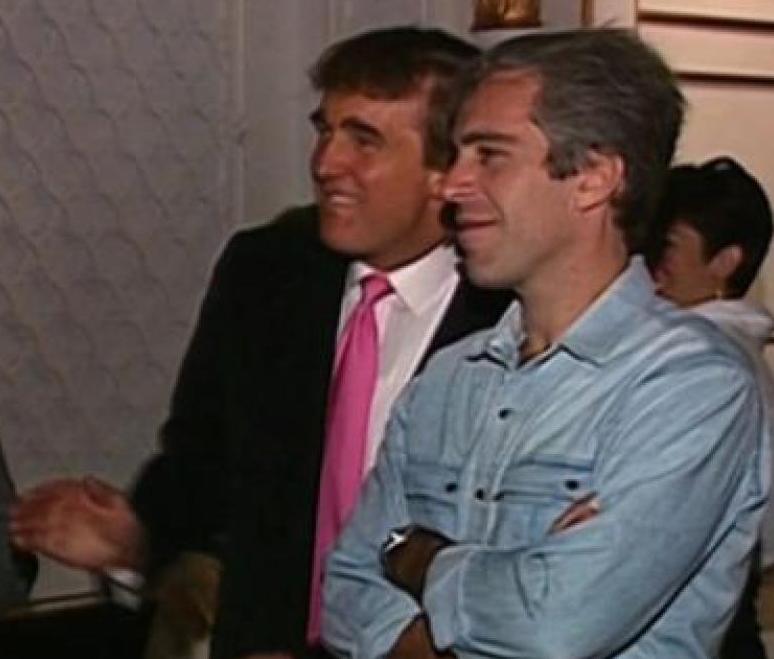 Donald Trump, the financially troubled tycoon whose holdings included casinos and beauty contests, and the financier and underage sex trafficker Jeffrey Epstein seem to have spotted something interesting at a 1990s party for cheerleaders at Trump's Mar-A-Lago in Florida.
New York Times, After Trump Split, Epstein Said He Could ‘Take Him Down,’ David Enrich, Nicholas Confessore, Jessica Silver-Greenberg and Steve Eder, Nov. 13, 2025 (print ed.). Jeffrey Epstein cast himself as a Trump insider and wanted to leverage potentially damaging information about the president and his business dealings, according to emails with associates.
President Trump’s long friendship with Jeffrey Epstein came to an apparent end in the mid-2000s. But Mr. Epstein remained intently focused on Mr. Trump for years afterward, seeking to exploit the remnants of their relationship up until his arrest on federal sex-trafficking charges in 2019.
In more than 20,000 pages of Mr. Epstein’s typo-strewn emails and other messages released by a congressional committee on Wednesday, Mr. Epstein insulted Mr. Trump and hinted that he had damaging information on him.
By turns gossipy, scathing and scheming, the messages show influential people pressing Mr. Epstein for insight into Mr. Trump, and Mr. Epstein casting himself as the ultimate Trump translator, someone who knew him intimately and was “the one able to take him down.”
The release of the messages instantly pushed the two men’s much-scrutinized relationship back into the public eye, re-energizing Democratic attacks on Mr. Trump and his Justice Department for failing to publicly disclose more information from the investigation of Mr. Epstein.
The emails date to at least 2011, when Mr. Trump was a reality TV star toying with a long-shot presidential run and Mr. Epstein was trying to rehabilitate his image after his conviction and incarceration for soliciting prostitution from a minor. The messages continue through the spring of 2019, when Mr. Trump was president and his Justice Department was building a criminal case against Mr. Epstein.
The messages hint that Mr. Epstein or his advisers believed they had inside — and potentially damaging — knowledge of Mr. Trump’s far-flung properties and business dealings. Some suggest that Mr. Epstein thought Mr. Trump knew more about his personal conduct than the president has publicly acknowledged.
Nov. 13
Rachel and the City, GriftMatrix Analysis: Welcome to The GriftMatrix, Rachel Hurley, above, left, Nov. 13, 2025. 23,000 documents just dropped. Here’s what I’m doing with them.
Yesterday, the House Oversight Committee released over 20,000 documents from Jeffrey Epstein’s estate. Democrats on the committee cherry-picked three emails to release first, all mentioning Donald Trump. Republicans followed hours later with the full dump.
The White House immediately called it a hoax. Press Secretary Karoline Leavitt, right, said the emails “prove absolutely nothing other than the fact that President Trump did nothing wrong.”
Technically, she’s right. These specific emails don’t prove Trump committed a crime.
But here’s the thing. That’s not what makes them damning.
The most significant email is from April 2011. Epstein writes to Ghislaine Maxwell: “i want you to realize that that dog that hasn’t barked is trump.. [VICTIM] spent hours at my house with him ,, he has never once been mentioned.”
This is Epstein lamenting about Trump’s silence. He’s sharing the fact that a victim spent hours with Trump at his house, and Trump never said anything. For years. That’s not evidence of Trump’s guilt. That’s evidence of Trump’s complicity through silence. And Epstein knew exactly what that silence was worth.
Republicans identified the victim as Virginia Giuffre, who died by suicide in April. They’re pointing out that Giuffre never accused Trump of wrongdoing in her memoir. She described meeting him at Mar-a-Lago and said he “couldn’t have been friendlier.” That’s true. But it’s also beside the point.
But let’s be clear about something else. Even if these three emails that Democrats released don’t prove Trump committed a crime, there are more than 20,000 pages in this document dump. And some of them are far more interesting than whether Trump spent time with a victim in 2011.
There are calendars showing Elon Musk possibly visiting Epstein’s island in 2014. There are records of dinners with Peter Thiel, left, in  2017 and Steve Bannon in 2019. There are financial documents, market reports, and correspondence tracking Trump’s presidency in real time. There’s an email where Epstein calls Trump “borderline insane.” There’s another where he says “I know how dirty Donald is.”
We could all spend the next few days pulling out the most outrageous findings and tweeting them for engagement. That’s what most people will do. They’ll find the most shocking line, post it without context, and move on to the next shocking line.
That’s not what I’m interested in doing.
What I’m interested in is the bigger story. Because when you look at all of these documents together, when you track the timeline from 2011 through 2019, when you see who Epstein was talking to and what he was tracking, a pattern emerges. And that pattern suggests something much larger than whether Trump knew about teenage girls at Mar-a-Lago.
It suggests Epstein was running an intelligence operation. It suggests he was collecting leverage on powerful people systematically. It suggests Trump was being monitored for years before and during his presidency. And it suggests that multiple people in elite circles believed Epstein had kompromat that could be weaponized.
That’s what The GriftMatrix is about. Piecing together the evidence to find the bigger story. Not just the most shocking emails, but the systematic operation behind them.
I’ve been going through these documents methodically. Not all 20,000 pages yet, but enough to see the shape of what was happening. And I’ve built a research system to track investigations, connect evidence, and map the relationships over time.
I don’t know if I will be able to prove that Trump committed a specific crime. This is more about understanding how Epstein operated, who he was connected to, what information he was gathering, and why elite circles treated him as a source of intelligence even after his 2008 conviction.
Over the next few weeks, I’ll be publishing what I’ve found. Each post will focus on a specific finding from the documents with full sourcing and context. Not hot takes. Not speculation. Just what the evidence actually shows.
Because the “dog that hasn’t barked” email is interesting. But it’s just one data point. And understanding what Epstein was really doing requires looking at all the data points together.
The White House says these documents prove nothing. Maybe they’re right about the specific emails Democrats released. But there are 20,000 more pages. And some of them tell a much bigger story than Trump’s silence.
New York Times, Michael Wolff, Chronicler of Elites, Provided Epstein With Advice on Trump, Erik Wemple, Nov. 13, 2025 (print ed.). Mr. Wolff was enough of an insider to provide advice to Jeffrey Epstein on how to handle his dealings with Donald J. Trump.
Michael Wolff, a writer, reporter, columnist, author and would-be mogul, has spent his long career building his profile as an insider with gossip on New York luminaries, while sometimes drawing scrutiny from other journalists.
That profile expanded on Wednesday: Mr. Wolff, it turns out, has been enough of an insider that he once provided advice to Jeffrey Epstein, the disgraced sex offender, on how to handle his dealings with Donald J. Trump, who was running for president at the time.
That revelation emerged from emails between Mr. Wolff and Mr. Epstein released by Washington lawmakers, shedding new light on the relationship between the two.
In one of the emails, from December 2015, Mr. Wolff said CNN planned to ask Mr. Trump about his relationship with Mr. Epstein, and then counseled Mr. Epstein on next steps.
“I think you should let him hang himself,” Mr. Wolff wrote. “If he says he hasn’t been on the plane or to the house, then that gives you a valuable PR and political currency. You can hang him in a way that potentially generates a positive benefit for you, or, if it really looks like he could win, you could save him, generating a debt.”
In October 2016, Mr. Wolff sent Mr. Epstein an email saying there was an “opportunity to come forward this week and talk about Trump in such a way that could garner you great sympathy and help finish him.” The exchange came late in Mr. Trump’s first presidential campaign, and weeks after a recording of Mr. Trump making vulgar comments about women to an “Access Hollywood” host emerged.
Before the 2024 presidential election, Mr. Wolff disclosed that he had interviewed Mr. Epstein “periodically” for his 2018 book, “Fire and Fury: Inside the Trump White House,” which rocketed to the top of best-seller lists with its depiction of a chaotic White House and key officials criticizing the president.
In 2019, Mr. Epstein was charged in a federal indictment with sex trafficking of minors; he was subsequently found dead in a cell at a federal detention center in Manhattan. The authorities concluded that he had died by suicide. The case against Mr. Epstein, and the circumstances of his death, fueled years of speculation about his relations with top figures in American politics and business.
Given the public interest in Mr. Epstein, Mr. Wolff released tapes of his interviews with the convicted sex offender shortly before the 2024 presidential election.
“I would say I had a dozen meetings, maybe a dozen and a half meetings, with various outlets, and everybody was interested — everybody was listening, there were a lot of executives in rooms or on Zoom calls — and then everybody passed,” Mr. Wolff said in an interview with James Surowiecki in The Yale Review.
“The [Appointments] Clause is a bulwark against one branch aggrandizing its power at the expense of another branch, but it is more: it ‘preserves another aspect of the Constitution’s structural integrity by preventing the diffusion of the appointment power.’”
— Justice William Rehnquist, Ryder v. United States (1995)
All Rise News, Comey bombshell: Grand jury record section MISSING — Live from Federal Court, Adam Klasfeld, Nov. 13, 2025. A federal judge expressed deep skepticism that James Comey and Letitia James's top prosecutor was validly appointed, and she said she'drule by Thanksgiving.
During most federal court oral arguments on a motion to dismiss, the headline most reporters look for is a prediction about where the judge is leaning. In a criminal case, is it looking better for the government or the defense?
By that metric, the headline is easy: “Judge Deeply Skeptical Trump-Installed Prosecutor Was Validly Appointed.” Perhaps the lead would weigh the odds of the dismissal of two of the country’s most closely watched cases: U.S. v. James Comey and U.S. v. Letitia James. To mitigate the risk of an inaccurate prediction, an experienced reporter would hedge (accurately) that Senior U.S. District Judge Cameron Currie sharply questioned the futures of both cases.
Even with the possible dismissal of these historic cases on the line, a factual revelation overshadowed the gambling odds today.
Judge Currie revealed that there’s a more than two-hour gap in Comey’s grand jury record. There was no court reporter present between 4:28 p.m. Eastern Time until the return of the indictment at around 6:47 p.m. ET.Mind the gap
That means there is no record of what happened in those nearly two-and-half hours when a razor-thin majority of grand jurors decided to return a two-count indictment—and rejected what would have become the top charge.
As a legal matter, that could doom the government’s case against Comey entirely.
Both Comey and James argue that Trump’s former lawyer turned first time prosecutor Lindsey Halligan was illegally appointed because she is the second interim U.S. Attorney in her district to be installed in her role without Senate confirmation. Trump pressured out her predecessor Erik Siebert, a conservative, because Siebert did not believe the cases against Comey and James were warranted. Before becoming a Supreme Court justice, Samuel Alito wrote a Justice Department Office of Legal Counsel opinion finding that two consecutive interim U.S. Attorney appointments aren’t permissible.
Three Trump-installed acting U.S. Attorneys — Alina Habba, Bill Essayli, and Sigal Chattah — have been disqualified from their positions after similar challenges, despite entering their offices through a different mechanism. Halligan would be the fourth consecutive defeat for Trump-appointed prosecutors.
On Oct. 31, Attorney General Pam Bondi tried to shore up Halligan’s bona fides by issuing an order claiming to retroactively declare Halligan a “special attorney.” She claimed to make that decision “based on [her] review of the grand jury proceedings” in both cases.
Currie pointed out that it “became obvious to me that the Attorney General could not have reviewed” the full grand jury materials once she spotted the gap.“A fundamental defect”
Throughout the proceedings, Comey sat in the courtroom next to attorneys Abbe Lowell and Ephraim McDowell. Halligan was flanked by her out-of-district assistant prosecutors Henry Whitaker and Nathaniel Lemons. Neither Comey nor Halligan said a word during the proceedings.
Whitaker tried to downplay the controversy as “at best, a paperwork error.”
But Lowell noted: “This is not a mere technicality because it goes to whether a person was competent at the time they sat in this case.”
McDowell, representing Comey, framed defense arguments with this introduction.
“This prosecution should be dismissed with prejudice because of a fundamental defect,” he said, referring to the failure to pass constitutional and statutory muster. “Since the Founding of our nation, United States Attorneys have been confirmed by the Senate.”
If not reversed on appeal, a dismissal with prejudice would stop the government from pursuing the cases again. To prevail, the defense would need to prove that Halligan’s appointment wasn’t “harmless error,” which depends on an analysis of whether the case would exist “but-for” the identified flaw.
Lowell called that test an easy one. “If this is not a good example of the ‘but-for’ under harmless error, I couldn’t think of one myself,” he said.
Politico, Judge appears skeptical of Lindsey Halligan’s appointment as interim US attorney, Kyle Cheney and Josh Gerstein, A ruling against Halligan could threaten the cases she brought against James Comey and Letitia James.
A federal judge expressed deep skepticism Thursday about whether a federal prosecutor handpicked by President Donald Trump to bring criminal cases against his political rivals was legally appointed to the role.
It’s unclear whether U.S. District Judge Cameron Currie’s open doubts about the appointment of Lindsey Halligan will sink the cases against former FBI Director James Comey and New York Attorney General Letitia James. But the Clinton-appointed judge’s ruling, which she said would come before Thanksgiving, could derail both.
Currie, one of two judges who have reviewed the grand jury transcripts related to the indictments, revealed little about the secret proceedings but said they confirmed that “Ms. Halligan acted alone,” without any other government attorneys in the room. That could threaten both cases if Currie ultimately decides Halligan was invalidly appointed as interim U.S. attorney for the Eastern District of Virginia, since no legitimately appointed prosecutor signed the indictments.
Currie seemed particularly concerned that a portion of the grand jury proceedings that led to Comey’s indictment was “missing,” leaving certain aspects of Halligan’s interactions with the grand jury unreviewable. Currie said that it appeared at about 4:28 p.m. on the day the indictment was returned in September, there was no court reporter in the room to transcribe the proceedings, leaving no record of the final minutes of the grand jury’s session.
Comey was charged with obstruction and making a false statement to Congress related to testimony he gave in 2020 to the Senate Judiciary Committee about the FBI’s investigation into links between Russia and Trump’s 2016 campaign. James was charged with bank fraud and making false statements to a financial institution related to a home loan she obtained for a secondary residence in Virginia. Both have pleaded not guilty.
At Trump’s urging in a September social media post, Attorney General Pam Bondi quickly appointed Halligan as the interim U.S. attorney for the Eastern District of Virginia, just days after Trump helped force out the office’s previous leader, Erik Siebert, over his resistance to bringing both cases. But attorneys for Comey and James said Halligan was ineligible to take the job because Siebert had already held the temporary role for the legal limit of 120 days.
The risk for the Trump administration is particularly acute in the Comey case because Halligan secured the indictment just days before a Sept. 30 legal deadline that has now elapsed.
The Thursday hearing lasted a little over an hour. Comey was present in the courtroom, along with several members of his family in the public gallery, while James was not in attendance. Halligan, who was in court and seated at the prosecution table, did not address the judge.
Currie, based in South Carolina, was tapped to address Halligan’s qualifications because of concerns that doing so could pose a conflict for judges in the Virginia district who routinely handle cases brought by the U.S. attorney’s office Halligan is overseeing.
Justice Department attorney Henry Whitaker urged Currie to treat questions about Halligan’s appointment as, at most, a “paperwork error” and emphasized that Bondi had reviewed the grand jury materials and agreed to retroactively “ratify” Halligan’s actions, even if her initial appointment is deemed invalid.
But Currie said the missing component of the grand jury transcript called into question the sufficiency of Bondi’s review.
“It became obvious to me that the attorney general could not have reviewed those portions of the transcript presented by Ms. Halligan,” Currie said. The judge also questioned why Bondi signed a statement saying she had reviewed Halligan’s actions before the grand jury when transcripts of some of that presentation “did not exist.”
“She couldn’t have,” Currie said.
Whitaker said Bondi had reviewed the “material facts” of Halligan’s grand jury presentation, which showed that “the grand jury made a decision based on the facts and the law.”
Attorneys for Comey and James said it’s not possible for the Justice Department to retroactively empower a prosecutor who acted without legitimacy to secure an indictment. James’ lawyer, Abbe Lowell, said that such a ruling would mean that private citizens like “Steve Bannon or Elon Musk” could secure a grand jury indictment only to have it blessed later by the Justice Department.
In one head-turning moment, Whitaker said the Justice Department takes issue with one aspect of U.S. District Judge Aileen Cannon’s ruling last year tossing special counsel Jack Smith’s prosecution of Trump on charges related to classified documents kept at Mar-a-Lago. Whitaker said Cannon went too far when she questioned the attorney general’s appointment power in a way that he said could undercut the authority of most of the lawyers working at DOJ headquarters.
“We do disagree with that,” Whitaker said. The issue could have relevance for Halligan’s appointment, since Bondi’s recent order claims to retroactively appoint Halligan as a DOJ prosecution under several alternative statutes if her interim U.S. attorney appointment is deemed invalid.
Defense attorneys also pressed Currie to treat her role in a more grandiose context: the preservation of the separation of powers and checks on presidential power. Blessing Halligan’s appointment, they said, would effectively gut the Senate’s role in confirming U.S. attorney nominees, since all presidents could make end-runs around that constitutional requirement.
“This case is a bulwark against one branch aggrandizing its power against another,” Lowell said.
“There would never be any reason to go through Senate confirmation again,” an attorney for Comey, Ephraim McDowell, told Currie.
Currie seemed to tip her hand in her first question Thursday, asking if Comey’s defense attorneys had seen the ”declination memo” related to the case. That alluded to news reports that career prosecutors in the U.S. attorney’s office prepared a detailed analysis of the potential charges and concluded that they were too flimsy to pursue.
Defense lawyers revealed they had not yet seen the declination memo but hoped to obtain it during the discovery process before trial.
The judge also seemed intimately familiar with recent decisions in other courts that found three of the Trump administration’s other picks for temporary U.S. attorney roles were illegitimate. In those cases, judges ruled that even though the appointees were disqualified, the cases they supervised could continue because other career prosecutors had signed off on them.
New York Times, Government Reopens as Trump Signs Bill to End Nation’s Longest Shutdown, Catie Edmondson and Zolan Kanno-Youngs, Updated Nov. 13, 2025. President Trump signed the bill ending the shutdown after 43 days, after the House approved it, largely on party lines.
The federal government began reopening Wednesday night after President Trump signed into law a spending package that narrowly passed the House, ending the longest shutdown in the nation’s history.
“With my signature, the federal government will now resume normal operations,” Mr. Trump said as he signed the legislation alongside Republican House leadership and business executives.
New York Times, The Shutdown Is Over. When Will Things Get Back to Normal? Karoun Demirjian and Eileen Sullivan, Nov. 13, 2025 (print ed,). Some programs like SNAP could be restored within hours, while other effects could take longer to unravel.
For the first time in more than 40 days, Washington was set to open for business on Thursday, although some federal services would be slow to return and thousands of government employees were left unsure of when they might receive their missing paychecks.
The longest federal shutdown in U.S. history came to a close on Wednesday night as President Trump signed legislation to reopen the government, but it will take some time for the programs and people who were affected by the funding freeze to recover.
Furloughed federal employees will have to come back to work, including those responsible for processing payments to programs that are dependent on government dollars. Industries like the airline and hospitality sectors, which felt the punch of the government’s spending lapse, might need even more time to regain their footing. And the rest of the economy that felt the domino effect of the shutdown may feel the impact for some time.
Here are some of the ways the United States has to recover from the shutdown, and how long that may take after the government officially reopens.
More On U.S. Governance, Politics
U.S. Rep. Matt Gaetz (R-FL, at center, former Florida State Rep. Chris Dorworth, left, then of the Ballard Partners lobbying firm, and former Seminole County Tax Collector Joel Greenberg, at right, posed for the photograph above outside the White House in June of 2019.
New York Times, In Matt Gaetz Scandal, Circumstances Left Teen Vulnerable to Exploitation, Michael S. Schmidt, Nov. 13, 2025. A 17-year-old with a homeless parent wanted money for braces and ended up having sex for money with powerful men. She wants the public to have a fuller understanding of how she was victimized.
She was 17 and a high school junior in Florida. She was working at McDonald’s. And she was living in and out of a homeless shelter.
Hoping to save up to buy braces to fix her teeth, she falsely advertised herself in 2017 as 18 years old on a website that matches men looking for “companionship” with young women looking to make money.
What followed would set off a chain of events that would have a dramatic impact on her life and help upend the political career of one of the men she would encounter, Representative Matt Gaetz, the Florida Republican.
 Mr. Gaetz was investigated by the Justice Department for child sex trafficking but never charged. Following the election last year, he was President Trump’s first choice to serve as attorney general. He subsequently resigned from Congress, and then withdrew from consideration as attorney general under a storm of scrutiny.
A bipartisan House Ethics Committee investigation later determined there was substantial evidence that he had sex with the 17-year-old and the report included testimony from the girl about how she was paid by Mr. Gaetz for the sex.
For all the public furor over Mr. Gaetz — who always asserted that he broke no laws even as the House Ethics Committee found that he violated Florida’s statutory rape laws — little attention has been given to the story of the girl, how she came to be exploited and how she has coped with what happened to her and the ensuing political scandal.
Last month, in response to a request from the McClatchy newspaper chain, a federal judge in Florida unsealed court documents from a related civil case that shed some light on her background. The documents included a description of the girl that said that at the time she met Mr. Gaetz she was “a then-homeless 17-year-old high schooler.”
In response to that disclosure, The New York Times reached out to the girl’s lawyer, Laura B. Wolf, who agreed to confirm some basic biographical information about her client, providing details for the first time of how the girl’s circumstances led her to her encounters with Mr. Gaetz. Ms. Wolf said her client believed the public should have a fuller understanding of how she had been victimized.
“The vulnerable circumstances most crime victims face are rarely known to the public,” Ms. Wolf said. “Although my client’s circumstances were revealed outside of her control, I hope it helps for the public to see a fuller and more human picture of her than the press has reported on to date.”
Ms. Wolf added: “Power imbalances can be age, but they can also be financial. My client had little economic security, which allowed for financial leverage over her.”
Experts in sex trafficking said that the matter involving the girl demonstrated how there is a spectrum of ways girls and women are exploited. In some cases, the girls or women are physically trapped and unable to escape men who are taking advantage of them. In other cases, the girls or women find themselves at the whims of more powerful men after turning to sex trafficking out of economic need.
The girl would emerge as the chief witness against Mr. Gaetz in the Justice Department sex trafficking investigation. The investigation ended with the department declining to bring charges. Among the reasons prosecutors did not move forward was their concern about whether she would be seen as a credible witness after being exposed to cross-examination by defense lawyers, according to people familiar with the investigation.
In response to questions about the girl, Mr. Gaetz said in a text message on Thursday: “I never had sex with this person.”
“This person threatened me with a lawsuit if I didn’t pay her $2.3 million dollars,” Mr. Gaetz said. “She never sued me because her story is fiction.”
According to her lawyer, the girl’s path to meeting Mr. Gaetz began during her junior year in high school. In December 2016, she turned 17. Her parents were divorced. One of them was so poor that the parent was living in and out of a homeless shelter. When the girl and her siblings were staying with that parent, they lived with the parent in the shelter.
To make extra money, the girl worked at McDonald’s. But she began looking for other ways to make money and turned to a website that “advertised itself as a ‘sugar dating’ website that primarily connected older men and younger women seeking ‘mutually beneficial relationships,’” according to the report by the House Ethics Committee.
 Through the website, in April of her junior year in high school, she met Joel Greenberg, left, a local Florida tax collector who was becoming a friend and ally of Mr. Gaetz, according to court documents.
Much of what followed has been documented in other inquiries and legal proceedings, including the Ethics Committee investigation.
Mr. Greenberg first invited the 17-year-old to a meeting on his boat, according to court documents. At that meeting, they did not have sex, but Mr. Greenberg paid her $400, the documents said. Around that time, Mr. Greenberg gave her ecstasy and told her to try it at home.
Shortly thereafter, Mr. Greenberg contacted the girl again, and they ultimately met up at a hotel where they had sex, according to court documents. For that, she was paid another $400, the court documents said. In the months that followed, Mr. Greenberg, using his personal credit card and one for the local tax collecting office he was in charge of, would have sex with her seven times for money before she turned 18, the documents said. Often during those encounters he would give her ecstasy, and he would often pay the girl and other women additional money for taking the drug during sex.
On July 15, 2017, Mr. Greenberg asked the girl and others to attend a party at the home of Chris Dorworth, a former Republican member of the Florida state House of Representatives who at the time worked as a lobbyist for Ballard Partners, which is run by a major Trump fund-raiser.
Court documents described the party as involving “alcohol; cocaine; middle-aged men; and young attractive females.”
Mr. Gaetz, then 35, attended the party along with a girlfriend.
At the party, the girl who was 17 later testified, both cocaine and ecstasy were offered to her. She took the ecstasy and drank, according to court papers. She testified that she danced naked in front of Mr. Dorworth and swam naked in his pool.
The ethics committee heard testimony that the girl twice had sex with Mr. Gaetz that evening, and a court document quotes her as having testified that she had sex with him once on a “pool table or … air hockey table.” She testified that Mr. Dorworth saw Mr. Gaetz have sex with her on the game table and “then laughed about it with other partygoers.” (Mr. Dorworth has claimed that he was not home at the time, an assertion undercut by phone records that became part of litigation in the case.)
The girl later told congressional investigators that she saw Mr. Gaetz use cocaine that night.
For having sex with him twice, the girl was paid $400, according to testimony she gave to the Ethics Committee.
That fall, the girl moved to live with a family member in Texas, according to Ms. Wolf. She did not complete her senior year in high school. She continued to work for minimum wage in the food services industry. Ultimately, between the money she made from her interactions with men and in the food services industry she was able to save up enough money to get braces.
Several years later, Mr. Greenberg came under investigation for trying to undermine a political opponent in an upcoming election by mailing fake letters to the school where the opponent worked as a teacher, claiming that the opponent had sexual relations with a student.
As part of that investigation, the Justice Department learned about Mr. Greenberg’s relationship with the 17-year-old girl, leading the authorities to broaden their inquiry into Mr. Gaetz and others.
During the investigation, the girl hired a lawyer and was subpoenaed to testify before a grand jury. The girl began mental health treatment around that time, according to her lawyer.
Mr. Greenberg pleaded guilty to sex trafficking a minor for having sex with the girl in exchange for money. He was sentenced to a decade in prison. But the department declined to charge Mr. Gaetz.
In late 2022, lawyers for the girl sent letters to Mr. Gaetz and Mr. Dorworth about whether they would reach a financial settlement with the girl. The girl never sued. But Mr. Dorworth sued the girl, setting off depositions and an exchange of evidence. Mr. Dorworth would drop the case against the girl, but some documents generated by the case were given to Ethics Committee investigators who later used them in their report.
The documents that revealed that the girl was “homeless” were unsealed in October.
Fritz Scheller, Mr. Greenberg’s lawyer, said that throughout the entire ordeal, including the investigations and the civil litigation, it became apparent that the girl was a “victim that embodied unwavering strength and courage.”
Politico, George W. Bush, Liz Cheney to deliver tributes at Dick Cheney’s funeral service, Faith Wardwell, Nov. 13, 2025. Cheney passed away earlier this month due to complications of pneumonia and cardiac and vascular disease.
Former President George W. Bush and former Rep. Liz Cheney will memorialize the late Vice President Dick Cheney in a funeral service at Washington National Cathedral on Nov. 20, according to a release.
Cheney, the deeply influential yet polarizing vice president who served for eight years as Bush’s powerhouse right-hand, acted almost as a shadow chief executive through the president’s two terms in office. He passed away earlier this month at 84 due to complications of pneumonia and cardiac and vascular disease.
“Dick was a calm and steady presence in the White House amid great national challenges,” Bush wrote of Cheney shortly after his death. “I counted on him for his honest, forthright counsel, and he never failed to give his best. He held to his convictions and prioritized the freedom and security of the American people.”
Despite his bullish reputation toward the left, Cheney was also known for supporting his daughter, then-Rep. Liz Cheney (R-Wyo.) as she stood in stark opposition to Trump’s efforts to overturn the results of the 2020 presidential election, helming the House January 6 Committee as vice chair to investigate the riot at the U.S. Capitol in 2021.
New York Times, Trump Administration Expected to Drastically Cut Housing Grants, Jason DeParle, Updated Nov. 13, 2025. The Trump administration has developed plans for a wholesale shift in homelessness policy that would slash support for long-term housing programs, according to a confidential grant-making plan, and critics say it could quickly place as many as 170,000 formerly homeless people at risk of returning to the streets.
Pivoting from housing aid, the administration’s approach would shift billions to short-term programs that impose work rules, help the police dismantle encampments, and require the homeless to accept treatment for mental health or addiction.
The expected shift, which would be the most consequential in a generation, is detailed in a 100-page notice from the Department of Housing and Urban Development, slated for release in coming days, that would govern more than $3.5 billion in Continuum of Care funds, the main source of federal money for homelessness.
Global News
New York Times, U.S. Officials Raise Concerns About Saudi Arabia’s Bid for F-35 Jets, Edward Wong and Eric Schmitt, Nov. 13, 2025. A Pentagon intelligence report says China could try to acquire advanced F-35 technology in Saudi Arabia if the Trump administration sells jets to the kingdom.
As the Trump administration tries to finalize a deal to sell advanced F-35 fighter jets to Saudi Arabia, a Pentagon intelligence report has raised concerns that China could acquire the warplane’s technology if the sales go through, according to people familiar with the assessment.
Pentagon officials who have studied the deal have expressed fears that F-35 technology could be compromised through Chinese espionage or China’s security partnership with Saudi Arabia, said the people, who have been briefed on the issues. Those risks were outlined in a broad report compiled by the Defense Intelligence Agency, a part of the Defense Department.
The Trump administration and Saudi Arabia have been trying to work out the final elements of an agreement in which U.S. weapons manufacturers would sell 48 F-35 jets to Saudi Arabia for billions of dollars. Defense Secretary Pete Hegseth was expected to approve the agreement, before it continued through an interagency review process, the people said.
Crown Prince Mohammed bin Salman, the de facto leader of Saudi Arabia, is expected to meet with President Trump at the White House on Tuesday. The top items on the agenda are the potential F-35 deal and a mutual defense agreement, U.S. officials said. Saudi Arabia is the biggest buyer of American weapons.
Prince Khalid bin Salman, the Saudi defense minister, wrote on social media on Tuesday that he had recently met with Mr. Hegseth, Secretary of State Marco Rubio and Steve Witkoff, Mr. Trump’s Middle East envoy. “We reviewed the Saudi-US relations and explored ways to bolster our strategic cooperation,” he said.
Nov. 12
Donald Trump, the financially troubled tycoon whose holdings included casinos and beauty contests, and the financier and underage sex trafficker Jeffrey Epstein seem to have spotted something interesting at a 1990s party for cheerleaders at Trump's Mar-A-Lago in Florida.
New York Times, Epstein Alleged in Emails That Trump Knew of His Conduct, Michael Gold, Nov. 12, 2025. In a message obtained by Congress, the convicted sex offender Jeffrey Epstein wrote that Donald J. Trump spent hours at his house with one of Mr. Epstein’s victims.
House Democrats on Wednesday released emails in which Jeffrey Epstein wrote that President Trump had “spent hours at my house” with one of Mr. Epstein’s victims, among other messages that suggested that the convicted sex offender believed Mr. Trump knew more about his abuse than he has acknowledged.
Mr. Trump has emphatically denied any involvement in or knowledge of Mr. Epstein’s sex-trafficking operation. He has said that he and Mr. Epstein, the disgraced financier who died by suicide in federal prison in 2019, were once friendly but had a falling out.
But Democrats on the House Oversight Committee said the emails, which they selected from thousands of pages of documents received by their panel, raised new questions about the relationship between the two men. In one of the messages, Mr. Epstein flatly asserted that Mr. Trump “knew about the girls,” many of whom were later found by investigators to have been underage. In another, Mr. Epstein pondered how to address questions from the news media about their relationship as Mr. Trump was becoming a national political figure.
The messages are certain to inflame the debate on Capitol Hill over the Trump administration’s handling of the Epstein files, and top officials’ decision to backtrack on a promise to fully release them. That issue, which has split Republicans and alienated some of Mr. Trump’s right-wing supporters, had faded to the background as the government shutdown dragged on.
But the House is set to return on Wednesday to clear legislation to end the shutdown, and attention is likely to shift back to the Epstein matter.
“These latest emails and correspondence raise glaring questions about what else the White House is hiding and the nature of the relationship between Epstein and the president,” Representative Robert Garcia of California, the top Democrat on the OversightCommittee, said in a statement.
The three separate email exchanges released on Wednesday were all from after Mr. Epstein’s 2008 plea deal in Florida on state charges of soliciting prostitution, in which federal prosecutors agreed not to pursue charges. They came years after Mr. Trump and Mr. Epstein had a reported falling out in the early 2000s. One was addressed to Mr. Epstein’s longtime confidante Ghislaine Maxwell, while two were with the author Michael Wolff, shown above.'

Prominent Epstein-Maxwell victims and survivors, including the late Virginia Roberts Giuffre, portrayed below in a collage showing former Prince Andrew and Jeffrey Epstein, have long sought release of Epstein records kept secret by U.S. and other federal authorities. Roberts, a former towel girl at Donald Trump's Mar-A-Lago when she met Epstein there, died this year shortly before publication of her explosivie memoir "Nobody's Girl." Victims and their supporters rallied for release of records on Capitol Hill in September, as shown by the Roll Call/CQ photo at bottom.
New York Times, Epstein Files Live Updates: G.O.P. Lawmakers Release Thousands of Files, Glenn Thrush and Staff Colleagues, Nov. 12, 2025. Shortly after Democrats released emails showing that Jeffrey Epstein discussed his relationship with President Trump, Republicans on the Oversight Committee released 20,000 additional documents.
Here’s the latest.
House Republicans on Wednesday released a titanic trove of 23,000 pages of documents from the estate of the disgraced financier Jeffrey Epstein after months of delays — shortly after Democrats released emails suggesting that President Trump knew more about Mr. Epstein’s sex trafficking than he has previously acknowledged.
The documents were obtained by the chairman of the House Oversight Committee, Representative James Comer, through a subpoena in August. They were published online about two hours after House Democrats released an email from Mr. Epstein in which he wrote that Mr. Trump “spent hours at my house” with one of Mr. Epstein’s victims.
House Republicans are walking a thin and perilous political line in the Epstein case.
They are seeking to protect Mr. Trump, Mr. Epstein’s close friend until the two men had a falling out. But they have their own political flank to cover by appeasing a restive party base that has demanded complete disclosure of Mr. Epstein’s interactions with other powerful men — an issue that has at times transcended loyalty to the president.
The release of documents appears to be intended to provide Republicans with a defense against charges that they have not released all of the government’s files on Mr. Epstein, his longtime associate Ghislaine Maxwell, and the federal government’s handling of both of their cases.
Democrats claimed that the sheer volume of the files released on Wednesday was intended to disorient — and to distract attention from their revelations about Mr. Trump’s actions during the time he and Mr. Epstein were close. The Times is reviewing the documents and will provide updates.
Here’s what else to know:
From left: American real estate developer Donald Trump and his girlfriend (and future wife), former model Melania Knauss, financier (and future convicted sex offender) Jeffrey Epstein, and British socialite Ghislaine Maxwell pose together at the Mar-a-Lago club, Palm Beach, Florida, February 12, 2000. Getty Images.
MeidasTouch Network, Commentary: Updates on Trump's Wednesday From Hell, Ben Meiselas, right, Nov. 12, 2025. You can't escape your dark past, Donald...
It has been a catastrophic day for Donald Trump, perhaps the worst of his presidency. The Democratic members of the House Oversight Committee released a trove of emails between Jeffrey Epstein and Ghislaine Maxwell, as well as exchanges between Epstein and journalist Michael Wolff. These documents draw a direct line between Epstein and Trump, revealing conduct that is abhorrent and impossible to ignore.
In one 2011 email, Epstein told Maxwell that Trump had “spent hours at my house,” “knew about the girls,” and that Trump was “that dog that hasn’t barked.” Maxwell replied, “I have been thinking about that.” The significance of this cannot be overstated. This correspondence predates Trump’s political career, undercutting any claim that these exchanges were politically motivated. Epstein, long before Trump’s campaign, was making clear that Trump was no innocent bystander.
Despite this explosive revelation, the Trump regime spent the day as though nothing had happened, offering an unsettling glimpse into an administration that operates with impunity while the American people suffer. Tariffs championed by Trump have driven consumer prices sky-high, forcing major brands to scale back Black Friday discounts and raising the cost of essential goods like coffee. Treasury Secretary Scott Bezzant, in a desperate attempt to spin the damage, floated the idea of “tariff relief,” stunning admission that Trump’s own policies are strangling the economy.
Meanwhile, auto loan delinquencies have hit record highs among working-class Americans, and more than half of employed people now fear losing their jobs. Affordability has vanished, but Trump insists, against all evidence, that the nation is thriving. “Donald Trump is making the American people suffer,” I said earlier today. “Donald Trump is starving the American people to death.”
Even his own supporters are beginning to recoil. During a Fox News appearance, Trump claimed Americans are too stupid for high-skilled jobs and that universities need hundreds of thousands of Chinese students to fill seats. That comment, more than any, shattered the illusion for many MAGA loyalists who now see Trump’s contempt for the very people he claims to champion.
More footage also leaked from Trump’s Oval Office meeting with the leader of Syria, a man who once led an al-Qaeda faction and reportedly had a multimillion-dollar bounty on his head. Trump sprayed him with “Trump Cologne” and joked about how many wives he had.
And all the while, real atrocities continue under his watch. Leaked footage from an ICE detention center near Houston shows hundreds of men and women crammed into a freezing cell, denied beds and dignity. Abroad, U.S. forces under Trump’s orders have launched unprovoked strikes on fishing vessels in the Caribbean and Pacific, killing civilians, actions so egregious that the United Kingdom has suspended intelligence sharing with the United States, and France, too, is sounding the alarm.
As I said on-air, “America is currently engaged in war crimes, directed by Donald Trump and Pete Hegseth. They should be held accountable before a war crimes tribunal.”
The Trump regime’s attempt to move on from this morning’s Epstein bombshell quickly turned into utter panic at the White House. AG Pam Bondi, FBI Director Kash Patel, Deputy AG Todd Blanche, and others, are holding an emergency meeting today on the Epstein Files as the discharge vote nears. Rep. Boebert, one of the ‘yes’ votes on the discharge petition. will reportedly be there. Trump spent the morning frantically trying to call both Boebert and Rep. Nancy Mace to try to get them to flip their votes. There is an all hands on deck effort from the White House to try to prevent this vote from taking place.
Trump then took to his Truth Social app, once again referring to Jeffrey Epstein’s crimes against young children as “the Jeffrey Epstein Hoax,” and threatened Republicans, demanding they continue to work to hide the files.
He. Is. Spiraling.
What we are witnessing is not a government of laws but a syndicate of cruelty and corruption, one that enriches itself while dismantling the economy, shaming its people, and aligning with war criminals and pedophiles. Trump’s approval has cratered to 33 percent, according to the latest AP-NORC poll, with support among independents dropping to just 25 percent.
A year ago, The Wall Street Journal declared that the next president would “inherit a remarkable economy.” Trump could have simply maintained stability. Instead, he has set the nation ablaze, economically, morally, and diplomatically.
The emails released today confirm what many of us have long known: the rot runs deep. But exposure is only the first step. Accountability must follow. The truth is out, more is on the way, and now, it’s up to us to ensure it leads somewhere.
New York Times, Trump Administration Live Updates: House to Take Up Bill to End Shutdown, Staff Reports, Nov. 12, 2025. Where Things Stand.
Government shutdown: The House of Representatives will return to session on Wednesday, as lawmakers take up legislation to end the longest government shutdown in American history. The bill, which passed the Senate on Monday, has sizable momentum, and its approval by the House would clear it for President Trump’s signature. Read more ›
Flight disruption: Sean Duffy, the secretary of transportation, on Tuesday refused to say when he would roll back flight restrictions at 40 busy airports, even as it seemed like the government shutdown would end soon. Instead, he warned that if the House did not follow the Senate’s lead and pass the bill quickly, travelers would experience major delays around the Thanksgiving holiday. Read more ›
Immigration crackdown: The Trump administration plans to further expand the presence of immigration agents in American cities, deploying the U.S. Border Patrol to Charlotte, N.C., and New Orleans, according to a government document and a federal official with knowledge of the plan. Plans for the operations were still being finalized, the official said, and federal agents will maintain a presence in the Chicago area. Read more ›
New York Times, Johnson will seat Adelita Grijalva, his office said, seven weeks after she was elected to Congres, Anushka Patil, Nov. 12, 2025 (print ed.). Speaker Mike Johnson plans to swear in Representative-elect Adelita Grijalva of Arizona as a member of Congress on Wednesday, according to his office, 50 days after her election, as the House returns from an extended recess.
 Ms. Grijalva, left, a Democrat, won a special election on Sept. 23 for the Arizona seat left vacant by the death of her father, Representative Raúl Grijalva. Mr. Johnson had since refused to seat her, despite several opportunities to do so, public pleas, a Democratic pressure campaign and, eventually, a federal lawsuit brought by Ms. Grijalva and the attorney general of Arizona that argued that Mr. Johnson had no authority to continue to stall.
The delay prevented Ms. Grijalva from freely entering and moving about the Capitol complex, or having access to the budget or the materials she needed to do her job. As recently as Tuesday afternoon, she told NPR that she had not heard directly from Mr. Johnson’s office about the swearing-in and that she was “90 percent” confident it would happen at last. She said on social media on Monday that she was traveling to Washington after hearing from news reports and Representative Hakeem Jeffries, the minority leader, that she could soon be seated.
“For seven weeks, 813,000 Arizonans have been denied a voice and access to basic constituent services,” Ms. Grijalva said. “This is an abuse of power that no Speaker should have.”
For weeks, Mr. Johnson had justified his refusal by saying he could not and would not seat Ms. Grijalva while the House was out of session. There is no such rule in the chamber that would block the swearing-in of a duly elected member of Congress. Though Mr. Johnson had so far kept the House out of session, the chamber can operate even in the event of a government shutdown, and he swore in two Florida Republicans who won special elections earlier this year while the House was in recess.
As a member of Congress, Ms. Grijalva would narrow the slim majority that Republicans hold in the House. She has also vowed to provide the last necessary signature on a bipartisan petition that would force a floor vote on a measure demanding the Justice Department release its files on the deceased sex offender Jeffrey Epstein. Democratic lawmakers have seized on Ms. Grijalva’s pledge in trying to shame Mr. Johnson into abiding by his duty to swear her in.
Mr. Johnson has claimed his refusal to seat Ms. Grijalva had nothing to do with avoiding the floor vote. Democrats, including Senator Ruben Gallego of Arizona, insisted he was “covering up for pedophiles.”

New York Times, Editorial: Most Women Can Still Get Abortion Pills. That May Soon Change, Editorial Board,.Nov. 12, 2025. After the Supreme Court reversed Roe v. Wade and ended the constitutional right to abortion three years ago, both supporters and opponents of the court’s ruling expected the number of abortions to fall.
After all, nearly 40 percent of U.S. women now live in a state with severe restrictions. Instead, the number of women receiving abortions has increased nationwide, even in most states with bans. This surprising outcome shows that women who want or need to end their pregnancies are determined to find ways to do so — and that abortion pills have transformed the practice of reproductive medicine.
One in four abortions in the United States now takes place through telehealth — with pills that people order online. A doctor writes a prescription and a mail-order pharmacy fills it. When the pills arrive, women, including many living in red states, can take them at home to end a pregnancy in its first few months. The method has proved remarkably safe and effective, according to study after study. Pioneered in 2006 by the Dutch doctor Rebecca Gomperts to serve women mostly in low-income countries where abortion was criminal, telehealth abortion has become critical for maintaining access in the United States.
But it would be a mistake to assume that this status quo will continue. Republican politicians are working hard to restrict telehealth abortion through a combination of state and federal action. For abortions to remain as accessible as they have been in the past three years, defenders of reproductive health and freedom will need to fight back. They can do so confident that public opinion is on their side. Americans think medication abortion should be legal by a margin of about two to one.
The primary way that abortion opponents are trying to restrict access is to block the interstate mailing of abortion pills. Louisiana and Texas have taken the most aggressive steps so far. In Louisiana, prosecutors have filed criminal charges against abortion providers in New York and California for prescribing and sending pills from out of state. In Texas, the attorney general, Ken Paxton, and a private lawyer, Jonathan Mitchell, have filed lawsuits against out-of-state providers and Aid Access, which Ms. Gomperts founded and is one of the largest telehealth services.
On Sept. 17, Texas invited a flood of new lawsuits with a bill, the first of its kind, that in most instances allows a private citizen to sue people who make, distribute or prescribe abortion pills to anyone in Texas. Each suit allows for at least $100,000 in damages and can be brought even if no abortion takes place.
The Trump administration may impose other barriers. President Trump, recognizing the popularity of abortion access, has been cagey on the issue. He has taken credit for appointing the Supreme Court justices who overturned Roe v. Wade while saying he would not sign a federal abortion ban. He also said that individual states should be free to set their own policies. That position leaves plenty of room for red states to crack down on abortion pills, threatening the reproductive freedom and well-being of women who live there.
One worrisome development is that Robert F. Kennedy Jr., the secretary of health and human services, has directed the Food and Drug Administration to review the safety of mifepristone, an abortion pill, based on what he called “new data.” Mr. Kennedy appeared to be referring to an unpublished paper by a conservative think tank, the Ethics and Public Policy Center. Other researchers have debunked that paper as junk science. Abortion opponents have been making bogus claims about abortion pills for decades. They have exaggerated the risks since the F.D.A. first reviewed mifepristone in the 1990s. Since then, evidence has only mounted that the medication is even safer than drugs like penicillin and Viagra. (The F.D.A. recently approved a generic version of mifepristone.)
Nonetheless, 22 Republican state attorneys cited the debunked paper in pressing the F.D.A. to restrict mifepristone. In response, Mr. Kennedy said that his department would conduct a review. As with vaccines, it is a sign that he will not let good science stand in the way of bad policy.
More immediately, the Trump administration is stripping Medicaid funding from Planned Parenthood. Congress has long banned the use of federal funds for abortions in almost all cases. By now cutting the money Planned Parenthood uses to provide other services, such as birth control and breast cancer screenings, the administration can force the shutdown of clinics that rely on Medicaid because they treat many low-income patients, reducing access to both abortion and other forms of medical care. In rural areas, Planned Parenthood is sometimes the only provider of primary and family-planning care for poor people. Already, its clinics have closed in California and Ohio, and paused providing abortions in Wisconsin.
More On U.S. Governance, Politics

New York Times, The I.R.S. Tried to Stop This Tax Dodge. Scott Bessent Used It Anyway, Andrew Duehren, Nov. 12, 2025. Like many on Wall Street, Treasury Secretary Scott Bessent, shown above, used a limited partnership to avoid Medicare taxes. Unlike the others, he’s now overseeing the I.R.S.
It was an easy and, by all accounts, legal way to avoid paying thousands, and potentially millions, in federal taxes.
Just set up an investment firm with the right legal structure, and the self-employment taxes that fund Social Security and Medicare could become largely optional.
The tax maneuver was so routine that even after the Internal Revenue Service moved to crack down on it in 2018 — and later won a court opinion blessing its effort — many on Wall Street were unfazed. They assumed that the I.R.S. offensive would inevitably collapse.
Among those who would benefit from an I.R.S. defeat is President Trump’s Treasury secretary, Scott Bessent, a former hedge fund owner and, since August, the acting commissioner of the I.R.S.
Like many firms on Wall Street, Mr. Bessent’s hedge fund, Key Square Capital Management, was set up as a limited partnership. Through that structure, Mr. Bessent avoided paying roughly $910,000 in Medicare taxes on money he made running his hedge fund in 2021, 2022 and 2023, according to a memorandum prepared by Democratic Senate staff for Mr. Bessent’s confirmation hearing in January.
The memo, viewed by The New York Times, was based on a review of Mr. Bessent’s tax returns and also indicated that Mr. Bessent paid Social Security taxes in full.

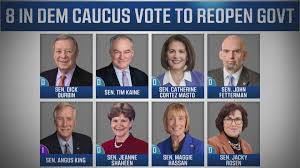 The Contrarian, Opinion: Where We Go from Here, Jennifer Rubin, right, Nov. 12, 2025. Many Democrats have expressed nothing short of fury at 8 Senate Democrats (and probably a few more who would have voted the same way had their votes been needed to give away the store) over the mind-boggling capitulation to MAGA Republicans.
The deal is destructive and foolish, largely the handiwork work of senators who have overstayed their welcome and refuse to comprehend the times in which we find ourselves.
As Sen. Adam Schiff (D-Cal.) so brilliantly put it, this surrender is no different than law firms, universities, and media outlets caving to Donald Trump. If no democracy fighter should make excuses for those institutions, none should downplay the moral blindness of these senators. But the problem for many Democrats and all democracy defenders extends well past the 8 (or 10 or 12 might have gone along) and past the feckless Senate leadership (or the lack thereof).
Democratic office holders, activists, donors, and candidates as well as ordinary Democratic voters are left with two main questions: What consequences can there be for this debacle? How does the pro-democracy movement continue the fight against the existential threat of authoritarianism?
It is not an option to let bygones be bygones, shrug at the fecklessness of the band of Senate capitulators, and make no attempt to address the serious fault line between the Senate as a whole and the activated Democratic base. That is a recipe for future disappointment and capitulation.Subscribed
We learned last Tuesday that an engaged base confident in the party’s willingness to fight is essential to electoral wins and ultimately to the triumph of democracy over autocracy. Expecting the base to simply shrug off what they rightly see as a betrayal is neither feasible nor wise. A democracy movement with a deep division between the politicians and the base cannot prevail.
Fortunately, since the colossal collapse, we have witnessed a ferocious backlash throughout the base and among House Democrats, and 2028 contenders. All but the 8 Senate Democrats suggest the party is rallying around non-capitulation. It is simply not acceptable in the Democratic Party to be seen as excusing or condoning—let alone joining the surrender squad. That is proof of the party’s ability to unify and express its preferences as fighters.
As for the ramifications within the party and the Senate, it goes without saying that no one who voted for this catastrophe should be reelected when next on the ballot. Judging from the initial reaction, that seems to be extremely likely. Democrats should make clear now that none of them can expect support. These senators’ fundraising and influence will dry up; challengers will emerge.
Moreover, it seems utterly untenable for the whip, of all people, in charge of enforcing unity and cohesion, should lead a rump group that at least 40 senators openly oppose. Since Sen. Brian Schatz (D-Hawaii) has already collected enough votes to succeed Durbin in that post, Durbin should be compelled to step down from it. (Frankly, if Durbin had any regard for the party, he would retire now, allowing Illinois Gov. JB Pritzker to put in an interim replacement who will never pull a stunt like this.)
In that same vein, it is evident that Minority Leader Chuck Schumer does not have the fortitude or skills to lead the caucus through an existential crisis in democracy. Senators currently in office appear utterly disinclined to switch leaders now. However, for all Senate candidates on the 2026 ballot, Democratic primary voters should demand a pledge to elect new Senate leadership. That would be one key indication of whether a Democrat is in the fight or flee camp, albeit not the only one.
That seems to already be in motion. Politico reports that the capitulation is so uniformly unpopular the pledge to dump Schumer has become “a litmus test for candidates in competitive midterm races next year.”
[I]n cutting a deal, Senate Democrats infuriated a party reinvigorated by its off-year electoral blowout, sparking accusations that the party again squandered its only leverage in the Republican-led Congress — and ensuring Schumer’s leadership will remain a touchstone in competitive Senate races.
Politico reports that Senate candidates Graham Platner in Maine, Mallory McMorrow in Michigan, and Zach Wahls and Nathan Sage in Iowa already have vowed not to vote for Schumer. More are likely to follow, in part because Indivisible has announced an historic primary effort aimed to make sure Senate nominees pledge not to vote for Schumer. In addition to a pledge to swap leaders, Indivisible will demand all Democratic candidates give “a clear commitment to abandon the status quo of feckless leadership, and use every tool available to fight MAGA attacks on our communities, our health, and our democracy.” As Indivisible co-founder Ezra Levin told me, at the end of the primaries, democracy advocates should back whichever Democrat wins, as that is essential to defeat the MAGA threat.
To be clear, this is not about ideology, but about determination to enlist the strongest leaders to carry on the anti-MAGA fight. (Remember Harry Reid?) They would be smart to abide by a simple rule: Don’t go to war with the army you have, but rather go to the war with the best army you can recruit.
As for the pro-democracy movement going forward, this horrific blunder cannot become a permanent impediment to defeating the MAGA movement and disabling its agenda. That ongoing struggle, which showed such strength in the Hands Off! And No Kings rallies and delivered an overwhelming victory last Tuesday, must continue to hold Republicans responsible for the enormous increase in healthcare insurance premiums if they do not vote to extend the subsidies.
Pro-democracy advocates must also demand a swift vote on the release of the Epstein files after Rep. Adelita Grijalva (D-Ariz.) is seated; continued efforts to fight redistricting fire with fire (in Virginia, Maryland, and Illinois); and a pledge from all Democrats on the 2026 ballot to pursue accountability for Trump regime officials for any corruption, self-dealing, human rights violations, abuse of power, and illegality undertaken (including impeachment, oversight hearings, suits to recover ill-gotten gains, and sanctions for private actors who engaged in the gross pay-to-play extravaganza.
In short, Democrats will need to find the best possible fighters in 2026. The 8 sellouts have at least clarified what is unacceptable in today’s party, thereby increasing the chances that incoming senators in 2027 will find new leaders. In the meantime, warriors for democracy must double down on the fight to hold Republicans up to scrutiny for abject cruelty and lawlessness of MAGA Republicans. If they prevail decisively in 2026 as they did in 2025, they can, with new leaders at the helm, begin the hard work of undoing Trump’s serial horrors.
Paul Krugman via Substack, Political-Economy Commentary: War Is Peace. Freedom Is Slavery. Grocery Prices Are Way Down, Paul Krugman, right, Nov. 12, 2025. Lying has worked for Trump in the past. Is this a lie too far? Well, whaddya know: A graph of the us economy AI-generated content may be incorrect.
Donald Trump continues to say that polls showing that Americans are unhappy about the economy are “fake.” But the blowout Democratic victories in last week’s elections may have given him a wakeup call. As the New York Times reported, Trump “has mentioned affordability as much in the last week as he has in the past nine months.”
But the Times went on to engage in some serious false equivalence:
Mr. Trump risks being in a similar position as his predecessor, defending his record by pointing to statistics that don’t capture a troubling reality that many Americans are feeling.
Sorry, but that’s a false comparison. You might even call it fake news — because Trump is not, in fact, pointing to any statistics. He’s just lying.
It is true that Biden officials liked to cite statistics that presented a favorable picture of the economy, but they were genuine statistics and did indeed seem to show an economy in pretty good shape.
Trump, by contrast, is engaged in what CNN calls a “lying spree” about inflation. We all know that many media organizations have long had a habit of “sanewashing” Trump, downplaying the craziness of his remarks. What we’re seeing now is “truthwashing,” pretending that there is some factual justification for bald-faced lies.
Let’s talk for a minute about what happened under Biden, then turn to Trump’s pants-on-fire claims about prices.
Biden officials never denied that there was a surge in inflation during 2021 and 2022. They did, however, claim that the surge was transitory. “Transitory” turned out to be much longer than they (and the Federal Reserve) initially predicted, but the surge was nonetheless temporary: Inflation peaked in mid-2022, then fell rapidly over the next 2 years. And this disinflation, defying the predictions of many economists, took place without a recession.
Biden’s people also never denied that prices were higher than they had been before the pandemic. But they said, correctly, that wages had risen even more, so that most workers’ purchasing power was higher despite the rise in prices. In 2024, Biden declared that “we’re proving that we can bring down inflation while safeguarding hard-won gains in jobs and real wages in American workers.” This was a completely truthful claim.
By 2024, prices were about 20 percent higher than pre-pandemic — but wages were 25 percent higher. Real wages were indeed up.
In case you’re wondering, that temporary wage bump in 2020 was a statistical illusion created by pandemic distortions, which is why you want to use pre-pandemic wages to evaluate wages under Biden.
Unfortunately for the Biden team, it’s a well-established observation that when wages and prices both rise, people tend to feel victimized, believing that they earned their wage gains only to have the benefits snatched away by inflation — even if wages rose more than prices. I’ll talk more about that in this weekend’s primer. And when there’s a global inflation shock, as there was in 2021-2023, incumbent governments take much of the blame no matter what they do — which is why, as John Burn-Murdoch of the Financial Times has noted, 2024 was a “graveyard of incumbents” around the world.
Biden should have been out there much more. He should have said, “I feel your pain,” acknowledging voter distress. But he didn’t. And as G. Elliott Morris notes, in 2024 voters who said that the economy was their most important issue favored Trump by 63 points over Kamala Harris.
This worm has, however, turned with astonishing speed. In last week’s gubernatorial elections, economy-focused voters favored Democrats by almost 30 points — a 90-point swing. Voters appear to have decided that Trump’s campaign promises to bring prices down were fraudulent, and punished his party accordingly.
Trump could respond to voters’ harsh verdict on his economic policies by citing real economic numbers, which aren’t all bad. He could acknowledge that there are problems but promise that prosperity is just around the corner. He could even change course, trying to address real concerns about affordability.
That is, he could do these things if he were a completely different person. What he’s doing instead, being who he is, is trying to gaslight America, claiming that everything is wonderful.
CongressInside Congress LiveInside Congress newsletterGovernment shutdown
Politico, The shutdown is ending, and House Democrats are furious, Nicholas Wu and Mia McCarthy, Nov. 12, 2025. The sour atmosphere stands to linger as another shutdown deadline approaches and the health care fight continues.
House Democrats are back at work — and, boy, are they mad.
They’re mad at the Senate Democrats who cut them out of negotiations and cut the deal to reopen the government after a record 43-day shutdown. They’re mad at Speaker Mike Johnson for keeping the House out of session all that time for what they’re calling a “seven-week paid vacation.” And they’re mad that, after all that, there’s still no clear path forward on meeting their key demand — an extension of health insurance subsidies that expire next month.
Their fury was evident across the Capitol in the 24 hours leading up to Wednesday’s decisive vote reopening the government as they took stock of a long, bitter fight that ended without a clear win and left many spoiling for fights and in little mood to compromise with Republicans.
That sour mood stands to linger with another shutdown deadline approaching in January and members hoping to somehow forge a bipartisan compromise on the insurance subsidies in the coming weeks.
“The Senate says they will have a vote [on the subsidies],” said Rep. Rosa DeLauro (D-Conn.), the top Democrat on the Appropriations Committee. “Do I trust any of them? Hell no.”
Speaking to reporters ahead of the final vote Wednesday, House Minority Leader Hakeem Jeffries vowed to keep up the fight — even as Democrats’ procedural options remain limited. One casualty of the shutdown was Jeffries’ once-cordial relationship with Johnson, which descended into mudslinging as the standoff ground on and frustration mounted.
“Institutionally, Mike Johnson did great damage to the House of Representatives by castrating his Republican majority and keeping his extremists on a taxpayer-funded vacation for more than seven weeks,” Jeffries said.
The “vacation” epithet was a popular one for Democrats returning to the Capitol this week, and it grated on the ears of Republicans who blame the other party’s intransigence for the record shutdown.
During a late-night hearing Tuesday, Rules Committee Chair Virginia Foxx (R-N.C.) interrupted Rep. Yassamin Ansari (D-Ariz.) after she sarcastically welcomed Republicans back from the extended recess.
“I am sick and tired of hearing you say we had an eight-week vacation,” Foxx said. “I worked every day — I don’t know about you — but I don’t want to hear another soul say that.”
Ansari refused to back off: “I hope you all enjoyed yourselves while American families [were] terrified that their health insurance premiums were going to double or triple,” she fired back
Adding to the partisan tension surrounding the shutdown was Johnson’s decision not only to keep the House out of session but to also not swear in Rep. Adelita Grijalva (D-Ariz) until the shutdown ended.
Democrats packed the House floor for Grijalva’s swearing-in Wednesday. Rep. Greg Stanton (D-Ariz.), introducing his new colleague, at first joked about how “it has been a minute since we have all been together” before levying more heated attacks on Johnson.
“At one point, the speaker said, ‘Bless her heart, she is representative-elect, she doesn’t know how it works around here,’” Stanton said. “Bless his heart, because here’s how it should work … When the American people vote, this chamber respects their will and seats them immediately. Politics should never come into play.”Adelita Grijalva stands with Mike Johnson during her ceremonial swearing-in.
Rep. Adelita Grijalva (D-Ariz.) poses for a photo with Speaker of the House Mike Johnson (R-La.) during her ceremonial swearing-in at the U.S. Capitol in Washington, on Nov. 12, 2025. | Anna Rose Layden for POLITICO
In her own speech, Grijalva criticized Republican leaders for denying her district “access to the basic services that every constituent deserves.”
“This is an abuse of power,” she said. “One individual should not be able to unilaterally obstruct the swearing in of a duly elected member of congress for political reasons.”
But Grijalva and Johnson were all smiles when they posed together after she was formally sworn into the House.Watch: The Conversation58:36The Conversation election special 2025: Mikie Sherrill and James Blair
“I really like this lady. I think she’s going to be an excellent member of Congress,” Johnson said.
Republicans displayed some anger of their own Wednesday. Rep. Mike Lawler (R-N.Y.) used his floor time to decry Democrats for their “extremist” positions and sparking the record shutdown. “You should all be ashamed of yourselves for inflicting this pain on the American people … not paying our troops, our federal employees, our air traffic controllers,” he shouted. “It’s a disgrace, and you should all hang your heads in shame.”
That prompted a warning from Rep. Steve Womack (R-Ark.), who was presiding over the House at the time, to cool things down: “I fully recognize that there’s a lot of pent-up anxiety and emotions have been elevated somewhat, but please.”
The tensions stand to color the House’s work over the coming weeks. Johnson is promising additional session days and late nights to catch up on the weeks of lost legislative time.
To jump-start progress on the expiring insurance subsidies, Democrats launched a longshot procedural maneuver known as a discharge petition to force a three-year extension of the credits for a vote, but it is unlikely enough Republicans will sign on to ensure its success. More likely, any compromise will have to be forged in the Senate, something in which House Democrats showed little faith this week.
And then there’s the next spending deadline, coming on Jan. 30, when many of the factors that led up to the shutdown over the last seven weeks are likely to be unchanged. Leading up to the 43-day shutdown, Democrats pushed for funding guardrails on the Trump administration in addition to the health care provisions — and got neither in the end.
“I do think at some point it is important for Democrats to have a backbone and really fight for the American people,” said Rep. Ilhan Omar (D-Minn.).
“I’m not going to vote to endorse their cruelty,” said Rep. Jim McGovern (D-Mass.) when asked about the prospect of another shutdown. “And that’s the way I view them not extending the ACA tax credits.”
Jeffries separately cautioned that a laundry list of other items on the House’s agenda, including passage of the annual defense authorization bill, could be threatened if Republicans cut Democrats out of the process.
“The business of the American people must continue, but the red line will be if Republicans continue to adopt the my-way-or-the-highway approach,” he said. “At that point, we’ll continue to say, ‘Get lost.’”
Politico, Judge orders release of over 300 ‘Operation Midway Blitz’ detainees, Shia Kapos, Nov. 12, 2025. The Chicago-area federal judge also made clear he wants detailed reports about more than 600 people being held.ICE agents walk in a city.
A federal judge Wednesday ordered the release of more than 300 people detained by the federal government as part of the federal immigration enforcement operations being conducted in the Chicago area.
Attorneys say the government violated a federal consent decree by making arrests without warrants.
U.S. District Judge Jeffrey Cummings ordered the Department of Justice to release 13 detainees — who were rounded up by Immigration and Customs Enforcement in “Operation Midway Blitz” — on bond by Friday and wants detailed reports about more than 600 others also being held.
Attorneys say as many as 300 of those immigrants are being wrongly held and could be released within days if they have no criminal histories.
“They need to provide a full list, plus what their risk assessment of those individuals are, so that we can start the process” of releasing them from detention, said attorney Mark Fleming after the hearing.
There have been more than 3,000 people arrested and detained since the Trump administration started its immigration enforcement efforts in June, attorneys for the plaintiffs said, but many of those detainees chose to leave the U.S. to return to their home countries instead of waiting for detention hearings.
Department of Justice attorney William Weiland called the ruling “quite significant” and asked the judge to stay any order of release immediately so that he could speak with his superiors.
Morning Shots via The Bulwark, Political Opinion: Reading Trump’s Mind, William Kristol, right, Nov. 12, 2025. You know what I like, late at night here in the White House? I like looking out at where that boring East Wing was. Joe Biden probably loved that place. Jill, too. I snapped my fingers, and it’s gone. Gone! Rubble! Now that’s power.
And we’ve got the great Donald J. Trump Ballroom going up in its place. And we’ll have the Donald J. Trump Triumphal Arch just over the bridge. And the Donald J. Trump Commanders Football Stadium. And Dulles—who the hell was Dulles? Apparently there were two brothers? It doesn’t matter. That will now be the Donald J. Trump International Airport. Now that’s greatness.
And it’s only the beginning.
Those other presidents, sure—they were a big deal. They were famous. They were important. But they tiptoed around. Their people told them they couldn’t do this and they couldn’t do that. That’s the difference with me. I’m in charge. I send the troops into the cities. I blow up the narco boats. I put on tariffs and take them off. I got all the business guys, the creeps who used to look down on me, groveling for favors. I got loyal people all around me who do what I say.
I’m the biggest boss in the whole goddamn world. I’m the most powerful president in our whole goddamn history.
And here’s the thing: I’m not giving it up. No way.
Remember that ad Dick Cheney had in Wyoming before we crushed his daughter in the primary? The one where he said, “In our nation’s 246-year history, there has never been an individual who is a greater threat to our republic than Donald Trump”? I had Natalie print that out.
Cheney was bad news, but he was a smart guy. What he said was right. Except he didn’t realize it was a compliment. I’m not a threat to the republic. I am the republic. What did that French guy say? ‘L’etat, c’est me?’ The republic is me.
Some of the other presidents before me dreamed of doing it. Nixon sure did. Roy used to say that Nixon came kinda close—but he still believed in some stupid rules. He couldn’t quite get it done. I’m gonna.
During that first term, I didn’t understand then how much I could do. That I could get away with it all. Now I get it.
We tried to make it happen at the end of 2020. But we weren’t organized and didn’t have a plan. This time is different. We are organized. And we got the plan.
It’s amazing people don’t see this. They write these analyses of what I’m doing, and they all miss the point. The point is 2028. The Times—man has that paper gone downhill!—had some big piece over the weekend that the guys showed me. Front page on Saturday: “Unusual Purges of Top Officers In the Military. Hegseth’s Moves Create an Air of Mistrust.”
The piece goes on and on about how “unpredictable” Pete’s being, and how he’s creating “anxiety,” and there are retired generals quoted expressing “concern” about him. It’s all idiotic. It’s not Pete. It’s me. Pete can’t handle a group chat. He’s not making all this happen! I am. And you know what’s never mentioned in the piece? 2028!
It’s like the articles about the huge increase in size of ICE and the DHS recruitment ads. The commentators say, “Those are rough guys they’re recruiting. Maybe even ‘white nationalists.’” No shit. But you know what those guys are going to be? Not just rough guys. Trump guys. My guys.
Just like the generals are going to be my generals. And just like the Department of Justice is going to be—ha, who am I kidding, already is—my Department of Justice. And Mike Johnson is my speaker. And the Fed’s going to be my Fed, so we can goose the economy before the ’28 election. And more and more of the media’s going to be my media (Viktor and I had a good talk about that on Friday). And the trillions I’ll have made from all the crypto bullshit will be my money that I can spend, if I have to, to keep everyone in line and make sure I win.
I’m not giving all this up. I’m staying in this White House. In my White House. You think I’ve done all this remodeling just to move out?
So we’re getting things in place. In 2027, when I start to make clear I’m running again, there’ll be some squeaking and hand-wringing. But I can get everyone on our side on board easily enough. And the Supreme Court, my court, isn’t going to enforce that stupid amendment. And I’ll start talking about FDR’s four terms, and how the country needed that then, and how we need Trump now.
You know, it’s funny, Dad really hated FDR. Dad always called him ‘Franklin D. Rosenfelt’ and said he was really Jewish. Roy Cohn said Dad was wrong about that. I guess he would have known. But FDR is really a big guy in the history books.
Right now, I’ve won and lost and then won again. I’m like that guy Grover Cleveland. Who the hell remembers him? They named some crummy city after him. I don’t want to be like Grover Cleveland. I want to be like FDR.
Actually, you know what? I’m gonna go beyond FDR. I’m gonna go past them all. Dad used to say to me: “You’re a king.” I’m getting there. Dad wasn’t a big reader, but he liked this line from Shakespeare. “All the world’s a stage, and you gotta be the biggest guy on it.”
Global News
New York Times, Missing at U.N.’s Climate Meeting: American Executives, Ivan Penn and David Gelles, Nov. 12, 2025. Many business leaders are skipping the annual United Nations climate summit in Belém, Brazil, or are attending events in other cities.Top U.S. government officials are skipping the annual United Nations climate summit for the first time in 30 years. And many American corporate executives appear to be following their lead.
Though few executives have joined President Trump in calling climate change a hoax, some have recently suggested that it is perhaps not deserving of as much attention as it has been getting. Their attitude is not so much climate denial as it is a rejection of the past framing of the issue, a stark shift from the advocacy and commitments made at summits held under different political conditions.
The leaders of America’s biggest companies once made pledges to stop polluting, formed coalitions to fund the energy transition and called on governments to pass laws that would reduce planet-warming emissions. But at this year’s U.N. climate summit, no prominent American leaders made the trip to in Belém, Brazil, a city on the edge of the Amazon rainforest.
U.S. Media, Advertising, Culture, Education
Popular Information, Accountability Journalism: UPDATE: Rocket Money ends Tucker Carlson sponsorship,Judd Legum, right, Nov. 12, 2025. Last month, Tucker Carlson hosted Nick Fuentes, a white supremacist, antisemite, and misogynist, on his popular podcast.
During the interview, Fuentes criticized the “organized Jewry” for dividing America, called for the creation of a “pro-white” Christian movement, and said he was a “fan” of Joseph Stalin. Rather than challenging Fuentes’ views, Carlson spent more than two hours fawning over him, calling Fuentes “amazing,” “clearly talented,” “engaged,” and “not crazy.”
On Monday, Popular Information revealed that several prominent companies are continuing to sponsor Carlson’s show as he mainstreams white supremacy and other forms of bigotry.
One of Carlson’s major sponsors was Rocket Money, which is part of Rocket Companies, a publicly traded real estate and financial services company with a market capitalization of over $50 billion. On the November 3 episode of Carlson’s podcast, he said he was “excited to partner with Rocket Money.” Carlson promoted a special URL, rocketmoney.com/TUCKER, where his viewers could sign up for the service. As of November 9, the special URL redirected to the Rocket Money website.
But after the publication of Popular Information’s report on November 10, the URL is no longer functioning. Attempting to access the link now yields an error page:
Further, Carlson initially promoted the Rocket Money URL, along with other sponsors, in the YouTube notes for his November 3 show. Though the other sponsors remain, the Rocket Money URL has been removed.
Popular Information’s requests for comment to the Tucker Carlson Show, Rocket Money, and Rocket Money CEO Haroon Mokhtarzada were not returned.
Other prominent companies, including Eight Sleep and Beam, continue to sponsor Carlson’s podcast.
More On Epstein Case
New York Times, Jeffrey Epstein Fallout: Trump Ramps Up Pressure on G.O.P. to Thwart Epstein Vote, Annie Karni and Devlin Barrett, Nov. 12, 2025. Representative Lauren Boebert, one of the Republicans pressing for more Epstein disclosures, was summoned for a meeting in the White House Situation Room.
President Trump and his administration on Wednesday ramped up a pressure campaign on congressional Republicans who are pushing for a full release of the Justice Department’s files about the convicted sex offender Jeffrey Epstein, rushing to head off a House vote on the matter.
Top officials met in the White House Situation Room on Wednesday with Representative Lauren Boebert, left, a Colorado Republican who  is backing an effort to force a House vote on whether to demand the release of the files.
She was summoned to sit down with top Justice Department and F.B.I. officials, according to two people familiar with the matter. One of the people said the session included Attorney General Pam Bondi and F.B.I. Director Kash Patel. Both people spoke on the condition of anonymity because they were not authorized to comment on the private discussions.
Karoline Leavitt, the White House press secretary, confirmed that the meeting had taken place, calling it an example of “transparency” and how administration officials “are willing to sit down with members of Congress and address their concerns.”
Ms. Boebert is one of three Republican women in the House who have signed on to a petition aimed at forcing a vote on a bill demanding that the Justice Department release all of its investigative files on Mr. Epstein, who died by suicide in 2019.
If they refuse to remove their names, the petition is set later Wednesday to reach the 218 signatures needed to compel action within weeks.
Even if the measure were to pass the Republican-led House, it would almost certainly be dead on arrival in the Senate, and Mr. Trump would surely veto it. But a vote on the matter could be a political disaster for him and many Republicans, who have been torn between their loyalty to Mr. Trump and the clamoring by their constituents for more transparency about Mr. Epstein. The president has lobbied intensively behind the scenes to prevent such a vote.
Mr. Trump connected with Ms. Boebert by phone early Tuesday morning, according to two people familiar with the call, a day before Speaker Mike Johnson was set to finally swear in a Democrat, Representative Adelita Grijalva of Arizona, who was expected to provide the 218th signature needed to force the Epstein vote.
Mr. Trump has also been reaching out by phone to Representative Nancy Mace of South Carolina, another of the Republicans who have signed the petition, according to a person familiar with the calls. The two have not yet connected.
Ms. Boebert did not immediately respond to a request for comment.
The flurry of lobbying came as the House Oversight Committee released tens of thousands of pages of material about Mr. Epstein, including three emails singled out by Democrats in which the disgraced financier suggested that Mr. Trump knew more about Mr. Epstein’s abuse than he has acknowledged.
In a social media post, Mr. Trump claimed the fresh focus on what he called the “Epstein Hoax” was a tactic by Democrats to deflect blame for causing the government shutdown.
“Only a very bad, or stupid, Republican would fall into that trap,” Mr. Trump wrote.
White House officials have sought to enlist Ms. Bondi and Mr. Patel in the lobbying effort directed at getting Ms. Boebert to remove her name from the discharge petition, according to people familiar with the matter.
A spokesman for Ms. Bondi declined to comment, or to say whether Ms. Bondi attended a meeting Wednesday morning at the White House with Ms. Boebert. A White House official also declined to comment.
Mr. Patel was at the White House Wednesday, where he spoke to reporters about the administration’s efforts to fight fentanyl.
Ms. Leavitt said she would not comment on conversations held in the Situation Room, normally a space reserved for handling high-level crises and military operations.
Representatives Marjorie Taylor Greene of Georgia and Thomas Massie of Kentucky are the two other Republicans currently signed on to the discharge petition. Mr. Massie, a longtime Trump adversary, is the leader of the petition and would not abandon his own effort.
Ms. Greene, previously a die-hard Trump ally, has in recent weeks broken repeatedly with the president on a range of issues and is seen as less likely to be swayed by outreach from Mr. Trump or the White House on the Epstein matter.
So far, none of the four Republicans have indicated that they are wavering on the Epstein petition. At home in their districts for over a month, people who spoke to them have said, they have repeatedly heard from constituents thanking them for signing their names to the discharge petition and pleading with them to hold the line.
Nov. 11
New York Times, Senate Passes Bill to Reopen Government Amid Democratic Rift, Caty Edmondson, Nov. 11, 2025 (print ed.). The vote, on Day 41 of the shutdown, signaled an end in sight to weeks of gridlock. Eight members of the Democratic Caucus supplied the critical backing.
The Senate passed legislation on Monday night to end the nation’s longest government shutdown, after a critical splinter group of Democrats joined with Republicans and backed a spending package that omitted the chief concession their party had spent weeks demanding.
The 60-to-40 vote, on Day 41 of the shutdown, signaled a break in the gridlock that has shuttered the government for weeks, leaving hundreds of thousands of federal workers furloughed, millions of Americans at risk of losing food assistance and millions more facing air-travel disruptions.
The measure goes next to the House, which is expected to take it up no sooner than Wednesday and where the small Republican margin of control and intense Democratic opposition could make for a close vote. President Trump has indicated that he will sign it.
The breakthrough came after eight senators in the Democratic caucus broke their own party’s blockade of spending legislation Republicans have been trying to pass for weeks to reopen the government, prompting a bitter backlash in their ranks.
They said they had done so after concluding that Republicans were never going to accede to Democrats’ central demand in the shutdown fight — the extension of federal health care subsidies set to expire at the end of the year — while millions of Americans continued to suffer amid the federal closure.
“We had no path forward on health care because the Republicans said, ‘We will not talk about health care with the government shut down,’” said Senator Tim Kaine, Democrat of Virginia. “And we had SNAP beneficiaries and those relying on other important services who were losing benefits because of the shutdown.”
It will still take days to reopen the government. Speaker Mike Johnson on Monday urged House members — who have not held a vote in nearly two months as they took an extended recess during the shutdown — to begin the process of returning to Washington “right now.”
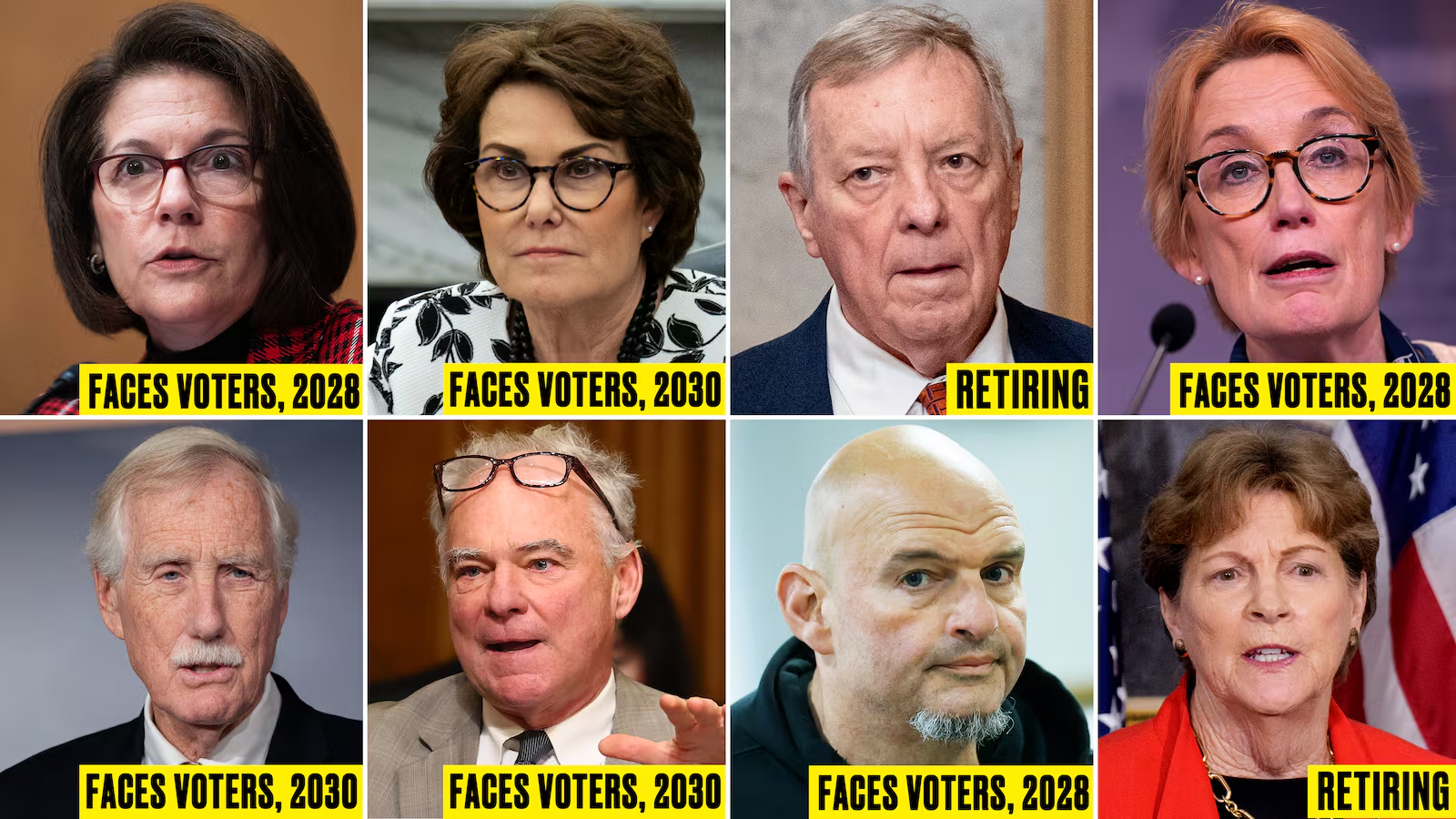
Seven Dems and one independent who caucuses with them flipped to the GOP side to end the shutdown (Getty Images photos).
The Daily Beast, Democrats’ Surrender Caucus All Have One Key Thing in Common, Janna Brancolini, Nov. 10 2025. None of the Senate Democratic caucus members who caved to Republican pressure to reopen the government will have to face voters in next year’s midterm elections.
Of the seven Democrats and one Independent who broke ranks to support a continuing resolution that will fund the government through January 30, two have announced they are retiring, and six are not up for re-election until 2028 or 2030.
Lincoln Square Media, Political Opinion: Schumer and the Hateful Eight Betray America, Rick Wilson, right (former Republican campaign strategist), Nov. 11, 2025. A new low for the Senate Democrats. As always, Democratic elected officials crave political death.
They are the all-time champions of snatching defeat out of the slavering jaws of victory at the last possible second, the most deeply committed gamblers when they’ve been told the cards are marked, the deck is stacked, the house is crooked, and the dealer is in on the con.
Last night, eight “moderate” Democrats got played.
Conned. Rooked. Pantsed. Pumped and dumped. Rode hard and put away wet.
It was a colossal leadership failure, and Chuck Schumer should resign as Minority Leader immediately if he had a shred of honor or shame.
And by the way, Schumer voted “no,” but this travesty happened because he wanted it to happen.
If Schumer were Mitch McConnell, he’d tell these Senators that supporting Trump (because that’s what this is) will lead to their immediate removal from committees, elimination of their staff down to minimal levels, taking away their “hideaway” offices, and a portfolio of other large and small cruelties. Cocaine Mitch, say what you will, was stronger as a Minority Leader with his caucus than Chuck Schumer was as Majority Leader.
A shutdown that was bleeding the MAGA GOP dry will end because the Hateful Eight were suckers who make Neville Chamberlainlook like Genghis Khan. Patsys. Petains. Fools. Mooks.
The Republicans cannot believe their luck. They get to end the shutdown, blame it on Democrats, and go back to the MAGA base and say, “We killed Obamacare at last!”
How many damn times does it take for people to learn to learn that the more transparently the GOP is acting in bad faith (shutdown brinkmanship, hostage-taking, “we’ll just renege later”), the more likely Democrats are to concede “to show we’re the adults in the room.”
If you want to know why this is a con job by John Thune and Donald Trump, observe one key aspect of the MAGA message machine in the last 24 hours: its silence. The same Mighty Wurlitzer of right-wing agitprop that roars like a rabid dragon 24/7 at every Democrat, spewing fire and bile, was…awfully quiet. Last night, big MAGA social media accounts were praising the Hateful Eight for “putting country over party.”
Yes, I gagged, too.
They were, as they always are, utterly coordinated, from the White House and Fox on down. And they let this deal play out quietly. Softly, so Thune and Trump could lure these birds into the trap. This is the Hate Machine in action.
“But wait,” cry the eight arms of the idiot spider. “We get a single show vote at John Thune’s convenience to show we love health care subsidies and they don’t.”
Oh, for all this sacrifice, you got a vote.
You handed Donald Trump and the GOP a 2026 lifeline for a single show vote, one you know the House will kill and Trump will veto.
Oh, bra-vo.
Oh, wait? Your moronic, window-licking, focus-group addicted consultants told you this will be a great talking point? That they’ll write a policy paper on why you’re so smart? That you’ll get to use it in ads?
Well, slap my ass, can call me Sally! That’s great for you. Good on you for ignoring the winning message from last week and moving on to a surefire loser that no one will understand or remember next November.
I’ve seen some profoundly stupid things in my long run on this political racetrack, but that is the windswept pinnacle of Mount Dumbass.
Wilson’s Third Law took a while, but here it is: when presented with the option of holding a popular position and making the Republicans pay for opposing it, Democrats will pre-compromise against themselves (oh, and at significant harm to the American people) in hopes of bipartisan vibes at a velocity approaching light speed.
Democrats will get no credit for this.
None. Zero. Zip.
The shutdown was Donald Trump’s stinkbomb, with Mike Johnson and John Thune holding the same reeking tarball. Now? The Democrats get to wear it, too. They went from principled fighters to collaborators.
Trump and MAGA take the win.
Even if Democrats are posturing to themselves in a little group chat, doubtless called something like “The Grownups,” it is an absolute certainty that Trump and the Republicans will go on TV and say, “We forced them to reopen the government on our terms.” Because Dems blinked first, the narrative becomes: “GOP chaos works. Trump wins. MAGA is unstoppable.”
Base demoralization.
Democratic voters had a great night last Tuesday.
Obviously, Chuck Schumer’s eight proxies decided to ignore the winning message and decided to rescue a Republican-made crisis and get … nothing.
No policy win, no accountability, no political scalp. That breeds “why do we even vote for these people?” energy … which is poison in a cycle where turnout is king.
It was the equivalent of telling everyone who has worked, marched, organized, voted, and donated in the last year, “Nah, never mind. Turns out we mean, ‘Yes, King Donald.’”
Media “both sides” laundering.
By helping end the shutdown, Democrats give the Beltway press a way to say, “See? Washington can work!” That muddies the key message that Republicans caused this disaster and should be punished for it. Every poll blamed the GOP. Every. Damn. Poll.
Now? “Democrats end their shutdown. Republicans relieved over bipartisan compromise.
Hostage-taking is now validated.
Once Democrats show they’ll pay the ransom to spare the country pain, Republicans learn the obvious lesson: do it again.
New York Times, News Analysis: For Trump, Nothing Was Off Limits During the Shutdown, Luke Broadwater, Nov. 11, 2025 (print ed.). President Trump pressured Democrats by taking punishing actions no previous administration ever took during a shutdown.
The government shutdown is already the longest in American history. But it’s also perhaps the most punishing, in part because President Trump has taken actions no previous administration ever took during a shutdown.
Over the past six weeks, the Trump administration cut food stamps for millions of low-income Americans. It tried to fire thousands of government workers and withhold back pay from others, while freezing or canceling money for projects in Democratic-led states.
It remains to be seen whether there will be a political price to pay for Mr. Trump or his party, with polls showing that voters generally blamed Republicans more for the shutdown. But for now, the tactics appear to have worked, after a group of Democrats agreed to support a bill to end the shutdown and drop the concessions their party had demanded.
“Standing up to Donald Trump didn’t work,” Senator Angus King, independent of Maine who caucuses with the Democrats, said on MSNBC Monday. “It actually gave him more power.”
The bare-knuckle politics the Trump administration employed during the shutdown — often coming from his budget director Russell T. Vought, whom Mr. Trump refers to as Darth Vader — became too brutal for the handful of centrist Senate Democrats, who never liked the idea of the shutdown much anyway.
The deal they voted for on Monday reverses much of the pain Mr. Trump inflicted. Under its terms, the president must rescind his layoffs and restore back pay to other government workers. Democrats will also get a vote on extending subsidies under the Affordable Care Act, something that Senate Republicans weeks ago offered them.
While the shutdown may be ending, Democratic officials say the party learned a lesson that base voters reward them when they fight. Democratic leaders view last week’s elections, with big victories in governor’s races in New Jersey and Virginia, as evidence that their strategy was working. They point to polling that indicates that the public was blaming Mr. Trump and Republicans more than Democrats for the shutdown.
 The Contrarian, Opinion: Words & Phrases We Could Do Without, Jennifer Rubin, right, Nov. 11, 2025. Forget ‘moderates.’ There are ‘fighters’ and there are ‘defeatists.’
The eight Neville Chamberlains who convinced themselves that caving for a vote (with a 60 vote margin, no less), reversal of Reduction in Force (RIF’s) and backpay (which the regime was legally obligated to do anyway) and a package of three appropriations bills (with no guarantee Donald Trump won’t pull a rescission) is nothing short of a betrayal of the thousands of government workers who have held out, the SNAP beneficiaries who have faced starvation, and the millions of Democrats who supported this fight.
They have blurred the lines on the single best issue they have—healthcare—allowing a handful of Republicans to vote with them in December, knowing it will not reach 60 votes or pass the House.
Even if not pushing for this debacle, Minority Leader Chuck Schumer’s inability to hold his caucus is proof positive he is the wrong leader for this time. He would do well to consider handing over the reins to someone willing to fight.
It is hard to mount a credible effort to win back the Senate majority with him at the helm. Sens. Dick Durbin of Illinois and Gary Peters of Michigan are retiring anyway, but have Democratic governors, so could do themselves and the party a favor by resigning now. If any of the others seek re-election in 2028 and beyond, they should expect ferocious primary challenges.
After the unnecessary, counterproductive, idiotic cave by these eight self-described “Senate moderate Democrats,” it is about time to ban that phrase. The term for those who snatched defeat from the jaws of victory would be “weak Democrats” or “useless Democrats” or simply “defeatists.”
It is important to lose that label of “moderates” not only to make clear these Democrats are a drag on the party and the fight for democracy but to spare those fighting Democrats (including the Gov.-elect of New Jersey, Mikie Sherrill and other senators who held firm but can in no way be considered far-left progressives) from getting lumped in with the weak-kneed crew. Put differently, we need to distinguish Democrats who understand we are in an existential fight for democracy from those who think “getting along in the Senate” is a worthwhile goal.
You do not have to take the most progressive stances on policy issues to comprehend that the senators who caved have made an astounding error. Indeed, the long list of not-as-progressive-as-some Democrats who have denounced the deal (e.g., Reps. Ritchie Torres, Jake Auchincloss, Dan Goldman; Sens. Chris Coons, Mark Warner, Elissa Slotkin) should remove any confusion that this is about ideology.
If last Tuesday’s results showed anything, it is that ideology matters less than clarity and determination. The commonalities between Mayor-elect Zohran Mamdani and Sherrill vastly outweigh the differences. (Hint: “Affordability” is the new Democratic mantra.) No one should ever confuse Sherrill for Dick Durbin. The former is a disciplined fighter; the latter is an embarrassment.
In other words, the caving senators have given “moderate”—or its cousin label of “centrist”—a bad name. So how should fighting Democrats such as Sherrill, Warner, Pritzker, etc. describe themselves?
In response to the query, “What kind of Democrat are you?” candidates and politicians, donors, and operatives horrified by this retreat, regardless of ideology, should respond: A Democrat who wins; a Democrat who fights for a fair shake for Americans; a Democrat with zero tolerance for corruption; a Democrat ready to fight fire with fire on redistricting; a Democrat who treasures and collaborates with grassroots organizers and rejects invitations to appease bullies; a JB Pritzker-Gavin Newsom (not Muriel Bowser or a caving Senate Democrat); a No Kings Democrat; a Democrat who understands we are in an existential crisis; and a Democrat who will fight for Kilmar Abrego Garcia, for women and girls abused by Jeffrey Epstein, for heroic Capitol Police who defended the Capitol on Jan. 6, and for every nonprofit that has been smeared as ANTIFA.Subscribed
If they need further guidance, Democrats might consider former New Orleans mayor Mitch Landrieu’s observation from his extensive survey and focus groups for the Working Party Project. As he put it, there is “no single profile or type of candidate” who can win, but Democrats who offer something better than what voters have gotten from Trump and who sound like real people (“with authenticity, plain-spoken vocabulary, clear and intentional statements, and a lack of condescension”) will prevail—just as they did all across the country last week.
Yes, those running were fortunate enough to run against Trump even when he was not on the ballot. Loathing of Donald Trump and fury over the hardships he has visited on the American people played a sizable role in Democrats’ dramatic victory. Large, symbolic self-owns that epitomized MAGA cruelty, greed, and corruption (e.g., knocking down the East Wing of the White House or turning off SNAP benefits) helped push voters to the left. Excellent candidate selection (from New York City to Southwest Virginia), the intensity stoked in No Kings marches, a laser-focus on affordability, and a fighting spirit (e.g., battle for healthcare access for tens of millions of Americans, suing to resume benefits) sealed the victory.
However, none of us should underestimate how swiftly that advantage can be frittered away by caving, capitulating, and emboldening MAGA autocrats. If Democrats want to sustain and build on victories, the solution is not to tolerate weakness or convince themselves Republicans would win those seats if not for the wet-noodle Democrats who occupy them now. One good start: Any 2026 or 2028 Senate Democratic candidate must commit to serious reform or elimination of the filibuster so as to undertake the necessary repairs to reverse the slide into fascism (e.g., a comprehensive voting right bill, major Supreme Court reform, admission of D.C. as a state). Democrats—regardless of geography or ideology—need to define themselves as determined warriors to fight for our democracy and the welfare of working and middle class people.
A year is a lifetime in politics. Between now and the midterms, Democrats must refuse the allure of capitulation, organize incessantly, recruit tirelessly, lay bare the abject cruelty of Republicans (fighting to turn off SNAP?!?). Above all, adhere to former Speaker Nancy Pelosi’s adopted motto: “Just win, baby.”
What they do not need are Democrats under the banner of “moderate” who refuse to fight, deluding them into thinking they are saving democracy by capitulating. That’s a phrase and a cohort of Democrats we can do without.
U.S. Law, Justice, Crime
Morning Shots via The Bulwark, Political Opinion: Pardon the Corruption, William Kristol, right, Nov. 11, 2025. Trump’s blanket pardons for stop-the-steal illegality aren’t only about settling scores from past elections. They’re about laying the groundwork to subvert future ones.
Article II, Section 2 of the Constitution stipulates that the “The President . . . shall have Power to grant Reprieves and Pardons for Offences against the United States, except in Cases of Impeachment.”
This pardon power has often been regarded as a kind of incidental or relatively minor presidential power. But it is a power. And as the Supreme Court has interpreted it, it is a plenary and almost entirely unconstrained power.
Donald Trump understands power. And—as you’d expect from someone with the mindset of a lawbreaker—he has been particularly attuned to the potential use of the pardon power. In his first term he used pardons aggressively to induce allies not to testify against him, and to reward those who had stood with him.
But the lesson Trump took from his first term was that he hadn’t exercised his presidential powers aggressively enough. And that included the pardon power.
So he began his second term with the mass pardon of the Jan. 6th insurgents he’d incited to storm the Capitol. This wasn’t merely a reward for his past followers. It was an unmistakable signal for the future to those who might be asked or inclined to take extra-legal action on his behalf: You act for me, I’ll take care of you. Over the last ten months, Trump has followed up with all manners of pardons for friends, allies, business partners and the like, sending an unmistakable signal to others on his side: You scratch my back, I’ll pardon yours.
Then, yesterday the Justice Department announced a mass pardon for 77 named individuals but also for basically anyone involved in Trump’s campaign to overturn the 2020 election.
It was a preemptive pardon, proclaimed before any federal charges had been brought, in order to preclude such charges in advance.
And it was very broad. Trump’s “full, complete, and unconditional” pardon insulated from federal prosecution “all United States citizens” for any “conduct relating to the advice, creation, organization, execution, submission, support, voting, activities in, or advocacy for or of any slate or proposed slate of Presidential Electors, whether recognized by any State or State official, in connection with the 2020 Presidential Election, as well as for any conduct relating to their efforts to expose voting fraud and vulnerabilities in the 2020 Presidential Election.”
With this pardon, Trump rewarded all those who helped him try to subvert the 2020 presidential election results, as he had earlier rewarded those who tried to block the peaceful transfer of power on Jan. 6th.
But the true message of this wave of pardons—the prospective message—is that pardons will be available to everyone who joins him in the effort at election subversion in 2026 and 2028. This wave of preemptive pardons is a permission slip, an encouragement, even an order, to be ready for election subversion in the future.
And we know that Trump is interested in election subversion. Not just because of various efforts in this direction his administration has already launched, but because, after all, he tried it before. In his first term, he hadn’t been able to organize the federal government well enough to successfully pull it off. But now, Trump has Pam Bondi in place at the Justice Department instead of Jeff Sessions and then Bill Barr; he has Kash Patel at the FBI in place of Chris Wray; he has Pete Hegseth at Defense instead of Jim Mattis and then Mark Esper; he has Kristi Noem at DHS in place of Kirstjen Nielsen and then Chad Wolf. And from the first day of the second term, apparatchiks have been put in place beneath all of them, and elsewhere and in the White House. They will have little or no hesitation in doing whatever it takes to keep Donald Trump or a designated successor in power.
The wielding of the pardon power helps remove whatever hesitation might remain on the part of Trumpists to engage in election subversion. The pardon power is also a useful reminder that Trump and his minions are willing to use parts of the constitution against itself. That has been the practice of other authoritarian movements seeking to subvert free governments. And so the defenders of free government need to think beyond a kind of narrow legalism that can lead them to simply shrug their shoulders about the pardons.
The pardons are a legal and constitutional part of an anti-legal and anti-constitutional project. But that doesn’t make them any less dangerous. And it makes it even more important to expose them for what they are, and to work to make Trump and the GOP pay a political price for them.
Will the Supreme Court take aim at legal gay marriage in America? Not for the moment. In an unsigned order, the court declined yesterday to take up a legal challenge to its 2015 decision in Obergefell v. Hodges. The challenge was brought by Kim Davis, the Kentucky county clerk whose refusal to issue marriage licenses to gay couples made her a Republican folk hero at the time. Another L for Davis. She’s racking them up.
Morning Shots via The Bulwark, Political Opinion: Whatever It Is, It’s Not Popular, Andrew Egger, Nov. 11, 2025. Donald Trump’s constant, open flouting of laws and norms can be paralytic to the mind.
It seems like every day it’s another thing—he helps himself to another billion dollars of U.A.E. crypto money, or launches investigations into political enemies, or pardons another tranche of people who tried to help him steal the 2020 election, or threatens the broadcast licenses of TV channels he doesn’t like, and on, and on, and on. It’s easy to fall into the cynical trap of thinking none of it matters—that voters don’t care about this sort of thing anymore.
But it’s an illusion. The fact is that this stuff is deeply, remarkably unpopular, with no real constituency outside the hardcore MAGA base. It’s supplying constant low-level drag on Trump’s approval rating.
That’s the main takeaway from new polling from Democratic research firm Blueprint Strategies, shared first with The Bulwark today. Blueprint asked voters a series of straightforward questions about 25 of Trump’s most controversial policies and actions this year: Do they consider those actions authoritarian? And do they approve of them? The answer was, largely, “yes” and very much “no.”
Fifty-four percent of respondents said that signing executive orders to investigate or persecute political enemies qualified as “authoritarian”, as did 50 percent of respondents when asked about deploying the National Guard to blue cities and firing the head of the Bureau of Labor Statistics over irritatingly weak job numbers. Strong pluralities described as “authoritarian” a whole host of other Trump actions (see the full slate below).
Another remarkable thing to note here is the delta between voters’ willingness to describe any specific action as “authoritarian” and voters’ approval of those actions. Only 42 percent of voters, for instance, use the term “authoritarian” to describe Trump’s massive self-dealing and personal enrichment during his second term—but a full 64 percent percent of voters disapprove of that behavior regardless.
These numbers get even more eye-opening when it comes to independents, where strong majorities describe a host of Trump actions as “authoritarian” and a full two thirds register their disapproval for those actions, such as Trump’s threats to pull FCC broadcast licenses from NBC and ABC and his ordering of masked ICE raids nationwide. Just under two thirds of independents disapproved of a wide swath of other actions, such as the firing of DOJ lawyers who prosecuted Jan. 6th rioters and the Trump family investing in crypto and using political power to promote it.Blueprint's poll results, among all voters and among independents. Click to see each full image.
In a better world, none of this would come as much of a surprise. Trump obviously isn’t bothering to triangulate for political popularity when he goes after guys like Adam Schiff, Letitia James, and James Comey for retributive prosecutions, or when he tries to purge the government of inspectors general and non-MAGA federal prosecutors.
But there’s a valuable lesson in these numbers for those who consider Trump’s growing authoritarianism the most glaring threat in America today. Voters are open to the argument that “authoritarianism” describes the Trump project. And they’re repulsed by the project when it is broken down into individual actions and policies. We shouldn’t get so hung up on the label that we forget to prosecute the deeply unpopular facts of each individual case.
That’s especially true for the Democrats. Running on affordability is a great thing—but it shouldn’t be the only thing. Donald Trump’s inability to control his own appetites for wealth, flattery, and vengeance is deeply unpopular. They must recognize and act on that.
AROUND THE BULWARK
More On U.S. Government Shutdown Votes, Implications
New York Times, Age Is the Issue That Democrats Can’t Shut Down, Reid J. Epstein, Nov. 11, 2025 (print ed.). A restless Democratic base is seething at older leaders in Washington.
The Democratic unity and good feelings after the party’s big election victories lasted under a week.
Now, the knives are back out.
As eight Democratic-aligned senators with an average age of about 70 voted with Republicans to end the 40-day government shutdown without the health care concessions Democrats had demanded, the party again convulsed with two questions that have long racked its members: How old is too old and how vigorously should they fight Republicans?
Tonight we will look at how these two divides are crucial to understanding both the capitulation and the subsequent anger from virtually all corners of the party.How age plays into the arguing
Democrats are still dealing with the fallout of Joe Biden’s calamitous decision to seek re-election at age 79. What has been less discussed is the fallout of having so many members of Congress who are at (and well beyond) retirement age.
And as liberal voters just found out, it’s a lot easier to vote for something your base hates if you’re too old to worry about re-election.
Of the Democratic-aligned senators who voted for the shutdown deal, two are not running again: Dick Durbin of Illinois, 80, and Jeanne Shaheen of New Hampshire, 78. Angus King of Maine is 81 and Jacky Rosen of Nevada is 68. Both Tim Kaine of Virginia and Maggie Hassan of New Hampshire are 67.
All would be past 70 years old if they decide to run again when their terms end.
The other “yes” votes were from Catherine Cortez Masto of Nevada, 61, who represents a state where the Las Vegas tourism industry feared taking a major hit from canceled flights, and from John Fetterman of Pennsylvania, who is just 56 but has already alienated much of his party by embracing Trump on a slew of issues.
“This is the problem with the gerontocracy,” said Amanda Litman, the leader of Run for Something, a group that recruits young progressive candidates to run for office. “When you have older leaders who are never going to face re-election again, you make decisions that are disconnected from what their voters believe.”
Yet the age issue is likely to keep flaring up. Senator Chuck Schumer’s top three midterm recruits are Janet Mills, 77, in Maine; Sherrod Brown, 73, in Ohio; and Roy Cooper, 68, in North Carolina. Each would be in their 80s by the end of a second term.
Fighting about fighting
Then there is the matter of how much to fight, and who should lead the charge.
“Standing up to Donald Trump didn’t work,” King, the senator from Maine, said Monday on MSNBC. “It actually gave him more power.” ImageAngus King talks as both of his hands rest on the lectern in front of him. People are blurred in the foreground and background.Senator Angus King on Sunday.Credit...Tierney L. Cross/The New York Times
This sentiment came as news to Democrats who were less than a week removed from sweeping victories in California, New Jersey and Virginia. For many in the party, Tuesday’s elections were the first time in a year that they could feel good about their collective ability to punch back against Trump.
Instead, many Democrats were surprised to see a key slice of senators backing down on the party’s 40-day demand that Republicans fund Affordable Care Act subsidies — with polls showing that voters were generally on the Democrats’ side.
Anger from across the party erupted, and elected Democrats found themselves navigating new calls for Senator Chuck Schumer to be ousted as minority leader. Many progressives and younger Democrats have argued increasingly loudly that Schumer, 74, is no longer up to the fight against Trump.
Senator Mark Kelly dodged questions on Monday about whether Schumer should remain as leader. Representative Ro Khanna of California suggested Schumer should go, then bickered with reporters on social media about it. And Representative Seth Moulton of Massachusetts, who is aiming for a promotion to the Senate, tried to use his opposition to Schumer as a cudgel against Senator Ed Markey, his primary opponent.
“Maybe now @EdMarkey will finally join me in pledging not to vote for Schumer?” Moulton wrote online.
Feeding the discontent are memories of the last shutdown fight in March, when Schumer led Senate Democrats to make a deal with Republicans to keep the government open. Then as now, the party’s base and most of its members in Congress wanted the fight against Trump and his allies, while a handful of older institutionalists demurred.
In one sign of how far out on an island the eight senators are, they drew backhanded scorn from the Democratic National Committee, which rarely intervenes in intraparty disputes.
“I am proud of the majority of Senate Democrats who opposed this vote,” said Ken Martin, the party chairman.
This is all taking place as Trump issued pre-emptive pardons to Rudolph Giuliani and a host of people who tried to overturn the 2020 election results.
In a world without the Democratic senators’ capitulation, the pardons might have been a galvanizing issue for the party’s elected officials to rally around while continuing to press their case that spiraling health insurance costs were Trump’s fault alone.
Instead, they will keep arguing among themselves.
Letters from an American, Historical Commentary: November 10, 2025 [Democratic Disunity], Heather Cox Richardson, right, Nov. 11, 2025. Last night, the Senate advanced a measure to end the government shutdown, which at 41 days today is the longest in U.S. history.
Seven Democrats and one Independent voted with all but one Republican to advance a measure that funds the government through January 30 of next year. It includes funding for military construction and the Department of Veterans’ Affairs, the Department of Agriculture and the Food and Drug Administration, and operations for the legislative branch, or Congress. Tucked within that last appropriation is a measure that allows the eight Republican senators whose phone logs were seized during former special counsel Jack Smith’s investigation of the attack on the U.S. Capitol on January 6, 2021, to sue the government for up to $500,000 apiece.
The measure stops the administration’s firings of public employees during the shutdown, reinstating them with full pay. States will be reimbursed for monies they spent covering for federal shortfalls during the shutdown. This means air traffic controllers, who have been working without pay for more than a month, will get paid again.
The measure also funds the Supplemental Nutrition Assistance Program (SNAP), although it does not restore the cuts Republicans made to it in their budget reconciliation bill of July—the one they call the “One Big Beautiful Bill Act.”
While the measure provides more funding for Indigenous health services, it does nothing to extend the premium tax credits for insurance purchased on the Affordable Care Act healthcare marketplace. Without those credits, millions will lose their healthcare insurance and millions more will face skyrocketing premiums. Republicans did not extend the premium tax credits in their July budget reconciliation bill, although they did extend tax cuts for the wealthy and corporations.
Senate Democrats said they would not advance a measure to end the shutdown without a deal to extend the premium tax credits, but seven of them, along with one Independent, have now done so. Senate majority leader John Thune (R-SD) has promised to bring to the Senate floor a bill to extend the premium tax credits before the end of the second week of December. It will be written by the Democrats.
In the 60–40 vote, Rand Paul (R-KY) did not join the rest of the Republican senators to advance the measure. Democrats Dick Durbin of Illinois, John Fetterman of Pennsylvania, Maggie Hassan of New Hampshire, Tim Kaine of Virginia, Catherine Cortez Masto of Nevada, Jacky Rosen of Nevada, and Jeanne Shaheen of New Hampshire and Independent Angus King of Maine all voted with the Republicans to advance the measure.
Last night’s vote did not pass the bill, which still faced procedural hurdles in the Senate that the chamber is cleared tonight. It now goes to the House, which must either pass it, reject it, or amend it.
If Trump signs the measure into law, the 42 million Americans who rely on SNAP payments will get relief. The two million federal workers who need paychecks will get them, and airlines should eventually get back to business as usual. These are no small things: aside from the individual human cost of the shutdown, the undermining of the federal government threatened to destroy it, and the administration’s cuts to air traffic were hitting cargo planes, adding yet another blow to the weakening economy just before the busiest shopping season of the year.
News of the terms of the deal to end the shutdown hit the country rather like a cue ball hitting a rack: lots of balls started to move in wildly different directions.
The eight senators who voted with the Republicans appear to have lost any hope Trump would negotiate and, in that absence, decided they had to relieve the pain of the shutdown. As Dan Drezner noted in his Drezner’s World, Trump’s behavior during the shutdown made it clear he simply didn’t care how badly Americans got hurt. “He did not just refuse to negotiate,” Drezner noted. “During the shutdown month he also completely bulldozed the East Wing, cut SNAP benefits, witnessed producers passing on the cost of tariffs to consumers, announced curbs on air travel, and participated in a Great Gatsby–style party at Mar-a-Lago.”
Voters hated this, but Trump didn’t appear to care. Indeed, his administration was working to ratchet up the pain of lost SNAP payments and canceled flights, including not just passenger planes but cargo planes right before the shopping season in which many businesses make the income that keeps them afloat for the year. In the senators’ statements about why they voted with the Republicans, Drezner noted a pattern: the words “pain” and “hurt.”
As Jonathan V. Last of The Bulwark noted, the Democrats gave in to Republican plans with few concessions, but the shutdown hurt Trump’s popularity and the Democrats won a vote on the ACA subsidies, which is a terrible issue for the Republicans. Seventy-eight percent of Americans actually want such a measure to pass, meaning that a vote—even one only in the Senate—will help clarify for voters what’s at stake.
Another moving ball was the voters and organizers who turned out for Democrats last Tuesday and who had made it very clear they think it’s long overdue for the Democrats to stand up to Trump. Ezra Levin of Indivisible, which organized the No Kings rallies, described his reaction to the deal as “incandescent rage, incredible disappointment.” “What do we do to demand a better party, a party that actually fights back?” he asked.
Democratic party leaders appeared to acknowledge that the momentum of the party is behind a fight against Trump and MAGA authoritarianism. The senators who voted with the Republicans are all either retiring, not up for election in 2026, or not running for another office, while Democrats who are in one of those categories were vocal about their anger over the vote.
Senator Chris Murphy (D-CT) posted a video on social media warning: “Bullies gain power when righteous people yield to the face of their wrongdoing. I didn’t want this shutdown. I want it to end, but not at any cost. And of course, I wish that there was a path to saving this democracy and saving people’s health care that didn’t involve pain. This shutdown hurt. It did. But unfortunately, I don’t think there is a way to save this country, to save our democracy, without there being some difficult, hard moments along the way…. [T]here’s no way to defend this,” he said. “And you are right to be angry about it. I’m angry about it.”
There are Republican balls in play, as well.
President Donald J. Trump did not want the shutdown to end this way. He was trying to use the pain he was inflicting on the American people to force Republican senators to end the filibuster and pass a series of measures that would essentially have made him a dictator. The Republican senators were clear they didn’t want to do that. And now, they haven’t. They chose a way out of the shutdown fight that did not support Trump’s ambitions. After nine months in which they appeared to do his bidding, that’s an interesting development.
Trump does not appear to be giving up his position on hurting the country easily. Late last night, three judges from the First Circuit refused to stop the lower court order saying that the administration must pay SNAP benefits in full, and today, the administration went back to the Supreme Court to ask it to freeze those payments.
Trump also posted an attack on air traffic controllers, saying to those who took time off during the shutdown “I am NOT HAPPY WITH YOU. You didn’t step up to help the U.S.A. against the FAKE DEMOCRAT ATTACK that was only meant to hurt our Country. You will have a negative mark, at least in my mind, against your record. If you want to leave service in the near future, please do not hesitate to do so, with NO payment or severance of any kind! You will be quickly replaced by true Patriots, who will do a better job….” In fact, the country has a shortage of air traffic controllers.
Trump called Democrats “the enemy” today, but told reporters he would abide by the deal, saying that “they haven’t changed anything.” But they have.
And that’s yet another moving ball. If the Senate passes its measure and sends it to the House, Speaker Mike Johnson (R-LA) will have to bring the House into session to conduct work. He has had the chamber on hiatus since September 19, 2025, when the Republicans passed a continuing resolution that offered the Democrats nothing, and has kept members out of Washington, D.C., ever since.
Bringing the House back into session will require Johnson to swear in Representative-elect Adelita Grijalva (D-AZ). Erum Salam of MSNBC reported that Johnson told Republicans on a conference call today that the “first order of business will be to administer the oath to Grijalva.” Grijalva says she will be the final signer on the discharge petition that will force a House vote on releasing the Epstein files. Johnson and administration officials have worked hard to keep those files under wraps, especially since news broke that Trump is mentioned in them.
And then, in the midst of all the drama last night, Justice Department pardon attorney Ed Martin posted a document on social media revealing that Trump had issued an extraordinarily broad pardon to “all United States citizens for conduct relating to the advice, creation, organization, execution, submission, support, voting, activities, participation in, or advocacy for or of any slate or proposed slate of Presidential Electors, whether or not recognized by any State or State official, in connection with the 2020 Presidential Election, as well as for any conduct relating to their efforts to expose voting fraud and vulnerabilities in the 2020 Presidential Election.”
As Kyle Cheney of Politico noted, the pardons of those who tried to steal the 2020 presidential election for Trump were largely symbolic because they had not been charged with federal crimes. What they do is suggest that he will protect those who try to cheat for him in the future, an interesting development considering the measure in the government-funding bill allowing senators to sue the government for accessing their phone logs during the events of January 6, 2021.
The sweeping pardons also might be softening up the ground for a pardon or a commutation for convicted sex trafficker Ghislaine Maxwell, an associate of sex offender Jeffrey Epstein. A whistleblower has provided documents to the House Judiciary Committee showing that Maxwell has asked for a commutation of her prison sentence.
And Trump’s popularity continues to drag. Last night he got soundly booed at a Washington Commanders football game.
Lots of balls moving around the table.
Paul Krugman via Substack, Political-Economy Commentary: Republicans Are Damaged by Their Own Cruelty, Paul Krugman, right, Nov. 11, 2025. They’re pathologically unwilling to help Americans in need — and Democrats should hammer this home.
Like almost all progressives, I was infuriated and disheartened by Senate Democrats’ cave on the shutdown Sunday. The party won stunning election victories Tuesday — and its leaders responded with yet another preemptive surrender? (Chuck Schumer may have voted no, but he didn’t manage, and may not even have tried, to prevent defections.)
Yet while the immediate politics displayed Democratic tactical weakness, the larger story highlighted a different kind of weakness on the part of Donald Trump and MAGA as a whole — namely, their innate cruelty. They have a visceral dislike for policies that do anything to help the less fortunate, and can’t even bring themselves to be cynical, to help Americans temporarily while they consolidate power.
Consider the grounds on which the shutdown fight took place. Democrats made it about the enhanced subsidies that have kept premiums for health insurance under the Affordable Care Act fairly reasonable for millions of Americans — Americans who are now facing huge premium hikes that will create intense financial distress and force many to go uninsured.
Before the big cave, Democrats proposed a deal in which they would provide the votes to reopen the government in return for a one-year extension of those enhanced benefits. Republicans should have jumped at this deal. It’s true that Republicans are determined to destroy much of the social safety net. The One Big Beautiful Bill will impose savage cuts in Medicaid and food stamps. But these big cuts are set to happen after the midterm elections.
Drastically increasing health care costs at the beginning of 2026, causing millions to lose insurance, certainly looks like a massive political blunder. My guess is that it doesn’t reflect a considered strategy. Instead, Republicans just stumbled into this because nobody in a position of power within the party understood how the ACA works.
And polling suggests overwhelming public support for extending the enhanced subsidies: 74 percent overall, including half of Republicans: So Republicans should have been eager for a chance to postpone the pain. Instead, by rejecting Democratic proposals, Republicans have placed the onus for soaring premiums squarely on themselves.
But the thought of doing something decent, even cynically and temporarily, doesn’t seem to have crossed Republican minds. John Thune, the Republican Senate majority leader, immediately declared the proposed deal a “nonstarter,” insisting that his party would only negotiate about healthcare after the government is reopened — which everyone understands means that Republicans will agree to nothing.
Why reject a deal that could have protected Republicans from their own mistakes? Part of the answer is sheer ignorance. Here was Trump’s response: Substance aside, think about the idiocy of the timing here. The health insurance crisis is happening right now, as Americans open letters from their insurers and discover that they are facing huge increases — more than 100 percent on average, much more in many cases — in the cost of coverage beginning in just a few weeks. This is not exactly the time to propose immediately scrapping our existing health care system, replacing it with … something.
And a vague promise to deal with an immediate crisis by totally revamping healthcare is especially lacking in credibility coming from a man who has been promising, and failing, to deliver a superior alternative to Obamacare for around 9 years.
On the substance, Trump’s post makes it clear that after all this time he still has no idea how health care works. We’ve always known that he didn’t and doesn’t understand Obamacare, and why it’s hard to come up with a better system other than single-payer health insurance. But it’s now clear that he doesn’t even understand why healthcare relies on insurance, why we can’t pay medical expenses out of pocket. Hint: You never know if or when you’ll need extremely expensive treatment, but should the need arise, only the ultra-wealthy can come up with the necessary cash.
Oh, and it’s especially rich to see Trump take a break from boasting about his new gold-and-marble bathrooms to pretend to hate “money sucking Insurance Companies.”
Anyway, Trump’s vague ideas are, as Thune would say, a nonstarter. But why not punt, postponing the health affordability crisis by agreeing to a temporary extension of the ACA subsidies?
The answer, I believe, is that doing so would involve giving help to people who need it — and that’s something that, at a deep psychological level, MAGA can’t bring itself to do.
Health care isn’t the only area in which Trump and company’s cruelty and lack of compassion are becoming major political liabilities.
The Trump administration rushed to cut off SNAP (food stamps) as soon as the government shut down, even though there was money available to pay those benefits — and the administration both defied court orders to pay and tried to stop states from helping the hungry.
Going beyond government programs, most Americans are very unhappy about the state of the economy. They see high grocery prices and a very weak job market. Consumers’ assessment of the current state of the economy is worse now than it was at the peak of the 2021-22 inflation surge, or the aftermath of the 2008 financial crisis:The rational thing for Trump to do would be to say “I feel your pain,” while blaming the previous administration and promising that things will get better soon. But he can’t even fake empathy. Instead, he keeps insisting that things are great, in particular that “groceries are way down.”
This is factually false. More important from a political point of view, it contradicts what people — even Republican partisans — are seeing in their own lives. Here’s what Americans think about grocery inflation, according to a recent Washington Post/ABC News/Ipsos poll: Has there ever been a case in which “Who you gonna believe, me or your lying eyes?” was an effective political strategy? Last Tuesday’s elections clearly showed that it isn’t working now. But Trump and his minions seem unable to try anything different.
Let me add that MAGA still seems to believe that scenes of masked ICE agents beating up women and senior citizens work to their political advantage. Either that, or they just can’t help themselves.
The political moral is that the humiliating cave over the shutdown isn’t the end of the story. Democrats can and should keep hammering Trump and his party over their indifference to the suffering of ordinary Americans. They need to make sure both that Americans know who’s responsible for surging premiums now and that Trump’s One Big Beautiful Bill will lead to savage cuts in both Medicaid and food stamps after the midterms.
MAGA can’t help being cruel. It can’t even pretend to care about other people’s suffering. And Democrats should take full advantage of this pathology.
More On U.S. Governance, Affordability, Economy

U.S. Popular Information, Accountability Journalism: Trump’s solution to the housing crisis is a lifetime of debt, Judd Legum, right, and Noel Sims, Nov. 11, 2025. There is a housing crisis in the United States.
In 1985, the median income was $23,620, and the median price of a home was $84,300. So the typical house was 3.6 times the typical income. By 2023, the median price of a home was $428,600, which was 5.3 times the median income of $80,061. In some metro areas, median home prices are more than eight times higher than the average income. In Los Angeles, San Francisco, and Honolulu, the price-to-income ratio exceeds 10. Home prices rose dramatically over the last five years, with the median cost of a single-family home increasing 48% between 2019 and 2024.
A severe shortage of homes is driving prices higher. A July 2025 analysis by Zillow found that “America’s housing shortage grew to an all-time high of 4.7 million units.”
According to Bankrate’s 2025 Housing Affordability Study, Americans need an income of about $117,000 to afford an average home. In 2020, the income needed to afford an average home was $78,000. Those figures reflect the increasing price of homes and higher interest rates.
Over the weekend, President Trump teased a new policy on social media to address the issue: a 50-year mortgage.
Bill Pulte, Director of the Federal Housing Finance Agency (FHFA), confirmed that this was a real proposal. “Thanks to President Trump, we are indeed working on The 50 year Mortgage — a complete game changer,” Pulte wrote on X.
But while the introduction of a 50-year mortgage would be a windfall to the financial industry, it would do little to make housing more affordable and saddle a generation of Americans with a lifetime of debt.Similar monthly payments, massive interest
The idea of a 50-year mortgage is that by spreading the cost of a home over 20 more years, you can reduce the monthly mortgage payment. But in practice, those savings are modest.
First, just as a 30-year mortgage has a higher interest rate than a 15-year mortgage, a 50-year mortgage will have a higher interest rate than a 30-year mortgage. Experts estimate that a 50-year mortgage would be about .5 points higher than a 30-year mortgage. Since the current 30-year mortgage rate is about 6.3%, a 50-year mortgage would have an interest rate of 6.8%.
So homebuyers using a 50-year mortgage would pay a higher interest rate over a much longer time period. This limits the reduction in the monthly payment.
HousingWire, using the Fannie Mae mortgage calculator, found that for a typical home costing $400,000, the monthly payment for a 30-year mortgage would be $2,481. The monthly payment for the same home with a 50-year mortgage would be $2,346 — a savings of just $135 per month. (That does not account for sellers potentially raising their prices once a 50-year mortgage becomes available.)
Meanwhile, over the course of the 50-year mortgage, the buyer of a $400,000 home will have paid over $1 million in interest, compared to $493,000 in interest payments for a 30-year mortgage. The big winner here is the lender, not the home buyer.The equity trap
Many Americans are interested in buying a home because it is seen as an effective way to build wealth. Homeowners grow their wealth through establishing equity over time. But with a 50-year mortgage, the process of building equity is much slower.
Considering the same $400,000 home, with a 30-year mortgage and a 6.3% interest rate, it would take about nine years to pay off the first $50,000 in principal. For the 50-year mortgage with a 6.8% interest rate, paying off the first $50,000 in principal would take about 24 years.
The difficulty in acquiring home equity makes these loans riskier for owners. Since the owner will have little equity in the home for many years, any downturn in the housing market could put the home “underwater.” That means the owner has “negative equity” because the home is worth less than the outstanding mortgage. This makes it virtually impossible for homeowners to relocate or address a financial emergency through a home equity line of credit.The influencer guiding Trump’s housing policy
The 50-year mortgage proposal was developed by Pulte, who was directed by Trump to use his position to lower housing costs. But Pulte is not an expert in housing policy.
Pulte previously founded an investment firm but is best known for amassing a large following on X as an online philanthropist, giving away money in a series of viral stunts. He is the grandson and heir of William Pulte, who founded home-building giant PulteGroup. After his grandfather died, Pulte’s relationship with the company and many members of his family soured. Pulte sued the family company, accusing his grandfather’s widow of insider trading.
As director of the FHFA, Pulte made the obscure agency a major player in Trump’s political battles. The FHFA’s primary responsibilities are to regulate the mortgage market and oversee Fannie Mae and Freddie Mac. Pulte, however, has used his position to accuse Senator Adam Schiff (D-CA) and New York Attorney General Letitia James (D) of mortgage fraud.
Pulte has also repeatedly criticized Federal Reserve Chairman Jerome Powell and urged Trump to fire him. This has led to a rift with Treasury Secretary Scott Bessent, who supports Powell. During a private dinner with other administration officials, Bessent reportedly threatened to punch Pulte “in the fucking face.”
In October, Pulte fired dozens of Fannie Mae employees. While he claimed that the firings were to end DEI efforts within the company, the Washington Post reported that Pulte had gutted the company’s internal watchdogs after they began investigating one of his close allies.
Global News

New York Times, As Iraqis Vote for a Parliament, U.S. Presses to Rid Country of Iran’s Influence, Erika Solomon, Nov. 11, 2025. After a U.S. occupation, years of sectarian violence and a jihadist insurgency, Iraq has become an improbable haven of calm in the Middle East.
From rooftops to lampposts, campaign posters compete for every inch of Baghdad’s streets. There are pictures of politicians wearing hard hats and slogans vowing “strength and prosperity.”
Concrete walls that once shielded buildings from car bombs now protect glitzy new apartment developments, promising cafes, gyms and spas.
After a long U.S. occupation, years of sectarian bloodshed and a jihadist insurgency, Iraq has become an improbable haven of calm in the Middle East, at least relative to many other parts of the region. Safeguarding this hard-won peace is a top priority for Iraqis as parliamentary elections get underway on Tuesday.
“The Iraqi people have reached a point where they can no longer tolerate conflict and wars and all these misadventures,” Mohammed al-Sudani, the prime minister, told The New York Times in an interview last week. “People want stability, security and development.”
More than 7,700 candidates from 114 party lists are competing for 329 seats. Once the results are in, there will be weeks, and possibly months, of negotiating for parties to forge a coalition with the largest share of seats, and then form a government.
Mr. al-Sudani, often credited for Iraq’s stability and a construction boom, heads an alliance of parties expected to win the most votes. But some of his former political allies have vowed to prevent him from forming a ruling coalition to gain a second term.
And just below the surface of this election lurks the thorny question of whether and how Iraq can curb the considerable influence of its once powerful neighbor, Iran.
Nov. 10
New York Times, Trump Administration Live Updates: Senate Deal Puts Government Closer to Reopening, Ashley Ahn, Michael Gold and Catie Edmondson, Nov. 10, 2025. Eight senators broke with Democrats to back a G.O.P. deal to end the longest government shutdown in U.S. history. The measure still must be approved by both houses of Congress and signed by President Trump.
Hopes rose on Monday for an end to the longest government shutdown in U.S. history, after eight senators who caucus with the Democrats broke ranks and advanced a Republican plan to fund most federal agencies through January.
The 60-to-40 vote late Sunday cleared the way for the Senate to formally debate the measure before a final vote. It will not become law until it is passed by the Senate, approved in the House and signed by President Trump.
Members of the House, who have been on an extended recess and have not held a vote since Sept. 19, were told late Sunday that they should expect votes on a funding measure as soon as this week.
Several top Democrats in the House, including Representative Hakeem Jeffries of New York, the minority leader, have already said they would not back the deal. But because Republicans have a slim majority in the House, Democrats in the chamber would have no chance of defeating it if Republicans held together in support.
Eight senators in the Democratic caucus voted to advance the measure on Sunday. That suggested there were enough votes to end the gridlock that has shuttered the government for weeks, leaving hundreds of thousands of federal workers furloughed, millions of Americans at risk of losing food assistance and millions more facing air travel disruptions.
The compromise measure includes a spending package that would fund the government through January, as well as three separate spending bills to cover programs related to agriculture, military construction and legislative agencies for most of 2026. The package also includes a provision that would reverse layoffs of federal workers made during the shutdown and ensure retroactive pay.
The deal won over key Democrats. Other Democrats were livid that their colleagues had backed down from the party’s central demand in the shutdown fight: the extension of health insurance subsidies that are slated to expire at the end of the year.
Democrats had spent weeks demanding that Republicans agree to permanently extend the subsidies in exchange for their votes to fund the government. Senator Chuck Schumer of New York, the Democratic leader scaled back that demand on Friday by proposing an extension of the health tax credits for a year, but Republicans immediately rejected that.
Politico, John Thune secures provision in government funding bill letting senators sue for phone records seizure, Hailey Fuchs, Nov. 10, 2025. The new legislative language is an escalation of the GOP’s efforts to discredit former special counsel Jack Smith.
Senate Republicans secured a provision in the bipartisan, shutdown-ending government funding package that could award senators hundreds of thousands of dollars for having their phone records collected without their knowledge as part of a Biden-era investigation.
That legislative language came directly from Senate Majority Leader John Thune.
In an interview Monday evening, Sen. Ted Cruz (R-Texas) — who claims he was one of the lawmakers to have his data subpoenaed as part of former special counsel Jack Smith’s investigation into President Donald Trump’s efforts to subvert the 2020 election — said Thune was responsible for the inclusion of provision.
“Leader Thune inserted that in the bill to provide real teeth to the prohibition on the Department of Justice targeting senators,” Cruz said.
A person close with direct knowledge of the legislation’s negotiations, granted anonymity to speak candidly, confirmed Thune oversaw the inclusion of the provision. It was tucked into the legislative branch spending measure for fiscal year 2026, part of a three-bill “minibus” of appropriations measures that Senators were set to vote on Monday night alongside a continuing resolution to fund the government through Jan. 30. The House is expected to clear the package for President Donald Trump’s signature as early as Wednesday.
Thune’s involvement is notable as the revelations that Smith collected phone records for several Senate Republicans has emboldened GOP lawmakers, prompting them to deflect Democrats’ accusations of weaponization of the Trump Justice Department and claim that President Joe Biden’s DOJ was looking to target conservatives.
“The abuse of power from the Biden Justice Department is the worst single instance of politicization our country has ever seen,” he continued. “I think it is Joe Biden’s Watergate, and the statutory prohibition needs to have real teeth and real consequences.”
Senate and House Judiciary Committee Republicans are now demanding answers from Smith, with Senate Judiciary Chair Chuck Grassley of Iowa seeking information from the administration relating to the probe and House Judiciary Chair Jim Jordan of Ohio calling on Smith to sit for a transcribed interview.
Smith has said he is eager to appear before lawmakers in an open forum.
The provision states that electronic services providers must notify a Senate office if the provider receives a request to disclose the data from that senator, or senator’s office. Moreover, the legislative language stipulates that the provider cannot be barred from notifying the senate office under a court order, though that notification may be delayed in the event the senator in question is under criminal investigation.
Chief Judge James Boasberg of the District of Columbia District Court approved measures that would have precluded phone providers from notifying the senators that their data was requested by federal law enforcement officers. Lawmakers have since renewed calls for his impeachment over the move, viewing him as hostile on a number of fronts to Trump’s agenda.
This portion of the legislative branch appropriations bill also appears to provide a cash bonus for those Senators who were targeted by Smith’s probe. If the provision included in the bill is violated, the Senator can sue the federal government, and if the lawmaker succeeds in the case, the person will be awarded $500,000 or more for each violation by the government.
Cruz said the provision was “very directly” a response to Smith’s actions.
Democrats on the Senate Appropriations Subcommittee on the Legislative Branch were not consulted on the provision as part of the otherwise bipartisan bill, according to a senior Democratic legislative aide granted anonymity to speak candidly.
“I am furious that the Senate Minority and Majority Leaders chose to airdrop this provision into this bill at the eleventh hour — with zero consultation or negotiation with the subcommittee that actually oversees this work,” said Sen. Martin Heinrich (D-N.M.), the ranking member of the legislative branch subcommittee, in a statement. “This is precisely what’s wrong with the Senate.
It was something of a swipe against Senate Minority Leader Chuck Schumer (D-N.Y.), who was involved in negotiating the funding bill with Thune. Schumer’s office did not immediately respond to a request for comment.
Asked whether the funding in the form of a payout for senators was taking money away from other programs across the federal government, Cruz criticized the Justice Department under Biden as “the worst single instance of politicization our country has ever seen.”
Sen. Ron Wyden (D-Ore.), an outspoken privacy hawk, argued that the provision’s inclusion in the spending bill was “very troubling,” given the seeming lack of oversight or discussion around its development.
He added that his GOP colleagues appeared to be distancing themselves from the language’s origins, suggesting Thune might be providing cover for rank-and-file Republicans who could have demanded it.
“It seems that there’s quite an effort on the other side, people saying that they don’t know anything about it,” he said. “Which ought to be a wakeup call to everybody about the possibility of abuse.”
New York Times, U.S. Military Kills 6 in Strikes on Suspected Drug Boats, Hegseth Says, Eric Schmitt, Nov. 10, 2025. The latest strikes raised the death toll in the campaign to 76 people in 19 attacks in the Pacific and the Caribbean Sea since early September.
The U.S. military killed six people on Sunday in two more strikes on boats suspected of smuggling drugs in the eastern Pacific Ocean, Defense Secretary Pete Hegseth announced on Monday.
The latest strikes raised the death toll in the campaign to 76 people in 19 attacks in the Pacific and the Caribbean Sea since early September.
In a post on social media, Mr. Hegseth cited “intelligence” and included two short video clips of the bombings of two separate boats that he said were traveling “along a known narco-trafficking transit route in the Eastern Pacific.”
One of the boats appeared to be at a full stop with two visible passengers and possibly with an outboard motor raised out of the water. The other was moving at high speed. But in neither case did Mr. Hegseth provide evidence for his claim that the three men aboard each of the two boats were smuggling narcotics. He said the attacks took place in international waters.
A wide range of specialists in laws governing the use of force have denounced the killings as illegal because the U.S. military is not allowed to intentionally target civilians who pose no threat of imminent violence, even those suspected of being criminals. The Trump administration says the strikes are lawful because President Trump has “determined” that the United States is in a formal armed conflict with drug cartels.
Mr. Trump has falsely asserted that each destroyed boat saves 25,000 American lives. In reality, as many as 100,000 Americans die each year from drug overdoses, but most of those deaths are a result of fentanyl, which comes from labs in Mexico. South America produces cocaine.
The Atlantic, Why I Am Resigning, Mark L. Wolf,right, Nov. 9, 2025. A federal judge explains his reasoning for leaving the bench. 
In 1985, President Ronald Reagan appointed me as a federal judge. I was 38 years old. At the time, I looked forward to serving for the rest of my life. However, I resigned Friday, relinquishing that lifetime appointment and giving up the opportunity for public service that I have loved.
My reason is simple: I no longer can bear to be restrained by what judges can say publicly or do outside the courtroom. President Donald Trump is using the law for partisan purposes, targeting his adversaries while sparing his friends and donors from investigation, prosecution, and possible punishment. This is contrary to everything that I have stood for in my more than 50 years in the Department of Justice and on the bench. The White House’s assault on the rule of law is so deeply disturbing to me that I feel compelled to speak out. Silence, for me, is now intolerable.
When I accepted the nomination to serve on the U.S. District Court in Massachusetts, I took pride in becoming part of a federal judiciary that works to make our country’s ideal of equal justice under law a reality. A judiciary that helps protect our democracy. That has the authority and responsibility to hold elected officials to the limits of the power delegated to them by the people. That strives to ensure that the rights of minority groups, no matter how they are viewed by others, are not violated. That can serve as a check on corruption to prevent public officials from unlawfully enriching themselves. Becoming a federal judge was an ideal opportunity to extend a noble tradition that I had been educated by experience to treasure.
My public service began in 1974, near the end of Richard Nixon’s presidency, at a time of dishonor for the Department of Justice. Nixon’s first attorney general, John Mitchell, who had also been the president’s campaign manager, later went to prison for his role in the break-in at the Democratic headquarters at the Watergate complex and for perjury in attempting to cover up that crime. His successor, Richard Kleindienst, was convicted of contempt of Congress for lying about the fact that, as instructed by the president, he’d ended an antitrust investigation of a major company after it pledged to make a $400,000 contribution to the Republican National Convention. The Justice Department was also discredited by revelations that FBI Director J. Edgar Hoover had obtained and disseminated derogatory information about political adversaries, including Martin Luther King Jr.
I joined the Department of Justice as a special assistant to the honest and able Deputy Attorney General Laurence Silberman. Soon after, in 1975, President Gerald Ford named Edward Levi as attorney general to restore confidence in the integrity of the department. Levi, then the president of the University of Chicago, had a well-deserved reputation for brilliance, honesty, and nonpartisanship. Ford told Levi that he wanted the attorney general to “protect the rights of American citizens, not the President who appointed him.”
David Frum: The Trump presidency’s world-historical heist
I organized Levi’s induction ceremony and was there when he declared that “nothing can more weaken the quality of life or more imperil the realization of the goals we all hold dear than our failure to make clear by word and deed that our law is not an instrument of partisan purpose.” For the next two years I served as one of Levi’s special assistants, working closely with a man who was always faithful to this principle.Recommended Reading
With Levi as my model, in 1981 I became the deputy United States attorney and chief federal prosecutor of public corruption in Massachusetts. In about four years, my assistants and I won more than 40 consecutive corruption cases. Many convictions were of defendants close to the powerful mayor of Boston at the time. As a result, I received the Attorney General’s Distinguished Service Award and was appointed a federal judge.
Some of the cases over which I presided as judge involved corruption and were highly publicized. Most notable was the prosecution of the notorious Boston mobsters James “Whitey” Bulger and Stephen “the Rifleman” Flemmi. Both, it turned out, were also FBI informants. Agents in the bureau, I discovered, were involved in crimes and egregious misconduct, including murders committed by Bulger and Flemmi. I wrote a 661-page decision detailing my findings. This led to orders that the government pay more than $100 million to the families of people murdered by informants whom the FBI had improperly protected. Their FBI handler was convicted twice and sentenced to serve a total of 50 years in prison.
I also presided over a six-week trial of a former speaker of the Massachusetts House of Representatives. After he was convicted of demanding and accepting bribes, I sentenced him to serve eight years in prison.
I decided all of my cases based on the facts and the law, without regard to politics, popularity, or my personal preferences. That is how justice is supposed to be administered—equally for everyone, without fear or favor. This is the opposite of what is happening now.
As I watched in dismay and disgust from my position on the bench, I came to feel deeply uncomfortable operating under the necessary ethical rules that muzzle judges’ public statements and restrict their activities. Day after day, I observed in silence as President Trump, his aides, and his allies dismantled so much of what I dedicated my life to.
When I became a senior judge in 2013, my successor was appointed, so my resignation will not create a vacancy to be filled by the president. My colleagues on the United States District Court in Massachusetts and judges on the lower federal courts throughout the country are admirably deciding a variety of cases generated by Trump’s many executive orders and other unprecedented actions. However, the Supreme Court has repeatedly removed the temporary restraints imposed on those actions by lower courts in deciding emergency motions on its “shadow docket” with little, if any, explanation. I doubt that if I remained a judge I would fare any better than my colleagues.
Others who have held positions of authority, including former federal judges and ambassadors, have been opposing this government’s efforts to undermine the principled, impartial administration of justice and distort the free and fair functioning of American democracy. They have urged me to work with them. As much as I have treasured being a judge, I can now think of nothing more important than joining them, and doing everything in my power to combat today’s existential threat to democracy and the rule of law.
What Nixon did episodically and covertly, knowing it was illegal or improper, Trump now does routinely and overtly. Prosecutorial decisions during this administration are a prime example. Because even a prosecution that ends in an acquittal can have devastating consequences for the defendant, as a matter of fairness Justice Department guidelines instruct prosecutors not to seek an indictment unless they believe there is sufficient admissible evidence to prove guilt beyond a reasonable doubt.
Trump has utterly ignored this principle. In a social-media post, he instructed Attorney General Pam Bondi to seek indictments against three political adversaries even though the officials in charge of the investigations at the time saw no proper basis for doing so. It has been reported that New York Attorney General Letitia James was prosecuted for mortgage fraud after Deputy Attorney General Todd Blanche, one of Donald Trump’s former criminal-defense lawyers, questioned the legal viability of bringing charges against James. Former FBI Director James Comey was charged after the interim U.S. attorney who had been appointed by Trump refused to seek an indictment and was forced to resign. Senator Adam Schiff, the third target of Trump’s social-media post, has yet to be charged.
Trump is also dismantling the offices that could and should investigate possible corruption by him and those in his orbit. Soon after he was inaugurated, Trump fired, possibly unlawfully, 18 inspectors general who were responsible for detecting and deterring fraud and misconduct in major federal agencies. The FBI’s public-corruption squad also has been eliminated. The Department of Justice’s public-integrity section has been eviscerated, reduced from 30 lawyers to only five, and its authority to investigate election fraud has been revoked.
The Department of Justice has evidently chosen to ignore matters it would in the past have likely investigated. Some directly involve the president. It has been reported that at a lavish April 2024 dinner at Mar-a-Lago, after executives from major oil companies complained about how the Biden administration’s environmental regulations were hurting their businesses, Trump said that if they raised $1 billion for his campaign he would promptly reverse those rules and policies. The executives raised the money, and Trump delivered on his promise. The law may be unclear concerning whether Trump himself could have been charged with conspiracy to bribe a public official or honest-services fraud. In addition, Trump himself may have immunity from prosecution if similar payments for his benefit continued after he became president. However, the companies that made the payments, and the individuals acting for them, could possibly be prosecuted. There is no public indication that this matter has been investigated by Trump’s Department of Justice.
As a prosecutor and judge I dealt seriously with the unlawful influence of money on official decisions. However, Trump and his administration evidently do not share this approach. After Trump launched his own cryptocurrency, $TRUMP, his Department of Justice disbanded its cryptocurrency-enforcement unit. The top 220 buyers of Trump’s cryptocurrency were invited to a dinner with Trump. Sixty-seven of them had invested more than $1 million. The top spender, Justin Sun, who was born in China and is a foreign national, reportedly spent more than $10 million. Sun also reportedly spent $75 million on investments issued by a crypto company controlled by Trump’s family. It is illegal for people who are not U.S. citizens to donate to American political candidates, and the most that anyone can donate directly to one candidate is $3,500. Ordinarily, the Department of Justice would investigate this sort of situation. There is, however, no indication that any investigation has occurred. Rather, a few months after Sun started purchasing tokens from the Trump-family cryptocurrency company, the Securities and Exchange Commission paused its fraud suit against Sun and his companies pending the outcome of settlement negotiations. (Sun and his companies have denied any wrongdoing.)
Trump is not the only member of his administration whose conduct is apparently shielded from investigation. In September of last year, Tom Homan, who became Trump’s “border czar,” reportedly was recorded accepting $50,000 in cash in return for a promise to use his potential future public position to benefit a company seeking government contracts. The FBI had created the fictitious company as part of an undercover investigation. Typically, an investigation of that sort would have continued after Homan became a Department of Homeland Security official, with the FBI seeking any additional evidence of bribery. However, after Trump took office, the investigation was shut down, with the White House claiming there was no “credible evidence” of criminal wrongdoing. Weeks after the FBI investigation was reported, Homan denied taking $50,000 “from anybody” and has said he did “nothing criminal.” An honest investigation could reveal who is telling the truth.
There is also the matter of Trump’s executive orders. A good number are, in my opinion, unconstitutional or otherwise illegal. For example, contrary to the express language of the Fourteenth Amendment, one order declares that not everyone born in this country is a U.S. citizen. Trump’s administration also has deported undocumented immigrants without due process, in many cases to countries where they have no connections and will be in great danger. Although many federal judges have issued orders restraining the government’s effort to implement those executive orders, some appear to have been disobeyed by members of the Trump administration. Trump has responded by calling for federal judges to be impeached, even though the Constitution permits impeachment only for “high crimes and misdemeanors,” such as treason and bribery.
From the December 2025 issue: President for life
Trump’s angry attacks on the courts have coincided with an unprecedented number of serious threats against judges. There were nearly 200 from March to late May 2025 alone. These included credible death threats, hundreds of vitriolic phone calls, and anonymous, unsolicited pizza deliveries falsely made in the name of the son of a federal judge, who was murdered in the judge’s home in 2020 by a disgruntled lawyer.
Over the past 35 years I have spoken in many countries about the role of American judges in safeguarding democracy, protecting human rights, and combatting corruption. Many of these countries—including Russia, China, and Turkey—are ruled by corrupt leaders who rank among the worst abusers of human rights. These kleptocrats jail their political opponents, suppress independent media that could expose their wrongdoing, forbid free speech, punish peaceful protests, and frustrate every effort to establish an independent, impartial judiciary that could constrain these abuses. These kleptocrats have impunity in their countries because they control the police, prosecutors, and courts.
Boston Globe, US District Court Judge Mark Wolf retires after 40 years on federal bench, Travis Andersen, Nov. 7, 2025. US District Court Judge Mark L. Wolf, who served as chief judge of the federal district court in Boston before taking senior status in 2012, has fully retired from the bench, officials said Friday.
In a statement, Clerk of Court Robert M. Ferrell’s office said Wolf, appointed by Ronald Reagan, right,
to the court in 1985, was stepping aside “after more than 40 years of service to the public” as a federal jurist.
 “Judge Wolf has served on this Court with distinction for over four decades,” Chief Judge Denise J. Casper of the federal district court in Boston said in the statement
Wolf’s “steadfast commitment to the rule of law, determination in wrestling with novel issues of fact and law, and dedication to making fair, equitable, and legally sound decisions without fear or favor are the hallmarks of his time on the bench,” Casper said.
Wolf, 78, famously held several hearings during the 1990s that revealed the FBI’s corrupt relationship with informants Stephen “The Rifleman” Flemmi and James “Whitey” Bulger. The exposure instigated investigations within the FBI and Justice Department that led to obstruction of justice and racketeering charges against ex-FBI agent John Connolly.
In addition, Wolf oversaw Mafia trials that included the prosecution of legendary New England boss Raymond Patriarca Jr. and reduced a prison sentence for Mafia member Vincent Ferrara following wrongdoing by prosecutors.
In 2003, Wolf became the first judge in more than 50 years to sentence a defendant to death in Massachusetts, in the trial of serial killer Gary Lee Sampson. Sampson was convicted of killing 69-year-old Philip McCloskey of Taunton and 19-year-old Jonathan Rizzo of Kingston after they picked him up hitchhiking.
Eight years after the Sampson sentence, Wolf sentenced former House Speaker Salvatore F. DiMasi to eight years in prison following his conviction on corruption charges. Wolf said he hoped DiMasi’s sentence would put a stop to Beacon Hill’s “culture of arrogance.”
In 2012, Wolf sentenced a hacker convicted of helping people steal internet access to three years in prison. The hacker, Ryan Harris, earned between $400,000 to $1 million for facilitating the theft of Internet access from cable companies.
That same year, he approved a deal that created an alternative to disciplinary segregation for prisoners with severe mental illness following a series of inmate suicides in segregation units in state prisons.
Also in 2012, Wolf ruled in a controversial decision that the state must pay for convicted murderer Michelle Kosilek’s sex change operation. Kosilek, formerly known as Robert Kosilek, strangled her wife to death in 1990.
“His many opinions on complex issues of law in notable cases have had a great impact on jurisprudence,” Casper said Friday. “In addition, his tenure as Chief Judge led to the increased engagement with the bar and community. ... I, along with my colleagues and this court community, applaud his years of dedicated service.”
Prior to his judicial appointment, the statement said, Wolf was a lawyer for the Justice Department and also worked as an attorney in private practice.
The Contrarian, Opinion:Lawless Enforcement, Jennifer Rubin, right, Nov. 10, 2025. The feds are out of control.
MAGA Republicans have done more than any political movement to undermine public respect for and confidence in law enforcement. Under the auspices of a 34-times convicted felon, the MAGA movement has condoned violent insurrection and cheered the pardon of the Jan. 6 vicious mob that killed and maimed police officers. So much for “Back the Blue.”
Over the last 10 months, Donald Trump (with full consent of Republican patsies on the Hill) has refused to prosecute white collar crimes and crypto swindlers, putting Americans’ finances at risk and our government up for sale. Worse, we have seen federal law enforcement persistently abusing power, assaulting unarmed people, misleading courts, and playing hapless victim. None of this engenders respect for the rule of law or support for enforcement personnel.
Trump’s federal immigration goons, who were supposed to deport the worst of the worst criminals, have become rogue bullies. Increasingly, federal judges have proven that they’ve had enough of lawless enforcement and illegal detention of both immigrants and, in some cases, U.S. citizens.
In Chicago last week, U.S. District Court Judge Sara Ellis, after days of testimony documenting Customs and Border Patrol abuse, cracked down hard on its repeated violations of her TRO. WBEZ in Chicago reported:
Federal agents’ use of force amid an aggressive deportation campaign in Chicago “shocks the conscience,” the Trump administration’s arguments “lack credibility,” and a top Border Patrol official lied while trying to justify the use of tear gas, a judge found Thursday.
U.S. District Judge Sara Ellis made those findings while handing down a preliminary injunction that now more permanently restricts federal authorities use of force during the campaign known as “Operation Midway Blitz.” It largely mirrors an earlier order from Ellis, forbidding agents from using “riot control” weapons against people who pose no immediate threat, and without two warnings.
Judge Ellis also observed that the head of the Chicago CBP operation, Gregory Bovino, “admitted that he lied about whether a rock hit him before he deployed tear gas in Little Village.”
She bluntly also accused the Trump regime of lying about the city:
From Aurora to Cicero, and Chicago to Evanston to Waukegan. This is a vibrant place, brimming with vitality and hope. Striving to move forward from its complicated history. The [Trump administration] would have people believe, instead, that the Chicagoland area is in a vice hold of violence, ransacked by rioters and attacked by agitators. That simply is untrue. And the government’s own evidence in this case belies that assertion.
To any honest observer, the lawbreakers are the ones defying the judge’s orders, testifying falsely under oath, and assaulting residents who pose no threat to them. Photo by Paul Goyette from Chicago, USA
Federal personnel charged with detaining suspected immigration law violators did not fare any better in the courtroom of Judge Robert Gettleman, who heard compelling testimony last week about mistreatment, disreputable conditions, and chaos at the Broadview processing facility, which was never intended to be used to house detainees for an extended time.
Gettleman described treatment of detainees at the facility as “unnecessarily cruel.” He heard horrific first-hand accounts of vile conditions and denial of access to counsel for detainees. “Sleeping shoulder to shoulder next to filthy toilets that are overflowing, surrounded by human waste,” the judge said. “It’s just unacceptable.”
Capitol News Illinois reported that immigrants testified “they were pressured to sign voluntary deportation forms in order to escape the facility’s overcrowded and filthy conditions.” Making conditions unbearable to force self-deportation appears to be a feature, not a bug of Trump immigration enforcement.
“People shouldn’t be sleeping next to overflowing toilets. They shouldn’t be sleeping on top of each other. They shouldn’t be sleeping in plastic chairs. They shouldn’t be sleeping on concrete floors.”
He issued a TRO to force the facility to provide such basic items as clean bedding, potable water, and (every other day) showers. Photo by Paul Goyette from Chicago, USA
Broadview has become a symbol of cruelty and recklessness. After both these rulings, “Sheriff’s deputies removed a group of 14 suburban moms, as they call themselves, who were sitting in a circle in the middle of the road outside of the Broadview Immigration and Customs Enforcement facility as a symbol of civil disobedience on Friday,” the local ABC TV station reported. “Moms from across the western suburbs… are demanding an end to the ‘campaign of chaos.’”
As authorities began to arrest the group of women, another took up the microphone to denounce arrest of protestors who had “exercised their First Amendment Rights in opposition to what this government is doing to our communities.” She implored the feds: “Stop abducting our community members. Stop separating families.” MAGA thugs’ war on Chicago residents and the responses from residents and courts will continue so long as the regime insists on brutalizing the city.
From the horrendous to the farcical, we have also witnessed the “sub”-version of serious law enforcement: the case of the “exploding” sandwich, where taxpayer dollars and court time were chewed up for no good reason.
Sean Dunn, the “sandwich” guy who dared to hurl a projectile (fully-loaded with onions and condiments) at Border Patrol Officer Greg Lairmore was found not guilty by a jury in a half-baked misdemeanor trial. D.C. prosecutors previously failed to indict Dunn on a felony charge—leaving us to conclude that indicting a ham sandwich is easier than indicting a sandwich thrower).
The jury did not swallow Lairmore ludicrous testimony that the sandwich “exploded” on impact. “I could feel the impact through my bulletproof vest,” he testified. (Was his vest was made of tissue paper?) In all fairness, the Trump flunkies in the D.C. U.S. attorney’s office are ones responsible for the display of whining. So desperate to punish a D.C. resident objecting to occupation of his city, the government attorneys wound up with egg on their faces.
Mockery is critical to undermining fascism but that does not detract from the serious damage to the integrity, reputation, and effectiveness of federal law enforcement in this regime. Trump has turned their personnel, undertrained and poorly lead, into a national embarrassment. When not whimpering over costumed protestors or a sandwich assailant, they regularly incur the ire of courts for their abusive and cruel conduct as well as dishonest testimony. Their incompetence is roundly mocked. Trump is sending the worst of the worst.
The situation cries out for congressional oversight, but MAGA House members are in hiding for fear they might be forced to vote on release of the complete Epstein files. As MAGA Republicans abet a cover-up and condone widespread abusive conduct, Americans are left with very little law or order.
News Roundups & Commentaries
Morning Shots via The Bulwark, Political Opinion: Dems Reward the Hostage-Taker, Andrew Egger and Jim Swift, Nov. 10, 2025. Perhaps ending the shutdown was the responsible thing to do. But by caving, Democrats risk legitimizing Trump’s maximum-pain shutdown tactics.
Lots of news to chew on today, but we’d be remiss not to mention this at the top: Donald Trump got mega-booed by D.C. fans when he showed up at the Washington Commanders’ game yesterday.
Not the biggest deal in the world—but it seems appropriate, given that Trump appears interested in strong-arming the team’s owners into naming their new stadium after him. Happy Monday.
AROUND THE BULWARK
Elise Stefanik’s Bad Bet on MAGA Politics… For a promise of power, she has let herself be yanked around. Now she’s launched a longshot, Trumpian campaign for governor of New York, writes JILL LAWRENCE.
Gen Z: They’re Zooming Apart… On The Focus Group, RACHEL JANFAZA joins SARAH LONGWELL to break down why young women are drifting left while young men move right, how their priorities diverge, and what Gen Z’s loneliness and tech habits reveal about their politics.
No One Matters to Trump But Trump… His self-serving treatment of last week’s elections shows his disregard for his party, argues WILL SALETAN.
Why MAGA Loves Illiberalism… On Shield of the Republic, ERIC EDELMAN and ELIOT COHEN talk with LAURA K. FIELD about her new book: Furious Minds: The Making of the MAGA New Right—from Claremont and the “Flight 93” essay to post-liberalism, Catholic integralism, national conservatism, and the theocratic ambitions that shape today’s Trumpist movements.
This State Will Determine If Dems Win the Senate—and Give an MRI of Their Soul… A three-way contest for the nomination in Michigan is a microcosm of the debate over the party’s future. JONATHAN COHN lays it out in The Breakdown.
The Revolutionaries Were Exactly Like Us… On How to Fix It, KEN BURNS joins JOHN AVLON for a conversation that feels like a pep talk America desperately needs.
QUICK HITS
[OPRAH VOICE] YOU GET A PARDON! YOU GET PARDON!! EVERYBODY GETS A PARDON!!!: While you were sleeping, Donald Trump issued a slew of pardons for those allies who assisted in his bid to undo the results of the 2020 election. The murderer’s row of failed saboteurs include Rudy Giuliani, John Eastman, Mark Meadows, Sidney Powell, Ken Chesebro, Christina Bobb, Kelli Ward, and Jenna Ellis.
While we personally would feel a deep sense of embarrassment and shame to be on such a list, those who put it together acted triumphant. Ed Martin, Trump’s henchman at DOJ, attached the announcement of the pardons to a May 2025 tweet titled: “No MAGA left behind.”
Still, as Politico’s Kyle Cheney notes, the pardons themselves were basically symbolic: “[N]one of those identified were charged with federal crimes. The document posted by Martin is also undated, so it’s unclear when Trump signed it. The White House and Justice Department did not immediately respond to requests for comment.”
DO YOU HEAR THE PEOPLE SING?: If watching Trump run the country into the ground this year has been a tragedy, watching him do the same to D.C.’s Kennedy Center has been more like a farce. The president has taken a bizarrely heavy hand with the venue, appointing himself chair of the board and turning over its daily management to a gang of showbiz neophytes picked primarily for their dedication to stamping out wokeness. Ticket sales are cratering, the venue is hemorrhaging staff, and morale is in the basement. But hey, at least they’re not putting on any drag shows!
The New York Times’s Shawn McCreesh has a great new piece about the center’s dismal state of affairs, and it’s full of delicious little details. Take, for instance, the section on executive director Ric Grenell—about whom “the most important thing to understand” is “that he did not want this job.” He wanted to be secretary of state. Instead, he found himself as Trump’s theater manager, apparently on the strength of his being married to a man who once danced on Broadway. Grenell insisted his staff call him “the ambassador,” proclaimed his desire to run Kennedy Center programming that could “be like Paula Abdul,” and fired the center’s longtime dance director in favor of a fellow who promised to “end the dominance of leftist ideologies in the arts and return to classical ballet’s purity.”
Letters from an American, Historical Commentary: November 9, 2025 [Food As A Political Weapon], Heather Cox Richardson, right, Nov. 10, 2025. In order to pressure the Democrats to cave to Trump’s demands that they sign on to the House Republicans’ continuing resolution to fund the government, the administration has been refusing to fund the Supplemental Nutrition Assistance Program (SNAP) benefits that 42 million Americans depend on to eat.
On September 19, House Republicans passed a continuing resolution to fund the government. House speaker Mike Johnson (R-LA) has kept the House from doing any work since then, sending members home in an attempt to force the Senate to pass the House measure. The Democrats don’t want to: they have refused to agree to the resolution unless the Republicans agree to extend the premium tax credits that support the Affordable Care Act healthcare insurance markets. The end of those credits at the end of this year means millions of Americans will lose their healthcare insurance and the premiums for others will skyrocket. It will be a blow to the Affordable Care Act, which Republicans want to get rid of.
SNAP needs about $8 billion for the month of November. There are two reserve accounts set up by Congress, one with about $6 billion in it that can be used to fund SNAP during emergencies and the other with about $23 billion to be used for nutrition programs. In past shutdowns, administrations—including the first Trump administration—tapped reserves to fund SNAP.
But in October, the administration said it would not use the emergency funds, essentially starving Americans to get Democrats to do as Republicans want and dramatically weaken the Affordable Care Act. Multiple groups sued.
Last week, U.S. District Court Judge John McConnell of the District of Rhode Island ordered the administration to use the emergency reserves to fund SNAP at least partially and to consider using the nutrition money to fund it fully. The administration said it would use the reserve for partial funding but that disbursing a fraction of benefits would create an administrative problem that would take weeks or even months to sort out, delaying payments.
Last Thursday, Judge McConnell found that the Trump administration had ignored his order to pay at least partial SNAP benefits last week and ordered the Trump administration to distribute the full amount of SNAP benefits for November to the states for distribution by the end of Friday.
As Steve Vladeck explained in One First, the administration appealed McConnell’s order to the First Circuit and also asked the First Circuit to pause the order while the court of appeals decided. When the First Circuit hadn’t ruled by late Friday afternoon, the administration filed an emergency application to the Supreme Court to ask it to stay McConnell’s order.
The emergency action fell to Justice Ketanji Brown Jackson. Shortly after 9:00 p.m. EST, she issued the administrative stay the administration wanted, apparently getting ahead of the chance that the full court would overrule her if she declined to issue it. As Vladeck notes, she used her ruling to give the First Circuit a deadline to decide if it would permit the SNAP funding to go forward.
Vladeck writes that Jackson was “stuck between a rock and a hard place,” and he reiterates the obvious point that the Trump administration doesn’t need a court order to pay out SNAP benefits. It could simply do it, as previous administrations have during a shutdown.
In the back-and-forth on Friday, the administration appears to have opened up state payments for SNAP, and several states received their full payments, while others did not. States that received full payments worked to get that funding through to beneficiaries’ Electronic Benefit Transfer (EBT) cards immediately.
Saturday, Patrick Penn, the deputy undersecretary for food, nutrition, and consumer services in the U.S. Department of Agriculture (USDA), which oversees SNAP, sent a memo to the states saying that “[t]o the extent States sent full SNAP payment files for November 2025, this was unauthorized. Accordingly, States must immediately undo any steps taken to issue full SNAP benefits for November 2025…. [F]ailure to comply with this memorandum may result in USDA taking various actions, including cancellation of the Federal share of State administrative costs and holding States liable for any overissuances that result from the noncompliance.”
“Yikes,” economic editor at The Bulwark Catherine Rampell wrote. “Astonishing how hard this administration is working to keep people hungry. It’s clear they are trying [to] maximize public suffering, in hopes of getting people to blame Dem[ocrat]s for that suffering. But it’s transparently the White House working overtime to keep the suffering going!”
Rampell asked Georgetown law professor David Super what it means for the states to claw back benefits they already sent out. He answered that “[t]his seems to be USDA howling into the void after its terrible communications led many states to think that they were free to do what USDA should have told them to do all along…. I do not see how USDA can do anything to the states,” he wrote, since the error was not a systems error or mistaken issuance. He speculated that the memo was an attempt “to intimidate states that are considering issuing full November benefits.”
Wisconsin governor Tony Evers, a Democrat, simply posted on social media: “No.”
The administration also ratcheted up pain on the American people by warning that the ongoing crisis of unpaid air traffic controllers would cause more and more disruption to U.S. travel. The Federal Aviation Administration (FAA) has cut thousands of flights from the nation’s busiest airports, and today, when Jake Tapper of CNN asked Transportation Secretary Sean Duffy “how many Americans will not be able to be with their families for [Thanksgiving] because of this,” Duffy answered: “I think the number is going to be substantial.”
Amid the fight over SNAP during the longest government shutdown in history, President Donald J. Trump spent the weekend at Mar-a-Lago, where he hosted another extravagant dinner party complete with scallops, beef filet, and ice sculptures. Today, as part of his defense of his tariffs, Trump promised on social media that “[a] dividend of at least $2000 a person (not including high income people!) will be paid to everyone.” Treasury Secretary Scott Bessent appeared to know nothing about the promise but told ABC host George Stephanopoulos that “[t]he $2,000 dividend could come in lots of forms and lots of ways,” including in the form of the tax cuts Trump and the Republicans have extended—the ones that primarily benefit the wealthy and corporations.
Tonight Trump attended an NFL football game between the Washington Commanders and the Detroit Lions after ESPN reported that he wants the Commanders to name their new stadium after him. Attendees soundly booed him.
Today, former U.S. district judge Mark L. Wolf, who was appointed to the U.S. District Court for the District of Massachusetts by President Ronald Reagan, explained that he resigned on Friday because he wanted the freedom to do “everything in my power to combat today’s existential threat to democracy and the rule of law.” Wolf called out Trump’s use of the Department of Justice to hurt his political opponents, his firing of inspectors general, the administration’s pay-to-play policies in which wealthy donors get government favors, the corruption of cryptocurrency, unconstitutional executive orders, and the threats against judges as Trump attacks the rule of law.
“I resigned in order to speak out, support litigation, and work with other individuals and organizations dedicated to protecting the rule of law and American democracy,” Wolf wrote. “I also intend to advocate for the judges who cannot speak publicly for themselves.” Because Wolf took senior status in 2013 and his successor was appointed then, his resignation will not create a vacancy for Trump to fill.
Tonight, the news is swirling about Democratic senators agreeing to a deal to end the government shutdown, but so far, the contours of such an agreement are not clear.
More On U.S. Crime, Law, Justice
New York Times, Trump Pardons Giuliani and Others Involved in Effort to Overturn 2020 Election, Ali Watkins, Ashley Ahn and Glenn Thrush, Nov. 10, 2025. The pardons of former Trump aides, which would only apply in federal court, are largely symbolic and cannot shield them from ongoing state-level prosecutions.
President Trump has granted pre-emptive pardons to Rudolph W. Giuliani and others accused of trying to overturn the results of the 2020 presidential election, according to an official familiar with the matter.
The official, who requested anonymity because of the sensitivity of the issue, said on Monday that those pardoned include John Eastman, a lawyer who advised Mr. Trump’s 2020 campaign, and Sidney Powell, a conservative pundit who was briefly a public face of his campaign.
The presidential pardons, which would only apply in federal court, are largely symbolic. None of those named are currently facing federal charges, and the pardons cannot shield them from ongoing state-level prosecutions.
 Mr. Giuliani, right, the president’s former lawyer and confidant, was a leading voice in efforts to invalidate the results of the 2020 election, which Mr. Trump lost to Joseph R. Biden Jr. In the weeks afterward, Mr. Giuliani made widespread statements claiming that the election had been “stolen” from Mr. Trump and that Mr. Biden’s victory was fraudulent.
Mr. Giuliani has faced many legal troubles relating to his false and misleading statements surrounding the 2020 election. In 2024, he was disbarred from practicing law in New York by a judge who said he had “baselessly attacked and undermined the integrity of this country’s electoral process.”
In 2023, a federal jury found Mr. Giuliani guilty of defaming two poll workers in Georgia, whom he falsely accused of attempting to steal the election from Mr. Trump. The women, who said they endured a torrent of abuse and threats of violence, were later awarded $148 million. The verdict prompted Mr. Giuliani to file for bankruptcy, but his claim was dismissed after a court said he had refused to comply with his reporting requirements.
He settled a separate lawsuit with Dominion Voting Systems, an election technology company that Mr. Giuliani falsely claimed had plotted to flip votes in favor of Mr. Biden.
Mr. Giuliani is currently facing election interference charges in Arizona, where prosecutors said he was part of a scheme that sought to falsely declare Mr. Trump the winner of that state’s 2020 presidential contest. Part of the effort involved putting pressure on local election officials in Arizona to change results to favor Mr. Trump, prosecutors said.
Mr. Giuliani, who has pleaded not guilty, was set to face trial in that case in January.
New York Times, Supreme Court to Hear Major Challenge to Mail-In Ballot Laws, Abbie VanSickle, Nov. 10, 2025. The justices agreed to hear a challenge to Mississippi’s law, a case that could upend similar measures in dozens of states before the 2026 election.
The Supreme Court said on Monday that it would hear a challenge to Mississippi’s counting of mail-in ballots received after Election Day, a case that could upend mail-in rules in dozens of states, creating chaos ahead of the 2026 elections.
The case, Watson v. Republican National Committee, asks the justices to determine the meaning of “Election Day.” It is a potential blockbuster and adds to the court’s other elections and voting cases for the term, which include a case about who can sue to challenge Illinois’ mail-in ballot rules and a challenge to the Louisiana congressional district map that could gut a remaining pillar of the Voting Rights Act.
The Republican National Committee challenged Mississippi’s mail-in ballot rules, arguing that Congress had intended that voting take place on a single Election Day and that allowing ballots to arrive days later and still be counted undermined election integrity and the public’s trust in the vote.
Mississippi argued that Congress only set a date by when voters must make their choice, not the date by when ballots must arrive. Mississippi defended its grace period, which is similar to ones in place in many other states, as allowing elections officials to count ballots that have been mailed by Election Day but arrive a few days after.
The U.S. Court of Appeals for the Fifth Circuit, generally viewed as one of the nation’s most conservative appeals courts, sided with the R.N.C. The appeals court struck down Mississippi’s grace period, which let it count absentee ballots postmarked by Election Day if the ballots arrived up to five business days later.
New York Times, Supreme Court Denies Request to Revisit Same-Sex Marriage Decision, Ann E. Marimow, Nov. 10, 2025. Kim Davis, a Kentucky county clerk who refused to issue same-sex marriage licenses, had asked the court to reconsider its landmark 2015 opinion.
The Supreme Court on Monday turned down a request that it consider overturning its landmark decision to legalize same-sex marriage a decade ago.
The court, without comment, declined the petition, filed by Kim Davis, a former Kentucky county clerk who gained national attention in 2015 when she defied a court order and refused to issue same-sex licenses because of her religious beliefs.
She had asked the Supreme Court to reverse an order that required her to pay more than $300,000 to a couple denied a marriage license — and to overturn the same-sex marriage ruling from 2015.
At least four of the nine justices would have needed to vote to hear Ms. Davis’s case and revisit the marriage precedent, a major step that many legal experts had said they were not expecting the court to take.
Still, the justices’ consideration of Ms. Davis’s petition had set off alarms among gay Americans, who were already reeling from the Trump administration’s targeting of programs and funding that benefit L.G.B.T.Q. individuals.
More On Shutdown Politics
The Hartmann Report, Political Commentary: Betrayal. And Is Trump’s $2,000 “Dividend” Just a Corrupt Plan to Buy Votes? Thom Hartmann, right, Nov. 10, 2025. The $2,000 “dividend” plan may be the boldest attempt yet to turn democracy into a cash-for-votes transaction…
Before I get into today’s story, last night was an absolute effing disaster. Eight Democratic-caucus senators sold us out by voting with the Republicans:
Jeanne Shaheen (D-NH), Maggie Hassan (D-NH), Angus King (I-ME), Catherine Cortez Masto (D-NV), John Fetterman (D-PA), Dick Durbin (D-IL), Jacky Rosen (D-NV), Tim Kaine (D-VA).
And you know none of this could’ve happened without Chuck Schumer agreeing to it. The Vice-Chairman of the Congressional Progressive Caucus, Congressman Ro Khanna (a regular on my program) was blunt, saying Schumer “is no longer effective and should be replaced.”
I agree.
None of the eight are up for reelection next year (two are retiring), so Schumer and they figure over the course of the next several years we’ll forget what they did to us last night.
I, for one, have no intention of forgetting.
Trump will say that now “even the Democrats agree” with him and he was “right all along.” Over a month of brutal pain was inflicted on the American people, and now he’ll claim it was “all the Democrats’ fault” and “they finally came to their senses.”
They’re already crowing across rightwing media. Look at the damage those heartless Democrats did to our food, healthcare premiums, and air travel! Remember this next November: if they regain the House or Senate they’ll stick it to the American people again just like they did over the past month! See how dangerous it is to vote for Democrats? They just can’t be trusted.
If you want to call any of these fools and cowards, the number for the Senate switchboard is 202-224-3121. Bernie Sanders, who called this “a policy and political disaster,” added:Senator Bernie Sanders @sanders.senate.gov
Tonight was a very bad night.Mon, 10 Nov 2025 03:09:50 GMTView on Bluesky
And Senator Chris Murphy wrote:
“There’s no way to sugarcoat what happened tonight. And my fear is that Trump gets stronger, not weaker, because of this acquiescence. I’m angry - like you. But I choose to keep fighting.“
California governor Newsome called it “pathetic”; Illinois governor JB Pritzker, right,  said: “This is not a deal — it’s an empty promise.”
I don’t know who is paid off (Fetterman?) or simply wimped out (Durbin/Schumer?), but this is right up there with Sinema and Manchin stabbing America in the back three years ago on the legislation to kill Citizens United and pass the John Lewis Voting Right Act to make voting a right rather than a privilege.
Both pieces of good legislation died because two corrupt on-the-take Democrats joined the Republicans. And here we are again.Subscribed
Meanwhile, is Donald Trump also trying to buy the 2026 or the 2028 elections with a $2,000 check?
He’s extremely pissed off that voters (and the media and even the Federal Reserve) noticed that his tariffs are driving up inflation.
He’s also raging that the Democrats are getting credit for fighting for the little guy by wanting to extend/renew the Affordable Care Act (ACA/Obamacare) subsidies in exchange for voting with Republicans to reopen the government, although it looks like he might’ve just won that one.
This weekend, after his second debauchery party in the ballroom where he’d stored national security secrets for Russian and Chinese spies to rummage through, he posted to his Nazi-infested social media site:
“People that are against Tariffs are FOOLS! … A dividend of at least $2000 a person (not including high income people!) will be paid to everyone.”
Forget the inflation, the serially-bankrupt con-man says it’s a “con job” when Democrats talk about “affordability”:
“What the Democrats do is, they lie. We are the ones that have done great on affordability. They’ve done horribly on affordability. We just lost an election, they said, based on affordability. It’s a con job by the Democrats.”
Please ignore, in other words, that his tariffs are openly unconstitutional (the Founders explicitly wrote that only Congress can impose tariffs). And, they’re driving inflation sky-high.
And don’t even mention that Trump’s been using them to strong-arm foreign governments and their leaders into giving his sons billions for their crypto businesses and putting up Trump-branded hotels and golf courses where he risks nothing whatsoever but takes a continuous slice of the revenues as “licensing fees.”
Not to mention how they’re throwing the nation into recession at the same time they’re driving up the cost of everything, a pain that’s going to get really visible as we hit the holiday gift-buying season.
And forget about the fact that your health insurance premiums are exploding in your face, as he also ranted:
“I am recommending to Senate Republicans that the Hundreds of Billions of Dollars currently being sent to money sucking Insurance Companies in order to save the bad Healthcare provided by ObamaCare, BE SENT DIRECTLY TO THE PEOPLE SO THAT THEY CAN PURCHASE THEIR OWN, MUCH BETTER, HEALTHCARE, and have money left over.”
In other words, let’s also get rid of the protections of the ACA — for example, the requirement that they must cover payment for chronic or preexisting conditions — and force every American to buy insurance (if they can afford it) from those same insurance companies he’s pretending to rage against. It’ll be a huge boon for the companies and their morbidly rich executives.
In exchange for screwing Americans on tariff-caused inflation and healthcare, he wants to send us a check just like he did with the Covid stimulus checks back in 2020, thinking putting his signature on them would help him win the upcoming election.
His promise of a “dividend” to every citizen isn’t economic policy, it’s a proposed payoff. After five corrupt Republicans on the Supreme Court legalized the practice of billionaires buying politicians and judges, Trump’s now cutting out the middlemen and proposing to buy the voters himself.
The tariffs (and his assaults on democracy) were hurting him with the voters enough to affect the election this month, driving a Democratic sweep across the nation. And now he’s also freaked out because his Big Beautiful Billionaire’s Bill gutted the ACA subsidies that made health insurance affordable for at least 24 million Americans and Democrats dared (until last night) stand up against it.
Trump voters are experiencing buyer’s remorse and Americans more generally are furious that he and his billionaire buddies are screwing us while they live the Great Gatsby life.
Thus, he’s now waving cash in our faces, believing we’re stupid enough to trade our democracy, economy, and healthcare for a quick hit of cash.
But this isn’t generosity; it’s corruption in broad daylight, a desperate, cynical attempt to turn the American vote into a cash transaction.
The only question left is: how many Americans will take the bait?
The Real Michael Cohen, The Cowards of Capitol Hill, Michael Cohen, right, Nov. 10, 2025. Democrats just handed Trump a political lifeline; ending the shutdown for nothing but an empty promise of a “vote later.” When compromise becomes surrender, everyone loses
Here we go again. Another government shutdown dragged out for forty miserable days, only to be “resolved” by Democrats caving to the same tired Republican playbook; hostage-taking, obstruction, and empty promises of “negotiations later.”
The so-called deal to reopen the government gives Democrats nothing; no permanent extension of Affordable Care Act subsidies, no concessions on policy, not even a genuine commitment to good-faith governance. What they got instead was a handshake agreement to “have a vote” in December. A vote. Not passage. Not protection for millions facing skyrocketing premiums. Just an agreement to agree that they might, maybe, possibly, someday discuss it.
This Substack is reader-supported. To receive new posts and support my work, consider becoming a free or paid subscriber.Subscribed
It’s political theater of the worst kind; and once again, Democrats are playing the role of the supporting cast in a GOP production called How to Lose Without Really Trying.
Eight cowardly Democrats; Durbin, Kaine, Shaheen, Hassan, Rosen, Cortez Masto, Fetterman, and Angus King, broke rank, crossing the aisle under the banner of “pragmatism” and “ending the shutdown.” Let me translate that: they surrendered. Rolled over and bent the knee. They handed Trump and the Republicans a win without extracting a single ounce of leverage in return. Because apparently, some Democrats still believe the other side negotiates in good faith.
Newsflash; they don’t.
This wasn’t a compromise. It was a capitulation.
Let’s be clear: the GOP didn’t suddenly come to the table with a serious healthcare proposal. They came with a gimmick; redirecting ACA subsidy money into “flexible spending accounts” that can’t even be used to pay insurance premiums. In other words, a bait-and-switch wrapped in a talking point about “consumer choice.” The Republican strategy is always the same: disguise cruelty as reform, slap a free-market bow on it, and sell it to the public as empowerment.
And yet, somehow, these Democrats fell for it again.
Senator Jeanne Shaheen called it “the only deal on the table.” But an agreement that offers nothing tangible in return for surrendering political leverage isn’t a deal; it’s a donation. These senators gave away the only real bargaining chip Democrats had: the shutdown itself. That’s how you get played in Washington; by mistaking exhaustion for compromise.
I know what it’s like to get boxed in by power. I’ve lived it. When prosecutors gave me 48 hours; from 5:30 p.m. on a Friday to 9:00 a.m. Monday, to plead guilty or face an 80-page indictment that would include my wife, I understood the machinery of coercion. But at least I was facing real consequences. These Democrats weren’t. They weren’t protecting families from prosecution or safeguarding children from harm. They were saving themselves from bad press.
And that’s the sickness at the core of modern politics: too many Democrats still care more about appearing reasonable than winning the damn fight.
Senator Ruben Gallego said it best: “That’s a show vote.” He’s right. A promise to “have a vote” on extending ACA subsidies isn’t a victory; it’s a Gaylord Focker participation trophy. And what happens when December rolls around? The GOP will kick the can again, Democrats will protest, and millions of Americans will see their insurance premiums spike. Then, the same centrists who voted to end the shutdown will shrug and say, “Well, we tried.”
Meanwhile, Trump gets to strut into another press conference bragging that he “ended the shutdown” and “forced Democrats to the table.” The stock market ticks up, the Sunday shows nod approvingly, and the cycle repeats.
What’s maddening is that Democrats had the moral high ground. The American people were on their side. Polls showed the public overwhelmingly blamed Trump and the GOP for the shutdown, especially after the White House ordered states to claw back food-assistance benefits and airports ground to chaos. The pain was being felt where it mattered most; at the voter level.
That’s when you double down, not give up.
Instead, Democrats blinked when they were inches from breaking the GOP blockade. Why? Because they’re terrified of being blamed for dysfunction, even when the dysfunction isn’t theirs. It’s the political version of Stockholm syndrome; identifying with your captor just to end the discomfort.
But this isn’t just about one shutdown. It’s about the broader question: are Democrats their own worst enemies? Are they so consumed with the optics of bipartisanship that they’ve forgotten what fighting for people actually looks like?
Every time Democrats cave to “get the government running again,” they reinforce the GOP’s strategy; hold the country hostage, demand nothing, and wait for the other side to fold out of guilt. It’s extortion, not negotiation. And it works because Democrats let it work.
The truth is, Republicans don’t fear Democrats; they depend on them. Depend on them to be the adults in the room, to reopen the government, to restore “normalcy.” But normalcy in Trump’s America is dysfunction. It’s cruelty, dressed up as compromise.
So here’s the question Democrats need to ask themselves: do you want to be liked, or do you want to lead? Because leadership means saying no; even when it’s uncomfortable. Especially when it’s uncomfortable.
Shaheen called it “the only deal on the table.” Maybe so. But sometimes the right move is to flip the damn table.
Because as long as Democrats keep mistaking weakness for wisdom, Trump and his loyalists will keep winning without lifting a finger. And the rest of us; the American people, will keep paying the price for a government run on bad faith and broken promises.
The danger isn’t just Republican cruelty. It’s the complicity of those too timid to stop it. And if Democrats don’t learn that lesson soon, they’ll have no one to blame for the wreckage but themselves.
After all, you can’t fight tyranny with an olive branch.
New York Times, Democrats Are So Angry, One Senator Faces Blowback From Her Daughter, Reid J. Epstein, Nov. 10, 2025. Senator Jeanne Shaheen of New Hampshire voted to move to end the shutdown. But her daughter Stefany Shaheen, a congressional candidate in their state, sharply criticized the deal.
It’s not great when your defiant kid says you are wrong.
It’s a little bit worse when you are in the United States Senate and your defiant kid is running for Congress.
Stefany Shaheen is running for a House seat in New Hampshire on a health care platform and with a boost from her family name and the legacy of her mother, Jeanne Shaheen, the state’s former governor and now its senior senator.
So when the elder Ms. Shaheen negotiated to move toward ending the government shutdown without a Republican agreement to extend the Affordable Care Act subsidies that Democrats have demanded, the younger Ms. Shaheen had a problem.
“Clearly we had different approaches here,” Stefany Shaheen said in an interview on Monday morning. “I can’t speak for her. I think she did what she believes is right.”
Democrats are universally furious at the eight senators who helped broker the shutdown-ending deal without any concessions, as well as at the party’s leadership over a perception that it failed to stop the deal. No prominent Democrats have defended the deal. There are calls for political retribution and resignations.
Supporting her mother’s vote would have left the younger Ms. Shaheen in a much weaker spot for her primary race to fill the seat being vacated by Representative Chris Pappas. (He is running for the Senate seat now occupied by Jeanne Shaheen, who is retiring.)
“We need to both end this shutdown and extend the ACA tax credits,” Stefany Shaheen said in a statement on social media. “Otherwise, no deal.”
In the interview, Stefany Shaheen said that she had talked with her mother about the Senate discussions but declined to get into details. She would not say if she thought her mother, 78, would have voted the same way had she been running for re-election. “All I can do is stand up and say what I believe is right,” Stefany Shaheen said.
Next door in Maine, Angus King III, the Democratic son of another senator who negotiated the Democratic retreat, is in his own primary race for governor. The younger Mr. King has been quiet so far on the deal.
Morning Shots via The Bulwark, Political Opinion: So Much For All That, Andrew Egger, Nov. 10, 2025. After weeks of impasse, the government shutdown is ending at last. Yesterday afternoon, a centrist group of eight Senate holdouts¹ broke ranks, striking a deal with Republicans to end the longest-ever lapse in government funding. What do Democrats have to show for it?
Despite the flood of understandable anger and discontent coming from progressives right now, the answer is: a fair bit.
From an ordinary-times electoral-positioning standpoint, Democrats inarguably got at least one very important win: They have placed a glaring spotlight on Republicans’ refusal to renew the Obamacare healthcare subsidies, hanging the blame for spiking healthcare costs around their necks as the midterms draw near. And they have exposed once again the remarkable callousness of the Trump administration, which spent the last week of the shutdown fighting tooth and nail in court to avoid paying out this month’s SNAP benefits to food-stamp recipients. These things may prove useful to Democrats’ prospects as they try to build toward a blue wave next year. It’s not hard to paint a picture to voters of a president who spends his November yanking food away from the poor while he dines on seafood towers with the mega-wealthy at a Great Gatsby party at his palatial Florida club. It’s not a bad thing to tell those same voters that your party decided that was simply not acceptable.
But we do not live in ordinary times. And from the standpoint of wielding the leverage they have to bring a power-drunk, increasingly authoritarian White House to heel, it’s hard to argue this shutdown was anything but a Democratic failure.
Some of the seeds of that failure were likely baked in from the start. By picking the Obamacare subsidies as their shutdown issue—as opposed to, say, any of Donald Trump’s illegal usurpations of the legislature’s power—Democrats were digging in on an area where they were confident they already enjoyed broad popular support. But that decision also locked them into an argument that became more difficult to sustain as the shutdown dragged on. “We’re shutting down the government because we can’t accept the level of economic pain this policy change is going to inflict on the American people” is a difficult posture to maintain as pain piles up from the shutdown itself.
But what’s most perplexing about the decision of these eight caucusing Democrats to fold now is the timing.
According to the grisly political scoring of the shutdown blame game, the Democrats’ position was strengthening, not weakening. Polls consistently showed the public was disproportionately blaming the GOP and the White House for the impasse. Democrats got a strong vote of relative confidence in last week’s off-year elections. And it’s hard to argue Republicans weren’t starting to sweat, with Donald Trump starting to push every button on the dashboard in an attempt to shake something loose: demanding the Senate abandon the filibuster and firing off cockamamie ideas about mailing out stimulus checks in lieu of restoring healthcare subsidies.
In the end, none of that mattered. All that mattered was two things. The first was that Democrats were unlikely to ever convince Trump to get to the negotiating table (which was the only way they were going to extract any policy wins). The second was that the shutdown ultimately exceeded their pain threshold before it exceeded the Republicans’ pain threshold.
“The question was, does the shutdown further the goal of achieving some needed support for the extension of the tax credits? Our judgment was that it will not,” Sen. Angus King told reporters yesterday. “And the evidence for that is almost seven weeks of fruitless attempts to make that happen.”
What “concessions” did Democrats get for their cave? Again, not nothing. They got a promise from Majority Leader John Thune for a standalone vote on Obamacare subsidies in December—a vote that is pretty much guaranteed to be dead on arrival, with all Democratic leverage vanishing as the shutdown ends. They got some good outcomes for federal workers: an unraveling of the widespread firings Trump tried to carry out in the early days of the shutdown, as well as a prohibition on those firings so long as the soon-to-be-passed funding deal is law. They also got assurances that workers furloughed during the shutdown will receive their back pay and an increase in funding for SNAP benefits.
If you’re a federal worker, if you’re a poor parent hoping to feed your family, this is good news.
But by treating these things as “concessions,” Democrats are ultimately rewarding Trump for his bare-knuckle shutdown tactics. It is plain-letter federal law—a law Trump himself signed in his first term—that furloughed workers be given back pay at the end of a shutdown. And yet the White House pretended all along that this law simply didn’t exist, and that back pay for workers was something it was up to Democrats to win back at the negotiating table. For Democrats to treat federal workers getting back pay as a hard-won concession is to legitimize the administration’s ridiculous tactics.
Concessions or no concessions, maybe reopening the government was the right thing to do anyway. I am not a SNAP recipient. I am not a federal worker or an air traffic controller. I’m not even flying anywhere for Thanksgiving. The shutdown’s economic pain was not my pain; perhaps I’d feel differently if it were.
But I can’t help feeling like the biggest takeaway from all this is that Donald Trump learns another lesson in the virtues of brazening it out. He is willing to shoot the hostage, and the Democrats are not. That this ultimately strengthens his negotiating hand is a freeing lesson for him—especially because there is a non-zero chance we repeat this all over again at the end of January when the funding deal will run out. There’s a reason you’re not supposed to negotiate with terrorists.
Global News
New York Times, F.B.I. Director Is Said to Have Made a Pledge to Head of MI5, Then Broken It, Adam Goldman, Nov. 10, 2025. The episode has contributed to concerns among intelligence allies that Kash Patel, brash and partisan, is also unpredictable and even unreliable.
At a secret gathering in May south of London, the head of Britain’s domestic security service asked Kash Patel, left, the F.B.I. director, for help.
British security officials rely on the bureau for high-tech surveillance tools — the kind they might need to monitor a new embassy that China wants to build near the Tower of London. The head of MI5, Ken McCallum, asked Mr. Patel to protect the job of an F.B.I. agent based in London who dealt with that technology, according to several current and former U.S. officials with knowledge of the episode.
Mr. Patel agreed to find funding to keep the posting, the officials said. But the job had already been slated to disappear as the White House moved to slash the F.B.I. budget. The agent moved to a different job back in the United States, saving the F.B.I. money but leaving MI5 officials incredulous.
It was a jarring introduction to Mr. Patel’s leadership style for British officials. They had long forged personal ties with their U.S. counterparts, as well as with three other close allies, in an intelligence partnership known as the Five Eyes.
The relationships among the organizations matter because many top national security officials view trust and reliability as paramount to sharing critical information with allies — vital for communication between agency directors, and hard to restore once lost.
On the same day in 1946 that Winston Churchill delivered his Iron Curtain speech in the United States, Britain and the United States secretly signed the pact that formed the basis for their intelligence alliance. It was an outgrowth of their collaboration during World War II. The partnership expanded during the advent of the Cold War to include other countries — Australia, Canada and New Zealand — earning it the name Five Eyes.
All rely heavily on American intelligence to help keep their countries safe. Though the F.B.I. is a criminal investigation agency, it is also a major part of the Western intelligence-gathering community. Alongside other U.S. agencies like the C.I.A., the F.B.I. has offices in embassies around the globe.
Mr. Patel’s inexperience, his dismissals of top F.B.I. officials and his shift of bureau resources from thwarting spies and terrorism have heightened concerns among the other Five Eyes nations that the bureau is adrift, according to the former U.S. officials and other people familiar with allies’ reactions to the bureau changes.
Five Eyes officials have watched with alarm as Mr. Patel has fired agents who investigated President Trump and invoked his powers to investigate the president’s perceived enemies. The officials and others spoke on the condition of anonymity for fear of retribution.
U.S. Media, Education, Culture
Popular Information, Accountability Journalism: These companies are sponsoring Tucker Carlson while he mainstreams white supremacy, Judd Legum, right, Rebecca Crosby and Noel Sims, Nov. 10, 2025. Carlson recently conducted a softball interview of Nick Fuentes, who advocates for racial segregation, praises Hitler, and argues that women should not be allowed to vote.
Nick Fuentes is a white supremacist, antisemite, and misogynist. Fuentes, the 27-year-old leader of the extremist “groyper” movement, advocates for racial segregation, praises Hitler, and argues that women should not be allowed to vote.
“Jews are running society, women need to shut the fuck up, Blacks need to be imprisoned for the most part, and we would live in paradise,” Fuentes said on the March 28 edition of his podcast. “White men need to run the household, they need to run the country, they need to run the companies. They just need to run everything.”
Nevertheless, on October 27, Tucker Carlson interviewed Fuentes for more than two hours on Carlson’s popular podcast. During the interview, where Fuentes criticized the “organized Jewry” for dividing America, called for the creation of a “pro-white” Christian movement, and said he was a “fan” of Joseph Stalin, Carlson did not challenge Fuentes’ bigoted views.
Instead, Carlson praised Fuentes as “amazing,” “clearly talented,” and “engaged.” He described Fuentes’ ideas as “not crazy.” Carlson criticized those who dismissed Fuentes as “racist” or “an anti-semite” rather than take Fuentes’ political views seriously.
Carlson’s interview with Fuentes drew widespread condemnation, including from figures on the political right.
Conservative pundit Ben Shapiro said Carlson’s interview of Fuentes established him as the “most virulent super-spreader of vile ideas in America.” Fox News Host Mark Levin called Carlson a “Nazi promoter“ and “a modern-day David Duke.” A Wall Street Journal op-ed argued Carlson gave Fuentes “a platform to air a sampling of his antisemitic, racist and misogynistic views uncontested.”
“If you sit there with someone who says Adolf Hitler was very, very cool and that their mission is to combat and defeat global Jewry, and you say nothing, then you are a coward and you are complicit in that evil,” Senator Ted Cruz (R-TX) said. Former Senate Majority Leader Mitch McConnell (R-KY) opined that “conservatives should feel no obligation to carry water for antisemites.” Congressman Randy Fine (R-FL) said Carlson was functioning as “a modern-day Hitler youth“ and has “inspired a movement of hate in our midst.”
Yet, as Carlson’s ideological allies abandon him, three prominent companies are currently sponsoring Carlson’s podcast. Rocket Money, Eight Sleep, and Beam have all sponsored Carlson’s podcast after the Fuentes interview.
These sponsorships are not the result of automated ad placements. Carlson has personally read ad copy for all three companies and promoted special discount codes for each company’s products. Through these ads, Rocket Money, Eight Sleep, and Beam are financing Carlson’s efforts to mainstream white supremacy, anti-semitism, and other extremist views.Rocket Money sponsors Tucker Carlson
Rocket Money is a budgeting app that is part of Rocket Companies, a financial services corporation with a market capitalization of over $45 billion and annual revenues in excess of $9 billion.
Rocket Money sponsored the November 3 edition of Carlson’s podcast, which aired just a few days after the Fuentes interview. During the episode, Carlson said that he was “excited to partner with Rocket Money” and read an advertisement for the service. Carlson also promoted a special Rocket Money URL featuring his last name.
Rocket Companies says it holds itself to the highest moral standards. “The high road is not optional; for us, it’s the only choice,” the company boasts. “To our clients and team members, trust is the most valuable thing at Rocket Companies.” That company says that it is committed “to do the right thing” and ensure “our inclusive culture is guided by our core values.”
Rocket Companies did not respond to a request for comment.Eight Sleep sponsors Tucker Carlson
Eight Sleep sells a pricey mattress topper that allows users to control the temperature of their bed. The company has raised $260 million, generated $500 million in revenue, and is currently valued at over $1 billion. It has a large roster of celebrity endorsers, including athletes Charles Leclerc, Taylor Fritz, Brock Purdy, Lucy Charles-Barclay, Aaron Judge, and Jimmy Butler.
Eight Sleep sponsored the October 29 edition of Carlson’s podcast. Carlson read an ad for Eight Sleep, personally endorsed the product, and offered listeners $350 off with the code “TUCKER.”
According to the Eight Sleep website, the company “continually celebrate[s] the diverse community different individuals cultivate.” It also specifically markets its products to women.
Eight Sleep did not respond to a request for comment.Beam sponsors Tucker Carlson
Beam is a supplement company that has raised over $12 million in funding and generates millions in annual sales. Prominent athletes and celebrities, including NFL quarterback Baker Mayfield, CrossFit Games champion Matt Fraser, and actor Patrick Schwarzenegger, have endorsed and invested in the company.
Beam sponsored the November 3 edition of Carlson’s podcast, “It’s Time to Decide: America First or Lindsey Graham’s Psychosexual Death Cult?” During the episode, Carlson said Beam’s “best offer of the year” was available to listeners of his show. He said that Beam’s products could deliver “the best sleep you’ve ever had.” Carlson offered 50% off Beam’s “Dream Powder” with code “TUCKER.”
Beam’s website says the company values “diversity” and “inclusion.” It also features a line of products, “Glow,” specifically targeted to women.
Beam did not respond to a request for comment.
Nov. 9
Politico, Senate reaches deal on ending the shutdown, Jordain Carney and Nicholas Wu, Nov. 9, 2025. Democrats are coalescing around a bipartisan agreement to fund the government.
Senators have reached a deal to end the government shutdown.
The agreement, which was negotiated in part by Sens. Angus King, Jeanne Shaheen and Maggie Hassan as well as GOP senators, has “more than enough” members of the Senate Democratic Caucus to advance, according to two people granted anonymity to disclose the terms.
Senate Republicans are expected to support the agreement.
The Senate is poised to vote later Sunday night to advance the House-passed stopgap, which will later become the vehicle for the larger funding deal.
That vote would tee up consideration later this week of a legislative package that would fund the Department of Agriculture and the FDA, the Department of Veterans Affairs and military construction projects, and the operations of Congress, for the full fiscal year — the product of months of bipartisan, bicameral negotiations. All other agencies would be funded through Jan. 30, according to text of a continuing resolution released Sunday.
As part of Democrats’ agreement to end the shutdown, Senate Majority Leader John Thune is promising Senate Democrats a vote in December to extend Affordable Care Act subsidies that are due to expire at the end of the year short of Congressional action. Democrats will also get to determine what extension bill gets a vote.
The government-opening agreement also guarantees that federal employees laid off during the shutdown are re-hired and gives federal employees backpay.
Many progressives in the Senate — along with a large number of House Democrats, including House Minority Leader Hakeem Jeffries — think anything short of a deal to pass an extension of the tax credits as part of a government funding bill is insufficient.
“We will not support spending legislation advanced by Senate Republicans that fails to extend the Affordable Care Act tax credits. We will fight the GOP bill in the House of Representatives, where [Speaker] Mike Johnson will be compelled to end the seven week Republican taxpayer-funded vacation,” Jeffries said in a statement.
House Democratic leadership has insisted the health subsidies be addressed in legislation rather than a handshake compromise, especially as Johnson has refused to offer Democrats the same promise of a vote on an extension in his chamber.
The Parnas Perspective, Deal Nears to Reopen Federal Government as Democrats Set to Cave, Aaron Parnas, right, Nov. 9, 2025. Democrats are set to join Republicans to open the government despite no extension of the Affordable Care Act tax credits.
We have breaking news this afternoon. A potential breakthrough emerged in the Senate as negotiators signaled progress toward reopening the federal government, now in the longest shutdown in U.S. history. Several Senate Democrats are showing new openness to supporting a funding deal.
I am going to be providing you with updates all day as we get them. If this independent reporting is valuable to you, please consider subscribing. Your support is the only engine that keeps this work moving, and as this White House wants me to stay silence, your support let’s me speak out without fear.Subscribed
The developing agreement centers on a short-term continuing resolution that would extend government funding through January 30. That stopgap bill would eventually be paired with a three-bill “minibus” funding package, the combined product serving as the final vehicle to reopen shuttered agencies.
However, the path forward is procedurally slow. The Senate is expected to vote as soon as tonight on a motion to reconsider the House-passed continuing resolution, which is merely the shell for the eventual bipartisan package. That initial vote requires 60 senators. Without a time agreement, the full process could take several days.
One new and significant component of the emerging deal is an agreement to reverse the mass layoffs, or reductions in force (RIFs), of federal workers that have occurred since October 1. That reversal is expected to be included as part of the final package to reopen the government.
But the battle over future RIFs remains unresolved. Sen. Susan Collins told Republicans during a closed-door lunch that the question of preventing additional RIFs is still under negotiation. Sen. Tim Kaine is pressing aggressively for stronger protections, while the White House remains opposed to further limits.
Beyond that dispute, Democrats continue to push for guarantees related to the Affordable Care Act. The deal does not include an extension of enhanced ACA subsidies, a key Democratic priority. Instead, it promises a future Senate vote on the issue, though there is no assurance such an extension would become law. Several Democrats are now privately acknowleding that President Donald Trump’s hardened stance on ACA subsidies leaves little room for a bipartisan agreement, and some are willing to settle for the vote in order to end the shutdown.
Despite the progress, Democratic unity is fraying. Several Senate Democrats are expected to oppose the emerging deal. That leaves the caucus with a strategic dilemma: whether to allow the process to move swiftly toward a resolution, or to drag out the timeline even though the final outcome appears all but inevitable. Any individual senator can slow the process substantially.
Eight Democratic votes will be needed to take up the initial House-passed bill. Once that threshold is crossed, Senate leaders plan to amend it with the newly negotiated stopgap extension and funding package.
If the Senate passes the final version, it will return to the House for approval before heading to President Trump’s desk.
The White House, which has resisted several Democratic demands, nevertheless signaled support for the Senate framework. A senior administration official told Punchbowl News: “The President has wanted the government open since day one. This appears to be a good way to accomplish that goal.”
Even with increasing cooperation, negotiators caution that the remaining sticking points must be resolved before the government can reopen. And with procedural hurdles ahead, the shutdown is likely to continue for several more days.
New York Times, Michelle Obama Criticizes Trump’s East Wing Demolition, Minho Kim, Nov. 9, 2025. The president’s ballroom project will transform one of the most recognizable buildings in the world and could nearly double its size.
Michelle Obama criticized President Trump for destroying the East Wing of the White House to make room for a $300 million ballroom, calling the project a denigration of a space that traditionally has been the first lady’s domain.
“When we talk about the East Wing, it is the heart of the work” of a first lady, Mrs. Obama said during a live taping of her podcast in Brooklyn last week, according to Vanity Fair. “And to denigrate it, to tear it down, to pretend like it doesn’t matter — it’s a reflection of how you think of that role.”
The East Wing of the White House came crumbling down last month for Mr. Trump’s 90,000-square-foot ballroom, a project that will transform one of the most recognizable buildings in the world and could nearly double its size.
Mrs. Obama said that she had told President Barack Obama’s staff at the West Wing that she and members of her staff brought him “five extra approval points” for his job approval rating by presenting a balanced image of the first family, according to Vanity Fair.
She also expressed her disapproval and frustration with men who did not vote for Kamala Harris, the former vice president, in 2024, interpreting their refusal to vote for Ms. Harris as unwillingness to “vote for a woman.”
“Don’t even look at me about running, because you all are lying. You’re not ready,” she said, according to Vanity Fair’s reporting. Mrs. Obama was in Brooklyn promoting her new book, “The Look.”
In 2024, white men favored Mr. Trump by 20 percentage points, an increase of three points compared to 2020, while white women favored Mr. Trump by four percentage points, according to Pew Research Center. Mr. Trump also improved his margins with Hispanic voters and other groups, including Black men, though an overwhelming majority of Black voters supported Ms. Harris.Nov. 9, 2025
The abrupt moves followed controversy over claims that a documentary had been edited to suggest that President Trump had encouraged the Jan. 6 attack.
The Atlantic, Commentary: Why I Am Resigning, Mark L. Wolf, Nov. 9, 2025. A federal judge explains his reasoning for leaving the bench.
In 1985, President Ronald Reagan appointed me as a federal judge. I was 38 years old. At the time, I looked forward to serving for the rest of my life. However, I resigned Friday, relinquishing that lifetime appointment and giving up the opportunity for public service that I have loved.
My reason is simple: I no longer can bear to be restrained by what judges can say publicly or do outside the courtroom. President Donald Trump is using the law for partisan purposes, targeting his adversaries while sparing his friends and donors from investigation, prosecution, and possible punishment. This is contrary to everything that I have stood for in my more than 50 years in the Department of Justice and on the bench. The White House’s assault on the rule of law is so deeply disturbing to me that I feel compelled to speak out. Silence, for me, is now intolerable.
When I accepted the nomination to serve on the U.S. District Court in Massachusetts, I took pride in becoming part of a federal judiciary that works to make our country’s ideal of equal justice under law a reality. A judiciary that helps protect our democracy. That has the authority and responsibility to hold elected officials to the limits of the power delegated to them by the people. That strives to ensure that the rights of minority groups, no matter how they are viewed by others, are not violated. That can serve as a check on corruption to prevent public officials from unlawfully enriching themselves. Becoming a federal judge was an ideal opportunity to extend a noble tradition that I had been educated by experience to treasure.
My public service began in 1974, near the end of Richard Nixon’s presidency, at a time of dishonor for the Department of Justice. Nixon’s first attorney general, John Mitchell, who had also been the president’s campaign manager, later went to prison for his role in the break-in at the Democratic headquarters at the Watergate complex and for perjury in attempting to cover up that crime. His successor, Richard Kleindienst, was convicted of contempt of Congress for lying about the fact that, as instructed by the president, he’d ended an antitrust investigation of a major company after it pledged to make a $400,000 contribution to the Republican National Convention. The Justice Department was also discredited by revelations that FBI Director J. Edgar Hoover had obtained and disseminated derogatory information about political adversaries, including Martin Luther King Jr.
I joined the Department of Justice as a special assistant to the honest and able Deputy Attorney General Laurence Silberman. Soon after, in 1975, President Gerald Ford named Edward Levi as attorney general to restore confidence in the integrity of the department. Levi, then the president of the University of Chicago, had a well-deserved reputation for brilliance, honesty, and nonpartisanship. Ford told Levi that he wanted the attorney general to “protect the rights of American citizens, not the President who appointed him.”
David Frum: The Trump presidency’s world-historical heist
I organized Levi’s induction ceremony and was there when he declared that “nothing can more weaken the quality of life or more imperil the realization of the goals we all hold dear than our failure to make clear by word and deed that our law is not an instrument of partisan purpose.” For the next two years I served as one of Levi’s special assistants, working closely with a man who was always faithful to this principle.Recommended Reading
photo-illustration of white cross atop white wooden church steeple with U.S. flag flying from it against blue sky My Father, My Faith, and Donald Trump Tim Alberta
Two figures riding a bouncy car at a playgroundWhat Adults Forget About FriendshipRhaina CohenA Dickinsonia fossilA 558-Million-Year-Old Mystery Has Been SolvedEd Yong
With Levi as my model, in 1981 I became the deputy United States attorney and chief federal prosecutor of public corruption in Massachusetts. In about four years, my assistants and I won more than 40 consecutive corruption cases. Many convictions were of defendants close to the powerful mayor of Boston at the time. As a result, I received the Attorney General’s Distinguished Service Award and was appointed a federal judge.
Some of the cases over which I presided as judge involved corruption and were highly publicized. Most notable was the prosecution of the notorious Boston mobsters James “Whitey” Bulger and Stephen “the Rifleman” Flemmi. Both, it turned out, were also FBI informants. Agents in the bureau, I discovered, were involved in crimes and egregious misconduct, including murders committed by Bulger and Flemmi. I wrote a 661-page decision detailing my findings. This led to orders that the government pay more than $100 million to the families of people murdered by informants whom the FBI had improperly protected. Their FBI handler was convicted twice and sentenced to serve a total of 50 years in prison.
I also presided over a six-week trial of a former speaker of the Massachusetts House of Representatives. After he was convicted of demanding and accepting bribes, I sentenced him to serve eight years in prison.
I decided all of my cases based on the facts and the law, without regard to politics, popularity, or my personal preferences. That is how justice is supposed to be administered—equally for everyone, without fear or favor. This is the opposite of what is happening now.
As I watched in dismay and disgust from my position on the bench, I came to feel deeply uncomfortable operating under the necessary ethical rules that muzzle judges’ public statements and restrict their activities. Day after day, I observed in silence as President Trump, his aides, and his allies dismantled so much of what I dedicated my life to.
When I became a senior judge in 2013, my successor was appointed, so my resignation will not create a vacancy to be filled by the president. My colleagues on the United States District Court in Massachusetts and judges on the lower federal courts throughout the country are admirably deciding a variety of cases generated by Trump’s many executive orders and other unprecedented actions. However, the Supreme Court has repeatedly removed the temporary restraints imposed on those actions by lower courts in deciding emergency motions on its “shadow docket” with little, if any, explanation. I doubt that if I remained a judge I would fare any better than my colleagues.
Others who have held positions of authority, including former federal judges and ambassadors, have been opposing this government’s efforts to undermine the principled, impartial administration of justice and distort the free and fair functioning of American democracy. They have urged me to work with them. As much as I have treasured being a judge, I can now think of nothing more important than joining them, and doing everything in my power to combat today’s existential threat to democracy and the rule of law.
What Nixon did episodically and covertly, knowing it was illegal or improper, Trump now does routinely and overtly. Prosecutorial decisions during this administration are a prime example. Because even a prosecution that ends in an acquittal can have devastating consequences for the defendant, as a matter of fairness Justice Department guidelines instruct prosecutors not to seek an indictment unless they believe there is sufficient admissible evidence to prove guilt beyond a reasonable doubt.
Trump has utterly ignored this principle. In a social-media post, he instructed Attorney General Pam Bondi to seek indictments against three political adversaries even though the officials in charge of the investigations at the time saw no proper basis for doing so. It has been reported that New York Attorney General Letitia James was prosecuted for mortgage fraud after Deputy Attorney General Todd Blanche, one of Donald Trump’s former criminal-defense lawyers, questioned the legal viability of bringing charges against James. Former FBI Director James Comey was charged after the interim U.S. attorney who had been appointed by Trump refused to seek an indictment and was forced to resign. Senator Adam Schiff, the third target of Trump’s social-media post, has yet to be charged.
Trump is also dismantling the offices that could and should investigate possible corruption by him and those in his orbit. Soon after he was inaugurated, Trump fired, possibly unlawfully, 18 inspectors general who were responsible for detecting and deterring fraud and misconduct in major federal agencies. The FBI’s public-corruption squad also has been eliminated. The Department of Justice’s public-integrity section has been eviscerated, reduced from 30 lawyers to only five, and its authority to investigate election fraud has been revoked.
The Department of Justice has evidently chosen to ignore matters it would in the past have likely investigated. Some directly involve the president. It has been reported that at a lavish April 2024 dinner at Mar-a-Lago, after executives from major oil companies complained about how the Biden administration’s environmental regulations were hurting their businesses, Trump said that if they raised $1 billion for his campaign he would promptly reverse those rules and policies. The executives raised the money, and Trump delivered on his promise. The law may be unclear concerning whether Trump himself could have been charged with conspiracy to bribe a public official or honest-services fraud. In addition, Trump himself may have immunity from prosecution if similar payments for his benefit continued after he became president. However, the companies that made the payments, and the individuals acting for them, could possibly be prosecuted. There is no public indication that this matter has been investigated by Trump’s Department of Justice.
As a prosecutor and judge I dealt seriously with the unlawful influence of money on official decisions. However, Trump and his administration evidently do not share this approach. After Trump launched his own cryptocurrency, $TRUMP, his Department of Justice disbanded its cryptocurrency-enforcement unit. The top 220 buyers of Trump’s cryptocurrency were invited to a dinner with Trump. Sixty-seven of them had invested more than $1 million. The top spender, Justin Sun, who was born in China and is a foreign national, reportedly spent more than $10 million. Sun also reportedly spent $75 million on investments issued by a crypto company controlled by Trump’s family. It is illegal for people who are not U.S. citizens to donate to American political candidates, and the most that anyone can donate directly to one candidate is $3,500. Ordinarily, the Department of Justice would investigate this sort of situation. There is, however, no indication that any investigation has occurred. Rather, a few months after Sun started purchasing tokens from the Trump-family cryptocurrency company, the Securities and Exchange Commission paused its fraud suit against Sun and his companies pending the outcome of settlement negotiations. (Sun and his companies have denied any wrongdoing.)
Trump is not the only member of his administration whose conduct is apparently shielded from investigation. In September of last year, Tom Homan, who became Trump’s “border czar,” reportedly was recorded accepting $50,000 in cash in return for a promise to use his potential future public position to benefit a company seeking government contracts. The FBI had created the fictitious company as part of an undercover investigation. Typically, an investigation of that sort would have continued after Homan became a Department of Homeland Security official, with the FBI seeking any additional evidence of bribery. However, after Trump took office, the investigation was shut down, with the White House claiming there was no “credible evidence” of criminal wrongdoing. Weeks after the FBI investigation was reported, Homan denied taking $50,000 “from anybody” and has said he did “nothing criminal.” An honest investigation could reveal who is telling the truth.
There is also the matter of Trump’s executive orders. A good number are, in my opinion, unconstitutional or otherwise illegal. For example, contrary to the express language of the Fourteenth Amendment, one order declares that not everyone born in this country is a U.S. citizen. Trump’s administration also has deported undocumented immigrants without due process, in many cases to countries where they have no connections and will be in great danger. Although many federal judges have issued orders restraining the government’s effort to implement those executive orders, some appear to have been disobeyed by members of the Trump administration. Trump has responded by calling for federal judges to be impeached, even though the Constitution permits impeachment only for “high crimes and misdemeanors,” such as treason and bribery.
Trump’s angry attacks on the courts have coincided with an unprecedented number of serious threats against judges. There were nearly 200 from March to late May 2025 alone. These included credible death threats, hundreds of vitriolic phone calls, and anonymous, unsolicited pizza deliveries falsely made in the name of the son of a federal judge, who was murdered in the judge’s home in 2020 by a disgruntled lawyer.
Over the past 35 years I have spoken in many countries about the role of American judges in safeguarding democracy, protecting human rights, and combatting corruption. Many of these countries—including Russia, China, and Turkey—are ruled by corrupt leaders who rank among the worst abusers of human rights. These kleptocrats jail their political opponents, suppress independent media that could expose their wrongdoing, forbid free speech, punish peaceful protests, and frustrate every effort to establish an independent, impartial judiciary that could constrain these abuses. These kleptocrats have impunity in their countries because they control the police, prosecutors, and courts.
In my work around the world, I have made many friends, young and old, who have been inspired by the example of American judges, lawyers, and citizens. They have suffered greatly for trying to make their countries more like ours. Among them are impartial judges who have been imprisoned in Turkey, a brilliant young Russian lawyer who was alleged to be a spy and forced into exile, and a Venezuelan law student who almost lost sight in one eye while protesting his country’s oppressive government. They courageously share what have historically been our nation’s convictions. These brave people inspire me.
I resigned in order to speak out, support litigation, and work with other individuals and organizations dedicated to protecting the rule of law and American democracy. I also intend to advocate for the judges who cannot speak publicly for themselves.
I cannot be confident that I will make a difference. I am reminded, however, of what Senator Robert F. Kennedy said in 1966 about ending apartheid in South Africa: “Each time a man stands up for an ideal, or acts to improve the lot of others, or strikes out against injustice, he sends forth a tiny ripple of hope.” Enough of these ripples can become a tidal wave.
And as Nobel Laureate Seamus Heaney wrote, sometimes the “longed-for tidal wave of justice can rise up, and hope and history rhyme.” I want to do all that I can to make this such a time.
New York Times, Trump Administration Live Updates: Officials Demand States ‘Undo’ Work to Send Full Food Stamps, Catie Edmondson, Nov. 9, 2025, Where Things Stand:
Representative Hakeem Jeffries, Democrat of New York and the minority leader, said on NBC’s “Meet the Press” that a promise from Republicans to vote on extending expiring health care subsidies would be insufficient for House Democrats to end the stalemate that has shuttered the government. Speaker Mike Johnson has refused to commit to holding such a vote, but Democrats have long maintained that they want a guarantee that the tax credits will be extended.
New York Times, Trump Loyalists Push ‘Grand Conspiracy’ as New Subpoenas Land , Glenn Thrush, Alan Feuer and Charlie Savage, Nov. 9, 2025. The Justice Department moved an inquiry that appeared initially focused on the former C.I.A. director John O. Brennan to South Florida and is beginning to recruit line prosecutors.
Far-right influencers have been hinting in recent weeks that they have finally found a venue — Miami — and a federal prosecutor — Jason A. Reding Quiñones — to pursue long-promised charges of a “grand conspiracy” against President Trump’s adversaries.
Their theory of the case, still unsupported by the evidence: A cabal of Democrats and “deep-state” operatives, possibly led by former President Barack Obama, has worked to destroy Mr. Trump in a yearslong plot spanning the inquiry into his 2016 campaign to the charges he faced after leaving office.
But that narrative, which has been promoted in general terms by Mr. Trump and taken root online, has emerged in a nascent but widening federal investigation.
Last week, Mr. Reding Quiñones, the Trump-appointed U.S. attorney for the Southern District of Florida, issued more than two dozen subpoenas, including to officials who took part in the inquiry into ties between Russia and Mr. Trump’s 2016 presidential campaign, according to people with direct knowledge of the matter.
Among them, they said, were James R. Clapper Jr., the former director of national intelligence; Peter Strzok, a former F.B.I. counterintelligence agent who helped run the Russia investigation; and Lisa Page, a former lawyer at the bureau.
The investigation in Florida appears to focus, for now, on a January 2017 intelligence community assessment about Russian interference in the 2016 election, particularly the role played by John O. Brennan, the former C.I.A. director, in drafting the document.
It is not clear whether Mr. Brennan has received a similar request to turn over records to investigators. But over the past two months, the investigation into his actions has widened to encompass other actions in a broader time frame, according to officials with knowledge of the situation.
Mr. Reding Quiñones did not return a request for comment. Mr. Brennan’s lawyer had no comment.
The investigation started earlier this year after criminal referrals to the Justice Department by top Trump intelligence officials. It was assigned to David Metcalf, the U.S. attorney for the Eastern District of Pennsylvania, who was given special authority to scrutinize and possibly prosecute Mr. Brennan, according to four people with knowledge of his actions who requested anonymity to discuss an open matter.
Mr. Metcalf, a veteran prosecutor who held senior Justice Department positions during the first Trump administration, was given a relatively narrow mandate in his authorization, limited to examining Mr. Brennan’s work on the intelligence assessment in 2017. He struggled to advance a case that was regarded as weak by current and former department officials.
It is not clear if Mr. Metcalf believed a prosecution of Mr. Brennan was viable. But he never got the chance to complete his work.
This fall, senior Justice Department officials transferred the investigation from Mr. Metcalf to Mr. Reding Quiñones, as part of a decision to greatly expand the scope of the Brennan investigation into other, unspecified activities, according to two people with knowledge of the situation.
That kind of internal maneuvering, once highly unusual, has become commonplace under Mr. Trump, who has personally and publicly directed top department officials to go after people he reviles, often over the objections of experienced investigators who have found insufficient evidence to proceed.
In September, Mr. Trump installed an inexperienced White House lawyer, Lindsey Halligan, to bring charges against James B. Comey, the former F.B.I. director, in Alexandria, Va., for lying to and obstructing Congress, after her Trump-appointed predecessor had refused to do so. Last week, the federal magistrate judge handling the case accused prosecutors of trying “to indict first, investigate second.”
The Florida subpoenas seek documents or communications related to the intelligence community assessment from July 1, 2016, through Feb. 28, 2017, according to people familiar with them. It commands the recipients to provide them to prosecutors in Miami by Nov. 20.
Some of the people who have reviewed the subpoenas said they did not mention specific crimes being investigated. Most federal crimes have a five-year statute of limitations, and offenses must be charged in a venue where the conduct occurred. It is not clear how the preparations of the intelligence assessment, which took place in and around Washington, would be connected to Florida, apart from Mr. Trump’s residence there.
Whether the subpoenas will lead to charges, much less to convictions, is impossible to know. But merely creating an aura of criminality around Trump foes by celebrating incremental prosecutorial moves is a trophy in itself to die-hard Trump supporters, who have said that naming and shaming targets is a legitimate aim of law enforcement.
“Justice is coming,” Mike Davis, an influential former Republican Senate staff aide who has prodded the Justice Department to use Florida as an arena for anti-Trump conspiracy cases, wrote on social media on Friday. His message was accompanied by a photo of himself with a smiling Mr. Reding Quiñones.
Mr. Reding Quiñones, a military veteran, has pursued his mandate to hunt down Mr. Trump’s foes with a gung-ho attitude that has endeared him to the president and the small but influential cadre of loyalists pushing hardest for prosecutions.
Right-wing activists believe he has broad jurisdiction to bring a wide array of charges involving investigations into Mr. Trump, because Mar-a-Lago, the president’s private club and residence in Palm Beach, Fla., is in his district.
Asked for comment, Chad Gilmartin, a Justice Department spokesman, praised the work of Mr. Reding Quiñones and Mr. Metcalf.
“While we do not confirm or comment on the existence of specific investigations, the American people should know that this department will continue to follow the facts and pursue justice in every case,” he said in a statement.
People familiar with the nascent inquiry say there have been signs in recent days that it is ramping up.
The Justice Department, for example, has begun to recruit line prosecutors in Florida to work on the case, according to a person with direct knowledge of the matter. Mr. Reding Quiñones has also moved his office’s national security unit out of its traditional home inside the criminal division, the person said. Prosecutors in the office read that move as an effort to create a stand-alone section that could potentially house the prosecutors assigned to the new investigation.
The 2017 intelligence assessment said that President Vladimir V. Putin of Russia had ordered a multifaceted information operation targeting the U.S. presidential election. That included hacking Democratic emails and releasing them, as well as seeding social media with messages promoting Mr. Trump and denigrating his rival, Hillary Clinton.
Mr. Trump and his allies have long chafed at a judgment in the assessment, which stated that Mr. Putin aspired to improve Mr. Trump’s chances of winning — not just sow chaos and undermine Mrs. Clinton.
Global News
New York Times, The Dangerous Stalemate Over Iran’s Nuclear Program, Steven Erlanger, Nov. 9, 2025. With no negotiations, no oversight and no clarity about Iran’s stock of nuclear material, many in the region fear another war with Israel is inevitable.
President Trump insists that U.S. strikes “obliterated” Iran’s nuclear enrichment program this summer, but regional officials and analysts have become less convinced in the months since, and they warn another outbreak of war between Israel and Iran is only a matter of time.
The 2015 deal intended to limit Iran’s nuclear enrichment expired last month. Tough sanctions on Iran have been restored. Negotiations on its nuclear program appear to be dead, at least for now. And Iran’s stockpile of highly enriched uranium, enough to make 11 nuclear weapons, is either buried under rubble, as Iran claims, or has been spirited away to a safe place, as Israeli officials believe.
Iran also appears to be continuing to work on a new enrichment site known as Pickaxe Mountain. It has refused to give international inspectors access to that site or any other suspected nuclear sites other than those already declared.
The result is a dangerous stalemate — with no negotiations, no certainty over Iran’s stockpile, no independent oversight. And many in the Gulf believe that makes another Israeli attack on Iran almost inevitable, given Israeli officials’ long-held view that Iran’s nuclear program is an existential threat.
Iran is likely to respond to any Israeli attack in a far less restrained way than it did in June, said Ali Vaez, the Iran project director at the International Crisis Group. Iranian officials have told him that missile factories are working 24 hours a day, he said, and if there is another war, “they hope to fire 2,000 at once to overwhelm Israeli defenses, not 500 over 12 days” as they did in June.
New York Times, BBC’s Director General and Chief Executive Quit Their Posts, Stephen Castle, Nov. 9, 2025. The abrupt moves followed controversy over claims that a documentary had been edited to suggest that President Trump had encouraged the Jan. 6 attack.
The director general of the BBC, Tim Davie, resigned abruptly on Sunday following a report suggesting that a program made by the public service broadcaster had misleadingly edited a speech by President Trump.
Mr. Davie’s surprise resignation came several days after The Daily Telegraph published details of a leaked internal memo arguing that a BBC Panorama documentary had juxtaposed comments by the president in a way that made it appear that he had explicitly encouraged the Jan. 6, 2021, Capitol riot.
“Like all public organizations, the BBC is not perfect, and we must always be open, transparent and accountable,” Mr. Davie said in a statement. “While not being the only reason, the current debate around BBC News has understandably contributed to my decision.”
Mr. Davie added: “Overall the BBC is delivering well, but there have been some mistakes made and as director-general I have to take ultimate responsibility.”
Deborah Turness, the chief executive officer for BBC News, also quit on Sunday, saying that “the ongoing controversy around the Panorama on President Trump has reached a stage where it is causing damage to the BBC — an institution that I love.”
She said that “the buck stops with me,” and conceded that “mistakes have been made,” but insisted that “recent allegations that BBC News is institutionally biased are wrong.”
Pressure had been building on Mr. Davie and the senior management of the BBC after the White House press secretary, Karoline Leavitt, accused the broadcaster of being “purposefully dishonest” over its depiction of the Capitol Hill insurrection.
The leaked memo that provoked the crisis was written by Michael Prescott, a former journalist who, until June this year, served as an independent external adviser to the broadcaster’s editorial standards committee. The documentary, called “Trump: A Second Chance?” was broadcast last year.
More On U.S. Politics, Governance
Boston Globe, US District Court Judge Mark Wolf retires after 40 years on federal bench, Travis Andersen, Nov. 7, 2025. US District Court Judge Mark L. Wolf, who served as chief judge of the federal district court in Boston before taking senior status in 2012, has fully retired from the bench, officials said Friday.
In a statement, Clerk of Court Robert M. Ferrell’s office said Wolf, appointed by Ronald Reagan to the court in 1985, was stepping aside “after more than 40 years of service to the public” as a federal jurist.
“Judge Wolf has served on this Court with distinction for over four decades,” Chief Judge Denise J. Casper of the federal district court in Boston said in the statement.
Wolf’s “steadfast commitment to the rule of law, determination in wrestling with novel issues of fact and law, and dedication to making fair, equitable, and legally sound decisions without fear or favor are the hallmarks of his time on the bench,” Casper said.
Wolf, 78, famously held several hearings during the 1990s that revealed the FBI’s corrupt relationship with informants Stephen “The Rifleman” Flemmi and James “Whitey” Bulger. The exposure instigated investigations within the FBI and Justice Department that led to obstruction of justice and racketeering charges against ex-FBI agent John Connolly.
In addition, Wolf oversaw Mafia trials that included the prosecution of legendary New England boss Raymond Patriarca Jr. and reduced a prison sentence for Mafia member Vincent Ferrara following wrongdoing by prosecutors.
In 2003, Wolf became the first judge in more than 50 years to sentence a defendant to death in Massachusetts, in the trial of serial killer Gary Lee Sampson. Sampson was convicted of killing 69-year-old Philip McCloskey of Taunton and 19-year-old Jonathan Rizzo of Kingston after they picked him up hitchhiking.
Eight years after the Sampson sentence, Wolf sentenced former House Speaker Salvatore F. DiMasi to eight years in prison following his conviction on corruption charges. Wolf said he hoped DiMasi’s sentence would put a stop to Beacon Hill’s “culture of arrogance.”
In 2012, Wolf sentenced a hacker convicted of helping people steal internet access to three years in prison. The hacker, Ryan Harris, earned between $400,000 to $1 million for facilitating the theft of Internet access from cable companies.
That same year, he approved a deal that created an alternative to disciplinary segregation for prisoners with severe mental illness following a series of inmate suicides in segregation units in state prisons.
Also in 2012, Wolf ruled in a controversial decision that the state must pay for convicted murderer Michelle Kosilek’s sex change operation. Kosilek, formerly known as Robert Kosilek, strangled her wife to death in 1990.
“His many opinions on complex issues of law in notable cases have had a great impact on jurisprudence,” Casper said Friday. “In addition, his tenure as Chief Judge led to the increased engagement with the bar and community. ... I, along with my colleagues and this court community, applaud his years of dedicated service.”
Prior to his judicial appointment, the statement said, Wolf was a lawyer for the Justice Department and also worked as an attorney in private practice.
Judge Wolf’s publicly stated reason for retiring:
My reason is simple: I no longer can bear to be restrained by what judges can say publicly or do outside the courtroom. President Donald Trump is using the law for partisan purposes, targeting his adversaries while sparing his friends and donors from investigation, prosecution, and possible punishment. This is contrary to everything that I have stood for in my more than 50 years in the Department of Justice and on the bench. The White House’s assault on the rule of law is so deeply disturbing to me that I feel compelled to speak out. Silence, for me, is now intolerable.
New York Times, Where Democrats Will Duel Next for the Party’s Future, Shane Goldmacher, Nov. 9, 2025. In Michigan, Maine and many other states, primary candidates will decide the party’s direction on a host of policy issues, and ultimately whether it has a center-left or left-wing vision.
The victories this past week of a democratic socialist in the New York mayor’s race and two moderate Democrats in the governors’ races in Virginia and New Jersey represented only the beginning of the battle over the future of the Democratic Party.
On one side are centrists like Abigail Spanberger of Virginia, who declared in her victory speech that voters had chosen “pragmatism over partisanship” and promised “actionable policies.” On the other are progressives like Zohran Mamdani of New York, who warned hours later against bowing “at the altar of caution.”
“Democrats,” he said, “can dare to be great.”
Now the stage is set to test those dueling visions in the 2026 midterm elections, which will feature a staggering number of consequential Democratic primary races, especially in contests for the Senate.
States holding competitive Democratic primaries for Senate include Maine, Massachusetts, Michigan and Minnesota — and that is just the places that start with “M.”
At stake is the party’s positioning on a host of issues: the Israeli-Palestinian conflict, whom to tax and by how much, transgender rights, the role of money in politics, how expansive a health care agenda to pursue, what type of new energy production to embrace, and how to craft a left-wing or center-left answer to President Trump’s populism.
“What you are seeing is a growing division among Democrats as to what the future of the Democratic Party should look like,” Senator Bernie Sanders, the Vermont independent who finished as the runner-up in the last two open Democratic presidential primary races, said in an interview.
Nov. 8

New York Times, Families in Limbo After Supreme Court Order Interrupts Food Stamp Payments, Tony Romm, Nov. 8, 2025. The fate of SNAP was once again in question on Saturday after the Supreme Court temporarily agreed to allow the Trump administration to withhold full aid under the program.
Millions of low-income families began Saturday with little clarity over the fate of their food stamp benefits, after a late-night Supreme Court order allowed the Trump administration to continue withholding some funding for the nation’s largest anti-hunger program.
Only one day earlier, states including Massachusetts, New York, Pennsylvania and Oregon had started sending full benefits to the roughly one in eight Americans who receive aid each month, putting an end to weeks of delay that had threatened many of the poorest Americans with severe financial hardship.
But the process appeared to grind to halt starting Friday night. The Supreme Court granted an emergency request by the Trump administration to pause an order issued by a federal judge, who had required the White House to fully fund the Supplemental Nutrition Assistance Program, or SNAP.
The late-night order was the latest turn in a weekslong battle waged by states and nonprofits seeking to ensure that the poorest Americans do not lose their ability to buy food during the federal shutdown. Throughout the closure, now the longest in history, the White House has refused to tap an ample store of leftover money that would prevent severe interruptions to the nutrition program.
While the Supreme Court order was only temporary, it appeared to freeze in place some of the work to restart food stamps, particularly in states that had not yet made full payments to all of their residents. Practically, that meant some of the families that had already gone days without aid might have to endure an even longer wait.
In Ohio, state leaders initially told local families on SNAP that they could receive full food stamps by next week, only to have to announce that benefits had been “delayed” shortly after the Supreme Court order.
Officials in Massachusetts were able to disburse full food stamps to residents who were owed a payment by Friday. But it remained uncertain when benefits would reach low-income families who are scheduled to receive aid next week.
New York Times, Judge Permanently Blocks National Guard Deployments to Portland for ICE Protests, Anna Griffin, Nov. 8, 2025 (print ed.). With her temporary block expiring, Judge Karin Immergut said the Trump administration had failed to prove that protesters were hampering President Trump’s policies.
President Trump overstepped his authority when he sought to deploy National Guard troops to Portland, Ore., to protect the Immigration and Customs Enforcement office there, a federal judge ruled on Friday, issuing a permanent block on troop deployments to the city in response to anti-ICE demonstrations.
Judge Karin J. Immergut of U.S. District Court, who was nominated to the bench by Mr. Trump, had previously issued a preliminary injunction blocking the president’s order federalizing National Guard soldiers in Oregon in a lawsuit that was brought by the States of Oregon and California and the City of Portland.
In her final 106-page ruling, Judge Immergut rejected arguments from government lawyers that protests at the ICE building made it impossible for federal officers to carry out immigration enforcement, represented a rebellion or raised the threat of rebellion. She also found that the attempt to use National Guard soldiers in Oregon had violated the U.S. Constitution’s 10th Amendment, which gives states any powers not expressly assigned to the federal government.
“The evidence demonstrates that these deployments, which were objected to by Oregon’s governor and not requested by the federal officials in charge of protection of the ICE building, exceeded the president’s authority,” she wrote.
Judge Immergut also disputed the president’s claim that antifa, at least in Portland, is an organized and cohesive group working against the federal government. She said testimony from the regional director for ICE about the level of damage at the Oregon facility or how disruptive the protests were was not believable, noting that demonstrators had “minimally impeded” federal workers. She added that her ruling does not preclude future efforts by the president to deploy the National Guard to Oregon.
Federal lawyers indicated at a three-day trial last week that if Judge Immergut ruled against them, they intended to appeal to the U.S. Court of Appeals for the Ninth Circuit in San Francisco. With the legal battle expected to continue, Judge Immergut stayed the portion of her ruling that would have reverted control of federalized guard soldiers back to Oregon’s governor for 14 days, essentially maintaining the status quo. A similar case involving the use of National Guard troops in Illinois is currently before the Supreme Court.
New York Times, How the Trump Administration Is Giving Even More Tax Breaks to the Wealthy, Jesse Drucker, Nov. 8, 2025. The Treasury Department and Internal Revenue Service are issuing rules that provide hundreds of billions of dollars in tax relief to big companies and the ultrarich.
With little public scrutiny, the Trump administration is handing out hundreds of billions of dollars in tax cuts to some of the country’s most profitable companies and wealthiest investors.
The Treasury Department and Internal Revenue Service, through a series of new notices and proposed regulations, are giving breaks to giant private equity firms, crypto companies, foreign real estate investors, insurance providers and a variety of multinational corporations.
The primary target: The administration is rapidly gutting a 2022 law intended to ensure that a sliver of the country’s most profitable corporations pay at least some federal income tax. The provision, the corporate alternative minimum tax, was passed by Democrats and signed into law by President Joseph R. Biden Jr. It sought to stop corporations like Microsoft, Amazon and Johnson & Johnson from being able to report big profits to shareholders yet low tax liabilities to the federal government. It was projected to raise $222 billion over a decade.
But the succession of notices the Treasury and I.R.S. have issued beginning this summer means the tax could bring in a fraction of that.
These breaks come in addition to the roughly $4 trillion package of tax cuts that President Trump signed into law in July. The legislation, passed entirely by Republicans, heavily benefits businesses and the ultrawealthy. It is projected to add trillions of dollars to the federal deficit and came with steep cuts to health care for the elderly and food stamps for the poorest Americans.
With its various tax relief provisions, the administration is now effectively adding hundreds of billions of dollars in new breaks for big businesses and investors. The Treasury is empowered to write rules to help the I.R.S. carry out tax laws passed by Congress. But the aggressive actions of the Trump administration raise questions about whether it is exceeding its legal authority.
Mr. Trump and congressional Republicans have attacked federal workers as instruments of the “deep state,” exercising power beyond anything authorized by the law. Now the administration is doing the same thing, several tax experts said, undermining laws that hit the ultrawealthy and big companies.
“Treasury has clearly been enacting unlegislated tax cuts,” said Kyle Pomerleau, a tax economist at the American Enterprise Institute, a right-leaning think tank. “Congress determines tax law. Treasury undermines this constitutional principle when it asserts more authority over the structure of the tax code than Congress provides it.”
The alternative minimum tax isn’t the administration’s only effort to roll back taxes on large businesses and wealthy individuals. Last month, the Treasury and I.R.S. granted new tax relief to foreign investors in U.S. real estate. In August, they withdrew regulations to prevent multinationals from avoiding taxes by claiming duplicate losses in multiple countries at once. And, as The New York Times previously reported, the Treasury and I.R.S. have rolled back a crackdown on an aggressive tax shelter used by big companies, including Occidental Petroleum and AT&T. That amounts to another $100 billion in cuts — and likely far more, according to tax advisers.
New York Times, Trump’s Vision of a Mar-a-Lago on the Potomac Upends an American Ideal, Michael Kimmelman, Nov. 8, 2025. https://www.nytimes.com/2025/11/08/arts/design/east-wing-ballroom-trump.html President Trump’s demolish first, ask-questions-later approach highlights a tension involved in a bipartisan desire to streamline the building process.
President Trump is gunning to be the nation’s redecorator-in-chief.
He gilded the Oval Office, paved the Rose Garden and held up a grapefruit-size model of an “Arc de Trump” to face the Jefferson Memorial. In October, he issued “Making Federal Architecture Beautiful Again,” an executive order reviving a first Trump term initiative.
Even as Trump tried to cut food assistance during the shutdown, he showed off the new marble bathroom he designed for the Lincoln bedroom the other day.
But his biggest move, provoking bipartisan shock, was unleashing the wrecking balls without warning on 1600 Pennsylvania Avenue to make room for a behemoth ballroom.ImagePresident Trump, in a red tie, stands at a lectern while holding up a white model of an arch.President Trump holding up a model of a proposed triumphal arch, which would face the Jefferson Memorial in Washington.Credit...Doug Mills/The New York Times
Republicans and Democrats don’t see eye-to-eye about much today. But they seem to agree on the nation’s need to build things again by cutting through the mountains of red tape that federal, state and local governments have accrued to offset unchecked, top-down authority figures from bygone days, like Robert Moses, New York City’s omnipotent planning czar.
Moses’s imperial excesses and ruthlessness contributed to a cultural shift in America during the 1970s. The pendulum swung from the Powers That Be toward People Power.
Now President Trump’s demolish first, ask-questions-later approach to the East Wing highlights the unresolved tension involved in any push to get stuff done by streamlining checks and balances: How can this be accomplished without nudging the pendulum too far back in the other direction?
First saying the ballroom “won’t interfere with the current building,” Mr. Trump in October suddenly razed the White House East Wing, recalling an incident from his “Bonfire of the Vanities” days in New York.
In 1979, Bonwit Teller, the Fifth Avenue department store, was hemorrhaging cash. It put up for sale its midrise limestone and granite home designed by Warren & Wetmore, the same architects who gave the city Grand Central Terminal.
Mr. Trump, a 33-year-old real estate developer at the time, bought the building for $15 million. His plan was to tear it down and erect Trump Tower. Mr. Trump promised he would save and donate some prized limestone friezes on the facade that the Metropolitan Museum of Art wanted, if the works could be safely removed at a reasonable cost.
Then the jackhammers arrived, unannounced, pulverizing the decorative friezes along with some intricate Art Deco grillwork and provoking an avalanche of headlines. Mr. Trump dismissed the criticism, insisting the friezes were worthless, despite what the Met’s art experts said, and proclaimed the blowback a “fantastic promotion” for his glassy, gaudy apartment tower.
There was a footnote to the story. Mr. Trump’s demolition crew, a mix of Polish Americans and undocumented immigrants, filed suit because of “horrid and terrible” working conditions. After 15 years of litigation, Mr. Trump paid to settle the case.
Nov. 7
Senior military leaders look on at Marine Corps Base Quantico on September 30, 2025 in Quantico, Virginia.
New York Times, Hegseth Is Purging Military Leaders With Little Explanation, Greg Jaffe, Eric Schmitt and Helene Cooper, Nov. 7, 2025. The moves to fire or sideline generals and admirals are without precedent in recent decades and have rattled the top brass.
Defense Secretary Pete Hegseth has fired or sidelined at least two dozen generals and admirals over the past nine months in a series of ousters that could reshape the U.S. military for years to come.
His actions, which are without precedent in recent decades, have come with little explanation. In many cases, they have run counter to the advice of top military leaders who fought alongside the officers in combat, senior military officials said.
The utter unpredictability of Mr. Hegseth’s moves, as described in interviews with 20 current and former military officials, has created an atmosphere of anxiety and mistrust that has forced senior officers to take sides and, at times, pitted them against one another.
Mr. Hegseth has delayed or canceled the promotions of at least four senior military officers because they previously worked for Gen. Mark A. Milley, a former chairman of the Joint Chiefs of Staff whom President Trump loathes and has repeatedly accused of disloyalty. One is Maj. Gen. James Patrick Work, who was expected to be the deputy commander at U.S. Central Command, which oversees troops in the Middle East, officials said.
General Work, one of the Army’s most combat-experienced officers, played a crucial role leading U.S. and Iraqi troops to victory over the Islamic State in Mosul during the first Trump administration. He also served as General Milley’s executive officer in 2018, which might have led Mr. Hegseth to view him with skepticism, senior Army officials said.
Despite the strong backing of top Army leaders, General Work remains in limbo, his future uncertain, senior military officials said.
Other officers fell out of favor after being targeted on social media by right-wing influencers or because they had voiced support years earlier for diversity, equity and inclusion programs. Rear Adm. Milton Sands, the commander of the Navy SEALs, who pushed to have female instructors in SEAL training, was fired by Mr. Hegseth in August.Some leaders were ousted for offering candid military assessments. Mr. Hegseth soured on Adm. Alvin Holsey, the head of U.S. Southern Command, after he raised questions about deadly military strikes on boats in the Caribbean Sea. The Trump administration has said, without offering detailed evidence, that the boats were trafficking drugs. Admiral Holsey abruptly announced last month that he was stepping down, less than one year into what is typically a three-year assignment.
Another senior officer, Lt. Gen. Jeffrey A. Kruse, a 35-year Air Force intelligence officer who led the Defense Intelligence Agency, was forced from his position after his agency cast doubt on Mr. Trump’s assertion that U.S. airstrikes in June had “obliterated” Iran’s nuclear program.
In his public appearances, Mr. Hegseth has stressed “unity” as a critical component of a lethal military. “Your strength is your shared purpose,” he told several hundred troops recently on a trip to Asia. “Your strength is the unity of our mission.”
But his actions have worked to undermine that critical asset, military officials said.

The Steady State, Autocracy: The Warning Signs I Saw in Panama Are Emerging in America, Martha Duncan, Nov. 7, 2025. Authoritarianism doesn’t arrive as a thunderclap. It arrives as a series of adjustments the public learns to live with.
In 1989, the country where I was born, still claimed to be a democracy. Panama had elections, courts, a legislature, and a constitution. But none of those things protected us. All real power belonged to one man: General Manuel Antonio Noriega.
Noriega did not overthrow democracy in a single dramatic moment. He hollowed it out from the inside, methodically and confidently, until nothing remained but the appearance of democratic life. By the time people understood how much power he had taken, it was already too dangerous to resist.
The United States is not immune to the forces that destroyed Panama.. Indeed, the signs I saw in Panama — the quiet steps that pave the way for autocracy — are taking shape here.
Autocracy Is Not an Event. It’s a Process.
The most dangerous misconception about authoritarianism is that it happens suddenly. Authoritarianism rarely announces itself with a coup. It arrives through normalization: Living under Noriega was not one moment of terror — it was slow suffocation. People whispered, justifying lawless behavior as necessary, temporary, or deserved. Journalists vanished. Elections became theater. Hope became private. And all of it was done with patriotic slogans, legal justifications, and promises of “order.” Courts, media outlets, and election boards were staffed with loyalists. Legality became a weapon, not a safeguard.
These are warning indicators — the same early signals intelligence analysts use to detect democratic breakdown abroad.
The day people stopped speaking freely was not the day democracy died. It was the day people realized it already had”
The most dangerous phase is when people still think “it can’t happen here.” By the time the United States intervened to remove Noriega, Panama’s institutions were too compromised to save themselves. Judges couldn’t act. Journalists couldn’t publish. The public couldn’t organize. The tools of resistance had been dismantled before anyone realized they’d need them.
Not every country gets rescued. Today, we see the same pattern repeating elsewhere: Venezuela, Nicaragua, Hungary, Turkey. Elections continue, but outcomes no longer matter. Courts exist, but rulings are ignored. Constitutions remain, but only as decorations.
The United States still has something these countries lost: time. But time only matters if used. Democracy will not survive on inertia. It will survive only with engagement. What I learned in Panama is this: A democracy does not die when a leader claims absolute power. It dies when the public accepts that claim as normal.
I lived through the slow death of one democracy. I know its vocabulary. I know its pace. I know its excuses. The warning is not that America has already fallen. The warning is that we are learning to tolerate the things that make democracies fall.
Panama thought it was immune, too.
Martha Duncan is a retired U.S. Department of Defense senior executive with 36 years of service, including 23 years in the U.S. Army Reserves and three deployments. She lived in Panama during the final years of the Noriega regime.

Cornell University, with Cayuga Lakein the background, in Ithaca, NY.
New York Times, Campus Crackdown: Cornell Reaches Deal with Trump Administration to Restore Research Funds, Stephanie Saul and Alan Blinder, Nov. 7, 2025. The Ivy League university had warned of layoffs after the Trump administration stripped it of funds this year. The cuts were among the deepest in higher education.
Cornell University reached an agreement with the Trump administration on Friday that will restore hundreds of millions in federal funding to the university, according to school and government officials.
The agreement would also end government investigations that placed the Ivy League school under months of federal scrutiny over accusations of antisemitism and admissions discrimination. It is the fifth such deal that the Trump administration has announced since early July in connection with its pressure campaign against top schools.
Under the terms of the agreement, Cornell is expected to pay a $30 million fine to the government and to invest $30 million on programs designed to enhance efficiency and lower costs in agriculture and farming. A land-grant institution, Cornell is known for its agricultural research programs.
 The government had been scrutinizing Cornell after accusations of racial discrimination and antisemitism. In April, Trump administration officials asserted that they intended to freeze more than $1 billion in research funding for the school. University officials said at the time that stop-work orders were trickling in but that they were struggling to understand how the administration had arrived at its figure.
By last month, when Cornell’s president, Michael Kotlikoff, delivered his State of the University address, officials were still puzzling over the number. At the end of September, Dr. Kotlikoff said, Cornell had accounted for “nearly $250 million in canceled or unpaid research funds.” Friday’s agreement, however, was expected to resolve the federal funding pauses, no matter the math.
In a statement released to the Cornell community on Friday, Dr. Kotlikoff expressed relief.
“The months of stop-work orders, grant terminations and funding freezes have stalled cutting-edge research, upended lives and careers, and threatened the future of academic programs at Cornell,” he said.
“With this resolution,” he added, “Cornell looks forward to resuming the long and fruitful partnership with the federal government that has yielded, for so many years, so much progress and well-being for our nation and our world.”
Dr. Kotlikoff had vowed not to sign an agreement that would permit the government to “dictate our institution’s policies.”
He got his wish: Cornell’s settlement included a provision declaring the university and the government both “affirm the importance of and their support for academic freedom.” It also said that no part of the settlement could be “construed as giving the United States authority to dictate the content of academic speech or curricula.”
Cornell, however, did agree to provide anonymized admissions data to the federal government through 2028, details the Trump administration has also required from other schools as it scrutinizes whether race is used as a factor in selective college admissions. Justice Department officials said the school will also provide discrimination training to faculty and staff members.
And Justice Department officials said the university agreed to abide by the administration’s interpretation of a 2023 Supreme Court decision that ended explicit consideration of race in admissions to higher education as long as that guidance is “consistent with relevant judicial decisions.”
Attorney General Pam Bondi laid out in a memo in July how that ruling, along with federal civil rights law, should be applied to schools receiving federal funding.
The agreement, dated Friday, was hashed out last week at the White House following months of talks. It settles investigations of Cornell, as well as its law school, by several federal agencies. Under the arrangement, Cornell’s payments and investments of $60 million will be spread out over three years
As a part of the agreement, Cornell admitted no wrongdoing, and Dr. Kotlikoff said he would personally certify ongoing compliance with the deal, signing off on the veracity of admissions data submissions.
Linda McMahon, the education secretary, said the agreement showed that universities “are refocusing their attention on merit, rigor, and truth-seeking — not ideology.” And Harmeet K. Dhillon, the assistant attorney general for civil rights, called the agreement groundbreaking and said that it will expand agricultural development and productivity.
The agricultural research planned by Cornell will involve the use of artificial intelligence and robotics in farming.
The White House’s attack on Cornell is part of a broader crusade targeting higher education, and particularly the Ivy League. Shortly after taking office, President Trump, who has characterized university leaders as “Marxist maniacs and lunatics,” cut off funding to try to force some campuses to comport with his political agenda.
The investigations of Cornell stemmed largely from a series of campus demonstrations over the Israel-Hamas war and demands by students for university divestment from weapons manufacturers that supplied the Israeli military. Ms. McMahon had accused the school of not doing enough to curb protests that had “severely disrupted campus life” and made Jewish students on campus fearful.
The protests included a March 2024 walkout, an encampment a month later and a disruption at a Statler Hotel on campus where students shut down a career fair that included booths from the arms manufacturers Boeing and L3Harris.
Strained by the funding cuts, which struck a significant blow to university research activities, universities have felt pressure to comply with at least some demands, although they have pushed back on others.
Cornell’s endowment was valued at nearly $12 billion at the end of June — a formidable sum, but one far smaller than many of the university’s Ivy League peers. And as the Trump administration pummeled the university, Cornell leaders made clear that the school was feeling extraordinary financial strain.
In June, university leaders warned that they anticipated layoffs and had begun what they described as “a comprehensive review of programs and head count across the university,” where the work force had climbed by more than 15 percent in about four years.
The suspension of federal funding turned that growth into a crisis.
“We have been using institutional resources to try to plug these funding holes in the short term, but these interim measures are not sustainable,” university leaders wrote. “We must immediately address our significant financial shortfalls by reducing costs and enacting permanent change to our operational model.”
Cornell joined broader lawsuits against funding cuts. But unlike Harvard University, it did not bring a stand-alone challenge to the government.
Of the schools that have struck deals with the government, Columbia University faced the most onerous terms, including a $200 million fine. Like Cornell, it secured an explicit pledge that the government would not use the agreement to dictate academic matters.
Brown University, the University of Pennsylvania, and the University of Virginia have also cut deals with the government. The Penn and Virginia settlements included no financial penalties, while Brown’s included a commitment for the university to spend $50 million on work force development programs.
The Trump administration has been in stop-and-start talks with other schools in recent months, most notably Harvard University. The University of California, from which the government has demanded more than $1 billion to settle claims of civil rights violations, has also been in negotiations with the government.
But a Justice Department lawyer told a federal judge on Thursday that there was “no evidence” that the California system was close to reaching an agreement with the Trump administration.
New York Times, Trump Administration Live Updates: President Appeals to Supreme Court After Losing Bid to Curtail Food Stamp Aid, Tony Romm, Nov. 7, 2025. Where Things Stand.
Food stamps: A federal appeals court on Friday denied a last-minute attempt by the Trump administration to halt food stamp funding during the federal shutdown, prompting the government almost immediately to challenge that decision at the Supreme Court. Some states, including New York, Kansas, Pennsylvania and Oregon, had already said that they were preparing to send full food stamp benefits to restart the critical aid program even as a legal battle with the White House remained unresolved. Read more ›
Shutdown negotiations: Democrats in the Senate offered a proposal to end the shutdown if their Republican counterparts agreed to extend health insurance subsidies for one year. The plan is almost certainly dead on arrival because of Republican opposition, but it is still a major move by Democrats, who cut back on their demands to make the subsidies permanent and repeal Medicaid cuts. Read more ›
In a series of posts on social media, Pam Bondi, the attorney general, said that the Trump administration had filed an “emergency stay application in the Supreme Court requesting immediate relief.”
“A single district court in Rhode Island should not be able to seize center stage in the shutdown, seek to upend political negotiations that could produce swift political solutions for SNAP and other programs, and dictate its own preferences for how scarce federal funds should be spent,” she said.
The Trump administration said late Friday that it had filed an emergency application over food stamps at the Supreme Court, as it escalates its fight against a court ruling that would require it to fund SNAP in full in November.
A federal appeals court denied a last-minute bid by the Trump administration to temporarily halt some food stamp funding during the government shutdown. That means, for now, the administration must still follow the orders of a lower court, which required the government to release that aid by today. But the appeals court did not rule out imposing a stay later on, as the legal battle continues, and promised to rule quickly.
President Trump announced on Friday that the U.S. would not be represented at the Group of 20 summit in South Africa this year, citing misleading claims that white South Africans are being racially persecuted and murdered there.
“It is a total disgrace that the G20 will be held in South Africa,” Trump wrote on Truth Social. He then repeated the long-debunked claim that Afrikaners, the white ethnic minority who ruled during apartheid and have been prioritized for refugee status in the United States, were “being killed and slaughtered, and their land and farms are being illegally confiscated.”
Vice President JD Vance had been scheduled to attend the summit, but Trump said on Friday that “no U.S. Government Official will attend as long as these Human Rights abuses continue.” The South African government strongly disputes the claim that white people there face racial persecution. Police statistics do not show that white people are more vulnerable to violent crime than others in South Africa.
President Trump said in a social media post on Friday that he has asked the Department of Justice to investigate meatpacking companies that he claimed were “driving up the price of Beef through Illicit Collusion, Price Fixing, and Price Manipulation.” Trump said that American cattle ranchers were being blamed for rising beef prices, but that it was “Majority Foreign Owned Meat Packers, who artificially inflate prices, and jeopardize the security of our Nation’s food supply.” In a follow up post, Trump said that there was something “fishy” going on because cattle prices had dropped, but the price of boxed beef had gone up. “We will get to the bottom of it very quickly,” he wrote. “If there is criminality, those people responsible will pay a steep price!” Beef is at record high prices, while the cattle supply is at a 75-year low.
Trump pardons Darryl Strawberry, former slugger for the Mets and Yankees. Darryl Strawberry, the baseball slugger who won the World Series while with the New York Mets and Yankees, but whose career was tainted by drug use and other legal problems, received a pardon from President Trump on Thursday for his three-decade-old tax evasion conviction.
The Parnas Perspective, Political Commentary, Trump Backtracks and Calls Affordability a "Con" Demanding Americans Stop Talking About it, Aaron Parnas, right, Nov. 7, 2025. Mass chaos emerges as air travel is cut across the country, SNAP benefits are set to be paid out today, and much more.
Today I’m tracking Donald Trump’s escalating rebrand, abandoning his former affordability message (which he talked about for one day) and now dismissing it as a “partisan con.” At the same time, the government shutdown has dragged into its 38th day, and the consequences are no longer abstract: air travel across the country is being disrupted, with up to 10 percent of flights cut. The ripple effects are already creating chaos throughout the aviation industry.
I’m heading to the Pew Research Summit to speak with leading researchers about where news media and new media are headed next. After that, I’ll be at Crooked Con, where I’ll be pressing members of Congress on the shutdown, its political implications, and the real-world toll Americans are now feeling.
I am reporting what the White House would prefer you never hear: the truth. Millions rely on this work, but independent journalism only survives with support from people who value honesty over spin. I do this because I believe it matters, because truth matters, accountability matters, and human connection matters. They will try to silence this reporting. I will not let them.
Stand with independent journalism. Subscribe today.Subscribed
With that, here’s what you missed:
The FAA ordered airlines to cut flights by up to 10% at 40 major airports because the prolonged government shutdown has left air traffic controllers overworked, unpaid, and short-staffed—an unprecedented move that is already canceling hundreds of daily flights and creating major delays, with airlines offering refunds and rebooking as travelers brace for widespread disruptions.
Trump dismissed affordability concerns as a partisan “con,” arguing that groceries, gas, and Thanksgiving meals cost less under his presidency, touting inflation near 2–3 percent, and claiming Democrats and the media ignore his economic gains—even as voter worries about rising living costs and recent Democratic election wins signal potential trouble for him heading into the 2026 midterms.
When a reporter noted that a judge ordered the administration to fully fund SNAP and that DOJ plans to appeal, Vance called the ruling “absurd,” while Trump argued Biden expanded benefits to able-bodied people who didn’t need them, saying the program was never intended for that.
JD Vance warned that the shutdown is about to cause serious, tangible hardships for Americans, saying the public will soon feel the real consequences of the government standoff.
A Rhode Island federal judge ordered the Trump administration to come up with the full funding needed for November SNAP benefits by Friday, rejecting its plan to give only partial food-stamp aid during the shutdown.
The US supreme court’s conservative majority allowed the Trump administration to temporarily enforce a rule stopping transgender and non-binary people from selecting passport gender markers that match their identity while the legal challenge continues.
The U.S. carried out another lethal strike on what it claims was a drug-trafficking boat in the Caribbean, killing three people and bringing the total death toll of the Trump administration’s expanding anti-narcotics campaign to about 70, even as officials provide no public evidence the targeted vessels posed a threat—fueling criticism of extrajudicial killings, concerns over rising military activity around Venezuela, and warnings from affected families that many of those killed were civilians.
Russia warned that unclear U.S. signals about restarting nuclear testing—especially explosive tests—could provoke retaliatory steps from Russia and others, urging Washington to clarify its intentions.
Democrats scored sweeping wins across deep-red, swing, and local districts in the 2025 off-year elections—flipping long-held Republican seats, taking control of key county and state bodies, and passing progressive ballot measures—signaling declining public support for Trump as his approval rating sinks, even as both parties face questions about maintaining momentum heading into the 2026 midterms.
POLITICO reports that Marco Rubio has been privately telling allies he sees Vice President JD Vance as the clear frontrunner for the 2028 GOP nomination — and that he’d back him — reflecting early jockeying over who will inherit Trump’s mantle; insiders say Trump himself favors a Vance–Rubio pairing, polls show Vance dominating among Trump voters, and Republicans worry that weak 2025 election results highlight how dependent the party remains on Trump’s presence on the ballot.
Hungary’s prime minister Viktor Orbán is visiting Washington aiming to broker another Trump–Putin summit and to secure exemptions from U.S. sanctions on Russian oil, but analysts say his real goal is shoring up his domestic political standing ahead of Hungary’s 2025 elections by securing a high-profile Trump visit—an effort that raises concerns for Ukraine, European allies, and U.S. policy toward Russia as Orbán continues cultivating his far-right international network.
The death toll from the UPS cargo plane crash in Louisville rose to 13 as officials confirmed the pilots’ identities and investigators reported the aircraft’s left wing caught fire and an engine detached shortly after takeoff; the NTSB is now examining the plane’s recent maintenance history while the community mourns the sudden loss at vigils held near UPS’s massive Worldport hub.
As the federal shutdown stretched into a second month, government employees criticized the Trump administration for heavy-handed behavior, with hundreds of thousands either furloughed or working without pay.
Nancy Pelosi announced she will retire from Congress and not run for re-election, ending nearly four decades representing San Francisco after previously serving as the first female House speaker.
Donald Trump unveiled a plan to lower costs for certain weight-loss drugs and widen access for people on public insurance, with upcoming oral GLP-1 medications expected to debut at around $150 a month for initial doses.
The Senate blocked a Democratic measure that would have required Trump to obtain congressional approval before launching military strikes in Venezuela, leaving his authority to escalate action there intact.
China officially put its most advanced aircraft carrier, the domestically built Fujian, into service — a milestone for its rapidly modernizing navy as it works to challenge U.S. power in the Pacific, showcasing new electromagnetic catapults and next-generation jets while raising concerns among regional neighbors watching Beijing expand its military reach.
A man in a Qantas business lounge at Melbourne Airport briefly caught fire when a lithium-ion power bank exploded in his pocket, prompting an evacuation, minor injuries, and renewed attention to battery-related safety risks after witnesses described smoke, panic, and a quick response from staff and bystanders.
Former NFL star Antonio Brown was arrested in Dubai and extradited to the U.S. on an attempted-murder charge, accused of grabbing a security guard’s gun and firing twice at a man after a post–boxing-match fight in Miami, with one bullet reportedly grazing the victim’s neck—another addition to Brown’s long history of legal troubles since his football career ended.
New York Times, Down to $1.18: How Families Are Coping With SNAP Cuts, Eric Adelson, Mary Beth Gahan, Lourdes Medrano, Christina Morales, Sonia A. Rao, Dan Simmons and Kevin Williams, Nov. 7, 2025. In New Jersey, a single mother struggled to figure out how to feed her two young sons with $50.
In Oklahoma, a 61-year-old woman questioned whether driving to a food pantry was worth the gas money.
And in Colorado, a woman grabbed food from a Walmart dumpster.
For the 42 million people who rely on the Supplemental Nutrition Assistance Program, or SNAP, the country’s largest anti-hunger program, it has been a chaotic, nerve-racking week.
Because of the government shutdown, the Trump administration initially sought to stop supplying benefits in November. But after lawsuits, the administration said on Tuesday that there would be partial payments from SNAP, but that it was “going to take some time.”
Many recipients have searched for sustenance ever since.
The New York Times asked dozens of SNAP recipients how they were coping. In interviews, they talked about the confusion and anxiety, as well as the hard choices. Here are some of their stories.Her Customers Depend on SNAP. She Does, Too.Mary Schiely, 49, Middletown, Ohio
Mary Schiely can’t escape SNAP. It consumes her at home and follows her to the grocery store, where she has worked for almost 15 years. Most of the store’s customers depend on SNAP, she said, and so does she.
Decades ago in Middletown, Ohio, where Vice President JD Vance grew up, families worked in factories and earned a steady paycheck. But now, Ms. Schiely can measure the town’s pain through the store’s sales. This week, candy purchases were way down. Pizzas, chips and energy drinks were not moving off the shelves as quickly as usual.
“Thanksgiving is coming,” she said, “and no one is sure how they’re going to handle it.”
Ms. Schiely also depends on SNAP benefits, almost $500 a month, which augment her $12-an-hour job. Her pay vanishes quickly on rent, electricity, cellphone and Wi-Fi.
SNAP, she said, “is what puts food on the table.”
The Contrarian, Opinion: Undaunted Leaders, Jennifer Rubin, right, Nov. 7, 2025. Many outstanding candidates, one daring governor.
I enjoyed an embarrassment of riches when choosing the Undaunted person of this epic week. Virginia-Gov. Elect Abigail Spanberger waged a near-perfect race, clobbering her opponent by 15 points, and pulling the rest of the ticket (including 13 House of Delegate pickups) into office on her voluminous coattails. New Jersey-Gov. Elect Mikie Sherrill embarrassed pollsters who saw the race as nip and tuck, rolling up a 13-point win. Both defied the pundit narrative that Democrats had permanently “lost” young people and Hispanic voters.
Certainly, New York Mayor-elect Zohran Mamdani ran an historic race, demonstrating brilliant social media skills, electrifying younger voters, and showing Democrats (no matter their ideological profile) how to run on affordability and against the oligarchy (including the most corrupt and cruelest among them, Donald Trump). Mamdani’s victory speech was inspirational and witty (to Trump: “Turn the volume up”; to Andrew Cuomo: “Let tonight be the final time I utter his name”). The thrust of his remarks could be a model message for many candidates:
And while we cast our ballots alone, we chose hope together. Hope over tyranny. Hope over big money and small ideas. Hope over despair. We won because New Yorkers allowed themselves to hope that the impossible could be made possible. And we won because we insisted that no longer would politics be something that is done to us. Now, it is something that we do. …
New York will remain a city of immigrants: a city built by immigrants, powered by immigrants and, as of tonight, led by an immigrant.
So hear me, President Trump, when I say this: To get to any of us, you will have to get through all of us.
But when it comes to political daring, foresight, strategy, and undaunted grit, California Gov. Gavin Newsom beat Trump at his own game and changed the 2026 landscape. He saw Trump’s Texas power grab for what it was—a desperate attempt to rig the midterms that Republicans know will be a disaster if they are held to account for the chaos, cruelty, and corruption they have enabled.
Despite skeptics and many Democrats tut-tutting about adhering to norms (even when Republicans have burned the rule book), Newsom was determined to counteract Trump’s Texas gambit. When few thought there was an adequate response to Trump, he (along with Speaker Emerita Nancy Pelosi) championed and put on the ballot Prop. 50. He gave Californians an opportunity to balance out Trump’s 5-seat grab in Texas with a new California map that could give Democrats five new seats of their own. The results were spectacular. Prop. 50 won by almost 30 points with robust turnout for a ballot with a single item on it. The “Yes” vote won every demographic group (aside from Republicans and conservatives). It was especially popular among younger voters.
Newsom celebrated the win in a press appearance Tuesday. “What a night for the Democratic Party. A party that is in its ascendancy,” he began. “A party that is on its toes, no longer on its heels. From coast to coast, sea to shining sea,” he said. “But it was not just a victory tonight for the Democratic Party, it was a victory for the United States of America, for the people of this country, and the principles our Founding Fathers lived and died for.”
Newsom warned that Trump’s efforts to rig the elections “carry to this day,” citing his effort to “militarize our streets” and change maps in more states. Stressing that the Prop. 50 campaign was a “90 day sprint” to win, he recalled that Trump sent his shock troops to the Prop. 50 kick-off event and again on Tuesday to Dodger Stadium to intimidate voters. None of Trump’s tactics succeeded. (Republicans have filed suit to try to undo the Prop. 50 victory.)
Although Newsom relished in taking on Trump (“after poking the bear, this bear roared”), his tone was sober and serious, his message direct. He urged other states to join the fight, promising Democrats could effectively end the Trump presidency as soon as “Speaker Hakeem Jeffries” is sworn in.
“We need the state of Virginia,” he said. “We need the state of Maryland. We need our friends in New York, in Illinois, in Colorado — we need to see other states, with their remarkable leaders, that have been doing remarkable things, to meet this moment head-on as well.”
Newsom has gotten well-deserved credit for skewering Trump on social media and defying his efforts to abscond with California’s national guard. But in fighting fire with fire and taking up the challenge to preserve Democrats’ hopes for a midterm victory, he showed Democrats around the country how to fight—and win.
In his undaunted, unafraid, unparalleled effort to thwart Trump’s election chicanery, he has earned the appreciation of his party and of pro-democracy forces from coast to coast. We salute him—and the courageous victors throughout the country on Tuesday—who reminded us that the fight for democracy is not lost. If Democrats win back the House majority in 2026, Newsom will enjoy a large share of the credit.
I would be remiss if I did not mention yesterday’s announcement about Nancy Pelosi’s retirement. Her love letter to San Francisco announcing she would not run for re-election reminds us of her devotion to her adopted city, which she has represented so ably for decades. Since her announcement, I have talked about her legacy with two veteran reporters, Lynn Sweet and Susan Page, in addition to hearing reflections on the Speaker Emerita from her former comms director, Ashley Etienne. Mayor of Oakland Barbara Lee joined the inimitable April Ryan on The Contrarian to extol Pelosi’s legacy of tough love on this yesterday’s episode of “The Tea.”
The Contrarian will have much more to say about this political giant, among the most powerful female politicians in history and one of our greatest speakers of the House. For now, we can say unequivocally that no one better personifies the title of “Undaunted” than the woman who delivered the Affordable Care Act, saved the ACA, passed the rescue bill to spare the economy in 2008, championed human rights and AIDS patients, fought tirelessly for LGBTQ+ and women’s rights, defended the Capitol during Jan. 6, insisted on remaining there to finish certifying the electoral college and assuring Biden’s passage to the presidency, assembled the bipartisan Jan. 6 commission, shepherded through (on the narrowest of margins) President Biden’s remarkable domestic agenda, and time and again stood up to the odious Donald Trump. She has been an avid mentor to so many of our great leaders, including Governor Newsom. We close out our week imbued with gratitude for her service.
U.S. Law, Justice, Crime
Emptywheel, Analysis: Tyler Lemons Caught Jack Eckenrode Committing a Capstone Crime, Emptywheel (Marcy Wheeler, right), Nov. 7, 2025. Last Monday, Loaner AUSA Tyler Lemons revealed that Jack Eckenrode committed precisely the crime, conspiracy against rights, that they claim to be chasing for John Brennan and Jim Comey (shown in a file photo above).
Back in July, in the wake of Trump’s struggles to distract from his own Epstein cover-up and as if in response to Tulsi Gabbard’s wild rants about the Intelligence Community Assessment, the FBI Director [Kash Patel, left] posted this tweet, RTing an inflammatory tweet from a propagandist who has been central to Kash’s disinformation about the Russian investigation.
Buried in a back room at the FBI, Kash claimed, was what John Solomon called “the smoking gun evidence … [i]f it is authenticated.”
Days later, Kash referenced these files again, explicitly tying his campaign to supplant the Steele dossier for the actual Russian investigation with his role, as FBI Director, now focusing on “uncovered burn bags/room filled with hidden Russia Gate files, including the Durham annex.”
It took just a matter of days for me and Charlie Savage to figure out that four years earlier, John Durham had not just not authenticated John Solomon’s “smoking gun,” but he had in fact concluded that the very email Solomon called a smoking gun was instead, “a composite of several emails.”
That is — a fabrication.
After the release of the Durham annex revealed that Kash — and John Durham and John Durham’s lead investigator Jack Eckenrode, along with John Ratcliffe — had been chasing Russian disinformation, Kash got even more desperate, clinging to Sean Davis propaganda in an attempt to rebut a plain reading of the Durham annex.
The FBI Director just endorsed the ignorant ravings of a long-discredited propagandist, Sean Davis, attempting to debunk the NYT’s factual reporting that the letters on which the entire conspiracy the frothy right has been chasing for years “were probably manufactured.”
Kash needs Davis to be right, because if he’s not, it exposes Kash as someone too stupid to understand he has been chasing Russian disinformation for years. Kash needs Davis to be right, because Kash just declassified this annex thinking it would help his boss distract from the Epstein scandal that him himself stoked, when in fact it shows that Russian spies have been laughing their ass off at everyone involved for nine years (which I’ll come back to).
The truth is, Kash has been chasing documents as self-evidently problematic as the Steele dossier all that time.
He has proven an easy mark.
That’s what we saw in real time. We also saw in the classified annex both that Durham, along with his chief investigator, Jack Eckenrode, tried to hide the evidence that they had been chasing Russian disinformation for years — indeed, continued to chase Russian disinformation for two years after obtaining confirmation they were doing that. Then Tulsi Gabbard and Chuck Grassley tried to hide that Durham had tried to hide that.
It became clear that John Durham and his lead investigator Jack Eckenrode had committed the very crime that Durham claimed he was investigating when he chased Russian disinformation for four years, which he described this way:
(i) knew the Clinton campaign intended to falsely accuse its opponent with specific information or allegations, (ii) intentionally disregarded a particular civil right of a particular person (such as the right to be free of unreasonable searches or seizures), and (iii) then intentionally aided that effort by taking investigative steps based on those allegations while knowing that they were false.
From the moment John Durham and his lead investigator Jack Eckenrode persisted in falsely accusing Hillary of framing Donald Trump and used that false accusation to take investigative steps like obtaining warrants, they were (in their model) conspiring against rights under 18 USC 241.
18 USC 241 happens to be the crime that the frothers claim they are pursuing against Comey and everyone else right now.
About a month after Kash first rejoiced about the opportunity to commit the crime Durham had chased, we learned that Jack Eckenrode — shockingly!! — had been invited back to commit the same crime some more. NYT since updated on how, little more than a month after Todd Gilbert was confirmed as US Attorney in WDVA and asked to oversee this investigation, he left under pressure.
That’s background to these two exhibits that prosecutors included in the government’s response to Comey’s vindictive prosecution motion.
Morning Shots via The Bulwark, Political Opinion: Manger Les Riches, William Kristol, right, Nov.7, 2025. It’s the best of times for Elon Musk. It’s not the best of times for many of his fellow Americans.
Yesterday, Tesla announced shareholders had approved a plan from its board of directors to make the world’s richest man—currently in possession of about $500 billion—richer still. Musk will receive shares worth almost $1 trillion over the next decade if the company achieves various financial and operational goals.
The median Tesla worker earned about $57,000 in 2024, according to a company securities filing. The company announced no incentives package for the workers.
Musk has had a busy year, not confining his attention to Tesla. He had a stint in Donald Trump’s White House, as you might recall, where he spearheaded the administration’s destruction of USAID. Musk boasted on February 3 on his social media platform, X, that “we spent the weekend feeding USAID into the wood chipper.” Hundreds of thousands of the poor and the sick in Africa have died as a result. One study estimated that 14 million people could die because of these cuts should they continue through 2030.
Musk also injected himself into Germany’s national elections, enthusiastically endorsing the neo-Nazi party, the Allianz für Deutschland. His attempt to feed the German pro-liberal democracy and pro-America parties into the wood chipper failed.
This is the man who now stands at the pinnacle of the American system of democratic capitalism, and who is now having bestowed upon him ever greater wealth and rewards.
Others aren’t faring as well.
Yesterday, the Washington Post reported on new data from Challenger, Gray & Christmas, a firm that tracks workplace hiring and firing in the United States. “Employers,” the newspaper wrote, “announced more than 153,000 job cuts last month, a 183 percent increase from the month before, marking the worst October for layoffs since 2003.” For 2025 as a whole, U.S. employers have so far announced 1.1 million layoffs—a level of job cuts comparable to those of 2008 and 2009 during the Great Recession.
The Post talked with a 52-year-old software developer in Houston, Scott Boggs, who lost his job in late September. “Since then, he’s had a few interviews but says it’s been much harder to find viable openings than the last time he was laid off, about 20 years ago. His most recent interview, on Wednesday morning, was a video call with an AI bot that lasted 12 minutes.”
So in Austin, Elon Musk is doing great, riding an AI investment wave to unimaginable wealth. A hundred and fifty miles away, in Houston, Scott Boggs is reduced to pleading for a job with an AI bot.
You don’t have to be a wild-eyed leftist to think all of this has a pre-French Revolution vibe. It feels like a “let them eat cake” moment—and that’s to say nothing about the Trumpist kleptocracy that competes every day for headlines with our Muskian plutocracy.
The Old Regime in France led to the Revolution of 1789. And that revolution in turn quickly produced the Reign of Terror. It was one of the architects of the Terror, Pierre Gaspard Chaumette, president of the Paris Commune, who in a speech on October 14, 1793 famously cited the philosopher Jean-Jacques Rousseau: “When the people shall have nothing more to eat, they will eat the rich.”
I’ve found no evidence that the quotation from Rousseau is correct, any more than that the “let them eat cake” remark ascribed to Marie Antoinette was real. But it’s true in a broader sense that the smug complacency of “Qu’ils mangent de la brioche” invited the harsh reaction of “Manger les riches.”
The current state of American capitalism isn’t sustainable. It doesn’t deserve to be sustained. And the best way to avoid an American version of “eat the rich” is to fix the current “let them eat cake” distortion of capitalism into which we’ve fallen.
One person who doesn’t begin to understand this is Elon Musk. His solution to income inequality, he said yesterday, was for people to buy humanoid robots—specifically the one he’s developing. “People often talk about eliminating poverty, giving everyone amazing medical care. Well, there’s actually only one way to do that, and that’s with the Optimus robot,” he proclaimed, according to the New York Times. How convenient.
One man who does seem to grasp the character of the current moment is Pope Leo XIV. In an interview in September, Pope Leo cited Elon Musk’s pay package in the course of arguing that “we’re in big trouble” when it comes to the “continuously wider gap between the income levels of the working class and the money that the wealthiest receive.” More recently, he commented on “the growth of a wealthy elite, living in a bubble of comfort and luxury, almost in another world compared to ordinary people.” We might take guidance from the first American pope.
We might also take guidance from American leaders from the last century, like Teddy Roosevelt and Franklin D. Roosevelt. They understood that the best way to avoid an American version of “eat the rich” was to fix the “let them eat cake” distortions of capitalism. We would greatly benefit from successors to the two Roosevelts today.

Former Justice Department employee Sean Charles Dunn seen throwing a Subway sandwich at a Federal agent during DC crackdown.
Morning Shots via The Bulwark, Political Opinion: Modern-Day Hero, Andrew Egger, Nov.7, 2025. Poor Jeanine Pirro. Donald Trump’s Fox News-honed U.S. attorney for D.C. wanted so badly to make an example of Sean Dunn, the man who whipped a sub sandwich into a Border Patrol agent’s bulletproof vest—“at point-blank range,” as the government argued in court—back in August.
Dunn was supposed to be the owned lib par excellence, the D.C. Democrat whose scalp they could hold up to the cheering MAGA throng as proof that they’re not gonna get away with it anymore. He had thrown a footlong. They were throwing the law right back.
The government spared no expense in its quest to make an example of Dunn. When they put out a warrant for his arrest, they wouldn’t let him surrender quietly—they sent twenty armed officers to his apartment to arrest him in the dead of night, videographer in tow. The White House posted a souped-up sizzle reel of the footage to X with the caption “Nighttime Routine: Operation Make D.C. Safe Again.” Pirro herself taped a video after the arrest: “This guy thought it was funny—well, he doesn’t think it’s funny today, because we charged him with a felony,” she beamed. “So there—stick your Subway sandwich somewhere else.” Jeanine Pirro, laying down the law.
But they ran into trouble quick. First, a grand jury declined to sign off on Pirro’s desired charge of felony assault. (The decision spawned a thousand indict-a-ham-sandwich jokes that were graver crimes than any offense Dunn committed.) The feds quickly regrouped, charging Dunn with a misdemeanor instead. But alas: no luck there either. Yesterday, after seven hours of deliberation, a D.C. jury acquitted Dunn. He’s a free man again—at least until the next time he bumps into federal agents outside a Subway.
We admit being a hair surprised at the acquittal, to be honest. People have been booked for assaulting officers for less than a hoagie to the chest. But you have to imagine jurors were struck by the incongruity of it all: prosecutors’ breathless invective about Dunn’s diabolical intent to injure one of Our Great Federal Cops on the one hand, that cop’s testimony about how the greatest harm he suffered was mustard on his uniform and some ribbing from his buddies on the other. As NBC’s Ryan J. Reilly noted:
Border Patrol Officer Greg Lairmore received two “gag gifts” related to the incident—a plush sandwich and a patch featuring a cartoon of Dunn throwing the sandwich with the words “Felony Footlong”—which the defense team argued showed this was not a serious event in his life.
To convict, the jury would need to have been convinced Dunn intended to inflict “bodily injury”; apparently correctly, they judged that all that had been hurt was the officer’s pride.
And, of course, Pirro’s. The whole thing is an intense embarrassment for the gang of clowns currently trying to run a Scared Straight operation on the entire American left. Oh, you think you’re funny? Let’s see how funny you think you are when you’re IN JAIL. But a jury has spoken: The whole thing, it turns out, is pretty funny after all.
Paul Krugman via Substack, Political-Economy Commentary: Trump Tariff Trouble, Paul Krugman, right, Nov. 7, 2025. His doublethink may be too much even for the supine Supremes.
On April 2 — “Liberation Day” — Donald Trump imposed huge tariffs on scores of countries, including our closest allies as well as islands inhabited only by penguins. In one fell swoop he reversed 90 years of U.S. trade liberalization and violated solemn international agreements. Trump didn’t try to get his tariffs enacted by Congress (which, compliant as Republicans are, wouldn’t have passed them.) Instead he imposed tariffs by executive fiat, invoking the 1977 International Emergency Economic Powers Act — a law that was clearly intended to respond to, you know, emergencies. It was clearly not intended to bestow upon the president the right to do whatever he wants.
A number of states and private businesses quickly filed suit, on the grounds that the tariffs were illegitimate. On May 29 the U.S. Court of International Trade, which normally adjudicates tariff disputes, agreed with the plaintiffs. The administration appealed the ruling to another court, which backed the trade court’s ruling but allowed the tariffs to remain in place pending review by the Supreme Court, which finally held oral arguments Wednesday.
How is it going for Trump’s tariffs before the Supreme Court? I’m not an enthusiast for prediction markets because they basically just summarize conventional wisdom. But tracking conventional wisdom is sometimes useful. And the prediction markets’ verdict on Wednesday’s hearing, shown at the top of this post, was clear: it was a disaster for the administration’s case.
So Trump’s signature economic policy may soon melt down into a puddle of incompetence and humiliation. If that should happen, I will celebrate both the end of an extraordinarily bad policy and the Supreme Court’s willingness to (finally!) check Trump’s authoritarian behavior.
Yet I am somewhat disappointed with the specific grounds upon which the Supremes appear to be resting their arguments against the Trump tariffs. They have so far focused on the fact that tariffs are taxes, and that the Constitution specifically gives taxing authority to Congress and not the president. Fair point.
But the Court for International Trade, in their ruling against the Trump tariffs, made a different argument. The Emergency Powers Act only empowers the president to act in response to economic emergencies. And while the White House has declared two such emergencies —trade deficits and fentanyl — the CIT found that neither declaration provided a plausible rationale for the actual tariffs Trump imposed.
More broadly, supporting Trump’s tariffs requires engaging in doublethink. You have to believe Trump’s assertions that everything is wonderful, that this is the best economy ever. But you also have to believe that we’re facing an economic emergency that justifies massive tariff increases, hitting almost every nation and abrogating generations’ worth of international agreements. Justice Kagan came close to acknowledging this doublethink by caustically saying “It turns out we’re in emergencies all the time.”
But the prize for doublethink surely went to Trump’s pitiful Solicitor General, John Sauer. With the Justices suggesting that Trump’s tariffs infringe on Congress’s unique right to set tax rates, Sauer declared that “they are not revenue-raising tariffs”. That’s essentially an impossible position to argue, given that Trump has constantly boasted about the enormous revenue being raised by the tariffs: A screenshot of a social media post AI-generated content may be incorrect.
So the tariffs are legal because they aren’t revenue-raising; also, look at how much revenue they’re raising! The fact that Trump’s own statements completely contradict his lawyers’ arguments explains why even a Supreme Court that normally bends itself into a pretzel to ratify administration policies will probably find his “emergency” tariffs a pretzel too far.
If they do, it will be a humiliating defeat for Trump. It will also create enormous uncertainty. For Trump won’t give up. Instead, he has already promised that he will try to reimpose the tariffs by using — or, actually, abusing — different legal avenues.
There are a number of such avenues. U.S. trade law gives presidents considerable discretion to impose tariffs without Congressional approval. Why? Because there are times when the economic or political pressure to deviate from existing tariffs is overwhelming — for example, when a flood of motorcycle imports from Japan threatened to put Harley-Davidson, an American icon, out of business. So the law provides for “pressure release valves” that can give industries time to adjust and tempers time to cool. Bloomberg has a good summary of the options:
Trump has been especially fond of Section 232, invoking “national security” as a reason for tariffs on quite a few items that don’t seem especially tied to strategic defense. For example,
Beginning October 14, the Trump administration will impose a 10 percent tariff on softwood timber and lumber and a 25 percent tariff on upholstered wooden furniture and kitchen cabinets. On January 1, the levies on upholstered furniture — such as couches, sofas, and chairs—will rise to 30 percent and kitchen cabinets will see an increase to 50 percent. [Emphasis mine]
Indeed. Imagine what would happen if we were to get involved in a global conflict and were dependent on China for our crucial supplies of love seats and bathroom vanities!
The potential for Trump to declare faux national threats is why I am uncomfortable with the Supreme Court ruling against Trump’s IEEPA tariffs on the basis of the constitutional right to levy taxes. With a president as unscrupulous as Trump, we need a precedent against imposing tariffs on the basis of obviously false claims of national emergency.
Nevertheless, let’s hope that Trump will soon be handed a major humiliation on his tariffs by the Supreme Court. Regardless of the grounds upon which you object, these tariffs are bad for Americans and bad for the rest of the world. Moreover, the politics and optics are important. Like strongmen in other countries, Trump is trying to consolidate autocratic power. Every defeat he suffers helps undermine the “resistance is futile” mentality that is an essential part of such consolidations.
So if Trump does take a big L here, I will break out the (domestic) champagne.
New York Times, Woman Gets 15 Years to Life in Actress’s Death From Silicone Shots, Neil Vigdor, Nov. 7, 2025 (print ed.). Cindyana Santangelo had an embolism after receiving injections of silicone oil into her buttocks by Libby Adame, the second fatal augmentation procedure connected to her.
An unlicensed body sculpting guru known to her Southern California clients as the “butt lady” was sentenced on Wednesday to 15 years to life in prison in the March death of an actress who stopped breathing after being injected with silicone.
It was the second time that the rogue practitioner, Libby Adame, 55, of Jurupa Valley, Calif., had performed a butt lift procedure with fatal results, prosecutors said.
Her latest victim was Cindyana Santangelo, 59, an actress who appeared in single episodes of “Married… With Children,” “ER” and “CSI: Miami.” She experienced an embolism from the injections, the authorities said.
In October, a California Superior Court jury in Los Angeles County found Ms. Adame guilty of second-degree murder in Ms. Santangelo’s death and of practicing medicine without a certificate.
“You were on notice of the dangers,” Lee A. Cernok, the deputy district attorney for Los Angeles County, said during the sentencing. “Three hundred forty-one days later, she does it again.”
In March 2024, Ms. Adame and her daughter, Alicia Galaz, were convicted of involuntary manslaughter — but were acquitted of second-degree murder — in the 2019 death of Karissa Rajpaul, 26.
More On U.S. Governance, Politics
New York Times, Live Updates: Flight Cuts Begin Across U.S. as Shutdown Hits Air Travel, Niraj Chokshi, The Trump administration ordered the cuts as the government shutdown leaves air traffic controllers working without pay. Disruptions at major airports appeared limited for now.
Major airports appeared to be working largely as normal on Friday morning as a wave of flight cancellations hit the United States, but worries about travel were bringing home the effects of the government shutdown to many more Americans.
The cuts were announced by Federal Aviation Administration this week to limit air traffic as the shutdown, now the longest in U.S. history, leaves air traffic controllers working without pay. Major airlines said that most customers would not be affected and that travelers who wanted to change or cancel a flight for a refund could do so. International flights were virtually unaffected.
Starting on Friday, the F.A.A. required airlines to cut 4 percent of flights at 40 of the nation’s busiest airports, including those serving Atlanta, Chicago, Los Angeles, New York and other major cities. The mandate will remain in place through Monday, rising to 6 percent on Tuesday, 8 percent on Thursday and 10 percent next Friday.
New York Times, Trump Increases Pressure on His Own Party as the Shutdown Grinds On, Luke Broadwater, Nov. 7, 2025 (print ed.). President Trump has called on Republicans to end the filibuster as both parties search for a path out of the shutdown.
President Trump and congressional Republicans calculated at the start of the government shutdown that they would avoid negotiations with Democrats, let the public pressure build and then watch them fold.
More than a month in, that strategy appears to have been a miscalculation.
The shutdown has stretched on for 37 days — the longest in history — and there is considerable disagreement in both parties over how to get out of it.
One thing is clear: As Republicans and Democrats continue to dig in, polling shows that public opinion has shifted against Republicans, a fact Mr. Trump acknowledged this week.
But instead of calling for a meeting with congressional Democrats, Mr. Trump has turned his attention to his own party, repeatedly pushing Senate Republicans to end the filibuster, something for which there is little appetite. Republicans fear such a move would come back to haunt them when Democrats are in the majority.
“I think it’s time for them to end the filibuster and just put everybody back to work,” Mr. Trump said on Thursday. He added that doing so would allow Republicans to jam through more of his agenda while they were in control of Congress, including sweeping changes to how elections are carried out.
“Vote in voter ID,” he said. “Vote in no mail-in voting, except for military, far away military, and people that are very sick.”
He added: “There’s so many things we could put in, including tax cuts that we could get, and we could do it all ourselves, but to do that, you have to end the filibuster.”
The president said he was also looking at changes to health care policy, but insisted it was not his fault if costs of health care under the Affordable Care Act skyrocketed.
“Obamacare is a disaster. The Obamacare premium is going to go up 17 or 18 percent and that’s not my fault,” Mr. Trump said. “I didn’t want Obamacare. That’s the fault of the people that put it in, the Democrats, and now they want to subsidize further.”
It was the second day in a row Mr. Trump had attempted to persuade Senate Republicans to kill the filibuster, which requires 60 votes to advance most legislation.
New York Times, The Jobs Report Is Canceled. Here’s What Private Data Shows, Ben Casselman, Nov. 7, 2025. The federal government shutdown canceled a second straight jobs report, but private data sources suggest the labor market has weakened modestly since summer.
Job growth has remained weak this fall, but despite a series of high-profile layoffs at major corporations, the labor market has not taken a sharp turn for the worse.
Probably.
With the federal government still shut down, the Bureau of Labor Statistics will not release its scheduled monthly jobs report on Friday, the second missed report in a row. Economists and policymakers haven’t had an official read on the state of the labor market since August — the longest such data blackout on record.
They aren’t flying entirely blind. State governments have continued to publish weekly data on applications for unemployment benefits, and a variety of private companies release figures on job openings, hiring, wages and other topics based on surveys and data from their customers.
Those sources don’t tell an entirely consistent story. ADP, a payroll processing firm, reported that employment at private companies fell in September but rebounded modestly in October. An alternative measure from Revelio Labs, a labor market data firm, showed the opposite. (Revelio’s measure includes government and private-sector jobs.) Data from LinkedIn, Bank of America and other sources paint a similarly mixed picture.
More On U.S. Election Results, Extremist Policies
Letters from an American, Historical Commentary: November 6, 2025 [Elections and Extremism], Heather Cox Richardson, right, Nov. 7, 2025. “None of this is complicated,” political data specialist Tom Bonier wrote yesterday about Tuesday’s dramatic Democratic victories around the country. “The [Republicans] ran on affordability in 2024. They gave sanctimonious lectures on cable news on election night about how the ‘silent working class majority’ had spoken. Then they governed as reckless authoritarians, punishing the working class.”
For nine months now, officials in the Trump administration have pushed their extremist policies with the insistence that his election gave him a mandate, although more people voted for someone other than Trump in 2024 than voted for him. Tuesday’s elections stripped away that veneer to reveal just how unpopular their policies really are.
Aside from the health of the country, this poses a dramatic political problem for the Republicans. The midterm elections are in slightly less than a year, and Tuesday’s vote, which suggests the 2024 MAGA coalition has crumbled, may spell bad news for the mid-decade gerrymandering Republicans have pushed in states they control, like Texas. Republican lawmakers created the new Republican-leaning districts by moving Republican voters into Democratic-leaning districts, thus weakening formerly safe Republican districts. That could backfire in a blue-wave election.
First thing Wednesday morning, on the day the government shutdown became the longest shutdown in history, Senate minority leader Chuck Schumer (D-NY) and House minority leader Hakeem Jeffries (D-NY) wrote to President Donald J. Trump to “demand a bipartisan meeting of legislative leaders to end the [Republican] shutdown of the federal government and decisively address the Republican healthcare crisis.” They assured him that “Democrats stand ready to meet with you face to face, anytime and anyplace,” and concluded: “Thank you for your attention to this matter.”
Trump had a different approach to Tuesday’s news. He met with Republican senators before the cameras and admitted that the shutdown had badly hurt the Republicans. But rather than moving to compromise—as all previous presidents have done to end shutdowns—he reiterated his crusade to make sure Democrats can never again hold power. He demanded that Republican senators end the filibuster and, as soon as they do, promptly end mail-in voting and require prohibitive voter ID. “If we do what I’m saying,” he told the senators, Democrats will “most likely never obtain power because we will have passed every single thing that you can imagine.”
Former Senate Republican leader Mitch McConnell (R-KY) stopped Bloomberg News Senate reporter Steven Dennis in the hallway to say: “We’re not going to do that.”
Throughout the day, Trump continued to flood social media with more than 30 social media posts and choppy videos in which, standing in a dark room behind a podium and slurring his speech, he appeared to read from his social media posts, touting his accomplishments, railing against former president Barack Obama, threatening Nigeria with war, and pleading with Republican senators to end the filibuster.
Jenna Amatulli of The Guardian noted that “[t]he bizarre series of posts could raise further questions on Trump’s mental acuity.” More questions arose yesterday after Trump spoke before the America Business Forum saying: “For generations Miami has been a haven for those fleeing communist tyranny in South Africa. I mean, if you take a look at what’s going on in parts of South Africa. Look at South Africa, what’s going on. Look at South America, what’s going on. You know, I’m not going there. We have a G20 meeting in South Africa.”
Trump seems to be flailing in other ways, too. One takeaway from Tuesday’s vote was that Americans are frustrated at the rising costs of living and slowing job market, and Republicans are suddenly pivoting to claim they are good stewards of the economy. But it’s a hard sell.
One of Trump’s posts yesterday tried to make the point that the economy has improved under his guidance. He posted that “Walmart just announced that Prices for a Thanksgiving Dinner is [sic] now down 25% since under Sleepy/Crooked Joe Biden, in 2024. AFFORDABILITY is a Republican Stronghold. Hopefully, Republicans will use this irrefutable fact!”
But readers noted that Walmart’s 2024 Thanksgiving meal contained 21 items while the 2025 list includes only 15, and that most of the brand name items listed in the 2024 meal were replaced with Walmart brand items in 2025.
Yesterday the Supreme Court heard arguments concerning the legality of Trump’s tariff war, the centerpiece of his economic plan. Trump seemed to try to pressure the Supreme Court to save his tariffs, posting that the case before the court “is, literally, LIFE OR DEATH for our Country.”
But the Constitution gives power over tariffs to Congress alone. Three lower courts have found that Trump’s assumption of power to set tariffs through the International Emergency Economic Powers Act of 1977, which gives the president power to regulate international commerce after declaring an emergency in response to an external threat against the United States, is unconstitutional.
As Chris Geidner of Law Dork explained, the Supreme Court justices seemed inclined to agree with the lower courts that Trump’s tariffs are unconstitutional. Undermining Trump’s insistence that the tariffs are paid by foreign countries, in yesterday’s arguments the administration’s lawyer admitted that American consumers pay from 30% to 80% of the tariffs.
Today Trump disagreed and changed the justification for the tariffs to national security, ground on which he likely expects the Supreme Court to support him. “No, I don’t agree,” he told a reporter. “I think that they might be paying something, but when you take the overall impact, the Americans are gaining tremendously. They’re gaining through national security. Look, I’m ending war because of these tariffs. Americans would have to fight in some of these wars.”
Today brought more bad news for Americans living in Trump’s economy. A report today showed that in October, layoff announcements hit their highest level in more than 20 years. According to data from Challenger, Gray & Christmas, a private firm that collects data on workplace reductions, Abha Bhattarai of the Washington Post reported, U.S. employers have announced 1.1 million layoffs so far in 2025. That number rivals job cuts during the Great Recession of 2008 and 2009.
Transportation Secretary Sean Duffy announced today that a shortage of air traffic controllers will force flight reductions at forty of the nation’s busiest airports starting tomorrow. This will affect both commercial and cargo traffic. Today airlines began to cancel hundreds of flights. The Federal Aviation Administration said that reductions will begin at 4% on Friday and go up until they hit 10% on November 14.
The administration is tripping in court over its immigration policies, as well.
On Monday, jury selection began in the trial of Sean Dunn, a former paralegal for the Department of Justice, charged with a misdemeanor for throwing a salami submarine sandwich “at point blank range” at a federal agent after a grand jury refused to authorize felony charges. As former federal prosecutor Joyce White Vance noted, prosecuting this case while dismissing others—like the issue of border czar Tom Homan allegedly accepting $50,000 to steer contracts toward a certain firm—diminishes the public’s confidence in the Justice Department.
The case also made the administration seem like a joke as a federal agent wearing a bulletproof vest tried to claim a sandwich that remained intact in its wrapper “exploded” against his chest. Punsters had a field day all week. This afternoon, the jury acquitted Dunn.
“He beat the wrap,” one poster wrote.
Trump’s immigration policies were in court in Chicago today, too, where U.S. District Court Judge Sara Ellis issued a broad injunction to stop federal agents’ undisciplined use of tear gas, pepper balls, and other “less-lethal” crowd control measures. As Heather Cherone of WTTW reported, Ellis found that federal agents had violated protesters’ First Amendment rights to free speech and free assembly while preventing the free exercise of religion by using force against clergy members. Ellis repeatedly called out federal agents for lying.
And, in the District of Rhode Island, U.S. District Court Judge John McConnell found the administration had ignored his order to pay Supplemental Nutrition Assistance Program (SNAP) benefits this week. He accused the administration of withholding SNAP benefits “for political reasons” and called out Trump’s social media post saying SNAP would be funded only after the shutdown ends as “an intent to defy the court order.” McConnell ordered the administration to make full SNAP payments to the states by tomorrow for distribution to beneficiaries.
The Trump administration immediately appealed.
Global News
New York Times, China Suspends Some Export Controls on Critical Minerals but Retains Others, Keith Bradsher, Nov. 7, 2025. The Chinese government followed through on promises it made publicly after a recent summit, but has not yet taken other actions sought by the White House.
New York Times, U.S. Wants Security Council to Adopt Trump Plan for Gaza, Adam Rasgon, Farnaz Fassihi and David M. Halbfinger, Nov. 7, 2025. The alternative, Ambassador Michael Waltz bluntly told diplomats, was to watch the cease-fire between Israel and Hamas give way to a return to war.
The United States is pressing the United Nations Security Council to adopt a resolution that would enshrine President Trump’s Gaza peace plan in international law with little room for negotiation, according to a senior U.S. official and diplomats involved in or briefed on the talks.
The Trump plan, announced in September, was vague on some of the thorniest questions about the future of the war-ravaged Gaza Strip. Countries interested in taking part in demilitarizing, securing or rebuilding the territory had hoped that a Security Council resolution could bring greater clarity to them.
Yet seven diplomats, who spoke on condition of anonymity to discuss the talks, said that the United States came with a take-it-or-leave-it message to the council.
They said Michael Waltz, the U.S. Ambassador to the United Nations, told diplomats from countries on the Security Council that the alternative to wholesale adoption of the Trump plan was to watch the cease-fire between Israel and Hamas give way to a return to war.
New York Times, Facing Trump’s Tariffs, Swiss Farmers Find Themselves With Too Much Milk, Liz Alderman, Photographs and Video by Lea Meienberg, Nov. 7, 2025. The country’s dairy farmers produced a bumper harvest of milk, but higher U.S. duties have forced them to consider ways to cut back, including slaughtering cows.
As a dairy farmer, Boris Beuret tends to more than 60 cows in the gently rolling meadows of his farm in Switzerland’s Jura region.Their milk, herbaceous and nutty from the tender grasses they graze on, makes fine Swiss cheeses and chocolates, much of it destined for American consumers.
But recently, Mr. Beuret sent some of his herd to the slaughterhouse prematurely. Nearly every other Swiss dairy farmer is thinking of whether to follow suit.
Since President Trump announced a punishing 39 percent tariff on Switzerland in August, the blow has landed hard on the Swiss dairy industry, where cheese makers have cut production to deal with an expected falloff in U.S. demand.
New York Times, A Canadian Factory Town Blames Trump’s Tariffs for ‘a Punch to the Gut,’ Vjosa Isai, Nov. 7, 2025. An automaker’s decision to shift Canadian jobs to the United States has left workers in Brampton, Ontario, feeling betrayed and angry.
 Canadian officials blame the Brampton plant’s fate on President Trump’s trade war.
Mr. Trump has said the United States does not want any cars from Canada and instead demands more American production and jobs.
The 25 percent tariff he imposed on Canadian autos has inflicted real pain as automakers start recalibrating their business in Canada. Stellantis said it planned to significantly ramp up U.S. production, bolstered by a $13 billion investment.
New York  Times, Serbian Lawmakers Approve Luxury Trump Hotel on Historic Bombing Site, Lara Jakes and Alisa Dogramadzieva, Nov. 7, 2025. Despite a fraud investigation into officials who endorsed the project, Parliament used an extraordinary provision in the Constitution to push the plans through.
New York Times, As Saudi Arabia Cracks Down on Drugs, Executions Near a Record High, Ismaeel Naar and Vivian Nereim, Nov. 7, 2025. Facing an influx of amphetamines, the kingdom has put hundreds of people to death, many of them foreigners convicted of low-level smuggling.
The Saudi government has disclosed at least 320 executions so far this year. That number has risen sharply over the past three years, despite past pledges by Crown Prince Mohammed bin Salman to curb the practice.
Two-thirds of executions this year have been related to drug offenses, according to Reprieve, a human rights group based in London. Saudi officials have argued that drug smugglers deserve harsh punishment because the crime is akin to a violent attack on their conservative Islamic society.
However, human rights activists who track capital punishment cases in the kingdom say that low-income foreigners, from countries including Egypt, Ethiopia and Somalia, are disproportionately represented on death row.
Nov. 6

New York Times, Pelosi Plans to Retire in 2027 After 39 Years in Congress, Heather Knight, Nov. 6, 2025. Representative Nancy Pelosi (shown above in a file photo), the only female House speaker, said she will not run for re-election. She wielded immense power and became a Democratic icon, while she was demonized by conservatives.
Representative Nancy Pelosi announced on Thursday that she will retire when her term concludes in early 2027, ending a remarkable career in which she rose to become one of the most powerful women in American history.
Ms. Pelosi, 85, was the nation’s first and only female House speaker, and she will have represented San Francisco in Congress for 39 years when she leaves office. She has served during an era of seismic change for American society and her own city, from the throes of the AIDS crisis to the legalization of gay marriage, and through the meteoric rise of the tech sector and the nation’s extreme polarization.
She entered political office later in life and became a hero to Democrats for the way she wielded immense power to push Obamacare, climate change legislation and infrastructure programs through Congress.
Ms. Pelosi, who likes to use the phrase “resting is rusting,” led the House Democrats for 20 years, eight of which she spent as speaker. She has also been a prodigious fund-raiser and raised more than $1.3 billion for Democratic campaigns, according to her aides.
But she was reviled by conservatives, who painted her as the scary embodiment of liberal San Francisco values and blamed her for what they considered the nation’s decline.
She has been a chief irritant to President Trump, even to this day, calling him “a vile creature” in a CNN interview that aired this week. She presided over two of his impeachment trials. And he has called her “Crazy Nancy,” with no sense of fondness for his foe.
The White House did not respond to a request for comment on her impending retirement. Neither did several Republicans with whom Ms. Pelosi has clashed over the years.
Her Democratic colleagues said she was unlike any other politician with whom they had worked. Jackie Speier, a Bay Area Democrat who served in the House for 15 years, said that Ms. Pelosi would go down in history “as the most consequential speaker ever.”
“She has a command, a presence. All eyes turn to her,” Ms. Speier said.
Her retirement had been grist for the local and national political rumor mill for several years, and younger Democrats grew increasingly eager to run for her seat. They feared, however, that it would be folly to challenge one of the most powerful politicians in modern history.
Ms. Pelosi, for her part, told CNN days ago that she had no doubt she would win re-election if she were to run for another term.
Still, the overwhelming defeat Democrats suffered last year in the congressional and presidential races has prompted soul-searching within the party — and louder calls for older Democrats to step down and make way for new politicians with fresh ideas.
The race to succeed Ms. Pelosi was already shaping up to be a fierce one before she announced her retirement. Scott Wiener, a Democratic state senator from San Francisco who is a champion of housing construction, and Saikat Chakrabarti, who worked as Representative Alexandria Ocasio-Cortez’s chief of staff, have already announced they were running for the seat — with or without Ms. Pelosi on the ballot.
Sean Charles Dunn seen throwing a Subway sandwich at a Federal agent during DC crackdown.
New York Times, Jurors Find Sandwich Hurler Not Guilty of Assault, Zach Montague, Nov. 6, 2025. The verdict on a misdemeanor charge came after seven hours of deliberation, and after prosecutors had previously failed to secure a felony indictment.
Sean C. Dunn, the man who pitched a sandwich at the chest of a federal agent in a viral act of opposition to President Trump's law enforcement policies in Washington, was acquitted on Thursday after a jury found him not guilty of misdemeanor assault.
The verdict, which arrived after the jury deliberated for roughly seven hours, capped a nearly three-month effort to penalize Mr. Dunn for the August outburst and the resulting chase to arrest him, after the government previously failed to persuade a grand jury to charge him with a felony.
It marked a significant setback for Jeanine Pirro, the U.S. attorney in Washington, who made Mr. Dunn’s case a centerpiece of Mr. Trump’s aggressive policing and prosecuting scheme in the city.
The jury determined that the launching of the 12-inch deli sandwich from what the government described as “point-blank range” was not an attempt to cause injury.
The verdict followed a three-day trial focused primarily on whether Mr. Dunn, a former paralegal in the Justice Department, had impeded federal agents while they patrolled a row of nightclubs in Washington as part of the citywide law enforcement surge ordered by Mr. Trump. Mr. Dunn joined scores of other city residents swept up in the effort, which produced an increase in stops and arrests by armed troops and federal agents, and an ensuing wave of federal prosecutions over low-level street crime.
But Mr. Dunn’s case stood out for several reasons.
Soon after his arrest, videos of him winding up his arm and sending a wilting Subway sandwich into the armored vest plate of Gregory Lairmore, a Customs and Border Protection agent, were shared and celebrated by the president’s detractors. The video inspired street art in Washington and memes and tributes online.
After Mr. Dunn was released from police custody in August, he was rearrested by U.S. marshals, who filmed agents in tactical gear raiding his apartment and put together an edited video of his arrest that was shared by the White House on social media.
 His local folk hero stature grew after the U.S. attorney’s office run by Ms. Pirro (shown abovein a file photo in the Oval Office), a former Fox News host and a close ally of the president’s, announced plans to charge Mr. Dunn with felony assault. Attorney General Pam Bondi also seized on the incident online, citing Mr. Dunn’s career in government as “an example of the Deep State we have been up against.”
Top officials under Ms. Pirro, including Jonathan Hornok, the head of the office’s criminal division, sat in court this week watching arguments unfold.
When federal prosecutors in August tried to persuade a grand jury to approve a felony assault charge against Mr. Dunn, a majority of grand jurors refused — a highly unusual rejection. Top officials in the Trump administration had already publicized and celebrated the prosecution for days. The government then refiled the charge as a misdemeanor.
A lawyer for the government, Michael DiLorenzo, told jurors during his closing statement on Wednesday that under the definition of assault provided by Judge Carl J. Nichols, they could consider Mr. Dunn guilty if they believed he had interfered with the law enforcement officers in a variety of ways.
“This case is not about someone with strong opinions, not about immigration. It’s not about freedom of speech,” he said. “It’s about an individual who crossed a line.”
He pointed to a video caught by a police officer’s body camera in which Mr. Dunn took credit for throwing the sandwich, adding that he had “succeeded” in drawing agents away from their position.
Sabrina Shroff, a lawyer for Mr. Dunn, countered by playing a video in which Mr. Dunn could be seen warning onlookers that the agents were stationed on that particular corner in Washington because a nearby gay bar was hosting a “Latin night.” He could also be seen shouting that the 10 assembled agents were gearing up for a raid. But no raid was planned, she said.
“You can’t interfere with something that was never going to happen,” she said.
Ms. Shroff described the case to jurors as profoundly unserious.
She showed a photo of the sandwich intact on the ground and in a wrapper after Mr. Dunn threw it, challenging the agent who had testified on Tuesday that the hoagie had “exploded” on his chest. She reminded jurors of “gag gifts” Mr. Lairmore received from colleagues, which included a “felony footlong” badge he kept on his lunchbox after the incident.
“If someone assaulted you, someone offended you, would you keep a memento of that assault?” she said. “Would you stick it on your daily lunchbox and carry it around with you?”
Even when prosecuted as a misdemeanor, assault on a federal officer can carry considerable penalties, particularly for someone working in government. A conviction for Mr. Dunn, who had worked as an international affairs specialist in the Justice Department’s criminal division, could have led to him being barred from future government work. It could also have precluded work for nongovernmental organizations that receive federal funding.
Sean C. Dunn, the man who pitched a sandwich at the chest of a federal agent in a viral act of opposition to President Trump's law enforcement policies in Washington, was acquitted on Thursday after a jury found him not guilty of misdemeanor assault.
The verdict, which arrived after the jury deliberated for roughly seven hours, capped a nearly three-month effort to penalize Mr. Dunn for the August outburst and the resulting chase to arrest him, after the government previously failed to persuade a grand jury to charge him with a felony.
It marked a significant setback for Jeanine Pirro, the U.S. attorney in Washington, who made Mr. Dunn’s case a centerpiece of Mr. Trump’s aggressive policing and prosecuting scheme in the city.
The jury determined that the launching of the 12-inch deli sandwich from what the government described as “point-blank range” was not an attempt to cause injury.
The verdict followed a three-day trial focused primarily on whether Mr. Dunn, a former paralegal in the Justice Department, had impeded federal agents while they patrolled a row of nightclubs in Washington as part of the citywide law enforcement surge ordered by Mr. Trump. Mr. Dunn joined scores of other city residents swept up in the effort, which produced an increase in stops and arrests by armed troops and federal agents, and an ensuing wave of federal prosecutions over low-level street crime.
But Mr. Dunn’s case stood out for several reasons.
Soon after his arrest, videos of him winding up his arm and sending a wilting Subway sandwich into the armored vest plate of Gregory Lairmore, a Customs and Border Protection agent, were shared and celebrated by the president’s detractors. The video inspired street art in Washington and memes and tributes online.
After Mr. Dunn was released from police custody in August, he was rearrested by U.S. marshals, who filmed agents in tactical gear raiding his apartment and put together an edited video of his arrest that was shared by the White House on social media.
His local folk hero stature grew after the U.S. attorney’s office run by Ms. Pirro, a former Fox News host and a close ally of the president’s, announced plans to charge Mr. Dunn with felony assault. Attorney General Pam Bondi also seized on the incident online, citing Mr. Dunn’s career in government as “an example of the Deep State we have been up against.”
Top officials under Ms. Pirro, including Jonathan Hornok, the head of the office’s criminal division, sat in court this week watching arguments unfold. Editors’ PicksThis Little-Known Diet Can Actually Lower Your CholesterolChasing Waterfalls in Madeira’s Misty MountainsSeeking the Elusive Southern Lights in Tasmania
When federal prosecutors in August tried to persuade a grand jury to approve a felony assault charge against Mr. Dunn, a majority of grand jurors refused — a highly unusual rejection. Top officials in the Trump administration had already publicized and celebrated the prosecution for days. The government then refiled the charge as a misdemeanor.
A lawyer for the government, Michael DiLorenzo, told jurors during his closing statement on Wednesday that under the definition of assault provided by Judge Carl J. Nichols, they could consider Mr. Dunn guilty if they believed he had interfered with the law enforcement officers in a variety of ways.
Sabrina Shroff, a lawyer for Mr. Dunn, countered by playing a video in which Mr. Dunn could be seen warning onlookers that the agents were stationed on that particular corner in Washington because a nearby gay bar was hosting a “Latin night.” He could also be seen shouting that the 10 assembled agents were gearing up for a raid. But no raid was planned, she said.
“You can’t interfere with something that was never going to happen,” she said.
Ms. Shroff described the case to jurors as profoundly unserious.
She showed a photo of the sandwich intact on the ground and in a wrapper after Mr. Dunn threw it, challenging the agent who had testified on Tuesday that the hoagie had “exploded” on his chest. She reminded jurors of “gag gifts” Mr. Lairmore received from colleagues, which included a “felony footlong” badge he kept on his lunchbox after the incident.
“If someone assaulted you, someone offended you, would you keep a memento of that assault?” she said. “Would you stick it on your daily lunchbox and carry it around with you?”
Even when prosecuted as a misdemeanor, assault on a federal officer can carry considerable penalties, particularly for someone working in government. A conviction for Mr. Dunn, who had worked as an international affairs specialist in the Justice Department’s criminal division, could have led to him being barred from future government work. It could also have precluded work for nongovernmental organizations that receive federal funding.
Meidas Touch Network, Commentary, As layoffs surge, inflation rises, and fear spreads ahead of Thanksgiving, Trump’s economic incompetence is pushing the nation toward crisis, Ben Meiselas, right, Nov. 6, 2025. Here are the latest updates.
It’s been a brutal Thursday for Donald Trump, and for the American people living under his failed economic agenda. The latest private jobs data confirms what so many families already feel: this economy is falling apart. October saw the highest number of corporatelayoffs since 2003, with more than 153,000 jobs slashed last month alone. That brings total announced cuts this year to over one million, an economic bloodbath not seen since the pandemic or the Great Recession. And to repeat: this is private jobs data, because Trump’s administration has stopped reporting, blaming the shutdown.Subscribed
What’s driving this collapse? Trump’s reckless trade wars, erratic policies, and self-serving economic stunts have gutted confidence across industries. Construction and manufacturing are in recession. The Trump tariffs have driven up material costs, slowed projects, and priced out workers. Homebuilders are offering desperate mortgage discounts, yet new homes sit unsold. For young Americans, the outlook is even worse. The unemployment rate for those aged 20 to 24 has climbed to 9.2%, its highest level in nearly a decade.
Meanwhile, Trump’s propaganda machine is telling a different story. From his desk near the Oval Office—now reportedly adorned with golden signs to remind him where he is—Trump is insisting that everything is fine. He claims Thanksgiving dinner will be “25% cheaper” this year, citing a cherry-picked Walmart list that quietly replaced name-brand items with generics and reduced the meal size from twenty-one dishes to fifteen. It’s the kind of absurd lie that defines his presidency: confident, cruel, and completely detached from reality.
As millions struggle to put food on the table, Trump’s allies are spinning fairytales about “jet fuel for the economy” and “record wage growth.” The truth is that prices are rising, jobs are disappearing, and the wealthy few are hoarding the gains. Economists call it a “K-shaped recovery,” where billionaires and corporations climb upward while everyone else plummets. For working Americans, it’s not a recovery at all. It’s a controlled demolition of what’s left of the middle class.
Adding insult to injury, the federal government is quietly pumping tens of billions into big banks to prevent a liquidity crisis, bailing out Wall Street yet again while starving programs like SNAP and healthcare. Even as Trump doles out favors to AI companies and foreign governments, families are being told to tighten their belts. It’s the same corrupt trickle-down ideology that’s failed America for forty years, now supercharged by authoritarian greed.
And beyond the numbers lies the human cost. Immigration raids have paralyzed construction sites and terrorized communities. Families are being torn apart in broad daylight. In Los Angeles, ICE agents reportedly kidnapped a child during a raid—another symbol of how cruelty has replaced policy under Trump’s command.
The chaos has even begun to fracture Trump’s own movement. Figures like Marjorie Taylor Greene are lashing out at his administration’s bizarre decisions to bail out foreign farmers and hide evidence of criminal abuse. But the blame is clear. Trump built this system, one that rewards the powerful and punishes the vulnerable, and now it’s collapsing under its own corruption.
The data doesn’t lie. Inflation is climbing, layoffs are accelerating, and hope is fading for millions of Americans who believed the promise of “America First.” What Trump has delivered instead is an America in decline, where billionaires thrive, workers suffer, and cruelty is the only constant.
No amount of gold-plated signage outside the Oval Office can disguise what’s happening inside. There’s an administration unraveling, an economy crumbling, and a nation paying the price for one man’s ego.
The Real Michael Cohen, Political Opinion: The Supreme Court vs. The Tariff King, Michael Cohen, Nov. 6, 2025. Trump’s trade war isn’t a patriotic crusade; it’s a pocket-picking, economy-wrecking tax scheme that punishes American families while pretending to protect them. And the Supreme Court knows it.
There’s a special kind of arrogance in watching Donald Trump pound the podium, sneering at economists and insisting that “foreign countries are paying the tariffs.” He says it with that New York swagger, that delusional conviction that the world should just believe him because he said it. But here’s the reality; tariffs are taxes. And consumers pay tariffs. Period. End of story.
Every dollar in “tariff revenue” Trump brags about is a dollar taken from American pockets. You, me, small business owners, families trying to buy a couch or a computer or a car; all paying for the privilege of Trump’s trade tantrum.
Right now, thanks to Trump’s so-called “Liberation Day” tariffs, the average tax on imports is a staggering 18 percent. Eighteen. Before Trump swaggered back into office, it was 2.4. The Treasury is collecting almost four times more than it did a year ago, and the MAGA crowd cheers like he’s struck gold. But they’re cheering their own pickpocket. This is the con within the con; the illusion of “economic strength” built entirely on siphoning money out of the consumer economy.
Trump has always loved a shiny number that hides a rotten truth. Tariffs, he claims, are “making America rich again.” Sure; if you’re counting the extra cash flowing into federal coffers while factories close, inflation rises, and manufacturing jobs drop by tens of thousands. For everyone else, it’s just a tax hike by another name.
And make no mistake, it is a tax. Importers pay it upfront, and then they pass it along. That’s how business works. A wine importer in Ohio put it plainly: “It’s a tax. It gets built into the price everybody is paying.” If you’ve bought furniture, clothes, electronics, or even groceries lately, congratulations; you’re footing Trump’s bill.
Inflation has ticked back up since these tariffs began. Not 9 percent pandemic-level chaos, but a steady grind that eats away at household budgets and small business margins. And while Trump promises these tariffs will bring jobs home, the data tells a different story; factory employment is down more than 40,000 since April. The only thing rising is uncertainty, as importers and manufacturers scramble to guess what arbitrary new rate the White House will slap on next.
This isn’t policy. It’s chaos with a gold-plated logo.
And now, the Supreme Court; the same conservative bench Trump helped build, is staring down a decision that could declare his tariffs flat-out illegal. The case cuts to the heart of Trump’s abuse of power. Under a 1977 law meant for true emergencies, the president can regulate imports during a crisis. Regulate, not tax. The word “tariff” doesn’t appear anywhere in the statute. Lower courts already ruled that Trump’s sweeping global tariffs were an overreach; an emperor with no constitutional clothes.
So here we are: Trump’s lawyers screaming about “life or death for our country,” while the justices squirm in the ideological trap Trump set for them. On one hand, conservatives love to champion executive power, especially when it’s their guy. On the other, they’ve built decades of case law railing against government meddling in the free market. You can’t claim to defend liberty and capitalism while letting a president single-handedly tax the global economy like a monarch.
Justice Brett Kavanaugh, of all people, could be the wild card. He’s made a career out of warning against overreach in economic regulation. Yet he also worships at the altar of executive authority in the name of “national security.” So which version of Kavanaugh shows up; the Bush-era loyalist who bows to presidential power, or the self-proclaimed originalist who says Congress, not the Oval Office, holds the power of the purse?
Even the Wall Street Journal, that bastion of pro-business conservatism, has had enough. “Tariffs are taxes,” their editorial board declared. “If he can impose a tax on any imported product any time he wants, he really has the power of a king.” That’s not free market capitalism; that’s economic authoritarianism in a red tie.
And yet, Trump keeps selling the same snake oil: that tariffs make America strong, rich, independent. The truth? They make everything more expensive and everyone a little poorer; except him. He’s betting, as always, that his base won’t read the fine print on their receipts.
If the Supreme Court has the backbone to strike down these tariffs, it won’t just be a legal victory; it’ll be a constitutional exorcism. Because this case isn’t about trade. It’s about power. It’s about whether one man, under the banner of “national emergency,” can tax the entire economy without a single vote from Congress.
If the Court sides with Trump, they won’t just be blessing tariffs; they’ll be blessing tyranny. If they strike them down, they’ll be affirming what the Founders already knew: that taxation without representation isn’t strength; it’s theft.
Trump is wrong. Dead wrong. Tariffs are taxes. Consumers pay tariffs. And no amount of bluster, branding, or “America First” propaganda can change the fact that this is just another Trump scam; wrapped in a flag, sold as patriotism, and billed directly to you.
The Hartmann Report, A Republic, If You Can Count to 51: Why the Filibuster’s Demise Could Save Democracy, Thom Hartmann, Nov. 6, 2025. Let debate rage for days, then vote, as the founders intended; end the antique veto and force both parties to own their visions before the people…
Emperor Trump saw this wipeout election coming and he knew who to blame in advance: the Senate. On Tuesday (election day) morning, he posted to his Nazi-infested social media site:
“TERMINATE THE FILIBUSTER NOW, END THE RIDICULOUS SHUTDOWN IMMEDIATELY, AND THEN, MOST IMPORTANTLY, PASS EVERY WONDERFUL REPUBLICAN POLICY THAT WE HAVE DREAMT OF, FOR YEARS, BUT NEVER GOTTEN. WE WILL BE THE PARTY THAT CANNOT BE BEATEN – THE SMART PARTY!!!”
Republicans yawned and ignored him; they’ve been hiding behind the filibuster for decades to avoid having to actually take a serious vote on the crazy crap that Republicans in the House keep sending them, like bills to outlaw abortion nationally, end voting rights for married women, or end climate protections and deregulate the fossil fuel industry.
Ending the filibuster — even now with King Crazy in the White House — would be a good thing for both Democrats and America. And Trump may actually pull it off.
Yesterday morning Trump imperially doubled down as he marched into the Senate Republicans’ breakfast meeting and loudly proclaimed his belief that Democrats won the elections Tuesday night almost exclusively because voters failed to blame Democrats for the government shutdown.
“I don’t think they’re getting really the blame [for the shutdown] that they should,” Trump told the senators, according to The New York Times. He added, “I don’t think it [the shutdown] was good for Republicans. I’m not sure it was good for anybody.”
After that bit of understatement, he began to harangue his people about ending the shutdown by ending the filibuster. Senate Majority Leader John Thune could put government back to work in a single day (or less) by simply putting forward a motion to change the Senate rules and end the filibuster.
Ironically, because it’s a simple change to the rules of the Senate rather than a piece of legislation, the process of ending the filibuster cannot be filibustered: it takes only 51 votes, and there are 53 GOP senators right now, plus the Vice President.
“If you don’t terminate the filibuster, you’ll be in bad shape,” the Times reports Dear Leader Trump told the senators yesterday morning. “We won’t pass any legislation.”
Semafor’s Burgess Everett reported yesterday that Republican senators Senators Susan Collins (ME), Ted Cruz (TX), John Neely Kennedy (LA), Lisa Murkowski (AK), Rand Paul (KY) and Thom Tillis (NC) all want to be able to continue to hide behind the filibuster. It’ll take a few Democratic votes to make this happen, but several progressives, including Bernie Sanders, have long argued the filibuster should be ended.
If Trump succeeds in bending the will of enough of his GOP senators to end the filibuster, while it’ll cause short-term pain for Americans, it may well be the best thing for both Democrats and our nation in the long term.
Here’s how and why, but first it’s useful to know the history of the filibuster, why it was put into the Senate’s rules, and how it’s been changed over the past few decades.
Most Americans think the filibuster is what was portrayed in Frank Capra’s 1939 movie, starring Jimmy Stewart, Mr. Smith Goes To Washington.
They believe that if senators have a principled objection to a piece of legislation, they can simply stand on the floor of the Senate and pontificate about it, preventing any possibility of a vote on it as long as the filibuster supporters remain together on the floor of the Senate and one of them is standing and speaking. When they and all their friends have exhausted all their words or can’t keep 40 senators in the chamber, then the filibuster ends and the vote happens.
That’s how it used to work in our grandparents generation. In actual practice today, however, that’s not how it works at all. All a Republican has to do in this modern era to filibuster a Democratic bill (or vice a versa) is to simply object to a vote being held on that particular piece of legislation. They can even do it by email.
The filibuster was made possible by a Senate rule change in 1806, but didn’t actually get used as a serious way to block debate on legislation until the arrival of “Father of the Confederacy” John C. Calhoun in the Senate; he began using it aggressively in 1837 to block any discussion of the abolition of slavery. (The year before, in 1836, the House had banned any discussion of slavery at all, a law John Quincy Adams delighted in breaking every day the House was in session.)
When a senator invoked a filibuster, it ground the entire Senate to a halt until the originally proposed legislation was withdrawn, causing the near-instant death of numerous attempts by Northern senators to weaken or cripple laws relating to slavery in the South. There was quite literally no way around it, or to continue Senate business, other than to withdraw the proposed legislation or the filibuster objection to it.
Over the years since, the 2/3rds requirement was reduced to 3/5ths (60 votes today), senators can now invoke a filibuster with an email, and “two-track” was introduced so filibusters don’t slow down other Senate business, but the filibuster itself remained on a single issue or proposed law.
In 1980, Senate Majority Leader Howard Baker (R-TN) amended the “Constitutional Option” to exclude taxing and spending legislation from being filibustered.
Today we call this “Budget Reconciliation” or just “reconciliation” and it’s been used over 25 times, most recently to pass Trump’s “Big Beautiful Billionaire’s Bill.”
Mitch McConnell expanded the Constitutional Option/Nuclear Option in April of 2017 when Democrats declared an intent to filibuster Trump’s first SCOTUS nominee, Neal Gorsuch, who replaced Merrick Garland as the nominee-in-waiting when President Obama’s term in office expired. Republicans changed the rules and ended filibusters for all federal judges.
Thus, two of the duties of the Senate listed in the Constitution — appropriating and spending money, and ratifying the President’s judicial nominees — are today exempt from the filibuster.
And Trump is right: it’s time to stop letting them play these games for regular legislation like that necessary to reopen the government.
Both Democrats and Republicans in the Senate have been hiding behind the filibuster for decades, and it really needs to stop.
— Democrats propose great laws like the For The People Act that would have blown up the corrupt Citizens United decision. When bought-off Dems like Manchin and Sinema refused to vote to break or end the filibuster, their donors were happy that the status quo was preserved, and everybody shrugged and blamed the filibuster.
— Republicans push legislation through the House that would privatize Social Security, gut Medicare, end food stamps or unemployment insurance, or freeze the borrowing power of the federal government. When Democrats filibuster those toxic bills, they can tell their billionaire donors that they tried.
If the filibuster is ended, though, the Senate will have to deal with actual democracy, a simple majority vote. Things would get real very, very fast.
Republicans would have to face the insanity and unpopularity of much of the wackadoodle stuff coming out of the GOP-controlled House. And Democrats could actually get some important things done, once they’re back in power.
As The Wall Street Journal’s Editorial Board pointed out Monday night in an editorial calling for Trump to back off his effort to end the filibuster:
Recall what probably would have passed in the Biden years without the filibuster check
. • Bernie Sanders’s $17-an-hour national minimum wage. • All of the Biden Build Back Better plan, with its huge tax increases and cradle-to-grave entitlement programs. • Sen. Sheldon Whitehouse’s bill to restructure the Supreme Court. • Nancy Pelosi’s bill to nationalize election law in all 50 states on the California model. • Statehood for Puerto Rico and the District of Columbia, with four new Democratic Senators. • The PRO Act that would repeal much of Taft-Hartley on unionization and ban right-to-work laws for voluntary union membership that exist in 26 states. • A national law codifying Roe v. Wade abortion standards.”
If Chuck Schumer had succeeded in ending the filibuster (as he tried with the For The People and John Lewis Voting Rights bills), the Supreme Court would now be under a code of ethics, it would be illegal for billionaires to fund elections with dark money, we’d have 4 more Democratic senators, there’d be a rational national minimum wage, etc.
All it should take is 51 votes, as the Constitution requires. Again, the filibuster is not in that document, and the Founders and Framers rejected it in debates in Philadelphia in 1787 when they wrote the Constitution.
With those changes, with Elon Musk (and over 100 other billionaire families) blocked from dumping hundreds of millions into Trump’s race and those of Republicans in the House and Senate like they did last year, its a virtual certainty that we’d today have a Democratic president and Democratic control of both the House and Senate.
So, yeah, if it’s going to take a demented wannabe dictator to force weakling senators to end the filibuster — this pro-slavery remnant of the 19th century — by all means let’s encourage our senators of both parties to make it happen. Call yours at 202-224-3121 and let them know you “support ending the filibuster for good.”

New York Times, Judge Criticizes Immigration Agents in Chicago: ‘Use of Force Shocks the Conscience,’ Julie Bosman, Nov. 6, 2025. Judge Sara L. Ellis said she saw “little reason for the use of force that the federal agents are currently using,” and said Gregory Bovino, above, a Border Patrol official, had lied about his use of tear gas in Chicago.
All Rise News, After judge finds Chicago commander 'lied,' Trump's agents hit with an injunction, Adam Klasfeld, Nov. 6, 2025. Judge Ellis blocked "all chilling of First Amendment rights" by Greg Bovino and the agents he supervises
After declaring in court that the face of Donald Trump’s so-called Operation Midway Blitz “admitted that he lied” in a deposition, a federal judge issued an injunction on Thursday blocking “all chilling of First Amendment rights.”
The Chicago Sun-Times first reported the ruling live from federal court in the Northern District of Illinois, shortly after footage from Border Patrol Sector Chief Greg Bovino’s deposition hit the public docket.
U.S. District Judge Sara Ellis had ordered Bovino’s five-hour deposition after a coalition of journalists, protesters and clergy sued the federal government over the use of excessive force in a case captioned Chicago Headline Club v. Noem.
Bovino “admitted that he lied” multiple times during that deposition, the judge reportedly remarked from the bench.
Two of those lies concerned Bovino’s denial that he tackled an older man at a protest and his claim that he didn’t witness a clergyman being struck with a pepper ball.
When asked whether an exhibit showed him tackling a man named Scott Blackburn, Bovino replied, “No.”
“Did you not tackle him?” asked plaintiff’s attorney Locke E. Bowman, III.
“No,” Bovino reiterated.
“Okay, so if somebody were watching that video and thought that you tackled the older gentleman, whose name is Scott Blackburn, you’d say, ‘Don’t believe your lying eyes. That’s not what happens on the video,’” Bowman added.
In another part of his testimony, Bovino testified that the word “exemplary” wasn’t strong enough to describe the behavior of his agents on the ground in Chicago. Bowman responded by describing the pepper ball shooting of Rev. David Black, a Protestant clergyman.
“You’ve seen the video striking Reverend Black with pepper balls that are being fired from the top of the ICE facility,” Bowman said.
But Bovino disputed the premise, insisting: “I’m unable to comment on what that use of force is or anything else. I was not there.”
The judge reportedly found that Bovino also lied by claiming that a protester struck him with a rock in order to justify throwing a tear gas canister into a crowd.
The Seventh Circuit Court of Appeals previously struck down Judge Ellis’s order forcing Bovino to report to her daily about his compliance with her prior temporary restraining order, finding that the order put her in the “position of an inquisitor rather than that of a neutral adjudicator.”
In her latest order, Ellis took a more measured approach: “I’m not telling defendants how to staff its operations,” she said, according to the Sun-Times.
The Sun-Times reported that Ellis read poet Carl Sandburg’s “Chicago” in full before announcing her ruling.
New York Times, Five Key Takeaways From the Supreme Court Tariff Argument, Abbie VanSickle and Ana Swanson, Nov. 6, 2025 (print ed.). The Supreme Court justices grappled with the legality of President Trump’s tariffs in an oral argument that stretched for almost three hours.
In one of the biggest cases of the term, the Supreme Court justices are grappling with challenges to President Trump’s sweeping global tariffs. In the short term, the outcome of the case could determine whether the president can continue to rely on a 1977 emergency law to impose tariffs without authorization from Congress. In the longer term, the decision by the court could have profound implications for limits on presidential power.
The justices agreed to hear the case on an expedited schedule. The court typically announces its decisions by the end of June or early July, but a decision in this case could come sooner.
Here are five key takeaways from Wednesday’s argument.
Key conservative justices appeared skeptical of Trump administration’s stance.
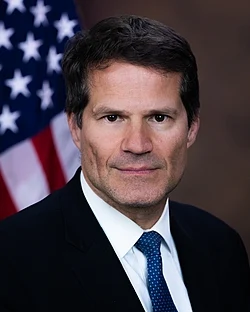 During oral argument, Solicitor General D. John Sauer, right, faced sharp, repeated questioning from several of the justices, including some of the key members of the court’s conservative majority. The skepticism voiced by these justices suggested that elements of the president’s tariffs might be in jeopardy.
Justice Amy Coney Barrett, who is seen as a critical vote, questioned the scope of the tariffs Mr. Trump imposed under the International Emergency Economic Powers Act.
“I mean, these are kind of across the board,” Justice Barrett said to Mr. Sauer. “And so is it your contention that every country needed to be tariffed because of threats to the defense and industrial base? I mean, Spain? France?”
Chief Justice John G. Roberts Jr., too, queried the administration lawyer about the president’s authority to impose these specific tariffs.  The chief justice, left, acknowledged that the tariffs were used “in dealings with foreign powers,” but he added that “the vehicle is imposition of taxes on Americans,” which he noted had “always been the core power of Congress.”
Justice Neil M. Gorsuch pushed Mr. Sauer on whether there would be any guardrails that would prevent Congress from “just abdicating all responsibility to regulate foreign commerce — for that matter, declare war — to the president.”Sign up for Your Places: Global Update. All the latest news for any part of the world you select. Get it sent to your inbox.Are tariffs taxes? The justices want to know.
The justices repeatedly returned to a central question during the oral argument: Are the tariffs put in place by Mr. Trump a type of tax, or something else?
This is a key point because the challengers argue that the president overstepped his authority by imposing the tariffs. They argue that tariffs are taxes, and they point to clear language in the Constitution that gives Congress the power to tax.
In his opening statement, Neal K. Katyal, the lawyer representing a group of small businesses that challenged the president’s taxes, insisted that “tariffs are taxes” and that the measures “take dollars from Americans’ pockets.” He added that the nation’s founders “gave that taxing power to Congress alone” and that Congress has only delegated tariff powers to the executive branch “explicitly, always with real limits.”
Mr. Sauer, arguing for the Trump administration, rejected the notion that Mr. Trump’s tariffs were aimed at raising revenue. He repeatedly asserted that the president’s tariffs were not taxes, but regulatory tools directed at foreign affairs, an area where the president has broad authority.
“These are regulatory tariffs,” Mr. Sauer said. “They are not revenue-raising tariffs. The fact that they raise revenue is only incidental. The tariffs would be most effective, so to speak, if no person ever paid them.”
Justice Gorsuch homed in on the importance of the taxation power question, noting that “the power to reach into the pockets of the American people is just different.”
More On U.S. Election Results
Popular Information, Accountability Journalism: Six election results that didn’t make the headlines, Rebecca Crosby, Noel Sims and Judd Legum, right, Nov. 6, 2025. On X, Vice President J.D. Vance dismissed the poor showing by Republicans on Tuesday night as “a couple of elections in blue states.”
Although Democratic victories in New York, Virginia, New Jersey, and California dominated the headlines, significant contests were held across the nation.
In purple states like Pennsylvania and Georgia, and deep red states like Texas and Mississippi, voters rejected the MAGA agenda. Here are six results from the 2025 elections that flew under the radar.Pennsylvania county ousts sheriff who collaborated with ICE
In Bucks County — Pennsylvania’s largest swing county, which Trump narrowly won in 2024 — Democrat Danny Ceisler was elected county sheriff after the Republican incumbent signed a deal to collaborate with Immigration and Customs Enforcement (ICE) earlier this year.
In April, Republican Fred Harran signed his deputies up for a 287(g) program with ICE, which allows local law enforcement to execute arrest warrants for immigration violations and perform other duties typically reserved for federal immigration enforcement officers.
Ceisler, who defeated Harran with more than 55% of the vote, described the ICE agreement as “the big issue in this race.” Ceisler promised to suspend the agreement immediately after taking office and said that restoring trust with immigrants in the county was a top priority.Progressives win control of Texas school board that censored books
In Texas’s Cypress-Fairbanks Independent School District (CFISD), which is the third largest in the state, progressive candidates won all three open board seats, giving them a 4-3 majority. Since 2023, the board has been controlled by a 6-1 conservative supermajority, which has enacted a range of far-right policies.
In the past two years, the CFISD board has removed textbook chapters on climate change, vaccines, Covid-19, and diversity; fired over half of CFISD librarians, leading to school library closures; restricted school library content; and created elective courses about the Bible.
One of the members who lost her seat, Natalie Blasingame, first ran for the CFISD board in 2015. At the time, she wrote in an email to donors, “The Lord put on my heart that my agenda is to tear down the over-interpretation of the separation of church and state that has shut God out of schools.”Georgia elects its first Democrat to a non-federal statewide office since 2006
Two Georgia Democrats, Peter Hubbard and Alicia Johnson, won election to the state’s Public Service Commission, which regulates electricity, telephone services, and natural gas. Both candidates won with over 60% of the vote, according to unofficial results posted on the Georgia Secretary of State’s website. The commission will now have a 3-2 Republican majority.
The commission has not had a Democrat since 2007, and this is the first time since 2006 that Georgia Democrats have “won a statewide constitutional office.” Johnson will also become the state’s first Black woman elected to a statewide partisan office.
The Democratic candidates ran on a platform of affordability. The commission approved six rate hikes for electric utility provider Georgia Power in recent years. Rate increases approved by the commission have added around “$43 a month to the average household bill,” which is now over $175 a month for the average Georgia Power residential customer, CBS reported.
The upset could provide momentum going into the 2026 midterm elections, when Georgia will elect a Governor and U.S. Senator.Mississippi Democrats break Republican super majority in the state Senate
For the first time in 13 years, Democrats in Mississippi have broken up a GOP supermajority in the state Senate. This victory for Mississippi Democrats came after a panel of federal judges ordered the Mississippi legislature to redraw its state House and Senate districts to create more majority-Black districts. The court found that the previous districts diluted the political power of Black voters, in violation of Section 2 of the Voting Rights Act.
Democrats were able to flip two newly redistricted state Senate seats, reducing the GOP supermajority from 36 members to 34. Just one vote short of a supermajority, it will now be more difficult for Republicans to propose amendments to the state constitution and override the governor’s veto.
Whether the victory holds will depend on an upcoming Supreme Court decision in a case challenging the constitutionality of creating electoral districts based on racial demographics to give minority voters more power.Colorado voters increase taxes on the wealthy to pay for school meals
In Colorado, voters passed a pair of ballot measures to fund free meals at public schools across the state.
Proposition MM will raise taxes for households with incomes of more than $300,000 per year to fund free school meals, buy local ingredients in school cafeterias, and provide raises to cafeteria workers. Any excess funds raised by the tax increase will support the Supplemental Nutrition Assistance Program (SNAP).
Proposition MM expands on Proposition FF, passed by Colorado voters in 2022, which “limited income tax deductions for people earning more than $300,000” to fund free school meals through the Healthy School Meals for All program. Colorado voters also passed Proposition LL, which will allow the state to keep additional tax revenue that was raised by Proposition FF and spend it on the Healthy School Meals for All Program.Maine voters reject voter ID ballot initiative
In Maine, voters overwhelmingly rejected a ballot initiative that would have created new voter ID requirements and made absentee voting less accessible, with over 60% of voters opposing the initiative, according to the AP.
If passed, voters would have been required to present photo identification in future elections. The initiative would have also banned “prepaid postage on absentee ballot return envelopes,” prohibited “requests for absentee ballots by phone or family members,” and ended “ongoing absentee voter status for seniors and people with disabilities.” Additionally, the initiative would have limited the number of ballot drop boxes to only one per town.
Opponents called the initiative a “voter suppression bill.” In 2024, about 45% of Maine voters cast ballots by mail, used drop boxes, or voted early, Maine Public reported.
Hopium Chronicles, Pro-Democracy Advocacy, My 2025 Election Recap - Blue Wave, Enormous Margins, Clear Repudiation Of Trump And Republicans, Simon Rosenberg, People are pissed. We need to keep fighting for them and the country.
..Got a few things for you today. First, sending along a recording of my presentation last night to our proud, plucky, and patriotic paid subscribers (video, transcript above). It’s a comprehensive -- and joyful -- look at our great election on Tuesday, our best in five years. We also had a lively Q and A session afterwards. Get to it when you can and please hit like here and share with others if you find it helpful.
Second, below, is an updated written early take on what happened with graphs and links. I will be updating this recap as more data comes in and we get a deeper understanding of what happened.
Third, I am doing a lot of live and in-person events recapping in the coming days, and will be hosting many guests here as well. Check our Events page for the latest schedule and links. Recordings of these events can always be found under the Podcast tab on the main Hopium site and on YouTube, Apple Podcasts, and Spotify too.
2025 Was A Blue Wave Election, The Country Is More Democratic Today - Democrats not only won the big races we also won in local races -- school board, city council, mayor, county -- across the country.
The generic ballot has been 7-8 points more Dem than a year ago, Gallup Party ID has seen Dems gain 12 points over the past year (more on that here). We saw something like these shifts across the US last on Election night. The country is much bluer today than it was a year ago.
Tuesday night’s results are consistent with polling we’ve seen that has Democrats competitive in red states like Alaska, Florida, Iowa, Ohio, and Texas, and leading in blue/purple states like Maine and North Carolina.
Sherrill outperformed Harris by 7 points last night, Spanberger by 10. The country has moved, so far, by something like 7 to 10 points towards the Democrats since last November.
The Margins. We Didn’t Just Win. We Won Big - Look at these margins. In most races we outperformed the public polling:
We made enormous gains across Virginia and had a very good night in the Miami mayoral election too (it is headed to a December run off).
New York Times, An Emboldened Mamdani Sheds Conciliatory Tone, Emma G. Fitzsimmons, Nov. 6, 2025 (print ed.). Fresh from a stunning victory, Zohran Mamdani, the mayor-elect, said in an interview that his supporters wanted “a politics of consistency” and aggressive action, including on taxing the rich.
A newly empowered Zohran Mamdani on Wednesday vowed to use his convincing victory in the New York City mayor’s race as a mandate to push an ambitious progressive agenda past potential obstacles, from billionaire antagonists to Albany bureaucracy.
In a shift from the mollifying tone he had used for months, Mr. Mamdani made clear that while he would govern for all New Yorkers, he was determined to deliver for those who had been agitating for structural change.
“I’m also looking to be clear about the mandate that we won over the course of this election, and it is a mandate to deliver on the agenda that we ran on,” he said in a phone interview on Wednesday afternoon after a celebratory lunch with his progressive ally Representative Alexandria Ocasio-Cortez of New York.
The shift in tone was most striking when it came to his plan to raise taxes on the wealthy. In recent weeks, Mr. Mamdani had conveyed an openness to finding creative ways to pay for his signature policy initiative, universal child care, indicating that he was not necessarily set on raising taxes. There was plenty of revenue in the existing budget, he suggested.
On Wednesday, Mr. Mamdani said his call to tax the wealthy was also about fairness. He said that New Yorkers who had voted for him were eager for billionaires to pay more taxes. On Monday, the day before the election, droves of Mr. Mamdani’s supporters marched with him over the Brooklyn Bridge at sunrise, chanting, “Tax the rich!”
“My supporters and our movement are hungry for a politics of consistency — a politics that actually focuses on the needs of working people,” Mr. Mamdani said. “I think that our tax system is an example of the many ways in which working people have been betrayed.”
But the mayor-elect’s support for tax increases could put him at odds with Gov. Kathy Hochul, a Democrat whose endorsement in September was significant as Mr. Mamdani sought to consolidate Democratic support. Ms. Hochul, a moderate Democrat who is running for re-election next year, has strongly opposed any tax increases.
The interview on Wednesday echoed Mr. Mamdani’s fiery victory speech on Tuesday evening, which took a more confrontational and at times boastful tone. The address was criticized by some observers as a “character switch” from his more congenial attitude during the campaign.
Mr. Mamdani said his tone was intentional. He was seeking to be “bold,” he said, and to show that the status quo was not acceptable.
His confidence is understandable. He is the first New York City mayoral candidate since John V. Lindsay in 1969 to win over one million votes, motivating first-time voters and generating enthusiasm that many of his supporters compared to Barack Obama’s presidential victory in 2008.
Global News
New York Times, ‘Broken My Hope’: Trump’s Move to Slash Refugee Arrivals Ricochets Widely, Hannah Beech, Nov. 6, 2025. President Trump’s policy has shut the door on all but a tiny fraction of people across the world seeking refuge in the United States from conflict, persecution or both.
Mohammed Faisal sold his computer shop and graphic design business that he had scraped together in the refugee camp in Bangladesh. He even sold his tarpaulin shelter to raise money to move to America.
He told his three sons, born like him in exile, that they would soon be citizens of a country composed of immigrants.
He was wrong. Mr. Faisal, a member of the Rohingya Muslim minority whose violent expulsion from Myanmar has been labeled a genocide by the United States, has been stymied by a series of actions by President Trump that have shut the door on almost all refugees seeking sanctuary in the United States.
On his first day in office, Mr. Trump announced a pause in refugee admissions. In his latest move, a federal notice was posted last week announcing that the United States would accept no more than 7,500 refugees from across the world for the fiscal year that started in October. The previous period’s ceiling, set by the Biden administration, was 125,000.
The new cap is the lowest in the history of the decades-old refugee program, and it was made official without consulting Congress.
The federal notice specified that future refugee resettlement will prioritize a white South African group called Afrikaners, as well as “other victims of illegal or unjust discrimination in their respective homelands.” The South African government has disputed that Afrikaners face such persecution.
New York Times, Russia Close to Its Biggest Capture of a Ukrainian City Since 2023, Kim Barker, Marc Santora, Evelina Riabenko and Michael Schwirtz, Nov. 6, 2025. The Kremlin is focusing its fire on Pokrovsk, a gateway to the Donetsk region, which Russia’s president, Vladimir V. Putin, has long coveted.
Russia is concentrating its firepower and troops on the small, battered city of Pokrovsk in eastern Ukraine, apparently pushing its forces close to capturing what has become a gateway to the war’s most fiercely contested region.
After more than a year of fighting, Pokrovsk, a railroad hub in the Donetsk region, has been turned largely into rubble, its prewar population of 60,000 now reduced to fewer than 1,300 residents. Ukrainian soldiers defending the city report intense combat. Nearly one-third of all the battles along the front line, which stretches almost 750 miles, are in Pokrovsk, and half of Russia’s attacks with deadly glide bombs are focused on the city, President Volodymyr Zelensky of Ukraine said on Monday. Those numbers could not be independently confirmed.
While Ukrainian leaders claim that their forces are clawing back neighborhoods, Russian troops appear to have taken control of the southwestern edge of Pokrovsk in the last few days, according to a battlefield map by DeepState, a group with ties to the Ukrainian military. Russian troops have also secured two slim columns in the city’s center and up its western side, based on the map, which shows most of the rest of Pokrovsk as a contested gray zone.
“The enemy is continuing to build up forces in the city,” DeepState said on social media Tuesday night, adding that Pokrovsk was “gradually being absorbed.”
The city would be the largest in Ukraine to fall since Bakhmut in May 2023. It is seen as the last major obstacle preventing Russian troops from approaching Sloviansk and Kramatorsk, the only large cities still under Ukrainian control in Donetsk, a region that President Vladimir V. Putin of Russia has long coveted.
Taking Pokrovsk could aid the Kremlin’s narrative that Russia is on the march on the battlefield and that the war will get only worse for Ukraine if it does not concede to Moscow’s onerous demands to end the conflict. Mr. Putin has ignored President Trump’s calls for a cease-fire as the Kremlin has pushed ahead with its invasion.
New York Times, Mexico’s President Presses Charges Against Man Who Groped Her on the Street, Annie Correal and Emiliano Rodríguez Mega, Updated Nov. 6, 2025. A video of a man touching Mexico’s first female president, Claudia Sheinbaum, shocked many Mexicans and led her to file a report with the police.
A day after a man groped Mexico’s president, Claudia Sheinbaum, in an episode captured on video, she announced on Wednesday that she had reported the incident to the police as a crime.
“My reflection was: If I don’t file a complaint, then what message does that send to all Mexican women?” Ms. Sheinbaum said at her daily news conference, noting sexual harassment was a crime in Mexico City, where the episode took place. “If this can happen to the president, what’s going to happen to all the young women and women across our country?”
The man could be seen on the video, which circulated widely on social media, approaching the president on Tuesday as she was walking in the city’s historic center. He moved to kiss the president and put his hands on her breasts, the video showed, before her personnel intervened.
The episode immediately raised questions about the president’s security, and set off conversations among women about their own experiences.
It also caused concern among many over the apparent lack of progress for women as a whole: Ms. Sheinbaum, Mexico’s first female president, made ending violence against women a cornerstone of her campaign, but only a year after being elected, she was groped by a stranger in public.
Such harassment is not considered a crime at the federal level, Ms. Sheinbaum said Wednesday, nor is it a crime in all Mexican states — a point that Ms. Sheinbaum said she would ask officials to examine, so that all women could press charges as she had.
“We need to make this visible and say no — a firm no,” Ms. Sheinbaum said. “Women’s personal space must not be violated. How do we address this? Through awareness campaigns, through schools — because this is also about educating men. And we must make sure that when women file complaints, they are taken seriously and not made to waste a whole day, which discourages them from reporting.”
She added: “I don’t want this to be a privilege of the president.”
The man was arrested and identified by the authorities as Uriel Rivera Martínez, 33.
U.S. Economy, Finance, Jobs,
New York Times, News Analysis: Would Elon Musk Work Harder for $1 Trillion Than $1 Billion? Patricia Cohen, Nov. 6, 202. Economists and psychologists say that compensation may not provide as powerful an incentive as is often assumed.
Whether or not you believe Tesla should grant Elon Musk a trillion-dollar pay package if he hits shoot-the-moon goals over the next decade, the company’s proposal to shareholders is based on the idea that the greater the monetary reward, the greater the effort.
Of course, financial incentives are enormously powerful. But is their ability to motivate infinite? Would Mr. Musk not work as hard if he were offered, say, $100 billion or $1 billion? What about $1?
The assumption that human beings are most forcefully motivated by money is a fundamental axiom of economics that is baked into most policy and business decisions. It anchors arguments for ever-rising executive compensation, lower capital gains taxes, work requirements for Medicaid recipients and so much more.
But research from economists and psychologists has presented a much more complicated picture of how monetary — and other — rewards affect effort.
Esther Duflo and Abhijit Banerjee, M.I.T. professors who shared a Nobel Prize in economics, argue that the impact of financial carrots has often been exaggerated.
Rich businesspeople like to think “we are the key fulcrums of the economy, and if we leave everything will collapse,” Mr. Banerjee said. “That kind of narrative is very tempting for the rich in particular — and they say that willy-nilly — but I don’t think there is much evidence for this.”
There is scarce proof that the companies led by the highest-paid chief executives have the best long-term stock performance. One recent study looked at the 10 most valuable firms on the Nasdaq stock exchange between 2017 and 2022, a period that included the Covid-19 pandemic. It concluded that paying chief executives significantly more than the company president, other top executives or average employees did not increase a firm’s profitability.
Another study that looked at 429 large American firms over a decade found that total shareholder returns in companies where chief-executive pay was below the median for their sector did better than companies where pay exceeded it.
High compensation can sometimes lead to overconfidence that results in bad decisions. Some psychologists have found that high-stakes pressure can increase people’s tendency to choke.
Tesla has proposed giving Mr. Musk a stock-based compensation plan that would be worth nearly $1 trillion if he achieved ambitious goals that include producing a million humanlike robots and raising the company’s stock valuation by about six times, to $8.5 trillion.
Nov. 5
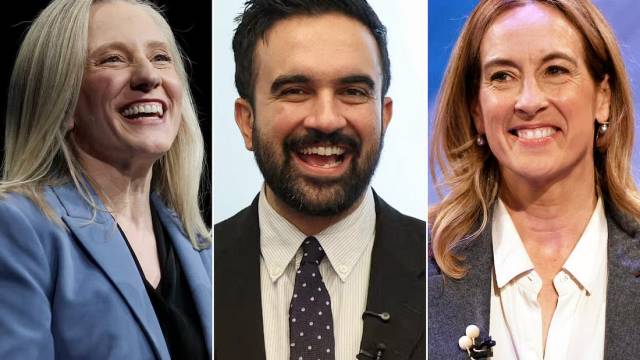
Virginia Gov.-elect Abigail Spanberger, left, New York Mayor-elect Zohran Mamdami, and New Jersey Gov.-elect Mikie Sherrill, all Democrats, swept to victory in Nov. 4 elections.
The Parnas Perspective News and Commentary: Democrats Achieve Historic Election Sweep as Blue Wave Redefines the Political Landscape, Aaron Parnas, right, Nov. 5, 2025. Donald Trump put it bluntly: “I don’t think it was good for Republicans.”
Today’s update focuses on two major developments: last night’s historic election results and the Supreme Court showdown over Trump’s tariffs taking place this morning. I spent the night—yes, a sleepless one—analyzing every detail of the data, and the conclusion is unmistakable: Democratic victories were broader, deeper, and more decisive than anyone predicted. The results weren’t just wins; they were a resounding rejection of the White House and its agenda. I’ve broken down each major result below.
Our election night coverage reached tens of millions of Americans, and we did it together. I was in constant contact with teams and sources across key states, and we accurately called every single race. Even as we delivered real, data-driven reporting, the attacks from inside the White House began again—because they know we’re changing the game. Subscribe today and help us continue redefining what independent, fearless journalism can be.Subscribed
Here’s what you mised:
Last night’s election results marked one of the strongest nights for Democrats in nearly a decade, arguably surpassing even the 2018 blue wave that defined the first major backlash to Donald Trump’s presidency. The scale of victory was not just about who won, but by how much. Across key races and battlegrounds, Democrats didn’t simply edge out their opponents; they dominated, flipping deep-red territories, sweeping local boards, and posting double-digit margins that shattered recent historical norms. As results continue to roll in, it is clear that last night was a decisive repudiation of the current White House, not merely in outcome, but in the overwhelming mandate delivered at the ballot box.
In Bucks County, PA, Democrats ousted all Republicans from both the Central Bucks and Pennridge school boards—districts that were ground zero for the conservative and anti-LGBTQ school board movement in 2021.
In Virginia, Abigail Spanberger (D) won the governor’s race by over 14 points (95% counted), the largest margin for a Democratic gubernatorial nominee in the state since 1961.
In New Jersey, Mikie Sherrill (D) was elected governor, defeating Jack Ciattarelli (R) by a 13-point margin.
In Orlando, FL, Tom Keen (D) won a blowout victory for City Commission, unseating the city’s only Republican commissioner, a 13-year incumbent.
In Morgan County, Georgia, Democrats flipped the county from R+47 in 2024 to D+3 in 2025, a 50-point swing.
In the statewide Public Service Commission races, Democrats appear set to flip both seats, currently leading by about 20 points with most early votes tallied.
In California, Proposition 50 (mid-decade redistricting) is likely to exceed Kamala Harris’s 20-point statewide margin, possibly by a significant amount.
In Virginia’s House of Delegates, Democrats gained control with 61 seats, likely increasing to 64, up from 51, just three short of a supermajority.
In Cincinnati, OH, Democrats retained full control of city government, winning the mayor’s race and all nine council seats again despite GOP criticism and local controversies.
In Maine, voters approved a new “red flag” gun law, making Maine the 22nd state with an extreme risk protection measure that allows family members to petition courts to temporarily remove firearms from individuals deemed dangerous. The law replaces parts of Maine’s existing “yellow flag” law by removing the requirement for a behavioral health assessment and allowing families, not just law enforcement, to initiate petitions.
In Colorado, voters approved a ballot measure to raise state income taxes on households earning $300,000 or more in order to fund free meals for all public school students. The measure expands the Healthy School Meals for All Program, which previously provided free meals only to low-income students and schools after its 2022 approval.
Final reported margins: Spanberger +15, Hashmi +11, Sherrill +13, Jones +6.2, Mamdani +8.8, Pennsylvania Supreme Court (D) +20, California Proposition 50 +~30.
Donald Trump issued a short response to last night’s election results, blaming the loss on the fact that he was not on the ballot. While true, his policies were on the ballot and many voters, based on exit polling, came out to vote against him.
Donald Trump said of last night’s elections: “I don’t think it was good for Republicans.”
Trump said the Senate filibuster should be abolished, arguing that doing so would make it “impossible to beat” Republicans.
The Supreme Court is hearing arguments today on whether President Donald Trump had the authority to impose sweeping global tariffs under the 1977 International Emergency Economic Powers Act, a law intended for use during national emergencies. The case, brought by small businesses and states, challenges Trump’s claim of broad executive power and could reshape the limits of presidential authority over trade policy.
The U.S. government shutdown has entered its 36th day, becoming the longest in American history, as Republicans and Democrats remain deadlocked over a funding bill tied to the renewal of Affordable Care Act tax credits. The standoff has furloughed roughly 700,000 federal workers, cost the economy an estimated $14 billion in GDP, and left millions at risk of losing health coverage, while negotiations in the Senate continue to fail amid deep partisan division.
At least seven people were killed and 11 injured after a UPS cargo plane crashed during takeoff from Louisville Muhammad Ali International Airport, igniting a massive fire that spread to nearby businesses. Officials warned the death toll could rise as emergency crews search the debris from the McDonnell Douglas MD-11 aircraft, which was carrying 38,000 gallons of fuel and crashed roughly three miles south of the airfield; federal investigators from the NTSB and FAA are probing the cause.
Japan deployed troops from its Self-Defense Force to the northern Akita Prefecture after a record wave of bear attacks left 13 people dead and around 100 injured since April. Soldiers are assisting local authorities with trapping and removing bears near populated areas as experts cite rising bear populations, rural depopulation, and climate change as key factors behind the surge in encounters.
An American teacher, Daniel Owen, and his teenage son, Cooper, were stung to death while visiting an eco-adventure resort near Luang Prabang, Laos, on October 15. Owen, the director of QSI International School of Haiphong in Vietnam, and his son were reportedly stung more than 100 times before dying from their injuries, an incident described by local officials and the resort as an unprecedented and extraordinary natural occurrence.
A motorist intentionally rammed into pedestrians and cyclists on the French Atlantic island of Île d’Oléron, injuring nine people, including two critically, before being detained by authorities. Officials described multiple deliberate collisions between two towns on the island, prompting an investigation and the deployment of Interior Minister Laurent Nuñez to the scene.
New York Times, News Analysis: The Democrats Just Took a Big Step Toward Getting Their Groove Back, Lisa Lerer, Nov. 5, 2025. Victories in New York City, New Jersey, Virginia and elsewhere were decisive, but new political tests loom for a party still rebuilding its brand.
With their election night triumphs on Tuesday, Democrats showed that their demoralized party — which spent the past year mired in self-recriminations and soul-searching — could still accomplish the most important goal in politics.
They can win. And win big.
The decisive victories for governor in Virginia and New Jersey and mayor of New York City and a major ballot initiative in California — which is likely to yield as many as five House seats for Democrats next year — demonstrated crucial signs of life for a party that was soundly defeated in all seven presidential battleground states, lost control of the Senate and failed to win the House just a year ago.
The results showed a level of determination and energy among Democratic voters that was missing in that 2024 election. This time, their candidates were stronger, their campaigns focused intensely on affordability and an intense desire to deal a blow to President Trump. If the huge No Kings protests last month were the shot, Tuesday’s election was the chaser, with Democrats showing once more that they could turn out to deliver a powerful vote when Mr. Trump is in the White House.
Yet for all the invigoration that success brings, the Democratic Party still hasn’t coalesced around a coherent political identity or a clear electoral playbook that can win in swing states and safe states alike. The results on Tuesday suggest that an intraparty battle may be looming for the Democrats as they get ready for difficult House and Senate midterm elections in 2026 and a wide-open presidential primary contest in 2027 and 2028.
New York Times, Judge Berates Justice Dept. in Its Prosecution of Comey, Glenn Thrush and Alan Feuer, Nov. 5, 2025. The flashpoint was the Justice Department’s failure to turn over seized communications from a confidant of Mr. Comey’s, Daniel C. Richman, a law professor at Columbia University.
A federal judge in the Trump administration’s prosecution of James B. Comey, above, the former F.B.I. director, on Wednesday blasted President Trump’s handpicked prosecutor, Lindsey Halligan, below left, for taking an “indict first, investigate second” approach to the case.
The magistrate judge, William Fitzpatrick, repeatedly expressed his frustration — and at times his barely restrained annoyance — with Ms. Halligan during an otherwise procedural hearing in which he ordered the Justice Department to produce records from its investigation. Ms Halligan was hastily installed as the U.S. attorney for the Eastern District of Virginia in September after her predecessor refused to indict Mr. Comey on charges that he lied to Congress.
The flashpoint was the Justice Department’s failure to turn over communications it had seized from a confidant of Mr. Comey’s, Daniel C. Richman,  right, a law professor at Columbia University, as part of an internal investigation of leaks in the Russia case during the first Trump administration. The government claims he served as a conduit between the director and the news media for passing along information about the Trump campaign’s connections to Russia in 2016.
As part of their defense, Mr. Comey’s lawyers have accused the Justice Department of vindictive prosecution and challenged the legality of Ms. Halligan’s appointment. They have argued that they have been unable to adequately defend their client without access to emails and other communications obtained by the government from Mr. Richman’s electronic devices in 2019 and 2020.
The judged grilled one of Ms. Halligan’s deputies, Nathaniel Lemons, over prosecutors’ release of material in recent days, including private text exchanges intended to cast Mr. Richman and Mr. Comey in unflattering light in an otherwise quotidian court filing. He asked whether prosecutors had given Mr. Comey an opportunity to review such material first to challenge their release.
Emptywheel, Analysis: Pam Bondi’s DOJ Gets Admonished a Second Time for Indict[ing] First, Investigat[ing] Second, Emptywheel (Marcy Wheeler, right), Nov. 5, 2025. When William Fitzpatrick scolded loaner AUSA Tyler Lemons about charging Jim Comey and investigating afterwards, he echoed the comments another Magistrate Judge, André Espinonsa, made months ago when dismissing the charge against Ras Baraka.
Remember how, 72-hours ago, I wrote an interminable post about how this Comey case may be about more than just two charges filed back in September?
I argued, among other things, that Comey may have asked for grand jury transcripts not (just) because getting them in December would help him win a vindictive prosecution claim that’ll be heard a month earlier, but because one of the now-three judges involved in the case might see the validity of his argument, and order the government to provide him those transcripts now.
What these filings may do — especially the grand jury one — is affect several things going on, starting this week.
Judge Cameron McGowen Currie has ordered the government to give her the transcripts from both grand juries by tomorrow.
New York Times, Trump Administration Live Updates: President Says Eliminating Filibuster Is ‘Only Way’ to End Record-Long Shutdown, Staff Reports, Nov. 5, 2025. Where Things Stand.
President Trump said that he believed that the government shutdown, which he has blamed on Democrats, hurt Republicans in Tuesday’s elections. “I think if you read the pollsters, the shutdown was a big factor,” he said. He also said pollsters had noted the fact that Trump wasn’t on the ballot.
The president said that he and the Republican senators would have a more extensive discussion about Tuesday’s election results after the press leaves the White House event on Wednesday morning. They’ll talk about “what last night represented and what we should do about it,” he said.
New York Times, Federal Judge Imposes Restrictions on ICE Facility at Center of Illinois Protests, Mitch Smith, Nov. 5, 2025. After detainees described squalid conditions at the detention site, a judge ordered the government to provide showers, water, clean toilets and access to lawyers
A federal judge said Wednesday that immigration officials must provide bottled water, clean bedding, hygiene products and access to lawyers at a suburban Chicago detention center that detainees have described as squalid and unsanitary.
The judge, Robert W. Gettleman, said conditions at the Immigration and Customs Enforcement facility in Broadview, Ill., “don’t pass constitutional muster.” He gave federal officials until midday Friday to submit a report on how they were meeting 15 requirements that he imposed in a temporary restraining order.
Tricia McLaughlin, a spokeswoman for the Department of Homeland Security, which includes ICE, defended conditions at the facility and pushed back against how it was characterized in court.
“Any claims there are subprime conditions at the Broadview ICE facility are false,” Ms. McLaughlin said in an emailed statement. “All detainees are provided with three meals a day, water and have access to phones to communicate with their family members and lawyers. No one is denied access to proper medical care. There is a privacy wall around the toilet for detainees.”
The Broadview center, west of Chicago, was designed for short-term stays, but some detainees have been held there for several days during the Trump administration’s crackdown on illegal immigration in the Chicago area. The outside of the facility has been a frequent site of protests and clashes between demonstrators and federal agents, but a lawsuit brought by former Broadview detainees has drawn attention to the inside of the brick building where the windows have been boarded in recent weeks.
Five former Broadview detainees testified earlier this week about uncomfortable and unsanitary conditions at the facility, where they said they had to sleep on chairs or on the floor, and were not given soap, toothbrushes or sufficient food and water.
Judge Gettleman, who was nominated by President Bill Clinton, said in his order that holding cells must be cleaned twice a day, that detainees must be allowed to shower at least once every other day and that detainees should be allowed to communicate with their lawyers by phone.
A lawyer for the plaintiffs praised the judge’s order in a statement.
“These are urgent and necessary measures to protect these detainees and preserve their basic human rights,” said the lawyer, Alexa Van Brunt of the MacArthur Justice Center.
The judge also ordered the government to provide detainees with clean bedding and a mat for sleeping, along with sufficient space to sleep. But he stopped short of imposing specific space requirements that lawyers for the plaintiffs had sought, which could have capped the number of detainees held.
“They shouldn’t be sleeping on top of each other,” the judge said in court on Wednesday. “They shouldn’t be sleeping on plastic chairs. They shouldn’t be sleeping on concrete floors.”
The Trump administration has flooded the Chicago area with immigration enforcement officers over the last two months. The administration said it has made thousands of arrests as part of its campaign.
Ms. McLaughlin, the Homeland Security spokeswoman, said that “as ICE arrests and removes criminal illegal aliens and public safety threats from the U.S., the agency has worked diligently to obtain greater necessary detention space while avoiding overcrowding.”
During a hearing on Tuesday, Judge Gettleman voiced concern about “conditions that are unnecessarily cruel,” but said he did not want to interfere with the Trump administration’s ability to enforce immigration laws. He did not agree to the plaintiffs’ request for an inspection of the facility.
A lawyer for the federal government, Jana Brady, said at the hearing that giving the plaintiffs in the case all the restrictions they had sought “would effectively halt the government’s ability to enforce immigration laws in Illinois” and would infringe on the authority of the executive branch.
“The government has improved the operations at the Broadview facility over the last couple months,” Ms. Brady said, adding that “it’s been a learning curve.”
Former detainees and lawyers who have had clients at Broadview described a chaotic facility where people languished for days, basic cleanliness was ignored and lawyers were denied access to their clients. Newly arrested immigrants are frequently taken to Broadview to be processed before being deported or sent to longer-term detention centers in other states.
More On U.S. Nov. 4 Election Results
Morning Shots via The Bulwark, Political Opinion: Vive La Résistance, Bill Kristol, right, Andrew Egger, Adrian Carrasquillo and Jim Swift,Nov. 5, 2025. Waves can be blue after all.
With Republican candidates going down in flames all around him, Donald Trump spent last night flaming out on Truth Social. “REPUBLICANS, TERMINATE THE FILIBUSTER! GET BACK TO PASSING LEGISLATION AND VOTER REFORM!” he wrote, adding that the time had come to “Pass Voter Reform, Voter ID, No Mail-In Ballots.”
Speaking to Senate Republicans this morning, he continued to make the case for them scrapping the filibuster. But he also admitted they may not do it and sounded a bit more introspective about it all. “I thought we would have a discussion after the press leaves about what last night represented and what we should do about it,” Trump said, noting that “the shutdown was a big factor, negative, for Republicans.” (emphasis, ours)
Trump wants Republicans to kill the filibuster to move on from the shutdown. Senate Republicans want to keep the filibuster and keep pressuring Senate Democrats to cave. But after last night, Senate Democrats think they have a stronger political hand than ever, so such a cave seems unlikely.
Paul Krugman via Substack, Political-Economy Commentary: Which Party Is in Trouble, Again? Paul Krugman, right, Nov. 5, 2025. Thoughts after a very blue night.
Yesterday was a very good day for Democrats and a very bad day for both MAGA and the oligarchy. If I were a properly house-trained pundit, I would immediately follow that statement by throwing some shade at Democrats. But this was a blowout, pure and simple.
Here are a few takes on what just happened:
The polls beat the pundits
Nobody should have been surprised that Democrats had a very good night. These elections were, as expected, largely a referendum on Donald Trump, and polling says that Trump is very, very unpopular. Even if you dismissed Trump’s dismal approval rating as fake news, there were plenty of other indications that Trump would drag his party down. The second No Kings Day was the largest one-day demonstration since Earth Day in 1970. Democrats have been outperforming by something like 15 points in special elections. And polling averages favored Democrats in key races.
So everything pointed to big Dem gains, although the scale of the victories was a surprise. There had been a steady drumbeat of warnings that Mikie Sherrill, in particular, might be in trouble. Instead she won in a 13-point landslide.
Yet for the past few months the punditocracy has been obsessed with the narrative that Democrats are in big trouble, out of touch with Real Americans ™. I’d like to see some soul-searching among those pushing that narrative — the same kind of soul-searching they’ve been demanding from Democrats. But I won’t be holding my breath.
It’s still (largely) the economy, stupid
The 2024 election was mainly about economics. There was a big runup in prices in 2021-22, as the world economy, recovering from Covid, experienced a lot of supply-chain bottlenecks. This price surge, coming after decades of low inflation, upset voters. Biden administration officials could and did point out that it was a one-time price hike, that inflation — the rate of change of prices — fell rapidly from its 2022 peak, and was back to more or less normal levels by 2024. They could also point out that America’s inflation experience was very similar to the experiences of other nations, e.g. in Europe, indicating that global factors rather than Democratic policies were the main culprit.
But voters were unmoved by these arguments, if they heard about them at all. What they did hear was Donald Trump promising not just to reduce inflation but to bring prices way back down. And many of them believed him.
Of course, Trump didn’t have a plan, or even a concept of a plan, about how to accomplish this. Instead he imposed tariffs and began deporting immigrant workers, both of which raised prices.
So prices haven’t come down; instead, inflation has accelerated. And the job market has gotten worse. Thanks to the shutdown, we’re not getting official employment numbers, but I’ve been looking at private surveys. One number I find especially striking is the Conference Board’s “labor market differential,” the difference between the percentage of Americans who say jobs are “plentiful” and those who say jobs are “hard to get.” This number is way down, which says that ordinary Americans perceive a very tough job market:
Pretty clearly, many Americans now believe that they were lied to. My guess (we’ll know more in a few days) is that this is especially true for Hispanic voters, who swung to Trump believing that he would deliver prosperity and are swinging hard back to Democrats now that he hasn’t.
It also surely doesn’t help that Trump and his minions keep insisting that everything is great, that there is no inflation and the economy is booming. This doesn’t persuade anyone not in the cult and just makes them look out of touch. Which they are.
Which party is out of touch, again?
Zohran Mamdani’s victory in New York, in the face of hysterical opposition from the big money, has grabbed many of the headlines, which I understand — it’s an amazing story. And I wonder what the right-wing tech bros are thinking: If Wall Street couldn’t buy New York, can they really buy America?
But Mamdani’s win doesn’t tell us much about national politics: New York City is just very different from the rest of the country.
I’m seeing some commentators argue that Mamdani will be a problem for Democrats, allowing Republicans to paint them as extremists who are out of touch with America. But Republicans would do that anyway. For what it’s worth, Mamdani may be on the left, but all indications are that he’s a pragmatist who will get along fine with the rest of his party.
Meanwhile, you know which party is out of touch and riddled with extremists? The G.O.P.
If you look at recent Republican campaigns and positioning, it’s striking how much energy they’re putting into issues that just don’t matter much to ordinary Americans. Republicans may be obsessed with trans athletes, but most people aren’t. Polls and yesterday’s elections suggest that rants about the menace of illegal aliens have a lot less traction with the public than G.O.P. apparatchiks imagine — and that Americans don’t like the spectacle of masked ICE agents grabbing people off the street.
This disconnect between party priorities and what matters to ordinary people seems to me like a much bigger deal than Democratic “wokeness,” which was always exaggerated anyway.
And if we’re talking about extremists within the party, well, Democrats have people like Mamdani, a mild-mannered guy who says he’s a socialist but really isn’t. The Republican Party, by contrast, has been largely taken over by outright fascists, and is facing a major outbreak of old-fashioned antisemitism.
Now what?
Last night’s blue wave won’t stop MAGA’s attempt to consolidate authoritarian rule in America. If anything, they’ll redouble efforts to rig the 2026 midterms, although California, by approving a major redistricting, has largely neutralized their gerrymandering plot.
A couple of months ago I noted that previous examples of autocrats who consolidated power after winning an election, from Hitler to Viktor Orban, did so while they were still popular. I asked whether a despised autocrat could do the same. After yesterday, it’s clear that Trump really is despised. Can he still end our democracy?
I guess we’ll find out.
Proof, Investigative Commentary: The Five Biggest Takeaways From Election Day 2025, Seth Abramson, left, Nov. 5, 2025. The much less-discussed Democratic Party wins in Pennsylvania and Georgia mattered the most, and it’s not even close.
New York, New Jersey and Virginia are reliable blue states. Pennsylvania and Georgia are purple states—and the latter only recently so—that are now trending red again. So any statewide election in Pennsylvania or Georgia tells us a lot more about the sort of locations in which the Democratic Party will need to win in 2026 and 2028 (again, if we assume elections occur in those years) than what happened in, say, permanent-blue New York City.
And what happened in Pennsylvania is that three state supreme court seats were up for statewide election and the Democratic Party managed to hold all three and thus maintain a critical 5-2 advantage in the Pennsylvania State Supreme Court. And that court is almost certain to decide major election questions in the Keystone State in the two to three years ahead.
And what happened in Georgia is that Democrats won both contested Georgia Public Service Commissioner elections—the state’s only statewide elections on Election Day 2025. As already noted, each win was by a staggering 26 points, and these were the first such victories in usually-red Georgia for the Democratic Party in two decades.(2) Trump issued an election-day threat that could change the course of American history.
Not every Trump threat is worth taking seriously or even reporting on; the man makes a lot of threats—and while all of them are deranged and dangerous and disqualifying for a politician in a healthy democracy (which America is not), very few of them are a cause for real concern. (Though that percentage is quickly rising in the second Trump administration, as the would-be dictator running it comes to understand that he can carry out his most illicit schemes with near impunity.)
And so it was that as voters in California were still heading to the polls to vote in overwhelming numbers for Proposition 50—a proposal to allow California to conduct retaliatory mid-decade redistricting to counter GOP efforts in Texas, North Carolina, Missouri, and Ohio—the President of the United States declared the entire referendum, which had in every way followed state law to the letter, an “unconstitutional” and “rigged” state election that was a “scam,” “[potentially] [il]legal,” and “[potentially] criminal.” He said it was under federal criminal investigation by the FBI and DOJ and went even further by claiming (preposterously) that California Republicans had been systematically prevented from voting by mail even as Democrats were allowed to do so.
Normally we would say of all this bluster, “Who cares?” Trump is wrong on the facts and the law, after all, and nothing the lawsuit his party has now filed in California will change that.
But.
As readers of Proof will know, America is now an extralegal political environment, meaning that “what happens” in a given situation is no longer merely a question of “what is lawful.”
For instance, Republicans are currently refusing to seat a duly-elected Democratic congresswoman, Adelita Grijalva (D-AZ), in what is now almost certain to become the longest delay between an election and a swearing-in in modern American political history. And it’s a delay that comes in the absence of any of the circumstances that have caused delays before. Instead, the refusal by Speaker of the House Mike Johnson to swear in Rep. Grijalva is universally understood to be an effort to block legislation.
Specifically, Rep. Grijalva is the final vote to release the long-hidden Epstein Files.
It’s against this backdrop that (a) Trump and Johnson and their agents have pushed unprecedented mid-decade redistricting plans in at least ten states (the four named above, plus pending plots in Indiana, Florida, Nebraska, New Hampshire, Kansas, and Wisconsin) with the explicit aim of rigging the congressional partisan count in D.C. by the time Congress sits for new business in the first week of 2027; (b) Trump has pushed the unprecedented step of eliminating the Senate filibuster so he can govern in Washington without any input from Congress (as Speaker Johnson already ceremonially handed over his gavel to Trump in what has since become clear is a total abdication of House Republicans’ constitutional role in checking and balancing the White House); and (c) Trump now implies that that same federal executive branch could—by fiat—deem any Democrats elected as a result of Prop 50 illegally elected.
In other words, is there any reason to think that Mr. Johnson will swear in the winners of the five new Democratic-held seats Prop 50 was intended to create?
Is there any reason to think that Johnson and Trump won’t keep their frivolous federal litigation over Prop 50 going so long—and federal litigation can take years and years—that they use the very fact of their own ongoing litigiousness as a justification not to seat a portion of California’s 2027 freshman class in Congress?
Given that Trump and his personal lawyers Pam Bondi (head of DOJ) and Kash Patel (head of the FBI) can place Prop 50 under federal criminal investigation for as long as they like—unlike civil litigation, which at least eventually has an end-date, criminal probes are generally limited only by expansively written statutes of limitation—isn’t it likely that Trump’s threat against California (joining prior threats to invade it with the United States Armed Forces, strip it of all federal funding, and abandon it entirely in the event of a major natural disaster) will be used in 2026, 2027, and beyond as an excuse to leave a portion of California unrepresented in Congress (due to the refusal by Trump’s creature Johnson to swear them in)? Certainly such an action would be litigated, but how long would that litigation take? And what could the federal courts do to enforce an order seating certain newly elected California Democrats if the two other branches—executive and legislative—decide to ignore what the courts order?
Given his un-American views on Puerto Rico and D.C. statehood, Trump—like his apparent model King George III—has no compunction about taxing any American without allowing them congressional representation. Indeed, as long as the affected citizens are non-white and/or Democrats, that’s actually Trump’s evident preference.
So even apart from the possibility that a Trumpist Supreme Court may block Prop 50—or simply drag its heels on an election case that could benefit the Democratic Party (as it’s done in almost every recent election case that could benefit the Democratic Party) to the point that the matter isn’t resolved by the 2026 midterms—we must also consider the possibility that Trump will use extraordinary powers (from the Insurrection Act to martial law, from his despotic control of Mr. Johnson to his despotic control of the FBI and DOJ) to keep treating California as a rogue state that he can abuse as he likes.
Simply put, we can have no confidence—given what Trump is saying and doing now—that California voters will get the final word on Prop 50. Indeed, even Trump’s scheme to end the Senate filibuster could quickly become a gambit not just to perpetually deny statehood to Puerto Rico and D.C. residents but to deny certain blue states the ability to redistrict for federal elections.(3) Election Day 2025 was a dry run for undermining the 2026 and 2028 national elections.
It’s not just that 2025 saw a repeat of the targeted far-right domestic-terrorist bomb threats that plagued the 2024 U.S. presidential election and that U.S. corporate media hardly deigned to cover, let alone exhibit any alarm over.
And it’s not just that Trump took to Truth Social to declare certain election results invalid (Prop 50 being the best example of this) before the results were even known.
No, what we really need to do here is look at how the two chief purveyors of far-right election disinformation in the United States—self-admitted Trump agents Elon Musk and Jack Posobiec—spent Election Day 2025, and how Trump rewarded them for it.
Musk spent yesterday and the days immediately preceding it falsely claiming that every election he believed his side was about to lose—which was basically all of them—had been rigged. The evidence he provided of this was so fraudulent and silly that it won’t be replicated here, only summarized. For instance, Mr. Musk falsely claimed on Twitter that ballots in New York City had been rigged because Zohran Mamdani’s name appeared on the ballot twice and Andrew Cuomo’s only at the very bottom of the mayoral section. In Musk’s fevered, deranged imagination, this was a plot by the government of the State of New York to rig the outcome of the highest-profile vote in its biggest city.
In fact, Mamdani—just like Republican Curtis Sliwa, who Musk conveniently omitted from his complaint—appeared twice on the ballot because he was running under the banner of two different political parties, an arrangement the State of New York allows for anyone who qualifies. That included both Donald Trump and Kamala Harris in 2024. Just so, Cuomo’s appearance at the bottom of the ballot was the result of a New York law that places candidates running as “independents” on the ballot in the order they applied for such candidacy. Cuomo applied late, so his name was low on the ballot.
Yet this and other, even wilder and less reality-based conspiracy theories were spread by Musk to his hundreds of millions of followers on Twitter as “evidence” that any Election Day in which there’s a blue wave simply must be immediately invalidated as a fraud—which is exactly what Musk and his supporters plan to demand if Democrats perform well in the 2026 midterm election and/or the 2028 U.S. presidential election.
Trump rewarded Musk for this service by announcing, on Election Day—that is, just as Musk was fulfilling his end of an apparent bargain with his former boss—that he would reinstate the nomination of Musk friend and business ally Jared Isaacman to be NASA Administrator, a nomination (a) Trump had previously made but then retracted at a time he was angry at Musk for not spreading rhetoric that advantaged Trump (specifically, on Trump’s “Big Beautiful Bill”), (b) is more critical to Musk’s future wealth generation than any single Trump nomination across the whole of the second Trump administration (as NASA has electively made SpaceX profitable for fifteen years now, and will make Musk a trillionaire if it continues to let his space company to do whatever the hell it wants however the hell it wants, charging the American taxpayer howsoever much it wants all the while), and (c) that was timed to coincide with Election Day, meaning that Trump was observing Musk’s conduct in the run-up to Election Day 2025 while holding over him like a dog treat the political gift Musk was most begging at table for. (And yes, this, if this value exchange was ever made explicit to Musk, that act constituted Bribery and was an impeachable offense).
And then there’s Jack Posobiec, the fake journalist and active insurrectionist who spent January 6 with the leaders of the illegal march on the United States Capitol, Ali Alexander and Alex Jones (illegal because its declared its end-point was the Capitol grounds, which were closed to the public that day, as both men well knew) and who declared publicly post-January 6, at the annual CPAC Conference, “Welcome to the end of democracy. We are here to overthrow it completely. We didn’t get all the way there on January 6, but we will endeavor to get rid of it.”
Posobiec also helped create the Pizzagate Hoax, which lead to the armed storming of a D.C. business in the Comet Ping Pong Attack and indirectly produced QAnonism, an ultra-violent domestic terror movement that has already cost many their lives in a series of harrowing acts of violence.
Among the most dangerous men alive today, Posobiec is unabashedly a Trump soldier who uses his position with several fake news websites as a means of stirring up anti-American sentiment, most notably by lying ruthlessly about alleged voter fraud and trying to convince Republicans that they can no longer trust any election results they dislike. As he infamously said while working as an RNC agent, “It doesn’t matter who votes. It matters who counts the votes.” This is of course a paraphrase of one of the most well-known declarations by genocidal Communist dictator Josef Stalin, who in one of the most cursed statements ever made by a gleeful mass murderer said, “The people who cast the votes decide nothing. The people who count the votes decide everything.” Thus, Trump agent—and, not coincidentally, pro-Kremlin mouthpiece—Posobiec’s views on elections are exponentially more Communist than anything Mr. Mamdani is known to have said either publicly or privately in his political career.)
So what was Jack Posobiec doing on Election Day 2025? While we don’t know if he again committed apparent voter fraud while claiming to be an expert on how to stop that particular federal crime, he did suggest the Democratic Party nominee for New York City mayor should be deported as an enemy combatant, he did declare (without evidence, or even an attempt to present any coherent and discernible evidence) that “We are seeing a coordinated attack to suppress Election Day [2025] voting [by conservatives],” and he did imply that events and election glitches that categorically impacted Democratic- and independent-heavy districts in several jurisdictions in fact affected Republicans and Republicans exclusively.
Posobiec was, in short, intent on Trump supporters believing that every election they lost on Election Day 2025 was lost either through violence or fraud. And he did this even though Democrats were favored, by all the polls, to win all of the many elections that Posobiec spent Election Day trying desperately to convince people were rigged.
And how has Trump rewarded Posobiec for his actions in 2025? By making him part of his administration. Yes, you read that correctly. Posobiec has become an outside agent of the administration in a way that is unmistakable and likely unprecedented, to include him traveling with Trump officials on government business. As a journalist? Apparently not. Rather, as a consultant, cheerleader, confidant, agent, and facilitator.
So Election Day 2025 was a preview of how Trump will deploy two critical assets—Musk and Posobiec—during two elections whose outcomes are exponentially more important to him than 2025’s were: 2026 and 2028.
And as we now know, the message both men are pushing is that no election result can be trusted if it is a Democratic win. If you think we heard this message loud and clear in 2025, it will be shouted down a national megaphone by Musk, Posobiec, and their ilk in the two years ahead—if Democrats win any elections that endanger Trump’s D.C. hegemony.(4) We now have ample proof that Donald Trump is receiving and understanding real polling data in private—and that fact matters.
In responding to journalists’ questions over the last few days about whether he is planning to end American democracy in 2028 by seizing an illegal third term in office, Trump has always begun his answers the same way: by falsely stating that he has the best polling results of his political career, which by implication (and in the second sentence of each response he makes this implication explicit) means that he thinks Americans want him to seize an illegal third term and that he therefore would be well justified in simply giving the nation what it wants.
In fact, Trump has his worst polling numbers of all time right now. Worse than even just after January 6, meaning that the message America is sending Trump is exactly the opposite of what he says it is: it’s telling him that it thinks he’s trying to be, here in 2025, just the sort of dictator he appeared to be trying to become on January 6, 2021—and the United States of America, writ large, does not like that performance one bit.
This is just one instance of a phenomenon that has plagued Trump-era political journalists, historians, and OSINT researchers for a decade now: the unanswered question of how much of a grip Donald Trump actually has on reality, and therefore how much of a danger to our reality he is capable of posing. (A related and almost equally confounding question is whether Trump would be more dangerous if he’s largely disconnected from reality or if his grasp of reality is roughly at the median for a man his age in his position.)
There are many, many ways to assess Donald Trump’s current level of derangement, from tracking whether he believes it’s mathematically possible to lower drug prices by over 100%—which he does—to then also tracking whether he continues to believe this statistical impossibility long after it’s been universally made the butt of jokes on TV and the internet, two forms of media he consumes daily and avariciously.
Similar assessments focus on Trump’s false view that the use of the term “asylum” in immigration debates refers to mental institutions rather than seeking political asylum in a second country after new systematic dangers have arisen in one’s native country.
Other researchers focus on how frequently Trump seems to indicate a belief that he once ran for office against Barack Obama—he didn’t—or experienced other events that conclusively never occurred.
New York Times, Mamdani Motivates Broad Coalition to Power His Victory, Nicholas Fandos and Jeffery C. Mays, Nov. 5, 2025. Zohran Mamdani motivated voters to head for the polls, using a broad coalition of supporters to overcome Andrew Cuomo’s success in siphoning Republican votes.
Zohran Mamdani, a 34-year-old state lawmaker, was elected New York’s 111th mayor on Tuesday, riding a historic surge of enthusiasm as the nation’s largest city embraced generational and ideological change.
The Associated Press called the race just 35 minutes after polls closed, cementing a stunning upset that took root in June’s Democratic primary. Then and now, Mr. Mamdani handily dispatched former Gov. Andrew M. Cuomo, the scion of a New York dynasty, and the big-money super PACs backing him.
Tuesday’s results underscored how thoroughly Mr. Mamdani has built his own new coalition of support, uniting younger voters with working-class immigrant enclaves in Queens. But he also made gains in working-class Black and Latino communities compared with the primary.
Here are seven takeaways from election night.
New York Times, A Big Win in California Propels Newsom, Adam Nagourney and Laurel Rosenhall, Nov. 5, 2025. The passage of Proposition 50 cemented Gov. Gavin Newsom’s position as President Trump’s chief antagonist and raised his national political profile.
At a time when Democrats have been searching for a win against President Trump, Gov. Gavin Newsom of California gave them one.
California voters on Tuesday overwhelmingly supported Proposition 50, Mr. Newsom’s measure to create more Democratic congressional seats, countering a similar redistricting effort pushed by Mr. Trump in other states to protect Republican control of the House next year.
The result has sharply lifted Mr. Newsom’s political profile at a moment when he is considering running for president. And it has provided what many Democrats praised as a road map on how to fight for a party that remains adrift one year after Mr. Trump captured the White House.
“It shows that he can get stuff done,” said the chairwoman of the South Carolina Democratic Party, Christale Spain, who hosted Mr. Newsom on a swing through her state in July. She added, “Democrats want somebody to fight back. He’s pushing back and fighting back. That is what is helping him break through.”
The election has now freed Mr. Newsom, whose term as governor ends in January 2027, to turn his attention to elevating his presence on the national stage, presenting himself as a leader who scored a high-profile electoral win for Democrats at a bleak moment for the party.
He is planning to travel the country campaigning on behalf of Democratic congressional candidates. He has a forthcoming memoir to promote. And aides said he is likely to soon pivot to the issue of climate change and cast himself as a climate champion, drawing a contrast with Mr. Trump and his supporters.
U.S. Law, Courts, Crime, Justice
Emptywheel, Analysis: The IG Firing that May Matter: FHFA, Emptywheel (Marcy Wheeler, right), Nov. 5, 2025. Donald Trump just fired the guy who would alert prosecutors that their criminal charges against Letitia James are baseless.
Yesterday, Reuters reported that the Inspector General for FHFA, which oversees Fannie and Freddie, got fired by the White House yesterday.
The ouster of Joe Allen, FHFA’s acting inspector general, follows the agency’s director, Bill Pulte, becoming an outspoken voice in support of the Trump administration. Across the government, the Trump administration has so far fired or reassigned close to two dozen agency watchdogs, who police waste, fraud and abuse. It has also defunded the group that supervises those offices.
The report attracted little notice; Reuters even notes that this is just one among dozens of IG firings. But this firing may blow up sooner rather than later.That’s because Allen was preparing to share information with EDVA prosecutors.
Lindsey Halligan, the interim U.S. attorney for the Eastern District of Virginia who was hand-picked for the job by Trump, subsequently indicted James after her predecessor declined to do so, citing a lack of evidence.
Allen received notice of his termination from the White House after he made efforts to provide key information to prosecutors in that office, according to four sources. The information he turned over was constitutionally required, two of them said, while a third described it as being potentially relevant in discovery.
His ouster also came about as he was preparing to send a letter to Congress notifying lawmakers that the FHFA was not cooperating with the inspector general’s office, three of the sources said. These individuals said the FHFA director would typically have been notified of such a letter. Reuters was unable to independently determine whether Pulte was informed.
Emptywheel, Analysis: We’re on the Unfuck Stage of Trump’s Abuse of Power, Emptywheel (Marcy Wheeler), Nov. 5, 2025. The Supreme Court hearing on tariffs increases my optimism that at least five Justices will reverse the tariffs. A more interesting moment of the hearing, though, came when Amy Coney Barrett asked how we unfuck the damage Trump already did.
I listened to the arguments at the Supreme Court over Trump’s tariffs (my live tweet of John Sauer and the plaintiffs), with John Sauer arguing for Trump, Neal Katyal arguing for the small businesses that sued, and Benjamin Gutman arguing for Democratic states that sued.
The primary argument comes down to Katyal’s emphasis: that because tariffs raise revenues, they are part of Congress’ power.
Sauer was stuck, over and over again, attempting to argue that the intent of these tariffs was not to raise revenue, it was to encourage capacities in the US. Eventually, someone (either Katyal or Amy Coney Barrett rescuing him on the difference between licenses and tariffs) pointed out that the government had already bragged in declarations that they planned to make $4 trillion from the tariffs.
Global News
New York Times Magazine, A Harrowing Escape From the Drone-Infested Hellscape of Ukraine’s Front Lines, C.J. Chivers, Nov. 5, 2025. In Ukraine, unmanned weapons hunt the wounded and medics alike. Moving injured soldiers to safety has never been more difficult.
Of war’s many terrors, being stranded between lines ranks among the worst. No man’s lands lie within range of multiple and overlapping weapons used by both sides, and tend to be under near-constant surveillance. Moving across one can attract almost any kind of fire. Moreover, because soldiers manning trenches live in conditions of extraordinary stress and often are jittery, confusion can lead to troops opening fire on their own. Approaching your side’s defenses can end as badly as charging toward dug-in foes.
To this bleak predicament, the war in Ukraine has added a vicious new normal — the ubiquity of small aerial attack drones, startlingly effective tools for finding and killing those caught between. Staying pressed to dirt, bounding from shell crater to shell crater, weaving a path through stream beds or other natural lanes of low ground — none of these time-tested measures offer reliable cover anymore. Acrobatic multicopters, with lidless electronic eyes and fragmenting explosive payloads, can detect the most careful soldiers, then run them down. Multicopters also lace deserted spaces with airdropped land mines, compounding the horrors.
Innumerable videos attest to the long odds and gruesome endings of those in Aleksandr’s circumstance. Their brutal deaths are the daily fare of the Telegram messaging app, a medium flooded with war-related content. An uglier fact lurks within the bloody displays: The new dangers extend far past no man’s land, which quadcopters easily overfly. Small tactical drones now reach miles behind lines, a condition driving harrowing changes for reaching and treating the wounded.
New York Times, ‘Strung Up and Tortured’: Hostage Recounts 2 ½ Years of Captivity, Adam Rasgon, Isabel Kershner and Ronen Bergman, Nov. 5, 2025. Elizabeth Tsurkov, a citizen of Israel and Russia, recounts a harrowing story of cruelty, survival, U.S. diplomatic pressure and, finally, release from the grip of a group backed by Iran.
They handcuffed her, hung her up from the ceiling and beat her senseless. They electrocuted her and forced her into positions that injured her back and shoulders. When she lost consciousness, they threw water on her face to wake her so the torture could resume.
Elizabeth Tsurkov endured two and a half years of captivity in Iraq, held in solitary confinement by an Iran-backed militia. Ms. Tsurkov, 38, said it was a marathon of psychological torment, but the most excruciating were the first months, when she suffered beating after beating by her captors, as well as sexual assault and other horrors.
“They whipped me all over,” she said in her first interview since being freed in September. “They basically used me as a punching bag.”
Barely able to sit up because of her injuries, Ms. Tsurkov, an Israeli Russian doctoral student at Princeton University, spoke while lying down in a friend’s home, the occasional jolt of pain forcing her to shift positions. During hours of interviews with The New York Times, she shared in mostly calm tones, sometimes interrupted by tears, the harrowing story of her kidnapping, captivity, and release.
Ms. Tsurkov said she was held by Kataib Hezbollah, the most powerful of the Shiite, Iran-backed paramilitary groups that hold sway in Iraq. She said she had decided to share her story to give voice to Iraqis who have been tortured by the group.
Her experience speaks to how freely Kataib Hezbollah, which the United States has designated as a terrorist organization, has been able to operate in Iraq. While thousands of the militia’s members draw salaries from the Iraqi state, the government has little, if any, influence over its activities.
Ms. Tsurkov’s personal account of her captivity is consistent with what she told the doctor at Sheba Medical Center in Israel who treated her after her release and who said that she had suffered nerve damage that might be permanent. Her medical records, reviewed by The Times, also detail extensive injuries related to torture, saying she needs “long-term physical and psychological rehabilitation” in light of the “severe damages and complex trauma.”
Like many other hostages, her fate would quickly turn under diplomatic pressure, with the Trump administration proving instrumental. The administration pressed top Iraqi officials about her case, dispatching envoys to Baghdad to demand progress. A businessman and friend of President Trump, Mark Savaya, who had played a crucial role and would soon become the special envoy to Iraq, accompanied her on a flight to Cyprus, where she was transferred to Israeli military aircraft to take her home.
“I genuinely believe I would have died if they had not engaged so consistently and with such incredible determination,” Ms. Tsurkov said.The Kidnapping
Ms. Tsurkov’s decision to enter Iraq was unusual for an Israeli, and risky.
Israel and Iraq are hostile nations with no diplomatic relations. Much of Iraq’s leadership is close to Iran, Israel’s bitter enemy.
But Ms. Tsurkov had gone to Iraq several times, researching the Shiite movement led by the influential cleric Muqtada al-Sadr. She always took precautions, she said: traveling on her Russian passport, presenting herself as Russian and avoiding contact with armed groups.
On March 21, 2023, Ms. Tsurkov planned to meet a woman at a coffee shop at about 9 p.m. in central Baghdad. The woman had introduced herself over WhatsApp, asking for help researching the Islamic State and saying they had a mutual friend.
The woman did not show up. In retrospect, Ms. Tsurkov thought the appointment was a setup.
As she walked home, a black S.U.V. pulled up next to her and several men forced her into the back seat. She said she had called out for help and tried to escape, but the kidnappers responded by beating and sexually assaulting her.
More On U.S. Law, Governance, Politics
Politico, National Democrats ramp up pressure on blue states to redistrict after big wins, Andrew Howard and Brakkton Booker, Proposition 50 — once thought to be too risky — won big Tuesday. Now, Democrats are using its passage to push for more redraws.Gavin Newsom speaks at podium as crowd cheers.
The Democrats’ thumping victories Tuesday are piling new pressure on blue states to redraw their congressional maps to strengthen the party’s position ahead of the 2026 elections.
Already, several states are forging ahead.
Virginia Democrats — fresh off a resounding victory in state delegate races — are advancing a constitutional amendment that would likely net the party two House seats, while national Democrats are preparing to send resources to the state to get voters to sign on.
Meanwhile, Democrats nationwide are using Tuesday’s wins to heap pressure on a Maryland legislative leader who is trying to stop the party’s plans to pick up an additional seat there. And some Colorado Democrats are pushing plans to redraw, even if their plans won’t come to fruition until 2028.
“We can’t stick our heads in the sand,” Colorado Attorney General and Democratic gubernatorial candidate Phil Weiser said in an interview after Tuesday’s elections. “We got to live in reality. Colorado, like other states, has to be prepared to take action.”Phil Weiser looks ahead.
Colorado Attorney General Phil Weiser pauses during an interview with The Associated Press, Nov. 21, 2024, in Philadelphia. | Matt Slocum/AP
It all amounts to a full court press for Democrats, who still find themselves at a deficit in the redistricting fight. California’s likely five-seat pickup is still not enough to fully thwart the as many as nine new red-leaning seats that Republicans have drawn across four states, including Texas and North Carolina. National Democrats, worried about falling behind in the fight, are using the big win on the west coast through California’s Proposition 50 — along with larger-than-expected margins in statewide races in Virginia and New Jersey — to pressure state Democrats who are reluctant to fully commit to the fight.
“All Democratic elected officials should take note and take heed of what is coming from the people,” National Democratic Redistricting Committee President John Bisognano told POLITICVirginia’s Democratic-controlled state legislature needs to pass the proposed constitutional amendment once more next year. Then that move, like California’s, would have to go before voters, and it could net Democrats two more House seats. The Democratic-aligned House Majority PAC — which poured $16 million into Prop 50 — is similarly planning to be involved in Virginia’s ballot effort, said spokesperson CJ Warnke.
“We need to see the other states, the remarkable leaders that have been doing remarkable things, meet this moment head-on as well, to recognize what we’re up against in 2026,” Gov. Gavin Newsom said during his victory speech shortly after Prop 50 was called.
Even with widespread support from national Democrats — which itself is a marked difference compared to the good-government messaging of years past — party operatives acknowledge that they face significant obstacles to replicating California in other states, including structural barriers like state redistricting commissions.
“Should we be doing what California’s doing in more places? Hypothetically,” said Yasmin Radjy, executive director of the Democratic grassroots group Swing Left, ahead of Tuesday’s election. “Practically, we may have handcuffed ourselves too much in many of the places too much to be able to do that quickly.”
But Democrats say the big wins have energized efforts — even if they won’t come to fruition until after the midterms. In Colorado, Weiser is pushing for an amendment to the state’s constitution that would allow lawmakers to redraw the state’s maps instead of the current independent commission. Weiser’s plan — which he views only as a last resort and a response to GOP gerrymanders — could not happen before the midterms, he said, given Colorado’s constitutional amendment process.
Letters from an American, Historical Commentary: November 4, 2025 [Food as a Political Weapon], Heather Cox Richardson, right, Nov. 5, 2025. So much for obeying a court order, even if begrudgingly and with manufactured delay. At 8:00 this morning, President Donald Trump announced that “SNAP BENEFITS…will be given only when the Radical Left Democrats open up government, which they can easily do, and not before!”
U.S. District Judge John McConnell of the Rhode Island District ordered the administration to fund Supplemental Nutrition Assistance Program (SNAP) benefits for 43 million Americans at least partially by using a reserve fund Congress set up for emergencies. The judge also suggested using a different reserve to fund SNAP fully. But the administration is using the hunger of Americans to pressure Democrats to agree to send healthcare premiums skyrocketing, so it dragged its heels as deeply as possible to delay the payments. It said it would fund SNAP only at 50% and that the money could take “weeks or months” to go out.
Trump’s social media account announced that the White House intends to ignore the court’s order, but hours later White House press secretary Karoline Leavitt said “the administration is fully complying with the court order.”
Myah Ward, Alex Gangitano, and Dasha Burns of Politico reported last Friday that Trump expected the Democrats to fold and accept Republican terms to reopen the government no more than ten days into a shutdown. His frustration that they are not doing as he expected is showing, especially as more Americans blame Trump and MAGA Republicans for the shutdown than blame Democrats. Last week, Trump demanded that Senate majority leader John Thune of South Dakota end the Senate filibuster, enabling the Republicans to pass the House Republicans’ continuing resolution with a simple majority vote. This was a nonstarter, since the filibuster has become central since 2009 to the ability of Republicans to block most Democratic legislation.
S0 Trump is railing at the Democrats—“It’s their fault. Everything is their fault,” he told reporters last week—and ratcheting up pain on the American people.
Adding to the administration’s pressure is Transportation Secretary Sean Duffy, who has been hitting the media to insist that the shutdown is the Democrats’ fault. Today he warned that another week of the shutdown could lead to “mass chaos” that would force him to close some of the nation’s airspace. Air traffic controllers are federal employees and thus have been working without paychecks. Many are calling in sick or not showing up for work, forcing significant flight delays and cancellations.
Today the administration sent notices to federal employees suggesting that furloughed staff won’t be paid when the shutdown ends. Hannah Natanson, Jacob Bogage, and Riley Beggin of the Washington Post note that a 2019 law guarantees they will.
Just a reminder: What the Senate Democrats are insisting on before agreeing to a continuing resolution is the extension of the premium tax credits that support the Affordable Care Act healthcare insurance marketplace. The Republicans neglected to extend those credits in their July budget reconciliation bill—the one they call the “One Big Beautiful Bill Act”—although they extended tax cuts for the wealthy and corporations. Without the credits, millions of people will be unable to afford healthcare insurance and will go uncovered, and coverage costs will skyrocket for millions more.
Seventy-eight percent of Americans want those tax credits extended. That includes 59% of Republicans. Only 22% don’t want them extended.
So Trump is refusing even to negotiate with Democrats to end the shutdown when almost 80% of Americans want what the Democrats are demanding.
Trump says the Democrats should back down. “It’s so easily solved,” he told reporters. “All they have to do is say, ‘Let’s go. Let’s open up our country.’” While this course would entrench Trump further as an autocrat who can dictate to the country, the true easy solution seems to be for the Republicans simply to agree to a policy that a solid majority of their own constituents—as well as more than three quarters of the country—want.
This fight is bonkers, but it reflects Trump’s determination to assert his power over the country. That determination showed today in an Axios story by Marc Caputo, Stef W. Kight, and Stephen Neukam. They quoted a Trump advisor as saying that if Senate Republicans don’t pass the continuing resolution without the Democrats by nuking the filibuster, Trump “will make their lives a living hell.” “He will call them at three o’clock in the morning. He will blow them up in their districts. He will call them un-American. He will call them old creatures of a dying institution. Believe you me, he’s going to make their lives just hell.”
Today was Election Day, with crucial elections on the ballots across the country.
In New Jersey, someone emailed bomb threats to precincts this morning. Election officials directed voters to other polling places.
With an approval rating under 40%, Trump spent the day panic-tweeting to suggest the elections are “rigged,” just as he did in 2020. He posted that should New York City voters choose Democrat Zohran Mamdani as mayor, “[i]it is highly unlikely that I will be contributing Federal Funds, other than the very minimum as required, to my beloved first home.”
California voters were considering Proposition 50, which would redistrict the state to add five more Democratic-dominated districts until 2030 to counteract Texas’s unusual mid-cycle redistricting that adds additional Republican-dominated districts. Although Trump pushed Texas’s initiation of this partisan redistricting, he seemed surprised that Democrats were retaliating. Today he posted: “The Unconstitutional Redistricting Vote in California is a GIANT SCAM in that the entire process, in particular the Voting itself, is RIGGED. All ‘Mail-In’ Ballots, where the Republicans in that State are ‘Shut Out,’ is under very serious legal and criminal review. STAY TUNED.”
Mail-in voting does not shut out Republicans. It makes voting accessible. Asked about Trump’s statement, White House press secretary Karoline Leavitt told reporters today: “It’s absolutely true that…there’s fraud in California’s elections. It’s just a fact.” The fact is, there is no evidence of any such thing, but Republicans are so eager to stop the measure that one right-wing donor alone spent more than $30 million on the effort.
It seems likely that the administration was preparing to declare a vote in favor of Proposition 50 fraudulent.
Tonight the results came in. American voters have spoken.
Democrat Abigail Spanberger won the governorship of Virginia by 15 points, becoming Virginia’s first female governor. Every single county in Virginia moved toward the Democrats, who appear to have picked up at least 12 seats in the Virginia House of Delegates. Democrat Mikie Sherrill won the governorship of New Jersey by more than ten points (the vote counts are still coming in as I write this).
Pennsylvania voted to retain three state supreme court justices, preserving a 5–2 liberal majority on the court. Democrats in Georgia flipped two statewide seats for public service commissioners by double digits. Mississippi broke the Republican supermajority in the state senate.
Maine voters rejected an attempt to restrict mail-in voting; Colorado voters chose to raise taxes on households with incomes over $300,000 to pay for meals for public school students.
California voters approved Proposition 50 by a margin of about 2 to 1, making it hard for Trump to maintain the vote was illegitimate.
And in New York City, voters elected Zohran Mamdani mayor.
Tonight, legal scholar John Pfaff wrote: “Every race. It’s basically been every race. Governors. Mayors. Long-held [Republican] dog-catchers. School boards. Water boards. Flipped a dungeon master in a rural Iowa D&D club. State senators. State reps. A janitor in Duluth. State justices. Three [Republican] Uber drivers. Just everything.”
Trump posted on social media: “‘TRUMP WASN’T ON THE BALLOT, AND SHUTDOWN, WERE THE TWO REASONS THAT REPUBLICANS LOST ELECTIONS TONIGHT,’ according to Pollsters.”
But in fact, today voters resoundingly rejected Trump and Trumpism, and tomorrow, politics will be a whole different game.
Nov. 4
New York Times, Live Updates: Mamdani Wins N.Y.C. Mayor’s Race After Highest Turnout in Decades ago, Nicholas Fandos, Nov. 4, 2025. Zohran Mamdani, whose triumphant campaign was built on progressive ideas and a relentless focus on affordability, will become the city’s youngest mayor in more than a century.
Zohran Kwame Mamdani, a 34-year-old state lawmaker who transformed himself into an electrifying voice for New Yorkers disillusioned with runaway living costs and a scandal-plagued old guard, was elected the city’s 111th mayor on Tuesday, according to The Associated Press.
His victory, stretching from the gentrified corridors of Brooklyn to the working-class immigrant enclaves of Queens, completed one of the most remarkable political upsets in New York history and will soon put a democratic socialist in City Hall.
Mr. Mamdani defeated former Gov. Andrew M. Cuomo in a rematch of June’s Democratic primary, as New Yorkers soundly rejected a man who was once the state’s most powerful figure for the second time in five months. Curtis Sliwa, the Republican, was in a distant third place, and conceded earlier in the night.
Turnout surged past 2 million voters, the highest level of participation in one of the city’s municipal elections since 1969.
A state assemblyman from Queens, Mr. Mamdani had entered the contest a year ago as little more than a protest candidate with a thin résumé and virtually no citywide profile.
But his intense focus on affordability, mastery of social media and relentlessly infectious optimism about New York galvanized record turnout among young voters and immigrant groups, catapulting him past more seasoned rivals.
Now, he is poised to make history. He will be New York City’s youngest mayor since the 19th century, and its first Muslim and first South Asian mayor. Born in Uganda to parents of Indian descent, he will also be the first naturalized immigrant to serve as mayor since Abraham Beame in the 1970s.
Mr. Mamdani campaigned as an insurgent against the city’s long-running political and business establishment. He has called for raising taxes on the wealthy, making buses and child care free, a rent freeze for rent-stabilized apartments and overhauling a Police Department he has harshly criticized.
But he will face profound challenges when he takes office on Jan. 1. Gov. Kathy Hochul and Albany lawmakers hold the strings to the purse needed to fund his plans. Many Jewish New Yorkers and business leaders deeply mistrust him.
New York Times, Live Updates: New Jersey Elects Sherrill Governor as Democrats Pick Up Key Wins, Jess Bidgood, Nov. 4, 2025. Rep. Mikie Sherrill won a competitive contest in New Jersey while Abigail Spanberger’s victory will make her the first woman to serve as governor of Virginia. Democrats are seeking momentum heading into 2026.
Two Democratic women won closely watched races for governor on Tuesday night, according to The Associated Press, notching victories in a pair of off-year elections that their party hopes will turbocharge their march toward next year’s midterms.
The wins by Representative Mikie Sherrill of New Jersey and former Representative Abigail Spanberger of Virginia were vital for a party desperate to show it still knows how to harness anger against President Trump nearly a year into his tumultuous second term. And another battle over one of the president’s biggest political priorities was still playing out in California.
Voters are determining whether California can redraw its congressional districts to strengthen Democrats’ numbers in the House, a high-profile effort to counter redistricting efforts in Republican-led states that Mr. Trump has pushed for ahead of the 2026 midterms.
The main contests on Tuesday were mostly unfolding in states lost last year by Mr. Trump, who has kept his distance by not campaigning in person alongside the major Republican candidates. He still weighed in from the sidelines, though, writing on social media Tuesday that the vote in California was “RIGGED,” without offering any evidence. Gov. Gavin Newsom pushed back, accusing the president of trying to intimidate Californians and “doing everything he can to suppress the vote.”
The governors’ race in New Jersey was hard fought, particularly after Mr. Trump’s better-than-expected performance there in 2024. Jack Ciattarelli, the Republican, emulated aspects of the president’s rhetoric in an effort to recreate his coalition there, and the loss may reflect the challenge of getting Mr. Trump’s supporters out to vote when he’s not on the ballot.
Ms. Spanberger, who will become the first women governor in Virginia, chose a bipartisan message for her victory speech. “My goal and my intent is to serve all Virginians,” she said.

The cruelty is the point, party edition. Source: Yahoo News
Paul Krugman via Substack, Political-Economy Commentary: The Big Smirk, Paul Krugman, right,Nov. 4, 2025.
There’s been plenty of scathing commentary about the lavish, Great Gatsby-themed Halloween party Donald Trump threw at Mar a Lago — a party complete with sequined, feathered dancers and, yes, a scantily-clad woman in a giant martini glass. The party, held just hours before 42 million Americans were about to lose federal food assistance, as 1.4 million federal workers are going without pay, was grotesque. It was also, like everything Trump, unspeakably vulgar.
But many commenters described the festivities as “tone deaf,” as if Trump didn’t realize how it would look to be holding such a party as tens of millions of Americans are facing severe hardship. C’mon. Of course he realized how it would look. He understood perfectly well that he was partying while ordinary Americans were suffering. And that understanding — combined with the belief that he can get away with it — was a big reason he enjoyed the event.
During Trump’s first term Adam Serwer wrote a justly celebrated article for The Atlantic titled “The cruelty is the point.” He argued that cruelty, and the joy some people take from inflicting cruelty, are what bind Trump’s most loyal supporters to him:
Trump’s only true skill is the con; his only fundamental belief is that the United States is the birthright of straight, white, Christian men, and his only real, authentic pleasure is in cruelty. It is that cruelty, and the delight it brings them, that binds his most ardent supporters to him, in shared scorn for those they hate and fear: immigrants, black voters, feminists, and treasonous white men who empathize with any of those who would steal their birthright. The president’s ability to execute that cruelty through word and deed makes them euphoric. It makes them feel good, it makes them feel proud, it makes them feel happy, it makes them feel united.
Serwer was thinking of working-class and middle-class Trump supporters, many of whom are voting against their own economic interests. But you can see the same joy in cruelty, not just in Trump, but in most of his top minions, from Stephen Miller and JD Vance to Tom Homans, Kristi Noem, Pam Bondi and Pete Hegseth. All of them clearly take a smirking satisfaction in their ability to stick it to the poor and powerless.
What about the guests at the party? What about the oligarchs abasing themselves at Trump’s feet? Some of them may share in the cruelty of Trump’s inner circle. Most probably just don’t care about other people’s suffering, certainly not enough to risk Trump’s wrath by protesting or even failing to show up.
So, to repeat, the party at Mar a Lago wasn’t a case of tone deafness, living it up despite others’ suffering. It was in large part a party held to celebrate others’ suffering.
As it happens, the obscenity in Florida took place at a time when a number of centrist pundits were engaging in their favorite sport, berating Democrats for being out of touch with ordinary Americans. As usual, their critique seems to be aimed at a right-wing caricature of the party rather than actually existing Democrats. But in any case, has any important Democrat ever done anything as remotely out of touch as Trump’s Halloween bash?
Will Trump and his friends pay any political price for this gross exercise in arrogance? They may believe that soon they won’t have to care what voters think. MAGA probably won’t be able to rig today’s vote, but it may believe that it will have thoroughly undermined democracy by the time the midterms roll around.
In any case, what’s remarkable and depressing is how successful so-called “populists” have been despite their obvious contempt for the little people.
New York Times, The First Big Elections of the New Trump Era Are Today. Here’s What to Look For, Reid J. Epstein, Nov. 4, 2025. The mayor’s race in New York will gauge voters’ desire for a left-wing shift, and Democrats running for governor in New Jersey and Virginia again made fighting the president central to their bids.
Voters on Tuesday will deliver an early judgment on President Trump’s administration in the first set of coast-to-coast elections since he began his turbulent second term.
Contests for mayor of New York, governor of New Jersey and Virginia, and a redistricting ballot measure in California have revolved to varying degrees around how the Democratic Party should rebuild itself and respond to Mr. Trump’s power play in Washington.
The elections are predominantly in Democratic areas and battleground states, where the party’s candidates have sought to harness anger about Mr. Trump while deflecting discontent about the state of the Democratic brand.
With the 2026 midterm elections set to decide control of Congress for the final two years of Mr. Trump’s term, both parties will look to Tuesday’s results to guide how they campaign for the next year.
Here are six questions about the elections — though given the pace of vote counting in some areas, not all of the answers may be available by the end of the night.
More On U.S. Law
Lawfare, The Situation Analysis: Where’s the Lie? Benjamin Wittes and Anna Bower, Nov. 4, 2025. The government’s response to James Comey’s vindictive prosecution raises one very big and important question.
The Situation on Friday outlined James Comey’s defense based on the numerous motions his lawyers have filed in his criminal case so far.
Yesterday, the prosecution outlined its own case.
Spoiler alert: That case is unspeakably, breathtakingly devoid of merit. To see it laid out in all its patchwork threadbaredness is to gasp with embarrassment for the prosecutors who have presented this to an American court. It is to understand why no career prosecutor in the Eastern District of Virginia would work this case and why Interim U.S. Attorney Lindsey Halligan had to import two sacrificial lambs from North Carolina to litigate the matter. To read it is to spend 48 pages understanding the depth of corruption in the Justice Department in the second Trump administration.
The context for the department fleshing out its charges against Comey is the government’s response to Comey’s motion to dismiss the case as a selective and vindictive prosecution. (Disclosure: Comey is a friend of one of the present authors and has written for Lawfare both as FBI director and in his subsequent life as a private citizen. He contributed no information to this article.)
The government’s brief warrants note for a variety of reasons, and not just because one of the present authors makes a cameo appearance in it on page 5 as “Individual 2.” (The reference is to this innocuous email of Oct. 30, 2016 that refers, in turn, to this Lawfare article from the previous day, written with “Individual 1,” who is also known as Jack Goldsmith.)
But the brief’s most striking feature is not actually its arguments on the merits of Comey’s motion. Here, the government—faced with a record of presidential animus toward a defendant and a series of resulting procedural irregularities in the case unparalleled in the entire legal history of the United States—does more or less what one might expect.
Some of these arguments are audaciously meritless; some provide genuine doctrinal puzzles that the judge will have to work through. None of them, however, is what ultimately makes the brief interesting.
The interesting aspect of the brief, rather, is its account of the government’s substantive case against Comey.
The Comey indictment was notably devoid of facts. Few federal indictments of prominent figures have ever “spoken” less. So it was only a matter of time before the government had to spell out what precise statement it would endeavor to prove to a unanimous jury beyond a reasonable doubt constituted a lie to Congress and an effort to obstruct a congressional investigation—and what underlying conduct demonstrated its falsity. In this brief, the government for the first time does that.
So let’s go through the facts as alleged by the government, and let’s see if we can find a false statement to Congress in them.
,,,,
And that is all there is. You can pour over this brief all day long, and you won’t find anything else suggesting that Comey’s Senate testimony on May 3, 2017 was false—or that his standing by that testimony five years less three days before his indictment was false.
All of which raises the question: Where’s the lie?
More On U.S. Politics, Governance
Letters from an American, Historical Commentary: November 3, 2025 [Tough Questions For Trump?], Heather Cox Richardson, right, Nov. 4, 2025.
At the end of her interview with President Donald J. Trump, recorded on October 31 at Mar-a-Lago and aired last night, heavily edited, on 60 Minutes, Norah O’Donnell of CBS News asked if she could ask two more questions. Trump suggested previous questions had been precleared when he mused aloud that if he said yes, “That means they’ll treat me more fairly if I do—I want to get—It’s very nice, yeah. Now is good. Okay. Uh, oh. These might be the ones I didn’t want. I don’t know. Okay, go ahead.”
O’Donnell noted that the Trump family has thrown itself into cryptocurrency ventures, forming World Liberty Financial with the family of Steve Witkoff, Trump’s special envoy to the Middle East. In that context, she asked about billionaire Changpeng Zhao, the co-founder and former chief executive officer of Binance. Zhao is cryptocurrency’s richest man. He pleaded guilty in 2023 to money laundering, resigned from Binance, paid a $50 million fine, and was sentenced to four months in prison.
Trump pardoned him on October 23.
O’Donnell noted that the U.S. government said Zhao “had caused ‘significant harm to U.S. national security,’ essentially by allowing terrorist groups like Hamas to move millions of dollars around.” She asked the president, “Why did you pardon him?”
“Okay, are you ready?” Trump answered. “I don’t know who he is. I know he got a four-month sentence or something like that. And I heard it was a Biden witch hunt. And what I wanna do is see crypto, ‘cause if we don’t do it it’s gonna go to China, it’s gonna go to—this is no different to me than AI.
“My sons are involved in crypto much more than I—me. I—I know very little about it, other than one thing. It’s a huge industry. And if we’re not gonna be the head of it, China, Japan, or someplace else is. So I am behind it 100%. This man was, in my opinion, from what I was told, this is, you know, a four-month sentence.”
After he went on with complaints about the Biden administration—he would mention Biden 42 times in the released transcript—O’Donnell noted, “Binance helped facilitate a $2 billion purchase of the Trump family’s World Liberty Financial’s stablecoin. And then you pardoned [Zhao].” She asked him: “How do you address the appearance of pay for play?”
Trump answered: “Well, here’s the thing. I know nothing about it because I’m too busy doing the other….” O’Donnell interrupted: “But he got a pardon….” Trump responded: “I can only tell you this. My sons are into it. I’m glad they are, because it’s probably a great industry, crypto. I think it’s good. You know, they’re running a business, they’re not in government. And they’re good—my one son is a number one bestseller now.
“My wife just had a number one bestseller. I’m proud of them for doing that. I’m focused on this. I know nothing about the guy, other than I hear he was a victim of weaponization by government. When you say the government, you’re talking about the Biden government.” And then he was off again, complaining about the former president and boasting that he would “make crypto great for America.”
“So not concerned about the appearance of corruption with this?” O’Donnell asked.
Trump answered: “I can’t say, because—I can’t say—I’m not concerned. I don’t—I’d rather not have you ask the question. But I let you ask it. You just came to me and you said, ‘Can I ask another question?’ And I said, yeah. This is the question….”
“And you answered…” O’Donnell put in.
“I don’t mind,” Trump said. “Did I let you do it? I coulda walked away. I didn’t have to answer this question. I’m proud to answer the question. You know why? We’ve taken crypto….” After another string of complaints about Biden, he said: “We are number one in crypto and that’s the only thing I care about.”
If, among all the disinformation and repetition Trump spouted in that interview, he did not know who he was pardoning, who’s running the Oval Office?
It appears House speaker Mike Johnson (R-LA) doesn’t want to know. At a news conference today, journalist Manu Raju noted: “Last week…you were very critical of Joe Biden’s use of the autopen…[you said] he didn’t even know who he was pardoning. Last night, on 60 Minutes…Trump admitted not knowing he pardoned a crypto billionaire who pleaded guilty to money laundering. Is that also concerning?”
Johnson answered: “I don’t know anything about that. I didn’t see the interview. You have to ask the president about that. I’m not sure.”
Pleading ignorance of an outrage or that a question is “out of his lane” has become so frequent for Johnson that journalist Aaron Rupar of Public Notice, who is very well informed about the news indeed, suggested today that journalists should consider asking Johnson: “Do you ever read the news, and do you agree it’s problematic for the Speaker to be so woefully uninformed?”
Johnson continues to keep the House from conducting business as the government shutdown hit its 34th day today. Tomorrow the shutdown will tie the 35-day shutdown record set during Trump’s first term. Representative Adelita Grijalva (D-AZ), whom voters elected on September 23, is still not sworn in. She has said she will be the 218th—and final—vote on a discharge petition to force a vote requiring the Department of Justice to release the Epstein files.
Trump and Johnson continue to try to jam Democratic senators into signing on to the Republicans’ continuing resolution without addressing the end of premium tax credits that is sending healthcare premiums on the Affordable Healthcare Act marketplace soaring. They continue to refuse to negotiate with Democrats, although negotiations have always been the key to ending shutdowns.
To increase pressure, they are hurting the American people.
The shutdown meant that funding for Supplemental Nutrition Assistance Program (SNAP) benefits on which 42 million Americans depend to put food on the table ran out on October 31. Although previous administrations—including Trump’s—have always turned to contingency funds Congress set aside to make sure people can eat, and although the Trump administration initially said it would do so this time as usual, it abruptly announced in October that it did not believe tapping into that reserve was legal. SNAP benefits would not go out.
On Friday, U.S. District Judge John McConnell of the District of Rhode Island ordered the administration to fund payments for SNAP benefits using the reserve Congress set up for emergencies. Since that money—$4.65 billion—will not be enough to fund the entire $8 billion required for November payments, McConnell suggested the administration could make the full payments by tapping into money from the Child Nutrition Program and other funds, but he left discretion up to the administration.
Today the administration announced it would tap only the first reserve, funding just 50% of SNAP benefits. It added that those payments will be delayed for “a few weeks to up to several months.” The disbursement of the reserve, it continued, “means that no funds will remain for new SNAP applicants certified in November, disaster assistance, or as a cushion against the potential catastrophic consequences of shutting down SNAP entirely.”
“Big ‘you can’t make me’ energy,” Talking Points Memo’s Josh Marshall noted. It’s also an astonishing act of cruelty, especially as grocery prices are going up—Trump lied that they are stable in the 60 Minutes interview—hiring has slowed, and the nation is about to celebrate Thanksgiving.
The shutdown also threatens the $4.1 billion Low-Income Home Energy Assistance Program (LIHEAP) that helps families cover the cost of utilities or heating oil. Susan Haigh and Marc Levy of the Associated Press note that this program started in 1981 and has enjoyed bipartisan support in Congress ever since. Trump’s budget proposal for next year calls for cutting the program altogether, but states expected to have funding for this winter. Almost 6 million households use the program, and as cold weather sets in, the government has not funded it.
When the Republicans shredded the nation’s social safety net in their budget reconciliation bill of July, the one they call the “One Big Beautiful Bill Act,” they timed most of the cuts to take effect after the 2026 midterm elections. But the shutdown is making clear now, rather than after the midterms, what the nation will look like without that safety net.
In the 60 Minutes interview, O’Donnell noted an aspect of Trump’s America that is getting funded during the shutdown. She said, “Americans have been watching videos of ICE tackling a young mother, tear gas being used in a Chicago residential neighborhood, and the smashing of car windows. Have some of these raids gone too far?”
“No,” Trump answered. “I think they haven’t gone far enough because we’ve been held back by the—by the judges, the liberal judges that were put in by Biden and by Obama.” (In fact, a review by Kyle Cheney of Politico on Friday showed that more than 100 federal judges have ruled at least 200 times against Trump administration immigration policies. Those judges were appointed by every president since Ronald Reagan, and 12 were appointed by Trump himself.)
It appears that the administration did indeed ignore today’s deadline for congressional approval of the ongoing strikes against Venezuela, required under the 1973 War Powers Act. It is taking the position that no approval is necessary since, in its formulation, U.S. military personnel are not at risk in the strikes that have, so far, killed 65 people.
New York Times, Dick Cheney, Powerful Vice President and Washington Insider, Dies at 84, Robert D. McFadden, Nov. 4, 2025. A former defense secretary and congressman, he held the nation’s No. 2 job under President George W. Bush and was an architect of policies in an era of war and economic change.
 Dick Cheney, right, widely regarded as the most powerful vice president in American history, who was George W. Bush’s running mate in two successful campaigns for the presidency and his most influential White House adviser in an era of terrorism, war and economic change, died Monday. He was 84.
The cause was complications of pneumonia and cardiac and vascular disease, according to a statement from his family.
Plagued by coronary problems nearly all his adult life, Mr. Cheney had five heart attacks from 1978 to 2010 and had worn a device to regulate his heartbeat since 2001. But his health issues did not seem to impair his performance as vice president. In 2012, three years after retiring, he underwent a successful heart transplant and had been reasonably active since then.
Most recently, he startled Americans of both parties by announcing that he would vote for Vice President Kamala Harris, a Democrat, in the 2024 election, denouncing her Republican opponent, former President Donald J. Trump, as unfit for the Oval Office and a grave threat to American democracy.
“We have a duty to put country above partisanship to defend our Constitution,” Mr. Cheney said.
His announcement echoed that of an earlier one by his daughter Liz Cheney, the former Republican representative from Wyoming, who broke with Mr. Trump after the Jan. 6, 2021, attack on the Capitol by his followers. She, too, said she would vote for Ms. Harris.
As vice presidents go, Mr. Cheney was a singular figure: more powerful and less ambitious for higher office than any vice president in modern times. A 10-year member of the House of Representatives, the youngest White House chief of staff in history, the defense secretary from 1989 to 1993, a confidant of presidents and lawmakers, Mr. Cheney had impeccable credentials and contacts and was a master in the art of getting things done, preferably without fanfare.
In many ways an inscrutable personality, he had no patience for small talk, almost never spoke about himself and rarely gave interviews or held news conferences, although he sometimes went on television to promote administration policies and was often in the news. He preferred the backstage to the spotlight.
A consummate Washington insider, Mr. Cheney was an architect and executor of President Bush’s major initiatives: deploying military power to advance the cause of democracy abroad, championing tax cuts and a robust economy at home, and strengthening the powers of a presidency that, as both men saw it, had been unjustifiably restrained by Congress and the courts in the aftermath of the Vietnam War and the Watergate scandal.
As Mr. Bush’s most trusted and valued counselor, Mr. Cheney foraged at will over fields of international and domestic policy. Like a super-cabinet official with an unlimited portfolio, he used his authority to make the case for war, propose or kill legislation, recommend Supreme Court candidates, tip the balance for a tax cut, promote the interests of allies and parry opponents.
But it was the national security arena where he had the most profound impact. As defense secretary, he helped engineer the gulf war that successfully evicted Iraqi invaders from Kuwait in 1991, then took a leading role a decade later in responding to the terrorist attacks of Sept. 11, 2001. To prevent future attacks, he advocated aggressive policies including warrantless surveillance, indefinite detention and brutal interrogation tactics. And he pushed for the invasion of Iraq to topple Saddam Hussein in 2003, completing the unfinished job of his previous stint in power but leading to years of bloody warfare.
Popular Information, Accountability Journalism: UPDATE: Medicare freeze beneficiary secretly donates $2.5 million to Trump ballroom, Judd Legum, right, Nov. 4, 2025. Earlier this year, Popular Information broke the news that Extremity Care – a company that sells bandages to Medicare for thousands of dollars per square inch – donated $5 million to MAGA Inc., President Trump’s super PAC, on February 24.
Six days later, Trump blasted a pending Biden administration rule that would have barred Medicare from covering Extremity Care’s products.
The Biden rule was initially scheduled to take effect in February 2025, but was delayed by the Trump administration until April 13 as part of a blanket regulatory freeze. On April 11, 40 days after Trump’s post, the Centers for Medicare & Medicaid Services (CMS) announced the rule would be delayed until at least January 1, 2026, allowing Extremity Care to continue charging Medicare for its products.
As that deadline approaches, Extremity Care has secretly donated $2.5 million toward the construction of a new White House ballroom, a top priority for Trump. The White House publicly released a list of donors last month, but Extremity Care was not included. According to The New York Times, the company was permitted to donate anonymously.
CMS, in preparation for implementing the Biden rule, determined that 17 skin substitute products have proven their effectiveness in scientifically valid studies. The agency found that Extremity Care products lack scientific backing. One of Extremity Care’s products, Coll-e-Derm, costs $11,051.10 per square inch. Another Extremity Care product, CompleteFT, costs $7,812.38 per square inch.
Skin substitute products went from a negligible source of Medicare spending in 2014 to $256 million in 2019, and then surged to more than $10 billion in 2024. As a result of the Trump administration’s delay of the rule, Medicare spending on skin substitutes “is projected to reach $15.4 billion by the end of 2025.”
“The deliberate misuse of skin substitutes is endangering America’s seniors and pricing schemes are undermining the integrity and the long-term sustainability of Medicare,” said Emily Brower, CEO of the National Association of Accountable Care Organizations. “If we are truly committed to combating fraud, waste, and abuse, we must put an end to this exploitation by bad actors.”
Many of the products with scientific backing are much less expensive than those offered by Extremity Care. Oasis wound matrix, a product that has proved effective in scientific research, charges Medicare $75.51 per square inch. Another scientifically proven product, Apligraf, charges $195.58 per square inch.
On July 14, the Trump administration announced a new proposed Medicare rule for skin substitutes. The new proposal would cap payments for skin substitutes at $806 per square inch. This is lower than what many companies, including Extremity Care and Legacy, currently charge, but it would not limit coverage to products that are scientifically proven to be effective. Further, many of those proven products are available for far less than $806 per square inch.
The Medicare Access to Skin Substitutes Coalition (MASS Coalition), which represents Extremity Care and others in the industry, also opposes the new rule. In a September 12 letter to CMS, the MASS Coalition claims that $806 per square inch “does not cover the many costs incurred by manufacturers to deliver these products to providers who administer them to patients.” They suggest that if the rule goes into effect, manufacturers may stop selling their products, and “access to these critical treatments will be seriously compromised.” Instead, the industry is proposing a payment cap as high as $6,277.41 per square inch, plus additional payments for “innovative” products.
They cite a paper by Dr. William Tettelbach and published in the Journal of Wound Care, which recommends a reimbursement cap of $3,083.86 to $4,541.93 per square inch. The letter does not mention that Tettlebach has been paid by Extremity Care, a subsidiary of Tiger BioSciences, to conduct research.
In addition to writing the letter, the skin substitute industry has had an opportunity to press their case with the Trump administration in person. On October 21, Extremity Care CEO Oliver Burckhardt attended an exclusive dinner with Trump for top donors on the Rose Garden patio.
New York Times, News Analysis: Trump Doubles Down on Nuclear Tests. His Energy Secretary Differs, David E. Sanger and Zolan Kanno-Youngs, Nov. 4, 2025 (print ed.). President Trump and one of his top cabinet officials are sending mixed messages on how the U.S. government is handling the most destructive weapons in the world.
President Trump has often thrived on vagueness, demonstrating a deep unwillingness to be pinned down on specifics and forgo maximum leeway in future actions.
But one area where precision matters, a lot, is when presidents talk about their plans for America’s nuclear weapons. And this weekend, the president and his energy secretary, who oversees the development and maintenance of the nuclear stockpile, contradicted each other on the critical question of whether the United States is about to break the three-decade taboo on explosive testing of nuclear weapons.
In short, Mr. Trump has doubled down on the concept that he has ordered a resumption of explosive nuclear testing — which the United States has refrained from for 33 years — to match what he contends were secret nuclear underground detonations, presumably by Russia, China, and other nuclear-armed states. But that claim has been rejected by many nuclear experts and Mr. Trump’s own nominee to lead the U.S. Strategic Command, which is responsible for America’s ground-based, undersea and bomber-launched nuclear weapons.
“They test way underground where people don’t know exactly what’s happening with the test,” Mr. Trump said in an interview that was recorded on Friday with CBS’s “60 Minutes.” “You feel a little bit of a vibration. They test, and we don’t test. We have to test.” Mr. Trump pointed to Russia, China and North Korea and others as conducting unspecified tests.
On Sunday, Chris Wright, Mr. Trump’s energy secretary, appeared to contradict Mr. Trump when he indicated the United States has no intention of conducting new explosive tests, and would simply continue its regular testing of nuclear components and systems to ensure they are working properly.
“These will be nonnuclear explosions,” Mr. Wright said on “The Sunday Briefing” on Fox News. “These are just developing sophisticated systems so that our replacement nuclear weapons are even better than the ones they were before.”
Nov. 3
New York Times, Supreme Court Confronts Trump and His Tariffs in Test of Presidential Power, Ann E. Marimow, Nov. 3, 2025. The justices face a so-called legitimacy dilemma as they deal with a tricky legal dispute and a president who has made clear he would view defeat as a personal insult.
Again and again since President Trump returned to the White House, the Supreme Court’s conservative majority has blessed his boundary-pushing policies, allowing them to take effect on an interim basis while litigation plays out in the lower courts.
But on Wednesday, the justices will consider for the first time whether to say “no” to Mr. Trump in a lasting way.
At issue is the legality of his signature economic policy: the use of emergency powers to impose sweeping tariffs on nearly every U.S. trading partner. The outcome of the case could significantly affect the global economy, American businesses and consumers.
Experts say the case is a tossup that poses difficult legal and political considerations for the justices, made all the more tense by Mr. Trump’s efforts to personalize the dispute.
Mr. Trump had mused about attending the court’s argument this week, and has spoken repeatedly of the case’s importance to him. On Sunday, he said he decided against going to court, but stressed that he considered the stakes to be monumental.
The case “is one of the most important in the history of the country,” Mr. Trump wrote in a post on Truth Social. “If a president was not able to quickly and nimbly use the power of tariffs, we would be defenseless, leading perhaps even to the ruination of our nation.”
New York Times, The Economic and Legal Case Against Trump’s Tariffs, Andrew Ross Sorkin, Bernhard Warner, Sarah Kessler, Michael J. de la Merced and Niko Gallogly, Nov. 3, 2025. A key part of the president’s trade policy faces scrutiny by the Supreme Court this week, with huge implications for business.
Proof, Investigative Commentary: Trump’s Involvement in An Apparent Obama Assassination Plot Was Just Discovered—Then Systematically Covered Up, Seth Abramson, left, Nov. 3-4, 2025. As America heads to the polls in early November, this would seem to be the biggest legal and political scandal US media is by and large doing nothing to draw voters’ attention to. Proof has the story.
Nine years ago, during the 2016 presidential campaign, Trump, then losing in the polls to Democratic Party presidential nominee Hillary Clinton, took to a stage in Florida to beg the Kremlin and Russian cybercriminals to commit federal crimes on his behalf and expose purportedly damaging information about Ms. Clinton—as we would later learn, neither Mr. Trump nor his top advisers much cared whether the information was true—so he could steal the election with aid from America’s enemies.
His solicitation of foreign election interference was a success: within hours—not days but hours—of his historically treacherous Russia "If You’re Listening Speech," Kremlin-backed hackers attacked the very infrastructure Trump had directed them to attack.
So when Trump infamously said, “Russia, if you’re listening, I hope you’re able to find the 30,000 [Clinton] emails that are missing,” he was neither joking nor unsure about whether his words were being heard. He had spent years boasting about his relationship with Vladimir Putin, and in the same year that he decided to run for the presidency—2013—he told NBC News during an interview in Moscow that, as to his public declarations about having a relationship with Russia and the Kremlin and Putin in particular, “I can tell you that [Putin] is very interested in what we’re doing here today, he’s probably very interested in what you [NBC’s Thomas Roberts] and I are saying today, and I’m sure he’s going to be seeing it in some form.”
It was during this 2013 trip to Moscow that Trump informed known Kremlin agents that he would be running for President of the United States on a pro-Russia platform he explicitly contrasted with President Barack Obama’s—he spent much of his trip, we now know, brutally attacking the character and policies of the sitting American president while on hostile foreign soil—so how much more certain was he in 2016 than 2013, during his Russia If You’re Listening Speech, that Putin and his agents were indeed listening to his every word? (Continued via Proof.)

New York Times, Trump Administration Live Updates: White House Says It Will Make Only Partial SNAP Payments This Month, Staff Reports, Nov. 3, 2025. Food being distributed in the Bronx on Saturday. Federally financing for SNAP, the nation’s largest anti-hunger program, is threatened as the government shutdown continues.
Where Things Stand
Two Michigan men face federal charges of plotting to carry out a terrorist attack on Halloween inspired by the Islamic State, according to a complaint filed over the weekend.
According to the court filing, Mohmed Ali and Majed Mahmoud, along with a third, unidentified person, purchased AR-15-style rifles, stockpiled other firearms and ammunition, and used the encrypted platform WhatsApp to coordinate the timing of their planned strike. An affidavit adds that the F.B.I. learned about some details of the alleged plot through an informant and an undercover officer who were in touch with co-conspirators.
Last week, Kash Patel, the F.B.I. director, made the unorthodox move of pre-empting the Justice Department’s indictment. He heralded the F.B.I.’s work on social media on Friday, announcing that it had thwarted a potential terrorist attack in Michigan and that arrests had been made. Mr. Patel offered no further details, but later shared a Fox News article reporting that the alleged plot was connected to the Islamic State, citing unnamed sources.
The Islamic State, a self-declared caliphate in Iraq and Syria, has been connected to a number of high-profile terror attacks, including ones directly orchestrated by members of the group and others in which radicalized people claimed to have been inspired by the group’s ideology.
In January, a man with an ISIS flag in his truck plowed into a group of New Year’s revelers on a busy street in New Orleans, killing 14. The militant group said it had inspired the attack, but did not take responsibility for it. In May, the Justice Department accused a former member of the Michigan National Guard of trying to attack a military base on behalf of the Islamic State.
The affidavit states that Mr. Ali, Mr. Mahmoud and the third person, a minor who was identified only as Person 1, had all shared extremist Islamic content and other pro-Islamic State material on their social media accounts. And it describes how, for most of this year, Person 1 was in touch with a member of the Islamic State in the Al Hol refugee camp in Syria via Instagram and WhatsApp.
The filing includes photographs of Mr. Ali and Mr. Mahmoud buying weapons and shooting them at a gun range. And it details a conversation between some of the accused co-conspirators, who discussed traveling to Syria to join the Islamic State and noted that Person 1 and Mr. Ali would stay behind so they could do the “same thing as France.”
The mention of France, the affidavit states, was most likely a reference to November 2015, when the Islamic State carried out multiple suicide bombings and mass shootings around Paris in a single night.
The affidavit does not specify whether the accused individuals and their accused co-conspirators ever settled on a target for their attack, even as they chose to time it around Halloween — using the word “pumpkin” to refer to the date. But it surmises that Person 1, Mr. Ali and Mr. Mahmoud were “scouting possible L.G.B.T.Q.+-friendly attack locations in Ferndale,” a suburb of Detroit
A federal appeals court said that there had been “undue delay” by Judge Aileen Cannon in reaching a decision about whether or not to release the second volume of a report by Jack Smith, the former special counsel, on President Trump’s alleged mishandling of classified documents found at Mar-a-Lago, a case that was dropped after Trump returned to office. The ruling, from the U.S. Court of Appeals for the Eleventh Circuit in response to a lawsuit by the Knight First Amendment Institute at Columba University, gives Judge Cannon 60 days to “fully resolve” pending motions that could trigger the release of the report.
U.S. Politics, Governance
Morning Shots via The Bulwark, Political Opinion: Under Trump, the Law Is Just a Speed Bump, William Kristol, right, Nov. 3, 2025. Anyone, Anywhere, for Any Reason at All: The president’s spurning of the War Powers Act is just his latest claim that he can wield deadly force outside the law.
In the 1948 classic, The Treasure of the Sierra Madre, a gang of local bandits confronts American adventurers south of the border. Both groups are in pursuit of the gold treasure of the movie’s title. The criminals demand the cooperation of the Americans, implausibly claiming to be “federales—you know, the mounted police.”
One of the Americans (Humphrey Bogart) asks, “If you’re the police, where are your badges?” To which the gang leader ‘Gold Hat’ famously and indignantly responds: “Badges? We ain’t got no badges. We don’t need no badges! I don’t have to show you any stinkin’ badges!”
This exchange is supposed to exemplify the regime of lawlessness that allegedly prevailed south of our border. In the United States, by contrast, it was assumed that the authorities act with the sanction of law. Around here, we carry badges.
That was then. The Trump administration is now. Masked ICE agents seize law-abiding individuals on our cities’ streets. The U.S. military sinks defenseless boats on the high seas. At home and abroad, the administration has ever more brazenly embraced the proposition that they need no law to authorize their actions. The Trump administration believes it doesn’t need no badges.
And so the Washington Post reported Saturday that the Trump Justice Department has told Congress that the administration will continue its lethal strikes against boats with alleged drug traffickers aboard while ignoring the law requiring Congressional approval for ongoing hostilities.
Under the 1973 War Powers Resolution, the president needs congressional approval for any military action that lasts more than 60 days. The attacks on the alleged drug boats began on September 2. On September 4, the administration seemed to acknowledge that the act had triggered the 1973 law, informing Congress that it had conducted the strike and stating an alleged rationale. Since then, there have been over a dozen such strikes and many dozens of people have been killed.
The ongoing military action has now passed the 60-day mark for congressional approval as specified in the law. But the administration has decided the strikes don’t meet the definition of “hostilities” under the law. And so it doesn’t intend to seek congressional approval of the ongoing action. In other words, it intends to ignore the law.
A senior administration official—who spoke on the condition that he not be named—told the Post that because U.S. troops don’t appear to be in direct danger in the ongoing attacks, which are being conducted at a distance on targets that can’t shoot back, the law does not apply. While the War Powers Resolution has a long and complicated history, the administration’s argument doesn’t stand up to serious legal analysis, as these articles at the website Just Security demonstrate, and as NYU Law’s Ryan Goldman carefully explained yesterday on The Bulwark on Sunday.
But all you have to do is consider the implications of the administration’s argument. The Trump administration is basically claiming the right to kill anyone anywhere, with bombs or missiles or drones, for any reason or for no reason, with no evidence provided and no accountability to Congress or the American people. As Brian Finucane, the War Powers Resolution lawyer at the State Department in the first Trump administration, told the Post, this is “a wild claim of executive authority.”
Even congressional Republicans are getting restive. On Friday, Sen. Roger Wicker (R.-MS), chair of the Senate Armed Services Committee, made public two letters he’d sent to the administration along with his Democratic counterpart, Sen. Jack Reed, challenging the administration’s failure to provide legal justifications and other information they’re obliged by law to provide.
But the Trump administration doesn’t take this or other legal obligations seriously. On October 23, Trump was asked about seeking congressional approval for these acts of war. “We may go to the Senate, we may go to the Congress and tell them about it. But I can’t imagine they’d have any problem with it,” he said. He went on to boast, “I think we’re just gonna kill people that are bringing drugs into our country. Okay, we’re going to kill them. You know, they’re going to be, like, dead.”
You know what is, like, dead: The guardrails that protect the rule of law. The Trump administration won’t abide by congressional constraints on the use of military force abroad. It has been demolishing the internal guardrails in the executive branch against presidential lawlessness. And when you put all this together with the use of the military not just abroad but at home, we are well down the road to becoming—to use a term popular in the era of The Treasure of the Sierra Madre—a banana republic.
The Treasure of the Sierra Madre doesn’t end well. Lots of Americans and Mexicans are dead, and the treasure is nowhere to be found.
One hopes that generations of Americans will have the pleasure of watching The Treasure of the Sierra Madre. But one wonders if they’ll be mystified by Humphrey Bogart’s assumption that we’re entitled to expect government officials to act under legal authority. Because we’re the ones who now say that we don’t need no stinking badges.
That won’t end well either.
Letters from an American, Historical Commentary: November 2, 2025 [Hitler Fans and Republican Reactions], Heather Cox Richardson, right, Nov. 3, 2025.
Last Monday, October 27, right-wing personality Tucker Carlson interviewed white nationalist Nick Fuentes for more than two hours, mainstreaming the podcaster whose praise for Hitler, vows to kill Jews, denial of the Holocaust, and apparently gleeful embrace of racism and sexism has, in the past, led establishment Republicans to avoid him.
When Fuentes had dinner at Mar-a-Lago in a gathering with then-former president Donald J. Trump in 2022, Republican officials condemned the meeting. Then Senate minority leader Mitch McConnell (R-KY) said: “There is no room in the Republican Party for anti-semitism or white supremacy.” Amid the blowback, Trump suggested the meeting had been accidental, with Fuentes attending as a guest of rapper Ye, and the dinner being “quick and uneventful.”
Fuentes emerged as a right-wing provocateur in 2016 during a brief stint as a student at Boston University but fell out of establishment channels after appearing at the August 2017 Unite the Right rally in Charlottesville, Virginia, where white nationalists and neo-Nazis shouted, “Jews will not replace us.”
Sidelined, Fuentes launched his own independent show, where he attracted a fanbase known as “Groypers” who ferociously opposed established right-wing politics. As Ali Brand noted on Friday in The Atlantic, in 2021, Fuentes said he wanted to drag the Republican Party “kicking and screaming into the future, into the right wing, into a truly reactionary party.”
Fuentes took on Charlie Kirk, who established Turning Point USA in 2012 as a vehicle to attract young people to right-wing politics, encouraging his supporters to troll Kirk’s events. As Will Sommer reported last Thursday in The Bulwark, just days before Kirk was murdered in September, Fuentes taunted him, saying: “I took your baby, Turning Point USA, and I f*cked it. And I’ve been f*cking it. And that’s why it’s filled with groypers…. We already own you,” he said. “We own this movement.” By the end of October, Fuentes had about a million followers on X.
Certainly, neo-Nazi voices are becoming more obvious in the MAGA party. Last month, Jason Beeferman and Emily Ngo of Politico reported on 2,900 pages of messages exchanged on the messaging app Telegram between leaders of the hard-line pro-Trump factions of Young Republican groups in New York, Kansas, Arizona, and Vermont. In the edgy messages, the leaders used racist themes and epithets freely and cheered slavery, rape, gas chambers, and torturing their opponents. They expressed admiration for Adolf Hitler.
Also last month, the White House was forced to withdraw Trump’s nomination for Paul Ingrassia to head the Office of Special Counsel, a watchdog agency. Republican senators said they would not confirm him after the publication of texts in which Ingrassia said he has “a Nazi streak in me.”
Vice President J.D. Vance dismissed the Young Republicans’ chat as “stupid” jokes made by “kids,” although the eight members of the chat whose ages could be ascertained were 24 to 35 and included a Vermont state senator, chief of staff for a member of the New York Assembly, a staffer in the Kansas attorney general’s office, and an official at the U.S. Small Business Administration.
Carlson seems to think momentum is behind Fuentes. He has given Fuentes access to his own 16.7 million followers on X and posted a photograph of himself with his arm around Fuentes, both of them beaming.
The platforming of a white nationalist by a MAGA influencer who used to be mainstream started a fight on the right.
The president of the Heritage Foundation, Kevin Roberts, posted a video defending Carlson’s interview from “the venomous coalition attacking him.” Activists founded the right-wing Heritage Foundation think tank in 1973 in response to the 1971 Powell Memo calling for the establishment of “conservative” institutions to stand against the liberal ones dominating society. Heritage policies became central to the political thought of the Reagan Revolution and went on to shape the foreign policy of the Reagan and George H.W. Bush administrations, remaining a powerful force in Republican policy through Trump’s first term.
When Roberts took over the leadership of Heritage in 2021, he dedicated it to “institutionalizing Trumpism.” Roberts says he looks to modern Hungary under authoritarian prime minister Viktor Orbán as “not just a [italic] model for conservative statecraft but the [italic] model.” He brought Heritage and the Orban-linked Danube Institute into a formal partnership. The tight cooperation between Heritage and Orbán showed in Project 2025, which Heritage led, to map out a future right-wing presidency that guts the civil service and fills it with loyalists; attacks immigrants, women, and the rights of LGBTQ+ individuals; takes over businesses for friends and family; and moves the country away from the rules-based international order.
After Roberts put out his video, former Senate Republican leader McConnell commented on social media: “The ‘intellectual backbone of the conservative movement’ is only as strong as the values it defends. Last I checked, ‘conservatives should feel no obligation’ to carry water for antisemites and apologists for America-hating autocrats. But maybe I just don’t know what time it is…”
Senior analyst for tax policy at the Heritage Foundation Preston Brashers simply posted an image of Norman Rockwell’s 1943 painting depicting “Freedom of Speech”—a man in a flannel shirt and a Navy bomber jacket standing to speak at a meeting—with the caption “NAZIS ARE BAD.”
When Roberts’s chief of staff Ryan Neuhaus reposted a missive suggesting that those unhappy with Roberts’s video should resign, Brashers retorted that “most of us have been at Heritage a lot longer than he has. But if losing my job at Heritage is the consequence of posting “NAZIS ARE BAD”, it’s a consequence I’m prepared to face.”
The modern Republican Party was always an uneasy marriage between business interests who wanted tax cuts and deregulation, represented by lawmakers like McConnell, and the racist Dixiecrats and religious traditionalists who wanted to get rid of equal rights for racial minorities and women. “Traditional Republican business groups can provide the resources,” Republican operative Grover Norquist explained in 1985, “but these groups can provide the votes.”
But while business got its tax cuts and deregulation over the years, the base voters of the party—especially the evangelicals who had come to see ending abortion as their key demand—did not see the country reorganized in the racial and gender hierarchies they craved. Trump promised to deliver that for them. When establishment Republicans fell away from Trump after the August 2017 Unite the Right rally—after Congress had passed and Trump had signed the 2017 tax cuts into law—Trump turned to the base, using the threat of their wrath to keep the establishment figures in line.
Now members of that base are strong enough to tie the party itself to Nazism, a line establishment figures like McConnell, who is 83 and retiring from the Senate in 2027, finally seem unwilling to cross.
But there is greater instability behind this fight than the split in today’s Republican Party. What held the Republican coalition together was a call for an end to the New Deal government put in place by both Democrats and Republicans after the Great Crash of 1929. But while wealthier Americans were happy to get their side of the bargain, many Republican voters seem less happy with theirs. They seem to have believed that government programs helped only minorities and what talk radio hosts like Rush Limbaugh called “feminazis,” but the extreme cuts to the federal government first under billionaire Elon Musk and then under Office of Management and Budget director Russell Vought have hammered all Americans.
And now those cuts are hitting healthcare and food. Premiums for next year’s healthcare insurance plans on the Affordable Care Act marketplace are skyrocketing, and because of the way subsidies expanded under President Joe Biden, the hardest-hit states will be those that voted for Trump. Democrats in Congress are refusing to sign on to a continuing resolution to end a government shutdown unless the Republicans will work with them to extend the premium tax credits, but Trump is refusing to talk to Democrats about it.
The administration has been pressuring Democrats to agree to the Republicans’ terms for a continuing resolution by refusing to fund the Supplemental Nutrition Assistance Program with a reserve fund Congress set up for emergencies. On Friday, federal judge John McConnell of Rhode Island ordered the government to use the emergency funds to provide SNAP benefits. Trump promptly took to social media. Bashing the Democrats, he said he would ask the court for direction as to how the government could fund SNAP legally.
On Saturday, Judge McConnell ordered the administration to use reserve funds for at least a partial payment this week and quoted back at him Trump’s social media post claiming “it will BE MY HONOR to provide the funding” once McConnell provided more clarity. Meanwhile, economics journalist Catherine Rampell reported today that the administration has told grocery stores that they cannot offer discounts to customers affected by the lapse of SNAP.
That the Republicans are feeling the pressure of voters’ anger shows in the repeated statements of both Trump and House speaker Mike Johnson (R-LA) that they will produce a health plan better than the ACA just as soon as Democrats agree to the continuing resolution. On Air Force One Friday, Trump told reporters that it’s “largely Democrats” who use SNAP, and today Agriculture Secretary Brooke Rollins, who oversees SNAP, told the Fox News Channel that Democrats support SNAP because they want to give handouts to undocumented immigrants. Trump “will not tolerate waste, fraud, or abuse while hardworking Americans go hungry,” she posted on social media.
Perhaps it is Trump’s Great Gatsby party of Friday night that has me thinking about the 1920s. Or perhaps it’s the Republicans’ Nazi talk.
The United States had a strong Nazi movement in the 1930s, strong enough that more than 20,000 people attended a Nazi “Pro American” rally at Madison Square Garden in commemoration of George Washington’s birthday in 1939. But it had an even stronger Ku Klux Klan movement in the 1920s, which burned like wildfire in the early years of the century.
After the horrors of World War I, an influenza pandemic, the visible rise of organized crime to get around the prohibition of alcohol, and the ongoing racial and ethnic changes to the country, KKK members across the countryside rallied to an “Americanism” that rejected international involvement, blamed the changes in the country on immigrants and Black Americans, and promised “reform.” Numbering about five million, KKK members swung elections, usually to the Democrats in the South and to the Republicans in the North. “We know we’re the balance of power in the state,” the grand dragon of the Illinois KKK said in 1924, “We can control state elections and get what we want from state government.”
But in 1925, powerful Indiana Klan leader D.C. Stephenson was convicted of raping and murdering Madge Oberholtzer. When the governor, whose election the Klan had supported, refused to pardon him, Stephenson began to name accomplices in the corrupt web of state politics, making it clear that the championing of traditional values had been a con.
Membership in the Klan plummeted, but its anti-immigrant, anti-Catholic, and anti-New York City sentiments were still strong enough in 1928 to sink Democratic candidate Al Smith. “We now face the darkest hour in American history,” Ku Klux Klan forces wrote when Smith won the Democratic nomination. They called him the “Antichrist” and burned crosses in the fields of Oklahoma when he crossed the state line. Smith won only 40.8% of the vote to Republican Herbert Hoover’s 58.2%.
But then, the next year, the bottom fell out of the 1920s economy of rich and poor that F. Scott Fitzgerald skewered in The Great Gatsby. By 1930, some Americans were on their way to embracing Nazism. But others turned away. As they dealt with economic ruin, rural white Americans had left the KKK, whose membership fell to about 30,000. And in 1932, voters elected Al Smith’s campaign manager, Franklin Delano Roosevelt, in his own landslide as he focused on a new kind of economy, giving him 57.4% of the vote to Hoover’s 39.6%.
New York Times, Six Dead and 27 Sickened in Listeria Outbreak Linked to Pasta, Livia Albeck-Ripka and Alice Callahan, Nov. 3, 2025. Prepared pasta sold at grocery chains across the country, including Albertsons and Trader Joe’s, were recalled after people in 18 states became ill, federal health officials said.
Six people have died and at least 27 have become ill after eating prepared pasta meals that were contaminated with listeria and sold at major grocery chains across the country, federal health officials said.
The meals, sold at Albertsons, Kroger, Sprouts Farmers Market, Trader Joe’s and other major stores, were recalled in recent months in connection with the outbreak, which the Centers for Disease Control and Prevention said grew last week. Federal health officials said the supplier, Nate’s Fine Foods Inc., had found Listeria monocytogenes, a bacterium that can cause illness and death, in a sample of its pasta.
Health officials said that people in 18 states had been affected by the outbreak, and that they were working to investigate the source.
Global News
Paul Krugman via Substack, Political-Economy Commentary: We’re Number Two! Paul Krugman, right, Nov. 3, 2025. How Trump ceded the future to China. How Trump ceded the future to China.
Does Donald Trump realize that he has ceded world leadership to China? Probably not: During his recent Asian trip, foreign leaders flattered him and showered him with personal gifts, so he came home with his ego even more inflated than usual. Nobody close to him would dare tell him that if you look at the substance of what he agreed to, it amounted to an ignominious retreat. When Chuck Schumer pointed out the reality of what Trump didn’t accomplish, his reaction was hysterical.
Well, if this be treason, make the most of it. The whole world knows what Trump’s sycophants won’t tell him: His confrontation with China has ended up demonstrating Chinese strength and American weakness.
Now, I am not a mercantilist. Trump may imagine that the world economy is a zero-sum game, where one nation’s gain is another nation’s loss. But it isn’t. China’s astonishing rise since the economic reforms of Deng Xiaoping hasn’t made America poorer. If anything, the rapid ascent of a nation of 1.4 billion people from desperate poverty to middle-income status (per capita, China still lags America and Europe) has made us richer, expanding world markets and providing us with manufactured goods that would be far more expensive to produce at home.
 But China’s rise has created geopolitical problems. As recently as the 1980s all of the world’s largest economies were democracies, allied to the United States both by formal treaties and by shared political values. Democracies as a group still dominated the world economy in the early years of the 21st century. But now China’s economy, measured by the real quantity of goods and services it produces, is bigger than America’s and much bigger than any other nation’s: A graph of the growth of power consumption AI-generated content may be incorrect.
In addition to being huge, China’s economy is in some ways more advanced than you might expect given that it is still only a middle-income nation. As I explained yesterday, China dominates renewable energy, one of the most important technologies of the 21st century, and it is giving America serious competition in information technology too.
Why is any of this a problem? China isn’t evil, and while I love my country I don’t believe that America and its allies have any inherent right to rule the world. But by historical standards America was a relatively benign hegemon, largely because we were more than a nation: we were an idea. And the Pax Americana, for all its many failures and sometimes grievous sins, was on balance a force for freedom. Calling us the leader of the free world was more than political boilerplate: It described something real, despite the many blots on our record.
China, by contrast, is not a democracy: It’s an autocratic regime, and those who expected the growth of the Chinese middle class to lead inexorably to political liberalization have been proved decisively wrong. Nor does China seem to stand for anything beyond China.
So China’s rise threatens the liberal, generally pro-freedom world order America helped build. What should we do about it?
The Biden administration took the potential threat from China’s rise much more seriously than most people realize, and tried to implement quite strong policies to contain that threat. In particular, it acted on three fronts:
1. Support for renewable energy: The Inflation Reduction Act provided subsidies for green energy — both for its use, e.g. purchase of electric vehicles, and for domestic manufacturing of key equipment like batteries. These subsidies were intended to serve multiple purposes, including promoting renewables and helping depressed regions, but one goal was to dent China’s dominance of important technologies.
2. Support for advanced technology: The CHIPS Act provided subsidies for advanced technology, especially semiconductor manufacture, with the goal of keeping the U.S. at the cutting edge and reducing our dependence on foreign suppliers.
3. Export controls: The Biden administration imposed controls on exports of both semiconductors and semiconductor manufacturing equipment to China, with the goal of choking off Chinese access to the future of AI and high performance computing.
Would these policies have been effective at constraining China, helping the U.S. maintain a technological edge? We’ll never know, because the Trump administration has abandoned all of them.
America is no longer contesting dominance of renewable energy, because Trump and company hate wind and solar power. They aren’t just canceling the subsidies, they’re trying to kill renewable energy in general.
Trump has harshly criticized the CHIPS Act and the whole idea of using subsidies to promote domestic manufacturing. He prefers tariffs. And as the chart at the top of this post shows, he initially imposed very high tariffs on China. (The tariff rate shown was for April 15 — not the initial “Liberation Day” tariff, but the revised tariff imposed a week later, after Scott Bessent, the Treasury secretary, and Howard Lutnick, the Commerce secretary, convinced Trump to completely revise his plans while Peter Navarro, the trade czar, was in another meeting.)
But now Trump has slashed tariffs on China. According to the Budget Lab’s estimate, tariffs on China are now similar to tariffs on other countries excluding Canada and Mexico. For example, China now faces tariffs not significantly higher than those imposed on our erstwhile allies in the European Union.
And Trump has suggested that Nvidia, which produces the most advanced AI chips, may be allowed to sell to China after all.
So basically Trump has backed down in his confrontation with China. If this was a trade war, China won. Why?
A large part of the answer is that the Chinese had more leverage over us than we did over them. We are or were an important export market for China, but China has a near-monopoly on rare earths, which are crucial for much advanced technology. And China’s limits on rare-earth exports to the United States were a much bigger problem for us than Trump’s tariffs were for them.
Trump didn’t cause this imbalance, which successive U.S. administrations have failed to address. But he was clearly oblivious, imposing punitive tariffs without any apparent awareness that China could strike back.
Trump has also proved willing to be moved by Chinese promises to resume purchases of U.S. soybeans. You might say that he ceded the future to China in return for a hill of beans. This is especially amazing when you bear in mind that China made similar promises to buy U.S. goods during the first Trump administration and never came close to delivering on those promises.
More generally, despite tough talk about China, Trump’s tariff spree hasn’t focused clearly on the key geopolitical issue of rising Chinese power. Instead, he’s been busy imposing tariffs on Brazil because he doesn’t like its domestic politics — they dared to try and convict a former president who attempted a coup — and on Canada, because the province of Ontario aired a TV ad that upset him. Trumpian tariff policy has been less America First than Ego First.
All in all, this whole confrontation has been a demonstration of Chinese strength and American weakness. Add in the way that Trump has alienated our allies, and it seems fair to say that America is no longer the world’s leading power. Unless a future president can engineer a miraculous recovery in our global stature, the future now belongs to China.
More On U.S. Law, Courts, Prisons
Emptywheel, Analysis: Tyler Lemons Confesses Kash Patel's FBI Was Reading Previously Seized Material without a Renewed Warrant, Emptywheel (Dr. Marcy Wheeler), Nov. 3, 2025.Tyler Lemons and his fellow Loaner AUSA Gabriel Diaz on the Jim Comey case confirm what Comey objected to in his opposition to a filter protocol: the FBI has been reviewing material seized over five years ago without obtaining a new warrant.

New York Times, News Analysis: Jack Smith, Trump’s Target, Shifts From Defense to Counterattack, Glenn Thrush, Nov. 3, 2025. The former special counsel, above,has told people in his orbit he welcomes the opportunity to present the public case against the president denied to him by adverse court rulings and the 2024 election.
President Trump’s unrelenting fast-track drive to humiliate, investigate and prosecute the people he hates has gained momentum, in part, because his targets have not been in a position to inflict serious retributive pain on him.
Jack Smith is different.
Mr. Smith, the special counsel who twice indicted Mr. Trump, appears unintimidated by the president’s demand that Republican lawmakers investigate him and that the Justice Department put him in prison for as-yet unproved and unspecified crimes.
Quite the opposite, in fact. Mr. Smith, who spent more than two years aggressively collecting evidence to prove Mr. Trump mishandled classified documents and tried to overturn the results of the 2020 election, appears eager to publicly challenge a foundational pillar of MAGA canon: that the president was a sinned-upon innocent who did nothing to deserve scrutiny, much less two prosecutions.
Mr. Smith has told people in his orbit that he welcomes the opportunity to present the public case against Mr. Trump denied to him by the Supreme Court decision asserting broad presidential immunity from prosecution and adverse rulings from a Trump-appointed judge on the federal bench in Florida.
Whether Mr. Smith gets the chance to confront his accusers on the biggest official stage available to him, a public House or Senate hearing, remains very much an open question. Some Republicans have privately expressed concern that Mr. Trump’s quest for vengeance could backfire by giving a credible anticorruption investigator an open mic.
“Deranged Jack Smith is a criminal!!!” Mr. Trump said on social media on Wednesday after House Republicans released documents showing that the special counsel’s office examined communications between Mr. Trump and 160 Republicans as part of the inquiry into his efforts to overturn the 2020 election.
He proceeded to place Mr. Smith at the top of his prosecutorial hit list, along with the two top Biden appointees who picked Mr. Smith, a veteran war crimes prosecutor, for the job, Attorney General Merrick B. Garland and his top deputy, Lisa O. Monaco.
The president declared that they should all be “investigated and put in prison,” next to a photo of Mr. Smith.
Until now, Mr. Trump, in the half-joking estimation of one longtime adviser, has been able to order up investigations of his political enemies like Ubers.
But in two low-key but self-assured appearances over the past six weeks, Mr. Smith has made it unmistakably clear that he will not only defend himself but take a hammer to Mr. Trump’s exaggerated or false claims about his work as special counsel.
“The idea that politics played a role in who worked on that case, or who got chosen, is ludicrous,” Mr. Smith said during an early October interview with Andrew Weissmann, another former prosecutor targeted by Mr. Trump, at the University College London.
Mr. Smith said he had “tons of evidence” that Mr. Trump had willingly retained the classified documents at his residence in Mar-a-Lago and tried “to obstruct the investigation.”
The president’s Republican allies in Congress have begun taking the first steps to investigate Mr. Smith at the urging of the White House and far-right activists.
Their efforts are animated by a belief that Mr. Smith, despite his claim to the contrary, went beyond the bounds of an impartial investigation to go after Republicans.
In recent days, they have made public hundreds of previously unreleased documents showing that Justice Department prosecutors, before and after Mr. Smith’s appointment, subpoenaed records of Republican lawmakers and Trump-allied groups.
But the lawmakers are divided on precisely how to proceed, according to interviews with lawmakers and their aides. Some have expressed concerns about giving Mr. Smith a public platform, unless the records trawl uncovers something so damning it shatters his credibility.
Nor do they see much political upside in rehashing an issue of searing import to the president but of little interest to voters in battleground districts, at a time when approval of Mr. Trump’s performance on the economy and immigration is sagging.
Yet they are forging ahead at Mr. Trump’s goading. On Oct. 10, the G.O.P.-controlled House Judiciary Committee summoned Mr. Smith to testify behind closed doors about what Republicans on the panel called “partisan and politically motivated prosecutions” of Mr. Trump.
Earlier this year, three former Justice Department prosecutors — J.P. Cooney, Jay Bratt and Thomas Windom — appeared for closed-door interviews that revealed little new information, according to Republicans on the panel.
Mr. Smith, up next, has begun moving his own chess pieces. Through his lawyers, he demanded public hearings, along with asking the Justice Department to give him broad latitude to discuss evidence presented to grand juries. Neither request has thus far elicited a response.
“Name the time and place,” Lanny Breuer, one of Mr. Smith’s lawyers, said in a statement. “Jack will be there.”
The House committee, the Justice Department and the F.B.I. did not respond to requests for comment.
Representative Jim Jordan, the Ohio Republican who leads the committee, is likely to issue a subpoena in the coming weeks rather than accede to Mr. Smith’s demands for a public hearing, according to a person familiar with his thinking, speaking on the condition of anonymity to discuss internal deliberations.
It is highly doubtful that Mr. Smith would defy a committee subpoena, people close to him said. But there is a chance that the Senate will grant Mr. Smith his request for a public hearing before he is confronted with that choice.
Some Senate Republicans, particularly those who were the most vocal supporters of Mr. Trump’s efforts to overturn the 2020 election, have suggested they would welcome the opportunity to attack Mr. Smith on camera.
“He’s a dirtbag! A dirtbag!” Senator Eric Schmitt, a Missouri Republican who sits on the Senate Judiciary Committee, said at a news conference last week. “We should have Watergate-style hearings on this for months,” he added.
But senior Republicans are less enthusiastic.
Senator Ron Johnson, a Wisconsin Republican close to Mr. Trump, and the committee’s chairman, Senator Charles E. Grassley of Iowa, have told colleagues they want to move more deliberately out of concern that rushing into a hearing would play into Mr. Smith’s hands, according to aides.
New York Times, The Battle in Virginia Over an Activist Who Protested Stephen Miller, Devlin Barrett, Nov. 3, 2025. Criminal inquiries pit the Miller family’s safety concerns against the First Amendment rights of an activist in Northern Virginia critical of the administration.
Federal and state criminal investigations into a Virginia woman who distributed leaflets disclosing the home address of a White House official, Stephen Miller, have prompted a secret court fight over the balance between personal safety and free speech at a time of rising political violence, recently unsealed court documents show.
The records, which were reviewed by The New York Times, reveal that a local court approved the search of a cellphone belonging to the woman as part of an investigation that included multiple local law enforcement agencies as well as the F.B.I. and Secret Service.
The activist, Barbara Wien, has not been charged with any crime, though the Virginia State Police still have her phone. The investigation remains active, leaving it unclear whether law enforcement has since gathered additional evidence.
The dispute captures the fierce tensions over political activism that have become a defining feature of the second Trump presidency, pitting the Miller family’s concerns for their security against the First Amendment claims of a critic of the administration.
In an atmosphere in which political violence against Republicans and Democrats has become more common, administration officials have increasingly voiced worries about their security, citing in particular the assassination of the right-wing activist Charlie Kirk and two attempts in 2024 to kill Donald J. Trump.
But liberal groups and activists say the White House is seeking to demonize its political opponents and use the levers of government to stamp out opposing views in the name of public safety.
At the heart of the clash is whether the involvement of federal authorities in investigating a local act of protest, and the tactics used by state and federal investigators, amount to overkill, or whether Ms. Wien posed a true threat to Mr. Miller and his family.
New York Times, Ford Foundation’s New Leader Vows to Protect Elections and the Rule of Law, Adam Liptak, Nov. 3, 2025. Heather K. Gerken, a voting rights scholar and former dean of Yale Law School, plans to intensify its emphasis on democracy as it girds for attacks from the Trump administration.
The Ford Foundation, the nearly 90-year-old international philanthropy, is now in the cross hairs of the Trump administration, which has called for scrutiny of the organization as part of a broad crackdown on the left.
In her first interview in her new role, the incoming Ford Foundation president, Heather K. Gerken, said Friday that the foundation, which has a long history of supporting social justice and civil rights initiatives, was undeterred.
Her central priority, she said, was “defending the rule of law and protecting our election system.”
Though she would not formally start until the next day, her spacious office, high above the soaring atrium garden in the foundation’s headquarters near the United Nations, was filled with markers of her priorities and mementos of her past.
On one wall was a series of black-and-white photographs documenting the civil rights and suffragist movements. Another wall featured an unlikely image of Justice David H. Souter atop a human pyramid of his law clerks, including a young Ms. Gerken. Nearby, there was a photo of Ms. Gerken, who was until recently dean of Yale Law School, flanked by two of its more prominent graduates, Hillary Clinton and Justice Sonia Sotomayor.
Before her eight years as dean, Ms. Gerken specialized in election law, both as a litigator and a scholar. She is the author of an influential 2009 book, “The Democracy Index.”
Vice President JD Vance, himself a Yale Law alumnus, has long been a harsh critic of philanthropies that he said support liberal causes, and of the Ford Foundation in particular.
“Why don’t we seize the assets of the Ford Foundation, tax their assets and give it to the people who’ve had their lives destroyed by their radical open-borders agenda?” he mused in 2021 as a Senate candidate.
He has not let up. In September, Mr. Vance denounced the foundation by name in the aftermath of the assassination of the conservative activist Charlie Kirk, suggesting the administration could go after its nonprofit tax status.
Asked about Mr. Vance’s comments, Ms. Gerken responded with a history lesson.
“When the Ford Foundation funded the civil rights movement, it was a source of controversy,” she said. “It was incredibly important that we were protected in doing that work. When the Ford Foundation stood up to protect free speech and dissent during the McCarthy era, it was incredibly important that we had the right to do that.”
The targets of the administration’s attacks on its perceived enemies have included universities, law firms and the news media. Officials have indicated that they now plan to go after the tax-exempt status of liberal philanthropies. The Ford Foundation, with its $16 billion endowment, is expected to be a prime target.
John Palfrey, the president of the John D. and Catherine T. MacArthur Foundation, said Ms. Gerken was “an astonishingly good fit” at a fraught moment. “The challenges that face philanthropy and the rule of law that are unprecedented,” he said.
Ms. Gerken, for her part, insisted that protecting democracy is a nonpartisan goal.
“No one believes that an election system should not be free and fair,” she said. “No one believes that people should not have the right to speak. These are the bedrock commitments of any democracy, and it’s really important to hold fast to them.”
Asked for practical examples of what the foundation’s emphasis on protecting democracy would entail, Ms. Gerken pointed to securing the infrastructure of elections.
“We’re going to do everything we can,” she said, “to protect the ability of election administrators to carry out a free and fair elections, to make sure that every citizen has an opportunity to vote without fear or intimidation and that those votes are properly counted.”
New York Times, The Monthslong Legal Battle to Save Foreign Aid, Zach Montague, Nov. 3, 2025. One lawsuit, underway since February, has sought to compel President Trump to honor Congress’s vision for foreign aid. It still has a long way to go.
It was one of the first legal challenges to a Trump administration policy to reach the Supreme Court in February, and since then it has returned to the nation’s highest court twice.
Over nearly nine months, the lawsuit challenging President Trump’s attempt to slash foreign aid funding has ricocheted around the federal judiciary but still has not reached a final resolution. It has been reviewed by 21 judges, spawned thousands of pages of filings and lumbered forward even after the administration dissolved the U.S. Agency for International Development, the government office responsible for disbursing much of the contested funding.
With Congress offering little resistance to Mr. Trump’s expansion of executive power — even at lawmakers’ own expense — the courts have become a final obstacle to some of his most aggressive moves.
The long, twisted journey of one of the dozens of lawsuits that have been filed against pieces of the Trump agenda offers insights into the ways the judicial system, clogged by the flood of suits and deliberative by design, has been unable to keep up with the president’s moves. And while Mr. Trump has racked up plenty of courtroom losses, he ultimately has not been seriously restrained.
Mr. Trump took office in January pledging to drastically downsize foreign aid spending. But the money at issue had been appropriated by Congress and set aside for specific projects. The Global Health Council and the AIDS Vaccine Advocacy Coalition, along with similarly situated groups, sued in February, soon after the president declared he would re-evaluate every award, keeping those dollars from beneficiaries abroad.
Despite a series of interim rulings, the courts have not yet settled the core legal issues at stake. Yet even so, the Supreme Court allowed the Trump administration to choke off $4 billion in foreign aid appropriations that President Joseph R. Biden Jr. had signed into law last year.
The administration has maintained in court that all foreign aid is an expression of the country’s foreign policy, which is ultimately up to the president to set. In public, Mr. Trump has referred to foreign aid as a wasteful “left-wing scam,” contended that the United States gives billions to “countries that hate us” and stated in the executive order that he was targeting foreign aid that was “in many cases antithetical to American values.”
After the justices’ most recent order in September, the case has returned to courts in Washington, where litigation is moving ahead slowly, stymied in part by the government shutdown. But advocates say that at this point even if Mr. Trump loses in court, much of the damage is done.
Lauren Bateman, a lawyer from the advocacy organization Public Citizen who represented some of the nonprofits, said that each visit to the Supreme Court was “representative of the length to which the administration is going to withhold lifesaving foreign assistance.”Editors’ PicksColin Farrell and Edward Berger on High Rollers and ‘Ballad of a Small Player’Sick of Feeling Like a Tourist? There’s a Tour for That.When You Feel ‘Done’ With Work but Can’t Just Quit
“And unfortunately,” she added, “both because of orders issued by the Supreme Court in this case and in other cases, the avenue for relief has been getting narrower and narrower.”
Popular Information, Accountability Journalism: Inmates will pay up to 83% more for phone calls, thanks to new FCC rule, Rebecca Crosby and Noel Sims, Nov. 3, 2025. Last week, the Federal Communications Commission (FCC) voted to allow prison telecommunication companies to charge incarcerated people up to 83% more for phone calls. This permanent change comes after a July FCC decision to temporarily raise the maximum rate that telecom companies can charge inmates per minute.
In 2024, the FCC established a cap of $0.06 or $0.07 per minute for inmate phone calls, depending on the size of the prison or jail. This followed the passage of the Martha Wright-Reed Just and Reasonable Communications Act of 2022, which clarified the FCC’s authority to regulate prison communication costs. The act was named for a grandmother who advocated for price caps after spending more than $100 per month to call her incarcerated grandson and sometimes skipped medication payments to afford the bill.
Staying connected to family through phone calls and visitation has been shown to decrease the likelihood that a person will commit another crime when they are released from prison. Before the 2024 rate caps were implemented, inmates reported having to choose between paying for phone calls or other essential goods, like personal hygiene products and shoes.
Now, the FCC has permanently repealed the 2024 rate caps, which would have saved incarcerated people and their families nearly $1 billion per year. While the new rate caps ($0.10 to $0.18 per minute) remain lower than the caps before the Martha Wright-Reed Act ($0.14 to $0.21 for phone), the cost will still be significant for inmates. The caps for video calls have also increased significantly, from $0.11 to $0.25 per minute under 2024 rules to $0.18 to $0.41 under the new rules.Why is the FCC raising rate caps?
In its announcements of the July decision and the recent vote to make that decision permanent, the FCC provided two justifications for raising the caps on phone call rates.
First, the FCC said that the lowered rate caps were creating “unacceptable risks to safety and security.” However, the FCC did not actually provide any examples of lowered price caps leading to safety incidents. Instead, the FCC said that it was responding to a complaint from a prison telecom company called NCIC, which claimed that the lowered caps did not sufficiently cover the costs of necessary safety measures for prison phone services, without specifying what safety measures were required.
The FCC also claimed that the lowered caps had led to “reductions in the availability of calling services.” Yet the FCC has only cited one example of a prison or jail ending phone call access due to the lowered rates.
In March, the jail in Baxter County, Arkansas announced it would end phone call services, which the FCC claims was due to lost revenue from the lowered rate caps. However, the Baxter County sheriff blamed a ban on site commissions, or kickbacks, enacted in 2024. Site commissions are a percentage of revenue from phone calls that prison telecom companies pay to the operator of a prison or jail. The Baxter County jail ended phone services because it was no longer able to profit from the calls.
The FCC provided no evidence that lowered rate caps directly led to the cancellation of phone services at prisons and jails.The uncertain future of kickbacks
While the FCC voted to raise the rates for prison phone calls, the commission is reinstating a ban on kickbacks and ancillary fees.
In July, Popular Information reported that the prison industry directly benefited from the money spent on prison phone calls, as prison operators were offered kickbacks to secure lucrative contracts with companies providing prison phone services. Prison operators received “almost 48%” of the revenue from prison phone calls as kickbacks, according to a 2014 press release from the Human Rights Defense Center. Prison operators were, in turn, incentivized to award phone contracts to companies charging incarcerated people exorbitant fees, as they were rewarded with larger kickbacks.
Private prison companies no longer disclose how much money they make in kickbacks, but the New Times Broward-Palm Beach reported that in 2012 private prison company GEO Group earned over $600,000 in commissions from phone companies. According to an FCC estimation, “phone companies sent more than $460 million back to prisons and jails” in 2013.
In lieu of kickbacks, the new rule allows prison operators to be paid 2 cents per minute, regardless of whether they incur any costs associated with the calls. The ability to continue generating revenue from phone calls is a significant benefit to private prison operators like The GEO Group and CoreCivic — both major political donors to President Trump’s political operation.
While the FCC has banned kickbacks for now, the press release states that the commission is “seeking further comment” on the issue, signifying that it is open to removing the ban on kickbacks in the future.
In a proposed rule fact sheet from October 7, the FCC also outlines examples of ancillary fees that it is considering reinstating, including “automated payment fees,” “third-party financial transaction fees,” and “certain transaction fees” such as “a live agent fee and a single call fee.”
In an October 21 letter to the FCC, a group of organizations argued against reconsidering the ban on kickbacks and ancillary fees, calling them “devastating” and “predatory.” The letter notes that in the FCC’s October 7 fact sheet, the commission states that kickback “payments have historically exerted upward pressure on rates” and that ancillary charges “have long been a source of detrimental practices.”
Nov. 2
The Parnas Perspective, Commentary: Important Sunday Night News Update on Trump 60 Minutes interview, Aaron Parnas, right, Nov. 2, 2025. I just finished watching Trump's 60 Minutes Interview. As a journalist, I am saddened.Aaron ParnasNov 3 READ IN APP
I wasn’t planning to write another post tonight, but after watching the 60 Minutes interview with President Trump, I felt compelled to. I have long been a fan of 60 Minutes, or at least I was. CBS News once stood as the gold standard of journalism, the network of Walter Cronkite, a name synonymous with integrity and truth. That legacy now feels like a memory, replaced by something far more troubling.
Tonight, I write as someone deeply saddened by what CBS News has become. The state of mainstream media has reached a point where independent journalism is not just valuable, it is essential. If I ever had the chance to interview a president, Republican or Democrat, I would insist on accountability. No one should be allowed to lie without challenge. That’s why I took Trump’s claims and fact-checked them for you below.
Subscribe today if you believe in honest reporting, transparency, and the pursuit of truth. Because tonight made one thing painfully clear: the institutions once trusted to hold power to account are no longer doing their job.Subscribed
That is why what aired tonight was so disappointing. In an interview edited by CBS, Donald Trump was allowed to mislead viewers freely, while Norah O’Donnell offered little in the way of meaningful pushback. Her most pointed moments were cut short, replaced by abrupt edits that seemed to serve the network more than the public.
Even more concerning, CBS did not air the full interview. What viewers saw was a fragmented version, the kind of selective editing that Trump himself once sued CBS over when the network interviewed Vice President Kamala Harris.
Here are some key exchanges that deserve attention:
O’DONNELL: Why did you pardon Changpeng Zhao?TRUMP: Are you ready? I don’t know who he is.O’DONNELL: His crypto exchange, Binance, helped facilitate a $2 billion purchase of World Liberty Financial’s stablecoin. And then you pardoned him.TRUMP: Here’s the thing. I know nothing about it.
Fact Check: Take a minute and imagine if President Biden did not know who he pardoned. If Donald Trump did not know who he was pardoning, then presumably a staffer used an auto-pen, the same thing Republicans in Congress are investigating Biden for doing.
O’DONNELL: Are we going to war with Venezuela?TRUMP: I doubt it. They emptied their mental institutions and insane asylums into the United States of America.
Fact Check: There is no evidence that supports the claim that Venezuela “emptied their mental institutions and insane asylums into the United States of America.”
O’DONNELL: The stock market doesn’t affect everybody. Not everyone is invested.TRUMP: It does.O’DONNELL: But grocery prices are up.TRUMP: No. 401(k)s. People have 401(k)s.
Fact Check: While the stock market is generally performing well, prices have gone up during the Trump Administration. Grocery prices, including eggs, bread, ground beef, and chicken, remain high despite President Trump’s campaign promise to lower food costs. NBC’s ongoing data graphic tracks national checkout prices from NIQ, showing eggs have fallen from spring peaks, while orange juice is up 10% and ground beef up 7% from a year ago.
O’DONNELL: Can you set the record straight? You’re not planning to run for a third term?TRUMP: I don’t even think about it. I’ll tell you this — a lot of people want me to run.
Fact Check: O’Donnell did not push the President on whether or not he would serve a third term, but Trump has said that while he wants to serve, he looked into it and cannot. Trump’s allies are actively saying, however, that there is a plan for him to serve another term despite it being blatantly unconstitutional under the 22nd Amendment.
Each of these moments deserved serious follow-up. Instead, viewers were left with silence. No correction. No fact-check. No accountability.
What aired tonight wasn’t the journalism I grew up respecting. It was television — polished, produced, and hollow. And it left me convinced more than ever that independent media must rise to fill the void left by corporate journalism.
Letters from an American, Historical Commentary: November 1 [War Powers], Heather Cox Richardson, right, Nov. 2, 2025. Yesterday I wrote that President Donald J. Trump’s celebration of his new marble bathroom in the White House was so tone deaf at a time when federal employees are working without pay, furloughed workers are taking out bank loans to pay their bills, healthcare premiums are skyrocketing, and Supplemental Nutrition Assistance Program benefits are at risk, that it seemed likely to make the history books as a symbol of this administration.
But that image got overtaken just hours later by pictures from a Great Gatsby–themed party Trump threw at Mar-a-Lago last night hours before SNAP benefits ended. F. Scott Fitzgerald’s 1925 novel The Great Gatsby skewered the immoral and meaningless lives of the very wealthy during the Jazz Age who spent their time throwing extravagant parties and laying waste to the lives of the people around them.
Although two federal judges yesterday found that the administration’s refusal to use reserves Congress provided to fund SNAP in an emergency was likely illegal and one ordered the government to use that money, the administration did not immediately do as the judge ordered.
Trump posted on social media that “[o]ur Government lawyers do not think we have the legal authority to pay SNAP,” so he has “instructed our lawyers to ask the Court to clarify how we can legally fund SNAP as soon as possible.” Blaming the Democrats for the shutdown, Trump added that “even if we get immediate guidance, it will unfortunately be delayed while States get the money out.” His post provided the phone number for Senate minority leader Chuck Schumer’s office, telling people: “If you use SNAP benefits, call the Senate Democrats, and tell them to reopen the Government, NOW!”
“They were careless people,” Fitzgerald wrote, “they smashed up things and creatures and then retreated back into their money or their vast carelessness or whatever it was that kept them together, and let other people clean up the mess they had made.”
This afternoon, Ellen Nakashima and Noah Robertson of the Washington Post reported that the administration is claiming it does not have to consult Congress to continue its attacks on Venezuela. The 1973 War Powers Act says it does.
In 1973, after President Richard M. Nixon ordered secret bombings of Cambodia during the Vietnam War, Congress passed the War Powers Resolution to reassert its power over foreign wars. “It is the purpose of this joint resolution to fulfill the intent of the framers of the Constitution of the United States and insure that the collective judgment of both the Congress and the President will apply to the introduction of United States Armed Forces into hostilities, or into situations where imminent involvement in hostilities is clearly indicated by the circumstances, and to the continued use of such forces in hostilities or in such situations,” it read.
The law requires a president to notify Congress in writing within 48 hours of the start of hostilities, including the legal grounds for those hostilities, the circumstances that caused them, and an estimate of their scope and duration. The law requires the president to get the approval of Congress for any hostilities lasting more than 60 days.
On September 4, 2025, Trump notified Congress of a strike against a vessel in the Caribbean that he said “was assessed to be affiliated with a designated terrorist organization and to be engaged in illicit drug trafficking activities.” The letter added: “I am providing this report as part of my efforts to keep the Congress fully informed, consistent with the War Powers Resolution.”
Monday will mark 60 days from that announcement, but the administration does not appear to be planning to ask for Congress’s approval. It has been reluctant to share information about the strikes, first excluding senior Senate Democrats from a Senate briefing, then offering House members a briefing that did not include lawyers and failed to answer basic questions. The top two leaders of the Senate Armed Services Committee, Roger Wicker (R-MS) and Jack Reed (D-RI), have both said the administration has not produced documents, attack orders, and a list of targets required by law.
Representative Gregory W. Meeks (D-NY), the top Democrat on the House Foreign Affairs Committee, told Nakashima and Robertson: “The administration is, I believe, doing an illegal act and anything that it can to avoid Congress.”
T. Elliot Gaiser, who leads the Office of Legal Counsel under Trump, told a group of lawmakers this week that the administration is taking the position that the strikes on unnamed people in small boats do not meet the definition of hostilities because they are not putting U.S. military personnel in harm’s way. It says the strikes, which have killed more than 60 people, have been conducted primarily by drones launched off naval vessels.
Brian Finucane, who was the War Powers Resolution lawyer at the State Department under President Barack Obama and during Trump’s first term, explained: “What they’re saying is anytime the president uses drones or any standoff weapon against someone who cannot shoot back, it’s not hostilities. It’s a wild claim of executive authority.”
If the administration proceeds without acknowledging the Monday deadline for congressional approval, Finucane said, “it is usurping Congress’s authority over the use of military force.”

New York Times, News Analysis: Food Stamp Cuts Expose Trump’s Strategy to Use Shutdown to Advance Agenda, Tony Romm,Nov. 2, 2025. The president has stretched the limits of his powers to help those at the heart of his agenda, not the many in greatest need.
As the federal shutdown stretched into its fifth week, imperiling the nation’s largest anti-hunger program, Vice President JD Vance insisted that there was little the White House could do to help.
“The American people are already suffering,” he told reporters, “and the suffering is going to get a lot worse.”
In fact, the administration had billions of dollars at its disposal — more, by its own admission, than it needed to sustain food stamps for the roughly 42 million low-income people who depend on them. And it was only after a federal judge intervened that President Trump signaled he could use the money for the Supplemental Nutrition Assistance Program, known as SNAP.
Even now, much remains unclear about whether or when poor families may receive their scheduled benefits. Still, the saga has laid bare the shutdown strategy at the White House, where Mr. Trump has been willing to shield only some Americans from the harms of a fiscal standoff that he has made no effort to resolve.
In what may become the longest federal stoppage in history, the president has frequently bent the rules of budget, primarily to reap political benefits or exact retribution. He has found new and untested ways to spare certain Americans, like the military, from the pain of the government closure, while claiming he has no power to help others, including low-income individuals who rely on benefits like SNAP.
The result is a shutdown unlike any other, one that has posed disparate and debilitating risks for those unlucky enough to depend on the many functions of government that Mr. Trump has long aspired to cut.
“They are willing to hurt people at the bottom when they take care of their friends and priorities,” said Senator Patty Murray of Washington, the top Democrat on the Appropriations Committee.
The White House did not respond to a request for comment. But Mr. Trump said in a social media post on Friday that he would release the funds for SNAP only after the court clarified its ruling.
U.S. Law, Crime, Courts
All Rise News, Rising This Week: SNAP judgments, Adam Klasfeld, Nov. 2, 2025. It took orders from two federal judges and a tsunami of calls to Congress for Trump to express concern for millions of Americans affected by his plans to suspend food assistance.
An EBT sign on a store window in Brooklyn, N.Y. on Oct. 30. (Photo by Michael M. Santiago/Getty Images)
Only after two federal judges told him suspending food assistance would be illegal, Donald Trump belatedly declared on social media: “I do NOT want Americans to go hungry.”
Of course, that wasn’t Trump’s complete sentence.
Unable to express compassion for the poor without political invective against his opponents, Trump actually wrote: “I do NOT want Americans to go hungry just because the Radical Democrats refuse to do the right thing and REOPEN THE GOVERNMENT.”
In reality, Trump wrote that statement only after coalitions of Democratic-led states, Democratic-led cities and nonprofit organizations brought successful federal lawsuits forcing him to use the contingency funds that Congress ordered him to spend for this purpose.
“There is no question that the congressionally approved contingency funds must be used now because of the shutdown; in fact, the President during his first term issued guidance indicating that these contingency funds are available if SNAP funds lapse due to a government shutdown,” U.S. District Judge John McConnell wrote in one of the orders.
Over in Massachusetts, U.S. District Judge Indira Talwani found that a coalition of states was “likely to succeed” in proving that suspending SNAP funding would have been illegal.
One of the parties who won that ruling was a target of Trump’s retribution campaign: New York Attorney General Letitia James.
“Millions of families rely on SNAP — or food stamps — to survive,” James wrote in a statement. “The administration tried to use the shutdown as an excuse to withhold food assistance from vulnerable Americans, but the court has made clear that the law requires those benefits to continue. The federal government cannot simply walk away from its obligation to feed the people it serves.”
Just hours before both rulings, Trump spent most of the day showing off his marble-and-gold renovation of the White House’s Lincoln Bathroom online, and he had been preparing for a “Great Gatsby”-themed party at Mar-a-Lago. Trump posted this the same day as his message about SNAP.
The 11th hour orders didn’t land soon enough to immediately help the 42 million people in the United States who rely on SNAP, and the lapse in benefits could last for days or even weeks through much of the country.
The Trump administration faces deadlines in both courts on Monday. McConnell ordered the government to make the full SNAP payments at the beginning of the week, and Talwani set a deadline for the government to disclose its plans for funding the program for the rest of the month. Expect this story to develop quickly as the week begins.
Subscribe to All Rise News
The SNAP litigation is part of a pattern in Trump’s second term of ignoring the mandates of Congress.
“When Congress established the program in 1964, it did so in part to utilize the nation’s food supply ‘to the maximum extent practicable to safeguard the health and wellbeing of the Nation’s population and raise levels of nutrition among low-income households,” Judge Talwani noted in her ruling.
The Food and Nutrition Act makes the distribution “mandatory,” Talwani wrote, obligating the government to tap into the contingency reserve during the shutdown.
This comes to a head just as the Supreme Court will hear another case about Trump’s unilateral actions affecting people’s financial struggles: his global tariffs scheme.
Before Trump, no U.S. president claimed the power to unilaterally impose tariffs through a supposed emergency — let alone a manufactured one — because only Congress has the power to impose taxes. The Supreme Court will decide whether this will be another executive power that Trump can usurp from the Congress, who are the representatives of the people under our constitutional structure.
Late last week, Trump formally announced a plan to restrict refugee admissions to a historic low of 7,500 a year, prioritizing white South Africans. The Miami Herald is reporting that Trump might order attacks on Venezuelan military installations “at any moment.” The common thread is all of these actions are a flagrant disregard for the powers of Congress and its duly passed laws.
Trump often says that he has the power to take these actions under a supposed mandate of a 2024 election that he won by just under 50 percent of the popular vote. But if his policies truly had the popularity and legitimacy that he claims, Trump wouldn’t struggle to get the backing of the Congress under his party’s control.
That’s why stories like these are about more than poverty, economics, immigration, and international relations, although all of these issues are important on their own.
They are stories about authoritarianism and democracy.
They are stories about whether the President of the United States is subject to the nation’s Constitution and the laws enacted by the duly elected representatives of the People.
It’s the framework through which this newsletter views the court cases that shape our time, focused on the rights and levers of power that can — and have — served as a check against authoritarianism.
New York Times, Trump’s Retribution Campaign Leaves D.C. Prosecutor’s Office in Crisis, Alan Feuer, Nov. 2, 2025. Few places have felt the effects as palpably as the U.S. attorney’s office in Washington, which is deeply enmeshed in the workings of government and has filed criminal cases against President Trump.
Under the vaulted arches of the National Union Building, a group of federal prosecutors gathered recently for what has become an all-too-common ritual: saying goodbye to colleagues.
The speeches that night reflected the despondent mood inside the U.S. attorney’s office in Washington, as the lawyers who were quitting urged those staying behind to forge ahead in uncertain times. Do what’s right, they said. Speak truth to power. Uphold the rule of law.
But as the hour grew later — and the bar tab bigger — the politics that have buffeted the office for months suddenly intruded on the evening, people who were there recounted later. In a quiet corner, away from the charcuterie and veggie dip, Jonathan Hornok, a top aide to Jeanine Pirro, the Trump appointee picked to run the office, was firing Jon Hooks, a senior prosecutor who had worked there for nearly 20 years.
That a respected supervisor with a long career could be stripped of his job in the middle of a farewell party for his colleagues captured something of the Darwinian tumult that has wracked the prosecutors’ office since President Trump returned to the White House and set about remaking the Justice Department in his image.
Federal prosecutors’ offices in New York, California and Virginia — to name just a few — have felt the effects of Mr. Trump’s desire to root out those he believes have been disloyal and to wield the criminal justice system against his enemies. But nowhere, perhaps, has the impact been as palpable as the U.S. attorney’s office in Washington, which is deeply enmeshed in the workings of the government and has long attracted Mr. Trump’s vengeance for having filed criminal cases against him and his allies.Under the vaulted arches of the National Union Building, a group of federal prosecutors gathered recently for what has become an all-too-common ritual: saying goodbye to colleagues.
The speeches that night reflected the despondent mood inside the U.S. attorney’s office in Washington, as the lawyers who were quitting urged those staying behind to forge ahead in uncertain times. Do what’s right, they said. Speak truth to power. Uphold the rule of law.
But as the hour grew later — and the bar tab bigger — the politics that have buffeted the office for months suddenly intruded on the evening, people who were there recounted later. In a quiet corner, away from the charcuterie and veggie dip, Jonathan Hornok, a top aide to Jeanine Pirro, the Trump appointee picked to run the office, was firing Jon Hooks, a senior prosecutor who had worked there for nearly 20 years.
That a respected supervisor with a long career could be stripped of his job in the middle of a farewell party for his colleagues captured something of the Darwinian tumult that has wracked the prosecutors’ office since President Trump returned to the White House and set about remaking the Justice Department in his image.
Federal prosecutors’ offices in New York, California and Virginia — to name just a few — have felt the effects of Mr. Trump’s desire to root out those he believes have been disloyal and to wield the criminal justice system against his enemies. But nowhere, perhaps, has the impact been as palpable as the U.S. attorney’s office in Washington, which is deeply enmeshed in the workings of the government and has long attracted Mr. Trump’s vengeance for having filed criminal cases against him and his allies.
The office is in crisis, distrustful of its leadership and demoralized by waves of dismissals, demotions and resignations that have slashed its head count by as much as a third since Mr. Trump returned to the White House, according to more than a dozen current and former employees, most of whom spoke on the condition of anonymity to describe sensitive issues.
Just last week, two prosecutors were placed on leave hours after seeking a stiff sentence for a pro-Trump rioter who was pardoned for his role in the events of Jan. 6, 2021, and who later showed up armed near the house of former President Barack Obama. In a bizarre move, Mr. Hornok personally filed new sentencing papers scrubbed of any mention of Jan. 6 or Mr. Trump.
The departures have fallen particularly hard on the office’s fraud, public corruption and civil rights unit, which has lost nearly half of its prosecutors as well as Mr. Hooks, its former chief, and three of its former supervisors. That has damaged the office’s ability to make the big-ticket white-collar cases it has long been known for.
The loss of talent has also affected the office’s other core mission — protecting public safety — which Mr. Trump and Ms. Pirro have both made a priority. The president’s decision to send the National Guard and federal agents onto the streets of Washington has led to a rush of cases, and while prosecutors have helped to drive crime down, they have also gotten significant pushback from juries, grand juries and judges.
U.S. Politics, Governance
New York Times, Anger Over ICE Raids Is Driving Some Latino Voters to the Polls, Shawn Hubler, Jazmine Ulloa, Nick Corasaniti, Tracey Tully, Jesus Jiménez and Mimi Dwyer, Nov. 2, 2025. The journalists interviewed 40 voters, elected officials and voting-rights and demographics experts in California, New Jersey and Virginia.
Democrats are concerned that the immigration crackdown will hurt Latino turnout on Tuesday. Republicans dispute that the raids will play any role in the election. Elections on Tuesday in California, New Jersey and other states are unfolding as the Trump administration’s immigration raids have spread fear in Latino communities across the country. That fear of Immigration and Customs Enforcement activity has become an X factor in next week’s elections.
Democratic officials and Latino voting-rights activists worry that the ICE crackdown will dampen Latino turnout and that the presence of Justice Department election monitors at polling sites in California and New Jersey will intimidate voters. Voter data of the turnout so far in California, New Jersey and Virginia shows that Latino participation is roughly on pace with past elections.
Nov. 1
New York Times, Uncertainty Persists for Americans Waiting for Monthly Food Stamps, Eduardo Medina, Linda Qiu and Rick Rojas, Nov. 1, 2025. Judges ordered the federal government to continue providing food assistance during the shutdown. But benefits will still most likely be interrupted.
A judge in Rhode Island on Friday ordered the Trump administration to keep paying for food stamps during the shutdown, finding that it had acted unlawfully by refusing to tap emergency funds to sustain the Supplemental Nutrition Assistance Program, or SNAP.
Late on Friday, President Trump said that the administration would provide the funding for food stamps in November once a federal court could clarify “how we can legally” supply the money. But he indicated that a delay was inevitable.
New York Times, What Is Happening With SNAP Benefits During the Shutdown? Chris Cameron and Julia Moskin, Updated Nov. 1, 2025. Here’s what we know about the status of the Supplemental Nutrition Assistance Program, or SNAP.
What are SNAP benefits?
The federal Supplemental Nutrition Assistance Program is how the federal government helps people buy food if they cannot afford it. About 42 million Americans, living in 22 million households, use SNAP — representing roughly one in eight people in the United States. The benefits average around $187 a month and cost the federal government about $8 billion monthly.
U.S. Health, Environment, Climate
New York Times, 12 Hours in the Smoke, Hannah Dreier and Eli Murray, Video by Max Whittaker, Published Oct. 28, 2025, featured Nov. 1, 2025. It’s July and the Green fire is tearing through Northern California. An elite federal firefighting crew called the La Grande Hotshots has been sent to help. The 24-person crew has been working for days on the front lines, where invisible toxins hide in the thick haze.
More than 1,000 firefighters are on the fire. Several crews, including the La Grande Hotshots, are trying to contain the flames by building a trench of bare earth that will stretch from a road to a river bank. They’re doing this at night, in hopes that the cooler air will tamp down the smoke.
The crew knows that they’re risking their health.One longtime member died last year after being diagnosed at 40 with brain cancer. A former crew leader is being treated for both leukemia and lymphoma diagnosed in his 40s. Another colleague was recently told that he has the lungs of a lifelong chain-smoker.
Wildfire fighters nationwide are getting sick and dying at young ages, The New York Times has reported. The federal government acknowledges that the job is linked to lung disease, heart damage and more than a dozen kinds of cancer.New York Times,New York Times,
U.S. Politics, Governance
New York Times, Governor’s Race Draws Obama and Hannity but Not Trump in Final Days, Tracey Tully and Nick Corasaniti, Nov. 1, 2025. Prominent figures have flocked to New Jersey to promote Mikie Sherrill, the Democrat, and Jack Ciattarelli, the Republican, in a race with potential implications for the midterm elections.
Former President Barack Obama is expected to join Representative Mikie Sherrill Saturday night in Newark, the latest in a string of visits by Democratic Party leaders as New Jersey’s hotly contested governor’s race enters its closing stretch.
Three Democratic governors — Wes Moore of Maryland, Josh Shapiro of Pennsylvania and Gretchen Whitmer of Michigan — also swept into the state over the past several weeks, as did Senator Amy Klobuchar of Minnesota. On Thursday, Pete Buttigieg, the former transportation secretary, boarded a bus to crisscross New Jersey with Ms. Sherrill, making calls en route to thank campaign volunteers.
The Republican nominee, Jack Ciattarelli, has had fewer reinforcements from his party show up, although several big names have jumped in to support his campaign in the final sprint before Election Day on Tuesday.
Vivek Ramaswamy, a former presidential candidate who is now running for governor of Ohio, joined Mr. Ciattarelli on the campaign trail, as did Representative Byron Donalds, who hopes to be Florida’s next governor. Puerto Rico’s governor, Jenniffer González-Colón, came to the state, as did far-right media figures, including Benny Johnson and Jack Posobiec.
Sean Hannity, a Fox News host, held a town hall-style broadcast on Thursday with Mr. Ciattarelli at a yacht club in Point Pleasant, N.J.
Global News
New York Times, He Stayed in Belarus for His Imprisoned Wife. Now He’s Locked Up, Too, Staff Report, Nov. 1, 2025. Two journalists, both in detention for their work, show how President Aleksandr Lukashenko’s repressive machine grinds on despite warming ties with the U.S.

Page 21 of 37

Click below to watch, share and like the latest interview at these sites or others (via audio or video), and sign up for future shows!
District Insiders on YouTube @districtinsiders, Amazon, Apple Podcast, PodBean, Spotify

Andrew Kreig
JIP Editor
The Justice Integrity Project (JIP) researches official misconduct

Broadcast and lecture audiences can count on the Project's director to deliver blunt, entertaining and cutting-edge commentary about public affairs, with practical tips for the millions of Americans caught up in unfair litigation or regulation.
Based in Washington, DC, Andrew Kreig is an accomplished fighter for the public interest. Learn from his decades of reporting, analysis and advocacy:
• Shocking tales of recent corruption, deception and cover-up by both parties in communities ranging from small towns to world capitals; and
• Practical how-to tips for reformers on action that brings real-world results.
To book guest broadcast appearances on your station, write:
Advertisements
(adsbygoogle = window.adsbygoogle || []).push({});
© Justice-Integrity Project LLC. All rights reserved.

