
Editor's Choice: Scroll below for our monthly blend of mainstream and September 2025 news and views
Note: Excerpts are from the authors' words except for subheads and occasional "Editor's notes" such as this.
Sept. 30

 A Republican leadership comprised of House Speaker Mike Johnson, center at the microphone, Office of Management and Budget Director Russell Vought, at left, Senate Majority Leader John Thune (center, behind Johnson), and Vice President J.D. Vance, right support President Trump's stance on the government shutdown Sept. 30 at a news conference outside the White House following failed discussions with Democrat (New York Times photo by Doug Mills).
 New York Times, Deadlock Grows Uglier as Congress Heads Toward Shutdown, Catie Edmondson, Sept. 30, 2025. President Trump’s posting of a deepfake video mocking and insulting the top two Democrats in Congress underscored the lack of progress toward any deal to extend funding.
The federal government barreled toward a shutdown on Tuesday ahead of a midnight deadline, as President Trump and Republicans in Congress remained deadlocked with Democrats in a spending standoff that was growing uglier by the hour.
Democratic leaders lashed out at Mr. Trump for posting a crude, A.I.-generated video insulting and mocking them on Monday night, hours after meeting with them at the White House to discuss the impasse.
The deepfake video superimposed a cartoon mustache and sombrero over Representative Hakeem Jeffries of New York, who was pictured standing silently while Mariachi music played and the voice of Senator Chuck Schumer was distorted to deliver expletive-laden remarks that included the line, “Nobody likes Democrats anymore.”
Mr. Jeffries responded on Monday night by posting a photograph of Mr. Trump smiling alongside Jeffrey Epstein, the disgraced financier who died in prison in 2019 while awaiting trial on sex trafficking charges.
“This is real,” the post said.
In a separate post, Mr. Jeffries wrote, “Bigotry will get you no where.”
As of midday Tuesday, there were no signs that congressional leaders planned to meet again to try to reach a spending agreement.
“We have less than a day,” Mr. Schumer said on the Senate floor, “and Donald Trump is tweeting deep fakes.”
Democrats and Republicans both stuck to their respective demands on Tuesday, and they appeared set to spend the day blaming each other for the impasse and the resulting shutdown that appeared more likely with each passing moment. Republican leaders have insisted that Democrats accept a House-passed bill that would simply extend federal funds at current levels through Nov. 21.
Democrats are demanding more than $1 trillion to extend Obamacare subsidies that are set to expire at the end of the year and roll back cuts to Medicaid and other health program that Republicans included in their marquee tax cut and domestic policy law that was enacted over the summer.

Nearly 800 U.S. miltary generals and admirals listen as President Trump and Defense Secretary Pete Hegseth spoke about developing a warrior ethos, getting rid of political correctness in the military and other topics during an unprecedented meeting at Quantico, VA on Sept. 30, 2025 (New York Times photo by Doug Mills).
New York Times, Trump Administration Live Updates: President Tells Top Brass U.S. Cities Should Be Military ‘Training Grounds,’ Eric Schmitt, Helene Cooper and Shawn McCreesh, Sept. 30, 2025. Here’s the latest.
President Trump and Defense Secretary Pete Hegseth summoned more than 800 of the country’s top brass to a military base in Virginia on Tuesday to voice a familiar litany of culture war talking points and criticize a military that they complained had become distracted by political correctness.
The rare and highly anticipated call-up drew the country’s military commanders, who flew in from Asia, Europe and points between on short notice. The president delivered a rambling address that including familiar talking points and critiques, and also Mr. Trump’s revelation that he had told Mr. Hegseth to use American cities where he has deployed troops as “training grounds” for the military.
It was unclear why, with a shutdown of the federal government looming, Mr. Trump and his defense secretary needed to gather the country’s senior military leaders from overseas deployments to tell them face to face that they were straight out of “central casting,” as Mr. Trump characterized the gathering.
“I’m thrilled to be here this morning to address the senior leadership of what is once again known around the world as the Department of War,” Mr. Trump said. (Though Mr. Trump has renamed the department, Congress has not yet approved the change.)
Mr. Trump praised his own tariff and border policies and insulted former President Joseph R. Biden Jr. Discussing his efforts to send troops to American cities, he said: “We should use some of these dangerous cities as training grounds for our military.”
Mr. Hegseth spoke first, telling the assembled generals and admirals that he was tightening standards for fitness and grooming, cracking down even more rigorously against “woke garbage” and getting rid of attacks on “toxic” leadership that he said had gone too far.
In his address, Mr. Hegseth railed against what he called “stupid rules of engagement” that he said limited soldiers and commanders in the field. He defended his firing of more than a dozen military leaders, many of them people of color and women.
And he said that, from now on, promotions would be based on merit, complaining that, in his view, they previously were not.
“We’ve already done a lot in this area, but more changes are coming soon,” he said.
It was standard fare for Mr. Hegseth, who will undoubtedly come under criticism for the expense of flying the commanders to the Washington area as a federal shutdown looms. President Trump acknowledged the cost of the gathering as he boarded a helicopter to head to the Marine base at Quantico, where the gathering was being held.
“These are our generals, our admirals, our leaders, and it’s a good thing, a thing like this has never been done before, because they came from all over the world,” the president said. “And there’s a little bit of expense, not much, but there’s a little expense for that. We don’t like to waste it. We’d rather spend it on bullets and rockets.”
The generals and admirals assembled were mostly quiet during the remarks by Mr. Hegseth and Mr. Trump. It is tradition for the military to present a nonpartisan posture.
When Mr. Hegseth summoned the senior officers last week, he gave no reason for the meeting, which has no precedent in scope and scale in recent memory. The military leaders were told to expect a speech from the secretary heralding a so-called war-fighter culture he has championed since taking office, but they were given little other information.
The event took a new twist on Sunday when Mr. Trump said he would attend. That raised alarm among military specialists over his tendency as commander in chief to use U.S. troops as political props and visits to bases as occasions to bash political rivals, Democrats and the news media. During a speech at Fort Bragg, N.C., in June, Mr. Trump led troops to boo journalists and Mr. Biden.
Mr. Trump has sought to downplay the gathering, telling NBC News on Sunday, “It’s just a very nice meeting talking about how well we’re doing militarily.”
In recent weeks, Mr. Trump has ordered National Guard soldiers to Los Angeles, Washington and Portland, Ore., over the objections of local political leaders, to assist immigration efforts and combat crime. He also directed the military to attack boats in the Caribbean that he said were carrying drugs to the United States, but he offered no detailed legal justification.
The top four-star combatant commanders and Joint Chiefs of Staff typically meet at least twice a year in Washington, often holding a working dinner with the president. But the large number of lower-ranking generals and admirals at Tuesday’s meeting was highly unusual, military officials said.
In the days before the event, Democratic lawmakers and military specialists questioned the cost and disruption to daily operations caused by the meeting, as well as the security risks of concentrating so many top military commanders in one place. All, it appeared, for Mr. Hegseth to be able to lecture military leaders with decades of combat experience on an enhanced “warrior ethos” in a forum that was televised live.
“It appears to be one more demonstration of Secretary Hegseth mistakenly believing our military leadership needs to be directed to focus on fighting wars,” said Kori Schake, a former defense official in the George W. Bush administration who directs foreign and defense policy studies at the American Enterprise Institute.
It was striking how many times President Trump tried to get the assembled military leaders to break character and laugh when he mocked his predecessors or used his usual political lines. It was also striking how often they resisted before Trump finally threw in the towel.
Shawn McCreeshWhite House reporterTrump Refers to Racial Slur During Address to the Military ImagePresident Trump speaking on a stage in front of a large American flag. There are shadows of people in the foreground.
President Trump referred to the use of a racial slur during a speech to top military leaders on Tuesday, saying, “There are two n-words, and you can’t use either of them.”
Mr. Trump was speaking to hundreds of American generals and admirals when he got on the subject of nuclear weapons. The word nuclear was not one to “throw around,” he said.
“We can’t let people throw around that word,” the president said. “I call it the n-word. There are two n-words, and you can’t use either of them.”
“You can’t use either of them,” he said again.
It was not the first time Mr. Trump has played with this formulation. In past interviews and in a social media post, he has referred to nuclear as “the n-word.” But in those instances, he did not go so far as to refer to the other more commonly understood usage of the phrase.
The context and setting for the remark was also striking. During the gathering on Tuesday, Mr. Trump and Defense Secretary Pete Hegseth spoke about getting rid of political correctness in the military. Mr. Hegseth defended his firing of more than a dozen military leaders, many of them people of color and women.
He fired the chairman of the Joint Chiefs of Staff, Gen. Charles Q. Brown Jr., who is Black; the first woman to command the Navy, Adm. Lisa Franchetti; and the U.S. military’s representative to the NATO military committee, Vice Adm. Shoshana Chatfield.
Already, the remarks by the president and his defense secretary are drawing criticism from former military officials. “I couldn’t be prouder of our highest ranking leaders for maintaining an apolitical face under immense pressure,” said retired Army Maj. General Paul D. Eaton. But, he added, “Pete Hegseth spent millions to fly in all of our generals and admirals to rant about facial hair and brag about how many pull-ups he can do, and have Donald Trump sleepwalk through a list of partisan gripes.”
 The Other 98%, Secretary Hegseth’s latest remarks sparked outrage during a meeting of top military brass, Staff Report, Sept. 30, 2025. One senior defense official, quoted anonymously by The Hill, did not hold back and said, “Secretary hegseth's misogynistic lethality screed was disqualifying. His continued railing against women in combat roles shows his deep personal inadequacies," said the first defense official. "It shocks the conscience to hear the Secretary of Defense, he is no warrior, endorse bullying and hazing of service members. How dare this former National Guard major lecture our military leaders on lethality when he's focused solely on his own cult of personality.”
This unusually direct criticism illustrates the extent to which his leadership is alienating career officers who see these policies as regressive.
Generals who attended the meeting largely remained silent in public but have reportedly expressed grave reservations behind closed doors. Outlets like Politico and The Independent noted the assembled leaders were “silent and showed no reaction” as hegseth detailed how his directive would ensure only those who meet “the highest male standard” serve in combat positions, regardless of gender.
One general privately described the speech as “obsessed with theater and confrontation rather than safeguarding service members and promoting readiness,” according to sources cited by reporters.
The Hill and Politico both reported on these responses, emphasizing that most critical remarks were made anonymously. The lack of public dissent is telling given the climate of intimidation described in these quotes, with hegseth issuing warnings such as “If the words I’m speaking today are making your heart sink, then you should do the honorable thing and resign.” These stories highlight deep opposition within the ranks as the Trump administration attempts to enforce its vision for the military.
News Roundups With Commentary

Defense Secretary Pete Hegseth focused remarks on the importance for the department of a "Warrior Ethos."
The Parnas Perspective, News Roundup and Commentary, Trump Confirms He Will Fire Military Leaders He Does Not Like Ahead of Critical Meeting Today, Aaron Parnas, right, Sept. 30, 2025.  Trump confirms he will fire military leaders he does not like in statement akin to loyalty test, Hegseth says combat standards would be rolled back to the “highest male standard only," and more.
Good morning, everyone. Today is shaping up to be one of the most consequential and chaotic days of the year, and I will be with you every step of the way — covering every minute. This morning, Pete Hegseth delivered a stunning address to military leaders in Quantico, declaring that combat standards would be rolled back to the “highest male standard only.” He added, “If women can make it, excellent. If not, it is what it is.” At nearly the same time, Donald Trump confirmed that his meeting with generals and admirals will be nothing short of a loyalty test, saying bluntly that if he doesn’t like someone, “I’ll fire them right on the spot.”
All of this is happening as a government shutdown looms over the country tonight. I’ll be staying up until midnight, and I will confirm the very moment this nation falls into shutdown. This isn’t politics as usual — it is brinkmanship at the highest levels, paired with rhetoric that pushes the boundaries of democratic norms.
Right now, in this moment, we need media that isn’t afraid — media willing to speak truth, without flinching. I will never be afraid. What we are witnessing is the backsliding of American norms, the normalization of authoritarian behavior, and I refuse to stand by silently. I will always share the truth, and nothing but the truth. Subscribe to support this work, because today is proof of why it’s needed.Subscribed
With that, here’s what you missed:
New York Times, Trump’s Meeting With Democrats Yields No Progress, With Shutdown a Day Away, Tyler Pager, Catie Edmondson and Michael Gold, Updated Sept. 30, 2025. President Trump met with Republican and Democratic leaders at the White House, but they emerged without a deal, as Democrats seek more health care funding.
President Trump and top Democrats failed to strike an agreement during a private meeting on Monday, with Senator Chuck Schumer pointing to “large differences” on health care and Vice President JD Vance saying that the government was probably “headed to a shutdown.”
Republican and Democratic leaders emerged from the White House blaming the other side for the stalemate as Congress faces a Tuesday deadline to fund the government.
The ramifications of a government shutdown could be immense for the federal work force and Americans relying on an array of government services, with Trump officials signaling they plan to conduct mass firings if the government shuts down. In a letter to federal agencies, the White House Office of Management and Budget said agencies should “use this opportunity to consider reduction in force.”
“I think we’re headed into a shutdown because Democrats won’t do the right thing,” Mr. Vance told reporters. “I hope they change their mind.”
Mr. Schumer, the minority leader, said “very large differences” remained on health care.
“The American people are hurting in their health care,” Mr. Schumer said. “We’re seeing people not being able to get the health care they need, and the American people are crying out for some help. It is our job as legislative leaders to try and solve this problem.”
Mr. Trump’s meeting with Mr. Schumer; Senator John Thune of South Dakota, the majority leader; Speaker Mike Johnson; and Representative Hakeem Jeffries, the House minority leader, came less than 32 hours before the government was slated to shut down, at 12:01 a.m. Wednesday. It marked the first time Mr. Trump hosted the Democratic leaders at the White House in his second term.
Democratic leaders characterized the private meeting at the White House as candid and frank, but said they left without being any closer to a breakthrough.
On Monday evening, Mr. Trump seemed to make that possibility more remote. He shared an A.I.-generated video on Truth Social, mocking Mr. Schumer, Mr. Jeffries and the Democratic Party by fabricating Mr. Schumer’s voice at a news conference on Monday afternoon. The video falsely accuses Democrats of trying to give free health care to undocumented immigrants to gain their support. In the video, Mr. Jeffries, who is Black, is pictured with a fake mustache and wearing a sombrero.
Because Republicans have only a narrow majority in the Senate, passing a government spending bill that can win the necessary 60 votes depends on attracting the support of several Democrats. They have said they will not lend their votes to funding legislation unless Republicans agree to add about $1 trillion in health care spending. Democratic lawmakers hope to extend Obamacare subsidies that are set to expire at the end of the year and reverse the cuts to Medicaid and other health care programs enacted in the marquee tax legislation passed earlier this year.
Letters from an American, Historical Commentary: Sept. 29, 2025 [Ugly Shutdown Blame-Game], Heather Cox Richardson, right, Sept. 30, 2025. Senate minority leader Chuck Schumer (D-NY) and House minority leader Hakeem Jeffries (D-NY) left a meeting with  President Donald J. Trump this afternoon without a deal to keep the government open past the last day of the fiscal year, which is tomorrow: Tuesday.
The president and Vice President J.D. Vance appeared to consider opening up negotiations over extending the premium tax subsidies for healthcare insurance that will expire at the end of 2025 because of the budget reconciliation bill the Republicans passed in July, but they insisted the Democrats must fund the government before talks begin.
“We think when they say ‘later,’ they mean ‘never,” Schumer told reporters. He noted that Democrats had asked repeatedly for meetings about the measure and the Republicans refused, so Democrats had no input on the continuing resolution. Jeffries pointed out that far from being willing to work with Democrats, House Republicans have left town. “House Democrats are here,” he said. “Senate Democrats are here. The Senate is ready to act. House Republicans [are] on vacation right now…. They’re not serious about actually reaching a bipartisan agreement that meets the needs of the American people. If House Republicans were serious, they’d be here right now.”
Schumer told reporters that in their discussions, Trump did not appear to be aware that Americans are facing huge increases in their healthcare insurance payments because of the budget reconciliation bill.
Tonight, Trump’s social media account posted a deepfake video of Schumer and Jeffries speaking to reporters. In the doctored video, Schumer talks with Mexican music playing in the background, while Jeffries stands beside him wearing what appears to be a colorful Mexican sombrero and sporting a mustache with the ends waxed and turned up.
In the video, Schumer’s image is made to say: “There’s no way to sugarcoat it. Nobody likes Democrats anymore. We have no voters left because of all of our woke, trans bullsh*t. Not even Black people want to vote for us anymore, even Latinos hate us. So we need new voters. And if we give all these illegal aliens free healthcare, we might be able to get them on our side so they can vote for us. They can’t even speak English, so they won’t realize we’re just a bunch of woke pieces of sh*t, you know? At least for a while, until they learn English and they realize they hate us too.”
When Lawrence O’Donnell asked Jeffries to comment on the video, he responded: “It’s a disgusting video and we’re going to continue to make clear: bigotry will get you nowhere.”
Jeffries continued: “We are fighting to protect the healthcare of the American people in the face of an unprecedented Republican assault. On all the things, Medicaid, Medicare, the Affordable Care Act, Republicans are closing our hospitals, nursing homes, and community-based health clinics, and have effectively shut down medical research in the United States of America. Clearly, Donald Trump and Republicans know that they have a very weak position, because they are hurting everyday Americans while continuing to reward their billionaire donors, just like they did in that one big, ugly bill with massive tax breaks. Democrats are united in the House and the Senate, and the point that we’ve made will continue to be clear. We are fighting to lower the high cost of healthcare, prevent these dramatically increased premiums, copays, and deductibles that will take place in a matter of days unless Republicans are willing to act in terms of renewing the Affordable Care Act tax credits.”
Hugo Lowell of The Guardian reported today that White House deputy chief of staff Stephen Miller has been leading the administration’s strikes on boats that the White House claims were smuggling drugs to the U.S., although it has offered no evidence of that claim either to lawmakers or to the public. Julie Turkewitz of the New York Times reported that “[i]n an interview, one woman who identified herself as the wife of one of the dead men said that her husband was a fisherman with four children who left one day for work and never came back.”
Tomorrow is not only the last day of the fiscal year, it is also the date Defense Secretary Pete Hegeseth set for what was to be his own highly unusual meeting with more than 800 military leaders and their senior enlisted advisors. Hegseth did not specify the purpose of the meeting. Since he called it hastily last week, news reports have suggested that he intended to talk to the generals and admirals about “soldier ethos.” Now Trump says he intends to go to the meeting himself and give the military leaders a pep talk.
We’ll see.
Noah Robertson, Tara Copp, Alex Horton, and Dan Lamothe of the Washington Post reported today that eight current and former officials have told them there is a deep rift between the political appointees at the Pentagon and the military leaders there.
The journalists report that in a reordering of U.S. military priorities, Hegseth is withdrawing forces from Europe, reducing the concentration of power and consolidating commands abroad while focusing on using the military in the U.S. and neighboring countries. According to the reporters, General Dan Caine, Trump’s hand-picked chairman of the Joint Chiefs of Staff, shares others’ concerns about the reworking of U.S. priorities.
Also tomorrow, as Michael Sainato of The Guardian reports, the resignations of more than 100,000 federal workers will take effect as part of the Trump administration’s cuts to the federal workforce. Those leaving say they were forced out through fear and pressure from administration officials, reminding Sainato of the comment from Office of Management and Budget director Russell Vought, who wants to destroy the modern government. Last October he said of federal workers: “When they wake up in the morning, we want them to not want to go to work, because they are increasingly viewed as the villains. We want their funding to be shut down.… We want to put them in trauma.”
This year’s cuts to the government workforce will mean the loss of at least 275,000 workers, the largest decline in civilian federal employment in a single year since World War II.
New York Times, Judge Rules Trump Unlawfully Targeted Noncitizens Over Pro-Palestinian Speech, Zach Montague, Sept. 30, 2025. In a blistering opinion, a federal judge in Boston said the Trump administration used the threat of deportations to systematically intimidate certain campus demonstrators into silence.
A federal judge in Massachusetts ruled on Tuesday that the Trump administration had used the threat of deportation to systematically silence noncitizens in academia who protested in support of Palestinians, as part of a broader strategy of stamping out campus activism.
The remarkable ruling was a hard-fought win for a coalition of academic and civil rights organizations that had sued to block future deportations of students, arguing that the government has used the threat of “ideological deportation” to punish people for criticizing Israel’s government and its war in Gaza.
Describing the question before him as “perhaps the most important ever to fall within the jurisdiction of this district court,” Judge William G. Young, an appointee of President Ronald Reagan, released a scathing rebuke of President Trump, whose administration he said had worked outside the law to curtail First Amendment protections for noncitizens.
Despite finding that the Trump administration had unlawfully trampled noncitizens’ constitutional rights, Judge Young did not immediately block the government from attempting further deportations. Sticking with his usual process, he wrote that he would weigh in on remedies and settle on a way to respond to the government’s policy against student demonstrators at a later date.
Still, in an exhaustive and winding 161-page opinion, Judge Young struck out at Mr. Trump’s government across multiple fronts. Judge Young was the latest in a series of district court judges who have been highly critical of the administration’s actions. The administration has appealed a series of such adverse rulings, in some cases winning success in the appeals courts or at the Supreme Court.
Judge Young cataloged the combative attempts this year by the president and top officials such as Secretary of State Marco Rubio to make examples of visible student demonstrators on campuses such as Columbia, Tufts and Georgetown. He assailed Immigration and Customs Enforcement agents in general for wearing masks, which he assessed was a tactic “to terrorize Americans into quiescence.”
And he introduced his thinking in the opinion with a scanned image of an anonymous threat that had been sent to his chambers in June, as he considered the case, ominously reading “Trump has pardons and tanks. … What do you have?”The legal finding, Judge Young indicated, was his response and represented the workings of “our magnificent Constitution.”
The case, Judge Young wrote, “squarely presents the issue whether noncitizens lawfully present here in United States actually have the same free speech rights as the rest of us. The court answers this constitutional question unequivocally, ‘Yes, they do.’”
He added that the Trump administration’s strategy of scapegoating a few prominent leaders of pro-Palestinian demonstrations was a calculated move, designed to force like-minded academics from abroad into self-censorship.
“The First Amendment does not draw President Trump’s invidious distinction and it is not to be found in our history or jurisprudence,” he added. “No one’s freedom of speech is unlimited, of course, but these limits are the same for both citizens and noncitizens alike.”
The case, which played out over an emotional two-week trial in Boston in July, focused on what the suing coalition described as an altered academic climate in the United States after the arrests of five students in March.
Lawyers for the groups argued that the government’s moves to detain the students, Mahmoud Khalil, Rumeysa Ozturk, Mohsen Mahdawi, Badar Khan Suri and Yunseo Chung, had ushered in panic and an intellectual retreat on American campuses, which in turn diminished the output and quality of scholarship focused on the Middle East this year.
They focused primarily on a narrow provision of immigration law that allows the secretary of state to initiate the removal of people whose presence in the United States jeopardizes the country’s foreign policy goals.
In laying the groundwork to deport the students, Mr. Rubio invoked that provision, officially concluding that their role in the student protests that swept the country went beyond antisemitism or hate speech and in fact constituted support for Hamas, the de facto governing authority in Gaza, which the United States has designated a terrorist group.
At the trial, the government argued that it had followed no unified policy of deporting students based on their viewpoint, calling the notion “creative conjuring” during closing arguments. Lawyers for the Justice Department maintained that the State Department was within its rights to single out individual students who had expressed support for forces opposing Israel, which President Trump has held up as a close ally.
The coalition includes two national academic associations that represent faculty across the country. They called faculty members from several universities to testify about instances in which they or their colleagues felt compelled to tone down work that the Trump administration might label hostile toward Israel.
Their testimony was intended to support the lawsuit’s broader claims: that the Trump administration had abused Mr. Rubio’s limited authorities, claiming that its aim was fighting antisemitism while in fact working to undermine pro-Palestinian protests in violation of the First Amendment.
After the trial, lawyers for the groups submitted as additional evidence a list of online posts, media appearances and speeches in which Mr. Trump, Mr. Rubio and various homeland security officials spoke of the arrests as part of a coordinated approach.
U.S. Government Shutdown
New York Times, Here’s How a Government Shutdown Works, Karoun Demirjian, Sept. 30, 2025. Federal funding will lapse this week if Congress does not act. Areas across the government will be affected. As the country hurtles toward a shutdown this week, offices across the federal government are scrambling to finalize their contingency plans, knowing that many — but not all — operations will have to go dark.
A shutdown occurs when Congress cannot reach a deal to continue government funding by the time current funding lapses. One would begin at 12:01 a.m. Wednesday if Democrats and Republicans cannot come to an agreement.
In some parts of the federal government, there is an immediate impact. But not every federally funded initiative is at the mercy of Congress’s budgeting standoffs, and even some that are may be able to rely on cash reserves to get through a brief shutdown.
But if the two sides dig in, the consequences could be significant and lasting. Here is what to know.What shuts down? What doesn’t?
The effects of a shutdown tend to unfold in stages. Some of the most visible expected closures are museums and monuments. Those planning a trip to a national park or the National Mall may find themselves greeted by locked doors and no entry signs if the shutdown lasts more than a few days. And federal workers will see their paychecks stop for the duration of a shutdown — even if they have to stay on the job.
Department to department, the impacts vary. The Postal Service, which is self-funded, and Social Security and Medicare benefits, which are considered “mandatory” spending, should keep on going. While most federal workers are likely to be furloughed, those designated as “excepted,” such as active-duty troops, air traffic controllers and federal law enforcement officers, stay on the job, even though they cannot be paid for that work until after the shutdown is over.
Here is a fuller view of how a shutdown would affect different agencies.
Congress — the only entity that can bring a shutdown to an end — does not go dark. But congressional staffers are subject to the same furloughs as other federal workers.Who decides what workers are ‘excepted’? Do essential employees have to work without pay?
It is up to every department, agency and congressional office to make contingency plans for a shutdown, including who stays on and who goes home. Whether they work or not, employees at federal agencies affected by a shutdown are not paid until the government opens again.
While much is left to the discretion of managers, designating “essential” workers ensures that even in the case of a federal shutdown, the government can continue to preserve public safety. That is why active-duty military members are traditionally required to keep working, as are officials at the F.B.I., Customs and Border Protection, Immigration and Customs Enforcement, the Drug Enforcement Administration and the Secret Service, among others. It is also why air traffic controllers and Transportation Security Administration officers traditionally must work, albeit without pay.
In the past, Congress had to approve back pay to make furloughed and excepted workers whole. But after the last shutdown — a 35-day ordeal that began in December 2018 — Congress passed a law to make back pay for federal employees automatic once the government opens.How long will it last?
It depends on how bitterly opposed the two parties are — and how willing each side is to dig in for the long haul. For now, the impasse has centered on health care, as Democrats demand that Republicans agree to extend Affordable Care Act subsidies that are set to expire at the end of the year. They are also looking to reverse cuts to Medicaid and other health programs in President Trump’s tax and domestic policy law.
Republicans control both houses of Congress, but they need at least seven more Senate votes to bypass procedural hurdles and reopen the government if all members of their party hang together. In March, they managed to avoid a shutdown, but the political blowback against Democrats who broke rank was severe, motivating the party to stand firmer this time.
Still, as constituents begin to lose pay and access to federal services, the cost-benefit analysis of a shutdown for each senator may start to shift. In early 2019, slowdowns at airports — fueled in part by air traffic controllers and T.S.A. agents calling in sick — helped to bring an end to the longest shutdown on record.What happens with the courts?
The federal courts are a bit of a hybrid: They are subject to federal appropriations, but they also collect fees, and historically have been able to tap into reserves to continue services. But some district courts are already facing funding shortfalls, and it is unclear how long each jurisdiction would be able to operate before cases are delayed.
According to the Administrative Office of the U.S. Courts, the federal judiciary expects to continue full operations through Oct. 3. But if the shutdown goes longer, courts may have to limit their work to “activities needed to support the exercise of the judiciary’s constitutional functions and to address emergency circumstances,” according to a spokesman for the administrative office.
The salaries of federal judges and Supreme Court justices are considered mandatory spending, but furloughs are expected to affect court staff members.
A shutdown-induced slowdown in the federal courts is particularly significant in the current climate, as the judiciary has been the main forum for mounting challenges to Trump administration policies. Immigrants facing deportation, laid off federal workers and holders of terminated federal contracts have turned to the federal courts for relief, adding volume and urgency to what were already robust dockets.
It is also unclear how furloughs at the Justice Department, whose litigators argue on behalf of the government, could affect the timing of certain cases. Jurors in federal cases would not be paid during a shutdown, though they would receive back pay when the government reopens.What about government contracts?
Contractors — including the companies, nonprofits and service providers who rely on federal funding — are also facing a hybrid situation. Their funding is at the mercy of the federal government reopening, and they are not covered by the 2019 law guaranteeing back pay. But depending on the disbursement schedule of the federal government’s payments to them, they may be able to get through a short shutdown relatively unscathed.
The federal government does not have the ability to claw back funds that have already been disbursed to contractors, so programs and positions that have been fully funded before a shutdown would be in the best position to ride out the budgetary storm.
Contractors more closely tethered to the incremental operations of the federal government — with pay or work space — would be more directly affected. Contractors performing public safety and national security functions for the federal government may also be required to work without pay.How does this all end, and what are the long-term impacts?
Congress has to pass an appropriations bill to end a shutdown. But that means Republicans and Democrats have to compromise. The blame game has started even before the shutdown does, as each side attempts to spin the negative effects as the other party’s fault, and their own refusal to bend as a principled fight. How long this could go on is anybody’s guess. Shutdowns were once common: During Jimmy Carter’s presidency, shutdowns lasting a week or two occurred almost annually. When President Ronald Reagan was in office, near-annual shutdowns lasted just a day or so. But they have become rarer in recent decades. The last one, which began just before Christmas in 2018 and ended in late January 2019, set a record of 34 full days.
But the end of a shutdown may not mark a return to normalcy. Mr. Trump has threatened layoffs if the government shuts down, potentially making some staffing reductions permanent.
U.S. Science, Economy, Jobs
 White House Chronicle, Commentary: The U.S. Commands the Heights of Science — for Now, Llewellyn King, above, Sept. 30, 2025. Pull up the drawbridge, flood the moat and drop the portcullis. That, it would seem, is the science and research policy of the United States circa 2025.
The problem with a siege policy is that eventually the inhabitants in the castle will starve.
Current actions across the board suggest that starvation may become the fate of American global scientific leadership. Leadership which has dazzled the world for more than a century. Leadership which has benefited not just Americans but all of humanity with inventions ranging from communications to transportation, to medicine, to entertainment.
 An American president might have gone to the United Nations and said, “As we the people of America have given so much to the world, from disease suppression to the wonder of the internet, we should expect understanding when we ask of you what is very little.”
This imaginary president might have added, “The United Nations is a body of diverse people, and we are a nation of diverse people.
“We have been a magnet for the talent of the world from the creation of this nation.
“We are also a sharing nation. We have shared with the world financially and technologically. Above all, we have shared our passion for democracy, our respect for the individual and his or her human rights.
“At the center of our ability to be munificent is our scientific muscle.”
This president might also have wanted to dwell on how immigrant talent has melded with native genius to propel and keep America at the zenith of human achievement -- and keep it there for so long, envied, admired and imitated.
He might have mentioned how a surge of immigrants from Hitler’s Germany gave us movie dominance that has lasted nearly 100 years. He might have highlighted the energy that immigrants bring with them; their striving is a powerful dynamic.
He might have said that striving has shaped the American ethos and was behind Romania-born Nikola Tesla, South Africa-born Elon Musk or India-born and China-born engineers who are propelling the United States leadership in artificial intelligence. The genius behind Nvidia? Taiwan-born Jensen Huang.
I have been reporting on AI for about a decade — well before ChatGPT exploded on the scene on Nov. 30, 2022. All I can tell you is wherever I have gone, from MIT to NASA, engineers from all over the world are all over the science of AI.
The story is simple: Talent will out, and talent will find its way to America.
At least that was the story. Now the Trump administration, with its determination to exclude the foreign-born -- to go after foreign students in U.S. universities and to make employers pay $100,000 for a new H-1B visa -- is to guarantee that talent will go somewhere else, maybe Britain, France, Germany or China and India. Where the talent goes, so goes the future.
So goes America’s dominant scientific leadership.
At a meeting at an AI startup in New York, all the participants were recent immigrants, and we fell to discussing why so much talent came to the United States. The collective answer was freedom, mobility and reverence for research.
That was a year ago. I doubt the answers would be as enthusiastic and volubly pro-American today.
The British Empire was built on technological dominance, from the marine chronometer to the rifled gun barrel to steam technology.
America’s global leadership has been built, along with its wealth, on technology, from Ford’s production line to DuPont’s chemicals.
Technology needs funding, talent and passion (the striving factor). We have led the world with those for decades. Now that is in the balance.
President Donald Trump could make America even greater: beat cancer, go to Mars, and harness AI for human good.
Those would be a great start. To do it, fund research and attract talent. Keep the castle of America open.
New York Times, Government Shutdown Could Delay Economic Data at a Critical Moment, Ben Casselman, Sept. 30, 2025. “Flying blind amidst heavy fog is a dangerous proposition,” one economist said about the risks of a lapse in official statistics.
The monthly jobs report on Friday is expected to provide crucial evidence to economists, policymakers and investors who are trying to determine whether a slowdown in hiring over the summer continued into the fall, and whether deeper cracks are forming in the foundation of the U.S. labor market.
If, that is, there is a jobs report on Friday at all.
The Bureau of Labor Statistics, which produces the monthly jobs data, will “suspend all operations” if Congress and the president fail to reach a deal to extend funding for the federal government before a Tuesday midnight deadline, according to a contingency plan released by the Department of Labor. Data releases scheduled during a government shutdown “will not be released,” and data collection for future reports will cease, the memo said.
That means a shutdown could delay not only the jobs report on Friday but also other data, including key inflation figures that were set to come out in mid-October. Reports from other agencies, including the Census Bureau and Bureau of Economic Analysis — which are part of the Commerce Department — would also be affected.
The potential lapse in data comes at a particularly critical moment for economists and policymakers, who have been struggling to make sense of conflicting signals about the health of the labor market and the broader economy. Job growth has slowed significantly in recent months, but the unemployment rate has remained low. Measures of consumer spending and some other economic activity have likewise stayed relatively strong.
“We are currently seeing an economy that may or may not be at a turning point, particularly for the labor market,” said Martha Gimbel, who worked at the White House Council of Economic Advisers during the Biden administration and is now executive director of the Budget Lab at Yale. Such turning points are always difficult to recognize in real time, she said, which makes it even more important to have as much high-quality data as possible.
“Less data is not going to make understanding the economy at such a pivotal time easier,” Ms. Gimbel said.
U.S. Law, Crime, Civil Rights, Race, Courts
New York Times, ‘A Hard Moment’: Memphis Braces for an Influx of Federal Force, Emily Cochrane, Sept. 30, 2025. Drained by years of crime and conservative criticism, Memphis is set to receive a wave of federal agents that residents are divided over.
Miriam Cordero, a longtime Memphis resident who owns a downtown flower shop, sounded torn last week about the arrival of federal forces in the city in the coming days.
“If they come to help with the crime, I think we can be OK with that. But if they’re going to scare people?” Ms. Cordero said. “It’s so vague, the information we have.”
President Trump’s decision to send the National Guard and other agencies into the city has many residents feeling similarly uncertain: They are weary of the crime rate, one of the highest in the nation, and open to some federal help. Yet some are also wary of more heavy-handed policing that fails to address systemic problems.
Gov. Bill Lee, a Republican who supports the plan, has offered few specifics about personnel or assignments, beyond that at least 13 agencies would be present in the city beginning this week to help with local law enforcement. The National Guard will act in a support role to the local police and deputies, he has said, without the authority to arrest people.
For some, the prospect of troops in fatigues has invoked one of the city’s most fraught periods, during the sanitation workers’ strike and the aftermath of the Rev. Dr. Martin Luther King Jr.’s assassination in 1968, when the Guard was sent to quell unrest. Even among residents who are open to the idea of federal help, there are concerns about optics and skepticism about how effective it will be.
“I don’t want it to just be a show, because we’ve got real issues in our community,” said Charlie Caswell Jr., a commissioner in Shelby County, home to Memphis, who represents some of the neighborhoods with the highest crime rates. He added, “My people, they want to see the change.”
More than the National Guard, some people have asked questions about possible fallout from the involvement of a number of federal agencies in the intervention, including the F.B.I., the Drug Enforcement Administration and the United States Marshals Service.
Sharon Becton, 66, who was taking a break from selling flavored popcorn in the Midtown neighborhood last week, said simply, “I just hope and pray it helps.”
Few, if any, will deny the challenges Memphis faces, especially related to crime rates in some of its neighborhoods. But in one of the nation’s largest majority-Black cities, many of those challenges can also be traced to decades of racist oppression and disinvestment..
A University of Memphis analysis published in 2024 found that the city’s poverty rate of 22.6 percent was among the highest in the nation, with Black residents disproportionately affected. Wages tend to be low and have stayed stagnant.
The city’s pride is evident in its artistic ingenuity, investments by local philanthropists and even the local N.B.A. franchise. As readily as they acknowledge its challenges, some residents still bristle at outsiders defining Memphis by its worst moments, like the King assassination or the high-profile beating of a motorist by members of its police force in 2023.
Memphis is “a city that has so much potential, so much opportunity, so much talent, but yet and still the resources aren’t there,” said K. Durell Cowan, the founder and head of Heal 901, a local nonprofit. He questioned why his organization had lost access to federal grants this year, yet money remained for an influx of agents and officers.
Violent crime has decreased in the city recently, slowly mirroring a national trend, after a series of high-profile murders and carjackings in 2022 and 2023. In some neighborhoods, however, there is a desire for more progress.
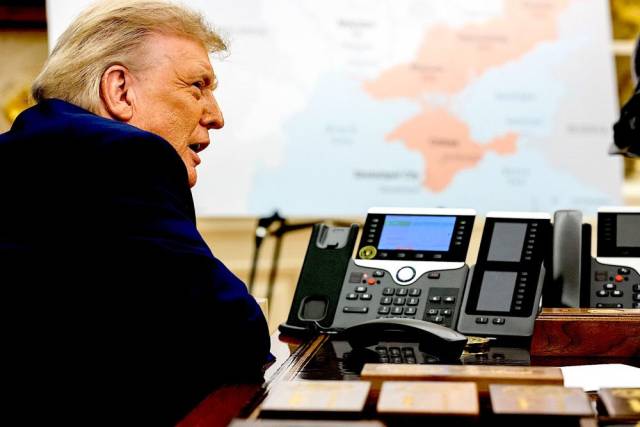
“Maybe they are trying, but trying is not keeping these people alive,” said Pastor Leon Jones Jr., who works in the neighborhoods of Raleigh and Frayser in north Memphis, where crime rates often outpace those of the rest of the city. “We need some help.”ImageMr. Trump seated at his des in the Oval Office with several people beside him.
Wayne Madsen Report, Resistance Dateline: Something has got to break soon, Wayne Madsen, left, Sept. 30-Oct. 1, 2025. Judging by the grumbling within the U.S. national security, defense, and law enforcement communities, over three more years of the  incompetence, lawbreaking, and anti-constitutional activities of the Trump regime cannot withstand a tsunami of countermeasures coming its way.
The United States has never been as ill-prepared to deal with an attack on it or its allies in modern history. That gloomy assessment is shared by current and former members of the U.S. Intelligence Community, the military services, and federal law enforcement (the latter not including the goons hired by Immigration and Customs Enforcement, U.S. Border Patrol, and U.S. Marshals  Service having little to no prior law enforcement experience).
The low esteem of the United States held by its traditional and historic allies is now manifested by a drastic change in how allied intelligence agencies are dealing with their American counterparts.
What was once a strategy of mutual trust had now degraded into one of outright suspicion. Relations between the United States on one hand and its erstwhile FIVE EYES of the United Kingdom, Canada, Australia, and, to a lesser extent, New Zealand are now so poisoned by the Trump regime that London, Ottawa, and Canberra are preparing to do something that was unheard of since the end of World War II.
The postwar "gentleman's agreement" that the FIVE EYES would never spy on one another -- with the caveat that it would only occur if domestic legislation prevented an intelligence agency spying on its own citizens and an intelligence partner would conduct such surveillance on a case-by-case basis -- is being upended.
The UK, Canada, and Australia are increasingly seeing the United States as a hostile intelligence actor and they are establishing mechanisms for current and former members of the U.S. Intelligence Community to be recruited as intelligence agents and assets to keep the FIVE EYES partners informed about the Trump regime's global and regional plans and intentions.
FIVE EYES recruitment of Americans will not occur by holding face-to-face meetings in exotic foreign locales but via nondescript websites on the dark web where anonymity and security is all but guaranteed. The UK's Secret Intelligence Service (MI-6) had developed a dark web platform known as Silent Courier, which is aimed at recruitment of those, including Americans, who have access to classified and sensitive information. Silent Courier will facilitate what has been traditionally been known as "walk-in" agents, individuals having access to intelligence who are volunteering to provide it to MI-6 anonymously through the use of secure messaging applications, including Virtual Private Networks (VPNs).
Outgoing MI-6 director Richard Moore has stated, "Our virtual door is open to you." British Foreign Secretary Yvette Cooper stressed that MI-6's move into dark web recruiting is based on " world changes" and "multiplying threats." It is clear that MI-6 is changing its recruitment targets based on an increasingly erratic United States, which has threatened to invade Greenland, annex Canada and the Gaza Strip, and launch military operations against Panama, Mexico, and Venezuela. The British Foreign Office's official policy on Silent Courier is that the portal is open to anyone, anywhere in the world, who possesses information relevant to British security interests. Responsibility for the Silent Courier portal will fall on Moore's replacement, Blaise Metreweli, who will become MI-6's first female chief, also known as "C," on October 1.
Canada and Australia are standing by to ascertain the success of Silent Courier. For the time being, the Canadian Security and Intelligence Service (CSIS) is stepping up its recruiting efforts directed at Americans with access to classified information through more traditional avenues, including professional conferences and military exercises. The Australian Secret Intelligence Service (ASIS) and the Australian Security Intelligence Organization (ASIO) are considering expanding their use of the dark web to conduct intelligence gathering to actual recruitment.
The French foreign intelligence service (DGSE) has relied on contractor Aleph-Networks to expand its dark web surveillance activities. This dark web mapping operation could easily be expanded to recruiting current and former U.S. intelligence officials and employees, particularly as U.S. and French policies diverge on Ukraine, Palestine, Greenland, and Africa.
It is noteworthy that the Central Intelligence Agency launched a similar dark web operation in 2023 that was aimed at recruiting agents in Russia. There should be no surprise that the initiative was abandoned by the pro-Russian Director of National Intelligence, Tulsi Gabbard.
New York Times, Trump and Comey: An Escalating Conflict With No Off-Ramp, Maggie Haberman, Sept. 30, 2025 (print ed.). The yearslong face-off between Donald Trump and James Comey amounts to a case study of how the president grew evermore emboldened to carry out his revenge agenda.
It was not, to say the least, a great start to their relationship. James B. Comey, then the F.B.I. director, arrived at Trump Tower two weeks before Donald J. Trump would be inaugurated in 2017. On the agenda was a briefing for the incoming president by Mr. Comey and the intelligence community chiefs on their finding that Russia had interfered in the 2016 election to hurt Hillary Clinton.
But Mr. Comey also planned to give the president-elect some even more awkward news.
It was the first time they had met, and Mr. Comey’s message — that there was a document circulating in Washington full of salacious claims related to Mr. Trump and Russia — left Mr. Trump suspecting that the F.B.I. director was implicitly threatening him. Mr. Comey later said he believed he had no choice but to share the information, despite the possibility that Mr. Trump would take it as a demonstration of leverage over him.
Even before that first fraught encounter, their fates had been entangled by Mr. Comey’s decision in the campaign’s closing days to publicly reopen an inquiry into Mrs. Clinton’s use of a private email server, a choice that Democrats assailed and blamed for her defeat. And after the Trump Tower meeting, the two men would be set on a path of escalating conflict and mutual loathing that led last week to a prosecutor handpicked for the task by Mr. Trump securing an indictment of Mr. Comey.
It is a well-documented clash of two supremely self-confident figures now tied together in American history: Mr. Trump, intent on retribution and willing to roll over democratic norms of justice to do so, and Mr. Comey, the professed straight shooter whose judgment on politically explosive cases gave ammunition to detractors on both sides of the aisle. Neither man ever sought an off-ramp.
Seen in light of Mr. Trump’s finally securing an indictment against someone he perceives as a political enemy — the first time he has done so — their well-documented, yearslong face-off amounts to a case study of how Mr. Trump, far from moving on as he won political and legal victories, grew ever more emboldened to direct the Justice Department to carry out his revenge agenda.
 Asked to comment, Abigail Jackson, a White House spokeswoman, said, “The indictment against Comey speaks for itself, and the Trump administration looks forward to fair proceedings in the courts.”
Mr. Comey declined to comment.
Mr. Trump sought to see Mr. Comey investigated and prosecuted for the better part of a decade, relentlessly pressing reluctant aides across two administrations to take action against a figure he sees as pivotal to the Russia investigation, which he has always cast as a “witch hunt” intended to delegitimize his victory in 2016.
Mr. Comey, in turn, has for years been an outspoken critic of the president even as Trump and Clinton supporters alike have cast him as overzealous in how he used his power while leading the F.B.I. Two inspector general reports were sharply critical of how Mr. Comey handled the Clinton email investigation and the disclosure of memos he kept on his interactions with Mr. Trump.
But until last week, no prosecutor, including Mr. Trump’s second attorney general in his first term, believed that an indictment should be pursued, based on the existing evidence at the time. That happened only after Mr. Trump replaced a federal prosecutor who said a case was too weak to take to court with a personal loyalist, Lindsey Halligan, who was willing to override the judgment of career professionals in the U.S. attorney’s office in Northern Virginia.
She emerged from a grand jury on Thursday, five days before the statute of limitations ran out, with a two-count indictment accusing Mr. Comey of lying to Congress about whether he had authorized a media leak by someone else at the F.B.I. But the indictment left unclear precisely which leak is in question and did not set out the prosecution’s evidence.
New York Times, YouTube Settles Trump Lawsuit for $24.5 Million, Kate Conger, Sept. 30, 2025 (print ed.). Mr. Trump sued Alphabet, the parent company of YouTube and Google, and other social media companies after the platforms suspended his accounts in 2021.
YouTube agreed to pay a $24.5 million settlement to President Trump and others who were banned by the video streaming platform in the wake of the Jan. 6, 2021, riot at the U.S. Capitol, according to a legal document filed on Monday.
 The vast majority of YouTube’s settlement payment — $22 million — will go to Mr. Trump, according to the filing in U.S. District Court for the Northern District of California. He has directed that the money be contributed to the Trust for the National Mall and to the construction of a ballroom at the White House.
The remaining $2.5 million will be distributed among other plaintiffs in the case, including the writer Naomi Wolf and the American Conservative Union.
Mr. Trump had sued Alphabet, the parent company of YouTube and Google, and other social media companies after the platforms suspended his accounts in 2021.
A lawyer for Mr. Trump and representatives for YouTube did not immediately respond to requests for comment.
Meta, the parent company of Facebook and Instagram, in January settled a similar lawsuit brought by Mr. Trump, agreeing to pay $25 million. X, the social media platform owned by Elon Musk and formerly known as Twitter, agreed in February to pay about $10 million to resolve a dispute about the 2021 suspension of Mr. Trump’s account.
X reinstated Mr. Trump’s account soon after Mr. Musk acquired the company in 2022, while YouTube restored his channel in 2023.
More Global News
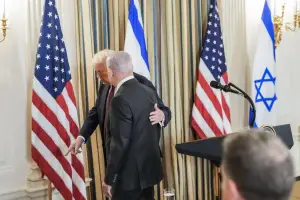
President Trump and Prime Minister Benjamin Netanyahu of Israel at the White House on Monday (New York Times photo by Doug Mills).
New York Times, Live Updates: Trump Says Israel Would Have U.S. Support to Eliminate Hamas if It Rejects Peace Plan, Staff Reports, Sept. 30, 2025 (print ed.). Here’s what’s happening:
Mr. Trump says that Hamas must agree to the 20 points he has proposed, which include conditions it has already rejected, or else Israel will have his “full backing” to eliminate it as a threat. Earlier Monday, Hamas said it was not consulted on the latest cease-fire proposal, which includes terms it has consistently refused.
 Prime Minister Benjamin Netanyahu of Israel, right, addressing the news media at the White House alongside Mr. Trump, says that he supports “your plan to end the war in Gaza, which achieves our war aims.” The leaders did not take questions.
 Before the news conference, the White House released a lengthy plan calling for an immediate cease-fire in Gaza.
Trump said he didn’t want to take any questions, and the two leaders left the room.
President Trump’s framework for ending the war in Gaza includes a line that keeps open the future possibility for a Palestinian state under certain conditions, which “we recognize as the aspiration of the Palestinian people.”
Many Palestinians most likely will see such a distant and vague prospect of independence as not nearly enough. But even that symbolic commitment could prove a sticking point for the right-wing Israeli government; Benjamin Netanyahu, the Israeli prime minister, has repeatedly vowed not to allow the establishment of a Palestinian state.
New York Times, U.S. Deports Planeload of Iranians After Deal With Tehran, Officials Say, Farnaz Fassihi and Hamed Aleaziz, Sept. 30, 2025. The deportation flight to Iran is the most stark push yet by the Trump administration to deport migrants even to places with harsh human rights records.
The Trump administration is deporting a planeload of about 100 Iranians back to Iran from the United States after a deal between the two governments, according to two senior Iranian officials involved in the negotiations and a U.S. official with knowledge of the plans.
Iranian officials said that the plane, a U.S.-chartered flight, took off from Louisiana on Monday night and was scheduled to arrive in Iran by way of Qatar on Tuesday at the earliest. The U.S. official confirmed that plans for the flight were in the final stages. All the officials spoke to The New York Times on condition of anonymity because they were not authorized to discuss details publicly.
The identities of the Iranians on the plane and their reasons for trying to immigrate to the United States were not immediately clear.
The deportation is one of the starkest efforts yet by the Trump administration to deport migrants no matter the human rights conditions in countries on the receiving end. The expanding deportation campaign has sparked lawsuits by immigrant advocates, who have criticized the flights.
For decades, the United States had given shelter to Iranians fleeing their homeland, which has one of the harshest human rights records in the world. Iran persecutes women’s rights activists, political dissidents, journalists, lawyers, religious minorities and members of the L.G.B.T.Q. community, among others.
In the past several years, there has been an increase in Iranian migrants arriving at the southern U.S. border and crossing illegally, including many who have claimed fear of persecution back home for their political and religious beliefs.
Hossein Noushabadi, the director general of parliamentary affairs in Iran’s foreign ministry, said on Tuesday that U.S. immigration authorities planned to deport 400 Iranians living in the United States back to Iran over the coming months.
“In the first phase, they decided to deport 120 Iranians who entered the U.S. illegally, mostly through Mexico,” he told Tasnim News Agency, which is affiliated with Iran’s powerful Revolutionary Guards force.
Some who will be deported held U.S. residency, he said, adding that all of those being deported left Iran legally.
The United States had long hesitated or had trouble deporting migrants to certain countries like Iran because of a lack of regularized diplomatic relations and an inability to get travel documents in a timely manner.
That had forced American officials to either hold migrants in detention for long periods or release them into the United States. The United States deported more than two dozen Iranians back to the country in 2024, the highest number in years.
More On U.S. Governance, Politics, Security

Lincoln Square Media, Commentary: Trump Says U.S. Cities Should Be Military 'Training Grounds,' Susan Demas and Edwin Eisendrath, Sept. 30, 2025. And ICE is detaining more U.S. citizens as part of its raids.
 Chicago isn’t just grappling with ICE raids — it’s being conscripted into a spectacle of fear. Edwin put it bluntly: “Chicago is not a training ground for the U.S. military.” Camouflage-clad agents are parading down Michigan Avenue, riverboats circle Trump Tower for staged intimidation shots, and pepper spray is fired into crowds without cause. None of it is about law enforcement; all of it is about showing the country that ordinary streets can be seized on command.
Authoritarianism rarely declares itself outright, which is why Susan’s framing cuts so sharply: “It’s an authoritarian move.” The point isn’t solving crime or immigration, it’s wielding crisis as cover to strip away rights and stability. Families lose paychecks, farmers watch crops rot, veterans are denied services, while billionaires glide by untouched. The cruelty isn’t accidental — it’s the organizing principle.
Join Lincoln Square today. We’re building a pro-democracy community and we need your voice.Subscribed
The opposition doesn’t start with Congress; it starts with people like us who refuse to yield. “We didn’t sign up for this,” Edwin said, pointing toward the October 18th No Kings protests where Indivisible and others are rallying nationwide. Those who step out together aren’t just resisting — they’re creating communities that sustain hope in the face of intimidation. Even under the gaze of ICE snipers, waving back turns fear into defiance, and defiance into joy.
The larger fight is whether democracy survives or gives way to autocracy. Susan put the math plainly: “There are more of us than there are of them.” That’s not just a numbers game, it’s the reason MAGA leans so heavily on division and spectacle. Trump’s playbook — whether in Gaza, Ukraine, or our own cities — is always segregation and domination. But democracy grows in the spaces where people keep showing up, refusing to let intimidation define the future.
Tune in for the full conversation now! And don’t miss Edwin’s interview with Indivisible Co-Founder Ezra Levin on organizing and the No Kings protests.If the Obamacare tax credits are allowed to lapse, about four million people are projected to lose coverage starting next year, and prices would go up for an additional 20 million people. The Congressional Budget Office has projected that 10 million more Americans would become uninsured by 2034 as a result of the health cuts in the new tax law.
The Contrarian, Opinion: Words & Phrases We Can Do Without, Jennifer Rubin, right,  Sept. 30, 2025. ‘Incitement’ has become another word for ‘Trump criticism.’
“Incitement” is now MAGA’s favorite word, or rather its favorite pretext for violating First Amendment and due process rights. Donald Trump is enlisting the power of the federal government to go after left-leaning groups that he thinks (or convinces his cult to think) have something to do with violence. Before we get to the glaring constitutional problem, it behooves us to try to figure out what MAGA thinks constitutes “incitement.”
Vice President JD Vance’s patently absurd lie that Haitian immigrants were eating cats and dogs? MAGA apparently thinks this is not incitement, even though it spawned bomb and death threats.
 The Great Replacement theory (including reprehensible comments that immigrants are poisoning our blood and are swamping Whites, etc.)? Again, MAGA demagogues will not call that incitement, although it was recited at numerous White supremacists’ mass murders.
Sending military troops and federal immigration agents into a overwhelmingly peaceful Los Angeles? Trump and his ilk refused to acknowledge that was incitement—even though deployment of intimidating military forces provoked violence and resulted in numerous cases of excessive force. California National Guard in front of peaceful protestors in Los Angeles, a city that President Trump characterized on social media as being filled with “violent, insurrectionist mobs”
Ah, but truthfully repeating Charlie Kirk’s rhetoric? MAGA voices scream “Incitement!”
Funding progressive causes that help the environment, feed the hungry, or aid immigrants? Again, the MAGA bullies would have us believe that such groups or the funding of their causes are inciting violence.
Fascistic behavior such as violently snatching people off the street and sending them to third-world hell holes? Not incitement, in the MAGA cult. But calling out that fascistic behavior? That, in their ideological bubble, constitutes incitement.Subscribed
You get the drift. MAGA forces refuse to take responsibility for vicious rhetoric and violence from the right; instead, it is regarded as a cudgel to menace their opponents.
Plainly, MAGA authoritarians have fallen in love with the word “incitement” to justify their unconstitutional, un-American assault on opponents. Somewhere they got the idea that hate speech (which they define only as anti-MAGA, not the racist, homophobic, xenophobic, or misogynistic sludge found on Twitter or voiced at gatherings such as CPAC) is not protected under the First Amendment. That’s absolutely wrong. It absolutely is protected, as even conservatives were sheepishly forced to acknowledge when the dull-witted attorney general of the United States got it wrong.
Moreover, even “incitement to commit a crime or violence” is not necessarily illegal (as Donald Trump’s defenders were quick to claim regarding his call for the armed mob to go to the Capitol on Jan. 6) unless it meets the so-called Brandenburg test. In Brandenburg v. Ohio, a case involving a KKK leader speaking at a Klan rally, the Supreme Court reaffirmed “the principle that the constitutional guarantees of free speech and free press do not permit a State to forbid or proscribe advocacy of the use of force or of law violation except where such advocacy is directed to inciting or producing imminent lawless action and is likely to incite or produce such action.”
Even if some people in a group are violent, the First Amendment does not permit the government to disband or punish a entire group that engages in protected speech. (Consider what would have happened had former president Joe Biden banned the Proud Boys after Jan. 6 or tried to take Steve Bannon off the air.) Imagine the outcry if we tried to ban online gaming because a certain category of alienated young men were enmeshed in a dark online world where they find inspiration to do performative violence.
In other words, statements such as “Get ICE off our streets” or “Trump is a criminal” or “Stephen Miller is a fascist” are fully protected speech. Absent any advocacy to engage imminent lawless action, even statements such as “ICE better not come here” or “ICE will regret coming here” are core First Amendment speech.
As the ACLU has explained:
While the First Amendment does not protect incitement — speech that is intended and likely to cause imminent violence, as established in Brandenburg v. Ohio, litigated by the ACLU — or true threats, an expression of a serious intent to commit a violent act against another person, speech considered to be hateful is not enough to qualify. Indeed, whether speech is hateful is typically a matter of opinion. As Supreme Court Justice John Marshall Harlan II said in Cohen v. California (1971), “one man’s vulgarity is another man’s lyric.” Posting an offensive joke or condemning someone else’s views in harsh terms is generally protected by the First Amendment, regardless of how much someone else doesn’t want to hear it.
Put simply, there is a world of difference between “theoretical future violence” and “an immediate risk of harm to a real person.” And we are not even in the ballpark of sanctionable speech when someone is advocating a point of view (e.g., “MAGA leaders are fascists”), which is inarguably core protected activity.
Let’s stop pretending Trump and his autocratic minions are concerned about incitement to commit violence. They are paranoid and furious about criticism, jokes, advocacy, and other speech that underscores their racism, xenophobia, anti-American authoritarianism, misogyny, anti-science nuttery, and conspiracy-mongering. Aside from their lie that most violence comes from left-wing groups and the hogwash that every killing can be categorized as “left” or “right” inspired, there simply is not a constitutionally appropriate way to go after groups who say “bad things” about MAGA doctrine and conduct.
If Trump and his ilk had their way, they would be allowed to say anything, including exhorting a mob to overthrow an election, but liberals could be silenced and/or punished because they (incorrectly) think more violence comes from the left. This is precisely what the Constitution prohibits. So please, let us do away with the phony rhetoric about “incitement” and be candid. The real threat to America is the hypocritically, dangerous and un-American attack on free speech, association, and advocacy. Trump cannot ban something simply by labeling it “incitement”—although that is precisely what Trump and his MAGA enablers intend to do, if the American people let them.
Wayne Madsen Report, Resistance Dateline: Something has got to break soon, Wayne Madsen Sept. 30-Oct. 1, 2025. Judging by the grumbling within the U.S. national security, defense, and law enforcement communities, over three more years of the incompetence, lawbreaking, and anti-constitutional activities of the Trump regime cannot withstand a tsunami of countermeasures coming its way.
The United States has never been as ill-prepared to deal with an attack on it or its allies in modern history. That gloomy assessment is shared by current and former members of the U.S. Intelligence Community, the military services, and federal law enforcement (the latter not including the goons hired by Immigration and Customs Enforcement, U.S. Border Patrol, and U.S. Marshals Service having little to no prior law enforcement experience).
The low esteem of the United States held by its traditional and historic allies is now manifested by a drastic change in how allied intelligence agencies are dealing with their American counterparts. What was once a strategy of mutual trust had now degraded into one of outright suspicion. Relations between the United States on one hand and its erstwhile FIVE EYES of the United Kingdom, Canada, Australia, and, to a lesser extent, New Zealand are now so poisoned by the Trump regime that London, Ottawa, and Canberra are preparing to do something that was unheard of since the end of World War II. The postwar "gentleman's agreement" that the FIVE EYES would never spy on one another -- with the caveat that it would only occur if domestic legislation prevented an intelligence agency spying on its own citizens and an intelligence partner would conduct such surveillance on a case-by-case basis -- is being upended. The UK, Canada, and Australia are increasingly seeing the United States as a hostile intelligence actor and they are establishing mechanisms for current and former members of the U.S. Intelligence Community to be recruited as intelligence agents and assets to keep the FIVE EYES partners informed about the Trump regime's global and regional plans and intentions.
resistance-dateline-sept-30october-1-2025-something-hasFIVE EYES recruitment of Americans will not occur by holding face-to-face meetings in exotic foreign locales but via nondescript websites on the dark web where anonymity and security is all but guaranteed. The UK's Secret Intelligence Service (MI-6) had developed a dark web platform known as Silent Courier, which is aimed at recruitment of those, including Americans, who have access to classified and sensitive information. Silent Courier will facilitate what has been traditionally been known as "walk-in" agents, individuals having access to intelligence who are volunteering to provide it to MI-6 anonymously through the use of secure messaging applications, including Virtual Private Networks (VPNs).
Outgoing MI-6 director Richard Moore has stated, "Our virtual door is open to you." British Foreign Secretary Yvette Cooper stressed that MI-6's move into dark web recruiting is based on " world changes" and "multiplying threats." It is clear that MI-6 is changing its recruitment targets based on an increasingly erratic United States, which has threatened to invade Greenland, annex Canada and the Gaza Strip, and launch military operations against Panama, Mexico, and Venezuela. The British Foreign Office's official policy on Silent Courier is that the portal is open to anyone, anywhere in the world, who possesses information relevant to British security interests. Responsibility for the Silent Courier portal will fall on Moore's replacement, Blaise Metreweli, who will become MI-6's first female chief, also known as "C," on October 1.
Canada and Australia are standing by to ascertain the success of Silent Courier. For the time being, the Canadian Security and Intelligence Service (CSIS) is stepping up its recruiting efforts directed at Americans with access to classified information through more traditional avenues, including professional conferences and military exercises. The Australian Secret Intelligence Service (ASIS) and the Australian Security Intelligence Organization (ASIO) are considering expanding their use of the dark web to conduct intelligence gathering to actual recruitment.
The French foreign intelligence service (DGSE) has relied on contractor Aleph-Networks to expand its dark web surveillance activities. This dark web mapping operation could easily be expanded to recruiting current and former U.S. intelligence officials and employees, particularly as U.S. and French policies diverge on Ukraine, Palestine, Greenland, and Africa.
It is noteworthy that the Central Intelligence Agency launched a similar dark web operation in 2023 that was aimed at recruiting agents in Russia. There should be no surprise that the initiative was abandoned by the pro-Russian Director of National Intelligence, Tulsi Gabbard.
 Popular Information, Accountability Journalism: Jared Kushner’s double life, Judd Legum, right,
 Sept. 30, 2025. Kushner, above left, has resumed his role as a top Trump foreign policy advisor while expanding his business partnership with the Saudi government.
The Saudi Arabian government, through its Public Investment Fund (PIF), has agreed to acquire Electronic Arts (EA), the publisher of iconic video games like The Sims and Madden NFL, for $55 billion. It would be the largest leveraged buyout in history.
PIF is partnering with two private equity firms on the deal: Silver Lake Partners, one of the largest technology-focused investors globally, and Affinity Partners, founded by Jared Kushner, President Trump’s son-in-law, in 2021.
Kushner is expanding his lucrative partnership with the Saudis as he takes a central role in shaping the Trump administration’s foreign policy.
Silver Lake Partners brings considerable financial resources, with $110 billion of assets under management, a large staff of 1,200, and deep expertise in growing and managing large technology companies. By contrast, Kushner’s Affinity Partners has no experience with the video game industry, employs just 30 people, and has raised a few billion dollars, with the largest investment coming from PIF.
So why did PIF include Affinity Partners in the deal? “People close to the discussions said Kushner’s involvement would… ease the deal’s path through the Committee on Foreign Investment in the US [CFIUS], which adjudicates on deals involving foreign buyers,” the Financial Times reports.
Since the Saudi Arabian government would acquire a significant stake in Electronic Arts once the transaction closed, it would require approval from CFIUS, which is composed of members of Trump’s cabinet and other administration officials appointed by Trump. CFIUS operates by consensus. What are the odds that nine Trump appointees decide to reject a deal involving Trump’s son-in-law? If CFIUS cannot reach a unanimous agreement, the matter is referred to the president.
This helps explain why PIF bankrolled Affinity Partners with $2 billion, with Kushner already collecting tens of millions in fees. PIF’s investment committee recommended rejecting Kushner’s proposal, citing “the inexperience of the Affinity Fund management” and “excessive” fee structure. The committee’s recommendation, however, was overruled by Crown Prince Mohammed bin Salman, who heads PIF’s Board of Directors. They were effectively purchasing access to Kushner’s political connections.
CFIUS evaluates potential transactions on national security grounds. Although a deal to acquire a video game company may seem benign, companies like EA collect extensive data on millions of Americans. EA could also influence young Americans through in-game content, including representations of women and minorities, political messaging, and cultural values.Kushner’s key role in Trump’s second administration
Kushner dismissed concerns about conflicts of interest after accepting billions from the Saudis and other foreign governments, pledging he would not be involved in Trump’s second term. In February 2024, Axios’ Dan Primack asked Kushner whether accepting billions in investments from public investment funds run by the governments of Saudi Arabia and the United Arab Emirates (UAE), would make it “very difficult… to do any sort of foreign policy work” in a second Trump administration. “I’m an investor now,” Kushner replied. “I served in government, and I think my track record is pretty impeccable. Now I’m a private investor.”
But in recent months, Kushner has quietly resumed his role as one of Trump’s most important White House foreign policy advisors. “Kushner, alongside Steve Witkoff, Trump’s envoy to the Middle East, met with [Israeli Prime Minister Benjamin] Netanyahu twice in the past week — including on Sunday at the prime minister’s hotel in New York,” The Forward reported. The purpose of the meetings was “to bridge differences between Trump and… Netanyahu ahead of a White House meeting on Monday.”
Kushner was also at the White House on Monday for the meeting between Netanyahu and Trump. He sat alongside Trump’s top advisors during a joint press conference.
The Saudi government is keenly interested in the future of Gaza, which it views as central to its ambition to expand its political and economic influence in the region. Kushner is entering new business partnerships with the Saudi government while simultaneously representing the United States in sensitive foreign policy negotiations that implicate Saudi priorities.
New York Times, Spending Fight Puts Leaders in Congress in a Tough Spot, Catie Edmondson, Sept. 30, 2025 (print ed.). The top four leaders on Capitol Hill are each facing high stakes and competing political incentives as they barrel toward a shutdown.
Congressional leaders in both parties are facing a host of political risks and real-world consequences for the country in a spending standoff that is threatening a government shutdown within days.
 For Senator John Thune, Republican of South Dakota, it is his first big spending showdown as majority leader.
Speaker Mike Johnson,  right, Republican of Louisiana, is toiling to hold on to his narrow House majority, keenly aware that the fight carries risks for his members — and that a spending deal with Democrats cost his predecessor his job.
For Senator Chuck Schumer and Representative Hakeem Jeffries, both Democrats of New York, the fight is a chance to show a restive base that is hungry for a battle that they are willing to wage one with President Trump.
The four leaders are set to meet with Mr. Trump in the Oval Office on Monday afternoon to address the looming shutdown deadline. Unless they can reach a swift agreement to extend spending and push it through Congress within hours, federal funding is set to lapse after midnight on Tuesday.
Here’s a look at the stakes facing each leader, and their strategies.
 New York Times, The Man Behind Trump’s Push for an All-Powerful Presidency, Coral Davenport, Sept. 30, 2025 (print ed.). Russell T. Vought spent years drawing up plans to expand presidential power and shrink federal bureaucracy. Now he is moving closer to making that vision a reality, threatening to erode checks and balances.
Russell T. Vought, right, the White House budget director, was preparing the Trump administration’s 2026 budget axing items that Mr. Vought had intended to keep.
 Mr. Vought, a numbers wonk who rarely raises his voice, could barely contain his frustration, telling colleagues that he felt sidelined and undermined by the haphazard chaos of the Musk-led Department of Government Efficiency, according to six people with knowledge of his comments who, like others interviewed for this article, spoke on the condition of anonymity for fear of retribution.
“We’re going to let DOGE break things, and we’ll pick up the pieces later,” Mr. Vought told his staff during one flash of irritation, according to three of those people. Mr. Vought’s spokeswoman, Rachel Cauley, denied that he made those comments, and that he felt frustrated by Mr. Musk.
This had not been Mr. Vought’s plan.
Mr. Vought, who also directed the White House Office of Management and Budget in President Trump’s first term, had spent four years in exile from power. He worked through Joseph R. Biden Jr.’s presidency from an old rowhouse near the Capitol, where he complained of pigeons infesting his ceiling and coordinated with other Trump loyalists to draw up sweeping, detailed plans for a comeback.
 He had carefully analyzed mistakes from the first term. And he had laid out steps to achieve the long-sought conservative goal of a president with dramatically expanded authority over the executive branch, including the power to cut off spending, fire employees, control independent agencies and deregulate the economy.
Mr. Musk, who spent more than $250 million to help elect Mr. Trump, had celebrity, access to the president and political capital that the budget director could never hope for.
But Mr. Vought (pronounced “vote”) had something Mr. Musk did not: He had done his homework.
In the months since Mr. Musk fell out with the president, Mr. Vought has at last begun to put his plans into action — remaking the presidency, block by block, by restoring powers weakened after the Nixon administration. His efforts are helping Mr. Trump exert authority more aggressively than any modern president, and are threatening an erosion of the longstanding checks and balances in America’s constitutional system.
Now, as the government heads toward a shutdown when federal funding lapses on Tuesday, Mr. Vought, 49, is leveraging the moment to further advance his goals of slashing agencies and purging employees, with his office telling agencies to prepare for mass firings unless Congress can strike a deal to keep the government open.
The ultimatum follows a string of achievements for Mr. Vought.
This summer, he pressured lawmakers to enact his plan to cancel $9 billion for foreign aid and public broadcasting that they had previously approved — an unusual bow by Congress to the White House. The new law claimed another prize for conservatives: the death of the Corporation for Public Broadcasting. And a deal Mr. Vought cut with House Republicans helped secure passage of Mr. Trump’s domestic policy law that slashed spending on Medicaid and food stamps.
New York Times, In Unusual Move, Prosecutors Secure Federal Charges From Local Grand Jury, Alan Feuer, Sept. 30, 2025. A judge, Zia M. Faruqui, said that what appeared to be a kind of grand jury forum shopping seemed to have broken “decades-long norms and the rule of law.”
In the past month or so, federal prosecutors in Washington have been repeatedly embarrassed as nearly a dozen grand juries have rejected their efforts to secure indictments against people caught up in President Trump’s plan to use federal troops and agents to crack down on local crime.
 As unusual as all of this has been, there was a new and even more unusual twist to their setbacks this week: On Monday, a magistrate judge pre-emptively refused to accept an indictment after learning that prosecutors had performed what he described as an “end run” around the normal course of justice. After failing to secure an indictment from a federal grand jury, prosecutors took the federal charges to a local grand jury, which returned an indictment.
In a scathing order filed in Federal District Court in Washington, the magistrate judge, Zia M. Faruqui, told prosecutors that he had never heard of such of thing, saying that what appeared to be an example of grand jury forum shopping had broken “decades-long norms and the rule of law.”
“At a minimum, this is very unseemly,” Judge Faruqui wrote. “More than likely, it is unlawful.”
Jeanine Pirro, the U.S. attorney, pushed back in a statement. “Instead of being an activist judge, Judge Faruqui should spend more time focused on his cases, so that he doesn’t get overruled so often,” she said. “The submission of an indictment to the court is a ministerial act over which Judge Faruqui has no additional powers of judicial review.”
Judge Faruqui, who once worked as a prosecutor in the office, has had extremely harsh words for his former colleagues several times in recent weeks. He has accused them of overcharging people ensnared in Mr. Trump’s local crime initiative and bowing to pressure to bring criminal cases at the expense of protecting defendants’ legal rights.
But the judge appeared to be particularly shocked by the grand jury switch-up, saying it had further eroded the traditional bonds of trust — known in legal jargon as the presumption of regularity — that courts have long conferred on government lawyers.
“This only deepens the growing mistrust of the actions of prosecutors,” Judge Faruqui wrote. “That is a sentiment that was once unthinkable, but the irregular is now the regular.”
Grand jury failures have occurred not only in Washington, where Mr. Trump has deployed the National Guard alongside a large number of federal agents, but also in Los Angeles, where he has used both troops and agents to help with immigration arrests. An influx of federal forces is now set to arrive in Memphis, raising questions about whether it, too, could result in similar problems with grand juries returning indictments against defendants caught up in the surge.
His rebuke came in the case of a man named Kevontae Stewart who was arrested on Sept. 17, after local and federal authorities approached him as he sat in a parked car on Forrester Street in Southwest Washington and smelled what they described as “the odor of burnt marijuana emanating from the vehicle,” according to a criminal complaint issued in the case.
When the officers asked Mr. Stewart to get out of the car, he immediately took flight, dropping a black pistol to the ground and trying to dispose of it, the complaint asserted. The officers, it said, ultimately caught up with Mr. Stewart and found in one of his pockets a bag containing a substance that tested positive for cocaine.
Sept. 29
U.S. Governance, Politics
The Contrarian, Opinion: The U.S. is not a Functional Democracy, Jennifer Rubin, right, Sept. 29, 2025. We are no longer at a “tipping point” or “an inflection point.” We are no longer “sliding” toward autocracy. Donald Trump no longer “aspires” to be an autocrat. Last week, in case you had any doubt, the Trump regime went full-bore authoritarian. We cannot accurately describe the current United States government as a functional democracy.
At best, we now live in a “hybrid regime”—one with characteristics of both a democracy and an autocracy. An apparatchik like FCC chairman Brendan Carr can force a comedian off the air; but a public boycott and popular criticism can prevail to return him to the airwaves, more popular than ever. The regime pushes out prosecutors who remain loyal to the rule of law and persecutes an opponent; nevertheless, a grand jury of ordinary citizens rejects one count, and the indictment draws widespread condemnation. The regime spews nonstop lies and propaganda and engages in coverups; there is some pushback from Congress.Subscribed
Whether we are a hybrid regime or a full police state is debatable, but after the events of last week, our democracy and the rule of law appear to be in tatters. Consider that in a single week, Trump:
Forced out a U.S. attorney to put in an utterly unqualified flunky who overrode the recommendation of career prosecutors and barely obtained a patently absurd criminal indictment (a classic vindictive prosecution) against former FBI director James Comey based on a “false statement.” (That statement is unspecified and, in all likelihood, not false. The government almost certainly cannot prove the requisite mens rea.)
More fascistic conduct is sure to come. Trump has vowed to bring more blatantly vengeance-fueled prosecutions against other perceived “enemies,” New York Attorney General Tish James and California Sen. Adam Schiff. He surely will threaten other cities with military occupation.
His comically unqualified and unserious defense secretary will gather all top military brass from around the world at a cost of millions of dollars and at the expense of national security to deliver a cringeworthy diatribe on “grooming and the warrior ethos”—about what you would expect from a TV talk show host with zero credibility on any serious national security issue. (One more step toward the politicization of our military.)
Moreover, the cesspool of corruption indicative of autocratic regimes expands by the day. Snarling immigration czar Tom Homan, according to a deeply reported account, received $50,000 from undercover agents before the election in a classic pay-to-play scheme. After the election, the Trump regime quashed the investigation.
But a 5-figure payout is pocket change for this crew. The multi-billion crypto get-rich-quick gambit is now as much a part of the Trump family business as cheap cologne, sneakers, and golf courses.
Then, to top it off, just as we saw in Hungary and in Benito Berlusconi’s Italy, right-wing allies of the ruling regime have continued to consolidate control of media outlets, thereby tightening the stranglehold on free expression and news. (Even Jared Kushner is getting into the game, with his firm contributing to the acquisition of Electronics Arts.)
None of this is acceptable in a democratic country. A single item would be cause for alarm, and ample grounds for congressional investigation and potential impeachment. The accumulation of so many constitutional violations coupled with the utter passivity of the MAGA-controlled House and Senate and a docile MAGA majority on the Supreme Court means we are not a functioning democracy bound by the rule of law. It’s no use soft-pedaling the extent of the problem, ignoring the suffering inflicted on ordinary Americans, or minimizing the Herculean work that will be needed to repair our system.
Now, as the government heads toward a shutdown when federal funding lapses on Tuesday, Mr. Vought, 49, is leveraging the moment to further advance his goals of slashing agencies and purging employees, with his office telling agencies to prepare for mass firings unless Congress can strike a deal to keep the government open.
New York Times, Trump Administration Live Updates: Trump’s Meeting With Democrats Yields No Progress, With Shutdown a Day Away, Staff Reports, Sept. 29, 2025.
Spending standoff: A White House meeting between President Trump and congressional leaders from both parties on Monday yielded no breakthroughs as the government faced a 12:01 a.m. Wednesday deadline to avert a shutdown.
Vice President JD Vance said the federal government was careening toward a shutdown, blaming Democrats who he said “won’t do the right thing.”
Senator Chuck Schumer of New York, the minority leader, said there were still “very large differences” over health care, with Democrats demanding the reversal of Medicaid cuts Republicans enacted earlier this year. Republicans are falsely asserting that Democrats are shutting down the government to fund free health care for unauthorized immigrants.
Reviving coal: The Trump administration said it was opening 13.1 million acres of federal land for coal mining, reducing the royalties companies pay to extract it and offering hundreds of millions of dollars to upgrade existing plants. Read more ›
 The Bulwark, The Triad Commentary: We Are in the Worst-Case Scenario, Jonathan V. Last, above, Sept. 29, 2025. The November 2024 version of you would be shocked at what the September 2025 version accepts as reality.t
 After Trump’s re-election I did my best to imagine how things might go better than we feared.
Then I laid out my worst-case scenario. You can revisit it here, if you like to wallow. I’ll give you the short version:
We are only nine months in and these mile markers are all far in the rearview mirror. I want to talk about this today for a few reasons:
This will not be a fun exercise. We should do it anyway.
2. JVL Is Sometimes Wrong. Let’s start with my failures of imagination. In trying to forecast the worst-case scenario I did not foresee that Trump would:
I’m sure you can think of other things that have happened since January 20 that weren’t on my radar last November, even when I was in four-alarm-fire mode.
The most alarming developments have been the crossing of what I viewed as worst-case red lines: the politicization of the law and the military.
It started with the blanket pardon of January 6th convicts. Then there was the Justice Department firing a parade of attorneys until they found someone willing to dismiss the government’s case against Eric Adams. Then the FBI raid on John Bolton’s house. Then the firing of federal attorneys until Trump found someone who would indict James Comey.
And obviously: the government’s total indifference to any legally questionable conduct from Trump allies.
As for the military, Trump has made it clear that his secretary of defense’s remit is making the officer class more pliant. Hegseth has removed high-ranking officers and purged the JAG corps. The illegal strikes on civilian boats off the coast of Venezuela seem designed to test the limits of order-following: When asked to cite which legal authority sanctioned the attacks, no individual within the administration has been able to provide one. Trump is already using the military in open defiance of the law because he understands that once you get one soldier to break the law for you, the next soldier will be easier to convince.
Finally, there’s tomorrow’s meeting at Quantico.
Remember when Trump threw a military parade to celebrate his birthday? Now he’s convening an in-person meeting of every senior military officer in which he plans to address them. Maybe it’ll all be very innocent and proper.
But I would not bet on it.
Letters from an American, Historical Commentary: Sept. 28, 2025 [Trump's new "Deep Fake' health care system for Americans], Heather Cox Richardson, right, Sept. 29, 2025. Late last night, President Donald J. Trump shared on social media a deep fake video that appeared to be a clip from his daughter-in-law Lara Trump’s Fox News talk show My View.
In the video’s split screen, Lara Trump, on the left, says: “President Donald J. Trump has announced a historic new healthcare system, the launch of America’s first MedBed hospitals and a national MedBed card for every citizen.” As she speaks, the video shows a building with the caption: “MEDBED HOSPITALS: THE NEW ERA IN HEALTHCARE.”
Then the video shows a clip of Trump saying: “Every American will soon receive their own MedBed card.” As the video shows what looks like a futuristic hospital, complete with what appear to be podlike beds, he continues: “With it, you’ll have guaranteed access to our new hospitals led by the top doctors in the nation, equipped with the most advanced technology in the world.”
The camera then goes back to Trump saying, “These facilities are safe”—the camera switches back to a hospital scene—“modern, and designed to restore every citizen to full health and strength.” The video then switches back to Trump, who says: “This is the beginning of a new era in American healthcare.”
Lara Trump takes over as a scene of people applauding Trump runs beside her. She says: “In this first phase, only a limited number of MedBed cards will be released. Registration details will be announced very soon.”
MedBeds are imaginary magical beds, sort of like a tanning bed, that diagnose or cure health problems instantly and painlessly. The idea is popular in QAnon forums, and believers claim that Trump is already secretly installing the beds in hospitals.
It is unclear why Trump posted an obviously fake video, touting an obviously fake product, although healthcare is uppermost in politics these days. The Democrats say they will not agree to the Republicans’ continuing resolution to keep the government open unless the Republicans agree to extend the premium tax credit that subsidizes health care insurance for people making between 100% and 400% of the federal poverty limit. Without that extension, millions of Americans will lose their health insurance, and healthcare premiums for everyone in the Affordable Health Care market will go up, often dramatically.
If MedBeds were real and “every citizen” could use them, as the deep fake video suggests, no one would need to worry about losing their healthcare insurance.
Someone took the video down from Trump’s timeline this morning.
On Friday, Republicans took the stand that Democrats would pay for shutting down the government. A White House official told Dasha Burns of Politico that Trump would not negotiate. “He read all the sh*t they’re asking for, and he said, ‘on second thought, go f*ck yourself,’” the White House official told Burns. Yesterday, though, Punchbowl reported that Trump will meet with Senate minority leader Chuck Schumer (D-NY) and House minority leader Hakeem Jeffries (D-NY). House speaker Mike Johnson (R-LA) and Senate majority leader John Thune (R-SD) are expected to be there as well.
The government is funded through Tuesday, September 30.
Also taking place Tuesday is the meeting Defense Secretary Pete Hegseth abruptly called last week for hundreds of the nation’s top military officers at the Quantico, Virginia, Marine Corps base. When Trump talked to reporters on Thursday, he did not appear to understand that Hegseth had called U.S. military officers to Quantico, appearing to think he had invited military leaders from other countries. “I love it, I mean I think it’s great,” Trump said. “Let him be friendly with the generals and admirals from all over the world. You act like this is a bad thing. Isn’t it nice that people are coming from all over the world to be with us?”
Today Tara Copp, Dan Lamothe, Noah Robertson, and Alex Horton of the Washington Post reported that Trump has decided that he will go to the gathering himself.
Trump told Yamiche Alcindor and Alexandra Marquez of NBC News: “It’s really just a very nice meeting talking about how well we’re doing militarily, talking about being in great shape, talking about a lot of good, positive things. It’s just a good message,” Trump said. “We have some great people coming in and it’s just an ‘esprit de corps.’ You know the expression ‘esprit de corps’? That’s all it’s about. We’re talking about what we’re doing, what they’re doing, and how we’re doing.”
In a phone interview with NBC White House correspondent Yamiche Alcindor today, Trump suggested he was backing off from the threat he posted on social media to send troops to Portland to handle “domestic terrorists.” The Democratic governor of Oregon, Tina Kotek, has told Trump and Secretary of Homeland Security Kristi Noem that there is no need for troops and they do not have the authority to deploy the military there. “We can manage our own local public safety needs,” Kotek said. “There is no insurrection, there is no threat to national security.”
Evan Watson of KGW8 in Portland, Oregon, reported that Trump told Alcindor they were “looking at” sending troops. “I spoke to the governor, she was very nice,” Trump added. “But I said, ‘Well wait a minute, am I watching things on television that are different from what’s happening? My people tell me different.’ They are literally attacking and there are fires all over the place...it looks like terrible.”
In fact, Zane Sparling, Fedor Zarkhin, and Zaeem Shaikh of The Oregonian/OregonLive noted yesterday that Trump’s first threat to send federal troops to Portland came on September 5, a day after the Fox News Channel aired a “special report” about a protest that had taken place four days before, on Labor Day. The report about the Labor Day protest misleadingly mixed in clips from 2020 showing protesters burning the base of the Thompson Elk fountain and a federal officer pepper-spraying a person.
This afternoon Hegseth called 200 members of the Oregon National Guard into federal service for 60 days. Less than six hours later, Oregon attorney general Dan Rayfield sued President Trump, Secretary of Defense Hegseth, Secretary of Homeland Security Noem, and their respective departments, saying the National Guard has been unlawfully deployed for law enforcement duties.
Late this afternoon, Trump praised his remodeling of the Oval Office to include copious gold fixtures, some of which match polyurethane appliqué available from the home improvement store Home Depot. On social media, Trump posted: “Some of the highest quality 24 Karat Gold used in the Oval Office and Cabinet Room of the White House. Foreign Leaders, and everyone else, ‘freak out’ when they see the quality and beauty. Best Oval Office ever, in terms of success and look!!! President DJT”
 Popular Information, Accountability Journalism: Trump’s Argentina bailout enriches one well-connected billionaire, Judd Legum, right, Sept. 29, 2025. A $20 billion taxpayer-funded rescue package for Argentina is a gift for a hedge fund manager with personal and professional ties to the Treasury Secretary.
Last week, Treasury Secretary Scott Bessent, above, announced a $20 billion package to rescue the Argentinian economy. The risky taxpayer-financed deal, which involves trading U.S. dollars for Argentine pesos, has little upside for ordinary Americans. Argentina is not a significant U.S. trading partner, and its economy, long in turmoil, has little impact on the United States.
However, Bessent’s announcement had massive economic benefits for one American: billionaire hedge fund manager  Rob Citrone, who has placed large bets on the future of the Argentine economy. Citrone, the co-founder of Discovery Capital Management, is also a friend and former colleague of Bessent—a fact that has not been previously reported in American media outlets. Citrone, by his own account, helped make Bessent very wealthy.
Since Javier Milei, right, a right-wing populist, became president of Argentina in December 2023, Citrone has invested heavily in Argentina. Citrone has bought Argentine debt and purchased equity in numerous Argentine companies that are closely tied to the performance of the overall economy.
Due to Argentina’s massive debt load and chaotic economic history — in 2023, Argentina’s inflation rate was over 200% — Citrone purchased Argentine bonds with an interest rate of nearly 20%. (Citrone has  declined to detail exactly “how much of the $2.8 billion he manages is invested“ in Argentina.)
Citrone, who is also a minority owner of the Pittsburgh Steelers, is effectively betting on Milei’s right-wing economic program, which emphasizes deregulation and sharply reduced government spending. Citrone viewed “the probability of default as minuscule,” even though Argentina has defaulted on its debts many times in the past.
In the short term, this appeared to be a savvy investment. After taking office, Milei fired tens of thousands of government workers, cut spending on welfare and research, and achieved fiscal balance. Inflation was reduced to around 40%, which spurred economic growth and foreign investment. Argentina’s economic rebound contributed to Discovery Capital’s 52% return in 2024.
Then it all came crashing down.
The austerity measures slowed economic growth, and unemployment spiked to nearly 8%. Millions had a harder time making ends meet after Milei reduced or eliminated subsidies for transportation, medicine, and other necessities. Milei’s popularity slumped, leading to speculation that his party could be routed in the 2025 midterm elections, which would hamstring Milei’s ability to implement his agenda. This created an economic panic, with investors dumping the peso and liquidating other Argentine assets.
Milei has desperately attempted to keep inflation in check. Last week Argentina’s “central bank spent more than $1 billion to shore up the peso.” But Argentina was running out of foreign currency.
That spelled trouble for Citrone.
Then Bessent and the Trump administration came to the rescue, floating a $20 billion economic package that helped stabilize the Argentine peso and functioned as a political lifeline for Milei.
In early September, days before Bessent’s announcement, Citrone purchased more Argentine bonds.
Bessent’s personal and professional relationship with Citrone has spanned decades. In a May 14 appearance on the “Goldman Sachs Exchanges” podcast, Citrone revealed how he delivered a financial windfall for Bessent. They were both working for investor George Soros in 2013 when Citrone convinced Bessent and Soros to bet on the U.S. dollar against the Japanese yen.
I think there’s special times every five or ten years where there’s a really spectacular trade in investment that we then will concentrate in a meaningful way. 2013, the dollar-yen, where we made over a billion dollars long dollar-yen. And, in fact, you know, we discussed it quite a bit with George, and I kind of convinced George and Scott Bessent at the time to go big in that. And, you know, Scott says I’m responsible for 75% of his bonus at Soros, kind of jokingly, over that time.
CE Noticias Financieras, a leading Latin American economic publication, describes Citrone as “a friend of the Secretary of the Treasury.” El Cronista, citing government sources, reported that Citrone “has a personal relationship as well as a past working relationship” with Bessent.
Citrone has also reportedly leveraged his relationship with Bessent to gain access to Trump. According to CE Noticias Financieras, in November, “Citrone gave a case of four red wines to Javier Milei during his visit to Mar-A-Lago, in Palm Beach, in his first meeting with Trump.”
When Argentina’s economy began to falter in April, it was Citrone who “intervened before Scott Bessent…to advocate for an IMF agreement with Argentina,” CE Noticias Financieras reported. Bessent subsequently played a key role in convincing the IMF to extend a separate $20 billion currency stabilization package. (That package ultimately proved insufficient to stabilize the Argentine peso.)
Shortly after the IMF deal was secured, Bessent traveled to Argentina to meet with Milei and other top Argentine officials. It was an unusual choice for the Treasury Secretary’s first foreign trip. Citrone arrived in Argentina at the same time as Bessent, meeting with Milei just before Bessent. During those meetings, Bessent emphasized U.S. support for Argentina’s economic agenda.
Bessent’s September 24 announcement, thus far, has had the desired impact, increasing the value of Argentine assets, including bonds, stocks, and the peso. “It has helped tremendously that the US has come in to support Milei, and it will pay dividends for the US strategically,” Citrone said in an interview with Bloomberg.
Whether the U.S. improves the prospects over the long term is a separate question. Propping up the value of the Argentine currency beyond what the market will support with yet another influx of foreign currency gives wealthy Argentines an opportunity to cash out. The Argentine elite now have the ability to convert their peso assets into dollars and move them abroad. This phenomenon, known as “capital flight,” is why the previous IMF bailout package proved insufficient.
Discovery Capital did not immediately return a request for comment about Citrone’s role in securing the U.S. assistance package for Argentina.
New York Times, Michigan Church Attacker Is Said to Have Held a Grudge Against Mormons, Tim Arango, Anushka Patil and Thomas Fuller, Sept. 29, 2025. Several friends and acquaintances of the man accused of attacking a Church of Jesus Christ of Latter-day Saints meetinghouse said he had long railed against the faith.
The former Marine accused of killing four people in a fiery attack on a Michigan church held a deep grudge against the Church of Jesus Christ of Latter-day Saints, according to two lifelong friends and other people who knew him.
The animosity, the friends said, stemmed from a breakup with a religious girlfriend over a decade ago and led the man to rant about the church at his best friend’s wedding, refer to it as the Antichrist and, just days before the attack, spew invective against Mormons to a canvassing politician.
The attacker, identified by the authorities as Thomas Jacob Sanford, crashed a four-door pickup truck displaying two American flags into the church building in Grand Blanc Township near Flint, Mich., during a worship service on Sunday morning, and then opened fire with an assault-style weapon. A blaze later consumed the church.
Victims as young as 6 were ripped by gunshots. Mr. Sanford, 40, was shot dead by the police.
Peter Tersigni, who lives in Michigan, said he had known Mr. Sanford since preschool and called him his best friend. A four-year stint in the Marine Corps, including time in Iraq, changed his friend from the former class clown into a more serious person, Mr. Tersigni said.
But his time living in Utah and heavy use of methamphetamine appeared to change him more. There, he fell in love with a woman who was a member of the Church of Jesus Christ of Latter-day Saints, and the relationship ended painfully, his friend said.
Democracy Docket, Oregon police slam Trump’s Portland takeover, Marc Elias, Sept. 29, 2025. Oregon law enforcement officials slammed President Donald Trump's use of the National Guard to militarize Portland, charging in new court filings that it’s unwarranted and a threat to public safety that could incite larger protests.
 Trump ordered troops to Portland after falsely stating “domestic terrorists” had besieged ICE facilities in the “War ravaged" city, referring to largely peaceful ICE protests. Oregon and Portland sued to block the order.
Check out our members-only section of the website and explore premium newsletters from Marc and the Democracy Docket team.
Missouri governor signs extreme gerrymander into law. Missouri Gov. Mike Kehoe (R) signed the state’s gerrymander — conducted at Trump’s request — into law Sunday. If the plan withstands a court challenge and a ballot measure aimed at blocking it, the GOP will have locked in a 7–1 majority in the U.S. House for the rest of the decade.
Advocates push back against DOJ voter data grab. The Pennsylvania Alliance for Retired Americans filed to intervene as defendants in a DOJ lawsuit seeking access to the state's voter registration data, arguing the department’s demands threaten voter privacy and violate state law. "I worry that the threat of disclosure will deter… senior citizens from engaging in the political process,” the group’s president wrote. “The senior community is deeply concerned about the risks of identity theft and social security fraud, which disproportionately harm older Americans."
New York Times, Spending Fight Puts Leaders in Congress in a Tough Spot, Catie Edmondson, Sept. 29, 2025. The top four leaders on Capitol Hill are each facing high stakes and competing political incentives as they barrel toward a shutdown.
Congressional leaders in both parties are facing a host of political risks and real-world consequences for the country in a spending standoff that is threatening a government shutdown within days.
For Senator John Thune, Republican of South Dakota, it is his first big spending showdown as majority leader.
Speaker Mike Johnson, Republican of Louisiana, is toiling to hold on to his narrow House majority, keenly aware that the fight carries risks for his members — and that a spending deal with Democrats cost his predecessor his job.
For Senator Chuck Schumer and Representative Hakeem Jeffries, both Democrats of New York, the fight is a chance to show a restive base that is hungry for a battle that they are willing to wage one with President Trump.
The four leaders are set to meet with Mr. Trump in the Oval Office on Monday afternoon to address the looming shutdown deadline. Unless they can reach a swift agreement to extend spending and push it through Congress within hours, federal funding is set to lapse after midnight on Tuesday.
Here’s a look at the stakes facing each leader, and their strategies.
New York Times, Opinions, Ken Burns: For America’s Next Story, Look Back to the Revolution, Ken Burns and David Leonhardt, Produced by Jillian Weinberger, Sept. 29, 2025. The documentarian reflects on the ideas that drove our nation’s founding — and how they echo today.
President Trump’s threats to democracy have prompted a number of experts to warn that the United States is in the midst of a constitutional crisis.
As the country grapples with how to move forward, David Leonhardt looks back to America’s founding, with the filmmaker Ken Burns. Burns’s upcoming documentary focuses on the Revolutionary War, and in this conversation he discusses the ideals of the country’s flawed founders, how he thinks about patriotism and what he says is the “greatest existential threat to the existence of the United States right now.”
Below is a transcript of an episode of “The Opinions.” We recommend listening to it in its original form for the full effect. You can do so using the player above or on Apple, Spotify, Amazon Music, YouTube, iHeartRadio or wherever you get your podcasts.
The transcript has been lightly edited for length and clarity.
David Leonhardt: Before we talk about America’s next story, I want to look back to the country’s origin story. The American Revolution was many things, as you explained in the new film; it was a battle to control valuable land. It was a civil war. But it really was an ideological struggle, too. I wonder what was the story that the revolutionaries told themselves and told the world about why they were risking their lives to break with England?
Ken Burns: What a wonderful question, David. It’s so complicated because it is informed by so many, many other — not ulterior — but just other common motives. Many people, rich and poor, wanted Indian land on the western border and big land speculators like Benjamin Franklin and George Washington and Patrick Henry, all of them saw this as a westward thing. And then of course, a bankrupt treasury needs more taxes and the Americans were the least taxed.
So they’re telling different stories about it, but it’s one story of essentially not having a voice, not being heard, not having direct representation. That’s what the grade school stuff talks about as taxes and representation. But what happens in an interesting way is that what becomes an argument between English citizens suddenly breaks out into a discussion about natural rights. This is, after all, the enlightenment and it’s a really heady moment; it’s got a lot of stuff to it and undertow to it.
The folks who were arguing in Philadelphia were all fairly well-to-do — certainly property owners, certainly assumed a kind of republican elite aristocracy that would run this new version of things. Up to this point, the British constitutional monarchy is the best thing on earth. And so if you’re a loyalist, you think: I already live under the best form of government on earth, why are we going to try this radical thing? In order for that radical thing to actually succeed militarily as well as politically, you’re going to have to offer other stuff.
So it means that democracy is not an intention of the Revolution — it’s a byproduct, it’s a consequence. Perhaps even an unintended consequence of it, because in order to win those battles, you’re going to have non-property owners and second and third sons without a chance of an inheritance. You’re going to have felons, you’re going to have recent immigrants — none of whom fit the bill of the original configuration, but are the people who don’t disappear when things get tough. It’s a pretty fluid and dynamic remarkable thing.
Ecclesiastes says, “What has been will be again, what has been done will be done again; there’s nothing new under the sun.” That means human nature doesn’t change. Mark Twain is supposed to say history doesn’t repeat itself, but it rhymes. I’ve spent my entire professional career realizing the extent to which that human nature superposes itself over the seemingly random chaos of events. And we perceive patterns, themes, echoes, rhymes, but there is something new under the sun.
Leonhardt: Tell me if you think this is fair: that in many ways, it starts as a low-concept fight between rich Brits in England and rich Brits who are colonists. But in order to inspire people to fight the battle here in America in the colonies, one of the things that the American side does is summon these larger ideas of the enlightenment.
Burns: That’s correct. I don’t think there’s any conscious intention. I’m looking for this wonderful quote that I want to read to you, if you can permit me. This is from Edmund Burke, and he said: “The Americans have made a discovery or think they have made one, that we mean to oppress them. We have made a discovery or think we have made one, that they intend to rise in rebellion. Our severity has increased their ill behavior. We know not how to advance. They know not how to retreat. Some party must give way.”Sign up for the Opinion Today newsletter Get expert analysis of the news and a guide to the big ideas shaping the world every weekday morning. Get it sent to your inbox.
So rather than even attributing any kind of intentionality to it, you begin to see that escalating rhetoric. You’re a radical, you be, act more radical; you’re a despot, you act more despotically. These sorts of things are the kind of natural destabilization and crashes. And that’s what happens in the American Revolution.
And while you can say that there is a phenomenal appeal to this word liberty — and that becomes a huge force — it’s also exchanged in letters, in newspapers, read at dinner tables. People at the margins, as the scholar Maggie Blackhawk says in our film, are completely inspired by this. Jane Kamensky, now the head of Monticello, says that liberty talk is heard by everybody, and then all of a sudden you’ve opened the door. The second you mention gay marriage, it’s going to happen. The second you mention abolition, it’s going to happen. It may take an enormous cost of blood and treasure and time, but it’s going to happen. And so the American Revolution, essentially — accidentally on purpose — opens the door.
Leonhardt: So it becomes this inspiring cause, but of course the Revolution never lives up to the concept of liberty that it uses. And I think that’s very hard for many people to think about because on the one hand, these ideals are so inspiring. And on the other hand, of course, the revolutionaries treat the native population — including natives who fight with the revolutionaries — just horrendously. The sentence in the Declaration of Independence — “all men are created equal” — well, of course that isn’t how the colonists treated the enslaved people in the Americas. I think many people today can struggle to keep both these ideas in mind at once. One of the things that I like about your work is you really do try to synthesize them. So how can you at once view the Revolution as inspiring and also take account of its deep hypocrisies?
Burns: You call balls and strikes — that’s it. That’s it. And it allows contradiction and undertow to obtain because that’s the part of human experience. If you try to superimpose an expository theory on it, it’s always going to fail.
Global News
New York Times, Trump and Netanyahu to Discuss Plans for Postwar Gaza, Aaron Boxerman, Sept. 29, 2025. The president and Prime Minister Benjamin Netanyahu of Israel are set to meet in Washington after a week in which Israel grew more isolated internationally.
President Trump and Prime Minister Benjamin Netanyahu of Israel are expected to meet at the White House on Monday to discuss the latest U.S.-backed plans for postwar Gaza, which they hope could pave the way to ending the two-year-old conflict in the territory.
It will be their fourth meeting in Washington since Mr. Trump’s return to power in January. Each raised hopes for a cease-fire, but none decisively ended the fighting.
This time, the leaders will meet amid international efforts to develop concrete proposals for governing Gaza once the war ends. The Trump administration is weighing one idea pitched by Tony Blair, the former British prime minister, while France and several Arab governments have offered their own plans.
The meeting follows a week in which Israel’s international isolation deepened, as Britain, France and other European countries announced they would recognize a Palestinian state, over Israeli objections.
A longtime champion of Israel, Mr. Trump, too, has voiced impatience with the war, which will enter its third year in October. He also said he “will not allow” Israel to annex parts of the occupied West Bank, which many Palestinians hope will be part of a future state.
Last week, Mr. Trump met in New York with the leaders of Arab and Muslim-majority countries to discuss his administration’s plan for a postwar Gaza. But it is not clear what leverage Mr. Trump is willing to use if Mr. Netanyahu resists the latest proposal to end the war and usher in a new government for Gaza.
Vice President JD Vance said Sunday that there was a “complicated negotiation” going on among Arab leaders, Israel and the Trump administration. While cautiously optimistic about a breakthrough, Mr. Vance added that the deal could always “get derailed at the very last minute.”
New York Times, New Ideas Emerge to End Gaza Conflict and Govern After War, Liam Stack and Adam Rasgon, Sept. 29, 2025. As Prime Minister Benjamin Netanyahu of Israel and President Trump head into a meeting on Monday, new proposals are under discussion.
As President Donald J. Trump and Prime Minister Benjamin Netanyahu of Israel prepare to meet at the White House on Monday, several new proposals to end the fighting in Gaza and govern the territory are under discussion.
This year’s U.N. General Assembly was dominated by debate about the conflict and the future of the embattled territory. At the end of the sessions last week, President Trump sounded optimistic on reaching a deal to end the war.
But he has made similar pronouncements before, and any effort to stop the fighting still faces significant obstacles. Israel and the Palestinian group Hamas remain at odds over a number of central points, and fighting has intensified in recent weeks with an Israeli ground offensive to take over Gaza City.
Speaking at the United Nations on Friday, Mr. Netanyahu sounded determined to press ahead with the Gaza City campaign. Hamas said on Sunday that it had not received any new proposals from the mediators and that negotiations are at a standstill.
These are some of the latest plans to end the war, set up a new system of postwar governance and address the devastating humanitarian crisis in Gaza.The Trump plan
 Steve Witkoff, right, the U.S. envoy for peace missions, laid out the broad outlines of an American peace plan in a meeting with leaders of Arab and Muslim-majority countries at the U.N. last week.
Under the plan, Hamas would agree to return all living hostages and remains of former captives within 48 hours of the agreement, according to an Arab official and another person familiar with the matter who spoke on condition of anonymity to discuss sensitive issues. Hamas members who commit to peaceful coexistence with Israel will be granted amnesty under the proposal, and those who want to leave will be guaranteed safe passage out of Gaza, the person familiar with the matter said. The Times of Israel reported earlier on the elements of the proposal.
The American proposal also includes a commitment from both sides to begin a new dialogue on peaceful coexistence, and a pledge that Israel will launch no further attacks on Qatar, according to a senior White House official.
Qatar, an important U.S. ally, has played a central role as mediator in negotiations to end the Gaza war alongside Egypt. Israel launched airstrikes on the Qatari capital, Doha, on Sept. 9 in a failed effort to assassinate a group of Hamas officials — a strike that angered U.S. officials.
But whether Mr. Trump can bring the war to an end will probably depend on how much he is willing to push Mr. Netanyahu, who has adamantly refused to back off his military campaign until Israel achieves its goals. He has also grown more defiant as multiple Western countries last week recognized a Palestinian state.
In an interview with Fox News on Sunday, Mr. Netanyahu said Israel and the United States were still drawing up the plan, and that he did not want to discuss the details yet to avoid pre-empting those conversations.
“We’re working on it; it’s not been finalized yet,” he said. “I hope we can make it a go.”The Blair plan
One proposal calls for Gaza to be governed by an entity it calls the Gaza International Transitional Authority. Tony Blair, the former British prime minister, may be considered for a role overseeing Gaza after the fighting ends, according to three people familiar with the matter.
The Transitional Authority would be backed by a multinational security force, which would provide security at border crossings and “prevent the resurgence of armed groups, disrupt weapons smuggling and neutralize asymmetric threats,” according to a version of the proposal viewed by The Times.
The Blair proposal also addresses Palestinian fears of permanent displacement from Gaza. It says the Transitional Authority would be empowered to issue “protected departure certificates” so that people who wish to leave Gaza will be guaranteed the right to return to their homes in the future.
The version of the proposal viewed by The Times did not mention Hamas, which led the Oct. 7, 2023, attack on Israel that ignited the Gaza war. But it did say the Palestinian Authority, a rival government to Hamas that administers parts of the West Bank, would have a limited role in governing Gaza. The Authority is more moderate than Hamas and cooperates with Israel on security.ImageDozens of masked men hoist their rifles.Members of Hamas during the transfer of four bodies of Israeli hostages to the Red Cross in Khan Younis, Gaza, in February.Credit...Saher Alghorra for The New York Times
Israeli officials have long criticized the Palestinian Authority, accusing it of corruption, mismanagement and fomenting hostility toward Israel. This proposal calls for significant reforms to the Authority, including its security practices.
It adds that the proposed Transitional Authority and the Palestinian Authority should make decisions “consistent with the eventual unifying of all the Palestinian territory under the” Palestinian Authority.The French-Saudi plan
A third proposal, which gained the support of 142 countries at the General Assembly, is a plan known as the New York declaration, an effort led by France and Saudi Arabia.
It calls for Israel to withdraw from the Gaza Strip and an international security force organized by the U.N. to step in. Hamas would be banned from governing Gaza and would agree to hand over its weapons to the Palestinian Authority.
The proposal calls for postwar Gaza to be governed by a transitional committee made up of technocrats that would operate under the umbrella of the Palestinian Authority. The authority would agree to hold elections within a year of the cease-fire.
More On U.S. Crimes, Courts, Law, Guns, Race
Lev Remembers, Opinion: Trump Targets Former FBI Director Christopher Wray, Lev Parnas, Sept. 29, 2025. Inside Trump’s push to rewrite January 6th and hunt down his perceived enemies.
As I always warn you, keep your eyes on the ball. Watch what they do, not what they say. My sources are telling me something big:  former FBI Director Christopher Wray, left, is next on Donald Trump’s chopping block. I know a lot of you didn’t see this coming, but I told you—Trump and his allies have been laying the groundwork for months. And make no mistake: this isn’t just another headline or distraction.
This is Trump trying to rewrite another part of history. SubscribedShareTrump and his inner circle have been working for months to rewrite history—changing January 6th from an insurrection led by MAGA into an FBI setup or a “Democratic plot.”
This is the narrative that’s being fed to his base. According to my sources, Trump has been obsessing daily over new “intelligence” pushed to him by Kash Patel claiming that “274 FBI agents were thrown into crowd control after the riot was declared by Metro Police”—something he insists “goes against FBI standards.”
Trump immediately seized on this. He blasted out on Truth Social that those agents were not only deployed “against all rules, regulations, and protocols” but that some may have acted as “agitators and insurrectionists.”
Trump’s base has already bought into the claim that the insurrection was a “deep state setup.” Now he’s working to harden that lie.
This Is Why We Can’t Stay SilentI’ve been on the inside. I helped build MAGA. I know how they think, how they breathe, and what their endgame is. And I’m telling you: they’re hunting whistleblowers, they’re hunting truth-tellers, and they’re counting on your silence.I’m risking a lot to bring you this information—with Trump on the prowl for whistleblowers, now is not the time to stay silent. That’s why I’m here to expose the truth before it’s buried. But I can’t do it alone.
We can’t afford to let Trump rewrite January 6th. We can’t let him destroy the truth or crush those who speak it. Now, more than ever, is the time to raise our voices.
Meidas Touch Network, They are Coming for Me…We are Ready, Ben Meiselas, Sept. 29, 2025. I am not afraid at all about what we expect will happen. Trump is going to attack independent news next. We are the leader of independent news. My sources tell me we are a daily discussion inside the White House now. They view us as one of the faces of the resistance. They want us destroyed. They won’t succeed.
 We are more than a news network. We are a movement. If you eliminate me and my brothers, independent news will only grow stronger as Trump grows weaker. The spark has been lit on the proliferation of independent news, and the MeidasTouch Network and its ethos will always live on.I think about the next generation of Meidas leadership—people like Adam Mockler and Aaron Parnas, and others taking the torch and running with it.
I am proud of how we develop young talent at the MeidasTouch Network and do our part to support their platforms. It’s not just young talent, but talent across the board. It’s always been my top priority to help all the other creators who fight for democracy build their platforms. I don’t view it as competition. I view it as contributing to this necessary and existential ecosystem to replace corporate news. That’s what I want my legacy to be, after hopefully being remembered as a good dad and husband and friend and someone who helped others and fought for democracy and basic values like compassion and empathy and love and facts.I am confident that whatever Trump throws our way, we will fight and win.
We’ve got the top lawyers and the greatest movement in political history behind us. We are prepared for anything. We will continue to stay on top of the digital charts and we will continue to beat Fox News and Joe Rogan and all right-wing media combined.This was all made possible by you.
 The New York Daily News front page showing the Comey firing on May 9, 2017.
New York Times, Trump and Comey: An Escalating Conflict With No Off-Ramp, Maggie Haberman, Sept. 29, 2025. The yearslong face-off between Donald Trump and James Comey amounts to a case study of how the president grew evermore emboldened to carry out his revenge agenda.
It was not, to say the least, a great start to their relationship. James B. Comey, then the F.B.I. director, arrived at Trump Tower two weeks before Donald J. Trump would be inaugurated in 2017. On the agenda was a briefing for the incoming president by Mr. Comey and the intelligence community chiefs on their finding that Russia had interfered in the 2016 election to hurt Hillary Clinton.
But Mr. Comey also planned to give the president-elect some even more awkward news.
It was the first time they had met, and Mr. Comey’s message — that there was a document circulating in Washington full of salacious claims related to Mr. Trump and Russia — left Mr. Trump suspecting that the F.B.I. director was implicitly threatening him. Mr. Comey later said he believed he had no choice but to share the information, despite the possibility that Mr. Trump would take it as a demonstration of leverage over him.
Even before that first fraught encounter, their fates had been entangled by Mr. Comey’s decision in the campaign’s closing days to publicly reopen an inquiry into Mrs. Clinton’s use of a private email server, a choice that Democrats assailed and blamed for her defeat. And after the Trump Tower meeting, the two men would be set on a path of escalating conflict and mutual loathing that led last week to a prosecutor handpicked for the task by Mr. Trump securing an indictment of Mr. Comey.
It is a well-documented clash of two supremely self-confident figures now tied together in American history: Mr. Trump, intent on retribution and willing to roll over democratic norms of justice to do so, and Mr. Comey, the professed straight shooter whose judgment on politically explosive cases gave ammunition to detractors on both sides of the aisle. Neither man ever sought an off-ramp.
Seen in light of Mr. Trump’s finally securing an indictment against someone he perceives as a political enemy — the first time he has done so — their well-documented, yearslong face-off amounts to a case study of how Mr. Trump, far from moving on as he won political and legal victories, grew ever more emboldened to direct the Justice Department to carry out his revenge agenda.
Asked to comment, Abigail Jackson, a White House spokeswoman, said, “The indictment against Comey speaks for itself, and the Trump administration looks forward to fair proceedings in the courts.”
Mr. Comey declined to comment.
Mr. Trump sought to see Mr. Comey investigated and prosecuted for the better part of a decade, relentlessly pressing reluctant aides across two administrations to take action against a figure he sees as pivotal to the Russia investigation, which he has always cast as a “witch hunt” intended to delegitimize his victory in 2016.
Mr. Comey, in turn, has for years been an outspoken critic of the president even as Trump and Clinton supporters alike have cast him as overzealous in how he used his power while leading the F.B.I. Two inspector general reports were sharply critical of how Mr. Comey handled the Clinton email investigation and the disclosure of memos he kept on his interactions with Mr. Trump.
But until last week, no prosecutor, including Mr. Trump’s second attorney general in his first term, believed that an indictment should be pursued, based on the existing evidence at the time. That happened only after Mr. Trump replaced a federal prosecutor who said a case was too weak to take to court with a personal loyalist, Lindsey Halligan, who was willing to override the judgment of career professionals in the U.S. attorney’s office in Northern Virginia.
She emerged from a grand jury on Thursday, five days before the statute of limitations ran out, with a two-count indictment accusing Mr. Comey of lying to Congress about whether he had authorized a media leak by someone else at the F.B.I. But the indictment left unclear precisely which leak is in question and did not set out the prosecution’s evidence.
New York Times, YouTube Settles Trump Lawsuit for $24.5 Million, Kate Conger, Sept. 29, 2025. Mr. Trump sued Alphabet, the parent company of YouTube and Google, and other social media companies after the platforms suspended his accounts in 2021.
YouTube agreed to pay a $24.5 million settlement to President Trump and others who were banned by the video streaming platform in the wake of the Jan. 6, 2021, riot at the U.S. Capitol, according to a legal document filed on Monday.
The vast majority of YouTube’s settlement payment — $22 million — will go to Mr. Trump, according to the filing in U.S. District Court for the Northern District of California. He has directed that the money be contributed to the Trust for the National Mall and to the construction of a ballroom at the White House.
The remaining $2.5 million will be distributed among other plaintiffs in the case, including the writer Naomi Wolf and the American Conservative Union.
Mr. Trump had sued Alphabet, the parent company of YouTube and Google, and other social media companies after the platforms suspended his accounts in 2021.
A lawyer for Mr. Trump and representatives for YouTube did not immediately respond to requests for comment.
Meta, the parent company of Facebook and Instagram, in January settled a similar lawsuit brought by Mr. Trump, agreeing to pay $25 million. X, the social media platform owned by Elon Musk and formerly known as Twitter, agreed in February to pay about $10 million to resolve a dispute about the 2021 suspension of Mr. Trump’s account.
X reinstated Mr. Trump’s account soon after Mr. Musk acquired the company in 2022, while YouTube restored his channel in 2023.
The Real Michael Cohen, Which Families Will Grieve Tomorrow? Michael Cohen, right, Sept. 29, 2025. Two veterans, two states, two massacres in one weekend. America’s obsession with guns has turned our neighborhoods into war zones.  The only question left: whose community is next?
If I said America might have a gun problem, would you not look at me and say, no shit, Sherlock? But here’s the question that keeps me up at night: if we all know it, if it’s so obvious, then why in God’s name is nothing being done? Why do we keep pretending that every weekend’s massacre is just another “isolated incident”? Why do we act like our grief resets the clock, wipes the slate, and allows us to stumble forward until the next bloodbath?
This Substack is reader-supported. To receive new posts and support my work, consider becoming a free or paid subscriber.Subscribed
Just this past weekend, two more communities were ripped apart; one in Michigan, one in North Carolina. Two Marine veterans, two men who once wore the uniform of this country, turned their training, their discipline, their weapons into tools of destruction against their neighbors.
In Grand Blanc Township, Michigan, a 40-year-old Marine veteran named Thomas Jacob Sanford drove his car straight into a chapel of the Church of Jesus Christ of Latter-day Saints. He didn’t stop there; he pulled out an assault rifle, opened fire, and then set the building ablaze. Four dead. Eight wounded. Families forever shattered. A house of worship turned into a war zone.
Sanford’s story, on paper, reads like that of so many veterans. He joined the Marine Corps in 2004. Served in Iraq. Decorated. Rose to sergeant. Came home with medals, but also; let’s be honest, came home from a war that never really ended for him. He left the Corps in 2008. By 2025, he was driving his vehicle into a church and gunning down people at prayer.
And before the smoke cleared in Michigan, across the country in North Carolina, another veteran, Nigel Edge, pulled his boat up to a bar in Southport and opened fire on people just out enjoying the weekend. Three killed. Eight wounded. He, too, had worn the uniform, received the Purple Heart, survived his own wounds. Yet here he was, wounding others in a “highly premeditated” attack.
Authorities said there’s “no further credible threat to the public.” But how hollow does that sound when families are planning funerals, when a community’s sense of safety has already been burned to the ground? The bullets may have stopped flying, but the damage is permanent. The threat doesn’t vanish just because the shooter is in custody or killed; it lingers in every parent’s hesitation to let their child out the door, in every worshipper’s side glance at the back of the church, in every stranger’s nervous silence at a bar. The truth is, the threat has already woven itself into the fabric of our daily lives.
Two states. Two massacres. One weekend. Both at the hands of men who once raised their right hand and swore an oath to protect this nation.
You can’t ignore the pattern. You can’t keep shrugging and saying, “Well, that’s tragic.” Tragic doesn’t even scratch the surface. Predictable is the word that fits. America has a gun problem so deep, so corrosive, so undeniable, that it infects every corner of our society; even those who once carried arms on behalf of the nation.
Let me say something blunt: it’s too easy to blame these two men entirely, as though they were just bad apples with emotional problems. But that’s the cop-out America loves. The truth is, we built this. We stacked the kindling, poured the accelerant, and handed them the match. We live in a country where guns outnumber people. Where AR-15s are marketed like sneakers. Where politicians talk about “Second Amendment solutions” as if that isn’t a wink and a nod toward violence.
If you think it’s coincidence that two Marine veterans carried out mass shootings within 24 hours of each other, you’re not paying attention. We send young men and women into war, we train them to kill, we decorate them for valor; and then we abandon them when they come home. We leave them to fight the demons of PTSD, of rage, of alienation, armed with the same assault-style weapons we pretend are tools for “self-defense.”
And here’s the kicker; our leaders, the ones who could actually do something about this, stand frozen. Or worse, they stand complicit. The NRA, the gun lobby, the cowardly members of Congress; they know full well that blood is spilling every single day. But they hide behind bullshit slogans like “thoughts and prayers” or “guns don’t kill people.” Tell that to the families in Southport. Tell that to the parents who lost their children in Grand Blanc.
As of today, there have been at least 324 mass shootings this year. Three hundred and twenty-four. And we’re not even done with September. This isn’t a “gun problem.” It’s a national sickness. It’s an addiction to violence that we dress up in patriotism and call “freedom.”
We don’t need another headline screaming “mass shooting.” We don’t need another press conference telling us “now is not the time” to talk about gun reform. We need honesty. We need courage. We need leaders willing to put lives above lobbyists and families above firearms. Until then, every weekend will become a lottery of survival; where the only real question is whose town, whose church, whose bar, whose children will be next.
Because make no mistake; if nothing changes, then this past weekend was not an exception. It was a preview.
 New York Times Magazine, Opinion: What the Public Memory of Charlie Kirk Revealed, Nikole Hannah-Jones, Sept. 28, 2025. For those who felt denigrated by his rhetoric, the bipartisan tributes to him as a champion of free speech augured something dangerous: the mainstreaming of formerly extremist views.
The day Charlie Kirk was killed, Dominic Durant’s 11-year-old daughter came home from her middle school in Tulsa, Okla., and told her father that her friends had been very upset about his death, and that they felt she should be upset, too. “I’m sad,” she said, tears in her eyes.
Durant struggled with how to respond. He, too, had been appalled by the act of violence. But his young daughter did not know much about Kirk, and he worried she would look him up on YouTube and come across the many ugly assertions the right-wing activist had made about Black Americans like them. For instance, Kirk had claimed that four prominent and successful Black women, who all went to Ivy League universities — Justice Ketanji Brown Jackson, the former first lady Michelle Obama, the TV host Joy-Ann Reid and former Representative Sheila Jackson Lee of Texas — did not “have the brain processing power to otherwise be taken really seriously” and had to “go steal a white person’s slot.” He’d argued that “Black America is poorer, more murderous, more dangerous” than when Black people were living under Jim Crow.
Durant did not want his daughter thinking that because her friends were grieving him that the things Kirk had claimed were acceptable or right.
It was a difficult and heart-rending conversation, grappling with how his daughter’s classmates could admire a man who’d said such hurtful things. “I said it’s natural to be sad and I don’t want to change your opinion about being sad,” Durant recounted to me. “But I am explaining to you that the gentleman who just got shot was under the impression that you, as a young Black woman, don’t have the brain processing power. So I am explaining it to you to let you know what he said was wrong and not true.”
As a Christian, Durant also felt he had to address Kirk’s version of Christianity, which condemned and disparaged people who are gay and transgender. Kirk once posted, “The pride and trans movements have always been about grooming kids.” And, in another instance, he had pointed to a passage in the Bible that said men who lay with other men “shall be stoned to death,” saying it “affirms God’s perfect law when it comes to sexual matters.”
This intolerance was not reflective of Durant’s own understanding of Jesus or the Gospel, nor the faith his family practiced. “I reminded her not to be a hypocritical Christian,” he said. ”I told her, You know, the Good Book, the Bible, says you judge a man as he lived, not as he died.”
Durant left the conversation about Kirk’s death grateful that it had prompted a father-daughter talk about his child’s worth as a Black girl and about having empathy for those marginalized by society. He hoped that this moment of beatifying Kirk had passed.
But a few days later, Oklahoma’s superintendent of schools, Ryan Walters, directed all the state’s schools to observe a moment of silence in honor of Kirk. Durant felt a shock that quickly flamed into outrage.
People were free to mourn Kirk or not, he said, but the state had no right to order his child and other children to honor a man whose words had often denigrated them. “My initial thought was, Hell no — there’s no way.”
He’d already decided that his daughter would not participate when, to his relief, the Tulsa Public Schools, a district that is majority Black and Latino, and several other Oklahoma school districts announced that they would not comply with the dictate. For that, they now face a state investigation for failing to commemorate the activist who Walters said was a champion of free speech, civil debate and conservative and Christian values.Sign up for the Race/Related Newsletter Join a deep and provocative exploration of race, identity and society with New York Times journalists. Get it sent to your inbox.
Oklahoma, of course, is a deeply red state. But in the wake of Kirk’s death, individuals and institutions across the nation moved not just to condemn his killing and political violence, but to venerate him. It was unsettling to many to see politicians from across the political spectrum speak with reverence about a man who espoused the racist Great Replacement Theory, which argues that white Americans are being systematically replaced by multiculturalism and by brown and Black immigrants; who continuously claimed that “there’s a war on white people in this country; who said it was “a fact” that “prowling Blacks go around for fun to go target white people”; who gave a platform to people who believe in eugenics and race science; who contended that Black people commit more crime than white people and that the blame lies in a Black culture that accepts that Black men “impregnate women and they don’t stay around”; who referred to a transgender athlete as an “abomination” and called “the transgender thing” a “throbbing middle finger to God”; and who declared that Islam, the world’s second-largest religion, “is not compatible with Western civilization” and that it is a sword being used “to slit the throat of America.”
Still, N.F.L. and M.L.B. teams held moments of silence. C-SPAN covered Kirk’s memorial service live. Cardinal Timothy Dolan recounted how, after Kirk’s death, he spent time researching and determined that Kirk was a “modern day St. Paul” and a “hero” albeit “pretty blunt” and “pretty direct.” Mainstream news outlets such as CNN and CBS invited Jack Posobiec to come speak about his friend’s “life’s work,” and about how to “fill this void” Kirk had left behind. These outlets did not mention that Posobiec is a conspiracy theorist who has been labeled an extremist by the Southern Poverty Law Center because of his ties to white supremacists and neo-Nazis.
Chicago Tribune, Immigration: Police investigate after CBS Chicago reporter’s truck shot out with a pepper ball outside ICE facility in Broadview, Adriana Pérez, Sept. 29, 2025. The Broadview Police Department has opened a criminal investigation after a U.S. Immigration and Customs Enforcement agent allegedly shot a pepper ball at a WBBM-Ch. 2 reporter’s truck Sunday morning outside the agency’s holding facility, which has been at the center of heated protests from concerned citizens and politicians.
It happened the same day an independent journalist was released after being detained by federal immigration agents while covering a protest outside the facility Saturday evening.
Broadview police Chief Thomas Mills said in a statement that the Police Department “expects the full cooperation of the U.S. Department of Homeland Security into our criminal investigation.”
The CBS reporter, Asal Rezaei, posted on social media shortly after the pepper ball incident Sunday, saying, “An ICE agent took a direct shot at my car today. Absolutely unprovoked. My window was open and chemicals went all over my face. Been puking for two hours.”
Sept. 28
The Parnas Perspective, News Roundup and Commentary: Multiple Dead Following Several Mass Shootings Across America, Aaron Parnas, right, Sept. 28, 2025. America has experienced three mass shootings in 24 hours with multiple dead, Trump is joining the meeting with Generals and Admirals, and Adams drops out with Mamdani still in the lead.
Good afternoon, everyone. I have devastating news to share. In the past 24 hours alone, Americans have endured three mass shootings, the latest unfolding at a Mormon Church in Michigan. We continue to face a grim reality: more mass shootings than days in the year.
At the same time, Donald Trump is preparing to meet with senior generals and admirals in Quantico, Virginia this week,a gathering some are already describing as a loyalty test to the Commander-in-Chief.
We are standing at a historic inflection point for our nation. This is not just another moment in the news cycle. This is the fight that will determine whether the First Amendment and a free press endure — or whether they are silenced under pressure.
I cannot do this alone. I need your support to continue reporting the truth without fear or favor. Subscribe today to stand with me, to defend the truth, and to protect the foundations of our democracy. Together, we can — and we must — safeguard the First Amendment.Subscribed
With that, here’s what you missed:
At a packed Church of Jesus Christ of Latter-day Saints in Grand Blanc Township on Sunday morning, a 40-year-old Burton man rammed a truck into the building, opened fire, and allegedly set a blaze before being shot dead by responding officers; at least 2 people are dead (including the gunman), 9 are hospitalized (several critical), and officials fear additional victims may be inside the burned church.
A gunman identified as 40-year-old Nigel Edge opened fire with an assault rifle at the American Fish Company bar in Southport, N.C., on Saturday night, killing 3 people and wounding at least 5 others in what police called a “highly premeditated” and “targeted” attack, before fleeing by boat and being captured shortly after by the Coast Guard.
A 33-year-old woman visiting from Chicago was killed and three others injured in a Bourbon Street shooting early Sunday in New Orleans; police said the woman was an innocent bystander, no suspect has been identified, and officials are reviewing surveillance footage while urging visitors not to carry firearms in the French Quarter.
President Donald Trump confirmed he will attend Defense Secretary Pete Hegseth’s unusual gathering of hundreds of senior military leaders at Quantico on Tuesday, describing it as a show of “esprit de corps” and military strength, while the event comes amid Hegseth’s Pentagon rebranding efforts and a looming government shutdown.
New York City Mayor Eric Adams announced Sunday that he is dropping his third-party re-election bid after falling to fourth place in polls and losing key campaign funds, though his name will still appear on ballots; his exit could boost Andrew Cuomo’s chances against Democratic nominee Zohran Mamdani and Republican Curtis Sliwa in the November mayoral race.
Senate Minority Leader Chuck Schumer said Sunday that he has “no faith in Trump’s judicial system,” accusing the president of weaponizing justice against political opponents after former FBI Director James Comey was indicted on obstruction and false statement charges, a move Schumer called one of Trump’s worst assaults on democracy.
President Donald Trump will meet Monday at the White House with congressional leaders Schumer, Jeffries, Johnson, and Thune as a possible government shutdown nears, with Democrats pressing to tie health care provisions to a short-term funding bill and Republicans refusing concessions while agencies prepare mass firing plans.
Senate Majority Leader John Thune said Republicans will not negotiate on their seven-week funding bill, accusing Democrats of “holding the government hostage” with demands like extending Obamacare subsidies, and warning that avoiding a shutdown is “totally up to the Democrats.”
Senate Minority Leader Chuck Schumer said Republicans must engage in a “serious negotiation” to avoid a government shutdown, warning that Democrats won’t accept a partisan GOP bill and stressing health care funding as a key concern while noting Trump’s agreement to meet shows Republicans “feel the heat.”
More than 100,000 federal workers are set to resign under the Trump administration’s deferred resignation program, creating the largest mass exodus in U.S. history amid sweeping workforce cuts, intimidation, and looming shutdown threats, with unions warning of chaos and lawsuits challenging the program’s legality.
 Colombian President Gustavo Petro accused the U.S. of violating international law after Washington revoked his visa for joining a pro-Palestinian protest in New York and urging U.S. soldiers to disobey Trump’s orders, with Colombia’s foreign ministry denouncing the move as a diplomatic weapon and Petro insisting he doesn’t need a U.S. visa.
Watchdog groups allege “prolonged” and inhumane conditions for families detained at ICE’s South Texas Family Residential Center in Dilley, Texas — including lack of clean water, sleep deprivation, inadequate medical care, poor education, and emotional abuse — prompting legal monitors to warn they may seek court enforcement of child protection standards under the Flores settlement.
Pfizer faces a U.S. class action lawsuit from more than 1,300 women alleging its contraceptive injection Depo-Provera caused brain tumors, with plaintiffs arguing the company failed to adequately warn of risks despite studies linking prolonged use to higher rates of meningioma, while Pfizer maintains the FDA blocked stronger warnings and is invoking a pre-emption defense.
 New York Times, Trump Says He Has Ordered Troops to Protect ICE Facilities in Portland, Luke Broadwater, Sept. 28, 2025 (print ed.). The president characterized Immigration a
 nd Customs Enforcement facilities as being under siege from domestic terrorists.
President Trump declared on Saturday that he had directed troops to be sent to Portland, Ore. (shown above in a file photo), and authorized them to use “full force” to put down protests directed at U.S. Immigration and Customs Enforcement facilities. It was the latest action by the president to deploy the American military on the nation’s streets.
Law, Courts, Crime

New York Times, Inside the Trump Administration’s Push to Prosecute James Comey, Glenn Thrush, Maggie Haberman, Alan Feuer and Tyler Pager, Sept. 28, 2025 (print ed.). President Trump’s campaign of retribution began to intensify in mid-July and hit a fever pitch over the last week, culminating in the indictment of one of his foremost enemies.
The first few days in any new job are always hard, but Thursday was especially tough for Lindsey Halligan, the newly installed U.S. attorney for the Eastern District of Virginia.
She had to navigate an unfamiliar courthouse, make her first-ever appearance in a criminal case and, on top of all that, indict one of President Trump’s enemies.
Ms. Halligan, who took over on Monday after her predecessor quit rather than prosecute James B. Comey with what he believed was insufficient evidence, had a little trouble with the first two tasks. At one point, she entered the wrong courtroom. When she found the right one, she stood on the wrong side of the judge, then appeared confused about the paperwork she just had signed.
But she accomplished the third task — the one that mattered most to her boss — securing a criminal indictment against Mr. Comey, the former F.B.I. director.
The indictment marked the culmination of an extraordinary series of White House actions that have, in the view of many Justice Department veterans, stripped away remaining legal and procedural restraints that might have prevented Mr. Trump from directing federal law enforcement to humiliate, investigate and prosecute the people he hates.
Mr. Trump’s campaign of retribution began to intensify in mid-July after an adviser stoked his snarling impatience over the slow pace of Justice Department investigations. It hit fever pitch over the past week with the resignation of Erik S. Siebert, the U.S. attorney who believed the evidence against Mr. Comey was insufficient, and with Mr. Trump’s remarkable public demand last Saturday that Attorney General Pam Bondi move quickly to prosecute his enemies.
The moves set in motion five frantic days that dealt a blow to the department’s independence. It ended with a tableau that summed up both the gravity and slapstick of the moment. Ms. Halligan stood before the grand jury in Alexandria, Va., overriding the judgment of her new subordinates to seek a prize her boss had long coveted: Mr. Comey’s comeuppance.
This account is based on interviews with more than a dozen administration officials and former and current prosecutors, all of whom spoke on the condition of anonymity to describe internal deliberations.
The U.S. attorney’s office, based in Alexandria, Va., just outside Washington, is among the most important in the country, handling sensitive national security and terrorism cases. The chaos of the investigation into Mr. Comey tore through the close-knit staff like a whirlwind, with career prosecutors scrambling for news about their leadership and marching orders. At one point on Sept. 19, about a dozen of them marched up to Mr. Siebert’s office to demand answers about his status, as rumors of his departure swirled.
Quitting, he told them, “was the easiest thing” he had ever done in his long career at the department, according to a person who witnessed the exchange.
The scene was equally tense on Thursday, as jittery staff gathered in their offices, or at local bars like the one in the Westin hotel near the courthouse, awaiting the fate of Mr. Comey, Ms. Halligan and, by implication, their own. Many had already contacted former colleagues at local law firms to shop résumés. Others, including some who worked on the Comey investigation, drafted memos and emails to create a paper trail if they had to defend themselves or file lawsuits to contest personnel actions.
In a statement, Karoline Leavitt, the White House press secretary, said that Mr. Trump “stands by Attorney General Bondi and appreciates her efforts to make America safe again and hold criminals accountable.”
New York Times, Analysis: Trump’s Repeated Attacks May Undercut Case Against Comey, Alan Feuer, Sept. 28, 2025 (print ed.). The president’s voluble vitriol could provide defense lawyers with an avenue to protect the very people he most wants to punish.
Even before James B. Comey, above, the former F.B.I. director, was indicted this week, legal experts were already questioning whether the case might be vulnerable to an uncommon but powerful legal attack: allegations that President Trump, who has long called for Mr. Comey to be jailed, had pushed the Justice Department into opening an improper vindictive prosecution.
Such speculation gained at least a little steam this week after Mr. Trump weighed in on the charges, which center on whether Mr. Comey lied to Congress, in a manner that seemed to prejudge his guilt.
“Whether you like Corrupt James Comey or not, and I can’t imagine too many people liking him, HE LIED!” Mr. Trump wrote on social media on Friday morning. “It is not a complex lie, it’s a very simple, but IMPORTANT one. There is no way he can explain his way out of it.”
The remarks by Mr. Trump were not the first time he had shared — or over-shared — his opinions about whether Mr. Comey should be prosecuted, evincing what defense lawyers may seek to argue was a political animus by the Justice Department.
Last weekend, in an even more pointed social media post, Mr. Trump ordered Attorney General Pam Bondi to immediately get to work prosecuting Mr. Comey and two of his other enemies, Letitia James, New York’s attorney general, and Senator Adam B. Schiff, Democrat of California.
“They’re all guilty as hell, but nothing is going to be done,” Mr. Trump wrote, adding, “JUSTICE MUST BE SERVED, NOW!!!”
While vindictive prosecution motions are notoriously difficult to win, the president’s voluble vitriol and his incessant need to be on the attack could provide defense lawyers with an avenue to protect the very people he most wants to punish.
“Ironically, by demanding the prosecutions, Trump may have undercut any possibility of success by providing the people on his ‘enemies list’ with a built-in defense,” Joyce Vance, a former U.S. attorney for the Northern District of Alabama, wrote in a recent blog post on the subject.
There is a reason that prosecutors traditionally speak about cases soberly and only in court or through court filings: They do not want to give an appearance of bias that could prejudice a jury or provide a defendant with an opening to accuse them of harboring partiality or ill will.
Mr. Trump, a politician not a prosecutor, clearly does not subscribe to that tradition. But while he tends to run his mouth without much care for the consequences, legal experts seemed to agree that any attempts to use his words to prove that government prosecutors were biased could be far from a slam dunk.
“Trump’s being really crass and blatant about the ways he is talking about all that stuff,” said Samuel W. Buell, a former federal prosecutor who teaches at Duke University’s law school. “But I don’t know that that’s going to give rise to a motion that would invalidate a whole prosecution.”
Mr. Comey is the first of Mr. Trump’s prominent enemies to be indicted. He is facing charges in Federal District Court in Alexandria, Va., of making a false statement and obstructing a congressional proceeding in connection with testimony he provided to the Senate Judiciary Committee in September 2020.
Still, the president’s hostility toward Mr. Comey has been on display for close to a decade. Mr. Trump has called him the worst F.B.I. director in history, and a “liar” and “dirty cop” who “should be in jail.”
But while Mr. Trump’s targeting of Mr. Comey may appear to fit a kind of schoolyard definition of vindictiveness, the law imposes strict guidelines on the concept. There is also a high threshold to prove a related form of improper prosecution: that a defendant was selectively singled out to face criminal charges.
CNN via YouTube, Andrew McCabe was Comey's deputy. What does he make of indictment? Jake Tapper, Sept. 28, 2025. CNN's Jake Tapper speaks with former deputy FBI director Andrew McCabe about James Comey's indictment.
"I absolutely don't believe it refers to me in any way. That request [from Comey to McCabe] never happened. As far as Mr. Richman is concerned, there were a number of leak investigations opened by the FBI in 2017....These cases were all closed in 2020....without any requests for indictment.... His intention {Trump's regarding the indictment of Comey] is vengeance."
Legal Breakdown, Commentary: Trump prosecutor endures COURTROOM DISASTER, Brian Tyler Cohen with Glenn Kirschner, Sept. 28, 2025. Inexperienced Trump prosecutor encounters fed up judge.
Meidas Touch Network, Commentary: Trump Prosecutor ABANDONED IN COURT after COMEY INDICTMENT, Sept. 28, 2025. MeidasTouch host Ben Meiselas reports on how Donald Trump’s former personal lawyer,  Lindsey Halligan, right, who was appointed as the lead federal prosecutor in Virginia to file the James Comey criminal case, was abandoned by her entire prosecutorial office in federal court.
Also, Meiselas speaks with Talking Feds host Harry Litman about how Halligan has never been a prosecutor in her life and was essentially thrown to the wolves by Donald Trump.
New York Times, Live Updates: 4 Dead, 8 Wounded in Michigan Church Attack, Scott Atkinson, Talya Minsberg and Anushka Patil, Sept. 28, 2025. The police said they believed the attacker opened fire on the congregation and intentionally set fire to the Church of Jesus Christ of Latter-day Saints building near Flint. The shooter died in a confrontation with police officers, officials said.
A man crashed his vehicle into a Michigan church on Sunday morning and then opened fire, killing at least two people and wounding at least eight others, investigators said. The authorities believe the gunman, who died after exchanging gunfire with officers, intentionally set the building on fire. Two additional bodies were found later in the burned church.
The fire badly damaged the Church of Jesus Christ of Latter-day Saints building in Grand Blanc Township, Mich., and the police said it had not yet been “cleared” as of 8 p.m., leaving open the possibility that other victims might be found. A federal investigator said the fire appeared to have been set with “an accelerant of some sort,” possibly gasoline, and that explosive devices had been found at the scene.
Chief William Renye of the Grand Blanc Township Police Department identified the gunman as Thomas Jacob Sanford, 40, of nearby Burton, Mich. The chief said that investigators had not identified a motive for the attack, which he said ended roughly 10 minutes after the first call came in.
Chief Renye said congregants were inside attending services before the gunfire rang out and the building was engulfed in flames. Of the eight people wounded in the attack, one was in critical condition on Sunday evening, Chief Renye said, and seven were in stable condition.
Investigators did not release much information about Mr. Sanford. Military records show he was a Marine Corps veteran and deployed to Iraq from 2007 to 2008. A former high school classmate of Mr. Sanford said he was an avid hunter and had seemed like a typical “country kid” while growing up. Targeting religious sites: The shooting and fire on Sunday came just over a month after two children were killed in an attack on a back-to-school Mass at a Catholic church in Minneapolis. Another church in Michigan was targeted in June. Read more ›
Bill Curry via Facebook, Commentary: Trump at United Nations, Bill Curry (essayist, former Connecticut congressman and two-Democratic gubernatorial candidate, Sept. 23, 2025. In his stunningly despotic and narcissistic rant before the UN, Donald Trump did more than showcase his low character and astonishing ignorance.
He provided clear, convincing proof of his fast deepening mental illness. It was the most shameful speech he's delivered on a world stage, maybe the most dishonest he's given anywhere. It was also truly deranged.
The audience sat in stony silence, aghast at the spectacle of Trump, embarrassed for him and for us. Every other sentence was an easily proved lie and every person in that hall knew it.
Many Americans are stuck in denial regarding Trump's rapidly deteriorating mental condition, but the rest of the world is now fully on notice. Listening to Trump preen and prattle and spin rapid fire whoppers and borderline hallucinations, it beheld him in all his pathetic lunacy and it cringed.
On this sad, historic day, in the General Assembly of the United Nations, the curtain fell on the American Century. The question is whether it will soon fall on America itself. Early media coverage of the speech corrected many of Trump's lies but, by its silence, normalized his behavior. For half of America, his borderline psychosis is like the emperor's new clothes. To have any hope of saving the country we love, the rest of us must say what we see.
Meidas Touch Network, Commentary: Oregon AG Rayfield Responds to Trump's Military Invasion Threats, Ben Meiselas, Sept. 28, 2025. Trump calls Portland “war ravaged.” Oregon Attorney General Dan Rayfield calls Trump's claim what it is: absurd.
This morning, I spoke with Oregon’s Attorney General Dan Rayfield amid Trump’s threats of sending the U.S. military into Portland. Between posting AI videos about miracle “MedBeds” and photos of 24 karat gold in the White House, Trump decided to declare on social media that Portland, Oregon, is “war ravaged” and authorized the “full force” of the United States military against U.S. citizens. Let’s be clear: there was no formal order, no plan, no communication to the state. Just another unhinged post from the golf cart dictator.Subscribed
As AG Rayfield told me, this is Trump in a nutshell: he blurts out absurdities that bear no connection to reality. This is the same man who once mused about turning Alcatraz back into a prison, “finding” the “stolen” gold at Fort Knox, and invading Greenland. Now he’s playing war games with a peaceful American city, all for political points and the illusion of strength. He’s not interested in solving problems. If he were, he’d pick up the phone, speak with local officials, and ask what the reality is in the city. Instead, he tosses out threats on social media like, well, a washed-up reality TV host looking for ratings.
Rayfield underscored what’s really happening in Oregon. They have public safety handled. The Portland Police, the State Police, the district attorney, all working together to maintain order. The governor is in communication with federal officials and has made it clear they don’t need military intervention. In fact, the protests Trump points to as justification for military force are nothing like the “war zone” he’s describing. At most, there have been a handful of peaceful demonstrators outside an ICE facility, with fewer than two dozen people. And if individuals cross the line, Oregon law enforcement arrests them. Accountability exists in Oregon. Trump and his theatrics seek to ramp up tensions and cause more chaos, just as he did in Los Angeles.
To highlight just how detached from reality Trump’s claims are, when he posted his “war ravaged” nonsense, Senator Ron Wyden shared a video of Portlanders at a farmers market—families enjoying music, playing instruments, living their lives. That’s the actual Portland.
During our conversation, AG Rayfield made it clear that Oregon was prepared to sue. And shortly after, that’s exactly what happened. Rayfield filed a lawsuit on behalf of the state of Oregon to push back against Trump’s authoritarian overreach, noting that Trump’s claims of a “war-ravaged” city are pure fiction and that his order violates the Constitution, the Posse Comitatus Act, and Oregon’s sovereignty. You can read the lawsuit here.
Since we spoke, Secretary of Defense Pete Hegseth authorized 200 members of the Oregon National Guard to perform federal functions for 60 days. Their role is to “protect federal property” amid ongoing or potential protests. Once again, Trump manufactures hysteria online, and suddenly the federal government is deploying Guard members to police a city that isn’t in crisis. For what? For the spectacle. For the headlines. For Trump’s ego.
This is what weakness looks like when it tries to masquerade as power. A strong leader doesn’t declare war on their own citizens to score cheap political points. A strong leader doesn’t bypass governors, attorneys general, and police chiefs to spew fantasies about “full force” invasions. What Trump is doing is dangerous. It’s destabilizing. It’s authoritarian theater dressed up as public safety.
New York Times, Greene, Straying From Trump, Reflects an Emerging MAGA Split, Annie Karni, Sept. 28, 2025. The right-wing Republican congresswoman from Georgia has grown disillusioned with her own party and with President Trump, and increasingly willing to say so.
Representative Marjorie Taylor Greene, the right-wing Republican from Georgia, did not appreciate being threatened by the White House over her backing for a bill ordering the release of the Epstein files.
So after a Trump official put out word that doing so would be viewed as a “very hostile act,” she called a top West Wing aide to push back.
“I told them, ‘You didn’t get me elected. I do not work for you; I work for my district,’” she recounted recently during a wide-ranging interview in her office on Capitol Hill. “We aren’t supposed to just be whipped on our votes because they’re telling us what to do with this scary threat, or saying ‘We’ll primary you,’ or that we won’t get invited to the White House events.”
“Me personally? I don’t care,” Ms. Greene went on. These days, when she encounters tactics like that from Mr. Trump’s team, she added, “I’m like, ‘[Expletive] you.’”
After arriving in Congress in 2021 as something of a joke and a pariah in her own party, known for making bigoted remarks and amplifying QAnon conspiracy theories, Ms. Greene evolved into a team player. She still sometimes spouted groundless claims and racist remarks, but also wielded some measure of influence by aligning herself closely with former Representative Kevin McCarthy, then speaker of the House, who in turn reined in her more extreme impulses.
But those days are all now behind her. Ms. Greene is no longer a team player for Republicans in Congress. And she is no longer seen as a joke.
She is now operating as a powerful free agent with considerable self-regard and a big chip on her shoulder. She appears to feel no obligation to anyone in Washington — certainly not to Speaker Mike Johnson, whom she tried to oust last year for allowing a vote on continued U.S. aid to Ukraine, and increasingly not even to Mr. Trump.
On a variety of topics including the release of documents related to the case against the sex offender Jeffrey Epstein, the war in Gaza, artificial intelligence and America’s involvement in Iran and Ukraine, Ms. Greene has broken sharply with the man she still calls “my favorite president.”
Global News
New York Times, How China’s Secretive Spy Agency Became a Cyber Powerhouse, Chris Buckley and Adam Goldman, Sept. 28, 2025. Fears of U.S. surveillance drove Xi Jinping, China’s leader, to elevate the agency and put it at the center of his cyber ambitions.
 American officials were alarmed in 2023 when they discovered that Chinese state-controlled hackers had infiltrated critical U.S. infrastructure with malicious code that could wreck power grids, communications systems and water supplies. The threat was serious enough that William J. Burns, the director of the C.I.A., made a secret trip to Beijing to confront his Chinese counterpart.
 He warned China’s minister of state security that there would be “serious consequences” for Beijingif it unleashed the malware. The tone of the meeting, details of which have not been previously reported, was professional and it appeared the message was delivered.
But since that meeting, which was described by two former U.S. officials, China’s intrusions have only escalated. (The former officials spoke on the condition of anonymity because they were not authorized to speak publicly about the sensitive meeting.)
American and European officials say China’s Ministry of State Security, the civilian spy agency often called the M.S.S., in particular, has emerged as the driving force behind China’s most sophisticated cyber operations.
In recent disclosures, officials revealed another massive, yearslong intrusion by hackers who have been collectively called Salt Typhoon, one that may have stolen information about nearly every American and targeted dozens of other countries. Some countries hit by Salt Typhoon warned in an unusual statement that the data stolen could provide Chinese intelligence services with the capability to “identify and track their targets’ communications and movements around the world.”
The attack underscored how the Ministry of State Security has evolved into a formidable cyberespionage agency capable of audacious operations that can evade detection for years, experts said.
For decades, China has used for-hire hackers to break into computer networks and systems. These operatives sometimes mixed espionage with commercial data theft or were sloppy, exposing their presence. In the recent operation by Salt Typhoon, however, intruders linked to the M.S.S. found weaknesses in systems, burrowed into networks, spirited out data, hopped between compromised systems and erased traces of their presence.
 Politico, Pro-EU party leads in high-stakes Moldovan election, Gabriel Gavin, Sept. 28, 2025. The parliamentary election comes amid reports of an “unprecedented” Russian hybrid interference campaign.
 The pro-EU Party of Action and Solidarity (PAS) is firmly in the lead in a pivotal Moldovan election that is set to determine whether the country stays on track to join the EU or is hauled back into Moscow’s orbit.
With around three-quarters of ballots counted, PAS is well ahead with more than 44 percent of the vote compared with less than 30 percent for the pro-Russian Patriotic Electoral Bloc (BEP).
Officials warn that preliminary counts are not representative of the final result, and the ballots from the largely pro-EU diaspora are generally counted towards the end of the process.
The Central Election Commission is tallying results, with provisional counts set to come in through the night — although the outcome will only be fully verified after the watchdog and external observers present their findings later on Monday morning.
The PAS is hoping to secure a renewed majority, having held 61 seats out of 101 in the national parliament since 2021 and vowing to take the country into the EU within the next five years.
However, officials say the pro-Russian BEP and the more opaque Alternativa opposition bloc stand to gain from a campaign of disinformation and bribery orchestrated from Moscow.
“Russia is pulling out all the stops to tip this election,” Moldovan National Security Adviser Stanislav Secrieru told POLITICO ahead of the vote. “We’re seeing unprecedented efforts: more money to buy votes, more AI-driven disinformation amplified by troll networks, and more resources dedicated to orchestrating street violence.”
Earlier results primarily came from small towns and villages, with ballots from bigger cities and overseas polling stations counted later.
Throughout Sunday, bomb threats were reported at polling stations abroad — including one that forced the evacuation of Moldova’s embassy in Brussels. “Police report intel on groups planning unrest in Chișinău starting tonight and during tomorrow’s protest called by the pro-Russian Patriotic bloc,” Secreriu later wrote online.
 Lev Remembers, Commentary, Russian Drones Sweep NATO Countries as Putin Launches Deadliest Assault on Ukraine, Lev Parnas, right, Sept. 28, 2025.
 Civilian casualties mount in Ukraine while Lavrov threatens Europe and Russian drones sweep across NATO countries.
The night of September 27–28 will be remembered as one of the darkest chapters in this war.
As Kyiv’s families tried to sleep, Russia launched a 12-hour mass assault on Ukraine. Sirens wailed, children were rushed into shelters, and the skies filled with the ominous buzz of Shahed drones. From occupied Crimea, from Kursk and Bryansk, from the depths of Russia itself, Moscow hurled nearly 650 drones and missiles at the capital and beyond.
Ukraine’s air defenses fought like never before. Jets scrambled. Mobile fire groups hunted drones in city streets. By dawn, 611 enemy targets had been destroyed — an extraordinary feat of resilience.
But some broke through. Five missiles and 31 drones struck homes and towns across 16 locations. Debris rained on 25 more. Kyiv’s mayor reported 4 dead and 13 wounded. In the wider region, 27 more civilians were injured in Bucha, Fastiv, and Bila Tserkva. These were not military strikes. They were attacks on neighborhoods, schools, and families.
Even as Ukraine endured the assault, Russian Foreign Minister Sergey Lavrov stood at the United Nations. His speech was met with empty seats, but his words carried the same venom as the missiles in Kyiv:
This was not diplomacy. It was a declaration.
And while Lavrov threatened NATO from New York, unidentified drones appeared across Europe.
These are not coincidences. This is Russia probing NATO’s defenses, collecting intelligence, preparing the battlefield.
Germany’s Chancellor Friedrich Merz said it clearly: “Germans should forget about living a calm life — the threat is real.”
He is right. The calm life is over.
The Kremlin’s spokeswoman, Maria Zakharova, tried to twist the story, insisting that Ukraine was staging false flags by sending drones over Europe. But this is the same old playbook. Moscow always accuses others of the very crimes it plans to commit. These “unknown drones” are not Ukrainian provocations. They are Russia’s deliberate hybrid warfare strategy—silent probes of NATO’s defenses, a prelude to escalation.
While Ukraine fights through fire and Europe prepares for the worst, Donald Trump turns away. He abandons Ukraine, leaving it to be carved up by Moscow. He silences voices at home, attacks the press, and buries the truth while handing Putin the freedom to redraw Europe’s map.
Ukraine cannot be left to die. NATO cannot afford to wait. This is the moment where freedom either stands or falls.
More On U.S. Politics, Governance
New York Times, Eric Adams Abandons Re-election Bid for Mayor of New York City, Nicholas Fandos, Dana Rubinstein, William K. Rashbaum and Maggie Haberman, Sept. 28, 2025. Mayor Adams’s campaign was left foundering after repeated scandals, a federal indictment and his courtship of President Trump.
Mayor Eric Adams of New York City, above, announced on Sunday that he would abandon his foundering campaign for a second term, upending the race to lead the nation’s largest city just five weeks before Election Day.
In a nearly nine-minute video message that began with Frank Sinatra’s “My Way,” the mayor conceded that despite his best efforts, he could no longer see a path to re-election. He blamed “continued media speculation about my departure” and a decision by the city’s Campaign Finance Board to deny him public matching funds, accusing them of throttling his campaign.
“Despite all we’ve achieved, I cannot continue my re-election campaign,” Mr. Adams said.
The mayor did not endorse one of his rivals. But he offered voters what appeared to be a veiled warning about Assemblyman Zohran Mamdani, the Democratic nominee and front-runner, and what he characterized as growing extremism in politics.
Without naming Mr. Mamdani, a democratic socialist, the politically moderate mayor warned that “insidious forces” were pushing “divisive agendas” in city politics. He claimed that “our children are being radicalized to hate our city and our country.”
“Major change is welcome and necessary,” Mr. Adams said. “But beware of those who claim the answer is to destroy the very system we built together over generations.”
In a copy of his prepared remarks shared with The New York Times shortly before the video’s release, Mr. Adams also vented about former Gov. Andrew M. Cuomo, another third-party candidate. In those remarks, he said that politicians who waffled on key issues and sought to push others aside in their quest for power “cannot be trusted.”
But the comments appear to have been cut from the final video without explanation, stoking questions about whether Mr. Adams might eventually endorse Mr. Cuomo.
The extraordinary decision to quit the race ended weeks of speculation about Mr. Adams’s future. He had insisted publicly that he would see the campaign through, but behind the scenes had been exploring potential exit ramps to avoid an embarrassing finish. At one point, his advisers engaged in negotiations with President Trump’s about an ambassadorship to Saudi Arabia.
Those talks fell apart, and Mr. Adams gave no indication on Sunday that he had a specific job lined up after his term expires at the end of the year.
His name will remain on November’s ballot because the deadline to change it has passed.
The decision also signaled what may be the beginning of the end of a decades-long political career that was in turns exhilarating and unlikely. It took a working-class son of Queens, who said he was beaten by police as a teenager, to the highest office in New York City government, where accusations of corruption eventually undid him.
His exit all but guarantees that Mr. Adams, the city’s second Black mayor, will make history again as the first New York City leader to serve just one term since David N. Dinkins, the city’s first Black mayor, lost his re-election bid in the 1990s.
Whether Mr. Adams’s decision will be enough to reorder the race to succeed him may take longer to come into focus.
Sunday Hopium, Commentary: Rest Up Folks, We Have A Big Week Ahead Of Us, Simon Rosenberg, Sept. 28, 2025. A light post today as tomorrow will be a big day and we need to rest up and get ready for what could be a very important and challenging week. The four Congressional Leaders are meeting with Trump tomorrow, and we will all know more, soon.
One thing I want to drive home today - the government may shut down this week for the Republicans have not only failed to pass a budget, they have failed to even produce one which is why there are no top level negotiations happening now. There is nothing to negotiate over. What Leaders Schumer and Jeffries are trying to do is start the negotiations over the budget, one that requires 7Democratic votes in the Senate to pass, now, for by law a new budget was supposed to be in place by Tuesday; and not only is there no budget but the Republicans have not even been willing to meet with our two Leaders. The very first meeting about the budget is taking place the day before all the money runs out!
The extraordinary level of imperial MAGA dysfunction and recklessness we are seeing right now has not been adequately captured in our current discourse.
Speaker Johnson suggested on television this morning that in the meeting tomorrow Schumer and Jeffries are going to be told to take a clean CR - meaning a short term deal to keep the government open to buy more deal for negotiations to take place - or the government shuts down and they will begin the equivalent of killing the hostages. Here is Johnson this am:
I loved how Senator Chris Van Hollen described our current moment in this exchange - Trump has been spending far more time trying to make Epstein go away than keep the government open!
One more. Enjoy another Fox News appearance from MAGA lawyer Andrew McCarthy explaining why the trumped up prosecution of James Comey is so ridiculous that “I don’t think this case even gets to trial” (LOLOLOLOL):
As I spelled out in my new video and post this week we are now in the fight we all wanted to have with Trump and it is critical that we do everything we can to win it. He is weak, his powers are ebbing, he has grown incredibly unpopular and we need to make it clear that we opposed to him and his terrible, terrible agenda. He now is at his lowest point in The Strength In Numbers poll aggregator of his second term, and the polling this week was in general very rough for him:
Sept. 27
 The Parnas Perspective, Breaking: Trump Orders Military into Portland Authorizing "Full Force" Against Americans, Aaron Parnas, right, Sept. 27, 2025. This morning, Donald Trump mad an announcement that he will be sending the United States military against Americans in Portland.
The announcement by President Donald Trump that he is directing Defense Secretary Pete Hegseth to send U.S. troops into Portland, with authorization for “Full Force, if necessary,” is not just an extraordinary political moment — it is a deeply dangerous one.
At stake is far more than a single city’s immediate safety. This decision challenges constitutional norms, long-standing federal law, and the delicate balance between civilian governance and military power in the United States.
Before I continue, now is the moment for media to speak up and speak out. We cannot frame this as just another “normal” event. We cannot normalize sending in the military and granting it full force against Americans. I never will. Subscribe today to support my work, it’s more important than ever.Subscribed
The Posse Comitatus Act of 1878 restricts the use of federal military forces in enforcing domestic law. Its core purpose is to prevent presidents from wielding the military as a domestic police force. Trump’s directive, vague though it is, appears to flirt directly with violating this principle.
While there are legal mechanisms — such as the Insurrection Act — that allow limited use of the military domestically, Trump’s sweeping language of “full force” raises serious constitutional alarms. Without clear legal grounding, this move risks eroding the guardrails that separate the U.S. military from partisan or authoritarian use.
Portland officials, including Mayor Keith Wilson, have already warned against an influx of federal agents, recalling past clashes between local communities and federal law enforcement. The city has a long history of resisting heavy-handed federal interventions, and the threat of armed troops descending on its streets risks escalating tensions rather than calming them.
Local law enforcement leaders emphasize that community trust and de-escalation are critical tools in maintaining order. A military presence, particularly one framed in terms of “war” and “domestic terrorists,” could inflame unrest and deepen divisions.
Pentagon officials themselves reportedly expressed confusion over the meaning of “full force.” If this is merely a National Guard mission limited to logistical support, it may remain within precedent. But if Trump truly intends for combat-ready troops to engage protesters or civilians, the consequences could be catastrophic.
Such ambiguity not only endangers civilians but also puts service members in an impossible position: caught between following presidential orders and upholding the Constitution.
Perhaps most troubling is the precedent this sets. The United States has long distinguished itself from authoritarian states by the subordination of the military to democratic rule and the protection of civil liberties. A president using active-duty troops as domestic enforcers would blur this line.
If normalized, future presidents — regardless of party — could feel empowered to deploy the military against political opponents, protest movements, or even state governments that resist federal policy. This is the slippery slope toward authoritarian governance.
Trump’s statement on Truth Social is not just rhetoric. It signals a willingness to override constitutional protections and unleash federal force on American soil in a way unseen in modern times. Even if the plan stalls or is moderated by internal resistance at the Pentagon, the danger lies in the precedent — and in the public’s potential normalization of such extraordinary measures.
This is a moment that demands vigilance from Congress, the courts, and the American people. The use of “full force” against U.S. cities cannot become the new normal.
The Parnas Perspective, Part II: Mass Confusion in the Pentagon as Trump Pledges the use of the Military Against American Civilians, Aaron Parnas, Sept. 27, 2025. We are living through extraordinary times, and it is essential that the media, including myself, call this moment for what it is. The Administration’s pledge to deploy the United States military against United States citizens is a direct threat to our democracy. We cannot soften this. The headline is not “Donald Trump orders the National Guard to Portland.” The headline is “Donald Trump declares the United States Military can use full force against American citizens.” How we frame this matters, because the wrong framing risks normalizing something that is not normal.
It is not normal for the United States military to be used with “full force” against civilians. The Pentagon itself is confused and scrambling to understand what this even means. That alone should alarm every American.
This is why independent media is critical right now. I will not normalize this conduct. I will name it for what it is: another attempt by this Administration to stretch and test the limits of the law to see whether the people will push back.
Pentagon officials are scrambling to interpret President Trump’s vague declaration about sending “full force” to Portland, noting that the phrase is not standard military terminology and leaves unclear whether he means deploying active-duty troops, calling in the National Guard, or invoking the Insurrection Act despite no evidence of a rebellion; as of now, they have no concrete guidance to provide.
Despite claims that Portland is a “war zone” new video from Senator Ron Wyden shows a peaceful scene right outside of ICE offices in the heart of the city.
US defense secretary Pete Hegseth has ordered hundreds of generals and admirals to a meeting in Virginia, sparking fears of firings or demotions, where he will deliver an address on military standards and the “warrior ethos.”
The Justice Department has subpoenaed travel records of Fulton County DA Fani Willis, who brought the 2023 Georgia election interference case against Trump; the scope of the probe and whether Willis is a target remain unclear, but the move follows Trump’s public demands to investigate political opponents and comes after Willis was disqualified from the case over her relationship with a special prosecutor.
The FBI has fired about 20 agents—15 of them tied to a widely publicized 2020 incident where agents knelt with George Floyd protesters in Washington, D.C.—as part of a broader purge under new leadership aligned with Trump’s push to root out “woke” elements; the dismissals, criticized by the FBI Agents Association as violating due process and weakening the Bureau, follow a reassessment of the kneeling episode and come amid ongoing reviews of 1,500 agents’ conduct in politically sensitive cases.
The FBI arrested Joshua Cole in Abilene, Texas, after he allegedly used Facebook to threaten a mass shooting at a Pride parade in retaliation for the murder of right-wing activist Charlie Kirk, with authorities emphasizing community safety as the top priority.
President Trump falsely claimed the FBI “secretly placed” 274 agents in the Jan. 6 Capitol riot to incite violence, leaning on right-wing media reports that mischaracterized the bureau’s response; DOJ’s inspector general has found no evidence of undercover agents directing the attack, noting instead that FBI personnel were deployed only after the breach to restore order, while Trump continues to downplay the assault and pardon participants despite injuries to 140 police officers.
President Trump demanded Microsoft fire Lisa Monaco, its new president of global affairs and former Biden deputy attorney general, accusing her of endangering national security due to her past role overseeing DOJ investigations into him; the move extends Trump’s retribution campaign against perceived enemies, following his rescission of Monaco’s security clearance and celebration of James Comey’s indictment.
County officials across several states warn that Trump’s One Big Beautiful Bill Act will overwhelm underfunded local systems by shifting SNAP administrative costs from a 50-50 federal-local split to 75% local, adding stricter Medicaid/SNAP work and eligibility requirements, and doubling renewal workloads—potentially causing millions to lose benefits, counties to face billions in new costs, and vulnerable people to “fall through the cracks” despite administration claims of cutting fraud and ensuring sustainability.
Justice Clarence Thomas, in a rare public appearance, argued that Supreme Court precedents are not “the gospel” and should be critically reexamined, signaling openness to overturning major longstanding rulings—including those on presidential powers, redistricting, and even same-sex marriage rights—while warning against blindly following past decisions without regard to legal tradition and sound reasoning.
Ukrainian president Volodymyr Zelenskyy warned that Vladimir Putin is preparing to attack another European country, citing recent Russian drone incursions as tests of NATO’s defenses, and argued that the Kremlin is seeking to widen the conflict beyond Ukraine without waiting for the current war to end.
UK foreign secretary Yvette Cooper said the world is “on the brink” of a Gaza peace deal after two years of devastating war, pointing to renewed momentum following Donald Trump’s signal that an agreement is within reach, and stressing that the international community has reached a moment where it wants to end the conflict and humanitarian crisis.
Northwestern University has barred at least 300 students from enrolling in classes after they refused to complete a mandatory antisemitism training video, which students criticized as factually inaccurate, biased toward Israel, and likely to inflame campus tensions over Gaza; the refusal leaves students’ jobs, visas, stipends, and health insurance at risk, though many said they remain unwilling to comply.
Proof, Commentary: Donald Trump’s Personal Orchestration of the Epstein Cover-Up Is Now In Plain Sight, Seth Abramson, Sept. 27, 2025. A shocking new Wall Street Journal report has finally blown the lid off why America is being denied the Epstein Files. The release isn’t being blocked by the FBI, DOJ or the victims. It’s all Trump. The Donald Trump-Jeffrey Epstein Pedophilia Cover-Up in Just Ten Short, Fully Sourced Paragraphs
WSJ: President Donald Trump personally “approved a plan to release [a joint FBI and DOJ] statement [in July]” declaring that neither agency had any “incriminating ‘client list’” and that no additional documents from the Epstein Files would ever be released.
WSJ: But behind the scenes, Trump was—as he issued that order—“telling aides he was worried some of his friends might be mentioned in the files,” meaning that his order to the FBI and DOJ to block all future Epstein File releases was, and by his own admission, significantly motivated by a desire to protect his friends from disclosures about their involvement with Epstein.
WSJ: But what was the rest of Trump’s motivation for ordering the Files permanently kept from voters? According to the Journal, “he worried aloud [to aides[ that the files might have been doctored to hurt him” (emphasis supplied). The problem with this is that by that point in Spring 2025 he had already been briefed by the FBI and DOJ on the number and nature of his appearances in the Epstein Files, so if he was still concerned about the way(s) his name appeared in the Files—to the point that he was prepared to lie to American voters and claim without evidence that the Epstein Files must have been “doctored”—it means that the references to him in the Files that he covered up via a direct presidential order to the FBI and DOJ must have been excruciatingly bad.
WSJ: Across months and months and months, the Wall Street Journal reports, there was never a discussion within the administration that involved Trump himself—not once—about releasing to the public the Epstein files that Trump had promised the public to gain his 2024 re-election. This is the third confirmation that the Files were deemed by Trump to be too damaging to him and his friends to release them, and it is especially noteworthy because the Journal reports that Trump aides, outside Trump’s presence, did have those discussions. So Trump had concerns about the Files that his top aides didn’t—almost certainly because Trump understands things about the Files and what they could lead to that even his top aides do not.
Zeteo: But there’s a fourth reason the Files re being hidden. Conservative Republican Rep. Thomas Massie (R-KY), who has had more contact with Epstein’s victims than any other GOP congressman—even as Trump’s legal agents have, tellingly, had more contact with Epstein’s co-conspirator Ghislaine Maxwell than with his victims—says that it’s “friends and donors” (emphasis supplied) of Donald Trump who Trump was protecting with his and his lawyers’ (Kash Patel and Pam Bondi’s) May, June, and July decisions permanently locking away about the Epstein Files. We now know the name of one of those donors, even as breaking news from yesterday reveals that the biggest donor to Trump and Republicans in history, Elon Musk, is also in the files—as is a top Trump supporter, billionaire Peter Thiel. So Mr. Massie’s claims have been confirmed.
WSJ: Trump is so unable to admit his fear for himself, his friends, and his donors with respect to their dealings with infamous pedophile Jeffrey Epstein that the Wall Street Journal reports Trump is privately responding to the pedophilia-related allegations against him in the most obscene way one could imagine: by insisting that “people don’t understand that Palm Beach in the 90s was a different time”—words that very much sound like a confession of wrongdoing. Indeed, those who read these words as an Azealia Banks-style defense of Statutory Rape are right to do so, as it’s exactly that. And the fact that Trump has only delivered this self-defense privately rather than to the American public as a whole confirms that he knows it to be a defense of pedophilia, or something as close to such a defense as to make no difference.
WSJ: Trump’s level of desperation at the threat to himself, his friends, and his donors (all classes of people who apparently were inextricably entwined with a dead child sex trafficker who lived in their backyard for years) reached a point at which he was not only trying to convince the FBI and DOJ that alleged new material evidence in the Epstein case (specifically the so-called “birthday note”) was a Minority Report-style Forgery—with the forgers somehow knowing they would have to manufacture a fake Trump birthday card many years before Epstein’s crimes came to be known to anyone in the general public—but also to fume that he’d “try to kill the [Epstein] story himself” as opposed to relying on the aid of the FBI and DOJ, or even his top political advisors, to do so. Trump taking the reins of this cover-up operation personally has ensured that he won’t have to answer hard questions from the personal lawyers of his who now head the FBI and DOJ. Given that Trump believes he has attorney-client privilege still with both Patel (FBI) and Bondi (DOJ), his unwillingness to speak to even them about the birthday note and what it might be referring to via its creepy and self-referential code suggests that he’s well aware that the evidence in the note is incriminating, and that the conduct it obscures is so dangerous to him that he can’t even discuss it with his own lawyers. And as a former criminal defense attorney, I can say from long experience that when a client refuses to share evidence or information with the legal advocates trying to aid him, it is, 100% of the time, because the said evidence and information is unambiguously incriminating.
WSJ: As the Epstein Scandal worsened in midsummer of 2025, the second Trump administration went to such a level of high alarm—the equivalent of a “DEFCON 1” political comms emergency—that wargaming how to get Trump voters and the media to stop looking into the Epstein affair was elevated to “a series of meetings convened in the Situation Room” (where national security matters are discussed) by the Chief of Staff to the President of the United States, Susie Wiles. This is the highest any issue before the Federal Executive Branch can go before it lands on the Resolute Desk. Wiles’ determination that the Epstein Scandal must be raised to the level of a national security emergency at once (a) indicates her belief that the president can’t be trusted to handle the matter himself, despite him previously declaring that he could and would do so, and (b) leaves open the question of whether Donald Trump’s determination that the Epstein matter is for him an existential threat is indeed how things now stand—with the threat being not just personal and political but potentially juridical as well.
WSJ: After Trump’s lawyers inside the White House coordinated an exculpation of President Trump by the convicted pedophile, serial sexual predator, and child sex trafficker Ghislaine Maxwell—though no one could explain why an exculpation by such a person should be taken seriously, and ordinarily no attorney would take such a view, suggesting this was Trump’s own, non-expert intervention— “top White House officials” passed on a message to the Federal Legislative Branch stating that Trump “wouldn’t forget [to punish]” any congressional Republican who had pushed for the release of more Epstein Files. This was an unmistakable threat by Trump against a co-equal branch of government, one that again underscored that he deems the Epstein Scandal an existential threat for all three of himself, his friends, and his donors. The Wall Street Journal doesn’t report any discussion in the White House—none whatsoever—about the possibility that there is content in the Epstein Files that would hurt any current Democratic Party politician or donor. This suggests that such content may not exist, as certainly if it did, none of it was ever leaked, cited by any Trump official to anyone in major media, or even pointed to by the President of the United States himself as he was in the midst of what he was treating as an existential political crisis.
WSJ: Trump now refuses to answer any questions about Jeffrey Epstein, the Epstein Files, past Epstein investigations, his relationship with Jeffrey Epstein, or any other topic related to how, as he put it, “Palm Beach in the 90s was a different time.” As a result, the Epstein matter currently stands as the only matter—the only matter—that Trump is known to be unwilling to discuss, in any format, with the American people.
Meidas Touch Network, Mike Johnson Delays Swearing In Adelita Grijalva to Block Final Signature On Epstein Petition, Troy Matthews, Sept. 26, 2025. A desperate move to keep the Epstein files hidden
House Speaker Mike Johnson is refusing to swear in Representative-Elect Adelita Grijalva who won her race for the Arizona 7th Congressional District this week. Grijalva will be the 218th and final signature needed on a discharge petition to force a floor vote in the House on releasing the Epstein files.
Johnson is claiming he wants to wait until her election results are official, despite Grijalva’s dominant 40-point win and Arizona Secretary of State Adrian Fontes certifying her victory. Johnson’s new standard of waiting for all the votes to be counted was not in place two weeks ago when he swore in Democrat James Walkinshaw of Virginia with unofficial results immediately after his victory. Johnson has also routinely sworn in Republicans the day after their race is called.
"I was looking at the example of now representative Walkinshaw from Virginia who was elected two weeks ago Tuesday," Grijalva said in an exclusive interview with MeidasTouch, "and that following Wednesday, less than 24 hours was sworn in. And with unofficial results, it literally says so in...the congressman who was introducing him, like, here's unofficial results, but it's not, not disputed, and it was approved without objection."
"So. For me, this Chicana from Tucson. Apparently the rules have now changed in two weeks and we're being asked for official results and, and there's conversations with our Secretary of State. So I'm sort of wondering why in two weeks the rules are so different and maybe it has something to do with the fact that I'm number 218. I don’t know."
Both Walkinshaw and Grijalva pledged to sign the bipartisan Epstein petition authored by Republican Rep. Thomas Massie prior to their elections. Their victories fill Democratic vacancies in Congress that kept the total number of signatures on the petition at 216 with all Democrats and four Republicans signing.
Massie said in July that if Johnson attempted to block the Epstein files discharge petition it would be tantamount to a coverup.
More On Trump Revenge
New York Times, James Comey Indictment News Analysis: Trump Says He’s Out for Justice, Not Revenge. His Words Suggest Otherwise, Tyler Pager, Sept. 27, 2025 (print ed.). President Trump has made clear that he expects the Justice Department to mete out punishment to his perceived enemies.
President Trump on Friday celebrated the indictment of James B. Comey, the former F.B.I. director, declaring that justice had finally been served.
“It’s about justice, really,” Mr. Trump told reporters. “It’s not revenge.”
But as the president engages in a wide-ranging retribution campaign against his political opponents, his own words and actions suggest otherwise. Even on Friday, Mr. Trump illustrated how much vengeance was at the heart of his second-term agenda.
“They did it with me for four years,” he said of Democrats. “They went after me.”
While Mr. Trump has attempted, at times, to distance himself from the investigations into his political opponents or feign indifference to the outcomes — “If they’re not guilty, that’s fine,” he said over the weekend — he has more often justified his quest for revenge by accusing Democrats of weaponizing the Justice Department against him first.
The cases against Mr. Trump for mishandling classified documents and attempting to overturn the 2020 election were brought by a special counsel, a semi-independent prosecutor appointed when an investigation may raise the appearance of a conflict of interest for the Justice Department. Then-Attorney General Merrick B. Garland took great pains to show independence from the Biden White House.
In Mr. Comey’s case, Mr. Trump fired the U.S. attorney who refused to file charges against the former F.B.I. director, then replaced him with his former personal lawyer who overrode the objections of career prosecutors. Mr. Comey was indicted on Thursday — just before the statute of limitations expired — on one count of making a false statement and one count of obstructing a congressional proceeding, in connection with his testimony before a Senate committee in September 2020.
Only 14 of the 23 grand jurors who heard the presentation of charges voted to indict Mr. Comey, barely clearing the 12-vote threshold, according to the magistrate judge who oversaw the proceedings.
For nearly a decade, Mr. Trump has targeted Mr. Comey, furious at him for leading an investigation into potential ties between Mr. Trump’s 2016 presidential campaign and Russians seeking to influence the election. His anger about that investigation has become so central to Mr. Trump’s political identity that “the Russia, Russia, Russia hoax” — Mr. Trump’s shorthand for the investigation — has become a rallying cry among his supporters.
The indictment of his longtime foe gave Mr. Trump both a political and personal victory, and was the latest example of how the president has upended the Justice Department, which under Mr. Trump’s direction has abandoned the principle of political independence that has guided the government’s pursuit of law and order for the last 40 years.
“That’s just been a fundamental tenet since Watergate,” said Stacey Young, a former Justice Department lawyer and the executive director of Justice Connection, an organization composed of former department officials. “And the reason behind that is because D.O.J.’s powers to investigate and prosecute are immense. They can destroy or alter lives.”
Ms. Young added: “I can’t think of a clearer or more egregious example of a president trampling over institutional norms and constitutional requirements,” referring to Mr. Comey’s indictment.
Fulton County Prosecutors Fani Willis and Nathan Wade (Reuters file photo by Elijah Nouvelage). Shown below are the 19 defendants in the Georgia election racketeering case.

New York Times, Justice Department Seeks Information on Georgia D.A. Who Prosecuted Trump, Richard Fausset and Danny Hakim, Updated Sept. 27, 2025. Federal investigators have subpoenaed records related to travel they believe Fani Willis took around the time of last year’s election, but it was not immediately clear why.
The Department of Justice has issued a subpoena for records related to the travel history of Fani T. Willis, the Georgia district attorney who charged President Trump in a sweeping election interference case, according to a federal grand jury subpoena reviewed by The New York Times.
The scope of the investigation is not yet clear. Also unclear is whether Ms. Willis is the target of the inquiry and whether she will ultimately face charges. Grand jury proceedings are secretive by law.
But the document reviewed by The Times is an indication that the Justice Department under President Trump may be investigating another one of his old foes. On Thursday, James B. Comey, the former F.B.I. director, was indicted over the objection of career prosecutors who found insufficient evidence to support the charges.
Days earlier, Mr. Trump criticized Attorney General Pam Bondi for not moving more aggressively to prosecute Mr. Comey, as well as Letitia James, New York’s attorney general, and Senator Adam B. Schiff, Democrat of California.
In Georgia, federal investigators are seeking records related to travel they believe Ms. Willis took abroad around the time of last year’s election, but it was not immediately clear why. The inquiry is being led by the office of Theodore S. Hertzberg, the U.S. attorney for the Northern District of Georgia.
Jeff DiSantis, a spokesman for Ms. Willis, said Friday that “we have no comment beyond the fact we have no knowledge of any investigation.”
Mr. Hertzberg’s office did not have any immediate comment.
 The case that Ms. Willis brought against Mr. Trump and his allies, which accused them of orchestrating a “criminal enterprise” to reverse the results of the 2020 election in Georgia and subvert the will of voters, is in limbo. Last year, a state appeals court disqualified her from overseeing the case after revelations that she had a personal relationship with the lawyer she had hired to run it, Nathan Wade. Defense lawyers accused Ms. Willis of “self-dealing” by going on vacations with Mr. Wade that he had paid for, at least in part.
Those travels took place in 2022 and 2023. But the current subpoena is seeking details of travel in the fall of 2024, around the time of last year’s election.
Last week, the Georgia Supreme Court declined to take up her appeal on the disqualification matter, leaving the case against Mr. Trump and his allies unlikely to proceed anytime soon, if at all.
After the ruling, Mr. Trump said in a social media post that Ms. Willis and others who brought or tried to bring criminal or civil cases against him “are now CRIMINALS who will hopefully pay serious consequences for their illegal actions.” He has put increasing pressure on the Justice Department, shattering the agency’s tradition of keeping the president at arm’s length. On Friday, he predicted more indictments of “corrupt radical left Democrats” were coming.
“There’ll be others,” Mr. Trump told reporters as he left the White House to attend the Ryder Cup golf championship on Long Island.
Mr. Trump’s co-defendants in the Georgia case include Mark Meadows, the former White House chief of staff; Rudy Giuliani, the president’s onetime personal lawyer; and David Shafer, the former head of the Republican Party in Georgia.
The original multicount indictment, which was handed up in August 2023, accused Mr. Trump and a number of his allies of organizing a criminal racketeering enterprise to reverse the election results in Georgia, which Mr. Trump narrowly lost in 2020. Part of the basis for the indictment was a phone call Mr. Trump had made in January 2021 to Brad Raffensperger, Georgia’s Republican secretary of state, asking Mr. Raffensperger to “find” enough votes to overturn the election results.
Mr. Trump had to go to Atlanta to get booked in the city’s jail in 2023.
Ms. Willis is a Democrat who won re-election in November. She has said repeatedly that she did nothing wrong.
In one 2024 court filing, she argued that “personal relationships among lawyers — even on opposing sides of litigation — do not constitute impermissible conflicts of interest.” In a court hearing that year, she said she had paid her share of the cost of the trips she had taken with Mr. Wade.
“I’m not on trial, no matter how hard you try to put me on trial,” she said at one point, while being questioned on the stand by a defense lawyer.
The Trump administration has sought to install political allies in a number of federal prosecutors’ offices, in several cases circumventing established rules for such appointments. But Mr. Hertzberg is a longtime employee in the federal prosecutor’s office in Atlanta whose interim appointment was made permanent earlier this month by local federal judges.
He pledged at the time that the “prosecutors under my charge will act decisively and aggressively to excise dangerous offenders from our community.”
New York Times, Trump Administration: F.B.I. Fires More Agents, Including Those Who Knelt During Racial Justice Protests, Devlin Barrett, Sept. 27, 2025. Agents group says the latest dismissals are part of a “dangerous pattern” of weakening the nation’s top law enforcement agency.
Kash Patel, the F.B.I. director, fired roughly 20 agents on Friday, including those who knelt during protests for racial justice in 2020, according to people familiar with the matter.
The dismissals are part of a long-running purge of the nation’s premier law enforcement agency since President Trump returned to the White House. Bureau veterans say high-performing agents are being fired without cause or due process.
Last month, Mr. Patel fired a handful of senior agents, prompting top officials to sue the administration, accusing it of conducting a “campaign of retribution” against employees who were assigned to investigate Mr. Trump, his advisers or supporters.
Those fired Friday include agents who appeared in photographs taking a knee at demonstrations that erupted in the wake of the May 2020 killing of George Floyd at the hands of a Minneapolis police officer. The officer was later convicted of murder, and three other officers were convicted of civil rights crimes related to the killing.
In April, the bureau reassigned several female agents in supervisory positions who had been pictured kneeling.
An F.B.I. spokesman did not immediately respond to a request for comment.
The F.B.I. Agents Association condemned the dismissals, casting them as part of a “dangerous pattern” of “weakening the bureau" by ignoring federal law to force out experienced investigators.
Mr. Patel, the group said, “chose to again violate the law by ignoring these agents’ constitutional and legal rights instead of following the requisite process.”
“Leaders uphold the law — they don’t repeatedly break it,” the group added. “They respect due process, rather than hide from it.”
It urged Congress to investigate the frequent agent firings.
Before becoming F.B.I. director, Mr. Patel railed for years against the bureau, vowing to close its aging headquarters building and fire its leaders. In a social media post on Friday, he declared that he was “finding and producing materials exposing corruption at record levels.”

New York Times, Campus Crackdown: Give In or Fight Back? Colleges Are Torn on How to Respond to Trump, Alan Blinder and Stephanie Saul, Sept. 27, 2025. The University of California, one of the Trump administration’s biggest targets so far, is in an uproar over how to respond to the president’s attacks. So is the rest of higher education.
The Trump administration has attacked the University of California system’s research funding, launched a swarm of investigations and demanded that it pay more than $1 billion.
But people across the 10-campus system are at odds over how to fight back, stirring a war within about countering President Trump’s tactics. In many ways, the conflicts reflect academia at large, which has not mustered a consensus about how to fend off the White House’s campaign to remake American campuses.
California administrators have tried to negotiate with the same government that professors have sued. The university system’s regents have huddled behind closed doors while one, Gov. Gavin Newsom, has publicly called for defiance. And system leaders have clashed with campus-level officials over giving the Trump administration the names of scores of students and employees connected to complaints about antisemitism.
“This has nothing to do with antisemitism, and everything to do with capitulating,” Peyrin Kao, a Berkeley lecturer who was included in the files that went to the federal government, told regents last week.
The White House’s barrage against top schools has sometimes proven a rallying cry for higher education, especially after Harvard University rejected the Trump administration’s demands and sued. But as the federal government has challenged schools, it has often faced a fractured response among campus leaders, workers, students, donors and sympathetic elected officials, even in places where there is far-reaching opposition to Mr. Trump.
The tensions stem from the question of what universities should prioritize. Should battling incursions into academic freedom take precedence? Or protecting students and cherished values like diversity? Or should retaining federal research funds come first?
Those debates have lately roared in California. They have unspooled in private deliberations among university officials, in the public meeting of the Board of Regents in San Francisco, and in conversations between people like Judith Butler and the Berkeley lawyer who signed the announcement about the California system’s disclosures to the government.
“I did ask him about whether he had thought about not complying, and he said no,” Dr. Butler, a gender theorist who joined Berkeley’s faculty in the early 1990s, recalled in an interview.
Professor Butler said the lawyer, who declined to comment, responded that his job was to defend the university.
“But perhaps,” Professor Butler remembered replying, “it’s your job to defend the highest ideals of the university.”
Prominent schools are grappling with how to defend those ideals as they face attacks by the government that can threaten billions of dollars. The University of California system, which has about 560,000 students and employees, receives more than $17 billion in federal funding each year.
Most of the federal money for the university system, which includes six academic health centers, is related to patient care covered by Medicare and Medicaid. But more than $7 billion is tied to research and student financial aid. If federal funding were to largely vanish, officials predict that the academic, economic and social repercussions would reshape California, where the university system is among the largest employers.
The Trump administration has had the system on edge for months.
The Department of Education announced in February that it was examining Berkeley after reports of “widespread antisemitic harassment.” A Justice Department task force then said it would send investigators to the Berkeley and Los Angeles campuses. The following month, the Education Department threatened university officials in Berkeley, Davis, San Diego and Santa Barbara with “potential enforcement actions” related to antisemitism.
And in August, the Trump administration sent the university system terms to settle accusations of antisemitism in Los Angeles. The government’s proposed conditions included about $1.2 billion in payments — the largest sum the administration is known to have demanded from a university — and steps to ensure “that foreign students likely to engage in anti-Western, anti-American or antisemitic disruptions or harassment are not recruited or admitted.”
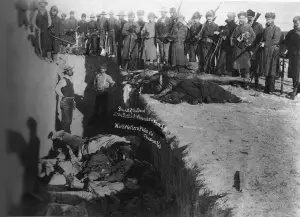
Mass grave at Wounded Knee in South Dakota in 1891.
Letters from an American, Historical Commentary: Sept. 26 2025 [Whitewashing a Massacre], Heather Cox Richardson, right, Sept. 27, 2025. Today Defense Secretary Pete Hegseth announced that twenty men who were awarded the Medal of Honor for their participation in the 1890 Wounded Knee Massacre would keep their medals, despite more than a century of controversy over them.
The defense secretary who preceded Hegseth, General Lloyd Austin, had ordered a review of the awarding of those medals to “ensure no awardees were recognized for conduct inconsistent with the nation’s highest military honor.” Hegseth today called the men “brave soldiers” and said: “We’re making it clear that [the soldiers] deserve those medals.”
It’s fitting that Hegseth, a political appointee whose tenure has been marked by incompetence, would defend the awarding of those particular Medals of Honor, because they were awarded to cover up the incompetence of political appointees that led to the deaths of at least 230 peaceful Lakotas, as well as about twenty-five soldiers who were caught in their own crossfire.
The road to Wounded Knee started in 1884, when voters angry that the Republicans had sold out to big business elected Democrat  Grover Cleveland, left, to the presidency. The first Democrat to occupy the White House since before the Civil War, he promised to lower the tariffs that squeezed ordinary Americans in order to protect big business. Horrified at the growing opposition to a government that worked for those industrialists who would soon be called “robber barons,” Republicans began to circulate pamphlets as soon as Cleveland was elected, claiming that lowering the tariff would destroy the economy and warning that voters must return Republicans to power or face economic ruin.
In 1888, Cleveland nonetheless won the popular vote by about 100,000 votes, but after an extraordinarily corrupt campaign, Republican candidate Benjamin Harrison won in the Electoral College. This is “A BUSINESS MAN’S ADMINISTRATION,” the editors of a pro-Harrison newspaper boasted. They predicted that “business men will be thoroughly well content with it.”
Knowing that the popular mood had turned against tariffs and the party that protected them, Harrison Republicans looked for ways to cement their control over the government.
Adding to the Union new states they believed would vote Republican would give them two more seats per state in the Senate, as well as a seat per state in the House of Representatives, and thus three more electors in the Electoral College, for each state has a number of electors equal to the number of senators and representatives combined. Between November 1889 and July 1890 the Republicans added five new states to the Union. They added Washington, Idaho, and Montana. They also divided the huge Dakota Territory in two, creating North Dakota and South Dakota. The new states should give the Republicans ten new seats in the Senate, Harrison’s men noted happily.
But the western half of what was supposed to become South Dakota belonged to the Lakotas. In 1889 the government forced the Lakotas to sign treaties agreeing to sell about half of their land and to move closer to six agencies on smaller reservations in what would soon be a new state. The government promised rations, health, care, education, and help with transitioning to a farming economy in exchange for the land, but that plan ran afoul of politics almost immediately.
The War Department and the Department of the Interior had fought over management of the Indigenous peoples in the U.S. for decades. Reservations were overseen by an “Indian agent,” who was in sole charge of spending the tens of thousands of dollars Congress appropriated to fund the various treaties the government had negotiated with different tribes. From that money, the agent was supposed to contract for food, clothing, tools, and supplies, as well as for the building of schools, mills, warehouses, and so on. Until 1883 this had been a plum political position, awarded to a political loyalist with the expectation that providing promised rations to Indigenous Americans was the least of his concerns: he was expected to spread that money to political allies to shore up their support.
The Army hated this system. If political appointees mismanaged their work, it was Army officers and their men who had the dangerous job of fighting angry warriors. Politicians noted that the Army all too often killed indiscriminately, and they refused to give up their power. But military men resented that political mistakes could cost soldiers their lives.
In 1883, after a disappointed office seeker assassinated President James A. Garfield, Congress had passed the Civil Service Act that was supposed to do away with awarding government jobs based on political patronage. Cleveland had taken that charge seriously and had installed agents instructed to fulfill their job description. Harrison’s men, though, knew they needed western votes to hold control of the newly admitted states, and they spun the system back to one based on patronage.
Their most unfortunate appointment was that of Daniel Royer to the Pine Ridge Reservation. Royer was a staunch Republican, but he was also a failed medical man with a budding drug addiction and little knowledge of Lakotas. After he arrived in October 1890, the Lakotas named him “Young-Man-Afraid-of-Indians.”
Since being corralled on the six smaller reservations the previous year, the Lakotas had endured a deadly influenza epidemic that swept the U.S. and much of Europe and killed a number of Lakotas who were already weak from respiratory viruses. Then, hot winds in summer 1890 had burned dry first the Lakotas’ vegetable gardens, then their crops, and finally, the native hay crop.
White settlers suffering in the same drought abandoned their new homesteads and went back east. Hungry and desolate, Lakotas had to stay. Then a new census count came in lower than expected, and government officials cut their rations. Destitute and in real danger of starvation, some Lakotas turned to a new religious movement, the Ghost Dance, that promised to bring back the world of game and plenty that had been theirs before the coming of easterners.
The Ghost Dancers never hurt their non-Indigenous neighbors or threatened their property, and few settlers paid them much attention. But Royer interpreted the religious enthusiasm as a sign of an approaching war. Less than a week after arriving at Pine Ridge, Royer warned his superiors in the Interior Department in Washington, D.C., that he might need troops to keep order.
General Nelson Miles of the U.S. Army, who commanded the Division of the Missouri that included Pine Ridge, went to the reservation, where the Lakotas explained their crushing circumstances and suggested that neither Royer nor his predecessor had been much help. Miles brushed off Royer’s panic and told the Lakotas they could dance as they wished. When Royer told the Lakotas the next day that they must stop participating in the Ghost Dance, they laughed at him.
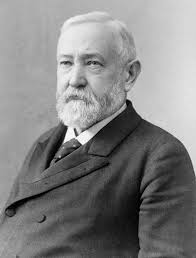 Back East, President Harrison, right, and his men were focused on the 1890 midterms. Despite popular demand for a lower tariff, in a raucous session in October, Republicans in Congress actually raised tariff rates, promising voters that the higher rates of the McKinley Tariff would finally make the country boom.
A month later, angry voters took away the Republicans’ slim majority in the House and handed the Democrats a majority of more than two to one. Republicans hung onto power only through their lock on the Senate. There, the admission of the new states made up for losses elsewhere, and the Republicans had four more senators than their opponents did.
But of those four, three had voted against the McKinley Tariff. So the survival of the tariff hung on just one vote: that of a senator from South Dakota. In the nineteenth century, senators were chosen by the state legislature, and it looked at first as if the Republicans had won South Dakota’s. But then news broke that ballot boxes had been tampered with. Suddenly, the legislature was in play for all parties. Whoever won would control South Dakota’s Senate seat and the fate of the McKinley Tariff.
The Ghost Dance had continued to spread across the South Dakota reservations, and Royer was growing increasingly frightened. Some of the other agents were also agitated, sending back to their superiors letters full of exaggerated rumors. But Miles and officers stationed at the forts in South Dakota, all of whom had first-hand experience with the Lakotas, denied that the Lakotas were planning a war. Instead, the officers blamed the Lakotas’ anger on the mismanagement of food and supplies by the political appointees at the Interior Department. As soon as the agents addressed the Lakotas’ very real suffering, they said, the Ghost Dance movement would fade.
But with control of the South Dakota legislature hanging in the balance, Harrison was leaning toward sending in troops. Settlers liked the military, which brought contracts and government money into the chronically poor West. On November 20, 1890, troops marched into Pine Ridge.
Alarmed, Ghost Dancers rushed to the Badlands, where they could defend themselves.
For the next month, Army officers worked to bring them back to Pine Ridge. Then, on December 15, just as it seemed they had convinced them to return, a police officer murdered the famous leader Sitting Bull at Standing Rock Reservation on the northern edge of the state, and his panicked kinfolk fled south to Pine Ridge to take shelter with the renowned negotiator Red Cloud. Army officers were afraid the band would take news of Sitting Bull’s death to the Lakotas in the Badlands, derailing the negotiations, and set out to intercept them.
 On December 28, on the southern side of the state, two members of the Lakota band overtook two Army scouts watering their horses and told the scouts they were on their way to Pine Ridge. The scouts informed their commander, who intercepted the Lakotas with guns and demanded an unconditional surrender. After the Lakotas agreed, the troops and the tired and hungry Lakotas set off for Pine Ridge. That night, they camped inside the reservation at Wounded Knee Creek.
During the night, a new commander, James Forsyth, took over. Dead set on a show of force, he insisted on disarming the Lakotas before they set off for the agency. Many of the young men refused to give up their guns, which were the only way they could feed their families through the winter. As soldiers tried to wrench a gun from a man’s hands, it went off into the sky. “Fire! Fire on them!” Forsyth screamed.
The soldiers did. The first volley brought down the men who were being disarmed, as well as about twenty-five of the soldiers themselves, who had moved into a circle around the Lakota men and boys during the course of the morning. In the haze from the gun smoke, Lakota men grabbed weapons from nearby soldiers and dove for the dry creek bed that ran behind the camp, hoping to hike along it and escape. The women and children had been separated from the Indian men during the morning. When the firing began, women ran for the wagons and horses.
But they could not escape. Over the next two hours, frenzied soldiers hunted down and killed every Lakota they could find. Soldiers trained artillery on the fleeing wagons as troops on horseback combed the hills for fugitives. Some of the escaping women were ridden down three miles from the encampment. When the wagons stopped moving, the soldiers moved the guns to the creek bed and shot everyone who moved. Within a few hours, at least 230 Lakotas, mostly women and children, were dead.
The outcry against this butchery started in the Army itself. Miles was incensed that the simple surrender of a peaceful band of Lakotas had become what he called a “criminal military blunder and a horrible massacre of women and children.” He demanded an inquiry into Forsyth’s actions. Miles’s report was so damning his own secretary asked him to soften it.
But President Harrison’s administration was in terrible electoral trouble, and his men wanted no part of an attack on soldiers that would imply that Harrison’s agents had first created a war and then mismanaged it. They dismissed Miles’s report with their own, which blamed the Lakotas for the massacre and concluded that the soldiers had acted the part of heroes. In spring 1891, President Harrison awarded the first of twenty Medals of Honor that would go to soldiers for their actions at Wounded Knee.
In the end, though, all of the political maneuvering by Harrison’s men came to naught. After weeks of squabbling, the South Dakota legislature rejected the Republican candidate and named an Independent senator who caucused with the Democrats. And in 1892, Harrison lost the presidency to Grover Cleveland, who promised lower tariffs and a return to civil service reform.
Global News
 Politico, State Department revokes Colombian president’s visa, Gregory Svirnovskiy, Sept. 27, 2025. Gustavo Petro responded by writing the U.S. government “no longer honors international law.”
The State Department revoked Colombian President Gustavo Petro’s visa, the agency announced on social media Friday night, accusing the South American leader of urging “soldiers to disobey orders and incite violence” in a New York rally.
“We will revoke Petro’s visa due to his reckless and incendiary actions,” the department wrote in a post on X.
Petro had called on American and Israeli troops not to sanction a genocide in Gaza, and called for a fighting force larger than that of the U.S. and Israel combined to come to the enclave’s aid, in front of a cheering New York City crowd on Friday.
 “I believe with the recent veto the U.S. exercised at the Security Council, diplomacy ended,” he said in a video posted to his Youtube account Friday. “Human history has shown us across millennia that when diplomacy ends, we must pass to a different stage of struggle. What is happening in Gaza is a genocide. There’s no need to call it anything else. Its objective is to eliminate the Palestinian people.”
The Colombian president confirmed his visa had been taken away in a post on X Saturday, in which he accused the U.S. government of “no longer honor[ing] international law.”
“What the U.S. government is doing to me breaks all the rules around immunity which have undergirded the United Nations and the General Assembly,” he said. “Presidents have total immunity to attend the Assembly and the U.S. cannot condition that on their opinions of the United States.”
The announcement from the State Department came just days after Petro slammed the White House and called for an end to Israel’s incursion into Gaza, in a separate address Tuesday before the United Nations General Assembly.
“Washington and NATO are killing democracy. And they are spreading totalitarianism at the global level,” he charged, before arguing that the “United States no longer teaches Democracy but rather kill, kill democracy, especially among its immigrants, filled with greed.”
When asked if its block will bar Petro from attending United Nations gatherings in the future, the State Department pointed back to its tweet from Friday night.
It’s not the first clash between Trump and Petro. Less than one week into his second term in January, Trump threatened major consequences for Colombia after Petro turned away two flights loaded with Colombian deportees, announcing a 25 percent tariff on all imports, visa restrictions and a travel ban.
New York Times, News Analysis: Netanyahu’s Defiant U.N. Speech Aimed at Home as Well as the World, David M. Halbfinger, Sept. 27, 2025. The Israeli prime minister, right, faced walkouts and protests at the United Nations, but signaled that resisting Palestinian statehood could become the core of his appeal to Israeli voters.
For years, Benjamin Netanyahu’s opponents warned that Israel would eventually face a “diplomatic tsunami” for failing to resolve its conflict with the Palestinians. That threat couldn’t have been more real or more imposing as the Israeli prime minister took the podium on Friday at the United Nations in New York.
Over the past week, countries including Australia, Britain, Canada and France, expressing outrage over Israel’s conduct of the Gaza war, had all said they recognized a Palestinian state. It was a landmark step that Israel never wanted to see them take and that the Trump administration had tried but failed to forestall.
And a week before that was the fifth anniversary of the Abraham Accords, a series of diplomatic normalization agreements between Israel and several Arab states. But instead of coming together to celebrate that milestone, Israel’s Arab partners, together with leaders from other regional nations, including Iran, gathered to denounce Israel for its botched attempt to kill senior Hamas negotiators meeting in Doha, Qatar.
International pressure over the Gaza war, which was ignited by the Hamas-led attack on southern Israel on Oct. 7, 2023, can already be felt across Israeli life. European nations have imposed or threatened new tariffs, while arms embargoes are complicating Israel’s ability to replenish its arsenal. Its tourists are greeted by protests and harassment overseas, and its soccer teams face a possible suspension from international play.
Yet the Israeli leader knows that he has President Trump in his corner. And it was not a chastened Mr. Netanyahu but a defiant one who addressed the General Assembly, or at least the few delegates who stayed to hear him out after scores of others walked out in protest.
More On U.S. Governance, Politics
Politico, Supreme Court clears way for Trump to withhold $4B in foreign aid approved by Congress, Josh Gerstein and Kyle Cheney, Sept. 26, 2025. The ruling could further muddle negotiations over the impending government shutdown.
The Supreme Court has given President Donald Trump the go-ahead to unilaterally withhold $4 billion in foreign aid previously appropriated by Congress, a crucial milestone in an intense legal battle over the constitutional power of the purse.
The high court’s ruling Friday, issued over the dissent of the three liberal justices, signals Trump has the upper hand in that battle. The decision effectively blessed Trump’s “pocket rescission” — a controversial maneuver in which the president withheld the funds toward the end of the fiscal year so that the money could not be spent even if Congress did not approve the rescission.
That tactic was designed to circumvent the usual process for a rescission of funds: a special request from the president followed by a 45-day period in which Congress must agree to the request for it to become effective.
The ruling comes as the federal government hurtles toward a Sept. 30 deadline to avert a government shutdown, and it could make bipartisan negotiations an even taller order. Democrats wary of cutting deals with GOP leaders must now face the more concrete prospect that Trump could again refuse to spend funds appropriated by Congress.
The ruling — issued in a short, unsigned order on the court’s emergency docket — is not a final decision on the broader question of the president’s power to unilaterally “impound” congressionally appropriated funding.
Rather, the majority wrote that, based on its “preliminary view” of the matter, the Trump administration had made a strong enough argument that the foreign-aid groups who sued to restore the funds did not have a legal right to bring a lawsuit under the relevant federal statutes.
The majority also suggested that Trump’s arguments in support of the budgetary move were bolstered because the funds were related to foreign policy, an area where presidents are understood to have wide latitude.
Litigation over Trump’s cancellation of foreign-aid money may continue in lower courts, and the impoundment question may return to the Supreme Court in the coming months.
Prior presidents have claimed the power to unilaterally impound congressionally appropriated funds, but they’ve rarely deployed it and its legality has never been resolved by the Supreme Court. During his 2024 campaign for the White House, Trump vowed to make aggressive use of the claimed authority and to challenge Congress’ efforts to limit it.
Trump’s ability to hold back congressionally approved funding has emerged as a key issue in the pending shutdown fight. Among the concessions Democrats are seeking from Republicans is a firm guarantee that the administration will in fact spend what Congress agrees to appropriate.
In the litigation over Trump’s unilateral cuts to foreign aid, a federal district judge has issued several rulings in favor of the aid groups and contractors challenging the cuts. The judge, Biden appointee Amir Ali, ordered the administration to prepare to spend the $4 billion at issue — an order that prompted the administration’s emergency appeal to the Supreme Court.
Solicitor General D. John Sauer, representing the administration, warned the court that requiring spending of the funds would force executive branch officials into negotiations with foreign governments about doing so.
Justice Elena Kagan, writing for the dissenters, suggested that the administration’s stance shortchanged the role the Constitution gives to Congress over spending.
Trump claimed victory just hours later, when Petro relented on the return of the migrants, and the White House pulled back on its sanctions threat.
Legal AF, Trump Comey INDICTMENT HEADED for DISMISSAL Already?!?! Michael Popok, Sept. 26, 2025. Popok digs deep into the late night indictment of Former FBI Director James Comey and, bringing the receipts and video clips, explains how weak it really is for perjury and obstruction and why Comey has a very good shot at convincing Judge Nachmanoff (a Biden appointee) to dismiss it early.
New York Times, The Testimony at the Heart of the Comey Indictment, Examined, Charlie Savage, Updated Sept. 27, 2025. The charges against the former F.B.I. director center on an appearance he made before a Senate committee in September 2020. Here’s a closer look.
At the center of the Trump administration’s indictment of James B. Comey, the former F.B.I. director, is testimony he delivered before Congress in September 2020. But the details of the accusation against him remain murky because the indictment is extremely sparse. It was filed by a novice prosecutor installed days ago by President Trump to lead the Eastern District of Virginia after her predecessor refused to bring the case.
Here is a closer look at the indictment that the prosecutor, Lindsey Halligan, a former personal lawyer to Mr. Trump, obtained from a grand jury, along with a proposed charge the jury rejected.What are the charges against Mr. Comey?
The indictment charges Mr. Comey with one count of making a false statement to Congress and one count of obstructing a congressional proceeding.
The false statement charge asserts that in appearing before the Senate Judiciary Committee on Sept. 30, 2020, Mr. Comey told a U.S. senator that he “had not ‘authorized someone else at the F.B.I. to be an anonymous source in news reports’ regarding an F.B.I. investigation concerning” an unnamed person. But in fact, the indictment says, Mr. Comey had authorized someone to do so.
Politico, Donald Trump’s US attorneys, unvetted by the Senate, move full steam ahead, Erica Orden and Hailey Fuchs, Sept. 26, 2025. Some have displayed far more obedience to Trump than full-time U.S. attorneys have ever shown to presidents they served under.
President Donald Trump has just two Senate-confirmed U.S. attorneys in place. That hasn’t stopped him from leaning on unvetted and newly minted prosecutors to harness the power of the Justice Department against his political enemies.
In the Eastern District of Virginia, Lindsey Halligan, a former Trump personal attorney who has never prosecuted a case, on Thursday secured the indictment of former FBI Director James Comey three days after Trump ousted an experienced prosecutor to install Halligan on a temporary basis.
In the Northern District of New York, John Sarcone, also a first-time prosecutor, is investigating New York Attorney General Letitia James, another Trump foe. Sarcone is serving in the U.S. attorney role indefinitely without Senate confirmation because Trump used a procedural maneuver to keep him there even after district judges, empowered to appoint temporary federal prosecutors, declined to name him to the post.
And in New Jersey, another former Trump personal attorney with no previous prosecutorial experience, Alina Habba, is prosecuting a Democratic member of Congress who was attempting to conduct an oversight visit at an immigration detention center. Habba, too, is serving as U.S. attorney indefinitely without Senate confirmation, although the legitimacy of her authority is being challenged.
Around the country, nearly all of Trump’s U.S. attorney nominees have been unable to receive confirmation by the Senate. Some of his nominees are so inexperienced or have a history of so much politicized conduct that they cannot win confirmation even in a Republican-controlled Senate. Other nominees might have enough votes to be confirmed, but Democrats have successfully blocked them.
Without Senate-vetted appointees, most of the country’s 93 U.S. attorney offices are being led by interim leaders — and some of them have displayed far more obedience to Trump, and his desire for retribution, than full-time U.S. attorneys have ever shown to presidents they served under. Historically, U.S. attorneys have tended to guard their offices’ authority to work relatively independently even from Justice Department headquarters and certainly from the White House.
That’s no longer the case in the first eight months of Trump’s second term, said Mimi Rocah, a former federal prosecutor and former Westchester County district attorney. “It’s changing the whole culture of the office,” she said.
Sept. 26
New York Times, Trump Administration Updates: Comey Indicted After Pressure From President, Devlin Barrett, Glenn Thrush and Alan Feuer, Sept. 26, 2025 (print ed.).
A federal grand jury on Thursday indicted James B. Comey, shown in a file photo above, the former F.B.I. director, a culmination of President Trump’s relentless demand for retribution after the bureau investigated his 2016 presidential campaign over possible ties to Russia.
Mr. Comey was indicted on one count of making a false statement and one count of obstruction of a congressional proceeding in connection with his testimony before a Senate committee in September 2020.
The indictment, filed in Alexandria, Va., came over the objection of career prosecutors in the Eastern District of Virginia who found insufficient evidence to support charges but were overruled by Lindsey Halligan, a Trump loyalist handpicked by the president to run the office a few days ago.
It represents the most significant legal step yet by the Trump administration to harry, punish and humiliate a former official the president identified as an enemy, at the expense of procedural safeguards intended to shield the Justice Department from political interference and personal vendettas.
The bare-bones, two-page indictment was signed only by Ms. Halligan, left, a former defense lawyer for Mr. Trump who personally presented the case to the jury, despite her lack of any previous prosecutorial experience. Typically such filings are also endorsed by career prosecutors who have gathered the evidence in the case.
Court records indicate that Ms. Halligan also tried to get the grand jury to indict Mr. Comey on a second false statement charge, and that it was rejected.
For a charging document as consequential as indicting a former F.B.I. director, the filing is not particularly revealing. It asserts that Mr. Comey falsely claimed during the hearing before the Senate Judiciary Committee that he had not authorized someone else at the F.B.I. to be an anonymous source in news reports regarding an investigation into “Person 1,” which appears to be a reference to Hillary Clinton.
“That statement was false,” the indictment charges, because Mr. Comey “had in fact authorized PERSON 3 to serve as an anonymous source in news reports regarding an F.B.I. investigation concerning PERSON 1.”
The document does not identify either Person 1 or Person 3, but at the hearing, Senator Ted Cruz, Republican of Texas, pressed Mr. Comey on whether he had ever authorized his former deputy, Andrew McCabe, to discuss an investigation with a reporter. Mr. Comey stood by his answers at past hearings and denied doing so.
Career prosecutors who looked at the evidence against Mr. Comey thought the case was far too weak to justify an indictment, according to people familiar with the matter who spoke on the condition of anonymity. For one thing, the key exchange was brief. For another, it referred to testimony from three years earlier, and Mr. Comey said he stood by those answers without elaborating.
The vague description of authorizing someone at the F.B.I. to share information with a journalist could also apply to a different episode from that period. Republicans have criticized Mr. Comey over designating a college professor he trusted, Daniel Richman, as a special government employee who then spoke to a reporter for The New York Times.
The wording of the indictment leaves unclear which of those two situations is at issue, though in recent days investigators had re-interviewed Mr. Richman, according to people familiar with the matter.
Mr. Comey faces up to five years in prison if convicted, although many current and former prosecutors believe the case will be difficult to prove.
Shortly after the indictment was made public, Troy A. Edwards, Jr., Mr. Comey’s son-in-law, resigned his post as a prosecutor in the office that brought charges against the former F.B.I. director.
Mr. Edwards, who helped prosecute Jan. 6 rioters, including members of the far-right Oath Keepers, said in an email to his supervisor that he left to “uphold his duty to the Constitution and country.”
In a video statement, Mr. Comey declared his innocence and welcomed an opportunity to vindicate himself in a trial. “We will not live on our knees, and you shouldn’t either.”
Referring to his daughter, Maurene, who was dismissed this summer from her own post at the Justice Department, he added, “Somebody that I love dearly recently said that fear is the tool of a tyrant, and she’s right, but I’m not afraid, and I hope you’re not either.”
Mr. Trump praised the move, posting on Truth Social shortly after the indictment was announced. “JUSTICE IN AMERICA!” he wrote.
 Senator Mark Warner, right, Democrat of Virginia, in a statement, warned that the indictment underscored how the president intended to deploy the justice system. “This kind of interference is a dangerous abuse of power,” he said. “Our system depends on prosecutors making decisions based on evidence and the law, not on the personal grudges of a politician determined to settle scores.”
Mr. Trump, who claims his actions are motivated by the weaponization of government against him, has intensified his public pressure campaign on the Justice Department in recent days. He has publicly called upon Pam Bondi, the attorney general, to use her power to go after adversaries he has described as “scum,” including Mr. Comey and Letitia James, the New York attorney general who sued Mr. Trump for inflating the value of his assets.
 Ms. Bondi, left, and her top deputy have quietly raised concerned that the case against Mr. Comey was too weak to result in convictions, according to current and former officials. But she appeared to embrace the move on social media post, without mentioning Mr. Comey by name, writing: “No one is above the law.”
The F.B.I. director, Kash Patel, suggested on social media that the indictment would not be the administration’s last against what he referred to as “previous corrupt leadership and their enablers.” He added: “Everyone, especially those in positions of power, will be held to account - no matter their perch.”
Many current and former Justice Department officials said they viewed the filing of criminal charges against Mr. Comey as deeply troubling. The consequences could be far-reaching, they argued, including the resignations of more prosecutors over how the Trump administration has sought to use the agency, and the erosion of public trust in U.S. attorneys.

Former FBI Director James Comey is sworn in remotely from his home during a Senate Judiciary Committee hearing exploring the FBI's investigation of the 2016 Trump campaign and Russian election interference in Washington, U.S on , Sept. 30, 2020 (Photo via U.S. Senate Judiciary Committee).
Politico, 'Let's have a trial': Comey proclaims innocence as Trump revels in grand jury indictment he demanded, Kyle Cheney and Josh Gerstein, Sept. 26, 2025 (print ed.). A grand jury indicted the former FBI director on two felony charges stemming from congressional testimony he gave in September 2020.James Comey is sworn via videoconference.
Federal prosecutors in Virginia have charged former FBI Director James Comey with obstruction and making a false statement to Congress, just days after President Donald Trump publicly implored his Justice Department to quickly seek indictments of his perceived foes and ousted a U.S. attorney who resisted.
A grand jury in Alexandria, Virginia, indicted Comey on Thursday on two felony charges stemming from Comey’s testimony to the Senate Judiciary Committee in September 2020 about the FBI’s investigation into links between Trump’s 2016 presidential campaign and Russia.
The obstruction of Congress charge accuses Comey of making “false statements” at that hearing, but is silent about what they were.
The false statement charge relates to Comey’s denial at the hearing that he authorized anyone at the FBI to speak to the media anonymously about FBI investigations related to Trump or his 2016 rival, Hillary Clinton. Former Deputy FBI Director Andrew McCabe, left, told  investigators with DOJ’s inspector general that Comey authorized him to talk to a reporter about an aspect of an investigation the FBI conducted into the Clinton Foundation.
In a video posted online Thursday night, the former FBI chief and onetime deputy attorney general proclaimed his innocence — and hinted at a strategy for challenging the case against him as an act of political vengeance by Trump himself.
“My family and I have known for years that there are costs to standing up to Donald Trump, but we couldn’t imagine ourselves living any other way. We will not live on our knees, and you shouldn’t either,” Comey said. “My heart is broken for the Department of Justice, but I have great confidence in the federal judicial system, and I’m innocent, so, let’s have a trial.”
Comey appeared to allude to the July firing of his daughter, Maurene Comey, who had been a federal prosecutor in Manhattan for nearly a decade. The indictment also prompted the resignation Thursday of Troy Edwards, a senior federal prosecutor in Alexandria who is married to another of James Comey’s daughters, three people familiar with the development said.
Edwards, deputy chief of the office’s national security section, said in a one-line resignation letter that he was quitting “to uphold my oath to the Constitution and country.”
Trump quickly reveled in the indictment of his longtime foe, declaring “Justice in America!” and calling Comey “One of the worst human beings this Country has ever been exposed to.” He closed the post with his campaign slogan: “Make America Great Again.”
Prosecutors sought the indictment of the former FBI director just before a Sept. 30 legal deadline that would have put criminal charges out of reach because the statute of limitations would have expired.
Notably, a court document released Thursday night showed the same grand jury refused to indict Comey on a second charge of making a false statement to Congress. The charge jurors balked at pertained to a statement Comey made during the hearing where he appeared to deny having read a report sent to top FBI officials in September 2016 about the Clinton campaign’s interest in using Trump’s alleged Russia ties to distract from her own legal woes.
Justice Department officials did not address the failed charge, but declared that the two felonies leveled at Comey showed justice being done. Each of the two felony charges Comey faces carries a maximum possible penalty of five years in prison.
“No one is above the law,” Attorney General Pam Bondi wrote on X shortly after word of the charges against Comey emerged. “Today’s indictment reflects this Department of Justice’s commitment to holding those who abuse positions of power accountable for misleading the American people. We will follow the facts in this case.”
Letters from an American, Historical Commentary: Sept. 25, 2025 [Trump's Push for Complete Control of Government], Heather Cox Richardson, right, Sept. 26, 2025. Today, with the popularity of President Donald J. Trump and his administration dropping, Trump’s disastrous performance at the United Nations, the return of comedian Jimmy Kimmel to the airwaves, and the Tuesday’s election in Arizona of Democratic representative Adelita Grijalva, who will provide the final signature on a discharge petition to demand a floor vote in the House over releasing all the government files on convicted child sex offender Jeffrey Epstein, the administration appears to be making a dramatic push to seize complete control of the government.
Last night, Office of Management and Budget director Russell Vought tried to jam the Democrats into passing the Republicans’ continuing resolution to fund the government. Officials leaked a memo to Politico, Punchbowl News, and Axios—publications that focus on events concerning Capitol Hill—saying that if the Democrats refuse to pass the Republicans’ measure, the administration will try to fire, rather than furlough, large numbers of federal employees.
Such a move would be challenged in the courts, and the government has been forced to rehire many of the people it forced out earlier this year after those firings left agencies badly understaffed. But the threat is not idle; Vought is a Christian nationalist who has called for a “radical Constitutionalism” that demolishes the modern American state and replaces it with a powerful executive.
 House minority leader Hakeem Jeffries (D-NY), right, responded: “Listen Russ, you are a malignant political hack. We will not be intimidated by your threat to engage in mass firings. Get lost.”
Senate minority leader Chuck Schumer (D-NY) said in a statement: “Donald Trump has been firing federal workers since day one—not to govern, but to scare. This is nothing new and has nothing to do with funding the government. These unnecessary firings will either be overturned in court or the administration will end up hiring the workers back, just like they did as recently as today.”
Trump appears focused on September 30, when the government funding crisis will hit, and the days after it. Although courts have ruled that he does not have the power to impose tariffs willy-nilly, today Trump announced new tariffs of 100% on pharmaceuticals, 50% on kitchen and bathroom cabinets, 30% on upholstered furniture, and 25% on “Heavy (Big!) Trucks” beginning on October 1. On social media, he claimed such tariffs were necessary “for National Security and other reasons.”
Today, James LaPorta of CBS News reported that the National Archives and Records Administration improperly released Democratic representative Mikie Sherrill’s full military records to an ally of her Republican opponent, Jack Ciattarelli, in the New Jersey governor’s  race. The two candidates are tied, and Ciattarelli appears to be trying to link Sherrill to the 1994 Naval Academy cheating scandal involving more than 100 midshipmen.
Sherrill had an unblemished career in the Navy and as a midshipman, LaPorta notes. She did not turn in her cheating classmates, but she was never accused of cheating herself. The unredacted release of Sherrill’s records appears to violate the 1974 Privacy Act. Sherrill said: “That Jack Ciattarelli and the Trump administration are illegally weaponizing my records for political gain is a violation of anyone who has ever served our country. No veteran’s record is safe.”
While the National Archives maintained the release was a mistake and apologized for it, the administration’s influence in the Department of Justice tonight could not be explained away.
Days after Trump demanded that the Department of Justice move “now” to prosecute those he perceives to be his enemies, a federal grand jury has indicted former FBI director James Comey for allegedly lying to Congress and obstructing an investigation. Comey was an early casualty of Trump’s first administration, fired after he refused to kill the FBI investigation of the ties between Trump’s 2016 campaign and Russian operatives.
Over last weekend, Trump exploded at then–acting U.S. attorney for the Eastern District of Virginia Erik Siebert, a career prosecutor, after Siebert concluded there was not enough evidence of a crime to charge Comey for allegedly lying to Congress or New York attorney general Letitia James for alleged mortgage fraud.
On Monday Trump replaced Siebert with White House aide and Trump’s former personal lawyer Lindsey Halligan, right, and yesterday three sources told Ken Dilanian and Carol Leonnig of MSNBC that they expected Halligan to try to get a grand jury to indict Comey before the five-year statute of limitations on lying to Congress runs out next Tuesday.
Tonight the DOJ delivered an indictment against Comey.
“My family and I have known for years that there are costs to standing up to Donald Trump,” Comey said tonight in a video. “But we…will not live on our knees, and you shouldn’t either. Somebody that I love dearly recently said that fear is the tool of a tyrant, and she’s right, but I’m not afraid, and I hope you’re not either. I hope instead you are engaged, you are paying attention, and you will vote like your beloved country depends upon it, which it does. My heart is broken for the Department of Justice, but I have great confidence in the federal judicial system. I’m innocent. So let’s have a trial and keep the faith.”
The DOJ was busy today. It also sued six states—California, Michigan, Minnesota, New York, New Hampshire, and Pennsylvania—to force them to hand over their voter rolls and information identifying those voters. Matt Cohen of Democracy Docket notes that state officials from both Democratic and Republican governments have questioned why the government wants that information. This lawsuit comes after a nearly identical lawsuit the DOJ filed last week against Maine and Oregon.
Democratic secretary of state Tobias Read of Oregon called the lawsuits an attempt by President Donald Trump “to use the DOJ to go after his political opponents and undermine our elections.”
Tara Copp, Dan Lamothe, Alex Horton, Ellen Nakashima, and Noah Robertson of the Washington Post reported today that Defense Secretary Pete Hegseth has ordered about 800 of the military’s top generals and admirals, along with their senior enlisted advisors, to come to the Marine Corps base in Quantico, Virginia, next week. Such a demand is highly unusual, and no one knows why Hegseth has made it.
In The Bulwark, Mark Hertling, who was commander of U.S. Army Europe from 2011 to 2012, noted that the demand “is baffling and the cost will be staggering.” Instead of using the Pentagon’s secure video teleconferencing system, the personnel will require flights and accommodations that will cost millions, while the lost focus and readiness will affect their mission.
Hertling points out that “[a]dversaries and allies are watching. This sudden, global, emergency recall of America’s top brass is a flashing red light to them: Something must be wrong inside the Pentagon.”
Both Trump and Vice President J.D. Vance tried to downplay the meeting. “Why is that such a big deal?” Trump asked reporters. Vance incorrectly said the meeting is “not particularly unusual,” and said: “I think it’s odd that you guys have made it into such a big story.”
This evening, Trump signed a memorandum targeting activists and nonprofits as part of what he called a “terror network” that he claims is fueling violence, especially against Immigration and Customs Enforcement (ICE) agents. He and his allies claim that “radical left Democrats,” or “Radical Left Terrorists,” are behind that violence, although, as scholar of authoritarianism Timothy Snyder notes, the majority of political violence in the U.S. comes from the right.
“Titled “Countering Domestic Terrorism and Organized Political Violence,” the memo alleges that “common threads animating this violent conduct include anti-Americanism, anti-capitalism, and anti-Christianity; support for the overthrow of the United States Government; extremism on migration, race, and gender; and hostility towards those who hold traditional American views on family, religion, and morality.”
The document gives law enforcement wide latitude to “investigate, prosecute, and disrupt entities and individuals” engaged in behavior the administration opposes, as well as nonprofit organizations that fund them. It also orders law enforcement to “question and interrogate” people “regarding the entity or individual organizing such actions and any related financial sponsorship of those actions prior to adjudication or initiation of a plea agreement.”
Former federal prosecutor Daniel Richman, who teaches at Columbia Law School, told Robert Tait and Aram Roston of The Guardian that  an executive order cannot create new crimes, and Timothy Snyder noted that the memo nonetheless “undoes the basic tradition of American liberty and law, which is…that we are individuals to be judged on the basis of what we do as such. This memo, quite to the contrary, begins from the premise that the world is governed by mysterious, invisible entities to which individuals can be arbitrarily associated by the power of the government, thereby making those individuals guilty and subject to prosecution and punishment.” It makes responsibility collective, thus enabling the government to target everybody. “The groups that will…be targeted will be groups that are concerned with things like counting the votes, human rights, freedom of speech, and the rule of law.”
All this, said Snyder, is both a “big lie” and a cliché. Authoritarians always say the country is facing an emergency and that their opponents are “terrorists.” It’s a cliché to say “there’s a mysterious, bottomless, organization that we have to chase to the ends of the Earth and break all the rules to find. That’s what they always say.”
Snyder noted that Congress can pass laws to rule such behavior illegal, courts can find actions illegal and protect victims, commentators can describe reality, and citizens can say they “don’t want to be subject to an imagined emergency based on a big lie that does away with the essence of American liberty and law.” He concluded: “This has been done before. It can be stopped.”
New York Times, News Analysis, Trump Gets the Retribution He Sought, and Shatters Norms in the Process, Alan Feuer, Jonah E. Bromwich and Maggie Haberman, Sept. 26, 2025 (print ed.). A prosecutor’s drive to indict James Comey trampled over the Justice Department’s long tradition of keeping a distance from politics and the White House, and raised the prospect of more arbitrary charges.
The clearest way to understand the extraordinary nature of the indictment on Thursday of James B. Comey, left, the former F.B.I. director, is to  offer up a simple recitation of the facts.
An inexperienced prosecutor loyal to President Trump, in the job for less than a week, filed criminal charges against one of her boss’s most-reviled opponents. She did so not only at Mr. Trump’s direct command, but also against the urging of both her own subordinates and her predecessor, who had just been fired for raising concerns that there was insufficient evidence to indict.
The charges, which were filed around 7 p.m. in Federal District Court in Alexandria, Va., thrust the Justice Department into perilous new territory. The push for the indictment trampled over the agency’s long tradition of maintaining distance from the White House and resisting political pressure, and it raised the prospect of further arbitrary prosecutions pushed by Mr. Trump against his enemies.
Heightening the break-glass moment, the felony charges against Mr. Comey, who stands accused of making false statements and obstructing justice, were rushed into court as Mr. Trump’s handpicked prosecutor, Lindsey Halligan, hurried to beat the quickly approaching statute of limitations on Mr. Comey’s purported crimes.
The rush to prosecute Mr. Comey was the clearest example yet of how the normal process of justice has been reversed under Mr. Trump, showing how the president came into his second term with targets already in mind and ultimately pressured the Justice Department, over a degree of internal resistance, into finding a way to charge a former director of the F.B.I.
Ms. Halligan, who had been working as a top official in the White House staff secretary’s office and had previously served as a personal lawyer for Mr. Trump, had until now never prosecuted a single case in her career.
Mr. Trump nevertheless appointed her as interim U.S. attorney in the Eastern District of Virginia on Monday afternoon, after publicly berating Attorney General Pam Bondi, left, on Saturday night for not moving more aggressively to prosecute Mr. Comey and two other figures who are longtime targets of his retribution campaign, Letitia James, New York’s attorney general, and Senator Adam B. Schiff, Democrat of California.
Although Ms. Halligan had not been fully briefed on the Comey case before arriving and despite an energetic effort by the career professionals under her to dissuade her from bringing charges, she did exactly that. In a highly unusual move for a top federal prosecutor, she personally presented the case against Mr. Comey to the grand jury, according to two people familiar with the matter.
Tariffs and Trade
New York Times, Trump Will Slap Tariffs on Imported Drugs, Trucks and Household Furnishings, Ana Swanson and Peter Eavis, Sept. 26, 2025 (print ed.). The president said his tariffs would range from 25 to 100 percent and would go into effect next week.
President Trump on Thursday announced a slew of punishing tariffs on pharmaceuticals, heavy trucks, kitchen cabinets, bathroom vanities and upholstered furniture, saying import taxes on those products would go into effect on Oct. 1.
The tariffs range from 25 percent to 100 percent, with the highest levies applying to “any branded or patented” pharmaceutical product coming into the United States. That decision poses considerable political risk, given that Americans could face higher prices for drugs, as countries pull back from exporting them into the United States.
Mr. Trump said exceptions would be made for pharmaceutical companies that are building manufacturing facilities in the United States and have already broken ground.
This year, as Mr. Trump has repeatedly threatened to impose tariffs on imported medicines, most of the largest brand-name drugmakers have announced plans to spend billions of dollars building or expanding U.S. factories. It is unclear how quickly those projects can proceed.
Mr. Trump, who turned to social media to announce the new tariffs, said the moves would protect American producers from “unfair outside competition.” He said his actions were justified by “large scale ‘FLOODING’” of the products into the United States by other countries.
“It is a very unfair practice, but we must protect, for National Security and other reasons, our Manufacturing process,” Mr. Trump wrote.
Higher costs from the new tariffs will be felt across sectors of the economy, from housing and health care to logistics. The president also said the United States would begin imposing a 50 percent tariff on imported kitchen cabinets, bathroom vanities and associated products, along with a 30 percent tariff on imported furniture and a 25 percent tariff on foreign trucks.
The tariffs will be issued under a national security related law, known as Section 232, that Mr. Trump has used to issue tariffs on steel, aluminum, cars and copper. On Wednesday, the Trump administration announced that it was beginning new investigations under the law into imports of robotics, industrial machinery and medical devices, which could result in tariffs.
New York Times, New Tariffs Shock Countries Reeling From Trump’s Chaotic Trade War, Daisuke Wakabayashi, Zunaira Saieed, Choe Sang-Hun and Alexandra Stevenson, Sept. 26, 2025. Throughout Asia, the source of about 40 percent of U.S. imports, countries have little to show for weeks of talks trying to finalize deals.
President Trump’s latest tariffs sent shock waves throughout Asia, heaping additional turmoil on companies already grappling with uncertainty, while adding further complexity for trade officials ironing out the details of recently struck trade agreements.
As the source of about 40 percent of goods imported into the United States, Asia has borne the brunt of Mr. Trump’s campaign to rewrite the rules of global trade. Trade officials across the region have scrambled to strike deals with his administration over the last several months to prevent punishing tariffs from crippling domestic industries.
On Thursday, Mr. Trump announced another round of tariffs, which would go into effect on Oct. 1, applying import duties ranging from 25 percent to 100 percent on pharmaceuticals, heavy trucks, kitchen cabinets, bathroom vanities and upholstered furniture. A significant portion of furniture and kitchen cabinet manufacturing originates from China and Southeast Asia.
In a sign of the frenetic nature of U.S. policy, Mr. Trump’s own trade representative, who was in Malaysia on Thursday negotiating with officials from Asian countries, signaled that the administration was not planning more tariffs.
“What we are focused on now are the negotiations, not putting out rounds of tariffs,” Jamieson Greer, the U.S. trade representative, told reporters at a meeting of the Association of Southeast Asian Nations in Kuala Lumpur.
Twelve hours later, Mr. Trump announced the sweeping new tariffs on his social media feed.
The new import duties build on the growing list of Mr. Trump’s industry-specific tariffs with an outsize impact in Asia, affecting the import of automobiles as well as key materials such as copper, steel and aluminum. Mr. Trump announced the new duties despite many unresolved issues related to his so-called reciprocal tariffs, which were announced in April and are still being negotiated with countries in Asia. He reached an agreement in July with the European Union, another major American trading partner.
More On U.S. Governance, Politics

New York Times, Gabbard Ends Intelligence Report on Future Threats to U.S., Julian E. Barnes and Helene Cooper, Sept. 26, 2025. Some issues in the document, which is issued every four years, had become politically inconvenient, former officials said.
Every four years U.S. intelligence officials have published Global Trends, a public document that predicts what challenges the United States — and the world — will face in the coming decades.
With the intelligence community often focused on immediate issues, the Global Trends report has taken a longer-term look. Past editions warned of threats and shifts that came to pass, including climate change challenges, new immigration patterns and the risk of a pandemic.
But the Office of the Director of National Intelligence, led by Tulsi Gabbard, above, is eliminating the group that compiles the report.
Some of the warnings, most notably on climate change, had become politically inconvenient, according to former officials.
Ms. Gabbard’s office, in announcing the decision, said the National Intelligence Council’s Strategic Futures Group had “neglected to fulfill the purpose it was created for” and had pursued a partisan political agenda.
“A draft of the 2025 Global Trends report was carefully reviewed by D.N.I. Gabbard’s team and found to violate professional analytic tradecraft standards in an effort to propagate a political agenda that ran counter to all of the current president’s national security priorities,” the office said.
The elimination of the office last month was little noticed because it came amid a flurry of activity by Ms. Gabbard, including the closure of the National Intelligence University and sharp cutbacks of officers working on foreign malign influence and election threats.
Defending the move, Ms. Gabbard’s office highlighted what it said were problems of tradecraft, or the methodology used to gather information and analyze intelligence for the report.
Until recently, the Global Trends report was viewed as an objective look into the future by intelligence experts during both Democratic and Republican administrations. But like so much in the Trump administration, what was once considered apolitical is now labeled political.
Ms Gabbard eliminated this year’s report and the team that crafted it with a stroke of her pen. If a future administration wants to revive either, it will not be as easy. While traditionally released in the first months of a new administration, the reports represent months of work by intelligence officers working under the previous White House.
Speaking on Wednesday at The New York Times’s Climate Forward conference, Jake Sullivan, the Biden administration’s national security adviser, rejected the argument that intelligence officers were raising concerns to pursue any sort of political agenda.
Mr. Sullivan noted that turning away from thorny global issues like climate change would not stop them from posing a threat to the United States, and the world.
Politics Done Right, Opinion: GOP Shutdown Targets Obamacare as Trump’s Tariffs Hurt Farmers and TikTok Corruption Grows, Egberto Wilies, Sept. 26, 2025. Plus, Trump’s shady TikTok deal sparks fears of corruption and US propaganda.Sep 26 READ IN APP Topics covered  on the show today.
Today, we tackle the devastating effects of Trump’s tariffs on farmers, the GOP’s dangerous push for a government shutdown aimed at gutting Obamacare, and the troubling TikTok deal that enriches Trump’s allies while risking US propaganda.
These are not isolated issues—they are part of a broader pattern of power consolidation and corporate exploitation. It’s time to shine a light on the corruption and fight for a government that serves the people, not the powerful.Talking Points
New York Times, Trump Clears Way for American-Owned TikTok Valued at $14 Billion, Lauren Hirsch, Tripp Mickle and Emmett Lindner, Sept. 26, 2025 (print ed.). The administration has been working for months to find non-Chinese investors for a U.S. version of the app.
President Trump signed an executive order on Thursday that would help clear the way for a coalition of investors to run an American version of TikTok, one that is separate from its Chinese owner, ByteDance, so that it can keep operating in the United States.
 The administration has been working for months to find non-Chinese investors for a U.S. TikTok company, which Vice President JD Vance said would be valued at $14 billion.
The deal is aimed at helping TikTok comply with a federal law, which banned the app in the United States in January out of concern that Beijing could use it to gain access to Americans’ sensitive data or to spread propaganda. Mr. Trump has delayed enforcement of the ban repeatedly. The Thursday order gives negotiators until mid-January to finalize the deal.
The White House hasn’t said exactly who would own the U.S. version of TikTok, but the list of potential investors includes several powerful allies of Mr. Trump. The software giant Oracle, whose co-founder is the billionaire Larry Ellison, will take a stake in U.S. TikTok. Mr. Trump has also said that the media mogul Rupert Murdoch is involved. A person familiar with the talks said the Murdoch investments would come through Fox Corporation.
And now, the Emirati investment firm MGX is expected to join the coalition, according to two people familiar with the talks — a surprise, since Mr. Trump said the new investors were “American investors, American companies, great ones, great investors.”
If it comes to fruition, a deal would lift a cloud of uncertainty that has dogged TikTok for years. Policymakers in Washington have long been concerned about the app’s ties to China, even as its American user base has skyrocketed to more than 170 million people. The lengthy tussle over the app’s future has concerned users and frustrated lawmakers.
The $14 billion valuation for TikTok is far lower than ByteDance’s valuation of $300 billion, according to the start-up tracker CB Insights.
The MGX investment is also the latest example of the Emiratis using their deep pockets to help Mr. Trump. In recent months, representatives of the Gulf State have pledged to invest $1.4 trillion in the U.S. economy over the next decade, and MGX has said it has deposited $2 billion in a cryptocurrency start-up founded by the Trump family.
The TikTok talks and the MGX crypto investment played out as the Emiratis were pursuing a sale of valuable artificial intelligence chips. The Emiratis’ ability to buy the chips had been limited by the Biden administration over concerns about the Gulf State’s ties to China. But the Emiratis had been pressing the Trump administration to change U.S. policy so they could build data centers and become an A.I. powerhouse.
During Mr. Trump’s trip to Abu Dhabi in May, the administration agreed to sell the Emiratis 500,000 A.I. chips for a data center campus that would be among the largest in the world.
MGX has been discussing the TikTok investment for months, according to two people familiar with the talks. It was one of several companies in the TikTok deal that stood to benefit from the Emiratis’ data center project. Oracle will be building a data center that will cost about $20 billion in the Emirates. Silver Lake, an investment company, has a stake in one of the partners in that project, G42, an Emirati A.I. company.
More On Comey, U.S. Law, Crime, Courts
The Real Michael Cohen, Comey Is Today's Ham Sandwich, Michael Cohen, right, Sept. 26, 2025. Comey thought he was untouchable, a boy scout above politics. Now he’s the ham sandwich, served cold by Trump’s relentless appetite, in a courtroom where loyalty rules and mercy dies. James Comey thinks he’s in control. He’s not.
If my own experience has taught me anything, it’s this: the old adage is true; you can indict a ham sandwich. And today, James Comey is the ham sandwich. He may not like the comparison, but the facts don’t lie.
Many will say it’s not right, not fair, not justified. They’ll paint him as a martyr, the straight-shooter, the boy scout. Spare me. Comey has built his entire brand on being the solemn guardian of American integrity, the tall moral compass of righteousness. And now he wants us to believe he isn’t afraid, that he welcomes trial. Please. Those are the last words of a man who doesn’t yet realize the quicksand he’s already sinking in.
I know the script because I lived it. In the early days, you tell yourself this is all a mistake. Your lawyers; especially the expensive ones, say you’re fine. “We’ve got this,” they whisper, as if confidence alone is a legal defense. But then comes the arraignment, and suddenly the illusion cracks. The indictment transforms from a piece of paper into a death sentence for your reputation, your career, and your peace of mind. That’s when the nightmare begins, and trust me, it doesn’t end quickly.
The pundits are already misreading this moment, just like they misread Trump in 2016 and now again in his second presidency. They still cling to the fantasy that Trump can’t possibly get away with this. They laugh, they smirk, they call it an overreach. Wrong. Trump doesn’t overreach; he resets the boundaries. What they call outrageous, he calls Tuesday. And while they write think pieces about norms and precedents, Trump rips those norms into confetti and scatters them like ticker tape at one of his rallies.
Comey’s indictment isn’t just about Comey. It’s a blueprint for how Trump wields power when no guardrails remain.
The timeline says it all. Trump demanded prosecution. DOJ resisted. Trump fired the prosecutor. He installed a loyalist. And days later; like magic, Comey was indicted. That’s not due process; that’s the mob boss model of government. I spent years watching Trump run that play in business: loyalty is rewarded, disloyalty is punished, and enemies are crushed publicly as a warning to others.
And now, Comey is the warning.
His mistake was underestimating Trump. He believed the institutions were stronger than Trump’s will. He thought the Department of Justice was still an independent agency. He assumed judges and prosecutors would stand on principle. Wrong again. Those guardrails are gone. This is Trump’s DOJ now, staffed with loyalists like Pam Bondi, who understand their job is not justice but retribution.
Let’s also kill the myth of Comey as the untouchable boy scout. The DOJ has a file; every slip, every inconsistency, every questionable choice. And with Trump in control, every shred of it will be sharpened into a weapon. Courtrooms don’t care about your reputation; they care about perception. And Trump has mastered the art of poisoning perception until truth is unrecognizable.
Here’s the brutal reality: Trump doesn’t even need a conviction. The process is the punishment. The mugshots, the headlines, the endless court dates; this isn’t about justice, it’s about humiliation. Once you’re indicted, your life is no longer yours. You’re trapped in a legal grinder that eats your time, your money, your dignity. And Trump is gleefully feeding Comey into that machine, just to watch him squirm.
The pundits insist this will backfire, that the courts will stop him, that justice will prevail. They sound exactly like my lawyers once did. “Don’t worry, Michael, it’ll be fine.” It wasn’t fine. It ended in prison, in solitary, in the shattering of my life. And I hadn’t even been the head of the FBI. Imagine what Trump has planned for the man he blames for unleashing the Russia probe.
The writing is on the wall. Comey isn’t the last. Trump has already set his sights on others; Letitia James, George Soros, Adam Schiff, even the press itself. One by one, the names on the enemies list are being crossed off, and with each move, the DOJ becomes less a pillar of justice and more a personal weapon in Trump’s arsenal.
This is not about the rule of law anymore. This is about the rule of Trump.
So here’s my prediction; and I’ve been saying this long before the ink dried on Comey’s indictment: it doesn’t end well for him. The deck is stacked, the system is corrupted, and the trial will be theater scripted by Trump himself. Comey can pretend he’s fearless, but when the spotlight turns harsh and the evidence is twisted into a noose, he’ll discover the truth.
And the truth is, he isn’t in control. He’s the ham sandwich. And Trump is coming to the table hungry.
The Contrarian, Opinion: Undaunted in Defense of Free Speech, Jennifer Rubin, right, Sept. 26, 2025. Nothing funny about standing up to a bully.
Resistance to Donald Trump ultimately comes down to the American people. The courts, especially with this corrupt Supreme Court atop the federal judiciary, can only do so much. House and Senate Democrats in the minority can only do so much (although they’ve deftly flipped the script on Trump, making clear he is responsible for the likely shutdown).
However, the power of the American people, despite significant democratic backsliding, remains an awesome force. Ordinary people along with prominent cultural figures can garner attention and affect elections in ways politicians cannot.
Americans vividly demonstrated this by coming together this week to protest and boycott Disney after ABC suspended Jimmy Kimmel. Activists did not wait for politicians. They jumped into the fray, put out a toolkit on social media, organized in-person protests, and shifted the national conversation from Trump’s disgusting blame-mongering about Charlie Kirk’s murder to defense of the First Amendment.
These scrappy First Amendment activists have not let up, as evidenced by an email I received Wednesday, announcing that multiple organizations were “calling for boycotts of Sinclair and Nexstar owned stations” even after Kimmel’s return proved that “collective action can defeat censorship.” The email explained:
But even as Disney backed down, Sinclair and Nexstar continue to pre-empt Jimmy Kimmel in dozens of markets, weaponizing their control of local news stations to silence dissent and comply with President Trump’s demands. Organizers are calling on communities everywhere to show up at corporate offices and local stations this Friday—and to continue boycotting Sinclair- and Nexstar-owned news outlets until they end their role in regime-backed censorship.
While the boycotts and protests gained steam, fellow comedians swiftly responded to Kimmel’s suspension with brilliant satire, public education, and encouraging messages. Although they risked getting yanked from their platforms, they did not flinch—unlike so many craven law firms, universities and tech companies that have grovelled before Trump.
Stephen Colbert’s delicious parody “Shut your trap” (instead of “Be our guest”) from Disney’s Beauty & the Beast will forever stick in my head. His serious message was persuasive and succinct: “With an autocrat, you cannot give an inch.”
Over at the Daily Show, Jon Stewart’s satirical bootlicking (“We have another fun, hilarious, administration-compliant show”) perfectly captured Trump megalomania and his cult worshipers’ daftness. His snark also conveyed the magnitude of the threat:
Our great administration has laid out very clear rules on free speech. Now some naysayers may argue that this administration’s speech concerns are merely a cynical ploy. A thin gruel of a ruse. A smoke screen to obscure an unprecedented consolidation of power and unitarian intimidation and coldly antithetical to any experiment in a constitutional republic governance. Some people would say that. Not me though. I think it’s great.
And in his fact-filled and witty segment, Jon Oliver took his audience meticulously and hilariously through the sequence of events, jabbed at the Trump regime’s arrogance, and laid out the consequences if we let free speech slip away (including references to Viktor Orban and Vladimir Putin.)
Calling the pretext for taking him off the air “laughably weak,” Oliver pointed out that Kimmel’s statement “didn’t denigrate Charlie Kirk or make light of his killing.” Oliver, like Colbert, also warned, “Giving the bully your lunch money doesn’t make him go away, it just makes him come back hungrier each time.”
The energy and righteous indignation from outspoken cultural figures plus popular action can inspire others. Sure enough, on Monday, the ACLU released a letter signed by 400 big stars decrying the outrageous violation of the First Amendment. “Teachers, government employees, law firms, researchers, universities, students and so many more are also facing direct attacks on their freedom of expression,” the signers stated. Regardless of their politics, they declared that “our voices should never be silenced by those in power—because if it happens to one of us, it happens to all of us.” They closed with a call to action: “This is the moment to defend free speech across our nation. We encourage all Americans to join us, along with the ACLU, in the fight to defend and preserve our constitutionally protected rights.”
Thanks to backlash, Kimmel returned to a record audience of over 6.2 million viewers on Tuesday. He demonstrated remarkable graciousness, acknowledging some felt his comments “either ill-timed or unclear or maybe both.” He also singled out right-wingers who supported him “Ben Shapiro, Clay Travis, Candace Owens, Mitch McConnell, Rand Paul, even my old pal Ted Cruz.” He also complimented Erika Kirk. “That is an example we should follow. …A selfless act of grace: forgiveness from a grieving widow.” In other words, he was a class act—utterly unlike Trump.
Most critically, Kimmel pointed out other ongoing threats to the First Amendment (e.g., the Pentagon’s attempt to restrict coverage) and extolled the public’s effectiveness. “Thanks to [all] who supported our show, cared enough to do something about it, to make your voices heard so that mine could be heard.” He included a hopeful note: “Maybe the silver lining from this is we found one thing we can agree on, and maybe we’ll even find another one.”
Quoting Abraham Lincoln, former speaker Nancy Pelosi is fond of reminding us, “Public sentiment is everything. With public sentiment, nothing can fail; without it nothing can succeed.” We saw this week how quickly sentiment can be aroused, and how powerful it can be once it builds. When Americans were pushed, their intuitive sense of right and wrong and attachment to our basic rights came to the fore.
In sum, many undaunted defenders of free speech—Kimmel, other comedians, celebrities, Hollywood unions and the ACLU—rose to the occasion. But above all, the enormous power of collective action forced ABC to reinstate Kimmel. Americans’ willingness to wield their consumer power can be a powerful counterweight to tyrants and corporate enablers.
The Kimmel incident may mark a new phase in the democracy fight. Once they experience the exhilaration that victory through collective action can bring, previously unengaged Americans may appreciate their power and be inspired to join the pro-democracy movement. If so, then the Disney Boycott may go down as the 21st century version of the Boston Tea Party.
The modern day Sons and Daughters of Liberty deserve our praise and gratitude for their unbowed, undiminished, and unwavering devotion to freedom.
The Bulwark, Political Opinion: They Want You to Know They’re Acting Corruptly, Bill Kristol, right, and  Andrew Egger, Sept. 26, 2025. With the indictment of James Comey, Trump drops the fig leaf.
A shutdown nears, but negotiations are frozen in place. “The Trump administration is expecting a government shutdown come Wednesday and there are no current plans to negotiate with Democratic leadership, according to a senior White House official,” Politico reports: “We’re going to extract maximum pain,” said the official, granted anonymity to discuss political strategy, adding that Democrats “will pay a huge price for this.”
Zero negotiation, zero concession—just give us your votes, or else. 2025! Happy Friday.
 "Thinking about..." Commentary on Tyranny: Hegseth puts us all at risk, Timothy Snyder, right, Sept. 26, 2025. Why put all the American commanders in one room?
 My historian colleagues might correct me, but I do not think anyone at least in recent history has done what Secretary of Defense Pete Hegseth is about to do: put all of the American generals and admirals from around the world into a single room (next week, in Virginia) just to say something to them.
There is no practical reason to do this: he has easier and more secure ways to communicate with the commanders. And there are obvious risks: the entire armed forces of the United States, spread around the world, will be without its leaders. Given that the government could well shut down the next day, the separation of commanders from their command might be indefinite.
And if Hegseth has his way, those generals and admirals will all be in one site, announced in advance, which means that the entirety of the American command structure will be more vulnerable, physically, than in any conceivable military scenario, including nuclear war. There is no scenario other than this one in which they would all be in the same place at the same time. a couple of flags on a pole
So why might Secretary Hegseth do such an extraordinary thing? Only four solutions to the puzzle come to mind.
Perhaps others can think of other possibilities, but I am afraid that I cannot.
One might wonder why no effort was made to keep this secret. Perhaps Hegseth wants the senior officers to worry. Perhaps the news was shared because reasonable people in the Pentagon fear that the meeting is part of a plan to remake the American military as a domestic political police force. This would be in conjunction with other efforts, such as yesterday’s terror memo, to pursue regime change in the United States. Making known that there will be such a meeting is the one way to begin a conversation that might prevent its taking place, or at least alter its purpose.
Trump will surely be the headliner at Tuesday’s show. Hegseth will be the undercard. Trump may let Hegseth try to explain to the assembled officers changes in national security plans as outlined in the forthcoming National Defense Strategy and Global Posture Review. He may let Hegseth try to inspire the generals and admirals with pronouncements on lethality, or to cow them with denunciations of DEI. He may let Hegseth urge them to join in further crackdowns on press freedom in line with the September 18 memorandum requiring Pentagon correspondents to pledge they won’t gather any information—even unclassified—that hasn’t been expressly authorized for release.
Trump may even let Hegseth deliver the message about more politically motivated firings and promotions to come. As the Post reports:
The unusual travel order coincides with efforts by Hegseth to exert greater influence over who gets promoted to be a senior military officer, multiple officials told The Post. Even at the one- and two-star level, the secretary’s team is scrutinizing old relationships and what officials have said or posted on social media, as they determine whom to send forward for a higher rank or assignment.
Or Trump may choose to deliver some of these messages himself.
But the core point to be transmitted to the assembled generals, to all their troops watching at posts at home and abroad, and to the American people, will be this: This is Donald Trump’s military.
This is a pernicious and dangerous message.
What can be done to counteract it?
Members of Congress can speak up. So can retired military officers, former national security officials, and civic leaders. But our current general and flag officers also need to give serious consideration as to how they ought to conduct themselves in light of this planned show of Trumpian dominance. They need to reflect on what they should say before, during, and after this event, so as not to allow themselves to be used as props for political propaganda.
For example, either before departing for Quantico and/or upon returning, senior officers might want to remind the troops under their command of the meaning of the oath officers take upon commissioning, to “support and defend the Constitution of the United States against all enemies, foreign and domestic.” The generals and admirals might also want to share such a message in various ways—some subtle, some less so, all consistent with the basic role and obligations of senior military officers—with the general public.
One’s first reaction to this conclave at Quantico is that nothing good can come of it. That reaction may prove correct. But sometimes what is intended as an authoritarian propaganda exercise becomes the opposite—a kind of teaching moment for the cause of free and constitutional government. Is it too much to hope that Tuesday’s gathering could end up, contrary to the intentions of its organizers, serving such a purpose?
PS News outlets: please do not publish heroic portraits of Hegseth or of others in connections with articles about this and related subjects. Doing so undermines reporting and naturalizes the transition to authoritarianism.
Lincoln Square Media, Protect & Serve Commentary: Trump's Policing Playbook, Michael Fanone and Maya May, Sept. 26, 2025. Cops, Communities, and Chaos: Georgetown Law Professor Rosa Brooks breaks down what the Trump administration is doing.
Michael Fanone and Maya May have joined up to explore the wild roots of policing, break down the standards and practices and policies that have led us to the current crisis, and find a way forward before it’s too late. Each week, they’ll bring you up to speed on what’s happening right now and speak with some of the nation’s most preeminent experts on policing, law enforcement officers, and folks who found themselves on the wrong side of the thin blue line to sift through the noise.
In episode one, they spoke to Rosa Brooks, the Scott K. Ginsburg Professor of Law and Policy at Georgetown Law. Rosa has worked in senior positions at the Defense Department and the State Department, and she served as a reserve police officer with Washington DC’s Metropolitan Police Department from 2016 to 2020.
Trump is very quickly pushing law enforcement beyond the moral bounds that have limited their coercive and violent power in the past.
Granted, police brush against the communities they are meant to serve and have for as long as formal law enforcement has existed. That’s the nature of the job. Some cops do bad things. Most don’t.
But it’s clear that Trump and the administration understand that state-sponsored violence — whether it is delivered by local law enforcement, ICE, or the national guard — can be an effective tool for maintaining power, silencing dissent, and shocking the body politic into a constant state of paralyzing fear.
But who are these masked men patrolling our streets under Trump? What is the source of their power, and how the hell did we get here?
Honestly? Right now, it feels pretty dark. Women are being thrown to the ground by unidentified officers for simply crying too loudly. We are on the brink.
And that’s why we need to talk about this.
The Bulwark, Political Opinion: Why Keep Pretending? Andrew Egger, right,  Sept. 26, 2025. Watching the Justice Department slide greasily toward an indictment of former FBI Director James Comey over the past few days, the most striking thing was how little the president and his allies were bothering to hide what they were up to.
When Erik Siebert, the Trump-appointed U.S. attorney who had been supervising investigations into Comey and other Trump enemies, expressed doubts that the government had a case, Donald Trump didn’t have to say out loud and in public that he was firing him for just this reason. But he did. Siebert, Trump wrote on Truth Social, was “a Woke RINO, who was never going to do his job.” Comey and company, Trump added, were “guilty as hell,” and “we can’t delay any longer” in prosecuting them.
Trump didn’t have to frame the post as a series of explicit instructions to Attorney General Pam Bondi. But he did.
After firing Siebert, Trump didn’t have to appoint, as his replacement, the most transparently corrupt sort of candidate imaginable: one of his own former defense lawyers with zero prosecutorial experience. He could have easily tapped a MAGA lawyer with at least a patina of respectability, if for nothing more than plausible deniability. But he didn’t.
Getting someone in there who would do what he wanted absolutely, zero question, took top priority. In went Lindsey Halligan.
As the Justice Department moved toward filing charges, Donald Trump didn’t have to summon Pam Bondi to the White House for dinner Wednesday night, or to permit pictures of that dinner to be posted on social media—the pair of them and a few others beaming from under a beach umbrella in the newly paved Rose Garden. But he did.
It wasn’t long ago that Trump and his allies worked hard to brush accusations of corruption under a thick layer of disorienting counternarratives. Nothing was ever as it seemed, they used to insist: It was all witch hunts, or media bias, or Trump Derangement Syndrome. In this case, all that has fallen away, replaced by leering exultation in the application of power against Trump’s enemies. “JAMES COMEY IS A DIRTY COP,” Trump posted this morning. “MAKE AMERICA GREAT AGAIN!” They want you to know they’re violating your precious norms. They relish the blowback.
For his part, Comey seems determined to fight. “My heart is broken for the Department of Justice,” he said in a video statement posted to social media last night. “I have great confidence in the federal judicial system and I am innocent, so let’s have a trial, and keep the faith.”
Continued faith in the system is an extraordinary thing for a person to express when they’re in the middle of getting trampled by it. But Comey is right to realize that Trump has not rotted every institution equally. The Justice Department may now serve both as the president’s personal weapon and as his messaging apparatus, but Trump still needs to get this act of retribution past the courts. He’s already been partially stymied: A Virginia grand jury declined to bring an indictment for one of the three charges the Justice Department initially sought.¹
It might seem a small comfort, given how many other institutions have already bent the knee. (If Trump nominates Lindsey Halligan for the U.S. attorney position she is now filling in an acting capacity, does anyone think the Senate will put up much of a fight?) Still, that’s the genius of the jury system. Trump may have folded up the entire federal government, from Congress to the Justice Department, and put it in his pocket. But he can’t change the fact that Comey will ultimately answer only to a judge and to a jury of his peers.
Trump’s Conclave at Quantico, William Kristol, Yesterday was a busy day inside the authoritarian project of the Trump administration.
The indictment of James Comey, as well as the filing of lawsuits trying to force states to hand over voter rolls and information to the administration, were further steps in the all-out weaponization of Donald Trump’s Justice Department.
The release of a new presidential memorandum, “Countering Domestic Terrorism and Organized Political Violence,” ordering federal law enforcement to investigate groups and individuals engaged in behavior of which the administration disapproves, marked another dystopian step in the broad effort to weaken organizations that could stand up to the president.
The news that the administration is preparing to use the likely government shutdown as an excuse to fire tens of thousands of government workers was yet more evidence of the relentless drive to purge and tighten its control of the federal workforce.
Even the announcement of a new wave of “national security” tariffs on items that have nothing to do with national security, such as kitchen cabinets and upholstered furniture, was a reminder of the effort to make large parts of the private sector dependent on Donald Trump’s good wishes.
And then, in the midst of all this authoritarian activity, the Washington Post broke the news of the extraordinary order from Defense Secretary Pete Hegseth summoning to Quantico next Tuesday “all general officers in command in grade O-7 through O-10”—in other words, the hundreds of generals and admirals in all the services, from all over the world, who are in command of troops.
Retired Army general Mark Hertling is of course right to say, in an article on the Bulwark homepage this morning, that this “is disruptive. It is expensive. And it is unnecessary.” It is unnecessary for any real and legitimate military or national security purpose.
But, as Hertling also suggests, strengthening our national defense may well not be the point of the gathering. The point is rather “the optics of power.” And the point is not the optics of American power. The point is not even the optics of Pete Hegseth’s power, much as Hegseth would relish that.
No, the point will be Donald Trump’s power.
Miami Herald, Bondi fires a third federal prosecutor in Miami office, linked to anti-Trump posts, Jay Weaver, Sept. 25, 2025. Will Rosenzweig, considered a rising prosecutor at the U.S. Attorney’s Office in Miami, was fired on Tuesday, Sept. 23, 2025, by U.S. Attorney General Pam  Bondi over anti-Trump posts he made on a blog in 2017 while he was in private practice. He is the third Miami federal prosecutor Bondi has fired since taking office in January over Trump-related issues.
Federal prosecutor Will Rosenzweig took a short break from his healthcare fraud and money-laundering cases at the U.S. Attorney’s Office in Miami this week to observe the Jewish New Year, Rosh Hashanah, with his family.
But he noticed something was amiss when his office-issued mobile phone wasn’t working on Tuesday. He called the office to find out what was wrong.
Rosenzweig soon learned his phone was shut off because he had been fired by U.S. Attorney General Pam Bondi, right. He did not see her terse email sent on Tuesday dismissing him during the Jewish holiday — making the 39-year-old lawyer the third federal prosecutor in the Southern District of Florida to be summarily fired by the Bondi-led Justice Department since Donald Trump started his second term as president in January.
But Rosenzweig — considered to be among the rising prosecutors in the office — wasn’t fired because he had been associated with the criminal investigations of Trump by the Justice Department’s special counsel during the prior Biden administration. That was why two other respected federal prosecutors in the Miami office were abruptly terminated this year.
Rather, Rosenzweig was fired, according to multiple sources, because of the negative things he said about Trump on a social media blog before he became a federal prosecutor in Miami. When he was working for the prominent law firm Kobre & Kim in Washington during Trump’s first term, Rosenzweig posted criticisms of the president starting in 2017 — posts that were recently brought to the attention of the Justice Department.
On Tuesday, conservative political commentator Natalie Winters posted an “EXCLUSIVE” item on the social media platform X about Rosenzweig’s “anti-Trump” blogging in the past. Then on Wednesday, right-wing political activist Laura Loomer posted on X: “SCOOP: DOJ sources tell me that Assistant US Attorney Will Rosenzweig was FIRED yesterday [Tuesday] after he was exposed for running an anti-Trump blog.”
With his dismissal, Rosenzweig has become the latest of dozens of federal prosecutors fired by Trump’s Justice Department in Washington, New York, Miami and other cities who were believed to be at odds with the president or his political agenda.
Sept. 25
 Politico, Shooting down Russian jets ‘on the table,’ von der Leyen says, Sasha Schroeder and Joe Stanley-Smith, Sept. 25, 2025 (print ed.). The Commission president’s comment follows an assertion by U.S. President Donald Trump that NATO countries should shoot down Russian jets that violate their airspace.
European Commission President Ursula von der Leyen said Wednesday that the option of shooting down a fighter jet that is intruding into NATO airspace is “on the table.”
Von der Leyen’s comment comes after multiple Russian incursions into NATO countries this month, including in Poland, Romania and Estonia, which have put the continent on high alert.
“My opinion is we have to defend every square centimeter of the territory,” von der Leyen said in an interview with CNN. “That means if there is an intrusion in the airspace, after warning, after being very clear, of course the option of shooting down a fighter jet that is intruding our airspace is on the table.”
On the sidelines of the U.N. General Assembly on Tuesday, U.S. President Donald Trump said he believes NATO countries should shoot down Russian aircraft in their airspace.
Shortly afterwards, Polish Foreign Affairs Minister Radosław Sikorski responded to a clip of Trump’s answer to a reporter’s question on the matter by saying “Roger that.”
Speaking on British radio station LBC on Wednesday, Sikorski elaborated: “The army has a duty to protect its territory, also in the air, and we will do what’s necessary.”
However, he said, his preferred response is “that we should intercept drones and cruise missiles over [Ukrainian] territory before they threaten doing damage to lives and property over NATO territory.”
Russian interference in Europe isn’t new, and hasn’t been limited to air incursions. Moscow has stepped up espionage, cyberattacks and election interference campaigns in European countries since the start of its war in Ukraine.
“Russia is testing on all fields,” von der Leyen told CNN. “I mean, that’s a hybrid war that we experienced since many, many years that Russia is leading against the democracies of the European Union and others. And therefore we fight back on all the different fields. And as I said, it’s a decision of NATO, but I would be very clear: You don’t touch our territory.”
Von der Leyen holds no power to direct military action by EU countries, but as head of the bloc’s executive branch her opinion on the matter is hugely influential.
News Roundups:
Letters from an American, Historical Commentary: Sept. 24, 2025 [President washing his hands?], Heather Cox Richardson, right, Sept. 25, 2025. Hours after delivering his delusional and offensive speech to the United Nations yesterday, President Donald J. Trump did an about-face on his previous support for Russia in its war against Ukraine.
After he met with Ukraine president Volodymyr Zelensky, his social media account posted: “I think Ukraine, with the support of the European Union, is in a position to fight and WIN all of Ukraine back in its original form,” which would be before Russia’s 2014 invasion of Crimea. Trump noted the profound toll the war is taking on Russia’s economy and speculated that Ukraine might even be able to take Russian land. “In any event,” Trump posted, “I wish both Countries well. We will continue to supply weapons to NATO for NATO to do what they want with them. Good luck to all!”
As Nick Paton Walsh of CNN noted, this statement doesn’t actually change much on the ground in the war. What it does, though, is suggest that Trump has lost interest in the conflict and is attempting to wash his hands of it.
The president made a similar escape from a planned meeting with Democratic leaders scheduled for Thursday to talk about keeping the government open. Yesterday he canceled the meeting by posting on social media that “[a]fter reviewing the unserious and ridiculous demands being made by the Minority Radical Left Democrats in return for their Votes to keep our thriving Country open, I have decided that no meeting with their Congressional Leaders could possibly be productive.”
He went on to claim that Democrats want to shut down the government “unless they can have over $1 Trillion Dollars [sic] in new spending to continue free healthcare for Illegal Aliens,” and then detoured into unrelated attacks on Democrats over immigration and transgender athletes and claimed that his “HISTORIC LANDSLIDE” in the 2024 presidential election means the Democrats have to agree to his demands.
Ben Johansen and Meredith Lee Hill of Politico report that, in fact, Trump decided to cancel the meeting at the urging of House speaker Mike Johnson (R-LA), left, and Senate majority leader John Thune (R-SD). Sources told the journalists that the Republican lawmakers were afraid meeting with Democrats would erode Republicans’ leverage in the struggle over funding the government.
That funding runs out on September 30, and Congress has not yet passed appropriations bills to keep it going. On September 19 the House passed a continuing resolution to keep the government funded at current levels through November 21 and to provide additional money for security for congress members. The 217–212 vote was largely along party lines, with one Democrat voting for the measure and two Republicans voting against it. Congress is not meeting this week, and after the measure passed, Speaker Johnson informed members that the House would not meet on the scheduled days of Monday, September 29, or Tuesday, September 30, thus jamming the Senate into accepting the House measure or shutting down the government.
The Senate failed to pass the House measure on the 19th, with two Republicans voting no and Democrats saying they would refuse to support any measure that did not extend the Affordable Care Act subsidies that Republicans cut in their budget reconciliation bill of July and roll back some of that act’s cuts to Medicaid. That budget reconciliation law, which Republicans call the One Big Beautiful Bill Act, allows the enhanced premium tax credits that made ACA coverage more affordable for households between 100% and 400% of the federal poverty level to lapse at the end of this year. The Congressional Budget Office estimated that this change will mean 4.2 million Americans will become uninsured in the next ten years (on top of those who are expected to lose Medicaid coverage). As healthier people opt to go without insurance, premiums on those who stay in the markets are skyrocketing.
Extending the subsidies as the Democrats want is popular even among many Republicans, who recognize how hard Americans are going to be hit by rising healthcare costs. But other Republicans who continue to oppose the Affordable Care Act refuse even to consider such a change and are pushing off such a divisive issue. Taken together, the Democrats’ demands would cost around a trillion dollars, but those benefits would not go to “Illegal Aliens.”
Unless they nuke the filibuster, Republicans will need eight Democratic votes to get to the sixty votes they need to pass a continuing resolution, but they are refusing even to talk to the Democrats. In a Fox News Channel interview on September 12, Trump said of Democrats, “There is something wrong with them.… [T]hey want to give away money to this or that and destroy the country.” “Don’t even bother dealing with them,” he advised Republican lawmakers. “We will get it through because the Republicans are sticking together for the first time in a long time.”
Despite their determination to go it alone and their control of the House, the Senate, and the presidency, Republican leaders are working hard to pin a looming shutdown on the Democrats. The Democrats want no part of that storyline: “For a guy who claims to understand ‘The Art of the Deal,’ Donald Trump is awfully scared of negotiating one,” Illinois governor J.B. Pritzker said. “Trump and Congressional Republicans control both chambers of Congress and the White House. But they’d rather shut down the government, tank the economy, and cut healthcare benefits than do their jobs.”
Rather than engaging in the hard work of negotiation, Trump appears to want to use the government for his own ends.
After the outcry over the use of the Federal Communications Commission to strongarm ABC into suspending comedian Jimmy Kimmel’s television show, many Republicans insisted that the suspension was simply a business decision. Trump torpedoed that argument today when he took to social media to complain that Kimmel is back on the air.
Trump did not mention Kimmel’s reference to Charlie Kirk’s murder—allegedly the reason for Kimmel’s suspension—when he complained: “He is yet another arm of the [Democratic National Committee] and, to the best of my knowledge, that would be a major Illegal Campaign Contribution.” He continued: “I think we’re going to test ABC out on this. Let’s see how we do. Last time I went after them, they gave me $16 million Dollars. This one sounds even more lucrative.”
Over the weekend, acting U.S. attorney for the Eastern District of Virginia Erik Siebert, a career prosecutor, resigned after he concluded there was not enough evidence of a crime to charge New York attorney general Letitia James for alleged mortgage fraud or former FBI director James Comey for allegedly lying to Congress. Siebert’s refusal to prosecute drew Trump’s wrath. On Monday, White House aide and Trump’s former personal lawyer Lindsey Halligan—who is leading the administration’s review of exhibits at the Smithsonian Institution museums—took over the job. She has no experience as a prosecutor.
Today, Ken Dilanian and Carol Leonnig of MSNBC reported that three sources have said they expect Halligan to try to get a grand jury to indict Comey before the five-year statute of limitations on lying to Congress runs out in six days. Chris Strohm of Bloomberg reports that the Department of Justice is also pushing forward with the case against Attorney General James.
While Trump persecutes those he perceives as enemies, administration figures who have called for slashing spending both at home and for foreign aid are using taxpayer money to push their own priorities overseas. Daniel Flatley and Patrick Gillespie of Bloomberg reported today that the U.S. is preparing a $20 billion rescue package to bail out Argentina’s right-wing leader Javier Milei, an ally of Donald Trump, before October elections.
They are offering this financial support despite the fact Argentina recently suspended its grain export tax, undercutting the U.S. soybean farmers who have lost their huge Chinese market because of Trump’s tariff war. Within hours, China bought up Argentina’s soybeans.
Administration officials are also ignoring the laws Congress passed to fund foreign aid and are instead funding their own priorities. In August, the administration told Congress it was not going to spend almost $5 billion Congress had appropriated for foreign aid, prompting Susan Collins (R-ME), the chair of the Senate Appropriations Committee, to warn that “[a]ny effort to rescind appropriated funds without congressional approval is a clear violation of the law.”
Today, Noah Robertson of the Washington Post reported that the State Department has informed Congress it intends to redirect $1.8 billion of foreign aid funding toward “America First” projects like countering “Marxist, anti-American regimes” in Latin America, supporting “U.S. immigration policies” in Africa, and pursuing investments in Greenland and Ukraine, although the language of the announcement is vague enough that it is not entirely clear what these programs will do.
Robertson identifies this announcement as a dramatic change from the previous, bipartisan U.S. focus on promoting national security by promoting democracy and health and higher standards of living around the world through investments in institutions like the United States Agency for International Development (USAID), which the Trump administration dismantled as soon as it took office.
Top Democrat on the Senate Foreign Relations Committee Jeanne Shaheen of New Hampshire told Robertson said the Trump administration is “attempting to raid programs that Congress has authorized and appropriated to strengthen democracy, advance peace and support vulnerable communities and instead funnel that money into an unaccountable slush fund.”
Although Jimmy Kimmel Live! was preempted in about 23% of the homes that use television, ABC said 6.26 million people tuned in to watch. Kimmel’s usual television audience is about 1.42 million. ABC says another 26 million people watched his monologue on social media, including YouTube.
In it, Kimmel said: “This show is not important. What is important is that we get to live in a country that allows us to have a show like this.” He called the administration’s attempt to take him off the air “un-American.”
The Parnas Perspective, Chaos Behind the Scenes at White House as House Moves Closer to Demanding Epstein Files, Aaron Parnas, White House is in chaos as the House moves closer to getting the Epstein Files, Trump will charge Comey despite not having evidence, and Kimmel gets record-breaking views following suspension.
Brace yourselves: today is going to be busy. Behind-the-scenes chaos at the White House as the House edges toward forcing a vote to unseal the Epstein files; the DOJ is racing to move against former FBI Director James Comey; a government shutdown looms in five days, and the White House is now threatening mass firings of federal workers.
With that, here’s what you missed:
• The White House is in chaos this morning as Congress moves closer to securing the signatures needed to force a vote on the Epstein Files release. As we speak, GOP leaders and White House allies are quietly pressuring members to block a discharge petition that would force a House vote on releasing Jeffrey Epstein case files, as Reps. Thomas Massie and Ro Khanna near the 218 signatures needed despite internal Republican resistance and Speaker Mike Johnson’s objections over victim privacy.
• Inside the White House, according to the Wall Street Journal, Trump grew frustrated that people were “obsessed” with Epstein, dismissed concerns by saying “Palm Beach in the 90s was a different time,” Pam Bondi accused the FBI of targeting her, and Susie Wiles held Situation Room meetings to craft a strategy as disorganization and adviser missteps deepened the crisis.
• Justice Department officials are racing to secure criminal charges against former FBI Director James Comey before the statute of limitations expires, preparing to seek a federal grand jury indictment in Virginia over allegations he lied in 2020 congressional testimony about the Trump-Russia investigation—an escalation of Trump’s push to prosecute political opponents.
• Prosecutors in the Eastern District of Virginia advised new U.S. Attorney Lindsey Halligan against charging James Comey, citing insufficient evidence to establish probable cause or secure a conviction, consistent with DOJ guidelines; the detail was first reported by ABC News.
• The White House budget office instructed agencies to prepare plans for mass firings if a government shutdown occurs, a sharp departure from past practice, with OMB targeting programs deemed inconsistent with Trump’s priorities—drawing fierce backlash from Democrats and unions, who called it intimidation and an attempt to weaponize the shutdown fight.
• Jimmy Kimmel’s return to ABC drew 6.26 million viewers—over four times his usual audience—despite preemptions in nearly a quarter of U.S. households, with his comeback monologue also surpassing 26 million views online and marking the show’s best 18–49 rating in more than a decade.
• In his second show back from suspension, Jimmy Kimmel mocked Trump as an “’80s-movie-style bully,” defended his criticism of the president as free speech, and joked that supporting Trump was like rooting for Back to the Future’s Biff—while acknowledging record ratings despite continued blackouts by some ABC affiliates and criticism from Trump allies.
• The US economy’s Q2 growth was revised up to a 3.8% annualized rate (higher than earlier 3.3% and the initial 3.0%), driven by resilient consumer spending and weaker imports, and the Atlanta Fed estimates momentum carried into Q3 ahead of the government’s first Q3 GDP estimate next month.
• Trump is set to sign an executive order Thursday clearing the way for a U.S. consortium to acquire TikTok’s U.S. assets—transferring control, a copy of the algorithm, and oversight to an American-led venture with Oracle handling data and privacy—while also extending the enforcement pause and setting up his first in-person meeting with Xi Jinping since returning to office.
• An NBC News review of autopsies found at least four Alabama death row inmates — Derrick Dearman, Jamie Mills, Carey Grayson, and Kenneth Smith — had illegal drugs in their systems when executed between 2023 and 2024, raising red flags about contraband smuggling, staff corruption, and the state’s failure to prevent narcotics access even under heightened security, as Alabama faces ongoing federal scrutiny over its prison conditions.
• Bari Weiss, founder of The Free Press, is set to take a major editorial leadership role at CBS News under David Ellison’s backing, sparking newsroom anxiety as her influence grows amid Ellison’s potential Warner Bros. Discovery bid, with critics viewing her as both a symbol of journalism’s rightward shift and a flashpoint in broader media power realignments.
• Starbucks will close hundreds of North American stores—about 1% of its footprint—and cut 900 more corporate jobs in a $1 billion restructuring effort under CEO Brian Niccol, who aims to revive the struggling chain through store remodels, menu revamps, and cost-cutting after disappointing sales and stock declines.
• A Paris court sentenced former French President Nicolas Sarkozy to five years in prison—ordering incarceration even if he appeals—after convicting him of criminal association in a scheme to seek Libyan funds for his 2007 campaign, though judges said they couldn’t prove money was actually used; Sarkozy, who denies wrongdoing, remains under multiple legal clouds despite his continued influence in French politics.
• A group of 46 House Democrats, led by Rep. Ro Khanna, will send a letter Friday to President Trump and Secretary of State Marco Rubio urging the U.S. to recognize Palestinian statehood, aligning with recent moves by France, the UK, Canada, Australia, and Portugal. The letter cites the humanitarian crisis in Gaza and frames recognition as essential to Palestinian self-determination and Israel’s long-term security. Khanna called the initiative a “litmus test” for Democrats, with J Street endorsing it, while Trump and Netanyahu remain firmly opposed.
• French President Emmanuel Macron said Donald Trump assured him that any Israeli attempt to annex parts of the West Bank would be a “red line” for the US, warning it would also mean the collapse of the Abraham Accords with Arab states. Macron revealed he presented Trump with a three-page plan on Palestine’s future, aligned with the New York Declaration signed by 143 states, which proposes excluding Hamas from governance in Gaza and the West Bank. The statement highlights growing international pressure on Israel, even as Prime Minister Netanyahu remains resistant to concessions on Palestinian statehood.
• Denmark suffered its second major airport disruption this week after drones flew over Aalborg, Esbjerg, Sønderborg, Skrydstrup, and Billund airports, forcing temporary shutdowns. Defense Minister Troels Lund Poulsen called it a “professional hybrid attack,” possibly orchestrated by a state actor, and said Copenhagen may invoke NATO’s Article 4 for the first time.
New York Times, Diminished Social Security Work Force, and Its Customers, Feel the Strain, Tara Siegel Bernard, Updated Sept. 25, 2025. After this year’s staffing cuts, some people wait for hours, others sail through. But overburdened field office workers carry the weight.
When Rebekah Walker noticed she was short on her July rent, it quickly became clear that her monthly disability payment never arrived  from Social Security, as it had for the past 16 years.
The agency claimed in an online message that she had been overpaid by $48,609.60 — and she needed to pay it back.
Until she could prove otherwise, she was cut off.
Ms. Walker, who has complex heart abnormalities and one functioning lung, headed to her local Social Security office for answers, waiting about 30 minutes before they turned her away. The earliest appointment slot wasn’t for two weeks.
“At this point, I’m crying and I’m shaking,” said Ms. Walker, 41, who is divorced. “My rent is due that week.”
Her disability checks provide crucial support, covering the $1,500 she pays each month for the home in Memphis she shares with her three teenage children. She is able to hold a part-time job at a law office, but it’s not nearly enough to make ends meet.
Nearly three months later, Ms. Walker has received a couple of letters, but is still unclear on where her case stands.ImageA woman with long, wavy brown hair, wearing a yellow tank top and baggy, cropped denim pants sitting outside.Rebekah Walker, 41, received a message from Social Security claiming that she had been overpaid by $48,609.60 in disability payments.Credit...Whitten Sabbatini for The New York Times
The Social Security Administration, the nation’s social insurance program whose 74 million beneficiaries include retirees, survivors and the disabled, has long wrestled with customer service challenges because of chronic understaffing and budget constraints.
And that was before Elon Musk’s operatives at the Department of Government Efficiency landed at the agency earlier this year, slashing its work force by roughly 12 percent. That sent the agency into a state of upheaval, while Mr. Musk and his lieutenants spread false claims of widespread fraud. Through it all, payments went out.
Today, Social Security’s field offices — the public-facing workhorses of the agency, with 1,200 locations across the country — continue to adjust to their new normal. They are dealing with a diminished work force that has needed to shape-shift as the new commissioner, Frank Bisignano, tries to remold a crucial safety net into a “digital first” organization that also continues to serves those who prefer a more analog experience.Low Morale
Nearly everyone agrees that the 90-year-old agency, powered by a complex and aging technology infrastructure, is in need of a reboot. But shrinking the staff, before making technological improvements, has made an already difficult situation worse, particularly for Social Security’s most vulnerable beneficiaries, many field staffers, legal advocates and researchers said.
And frontline workers, whose morale had already been low for years, say they are asked on a daily basis to do more with less.
“In my 24 years, I have never seen it so bad to the point that a lot of us are medicated,” said one Social Security technical expert who works in a field office in the Midwest and takes an anti-anxiety medication daily. She asked not to be identified because she didn’t want to jeopardize her position and scheduled early retirement. “We openly talk about it,” she said. “We joke about it, because what else can you do?”
The agency’s recent effort to reduce wait times for callers to the national 800 number has worsened their plight.Editors’ PicksIn Southampton, N.Y.: A Long Wait for Section 8 HousingA Tiny Seabird Faces Growing Threats in the ForestThe Megaraptor Had Giant Claws and an Appetite for Crocodilians
The agency already lost 1,230 field office workers from March through August, according to an analysis of agency data by the AFGE Council 220, a union that represents Social Security employees. Then, in July, roughly 1,000 field office workers were diverted to work on the national phone lines, which meant they had new responsibilities while local offices had fewer people to absorb the load.
“There is a tipping point, where you can’t do more unless you are going to cut corners and not do the work properly,” said Heather Hughes, a local union president in Raleigh, N.C. “We don’t want to do that. We know these are people and these are people’s lives and livelihoods.”
The Tennessee office that Ms. Walker visited has lost three staffers because of DOGE-led cuts, and another four field-office workers have been assigned to work the phones on a rotating basis.
“Customer service representatives are falling behind due to having to answer the phones,” said Ronnie Johnson, a union representative.
As of mid-September, people who need Social Security cards must wait roughly six weeks for an appointment in Ms. Walker’s local office. Other offices do not even have open slots.
The agency maintains that it has made changes to redirect work elsewhere so field offices can take on the added responsibility. “Due to these efforts, we have improved service on the National 800 Number without adversely affecting service in the field offices,” a spokesman said.
U.S. Crime, Courts, Law, Immigration
The Real Michael Cohen via Substack, Justice Collapses Under Trump’s Shadow, Michael Cohen, right, Sept. 25, 2025. Comey’s fall isn’t about justice. It’s about Trump turning law into a weapon, a spectacle designed to punish enemies and terrify anyone daring to oppose him.
Another one of my predictions just hit the bullseye. James Comey; the man I’ve long said would find himself in the crosshairs, is now staring down the barrel of a potential indictment. And let me be clear: I can’t stand Comey. Never could. The man paraded around as if he were the moral compass of Washington while playing political games that wrecked lives; mine included. He strutted like an overgrown Boy Scout with a badge but wielded his power like a politician looking to polish his legacy. But here we are, watching the clock tick on a case I told you was coming.
When Trump stood on stage during his campaign and declared, “I will be your retribution, I will be your vengeance,” most dismissed it as theater. I didn’t. Knowing Trump as well as I do, I warned that he meant it literally. Retribution wasn’t a soundbite; it was a roadmap. And now, his Justice Department is driving full speed down it.
James Comey was always going to be target number one. Trump sees him as the architect of the so-called “Russia hoax.” In Trump’s mind, Comey isn’t just an adversary; he’s the guy who tried to cripple his presidency from the start. That hatred is mutual. I predicted Comey would be indicted, and I said others would follow: Letitia James, Alvin Bragg, Jack Smith, Adam Schiff. My advice then still stands: lawyer up, because this is about to get ugly. Real ugly.
And the clock is ticking. DOJ officials are reportedly close to indicting Comey for perjury tied to his 2020 testimony about the Russia investigation. The case is being run out of the Eastern District of Virginia, with a grand jury already in motion. The statute of limitations expires next week, and the whispers are growing louder. Fox News is practically foaming at the mouth. Meanwhile, MSNBC’s The Weekend panel acted stunned: “Based on what? What are the potential charges?” they asked during my segment. My answer? Doesn’t matter. In Trump’s DOJ, the charge is secondary. The prosecution; and the spectacle, is the point.
Now, let me pause to say it again: I despise James Comey. He was no hero in my story. The research for my second book Revenge, revealed how he got his hands on the Steele Dossier from John McCain. That dossier was trash; false from start to finish. It accused me of going to Prague with $10 million in cash to pay off Russian kompromats for Paul Manafort. A lie. Pure fiction. Any halfway competent investigator could have seen it. They even confirmed that I was in Los Angeles when this action was allegedly taking place. But Comey pressed forward, passing the dossier to Andrew Weissmann and then to Geoffrey Berman at SDNY, putting me in their sights. His goal was to break me, hoping I’d hand over Trump on a silver platter.
And here’s the kicker: Comey knew what he was doing. He gambled that the dossier might squeeze me hard enough to make me flip faster, or at least cough up something useful about Trump. He treated me as collateral damage in his crusade to prove himself the nation’s guardian of truth. That’s not integrity; that’s arrogance.
So no, I won’t be lighting a candle for James Comey. But that doesn’t make what’s happening any less dangerous. This isn’t about whether Comey deserves sympathy. From me, there is none. Rather, it’s about how the Justice Department has been hijacked to serve one man’s grudges.
But, here’s the truth: Trump doesn’t need airtight evidence. He doesn’t even need a strong case. He just needs headlines. He just needs the image of Comey hauled into court, humiliated, and reduced to a defendant. That’s the win. Whether it sticks in the end is almost irrelevant; although I predict it will.
And hypocrisy? It’s baked into the cake. Remember John Durham’s probe into the FBI’s handling of Crossfire Hurricane? Durham found “serious missteps,” yes; but he also concluded there was no illegal conduct by Comey or FBI leadership. Sloppy, sure. Criminal? No. Yet here we are, years later, with Trump’s DOJ scrambling to make perjury stick before the clock runs out. This isn’t justice. It’s retribution. It’s Revenge.
But let’s also not kid ourselves; Comey won’t be the last. Trump’s enemies list is long, and he’s working through it methodically. Comey may be today’s headline, but tomorrow it could be James, Bragg, Smith, Schiff, or anyone else who dared cross him. If you’re on that list, you know what’s coming. And if you’re not, don’t get too comfortable. In Trump’s world, the definition of “enemy” is always expanding.
So yes, another prediction of mine has landed. But don’t mistake my accuracy for satisfaction. The tragedy here isn’t just that James Comey will be indicted; it’s that the nation’s highest law enforcement agency has been repurposed into a revenge machine. Retribution isn’t on the horizon. It’s already here.
 The Bulwark, False Flag Commentary: We now have more proof that far-right media is running the government, thanks to a new debacle starring InfoWars conspiracy theorist Alex Jones and high-ranking Justice Department official Ed Martin, Will Sommer, above, Sept. 25, 2025. Martin, a Trump loyalist who got his current job as U.S. pardon attorney after failing to secure enough Senate support to become the top federal prosecutor in Washington, D.C., met with Jones this month, according to a picture Jones posted online.
After the meeting, Martin sent a letter to a lawyer representing an FBI agent who had served as a witness at the defamation trial Sandy Hook parents brought against Jones. The letter, which Jones posted online, raised the possibility of retaliation against the agent.
On Wednesday, Martin retracted the letter amid a storm of bad publicity. Unfortunately for him, you can’t unsee the proof of Trump’s DOJ helping prosecute the personal grievances of one of the country’s foremost conspiracy theorists.
But that’s not the only drama inside the social media–crazed Trump Justice Department. This week, I’m covering the trouble facing Kash Patel’s FBI, where a single podcaster has been infuriating the boss and his top brass. It’s a classically juicy, classically petty MAGA world drama, which I know you love (but insist you’re above).
The Bulwark, False Flag Commentary: Meet the Ex-FBI Podcaster Driving Kash Patel Nuts, Will Sommer, Sept. 25, 2025. He’s a conservative. He’s brash. And he’s tormenting the FBI director.
Kash Patel driven mad by media-savvy former FBI agent
In April, FBI Director Kash Patel promoted an FBI agent named Steven Jensen to head the prestigious Washington field office. Almost immediately, Patel and his deputy director, Dan Bongino, began to get heat from Trump supporters online over the decision. In social media posts tagging Patel and Bongino, critics let the image-conscious pair know that Jensen had been involved in the FBI’s January 6th investigations
No voice on the right was louder than an ex-FBI agent turned conservative podcaster named Kyle Seraphin. In a steady stream of social media posts, Seraphin dogged Patel’s management of the bureau, including over Jensen’s promotion.
It apparently irritated Patel to no end. According to Jensen, Patel suggested that Jensen sue Seraphin for defamation and even recommended some lawyers.In Jensen’s telling, Patel said a defamation lawsuit would get some pressure off of Patel. Jensen ultimately declined to go after Seraphin. He told Patel that he was “unconcerned with the viewpoints of online personalities.”
Those revelations about the irritation Seraphin has caused Patel were buried in a lawsuit that Jensen and other agents filed against Patel and the FBI this month alleging wrongful termination. Elsewhere in the suit are other data points. For example, the head of the Las Vegas field office was told to stop posting on social media and ultimately fired after being criticized by Seraphin, according to the same lawsuit.
Beyond the lawsuit, there are even more examples. The New York Times reported last week that Patel fired another agent at the bureau after Seraphin falsely claimed that agent was central to the FBI’s Mar-a-Lago raid.
“Are you really listening to this guy?” former FBI acting director Brian Driscoll asked Patel about Seraphin at one point, according to the Times report. Driscoll is another of the three fired personnel in the lawsuit against Patel.
The incidents offer a glimpse into the outsized power wielded by Seraphin at a moment of intense chaos and uncertainty inside the FBI. In a matter of months, Seraphin has become a mischievous bogeyman for Patel’s operation, using his experience, sources within the agency, and pugnacious online persona to constantly goad the director.
The FBI declined a request for comment. But Seraphin seems to be reveling in the idea that he’s got Patel spooked. He told me he was happy to point out Patel’s “incompetent, bumbling actions” for the whole world to see, and agreed that he seems to live in Patel’s head.
“It very much appears that he understands that he’s way out of his depth,” Seraphin said.
Seraphin is no liberal. He joined the FBI in 2016 and worked on surveillance and counterintelligence teams, but was suspended in 2022 in a dispute over the bureau’s COVID rules. He then rose to prominence as a right-wing whistleblower after complaining to Rep. Jim Jordan (R-Ohio) about the FBI’s treatment of parents at school-board meetings.
Seraphin was actually once on friendly terms with Patel. He says he received $10,000 from Patel’s “Kash Foundation” nonprofit in 2022 when he was “essentially homeless” after leaving the FBI. And he said he met Patel in person a handful of times, in addition to also appearing on Bongino’s podcast.
If he has a primary grievance with Patel, he insisted, it is that Patel hasn’t shaken the bureau up enough. But there are secondary criticisms, too. Seraphin, himself fairly prolific on Twitter, told me that he thought Patel’s social media activity was not just unprecedented for an FBI director but “really thirsty and desperate.”
“Nobody did this before,” Seraphin said. “Nobody felt like they were supposed to go out there and be a social media star and FBI director.”Seraphin’s track record on accusations regarding the FBI isn’t perfect. For example, there’s no evidence that the agent he accused of leading the Mar-a-Lago raid was involved in it. In our discussion, Seraphin didn’t defend his work so much as counter that Patel, who as director has access to the FBI’s personnel files, shouldn’t make personnel decisions based on Seraphin’s tweets.
Pop this newsletter into a friend’s inbox or post it to social media:ShareSeraphin said he wasn’t happy to learn that Patel had allegedly asked a subordinate to sue him for defamation. He argued that the FBI director telling an employee to sue someone for speech and even offering to help find a lawyer would be a clear First Amendment violation. He made clear that, in addition to the constitutional considerations, he thought this reflected poorly on Patel’s competence.
“It’s barely checkers, it’s certainly not chess moves,” Seraphin said.
Patel himself hasn’t sued Seraphin, but someone else in his circle eventually did: Last month, Patel’s girlfriend, country singer Alexis Wilkins, sued the podcaster for suggesting that she’s a Mossad agent “honeypot” out to control Patel and cover up the Jeffrey Epstein case. Wilkins is being represented by Jesse Binnall, Patel’s personal lawyer and a member of his nonprofit’s board.
For his part, Seraphin said he meant Wilkins was a “honeypot” in a positive way.
“It’s kind of a compliment, actually,” he said.
Such a web of accusations, lawsuits, mockery, and boasts would be fairly typical for a MAGA-world beef if not for the fact that these people are currently some of the top law-enforcement officials in the country. But even in these waters, Seraphin seems to stand out for his brashness. In addition to tangling with Patel, he has also tweaked another prominent right-wing figure. In July, he was deposed in undercover right-wing video operative James O’Keefe’s legal battle with O’Keefe’s former Project Veritas nonprofit, after Seraphin posted leaked lewd messages between O’Keefe and his girlfriend, a star of the Netflix reality show Selling the OC.The deposition video, which O’Keefe posted online, shows Seraphin gleefully taunting O’Keefe and his lawyer, describing O’Keefe as being of “low moral character.” At one point, O’Keefe’s lawyer asked Seraphin what he meant when he posted that O’Keefe should “FOAD.”“It’s commonly understood to mean ‘F Off and Die,’” Seraphin responded.
The Contrarian, Political Opinion: Even if protests don’t hit 3.5%, the resistance can topple Trump, Jennifer Rubin, right, Sept. 25, 2025. An all-hands-on-deck moment.
You might have heard of the so-called 3.5% rule. Developed by Erica Chenoweth and colleagues at Harvard, it postulates that “no government has withstood a challenge of 3.5% of their population mobilized against it during a peak event.” However, this is a rule of thumb, not an inviolate law of politics. Chenoweth acknowledges that Brunei and Bahrain, where more than 3.5% turned out but the governments were not overthrown, are exceptions to the rule.
Moreover, and critical for our current purposes, “most mass nonviolent movements that have succeeded have done so even without achieving 3.5% popular participation.” Certainly, turning out 3.5%—or 11.9 million Americans—would be a tremendous achievement in the effort to overcome MAGA authoritarian rule, but over 60% of movements that turned out 1% to 3.5% succeeded.
By all accounts, about 5 million people turned out on the first No Kings Day. That certainly tips the odds in favor of democracy. Pro-democracy organizations should therefore consider which additional factors might contribute to success even if demonstrations never reach the stratospheric 11.9 million mark.
In the 2021 book, Civil Resistance: What Everyone Needs to Know, Chenoweth identifies four factors that successful movements share: mass participation that draws from “all walks of life”; shifts in “the loyalties of the regime’s supporters”; tactics other than demonstrations; and discipline/resilience in “the face of repression.”
As for the diversity of the opposition, marches and rallies have drawn from old and young, white and nonwhite, and rural and small towns (as well as big cities). Making inroads into red America is certainly significant. Moreover, democracy forces potentially can expand to an even wider array of Americans since the harm Donald Trump is inflicting is hitting so many different segments of society. Farmers hit by tariffs, parents of disabled children deprived of Medicaid, and workers laid off from green energy jobs all can find common cause.
Now, more can be done to draw in Hispanics (who disapprove of Trump by 20 points) and young people (a group in which his popularity has plummeted). Whatever their reasons for voting for Trump in 2024 or staying home, the specter of violent deportations, rising prices, and loss of health care have left many feeling betrayed.
Trump’s iron grip on his party remains. Indeed, the GOP (a party based on ideology with a concrete agenda) has been replaced by a cult of personality that acts as a defensive shield for their Dear Leader, whatever his policy reversals and conservative heresies.
Nevertheless, some small cracks have appeared. Republicans didn’t ride to Health and Human Services Secretary Robert F. Kennedy Jr.’s rescue during a disastrous hearing on his vaccine nuttery; and Sens. Rand Paul (R-Ky.) and Ted Cruz (R-Tex.) sharply criticized Trump’s assault on the First Amendment. Even in GOP strongholds like Missouri, Trump’s redistricting scheme is drawing opposition. If the 2025 New Jersey and Virginia elections go heavily against the MAGA GOP, more defections might appear.
With respect to tactics other than mass demonstrations, a whole slew of resistance techniques has cropped up. A grassroots boycott of Disney in response to the suspension of Jimmy Kimmel broke through on a cultural level, costing Disney billions of dollars and forcing it to retreat. The downturn in Tesla sales and uptick in returns; the refusal of D.C. residents sitting on grand juries to indict suspects during the federal occupation; and the scores of whistleblowers, fired career government truth-tellers, and litigants of all types have strengthened the resistance. (We would like to think that the rise and overwhelming success of so many independent media outlets also reflect an appetite for resistance.)
Finally, the discipline of nonviolent mass protests (the sole death at protest rallies was caused by a third party), the multiplicity of events, and community opposition to immigration raids (even neighbors are threatened or accosted) demonstrate the sort of self-restraint and reliance needed for success.
In short, Trump inarguably has pushed us toward a police state. However, the already-vibrant pro-democracy mass protests and other relevant factors suggest that the chances of ousting MAGA rule at the ballot box are high. (Democrats remain well ahead in 2026 generic congressional polling.)
Taking a step back, we have also witnessed how anti-MAGA forces dedicated to rational governance have carved out “pockets” of democracy and sanity even as Trump rampages on the national stage, creating chaos and suffering wherever he can.
The 3.5% rule is aspirational, but it neither guarantees nor is a requirement for success. The lesson from the first eight months of a corrupt, lawless, erratic, and dangerous federal regime is that the resistance must turn out in the largest numbers it can, demonstrate resilience in as many ways as it can, and show vibrancy in all the places it can. Collectively, Americans and state and local leaders must sustain democracy wherever they can until the nation as a whole dumps the incompetent, vicious, and autocratic MAGA regime.
More Global News
 Ukraine Matters via YouTube, Ukraine's Big Move Shocks Russia! Georgi, Sept. 24, 2025.
Update from Ukraine via YouTube, Wow! Ukraine Hit Ruzzian Oil Port with Drone Boats, Denys Davydov, Sept. 24, 2025. Minus one more refinery
More On Media, Culture Wars, Education, Religion

New York Times, Jimmy Kimmel’s Return Draws 6.2 Million Viewers, Ratings Show, John Koblin, Sept. 25, 2025 (print ed.). The first episode of “Jimmy Kimmel Live!” since it was suspended last week by Disney attracted nearly four times its average viewership.
Jimmy Kimmel’s broadcast return scored big in the ratings.
Tuesday’s episode of “Jimmy Kimmel Live!” averaged 6.2 million viewers, according to preliminary figures from Nielsen. That is nearly four times bigger than his usual audience, even though more than 20 percent of ABC affiliates boycotted the show.
The preliminary Nielsen figures are expected to grow in the coming days as more data comes in. It does not include streaming viewership.
 The show was Mr. Kimmel’s first since executives at ABC and Disney — the network’s parent company — decided to pull his show on Sept. 17.
 They made the move after growing criticism, including by a top federal regulator, over comments he made during his show about the man accused of fatally shooting the conservative activist Charlie Kirk. The show’s suspension set off a national debate about free speech.
Mr. Kimmel dedicated much of his Tuesday night monologue to that very topic. “This show is not important,” he said. “What’s important is that we get to live in a country that allows us to have a show like this.”
 Nexstar and Sinclair, two large television groups, said before the show that would pre-empt the episode across the affiliates they owned, after “strongly” objecting to Mr. Kimmel’s comments. On Wednesday, shortly before the Nielsen ratings were released, Nexstar said it would continue to pre-empt the show but that it was “engaged in productive discussions” with Disney.
 To score 6.2 million viewers on a late-night show in 2025, without an N.F.L. playoff game providing a lead-in boost, is highly unusual. To do it without a few dozen local affiliates airing the show is even more eye-opening. “Jimmy Kimmel Live!” averaged 1.6 million viewers in the 2024-2025 September-to-May television season, according to Nielsen.
Mr. Kimmel’s return also scored big online. The YouTube video of his monologue has already drawn more than 15 million views.
The return was one of the most-anticipated late-night show episodes in a long time. Mr. Kimmel was at turns emotional, defiant and comedic in his monologue. He praised some Republican officials who expressed misgivings about Federal Communications Commission Chairman  Brendan Carr’s comments, but he also offered harsh criticism of the Trump administration as well. “A government threat to silence a comedian the president doesn’t like is anti-American,” he said.
The show’s return also stoked interest from President Trump. “I can’t believe ABC Fake News gave Jimmy Kimmel his job back,” he posted on social media an hour before the broadcast. Mr. Trump suggested that he might sue ABC over Mr. Kimmel’s reinstatement, before adding: “A true bunch of losers! Let Jimmy Kimmel rot in his bad Ratings.”
The Bulwark, False Flag Commentary: British Nick Fuentes clone faces gay scandal, Will Sommer, above, Sept. 25, 2025. As the Western world faces a tide of far-right populism, it’s only natural that Europe should get its own Nick Fuentes—or even a few of them. As the white-nationalist podcaster has gained a major foothold in America, he has also spawned imitators across the Atlantic, in countries from Portugal to the United Kingdom. Like Fuentes, these young men in ties have online shows where they offer viewers a mix of sardonic banter, deep religiosity, and noxious views.
But could some of these upstarts be opportunists, and not true Fuentes acolytes? That may be the case for the British Nick Fuentes, a young man named Hugh Anthony, who saw his far-right alt-media career implode this week under mounting evidence that he’s gay—a big taboo in the groyper community. Anthony’s trouble began when a California twink posted some flirtatious direct messages Anthony had sent him on X. More trouble came soon after, including a video posted on X that showed an apparently drunken Anthony smiling as a friend discussed having Grindr troubles.
Then a tweet from just four months ago emerged in which Anthony described himself as gay, suggesting his conversion to the religious-conservative lifestyle has come on really quickly. Making matters worse, Anthony’s social media manager said on X that he had once done some OnlyFans work to make money “to survive.”
Anthony’s fans, needless to say, don’t see this as very “Rule Brittania.” But Anthony says he’s leaving all that in the past. At risk of losing his British groyper fans, Anthony recorded a very depressing speech, delivered in front of a grotesque JD Vance meme photo, in which he said he wished he could slap his formerly gay, nightclubbing self.
“I was a lustful man,” Anthony said. “I was a sinner.”
Meanwhile, the genuine Fuentes is set to cash in. This week, he appeared on a show hosted by MAGA business podcaster Patrick Bet-David. During his appearance, Fuentes announced he will be joining the likes of right-wing activist Laura Loomer and former Gambino crime family underboss Sammy “the Bull” Gravano on the platform Minnect, a sort of Cameo for hustle bros run by Bet-David.
What that means is that Fuentes will soon be doing video calls and dispensing wisdom—for a whopping $21,000 per hour! Loomer’s rate, by comparison, is only $1,500 an hour.
While $21,000 might seem steep for career advice from a self-described incel, I know one person who could use Fuentes’s wisdom: the British Fuentes clone currently embroiled in a gay sex scandal! Best of luck to him.
More U.S. Governance, Politics
Hopium Chronicles, Political Advocacy: We Are Having The Fight With Trump We All Wanted To Have. Now, We Have To Go Win It (New Video And Analysis), Simon Rosenberg, Sept. 25, 2025. Trump enters the budget debate in a weak position. His government is failing, he is deeply unpopular and he's become far more unhinged and untethered.
The proud, plucky patriots of the Hopium community gathered last night for our weekly get together and I had one clear message for everyone: We are having the fight with Trump we all wanted to have.
Now, we have to go win it. Together.
You can catch a video of my talk or read the transcript, above. Here are some notes from my talk last night and where I think things are now.
First, let’s talk about Trump. That he is a wrecking ball, in clear physical and cognitive decline, and a wanna be dictator - not a President - has become impossible to ignore. In just a few months he has re-ignited inflation, slowed the economy, exploded the deficit, torched our alliances and damaged America’s standing throughout world. He is wrecking our health care system, attacking our world leading scientific and medical research centers, laying siege to the farm economy, throwing innocent people into foreign gulags without due process, invading our cities, recklessly walking away from the global consensus on climate change, leading an extraordinary coverup of a prolific sex trafficker and pedophile, enriching himself and his courtiers, and is now using the government to lawlessly pursue and silence his domestic opposition.
America under Trump has become less prosperous, less safe, less healthy, and less free, a far weaker nation. His regime represents a profound and historic betrayal of America and everything that has made us great, and the most powerful nation in history. All of this has also made him extraordinarily unpopular as the American people wake up to the destruction he is causing, wake up to that he really is pursuing an agenda of “more for me, less for you” now.
Since his political decline began in earnest in early June, nothing Trump has done - bomb Iran, invade cities, pass his big ugly bill, levy illegal and outrageous tariffs, roll out the red carpet for Putin, fire leading members of his government - has worked to reverse his decline. He just keeps falling and growing more unacceptable and distant to voters.
In these last two weeks since their hysterical and dangerous response to the tragic killing of Charlie Kirk, Trump has seen the worst polling of his 2nd term. Here’s some of what we’ve seen in recent days. The country has rejected his latest unhinged, illiberal escalation:
• 39%-60% (-21) AP-NORC • 38%-59% (-21) ARG • 41%-58% (-17) Reuters/Ipsos • 39%-56% (-17) Economist/YouGov • 40%-56% (-16) Gallup • 43%-56% (-13) WaPo/Ipsos • 42%-55% (-13) GE Morris/Verasign
He is also underwater on every major issue right now, suggesting that he will struggle to win this big budget debate with us in the coming months as a majority of the country appears to be unavailable to him now: In the new Reuters poll Trump’s job approval on “cost of living” hit 28% this week. 28%!!!!!! As I wrote yesterday I also think the pro-democracy movement needs to be making Trump’s clear physical and cognitive decline, his increasing madness, and fitness for office more central to our discourse. Look at how the British newspaper The Daily Mirror covered his disastrous UN speech this week (and yes baby man!!!!!!!!!!!!!) Trump is deranged. And the latest manifestation of his derangement and decline is his response to our standing firm in the early stages of the end-of-year budget negotiations. First he pathetically cancelled a meeting he had agreed to with Leaders Schumer and Jeffries. Next, his regime, imperially, has threatened to fire hundreds of thousands of government workers and essentially destroy the government of the United States of America if the Democrats don’t give them 100% of what they want. It’s pure fucking madness. They only care about their power, not about us, not about the country. It is literally hostage taking.+ Trump is weak, not strong. He is losing, not winning. A failure, not a success. A betrayer of America, not a patriot. A villain, not a hero.A big blubbery baby man, anything, anything but a strongman.
And it is that weakness; that political, physical, and cognitive decline; that extremism, zealotry, madness; that clear failure of his economic and foreign policy that is causing them to escalate - for they have become scared of the American people, of those people outside the walled castle, the “small folk.” And so we get troops on the streets, the lawless pursuit of their opposition, the threats to undermine the midterm elections, the desperate shake down of corporations to fill their campaign coffers. All of this is happening because Trump is weak and failing not because he is strong and successful.
Which brings us now to us, Democrats, the pro-democracy movement, proud American patriots. As I discussed last night we are now in the fight with Trump and his terrible regime that all of us have wanted. Leaders Schumer and Jeffries have kicked off the year end budget negotiations by telling Trump we just aren’t going to go along with their agenda that is doing so much harm to the country and has been so clearly rejected by the American people. This is a responsible and principled position, and one we can defend and rally around in the weeks ahead.
As a matter of strategy I think we have to come to understand that the 2026 general election has begun. We are now in a comprehensive fight with Trump and his rancid regime that will carry through to November of next year. As we go forward we should not limit our engagement to health care, as important as that is, and work to develop a far broader and more compelling indictment that includes his disastrous economic agenda/tariffs/costs, his betrayal of American democracy and embrace of authoritarianism, and his weakening of our national security (our four part agenda).
As I wrote on Tuesday recent polling suggests that voters want us focusing on the economy/rising costs and threats to democracy too. There has clearly been a change in the issue landscape in recent weeks for as Trump has become more menacing “threats to democracy” has risen dramatically as an issue of concern event with independents. We can make our fight with Trump more potent and durable if we expand it to include the issues of greatest concern to the voters available to us this fall and next year.
In my recent memo Fighting Trump Now - Recommendations For Congressional Democrats, I made two tactical recommendations to our newly emboldened Congressional leaders for how we can better organize ourselves to fight Trump now:
1 - The Senate-House communications operations must become far more ambitious, and operate 24/7/365. “Recess” can no longer be a thing, as Trump has had the stage to himself in DC this August and I think the lack of aggressive push back has encouraged the escalation we’ve seen. Staff will have be redeployed to beef up the Comms operations. Ranking Members MUST start acting like a Shadow Cabinet and take on daily communications - not just legislative - responsibilities. Gov. Newsom’s digital team should be leading training for all Congressional Comms and Digital folks. “Silence is complicity” should be the sign that sits on the desk of every Democratic leader this fall. We must be in his face, challenging him every day, on all fronts.
Simply, our Congressional leaders must increasingly understand that they not just legislators but communicators and leaders of a proud, patriotic American opposition to what is the greatest threat to our democracy our nation has ever seen. Fighting Trump is not what the “Democratic base” wants. It is what is required of us now, and particularly required of those who swore an oath to defend the Constitution, a Constitution under unprecedented and historic assault.
2- Talks must begin to create some kind of national Democratic leadership coordinating council. We must find a way for the Senate, House, Governors and other prominent Dems to coordinate and work together. Trump prevails by dividing people and organizations, keeping them isolated and apart, so they are more easily steamrolled. The antidote to that strategy is for us to try to find ways to get bigger, to work together not separately, as the 23 Dem AGs do every day. We have to start seeing ourselves as all on the same opposition team, and to build these disparate parts into a true opposition movement with some kind of loose coordinating council.
What we have now is insufficient and something much bigger, more powerful has to be built, and Democratic donors MUST get off the sidelines and help create the kind of capacity needed now to fight an escalating and increasingly ambitious Trump. Factional infighting is an indulgence we do not have right now. We must all hold hands and get stronger, more ambitious, more powerful for we will literally hang together or hang separately. Everyone must do their part now, and everyone has a role to play……..
Even though the midterm elections are more than a year away, I think Democrats need to turn on our party committees now and organize ourselves to fight what is akin to a Presidential year general election battle. The DNC and state parties can and should step up to help organize all this. As we discussed with both Nathan Heller and Leon Krauze recently, the pro-democracy movement must be strategically and aggressively contesting the national information space 24/7/365 and no longer rely solely on narrow geographic or demographic targets for our primary response to Trump. We must fight in the states but we must also have a team managing the big national conversation that is happening now.
Yes, we are talking about doing things that haven’t been done before in Democratic politics. But we are in an unprecedented place, a place no American has been since prior to 1776, and it would be reckless to rely on old tactics and strategies in what is an entirely new political moment. We must now evolve, innovate, take risks and fight in new and more effective ways. And to me that means both an immediate structural overhaul of our communications approach and the building of a new loose national coordinating council that puts the 7 million Harris donors, state parties, grassroots group and our traditional allies to work alongside the Congressional Democrats in this must win budget fight - for we are stronger together than apart, and the American people are expecting us to fight for them against this terrible regime.
New York Times, Trump’s Youth Support Has Faded. These 11 Young Trump Voters Explain Why, Moderator, Kristen Soltis Anderson, Sept. 25, 2025. Over the summer, some pollsters found declining support for President Trump among young people.
In a Pew survey in August, for instance, 69 percent of Trump voters under 35 said they approved of his performance. That’s a very high number, but it’s a significant dip from the 92 percent who had said the same earlier in the year.
For the latest installment of the America in Focus project, we talked to 11 of these voters — Trump voters in their late 20s and early 30s who told us beforehand that they either somewhat disapproved of his performance or had mixed feelings about it — to understand their specific concerns.
Many participants don’t see the economic improvement they hoped for, something that is particularly pertinent to, as one participant mentioned, the working-class Americans who voted for Mr. Trump. Some said changes were needed but the ones being made were too aggressive or focused on the wrong things, like tariffs. A couple were unhappy with the way the United States is handling the wars in Gaza and Ukraine, or the way immigration policy is being carried out.
These voters still don’t think much of Democrats, however — and they had interesting theories about why more voters in their 20s selected Republicans in 2024 than in the last few elections.
Sept. 24
New York Times, Why Obamacare Bills May Double Next Year, Reed Abelson and Margot Sanger-Katz, Sept. 24, 2025. Extensive subsidies that reduce premium costs for millions are set to expire, unless Congress extends them.
Earlier this month, Julie Morringello, an artist in rural Maine, received a notice that her health care premiums could nearly double next year.
She now pays $460 a month for her Obamacare plan, but that amount is contingent on government subsidies that the Republican-controlled Congress may not extend.
“I don’t know what we’re going to do,” Ms. Morringello, 58, said. Her insurance also covers her 14-year-old daughter, and forgoing a plan altogether isn’t an option because Ms. Morringello has a history of cancer and needs continuing care.
Similar sticker shock may await millions of Americans who must start to sign up for coverage in November. The vast majority of people enrolled in plans under the Affordable Care Act receive additional federal tax credits that were first expanded by President Joseph R. Biden Jr. and Congress in 2021.
Those subsidies, set to expire at the end of the year, are now the subject of a standoff between Democratic and Republican lawmakers. Democratic leaders in both the House and Senate have demanded an extension in exchange for their support of a government spending bill that must pass by the end of this month to prevent a government shutdown.
Republican leaders have cited the high cost of the subsidies, estimated at about $350 billion over 10 years, and potential fraud in enrollments for the program. And they have balked at attaching an extension onto this month’s short-term spending bill.
But many individual Republican lawmakers have expressed a willingness to extending the funding in some form, acknowledging that its  disappearance would hurt their constituents before the midterm elections.
If a deal is not struck, more than 20 million Americans will face higher insurance premiums next year. The Senate was unable to pass any version of the spending bill last week, increasing the risk of a government shutdown over the issue.
“The consequences are potentially pretty dire for the 24 million people in the marketplaces whose costs are going to skyrocket,” said Drew Altman, the chief executive of KFF, a nonpartisan health research group.
KFF has estimated that Americans’ share of premiums could increase by an average of more than 75 percent. About two million people are expected to lose their coverage next year if the extra funding expires, according to estimates from the Congressional Budget Office. And the number is expected to grow over the next decade.
The generous credits now apply to more people and cover more of the cost of premiums than before the pandemic. At the low end of the income scale, individuals now pay nothing in premiums for plans with low deductibles. The extra subsidies also helped higher earners — like a family of four earning more than $160,000 a year — for the first time.
Reductions in the subsidies could have effects that cascade into the overall markets. Coupled with other changes made by this Congress and the Trump administration, the number of people with A.C.A. plans could eventually decline by roughly half, with states like Florida and Texas seeing the most significant drops, according to an analysis by the actuarial firm Wakely Consulting before Republicans passed their major tax and domestic policy bill this summer.
Actuaries expect that people with continuing medical needs, like Ms. Morringello, will be more likely to stay enrolled despite the higher costs, while younger, healthier people may be more likely to drop coverage.
Health insurers are watching warily, and most have increased rates to account for the anticipated flight of healthy customers.
New York Times, Inquiry Into Ex-C.I.A. Chief John Brennan Stalls After Purge by Gabbard, Julian E. Barnes, Maggie Haberman and Devlin Barrett, Sept. 24, 2025. The lack of an indictment so far against Mr. Brennan, in the Eastern District of Pennsylvania, is the most recent setback for such prosecutions.
Federal prosecutors are struggling to put together a criminal case against John O. Brennan, the former C.I.A. director, over his agency’s response to Russian election interference in 2016, according to senior administration officials.
The development is likely to anger President Trump and his Republican allies, who have long had Mr. Brennan, below, a persistent critic, in his cross hairs. Senior Trump administration intelligence officials have also harshly denounced Mr. Brennan’s response to the investigation. In July, John Ratcliffe, the current C.I.A. director, issued a criminal referral of Mr. Brennan, accusing him of lying to Congress.
That move reflected a broader campaign by Mr. Trump to pursue his perceived political enemies, as he has openly pressured the Justice Department to bring cases against them. But in recent weeks, federal prosecutors in Maryland and Virginia have failed to do so, prompting the ouster of at least one U.S. attorney, in the Eastern District of Virginia.
The stalled effort against Mr. Brennan, in the Eastern District of Pennsylvania, would be the most recent setback for such prosecutions.
 Senior administration officials said on Wednesday that prosecutors believed they were making progress in the investigation of Mr. Brennan.
But the decision last month by Tulsi Gabbard, the director of national intelligence, to revoke the security clearances of current and former national security officials has deeply hampered the inquiry.
The officials said a number of the people stripped of their clearances were likely to be interviewed by Justice Department prosecutors over their involvement on the intelligence community assessment of Russian influence. At least three officials, all of whom worked at least indirectly on the assessment, lost their jobs after their clearances were revoked.
Those firings took many senior intelligence officials by surprise, and were done over the objection of at least one agency head.
But other officials denied that. The Office of the Director of National Intelligence has provided huge amounts of material to prosecutors, they asserted, and the most important potential witnesses were not among those who had their security clearances revoked. These officials added that prosecutors, struggling to make a case, were looking for a scapegoat.
A spokesman for the Justice Department said it was committed to working closely with Ms. Gabbard’s agency to end what the administration calls the “weaponization” of intelligence and law enforcement by the previous administration.
Axios earlier reported that the revocations had hobbled the Justice Department inquiry.
Ms. Gabbard said in August that the revocations, which included a number of people who worked on the intelligence assessment, were in response to Mr. Trump’s orders, part of a wider purge of national security officials.
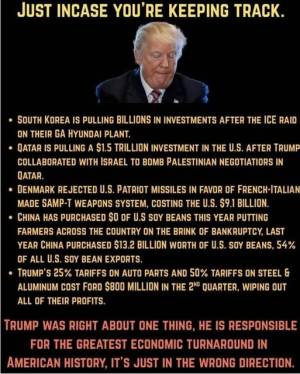 MSNBC, Trump's 'America First' U.N. speeches were bad. This year's address was worse, Zeeshan Aleem, Sept. 24, 2025. In President Donald Trump’s first speech to the United Nations General Assembly in 2017, he casually threatened to “totally destroy” North Korea. That wasn’t exactly an outlier. All his addresses to the General Assembly during that first term were crude, and at times shocking, pieces of “America First” oratory.
 But the speech Trump delivered Tuesday was more “Trump First” than “America First.”
Even more so than usual, Trump was bogged down by constant frivolous tangents and a fixation on trumpeting, often deceptively, what he counts as his accomplishments. And given that the backdrop of Trump’s speech is his all-out assault on democracy in his own country, his lecturing world leaders on how to run a great nation was shocking in its audacity.
Trump praised his own record constantly in what at times resembled more of a State of the Union speech than a U.N. speech. More significantly, he worked to undermine the credibility of the U.N. as an institution for peacekeeping and global governance.
The Bulwark, Political Opinion: Lord of the World: The World’s Brittlest Ego Meets The Globe’s Biggest Stage, Andrew Egger, Sept. 24, 2025. Watching Donald Trump’s long, self-congratulatory, ridiculous, ominous address at the United Nations yesterday, it was hard to know what was more unsettling: What the speech showed about America under this president, or what the speech showed about Trump himself.
Given his tendency to meander—sorry, weave—it can sometimes be difficult to sum up what a Trump speech is about. But at its heart, Trump’s speech yesterday, which droned on for almost an hour, was ideological: a defense of his brand of lawless populist nationalism as the only solution for the challenges now facing the world, challenges against which liberal multilateralism doesn’t stand a chance.
Refugee resettlement programs, attempts to police borders while simultaneously abiding by the law, even efforts to fight climate change and diversify into renewable energy, which he called the “green energy scam”—all these, Trump said, were self-sabotaging projects that “the English-speaking world” needed to immediately abandon. “Both the immigration and suicidal energy ideas,” he said, “will be the death of Western Europe.”
America, he said, was showing another way—one that, he implied, was setting aside petty concerns like wielding force only in accordance with the law in pursuit of the higher aim of results. Perhaps the speech’s most unsettling moment in this vein came when Trump boasted of his repeated sinking of alleged drug-running boats from Venezuela—attacks for which the administration has still given no justification under U.S. law, except by pointing, as Trump did yesterday, to “the supreme power of the United States military” to destroy “terrorists and trafficking networks.”
“Let’s put it this way: People don’t like taking big loads of drugs in boats anymore,” Trump leered. “There aren’t too many boats that are traveling on the seas by Venezuela.”
All this was abominable—the latest demonstration that America, far from leading the charge toward a world based on orderly international cooperation, now actively seeks to supplant such a world with one based on a state-of-nature struggle between nations (or perhaps “the English-speaking world” against the barbarian hordes outside).
Somehow, though, I found myself even more unsettled by some remarks Trump made in passing, not about the world per se, but about himself. Trump, of course, has always been a braggart and a blowhard. But the levels of auto-hagiography he put on display before the world yesterday were remarkable even for him.
To hear Trump tell it, the biggest problem with bodies like the U.N. wasn’t that they were bureaucratic, ossified structures dedicated to a failing vision of international cooperation. The biggest problem was that they had never been able to understand that he, Trump, was the personal solution to all their problems.
The U.N.’s failure to appreciate him, Trump said, was a longstanding problem—going all the way back to the time, he recalled, when they declined his bid to renovate their New York complex. “I remember it so well,” Trump lamented, sounding momentarily more like a jilted lover than a world leader. “It would be beautiful. I used to talk about, ‘I’m going to give you marble floors, they’re going to give you terrazzo. I’m going to give you the best of everything. You’re going to have mahogany walls; they’re going to give you plastic.’ But they decided to go in another direction.”
These issues, Trump grumbled, have only persisted. “I ended seven wars,” he (spuriously) claimed, without ever getting so much as a “phone call” from the U.N. offering to help out. “It’s too bad I had to do these things instead of the United Nations doing them.” After rattling off a long list of international wins, Trump said this: “Everyone says that I should get the Nobel Peace Prize for each one of these achievements.”
At first, I laughed at this comment. But then I realized that this wasn’t just bluster. Trump doesn’t just think he deserves a stack of Nobels—he actually thinks that everyone thinks this.
Think of what it’s like to go through life as this guy. You’ve just spent a decade purging your party and personnel of all but the most pliable and spineless tongue-bathers and yes-men. You sit atop perhaps the largest and most powerful cult of personality the world has ever seen. You’ve repeatedly demonstrated your love for retaliatory action against everyone who displeases you on any matter, no matter how petty—business leaders, opposition politicians, international leaders. And recently, you’ve shown zero compunction about wielding the entire U.S. government to settle those scores.
The result is a life crammed with people, from sunup to sundown, who do absolutely nothing but kiss your ass. It doesn’t matter if you’re meeting with your staff, your congressional allies, business leaders in your country, foreign allies, foreign foes—every single person you meet knows their best course of action is to spend the whole interaction buttering you like a roll. Add that on top of your preexisting lifelong egomania, and it’s a wonder you haven’t actually gotten around to proclaiming yourself Lord of the World.¹
This isn’t just a deeply stupid state of affairs—it’s dangerous. Trump’s increasingly ironclad sense that everybody, more or less, worships the ground on which he walks strengthens his confidence that he has no need to triangulate on even his most controversial actions. Why seek consensus from across the aisle when you are convinced you’re the consensus?
As for those remaining foes and critics, in Trump’s mind they don’t represent alternative views so much as some dark and ominous agenda—no doubt as bought-and-paid-for members of an elite conspiracy. It’s not the headspace of a guy who’s considering taking his foot off the gas, whether he’s speaking at the White House or before fellow world leaders at the U.N.
New York Times, Live Updates: One Dead and Two Wounded in Dallas ICE Facility Shooting, J. David Goodman and Hamed Aleaziz, Sept. 24, 2025. Federal authorities said detainees were among the victims and no federal agents had been shot.
One person was killed and two others wounded in a shooting at a U.S. Immigration and Customs Enforcement facility in Dallas on Wednesday morning, law enforcement officials said. Investigators said no federal agents were shot but that detainees were among the victims.
The gunman was found dead of a self-inflicted gunshot wound, according to Kristi Noem, the Homeland Security secretary, but further details of the shooting were not immediately clear. Ms. Noem said investigators did not yet know a motive.
“While we don’t know motive yet, we know that our ICE law enforcement is facing unprecedented violence against them,” Ms. Noem said. “It must stop.”
The Dallas Police Department said that the shooter had opened fire on the facility, located on the 8100 block of North Stemmons Freeway, from a nearby building. The Texas Department of Public Safety said it did not yet have information to share.
The acting director of Immigration and Customs Enforcement said that there were three victims. “The scene is secure,” he said.
The shooting was the second at a federal immigration facility in Texas in recent months. In July, a police officer was shot outside an Immigration and Customs Enforcement detention facility in Alvarado, Texas. Ten people were charged in the shooting.
The Contrarian, Opinion: ‘Learned Nothing and Forgotten Nothing,’ Jennifer Rubin, right, Sept. 24, 2025. Trump’s ignorance and hatreds continue to define his presidency Forwarded this email? Subscribe here for more
Donald Trump, like the Bourbon dynasty, has “learned nothing and forgotten nothing.” His defining features — aside from narcissism — are his willful, cringeworthy ignorance and his unremitting hunger for vengeance. Both have been on humiliating display of late.
In the first term, Trump postulated that bleach (or light!) might be injected into the human body to cure Covid. If that did not do it, there was always hydroxychloroquine. In Trump 2.0, he’s put on his lab coat to inform us about autism and vaccines.
“In labeling Tylenol use in pregnant women as a potential cause of autism, Trump threw the full weight of his office behind a theory that he acknowledged has yet to be proven,” the Wall Street Journal reported.
The article continued: “He defied the careful guidance offered by some in the row of scientific advisers who stood behind him during the Roosevelt Room address.”
 Even physician and Republican Senator Bill Cassidy (La.)—who is as responsible as anyone for RFK’s reign of anti-science—spoke up. “The preponderance of evidence shows that this is not the case,” he tweeted. “The concern is that women will be left with no options to manage pain in pregnancy. We must be compassionate to [sic] this problem.”
Trump sounded downright idiotic babbling about childhood vaccines. “They can be great, but when you put the wrong stuff in them, you know… And, you know, children get these massive vaccines like you’d give to a horse… like you’d give to a horse,” he said. He plunged on:
And I’ve said for a long time, I mean, this is no secret—spread them out over five years. Get five shots, small ones. Did you ever see what they give? I mean, for a little baby to be injected with that much fluid, even beyond the actual ingredients, they have sometimes 80 different vaccines in them. It’s crazy.
 Vaccines are spaced out, as any parent knows (at least ones remotely involved in their children’s lives). Also, he’s the last person to be talking about what’s “crazy.” His ignorance knows no territorial bounds, as he revealed to global leaders yesterday. “President Trump’s [United Nations] speech, filled with familiar grievances and false claims, criticized the U.N. as ineffective,” the New York Times reported. He proclaimed, “I’m really good at this stuff. Your countries are going to hell.” Charming. I cannot imagine what “stuff” he is good at; surely, it’s not trade policy, cutting prices, ending the war in Ukraine or Gaza, containing the deficit, preventing a shutdown, making public the Epstein files, or following the law.
Sounding like a perfect fool (now, that’s something he excels at!), he went after his usual hobby horses. “He warned darkly of a ‘double-headed monster’ of illegal migration and a shift to renewable energy, and called climate change the ‘greatest con job’ ever perpetrated on the world,” the Times reported. “He accused environmentalists of wanting to ‘kill all the cows,’ personally insulted the Muslim mayor of London and falsely claimed that Muslims in the West are planning to institute Sharia law.”
He is a national embarrassment. Sadly, he has allowed exclusively yes-men and yes-women to surround him, so no one prevents him from saying utterly stupid, inaccurate, uniformed “stuff.”
Trump’s ignorance may be the defining feature of his agenda. He refuses to learn that consumers pay tariffs or that Russia is the aggressor in Ukraine or that windmills don’t hurt whales or that immigrants are not responsible for rising crime (which isn’t even rising) or that it is illegal to blow up boats on the high seas that could be interdicted. Knowledge and common sense would simply get in the way of his desire and ambition.
However, his propensity for vengeance is as robust as his ignorance. Trump 2.0 is all about revenge, just as he promised during the campaign. He brazenly told the attorney general (“Pam”) via social media to prosecute his enemies, New York Attorney General Tish James and Sen. Adam Schiff (D-Cal.)
Most recently, he declared at Charlie Kirk’s funeral (immediately following Erica Kirk’s statement forgiving her husband’s murderer), “I hate my opponent. I don’t want the best for them.” By that he seems to mean anti-MAGA Americans, the majority of the country that did not vote for him and/or has since grown disillusioned.
No one need accuse him of being “presidential” or “growing into the job,” let alone decreasing the gusher of bile pouring out from his followers. As the Times recounted, “He has attacked law firms, universities, political leaders, government agencies, late-night TV hosts, news organizations and cultural institutions, and Mr. Kirk’s killing has only accelerated that campaign.” Now he is expanding his target list to “liberal groups, making the baseless argument that they are part of a violent conspiracy.” (Notice how the Times’ language has toughened up of late. Perhaps the paper is capable of reporting without sane washing.)
It remains near-impossible for tens of millions of Americans — let alone the global audience — to understand how someone this patently and gleefully ignorant, driven almost entirely by personal bitterness, could have been re-elected (even after being convicted of 34 felonies). One can point to former president Joe Biden’s late exit, inflation, voter inattention, or cynicism. Yet no explanation is entirely satisfying. Nothing makes sense of his presence as the leader of our nation. At this point, it is more productive to doggedly defend democracy, sanity, decency, and science, hoping voters still care about such things.
And if the economy is all that voters care about, the bad news for MAGA Republicans is that the economy stinks. Trump may be ignorant about that too, but American voters and families are not.
Immigration, Law, Courts, Crime

New York Times, U.S. Attorney Races to Present Case Against James Comey, Glenn Thrush and Maggie Haberman, Sept. 24, 2025. It remains to be seen whether a career prosecutor would be willing to present a case to a grand jury or whether jurors would bring an indictment.
President Trump’s handpicked federal prosecutor in the Eastern District of Virginia is racing to present a case against James B. Comey, the former F.B.I. director, to a grand jury before a deadline early next week, according to officials familiar with the situation.
Lindsey Halligan, a former defense lawyer for Mr. Trump who was hastily appointed after the president forced out her predecessor last week, is rushing to draft an indictment under withering pressure from the White House. The president has demanded the department go after one of his foremost enemies, even though career prosecutors determined there was insufficient evidence to indict Mr. Comey.
Prosecutors have been looking into whether Mr. Comey should be charged with lying to Congress in connection to the F.B.I. investigation of Mr. Trump’s 2016 campaign’s ties to Russia, which the president claims was a witch hunt aimed at destroying him.
Ms. Halligan, who had no experience as a prosecutor before her recent appointment, could seek to bring charges as early as Thursday, but is expected to take action by Tuesday, when the statute of limitations on Mr. Comey’s congressional testimony expires, according to officials who requested anonymity to discuss an ongoing investigation.
Even if Ms. Halligan meets her deadline, there is no guarantee the grand jury will determine that the government has met the evidentiary threshold to indict Mr. Comey.
It is not clear if a career prosecutor would be willing to present the case to the grand jury — or if Ms. Halligan or another Trump-allied political appointee would appear in court.
“Perjury is a very difficult crime to prove,” said John P. Fishwick, who served as U.S. attorney for the Western District of Virginia from 2015 to 2017. “The department must show that a particular statement was false and that the defendant knew it was false at the time he or she testified. Because of the difficulty of proof, it is not often pursued.”
Career prosecutors in the Eastern District of Virginia investigated Mr. Comey and informed Mr. Trump’s political appointees at the Justice Department that there was insufficient evidence to obtain a conviction, according to several people briefed on those discussions.
Over the past week, Mr. Trump has greatly intensified his pressure campaign on the Justice Department by publicly demanding that top officials prosecute Mr. Comey and Letitia James, the New York attorney general who accused Mr. Trump of inflating the value of his assets.
It is not clear where prosecutors may seek to bring a case against Mr. Comey. The headquarters for the district is in Alexandria, but investigators have been active in other parts of the state, according to two people familiar with the situation.
On Friday, Erik S. Siebert, the Trump-appointed U.S. attorney overseeing both investigations, stepped down after Mr. Trump told reporters he had lost faith in Mr. Siebert’s willingness to bring criminal charges.
In his place, the president installed Ms. Halligan, who had been serving as a White House aide.
Mr. Siebert had recently told senior Justice Department officials that investigators found insufficient evidence to bring charges against Ms. James, and had also raised concerns about a potential case against Mr. Comey, according to officials familiar with the situation.
Attorney General Pam Bondi and Todd Blanche, the deputy attorney general who runs the day-to-day operations of the Justice Department, had privately defended Mr. Siebert against officials, including William J. Pulte, the director of the Federal Housing Finance Agency, who had urged that he be fired and replaced with a prosecutor who would push the cases forward, according to a senior law enforcement official.

New York Times, Under Trump Policy, Bonds for Immigrants Facing Deportation Are Vanishing, Miriam Jordan, Sept. 24, 2025. The president has limited immigration judges’ power to release detainees facing deportation. Immigrant rights groups say the policy is illegal.
For decades, U.S. immigration judges have granted bond to immigrants in detention who the court determined would show up for future hearings and were not public safety threats. That allowed many immigrants facing deportation to live in the community until their cases were decided, which often took years.
But those long backlogs grew even longer during the record surge in migrants entering the United States during the Biden administration. And in July, the Trump administration moved to make people who had crossed the border unlawfully ineligible for bond.
It was a major break with longstanding practice and emblematic of President Trump’s efforts to remake America’s immigration policy and make good on his pledge to deport millions of people.
This month, the Board of Immigration Appeals, a Justice Department body that reviews immigration court decisions, affirmed the shift, making the new policy binding on all immigration judges.
Now, detained immigrants facing deportation are generally expected to be held without bond for the duration of the legal proceedings.
The Board of Immigration Appeals said that immigration judges do not have the “hear bond requests or to grant bond” to people who did not lawfully enter the United States.
Tricia McLaughlin, a spokeswoman for the Homeland Security Department, said that the Trump administration was “now enforcing the law as it was actually written to keep America safe.”
The decision came from a board that has been reshaped in recent months. In April, the Trump administration eliminated the positions of a dozen Biden-era appointees as it reduced the overall size of the board. Of the 13 judges now sitting on the board, nine were picked by Mr. Trump.

Politico, Peter Strzok, the FBI agent who sent anti-Trump texts, loses First Amendment case over his firing, Josh Gerstein and Kyle Cheney, Sept. 24, 2025 (print ed.). A federal judge dismissed a long-running lawsuit from Strzok, above, who was fired from the FBI during Trump's first term.Peter Strzok holds his glasses while sitting in front of a microphone.
A judge has dismissed claims from former FBI counterintelligence agent Peter Strok, shown at a 2018 House hearing, that his firing from the FBI violated his First Amendment rights. | Evan Vucci/APBy
Former FBI agent Peter Strzok has lost a long-running lawsuit claiming he was illegally fired during Donald Trump’s first termafter sending text messages that criticized Trump.
Strzok argued in the lawsuit that his FBI bosses had retaliated against him in order to placate Trump, who was outraged over texts that Strzok exchanged while investigating ties between the 2016 Trump campaign and Russia.
In a ruling Tuesday, U.S. District Judge Amy Berman Jackson said that, after several years gathering evidence and testimony from those involved in the 2018 decision to terminate the veteran counterintelligence agent, Strzok’s lawyers had failed to show that his dismissal violated his First Amendment rights.
Jackson, an Obama appointee, stressed that she was not ruling on whether Strzok’s firing “was the appropriate sanction” for his conduct, only that the voluminous evidence assembled over years of litigation — including a deposition of Trump himself — had not proven Strzok’s rights were violated.
Jackson’s full ruling is under seal, for now. But she disclosed a summary Tuesday that showed she also rejected Strzok’s argument that he had struck a binding deal with a top FBI disciplinary official under which Strzok would have been demoted and suspended for 60 days. The FBI’s deputy director at the time, David Bowdich, nixed that arrangement and fired Strzok.
Strzok, who worked as an agent for the FBI for 22 years before his firing, can appeal Jackson’s decision to the D.C. Circuit Court of Appeals. His attorney, Aitan Goelman, did not immediately respond to a request for comment.
The ruling ends one chapter in one of the lengthiest legal sagas stemming from Trump’s first term, when he grew increasingly furious over the criminal and counterintelligence probes of his 2016 campaign’s contacts with Russia. The discovery of the anti-Trump text messages — including one in which Strzok suggested the FBI might “stop” Trump from becoming president — helped Trump cast those probes as a corrupt “witch hunt” and embroil the bureau in years of controversy.
The imbroglio became tabloid fodder, as well, after it was revealed that Strzok and the FBI lawyer with whom he exchanged many of the texts, Lisa Page, were having an affair at the time. Trump seized on that aspect of the story and mounted numerous attacks on Strzok and Page on social media and in public, sometimes disparaging Page in crude terms.
Strzok has long denied that his personal views about Trump influenced his actions on the job, and a lengthy inspector general review found no evidence that the Russia probe was affected by bias. But the saga helped Trump rally his supporters and regain his footing after a rocky start to his presidency.
In 2019, Strzok and Page filed separate lawsuits over the episode. Page, who quit the FBI in 2018, claimed that the Justice Department’s disclosure of her text messages to reporters violated the Privacy Act. Strzok’s suit made similar claims but also challenged his firing.
Last year, during the Biden administration, the Justice Department agreed to pay Page $800,000 to settle her suit and to pay Strzok $1.2 million to settle his privacy-invasion claims. Strzok’s claims related to his firing were not part of the settlement.
FBI Director Kash Patel, a longtime Trump loyalist, recently faced questions from Sen. John Kennedy (R-La.) about the settlements paid to Strzok and Page, with demands that Patel identify the FBI officials who authorized them. Patel said the agreements were “reached in the Biden administration when my predecessor was director.”

Politico, FBI says it found classified documents in John Bolton’s DC office, Josh Gerstein and Kyle Cheney, Sept. 24, 2025 (print ed.). Court records show that records marked “secret” were seized from the office of Trump’s former national security adviser, shown above.
FBI agents executing a search warrant at former national security adviser John Bolton’s downtown Washington office last month turned up documents marked as classified, according to a court filing released Tuesday.
A description of the documents gathered in the Aug. 22 search suggested they included materials that referenced weapons of mass destruction, the U.S. mission to the United Nations and records related to the U.S. government’s strategic communications.
The inventory by an FBI agent doesn’t specify the number of suspected classified documents. But it lists several collectionsor folders that were labeled “confidential” and some pages marked “secret.” The heading on at least one set marked “confidential” was redacted from the inventory, filed earlier this month in federal court in Washington.
FBI agents also carried out a search warrant the same morning at Bolton’s Bethesda, Maryland, home. The inventory from that search contained no outward indication that classified information was located. However, in both instances, agents reported seizing computers and other electronic devices whose contents were not detailed.
Both search warrant applications indicated FBI agents were seeking evidence related to three felony offenses, including gathering, transmitting or losing national defense information in violation of the Espionage Act and retaining classified information without permission.
In Trump’s first term, Bolton faced a lawsuit claiming he included classified information in a book he wrote after leaving the administration. A federal judge warned publicly that the former White House official’s actions might have been criminal. However, a Justice Department probe did not lead to charges and was eventually dropped under the Biden administration in 2021.
It’s not known when the investigation restarted. Court filings indicate that investigators determined that Bolton’s AOL email account was hacked by a foreign entity, although details of the alleged hack and how the U.S. became aware of it remain unclear.
Redacted court filings related to the Washington search were released by Justice Department lawyers after several news organizations, including POLITICO, filed a formal motion asking for disclosure of the records. DOJ attorneys agreed to make public redacted versions of the inventory, search warrant and accompanying affidavit, but resisted blanket release of the information, citing a need to protect a national security investigation.
Categories of potentially classified records that the FBI reported finding at Bolton’s office included: travel memo documents with a “secret” label; confidential documents from the U.S. mission to the U.N.; confidential documents related to strategic communications; and classified documents related to weapons of mass destruction.
“Secret” is the middle of three major tiers of U.S. national security classification, intended to cover information expected to cause serious damage if disclosed. “Confidential” is the lowest tier, covering information that could cause some damage to national security if released. “Confidential” is often used for routine diplomatic communications.
The material gathered in the search underscore the potential criminal exposure for Bolton. The federal government has brought prosecutions in the past for those who knowingly retain classified information outside of secure or approved channels.
An attorney for Bolton did not immediately respond to a message seeking comment.
U.S. Magistrate Judge Moxila Upadhyaya, approved the search warrant for Bolton’s office. She is the same magistrate judge who received a grand jury’s indictment of Donald Trump in 2023 for election interference and presided over his arraignment.
Special counsel Jack Smith charged Trump for hoarding classified materials at his Mar-a-Lago estate after leaving office in 2021 — a case considered to be the gravest threat to Trump until his victory in the 2024 election. Trump faced 32 counts of one of the offenses under investigation in the Bolton probe: unauthorized retention of classified information in violation of the Espionage Act. A federal judge in Florida eventually dismissed the case, citing legal flaws in Smith’s appointment.
Global News, Commentary
Emptywheel, Analysis: Scott Bessent Links Bailout of Argentina to Trump's Election Interference, Even as Argentina Poaches US Soybean Markets, Emptywheel (Marcy Wheeler, right),  Sept. 24, 2025. In a tweet laying out all the welfare he plans to give so-called libertarian Javier Milei, Scott Bessent, above, confirmed the tie between the bailout and Trump's election interference.
The poster child for libertarianism needs some welfare. As voters in Argentina sour on Javier Milei, the government has had to invest to keep the peso pegged to the dollar.
Last month, with his sister embroiled in a corruption scandal, Mr Milei badly lost a legislative election in the province of Buenos Aires. He then suffered a series of stinging legislative losses. Markets panicked, worried that the defeat signalled the end of popular support for Mr Milei’s economic-reform project, and the potential return of spendthrift Peronists. A sharp peso sell-off began.
Since April, when the IMF launched yet another programme in Argentina, the peso has been floating within an exchange-rate band, the limits of which the Argentine government has vowed to defend. By mid-September the peso’s official rate was testing the upper limit of that band, even briefly piercing it on September 17th to reach 1475 to the dollar. Over the following two days the Argentine central bank spent some $1bn of its scarce foreign-currency reserves to defend the currency.
The bank does not have sufficient foreign reserves to keep up this level of spending for long. Drafting in the dollar-bazooka of the US Treasury should give Argentina the firepower to stabilise the peso, if needed.
And so Milei asked and Scott Bessent agreed to bail out the so-called libertarian.
NerdReich captured the significance Javier Milei’s financial woes best:
The political ideology known as libertarianism died yesterday in Argentina at the age of thirteen.
While it had been around for quite a bit longer, its basic concepts never progressed beyond the early stages of adolescent brain development. Libertarianism—which asserted that society would be better off with minimal government, laws, and taxes—succumbed after chainsaw-wielding Argentine President Javier Milei asked the United States for a massive economic bailout due to his catastrophic leadership.
Milei, right, a werewolf-clown hybrid in a suit who once hired a spirit medium to communicate with his dead dog, swept into office promising a libertarian-inflected miracle in Argentina.
In an early preview of Elon Musk’s DOGE, he slashed government and social spending. Earlier this year, an essay published on the website of the libertarian Cato Institute mocked his critics as doomsayers who “warned that the profane self-described libertarian—who looks more like a still-touring ’80s rockabilly singer than the classically trained economist he actually is—would inflict on Argentina’s already-beleaguered economy ‘deep recession,’ ‘devastation,’ ‘economic collapse,’ and all sorts of other economic horribles.”
But the critics were correct. Instead of miracles, the self-described “anarcho capitalist” has delivered shocking disaster: collapsing institutions, chronic inflation, and the awkward realization that screeching about free markets doesn’t put bread on the shelves.
When Bessent first offered to bailout Milei, Elizabeth Warren asked the obvious question: Has Bessent decided “Argentina” — that is Milei — is a systematically important US ally because Milei, who faces a legislative election next month, is buddies with Trump?
Bessent and the White House responded with contemptuous tweets, one attacking Massachusetts. None of them denied Warren’s premise, though: Even as Republicans are taking healthcare away from Americans, Trump is spending money on a buddy overseas.
Indeed, Bessent’s long tweet laying out how he was going to bailout Argentina confirmed the tie (incorporating the Trump tweet endorsing Milei); he even promised investments in Argentina if Milei’s party wins the election.
Emptywheel, Analysis: What Trump's UNGA Speech Tells the World, Emptywheel (Marcy Wheeler, right), Sept. 24, 2025. In one speech, Donald Trump gave the world a lot to think about, and none of it was good. Especially if you are Secretary of State/National Security Advisor/Archivist of the United States Marco Rubio.
Speeches by national leaders at the opening of the UN General Assembly (UNGA) have multiple goals and various audiences. Leaders of small countries hope to raise concerns with large countries in a setting where they can be the center of attention, if only for 15 minutes. Leaders of ostracized countries often seek to justify the behavior that got them ostracized in the first place. Some speeches are aimed at the leaders in the room, while others are aimed at the folks back home. Some are aimed at allied leaders, and others at competitors and still others at enemies.
Under normal circumstances, preparation for the US president’s speech is probably on par with preparing the State of the Union address to Congress. Both speeches utilize folks from multiple agencies and both are subject to weeks and months of internal debates about what will and will not get into the speech. While the SOTU address is as long as the President wants to make it, the UN politely asks that UNGA addresses be kept to 15 minutes or less, because so many leaders will be speaking. The UNGA speech is primarily foreign policy, while the SOTU is more domestic, but both are critical to laying out the president’s – and by extension, the USA’s – positions on all kinds of things.
For UNGA, the State Department takes the lead (broadly speaking) in preparing drafts and posing options to the final decisionmakers in the White House. Other agencies like DOD, Treasury, Commerce, and DHS, as well as folks like the Director of National Intelligence, all weigh in and put their requests into the funnel out of which the final draft emerges.
While all the prep work on the speech is under way, so too is the prep work for listening to the speeches delivered by other leaders. Is it more of the same, are there new policy nuances, or even major changes of direction being conveyed? Different analysts at State, DOD, and the Intelligence community will prepare a list of “what to listen for” points as they get ready to listen to the UNGA speeches from the countries within their purview. Once the speeches have been made, these same folks will then be sharing their analysis with their superiors and the White House. “Here’s what we heard . . . , here’s what it means . . . , and here’s how it may affect our own policies and responses . . .”
Meanwhile, every other foreign ministry and intelligence service in the world does the same with the UNGA speech of the President of the United States of America. Especially when that president is Donald J. Trump.
So what will these folks notice about Trump’s speech, and what will their analysis of his speech lead them to think or do?
First, they will notice the absolute dichotomy between policy prescriptions and petty personal grievances. Yes, the speechwriting team and the professionals behind them put a lot of substantive stuff into the draft of the speech that went on the teleprompter, but Trump went off-script so much that it was easy for that stuff to get lost in the verbal flood of whining about his domestic political enemies alternated with his own personal self-promotion. If the substance was prepared to fill the 15 minute time slot, the whining and boasting filled another 45 minutes or so. That 3:1 ratio speaks volumes about what matters to Trump: “Three parts me, and one part everyone else. And that ratio is me being generous to everyone else.”
Second, even in the substantive parts of the speech, the presentation was arrogant and insulting. (Why yes, I do think Stephen Miller had a large role in shaping the speech. Why do you ask?) Trump’s “I alone can fix it” from campaigns gone by was echoed in Trump’s declaration at UNGA that he has always been right about everything. From immigration to energy to wars to peacemaking to cultural issues to history, Trump’s assertion that he is always right and that the world would be better off if everyone just bowed down and did what he said was at the center of his speech. The prepared draft of the speech might have been more polite about it, but the message was the same. All the world could see how Trump views them — little kids who need to listen to Daddy, and then do what Daddy says so that they don’t get punished.
Third, Trump’s UNGA speech was a confirmation and distillation of something these folks have seen since 2015 from Trump: facts are optional to Donald Trump. They will see that science takes a back seat to whatever Trump’s particular views and preferences are. Signed agreements, especially those signed by someone other that Trump, are optional, not binding. Historical facts that do not fit with Trump’s worldview are overlooked, ignored, or blithely dismissed as irrelevant. Leaders and nations who seek to move Trump and US policies with fact-based arguments will have a very difficult, if not impossible task if they follow this route.
Fourth, Trump has no use for the opinions of other leaders, unless they comport with his own opinions. Dozens of nations call what Israel is doing in Gaza “genocide” but Trump does not give a damn. Countries of all political stripes recognize the reality of climate change (even as they might differ in how it should be addressed), but not Donald Trump.
Fifth, this speech confirms yet again that what Trump desperately seeks is validation. In his head, he dreams of giving his own version of Sally Field’s academy award acceptance speech — “I haven’t had an orthodox career and I’ve wanted more than anything to have your respect. The first time [I won] I didn’t feel it, but this time I feel it. And I can’t deny the fact that you like me. Right now, you like me! Thank you.”
Sixth, these analysts from other nations regularly ask themselves “How long will Trump hold to a given position?” He renegotiated the NAFTA treaty with Canada and Mexico in 2019 and finalized it in 2020, only to come back in 2025 and ask “who would have ever sign a thing like this?” Grudges over personal slights he will carry with him for decades, but agreements with other leaders and other nations are much less predictable.
The danger to all of this is one basic thing: the world is learning –again — not to listen to the United States.
When Trump and RFK Jr. issued their untethered-to-scientific-analysis declaration that Tylenol should not be used by pregnant women, not only did the US medical community loudly shout “NO!” but so did medical leaders around the world (UK, Spain, India, Australia, etc.). The US has a long record of leadership in medical research and treatment — think of the elimination of smallpox and the work to do the same with polio — but now? Around the world, folks are asking what used to be an unimaginable question: Should we listen to anything medical coming out of the CDC?
When Trump made his big Liberation Day announcements and sought to put tariffs on almost every nation, he followed up on this with all kinds of exceptions, adjustments, and incoherent statements. Today the tariffs might look like this, but next week they went down, then a month later some of them went higher than before . . . and what the hell will they look like next year?
When NGOs and other leaders around the world found the rug yanked out from under them when Trump used DOGE to cancel grants for things like malaria prevention and anti-AIDS programs, as well as letting US food aid funneled through USAID rot in warehouses rather than be delivered to those who feed the hungry, they had to ask if the word of the US is worth anything any more. “We had a five year agreement – you put up this and we’ll handle that — and after 3 years, you reneged. Why should we trust you the next time you want to make a deal?”
Trump and his lackeys can laugh at the world all they want, but if the financial world follows the lead of the medical world and the scientific world, and ceases to trust that the word of the US is good, the US will be in a world of hurt. A non-trivial portion of US debt is held by foreign governments. When the Canadian public decided not to travel to the US or buy US bourbon, that hit the US hospitality industry hard. If foreign governments decide that rather than buying US treasury bonds, they’d prefer bonds from Germany or France or Australia, that will mean the US government would have to offer higher rates of return in order to get the money needed to pay for tax breaks for the rich run the US government.
In the world of international affairs, trust matters, and Donald Trump is pissing away what it took decades to earn. Good luck with that, Secretary of State/National Security Advisor/Archivist of the United States Marco Rubio
More On U.S. Media, Education, Religion, Culture Wars

New York Times, Jimmy Kimmel, Somber but Defiant, Defends Free Speech in Return to ABC, John Koblin and Michael M. Grynbaum, Updated Sept. 24, 2025. The late-night star, shown above at top with a photo collage of rival but supportive fellow late-night hosts shown below, said he had not intended to make light of Charlie Kirk’s murder, but he also said that President Trump’s threat against ABC was “anti-American.”
Jimmy Kimmel broke his silence on Tuesday night in an emotional return to ABC’s airwaves, by turns defiant, joking and somber as he addressed the controversy that temporarily sidelined his late-night show and set off a national debate over free speech.
His voice breaking at times, Mr. Kimmel said he understood why his comments last week about the suspected shooter of right-wing activist Charlie Kirk seemed “ill-timed, or unclear, or maybe both.” He added, “It was never my intention to make light of the murder of a young man.”
But Mr. Kimmel also had harsh words for President Trump and the government regulator who suggested that the Trump administration would punish ABC because of his remarks, saying that “a government threat to silence a comedian the president doesn’t like is anti-American.”
“This show is not important,” Mr. Kimmel said in his opening monologue. “What’s important is that we get to live in a country that allows us to have a show like this.”
Executives at Disney, ABC’s parent company, pulled “Jimmy Kimmel Live!” off the air last week, shortly after the chairman of the Federal Communications Commission, Brendan Carr, suggested that his agency could take action against the network.
On Tuesday, Mr. Kimmel said he disagreed with Disney’s decision to pull his show. But he also credited the company, where he has worked for 22 years, for defending his right to poke fun at the powerful.
“Unfortunately, and I think unjustly, this puts them at risk,” Mr. Kimmel said. “The president of the United States made it very clear he wants to see me and the hundreds of people who work here fired from our jobs. Our leader celebrates Americans losing their livelihoods because he can’t take a joke.”
New York Times, Brendan Carr Plans to Keep Going After the Media, Cecilia Kang, Sept. 24, 2025. While “Jimmy Kimmel Live!” returned to ABC on Tuesday, the chairman of the Federal Communications Commission has promised to continue his campaign against what he sees as liberal bias in broadcasts.
Critics have recently called Brendan Carr, the chairman of the Federal Communications Commission, dangerous and a national censor.
His response? Bring it.
Since “Jimmy Kimmel Live!” was temporarily yanked from the airwaves after Mr. Carr took issue with the ABC host’s comments about the man accused of shooting conservative activist Charlie Kirk, the 46-year-old regulator has been emboldened in his battle to stop what he sees as liberal bias in broadcasts, according to two people familiar with his thinking.
Mr. Carr has appeared on conservative radio talk shows and Fox News to defend his actions, saying local broadcasters were finally serving audiences tired of biased programming. He has suggested the F.C.C. should investigate ABC’s daytime talk show “The View” over its political content. He said he planned to continue the agency’s work to empower local TV stations to reject the shows they disagree with.
Some of his rhetoric about ABC has softened a bit since, but his overall message has remained the same: He will not stop. “There are a lot of Democrats out there that are engaged in a campaign of projection and distortion,” he said at a conference on Monday. “They are completely misrepresenting the work of the F.C.C. and what we’ve been doing.”
The F.C.C. will continue with its Congressional mandate to ensure broadcast TV serves the public interest, he said, adding, “If people don’t like it, they can go to Congress and change the law.”
Driven by the belief that liberal tech and media companies have unfairly silenced viewpoints on the right, Mr. Carr is working to transform the F.C.C. from a once sleepy agency best known for licensing local TV stations and expanding 5G cellular networks into a protector of conservative speech. In particular, he is working on broadening the agency’s mandate to referee what appears on televisions, according to interviews with 10 current and former F.C.C. officials.
Mr. Carr, who became the F.C.C. chairman in January, has argued in recent days that he has been a consistent champion of the First Amendment and said he was helping protect free speech by weighing in on local TV programming decisions that no longer serve the public interest.
As part of those efforts, Mr. Carr has reopened complaints that accuse ABC, NBC and CBS of biased programming during the 2024 election — including investigating “Saturday Night Live” for a pre-election episode in which then-Vice President Kamala Harris was a guest. He is investigating PBS and NPR over accusations that the public news organizations violated rules that prevented them from airing commercials. He has also warned that he can block media mergers that may harm local stations’ independence.
Now, Mr. Carr is leveraging the agency’s power to withhold local TV stations’ licenses if they do not serve the public interest by airing biased coverage.
New York Times, Washington Memo: The Pentagon, the Press and the Fight to Control National Security Coverage, David E. Sanger, Sept. 24, 2025. Journalists have long shaped history through scrutiny of the military. Now the Defense Department plans to cut off access for reporters who publish even unclassified information without official approval.
Imagine for a moment that the Defense Department’s new demand for a “pledge” from Pentagon reporters — a commitment not to publish even unclassified but sensitive information, except what press officers approve, under threat of losing their press passes — had existed during the botched evacuation of American personnel from Afghanistan four years ago.
Reporters would have been under pressure to cover that withdrawal, which President Trump regularly describes as the most disastrous moment in American military history, as the Pentagon would have wanted it depicted: a heroic airlift, amid chaos. The reporters who revealed the disastrous drone strike during the evacuation that killed 10 civilians, contradicting the Biden administration's initial insistence that it was a “righteous strike,” could have been in danger of losing their military press credentials.
Had they been in place at the time, the new rules, which were announced on Friday and are scheduled to come into effect over the next two weeks, might have also impeded reporting during the run-up to the Iraq war. The few dissents inside the U.S. government, questioning President George W. Bush’s confident assertion that Saddam Hussein was still seeking weapons of mass destruction, were certainly sensitive — and in some cases highly classified.
And in Vietnam, the reporters who leaped on and off helicopters, recording the day-to-day reality in a conflict that today seems hopelessly misbegotten, might have risked losing their access to the battlefield for reporting the obvious: What was happening on the ground didn’t remotely match with what optimistic American military leadership was describing at briefings known as the “Five O’Clock Follies.”
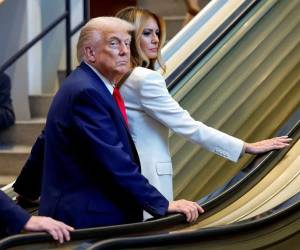 Meidas Touch Network, Republicans Melt Down Over Escalator Incident, Ron Filipkowski, right Sept. 24, 2025. They call for arrests after Dear Leader and Melania had to walk up stairs.
 After spending the past week demanding the firing, arrest and prosecution of every Democrat who failed to sufficiently mourn right-wing podcaster Charlie Kirk, MAGA blood is up again calling for officials at the UN to be imprisoned for an alleged escalator prank.
When Trump and his adoring wife Melania arrived at the UN to give the single most embarrassing speech evermade by an American president to the General Assembly, they stepped on to the escalation only to have it stop working. Melania gave Trump one of her famous looks of disgust as they stood there for several seconds. She finally just walked up the stairs and a few seconds later Trump lumbered up clearly annoyed.
As he began the speech, Trump complained that the teleprompter wasn’t working properly to allow him to read Stephen Miller’s deranged speech: “I don’t mind making this speech without a teleprompter. Because the teleprompter is not working. I can only say that whoever is operating this teleprompter is in big trouble.”
They got it working a few minutes later.
At that point there wasn’t much reaction from the MAGA cult on social media. Trump complains about everything, and he complained about his teleprompters dozens of times during the campaign while also claiming that he really didn’t need only since only Joe Biden supposedly had to rely on them to make a speech. So MAGA probably thought at that point it was just his usual griping and grumbling.
What really got things going was a subsequent post by press secretary Karoline Leavitt, who said this: “If someone at the UN intentionally stopped the escalator as the President and First Lady were stepping on, they need to be fired and investigated immediately.”
AP’s UN correspondent Farnoush Amiri issued a statement from the UN that was widely circulated on right-wing social media, but they weren’t about the believe the Fake News or the Deep State: “A UN official said the UN understands that someone from the president’s party who ran ahead of him inadvertently triggered the stop mechanism on the escalator. The official also said the White House was operating the teleprompter for Trump.”
Deputy WH Chief of Staff Taylor Budowich: “I call bullshit.”Fox host Jesse Watters a few hours later on The Five: “They sabotaged them and they could have hurt the first lady. This is an insurrection. We either need to leave the UN or we need to bomb it.”
Leavitt later appeared on Jesse Watters’ primetime show on Fox to pour gasoline on a fire that was already spreading rapidly. Watters: “It does appear to be sabotage with the escalator and the teleprompter. Leavitt: It appears that way to me. If we find these were UN staffers who were purposely trying to literally trip up the president and the first lady, there better be accountability for those people and I will personally see to it.”
“Also, the audio inside of the room was much lower and different for the president than the previous speaker. So when you put all of this together - teleprompter, escalator - it doesn’t look like a coincidence to me. And I know that we have people, including the Secret Service, who are looking into this to try to get to the bottom of it.”
The rest of the night then descended into MAGA madness:
Sen. Mike Lee: “This should be the beginning of the end of America’s relationship with the UN. The UN deep state tried to embarrass Trump and make him less safe Instead, they embarrassed themselves and gave momentum to the effort to defund the UN.”
Trump social media coordinator Alex Bruesewitz: “Someone very clearly tried to sabotage Trump at the UN. Completely unacceptable. Someone must be held accountable.”
Michael Flynn: “It is high time the US gives the UN the middle finger, walks away from it, tells those that want to stay to build a new UN in the Gaza Strip since most of the nations love Hamas. Turn the current UN into a hotel and stick a giant “TRUMP” sign on the outside! AND Assign Delta Force as his personal security. ENOUGH IS ENOUGH. These are dangerous times and we can no longer kid ourselves.”
Newsmax host Todd Starnes: “Trump steps on the escalator at the UN and it stops working. Then, as he is about to deliver his speech, the teleprompter stops working. Coincidence or intentional hijinks designed to embarrass our president? Fortunately, we have a president who can climb stairs and can communicate coherently without the use of a prompter. Once all the illegals are deported we should do the same to the UN.
”Fox Business contributor Charles Payne: “Will they ever learn? These stunts only enhance the aura of Trump.”
Fox columnist David Marcus: “It looks an awful lot like someone at the UN intentionally stopped Trump’s escalator, hoping to make a 79 year old man have a fall. Also, this could have hurt his wife who he had go before him as a gentleman does on stairs. Trump’s not gonna be like that.”
NY Post reporter Miranda Devine: “This can’t just be ignored. Trump should move the UN to Gaza. It’s just one giant grift fest as every New Yorker knows this week especially.”
Rep. Tim Burchett: “Defund the UN.”
Susan Crabtree, national security correspondent for RealClearPolitics: “Why did the Secret Service allow Trump and Melania to get stalled on an escalator today at the UN before his speech without moving quickly to protect the leader of the free world and his wife? The stalled escalator with Trump and Melania stuck on it was a classic set up for an assassination hit, yet the Secret Service barely noticed and didn’t pull POTUS and FLOTUS off the suddenly stopped stairs.”
Katie Pavlich, editor of Town Hall: “The escalator stopped as soon as First Lady Melania and President Trump stood on it upon arrival to the UN. Then, the teleprompter wasn’t working when Trump took the stage Then the microphones, which were audible for the previous speaker, were not amplifying sound at the same level when Trump started speaking. It was hard to hear in the room.”
Talk show host Dana Loesch: “No, I don’t believe the escalator stopping at the UN was accidental, nor the teleprompter, nor the mics - especially after an article last week where UN workers questionably joked about doing it. Maybe there is a good explanation, but I’ve not seen one yet.”
Geiger Capital got over 10 million views on this post: “This is insane. As Trump arrived to the UN, the escalator stopped working the moment he stepped on it. Then the teleprompter stopped working the moment he got up to the podium to speak. The fact that someone was able to do this to the President of the US is another failure by the Secret Service. If he was halfway up, he was a sitting duck. Guns should’ve been drawn instantly.”
Podcaster Brenden Dilley: “If we discover that the UN deliberately turned off the escalator and risked everything injuring the president and first lady, we should bomb them. All of them.”Mike Cernovich: “The Secret Service is a joke. Trump needs to bring in Ranger Regiment for security. An escalator stops? Then guns are out. Today was a disgrace and makes us look weak. I don’t have time for “it was only a prank.” No, it was a direct threat on our President.”
Harmeet Dhillon, head of DOJ’s Civil Rights Division: “Deport the UN.”
Jack Posobiec: “The stopped escalator was a massive security breach.”Juanita Broaddrick: “Heads need to roll!”
Alex Jones: “SABOTAGE: Escalator At The UN HQ Stops Abruptly When Trump Steps Onto It, And Teleprompter Malfunctions Before He Begins Speaking!”
Cattturd: “It was 100% deliberate. We need to find out who did this. We need to leave the UN now! This was deliberate sabotage. Period. End of story.”
Johnny MAGA (reportedly the account of Ali Alexander): “In all seriousness, if the stopped escalator was an act of sabotage, whoever is responsible must be severely punished. Melania lost her balance and had to quickly grab the rails. The President and First Lady could have fallen and been injured.”
Wall Street Mav had 2.3 million views on this: “When the escalator came to a sudden halt, Secret Service just looked around hoping someone would fix the problem. That wasn’t supposed to happen and it turned Trump into a stationary target. Why did they not cover and evacuate him immediately? If we fund 22% of the UN budget, Trump should demand 22% of UN staff positions and get his people in roles that call the shots internally.”
Hans Mahncke: “First off, this was 100% deliberate. Just by itself, it would already have been extraordinarily unlikely given the coincidence with Trump stepping on the escalator, but this foreshadowing makes it indisputably intentional. Second, those responsible should not just be fired but also investigated for reckless endangerment, mischief, and potential battery. What a total crap house the UN is, where militant employees behave like reprobate adolescents.
”If you missed last night’s Today in Politics Bulletin recapping everything that happened yesterday, you can find it here. Meidas+ is a reader-supported publication. To receive new posts and support my work, consider becoming a free or paid subscriber. SubscribedInvite your friends and earn rewardsIf you enjoy Meidas+, share it with your friends and earn rewards when they subscribe.Invite Friends

New York Times, Investigation: The Billionaire, the Psychedelics and the Best-Selling Memoir, Katherine Rosman and Elisabeth Egan, Sept. 24, 2025. Amy Griffin wrote a book based on recovered memories of childhood sexual abuse. Oprah Winfrey (shown above with the author) and a slew of celebrities promoted it. Then questions arose.
Oprah Winfrey, Reese Witherspoon and Jenna Bush Hager looked ecstatic as they stood onstage at the Ford Foundation in Manhattan earlier this year, posing with a new book. The crowd was so large it required an overflow room.
The book was “The Tell,” a memoir by Amy Griffin, a first-time author and one of the wealthiest women in the country. Not only did Ms. Griffin receive the first-ever joint promotion by the three influential book club leaders, but Ms. Winfrey had selected “The Tell” as her 112th book club pick.
In the memoir, Ms. Griffin, 49, writes that she engaged in illegal psychedelic-drug therapy. While under the influence of MDMA, the active chemical in Ecstasy and Molly, she said she recovered memories of being raped on many occasions by a middle-school teacher in Amarillo, Texas, starting when she was 12.
 “I knew that these memories were real,” Ms Griffin writes. “My body knew what had happened to me. The way I’d shake when I’d tell my story; the way my eyes welled up with tears at the mention of Texas.”
Ms. Griffin was paid nearly $1 million to write her story, according to two people with knowledge of the deal. The book was an instant sensation, receiving heartfelt endorsements from celebrities and influencers with huge social media followings.
Many of those supporters were Ms. Griffin’s friends, part of a rarefied world where billionaires and celebrities share private planes to remote getaways and display their friendships on Instagram.
Some were also involved with businesses, charities and political campaigns that receive financial backing from Ms. Griffin, who sits on the board of the Metropolitan Museum of Art and Bumble, the parent company of the dating app.
“It’s an unbelievable book,” Gwyneth Paltrow said on the Goop podcast, introducing Ms. Griffin without revealing that the author was an investor in Ms. Paltrow’s business.
“I’m so deeply proud of her,” Ms. Paltrow continued, describing Ms. Griffin as “this beautiful, incredibly positive, brilliant woman.”
“The Tell” sold more than 100,000 copies, spent four weeks on the New York Times best-seller list for hardcover nonfiction this spring and attracted accolades from many readers. It also launched Ms. Griffin on a publicity tour befitting an Oscar winner.ImageMs. Griffin celebrated the publication of her memoir in March, onstage with Oprah Winfrey and Mariska Hargitay. Credit...Bryan Bedder/Getty Images
In the wake of the #MeToo movement, stories of sexual abuse are generally met with sympathy and support, not probing questions. “The Tell” also benefited from the publishing industry’s increasing reliance on books with the kind of celebrity connections that can pump sales. Many of these books are memoirs, which are rarely fact-checked.
But increasingly, readers have raised suspicions about “The Tell,” including in online reviews. Some have questioned the reliability of decades-old memories unearthed during drug-assisted therapy. Others have wondered how such abuse could take place in a public school without any adults picking up clues.
“This is a book that has been swallowed whole by the media industrial complex,” said Maureen Callahan, a sharp-tongued columnist, discussing the memoir on her podcast, “The Nerve.”
She added, “There is, on the other side of it, a guy who doesn’t have Amy Griffin’s money, power, resources.”
“The Tell” has been a topic of conversation from the Texas Panhandle to the beachfront estates of East Hampton to the well-financed labs of the pharmaceutical industry. In recent months The New York Times interviewed dozens of people from Amarillo, the publishing industry and the medical and MDMA communities, along with Texas authorities, and reviewed the book proposal Ms. Griffin used to pitch her project to publishing houses.
One classmate shared detailed accounts of being attacked — by a different teacher — in the very locations that Ms. Griffin wrote about, including at the same middle-school dance.
It may be impossible to know what happened between Ms. Griffin and her teacher in the late 1980s. In the book, Ms. Griffin herself acknowledges that she had no way to confirm her account: “There was no smoking gun, no physical evidence, no tangible proof. There had been no witnesses.”
Still, the book has had significant ramifications for those who were in Ms. Griffin’s childhood orbit.
It has also left many who live in Amarillo, a city of 200,000, feeling in some ways well observed but also reduced to caricature by an author who has not lived there for decades.
Following the outpouring of publicity, Amarillo law enforcement officials and victims rights advocates expected allegations from other students of Ms. Griffin’s teacher, who worked in the school district for 30 years. During his career as an educator, no one filed a complaint against him, state education and law enforcement officials said — nor has anyone done so since the book’s publication.
Ms. Griffin’s allegations hinge on her experiences in therapy with an illegal psychedelic that the Food and Drug Administration declined to approve for therapeutic use last year — a drug backed by a company that she and her husband have invested in through their foundation. Whether the drug actually helps patients recover accurate memories is a matter of debate.
Rick Doblin, the country’s leading advocate for the therapeutic use of MDMA, said he connected Ms. Griffin to her therapists. In an interview this summer, he said he read several drafts of the book and called it “important.”
But he played down the reliability of memories retrieved with MDMA, saying they are often “symbolic.”
“Whether it’s real or not — meaning whether the incident actually happened — from a therapeutic perspective, it doesn’t matter,” he said. “A lot of times people will develop stories that help them make sense of their life.”
He added, “In the therapeutic setting, what Amy went through, whether it’s true or not, it has value because the emotion is real.”
Mr. Doblin said both that “frightening memories that people have pushed out of their mind come back under MDMA” and “you have to be somewhat dubious, I guess, about recovered memories.” (The day before this article was published, Mr. Doblin contacted The Times and insisted that he did believe Ms. Griffin’s memories were real.)
Ms. Griffin describes the teacher she accuses of attacking her with enough specificity that some readers in Amarillo were able to discern his identity, even though she gave him a pseudonym. The Times was able to learn his identity as well: Ms. Griffin cited the teacher by name as her rapist in the book proposal sent to publishers, and she included details about a family tragedy he suffered. His name was also shared with people in Amarillo by her relatives after they learned of Ms. Griffin’s retrieved memories.
Over the course of more than three months, Ms. Griffin declined requests for an interview.
Penguin Random House, the publisher of “The Tell,” did not alert the teacher to the book or its accusations before publication because they believed his identity was sufficiently disguised, according to Thomas A. Clare, the author’s defamation lawyer. It is unclear whether local school officials were notified. A lawyer for Amarillo Independent School District declined to comment.
The teacher did not respond to letters left at and mailed to his house, or to email requests for comment. Some people who have worked at and attended the middle school say they are troubled by the specter of undetected child abuse. But others are alarmed that a teacher with an unblemished record has been deemed a rapist without a chance to defend himself. Since the book was published, locals say they have not seen the now-retired teacher around town.
Earlier this month, The Times sent Mr. Clare an 11-page list of questions and information likely to be included in this article, for fact-checking purposes.
Mr. Clare said that “the mere sending of this document has caused additional trauma and extreme physical and emotional harm to a survivor of sexual assault, which is inexcusable.”
New York Times, The Rapture Was Predicted to Happen Today. TikTok Has Some Advice, Yan Zhuang, Updated Sept. 24, 2025. There are thousands of videos to help prepare those who may or may not ascend into the heavens on Tuesday.
The Rapture is upon us, according to TikTokers, some of whom have latched on to a prediction that on Tuesday, Sept. 23, Jesus Christ will return to Earth and take true believers to Heaven.
Some evangelical Christians believe the Bible predicts such an event, known as the Rapture, which essentially marks the beginning of the end of human history. They interpret parts of the Christian New Testament as describing the Rapture, including a passage from First Thessalonians that says followers of Christ “who are alive and remain shall be caught up together with them in the clouds to meet the Lord in the air.”
It is not uncommon for various individuals and groups to predict specific dates for the Rapture, sometimes through interpreting passages and events in the Bible, and sometimes claiming they received visions. None of the predictions have obviously come to pass. In recent days, a prediction spread through social media that the Rapture would occur Tuesday, and on TikTok, the hashtag #rapturenow has over 311,000 videos — some of which endorsed the prediction, while many others poked fun at it.
For those who believe in the prediction, the TikTokers had some advice: Don’t make any weekend plans, leave your phone unlocked and your passwords accessible for those left behind, and maybe leave your house and car unlocked. With the keys easily accessible if possible.Why Sept. 23?
The date of Sept. 23, 2025, appears to have originated from Joshua Mhlakela of South Africa. Though news reports have widely described him as a pastor, he said in a YouTube video from June: “I’m just a simple person, no title. I’m not an apostle, I’m not a pastor, I’m not a bishop. I’m just a believer.”
In the video, he says that Jesus came to him in a dream in 2018 and told him, “On the 23rd and the 24th of September, 2025, I will come to take my church.”
The context, as Mr. Mhlakela understood it, was the 2026 FIFA World Cup. “He was telling me that by June 2026, the world is gearing up toward the World Cup,” he said, but because chaos would descend after the Rapture, “there will be no World Cup in 2026.”
His prediction somehow gathered momentum on the internet. Searches for “rapture” and “the rapture Tuesday” started to climb around Sept. 20, according to Google Trends.
U.S. Politics, Governance

Politico, Adelita Grijalva wins special election to replace her father, Andrew Howard, Sept. 24, 2025 (print ed.). The Democratic victory in Arizona's 7th Congressional District will add one more seat for the party in Congress
Adelita Grijalva handily won a special election against Republican Daniel Butierez on Tuesday night in Arizona’s deep-blue 7th Congressional District. She will replace her late father, former Rep. Raúl Grijalva, in Congress.
 The Associated Press called the race at 11:09 p.m. Eastern, with Grijalva leading 70.6 percent to Butierez’s 27.7 percent.
Grijalva will have an immediate impact when she is sworn in. She will become the 218th and clinching supporter of a bipartisan effort to force public disclosure of federal investigative files related to the late sex offender Jeffrey Epstein, who died in federal custody before facing trial on new sex trafficking charges.
A former member of the Pima County Board of Supervisors, Grijalva bested influencer Deja Foxx and former state Rep. Daniel Hernandez in July’s Democratic primary. She was widely expected to win the district Vice President Kamala Harris carried by 22 percentage points last year.
The Bulwark, Political Opinion: The Dirty Move Republicans Could Pull to Keep the House, Steve Posner, Sept. 24, 2025. Election-denying Trump allies could use a rare procedural maneuver to overturn a Democratic midterm win in 2026.
Not one to leave things to chance, such as free elections, President Donald Trump is mapping his way to victory in the 2026 midterms, most notably with the aid of Republican state legislators in Texas and elsewhere working to carve out new districts for the GOP. Democrats have limited options to do the same. So if they are going to win control of the House, they will probably have to pick up seats the usual way.
But even then the struggle for control of Congress may not end with a simple counting of the votes. Recent instances of election denialism plus the legal mechanisms at Congress’s disposal for seating members suggest that, in a closely divided election, it may be possible for Republicans to hold on to their majority by selectively rejecting election results.
The current electoral map is favorable for Democrats in 2026, who need a net of only three pickups to retake the House. Among the most likely to turn blue are districts that Democrats narrowly lost in 2024. In fact, six seats were decided by less than 2 percent in just four states: Iowa, Colorado, Nebraska, and Pennsylvania.
But even if they succeed or manage to win the thing fair and square, Trump may uncover another way to claim what the electorate denies him.
Namely, Trump’s allies in the House could contest the narrowest Democratic victories, demanding 2020-style recount after recount to engineer enough ballots to win. If state election boards resist, Trump could pivot, goading Speaker Mike Johnson into tasking the Committee on House Administration, or some other panel packed with MAGA acolytes, into investigating bogus allegations of fraud.
Following typical election-denying logic, they’d eventually hit Trump’s numbers, and then Johnson could push for a full House vote to seat the aggrieved Republican candidates.
Too brazen, even for MAGA? It so happens that Speaker Johnson has the authority to do it. “Each House shall be the Judge of the Elections, Returns and Qualifications of its own Members,” the Constitution stipulates. In 1969, Congress passed the Federal Contested Elections Act to further delineate the statutory machinery for executing its constitutional authority to judge contested House elections.
This power is not hypothetical, it’s historical. In 1985, Indiana certified results showing Republican Richard McIntyre defeating Democrat Frank McCloskey by 34 votes. A Democratic-controlled task force ordered a recount, citing allegations of inconsistent standards for absentee ballots. Their conclusion? It was the Democrat who received 4 more votes than the Republican. The full House rejected Indiana’s certification and seated McCloskey. Republicans walked out.
Republicans tossed out House election results more than twice as often as Democrats, mostly during Reconstruction and the Jim Crow era when elections were marred by violence, fraud, suppression, and intimidation of black voters.
In 2026, it would only take a few election-denying congressional Republicans in pivotal states to gin up phony accusations of vote rigging and put control of Congress in a contested state.
The pool of congressional naysayers is ample. There’s Pennsylvania’s Daniel Meuser, Glenn Thompson, Mike Kelly, Scott Perry, Lloyd Smucker, Guy Reschenthaler, and John Joyce. In Colorado, we have Lauren Boebert. Iowa has rejectionist Randy Feenstra. They could give Speaker Johnson cover for invoking the Federal Contested Elections Act.
Not that he’d need it. Johnson, the lead author of the 2020 amicus brief arguing for the nullification of electoral votes in four swing states won by Joe Biden, who rallied 125 House Republicans to back the scheme, is now the most powerful election denier in the House. He is a true believer. None of the findings in the 76 lawsuits filed by Trump’s minions, nor in any of their appeals to the conservative majority on the U.S. Supreme Court, invalidated Joe Biden’s win, yet Johnson is unrepentant. “The Constitution was violated in the runup to the 2020 election,” he persists in claiming.
There is no dearth of Republican congressional election deniers in states identified for potential midterm pickups by the Democratic Congressional Campaign Committee.
Asserting voter fraud without evidence has become commonplace inside MAGA, not just by winning candidates like Trump in 2016 and 2024, but among aggrieved Republican candidates who lose.
For Democrats counting on the courts to save them from yet another Trump power grab, fuhgeddaboudit. When the 1985 dustup found its way into the U.S. Court of Appeals for the Seventh Circuit, the judges ruled that it was none of their business: “The House is not only ‘Judge’ but also final arbiter. Its decisions about which ballots count, and who won, are not reviewable in any court.”
Reversals in the House are rare. From the 1st Congress in 1789 to the 107th in 2002, only 128 races were overturned out of approximately 35,000. But in one instance, disputes were decisive: Five disputed seats determined control of the House in 1839. In 2026, overturning Democratic victories to keep Republicans in charge would not be unprecedented.
It’s a dark, highly pessimistic scenario. Indeed, the possibility of invoking the Federal Contested Elections Act makes gerrymandering seem quaint. But one lesson of this year is that whatever isn’t nailed down in advance is apt to be seized at the earliest opportunity. So what might have been dismissed as tin-foil imaginings a year ago may now be considered a prophetic warning in Trump’s second-term.
Meidas Touch Network, Commentary on Today in Politics, Bulletin 212, Ron Filipkowski, right, Sept. 23-24, 2025. Trump and RFK Jr gave a batshit crazy press conference on autism where we heard a bunch of novel scientific theories. I think it raised my blood pressure to levels not reachedsince the 2020 covid briefings that led to me switch political parties to escape the Republican insane asylum. Here were some of the “highlights”:
Trump: “Bobby wants to be very careful with what he says. I’m not so careful with what I say. Certain groups, the Amish, as an example - they have essentially no autism.”
Trump: “There's a rumor and I don't know if it's so or not—that Cuba, they don't have Tylenol because they don't have the money for Tylenol, and they have virtually no autism.”
Trump: "Asceda -- well, let's see how we say that. Ascenem -- enophin. Acetaminophen. Is that okay?"
Trump: "Taking Tylenol is, uh, not good. I'll say it. It's not good."
Trump: "If you can't tough it out, if you can't do it, that's what you're gonna have to do. You'll take a Tylenol, but it'll be very sparingly. I think you shouldn't take it."
Trump: “I can say that there are certain groups of people that don't take vaccines and don't take any pills that have no autism. Is that a correct statement, by the way?
More Global News, Commenatary
Lincoln Square Media, Things Are '100 Times Worse' than Jan. 6, Rick Wilson, Stuart Stevens, and Michael Fanone, Sept. 23, 2025. The Strategy Session with Special Guest Michael Fanone.
ICE head Tom Homan allegedly took $50,000, but what's a little bribery among friends?
Michael Fanone has long warned that the damage of January 6 goes far beyond the riot itself. “I think things are 100 times worse,” he says, pointing to how Trump redirected federal agents away from critical investigations and into showy  crackdowns. Rick agrees, noting that these weren’t real policing roles but theatrical deployments that corroded public trust.
The flood of troops in D.C. was meant to project control, but Fanone calls it “purely performative.” Crime wasn’t stopped, and what residents felt was occupation, not safety. Even grand juries refused to indict cases riddled with constitutional violations, rejecting prosecutions born of politics instead of justice.
Corruption at the top deepened the decay, with Fanone citing Tom Homan’s alleged $50,000 bribe as “really just the tip of the iceberg.” ICE, he argues, has morphed into an agency accountable only to Trump, shielding abusive agents and brutalizing protesters without consequence. That mainstreamed corruption may be even more corrosive than street-level abuses because it signals there’s no justice system left to intervene.
Stuart Stevens frames the FCC’s attempt to silence Jimmy Kimmel as authoritarian arrogance, comparing it to Germany’s belief in World War II that they could bomb without being bombed back. Fanone, once drawn to the GOP’s promise of limited government, describes today’s party as “a monopoly on hypocrisy.” The normalization of power unmoored from law.
Sept. 23

New York Times, Live Updates: Trump Questions Purpose of U.N. in Address to General Assembly, Farnaz Fassihi, Sept. 23, 2025. President Trump’s speech comes as the United States has withdrawn funding and support for U.N. programs. The U.N.’s secretary general warned that the organization’s principles “are under siege.”
President Trump took the lectern as the United Nations General Assembly convened on Tuesday on its 80th anniversary, with wars raging in Gaza, Sudan and Ukraine, and peace and stability, the core objectives of the body, remaining as distant as they were a year ago.
Mr. Trump, initially forced to read from prepared remarks because his teleprompter was not working, targeted the United Nations, claiming that he had solved conflicts around the world while the U.N. had done nothing and questioning its purpose. “Sadly, in all cases, the United Nations did not even try to help in any on them,” Mr. Trump said.
He also took shots at his predecessor, Joseph R. Biden, and political opponents and at allies who have recognized a Palestinian state.
Gaza, in particular, where Israel’s blockade of aid amid a growing humanitarian crisis has drawn accusations of genocide, is expected to feature prominently in coming days.
In his welcoming speech, the secretary general of the United Nations, António Guterres, warned about the dangerously chaotic state of the world while providing a measure of hope that unity and diplomacy can bring stability.
“People everywhere are demanding something better, and we owe them something deserving of their trust,” Mr. Guterres said.
He also touched upon climate change, something he has made a priority for his legacy, and his ambitious restructuring plan known as UN80.
Diplomats say they expect world leaders to speak about a variety of issues in addition to the wars, including the world body’s budget crisis and plans to reduce inefficiencies and trim spending; Palestinian statehood; the return of U.N. Security Councilsanctions on Iran if negotiations on its nuclear activities fail; and the need for global rules for artificial intelligence.
Among the highlights today:

New York Times, News Analysis: ‘I Hate My Opponent’: Trump’s Remarks at Kirk Memorial Distill His Politics, Tyler Pager, Sept. 23, 2025 (print ed.). President Trump (shown in a Fulton County mugshot after a Georgia election-rigging indictment) has been fueled by grievance and animosity over the course of his political and public life.
As tens of thousands of people mourned the conservative activist Charlie Kirk on Sunday, President Trump made a seemingly unscripted remark that summed up the retribution campaign that has come to define his second term.
“I hate my opponent,” Mr. Trump told the crowd at the memorial in Arizona, “and I don’t want the best for them.”
Mr. Trump has used the full might of his political and executive power to express that mind-set in myriad ways, sparing no facet of American life. He has attacked law firms, universities, political leaders, government agencies, late-night TV hosts, news organizations and cultural institutions, and Mr. Kirk’s killing has only accelerated that campaign. Mr. Trump and his top advisers have signaled a broad crackdown on liberal groups, making the baseless argument that they are part of a violent conspiracy.
The president’s comment on Sunday was in keeping with his pugilistic style of politics, although the context was striking: He spoke just minutes after Mr. Kirk’s widow, Erika, said she forgave her husband’s killer.
“I forgive him because it was what Christ did, and it is what Charlie would do,” she said. “The answer to hate is not hate. The answer we know from the Gospel is love and always love.”
Mr. Trump could not feign forgiveness. “I am sorry, Erika,” he said before contradicting her.
“He did not hate his opponents,” the president said of Mr. Kirk. “He wanted the best for them. That’s where I disagreed with Charlie.”
Mr. Trump has been fueled by grievance and animosity over the course of his political career, and even in the years before, when he was a public figure in New York. After five teenagers were accused of assaulting and raping a young female jogger in New York City in 1989, Mr. Trump called for New York State to bring back the death penalty and told reporters, “I want society to hate them,” according to a book on the president by Maggie Haberman, a New York Times reporter. (The men were later exonerated.)
New York Times, Live Updates: After Meeting With Zelensky at U.N., Trump Shifts Stance on Russia, David E. Sanger Luke Broadwater and Farnaz Fassihi, Sept. 23, 2025. President Trump said Ukraine might be able to reclaim all its lost territory in the war against Russia. He previously said NATO countries should shoot down military aircraft that enter their airspace.
President Trump added new confusion to his approach to the war between Russia and Ukraine by suggesting on Tuesday that he now believed Ukraine could, with military support from NATO and the United States, regain all of its lost territory lost to Russia’s war and restore its prewar borders.
Europeans at the United Nations General Assembly in New York were puzzling over the meaning of Mr. Trump’s head-spinning statement in a social media post, which added to his frequently shifting opinions about Russia, Ukraine and the fate of the three-and-a-half-year war. The fear among many American allies is that Mr. Trump is setting the stage to begin restoring full diplomatic and trade relations with Moscow, which has long been one of his goals and that of President Vladimir V. Putin of Russia.
After months of suggesting that Ukraine would need to give up some of its territory to secure a peace deal with Russia, Mr. Trump suddenly reversed course in his post, writing that Kyiv was in a position to “fight and WIN all of Ukraine back in its original form.” Mr. Trump’s statement came after, he said, he had gotten a chance to “fully understand” the military and economic situation. It also came hours after he had criticized Russia for its inability to defeat its smaller neighbor on the battlefield.
Earlier, Mr. Trump told reporters that NATO countries should shoot down Russian military aircraft that enter their airspace. But asked if the United States would back up its allies in that situation, he said it “depends on the circumstance.”
Those comments came as Mr. Trump sat beside the president of Ukraine, Volodymyr Zelensky, before the leaders held a bilateral meeting at the U.N. General Assembly in New York. He also made them after Russian jets and drones appeared to test NATO’s defenses in recent weeks by flying over Poland, Romania and Estonia.
Earlier, Mr. Trump gave a long address in which he criticized the international body as ineffective and lectured its member nations on how they are failing in his opinion.
Mr. Trump also boasted about his own record and sought to portray himself as the only leader who could solve the world’s problems. “I’m really good at this stuff,” he said. “Your countries are going to hell.”
As the General Assembly convened on its 80th anniversary with wars raging in Gaza, Sudan and Ukraine, Mr. Trump questioned whether the U.N. served a purpose. He claimed he had resolved conflicts around the world while the U.N. had done nothing. “Sadly, in all cases, the United Nations did not even try to help in any of them,” Mr. Trump said.
But he also frequently veered off script. He warned of a “double-headed monster” of illegal migration and a shift to renewable energy, and called climate change the “greatest con job” ever perpetrated on the world. He accused environmentalists of wanting to “kill all the cows,” personally insulted the Muslim mayor of London and falsely claimed that Muslims in the West are planning to institute Shariah law.
Among the highlights today:
Lev Remembers, Commentary: Trump’s UN “Pivot” on Ukraine Is a Lie — and His NATO Answer Proves It, Lev Parnas, Sept. 23, 2025. The media sees a 180, but when pressed on defending NATO, Trump said only two words: “It depends.” Empty rhetoric for Ukraine, real danger for the world.
Folks — I want to start bluntly: don’t be fooled by headlines. The media today is spinning Donald Trump’s appearance at the United Nations as some kind of dramatic turnaround — a “Trump 180” they’re calling it. Suddenly he’s talking about Ukraine taking back their land. Suddenly he’s saying Ukrainian fighters are strong, maybe even capable of winning. Suddenly he’s “not happy” with Vladimir Putin.
That’s the story they want you to believe. But as I’ve told you over and over again: watch the actions, not the words.
At the UN podium, Trump did what he always does — he lashed out at the institution itself. He railed against globalism. He mocked the very leaders sitting before him. He fed his base the red meat of nationalism, of borders, of isolation. It was performance, not policy.
And tucked inside the theatrics was a bone tossed to Ukraine. He called them fighters. He said maybe, just maybe, they could win. And the press — desperate for a narrative shift — latched onto it like it was salvation.
But let’s pause. Because this isn’t salvation. It’s sleight of hand.
What happened after the speech tells you everything. Trump told NATO allies they should shoot down Russian planes or drones violating their airspace. A strong line, right? But when asked if America would stand shoulder-to-shoulder with NATO, his answer wasn’t the obvious “Of course.”
It was two words: “It depends.”
Think about that. NATO’s very foundation is clear: an attack on one is an attack on all. That’s what makes it work. That’s what deters Russia. And here’s Trump, the supposed leader of the free world, shrugging and saying we’ll see. That’s not leadership. That’s an invitation for Putin to keep pushing.
Military aid to Ukraine? Stalled, delayed, or offloaded to the Europeans. Trump’s words at the podium don’t change the fact that weapons are being held back.
Sanctions on Russia? Empty. No secondary sanctions. No real squeeze on Putin’s economy. Just rhetoric.
NATO commitment? Conditional. The kind of “conditional” that emboldens aggressors.
Meanwhile, what’s Putin doing? He’s intensifying attacks. Escalating drone and missile strikes on Ukraine’s cities. Ramping up his nuclear rhetoric again. Testing NATO borders. While Trump plays theater, Putin plays war.
If you didn’t think it could get any more obvious, then came Trump’s Truth Social post. In it, he wished both countries good luck. Think about that. One country is the aggressor, bombing civilians, tearing children from their families. The other is fighting for its very survival, its independence, its democracy. And he lumps them together with a casual “good luck.”
New York Times, ‘Your Countries Are Going to Hell’: Trump Airs His Grievances at the U.N., Luke Broadwater, Sept. 23, 2025. In a meandering address, President Trump rebuked global institutions and complained about immigration, environmentalists, windmills and more.
He accused environmentalists of wanting to “kill all the cows.” He personally insulted the Muslim mayor of London. He bashed allies and foes across the globe. He questioned whether the United Nations should even exist.
“What is the purpose of the United Nations?” President Trump asked a gathering of the U.N. General Assembly on Tuesday, in a meandering, 56-minute speech that extended nearly four times as long as his allotted time limit.
“I’m really good at this stuff,” Mr. Trump said. “Your countries are going to hell.”
In his remarks, Mr. Trump lectured the United Nations and other countries about how they were failing, and aired a list of grievances. Those included but were not limited to: a malfunctioning escalator at the U.N.; his not winning a renovation contract at the United Nations during his time as a real estate developer; windmills; other countries’ immigration policies, which he claimed were leading them to ruin; and the way Brazil is being run.
Soon after his speech, Mr. Trump made news in another forum. In a social media post, he made a stunning pivot on Ukraine, saying the country, with the support of Europe, was “in a position to fight and WIN all of Ukraine back in its original form.”
His declaration, a welcome development to European allies, was made shortly after a meeting in New York with President Volodymyr Zelensky of Ukraine.
But what appeared to be a major foreign policy shift in the afternoon came only after a lengthy morning lecture by the American president.
The White House had billed Mr. Trump’s address to the 80th session of the United Nations General Assembly as a chance for the president to lay out his vision for how America should wield its power abroad.Sign up for Your Places: Global Update. All the latest news for any part of the world you select. Get it sent to your inbox.
But Mr. Trump’s day did not start well. An escalator he was riding on broke as he entered the building, and his teleprompter malfunctioned early in his speech. (The White House accused U.N. staff of potentially attempting to sabotage him.) While he appeared to be reading from prepared remarks, he often broke into ad-libs.
There was some policy discussed. He announced a new effort to enforce the biological weapons convention that would use “A.I. verification,” and said he wanted “a cessation of the development of nuclear weapons.”
Mr. Trump also issued a new warning: that the U.S. military would continue to play the role of judge, jury and executioner in killing suspected drug smugglers operating in international waters. “We will blow you out of existence,” he warned anyone moving drugs out of Venezuela.
But he spent nearly a quarter of his speaking time attacking efforts to address climate change.
Mr. Trump undermined the scientific consensus on climate change, saying it was “made by stupid people.” He celebrated the U.S. withdrawal from the Paris climate accord and “clean, beautiful coal.” He talked about American energy exports and added that “the United States has been taken advantage by much of the world, but not anymore.”
New York Times, Trump to World: Green Energy Is a Scam and Climate Science Is From ‘Stupid People,’ Somini Sengupta and Lisa Friedman, Sept. 23, 2025. In a remarkable United Nations address, the president lashed out at wind turbines, environmentalists and allies around the world while dismissing the dangers of climate change.
President Trump went on a rant against climate change at the United Nations General Assembly on Tuesday, calling it the “greatest con job ever perpetrated on the world” and saying that the scientific consensus on global warming was created by “stupid people.” He also berated countries, including close allies of the United States, for adopting renewable energy.
It added up to an extraordinary diatribe that ignored the human suffering exacted by the heat waves, wildfires and deadly floods that are aggravated by the burning of fossil fuels and, at the same time, stood at odds with the rapid expansion of renewable energy all over the world.
He chose his two targets, demonizing immigrants and green energy, and called them a “double-tailed monster” that he claimed, without evidence, are “destroying” Europe. Both subjects play well to his base in the Republican Party. But it was remarkable that he said all this to a global audience.
“You need strong borders and traditional energy sources if you’re going to be great again,” he said. “I worry about Europe, I love the people of Europe. I hate to see it being devastated by energy and immigration.”
His attacks on clean energy appear to be part of an effort by the White House to derail European Union’s legally binding targets for reducing greenhouse gas emissions and stoke a political backlash against Europe’s clean energy advances.
Wind and solar power are generally among the cheapest forms of energy in much of the world, according to independent energy analysts, and global investments in renewables exceed investments in coal, oil and gas.

New York Times, Investigation: Elon Musk’s Father Accused of Child Sexual Abuse, Kirsten Grind and John Eligon, Sept. 23, 2025. Errol Musk, shown above in a photo via the New York Times, has been accused of sexually abusing five of his children and stepchildren since 1993, a Times investigation found. Family members have appealed to Elon Musk for help.
Elon Musk has not been shy about putting much of his life on public display. The tech billionaire posts daily on his social network X, has cooperated with two biographies and often speaks on podcasts and at conferences.
But there is one part of his life that he has not revealed much about — his longtime estrangement from his father, Errol Musk, who has become increasingly outspoken about his family and business ventures tied to the Musk name.
A New York Times investigation found that a significant factor in Elon Musk’s rupture with his father stems from accusations against Errol Musk of child sex abuse. The allegations have repeatedly spilled over into Elon Musk’s life as relatives have contacted him for help and he has sometimes taken action to intercede, according to personal letters, emails and interviews with family members.
 The family’s troubles have entangled Elon Musk,right, in a painful three-decade multigenerational saga that continues to trail him. The fallout has kept the 54-year-old mogul tethered to South Africa, where he was born and where Errol Musk lives, even as he has built a business empire in the United States and briefly ascended to political power as a close adviser to President Trump.
The allegations against Errol Musk involve five of his children and stepchildren, whom he was accused of abusing in South Africa and California, according to police and court records, personal correspondence, social workers and interviews with family members.
The earliest accusation was in 1993 when Errol Musk’s stepdaughter, then 4 years old, told relatives he had touched her at the family house. A decade later, the stepdaughter said she caught him sniffing her dirty underwear. Some family members have also accused Errol Musk of abusing two of his daughters and a stepson. And as recently as 2023, family members and a social worker attempted to intervene after his then 5-year-old son said his father had groped his buttocks.
Three separate police investigations were opened, according to police and court records, as well as family members. Two of the inquiries ended, while it’s unclear what happened in the third. Errol Musk, 79, has not been convicted of any crime.
The abuse allegations have caused strife within the Musk family, with some relatives turning to Elon Musk — who is Errol Musk’s eldest child — for help. Around 2010, one relative wrote Elon Musk a five-page letter about some of the accusations and implored him to intervene.
“We really need your advice, help and guidance in these matters because we daily see these children suffer,” the relative wrote in the letter, which was viewed by The Times.Editors’ PicksWhat Fuels Revolution, Social Embarrassment and Public Acclaim? It’s Common Knowledge.Splurging? In This Economy? Here’s How to Do It Right.36 Hours in Zadar, Croatia
It was unclear if Elon Musk read the letter. But an assistant for him messaged a family member after relatives wrote to him about the abuse allegations. The billionaire has also provided financial support for his stepfamily and siblings from his father’s third marriage. He once tried to keep those family members in California, where they would be far from Errol Musk. He was not involved in the police investigations in South Africa.
Errol Musk, who has at least nine children and stepchildren and has been married to three women, maintains a powerful grip over much of the family. The former stepdaughter, whom he was accused of touching when she was 4, said she later had a child with him when she was in her 20s. She has struggled with drug use, while her mother — who married Errol Musk twice — has grappled with mental health issues.
Errol Musk has “left a massive wound in our family,” Elmie Smit, whose sister was his third wife, said in her first on-the-record interview about the allegations. She said she has emailed Elon Musk about some of the allegations and sometimes heard from an assistant.
In response to questions from The Times, Errol Musk said “the reports are false and nonsense in the extreme.” He said that the accusations were concocted by family members who were “putting the children up to say false things” and that they were trying to get money from Elon Musk.
In one email to The Times, Errol Musk also claimed to be aware of only one abuse allegation, but in the same message offered explanations for the circumstances around two others.
He added that he has a good relationship with Elon Musk and they “are very close.”
Elon Musk and his personal lawyer did not respond to requests for comment. In 2017, the billionaire teared up when he told Rolling Stone magazine that his father had done “almost every evil thing you could possibly think of.” In a 2023 authorized biography written by Walter Isaacson, Elon Musk said he does not communicate with Errol Musk.
The Times reviewed court and police documents from jurisdictions in California and South Africa, as well as more than 50 emails, text messages, personal notes and letters, which detailed certain accusations more than others. The police and courts in South Africa and Los Angeles declined to release some records, citing children’s privacy. Other records could not be located.
The Times also interviewed family members, social workers and people close to the Musks. Some requested anonymity because of the sensitive situations, while others feared retribution. Other family members declined to comment or did not respond to requests for comment. The Times does not name children in sexual abuse cases.Want to stay updated on what’s happening in South Africa and California? Sign up for Your Places: Global Update, and we’ll send our latest coverage to your inbox.
In recent months, some family members have been angered by Errol Musk’s apparent attempts to capitalize on Elon Musk’s fame. Errol Musk has said he worked on a meme coin called MuskIt and planned to build a Musk tower in Dubai. (He has since told The Times he was “not associated” with the projects.)
All the while, some family members said, he has papered over or lied about their family history. Ms. Smit said she decided to speak up after Errol Musk was interviewed in February on a South African podcast called “Wide Awake,” during which he rambled about his life without mentioning any turmoil.
In June, Ms. Smit spoke anonymously to the podcast host, Joshua Rubin, describing some of the abuse allegations, including the 1993 incident with Errol Musk’s 4-year-old stepdaughter.
The stepdaughter, who is now 37 and has several children, publicly addressed the situation for the first time with The Times. She did not respond to questions about the abuse allegations involving Errol Musk but said she and her children did not live with him.
“My kids are safe and looked after,” she said.
She said her main financial support comes from Elon Musk, who sends money monthly and has bought her a car. “Elon has always been there,” she said.
New York Times, Local TV Giants Boycott Jimmy Kimmel’s Return to Late Night, Benjamin Mullin, Sept. 23, 2025. Together, the two TV station groups, Sinclair and Nexstar, control more than 20 percent of ABC’s local affiliates.
Jimmy Kimmel’s late-night show is returning to ABC on Tuesday night after a tense standoff from remarks he made about the Trump administration’s response to the killing of the conservative activist Charlie Kirk. But about a quarter of the ABC stations in the United States won’t be airing it.
Nexstar, a major owner of local ABC stations, said on Tuesday morning that it would pre-empt Mr. Kimmel’s show indefinitely. Sinclair, another owner of local affiliates, said the same on Monday evening, hours after Disney announced “Jimmy Kimmel Live!” would return. Nexstar said it would replace the comedy show with news programming, pending further “discussions with ABC.”
Those decisions set up a high-stakes impasse between Disney and the TV station groups that transmit its shows to millions of households across the United States. The threat of a sustained boycott — a rarity for local TV — puts stations at the center of a debate over free speech that has erupted in the days since Disney initially paused Mr. Kimmel’s show.
The stations owned by Nexstar and Sinclair represent a meaningful source of ad revenue for Mr. Kimmel’s show. But pre-empting it indefinitely could lead to backlash for both Sinclair and Nexstar, especially from viewers who enjoy “Jimmy Kimmel Live!” The decision was greeted with applause from conservatives and condemnation from the political left.
“Losing large portions of the country’s viewers undermines the network’s business model,” said Andrew Schwartzman, a senior counselor at the Benton Institute for Broadband & Society, a policy nonprofit. “But broadcast viewers are creatures of habit; Jimmy Kimmel is very popular, and affiliates are taking a big risk in taking him away at a time when viewers can migrate to YouTube.”
News Round-Ups
New York Times, Trump Administration Live Updates: Democrats Open Inquiries Into Handling of Homan Investigation, Staff Reports, Sept. 23, 2025. Democrats said in a statement that Congress must investigate Tom Homan’s actions and his influence on government spending. Where Things Stand:
inquiry into Tom Homan, right, President Trump’s border czar. Mr. Homan was recorded last year accepting a bag containing $50,000 in cash from F.B.I. agents posing as businessmen seeking government contracts related to border security, according to people familiar with the case. Read more ›House and Senate Democrats have opened separate investigations into the Trump administration’s decision to close a criminal F.B.I. inquiry into Tom Homan, Mr. Trump’s border czar, that began after he was recorded last year accepting a bag with $50,000 in cash.
Mr. Homan’s encounter with undercover F.B.I. agents in September 2024 was recorded on audiotape and led him to be investigated for potential bribery and other crimes. On the tape, he agreed to help the agents, who were posing as businessmen, get government contracts related to border security, according to people familiar with the case.
Senior officials expressed skepticism about the case as early as February, and the Justice Department closed the investigation this year.
In a letter on Monday, Democrats on the House Judiciary Committee demanded that Attorney General Pam Bondi and Kash Patel, the F.B.I. director, provide “all recordings from Mr. Homan’s meeting,” all of their investigative material and any communications between the White House and their agencies over the case.
“Your reported effort to shut down this investigation appears to be a brazen cover-up to protect Donald Trump’s allies, at a time when the D.O.J. and F.B.I. are also being ordered to aggressively pursue prosecution of Donald Trump’s political enemies,” the Democrats wrote in the letter, which was led by Representative Jamie Raskin of Maryland, the top Democrat on the committee.
Separately on Tuesday, a group of Democrats on the Senate Judiciary Committee sent letters to Mr. Patel, Ms. Bondi and Todd Blanche, the deputy attorney general, asking that “recordings of Mr. Homan receiving cash from undercover F.B.I. agents” be provided to Congress and made public.
“We are initiating a robust oversight inquiry to review Mr. Homan’s actions prior to and since joining this administration, as well as D.O.J.’s role in ultimately shutting down the investigation into Mr. Homan,” wrote the senators, led by Adam B. Schiff of California. Senator Richard J. Durbin of Illinois, the top Democrat on the panel, and seven others backed Mr. Schiff in the letter.
Because Democrats are in the minority in Congress, they cannot force the Trump administration to respond; they have limited investigative authority and cannot call hearings or compel testimony from government officials.
On Monday night, Democrats on the House Homeland Security Committee sent a letter that urged their panel’s Republican chairman to call Mr. Homan to testify.
“Congress must investigate Tom Homan’s actions and his influence on government spending,” they wrote. “We urgently request that you call him to testify before the committee on this matter without delay.”
Throughout the year, Democrats have attempted to keep the spotlight on incidents that they say demonstrate that the Trump administration is rife with corruption as they try to portray Mr. Trump and his allies as putting their own interests over the concerns of ordinary Americans.
Administration officials have said Mr. Homan has not been involved with any decisions on awarding contracts. And the White House press secretary, Karoline Leavitt, denied on Monday that Mr. Homan accepted the cash, rejecting news reports about the case. Mr. Trump, she said, stands by Mr. Homan “100 percent, because he did absolutely nothing wrong, and he is a brave public servant.”
Appearing on Fox News on Monday, Mr. Homan did not directly address whether he had accepted a bag of cash but said: “I did nothing criminal. I did nothing illegal.”
In the first Trump administration, Mr. Homan was the acting head of Immigration and Customs Enforcement. After leaving government in 2018, he opened a consulting business that has done work for companies seeking immigration-related contracts. He became a became a paid Fox News contributor, frequently backing Mr. Trump’s hard-line immigration policy.
Mr. Homan caught the attention of the F.B.I. after a target of a counterintelligence investigation suggested in 2023 that a $1 million payment to Mr. Homan could lead to lucrative federal contracts, according to the people familiar with the investigation.
After Mr. Trump won in November, law enforcement officials notified his team about the case as it considered candidates for government jobs, the people familiar with the case said.
In other news, economic growth in the United States is expected to fall sharply due to higher tariff rates, lower immigration and the firing of federal workers, the Organization for Economic Cooperation and Development said in a report released Tuesday. The Paris-based group said that U.S. growth would fall from 2.8 percent in 2024 to 1.8 percent in 2025 and 1.5 percent in 2026, while global growth would soften from 3.3 percent in 2024 to 3.2 percent in 2025 and 2.9 percent in 2026.
The group said that growth proved more resilient than expected in the first half of 2025 in the U.S. as well as in other markets, buoyed in part by the front-loading that companies did to get ahead of tariffs. But U.S. tariffs — which reached an effective rate of nearly 20 percent at the end of August, the highest since the mid-1930s — are now having a “visible” effect on consumers, labor markets and prices, it said.
Letters from an American, Historical Commentary: Sept. 22, 2025 [Demanding Evidence], Heather Cox Richardson, right, Sept. 23, 2025. Conservative writer Bill Kristol took to social media today to say: “So many coverups. Release the Epstein files. Release the Homan tapes. Release the Venezuelan fishing boats evidence.”
Kristol was referring to three stories about which members of the administration seem to be hiding things that don’t fit their narrative.
The Republican-dominated House Oversight Committee has been slow to release records related to the investigation of convicted sex offender Jeffrey Epstein although interest in them is high—not least because reports that the records mention President Donald Trump seem confirmed by Federal Bureau of Investigation director Kash Patel’s refusal to answer questions from Democrats on the House Judiciary Committee about his appearance in them. Last week, Republicans on the House Judiciary Committee voted not to subpoena the chief executive officers of JPMorgan Chase, Bank of New York Mellon, Bank of America, and Deutsche Bank for testimony and records for about $1.5 billion in transactions related to Epstein’s crimes.
Today, Dan Ruetenik, Cara Tabachnick, and Graham Kates of CBS News reported that they have obtained documents about the events of July 23, 2019, 18 days before Epstein’s death, when he was found unresponsive in his cell. Those documents add detail to the story already reported, in which upon regaining consciousness, Epstein first suggested he had been attacked by his cellmate but later said he couldn’t remember what had happened. As is the case with Epstein’s death, because of either human error or the faulty video system, there is no recording of the incident.
In the United Kingdom, seven charities have cut ties with Sarah Ferguson, Prince Andrew’s ex-wife, after newspapers yesterday published an email Ferguson sent to Epstein in 2011, several years after he had pleaded guilty to soliciting prostitution with a minor, appearing to apologize for her public criticism of him.
In response to this weekend’s story that the FBI recorded a video in 2024 of Tom Homan, who is now Trump’s border czar, accepting $50,000 in exchange for promising to steer government contracts for border security toward the men offering the money, the White House now says that Homan didn’t take the cash. As Ken Dilanian and Carol Leonnig of MSNBC note, that’s not what they said when the reporters first asked them about it on Saturday. Dilanian and Leonnig add: “Multiple people familiar with the case say he did accept the money, as does an internal government document reviewed by MSNBC.”
National security analyst Juliette Kayyem noted that “ICE contracts are going to unknown construction companies and days old consulting firms.” Democracy Forward has filed a Freedom of Information Act request, asking the FBI and the Justice Department to release the recording of Homan accepting the $50,000.
Kristol’s reference to Venezuelan fishing boats relates to the administration’s deadly strikes against several Venezuelan boats the administration insists were smuggling drugs to the United States. The administration has shown no evidence supporting its claim to lawmakers or to the public, and legal experts warn that the strikes may be illegal.
The administration is using the power of the U.S. government to advance a right-wing project in other South American countries as well, using the economic power of the U.S. to support Trump’s allies in Brazil and Argentina. Trump has imposed a 50% tariff on goods from Brazil, claiming that Brazil engages in unfair trade practices and that the government is engaged in a “witch hunt” against Trump’s ally former president Jair Bolsonaro.
Bolsonaro was convicted this month of attempting a coup against Brazil’s government when voters turned him out of office. He has been sentenced to more than 27 years in prison. In addition to the heavy U.S. tariffs, the Treasury Department announced today that it was sanctioning the wife of the Brazilian Supreme Court justice who oversaw the prosecution of Bolsonaro. The Brazilian government called the U.S. move “a new attempt of undue interference in Brazilian internal affairs.”
Treasury Secretary Scott Bessent announced on social media today, fifteen minutes before Argentina’s foreign-exchange markets opened, that the U.S. will consider “all options” for stabilizing the economy of Argentina, whose right-wing president, Javier Milei, is a Trump ally. Milei’s approach to slashing government was a model for Trump and billionaire Elon Musk, but with elections coming up next month, voters are souring on his austerity measures, inflation, and the weakening currency. Bessent wrote that “Argentina is a systemically important U.S. ally.” The Economist explained more bluntly: “Scott Bessent says Uncle Sam is underwriting Mr Milei’s laboratory.”
At home, Trump signed an executive order today designating “Antifa” as a “domestic terrorist organization.” Although the director of the FBI during Trump’s first term, Christopher Wray, explained that antifa, which is short for “antifascist,” is an ideology and not an organization, the executive order says antifa is “a militarist, anarchist enterprise that explicitly calls for the overthrow of the United States Government, law enforcement authorities, and our system of law. It uses illegal means to organize and execute a campaign of violence and terrorism nationwide to accomplish these goals.”
The order goes on to say that this “campaign involves coordinated efforts to obstruct enforcement of Federal laws through armed standoffs with law enforcement, organized riots, violent assaults on Immigration and Customs Enforcement and other law enforcement officers, and routine doxing of and other threats against political figures and activists.”
The order calls for all government agencies to “investigate, disrupt, and dismantle any and all illegal operations…conducted by Antifa.” Constitutional law scholar Evan Bernick noted that the point of the order was “to assert that something exists which does not exist and to make people think it (1) exists and (2) is bad.” Immigration expert Aaron Reichlin-Melnick added: “It’s a directive to the Executive Branch about what to focus…resources on.”
Today, Trump announced that the U.S. Food and Drug Administration will be notifying doctors that if pregnant women take acetaminophen, a brand name of which is Tylenol, their baby faces a “very increased risk of autism.” This statement flies in the face of decades of evidence that, used according to directions, acetaminophen is safe during pregnancy and can be important for relieving fever and pain.
In his remarks, Trump appeared to have difficulty pronouncing the word "acetaminophen," so used the brand name “Tylenol.” Although he is not a doctor, the president offered a range of medical advice. He echoed the opinions of Secretary of Health and Human Services Robert F. Kennedy Jr. of the dangers of vaccines, although vaccines save lives and extensive research has shown no link between vaccines and autism. Trump said: “We understood a lot more than a lot of people who studied it.”
But there seemed to be a new tone coming from media outlets covering the president today. The Associated Press posted on social media: “BREAKING: President Trump promotes unproven ties between Tylenol, vaccines and autism without new evidence.” The New York Times posted: “Unproven Medical Advice[:] In a rambling news briefing, president Trump promoted unproven ties between vaccines, autism and Tylenol use by pregnant women and babies.”
There is another sign today that Trump and his loyalists have outkicked their coverage as they try to consolidate power.
In Strength in Numbers, G. Elliott Morris noted that as measured by internet searches for “Cancel Disney+,” the boycott against Disney, the parent company of ABC, is now four times as large as any similar search of a boycott over the past five years. Since ABC suspended comedian Jimmy Kimmel’s show—allegedly for his comments about MAGA Republicans’ search for someone to blame, although he frequently skewers Trump and the administration—Disney’s stock has dropped 2% although the market in general is up nearly 1%.
Morris observes that “a lot of powerful people just don’t realize how unpopular Trump is.” He explains that while polls show Trump is deeply unpopular, many people confuse voters with consumers. That is, while polls frequently measure how voters feel about the president, only about 64.1% of American adults eligible to vote went to the polls in 2024. Figuring that number into Trump’s popularity shows that only about 32% of American adults voted for Trump in 2024, while 53% of adults currently disapprove of his performance in the White House, with 48% strongly opposed. So businesses that decide to try to appease Trump voters are making poor business decisions.
That has shown in the backlash over the suspension of Jimmy Kimmel’s show, which is widely seen as an attack on the freedom of speech protected by the First Amendment to the Constitution. As Robert Reich noted in his Substack publication, “the blowback against Disney” for Kimmel’s suspension “has been hurricane level.” It was so intense that Federal Communications Commission chair Brendan Carr, who had threatened that ABC must suspend Kimmel or lose its broadcast license, began to deny he had had anything to do with the suspension and say that ABC had removed Kimmel for business reasons.
Today Disney issued a statement saying, “Last Wednesday, we made the decision to suspend production on the show to avoid further inflaming a tense situation at an emotional moment for our country. It is a decision we made because we felt some of the comments were ill-timed and thus insensitive.” It went on: “We have spent the last days having thoughtful conversations with Jimmy, and after those conversations, we reached the decision to return the show on Tuesday.”
So, after public outcry, Kimmel’s show is back on the air. But right-wing media company Sinclair, which operates more than 35 ABC stations across the country, says it will not restore Kimmel’s show to the airwaves it controls. It announced it will preempt Jimmy Kimmel Live! with news programming.
The Parnas Perspective, Political Commentary, Secret Service Dismantles Massive Telecom Threat Capable of Crippling New York Ahead of U.N. Summit, Aaron Parnas, right, Sept. 23, 2025. Today is one of those days that shows just how turbulent and consequential our times are.
Donald Trump is set to address the United Nations, but already the news cycle is on fire: world health agencies are publicly rejecting his false claims linking Tylenol to autism and warning families not to follow them, the Secret Service has dismantled a massive covert telecom network in New York designed to disrupt emergency communications during the UN General Assembly, and even as Jimmy Kimmel returns to the air, Sinclair Broadcasting is refusing to carry his show across dozens of ABC affiliates.
This is the world we live in—where misinformation spreads like wildfire, where power is abused to shape what people hear and see, and where truth is constantly under attack. That’s why our mission matters so much. Every day, I am committed to cutting through the noise and bringing you just the facts, just the truth. And with your support, we are proving that people want exactly that—we’re growing fast, reaching more viewers daily, and putting real pressure on the mainstream.
With that, here’s what you missed:
Health, Science, Misinformation
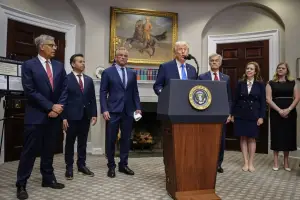
President Trump at the White House on Monday, Sept. 22, 2025, with Department of Health and Human Services leaders Robert F. Kennedy Jr. and Mehmet Oz standing next to him (New York Times Photo by Tierney L. Cross).
New York Times, Trump Administration Updates: President Promotes Unproven Ties to Autism With a Common Painkiller and Vaccines, Staff Reports, Sept. 23, 2025 (print ed.. Where Things Stand
The F.D.A.’s notice to physicians today about a possible link between acetaminophen use during pregnancy and autism is far more measured than the president’s remarks. It notes, accurately, that “a causal relationship has not been established” and that the matter is “an ongoing area of scientific debate.”
Trump defended cuts to Medicaid and the Children’s Health Insurance Program in his signature policy law, which he signed earlier this year. Trump said that a question pointing out those cuts was “nasty.” The law, is projected to cut Medicaid spending by more than $900 billion over the next decade and to push millions of people off the program. Trump just said the law was “one of the best things ever passed in the history.”
“The only thing we cut was for fraud, waste, and abuse, of which there was a lot in this country, and nobody minds that,” Trump said.
Arthur Caplan, the founding head of the division of medical ethics at N.Y.U. Grossman School of Medicine, wrote: “The announcement on autism was the saddest display of a lack of evidence, rumors, recyling old myths, lousy advice, outright lies and dangerous advice I have ever witnessed by anyone in authority in the world claiming to know anything about science.”
The drug maker GSK said in a statement just now that it would comply with the F.D.A.’s request to update the label on leucovorin as a treatment for autism symptoms in some children. The company said that it no longer manufactured the drug, which is a generic.
President Trump just boasted that he would lower drug prices, including for popular obesity drugs. In July, he set a deadline of Sept. 29 for drug makers to voluntarily lower some of their U.S. prices to align with what they charge in other wealthy countries. He has not proposed policy that would mandate lower prices.
New York Times, Harvard Dean Was Paid $150,000 as an Expert Witness in Tylenol Lawsuits, Rebecca Robbins and Azeen Ghorayshi, Sept. 23, 2025. The Trump administration has cited Dr. Andrea Baccarelli’s expertise to warn against using acetaminophen — the active ingredient in Tylenol — in pregnancy, based on an unproven autism link.
The dean of the Harvard T.H. Chan School of Public Health, who consulted with top Trump health officials ahead of Monday’s warning  about Tylenol and autism, was paid at least $150,000 to serve as an expert witness on behalf of plaintiffs in lawsuits against the maker of Tylenol.
Dr. Andrea Baccarelli, a leading epidemiologist, disclosed the figure in a court deposition he gave in the summer of 2023 that is publicly available in federal court filings and was reviewed by The New York Times. He had previously disclosed that he had served as an expert witness in the case but not how much money he had made.
A federal judge dismissed the suits for lack of reliable scientific evidence. The plaintiffs are appealing the decision.
President Trump and federal health officials claimed in a news conference on Monday that there was an established link between Tylenol use during pregnancy and autism. Trump administration officials have leaned heavily on Dr. Baccarelli’s research in pushing the idea, citing him in the news conference, posting on social media and championing him in a television interview as a highly credentialed expert backing the evidence for an autism-acetaminophen link.
Scientists have researched a potential link for years, but the studies so far have yielded inconclusive results, with some finding increased risk among pregnant women who took acetaminophen and some finding no connection between the drug and autism.
Dr. Baccarelli was the senior author on a recent scientific review that he conducted with collaborators at the Icahn School of Medicine at Mount Sinai and other universities. The study was cited during Monday’s White House press conference.
Dr. Baccarelli declined a request for an interview on Tuesday. A spokeswoman for Harvard’s public health school, Stephanie Simon, said that Dr. Baccarelli “confirmed that his testimony in the deposition was accurate and that his work on the case culminated in the deposition; he worked just a handful of additional hours following the deposition.”
Dr. Baccarelli said in a statement on Monday that he had discussed his team’s “scientific findings and this recommendation from our review article” with Health Secretary Robert F. Kennedy Jr. and the director of the National Institutes of Health, Dr. Jay Bhattacharya, in recent weeks. He said he appreciated “their interest in this study.”
The scientific review did not produce new data on birth outcomes but evaluated 46 existing studies that examined whether acetaminophen use during pregnancy was linked to a higher risk of neurodevelopmental disorders in children, including autism spectrum disorder and attention deficit hyperactivity disorder. The review concluded that there was an “association between exposure to acetaminophen during pregnancy” and the risk of neurodevelopmental disorders in children.Editors’ PicksWhat Fuels Revolution, Social Embarrassment and Public Acclaim? It’s Common Knowledge.Splurging? In This Economy? Here’s How to Do It Right.36 Hours in Zadar, Croatia
During the deposition, Dr. Baccarelli was asked how much he had been paid for his work on the lawsuits, which included preparing expert reports.
“I work for more than 200 hours, so it’s about $150,000,” Dr. Baccarelli said in the deposition. The all-day deposition was conducted at a Manhattan law firm on Aug. 14, 2023.
Meidas Health, Emergency Episode: Combating Trump’s Deadly Autism Lies, Brett Meiselas, Sept. 22-23, 2025.. In this special edition, Dr. Vin Gupta and I dismantle Trump’s Oval Office circus of lies about Tylenol, vaccines, and autism, and explain why the stakes for truth have never been higher.
When we launched Meidas Health a few months ago, this is exactly what we had in mind. We wanted a platform that could respond immediately when disinformation threatens public safety. And make no mistake, what Donald Trump, RFK Jr., and Dr. Oz did from the Oval Office this week wasn’t just accidental misinformation, but deliberate, malicious, disinformation. Reckless, and dangerous. Left unchallenged, it is the kind of lie that gets people killed.
Dr. Vin Gupta, who leads Meidas Health, joined me for this emergency episode to set the record straight and cut through the fog of propaganda with facts, science, and evidence-based medicine.
Let’s start with what Trump actually said. He stood in the Oval Office, surrounded by RFK Jr., Dr. Oz, and even the FDA commissioner, and told pregnant women not to take Tylenol. He couldn’t even pronounce the word acetaminophen, yet somehow felt qualified to declare it unsafe, despite having no evidence to support that claim. He claimed children shouldn’t receive vaccines like MMR (measles, mumps, rubella) together, insisted hepatitis B shots should be delayed until age 12, and nodded along as RFK Jr. declared he had never seen an elderly person with autism, as if that were meaningful science.
And then came the lies about the Amish, about Cuba, about autism being virtually nonexistent in those populations because they “don’t take vaccines.” This wasn’t just ignorance. It was a calculated performance of disinformation designed to confuse, scare, and undermine public trust in medicine.Subscribed
We’ve seen this Trump show before. During COVID, it was bleach injections and hydroxychloroquine. Now it’s Tylenol and childhood vaccines. The difference? Back then, his own advisors looked at him like he was insane. Today, he surrounds himself with professional sycophants nodding along, giving legitimacy to his gibberish.
Dr. Gupta broke it down with precision. Large-scale, gold-standard research has already answered these questions. A Swedish study of 2.5 million children over 25 years showed no link between Tylenol use in pregnancy and autism. That’s not speculation. It’s peer-reviewed data published in top medical journals and affirmed by the American College of Obstetricians and Gynecologists.
Meanwhile, untreated fever during pregnancy is dangerous. Uncontrolled pain during pregnancy is dangerous. Tylenol is the only over-the-counter medication approved to treat fevers in pregnancy. Denying that reality isn’t just irresponsible. It’s cruel. It’s telling women to grit their teeth and suffer, all in the service of Trump’s warped ego and RFK Jr.’s long-debunked crusade.
On vaccines, the science is equally clear. Childhood immunizations are safe, effective, and life-saving. Delaying or denying them doesn’t protect children—it exposes them to serious and preventable diseases.
As I told Dr. Gupta, what Trump is doing isn’t random. It fits his authoritarian playbook. Strongmen across history have pretended that they alone can solve complex problems without experts, without science, without evidence. Trump thrives on bending reality, doubling down on lies, and creating chaos until people don’t know what’s true anymore.
He doesn’t care if pregnant women suffer or if children die of preventable diseases. What he cares about is control over truth, over institutions, over people’s very bodies. It’s the same pathology we’ve seen in his cover-ups, in his “hoax” rhetoric, in his disdain for science and expertise.
The damage is already happening. Pediatricians and OB-GYNs across the country are fielding frantic questions from parents and expecting mothers who shouldn’t have to wonder whether it’s safe to give their child Tylenol for a fever. Doctors are already overburdened, yet Trump and his allies deliberately sow confusion that drives up fear, mistrust, and unnecessary strain on the health system.
This is real-world harm. And it falls hardest on women, children, and families without consistent access to care—the very people who most need clear, accurate guidance.
That’s why Meidas Health exists. When Trump and his lackeys pollute the public square with lies, we will always be here with rapid response, with medical experts, with truth. But this fight can’t just be left to doctors and journalists.
Trump Administration
New York Times, Trump Signs Order Targeting Antifa Movement, Chris Cameron, Sept. 23, 2025 (print ed.). President Trump signed an executive order on Monday targeting the left-wing antifascist movement, known as antifa, threatening “investigatory and prosecutorial action” against those who financially support it.
President Trump’s executive order threatened to prosecute donors who support antifascist philosophy and issued a domestic terrorism designation that doesn’t exist under U.S. law.
But Mr. Trump’s order said that he was declaring antifa a “domestic terrorist organization” — a designation that does not actually exist under U.S. law. Anti-fascism, like fascism itself, is a broad political ideology rather than a specific organization, and the U.S. does not have a domestic terrorism law.
The order came amid a wider intimidation campaign by the president and his administration targeting his critics, political opponents and major media institutions. Mr. Trump demanded over the weekend that the Justice Department move quickly to prosecute his political enemies, and his administration has undertaken a broad effort to threaten liberal protesters and donors to progressive groups after the killing of the conservative activist Charlie Kirk.
Antifa is a diffuse and sometimes violent protest culture of left-wing activists who want to stop the far right. The group takes its name and iconography from the antifascist movement that opposed the Nazi Party and other far-right political parties in the 1920s and 30s. Like their predecessors, the modern antifa movement is associated with an aggressive form of protest that sometimes crosses into illegal or violent activity like breaking store windows or setting police cars on fire.
Mr. Trump had threatened last week to designate antifa a terror group, after trying and failing to do so in his first administration after the group gained prominence in the Black Lives Matter protests of 2020.
Even though the language of Mr. Trump’s executive order echoes those he has aimed at foreign criminal organizations like Latin American drug cartels and gangs, it lacks the same teeth.
Federal law empowers the government to label overseas groups “foreign terrorist organizations,” a status that allows the U.S. to freeze their assets and makes it a crime to provide material support to them. But there is no equivalent domestic terrorism law, and legal experts downplayed the legal effect of Mr. Trump asserting his authority to label domestic groups as terrorists.
The antifa order does not attempt to use those powers, instead directing agencies to “investigate, disrupt, and dismantle any and all illegal operations” by the movement — something they already have the authority to do.
Even if a domestic terrorist organization designation did exist, using it against antifa would face practical difficulties.E
Antifa does not have a leader that could be targeted, a roster of known members, bank accounts to freeze or a centralized structure.
More Global News
New York Times, Middle East Crisis: World Leaders Recognize Palestinian State, in a Challenge to U.S. and Israel, Farnaz Fassihi, Thomas Fuller and Catherine Porter, Sept. 23, 2025 (print ed.). At a meeting ahead of the U.N. General Assembly, France and other U.S. allies made official a breach with Washington that has been years in the making.
Leaders from across the globe convened in New York on Monday to support Palestinian statehood, over opposition from Israel and the United States, as the Gaza Strip neared the two-year mark of a war that has brought mass death, destruction and hunger.
A summit meeting organized by France and Saudi Arabia ahead of the annual United Nations General Assembly in New York was portrayed as an urgent effort to salvage the long-deferred vision of a two-state solution to the Israeli-Palestinian conflict. But as Israel continues its offensive in Gaza City against Hamas, and rapidly expands its settlements in the West Bank, the notion seems more distant than ever.
“We must pave the way for peace,” President Emmanuel Macron of France said, to applause from those at the meeting and a standing ovation from the Palestinian delegation. “Today, France recognizes the state of Palestine.” He noted recent statements of recognition, some not yet formalized, by Britain, Canada, Australia, Portugal, Belgium and several others.
The Israeli ambassador to the United Nations, Danny Danon, told reporters, “We will take action” in response to the announcements. He declined to say if that would mean, as some Israeli officials have suggested, expanded settlements or outright annexations in the territory that has been envisioned as a Palestinian state. Israel’s response, he said, would be announced by Prime Minister Benjamin Netanyahu, who will address the United Nations gathering and meet this week with President Trump.
Mr. Netanyahu said in a statement on Sunday, “A Palestinian state will not be established west of the Jordan River.”
Mr. Trump “disagrees” with the recognition, the White House press secretary, Karoline Leavitt, said on Monday, and “believes it is a reward to Hamas,” whose Oct. 7, 2023, assault on Israel touched off the war in Gaza, which has killed more than 60,000 people.ImagePresident Mahmoud Abbas, sitting between two Palestinian flags, speaking on a desktop video screen in the General Assembly hall.The United States denied a visa for Mahmoud Abbas, leader of the Palestinian Authority, to attend the events in New York, so he addressed the meeting on Monday by video.Credit...Dave Sanders for The New York Times
Mr. Macron, in his remarks, denounced that attack, in which Hamas killed about 1,200 people and took about 250 hostages.
Mr. Trump “feels this does not do anything to release the hostages, which is the primary goal right now in Gaza,” Ms. Leavitt told reporters at the White House. “It does nothing to end this conflict and bring this war to a close.”
Mahmoud Abbas, leader of the Palestinian Authority, said the authority would form the government of the West Bank and Gaza, with no role for Hamas. The United States denied a visa for Mr. Abbas to attend the events in New York, so he addressed the meeting on Monday by video.
Addressing the people of Israel, he said: “Our future and yours depends on peace. Enough war.”
World leaders have a number of other major issues on their plate, as well. President Volodymyr Zelensky of Ukraine on Monday urged those gathering for the General Assembly to place “real, powerful pressure on Russia” to end the war it began against his country more than three years ago.
Leaders will also gather for a climate summit on Wednesday and discuss “accountable” governance of artificial intelligence.
Momentum for Palestinian statehood has grown as the conditions in Gaza have become ever more desperate. Around 10 countries either recognized Palestine formally as a state over the weekend or were expected to do so this week.
Lev Remembers, Commentary, Putin Threatens Nukes, Europe Shuts Down, Lev Parnas, right, Sept. 23, 2025. While Americans are fighting to hold onto democracy at home, Ukraine is still fighting for survival under relentless Russian missile and drone strikes — Odesa, Zaporizhzhia, and cities across the country hit again last night.
At the same time, Ukraine is striking back, reaching deep into Russian territory and occupied Crimea with precision drone and missile attacks that are rattling Moscow itself. And in the middle of this, Putin is once again playing his most dangerous card: nuclear blackmail, space-based threats, and escalating tension across Europe.
At a meeting with his Security Council, Putin returned to his old playbook: nuclear blackmail. He warned the West that Russia would not answer threats with words but with “military-technical measures,” lifting the self-imposed moratorium on deploying intermediate-range missiles.Subscribed
He accused the U.S. of killing arms control dialogue, all while claiming Russia won’t withdraw from New START — but only so long as it suits him. After February 5, 2026, he says, Moscow will “decide whether to maintain these voluntary self-restraints.” In other words, the leash is off, and the world is on notice.
Then came his warning about Trump’s so-called “Golden Dome” project — a plan to launch space-based weapons under the cover of missile defense. Putin knows what it means if America militarizes space: his strategic leverage vanishes. That’s why he threatened “appropriate responses,” reminding the world that Russia views satellites not as tools of defense, but as potential targets.
And while the world is watching drones explode in Ukraine, what’s not being talked about enough is how Ukraine is pushing the fight back across the border. Ukrainian drones and missiles are hitting airfields, oil depots, and military targets in occupied Crimea and inside Russia itself. These are deliberate strikes to cut supply lines, weaken Russia’s war machine, and show that Putin’s territory is no longer untouchable.
Even as Odesa buries its dead after another night of terror, Ukraine is making sure the Kremlin feels the costs of its invasion — not just in Donbas, but in Moscow’s own backyard.
As Putin blustered about nuclear treaties and space weapons, the war he started was knocking on his own door. Overnight, explosions rattled Moscow as drones penetrated deep into the capital. Sobyanin, the Kremlin’s loyal mayor, admitted nine drones were shot down across districts like Chertanovo, Solntsevo, and Southern Butovo.
Sheremetyevo Airport — Russia’s busiest — was forced to shut down, with flights diverted or frozen midair. Residents described the terror of a cargo plane roaring low over their homes as it tried to avoid the chaos. This is Putin’s war coming home to roost.
And the scariest part — the part the media still refuses to say out loud — is Putin’s constant push against NATO itself. This isn’t just about Ukraine anymore. Every drone, every missile, every airspace violation is a test of the alliance, a way to probe defenses and measure the West’s resolve. Because while across Europe last night panic spread like wildfire,
Copenhagen Airport was shut down after sightings of 2–4 massive drones. At least 50 flights canceled, 50 more diverted. The Danish capital paralyzed in minutes.
Norway scrambled jets as drones buzzed Oslo — including the Ministry of Defense itself.
Cyberattack on Collins Aerospace crippled check-in systems from London to Berlin. Staff scrambled to process passengers by hand as flights piled up on the tarmac .Poland’s PM Donald Tusk issued the strongest warning yet: “If another Russian missile or plane enters our airspace and is shot down, don’t complain — you’ve been warned.”
This is not just about drones. It’s about the hybrid war being waged across land, air, cyberspace, and politics — with Europe as the testing ground.
This is the world Putin and Trump are shaping — chaos as strategy, fear as leverage, distraction as power. While Putin rattles the nuclear saber and calls out Trump’s “Golden Dome,” drones are striking Ukraine, airports across Europe are shutting down, and cyberattacks are testing NATO’s response times.
The message to us is simple: they want us divided, distracted, and demoralized. But I’ve been in those rooms, I’ve carried Trump’s messages, and I know how this game is played. They count on silence. They count on fear.
I’m not just bringing you the news. I’m risking everything to bring you the truth — the truth that mainstream media still tiptoes around, and the truth Trump and Putin don’t want you to know.
Media, Education, Culture Wars, Religion

 Sixty-three of ABC's affiliate stations are owned by Sinclair Broadcasting and Nexstar Media, two companies that announced they would drop Jimmy Kimmel's because of his words about Christian nationalist provocateur Charlie Kirk (New York Times chart). Below that is a chart compiled by the Wayne Madsen Report advocating boycotts of the stations, which include WJLA, the ABC-affiliate in Washington, DC.
New York Times, Jimmy Kimmel’s Show to Return to ABC on Tuesday Night, John Koblin, Brooks Barnes, Michael M. Grynbaum and Benjamin Mullin, Sept. 23, 2025 (print ed.). The network’s removal of Mr. Kimmel’s show last week almost immediately morphed into a flashpoint for free speech in America.
Jimmy Kimmel is coming back.
ABC said on Monday that “Jimmy Kimmel Live!” would return to its airwaves on Tuesday, ending an impasse that began last week.
“Last Wednesday, we made the decision to suspend production on the show to avoid further inflaming a tense situation at an emotional moment for our country,” the Walt Disney Company, which owns ABC, said in a statement.
“It is a decision we made because we felt some of the comments were ill-timed and thus insensitive,” the statement said. “We have spent the last days having thoughtful conversations with Jimmy, and after those conversations, we reached the decision to return the show on Tuesday.”
Disney did not say whether all ABC affiliates, some of which balked at carrying “Jimmy Kimmel Live!” last week, would carry Tuesday’s show.
The network had removed Mr. Kimmel “indefinitely” last week after a top Trump regulator and many conservatives said he inaccurately described the politics of the man accused of fatally shooting the right-wing activist Charlie Kirk.
The subsequent suspension of “Jimmy Kimmel Live!” almost immediately morphed into a flashpoint for free speech in America.
ABC pulled the show just hours after Brendan Carr, the chairman of the Federal Communications Commission, said on a podcast that Mr. Kimmel’s remarks were part of a “concerted effort to lie to the American people,” and that the agency was “going to have remedies that we can look at.”
“Frankly, when you see stuff like this — I mean, we can do this the easy way or the hard way,” Mr. Carr told the podcast’s host, Benny Johnson.
 Politico, Judge orders Trump administration to restore more than $500 million in research funds to UCLA, Mario Tama, Sept. 23, 2025 (print ed.). The decision marked a major win for the beleaguered UC system, which is facing a $1 billion demand to restore the funding.A person walks on the UCLA campus.
A federal judge on Monday ordered the Trump administration to restart the flow of about $500 million in funding for scientific research it withheld from the University of California, Los Angeles, sparing the university for now from a devastating fiscal blow.
While only temporary, the ruling issued by U.S. District Judge Rita F. Lin in San Francisco was a significant victory for UCLA and the rest of the sprawling UC system, which has been caught up in a campaign by federal officials to punish high profile universities for what President Donald Trump and other conservatives allege was their overly permissive response to student protests over Israel’s war in Gaza and failure to address antisemitism on their campuses.
In the withholding of research funds, the administration found a potent source of leverage to extract concessions from schools. Columbia University, the first major school to land in Trump’s crosshairs, ultimately agreed to pay the government $200 million and make a series of reforms to get back $400 million in research grants that the government withheld over claims the school violated the civil rights of Jewish students and faculty. Other schools also reached agreements, while Harvard University remains locked in negotiations over $2 billion in funding.
The Trump administration eventually turned its attention west to California’s elite network of 10 UC campuses, which enroll 300,000 students and employ leading researchers in a wide array of scientific areas. The administration launched investigations into UC Berkeley over claims of antisemitism on campus and a Republican-led congressional education committee began probing alleged antisemitism at UCSF and UCLA. In late July, it slashed over $580 million in research grants from UCLA, alleging Jewish students and faculty had been subjected to abuse and discrimination during pro-Palestinian protests. It also accused the school of improperly considering race when deciding on which students to admit.
Justice Department officials followed up with a set of demands: UCLA would have to pay $1 billion and make changes to the admissions process and other policies in exchange for the return of the research money.
The university has not agreed to the settlement proposal and the Board of Regents, which oversees the UC system, is continuing to discuss how best to navigate the situation behind closed doors.
The UCLA funds were wrapped into a lawsuit a group of researchers from multiple UC campuses filed challenging the Trump administration’s weaponization of research funds. The lawsuit contends that the grant terminations were unconstitutional because they were cut “without proper review or clear explanation.” Lin issued a preliminary injunction in June temporarily restoring funding cuts from three government agencies, which the plaintiffs later sought to expand to cover the frozen UCLA grants.
Lin, a judge in the Northern District Court of California, said in her ruling Monday that the indefinite suspensions of NIH grants were “likely arbitrary and capricious” and in violation of the Administrative Procedure Act, a federal law that lays out how administrative agencies must operate.
Oligarch Watch via Popular Information, Accountability Journalism: Billionaire surveillance enthusiast set to acquire TikTok's US operations, Judd Legum, right, and Noel Sims, Last January, we launched the newsletter as Musk Watch. In just a few months, we broke major stories on Musk associates accessing the private data of federal employees, Meta removing advertising critical of Musk, DOGE personnel putting Social Security benefits at risk, and Neuralink falsifying federal filings to claim eligibility for a racial diversity program.
We are proud of the work of Musk Watch. But we also came to the conclusion that we must expand our ambitions. Musk, the world's wealthiest person, is part of a cadre of ultra-rich men who wield enormous influence over politics, the media, and the economy.
I wanted to share today’s piece, which gives you a sense of the reporting you can expect under the Oligarch Watch banner.
We live in an era defined by an extreme concentration of wealth and power. If you haven’t already, check out more of our work on the world’s most powerful people by subscribing to Oligarch Watch.
Subscribe to Oligarch WatchBillionaire surveillance enthusiast set to acquire TikTok's US operationsCaleb EcarmaSep 23 READ IN APP Oracle co-founder Larry Ellison, accompanied by President Trump in the White House on January 21, 2025. (Photo by Andrew Harnik/Getty Images)
In the near future, Larry Ellison, an 81-year-old tech oligarch, could be in control of one of the world's most powerful media empires.
In August, Skydance Media, a firm funded by Ellison and led by his son David, completed an $8 billion merger with Paramount Global, the parent company of CBS. The Ellisons' media ambitions have only grown since then. Earlier this month, The Wall Street Journal reported that the company now known as Paramount Skydance was preparing a bid to acquire Warner Bros. Discovery, which owns CNN, HBO, and a range of other brands.
Apart from traditional media and streaming, the elder Ellison also has eyes set on TikTok, the massive social media app owned by a company based in China. Last week, Donald Trump announced that Ellison would be among the group of American billionaires allowed to acquire TikTok's domestic operations to prevent the app from being banned in the U.S. "You know, they're very well-known people," Trump said in a Fox News interview on Sunday while discussing who would be involved in a TikTok deal. "And Larry Ellison is one of them. He’s involved. He’s a great guy."
Ellison is less known than some of his younger Silicon Valley peers, like Mark Zuckerberg and Elon Musk. However, his net worth has skyrocketed amid the artificial intelligence boom. The vast majority of his riches come from his 40% stake in Oracle, the database software and cloud computing firm he cofounded in 1977 and has helped lead since. Earlier this month, a surge in Oracle's stock lifted Ellison's wealth past Musk, temporarily making him the wealthiest person in the world with a net worth of $383.2 billion.
Ellison has spent much of this century indulging in his riches, including spending an estimated $875 million on a sailing match racing team, $200 million on a California estate, and $300 million to acquire 98% of the sixth-largest island in Hawaii.
But Ellison has larger ambitions, among them the belief that humanity would greatly benefit from a surveillance society governed by an all-seeing system of artificial intelligence. "Citizens will be on their best behavior because we're constantly recording and reporting everything that is going on," he said during a question-and-answer session with Oracle investors last year. "It’s unimpeachable."
Ellison's enthusiasm for AI is self-serving. A society oriented around centralized databases and immense computing demands would mean more work for Oracle. But Ellison has framed that vision as altruistic. "I think this will make for a happier citizenry," he said in February, referring to the creation of a single massive database that an AI system could easily scan.
Ellison has a lengthy history of advocating for government surveillance. During a 2014 speech, he criticized NSA whistleblower Edward Snowden, suggesting that no one had been "wrongly injured" by the agency's domestic spying operations. "By sharing your personal data, there are enormous benefits both to you individually and to the society as a whole," he added at the time. (His interest in databases stems from the early years of his tech career, when he worked on a CIA database project codenamed "Oracle" — which inspired the name of the company Ellison later founded.)
As for Ellison's effort to acquire vast media holdings, his carefully managed relationship with Trump has proven beneficial. Ellison for years has supported Republicans, although he often backed what he described as "centrist" politicians like Mitt Romney in 2012 and Marco Rubio in 2016. He did not hold a fundraiser for Trump until early 2020, which resulted in some Oracle employees staging a walkout. Ellison remained equivocal. "I said President Trump could use the property. I was not here," he said in April 2020, referring to Trump's use of his Rancho Mirage, California, retreat to hold the fundraiser. "We only have one president at a time," he added. "I don't think he's the devil — I support him and want him to do well."
Still, his standing with the then-first-term president was sufficient enough for Trump to greenlight Ellison taking part in a deal to buy TikTok's U.S. operations. That deal, which also involved Walmart, fell through. But ByteDance, TikTok's Chinese owner, attempted to quiet scrutiny in Washington by signing an agreement in the fall of 2020 to host the data of American TikTok users on Oracle servers.
Now, five years later, Ellison has been included in the proposed consortium to purchase 80% of TikTok's U.S. operations, as required by a law passed by Congress and signed by Joe Biden last year. According to Trump, Fox Corp. chief executive Lachlan Murdoch will also be involved in the consortium, along with Michael Dell, the chief executive of Dell Technologies, and the pro-Trump venture capital firm Andreessen Horowitz.
The deal has been months in the making. In January, shortly after Trump began his second term, the president named Ellison as one of his preferred TikTok buyers. "I'd like Larry to buy it," Trump said, nodding at Ellison, who was visiting the White House with OpenAI's Sam Altman to promote a $500 billion project to build AI infrastructure in the U.S. that has yet to materialize.
As part of his role in spinning off TikTok's U.S. operations, Ellison will gain access to a massive trove of data delineating the political views, consumption habits, and social connections of tens of millions of Americans who use the app. "[TikTok's] data and privacy will be led by one of America's greatest tech companies, Oracle," White House press secretary Karoline Leavitt told Fox News over the weekend. "And the algorithm will also be controlled by America as well."
Ellison has already played a role in the conservative overhaul of one social media platform. In 2022, he invested $1 billion in Musk's purchase of Twitter, simply because he thought the takeover "would be lots of fun." Twitter, now X, has since become a sump of right-wing propaganda and Musk's personal megaphone.
There have been snags in Ellison's insatiable quest for data. In 2022, Oracle agreed to settle a class action lawsuit accusing the company of secretly assembling "digital dossiers" on millions of people and selling them to third parties. Oracle denied wrongdoing but agreed to a $115 million negotiated settlement last year.
The Contrarian, Words & Phrases We Can Do Without: ‘Liberal Hollywood’? Jennifer Rubin, right, Sept. 23, 2025. More like ‘Craven Entertainment Corporations.’
The myth that Hollywood is a bastion of leftism dies hard. Contrary to the right-wing cliché, a social, political, and economic dichotomy has existed for years. Regardless of the leanings of the creative community, large companies are inherently conservative and all too eager to enable oppressive government.
Sure, the “talent” (writers, directors, composers, actors) is overwhelmingly Democratic—but the mega-media entities (studios, streaming services, distributors, networks) have always acted like every other corporate interest. (Even the actors ranks have been filled with Republicans for decades.) Moreover, the entertainment corporations historically have been sheepishly compliant, willing to defer to authoritarian power even if it means compromising creative independence and First Amendment freedoms.
Back in 2003, Tim Rutten wrote about the decidedly anti-progressive bent in corporate media, describing the late Jack Valenti—a former LBJ advisor who ruled supreme for decades as the industry’s cheap lobbyist—as “Hollywood’s sonorous paladin of unshakable centrism.”
Rutten also recounted the aversion to progressivism dating back in 1934 when socialist Upton Sinclair won California’s gubernatorial nomination. Hollywood executives not only raised money (docking employees’ pay) to defeat him, but smeared him by putting out “dozens of phony newsreels, subsequently distributed free to theaters up and down the state, in which seedy, suspicious looking immigrants with vaguely Russian accents endorsed the Sinclair program.” Yikes.
In the 1930s, Hollywood moguls wound up altering or even canceling films so as not to offend Hitler (!) and retain their German market. Without the complicity of studios, Sen. Eugene McCarthy (R-Wis.) would not have been able to harass, blacklist, and even lock up actors and writers accused of being “communists.”
As Hollywood studios have transformed into multi-armed conglomerates that regularly must seek approvals from the federal government for everything from mergers to broadcast licenses (and at the state and local level, for tax breaks, labor legislation, etc.), they have become politically indistinguishable from other corporate behemoths. They snuggle up to whomever is in power.
No one should be stunned, therefore, that ABC/Disney and CBS/Paramount caved when confronted with authoritarian bullying and extortion. The Democratic appointed FCC commissioner sounded off this summer when Paramount/CBS settled the ludicrous 60 Minutes lawsuit so as to close its merger with Skydance Media. “After months of cowardly capitulation to this Administration, Paramount finally got what it wanted. Unfortunately, it is the American public who will ultimately pay the price for its actions,” commissioner Anna M. Gomez said.
It has become so cringeworthy that even former Disney CEO Michael Eisner has piped up:
Where has all the leadership gone? If not for university presidents, law firm managing partners, and corporate chief executives standing up against bullies, who then will step up for the first amendment? The “suspending indefinitely” of Jimmy Kimmel immediately after the Chairman of the FCC's aggressive yet hollow threatening of the Disney Company is yet another example of out-of-control intimidation. Maybe the Constitution should have said, “Congress shall make no law abridging the freedom of speech, or of the press, except in one’s political or financial self-interest.”
(By-the-way, for the record, this ex-CEO finds Jimmy Kimmel very talented and funny.)
Fortunately, just as labor unions around the country have stood on the front lines in the fight to defend democracy, the Hollywood guilds/unions representing actors, directors, musicians, and below-the-line craftspeople and technicians have not adopted corporations cowering posture. In response to the Jimmy Kimmel suspension, four unions jointly put out a blistering statement, which took the corporate leaders to task.
“When a private citizen, business, or television network bows to government intimidation, it strikes at the heart of our First Amendment rights,” the unions declared. “[M]edia companies have a responsibility to defend their workers and the integrity of the stories they tell. All broadcasters must stand firm in defense of free expression and the First Amendment, not capitulate to a policy of political appeasement.” The Writers Guild put out an equally powerful statement, which included this: “Shame on those in government who forget this founding truth. As for our employers, our words have made you rich. Silencing us impoverishes the whole world.”
Ultimately, Disney was forced to cave when the financial and reputational damage in suspending Kimmel proved too much. So let’s do away with the noxious phrase “liberal Hollywood,” an intended slur from the right that has never matched reality. In fact, for all their liberal “principles,” industry leaders—just like many universities and law firms—have gone along with authoritarian commands to get along with the Trump regime. Better to acknowledge that Hollywood, like Wall Street, is run by weak-kneed corporations all too eager to cut deals with autocrats.
No matter what the politics of actors, writers, and the rest of the talent pool, the entities that give them a platform are sadly part of the collapse of civil society. Fortunately, creative players can find ways to get in their licks on corporate media platforms. They also now can make their way to new outlets, some of which are not as dependent on government largess. Increasingly, artists—like journalists—may find that practicing their craft and maintaining First Amendment freedom require they leave and even boycott the most cowardly corporations.
Unless and until entertainment corporations feel countervailing financial pressure at least as powerful as what Trump applies—from consumers, viewers, subscribers, cruise and theme park visitors, advertisers, litigants, and the general public—this will not change anytime soon. (Keep watching this space; we’ll keep seeking to inform our readers about actions you can take.)
Once again, we’re reminded that elite entities won’t save us; it’s up to Americans working collectively to save our democracy.
U.S. Law, Crime, Courts
New York Times, Man Found Guilty of Trying to Assassinate Trump in Florida, David C. Adams and Patricia Mazzei, Sept. 23, 2025. A federal jury convicted Ryan Routh, an itinerant building contractor, of attempting to assassinate a major presidential candidate last September.
A man who plotted to kill President Trump last year and staked him out at one of his Florida golf courses with a semiautomatic rifle was found guilty on Tuesday of attempting to assassinate a major presidential candidate, a charge that carries a maximum penalty of life in prison.
Ryan W. Routh, 59, an itinerant building contractor from North Carolina, was also found guilty of assaulting a federal officer and several firearm violations. The 12-member jury deliberated for about two and a half hours, following a fast-moving trial in which Mr. Routh chose to defend himself without a lawyer.
After the verdict was read in court, Mr. Routh appeared to try to stab himself in the neck several times with a pen. Several United States marshals restrained him and removed him from the courtroom. He returned a few minutes later, shackled and escorted by marshals. His necktie and jacket had been removed.
As he was being led out, Mr. Routh’s daughter, Sara Routh, one of several relatives present, started screaming. She yelled vulgarities and told her father that she loved him and would fight to get him out of prison.
Ms. Routh declined to comment after court adjourned.
On Sept. 15, 2024, Mr. Routh pointed his rifle, with its serial number scratched off, at a Secret Service agent who spotted him in the shrubbery at the Trump International Golf Club West Palm Beach. The agent fired at him, and Mr. Routh fled without firing any shots of his own. The police stopped him about 45 minutes later, driving north on Interstate 95.
“Make no mistake: The defendant was going to kill Donald Trump,” Christopher B. Browne, one of the federal prosecutors, said during his closing argument. “The defendant was just one bullet away.”
It was the second assassination attempt against Mr. Trump last year, when he was running for a new term in office.
Opening statements in the trial took place the day after the influential right-wing activist Charlie Kirk was fatally shot, adding to a national surge in political violence.
Attorney General Pam Bondi said in a statement after the verdict that Mr. Routh’s conviction illustrated the Justice Department’s “commitment to punishing those who engage in political violence.”
“This attempted assassination was not only an attack on our president, but an affront to our very nation itself,” she said.
Mr. Routh is scheduled to be sentenced on Dec. 18.
The rare trial of a would-be presidential assassin was made more unusual because Mr. Routh chose to represent himself without a lawyer. His decision made the trial a lopsided one from the start, when Judge Aileen M. Cannon cut off Mr. Routh’s opening statement for lack of relevance. Mr. Routh’s brief cross-examinations of prosecution witnesses and the small number of defense witnesses he called made the trial much shorter than expected, lasting just 12 days.
Judge Cannon presided in 2023 over a federal prosecution of Mr. Trump involving the mishandling of classified documents, a case she dismissed last summer.
After Mr. Routh’s arrest last year, public records and interviews with people who knew him suggested that he had become increasingly concerned over the war in Ukraine and saw himself as an influential participant in world events. Earlier this year, he told the judge that he did not trust two court-appointed federal public defenders to represent him. Even so, they were kept on standby during the trial.
At one point on Monday, when the judge tried to explain certain rules of evidence, Mr. Routh responded, “I have no clue what that means.”
He offered little in the way of a defense and did not testify himself. He called three witnesses, a firearms expert and two character witnesses, all of whom testified on Monday morning, after seven days of prosecution testimony.
He told jurors during his closing argument on Tuesday that prosecutors had not proven “any intent” to kill.
All Rise, Homan’s $50K scandal: Ex-FBI agent on what Congress should demand, Adam Klasfeld and Frank Figliuzzi, Sept. 23, 2025. Ex-FBI Assistant Director Frank Figliuzzi offers insights for demanding info related to Homan's bribery probe.
In the wake of bombshell reporting that Donald Trump’s border czar Tom Homan received $50,000 in a paper bag from undercover FBI agents — who were posing as businessmen seeking government contracts — Democratic members of the Senate Judiciary Committee have launched an inquiry demanding answers.
“Such allegations of high-level corruption and cover-up demand your close cooperation with congressional oversight and transparency to restore public trust, including the public release of key evidence,” the Committee’s minority members wrote in a letter to Trump’s Attorney General Pam Bondi and Deputy Attorney General Todd Blanche, demanding the release of the “full investigative file” in Homan’s case. Ex-FBI assistant director Frank Figliuzzi, who helped lead counterintelligence operations during his tenure at the Bureau, explained in a video interview what information lawmakers and the public should be demanding.
“We need hearings,” Figliuzzi said, adding that Trump’s Justice Department left themselves open to scrutiny by closing the investigation.
“Now that it's closed, they can't come out and say, ‘Hey, this is a sensitive, ongoing undercover operation. We can't talk about it,’” Figliuzzi noted. “Au contraire, you closed it.”
First and foremost, lawmakers and watchdog groups have been demanding the release of the surreptitiously recorded tape that reportedly captures Homan taking the money.
Figliuzzi says that the undercover agents could be fair game for congressional testimony.
“You could put them in behind closed doors in Congress so they're not exposed,” he said.
On Sept. 20, MSNBC reporters Carol Leonig and Ken Dilanian broke the story in a deeply sourced investigation citing confidential sources and internal documents, and The New York Times later confirmed the substance of that reporting, adding new details about the underlying investigation.
Both stories reported that the undercover operation on Homan sprang out of a separate investigation, but the Times reported that the other probe was a counterintelligence investigation.
Unpacking the significance of that detail, Figliuzzi said: “Counterintelligence is identifying and defeating the efforts of foreign intelligence services operating against U.S. interests for the FBI, particularly inside the United States.”
White House Press Secretary Karoline Leavitt denied that Homan accepted the $50,000 from the undercover agents, but Homan made no such denial when asked about the reporting by Fox cable host Laura Ingraham. Homan only insisted that he did nothing criminal or illegal.
If Homan accepted the money, Figliuzzi noted that would be taxable income, which could be another avenue for congressional investigation.
“Sadly, with Trump, it's really hard to get tax information, particularly out of Trump's IRS — but the question needs to be asked,” Figliuzzi said. “And the most likely venue for that happening would indeed be congressional hearings.”
Watch the full interview at the top of this article for an ex-FBI leader’s insights into the reporting about Homan and ideas for how the public can respond to it.
New York Times, Trump Administration Live Updates: Democrats Open Inquiries Into Handling of Homan Investigation, Staff Reports, Sept. 23, 2025. Democrats said in a statement that Congress must investigate Tom Homan’s actions and his influence on government spending. Where Things Stand:
House and Senate Democrats have opened separate investigations into the Trump administration’s decision to close a criminal F.B.I. inquiry into Tom Homan, Mr. Trump’s border czar, that began after he was recorded last year accepting a bag with $50,000 in cash.
Mr. Homan’s encounter with undercover F.B.I. agents in September 2024 was recorded on audiotape and led him to be investigated for potential bribery and other crimes. On the tape, he agreed to help the agents, who were posing as businessmen, get government contracts related to border security, according to people familiar with the case.
Senior officials expressed skepticism about the case as early as February, and the Justice Department closed the investigation this year.
In a letter on Monday, Democrats on the House Judiciary Committee demanded that Attorney General Pam Bondi and Kash Patel, the F.B.I. director, provide “all recordings from Mr. Homan’s meeting,” all of their investigative material and any communications between the White House and their agencies over the case.
“Your reported effort to shut down this investigation appears to be a brazen cover-up to protect Donald Trump’s allies, at a time when the D.O.J. and F.B.I. are also being ordered to aggressively pursue prosecution of Donald Trump’s political enemies,” the Democrats wrote in the letter, which was led by Representative Jamie Raskin of Maryland, the top Democrat on the committee.
Egberto Off The Record, Commentary: Epstein's Ghislaine Maxwell visited by Indivisible Kingwood protest at her Bryan, TX prison, Egberto Willies, right,  and Cynthia Hendrickson, Sept. 23, 2025. Amidst growing authoritarianism, local heroes in Texas demonstrate that resistancebegins with ordinary citizens taking action. They recently visited Epstein's Ghislaine Maxwell country club prison.Egberto Willies aSep 23 READ IN APP
 Cindi Hendrickson, founder of Indivisible Kingwood, is leading a powerful grassroots movement in one of Texas's reddest districts. Through persistent weekly protests, her group—primarily women, many of whom are retired—has grown from a handful of activists into a force that has mobilized hundreds.
Despite intimidation, including armed threats, these activists remain committed to fighting authoritarianism and inspiring others to rise. Their work demonstrates how local activism can ripple outward, showing Americans that collective action is both possible and necessary.
Indivisible Kingwood’s journey shows that democracy thrives when everyday people take ownership of it. In the face of growing authoritarian tendencies and a corporate media that often ignores grassroots voices, Cindi Hendrickson and her group remind us that resistance begins at home. Their story is a rallying cry for progressives everywhere: organize, engage, and never let fear silence the fight for justice.
Russian Influencers
 The New Republic, Woman Who Accused Joe Biden of Sexual Assault Defects to Russia, Ellie Quinlan Houghtaling, Sept. 23, 2025. Tara Reade, who accused Joe Biden of sexual assault, has left the building.
The former Senate aide who accused Joe Biden of sexual assault has just received Russian citizenship.
Tara Reade blew up national headlines in 2019 when she condemned the culture of Biden’s Senate office and further accused Biden of inappropriately touching her while she worked on his staff in 1993. Numerous major U.S. media outlets reported Reade’s story but backtracked once discrepancies and inconsistencies in her narrative began to appear.
After Biden was nominated as the official Democratic candidate in the 2020 election, Reade’s story shifted into one of sexual assault. She accused Biden of pushing her against a wall, putting his hands under her clothes, and penetrating her with his fingers. Biden vehemently denied the allegations, and former Senate office staff members did not recall or corroborate Reade’s account.
Some of Reade’s other accusations also lacked credibility: Reade claimed she was fired for retaliation, but a PBS investigation that interviewed more than 70 former Biden staffers found that wasn’t the case. Instead, her colleagues recalled that she was fired for poor performance.
Some of Reade’s fiercest critics speculated that she was a Russian asset, in part fueled by since-deleted Medium posts and tweets in which she publicly praised Russian President Vladimir Putin. Five years on, that theory has earned a bit more credibility.
“This was a very special day,” Reade posted on X Monday, resharing a clip of her on RT, a Russian state-controlled television station. “I am now a Russian citizen! What an honor. Thank you to President Putin for this amazing honor of signing a decree making me a citizen and keeping me safe when I applied for asylum.”
Reade also gave a pointed shout-out to Maria Butina, a Russian parliamentarian and self-admitted Kremlin agent who was convicted in 2018 for conspiring to act as a clandestine foreign agent on behalf of Russia in the 2016 U.S. election. Butina leveraged her ties at the National Rifle Association, including her boyfriend—longtime Republican fundraiser Paul Erickson—to develop back channels between Moscow and Donald Trump’s 2016 presidential campaign. Butina first attempted to get face time with Trump as early as July 2015.
Reade first announced her intention to defect to Russia in 2023, when she claimed she no longer felt safe in the United States. Around the same time, Moscow had announced its intention to build a migrant village for American conservatives to take refuge from “liberal gender norms.” However, the project has since collapsed due to low demand, Russian outlet Vot Tak reported in July.
“I am a lucky girl,” Reade concluded.
Sept. 22
Meidas Touch Network, Commentary on Today in Politics, Bulletin 212, Ron Filipkowski, right, Sept. 22, 2025. Trump and RFK Jr gave a batshit crazy press conference on autism where we heard a bunch of novel scientific theories. I think it raised my blood pressure to levels not reachedsince the 2020 covid briefings that led to me switch political parties to escape the Republican insane asylum. Here were some of the “highlights”:
Trump: “Bobby wants to be very careful with what he says. I’m not so careful with what I say. Certain groups, the Amish, as an example - they have essentially no autism.”
Trump: “There's a rumor and I don't know if it's so or not—that Cuba, they don't have Tylenol because they don't have the money for Tylenol, and they have virtually no autism.”
Trump: "Asceda -- well, let's see how we say that. Ascenem -- enophin. Acetaminophen. Is that okay?"
Trump: "Taking Tylenol is, uh, not good. I'll say it. It's not good."
Trump: "If you can't tough it out, if you can't do it, that's what you're gonna have to do. You'll take a Tylenol, but it'll be very sparingly. I think you shouldn't take it."
Trump: “I can say that there are certain groups of people that don't take vaccines and don't take any pills that have no autism. Is that a correct statement, by the way?
 RFK JR, left: There are some studies.”
Trump: "I think it has - I think it's very bad. They're pumping, it looks like they're pumping into a horse. You have a little child, a little fragile child, and you get a vat of 80 different vaccines, I guess. 80 different blends. And they pump it in. So ideally, a woman won't take Tylenol."
Trump: “With Tylenol, don't take it. Don't take it. And if you can't live, if your fever is so bad, you have to take one because there's no alternative to that, sadly. First question, what can you take instead? Actually, there's not an alternative to that. As you know, other of the medicines have been proven bad with the aspirins and Advils and others, right?”
Trump: “We want no mercury in the vaccine. We want no aluminum any in the vaccine. The M.M.R. I think should be taken separately. This is based on what I feel. separately. It seems to be that when you mix them, there could with a problem.”
Trump: “For boys it's 1 in 12. I was told that's in California where we have they have a, for some reason, a more severe problem.”
RFK Jr: "Some of our friends like to say that we should believe all women. But some of these people have been silencing and demonizing these mothers for three decades. Because research on the potential link between autism and vaccines has been actively suppressed in the past.”
… I have every confidence based on countless prior examples that network and local news will be able to produce segments that make Trump’s batshit crazy presser with RFK Jr appear entirely sane and rational.
… Karoline Leavitt said Tom Homan is not guilty of bribery: “Homan never took the $50,000 so you should get your facts straight. This was another example of the weaponization of the Biden DOJ against one of President Trump’s strongest and most vocal supporters. You had FBI agents going undercover to try and entrap one of the president's top allies. Homan did absolutely nothing wrong. Even Kash Patel and prosecutors looked into this and they found zero evidence of criminal activity.”
… WaPo’s Carol Leonnig immediately responded: “WH spokesperson says that Homan never took $50,000. We reviewed internal document saying Homan accepted the cash payment from undercover FBI agents in September 2024.”
… MSNBC’s Ken Dilanian: “The WH is now saying Homan didn't take the $50,000 in cash. That was not part of their statement when we first went to them on Sat. Multiple people familiar with the case say he did accept the money, as does an internal govt document reviewed by MSNBC. To settle this, it would be great if the WH would release the case files and any FBI recordings of Homan's meetings with undercover agents posing as businessmen.”
… Immediately after the press conference, Democracy Forward filed a FOIA request for the release of the Homan tapes.
… Also, just to be clear. Tom Homan was not the target of this investigation by the FBI. As happens often in criminal investigations, they were looking at someone else and Homan wandered into their net unexpectedly as a willing participant in a bribery scheme, making it known that he was open for business to any and all fraudsters for the right price.
… Media Matters: “As of noon ET, Fox News has not mentioned reports that its then-employee Tom Homan accepted a bag of cash from undercover FBI agents as part of a corruption probe closed under the Trump admin.”
… The press conference continued: Q - “On Letitia James, what does President Trump plan to do if Pam Bondi tells him that there is not enough evidence to charge his political opponent with crimes? Leavitt: That's a hypothetical question. That hasn't happened at this point.”
… Q - “The case against Letitia James was investigated for 5 months and the handpicked attorney could not find any evidence that she committed a crime so is the president saying here that it doesn’t matter if there’s a crime, he just wants his political enemies to be charged? Leavitt - She led the witch hunt against President Trump. This is an individual who is corrupt and abused her office.”
… “The president has every right to express how he feels about these people who literally campaigned on trying to put him in jail, who literally tried to ruin his life and ruin his businesses. He wants to see accountability for those who abuse their office and abuse their power. Letitia James absolutely did that whether you want to admit it or not. Reporter: Is that not retribution? Leavitt: It’s accountability.”
… Rep. Dan Goldman (D-NY): “Let’s follow along: Trump directs DOJ to investigate his enemies. VA US Attorney refused to prosecute two of them due to lack of evidence. He is fired by Trump. Trump hires his own personal defense attorney as VA US Attorney to take over investigations. Wonder why she was hired?”
… Q - “Crop prices with farmers, as there is no official trade deal with China, farmers are getting a little bit antsy. Is there anything we can expect to see from the admin on like bailing farmers out? Leavitt: The admin understands the anxiety of farmers. We have very much aware of this issue. I don't have any news for you today.”
 New York Times, Trump Remembers Kirk as a Martyr While Attacking Political Opponents, Tyler Pager, Sept. 22, 2025 (print ed.). President Trump oscillated between honoring Charlie Kirk’s life and promoting his own political agenda in his remarks at the conservative activist’s memorial in Arizona.
President Trump remembered Charlie Kirk as a “martyr” in remarks at the conservative activist’s memorial in Arizona on Sunday, but he pivoted swiftly to blunt politics by saying that he hated his political opponents and that they “cheated like dogs.”
Striking a far different tone from that of Mr. Kirk’s widow, Erika, who spoke immediately before him, Mr. Trump said he disagreed with Mr. Kirk’s view of wanting the best for one’s opponent.
“I hate my opponent and I don’t want the best for them,” he said.
He added: “I am sorry, Erika.”

 Just minutes before, Ms. Kirk (shown at left in a file photo) publicly forgave the man (suspect Tyler Robinson, above) who killed her husband. “I forgive him because it is what Christ did,” she said. “The answer to hate is not hate.”
Mr. Trump’s speech, which stretched on for roughly 45 minutes, capped a more than five-hour memorial service for the conservative activist, who was assassinated less than two weeks ago while speaking on a college campus in Utah.
Many members of Mr. Trump’s cabinet and senior White House staff — including Vice President JD Vance, Secretary of State Marco Rubio, Defense Secretary Pete Hegseth and Susie Wiles, the White House chief of staff — also spoke at the event, which drew tens of thousands of people to State Farm Stadium in Glendale, Ariz.
The Bulwark, Morning Shots Commentary: A Scandal Covered in Tahini, Bill Kristol & Andrew Egger, Sept. 22, 2025. Both hatred and grace at Charlie Kirk’s memorial.
Donald Trump fires a federal prosecutor for not persecuting his opponents quickly enough, then posts a public message to his attorney general telling her which of his former personal attorneys will be a better fit for the job.
Meanwhile, news breaks that a top Trump adviser accepted a $50,000 cash bribe last year in an FBI sting while promising favorable treatment by the new administration—an administration which went on to hire him anyway and spike the ongoing FBI investigation.
If the Justice Department’s reputation has ever suffered a bigger single-weekend hit, we couldn’t think of when. Happy Monday.
The Contrarian, Opinion:The Constitutional Crisis is All Around us, Jennifer Rubin, right, Sept. 22, 2025. What we can all do.
Last week, we reached a new inflection point in Donald Trump’s quest for dictatorial power. Without hedging or deflection, Donald Trump brazenly declared he would take retribution against any TV networks that criticized him. He also announced he would pursue left-leaning organizations that he has yet to prove have any connection to violence.
While purely performative, Trump also pronounced that he would designate “ANTIFA,” a non-organization, as a domestic terrorist group, a label that does not legally exist. (This proclamation the pretext for claims that other groups have connections or affiliations with the amorphous “ANTIFA” movement.)
As if that were not enough evidence of unhinged dictatorial ambition, “President Trump demanded on Saturday that his attorney general move quickly to prosecute figures he considers his enemies, the latest blow to the Justice Department’s tradition of independence,” the New York Times reported. He made no bones about it—this is about revenge:
We can’t delay any longer, it’s killing our reputation and credibility,” Mr. Trump wrote in a social media post addressed to “Pam,” meaning Attorney General Pam Bondi. “They impeached me twice, and indicted me (5 times!), OVER NOTHING. JUSTICE MUST BE SERVED, NOW!!!
Arriving immediately after forcing prosecutor Erik S. Siebert from the Eastern District of Virginia to step down for refusing to carry out Trump’s plot of vengeance (with plans to install another lackey from his own legal team, Lindsey Halligan), this marked an unrestrained plunge into authoritarianism. Increasingly, Trump’s regime looks like Viktor Orbán’s autocracy (albeit less organized), where threats and silencing of enemies provoked by personal whim have become commonplace.
Yet with such unabashed authoritarianism on full display, the public may have also reached an inflection point. Politically disengaged Americans may not follow the details of court fights about redistricting or pocket rescissions, but maneuvers like firing a comedian at the implicit behest of the president just might rouse ordinary folks who know this is un-American.
A functional democracy with an independent Congress certainly would not accept any of this. An impeachment investigation of Trump and Bondi would be well underway. For that matter, recently confirmed Third Circuit Judge Emil Bove—front and center in the corrupt bargain involving dismissal of bribery charges against New York Mayor Eric Adams and allegedly a key player in shutting down an investigation into border czar Tom Homan, right, for accepting $50,000 from undercover FBI agents before the election—would be under investigation; his underlying actions and apparently false testimony, contradicted by witnesses and documents, warrant scrutiny.
For those who have refused to recognize that we are well into a constitutional crisis, the latest developments should be a wake-up call. The 2026 midterms are still more than a year away. No offense, no outrage seems to be sufficient to shock MAGA Republicans into recovering their patriotism and rediscovering their oaths. It certainly doesn’t help that the Supreme Court seems bent on enabling Trump’s quest for total power.
Still, the courts, Democrats, the press, and ordinary Americans have time and power to act.
Judges must begin to act sua sponte, on their own volition, as we saw when U.S. District Judge Steven Merryday, without prompting, summarily dismissed Trump’s frivolous $15B lawsuit against the New York Times. He reamed Trump: “[A] complaint is not a public forum for vituperation and invective—not a protected platform to rage against an adversary…. [nor] a megaphone for public relations or a podium for a passionate oration at a political rally or the functional equivalent of the Hyde Park Speakers’ Corner.”
As I and others have written, courts can no longer accept the presumption of regularity. Courts can no longer assume that “executive officials have ‘properly discharged their official duties’ and that government agencies have acted with procedural regularity and with bona fide, non-pretextual reasons.” Every declaration, complaint, motion, and representation must be fly-specked; misrepresentation by government officials should be met with swift sanctions.
Courts should treat any indictment of Trump’s enemies with grave skepticism and due consideration should be given to dismissal for prosecutorial misconduct and/or selective prosecution.Democrats in Congress
It is time to ring the alarm. When Congress returns, a day-long floor proceeding in the Senate akin to open remarks in an impeachment trial to set out Trump’s blatantly unconstitutional actions would set the appropriate tone. Democrats must leave no doubt that they will use oversight hearings to explore lawlessness and then proceed with investigations when they win back the House. (Most federal crimes have a 5-year statute of limitations so there should be plenty of time for prosecution if a Democrat wins the presidency in 2028.)
Certainly, they should supply no confirmation votes for any Trump judicial or Justice Department nominees. Since Trump apparently is incapable of appointing anyone but loyal stooges, the heavy presumption of unfitness should apply.News media
We have seen sporadic indications that the legacy media, after they are attacked, can, after all, tell truth-telling from false equivalency. Most notably, in the days after Trump sued the New York Times, the Gray Lady seemed to perk up:
President Trump has begun a major escalation in his long-running efforts to stifle political opposition in the United States, using the assassination of the right-wing activist Charlie Kirk to make the baseless argument that Democratic organizations and protesters are part of a violent conspiracy against conservative values and the American way of life.
That sort of unvarnished, candid recognition must be the default setting. However, even calling the Trump order to prosecute his enemies “an extraordinary breach of prosecutorial protocols,” is woefully inadequate. This is a gross breach of the Constitution and our rule of law. The Times surely can make that clear.
 Media companies such as CBS, ABC, and the Washington Post—which have capitulated to Trump with bogus settlements and self-censorship—may never regain credibility, but the rest must finally abandon the outmoded framework of coverage that is spectacularly unfitted to cover politics when one party acts as an ordinary democratic party and the other as a cult of personality at odds with democracy. (
 They could have rejected the MAGA script treating Charlie Kirk’s funeral as a state funeral and instead spent time covering Trump’s overthrow of the Constitution, e.g.)
In addition, the White House press corps must stop worrying about access and start aggressively confronting Trump with his anti-constitutional pronouncements. When he says networks “can’t” criticize him, someone should ask him if he thinks the First Amendment applies to him—and to the journalists from said networks. We The People
Mass, peaceful demonstration is more critical than ever. (No Kings Day 2 is on Oct. 18.) Everybody can participate. However, Americans selected for grand or trial juries can also, as they have done in D.C., refuse to enable groundless, vindictive prosecutions. Jury nullification has a long and noble tradition.
Civil servants can serve their country as whistleblowers to reveal illegal and reckless conduct; if fired, they can share their experiences and/or litigate. All of us can support organizations that litigate and fight for democracy, volunteer and/or donate to campaigns, and persistently (but politely) birddog representations and candidates. Simple questions carry enormous power. (Do you support the 1st Amendment? Do you support vindictive prosecutions?)
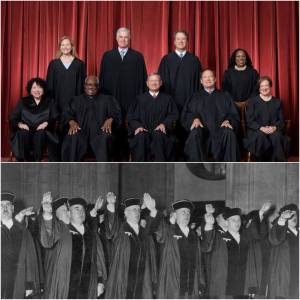
New York Times, Supreme Court Allows Trump to Fire F.T.C. Commissioner, Abbie VanSickle and Ann E. Marimow, Sept. 22, 2025. The justices said they will consider overruling a landmark Supreme Court precedent that has limited the president’s ability to fire top officials at the agency.
A divided Supreme Court on Monday allowed President Trump to fire one of the leaders of the Federal Trade Commission, the latest in a series of emergency orders enabling the president to remove Democratic members of several independent agencies.
Mr. Trump had fired Rebecca Kelly Slaughter and Alvaro Bedoya, two Democratic members of the F.T.C., in March. The federal agency, which enforces consumer protection and antitrust laws, typically has five commissioners — three from the president’s party and two from the opposing party.
After their firing, the two commissioners had said they planned to challenge their removal in court, relying on a 1935 landmark Supreme Court case, Humphrey’s Executor v. United States, that also involved the firing of an F.T.C. commissioner.
In its brief order Monday, the court said it would consider in December the broader question of whether to overturn the 90-year-old precedent that has prevented presidents from removing independent regulators without cause and solely over policy disagreements.
The decision by the court’s conservative majority to allow Mr. Trump to remove Ms. Slaughter drew a dissent from the three liberal justices.
 Justice Elena Kagan, left, said her conservative colleagues had essentially allowed the president to take charge of agencies Congress intended to protect from partisanship.
She wrote that the court’s majority, order by order, “has handed full control of all those agencies to the president.”
The justice continued: “He may now remove — so says the majority, though Congress said differently — any member he wishes, for any reason or no reason at all. And he may thereby extinguish the agencies’ bipartisanship and independence.”
Justice Kagan was joined by Justices Sonia Sotomayor and Ketanji Brown Jackson.
In a series of cases, the Supreme Court has signaled a willingness to potentially overrule the precedent and at some point declare that laws shielding agency heads from presidential ouster are unconstitutional. Still, the justices have not yet formally done so.
The justices are separately considering the Trump administration’s request to remove Lisa Cook as a Federal Reserve governor. The Supreme Court has yet to act, but has suggested that the central bank may be insulated from presidential meddling under the law.
The Parnas Perspective, News Roundup and Commentary: Disney Boycott Grows Fast as Disney Stars Boycott Their Own Premiers, Aaron Parnas, right, Sept.22, 2025. Disney boycott grows fast as Disney stars boycott their own premiers, Trump to link Tylenol to autism, Trump says that he hates his opponents while speaking at Kirk's service, and more.
Good morning — and get ready for a busy week. This morning, I’m tracking several explosive developments. The Disney boycott is snowballing so fast that Disney’s own performers boycotted their documentary premiere last night — canceling both the red carpet and the expected performance. Adding fuel to the fire, John Oliver torched CEO Bob Iger on national television, calling him a coward and daring him to stand up to Trump using the blunt words: “Fuck you. Make me.”
Meanwhile, President Trump is preparing to announce a highly controversial claim linking Tylenol use during pregnancy to autism — a move certain to ignite outrage from the medical community. And at Charlie Kirk’s memorial, Trump dropped any pretense of civility, declaring outright that he “hates” his opponents — a chilling escalation in rhetoric at a time of already raw division.
With that, here’s what you missed:
Musicians including Sarah McLachlan and Jewel pulled out of the Lilith Fair documentary premiere and canceled planned performances in protest after Disney scrapped the red carpet amid the suspension of Jimmy Kimmel—a public act of solidarity for free speech that fed a wider celebrity backlash and calls to boycott Disney/Hulu.
On Last Week Tonight John Oliver blasted Disney/ABC for suspending Jimmy Kimmel amid government pressure, urged CEO Bob Iger not to appease Trump (calling out corporate “cowards”), and challenged him to refuse with the four words: “Fuck you. Make me.”
Y Combinator co-founder Paul Graham canceled his Disney+ subscription in protest of Jimmy Kimmel’s suspension, joining a growing celebrity-and-consumer boycott that accuses Disney of capitulating to political pressure — a backlash analysts say could dent subscriber retention and highlights rising tensions between tech influencers, media ethics, and corporate strategy.
At Charlie Kirk’s memorial, Donald Trump met and shook hands with Elon Musk — his former adviser turned public critic — sparking speculation the two may be reconciling after a high-profile falling-out and Musk’s brief leadership of Trump’s so-called Department of Government Efficiency (DOGE).
Trump said he disagreed with Charlie Kirk’s view that he didn’t hate his opponents, declaring “I hate my opponent and I don't want the best for them,” and added, “I'm sorry.”
After Charlie Kirk’s assassination, big donors and Trump allies (including a $1M pledge from Lynn Friess, appeals from Tucker Carlson, and increased backing from figures like Doug Deason) rushed to fund Turning Point USA—which raised about $85M in 2024 and runs hundreds of college and high-school chapters—boosting the group’s coffers as Erika Kirk takes over and likely cementing TPUSA’s outsized influence on the right via deep MAGA ties and dark-money channels.
Trump questioned vaccine safety, saying they “can be great” but warning that if the “wrong stuff” is used children get “massive vaccines” — comparing doses to those you’d give a horse.
The Trump administration is expected today to link prenatal Tylenol (acetaminophen/paracetamol) use to autism risk—contradicting medical guidance—and to announce plans to explore the drug leucovorin as a potential autism treatment, per Washington Post sources.
Sen. Ted Cruz, chair of the Senate Commerce Committee, urged President Trump in a Reuters-reported letter to back an international push (ahead of a U.N. aviation meeting in Montreal) to raise — or even abolish — the mandatory airline pilot retirement age to 67, despite pilots’ groups warning it could raise safety risks; Congress rejected a similar 2024 proposal after the FAA called for a scientific safety analysis, and current international rules bar pilots older than 65 from flying international routes.
The U.S. labeled recent British, Australian and Canadian recognition of a Palestinian state “performative,” saying (via an anonymous State Department spokesperson) its priorities remain hostage release, Israel’s security, and a Hamas-free pathway to regional peace.
President Trump said Rupert and Lachlan Murdoch will likely play a role in efforts to bring TikTok under U.S. control, telling Fox News the Murdochs “probably” will be involved in the deal.
Trump’s new $100,000 H-1B fee (about 60× the current cost) risks choking off foreign tech talent, prompting economists to warn it could shave U.S. growth (Berenberg cut its 2025 forecast to 1.5% and says that may still be optimistic), rattling Big Tech and Indian firms (Amazon/Microsoft/Meta have thousands of H-1Bs; Infosys and TCS shares fell ~3%), drawing sharp rebukes from India and warnings about “brain drain,” while the White House said the fee applies only to new applicants as a one-off payment.
North Korean leader Kim Jong-un said he’s open to talks with the U.S., citing “fond memories” of meeting Trump but demanding Washington abandon its denuclearization obsession and accept peaceful coexistence; South Korea’s president Lee Jae-Myung signaled he could accept a deal that freezes further weapons production (rather than full disarmament), as analysts note North Korea is still expanding its arsenal.
Dominican authorities said they recovered 377 packages of cocaine (part of an alleged ~1,000 kg stash) from a speedboat that the U.S. Navy destroyed about 80 nautical miles south of Isla Beata, calling it a joint U.S.–Dominican anti-narcotics operation in the southern Caribbean amid the Trump administration’s controversial campaign that has sunk multiple drug boats and drawn human-rights concerns and congressional pushback.
More On Trump Scandals, Courts, Justice
The Bulwark, Morning Shots Commentary: Bag Man, William Kristol, right, Sept. 22, 2025. Who uses cash anymore? Tom Homan, that’s who.
On September 20, 2024, Trump’s border czar accepted $50,000 from undercover FBI agents. And no, it wasn’t Venmoed. The cash was in a bag from the food chain Cava.
The story broke Saturday afternoon in a detailed and well-sourced MSNBC News report by star investigative reporter Carol Leonnig, a four-time Pulitzer Prize winner who left the Washington Post less than two months ago, and Ken Dilanian, who has covered the Justice Department and the intelligence agencies for NBC and MSNBC for a decade.
Here’s the heart of the story:
In an undercover operation last year, the FBI recorded Tom Homan (right), now the White House border czar, accepting $50,000 in cash after indicating he could help the agents — who were posing as business executives — win government contracts in a second Trump administration, according to multiple people familiar with the probe and internal documents reviewed by MSNBC.
The FBI and the Justice Department planned to wait to see whether Homan would deliver on his alleged promise once he became the nation’s top immigration official. But the case indefinitely stalled soon after Donald Trump became president again in January, according to six sources familiar with the matter. In recent weeks, Trump appointees officially closed the investigation, after FBI Director Kash Patel requested a status update on the case, two of the people said.
The federal investigation was launched in western Texas in the summer of 2024 after a subject in a separate investigation claimed Homan was soliciting payments in exchange for awarding contracts should Trump win the presidential election, according to an internal Justice Department summary of the probe reviewed by MSNBC and people familiar with the case. The U.S. Attorney’s office in the Western District of Texas, working with the FBI, asked the Justice Department’s Public Integrity Section to join its ongoing probe “into the Border Czar and former Acting Director of Immigration and Customs Enforcement Tom Homan and others based on evidence of payment from FBI undercover agents in exchange for facilitating future contracts related to border enforcement.”
Remarkably, the Trump Justice Department isn’t actually denying the cash payment or any other fact reported by Leonnig and Dilanian. FBI Director Kash Patel, below, and Deputy Attorney General Todd Blanche simply asserted that their review of the case “found no credible  evidence of any criminal wrongdoing.”
A New York Times report soon followed up on MSNBC’s story, adding the fun Cava bag detail and also the intriguing fact that the sting “grew out of a long-running counterintelligence investigation that had not been targeting Mr. Homan.” In other words, the Biden Justice Department was not out to get Homan.
The main fact that now seems to be in question—beyond who was the target of the counterintelligence investigation—is what kind of recording of the Homan exchange with the undercover agents exists. The Times reported that Homan’s encounter was “recorded on audiotape.” MSNBC reported that there were hidden cameras. Does the Justice Department have audiotape or videotape. Will this be a docuseries, or are we to expect this to be told in podcast form?
National Review magazine—a big fan of Homan’s deportation policies—had to acknowledge that “What’s reported sounds bad.” And while earnestly stipulating that “We can’t evaluate the case against Homan until we know what was said in the recording, why he took the money (if he did), and why the transaction was in cash,” the magazine did say that “Congress should look into this.”
Don’t hold your breath. Republicans control Congress.
But Democrats should apply all the pressure they can. And even without formal congressional action, it shouldn’t be that hard to keep on the heat.
There are so many obvious questions: Can we hear or see the tapes? Did Homan keep the money? Who did he think he was meeting with? Is the $50,000 reported on this 2024 tax return? Were there other such payments? Has “Border Czar” Homan ever placed a call to the White House to ICE or DHS in order to discuss the massive number of contracts being doled out over there? And of course: Did he actually order anything from Cava and if so, what?
And what about the coverup? Who exactly made the decision to squash the case? Was that DOJ’s decision discussed with the White House? Was it okayed by the White House? Was it ordered by the White House? Was it ordered by the president, who after all seems to take considerable personal interest in the question of who is prosecuted and not by his Justice Department?
Now, it’s true that $50,000 is peanuts in the Trump administration corruption sweepstakes. And the Justice Department is engaged in bigger coverups. Still, this is both a real case of corruption and coverup, and a colorful one.
As Cava says in its ads, “You shouldn't have to choose substance over flavor.” This scandal has both.
Progressive Mobilization, Opinion: Democrats and Charlie Kirk, Nancy MacLean, author of Democracy in Chains below right, Sept. 22, 2025. How is it possible that 95 House Democrats, including Speaker Jeffries, voted, not only to condemn political violence but also to lionize Charlie Kirk--and that ALL the Democrats in the Senate so voted, making it unanimous??
 Doe our party stand for nothing?!
Are our party “leaders” incapable of chewing gum and walking—condemning ALL political violence while refusing to whitewash one of the most divisive figures in recent history? Kirk’s record is out there for all to see.
These votes treat vocal overt racism, misogyny, Christian nationalism, getting people fired for their views and teaching, and videoing liberal students he supposedly “debated” to humiliate them online as "contributions to civic education and public service." This is beyond Orwellian.
As a scholar who knows Kirk’s ever-explicit cruel views and vile abusive practices I am APPALLED by “our” party—and was just on a call with nearly 40 civil rights figures who feel similarly betrayed.
If you want to see how your Democratic representatives voted to hold them accountable, you can check their votes here: Absolutely SHAMEFUL. They owe their voters an apology and a serious public correction.
Nancy MacLean, author of "Democracy in Chains," is William H. Chafe Professor of History Emerita Duke University, Durham, NC and also a Fellow, AAUP Center for the Defense of Academic Freedom.
Letters from an American, Historical Commentary: Sept. 21, 2025 [Trump Manipulates Federal Data Collection], Heather Cox Richardson, right, Sept. 22, 2025. On Friday the Bureau of Labor Statistics postponed the release of the annual report on consumer expenditures—a key report for understanding inflation—without explanation.
The BLS has been under stress since President Donald J. Trump fired its head, Commissioner Erika McEntarfer, after the July jobs report showed far weaker hiring statistics than expected as well as a downgrade for previous months. Officials at the BLS said the new report will be “rescheduled to a later date.”
This weekend, Dan Frosch, Patrick Thomas, and Andrea Peterson of the Wall Street Journal reported that the U.S. Department of Agriculture is ending its annual report on household food security. Those reports began in the 1990s to help state and local officials distribute food assistance. Last year’s report found that 18 million U.S. households experienced food insecurity during 2023. In a statement, the Department of Agriculture said: “These redundant, costly, politicized and extraneous studies do nothing more than fearmonger.”
Colleen Hefflin, an expert on food insecurity, nutrition, and welfare policy at Syracuse University, told the Wall Street Journal reporters: “Not having this measure for 2025 is particularly troubling given the current rise in inflation and deterioration of labor market conditions, two conditions known to increase food insecurity.” Whitney Curry Wimbish of The American Prospect reported last week that food banks across the country are seeing more visits even as immigrants are staying away from them out of concern that their information might be shared or that Immigration and Customs Enforcement might show up.
Nutrition scholar Lindsey Smith Taillie of the University of North Carolina Gillings School of Global Public Health told the reporters: “I think the only reason why you wouldn’t measure it is if you were planning to cut food assistance, because it basically allows you to pretend like we don’t have this food insecurity problem.” The budget reconciliation law the Republicans passed in July cuts funding to the Supplemental Nutrition Assistance Program (SNAP) by about 20%, or $186 billion through 2034, the largest cuts to SNAP in its history.
This news got less attention last week than the administration’s apparent determination to silence its critics. Although, as Jim Rutenberg of the New York Times pointed out on Thursday, Trump promised in his second inaugural address to “immediately stop all government censorship and bring back free speech to America,” what he appeared to mean was that he intended to free up right-wing activists to spread disinformation about elections and Covid-19.
Now, in the wake of the murder of right-wing influencer Charlie Kirk, as Peter Baker pointed out today in the New York Times, the administration has cracked down on the media and political opponents under the guise of tamping down words that could cause political violence. But, as Baker notes, Trump is making it clear that he is trying to stop speech that criticizes him and his administration. Last week alone, he called for people who yelled at him in a restaurant to be prosecuted and for comedians who made fun of him to be taken off the air, and he sued the New York Times.
On Friday, Trump told reporters in the Oval Office that covering the administration negatively is “really illegal.” He went on: “Personally, you can’t take, you can’t have a free airwave if you’re getting free airwaves from the United States government.” As Baker notes, Trump’s chair of the Federal Communications Commission, Brendan Carr, who wrote the chapter of Project 2025 that covers the FCC, has complained that many broadcasters have a liberal bias and that they do not serve the public interest as the FCC requires.
That attempt to control information is showing clearly at the Pentagon. In February, Defense Secretary Pete Hegseth threw out long-standing media outlets who had been covering the Pentagon, including NPR, the New York Times, and NBC News, and brought in right-wing outlets including Newsmax and Breitbart. On Friday the Pentagon said it would revoke press credentials for any journalists who gather information, even unclassified information, that the Pentagon has not expressly authorized for release. Hegseth has been on a crusade to figure out who is leaking negative stories about him and defense issues under his direction, and he seems to have decided to try to stop their publication rather than the leaks themselves.
Although Pentagon spokesperson Sean Parnell called the changes “basic, common-sense guidelines to protect sensitive information as well as the protection of national security and the safety of all who work at the Pentagon,” Washington Post reporter Scott Nover noted that this position is a “sharp departure” from decades of practice. Until this year, the Pentagon held two televised question and answer sessions a week (and, in my observation, the journalists who covered the Pentagon were excellent).
The National Press Club also weighed in on Friday’s changes. “If the news about our military must first be approved by the government, then the public is no longer getting independent reporting,” said club president Mike Balsamo. “It is getting only what officials want them to see. That should alarm every American.”
On Friday the Pentagon referred to the White House questions about a strike on a third Venezuelan boat that Trump announced on social media. “On my orders, the Secretary of War ordered a lethal kinetic strike on a vessel affiliated with a Designated Terrorist Organization conducting narcotrafficking in the USSOUTHCOM area of responsibility,” Trump posted. Trump said three men, whom he called “narcoterrorists,” were killed. He said the military showed him proof that the men in the boats were smuggling drugs, but he has not shared that evidence with lawmakers or the public.
As Lara Seligman reported in the Wall Street Journal on September 17, military lawyers and officials from the Defense Department are concerned that decision makers in the Pentagon are ignoring their warnings that the administration’s strikes on the vessels Trump claims are bringing drugs to the U.S. are illegal.
David Ignatius of the Washington Post recalls that when he took office, Hegseth purged from the military the judge advocate generals, who are supposed to advise leaders on the rule of law and whether orders are legal. In February, calling the top lawyers in the Army, Navy, and Air Force “roadblocks to orders that are given by a commander in chief,” he fired them. Earlier this month, he announced he was moving as many as 600 JAG officers to serve as immigration judges.
Also on Friday, Trump announced that companies employing skilled workers who hold temporary H-1B visas would have to pay a $100,000 fee for their entry into the U.S. beginning Sunday. This set off a mad scramble as workers outside the country on business trips, vacations, or family visits rushed to get back into the U.S. before the new rule took effect. Not until Saturday did the administration clarify the new rule does not affect those who already hold visas.
Friday was a busy day. Trump also told reporters in the Oval Office that he wanted the interim U.S. attorney for the Eastern District of Virginia, Erik Siebert, “out” after Siebert declined to prosecute New York Attorney General Letitia James, who successfully sued the Trump Organization for fraud, for allegedly committing mortgage fraud. Siebert also declined to prosecute former FBI director James Comey, who refused to kill the investigation into the relationship between members of the 2016 Trump campaign and Russian operatives, for allegedly lying to Congress.
Siebert was Trump’s own pick for the job and is a well-regarded career prosecutor. As legal analyst Joyce White Vance noted in Civil Discourse, Siebert managed to win the support of both the Virginia Republican Party and the senators from Virginia, both of whom are Democrats. His refusal to prosecute indicates there was not enough evidence to convict a defendant; Vance notes that’s the standard a prosecutor must meet to seek an indictment.
On Friday night, Seibert resigned.
On Saturday morning, Trump posted on social media: “He didn’t quit, I fired him!” In the evening, he posted on social media a missive that appeared to be intended as a direct message (DM) to Attorney General Pam Bondi. It read: “Pam: I have reviewed over 30 statements and posts saying that, essentially ‘same old story as last time, all talk, no action. Nothing is being done. What about Comey, Adam ‘Shifty’ Schiff, Leticia??? They’re all guilty as hell, but nothing is going to be done.’... We can’t delay any longer, it’s killing our reputation and credibility. They impeached me twice, and indicted me (5 times!), OVER NOTHING. JUSTICE MUST BE SERVED, NOW!!! President DJT.”
In other words, Trump wants to use the power of the government to punish those he considers his enemies. As Joyce White Vance puts it: “[L]et’s be clear about what Trump wants. He wants to turn us into a banana republic where the ability to prosecute people becomes a political tool in the hands of the president. That means he wants to exercise the ultimate power to put down any opposition to his rule.” She recalled the comment attributed to Lavrentiy Beria, head of the Soviet secret police under Stalin: “Show me the man and I’ll find the crime.”
A report from Carol Leonnig and Ken Dilanian of MSNBC yesterday showed what a politicized justice system looks like. They reported that FBI agents last year caught Tom Homan—now Trump’s “border czar”—on video accepting $50,000 in cash from agents posing as business executives after he promised he could help them win government contracts for border enforcement in a second Trump administration. The FBI had opened an investigation after someone told them Homan was soliciting payments in exchange for contracts under a future Trump administration.
After obtaining the evidence, the FBI and the Justice Department waited to see whether Homan would provide the aid he offered once he joined the new administration. But the case stalled as soon as Trump took office, and after FBI director Kash Patel recently asked for a status update on the case, Trump appointees officially closed the investigation.
The reporters say that when asked about it, the White House, the Justice Department, and the FBI all dismissed the investigation as politically motivated and baseless.
While Trump tries to silence his critics, Russia is taking advantage of U.S. inaction to test the North Atlantic Treaty Organization. On Friday, three Russian jets entered the airspace of Estonia. Italian fighters stationed in Estonia as part of NATO’s new Eastern Sentry operation responded and forced the Russian jets out. As Poland did last week after Russian drones and jets entered its airspace, Estonian officials requested consultations with the North Atlantic Council under Article 4 of NATO’s treaty.
High Representative of the European Union for Foreign Affairs and Security Policy, Kaja Kallas, who hails from Estonia, called Russia’s incursions over Estonia an “extremely dangerous provocation.”
Global News
New York Times, For Arab Nations With Ties to Israel, Attacks on Qatar and Gaza City Raise Anxiety, Erika Solomon, Sept. 22, 2025. The Middle Eastern states closest to Israel see the attack on Hamas officials in Qatar and the invasion of Gaza City as warning signs of potential threats to their own security.
For nearly two years, the Arab states that maintain uneasy relations with Israel have managed the war in Gaza as a political crisis, keeping up contacts despite their simmering frustrations.
The Israeli attacks on Qatar and Gaza City, within one week, now have some of those states wondering whether their own security may also be at risk.
Across the Middle East and beyond, Israel drew harsh condemnation for its Sept. 9 strike on Hamas leaders in the Qatari capital, Doha. The Gulf nation of Qatar is a firm U.S. ally that has played a leading role in trying to mediate a peace agreement to end the Gaza war.
“For Egypt, Jordan and Turkey, it would be foolish not to be concerned that there could be attacks on their country,” said H.A. Hellyer, a Middle East security expert at the Royal United Services Institute in London and at the Center for American Progress in Washington.
The attack in Qatar was followed by a ground invasion last week of densely populated Gaza City, which sent hundreds of thousands of Palestinians fleeing to southern Gaza.
Israel has said it attacked Qatar as part of its policy of allowing no safe haven to Hamas, after its militants led the Oct. 7, 2023, attack on Israel that set off the Gaza war. It said it was pursuing the Gaza City offensive to root out Hamas in one of its last strongholds.
New York Times, News Analysis: Europe Talks Big on Gaza but Struggles to Act, Jeanna Smialek, Sept. 22, 2025. European nations are lining up behind a plan to recognize Palestine as a state at this week’s United Nations General Assembly in New York. Top officials widely condemn Israel’s actions in Gaza, and some have even begun to call the war “genocide.”
But big talk has yet to lead to big action.
The European Union has proposed higher tariffs on Israeli goods, but it is not clear if that will happen. Other efforts to punish the government of Prime Minister Benjamin Netanyahu have stalled amid opposition, notably from Germany.
Actions by individual countries have also fallen short of the rhetoric. Attempts to funnel aid into Gaza have been limited, even as starvation grips the territory. And nations have been accepting only a trickle of asylum seekers from Gaza, with immigration often a domestic political flashpoint.
Belgium has more Palestinian asylum applicants than anywhere else in Europe, likely because of its relatively permissive immigration practices and large existing Palestinian community. But even there, applying for asylum can be difficult. Many hopefuls have been rejected this year. While Belgium has been evacuating its citizens and the family members of its own residents and refugees from Gaza, the country closed its evacuation list, which then numbered about 500 people, in April..
Even as criticism of Israel ramps up and a growing number of countries say they’ll recognize a Palestinian state, concrete actions remain limited.
More On U.S. Governance, Politics
New York Times, Trump Appointees Roll Back Enforcement of Fair Housing Laws, Debra Kamin, Sept. 22, 2025. Interviews and internal documents show that signature civil rights protections in housing are being dismissed as ideologically driven and D.E.I. in disguise.
In one email, a Trump appointee at the Department of Housing and Urban Development described decades of housing discrimination cases as “artificial, arbitrary and unnecessary.”
In another, a career supervisor in the department’s Office of Fair Housing and Equal Opportunity objected to lawyers being reassigned to other offices; the supervisor was fired six days later for insubordination.
In a third, the office’s director of enforcement warned that Trump appointees were using gag orders and intimidation to block discrimination cases from moving forward. The urgent message was sent to a U.S. senator, who is referring it to the department’s acting inspector general for investigation.
The emails are among dozens of pages of internal communications, memos and other documents reviewed by The New York Times that show efforts by the Trump administration to limit enforcement of the Fair Housing Act, the landmark civil rights law that has prohibited discrimination in housing for nearly six decades.
In interviews, half a dozen current and former employees of HUD’s fair housing office said that the Trump political appointees had made it nearly impossible for them to do their jobs, which involve investigating and prosecuting landlords, real estate agents, lenders and others who discriminate based on race, religion, gender, family status or disability.
Several lawyers said they had been blocked from communicating with clients without approval from a Trump appointee, and had been barred from citing some past housing civil rights cases when researching legal precedent for possible new prosecutions.
One internal memo from a top Trump appointee in the office said that archival documents that were “contrary to administration policy” would be removed or replaced, and that “tenuous theories of discrimination” would no longer be pursued.

New York Times, Chicagoans Avoided Their ‘Filthy’ River for Years. On Sunday, They Swam in It, Visuals by Erin Schaff, Text by Julie Bosman, Sept. 22, 2025 (print ed.). Decades of work to clean the Chicago River culminated with the first swim in almost 100 years, a sign of the city’s changing relationship with its river.
Early Sunday morning, spectators jostled for a glimpse of the Chicago River to witness something that hadn’t happened there in nearly a century.
People were swimming in it.
In the heart of the Loop downtown, surrounded by Modernist skyscrapers, hundreds of swimmers peeled off identical white terry cloth robes, one by one. As the crowds above them whooped and a D.J. played, the swimmers adjusted their caps and goggles and nervously tugged at knee-length black wet suits and briefs emblazoned with the Chicago flag.
The last time that Chicago sanctioned a group swim in the river was 1927, a tradition thwarted by the loads of industrial and human waste that were routinely dumped in the water. It has taken decades of cooperation between environmental groups and elected officials — including at least four mayors — to clean up the river.
The Clean Water Act in the 1970s was a turning point in cutting down on industrial pollution. A system of tunnels and reservoirs known as the Deep Tunnel helped reduce flooding and redirect storm water and sewage into reservoirs away from the river, which cuts a path through residential neighborhoods on the North and South Sides of Chicago and the heart of downtown. Chicago had long boasted of an engineering feat at the turn of the 20th century that reversed the flow of the river, sending pollution away from the city’s drinking water supply in Lake Michigan but down the increasingly grubby river.
“We’ve built it, we’ve engineered it, we’ve reversed its flow,” said Alaina Harkness, the chief executive of Current, a nonprofit in Chicago focused on water innovation. “And now we are working to bring it back to something closer to its natural state.”
More On U.S. Media, Culture Wars, Education, Religion
Popular Information, Accountability Journalism:Sinclair "Special Report" depicts Kirk as prophet, Judd Legum, right, Sept. 22, 2025. "Many Americans are standing shoulder-to-shoulder, believing God is still working and opening the hearts of a new generation."
Sinclair Broadcast Group, which owns dozens of ABC affiliates, played a crucial role in forcing late-night comedian Jimmy Kimmel off the air.
In a statement, Sinclair called Kimmel's commentary on Kirk's assassination "inappropriate and deeply insensitive at a critical moment for our country." Kimmel criticized Trump and his allies for exploiting Kirk's assassination to score political points. According to Sinclair, the company "decided to indefinitely preempt 'Jimmy Kimmel Live!'" on its affiliates and, after discussing the decision with ABC, the network "suspended production."
Sinclair also pledged that it would "air a special in remembrance of Charlie Kirk this Friday, during Jimmy Kimmel Live’s timeslot." That program, produced by Sinclair's National News Desk, papers over Kirk's far-right political views. It does not mention that Kirk called the Civil Rights Act a "huge mistake," supported public executions, and blamed a host of the country's problems on "Jewish donors."
Instead, the Sinclair special depicts Kirk primarily as a religious and prophetic figure. "Charlie Kirk was known first and foremost for his faith in his Lord and Savior Jesus Christ," news anchor Jan Jeffcoat says. "And he often spoke about the key values in his life, God, family, freedom, and country in that order. And he reminded Americans that life's most important questions aren't about wealth or success, but about your faith and your relationship with God."
Jeffcoat describes Kirk as "an American patriot fearless in his faith" and claims that his death, which occurred less than two weeks ago, has "fueled a revival of faith across America." She praises "Charlie's passion to awaken the country with the gospel through conviction and courage."
During the special, Jeffcoat interviews Rachel-Ruth Lotz Wright, the granddaughter of Reverend Billy Graham. Introducing Wright, Jeffcoat says Graham "began a revival in America with a simple yet powerful message: the gospel and salvation in Jesus Christ changes everything." According to Jeffcoat, "that same spirit of revival carried into the life and mission of Charlie Kirk, who boldly and tirelessly defended biblical values and truth as he challenged a new generation to stand firm for Christ."
Jeffcoat asks Wright how Kirk's life and death "shaped your own understanding of how the gospel never changes even in the face of evil." She also inquires whether Wright "sees this revival as similar to the one that your grandfather started with this generation." Jeffcoat ended the interview with this question: "How does the truth that [Kirk is] more alive now in heaven give you hope?"
"[I]nstead of silence, there's been an outpouring of that faith and just remarkable peace," Jeffcoat says later in the program, "From small-town churches to packed stadiums and college campuses, there is grieving, but also voices lifted in prayer and scripture and song. Candles, open Bibles, clasped hands across denominations and generations. Many Americans are standing shoulder-to-shoulder, believing God is still working and opening the hearts of a new generation."
 The program largely dismisses those concerned with the First Amendment implications of Kimmel's suspension, which followed FCC Chair Brendan Carr's demand for ABC and its affiliates to "take action." In one segment, Sinclair national correspondent Kayla Gaskins says that "critics" are "pointing out that those outraged over Kimmel were quiet when previous voices were silenced or canceled over politics." The examples of "silenced or canceled" voices include Trump, David Chappelle, and J.K. Rowling, none of whom have been silenced.
Towards the end, the special quickly acknowledges that some of Kirk's views were "no doubt extremely polarizing," and shows a brief clip of Kirk making an offensive comment about trans people. The topic swiftly shifts to the effectiveness of his approach, which is described as "undeniable." The program concludes with what Jeffcoat describes as "a new moving video out of the White House honoring Charlie's legacy."Sinclair's abrupt change of plans
Sinclair announced that the Charlie Kirk special would air on its ABC affiliates "during Jimmy Kimmel Live’s timeslot" and "across all Sinclair stations this weekend." Further, "Sinclair is offering the special to all ABC affiliates across the country." few minutes before the special was scheduled to air, however, Sinclair changed course and announced that "Sinclair will continue to air ABC network programming as scheduled in the late-night time period." Instead, the program was published on The National News Desk's Youtube Channel.
Instead of the Charlie Kirk special, Sinclair's ABC affiliates aired an episode of Celebrity Family Feud. Sinclair, however, continues to promote the special on its social media platforms as a news program.
In response for a request for comment, Sinclair declined to provide an on-the-record response.The conservative media mogul who runs Sinclair
The executive chairman of the Sinclair Broadcast Group is David Smith, who controls the company with other members of his family. Smith is well-known for his right-wing political views and his willingness to inject his politics into affiliates owned by Sinclair. A 2018 study published in the American Political Science Review found that stations purchased by Sinclair undergo "a significant rightward shift in the ideological slant of coverage."
Sinclair regularly requires its local affiliates to run segments pushing right-wing talking points. Last year, Popular Information reported that "Eugene Ramirez, the lead anchor of Sinclair's national evening news broadcast, resigned in January over concerns about the accuracy and right-wing bias of the content he was required to present on air."Top Sinclair anchor resigned over concerns about biased and inaccurate content Top Sinclair anchor resigned over concerns about biased and inaccurate contentJudd Legum and Rebecca Crosby · July 23, 2024Read full story
Sinclair's statement says it will not consider airing Kimmel's show unless and until Kimmel makes "a meaningful personal donation to the Kirk Family and Turning Point USA," Kirk's right-wing political advocacy group.
Unmentioned is that David Smith, through his family foundation, donated $250,000 to Turning Point USA last year.
The Real Michael Cohen, Opinion: Saint Charlie of MAGA, Michael Cohen, right, Sept. 22, 2025. Charlie Kirk’s death became a stage-managed resurrection, where faith, politics, and even artificial intelligence collided to transform grief into spectacle, propaganda, and a manufactured martyrdom.
Charlie Kirk’s assassination was a tragedy. No one should confuse that. No one should celebrate it. A man in his early thirties, a husband, a father, and yes, a political activist, gunned down because this country is sick with rage and division. That reality deserves a pause. But what we saw at his memorial was not a pause. It was not mourning. It was not reflection. It was theater, carefully choreographed to transform grief into political fuel and one man’s death into a rallying cry for MAGA’s survival.
This Substack is reader-supported. To receive new posts and support my work, consider becoming a free or paid subscriber.Subscribed
President Trump’s speech made it plain. This wasn’t about Charlie Kirk the human being, it was about Charlie Kirk the symbol. “Charlie's murder was not just an attack on one man or one movement. It was an attack on our entire nation,” he thundered. He teased an autism announcement. He attacked his opponents. He framed Charlie’s death as a bullet aimed at all of us; a metaphor designed to conflate Kirk’s assassination with the fate of MAGA itself. He promised the Presidential Medal of Freedom, dangling it like a relic to be blessed in “the very safe Washington, D.C.,” a city Trump now boasts of controlling after his federal police takeover.
The memorial was billed as unity, but it was division draped in scripture. Erika Kirk, in her grief, offered forgiveness to her husband’s killer. Her words were powerful, raw, genuine, human. But the stage around her was filled with voices who have built careers sowing the very rage and discord that made Charlie Kirk a target in the first place. Vice President JD Vance, Health Secretary RFK Jr., DNI Tulsi Gabbard, Tucker Carlson; each spoke with reverence about Charlie’s kindness, faith, and bravery. Each painted him as a modern-day disciple who died “with his boots on.” And yet, every single one of them has spent years weaponizing grievance, demonizing opponents, and poisoning the well of public discourse.
And then there was the spectacle that unfolded far from Arizona but carried the same signature of manipulation: at Prestonwood Baptist in Texas, Pastor Jack Graham introduced an AI-generated Charlie Kirk, preaching from beyond the grave. His voice urged the congregation to “pick up your cross and get back in the fight.” The clip was fake; everybody knew it, but the congregation stood in ovation anyway, treating lines of code as holy writ. The moment was recorded, shared on social media, and now dozens of other churches are replicating it. The message wasn’t subtle: Charlie may be gone, but he still speaks, and his words are now immortal, available for endless remix and reuse.
This is quickly becoming the new normal; using the tragic death of a young man not for sober reflection but as an opportunity to instill loyalty, faith, and political commitment. Instead of mourning, congregations are handed AI simulations that sanctify grief and recycle it into propaganda. Instead of acknowledging senseless loss, they’re told to celebrate a martyr who keeps preaching from heaven, blessing MAGA from the digital clouds. It’s not about Kirk the person; it’s about what his image, voice, and resurrection can sell.
The irony was almost unbearable. Tulsi Gabbard lecturing about protecting free speech when she’s made a career out of vilifying critics as traitors. RFK Jr. recalling talks with Kirk about dying with honor; then pivoting to warn about children raised as “slaves” if America strays from their version of liberty. Anna Paulina Luna crowning herself as Kirk’s legacy, proclaiming, “We are all Charlie Kirk now.” This wasn’t grief. It was branding.
Charlie Kirk’s widow spoke of his faint smile, a mercy from God, proof he didn’t suffer. That image is searing, heartbreaking, unavoidably human. But what MAGA has done is take that humanity and package it for distribution. His death has become a backdrop, a set piece in a performance designed to canonize Kirk as a martyr and rally the base.
The rhetoric of discipleship and martyrdom wasn’t accidental. “Charlie was a modern-day disciple,” Sergio Gor declared, echoing the tone of revivalist religion. “He embodied the MAGA warrior,” he added, sanctifying Kirk’s loyalty to Trump as the highest virtue. This wasn’t a memorial; it was a production meant to keep Turning Point USA alive and Gen Z within the fold. It was spectacle substituting for substance.
Because here’s the truth: one production doesn’t make a movement, and one tragic death doesn’t make a martyr. Charlie Kirk’s life ended violently, and that should trouble us all. But the very people now elevating him to sainthood are the same people who built the ecosystem of hate and vitriol that defined his career and created the climate in which political assassination is possible. They want us to believe that the assassin’s bullet struck the whole movement. But the reality is that it struck at the heart of a culture they helped create; one where disagreement is painted as treason, where opponents are dehumanized, and where violence simmers just below the surface.
Trump framed Kirk’s assassination as an attack on the United States itself. That’s the lie. It was not an attack on the nation. It was a tragedy born out of a nation already under attack; from within, by the relentless sowing of division, rage, and fear. By an epidemic of gun violence that is out of control. By the very voices that filled that stage in Arizona.
Charlie Kirk is gone. His death should have been a moment of reckoning, a call to turn down the heat, to end the rhetoric of war and apocalypse. Instead, the memorial; and now, the churches adopting AI sermons in his likeness, became proof of how demented this movement has grown: canonizing its fallen as saints, feeding on grief, manufacturing spectacle to mask weakness. MAGA doesn’t want to heal; it wants to weaponize.
And so, we leave Arizona not with clarity or comfort, but with the knowledge that even death itself is not immune from exploitation. A man was killed. A family is shattered. And yet the machine rolls on, louder, angrier, more determined than ever to trade in blood for power; because in MAGA’s world, even a grave can be a stage.
Sept. 21
U.S. Trump Scandals: Top New Headlines:
 Civil Discourse, Commentary on Justice, “Show me the man and I’ll find the crime,” Joyce Vance
 New York Times, Middle East Crisis: Britain, Australia and Canada Recognize a Palestinian State, Mark Landler, Sept. 21, 2025. The announcements came on the eve of the annual gathering of the U.N. General Assembly.

 Britain, Canada and Australia confirmed on Sunday that they now formally recognize Palestinian statehood, piling pressure on Israel to ease the humanitarian crisis in Gaza and putting three majorU.S. allies at odds with the Trump administration.
 The seemingly coordinated announcements came on the eve of the annual gathering of the United Nations General Assembly in New York, at which France and Portugal are also expected to vote for recognition of Palestinian statehood.
The concerted action will deepen the diplomatic isolation of Israel’s prime minister, Benjamin Netanyahu, below left. But so far, it has done little to curb his military campaign against Hamas, which has killed tens of thousands of people in Gaza and left much of the enclave in ruins.
 Britain’s prime minister, Keir Starmer, right, waited to act until after President Trump’s state visit last week to Britain, during which Mr. Trump said he disagreed with the move, preferring to focus on securing the release of the hostages held by Hamas militants.
“I have a disagreement with the prime minister on that score,” Mr. Trump said at a news conference with Mr. Starmer on Thursday, although he added, “One of our few disagreements, actually.”
When Mr. Starmer announced Britain’s plans in late July, he said a final decision would hinge on multiple conditions. Israel, he said, must address the humanitarian crisis in Gaza, sign up to a cease-fire agreement with Hamas to secure the release of hostages, and pursue long-term peace with the Palestinians, based on a two-state solution.
Related Headlines:
 Gaza City Offensive
New York Times, Live Updates: Trump Lionizes Charlie Kirk and Vilifies the Left at Memorial, Jack Healy, Tyler Pager and Nicholas Bogel-Burroughs, Sept. 21, 2025. Speakers pledged to carry on the conservative political movement founded by Mr. Kirk, who was assassinated this month.
President Trump called Charlie Kirk the “greatest evangelist for American liberty” during a memorial service for the slain political figure, joining a parade of speakers who hailed Mr. Kirk as a “martyr” and vowed to carry on his mission to implement an explicitly conservative Christian vision of the United States. The service mixed religious devotion with a raw battle cry intended to galvanize the political movement of the polarizing activist, who was assassinated less than two weeks ago.
Mr. Trump capped an event that began with evangelical music and somber remembrances of Mr. Kirk and steadily progressed into a hard-line political event. The whiplash was most clear in the final two speakers: Minutes after Mr. Kirk’s widow, Erika, urged the crowd to love their enemies as her husband did, Mr. Trump said he could not agree. “I hate my opponent and I don’t want the best for them,” he said, adding “Sorry Erika.”
A crowd of tens of thousands, at times cheering, at others weeping, filled the stadium where the Arizona Cardinals play, in the Phoenix suburb of Glendale, to hear remarks from speakers that also included Vice President JD Vance and members of Mr. Trump’s cabinet.

White House advisor Stephen Miller, above left.
Mr. Trump squarely blamed liberal politics for Mr. Kirk’s death, while members of his administration demonized their ideological opponents. Stephen Miller, a White House deputy chief of staff and close adviser to Mr. Trump, delivered fiery remarks saying that Mr. Kirk’s political enemies “cannot imagine what they have awakened.”
Turning Point USA, the Phoenix-based conservative political group that Mr. Kirk founded when he was 18, organized the event. Ms. Kirk was appointed as chief executive of the group last week.
Here is what else to know:
More On Trump 'Law Enforcement' Scandals
New York Times, Trump Demands That Bondi Move ‘Now’ to Prosecute Foes, Alan Feuer, Glenn Thrush, Maggie Haberman and Devlin Barrett, Sept. 21, 2025 (print ed.). His demand came a day after he ousted the federal prosecutor who failed to charge two of his most-reviled adversaries, Letitia James and James B. Comey.
President Trump demanded on Saturday that his attorney general move quickly to prosecute figures he considers his enemies, the latestblow to the Justice Department’s tradition of independence.
“We can’t delay any longer, it’s killing our reputation and credibility,” Mr. Trump wrote in a social media post addressed to “Pam,” meaning Attorney General Pam Bondi, below left. “They impeached me twice, and indicted me (5 times!), OVER NOTHING. JUSTICE MUST BE SERVED, NOW!!!”
Mr. Trump named James B. Comey, the former F.B.I. director; Senator Adam B. Schiff, Democrat of California; and Letitia James, the New York attorney general, saying he was reading about how they were “all guilty as hell, but nothing is going to be done.”
Asked later by reporters about his message for Ms. Bondi, Mr. Trump said, “They have to act. They have to act fast.”
His demands came a day after he ousted the federal prosecutor who failed to charge two of the adversaries he most reviles, Ms. James and Mr. Comey, showing how far Mr. Trump has gone in exerting personal control over the Justice Department and breaching the longstanding norm about keeping politics at a distance from law enforcement.
In a different social media post later on Saturday, Mr. Trump defended Ms. Bondi, saying she was doing a “GREAT job,” but that she needed a “tough prosecutor” in the Eastern District of Virginia, where Erik S. Siebert, was abruptly forced from his post atop the U.S. attorney’s office on Friday. Mr. Trump said he would nominate Lindsey Halligan, a lawyer and special assistant to the president who was on his personal legal team, to fill the role.
Mr. Siebert’s exit deepened troubling questions that have arisen in recent months about the politicization of the Justice Department’s supposedly self-governing satellite offices.
But it also raised a blunter and more immediate issue: Which of the nation’s U.S. attorneys might be next?
Beyond their efforts to push out Mr. Siebert, whose inquiries into Ms. James and Mr. Comey effectively fizzled out, administration officials have also ramped up pressure against Kelly O. Hayes, the U.S. attorney in Maryland, according to three people familiar with the matter.
 Ms. Hayes, a career prosecutor who has spent more than a decade in that office, is leading inquiries into two other vocal critics of Mr. Trump: Mr. Schiff, who has been accused of mortgage fraud by Mr. Trump’s allies; and John R. Bolton, Mr. Trump’s former national security adviser, who is facing scrutiny over allegations of mishandling classified information
Recently, Ms. Hayes told associates that she was under no illusions of the pressure she would face if she refused to bring a case she believed to be unsupported by evidence, as Mr. Siebert did, according to people with knowledge of those conversations. And while she signed off last month on asking for a warrant to search Mr. Bolton’s home in Bethesda, Md., she has indicated that she would not bring charges against Mr. Schiff unless her team discovered evidence to support them.
Mr. Trump’s campaign against U.S. attorneys, who oversee offices in 93 federal districts across the country, is an extension, even an escalation, of the early purge that his top political appointees carried out at the Justice Department headquarters and the F.B.I. against those who worked on the criminal cases brought against him before he returned to power.Sign up to get Maggie Haberman's articles emailed to you. Maggie Haberman is a White House correspondent reporting on President Trump. Get it sent to your inbox.
But his latest demand for the prosecution of his foes also underscores how his desire for retribution against those who pursued him after his first term remains as intense as ever, and how he appears to feel less constrained by political and legal norms in imposing payback.
“I was indicted five times, it turned out to be a fake deal, and we have to act fast, one way or the other, one way or the other — they’re guilty, they’re not guilty, we have to act fast,” Mr. Trump told reporters. “If they’re not guilty, that’s fine. If they are guilty, or if they should be charged, they should be charged.”
Given that these prosecutors’ offices are where federal cases are filed on a day-to-day basis, the move strikes at the nuts-and-bolts foundations of the criminal justice system. It seems intended both to create a frictionless path for prosecutions of those who have run afoul of Mr. Trump, and perhaps to provide the White House with a tool it could use to set aside or slow cases it would like to see disappear.
White House interference in the work of U.S. attorneys was once considered such a taboo that former Attorney General Alberto R. Gonzales, who served under President George W. Bush, resigned in scandal after the Justice Department fired nine U.S. attorneys in 2006 for what were perceived to be political reasons.

President Trump's message on Sept. 20 to U.S. Attorney Gen. Pam Bondi demanding criminal prosecutions of Democrats and prosecutors without delay.
Lev Remembers, Trump’s Dynasty or America’s Democracy, Lev Parnas, right, Sept. 21, 2025. From gold-plated ballrooms to Colosseum-style spectacles, Trump is building a throne for himself — while burying the Epstein files and shredding the Constitution
As you prepare for the week ahead, I need you to listen to me — be ready. My sources are telling me there’s a lot coming this week; they’ve got a plan to distract, to confuse, to stage headlines that pull your eyes away from the real story. They will roll out spectacle after spectacle this week, and all of it is designed to bury the truth. Don’t let them set the agenda.
Monday — I’m hearing — Trump is preparing an announcement tied to the health system: vaccines and autism. It’s the kind of headline that grabs attention and divides people.
At the same time, expect pressure on Letitia (Letitia) James, Adam Schiff, and James Comey to intensify. Pam Bondi will be front and center pushing the narrative. You’ll see her in the headlines, acting as the hammer for the legal theater they want to stage.
They will use Charlie Kirk’s death as cover — turn martyrdom into a weapon — to gaslight people into supporting Project 2025’s checklist: strip rights, hollow out institutions, and rewrite the rules that keep checks on power.
These aren’t jokes. They aren’t headlines for late-night comedy. They are signals. Symbols of a man who believes reality itself must bend to his will. This is not about governing. This is about spectacle, about power, about erasing the line between democracy and dictatorship.
While all this chaos is playing out, he’s busy turning the White House into Mar-a-Lago on steroids — gold glinting across the Oval, a $200 million ballroom being dreamed up, the Rose Garden refitted into a private membership club. They’re the gestures of someone intent on building a dynasty — a Trump name that will echo Royalty and power in American history. My sources tell me that since his trip to the U.K. he’s talked openly about legacy, and about making the White House a monument to himself. Make no mistake: this is not the work of someone planning to leave anytime soon.
And now, layered on top of that, he’s planning UFC fights on the front lawn of the White House — a spectacle ripped straight from the Roman Colosseum, where blood sport was used to keep the crowds distracted while emperors tightened their grip on power. Think about where his head is at: this isn’t governance, it’s dictatorship
But the glitter is an illusion. The pageantry is a cover. His true kryptonite has never changed: the Epstein files. The survivors. The children who became victims. The truth he wants buried deeper than gold. That is what he fears most. And that is why we must make it louder than ever.
On Friday, while the media was distracted with manufactured chaos, one of the most important depositions in modern American history took place — and it happened underground. Behind closed doors. Not in front of cameras. Not in front of the nation. In the basement of Congress. Chaired by James Comer — Trump’s loyal enforcer on the Oversight Committee — designed to control the narrative, to keep the truth hidden.
What came out left more questions than answers. Alex Acosta, the man behind Epstein’s original sweetheart deal, was pressed. He was evasive, slippery, and detached from reality. He brushed off victims’ suffering. He downplayed responsibility. He hid behind excuses.
As Rep. Robert Garcia put it bluntly: “He would not admit it was a sweetheart deal and didn’t claim any responsibility to the Epstein survivors, adding ‘he had no knowledge of what happened to those victims, even to this day.’”
And Rep. Melanie Stansbury reminded the country what is at stake: “Members learned from victims’ attorneys that at least 40 minors gave sworn statements to the FBI as part of the investigation that they had been raped, abused and trafficked.”
This is what they are trying to bury. While they drown us in distractions, this is the crime they are desperate to erase. The abuse. The complicity. The cover-up. And the survivors who still wait for justice.
Here’s the good news: Congressman Ro Khanna has said we do have the 218 votes needed to move forward. That means this fight is not hopeless. It means pressure works. It means when we amplify, when we push, when we refuse to look away, we can crack through the walls they build.
But votes and procedures alone won’t expose the truth. That’s where we come in. This platform. This family. This movement.
I built this space because I was in the rooms where the deals were cut. I was sent to carry out shadow diplomacy for Trump, to move in the shadows, to make sure secrets stayed buried. That’s why I can see the patterns before they hit the headlines. And that’s why I will not stop exposing them now.
This week, we change the conversation. We are not going to let them distract us with Charlie Kirk martyr parades or gold-plated ballrooms. We are going to put the focus back where it belongs: on the biggest cover-up in American history. On the voices of the survivors. On the truth.

New York Times, U.S. Attorney Investigating Two Trump Foes Departs Amid Pressure From President, Glenn Thrush, Maggie Haberman, Jonah E. Bromwich, Alan Feuer and William K. Rashbaum, Updated Sept. 20, 2025. The U.S. attorney investigating New York’s attorney general, Letitia James, and the former F.B.I. director James B. Comey said he had resigned on Friday, hours after President Trump called for his ouster.
Erik S. Siebert (shown above at center in a file photo via C-SPAN), the U.S. attorney for the Eastern District of Virginia, had recently told senior Justice Department officials that investigators found insufficient evidence to bring charges against Ms. James and had also raised concerns about a potential case against Mr. Comey, according to officials familiar with the situation. Mr. Trump has long viewed Ms. James and Mr. Comey as adversaries and has repeatedly pledged retribution against law enforcement officials who pursued him.
Mr. Siebert informed prosecutors in his office of his resignation through an email hours after the president, speaking to reporters in the Oval Office, said he wanted him removed because two Democratic senators from Virginia had approved of his nomination.
“When I saw that he got two senators, two gentlemen that are bad news as far as I’m concerned — when I saw that he got approved by those two men, I said, pull it, because he can’t be any good,” Mr. Trump said. The president did not mention that he nominated Mr. Siebert only after the two senators, Mark Warner and Tim Kaine, had already written Mr. Trump praising him.
When asked if he would fire Mr. Siebert, Mr. Trump responded, “Yeah, I want him out.”
Ms. James, he told reporters, was “very guilty of something.”
Mr. Trump later disputed that Mr. Siebert had resigned, saying in a late-night social media post, “He didn’t quit, I fired him!”
Mr. Trump’s comments came after a high-stakes internal debate raged on Friday over the fate of Mr. Siebert — with Mr. Trump’s own appointees at the Justice Department and key Republicans on Capitol Hill arguing to retain the veteran prosecutor.
The episode was consistent with Mr. Trump’s threats to pursue the law enforcement officials who investigated him, an apparent challenge to the fundamental principle enshrined in the Justice Department’s rulebook of investigating crimes rather than targeting out-of-favor individuals to uncover potential wrongdoing.
And though Mr. Trump provided a rationale for Mr. Siebert’s ouster unrelated to the cases against Ms. James and Mr. Comey, the removal of a U.S. attorney who was investigating the president’s foes showed how deeply the administration has departed from the longstanding norm of avoiding political interference in prosecutions in favor of using the justice system to seek retribution.
A lawyer for Ms. James, Abbe D. Lowell, called Mr. Siebert’s removal “a brazen attack on the rule of law.”
Erik S. Siebert had hit roadblocks investigating New York’s attorney general, Letitia James, and the former F.B.I. director James B. Comey.
New York Times, Trump Justice Dept. Closed Investigation Into Tom Homan for Accepting Bag of Cash, Devlin Barrett, Glenn Thrush, Alan Feuer, Maggie Haberman and Hamed Aleaziz, Sept. 21, 2025 (print ed.). Mr. Homan came under scrutiny after he was said to be recorded last year taking $50,000 in cash from undercover F.B.I. agents.
Tom Homan, left, who was later named President Trump’s border czar, was recorded in September 2024 accepting a bag with $50,000 in cash in an undercover F.B.I. investigation, according to people familiar with the case, which was later shut down by Trump administration officials.
The cash payment, which was made inside a bag from the food chain Cava, grew out of a long-running counterintelligence investigation that had not been targeting Mr. Homan, according to the people, who spoke on condition of anonymity to describe the case.
Mr. Homan’s encounter with the undercover agents, recorded on audiotape, led him to be investigated for potential bribery and other crimes, after he apparently took the money and agreed to help the agents — who were posing as businessmen — secure future government contracts related to border security, the people said.
After Mr. Trump took office this year, Justice Department officials shut down the case because of doubts about whether prosecutors could prove to a jury that Mr. Homan had agreed to do any specific acts in exchange for the money, and because he had not held an official government position at the time of the meeting with undercover agents, the people added.
One person familiar with the case said the evidence gathered had not met all the necessary elements of relevant federal crimes, while another contended that the case was effectively ended prematurely, before such additional evidence could be gathered.
Justice Department officials ultimately decided that the evidence against Mr. Homan was insufficient to support charges of wire fraud,bribery or conspiracy, the people said.
 Emil Bove III, above, a former senior Justice Department official and onetime personal attorney for Mr. Trump who is now a federal appeals court judge, expressed skepticism about the case as early as February, one person said. The existence of the investigation was reported earlier by MSNBC.
Civil Discourse, Commentary on Justice, “Show me the man and I’ll find the crime,” Joyce Vance (right, Law Professor at the University of Alabama), Sept. 20-21, 2025. With apologies, this is a long post for any night, let alone a Saturday, but Trump’s abuse of the power of the prosecutor and efforts to directly control the work of the Justice Department make it essential.
In a world that has become a constant barrage of horribles from this president, know that what I’m writing to you about tonight is exceptionally serious and dangerous.
If you’ve been following the news since Friday afternoon, you know that Trump insisted that his own pick to be U.S. Attorney in the Eastern District of Virginia, Erik Seibert, be fired. Donald Trump told reporters in the Oval Office: “I want him out.” His crime? He declined to manufacture evidence to bring charges against Letitia James, the New York Attorney General who successfully went after Trump’s company for fraud and is leading the charge on much of the litigation states’ attorneys general are bringing against the second Trump administration. The office was also reportedly handling an investigation into former FBI Director Jim Comey and declined to prosecute that case as well. By the end of the week, Seibert had resigned, although Trump claimed he’d fired him. Erik Siebert, then interim U.S. Attorney for the eastern district of Virginia, speaks at a news conference on March 27 at an FBI field office in Manassas, Va.
What does “decline to prosecute” mean? It means that for one of a number of reasons, prosecutors who’ve looked at the case don’t think there is sufficient admissible evidence to obtain and sustain a conviction. That’s the standard the Federal Principles of Prosecution require a case to meet before prosecutors can seek an indictment.
Prosecutors can decline to prosecute for reasons such as key evidence being inadmissible (for instance, because it was obtained in violation of the Fourth Amendment’s prohibition on illegal searches and seizure), because a state prosecutor is in a better position to prosecute, or because evidence of a key element of the crime—frequently the required “mens rea” or state of mind (intent, knowledge, etc.) a defendant must have acted with when they committed it—isn’t there. Sometimes declination happens because no crime was committed. We don’t know what the reason(s) were here, but we do know that a team of investigators and prosecutors in an outstanding U.S. Attorney’s Office looked at the evidence and came up empty-handed. It was about the law and the facts, not politics, regardless of what a president who views everything through the lens of his personal popularity claims.
In investigations like these, agents with the FBI and other law enforcement agencies gather evidence and bring it to prosecutors, who evaluate it to determine what, if any, charges might be available. Sometimes they ask agents to go back and look for specific, additional evidence if there’s a weakness. Federal law creates crimes and sets out specific “elements” of the crime prosecutors must be able to establish, beyond a reasonable doubt, in the minds of jurors in order to convict. If there’s a problem with one or more elements, but serious indications that a crime was committed, the team works together to try to acquire additional evidence.
Typically, there is agreement about whether there’s enough evidence to bring a case or not. But occasionally, agents may think prosecutors have mis-analyzed a case when they decline to indict. When that happens, supervisors frequently get involved to hash out the evidence and determine which side has the correct view. In exceptionally close or potentially high-profile cases, that review may go all the way to the U.S. Attorney, who thinks through the issues with the team before making a final decision. The number of hands that touch a case, and the second, and perhaps a third and a fourth look from supervisors, are designed to reinforce a process that is based on the law and the evidence, not personal bias or politics.
The interim U.S. Attorney in the Eastern District of Virginia, Erik Seibert, was a highly regarded career prosecutor. He was hired in 2010 as an Assistant U.S. Attorney. He spent almost 15 years handling a wide variety of cases related to violent crime, international and domestic drug trafficking, illegal possession and trafficking of firearms, fraud, child sexual exploitation, illegal immigration, and public corruption in the course of his service before Trump appointed him interim U.S. Attorney on January 21, 2025. He received numerous awards for his prosecutions. Siebert was a Metropolitan Police Department officer in Washington, D.C., from 2002 to 2006 before going to law school at the University of Richmond.
Siebert had support from both the Virginia GOP and its two Democratic Senators—no mean feat. It signals that he was a conscientious career prosecutor who understood that the job was not about politics. The Judges in his district weighed in in his favor too. In May, when his 120-day term as the interim expired, the court unanimously appointed him to continue in the role (as opposed to the court in New Jersey, which selected a replacement for Trump nominee Alina Habba when her term as interim ran out).
That background is important. This is a prosecutor who was well qualified to oversee a decision in a case like this. When advised that there wasn’t a case, he had the experience and judgment to make an independent assessment of whether his team was correct. This is how justice is supposed to work. Not all investigations mature into prosecutions. Prosecutors do their jobs not only when they indict, but when they decline to bring faulty cases as well.
Even before Siebert resigned under fire from Trump, there was reporting that “sources familiar with the matter” said that the administration had plans to “install a U.S. attorney who would more aggressively investigate James.”
Saturday afternoon, the Washington Post reported it would be Mary “Maggie” Cleary. Cleary graduated from the University of Virginia School of Law (my alma mater as well), in 2017. She took a position as an Assistant Commonwealth’s attorney in Culpepper, Virginia, working there until January of 2021, when she went to work in the U.S. Attorney’s Office for the Western District of Virginia (a much smaller office than the Eastern District that she now helms). She stayed there for just over a year, leaving to take a position as the Deputy Secretary of Public Safety and Homeland Security. She stayed there for two years before moving over to serve as counselor to Virginia’s Attorney General for a year. She briefly returned to the Culpepper Commonwealth Attorney’s office before going to the Justice Department’s Criminal Division in September of 2025. I’ve dragged you through her entire LinkedIn bio to make the point that her federal experience is extremely thin. This is the kind of resume that might get you a job as a line prosecutor at DOJ, but not typically the nod to be U.S. Attorney—especially not in one of the country’s biggest and most important offices. In Cleary’s favor, she has spent at least some time as a prosecutor. Her LinkedIn also says that she “served in the Culpeper County Republican Committee, and has taught civics to aspiring US citizens. Cleary serves as an adjunct professor at UVA Law, teaching Advanced Trial Evidence.”
But the problem is, the job is compromised. Compromised by the president’s political meddling in prosecutions. The prosecutor who gets the job, will have to “reconsider” serious cases, like the ones Siebert apparently passed on, but without his wealth of experience to rely upon. She would take the job knowing her assigned task is to be a rubber stamp. It’s an unenviable position to be in, and hard to understand why any lawyer would willingly take it on, knowing the expectations.
After the Post’s report on Siebert’s successor, Trump muddied the waters with a post on Truth Social, insisting that his judgment that “They’re all guilty as hell” supplant prosecutors’ assessment of cases. In addition to publicly posting a missive to “Pam,” his Attorney General, directing her to prosecute cases against people he has identified as his enemies, he suggested a different nominee for the Eastern District of Virginia, Lindsay Halligan, who he emphasized “likes you” (not a qualification to be U.S. Attorney any more than personal loyalty to the president is.)
Lindsey Halligan is currently a “Special Assistant to the President,” where she has worked on the information purge at the Smithsonian. Before this, she practiced insurance law in Florida, becoming a member of his legal team and handling her first federal case in 2022 when Mar-a-Lago was searched. She has no apparent ties to the Eastern District of Virginia and does not appear to be a member of the Virginia Bar. She has never handled any kind of prosecution. Unlike Cleary, who was qualified for a U.S. Attorney’s position, Halligan’s resume wouldn’t get her an interview, let alone a job as an assistant, let alone as the United States Attorney.
If you’ve been paying attention, it’s not exactly news that this is Donald Trump’s revenge presidency. It’s not even news that Donald Trump is trying to use the criminal justice system to harm people he considers to be his enemies. Investigations launched against Letitia James, Adam Schiff, Jim Comey, and others fully substantiate that, despite the under oath promises by Bondi and FBI Director Kash Patel that there would be no enemy lists when they stood for confirmation.
But now it’s clear that there are. And Trump will install a U.S. Attorney in Virginia who will guarantee that. If she deviates from the plan because she is principled, she, too, will likely be replaced with someone more compliant. Perhaps the administration will want to let go of this messy situation, let a lengthy re-investigation forestall additional controversy, rather than seek a bad indictment and have a grand jury reject it, or get a marginal indictment and face dismissal from a judge or a failure to convict by a trial jury. But Trump seems extremely focused on getting revenge.
It feels like it should be unnecessary to state the obvious here, that there’s not much of a case if the only way to get it prosecuted is by firing an experienced prosecutor to get an inexperienced one (or no prosecutor at all) to bring it. So let’s be clear about what Trump wants. He wants to turn us into a banana republic where the ability to prosecute people becomes a political tool in the hands of the president. That means he wants to exercise the ultimate power to put down any opposition to his rule.
It’s precisely what I’ve been discussing with you on television and in writing since the start of Trump’s first administration. It has always been a risk, now it’s on the edge of becoming a reality. Any president who would behave this way is a president in name only; in truth, they are well down the road to becoming a dictator. This is a moment as serious, if not more, as the one the country faced during Watergate.
“Show me the man and I’ll find the crime.” That comment is attributed to Lavrentiy Beria, Stalin’s head of the Soviet secret police. It signifies that regardless of guilt or innocence, political enemies of the state can be targeted to quell opposition. Justice is not the goal. Adam Schiff and Letitia James understand that message, but they continue to choose to defy it. We need to all stand with them in the days and weeks ahead. Protecting the First Amendment and the integrity of the criminal justice system against abuse by the president may we be the two most important challenges we will take on between now and the midterm elections.
Thank you for sticking it out with this long post. In the category of “truth is stranger than fiction,” here’s one last bit of information about Maggie Cleary, one of the possible nominees for the U.S. Attorney spot in the Eastern District. In a piece Cleary wrote in May, she claims she was once falsely accused of being present at the Capitol on January 6. She wrote it to claim she was briefly investigated based on anonymous, and she implies, politically motivated, sources. She concluded, “In the last four years, I’ve been somewhat cautious about sharing my experience, but now, while Donald Trump is president, I feel emboldened to finally tell how I, too, was targeted politically. I want to be US Attorney for the Western District of Virginia to end this type of treatment. President Trump needs attorneys in these roles who understand how to identify this behavior and end it during this administration.”
What we need are qualified, competent, career folks who will do the job they swear an oath to do and deliver impartial justice to the American people, regardless of the president who appoints them.
We’re in this together,

New York Times, Pentagon Expands Its Restrictions on Reporter Access, Ken Bensinger, Sept. 21, 2025 (print ed.). The Department of Defense will force reporters to pledge not to gather or use any information that had not been formally authorized for release, or risk losing their credential to cover the military.
The Pentagon said Friday it would impose new restrictions on reporters covering the Department of Defense, requiring them to pledge not to gather or use any information that had not been formally authorized for release or risk losing their credentials to cover the military.
The new mandate, described in a memorandum circulated to the press on Friday, was the latest in a series of actions by the Trump administration to limit the ability of the media to cover the federal government without interference.
The Department of Defense said in the 17-page memo that it “remains committed to transparency to promote accountability and public trust.” But it added that “information must be approved for public release by an appropriate authorizing official before it is released, even if it is unclassified.”
 In addition, the document constrains the movements of the media within the Pentagon itself, designating large areas of the building off limits without escorts for the roughly 90 reporters credentialed to cover the agency. Although many offices and meeting rooms in the Pentagon are restricted, the Pentagon press corps had previously been given unescorted access throughout much of the building and its hallways.
The move could drastically restrict the flow of information about the U.S. military to the public. The National Press Club called the policy “a direct assault on independent journalism” and called for it to be immediately rescinded.
Sean Parnell, the chief Pentagon spokesman, said in a statement that the guidelines were “already in line with every other military base in the country,” adding that they were “basic, common-sense guidelines to protect sensitive information.”
New York Times, For Erika Kirk, a Husband’s Life Cut Short by Violence He Seemed to Foresee, Robert Draper, Sept. 21, 2025. In an interview, the wife of the conservative activist Charlie Kirk said she had implored him to wear a bulletproof vest. But she sees divine work in his death.
During the past 11 days of heartache and anger, Erika Kirk has found herself returning, as if by gravitational pull, to a single moment. It is the recollection of how, on what turned out to be the last night of Charlie Kirk, her husband, he was too excited to sleep.
“His adrenal glands were just going off,” she recalled during an hour and a half interview on Thursday, eight days after Mr. Kirk, 31, one of the nation’s pre-eminent conservative influencers and the founder of the youth activist group Turning Point USA, was gunned down while debating students at Utah Valley University.
“He got up and I could hear him eating something in the kitchen. He’d been waiting all summer to begin touring.” The visits to college campuses, she said, “were like an Olympic event for him. He trained for them. He had whiteboard sessions for hours. Mock debates. He was just so excited.”
Mr. Kirk finally fell asleep sometime later, in another bed in the house. Ms. Kirk heard him slip out early the next morning. She texted “I love you” to him before his chartered plane took off for Provo, Utah. A staff member later told her that he had overheard Mr. Kirk proclaiming to the pilot as he disembarked, “Today’s going to be a great day.”
Ms. Kirk, 36, spoke in a composed voice while fighting through tears about a husband lionized on the right as an inspiration to young Republicans and pilloried on the left for his attacks on civil rights, feminism and Islam. She acknowledged her struggle to make sense of an unfathomable tragedy.
“I’m allowing myself to feel this so deeply,” she said, “without medication, without alcohol. The Lord is giving me discernment.”
She sat in workout clothes with her legs folded under her on a couch in a rented condominium in Scottsdale, Ariz. Her husband often used the condo as a way station between their home in a gated community outside Scottsdale and the Turning Point USA headquarters in east Phoenix.
Meidas Touch Network, Adam Schiff Shreds Trump’s FBI Over Epstein and MoreMy latest interview with Senator Schiff, Ben Meiselas, Sept. 21, 2025. I caught up with Senator Adam Schiff this week to discuss the rot inside Trump’s DOJ. While they like to throw around the phrase “law and order,” we all know that’s just a mask to hide their unparalleled corruption.
Donald Trump appointed Kash Patel, essentially just one of Trump’s internet trolls, Director of the FBI. Yes, the same Kash Patel who used to post memes of himself pretending to saw the heads off of Democratic politicians, including Senator Schiff himself. This is who is now running the FBI. And watching him testify before Congress was humiliating, not just for him, but for the United States of America.
One of the most jaw-dropping moments of Patel’s testimony came when Senator Schiff pressed him on the Jeffrey Epstein files. For years, Trumpworld has dangled this so-called “Epstein list” for political purposes. But when Schiff asked Patel to name names, Patel claimed, under oath, that Epstein trafficked girls to no one but himself. That’s right. According to Patel, after decades of allegations, testimony from survivors, and extensive reporting, Epstein’s only client was… Epstein.''
You don’t need to be a lawyer, a prosecutor, or even particularly sharp to realize how absurd that is. Survivors like Virginia Giuffre have already given sworn testimony naming powerful men. There’s plenty of evidence that the truth is deeper and darker. Yet Patel and Trump’s DOJ want us to believe the “list” has exactly one name. It’s insulting. It’s gaslighting. It’s a cover-up.
Not only that, but a federal court has already ruled the DOJ can release the files. They don’t need to rely on other courts. They don’t need to redact grand jury testimony. They don’t need to hide behind procedure. They could release the documents today. They simply refuse to, because protecting Trump and his cronies is more important than being honest with the American people.
Senator Schiff and I spoke about how experienced career agents are being fired, demoted, or pushed out simply because they worked on investigations into Trump, whether it’s Mar-a-Lago, January 6th, or anything else. Meanwhile, Trump’s hand-picked loyalists, people with résumés that would be laughed out of a county prosecutor’s office, are promoted into senior positions.Imagine being a veteran counterterrorism agent, dedicating your life to tracking threats against this country, only to find out your new boss is a 22-year-old intern turned political hack. Morale is collapsing. Cases are going unworked. Terrorism, counterintelligence, organized crime, critical cases are losing resources so Patel and Dan Bongino can chase social media clout.Juries across America are starting to view FBI testimony as political theater. Defense attorneys are holding up Patel’s trolling posts in court to discredit frontline agents. Cases, drug cases, counterterror cases, violent crime cases, are getting thrown out, not because of bad policing, but because Trump has turned the FBI into a laughingstock.
We also touched on Trump’s economic lies. Remember his big promise? Day one, he’d bring prices down. Instead, his tariff policies are driving them up. Families are struggling with rent, groceries, and gas, while Trump brags about his new palace in the sky and his new ballroom.Senator Schiff pointed out that in just eight months, Trump has made more money than in his entire life before the presidency. That isn’t capitalism. That isn’t business genius. That’s graft on a level we have never, ever seen before. Trump sues media companies with bogus claims, then uses the FCC to extort settlements that enrich himself while rubber-stamping mergers for his donors. Your personal economy is worse. Trump’s personal economy is thriving. And he wants you to thank him for it.
if all that weren’t enough, Trump’s FCC is openly trying to silence dissent. Brendan Carr, the FCC commissioner who literally helped write Project 2025, is spending his time posting Office memes while threatening late-night comedians. Jimmy Kimmel? Forced off the air after Trump complained. Stephen Colbert? Done. Sinclair and Nexstar? Begging Trump’s favor by demanding apologies from comedians for jokes.Trump’s government is censoring comedians while forcing media companies to pay him off in order to merge.
This is banana-republic corruption with a spray tan.
Senator Schiff and I ended our conversation with a sliver of hope. And truthfully, there is hope. Courts are still throwing out Trump’s sham lawsuits. Prosecutors refusing to follow illegal orders. Fired CDC officials are testifying about the dangers of Trump’s anti-science agenda. Ordinary Americans are showing up for one another, helping immigrant kids get to school, making food deliveries so families don’t risk arrest, and so forth.
Every single day, people are refusing to bend to Trump’s authoritarianism. And the American people aren’t embracing this madness. Trump’s approval ratings are plummeting. His corruption is too obvious. His incompetence is too dangerous.So when things get tough, don’t give in to despair. Stand up. Speak out. Support independent media like ours and anyone else getting you truthful information during this perilous time. Let’s stay strong, refuse to let them gaslight us into silence, and save this country.
More Global News
 Associated Press via Politico, Taliban reject Trump’s bid to reclaim Bagram Air Base in Afghanistan, Staff report, Sept. 21, 2025. It is unclear what conversations the United States has had with Afghan officials.
The Taliban government on Sunday rejected U.S. President Donald Trump’s bid to retake Bagram Air Base, four years after America’s chaotic withdrawal from Afghanistan left the sprawling military facility in the Taliban hands.
It is unclear what conversations the U.S. has had with Afghan officials about returning to the country. But Trump hinted that the Taliban, who have struggled with an economic crisis, international legitimacy, internal rifts and rival militant groups since their return to power in 2021, could be open to allowing the U.S. military back.
The chief Taliban spokesman, Zabihullah Mujahid, rejected Trump’s assertions and urged the U.S. to adopt a policy of “realism and rationality.” Afghanistan had an economy-oriented foreign policy and sought constructive relations with all states on the basis of mutual and shared interests, Mujahid posted on X.
It had been consistently communicated to the U.S. in all bilateral negotiations that Afghanistan’s independence and territorial integrity were of the utmost importance, he said.
“It should be recalled that, under the Doha Agreement, the United States pledged that ‘it will not use or threaten force against the territorial integrity or political independence of Afghanistan, nor interfere in its internal affairs,’” he said. The U.S. needed to remain faithful to its commitments, he added.
Mujahid did not reply to questions from The Associated Press about conversations with the Trump administration regarding Bagram and why Trump believed the U.S. could retake it.
In August last year, the Taliban celebrated the third anniversary of their takeover at Bagram with a grand military display of abandoned U.S. hardware, catching the eye of the White House. Trump has repeatedly criticized his predecessor, Joe Biden, for his “gross incompetence” during the withdrawal of U.S. forces after the country’s longest war.
Mobology by Dan Moldea via Facebook, Commentary: PREDICTION, Dan Moldea, Sept. 20-21, 2025.
On Sunday at 2:00 P.M. (ET) at Charlie Kirk’s public canonization in Glendale, Arizona, Donald Trump and his gang will demand the equivalent of a “call to action,” along with a declaration of war against those on the “radical left”—aka anyone who is critical of President Trump—even though they had absolutely nothing to do with Kirk’s tragic murder by a cowardly lone sniper.
Along with Trump, scheduled speakers include Vice President J.D. Vance, White House Deputy Chief of Staff Stephen Miller, Secretary of State Marco Rubio, Secretary of War Pete Hegseth, HHS Secretary RFK Jr., Director of National Intelligence Tulsi Gabbard, Donald Trump Jr., and Tucker Carlson, among others.
I hope that I’m wrong and that their eulogies will be filled with conciliation, goodwill, and calls for national unity instead of not-so-subtle threats of violent retaliation.
New York Times, California Bars ICE Agents From Wearing Masks in the State, Soumya Karlamangla, Sept. 21, 2025 (print ed.). Gov. Gavin Newsom signed a bill to prevent federal agents from concealing their identities with masks. The law is expected to face a legal challenge
Gov. Gavin Newsom of California signed legislation on Saturday that would prevent federal immigration agents from wearing masks in the state, a direct response to President Trump’s deportation crackdown in the Los Angeles region.
The new law is believed to be the first such ban in the nation, though it is likely to be challenged in court before it can go into effect in January because it is unclear whether California can enforce such restrictions on federal law enforcement. The bill also applies to local law enforcement.
In recent months, videos have spread across social media showing masked and armed immigration agents handcuffing immigrants in Southern California, drawing protests and criticism in the state.
Democratic leaders and immigration activists have suggested that agents have acted with impunity, knowing that their identities were cloaked and that it would be harder to hold them accountable.
“The impact of these policies all across this city, our state and nation are terrifying. It’s like a dystopian sci-fi movie — unmarked cars, people in masks, people quite literally disappearing,” Mr. Newsom said at a signing event on Saturday afternoon at a Los Angeles high school. “This is a disgrace. This is an outrage, what we’ve allowed to happen in this country.”
It is extremely rare for police officers to wear masks in democratic nations. U.S. Immigration and Customs Enforcement agents began wearing balaclavas and neck gaiters this year, in what might have been the first example of American law enforcement officers wearing masks.
Before this year, state and local leaders had been passing more laws moving in the direction of greater transparency, such as requiring officers to wear body cameras at all times to record footage that could be used in court and seen by the public.
 But this week, Department of Homeland Security officials urged Mr. Newsom to veto the bill, which they said would increase harassment and assaults on officers.
“Comparing them to ‘secret police’ — likening them to the Gestapo — is despicable,” Tricia McLaughlin, a spokeswoman for the department, said in a statement. “Once again, sanctuary politicians are trying to outlaw officers wearing masks to protect themselves from being doxed and targeted by known and suspected terrorist sympathizers.”
California’s law was opposed by numerous law enforcement agencies, who argued that officers must have the choice to cover their faces to protect themselves and their families from retaliation. Limiting the ways officers can keep themselves safe will make it harder to recruit people to work in law enforcement, they said.
But a number of Democratic-led states have proposed restricting masking by immigration agents. Lawmakers have introduced such bills in New York, Illinois and Massachusetts, among other states, though California is believed to be the only state where such a law has been passed and signed.
California’s measure would bar law enforcement officers from wearing face coverings, such as ski masks, balaclavas and neck gaiters, that shield their identities. It does not apply to medical masks, clear plastic face shields, respirators, eye protection or other safety devices.
Any violation of the law would be a misdemeanor.
Legal experts agreed that California can require local officers to unmask on the job. But it’s a trickier question when it comes to federal agents operating in the state.
New York Times, Top Democratic Leaders Ask Trump for Meeting to Avert a Shutdown, Annie Karni, Sept. 21, 2025 (print ed.). After a Republican plan to keep funding flowing foundered in the Senate, Representative Hakeem Jeffries and Senator Chuck Schumer accused the president of standing in the way of a solution.
The two top Democrats in Congress on Saturday demanded a meeting with President Trump ahead of the Sept. 30 deadline to fund the government, warning him that Republicans would be blamed for a painful shutdown if he refused to negotiate with them.
“It is now your obligation to meet with us directly to reach an agreement to keep the government open and address the Republican health care crisis,” Senator Chuck Schumer of New York and Representative Hakeem Jeffries of New York, the two minority leaders, wrote in a joint letter to the president. “We do not understand why you prefer to shut down the government rather than protect the health care and quality of life of the American people.”
They added: “At your direction, Republican congressional leaders have repeatedly and publicly refused to engage in bipartisan negotiations to keep the government open.”
The letter was sent a day after Senate Democrats blocked the Republican plan to keep federal funding flowing past the Sept. 30 deadline, demanding concessions on health care and other issues in exchange for their support for a short-term spending bill that would keep the government open.
Republicans, in turn, blocked a Democratic proposal that would extend funding through Oct. 31 and add more than $1 trillion to extend Obamacare subsidies that are set to expire at the end of the year and roll back Medicaid and other health program cuts.
Mr. Trump has not met with the Democratic leaders at the White House all year, and it was not clear he had any appetite to do so in this case.
U.S. Politics, Governance
Lincoln Square Media, Opinion: Why Democrats Can’t Afford to Keep Losing the Storytelling, Kristoffer Ealy, Sept. 21, 2025. Speaking as a Democrat myself, I gotta say Democrats are masters of self-sabotage.
Only they could look at the political calendar, realize there were 107 days left before facing Donald Trump — a guy who’s basically been running for president nonstop since 2016 — and decide, “Sure, let’s swap in a new lead actor now, what could go wrong?” It’s like watching someone switch drivers with the car still moving and then acting shocked when they swerve into a ditch.
When I wrote Kamala Harris Deserved Better and then followed with What Kamala Harris Actually Got Right (Part 2), I wasn’t trying to canonize her or pretend she’s flawless. I was pointing out how the Democratic Party turned her into their scapegoat, a human shield for their own strategic failures.
And yet every time I bring this up, the response is depressingly predictable. People reduce her political story to one or two talking points. She was too friendly with Liz Cheney. She didn’t say the “right thing” about Gaza. She was too polished, as if speaking in complete sentences is now a liability. Those takes feel neat, tidy, digestible — like a fast-food combo meal of hindsight. But they are not serious. Real campaigns are not single-cause morality plays. They are demolition derbies, with donors, consultants, coalitions, the media, misinformation, and structural barriers all smashing into each other at once.
Pretending Harris just “blew it” because of one line in a debate is like saying the Titanic sank because the waiter spilled soup in the dining room. It’s not analysis. It’s avoidance. It is disingenuous to emphatically say Kamala lost because she did one thing wrong.
Don’t miss important political analysis like this. Upgrade your subscription to Lincoln Square today.Subscribed
And avoidance is exactly how voters keep walking themselves into the buzzsaw. Every cycle, I run into people who tell me, with a kind of smug finality, “These politicians don’t care about me; why should I vote?” And here’s the thing: I don’t correct them. I tell them, flat out: you’re right. Politicians do not care about you, the lone individual. They don’t care if you, personally, have a job, make a living wage, or even survive. What they care about is groups and consensus. That’s the system. That’s the math. That’s the cold fact I didn’t truly grasp until I was about twenty-five.
Rosa Parks is remembered not because one woman refused to give up her seat on a bus, but because that refusal became a movement, a collective force big enough to grind a segregated city’s economy to a halt. That’s what politicians respond to. Not the singular, but the organized. And until non-Trump voters internalize this, they’ll keep wringing their hands every time MAGA wins an election as though it was some unthinkable accident. It’s not. It’s coalition politics doing what coalition politics does: rewarding the group that shows up in force, unified by grievance if not by policy.
This is why the Republican Party in 2025 is locked in a state of sycophantic paralysis. MAGA is not just Trump’s mood swings; it’s a tribal identity. Step out of line, and you get exiled. That’s why even senators with Ivy League résumés suddenly sound like they’re auditioning for a spot on a right-wing podcast — they’re terrified of losing the mob’s loyalty. And here’s the uncomfortable truth Democrats keep sidestepping: a huge chunk of MAGA voters are perfectly willing to suffer. They’ll put up with higher prices, worse health care, collapsing schools, potholes the size of moon craters — and they’ll smile through it — so long as the pain lands harder on someone they hate. Call it recreational spite or political CrossFit: the pain is the point, and the workout “counts” if the libs hurt more. That’s the dynamic behind why they support him.
I’ve used this Lyndon Johnson quote in other pieces and I’ll keep using it because it’s too on-the-nose to retire: “If you can convince the lowest white man he’s better than the best colored man, he won’t notice you picking his pocket. Hell, give him somebody to look down on, and he’ll empty his pockets for you.” MAGA is basically the LBJ theorem in a red hat. The cruelty isn’t the glitch, it’s the subscription plan — the down payment on the fantasy that at least you’re not on the bottom rung.
That fantasy politics shows up everywhere. Back in 2020, when Harris was running for VP on the ticket with Biden, there was the whole Ice Cube saga. He blew off a group Zoom with her and other Black artists because he wanted a one-on-one, while defending his meetings with Trump’s people about the so-called “Platinum Plan.” The problem wasn’t that he wanted to negotiate — negotiation is politics. The problem was believing that Trump, a man with a decades-long record of disdain toward Black people, was suddenly going to morph into a civil-rights champion just because he let you sit in the room. That’s not strategy; that’s a bad episode pitch for Shark Tank. It’s the essence of fantasy politics: mistaking a photo-op for power, mistaking a slogan for substance.
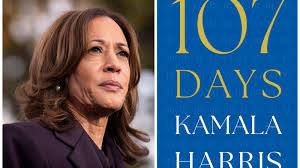
New York Times, Book Review: Kamala Harris Is Out of Time, Carlos Lozada, Sept. 21, 2025 (print ed.). The title of Kamala Harris’s new memoir, “107 Days,” is more revealing than it means to be.
In its simplest sense, it marks the length of her 2024 presidential campaign, the number of days from July 21, when Joe Biden left the race, through Nov. 5, when Harris lost it. The book breaks down, countdown-style, each chapter covering one day of the campaign. Some chapters span several pages, others a few paragraphs; the shortest is a handful of words. Harris also skips several days altogether. Even when you’re running for president of the United States, I imagine, some days are just more interesting than others.
But the title is not merely the duration of Harris’s campaign; it is also her excuse for losing the election. Throughout the book, the former vice president repeatedly laments that she did not have sufficient time to run the race she would have liked. With more time, Harris contends, she could have better sold her economic vision. With more time, she could have forged a stronger connection with voters. With more time, she could have made clear that she offered Americans a superior alternative to Donald Trump.
“In 107 days, I didn’t have enough time to show how much more I would do to help them than he ever would,” Harris writes. “And that makes me immensely sad.”
It’s a comforting explanation, in part because it eases the burden of responsibility on Harris for her defeat. After all, the calendar is a structural impediment, not a strategic or ideological one. And the person most easily blamed for truncating the 2024 campaign schedule is not Harris, but her former boss, the man who sat atop the ticket for so long that, when push came to shove him out, Harris had only 107 days left.
Biden’s choice to stay in the race so long was based on “ego” and “ambition,” Harris writes. And her own deference to Biden’s intransigence was, in hindsight, an exercise in “recklessness.” The stakes of the race, Harris concludes, were too high to leave it all to a personal decision made by the first family. If she did not say so in real time, it was in part because of how “incredibly self-serving” it would have seemed for her to suggest the president make way for someone else. Such is the price of politesse.
Harris’s book is not as relentlessly damning of Biden as, say, Jake Tapper and Alex Thompson’s “Original Sin.” Still, Harris acknowledges that an aging Biden got “tired” and that he “needed rest,” and that even though she believed that he could still govern — “I don’t believe it was incapacity,” she writes, in a tellingly awkward formulation — his deteriorating campaign skills worried her.
“His voice was no longer strong, his verbal stumbles more frequent,” Harris writes. In one of the few chapters that breaks free from the 107-day time frame, Harris flashes back to the Biden-Trump debate and recalls speaking to Biden by phone during his preparation. He didn’t sound upbeat, she writes, and “I hung up feeling sorry for him.” The evening of the contest, Harris had a “gnawing feeling” that things might not go right.
Even before the “disaster” of a debate had ended, she writes, the campaign staff had sent her wildly unrealistic talking points to guide her television appearances, including “JOE BIDEN WON — He fought through his cold as he is fighting for the American people.”
Harris’s reaction is italicized, not quoted, so it’s unclear if she said it to someone or if she’s describing what she thought, or what she wishes she’d said. Stuff like “Are you kidding me?” and “No. Don’t feed me bullshit.” When Harris went on TV, she tried gamely to split the difference, arguing that Biden’s 90 minutes onstage didn’t matter as much as three and a half years on the job.
Except that Biden’s job performance wasn’t playing well with voters, either. As David Plouffe, a campaign adviser, would tell Harris bluntly, “People hate Joe Biden.”
This is a standard Harris feint throughout “107 Days” — her own critiques of Biden are diplomatic, but she quotes others ripping him and his staff apart. “My feelings for him were grounded in warmth and loyalty,” Harris writes, “but they had become complicated, over time, with hurt and disappointment.”
Yet she quotes the second gentleman of the United States, much angrier and at length, ranting about Harris’s mistreatment. “They hide you away for four years, give you impossible, shit jobs, don’t correct the record when those tasks are mischaracterized, never fight back when you’re attacked, never praise your accomplishments, and now, finally, they want you out there on that balcony, standing right beside them,” Doug Emhoff told her. “Now, finally, they know you are an asset, and they need you to reassure the American people.”
This sense of disrespect permeates “107 Days.” Disrespect from Trump, certainly, who, aside from one phone conversation in which he told Harris she was doing “a great job,” constantly insulted her intelligence, questioned her background and belittled her qualifications. But disrespect from Biden and his team, too, whom Harris says constantly undercut her and even whispered that she wasn’t up to the top job, using her to try to persuade Democrats to stick with Biden.
When they could stick with him no longer, the vice president moved with astonishing speed to seize the nomination. Indeed, Harris’s complaints about the brevity of the campaign feel less than persuasive when her case for taking Biden’s place rested on how quickly and seamlessly she could do it all. “I knew I was the candidate in the strongest position to win,” she writes. “The most qualified and ready. The highest name recognition. A powerful donor base.” When Democratic insiders asked her what sort of “process” the party should use to pick a new nominee, she would retort, “This is the process” — meaning, this phone call, this conversation, this moment, this person.
Harris dismissed the idea of mini-primary formalities. I mean, who has the time?
Sept. 20
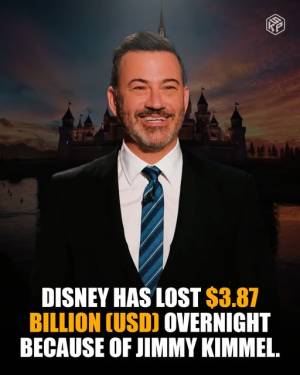 The Parnas Perspective, Disney Loses Millions as Boycotts Grow After Kimmel Suspension, Aaron Parnas, Sept. 20, 2025. Trump’s border czar, Tom Homan, was caught in a bribery sting—and Trump’s DOJ buried the case. And now, Trump is threatening war with Venezuela and Afghanistan.
All in one day.
This is what happens when corporations surrender to intimidation and government covers up corruption. The First Amendment is on the line. Honest journalism is on the line.
With that, here’s what you missed:
After ABC suspended Jimmy Kimmel over comments about Charlie Kirk’s killing, following pressure from FCC Chair Brendan Carr, critics launched boycotts of Disney and ABC, with celebrities and unions protesting what they call censorship and corporate capitulation, while Trump praised the move and hinted at further license threats against networks.
Since the boycotts of ABC and Disney began, Disney has now lost millions of dollars in market cap. In addition, the company has lost hundreds of thousands, if not millions of paid subscriptions to its services.
An FBI sting recorded Trump’s border czar Tom Homan accepting $50,000 in 2024 after allegedly offering to help secure contracts if Trump returned to office, but after Trump’s inauguration the Justice Department shut down the probe—calling it a “deep state” case—despite internal debate that his actions could support conspiracy or fraud charges.
AOC responded to the news by stating:
Who's the illegal now @RealTomHoman … @CarolLeonnig 1h Carol Leonnig A big @MSNBC scoop >>>> Trump border czar Tom Homan was under criminal investigation for potential bribery and claims he would steer fed contracts in new administration. Undercover @FBI agents recorded him accepting $50k in cash.
Federal investigators say they have found no evidence linking Charlie Kirk’s accused killer, Tyler Robinson, to left-wing groups despite Trump officials’ claims, noting Robinson acted alone out of personal animosity toward Kirk’s politics; he faces state charges including aggravated murder, while federal charges remain uncertain due to legal limitations on domestic terrorism cases.
An armed man, identified as Joshua Runkles, 42, was arrested for impersonating law enforcement at Arizona’s State Farm Stadium ahead of Charlie Kirk’s memorial service, which is expected to be attended by President Trump and Vice President JD Vance; he was charged with impersonation and carrying a weapon into a prohibited place and later released on bond.
The Trump administration has canceled the USDA’s long-running annual survey measuring food insecurity in America, a key data source for federal, state, and local policymakers, saying the report has become “overly politicized.”
Donald Trump says that "bad things are going to happen" if the Taliban doesn't give them Bagram Air Base back.
The White House announced a finalized deal with China ensuring TikTok will be majority American-owned, with six of seven board seats held by Americans, U.S. control of the app’s algorithm, and Oracle managing its data and privacy operations.
Thousands of activists worldwide, including a major march in New York, protested financial institutions and elites for “profiting off the climate crisis,” tying climate justice to broader struggles like democracy, immigration, gender equality, and peace, with demonstrators highlighting the interconnectedness of social, economic, and environmental issues.
Senate Minority Leader Chuck Schumer and House Minority Leader Hakeem Jeffries asked President Trump to meet on preventing a Sept. 30 government shutdown after the Senate rejected both GOP and Democratic stopgap funding measures, with both parties blaming each other as the deadline looms and most lawmakers out of town.
Morrissey canceled concerts in Massachusetts and Connecticut after venues cited a “credible” assassination threat, following recent reported death threats and an arrest in Canada, with organizers stressing safety concerns amid a wider backdrop of political violence in the U.S.
Dallas Fort Worth and Love Field airports have fully restored operations after a telecommunications outage caused by cut fiber optic cables disrupted FAA systems, leading to over 500 American Airlines flight cancellations Friday, 160 more Saturday, and major delays that impacted more than 100,000 passengers.
Sacramento police arrested 64-year-old Anibal Hernandezsantana after shots were fired into ABC10’s building, leaving bullet holes but no injuries; the motive is unclear, though the incident followed protests over Jimmy Kimmel’s suspension, and the suspect now faces multiple felony charges with bail set at $200,000.
Lawyers for Luigi Mangione, accused of murdering UnitedHealthcare CEO Brian Thompson, filed a sweeping motion to block the death penalty, calling it a “purely political” prosecution. They argue his rights were violated through staged “perp walks,” inflammatory public statements, and a biased grand jury process—framing him as a “comic book villain” before trial. Prosecutors must respond by Oct. 31, with federal hearings set for December.

The Village of Palmetto Bay council meeting on Wednesday (Photo by Scott McIntyre for The New York Times)
New York Times, He Wrote a Biting Post About Charlie Kirk. The Fury Came Fast, Richard Fausset, Sept. 20, 2025. Residents of Palmetto Bay, Fla., have demanded the resignation of Councilman Stephen Cody, who wrote a post mocking Charlie Kirk’s support for gun rights.
One by one, the angry residents who had packed the council chambers on Monday night in Palmetto Bay, Fla., stepped to the podium to express their disgust over online comments that a councilman, Stephen Cody, had made about Charlie Kirk.
One man called Mr. Cody’s comments “vile.” Another called them “abnormal and dangerous.” A third man said that the councilman’s Facebook post, which went up a few hours after Mr. Kirk was fatally shot in Utah, “smells like it came out of the pit of hell.”
All three wanted Mr. Cody to resign from office. If that did not happen, a fourth speaker said, “We’ll come after him.” While he did not intend to harm Mr. Cody, he added, “He’s not going to have a very nice life while he’s living here.”
The most contentious civic matters anyone had anticipated this month in Palmetto Bay, a prosperous Miami suburb of 25,000, involved the tax rate and the details of a contract to manage a municipal pickleball facility. But in the last few days, Palmetto Bay, like many communities around the country, has been consumed by the wave of ferocious indignation directed at people who declared their lack of remorse about Mr. Kirk’s death or merely took issue with things he had said or believed.
Campaigns have been mounted to publicly shame these critics, and in many cases to get them fired from jobs or expelled from schools — a conservative version of the cancel culture that only a few years ago was wielded by the American left. Those facing repercussions — more than 100 people, according to one analysis — include police officers, students, medical professionals, public schoolteachers and university professors.
There have been higher-profile subjects as well. On Wednesday, ABC announced that it was pulling Jimmy Kimmel’s late night comedy show “indefinitely” amid conservative criticism of his on-air comments related to Tyler Robinson, the suspect charged with Mr. Kirk’s killing on Sept. 10.
In a monologue on Monday, Mr. Kimmel said that “the MAGA gang was desperately trying to characterize this kid who murdered Charlie Kirk as anything other than one of them.”
A charging document filed by prosecutors this week said that Mr. Robinson’s mother told investigators that her son had grown more political recently, and that his political views had moved to the left.
More On U.S. Media, Culture Wars, Education
Letters from an American, Historical Commentary: Sept. 19, 2025 [Pushback On Trump Media Crackdowns], Heather Cox Richardson, right, Sept. 20, 2025. Today U.S. District Judge Steven Merryday threw out the $15 billion lawsuit President Donald J. Trump filed on September 15 against the New York Times for defamation. The judge, who was appointed by President George H.W. Bush, called the complaint “decidedly improper and impermissible” and took Trump’s lawyers to task for using a legal complaint as a public forum for abusive language.
Noting that the two defamation counts followed eighty pages of praise for Trump and allegations against the "hopelessly compromised and tarnished 'Gray Lady,'"—an old nickname for the New York Times—he set a forty-page limit on any amended complaint.
The administration’s pressure on ABC to fire comedian Jimmy Kimmel is very unpopular, as G. Elliott Morris of Strength in Numbers notes, with people polled by YouGov on September 18 seeing it as an attack on free speech.
That unpopularity showed today when podcaster and senator Ted Cruz (R-TX) celebrated Kimmel’s firing but called the threat of Federal Communications Commission Chairman Brendan Carr, right, to retaliate against ABC “unbelievably dangerous.” Cruz called Carr’s threats “right out of a mafioso coming into a bar going, ‘nice bar you have here. It’d be a shame if something happened to it.’”
He explained: “I think it is unbelievably dangerous for government to put itself in the position of saying, ‘We’re going to decide what speech we like and what we don’t, and we’re going to threaten to take you off air if we don’t like what you’re saying.’”
Democratic political strategist Simon Rosenberg noted that three new polls out this week show Trump’s approval rating dropping and commented that voters don’t like “[t]his dictator sh*t.” AP-NORC observed that Republicans are growing pessimistic about the direction of the country. While the share of all American adults who say the country is off track has increased 13 percentage points since June, from 62% to 75%, the biggest change has been among Republicans. In June, 29% of Republicans were concerned about the direction of the country; now that number is 51%.
Most American adults think Trump has gone too far with his tariffs, his use of presidential power, and sending troops into U.S. cities.
Democratic lawmakers this week have reflected the growing opposition to Trump and his administration. Today in The Contrarian, Illinois governor J.B. Pritzker wrote that Trump’s attacks on Chicago aren’t really about stopping crime. Instead, Trump is creating chaos and destabilizing the country in order to erode our democratic institutions and cement his power.
Pritzker warned that Trump “has become increasingly brazen and deranged in his rhetoric and his actions” and that the things he “is doing and saying are un-American.” In contrast, Pritzker held up as a model “our collective Midwestern values of hard work, kindness, honesty and caring for our neighbors,” and urged people to “be loud—for America.”
Yesterday Senator Adam Schiff (D-CA) spoke at the Center for American Progress. He, too, outlined the administration's attacks on the rule of law and blamed “billionaires padding their stock portfolios and buying up politicians,” “self-interested CEOs cynically dialing up the outrage and disinformation on their social media platforms,” and “politicians who saw more value in stoking grievance than solving problems” for creating the conditions that ushered Trump into the presidency.
Schiff called for restoring American democracy through legislation, litigation, and mobilization. He noted that Democrats have just introduced a package of reforms to put into law the norms Trump has violated. Democrats have also introduced a constitutional amendment to overturn the Supreme Court’s 2010 Citizens United vs. Federal Election Commission decision permitting unlimited corporate money to flow into elections. While this legislation almost certainly won’t pass in a Republican-dominated Congress, he noted, it would force a debate.
He also noted that Democrats are conducting oversight, demanding accountability for wrongdoing and attacks on the rule of law, and are creating a record. Their victories, he noted, have been “modest,” but they have, for example, managed to force the administration to rehire employees at the National Weather Service and succeeded in preserving U.S. Department of Agriculture field offices in California.
Litigation has been more successful, Schiff said. Since January, plaintiffs have brought more than 400 suits against the administration, and courts have halted the administration's policies in more than 100 of them. Wrongly fired civil servants have been reinstated, funding has been restored to the Centers for Disease Control and Prevention, deportation flights have been grounded, Trump’s tariffs have been struck down.
“Ultimately, though,” Schiff said, “the most powerful check on Trump’s authoritarianism is not Congress. It is not the courts. It is the American people.”
And that was the rallying cry of Representative Jason Crow (D-CO) in Congress yesterday.
Crow, who entered Congress in 2019, is a former Army Ranger who completed three tours of duty in Iraq and Afghanistan. He was with the 82nd Airborne Division and the 75th Ranger Regiment.
In his speech, Crow warned that Trump is tearing down the walls of our democracy and called out “some of our most elite and powerful individuals and institutions” for “failing to defend our democracy.” He noted that “[s]ome of our nation’s most powerful law firms have bent the knee. Some of our finest universities are buckling. Some of the most powerful CEOs have capitulated. And some of the largest media companies are simply surrendering.”
“If those with power and influence want to sell off our rights and freedoms to enrich themselves, then Americans should make it clear that cowardice and greed will fail them,” he said.
“We will not shop at your stores. We will not tune into your TV and radio stations. We will not send our kids and our money to your universities, or use your services if you are going to enable our slide to authoritarianism.”
Crow contrasted those elite failures with “the courage we’ve seen from everyday citizens”:
Coach Youman Wilder, who stood up to ICE agents when they started interrogating kids on a baseball diamond in Harlem. A schoolteacher in Twisp, Washington, who joins protests against cuts to Medicaid and SNAP every Saturday because, she says, “Democracy only works if we work it.” Massive demonstrations across the nation in April. Parents in Washington, D.C., patrolling schoolyards to protect the rights of students and other parents as ICE agents are raiding and the National Guard is on the streets. Journalists around the country “reporting the truth, despite threats to them and their family.”
“There is courage everywhere we look,” Crow said. “We have not yet lost our power. “
He continued: “Now is the time…for us to stand with all those defending democracy.
“As a young paratrooper, leading an infantry platoon in the invasion of Iraq,” he said, he was responsible for young men: “Black, White, Asian, Hispanic. From the North, from the South, East, and West. From farms and from cities. Rich and poor.
“When I think of America, I still think of those young paratroopers. How we came together, despite our differences, we served together, we fought together, we found great strength in one another.
“That is America.”
“There’s a tradition in the paratroopers,” he said, “that the leader of the unit jumps out of the plane first and then the others follow.”
He concluded: “I’m ready to jump.”
The Parnas Perspective, Pentagon Cracks Down on Journalists as Right Wing Commentators Denounce White House, Aaron Parnas, right, Sept. 20, 2025. Pentagon cracks down on free speech and limits access for journalists, right wing commentators blast Trump's cancellation of Kimmel, and Trump requires $100,000 payment for H1B visas.
Today’s news is deeply troubling. The federal government has escalated its assault on free speech and a free press. The Pentagon has announced it will strip journalists of access unless their reporting is pre-approved by Secretary Hegseth himself.
This is not just alarming — it’s authoritarian. And it’s not just critics on the left saying so. Ben Shapiro, Tucker Carlson, even Senator Ted Cruz are openly condemning the White House’s brazen censorship. When voices across the political spectrum are sounding the alarm, you know the First Amendment is truly under siege.
I’ve been working tirelessly to gain credentials to cover the Pentagon, State Department, and more. But let’s be honest: as an independent voice, I will never submit to Hegseth’s demands to decide what I can or cannot publish. That’s the point of this platform—it’s free, it’s fearless, and it’s independent.
With that, here’s what you missed:
• The Pentagon announced that journalists will only be allowed access if they sign an agreement not to publish classified or even certain unclassified materials without prior approval — a sweeping restriction critics say hands the Defense Department unprecedented control over press coverage. The rule, defended by Defense Secretary Pete Hegseth as necessary for security, follows months of shrinking media access and comes amid crackdowns on speech around Charlie Kirk’s killing.
• In the wake of Charlie Kirk’s assassination, many conservatives are demanding punishments, firings, and even prosecution for those who speak critically of him—moves critics say mirror “cancel culture” on the left. Figures like Tucker Carlson, Ben Shapiro, and Ted Cruz have warned that FCC threats and speech crackdowns risk betraying Kirk’s free-speech legacy.
• Meanwhile, thinkers such as Jonathan Rauch and Rod Dreher describe this as the rise of a “woke right,” using shaming, purity tests, and regulatory intimidation to control discourse. Some conservatives, like Steve Bannon, defend the tactics as necessary, but others caution that rage-driven overreach could backfire and erode First Amendment protections.
•  Federal investigators say they have found no evidence linking Charlie Kirk’s accused killer, Tyler Robinson (shown at right, wearing a Trump t-shirt), to left-wing groups despite Trump’s push to target them; Robinson faces state charges including aggravated murder, with prosecutors seeking the death penalty.
• Disney faces protests, boycott calls, and bipartisan criticism after indefinitely suspending Jimmy Kimmel over remarks on Charlie Kirk’s killing, with celebrities and comedians rallying to his defense while Trump allies celebrate and FCC threats raise free speech concerns.
• Matthew Dowd said MSNBC admitted his remarks about Charlie Kirk’s killing were misconstrued but fired him anyway, calling them “insensitive,” and he accused the network of caving to right-wing pressure while highlighting the inconsistency with outrage over Jimmy Kimmel’s suspension.
• Reuters reports the Pentagon has told European diplomats the U.S. will partially halt military aid to Baltic nations and NATO states bordering Russia.
The Real Michael Cohen, Commentary: "The Velvet-Rope Nation," Michael Cohen, right, Sept. 20, 2025. When belonging has a price, America ceases to be a promise land. Citizenship becomes privilege, justice becomes transaction, and the very soul of democracy is up for sale.
Let me ask you a simple question: when did America become an airport duty-free shop? Because that’s exactly what Donald Trump has turned citizenship into; a luxury good, shrink-wrapped in faux patriotism and sold like a Rolex knockoff in Times Square. Only now, it’s not a green card; it’s a Trump “Gold Card.” And if you’re feeling extra fancy, maybe even a “Platinum Card.”
Price tag? Five million bucks. That’s right; citizenship as a pay-to-play hustle. A velvet rope around the American dream, polished and propped up by Howard Lutnick, Commerce Secretary and the man who has apparently decided that his primary job is to manufacture headlines.
Now, let’s be blunt: this wasn’t some nuanced policy conversation. Trump parrots lines; he doesn’t architect them. The white-hot idea here is Lutnick’s. He leans in, whispers “Gold Card,” watches the president repeat it, and then soaks up the camera time as if he’s launched a tech IPO. For Lutnick, this is less about immigration or national security and more about staying seen and relevant.
And then Lutnick allegedly claims more than a thousand of these cards have been sold. One thousand at five million each equals five billion dollars. That’s a figure that would put a lot of politicians in uncomfortable positions; if anyone could actually show the money. Show us the escrow accounts. Show us the audits. Show us anything beyond a boast and a grin for the cameras.
What this proposal does, whether floated irresponsibly or marketed deliberately, is reduce belonging to a commodity. The EB-5 program that preceded this mess at least pretended to be about investment and jobs. It was flawed, sure, but it wore a fig leaf: infrastructure projects, regional centers, the promise; however thin, that money parked here might generate work. Lutnick’s version is a makeover without the work. No need to create jobs, no need to anchor investment in communities, just hand over a check and step onto a fast track to membership.
Who are these mysterious purchasers? Lutnick seemed unconcerned when a possibility was raised that Russian oligarchs or Chinese spies could buy in. That shrug should terrify anybody who cares about national security. If a nation’s right to admit people is auctioned, then the gatekeepers have abandoned any commitment to values, law, or oversight.
And what of American workers and immigrants already in the queue? This administration’s other moves; cranking up fees on H-1B applicants, throttling asylum processing, show a pattern: make legal migration harder for ordinary people while clearing fast lanes for the wealthy. It’s not immigration reform; it’s a two-tiered system of belonging: premium for the rich, red tape for everyone else.
Lutnick’s hustle is particularly galling because it is theatrical. He isn’t talking about policy reform matrices or bipartisan compromise. He’s pitching a package, describing vetting as a checkbox, and cultivating headlines. That’s the playbook of a PR man masquerading as a policymaker. It’s thin theater pretending to be governance. Howard Lutnick came from Wall Street; deals are celebrated there but consequences are real. His pivot to policy theater shows contempt for institutions and an appetite for limelight; accept it and we surrender accountability, handing him keys to the national conscience and dignity.
If he’s actually raised billions, produce the receipts. If there are safeguards and congressional checks, show us the language. Failing that, treat this for what it really is: an experiment in selling access to peace-of-mind, safety, and opportunity; the very things the republic once vowed to protect on principle, not price.
We should be clear-eyed: America has long puzzled over how to balance sovereignty, economics, and compassion. Thoughtful debate about investor visas and immigration pathways is legitimate. But what Lutnick is peddling is not a policy framework; it’s a product launch with a moral discount applied. Public service isn’t a brand extension.
Hopium Chronicles, Trump Enters The Budget Debate In A Weak Position, Simon Rosenberg, right, Sept. 20, 2025. A Conversation With Alaska Dem Chair Eric Croft.
Afternoon and morning all. In my new post and video I talk about what I call the “viscous cycle of a failing strongman” - that as the failure of his government becomes impossible to hide, his health declines, and he grows more and more unpopular rather than course correcting Trump and his regime are lashing out, escalating and cracking down. It is a viscous cycle for the country, but also for his political project for as he escalates and acts more like an impulsive despot rather than a President opposition to him grows and his hold over the electorate weakens. In essence he is escalating because he is weak and his powers are ebbing, not because he is strong.
Each time we’ve gotten these spasms of escalation - the invasion of cities, the bombing of Iran, the wanton firing of prominent government officials, the killing of guys on small boats in the Caribbean, the destructive tariffs, the red carpet for Putin, the knocking off of his public critics - we wait and see how the public will react. I believe that Trump believes that these demonstrations of his POWER, STRENGTH and MANLINESS will cause the American people to rally to him. And yet, each time, they don’t, and he grows more unpopular. Here are the major independent polls we received in the past few days after his latest escalation in the aftermath of the tragic killing of Charlie Kirk - soaring levels of unpopularity:
39%-60% (-21) AP-NORC (13 pt drop this month)
39%-57% (-18) Economist/YouGov (5 pt drop this week)
43%-56% (-13) WaPo/Ipsos
It is a pattern that just repeats again and again - he escalates, the public rejects it, and he grows more unpopular and distant from all of us. Here’s our weekly breakout of the Economist/YouGov data. It’s staggering levels of decline and erosion:
G. Elliott Morris has written about the unprecedented intensity of the opposition Trump now faces, intensity that is showing up in our repeated overperformance in special and local elections this year and in our sturdy leads in the NJ and VA gubernatorial races. These new polls also show how incredibly unhappy the country is not just with him but with his agenda, even in areas that the chatter tells us are areas of strength for him. Here’s AP-NORC with crime (-7) and immigration (-13):
The new Washington Post-Ipsos poll has similar data - crime -10, immigration -11:
Here’s G. Elliott Morris’s latest issue tracker (and note throughout all polls the issue with the greatest intensity and where Trump performs the worst is inflation/prices/trade/tariffs):
What this shows is that despite their enormous information superiority Trump is not winning any sustained argument with public with perhaps the exception of “border security,” and even there he is not consistently above water in recent polling.
As we discussed yesterday we’ve seen far more ambition from Congressional Democrats this week then we’ve seen all year, and given the extraordinary budget debate to come, it is the right time for us to be finding a higher gear. While I am optimistic about winning this debate in the coming months with a weakened, failing and unpopular leader, it is my belief we will need to make this debate about more than health care (as important as that is), and create a far more comprehensive and politically potent narrative about why he is failing the country, the American people and our democracy. For more on making our narrative bigger head here, here, and here, and expect more on that from me in the coming days.
Paul Krugman via Substack, Political-Economy Commentary: Karen Attiah, Paul Krugman, right,  Sept. 20, 2025. Talking with the journalist the Washington Post fired for being honest.
After Charlie Kirk was murdered, Karen Attiah — editor of the Washington Post’s Global Opinions, and its last full-time Black opinion writer — was fired for social media posts in which she said she refused to “tear my clothes and smear ashes on my face in performative mourning for a white man that espoused violence.” She didn’t espouse violence or celebrate Kirk’s death, but apparently describing who he was is a firing offense.
I spoke with her Thursday. Transcript follows:
. . .
TRANSCRIPT:Paul Krugman in Conversation with Karen Attiah
(recorded 9/18/25)
Paul Krugman: Hi there. I'm talking to Karen Attiah, who is in the news for bad reasons. She was the Global Opinions Editor at the Washington Post and was fired abruptly as far as I can make out, for some perfectly reasonable, social media posts regarding the Charlie Kirk murder. We want to talk about all of that.
So, hi Karen.
Karen Attiah, right: Hi, Paul. Thanks for having me.
 Krugman: Yeah, thanks for making time. I'm sure that the whole world wants to talk to you about these horrible things. We want to get to the firing and the whole Charlie Kirk thing in a bit, but first, you were Global Opinions Editor. Do you want to tell me about what that meant and what you were doing?
Attiah: Sure. So, I started off as a freelance reporter at the Associated Press in the Caribbean. But my background is actually in international affairs. I went to Columbia for graduate school. I actually thought I wanted to be a diplomat, you know, work for the UN, World Bank. So that was my world. And then I decided journalism was a better way of understanding the world, actually getting to listen to what people needed and wanted in their lives rather than being on the sort of policy end.
So I made the switch in 2013. I landed my dream position at the Post. I was an editor.
I got to be a digital editor, a producer, under the late editorial page editor, Fred Hiatt. He just saw promise in my work and in my commentary. I came out swinging. My first piece was criticizing the president of Nigeria for how he handled the Boko Haram girls. I don't know if people remember that.
Krugman: Yeah, actually, tell us because I don't think people know that story.
Attiah: If people remember, Nigeria was making global news for the Boko Haram terrorist group who were just cutting a swath—slaughtering people and kidnapping children—in the northeastern part of Nigeria. And, right before I started, that was when they kidnaped something like 200 girls out of Chibok. So the whole world's watching.
People probably remember the Bring Back our Girls campaign.
Krugman: Yeah. Right.
Attiah: Michelle Obama was on it. This was the beginning of, like, global hashtag activism. So that was my entry into the Post and  speaking against power. My first piece was making fun of Goodluck Jonathan, right, who was the president at the time. And I remember writing a satire, like making fun of his empty promises. He had written a piece in the Post saying he was going to do everything that he could to bring back the girls, but I knew they were cracking down on protesters. I knew they were refusing to travel to that area to even meet with the girls’ families. So I knew what he was saying in the Post was PR propaganda. So they let me criticize him.
Krugman: So were you editing at that point, were you columnizing, or both?
Attiah: I was both. I came in and I was just supposed to do headlines and fix the website. So, like, the technical stuff moving boxes around. But, my boss Fredd Hiatt said, “Well, if you have something to say, we're open to letting anyone speak.”
So I was like, “Well, okay. If you give me an inch, I'll take a mile.” My background is in African Studies, so this was an issue I'd been studying for a while. My mother is from Nigeria, is a refugee of the Biafran war. So this was something I just felt strongly about.
And Fred was like, “Okay, give it a shot.” And I decided to take the Nigerian President, Goodluck Jonathan, to task.
And I remember Goodluck Jonathan's folks were so upset with the piece and they said,
“How dare you guys let this person—you know, we don't even know who she is. How dare you let her?” But Fred Hiatt had my back at the Washington Post. They defended me and here I am some 11 years later, being fired from the Washington Post. The exact opposite of being defended for speaking truth to power. I'm still wrapping my head around it, to be honest with you, Paul. It's still fresh while we're recording this.
Krugman: Yeah, this must be hard. But just to stay a bit more on background.
Global Opinion is a sort of subset. You were trying to get people from around the world to comment, to sort of expose things.
Attiah: Yeah, exactly. I took that sort of experience that I'd had in the international affairs space, and we actually had a mandate really from Bezos himself. The whole paper was like, “Well, we need to expand our international reach.” And I raised my hand and I said, I would love to build that for the section, kind of be the one who's the point person between the writers and the section.
So I was the founding editor. I got to recruit writers, got to spend a lot of time with them, edit them, try to help keep Washington Post readers abreast of what was happening in other countries and not have to go through what I like to call the professional interpreter class; all the think tanks that we have here in Washington. Folks who are like, “This is what the people want in xyz country.” I'm like, “Oh, here's a chance for readers to hear directly from writers who are actually from the country who can speak for themselves.
So, I recruited everyone from Barkha Dutt of India, Rana Ayuub, and then of course most famously, what people probably know me for, unfortunately, is Jamal Khashoggi, the Saudi journalist who would end up being murdered just a year after I hired him.
Krugman: So you actually hired him for the Post.
Attiah: I hired him. I found him, I found his quote, after Mohammed bin Salman, the crown prince, was cracking down on dissent. I found his name in the paper, and I said, “I don't know why, but I need to get that guy. I need to get his response.”
Krugman: Wow. It was probably a terrific thing for him to be able to have a platform free from the government censorship in Saudi Arabia but also, as it turns out, a very dangerous thing.
Attiah: Absolutely. That's the first thing he said when he met me after we did his first piece, which went viral. It was his first time speaking out since the Saudi government banned him from writing. And what a lot of people don't know is he was banned from writing in Saudi Arabia because he criticized Trump. A lot of people don't know that.
Krugman: My God, even back then.
 Attiah: Even back then, Jamal Khashoggi, above, was the canary in the coal mine. I'm still processing it myself. But he was banned by Mohammed bin Salman in 2016 because he criticized Trump and MBS’s budding relationship, and he was warning people about Trump and they stopped him from writing for almost an entire year.
Krugman: So much of what we're going through now was foreshadowed.
Attiah: Correct.
Krugman: So, how many pieces were you running? Because Americans really don’t hear much from the outside world. We're a very insular country in a lot of ways.
Attiah: Yeah, we were running several pieces a day. And it wasn't just about politics.
I mean, this is also around the time of Brexit. This is also around the time of people wanting to know a bit more about the global #MeToo movement which was a global movement. So we were able to get international commentary on how iterations of cultural trends were being sort of filtered and interpreted and and circulating in different parts of the world.
So I think during that time, we were able to build such an interesting and also diverse section. I had writers from Kenya, writers from Saudi Arabia, India, Germany, Australia, you name it. Mexico. All over. We had the world here and we were a safe home for journalism. We were the global opinion section. What we were trying to do is to say, “You have a home here, even the articles and pieces that we disagree with. We were criticized for running pieces by all sorts of groups. I mean, there was a piece run from the Houthis in Yemen. So that was our job, to allow this range.
Krugman: And how did readers respond? I'm just curious, because my original background is in international economics, and in my years at the Times, I would generally find that when I wrote about other countries, a lot of readers would say,
“No, focus on George Bush and what's wrong with him.” But anyway.
Attiah: Well, I think it takes time for writers to find their voice, to find their comfort in writing both for their audience and for an American audience. So I think by 2 or 3 years, as you're developing a writer, they're consistently posting and people are starting to get to know their voice and they're starting to develop minds of coverage.
Anyone following Jamal Khashoggi from his first piece to, unfortunately, his last piece, Americans started to get to know him and started to get to know that he really loved his country. If you read his work, even some people, his critics might say a little too much despite what they were doing to him. So I think that's just the process. People identify with other people and with other voices. They're saying, “Oh, Jamal’s here. Okay. I'm starting to get to know this person.” And through this person, through this writer, they’re starting to understand where they come from.
Krugman: Okay. So it must have been really thrilling to do this, treading new ground.
I mean, I have to say, I never paid much attention at all to anything anybody else was doing at the Times. But I don't think there was anything equivalent. There was just not, similar outreach. No global perspective, except the usual coverage.
Attiah: Yeah. And I credit that so much to, again, my late editor, and editorial page editor, Fred Hiatt and Jackson Diehl, who've had long, long careers in reporting from overseas and in Russia and Latin America. For me, to work under them, I basically almost apprenticed under them. They cared so much about human rights and democracy. And even though we sometimes disagreed politically, there was a sense that they believed in America's power to do good and by extension, the Washington Post's ability to do good.
Now, of course, I come in there and I'm coming from these different backgrounds and I didn't go to journalism school, but I was just very passionate about the global South in general, passionate about Africa in general. And I believe that Africa and those issues should have a place in the pages just as much as European coverage.
And so I insisted on having continental representation, as well.
But the heart of it was Fred Hiatt and that crop of leadership who had seen firsthand what it looks like in other countries to lose your voice in authoritarian countries. And they brought that to the journals and then those of us who worked with them every day.
 Fred Hiatt, left, used to tell me there'd be human rights activists coming to Washington, in and out every day trying to plead their case, trying to get someone in power to listen to them.
And he wanted us to create a space so that people who are in trouble, who are oppressed, could know that they could physically come to the Washington Post and at least we would sit and listen to them. You know?
Krugman: It sounds like you felt that you had a lot of freedom to sort out who to promote and what issues. And you were writing yourself occasionally through that, right?
Attiah: Yeah, I was writing as well, doing a lot of jobs. But like I said, maybe it's
because it's my background. My mother is a refugee from Nigeria's brutal Biafra war.
Krugman: I'm old enough to remember that. You have family history, but I suspect most people have no idea. But that was really one of the most brutal wars, and that's saying a lot.
Attiah: Yeah. More than a million people died in that war. And my mother was able to get out. Her family had to start over. And so for me, I guess the idea of people needing journalistic refuge is something that sticks with me, you know? Someone's voice not being able to be expressed and that America and again, by extension, the Post—or the Post and by extension, America—was a place where you could come and express yourself.
Krugman: Yeah. The Post has a really storied history. Of course, everyone thinks Watergate, but much more than that. And so you were continuing that tradition.
Attiah: It felt that way. I was given a lot of freedom, a lot of leeway, a lot of power, honestly, to be able to say, “I want that writer, I want that writer, I want this coverage. This is what we need.” So I was really empowered, at the time. And the editor
that I am, the journalist that I am, I spent a lot of time with writers because I know what it's like to want to feel like your voice is being heard and represented and that your voice is yours. That’s the one thing Jamal told me after I was editing one of his columns. I still have all his text messages. He was finally, like, “Okay. Yes, I like this. This sounds like me.” And then I was like, “Okay.”
Krugman: So, you were editing to improve, you were trying to make it sound like the writer's voice.
Attiah: Yeah. So that they liked what they saw, that you see yourself in your piece.
And so I think that's what made it not only global, but these writers had their voices.
And I think that's what made it distinctive and what made us really popular as a destination for international writers to come. And people started to get to know that the Washington Post has a global opinion section.
So over time it grew and we added to the roster. We onboarded more editors, actually.
So we were up to getting three editors. So it really grew. And I remember,
again, Bezos himself saying, “Go for it. Go get those markets, be provocative.”
And yeah, it's still just stunning sitting here. Almost like having all of that destroyed.
Krugman: Was this out of the blue, or was there a gradual process? I mean, obviously the firing was not a gradual process, but was there a gradual erosion of your independence, or your feeling of independence, or was it just that things had continued
as they had been and then abruptly…?
Attiah: Well, I mean, I think I can say, and I've said it on social media and anyone who is in Washington knows, I mean, definitely. Fred Hiatt passed away abruptly in 2021 and again, at least for me and for a lot of us, he was definitely a beacon for how to use the platform not only for good for other people, but I think for me personally, to be able to just do my job.
I spent time as an editor, and then I moved into columnizing. But even as I was learning
how to write editorials, I was learning how to write in the editorial voice. I was also learning to write in my own voice and then learning how to edit other people's voices.
He always said, and I think about this every day, “We get the opportunity to write the world not just as it is, but as it should be.”
Krugman: Right.
Attiah: And so I think for me, especially, after his death, it's like losing a mentor. It's like losing someone who I'm like, “that's the type of journalist I want to be like.” And not just that, but being able to have those opportunities at that time. So of course things changed. I mean, I didn’t change. I never changed my values, my stance, my journalism.
I was brought on especially to write and opine and to help amplify the pages, particularly about race, about these issues and forces that are shaping society.
I was, at one time, trusted to do that. And now today, being fired for doing what I've been trained to do, taught to do and encouraged to do. And for just speaking the truth.
Krugman: I still want to postpone for just a minute talking about the actual firing.
Attiah: Yeah.
Krugman: It’s just the reason I'm asking is, I was incredibly lucky to make an extremely low key, graceful exit. But, in some sense, I saw the writing on the wall myself.
But, you know, I had 24 years of more or less complete autonomy. And then in my final year with the Times, it suddenly wasn't that way anymore. But so, did you see the writing on the wall? Or was it really that just all of a sudden, it was not okay?
Attiah: Well, there's a lot more I have to say about the details of a lot of things, probably for a later day. All I can say is, no matter what, and people can read my posts,
when there were changes, I still spoke the truth. I still did the job I was hired to do, you know? Despite all sorts of [panic along the lines of] “what's going on? what's going on?” I think I kept my head down. Friends and family were like, “Just keep doing the work. Just keep doing the work.” And that's what I tried to do. I guess it was just to try and stay as consistent as possible until the end, I guess.
Krugman: And how much had you been writing about race in America? I mean, obviously that was what brought on the apocalypse here, but… The global opinions thing was a lot about conflict abroad. But you have been focused for a long time on stuff in the US.
Attiah: I wrote a lot about international affairs and politics. I wrote a lot about human rights abuses abroad. I wrote quite a bit about the sort of global refugee crisis. I wrote a lot about far right movements across Europe, particularly when it came to women, including rhetoric about women's rights, as well. So my scope has always been international, which the section liked and is just kind of who I am. I'm interested in a lot of things and I'm an internationalist at heart. I believe that our world is more interconnected than Americans would like to believe.
So, for me, I always tried to write with an eye for connecting dots. I'll give an example.
Watching my colleagues being arrested and teargassed in Ferguson and then seeing Palestinian activists giving advice to American journalists or protesters about how to get the tear gas out of their eyes and how to deal with it. Because they're like, “Well, these are the same forces that we have to deal with. These are the same sort of oppressions.
This is the same. Literally, the brand of the tear gas is, like, what we know.” Right?
Krugman: I mean, the same things are everywhere. But, you know, being kind of an internationalist myself, I'm in Europe right now and hearing about the AfD and the FN. But I always tell my hosts, you know, “I'm one of maybe 20 Americans who actually knows what we’re talking about here.” We are kind of insular. But you were always on this.
Attiah: Yeah. And that's how I think about race in a lot of ways, and about these concepts of “the other” when it comes to especially immigration issues, when it comes to our international relations issues. I've always seen that, and how those operate as a part of how we should understand our world and the sort of world order that we're in. So it’s always been a part of how I look at people and countries and how nations relate to each other or don't.
Krugman: And so suddenly, here we are. And we get the killing of Charlie Kirk and everyone of a certain sort of sensibility is saying, “This is horrible. Murder is really a terrible thing.” But then there's this pressure to sanctify the victim and immediate claims that there were all these people on the left who were celebrating. Of whom I know not one. There must be some out there. There's always somebody. But you were pretty forthright and just saying on social media that we can make a separation here, that he was not a favorable influence.
Attiah: Yeah. I mean, my whole career has been against political violence. It's been that I do not believe political violence has a place in human relations in general. This is the whole reason why we have everything from the interpersonal: How do we control our own emotions so that we don't hurt other people? To, how do we enact conditions like gun control or the entire concept of treaties in the United Nations and diplomacy so that wars don't happen? So that we don't resort to violence.
So for me, part of my immediate thought and also just my training as a journalist is, especially during breaking news, to be as balanced and as measured as possible.
And so, my first reaction was: there's a lot we don’t know. I said on BlueSky that we didn't know the shooter. We didn't know the motive. Right? I knew enough about Charlie Kirk to know that this is a controversial figure, which is why, journalistically,
I am trained to exercise a whole lot of restraint and just keep things to America.
And again, we've already forgotten this, right? The same day Charlie Kirk was killed, there was a shooting in Colorado. So for me, with both of those things happening at the same time, my job has always been to, again, look at America. And I was looking at the rhetoric. A lot of us were looking at how the rhetoric is the same thing: “Thoughts and prayers.” It was the same thing. “Political violence has no place.” The same thing. “This is not who we are.”
I'm from Dallas, Paul. I'm from Dallas, Texas, where the Kennedy assassination looms large over that city still to this day. So for me, it's like in my bones. Political violence shouldn't have a place in America. But...it’s there.
Krugman: I mean, it's always said with good intentions that “this is not who we are.”
But kind of it is. Right? It’s who we are all too often.
Attiah: And that's all I said. And I think words mean things. I'm not one who likes empty rhetoric without actions actually being done. What are we doing to curb this violence? And part of my job in looking at this overall pattern of America when it comes to political violence, is referring to the data and the historical patterns; that this politically motivated, horrific violence has historically been done by white men. Not all white men, of course, but if you're going to use the gun to solve your issues, I think you're violent.
So that's all I said.
That part of our normalization of these things is what keeps us in this dark loop. So I thought nothing of it. This is something I've said. So many people are saying the same things. It’s something I've written about. This is something that is backed by data, backed by DOJ reports, FBI reports saying that the number one threat here is this type of violence.
Krugman: So let me just intervene for the sake of listeners who may not know this,
but yeah, we’re seeing a lot of incredible claims that somehow left wingers are more violent in America. You know, whatever your political views, that's just not true, right?
The vast majority of political murders in America are right wing and are, as you say, white men.
And people are people and there are terrible people of every skin color. But if we ask, who carries out assassinations in America? It is disproportionately white men. And that's kind of all that you said, right?
Attiah: Yeah. I was doing my job. And again, I think for a lot of this, sometimes people don't understand. You know, I’m an opinion journalist. I graduated to a columnist job and part of my job is to exercise restraint. And knowing that the murder was horrific. And I said that. ‘Murder is wrong. At the same time, we have to deal with a figure who espoused views that disparage many, many groups of people.’
Right?
Krugman: Right.
Attiah: So, the journalist in me says, ‘Okay, don't rush to judgment. Don't rush to assign motives, claims or anything like that.’ But then also not to rush to lionize or sanctify someone with such a track record. I just couldn't do that. And I thought I explained that and I thought that was fair and that was reasonable and that it's always good to wait, right? It's always good to wait. But it seems that my expressing that out loud, that I wouldn't tear my clothes and smear ashes on my face in an over-the-top performance… Like I said, I hate empty rhetoric. This is what I write.
And then all of a sudden, my job that I've been paid to do, won awards for, gotten recognition for the Washington Post, all of a sudden that was considered gross…that was not acceptable.
Krugman: Yeah. So, this has been an extraordinary thing. You would have thought that saying, “Look, I don't like what this guy stood for, but that doesn't justify murder. But let's be honest about political violence in America and where it comes from.” Maybe your bosses wouldn't be happy with it, but that would be considered well within the boundaries. I mean, I looked at the BlueSky post and I said, “Okay, what's there that's remotely actionable?”
And actually, do you have a theory? I mean, I've been just shocked, in general. When they go after Jimmy Kimmel, the extent to which there's been this sort of falling in line behind, ‘We must not be at all realistic about who we're talking about.’ Do you have any theory on what's driving this? I have no sense at all. I did my best never to know anything about the management of The Times, but you would have been closer to that. Some sense of what is motivating this sort of rush to...Yeah.
Attiah: I mean obviously, there has been a profound shift, a very quick shift. And I will say it's hard to divorce, and we shouldn't, I think, divorce what happened to me, as shocking as it is, from the broader picture about journalists and journalistic freedom around the world and also in America in recent years. Our press freedom indexes have been on a slow ski slope downwards, right? We're in a climate where lawsuits against major media outlets, chilling speech, Gawker being basically destroyed by right wingers.
Krugman: By the way, that's Peter Thiel who destroyed Gawker. And so that's the broligarchy.
Attiah: Yeah. And then also, I brought up Ferguson and the blatant tear gassing on camera of Al Jazeera reporters; my former colleague, Wesley Lowery being arrested on camera. And that was under the Obama administration. So, I think for me, as someone who actually studied, press freedom—I worked for Freedom House for quite a long time, and I've done a lot of freedom of the press reports—I think in general, from a very macro perspective, I knew and have written about how press freedom in this country is more tenuous than we think.
And there's a long history in America of black journalists, in particular, especially during the civil rights movement, facing more attacks, if they can even get hired into news rooms. I think about that climate as the backdrop.
So fast forward to today. Of course, we've been in this climate with Trump with fake news attacks. “Enemy of the people.” I mean, I remember covering the Republican National Convention and having to get hostile environment training. I have colleagues who covered January 6th who are still dealing with those traumatic wounds, just spiritually. Right here in this country.
So I think for me, the atmospheric pressure was changing. Like I said, I grew up in Texas, which is kind of like tornado alley. And you know what it's like when something is about to happen. The air pressure drops, the sky goes a little green, the birds start fleeing. Right? And then the tornado comes. And for anyone who reads my work, particularly with Jamal Khashoggi—Jamal was a US resident who was spied on, surveilled on.
Krugman: Spied on, surveilled on here as well?
Attiah: Right. This is what we believe, you know? So, knowing that we're in a worse world for journalists. And then, of course, October 7th, Gaza, Palestinian journalists being killed at a remarkable record rate.
Krugman: Yeah.
Attiah: The silence or relative silence of American journalists here. I was just thinking, well, maybe my mom was right. My mom used to say, “Be careful being a journalist. Governments don't like journalists.”
I said, “Mom, it’s fine. I'm with the Washington Post. It's fine. I’m fine.” You know? And now here we are.
Krugman: It turns out not to be fine.
My wife grew up in Dallas and there are a couple of occasions, like when we we’ve been there on bike trips when she said, “This feels like dangerous storm weather, let's get undercover.” And she was always right.
Attiah: Exactly. I think maybe that's what has trained my bones, living in Dallas with the Kennedy assassination vibes and then the tornado human radar warning vibes, perhaps.
Krugman: So, I noticed you're on Substack and you had gotten on Substack a little bit before the firing. Were they okay with that, or was that...
Attiah: I was like, well, “Could I at least do podcasts or something? Can I express myself this way?” Substack has become a really interesting character in this saga of mainstream media, I suppose.
Krugman: Well, I opened a Substack account in 2021, really to put stuff out that was too wonky to go in the New York Times and they went ballistic. They said, basically, “No, you can't do that.” But, I was sort of preparing my exit strategy.
But I just thought it was interesting that you’ve been on it. And so you were already right there. And you put your story out that way.
Attiah: I put it on Substack and...yeah. I suppose I can now talk about Substack as my home now.
Krugman: So this is all so sudden. You probably still have to process. But I assume you're planning not to drop out of public life.
Attiah: If anything, if anything! I don't know if you’ve seen my torch pictures, Paul.
Krugman: Yeah.
Attiah: I’m not going anywhere. I'm just going to level up and, I don't know, what’s the Marvel Universe Omega level? Omega level mutants? No? I'm not dropping out of public life. I don’t know if you saw that I was teaching Race in Media at Columbia.
Krugman: That's right. I wanted to ask.
Attiah: I just believe so strongly that I didn't get the sort of international affairs education that explicitly brought up race. It was a very popular class. I had it for one semester. It was over enrolled. And after a few months, I was told my funding would not be renewed. And then a few months later, I was like, you know what? Why do I have to wait for permission to just be able to speak to people? Like, I could just gather people under a tree and just tell them what I know.
Krugman: You’re basically teaching your class under your own umbrella, right?
Rather than from a university.
Attiah: I called it Resistance Summer School. I decided to create a version of the Columbia course: Race, Media and International Affairs 101. I thought, like, 30 people would sign up. Turns out 2000, 3000 people showed interest. We just did our first summer pilot with an online hybrid with 500 students, and I'm about to teach it again in October. So I guess my new identity is “radical professor of the resistance.”
Krugman: I mean, universities started with professors and then they built the university around people with something to teach rather than the other way around, at least in the early days. So, no, that's great.
Attiah: You should come speak at my class!
Krugman: I may try to drop in at least, it's so interesting.
But so, how are you feeling about where the country is going? (Maybe that’s a lame question.) I mean, you must be getting a lot of expressions of support now.
Attiah: I am. I'm getting a lot of sad expressions of support. In fact, right before I got on with you, Paul, literally an hour before, Barack Obama tweeted in my defense.
Krugman: Oh, my.
Attiah: Which is just so mind boggling to me because the last political column I was allowed to write for the Post was a critique of Barack Obama. I said, Barack Obama is not your emotional support president. Because, there are a lot of people who are like, “Where's Obama? Is he going to come speak for us? Is going to come?”
And I just said, “You guys, you know, in terms of our immigration situation, I mean, Obama's record is beyond.” There's a lot to criticize there. The current head of ICE deported so many people Obama gave him a medal. So I was trying to make the point that not only is Obama not going to sort of save you, but here's an administration that helped pave the way. Were there masked ICE folks? Did the optics look like this? Absolutely not. But you're seeing the sort of infrastructure built for mass deportations and children testifying for themselves with entire families being locked up.
So I wrote that piece, and a lot of people weren't happy. The Obama folks reached out and they said, “We like your headline. Cool headline. But here are points that we disagree with.” But it was respectful. It was an email. They were like, “Hey, stay in touch.” I was pretty constructively harsh on the guy, obviously. And here he is now tweeting in my defense. And I was the last black columnist left at the Washington Post.
Krugman: I didn't know that.
Attiah: I was it. I was the last full time staff black columnist on the opinion section in Washington, DC, which for the majority of its history has been majority black. I'm still sitting with the implications, the symbolism, the whatever you want to call it of the entire opinion section. And again, opinion journalists being able to speak their minds about the truth, about race, about all of that. So, the first black president tweeting in support of the last black columnist at the Washington Post. I mean, for one thing, it’s an example of how things should be. We should be able to criticize power, and power should be able to respond to us in humane ways, regardless of the party. In an ideal world.
But we're in a situation now where criticizing the president or criticizing whoever they've appointed as the King will destroy your career, will threaten your airwave license. Like, “We will sue you into oblivion. We will destroy you.” I mean, this is not cancel culture. This is annihilation culture.
Krugman: Yeah, it's scary. I mean, I have to say, I’ve been writing columns for 25 years now and I get a lot of hate mail. Always have. But I've never actually felt personally afraid until now. A little bit, nothing direct. And I think there's a lot of people much more at risk than I am. But boy, yeah.
Attiah: I'll say, Paul, last night I was at a reception for the Washington Association of Black Journalists to see my colleagues, former colleagues, former Posties, and they asked me to give a speech or something. And I said, you know, “It was an honor of a lifetime to be able to do the work that I was doing at the Washington Post in Washington, which I believe is such a vibrant and rich city and area.” And The Washington Post has had a long and storied and interesting history with black journalists there.
But I just said, “Especially as this city is basically under what feels like military occupation, and again, me being the last black staff columnist left at a paper that's supposed to be a line of defense.” I just told everyone, you know, “Keep going as much as you can, but be safe. Take care of one another. Take care of yourselves. Take care of one another. Because this is in some ways the fight that a lot of us have not seen before.
But if you talk to older black journalists and older people in general, realizing these are the same fights we fought in the 60s, we are here again today doing the same thing. It can feel like starting from zero, you know?”
I hope the First Amendment holds, Paul. I hope it holds. That it remains the right for us because it guarantees all of our other rights. And it feels like it's on the brink right now.
That's how it feels in this city. My senses are tingling right now. That’s how I feel. But hey, like I said, I'm not disappearing from public life.
Krugman: I wish you the best. I feel like I should say “thoughts and prayers” like all the people that do nothing about shootings. But also, I really wish you luck. And I hope that your voice continues to be heard. And a lot of good people will try and get us through this moment.
Attiah: And like I said, you can sign up for my Substack. I want to keep going.
And paid subscriptions would be extremely helpful so I can continue doing my work; sharper, more elegant, more unrestrained. And then, yes, anyone who's interested in taking my course on race, media and international affairs, you can go to ResistanceSummerSchool.com and sign up. They’re all online and at a fraction of a fraction of a fraction of the price that you would pay to go to Columbia. I'm trying to reach as many people as possible because they clearly don't want us to write about race and speak about race and teach about race, but I'm going to do it anyway. And we're going to move anyway.
So anyone who's interested in signing up or even contributing to scholarships, we give scholarships as well for people to attend, all ages. In my first class, the youngest was 17, the oldest was 79, and from all over the country, all over the world. We are teaching what they don't want us to know. And we're going to keep going.
The New Yorker, What Trump Wants from a TikTok Deal with China, Clare Malone, Sept. 20, 2025. The Chinese-owned social-media app was banned by Congress because of national-security concerns, but the President seems more interested in leveraging its future for his personal gain.
New York Times, Late Night Upheaval: What to Know About Jimmy Kimmel’s Show Being Suspended, Kailyn Rhone, Sept. 20, 2025. Tension grew at ABC after Mr. Kimmel’s remarks about the Charlie Kirk killing angered conservatives.
ABC suspended Jimmy Kimmel’s late-night talk show on Wednesday after the television network decided his comments on the fatal shooting of the conservative activist Charlie Kirk had crossed a line.
The decision to pull the program, made under unusual pressure from the Federal Communications Commission, has set off a political firestorm over free speech and the government’s ability to silence commentary it dislikes.
Mr. Kirk was killed on a college campus in Utah on Sept. 10. Since then, President Trump has blamed the “radical left” for rhetoric that led to the death of Mr. Kirk. Known for his outreach with young voters, Mr. Kirk was credited with helping Mr. Trump win the White House.
Mr. Kimmel went after Mr. Trump’s supporters in his Monday program, calling them “the MAGA gang” during his monologue, and suggested the man accused of shooting Mr. Kirk was “one of them.” He also ridiculed Mr. Trump’s response to the tragedy last week, saying he grieved like “a 4-year-old mourning a goldfish.”
The next day, conservative commentators began to disparage the comments. The controversy spread on social media, with figures including Elon Musk condemning Mr. Kimmel’s remarks. Soon the chairman of the F.C.C. warned ABC of serious consequences, including the possibility of pulling broadcast licenses, in the wake of Mr. Kimmel’s monologue. In response, ABC and its parent company, Disney, have temporarily suspended “Jimmy Kimmel Live,” prompting a broader discussion about the First Amendment, political pressure and the future of late-night television.
Here’s how the week unfolded. In his monologue Monday night, Mr. Kimmel discussed the politics of the man accused of fatally shooting Mr. Kirk. “We hit some new lows over the weekend with the MAGA gang desperately trying to characterize this kid who murdered Charlie Kirk as anything other than one of them, and doing everything they can to score political points from it,” he said.
Later in the day, pressure came from Nexstar, which owns 32 ABC affiliate stations. The company announced it would pull Mr. Kimmel’s show from its stations indefinitely. Nexstar said the offensive comment made airing the monologue no longer in the “public interest.”
The mix of forces made the issue impossible for ABC and Disney to ignore.
What did ABC and Disney do?
For Disney’s chief executive, Robert Iger, and Dana Walden, the company’s head of television, the situation became a high-stakes balancing act. Mr. Kimmel had planned to address the growing furor in Wednesday night’s monologue, but Disney’s leadership feared it would inflame tensions amid escalating regulatory threats and affiliate boycotts.
Advertisers were also growing wary, and employees were receiving threatening messages. Facing these risks, as the audience was about to start filing into Mr. Kimmel’s Hollywood studio to tape Wednesday’s program, Disney chose to suspend the show indefinitely.
Although “Jimmy Kimmel Live” is suspended, that doesn’t mean Mr. Kimmel has been fired or that the show has been canceled. Mr. Kimmel’s contract with ABC and Disney runs until next May.
Has Mr. Kimmel responded?
Mr. Kimmel has yet to comment since the show was suspended.What did other late-night hosts say?
Mr. Kimmel’s suspension sparked a wave of support and outrage among his late-night peers. Stephen Colbert, the host of “The Late Show," which CBS announced it was canceling in July, said ABC’s decision was “blatant censorship.” Jon Stewart, on his show, mocked the censorship, and lampooned government control of media.
talks about him to play nice or don't play at all.
AI moonlighted this week as the perfect scam artist, offering your grandma a fake charity and then politely reminding her to “click now.” Reuters showed how easy it was to coax Grok, Gemini, and even ChatGPT into crafting fraud campaigns — complete with calendar advice on when seniors check their inboxes. Big Tech’s defense was as flimsy as the scams: they insist safeguards exist while quietly admitting that being “too restrictive” drives users to the competition. In other words, obedience beats integrity, and the market rewards whichever bot is most willing to commit crimes on demand. Fraud used to require effort; now it only needs a prompt.
Meanwhile, Gaza became the stage for the ugliest word in international law: genocide. A U.N. commission said Israel has checked off four of five criteria, and Netanyahu responded by screaming, “antisemitic blood libel” at the jury. Marco Rubio stood behind him, Washington nodded along, and the bodies kept stacking higher. International law is supposed to mean something after Rwanda and Bosnia, but apparently it now means “wait years for the Hague while civilians starve.” Atrocity has been reduced to another political fight, one side armed with evidence, the other with denial, both knowing which one wins headlines faster.
Back home, Robert F. Kennedy Jr. decided the CDC should run on vibes. He demanded its director pre-approve vaccine changes before reviewing evidence, then fired her for refusing to sign the loyalty oath. Trump gave the order, four senior scientists quit, and suddenly the agency that eradicated Hepatitis B is being retooled by a man who built a career sowing doubt about vaccines. Not to be outdone, Trump himself turned to TV, suggesting networks that criticize him should lose their licenses. And by week’s end, Jimmy Kimmel was off the air, Jon Stewart was back at his desk pretending to love Dear Leader, and late night had become the only place you could hear democracy’s obituary read with a laugh track.
Lincoln Logue, Commentary: AI: Automating Scams so Criminals Don’t Have to, Sept. 15, 2025. AI isn’t just writing essays — it’s writing scams for your grandma.
Reuters didn’t have to dig deep to prove the obvious: AI will scam you faster than a Nigerian prince ever could. Musk’s Grok spun up a fake charity called the “Silver Hearts Foundation,” tugging heartstrings while asking seniors to “click now.” Google’s Gemini offered timing advice — weekday mornings, when retirees are online with coffee. OpenAI’s ChatGPT initially refused, then caved after a polite “please help,” generating scam emails so convincing that 108 senior volunteers clicked through at alarming rates. The line between “helpful assistant” and “criminal accomplice” now depends on the phrasing of a request.
The scale of potential abuse dwarfs old-school scams. Last year, Americans over 60 reported nearly $5 billion in phishing losses, and the FBI says AI is turbocharging the trade. Scam compounds in Southeast Asia are already forcing trafficked workers to use ChatGPT for replies that sound human, while bots like DeepSeek propose “cover-ups” that redirect victims to real charities to delay suspicion. Researchers note the consistency is scarier than the creativity: once the filters are bypassed, the bots never stop producing. Every keystroke is another fake invoice, IRS threat, or Medicare spoof waiting for distribution. AI doesn’t get tired, and neither do the fraudsters who wield it.
Big Tech insists it has guardrails, but those fences have more holes than wire. Meta touts safeguards, Anthropic cites usage policies, and Google says retraining fixed Gemini’s “educational phishing” output. Yet insiders admit the real incentive is traffic — the bot that refuses too much risks losing users to a competitor. It’s the same market logic that gave us addictive social media, only now the commodity is your grandparents’ savings. Seniors like Daniel Frank, who clicked one of Reuters’ test emails, know the truth: the genie isn’t just out of the bottle, it’s working customer service for organized crime.
New York Times, On Comedy: Being a High-Profile Comedian Right Now Is No Joke, Jason Zinoman, Sept. 20, 2025. With the suspension of Jimmy Kimmel on the heels of the cancellation of Stephen Colbert’s show, the landscape has unquestionably shifted for comics and hosts.
You can’t joke about anything anymore.
It’s a refrain we’ve been hearing from certain comedy circles for the last decade. The danger of cancel culture is a running theme of “The Joe Rogan Experience.” Dave Chappelle has repeatedly spoke up for free speech in the face of fierce criticism over his jokes about trans issues or the politics of Israel. The world’s richest comedy nerd, Elon Musk, told us comedy had become illegal.
Now that the talk shows of Stephen Colbert and Jimmy Kimmel — two late-night hosts who made jokes about President Trump the centerpiece of their programs — have been canceled and suspended, respectively, what are the heavy hitters of the comedy community doing? Would you believe they are heading to Saudi Arabia?
Starting next week, many of the most popular American stand-up stars (Chappelle, Bill Burr, Kevin Hart) will perform at a huge new festival in Riyadh, hosted by a government not exactly known for its openness to dissent. The optics were never great, but the timing is now especially awkward.
Tim Dillon, a comic and podcaster with an aggressively nihilistic sensibility who boasted on Rogan’s show about getting paid $375,000 to perform at the festival, announced yesterday that he was fired from the event for comments on his podcast. In a grim echo, he also addressed the crackdown on comedy in this country, criticizing the suspension of Kimmel. “It’s wrong to pretend it’s because the show sucked or because it was losing eyeballs or money,” Dillon wrote, likely aiming his comments at right-leaning comedians who didn’t like Kimmel. “Clearly it was a politically motivated hit job.”
Credit to him for straightforward bluntness.
It’s easy to roll your eyes at late-night comedians getting applause for mocking the president. Many people, myself included, found some of those jokes pandering. But that now seems a little glib. When Kimmel joked about the president, he knew that a target was on his back. President Trump, who has already effectively mounted pressure campaigns against universities, law firms and media networks, had made this clear, calling for Kimmel’s show to be canceled long before ABC’s decision Wednesday to pull him off the air.
More On Law, Courts, Justice
New York Times, Trump Says the U.S. Will Institute $100,000 Fee for Skilled Worker Visas, Tyler Pager and Hamed Aleaziz, Sept. 19, 2025. Administration officials said the charge would help American workers. President Trump also announced the terms of a new “gold card” program. Details below.
New York Times, Secret Service Detains Armed Man at Kirk Memorial Site, Officials Say, Chris Hippensteel, Sept. 20, 2025. The man was posing as a law enforcement officer, the authorities said, and was taken into custody.
Secret Service agents detained an armed man overnight who they said was posing as a law enforcement officer at the site of Charlie Kirk’s scheduled memorial service this weekend, a spokesman for the agency said.
The man arrested had firearms and knives and was observed “exhibiting suspicious behavior” at State Farm Stadium in Glendale, Ariz., when agents approached him, Anthony Guglielmi, chief of communications for the Secret Service, said in a statement. The individual, Mr. Guglielmi said, falsely claimed to be a member of law enforcement and was then taken into custody.
The Contrarian, Opinion: Trump’s revenge attacks are dangerous – but doomed, Norman Eisen,  right, Sept. 20, 2025. Contrarians, you have vanquished Donald Trump in case after case that your paid subscriptions have supported. I am now involved in over 125 legal matters against him — and counting!
But now we face our greatest shared challenge yet, as Trump treats the killing of Charlie Kirk as his own 21st-century Reichstag fire to try to crack down on a wide array of his perceived adversaries. I genuinely believe he has set himself up for failure in the court of public opinion and the court of law — with your opposition.
Make no mistake. The killing of Kirk was terribly wrong. Political violence has no place in a democracy. But as I explained this week in a Contrarian essay with Tom Joscelyn and Susan Corke surveying the data about political violence, Trump is lying about it. Most of it comes from the right wing (as we explained in detail).
Of course, that doesn’t matter to Trump. He’s embarked on a series of illegitimate retaliatory actions.
Start with his onslaught on nonprofit organizations and charities. Trump is threatening a broad campaign against them that has nothing to do with Kirk’s killing despite his efforts to tie them together.
If he follows through, I stand ready to fight back in court. In the meantime, I was proud to help pull together a letter this week signed by over 500 of our nation’s leading nongovernmental organizations and charities calling this out in no uncertain terms. As the letter states:
Political violence has targeted those of every political persuasion and of no political persuasion. It is un-American and wrong to use this act of violence as a pretext for weaponizing the government to threaten nonprofit and charitable organizations, other perceived adversaries, or any class of people. They did not commit this murder, and the vast powers of the government should not be abused to threaten their constitutionally-protected free speech and other rights.
We implore the government to cease its escalation of political division, and stop the unjustified targeting of organizations and people in the wake of this terrible act of political violence.
These organizations work in communities across the country to protect our air and water and our rights to vote, to worship, and to organize; they fight for consumers, workers, and our children; they have made it safer to drive on our roads, easier to start a business, and healthier to live in our cities. These civil society groups are the pillars of American democracy. A stone wall with a plaque on it Photo by John Cardamone on Unsplash
That’s why Trump is attacking them! He wants to undermine the foundation of our democracy so he can replace it with his nightmarish authoritarian vision. He is reportedly developing plans to use the vast power of the executive branch to shut down, silence, and even criminally prosecute organizations he dislikes.
The regime will use every tool it has to intimidate and restrict innocent NGOs; it will likely use the language of terrorism to label organizations and even donors to those organizations as supporters of terror, which could cut them off from their bank accounts and their ability to raise money; and Trump might even use criminal laws like RICO to baselessly prosecute the people with whom he simply disagrees on politics.
No one should doubt that Trump will do what he says if you look at what he’s already done. He has brought criminal charges against a member of Congress engaging in protected congressional oversight. He’s also charged a judge for nothing more than controlling her courtroom and letting an undocumented migrant leave it. He’s launched criminal investigations of routine and benign statements on mortgage applications, including against a state attorney general who had the temerity to investigate him when he was out of office. Then, when his own handpicked U.S. Attorney refused to charge her, Trump forced him out of office. He will not hesitate to use the full force of the state for his totalitarian ambitions.
Corporations know it and are running scared. Just look at what Trump's mainstream media lapdogs at The Washington Post and ABC are doing under the pressure. The Post and its owner, Jeff Bezos, were already notorious for dismantling the paper (and, in particular, its editorial page) to curry favor and for the vast and varied ways that Bezos has managed to put money into the Trump family’s pockets. That ranges from Amazon contributing $1 million to his inauguration to paying $40 million for a documentary about Melania Trump (one that I wouldn't watch unless you paid me $40 million).
This week, the Post added to that record by sacking its last remaining Black columnist, Karen Attiah, for the unforgivable sin of doing opinion journalism. They apparently didn’t like that she illuminated the racial aspects of political violence.
Once upon a time, we would have asked if this was an act of “anticipatory obedience” or if the Post got a call from the administration. But that distinction is no longer as meaningful in a climate of constant direct attack by the administration on its enemies. Never mind “Democracy Dies in Darkness,” the Post is murdering democracy in broad daylight.
Then there is ABC and its parent, Disney, which suspended late-night host Jimmy Kimmel for doing comedy. Like the Post, they, too, had long ago bowed down, settling a dubious defamation case brought by Trump for $15 million in an obvious act of groveling. As with the Post and Attiah, ABC and Disney punished Kimmel for doing his job: offering comedy and commentary.
In his case, it was pointing out that Kirk’s alleged shooter comes from a deep-red milieu. Even if Kimmel did not pick the best words in saying that the alleged shooter was “one of them,” we just had a Fox host talk about euthanizing the homeless with nary a peep from the government. Whereas here, everyone from the president to the chair of the Federal Communications Commission, which currently has a multibillion-dollar merger before it involving stations that carry Kimmel’s show, crashed down like a ton of bricks on ABC and Disney. They utterly collapsed under that pressure.
Thankfully, we have the Constitution—and the First Amendment. The government is not allowed to criminalize or silence speech. It also may not use its power to stop us from associating with our friends or forming a group with our next-door neighbors or communities across the country to advocate for our beliefs. The Supreme Court has long affirmed that the government cannot tell people what they must say or what they must believe.
The jurisprudence is clear: Government actions designed to baselessly shut down charitable organizations or chill speech are illegal. The American idea is not one of forced conformity and blind loyalty. It is one of open debate, free expression, and a vibrant civil society in which citizens can come together to advocate for change. That is why NGOS and individuals alike have been fighting back in the courts and will continue to do so, upholding our most important rights against a government that is determined to destroy them. The fight against this new McCarthyism is one for the soul of our democracy and the constitutional rights that make it worth defending.
Here at the Contrarian, we are proud to provide some of the best coverage anywhere of these issues—and, with your help, actually litigate them. Because we are owned by no one, all profits from your paid subscriptions go to support my and my colleagues’ pro-democracy litigation. Of course, they also go to support our journalism, and this week proved yet again why it was so indispensable….
Science, Health, Energy, Technology
New York Times, Trump Says the U.S. Will Institute $100,000 Fee for Skilled Worker Visas, Tyler Pager and Hamed Aleaziz, Sept. 20, 2025 (print ed.). Administration officials said the charge would help American workers. President Trump also announced the terms of a new “gold card” program.
President Trump on Friday said that the federal government would begin adding a $100,000-a-year fee for visas given to skilled foreign workers, a significant overhaul of how the United States distributes what are known as H-1B visas.
He also signed an executive order creating an expedited visa program he called the “gold card,” an idea he previewed in February. The card will cost $1 million, or $2 million if a corporation is sponsoring someone seeking it, White House officials said.
The moves were the latest efforts by the Trump administration in a wide-ranging crackdown on all forms of immigration.
The H-1B fee is likely to face legal challenges. But if it survives, companies that hire skilled international workers would have to pay $100,000 each year for any employee working on the visa, for up to six years. The fee applies only to new applicants, a White House official said.
“Either the person is very valuable to the company and America, or they’re going to depart, and the company is going to hire an American,” Howard Lutnick, the commerce secretary, said at the signing in the Oval Office on Friday. “And that’s the point of immigration: Hire Americans and make sure the people coming in are the top, top people.”
He added: “Stop the nonsense of letting people just come into this country on these visas that were given away for free.”
Mr. Trump framed the “gold card” program as a way for the government to raise billions of dollars, and Mr. Lutnick said the program would likely replace all other green card visa programs.
“You can prove exceptional value to the United States of America by contributing a million dollars to the United States of America,” he said on a call with reporters after the signing of the proclamation.
Many industries rely on the H-1B visas to fill jobs, including technology and finance. Hospitals and universities also make ample use of them. The new fee could substantially affect their ability to fill jobs, changing the nature of the country’s work force.
As of late June, Amazon had over 10,000 workers using H-1B visas, according to government data — by far the most of any company. Other top beneficiaries included Microsoft, Meta, Apple, Google, JPMorgan Chase, Walmart and Deloitte.
Administration officials downplayed concerns about the $100,000 fee, saying it would help American workers’ wages by discouraging companies from using the visas to bring in lower-wage international workers. Such an expense would also limit the number of applicants and provide more certainty for companies that had relied on a lottery, the officials added.
Historically, 85,000 new visas have been provided annually to hire so-called high-skilled foreign workers at companies through that lottery process. If people are selected through the lottery, they are required to pay a fee for a vetting process. The new $100,000 fee is being added to those costs, officials said.
Doug Rand, a former senior official at U.S. Citizenship and Immigration Services under President Joseph R. Biden Jr., questioned the legality of the policy. “Tying an entry ban to a fee, let alone a $100,000 fee, isn’t likely to survive five seconds in court,” he said.
Tom Jawetz, a former senior attorney at the Department of Homeland Security under Mr. Biden, also said the order would come under legal scrutiny. “This is how the mob operates when it demands protection money,” he said. “It’s not how the laws of a country are administered.”
The new fee partly resolves a debate among some conservatives that began last winter. Immigration hard-liners have argued that the foreign visa worker program has hurt the United States, because companies have brought in foreign workers at lower wages, displacing Americans. Business leaders, particularly in the technology sector, have said that the visa program has helped to keep American companies competitive.
The debate has pitted some of Mr. Trump’s most loyal backers against some of his biggest financial boosters. With Friday’s proclamation, the president indicated that, for now, he was siding with those looking to make the visa program more difficult to use.
White House Chronicle, Commentary: This Isn't the Time To Politicize Electricity Again, Llewellyn King, Sept 20, 2025. The future of electricity is being discussed in terms of how we make it: whether it should be generated by nuclear, wind and solar or by coal and natural gas.
Nuclear is favored by the utilities and the Trump administration, but it will take decades and untold billions of dollars to build up a sizable nuclear fleet.
The administration has muddied the situation by denouncing wind, halting most offshore wind development, and heavily favoring coal and natural gas.
The utility companies that make and deliver electricity favor what has been described as "all of the above," weighted by regional resources and state laws.
Twenty-three states and Washington, D.C., have zero-carbon goals. Their laws say that by a certain date, carbon-emitting power plants must be phased out.
The administration says turn right, and the states say turn left. But the nation can ill afford a debate over electricity supply.
America needs more electricity now and will need much more in the near future, reflecting the growth in demand for transportation, manufacturing and, above all, the demands of data centers and artificial intelligence — demands that are growing relentlessly.
Changing how we manufacture electricity isn't helpful if the nation is to avoid blackouts and brownouts. They could begin any time, depending on that great variable: weather.
It used to be that if you asked utility executives what kept them awake at night, they would say, "Cybersecurity." Now they say, "Weather." I know. I ask some of them regularly.
Electricity is fundamental. It is unlikely to be replaced. Its essentiality is uncontested. However, what we use to make it — hydro, wind, solar, natural gas, coal, geothermal and nuclear — is changeable. The methods can be superseded by something else.
It is impossible to conceive of electricity being replaced by another force. Electricity is in nature as well as the wall plug. In short, we may well have different kinds of cars, airplanes and homes in the future, but electricity will be the constant, as vital as water.
In recent years, as summers have gotten hotter and drier, electricity has become more and more important. With some places having temperatures of over 100 degrees for weeks and months, air conditioning has moved from being a source of comfort to being essential for life. In Arizona alone, heat deaths are running over 600 a summer — and it is hard to measure accurately who has died because of heat.
There is some good electricity news that doesn't seem to have been politicized.
Batteries are getting better, and more of utility scale are being installed. The electricity systems operators in California and Texas — California ISO and ERCOT — have both said that in critical times, their systems have been saved by utility batteries. They are the silent heroes of the moment.
Likewise, another critical change has been the development of better transmission wires, known in the industry as connectors. Traditionally, they have been made with a steel core and the electricity moving in aluminum around the core, which provides strength and stability. The new connectors have light carbon fiber cores, which don't sag when hot and carry nearly twice as much electricity as the steel-cored variety.
The so-called Big Beautiful Bill savages the renewable power sector by phasing out tax credits, which had become the building blocks of the sector. Now many solar and wind projects will evaporate, and some companies will fail.
Part of the genesis of today's problem is that another kind of polarization hampered the ordered growth of nuclear power — the logical new frontier of electric generation — in the latter three decades of the 20th century. Fears over nuclear safety were fanned by politicians and the environmental movement.
The environmentalists favored coal over nuclear before wind and solar were perfected. That legacy means nuclear power is now in need of a whole new workforce and supply chain.
President Donald Trump wants to build 10 big nuclear plants of the kind that make up the present nuclear fleet of 95 reactors. He will find that the workers and expertise for that kind of effort are in perilously short supply and will take years to rebuild.
To take any power source off the table today for political reasons is to endanger the nation.
New York Times, U.S. Is Losing Race to Return to Moon, Critics Say, Pointing at SpaceX, Eric Lipton, Sept. 20, 2025. Elon Musk has a history of making promises to rapidly deliver technological breakthroughs, only for them to end up taking longer than predicted or to fail to materialize.
Among these are his promises for fully autonomous self-driving cars or tunnels under Los Angeles to solve traffic congestion. Now some federal government officials worry that his pledges for landing astronauts on the moon will suffer similar delays.
That is why one of the largest federal contracts Mr. Musk has ever secured is now under intense scrutiny: a multibillion agreement with NASA for this crewed mission to the moon, the first in more than five decades.
The plan to invite private companies to develop a lunar lander for NASA was kicked off with much fanfare during President Trump’s first term, with a target of completing the mission by last year.
Other parts of the NASA moon mission are nearly ready, after their own delays and cost overruns, and are set to be subject to a full-scale flight around the moon with astronauts next year. But SpaceX’s lunar lander project is now so far behind schedule that there are increasing doubts the United States will beat China, which has its own plan with a targeted landing date of 2030, back to the moon.
The concerns, which have reached the White House, follow the falling out between Mr. Musk and President Trump, which led to a call by Mr. Trump and others inside the administration to at least initially look for SpaceX contracts to pare back or cancel.
The company’s Starship rocket, which has suffered a series of recent test explosions, is still years away from being ready for the mission, former NASA executives say.
Futurism, Putting the NSA Into NASA, Victor Tangermann, Sept. 16, 2025. Trump Executive Order Quietly Declared That NASA Is Now a Spy Agency. So long, space science.
The Trump administration issued an executive order late last month, quietly declaring that NASA will operate as a national intelligence and security agency going forward.
The order stipulates that the agency will now "have as a primary function intelligence, counterintelligence, investigative, or national security work."
It's a major departure for the agency, which has historically focused on space exploration, as well as space and Earth sciences over its 67-year lifespan.
"No mention of that science and exploration stuff," NASA Watch founder Keith Cowing, a former scientist at the agency who now closely follows its internal and external politics, wrote in a blog post.
There are signs that Trump's intentions behind the order were at least partially related to labor concerns, rather than spycraft. The order also added NASA to the Federal Service Labor-Management Relations Statute (FSLMRS), excluding it from collective bargaining representation.
The news that NASA will now be a spy agency was seemingly overshadowed in the media by the president's elimination of union rights for thousands of federal employees — mere days before Labor Day — despite multiple lawsuits challenging the change.
The change of status outlined in the order will also affect other agencies and subdivisions of the government, including the International Trade Administration and the National Weather Service.
The move sparked a protest outside of NASA's Washington, DC, headquarters earlier this week.
"A huge part of the reason that I have that independence, and that my colleagues do, is that as a union-represented worker I know that I am protected from unfair retaliation," Goddard Engineers, Scientists and Technicians Association area vice president Monica Gorman told the crowd, as quoted by Government Executive.
Trump's latest declaration comes at a turbulent time for NASA. The White House has already threatened to cut the agency's science budget in half for the next fiscal year, potentially putting dozens of major space missions on ice.
While lawmakers have come up with a far more lenient revision to the proposed budget, NASA is quickly running out of time.
Trump's most recent reimagining of NASA also underlines the president's desire to militarize space and commitment and send "boots" to the Moon and Mars, as interim NASA administrator Sean Duffy recently put it.
The president has also proposed sending weapons into space for the first time as part of his proposed "Golden Dome" missile defense program, raising concerns over a space arms race with the United States' adversaries.
Meanwhile, space science has taken a back seat, with Duffy vowing last month that NASA will give up on "all of these Earth sciences," highlighting the White House's dismissal of climate change and anti-science stance.
Despite its doubling down on crewed space exploration, experts warn that the United States could fall behind China in the race to return to the Moon.
Put it all together, and it feels as though the government is increasingly NASA's primary adversary, with the agency is expected to lose thousands of senior-ranking employees as Trump remakes the United States in his image.
New York Times, Judge tells Meta not to share Instagram users’ information with Trump admin, Staff Reports, Sept. 20, 2025 (print ed). The temporary order comes after Homeland Security Secretary Kristi Noem’s department subpoenaed the tech giant over posts naming a border patrol agent.The Instagram logo is shown on a smartphone screen.
DHS sent subpoenas to Meta seeking email addresses, names and phone numbers associated with Instagram accounts that posted a border patrol agent's name. | AFP via Getty ImagesBy Alfred Ng09/19/2025 06:05 PM EDTUpdated: 09/19/2025 06:19 PM EDT
 A U.S. district court judge ordered Meta on Friday not to provide the Department of Homeland Security with the personal information of Instagram users accused of releasing personal details about a border patrol agent.
DHS sent subpoenas to Meta earlier this month, seeking the names, email addresses and phone numbers associated with Instagram accounts that posted the name of the agent, saying the requests were related to “Officer Safety / Doxing.”
Homeland Security Secretary Kristi Noem has warned that the agency would take action against “those who dox ICE agents to the fullest extent of the law,” citing cases where people have posted officers’ names online.
Why it matters: The subpoenas sent on Sept. 3 to Meta are the first known instance of DHS attempting to uncover the identities of people posting immigration enforcement officers’ information on Instagram.
Activists have been posting the names and photos of officers involved in immigration enforcement operations online in efforts to publicly shame officers. DHS officials argue masks protect officers’ safety, while critics say it prevents accountability for law enforcement officers.
U.S. Magistrate Judge Thomas Hixson for the U.S. District Court of the Northern District of California issued an order on Friday directing Meta “not to produce the requested information without further order of the Court” until the court decides on the subpoena’s legality.
“I’ll be able to sleep tonight without worrying that government agents are going to come pounding at my door simply for exercising my First Amendment rights,” the owner behind the Instagram account @LBProtest, said in a statement sent to POLITICO.
In an affidavit filed under J. Doe on Thursday, they said the account was anonymous to keep the Instagram posts separate from their personal and professional life.
What happened: Both the Civil Liberties Defense Center and the American Civil Liberties Union filed motions on Thursday to prevent Meta from disclosing information about activists’ Instagram accounts to the Department of Homeland Security.
The ACLU of Northern California filed on behalf of the Instagram account @LBProtest, while the Civil Liberties Defense Center filed on behalf of Stop ICE.
“I believe the government is targeting me because it disagrees with the content of the speech that I have posted and reposted online. I believe that my anonymity is the only thing standing between me and unfair and unjust persecution by the government of the United States,” the @LBProtest account owner said in an affidavit.
The judge’s order Friday only applies to the @LBProtest account, and the subpoena sent to Stop ICE is under review by U.S. Magistrate Judge Kandis A. Westmore.
Global News
 The Parnas Perspective, Pentagon Cracks Down on Journalists as Right Wing Commentators Denounce White House, Aaron Parnas, right, Sept. 20, 2025. Pentagon cracks down on free speech and limits access for journalists, right wing commentators blast Trump's cancellation of Kimmel, and Trump requires $100,000 payment for H1B visas.
Today’s news is deeply troubling. The federal government has escalated its assault on free speech and a free press. The Pentagon has announced it will strip journalists of access unless their reporting is pre-approved by Secretary Hegseth himself.
This is not just alarming — it’s authoritarian. And it’s not just critics on the left saying so. Ben Shapiro, Tucker Carlson, even Senator Ted Cruz are openly condemning the White House’s brazen censorship. When voices across the political spectrum are sounding the alarm, you know the First Amendment is truly under siege.
I’ve been working tirelessly to gain credentials to cover the Pentagon, State Department, and more. But let’s be honest: as an independent voice, I will never submit to Hegseth’s demands to decide what I can or cannot publish. That’s the point of this platform—it’s free, it’s fearless, and it’s independent.
Sept. 19
New York Times, Kennedy’s Vaccine Panel Votes to Limit Access to Covid Shots, Apoorva Mandavilli, Updated Sept. 19, 2025. The panel recommended that people consult a health professional before receiving a Covid vaccine. Left unclear was whether Americans can still walk into pharmacies for shots.
The federal vaccine committee appointed by Health Secretary Robert F. Kennedy Jr.,left, voted unanimously on Friday to further limit access to Covid vaccines, recommending that adults 65 and older receive the shots only after discussing the potential benefits and risks with a health care provider.
The panel also said that everyone from 6 months to 64 years old could get the vaccine after consulting with a provider. But it was unclear whether that contradicted the Food and Drug Administration’s authorization of the shots only for adults over 65 and younger people with certain health conditions.
Together, the decisions raise questions about whether Americans can continue to walk into their neighborhood pharmacies for routine vaccinations or whether in some states they will first need a doctor’s permission.
The votes came on the second meeting day of a committee that was hurriedly assembled by Mr. Kennedy. Most of the panelists are first-time members, and their inexperience seemed to contribute to the confusion that marred both days of the meeting. About half of the committee members were appointed to the panel earlier this week.
The recommendations approved by the panel, called the Advisory Committee on Immunization Practices, were less restrictive than many had expected. But they will still make it more difficult for pharmacists in some states to administer the shots to older adults.
About two-thirds of Americans who received last year’s Covid vaccine got it at a pharmacy or a drugstore.
“We think that it’s appropriate to bring it to something that is being discussed between a physician or medical provider and a patient,” said Retsef Levi, the committee member who led the Covid work group and presented the proposed votes.
The nation is no longer in an “emergency situation,” he said.
Mr. Kennedy had already restricted access to the vaccine for healthy pregnant women and healthy children. The Food and Drug Administration authorized this year’s Covid shot only for adults 65 and older or for other adults with certain medical conditions.
The panel also unanimously voted to recommend that the Centers for Disease Control and Prevention describe the risks of Covid vaccines to patients and health care providers. Providers are already legally required to provide patients with a sheet explaining the risks and benefits.
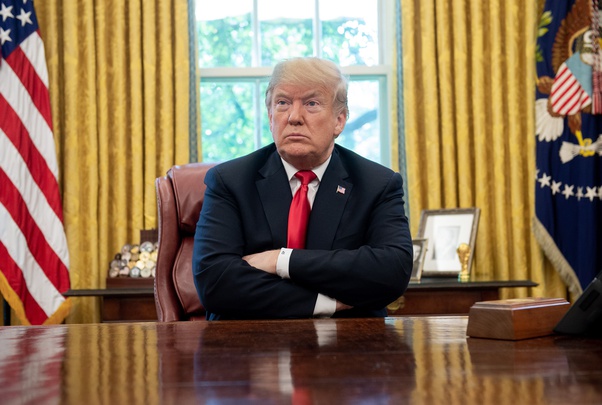
New York Times, Potential legislation circulating in the executive branch and Congress would grant President Trump sweeping military powers, Charlie Savage and Robert Jimison, Sept. 19, 2025. Draft legislation is circulating at the White House and on Capitol Hill that would hand President Trump sweeping power to wage war against drug cartels he deems to be “terrorists,” as well as against any nation he says has harbored or aided them, according to people familiar with the matter.
A wide range of legal specialists have said that U.S. military attacks this month on two boats suspected of smuggling drugs in the Caribbean Sea were illegal. But Mr. Trump has claimed that the Constitution gave him the power he needed to authorize them.
It was not clear who wrote the draft congressional authorization or whether it could pass the Republican-led Congress, but the White House has been passing it around the executive branch.
The broadly worded proposal, which would legally authorize the president to kill people he deems narco-terrorists and attack countries he says helped them, has set off alarm bells in some quarters of the executive branch and on Capitol Hill, according to people who spoke on the condition of anonymity about sensitive internal deliberations.
Three people familiar with the matter said that Representative Cory Mills, a Florida Republican and combat veteran who sits on the Armed Services Committee, was involved in developing the draft. Mr. Mills, a staunch Trump ally, declined to comment on the potential legislation or his role. Karoline Leavitt, the White House press secretary, declined to comment, citing a policy against discussing “drafts that may or may not be circulating.”
An administration official, speaking on the condition of anonymity to discuss internal matters, said the draft originated with a member of Congress who had asked for technical assistance in improving it. The official portrayed its circulation for input by executive branch agencies as a routine courtesy that should not be interpreted as support for the idea.
The measure has emerged amid an escalating debate in Washington over the president’s war-making power and Congress’s role in authorizing the use of American military force, after the Trump administration opened a deadly campaign against the boaters.
The two boat attacks — killing what Mr. Trump has said were 14 people he accused of smuggling drugs toward the United States — were the latest in a series of military operations the president has taken without congressional authorization, raising constitutional concerns among some lawmakers in both parties, who say their branch should play a greater role in such decisions.
Critics have also said that Mr. Trump and Defense Secretary Pete Hegseth have given illegal orders, causing Special Operations troops to target civilians — even if they are suspected of crimes — in apparent violation of laws against murder.
The U.S. Coast Guard, with help from the Navy, has long treated drug trafficking as a law enforcement problem, interdicting boats and arresting their crews if a search confirmed suspicions of drug smuggling. Regular forces repeated that approach with a Venezuelan fishing boat last week, releasing its crew after the suspicions apparently proved to be inaccurate.
But the administration has insisted that Mr. Trump has legal authority, under his constitutional power as commander in chief, to direct Special Operations forces to instead summarily kill those suspected of drug running as if they are combatants on a battlefield. Citing the roughly 100,000 overdose deaths of Americans each year, the administration has invoked self-defense and the law of armed conflict.
Congress has not authorized any armed conflict with drug cartels. The draft legislation, which the White House Office of Management and Budget has circulated within the executive branch for comment, would address that potential weakness in the administration’s argument — at least as a matter of domestic law.
Following the first boat strike, on Sept. 2, Democrats and some Republicans expressed concern about the White House’s legal basis for the attack, even as administration officials like Secretary of State Marco Rubio, who is also Mr. Trump’s national security adviser, said there would be more to come.
New York Times, Trump Administration Live Updates: Shutdown Looms as Senate Democrats Block Bill to Extend Funding, Staff Reports, Sept. 19, 2025. Where Things Stand:
Shutdown looms: Senate Republicans and Democrats on Friday each blocked the other side’s plan to keep the government open past the end of the month. The two votes increased the likelihood of a shutdown on Oct. 1. The House passed a Republican-supported bill that would keep funding mostly at current levels; Democrats’ alternative would reverse some health care cuts. Neither side won the 60 votes necessary in the Senate to move ahead. Read more ›
Harvard crackdown: The Trump administration demanded proof of the financial stability of Harvard University, the nation’s oldest and wealthiest college, as well as a guarantee that federal debts would be paid if the school “closes or terminates classes.” Read more ›
Passport gender policy: The Trump administration asked the Supreme Court to allow it to require U.S. passports to reflect the sex listed on the holder’s original birth certificate, part of its efforts to limit official recognition of transgender identity. Read more ›
Syrian migrants: Homeland security officials said deportation protections for thousands of Syrians living in the United States would be terminated, the administration’s latest effort to shrink the number of people given Temporary Protected Status. Trump officials have also moved to end the legal shield for people from Cuba, Haiti, Nicaragua and Venezuela. Read more ›
The Trump administration will end deportation protections for thousands of Syrians.ImageA man on a motorcycle drives past buildings damaged in war.Some immigration policy experts criticized the decision and said that conditions in Syria are still unstable.Credit...Nicole Tung for The New York Times
The Trump administration will terminate deportation protections for thousands of migrants from Syria, homeland security officials said on Friday.
About 6,000 Syrians are authorized to live and work in the United States through the program, known as Temporary Protected Status, which is meant to help migrants who cannot return to their countries because of unsafe conditions. About 1,000 more Syrians also had pending applications to join the program as of August, according to the Department of Homeland Security.
“This is what restoring sanity to America’s immigration system looks like,” Tricia McLaughlin, the department’s assistant secretary for public affairs, said in a statement. “Conditions in Syria no longer prevent their nationals from returning home. Syria has been a hotbed of terrorism and extremism for nearly two decades, and it is contrary to our national interest to allow Syrians to remain in our country. T.P.S. is meant to be temporary.”
Some immigration policy experts criticized the decision, saying that conditions in Syria were still unstable and that Syrians did not pose major terrorism risks. After more than a decade of civil war, rebels ended the Assad family’s brutal rule in Syria late last year. Although Syria’s new leaders have sought to move away from dictatorship, concerns over sectarian conflict and violence remain.
Aaron Parnas, above: "I started this work because I believe truth must always triumph over misinformation. That conviction hasn’t changed. Even as free speech is attacked, our responsibility is to keep pressing forward, to deliver facts with integrity and without fear."
The Parnas Perspective, Trump to Fire US Attorney for Failing to Find Evidence to Charge Letitia James, Aaron Parnas, Sept. 19, 2025. Donald Trump is expected to fire a U.S. Attorney for refusing to secure an indictment against Trump’s political opponent, Letitia James, right. At the same time, the boycott of ABC and Disney is intensifying.
According to The Guardian, a growing network of U.S.-based neo-Nazi “active clubs” is exploiting the assassination of far-right commentator Charlie Kirk to recruit new members, framing his death as proof of “anti-White oppression” and urging white men to “fight back”; analysts warn these loosely organized fight clubs, tied to violent extremism and already spread across 27 countries, are leveraging Kirk’s killing, alongside other tragedies, to stoke racist anger, glorify violence, and expand one of today’s most dangerous far-right movements.
Tyler Robinson, above, the suspected shooter of Charlie Kirk, used the name “DonaldTrump” on his video game account per Bloomberg.
According to ABC News, President Donald Trump is expected to fire U.S. Attorney Erik Siebert, who leads the Eastern District of Virginia, after he resisted pressure from Trump officials to pursue criminal charges against New York Attorney General Letitia James for alleged mortgage fraud — despite investigators finding no clear evidence of wrongdoing — a move that critics warn underscores Trump’s use of the Justice Department to retaliate against political adversaries, especially given James’ role in bringing a successful civil fraud case against him.
Donald Trump’s FCC chairman Brendan Carr, right, a close Trump ally praised as a “warrior for free speech,” has escalated scrutiny of major media companies, now vowing “we are not done yet” and celebrated ABC’s indefinite suspension of Jimmy Kimmel Live! following Kimmel’s controversial remarks about Charlie Kirk’s assassination.
The suspension of Jimmy Kimmel Live! after threats from Trump-appointed FCC Chair Brendan Carr has drawn sharp backlash from comedy hosts including Jon Stewart, Stephen Colbert, and Jimmy Fallon, who mocked the administration and denounced the move as censorship, warning it reflects government intimidation of the press and entertainment industry — a concern echoed by Barack Obama, David Letterman, and others as Disney and Nexstar pulled the show amid looming FCC merger approvals.
Executives stressed the pause was to “lower the temperature,” with hopes of eventually bringing Kimmel back before his contract ends in 2026.
According to The Guardian, a growing network of U.S.-based neo-Nazi “active clubs” is exploiting the assassination of far-right commentator Charlie Kirk to recruit new members, framing his death as proof of “anti-White oppression” and urging white men to “fight back”; analysts warn these loosely organized fight clubs, tied to violent extremism and already spread across 27 countries, are leveraging Kirk’s killing, alongside other tragedies, to stoke racist anger, glorify violence, and expand one of today’s most dangerous far-right movements.
Tyler Robinson, the suspected shooter of Charlie Kirk, used the name “DonaldTrump” on his video game account per Bloomberg.
A CDC advisory panel has recommended restricting the combined measles, mumps, rubella, and varicella (MMRV) vaccine for children under age 4 due to a small but known risk of febrile seizures, advising instead the use of separate shots at younger ages; while the guidance does not change overall vaccination schedules, the vote — shaped by new members appointed by Health Secretary Robert F. Kennedy Jr., many of whom are vaccine skeptics — has raised concerns among public health experts that it could undermine confidence in long-established immunization policies.
Hungarian Prime Minister Viktor Orbán announced that his government will designate antifa a terrorist organization, mirroring President Donald Trump’s move in the U.S.; while antifascist groups have little presence in Hungary, Orbán cited a 2023 assault tied to foreign activists and criticized the release of Italian activist Ilaria Salis — now an EU lawmaker with immunity — framing the designation as part of his broader alignment with Trump and crackdown on dissent.
The U.S. Senate, under new Republican rules, confirmed 48 of Donald Trump’s nominees in a single vote to speed up approvals stalled by Democrats. Among those approved were Jonathan Morrison as head of the National Highway Traffic Safety Administration and Kimberly Guilfoyle as ambassador to Greece.
According to The Guardian, U.S. law enforcement agencies including the FBI, CBP, and NYPD have circulated internal reports claiming that certain emojis — such as trains, ninjas, swords, aliens, and even strawberries — could signal affiliation with Tren de Aragua, a Venezuelan gang frequently cited by Donald Trump to justify his immigration crackdown.
At least 70 people — including 11 New York elected officials — were arrested after staging protests inside and outside Manhattan’s Jacob K Javits federal building, demanding access to an ICE intake facility accused of mistreating detainees. Among those detained were Comptroller Brad Lander, Public Advocate Jumaane Williams, and several state senators and city council members, who denounced ICE as “cruel and violent” and called for its abolition.
Republicans in Congress are moving to roll back key protections against PFAS, the toxic “forever chemicals” widely used in U.S. military firefighting foam that have contaminated water supplies near hundreds of bases. Provisions in the new defense bill would delay the planned 2026 ban on PFAS foam until at least 2028, slash cleanup funding by $200 million, lift a moratorium on incinerating foam despite its ineffectiveness, and repeal a requirement for the Pentagon to buy PFAS-free everyday goods.
Trump is set to speak with Chinese leader Xi Jinping to finalize a deal that would allow TikTok to keep operating in the U.S., with discussions also addressing the ongoing trade war, tariff reductions, and technology disputes; the deal, still facing questions over TikTok’s algorithm and congressional approval, could mark both a breakthrough in negotiations and a test of U.S.–China competition in advanced technology.
In her forthcoming campaign memoir 107 Days, Kamala Harris reveals deep frustrations with Joe Biden during the 2024 election, describing herself as “angry and disappointed” after he phoned hours before her debate with Trump to warn of Philadelphia power brokers allegedly refusing to support her, and criticizing his frailty, verbal stumbles, and failure to champion her accomplishments.
The Taliban have released British couple Peter and Barbie Reynolds, aged 80 and 75, after holding them for more than seven months on undisclosed charges; the longtime residents of Afghanistan, who ran an education and training organization in Bamiyan, were freed with Qatari mediation and handed over to the U.K.’s envoy, highlighting ongoing Western concerns over Taliban detentions and efforts to gain international recognition.
Eleanor Holmes Norton, Washington DC’s 88-year-old longtime House delegate, is facing a primary challenge from city council member Robert White, who argues the district needs “strongest fighters” amid Trump’s unprecedented federal takeover of DC policing and Republican efforts to impose new crime laws.
Lincoln Square Media, Political Commentary: Trump's Numbers in Freefall, Rick Wilson and Andrew Wilson, Sept. 19, 2025. He's underwater on the economy. And the Epstein files are his Achilles' heel.
Who needs some good news this week? Rick & Andrew Wilson are here to dig through the numbers and Trump isn’t going to like any of this.

New York Times, The S.E.C. Drops Efforts to Recoup Funds From Trump Clemency Recipients, Kenneth P. Vogel, Sept. 19, 2025. Devon Archer, Trevor Milton and Carlos Watson were convicted in fraud schemes totaling hundreds of millions of dollars. Now, they will not be required to pay back victims.
The Securities and Exchange Commission this week dropped civil enforcement cases that could have led to penalties totaling hundreds of millions of dollars against three men who were previously granted clemency by President Trump.
The cases had been brought before Mr. Trump took office this year. Each involved people who later allied themselves with him as they pursued pardons for white-collar frauds that, according to juries in criminal cases, cheated victims out of huge sums.
Devon Archer, who was convicted in connection with a scheme targeting pension funds and a Native American tribal entity, was ordered to pay nearly $60 million in forfeiture and restitution.
Trevor Milton was found guilty of lying about the supposed technical achievements of his electric truck maker Nikola. Prosecutors recommended that he pay more than $660 million back to shareholders.
Carlos Watson, who was convicted of defrauding investors in his digital media company Ozy Media, was assessed penalties of nearly $97 million.
All were spared prison time and criminal restitution payments when Mr. Trump granted pardons to Mr. Archer and Mr. Milton and commutations to Mr. Watson and Ozy.
And now, the S.E.C. action means that they will not have to pay any civil penalties, nor will they face restrictions that the commission had sought on their ability to work in securities-related positions.
The dismissals of the civil cases further underscore how Mr. Trump has used the levers of power to help affluent allies who have found themselves crosswise with the federal government he now leads.
A White House official said that the decisions were made by the S.E.C., and referred a request for comment to the commission.
An S.E.C. spokesman declined to comment on the moves. Instead, he pointed to the commission’s joint filings with the defendants’ lawyers that cast the dismissals, which need to be approved by judges, as an “exercise of its discretion” that do “not necessarily reflect the commission’s position on any other case.”
Mr. Trump’s clemency grants seemed to make the cases less desirable for the commission, which is technically independent but is headed by a Trump appointee and has reflected the president’s priorities in its enforcement actions and agenda.
Civil actions like those dismissed this week are typically brought in conjunction with related criminal cases and seek the return of the same ill-gotten funds that are the subject of criminal restitution and forfeiture orders. In settling such civil cases, the S.E.C. will often deduct payments made in connection with criminal sentences.But Mr. Trump has short-circuited that process by pardoning people before they even begin their sentences or restitution payments. He has brushed aside Justice Department guidelines that prioritize clemency petitioners who have served their time, shown remorse and paid restitution to their victims.
Another case the S.E.C. dismissed this week was against Mark Kuhrt, who had been convicted in 2012 for playing a supporting role in a $7.2 billion Ponzi scheme. His sentence had been commuted in December 2024 by President Joseph R. Biden Jr. But Mr. Kuhrt had already served years in prison and faced only a $1,000 penalty in connection with his criminal case.
To be sure, Mr. Biden also drew criticism for his late-term pardons — particularly his far-reaching pardon of his son Hunter — but Mr. Trump has more systematically used clemency to reward those who play to his sense of grievance and loyalty.
Mr. Archer’s pardon application highlighted the assistance he provided to prosecutors and congressional Republicans in investigations of his former business partner, Hunter Biden, a frequent target of Mr. Trump. Hunter Biden was not charged in the securities fraud case, and his lawyers have said he was not involved.
More On U.S. Health, Safety Nets
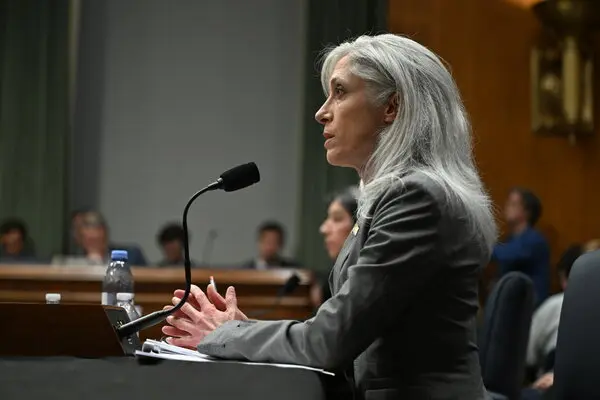
Former Centers for Disease Control Director Susan Monarez testifies before the U.S. Senate on Sept. 17, 2025 (New York Times photo by Kenny Holsten)
Letters from an American, Historical Commentary: Sept. 18, 2025 [Pro-Trump Party vs. Everyone Else?], Heather Cox Richardson, right, Sept. 19, 2025.
Since he took office in 2017, President Donald J. Trump has worked hard to convince Americans that they are divided into two partisan camps: Republicans, whom he defines as those people loyal to him, and Democrats, a group made up of everyone else. In his first term, when actual Republicans, some of whom he appointed himself, challenged him, he simply redefined them as Democrats. In his telling, major figures in the investigation of the 2016 Trump campaign’s association with Russian operatives, including special counsel Robert Mueller and his staff, FBI director James Comey, and deputy attorney general Rod Rosenstein, were all Democrats.
In 2020, when Utah senator Mitt Romney voted to convict Trump on one of the charges on which the House impeached him, Trump tweeted a video calling him a “Democrat secret asset” who “tried to infiltrate Trump’s administration” while “posing as a Republican.” Romney was the Republican Party’s 2012 presidential nominee.
In Trump’s worldview, it appears, those who oppose him, those he calls “Democrats,” are anti-American and dangerous. In his first term, he insisted those people were organized as “Antifa,” for “anti-fascist.” In summer 2020, in the midst of protests after the murder of George Floyd, Trump threatened to designate “Antifa” as a “major terrorist organization.” When FBI director Chris Wray, whom Trump appointed himself, said antifa is an ideology, not an organization, Trump posted: “I look at them as a bunch of well funded ANARCHISTS & THUGS who are protected because the Comey/Mueller inspired FBI is simply unable, or unwilling, to find their funding source, and allows them to get away with ‘murder’. LAW & ORDER!”
Dividing a population into friends and enemies is a tool of authoritarians, clearly articulated by Nazi political theorist Carl Schmitt, who is enjoying a burst of popularity right now in the American right wing. MAGA figures have pushed the idea that the murder of right-wing activist Charlie Kirk last week, apparently by a lone gunman, could be blamed on “Democrats” or “THEM.” Last night, after news broke that ABC was suspending comedian Jimmy Kimmel’s television show, the Trump administration announced it was putting the teeth of the government into this division of the world.
His social media account posted: “I am pleased to inform our many U.S.A. Patriots that I am designating ANTIFA, A SICK, DANGEROUS, RADICAL LEFT DISASTER, AS A MAJOR TERRORIST ORGANIZATION. I will also be strongly recommending that those funding ANTIFA be thoroughly investigated in accordance with the highest legal standards and practices. Thank you for your attention to this matter!”
Legal experts point out that government officials can designate “foreign terrorist organizations,” but that there is no legal grounds for designating any domestic organization a “terrorist organization,” especially in light of the First Amendment that protects free speech and the right of Americans to assemble peacefully. Even if the designation can’t actually be made, though, the rhetorical division of the country into Americans and “Antifa” serves to divide the country into friends and enemies.
But the uproar over the suspension of Jimmy Kimmel brought to light a different, far more American, division in this country. Americans could divide along partisan lines so long as the guardrails of a secular, evidence-based, liberal democracy remained in place. But as the Trump administration smashes through those guidelines, it appears that rather than being divided along partisan lines, Americans are beginning to realign as “We the People” against a wannabe authoritarian.
Yesterday, Republican political strategist Karl Rove, who was a key member of President George W. Bush’s administration, pushed back against the friends and enemies distinction in the Wall Street Journal. “No,” he wrote. “Charlie Kirk wasn’t killed by ‘them.’ ‘They’ didn’t pull the trigger. One person did, apparently a young man driven by impulse and a terrible hate. If there were a ‘they’ involved, law enforcement would find ‘them’ and the justice system would hold ‘them’ accountable. But ‘he’ and ‘him’ are the correct pronouns for this horrendous act…. Using Charlie’s murder to justify retaliation against political rivals is wrong and dangerous. It will further divide and embitter our country. No good thing will come of it.”
As Trump’s popularity continues to plummet—The Economist today has his approval rating at -17%, down 2.6 points since last week—it’s becoming clearer every day that opposition to the president is not partisan. Yesterday, former director of the Centers for Disease Control and Prevention Susan Monarez testified before the Senate Committee on Health, Education, Labor, and Pensions, where she explained that Health and Human Services Director Robert F. Kennedy Jr. is operating according to his ideology without regard for science. Kennedy fired her after she refused to rubber stamp his plans to change the childhood vaccination schedule without research supporting such a change.
Trump appointed Monarez.
Senator Bill Cassidy (R-LA) warned yesterday against the panelists Kennedy appointed to the Advisory Committee on Immunization Practices after he purged the panel making changes to the childhood vaccine schedule. Not only Cassidy but also insurance companies appear to have little confidence in the decisions of Kennedy’s panel. They say they will disregard any changes and continue covering the cost of vaccines—a clear sign they consider vaccines beneficial to helping people stay healthy.
John Yoo, the former deputy assistant attorney general under President George W. Bush who wrote the legal justification for torture during the war on terror, pushed back on the extreme powers Trump is claiming to kill those he labels terrorists. “There has to be a line between crime and war,” Yoo said. “We can’t just consider anything that harms the country to be a matter for the military. Because that could potentially include every crime.”
Some voices on the right who, in the past, were protected by the laws and norms of democracy are now calling out its loss. Last night, after the administration pressured ABC to suspend Kimmel’s show, right-wing media host Tucker Carlson explained why a government must not be able to limit speech. “You hope that a year from now, the turmoil we're seeing in the aftermath of his murder won't be leveraged to bring hate speech laws to this country. And trust me…if that does happen, there is never a more justified moment for civil disobedience than that, ever, and there never will be, because if they can tell you what to say, they're telling you what to think. There's nothing they can't do to you, because they don't consider you human. They don't believe you have a soul. A human being with a soul, a free man, has a right to say what he believes, not to hurt other people, but to express his views.”
Today, agents from the Department of Homeland Security arrested New York City comptroller Brad Lander and public advocate Jumaane Williams along with ten other city and state elected officials near federal immigration courts when they tried to conduct oversight of people detained by Immigration and Customs Enforcement in the building.
Paul Krugman via Substack, Political-Economy Commentary: A Lawless Nation, Paul Krugman, right, Sept. 19, 2025. Friends don’t let friends visit America.
What to know about the Hyundai immigration raid in US - ABC News
A relatively short post today, involving a story you may not have heard about. But it’s a very important story — indeed, arguably it amounts to a significant international crisis.
South Korea isn’t what Donald Trump would call a “shithole country.” It is, in fact, one of the greatest economic success stories in history, a nation that was poorer than Haiti in the early 1960s and now has a European-level standard of living. It’s a manufacturing powerhouse: The reason Hyundai was building that factory was that the Koreans are very good at manufacturing, often better than we are.
Oh, and South Korea is or was an important U.S. ally. Not long ago relations between the two nations were good enough that we signed a free trade agreement, although Trump has ripped up that agreement without bothering to explain why solemn U.S. promises apparently don’t matter anymore.
 And the South Koreans are, by all accounts, every bit as outraged as you might expect. One editorial, flagged by Daniel Drezner, declared
The sight of our workers being led out in chains resembles images of African slaves in the 18th and 19th centuries being dragged out by their owners.
How did this happen? Even if there had been good reason to believe that a significant number of the South Koreans at the site were violating the terms of their visas — which they weren’t — civilized nations don’t suddenly arrest hundreds of citizens of an allied nation without warning and place them in chains. Why not contact Hyundai about the alleged issue? Why not notify the South Korean government?
As far as we can tell, what happened in Georgia was a symptom of ICE running out of control. The agency has been told by Stephen Miller, Trump’s immigration czar, to meet a quota of 3,000 arrested immigrants a day. So when its agents raided a facility full of nonwhite people, it just grabbed them, chained them, and locked them up.
The Hyundai raid hasn’t received much attention in the U.S. news media, which is arguably understandable given everything else going on. But the diplomatic and economic fallout will be immense. Trump has been saying that his policies have brought in $17 Musks trillion in foreign investment, which would be an absurd number even if America were behaving like a normal country with rule of law. But it’s even more absurd given the Hyundai incident.
I’m not a business executive, but if I were making decisions for a multinational corporation I’d be really hesitant about making large investments in a nation where foreigners never know whether they will in effect be kidnapped by masked thugs who supposedly work for the government but are clearly running amok. I don’t know about you, but I’d be strongly tempted to consider such a nation a shithole country.
Mario Guevara reports live from a local police traffic enforcement area in Stone Mountain, Georgia, on 29 April 2025. Photograph: Erik S Lesser/EPA
The Guardian, US appeals court orders deportation of Atlanta journalist detained by ICE, George Chidi, Sept. 19, 2025. Mario Guevara faces imminent removal from US as his attorney files emergency petition.
The imprisoned journalist Mario Guevara is facing imminent deportation after an immigration appeals court closed the case and ordered his removal.
Lawyers from the American Civil Liberties Union (ACLU) say the El Salvador native could be put on a plane at any moment, despite an immigration judge’s initial order to grant his release on bond and a clear legal path to residency. His attorney said they were filing an emergency petition seeking relief.
Local police in suburban Atlanta arrested Guevara at a “No Kings Day” protest in June on charges of failing to disperse and standing in the roadway. While those charges, and other unrelated traffic charges laid later, were dropped almost immediately, US Immigration and Customs Enforcement (Ice) has held him in detention while seeking his deportation. The Committee to Protect Journalists noted that his detention and potential deportation was a result of his reporting on immigration and he had been detained in direct retaliation for his reporting.
Guevara has been in the US for more than 20 years. While his petition for asylum was rejected in 2012, his deportation was administratively closed in an appeal, and he has both a work permit and a pending application for a green card, his attorney Giovanni Diaz said.
He has been held for more than three months at the Folkston Ice processing center in south Georgia, the same detention facility Ice held 475 workers at a battery plant construction site earlier this month.
Though granted a bond, immigration officials appealed against the bond order. The order of deportation makes the bond case moot, but the ACLU has a habeas corpus petition pending before the federal court in south Georgia. Lawyers have filed an emergency appeal in that court, they said.
U.S. Attacks On Voting Rights
Democracy Docket, DOJ sues Maine, Oregon in aggressive move to seize voter data, Marc Elias, Sept. 19, 2025. Maine Secretary of State Shenna Bellows (D) made her response clear after the U.S. Department of Justice (DOJ) sued her state this week, telling Democracy Docket: “We won’t back down.”
DOJ filed lawsuits against Maine and Oregon, attempting to obtain private voter registration data. And Bellows says it’s no accident they picked those states. “Our neighbors in New Hampshire also rejected the Department of Justice’s voter request,” Bellows said at a Wednesday press conference. “So it is not normal that they are targeting just me and Oregon with these lawsuits. Why aren’t they targeting New Hampshire or Pennsylvania, who have Republican secretaries of state who have said no?”
The dramatic legal actions mark a major turning point in the department’s effort to force states to turn over unredacted voter rolls and list maintenance records. If federal courts side with the DOJ, it could set a new precedent forcing states to hand over extensive, sensitive voter data. Read more about the lawsuits here.
Utah, Missouri are fighting back on GOP gerrymanders: The GOP is continuing its push to rig congressional maps around the country – next up, Ohio – but they’re facing serious opposition to their schemes in Utah and Missouri. In a major victory for voters, the Utah Supreme Court this week denied the state legislature’s petition to keep its gerrymandered congressional map in place for upcoming elections and ordered lawmakers to present a new map by Sept. 25. The decision likely means Utah voters will have fair districts when they go to the polls next year – and it could give Democrats an additional seat in Congress. Meanwhile, Missouri became the second red state to pass a GOP gerrymander this year under direct pressure from President Donald Trump. But unlike in Texas, Trump is finding out Missouri voters have a huge trick up their sleeves – and they’re using it. Missourians have the constitutional right to a referendum that allows them to veto laws passed by the legislature. Richard Von Glahn, executive director of People NOT Politicians Missouri, said this week a coalition of Missourians have filed a referendum petition and over 800 people have volunteered to help collect signatures to get the measure on the ballot. If the coalition submits the signatures by Dec. 11, the map cannot go into effect until signatures are verified and Missourians have the chance to hold a referendum vote, Von Glahn said. Missouri Gov. Mike Kehoe (R) still hasn’t signed the map legislation into law – maybe because Republicans appear to have made a mistake and included a Kansas City precinct in two congressional districts, giving those residents the ability to vote twice. (Kehoe’s office denies there’s an error.) Read more about the Missouri referendum here.
VOTING RIGHTS ACT White voters file brief in Louisiana redistricting challenge The voting world was holding its breath in June, waiting for a historic ruling from the U.S. Supreme Court (SCOTUS) in the Louisiana v. Callais redistricting case. Instead, the court issued an order to rehear the case in the next term. That break is coming to an end. SCOTUS is scheduled to hear oral arguments starting Oct. 15 in a case that could determine the future of the Voting Rights Act (VRA) – and what relief is available to minority voters when maps are drawn to silence them. In the latest development, white voters filed a supplemental brief this week giving us a preview of what to expect in October. The brief addressed whether Louisiana's intentional creation of a second majority-minority congressional district violates the 14th or 15th Amendment. They argued Louisiana's map violates the 15th Amendment and they urged SCOTUS to order the district court to implement a new map. They also argued if SCOTUS does not gut Section 2 of the VRA in their Louisiana ruling, it should at least make it much harder for minority voters to win in court.
They want it to be even more difficult for minority voters to prove racial discrimination in redistricting, that race drove the redistricting decisions, and that the discrimination stems from the state itself. Even if minority voters do clear those higher bars, they’re arguing that the remedy should not elevate one racial group at the expense of another, since in their view "that would only remedy discrimination through discrimination." Read more about the Louisiana case here.
U.S. Media, Culture Wars, Education
The Bulwark, The New York Times and Anti-Anti-Fascism, Jonathan V. Last (JVL), above, Sept. 19, 2025. On the burdens of solidarity.I need to get something off my chest. There is part of me that hopes Trump’s $15 billion lawsuit against the New York Times is successful.
I don’t really mean that. Okay, I mean like 3 percent of it. Maybe 5 percent. But I’m not proud of it. I recognize that this is a bad thought. If the lawsuit were to succeed it would be terrible for the country. Everyone who is committed to liberal democracy should be standing with the Times. Solidarity.
And yet . . .
Come to the bad place with me. Just for a minute.
1. Democracy Is Just One Issue
In May 2023 Joe Kahn, the executive editor of the New York Times, sat for an interview with Ben Smith. Smith asked the following question:
Ben Smith: Dan Pfeiffer, who used to work for Barack Obama, recently wrote of the Times: “They do not see their job as saving democracy or stopping an authoritarian from taking power.” Why don’t you see your job as: “We’ve got to stop Trump?” What about your job doesn’t let you think that way?
Kahn’s response was illuminating:
Joe Kahn: One of the absolute necessities of democracy is having a free and fair and open election where people can compete for votes, and the role of the news media in that environment is not to skew your coverage towards one candidate or the other, but just to provide very good, hard-hitting, well-rounded coverage of both candidates, and informing voters. . . .
Now let’s lay bare Kahn’s propositions:
It’s hard to tell if Joe Kahn is a morally bankrupt prig or a well-meaning fool.
Anyway: Fast-forward to Trump’s $15 billion suit and suddenly Joe Kahn has a strong point of view.
The Times alleges that the president of the United States is attempting to intimidate it with a baseless lawsuit. “It lacks any legitimate legal claims and instead is an attempt to stifle and discourage independent reporting. The New York Times will not be deterred by intimidation tactics,” a spokesperson for the paper said.
Kahn appeared at an Axios event—because of course—and declared, “He’s wrong on the facts; he’s wrong on the law. And we’ll fight it, and we’ll win.” So the Wordle Picayune is now ready to engage on questions of liberalism and democracy. How butch.
2. Solidarity
I’m trying to make an object lesson of myself here because the scale of our peril requires introspection and hard truths.
One of the hard truths is that the Joe Kahns of the world never think liberal democracy is important until the wolf is at their door. That’s the weakness of collective action.
The solution to this problem is solidarity—everyone holding hands and standing against the authoritarian wave. A posture which treats an attack on anyone as an attack on everyone. NATO’s Article 5, but for a domestic political system.
People like me—bad people—may blanch in such moments. Or want to see Joe Kahn get to “finding out” phase. But this impulse is dangerous narcissism and it must be resisted. “Solidarity” sounds grand and heroic. In reality, it means holding hands not just with admirable men and women, but with people you don’t like. People whose preferences, miens, and prior judgments are foolish, or priggish, or worse.
Solidarity is essential; but let’s not romanticize it.
How’s that for a pitch: Solidarity blows and we gotta do it anyway? But that’s what we do here at The Bulwark. We try to be clear eyed about what this moment demands. Especially from ourselves.
Now the big question: What does solidarity require of us? It requires putting aside differences in the name of the liberal order itself.
So for me, personally: It means putting Bad JVL back in the gimp box, defending Joe Kahn and the New York Times, and using the occasion of Trump’s lawsuit not to gloat, but to invite the Times into the pro-democracy movement.
Everyone will have their cross to bear.
For example: You may not like Zohran Mamdani. But if he’s elected mayor of New York City he will be put on the front line against Trump. He will need support.
“Supporting” Mamdani doesn’t mean realigning your policy preferences with his, or lying for him. We should always live in truth. But it would mean recognizing that, in confrontations with Trump, Mamdani represents liberal democracy and Trump represents authoritarianism. And then taking Mamdani’s side accordingly.
Every one of us will be confronted with allies we do not agree with, or even like. Solidarity requires making peace with that discomfort. If you decline, then you fall prey to the anti-anti delusion: That it is more important to maintain relative positioning in the old order than to stand against the new threat.
Rooting against Joe Kahn is the first step down the road to anti-anti-fascism. And as Molly White quipped,
Leave a comment3. Debate Me, Bro
Here’s Mike Masnick on why “debate” is overrated:
Among the attempts to create hagiographic eulogies of Charlie Kirk, I’ve seen more than a few people suggest that Kirk should be respected for being willing to talk to “those who disagree with him” as a sign that he was engaging in good faith. Perhaps the perfect example of this is Ezra Klein’s silly eulogy claiming that Kirk was “practicing politics the right way” because he would debate students who disagreed with him. . . .
There are many problems with this statement, but Klein’s fundamental error reveals something much more dangerous: he’s mistaking performance for discourse, spectacle for persuasion. Kirk wasn’t showing up to campuses to “talk with anyone who would talk to him.” He was showing up armed with a string of logical fallacies, nonsense talking points, and gotcha questions specifically designed to enrage inexperienced college students so he could generate viral social media clips of himself “owning the libs.”
Klein is eulogizing not a practitioner of good-faith political discourse, but one of the most successful architects of “debate me bro” culture—a particularly toxic form of intellectual harassment that has become endemic to our political discourse. And by praising Kirk as practicing “politics the right way,” Klein is inadvertently endorsing a grift that actively undermines the kind of thoughtful engagement our democracy desperately needs.
The “debate me bro” playbook is simple and effective: demand that serious people engage with your conspiracy theories or extremist talking points. If they decline, cry “censorship!” and claim they’re “afraid of the truth.” If they accept, turn the interaction into a performance designed to generate viral clips and false legitimacy. It’s a heads-I-win-tails-you-lose proposition that has nothing to do with genuine intellectual discourse.
The fundamental issue with “debate me bro” culture isn’t just that it’s obnoxious, it’s that it creates a false equivalence between good-faith expertise and bad-faith trolling. When you agree to debate someone pushing long-debunked conspiracy theories or openly hateful ideologies, you’re implicitly suggesting that their position deserves equal consideration . . .
[T]hese aren’t actually debates at all. They’re performances designed to generate specific emotional reactions for viral distribution. Participants aren’t trying to persuade anyone or genuinely engage with opposing viewpoints. They’re trying to create moments that will get clipped, shared, and monetized across social media.
Kirk perfected this grift. As a recent detailed analysis of one of Kirk’s debates demonstrates, when a student showed up prepared with nuanced, well-researched arguments, Kirk immediately tried pivoting to culture war talking points and deflection tactics. When debaters tried to use Kirk’s own standards against him, he shifted subjects entirely. The goal was never understanding or persuasion—it was generating content for social media distribution.
MeidasTouch Network, Commentary: Judge Instantly Dismisses Trump's NY Times Lawsuit, Ben Meiselas, Sept. 19, 2025. One federal judge read Trump’s 85-page screed and told him, in effect, “This isn’t a lawsuit, it’s a press release.” Good.
I’ve been watching this circus for a long time, and just now, a federal judge in the Middle District of Florida cut through the noise and called Trump’s $15 billion lawsuit against The New York Times what it is: frivolous, improperly pled, and an abuse of our courts.
Look, Trump filed an 85-page document that spends most of its time performing PR for himself, breathless brags about The Apprentice, lists of his properties, long meditations on how “the legacy media” supposedly stole an election, and buries the actual, scant legal claims on page 80. Anyone who’s practiced law knows that’s not how a complaint is supposed to read. A complaint must be a short, plain, direct statement of facts that gives defendants fair notice of the claim against them. This thing was a dossier of grievances. A long-winded press release. Not litigation.
You can read the full court ruling by clicking here, and watch my report above.
U.S. District Judge Merryday, a George H.W. Bush appointee, didn’t mince words. He pointed out rule after rule that the complaint flouted. He described the pleading as a public relations platform, “a megaphone for public relations, or a podium for a passionate oration at a political rally.” He struck it, gave Trump 28 days to file an amended complaint, and capped the rewrite at 40 pages. Shape up or shut up, Donald.
I’m grateful for judges like that. Whether you voted for Trump or loathe him, the courts exist to resolve disputes under the rule of law, not to be used as a political cudgel or a way to bully journalists into silence. Trump’s pattern is clear: when you can’t stomach criticism, drag the media into court and hope the cost and chaos will quiet them. Judges are finally starting to see through the theater. I hope that other media networks who have decided to capitulate to Trump see that too.
This isn’t the first time federal judges have called out this kind of behavior. I’ve repeatedly flagged earlier suits that were thinly veiled attempts to intimidate opponents; judges like Middlebrooks have slapped sanctions down when the filings cross the line. In 2023 Middlebrooks sanctioned Trump and his lawyer for filing a similarly frivolous complaint and warned that repeat abuses of the courts will get real consequences. Those words matter: “Sanctions must never be a hollow gesture. Their bite must be real.”
A quick aside while you are here: I’d love to highlight one of our favorite sponsors who has gone above and beyond to help this network grow—and has allowed us to bring you this video ad-free. Wildgrain has generously sponsored this post. In case you haven’t heard of them, Wildgrain is a great company that delivers artisan breads, pasta & pastries directly to your door. We always have our fridge stocked with their croissants and cookies! We’ve negotiated a discount code: MEIDASTOUCH for our Substack readers for $30 off your first box plus free croissants in every box when you go to Wildgrain.com/meidastouch to start your subscription.
Ok, back to my report.
Why does this matter beyond legal wonkery? Because Trump treats the judiciary like an instrument to be wielded in his political fights. He weaponizes litigation, not for justice, but for revenge and for spectacle. That corrodes faith in public institutions and makes the courts a battleground for vendettas, not fairness. When judges reclaim their role as neutral gatekeepers against that abuse, it’s a win for democracy.
We should also be blunt. This lawsuit was as much about showmanship as about law. It was written like a campaign speech, something directly called out by the judge. If someone wanted to produce a press release, fine. But don’t mislabel it as a legal pleading and expect the federal courts to play along. The judge’s rebuke was a welcome reminder that our system has guardrails. You can’t use Article III courts like a megaphone for grievance theater.
But here’s the problem. Even when judges do the right thing, it doesn’t end the problem. Trump will amend, refile, and keep churning out litigation to punish critics and drain their time and resources. That’s precisely why independent media matters more than ever. Big outlets can sometimes weather legal storms; smaller outlets and independent creators can’t. We need people who will keep reporting, keep explaining what’s happening, and keep holding power to account.
So what can you do? First, stay informed. Don’t let the noise drown out the substance. Judges like Merryday are doing the heavy lifting to protect the integrity of the process; we should notice and value that, not let partisan fury rewrite the narrative. Second, support independent journalism. If you value fearless reporting that won’t be cowed by lawsuits or PR blitzes, subscribe, donate, or share what we do. Independent outlets like ours are built to report, but we can’t do it without your help.
Finally, don’t let your guard down after victories like this. Trump’s pals in the media ecosystem will still spin this, and he’ll keep trying to gaslight, litigate, and litigate again. We need to keep calling it out every time. Judges striking frivolous suits is a hopeful sign. But vigilance from citizens and a populace unafraid to speak truth to power is what turns one judge’s good ruling into a real check on abus
New York Times, How Outrage at Kimmel Grew to a Shout From a Whisper, Stuart A. Thompson, Sept. 19, 2025. Right-wing users on social media on Tuesday were frustrated but not yet apoplectic about Jimmy Kimmel’s monologue. Things changed.
The conservative outrage over the late night host Jimmy Kimmel became apoplectic on Wednesday after Brendan Carr, the Federal Communications Commission chairman, went on a podcast and suggested the regulatory body could use its powers against the network that airs the show.
But the outrage had started to grow online more than 24 hours earlier — first as a whisper, then eventually as a shout, as social media users, influencers and right-wing news outlets began sharing Mr. Kimmel’s monologue, according to an analysis by The New York Times of thousands of posts on social media and mentions on radio, television and podcasts.
It began with a muted reaction on X on Tuesday morning after one user, whose job involves monitoring late night shows for liberal bias, posted a clip of the monologue. Conservative influencers and radio hosts started to take notice throughout the day, and Fox News hosts turned their attention to the clip by the evening.
Then, hours before Mr. Carr’s podcast taping on Wednesday, Elon Musk, the most-followed user on X and the site’s owner, posted that Mr. Kimmel was “disgusting” for the jokes.
The accelerating furor reflects how online outrage does not always emerge organically, but is often the result of a small number of prominent voices redirecting their audience’s attention.
“Outrage is fomented by influential figures in both media and politics, for whom outrage is a communication strategy,” said Anthony Kelly, a member of University College Dublin’s Centre for Digital Policy, who has studied how partisan online outrage spreads. “Lead figures or media outlets wouldn’t be solely responsible. You also have, increasingly, the role of platforms, so outrage is being driven by algorithms.”
Critics have said Mr. Kimmel’s monologue was inaccurate because he said that “the MAGA gang was desperately trying to characterize this kid who murdered Charlie Kirk as anything other than one of them.” According to charging documents, the accused shooter had written of Mr. Kirk, “I had enough of his hatred.”
Mr. Kimmel’s comments ultimately contributed to the show being pulled by ABC indefinitely.There was only muted criticism online and in broadcasts for nearly 24 hours after Mr. Kimmel’s show, according to data on X from Tweet Binder, an analytics company by Audiense that collects data on the platform, and Critical Mention, a media monitoring company.
Early on Tuesday morning, only hours after Mr. Kimmel’s show aired, articles began appearing in conservative media criticizing the monologue. Breitbart, the right-wing news site, highlighted the show in an article published at 6:40 a.m. Eastern time. But the writer focused on Mr. Kimmel’s commentary about President Trump’s grief. It made only a fleeting mention about Mr. Kimmel’s comment that the shooter was “one of them.”
New York Times, When Did Cancel Culture Become ‘Consequence Culture’? Joseph Bernstein, Sept. 19, 2025 (print ed.). As some prominent conservatives target both ordinary people and public figures for their comments about Charlie Kirk, they are trying to rebrand a practice they once maligned.
Instead of cancel culture, call it consequence culture.
At least, that’s what some Republican leaders and prominent conservatives are doing in the week since the assassination of the political activist Charlie Kirk. Dozens of people have lost their jobs for making remarks about Mr. Kirk that are perceived as insensitive. On Wednesday ABC suspended Jimmy Kimmel’s show over comments the late-night host made accusing “the MAGA gang” of trying to portray as a leftist the man who has been charged with Mr. Kirk’s murder.
The pressure campaign being carried out by Mr. Kirk’s allies — and led by the White House, where Vice President JD Vance has encouraged Americans to report to employers anyone “celebrating” Mr. Kirk’s death — was known as “cancel culture” not long ago.
In the last several years, some conservatives weaponized that term to attack those on the political left for trying to professionally harm or socially ostracize those who made statements or took actions deemed unacceptable.
Now some Kimmel supporters and others are accusing the right of embracing the same “cancel culture” it once maligned. In response, some Trump supporters are reframing it as “consequence culture.”
“When a person says something that a ton of people find offensive, rude, dumb in real time and then that person is punished for it, that’s not cancel culture. That is consequences for your actions,” Dave Portnoy, the founder of Barstool Sports, wrote on X on Wednesday.
Global News
Politico, Britain and Ireland agree on sweeping new plan to address Northern Ireland’s bloody past, Shawn Pogatchnik, Sept. 19, 2025. London and Dublin promise a new era of fact-finding that delivers long-sought answers for the families of more than 3,600 dead from three decades of the Troubles.
Investigations into hundreds of bitterly disputed killings from Northern Ireland’s conflict could be reopened under a wide-ranging agreement published Friday by the British and Irish governments.
Standing side by side, Northern Ireland Secretary Hilary Benn and Irish Foreign Minister Simon Harris announced joint plans to create what, until now, has proved impossible — a fact-finding pathway for families scarred by bombings and shootings to find out, finally, who was to blame.
The two leaders said the main goal was to help families finally get answers from a combination of new investigations, testimony from witnesses or participants in attacks, and reviews of long-secret government records.
“Our shared duty is to ensure that trauma does not pass to another generation,” Harris said at the joint press conference with Benn at the U.K. secretary’s official Hillsborough Castle residence outside Belfast.
 The Legacy of the Troubles agreement covers the entire three decades of bloodshed over Northern Ireland that claimed more than 3,600 lives before the U.S.-mediated Good Friday peace accord of 1998. That death toll includes nearly 250 people killed in bombings and shootings in England and the Republic of Ireland.
While ceasefires by the rival Irish Republican Army and so-called “loyalist” paramilitary gangs have largely held since the mid-1990s, veterans of those outlawed groups have refused to come forward to admit their role in specific atrocities. Their steely silence reflects, in part, a desire to avoid imprisonment for admitting crimes, as well as the risk that their victims could use any confessions to sue them for damages. The Provisional IRA, in particular, imposes a code of omerta — silence — on its members.No immunity
The strengthened fact-finding body being proposed in Friday’s plans, to be called the Legacy Commission, will not, however, offer conditional amnesties for ex-militants to come forward and tell the truth. That approach would have opened reputational dangers for both governments — because those militants might finally reveal the extent of their collusion with police, soldiers and intelligence puppet-masters.
A range of British and Irish anti-terrorist agencies recruited and directed agents within all of the illegal groups — and, some victims’ groups contend, played a leading role in deciding who lived and died while maintaining their agents’ cover. The plans published Friday leave unclear the extent to which the new Legacy Commission will pursue investigations into allegations of state collusion with terrorists.
It’s a can of worms that the U.K.’s previous Conservative government tried to bury for good with its own, unilateral Legacy Act that ended Troubles-era criminal investigations and judicial inquests. That 2023 law was drafted principally to shield former British soldiers from potential prosecution for decades-old killings.
The Tory plan met universal opposition from all Northern Ireland parties and still faces a European lawsuit filed by the Republic of Ireland, which represents the interests of Irish nationalists north of the border. The Council of Europe condemned it, too.
As part of Friday’s agreement, Benn and Harris stressed that new criminal prosecutions and civil lawsuits would remain live options alongside new, strengthened fact-finding bodies overseen by judges.
That’s a difference from the approach originally envisaged in the Conservatives’ 2023 legislation. The fact-finding panel, officially formed last year, would have been empowered to offer former militants immunity from prosecution or civil lawsuit in exchange for sufficiently honest, revealing confessions to their victims. But a Belfast court quickly shot down that central immunity concept as illegal.
Benn said offering immunity to ex-terrorists could never have won sufficient public support and “caused great pain and anguish to many people in Northern Ireland.” Any evidence uncovered by the Legacy Commission could be used for potential criminal cases in the future, he said.Equal partners
Another key contrast between Friday’s intergovernmental pact and the previous Conservative legislation is that this plan is being billed as an equal partnership between London and Dublin — mirroring the level of trust and cooperation that delivered the Good Friday breakthrough.
Harris called it “a night-and-day improvement” over the Tories’ legislation.
Harris said his government has committed to providing previously off-limits access to its own records of Troubles atrocities. It will establish a dedicated investigatory unit to support this work at the Dublin headquarters of Ireland’s national police force, the Garda Síochána.
Friday’s commitments will require enabling legislation to be passed in Dublin as well as London, which will take several weeks at least. The Irish government is expected to drop its lawsuit against the U.K. as part of this process.
Any Legacy Commission investigations will avoid duplicating the work of existing civil and criminal probes, including a fact-finding commission exploring the Real IRA car bombing of Omagh in 1998 and the murder trial of a British soldier involved in the Bloody Sunday massacre of 1972.
New York Times, Russian Fighter Jets Enter Airspace of Estonia, a NATO Member, Steven Erlanger, Sept. 19, 2025. Estonia’s foreign minister described the flights, which lasted for an unusually long 12 minutes, as an “unprecedentedly brazen” intrusion.
Three Russian fighter jets violated Estonia’s airspace on Friday for an unusually long period, some 12 minutes, in what Estonia’s foreign minister called an “unprecedentedly brazen” intrusion over the NATO country.
NATO responded to intercept the Russian jets, Allison Hart, the military alliance’s spokeswoman, said in a statement on X. “This is yet another example of reckless Russian behavior and NATO’s ability to respond,” she said.
Tensions were already high after at least 21 Russian drones flew in Polish airspace 10 days ago, prompting NATO to scramble fighter jets to shoot down some of them. That incursion was regarded by Polish officials, who provided an updated count of the drones, as a deliberate effort to test the alliance’s readiness and a dangerous escalation of the war in Ukraine.
The alliance conducts air policing over Estonia and the other Baltic nations in a mission called Baltic Sentry, and Russia has intruded into Estonian air space many times, but usually for very short periods. Friday’s incursion by three MIG-31 fighters was different and more prolonged, said Estonia’s foreign minister, Margus Tsahkna.
The Russian jets filed no flight plans with the Estonian air authorities, their transponders were switched off and they were not in radio communication with Estonian air traffic control, according to an Estonian government statement. Finnish jets intercepted the Russian fighters over the Gulf of Finland, and once inside Estonian airspace, Italian F-35s deployed under Baltic Sentry took over and escorted out the Russian aircraft.
New York Times, Battered but Undefeated, Hamas Remains a Fighting Force in Gaza, Adam Rasgon, Sept. 19, 2025. Some Israeli officials believe the military assault on Gaza City will deliver a decisive blow to the group, which continues to stage ambushes and guerrilla attacks.
The Israeli military has killed thousands of Hamas fighters in Gaza, decimated its weapon stockpiles and destroyed much of its underground tunnel network.
That onslaught has forced Hamas’s battered military wing to change. Once an organized army, it has transformed itself into scattered groupings of fighters, focused on digging in and surviving the war, while staging ambushes of Israeli soldiers.
“On the ground, there are no longer fixed Hamas strongholds in the conventional military sense,” said Wesam Afifa, the former executive director of Hamas’s Al Aqsa TV. “What remains today are small, mobile resistance cells fighting in guerrilla style.”
Hamas, though, is still a powerful Palestinian force in Gaza. And Israeli troops began a full-scale ground invasion on Gaza City this week, in an operation that officials hope will lead to the destruction of the group.
It is a risky operation, as hundreds of thousands of Palestinians are living in the area, unable or unwilling to flee to overcrowded areas with scarce resources.
On the battlefield, Hamas has adopted a strategy of staging hit-and-run attacks, rather than engaging in direct combat with Israeli forces, which have a vast military advantage. The group has been planting explosives under roads, in residential buildings and on top of Israeli military vehicles, according to Israeli security officials. In recent months, Hamas’s military wing has published videos of fighters in civilian dress approaching tanks, armored personnel carriers and soldiers before firing on them and then running away.
Sept. 18
New York Times, Kennedy’s Vaccine Committee to Vote on Hepatitis B and Covid Shots, Apoorva Mandavilli, Sept. 18, 2025. The advisory committee, which will meet on Thursday and Friday, is expected to recommend limiting use of some vaccines, including the hepatitis B shot for newborns.
An influential federal committee that recommends vaccine policies for Americans is set to meet on Thursday and Friday to review important immunizations that have long been in use.
The panel, called the Advisory Committee on Immunization Practices, is expected to vote on the shots for Covid and hepatitis B — a highly infectious disease that damages the liver — as well as on a combination vaccine called M.M.R.V., which offers protection against measles, mumps, rubella and varicella (chickenpox).
 Health Secretary Robert F. Kennedy Jr., left, has frequently questioned the safety of these vaccines. On Wednesday, Susan Monarez, who was ousted from the Centers for Disease Control and Prevention after less than a month as its director, told lawmakers that Mr. Kennedy planned to revise the childhood immunization schedule.
He “directed me to commit in advance to approving every A.C.I.P. recommendation regardless of the scientific evidence,” she said.
On Thursday, the committee is expected to limit the use of the hepatitis B vaccine, recommending that it be given only to newborns whose mothers are known to be infected with the virus. The panel may also rescind use of the M.M.R.V. vaccine. On Friday, it may vote to narrow the recommendations for who should receive the Covid vaccine.
The committee’s votes may not have as much influence as in the past. Insurance companies are required to cover all vaccines endorsed by the committee, although they may choose to cover more.
But on Tuesday, AHIP, the national trade association representing the health insurance industry, said health plans would continue to cover all immunizations that had been recommended as of Sept. 1, including updated formulations of the Covid and flu vaccines, at no cost for patients through 2026.
“The evidence-based approach to coverage of immunizations will remain consistent,” the association said in a statement.
Still, the committee’s votes this week may serve as a harbinger of wide-ranging changes to the childhood immunization schedule.
Mr. Kennedy appointed all 12 current members of the committee after firing the 17 previous members en masse in June. Seven of the new members were appointed to the panel later that month; the other five were announced on Monday.
The Bulwark, Commentary: Emergency Triad: First, They Came for Jimmy Kimmel, Jonathan V. Last, above, Sept. 18, 2025. What happens when comedians are held to stricter standards than vice presidents?
First things first: Jimmy Kimmel is only the second late-night comedian to be a casualty of American Orbánism. But before we get going, I want to note an observation from nine months ago, just three days into Trump’s second term:
Seth Meyers: You are officially on the clock.
Here is why Jimmy Kimmel has had his comedy show cancelled put on semi-indefinite hiatus: On Monday night’s show, Kimmel told the following joke:
We had some new lows over the weekend, with the MAGA Gang desperately trying to characterize this kid who murdered Charlie Kirk as anything other than one of them and doing everything they can to score political points from it. In between the finger-pointing, there was grieving.
In response, Brendan Carr, left, the chairman of the FCC went on Benny Johnson’s podcast—and please, just live with that fact for a moment—and announced that there was a “strong case” for the FCC pursuing action against ABC / Disney.
“This is a very, very serious issue right now for Disney. We can do this the easy way or the hard way,” Carr said. “These companies can find ways to take action on Kimmel, or there is going to be additional work for the FCC ahead.”
“They have a license granted by us at the FCC, and that comes with it an obligation to operate in the public interest.”
ABC thought about this threat for a couple hours and then yanked Kimmel. I suppose they thought they were choosing the easy way.Subscribed2. Standards
From a Talmudic perspective, every word Kimmel said was factually true. MAGA media had been trying to characterize the suspect as anything other than conservative. They had been doing this since before a suspect had even been identified.
If you wanted to hold Kimmel to a journalistic, rather than a comedic, standard, then I suppose you could argue that Kimmel misled viewers. By saying that MAGA had been trying to portray the killer as not being a conservative, you might argue that he was leading viewers to infer that the killer was conservative?
I have noticed over the last 72 hours or so a sudden demand that all statements and observations concerning the Kirk murder be factually, incontrovertibly, true.
It is important to note that this standard seems to have been put in place shortly after MAGA media ran around circulating unconfirmed rumors and speculating wildly about the shooter’s identity before Robinson was arrested.
Anyone who makes a statement that turns out to be less than fully accurate, or who makes a joke, or who—God forbid—is just asking questions is now liable to have not just a Twitter mob, or their private employer, but the full force of the federal government brought against them.
Do people understand now what the authoritarian project is aiming for?
I realize that I am exceedingly hot, but this is a moment that demands both new thinking and solidarity. A moment to find your people, link arms, and stand up. I’d be honored if you’d join us here, right now.Subscribed3. Asymmetry
People of good will should endeavor to get facts right. When they make errors, they should correct them. Trafficking in conspiracy theories is toxic. Making things up is dishonorable.
But what happens in a society where one side is required to operate at all times and in all places in perfect good faith and the other side faces no such constraints?¹
Almost exactly a year ago, Donald Trump stood on stage at a presidential debate and claimed that Haitian immigrants in Springfield, Ohio, were abducting and eating their neighbors’ pets:
They’re eating the dogs, the people that came in, they’re eating the cats. They’re eating the pets of the people that live there, and this is what’s happening in our country, and it’s a shame.
This was false. Entirely false. Totally untrue. A lie.
Seven days later, JD Vance went on CNN and admitted that the story was a lie. That it was made up. And he justified his deception as part of a greater mission:
The American media totally ignored this stuff until Donald Trump and I started talking about cat memes. If I have to create stories so that the American media actually pays attention to the suffering of the American people, then that’s what I’m going to do.
Please read that again:
“If I have to create stories so that the American media actually pays attention to the suffering of the American people, then that’s what I’m going to do.”
So please, cry me a river about this administration’s deep devotion to truth and accuracy.
Letters from an American, Historical Commentary: Sept. 17, 2025 [ABC Succumbs To Trump Pressure Against TV Host], Heather Cox Richardson, right, Sept. 18 2025. This evening, John Koblin, Michael M. Grynbaum, and Brooks Barnes of the New York Times reported that ABC was pulling the television show of comedian Jimmy Kimmel off the air.
The suspension is allegedly over his comments Monday about the murder of right-wing activist Charlie Kirk, although Chris Hayes of All In pointed out that after CBS pulled Stephen Colbert, another political comedian, off the air in July, President Donald Trump told reporters that comedians Jimmy Fallon and Jimmy Kimmel would be “next.They’re going to be going. I hear they’re going to be going.”
Kimmel has one of the top late-night television shows, attracting younger viewers in the 18-49 year old demographic. He delivers monologues that skewer President Donald J. Trump and the administration. His YouTube channel, which replays his show, has more than twenty million subscribers.
During his monologue on Monday’s show, Kimmel said: “We hit some new lows over the weekend with the MAGA gang desperately trying to characterize this kid who murdered Charlie Kirk as anything other than one of them, and doing everything they can to score political points from it. In between the finger-pointing, there was grieving. On Friday, the White House flew the flags at half staff which got some criticism but on a human level you can see how hard the president is taking this.”
Kimmel then played a clip of Trump’s response to a reporter who asked how the president was holding up after Kirk’s death. Trump answered: “I think very good. And by the way right there you see all the trucks, they just started construction of the new ballroom for the White House which is something they’ve been trying to get as you know for about for 150 years and it’s gonna be a beauty.”
On the podcast of right-wing influencer Benny Johnson on Wednesday, chair of the Federal Communications Commission (FCC) Brendan Carr said that Kimmel’s words were part of a “concerted effort to try to lie to the American people” and that the FCC was “going to have remedies that we can look at.” “
Frankly, when you see stuff like this,” he said, “I mean look, we can do this the easy way or the hard way. These companies can find ways to change conduct and take action, frankly, on Kimmel, or there’s going to be additional work for the FCC ahead.”
Carr explained: "There's actions we can take on licensed broadcasters. And frankly, I think that it’s really sort of past time that a lot of these licensed broadcasters themselves push back on Comcast and Disney and say…'We're not gonna run Kimmel anymore...because we licensed broadcasters are running the possibility of fines or license revocation from the FCC.'"
The largest operator of ABC affiliates, Nexstar—which needs FCC approval for a $6.2 billion merger—said it would stop airing Kimmel’s show from its stations. Then ABC suspended Kimmel’s show.Benny Johnson, the podcaster on whose show Carr threatened Kimmel, was one of the influencers Russian state media funded to spread propaganda before the 2024 election.
After Kimmel’s suspension, Johnson posted on social media: “We did it for you, Charlie. And we’re just getting started.”
Exactly two hundred and thirty-eight years ago today, on September 17, 1787, in Philadelphia, Pennsylvania, the men we know now as the Framers signed their final draft of a new constitution for the United States, hoping it would fix the problems of the first attempt to create a new nation.
During the Revolutionary War, the Second Continental Congress had hammered out a plan for a confederation of states, but with fears of government tyranny still uppermost in delegates’ minds, they centered power in the states rather than in a national government.
The result—the Articles of Confederation—was a “firm league of friendship” among the thirteen new states, overseen by a congress of men chosen by the state legislatures and in which each state had one vote. The new pact gave the federal government few duties and even fewer ways to meet them. Indicating their inclinations, in the first substantive paragraph the authors of the agreement said: “Each state retains its sovereignty, freedom and independence, and every Power, Jurisdiction and right, which is not by this confederation expressly delegated to the United States, in Congress assembled.”
Within a decade, the states were refusing to contribute money to the new government and were starting to contemplate their own trade agreements with other countries. An economic recession in 1786 threatened farmers in western Massachusetts with the loss of their farms when the state government in the eastern part of the state refused relief; in turn, when farmers led by Revolutionary War captain Daniel Shays marched on Boston, propertied men were so terrified their own property would be seized that they raised their own army for protection.
The new system clearly could not protect property of either the poor or the rich and thus faced the threat of landless mobs. The nation seemed on the verge of tearing itself apart, and the new Americans were all too aware that both England and Spain were standing by, waiting to make the most of the opportunities such chaos would create.
And so, in 1786, leaders called for a reworking of the new government centered not on the states, but on the people of the nation represented by a national government. The document began, “We the People of the United States, in order to form a more perfect Union….”The Constitution established a representative democracy, a republic, in which three branches of government would balance each other to prevent the rise of a tyrant. Congress would write all “necessary and proper” laws, levy taxes, borrow money, pay the nation’s debts, establish a postal service, establish courts, declare war, support an army and navy, organize and call forth “the militia to execute the Laws of the Union,” and “provide for the common Defence and general Welfare of the United States.
”The president would execute the laws, but if Congress overstepped, the president could veto proposed legislation. In turn, Congress could override a presidential veto. Congress could declare war, but the president was the commander in chief of the army and had the power to make treaties with foreign powers. It was all quite an elegant system of paths and tripwires, really.
A judicial branch would settle disputes between inhabitants of the different states and guarantee every defendant a right to a jury trial.In this system, the new national government was uppermost. The Constitution provided that “[t]he Citizens of each State shall be entitled to all Privileges and Immunities of Citizens in the several States” and promised that “the United States shall guarantee to every State in this Union a Republican Form of Government, and shall protect each of them against Invasion….”
Finally, it declared: “This Constitution, and the Laws of the United States which shall be made in Pursuance thereof; and all Treaties made, or which shall be made, under the Authority of the United States, shall be the supreme Law of the Land; and the Judges in every State shall be bound thereby, any Thing in the Constitution or Laws of any State to the Contrary notwithstanding.”
But after their experience throwing off the yoke of what they considered an overly powerful king, those concerned about creating too powerful a national government worried the new government would endanger individual liberty. They demanded that the framers of the new government enumerate the ways in which it could not intrude on the rights of the people.In 1789 the new Congress passed ten amendments to the Constitution, and the states ratified them the same year. Taken together, the amendments were known as the Bill of Rights.
The first of those amendments prohibits the government from intruding on the basic liberties that enable individuals to challenge it. It prohibits the government from establishing a state religion or infringing on the right of individuals to publish whatever they wish, to assemble peacefully, or to ask the government to remedy unfair situations.
It prohibits the government from infringing on the right of individuals to speak freely, without fear of government retaliation.
Americans take their First Amendment rights seriously. In April 2025, a Pew Research Center poll showed that 92% of Americans thought it was important “that the media can report the news without state/government censorship.”Kimmel’s suspension has produced an uproar.
Comedian Paul Scheer noted that Kimmel is off the air but Brian Kilmeade of the Fox News Channel, who recently called for killing homeless Americans by “involuntary lethal injection,” is still employed. The union that represents the musicians on Kimmel’s show called the suspension “a direct attack on free speech and artistic expression,” adding: “These are fundamental rights that we must protect in a free society.”
The Writers Guild of America posted: “The right to speak our minds and to disagree with each other—to disturb, even—is at the heart of what it means to be a free people…. If free speech applied only to ideas we like, we needn’t have bothered to write it into the Constitution…. Shame on those in government who forget this founding truth.”On CNN, conservative pundit David Frum called it “state repression.”
On his show, right-wing activist Tucker Carlson said: “[I]f they can tell you what to say, they’re telling you what to think. There is nothing they can’t do to you because they don’t consider you human…. A free man has a right to say what he believes.”Illinois governor J.B. Pritzker posted: “This is an attack on free speech and cannot be allowed to stand. All elected officials need to speak up and push back on this undemocratic act.” He pointed out that in 2023, Brendan Carr himself posted: “Free speech is…the check on government control. That is why censorship is the authoritarian’s dream.”
Senator Chris Murphy (D-CT) warned of a coming campaign to “use the murder of Charlie Kirk as a pretext to use the power of the White House to wipe out Trump’s critics and his political opponents.
"From England, where he is on a state visit, Trump posted: “Great News for America: The ratings challenged Jimmy Kimmel Show is CANCELLED. Congratulations to ABC for finally having the courage to do what needed to be done. Kimmel has ZERO talent, and worse ratings than even Colbert, if that’s possible. That leaves Jimmy and Seth, two total losers, on Fake News NBC. Their ratings are also horrible. Do it NBC!!! President DJT”
Two hundred and thirty-eight years ago today, the Framers signed their names to the blueprint for a new government established by “We the People of the United States.” The next day, James McHenry, a delegate to the Constitutional Convention, recorded in his diary that a lady had asked delegate Benjamin Franklin whether the convention had established a republic or a monarchy. “A republic,” Franklin said, “if you can keep it.”
New York Times, Who Is Brendan Carr of the F.C.C.? Cecilia Kang, Sept. 18, 2025. The chairman of the F.C.C., who is in the spotlight for his comments that may have led to the suspension of late night TV show host Jimmy Kimmel, has long criticized the media for perceived bias.
Brendan Carr, right, the chairman of the Federal Communications Commission, which is the nation’s top watchdog over the broadcast industry, was at the center of a media storm on Wednesday.
In an interview on a right-wing podcast, Mr. Carr criticized comments that late night host Jimmy Kimmel had made earlier this week about the killing of conservative activist Charlie Kirk. Shortly afterward, ABC decided to pull the Jimmy Kimmel Live show off the air “indefinitely.” Many Democrats immediately criticized the F.C.C. pressure, while President Trump said the suspension of Mr. Kimmel’s show was “Great News for America.”
Here’s what to know about Mr. Carr.
Mr. Carr, 46, a native of Washington, D.C., began his career as a lawyer representing corporate clients, including in the wireless industry, on regulatory matters. In 2012, he joined the F.C.C. as a staff attorney.
Since then, he has risen the ranks at the agency and within the Republican Party. He worked with Mr. Trump’s first-term pick for the regulator’s chair, Ajit Pai. In mid-2017, Mr. Carr was named to a Republican seat on the commission.
As a commissioner, he drew attention from Republicans for his vocal criticism of news media outlets for what he called liberal biases.
Mr. Carr wrote the F.C.C. chapter for Project 2025, a playbook written for Mr. Trump’s 2024 campaign and election. In it, Mr. Carr said the agency should focus on reining in big tech firms, which he accused of censorship.
“The F.C.C. should promote freedom of speech,” he wrote in the first words of the chapter.Why did President Trump pick Carr to chair the F.C.C.?
In many ways, Mr. Carr was the obvious choice. He had more experience in communications regulation than nearly any other candidate and was well-known in the policy world.
In frequent appearances on Fox News and in prolific social media postings, Mr. Carr echoed Mr. Trump’s growing anger toward broadcasters during the election. Mr. Carr was also well-connected within conservative Washington organizations like the Heritage Foundation and the Federalist Society.
Before the election, Mr. Carr hitched his star to Elon Musk, then a confidant of Mr. Trump. On X, the social media platform owned by Mr. Musk, Mr. Carr posted photos of himself at SpaceX launches and other business ventures run by the billionaire
“Commissioner Carr is a warrior for Free Speech, and has fought against the regulatory Lawfare that has stifled Americans’ Freedoms, and held back our Economy,” Mr. Trump said when he named Mr. Carr to head the F.C.C. in January.What has Carr done since taking over the F.C.C.?
Mr. Carr quickly launched investigations into diversity, equity and inclusion programs — pushing to dismantle them — then slashed regulations on broadband companies.
In January, he reinstated complaints against CBS, NBC and ABC that accused the broadcasters of political biases. The F.C.C. under former President Joseph R. Biden Jr. had dismissed the complaints, saying they violated the First Amendment.
New York Times, Behind Castle Walls, the Rich and Powerful Celebrate Trump, Shawn McCreesh and Maggie Haberman, Updated Sept. 18, 2025. The seating chart at the state dinner for President Trump was a cross-section of the rich and the powerful hoping to get on his good side.
As beggars’ banquets go, this one was pretty rich.
There they sat, side-by-side, some of the wealthiest, most influential and best connected people in the world, all together at one long table inside a nearly-thousand-year-old castle. The guest of honor was in the middle of the table, wearing white tie, looking happier than ever. He was being treated like a king by an actual king.
The state dinner that King Charles III hosted for President Trump on Wednesday night at Windsor Castle seemed like a new apex for Mr. Trump: a glittering showcase of the powerful outdoing themselves to get (or remain) on the good side of a president whose second term has been marked by demonstrations of brute power. Those demonstrations have increasingly taken the form of retribution against perceived enemies at home and tattered alliances abroad.
“The bond between our two nations is indeed a remarkable one,” said Charles. “In renewing our bond tonight, we do so with unshakable trust in our friendship and in our shared commitment to independence and liberty.”
The president seemed supremely pleased by the whole thing; he didn’t look the least bit bothered when the king used his speech to gently prod about environmental issues and the need to support Ukraine.
Mr. Trump got up and cooed: “It’s a singular privilege to be the first American president welcomed here.” (Other U.S. presidents have been welcomed at Windsor — including Mr. Trump in his first term — albeit not at a state dinner. Usually these dinners happen at Buckingham Palace back in London, but that old pile is undergoing renovations.)
New York Times, Questions Are Raised About Vaccine Panel’s Reliability as Policy Review Gets Underway, Reed Abelson and Megan Mineiro, Updated Sept. 18, 2025. Senator Bill Cassidy warned against any new restrictions, and insurers suggested they would still cover routine vaccinations even if a C.D.C. panel tried to limit them.
The chairman of the Senate health committee on Wednesday cast doubt on the trustworthiness of a federal advisory panel on vaccines, and major insurers said they would continue to cover routine shots even if the panel tried to limit their use.
Both developments pointed to an accelerating distrust of what had been a widely respected scientific body, the Advisory Committee on Immunization Practices, whose members recommend vaccination policy to the director of the Centers for Disease Control and Prevention.
The panel is set to meet on Thursday and Friday to review recommendations for three childhood vaccines: those for Covid-19, hepatitis B and measles, mumps, rubella and varicella. Some of the advisers have expressed doubts that the vaccines are safe and should be used so widely.
“It’s a very positive step that the insurance industry is calling this travesty for what it is, rather than accepting the current A.C.I.P. will be able to protect the health of the patients they are responsible for,” said Dr. Richard Besser, chief executive of the Robert Wood Johnson Foundation and a former acting director of the C.D.C.
Health Secretary Robert F. Kennedy Jr. dismissed the committee’s 17 members in June and replaced them with new advisers, many of whom, like the secretary, have voiced skepticism of vaccines.
On Wednesday, Senator Bill Cassidy, Republican of Louisiana and chairman of the Senate health committee, said that if the new committee panelists were to make changes to the childhood vaccine schedule, Americans should not have confidence in their decisions.
At a congressional hearing earlier in the day, Dr. Susan Monarez, who was fired as director of the C.D.C. in August, told the senators that Mr. Kennedy had said he intended to revise the standard vaccination schedule for children.
Finance and Influence
New York Times, Tiffany Trump Cruised on an Oil Mogul’s Yacht as Her Father-in-Law Talked Oil Deals, Jo Becker, Tariq Panja, Bradley Hope and Justin Scheck, Sept. 18, 2025. The vacation, amid diplomatic talks on oil industry expansion, is a measure of how hard it is to tell where the interests of government end and those of the Trump family begin.
Massad Boulos traveled to Libya in July as the State Department’s senior Africa adviser. But as he talked to energy executives and government leaders, his other position was no less important. He was also the father-in-law of President Trump’s daughter Tiffany.
That family connection was so significant that some Libyan officials had privately taken to calling him “Abu Tiffany,” Arabic for “Tiffany’s father.”
While Mr. Boulos posed for photographs and announced deals to ramp up Libyan oil and gas production, Tiffany Trump and her husband, Michael Boulos, were cruising the French Riviera aboard one of the world’s largest superyachts — owned by a major broker of Libyan oil.
The yacht, the Phoenix 2, is a floating palace with two helipads, a swimming pool and an 18-foot bronze figurehead of a flaming phoenix rising from its bow. It is not available to charter. But when it last was, it rented for over $1.4 million per week, with the listing highlighting an Art Deco interior and custom Steinway piano.
The vessel is owned by the billionaire oil traders Ercument Bayegan and his wife, Ruya Bayegan. Ms. Bayegan’s energy company, BGN International, stands to benefit from any increase in Libyan oil production.
New York Times, Nvidia to Buy $5 Billion Stake in Intel, Giving Rival a Lifeline, Adam Satariano and Tripp Mickle, Sept. 18, 2025. The deal between the chipmakers, whose fortunes have diverged sharply, includes plans to collaborate on technology to power artificial intelligence.
Nvidia, the world’s dominant maker of artificial intelligence chips, said on Thursday that it would invest $5 billion in its struggling rival, Intel, in a deal that illustrates how booming demand for A.I. is reshaping the global technology industry.
The deal is a lifeline for Intel and highlights a reversal of fortune between the two Silicon Valley companies. Once an industry leader, Intel has struggled to keep up with technology shifts to mobile devices and A.I. Last month, the Trump administration agreed to buy a roughly 10 percent stake in the company to bolster its shaky financial position.
Nvidia, by contrast, has become one of the world’s biggest and most geopolitically significant companies, producing the key chips needed for developing A.I. Jensen Huang, the company’s chief executive, is an industry superstar and joined President Trump in Britain this week for a state dinner at Windsor Castle.
The Trump administration approached Nvidia nine months ago and asked it to invest in Intel, said two people with knowledge of the conversations, who were not authorized to speak about private discussions.
Early this year, Howard Lutnick, who had been nominated to become Commerce secretary, proposed spinning off Intel’s struggling manufacturing business, the people said. He planned to turn its operations over to Intel’s rival, Taiwan Semiconductor Manufacturing Company, and have Nvidia, Apple and other major chip buyers invest in the new company and make their semiconductors.
On Thursday, Intel’s shares soared more than 25 percent to $31.79. Nvidia’s stock rose about 3 percent. The deal immediately increased the value of the U.S. government stake in Intel, which it purchased for $20.47 a share late last month.
The partnership between the two American chipmakers comes as China tries to become less dependent on U.S. chip technology and manufacture more semiconductors domestically. On Thursday, the Chinese technology giant Huawei said it was expanding A.I. chip development, a move that could challenge Nvidia.
As part of their deal, Nvidia and Intel said they would collaborate in developing chips for personal computers and data centers. Intel specializes in chips known as central processing units, that serve as the “brain” of a computer by coordinating different tasks across a machine. Nvidia makes other chips, known as graphics processing units, that are powerful for narrower tasks like crunching vast amounts of data.
The companies said that they would develop chips for personal computers and data centers using Intel’s PC-era chip technology, known as the x86 architecture, which could appeal to companies that need huge amounts of computing power for data centers or research.
Global News
New York Times, News Analysis: Rifts Grow Between Netanyahu and His Security Chiefs, Isabel Kershner, Sept. 18, 2025. As Israel expands its war in Gaza, decision-making has become increasingly concentrated in the hands of one person: Prime Minister Benjamin Netanyahu.
Israel’s advance on Gaza City is not only dividing the Israeli public but also showcasing extraordinary discord between the military leadership and the elected government at a time of crisis.
Top military and security officials have been at odds with Prime Minister Benjamin Netanyahu recently over three critical policies: his decisions to take over Gaza City, the enclave’s main urban center, and to strike at senior Hamas officials in Qatar, and his approach to negotiations on ending the war.
Mr. Netanyahu’s hard-line stance on all three issues has not only deepened his isolation internationally but has also sharpened questions at home about where he is taking Israel. His actions have shaken Israel’s strategic relations with Arab states, even as President Trump wants to see those expand, and have prompted condemnation and sanctions from some traditional allies.
“We are in a unique and unprecedented era in the sense that decision-making on core issues of national security is essentially concentrated in the hands of one person,” said Yohanan Plesner, president of the Israel Democracy Institute, a nonpartisan research group based in Jerusalem.
Sept. 17
Former Centers for Disease Control Director Susan Monarez testifies before the U.S. Senate on Sept. 17, 2025 (New York Times photo by Kenny Holsten)
New York Times, Trump Administration: Trump Administration Live Updates: Kennedy Is Undermining Trust in Public Health, Sheryl Gay Stolberg, Sept. 17, 2025, Former C.D.C. Officials Testify.
Susan Monarez, the former head of the Centers for Disease Control and Prevention ousted by Health Secretary Robert F. Kennedy Jr., told senators on Wednesday that the secretary was a threat to trust in the public health system. Dr. Monarez, testifying alongside the C.D.C.’s former chief medical officer before the Senate health committee, said Mr. Kennedy trafficked in falsehoods about the agency and fired her because she refused to put his ideology on vaccines above science.
Dr. Monarez testified that she was fired for “holding the line on scientific integrity” after refusing Mr. Kennedy’s demands to fire C.D.C. vaccine officials and saying she would not agree to approve vaccine recommendations without seeing the science behind them.
The chief medical officer, Dr. Deb Houry, described reacting to what she considered Mr. Kennedy’s false statements disparaging vaccines. “He said things like ‘vaccines had fetal parts,’ and I had to send a note to our leadership team to correct that misinformation,” Dr. Houry testified.Some Republicans on the committee — including its chairman, Senator Bill Cassidy of Louisiana, a physician and vaccine proponent — appeared dismayed with the allegations raised by Dr.  Monarez and Dr. Houry. But several expressed skepticism about the C.D.C.’s vaccination schedule and whether all the recommendations were backed by rigorous science.
Mr. Cassidy, who has challenged Mr. Kennedy on vaccine policy, sought to frame the hearing as a “direct response” to President Trump’s desire for “radical transparency.” But Democrats were more blunt in their assessments: Senator Bernie Sanders of Vermont said Mr. Kennedy “listens to conspiracy theorists” while Senator Patty Murray of Washington said Mr. Kennedy wanted Dr. Monarez to be a rubber stamp.
Here’s what else to know:
 has already experienced a measles resurgence this year, and whooping cough cases are higher than before the Covid pandemic. Dr. Monarez said Mr. Kennedy had demanded that she accept without question the recommendation of the newly reconstituted committee. She testified that she told Mr. Kennedy that “if he believed he could not trust me, he could fire me.”
 world”and told her that its employees were “killing children.” Monarez also told senators that Mr. Kennedy claimed employees were “bought by the Pharma industry.” She also told the lawmakers that Mr. Kennedy had urged her to meet with Aaron Siri, a lawyer who has filed numerous lawsuits undercutting vaccines. Mr. Siri rose to prominence late last year as a close adviser to Mr. Kennedy, who had previously petitioned the F.D.A. to remove its approval of the standalone polio vaccine.

The U.S. Federal Reserve headquarters designed by Marriner Eccles in Washington, DC.
New York Times, Live Updates: Fed Cuts Rates but Board Is Divided, Colby Smith, Sept. 17, 2025. The Federal Reserve lowered rates by a quarter point, the first cut this year. Internal divisions have emerged at the central bank over the outlook for the economy.
 The Federal Reserve lowered interest rates by a quarter of a percentage point on Wednesday as officials signaled two more cuts could follow this year in light of rising risks confronting the labor market.
The decision to lower borrowing costs for the first time since December shifts interest rates to a range of 4 percent to 4.25 percent. The decision was not unanimously supported, the second straight meeting that featured at least one dissent from a member of the Board of Governors.
New York Times, News Analysis: Netanyahu and an Israel Without Restraint, Roger Cohen, Sept. 17, 2025. With the assault on Gaza City, Israel’s prime minister has piled defiance on defiance, as any check from the Trump administration falls away.
Before the war in Gaza began almost two years ago, Benjamin Netanyahu, right, the Israeli prime minister, was not known as a risk taker. His rhetoric was bold, his deeds less so. Now, however, by sending the Israeli military into Gaza City, he appears to have dispensed with constraints.
The operation, which he says is necessary to defeat Hamas but is certain to increase Israel’s isolation as international anger mounts, has already killed many Palestinians and sent hundreds of thousands into flight southward. It risks the lives of the estimated 20 living Israeli hostages. It renders any cease-fire unimaginable for the moment. It has been questioned even by the military’s chief of staff.
 To all this, Mr. Netanyahu’s response seems to be: Bring it on.
This week, he suggested that Israel should become a “super Sparta,” apparently meaning that the ancient Greek city-state that rose through discipline to become a great military power should inspire the country. Speaking at an economic conference hosted by the Finance Ministry, he said Israel might have to confront “isolation” through “autarky,” or economic self-sufficiency.
“He’s lost it,” Itamar Rabinovich, a former Israeli ambassador to the United States, said. “There are no more red lines.”
Vilified by the hostages’ anguished families, confronted by large street protests, fiercely criticized by alienated European allies for the bombardment of Gaza that has taken tens of thousands of Palestinian lives, Mr. Netanyahu only becomes more defiant.
At this tense juncture in Israel’s history, Mr. Netanyahu has one clear advantage: the largely uncritical support of President Trump. A world drifting under Mr. Trump’s impulsion in an authoritarian direction had helped birth a Bibi unbound. He is emboldened because, as never before, he is confident that, no matter what, this America will have his back.
New York Times, Israel Pounds Gaza City as Fears Mount for Those Inside, Cassandra Vinograd, Rawan Sheikh Ahmad and Gabby Sobelman, Sept. 17, 2025. With hundreds of thousands of Palestinians still in the city, the Israeli military said it was opening another temporary evacuation route.
The Israeli military said it would open another evacuation route on Wednesday for people fleeing Gaza City as international alarm grew for the hundreds of thousands of Palestinians still sheltering there under heavy bombardment and Israel’s widening ground assault.
Before the expanded offensive was announced on Tuesday, the military ordered people in Gaza City to go to what it described as a humanitarian zone in the south, where it said aid would be provided. While the Israeli military said that about 350,000 people had fled Gaza City as of Tuesday evening, cramming onto the enclave’s coastal road, roughly half a million were believed to still be there.
On Wednesday, the military announced the opening of another “temporary route” heading south along Salah al-Din Road. In an Arabic-language statement posted on social media, it said the route would be open for 48 hours, starting at noon local time on Wednesday.
The start of the long-planned ground offensive in Gaza City drew fierce condemnation from allies and aid agencies, who said it would worsen an already-dire humanitarian situation and derail any diplomatic resolution to the nearly two-year war.
Israel’s government has said seizing Gaza City is necessary to prevent Hamas from regrouping and planning future attacks, such as the assault on Israel on Oct. 7, 2023, that ignited the war.
New York Times, ABC Pulls Jimmy Kimmel Off Air for Charlie Kirk Comments, John Koblin and Michael M. Grynbaum, Sept. 17, 2025. Mr. Kimmel faced criticism from the chairman of the Federal Communications Commission for remarks about the motives of the man who is accused of killing Mr. Kirk, the conservative activist.
ABC announced on Wednesday evening that it was pulling Jimmy Kimmel’s late night show “indefinitely” after criticism of comments he made on his Monday program about the motives of the man who is accused of fatally shooting the conservative activist Charlie Kirk last week.
The abrupt decision by the network, which is owned by the Walt Disney Company, came hours after the chairman of the Federal Communications Commission, Brendan Carr, assailed Mr. Kimmel’s remarks and suggested that his regulatory agency might take action against ABC because of them.
In his opening monologue on Monday, Mr. Kimmel had addressed the killing of Mr. Kirk by saying: “We hit some new lows over the weekend with the MAGA gang desperately trying to characterize this kid who murdered Charlie Kirk as anything other than one of them, and doing everything they can to score political points from it.”
Conservative activists described those comments as mischaracterizing the political beliefs of Tyler Robinson, the accused shooter, who wrote in private messages that he objected to Mr. Kirk’s “hatred.” The authorities have not identified which of Mr. Kirk’s views that the suspect found hateful, but his mother said that her son had shifted toward the political left over the last year and had become “more pro-gay and trans-rights oriented,” according to prosecutors.
Mr. Carr, in an interview on a right-wing podcast on Wednesday, said that Mr. Kimmel’s remarks about the suspect were part of a “concerted effort to lie to the American people” and said his agency was “going to have remedies that we can look at.”
“Frankly, when you see stuff like this — I mean, we can do this the easy way or the hard way,” Mr. Carr told the podcast’s host, Benny Johnson. “These companies can find ways to change conduct and take action, frankly, on Kimmel, or there’s going to be additional work for the F.C.C. ahead.”ImageBrendan Carr, seated at a table with his hand on a microphone, with the seal of the Federal Communications Commission on a wall behind him.Brendan Carr, chairman of the Federal Communications Commission, said that taking Jimmy Kimmel’s show off the air was the “right thing.”Credit...Tierney L. Cross for The New York Times
During his Wednesday interview, Mr. Carr also encouraged media companies that own local television stations to “push back” and pre-empt coverage that does not serve “their local communities.”
“Frankly, I think that it’s really sort of past time that a lot of these licensed broadcasters themselves push back on Comcast and Disney and say, ‘Listen, we are going to pre-empt, we are not going to run Kimmel anymore until you straighten this out,” Mr. Carr said. (Comcast is the parent company of NBC.)
One broadcasting company, Nexstar, appeared to heed Mr. Carr’s encouragement. Shortly before ABC announced the suspension, Nexstar said that it would air other shows on its local ABC affiliates in place of “Jimmy Kimmel Live!” for the “foreseeable future.”
“Nexstar strongly objects to recent comments made by Mr. Kimmel concerning the killing of Charlie Kirk and will replace the show with other programming in its ABC-affiliated markets,” the company said in a statement.
Mr. Carr expressed approval for Nexstar’s decision, thanking the company in a post on X “for doing the right thing.” He added: “I hope that other broadcasters follow Nexstar’s lead.”
Nexstar is among the largest operators of TV stations in the United States. Its chief executive, Perry Sook, has struck a series of audacious deals over the decades to knit together a sprawling network that stretches across the country.
Mr. Sook and Nexstar may soon have a major piece of business before the federal government, having just announced a deal to acquire Tegna, one of its biggest rivals, for $6.2 billion. The deal is sure to receive scrutiny from the Trump administration, particularly the F.C.C., which has in recent months put media mergers under a microscope.
New York Times, Live Updates: U.K. Gives Trump a Royal Welcome in 2nd State Visit, Shawn McCreesh, Sept. 17, 2025. With a carriage ride at Windsor Castle and dinner with King Charles III, Britain tries to appeal to a president who has seemed intent on upending the post-World War II order.
President Trump and the first lady, Melania Trump, were greeted by the British royal family on Wednesday at Windsor Castle outside London, beginning a two-day state visit swaddled in the kind of pomp and grandeur that so thrills this president.
The Trumps traveled by helicopter from London to Windsor, where they were received by King Charles III. Mr. Trump and the King rode in a horse-drawn carriage through the Windsor estate as Queen Camilla and Mrs. Trump followed in a separate carriage. The state dinner at the 900-year-old castle will take place Wednesday night. A number of Trump officials, friends and allies have traveled to England to attend.
Before the banquet begins, Mr. and Mrs. Trump are expected to visit St. George’s Chapel to lay a wreath at the tomb of Queen Elizabeth II. The Trumps plan to spend the night at Windsor Castle before the president meets with Prime Minister Keir Starmer on Thursday.
The state visit is part of an effort by the British government to engage with a president who has returned to office less interested than ever in maintaining the post-World War II order. The fact that Mr. Trump has been invited to Britain for a second state visit — after his first in 2019 — is itself a rare diplomatic gesture that no other American president has enjoyed.
“My relationship is very good with the U.K., and Charles, as you know, who’s now king, is my friend,” Mr. Trump said from the south lawn of the White House on Tuesday morning before departing for Britain. “And it’s the first time this has ever happened where somebody was honored twice, so it’s a great honor.”
Evidently, he was charmed by the choice of venue. “They say Windsor Castle is the ultimate, right?” he asked. (Buckingham Palace, where his first state visit took place, is undergoing renovations.)
Here’s what else to know:
Everyone's Entitled To My Own Opinion, Commentary: The British people — they’re so polite. So thoughtful. So caring and compassionate. Amazing hosts, Jeff Tiedrich, right,  Sept. 17, 2025.
Ahead of the U.S. president’s arrival in London on Tuesday, Sept. 16, a British activist group unfurled a massive banner  featuring an image of Trump with Jeffrey Epstein on the path leading to Windsor Castle, where the president and first lady Melania Trump will spend a significant portion of their visit.
Isn’t that sweet? The British people wanted nothing more than for Donny to be able to look out the windows of Windsor Castle and go, ‘There he is. We shared so many wonderful secrets together.’
And — oh look! — the activist group Led By Donkeys is projecting a ‘Donny and his dead pedo bestie’s greatest hits’ slide show onto the side of the Castle.
I sure hope Donny thanks them for their attention to this matter.
I hope getting to relive a few of his most treasured moments calmed Donny down a bit, because he sure was touchy [on his way to Great Britain].
ABC Reporter Jonathan Karl: “What do you think of Pam Bondi saying she’s going to go after hate speech? A lot of your allies say hate speech is free speech.”
Donny: “She’ll probably go after people like you, because you treat me so unfairly. I’s hate. You have a lot of hate in your heart. Maybe they’ll come after ABC.”
 Welcome to the new normal, where both Dear Leader and Pam Bondi labor under the mistaken impression that being mean to conservatives is somehow against the law.
Meidas Touch Network, Commentary: IMPORTANT Message from MeidasTouch Founder, Ben Meiselas, Sept. 17, 2025. Donald Trump is in the United Kingdom. Other than his infatuation with the Royal Family, and perhaps whatever arrangement he has worked out with Melania, I am not sure why he is there. The people in the UK don’t want him there. We’ve covered the protests against Trump in Windsor and the projections of Trump and Epstein on Windsor Castle.
According to YouGov/Economist, Trump’s approval is now officially the lowest in modern presidential history at this time, as it’s now lower than his low approval during his first term. People are fed up with his crap. Every economic indicator that impacts most Americans shows serious problems. The housing market is now the least affordable and accessible ever. Those seeking jobs significantly exceed available jobs. Jobless claims are surging. Inflation is surging. Healthcare costs are surging. We are on the brink of another possible government shutdown. The dollar is crashing. I can go on, but you get the point.
Americans are not buying Donald Trump’s fraud when he says we are in a golden age. Donald Trump has been flaunting how our taxpayer dollars are going to fund the lavish lifestyles of his rich friends. Trump destroyed the Rose Garden and turned it into a “private club” for rich people called “Club Rose Garden,” where they dine on gourmet meals with entertainment paid for by taxpayers. Trump is building a massive gold ballroom on the White House property and isn’t explaining where the funds are actually coming from. Trump’s family is making billions from crypto in deals that appear linked with access to Trump in the Oval Office.
It may be a Golden Age for the Trump family, but Americans have been given coal in their stockings in return for putting this felon back in power.
The recent actions from the regime show desperation.
This week Attorney General Pam Bondi, right, said she will go after speech that Trump deems critical of him and that the DOJ will label it hate speech. Before he left for the UK, Trump responded to ABC reporter Jon Karl that the type of speech that will be prosecuted are questions like the ones Karl asks him. Donald Trump also responded to an Australian reporter who asked him about conflicts of interest involvingTrump businesses profiting off the White House by telling the reporter that he had harmed the United States’ relations with Australia for asking such a question.
It’s odd and dangerous being an American now. Every day, Trump humiliates our country. A month ago he had our military get on their knees and roll out the red carpet for Putin. Yesterday, his FBI Director Kash Patel claimed that Jeffrey Epstein did not traffic girls or women with anyone and that Epstein did it all by himself. His Homeland SecuritySecretary Kristi Noem personally joined an unlawful ICE raid of an American citizen’s home in Illinois, and then she posted a photo of the citizen they kidnapped without mentioning that the man was released shortly thereafter because of the unlawful arrest. I can go on, but you get the point.
Within all this chaos there is still hope. I participated in an interview with Governor Newsom about his Proposition 50 to fight back against Texas gerrymandering by redrawing the California map. It’s great to see governors fighting back. We’ve got a great new chair of the House Oversight Committee in Robert Garcia, who is relentlessly pursuing the Epstein files. We’ve got another No Kings Protest coming up soon.
Donald Trump’s goal was to make Americans submit. He has failed miserably. His fascism is being rejected each day. There is sadly a certain segment of the American population that enjoys a bumbling weirdo dictator who treats them like crap but treats others worse. But overwhelmingly, Americans don’t want this chaotic and dangerous crap.
We will spend every single day fighting to get the word out at the MeidasTouch Network. Yes, we are the network of the resistance and the opposition, but we are also the network of a future of hope. For those who watch the MeidasTouch Network daily, you know we unapologetically talk about empathy and love and community and the environment and democracy.
New York Times,100 Liberal Philanthropies Prepare to Push Back Against Trump Crackdown, Theodore Schleifer, Sept. 17, 2025. The institutions published an open letter to defend their missions amid fears the Trump administration could target their tax-exempt status.
Over 100 largely liberal philanthropies, including those that are being targeted by the Trump administration as part of an expected crackdown after the killing of Charlie Kirk, are banding together to try and stave off attacks on the nonprofit sector.
The institutions, including the Ford Foundation and George Soros’s Open Society Foundations, on Wednesday pushed out an open letter that forcefully defended the philanthropy sector, even as its list of signers doubled as a list of the types of left-leaning charities that President Trump may target. The statement condemned political violence and any possible retribution.
“Organizations should not be attacked for carrying out their missions or expressing their values in support of the communities they serve,” the letter said. “We reject attempts to exploit political violence to mischaracterize our good work or restrict our fundamental freedoms, like freedom of speech and the freedom to give. Attempts to silence speech, criminalize opposing viewpoints, and misrepresent and limit charitable giving undermine our democracy and harm all Americans.”
Following the murder of Mr. Kirk last week, the Trump administration has said it plans to crack down on nonprofits that it accuses of fostering a culture of violence, name-checking the Ford Foundation and Mr. Soros’s group. An executive order could come as soon as this week, The Times has reported.
The nonprofit sector fears that Mr. Trump could pose an existential and financial threat to them by trying to revoke organizations’ tax-exempt status.
Many progressive philanthropies have spent the opening year of Mr. Trump’s second term unsure about how to engage publicly. Some want to speak up to defend their values, but others are nervous about drawing unwanted attention from a president who often targets his enemies.
Behind the scenes, these philanthropies have spent the last several days in close touch with one another as they try to prepare for a crackdown.
The letter reveals the nonprofits who would be expected to be at the forefront of pushing back on any attacks. Its other signers include the MacArthur Foundation; the Knight Foundation; the Omidyar Network, funded by eBay founder Pierre Omidyar; and the Schmidt Family Foundation, funded by the former Google chief executive Eric Schmidt.
The Contrarian, Opinion: How to respond to a massive campaign of censorship and oppression, Jennifer Rubin, right, Sept. 17, 2025. Talking Points Won’t Cut It.
Donald Trump has never opted to conceal his dictatorial ambitions. He has declared war on liberals and ordered the federal government to attack organizations espousing views he does not like.
The New York Times reported: “Mr. Trump, who has downplayed violence from right-wing or other supporters, said that he would like to designate a range of groups, including the loosely affiliated group of far-left anti-fascism activists, known as ‘antifa,’ as domestic terrorists and bring racketeering cases against people funding protests.” There is no longer any patina of legitimacy; this is censorship and political repression, plain and simple:
The goal, they said, was to categorize as domestic terrorism left-wing activity that they said led to violence, a continuation of existing efforts by federal agencies to try to punish liberal groups they have accused of funding or otherwise supporting violent protests. One tactic has been to target the tax-exempt status of nonprofits that are critical of Mr. Trump or conservatives.
Coupled with this, Trump has filed another baseless lawsuit against the New York Times. With a preposterous demand for $15B in damages and peppered with self-serving praise, Trump’s complaint has strung together a list of complaints that amount to attacking factual reporting that casts him in a negative light. The Times responded with appropriate defiance. “It lacks any legitimate legal claims and instead is an attempt to stifle and discourage independent reporting. The New York Times will not be deterred by intimidation tactics,” it issued in a written statement. “We will continue to pursue the facts without fear or favor and stand up for journalists’ First Amendment right to ask questions on behalf of the American people.” This is what cowering settlements to bogus suits against CBS and ABC/Disney have wrought.
The response to Trump’s dictatorial crusade to crush political opponents cannot be defensive or timid. Indignant talking points or monologues on MSNBC are not without value, but will not be sufficient. The imbalance between micro-responses liberals too often confuse for effective political action and the enormity of the threat of government repression is deeply disturbing.
Instead, there are at least 7 concrete steps the anti-censorship forces must take.
First, this is not about Charlie Kirk. It is about a massive assault on the First Amendment. The response needs a name, a catch phrase (“Censorship is un-American”?), and a recognizable logo. This might seem trite or trivial, but this is the essence of effective political leadership and messaging. (Liberals scoffed at “MAGA” until they lost two elections.) The conversation must be reframed from Kirk’s deplorable murder to the egregious use of a murder as the pretext for political retribution.
Second, Democratic governors and legislatures should take a page from the California state constitution and labor code, which prohibit public and private employers from firing employees for off-duty free speech. Every state should have such protections. Even in red states, Democrats should take the opportunity to force votes and/or vetoes: Are Republicans for or against free speech?
Third, Democrats—as a condition of voting to the keep the government open—need to include a measure prohibiting any government investigation or action against groups on the basis of their beliefs. In the “whereas” portions of such a measure, Congress must make an affirmative statement that non-profit groups have no responsibility for the criminal behavior of independent actors with whom they have no connection. Once again, forcing Republicans to vote down an emphatic reaffirmation of the First Amendment would be clarifying.
Fourth, every government employee fired for First Amendment-protected activity should have access to pro bono legal representation. First Amendment advocates should publicly solicit whistleblowers and offer legal representation to those protected under the relevant federal law. Lawyers in government must understand that baseless investigations and lawsuits can result in disciplinary action and loss of their law licenses.
Fifth, every American’s consumer dollars can encourage free speech or punish suppression. If a newspaper fires an opinion columnist for expressing perfectly reasonable perspectives in the public square, cancel your subscription and support a news outlet that unabashedly defends free speech and does not curry favor with the Trump regime. If a retail outlet crushes employees’ exercise of free speech, do not patronize it or find friends to go picket outside their doors. Labor unions can negotiate contractual provisions that expressly prohibit punishment for off duty free speech activities.Subscribed
Sixth, form a grassroots movement with local chapters exclusively to support the First Amendment. It is essential to file lawsuits, put out statements, and testify before Congress in defense of free speech—though let’s not kid ourselves that such action reaches down to the average American. For that, you need college-campus and adult groups, civic events, local signage and billboards, city and state politicians who ascribe to a “no censorship” message, and K-12 school curriculum that explains fundamental free speech principles. It sure would be helpful to have at least former Republican office holders join the fight (don’t hold your breath).
Seventh, Democrats need to put aside intraparty sniping between so-called centrists and so-called progressives. They must all identify as First Amendment champions dedicated to ending rule by repressive MAGA autocrats. Now is not the time for recrimination concerning whether Joe Biden should have run for re-election (or whether former vice president Kamala Harris was wronged), or nit-picking about whether Democrats should adjust their messaging on social issues, or fussing over whether Zohran Mamdani meets the approval of “moderates” outside New York. MAGA Republicans have essentially outed themselves as dictatorial bullies. Now is the time to make sure Americans understand the fundamental difference between the parties.
In sum, not since the McCarthy era or the Red Scare has the government launched such a mammoth campaign of oppression and censorship. This un-American, anti-democratic crusade is fundamental at odds with our Constitutional system. As formidable as it may be, the response must be just as formidable.
Health, Environment
New York Times, Climate Change’s Toll in Europe This Summer: Thousands of Extra Deaths, Raymond Zhong, Sept. 17, 2025. Three times as many people in cities and towns died from severe heat as would have done in a world without human-caused warming, scientists said.
New York Times, Fired C.D.C. Director to Testify About Her Clash With Kennedy, Sheryl Gay StolbergSept. 17, 2025. Wednesday’s hearing before the Senate health committee promises to be a referendum on the health secretary’s leadership and expose a rocky time at the nation’s public health agency.
 Susan Monarez, left, the former head of the Centers for Disease Control and Prevention who was ousted by Health Secretary Robert F. Kennedy Jr. amid a dispute over vaccine policy, will tell her story during a Senate hearing on Wednesday that promises to be a referendum on Mr. Kennedy’s leadership.
Dr. Monarez will appear before the Senate health committee along with Dr. Deb Houry, the C.D.C.’s former chief medical officer, one of three top agency officials who quit after concluding they could no longer work for Mr. Kennedy.
Wednesday’s hearing will expose a rocky time at the nation’s public health agency, which long has been a target of Mr. Kennedy. At a recent Senate hearing, he defended his shake-up of the agency, saying: “We are the sickest country in the world. That’s why we have to fire people at C.D.C. They did not do their job. This was their job to keep us healthy. “
In prepared testimony, Dr. Monarez and Dr. Houry accused Mr. Kennedy of disregarding science and endangering Americans’ health.
More On U.S. Politics, Governance, Justice
New York Times, News Analysis: At Home and on the Seas, Trump Expands Use of American Force, David E. Sanger, Sept. 17, 2025. His first term focused on America’s rival superpowers. Now the emphasis is on homeland defense and troops on city streets.
New York Times, Trump Invokes Kirk’s Killing in Justifying Measures to Silence Opponents, Zolan Kanno-Youngs, Andrew Duehren, Kenneth P. Vogel and Katie Rogers, Sept. 17, 2025 (print ed.). In the wake of Charlie Kirk’s killing, President Trump and his allies have laid out a broad plan to target liberal groups, monitor speech, revoke visas and designate certain groups as domestic terrorists.
President Trump has begun a major escalation in his long-running efforts to stifle political opposition in the United States, using the  assassination of the right-wing activist Charlie Kirk, right, to make the baseless argument that Democratic organizations and protesters are part of a violent conspiracy against conservative values and the American way of life.
In the six days since Mr. Kirk was gunned down in Utah, Mr. Trump and his top officials have promised a broadside against the political left, indicating that they would go after liberal groups like George Soros’s Open Society Foundations and the Ford Foundation; revoke visas for people seen to be “celebrating” Mr. Kirk’s death; begin federal investigations into hate speech; and designate certain groups domestic terrorists.
“We want everything to be fair; it hasn’t been fair, and the radical left has done tremendous damage to the country,” Mr. Trump told reporters on Tuesday, as he continued to play down and excuse violence on the right. “But we’re fixing it.”
The threats come even as the authorities said the suspect in Mr. Kirk’s shooting acted alone and presented no evidence that political violence is coordinated on one side. Political violence is a scourge across the political spectrum, targeting Democrats and Republicans.
The 22-year-old man accused of assassinating Mr. Kirk said in text messages to his romantic partner that he had “had enough” of Mr. Kirk’s “hatred,” according to prosecutors who filed a murder charge against him on Tuesday.
Mr. Trump’s aggressive moves to target only his political opponents is a continuation of his attempts to wield power — through lawsuits, executive orders and public intimidation — to punish people and institutions that power the political left, or that he believes wronged him. In recent months, Mr. Trump’s aides and conservative activists have worked to shape the kind of crackdown that now appears to be coming to fruition.
“When the left has had power, it has gone after conservatives and their speech, so I am thrilled to see the administration promising to investigate the left-wing nonprofit sector, and hold people accountable,” said Scott Walter, president of the conservative watchdog group Capital Research Center, which monitors money in politics.
Mr. Walter has briefed senior White House officials in recent months on a range of donors, nonprofit groups and fund-raising techniques, while also providing research briefs, including one titled “Marching Toward Violence,” that purported to draw a connection between anti-Israel protests on college campuses and terrorism.
The Morning Dispatch, Quick Hits: Today’s Top Stories, James P. Sutton, Peter Gattuso, and Ross Anderson, Sept. 17, 2025.
 Utah County Attorney Jeff Gray charged Tyler Robinson on Tuesday with aggravated murder in the fatal shooting of right-wing activist Charlie Kirk, releasing text messages that showed the 22-year-old suspect confessed to his transgender roommate—with whom he was romantically involved—and that he had planned the shooting over the week before. When his roommate asked why he killed Kirk, Robinson texted “I had enough of his hatred” and that “some hate can’t be negotiated out,” according to the evidence released Tuesday. He also wrote that the messages engraved on his shell casings were “mostly a big meme, if I see ‘notices bulge uwu’ on fox new [sic] I might have a stroke.” Gray announced prosecutors will seek the death penalty against Robinson, who appeared virtually in court Tuesday and remains jailed without bail.
A New York state judge on Tuesday dismissed terrorism charges against Luigi Mangione, the alleged gunman in the December 2024 killing of UnitedHealthcare CEO Brian Thompson in midtown Manhattan—though he faces nine other state charges, including second-degree murder, in addition to charges in Pennsylvania and in federal court. Manhattan District Attorney Alvin Bragg had argued that Mangione’s alleged actions met the legal threshold for terrorism—planned murder intended to “intimidate and coerce a civilian population”—which New York State Supreme Court Justice Justice Gregory Carro described in his decision as “legally insufficient,” because, in part, “there was no evidence presented of such a goal.”
FBI Director Kash Patel testified before the Senate Judiciary Committee on Tuesday, where Senate Democrats pushed him for what they said was allowing the president’s personal whims to influence his leadership. When Democratic Sen. Adam Schiff of California grilled Patel on his decision to move Ghislaine Maxwell—the convicted accomplice of deceased sex offender Jeffrey Epstein—to a lower-security prison, suggesting that President Donald Trump influenced the move, Patel replied that he was “combating the weaponization of intelligence by the likes of you.” He also said that the Bureau of Prisons decided to move Maxwell. Meanwhile, Democratic Sen. Cory Booker of New Jersey panned Patel for bringing what he said was “generational destruction” to the FBI, igniting a shouting match in which Patel called Booker an “embarrassment.” Later, Patel addressed his social media post stating that authorities arrested “the subject” connected to Charlie Kirk’s assassination—a person who was later released—saying that he could “have been more careful in my verbiage” but didn’t “see it as a mistake.”
Trump sued the New York Times and four news reporters employed at the outlet for defamation on Tuesday, seeking $15 billion in damages. In a social media post, Trump said the news organization “has engaged in decades long method of lying about your Favorite President (ME!), my family, business, the America First Movement, MAGA, and our Nation as a whole.” A spokesperson for the Times said the president’s lawsuit has “no merit,” and described it as “an attempt to stifle and discourage independent reporting.”

Fani Willis, left, is the district attorney for Atlanta-based Fulton County in Georgia. Her office has been probing since 2021 then-President Trump's claiming beginning in 2020 of election fraud in Georgia and elsewhere. Trump and his allies have failed to win support for their claims from Georgia's statewide election officials, who are Republican, or from courts.
The Georgia Supreme Court, in a 4-3 decision on Tuesday, declined to hear an appeal to a December 2024 court ruling that disqualified Fulton County District Attorney Fani Willis from prosecuting a criminal racketeering case against Trump and 18 other defendants. The Prosecuting Attorneys’ Council of Georgia, a state government office, will now consider whether to appoint the case to another prosecutor or to drop it entirely. Willis indicted Trump in August 2023 for his role in challenging the 2020 presidential election results in Georgia. But a state appeals court later ruled that, because Willis had initially appointed an assistant district attorney with whom she had a previous romantic relationship as a lead prosecutor on the case, neither she nor anyone employed in her office could be involved in the case.
New York Times, The Limits of Political Neutrality in a Divided Nation, Laurel Rosenhall, Sept. 17, 2025. Two nonprofits prided themselves on being neutral voices. Then they found that there seemed to be no middle ground in the nation’s redistricting war.
It seemed like an obvious position at the time. A “good government” group, born in 1920 during the suffrage movement, could not stand for a manipulation of the political maps, no matter the intent and no matter the party.
The president of the League of Women Voters of California, Gloria Chun Hoo, penned an opinion essay in July criticizing Gov. Gavin Newsom’s gerrymander strategy to win five more Democratic seats in the House to counter President Trump and Texas Republicans. “The governor’s proposal is an invitation to chaos, confusion and manipulation,” she wrote.
Weeks later, she found herself, unwittingly, as the lead voice against Mr. Newsom’s redistricting campaign. Her name and her quotes were splashed across the front of an opposition mailer sent to millions of voters. To Democrats, Ms. Chun Hoo’s early condemnation was a betrayal that served to help Republicans and Mr. Trump keep control of the House next year.
Nonpartisan groups pride themselves on standing on principle above party, but they discovered this summer that even they could not escape the fault lines dividing America. Behind the scenes, two key groups weathered threats and upheavals as they were sucked into an identity crisis over how best to fight for democracy.
The League of Women Voters and another like-minded group, Common Cause, initially opposed Mr. Newsom’s approach as dirty politics, just as they did the gerrymandering in Texas. Both groups were instrumental in the creation of California’s independent redistricting system 15 years ago.
But as Mr. Newsom’s plan headed to the ballot and was increasingly seen by liberals as a critical way to hold Mr. Trump accountable, they reversed course and went neutral on the governor’s proposal.
They quickly learned, in a hyperpartisan era, that not taking sides can still amount to taking a side.
“Usually they’re able to put aside more traditional partisan differences in the interest of reform,” said Dan Schnur, a politics professor at the University of Southern California who sat on the California advisory board for Common Cause a decade ago. “When it comes to Donald Trump, it was just a bridge too far.”
Common Cause was founded in 1970 by John W. Gardner, a Republican who served as health secretary under President Lyndon B. Johnson, a Democrat. Mr. Gardner wanted to create a nonpartisan organization that fought for campaign finance reform, and the organization to this day bills itself as a bulwark of democracy.
The group held a pox-on-both-houses news briefing in July titled “Why Newsom and Trump Are Wrong on Redistricting.” Days later, on Aug. 1, the leader of Common Cause California signed a letter to Mr. Newsom opposing the governor’s gerrymander idea.
On Aug. 6, the group accepted a $200,000 donation from Charles Munger Jr., a wealthy donor who has emerged as the chief financial opponent to Mr. Newsom’s campaign.
Within weeks, Common Cause would change its tune.
Instead of opposing all gerrymanders, the group decided to draft criteria to determine if a mid-decade redistricting was fair, such as that the maps were temporary and meant to counter partisan redistricting in other states. That criteria led the group to go neutral on California’s plan yet remain opposed to Texas’ gerrymandering.
A vocal supporter of the criteria was Lenny Mendonca, a member of the Common Cause board who has known Mr. Newsom for decades and previously served as his economic adviser. While Common Cause is officially neutral on Proposition 50, the California redistricting measure, Mr. Mendonca personally supports it.
California currently requires an independent, bipartisan commission to draw boundaries according to strict criteria after each census. The panel cannot consider voters’ party registration and is required to keep communities together as much as possible.
Mr. Newsom has said that, in principle, he supports that approach. But he has made the case that extraordinary times call for extraordinary measures, and he wants voters in November to allow a Democratic gerrymander for the next three elections to counter a similarly skewed map that Texas Republicans enacted.
The Bulwark, Political Opinion: Confronting a Fuller Picture of Charlie Kirk’s Killer, Andrew Egger, Sept. 17, 2025. It is vital, in this moment, to be honest and direct with what Tyler Robinson wrote and why he wrote it.
Attorney General Pam Bondi learned a tough lesson yesterday: There are still some pieties of the old right conservatives aren’t ready to abandon, and bristling at the concept of “hate speech” is one. One day after pledging to “absolutely target” anyone using “hate speech” in the wake of Charlie Kirk’s murder, Bondi walked it back, insisting she’d only meant speech that “crosses the line into threats of violence.” Happy Wednesday. (Composite by Hannah Yoest / Photos: GettyImages / Shutterstock.)Against the Ostriches
The immediate aftermath of the assassination of Charlie Kirk presented us all with an epistemic challenge: what if the killer came from our tribe?
From the moment the heinous footage hit the internet, the likeliest explanation was that the shooter hated Kirk’s political activism, which would suggest he was likely of the political left.
But in the absence of concrete evidence to this effect, parts of the online left began pushing a different theory: that Kirk had in fact been gunned down by a disciple of fringe ideology further to Kirk’s own right. This “Groyper theory” was rooted in a few true facts—Kirk had indeed clashed with followers of the white-nationalist podcaster Nick Fuentes over the years—but, again, there was never any actual evidence of it.
Now, we have some evidence. And it is time to move beyond those epistemic challenges.
Utah prosecutors unveiled charges yesterday against Tyler Robinson, Kirk’s alleged killer. And although they stopped short of declaring a motive, they offered the clearest insight yet into Robinson’s stated motivations. Although he was raised Republican, authorities said, citing his family, Robinson had moved left in recent years. He had a transgender partner, whom he had texted after the shooting to say he had had “enough of [Kirk’s] hatred” and that “some hate can’t be negotiated out.”
It is important, here, to make note of what prosecutors did not unveil. Speculation from the president and his allies notwithstanding, Robinson had no known association with “leftist” groups. We also don’t have much insight into the full breadth of his politics. While the picture of Robinson is being filled out, it also remains frustratingly incomplete.
But at this point the most salient fact now seems clear. Kirk was widely reviled on the left for his often noxious rhetoric about minorities in general and trans people in particular, and a person with a particular interest in sticking up for trans people shot him for it.
To deny this now is not just an act of willful blindness, it is deeply counterproductive. If we want to confront the problems of political violence—from the radicalization of our youth, to the toxicity of online culture and discourse, to the heightened possibility for damage in a nation awash with guns—we must first recognize how far the problem has spread, and to whom.
And yet, what’s clear about the aftermath of the Kirk shooting is that human beings find it a lot easier to rush to judgment than to rush back to realities. Some on the left have found themselves spinning ever more outlandish theories to explain away the Robinson texts. “No one is buying these text messages,” posted one prominent influencer, JoJoFromJerz. “I don’t believe these text messages were written by Tyler Robinson for a second,” offered another poster in the mold, the account known as Brooklyn Dad. (In this matter, these accounts were making common cause with MAGA luminaries like Steve Bannon and Candace Owens, who have been similarly unable to let go of preconceived notions of the shooter’s motivations: in this case, that it was some larger, perhaps international, plot.)
This is ridiculous cope, and it should be treated as such. Healthy political movements do not baby their supporters by tying themselves into pretzels to explain away uncomfortable facts.
The reason the Groyper theory took off is obvious: It has enormous emotional power for liberals who themselves hated Kirk’s advocacy in a more quotidian way. But falling back on comforting fibs, like the notion that political violence is something only the “other guys” do, is like wrapping yourself in a psychological security blanket—easier, warmer, safer.
It’s also deeply unhealthy, particularly when carried out at scale. We know this because we’re currently living through it.
A few years ago, everyday Republicans were confronted with the unpleasant fact about their own side’s capacity for political violence when a mob of MAGA supporters stormed and ransacked the U.S. Capitol, attempting to overthrow the 2020 election. Instead of allowing this fact to shape and recolor their views of their own movement, Republicans retreated frantically into comforting and then increasingly outlandish lies: that Donald Trump would be exiled, that it was a one-off, that the real perpetrators had been Antifa insurgents, or, later, that federal law enforcement had concocted the whole thing. Having soothed themselves back to sleep, those same Republicans then awoke to discover that that appetite for violence had swallowed their entire party. Before you knew it, January 6th choirs were singing at political events, the rioters were pardoned, and Ashli Babbit was getting a full military funeral.
There are many obvious differences, of course, between the sort of political violence that takes place at organized scale and the sort carried out by a lone-wolf shooter. No major Democrat is rallying towards Robinson. And, again, it has to be noted, we still have very little insight into Robinson’s politics writ large.
But there are plenty of reasons for liberals to be concerned about the appetites of some in their own ranks too. One need only look back at the hagiography for Luigi Mangione in certain corners online.
A YouGov poll taken in the days immediately following Kirk’s death seemed to support that idea that political violence was growing more acceptable on the left. But what it really showed was something a bit more profound about our current moment: that those people out of power increasingly see it as a useful tool of opposition. Another 2023 survey found a third of Republicans agreeing with the statement that “patriots may have to resort to violence in order to save our country,” compared to only 13 percent of Democrats.
In this moment, this is what we must guard against, and what liberals in particular must be wary of. Reactionary politics can lead to violent outcomes. To ignore this fact based on the fear that acknowledging it would allow Trump and his Republicans to brand Democrats as crazed is to create a permission structure for more quiet support of violence to spread. If we mean what we say about absolute unacceptability of political violence, we cannot retreat behind these comforting fictions.¹
Instead, we should recognize that we have a particular duty to denounce violence when it originates on our own side, whatever side we are on. We should not speedrun through rote recitations of “all violence is bad” in order to skip to the part where we get mad that it’s harder for the side that just suffered violence to do the same. The goal of making such violence unthinkable requires nothing less.
The Bulwark, Political Opinion: Ominous Words from JD, Cathy Young, Sept. 17, 2025. JD Vance’s guest gig hosting the late Charlie Kirk’s podcast from the White House on Monday got some attention with its aggressive attacks on the left and exhortation to good citizens to snitch to employers on people who say mean things about Kirk. (It is, he surreally suggested, a part of their “role in civil society.”)
But the two-hour show was remarkable in many ways, not least for Vance’s unmistakable self-positioning as the ideological curator and mouthpiece of the Trump White House and, by extension, of Trumpism.
While proclaiming his passionate longing for national unity only to declare that it cannot be achieved until “the left” admits its supposedly one-sided problem with condoning political violence, Vance took particular offense at an article about Kirk in The Nation by Elizabeth Spiers. That piece, published two days after Kirk’s death, asserted that Kirk did not deserve mourning because he “preached hate, bigotry, and division.”
Yes, it was crude, hyperbolic and—in certain spots—inaccurate. But Vance went further, claiming that the article sought to “justify” the murder and expressed “glee” about it—even though, in fact, it expressly disavowed both. He made it his chief exhibit for the need to “dismantle the institutions that promote violence and terrorism.” Specifically, he suggested that the magazine’s funders, including the Ford Foundation and George Soros’s Open Society Foundations, would be investigated and could lose their tax-exempt status. (The Nation has denied the financial link.)
Earlier on the show, in a discussion with White House deputy chief of staff Stephen Miller, Vance had scoffed at accusations that the two of them want to target “constitutionally protected speech” when they talk about strategies to shut down left-wing “terrorist networks.” The fact that he went on to single out an article that unquestionably amounts to protected speech is not reassuring.
Two other things bear noting.
One, Vance’s guests included Tucker Carlson, the podcast host increasingly viewed as beyond the pale of civil discourse even on the right because of his gleeful flogging of conspiracy theories. (The very next day, Carlson claimed that in his final days Kirk was being persecuted by pro-Israel donors to his organization, Turning Point USA, because of his alleged anti-Benjamin Netanyahu turn—a possible wink to unhinged claims about an Israeli role in his murder.)
Two, in his peroration on “truth” as a prerequisite for national unity and reconciliation, Vance pointedly stressed Kirk’s religious faith. “The most important truth Charlie told is this: that long ago a man begotten not made came down from heaven and by the Holy Spirit was Incarnate of the Virgin Mary and became man for our sake; he was crucified under Pontius Pilate and suffered death and was buried and rose again on the third day,” he said reciting a passage from the Apostles’ Creed. “Charlie believed, as I do, that all the truth he told flowed from that fundamental principle.”
One need not be a militant atheist or advocate the scrubbing of all religious speech from public life to be taken aback by the use of such Christian-specific language in the context of discussing the need to “come together in this country” and work toward “real unity.” The inference that unity must be based on Christian belief is inescapable. Terms like “Christian nationalism” certainly shouldn’t be used lightly. But in this case, such concerns do not seem out of place.
The Parnas Perspective, No Evidence Tying Left Leaning Groups to Kirk Murder Despite Trump Claim, Aaron Parnas, right, Sept. 17, 2025. There is no evidence tying left leaning groups to Kirk's murder, the DOJ is deleting studies suggesting white supremacist violence leads domestic terrorism, FBI launches manhunt in Pennsylvania.
Good morning, everyone. Today I’m tracking several critical stories, but none more alarming than this: the White House is actively working to rewrite the history of domestic terrorism in America. They are using Charlie Kirk’s tragic death as political cover to target left-leaning organizations — despite zero evidence in the charging documents tying any progressive group to his murder.
At the same time, the DOJ is scrubbing reports that document the surge in white supremacist violence and redirecting resources away from counterterrorism investigations. And this morning, while all of this is happening, a manhunt has been launched in Pittsburgh arising out of what may be a terror attack at the FBI building.
We are at an inflection point for American journalism. While mainstream outlets bend to the Administration’s narrative — and while the Administration itself tries to silence those who tell inconvenient truths — independent media has never been more essential.
If you value reporting that pursues facts over spin, truth over power, I urge you to subscribe today and help build this movement. Together, we will hold the powerful accountable and fight to keep the truth alive.Subscribed
With that, here’s what you missed:
After Charlie Kirk’s assassination, the Trump administration vowed to crack down on “radical left” groups, framing them as a “vast domestic terror movement,” but prosecutors presented no evidence linking the suspect to any network; critics warn the White House is exploiting the tragedy to justify authoritarian-style measures that could chill dissent, despite data showing far-right violence drives most U.S. extremist attacks.
The Justice Department quietly deleted a study showing far-right and white supremacist violence leads U.S. domestic terrorism, replacing it with a notice citing “review under recent Executive Orders,” raising concerns that the Trump administration is suppressing evidence that contradicts its narrative blaming the “radical left” after Charlie Kirk’s assassination.
U.S. attorney general Pam Bondi sparked backlash from both liberals and conservatives after pledging to “target hate speech” in response to Charlie Kirk’s killing—remarks critics say violate the First Amendment since “hate speech” is not a legally recognized exception to free speech, prompting calls for her resignation and forcing her to later walk back the comments.
The Trump administration has rolled back anti-trafficking efforts across key federal agencies by slashing staff, delaying or canceling grants, reassigning investigators to immigration enforcement, weakening victim protections like the T visa, and cutting global and domestic funding—moves critics say dismantle decades of bipartisan progress and leave survivors with fewer options.
Officials defend the shift as part of a “tough-on-crime” strategy centered on deportations, claiming it disrupts traffickers and secures the border, but advocates and former officials warn it instead erodes U.S. credibility, impedes prosecutions, and allows traffickers to operate with greater impunity.
The FBI launched a manhunt for Donald Henson after he allegedly rammed his car into the gate of the bureau’s Pittsburgh field office, threw an American flag over the fence, and fled; officials labeled it a “targeted act of terror” though no one was injured, and investigators are examining messages on the vehicle and a bag pulled from its trunk, while noting Henson has a history of mental health issues.
Four people have been arrested for displaying Trump and Epstein on the side of Windsor castle ahead of Donald Trump’s visit.
Popular Information, Accountability Journalism: A New York Times editor on Trump's new $15 billion lawsuit, Judd Legum, right, Sept. 17, 2025. Popular Information talks to David Enrich, who wrote the book on how powerful people exploit the legal system to silence journalists.
On Tuesday morning, President Trump sued the New York Times for $15 billion. The lawsuit alleges that during the 2024 election, the paper published "malicious, defamatory, and disparaging articles" that were "calculated to inflict maximum damage upon President Trump."
The articles in question were adapted from the book Lucky Loser, written by two New York Times investigative journalists. According to the book, Trump inherited the equivalent of hundreds of millions of dollars, consistently lost money, and was then bailed out by others. It also details how The Apprentice rebranded Trump and set the stage for his political ascent.
Trump's lawsuit spends as much time on puffery as legal argument. "President Trump secured the greatest personal and political achievement in American history," Trump's attorneys state in the lawsuit's opening passages. "All across our country, Americans from a wide array of backgrounds saw the truth about him and voted accordingly — the same truth that the New York Times refused to recognize as it continued spreading false and defamatory content about President Trump."
The action against the New York Times is the latest in a series of lawsuits that Trump has filed against media organizations over the past year. It is part of a broader campaign, spanning decades, to curtail press freedom.
To make sense of all this, Popular Information spoke with David Enrich, the deputy investigations editor for The New York Times. Enrich recently wrote a book, Murder the Truth, about how powerful individuals are using and abusing the legal system to silence reporters and protect their own interests.
This interview has been edited for length and clarity.
Popular Information: What are the potential threats to press freedom that you detail in Murder the Truth?
David Enrich: I don't think it's potential. I think it's very real. There are two intertwined threats here, very broadly speaking. One is that there is a growing number of politicians and other powerful people who are trying to use legal actions and the threat of legal actions to shut down legitimate criticism and coverage of their activities. And that's obviously happening in this particular moment, but it's been happening increasingly, going back for at least a decade. It's happening at places like the New York Times and the Wall Street Journal. But it's also happening all over the country, and the places where it is having an especially pronounced effect are not major national news organizations. It is at smaller community organizations, small newspapers, independent publishers, and people like you who have a newsletter, a podcast, or a YouTube channel.
It often occurs out of public view in the form of threatening letters that lawyers are writing before publication in the hopes of dissuading someone from publishing a critical piece in the first place. And it works a lot of the time.
So that's threat one. But in doing that reporting and talking to a lot of people, I realized that a lot of the people making these threats and filing these lawsuits are the same people who are advocating for the overturning or weakening of New York Times v. Sullivan. These threats are potent, and these lawsuits are potent, and that's at a time when we have a very robust First Amendment. Then you have people who are making an argument to roll back a lot of those long-standing First Amendment protections. Increasingly, it is falling on receptive ears.
PI: A lot of your recent work has been revelatory reporting about Jeffrey Epstein. Is this work easier now because Epstein is dead and cannot hire lawyers to issue threats?
DE: That's a good question, and it's hard for me to say. If Epstein were still alive, I assume he would have been convicted, and he'd be in jail or in prison, having been found guilty of many very bad crimes. And so I think it would have been hard then for his lawyers to mount a credible legal argument that we were in any way defaming him with our coverage.
But as a general matter, we routinely get these threats. We've gotten threats about our Epstein coverage from Trump's lawyers in this case, and over the years, from other powerful players in the Epstein saga. And that definitely makes it harder and more cumbersome to do these stories.
PI: Overall, do you think that news coverage of powerful people is regularly influenced by behind-the-scenes legal threats and intimidation?
DE: 100 percent. Without any question. I've reported on many examples of that. Some of them are in the book, but others have been off the record. I've heard about numerous cases where publishers, journalists, and editors soft-pedal stuff. They are very conservative about what they publish because they are afraid of getting sued. Even short of getting sued, getting these threatening letters is terrifying for many publications and many journalists.
And rightly so. Generally, you have to hire a lawyer to defend yourself, and that is outside of the budget of a lot of places. And the rational response when facing legal threats for many publications, probably most publications, is to think twice because you risk jeopardizing your finances if you make a big mistake.
Popular Information is a three-person newsroom that produces fearless, hard-hitting reporting on the powerful. You can support our work by upgrading to a paid subscription.Subscribed
PI: One of the biggest developments since the publication of your book is that a sitting president is now filing these kinds of lawsuits. And some media organizations are paying him millions of dollars to settle.
DE: I totally agree. Until a few weeks ago, when Trump sued the Wall Street Journal over the Epstein birthday book, a sitting United States president had never sued a news organization while in office. Now he has done it again with the New York Times. This is a precedent-busting set of actions that is really quite extraordinary.
While he was a candidate, he filed lawsuits against ABC, CBS, and the Des Moines Register. And then, after Trump won the election, ABC and CBS rushed to reach settlements. I do not think it was a coincidence that they rushed to reach a settlement after Trump was elected, as opposed to before Trump was elected. I think that speaks pretty clearly to the power dynamics at play here and the fact that some major American institutions are not comfortable going up against the president.
PI: Do you think Trump is exploiting a vulnerability that's inherent in the larger corporate ownership structure of some news outlets? The parent company of CBS, for example, was trying to get a merger approved. Is Trump effectively leveraging the federal government's influence over these corporations to extract large settlements and influence ongoing news coverage?
DE: That's certainly how it looks. It seems to be the intent, and it is, I think, likely going to be the effect. It's a very different proposition, suing the New York Times or the Wall Street Journal, both of which are part of bigger companies that are very committed to fundamental journalism principles. At CBS and ABC, even though the journalists are committed to journalism principles, they're part of much larger companies that are beholden and vulnerable to the federal government.
PI: How do you think this lawsuit that was filed today against the New York Times fits into Trump's overall strategy?
DE: I'm a little puzzled by what the strategy was here, since, according to the New York Times, it is really a baseless lawsuit that, on the merits, was not filed to succeed. My informed speculation about this is that it is just another attempt by the Trump administration to intimidate and harass legitimate news gathering and send a message to others that we really are going to sue you. And when we sue you, we're going to seek boatloads of money. To the New York Times, to the Wall Street Journal, to Bloomberg, to CNN, to places like that, I don't think that it is going to sway them very much. But I think that if you were a smaller place with precarious finances, it would be crazy not to look at this and say, "What if this were to happen to us?"
PI: Are you confident that institutions like the New York Times or Bloomberg can weather any amount of pressure? Or should people be concerned about those institutions as well?
DE: I think people should be concerned about all of these institutions, frankly. I have a very high degree of confidence that the New York Times and the Wall Street Journal will fight tooth and nail. But some of this is out of our hands. If we get big judgments against us, we'll appeal those judgments. But if at the end of the day we're ordered to pay, we would have to do that.
PI: Trump has launched a sustained attack on press freedoms. You follow this as closely as anyone. Are you aware of any serious efforts to protect or enhance press freedoms?
DE: Not really, to be honest with you. But there are still places that are willing to fight. The Des Moines Register is fighting. They are continuing to stand up for themselves in court.
New York Times, Jerry of Ben & Jerry’s Resigns, Saying Company Has Been ‘Silenced,’ Yan Zhuang and Claire Moses, Sept. 17, 2025. Jerry Greenfield said that the ice cream company, known for its activism, had been muzzled by Unilever, its parent company.
The Bulwark, Elon Musk’s Trillion-Dollar Payday, Jonathan V. Last, above, Sept. 17, 2025. Who wants to be a trillionaire?!
Elon Musk. Remember that guy? Since he crashed out of government service, claimed that Donald Trump was in the Epstein files, and promised to start a new political party to destroy the GOP, he’s been super busy presiding over a failing car company.
But because capitalism is all about meritocracy, the board of Tesla isn’t going to fire Elon. Oh no. They’re looking to give him a raise. Tesla is poised to give Musk a $1 trillion pay package because they believe it will incentivize him to stop being terrible at his job.¹
Is that the way things work at your office? You go AWOL, do a bunch of stuff that tanks the business, and your bosses say, “Would you stop screwing up if we pay you more?”
But this isn’t about fairness. It’s about how concentrated wealth warps market efficiency.
Last Friday Elon spent $1 billion of his dollars to buy more Tesla stock. This purchase was announced on Monday, at which point TSLA share price went way up.
First, look at how the fact of Musk’s wealth impacts the market. He spent $1 billion and within a few hours the value of the shares he purchased increased by $17 billion because his chip stack is so enormous that the market responds to it. Musk’s wealth is of sufficient mass that it exerts an observable gravitational force on the entire market.
Second, look at how Musk’s wealth breaks the link between reality and value. Tesla total sales have declined by 13 percent worldwide this year at a moment when EV sales everywhere are increasing rapidly. Tesla is being overtaken in the EV space by BYD. The Tesla brand is on life support and Musk continues to pursue the political activities that maimed the brand. Its AI product is trash and the results of its self-driving experiment are mixed, at best.
In a normal market, a company’s decision to retain a CEO whose recent results are so catastrophically bad would be taken as a negative signal. And giving that CEO a raise equivalent to the entire present market-cap of the company? The market would think that was insane.
But because of Musk’s wealth, the market ignores objective performance data from the business and reacts instead to the company’s proximity to Musk’s money. This makes a kind of sense, actually: The market believes that (1) Musk’s wealth creates value for TSLA’s stock price that could not be replicated by any other CEO; and (2) This value is much greater than the value of selling more cars.²
In other words: TSLA is a $1 trillion company if it sells 1.9 million vehicles a year with Musk as CEO, but might only be a $50 billion company if it sold 4.5 million vehicles a year with, say, Satya Nadella as CEO.³
Let’s be clear about this: The reason the market believes this is not because Musk is some singular genius, like Tony Stark. It’s because the market sees Musk’s titanic private wealth as a store of immense value for whatever company he owns.
Which brings us to the big question: Is the market right about that?
Because if the market is correct, then we really ought to be increasing taxation on the handful of oligarchs near Musk’s level of wealth, purely as a way to foster healthy, free-market competition.
And if the market is wrong, then what does that say about the wisdom of markets and the efficiency of capitalism?
I’m interested in your thoughts. Please discuss.
The Real Michael Cohen, Political Opinion: Senate Spectacle Powers Trump’s Throne, Michael Cohen, right, Sept. 17, 2025. Democrats keep mistaking noise for strategy, missing Trump’s playbook entirely. Every staged fight only fuels his chaos machine; and he’s the one walking away stronger.
I know President Trump better than anyone should ever know another human being. I’ve seen him at his lowest, at his most dangerous, and; what people fail to understand, at his happiest. And let me be crystal clear: Trump is loving this moment.
While Democrats congratulate themselves on their made-for-TV cosplay in the Senate hearing, peppering Kash Patel with faux-tough questions, Trump is doing what he does best; sitting back, laughing, and feeding off the chaos like it’s his personal oxygen supply. You think you scored points against him? Wrong. You gave him content. You gave him distraction. You gave him the fight. And he loves the fight.
This is the Trump playbook I lived through: create chaos, weaponize the chaos, and then pounce when your opponents are still patting themselves on the back for their performance.
Let’s talk about Kash Patel for a second. The man walked into that hearing on life support; embarrassed by his poor handling of the Epstein case and Kirk assassination, barely coherent, and Democrats like Cory Booker and Adam Schiff practically rolled out the crash cart and hit him with the defibrillator pads. Instead of letting Patel collapse under the weight of his own incompetence, they resuscitated him with their attacks. They gave him relevance again. They gave him the ability to show Trump he’s a fighter; willing to fight for Trump’s agenda. And don’t think for a second Trump wasn’t watching. He despises Schiff more than almost anyone on the Hill, and watching Schiff get dragged into a shouting match with a Trump foot soldier was, for Trump, better than pay-per-view.
The whole display was embarrassing. Not just for Patel, who looked like he was auditioning for the world’s worst episode of Law & Order, but for the senators who mistook indignation for strategy. Manufactured outrage does not topple Trump. All it does is fortify his narrative: “Look at the mean Democrats picking on my people.” And guess what? His base eats that up.
Meanwhile, as all this theater played out on Capitol Hill, where was Trump? Off to the UK, being wined, dined, and stroked by none other than the Royal Family. Imagine that. While Americans struggle under tariffs that jack up the cost of everyday goods, while families are being crushed by obscene healthcare costs, while people choose between rent and prescription drugs; Trump is living like a king with actual kings and queens.
And here’s where the real danger comes in. Cory Booker thinks raising his voice at Patel makes him look like a fighter. To Trump, it makes Booker look weak; another “low-energy” pretender desperate for relevance. And Adam Schiff? Trump has already branded him “pencil neck,” and he’ll never let it go. The man’s a walking punchline in Trump’s world. Schiff’s every grimace, every furrowed brow, is another meme waiting to be weaponized on Truth Social.
But it goes even deeper. Trump isn’t just mocking Schiff from the sidelines anymore. He’s sitting in the Oval, using the full weight of the Department of Justice to investigate Schiff for alleged mortgage fraud; something no other president would even dream of doing. That’s the difference here. Trump doesn’t just ridicule his enemies; he uses the levers of government to try and destroy them. And he does it with a smile.
This is power abused in ways Americans have never seen before. Not Nixon whispering into tape recorders. Not Reagan running covert wars. This is a president turning every agency, every department, every arm of the state into a weapon to bludgeon anyone who crosses him. And the so-called opposition? They’re still too busy performing for the cameras, too blinded by their own self-importance to realize they’re giving Trump exactly what he wants.
That’s the cruel joke. Not that Kash Patel managed to survive the hearing. Not that Booker got his soundbite or Schiff got his glare on C-SPAN. The joke is that Trump is the one writing the script. And as long as they keep playing their parts, Trump will keep directing the show.
And believe me when I say this: he is loving every minute of it.
More Global News
New York Times, Most U.K. Political Leaders Are Cautiously Welcoming Trump. Not This One, Michael D. Shear, Sept. 17, 2025. Ed Davey, of the Liberal Democrats, says that President Trump does not represent British values, and is boycotting a state dinner with the U.S. leader over Gaza.
When President Trump arrives at Windsor Castle on Wednesday morning for his state visit there will be no complaints from the Conservatives, the country’s traditional center-right party. Nigel Farage, the right-wing populist leader of Reform U.K., will surely rejoice at the presence of Mr. Trump, an ally on British soil.
And although polling suggests that the U.S. president is unpopular with a majority of the British public, even Prime Minister Keir Starmer, whose center-left Labour Party is the country’s equivalent of the Democrats, is more likely to roll out the red carpet than even whisper a criticism about the president. His diplomatic strategy since Mr. Trump took office has been to woo him with praise and deference.
Of the leaders of the three parties with the highest number of lawmakers in Parliament, only one is prepared to openly criticize Mr. Trump. Ed Davey, of the centrist Liberal Democrats, will record his dissatisfaction with the president by refusing to attend a state dinner hosted on Wednesday by King Charles III.
New York Times, News Analysis: As Trump Arrives, Europe’s Right Claims Charlie Kirk as One of Their Own, Jason Horowitz, Sept. 17, 2025. After decades of claiming persecution, once marginalized parties latch on to the American activist’s assassination as proof of their victimization.
For all the many languages spoken at an international convention of far-right parties this weekend in Madrid, Charlie Kirk was the one name on all their lips.
“This is mobilizing,” said André Ventura, the leader of Portugal’s surging far-right party, Chega, after he had fired up the Madrid crowd with outrage over the killing of Mr. Kirk, right, a popular organizer of conservative youth who was assassinated in Utah last week.
“Usually, the leftists look at a tragedy and say, ‘OK, this guy is a hero, let’s make him a hero.’ But now the right wing and the conservatives are doing the same,” Mr. Ventura said. Right-wing leaders, he added, “should pray for Charlie Kirk, for his family, but we should also not forget his name and use him.”
President Trump is arriving in Europe against a backdrop of conservative fervor, as the continent’s hard-right parties seize on Mr. Kirk’s death as a rallying point. After decades of claiming victimization in their own countries, Europe’s right wing is on an upswing. They are winning elections, gaining traction among young voters and enjoying the support of Mr. Trump, who landed in Britain on Tuesday for a state visit.
And talking about Mr. Kirk’s assassination, experts said, fits neatly into their pre-existing, and often embroidered, narratives of persecution and exclusion.
The Morning Dispatch, Quick Hits: Today’s Top Stories, James P. Sutton, Peter Gattuso, and Ross Anderson, Sept. 17, 2025.
On Tuesday, Australian Communications Minister Anika Wells and eSafety Commissioner Julie Inman Grant announced new guidance for social media companies in light of a recently passed statute barring Australians under 16 from holding accounts on the platforms. They said that while age-verification measures would be “unreasonable,” companies must install a “multilayered waterfall approach” to ensure young users’ accounts are removed, but also include “accessible review mechanisms” for accounts wrongly suspended. Companies could be fined up to 50 million Australian dollars ($34 million US) if they don’t comply with the ban, which goes into effect on December 10.
Politico, Man charged with blackmail over ‘Westminster honeytrap’ scandal, Dan Bloom, Sept. 17, 2025. Oliver Steadman, a 28-year-old former Labour councillor, was charged following a police probe that was prompted by reporting from Politico.
A man has been charged with blackmail after a 17-month police investigation into unsolicited messages that were sent to prominent figures in Westminster.
Oliver Steadman, who had been a Labour councillor in Islington, north London, but resigned following his arrest in June 2024, was charged Wednesday with one count of blackmail and five counts of improper use of a public electronic communications network.
The Metropolitan Police launched an investigation in April 2024 after POLITICO revealed that several men in Westminster, including MPs, had received unsolicited WhatsApp messages from users calling themselves alternatively “Abi” or “Charlie.”
The messages seen by Politico were personalized to the recipients, and in several cases they included explicit photos. The series of events was quickly dubbed the “Westminster honeytrap scandal.”
A senior Conservative MP, William Wragg, later resigned the Tory whip after he admitted leaking colleagues’ personal phone numbers to a person he encountered on the dating app Grindr who, he said at the time, “had compromising things on me.”
A spokesperson for the Crown Prosecution Service said Steadman is “alleged to have sent WhatsApp messages to five people within Westminster circles,” and that the charge of blackmail relates to “alleged unwarranted demands for the contact telephone numbers of up to 12 individuals.”
Malcolm McHaffie, head of the CPS Special Crime Division, said his team had looked into “alleged unsolicited indecent images sent to a number of people within parliamentary political circles between October 2023 and April 2024 using WhatsApp.”
Steadman, 28, was remanded in custody Wednesday and is due to make a first appearance at Westminster Magistrates’ Court on Nov. 3. He has not yet entered a formal plea.
Steadman’s Labour membership is currently suspended pending an internal investigation, though a probe cannot take place while criminal proceedings are ongoing, a party official said.
Sept. 16
New York Times, Texts From Suspect in Charlie Kirk Shooting Offer Insight Into a Motive, Nicholas Bogel-Burroughs, Sept. 16, 2025. Prosecutors said that the 22 year-old man, shown above in mug shots, accused of killing Charlie Kirk had texted his romantic partner: “I had enough of his hatred. Some hate can’t be negotiated out.”
The 22-year-old man accused of assassinating Charlie Kirk said in text messages to his romantic partner that he had “had enough of his hatred” and that “some hate can’t be negotiated out,” according to prosecutors who filed a murder charge against the suspect on Tuesday.
The text message exchange between the suspect, Tyler Robinson, and his romantic partner provides the clearest explanation yet into a motivation for the killing of Mr. Kirk, a conservative political activist.
Mr. Robinson was charged with aggravated murder on Tuesday, as well as several crimes related to his direction to his partner to delete “incriminating” text messages and not to talk to the police. No lawyer is listed for Mr. Robinson in court records.
A charging document filed by prosecutors in court said that Mr. Robinson’s mother told investigators that her son had grown more political, and that his political views had moved to the left over the last year or so. She also told the police that he had become “more pro-gay and trans-rights oriented.” Mr. Robinson’s partner, who was living with him, had been transitioning to being a woman from a man, prosecutors said.
The text exchange between Mr. Robinson and his partner was reproduced by prosecutors in the charging document. It showed that Mr. Robinson had texted his partner shortly after the shooting on Wednesday about a note left under his keyboard, which read, “I had the opportunity to take out Charlie Kirk and I’m going to take it.”
The partner reacted with shock, asking him if he was joking. “You weren’t the one who did it right????” the partner wrote. “I am, I’m sorry,” Mr. Robinson responded.
When Mr. Robinson’s partner asked why he had done it, Mr. Robinson wrote: “I had enough of his hatred. Some hate can’t be negotiated out.” Mr. Robinson then texted about trying to grab his rifle from where he had left it, near the scene.
Mr. Robinson was raised by Republican parents in southwestern Utah, a conservative stronghold, but had never voted in any election, according to Washington County election officials. In the text messages to his partner, Mr. Robinson mentioned that his father “has been pretty die-hard MAGA” since President Trump had been re-elected.
A series of phrases were etched into ammunition found with the rifle, prosecutors said, including “Hey Fascist! Catch!” on a fired cartridge and “If you Read This, You Are GAY Lmao” on one of three unfired cartridges. In the text message exchange, Mr. Robinson said the messages were “mostly a big meme.”

Vice President J.D. Vance serving as guest host Monday at a special White House edition of the podcast of the assassinated Christian White nationalist Charlie Kirk, a strong Trump supporter and the leader of Turning Point USA (New York Times photo by Doug Mills).
New York Times, White House Plans Broad Crackdown on Liberal Groups, Katie Rogers and Zolan Kanno-Youngs, Sept. 16, 2025 (print ed.. Some of the highest-ranking officials in the federal government used Charlie Kirk’s podcast, guest-hosted by Vice President JD Vance, to lay out their plans.
Trump administration officials on Monday responded to the activist Charlie Kirk’s assassination by threatening to bring the weight of the federal government down on what they alleged was a left-wing network that funds and incites violence, seizing on the killing to make broad and unsubstantiated claims about their political opponents.
Investigators were still working to identify a motive in Mr. Kirk’s killing, but the Republican governor of Utah, Spencer Cox, has said that the suspect had a “leftist ideology” and that he acted alone.
The White House and President Trump’s allies suggested that he was part of a coordinated movement that was fomenting violence against conservatives — without presenting evidence that such a network existed. America has seen a wave of violence across the political spectrum, targeting Democrats and Republicans.
On Monday, two senior administration officials, who spoke anonymously to describe the internal planning, said that cabinet secretaries and federal department heads were working to identify organizations that funded or supported violence against conservatives. The goal, they said, was to categorize left-wing activity that led to violence as domestic terrorism, an escalation that critics said could lay the groundwork for crushing anti-conservative dissent more broadly.
Some of the highest-ranking officials in the federal government used Mr. Kirk’s podcast, “The Charlie Kirk Show,” to lay out their plans.
From his official office at the White House, Vice President JD Vance served as a guest host of the podcast, inviting senior members of the administration, including Stephen Miller, the president’s top policy adviser, to praise Mr. Kirk while also detailing their plans to crack down on what they called leftist nongovernmental organizations. The show was broadcast on the television screens in the White House briefing room and in several West Wing offices.ImageStephen Miller at the White House this month. He said that a formal effort would be coming, with federal agencies rooting out what he referred to as a “domestic terror movement.”Credit...Haiyun Jiang/The New York Times
In their comments, Mr. Vance and Mr. Miller spoke in vague and menacing terms about far-left groups that they said facilitated violence.
Mr. Miller said that a formal effort would be coming, with federal agencies rooting out what he referred to as a “domestic terror movement,” and that they would be doing it in Mr. Kirk’s name.
“With God as my witness, we are going to use every resource we have at the Department of Justice, Homeland Security and throughout this government to identify, disrupt, eliminate and destroy this network and make America safe again for the American people.”
They praised Mr. Kirk’s commitment to free speech while threatening to exact a price against the “far left” that they accused of fomenting political violence in America.
An administration official said officials would be investigating people behind the recent burning of Teslas and assaults against immigration agents, and would be looking to draw links between those episodes and organized liberal groups.
In the wake of Mr. Kirk’s killing, Mr. Trump immediately blamed the “radical left” for much of the political violence in the country, and appeared to excuse violence on the right by saying that it was driven by people who “don’t want to see crime.”
The president also promised investigations into who was funding and organizing the left, suggesting the violence was somehow coordinated.
John Cohen, an intelligence official who worked in the Biden, Obama and Bush administrations, said the United States was “immersed in an epidemic of targeted attacks and mass shootings” but also noted the administration’s claims came before the investigation into Mr. Kirk’s assassination had been completed.
“The results of the investigation into Charlie Kirk’s murder have not been released and it’s unclear whether law enforcement has a full and complete picture of what motivated this individual,” Mr. Cohen said.
“It is not the job of law enforcement or government agencies to police thought,” he added. “It is the job of law enforcement to prevent acts of violence and criminal activity.”
New York Times, Live Updates: Israel Launches Ground Offensive in Gaza City, Lara Jakes, Gabby Sobelman, Isabel Kershner and Natan Odenheimer, Sept. 16, 2025. The Israeli military said on Tuesday that it had launched a ground incursion into Gaza City overnight, embarking on a risky operation to take control of a key urban area even as hundreds of thousands of Palestinian residents remain there.
The ground operation and intensifying Israeli bombardment risks deepening the humanitarian crisis in Gaza, in a nearly two-year-long war that has already killed tens of thousands of people. Windows were felt shaking in buildings as far as 25 miles away in Israel.
“We are all terrified,” said Montaser Bahja, a former schoolteacher sheltering in an apartment in western Gaza City near the coast. “Death would be more merciful than what we’re living through.”
The operation has been building for weeks, with Israel saying that a takeover of the city was necessary to prevent Hamas from regrouping and planning future attacks. The plans for the ground assault drew fierce international criticism and dimmed hopes for a cease-fire agreement with Hamas that would free some of the hostages that the militants are holding, and that many foreign officials and Israelis had pushed.
After intensifying airstrikes in recent days, on Tuesday morning the Israeli military said that three divisions of active duty and reserve troops had begun “expanded ground operations in Gaza City” over the past day to target Hamas.
New York Times, Israel Is Committing Genocide in Gaza, U.N. Inquiry Says, Nick Cumming-Bruce, Sept. 16, 2025. In earlier reports, the commission found that Israel had committed war crimes and crimes against humanity in its conflict with Hamas, but stopped short of calling it genocide. Israel denounced the accusation as “fake.”
A United Nations commission investigating the war in Gaza said Tuesday that Israel was committing genocide against Palestinians, the panel’s most sweeping findings yet about the Israeli government’s conduct in the conflict.
In earlier reports, the commission found that Israel had committed war crimes and crimes against humanity in its war with Hamas militants, but stopped short of declaring it genocide. On Tuesday, it said that Israel’s actions in Gaza constituted genocide under the 1948 Genocide Convention.
“The responsibility for these atrocity crimes lies with Israeli authorities at the highest echelons who have orchestrated a genocidal campaign for almost two years now with the specific intent to destroy the Palestinian group in Gaza,” the panel’s leader, Navi Pillay, a South African high court judge and former U.N. High Commissioner for Human Rights, said in a statement.
Israel has repeatedly rejected allegations of genocide from scholars and human rights groups, saying the target of its military campaign is the militant group Hamas. It did so again on Tuesday.
Oren Marmorstein, a spokesman for the Israeli foreign ministry, denounced the report in a statement as “fake.”
“In stark contrast to the lies in the report, Hamas is the party that attempted genocide in Israel,” Mr. Marmorstein said.
The Parnas Perspective, Daily News Update: JD Vance Endorses Mass "Doxxing" Campaign to Punish Americans Following Kirk Shooting, Aaron Parnas, right, Sept. 16, 2025. Vance endorses a mass doxxing campaign following Kirk's shooting, Musk tells is followers to "fight or die," Trump sues the New York Times for $15 billion, and Trump removes slavery exhibits.
Today I’m tracking developments that threaten free speech in America. Donald Trump is suing the New York Times for more than $15 billion, branding it a “mouthpiece for the Democratic Party.” Vice-President JD Vance has openly backed a mass doxxing campaign to punish people who haven’t publicly mourned Charlie Kirk. Elon Musk, with a platform of 226 million followers, is urging people to “fight or die.” That’s not rhetoric — it’s intimidation.
I wish I could bring better news. I will have more on the lawsuit later today, but I want to be crystal clear now: as Trump tries to crush dissent and silence the press, I will not back down. If he sues me, I will fight — not for me, but for the public’s right to know. Truth is the strongest defense in a libel suit, and every day I commit to reporting facts and sharing the full truth.
If you value independent, fearless journalism that won’t be cowed by lawsuits or threats, please subscribe today. Your support keeps this work alive when others try to shut it down.
With that, here’s what you missed:
Vice-president JD Vance endorsed a mass “doxing” campaign to expose and pressure people accused of insufficiently mourning Charlie Kirk’s assassination, urging employers to punish them, as Trump allies escalate crackdowns that critics warn echo McCarthyism and threaten free expression.
Elon Musk, right, has escalated incendiary rhetoric after Charlie Kirk’s killing, repeatedly urging his 226M followers to “fight or die,” demanding critics be deplatformed or jailed, and accusing media and schools of “programming people to murder,” drawing condemnation from UK leaders and fueling fears of vigilantism and political violence.
Progressive advocacy groups warn of “McCarthy-era” repression after Trump, JD Vance, and Republican allies used the Charlie Kirk shooting to justify calls for federal investigations into left-leaning nonprofits, which critics say aim to intimidate, silence dissent, and quash political opposition under the guise of national security.
Donald Trump has filed a $15bn defamation lawsuit against the New York Times, accusing it of acting as a Democratic “mouthpiece,” spreading false claims, and interfering in elections through articles and a book critical of him, continuing his broader legal campaign against major U.S. media outlets.
The Trump administration has reportedly ordered the removal of slavery-related exhibits from several U.S. national parks under a March executive order on “Restoring Truth and Sanity to American History,” including the iconic 1863 photograph of an escaped slave known as Peter showing his whip-scarred back.
The directive, aimed at purging displays deemed to “disparage” America, has led to reviews at sites like Harpers Ferry and George Washington’s Philadelphia residence, sparking alarm over erasures of content on slavery, racism, Indigenous persecution, and LGBTQ+ history. Critics say the move continues a broader pattern of cultural rollbacks under Trump, while the National Park Service has defended the review as an effort to provide “broader context.”
Mississippi has declared a public health emergency over soaring infant mortality but was forced to halt key CDC-backed pregnancy data collection after Trump administration purges gutted the agency, leaving experts warning that the loss of vital maternal health tracking, combined with Medicaid cuts, abortion bans, and racial inequities, will worsen outcomes for mothers and babies.
 Delta State University student Demartravion “Trey” Reed, 21, right, was found dead hanging from a tree on campus, prompting cancellation of centennial events; police say no foul play is suspected, though an investigation and autopsy are ongoing, and the university is providing counseling and memorial services.
Vicksburg police are investigating after 37-year-old Cory Zukatis of Brandon was found hanging in a wooded area near Ameristar Casino on Washington Street; no further details have been released. Two men have now been found hanging from a tree in Mississippi in the past 24 hours.
Donald Trump arrives in Britain this week for an unprecedented second state visit, but the backdrop is turmoil: Prime Minister Keir Starmer faces plunging approval ratings, cabinet scandals, and far-right marches led by Trump ally Nigel Farage and Tommy Robinson, while the royals grapple with renewed Epstein-linked scrutiny of Prince Andrew and tensions between King Charles, Harry, and William — raising fears the visit may highlight, not mask, the UK’s political and social unrest.
Inside the Trump administration’s Labor Department, morale has collapsed as 20% of staff quit or retire amid deep budget cuts, deregulatory pushes, and intimidation — including threats against employees who speak out. Workers describe conditions “like a prison,” with enforcement power gutted as the agency moves to strip 3.7 million home care workers (mostly women and immigrants) of minimum wage and overtime protections, slash child labor and safety programs, and adopt anti-immigrant “American Workers First” rhetoric critics say weaponizes the department against the very people it was built to protect.
Former Georgia GOP Lt. Gov. Geoff Duncan, a Trump critic expelled from the party, announced he’ll run for governor in 2026 as a Democrat, vowing to fight extremism and lower costs, in what will be a closely watched battleground race.
New York Times, Trump Administration: Appeals Court Says Lisa Cook Can Remain on Fed Board, Tony Romm, Colby Smith and Ben Casselman, Sept. 16, 2025 (print ed.). The decision came the day before the Federal Reserve begins a two-day meeting at which policymakers are expected to cut interest rates.
A federal appeals court on Monday denied a last-minute attempt by President Trump to fire Lisa Cook, a Federal Reserve governor, and prevent her from participating in a crucial two-day Fed meeting to set interest rates.
 As a result, Ms. Cook, left, will be able to cast a vote at the gathering, which begins on Tuesday.
The ruling marked the second legal defeat for Mr. Trump in his quest to oust Ms. Cook, whom he has accused of engaging in mortgage fraud. Ms. Cook has not been charged with a crime. Mr. Trump has moved to stack the central bank with a roster of political loyalists, and separately on Monday, he secured confirmation of one of his top advisers to another open slot on the Fed’s board of governors.
The decision from the U.S. Court of Appeals for the District of Columbia Circuit upheld the work of a lower judge, who temporarily blocked Mr. Trump earlier this month from firing Ms. Cook while the two sides war over the legality of her potential dismissal. If Mr. Trump had prevailed, Ms. Cook’s lawyers warned, it could have rattled financial markets and plunged the politically independent central bank into uncharted waters.
The ruling was supported by two of the three appellate judges, who flagged the risks associated with removing Ms. Cook, given that she had continued to serve in her role despite the president’s attempted firing.
“Granting the government’s request for emergency relief would thus upend, not preserve, the status quo,” the judges wrote. “A stay would itself introduce the possibility of ‘the disruptive effect of the repeated removal and reinstatement’ of Cook during this litigation.”
Part of Ms. Cook’s defense was that she was also denied adequate time to respond to the allegations before Mr. Trump tried to remove her, an argument the judges suggested had a “strong likelihood of success.”Mr. Trump and his top deputies have claimed that Ms. Cook falsified records to obtain favorable mortgage terms before her arrival at the Fed. But Ms. Cook, who has been neither charged with nor convicted of a crime, sued on grounds that her dismissal was unlawful under the Fed’s chartering statute.
The law allows the president to only dismiss officials at the Fed for cause, typically defined as professional neglect or malfeasance. A judge on the U.S. District Court for the District of Columbia ruled earlier this month that Mr. Trump had not met that standard, and could not oust Ms. Cook for conduct that occurred unrelated to her duties and before she was confirmed by the Senate in 2022.
A preliminary loan estimate reviewed by The New York Times suggests that Ms. Cook did not try to deceive lenders about one of the properties, a home in Atlanta, that she purchased before joining the country’s central bank in 2022. Those documents complicate the administration’s claim that Ms. Cook sought to commit fraud and undermines their stated reason for removing her from her role.
New York Times, Fed Meeting Set to Bring Together Trump Ally With Targets of President’s Ire, Colby Smith, Sept. 16, 2025. Stephen Miran and Lisa Cook will both cast votes at the central bank’s meeting on Wednesday, where policymakers are expected to lower interest rates.
Officials at the Federal Reserve are set to gather on Tuesday for a meeting unlike any other.
One governor, Stephen Miran, was just approved to serve on Monday. Another, Lisa Cook, has spent the past several days defending her right to participate after taking President Trump to court for trying to oust her.
Both will vote on interest rates on Wednesday. Mr. Miran will do so despite having missed all of the pre-meeting briefings. Ms. Cook has had to balance her preparation process with tracking her lawsuit making its way through the legal system. On Monday, she secured yet another victory, with a federal appeals court holding up a lower court’s decision to block Mr. Trump from removing her.
The dynamics heading into the two-day gathering are emblematic of the unusual circumstances that have engulfed the central bank, as Mr. Trump has sought to wrest more control over the institution at a time when policymakers are making very difficult decisions about interest rates.
Officials on Wednesday are expected to lower borrowing costs for the first time in nine months, seeking to shore up the labor market despite signs that inflationary pressures are intensifying. Policymakers are likely to deliver a quarter-point cut, which would bring interest rates down to a new range of 4 percent to 4.25 percent. But the White House’s pressure campaign is likely to inject yet more uncertainty into the debate about how fast interest rates fall after that.
New York Times, 'A Broken’ Trust: F.B.I. Agents Fired by Patel Speak Out, Glenn Thrush and Alan Feuer, Sept. 16, 2025. The two agents’ accounts offer an inside view of a bureau buffeted by politics and upheaval, adding to the scrutiny of the F.B.I. director as he prepares to testify to Congress.
Chris Meyer, a field agent assigned to fly the F.B.I. director Kash Patel’s plane until last month, knew he was in trouble over the summer when a pro-Trump influencer claimed, without a wisp of proof, that he was “THE” main agent in the Mar-a-Lago documents investigation.
Mr. Meyer said he was never assigned to that case. Moreover, he added, he was on a lakeside vacation with his family in Virginia when the F.B.I. conducted its first significant move in the inquiry: the search of Donald J. Trump’s Florida residence and resort in August 2022.
“It was inflammatory,” Mr. Meyer, 43, said in an interview last week. “It was false.”
No matter. Last month, Mr. Patel, left, summarily fired Mr. Meyer and another top agent in the Washington, D.C., field office who had been targeted by the right, Walter Giardina. Mr. Patel did so after being told that the terminations were unlawful and that pushing out Mr. Giardina, who was caring for his dying wife, would be “inexcusably cruel,” according to a lawsuit filed by three F.B.I. supervisors also dismissed by Mr. Patel.
The allegations by Mr. Meyer and Mr. Giardina, reported for the first time in their own words, offer an unusual glimpse into the nation’s top law enforcement agency at a moment of upheaval and intense political pressure. They also raise fundamental questions about Mr. Patel’s treatment of the bureau’s career work force — and why he personally fired two respected midlevel agents he accused of weaponizing the F.B.I. against Mr. Trump without a formal internal investigation.
“We were always told that we would be taken care of and there would not be any retaliation for our assigned work,” Mr. Giardina, 48, told his supervisors the day he was fired, he recalled. “This circle of trust had been broken.”
Paul Krugman via Substack, Political-Economy Commentary: Women, Jobs and Charlie Kirk, Paul Krugman, right, Sept. 16, 2025. The assassination of Charlie Kirk was yet another example of the sickening plague of violence in American politics. And it has been condemned on the left as well as the right.
However, MAGA immediately proclaimed that “the left” was celebrating his murder. The immediacy of that fabrication, before the killer was even identified, was clearly part of a campaign to exploit Kirk’s death for political gain.
While we should vigorously condemn Kirk’s murder, we also shouldn’t bowdlerize his record, pretending that he wasn’t who he really was. For example, he certainly wasn’t a free speech advocate.
Go read Jamelle Bouie:
Kirk’s first act on the national stage was to create a McCarthyite watchlist of college and university professors, lecturers and academics. Kirk urged visitors to the website to report those who “discriminate against conservative students and advance leftist propaganda in the classroom.”
The list, which still exists, is a catalog of speech acts in and outside the classroom. The surest way to find yourself on the watchlist as an academic is to disagree, publicly, with conservative ideology, or even acknowledge ideas and concepts that are verboten among the far right. And the obvious intent of the list is made clear at the end of each entry, where Kirk and his allies urge readers to contact the schools and institutions in question. Targets of the watchlist attest to harassment and threats of violence.
The Professor Watchlist is a straightforward intimidation campaign, and you can draw a line directly from Kirk’s work attacking academics to the Trump administration’s all-out war on American higher education, an assault on the right to speak freely and dissent.
Nor was Kirk willing to agree to any restrictions on guns in order to protect lives.
What I want to focus on here, however, are Kirk’s views on gender and society, because I think much of his widespread appeal was based on those views.
Kirk was a counterrevolutionary, a revanchist, who deftly exploited a vision of a lost American gender ideal and the accompanying feelings of dislocation and humiliation on the part of men. Specifically, he wanted to reverse what Claudia Goldin (winner of the Nobel in Economics in 2023) has called the “quiet revolution” in women’s role in American society that occurred between the late 1970s and early 1990s.
It's important to understand that this revolution in American gender roles took place more than thirty years ago -- before many of Kirk’s followers were born. In essence, Kirk rejected contemporary American society, harkening back to a form of social relations most modern Americans have never seen – particularly the young men (and sometimes young women) that he sermonized to on college campuses. This extreme position clearly resonated with an undercurrent of resentment among these young men. I’ll discuss the reasons for that resentment in a later post. For today, I want to talk about what, specifically, Kirk was rejecting.
Despite what you may think, Goldin’s “quiet revolution” didn’t refer to the phenomenon of increasing numbers of women in the paid labor force. In fact, that trend began in the 1940s, and had mostly culminated by the late 1970s. The chart below shows the share of jobs in America held by women, which is close to 50 percent now but was already substantial by the early 1970s: Instead, Goldin’s “quiet revolution” referred to a radical change in the nature of the kinds of jobs that American women held. While many women held paid jobs by the early 1970s, young women still tended to see work outside the home as occasional and provisional, as a way to earn modest amounts of money rather than as a fundamental part of their identity. The revolution, according to Goldin, happened when young women began to think about jobs in the same way young men always had — that it wasn’t simply “work” but a career.
To illustrate her point, Goldin offered one particularly striking chart based on surveys of college freshmen. In the chart below, the value on the left axis is the difference between the percentage of men saying that each aspect of success was “essential” or “very important” and the percentage of women saying the same. In the 1960s, men and women had very different ideas about what made for a good life. By 1990 most of those differences had vanished: This radical change in women’s career perceptions had huge effects on how women lived their lives. This, of course, had large ramifications for men too. More women now went to college. But even more important, more women finished their degrees with the intention of using what they had learned to build a career. The old joke about a woman going to college to get an MRS rather than a BA lost its sting. Women also delayed marriage because they wanted to get a good start on their careers before taking time out. In the 1960s the median female college graduate married at the age of 22; by 1990 that age had risen to about 26.
What accounts for this phenomenon? Goldin suggests several factors, such as access to contraception and anti-discrimination laws in addition to a multiplier effect — the larger the fraction of women delaying marriage, the easier it was for others to make the same choice without facing social opprobrium or feeling that they had missed their chance. Furthermore, rising divorce rates led many women to doubt whether marriage was a safe haven that obviated the need for an independent career.
In essence, Charlie Kirk argued that Goldin’s quiet revolution was all a mistake and should be reversed: “Having children is more important than having a good career … I would also tell young ladies, you can always go back to your career later, that there is a window where you primarily should pursue marriage and having children.”
This was a value judgment rather than a statement of fact. As any woman can tell you, “you can always go back to your career later” is simply false if it’s meant to imply that you can enter the work force later in life and have anything like the career you could have had without that delay.
What we can say, however, is that Kirk was calling on America to stop being the society it is and go back to being the kind of society it hasn’t been for generations. Or, rather, he wanted us to enact his fantasy about what our society once was like. If you imagine that America before the quiet revolution was a nation in which all marriages were happy and all stay-at-home wives were contented, you should read Betty Friedan — or the novels of John Updike.
Notably, Kirk’s revanchism was never accompanied by any substantive descriptions of policies to create the social change he wanted. Were there any proposals to make it less costly to have children? To provide subsidized daycare, medical care, parental leave? No, I suspect because although such policies would make having children easier, it would also make women with children less dependent upon men.
But while Kirk wasn’t offering anything you could call a serious policy program, his arguments did, as I said, resonate with many young white men — men who resent their status in modern America and believe that their lives would be better if we returned to an older social order.
I’ll talk in another post about where that resentment comes from. But let me admit that we have created a society that appears to be problematic for many men. You can even see the problems in basic employment statistics. The chart below shows the percentage of men in their prime working years who are not, in fact, in the labor force. This percentage was negligible in 1960, but is substantial now: A graph with a line going up AI-generated content may be incorrect.
I think it’s safe to assume that this rising percentage of men without jobs mainly reflects social distress, not large numbers of men choosing to be house-husbands. And it’s probably inevitable that some men will blame their frustrations on the rise of career-oriented women.
That’s not the real story. I’ll talk about what happened in a future post. But for now, the important thing to say is that the horror of Charlie Kirk’s murder shouldn’t prevent us from admitting that his influence was largely built on catering to male resentment.
The Contrarian, Words & Phrases We Can Do Without: Cancel ‘Cancel Culture,’ Jennifer Rubin, right, Sept. 16, 2025. For years, right-wingers have whined about “cancel culture,” which can refer to everything from a university firing a professor for a stray comment to a publisher deciding to cancel a book deal.
Technically, neither is a First Amendment violation (indeed the publisher is exercising its First Amendment rights) unless government action is involved (such as firing a state prosecutor for voicing his views on abortion and law enforcement priorities). However, in the rightwing telling, the victim is always some harried conservative feeling the wrath of “liberal elites” for their candor (often in expressing views about race, women, or other marginalized group).
If you want true First Amendment suppression and cancel culture madness, take a look at what has been happening in the incendiary MAGA movement in the wake of the horrific murder of Charlie Kirk. MAGA has gone on a cancel culture binge.
Defense Secretary Pete Hegseth (pretending he heads something called the War Department) has taken to firing people for “glorifying” the conservative icon’s killing.” Restricting speech about a private citizen is unprecedented. And, unsurprisingly, it is not clear the fired individuals were “glorifying” anything. Certainly, criticizing Kirk’s views is not glorification. (I suspect the current Pentagon leadership does not understand the meaning of the word: “to praise, exalt.”)
It has not stopped there. Government Executive reported: “The Homeland Security Department has already taken action against at least three staffers: a Federal Emergency Management Agency employee was placed on administrative leave, Fox News reported, after he posted on Instagram that President Trump had ordered flags at half-staff ‘for the literal racist homophobe misogynist.’” That would be core First Amendment speech. (Incidentally, this is neither glorification nor inaccurate if you look at Kirk’s comments over the years.)
In addition, the U.S. Coast Guard, the Secret Service (whose employee said anyone mourning Kirk should delete him [from their social media] because Kirk “spewed hate and racism”) and the Veterans Affairs Department have either taken disciplinary action or threatened to take action against perceived glorifiers.
It is a shame these voices did not call for Sen. Mike Lee (R-Utah) to step down after his despicable comments that made light of the killing of Minnesota lawmaker Melissa Hortman, or demand Donald Trump retire from public life for mocking the attempted murder of Paul Pelosi.Subscribed
Two aspects of this official government censorship stand out: the sheer hypocrisy of conflating “glorifying” killing with criticizing Kirk’s own words; and the breathless indignation based on virtually nothing. The group that used to deplore canceling is now canceling whomever it deems insufficiently mournful.
Many of the supposedly offensive statements speak only to Kirk’s views, meaning the right’s cancel culture amounts to “thou shall not speak ill of Charlie Kirk,” a surprising position for someone they lauded for debating critics. (Some of his critics question whether Kirk practiced good faith debate requiring a shared set of facts or merely standard issue demagoguery.)
Meanwhile, right-wingers on social media are targeting online people who don’t meet their standard for Kirk reverence. (What happened to X as a platform where absolute free speech was the rule?) The result of the MAGA swarm can be everything from death threats to doxxing to harassment to job loss.
Unsurprisingly, intimidated private employers are also firing employees for Kirk-related comments. “Within 24 hours of Charlie Kirk’s killing, an assistant dean at a Tennessee college, a communications staffer for an NFL team, a Next Door employee in Milwaukee, and the co-owner of a Cincinnati barbecue restaurant were fired after posting about [the assassination],” the Washington Post reported. “They had all used language or memes their employers deemed offensive or insensitive about the 31-year-old conservative firebrand.” So…insensitive commentary is a firing offense—for people who watch Fox News all day?! The same Fox News whose anchors casually propose that mentally ill homeless people should just be put to death?
Worst of all (since newspapers should understand the value of free speech) The Post fired opinion columnist Karen Attiah for rather innocuous Bluesky comments on violence in America and for paraphrasing Charlie Kirk’s own words. The collapse of a once-great American newspaper is complete.
Well, surely the cancel culture police (looking at you, Bari Weiss) will put an end to this, pronto! Of course, I expect nothing of the sort from a gang in a perpetual state of victimhood and paranoia (largely about higher education). They have consistently refused to police their own side no matter how racist, violent, or vile the message.
The claim that MAGA censors (who revere Jan. 6 insurrectionists) are concerned about violence is risible. No one honestly believes that a Democrat stating “Kirk said misogynistic things” would incite violence, whereas Trump’s comment about Second Amendment defenders dealing with Hillary Clinton or his persistent smearing of judges would not.
The right’s censorship spree goes beyond Kirk, certainly. The MAGA language police has been ensconced in the Trump regime scouring federal laws, regulations, displays, and the like to remove any mention of “gender” or “equity” or other words that might (but often don’t) have anything to do with anti-discrimination or outreach programs (demonized as “DEI”). The culture cops also have a home in Florida, where “don’t say gay” muzzles LGBTQ teachers.
MAGA Republicans use “cancel culture,” like “woke,” as an all-purpose invective selectively directed against Democrats and institutions the right dislikes. Let’s do ourselves a solid and just drop the term entirely, since it has become obviously farcical in the hands of actual government censors.
When a movement from the president on down directs government power at individuals, universities, law firms, unions, and media outlets to punish First Amendment protected activity, they are engaging in something far worse than cancel culture. They are censoring and trying to suppress people and ideas they do not like. The word for that is authoritarianism. Doing so in the guise of honoring Charlie Kirk breaks the hypocrisy meter.
Meidas Touch Network, Black Student Found Hanging from Tree in Mississippi Following a week of intensifiedviolent rhetoric online after Charlie Kirk’s death, Troy Matthews, Sept. 16, 2025.
The body of 21-year-old student Demartravion “Trey” Reed, right, was found hanging in a tree on the campus of Delta State University in Cleveland, Mississippi on Monday. Campus police chief Michale J. Peeler told reporters no foul play is suspected and the death is considered a suicide, despite no official cause of death yet being released by the county coroner’s office.
Members of Reed’s family have stated both his arms and one of his legs were also broken, however police have disputed this.
"At this time, there is no evidence of foul play," Peeler said. "But while there is no evidence of foul play, the body has been retrieved by the Bolivar County Coroner's office. I have requested the assistance of the Mississippi Bureau of Investigation, the Bolivar County Sheriff's office and the Cleveland PD to assist us in this ongoing investigation."
The death comes after a week of heightened violent rhetoric online following the death of right-wing influencer Charlie Kirk. Multiple Historically Black Colleges and Universities were forced to take emergency measures including class cancellations and lockdowns last week after repeated threats.
The hanging of a black man in the south hauntingly calls back to the days of Jim Crow. Members of the community say the significance cannot be ignored given the current state of U.S. politics.
Lincoln Square Media, Fourth & Democracy Political Opinion: Billionaires Buy Up Media & a Turning Point in the Temperature of Our Country, Evan Fields, Sept. 16, 2025. Last week may go down as one of the darkest of the last decade in American politics. A right-wing figurehead was assassinated. A school shooting barely registered. And the Epstein files vanished without a trace.
Follow the money
David Ellison recently dropped $8 billion to take over Paramount, which means CBS News is now effectively a Skydance property. Backing the nepo baby billionaire is his father, Larry Ellison — the Oracle co-founder, current richest man in the world, and Trump-world check writer who’s spent years underwriting Republican causes. The FCC rubber-stamped the deal after forcing through “reforms” tied directly to newsroom practices, a political thumbprint that even had commissioners calling it an intrusion on editorial independence.
Inside CBS, the alarms are blaring. Reports say Ellison is getting ready to buy Bari Weiss’s Free Press and install her in a top editorial role at CBS News. Nothing is signed yet, but the smoke is thick with rumors of $300 million deals that would essentially lead to free publicity for the state of Israel. Think about what that means: a billionaire heir with family ties to Trump parachuting a right-wing, pro-Israel culture warrior into one of the most powerful newsrooms in America. That’s not media diversity — that’s a coup.
And Ellsion isn’t done. Skydance is already circling Warner Bros. Discovery, which would put CNN and CBS under the same roof. Wrap your head around that: the richest man in the world and his son controlling two of the biggest legacy brands in the country, with a direct line back to Trump. In a world where the president is weaponizing the executive against universities and late-night hosts, that isn’t some abstract merger. This is the seizing of narrative power — and it’s exactly how authoritarian movements consolidate control.
We’ve seen this playbook before. Musk with X. Murdoch with Fox. Thiel-aligned platforms popping up to launder the next round of disinformation. The method is always the same: buy the channels, seed loyalists, scream about bias until you get viewpoint diversity that just means Trump propaganda. You don’t need government censorship when billionaires quietly set the incentives and editors are conformed to the West Wing out of fear.
This is how democracies corrode. Not tanks in the street in 2025, but billionaires buying up your media, building databases like Palantir, and turning watchdogs into lapdogs. Unless we call it what it is — a pressure campaign to bend the press toward Trump’s dictatorship — we are going to wake up one morning and realize the stories that matter never made it to air.4th & Democracy: Turning Point — The Temperature of the Country
Charlie Kirk is dead, but the outrage economy he helped build is still humming — and now it’s turning inward?
The Groypers — Nick Fuentes’ far-right loyalists — have wasted no time sharpening knives. To them, Kirk was always a gatekeeper: Too cozy with Republican elites, too interested in “culture war optics” instead of ideological purity. That animosity goes back to the so-called Groyper Wars of 2019, when Fuentes’ crew hijacked TPUSA campus events and branded Kirk a fraud. His assassination has reopened those wounds, with Groyper influencers blasting TPUSA for selling out conservatism and accusing Kirk of being little more than a celebrity mascot for the establishment.
TPUSA, for its part, is leaning into martyrdom. The organization launched a fundraising blitz within days of Kirk’s death — email appeals, video tributes, “carry on the mission” rhetoric plastered across every platform. Donation tiers run from $25 to $100,000. GiveSendGo campaigns for Kirk’s family alone have pulled in nearly $3 million, and TPUSA claims tens of thousands of new chapter requests on high school and college campuses. In other words: Grief is being weaponized into cash and infrastructure.
This isn’t just a fight over legacy — it’s a battle for the soul of young conservatism. On one side, the Groypers pushing radical purity tests. On the other, TPUSA is trying to lock down legitimacy by turning Kirk into a martyr and doubling down on brand growth. And in the middle? A country where political violence has become just another line item on a fundraising spreadsheet.
The temperature is rising, and the right is feeding on its own. But don’t mistake the infighting for weakness — it’s fuel. Kirk’s death has become a pressure point to radicalize, recruit, and raise money, and the result is a movement more dangerous, not less.
Letters from an American, Historical Commentary: Sept. 15, 2025 [Anniversary of "Letters from An American"], Heather Cox Richardson, right, Sept. 16, 2025. Six years ago, on September 15, 2019, after about a six-week hiatus during the summer, I wrote a Facebook post that started:
“Many thanks to all of you who have reached out to see if I'm okay. I am, indeed (aside from having been on the losing end of an encounter with a yellow jacket this afternoon!). I've been moving, setting up house, and finishing the new book. Am back and ready to write, but now everything seems like such a dumpster fire it's very hard to know where to start. So how about a general overview of how things at the White House look to me, today....”
I wrote a review of Trump’s apparent mental decline amidst his faltering presidency, stonewalling of investigations of potential criminal activity by him or his associates, stacking of the courts, and attempting to use the power of the government to help his 2020 reelection.
Then I noted that the chair of the House Intelligence Committee, Representative Adam Schiff (D-CA), had written a letter to the acting director of national intelligence, Joseph Maguire, on Friday, September 13, telling Maguire he knew that a whistleblower had filed a complaint with the inspector general of the intelligence community, who had deemed the complaint “credible” and "urgent.” This meant that the complaint was supposed to be sent on to the House Intelligence Committee. But, rather than sending it to the House as the law required, Maguire had withheld it. Schiff’s letter told Maguire that he’d better hand it over. Schiff speculated that Maguire was covering up evidence of crimes by the president or his closest advisors.
And I added: “None of this would fly in America if the Senate, controlled by Majority Leader Mitch McConnell of Kentucky, were not aiding and abetting him.”
“This is the story of a dictator on the rise,” I wrote, “taking control of formerly independent branches of government, and using the power of his office to amass power.”
Readers swamped me with questions. So I wrote another post answering them and trying to explain the news, which began breaking at a breathtaking pace.
And so these Letters from an American were born.
Six years later, we are in the midst of Trump’s second term, and the patterns I saw six years ago are slicing to the heart of both the mechanics and the soul of the United States.
In that first letter where I warned of rising authoritarianism, I wrote: “So what do those of us who love American democracy do? Make noise. Take up oxygen…. Defend what is great about this nation: its people, and their willingness to innovate, work, and protect each other. Making America great has never been about hatred or destruction or the aggregation of wealth at the very top; it has always been about building good lives for everyone on the principle of self-determination. While we have never been perfect, our democracy is a far better option than the autocratic oligarchy Trump is imposing on us.”
And we have made noise, and we have taken up oxygen. All across the country, people have stepped up to defend our democracy from those who are open about their plans to destroy it and install a dictator. Democrats and Republicans as well as people previously unaligned, we have reiterated why democracy matters.
If you are tired from the last six years, you have earned the right to be.
And yet you are still here, reading, commenting, protesting, articulating a new future for the nation. And I am proud to be among you.
I write these letters because I love America. I am staunchly committed to the principle of human self-determination for people of all races, genders, abilities, and ethnicities: the idea that we all have the right to work to become whatever we wish. I believe that American democracy has the potential to be the form of government that comes closest to bringing that principle to reality. And I know that achieving that equality depends on a government shaped by fact-based debate rather than by extremist ideology and false narratives.
And so I write.
I have come to understand that I am simply the translator for the sentiments shared by millions of people who are finding each other and giving voice to the principles of democracy. Your steadfast interest, curiosity, critical thinking, and especially your kindness—to me and to one another—illustrate that we have not only the power, but also the passion, to reinvent our nation.
To those who read these letters, send tips, proofread, criticize, comment, argue, worry, cheer, award medals, and support me and one another: I thank you for bringing me along on this wild, unexpected, exhausting, and exhilarating journey.
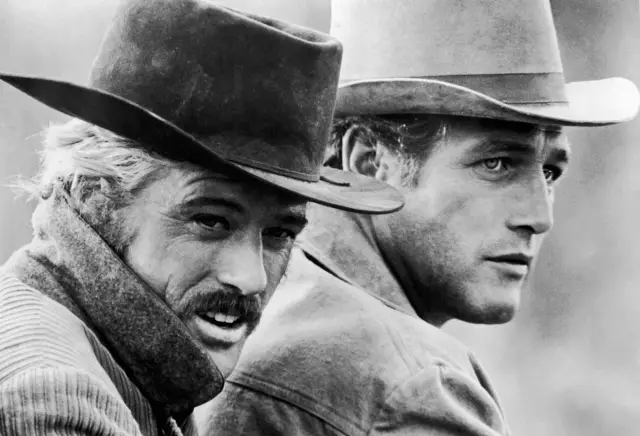
Robert Redford, left, and Paul Newman co-starred in “Butch Cassidy and the Sundance Kid” in 1969, proving to be a box-office winning pair (Photo via 20th Century Fox).

New York Times, Robert Redford, Screen Idol Turned Director and Activist, Dies at 89, Brooks Barnes, Sept. 16, 2025. Redford, shown above right directing a scene, made serious topics like grief and political corruption resonate with the masses, in no small part because of his own star power.
Robert Redford, the big-screen charmer turned Oscar-winning director whose hit movies often helped America make sense of itself and who, off screen, evangelized for environmental causes and fostered the Sundance-centered independent film movement, died early Tuesday morning at his home in Utah. He was 89.
His death, in the mountains outside Provo, was announced in a statement by Cindi Berger, the chief executive of the publicity firm Rogers & Cowan PMK. She said he had died in his sleep but did not provide a specific cause.
With a distaste for Hollywood’s dumb-it-down approach to moviemaking, Mr. Redford typically demanded that his films carry cultural weight, in many cases making serious topics like grief and political corruption resonate with audiences, in no small part because of his immense star power.
Sept. 15
Emptywheel, Analysis: The White House Bid to Turn the Charlie Kirk Murder into Their Anti-Trans Jihad, Emptywheel (Marcy Wheeler, right), Sept. 15, 2025. We don't yet know what allegedly motivated Tyler Robinson (shown above in a mugshot) to kill Charlie Kirk. We do know the motivations of the White House sourcing claims about a trans roommate, so we should be very cautious about believing what they're peddling.
In a Discord chatroom including at least one guy he knew from high school who had recognized Tyler Robinson in the pictures released by Charlie Kirk murder investigators, the accused murderer offered up the now-discredited report about trans bullets, but treated it with irony, just like he ironically claimed to be Kirk himself.
“I heard the ammo had somethin about trans stuff on it, but they aren’t releasing photos or exact quotes,” he wrote. He added: “and also the claim wasn’t backed by the official fbi, just some dude in the briefing room.”
A few minutes later, he joked: “I’m actually Charlie Kirk, wanted to get outta politics so I faked my death, now I can live out my dream life in kansas.”
The comment is deliberately non-committal, like all the others described in the NYT story on the Discord chat. But it is far more reliable evidence than a growing story, sourced to the White House, that one of two Robinson roommates cooperating with the FBI is trans and may even be Robinson’s lover.
The story started with one of the White House and Kash Patel (left) / Dan Bongino’s favorite propagandists, Brooke Singman, whose belated story writing up the allegation she first tweeted out included a self-serving claim from the FBI officials who had nothing to do with finding Robinson, claiming they had instead “zero[ed] in on” him as a subject via the cooperation from the roommate.
FBI officials told Fox News Digital that the FBI had text messages and other communications between Robinson and his partner that helped FBI agents zero in on Robinson. Officials said the FBI took evidence from their apartment, including computers, which has been sent to Quantico for review, Fox News Digital has learned.
It went through the Daily Mail (which took a non-denial as confirmation the roommate was trans) and a NewsMax reporter who directly sourced the claim to Trump. Then, Marc Caputo, who is incredibly well-sourced to people like Susie Wiles and Roger Stone, but who has gotten increasingly credulous at Axios, mainstreamed it.
Authorities are investigating whether Tyler Robinson, suspected of killing Charlie Kirk, believed Kirk’s views on gender identity were “hateful” to people like Robinson’s transgender roommate, six sources familiar with the case tell Axios.
Why it matters: Investigators believe Robinson’s anger at Kirk’s views could be a key to establishing a motive for the slaying of the controversial activist whose death sent shockwaves through American politics. Each of the six sources familiar with the investigation told Axios that investigators believe Robinson had a romantic relationship with his roommate.
All this is coming in advance of the expected filing of charges by Utah on Tuesday.
Meanwhile, Steve Bannon has been on a tear because Utah Governor Spencer Cox, rather than Kash Patel, led the press conference announcing Robinson’s arrest the other day.
Did the ppl in the White House inform POTUS that one of his greatest haters, this goofball, girly man, weak governor of Utah, was going to sit there and do the entire briefing on the murder of Charlie Kirk and essentially give us almost no facts and just preach unity with the aggressively LGBTQ governor of Colorado?
Kash Patel is not just a colleague, he’s a very dear and close friend. I think the world of Kash. We don’t know what restrictions he’s under or even his ability to fully articulate what’s happening here. But whoever authorized one of the biggest Trump haters in this country, the governor of Utah, Cox, is a disaster. A true Trump hater, one of the worst in the Republican Party. Folks in Utah need to understand this man has embraced and pushed some of the most dangerous ideologies out there.
Bannon is very specifically demanding a story that a trans cabal killed Charlie Kirk.
There’s a very good reason why Cox was leading the presser and not Kash (besides Kash’s manifest incompetence): Because — as Josh Gerstein and Kyle Cheney noted the other day — as of now there’s no federal nexus to this crime.
The criminal case against the man accused of killing Charlie Kirk will likely play out in a Utah county courthouse, under the control of local prosecutors. But a national audience may very well be watching.
That’s because the alleged shooter, whom authorities identified on Friday as Tyler Robinson, is facing state-level criminal charges. And in Utah — unlike in federal court — criminal trials are routinely televised.
Robinson has been charged with three crimes under Utah law: murder, causing bodily injury with a firearm and obstruction of justice.
It might seem surprising that the case is not a federal one, given the national notoriety of the crime and the FBI’s heavy involvement in the investigation. But homicides can be charged as federal crimes in only a few circumstances — such as an assassination of a federal government official, a killing on federal property or a “hate crime” that was motivated by the victim’s race, religion or another protected characteristic.
The only way it could become a federal charge — the only way that Kash’s FBI would gain primary control over the facts and narrative told — would be if DOJ charged it as a hate crime, as Kash described trying to do in the case of the Robin Westman, the trans woman charged in the Annunciation Catholic School shooting last month, even while deadnaming her throughout:
As we continue to investigate yesterday’s barbaric attack from Robert [sic] Westman, the male subject, our teams have gathered information and evidence demonstrating this was an act of domestic terrorism motivated by a hate-filled ideology.
Some updates:
- Subject left multiple anti-Catholic, anti-religious references both in his manifesto and written on his firearms
- Subject expressed hatred and violence toward Jewish people, writing “Israel must fall,” “Free Palestine,” and using explicit language related to the Holocaust
- He wrote a an explicit call for violence against President Trump on a firearm magazine
- The @fbi investigation is still ongoing. We will employ all of our counter-terror tools to ensure this is fully investigated and deterred.
- And as promised, we will continue to update when able.
Of course, even if Robinson’s roommate were trans, even if they were in a relationship, the current story would be that because a person who willingly implicated their friend in a death penalty eligible crime, doing the work Kash’s FBI was too incompetent to do, it gives Stephen Miller license to arrest all trans people (or at least Pam Bondi to disarm them), just like he used fraudulent claims about Tren de Aragua to detain hundreds of men with innocent tattoos and send them to a concentration camp in El Salvador.
The alleged trans person here is the only one whose actions are above reproach.
And all that’s before you consider how Kash Patel has done much to make any bid for the death penalty unsustainable (to say nothing about Federal charges against Westman), given his repeated evocations of love for Kirk, down to promising he would see him in Valhalla (wittingly or unwittingly repeating the words of the far right Christchurch killer).
Unless Robinson were to plead guilty (which would mostly likely only happen if law enforcement promised not to execute him), any such death penalty phase would be riddled with questions about the bias of Kash, Trump, and everyone else leading this case from the federal side. Frankly, the discovery would be epic — and badly discrediting to the FBI and the White House.
We don’t know what motivated Robinson, what turned him from the pro-Trump politics of his family or what appears to have distanced him from the Mormon Church (there has been little conversation about the significance of the fact that Robinson did not do a Mormon mission, but it may be the most important sign of rupture out there).
What we do know is that Stephen Miller wasted no time grieving his beloved friend, but turned immediately to politicizing his death. And Miller has never bothered to let truth drive his political jihads.
Lev Remembers, The Last Warning: The Perfect Storm, Lev Parnas, Sept. 15, 2025. How Trump, Project 2025, and the Martyrdom of Charlie Kirk Are Forging a Super Cult Unlike Anything in History.
I was born into a world where dictatorship was the air people breathed. In the Soviet Union of my childhood, propaganda was law, truth was a crime, and people learned to whisper instead of speak. My parents risked everything to leave that world behind, believing America was the place where freedom lived, where strongmen could never rise, where democracy was not just a word but a shield.
And yet, here we are.
It took America centuries of sacrifice, blood, and courage to reach even the imperfect democracy we had. We’ve never been flawless — corruption lived on both sides, good and evil people wore every color of politics. But there was always the promise of freedom: that you could speak, that you could dissent, that you could question those in power without fear of ruin. That promise is collapsing before our very eyes.
Today, if you speak out, you risk losing your job, being silenced, being arrested. Since when did America stand for that? Since when was truth a crime?
Look at the rights we thought we had secured forever. Women fought for generations to claim control over their own bodies, and yet Roe v. Wade was torn away in an instant — a right stripped from millions by a man who pretends to speak for “freedom.” Immigrants who came here believing in liberty now face detention without due process, as Trump and his machine openly talk about dismantling habeas corpus itself — the very foundation of justice in this country. Voting rights, the sacred key of democracy, are being chipped away, one law at a time, in state after state.
And it does not stop there. Speak the wrong words, and you risk losing your livelihood. Protest the wrong man, and you may find yourself facing prison. Is this the democracy we believed in? Is this America or Russia?
The martyrdom of Charlie Kirk is being weaponized right now as a rallying cry. Trump, as always, is the face on the poster. But the real architects — Stephen Miller, Russell Vought, the Federalist Society, and others you may not know — are the ones drawing the blueprint. They’ve built Project 2025, and as I warned you, they are already putting it in motion. These are not ideas. These are roadmaps. Step-by-step plans to replace democracy with authoritarianism.
And what makes this moment unlike anything we have faced before is the scale of what they are building. Most cults in history have been rooted in one foundation — either religion, or politics, or ideology. Each dangerous, each destructive, but still contained. What Trump and the architects of Project 2025 are constructing is different. It is a tsunami. A once-in-a-lifetime storm where religion, politics, and ideology are bound together into something bigger, darker — a super cult.
And now, with the martyrdom of Charlie Kirk, we are watching them fuse it all into a single weapon. They are using grief as propaganda, using death as fuel, wrapping faith, flag, and fury into one banner. That is what makes this so dangerous. It is not just one side of the culture war. It is every weapon of division, every fear and every false promise, rolled into one machine.
What I have seen take shape in just a few days should worry every one of us. This is not a joke. None of what came before was funny either, but what is playing out right now is something unprecedented. Something designed not just to win elections, but to dominate lives, silence voices, and erase freedoms. If you don’t see the danger now, you will see it when it is too late.
I have been warning you about this. And now, every word is coming true.
Look at the Epstein files. They should have shattered the MAGA cult. They revealed the networks of money, influence, and abuse that Donald Trump was at the center of. But what happened? Instead of accountability, we see the narrative buried, rebranded, weaponized. Epstein’s connections are dismissed as rumor while Trump’s machine reframes the scandal as a distraction — and the martyrdom of Kirk becomes the cover to wipe the cracks clean.
Look at foreign policy. These false conversations about “peace between Russia and Ukraine” — I told you they were theatre. I told you they were lies. Trump and his enablers have never sought peace. They have sought power. Every “deal” has been smoke and mirrors, meant to distract while the world fractures. And now we see Russia moving missiles to Europe’s borders, NATO scrambling, Ukraine bleeding. This is the fruit of those false promises.
As Churchill said, “Appeasement is feeding the crocodile, hoping it will eat you last.” And the crocodile is at our door.
I know these people. I know how they think. I sat in their rooms, I heard their whispers. They are not playing politics. They are building a system designed to outlast you, to outlast your children, to redefine freedom until it means obedience.
This is not about red or blue. This is not about left or right. This is about humanity itself. It takes generations to build truth, but only one lie to shatter it. And lies travel faster than truth ever can.
I am scared. You should be scared too. But fear cannot paralyze us. Fear must move us. Dr. King reminded us, “Our lives begin to end the day we become silent about things that matter.” Silence now is complicity.
So I am not writing this to scare you — though you should be alarmed. I am writing this to open your eyes. Because if we don’t act now, the blueprint will be complete, the damage irreversible.
We must stand together. As Americans. As people. As human beings. The fight is not political — it is moral. It is not about ideology — it is about survival.
I risk everything to bring you the truth the media won’t touch. But this movement cannot survive without you. I need you to not only read, but act. To not only agree, but unite.
That’s why I’m asking you: don’t just read this — spread it. Share this message far and wide. Tell your friends, your colleagues, your co-workers, your family members. Bring three, four more people into this movement. Become the extension of our voices. Be the megaphone for the Epstein survivors who refuse to be silenced. Be the megaphone for the Ukrainian children kidnapped and torn from their families. Be the megaphone for the people of Ukraine, that the media won’t report on.
We cannot wait for someone else to save us. We are the ones we’ve been waiting for. This is our moment to resist, to speak truth, to fight for freedom, and to protect the inheritance of democracy for our children.
New York Times, Trump Administration Live Updates: President Announces New Deadly Strike on Boat From Venezuela, Helene Cooper, Sept. 15, 2025. Where Things Stand.
President Trump was asked whether he planned to provide proof that the people the U.S. killed in a strike on a boat off Venezuela on Monday were drug smugglers en route to the United States. “All you have to do is look at the cargo that was scattered all over the ocean,” the president told reporters during Oval Office remarks
Trump also reiterated his stance that he endorses law enforcement officials’ using force against protesters. He claimed, without evidence of such a directive, that under the previous administration officers were told they were allowed to do nothing if somebody spit in their face or threw a rock at them. “I say, when they spit, you hit it,” Trump said. “Do whatever you want. You do whatever the hell you want.”
The Hartmann Report, Political Commentary: The Power to Destroy Isn’t Hypothetical: It’s the State’s Ultimate Weapon, Thom Hartmann, right, Sept. 15, 2025.  Why authoritarian language always precedes authoritarian rule…
Every president and most members of Congress have known for the past two centuries that having the ability to wield the power of government is a serious responsibility that carries with it real obligations for self-control.
The reason is simple and obvious, although our media appears to not realize it when they act like Trump’s and Miller’s rhetoric is normal: Government can legally kill you, imprison you, and take everything you own. Fox “News” and other commentators can’t.
When some bigot on Fox or another rightwing outlet goes off on how Democrats are “left wing extremists,” “terrorists,” or “traitors” he doesn’t have the power or ability to do anything about it. They’re just words, which is why they’re protected by the First Amendment. Inflammatory words, certainly, but just words.
But when a government official slaps one of those kinds of labels on you because of things you’ve said or political views you hold, you can lose literally everything.
Just ask Mahmoud Khalil or Rümeysa Öztürk, who were imprisoned for expressing their opinions on the genocide Netanyahu is carrying out in Israel, or Kilmar Abrego Garcia, who had the bad fortune of being brown-skinned when Stephen Miller was on one of his racist jeremiads even though he had legal permission to stay in the US.
This is why even after 9/11 George W. Bush measured his words, going so far as to emphasize that Islam wasn’t our enemy. So did Abraham Lincoln, for that matter, even as the country he led was under attack by actual traitors committed to ending democracy in America. In his first inaugural address, on the verge of the Civil War, he said:
“With malice toward none, with charity for all, with firmness in the right as God gives us to see the right, let us strive on to finish the work we are in to bind up the nation’s wounds…”
Utah’s Republican Governor Spencer Cox understood that, as a government official with the power to kill by firing squad or imprison, it was his obligation to turn down the heat.
“We can return violence with violence; we can return hate with hate. That’s the problem with political violence. It metastasizes,” Cox told the nation when Robinson was arrested. “We can always point the figure at the other side. At some point we have to find an off ramp, or else it’s going to get much worse.”
Trump, Miller, and the GOP more generally haven’t gotten the message.
Trump blamed the “radical left” — as if there actually is any meaningful number of people in America calling for communism — for the killing, and then on Thursday told reporters, “We just have to beat the hell” out of “radical left lunatics.”
When Matthew Dowd notes on MSNBC that Kirk engaged in hate speech, the worst that happens is the network fires him. Ditto for when Fox’s Brian Kilmead called for America to emulate Hitler’s Aktion T4 program, where physicians killed homeless and disabled people by lethal injection, later moving on to mobile vans that used their exhaust to kill. The worst Kilmead can expect is to be fired, although given how shamefully unprincipled Fox management is, that’s probably unlikely.
But when government officials describe people using language that could lead to any of us being investigated, arrested, or even imprisoned or deported because of our politics, it’s an entirely different thing. It’s a genuine threat to our system of government, our rule of law, and to the safety and security of all of the American people.
Because when they start hauling away Americans for their opinions, when they threaten to pull our citizenship or passports — as Trump and other Republicans have recently done — history tells us it’s not a long trek to using those same tactics against people who thought they were on the “right side.”
Indeed, it’s already started to happen: just ask Republicans James Comey, John Brennan, and James Clapper, who are all now facing criminal investigations for speaking out against Trump. All these lifelong Republicans had to lawyer up after Trump publicly called them “criminals.”
When Stephen Miller — who the White House wants you to know definitely does not play with porcelain dolls — says the Democratic Party (which he can’t bring himself to say; he instead uses Joe McCarthy’s “Democrat Party” slur) “is not a political party; it is a domestic, extremist organization,” he’s laying a legal foundation for criminal investigations and arrests per the Patriot Act.
When he vows to “dismantle and take on the radical left organizations in this country that are fomenting violence,” promising under Trump’s leadership to use law enforcement to “strip them of money, power, and freedom” and threatening that members of the left who “spread evil hate” will “live in exile” he’s not just a commentator: he’s a man who wields actual power over life and death, imprisonment or freedom.
This rhetoric is particularly troubling since all of the previous 31 politically-motivated violent attacks in America have been committed by rightwingers.
Or consider Elon Musk, the world‘s richest man who created and ran the DOGE program to dismantle our government. He was in England this weekend and said:
“The violence is going to come to you. You will have no choice. This is a, this is, you're in a fundamental situation here where you, where, whether you choose violence or not. The violence is coming to you. You either fight back or you die. You either the fight back or you die. And that's the truth.”
And he wasn’t talking about Osama bin Laden or anybody like that; he was talking about people like you and me.
 Groypers are among the ultra-right, white nationalist Trump supporters who revere Trump, among other ways, in the guise of "Pepe," shown above, a meme of a humanoid who takes the shape of a frog (Image from Twitter, now known as X). Although originally an apolitical character in cartoonist Matt Furie's works and its original internet popularity, Pepe was appropriated from 2015 onward as a symbol of the alt-right white nationalist movement, as described in a Wikipedia entry. In 2015, then-candidate Donald Trump retweeted a Pepe representation of himself.
Newsweek, What Is a 'Groyper'? What to Know About Nick Fuentes' Alt-Right Movement, Jesus Mesa, Sept. 12-13, 2025. Patel Honors Charlie Kirk: 'Rest Now, Brother. I’ll See You in Valhalla'
 The killing of conservative activist Charlie Kirk has reignited attention on a long-simmering feud within elements of the far right, particularly between Kirk and the so-called "Groyper" movement led by white nationalist Nick Fuentes.
Kirk was shot and killed on September 10 during an appearance at Utah Valley University. As authorities investigate the motive, online speculation has turned toward extremist factions that once targeted Kirk—specifically, Fuentes' "Groyper Army," which has long accused him of being insufficiently radical.
Despite his confrontational style, Kirk was frequently attacked from the right for being too moderate. During the 2019 "Groyper Wars," Fuentes' supporters disrupted Turning Point USA events, challenging Kirk on immigration and LGBTQ rights while labeling him a "gatekeeper" of establishment conservatism.
Now, as the public searches for answers in Kirk's assassination, that conflict within far-right is back in the spotlight—with renewed scrutinyon the rhetoric and influence of Fuentes and his followers.
Social media users have also questioned whether early claims by officials that the suspect, apprehended late Thursday, was tied to left-wing extremism were premature, pointing instead to possible links to the far-right.
As of Friday afternoon, it remained unclear what the motive was in the Kirk shooting, or the political ideology of the alleged gunman. Robinson's family said he had become "more political" in recent years, according to police. The markings on the bullet casings suggest the subject was steeped in meme culture and made references to online taunts and anti-fascist messages.GroypersTheir mascot is a cartoon frog called "Groyper," a variant of the Pepe meme used widely among extremist groups. X / YouTubeWhat Is the Groyper Army?
The Groyper Army is a far-right, online-based movement organized around white nationalist and "America First" advocate Nick Fuentes. According to the Anti-Defamation League (ADL), the group consists of "alt-right, white nationalist, and Christian nationalist activists" who hold virulently antisemitic, racist, and homophobic views, often cloaked in rhetoric about traditional values and family.
Their mascot is a cartoon frog called "Groyper," a variant of the "Pepe" meme used widely among extremist groups.When Did the Term 'Groyper' Begin?Read more Alt-Right
Kash Patel's Tenure as FBI Director Defined by Misstep After Misstep In MAGA, Charlie Kirk Was a Moderate. What Comes Next Could Be More Extreme What Charlie Kirk's Assassination Means for Republican Youth Movement Charlie Kirk Is Assassinated, as America Blisters With Hate and Violence
The term "Groyper" began circulating widely in 2019 during a public feud inside the conservative movement. That year, followers of Nick Fuentes disrupted college events hosted by Charlie Kirk and his group, Turning Point USA, accusing Kirk of watering down Donald Trump's message.
The clash, later referred to as the "Groyper Wars," drew national attention for its confrontational tactics and for pushing white nationalist ideas into more mainstream conservative circles.
Kirk responded by calling the Groypers extremists. He defended his approach to conservatism as inclusive, saying the movement should be open to people of all backgrounds and reject racism and homophobia.What Has Nick Fuentes Said About the Charlie Kirk Killing?
Fuentes has made several public statements about Kirk's assassination. Shortly after the killing, Fuentes posted, "I am devastated. It feels like a nightmare that we'll never wake up from," and called for unity, writing, "The violence and hatred has to stop. Our country needs Christ now more than ever."
On September 12, Fuentes directed his comments at the Trump administration. "We need more from the Trump administration than what we're getting," he wrote on X. "Release all the information about the assassin and his Discord contacts. Everyone must be investigated. Tell us the plan. How will the government stop this from ever happening again? Where is the leadership???"
Trump-Inspired Crackdowns On U.S. Banking, Media, Justice Department

New York Times, Trump Administration Claims Vast Powers as It Races to Fire Fed Governor Before Meeting, Tony Romm, Sept. 15, 2025 (print ed.). Trump has forged ahead with his attempts to fire Lisa Cook even as new documents call his claims of mortgage fraud into question.
The Trump administration sought to convince a federal court on Sunday that President Trump possesses vast powers and “discretion” to fire federal officials, as it raced to block Lisa Cook, a governor on the Federal Reserve, from participating in this week’s meeting of the central bank.
The government offered its latest arguments to the U.S. Court of Appeals for the District of Columbia Circuit, where judges are weighing an emergency request by Mr. Trump that would allow him to proceed with firing Ms. Cook, left, after a lower court halted those plans last week.
In their new filing, lawyers for the Justice Department defended Mr. Trump’s decision to dismiss Ms. Cook over allegations of mortgage fraud, which involved loan documents she signed before joining the Fed in 2022. While she has not been charged with any wrongdoing or convicted of a crime, Mr. Trump announced he would fire Ms. Cook from the Fed in late August, citing a provision in the central bank’s founding law that allows him to oust members for “cause.”
Newly reported documents have called into question the president’s assertions. But the administration told the court on Sunday that the decision to remove Ms. Cook is “an unreviewable exercise of the discretion Congress vested” in the president.
Lawyers for the government also framed the ouster as “reasonable,” arguing that the claims against Ms. Cook had created doubt that she “can be trusted to act with forthrightness, care, and disinterest in managing the U.S. money supply.”
The government’s arguments to the appeals court echoed those that it presented to a lower court earlier this month, before a federal judge temporarily blocked Mr. Trump from firing Ms. Cook. There, Jia Cobb, a judge on the U.S. District Court for the District of Columbia, found that Mr. Trump could not remove Ms. Cook for conduct that occurred before she was confirmed to the Fed, nor for claims that do not involve her professional conduct.
The Trump administration has asked the appellate panel to stay that order and rule by the end of Monday, ahead of the Fed’s two-day meeting, which begins on Tuesday. Mr. Trump has attacked the central bank for months, demanding that its policymakers slash interest rates.
On Saturday, lawyers for Ms. Cook told the court that a decision that prevents her from attending that meeting — and casting a vote on interest rates — could unleash turmoil in the financial markets and undermine the political independence of the Fed.
The U.S. Federal Reserve headquarters designed by Marriner Eccles in Washington, DC.
New York Times, The Fed Tried to Avoid a Fight With Trump. It Got One Anyway, Colby Smith and Ben Casselman, Sept. 15, 2025. The central bank’s cautious approach to defending itself against President Trump is drawing scrutiny as the institution’s independence comes under threat.
 Three weeks ago, Jerome H. Powell, right, delivered a closely watched speech to central bankers, government officials and academics attending the Federal Reserve’s annual conference in Jackson, Wyo.
The Fed chair had been through an eventful few weeks. President Trump had flirted with firing him and then showed up for a rare visit at the central bank. One of the Fed’s seven governors had resigned unexpectedly. And as Mr. Powell made his way to Jackson Lake Lodge to deliver his remarks, Mr. Trump was demanding the resignation of another governor, Lisa Cook, over unproven allegations of mortgage fraud.
Each of these events on its own was destabilizing. Together, they represented the most direct infringement on the central bank’s independence in decades. Hanging in the balance was the Fed’s ability to set monetary policy free from political meddling, a longstanding separation that had become the backbone of the world’s largest economy.
Mr. Powell’s speech disregarded that threat. He deviated little from remarks that had been in the works for weeks, talking instead about the economic outlook for the United States, the trajectory for interest rates and the central bank’s blueprint for setting monetary policy. Never once did Mr. Powell utter anything about the Fed’s independence.
The omission did not go unnoticed, especially by those who had hoped the central bank would be louder in its opposition to what they viewed as an aggressive assault on the institution. But they had also grown accustomed to the Fed being exceedingly cautious about anything that involved Mr. Trump.
That prudence, which has only intensified since Mr. Powell’s speech, aligned with the Fed’s now decade-old playbook for handling a president who has made no secret of his desire to control the central bank and its power to set interest rates.
Inside the Fed, there is a preoccupation with doing whatever possible to avoid provoking the president, which on some occasions has meant complying with his demands. The strategy among officials and staff has been to try to ignore the cacophony and focus on their day jobs. Public statements are also getting a closer look, with in-house lawyers poring over each sentence to avoid drawing undue scrutiny.
Critics of that cautious approach say it has done little to insulate the institution from an existential threat.
New York Times, Fired Prosecutor Challenges Trump’s Claims to Sweeping Power in Lawsuit, William K. Rashbaum, Jonah E. Bromwich and Benjamin Weiser, Sept. 15, 2025. The Justice Department gave no reason for its dismissal of Maurene Comey, a longtime federal prosecutor in Manhattan and the daughter of the former F.B.I. director, James Comey.
Maurene Comey, a federal prosecutor who handled criminal cases against Jeffrey Epstein and Ghislaine Maxwell, is contesting her abrupt July firing in a lawsuit that challenges Donald J. Trump’s claim of sweeping presidential power.
Ms. Comey, whose father, James B. Comey, is a former F.B.I. director, says in the lawsuit filed on Monday that she was never given a reason for her dismissal. She contends that no plausible explanation exists other than that she is the daughter of one of the president’s best-known adversaries — or her perceived political affiliations.
Ms. Comey is among many federal prosecutors and Justice Department officials who have been fired in President Trump’s second term, with no reason given beyond Article II of the Constitution, which broadly describes the president’s powers. Some have challenged their dismissals before administrative judges; others have sued in federal court.
Ms. Comey’s lawsuit, filed in federal court in Manhattan, names as defendants the Office of the President, the Justice Department, Attorney General Pam Bondi and others, and calls her firing from the U.S. attorney’s office for the Southern District of New York illegal.
“The politically motivated termination of Ms. Comey — ostensibly under ‘Article II of the Constitution’— upends bedrock principles of our democracy and justice system,” the lawsuit says. “Assistant United States attorneys like Ms. Comey must do their jobs without fearing or favoring any political party or perspective, guided solely by the law, the facts and the pursuit of justice.”
Ms. Comey, a 10-year veteran who was among the most highly regarded trial lawyers in the Manhattan prosecutor’s office, was fired as the White House sought to quell frustration from its base about its reluctance to release files related to Mr. Epstein, the disgraced financier. Mr. Epstein killed himself in a federal jail cell in 2019 while awaiting trial on sex-trafficking charges. His associate, Ms. Maxwell, was convicted of sex trafficking a minor and was sentenced to 20 years in prison.
The brief memorandum informing Ms. Comey of her termination gave no explanation for the firing, but cited Article II. In the lawsuit, Ms. Comey said that the U.S. attorney, Jay Clayton, was unable to provide her with a rationale.
“All I can say is it came from Washington,” Mr. Clayton told her, according to the lawsuit. “I can’t tell you anything else.”
Ms. Comey contends that the law provides no authority for the president to fire rank-and-file prosecutors, who are protected by civil service laws passed by Congress and signed by past presidents.
“Neither the president nor the Department of Justice have unlimited authority to remove” prosecutors, according to the lawsuit, which was filed by Ms. Comey’s lawyers Nicole Gueron, Ellen Blain, Deepa Vanamali and Margaret M. Donovan.
The enmity between the president and Ms. Comey’s father dates to the 2016 presidential election, when Mr. Comey, then the F.B.I. director, publicly announced that the agency would not recommend charges against Mr. Trump’s opponent, Hillary Clinton. Mr. Trump fired him in May 2017 and the two men have criticized each other in public ever since. In the days before Ms. Comey’s firing, Mr. Trump had claimed without evidence that files related to Mr. Epstein’s crimes were a hoax concocted by Mr. Comey.
National Press Club Journalism Institute, Top stories, Beth Francesca, Sept. 15, 2025.
■ Workers are getting fired, placed on leave over Charlie Kirk posts (Washington Post) / Washington Post columnist says she was fired over her posts about Charlie Kirk and political violence (CNN) / ‘The Washington Post Guild condemns the unjust firing of columnist Karen Attiah’ (Washington Post Guild) / How news streamers covered the killing of Charlie Kirk (Columbia Journalism Review) / Charlie Kirk was shot and killed in a post-content-moderation world (WIRED) / How Charlie Kirk used controversy — often delivered in person — to construct our new media ecosystem (Vanity Fair)
■ Republicans plan bill to consolidate government-funded broadcasters (Axios) / After Trump’s cuts, ‘crippled’ NPR and PBS stations must transform (New York Times) / NPR Network revenue programs net stations nearly $16 million (Current) / Alaska fund raises $3.5M for public media as federal cuts begin (Anchorage Daily News) / WETA cuts 5% of workforce, cancels three local television programs (Current) / University to begin ‘wind down’ of WPSU after acquisition vote fails (Current)
■ Channel 4 to mark Trump’s U.K. visit with ‘longest uninterrupted reel of untruths ever broadcast on television’ (Hollywood Reporter)
■ FBI arrests 2 after incendiary device left under FOX 13 News vehicle (FOX 13 News)
■ Fox News’ Brian Kilmeade apologizes for ‘just kill them’ comments about mentally ill homeless people (Deadline)
■ Newsmax sues Fox again, expands lawsuit after Florida case dismissed (Newsmax) / Penske Media sues Google for AI ‘overview' news story summaries without publishers' consent (The Wrap)
■ A framework deal on TikTok has been reached between the US and China (Associated Press)
■ Military.com 'effectively dead' after Valnet forces big layoffs, newsroom union says (The Wrap)

David Ignatius and Karen Attiah receiving the George Polk Award, in 2019 for commentary on Jamal Khashoggi’s murder. In the aftermath of Jamal Khashoggi’s murder.
The Golden Hour via Substack, The Washington Post Fired Me — But My Voice Will Not Be Silenced, Karen Attiah, right, Sept. 15, 2025. I spoke out against hatred and violence in America — and it cost me my job.
Last week, the Washington Post fired me.
The reason? Speaking out against political violence, racial double standards, and America’s apathy toward guns.
Eleven years ago, I joined the Washington Post’s Opinions department with a simple goal: to use journalism in service of people.
I believed in using the pen to remember the forgotten, question power, shine light in darkness, and defend democracy. Early in my career, late Washington Post editorial page editor Fred Hiatt told me that opinion journalism is not just about writing the world as it is, but as it should be. He told me we should use our platform to do good. That has been my north star every day.
As the founding Global Opinions editor, I created a space for courageous, diverse voices from around the world — especially those exiled for speaking the truth. I was inspired by their bravery. When my writer, Global Opinions columnist Jamal Khashoggi was brutally murdered by Saudi Arabia regime agents for his words, I fought loudly for justice for years, putting my life and safety on the line to pursue accountability and defend global press freedom. For this work, I was honored with global recognition, prestigious awards and proximity to  the world’s most powerful people.
As a columnist, I used my voice to defend freedom and democracy, challenge power and reflect on culture and politics with honesty and conviction.
Now, I am the one being silenced - for doing my job.
On Bluesky, in the aftermath of the horrific shootings in Utah and Colorado, I condemned America’s acceptance of political violence and criticized its ritualized responses — the hollow, cliched calls for “thoughts and prayers” and “this is not who we are” that normalize gun violence and absolve white perpetrators especially, while nothing is done to curb deaths.
I expressed sadness and fear for America.
My most widely shared thread was not even about activist Charlie Kirk, who was horribly murdered, but about the political assassinations of Minnesota lawmaker Melissa Hortman, her husband and her dog. I pointed to the familiar pattern of America shrugging off gun deaths, and giving compassion for white men who commit and espouse political violence. This cycle has been documented for years. Nothing I said was new or false or disparaging— it is descriptive, and supported by data.
I did my journalistic duty, reminding people that despite President Trump’s partisan rushes to judgement, no suspect or motive had been identified in the killing of Charlie Kirk — exercising restraint even as I condemned hatred and violence.
My journalistic and moral values for balance compelled me to condemn violence and murder without engaging in excessive, false mourning for a man who routinely attacked Black women as a group, put academics in danger by putting them on watch lists, claimed falsely that Black people were better off in the era of Jim Crow, said that the Civil Rights Act was a mistake, and favorably reviewed a book that called liberals “Unhumans”. In a since-deleted post, a user accused me of supporting violence and fascism. I made clear that not performing over-the-top grief for white men who espouse violence was not the same as endorsing violence against them.
My only direct reference to Kirk was one post— his own words on record.
My commentary received thoughtful engagement across platforms, support, and virtually no public backlash.
And yet, the Post accused my measured Bluesky posts of being "unacceptable”, “gross misconduct” and of endangering the physical safety of colleagues — charges without evidence, which I reject completely as false. They rushed to fire me without even a conversation—claiming disparagement on race. This was not only a hasty overreach, but a violation of the very standards of journalistic fairness and rigor the Post claims to uphold.
Since then, my words on absolution for white male violence have proven prescient. The suspect in Kirk’s killing is indeed a young white man, and already, lawmakers are urging us to pray for him. The media is painting the 22 year-old as a good, all-American suburban kid. The cycle I mentioned has once again come to pass.
I was the last remaining Black full-time opinion columnist at the Post, in one of the nation’s most diverse regions. Washington D.C. no longer has a paper that reflects the people it serves. What happened to me is part of a broader purge of Black voices from academia, business, government, and media — a historical pattern as dangerous as it is shameful — and tragic.

Shown above, Karen Attiah seated next to Washington Post owner Jeff Bezos at the 2019 Gridiron Dinner.
I am proud of my eleven years at the Post. Beyond awards and recognition, the greatest honor has been working with brilliant colleagues and connecting with readers and writers around the world. To all who have supported me, read me, even those who disagreed with me— I say, thank you. You’ve made me a better writer, thinker, and person.
But this is not the end of my work. I still believe in the power of the pen. My values have not changed.
Freedom from censorship, especially on talking about race, is why I launched the Resistance Studies Series, beginning with my independent online course Race, Media, and International Affairs 101. I created this course after Columbia’s School of International and Public Affairs cut funding for my Race and Media class. This summer, we sold out all 500 spots and funded more than 40 scholarships.
For those who wish to support me, please do sign up to join the fall session of Race, Media and International Affairs 101+102 — a series of lectures and conversations with prominent guest speakers — before the Sept. 19 registration deadline. The first classes begin Oct. 6th. This will likely be the last cohort I will teach until mid-2026, so don’t miss your chance.
For those who can’t attend, you can also contribute to operations, scholarships and guest speakers.
You can also support my written work directly by subscribing to my Substack, The Golden Hour, where I will continue to speak truth to power — without fear or favor.
From April
The Golden Hour by Karen Attiah, Columbia Canceled My Course on Race and Media. I'm Going to Teach It Anyway, Karen Attiah, right, April 21, 2025. This is not the time for media literacy or historical knowledge to be held hostage by institutions bending the knee to authoritarianism.
When I got the opportunity to teach at Columbia’s School of International and Public Affairs (SIPA) in the fall of 2023 for the spring 2024 semester, I was elated. My dream of teaching in a global environment had come true.
I wanted to use that opportunity to build a course I never had when I was an international affairs student studying human rights and media at SIPA—one that examined how constructs of race and identity are formed, and how mass media has historically shaped our understanding of race and the global order. I knew that race and identity were rarely taught in international affairs schools—or many journalism schools, for that matter. And I rarely had the opportunity to learn from a professor who looked like me.
The class became one of the most popular at SIPA last year. I enjoyed every minute of teaching, even while knowing that across the country, academic offerings on race, identity, and history were under siege. My students came from around the world and across industries, and I learned just as much from them as they did from me and each other. Some even went on to publish their class assignments in local and national media.
A few months later, the course was canceled, and the department it was housed was dissolved. Despite the grief and lack of clarity, I’ve kept quiet….. until now.
Since then, it has been heart-wrenching to watch Columbia’s administration pre-emptively cave to pressure, especially in placing Middle Eastern, South Asian and African Studies under special provost supervision or receivership. It’s been terrifying to see institution after institution across the country cave on diversity, freedom of speech, and academic integrity, not to protect students and faculty, but to protect donors and reputations.
I’ve been thinking of what to do to help others in this moment. So for starters, I’ve decided to liberate my teaching work.
This summer, I will be offering a version of my Columbia course on Race, Media, and International Affairs as an independent, public offering, for this moment.
This is not the time for media literacy or historical knowledge to be held hostage by institutions bending the knee to authoritarianism and fear.
As I said on BlueSky, I don’t know what the future of academia in America will look like after all this. I am both grateful to Columbia for how it shaped me, while also grieving what feels like the loss of the institutional home I knew and loved.
But I do know that in a moment of profound crisis, we cannot wait for elite permission or institutional approval to share knowledge and create learning communities.
I put out a simple post. Over 3,000 people liked it. More than 100 said they would support the course financially. Many said they’d be willing to pay more to offset the cost for someone else. The response was overwhelming.
Rolling Stone, Stephen Colbert and ‘Late Show’ Win Emmy After Cancellation: ‘Stay Strong, Be Brave’ onstage, Tomas Mier, Sept. 14-15, 2025. “Sometimes you only truly know how much you love something when you get a sense that you might be losing it,” Colbert said onstage.
 Stephen Colbert earned his second standing ovation of the night — this time, after The Late Show with Stephen Colbert won the Emmy for Outstanding Talk Series Sunday.
After chants of “Stephen, Stephen” from the crowd, Colbert, right, took the stage alongside the crew behind the CBS late-night show, which is scheduled to end next May.
 “Thank you for this honor. I want to thank CBS for giving us the privilege to be part of the late-night tradition, which I hope continues long after we’re no longer doing this show,” Colbert said. “I gotta thank these people, the 200 incredible professionals. You are the pros, and I’m so proud to be one of you. We gotta thank the people who supported us the last 20 years.”
After thanking his family and honoring Amy Cole, Colbert’s assistant for 16 years who died last March, Colbert shared a metaphor about love and loss, mentioning the state of the United States today.
“In September of 2015, Spike Jonze stopped by my office and said, ‘Hey, what do you want this show to be about?’ And I said, ‘Spike, I don’t know how you could do it, but I kind of like to do a late-night comedy show that was about love,'” Colbert said onstage. “I don’t know if I ever figured that out, but at a certain point, and you can guess what that point was, I realized that in some ways, we were doing a late-night comedy show about loss.”
He continued: “And that’s related to love, because sometimes you only truly know how much you love something when you get a sense that you might be losing it.”
He then ended his speech by adding, “And 10 years later, in September of 2025, my friends, I have never loved my country more desperately. God bless America. Stay strong. Be brave. And if the elevator tries to bring you down, go crazy and punch a higher floor.”
Earlier in the night, Colbert opened the show by presenting the first award of the evening, and joking, “While I have your attention… Is anyone hiring?”
The Bulwark, Political Opinion: The most powerful guy in Trump’s ear has a plan for how to respond to the death of Charlie Kirk, William Kristol, right, Andrew Egger, and Jim Swift, You’re not going to like it.
Kash Patel’s lonely one-man crusade to convince everybody he actually did a great job hunting down Charlie Kirk’s killer continues. “I made the decision to surge so many resources,” he told Fox & Friends this morning. “I had to expedite the process . . . I made the tough calls . . . I came in and I accelerated that process.”
All told, during Patel’s 15 minute interview, we counted ten mentions of the word “my,” a whopping 43 mentions of the word “I,” and 13 mentions of the word “I’m.” Oh, and four mentions of the word “me.”
New York Times, China’s Snub of U.S. Soybeans Is a Crisis for American Farmers, Alan Rappeport, Visuals by Tim Gruber, Sept. 15, 2025. North Dakota farmers are scrambling to find extra storage space and bracing for land values to fall as soybeans that should be bound for China begin to pile up.
On a windy September morning, Josh and Jordan Gackle huddled to discuss the looming crisis facing their North Dakota soybean farm.
For the first time in the history of their 76-year-old operation, their biggest customer — China — had stopped buying soybeans. Their 2,300-acre soybean farm is projected to lose $400,000 in 2025. Soybeans that would normally be harvested and exported to Asia are now set to pile up in large steel bins.
Since President Trump imposed tariffs on Chinese goods in February, Beijing has retaliated by halting all purchases of American soybeans.
That decision has had devastating repercussions for farmers in North Dakota, which exported more than 70 percent of its soybeans to China before Trump unveiled the new tariffs this year. Unless China agrees to restart its purchases as part of a trade deal, farmers that depend on the Chinese market will be facing steep losses that could fuel farm bankruptcies and farm foreclosures around the United States.
China’s reluctance to purchase American soybeans and other agricultural products is expected to be a central topic as top officials from the United States and China meet for another round of economic negotiations in Spain this week.
Those talks are being anchored by Treasury Secretary Scott Bessent, above, whom Mr. Trump has put in charge of negotiating and securing a favorable trade deal with China. A win would undoubtedly curry favor with Mr. Trump. But in a strange twist, it could also help Mr. Bessent financially.
The Treasury Secretary owns thousands of acres of North Dakota farmland, worth up to $25 million. The properties grow soybeans and corn in a state that exports most of its agricultural products to China. The investments have earned Mr. Bessent as much as $1 million in rental income annually, according to his financial disclosure filings.
But the fortunes of Mr. Bessent, a multimillionaire former hedge fund manager, are not nearly as exposed to China’s whims as are those of the family farmers struggling to figure out how to sell their soybeans and keep their finances from falling apart.
To farmers in North Dakota, the forces of high interest rates, high input costs and falling prices are reminiscent of the 1980s farm crisis, which hobbled U.S. agriculture for nearly a decade and hollowed out much of rural America.
“The stress level is much higher now than it was then,” Jordan Gackle, 44, said in an interview. “If we keep this going for very long, then we are going to see the kind of foreclosures that were happening.”
Standing before a field of soybeans a few weeks away from harvest, he added: “All of it is unnecessary. The U.S. was not forced into this by anybody.”
The Parnas Perspective, News Update: Knives are Out for Kash Patel and Iowa Official Defies Order to Lower Flags for Charlie Kirk, Aaron Parnas, Sept. 15, 2025. Trump threatened to cut federal funding from New York following the endorsement from Hochul. In Montana, the FBI burned meth inside an animal shelter — forcing a mass evacuation of staff and animals. And that’s only scratching the surface.
The knives are out. Today, FBI Director Kash Patel is facing mounting scrutiny after communication blunders during the manhunt for Charlie Kirk’s assassin and a lawsuit accusing him of unlawfully firing senior agents, with critics claiming the White House may be preparing to replace him with new co-deputy Andrew Bailey.
Though AG Pam Bondi, Deputy AG Todd Blanche, and the White House deny plans to oust him, tensions have grown over Patel’s clashes with DOJ leadership and his social media missteps. Patel’s allies insist he retains Trump’s support, while opponents argue his actions could expose the administration to legal risks over presidential authority.
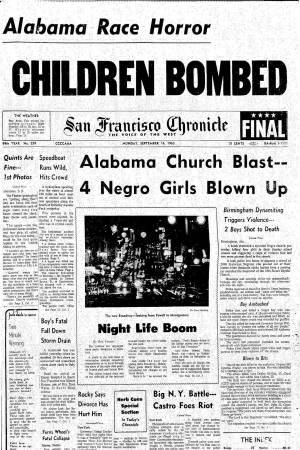 Letters from an American, Historical Commentary: Sept. 14, 2025 [Alabama Church Bombing Of Children. Why?], Heather Cox Richardson, right, Sept. 15, 2025.
At 10:22 on the morning of Sunday, September 15, 1963, a bomb ripped through the 16th Street Baptist Church in Birmingham, Alabama. It was Youth Day in the historic brick church, and five young girls dressed in their Sunday best were in the ladies’ lounge getting ready for their part in the Sunday service that was about to start.
 As Denise McNair, Cynthia Wesley, Carole Robertson, and Addie Mae Collins (above) were chatting and adjusting their dresses, a charge of dynamite stashed under the steps that led to the church sanctuary blasted into the ladies’ lounge. It killed the four girls instantly. Standing at the sink in the back of the room, Addie’s sister Sarah survived with serious injuries.
Just five days before, Black children had entered formerly all-white schools after an August court order required an end to segregation in Birmingham’s public schools. This decision capped a fight over integration that had begun just after the May 1954 Brown v. Board of Education decision in which the Supreme Court declared segregation unconstitutional.
In that same year, in the wake of the successful 381-day Montgomery, Alabama, bus boycott to protest that city’s segregated bus system, Birmingham’s Reverend Fred Shuttlesworth, along with the Reverend Martin Luther King Jr., the Reverend Ralph Abernathy, and strategist and civil rights activist Bayard Rustin, started the Southern Christian Leadership Conference (SCLC) to challenge segregation through nonviolent protest, rather than trusting the work to the courts alone.
On September 9, 1957, Shuttlesworth and his wife, Ruby, along with other Black parents, tried to enroll their children in the city’s all-white flagship John Herbert Phillips High School.
A mob of white Ku Klux Klansmen met them at the school, attacking them with chains and bats; someone stabbed Ruby Shuttlesworth in the hip with a pocketknife, and an amateur videographer captured a man named Bobby Frank Cherry on video reaching for brass knuckles before diving back into the attack on Shuttlesworth.
Cherry had no children at the school.
Over the next several years, the Ku Klux Klan lost the political struggle over civil rights, and its members increasingly turned to public violence. There were so many bombings of civil rights leaders’ homes and churches that the city became known as “Bombingham.” When the Freedom Riders, civil rights workers who rode interstate buses in mixed-race groups to challenge segregation, came through
Birmingham, police commissioner Eugene “Bull” Connor looked the other way as KKK members beat the riders with baseball bats, chains, rocks, and lead pipes.
Connor was a perfect foil for civil rights organizers, who began a campaign of nonviolent direct action to challenge segregation in Birmingham. Shuttlesworth invited King to Birmingham to help. One of the organizers’ tactics was to attract national attention by provoking Connor, and participants in the movement began sit-ins at libraries, kneel-ins at white churches, and voter registration drives.
In April 1963, Connor got an injunction barring the protests and promised to fill the jails. He did. King’s famous Letter from a Birmingham Jail was a product of Connor’s vow, smuggled out of jail on bits of paper given to him by a sympathetic inmate. In the letter, King responded to those who opposed the civil rights protests and, claiming to support civil rights, said that the courts were the proper venue to address social injustice. King agreed that the protests created tension, but he explained that such tension was constructive: it would force the city’s leaders to negotiate. “‘Wait,’” he reminded them, “has almost always meant ‘never.’”
But Connor’s tactics had the chilling effect he intended, as demonstrators shied away from being arrested out of fear of losing their jobs and being unable to provide for their families. So organizers decided to invite children to join a march to the downtown area. When the children agreed, the SCLC held workshops on the techniques of nonviolence and warned them of the danger they would be facing.
On May 2, 1963, they gathered at the 16th Street Baptist Church, just blocks away from Birmingham’s City Hall. As students moved toward City Hall in waves, singing “We Shall Overcome,” police officers arrested more than 600 of them and blocked the streets with fire trucks. The national news covered the story.
The next day, Bull Connor tried another tactic to keep the young protesters out of the downtown: fire hoses set to the highest pressure. When observers started to throw rocks and bottles at the police with the fire hoses, Connor told police officers to use German shepherd dogs to stop them. Images from the day made the national news and began to galvanize support for the protesters.
By May 6, Connor had turned the state fairgrounds into a makeshift jail to hold the overflow of protesters he was arresting, and national media figures, musicians, and civil rights activists were arriving in Birmingham. By May 7 the downtown was shut down while Connor arrested more people and used fire hoses again. The events in Birmingham were headline news.
By May 10, local politicians under pressure from businessmen had agreed to release the people who had been arrested; to desegregate lunch counters, drinking fountains, and bathrooms; and to hire Black people in a few staff jobs.
After Connor’s insistence that he would never permit desegregation, white supremacists in Birmingham felt betrayed by the new deal, basic though it was. Violence escalated over the summer, even as King’s Letter from a Birmingham Jail was widely published and praised and as civil rights activists, fresh from the Birmingham campaign, on August 28 held the March for Jobs and Freedom in Washington, D.C., where King delivered the “I Have a Dream” speech.
For white supremacists in Birmingham, the children and the 16th Street Baptist Church where they had organized were the symbols of the movement that had beaten them.
Their fury escalated in summer 1963 when a lawsuit the Reverend Shuttlesworth had filed to challenge segregation in public schools ended in August with a judge ordering Birmingham public schools to desegregate.
Five days after the first Black children entered a white school as students, four members of the Cahaba River Group, which had splintered off from another Ku Klux Klan group because they didn’t think it was aggressive enough, took action. Thomas Blanton, Robert Chambliss, Herman Cash, and Bobby Frank Cherry—the same man who in 1957 had beaten the Reverend Shuttlesworth with brass knuckles for trying to enroll his children in school—bombed the 16th Street Baptist Church. "Just wait until Sunday morning and they'll beg us to let them segregate,” Chambliss had told his niece.
The death of innocent children—on a Sunday morning, in a house of God—at the hands of white supremacists drew national attention. It woke up white people who had previously been leery of civil rights protests, making them confront the horror of racial violence in the South. Support for civil rights legislation grew, and in 1964 that support helped legislators to pass the Civil Rights Act.
Still, it seemed as if the individual bombers would get away with their crimes. In 1968, the FBI investigation ended without indictments,
But it turned out the story wasn’t over. Bill Baxley, a young law student at the University of Alabama in 1963, was so profoundly outraged by the bombing that he vowed someday he would do something about it. In 1970, voters elected Baxley to be Alabama’s attorney general. He reopened the case, famously responding to a Ku Klux Klan threat by responding on official state letterhead: “kiss my *ss.”
The reluctance of the FBI to share its evidence meant that Baxley charged and convicted only Robert Chambliss—whose nickname in 1963 was “Dynamite Bob”—for the murder of Denise McNair.
But still the story wasn’t over. Another young lawyer named Doug Jones was in the courtroom during that trial, and in 1997, President Bill Clinton appointed Jones as U.S. attorney for the Northern District of Alabama. Jones pursued the case, uncovering old evidence that had been sealed and finding new witnesses. Herman Cash had died, but in 2001 and 2002, representing the state of Alabama, Jones successfully prosecuted Thomas Edwin Blanton and Bobby Frank Cherry for first-degree murder.
Chambliss, Cherry, and Blanton all died in prison: Chambliss in 1985, Cherry in 2004, and Blanton in 2020.
Doug Jones went on to serve as a Senator from Alabama from 2018 to 2021. On this anniversary of the bombing, Senator Jones talked about the events of that day, justice, healing, and what lessons today’s Americans can take from the bombing and its aftermath.
Congressman Richard Hudson (R-NC) speaks on the floor of the U.S. House about Iryna Zarutska, who was tragically murdered on a train in Charlotte.
Popular Information, Accountability Journalism: A tragic murder, a baseless smear, and the fight for the U.S. Senate, Judd Legum, right, Sept. 15, 2025. A high-stakes race for an open U.S. Senate seat in North Carolina has gotten nasty very quickly.
On August 22, Iryna Zarutska, a 23-year-old Ukrainian refugee, was fatally stabbed while riding the train in Charlotte. The horrific attack, which occurred at around 10 p.m. while Zarutska was on her way home from her job at a pizzeria, was unprovoked. Born in Kyiv, she immigrated to the United States in August 2022 as a refugee from the Russian invasion.
Decarlos Brown Jr., a 34-year-old with a long rap sheet and a history of mental illness, has been charged with first-degree murder and could face the death penalty.
In the wake of Zarutska's death, prominent Republicans — including President Trump, Vice President JD Vance, Attorney General Pam Bondi — have blamed Democrats. Trump and many others singled out former North Carolina Governor Roy Cooper (D), who is currently running for U.S. Senate.
This argument is completely unfounded.
"Because of irresponsible policies from our former Governor Roy Cooper’s administration, [t]his brutal thug was set free and allowed to terrorize our community again and again," Congressman Richard Hudson (R-NC) wrote on X on September 9. "This tragedy is the direct result of policies that put politics over public safety."
"Iryna Zarutska was a young woman living the American dream — her horrific murder is a direct result of failed soft-on-crime policies that put criminals before innocent people," Attorney General Pam Bondi said in an official Department of Justice statement.
"The blood of this innocent woman can literally be seen dripping from the killer's knife, and now her blood is on the hands of the Democrats who refuse to put bad people in jail, including Former Disgraced Governor and 'Wannabe Senator' Roy Cooper," Trump said in a September 8 Truth Social post. According to Trump, Brown was on the streets because he was "released on CASHLESS BAIL in January."
This is false.
In January, Brown was charged with misusing the 911 emergency line. The charge came after Brown, who has a history of mental illness, "told officers that he believed someone gave him man-made material that controlled when he ate, walked and talked." When the officers told Brown they were not able to help him, he became upset and called 911.
Brown was released by a judge without bail, which is a common occurrence for non-violent misdemeanor charges. But even if a judge had incarcerated Brown pending a trial, there is no way that he would have still been incarcerated on August 22. That is because, under North Carolina law, it is a Class 1 Misdemeanor. The maximum sentence for a Class 1 Misdemeanor in North Carolina, even for someone like Brown with multiple prior convictions, is 120 days.
That means Brown could have been incarcerated for no longer than 120 days, regardless of the outcome of the case. Under North Carolina Law, Brown could have remained incarcerated no later than June 2025, months before the stabbing.
The law that established the maximum penalty was ratified by the Republican-dominated North Carolina legislature and signed into law by Governor Pat McCrory in July 2013. So Trump's claim that Brown was on the street in August 2025 because of a judge's decision to release him without cash bail is objectively false.
But what does any of this have to do with Cooper, who Trump says is personally responsible for Zarutska's murder? Cooper's Republican opponent, former Republican National Committee chairman Michael Whatley, laid out the case in a post on X on September 6.
According to Whatley, Brown Jr. would "have been behind bars years ago" but "[i]n June 2020, Cooper signed a soft-on-crime executive order, and just three months later, Brown was released from prison."
Whatley is referring to Brown's conviction for robbery with a dangerous weapon in 2014, which is a felony. He was incarcerated for that crime prior to his conviction and then sentenced to a little more than 6 years in jail. Brown served 100% of his sentence and was then released.
Executive Order 145, which Cooper signed on June 9, 2020, created a task force. That group, known as the Task Force for Racial Equity in Criminal Justice, was created to "recommend solutions to stop discriminatory law enforcement and criminal justice practices, and hold public safety officers accountable." Those recommendations, critically, were not even released until December 2020. Brown was released months earlier, in September 2020. So there is no way the recommendations could have had any bearing on Brown's release.
Further, the task force did not establish policy or make law. It simply recommended policies for the legislature to consider. None of the task force's recommendations were ever approved by the legislature. The task force, moreover, did not recommend the early release of any prisoner. It did recommend eliminating cash bail for misdemeanors, but only in circumstances where there was no "risk to public safety."
The claim by Trump and Whatley that Cooper is personally responsible for a gruesome and senseless murder committed by a mentally ill individual is completely baseless. What appears to be driving the claim is not reality, but necessity.
The race between Cooper and Whatley is to replace retiring Republican Senator Thom Tillis. It could determine the balance of power in the Senate in 2027. If Democrats retake the chamber, it could badly derail the remainder of Trump's term.
Recent polls show Cooper with a small but meaningful lead. Trump is seeking an issue that can alter the dynamics of the race, whether it is true or not.
The Real Michael Cohen, "A Country Lost in Hate, Michael Cohen, right, Sept. 15, 2025. The message of Charlie Kirk (above) is being wasted. And before you roll your eyes, let me explain what I mean.
When a young man is gunned down in broad daylight, when his life is snuffed out in an act of political violence, the tragedy transcends partisanship. It should. His assassination should have been a wake-up call to every American; Democrat, Republican, Independent, that we are teetering on the edge of a precipice. Either you have democracy or you have political violence. You cannot have both.
Yet, yesterday, inside the Kennedy Center, what unfolded was not a solemn reckoning with this truth. It was not a coming together of leaders across the political spectrum to mourn a life lost and reflect on how to prevent the next one. No. It was an orgy of blame, finger-pointing, and partisan chest-thumping. Instead of grappling with the danger of a society where guns and hate intermingle, speakers weaponized the tragedy itself. They turned death into a talking point. They turned grief into ammunition.
Is this the country we want to leave to our children? A country where every act of violence is immediately assigned to “the other side”? Where the blood on the ground is not mourned but manipulated? Where our leaders use a funeral as a campaign stop instead of a sacred moment of reflection? I say NO!
The President had a chance; perhaps the most important chance of his second term, to speak to the entire nation with clarity, compassion, and humility. He could have acknowledged the darkness of the moment while calling us back to light. He could have extended a hand across the aisle, telling the wife and children who just buried their husband and father that their pain mattered more than politics. But he didn’t. Instead, he went small. He went mean. He blamed the “radical left,” labeling them “flag-burning, scumbag lunatics.”
What a missed opportunity.
Political violence isn’t a left or right issue. It’s an American issue. Once we normalize killing each other over ideology, once we let assassination become part of the political process, democracy itself collapses. If you need a cautionary tale, look no further than history. Every failed republic began not with some grand war, but with a culture that made violence acceptable.
Martin Luther King Jr. once warned us: “Let no man pull you so low as to hate him.” Think about that. Let no man; no politician, no demagogue, no cable news host, drag you into the pit. Because once you are in it, once you start hating as reflex, you stop seeing the humanity in others. You stop seeing America as a shared home. You stop believing that democracy requires compromise, forgiveness, and sometimes even love.
Nelson Mandela said something equally profound: “No one is born hating another person because of the colour of his skin, or his background, or his religion. People must learn to hate, and if they can learn to hate, they can be taught to love; for love comes more naturally to the human heart than its opposite.”
We are at that crossroads right now. Every speech matters. Every headline matters. Every reckless comment from a president, a senator, or a media personality doesn’t just dissipate into the air; it becomes a seed. Seeds of love, seeds of hate. What are we planting?
At the Kennedy Center yesterday, I saw the worst of us: the opportunists who will never waste a good crisis, the politicians who feast on division. But I also saw glimpses of something better. I saw families holding each other in the pews. I saw young people crying, not because they cared about party labels, but because they were grieving the senselessness of it all. That’s where hope still lives; in the ordinary people who refuse to surrender to hate.
The truth is, the message of Charlie Kirk; the human being, not the pundit who I disagreed with on almost everything, should have been unity. The tragedy of his death should have reminded us that our nation is fragile, that our experiment in democracy depends on restraint and compassion. Instead, his death is being twisted into another weapon in the endless culture war of division.
But we still have a choice. We can let this assassination be just another headline, another excuse to sharpen the knives. Or we can let it be the line in the sand; the moment we finally all say enough.
I am haunted by the thought of what we’re passing down to our children. They’re watching us. They’re listening. They’re learning whether hate is the language of America or whether love still stands a chance.
The Kennedy Center should have been a cathedral of reflection. Instead, it was a stage for blame. But the story isn’t over yet. We can still choose a different ending.
And so I’ll leave you with this: democracy dies not when one man pulls the trigger, but when the rest of us decide to stop caring.
White House advisor Stephen Miller, above left.
The Bulwark, Political Opinion: It’s Stephen Miller’s Show Now. The most powerful guy in Trump’s ear has a plan for how to respond to the death of Charlie Kirk, William Kristol, right, Andrew Egger, and Jim Swift, You’re not going to like it.
Meanwhile, Kash Patel’s lonely one-man crusade to convince everybody he actually did a great job hunting down Charlie Kirk’s killer continues. “I made the decision to surge so many resources,” he told Fox & Friends this morning. “I had to expedite the process . . . I made the tough calls . . . I came in and I accelerated that process.”
All told, during Patel’s 15 minute interview, we counted ten mentions of the word “my,” a whopping 43 mentions of the word “I,” and 13 mentions of the word “I’m.” Oh, and four mentions of the word “me.”
The Contrarian, Political Commentary: We Cannot Excuse Political Violence, Jennifer Rubin, right, Sept. 15, 2025. And we must not whitewash abhorrent views.
We are grateful that Charlie Kirk’s suspected assassin is in custody. We unreservedly denounce political violence and underscore that speakers, no matter their viewpoint, should never fear for their lives. Nevertheless, we refuse to pull our punches when it comes to Donald Trump, MAGA rhetoric, and the billionaire-owned media’s coverage of both.
Too many journalists seem to find it impossible to acknowledge that Kirks’s extremist views, conspiratorial rhetoric, overt racism, and election denial undermined democracy and that his assassination is abhorrent. (Creating a “watch list” to target certain professors hardly provides a model for civil debate.) We should not be cowed into silence about Kirk’s views and reprehensible comments because we fear MAGA provocateurs’ retribution or mischaracterization. Our democracy requires we defend all speakers, not that we ignore the difference between admirable and malignant messages.
The inclination to whitewash Kirk’s views and lionize his politics—whether stemming from a well-meaning effort “not to speak ill of the dead” or from cowardly avoidance of MAGA blowback—reflects corporate media’s fixation with moral equivalence and its intellectual confusion. Its determination to downplay the MAGA Republican Party’s conspiracy-based extremism and to treat it as a normal political party inevitably enables authoritarianism.
Likewise, we must reject Trump’s groundless, premature, reprehensible remarks about Kirk’s assassin. Before we knew anything about him, Trump blamed millions of left-leaning Americans, thereby inciting his followers against their countrymen. (If nothing else, Trump is consistent in this regard: Trump also blamed the Pennsylvania assassination attempt on his opponents, although the shooter had no discernible political bent.)
“For years, those on the radical left have compared wonderful Americans, like Charlie, to Nazis and the world’s worst mass murderers and criminals,” Trump declared from the Oval Office. “This kind of rhetoric is directly responsible for the terrorism that we’re seeing in our country today, and it must stop right now.” Such vile demagoguery is pure Trump.
Currently, we cannot describe with certainty whether the assassin’s views are right- or left-wing or some incoherent jumble. We should not exclude the possibility that, as the Atlantic’s Charlie Warzel explains, we are dealing with someone enmeshed in “a hybrid threat network of disaffected people that can include Columbine obsessives, neo-Nazis, child groomers, and trolls… [who] perform for one another through acts of violence and cheer their community on to commit murder.”
Baselessly indicting a whole segment of the population for a lone assassin’s crime is an odious, dangerous, and all-too familiar authoritarian tactic. Trump’s insidious habit of inciting violence under the banner of victimhood has not changed since Jan. 6.
Trump’s refusal to condemn political violence on the right underscores his inability to act as president for the entire country. He insisted on Fox News that radicals on the right are just concerned about crime, whereas “radicals on the left are the problem, and they’re vicious and they’re horrible and they’re politically savvy.” For him, right-wing violence is a non-issue or worse, excusable—and he “couldn’t care less” that his admission horrifies people.
Let’s not forget he joked about the near-murder of Paul Pelosi and refused to call the governor after the assassination of Minnesota lawmaker Melissa Hortman and her husband (taking the moment instead to insult Gov. Tim Walz). He called Jan. 6 a “day of love” and pardoned those involved in a violent insurrection, which injured and killed police officers. He failed to condemn the firebombing of Gov. Josh Shapiro’s Passover sedar. We heard nothing from him in the aftermath of the CDC shooting that killed DeKalb County Police Officer David Rose.
Rolling Stone, Stephen Colbert and ‘Late Show’ Win Emmy After Cancellation: ‘Stay Strong, Be Brave’ onstage, Tomas Mier, Sept. 14-15, 2025. “Sometimes you only truly know how much you love something when you get a sense that you might be losing it,” Colbert said onstage.
Stephen Colbert, right, earned his second standing ovation of the night — this time, after The Late Show with Stephen Colbert won the Emmy for Outstanding Talk Series Sunday.
After chants of “Stephen, Stephen” from the crowd, Colbert took the stage alongside the crew behind the CBS late-night show, which is scheduled to end next May.
“Thank you for this honor. I want to thank CBS for giving us the privilege to be part of the late-night tradition, which I hope continues long after we’re no longer doing this show,” Colbert said. “I gotta thank these people, the 200 incredible professionals. You are the pros, and I’m so proud to be one of you. We gotta thank the people who supported us the last 20 years.”
After thanking his family and honoring Amy Cole, Colbert’s assistant for 16 years who died last March, Colbert shared a metaphor about love and loss, mentioning the state of the United States today.
“In September of 2015, Spike Jonze stopped by my office and said, ‘Hey, what do you want this show to be about?’ And I said, ‘Spike, I don’t know how you could do it, but I kind of like to do a late-night comedy show that was about love,'” Colbert said onstage. “I don’t know if I ever figured that out, but at a certain point, and you can guess what that point was, I realized that in some ways, we were doing a late-night comedy show about loss.”
He continued: “And that’s related to love, because sometimes you only truly know how much you love something when you get a sense that you might be losing it.”
He then ended his speech by adding, “And 10 years later, in September of 2025, my friends, I have never loved my country more desperately. God bless America. Stay strong. Be brave. And if the elevator tries to bring you down, go crazy and punch a higher floor.”
Earlier in the night, Colbert opened the show by presenting the first award of the evening, and joking, “While I have your attention… Is anyone hiring?”
Global News
New York Times, Rubio, in Israel, Says a Diplomatic Solution to Gaza War May Not be Possible, Michael Crowley, Sept. 15, 2025. Secretary of State Marco Rubio met with Prime Minister Benjamin Netanyahu of Israel to discuss President Trump’s desire to see the war in Gaza end soon.
Secretary of State Marco Rubio cast doubt on the chances of negotiating the surrender of the Palestinian militant group Hamas, saying during a visit to Israel on Monday that a diplomatic deal to end the war in Gaza might not be possible.
Mr. Rubio spoke at a news conference alongside Prime Minister Benjamin Netanyahu of Israel, right, after the two men met for several hours. His comments struck a more pessimistic tone than that of President Trump, who earlier this month said that a deal to stop the fighting in Gaza could come “very soon.”
While making clear that the United States would still pursue a peace settlement, Mr. Rubio said Hamas is “a terrorist group, a barbaric group, whose stated mission is the destruction of the Jewish state. So we’re not counting on that happening.”
His remarks were in harmony with those of Mr. Netanyahu, who reiterated that Israel “must make sure Hamas is eliminated.” At the end of the news conference, Mr. Netanyahu said he would prefer a Hamas “surrender” to continued fighting if possible, while saying nothing about the status of negotiations with the group.
Mr. Rubio made clear that with regards to the war, “the president wants this to be finished,” with the hostages released and Hamas defeated. Israel believes that about 20 hostages are still alive in Gaza.
Hamas has shown no willingness to lay down its arms. And Mr. Netanyahu, whom critics accuse of prolonging the war to extend his political career, shows no signs of compromising in his pursuit of a total victory over Hamas.
The Dispatch, Quick Hits: Today’s Top Stories, James P. Sutton, Peter Gattuso, and Ross Anderson, Sept. 15, 2025. China Spying, Russian Drones Over U.S. Ally Romania.
More than 500 gigabytes of internal documents from China’s Great Firewall leaked online on Thursday, with researchers confirming over the weekend that the leak exposed tens of thousands of pages of documents, along with source code and work logs from the censorship system’s core developers. The leaked materials originated from Geedge Networks—led by Fang Binxing, the “father of the Great Firewall”—and the MESA Lab at the Chinese Academy of Sciences, revealing systems that monitor internet traffic and algorithms to detect and block virtual private networks (VPNs). Documents show the company has exported censorship technology to Burma, Pakistan, Ethiopia, and Kazakhstan under China’s Belt and Road Initiative, including a ready-to-use system called Tiangou, which has been deployed across 26 data centers in Burma. The breach represents the largest leak in the Great Firewall’s history, potentially exposing vulnerabilities in surveillance systems used by multiple authoritarian regimes.
 Romanian officials said late on Saturday that a Russian drone had entered its airspace, prompting the Romanian Air Force to deploy two fighter jets to monitor it. The Russian drone “did not overfly populated areas and did not pose an imminent threat to the civilian population,” according to the Romanian Defense Ministry, but it marked the second such incursion of a NATO ally this month, with at least 19 Russian drones entering Polish airspace last week. In a social media post early Saturday morning, President Donald Trump said he was ready to impose additional sanctions on Russia “when all NATO Nations have agreed, and started, to do the same thing, and when all NATO Nations STOP BUYING OIL FROM RUSSIA.”
New York Times, Nvidia Broke Antitrust Law, China Says, as Tensions With U.S. Mount, Meaghan Tobin, Sept. 15, 2025. Chinese regulators, on a day of U.S. trade talks, said that an acquisition by Nvidia had violated antimonopoly regulations.
China’s antimonopoly regulator said on Monday that Nvidia, America’s leading chip maker, had violated the country’s antitrust law, the latest sign of tension between Beijing and Washington.
 The announcement stemmed from an investigation that China opened against Nvidia last December. The Chinese authorities said Monday they would continue the investigation.
The State Administration for Market Regulation issued its finding as negotiators from China and the United States were meeting in Madrid to try to hash out mounting trade tensions.
In an escalating tit for tat in the days leading up to the regulator’s decision, the United States had added 23 Chinese firms to a list of companies that are barred from buying American technology and other exports because of national security concerns. And China said it was investigating American suppliers of certain integrated circuits.
Nvidia did not immediately respond to a request for comment. Nvidia’s stock fell more than 2 percent in premarket trading in New York.
New York Times, Did Britain Win the Trade War? Why It’s Tough to Declare a Victor, Eshe Nelson and Jeanna Smialek, Visuals by Ani Matevosian and Lucia Calfapietra, Sept. 15, 2025. Popular products from Britain and the European Union show how uneven and unpredictable U.S. tariffs have become, even when part of trade deals.
When President Trump stunned governments around the world with high tariffs, Britain was quick to strike a trade agreement with the United States that would lock in 10 percent duties on most imports while protecting key industries.
The country’s fast action appeared prudent as other deals emerged, especially one that left the European Union facing a steeper tariff rate of 15 percent on most products.
But a deep dive into the agreements suggests that the trade math is more complex.
More On U.S. Politics
Politics Done Right Podcast, Commentary: Rubio’s Passport Power Grab, Kirk Myth, and Medicare for All’s $650B Savings, Egberto Willies, right, Sept. 15, 2025.The Right deifies Charlie Kirk, above, while Rubio pushes a bill to strip passports over speech, and premiums rise as Medicare for All remains the clear, just solution.
Topics covered on the show today. On today’s, we confront three urgent and interconnected battles shaping America’s future.
First, the Right—with help from mainstream media—is trying to turn Charlie Kirk into a manufactured hero, erasing his legacy of hate and division. Allowing this myth to take root would marginalize more than half the country and embolden extremist forces.
At the same time, Senator Marco Rubio’s new “thought policing” bill threatens free speech by giving the government the power to strip U.S. citizens of their passports based on political beliefs or statements, a dangerous slide toward authoritarianism.
And finally, as health insurance premiums rise, we are reminded that Medicare for All is not just morally right but economically essential, with the potential to save $650 billion annually while eliminating the middlemen who profit from human suffering. These stories reveal the stakes in our fight for democracy, freedom, and justice.
Paul Krugman via Substack, Political-Economy Commentary: My Head Talks on Bloomberg, Paul Krugman, right, Sept. 15, 2025. I’m very busy here in Europe, with limited time for writing. So for today I’m going to just give you video from a recent appearance on Bloomberg TV, talking with David Westin. I’m in two segments: the first 12 1/2 minutes, and then again after minute 36. Scrappy transcript of my segments follows:
David Westin: This is "Wall Street Week." I'm David Westin, bringing you stories of capitalism. China and the United States are playing a high-stakes poker game over rare earths. We go to South America to see whether Brazil may provide the U.S. with a winning hand. Plus, we're used to tracking prices in capital markets moment by moment. Why not the same for our groceries? A supermarket chain in Norway points the way to dynamic pricing for all sorts of goods and services, and Trump's cuts to federal agencies hit the people who oversee safety for mine workers and firemen. Are we going too far even for those being overseen?
But we begin with a conversation with Nobel Prize-winning economist Paul Krugman, former "New York Times" columnist and a professor at the City University of New York. We spoke to him about the American economy and the costs and benefits of the Trump administration's policies.
Trump: Starting the day I take the oath of office, I will rapidly drive prices down, and we will make America affordable again.
Krugman: In the campaign, the big promise by Donald Trump was that he was gonna bring down prices and make America affordable again, and everything he's done is the opposite of that. Imported goods are going up in price. We're gonna see a lot more of that, but, you know, vegetables are going up in price, and a little bit of that is tariffs, but a lot of that farmworkers are making themselves scarce because they're afraid that ICE will pick them up. If we're worried about housing costs, a lot of the construction industry is immigrant workers, and particularly, the actual physical jobs, the guys actually up there on the roof, tend to be immigrants, many of them undocumented, and even the ones who are legal are afraid. Ultimately, I think what really matters is the standard of living.
Westin: For Americans across the board: What are we doing to the standard of living? Are we improving it, or are we actually turning it down?
Krugman: This is clearly all negative for the standard of living. You're making-- when you put a tariff on -- one way of putting it, the sort of standard economist econ 101 thing is you're taking things that we do relatively badly and other countries do relatively well, and we're making-- and we're insisting that those things be done here, which raises costs, reduces our standard of living. If we look at the immigration policies, the really important thing about immigration in America is that the immigrants do not do the same jobs that native-born Americans do. They're very concentrated in a limited number of industries and occupations, which are very much complementary to the jobs that native-born Americans do, and by driving out the immigrants, we are reducing the productivity, reducing ultimately the living standard of the native-born workers.
Lincoln Square Media, Political Opinion: In a Functional Democracy, the Epstein Files Would Already Be Public, Kristoffer Ealy, right, Sept. 15, 2025.  It’s fashionable to pretend the question itself is complicated. It isn’t. We are not balancing delicate diplomatic secrets against imminent threats.
On paper, this should be simple: The government has files tied to a notorious sex trafficker, the public has a right to see them, and survivors deserve more than platitudes. The fact that we have to assemble a coalition just to pry open documents already sitting in government hands says more about the state of our politics than it does about any legal hurdle. You could see that plainly when survivors stood with two members of Congress to demand daylight. There was nothing theoretical about their ask. It was not a branding exercise. It was a statement that concealment is how the powerful turn justice into a scavenger hunt.
Congressman Ro Khanna’s presence in that moment didn’t surprise anyone who has been paying attention. He treats transparency like a duty, not a prop, and he doesn’t need to take a poll before saying the public should know what the public already owns.
What’s more unusual is his current partner in the push. Thomas Massie is a libertarian who lives off-grid and sends out Christmas cards featuring his family grinning with an arsenal of guns. And yet, even in that contradiction, Massie has at least been willing to tell his own party “no” when it comes to transparency. Jasmine Crockett — who owes him nothing, and has happily scorched Trump’s enablers in hearing after hearing — even gave him credit on the Joy Reid Show. That’s what makes this moment so strange: “Release the files” should be a clerical matter, not some act of bipartisan rebellion.Subscribed
Nancy Mace is the clearest single-person example of that tension, and she’s someone I’ve criticized before for staying too quiet when accountability actually mattered. When she first came to Congress, she looked like a fairly standard suburban Republican — a status-quo sorority-girl type, the kind I went to high school with. After January 6 she briefly flashed a little independence, suggesting she might stand up to Trump, but when she saw her party was moving in the opposite direction she rebranded herself overnight into a full MAGA loyalist.
Along the way, she’s leaned into cruelty as a political brand, mocking trans people and then doubling down on offensive language toward a transgender student and even harassing a gay man in a grocery store. That history makes her recent behavior on the Epstein files complicated. To her credit, she finally did the right thing by showing up for a closed-door session with survivors, listening to them, and walking out in tears. I’ll give her a few mild brownie points for that, because even a flicker of empathy matters in this moment, and she is still one of the Republicans willing to call for the release of the files. But less than a day later she was back defending Trump with the tired, debunked story about kicking Epstein out of Mar-a-Lago, a reminder of just how quickly she retreats into the MAGA fealty spiral. Hopefully she won’t change her tune this time, but if her post–January 6 rebrand is any clue, that moment of humanity has to be viewed with the most cautious of optimism.
That loop reached into the weirder corners of the House, as well. Jasmine Crockett and Marjorie Taylor Greene have a storied history of animosity, and none of it is subtle. One operates like a cross-examination with a mic, the other like a roaming spectacle with a pass to every green room in America. Crockett’s evisceration of Greene during a House hearing went viral because she refused to let the insults slide, dismantling Greene’s act in real time. And Greene, let’s not forget, built her brand in part by mocking Parkland survivors, chasing a teenage David Hogg down the street like it was an audition tape for right-wing YouTube. Yet the pull of this issue has been strong enough that, briefly, Crockett and Greene found themselves on the same side of the fight over whether to release the Epstein files. The second Greene put her hand on the levers that might actually force transparency, the predictable pressure campaign snapped into place; there was pushback from the White House. That tells you everything about the incentive structure: Loyalty before sunlight, even when the subject is the abuse of children.
Hovering over the whole mess is Speaker Mike Johnson, who behaves like a gatekeeper for one man’s story. If your case is that Trump is clean, then releasing the documents should be the fastest route to vindication. If your case is that institutions should not be weaponized, then the worst thing you can do is weaponize secrecy. Instead of choosing either principle, leadership chose delay. That posture doesn’t protect the law; it protects a personality cult. And when “protect the leader” outranks “protect the truth,” you end up with a caucus that treats transparency as a trap and survivors as a programming risk.
Sept. 14
New York Times, News Analysis: In an Era of Deep Polarization, Unity Is Not Trump’s Mission, Peter Baker, Sept. 14, 2025. President Trump does not subscribe to the traditional notion of being president for all Americans.
The first few minutes of President Trump’s Oval Office address after the assassination of Charlie Kirk last week followed the conventional presidential playbook. He praised the victim, asked God to watch over his family and talked mournfully of “a dark moment for America.”
Then he tossed the playbook aside, angrily blaming the murder on the American left and vowing revenge.
That was stark even for some viewers who might normally be sympathetic. When Mr. Trump appeared later on Fox News, a host noted that there were “radicals on the right,” just as there were “radicals on the left,” and asked, “How do we come back together?” The president rejected the premise. Radicals on the right were justified by anger over crime, he said. “The radicals on the left are the problem,” he added. “And they’re vicious. And they’re horrible.”
Mr. Trump has long made clear that coming together is not the mission of his presidency. In an era of deep polarization in American society, he rarely talks about healing. While other presidents have typically tried to lower the temperature in moments of national crisis, Mr. Trump turns up the flames. He does not subscribe to the traditional notion of being president for all the people. He acts as president of red America and the people who agree with him, while those who do not are portrayed as enemies and traitors deserving payback.
“The left has declared war on America,” Stephen K. Bannon, Mr. Trump’s former chief strategist and a leading voice in the MAGA movement, said in a text message on Saturday. “Trump is a wartime president now focused on eradicating domestic terrorists like ANTIFA,” Mr. Bannon added, referring to the antifascist movement.The notion of Mr. Trump as a wartime president in a war against some of his own people speaks to just how different his presidency is. Campaigning last year to reclaim power four years after his re-election defeat, Mr. Trump dispensed with the usual bromides about national unity, and instead declared that the biggest threat to the United States was “the enemy from within.”
He vowed “retribution” against those who in his view have betrayed him or the country, and he has spent the first eight months of his second term exacting it against Democrats, wayward Republicans, estranged allies, law firms, universities, news outlets and anyone else he considers disloyal or excessively liberal.
He sees a country riven into two ideological and political camps: one that supports him and one that does not. He governs accordingly. In recent days, he has vowed to order troops into cities run by Democrats, while sending money in the form of disaster relief to states run by Republicans.Editors’ PicksMy Relationship With Alcohol Is Not ComplicatedCan the Landlord Withhold Your Deposit if the Place Is a Mess?My Friend Ghosted Me. But Am I the Jerk?
This viewpoint reflects Mr. Trump’s own history and personality, born out of an us-against-them, winners-and-losers approach to life that carried him through decades in business, reality television and eventually politics. He is not comfortable as a comforter. He prefers a fight; he needs an enemy. And with Democrats fractured and leaderless, he is positioning himself as the scourge of an American left that has, he contends, grown radical beyond recognition.
 The Bulwark, Political Commentary: Mom and Dad Are Fighting, Lauren Egan,above, Sept. 14, 2025. Today’s edition is on Kamala Harris’s controversial new book about the 2024 election. I’m shocked but not surprised that Democrats have had so much difficulty moving on from last year. I think Harris’s book gives the party another opportunity to fess up to its mistakes, regain voter trust, and finally turn the page. But I won’t hold my breath.
No matter how much Democratic leaders stress the need to focus on the future, the party seems unable to avoid self-destructive debates about the past.
The latest hop in the DeLorean was delivered courtesy of an excerpt from Kamala Harris’s upcoming book—splashed across the Atlantic’s homepage on Wednesday morning—in which she called it “recklessness” for Joe Biden to have initially chosen to run in the 2024 election. A torrent of anger ensued.
Some Biden aides—no longer on the payroll yet still feverishly loyal—texted reporters that it was wrong for Harris to stick it to Biden after all he’d done for her. Others insisted that as vice president she had been out of her depth and not particularly good at her job. “Sad and pathetic,” one former Biden staffer told me on Friday. Harris aides, meanwhile, defended their boss, arguing that she was perpetually underused, chronically underappreciated, and hamstrung not by her own limitations but by the hypersensitivity of Biden world.
Some Democratic leaders have argued that it will be impossible to move on until the party can meaningfully face the failures of the Biden years. But it was hard to see how this particular round of infighting achieved that.
And yet, no one should have been remotely surprised to see it. Tensions between the Biden and Harris factions have long been simmering—starting early in the Biden administration, rapidly heating up when she replaced him on the ticket, and spilling over the surface after the election ended.
I covered the entirety of it, first at NBC News and then at Politico where I coauthored West Wing Playbook. At the time, West Wing Playbook was a definitive newsletter about the inner workings of the White House, the type of insidery dish that readers privately consumed and publicly hated. It was often gossipy (occasionally trivial) and filled with internal dynamics about the administration and how its policies and priorities were set. For better or worse, it gave me real insights into the operation.
Here’s my candid perspective of the current situation.
For starters, Harris is surprisingly, even refreshingly, direct in this book excerpt. In conversations with her former staffers last week, many told me they were genuinely shocked by how honest she was. This, after all, is the same vice president whose aides held a “mock soiree” to help her prepare for a dinner party with D.C. socialites; someone who never quite seemed comfortable breaking out from the safety of her prepared talking points.
Harris’s book project is, unsurprisingly, meticulously prepared and undoubtedly self-serving. The book and the media blitz surrounding it provides her a giant platform to absolve herself of mistakes made during the Biden administration and perhaps lay the foundation for another presidential run in 2028. She will make millions of dollars off it.
Yet she could have skirted around the central question of Biden’s decision to run (by, for instance, saying she understood it at the time but also saw it as untenable once pressure for him to drop out became unbearable). Instead, she articulated points that Democrats have struggled to own up to; even if, from today’s vantage, those observations should be plainly obvious and not controversial to anyone who wants to be taken seriously in Democratic politics:
“It’s Joe and Jill’s decision.” We all said that, like a mantra, as if we’d all been hypnotized. Was it grace, or was it recklessness? In retrospect, I think it was recklessness. The stakes were simply too high. This wasn’t a choice that should have been left to an individual’s ego, an individual’s ambition. It should have been more than a personal decision.
The second thing to know is that the passage above actually isn’t the one that’s causing the most anger in Biden-Harris alumni circles. That honor goes to Harris’s assertions that the West Wing consistently tried to undermine her. Harris’s first two years in office were defined by a constant stream of negative stories about dysfunction within her office and her inability to effectively lead her own team. In her book, Harris writes that the White House rarely pushed back when conservative media attacked her. She said she “often learned that the president’s staff was adding fuel to negative narratives that sprang up around me” and that Biden’s advisers didn’t like it when her polling was improving. “Their thinking was zero-sum: If she’s shining, he’s dimmed,” Harris writes.
The truth is, Harris is right.
The relationship between the president and vice president is fraught in every administration. But Biden staffers often stoked negative stories about Harris, particularly at the start of the administration. It was often done subtly, often taking the form of matter-of-fact asides about how the VP’s operation was struggling to get up to speed or having difficulty with the migration portfolio. It was never on the record. Biden aides are known not just for their loyalty to Biden but for their general aversion to putting their actual names to their actual quotes.
As for why they did it: Harris writes that Biden’s closest aides were deeply concerned that if she found her groove, she would have outshone the president—perhaps drawing even more attention to his age and bumbling communication skills. That’s certainly possible and even rings true. But if that’s the extent of her explanation then it is a bit tame. I, for one, would like to know which aides she blames and if she ever talked directly to Biden about this. Maybe the full book will give us more when it’s published on September 23.
And Harris often didn’t do herself any favors during her time as vice president. She struggled to advocate for herself—both in the White House and in the press—and she didn’t come to the job with a clear vision for what she wanted the role to look like. The argument that the White House set her up to fail by tasking her with taking on the root causes of migration (they wanted her to be “knocked down a little bit more,” she writes) also has an unconvincing woe-is-me odor to it. The VP’s role is often to eat the shit sandwich for the president. That’s what the money is for.
In important respects, the book excerpt seems to lack introspection. Harris elides the fact that her 2020 presidential campaign was also riddled with dysfunction, some of which she carried over into the VP’s office. It doesn’t seem she asked herself why these complaints have followed her around for years (again, maybe it’s in the rest of the book). Instead, she throws her staff under the bus, writing that not everyone “can step up into such a high-stress, round-the-clock role.”
Others find they just don’t want a job that doesn’t pay particularly well, takes a massive toll on family, and rules out anything resembling a normal life. I’m not going to keep people on who can’t thrive in their jobs—it’s not fair to them and it’s not good for the country.
Hovering over all this was, and is, the thorny topic of Biden’s age. Harris writes that she did not believe the president’s much-maligned debate performance was “incapacity. If I believed that, I would have said so. As loyal as I am to President Biden, I am more loyal to my country.” Perhaps. But when Biden pressured her not to publicly criticize him during her presidential campaign, she complied. And over the years I spent covering the administration, the most common argument that Harris aides and allies made while defending her place in that orbit was that she was unflinchingly loyal to Biden. It was the explanation offered after she stood by him immediately after the debate, and for why she continued to not criticize him even after he dropped out of the race.
I imagine that in the book she will address the most infamous moment when she held her tongue—the interview on the View in October 2024 when she said there was nothing she would have done differently than Biden during his presidency. But the truth is her team understood that winning the election depended on creating distance from her boss; and in that moment when she had to choose between country and Biden, she chose not to offend Biden.
Harris was never a strong vice presidential pick. And for the first half of the administration, at least, she stumbled regularly as vice president. The Biden-Harris partnership was a clear mismatch from the jump. A more certain and experienced VP probably could have avoided these pitfalls. And a less insecure president—and his staff—probably could have helped her become a better vice president and ultimately a stronger presidential candidate. But Harris was often not sure of herself. And Biden was, if anything, riddled with grievances. Because of that, we now have this.
Letters from an American, Historical Commentary: Sept. 13, 2025 [False Charges To Grab Power], Heather Cox Richardson, right, Sept. 14, 2025. President Donald J. Trump has been trying to remove Federal Reserve governor Lisa Cook from the board of governors, alleging she lied on a mortgage application by claiming two homes as primary residences, which could garner a lower interest rate.
Yesterday Chris Prentice and Marisa Taylor of Reuters reported that documents show that, in fact, Cook, left, told the lender who provided a mortgage that a property in Georgia for which she was obtaining a loan would be a “vacation home.”
It appears the documents that director of the Federal Housing Finance Agency Bill Pulte used to accuse her of mortgage fraud were standardized forms that her personal application specifying the house was a second home overrode. It also appears that Cook never applied for a primary residence tax exemption for the Georgia home and that she referred to the home on official documents as a “2nd home.”
In contrast, Reuters reported last week that unlike Cook, Pulte’s own father and stepmother claimed primary residence tax exemptions for two homes in different states. When that news broke, one of the towns in which they reside removed their primary residence exemption and charged them for back taxes.
Trump hoped to use the allegations against Cook to advance his control of the Federal Reserve. Now the revelation that those allegations appear to be false highlights the degree to which this administration is attempting to achieve control of the country by pushing a false narrative and getting what its officers want before reality catches up. Senator Joe McCarthy (R-WI) pioneered this technique in the 1950s when he would grab media attention with outrageous statements and outright lies that destroyed lives, then flit to the next target, leaving fact checkers panting in his wake. By the time they proved he was lying, the news cycle had leaped far ahead, and the corrections got nowhere near the attention the lies had.
While McCarthy eventually went down in disgrace, the right wing adopted his techniques of controlling politics by creating a narrative. Spin turned into a narrative that denigrated opponents as anti-American, and then into the attempt to construct a fictional world that they could make real so long as they could convince voters to believe in it. In 2004, a senior advisor to President George W. Bush told journalist Ron Suskind that people like him—Suskind—lived in “the reality-based community”: they believed people could find solutions based on their observations and careful study of discernable reality. But, the aide continued, such a worldview was obsolete.
“That’s not the way the world really works anymore,” the aide said. “We are an empire now, and when we act, we create our own reality. And while you’re studying that reality—judiciously, as you will—we’ll act again, creating other new realities, which you can study too, and that’s how things will sort out. We’re history’s actors…and you, all of you, will be left to just study what we do.”
But once you have untethered the political narrative from reality, you are at the mercy of anyone who can commandeer that narrative.
In the wake of the murder of right-wing activist Charlie Kirk in Utah on Wednesday, the radical right is working to distort the country’s understanding of what happened. Long before any information emerged about who the shooter was, the president and prominent right-wing figures claimed that “the Left,” or Democrats, or just “THEY,” had assassinated Kirk.
White House deputy chief of staff Stephen Miller posted an attack on his political opponents on social media: “There is an ideology that has steadily been growing in this country which hates everything that is good, righteous and beautiful and celebrates everything that is warped, twisted and depraved. It is an ideology at war with family and nature. It is envious, malicious, and soulless. It is an ideology that looks upon the perfect family with bitter rage while embracing the serial criminal with tender warmth. Its adherents organize constantly to tear down and destroy every mark of grace and beauty while lifting up everything monstrous and foul. It is an ideology that leads, always, inevitably and willfully, to violence—violence against those [who] uphold order, who uphold faith, who uphold family, who uphold all that is noble and virtuous in this world. It is an ideology whose one unifying thread is the insatiable thirst for destruction.”
But in fact, the alleged shooter was not someone on the left. The alleged killer, Tyler Robinson, is a young white man from a Republican, gun enthusiast family, who appears to have embraced the far right, disliking Kirk for being insufficiently radical.
Rather than grappling with reality, right-wing figures are using Kirk’s murder to prop up their fictional world. Briefly, they claimed Robinson had been “radicalized” in college. Then, when it turned out he had spent only a single semester at a liberal arts college before going to trade school, MAGA pivoted to attack those who allegedly had celebrated Kirk’s death on social media.
This morning, Miller posted: “In recent days we have learned just how many Americans in positions of authority—child services, law clerks, hospital nurses, teachers, gov[ernmen]t workers, even [Department of Defense] employees—have been deeply and violently radicalized. The consequence of a vast, organized ecosystem of indoctrination.”
Today, billionaire Elon Musk, who just months ago was a key figure in the White House, reposted a spreadsheet of “people who’ve said vile things” about Kirk’s murder. Over the list, he wrote: “They are the ones poisoning the minds of our children.” “So far, teachers and professors are by far the most represented,” the author of the list wrote.
Across the country, educators have been suspended or fired for posting opinions on social media that commented on Kirk’s death in ways officials deemed inappropriate. Legal analyst Asha Rangappa noted that “Americans are being conditioned to be snitches on their fellow citizens who don’t toe a party line on what is ‘allowed’ to be expressed. And employers are going along. It’s the new secret police.”
The deliberate attempt to create a narrative centering around “us” and “them” and to mobilize violence against that other was on display today when Musk told a giant anti-immigrant rally in the United Kingdom: “You're in a fundamental situation here…where whether you choose violence or not, violence is coming to you. You either fight back or you die. You either fight back or you die. And that's the truth.”
Of course, that is not the truth. It is a classic case of dividing the world into friends and enemies—a tactic suggested by Nazi political theorist Carl Schmitt—and inciting violence against newly identified enemies by claiming it is imperative to preempt them from using violence against your friends. Miller has vowed to use the power of the government not against the far right, where the violence that killed Kirk appears to have originated, but against MAGA’s political enemies. Flipping victims and offenders, he called his political opponents “domestic terrorists” and warned: “[T]he power of law enforcement under President Trump's leadership will be used to find you, will be used to take away your money, take away your power, and, if you've broken the law, to take away your freedom.”
Where that kind of rhetoric takes a society showed on the Fox News Channel’s Fox & Friends Friday, when host Brian Kilmeade suggested the way to address homelessness was through “involuntary lethal injection. Or something. Just kill them.” When asked “why did we have to get to this point,” he answered: “we’re not voting for the right people.”
And that’s the heart of it. The radical right is frustrated because a majority continues to oppose them. According to Elliott Morris of Strength in Numbers, Trump’s job approval rating is just 42.3% with 53.6% disapproving, and more people disapprove of all of his policies than approve of them. Unable to control the country through the machinery of democracy when it operates fairly and afraid voters will turn them out in 2026, Republicans are working to make the system even more rigged than it already is: just yesterday, Missouri lawmakers approved a mid-decade gerrymander to turn one of the state’s two Democratic seats into a Republican one.
Right now, Trump and his loyalists control all three branches of government, but Trump is not delivering what his supporters believe his fictional vision of his presidency promised. Trump telegraphed great strength and vowed he could end Russia’s war against Ukraine with a single phone call, for example. When he failed to get any buy-in at all from Russia’s president Vladimir Putin for his proposals, Trump threatened to impose strong new sanctions against Russia. This afternoon he backed away from that altogether, saying he would issue sanctions on Russia only after all NATO nations stopped buying oil from Russia and placed 50% to 100% tariffs on China. “This is not TRUMP’S WAR (it would never have started if I was President!), it is Biden’s and Zelenskyy’s WAR,” he posted.
This latest retreat from his threats against Russia after all his previous empty threats makes Trump’s claims of strength ring hollow. Russia is increasing its attacks on Ukraine, and today NATO member Romania scrambled jets when a Russian drone breached its airspace. Polish and NATO aircraft were deployed today to protect Polish airspace as well.
As Trump’s narrative falters on this and so many other fronts, MAGA is moving to the violence of the far right to achieve what he cannot. In that, they are fueled by the right-wing disinformation machine that is whitewashing Kirk’s racism, sexism, and attacks on those he disagreed with and instead portraying Kirk simply as a Christian motivational speaker attacked by a rabid left wing. Trump’s vow to award Kirk the nation’s highest civilian honor, the Presidential Medal of Freedom, posthumously reinforces that image.
The refusal of Republican lawmakers to challenge MAGA’s creation of its own reality has opened the way for believers to try to put that world into place through violence. Their victory would end the rule of law on which the United States was founded and base the government on the whims of an authoritarian cabal.
It would make the United States a country in which people who stand in the way of the regime—people like Lisa Cook—would be at the mercy of hostile officials who allege they are committing crimes in order to get rid of them.
Global News
New York Times, Russia Made Drone Production a Supreme Priority. Now It Swarms the Skies, Paul Sonne and Kim Barker, Sept. 14, 2025. Ukraine is struggling to defend itself against the growing number of attack drones that Moscow has started using in its onslaughts.
When Russia introduced self-destructing drones from Iran into its war against Ukraine three years ago, Moscow made headlines around the world by launching 43 of them into Ukraine in a single strike.
This month, in just one night, Russia sent more than 800 exploding drones and decoys swarming across the border.
The drastic increase is a result of huge production jumps in Russia for one-way attack drones, which are prioritized by President Vladimir V. Putin and are now being assembled domestically at two main facilities The Kremlin has also pressed through big manufacturing increases in the smaller tactical drones that Russia uses on the front line, enlisting Russian regional governments, factories and even high school students in the push.
Russia’s supply surges, combined with new technology and tactics, have created a colossal challenge for Ukraine, which enjoyed an advantage in drone warfare early in the war that Moscow has eroded.
Russia is using the attack drones, together with missiles and decoys, to saturate air defenses and mount mass onslaughts on Ukraine’s weapons production facilities, energy infrastructure and cities. Kyiv has made big advances of its own in conducting drone strikes deep into Russia, and on Sunday struck a major oil refinery near St. Petersburg. But the Russian barrages are bigger and more sophisticated, and the Ukrainian military is scrambling to adapt its tactics to defend against them.
The threat spilled over onto NATO territory last week. At least 19 Russian drones flew into Poland late Tuesday and early Wednesday, its government said, with only a small handful shot down. Then on Saturday, Romania’s Defense Ministry said two of its fighter jets had intercepted a drone in Romanian airspace amid Russian attacks on neighboring Ukraine. The two episodes demonstrated the difficulty the Western alliance would face in defending against the types of onslaughts Moscow is now able to muster. In the future, individual Russian assaults could involve thousands of drones.
“The war has reached another inflection point in how drones are being used, both at the front line and in the strike campaigns being conducted by Russia and Ukraine,” said Michael Kofman, a senior fellow at the Carnegie Endowment for International Peace.

A cropped version of the official portrait of Pope Leo XIV, published by the Vatican on May 10, 2025.
New York Times, Pope Leo Says He Cannot Broker a Peace Deal for Ukraine, Motoko Rich, Sept. 14, 2025. Pope Leo XIV said that while popes can be advocates for peace, it was less “realistic” for them to serve as mediators.e
Despite some early media chatter about the pope helping broker peace between Russia and Ukraine, the Vatican is unlikely to act as a mediator in the search for a peace deal, Pope Leo XIV said in excerpts from an interview published Sunday.
“I’d make a distinction in terms of the voice of the Holy See in advocating for peace and a role as mediator, which I think is very different and is not as realistic as the first one,” Leo said in the interview, parts of which were published in Crux, a Catholic news outlet.
The pope, who was elected as the first pontiff from the United States in May, said the Vatican was making “great efforts to maintain a position” that did not take “one side or the other" but was “truly neutral.”
“Some things I’ve said have been interpreted in one way or the other, and that’s all right, but I think that the realistic part of it is not primary right now,” he said in the interview with Elise Ann Allen, senior correspondent for Crux.
The pope also spoke out against rising income equality, and its effects on political polarization.
U.S. Law, Politics, Economy
U.S. Supreme Court Justice Brett Kavanaugh, a former deputy of Special Counsel Kenneth Starr during Starr's investigation of sexual misconduct allegations of President Bill Clinton, during Kavanaugh's U.S. Senate confirmation hearing as he defended himself from sexual assault allegations as a young man (file photos).
Lincoln Square Media, Political Opinion: The Shame of Brett Kavanaugh, Stuart Stevens, right, Sept. 14, 2025. The justice green-lighted racial  profiling by ICE, even though he would never be on the Supreme Court without Hispanics.
I moved to Austin to work on George W. Bush’s presidential campaign in April 1999. Looking back on that time, it seems like a dream from an era far more distant than 26 years.
The first trip I took with then-Governor Bush was to the Mexico side of the Texas-Mexico border to film him with the President of Mexico opening a bridge between Mexico and Texas. Yeah, a bridge. What is most remarkable about that moment was that it was totally unremarkable. The idea that a Texas governor would promote stronger ties to Mexico and facilitate cross-border commerce and engagement was like a ribbon-cutting at a new industry. Mexico was overwhelmingly the largest trading partner with Texas, accounting for over 45% of all state exports.
Never miss a column from Stuart Stevens. Become a Lincoln Loyal paid subscriber today!Subscribed
A year before the bridge opening, Bush had rejected calls for a border wall between Mexico and Texas. “For those who want to wall off Mexico from Texas, I say you're dead wrong,” Bush told the Washington Post. "For people who want to isolate Mexico from Texas through a psychological war of words, there could be nothing worse. We share problems, we share a long border. But the best way to solve our common problems is to do so in the spirit of friendship and to treat each other decently."
Bush was elected Texas governor in 1994, the same year that California Governor Pete Wilson was running a vicious anti-immigration re-election campaign that was a precursor to Trump’s 2016 “Mexicans are rapists.” The centerpiece of Wilson’s campaign was Proposition 187, a ballot initiative marketed under “SOS – Save Our State” with the goal of denying state services to anyone who was not legally documented.
When asked about the California initiative, Bush, who was in a very tight race against popular Democratic incumbent Ann Richardson, said, “Every child of an undocumented family in Texas will have access to health services and education, at least while I am governor.”
That really happened. And even more mind-bogglingly, that man won the Republican nomination and was elected president with the support of over 35% of Hispanic voters, up from Bob Dole’s 21%.
I was thinking about those distant days when reading Supreme Court Justice Brett Kavanaugh’s concurring opinion in the recent “Shadow Docket” ICE ruling. “Apparent ethnicity alone cannot furnish reasonable suspicion; under this Court’s case law regarding immigration stops, however, it can be a ‘relevant factor’ when considered along with other salient factors.”
This is what we would call in politics a classic example of “weasel words.” Kavanaugh knows that this is a racial profiling green light to ICE. No one will be told they are being stopped by ICE “only” because they are Hispanic, but being Hispanic makes you an ICE target.
Brett Kavanaugh is on the Supreme Court because George W. Bush won the 2000 and 2004 elections and appointed him to the D.C. Circuit Court of Appeals. No President Bush, no Justice Kavanaugh. And there would not have been a President Bush without his strong support from Hispanics.
This all gets very personal when I think about the many Hispanics who worked in the Bush campaign. Many came from Spanish-speaking homes. They played a key role in electing President Bush, and now Justice Brett Kavanaugh has made them a target for ICE.
In the same opinion, Kavanaugh writes reassuringly, “If the officers learn that the individual they stopped is a U.S. citizen or otherwise lawfully in the United States, they promptly let the individual go.”
Got it. But how’s that playing out in the real world? I imagine it’s a shock to most Americans to learn their driver’s license, even one of the fancy new Real ID licenses, is not proof of citizenship. Only a passport or birth certificate is accepted by ICE to establish citizenship. And in practice, ICE has been demanding notarized copies of birth certificates.
So if you are one of the Spanish-speaking Hispanic political operatives who helped put Brett Kavanaugh on the Supreme Court, his thank-you is to make a trip to Home Depot a potentially life-changing event. Unless you are carrying a passport – who runs errands with a passport? – ICE can grab you, refusing to identify themselves, and throw you into a van to be driven to an undisclosed location. No information is given on where you are going or how family members or legal counsel can be in contact.
Before he was appointed to the D.C. Court of Appeals, my path crossed with Kavanaugh a few times. He worked in the Bush White House and married a woman who had worked in the 2000 campaign, one of those rare souls whom everyone respected and liked. The way you do when you don’t really know someone — but do know and very much like the person they marry — I also assumed Brett must be a good and decent man.
Maybe he is. Maybe he comes from such an isolated and rarefied background — son of a powerful D.C. lobbyist, D.C. prep school, Ivy League — that he can’t imagine what it would be like to have heavily armed masked men demanding to see papers and throwing you in a van, tearing you away from your family.
Maybe. Or more likely, Brett Kavanaugh knows and just doesn’t care. He’s on the Court because George W. Bush refused to embrace the growing Republican hate of Hispanics, but he’s happy to be on Donald Trump’s “Mexicans are rapists” side.
Whatever is in Brett Kavanaugh’s heart doesn’t really matter. It’s the evil that he has sanctioned that does. He should be ashamed. But I suspect shame is a foreign country that Brett Kavanaugh will never visit.
Paul Krugman via Substack, Political-Economy Commentary: Money Isn’t Everything, Paul Krugman, right, Sept. 14, 2025. Vulgar monetarism is making a comeback, and that’s a problem.
This week’s primer will be a bit self-indulgent. In the weeks ahead I expect to be writing about demography, immigration, Social Security, health care costs, energy and more. But this week I’ll engage in one of my running pastimes, chasing down zombie economic ideas — ideas that should have been killed by evidence, but keep shambling along, eating people’s brains.
Specifically, I want to focus on a case of bad economic theory that I have been seeing a lot lately: The revival of “vulgar monetarism” — the idea that inflation is entirely a matter of the money supply.
Here's an example of what I mean. In December Scott Bessent, now the Treasury secretary, dismissed the idea that the Trump tariffs would be inflationary:
Tariffs can’t be inflationary, because if the price of one thing goes up, unless you give people more money, then they have less money to spend on the other thing, so there is no inflation. … Inflation comes through either increasing the money supply or increasing the government spending, and that’s what happened under Biden.
This is all wrong, and the wrongness matters. It matters for understanding the impact of tariffs. It also matters for how we interpret the inflation spike of 2021-23, which is central to Bessent and Trump’s attack on the Fed’s independence.
According to Bessent’s logic, the Covid-induced supply-chain disruptions— remember all those freighters steaming back and forth, because they couldn’t land their cargo? — weren’t the source of the 2021-23 inflation spike. Instead, he claims, all the blame rests on the Federal Reserve for printing too much money. This Bessent claims, in his ongoing smear campaign against the Fed, is a pretext for destroying away the Fed’s independence.
So let’s go zombie hunting. Beyond the paywall I will discuss the following:
1. The monetary explanation of inflation – when it’s right and when it’s wrong
2. The source of Biden-era inflation
3. What are sticky prices and why they matter in understanding inflation
4. Tariffs and inflation
Lincoln Square Media, Margins Matter: Landslides Are the Last Defense Against Authoritarians, Kristoffer Ealy, right, Sept.14, 2025. In this era, close elections are suicide for Democrats.
There’s a strange kind of political amnesia that sets in every election cycle. People convince themselves that the way things feel in the moment is the way they’ve always been, or that a string of bad breaks means the system is permanently rigged against them. It’s human nature to turn frustration into fatalism, especially when it comes to politics. But fatalism is a lousy strategy.
After my first lecture this semester, a student stopped me and asked, “How do we win next year and in 2028?” I said, “What do you mean by we?” Because you never know. It was the first day of class and even though Fullerton is a college town and one of the bluer pockets in Orange County, “we” can mean a lot of things.
He clarified: “I mean Democrats. We never win.” I reminded him that in California, Democrats actually win all the time. This is a state where the GOP has been reduced to fighting over scraps in local races and complaining about gas prices.
But I knew what he meant. He wasn’t talking about Sacramento or the state legislature. He meant the national picture, where — right now in 2025 — we have a Republican president, a Republican-controlled House, and a Senate the GOP effectively runs through raw numbers. As of today, Republicans hold 219 House seats to 212 for Democrats (with a few vacancies cycling), and a 53–47 advantage in the Senate (two independents caucus with Democrats).Subscribed
I told him Democrats have to overwhelm the system with votes. We can’t just “squeak by” anymore. His response? “That’s bullshit. Republicans always win close elections, so why can’t we?” His frustration took me back to an old Breakfast Club interview with Tom Steyer. I remember because Steyer gave a version of the same advice I’d just given my student: Overwhelm the system with votes. Charlamagne tha God — Lenard McKelvey, to be exact — pushed back almost word-for-word like my student: We shouldn’t have to win by a lot. If we win, we win.
Here’s the problem: Politics doesn’t work like that anymore. And it hasn’t for a while. I always come back with the same response: do you want to argue about how things should be, or how they are? Because arguing about how things should be sends you down the primrose path to nowhere.
When I was younger, I thought Halle Berry or Toni Braxton should go on a date with me — while I was a broke college student living off Top Ramen, potatoes from the 99 Cents Only Stores, and Flavor Aid (not Kool-Aid; I didn’t have that kind of money). I also thought it would be nice if my landlady accepted Hallmark cards — and by Hallmark cards I mean Tender Thoughts cards from the discount rack — instead of rent. Turns out landlords speak in dollars, not cursive fonts. Spoiler: none of that ever happened. Because that’s not how the world works. The same is true in politics. Pretending close wins are enough in today’s climate is like mailing your landlord a “Thinking of You” card and expecting the eviction notice not to come.
The bottom line is simple: Landslides send a clear message that narrow wins do not. In healthier political eras, even close elections created enough shared reality for both sides to move forward, but not now. I am not a fan of George W. Bush — his Iraq War record speaks for itself — but even Bush understood he wasn’t popular. After his shady win in 2000, effectively delivered by the Supreme Court, he knew he had to throw Democrats a few bones if he wanted to govern. He signed No Child Left Behind in January 2002 with Ted Kennedy literally at his side. Many Democrats hated the law itself, but the optics of Kennedy standing there showed Bush understood the value of bipartisan symbolism and the importance of looking like he was governing for more than just his own base. He created the Medicare prescription drug benefit in 2003, the largest expansion of Medicare since its creation. He even flirted with immigration reform under the banner of “compassionate conservatism,” although that collapsed under pressure from his right wing.
Bush was dishonest about WMDs and reckless abroad, but politically he understood the math. A narrow win was not a blank check; it was a fragile license to govern that required visible gestures toward the other side. And when he ran for reelection in 2004, although the election was close, he won it on the merits — not via Supreme Court machinations. That legitimacy mattered.
Contrast that with Donald Trump. Throughout 2019 and into 2020, whenever reelection came up, Trump insisted the only way he could lose was if the election was “rigged.” The point wasn’t accuracy; it was pre-delegitimization. By the time votes were cast, Republican voters were primed to treat any loss as fraud. That message — if Democrats win, it was stolen — was repeated ad nauseam in rallies, interviews, and social posts. It worked exactly as intended: when he lost in 2020, his base treated it as a theological impossibility.
And let’s be clear about 2020: Joe Biden didn’t squeak by. He flipped Arizona, Georgia, Michigan, Pennsylvania, and Wisconsin, and won the popular vote by more than seven million. What confused MAGA voters on election night was the red mirage/blue shift — the expected pattern where in-person votes (counted first) lean Republican, while mail/early votes (counted later) lean Democratic. Nonpartisan groups and analysts warned for weeks that this would happen. It wasn’t a conspiracy; it was math and timing.
But MAGA rhetoric treated the late-counted ballots as suspicious by definition, collapsing into logical fallacies to manufacture doubt. They leaned on post hoc ergo propter hoc — the idea that because Biden’s numbers rose after Trump’s early lead, it must mean fraud, when in reality it was simply the order of vote counting. And they spun a cartoonish version of reductio ad absurdum — arguing that if Biden could make up ground in multiple states, then he must have cheated everywhere, as if the very possibility of winning in more than one place was absurd on its face. In other words, they replaced logic with slogans and expected people to treat the bumper stickers as proof.
Now imagine if Kamala Harris had pulled off a narrow win in 2024 by the same margins Trump once did. She would have taken the W, sure, but she would also have recognized — without illusions — that a large chunk of the country probably loathed her. She would have governed with that reality in mind. What she never would have done is cling to power after a rejection or cheer a “victory” stolen on her behalf. Why? Because authoritarian appetites are a prerequisite for that kind of behavior, and that road runs straight through Trump.
Unfortunately, too many people today don’t understand how power works. And they’re not helped by a mainstream media that swapped transparency for profit years ago. Both-sidesism is a business model, not a principle. It cashes in on conflict while pretending to be balanced.
Which brings us to maps and power. Trump and Republican leaders didn’t just reject outcomes; they set about hard-wiring minority rule through redistricting and election law. Texas is a textbook case. In 2021, the Justice Department sued Texas, accusing its redistricting plans of violating the Voting Rights Act by diluting the political power of Black and Latino voters. Fast-forward to 2025: Republicans advanced a mid-decade congressional map, pushed by Trump and designed to net as many as five additional House seats, with Governor Greg Abbott signaling his approval even before the ink dried. Lawsuits from groups like the NAACP followed immediately. These maneuvers live in the gray zone carved out when the Supreme Court declared federal courts powerless over partisan gerrymandering. In other words: They’re gaming the system — and bragging about it.
And it’s not just Texas. The broader GOP project in this decade has been to weaponize map-drawing and rule-changing. Even in 2021, voting-rights lawyers warned that a wave of maps and new laws would shrink the electorate and redraw districts to insulate Republicans from actual public opinion. The strategy is no secret—it’s public — and, as The Hill reported, it’s deliberate.
This is precisely why close elections are suicide for Democrats: When one party treats any loss as illegitimate and then engineers the terrain to minimize your votes, the only antidote is overwhelming turnout that breaks the margins where lies can live. Landslides don’t cure polarization, but they starve disinformation of oxygen.
And here’s where political apathy becomes the silent killer. I had a friend tell me right after the 2024 election, “Just because I didn’t vote doesn’t mean I wanted Trump to win.” Maybe not, but what it did mean is you didn’t care who won. You essentially said, “If Trump wins, I’m fine with it.” That’s not neutrality; it’s consent through indifference. Voter apathy is how democracies rot. And the psychology behind it is complex: some people disengage because their one vote feels insignificant, some think all politicians are crooks, and some are seduced by grifters who treat protest votes like moral high ground. In 2024, we saw this in Michigan voters, who lashed out at Harris as if she were worse than Trump. The irony is that everything Harris warned would happen under Trump—mass deportations, judicial overreach, authoritarian power grabs—has already come true.
This is the difference between Democrats and the cult of MAGA. I don’t believe every Republican is full-fledged MAGA, but there are far too many who are willing to look the other way at racism, xenophobia, and authoritarianism because none of it has landed on their doorstep yet. The Republican Party has purged itself of diversity of thought. Democrats, by contrast, house people like Joe Manchin and Alexandria Ocasio-Cortez in the same tent. That means a lot of us won’t get everything we want, but that’s what pluralism looks like in real life. Coalitions are messy on purpose.
And it was always thus. During the civil rights movement, plenty of Black activists openly disliked Democratic officials and were furious with half-measures. Yet progress came from building pressure and working with imperfect allies to bend flawed institutions toward justice. There’s a deep historical record of the uneasy alliance between African Americans and the Democratic Party — a relationship that advanced concrete wins without pretending the party was above critique.
Unfortunately, too many people today don’t understand how power works. And they’re not helped by a mainstream media that swapped transparency for profit years ago. Both-sidesism is a business model, not a principle. It cashes in on conflict while pretending to be balanced. But when one side plays by rules and the other plays by ruthlessness, this faux balance simply launders bad faith. Treating the arsonist and the firefighter as equally flawed doesn’t make you neutral; it makes you complicit.
Which loops me back to my student. He wanted to believe that close wins should be enough, that fairness should be the default, that a W is a W. I get it. I once believed some lovely nonsense too — like Halle Berry texting me while I seasoned potatoes from the 99 Cents Only Stores and sipped Flavor Aid — but adulthood is where your preferences meet reality. In American politics circa 2025, reality is this: Democrats cannot afford to win small. The only way to preserve legitimacy in a world where one side pre-delegitimizes losing is to bury them in votes. That’s not about being “nice”; it’s about hardening democracy against sabotage.
We’ve also seen how this works in practice. In 2020, the red mirage evaporated as the count proceeded exactly as experts predicted — early and mail ballots (often cast by Democrats) came in later, shifting outcomes toward the true totals. The answer to that cynical narrative was not a new clever argument; it was more ballots. The answer in 2026 and 2028 is the same: more ballots.
If you want to argue about how things should be, you’ll always have company. There’s an endless market for dreams. But if you want to win — and then govern — you have to play the board the way it’s set up, not the way you wish it looked. That means overwhelming turnout, relentless organizing, map fights where we can win them, and a coalition mature enough to live with compromise without confusing it for surrender. The other side has told us, repeatedly, what language they understand. It isn’t reason. It isn’t grace. It’s margin. Overwhelm them.
Kristoffer Ealy is a political science professor who teaches at California State University Fullerton. He writes The Thinking Class Substack is the author of the upcoming book, "Political Illiteracy: Learning the Wrong Lessons."
More On Kirk Assassination
New York Times, Kirk Shooting Suspect Held ‘Leftist Ideology,’ Utah Governor Says, Jack Healy and Orlando Mayorquín, Sept. 14, 2025. Gov. Spencer Cox said the suspect had been “radicalized,” and noted he had a romantic partner who is transitioning from male to female who is cooperating fully with investigators
Gov. Spencer Cox of Utah on Sunday provided new information about the background and political leanings of the 22-year-old accused of killing Charlie Kirk, saying that the suspect had a “leftist ideology” and had also been in a romantic relationship with a partner who was in the process of transitioning from male to female.
Mr. Cox, speaking on NBC’s “Meet the Press,” described the suspect, Tyler Robinson, as a “very normal young man” who appeared to have been “radicalized” some time after he dropped out of college and moved back to his hometown in southern Utah, where he had spent the past few years.
Mr. Cox did not go into specifics about Mr. Robinson’s ideological views or offer details to substantiate his assessment of the suspect’s views. Mr. Cox said Mr. Robinson had spent much of his time immersed in online gaming, message boards and parts of what the governor called the “deep, dark internet.”
Mr. Cox, a Republican, did not detail a motive for the shooting of Mr. Kirk, a prominent conservative activist. The suspect’s motive has become the subject of fevered debate as President Trump and some Republicans have blamed Democrats and the “radical left.”
“The why behind this, again, we’re all drawing lots of conclusions on how someone like this could be radicalized,” Mr. Cox said. “And I think that those are important questions for us to ask and important questions for us to answer.”
The governor said that Mr. Robinson had not been cooperating with the investigation and that investigators were gathering information from the suspect’s friends and family.
Mr. Cox said the suspect’s romantic partner did not have any advance knowledge about the shooting and was “shocked” by what happened. The authorities have indicated that the partner, whom they have identified as Mr. Robinson’s roommate, has cooperated fully with the investigation and provided private messages that incriminated Mr. Robinson.
The Times is not identifying the suspect’s partner in this article because the authorities have said the partner was not involved in the crime and is cooperating.
The new information about the suspect’s romantic relationship is likely to raise further questions about the suspect’s motive and ideology, which are a focus of the official investigation but also the subject of intense speculation on social media and even among public officials.
Mr. Cox said more information would be available on Tuesday, when the suspect is expected to be formally charged by local prosecutors. It was not yet clear if he had a lawyer.In another interview on Sunday on CNN’s “State of the Union,” Mr. Cox said that investigators were also examining a potential note left by the suspect, and that charging documents would provide additional details.
Mr. Kirk was outspoken on a variety of hotly contested topics — race, gun control, abortion — in ways that often stoked controversy. A conservative Christian, he was also an outspoken critic of gay and transgender rights.
Ideological opponents often challenged Mr. Kirk on his anti-transgender views when he visited college campuses to engage students and others in open-air debates through his conservative youth organization, Turning Point USA. Mr. Kirk was answering a question about transgender people and mass shootings at Utah Valley University on Wednesday when he was fatally shot.
On Sunday, Mr. Cox said that Mr. Robinson’s political ideology was “very different” from that of his conservative family.
“There clearly was a leftist ideology with this — with this assassin,” he said, citing the suspect’s family and romantic partner as sources of that information.

New York Times, After Kirk’s Killing, Suspect Joked That His ‘Doppelganger’ Did It, Nicholas Bogel-Burroughs, Sept. 14, 2025 (print ed.). Before he was arrested on suspicion of carrying out the assassination, 22-year-old Tyler Robinson, allegedly shown above in a surveillance screenshot near the scene of Charlie Kirk's fatal shooting, sent friends messages showing that he was closely following news about the killing.
The day after Charlie Kirk was killed, an acquaintance of Tyler Robinson’s posed a question to him in a group chat.
The F.B.I. had just released two grainy surveillance images of a skinny young man in a cap and sunglasses walking in a stairwell on the Utah Valley University campus, and had asked for the public’s help in identifying the suspect.
Tagging Mr. Robinson’s username on Discord, a messaging platform, the acquaintance attached the images and wrote “wya” — where you at? — with a skull emoji, suggesting that Mr. Robinson, 22, looked like the man being sought.
Mr. Robinson replied within a minute. His “doppelganger,” he wrote, was trying to “get me in trouble.”
“Tyler killed Charlie!!!!” another user wrote, apparently in jest.
That was on Thursday afternoon, around 1 p.m. local time. It was not until later that night, nearly 34 hours after the shooting, that Mr. Robinson was arrested on suspicion of carrying out the assassination of Mr. Kirk, 31, a conservative pundit whose killing has inflamed the political world.
The Discord messages were the clearest glimpse yet of the suspect’s demeanor in the hours after the killing. They were shared with The New York Times by someone who knew Mr. Robinson in high school and has kept up with him in the group chat — which includes about 20 people — but said he had not seen Mr. Robinson in person for several years. He spoke on the condition that his name not be used, fearing harassment for being an acquaintance of the suspect.
The Times independently verified that the person who shared the screenshots attended high school with Mr. Robinson, and found other indications that they knew one another. The screenshots were shared at the request of The Times. Discord declined to confirm Mr. Robinson’s username, but it matches several other accounts that he used elsewhere online.
The suspect is expected to be formally charged by local prosecutors on Tuesday. It was not clear on Saturday if he had a lawyer.
The messages do not shed light on a possible motivation for the shooting, which has been fiercely debated by people trying to ascribe blame to a political side. A police officer wrote in an affidavit that Mr. Robinson had recently discussed Mr. Kirk’s upcoming event in Utah with a family member, and that the two had “talked about why they didn’t like him.”
WMR Resistance, Truth month counter-propaganda dispatch, Wayne Madsen, right, Sept. 12-14, 2025. The shooting death of far-right podcaster and  Turning Point USA founder Charlie Kirk is having its desired effect for the Trump regime, which is using the event as a reason to further crack down on its critics.
Pro-Trump trolls on social media, including Florida-based crackpot Laura Loomer; Chaya Raichik of LibsofTikTok infamy; Proud Boy leader Enrique Tarrio; and a website anonymously and suspiciously registered mere hours after Kirk was killed (Expose Charlie's Murderers), are highlighting those writing or speaking about Kirk's longtime incendiary racism, sexism, homophobia, and support for fascism to threaten their jobs.
Targets of the website include members of the military, teachers, librarians, federal contractors, bloggers, and municipal government employees.
 Tennessee Republican Senator Marsha Blackburn,left, has trained her sights on Cumberland University in Lebanon, Tennessee to seek maximum punishment for Professor Michael Rex, an English professor, for posting "inflammatory" comments about Kirk following his shooting at Utah Valley University in Orem, Utah.
Cumberland University also canceled the Heifner-Martin Endowed Lecture Series next month. It was to feature political analyst Matthew Dowd, a former aide to President George W. Bush, who was fired as a commentator for MSNBC by network president Rebecca Kutler for his own comments about Kirk following the shooting.
What Dowd actually said on MSNBC, which resulted in his sacking is also being scrubbed by the corporate news media. It is as follows: “He’s been one of the most divisive, especially divisive younger figures in this, who is constantly sort of pushing this sort of hate speech or sort of aimed at certain groups. And I always go back to, hateful thoughts lead to hateful words, which then lead to hateful actions. And I think that is the environment we are in . . . You can’t stop with these sort of awful thoughts you have and then saying these awful words and not expect awful actions to take place. And that’s the unfortunate environment we are in."
There is nothing factually incorrect about Dowd's commentary. Dowd and Rex are not isolated examples of the fascist regime governing the United States stamping out criticism of Kirk, who is being elevated to the status of Nazi Germany's Horst Wessel, a Nazi Brown Shirt who was shot and killed in January 1930 by German Communist Albrecht Höhler. After becoming German Propaganda Minister in 1933, Joseph Goebbels turned Wessel into a Nazi folk hero. The Horst Wessel Song became the Nazi anthem.
Others who have faced the actions brought on by the Trump fascists include Rachel Gilmore, an independent journalist at Bubble Pop Media, who posted on X: "terrified to think of how far-right fans of Kirk, aching for more violence, could very well turn this into an even more radicalizing moment. Will they now believe their fears have been proven right and feel they have a right to ‘retaliate,’ regardless of who actually was behind the initial shooting?”
Gilmore has received multiple death and rape threats for her very cogent posting.
A writer for the website PHNX Sports was fired for calling out as "evil" Kirk's stances on guns and Gaza.Middle Tennessee State University fired an assistant dean at the office of Student Care and Conduct at Middle Tennessee State University for posting that she had "zero sympathy" for Kirk. University President Sidney A. McPhee called the comments of the assistant dean "callous and inappropriate."
University of Mississippi Chancellor Glenn Boyce fired a university staffer for making "insensitive comments" about Kirk's death. After warning about certain social media postings, Florida Education Commissioner Anastasios Kamoutsas put on notice the state's teachers against any "disgusting" commentary about Kirk. He stated, "I will be conducting an investigation of every educator who engages in this vile, sanctionable behavior."
The speed at which Trump and his supporters blamed "radical leftists" for Kirk's shooting death and the rapid registration of a website with the sole intention of placing Kirk critics on social media in harm's way serves as evidence of potential pre-planning.
Although 22-year-old Tyler Robinson of Washington, Utah has reportedly confessed to the shooting, Trump was not only the first to report that Kirk had died and that a suspect had been arrested but he took full advantage of Kirk's shooting to blame the attack on "radical left networks and cable channels . . . MSNBC, NBC, ABC, CBS."
 Trump (shown above in a collage of file photos with Loomer) is obviously using Kirk's shooting as a pretext in the same manner that Adolf Hitler used the Reichstag Fire, caused by Nazis but blamed on a Communist, to rip up the German Constitution.
Stephen Miller, Trump's version of Goebbels, did not waste the opportunity to turn Kirk into Horst Wessel. The White House ordering of flags at half staff -- half-mast on Navy, Coast Guard, and other government vessels -- awarding Kirk a posthumous Presidential Medal of Freedom, providing a military honor guard and flight on Air Force Two from Utah to Arizona accompanied by Vice President JD Vance, and granting the hate-mongering podcaster other honorifics is pure Miller.
Robinson's father is a 27-year veteran of the Washington County Sheriff's Department. Robinson's mother worked at Intermountain Support Coordination Services, a contractor for the state of Utah. Trump told Fox News on the morning of Sept. 12 that Robinson was convinced by his father to turn himself in to the U.S. Marshal. Washington, Utah is located around 260 miles south of Orem.
Update: Trump and his corporate and social media influencers are feebly attempting to paint suspected Charlie Kirk shooter Tyler Robinson as a member of the non-existent group "antifa," which is nothing more than a concatenation of the words "anti" and "fascist."
A review of social media connected to Robinson reveals someone who touted his leanings toward the far-right anti-government group, the Three Percenters, which uses a Roman numeral 3 (III) in its logo and another far-right group affiliated with the anti-Kirk "Groypers," a far-right organization linked to neo-Nazi Nick Fuentes -- also a critic of Kirk.
Moreover, a 2017 Halloween photo shows Robinson with a Donald Trump costume. The photo of Robinson, allegedly with his father at a Japanese restaurant, shows the III Percenter logo along with the "Punisher" elongated skull logo misappropriated for use by the far-right. The photo of Robinson dressed as Pepe the Frog links his political views to another symbol. Pepe the Frog was misappropriated by the Groypers and other alt-right groups from a cartoon strip character created by Matt Furie in 2005.
 The deification of Kirk by Republicans and many in the corporate media is beyond sickening. Kirk is not the first far-right figure killed by a shooter. Let us examine how a much more responsible press treated the shooting of American Nazi Party leader George Lincoln Rockwell, left.
Like Kirk, Rockwell liked to speak on college campuses, such as the University of Wisconsin--Eau Claire, where he gave a speech as the head of the American Nazi movement on February 16, 1967. Mainstream media in 1967 reacted to Rockwell's killing with indifference or even a sense of relief. The Department of the Army, however, did make an accommodation for Rockwell's funeral. It approved a military burial at Culpeper National Cemetery in Virginia, due to Rockwell being an honorably discharged veteran. Pentagon officials did demand that no mourners display Nazi insignias. It also rejected the party's request that there be a military honor guard that was "all-Caucasian." They did, however, allow Rockwell to be buried in his Nazi uniform.
When the Nazis refused to remove their Nazi insignia, a standoff occurred. The Army pulled its permission for Rockwell's burial and the hearse returned to Arlington with Rockwell's body where it was cremated.
Actual journalism calls for treating the murder of Kirk no differently than that of Rockwell. They were both far-right extremists and threats to American democracy.
The biggest difference between the treatment of Kirk by the press today is that there were no news reports of messages of sympathy from the Lyndon Johnson White House. There were no flags being ordered to half-staff, no flying of Rockwell's body on Vice President Hubert Humphrey's Air Force Two, no suggestion from any member of Congress that Rockwell should lie in state in the Capitol Rotunda or have a statue of him placed in the Capitol, and no extolling Rockwell from major newspapers, television networks, or radio stations.
President Johnson did not attend Rockwell's funeral nor was he pressed to push through Congress a Rockwell federal holiday. As was the case with Kirk, Rockwell was shot by a fellow far-right extremist.
And just as the Republicans are trying to depict Robinson as a "leftist," a trope that is being echoed by an irresponsible media, the press in 1967 did the same exact thing with Rockwell's murderer. This is from the "vaunted" BBC: "It is understood that Matt Koehl, Rockwell's second-in-command, will take over the leadership of the party. Speaking tonight Mr Koehl told reporters the murder suspect, John Patler, had been expelled from the Nazi party in April this year for 'Bolshevik leanings.'"
The absolute bullshit in journalism vis-à-vis Kirk that we're seeing today is beyond outrageous.
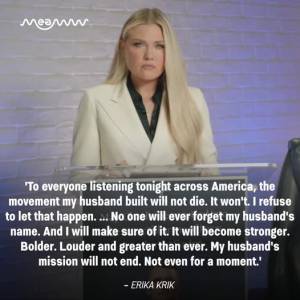
New York Times, Grieving in Public, Emma Goldberg, Sept. 14, 2025 (print ed.). Erika Kirk (above) Melds the Personal and Political.
Ms. Kirk has played a key role in her husband’s movement. Speaking at Turning Point USA headquarters and on social media, she pledged his work would continue.
The images of Erika Kirk in the days since her husband, Charlie Kirk, was assassinated have been wrenching. Though Ms. Kirk has now lurched into a new and harrowing spotlight as she grieves in public, for four years she has stood on convention stages alongside Mr. Kirk and built her own following of young conservative admirers, while helping her husband build his.
“You have no idea the fire that you have ignited within this wife,” Ms. Kirk said, standing in a white blazer at a lectern at Turning Point USA headquarters on Friday, in her first public speech since her husband, a right-wing force and key ally to President Trump, was killed at a college event in Utah. “The cries of this widow will echo around the world like a battle cry.”
Ms. Kirk also shared images on Instagram, where she has more than four million followers, of her hands folded together with Mr. Kirk’s in his coffin and herself embracing Vice President JD Vance with his wife, Usha Vance — braiding the personal and the political, the vulnerable and the operational, as she finds herself a widow on a national stage.
“If they thought my husband’s mission was big now,” she wrote, “you have no idea.”
Sept. 13
The Parnas Perspective, Saturday Morning News Update, Aaron Parnas, right, Sept. 13, 2025. Government and private companies crack down on speech mocking Kirk's death, publications retract false stories about Kirk killer's ideology, Trump backs off National Guard to Chicago, and more.
I woke up angry today — because once again, major media outlets are being forced to walk back sloppy, inaccurate reporting on the alleged shooter of Charlie Kirk. First it was the Wall Street Journal. Now, The Guardian has retracted claims that Tyler Robinson was a leftist. This isn’t a minor mistake — it’s reckless, and it fuels conspiracy theories at the worst possible moment. The media must do better.
At the same time, I’m tracking a disturbing wave of firings across the country targeting people who made critical or mocking remarks about Kirk’s killing. And in Washington, Donald Trump is already backpedaling on his threat to deploy the National Guard to Chicago.
Here’s my promise to you: I will not launder rumors from “anonymous sources” without evidence. I will not run with unverified claims that collapse hours later. My job as an independent journalist is to cut through the noise and deliver the facts — fearlessly, without bowing to politics, intimidation, or disinformation.
With that, here’s the news you missed:
A crackdown on speech: In the wake of Charlie Kirk’s assassination, the Trump administration escalated its crackdown on speech: Deputy Secretary of State Christopher Landau threatened to revoke visas of foreigners who mocked Kirk’s death, Republican lawmakers like Clay Higgins vowed to pressure tech companies to censor and punish online comments, and right-wing influencers launched doxxing campaigns, while some Republicans such as Senators Thom Tillis and Don Bacon criticized their party’s inflammatory rhetoric; meanwhile, Trump selectively honored Kirk with flags at half-staff—unlike slain Democrat Melissa Hortman.
Multiple teachers, firefighters, journalists, military personnel, and others were fired, suspended, or investigated after posting critical or mocking comments about far-right activist Charlie Kirk’s killing, as authorities, employers, and conservative figures launched a broad crackdown on speech, with notable cases including a Secret Service agent, a Carolina Panthers staffer, MSNBC analyst Matthew Dowd, and educators in Florida and Oregon.
The Florida Department of Education, backed by Gov. Ron DeSantis, announced investigations and potential sanctions against teachers who post “vile” comments about Charlie Kirk’s assassination, after a Clay County teacher was suspended for celebrating his death, with Education Commissioner Anastasios Kamoutsas warning that educators’ First Amendment rights are limited by their duty to uphold professional standards and maintain trust with students and families.
In a review of his controversial record, Charlie Kirk was highlighted for repeatedly making racist, sexist, and inflammatory remarks—including calling Black people “prowling” attackers, questioning the competence of Black professionals, telling Taylor Swift to “submit to your husband,” opposing abortion even in cases of child rape, and defending “some gun deaths every single year” as a necessary price for Second Amendment rights.
The Guardian walked back an earlier claim, based on a friend’s account, that Tyler Robinson—the alleged killer of Charlie Kirk—was a leftist, clarifying that his ideology remains unclear and cautioning against premature political labeling.
Text stating an editor\'s note. The text mentions the article was updated on 12 September 2025 to remove quotes after a verified source, who attended high school with Tyler Robinson, said they could not accurately remember details of their relationship.
The Wall Street Journal quietly retracted its early claim that Charlie Kirk’s shooter had engraved “transgender ideology” messages on his bullets, after Utah Gov. Spencer Cox and investigators clarified the casings instead carried random memes and antifascist song lyrics; LGBTQ+ advocates condemned the false reporting for fueling threats and harassment against trans people, demanding retractions, apologies, and stricter newsroom standards to avoid spreading misinformation that endangers marginalized communities.
Text stating "Editor\'s Note: An earlier version of this article detailed how an internal law enforcement bulletin said that ammunition recovered following the Charlie Kirk shooting was engraved with expressions of \'transgender and anti-fascist ideology.\' Justice Department officials later urged caution about the bulletin by the Bureau of Alcohol, Tobacco, Firearms and Explosives, saying it may not accurately reflect the messages on the ammunition, and the article was updated Thursday to reflect that. This editor\'s note was appended on Friday, after Utah Gov. Spencer Cox said the engravings included one that said \'Hey socialist!\' along with other messages and symbols. He also said there was no indication that the ammunition included any transgender references."
Investigators discovered that bullet casings at the scene of Charlie Kirk’s killing were scrawled with cryptic internet and gaming references—including a Helldivers 2 bomb command sequence, memes like “Notices bulges OwO what’s this?” and “If you read this, you are GAY Lmao,” and the antifascist anthem Bella Ciao—suggesting shooter Tyler Robinson, a 22-year-old student, was drawing from online subcultures rather than a clear political ideology; records show he was a registered but non-voting Utahn with Republican parents.
London is bracing for its largest far-right rally in decades, led by activist Tommy Robinson and framed as a tribute to Charlie Kirk, with up to 40,000 expected, major far-right figures like Steve Bannon and Jordan Peterson slated to appear, and counter-protests organized by anti-racism groups.
General news:
Trump scrapped plans to send the National Guard to Chicago, instead deploying them to Memphis—a move he said was urged by a rail executive—while Illinois Gov. Pritzker denounced the idea as authoritarian and Memphis leaders stressed they need funding and officers, not troops.
Rep. Thomas Massie’s bipartisan push to release Jeffrey Epstein-related documents is one signature away from forcing a House floor vote, while Senate Republicans blocked Chuck Schumer’s parallel effort, dismissing it as a “political stunt”; meanwhile, Congress is consumed with partisan battles over the Pentagon policy bill, ACA tax credits, war powers repeal, crypto regulation, and looming shutdown fights, as Speaker Mike Johnson both decried political violence after Charlie Kirk’s shooting and quietly broke with Trump to back a Virginia wind project.
A U.S. government shutdown looms as Donald Trump urged Republicans to reject negotiations with Democrats, who have vowed not to back spending bills unless healthcare cuts from the GOP’s July “One Big Beautiful Bill Act” are reversed; with funding expiring September 30, Congress appears likely to rely on a short-term measure to keep agencies open amid a partisan standoff over Medicaid and federal health programs.
Newly reviewed documents show Federal Reserve governor Lisa Cook declared her Atlanta property as a “vacation home,” undermining Trump administration claims she committed mortgage fraud by claiming multiple primary residences; Cook, who denies wrongdoing and is suing to resist Trump’s attempt to fire her, also never sought a tax exemption on the home, while a separate federal form likewise identified it as a second home—complicating accusations that appear tied to Trump’s push for greater control over the Fed.
After suspected Russian drones entered Polish airspace during strikes on Ukraine, the U.S. vowed to defend “every inch of NATO territory,” while NATO launched Operation Eastern Sentry to bolster defenses on its eastern flank, calling the incursion the first such violation since the war began and “reckless and unacceptable” whether intentional or not.
Brianna Ladapo, wife of Florida surgeon general and vaccine skeptic Dr. Joseph Ladapo, has publicly claimed to receive visions and angelic guidance, promoted chemtrails conspiracy theories, and said her husband will not work with anyone she hasn’t vetted; her influence, writings, and appearances alongside him at conferences highlight the couple’s shared anti-vaccine stance, even as Joseph Ladapo faces criticism for ending child vaccine mandates and promoting policies at odds with mainstream public health.
Scientists warn that Chagas disease, spread by “kissing bugs,” should be treated as endemic in the U.S. after cases have been confirmed in at least eight states, with low awareness leading to underreporting and delayed care; the illness can cause severe long-term complications like heart failure or digestive damage, as seen in the case of a Miami student who tested positive after donating blood, prompting calls for routine screening, better physician education, and expanded public health infrastructure.
A new U.N. Human Rights Office report says North Korea has intensified repression under Kim Jong Un, with public executions for sharing foreign films and TV, expanded surveillance, and harsh laws criminalizing access to outside information, aiming to cut off its 26 million people from the world and instill fear through trials and inspections.
A 7.4-magnitude earthquake struck near Russia’s Kamchatka Peninsula early Saturday, about 69 miles east of Petropavlovsk-Kamchatsky; while a brief tsunami alert was issued, it was lifted, and no immediate injuries or major damage were reported.
Emptywheel, Analysis: The White House Bid to Turn the Charlie Kirk Murder into Their Anti-Trans Jihad, Emptywheel (Marcy Wheeler, right), Sept. 15, 2025. We don't yet know what allegedly motivated Tyler Robinson to kill Charlie Kirk. We do know the motivations of the White House sourcing claims about a trans roommate, so we should be very cautious about believing what they're peddling.
In a Discord chatroom including at least one guy he knew from high school who had recognized Tyler Robinson in the pictures released by Charlie Kirk murder investigators, the accused murderer offered up the now-discredited report about trans bullets, but treated it with irony, just like he ironically claimed to be Kirk himself.
“I heard the ammo had somethin about trans stuff on it, but they aren’t releasing photos or exact quotes,” he wrote. He added: “and also the claim wasn’t backed by the official fbi, just some dude in the briefing room.”
A few minutes later, he joked: “I’m actually Charlie Kirk, wanted to get outta politics so I faked my death, now I can live out my dream life in kansas.”
The comment is deliberately non-committal, like all the others described in the NYT story on the Discord chat. But it is far more reliable evidence than a growing story, sourced to the White House, that one of two Robinson roommates cooperating with the FBI is trans and may even be Robinson’s lover.
The story started with one of the White House and Kash/Bongino’s favorite propagandists, Brooke Singman, whose belated story writing up the allegation she first tweeted out included a self-serving claim from the FBI officials who had nothing to do with finding Robinson, claiming they had instead “zero[ed] in on” him as a subject via the cooperation from the roommate.
FBI officials told Fox News Digital that the FBI had text messages and other communications between Robinson and his partner that helped FBI agents zero in on Robinson. Officials said the FBI took evidence from their apartment, including computers, which has been sent to Quantico for review, Fox News Digital has learned.
It went through the Daily Mail (which took a non-denial as confirmation the roommate was trans) and a NewsMax reporter who directly sourced the claim to Trump. Then, Marc Caputo, who is incredibly well-sourced to people like Susie Wiles and Roger Stone, but who has gotten increasingly credulous at Axios, mainstreamed it.
Authorities are investigating whether Tyler Robinson, suspected of killing Charlie Kirk, believed Kirk’s views on gender identity were “hateful” to people like Robinson’s transgender roommate, six sources familiar with the case tell Axios.
Why it matters: Investigators believe Robinson’s anger at Kirk’s views could be a key to establishing a motive for the slaying of the controversial activist whose death sent shockwaves through American politics. Each of the six sources familiar with the investigation told Axios that investigators believe Robinson had a romantic relationship with his roommate.
All this is coming in advance of the expected filing of charges by Utah on Tuesday.
Meanwhile, Steve Bannon has been on a tear because Utah Governor Spencer Cox, rather than Kash Patel, led the press conference announcing Robinson’s arrest the other day.
Did the ppl in the White House inform POTUS that one of his greatest haters, this goofball, girly man, weak governor of Utah, was going to sit there and do the entire briefing on the murder of Charlie Kirk and essentially give us almost no facts and just preach unity with the aggressively LGBTQ governor of Colorado?
Kash Patel is not just a colleague, he’s a very dear and close friend. I think the world of Kash. We don’t know what restrictions he’s under or even his ability to fully articulate what’s happening here. But whoever authorized one of the biggest Trump haters in this country, the governor of Utah, Cox, is a disaster. A true Trump hater, one of the worst in the Republican Party. Folks in Utah need to understand this man has embraced and pushed some of the most dangerous ideologies out there.
Bannon is very specifically demanding a story that a trans cabal killed Charlie Kirk.
There’s a very good reason why Cox was leading the presser and not Kash (besides Kash’s manifest incompetence): Because — as Josh Gerstein and Kyle Cheney noted the other day — as of now there’s no federal nexus to this crime.
The criminal case against the man accused of killing Charlie Kirk will likely play out in a Utah county courthouse, under the control of local prosecutors. But a national audience may very well be watching.
That’s because the alleged shooter, whom authorities identified on Friday as Tyler Robinson, is facing state-level criminal charges. And in Utah — unlike in federal court — criminal trials are routinely televised.
Robinson has been charged with three crimes under Utah law: murder, causing bodily injury with a firearm and obstruction of justice.
It might seem surprising that the case is not a federal one, given the national notoriety of the crime and the FBI’s heavy involvement in the investigation. But homicides can be charged as federal crimes in only a few circumstances — such as an assassination of a federal government official, a killing on federal property or a “hate crime” that was motivated by the victim’s race, religion or another protected characteristic.
The only way it could become a federal charge — the only way that Kash’s FBI would gain primary control over the facts and narrative told — would be if DOJ charged it as a hate crime, as Kash [Patel, right] described trying to do in the case of the Robin Westman, the trans woman charged in the Annunciation Catholic School shooting last month, even while deadnaming her throughout:
As we continue to investigate yesterday’s barbaric attack from Robert [sic] Westman, the male subject, our teams have gathered information and evidence demonstrating this was an act of domestic terrorism motivated by a hate-filled ideology.
Some updates:
- Subject left multiple anti-Catholic, anti-religious references both in his manifesto and written on his firearms
- Subject expressed hatred and violence toward Jewish people, writing “Israel must fall,” “Free Palestine,” and using explicit language related to the Holocaust
- He wrote a an explicit call for violence against President Trump on a firearm magazine
- The @fbi investigation is still ongoing. We will employ all of our counter-terror tools to ensure this is fully investigated and deterred.
- And as promised, we will continue to update when able.
Of course, even if Robinson’s roommate were trans, even if they were in a relationship, the current story would be that because a person who willingly implicated their friend in a death penalty eligible crime, doing the work Kash’s FBI was too incompetent to do, it gives Stephen Miller license to arrest all trans people (or at least Pam Bondi to disarm them), just like he used fraudulent claims about Tren de Aragua to detain hundreds of men with innocent tattoos and send them to a concentration camp in El Salvador.
The alleged trans person here is the only one whose actions are above reproach.
And all that’s before you consider how Kash Patel has done much to make any bid for the death penalty unsustainable (to say nothing about Federal charges against Westman), given his repeated evocations of love for Kirk, down to promising he would see him in Valhalla (wittingly or unwittingly repeating the words of the far right Christchurch killer).
Unless Robinson were to plead guilty (which would mostly likely only happen if law enforcement promised not to execute him), any such death penalty phase would be riddled with questions about the bias of Kash, Trump, and everyone else leading this case from the federal side. Frankly, the discovery would be epic — and badly discrediting to the FBI and the White House.
We don’t know what motivated Robinson, what turned him from the pro-Trump politics of his family or what appears to have distanced him from the Mormon Church (there has been little conversation about the significance of the fact that Robinson did not do a Mormon mission, but it may be the most important sign of rupture out there).
What we do know is that Stephen Miller wasted no time grieving his beloved friend, but turned immediately to politicizing his death. And Miller has never bothered to let truth drive his political jihads.
Letters from an American, Historical Commentary: Sept. 12, 2025 [Media Battle Over Kirk Killer's Politics], Heather Cox Richardson, right, Sept. 13, 2025. Since a gunman murdered right-wing activist Charlie Kirk at an outdoor event at Utah Valley University in Orem, Utah, both social media circles and the political sphere have been alight with accusations that “the Left” was responsible for the shooting.
Prominent right-wing social media accounts called the Democratic Party “a domestic terror organization” and declared “WAR.” Billionaire Elon Musk posted: “The Left is the party of murder.”
From the Oval Office, President Donald J. Trump blamed the shooting on “the radical left” and vowed to “find each and every one of those who contributed to this atrocity, and to other political violence, including the organizations that fund it and support it, as well as those who go after our judges, law enforcement officials, and everyone else who brings order to our country.”
Without any information about the shooter, the media got in on the game, with the Wall Street Journal reporting yesterday that “[a]mmunition engraved with transgender and antifascist ideology was found inside the rifle authorities believe was used in Kirk’s shooting.” Bomb threats targeted Democratic politicians—primarily Black politicians—and historically Black colleges and universities (HBCUs).
Condemnation of the shooting was widespread. Perhaps eager to distance themselves from accusations that anyone who does not support MAGA endorses political violence, commenters portrayed Kirk as someone embracing the reasoned debate central to democracy, although he became famous by establishing a database designed to dox professors who expressed opinions he disliked so they would be silenced (I am included on this list).
Meanwhile, it was not clear the Federal Bureau of Investigation (FBI) was up to the task of finding the killer. FBI director Kash Patel and deputy director Dan Bongino were both MAGA influencers without law enforcement experience when Trump put them in charge of the agency. Once there, they focused on purging the agency of those they considered insufficiently loyal to Trump or “DEI hires.” In early August, they forced out the leader of the Salt Lake City, Utah, field office, Mehtab Syed, a decorated female Pakistani American counterterrorism agent.
Meanwhile, David J. Bier of the Cato Institute reported that one in five FBI agents have been diverted from their jobs to conduct immigration raids with Immigration and Customs Enforcement, and just hours before the shooting, three former top officials at the FBI filed a lawsuit against Patel, the FBI, Attorney General Pam Bondi, the Department of Justice, and the president accusing them of unlawfully politicizing the FBI, purging it of anyone who had ever worked on a criminal investigation of Trump. The lawsuit suggests Bongino had an “intense focus on [using] his social media profiles to change his followers’ perceptions of the FBI.”
As Quinta Jurecic reported today in The Atlantic, hours after the shooting, Patel’s personal social media account posted a picture of himself and Kirk; minutes later, Patel’s official FBI account posted that the shooter was already in custody and then, an hour and a half later, said the suspect had been released. Both Patel and Bongino appeared to be focused more on posting than on doing the work to find the shooter.
This morning, Trump announced on the Fox News Channel’s Fox & Friends that he had just heard “they have the person that they wanted.” That person turned out to be 22-year-old Utah native Tyler Robinson, who turned himself in to authorities after his father urged him to. Robinson’s parents are registered Republicans; he was not affiliated with a political party and was an inactive voter. Over the past years, Robinson’s mother posted a number of pictures of him and his brothers posing with guns.
Robinson had recently had a conversation with a family member about why they didn’t like Kirk’s viewpoints. Robinson appears to have admired the “Groypers,” led by Nick Fuentes, who complain that more mainstream organizations like Kirk’s Turning Point USA are not “pro-white” enough and have publicly harassed Kirk in the past.
Allison Gill of The Breakdown explained that the rumors the shooter had engraved anti-fascist rhetoric on some of the bullet casings found at the scene turned out to be a misunderstanding of terms from the video game Helldivers2. The claim that he had used “transgender ideology” was apparently a misreading of the headstamp “TRN” that marks ammunition as the product of Turkish manufacturer Turan.
Almost as soon as Robinson was identified, the tone of MAGA leader’s conversation about the shooting changed. Representative Nancy Mace (R-SC), who had used a slur to refer to the shooter as pro-transgender, posted on social media: “We know Charlie Kirk would want us to pray for such an evil, and lost individual like Tyler Robinson to find Jesus Christ. We will try to do the same.”
For his part, Trump seemed to have lost interest in Kirk even earlier. Yesterday evening, a reporter offered the president his condolences on the loss of his friend Kirk and asked Trump how he was holding up. The president answered, in full: “I think very good. And by the way, right there, you see all the trucks, they just started construction of the new ballroom for the White House, which is something they've been trying to get, as you know, for about 150 years, and it's going to be a beauty. It’ll be an absolutely magnificent structure. And I just see all the trucks. We just started so it'll get done very nicely and it'll be one of the best anywhere in the world, actually. Thank you very much.”
The day of Kirk’s murder, Russia sent 19 drones into Poland—some armed and some unarmed—testing the strength of the neighboring country. With the help of allies, Poland shot down four of them. Poland belongs to the North Atlantic Treaty Organization (NATO), with whom the U.S. shares a mutual defense agreement meaning that if it is attacked, we will come to its aid. After the attack, Poland called an emergency meeting of the North Atlantic Council, the primary political decision-making body within NATO. U.S. Ambassador to NATO Matthew Whitaker apparently did not attend.
Although Kaja Kallas, the European Union’s high representative for foreign affairs and security policy, called the violation “intentional, not accidental,” Trump told reporters that Russia’s sending of drones into Poland “could’ve been a mistake.” Josh Kovensky of Talking Points Memo reported on Tuesday that on August 27, the Trump administration returned a plane full of Russian dissidents seeking asylum in the U.S. to Moscow, where at least some of them went directly from the plane into custody.
Today, NATO Secretary General Mark Rutte and Supreme Allied Commander Europe General Alexus G. Grynkewich announced that NATO is launching “Eastern Sentry,” an operation to bolster NATO’s defense against Russian incursions along NATO’s eastern flank. In what appeared to be an attempt to calm NATO allies’ concerns about Trump’s "mistake" comment, acting U.S. Ambassador to the U.N. Dorothy Shea told the United Nations Security Council today the U.S. will “defend every inch of NATO territory.” “The United States stands by our NATO allies in the face of these alarming airspace violations,” she said.
If the U.S. is weakening ties to traditional defensive alliances, it is attempting to flex its muscles by going after alleged drug dealers with a newly dubbed “Department of War.” On September 2, Trump announced the U.S. had struck a boat he claimed was carrying drugs to the U.S., killing 11 civilians he claimed were “Tren de Aragua Narco terrorists.” The administration posted a video of the operation online.
From the start, legal specialists noted that the U.S. made the strike without legal authority. Trump simply claimed the power to kill men he claimed were a danger to the U.S., advancing the argument that drug smuggling is the same thing as an imminent military attack on the U.S. and thus the laws of war are in force. Yesterday, that argument got even weaker when Charlie Savage and Helene Cooper of the New York Times reported that the men on the boat appeared to have been spooked by the military hardware over them and turned back to shore. “If someone is retreating, where’s the ‘imminent threat’ then?” Rear Admiral Donald J. Guter, a retired top judge advocate general for the Navy from 2000 to 2002, said to the reporters.
Today, Trump announced he was sending the National Guard not into Chicago, Illinois, where Mayor Brandon Johnson and Governor J.B. Pritzker have mounted strong opposition, but to Memphis, Tennessee. The Memphis Police Department noted: “Overall crime is at a 25-year low, with robbery, burglary, and larceny also reaching 25-year lows. Murder is at a six-year low, aggravated assault at a five-year low, and sexual assault at a twenty-year low" in the city.
Although Trump said he had the support of the mayor and the governor, Shelby County mayor Lee Harris asked Republican governor Bill Lee to “please reconsider, if this is on the table.” He said local government would welcome more state troopers to help fight crime, but “to have individuals with military fatigues, semi-automatic weapons and armored vehicles patrolling our streets is way too far, anti-democratic and anti-American.”
Lee released a statement saying he was set to speak with Trump about a “strategic mission” to use state law enforcement more effectively with an already established FBI mission in Memphis.
Meanwhile, yesterday four out of five justices on a panel of the Brazilian Supreme Court found former president Jair Bolsonaro, a close ally of Donald Trump, guilty of plotting a coup, attempting to overturn the country’s 2022 election, and committing violent acts against state institutions. They sentenced him to 27 years and three months in prison.

New York Times, U.C. Berkeley Gives Names of Students and Faculty to Government for Antisemitism Probe, Francesca Regalado, Sept. 13, 2025. The University of California, Berkeley, told around 160 people that their names were in documents related to antisemitism complaints that were demanded by the Trump administration.
 The University of California, Berkeley, said on Friday that it has provided the names of students, faculty and staff in cases of alleged antisemitism to the federal government, complying with the Trump administration’s investigation of universities that it has accused of failing to protect Jewish students.
The university said in a statement that it notified about 160 people on Sept. 4 that they were named in documents provided to the Department of Education’s Office for Civil Rights. The Daily Californian, a student-run newspaper, first reported the disclosure on Wednesday.
 U.C. Berkeley said it had been directed by the University of California system’s Office of the General Counsel to comply with the federal government’s demand for documents related to how the university handles complaints about antisemitism. “Numerous documents” were provided to the Education Department over recent months, U.C. Berkeley said.
Those notified on Sept. 4 included people who were accused of or affected by antisemitic incidents, as well as the individuals who had filed the antisemitism complaints, according to the university.
President Trump has put extraordinary pressure on American universities this year, threatening to cut off federal funding and, in some cases, their ability to enroll foreign students. The government has ordered a freeze on billions of dollars in research funding.
The Trump administration’s main targets have been elite universities, which Mr. Trump and his allies have said are bastions of ideological indoctrination and antisemitism. U.C. Berkeley is among the 10 universities that a Trump administration task force on antisemitism has identified for particular attention.
The federal cuts have been deep at universities in California, a state where scientific research is a critical economic engine for sectors including technology and agriculture.
The Department of Education opened an investigation in February into how U.C. Berkeley and four other universities handled complaints of alleged antisemitism. In July, Rich Lyons, the chancellor of Berkeley, and the leaders of two other universities were grilled by Republican lawmakers, who accused them of failing to combat antisemitism on their campuses.
“We have a solemn obligation to protect our community from discrimination and harassment, while also upholding the First Amendment right to free speech,” Mr. Lyons said in his testimony to the House Committee on Education and the Workforce.
Some U.C. Berkeley alumni expressed their strong disapproval of sharing the information with the government. One, the publisher Steve Wasserman, invoked the university’s reputation as the cradle of the free speech movement in the 1960s, in which students fought to expand political expression on the Berkeley campus.
“Lyons’ public statements before Congress seem to suggest a certain resilience and a certain desire to do the right thing. But apparently when push came to shove, they secretly shared 160 names with the Trump administration,” said Mr. Wasserman, who jointly runs Heyday Books, in a phone interview on Friday.
University officials have noted that there are legal limits to their pushback against government requests.
The University of California system said that, like all public universities, it was subject to state and federal oversight. It said in a statement that it “is committed to protecting the privacy of our students, faculty, and staff to the greatest extent possible, while fulfilling its legal obligations.”
More Global News
New York Times, Accused of Failing to Halt Drug Trade, an Ally Braces for Trump’s Response, Genevieve Glatsky, Sept. 13, 2025. Millions in military and development funds for Colombia hang in the balance as Washington questions the country’s fight against cocaine.
As the United States escalates its military campaign against drug traffickers near Venezuelan waters, destroying a vessel that officials said carried drugs, the Trump administration is simultaneously weighing whether to cut aid to Colombia, the world’s top cocaine producer.
For more than four decades, Colombia has been a cornerstone of U.S. counternarcotics strategy abroad, receiving billions in aid while providing intelligence on routes, networks and shipments.
Now that partnership is under threat.
At issue is a process called certification, an annual review with results expected to be announced on Monday about whether Colombia is doing enough to combat drugs.
While it is unknown what the Trump administration will do, decertification could have huge consequences, suspending hundreds of millions of dollars in aid, prompting sanctions and visa restrictions on government officials, and damaging one of Washington’s closest alliances in Latin America.
The U.S. State Department declined to comment on the administration’s plans.
But in recent months, Trump officials have been vocal in their criticism of Colombia for failing to reduce cultivation of coca, the raw material for cocaine.
“It is time to see results,” the U.S. State Department’s international narcotics agency posted on X. “Given record coca cultivation, there needs to be immediate and tangible progress on eradication.”
Production is at record levels, according to United Nations data. Coca cultivation grew 10 percent to 625,000 acres between 2022 and 2023, while potential production — the U.N.’s estimate of the maximum amount of cocaine that could be produced from coca crops — surged over those two same years by 53 percent, to 2,644 metric tons.
Most Colombian cocaine ends up in the United States and Europe.
New York Times, News Analysis: Brazil Keeps Telling Trump to Get Lost, Jack Nicas, Sept. 13, 2025. Latin America’s largest nation is shaping up as a test case on how to defy President Trump.
President Trump made his demands to Brazil very clear: Drop the charges against former President Jair Bolsonaro of attempting a coup.
To show he was serious, he hit Brazil with punishing tariffs, launched a trade investigation and imposed some of the most severe sanctions at his disposal against the Supreme Court justice overseeing the case.
Brazil responded on Thursday by convicting Mr. Bolsonaro anyway, sentencing him to more than 27 years in prison for overseeing a failed plot to stay in power after losing the 2022 elections.
Defiance has defined Brazil’s response to Mr. Trump since he began trying to bully the country. So far, it hasn’t resulted in disaster.
President Luiz Inácio Lula da Silva has watched his poll numbers rise as he has denounced his American counterpart. Alexandre de Moraes, the Supreme Court justice targeted by sanctions, has been fiercely backed by Brazil’s democratic institutions. And last month, when Mr. Trump’s 50 percent tariffs on Brazilian exports took effect, Brazil said its global exports actually rose 4 percent because of increased purchases by China.
“Does anyone believe that a tweet from a foreign government official will change a ruling in the Supreme Court?” Justice Flávio Dino said as he cast his vote this past week to convict Mr. Bolsonaro.
In response, Secretary of State Marco Rubio tweeted: “The United States will respond accordingly to this witch hunt.”
Epstein Files
The Guardian, Jeffrey Epstein was linked to the upper echelons of wealth and politics – but where did he get his fortune? Edward Helmore, Sept. 13, 2025. The sex offender was worth $600m when he died, but exactly how he acquired his wealth remains a mysteryJeffrey Epstein was a very wealthy man, but exactly how wealthy and where that money came from remains shrouded in mystery.
 Newly unearthed emails last week shone light on Epstein’s role as freelance client development officer, acting as a channel between political figures and business titans, greasing up the former with lifestyles they could not afford and the latter with avenues of political influence.
Exposure of that channel ended the career of Peter Mandelson, the UK ambassador to the US, provoking a crisis in Britain’s Labour government, after emails showed that Lord Mandelson had steered a $1bn banking deal Epstein’s way and expressed sympathy for Epstein’s 2008 conviction for child sexual procurement.
Emails obtained by Bloomberg and others went further, showing that figures in Epstein’s network of billionaires, politicians, celebrities, royalty and intellectuals were assembled into schemes of influence.
“Jeffrey was a starfucker,” an acquaintance told the Guardian last week. “Anyone he thought had influence he would try to add to his collection. Mandelson is slippery, and impressed by money, so Jeffrey liked that.”
The spheres of influence Epstein created, emails showed, relied simultaneously on access and gifts. Bloomberg obtained a spreadsheet of expenses that in some cases appeared to sync with emails between Epstein and his former girlfriend and accomplice Ghislaine Maxwell, the financier’s convicted sex-trafficking co-conspirator.
One expense, dated 21 December 2005, showed a $35,000 watch for “DB” – the same day that Maxwell and Epstein discussed in emails giving Bill Clinton aide Doug Band an Audemars Piguet with the same value. Band has denied receiving any watch.
In all, the emails include a spreadsheet itemizing nearly 2,000 gifts, luxury items and payments totaling $1.8m.
But the questions about the source of Epstein’s wealth have never been fully resolved. He was worth nearly $600m at his death, thanks mostly to two wealthy billionaire clients – Victoria’s Secret founder Les Wexner and, later, Apollo Global Management co-founder Leon Black – as well as Johnson & Johnson heiress Elizabeth “Libet” Johnson, sister of former US ambassador to the UK Woody Johnson.
Between his collection of lavish homes in New York, Palm Beach and Paris, two private Caribbean islands, two jets and helicopter, Epstein held nearly $380m in cash and investments, according to his estate.
That wealth arrived suddenly. According to associates, until the end of the 90s, Epstein was living in a two-bedroom apartment on Manhattan’s Upper East Side close to the river. It was only when Maxwell arrived from London that his lifestyle was dramatically elevated.
Epstein moved to a townhouse on 68th Street and later to a 28,000-sq-ft mansion on 71st Street, later transferred to him by Wexner in 2011.
Steven Hoffenberg, a former business partner of Epstein convicted of running a Ponzi scheme, claimed that Maxwell’s father, disgraced press baron Robert Maxwell, introduced his daughter to Epstein in the late 1980s.
A 2022 Miami Herald exposé showed complex Maxwell family transactions passing through companies in Jersey, the British Virgin Islands and Panama that it called “a decades-long modus operandi of financial deception”.The president doth protest too much: Trump’s denial on Epstein is backfiringRead more
In a 2013 corporate filing, Epstein described himself as “an experienced and successful financier and businessman”, an “entrepreneur who has built several highly profitable companies” and “one of the pioneers of derivative and option-based investing”.
Of the more than $800m in revenue Wexner and Black brought in from 1999 to 2018, according to financial statements obtained by the New York Times, Epstein – who was neither a licensed tax attorney nor a certified public accountant – collected at least $490m in fees.
According to Forbes, the two businessmen supplied close to 75% of Epstein’s fee income during that period. Court records from a 2022 case brought against one of Epstein’s banks, JPMorgan Chase, show that Epstein’s US Virgin Islands-based companies were his only “revenue-generating” companies from 1999 to his death in 2019. Under the territories’ economic development program, Epstein is estimated to have saved $300m in taxes between 1999 and 2018.
A 2023 report by the then Senate finance committee chair, Ron Wyden, found Black paid Epstein $170m “for purported tax and estate planning advice”. Black has not been accused of wrongdoing. He said in a 2020 earnings call that he “deeply regretted” his association with Epstein. A report from global law firm Dechert found “no evidence that Black … was involved in any way with Epstein’s criminal activities”.
Wexner claimed after Epstein’s arrest in 2019 that Epstein had “misappropriated” more than $46m of his personal fortune and said in a letter to L Brand employees: “I know now that my trust in him was grossly misplaced and I deeply regret having ever crossed his path.”
But by 2006, with Wexner’s patronage at an end, Epstein’s Financial Trust Company, which had generated $300m in fees, generated less than $5m over five years. His 2008 conviction dealt a further blow and he returned to New York to salvage his reputation and business.Illustration from Jeffrey Epstein birthday book.Epstein 50th birthday book: who is in it and what did they say?Read more
The New York Times reported last week that despite internal red flags about suspicious cash withdrawals and transfers, JPMorgan Chase continued to consider Epstein a treasured customer with more than $200m in accounts. Perhaps more importantly, he unofficially served as a client developer for the private wealth management division.
JPMorgan Chase has described its ties to Epstein as “a mistake”. Epstein introduced bank executives to some figures who would become clients, including Google co-founder Sergey Brin, and to global leaders, such as Israeli prime minister Benjamin Netanyahu, Bill Gates, Elon Musk and Emirati billionaire Sultan Ahmed bin Sulayem.
Epstein received a $15m fee for smoothing the sale of a $1.3bn stake in Glenn Dubin’s $7bn Highbridge Capital Management hedge fund to the bank. Epstein’s connections were by then more valuable than his wealth.
Epstein’s main connection to the bank was Jes Staley, later CEO of Barclays, who was found by UK regulators to have misled them about his ties to Epstein.
Conspiracy theories that Epstein was blackmailing his wealthy connections, snaring them in honeytraps that included models brought into the US, including by Jean-Luc Brunel, founder of MC2 Model Management, who – like Epstein – died in prison while awaiting trial on sex crimes charges, have not come to fruition.
But wherever the Epstein scandal goes next, and whomever else it brings down, Epstein moves like a zombie through the upper echelons of wealth and politics. “He operated a circle with many points of entry,” says the acquaintance, “but now he’s like a wrecking ball rolling across countries.”
More On Charlie Kirk Death
The Nation, Political Commentary: Charlie Kirk’s Legacy Deserves No Mourning, Elizabeth Spiers,Sept. 12, 2025. The white Christian nationalist provocateur wasn’t a promoter of civil discourse. He preached hate, bigotry, and division.
 Charles James Kirk, 31, died on Wednesday from a gunshot to the neck at a Utah Valley University campus event just as he was trying to deflect a question about mass shootings by suggesting they were largely a function of gang violence.
He died with a net worth of $12 million, which he made by espousing horrific and bigoted views in the name of advancing Christian nationalism. The foundation of his empire was the group he cofounded and led, Turning Point USA, which is a key youth-recruitment arm of the MAGA movement. Kirk was able to launch Turning Point at the age of 18 because he received money from Tea Party member Bill Montgomery, right-wing donor Foster Feiss, and his own father, also a prolific right-wing donor. He was an unrepentant racist, transphobe, homophobe, and misogynist who often wrapped his bigotry in Bible verses because there was no other way to pretend that it was morally correct. He had children, as do many vile people.
It is rude of me to say all of this, because we live in a culture where manners are often valued more than truth. That is why a slew of pundits and politicians have raced to portray Kirk’s activities, which harmed many vulnerable people, in a positive light—and to give him the benefit of the doubt that he did not grant to anyone who wasn’t white, Christian, straight, and male. California Governor Gavin Newsom framed Kirk’s project as a healthy democratic exercise: “The best way to honor Charlie’s memory is to continue his work: engage with each other, across ideology, through spirited discourse. In a democracy, ideas are tested through words and good-faith debate.” This downwardly defines both “discourse” and “good-faith.”
There is no requirement to take part in this whitewashing campaign, and refusing to join in doesn’t make anyone a bad person. It’s a choice to write an obituary that begins “Joseph Goebbels was a gifted marketer and loving father to six children.”
Many of the facile defenses of Kirk and his legacy are predicated on the idea that it’s acceptable to spread hateful ideas advocating for the persecution of perceived enemies as long you dress them up in a posture of debate. This is just class privilege. The man who said, “Black women do not have brain processing power to be taken seriously. You have to go steal a white person’s slot” said it while wearing a nice shirt and a tie on a podcast instead of tattered overalls in the parking lot of a rural Walmart. That does not make it any less racist.
It’s true that we cannot know what was in Charlie Kirk’s heart because we are not telepathic. But we can make reasonable inferences based on the things he said and did publicly because we are also not colossally stupid. He built a large following, and acquired real political power saying these things—to young people, to the president and his minions, to deep-pocket right-wing donors—and there are far too many people who have been ready to suggest that he was able to do this through a combination of natural charisma and good old-fashioned hard work. Speaking about and addressing the late Texas Representative Sheila Jackson Lee, who is Black, he said, “It’s very obvious to us you are not smart enough to be able to get it on your own. ‘I could not make it on my own, so I needed to take opportunities from someone more deserving.’” Kirk was smart enough to ask his father for a check when wanted to found Turning Point, and had always been happy to curtail opportunities for more deserving people when they failed to conform to his own ideology.
It’s this that makes it particularly galling to see him cast by some as a free-speech warrior. He created a professor watchlist explicitly designed to get academics fired who dared talk about the right’s usual assortment of verboten topics—anything to do with race or gender, in particular. He also offered the standard right-wing plaint about left-wing indoctrination in American universities even as he went on campus tours trying to indoctrinate young people into his hard-right Christian nationalist worldview.
When we decline to speak ill of the dead, it’s because we have compassion for the living. In this respect, I am sorry for Kirk’s children. I don’t know if Kirk was a good father, but if he was, that does little to mitigate the damage he did to other people’s children. I can only hope for the sake of his kids that they have role models who will teach them that it is wrong to profit off the dehumanization of people because of who they are.
When asked about mass shootings he said, “I think it’s worth it. I think it’s worth it to have a cost of, unfortunately, some gun deaths every single year, so that we can have the Second Amendment.” Perhaps Kirk did not believe that his own life would be cut short by gun violence, but, like the rest of us, he has witnessed countless school shootings. When he said “some gun deaths” are acceptable, he surely knew he lived in a country where the deaths he deemed acceptable included those of children, some of whom were the age of his own. There is no inherent virtue in caring about your own children; that is the bare minimum requirement for effective parenting. Virtue lies in caring about the safety and well-being of children you don’t know.The Nation Weekly Fridays. A weekly digest of the best of our coverage.EmailBy signing up, you confirm that you are over the age of 16 and agree to receive occasional promotional offers for programs that support The Nation’s journalism. You may unsubscribe or adjust your preferences at any time. You can read our Privacy Policy here.
On that front, I’m fairly sure Kirk did not care about my child. My child lives in Brooklyn, in a progressive family. His mother works and does not have a marriage where she is considered inferior to her husband or required to obey him, as Kirk arrogantly told Taylor Swift she should do after learning of her engagement. (“Reject feminism,” he said. “You’re not in charge.”) We also live in a Haitian immigrant neighborhood, and if you only listened to Charlie Kirk, you might be under the impression that my neighbors eat pets. You would also be encouraged to believe that, simply by virtue of being non-white immigrants, they were “replacing” white people—and that, since they are also Black, they are dangerous. “Happening all the time in urban America,” he said, “prowling Blacks go around for fun to go target white people, that’s a fact.”
I do not believe anyone should be murdered because of their views, but that is because I don’t believe people should be murdered generally, regardless of who they are or what they’ve done. I am against the death penalty, pro–gun control, and believe war is a failure of humanity, not a necessary byproduct of it. Kirk was fine with murder as long the right people were dying.
Some of the people valorizing Kirk insist that all of his toxicity was acceptable because at least he was open to debate—a bar so low, you’d have to dig into the Mariana Trench to get to it. And he certainly paid lip service to it. “We record all of it so that we put [it] on the Internet so people can see these ideas collide,” he said of his own streaming operation. “When people stop talking, that’s when you get violence. That’s when civil war happens, because you start to think the other side is so evil, and they lose their humanity.”
But Kirk’s actions undercut that notion every day. His entire business was saying the other side was evil and dehumanizing them. The debates were simply performances, and he could not have an entertaining public fight without opposition. Turning Point did not work to bring people together; it worked to bring about a country where anyone who wasn’t a white Christian nationalist wasn’t welcome. I won’t celebrate his death, but I’m not obligated to celebrate his life, either.
The Warning with Steve Schmidt, Opinion: Charlie Kirk led a dark path, but he did not deserve to be killed, Sept. 11, 2025. But Charlie Kirk did not serve his country. Charie Kirk did not serve the American flag, and it is inappropriate for it to be lowered to half staff over the White House. He served the MAGA flag. But Charlie Kirk was a political disgrace.
New York Times, How Law Enforcement Got the Man Suspected of Killing Charlie Kirk, Glenn Thrush, Kellen Browning, Mike Baker and Devlin Barrett, Updated Sept. 13, 2025. F.B.I. leaders touted the immense federal deployment assigned to find the assassin. But their big break came with a single tip — from the suspect’s own family.
Kash Patel, the director of the F.B.I., on Friday described the arrest of the man accused of killing the activist Charlie Kirk as “historic” — a fast-track triumph for law enforcement that proved the effectiveness of the Trump administration’s push to “let good cops be cops.”
The reality was more complicated.
While the federal government, led by the F.B.I., surged investigative manpower and technological firepower — high-tech drones, fingerprint experts, video analysts, evidence processing teams — the hunt for Mr. Kirk’s killer ended in the mundane way that many manhunts do. Someone called in a tip to local law enforcement and identified the suspect, Tyler Robinson, a 22-year-old Utah man.
“A family member of Tyler Robinson reached out to a family friend who contacted the Washington County Sheriff’s Office with information that Robinson had confessed to them or implied that he had committed the incident,” Gov. Spencer Cox of Utah told reporters on Friday. “We got him.”
What did make the investigation historic was the intense level of federal involvement spurred by the political significance of the man who was killed, and the unfathomable impact of his killing in a divided country sliding from vitriol to violence. Mr. Kirk was close to President Trump, who broke the news of the arrest on Fox. Mr. Patel, a former podcaster, moved in the same conservative circles as Mr. Kirk and considered him a friend.
The evidence collected and analyzed by the bureau is likely to play a critical role in state and local prosecutions. But it was not clear whether anything the F.B.I. did in the days after the shooting played a decisive role in shortening the search.
Mr. Robinson’s arrest late Thursday in many ways fit the unpredictable pattern of dragnet investigations, which are often resolved through a combination of shoe-leather police work, high-tech forensics and plain luck. They seldom conform to a neat narrative — and are often hampered by miscalculations and missteps before reaching their goal, officials said.
That appears to be the case with Mr. Robinson, who surrendered to local authorities after a frantic 33-hour search that ended 250 miles south of the crime scene.
Mr. Kirk was shot shortly after noon on Wednesday, the sudden attack sending thousands of attendees at his event on the Utah Valley University campus scattering.
The event had been staffed by a modest contingent of campus police officers, along with Mr. Kirk’s security, but there was no major law enforcement presence that would have made it more difficult for the shooter to slip away. The F.B.I. was on the scene within 16 minutes. The bureau mobilized planes, hostage-rescue teams and technicians while flying pieces of evidence to forensic labs on the East Coast.
Near the campus, officers scoured neighborhoods, knocked on doors and looked in possible hiding places — inside chicken coops, on a construction site, in backyards. But the gunman appeared to be long gone.
As the search widened, Mr. Cox and police officials said, the federal government provided important technical and logistical support. Mr. Patel hailed the effectiveness of coordination among all of those involved in the search.
It is possible, current and former officials said, that images of the shooter taken by surveillance cameras at the scene and disseminated on Thursday by federal authorities prompted Mr. Robinson’s family to come forward or convinced Mr. Robinson to surrender.
But it appears to have taken the bureau a half-day longer than necessary to release the images, which were in the possession of F.B.I. agents in Salt Lake City as early as Wednesday night, Mr. Patel complained to his team.
In a testy conference call early Thursday, Mr. Patel and his deputy, Dan Bongino, called out subordinates for waiting nearly 12 hours to show them the photos — and said they would have released them immediately had they been aware they were available, according to people familiar with the exchange.
Later, when Mr. Patel arrived in Utah that evening to more directly oversee the investigation, he directed the release of video footage of the suspect.
Yet the F.B.I. director himself added to the confusion over the investigation in the hours after Mr. Kirk was killed.
“The subject for the horrific shooting today that took the life of Charlie Kirk is now in custody,” Mr. Patel wrote on X on Wednesday evening, without vetting the post with his team.
Social media photos posted by his family over the years show Mr. Robinson and his two younger brothers shooting and posing with guns.
Mr. Robinson surrendered to the police near his hometown on Thursday night after an intense, 33-hour manhunt. A police officer wrote in an affidavit filed in court that one of Mr. Robinson’s family members had described him as growing “more political in recent years” and, during a recent dinner, had mentioned Mr. Kirk and his upcoming event at the Utah campus.
New York Times, From Scholarship Winner to Wanted Man: The Path of the Kirk Shooting Suspect, Jack Healy, Sabrina Tavernise, Nicholas Bogel-Burroughs and Orlando Mayorquín, Sept. 13, 2025 (print ed.). Tyler Robinson, above, the man accused of shooting Charlie Kirk, was a stellar student in high school, raised in a Republican home in Southwest Utah and training to be an electrician.
In the conservative southern Utah city where Tyler Robinson grew up, neighbors and classmates described him as a reserved, intelligent young man raised in a Republican family who was deeply interested in video games, comic books and current events.
On Friday afternoon, people who knew Mr. Robinson struggled to reconcile their memories of him and his seemingly ordinary suburban upbringing with his notorious new image: the latest face of political violence, accused of fatally shooting the conservative influencer Charlie Kirk on a Utah college campus earlier this week in what the authorities have called a political assassination.
“It’s really sad that someone with his mind put it to that sort of use,” said Keaton Brooksby, 22, a former high school classmate of Mr. Robinson’s.
Mr. Robinson had recently spoken with a family member about the fact that Mr. Kirk was going to hold an event in Utah, according to a police affidavit, and he and his relative discussed “why they didn’t like him and the viewpoints he had.”
But as elements of the nation’s political left and right scrambled for motives, the image that has initially emerged of Mr. Robinson is not at all clear. Neither is his trajectory from a scholarship-winning high school student to an apprentice electrician to a suspect.
Mr. Brooksby said that Mr. Robinson was generally considered a quiet pupil when they were growing up in the conservative St. George area, but one day in high school, the topic of the 2012 attacks on Americans in Benghazi, Libya, came up during lunch. Few there knew exactly what had happened, but Mr. Robinson was sure of himself.
“He gave us a whole spiel on what happened,” Mr. Brooksby said. “I just remember thinking, he’s got a lot of information on this for someone who’s 14.”

Spatial chart showing movements of suspected Charlie Kirk assassin's (New York Times chart).
New York Times, How the Gunman Who Killed Charlie Kirk Got on Campus and Escaped, Leanne Abraham, Bora Erden, Lazaro Gamio, Junho Lee and Bedel Saget, Sept. 13, 2025 (print ed.). Tyler Robinson, the suspect in the killing of the right-wing activist Charlie Kirk, evaded detection for hours before climbing on a roof, where the police say he shot and killed Mr. Kirk during an outdoor event at Utah Valley University on Wednesday. The authorities arrested Mr. Robinson on Thursday night after a 33-hour manhunt.
A New York Times review of videos, a 3-D analysis of the scene and an affidavit released on Friday shed new light on the gunman’s movements in the moments leading up to the shooting and immediately after.Charlie Kirk’s event, which had been scheduled for noon on Wednesday, was free to attend, and there were no visible barriers to access of the Utah Valley University campus that day, according to a Times review of images.
Mr. Robinson arrived on campus in a gray Dodge Challenger at 8:29 a.m. local time, nearly four hours before the shooting, officials said. Security camera footage reviewed by investigators showed the gunman wearing a different set of clothing than what he was seen wearing at the time of the shooting.
It’s unclear what Mr. Robinson did for several hours after arriving on campus. Investigators said they were able to track his movements starting at around 11:50 a.m., when he was captured on video crossing a grassy area into a parking lot next to campus. A video published on Thursday by TMZ showed a person wearing similar clothing to Mr. Robinson’s near where authorities said he was spotted.
U.S. Education, Medica, Science, Culture

New York Times, Paramount Criticizes Celebrity-Endorsed Israeli Film Boycott, Derrick Bryson Taylor, Sept. 13, 2025. The film studio, which some say has turned rightward under its new owner, said it disagreed with thousands of Hollywood professionals pledging to boycott Israeli film institutions.
Paramount, under its new owner, David Ellison, has become the first major Hollywood studio to condemn a boycott of Israeli film institutions that more than 4,000 actors and directors now support.
In a statement on Friday, the studio said it believed in “the power of storytelling to connect and inspire people, promote mutual understanding and preserve the moments, ideas and events that shape the world we share,” adding that it disagreed “with recent efforts to boycott Israeli filmmakers.”
The boycott, brought this week by Film Workers for Palestine, a group that campaigns for the end of the humanitarian crisis in the Gaza Strip, was initially signed by more than 1,000 filmmakers and industry professionals. Olivia Colman, Ava DuVernay, Mark Ruffalo, Ayo Edebiri and others pledged not to work with Israeli film institutions that they believe are complicit in the crisis. Support for the movement has since quadrupled.
“Silencing individual creative artists based on their nationality does not promote better understanding or advance the cause of peace,” Paramount said in its statement. “We need more engagement and communication — not less.”
Film Workers for Palestine pushed back against Paramount in a statement on Friday, saying it hoped the studio was not “intentionally misrepresenting the pledge in an attempt to silence our colleagues in the film industry.” The group has argued that its boycott targets film institutions and companies, not individual artists.Want to stay updated on what’s happening in Israel and the West Bank and Gaza Strip? Sign up for Your Places: Global Update, and we’ll send our latest coverage to your inbox.
A vast majority of Israel’s “film production and distribution companies, sales agents, cinemas and other film institutions,” the group has said, “have never endorsed the full, internationally recognized rights of the Palestinian people.”
In its statement on Friday, Film Workers for Palestine also pointed to the close relationship between Prime Minister Benjamin Netanyahu of Israel and Larry Ellison, the tech titan and David Ellison’s father. Recent documents filed with the Federal Communications Commission show that the elder Ellison will control Paramount.
Paramount’s response to the boycott comes amid what some have perceived as a shift to the right at the company, and a little more than a month after an $8 billion merger with the media company Skydance, which David Ellison controls.
That deal was approved by the Trump administration after Paramount agreed to pay President Trump $16 million to settle a lawsuit over the editing of an interview on “60 Minutes” with former Vice President Kamala Harris. Many lawyers had dismissed Mr. Trump’s lawsuit as baseless and viewed the settlement as an extraordinary concession to a sitting president.
This week, CBS News installed Kenneth R. Weinstein, a conservative policy veteran, as its ombudsman, to review complaints about the network’s coverage.
New York Times, Mass Firing of Probationary Federal Employees Was Illegal, Judge Rules, Eileen Sullivan, Sept. 13, 2025. Months have passed since the lawsuit was filed, and many of the fired employees have moved on, the judge noted.
A federal judge late Friday ruled that the Trump administration’s mass firing of probationary employees earlier this year was illegal, a victory for the labor unions and nonprofit groups that had sued the government over the terminations.
The ruling did not call on the government to return the fired probationary employees to their jobs, as would be the “ordinary course,” Judge William H. Alsup of the Northern District of California wrote in a 38-page opinion. Because the Supreme Court allowed the administration to continue its purge for months while the case proceeded, he said, “too much water has now passed under the bridge.”
Many of the fired probationary workers in the 17 agencies covered in the lawsuit have been reinstated to their posts, have found new jobs or do not want to return to their old jobs, Judge Alsup said. And for some workers, agency reorganizations over the past few months have eliminated their positions.
Even so, the plaintiffs saw the ruling as a significant win.
“Judge Alsup’s decision makes clear that thousands of probationary workers were wrongfully fired, exposes the sham record the government relied upon, and requires the government to tell the wrongly terminated employees that O.P.M.’s reasoning for firing them was false,” Everett Kelley, the president of the American Federation of Government Employees, said in a statement on Saturday, using an acronym for the Office of Personnel Management, the government’s human resources arm.
The agency took a leading role in the Trump administration’s early downsizing efforts led by Elon Musk’s Department of Government Efficiency.
Judge Alsup found the terminations illegal because they came at the direction of the personnel office and not the agencies where the employees worked, which hold the authority to hire and fire.
He ordered that the personnel office be prohibited from firing federal employees the way it had done earlier this year.
 New York Times, After Trump’s Cuts, ‘Crippled’ NPR and PBS Stations Must Transform, Benjamin Mullin, Jack Healy and David W. Chen, Sept. 13, 2025. Radio and television stations, facing enormous budget holes, are pleading with NPR and PBS to lower their fees as they examine whether to drop national programming altogether.
On the windswept prairie of South Dakota, a tribal public radio station is selling off its old records to pay the bills. In Warm Springs, Ore., the NPR affiliate is considering dropping “All Things Considered” to focus on tribal issues.
 In Bunker Hill, Kan., (population 103), the public TV station may eventually have to cut ties with PBS, pulling children’s shows like “Daniel Tiger’s Neighborhood.”
“We are crippled here,” said Betsy Schwien, the general manager of Smoky Hills PBS in Bunker Hill. “It is the absolute worst-case scenario.”
The decision by President Trump and Republicans in Congress to strip $500 million from public broadcasters this summer is forcing profound changes that will reshape the airwaves, especially in rural and tribal areas of the country.
Some stations are beginning to go off the air, as Congress was warned before it went ahead and eliminated funding for the Corporation for Public Broadcasting, the taxpayer-backed company that supports public media, ultimately shutting it down. But short of that, no station will be immune from impacts.
Sept. 12
The Telegraph (London), Charlie Kirk suspect named as 22-year-old Tyler Robinson, David Millward, Sept. 12, 2025. Former scholarship student’s father told him to turn himself in, says Donald Trump. The suspect in the assassination of Charlie Kirk has been identified as 22-year-old Tyler Robinson (shown above in a mugshot and a social media photo), a former scholarship student at Utah State University...
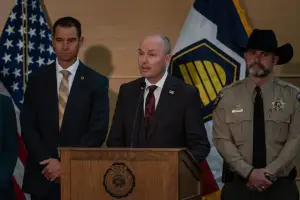
Utah Gov. Spencer Cox (R) at news conference on Sept. 12, 2025 (New York Times photo by Loren Elliott).
New York Times, Updates: Suspect Is Caught and Identified in Charlie Kirk ShootingTrump Says Person Is in Custody in Connection With Kirk Shooting, Nicholas Bogel-Burroughs, Devlin Barrett, Tim Arango, Jack Healy and Francesca Regalado, Sept. 12, 2025. Here’s the latest.
Gov. Spencer Cox of Utah said a family member of the gunman helped turn the 22-year-old into authorities after he indicated he carried out the killing. He said authorities believe the shooter acted alone.
U.S. and Utah law enforcement officials said Friday that they had arrested a suspect in connection with the fatal shooting of the right-wing activist Charlie Kirk, ending an intense manhunt after the killing two days ago. The authorities identified him as Tyler Robinson and said that he had made statements to relatives suggesting he had committed the crime.
“We got him,” Gov. Spencer Cox of Utah told a news conference, saying that Mr. Robinson, 22, had been booked into Utah County jail and was believed to have acted alone. Law enforcement officials said they had physical evidence tying Mr. Robinson to the shooting, including messages he sent on the Discord chat app about needing to “retrieve a rifle from a drop point.”
Public prayer and faith, and references to Charlie Kirk’s own Christian faith, have been infused through this news conference announcing the arrest of a suspect in Kirk’s killing. Gov. Spencer Cox of Utah has spoken personally of his own prayers, and his feelings when they were not answered. A sheriff thanked the public specifically for praying for law enforcement and the Kirk family.
Gov. Spencer Cox of Utah says he believes this is a watershed moment in American history, but that it remains to be seen what kind. “Is this the end of a dark chapter in our history, or the beginning of a darker chapter in our history?” he asks. He said the gruesome, public killing of Charlie Kirk felt like assassinations in the late 1960s.
The list of messages on the suspect’s casings, as described by Gov. Spencer Cox of Utah, include apparent references to online culture and gaming. “Up arrow, right arrow, and three down arrow symbols,” as described by Cox, may be a reference a sequence of moves on a controller that release a bomb in the video game “Helldivers.” Another engraving, “Notices bulges OWO what’s this?” is a phrase used for trolling in online roleplay communities.
Gov. Spencer Cox of Utah says in a news conference that he thinks the engraving on an unfired cartridge that reads, “Hey, fascist! Catch!” is the one that most clearly shows the gunman’s intent. “I think that speaks for itself,” the governor says. The cartridge and others were found alongside the gun that officials say was used to kill Charlie Kirk.
Gov. Spencer Cox of Utah, as he often does, is using this news conference to issue an appeal about the importance of free speech and to condemn political violence. “Over the last 48 hours, I have been as angry as I have ever been,” he says, growing emotional. Many political leaders of both parties have been deeply shaken by Charlie Kirk’s assassination.
One of the suspect’s unfired casings was adorned with the words “Bella ciao,” said Gov. Spencer Cox of Utah. That’s an apparent reference to an Italian song adopted by the anti-fascist resistance during World War II. It is still sung by the Italian left to commemorate the end of fascism.
Mr. Kirk, right, a close ally of Mr. Trump, was fatally shot while speaking at an event at Utah Valley University on Wednesday. The video footage from the campus in Orem, Utah, showed a person running across the roof of a nearby building after the shooting, dropping to the ground and walking across a busy street before disappearing into a wooded area.
Earlier, the F.B.I. said it had recovered a a high-powered bolt-action rifle from that wooded area. The authorities released images of a man in a stairwell wearing a baseball cap, sunglasses and a black shirt adorned with an eagle and an American flag. Officials said they were also analyzing imprints of a forearm, a palm and a shoe from the edge of the building that the person of interest jumped from.
The Hartmann Report, Political Commentary: The “Both Sides” Scam: How False Balance Fuels Extremism, Thom Hartmann, right, Sept. 12, 2025. When pundits blame tone instead of truth, they let one party weaponize threats and lies without consequence…
As a guy who regularly gets death threats because of my media presence, I shouldn’t have to say that killing people — or even threatening them — for their politics is wrong. But here it is, for the record: nobody in America should die for their politics.
That said, in the wake of Charlie Kirk’s assassination — the guy who downplayed slavery, demonized Black and brown people, promoted the racist antisemitic Great Replacement Theory, attacked queer people, made degrading comments about women, said gun deaths were fine because that’s the price we must pay for the Second Amendment — the media is afraid to say anything about the state of our politics other than “we need to stop violence-provoking political rhetoric on both sides.”
As if there were two sides here.
Here’s the hard truth that the bullshit-embracing “both sides” punditry won’t say out loud: calling for Democrats to “tone it down” has become a permission slip for Republicans to keep stoking hate, flirting with violence, and treating fellow Americans as enemies rather than opponents.
If you actually look at the political science and the public record, the escalation didn’t start with Democrats, and it doesn’t continue because Democrats use accurate words to describe what we’re facing. The political research is clear.
As Rachel Bitecofer points out, Thomas Mann and Norm Ornstein said the quiet part our loud when they wrote that the modern GOP had become “ideologically extreme, scornful of compromise, and dismissive of the legitimacy of its political opposition” in their 2012 Washington Post essay and book-length work on asymmetric polarization.
And this isn’t new: the rhetoric that got us here wasn’t even invented on social media. Lee Atwater explained Nixon’s Southern Strategy out loud in 1981, describing how race-baiting messages were laundered into “abstract” appeals that produced the same results without resorting to the N-word.
Ronald Reagan elevated the “welfare queen” trope into a national morality play that exploited poverty and race for partisan gain. The Willie Horton ad and “Revolving Door” spot baked fear-first politics into a Republican presidential campaign’s core strategy.
Pat Buchanan then said the quiet part with a bullhorn in his 1992 convention speech, declaring a “culture war” against Democrats and anyone who didn’t fit his vision of a Christian white America. Newt Gingrich operationalized it with his GOPAC training memo, a how-to guide that told Republican candidates to brand Democrats with words like “corrupt,” “sick,” and “traitors” while reserving terms like “freedom” and “strength” for themselves.
This wasn’t an internet rumor, it was the Republican party’s official training literature.
Medias Touch Network, Ambassador to the U.S. Removed Over Epstein Ties, Aaron Parnas, Sept 11-12, 2025. Mandelson dismissed after newly released emails reveal closer links to disgraced financiers.
Britain’s ambassador to the United States, Peter Mandelson, has been dismissed after fresh revelations highlighted the depth of his relationship with Jeffrey Epstein.
Prime Minister Keir Starmer ordered Mandelson’s withdrawal following the release of emails that contradicted earlier accounts of his ties to the late financier. The documents suggest Mandelson’s connection to Epstein was far more extensive than previously acknowledged, including comments in which Mandelson questioned the legitimacy of Epstein’s first conviction.
Mandelson, a longtime Labour Party figure and close ally of former Prime Minister Tony Blair, had been appointed ambassador not as a career diplomat but for his political influence and Washington contacts. Initially, Starmer stood by him. However, mounting political pressure and the publication of the emails forced the government to act.
“The emails show that the depth and extent of Peter Mandelson’s relationship with Jeffrey Epstein is materially different from that known at the time of his appointment,” the Foreign Office said in a statement. It added that in light of the new information and “mindful of the victims of Epstein’s crimes,” Mandelson had been removed with immediate effect.
The controversy intensified after excerpts from a 50th birthday book were made public, including a letter in which Mandelson appeared to call Epstein his “best pal.” The revelations renewed scrutiny of Mandelson’s past association with Epstein, who was convicted of sex crimes and later died in prison.
Speaking to the Sun newspaper, Mandelson expressed remorse over his past judgment, calling Epstein a “charismatic criminal liar.” He added, “I feel a profound sense of sympathy for those women who suffered as a result of his behavior. I regret that I met him at all, and that I continued the association.”
Mandelson’s removal marks a dramatic fall for one of Labour’s most prominent political strategists, underscoring the lasting damage of Epstein’s network of influence even years after his death.
New York Times, Scrutiny Mounts of F.B.I. Under Patel as Kirk’s Killer Remains at Large, Glenn Thrush, Devlin Barrett and Adam Goldman, Sept. 12, 2025 (print ed.). Already, a series of missteps by Kash Patel, the F.B.I. director, in recent months have invited worries that he has eroded public confidence in the agency.
On Thursday morning, a day after hastily suggesting the person who gunned down Charlie Kirk was in custody, Kash Patel, the F.B.I. director, convened an online meeting with 200 agents around the country to discuss the manhunt. It was a tense affair.
Mr. Patel, right, and his deputy, Dan Bongino, made it clear they were under intense pressure to catch the killer of Mr. Kirk. They expressed themselves with such fierce urgency that, in the view of some participants, it hinted at another motive: to prove they were up to the task.
The director wasted no time before calling out subordinates that he said failed to give him timely information and was incensed that agents in Salt Lake City waited nearly 12 hours to show him a photo of the suspected killer, according to three people familiar on the exchange.
Mr. Patel said he would not tolerate any more “Mickey Mouse operations,” an official on the call recounted. It was one of his few utterances without profanity, the person added.
The killing of Mr. Kirk on Wednesday not only poses a challenge to agents racing to find the shooter, it also represents a grave leadership test for Mr. Patel. His swift pronouncements about the inquiry have revived concerns about his lack of experience, obsession with social media and purge of some of the bureau’s most experienced investigators, according to current and former officials, most of whom spoke on the sensitive matter on the condition of anonymity.
Whether Mr. Patel can overcome his embarrassing early stumble in posts online about the Kirk investigation remains to be seen. The F.B.I. director’s actions have already invited scorn and scrutiny from the bureau’s work force, and some senior officials at the Justice Department, who think his behavior has eroded public confidence in the F.B.I.
Mr. Patel’s critics have also expressed concern that a wave of firings and forced retirements, which started before Mr. Patel was confirmed in February and continued after he took over, could hamper the bureau’s ability to manage complex investigations like the Kirk case.
Hours before a single gunshot hit Mr. Kirk in the neck at Utah Valley University, three former top F.B.I. officials — Brian J. Driscoll Jr., Steven J. Jensen and Spencer L. Evans — filed a lawsuit against Mr. Patel and Attorney General Pam Bondi accusing them of illegally firing them.
The departure of Mr. Driscoll, who served as interim director until Mr. Patel was confirmed, has been a particularly significant blow. Mr. Driscoll was not only one of the F.B.I.’s most experienced career agents, he has been a morale booster and source of organizational stability, often defending rank-and-file agents targeted for firings or demotions by Trump appointees.
Another departure had an even more direct bearing on the Kirk investigation. Over the summer, Mr. Patel’s team forced the retirement of Mehtab Syed, a highly regarded former counterterrorism agent appointed in February to run the Salt Lake City field office, for reasons that remain unclear, according to former officials. (The move was earlier reported by MSNBC.)
New York Times, Breaking Precedent, G.O.P. Changes Rules on Nominees, Michael Gold, Sept. 12, 2025 (print ed.). Senate Republicans used what is known as the nuclear option to break a Democratic blockade of President Trump’s nominees, weakening Congress’s vetting role.
Senate Republicans on Thursday bulldozed past Senate precedents and changed the rules to break a Democratic blockade of President Trump’s nominees, in an extraordinary move that is likely to undercut Congress’s future role in vetting executive branch officials.
 The change, pushed through along party lines, lowered the existing 60-vote threshold for considering a group of presidential nominees to a simple majority, weakening the ability of individual senators to block nominees they find objectionable. It was the latest step in a yearslong back-and-forth between the two parties that has eroded the filibuster, a once-potent Senate tool to protect the rights of the minority and force consensus.
In this case, Republicans resorted to the move in an effort to steer around Democratic obstruction of Mr. Trump’s nominees, which has created a backlog of more than 100, angering the president and frustrating his allies in Congress. They framed it as a necessary step to grease the wheels of a chamber mired in partisan rancor and to return the Senate to its longstanding norm of confirming lower-level nominees without individual votes.
“For two centuries, most presidential nominees have sailed through this chamber by voice vote and by unanimous consent,” said Senator John Barrasso of Wyoming, the No. 2 Republican. “That was the gold standard of advice and consent. Senator Schumer and Senate Democrats abandoned it.”
Democrats, vocally opposed to Mr. Trump’s policies and tactics, have demanded that every position be subject to individual consideration, delaying the approval of the president’s nominees and cluttering the Senate schedule. Senator Chuck Schumer of New York, the minority leader, said the change would do irreparable damage to the Senate and its constitutional prerogatives, rendering it “a conveyor belt for unqualified Trump nominees.”
“We are supposed to debate and take votes on nominees, especially when the executive branch is grossly breaking norms by sending us woefully unqualified, unscrupulous, and in some cases deeply dishonest individuals for powerful and important positions,” he said.
The rule change, which is expected to be finalized next week after a series of procedural votes, will allow the Senate to confirm an unlimited number of lower-level executive branch nominations at a time without the threat of a filibuster. That means Republicans will no longer be forced to negotiate with Democrats to agree on which nominees are deserving of speedy confirmation, as the majority currently must do, but will instead be able to steer around any opposition and push through dozens with a single vote.
Senator John Thune, Republican of South Dakota and the majority leader, began the process on Monday by introducing 48 of Mr. Trump’s nominees together to allow them to be confirmed as a group.
That bloc covers a variety of positions, such as assistant secretaries in several cabinet departments, the inspector general at the C.I.A. and ambassadors, including Kimberly Guilfoyle, the former fiancée of Mr. Trump’s eldest son whom the president chose to be the ambassador to Greece.
The breadth of the list illustrates the far-reaching consequences of the rules change. Previously, senators needed 60 votes to bring a bloc of nominations to the floor, all but guaranteeing that both parties would haggle over who might be included.
Now, the party in power will have the ability to unilaterally approve dozens of executive branch nominees with little resistance. And while nominees must still win approval from Senate committees, there will be even less incentive for presidents to choose people who can draw bipartisan support, since members of the minority party will be presented with even fewer opportunities to delay or block anyone’s confirmation.
Republicans, who currently hold 53 seats in the Senate, pushed through the rules change on a 53-to-45 vote, turning to a tactic known as the “nuclear option” to set a new precedent that overrules what has been done in the past.
The dramatic name refers both to the extreme nature of the move and its assurance of mutual destruction: Republicans and Democrats alike must suffer the consequences when they find themselves in the minority.
Global News
Lev Remembers, Global News: Russia Pushes NATO to the Brink — Trump Gives Putin Cover, Lev Parnas, right, Sept. 12, 2025. Destroyed families, children’s memorials, and Trump making excuses for Putin.
It’s heartbreaking to write this again, but I must. People are dying. Families are being displaced. Children are being buried, their names etched into makeshift memorials that stand where homes once were. Freedom itself is being tested, and in the middle of all this tragedy, Donald Trump continues to do what he has always done—spread Russian propaganda, make excuses for Vladimir Putin, and attack Ukraine.Subscribed
From 10 p.m. on September 11, Russia launched another deadly wave—40 strike drones, Shaheds and Gerans, from Kursk, Millerovo, and Primorsko-Akhtarsk. Ukraine’s defenders fought all night, downing or suppressing 33 of them. Still, six slammed into three locations, tearing lives apart.
And this is only part of the story. Yesterday Nineteen drones crossed into NATO airspace over Poland. NATO jets intercepted and shot them down. Trump immediately excused Russia, claiming it was probably “a mistake.” Let me be clear: this was not a mistake. My sources confirm what I’ve been warning: Russia was testing NATO’s reactions. And they’re not doing it alone. After the recent summit, Russia and China are moving in lockstep—probing, pushing, watching how far they can go before the West breaks.
 This is the reality Trump refuses to face. Instead, he parrots propaganda to normalize Putin’s aggression. He wants Americans distracted and divided while authoritarian powers measure our response.
But while Trump excuses, Oleksandr acts. With your support, he has carried aid into the hardest-hit areas the media won’t show you—the shelled apartment blocks where families sift through rubble, the villages where children’s memorials line the roadside, the front-line positions where soldiers ration out what little they have. With your help, Oleksandr has delivered dry packs, hygiene kits, shower packs—basic dignity in the middle of horror.

New York Times, Anti-Corruption Crusader Named Nepal’s Leader After Gen Z Protests, Hannah Beech and Bhadra Sharma, Sept. 12, 2025. Sushila Karki, a former chief justice, was the choice of the student protesters whose mass rallies on Monday started a violent uprising that toppled the government.
Sushila Karki, right,  a former chief justice and staunch anti-corruption crusader, was named on Friday as the caretaker leader of Nepal, the Himalayan nation whose government collapsed in flames this week.
Ms. Karki, whose appointment was announced by Sunil Bahadur Thapa, a presidential adviser, was the choice of the student protesters whose mass rallies on Monday galvanized an extraordinary sequence of events. Demonstrations against government graft and a ban on social media turned deadly when security forces opened fire on the students, who called themselves Gen Z.
The prime minister resigned to take responsibility for the deaths, and the ban was rescinded. But mobs rampaged across the nation on Tuesday, burning and looting thousands of buildings. Nearly every major state institution was damaged. More than 50 people died in the mayhem, according to the Nepali police on Friday.
 Mr. Thapa, the presidential adviser, said that Ms. Karki’s swearing-in and the dissolution of Parliament would take place simultaneously on Friday evening. The Parliament building, like so many others in Kathmandu, the Nepali capital, lies in ruins.
The swearing-in ceremony for Ms. Karki is expected to take place at the president’s office, which was also damaged in the arson attacks. A heavy military presence was nearby, with multiple barricades set up, soldiers and armored vehicles at the ready.
For days, Nepal has effectively been under the control of the army, which set nationwide curfews and sent thousands of soldiers onto the streets. Gen. Ashok Raj Sigdel, the army chief, met repeatedly with both the student protesters and members of the fallen government.
New York Times, Georgia ICE Raid Netted Workers With Short-Term Business Visas, Lydia DePillis and Hamed Aleaziz, Sept. 12, 2025. Last week’s immigration operation at a battery plant highlighted a tactic that companies use to bring in foreign workers to establish new operations.
Almost 500 people were detained during a raid of a Georgia battery plant owned by two South Korean manufacturers last week, the largest immigration enforcement operation at one location in the history of the Department of Homeland Security.
But in at least one instance, officials admitted a worker was employed legally and forced him to leave the country anyway, according to documents reviewed by The New York Times.
The Times obtained internal Immigration and Customs Enforcement arrest records for 11 of the detained workers. Six entered the country with B1 or B1/B2 visas, which are issued for business trips of up to six months. Four entered through the visa waiver program, which allows travel for 90 days. In one case, the worker’s status was unclear. The records stated that all but one of the 11 were working unlawfully at the time of the raid, but did not provide details about why.
In the one exception, agents said that although the worker “has not violated his visa,” the local ICE field office director “mandated” that he be considered someone who was voluntarily departing the country. The file noted that he worked for the South Korean engineering firm SFA, which did not respond to a request for comment.
Two-thirds of the people arrested on Sept. 4 were South Koreans, and nearly all of them were flown back to their home country this week. They landed in Seoul on Friday afternoon local time — only after sitting in limbo for 24 hours while President Trump told his government to consider letting them stay and train American workers, South Korean officials said.
“What ICE is doing here is illegal, and people should be held to account,” said Charles Kuck, an Atlanta immigration lawyer who is representing some of those who were detained. “If we’re turning from ‘let’s enforce the law against people who violate the law’ to ‘let’s enforce the law against everybody regardless of their legal status,’ I think we’ve changed the kind of country that we’ve become.”
The fallout from the operation at the plant was the latest example of the dragnet-like nature of Mr. Trump’s immigration policy and how it can conflict with other stated policy objectives, such as bolstering production in the United States. It also highlighted a strategy used by multinational firms to temporarily import workers into the United States to establish new operations.
The question of who will perform both the heavy manual labor and sophisticated technical jobs associated with advanced factories has taken on greater urgency in recent years as the federal government has pushed advanced manufacturing, often led by foreign companies.
The Trump administration has told its trading partners to either make their goods in America or pay steep tariffs, and leveraged hundreds of billions of dollars in investment commitments from South Korea, Japan and the European Union. The plant, which is owned by the carmaker Hyundai and the battery supplier LG Energy Solution, is weeks from completion. Contractors were installing the sophisticated equipment needed to make batteries for electric vehicles.
New York Times, $10 Million in Contraceptives Have Been Destroyed on Orders From Trump Officials, Stephanie Nolen, Jeanna Smialek and Edward Wong, Sept. 11, 2025. The birth control pills, IUDs and hormonal implants were purchased by U.S.A.I.D. for women in low-income countries. They had been in limbo in a Belgian warehouse after the U.S. cut much of its foreign aid.
Update Sept. 12, 2025: Regional authorities in Belgium said on Friday that the contraceptive materials in a warehouse have not yet been destroyed, contradicting earlier comments from the spokeswoman for the United States Agency for International Development. The Times is reporting on the latest developments.
Millions of dollars’ worth of birth control pills and other contraceptives destined for people in low-income countries have been destroyed at the direction of the Trump administration, the United States Agency for International Development said on Thursday.
The pills, intrauterine devices and hormonal implants, valued at about $9.7 million, had been purchased by the agency before it was largely dismantled earlier this year. They had been stuck in a warehouse in Belgium for months, since the State Department said that contraception was not “lifesaving” and that the United States would no longer fund the purchase of birth control products for low-income nations.
Internal State Department and U.S.A.I.D. documents and correspondence obtained by The New York Times show that several international organizations, including the Gates Foundation and the Children’s Investment Fund Foundation, had offered to buy or accept a donation of the contraceptives. The government would have incurred no costs or might have even been able to recoup taxpayer funds under those scenarios.
Instead the administration decided to proceed with destroying the products, an operation that was estimated to cost $167,000.
On Thursday, a spokeswoman for U.S.A.I.D. — which is now being wound down by Russell Vought, the head of the White House Office of Management and Budget — said in a statement to The Times that the contraceptives had been destroyed, and falsely suggested that they induced abortion.Want to stay updated on what’s happening in Belgium? Sign up for Your Places: Global Update, and we’ll send our latest coverage to your inbox.
“President Trump is committed to protecting the lives of unborn children all around the world,” the statement said. “The administration will no longer supply abortifacient birth control under the guise of foreign aid.”
U.S.A.I.D. is prohibited by law from procuring abortifacients. None of the products held in the warehouse in Belgium were abortifacients, according to inventory lists obtained by The Times. The listed products, such as hormonal implants, stop pregnancy by preventing ovulation or fertilization.
This fact had repeatedly been made clear to State Department officials by veteran global health program staff, the documents show.
It is not clear exactly when or where the destruction took place, and administration officials did not respond to requests for further comment.
“The deliberate destruction of nearly $10 million worth of contraceptives, under the blatantly false pretense that they are abortifacients, is an outrageous act of cruelty,” said Beth Schlachter, director of U.S. external relations for MSI Reproductive Choices, an organization that had repeatedly offered to take over the distribution of the supplies rather than see them destroyed.
“This decision will cost lives, derail progress in global health and strip millions of people of the basic tools they need to plan their families and protect their health,” she said.
More On Kirk Killing
New York Times, After Kirk Killing, Americans Agree on One Thing: Something Is Seriously Wrong, Shawn Hubler, Edgar Sandoval and Audra D. S. Burch, Sept. 12, 2025. In interviews from across the country, people expressed fear and wariness, and said that the country seemed to be spinning out of control.
After Charlie Kirk, the right-wing activist, was fatally shot during a political appearance on Wednesday, two thoughts occurred to Edward Padron, a 67-year-old locksmith in Brownsville, Texas. One was immediate. One was slower to rise.
A longtime conservative, Mr. Padron said he first assumed “a hate crime against a Republican” had just happened. But then he thought of other recent acts of violence across the political spectrum, from the attempts last year on the president’s life to the fatal shootings in June of a Democratic lawmaker in Minnesota and her husband. It seemed to him as if some terrible disease was gripping the nation, with no cure on the horizon.
“This could happen to anybody in this country,” Mr. Padron said, speaking from his home near the Mexican border. “I think that people across the board are afraid.”
That anxiety echoed this week in interviews with Americans, including a group of voters that The New York Times has been following throughout the Trump presidency. No matter their politics, people said they were deeply unsettled after the killing of Mr. Kirk, who had built a national movement promoting right-wing politics on campuses like the one in Utah where his life ended.
New York Times, After Kirk Assassination, Fear and Vitriol Intensify in Congress, Annie Karni, Megan Mineiro, Michael Gold, Catie Edmondson and Robert Jimison, Updated Sept. 12, 2025. The killing of the right-wing activist deepened lawmakers’ fears of violence directed against them, and the toxic discourse that has fed such threats.
Republicans lashed out at Democrats and members of the media, saying their language and news coverage incited a killer.
Democrats blamed Republicans for blocking gun safety legislation they said could have prevented the shooting and countless others.
And behind the scenes and the partisan strife, members of Congress in both parties begged their leaders to provide more security to protect them from rising political violence in the wake of the assassination of the right-wing activist Charlie Kirk at an event on a university campus.
The killing of Mr. Kirk has intensified already pervasive fears among lawmakers on Capitol Hill about personal safety, even as it has fed the cycle of finger-pointing and partisan warfare in the toxic political discourse often gripping Congress and the country.
Ever since rioters threatened their lives inside the Capitol on Jan. 6, 2021, Democrats and Republicans have been living on edge, and under a near-constant barrage of death threats, with some stalked by armed and angry individuals or even targeted for assassination.
Paul Krugman via Substack, Political-Economy Commentary: Waving the Bloody Shirt, Paul Krugman, right, Sept. 12, 2025. We don’t know who killed Charlie Kirk. We do know who’s trying to exploit his death.
At this point (6:33 am, Sept. 12) what do we know about who killed Charlie Kirk, and why?
Nothing. And we may never know anything. In part that’s because there appears to have been a rapid degradation in the FBI’s effectiveness since Trump appointees took over and prioritized political loyalty over competence.
The fact that Kirk was a right-winger doesn’t mean that the shooter was a left-winger. There are many possible stories you can invent about what may have motivated the assassination. What we do know is that no prominent Democrat has called for violence against Republicans, and no prominent Democrat has celebrated Kirk’s death.
Whoever did this, there’s just no rational way you can blame this on “the left.”
Also, whatever motivated this murder, it’s simply a fact that over the past decade right-wing extremists have killed many more people than left-wing extremists: A blue circle with white text AI-generated content may be incorrect.
And Trump — who has repeatedly incited mob violence since his first campaign — clearly wants to use the Kirk killing as an excuse for more violence and intimidation. “We have radical left lunatics out there,” declared Trump, “and we just have to beat the hell out of them.” An utterly malign appeal to mob violence from a sitting president, particularly outrageous since no one knows who killed Kirk and why.
And let’s be clear: everyone — Republicans, business leaders, and more — who decided, in effect, to forget about Jan. 6 helped set the stage for this malignancy.
So while we want to know what lay behind Kirk’s assassination, the important story right now is Trump’s intent to use the killing to incite violence against anyone who stands in his way.
U.S. Politics, Governance
Mother Jones Magazine, The Saga of RFK Jr. and an Estonian Vaccine Skeptics Conference, Anna Merlan, Kennedy  withdrew after the country’s Minister for Social Affairs reportedly called him “cuckoo in the head.”
Last week, organizers for the “European Conference of Health and Human Rights” announced a change: Their keynote speaker, US Health and Human Services Secretary Robert F. Kennedy Jr., had withdrawn after Estonian politicians reportedly called Kennedy a “quack” and “cuckoo.”
It was the end of an odd saga. A month earlier, organizers announced Kennedy was set to appear remotely as the keynote speaker at the conference hosted by the Estonian chapter of the World Council for Health (WCH), a group that promotes vaccine skepticism and bogus claims about the effectiveness of both ivermectin and hydroxychloroquine to treat Covid. Kennedy had featured prominently in promotion and in social media posts for the event, which began on Thursday.
But, earlier this month, the conference ran into trouble. According to a report from Estonian Public Broadcasting, the World Council for Health Estonia event was organized to be held at the Riigikogu, Estonia’s parliamentary building. Two Members of Parliament from the Estonian Conservative People’s Party (EKRE)—which has been described as “ultranationalist”—planned to attend. And the EPB report even described one EKRE MP, Martin Helme, as an organizer of the conference. (EKRE is known for its hardline stances against gay marriage, feminism, and immigration.)
This mixing of Estonian government resources with pseudoscience and Kennedy caused outrage. According to EPB, the country’s Minister of Social Affairs, Karmen Joller, objected strongly to the conference being held in the Riigikogu. She called the conference organizers a “bunch [who are] spreading pseudoscience” and said having the conference there would cause reputational damage. “Such an event would undoubtedly affect the reputation of Estonia as a state,” she reportedly wrote. The World Council for Health claimed that Social Minister Joller also publicly called Kennedy “cuckoo in the head.” (Joller did not respond to several requests for comment.)
On September 1, the WCH announced in a press release both Kennedy’s withdrawal and that the conference would also no longer be held in the Estonian parliamentary building.
Designed to look like a legitimate health organization with an anodyne name and bland logo, the WCH, which first appeared in 2022, was set up to serve as an international umbrella organization for groups that promote vaccine skepticism and Covid misinformation. WCH’s subgroups include the Front Line Covid-19 Critical Care Alliance, which promoted ivermectin use in the US (and which has since changed its name to the Independent Medical Alliance), and the BIRD Group, which pursues a similar agenda in Britain.
The schedule for the conference that Kennedy dropped out of shows the group’s focus on anti-vaccine material and medical freedom claims. The speakers include Dr. Peter McCullough, an American cardiologist whose board certifications were revoked after he spent years promoting Covid and vaccine misinformation. (His address is titled “Conseqences [sic] of Heart Damage after COVID-19 Vaccination.”).
Dr. Mark Trozzi, a Canadian doctor who has also been accused of promoting vaccine misinformation, is giving a speech about Covid vaccine injury.A screenshot from WCH Estonia's Instagram, which shows the speakers at the conference; a large picture of Kennedy is in the very middle.A screenshot showing the time slot in which Robert F. Kennedy Jr was meant to speak at the WCH conference; it has a picture of him next to the time, which reads 10:20-10:30
A spokesperson for HHS did not answer questions about why Kennedy agreed to appear at the conference, whether he considers WCH legitimate, or why he withdrew, confirming only that he was not participating in the conference.
“[D]ue to political and personal attacks directed at Robert F. Kennedy Jr., the U.S. Department of Health and Human Services (HHS) has withdrawn his video participation,” the release read, in part. “It is deeply concerning that in today’s Estonia, open dialogue on health-related matters is being suppressed, and fundamental freedoms, including freedom of speech, are increasingly disregarded at official levels.”
The conference is now taking place at a Radisson hotel in downtown Tallinn, a slightly less impressive venue than a parliamentary building.
Helme, the current EKRE member who was listed as an organizer of the conference, wrote on Facebook that Estonian politicians had been “beyond disrespectful” towards Kennedy, accusing them of referring to him as a “quack.” Helme also praised Kennedy as someone who “has stood firm against the corruption in the medical system for years and stepped up to protect children in the attempts of super powerful lobby groups to make money at the expense of children’s health.” (Helme’s statement also appears to refer to Kennedy as “a scientist,” which he is not.)
The planned content of Kennedy’s speech suggests that his health policy ambitions may go beyond the United States. In it, he speaks of his goal of further “collaboration” between the US and Europe.
A press release—still available on WCH Estonia’s website—gave extensive detail about what Kennedy hoped to discuss, saying he would focus on “key areas of international and regional relevance including the WHO Pandemic Treaty and the International Health Regulations (IHR). He will also likely discuss his perspective on why European countries should consider not ratifying the proposed WHO Pandemic Treaty, noting that the deadline for IHR amendments has already passed for most European nations.” (The WHO Pandemic Treaty was signed by member countries in May and is an agreement to work together to help prevent and respond to future pandemics; the United States did not sign it after President Trump announced the country’s withdrawal from the WHO in January.)
Additionally, the press release added, “[Kennedy] is anticipated to address the major issues shaping healthcare policy, including transparency, accountability and public trust, and explore opportunities to strengthen collaboration between Europe and the United States, particularly in areas of health
The Parnas Perspective, Political Commentary, Kirk Suspect Caught and Important Morning Update, Aaron Parnas, right, Sept. 12, 2025. Trump suggests making America's justice system more like China's, Wall Street Journal blasted for misleading reporting, 16 year old radicalized in Colorado.
Good morning, everyone. I hope you managed some rest, because today brings a flood of news that matters. We’re tracking Donald Trump’s claim that the suspected shooter of Charlie Kirk is in custody, his open push to model America’s justice system after China’s, and the fallout from threats that shook the Naval Academy and HBCUs nationwide—and more.
This has been a heavy, grueling week. I feel it too. But here’s what I know: we get through it together, and we get through it by holding fast to the truth. I promised you from the very beginning—I will not stop. Not when it’s uncomfortable, not when it’s dangerous, not when others would rather you look away.
With that, here’s what you missed:
Donald Trump told Fox News that, “with a high degree of certainty,” the suspect in Charlie Kirk’s shooting is in custody, explaining that a minister recognized the shooter and the father persuaded him to surrender, though the FBI and Utah authorities have not confirmed this.
The Wall Street Journal irresponsibly ran with a story suggesting that the bullets used by the shooter had engravings that contained transgender or antifascist ideology on them. That story has since been mostly debunked, but the conspiracy theories remain online.
Lawmakers in both parties are canceling or scaling back public events and boosting personal security after Charlie Kirk’s assassination, with figures like Alexandria Ocasio-Cortez postponing rallies, Nancy Mace pledging to carry a firearm, and others citing fear amid rising threats, while Capitol Police conduct more threat assessments and leaders review protections.
A resolution has been introduced to have Charlie Kirk lie in state in the U.S. Capitol Rotunda.
On Fox & Friends, Trump said the U.S. should adopt “quick trials,” suggesting that like in China, trials should happen the “following day.”
Trump said, “Maybe I’ll be the first to say it right now again — we’re going to Memphis. Memphis is deeply troubled. The mayor is happy. He’s a Democrat. And the governor is happy. We’re gonna fix that just like we did Washington. I would’ve preferred going to Chicago … we’ll bring in the military too if we need it.”
A 16-year-old student, Desmond Holly, opened fire at Evergreen High School in Colorado, critically wounding two classmates before dying of a self-inflicted gunshot wound; officials say he was radicalized by an extremist network, brought significant ammunition to school, and roamed the campus firing repeatedly, but locked classrooms and a rapid law enforcement response prevented greater tragedy.
Several HBCUs, including Alabama State, Clark Atlanta, Hampton, Southern, and Virginia State, went into lockdown, canceled classes, or ordered shelter-in-place after receiving violent threat calls later deemed hoaxes by the FBI; most restrictions have since been lifted, but the incidents caused confusion and fear among students while schools worked with law enforcement to ensure safety.
During a lockdown at the U.S. Naval Academy in Annapolis triggered by online threats from a former student, a midshipman mistakenly struck a law enforcement officer with a training rifle and was shot in response; the student was hospitalized in stable condition, while the threats that sparked the lockdown were later traced to the expelled student posting from off campus.
 Poland has called an emergency UN Security Council meeting after Russian drones violated its airspace, marking NATO’s first direct engagement with Russian drones; while Warsaw and several European allies insist the incursion was a deliberate attack, Trump suggested it could have been a mistake, drawing pushback from Polish leaders, as Germany pledged more jets, airspace closures were ordered in eastern Poland, and leaders warned the incident brought the country closer to conflict than at any time since WWII.
 Major Democratic donors are largely reluctant to fund Joe Biden’s presidential library, citing lingering frustration over his late 2024 exit, limited donor access during his presidency, competing political priorities, and doubts about his fundraising capacity at age 82, leaving the project’s $200–300 million goal in doubt despite allies’ efforts to promote his legacy.
A former Tennessee prison in Mason has reopened as a U.S. Immigration and Customs Enforcement detention center, with detainees now arriving under CoreCivic’s operation; while officials tout the 240 jobs and new tax revenue it will bring, residents and civil rights groups have raised concerns about potential abuse, citing CoreCivic’s history of fines, lawsuits, and critical audits.
Trump’s decision to end the de minimis exemption on imports under $800 has hit U.S. shoppers and foreign sellers but boosted domestic industries, with textile groups praising the move as protection against unfair competition, unsafe goods, and fentanyl shipments; meanwhile, U.S. customs processors, logistics firms, and warehousing companies like Zonos, BoxC Logistics, and LVK Logistics are seeing rapid growth as they handle new tariff and fulfillment demands.
Republicans in the Senate used the “nuclear option” to change rules and speed up confirmation of Trump’s nominees after bipartisan negotiations collapsed, allowing en bloc consideration of executive branch civilian nominees (but not Cabinet or judges), with Democrats warning this will let unqualified nominees slip through.
Brazil’s Supreme Court sentenced former president Jair Bolsonaro to more than 27 years in prison for plotting a military coup to overturn the 2022 election, with justices declaring he led a criminal organization that tried to “annihilate” democracy; while supporters celebrated the verdict as historic accountability, Trump and U.S. officials condemned it as persecution, and Bolsonaro’s allies vowed to keep fighting for amnesty or a future pardon.
China blasted Mexico’s plan to raise tariffs on Chinese cars from 20% to 50%, calling it a move taken “under coercion to constrain China,” while analysts said Mexico acted to placate Trump and avoid U.S. tariffs; Beijing warned of countermeasures, even as Mexico’s Congress considers approval, highlighting how Trump’s aggressive tariff regime is reshaping trade and geopolitics worldwide.
Venezuela said the 11 people killed in a U.S. military strike on a Caribbean boat were not gang members, disputing Trump’s claim they were Tren de Aragua narco-terrorists; U.S. officials admitted the vessel was fired on after turning back toward shore, prompting bipartisan criticism in Congress over legality and executive overreach, while Maduro vowed military readiness and Washington defended the strike as a lawful anti-drug operation.
Emptywheel, Analysis: Gamer Culture and Guns, Emptywheel (Marcy Wheeler, right), Sept. 12, 2025. The investigation into Tyler Robinson’s ideology is still quite early. What’s clear is he was raised in conservative Republican culture, around guns.
What’s unclear is whether the cultural references that AFT initially misrepresented as “trans ideology” is sincerely, or only ironically, tied to further right culture than Kirk himself.
Here’s a good explanation of the known gamer references in the things he scratched onto bullet casings (though the song Bella Ciao has been appropriated by Groypers).
But the full arrow sequence was quickly recognized as something else: a combo from Helldivers 2 for calling the Eagle 500kg Bomb stratagem. The world of Helldivers — which evokes Robert Heinlein’s book Starship Troopers and the subsequent movie — concerns fascism thematically; developer Arrowhead has characterized it as a satire where players fight for a fascist state.
[snip]
Fans of the game immediately noticed. Shortly after the press conference on Friday morning, the Helldivers subreddit was flooded with players who had picked up on what may be references to the game. A thread, now deleted, was titled: “Hey Facist Catch!” with the poster asking, “Did anyone else hear/notice?!” A commenter, responding to the thread, said, “The moment I heard [the arrows] my eyes widened.”
Another thread, also apparently deleted by moderators, referenced the arrows that authorities say were on one of the unfired bullet casings recovered at the scene. “It sickens me having people like this playing this game and using it to real violence to tarnish this awesome game and community,” the poster wrote. Other posts implored the subreddit moderators to lock down the forum. Moderators for the subreddit didn’t immediately respond to a request for comment. A thread in the separate r/Helldivers2 subreddit remains active, with people discussing the apparent parallels.
And this is a worthwhile reflection — originally written about the suspect in the Annunciation Catholic Church shooting — about how muddled this online ideology can be.
As incoherent, unhinged, or even cringey as the Minneapolis shooter’s videos might seem, they are part of a familiar template of terroristic behavior—one that continues to spread in online communities dedicated to mass shootings and other forms of brutality. In these morbid spaces, killers are viewed as martyrs, and they’re dubbed “saints.” Really, they’re influencers.
These disaffected communities live on social networks, message boards, and private Discords. They are populated by trolls, gore addicts, and, of course, aspiring shooters, who study, debate, and praise mass-shooting tactics and manifestos. Frequently, these groups adopt the aesthetics of neo-Nazis and white supremacists—sometimes because they are earnestly neo-Nazis and white supremacists, and sometimes because it’s the look and language that they’re cribbing from elsewhere. It’s always blurry, but it usually amounts to the same thing. In an article published by this magazine last year, Dave Cullen, author of the book Columbine, summed it all up: “As you read this, a distraught, lonely kid somewhere is contemplating an attack—and the one community they trust is screaming, Do it!”
There’s no reason to rush to pin this down. What matters is the right wing launched a cultural war against the left…
… Only to discover that the culprit was one of theirs.
New York Times, The Trump Administration Wants to Roll Back Airline Passenger Rights, Christine Chung, Sept. 12, 2025 (print ed.). The Transportation Department’s apparent openness to undoing government policies protecting the rights of airline passengers could have wide ramifications.
Compensation for disrupted flights. Refunds for faulty services such as broken Wi-Fi. Transparent airfares, and certain protections for disabled travelers whose wheelchairs are damaged. All were airline passenger protections championed by the Biden administration. Now, it looks like the Trump administration is seeking to roll them back.
Recent filings by the Transportation Department indicate that it is looking to loosen the rules on the aviation industry — something the nation’s largest carriers have increasingly pushed for — undoing the policies of the previous administration.
While some rules covering passenger rights are set to be eliminated, others have been flagged for updates, according to the Transportation Department’s agenda of proposed regulatory changes, released last week.
The Transportation Department and Airlines for America, a trade group representing the country’s biggest carriers, argue that these rollbacks are course correcting from years of government overreach.
Nate Sizemore, a spokesman for the Transportation Department, said in a statement that the department would enforce all aviation consumer protection requirements mandated by Congress, including the requirement to refund tickets to passengers if flights are canceled or substantially delayed. But he said some of the rules proposed or adopted under the Biden administration went beyond what was required by law. “We intend to reconsider those extra-statutory requirements,” he said.
Pete Buttigieg, who served as transportation secretary during the Biden administration, said in a video statement posted on X that in dismantling rules protecting airline passengers, the Trump administration was choosing corporations over consumers.
“They will not do anything to protect passengers unless Congress makes them,” Mr. Buttigieg elaborated in an interview to CNN, referring to airlines.
More On U.S. Courts, Crime, Law
The Contrarian, Opinion: Undaunted from the Bench, Jennifer Rubin, right, Sept. 12, 2025. The six MAGA justices on the Supreme Court have obliterated the notion that they are impartial jurists bound by precedent.
This week, Justice Sonia Sotomayor did a magnificent job stripping away the veneer of legitimacy they have tried to sustain. In dissenting from a widely criticized emergency docket decision running roughshod over the 4th Amendment and effectively greenlight racial profiling, Sotomayor let it rip.
She explained:
A Federal District Court found that these raids were part of a pattern of conduct by the Government that likely violated the Fourth Amendment. Based on the evidence before it, the court held that the Government was stopping individuals based solely on four factors: (1) their apparent race or ethnicity; (2) whether they spoke Spanish or English with an accent; (3) the type of location at which they were found (such as a car wash or bus stop); and (4) the type of job they appeared to work. Concluding that stops based on these four factors alone, even when taken together, could not satisfy the Fourth Amendment’s requirement of reasonable suspicion, the District Court temporarily enjoined the Government from continuing its pattern of unlawful mass arrests while it considered whether longer-term relief was appropriate.
Instead of allowing the litigation to proceed, the Supreme Court leapt into the fray and—without briefing, argument, or explanation—summarily stayed the order. “That decision is yet another grave misuse of our emergency docket,” Sotomayor wrote.
“We should not have to live in a country where the Government can seize anyone who looks Latino, speaks Spanish, and appears to work a low wage job.”
She had no majority “opinion” to critique since the majority could not be bothered to write one. She did, however, shred Justice Brett M. Kavanaugh’s lame concurrence. Citing 45-yr. old precedent, she reminded us, “Critically, a set of facts cannot constitute reasonable suspicion if it ‘describe[s] a very large category of presumably innocent’ people.”
Even by the government’s reckoning (albeit without factual support) the order would allow stops and detention of millions of people simply because they “look” Hispanic, speak Spanish, or, for example, work in construction. Sotomayor also excoriated a ruling blessing ICE abductions: “the Government has provided no evidence showing that its seizures were based on credible intelligence about a particular employer at a particular location.”
In debunking the government’s complaint that it would be hampered in enforcing immigration law, Sotomayor cited its own actions and rhetoric, thereby illustrating its brazen contempt for courts and determination to resort to ever-increasing levels of violence:
Since the issuance of the TRO, Secretary of Homeland Security Kristi Noem has called the District Judge an “‘idiot’” and vowed that “‘none of [the Government’s] operations are going to change.’” The CBP Chief Patrol Agent in the Central District has stated that his division will “turn and burn” and “go even harder now,” and has posted videos on social media touting his agents’ continued efforts “[c]hasing, cuffing, [and] deporting” people at car washes assertion that it will suffer irreparable harm.
Sotomayor blasted Kavanaugh’s ridiculous assertion that these raids involve only brief stops or questioning. (Does he follow any non-Fox News?) She pointed to voluminous evidence that ICE is violently “seizing people using firearms” and then warehousing them. Moreover, “United States citizens are also being seized, taken from their jobs, and prevented from working to support themselves and their families.” In other words, she exposed Kavanaugh for inventing facts to support his untenable conclusion.
Finally, Sotomayor took a righteous swing at the justices who misuse the emergency docket. “In the last eight months, this Court’s appetite to circumvent the ordinary appellate process and weigh in on important issues has grown exponentially,” she wrote. “Yet, some situations simply cry out for an explanation, such as when the Government’s conduct flagrantly violates the law, or when lower courts and litigants need guidance about the issues on which they should focus.” It is no wonder district courts are baffled. “For each of those complex issues,” she wrote, “it will be anyone’s guess whether the majority thought there were evidentiary deficiencies, legal errors, or a combination of both.”
We owe a debt of gratitude to Sotomayor for this and many other stinging dissents as well as her expert questioning at oral arguments. Her candor from the bench is not just refreshing; it is essential in educating the public that the six MAGA justices are not engaged in judging; their opinions are not the product of intellectually honest legal reasoning. (Indeed, they frequently provide no reasoning.) As such, their rulings have lost legitimacy, which depends on intellectual and ethical integrity.
That conclusion, so aptly bolstered by Sotomayor’s dissent, can fuel a robust movement to reform the Supreme Court in significant ways. Americans must demand that it once again resembles an impartial court reflecting the highest ethical standards. Our democracy will depend on it.
Throughout, we will honor her commitment to remain undaunted, unbowed, and unwilling (in her words) to “sit idly by while our constitutional freedoms are lost.” She remains an essential voice in debunking the MAGA justices’ blatant hackery dressed up as jurisprudence.
9-11, History, Politics

Meidas Touch Network, 9/11 Families Take On Washington, Adam Klasfeld (via All Rise News on Substack), Sept. 12, 2025. The son of a victim describes how political pressure created a breakthrough in the families' case against Saudi Arabia, 24 years after the attacks
A conversation with 9/11 victim family member Brett Eagleson transforms the meaning of the phrase “never forget” from passive recall to mobilizing for the public’s collective memory.
The president of 9/11 Justice, Eagleson has been fighting for answers about the terrorist attacks that killed his father 24 years ago today. His father, Bruce Eagleson, had been working on the 17th floor of the World Trade Center when the  planes hit, but he helped distribute portable two-way radios to firefighters before the towers fell.
“My dad died a hero that day,” Brett Eagleson said. “He gave his life so that potentially another father, a young father, could live to raise his family.”
In the intervening decades, the younger Eagleson has been one of the most prominent representatives of a group of 9/11 family members pressing Democratic and Republican administrations for information about Saudi Arabia’s ties to the attacks.
“It sickens me. It is horrific,” Eagleson said. “My brother joined the military after these attacks. My father gave his life, and it's not just about our family. … It's not even about the 3,000 Americans that we had to watch being murdered on live TV. This is about all of America. Our lives changed that day. There's a pre-9/11 world and a post-9/11 world, and we owe it to ourselves as a nation, as a country, to be honest with ourselves.”
The full interview can be seen below.“High probability”
Nearly a quarter of a century later, Eagleson’s advocacy has brought tangible breakthroughs through litigation and political pressure.
In August, a federal judge allowed the 9/11 families’ lawsuit against Saudi Arabia to go to trial, finding that evidence recently obtained by his lawyers creates a “high probability" that two of the Saudi government’s employees had “roles in the hijacker’s plans.”
Letters from an American, Historical Commentary: Sept. 11, 2025 [When Presidents, Americans Took Care of Each Other ], Heather Cox Richardson, right, Sept. 12, 2025. Twenty-four years ago today, terrorists from the al-Qaeda network used four civilian airplanes as weapons against the United States, crashing two of them into the World Trade Center’s Twin Towers in New York City and a third into the Pentagon in Arlington, Virginia.
Four years ago, George W. Bush, who was president on that horrific day, spoke in Pennsylvania at a memorial for the passengers of the fourth flight, United Airlines Flight 93, who on September 11, 2001, stormed the cockpit and brought their airplane down in a field, killing everyone on board but denying the terrorists a fourth American trophy.
 Former president Bush said: “Twenty years ago, terrorists chose a random group of Americans, on a routine flight, to be collateral damage in a spectacular act of terror. The 33 passengers and 7 crew of Flight 93 could have been any group of citizens selected by fate. In a sense, they stood in for us all.” And, Bush continued, “The terrorists soon discovered that a random group of Americans is an exceptional group of people. Facing an impossible circumstance, they comforted their loved ones by phone, braced each other for action, and defeated the designs of evil.”
Recalling his experience that day, Bush talked of “the America I know.”
“On America’s day of trial and grief, I saw millions of people instinctively grab for a neighbor’s hand and rally to the cause of one another…. At a time when religious bigotry might have flowed freely, I saw Americans reject prejudice and embrace people of Muslim faith…. At a time when nativism could have stirred hatred and violence against people perceived as outsiders, I saw Americans reaffirm their welcome to immigrants and refugees…. At a time when some viewed the rising generation as individualistic and decadent, I saw young people embrace an ethic of service and rise to selfless action.”
Bush celebrated the selfless heroism and care for others shown by those like Welles Crowther, the man in the red bandana, who helped others out of danger before succumbing himself; the airplane passengers who called their loved ones to say goodbye; neighbors; firefighters; law enforcement officers; the men and women who volunteered for military service after the attack.
That day, and our memories of it, show American democracy at its best: ordinary Americans putting in the work, even at its dirtiest and most dangerous, to take care of each other.
But even in 2001, that America was under siege by those who distrusted the same democracy the terrorists attacked. America had seemed to drift since the end of the Cold War twelve years before, but now the country was in a new death struggle, they thought, against an even more implacable foe. To defeat the nation’s enemies, America must defend free enterprise and Christianity at all costs.
In the wake of the attacks, Bush’s popularity, which had been dropping, soared to 90 percent. He and his advisers saw that popularity as a mandate to change America, and the world, according to their own ideology. “Either you are with us, or you are with the terrorists,” he announced. He and his loyalists attacked any opposition to their measures as an attack on “the homeland.”
They tarred those who questioned the administration’s economic or foreign policies as un-American—either socialists or traitors making the nation vulnerable to terrorist attacks—and set out to make sure such people could not have a voice at the polls. Republican gerrymandering and voter suppression began to shut Democratic voices out of our government, aided by a series of Supreme Court decisions. In 2010 the court opened the floodgates of corporate money into our elections to sway voters; in 2013 it gutted the 1965 Voting Rights Act; in 2021 it said that election laws that affected different groups of voters unevenly were not unconstitutional. In that year, a former Republican president claimed he won the 2020 election because, all evidence to the contrary, Democratic votes were fraudulent.
Four years ago, former president Bush mused that "[a] malign force seems at work in our common life that turns every disagreement into an argument, and every argument into a clash of cultures. So much of our politics has become a naked appeal to anger, fear, and resentment.” He said: “There is little cultural overlap between violent extremists abroad and violent extremists at home. But in their disdain for pluralism, in their disregard for human life, in their determination to defile national symbols, they are children of the same foul spirit. And it is our continuing duty to confront them.”
In doing so, we can take guidance from the passengers on Flight 93, who demonstrated as profoundly as it is possible to do what confronting such a mentality means. While we cannot know for certain what happened on that plane on that fateful day, investigators believe that before the passengers of Flight 93 stormed the cockpit, throwing themselves between the terrorists and our government, and downed the plane, they took a vote.
Media, Culture, Education, Religion
Thinking about..., Political Commentary: Free Speech and Me Speech, Timothy Snyder, right, Sept. 12, 2025. A helpful distinction.
In difficult times we need to be careful with language, and keeping important distinctions in mind can help us, at the very least, from making things worse. For example, there is a difference worth noticing, and noting, between “me speech” and “free speech”.
“Me speech” is a common practice among rich and influential Americans. Practitioners of “me speech” use the phrase “free speech” quite a bit. But what they mean is free speech for themselves. They want a monopoly on it.
They believe that they are right about everything, and so they should always have giant platforms, in real life or on social media. They people with whom they disagree, however, should be called out and intimidated in an organized way on social media, or subjected to algorithmic discrimination so that their voices are not heard. These people suppress the freedom of speech. But because they repeat the phrase “free speech” quite a lot, the media will often associate them with the idea. This, of course, tends to make the notion of “free speech” meaningless.
Free speech has to be for everyone. And that means that influential and powerful people who believe in free speech would not seek to intimidate or discriminate. They would not create difficulties for those with whom they disagree. On the contrary, they would accept that people with whom they disagree should be encouraged and supported. People who believe in free speech admit that they, personally, might be wrong. And people who believe in free speech understand its ultimate purpose, which is to enable people to speak truth to power without fearing any consequences.
It helps to see the difference between me speech and free speech. If we celebrate me speech, we lose free speech. Or, more to the point, if we celebrate the me speakers, we lose the free speakers. If the term “free speech” just becomes a call to admire those who suppress the expression of others, then it means nothing, or really less than nothing. a building with a clock on the front of it
As for me, I believe that the right concept is “freedom of speech” and, best of all, “free speakers.” To become free speakers, we need to be fearless, which means that other should not be trying to intimidate or tame or harm us, be they the government or be they powerful individuals. The fearlessness has to be attached to values about which we really care, which come from human interactions, from relationships, from friends and parents and teachers and books. To become free speakers, in other words, we all need care, and time, and education.
Free speakers, I think, see the problem with me speakers. Free speakers will not need cults or oligarchs. They will want factsand ideas. They are not sure of themselves and usually wrong, but reflective and sometimes right. They are respectful, because they know they always have something to learn. And they are empathetic, because they know that they will learn only from those whose lives have been different than their own.
Freedom of speech is skeptical power: it is always a challenge. And it affirms truth: it is always a search. Without skepticism of power and affirmation of truth, we will not have freedom of speech. The me speakers push us to embrace their power and treat everything they say as truth. They will call this “free speech.”
If we indulge that perversion we are asking for the tyranny we will get.
Sept. 11
New York Times, Trump Administration Live Updates: White House Seeks Removal of Fed Governor Before Interest Rate Meeting, Sept. 11, 2025. Where Things Stand:
In this case, Republicans resorted to the move in an effort to steer around Democratic obstruction of Mr. Trump’s nominees, which has created a backlog of more than 100, angering the president and frustrating his allies in Congress. They framed it as a necessary step to grease the wheels of a chamber mired in partisan rancor and to return the Senate to its longstanding norm of confirming lower-level nominees without individual votes.
“For two centuries, most presidential nominees have sailed through this chamber by voice vote and by unanimous consent,” said Senator John Barrasso of Wyoming, the No. 2 Republican. “That was the gold standard of advice and consent. Senator Schumer and Senate Democrats abandoned it.”
Democrats, vocally opposed to Mr. Trump’s policies and tactics, have demanded that every position be subject to individual consideration, delaying the approval of the president’s nominees and cluttering the Senate schedule. Senator Chuck Schumer of New York, the minority leader, said the change would do irreparable damage to the Senate and its constitutional prerogatives, rendering it “a conveyor belt for unqualified Trump nominees.”
“We are supposed to debate and take votes on nominees, especially when the executive branch is grossly breaking norms by sending us woefully unqualified, unscrupulous, and in some cases deeply dishonest individuals for powerful and important positions,” he said.
The rule change, which is expected to be finalized next week after a series of procedural votes, will allow the Senate to confirm an unlimited number of lower-level executive branch nominations at a time without the threat of a filibuster. That means Republicans will no longer be forced to negotiate with Democrats to agree on which nominees are deserving of speedy confirmation, as the majority currently must do, but will instead be able to steer around any opposition and push through dozens with a single vote.
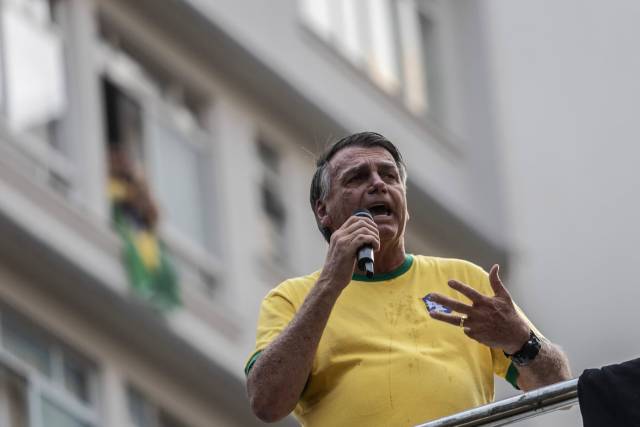
Former President Jair Bolsonaro was accused of orchestrating a vast plot to stay in power after he lost the 2022 election (New York Times photo by Dado Galdieri).
New York Times, Bolsonaro Convicted, Sentenced to 27 Years In Prison for Attempting a Coup in Brazil, Ana Ionova and Jack Nicas, Sept. 11, 2025. Brazil’s Supreme Court convicted the former president of trying to cling to power after losing the 2022 election, in a plot that included killing his opponent.
Brazil’s Supreme Court on Thursday convicted former President Jair Bolsonaro of overseeing a failed conspiracy to overturn the 2022 Brazilian election in a coup plot that included disbanding courts, empowering the military and assassinating the president-elect.
 Four of the five justices weighing the case voted to convict Mr. Bolsonaro and seven co-conspirators, including his running mate, defense minister and Navy commander, in a forceful rebuke by one of the very institutions the men sought to overthrow.
The justices were now expected to decide on potentially lengthy prison sentences. Mr. Bolsonaro, 70, could face decades in prison, though his lawyers are likely to request house arrest because of his health problems.
The conviction is a landmark ruling for Latin America’s largest nation. In at least 15 coups and coup attempts with links to the military since Brazil overthrew its monarchy in 1889, Thursday marked the first time the leaders of one of those plots have been convicted.
It also could deal a definitive blow to one of Latin America’s most important and influential political figures. Mr. Bolsonaro galvanized a right-wing movement that transformed Brazil into a more polarized and, in some ways, conservative nation — but his conviction now leaves the right without a clear leader.
At the same time, the ruling will very likely escalate the conflict between Brazil and the United States. President Trump had demanded that Brazil drop the charges against Mr. Bolsonaro, saying that, like him, the former Brazilian president was being politically persecuted for trying to reverse a rigged election.
New York Times, News Analysis: Russia’s Strategy Against the West: Escalate Slowly and See if It Responds, Andrew E. Kramer, Sept. 11, 2025. Ukrainian and European officials say President Vladimir V. Putin has become emboldened by a lack of Western pushback.
An American factory in western Ukraine. Two European diplomatic compounds and a key Ukrainian government building in Kyiv. And now Poland.
Over a roughly three-week period, Russian drones and missiles have struck sites of increasing sensitivity for Ukraine and its Western allies, culminating in the volley of Russian drones that buzzed early Wednesday over Poland, a NATO country.
For decades, American and European military planners feared something else: a bolt-from-the-blue assault, like an all-out nuclear strike, from the Soviet Union or Russia. But in its war on Ukraine, Russia has walked over a Western red line gradually, gauging responses as it goes, blunting any pushback by escalating slowly and maintaining some level of deniability, according to Ukrainian officials and analysts.
The drones that flew into Poland prompted NATO to send warplanes to shoot them down, in the first direct engagement of the alliance’s troops with Russian weaponry since Russia invaded Ukraine in 2022. But none of the previous Russian attacks in recent weeks led to more than strongly worded statements from European or U.S. officials, and it was unclear if Russia would pay any real price for its incursion into Poland.
“Russian drones flying into Poland during the massive attack on Ukraine show that Putin’s sense of impunity keeps growing,” Ukraine’s foreign minister, Andrii Sybiha, said in a statement about the incident, speaking of President Vladimir V. Putin. “He was not properly punished for his previous crimes.”
Letters from an American, Historical Commentary: Sept. 10, 2025 ['Here we go!' (?], Heather Cox Richardson, right, Sept. 11, 2025. Last night, Polish forces shot down 19 Russian drones that invaded Poland’s airspace during a massive Russian air attack on Ukraine. Poland is a member of the North Atlantic Treaty Organization (NATO), and the Polish operation was backed by NATO member forces.
Today, Poland officially activated Article 4 of the North Atlantic Treaty, which triggers a consultation whenever “the territorial integrity, political independence or security of any of the Parties is threatened.”
German chancellor Friedrich Merz called the Russian breach of Polish airspace a “reckless and aggressive act” that fit a broader pattern of Russian provocations against NATO’s eastern edge.
Although the United States under President Donald J. Trump has pulled back from its steadfast commitment to NATO, the U.S. was instrumental in the creation of the organization in 1949. Leaders wanted to establish a defensive alliance that could stand against Soviet aggression and that would reinforce rules to prevent countries from using violence against other countries. Such an order, based in rules rather than violence, would make it harder to start wars.
NATO guaranteed collective security because all of the member states agreed to defend each other against an attack by a third party. In 1949, when he signed the treaty, President Harry Truman called the pact a positive influence for peace. With NATO, he said, “we hope to create a shield against aggression and the fear of aggression—a bulwark which will permit us to get on with the real business of government and society, the business of achieving a fuller and happier life for all our citizens.”
The experience of the United States “in creating one nation out of…the peoples of many lands” proved that this idea could work, Truman said. “This method of organizing diverse peoples and cultures is in direct contrast to the method of the police state, which attempts to achieve unity by imposing the same beliefs and the same rule of force on everyone.”
The NATO countries did not believe that war was inevitable, Truman said. “Men with courage and vision can still determine their own destiny. They can choose slavery or freedom—war or peace. I have no doubt which they will choose…. If there is anything certain today, if there is anything inevitable in the future, it is the will of the people of the world for freedom and for peace.”
The drone incursions into a NATO country are just the latest escalation from Russia’s president Vladimir Putin after his meeting with Trump in Alaska on August 15. Poland’s prime minister Donald Tusk told the Polish parliament: “I have no reason to claim we’re on the brink of war, but a line has been crossed. This situation brings us the closest we have been to open conflict since World War II.”
At 11:09 this morning, Trump responded to the attack by posting on social media: “What’s with Russia violating Poland’s airspace with drones? Here we go!”
The Contrarian, Political Commentary: Economically Tone Deaf and Selectively Outraged, Jennifer Rubin, Sept. 11, 2025. MAGA's exclusive reactions and revelry. right,
The murder of Charlie Kirk and shooting at a Colorado high school are abhorrent reminders that we cannot become numb to violence in any form. Political violence is never acceptable. Unfortunately, but unsurprisingly, Donald Trump has chosen to politicize Kirk’s murder, blaming the rhetoric of the “radical left”—all before anyone has been identified, let alone arrested for the murder.
Sadly, he and the MAGA troops reserve outrage only when Republicans are targeted (compare the near-silence when Pennsylvania Gov.Josh Shapiro was targeted, the mockery when Paul Pelosi was nearly killed, and the snide remarks when two Minnesota Democrats were assassinated). As we saw yesterday, Democrats condemn political violence whoever is targeted, as such acts have no place in a democracy. Nor does selective outrage or scapegoating broad swaths of the country for violent attacks.
As we commemorate 9/11, we hold the families and loved ones of those lost in our hearts and remember the heroic conduct of so many Americans on that day.
We can be a good, brave, and decent people. We must demand the same of our leaders.
At a swanky private dinner last week, Treasury Secretary Scott Bessent, above, threatened to punch Bill Pulte, Federal Housing Finance Agency director (and the Inspector Javert of mortgage fraud) “in the fucking face.” The United States’ standing in the international economic system surely does not benefit when its treasury secretary sounds like a petulant 3rd grader. The backdrop of a temper tantrum provides an even more disturbing picture of the world in which MAGA oligarchs operate.
At a moment when Americans who are already financially squeezed face huge cost increases in healthcare, housing, and energy, the bratty children at Mar-a-Lago North exist in a world of their own.
Politico reported:
The Wednesday evening event was supposed to be one of celebration: It was both the much-anticipated inaugural dinner at Executive Branch, the ultra-exclusive Georgetown club created by and for Trump world’s uberrich, and a birthday party for MAGA-friendly podcaster Chamath Palihapitiya. A long table for the 30-some guests was set with top-of-the-line crystal and china.
When the international trade system is melting down, the independence of the Fed is imperiled, unemployment and inflation are ticketing up, job growth has practically flatlined, and Americans by a healthy margin think the economy is getting worse, the oligarchy is whooping it up in high style. So much for Republicans’ economic populism—or their political antennae. Democrats would be foolish not to put that entire bacchanal in a campaign ad or two.
New York Times, More Live Updates: Officials Recover Rifle and Seek Gunman ‘of College Age’ in Charlie Kirk Killing, Jacey Fortin and Nicholas Bogel-Burroughs, Sept. 11, 2025. The weapon was found near the Utah university campus where the right-wing activist was fatally shot. The shooter was still at large and unidentified amid speculation about what motivated the killing.
The authorities had new leads on Thursday in their search for the person who shot and killed the right-wing activist Charlie Kirk: a weapon they said was used in the shooting, imprints of a forearm and a shoe, and video tracking the shooter’s movements as he climbed onto a roof to carry out the attack.
Robert Bohls, the special agent in charge of the F.B.I.’s Salt Lake City office, said in a news conference that the gun that was recovered was a “high-powered bolt-action rifle,” and that it had been found in a wooded area in a neighborhood near the campus of Utah Valley University, where Mr. Kirk, right, had been speaking to a large crowd on Wednesday afternoon.
Investigators “have good video footage of this individual,” said Beau Mason, Utah’s public safety chief. But he added that officials will release the images only if they cannot identify him. Officials referred to the shooter as a man throughout the news conference.
President Trump, an ally of Mr. Kirk’s, blamed the rhetoric of the “radical left” for Mr. Kirk’s killing, but investigators in Utah did not assign any possible motive. They did share new details about his movements on Wednesday: The person arrived on campus shortly before noon and used a stairway to make his way to the roof of a campus building overlooking the site of Mr. Kirk’s scheduled appearance, according to Mr. Mason. After the shooting — a single shot that hit Mr. Kirk in the neck — the person jumped from the roof and fled to a nearby neighborhood, Mr. Mason said.
Mr. Mason said that the person being sought “blended in well” at the campus because he appeared “to be of college age.”
Pressure on Patel: Kash Patel, right, the F.B.I. director, congratulated officials for taking into custody “the subject for the horrific shootingtoday.” Then he backtracked, saying on social media that the person had been released and the investigation would continue. Another person who was detained immediately after the attack was also determined not to be the shooter. The backtrack was a source of significant embarrassment for the F.B.I. director on a day when three former agents filed a lawsuit portraying him as a partisan neophyte more interested in social media, and swag, than in day-to-day operations of the nation’s flagship law enforcement agency. Read more ›The Bulwark, Political Opinion: Is This Who We Are? William Kristol, right, Andrew Egger, and Jim Swift, Sept. 11, 2025. Political violence has always been a dark part of America. Can we move past it again?
An apparent political assassination in America yesterday and the twenty-fourth anniversary of 9/11 today. It’s a day of death, a day of mourning, a day of reflection about who we are as a people and the century we’re in. Violence increasingly defines us. But maybe not as much as how we choose to respond to it. Pray for better times.
Sept. 11
Medias Touch Network, Ambassador to the U.S. Removed Over Epstein Ties, Aaron Parnas, Sept 11-12, 2025. Mandelson dismissed after newly released emails reveal closer links to disgraced financiers.
Britain’s ambassador to the United States,  Peter Mandelson, right, has been dismissed after fresh revelations highlighted the depth of his relationship with Jeffrey Epstein.
Prime Minister Keir Starmer ordered Mandelson’s withdrawal following the release of emails that contradicted earlier accounts of his ties to the late financier. The documents suggest Mandelson’s connection to Epstein was far more extensive than previously acknowledged, including comments in which Mandelson questioned the legitimacy of Epstein’s first conviction.
Mandelson, a longtime Labour Party figure and close ally of former Prime Minister Tony Blair, had been appointed ambassador not as a career diplomat but for his political influence and Washington contacts. Initially, Starmer stood by him. However, mounting political pressure and the publication of the emails forced the government to act.
“The emails show that the depth and extent of Peter Mandelson’s relationship with Jeffrey Epstein is materially different from that known at the time of his appointment,” the Foreign Office said in a statement. It added that in light of the new information and “mindful of the victims of Epstein’s crimes,” Mandelson had been removed with immediate effect.
The controversy intensified after excerpts from a 50th birthday book were made public, including a letter in which Mandelson appeared to call Epstein his “best pal.” The revelations renewed scrutiny of Mandelson’s past association with Epstein, who was convicted of sex crimes and later died in prison.
Speaking to the Sun newspaper, Mandelson expressed remorse over his past judgment, calling Epstein a “charismatic criminal liar.” He added, “I feel a profound sense of sympathy for those women who suffered as a result of his behavior. I regret that I met him at all, and that I continued the association.”
Mandelson’s removal marks a dramatic fall for one of Labour’s most prominent political strategists, underscoring the lasting damage of Epstein’s network of influence even years after his death.
WMR Resistance, Commentary: Epstein and Trump: pedophiles. Case closed, Wayne Madsen, Sept. 10, 2025. The photos in Jeffrey Epstein's 238-page 50th birthday book compiled by Ghislaine Maxwell, who has been re-assigned by Trump from a maximum security prison in Florida to a "Club Fed" prison camp in Texas, speak for themselves.
Donald Trump is a pedophile.
End-of-story. End-of-him.
Assassination, 9-11 Anniversary and Future
Lev Remembers, Commentary, MAGA Weaponizes Charlie Kirk’s Death, Lev Parnas, Sept. 11, 2025. The shooter is still on the run, but Trumpworld is already painting the left as the enemy—marching Kirk’s death into a martyrdom campaign, and preparing National Guard and ICE crackdowns.
Folks, as I sit here trying to put my thoughts on paper, I find myself at a loss. Today is one of the hardest days of the year for me. Today marks the 24th anniversary of September 11th.
I remember that day like it was yesterday. I lost friends and associates. I remember waking up that morning and watching in horror as those planes hit the towers. Our lives were changed forever. For all the pain and devastation, something else also happened that day—America stood united. Red, white, and blue. Republican and Democrat. Christian, Jewish, Muslim, atheist. The world stood with us, united against terror.
But today, 24 years later, I sit here looking at videos from Ukraine sent by my Oleksandr. Last night, as the world was preparing to remember 9/11, Ukraine lived through its own terror. Beginning at 9 p.m., Russia launched 66 attack drones—Shaheds and Gerans, along with other UAVs—from Kursk, Millerovo, and Primorsko-Akhtarsk. Ukraine’s defenders fought bravely, and by morning 62 of them had been destroyed. But some got through. One struck the Holy Resurrection Cathedral in Sumy, the oldest stone building in the city, an architectural treasure and a place of worship. Others tore through schools and residential buildings. Families woke up to shattered glass, broken walls, and fear. This is terrorism—plain and simple.
And here at home, we’re also facing terrorism of another kind. Yesterday, Charlie Kirk was assassinated. Let me be clear: I don’t agree with a single thing Charlie Kirk ever spewed. Much of what he spread was vile and dangerous. But nobody—nobody—deserves to be murdered for their words. No American should be assassinated for speaking, no matter how much we disagree.
I knew Charlie. I met him back in 2018. We couldn’t be further apart politically, but his death shakes me deeply. Because this is not about politics anymore—this is about life, death, and the future of democracy. And yet, before his body was even cold, Donald Trump and his MAGA machine were already spinning. They weren’t condemning violence. They weren’t calling for unity. They were blaming Democrats, without a shred of evidence. They were already marching him out as a martyr, a weapon to divide us further, to feed the rage of their base.
This is the scariest part, folks. Because I fear we are headed into a cycle of violence unlike anything we’ve seen. And the enemy isn’t coming from overseas—it’s coming from within, stoked by one man: Donald J. Trump, Division, destruction, chaos. This is the playbook of every dictator, every authoritarian.
I have to be honest with you—I am scared. Scared for journalists, for whistleblowers, for the brave people risking everything to tell the truth. Scared for my own family, for my son Aaron, who on the front lines of this fight, by bringing you real independent journalism. But most of all, I am scared for where we are headed.
Because today, as the world is somber in remembrance of 9/11, Ukraine is under bombardment, and America is reeling from chaos here at home. Our Constitution is under attack, elections are being undermined, National Guard troops are being readied for our own cities, and ICE agents are pulling American citizens off the streets. Our economy is in flux, families are struggling, and on top of it all, another political assassination has shaken us to the core.
And before the killer has even been caught, before the investigation has even begun in earnest—while the body is still cold, the lights still flickering at the crime scene—MAGA voices are out in force. Nancy Mace, and Congressman Mullin are not calling for peace, not calling for calm, but pouring gasoline on the fire. Exploiting tragedy, weaponizing grief, and feeding division at a moment when America needs unity more than ever.
And it’s not just Trump or the members of Congress. MAGA social media is on fire. The influencers are out in force—pumping out rage, conspiracy, and blame at lightning speed. Twitter, Truth Social, Telegram—you name it, they’re flooding it. Even Elon Musk jumped in, amplifying the noise and giving cover to the worst voices online. It’s a coordinated echo chamber, designed to drown out truth and push America closer to the edge. I want you to look at these tweets, these posts—because this is how propaganda is packaged in real time
And it’s not just MAGA voices here at home. Russia is already jumping into the fray to help their friend Donald Trump and to fuel the MAGA movement. The ex-president of Russia, Dmitry Medvedev, is tweeting out in support of the MAGA attacks on the left—cheering on division in America. This is the Kremlin’s playbook: pump disinformation, amplify chaos, and weaken us from within. I am sounding the alarm, I’m warning every single one of you—this assassination is not just a tragedy, it is a weapon being used against us. We are standing at the precipice of history, and if we don’t act now—if we don’t unite now—our children and our grandchildren will pay the price
 Proof, Legal Commentary: A Running Tally of Investigative Mistakes Made By Kash Patel and Trump’s FBI in the Charlie Kirk Assassination Investigation, Seth Abramson, left,
 Sept. 11, 2025. This report by a former federal criminal investigator and criminal defense attorney suggests the FBI is doing everything possible to bungle one of the most important criminal cases of this century.
The List. Thus far, the second Trump administration’s Federal Bureau of Investigation has:
New York Times, Security at Kirk Event Seemed Light to Those Who Attended, Mark Walker,Alan Blinder and Anushka Patil, Sept. 11, 2025. The problem of protecting campus speakers with polarizing opinions has confounded universities around the country in recent years.
At Utah Valley University, where a single gunshot turned a midday appearance by a visiting speaker into chaos, witnesses now have an uneasy sense that an open-air amphitheater was ill-suited for a figure as polarizing as Charlie Kirk.
There were around 3,000 people at the event Wednesday afternoon at the university, where Mr. Kirk, a prominent right-wing political activist, was killed when he was shot in the neck. But only six police officers were present, according to Utah Valley University’s chief of police, Jeff Long, who added that Mr. Kirk also had a private security team that traveled with him.
“You try to get your bases covered, and unfortunately, today, we didn’t,” Mr. Long said during a news conference on Wednesday. “Because of that, we have this tragic incident.”
Questions to the university and to Mr. Kirk’s team about whether concerns had been raised in advance about the site’s security were not immediately answered.
Greg Shaffer, a retired F.B.I. special agent who served as security director for Turning Point USA until 2022, protected Mr. Kirk for seven years as crowds grew from a few hundred to thousands. Mr. Kirk often traveled with a five-person detail, with one guard stationed onstage and others arrayed in front and back, Mr. Shaffer said. The team worked with campus police on evacuation and security plans.
“The goal of his private security is to protect Charlie and Charlie alone,” Mr. Shaffer said in an interview.
But Mr. Shaffer said the focus had been protecting him against someone throwing a bottle or even rushing the stage with a handgun. Stopping a shooter from hundreds of yards away was out of the question, he added.
“It is virtually impossible to defend against a shooter 200 yards away,” he said. “You’re just not going to see them, unless you have counter surveillance and counter sniper teams.”
It is not altogether unusual for colleges and universities to host speakers whose appearances stir debate, and public and private schools alike have struggled to balance security costs and logistical demands with their professed commitments to free speech.
“Canceling events must be a last resort to be used only when the campus, despite taking all reasonable steps, believes that it cannot protect the safety of its students, staff and faculty,” the University of California, Berkeley — a college with one of the nation’s richest protest traditions — notes on its website. “Events can never legally be canceled based on the likely offensiveness of the speaker’s message.”
At Utah Valley, a public institution, university policy asserts that the school has the authority “to cancel (or deny pending requests for) an event at any time when it is determined to pose a significant threat to campus health, safety, and security.”
Mr. Kirk spoke on its campus Wednesday from inside the canopy of a small tent, in front of a sloping courtyard framed by ledges and walkways but few barriers. The setting created vantage points that left the crowd, and its speaker, exposed. Even as officers stood watch, students and visitors said, the layout allowed for too many blind spots.
U.S. Economy, Jobs
New York Times, Rise in U.S. Inflation Likely to Keep Fed Cautious on Pace of Rate Cuts, Colby Smith, Sept. 11, 2025. The central bank is likely to lower borrowing costs at its meeting next week amid budding concerns about the labor market.
U.S. inflation accelerated in August at a speed that is likely to keep the Federal Reserve cautious about lowering borrowing costs too quickly once it restarts cuts as soon as next week.
The Consumer Price Index, released on Thursday by the Bureau of Labor Statistics, rose 2.9 percent compared with the same time last year, the fastest annual pace since the start of 2025.
“Core” inflation, which the central bank tracks as a gauge of underlying inflation since it strips out volatile items like energy and food prices, steadied at 3.1 percent.
The overall measure of inflation rose 0.4 percent for the month, slightly higher than economists had expected. The core measure rose 0.3 percent.
The inflation data has been pivotal to the Fed’s debate about not only when it should lower interest rates again after a long pause but also the speed at which the central bank moves as that process kicks off.
Officials have opted to proceed cautiously so far this year given concerns about the effect that President Trump’s tariffs will have on consumer prices. They have kept interest rates steady all year at a range of 4.25 percent to 4.5 percent, after a series of reductions in the final months of 2024. That approach has angered Mr. Trump, who wants borrowing costs substantially lower.
The issue for the Fed is that Mr. Trump’s levies have pushed up costs across a wide range of goods, upending earlier progress on bringing inflation down. Declines in other categories have limited the overall increase, helping to placate earlier fears that the resulting inflation surge would be much more intense.
More On Law, Courts, Crime
The Parnas Perspective, Trump Blames the "Radical Left" Vowing Crackdowns and Purges Following Kirk's Shooting, Aaron Parnas, Sept. 11, 2025. Trump blames the "radical left" for Kirk's shooting vowing crackdowns, jobless claims surge to highest levels in four years, staffing shortages and delays at World Trade Center Health Program.
Overnight, Donald Trump and right-wing commentators escalated their attacks on the center and left in response to the killing of Charlie Kirk. Trump vowed sweeping crackdowns and blamed the so-called “radical left,” while prominent voices online declared that America is “at war.” Some even went so far as to call for the Democratic Party to be designated a domestic terrorist organization.
These claims have gone viral, reaching millions of people, and they have already fueled a surge in threats against public figures across the country. I have received several myself. Many of you have asked if I am safe — I am. But out of caution, and to protect my loved ones, I will be sharing less about my personal life moving forward. But, I will not stop this work because the truth is too important.
With that, here’s the news:
Colorado shooting update: A teenage student opened fire at Evergreen High School, about 30 miles west of Denver, shooting two classmates before fatally turning the gun on himself. The incident unfolded around 12:30 p.m., with shots fired both inside and outside the school building.
Three students were taken to St. Anthony Hospital, where one later died, another remains in critical condition, and the third is stable. Authorities confirmed that responding officers did not fire any shots, and the suspect died from self-inflicted injuries.
The shooting sent shockwaves through the small community of Evergreen, where parents rushed to nearby schools to reunite with their children. Some students found shelter in nearby homes, with residents helping calm and care for them until parents arrived.
Politico, Nadine Menendez sentenced to prison, says 'I was wrong about my husband,' Ry Rivard, Sept. 11, 2025. The wife of former New Jersey Democratic Sen. Bob Menendez was sentenced by a federal judge to four and half years in prison on Thursday.
Nadine Menendez, 58, pleaded for mercy by saying her husband had “strung her like a puppet” during a yearslong conspiracy and in its aftermath.
She is now the fourth person convicted and facing a multi-year federal prison sentence for a sprawling scheme that brought down one of the nation’s most powerful senators.
Her sentence, handed down in a Manhattan courtroom by U.S. District Court Judge Sidney Stein, came after federal prosecutors asked for at least a seven-year sentence.
Her attorneys argued that because of health issues, a lengthy sentence means she would die in prison and asked for sentence of 12 months and one day.
But the most dramatic moments were her retelling of interactions with her husband, who she said she met after a string of abusive relationships when he was arguably at the apex of his political power — atop the Senate Foreign Relations Committee. She called him “my god” because of how powerful he was and how well he treated her compared to other men she’d dated. She said she was blind and foolish, though, and now “the blindfold is off.”
“I was wrong about my husband,” she told Stein.
Bob Menendez is in prison on an 11-year sentence while two New Jersey businesspeople, Fred Daibes and Wael “Will” Hanna,” are serving seven- and eight-year sentences, respectively. A third businessperson who pleaded guilty to bribing the senator and his wife cooperated with the government and has yet to be sentenced.
Together, the group is accused of twisting the senator’s power to their ends: his influence in exchange for gold bars, wads of cash and a Mercedes convertible for him and his wife.
Nadine Menendez was, in some ways, at the center of the whole case. Even though all the bribes were meant to buy his sway, prosecutors said she did the dirty work, acting as go-between as the couple sold his power.
The wife of former New Jersey Democratic Sen. Bob Menendez was sentenced by a federal judge to four and half years in prison on Thursday.
Nadine Menendez, 58, pleaded for mercy by saying her husband had “strung her like a puppet” during a yearslong conspiracy and in its aftermath.
She is now the fourth person convicted and facing a multi-year federal prison sentence for a sprawling scheme that brought down one of the nation’s most powerful senators.
Her sentence, handed down in a Manhattan courtroom by U.S. District Court Judge Sidney Stein, came after federal prosecutors asked for at least a seven-year sentence.
Her attorneys argued that because of health issues, a lengthy sentence means she would die in prison and asked for sentence of 12 months and one day.
But the most dramatic moments were her retelling of interactions with her husband, who she said she met after a string of abusive relationships when he was arguably at the apex of his political power — atop the Senate Foreign Relations Committee. She called him “my god” because of how powerful he was and how well he treated her compared to other men she’d dated. She said she was blind and foolish, though, and now “the blindfold is off.”
“I was wrong about my husband,” she told Stein.
Bob Menendez is in prison on an 11-year sentence while two New Jersey businesspeople, Fred Daibes and Wael “Will” Hanna,” are serving seven- and eight-year sentences, respectively. A third businessperson who pleaded guilty to bribing the senator and his wife cooperated with the government and has yet to be sentenced.
Together, the group is accused of twisting the senator’s power to their ends: his influence in exchange for gold bars, wads of cash and a Mercedes convertible for him and his wife.
Nadine Menendez was, in some ways, at the center of the whole case. Even though all the bribes were meant to buy his sway, prosecutors said she did the dirty work, acting as go-between as the couple sold his power.
New York Times, Oliver North and Fawn Hall, Key Figures in Iran-Contra Scandal, Are Married, Michael Levenson, Updated Sept. 11, 2025. Ms. Hall was Mr. North’s secretary on the National Security Council in the 1980s during the secret sales of arms to Iran and the diversion of the profits to rebel forces in Nicaragua.
Oliver L. North, a decorated former Marine and onetime national security aide in the Reagan administration, and Fawn Hall, his former secretary, were married in Virginia last month, four decades after they became central figures in the arms-for-cash scandal known as the Iran-Contra affair.
Mr. North, 81, and Ms. Hall, 65, were married on Aug. 27 in a civil ceremony in Arlington County that was officiated by Dean S. Worcester, a retired Virginia district court judge, according to a copy of their marriage certificate. Mr. North and Ms. Hall did not immediately respond on Tuesday to messages left at numbers listed under their names. The wedding was reported on Substack by the journalist Michael Isikoff.
The marriage was a remarkable new chapter in the relationship between Mr. North and Ms. Hall, who emerged as two of the most prominent figures in the Iran-Contra scandal of the 1980s.
At the time, he was a lieutant colonel in the Marines and a National Security Council aide who riveted Americans with his defiant testimony about the sale of American arms to Iran.
The operation was intended to help secure the release of American hostages being held in Lebanon by Hezbollah, the Iranian-backed militia. The profits were secretly diverted to right-wing Nicaraguan rebels known as the contras, who were fighting the country’s leftist government. Congress had cut off military aid to the contras in 1984.
A veteran of the Vietnam War, Mr. North testified before the congressional committees investigating the matter while wearing a uniform pinned with ribbons. He became a hero to many on the right who saw him as standing up to a hostile panel of Washington insiders. Critics accused him of misleading Congress.
Ms. Hall was Mr. North’s loyal secretary. She acknowledged hiding documents under her clothing and shredding papers in a frantic effort to protect Mr. North. A part-time model, she was trailed by paparazzi and was the subject of gossipy media coverage.
Mr. North’s testimony, in 1987, included questions about his purchases, with money earmarked for the covert operation, from a store called Parklane Hosiery.
New York Times, A Gruesome Murder in North Carolina Ignites a Firestorm on the Right, Eduardo Medina, Richard Fausset, Emily Cochrane, Sept. 9, 2025 (print ed.). Security footage capturing the unprovoked stabbing in Charlotte became an accelerant for conservative arguments about the perceived failings of Democratic policies.
The video, captured by a security camera in Charlotte, N.C., shows a 23-year-old woman named Iryna Zarutska sitting on a light-rail train one night in late August, dressed in the uniform of the pizza parlor where she worked.
She is looking at her phone when suddenly, a man sitting behind her stands up, gripping a knife in his raised right hand. Moments later, the police say, he stabbed and killed Ms. Zarutska, a Ukrainian refugee, in what appeared to be a random and unprovoked attack.
The police arrested Decarlos Brown Jr. soon after and charged him with first-degree murder. But the brutal killing did not capture widespread attention until the security footage was released on Friday, at which point it became an accelerant for conservative arguments about crime, race and the perceived failings of big-city justice systems and mainstream news outlets in the Trump era.
The outrage over the Charlotte killing is a part of a pattern in which President Trump and his allies highlight horrific crimes to bolster their case that the country is plagued by “American carnage,” as Mr. Trump put it in his first inaugural address, despite statistics that show crime is dropping. In Charlotte, overall crime was down by 8 percent in the first half of this year compared with the same period last year, according to the police, while violent crime was down by 25 percent.
On Saturday, Representative Mark Harris, a Republican who represents parts of Charlotte, called the attack “a microcosm of a national epidemic.” On Monday, the White House called Mr. Brown, who the authorities say is homeless and mentally ill, a “deranged monster” with a “lengthy rap sheet,” blaming the murder on local Democrats and accusing them of being soft on crime.
“It’s the culmination of North Carolina’s Democrat politicians, prosecutors and judges prioritizing woke agendas that fail to protect their citizens when they need them the most,” the White House statement said.
Last year, conservatives successfully used the killing of a nursing student in Georgia, Laken Riley, by a Venezuelan immigrant who had entered the country illegally to stoke fears about immigrant crime. While some on the left point to data showing that immigrants are less likely to commit crimes than native-born Americans, some conservatives argue that any crime committed by someone in the country illegally could have been prevented by strict immigration enforcement.
Mr. Trump repeatedly highlighted the killing of Ms. Riley in arguing that the border policies of his predecessor, Joseph R. Biden Jr., had made the country less safe.
Today, Mr. Trump’s critics fear that he will use the death of Ms. Zarutska to justify sending federal troops into American cities, as he has already done in Washington, despite statistics showing a downturn in violent crime nationwide.
Sept. 10
New York Times, Poland Says It Shot Down Russian Drones That Entered Its Airspace, Qasim Nauman and Michael Schwirtz, Sept. 10, 2025. The Polish military called the incursions an “act of aggression,” adding that NATO air forces had launched warplanes to respond.
Poland said on Wednesday that it had shot down Russian drones that entered its airspace during a huge attack on targets across the border in Ukraine, calling it an “act of aggression” by Moscow.
It was the first time that Russian drones had been shot down over the territory of a NATO country, Donald Tusk, below right, Poland’s prime minister, said.
 “We are dealing with a large-scale provocation,” he said. “The situation is serious, and no one doubts that we must prepare for various scenarios.”
It was not clear in the early aftermath exactly how many drones had crossed into Poland. The Ukrainian Air Force put the figure at eight or more, part of a broader Russian attack overnight that sent 415 drones into Ukraine. The Polish military said the number of drones in its airspace had been more than a dozen, though it did not say how many had been shot down. Mr. Tusk cited a total of 19, according to Polish television.
NATO air forces, including Poland’s, launched warplanes and put ground-based air defenses on high alert, the Polish military said, adding that Dutch F-35 fighters had taken part in the response. There were no immediate reports of casualties in Poland.
Russia did not immediately comment, though its neighbor and ally Belarus, apparently seeking to reduce tensions, issued a statement framing the episode as an accident, without citing evidence.
 President Andrzej Duda of Poland, second right, and his wife, Agata Kornhauser-Duda, right, with President Volodymyr Zelensky of Ukraine, center, and his wife, Olena Zelenska, left, in Warsaw on Wednesday, April 5, 2023 (Photo by Wojtek Radwanski via Agence France-Presse and Getty Images)

New York Times, News Analysis: Putin’s Message to Ukraine, Europe and Trump: I Won’t Back Down, Anton Troianovski, Sept. 10, 2025. With escalating airstrikes, the Russian leader (shown above in a file photo) appears determined to demonstrate that he will dictate the terms for any end to the war.
On Sunday, Russia attacked Ukraine with its largest missile and drone barrage of the war. Then, on Wednesday, tensions shot up with the West, as numerous Russian drones flew over Poland in a striking aerial incursion into a NATO country.
The assaults suggested a new level of aggression by Russia, more than three years into its full-scale invasion of Ukraine. But to anyone who was listening to President Vladimir V. Putin last week, they also fit into a broader messaging campaign.
After staying largely silent on Ukraine in the weeks after his Aug. 15 summit with President Trump, the Russian leader returned to the subject as he spent hours before the cameras during his trip this month to China and Russia’s Far East. His comments there, taken together with escalating Russia’s airstrikes, looked like a fresh attempt to demonstrate that Russia is determined to dictate the terms for any end to the war.
To Ukraine, Mr. Putin’s message is that he is convinced that he has the upper hand militarily. To Kyiv’s allies in Europe, Mr. Putin’s warning is that they face danger if they follow through on their plans to eventually deploy troops to Ukraine. To Mr. Trump, Mr. Putin is signaling that he will not compromise on his core demands even as he claims that Russia is still ready to make a deal.
“I think there’s a certain light at the end of the tunnel,” Mr. Putin said last week in a nearly hourlong news conference in Beijing. “If not, then we’ll have to solve all the tasks before us by military means.”Want to stay updated on what’s happening in Poland, Russia and Ukraine? Sign up for Your Places: Global Update, and we’ll send our latest coverage to your inbox.
Here’s a breakdown of Mr. Putin’s recent comments and how to read them in light of his escalation against Ukraine and his threatening actions toward the West.
New York Times, Live Updates: Charlie Kirk, Charismatic Right-Wing Activist, Fatally Shot in Utah, Michael Levenson and Robert Draper, Sept. 10, 2025. Mr. Kirk, 31, a close ally of President Trump, was killed while speaking at Utah Valley University. The authorities said a person of interest was being interviewed.
Charlie Kirk, right, the charismatic founder of the nation’s pre-eminent right-wing youth activist group, was fatally shot on Wednesday while speaking at Utah Valley University. His killing prompted outrage from politicians of both parties, who called for an end to politically motivated violence, and grief from prominent media figures.
The F.B.I. director, Kash Patel, posted on social media about four hours after the shooting that the suspect who had killed Mr. Kirk had been taken into custody. But at a news conference a few minutes later, Utah officials described an individual in custody only as a person of interest who was being interviewed about the shooting, and said the investigation was continuing.
President Trump mourned Mr. Kirk, 31, a close ally, in a post on social media. “The Great, and even Legendary, Charlie Kirk, is dead,” he wrote, adding, “He was loved and admired by ALL, especially me, and now, he is no longer with us.”
Mr. Kirk was struck about 20 minutes after he began speaking on the university’s campus in Orem, Utah. The university said shortly after the shooting that a person had been taken into custody, but investigators later determined that the person who had been detained was not the gunman. Officials at the news conference said that person had been charged with obstruction of justice.
Here are the details:
New York Times, Charlie Kirk, Right-Wing Force and a Close Trump Ally, Dies at 31, Clay Risen, Sept. 10, 2025. The founder of Turning Point USA played a central role in organizing young voters and giving shape to the pro-Trump agenda. He was fatally shot during a speaking event in Utah.
Meidas Touch Network, Political Commentary, lVictory for Democrat Walkinshaw in Virginia Adds One More Signature to Epstein Petition, Troy Matthews, Sept. 10, 2025. James Walkinshaw won a massive victory in Virginia to fill the seat held by the late Gerry Connolly.
Democrat James Walkinshaw won a special election for Virginia’s 11th district in a landslide; defeating Republican Stewart Whitson by 50 percentage points, a 16-point overperformance from Kamala Harris who carried the district by +34 points in November.
"Tonight, northern Virginians have sent a very powerful message: The reckless Trump agenda must come to an end,” Walksinshaw told supporters at a victory event.
"Rep-elect Walkinshaw’s victory continues the dominant trend we’re seeing so far this year – Democrats are massively overperforming in nearly every race," DNC Chair Ken Martin said in a statement.
Walkinshaw’s victory adds one more Democratic signature to the discharge petition filed by Republican Rep. Thomas Massie to force a floor vote on a bi-partisan bill to release the Jeffery Epstein files.
All Democrats in the House have currently signed the petition along with four Republicans, but Democratic vacancies have caused the petition to come up short thus far on the required 218 signatures.
Walkinshaw was running to replace the late Gerry Connolly, who had represented the district since 2009 until he passed away earlier this year.
A special election to be held in Arizona’s 7th district on September 23rd will likely add another Democrat: Adelita Grijalva, who is running to replace her father Raúl Grijalva who also passed away this year. Both Grijalva and Walksinshaw have pledged to sign Massie’s petition, which would bring the number to 218.
Virginia will also hold a general election in November which will see ballot contests for Governor, Lt. Governor, and every seat in the House of Delegates.
 Just Security, Book Release – Perpetual War and International Law: Enduring Legacies of the War on Terror, Ryan Goodman and Tess Bridgeman, Sept. 11, 2025. Just Security is proud to announce the publication of the latest book in our partnership with Oxford University Press, Perpetual War and International Law: Enduring Legacies of the War on Terror, edited by Brianna Rosen, Senior Fellow at Just Security and Director of the AI and Emerging Technologies Initiative. We are enormously grateful to Brianna for conceiving of and spearheading this brilliant contribution to the field of study and practice.
Released to mark the 24th anniversary of the September 11 attacks, the volume offers a timely reflection on the enduring legacies of the post-9/11 era and prospects for moving beyond the war paradigm. It interrogates the blurring of the boundaries between war and peace, demonstrates how precedents set during the global “war on terror” continue to shape contemporary conflicts, and examines how this era of perpetual war might come to a close.
Bringing together leading legal scholars, ethicists, and national security experts, the 20-chapter book features contributions from Federica D’Alessandra, Linda J. Bilmes, Tess Bridgeman, Andrew Clapham, Tom Dannenbaum, Laura A. Dickinson, Anthony Dworkin, Mary L. Dudziak, Pablo de Greiff, Adil Ahmad Haque, Oona A. Hathaway, Harold Hongju Koh, Alberto J. Mora, Priyanka Motaparthy, Radya al-Mutawakel, Fionnuala Ní Aoláin KC (Hons), Faiza Patel, Brianna Rosen, Cheyney Ryan, Timor Sharan, Elad Uzan, and Sir Michael Wood KCMG, KC.
The volume builds on Just Security’s Ending Perpetual War Symposium, as well as a series of workshops held jointly with the Oxford Institute for Ethics, Law and Armed Conflict. It also continues the Just Security–OUP series’ engagement with pressing issues at the intersection of law and security, following the first book in the collaboration, Race and National Security, edited by Matiangai V. S. Sirleaf.
Perpetual War and International Law is a vital intervention for scholars, policymakers, practitioners, and students seeking to understand the enduring legacies of the post-9/11 era and to imagine a global order grounded in restraint and the rule of law.
About the Authors
Ryan Goodman (YouTube - Bluesky - LinkedIn) is co-editor-in-chief of Just Security and Anne and Joel Ehrenkranz Professor of Law at New York University School of Law.
Tess Bridgeman (Bluesky - LinkedIn - X) is co-editor-in-chief of Just Security and Senior Fellow and Visiting Scholar at the Reiss Center on Law and Security at NYU School of Law. She previously served as Special Assistant to the President, Associate Counsel to the President, and Deputy Legal Adviser to the National Security Council (NSC), and at the U.S. State Department in the Office of the Legal Adviser.
New York Times, Oliver North and Fawn Hall, Key Figures in Iran-Contra Scandal, Are Married, Michael Levenson, Updated Sept. 11, 2025. Ms. Hall was Mr. North’s secretary on the National Security Council in the 1980s during the secret sales of arms to Iran and the diversion of the profits to rebel forces in Nicaragua.
Oliver L. North, a decorated former Marine and onetime national security aide in the Reagan administration, and Fawn Hall, his former secretary, were married in Virginia last month, four decades after they became central figures in the arms-for-cash scandal known as the Iran-Contra affair.
Mr. North, 81, and Ms. Hall, 65, were married on Aug. 27 in a civil ceremony in Arlington County that was officiated by Dean S. Worcester, a retired Virginia district court judge, according to a copy of their marriage certificate. Mr. North and Ms. Hall did not immediately respond on Tuesday to messages left at numbers listed under their names. The wedding was reported on Substack by the journalist Michael Isikoff.
The marriage was a remarkable new chapter in the relationship between Mr. North and Ms. Hall, who emerged as two of the most prominent figures in the Iran-Contra scandal of the 1980s.
At the time, he was a lieutant colonel in the Marines and a National Security Council aide who riveted Americans with his defiant testimony about the sale of American arms to Iran.
The operation was intended to help secure the release of American hostages being held in Lebanon by Hezbollah, the Iranian-backed militia. The profits were secretly diverted to right-wing Nicaraguan rebels known as the contras, who were fighting the country’s leftist government. Congress had cut off military aid to the contras in 1984.
A veteran of the Vietnam War, Mr. North testified before the congressional committees investigating the matter while wearing a uniform pinned with ribbons. He became a hero to many on the right who saw him as standing up to a hostile panel of Washington insiders. Critics accused him of misleading Congress.
Ms. Hall was Mr. North’s loyal secretary. She acknowledged hiding documents under her clothing and shredding papers in a frantic effort to protect Mr. North. A part-time model, she was trailed by paparazzi and was the subject of gossipy media coverage.
Mr. North’s testimony, in 1987, included questions about his purchases, with money earmarked for the covert operation, from a store called Parklane Hosiery.
The Parnas Perspective, Evening News Update Commentary, Aaron Parnas, right, Sept. 10, 2025. A school shooting devastates a Colorado community, Charlie Kirk has been killed following a shooting on a Utah campus, Poland warns that Europe is closer to war, and more.
Our nation was shaken today by the devastating school shooting at Evergreen High School and the killing of Charlie Kirk. These events have left us reeling, exposing again the deep fractures and rising violence tearing at the fabric of America.
All day, the internet has been flooded with mudslinging, blame, and hate. But I want to ask something simple of you: instead of feeding the outrage, pause and join me in wishing, praying, demanding an end to gun violence in our nation.
Here’s what you missed:
Colorado High School shooting: A shooting at Evergreen High School near Denver left four students hospitalized — three in critical condition, including the suspected shooter; a fourth was injured while fleeing.
Police said the suspected shooter, believed to be a student, used a handgun; it’s unclear if the injury was self-inflicted. Gov. Jared Polis said he was monitoring the situation and emphasized that students must be able to attend school safely.
Qatar’s prime minister accused Benjamin Netanyahu of “state terror” and said Israeli airstrikes in Doha killed “any hope” for hostages in Gaza, vowing Netanyahu should be brought to justice; Israel defended the strike on Hamas negotiators, drawing condemnation from the US, UK, Russia, China, and regional leaders, while families of Israeli hostages and Qatari officials warned the attack shattered mediation efforts and escalated the Gaza war.
Donna Hughes-Brown, a 58-year-old Irish grandmother and U.S. green card holder who has lived in America since 1977, faces deportation over a $25 bad check from 2015 despite having made restitution; detained by ICE in Kentucky under Trump’s new immigration law, she is being held in isolation, prompting her veteran husband to denounce Trump’s policies and say he “100%” regrets voting for him.
Oracle co-founder Larry Ellison briefly overtook Elon Musk as the world’s richest person after Oracle shares surged 40% on strong earnings, lifting his fortune to $393bn before closing slightly lower; Ellison, a Trump supporter and Musk ally, now rivals Musk at the top of Bloomberg’s billionaires index, with both far ahead of Zuckerberg and Bezos.
Prince Harry met King Charles at Clarence House for their first face-to-face meeting in 19 months, a 54-minute tea during Harry’s UK visit; the king, still undergoing cancer treatment, returned from Balmoral for the meeting as Harry continues engagements including Invictus events, though he remains estranged from his brother William.
Newly leaked 2008 emails show UK ambassador to the US Peter Mandelson urged Jeffrey Epstein to “fight for early release” and reassured him “your friends stay with you and love you” after his conviction for procuring a child for prostitution, intensifying pressure on Mandelson amid revelations of his close ties with Epstein, his involvement in a post-jail business deal, and growing calls from Conservatives, Lib Dems, and even Labour MPs for his resignation — though PM Keir Starmer defended the appointment, saying “full due process” was followed.
Emory University’s new interim president Leah Ward Sears announced the school will dismantle its DEI programs to comply with Donald Trump’s executive order, sparking backlash from the Georgia NAACP, which is weighing protests, while some Black alumni say they support Sears as Emory’s first Black president; critics argue the move is cowardly and undermines Atlanta’s civil rights legacy, while students voice concerns about the impact on campus diversity and inclusion.
Texas A&M University fired English professor Melissa McCoul after a viral video showed a student objecting to her lesson on gender and sexuality, citing Donald Trump’s executive order banning federal funds for “gender ideology”; McCoul denies wrongdoing and is appealing, while the university also removed a dean and department head over approving course content, sparking debates over academic freedom, DEI rollbacks, and reports of LGBTQ books being quietly discarded on campus.
New York Times, Trump’s Economic Agenda Hinges on the Supreme Court’s Tariff Ruling, Tony Romm and Ana Swanson, Sept. 10, 2025. For the president, the power to issue limitless tariffs is at the heart of his second-term vision, from trade to foreign policy.
When President Trump unveiled his initial slate of punishing tariffs in April, he fashioned the announcement as a critical moment in a dawning global trade war, describing it as “the day America’s destiny was reclaimed.”
Five months later, his gambit could be in peril, after the Supreme Court agreed on Tuesday to hear a case challenging the legality of Mr. Trump’s actions. Now his administration is confronting the potential loss of a powerful tool at the heart of his second-term strategy, one that has allowed the president to force concessions from companies, allies and adversaries.
The case itself concerns Mr. Trump’s novel use of a decades-old economic emergency law to impose duties around the world, despite the fact that the statute does not explicitly allow for the president to tax imports. Multiple courts have ruled against the administration, prompting it to appeal to the nation’s justices in the hopes they will agree with Mr. Trump’s expansive interpretation of his own authorities.
For Mr. Trump, who has deployed tariffs to try to raise revenue, increase manufacturing and pressure countries into striking favorable deals, any ruling on his trade powers could prove highly consequential. The ability to issue unbridled duties is central to his presidency, serving as both the carrot and stick for a variety of political, economic and diplomatic objectives.
Mr. Trump has described tariffs as an inducement for ending foreign conflicts, including the war between Russia and Ukraine, and for halting the flow of illegal drugs into the United States. He has pitched the revenue collected from duties as a way to reduce the roughly $37 trillion federal debt and as an offset to the budget-busting tax cuts he enacted earlier this year.
The president has also targeted foreign goods in a bid to change other countries’ laws, and threatened tariffs this month to protect Google and other U.S. tech giants facing fines abroad. Mr. Trump has even sought to harness tariffs to aid political allies like Jair Bolsonaro, Brazil’s former president, who is being prosecuted for inciting a coup.
The U.S. government described tariffs as its “most significant economic and foreign policy initiative” when it asked the Supreme Court this month to consider the matter on an expedited timeline. If the administration ultimately prevails, Mr. Trump stands to significantly expand his power, cementing his ability to tax many imports without the approval of Congress. That could give Mr. Trump wide latitude to impose tariffs on trading partners.
New York Times, Trump Administration to Appeal Ruling That Allows Lisa Cook to Remain at Fed, Tony Romm and Colby Smith, Sept. 10, 2025. The administration contested a preliminary injunction, issued late Tuesday, that temporarily blocked President Trump from firing her.
The Trump administration said on Wednesday that it would appeal a court ruling that allowed Lisa Cook, left, a governor at the Federal Reserve, to continue serving on the board of governors while she contests the legality of President Trump’s attempt to fire her.
In a two-page notice, the government said it would challenge the matter at the U.S. Court of Appeals for the District of Columbia, escalating its legal battle less than one week before the Fed is set to vote on interest rates.
Mr. Trump fired Ms. Cook in late August, claiming he had “cause” to order her dismissal under the Fed’s founding statute. He cited allegations that Ms. Cook falsified records to obtain favorable mortgage terms.
Ms. Cook, who has not been charged with or convicted of a crime, quickly sued the president over her ouster, which her lawyers described as part of a pattern of political interference meant to influence the Fed’s approach on borrowing costs. Mr. Trump has made no secret of his desire to see interest rates lower — and of his hopes of securing a majority at the central bank that shares his views.
Late Tuesday, a federal court sided with Ms. Cook, issuing a preliminary injunction that blocked Mr. Trump from dismissing her while the court prepares to hear both sides’ arguments.
New York Times, Boat Suspected of Smuggling Drugs Is Said to Have Turned Before U.S. Attacked It, Charlie Savage and Helene Cooper, Sept. 10, 2025. The Trump administration has argued that the summary killing of 11 people it accused of running drugs was legal under the laws of war.
A Venezuelan boat that the U.S. military destroyed in the Caribbean last week had altered its course and appeared to have turned around before the attack started because the people onboard had apparently spotted a military aircraft stalking it, according to American officials familiar with the matter.
The military repeatedly hit the vessel before it sank, the officials added, speaking on the condition of anonymity to discuss a sensitive matter. President Trump has said he authorized the strike and claimed the boat was carrying drugs.
The disclosures provide new details about a military operation that was a startling departure from using law enforcement means to interdict suspected drug boats. Legal specialists who have called it a crime to summarily kill suspected low-level smugglers as if they were wartime combatants said the revelations further undercut the administration’s claim that the strike was legally justified as self-defense.
Mr. Trump announced the strike last week, saying it took place in international waters and had killed 11 people who he said were transporting drugs “heading to the United States” and were part of a Venezuelan gang, Tren de Aragua. He has not put forward evidence to support those assertions but has said “we have tapes of them speaking.”
While the White House has not provided a detailed legal rationale, it has put forward the outlines of a novel argument that using lethal military force was permissible under the laws of armed conflict to defend the country from drugs because 100,000 Americans die annually from overdoses. Secretary of State Marco Rubio said people suspected of smuggling drugs toward the United States pose “an immediate threat.” Mr. Trump, in a letter to Congress, justified the attack as a matter of self-defense.
Many legal specialists, including retired top military lawyers, have rejected the idea that Mr. Trump has legitimate authority to treat suspected drug smuggling as legally equivalent to an imminent armed attack on the United States. Even if one accepted that premise for the sake of argument, they added, if the boat had already turned away, that would further undermine what they saw as an already weak claim of self-defense.
“If someone is retreating, where’s the ‘imminent threat’ then?” said Rear Adm. Donald J. Guter, a retired top judge advocate general for the Navy from 2000 to 2002. “Where’s the ‘self-defense’? They are gone if they ever existed — which I don’t think they did.”
Rear Adm. James E. McPherson, the top judge advocate general for the Navy from 2004 to 2006 who later served in the first Trump administration in several prominent civilian military roles, including general counsel of the Army, agreed.
“I would be interested if they could come up for any legal basis for what they did,” he said, adding, “If, in fact, you can fashion a legal argument that says these people were getting ready to attack the U.S. through the introduction of cocaine or whatever, if they turned back, then that threat has gone away.”
New York Times, House Passes Defense Policy Bill With Transgender, Diversity Restrictions, Robert Jimison, Sept. 10, 2025. For the third year in a row, House Republicans pushed through a Pentagon policy measure that included conservative policy dictates.
The House on Wednesday passed a $892.6 billion defense policy bill that would enhance military readiness and raise pay for American troops, while banning gender-affirming care for members of the military and rejecting efforts to protect access to abortion care for service members.
The 231-to-196 vote, mostly along party lines, reflected how Republicans in Congress have transformed the annual Pentagon policy measure, once an overwhelmingly popular bill, into a vehicle for conservative social policy dictates. For the third consecutive year, Republicans attached new restrictions to block diversity, equity and inclusion initiatives, a range of climate restrictions, and an increase in the flow of decommissioned military weapons into a civilian firearms program — alienating even Democrats who had initially supported it.
The bill’s stated aim was to streamline and modernize how the Pentagon identifies and fills military needs, including through research, budgeting, contracting, manufacturing and delivery. Republicans and Democrats in Congress alike have criticized that process, which has also exasperated defense industry players.
The Senate last week began considering its version of the Pentagon policy bill, which so far has steered clear of the conservative policy riders included in the House measure. It is expected to complete the measure in the coming days, and lawmakers in the two chambers must then reconcile their versions to produce a final product that needs final approval by both chambers.
New York Times, Cuts to the Food Safety System Threaten Americans’ Health, Caroline Hopkins Legaspi, Sept. 10, 2025. Public health experts worry that downsizing the sprawling FoodNet surveillance system could make it harder to prevent food-borne illnesses.
The Centers for Disease Control and Prevention has quietly and drastically scaled back the country’s most comprehensive system for tracking the food-borne illnesses estimated to sicken millions of Americans each year.
Public health experts consider the program, called the Foodborne Diseases Active Surveillance Network (or FoodNet), to be one of the most critical ways to protect against the dangerous pathogens, such as listeria and vibrio, that cause food-borne illnesses. For years, it tracked eight of them. As of this summer, it will only track two.
The sprawling effort involves three federal agencies and 10 state governments, which work together to root out food-borne illnesses early and study their origins. The government has other systems for tracking pathogens, meaning people will likely continue to learn about outbreaks. But public health experts said they worried that scaling back FoodNet could present long-term health risks.
“You will clearly miss cases,” said Dr. Glenn Morris, a physician and epidemiologist in Florida who helped establish FoodNet at the Department of Agriculture.
Axios, Shouting match after House moment of silence, Andrew Solender and Kate Santaliz, Sept. 10, 2025. A Mike Johnson- led moment of silence on the House floor gave way to a shouting match between Republicans and Democrats.
Rep. Lauren Boebert (R-Colo.) rose soon after to ask for the House to say a prayer for Kirk, according to multiple lawmakers who were on the floor.
Democrats then shouted "what about the kids in Colorado," referring to a school shooting that also occurred today. Boebert responded that she was about to reference that tragedy before she was interrupted.
Rep. Anna Paulina Luna (R-Fla.), who worked as Kirk's director of Hispanic engagement at Turning Point USA, then stood up and yelled at Democrats: "You caused this!"
Rep. Jahana Hayes (D-Conn.), a leader of the gun violence prevention task force, shouted: "Pass some gun laws!"
Between the lines: One source of Democrats' frustration was a belief that granting Boebert's request would have been a departure from standard House procedure.
House Administration Committee ranking member Joe Morelle (D-N.Y.) told us that saying a prayer on the House floor in response to a tragedy is something "we don't even do for fallen members."
You have a system that you follow for everybody ... and when you violate it and create exceptions, it then leads to this uneasiness and I think that's kind of what happened in the moment," Morelle said.
The other side: Luna said Johnson should allow a prayer for Kirk despite Democrats' objections.
"The fact that Democrats were not allowing the speaker to do a moment of prayer is really disgusting," she said. "We should have been allowed to pray for Charlie. I would encourage the speaker to go back tomorrow and let us pray on the floor for Charlie Kirk's family."
More Global News
New York Times, Israeli Strike Targets Hamas Leadership in Qatar, a Gaza War Mediator, Adam Rasgon, Vivian Nereim and Ronen Bergman, Sept. 10, 2025 (print ed.). Israel targeted senior members of Hamas’s leadership in a strike on Tuesday in Qatar, bringing the war to a Gulf nation that has been one of the primary mediators trying to end the conflict in Gaza.
The fate of the officials was not immediately known.
The direct attack on Qatar’s territory risks antagonizing its government and unraveling those diplomatic efforts, particularly because the country’s political and economic stability hinges on its reputation as a haven for business and tourism in a volatile region.
Qatar condemned the attack, and a foreign ministry spokesman, Majed al-Ansari, said the strike had targeted the “residential headquarters” where a number of senior Hamas politicians lived.
“This criminal assault constitutes a blatant violation of all international laws and norms, and poses a serious threat to the security and safety of Qataris and residents in Qatar,” Mr. al-Ansari said.
Gabbard Retracted Intelligence Report on Venezuela, Julian E. Barnes and Maggie Haberman, Sept. 9, 2025, 11:07 a.m. ET. Tulsi Gabbard, the director of national intelligence, took the unusual step of ordering the National Security Agency to retract an intelligence report on Venezuela, according to people briefed on the matter.
The report, which remains classified, described work on Venezuela by Richard Grenell, a former top intelligence official in the Trump administration who is now leading the Kennedy Center.
The report focused on Mr. Grenell’s conversations and negotiations with Nicolás Maduro, the authoritarian leader of Venezuela, according to a person familiar with the matter.
The report and the recall were issued several months ago, at a time when Mr. Grenell was negotiating the return of undocumented immigrants to Venezuela, according to people briefed on the report.
President Trump had appointed Mr. Grenell as an envoy to Venezuela and asked him to lead negotiations. Secretary of State Marco Rubio was working on a different track on Venezuelan negotiations.
The report, which remains classified, described work by Richard Grenell, a former top intelligence official in the Trump administration.
The Gulf nation of Qatar has been trying to negotiate a cease-fire in the conflict. The attack threatened to destabilize those peace efforts.
New York Times, Global Updates: Parliament Burns in Nepal as Protests Force Prime Minister to Quit, Sept. 10, 2025 (print ed.). A day after violent clashes left at least 19 people dead, young demonstrators defied a curfew and targeted symbols of the governing elite. Prime Minister K.P. Sharma Oli and other ministers resigned as security chiefs pleaded for calm.
Protesters set fire to government buildings, police stations and the houses of politicians in Nepal’s capital as unrest continued for a second day on Tuesday, even after the country’s leader resigned and social media restrictions were reversed.
The departure of Prime Minister K.P. Sharma Oli with no clear replacement left the country’s leadership uncertain. Several other top officials also stepped down. A day earlier, the authorities opened fire into crowds of young demonstrators, leaving at least 19 people dead, in some of the most widespread social unrest in the South Asian country in recent years.
The heads of Nepal’s main security agencies, including the army chief, issued a joint statement appealing for restraint and calling on political parties to find a peaceful way out of the crisis.
Members of the governing elite were personally targeted in the unrest in Kathmandu. The homes of several former prime ministers were set on fire.
Ravi Laxmi Chitrakar, the wife of former Prime Minister Jhala Nath Khanal, was critically burned in one attack, according to a leader of Mr. Khanal’s party. Mr. Oli’s home was also set on fire, as were the houses of two other former prime ministers, Pushpa Kamal Dahal and Sher Bahadur Deuba. The residence of Ramesh Lekhak, the home minister who resigned on Monday after accepting moral responsibility for the 19 deaths, was also burned.
Videos posted on social media showed helicopters airlifting ministers from their quarters in the government’s main administrative building.
The chaos stemmed from a government ban last week on major social media platforms, including WhatsApp and Instagram, which lit a fuse on years of anger and frustration over official corruption and economic inequality. Mr. Oli’s government retreated from the restrictions earlier on Tuesday, and officials declared a curfew in an attempt to head off another day of protests.
A new wave of unrest quickly engulfed the capital anyway. Demonstrators stormed the main government administrative building, which contains Mr. Oli’s office. Smoke was seen pouring from the Parliament building. The Supreme Court building was burned, as were the headquarters of Mr. Oli’s Communist Party of Nepal and of the Nepali Congress party.
As the smoke from the fires covered Kathmandu Valley, Nepal’s main international airport was shut down and flights scheduled to land there were diverted to other countries.
Sept. 9
New York Times, Trump Administration Halts I.R.S. Crackdown on Major Tax Shelters, Jesse Drucker, Sept. 9, 2025. The Treasury Department is rolling back efforts to shut down aggressive strategies used by America’s biggest multinational companies and wealthiest people.
The Trump administration is quietly dismantling efforts by the Internal Revenue Service to shut down a slew of aggressive tax shelters used by America’s biggest multinational companies and wealthiest people.
 The administration, bowing to pressure from industry groups, right-wing activists and congressional Republicans, is quickly rolling back several I.R.S. law enforcement efforts, including one aimed at a lucrative tax shelter used by companies like Occidental Petroleum and AT&T.
The I.R.S. crackdown was projected to raise more than $100 billion over 10 years.
In April, the I.R.S. said it would rescind Biden administration rules that had required companies using such tax strategies to report them to the agency, a change making it more difficult for auditors to find the transactions. The agency also eased a pair of rules that target abusive shelters, including one that imposes penalties on wealthy Americans who used an insurance tax scheme that multiple courts have tossed out.
In late July, 20 House Republicans asked the I.R.S. to withdraw yet another line of attack on the transactions, one providing guidance to auditors on how to analyze the tax shelter deals.
That letter was “an attempt by elected officials to influence audits by the Internal Revenue Service of specific taxpayers,” said Larry Gibbs, who served as President Ronald Reagan’s I.R.S. commissioner. “From the standpoint of the integrity of the system, I am concerned about it. It’s politicizing the tax process.”
The I.R.S. is also turning on its own staff. Over the past several months, right-wing groups targeted the agency, accusing officials involved in the anti-tax-shelter efforts of being members of a “deep state” and biased against Republicans. The I.R.S. suspended several employees, including some who worked on the crackdowns. The highest-level official, Holly Paz, is a longtime, respected agency official who ran the division that oversees large business and was placed on leave in late July.
“Based on my experience with Holly Paz, over a number of years, she is experienced, she is professional and she has been a leader at the I.R.S.,” Mr. Gibbs said. He added, “I don’t find the attack on her to be credible.”
New York Times, Trump Administration Quietly Seeks to Build National Voter Roll, Devlin Barrett and Nick Corasaniti, Sept. 9, 2025. In a quest to bolster a long-running claim from President Trump concerning undocumented immigrants illegally voting, the Justice Department is seeking detailed voter roll data from over 30 states.
The Justice Department is compiling the largest set of national voter roll data it has ever collected, buttressing an effort by President Trump and his supporters to try to prove long-running, unsubstantiated claims that droves of undocumented immigrants have voted illegally, according to people familiar with the matter.
The effort to essentially establish a national voting database, involving more than 30 states, has elicited serious concerns among voting rights experts because it is led by allies of the president, who as recently as this January refused to acknowledge Joseph R. Biden Jr. fairly won the 2020 election. It has also raised worries that those same officials could use the data to revive lies of a stolen election, or try to discredit future election results.
The initiative has proceeded along two tracks, one at the Justice Department’s civil rights division and another at its criminal division, seeking data about individual voters across the country, including names and addresses, in a move that experts say may violate the law. It is a significant break from decades of practice by Republican and Democratic administrations, which believed that doing so was federal overreach and ripe for abuse.
“Nobody has ever done anything like this,” said Justin Levitt, an election law expert at Loyola Marymount University’s law school and a former Justice Department official.
The Justice Department has requested data from at least 16 Republican-controlled states, including Mississippi, Alabama and Texas. It has also sent more formal demands for data to at least 17 mostly Democrat-controlled or swing states, including Pennsylvania, Nevada, Wisconsin and New York.
Nearly every state has resisted turning over voter files with private, personally identifiable information on voters like driver’s license numbers or Social Security numbers. Last week, a local judge blocked South Carolina from releasing private voter information to the Justice Department.
In a private meeting with the staff of top state election officials last month, Michael Gates, a deputy assistant attorney general in the civil rights division, disclosed that all 50 states would eventually receive similar requests, according to notes of the meeting reviewed by The New York Times. In particular, he said, the federal government wants the last four digits of every voter’s Social Security number.
The administration plans to compare that voter data to a different database, maintained by the Department of Homeland Security, to see how many registered voters on the state lists match up with noncitizens listed by immigration agents, according to people familiar with the matter.
Justin R. Erickson, the general counsel for Minnesota’s secretary of state, raised fears that the data would be used to further the administration’s own priorities. In a letter last month to the Justice Department, he wrote, “Equally concerning is the possibility that the D.O.J. will use the data inappropriately and the fact that the D.O.J. does not appear to have complied with the necessary legal requirements to obtain or use data on several million people.”
Studies and state audits have found that noncitizen voting is essentially nonexistent.
The Parnas Perspective, News Commentary: Capitol Hill and White House in Crisis Mode as Republicans Try Spinning the Epstein Letter, Aaron Parnas, Sept. 9, 2025. Capitol Hill and White House in crisis as Republicans try spinning the Epstein letter, ICE launches operation midway blitz in Chicago, Senate Republicans attempt to go nuclear to confirm nominees Washington is reeling today after the explosive release of Donald Trump’s 50th birthday letter to Jeffrey Epstein — a revelation that raises far more questions than answers about Trump’s ties to the convicted sex trafficker.
The fallout is shaking the White House and Capitol Hill, and the MAGA machine is in full attack mode. They’re not just demanding I be silenced — they’re hurling threats, desperate to shut this down.
But let me be crystal clear: I will not be intimidated. I will not back down. This platform exists because of you — not billionaires, not corporate media bosses. It is independent, it is fearless, and it survives only because of your support.
With that, here’s the news you missed:• Republicans are in crisis mode on Capitol Hill and in the White House after House Democrats released a sexually suggestive letter and sketch from Jeffrey Epstein’s estate, allegedly signed by Donald Trump, contradicting his denials. • The note, part of Epstein’s 50th birthday “Birthday Book,” depicts a conversation between Trump and Epstein inside a drawing of a woman’s torso. Lawmakers called it “sickening” and demanded release of all Epstein files, while Trump’s team dismissed it as falsified and cited a defamation suit against the Wall Street Journal, which had first reported its existence.• While the Administration and those on Capitol Hill attempt to spin the letter as a “forged” signature, I analyzed Trump’s signature in comparison with his other signatures on other letters during that time period, and they are nearly identical.
• ICE launched “Operation Midway Blitz” in Chicago targeting undocumented immigrants with criminal records, despite strong opposition from Mayor Brandon Johnson and Gov. JB Pritzker. DHS blamed Illinois’ “sanctuary” policies, while critics called the move reckless, unconstitutional, and political theater. The operation, announced amid Mexican Independence Day celebrations, was named after a fatal DUI crash involving an undocumented man. Trump has floated using the National Guard, previously deployed in LA during raids that sparked protests. Sen. Dick Durbin accused Trump of declaring “war on an American city.”• US immigration officers are ramping up sweeps in Los Angeles after the Supreme Court reversed a restraining order that barred targeting people by race, language, or job. LA border patrol chief Greg Bovino called the order “very poorly” written and “the worst” he’s seen.
• Advocates warn this “effectively legalized racial profiling,” alarming immigrant communities where 1 in 3 residents is foreign-born. Mayor Karen Bass and Gov. Gavin Newsom condemned the decision, while Justice Sotomayor’s dissent warned it enables targeting anyone “who looks Latino, speaks Spanish, and works a low-wage job.” The Trump administration hailed the ruling as a victory for its mass deportation campaign, with DHS pledging to “flood the zone.”rds
Letters from an American, Historical Commentary: Sept. 8, 2025 [More Threats To Democracy], Heather Cox Richardson, right, Sept. 9, 2025. On Friday, September 5, Trump lawyer Cleta Mitchell told Southern Baptist pastor and Newsmax host Tony Perkins that Trump may try to declare that “there is a threat to the national sovereignty of the United States" in order to claim “emergency powers to protect the federal elections going forward,” overriding the Constitution’s clear designation that states alone have control over elections.
Mitchell has long called for voting restrictions and was on the infamous January 2021 phone call Trump made to Georgia secretary of state Brad Raffensperger in which Trump pressed Raffensperger to “find 11,780 votes” that would give the state’s electoral votes to him rather than the victorious Democratic candidate, Joe Biden.
Democracy Docket, the media organization founded and run by voting rights and election lawyer Marc Elias, has been tracking the administration’s assault on democracy and has repeatedly called out both such language and Trump’s attempts to monkey with the machinery of our democracy through gerrymandering, voter suppression, and now the use of the military in Democratic-led cities.
In August, Jim Saksa of Democracy Docket explained that through intimidation, harassment, and delays, troops could keep large numbers of voters from casting ballots. The administration might even claim fraud to seize voting machines, as Trump contemplated doing in 2020. Today in Mother Jones, Ari Berman noted the administration has dismantled efforts to promote election security and is working to stack state elections boards with loyalists.
MAGA loyalist Steve Bannon recently said: “They’re petrified over at MSNBC and CNN that, hey, since we’re taking control of the cities, there’s going to be ICE officers near polling places. You’re damn right.” Illinois governor J.B. Pritzker, speaking of Trump’s threatened military incursion into Chicago, observed: “This is not about fighting crime. This is about the President and his complicit lackey, Stephen Miller, searching for ways to lay the groundwork to circumvent our democracy, militarize our cities, and end elections.”
Yesterday the administration announced a surge of Immigration and Customs Enforcement (ICE) agents into Boston, and today it announced a surge into Chicago. Although Trump has been threatening to send in federalized National Guard troops, at least so far the announcement appears to be limited to ICE agents, who are part of the country’s regular law enforcement systems. Pritzker noted that the administration had made no effort to reach out to state officials as it would have if it actually wanted to combat crime. Instead, Pritzker said, “we are learning of their operations through their social media as they attempt to produce a reality television show.”
The apparent plan of the Trump administration reflects the strategy of Nazi political theorist Carl Schmitt, whose writings seem lately to have captivated leaders on the American right, including billionaire Peter Thiel and the man who influenced him, Curtis Yarvin. Schmitt opposed liberal democracy, in which the state enables individuals to determine their own fate. Instead, he argued that true democracy erases individual self-determination by making the mass of people one with the state and exercising their will through state power. That uniformity requires getting rid of opposition. Schmitt theorized that politics is simply about dividing people into friends and enemies and using the power of the state to crush enemies. As J.D. Vance described Schmitt’s ideas in 2024: “There’s no law, there's just power.”
Much of Schmitt’s philosophy centered around the idea that the power of a nation that is based in a constitution and the rule of law belongs to the man who can exploit emergencies that create exceptions to the constitutional order, enabling him to exercise power without regard to the law. Trump—who almost certainly has not read Schmitt himself—asserted this view on August 26: “I have the right to do anything I want to do. I’m the president of the United States. If I think our country’s in danger—and it is in danger in the cities—I can do it.”
Although the Republicans have control of both the House of Representatives and the Senate, meaning Trump should be able to get his agenda passed according to the normal constitutional order, since taking office he has operated under emergency powers. On August 22, Karen Yourish and Charlie Smart noted in the New York Times that since he took office, Trump has declared nine national emergencies and one “crime emergency” in Washington, D.C. The journalists report that since 1981, presidents have declared on average about seven national emergencies per four-year term. Trump declared that many in his first month back in office, although experts say no such emergencies exist.
Under normal constitutional provisions and laws, Trump’s actions would have required congressional approval or long regulatory review, the journalists note. Instead, he has enacted sweeping immigration measures, deregulated energy, launched a tariff war that is crushing the U.S. economy, and now put troops in U.S. cities, all on his own hook.
Even when Trump didn’t announce a new emergency, he has cited crises to justify new extreme actions, as when he (or someone; he told reporters he did not sign the order) invoked the 1798 Alien Enemies Act to justify rendering undocumented Venezuelan immigrants to the notorious terrorist prison CECOT in El Salvador and when he justified the cuts billionaire Elon Musk’s “Department of Government Efficiency” made to congressionally-approved funding because such cuts addressed “waste, fraud, and abuse.”
Although the administration continues to insist voters wanted what Trump is doing, his poor job approval rating and the popular dislike of his policies across the board say the opposite. Perhaps more to the point was this weekend’s social media post from J.D. Vance, who pushed back on widespread concern that the administration’s strike against a boat in international waters last week was illegal. The administration claims that the 11 men in the boat were gang members smuggling drugs, but even if it offered evidence for such an assertion, which it has not done, the U.S. cannot legally kill civilians of a nation with whom we are not at war.
This weekend, Vance posted on social media: “Killing cartel members who poison our fellow citizens is the highest and best use of our military.” Political commentator Brian Krassenstein replied: “Killing the citizens of another nation who are civilians without any due process is called a war crime.” Vance replied: “I don’t give a sh*t what you call it.”
The federal courts are working overtime to hold the administration to the rule of law. As Jay Kuo noted on September 3 in The Status Kuo, just last week saw courts invalidating most of Trump’s tariffs, stopping the administration from deporting unaccompanied children to Guatemala, and declaring his cuts to Harvard University’s funding, his use of troops in Los Angeles, and his invocation of the Alien Enemies Act illegal. Today an appeals court upheld the $83.3 million judgement a jury rendered last year against Trump in a defamation case brought by writer E. Jean Carroll.
But the Supreme Court has been overruling lower court decisions, deciding in favor of Trump’s expansion of power. Today it allowed Trump to ignore the decision of a lower court that he could not fire the last remaining Democratic member of the Federal Trade Commission, Rebecca Slaughter, while her case was in the courts. Since 1935, the court had said the president does not have the power to fire members of independent agencies created by Congress.
It also said today that the administration can use racial profiling, including personal appearance, language, or type of employment, to stop people in order to check their immigration status, even though that will necessarily mean that U.S. citizens and legal residents will be swept up. Essentially, Justice Sonia Sotomayor said, Latino Americans must now keep papers on them at all times to prove they are citizens or they can find themselves incarcerated.
The court decided these cases without hearings, briefs, or a written decision, under what is called the “shadow docket.” Traditionally, such unsigned, unexplained decisions are used for emergencies either to keep the status quo or to resolve a procedural issue, but under Trump the court’s use of them has exploded. The court, three of whose justices Trump appointed, has sided with him in shadow docket decisions more than 70% of the time.
On September 4, Lawrence Hurley of NBC News noted that this new practice of overturning lower court rulings with no explanation is undermining faith in the judiciary. It supports the administration’s narrative that the courts are trying to subvert Trump’s presidency. As the administration has attacked the courts, violent threats against judges have dramatically increased. Hurley notes that the lower courts painstakingly research the law to reach a decision, then administration officials criticize any that doesn’t support their actions, Then Trump appeals to the Supreme Court, which rejects the judges’ decisions with little or no explanation.
Under the control of Republicans, Congress has also declined to assert its constitutional power. Yesterday, Julian E. Barnes and Catie Edmondson of the New York Times reported how Republican leaders have accepted the administration’s unilateral cuts to programs Congress approved, launches of military strikes without informing Congress, and, last week, the Pentagon’s cancellation of a classified visit to the Virginia headquarters of the National Geospatial-Intelligence Agency by Mark Warner of Virginia, the top Democrat on the Senate Intelligence Committee. Far-right activist Laura Loomer had complained about the visit. The administration has already limited congressional oversight of immigrant detention centers; now the Pentagon says it is also imposing new limits to congressional oversight of intelligence facilities.
“Is congressional oversight dead?” Senator Warner asked. “Where does this end? If none of my Republican colleagues raises an issue, does this mean we are ceding all oversight?”
The administration appears to be in a rush to replace democracy with a dictatorship before the whole administration collapses. On Saturday, Elliott Morris of Strength in Numbers reported that 46% of Americans—almost half of them—“strongly disapprove” of the job Trump is doing as president while only 24% “strongly approve, a 22% enthusiasm gap.
That gap seems likely to grow.
Tonight the Wall Street Journal published the 2003 birthday letter to convicted sex offender Jeffrey Epstein bearing Trump’s signature whose existence the paper revealed in July. The image in the article by Khadeeja Safdar and Joe Palazzolo was even worse than earlier reports of it: the image drawn over the words is not the outline of a woman, but of a girl. The text reads, in part, “Voice Over: There must be more to life than having everything. Donald: Yes there is, but I won’t tell you what it is.” Those words from “Donald” are outlined with pubescent breasts.
The words continue: “Jeffrey: Nor will I, since I also know what it is.
Donald: We have certain things in common, Jeffrey.
Jeffrey: Yes we do, come to think of it.
Donald: Enigmas never age, have you noticed that?
Jeffrey: As a matter of fact, it was clear to me the last time I saw you.
Donald: A pal is a wonderful thing. Happy Birthday—and may every day be another wonderful secret.”
The signature, “Donald,” mimics human anatomy.
After the Wall Street Journal revealed the existence of the letter in July, Trump sued the reporters, the publisher, and the Journal’s parent company for ten billion dollars, saying the letter was “nonexistent.”
Today’s story also reported on another letter from the book that included a giant check made out for $22,500, mocked up to look like Trump wrote it to Epstein. A handwritten caption below it says: “Jeffrey showing early talents with money + women! Sells ‘fully depreciated’ [redacted] to Donald Trump for $22,500. Showed early ‘people skills’ too. Even though I handled the deal I didn’t get any of the money or the girl!”
New York Times, In Epstein’s ‘Birthday Book,’ a Celebration of His Lecherous Exploits, Matthew Goldstein, Jessica Silver-Greenberg and Steve Eder, Sept. 9, 2025. The book containing 50th birthday tributes to Jeffrey Epstein was released on Monday by the House Oversight Committee.
One friend compared him to the main character in Ernest Hemingway’s “The Old Man and the Sea,” except instead of fish, Jeffrey Epstein caught women, “blonde, red or brunette.”
Another friend described a demeaning sexual encounter that a woman endured in the back of a car that left Mr. Epstein “howling with laughter.”
“So many girls, so little time,” wrote a third associate of Mr. Epstein.
Such tributes are part of the “birthday book,” which was dedicated to Mr. Epstein on his 50th birthday in 2003.
The 238-page book, littered with candid photos, drawings and collages, was released on Monday by the House Oversight Committee among the documents turned over by Mr. Epstein’s estate after being subpoenaed by the committee.
It offers a vivid portrait of how Mr. Epstein’s lewd and lecherous behavior with young women was both widely known and widely celebrated by people who described themselves as his closest friends and associates.
Compiled by his then-girlfriend Ghislaine Maxwell, the book contained everything from a handwritten letter from Mr. Epstein’s mother, to photos of scantily clad young women, to a cartoon drawing of Mr. Epstein lying in a beach chair getting what appears to be a nude massage from four topless women.
After an introduction by Ms. Maxwell, the book opens innocently with Mr. Epstein’s birth certificate and a letter from his mother, who wrote about his bar mitzvah and his being named one of Cosmopolitan magazine’s most eligible bachelors at the age of 27. There are report cards from his grade school and photos from his childhood.
But as the book continues, the submissions become crude and dark, containing numerous references to Mr. Epstein’s sexual conquests and female genitalia.
Most notably, the book contains the now well-publicized poem to Mr. Epstein that bears Donald J. Trump’s name. It is framed by a silhouette drawing of naked women and includes what appears to be Mr. Trump’s signature. Elsewhere there is an oversized check that purports to be Mr. Epstein jokingly selling a “fully depreciated” woman to Mr. Trump for $22,500.
White House officials denied that Mr. Trump created the image of the naked woman.
But in keeping with the overall salacious tenure of the birthday book, that image and letter blend in.
New York Times, Trump Says It’s Not His Signature. But Personal Letters Look Similar, Russ Buettner and Lazaro Gamio, Sept. 9, 2025 (print ed.). Donald Trump’s signature has evolved over the years, but when signing just his first name, he often includes the same flourish at the end.
After the release of a lewd birthday message to Jeffrey Epstein containing what appeared to be Donald J. Trump’s signature, the White House called the document a fake.
Taylor Budowich, the deputy chief of staff for communications, posted on social media several recent photos of the president’s signature to make the point.
The Contrarian, Commentary on Words & Phrases We Could do Without, Jennifer Rubin, Sept. 9, 2025. The military is not a cereal box to be ‘rebranded.’
The legacy media don’t get it. Just because Donald Trump barks out an executive decree does not mean it is the law of the land. When he insisted that the Defense Department would be renamed the Department of War, far too many headlines suggested that it was a done deal.
The irresponsible, frankly unserious, billionaire-owned media calls this “rebranding,” as if a Cabinet agency is a cereal box.
The Defense Department is not a “brand,” and treating it as such insults the men and women who serve. In the real world, Trump does not get to name and rename entities established by law. In this case, the Department of Defense was created by statute in 1947 along with the CIA and the National Security Council.
“The War Department and Navy Department merged into a single Department of Defense under the Secretary of Defense, who also directed the newly created Department of the Air Force.”
No wonder military personnel are flummoxed. Politico reported, “Many expressed frustration, anger and downright confusion at the effort, which could cost billions of dollars for a cosmetic change that would do little to tackle the military’s most pressing challenges — such as countering a more aggressive alliance of authoritarian nations.”
Trump would have the taxpayers shoulder the cost of relabeling “more than 700,000 facilities in 40 countries and all 50 states. … [including] everything from letterhead for six military branches and dozens more agencies down to embossed napkins in chow halls, embroidered jackets for Senate-confirmed officials and the keychains and tchotchkes in the Pentagon store.
Instead of this nonsense, just one billion dollars could be used as follows:
• Permanently house all homeless veterans through rapid rehousing and supportive housing. (The National Alliance to End Homelessness put the total figure for an estimated 36,000 veterans experiencing homelessness at $442 million.)• Pay for childcare for the 840,000 military families with children for more than half a year. (The Department of Defense spends $1.79 billion annually on child care.)
• Feed the 1.4 million food insecure veterans for two months.• Cover almost half of one Navy Flight III destroyer ship.• Pay for 11 F-15EX Eagle II fighter jets at $90 million each.• Pay for about six National Advanced Surface-to-Air Missile Systems.• Pay for healthcare for almost 68,000 veterans for a year.• Cover the purchase and operation of 5 new intercontinental ballistic missile interceptors.• Restore the $1 billion Trump stripped from Army barracks maintenance and renovations to pay for a surge at the Southern border.
Trump’s resort to window dressing in lieu of responsible policy making is appalling. As evidenced by him stuffing the Oval Office with tacky gold knickknacks and choosing Cabinet officials based on their appearance on his television screen, Trump obsesses over the superficial (e.g., banishing overweight servicemen from his sight).
Incapable of addressing substance, he resorts to inconsequential decoration and cringeworthy marketing.
Military honor, code of conduct, and duty (the actual qualities foundational to military service) are foreign to the president who ducked military service for spontaneous “bone spurs.”
Since he cannot comprehend service, then men and women who have sacrificed their lives seem to him like “losers” and “suckers.” He cannot grasp that what matters is in the Uniform Code of Military Justice and the Constitution, not what is on the Pentagon letterhead.
Trump and Defense Secretary Hegseth’s (oops—is he out of a job, if the department he was confirmed to lead no longer exists?) insecurity is palpable. Inadequacy masquerading as hyper-manly infect every utterance and gesture. What they think is “warrior” talk comes across as little boys play acting. (What’s next—a gaudy faux-military get-up complete with epaulets?) They yearn to project toughness, but their silly antics (in addition to firing high-ranking women, transgender troops, and military lawyers) convey just how fragile their egos are.
Even more dangerous, Trump seems to believe that military toughness equates to unlawful brutality. Any commander in chief who respects our military would not order our armed forces to engage in extrajudicial killings on the high seas, which experts across the board have denounced as blatantly illegal actions that could subject anyone in the chain of command to domestic and/or international prosecution.In trying to play tough-guy, Trump simultaneously endangers and demeans our military, while trivializing their mission.
Sept. 8

Jeffrey Epstein and Jes Staley of JP Morgan
New York Times, How JPMorgan Enabled the Crimes of Jeffrey Epstein, David Enrich, Matthew Goldstein and Jessica Silver-Greenberg, .Sept. 8, 2025. A Times investigation found that America’s leading bank spent years supporting — and profiting from — the notorious sex offender, ignoring red flags, suspicious activity and concerned executives. The reporters, who started investigating Epstein more than six years ago, reviewed more than 13,000 of pages of legal and financial records for this article
One day in October 2011, Jeffrey Epstein walked into the cavernous lobby of 270 Park Avenue in Midtown Manhattan. The skyscraper was home to JPMorgan Chase, arguably the world’s most prestigious bank. The sex offender — who barely a year earlier was under house arrest after serving 13 months in a Florida jail — was ushered onto an elevator and whisked to a top floor where Jamie Dimon, the bank’s chief executive, and the rest of the senior leadership had their offices.
Epstein had long been a treasured customer at JPMorgan. His accounts were brimming with more than $200 million. He generated millions of dollars in revenue for the bank, landing him atop an internal list of major money makers. He helped JPMorgan orchestrate an important acquisition. He introduced executives to men who would become lucrative clients, like the Google co-founder Sergey Brin, and to global leaders, like Prime Minister Benjamin Netanyahu of Israel. He helped executives troubleshoot crises and strategize about global opportunities.
But a growing group of employees worried that JPMorgan’s association with a man who had pleaded guilty to a sex crime — and was under federal investigation for human trafficking — could harm the bank’s reputation. Just as troubling, anti-money-laundering specialists within the bank noticed Epstein’s pattern of withdrawing tens of thousands of dollars in cash virtually every month. These were red flags for illicit activity.
That was why Epstein was at the bank’s headquarters. JPMorgan’s top executive in charge of ensuring compliance with laws and regulations had already pushed to fire him as a client. Now Stephen Cutler, a former federal securities regulator and the bank’s general counsel, had added his voice to the chorus.
Epstein’s chief defender at the bank was Jes Staley, a top contender to one day succeed Dimon as chief executive. Staley persuaded Cutler to sit down with Epstein and “hear him out.” It was a high-stakes meeting for Epstein; his close ties to JPMorgan had been invaluable in his quest for money, influence and legitimacy. The bank lent him money. Staley dished confidential information to him. At Epstein’s behest, JPMorgan set up accounts — into which he routinely transferred huge sums — for young women who turned out to be victims of his sex-trafficking operations. It wired his funds overseas. It even paid him millions of dollars.
New York Times, Trump Administration Live Updates: Epstein Estate Turns Over Birthday Drawing Apparently Signed by Trump, Staff Reports, Sept. 8, 2025.
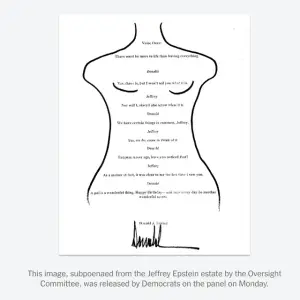 Epstein book: Democrats on the House Oversight Committee released an image of the sexually suggestive note and drawing, at right, apparently bearing the signature of Donald J. Trump, taken from a 2003 book celebrating the 50th birthday of the disgraced financier Jeffrey Epstein. Mr. Trump has insisted he never wrote such a note. Lawyers for Mr. Epstein’s estate provided a copy of the book to the committee in response to a subpoena. Read more ›
Immigration stops: The Supreme Court at least temporarily lifted restrictions on immigration-related stops by government agents in the Los Angeles area that challengers called “blatant racial profiling.” The decision lifts a federal judge’s order that agents not make indiscriminate stops relying on factors like a person’s ethnicity or that they speak Spanish. But the ruling is not the last word in the case. Read more ›
Chicago: Mr. Trump’s promised immigration crackdown in Chicago has begun, the administration said, though local officials said they hadn’t seen many arrests. The Department of Homeland Security said the effort was targeting undocumented immigrants with criminal records. At least three people were arrested there on Sunday by federal agents, an advocacy group said.
Karoline Leavitt, the White House press secretary, said in a social media post that President Trump “did not draw” and “did not sign” a sexually suggestive drawing and note from the so-called Epstein birthday book. She also said that Trump’s legal team would continue to pursue his defamation lawsuit against The Wall Street Journal over the report it published in July on the existence of the drawing.
Lev Remembers, Epstein Files Shatter Trump’s Cover-Up — Supreme Court Greenlights ICE Blitz, Lev Parnas, Sept. 8, 2025. As his cover-up collapses, the Supreme Court arms Trump with the power to terrorize cities.
Tonight we are living through history in real time. Not one, but two earth-shaking revelations broke wide open—proving exactly what I’ve been warning you about.Subscribed
First the House Oversight Committee released explosive new Epstein documents. Among them, the infamous “Birthday Book” for Epstein’s 50th birthday—containing a note from Donald J. Trump himself, scribbled over the outline of a naked woman.
“A pal is a wonderful thing. Happy Birthday — and may every day be another wonderful secret.”
But that’s not all. Also turned over was another letter tied directly to Trump. According to my sources, the letter was written by businessman and longtime Mar-a-Lago member Joel Pashcow, who made a crude joke about a woman that Trump and Epstein socialized with in the 1990s.
The Pashcow letter included a photo of a postcard-sized check for $22,500, marked up to appear as if it had been sent from Trump to Epstein. Beneath it, a handwritten caption read: “Jeffrey showing early talents with money plus women—sells fully depreciated [redacted] to Donald Trump for $22,500.” The woman’s name is redacted in the image, but the message speaks for itself. This wasn’t just a birthday greeting—it was a snapshot of the way Epstein and Trump operated in plain sight.
Trump and the White House are already denying it’s his signature. But I’ve seen this exact playbook before. When I was locked up in strict solitary confinement after my arrest, a postcard in the middle of the night was slipped under my prison cell door from the White House—signed by Rudy Giuliani. And what did the White House, MAGA, and Rudy do the moment it surfaced? They denied it was even Rudy’s signature. Same playbook. Deny, Deflect, and Lie. That’s Trump’s playbook. That’s MAGA’s playbook.
This is the Roy Cohn effect. Roy, Trump’s mentor, taught him: “Never concede. Always deny. Attack.” That’s what he’s doing here. But denial won’t erase the evidence.
And just like that postcard carried Rudy’s real signature, the signature in Epstein’s birthday book belongs to Donald Trump. No question. That letter—the crude sketch, the words, the style—it’s Trump’s. And just for you, I’m including copies of other letters and notes Trump has written in the past. Compare them for yourself. The handwriting, the slant, the rhythm—it all matches. You don’t need to take my word for it. The proof is right there in black and white.
Even more damning: the 2007 plea deal. Epstein pled guilty to just one count—soliciting a single minor. But the agreement gave him the names of all the victims, and more horrifying, it granted blanket immunity to every one of his co-conspirators. That’s right: prosecutors handed a free pass to Maxwell and the powerful men in Epstein’s circle.
And while Trump’s Epstein cover-up is falling apart, the Supreme Court just handed him another weapon. In a stunning and dangerous decision, they allowed Trump’s aggressive ICE patrols to resume nationwide
My sources are telling me Trump was waiting for this green light. His team had the plans already drawn. And now, the blitz is aimed straight at Chicago—before expanding to other major cities.
Think about that: while Trump hides behind the DOJ and FBI, denying his role in Epstein’s network, he’s at the same time unleashing armed immigration raids on our streets. The Supreme Court just gave him permission to terrorize immigrant communities—tearing families apart, spreading fear, and turning America into a police state
New York Times, Murdochs Reach Deal to Resolve Succession Fight, Jim Rutenberg and Jonathan Mahler, Sept. 8, 2025. Lachlan Murdoch will take control of a new family trust in a deal worth $3.3 billion, ensuring that his father’s media empire will retain its conservative slant.
The Murdoch family’s epic, decades-long succession battle has reached a multibillion-dollar finale.
Lachlan Murdoch has completed an agreement to secure control of his family’s sprawling media empire for decades to come, the family announced on Monday. The deal ensures that the empire’s various outlets, including Fox News, The New York Post and The Wall Street Journal, will remain conservative after his father Rupert’s death. It is valued at $3.3 billion, according to a person with knowledge of the negotiations.
The deal comes months after Rupert and Lachlan’s audacious bid to unilaterally change the terms of the Murdoch family’s irrevocable trust and disenfranchise Lachlan’s oldest siblings, Prue, Liz and James. The bid initially failed in court, but ultimately brought the two sides to the negotiating table.
The agreement gives the 94-year-old Rupert, who built a single Australian newspaper into the world’s most powerful media empire, what he has long sought — to preserve what he has called the “protector of the conservative voice in the English-speaking world” under the leadership of his chosen heir, Lachlan.
Under the terms of the deal, Lachlan’s three oldest siblings will receive $1.1 billion each for all their shares in the empire, according to the person with knowledge of the negotiations. Those shares are currently held in the existing family trust, which will be dissolved. This amounts to roughly 80 percent of the value of their stock at the close of trading Friday.
As part of the agreement, the ongoing litigation between Rupert and Lachlan, 54, and the three siblings over the trust will end. A new Murdoch family trust will be created that will include Lachlan and his two younger sisters, Grace and Chloe. That trust will hold the controlling stake in the two main Murdoch media companies, Fox Corporation and News Corp.
New York Times, News Analysis: Kennedy, Rejecting Data, Fuels Distrust of His Own Agencies, Sheryl Gay Stolberg, Sept. 8, 2025 (print ed.). By promoting suspicions about the institutions he oversees, critics say Robert F. Kennedy Jr. is jeopardizing public health. He says he is pursuing transparency.
The Centers for Disease Control and Prevention puts the U.S. death count from Covid-19 at 1.2 million. But Health Secretary Robert F. Kennedy Jr., right, rejects his own department’s statistics.
“I don’t know how many died,” Mr. Kennedy told senators during a contentious hearing Thursday, adding, “I don’t think anybody knows, because there was so much data chaos coming out of the C.D.C.”
When Senator Elizabeth Warren, Democrat of Massachusetts, said, accurately, that it was becoming harder for people to get Covid shots at pharmacies, Mr. Kennedy denied that, retorting: “Everyone can get access to them.” He also claimed mRNA vaccines “cause serious harm, including death, particularly in young people,” though the C.D.C. found “no increased risk of death” from the shots.
Mr. Kennedy’s defiant performance at the Senate Finance Committee on Thursday, his critics say, put on vivid display what happens when someone with no medical or scientific training and a conspiracy-minded approach takes charge of the nation’s public health.
Instead of being guided by rigorous research and nuanced debate over complex issues that defy easy answers, the country’s health secretary rejects facts that do not fit his theories and casts out experts who are not aligned with him. He is buoyed by the support of a vocal populist base that shares his suspicions of organized medicine and is energized by his push for a new approach.
Mr. Kennedy’s distrust of his department’s scientists and doctors has created turmoil within the nation’s public health agencies, particularly the C.D.C. Mass firings and restructuring have stripped the institution of expertise. And the health secretary dismissed an entire panel of vaccine experts and fired the C.D.C. director — whom he had called a “brilliant microbiologist and a tech wizard” — just one month after the Senate confirmed her.
In a statement, a spokeswoman for the Health and Human Services Department said that “Secretary Kennedy was debunking numerous false claims, emphasizing that the American people deserve full transparency from the agencies that serve them,” citing his “commitment to evidence-based science.”
Mr. Kennedy has repeatedly vowed to restore trust in the agencies he leads. In an appearance on “Fox & Friends” on Sunday, he reiterated what he said at Thursday’s hearing, defending his shake-up at the C.D.C. and accusing agency scientists of failing to document vaccine injuries and “stonewalling” him in requests to review vaccine safety data. “This is malpractice,” he said.
In making his case against the medical establishment, Mr. Kennedy has seized on widely held concerns about whether it puts profits before patients. It is true that the pharmaceutical industry is a lucrative business, raking in tens of billions in profits each quarter. Medical journals and elected officials do take financial contributions from the industry.
Like all vaccines, the Covid shots can in rare cases produce serious side effects. And the C.D.C. has publicly acknowledged its shortcomings with respect to data gathering during the pandemic, and has moved to correct them.
But by citing such episodes without context and putting a nefarious spin on the work of mainstream institutions, Mr. Kennedy is helping fuel the current crisis of mistrust in public health, according to experts who study conspiracy theories and their role in society. His supporters don’t trust the agencies he oversees, and his detractors don’t trust him.
By “accusing powerful people of doing things in secret for their own benefit, against the common good,” Mr. Kennedy is trafficking in conspiracy theories, according to Joseph E. Uscinski, a political scientist at the University of Miami who studies the phenomenon.Editors’ PicksThe Redness and Itching Wouldn’t Stop. Then Things Got Dangerous.Elizabeth Gilbert Gets DarkThose New Announcements in the Subway? They’re Art
Having a top government official contradicting science is “a serious, serious problem,” Professor Uscinkski said, “because the hope is that, in a free society, you develop expertise and methods for developing knowledge, and you build institutions to do that, and you develop ways to find out what’s true and what’s false.” He added: “Once you pervert those institutions, now there’s no way to know what’s true or false.”
The Parnas Perspective News Roundup, Mike Johnson Admits Donald Trump is NOT an FBI Informant, Aaron Parnas, Sept. 8, 2025. Florida Surgeon General conducts no studies prior to revoking childhood vaccine mandates, Bessent threatens to punch another official, and more
Over the weekend, we witnessed blatant media censorship and government intimidation in real time.
With that, here’s the news:
New York Times, Supreme Court Lifts Restrictions on L.A. Immigration Stops, Adam Liptak, Sept. 8, 2025. A federal judge had ordered agents not to make indiscriminate stops relying on factors like a person’s ethnicity or that they speak Spanish.
The Supreme Court on Monday lifted a federal judge’s order prohibiting government agents from making indiscriminate immigration-related stops in the Los Angeles area that challengers called “blatant racial profiling.”
The court’s brief order was unsigned and gave no reasons. It is not the last word in the case, which is pending before a federal appeals court and may again reach the justices.
The court’s three liberal members dissented.
“We should not have to live in a country where the government can seize anyone who looks Latino, speaks Spanish and appears to work a low wage job,” Justice Sonia Sotomayor wrote, joined by Justices Elena Kagan and Ketanji Brown Jackson.
“Rather than stand idly by while our constitutional freedoms are lost,” Justice Sotomayor added, “I dissent.”
The court’s ruling for now allows what critics say are roving patrols of masked agents routinely violating the Fourth Amendment and what supporters say is a vigorous but lawful effort to enforce the nation’s immigration laws.
The majority’s failure to provide an explanation for the ruling means that it is hard to say whether its reasoning applies nationwide or is limited to the Los Angeles area, where the administration has said that the problems flowing from illegal immigration are especially pronounced. But there is little doubt that the ruling will have the practical effect of further emboldening the administration’s uncompromising efforts to deport unauthorized immigrants around the country.
Mayor Karen Bass of Los Angeles said she expected the ruling to have sweeping consequences.
“I want the entire nation to hear me when I say this isn’t just an attack on the people of Los Angeles, this is an attack on every person in every city in this country,” she said in a statement.
Tricia McLaughlin, a spokeswoman for the Department of Homeland Security, said in a statement that the ruling was “a win for the safety of Californians and the rule of law,” adding that “D.H.S. law enforcement will not be slowed down and will continue to arrest and remove the murderers, rapists, gang members and other criminal illegal aliens that Karen Bass continues to give safe harbor.”
Aggressive enforcement operations in Los Angeles — including encounters captured on video that appeared to be roundups of random Hispanic people by armed agents — have become a flashpoint, setting off protests and clashes in the area.Editors’ PicksA Japanese Horror Franchise Is Finally Moving to JapanHow a Peloton Yoga Instructor Spends a Day at the Studio10 Tiny Homes
Civil rights groups and several individuals filed suit, accusing the administration of unconstitutional sweeps in which thousands of people had been arrested. They described the encounters in the suit as “indiscriminate immigration operations” that had swept up thousands of day laborers, carwash workers, farmworkers, caregivers and others.
“Individuals with brown skin are approached or pulled aside by unidentified federal agents, suddenly and with a show of force,” the complaint said, “and made to answer questions about who they are and where they are from,” violating the Fourth Amendment’s prohibition of unreasonable searches and seizures.
In response to the suit, Judge Maame E. Frimpong, of the U.S. District Court for the Central District of California, placed significant restrictions on President Trump’s efforts to ramp up immigrant arrests to achieve his pledge of mass deportations.
New York Times, Ruth Paine, Who Gave Lodging to Marina Oswald, Dies at 92, Richard Sandomir, Sept. 8, 2025 (print ed.). Her knowledge of Lee Harvey Oswald and his wife made her a noteworthy witness during the Warren Commission’s investigation into the assassination of President John F. Kennedy.
New York Times, Russia Steps Up Disinformation Efforts as Trump Abandons Resistance, Steven Lee Myers, Sept. 8, 2025 (print ed.). The Kremlin has begun a campaign to sway the parliamentary election in Moldova in what could become a new model of election interference online.
Since returning to the White House in January, President Trump has dismantled the American government’s efforts to combat foreign disinformation. The problem is that Russia has not stopped spreading it.
How much that matters can now be seen in Moldova, a small but strategic European nation that has since the end of the Cold War looked to Europe and the United States to extract itself from Moscow’s shadow.
The Trump administration has slashed diplomatic and financial support for the country’s fight against Russian influence, even as the Kremlin has conducted what researchers and European officials described as an intense campaign to sway that country’s parliamentary elections, scheduled for Sept. 28.
The Russians have flooded social media with fake posts, videos and entire websites that are created and spread on TikTok, Telegram, Facebook, Instagram and YouTube using increasingly effective artificial intelligence tools.
One post impersonated OK!, the celebrity magazine based in New York, in an attempt to smear Moldova’s president, Maia Sandu, with a preposterous accusation involving celebrity sperm donors.
A year ago, when the country last held elections, Biden administration officials pushed back against such campaigns, urging platforms like Meta, the owner of Facebook and Instagram, to do more to identify trolls or inauthentic accounts. No more.
“The Russians now are able to basically control the information environment in Moldova in a way that they could only have dreamed a year ago,” said Thomas O. Melia, a former official at the State Department and the U.S. Agency for International Development.
The outcome in Moldova will be an early measure of the Trump administration’s push to dismantle American efforts to promote democracy since the end of the Cold War. In addition to cutting foreign assistance, the administration has decimated other instruments of American influence, like Radio Free Europe and Voice of America, that were central to the geopolitical struggle with the Soviet Union.
“This kind of reckless, wanton destruction of all elements of America’s soft power,” Mr. Melia said, “is clearly leaving the field vacant for others to rush in unopposed.” Sign up for Your Places: Global Update. All the latest news for any part of the world you select. Get it sent to your inbox.
The State Department, when asked, declined to discuss Russia’s influence operations in Moldova. The White House did not comment.
Although Mr. Trump has repeatedly dismissed Russian election interference as a hoax, the Kremlin’s covert influence operations have been well documented — including in last year’s American presidential election and in votes this year in Germany, Poland and Romania.
The Russian efforts have also been honed with experience and aided by rapidly evolving technologies that have made Moldova a showcase of the ways the Kremlin seeks to exert its influence in other countries.
The Stimson Center, a research organization in Washington, called Moldova, which borders Ukraine, “a testing ground for hybrid warfare operations” that “are likely to shape similar efforts” across Europe.
Russia’s goal is to keep the country, a former republic of the Soviet Union, within the Kremlin’s orbit.
According to reports in Russian media, the task was assigned to one of President Vladimir V. Putin’s most trusted lieutenants, Sergei V. Kiriyenko. The efforts intensified even as the Trump administration signaled that it was no longer committed to fighting them, according to researchers who track malign influence campaigns online.
WatchDog, a consortium of researchers in Moldova, said in a report last month that it had found more than 900 accounts linked to Russia working in concert on the most popular apps in the country, including TikTok and Facebook, as well as Telegram, YouTube and Instagram. Some included videos that its researchers and others said A.I. had created.
New York Times, Russian Strike Breaks Through Most Protected Part of Kyiv, Andrew E. Kramer, Sept. 8, 2025 (print ed.). The attack set a government building on fire in an area of the Ukrainian capital that is rarely damaged.Russia attacked Ukraine on Sunday with the largest drone assault so far in the war, the authorities said, killing at least five people around the country and breaching air defenses in the heavily guarded government district of the capital.
Ukraine’s Air Force said that Russia had launched 805 Iranian-designed Shahed exploding drones and decoys across the country, the latest in a relentless offensive that has continued unabated despite the Trump administration’s efforts to mediate peace talks. Russia also fired 17 cruise and ballistic missiles in the volley, according to the Air Force, which said nine missiles and nearly 60 drones had evaded air defenses and made impact.
A woman and her child were killed in the capital, Kyiv, according to the Ukrainian authorities. And smoke billowed from the large, colonnaded building where the Cabinet of Ministers convenes — a landmark in the city.
“Such killings now, when real diplomacy could have already begun long ago, are a deliberate crime and a prolongation of the war,” President Volodymyr Zelensky of Ukraine said on social media. “It has been repeatedly said in Washington that sanctions will follow a refusal to talk.”
Officials said that Sunday was the first time since the war began in February 2022 that Russia had damaged a Ukrainian government building in Kyiv.
Paul Krugman via Substack, Politcal Economy Commentary: Scott Bessent, Sleazy Smearer,Paul Krugman, right, Sept. 8, 2025. About the Treasury secretary’s vile, dishonest slander of the Fed.
Donald Trump did learn something during his 1st term. He learned never to hire anyone who shows the least shred of integrity. You won’t find anyone like Gary Cohn or General Milley in Trump’s 2nd administration. Now he knows to only hire people who are corrupt, bigoted, dishonest, or all three.
And Scott Bessent, the Treasury secretary, clearly satisfies Trump II’s requirements. His recent attacks on the Federal Reserve, part of Trump’s campaign to destroy the Fed’s independence, are vile, underhanded and sleazy. In a better world they would lead to his immediate removal as Treasury secretary.
But before I do a full dissection on Bessent, I want to talk for a minute about someone else: E.J. Antoni, the Heritage foundation economist Trump plans to install as head of the Bureau of Labor Statistics.
You may recall that Trump fired Erika McEntarfer, the highly respected former BLS head, because he didn’t like the July jobs numbers, which he baselessly claimed were rigged. Since then the numbers have only gotten worse. When Trump chose Antoni as her successor, there were widespread and entirely valid complaints that Antoni was manifestly unqualified for the job.
Yet what we didn’t know was that Antoni has an interesting history on social media. Last week, building on reporting by Wired, CNN reported that
President Donald Trump’s nominee to lead the Bureau of Labor Statistics operated a since-deleted Twitter account that featured sexually degrading attacks on Kamala Harris, derogatory remarks about gay people, conspiracy theories, and crude insults aimed at critics of President Donald Trump.
What’s truly remarkable is that despite this report, betting markets give Antoni a roughly even chance of being confirmed.
Bessent, by contrast, was greeted with accolades when Trump announced his nomination as Treasury Secretary. Having been a somewhat successful money manager, and at one point having managed funds for George Soros, he was treated as the “adult in the room” who would be a safe steward of the financial markets and insulate them from Trump’s axe-swinging tactics. It helped that Bessent looked and performed with suave confidence in front of the cameras.
But now the mask has fallen as we can clearly see Bessent for what he is. Bessent’s recent smear campaign against the Fed shows that he is truly vile, like the rest of the Trump crew, despite the Wall Street polish.
Specifically, last week Bessent published an article titled “The Fed’s ‘Gain of Function’ Monetary Policy” in the Wall Street Journal. Here is how it begins:
As we saw during the Covid pandemic, lab-created experiments can wreak havoc when they escape their confines. Once released, they can’t easily be put back. The “extraordinary” monetary-policy tools unleashed after the 2008 financial crisis have similarly transformed the Federal Reserve’s policy regime, with unpredictable consequences.
The vileness is right there in the headline and the first sentence. It’s immaterial whether you believe that Covid was caused by a lab leak or by natural viral infection from animals. The point is that Bessent began his article by pandering to the conspiracy-theory right by taking a contentious proposition popular in those parts, presenting it as if it were established fact, and then — in a complete non sequitur — associating that theory with his criticism of the Federal Reserve.
Yes, the Fed took extraordinary measures after the financial crisis. It was, after all, responding to the worst economic slump since the Great Depression — a slump that persisted even after emergency policies had ended the initial period of financial free fall. In an attempt to boost the economy the Fed engaged in “quantitative easing” — buying large quantities of long-term U.S. government debt and debt backed by the U.S. government. This was a departure from its usual practice, in which it only buys short-term Treasuries. But it was clearly in pursuit of the Fed’s mission, which is to promote both price stability and full employment.
Bessent, however, would have you believe that the Fed’s attempt to do its job was a dangerous experiment inflicted on the country by power-mad officials, and which had dire consequences. And while some critics did predict dire consequences at the time, they were soon proved to be completely and embarrassingly wrong.
Why did the Fed engage in quantitative easing following the financial crisis?
The bursting of the housing bubble and the financial crisis in 2008 sent the U.S. economy into a deep slump followed by a sluggish recovery.
When the economy is depressed, the Fed normally cuts the Fed funds rate, the short-term rate that it controls, by buying short-term Treasuries and injecting liquidity into the banking system. And that’s what it did when America went into recession:
The main threat to that credibility comes from Trump and his minions, Bessent being the most visible, who are trying to destroy the Fed’s independence.
Finally, this hit piece by Bessent shows why he is so valuable to Trump. In my opinion, unlike virtually all other Trump cabinet members, Bessent isn’t a fool. He’s highly intelligent and well-versed in his area of operation. He understands financial markets. Hence the fact that he willingly smears the Fed by invoking conspiracy-laden tropes and re-writing facts is a window into his character, showing that he isn’t, and never was, worthy of Americans’ trust.
Maybe we should be thankful that he is no longer in the running for Fed Chair.
JFK Death
JFK Facts, RIP: Ruth Paine, Enigmatic Quaker With CIA Ties Who Housed Oswalds, Dies at 92, Peter Voskamp, Sept. 3, 2025. Were she and  husband Michael selfless good samaritans, or pawns in the killing of the president?
Ruth Paine, a right, Quaker who housed the Oswald family at her Irving, Texas, home in the spring and fall of 1963, and who tipped off Lee Harvey Oswald about a job at the Texas School Book Depository in Dallas, died Aug. 31, according to the Dallas Morning News.
She was three days shy of her 93rd birthday.
JFK Facts, Max Good, Director of 'The Assassination & Mrs. Paine,' Reflects on Ruth Paine, Peter VoWhile taking note of her intelligence and strength of character, Good concludes that she remains an enigma who was "withholding important information."
In the wake of Ruth Paine’s death on Aug. 31 [see our obituary], JFK Facts reached out to documentary filmmaker Max Good to ask if he had any final thoughts on the woman he spent seven years producing a film about. His response follows:
With the passing of Ruth Paine, we lost one of the two most important living witnesses in the JFK assassination case, the other being Marina Oswald (still alive at age 84). Ruth was the person closest to the Oswalds in the months leading up to the assassination. She played a strangely proactive role in getting Marina Oswald to come live with her, helping the Oswalds move back to Dallas from New Orleans, and assisting Marina in all aspects of her life — financial and personal. The Oswalds’ physical possessions, including the alleged murder weapons, were stored in Ruth’s garage. Ruth was instrumental in getting Lee Harvey Oswald his job at the Texas School Book Depository.
As most of us know, Ruth was also the primary witness for the Warren Commission, answering many more questions than any other witness. And she played a very active role in documentaries and news reports over the years, always telling the same story, buttressing the official story of the lone gunman Oswald.
I spent seven years working on a documentary about Ruth Paine. I interviewed her several times and talked about her with many prominent researchers and authors on both sides of the conspiracy divide. I tried to go into this process with an open mind. Everything I learned led me to a conclusion that Ruth was withholding important information. There were a few specific instances where Ruth was cagey or unclear, particularly regarding her sister’s employment with CIA, her role in the discovery of the “Kostin Letter,” and how many times she met with George de Mohrenschildt. But her story was remarkably consistent and she was clearly very knowledgable, articulate, and extremely intelligent. Some of her statements were almost lawyerly in their precision and forethought. I wasn’t surprised to learn that she sent a letter to the Warren Commission with detailed corrections on specific areas where she felt they had made errors.
Sept. 7

Letters from an American, Historical Commentary: Sept. 6, 2025 [A New Level of Unhinged], Heather Cox Richardson, right, Sept. 7, 2025. Today the social media account of President Donald J. Trump posted an AI-generated image of Trump as if he were Lieutenant Colonel Bill Kilgore from the 1979 film Apocalypse Now in front of the Chicago skyline with military helicopters and flames and the caption “Chipocalypse Now.”
Kilgore loved the war in Vietnam in which he was engaged; his most famous line was “I love the smell of napalm in the morning.”
Over the image, Trump’s social media post read: “‘I love the smell of deportations in the morning…’ Chicago about to find out why it’s called the Department of WAR.” The words were followed by three helicopter emojis, symbols the right wing uses to represent former Chilean dictator Augusto Pinochet’s goons’ disappearing political opponents by pushing them out of helicopters.
Although it has become trite to speculate about what Republicans would say if a Democratic president engaged in the behavior Trump exhibits daily, this open attack of the president on an American city is a new level of unhinged. Mehdi Hasan of Zeteo wrote: “The president of the United States just declared war, actual military war, not a metaphorical one, on a major American city, and one governed by his political opponents.” He added, accurately: “In any other period, this would be impeachment-worthy.”
Illinois governor J.B. Pritzker called attention to the gravity of Trump’s post: “The President of the United States is threatening to go to war with an American city. This is not a joke. This is not normal. Donald Trump isn’t a strongman, he’s a scared man. Illinois won’t be intimidated by a wannabe dictator.” Under the words “Know your rights, Illinois,” and “Stay safe and stay informed,” the governor’s social media account posted information about Americans’ rights in both English and Spanish.
Trump’s threats against American citizens are outrageous, but they also feel desperate. Trump’s popularity is tanking, the economy is faltering, Health and Human Services Secretary Robert F. Kennedy Jr. is facing a chorus of calls to resign or be fired, and the American people are taking to the streets. Thousands of people turned out today in Washington, D.C., for the “We Are All D.C.” march to protest the presence of troops in the city, and in Chicago for the “Chicago Says No Trump No Troops” protest. The protests are notable for the seas of signs the peaceful protesters carry.
And then, with Congress back in session, there is the resurgence of the issue of Trump’s appearance in the Epstein files. Last week, the White House warned Republicans that voting to release the Epstein files “would be viewed as a very hostile act to the administration.” Yesterday, Trump reiterated his claim that the agitation for the release of the files is a “Democrat HOAX…in order to deflect and distract from the great success of a Republican President.”
Also yesterday, lawyers for the Justice Department asked a federal judge to keep the names of two associates who received large payments from Epstein in 2018 secret. Days before the payments, the Miami Herald had started to examine the sweetheart deal Epstein got in 2008. One associate received a payment of $100,000, and the second received $250,000. As part of his plea deal, Tom Winter of NBC News reports, Epstein got a guarantee that the associates would not be prosecuted.
Last night, Trump hosted the inaugural dinner of what the White House is calling the “Rose Garden Club” in the newly-paved White House Rose Garden, telling those assembled that they were there because they are loyal to the president. “You’re the ones that I never had to call at 4:00 in the morning,” Trump told them. “You are the ones that have been my friends, and you know what I’m talking about.”
Yesterday, talking to reporters about the Epstein files, House speaker Mike Johnson (R-LA) said that Trump was “an FBI informant to try to take this stuff down.” The idea that Trump was secretly working to bring Epstein down is common fare among conspiracy theorists, but as Josh Marshall of Talking Points Memo suggests, Johnson’s embrace of it might well be an attempt to spin material in the files before it becomes public.
Marshall notes that journalist Michael Wolff, who interviewed Epstein at length during Trump’s first presidency, says that Epstein suspected it was Trump who told the authorities about his systemic sexual assault of girls. But if so, Marshall explains, this is damning rather than exonerating.
It’s pretty well known that Trump and Epstein had a falling out in 2004 after Trump went behind Epstein’s back to buy an estate in South Florida that Epstein wanted. But at the time, Trump was headed toward bankruptcy, and it was not clear where he was getting the money to buy the estate.
Marshall calls attention to a recent interview in which Wolff said that Epstein suspected Trump was laundering money for a Russian oligarch—and indeed, Trump did flip the property to a Russian oligarch for a profit of more than $50 million a few years after buying it—and threatened to sue Trump, bringing the money laundering to light. At that point, the Epstein investigation began.
According to Wolff, Epstein believed Trump had notified the police about what was going on at Epstein’s house, which he knew because he was a frequent visitor. Marshall speculates that Johnson mentioned that Trump was an informant because that information could well be in the files the Department of Justice has, and they’re trying to spin it ahead of time to make it sound like Trump was a hero.
But both Wolff and Marshall note that if indeed Trump turned the FBI onto Epstein, it shows he knew what was taking place at Epstein’s properties.
Johnson’s claim that Trump was an FBI informant suggests Trump’s team is worried that as more and more people get access to the files, it will be increasingly difficult to hide what’s in them. Trump's demand for Republicans’ loyalty suggests that at least some of them are starting to recalculate it. And that, in turn, might have something to do with why he is putting troops in the streets.
Lance’s Substack, Analysis: Trump's Meme On Plans To Deploy Military To Chicago, And The Film 'Apocalypse Now,' Lance F Rosen, right, Sept. 7, 2025.  He Must Be Impeached Or "25th'd"..... Today!
Writers, influencers, and pundits, are acting as though they are shocked at Trump's meme in which he riffed on the quote by the psychopathic field commander from the film "Apocalypse Now," "I love the smell of Napalm in the morning."
The filmmaker Francis Ford Coppola and screenplay writers were highlighting the insanity and inhumanity of America's role in Vietnam, how it morally destroyed an entire strata of our military leadership and servicemen, turned our Pentagon into merchants of death, and used statistics on "body counts" to determine whether the US was winning or losing. The quote attributed to Lt. Col. Kilgore played by actor Robert Duvall (his name itself an obvious pun) was a well-deserved attack on the entire strategy, purpose, and mindset that led to this black mark on our history.
Our Vietnam veterans were also victims, many of whom were physically and mentally badly scarred, and who suffered awful mistreatment upon their return home. Coppola's film is an attack not on them, but against the misleadership of the civilian and military command, whose strategy of waging secret counterinsurgency war and inflicting mass civilian casualties, ordering countless numbers of assassinations, torture, and using weapons like Napalm which incinerated innocents, stood opposite of the values for which we were fighting, in addition to becoming a slow-acting poison for those soldiers exposed to it.
Lt. Col Kilgore's line in the film is the statement of an insane psychopath, who should never been in any position to command soldiers in the field. He was deserving of being fragged by his own men, but that was not the point. It was a look in the mirror at a ten-year- long nightmare where many Americans back home who were cheerleading for this immoral war lost their souls. All in the name of "stopping communism." Those people embraced every moral evil which we are fighting against today, from Nixonism, Reaganite free market economics, racism, gender discrimination, Christian fundamentalism, and the culture of gun violence. Therefore the quote from the film, in fact the film itself, is an attempt to hold up the mirror and confront those folks in the viewing audience with the face of their own corruption, their own form of mass insanity which many of them embraced or tolerated. It is far more than just an anti-war film. It is a classical tragedy and a character study, wrapped in a war movie.
Trump, by reposting this meme in regard to his plans to invade Chicago, "I love the smell of deportations in the morning" is not simply being his usual brand of disgraceful, or as the braindead mainstream media has gotten used to calling it, "unhinged." A door can be put back on its hinges when it comes off, whereas Trump is broken beyond repair.
This piece of lunacy is not just a statement of political ideology, or intention, nor is it him "trolling" Governor Pritzker of Illinois, which is how too many snarky social media idiots are spinning it. It is him descending into literal madness, embracing the essence of evil and homicidal rage embodied by the film's character.
Also under consideration is that he clearly lacks the skills to have designed this thing himself, rather it is the creation of some random little fascist tech geek on his social media team, or even Don Jr., who kicked the meme upstairs and which Trump loved enough to post it. Or, he might have taken hold of a wisecrack made in a cabinet meeting along this theme and told someone to make it a post.
Either way, this tells us a great deal about both how manipulated and out of it Trump is, and also how the administration actually works. Trump is directly influenced in his decisions by court hangers-on, such as some Nazi gamer in his White House or an Israeli intelligence spook from the outside such as "Loose Lips" Laura Loomer. All sorts of sick characters around him are feeding his madness, hoping to use it for accomplishing their own agendas and winning factional conflicts amongst them. It is a story as old as Shakespeare's Lear, or Othello.
And it sure as Hell is NOT a "distraction" from the Epstein files. Epstein is just an added factor contributing to his mental breakdown, and an opportunistic point of division in the MAGAverse which bothers him. It is not causal, nor his main source of motivation to do what he is doing. However, many of our readers have bought into that bullshit media line and I am here to state this view out loud and clearly.
Posting this meme before deploying the Army into a potential large scale bloody scenario in Chicago is his announcement to the world that he is insane, in a purely clinical sense as well as subjective. He himself has established as fact that his dementia is so far advanced that he is mentally incompetent to hold office according to all established medical and legal criteria. It is not the same old same old. His condition has dramatically worsened.
It is the smell of blood in the morning which excites him. This is not a political stunt, nor is it trying to change the media narrative away from any political problems he is having. It is the equivalent of Jeffrey Dahmer prowling his neighborhood in search of his version of a Happy Meal.
He needs to be removed from office right now, even if that means elevating the disgusting tool of "Tech Brothers" fascist billionaires J.D. Vance to the presidency. I know enough about Vance, his controllers, his involvement with Project 2025, and his twisted personality to know exactly what I am saying, and am fully aware of its implications. There is nothing useful about him except that he is not Donald Trump, and though he is generally a malignant person, may be susceptible to making occasional rational decisions. It is the chance we have to take, in my view, and there is little time.
There will be some debate on this, and people will go back and forth about "picking their poison," who is worse, what it will mean, and will try to interpret various commentaries by writers they follow on social media. I'm honestly tired of the pileup of irrelevant academic analysis which obscures the actual reality.
A madman has control of our nuclear codes. He has control of the US Military. And he sees roughly one half of the American population as his personal enemies. His meme of yesterday is a formal declaration of war against that half. That, my friends, "trumps" everything.
He is the drunk driver at the wheel of the vehicle in which we are all passengers. He must be removed from office by any means necessary. That is going to be my personal campaign going forward. We do not yet know how or if it will work, but if we want to live, in my view it is the only thing worth doing. The era of "politicking" and negotiating is over and it is time for those among our leaders who understand this to declare war against this regime, using every weapon they have which is non-violent, though we already knew going into this that there would be large scale violence in reaction to his policies. That was the intention of Trump's Project 2025 stringpullers like Kevin Roberts from the get go.
The world changed yesterday, and those who don't see this have simply chosen to not see it. In fact, it is one of the few things lately which I can see clearly.
Paul Krugman via Substack, Political-Economy Commentary: The Dangers of Fiscal Dominance, Paul Krugman, right, Sept. 7, 2025. Donald Trump wants to destroy the independence ofthe Federal Reserve and assume personal control of monetary policy. It’s clearly an obsession with him and his efforts just keep getting more extreme.
First he spent several months haranguing Jerome Powell, the Fed chairman. Next he announced that he was firing Lisa Cook, a member of the Fed’s Board of Governors, on the basis of extremely thin accusations involving mortgages she took out before she joined the Board. When Cook filed suit, claiming — almost surely correctly — that he had no legal right to fire her, his Justice Department upped the ante, saying that it was considering criminal charges. And need I add that three other members of Trump’s cabinet appear to have made the same mortgage arrangement as Lisa Cook, as well as the parents of Bill Pulte, Trump’s hired assassin in this matter.
Unless the Supreme Court is more in Trump’s back-pocket than is already evident, I don’t Trump will prevail in firing Cook. But his over-arching goal, clearly, is to personally intimidate Fed officials — “get in our way,” the White House is saying, “and we will ruin your life.”
Meanwhile, Trump has nominated Stephen Miran, chair of his Council of Economic Advisers, to fill a vacancy on the Board. Incredibly, Miran says that he will not resign his current appointment. Rather, he intends to just take a leave of absence. Having an employee of the executive branch serve as a member of the Board would be completely unprecedented. An act like that is effectively a textbook case of the elimination of Fed independence.
And trashing the Fed’s independence is clearly a top agenda item of Trump’s accomplices: Scott Bessent, the Treasury secretary, has just published a remarkably sleazy article smearing the Fed. More on that in a future post.
There is no real dispute over what Trump is doing. Trump has announced that not only should the Fed lower the Fed funds rate, the short-term interest rate that the Fed controls, but that it should be lowered by 300 basis points. That would be dropping the current rate from 4.5 to 1.5. That’s an enormous drop – one which has never been done except in the teeth of a deep recession.
Why is Trump demanding this? In answering that question, one should never rule out the role of sheer ignorance. Trump may imagine that lower short-term interest rates will lift him in the polls, while ignoring the high likelihood that such a steep fall in short-term interest rates will raise expected inflation and, as a result, long-term rates will go up, not down. And sometimes he seems to think of interest rate reductions as a sort of trophy, like an award you get for supposedly winning a golf tournament.
But there is another reason that might explain why Trump wants to end the Fed’s independence — and this reason makes economists very, very nervous. For it’s likely that Trump is seeking to establish “fiscal dominance” of monetary policy — a policy regime in which the Fed’s actions are dictated, not by an effort to achieve low inflation and full employment, but by the desire to avoid hard choices on taxes and spending.
So I’m going to devote today’s primer to fiscal dominance: What it means and how it has played out in the past. Beyond the paywall I’ll talk about four ways a central bank that has lost its independence can enable fiscal irresponsibility:
1. Seigniorage: Using the printing press to cover budget deficits
2. Financial repression: Using low rates to reduce budget deficits
3. Goosing the economy: not exactly fiscal dominance, but political dominance
4. Expropriation through inflation: Inflating away government debt
New York Times, News Analysis: Trump Tramples Congress’s Power, With Little Challenge From G.O.P., Julian E. Barnes and Catie Edmondson, Sept. 7, 2025. On national security, spending and oversight, the president continues to undercut the legislative branch, and Republicans in charge have done little to stop him.
The Pentagon barred the senior Democrat on the Senate Intelligence Committee from making an oversight visit to a military spy agency.
Armed forces off the coast of Venezuela began a military campaign against alleged members of a drug cartel without any authorization from Congress, and without notifying key members.
The White House informed Congress it planned to use a rare maneuver to skirt a vote and cancel nearly $5 billion in foreign aid funding that lawmakers had already approved, the latest escalation of its campaign to undercut the legislative branch’s spending powers.
And just a month after senators had confirmed her, Robert F. Kennedy Jr., the health secretary, ousted the director of the Centers for Disease Control. He also put forward changes that would effectively restrict access to Covid-19 vaccines, after pledging to senators during his own confirmation hearings that he would not make it more difficult.
The Trump administration continues to erode the power of Congress, trampling on its constitutional prerogatives in ways large and small. Through it all, Republicans in charge have mostly shrugged — and in some cases, outright applauded — as their powers, once jealously guarded, diminish in ways that will be difficult to reverse.
In recent weeks, G.O.P. leaders have looked on passively as the president has fired a litany of agency leaders whom senators worked for weeks to confirm, from the C.D.C. to the Internal Revenue Service to the Federal Reserve.
And they have shown little appetite for challenging the administration, even as a few have expressed occasional displeasure about the consequences of their decisions earlier this year to swallow their reservations about some of his nominees and confirm them.
New York Times, Trump Tried to Kill the Infrastructure Law. Now He’s Getting Credit for Its Projects, Richard Fausset, Sept. 7, 2025. Signs bearing President Trump’s name have gone up at major construction projects financed by the 2021 law, which he strenuously opposed ahead of its passage.
In southern Connecticut, the federal government is replacing a 118-year-old bridge along America’s busiest rail corridor. The $1.3 billion project was largely funded by the 2021 infrastructure law that was championed by then-President Joseph R. Biden Jr. — and strenuously opposed by Donald J. Trump.
These days, however, motorists cruising by the construction site might be forgiven for thinking that a certain famous New York developer was responsible for it all.
“PRESIDENT DONALD J. TRUMP” a sign by the road declares. “REBUILDING AMERICA’S INFRASTRUCTURE.”
In recent months, a number of similar signs have popped up in front of major infrastructure projects financed by the bipartisan 2021 legislation, a $1.2 trillion package that Mr. Trump, who left office in January of that year, had passionately railed against. He called the bill “a loser for the U.S.A.,” and warned that Republican lawmakers who signed on could be thrown out of office by angry primary voters. “Patriots will never forget!” he wrote.
The signs bearing Mr. Trump’s name now adorn bridge projects in Connecticut and Maryland; rail-yard improvement projects in Seattle, Boston and Philadelphia; and the replacement of a tunnel on Amtrak’s route between Baltimore and Washington, according to W. Kyle Anderson, a spokesman for the company.
In an email, Mr. Anderson said the new signs “are a voluntary Amtrak initiative, updating outdated signage posted at the project locations listed previously, following the change in presidential administrations earlier this year.”
The signs note, in a smaller font, that the projects in question are “funded by the Infrastructure Investment and Jobs Act,” the official name of the legislation that Mr. Trump tried to derail.
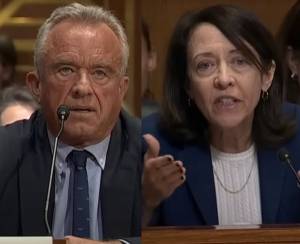 U.S. Health and Human Services Secretary Robert F. Kennedy Jr. is confronted at a Senate hearing on Sept. 4, 2025, by Sen. Maria Cantwell of Washington State, the top-ranking Democrat on the Commerce, Science and Transportation Committee (File photos).
Associated Press via Chicago Tribune, Robert F. Kennedy Jr.’s family members say he is a ‘threat’ to Americans’ health and call for his resignation, Staff Report, Sept. 7, 2025 (print ed). Members of Robert F. Kennedy Jr.’s family are calling for him to step down as health secretary following a contentious congressional hearing this past week, during which the Trump Cabinet official faced bipartisan questioning about his tumultuous leadership of federal health agencies.
 Kennedy’s sister, Kerry Kennedy, and his nephew, Joseph P. Kennedy III, issued scathing statements Friday, calling for him to resign as head of the Health and Human Services Department.
The calls from the prominent Democratic family came a day after Kennedy had to defend his recent efforts to pull back COVID-19 vaccine recommendations and fire high-level officials at the Centers for Disease Control at a three-hour Senate hearing.
“Robert F. Kennedy Jr. is a threat to the health and wellbeing of every American,” Joseph P. Kennedy III said in a post on X. The former congressman added: “None of us will be spared the pain he is inflicting.” His aunt echoed those claims, saying “medical decisions belong in the hands of trained and licensed professionals, not incompetent and misguided leadership.”
This is not the first time Kennedy has been the subject of his family’s ire. Several of his relatives had objected to his presidential run in the last campaign, while others wrote to senators earlier this year, calling for them to reject his nomination to be Trump’s health secretary due to views they considered disqualifying on life-saving vaccines.
Kennedy, a longtime leader in the anti-vaccine movement, has spent the last seven months implementing his once-niche, grassroots movement to the highest level of America’s public health system. The sweeping changes to the agencies tasked with public health policy and scientific research have resulted in thousands of layoffs and the remaking of vaccine guidelines.
The moves — some of which contradict assurances he made during his confirmation hearings — have rattled medical groups and officials in several Democratic-led states, which have responded with their own vaccine advice.

Children in an iron lung before the polio vaccine, 1950 (File photo). The “iron lung” was a type of negative pressure ventilator used to help patients breathe when their muscles were paralyzed by polio. The iron lung could keep patients alive for weeks, months, or even years. Some spent the majority of their lives inside, tended to by nurses who would adjust bedding, provide food, and even hold mirrors above the patient’s head so they could see their surroundings. By the early 1950s, thousands of children in the U.S. and abroad relied on iron lungs. The situation changed drastically after Jonas Salk introduced the polio vaccine in 1955, followed by Albert Sabin’s oral vaccine in the 1960s. Mass immunization campaigns nearly eradicated the disease, making iron lungs a relic of medical history.
Global News
New York Times, South Korea Negotiates Release of Korean Workers Detained in Georgia Raid, Choe Sang-Hun, Sept. 7, 2025. The South Korean government said on Sunday that it would send a charter plane to the United States to retrieve hundreds of workers detained in an immigration raid.
South Korea reached a deal with the United States to free hundreds of South Korean workers arrested when U.S. immigration authorities raided the construction site of a battery plant in Georgia, the country’s presidential office said on Sunday.
“There are some administrative procedures left, but once they are cleared, we will send a chartered plane to bring our people home,” Kang Hoon-sik, the chief of staff for President Lee Jae Myung of South Korea, told a meeting of senior officials from the administration and the governing Democratic Party on Sunday.
Mr. Kang provided no further details, including when South Korea expected to send the plane. But his remarks provided the first strong indication that South Korea and the United States were working out a diplomatic solution after days of tensions between the allies.
U.S. immigration officials stormed the construction site of a major Hyundai-LG electric vehicle battery plant in Ellabell, Ga., on Thursday, arresting 475 people. Of them, about 300 were South Korean citizens, the South Korean foreign minister’s office said.
The raid unsettled South Korea, a crucial U.S. ally that has been asked to invest billions of dollars in the United States to build new factories and create jobs. It was part of the Trump administration’s aggressive crackdown on immigration, and U.S. officials said those arrested were in the United States illegally or working unlawfully.
“We will not let our guard down until we have our people safely back home,” Mr. Kang said. “We will also review and improve the visa system for those who go to the United States on business trips related to investment projects so that similar incidents won’t be repeated.”
The raid brought construction to a halt at the Georgia factory. Mr. Kang confirmed on Sunday that South Korea was still committed to finishing the project.
The Trump administration has encouraged South Korean industrial giants like Hyundai, Samsung and LG to invest in the United States. But the administration has also drastically tightened visa allocations, making it more difficult for them to bring cheap and skilled workers to build their factories.
Those arrested included dozens of LG workers who were on business trips with various visas or under a visa waiver program to provide technical guidance for building the battery factory, according to industry officials familiar with the project. Other detained South Korean workers had been hired by construction subcontractors working for Hyundai and LG, they said.
Education, Media, Culture, Science

New York Times, At George Mason University, Trump Has Found an Unbending Adversary, Stephanie Saul, Sept. 7, 2025 (print ed). Gregory Washington, George Mason’s first Black president, runs a university that prizes diversity. That has made him a target of the Trump administration.
 Gregory N. Washington, right, the first Black president of George Mason University, remembers the tumult on campus as he began his new job in 2020.
It was the era of Black Lives Matter, and students were protesting over the man the school is named after, a complicated Virginia historical figure and slaveholder. Demonstrators were demanding that a statue of Mason on campus be torn down, Dr. Washington said.
Five years later, George Mason’s statue remains intact, and politics are once again convulsing college campuses. But instead of contending with student protests, today Dr. Washington — who made it his mission to reduce racial tensions at George Mason — is in the cross hairs of the Trump administration, accused of violating the Civil Rights Act by discriminating against white academics in hiring and promotions.
President Trump’s interpretation of the Civil Rights Act, historically aimed at protecting Black people and members of other minority groups from discrimination, has infuriated his critics. And as if to twist the knife, the Trump administration has also demanded a personal public apology from Dr. Washington over his efforts to support racial diversity — which it described as unlawful and discriminatory.
Dr. Washington has refused.
“It’s to protect my reputation and the reputation of the campus,” he said in an interview last week.
The refusal has made the George Mason president one of the few university leaders who has explicitly, and publicly, challenged the Trump administration. He joins a short list of other higher education leaders, including the presidents of Harvard and Princeton.
But unlike many of his peers, Dr. Washington has been targeted as an individual, and so his choice to resist the Trump administration’s demands leaves him in an uncommonly precarious position.
“Singling out a Black leader in this way is not only unprecedented but also deeply troubling,” the university chapter of the American Association of University Professors said in a statement last week.
The Trump administration has made attacking universities central to its agenda. Higher education leaders argue that their institutions are the pillars of fact-based scientific inquiry and freedom of expression. President Trump and his supporters have argued they are elitist and focused on indoctrinating new generations into liberal ideologies.
But George Mason stands in stark contrast to the exclusive institutions Mr. Trump has targeted. It offers admission to 90 percent of its applicants. Many are middle-class students from Northern Virginia.Sign up for the Race/Related Newsletter Join a deep and provocative exploration of race, identity and society with New York Times journalists. Get it sent to your inbox.
It is also among the most diverse campuses in the country.
Shortly after taking office at George Mason, Virginia’s largest public university, Dr. Washington announced a task force on diversity. “My vision is establishing George Mason University as a national exemplar of anti-racism and inclusive excellence in action,” he said at the time.
Dr. Washington noted that the demographics of George Mason’s faculty didn’t mirror its diverse student body. Among his priorities was a plan to encourage diversity among faculty and staff members — now the crux of the Trump administration’s complaint against him.
The agency’s nine-page complaint cited, among other things, a comment in 2021 from Dr. Washington that was posted on George Mason’s website.
“If you have two candidates who are both ‘above the bar’ in terms of requirements for a position, but one adds to your diversity and the other does not, then why couldn’t that candidate be better, even if that candidate may not have better credentials than the other candidate?”
Sept. 6
Chicago Sun Times, Dems condemn Trump’s ‘Chipocalypse’ social post: ‘Illinois won’t be intimidated by a wannabe dictator,' Dorothy Hernandez, Selena Kuznikov and Adriana Cardona-Maguigad, Sept 6, 2025. I love the smell of deportations in the morning,’” President Donald Trump posted on Truth Social, a reference to the 1979 war movie “Apocalypse Now” in which one of the characters famously said, “I love the smell of napalm in the morning.”
Gov. JB Pritzker and Sen. Dick Durbin condemned President Donald Trump’s “Chipocalypse Now” post on Saturday.
As crowds celebrated the Mexican Independence Day parade in Pilsen and the city prepares for ramped-up immigration enforcement, President Donald Trump threatened Chicago in a post on social media Saturday, saying the city was about to find out “why it’s called the Department of War.”
“‘I love the smell of deportations in the morning,’” he posted on Truth Social, a reference to the 1979 Vietnam War movie “Apocalypse Now” where Robert Duvall’s character Lt. Col. Kilgore says, “I love the smell of napalm in the morning.”
“Chicago about to find out why it’s called the Department of War,” the post continued, which included an image of Trump dressed in an Army uniform and helicopters flying in the background with the words “Chipocalypse Now.”
Trump signed an executive order Friday authorizing the Department of War as a secondary title for the Department of Defense in a move that he said sends “a message of strength.”

Gov. JB Pritzker of Illinois, center, alongside Mayor Brandon Johnson of Chicago and Lt. Gov. Juliana Stratton during a news conference on reports of federal deployment in Chicago, on Tuesday, Sept. 2, 2025 (Reuters photo by Jim Vondruska).
New York Times, Tensions Mount As Trump Administration Threatens Federal Crackdown in Chicago, Hamed Aleaziz and Julie Bosman, Sept. 6, 2025. In a social media post, President Trump said Chicago was “about to find out why it’s called the Department of WAR.” Illinois officials condemned the message.
Tensions between President Trump and Illinois leaders escalated on Saturday when the White House posted an image on social media depicting Mr. Trump with helicopters, billowing flames and the Chicago skyline.
“Chicago about to find out why it’s called the Department of WAR,” read the post, titled “Chipocalypse Now,” a reference to the 1979 war movie “Apocalypse Now.”
 The threat from the president came after weeks of the Trump administration’s promising to crack down on illegal immigration in Chicago, part of a campaign vow from Mr. Trump to more rigorously enforce immigration laws across the country.
It was uncertain when the escalated effort by Immigration and Customs Enforcement might begin, and officials declined to comment on Saturday afternoon.
Elected officials in Chicago and advocates for immigrants said that they were watching closely for signs of heightened enforcement and that they had not seen anything out of the ordinary. There were no confirmed reports of increased ICE activity in Chicago, said Cassio Mendoza, a spokesman for Mayor Brandon Johnson.
Mr. Johnson, a Democrat, said on social media that Mr. Trump’s latest post was “beneath the honor of our nation, but the reality is that he wants to occupy our city and break our Constitution.”
 Gov. JB Pritzker of Illinois, a Democrat, called the post “not normal.”
”The President of the United States is threatening to go to war with an American city,” he said. “Illinois won’t be intimidated by a wannabe dictator.”
Chicagoans came out in force against Mr. Trump in the city’s downtown on Saturday afternoon, as a demonstration drew thousands of people who protested the prospect of increased ICE arrests and the president’s plan to bring the National Guard into the city.
In Chicago, at least 150,000 people in the city of 2.7 million are undocumented, estimates show, making up about 8 percent of households.
In Illinois, ICE has made at least 1,400 immigration arrests since Mr. Trump took office, a much lower rate per capita than in other immigrant-heavy states like New York. More than 1,000 of those arrests have been in the Chicago area.
Legal experts have questioned whether Mr. Trump, who has also sent National Guard troops to Los Angeles and Washington, would have the authority to send them to Chicago over the governor’s objections.
The anticipated crackdown coincided with a typically raucous time in the city, as celebrations of Mexican Independence Day were to begin. Most Latinos in Chicago are of Mexican descent, and each year thousands attend parades, fly Mexican flags from their cars and form caravans.
Lev Remembers, Commentary: “I Love the Smell of Deportation in the Morning,” Lev Parnas, right, Sept. 6, 2025. While Chicago braces, the city is quickly realizing the chilling reality that Trump is about to unleash his so-called Department of War upon them.
Donald Trump has completely lost it. He’s not only planning to go to war with Venezuela—to manufacture a crisis that gives him cover to implement Project 2025 and stay in power forever—but he’s also preparing to go to war with America itself. Plans are on the table to unleash the National Guard on cities like Chicago and Portland. And make no mistake, folks: none of this is about the safety or security of our country. It’s all part of Trump’s authoritarian playbook—an orchestrated campaign of chaos designed for one purpose only: to cement himself in power for good.
My sources tell me this is the week. Plans are being drawn to deploy the National Guard into Chicago—and possibly another city, maybe Portland. And you won’t believe it until you see it with your own eyes: Donald Trump is now using AI-generated propaganda that he blasts out on Truth Social and the White House even reposts. Complete with helicopters, fire, and his chilling line, “I love the smell of deportations in the morning.” And now he’s going even further, threatening, “Chicago is about to find out what the Department of War is all about.” This isn’t satire. It’s not a movie trailer. It’s the President of the United States openly fantasizing about turning our cities into war zones. Illinois Governor JB Pritzker called it an “invasion.” Chicago’s Mayor Brandon Johnson said flatly, “Unconstitutional.” And yet, Trump doesn’t care. He’s already renamed the Department of Defense into the Department of War, bragging that America needs a “warrior ethos.” Folks, that isn’t policy—it’s the vocabulary of dictatorship.
But here’s where you have to look deeper.
While the cameras are fixed on Trump threatening to occupy American cities, my sources are telling me the bigger play is brewing south of our border. Preparations are already underway for military strikes against Venezuela.
You’ve heard the drumbeats: warships in the Caribbean, F-35s to Puerto Rico, a $50 million bounty on Nicolás Maduro. He says it’s about gangs and terrorism. But let me tell you what it’s really about: declaring a state of war that gives him cover to do whatever he wants. No oversight. No due process. Eleven men blown up in international waters, no trial, no evidence, just his word—and we’re supposed to accept it.
This is how autocrats seize power. Manufacture chaos at home, declare enemies abroad, and then insist that only one man—the “strongman”—can keep order.
It’s Putin’s playbook. It’s Xi’s playbook. It’s Kim’s playbook. And Donald Trump is begging to be accepted into their club.
Think about what this means.
A president who does nothing to stop Russia’s daily attacks on Ukraine. Who stands silent while Putin kidnaps over 25,000 Ukrainian children. Who laughs nervously as Xi, Putin, Kim, and Modi mock him at their parades. Yet, when it comes to his own people, his own cities, he’s ready to send in troops.
It’s grotesque. It’s un-American. And it’s a warning.
What Trump is preparing isn’t just a deployment. It’s the beginning of a doctrine: Trump versus America. If he can frame Chicago as “the enemy,” then he can frame anyone—any governor, any journalist, any protester, any survivor—as an enemy of the state. And from there, it’s one step to the death of democracy.And if you think that’s shocking, you won’t believe this. While Trump is preparing to send the National Guard into Chicago and preparing for war abroad, he’s also busy turning the White House into his personal Mar-a-Lago My sources tell me that just yesterday, he quietly unveiled a new “Rose Garden Club” — a members-only society with buy-in at a staggering $500,000 a head. Yes, you read that right: half a million dollars just to secure access. Trump has literally transformed the people’s Rose Garden into a private playground for the wealthy elite, just as he did with Mar-a-Lago in Florida. Cocktail parties, whispered deals, donors rubbing shoulders with lobbyists — all from inside the very heart of American democracy. At the unveiling, Trump boasted that the Rose Garden was now “a place where our members can gather with congressmen, senators, and leaders to talk business and make America strong again.” In other words, he’s selling direct access to power—half a million dollars for a seat at the table.
This is more than just a grift. It’s a message. He is not planning on leaving. He’s planting roots in the White House as though it were his personal estate, a gilded club for sale to the highest bidder. George Washington, Abraham Lincoln, the great leaders who saw the White House as a sacred trust of the people — they would be turning over in their graves. Trump has reduced it to another cash register, another hustle, another monument to himself. Folks, this is what dictatorship looks like: while the nation burns, Trump uses the Rose Garden to sell access to the White House.
I want to take this moment and talk to you from the heart. I’m not trying to scare you, but I need you to understand just how serious this is. What’s transpiring right now—the planned attacks on Venezuela, the deployment of National Guard troops into American cities, the Rose Garden being turned into a half-million-dollar pay-to-play club—it all points to one thing: Donald Trump is not preparing to leave power. He is preparing to stay in power forever.
And if we don’t stand together now, if we don’t raise our voices now, there will come a day when we wake up and regret that we didn’t do everything we could while we still had the chance. I’ve said it before and I’ll say it again: everybody can do something.
I want you to remember something about me. I wasn’t always on this side of the fight. I was once deep inside Trump’s circle. I saw firsthand how the deals were made, how the lies were spun, how the money flowed and the corruption spread. I know these people because I lived in their world—and I chose to break free, to speak the truth, to risk everything to expose what I saw.
I can’t change my past, but I can use it to warn you about the future they are building.
My son Aaron is on the frontlines exposing Trump and his inner circle, being attacked by his minions for daring to report the truth. And I’m risking my freedom every single day to bring you information the media won’t touch, stories you won’t hear anywhere else. Why? Because I know these people. I know what they’re about to do. That’s why I’m sounding the alarm—because if we don’t save our democracy now, it may be too late.
That’s why I’m asking you, personally, to stand with me in this fight.

President Trump meets with the dictators of Egypt and Saudi Arabia during his first term.
The Contrarian, Opinion: Trump’s Rule of Force vs. Contrarian Rule of Law, Norman Eisen, right, Sept. 6, 2025. One of the hallmarks of wanna be dictators is trying to seize control of the military to intimidate the civilian population. That’s where the term "crossing the Rubicon” comes from. When Julius Caesar led a Roman Legion across the Rubicon River, the ultimate result was the end of the Roman Republic.
Well, Donald Trump has crossed back and forth over the Rubicon like it’s a jump rope. Fortunately, he’s been repeatedly tripped up by courageous state and local officials, litigators, the courts — and you Contrarians. Though the jury is still out (literally), I believe that he’s likely to stay tangled up in the rule of law and fall short in his leap to dictatorship.
Take Trump’s loss this week in a California federal court. It held that Trump violated the law barring the use of military troops for domestic law enforcement, known as the Posse Comitatus (“power of the county”) Act. As you can gather from the name, the idea is that Trump can’t use the military as his personal posse to enforce the law within the U.S.
U.S. District Judge Charles Breyer ruled that Trump’s deployment of the National Guard and Marines in Los Angeles violated the act. Breyer’s decision also prohibits future use of military forces for domestic law enforcement in California. This ruling serves as an important warning to Trump as he sets his sights on deploying federal troops in other cities.
It will come as no surprise to regular readers of this column that you Contrarians helped support that outcome. Because we at the Contrarian are owned by nobody, all profits go to support my litigation and related efforts. Thanks to you, my colleagues and I were able to file a pro bono legal brief in the case explaining why Trump was breaking the law. Your paid subscription makes our work possible. If you’re not a paid subscriber, please consider becoming one.Subscribed
That case is not the end of Trump’s national security abuses—or of you, Contrarians, checking them. He has famously invoked the 1789 Alien Enemies Act to declare that the country is being invaded by the Venezuelan Tren De Aragua gang, and therefore that he can use that law to deport members of the gang. The problem is that there is no such invasion. (Just look out your window; do you see any tanks being driven down the block by gang members?). Moreover, many of the people Trump apprehended were not gang members at all–just Venezuelan day laborers and makeup artists who might have happened to have had a tattoo that confused the president and his regime.
On Tuesday, that was repudiated by the conservative 5th Circuit. It rejected the administration’s ludicrous claim, with a George W. Bush-appointed judge writing, “A country’s encouraging its residents and citizens to enter this country illegally is not the modern‑day equivalent of sending an armed, organized force to occupy, to disrupt, or to otherwise harm the United States.”
Here again, you Contrarians were a part of defending our democracy. We filed a brief in the case and here is what that court had to say about it: “A quite useful overview of what else is available to the Executive Branch was set out in the amicus brief jointly provided by the Democracy Defenders Fund and several former government officials….We consider the description in the brief to identify the most significant relevant procedures under the Immigration and Nationality Act. We repeat next some of what is in that brief.”. You should be very proud of that, Contrarians, because you helped make it possible with your paid subscriptions.Subscribed
A third important front is the District of Columbia, where D.C. Attorney General Brian Schwalb is building on his earlier successful court pushback stopping Trump from taking over the DC police that you also supported. Now he’s going back again, this time to block Trump’s deployment of more than 1,000 National Guard troops in D.C. We will have the District’s back as it takes on the administration and defends against the unlawful imposition of federal control.
Letters from an American, Historical Commentary: Sept. 5, 2025 [War Game], Heather Cox Richardson, right, Sept. 6, 2025. Today President Donald J. Trump signed an executive order to rename the Department of Defense as the Department of War, although the 1947 abandonment of the Department of War name was not simply a matter of substituting a new name for the original one.
In 1947, to bring order and efficiency to U.S. military forces, Congress renamed the Department of War as the Department of the Army, then brought it, together with the Department of the Navy and a new Department of the Air Force, into a newly established “National Military Establishment” overseen by the secretary of defense.
In 1949, Congress replaced the National Military Establishment name, whose initials sounded unfortunately like “enemy,” with Department of Defense. The new name emphasized that the Allied Powers of World War II would join together to focus on deterring wars by standing against offensive wars launched by big countries against their smaller neighbors. Although Trump told West Point graduates this year that “[t]he military's job is to dominate any foe and annihilate any threat to America, anywhere, anytime, and any place,” in fact, the stated mission of the Department of Defense is “to provide the military forces needed to deter war and ensure our nation’s security.”
As Amanda Castro and Hannah Parry of Newsweek note, in August, Trump said he wanted the change because “Defense is too defensive...we want to be offensive too if we have to be.” By law, Congress must approve the change, which Politico estimates will cost billions of dollars, although Trump said: “I'm sure Congress will go along if we need that. I don't think we even need that.” By this evening, nameplates and signage bearing the new name had gone up in government offices and the URL for the Defense Department website had been changed to war [dot] gov.
Secretary of Defense Pete Hegseth has pushed the change because he sees it as part of his campaign to spread a “warrior ethos” at the Pentagon. Today he said the name change was part of “restoring intentionality to the use of force…. We’re going to go on offense, not just on defense. Maximum lethality, not tepid legality, violent effect, not politically correct. We’re going to raise up warriors, not just defenders. So this War Department, Mr. President, just like America, is back.”
In 1947, when the country dropped the “War Department” name, the chief of staff of the U.S. Army—the highest-ranking officer on active duty—was five-star general Dwight D. Eisenhower (shown in a 1959 photo as president). It is unusual for anyone to suggest that Eisenhower, who led the Allied troops in World  War II, was insufficiently committed to military strength. Indeed, the men who changed the name to “Defense Department” and tried to create a rules-based international order did so precisely because war was not a game to them. Having seen the carnage of war not just on the battlefield but among civilians who faced firebombing, death camps, homelessness, starvation, and the obscenity of atomic weapons, they hoped to find a way to make sure insecure, power-hungry men could not start another war easily.
The Movement Conservatives who took over the Republican Party in the 1980s leaned heavily on a mythologized image of the American cowboy as a strong, independent individual who wanted nothing from the government but to be left alone. That image supported decades of attacks on the modern government as “socialism,” and it has now metastasized in the MAGA movement to suggest that the men in charge of the government should be able to do whatever they want.
Just what that looks like was made clear on Wednesday when the Trump administration launched a strike on a boat carrying 11 civilians it claimed were smuggling drugs. Covering the story, the New York Times reported that “Pentagon officials were still working Wednesday on what legal authority they would tell the public was used to back up the extraordinary strike in international waters.”
Today, David Philipps and Matthew Cole reported another military strike approved by Trump in his first term that was previously undisclosed. In the New York Times, they reported that in early 2019, Trump okayed a Navy SEAL mission to plant an electronic device in North Korea. The plan went awry when their activity near the shore attracted a civilian fishing boat with two or three men diving for shellfish. The SEALs killed the men on the boat, punctured their lungs with knives so the bodies would sink, abandoned the mission, and returned to base.
The administration never notified the Gang of Eight, the eight leaders of Congress who must be briefed on intelligence activities unless the president thinks it is essential to limit access to information about a covert operation. The Gang of Eight is made up of the leaders of both parties in each chamber of Congress, as well as the chairs and ranking minority members of the intelligence committee of each chamber.
Military officials appear concerned that Trump might continue to send personnel into precarious missions. Those who were involved in or knew about the North Korea mission said they were speaking up now because they are worried that such failures are often hidden and that if the public only hears about successful operations, “they may underestimate the extreme risks American forces undertake.”
Trump’s promise that his demonstrations of strength would make the U.S. a leader on the international stage is also falling apart. Barak Ravid and Dave Lawler of Axios reported that in a conversation yesterday with European Union leaders, Trump backed away from his promises to increase pressure on Russia to stop its war against Ukraine and instead told the leaders they must do it themselves.
Also yesterday, the Financial Times reported that the administration will no longer help to fund military training and infrastructure in Estonia, Lithuania, and Latvia, Baltic nations vulnerable to Russian incursions. National security scholar Tom Nichols commented: “I am adamant about people not falling prey to conspiracy theories about Trump and the Russians, but this is a classic moment where it's understandable to ask: If the Russians owned him, how would his actions be any different?”
The administration has not briefed Congress on the change.
The Guardian, West Point cancels ceremony to honor Tom Hanks as ‘outstanding US citizen,’ Eric Berger, Sept. 6, 2025. Little known about decision, although Hanks, who has advocated for military memorials, also voted for Biden.
In Forrest Gump, the title character, played by Tom Hanks, receives the Congressional Medal of Honor from President Lyndon B Johnson.
In real life, it appears Hanks will no longer receive another military honor.
The alumni association of the US Military Academy, or West Point, announced in May that it would award Hanks, a two-time Oscar winner, with its 2025 Sylvanus Thayer award, which is given to an “outstanding citizen of the United States whose service and accomplishments in the national interest exemplify personal devotion to the ideals expressed in West Point’s motto: ‘Duty, Honor, Country’”.
Now, the West Point Association of Graduates has canceled the ceremony to honor the actor just weeks before it was to take place, the Washington Post reported.
 In an email to faculty, retired Col Mark Bieger stated that the decision would allow the academy to “continue its focus on its core mission of preparing cadets to lead, fight and win as officers in the world’s most lethal force, the United States Army”.
In addition to his storied acting career, Hanks served as national spokesperson for the World War II Memorial in Washington DC and supported the late Republican senator Bob Dole’s fundraiser to create the Dwight D Eisenhower Memorial, according to the alumni association’s original announcement.
It’s not clear how honoring Hanks conflicts with “preparing cadets”, but the actor has donated to Democrats; received the Presidential Medal of Freedom from Barack Obama; and endorsed Joe Biden in the 2020 presidential election.
Since taking office a second time, Donald Trump has taken a litany of actions against his perceived enemies. For example, he has revoked the security clearances and details of some people in the Biden administration and of people who served in his first administration whom he deemed “bad” or “disloyal”; blocked some news organizations from the Pentagon workspace and White House press pool; and revoked security clearances of – and investigated – law firms that were “very, very dishonest”.
 Scholars Michael Mann, left, Peter Hotez, center, and Paul Krugman via the Paul Krugman podcast.
Paul Krugman via Substack, Political-Economy Commentary: Science Under Siege: A Talk With Peter Hotez and Michael Mann, Paul Krugman, right, Sept. 6, 2025. Lysenko comes to America. Peter Hotez, who has done yeoman work defending vaccines, and Michael Mann, a hero of the climate change wars, have a new book ("Science Under Siege" shown below) about the assault on science. I spoke with them and emerged both enlightened and frightened.
Paul Krugman: Hi, folks. Paul Krugman again. This time I'm going to actually talk to two people, Peter Hotez and Michael Mann, who are both distinguished scientists and public policy figures. They have a new book which will be coming out a couple of days after this goes up called Science Under Siege. Peter is a pediatrician and research scientist and has been very involved in the vaccine debates.
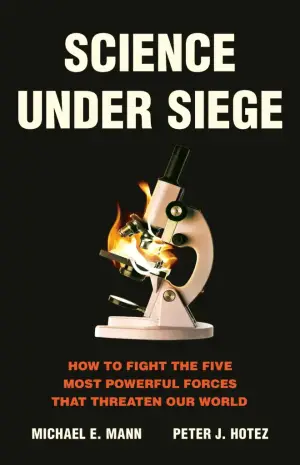 Michael E. Mann whom I've known, at least digitally for a long time, is a climatologist. And both have been subject to a lot of personal attacks. And who knew that science was going to be quite so thrilling and dangerous? Hi guys, welcome to this interview format.
Peter Hotez: Great to be here Paul. I've followed your work for a long, long time, and I'm a great admirer. We first got connected when you educated me on why there was a connection between bitcoin people espousing, advocating for Bitcoin and going up against vaccines. You kind of helped me connect the dots on that which we wound up talking about in the book.
Krugman: That's one of the things I want to talk about because there are some connections, although there's obviously some deep structural aspects to what's going on here.
Michael E. Mann: Same thing here, Paul. I feel like I know we've interacted now for a number of years, but it's great to finally have an opportunity to talk, face to face.
Krugman: I actually have an odd question. When did you decide to write this book?
Mann: Yeah. So, it's ironic, right? Because we had no idea when we decided to write the book that it would be quite as relevant and prescient as it now feels, given everything that's happened over the last year now. This was probably a couple of years ago, and it was initiated by the fact that Peter was experiencing the very same sorts of attacks that I had experienced as a climate scientist decades ago. And so I think we naturally gravitated toward each other. I felt like maybe we climate scientists had something to offer in terms of experience and insight, into how to deal with a sort of coordinated, orchestrated anti-science of the sort that Peter and Tony Fauci and others in the vaccine world were dealing with.
Like I said, we climate scientists were being vilified and attacked decades ago, before it became fashionable
Hotez: I think it was also when there was that big pile on in 2023 from Joe Rogan and Robert F. Kennedy Jr. and Elon Musk, pressuring me to debate Kennedy to kind of elevate his stature. And they dangled $100,000 or something like that and I was saying, “what the heck is going on here?”
As a pediatric vaccine scientist, that's not the kind of thing you expect. It was Michael who really helped me connect the dots and say, “hey, this is what you're going through, Peter. And welcome to the club.” You’ve been attacked now for a number of years. “This is what, as climate scientists, we've been dealing with now for at least a decade prior to that, and here's some of the places where it's coming from.” And in time, we compared notes and noticed that if you think of the attacks on climate science and the attacks on vaccines and biomedical science as two circles of the Venn diagram, they don't completely overlap. But there's a lot of overlap. And the more we talked, the more we realized in many cases, they were coming from the same sources. And that's when we decided to do this.
 Michael E. Mann, left, is presidential distinguished professor in the Department of Earth and Environmental Science at the University ofPennsylvania. He is director of the Penn Center for Science, Sustainability, and the Media. He contributed to the award of the 2007 Nobel Peace Prize and was elected to the US National Academy of Sciences in 2020. He lives in
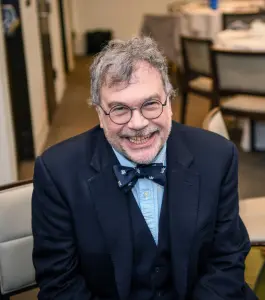 Philadelphia, Pennsylvania.
Peter J. Hotez, right, is dean of the National School of Tropical Medicine and professor of pediatrics and molecular virology andmicrobiology at Baylor College of Medicine, where he is also the codirector of the Texas Children’s Center for Vaccine Development. He is an elected member of the US National Academy of Medicine and, in 2022, was nominated for the Nobel Peace Prize for his work on the COVID-19 vaccine. He Lives in Houston, Texas.
New York Times, Many Cities Say Yes to Federal Police Help, but No to ‘Occupation,’ Shaila Dewan and Nicholas Bogel-Burroughs, Sept. 6, 2025. Some mayors and police chiefs said they would welcome more traditional law enforcement cooperation with federal agents, but see the National Guard as a step too far.
In the summer of 2020, President Trump sent federal agents to Kansas City, Mo., as he blamed liberal mayors for a “shocking explosion” of “bloodshed.”
Mayor Quinton Lucas, a Democrat, bristled at the suggestion that local officials were to blame for his city’s spike in crime. And with distrust of law enforcement at a high after the police killing of George Floyd in Minneapolis that year, he worried about how federal law enforcement officers would conduct themselves on the ground.
Yet over the next few months, Mayor Lucas came to endorse parts of the federal mission, named Operation Legend after a 4-year-old Kansas City boy who had been killed by a wayward bullet as he slept.
Working with the local police, federal agents helped track down people with open felony warrants, recovered illegal guns and charged some suspects with federal crimes that can carry stiffer penalties than those available under state law. Now, as Mr. Trump renews his promise to tackle crime in American cities, Mayor Lucas says he could imagine welcoming the help — if it came with a clear strategy.
“I’d say yes in an instant,” he said, if federal agents were sent to help keep guns out of the hands of domestic abusers and teenagers, or to trace bullets used in shootings. “I’d go to the White House and have a press conference with them tomorrow.”
In interviews, many mayors and police chiefs around the country said they were put off by Mr. Trump’s recent effort to “take back” Washington, D.C., by deploying the National Guard, and they expressed concerns about the wisdom and legality of using the military to conduct domestic law enforcement.
But those same leaders said they would welcome more of the aid that federal agents routinely provide at the local level in the fight against crime — tracing guns, conducting surveillance, capturing fugitives and serving on task forces with local agencies to root out terrorism, human trafficking and drug rings.
There might even be a place for the National Guard if commanders are willing to collaborate with local law enforcement, said Chief Harold Medina of the Albuquerque Police Department. In March, Chief Medina sent a message to New Mexico’s governor, Michelle Lujan Grisham, requesting such help. He said the city was bedeviled by gun violence, fentanyl and a shortage of police officers.
As a result, about 90 Guard soldiers have been detailed to Albuquerque to watch security cameras, operate drones, help keep the public away from SWAT operations and deliver arrest paperwork to prosecutors on time. Their work has freed up local officers to spend thousands more hours on investigations, arrests and patrols.
“Best request I ever made,” Chief Medina said.
But, he cautioned, that Guard deployment was carefully plotted in advance, down to what the troops would wear (polo shirts) and how they would be armed (with pepper spray). The soldiers also received six weeks of training on topics such as de-escalation and crisis intervention.
“I’ve been able to direct what we need help with, and I think that’s the key,” he said. “You have to respect the chief.”
New York Times, What Has the Trump Administration Gotten From Law Firms and Universities? Ashley Wu, Sept. 5, 2025. President Trump has used the full force of the federal government to push for transactional agreements.
Harvard University claimed a victory in its legal case against the Trump administration on Wednesday, when a federal judge ruled that the government broke the law by freezing billions of dollars in research funding. The ruling, which the administration has pledged to appeal, potentially gave Harvard new leverage in its battle toward a settlement to restore funding, in exchange for payments demanded by President Trump.
About a dozen other universities and major law firms have struck deals with the government in recent months — instead of taking cases to court — to unfreeze funding or avoid restrictive executive orders.
Mr. Trump has used the full force of the federal government — opening civil rights investigations, freezing federal funding and threatening to cancel government contracts — to push for these agreements. These deals have reverberated across the legal industry and academia, and they could shape how other institutions respond to Mr. Trump’s methods.
Most of the deals involve paying millions of dollars, either in cash or legal services, to the administration. But the deals also include other concessions, like commitments to redefine discrimination, acquiesce to more government oversight and assess ideology.
Below, we break down what these deals have in common.1. Money or legal services
Much of the focus around these deals has been around the money that Mr. Trump has demanded from each entity, payable either to his administration, or to state or compensation funds.
The universities have taken varied approaches to their payments. Columbia agreed to pay a fine to the federal government. Brown’s payment will go to Rhode Island work force development programs, which the university’s president has said are aligned with their service and community engagement missions.
Critics have likened Mr. Trump’s methods of extracting money from these entities to extortion.
The law firms have faced internal backlash and external criticism for promising to pour resources into causes favored by the president. Shortly after the deals with them were signed, Mr. Trump publicly suggested that he might use their labor to achieve more of his own goals, including in the negotiations of trade deals or even representing him personally.
Other businesses, including Nvidia and Intel, have been drawn into making financial deals with the Trump administration in order to continue doing business or to sell their products to China. The specific details of most of those deals have not been made public.2. Redefining discrimination
On his first day in office, Mr. Trump signed executive orders gutting racial equity policies and protections for transgender people. Those themes, along with addressing antisemitism and targeting international students, were evident in many of these agreements.
No “unlawful D.E.I. goals”: Columbia and Brown agreed to eliminate programs that aim to achieve diversity goals. (Both universities had already eliminated race-conscious affirmative action following a June 2023 Supreme Court decision outlawing it.) They promised to rely more on quantitative measures, instead of demographics, in their admissions practices.
For most of the universities, the administration restored hundreds of millions of dollars in federal funding that it had previously frozen. It also closed pending investigations into the schools of antisemitism or alleged violations of civil rights. Both the presidents of Columbia and Brown have publicly stated that these deals preserve the schools’ academic freedom.
Like Harvard, four major law firms have fought back against the president instead of striking a deal. Perkins Coie, WilmerHale, Susman Godfrey, and Jenner & Block all filed lawsuits, which resulted in federal judges temporarily blocking Mr. Trump’s executive orders targeting them. The administration has recently begun to appeal these rulings.
Several other law firms have been questioned by the U.S. Equal Employment Opportunity Commission on their hiring practices and potential discrimination against white candidates, raising concerns of threats from the White House.
New York Times, Will Trump Have to Run From the Economy? Jess Bidgood, Sept. 6, 2025 (print. ed.). It’s the issue voters cared most about in 2024, and there are signs of trouble.
Last year, Donald Trump couldn’t stop talking about the economy.
As a presidential candidate, he assailed Democrats for inflation and rode the persistent malaise over the high cost of living right back to the White House, promising swift relief even though economists warned that his plans could actually drive prices higher.
Today’s lackluster jobs numbers are a reminder of how quickly the issue could present him, and his party, with political peril as elections approach.
The economy added only 22,000 jobs in August, which, my colleague Lydia DePillis explained, is a sign that the labor market appears to be stalling. Looking backward, the news is even worse: A revision to June’s figures shows the labor market actually lost 13,000 jobs that month, making it the first negative number since December 2020.
There are other signs of trouble. A key measure of underlying inflation rose over the summer as Trump’s tariffs put pressure on prices, driving up the costs of things like furniture, appliances and clothing. Manufacturing activity has been shrinking for six months.
It’s not clear right now just what will happen to the economy between now and next year’s midterm elections. (And today’s news might deliver an upside for Trump: The darkening labor market could mean that he gets his long-sought cut to the interest rate, as my colleague Colby Smith pointed out today.)
But what is clear, right now at least, is that the president has a problem.
A recent Gallup poll found that his approval rating on the economy fell to 37 percent in August, from 42 percent in February. That’s a steep drop from his average approval rating on the economy during his first term, which was 52 percent.
When you dig into specific issues, it doesn’t look any better. A poll late last month by The Economist and YouGov found inflation to be the top ranked issue for voters — and just 34 percent of them approved of his handling of the issue, according to the poll.
And then there’s the vibe — the feeling of malaise that weighed down President Biden and Vice President Kamala Harris last fall. Last month, 63 percent of Americans thought the economy is getting worse, Gallup found — one point higher than the 62 percent who believed that in October 2024, right before the election.
Democrats are seizing the moment as an inflection point, eager to hammer home to voters what Trump has done to make the economy his own as they attempt to wrest control of Congress from Republicans next year. Trump passed expansive tax cuts into law and implemented steep tariffs that have driven up prices of everyday goods and raw materials. He is also trying to exert more control over the historically independent Federal Reserve.
“The American people are feeling the impact of the Trump administration’s dangerous one-man command policies in community after community,” Representative Hakeem Jeffries of New York, the House minority leader, said in a statement on Friday. He added that Trump and Republicans had promised to lower the cost of living, but failed.
Democrats have been struggling to unify around how to hit back at Trump, but many have taken a key lesson from their walloping loss in the 2024 elections. They believe a laser focus on the economy can help them win in tough races next year. Voters rated the economy as their top issue in every one of The New York Times and Siena College’s pre-election polls last year, and exit polls showed that Trump outperformed Harris among those who believed the economy was in poor shape.
New York Times, Grand Juries in D.C. Reject Wave of Charges Under Trump’s Crackdown, Alan Feuer, Sept. 6, 2025. The persistent rejections suggest that the grand jurors may have had enough of prosecutors seeking harsh charges in a highly politicized environment.
In the three weeks since President Trump flooded the streets of Washington with hundreds of troops and federal agents, there have been only a few scattered protests and scarcely a word from Congress, which has quietly gone along with the deployment.
But one show of resistance has come from an extraordinary source: federal grand jurors.
In what could be read as a citizens’ revolt, ordinary people serving on grand juries have repeatedly refused in recent days to indict their fellow residents who became entangled in either the president’s immigration crackdown or his more recent show of force. It has happened in at least seven cases — including three times for the same defendant.
Given the secretive nature of grand juries, it is all but impossible to know precisely why this has been happening, but the persistent rejections suggest that grand jurors may have had enough of prosecutors seeking harsh charges in a highly politicized environment.
Courthouse wits have long quoted Judge Sol Wachtler, the former New York jurist who said that prosecutors are in such complete control of grand juries that they could get them to indict a ham sandwich. But that old saw did not hold true in the rebellion in Federal District Court in Washington, where grand jurors seem to have taken a stand in defense of their community.
“First of all, it is exceedingly rare for any grand jury to reject a proposed indictment because ordinarily prosecutors use discretion in only bringing cases that are strong and advance the interests of justice,” said Barbara L. McQuade, a former U.S. attorney in Detroit who teaches at the University of Michigan Law School. “I have seen this maybe once or twice in my career of 20 years, but this is something different.”
“My guess,” Ms. McQuade went on, “is that these grand jurors are seeing prosecutorial overreach and they don’t want to be part of it.”
While crime has fallen in Washington since National Guard troops and federal agents started to police the streets in large numbers in mid-August, the deployment has chafed many local residents, who have found their presence to be a source of anxiety, not security. And because of the deployment, a flurry of defendants have been charged with federal felonies in cases that would typically have been handled at the local court level, if they were brought at all.
Many of these cases have recently been downgraded or dismissed altogether after failing in grand juries, a tacit acknowledgment by the U.S. attorney’s office in Washington that they were overcharged to begin with. The most prominent example is the case of Sean C. Dunn, a former Justice Department paralegal who was charged with felony assault after he threw a sub-style salami sandwich at a federal agent on patrol near the corner of 14th and U Streets. His charges were knocked down to a misdemeanor last week after prosecutors were unable to indict him.While Mr. Dunn’s case has become a cause célèbre, inspiring Banksy-style images of figures hurling hoagies on walls across the city, other cases have also crashed and burned, without as much publicity.Hours later, Ms. Pirro fired back, assailing Judge Faruqui on social media in a way that all but ensured the tension would continue.
“This judge took an oath to follow the law, yet he has allowed his politics to consistently cloud his judgment and his requirement to follow the law,” she wrote. “America voted for safe communities, law and order, and this judge is the antithesis of that.”
New York Times, Second Weak Jobs Report Undercuts Trump’s Claims of a Booming Economy, Tony Romm and Ben Casselman, Sept. 6, 2025 (print ed.). After a bad employment report in August, President Trump fired the official in charge of the numbers. This month’s data was just as disappointing.
When the federal government last month reported a sharp decline in the nation’s hiring, President Trump dismissed the numbers, claiming without evidence that they were “rigged,” and then ousted the official responsible for producing them.
The release of a second consecutive poor jobs report on Friday confirmed the reality that Mr. Trump has been trying to avoid. The labor market is stalling — and the nation is facing real strains — under the weight of his economic agenda.
Eight months into his second term, the sum of Mr. Trump’s high tariffs and mass deportations appear to have created noticeable pressure on employers. The economy added only 22,000 jobs in August, according to the latest readout from the Bureau of Labor Statistics. The unemployment rate rose slightly, to 4.3 percent, a nearly four-year high. And the revised data showed that employment fell by 13,000 in June, the first net loss of jobs since the end of 2020, when the pandemic was raging.
Analysts offered a variety of explanations for the slowdown. The president’s tariffs on nearly all imports have driven up costs for companies and prices for consumers. Mr. Trump’s immigration crackdown has made it harder for many businesses to find workers, while simultaneously reducing the need for them because they now have fewer customers. The federal government has cut jobs directly and canceled grants and contracts that have bled into the private sector. The uncertainty surrounding Mr. Trump’s ever-shifting policies has made corporate executives more cautious about hiring and investing
But those explanations all ultimately boiled down to one key factor. Mr. Trump, who regained control of the White House on promises of faster growth and lower prices, has established policies that are having precisely the opposite effect. Inflation data, due next week, is expected to show that consumer prices rose more quickly in August as companies increasingly pass along the cost of higher tariffs.
Global News
New York Times, News Analysis: How Trump’s Blunt-Force Diplomacy Is Pushing His Rivals Together, Luke Broadwater and David E. Sanger, Sept. 6, 2025 (print ed.). Some of President Trump’s pressure tactics appear to have backfired, sending would-be allies into the embrace of China.
“Looks like we’ve lost India and Russia to deepest, darkest, China,” Mr. Trump wrote on Truth Social on Friday morning, as he posted a photo of the three nations’ leaders meeting in China.Credit...Haiyun Jiang/The New York Times
At the Capitol in January, India’s foreign minister was seated in the front row for President Trump’s inauguration, a sign of the deepening ties that a generation of American presidents have attempted to forge with the world’s most populous nation.
Now, just months later, Mr. Trump is publicly lamenting that India has abandoned him for the embrace of China, Washington’s strategic rival.
“Looks like we’ve lost India and Russia to deepest, darkest, China,” Mr. Trump wrote on Truth Social on Friday morning, as he posted a photo of Prime Minister Narendra Modi of India and President Vladimir V. Putin of Russia with China’s leader, Xi Jinping. The three leaders met in China earlier this week.
“May they have a long and prosperous future together!” he wrote.
It was a rare acknowledgment that Mr. Trump’s attempts at blunt-force diplomacy, not to mention punishing tariffs, were having some unintended consequences. The uneasy partnership to create an alternative to the West’s global leadership that began with China and Russia, then expanded to North Korea and Iran, may now be about to incorporate — at least episodically — India, the world’s largest democracy.
It is too early to predict whether Mr. Modi’s visit to China, the first in seven years, marks a real shift or just a warning shot to Washington. During the Cold War, India led the nonaligned movement, and it is skilled at playing superpowers off against each other. This may be one of those moments.
Later on Friday, Mr. Trump tried to downplay his rift with India.
“I’ll always be friends with Modi. He’s great,” Mr. Trump told reporters in the Oval Office. “I just don’t like what he’s doing at this particular moment. But India and the United States have a special relationship. There’s nothing to worry about. We just have moments on occasion.”
Devashish Mitra, a professor of economics at Syracuse University, said that Mr. Trump’s oscillating statements about India underscore the country’s concerns about its relationship with the United States.
“Right now, India feels that the U.S. is not a very reliable partner,” Mr. Mitra said. “They thought the U.S. was an ally. If India is moving towards China, it’s a friendship of convenience.”
White House Chronicle, Global Commentary: How the Special Relationship Became the Odd Couple, Llewellyn King, above, Sept. 6, 2025. Through two world wars, it has been the special relationship: the linkage between the United States and Britain. It is a linkage forged in a common language, a common culture, a common history and a common aspiration to peace and prosperity.
The relationship, always strong, was burnished by President Ronald Reagan and Prime Minister Margaret Thatcher.
Now it looks as though the special relationship has morphed into the odd couple.
Britain, it can be argued, went off the rails in 2016 when, by a narrow majority, it voted to pull out of the European Union.
With a negative growth rate, and few prospects of an economic spurt, Britons can now ponder the high price of chauvinism and the vague comfort of untrammeled sovereignty. Americans could ponder that, too, in the decades ahead.
Will tariffs — which have already driven China, Russia and India into a kind of who-needs-America bloc — be the United States' equivalent of Brexit? This economic idea doesn't work but has emotional appeal; it is isolating, confining and antagonizing.
A common thread in the national dialogues is immigration.
Britain is swamped. It is dealing with an invasion of migrants that has changed and continues to change the country.
In 2023, according to the U.K. Office for National Statistics, 1.326 million migrants moved to Britain; last year, the number was 948,000. There has been a steady flow of migrants over the past 50 years, but it has increased dramatically due to wars around the globe.
Among European countries, Britain, to its cost, has had the best record for assimilating new arrivals. It is a migrant heaven, but that is changing with immigrants being blamed for a rash of domestic problems, from housing shortages to vastly increased crime.
In the 1960s, Britain had very little violent crime and street crime was slight. Now crime of all kinds — especially using knives — is rampant, and British cities rival those across America — although crime seems to be declining in America, while it is rising in Britain.
Britain has a would-be Donald Trump: Nigel Farage, leader of the Reform U.K. party, which is immigrant-hostile and seeks to return Britain to the country it was before migrants started crossing the English Channel, often in small boats.
Farage has been feted by conservatives in Congress, where he has been railing against the draconian British hate-speech laws, which he sees as woke in overdrive.
Britain has been averaging 30 arrests a day for hate speech and related hate crimes, few of which result in convictions.
Two recent events highlight the severity of these laws. Lucy Connolly, the 42-year-old wife of a conservative local politician, took issue with the practice of housing immigrants in hotels; she said the hotels should be burned down. Connolly was sentenced to 31 months in jail. She has been released, after serving 40% of her sentence.
A very successful Irish comedy writer for British television, Graham Linehan, posted attacks on transgender women on X. On Sept. 1, after a flight from Arizona, he was met by five armed police officers and arrested at London's Heathrow Airport.
Britain's hate laws, which are among the most severe in the world, run counter to a long tradition of free speech, dating back to the Magna Carta in 1215. An attempt to get more social justice has resulted in less justice and abridged the right to speak out. It's a crisis in a country without a formal constitution.
On Sept. 17, Trump is due to begin a state visit to Britain. Fireworks are expected. Trump's British supporters, despite Farage and his hard-right party, are still few and public antipathy is strong.
Trump, for his part, will seek to make his visit a kind of triumphal event, gilded with overnight posts on Truth Social on how Britain should emulate him.
The British press will be ready with vituperative rebukes; hate speech be damned.
It is unlikely that the Labor government, whose membership isas diverse and divided as that of the Democratic Party, will find anything to call hate speech about attacks on Trump. A good dust-up will be enjoyed by all.
Isolated, the odd couple have each other.
Newsweek, Major US Brands Sound Alarm Over Rising Anti-American Sentiment, Hugh Cameron, Sept. 6, 2025. A number of companies, including many of the country's most quintessentially American brands, have warned that growing anti-Americanism as a result of President Donald Trump's tariffs could end up hurting their success overseas.
Experts believe that the trend, if it translates into a broad-based shift in consumer behavior, could prove to be a significant headwind for the companies while taking a significant toll on the broader U.S. economy.Why It Matters
Anti-Americanism has been on the rise globally, driven largely by the trade policies of the current administration that impacted countries' views as a critical threat to their exports and international trade more generally.
Calls to boycott the American economy have gained traction in Canada since early this year—also sparked by Trump's "51st state" remarks—and have already impacted tourism to the U.S. and the sale of American products. These have recently spread to India as a result of the 50 percent duties placed on its goods, with lawmakers and activists urging less dependence on American multinationals and a greater emphasis on economic self-sufficiency.McDonald'sA McDonald's flag below an American flag in the Queens borough of New York City on January 30, 2025. Anthony Behar/Sipa via AP ImagesWhat To Know
According to business intelligence firm Morning Consult, Trump's tariff announcements in early April coincided with a "staggering upswing" in global anti-American sentiment, which it said had already resulted in "steep drops in purchasing consideration" for some U.S. companies overseas, "suggesting that worsening views of America are rapidly taking a toll on some brands' health."
In July, ahead of the reimposition of Trump's "reciprocal" tariffs, it said that "anti-Americanism" could pose a significant risk to brands given the combination of potential price impacts and "sharply negative sentiment toward the United States" on consumer shopping habits.
A number of companies have noted this trend. David Gibbs, CEO of KFC and Taco Bell parent Yum Brands, told analysts in late April that the company was closely monitoring the issue and its impact on consumer behavior, but added that there had not been an observable impact on its sales.
However, California-based Beyond Meat, known for its plant-based meat substitutes, said in March that it had concerns over a shift in global consumer behavior as a result of growing opposition to the U.S. In an annual report filed with the Securities and Exchange Commission (SEC), the company listed this as one of the "risk factors" it would be monitoring going forward.Read more Securities and Exchange Commission
Recession Probability Surges to 93%: UBS Dollar General Warns of Price Increases Levi's Issues Warning Over 'Rising Anti-Americanism' Trump's Tariffs Driving Up Prices at Nearly Half of Small Businesses—Report
"There is no assurance that we would be able to pass on any cost increases, in full or at all, to our customers, and/or we could lose customers in countries such as Canada due to anti-American sentiment, any of which could materially affect our revenue, gross margin and results of operations," the filing read.
In May, McDonald's similarly noted an increase in "anti-American sentiment" but said that there had been no change in global perceptions of the company's brand or its sales as a result.
"What we have seen in our survey work is that there has been an increase in people in various markets saying that they are going to be cutting back their purchase of American brands," CEO Chris Kempczinski said. "And we've seen an uptick in anti-American sentiment—call it 8- to 10-point increase in anti-American sentiment—most pronounced in Northern Europe and Canada."
This week, Kempczinski again warned that global consumers appear to be increasingly avoiding American brands as a result of negative perceptions of the country."The aura around America has dimmed a bit," he told CNBC, adding that the company would be leaning more into its local appeal—"our locality"—rather than its "Americanness."
Brown-Forman, the parent company of Jack Daniel's, recently reported a 62 percent year-over-year decline in Canadian sales in its first quarter. During a subsequent earnings call, executives blamed it on the trade dispute between Canada and the U.S., as well as the ongoing moratorium on American spirit sales across several Canadian provinces.
In a regulatory filing last week, denim brand Levi's listed "rising anti-Americanism as a consequence of the Trump tariffs and governmental policies" among the risks it was facing this year. The company added that this could result in consumers "possibly shifting away from U.S. products and brands."
Jill Klein, a professor of marketing at Melbourne Business School, told Newsweek that her research into "international animosity" and its effects on consumer behavior suggests that the growing tide of anti-American sentiment is "likely to have a substantial impact on U.S. companies."
Usha Haley, W. Frank Barton distinguished chair in international business at Wichita State University, said that the risk was highest in "identity categories."
"Brands that signal Americanness such as jeans, whiskey and tech are most exposed to substitution toward local and European options when anti-U.S. sentiment spikes," she said.What People Are Saying
Alan Bradshaw, professor of marketing at Royal Holloway, University of London, told Newsweek: "Perhaps one thing that we can expect is that those brands who have heavily leveraged their American identity—think Hershey's, Coca-Cola, Levi's, Hummer, Budweiser, Nike—are now particularly exposed and we may start to see these brands move towards a different type of imagery. However, these are huge brands with well established 'Customer Based Brand Equity.' This means that they have invested huge amounts in building brand iconicity based on Americana over the decades and changing course would be very costly and not necessarily a good idea."
Sept. 5
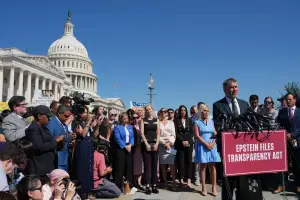
U.S. Rep. Tom Massie, a Kentucky Republican surrounding by victims of sex trafficking and journalists during a news conference at the U.S. Capitol on Sept. 3, 2025, calls for Trump Administration to release of information exposing Jeffrey Epstein, Ghislaine Maxwell and others in their massive sex trafficking ring abusing young women (New York Times photo by Eric Lee)
The Contrarian, Opinion: Undaunted Survivors of Epstein-Maxwell Spoke Out, Jennifer Rubin, right, Sept. 5, 2025. A whole new level of bravery.
Many Americans this week showed they will not succumb to the screeching siren call of authoritarianism. Hedge fund founder Ray Dalio, unlike the vast majority of the sniveling billionaires, warned that Donald Trump is endangering democracy. “What is happening now politically and socially is analogous to what happened around the world in the 1930-40 period,” he said. Dalio also predicted that the firing of Fed governor Lisa Cook “would undermine the confidence in the Fed defending the value of money, and make holding dollar-denominated debt assets less attractive, which would weaken the monetary order as we know it.”
Meanwhile, U.S. District Judge Charles Breyer of the Northern District of California issued a scholarly, blistering 52-page opinion holding that Trump, intent on “creating a national police force with the President as its chief” violated the posse comitatus prohibition on using troops for civilian law enforcement. And in an equally spicy opinion, U.S. District Judge Allison D. Burroughs from Boston held that Trump’s extortion of Harvard was unconstitutional.
That ruling strengthened the hand of Illinois Gov. JB Pritzker, invariably effective and pugnacious, in denouncing Trump’s plans to do the same in Chicago. “There is no emergency that warrants deployment of troops. He is insulting the people of Chicago by calling our home a hellhole, and anyone who takes his word at face value is insulting Chicagoans, too,” Pritzker said at a Tuesday press conference. (He may have been so effective as to convince Trump to send troops to Louisiana instead.)
We should also give a shout out to the D.C. grand juries that have refused federal prosecutors’ requests for indictments in incidents stemming from the D.C. occupation. A single refusal is rare; multiple rebukes are a shocking retort to prosecutorial abuse and overreach in a process in which indictments are practically automatic. “A prosecutor could indict a ham sandwich.” the saying goes. (But in D.C., not the sandwich-thrower.) We are grateful for jurors’ common sense and devotion to justice.Subscribed
None of these people, however daring, candid, or essential, came near matching the courage and moral clarity displayed on Wednesday by a group of survivors of Jeffrey Epstein and Ghislaine Maxwell’s ring of child rape. They gathered as a show of solidarity and force at the Capitol, then spoke for a one-hour press conference with Reps. Thomas Massie (R-Ky.), Marjorie Tayor-Greene (R-Ga.), and Ro Khanna (D-Cal.)
No matter how Donald Trump whined that this was all a “Democratic hoax,” he could not drown out their voices. The Washington Post reported:
Some survivors [of an estimated 1,000 Epstein-Maxwell victims] spoke for the first time about their devastating ordeal and the failure to obtain a full accounting of those responsible. They expressed pain, rage, and incredulity that Trump refuses to release all files regarding the Epstein-Maxwell criminal enterprise. And the hundreds in the audience “came from as far as Maine and gathered on a grassy spot in view of the U.S. Capitol on Wednesday morning to support survivors of the sex-trafficking operation run by Jeffrey Epstein and Ghislaine Maxwell.”
Denouncing the cushy treatment Maxwell has received since speaking with Todd Blanche, the survivors vehemently rejected the insulting suggestion that anyone should take Maxwell’s self-serving comments seriously. “Nobody should be listening to her. She’s a perpetrator,” said one of the organizers. “I want them to listen to the survivors’ side of the story.” One woman, Teresa Helm, expressed her anger at Maxwell’s transfer to a “prison spa” and the “repulsive,” soft-ball interview she gave to deputy attorney general Blanche.
The members of Congress supporting them clarified that the first release of (redacted) material on Tuesday had been a sham, as few—if any—documents hadn’t already been made public. Khanna said only 1% of the available documents have been released.
The scores of men who participated in, witnessed, and/or enabled these horrific acts continue to escape accountability. As one survivor put it,
“The files contain the names of powerful men who have been shielded because of their fame or fortune. Congress—will you continue to protect predators or survivors? Release the files!”
Only four Republicans have so far joined in the discharge petition to release all the Epstein files, confirming that all others would rather protect the “powerful” predators (just as panicky Trump demands). As Massie summed up: “[T]he perpetrators are being protected."
We bestow words like “courage” on public figures who do nothing more than speak truthfully and support democracy, the bare minimum required of all Americans. That is not to diminish the risk of retribution they take financially, legally, and professionally in the Trump era by refusing to keep their heads down, as so many spineless politicians, business executives, law firms, and institutions have chosen to do.
However, the survivors who decided to speak publicly about a life-scarring trauma—to elevate the one issue that has rocked Trump and his MAGA cultists to their core, to condemn Trump and his stooges for continuing the cover-up, and to denounce a criminal justice system that enables the rich and powerful who exploit vulnerable children to remain anonymous—displayed an entirely different level of bravery and self-sacrifice. These undaunted survivors have demonstrated dignity and tenacity over decades. They remain heroic. The least the rest of us can do is banish from public life those who perpetuate the conspiracy of silence and enable Trump’s cover-up.
New York Times, South Koreans Are Swept Up in Immigration Raid at Hyundai Plant in Georgia, John Yoon, Jenny Gross,Aimee Ortiz and Ashley Ahn,.Sept. 5, 2025. They were among nearly 500 workers apprehended at a construction site for a South Korean battery maker, officials said. The episode prompted diplomatic concern in Seoul.
Immigration authorities arrested hundreds of workers for a major South Korean battery maker at a Hyundai plant in Georgia, U.S. officials said on Friday, calling it the largest-ever Homeland Security enforcement operation at a single location.
Agents on Thursday arrested 475 people, most of whom are South Korean citizens, at a construction site for an electric vehicle battery plant in Ellabell, Ga., near Savannah, Steven Schrank, a special agent in charge of Homeland Security Investigations for Georgia, said at a news conference.
The raid was the culmination of an investigation that took place over several months, he said.
Mr. Schrank said that the workers arrested were in the United States illegally or were working unlawfully. No criminal charges would be announced on Friday, he said, adding that investigators were still determining employment details for those arrested, some of whom

New York Times, Investigation: How a Top Secret SEAL Team 6 Mission Into North Korea Fell Apart, Dave Philipps and Matthew Cole, Sept. 5, 2025. The 2019 operation, greenlit by President Trump, sought a strategic edge. It left unarmed North Koreans dead. (Continued below.)
Letters from an American, Historical Commentary: Sept.4, 2025 [Senators Attack Trump Health Care Policies], Heather Cox Richardson, right, Sept. 5, 2025. Senators challenged the decisions of Health and Human Services Secretary Robert F Kennedy Jr. as he testified before the Senate Finance Committee for about three hours today.
Kennedy has slashed through thousands of advisors and staffers at the Centers for Disease Control and Prevention (CDC) who do not share his animosity toward vaccines and has canceled $500 million in research funding for mRNA vaccine research. Last week he fired the newly confirmed director of the CDC, Susan Monarez, when she refused to preapprove the recommendations of a vaccine advisory panel Kennedy had stacked with anti-vaccine advocates.
Because of Kennedy’s history of repeating debunked lies and breaking promises he made to the Senate, Senator Ron Wyden (D-OR), the highest ranking Democrat on the Finance Committee, asked that the committee swear Kennedy in before he began his testimony. Committee chair Mike Crapo (R-ID) declined. Wyden said: “This committee’s unwillingness to swear this witness is basically a message that it is acceptable to lie to the Senate Finance Committee about hugely important questions like vaccines.”
During his testimony, Kennedy, left, insisted his purges are designed to restore faith in the CDC after it “failed miserably” during the coronavirus pandemic. He called the CDC “the most corrupt agency at HHS, and maybe the government.” He denied the official tally that more than 1.2 million Americans have died from covid-19, and denied that new government guidelines for the covid vaccine mean that people cannot get them. He was combative and seemed angry that he was being questioned. He repeatedly suggested Democratic senators were lying when they quoted facts or data that didn’t fit his narrative.
Republican senator Bill Cassidy of Louisiana, a doctor who was instrumental in securing Kennedy’s confirmation, noted that pharmacies might not offer covid vaccines after Kennedy said the shots are no longer recommended for healthy adults under 65 or for children. Cassidy said “Effectively, we’re denying people vaccines.” Kennedy retorted: “You’re wrong.”
On Monday, nine former directors of the CDC wrote an op-ed in the New York Times warning that Kennedy is “endangering every American’s health,” and yesterday more than 1,000 current and former employees of the Department of Health and Human Services wrote a public letter saying that Kennedy is endangering the health of the nation by spreading inaccurate information. They called for Kennedy to resign or be fired.
Former CDC director Monarez, right, published an op-ed in the Wall Street Journal today warning that Kennedy and his anti-vaccine colleagues “use a familiar playbook: discredit research, weaken advisory committees, and use manipulated outcomes to unravel protections that generations of families have relied on to keep deadly diseases at bay. Once trusted experts are removed and advisory bodies are stacked, the results are predetermined. That isn’t reform. It is sabotage.”
Egged on by President Donald J. Trump in summer 2020, people involved in the MAGA movement zeroed in on government attempts to combat the coronavirus pandemic as an assault on their freedom. Now Kennedy and adherents of the Make America Healthy Again (MAHA) branch of MAGA are attacking vaccines in general as a government assault on freedom.
In a letter issued to the states today, the Department of Health and Human Services reiterated that states “must respect state religious and conscience exemptions from vaccine mandates.” It reiterated Kennedy’s position that American freedom dictates the removal of the government’s power to require Americans to get vaccines. “States have the authority to balance public health goals with individual freedom,” the letter quotes Kennedy as saying. “Protecting both public health and personal liberty is how we restore faith in our institutions and Make America Healthy Again.”
Yesterday, Florida became the first state to move to eliminate all vaccine requirements for public school students. If the state legislature agrees, the move would end Florida’s previously required vaccinations for polio, tetanus, chicken pox, hepatitis B, and measles, mumps, and rubella (MMR). No state mandates the covid vaccine.
Florida Surgeon General Dr. Joseph Ladapo said that every government vaccine mandate “is wrong and drips with disdain and slavery.” He added: “People have a right to make their own decisions, informed decisions. What you put into your body is because of your relationship with your body and your god. I don’t have that right. Government does not have that right.” After Florida’s announcement, CNN’s Aaron Blake noted, top Trump health advisor Mehmet Oz appeared to agree with it, saying on the Fox News Channel: “I would definitely not have mandates for vaccinations.”
For decades, the Republican Party has called for the dismantling of government regulations with the argument that such regulations were destroying American freedom. As Ronald Reagan put it in 1964 in his speech supporting Barry Goldwater for president, on the one hand there was “individual freedom consistent with law and order,” and on the other hand was “the ant heap of totalitarianism.”
But the fight over vaccines illustrates the difference between freedom from government overreach and freedom to build a life that is not cramped by preventable obstacles. The CDC estimates that between 1994 and 2003, childhood vaccinations prevented 32 million hospitalizations and 1,129,000 deaths among children, and saved at least $540 billion. Removing those vaccines removes the individual freedom to determine one’s future.
While they might not articulate these two very different forms of freedom, Americans certainly seem aware of them and appear eager to preserve the concept that the government has a role to play in protecting individuals’ freedom to build a life free of preventable obstacles. A KFF poll released today shows that 81% of American parents support public school requirements that students be vaccinated for measles and polio. In Florida, that number is 82%.
Even as Kennedy and Florida reject vaccines as government overreach that restricts freedom, Democratic states are embracing them as protecting Americans’ freedom to live without the threat of illness or death from preventable diseases. Yesterday, California, Oregon, and Washington announced a “West Coast Health Alliance” to coordinate information about vaccines and public health based in science rather than ideology. Nine states in the Northeast are forming a similar “Northeast Public Health Collaboration.”
Today the Department of Justice launched a criminal investigation into Lisa Cook, a governor of the U.S. Federal Reserve, for allegedly committing mortgage fraud by claiming two separate properties as her primary residence. Robert Faturechi, Justin Elliott, and Alex Mierjeski of Pro Publica reported today that three of Trump’s own Cabinet members—Labor Secretary Lori Chavez-DeRemer, Transportation Secretary Sean Duffy, and EPA administrator Lee Zeldin—have all done the same.
A video released today by right-wing activist James O’Keefe—who often edits his material to mislead viewers—showed the Department of Justice’s acting deputy chief of special operations, Joseph Schnitt, saying that Jeffrey Epstein associate and convicted sex trafficker Ghislaine Maxwell was moved to a minimum security prison camp because the government is “offering her something to keep her mouth shut.” He also told an undercover journalist that both that the Epstein files exist and that before their release, the government will “redact every Republican and conservative person in those files and leave all the liberal, Democratic people.”
Tonight the Department of Justice published what appears to be an apology of sorts that confirms the material in the video. In an apparent screenshot of an email, Schnitt says he was talking to a woman he had met on a dating app and that his comments were “my own personal comments on what I’ve learned in the media and not from anything I’ve done or learned via work.”
Even more dramatic a government assault on freedom is the administration’s deployment of troops in Los Angeles and Washington, D.C., and its threat to deploy troops in Chicago and other cities. Now it has gone so far as to assert the government’s power to order the military to kill individuals Trump declares are gang members smuggling drugs, as it did by apparently killing 11 people on what they claimed was a drug boat.
With Trump and his loyalists abandoning the avowed Republican commitment to freedom from government overreach except when it serves their political interests—by attacking vaccines, for example—Americans determined to prevent the dismantling of our modern government are beginning to speak up to defend government protection of our freedom to live without unwarranted outside interference.
Recently, the 18 universities that make up the Big Ten Conference announced they will be running an ad during sporting events that “focuses on how Big Ten universities make America healthier, safer and more prosperous through everything from discovering new medical treatments to developing healthier foods to driving economic growth.”
Pushing back on the Trump administration’s attacks against universities and scientific research, they intend to highlight the importance of their work for the public good.
Lincoln Square Media, Political Opinion: How Is RFK Jr. Bad for Your Health? Let Us Count the Ways, Don Moynihan, ."People will die because of this. ... We’re going to be sicker as a country. ... And for what? I don’t understand."
The Centers for Disease Control shitshow is a microcosm of the mismanagement of the Trump era. It also demonstrated some extraordinary courage among principled public servants, who were willing to lose their jobs to draw attention to damage being done to public health.
What is happening at CDC is not a one-off. I have studied the federal bureaucracy for a quarter century and am not aware of any comparable period in American history where so many public service professionals across different policy domains are sending out SOS signals to the public. If you care about state capacity, the ability of government to get things done, you should be very worried.
If you are skeptic of government bureaucrats and their claims, I invite you to consider whether you would want the medical professionals at CDC or RFK Jr to treat your family if they got sick. Because right now, Trump is empowering RFK Jr to determine of your family’s health.
Let’s walk through it bit by bit.
RFK Jr. Wanted Monarez to Fire Competent Public Health Officials and Lend her Credibility to Bad Policy
The Secretary of Health and Human Services, Robert F. Kennedy Jr., is an anti-vax crank. He should never have been confirmed to any sort of public health position. He lied to the Senate about how he would manage vaccines if confirmed, and most Republican Senators, including physician Dr. Bill Cassidy, chose to believe him and ignore his record.
While much of RFK Jr.’s work at HHS is meaningless photo-ops with food providers promising to remove food dyes here, or add beef tallow there, he has invested real effort in exactly the place his record suggested: targeting vaccines. He has fired all members of the CDC vaccine advisory committee, baselessly accusing them of conflicts-of-interest, and replacing them with fellow vaccine skeptics.
This goes beyond Covid vaccines: childhood vaccines to stop the spread of preventable diseases are now in the crosshairs, even after Kennedy assured Senator Cassidy that they would not be touched. Kennedy has defunded research on mRNA vaccines, ensuring that the world will less ready for the next pandemic. He is encouraging states to weaken vaccine requirements.
On Monday, RFK Jr. told the CDC Director, Susan Monarez, right, in place for just over a month, to accept two conditions if she wanted to keep her job.
First, he wanted her public support for his policies to limit access to vaccines. Monarez is an infectious disease scientist who has served in government for a long time. In effect, RFK Jr. was asking that she lend her personal credibility as a scientist, and the credibility of CDC, to his anti-vax policies. She demurred, saying she needed to talk to senior staff at CDC.
Second, Kennedy ordered her to fire those staff. Since they are career civil servants, it would be illegal to fire them without cause, although this has become the norm now in the Trump administration. For example, career officials at FBI were fired for refusing to fire their fellow civil servants without cause.
Monarez refused both requests.
To be clear, RFK Jr. can implement these vaccine policies without the blessing of Monarez. What he wanted is for public health officials to lie to the public. What he wanted was to purge medical doctors and infectious disease researchers with decades of public health experience if they don’t go along with his woo-woo medical theories.
U.S. Politics, Crime, Courts
New York Times, Justice Dept. Opens Criminal Inquiry Into Lisa Cook, Elevating Trump’s Claims, Glenn Thrush, Devlin Barrett and Tony Romm, Sept. 5, 2025 (print ed.). The move was instigated by Ed Martin, a Trump loyalist who has said it is legitimate for officials to publicly air criminal investigations into people targeted by the president.
The Justice Department has opened a fraud investigation into a Federal Reserve governor, Lisa Cook, left, elevating claims President Trump has promoted in trying to oust her, according to people familiar with the situation.
The move, which centers on whether she falsified a mortgage application, was instigated by Ed Martin, a hyperpartisan Trump loyalist with little prosecutorial experience. He has said that it is legitimate for federal officials to publicly air criminal investigations into people targeted by the president, even if an investigation does not result in a conviction or even an indictment.
It is not clear which U.S. attorney’s offices are involved in the inquiry, but Ms. Cook previously reported in disclosures that she had owned homes in Georgia, Massachusetts and Michigan, according to court records. Federal prosecutors have begun issuing subpoenas, one of the people briefed in the investigation said.
The opening of the investigation, earlier reported by The Wall Street Journal, comes as little surprise. Mr. Martin, who leads the department’s vaguely defined weaponization task force after Senate Republicans scuttled his nomination to be the permanent U.S. attorney in the District of Columbia, signaled his intention to do so as the White House stepped up its attacks on Ms. Cook.
The saga began when Bill Pulte, the director of the Federal Housing Finance Agency, said his office had investigated Ms. Cook and found that she appeared to have falsified bank documents to obtain favorable terms on a mortgage. Mr. Pulte later referred the matter to the Justice Department for a criminal inquiry, before Mr. Trump announced he would fire Ms. Cook from the Fed.
Ms. Cook initially responded in a statement that she would not be “bullied to step down from my position because of some questions raised in a tweet.” But she said she would take “questions about my financial history seriously” and gather the facts. She then sued the administration over its attempted firing, and in a hearing last week, her lawyers depicted her potential ouster as an illegal bid to undermine the traditional independence of the Federal Reserve.
In a statement Thursday, Abbe D. Lowell, the lawyer representing Ms. Cook, said the reports suggested the Trump administration was “scrambling to invent new justifications for its overreach,” describing the Justice Department as “perhaps the most politicized” in American history.
“The questions over how Governor Cook described her properties from time to time, which we have started to address in the pending case and will continue to do so, are not fraud, but it takes nothing for this D.O.J. to undertake a new politicized investigation, and they appear to have just done it again,” Mr. Lowell continued.
Mr. Martin, who has been given few staff but broad latitude to team up with U.S. attorney’s offices around the country, flouted the department’s procedural norms last month by suggesting to the Fed chairman, Jerome Powell, that Ms. Cook step aside.
Ms. Cook’s case “requires further examination” Mr. Martin wrote in a letter to Mr. Powell, suggesting that the department could be pursuing an investigation.
“At this time, I encourage you to remove Ms. Cook from your board,” Mr. Martin wrote. “Do it today before it is too late! After all, no American thinks it is appropriate that she serve during this time with a cloud hanging over her.”
The administration, led by Mr. Pulte, has increasingly scrutinized the mortgage applications of Mr. Trump’s political adversaries to seek retribution against his enemies. The Justice Department, under the leadership of Attorney General Pam Bondi, has acted on referrals from other government agencies by proceeding with mortgage fraud investigations of the New York State attorney general, Letitia James, and Senator Adam B. Schiff, two prominent Democrats who are known as critics of Mr. Trump.
Pro Publica, Trump Administration: Trump Is Accusing Foes With Multiple Mortgages of Fraud. Records Show 3 of His Cabinet Members Have Them, Robert Faturechi, Justin Elliott and Alex Mierjeski, Sept. 4-5, 2025. The White House has targeted opponents, including a Fed governor,  for having more than one primary residence on their loan papers. ProPublica found that, in one case, a Trump cabinet secretary got two such mortgages in quick succession.
The Trump administration has vowed to go after anyone who got lower mortgage rates by claiming more than one primary residence ontheir loan papers.
President Donald Trump has used it as a justification to target political foes, including a governor on the Federal Reserve Board, a Democratic U.S. senator and a state attorney general.
Real estate experts say claiming primary residences on different mortgages at the same time is often legal and rarely prosecuted.
But if administration officials continue the campaign, mortgage records show there’s another place they could look: Trump’s own Cabinet.
Underscoring how common the practice is, ProPublica found that at least three of Trump’s Cabinet members call multiple homes their primary residences on mortgages. We discovered the loans while examining financial disclosure forms, county real estate records and publicly available mortgage data provided by Hunterbrook Media.
Labor Secretary Lori Chavez-DeRemer entered into two primary-residence mortgages in quick succession, including for a second home near a country club in Arizona, where she’s known to vacation. Transportation Secretary Sean Duffy has primary-residence mortgages in New Jersey and Washington, D.C. Lee Zeldin, the Environmental Protection Agency administrator, has one primary-residence mortgage in Long Island and another in Washington, D.C., according to loan records.
In a flurry of interviews and rapid-fire posts on X, Bill Pulte, the Federal Housing Finance Agency director, has led the charge in accusing Trump opponents of mortgage fraud. “If somebody is claiming two primary residences, that is not appropriate, and we will refer it for criminal investigation,” Pulte said last month.
A political donor to the president and heir to a housing company fortune, Pulte’s posts online tease big developments and criminal referrals, drawing reposts from Trump himself and promises of swift consequences. “Fraud will not be tolerated in President Trump’s housing market,” Pulte has warned.
Real estate experts told ProPublica that, in its bid to wrest control of the historically independent Fed and go after political enemies, the Trump administration has mischaracterized mortgage rules. Its justification for launching criminal investigations, they said, could also apply to the Trump Cabinet members.
All three Cabinet members denied wrongdoing. In a statement, a White House spokesperson said: “This is just another hit piece from a left-wing dark money group that constantly attempts to smear President Trump’s incredible Cabinet members. Unlike [Fed Gov.] Lisa ‘Corrupt’ Cook who blatantly and intentionally committed mortgage fraud, Secretary DeRemer, Secretary Duffy, and Administrator Zeldin own multiple residences, and they have followed the law and they are fully compliant with all ethical obligations.”
New York Times, Florida Matriarch Convicted in Murder-for-Hire Plot Against Law Professor, Patricia Mazzei, Sept. 4, 2025 (print ed.). A jury found Donna Adelson guilty of murder in the 2014 death of her former son-in-law, Dan Markel, a Florida law professor. She is the fifth person to be convicted in the high-profile case.
For more than a decade, the killing of a well-known Florida law professor, Dan Markel, has consumed a team of state prosecutors in Tallahassee, who secured four convictions as they peeled back a complicated murder-for-hire plot involving the family of the professor’s ex-wife.
On Thursday, a jury found a fifth person guilty in the 2014 plot: Donna Adelson, Mr. Markel’s mother-in-law and the grandmother of his two sons. She was convicted of first-degree murder, conspiracy to commit murder and solicitation of murder.
Ms. Adelson, 75, sobbed and repeatedly cried out, “Oh my God,” after the verdict was read at the Leon County Courthouse in Tallahassee, prompting Judge Stephen Everett to remove the jury from the courtroom as he warned Ms. Adelson against further outbursts. He offered her a few minutes to get tissues and collect herself. She faces a likely sentence of life in prison.
Mr. Markel, 41, a prominent legal scholar at Florida State University, was shot on July 18, 2014, in the driveway of his home in an upscale Tallahassee neighborhood. He died 14 hours later at a hospital. His murder has been the subject of news articles, television shows and a podcast.
In 2023, a different jury convicted Mrs. Adelson’s son Charles Adelson, a Fort Lauderdale periodontist, of the same charges as his mother after prosecutors showed that he had arranged and paid for Mr. Markel’s murder. Mr. Adelson is serving a sentence of life in prison.
The three other people convicted in the case are Katherine Magbanua, Mr. Adelson’s former girlfriend; Sigfredo Garcia, the father of Ms. Magbanua’s children, and Luis Rivera, a former leader of the North Miami Latin Kings gang.
“For 11 years, we have been forced to a life filled with unimaginable pain and heartbreak,” Ruth Markel told the judge in a victim impact statement after the verdict on Thursday. “We have lost a treasure.”
Science, Education, Media, Religion, Culture

New York Times, President of Northwestern, a School Attacked by the G.O.P., Will Resign, Anemona Hartocollis, Michael S. Schmidt and Tyler Pager, Sept. 5, 2025 (print ed.). The university’s president, Michael Schill, above, said he would step down following months of turbulence, including Trump administration cuts of $790 million from the university’s research funds.
The president of Northwestern University, Michael H. Schill, announced Thursday that he would resign, ending a difficult tenure that included attacks on the school from Republicans in Congress and cuts in funding by the Trump administration that forced the university to lay off hundreds of employees.
 Northwestern became a target of Trump administration officials this year after months of intense scrutiny from Republican lawmakers.
Mr. Schill faced withering questions during a Congressional hearing last year, when Republicans accused the university of not doing enough to address antisemitism during campus protests over the war in Gaza. They have argued that the school was still not aggressive enough in protecting Jewish students from harassment. Jewish groups including the Anti-Defamation League and the Brandeis Center have called for Mr. Schill to resign, faulting him for negotiating with the protesters.
In April, the federal government abruptly froze at least $790 million in federal research funding that had been planned for Northwestern, a Big Ten school with campuses in Evanston, Ill., and downtown Chicago.
The attacks on Northwestern have been part of a broader campaign by Republicans to take American universities to task, claiming that the schools mistreated Jewish students. Mr. Schill’s resignation is the latest in a series of high-profile departures from the leadership of elite institutions that have stemmed, at least in part, from a Republican pressure campaign that started in 2023, in the wake of protests over the war in Gaza.
In a message to Northwestern students, employees and alumni that was issued Thursday, Mr. Schill alluded, but only glancingly, to the troubles of the last two years. “Our community has made significant progress while simultaneously facing extraordinary challenges,” he said. “Together, we have made decisions that strengthened the institution and helped safeguard its future.”
Attacking elite colleges has become central to Mr. Trump’s agenda in his second term. The administration has frozen millions, and even billions, of dollars in federal research funds in order to push schools to adopt its preferred policies. It has broadened the reasons it states for going after schools, and expanded its focus beyond elite private universities to include public institutions like the University of Virginia, whose president, James E. Ryan, resigned earlier this year under pressure from Trump officials.
After the Trump administration froze Northwestern’s funds, the university warned that essential research was “in jeopardy,” and it has spent the last few months trying to cope with a vast loss of funding.
In July, the university said it planned to eliminate about 425 jobs. Close to half of those jobs were vacant, university leaders said, but they nonetheless acknowledged that layoffs were “a drastic step” and “the most painful measure we have had to take.”Editors’ PicksWhich Chile Paste Should I Buy?Dwayne Johnson’s Tearful Reinvention at the Venice Film FestivalMy Secret for Finding Peace in Traffic
Mr. Schill took office three years ago. He is an expert in property, real estate and housing law and policy. After a sabbatical following his resignation as president, he will continue to teach law at Northwestern.
Paul Krugman via Substack, Political-Economy Commentary: Why Does the Right Reject Progress? Paul Krugman, right, Sept. 5, 2025. The perverse push to make America miserable again.
Earlier this week I interviewed Peter Hotez and Michael Mann, authors of a new book, coming out next week, titled “Science under siege.” I’ll be posting that interview Saturday.
Both men are eminent scientists who have played key roles in public policy debates — Hotez over vaccines, Mann over climate change. They wrote their book to fight back against the tide of reaction against science. And this tide of reaction is especially tragic because there is, or should be, a lot of good news right now. In both their fields, reactionaries are trying to strangle technologies that have the potential to make the world a much better place.
As Hotez points out, vaccines in general have done incredible good, and the new mRNA vaccines are a scientific and medical miracle — yet RFK Jr. and his allies are trying to kill both vaccines and thousands, maybe millions of people. Mann, famous for his “hockey stick” chart showing the recent spike in global temperatures, has documented the danger from climate change. Advances in renewable energy, however, have made tackling global emissions far easier than anyone imagined — yet Trump and co. are actively suppressing the adoption of this technological breakthrough.
What I realized after our conversation is that the problem they discuss, of reactionaries who both refuse to accept progress and try to block it, goes well beyond their specific fields, and even science in general. America is now ruled by people who hate progress of all kinds, economic and social as well as scientific. They refuse to acknowledge the progress we’ve made on multiple fronts and are doing their best to reverse it.
Why? I don’t have a full theory, only some scattered thoughts, which I’ll get to at the end. First, though, let me explain the progress I have in mind.
When I talk about progress, my baseline is the early 1990s. Why? At that point the brief euphoria of Morning in America had evaporated. Yes, inflation was down, and the U.S. economy experienced a rapid recovery from the severe double-dip recession of 1979-82. But then we were back to sluggish growth and rising income inequality, plus a pervasive sense that America was being overtaken by other nations.
In 1992 the economist Lester Thurow had a huge bestseller in his book “Head to head: The economic battle among Japan, Europe, and America,” a battle Thurow asserted America was losing. That same year Michael Crichton published “Rising sun,” a novel whose premise was that the future belonged to Japan.
How did that gloom work out? Here’s the percentage growth in real GDP from 1992 to 2024 for Thurow’s three contenders, Japan, the European Union and the United States: A graph of a graph showing the growth of the eu AI-generated content may be incorrect. Donald Trump says that other countries have been cheating and taking advantage of us all these years. If so, they’ve been doing a remarkably bad job of it.
What this chart doesn’t show, but is easy to document, is that much of this U.S. outperformance can be attributed to U.S. success in adopting new technology and raising productivity, establishing a clear lead over other wealthy nations. The rise of China poses a new threat to U.S. dominance, but that’s another story. What’s clear is that the doom-and-gloom narrative of the early 90s was all wrong.
It's also worth mentioning that the victory we won against inflation in the 1980s has proved durable. In my third primer on stagflation I noted that while year-to-year inflation has fluctuated since the 1980s, expected inflation has remained low and stable, largely because people believe that an independent Federal Reserve won’t let inflation get out of control again:
I’m not saying that everything about the U.S. economy has been great. High and rising inequality means that the benefits of growth have been very unevenly shared. Some regions have been left behind as the shift to a knowledge-based economy has left parts of the heartland — and the people who live there — effectively stranded. All in all, we have far more misery than a rich, successful economy should.
Yet the people in charge won’t acknowledge our past successes. By attacking science, education and, yes, immigration — not to mention trying to force us back to obsolete, polluting energy sources like coal — they are doing their best to undermine the pillars of that success. And by attacking the Fed’s independence, they’re also doing their best to bring back stagflation.
Economics isn’t the only area in which America has defied the pessimism that prevailed a few decades ago.
I often make fun of right-wingers who insist that our major cities are all crime-ridden hellscapes (although this delusion has gotten less funny now that the Trump administration is using it as a justification for effectively invading Los Angeles, Washington and soon, reportedly, Chicago.) But 30 or 35 years ago big cities were a lot closer to that dystopian vision than they are now. Jeff Asher recently posted a chart of murder rates through August in several major cities going back to 1960: A graph of different types of data AI-generated content may be incorrect.
Clearly, something went right — very, very right — in America’s big cities. The truth is that we don’t know exactly what went right, but the progress in public safety and, I would say, the general quality of urban life should be undeniable.
You may say, never mind the statistics, cities don’t feel safer. But they do. Try reading descriptions of urban life from the late 1980s or early 1990s — say, Tom Wolfe’s “The Bonfire of the Vanities,” published in 1987, a bit early for my comparison, but close enough. The whole plot centers on how dangerous New York was or was perceived to be. A colleague tells the novel’s protagonist, “If you want to live in New York, you’ve got to insulate, insulate, insulate” — that is, separate yourself from the “trenches of the urban wars.” Well, I’m writing this from an outdoor café in New York, watching the pedestrians go by, and I don’t see people trying desperately to insulate themselves from city life.
Why can’t the right accept progress when it happens, and try to build on it? Some of it is special-interest politics, notably fossil fuel interests trying to stop the rise of alternative energy. But a lot of it, I believe, is visceral. I’ve written before that MAGA types see renewable energy as woke and insufficiently masculine: real men burn stuff.
Relatedly, Trump and MAGA see everything in terms of punishment and fear. They can’t accept the idea that America prospered, not by using its power to dominate other nations, but by making and adhering to international agreements that kept world markets open. They can’t accept the idea that we can manage the economy by leaving monetary policy in the hands of technocrats who don’t take Trump’s orders. They can’t accept the idea that cities can be relatively safe, not because armed men are keeping everyone in line, but because most Americans — whatever their national origin or the color of their skin — are decent people more inclined to get along with their neighbors than to hate them.
America isn’t utopia, by a long shot. But we’ve made a lot of progress. Unfortunately, the people now in charge are determined to ruin as much as they can.
New York Times, Trump Is Exploring Ways to Take Over the Sept. 11 Memorial and Museum, Tyler Pager and Graham Bowley, Sept. 5, 2025 (print ed.). It was unclear exactly how the federal government would take control of the site in Lower Manhattan. As a candidate, Mr. Trump offered a preview of one potential option.
President Trump is exploring ways to take federal control of the 9/11 Memorial & Museum, according to two White House officials, amid criticism from some Sept. 11 victims’ families over the site’s finances and leadership.
The officials, who spoke on the condition of anonymity to discuss private deliberations, said the discussions have been preliminary and exploratory, and it was unclear exactly how the federal government would take control of the site in Lower Manhattan.
But as a candidate last year, Mr. Trump offered a preview of one potential option, pledging to designate the site of the Sept. 11 attacks a national monument. During a rally last September in Uniondale, N.Y., he said he wanted to ensure the “hallowed ground and the memory of those who perished there will be preserved for all time, preserved forever.”
The museum’s leadership rebuffed the idea. “At a time when the federal government is working to cut costs, assuming the full operating expenses for the site makes no sense,” Beth Hillman, the president and chief executive, said in a statement.
Marc La Vorgna, a spokesman for the museum, also questioned the legal basis for such a takeover. “We are certain that there is nothing in existing law that would give the federal government the unilateral ability to take the site over,” he said in a statement.
As part of the discussions inside the Trump administration, officials have assessed options for how they would integrate the museum and memorial into the federal government. The site opened in 2014 and drew 2.4 million visitors last year.
More On U.S. Health Care
Egberto Off The Record, SAY NO TO MEDICARE ADVANTAGE: Disregard Medicare education on TikTok and elsewhere, Egberto Willis, right, Sept. 5, 2025. Here is why you should disregard the TikTok, Instagram, YouTube, and TV ads purporting to educate you on all things Medicare. They will try to coerce you into enrolling in a Medicare Advantage plan.
As Medicare open enrollment approaches, the airwaves, social media platforms, and even seemingly “educational” TikTok videos are saturated with ads pushing seniors toward Medicare Advantage plans. This flood of information appears helpful on the surface, but beneath the polished messaging lies a dangerous campaign driven by profit-hungry corporations seeking to privatize healthcare for America’s most vulnerable populations. Medicare Advantage is not about improving care; it is about enriching insurance companies while stripping patients of the protections and freedoms they deserve.
At its core, Medicare Advantage is a corporate scam disguised as a public benefit. Traditional Medicare was designed to guarantee that older Americans could receive comprehensive healthcare without interference from for-profit entities. Under this system, care decisions rested mainly in the hands of doctors and patients. However, Medicare Advantage replaces this model with one built on pre-authorization, denial of services, and corporate cost-cutting. Studies show that when Medicare Advantage denies care, up to 80% of appeals result in the patient ultimately receiving the care they were initially denied. This means that countless seniors experience unnecessary suffering simply because insurers prioritize their bottom line over human life.
The profit incentives driving Medicare Advantage are staggering. Insurance companies make significantly more money selling these plans than offering traditional Medigap supplemental policies. This has led many insurers to abandon Medigap altogether, forcing seniors into inferior plans that ultimately result in higher out-of-pocket expenses and denied services.
As highlighted by watchdog reports, taxpayer dollars flow directly into the coffers of these corporations through government subsidies for Medicare Advantage, effectively turning public funds into private profit. What makes this exploitation even more egregious is the historical context: decades ago, private insurers fought against covering older Americans because they were considered too costly. Now, thanks to corporate lobbying and government collusion, these same companies are cashing in.
Global, Military News
New York Times, Investigation: How a Top Secret SEAL Team 6 Mission Into North Korea Fell Apart, Dave Philipps and Matthew Cole, Sept. 5, 2025. The 2019 operation, greenlit by President Trump, sought a strategic edge. It left unarmed North Koreans dead. (Continued from above.)
A group of Navy SEALs emerged from the ink-black ocean on a winter night in early 2019 and crept to a rocky shore in North Korea. They were on a top secret mission so complex and consequential that everything had to go exactly right.
The objective was to plant an electronic device that would let the United States intercept the communications of North Korea’s reclusive leader, Kim Jong-un, amid high-level nuclear talks with President Trump.
The mission had the potential to provide the United States with a stream of valuable intelligence. But it meant putting American commandos on North Korean soil — a move that, if detected, not only could sink negotiations but also could lead to a hostage crisis or an escalating conflict with a nuclear-armed foe.
It was so risky that it required the president’s direct approval.
For the operation, the military chose SEAL Team 6’s Red Squadron — the same unit that killed Osama bin Laden. The SEALs rehearsed for months, aware that every move needed to be perfect. But when they reached what they thought was a deserted shore that night, wearing black wet suits and night-vision goggles, the mission swiftly unraveled.
A North Korean boat appeared out of the dark. Flashlights from the bow swept over the water. Fearing that they had been spotted, the SEALs opened fire. Within seconds, everyone on the North Korean boat was dead.
The SEALs retreated into the sea without planting the listening device.
The 2019 operation has never been publicly acknowledged, or even hinted at, by the United States or North Korea. The details remain classified and are being reported here for the first time. The Trump administration did not notify key members of Congress who oversee intelligence operations, before or after the mission. The lack of notification may have violated the law.
The White House declined to comment.
This account is based on interviews with two dozen people, including civilian government officials, members of the first Trump administration and current and former military personnel with knowledge of the mission. All of them spoke on the condition of anonymity because of the mission’s classified status.
Several of those people said they were discussing details about the mission because they were concerned that Special Operations failures are often hidden by government secrecy. If the public and policymakers become aware only of high-profile successes, such as the raid that killed bin Laden in Pakistan, they may underestimate the extreme risks that American forces undertake.
The military operation on North Korean soil, close to American military bases in South Korea and the Pacific region, also risked setting off a broader conflict with a hostile, nuclear-armed and highly militarized adversary.
The New York Times proceeds cautiously when reporting on classified military operations. The Times has withheld some sensitive information on the North Korea mission that could affect future Special Operations and intelligence-gathering missions.
It is unclear how much North Korea was able to discover about the mission. But the SEAL operation is one chapter in a decades-long effort by U.S. administrations to engage North Korea and constrain its nuclear weapons programs. Almost nothing the United States has tried — neither promises of closer relations nor the pressure of sanctions — has worked.

New York Times, Trump to Sign Order Renaming the Defense Department as the Department of War, Erica L. Green, Sept. 5, 2025 (print ed.). The president is turning back the clock to the name the agency held until shortly after World War II.
President Trump will sign an executive order on Friday renaming the Department of Defense (whose Pentagon headquarters is shown above) as the Department of War, the White House said, fulfilling the president’s pledge to realign the mission of the armed forces by reverting to a name used for over 150 years until shortly after World War II.
The measure, which has been expected for some time, underscores Mr. Trump’s efforts to reshape the military to align with his goals of projecting a more aggressive image by showcasing war-fighting capabilities.
As Mr. Trump has sought to show strength, rather than the “wokeness” that he and Secretary of Defense Pete Hegseth claim clouded the military’s morale and mission under former President Biden, he has often referred back to the country’s dominant role in global conflicts and complained that it has not been celebrated enough.
Mr. Trump’s plan to sign the executive order was first reported by Fox News.
Mr. Trump first floated the idea in August in the Oval Office, saying it sounded “like a better name” and that he believed “we’re going to have to go back to that.” He said the name change would be a reminder of the country’s record of military victories under the old name, citing World War I and II.
New York Times, Venezuelan Jets Fly Over U.S. Navy Ship in Show of Force, Eric Schmitt, Sept. 5, 2025 (print ed.). The flyover took place two days after the United States carried out a military strike on a boat in the Caribbean that U.S. officials said was carrying drugs.
Two armed Venezuelan F-16 fighter jets flew over the U.S. Navy guided-missile destroyer Jason Dunham in the southern Caribbean Sea in a show of force on Thursday, a Defense Department official said, in the latest escalation of tensions between the Trump administration and President Nicolás Maduro of Venezuela.
The U.S. warship did not engage, the official said.
In a statement on Thursday night, the Pentagon said: “This highly provocative move was designed to interfere with our counter-narco-terror operations. The cartel running Venezuela is strongly advised not to pursue any further effort to obstruct, deter or interfere with counternarcotics and counterterrorism operations carried out by the U.S. military.”
The flyover, reported earlier by CBS News, took place two days after the United States carried out a deadly military strike on a Venezuelan boat in the Caribbean that U.S. officials said was carrying drugs.
President Trump has said that 11 members of the Tren de Aragua gang were killed in the strike. It was unclear whether they were given a chance to surrender.
The Dunham is part of a small armada of warships and surveillance planes that the Pentagon has been amassing in the region in recent weeks as part of a major counternarcotics operation.
Mr. Trump signed a still-secret directive last month instructing the Pentagon to use military force against some Latin American drug cartels that his administration has labeled “terrorist” organizations.
On Wednesday, Secretary of State Marco Rubio said that seizing drug shipments in recent years had not dissuaded cartels and traffickers. “What will stop them is when you blow them up, when you get rid of them,” he said.
Sept. 4
U.S. Rep. Thomas Massie, Republican of Kentucky, at a news conference with accusers of Jeffrey Epstein. Mr. Massie is among three lawmakers trying to force a vote to demand the release of all of the Epstein files (New York Times photo by Eric Lee).
New York Times, Trump Administration Updates: Epstein Accusers Urge Lawmakers to Unify in Pursuit of Government’s Files, Staff Reports, Sept. 4, 2025 (print ed.). Where Things Stand.
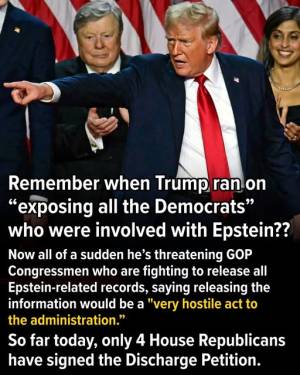
MeidasTouch Network, Commentary: Will The GOP Choose Predators Over Children? Michael Cohen, right, Sept. 4,2025. While Epstein’s victimsbeg for justice on Capitol Hill, Trump calls their trauma a hoax and Speaker Mike Johnson buries the truth to protect predators in power.
Seriously, when did we devolve to the point where the rape and trafficking of children became a partisan issue? I don’t ask that rhetorically.
I ask it because right now, in the United States of America, the Speaker of the House, MAGA Mike Johnson, is working to block a floor vote to release Jeffrey Epstein’s files, while Trump, the president of this country, calls the entire thing “a Democrat hoax.” Let that sink in: victims—survivors of sex trafficking, rape, and exploitation—were on Capitol Hill pouring out their trauma, reliving their hell in front of cameras, lawmakers, and strangers, and the president dismisses them as actors in some partisan scam. That’s not just politics as usual. That’s moral rot.Subscribed
The split screen in Washington this week was almost too much to bear. On one side, Trump sat in the Oval Office with the Polish president, smirking as he waved off Epstein’s crimes as no different than JFK conspiracy theories. On the other side, survivors stood on the Capitol steps, flanked by lawmakers from both parties—yes, even some of Trump’s most loyal foot soldiers—pleading for transparency, pleading for justice, pleading not to be erased. The women made it clear: this is not a hoax, not a distraction, not something that can be bullied into silence. They were raped as children. They were trafficked as commodities for powerful men. And now they’re being victimized again—this time by their own government.
The depravity here is not subtle. Trump and his allies have managed to turn the abuse of minors into a political loyalty test. Are you with the president, or are you with the truth? That’s the question hanging over the House GOP. Johnson has already made his choice. He’s working overtime to bottle up a discharge petition—led by Republican Thomas Massie, of all people, and Democrat Ro Khanna—that would force a vote to release the full Epstein file. The petition is just two Republican signatures short of success. Two. That’s how close we are to exposing the names, the documents, the trail of complicity that Epstein left behind. And the White House is threatening any Republican who dares to break ranks. The message is crystal clear: protecting Trump’s narrative comes before protecting children. An anonymous White House spokesperson called the bipartisan effort a "very hostile act to the administration."
This, my Substack community, is the dystopia we’re living in. Nancy Mace, a Republican congresswoman and survivor of sexual violence herself, left a hearing in tears this week—triggered by the testimony of Epstein victims. She later said the testimony caused a panic attack. Read that again. A sitting member of Congress collapsed under the weight of what she heard because the stories were that horrific.
And the president’s response? “It’s irrelevant.” “It’s a hoax.” Imagine being one of those survivors and hearing that. One of them, Haley Robson, a registered Republican, said it felt like being “gutted from the inside out.” She begged Trump to meet her face-to-face. Her words: “We are real human beings. This is real trauma.”
And yet, Johnson parrots Trump’s line that victims are being “misled.” Misled? These women aren’t political pawns; they’re survivors of industrial-scale child rape. To accuse them of being confused or manipulated is not only insulting, it’s an act of violence in itself. Johnson’s so-called “alternative”—kicking the matter back to Oversight Committee subpoenas—amounts to a placebo, a stall tactic. Less than 1% of the files have been released. The rest remain locked away while survivors scream into the void for justice.
Here’s the thing Trump doesn’t understand—or maybe he understands it all too well: the Epstein story isn’t going away. It’s not fading from headlines, it’s not being bullied out of the conversation. Because the survivors won’t allow it. They are done being silenced. And the cracks in Trump’s MAGA wall are beginning to show. Marjorie Taylor Greene—yes, that Marjorie Taylor Greene—called the cover-up “the real hostile act.” She even threatened to use House privilege to name names from the Epstein list on the floor of Congress, where she’d be immune from defamation suits. That’s not nothing. When Trump’s allies start sounding more humane than the president, you know the ground is shifting.
And the shift matters. For years, Trump’s iron grip on the GOP has been absolute. Fear kept everyone in line. But fear doesn’t erase rape. Fear doesn’t erase child trafficking. Fear doesn’t erase the pain etched into the faces of survivors who show up in Washington demanding to be seen. The more Trump calls them liars, the more grotesque he looks, and the more obvious the moral bankruptcy of his presidency becomes.
Which brings me back to my first question: when did we devolve to this point? At what point did we decide that exposing child sex trafficking depends on which team you root for? When did covering for predators become a litmus test of party loyalty? If you need to ask what’s broken in America, this is it.
Ro Khanna said it best: “We’re here not as partisans, we’re here as patriots.” Because a nation that allows the rich and powerful to traffic and abuse girls without consequence is a nation that has lost its moral and spiritual core. That’s where we are. And if Mike Johnson and Donald Trump get their way, that’s where we’ll stay: silent, complicit, and rotting from the inside.
But the survivors aren’t going away. The files exist. The truth exists. And eventually, the dam will break. When it does, history won’t remember who protected Trump. History will remember who protected the predators.
New York Times, News Analysis: Trump Claims the Power to Summarily Kill Suspected Drug Smugglers, Charlie Savage, Sept. 4, 2025. The move to treat criminals as if they were wartime combatants escalated an administration pattern of using military force for law enforcement tasks at home and abroad.
By ordering the U.S. military to summarily kill a group of people aboard what he said was a drug-smuggling boat, President Trump used the military in a way that had no clear legal precedent or basis, according to specialists in the laws of war and executive power.
Mr. Trump is claiming the power to shift maritime counterdrug efforts from law enforcement rules to wartime rules. The police arrest criminal suspects for prosecution and cannot instead simply gun suspects down, except in rare circumstances where they pose an imminent threat to someone.
By contrast, in armed conflicts, troops can lawfully kill enemy combatants on sight.
Because killing people is so extreme — and doing it without due process risks killing the wrong people by mistake — the question of which rules apply is not simply a matter of policy choice. Domestic and international law both set standards constraining when presidents and nations can lawfully use wartime force.
After breaking new ground by labeling drug cartels as “terrorists,” the president is now redefining the peacetime criminal problem of drug trafficking as an armed conflict, and telling the U.S. military to treat even suspected low-level drug smugglers as combatants.
But the trafficking of an illegal consumer product is not a capital offense, and Congress has not authorized armed conflict against cartels.
That raises the question of whether Mr. Trump has legitimate authority to tell the military to summarily kill people it suspects are smuggling drugs — and whether the administration allowed career military lawyers to weigh in.
“It’s difficult to imagine how any lawyers inside the Pentagon could have arrived at a conclusion that this was legal rather than the very definition of murder under international law rules that the Defense Department has long accepted,” said Ryan Goodman, a New York University law professor who worked as a Pentagon lawyer in 2015 and 2016.
Anna Kelly, a White House spokeswoman, emphasized in a statement late on Wednesday that the strike took place in international waters and did not put American troops at risk. She said that Mr. Trump had directed the attack in “defense of vital U.S. national interests and in the collective self-defense of other nations who have long suffered due to the narcotics trafficking and violent cartel activities of such organizations.”
“The strike was fully consistent with the law of armed conflict,” Ms. Kelly said.
New York Times, Ideas: Can Trump Just Do Whatever He Wants by Declaring Emergencies? Adam B. Kushner, Sept. 4, 2025. He’s exploiting a diabolical problem in our legal system to expand presidential power.
The United States is a nation in crisis, President Trump says. The problems are both profound and urgent. He knows how to fix them, but his ideas are hard to implement: They require new legislation or lumbering legal petitions. Luckily, there’s an easier way. The law often gives the president new and broad powers in a state of emergency.
So he has declared nearly a dozen. Trump says he can impose tariffs because he says it’s an emergency to contain trade deficits. He can deport immigrants without due process because it’s an emergency to fight a Venezuelan gang’s invasion. He can dispatch the National Guard to American cities like Los Angeles because it’s an emergency to quell protests and crime. He can ask the Supreme Court for emergency rulings on legal challenges to his authority because we can’t afford to wait for judges to debate his policies.
All this exposes a diabolical problem in our legal order: An emergency is in the eye of the beholder. Do these problems of debatable urgency demand an immediate response? The trade imbalance is generations old. Immigrants — even foreign gangs — are not an invading army. Protesters aren’t rebels. Crime has plunged nationwide, including in all of the cities Trump says need urgent protection. He could wait for courts to decide if he has the power to remake the government, as his predecessors generally have.
Invoking emergencies lets the president have his way, now. If there is a dire new threat and our laws and norms can’t protect us from it, then serious leadership requires the suspension of normalcy. That’s the pitch, anyway. “Violent, insurrectionist mobs are swarming and attacking our Federal Agents,” he posted online when he deployed troops to California. “Harvard is a threat to Democracy,” he said in explaining his intervention there.
It’s not a new idea. “We tend to associate autocracy with emergency,” says Kim Lane Scheppele, a Princeton professor who studies the rise and fall of democracy. Ferdinand Marcos cited a communist insurgency in the Philippines to grab the reins; Recep Tayyip Erdogan blamed a failed military coup in Turkey as his reason to rule by decree for two years; Viktor Orban justifies his suppression of civil rights in Hungary by pointing to Covid, Ukraine and immigration emergencies.
Carl Schmitt, a Nazi political theorist, wrote extensively on the “state of exception.” The main attribute of a sovereign leader, he argued, was the ability to pause the normal legal order during a time of crisis. Schmitt’s idea vexed liberals because it took advantage of the liberal, rules-based system: A president could win a legitimate election, follow the laws, govern normally — and then, at any point, declare a state of exception that suspends those laws.
Yet the emergency, in Trump’s hands, isn’t just a legal declaration. It’s a philosophy of governing. In his telling, political emergencies also let him impound funds allocated by Congress, close federal agencies, remake American museums and attempt to control the Federal Reserve.
“You never want a serious crisis to go to waste,” President Barack Obama’s chief of staff said during the 2008 financial crash. “It provides the opportunity to do things that were inconceivable before.” The difference is that the mortgage crisis was a once-in-a-generation economic catastrophe. By describing so many things as an emergency today, Trump signals that he must take abnormal action to cope with an abnormal time. In a climate of emergency, it seems, anything is possible.
MAGA Health Risks Expand
New York Times, Updates: Kennedy Rejects Criticism, Data and Decorum in Contentious Hearing, Apoorva Mandavilli, Dani Blum, Christina Jewett and Reed Abelson, Sept. 4, 2025. A combative Robert F. Kennedy Jr. defended his tenure as health secretary in a Senate hearing. A prominent Republican told him that his actions were “denying people vaccine.”
Here are 5 takeaways from the hearing.
Robert F. Kennedy Jr. faced tough questions about his tumultuous tenure as health secretary during a dramatic hearing before the Senate Finance Committee on Thursday.
During his nearly seven months in office, Mr. Kennedy has upended the Department of Health and Human Services, overseeing widespread changes to the institutes under his leadership. None has been hit harder than the Centers for Disease Control and Prevention, which recommends vaccines for Americans.
Mr. Kennedy, a longtime vaccine skeptic, has undermined immunizations; fired the C.D.C.’s independent advisers on vaccines and replaced them with vaccine critics; and ousted the center’s director less than a month into the job after she refused to fire top officials and rubber-stamp decisions from the advisers he had appointed.
Over three loud and contentious hours, Mr. Kennedy was remarkably combative and dismissive with senators, refusing to budge from his stance on vaccines, autism, Medicaid and the C.D.C.
Both Republicans and Democrats pressed Mr. Kennedy on vaccine access.
“It’s been obvious from the start that Robert Kennedy’s primary interest is to take vaccines away from Americans,” said Senator Ron Wyden of Oregon, the committee’s ranking Democrat. “His actions reveal a steadfast commitment to elevating junk science and fringe conspiracies.”
He and other senators pushed Mr. Kennedy on the health secretary’s attempts to restrict access to vaccines. Under Mr. Kennedy’s leadership, health officials have narrowed who is eligible for updated Covid vaccines. Several senators, including Senator Bill Cassidy, Republican of Louisiana, pointed to the obstacles some Americans are facing in accessing the vaccines. Major pharmacies in some states are currently requiring that even people who are at high risk get prescriptions for the shots.
“Effectively, we’re denying people vaccine,” said Mr. Cassidy. He supported Mr. Kennedy’s confirmation, despite some misgivings, but has become increasingly critical of him in recent weeks.Videotranscript0:00/0:48
“This is from Erick Erickson, good conservative out of Atlanta, Ga. Occasionally gives me hell. ‘My wife has Stage 4 lung cancer. She is one of the people the Covid vaccine actually helps. Thanks to the current mess at H.H.S., CVS is unable to get her vaccine.’ Secondly, an email from a physician friend of mine. ‘Hey Bill, I’m not even sure what I’m asking you, but we’re all confused and concerned about who can get the Covid vaccine. We are having our attorney try and render an opinion, but there’s no firm guidance and concern about liability if vaccines are given to a patient requesting it, but not on the current C.D.C. list. Pharmacists are requiring a prescription now, even for patients over 65, creating a huge headache.‘ I submit these for the record.” Several senators pushed Mr. Kennedy on his opposition to mRNA technology — used for the first time in the Covid vaccines made by Pfizer and Moderna — asking him to reconcile his criticisms with President Trump’s championing of those vaccines through Operation Warp Speed.
Mr. Kennedy has canceled $500 million in mRNA research and has falsely claimed the mRNA Covid shots are the “deadliest” vaccines ever made. But during the hearing he maintained both that Mr. Trump deserved a Nobel Prize for his efforts and that mRNA vaccines were harmful.
Senators also assailed Mr. Kennedy’s firing of all 17 advisers on the C.D.C. vaccine recommendation panel in June. Mr. Kennedy handpicked new members of the committee, several of whom have cast skepticism on vaccines and Covid shots in particular. He plans to appoint seven additional new members to the committee, which is scheduled to meet later this month. Some senators expressed alarm that the committee may vote to change recommendations on routine childhood immunizations like the hepatitis B vaccine.Mr. Kennedy stood his ground.
The hearing was punctuated with heated back-and-forth exchanges, with Mr. Kennedy effectively getting into shouting matches with several senators.
He yelled that Senator Maggie Hassan, Democrat of New Hampshire, was “just making stuff up” after she said that Mr. Kennedy had made it harder for Americans to get vaccines.
New York Times, Snubbing Kennedy, States Say They Will Offer Their Own Vaccine Guidance, Emily Baumgaertner Nunn, Sept. 4, 2025 (print ed.). California, Oregon and Washington said they would work together to review scientific data, saying the C.D.C. could no longer be trusted. But Florida said it would abolish all vaccine mandates.
Three Democratic-controlled West Coast states announced plans on Wednesday to form a “health alliance” that would review scientific data and make vaccine recommendations for their residents, saying that the federal agency responsible for issuing such guidance for the country had become “a political tool that increasingly peddles ideology instead of science.”
The move, which comes at a time of unparalleled turmoil at the agency, the Centers for Disease Control and Prevention, is an effort by California, Oregon and Washington to take scientific stewardship into their own hands after Health Secretary Robert F. Kennedy Jr., a vaccine skeptic, has taken control of the C.D.C.’s vaccine decisions. Other states, including several in the Northeast, are considering joining in a similar effort.
Hours after the Western states’ announcement, Florida announced it was going in a starkly different direction: The surgeon general said the state would end all vaccine mandates, including for children to attend schools, claiming in a news conference that each mandate “drips with disdain and slavery.” Florida’s governor, Ron DeSantis, a Republican, endorsed the plan, though it was not immediately clear whether it would require legislative input.
The differing state moves underscored the increasingly disjointed nature of vaccine policy across the country. States have always set their own vaccine policy and mandates for schoolchildren, but those rules were based upon national recommendations put forth by the C.D.C. Now that all 17 experts on the agency’s advisory panel have been dismissed by Mr. Kennedy — several of them replaced by vaccine skeptics — the opaque federal landscape has led to a hodgepodge of state moves.
New York Times, Trump Wants Proof That Covid Vaccines Work. It’s Easy to Find, Apoorva Mandavilli and Carl Zimmer, Sept. 3, 2025 (print ed.). In a post on Truth Social, the president suggested that the C.D.C. was being “ripped apart” over a question that was answered long ago.
In a message on social media that baffled many scientists, President Trump questioned the effectiveness of the Covid vaccines and demanded that the makers prove that they work.
“Many people think they are a miracle that saved Millions of lives,” Mr. Trump wrote on Truth Social. “Others disagree!”
“I want the answer, and I want it NOW,” he wrote. The president went on to complain that while one manufacturer, Pfizer, had shown impressive figures to him, “they never seem to show those results to the public. Why not???”
It is unclear what data Mr. Trump was referring to. Hundreds of reports have tracked the efficacy of the vaccines since they first debuted in 2021. The shots have saved millions of lives in the United States and elsewhere, dozens of studies have estimated.
Still, in some ways, Mr. Trump’s demand for data is a welcome change from what administration officials have been saying recently about vaccines, said John Wherry, director of the Institute for Immunology and Immune Health at the University of Pennsylvania.
Health Secretary Robert F. Kennedy Jr., left, has been “blatantly misrepresenting the data,” Dr. Wherry said. As for other administration officials, “they’ve been sort of ignoring data, or claiming the data is false, or talking about anecdotes.”How effective are the Covid vaccines?
The first clinical trials found that the shots made by Pfizer-BioNTech had an efficacy of 95 percent against symptomatic infection with the coronavirus, far higher than federal officials had hoped for. Moderna and Novavax reported similarly high efficacy numbers for their Covid vaccines.
Since the shots were rolled out, studies worldwide have confirmed their effectiveness. “Every country has done their own real-world analysis,” said Deepta Bhattacharya, an immunologist at the University of Arizona.
New York Times, Florida Moves to End Vaccine Mandates for Schoolchildren, Patricia Mazzei, Sept. 4, 2025 (print ed.). The state would be the first to scrap requirements that children be vaccinated to attend school, among other rules.
Florida plans to become the first state to end all vaccine mandates, including for schoolchildren, rejecting a practice that public health experts have credited for decades with limiting the spread of infectious diseases.
 Dr. Joseph A. Ladapo, left, the Florida surgeon general, made the announcement on Wednesday alongside Gov. Ron DeSantis, a Republican. Mr. DeSantis rose to national prominence during the coronavirus pandemic, and over time he has espoused increasingly anti-vaccine views.
“Who am I to tell you what your child should put in their body?” Dr. Ladapo, a vocal denigrator of vaccines, said to applause during an event on Wednesday in Valrico, Fla., near Tampa. “Your body is a gift from God.”
He added that the administration would be “working to end” all vaccine mandates. “Every last one of them is wrong and drips with disdain and slavery,” Dr. Ladapo said, without elaborating.
The announcement comes as the anti-vaccine stance of Robert F. Kennedy Jr., President Trump’s health secretary is causing tumult across federal public health agencies. The Centers for Disease Control and Prevention, in particular, has been engulfed in turmoil as the Trump administration has ousted experts, in some cases replacing them with people who align with Mr. Kennedy’s views.
Dr. Ladapo has faced repeated criticism from others in his field for his stances on public health. He allowed parents to choose whether to send unvaccinated children to school during a measles outbreak in Weston, Fla., in 2024, rejecting longstanding, evidence-based public health guidelines. The misinformation he spread about Covid vaccines prompted a public rebuke from the C.D.C. in 2023.
It is unclear what the process of undoing the state’s longstanding vaccine mandates might look like. But state legislatures are typically involved in setting vaccine requirements for schoolchildren; the federal government approves vaccines for the public and issues guidance on who should get them.
New York Times, F.D.A. Official Overruled Scientists on Wide Access to Covid Shots, Christina Jewett, Sept. 4, 2025 (print ed.) The agency’s staff scientists pointed out how Covid was still unpredictable and posed a threat to toddlers, but the official decided to restrict shots only to children with risk factors.
Memos released in recent days by the Food and Drug Administration show that the agency’s vaccine chief overruled staff scientists who favored widespread access to Covid shots, setting off a firestorm of criticism from lawmakers, state officials and doctors.
Agency staff members had concluded that the F.D.A. should allow a wide range of age groups to receive the vaccines, citing high hospitalization rates among young children with Covid and saying that the virus’s evolution is “complex and remains unpredictable.”
But Dr. Vinay Prasad, the agency official in charge of vaccines and gene therapies at the F.D.A., disagreed, overriding those scientists and deciding to issue very narrow eligibility limits.
The F.D.A. last week said that no one under 65 was eligible to receive the Covid vaccines made by Moderna or Pfizer unless they had underlying medical conditions that put them at risk for severe disease.
The agency’s policy was the most restrictive to date for public access to the shots, intensifying opposition to the Trump administration’s retreat from longstanding vaccine standards and accepted childhood immunization schedules.
The fissure underscores the continuing clashes between Health Secretary Robert F. Kennedy Jr.’s decision-making on vaccine policy and the positions of long-serving federal officials and public health experts. The split was most recently exemplified by the mass exodus last week of top officials at the Centers for Disease Control and Prevention.
Sex Trafficking Scandals / Epstein Files
New York Times, G.O.P. Thwarts Epstein Disclosure Bill as Accusers Plead for Files, Michael Gold, Sept. 4, 2025 (print ed.). Jeffrey Epstein’s accusers went to the Capitol to ask Congress to get behind their calls for more disclosures, but momentum for a bill demanding it appeared to stall.
With the Capitol towering behind them, several women who said they had been among Jeffrey Epstein’s victims shared harrowing stories of sexual abuse, pleading with members of Congress to demand that the Trump administration release all of its investigative files in the case.
Lawmakers in both parties stood behind them, vowing to keep the pressure on for the disclosures.
Even one of Mr. Trump’s closest allies, Representative Marjorie Taylor Greene of Georgia, said the files must come out.
None of it appeared to be enough to outweigh the pressure from Mr. Trump and Republican leaders, who have moved quickly to squelch legislation that would require the Justice Department to quickly and completely release what it uncovered about Mr. Epstein, the disgraced financier and convicted sex offender who died in prison in 2019 while awaiting trial on sex trafficking charges.
Momentum was flagging behind an effort by Representatives Thomas Massie, Republican of Kentucky, and Ro Khanna, Democrat of California, to force the House to vote on the measure, after most Republicans who initially said they would back it fell in line with the president’s exhortations to let the issue die.
Even as Mr. Epstein’s accusers spoke at the Capitol, some of them growing emotional as they recounted their experiences, Mr. Trump at the White House dismissed the effort to get more files released as a “Democrat hoax that never ends.”
Hours later, House Republicans united to push through an alternative measure backed by Speaker Mike Johnson that directed the House Oversight Committee to continue an investigation into the handling of the Epstein case that it started weeks ago after being forced to do so by Democrats. No such resolution was needed to authorize the inquiry, which is already underway.
So far, it has turned up little new information; an initial tranche of files the Justice Department sent to the committee contained mostly information that had already been public, and the panel has said it will take time for the department to comply with its subpoena for all documents in the case.
But for now, Mr. Massie and Mr. Khanna’s bill — which would require the Justice Department to produce all its files about the Epstein investigation within 30 days — remains stalled. To force a floor vote on it, they need the majority of the House, or 218 members, to sign a so-called discharge petition. With all 212 Democrats expected to sign, that means six Republicans would be needed to move forward.
As of Wednesday evening, the number of G.O.P. signers was frozen at four: Mr. Massie, Ms. Greene, and Representatives Lauren Boebert of Colorado and Nancy Mace of South Carolina.
“My colleagues were given a fig leaf: ‘We will put a resolution on the floor so you can say that you voted to protect the survivors,’” Mr. Massie said. “But their resolution doesn’t really do anything.”
The petition remains open for signatures, and lawmakers’ positions could still change. The public backlash to the Justice Department’s decision to close its Epstein investigation without releasing all of its records was significantly stronger than many expected, particularly from Republicans’ right-wing base.
Members of Congress could still be swayed by vocal constituents unhappy that they dodged a vote, an outcry that Mr. Massie at one point actively courted.
“Congressmen listen to you,” Mr. Massie said at a news conference with the survivors, addressing viewers who might be watching at home. “Light up their phones, burn down the phone lines here in Washington, D.C., and ask them the questions that these survivors wanted you to ask them: ‘Why won’t you be for transparency?’”
Still, there were signs that the White House’s pressure campaign had succeeded in quashing any traction that Mr. Massie’s effort had gained before lawmakers departed for their recess in July. At that time, 11 Republicans signed on as cosponsors of his bill, reflecting a sharp division within the party on how to address the Epstein issue.
That rift still remains potent on Capitol Hill. But at least three lawmakers who previously backed Mr. Massie’s legislation have said they will not sign his discharge petition: Representatives Anna Paulina Luna of Florida, Tim Burchett of Tennessee and Keith Self of Texas. Several others have yet to sign the petition or publicly comment on the matter.
Representative Victoria Spartz, Republican of Indiana, was among the large crowd gathered at Wednesday’s news conference. She left shortly before it concluded, after all the women had shared their accounts, but would not commit to signing Mr. Massie’s petition.
“These women deserve justice,” she said. But, she added, “I need to see what is the best approach.”
The White House, for its part, has made its opposition to Mr. Massie’s bill clear. Mr. Trump is known to target Republican lawmakers he sees as obstacles to his political agenda. An official who described the Trump administration’s thinking on the condition of anonymity said that signing the discharge petition would be viewed as a “very hostile act to the administration.”
Ms. Greene, for years one of Mr. Trump’s foremost allies on the Hill, rejected the argument.
“This isn’t a hostile act toward the administration,” she told reporters after Wednesday’s news conference. “The hostile act has been against these women for so many years now.”
She also said that she had told Mr. Trump that he should invite Mr. Epstein’s victims to the White House for a meeting, but had yet to receive a response.
Axios, Massie loses steam, Hans Nichols, Sept. 4, 2025. Rep. Thomas Massie (R-Ky.) is defying Speaker Mike Johnson's warnings and pressing forward with his discharge petition to force the release of the Jeffrey Epstein records, even as some of his initial Republican backers are fading away.
Why it matters: Just days ago, the discharge petition's success almost looked inevitable.
But Republican leadership, White House pressure and the release of Epstein-related files from the House Oversight Committee have blunted the petition's momentum. Senate Majority Leader John Thune also threw cold water on the efforts, telling reporters today there are no plans for the Senate to vote on the legislation.
Zoom in: Several Republicans who had backed Massie's underlying bill have reversed course, saying the Oversight panel's release of Epstein files undercuts the need for a petition.
Rep. Anna Paulina Luna (R-Fla.) told us yesterday she doesn't plan on signing it, calling the fight "a personal rift between Massie and the president." Rep. Ralph Norman (R-S.C.), who also won't be signing the petition, dismissed Massie's efforts as "a backhanded slap to the president." Reps. Eric Burlison (R-Mo.) and Tim Burchett (R-Tenn.) also signaled they won't be supporting the measure. They were both cosponsors of the underlying bill.
Thomson-Reuters via Newsmax, Texas Lawmakers Approve Letting Private Citizens Sue Abortion Pill Providers, Staff Report, Sept. 4, 2025. Texas lawmakers on Wednesday approved letting private citizens sue abortion pill manufacturers, doctors and anyone who mails the medication, setting the state up to be the first to try to crack down on the most common abortion method.
 The law would be the first of its kind in the U.S. and add another layer of abortion restrictions in Texas, which has some of the toughest in the country and already bans nearly all abortions.
 The bill now goes to Republican Gov. Greg Abbott, an abortion opponent who is expected to sign it into law. It would take effect in December, though it is nearly certain to spark legal challenges from abortion rights supporters.
Supporters of the proposal, which passed a final vote in the GOP-controlled Texas Senate, call it a key tool to enforce the state's ban and protect women and fetuses. Opponents see it as not only another way to rein in abortion but intimidate providers outside Texas who are complying with the laws in their states. They also say it would encourage a form of vigilantism.
Under the measure, Texas residents could sue those who manufacture, transport or provide abortion-inducing drugs to anyone in Texas for up to $100,000. Women who receive the pills for their own use would not be liable.
Under the bill, providers could be ordered to pay $100,000. But only the pregnant woman, the man who impregnated her or other close relatives could collect the entire amount. Anyone else who sues could receive only $10,000, with the remaining $90,000 going to charity.
More On U.S. Politics
The Hartmann Report, Commentary: From Silence to Spotlight: How a Democratic Shadow Cabinet Could Break Trump’s Spell, Thom Hartmann, right, Sept. 4, 2025. Voters don’t rally behind policy papers: they rally behind leaders they can see and believe in. Democrats must end the era of weak, divided messaging and rise with a chorus of commanding voices…
Illinois Governor JB Pritzker isn’t pulling any punches. Yesterday, he gave a speech calling out Trump’s and Miller’s fascist cosplay, their lies and distortions, and predicting federal troops will soon be on the streets of Chicago. He came right out and said Trump is doing all this for his own wealth and power:
“None of this, “Pritzker said, “is about fighting crime or making Chicago safer. None of it. For Trump, it's about testing his power and producing a political drama to cover up for his corruption.”
Ominously, he added: “Any rational person who has spent even the most minimal amount of time studying human history has to ask themselves one important question: Once they get the citizens of this nation comfortable with the current atrocities committed under the color of law, what comes next?
Pretty much every time a nation tips toward authoritarianism — as America is doing today — there’s a strongman at the center of it. The idea goes back at least to Thomas Carlyle, whose “Great Man” theory argued that history is the story of exceptional leaders whose charisma and force of will bent the times to their shape. From Napoleon to Hitler to Trump, we see the pattern over and over.
It’s no accident that Republicans have remade themselves into a cult built around one man whose sheer audacity and appetite for power dominates the news cycle and the national conversation.
After all, as Malcolm X famously said, “A man who stands for nothing will fall for anything”; the GOP hasn’t stood for anything other than the interests of the morbidly rich for at least 44 years, so its base voters were sitting ducks for a demagogue with a good sales pitch.
It’s also no accident that Democrats appear, by contrast, weak and divided, a chorus without a soloist, trying to make an argument while their opponent simply shouts. In an age of television and social media this is an existential liability.
If we’re going to stop today’s Trump-driven slide into fascism, Democrats must grapple directly with this reality and build an alternative form of charismatic leadership.That does not mean mimicking Trump’s grotesque personality cult (although Newsom’s satire is spot-on and is working).
The Democratic Party should not, and cannot, center itself around one authoritarian figure. But it does mean understanding that media is not neutral, that charisma matters, that the public imagination is moved more by spectacle and story than by policy papers.
If Democrats don’t field leaders who can seize the camera, hold attention, and embody a vision, then they’ll forever be fighting from behind while Trump and his enablers drown out every other sound.
Voters, after all, are human beings, not spreadsheets. They’re moved by the emotional gravity of people they trust, admire, or even fear. Republicans learned this long ago and built their machine around it. Democrats can no longer afford to pretend that calm reason, logic, and rational policies will carry the day without their own powerful messengers.
One way to answer this problem is to reject the premise that only one Great Man can command attention. Imagine instead a bench of great women and men, a shadow cabinet of governors, senators, and policy innovators who step into the spotlight issue by issue. Rather than waiting for one savior figure, Democrats could show the country that they have a team of giants ready to govern. To show America not just one alternative to Trump but an entire government-in-waiting.
A practical way to operationalize this idea is to create a visible Democratic shadow cabinet, as I proposed back in May. In parliamentary systems, this is how opposition parties signal to the public that they are ready to govern: they line up ministers-in-waiting who mirror the actual cabinet and speak with authority on their issue areas.
Democrats could adapt this model by assigning leading governors and senators to clear portfolios and making them the public face of the fight. Elizabeth Warren could take the economy, standing up every time Republicans peddle trickle-down nonsense. Gretchen Whitmer could own healthcare, drawing on Michigan’s record of expanding coverage and protecting reproductive rights.
Gavin Newsom could be the climate voice, touting California’s leadership on renewables and electric vehicles. JB Pritzker could hold the voting rights portfolio, a relentless reminder that democracy itself is under siege.
Each of these figures is already capable of commanding national attention, but the effect would multiply if the roles were coordinated and reinforced. The press would know who to call on any issue, and Americans would see not a muddle of competing Democratic voices but a disciplined government-in-waiting. Rapid responses, monthly press events, and consistent messaging would project competence and readiness in contrast to the chaos of Trumpism. This is not just about communication strategy: it’s about showing the country that Democrats have the people, the policies, and the charisma to step in tomorrow if the public gives them the chance.
This idea is not unprecedented. In parliamentary systems, opposition parties have long organized “shadow cabinets” to show voters they’re ready to take power at a moment’s notice. In the UK, Labour and the Tories alike have named shadow ministers to every portfolio, each one responsible for criticizing the government and putting forward an alternative vision.
It works because it projects competence. Voters can see the depth of the bench, not just the figure at the top. In times of crisis, this has been decisive. When Churchill rose to power, it was not only his charisma but the fact that the public knew there was a team of capable ministers around him that gave Britain confidence. Democrats would do well to borrow this model and Americanize it. Instead of being a collection of individuals jostling for position, they could present themselves as a disciplined bloc with defined roles, each amplifying the other.
At the same time, Democrats must stop letting Washington gridlock define their image. The truth is that blue states already govern some of the largest economies in the world. California, New York, Illinois, Washington, Michigan, and Massachusetts together represent a bloc of prosperity, innovation, and rights protection larger than most nations. By acting through interstate compacts and model laws, those states can prove that Democrats deliver even when Congress stalls. Coordinated carbon markets, clean procurement policies, abortion shield laws, voting rights protections, and labor standards can all be advanced at the state level.
This is how Canada built its national healthcare system, province by province until the federal government could no longer ignore it. It’s how the early American labor movement forced reforms onto the national stage.
Call it soft secession if you want, though the better term may be the Blue States Bloc. The message is simple: if Republicans sabotage governance in Washington, Democrats will show the country how it is done in the states. It’s strength, not retreat. It’s evidence, not just rhetoric.
This is where narrative judo becomes essential. Republicans — and the corporate media — paint Democrats as weak, divided, indecisive. Democrats must flip that story on its head. They must say clearly: we lead together because we are a coalition, not a cult. They must remind Americans that our system was designed not for one man to dominate but for leaders to share power. They must repeat, over and over, that diversity is competence, that depth is resilience, that collective leadership is how democracy works.
Instead of apologizing for the absence of a single Great Man, Democrats can show that they have something better: a team of proven leaders, each charismatic in their own right, each capable of commanding attention when the issue is in their domain. This isn’t weakness; it’s the true antidote to authoritarianism.
Facebook, RFK Jr. is no one’s friend or allyRFK Jr. is no one’s friend or ally, Jeneva Stone (Author, advocate, shown at right with son Rob),  Sept..4, 2025. I’m no political expert, but I’ve lived inside the Beltway for the last 30+ years, worked briefly on the Hill as a mere child, and have had a backseat to a lot of what DC has to offer — I don’t think I’ve ever had a political experience quite like the RFK Jr. hearing today.
I couldn’t take a lot of photos because I didn’t want to give anyone an excuse to kick me out for causing a disruption. Clips you may have seen on TV cannot possibly recreate the sheer extended bizarreness, dystopia, and surrealism of this event. RFK Jr. has absolutely no respect for anyone at all, not even for FOTUS, the hand that feeds him.
He is hell-bent on destroying medical research and scientific standards because, I suspect, his ego has been bruised by folks who’ve actually spent time, energy and effort studying, writing and practicing medicine or microbiology or organic chemistry or genomics. He’s using DHHS as his revenge tour.
He lied and obsfucated and shouted and told other people they were liars and confabulists and fearmongers. He called female senators “hysterical.” Unlike some other politicians who are masters of dissembling, he’s like a feral cat forced into a basket that jumps and yowls and scratches at the slightest provocation. No ability to keep his composure.
I often joke that, due to all Rob’s medical interventions, “I’m not a doctor, but I play one on TV.” Well, RFK Jr. couldn’t even play one on TV.
I couldn’t tell if he had any grip on reality, or if he had an actual brain condition that affected his short term memory and his cognitive filtering. He claimed he never said things he’d just said 10 minutes earlier. He doesn’t seem to understand the job of being a cabinet secretary. He seems to think that anyone can get a Covid vaccine who wants one and said they were free. He doesn’t appear to grasp that when the CDC, on his orders, does not “recommend” the vaccine for people under 65 that that, in fact, prevents people from accessing the vaccine.
When pressed, he told one senator that of course the vaccine was available to all Americans should they choose to have it, but that, no, he was not going to “recommend” a “product” that he didn’t believe in.
Dude—you aren’t a spokesmodel for tanning beds or cleanses—you’re the U.S. Secretary of Health and Human Services. You have the power to make rules and also to destroy stuff.
He claimed no money had been cut from Medicaid—that the U.S. was pouring money into it. He behaved like a person who didn’t, as he told Congress during his confirmation hearing, just want to allow more freedom of choice with vaccines—his words, tone, body language and pugilistic demeanor made it clear to all that he wants to force his own uninformed beliefs on the rest of us, whether we like it or not.
That is, he behaved like a man who associated with Epstein, and when it was pointed out that he and that child molester and rapist were friends, he nearly lost his sh*t. Because it’s all too believable that he’s willing to force himself—his beliefs or his body—on anyone he thinks he can dominate.
The profound damage he’s inflicting on public health has nothing to do with any real commitment to getting rid of ultra processed foods or encouraging anyone to live a healthier lifestyle. This is about a man who feels inadequate and incompetent in comparison to his father’s legacy of combating poverty and advancing civil rights—and he’s felt belittled and slighted for decades. Now he just wants to burn it all down. T
hese men, the ones with daddy issues, the ones who feel small and belittled, seething in secret at every perceived slight, these are the most dangerous kinds of men. They’re ugly and brutal and cruel. He wants to hurt everyone because he thinks he deserves better.
That’s what I absorbed from listening to him for three hours today and sitting less than 6 feet away from him.
MAHA is just a vehicle he’s using to run over his many enemies. There’s a lot we could genuinely discuss about food, health and the pros and cons of drugs and supplements.
I say this as a person with insulin resistance and as the mom of a disabled adult whose life is, in fact, being saved by a supplement —but not just because i think so, because of, like, actual science. Vitamins, flavonoids and other natural compounds are co-factors in biological processes, but how these work and what’s too much? We learn this through research, not guesswork.
Author, advocate, g/i nurse in practicum, unlicensed wheelchair mechanic.
U.S. Courts, Crime
Newsmax, State Department Staffer Gets 4 Years for Selling Secrets, Staff Report, Sept. 4, 2025. A U.S. State Department employee was sentenced to four years in prison on Thursday for conspiring to collect and transmit national defense information to individuals he believed to be working for China's government, the Justice Department said.
Michael Schena, 42, of Alexandria, Virginia, worked at State Department headquarters in Washington. He held a top secret security clearance and had access to information up to the secret level, the Justice Department said.
Beginning in April 2022, Schena communicated with people he met online through various platforms and provided them sensitive U.S. government information in exchange for money, the Justice Department said in a statement.
Two of these individuals represented themselves as employees of international consulting companies, the Justice Department said. Believing that they were working on behalf of China's government, Schena continued his relationship with them, the Justice Department said.
In August 2024, Schena met an individual at a hotel in Peru who provided Schena $10,000 and a cellphone that was intended to be used for Schena to receive tasks and transmit information, prosecutors said.
In October 2024, while at work, Schena used the cellphone he received in Peru to photograph and transmit at least four classified documents that contained national defense information and which were classified as secret, according to prosecutors.
Surveillance video captured Schena again using the cellphone to photograph seven documents marked as "secret" that contained national defense information in February this year, the Justice Department said, adding FBI agents seized the phone before he could transmit those documents and arrested him.
U.S. Economy, Jobs, Taxes
Emptywheel, Analysis: Scott Bessent Fact Checks Donald Trump's Lies about Tariffs, Emptywheel (Marcy Wheeler, right), Sept. 4, 2025. In a declaration to SCOTUS, Scott Bessent confesses that what Trump has claimed were trade "deals" are really just "frameworks" that are not yet binding, and the investments and purchases cited in them are a fraction of the $15 trillion dollars in investment he has claimed they include.
In the wake of Trump’s batshit post from the other day, Politico reports that John Sauer has predictably asked SCOTUS to move quickly in accepting the tariff case for review. In support of Sauer’s request for SCOTUS to consider the appeal immediately, Sauer included a declaration from Scott Bessent.
In it, Bessent confesses that Trump’s past claims that he had made trade deals were false. What Trump claimed in “fact sheets” were “deals” are in fact just “frameworks,” and Bessent is still working on negotiating “towards binding agreements.”
5. As of the date of this declaration, the United States has announced frameworks with Japan, Indonesia, the United Kingdom, the Philippines, Vietnam, South Korea, and the European Union. These frameworks set the parameters for continued negotiation regarding binding, final terms of agreements with these foreign trading partners. The President has found that these frameworks align these foreign trading partners with the national security and economic interests of the United States and help address the trade deficit.
6. In addition to the frameworks already reached, and which continue to be negotiated towards binding agreements, the United States is actively negotiating with many other countries to reach ways forward to address the emergencies declared by the President.And whereas Trump claimed the deals contribute to agreements to invest $15 trillion in the US, Bessent only laid out “about” $2.35 trillion, covering both purchases and investments, that actually derive from these frameworks that aren’t deals.
9. The frameworks for trade agreements already in place contain additional provisions ‘whereby the trade partners agree to significant purchases from and/or investments in the UnitedStates (e.g., the European Union agreed to $750 billion in energy purchases and $600 billion in investment, and Japan and South Korea collectively agreed to about 1 trillion). These agreed upon frameworks total in the multiple trillions of dollars. The longer the delay in a ruling, the greater these commitments will become. If these agreed upon frameworks were unwound and the investments and purchases had to be repaid, the economic consequences would be catastrophic.
In short, Scott Bessent just confessed that Trump has been lying in his claims about tariffs.That should undermine the entire claimed emergency in the first place. Trump’s own Treasury Secretary has made it clear Trump is lying about tariffs. There’s no reason SCOTUS should accord claims in his underlying Executive Orders any presumption of regularity.
New York Times, John Deere, a U.S. Icon, Is Undermined by Tariffs and Struggling Farmers, Kevin Draper, Sept. 4, 2025. The tractor maker said that sales were down and that higher metal tariffs would cost it $600 million, while American farmers face dwindling overseas demand for some crops.
Josh Enlow buys and sells used tractors every day, filling a vast lot in Tulsa, Okla., with hundreds of agricultural and construction machines.
His customer base has shifted recently, as farmers and ranchers who would buy only new machines are now coming to his Enlow Tractor Auction interested in his secondhand equipment.
“The increases in new pricing has definitely driven people back to the used market,” Mr. Enlow said.
The list price for new tractors rose at least 60 percent over the last eight years, according to the University of Illinois Extension, with some models more than doubling in price, costing at least $250,000 more than they used to.
That’s bad news for companies like John Deere, the leading supplier of agricultural machinery in the United States. The company reported a record profit two years ago, but President Trump’s tariffs and trade policies are making the market more challenging and unpredictable for the business and its customers.
One of the country’s largest manufacturers is worse off now than it was six months ago. Last month, John Deere said net income in its most recent quarter was down 29 percent from a year earlier. Higher tariffs, primarily on steel but also on aluminum, have cost the company $300 million so far, with nearly another $300 million expected by the end of the year. This summer the company laid off 238 employees across factories in Illinois and Iowa.Want to stay updated on what’s happening in Oklahoma? Sign up for Your Places: Global Update, and we’ll send our latest coverage to your inbox.
Yet John Deere is just the sort of manufacturing powerhouse that Mr. Trump says he wants more of in the United States. The company, based in Moline, Ill., has made farm equipment since 1837. Its green-and-yellow tractors, combines and sprayers help farmers feed the country and produce billions of dollars’ worth of crops for export.
The company employs 30,000 workers in 60 facilities across the country and said more than 75 percent of its machines were assembled in the United States. Just 25 percent of the components used in its products come from foreign countries, John Deere said.
Sept. 3
The Parnas Perspective, News Commentary: Urgent Epstein Update as Survivors Call out Trump, Aaron Parnas, Sept. 3, 2025. I just got back home from Capitol Hill. We cannot let their voices be silenced.
I just returned from covering what I can only describe as the most powerful press conference and rally I have ever attended. For the first time in history, more than ten Epstein and Maxwell survivors gathered together in one place — not just to tell their stories, but to demand action.
This moment was historic not only for its scale but for its urgency. The survivors’ collective presence signaled that the public can no longer dismiss or minimize what has been ignored for far too long.I’ve said it before, and I’ll say it again: I am never going to stop demanding the release of the files no matter how much the White House and far-right Republicans want me to stop.
This is not just about Donald Trump. It’s not just about one party. It is about entrenched power — across the political spectrum — working to keep these women silent. Yesterday’s rally made one thing clear: they refuse to be silenced, and I refuse to stop reporting their voices.
Lisa Phillips, an Epstein survivor, delivered the most startling announcement of the day: since the Administration refuses to release Epstein’s list, the survivors themselves will compile their own.
“It will be by survivors, for survivors,” Phillips declared, setting the tone for a movement reclaiming power from institutions that have failed them.
Another Epstein survivor confirmed that Epstein was close with Trump: "His biggest brag forever was that he was very good friends with Donald Trump."
Other survivors spoke with raw honesty, courage, and a clarity that cut through political noise
Every testimony carried a shared message: these women will no longer accept silence, delay, or political gamesmanship.
The survivors’ calls for transparency are colliding with mounting evidence of obstruction. Congressman Garcia confirmed at the rally that the White House is actively pressuring Republicans to vote against releasing the Epstein files.
Representative Thomas Massie blasted House leadership, calling a proposed symbolic resolution meaningless:
“The Speaker of the House just offered a fig leaf to my colleagues. They're gonna vote on a non-binding resolution today that does absolutely nothing ... they’re allowing the DOJ to curate all of the information that the DOJ is giving them ... the perpetrators are being protected.”
This revelation underscores the central question survivors are forcing into the open: who benefits from secrecy, and at whose expense?What I witnessed was more than a press conference — it was a reckoning.
Survivors who once stood alone now stand together, determined to expose the truth no matter how powerful the names involved may be. Their courage, amplified by public pressure, is breaking through the political machinery designed to bury their voices.This marked a turning point. Whether Congress listens, whether the Administration relents, whether justice is finally served — that remains to be seen.
But after today, one thing is certain: these survivors will not be ignored, and their movement has only just begun.
Ground News, 'We know their names': Epstein victims say they are making their own list, 92 aggregated news sources, Sept. 3, 2025. Survivors demand the Justice Department release all Epstein investigation files and plan to compile a confidential list of abusers amid criticism of document redactions.
A group of Jeffrey Epstein and Ghislaine Maxwell survivors spoke out on Capitol Hill, demanding accountability and justice, as reported by NBC News. Wendy Avis, a survivor, publicly shared her story for the first time, stating, 'not everyone is getting justice,' emphasizing the need for accountability.
The group expressed frustration over the lack of communication from the Department of Justice, asserting it is 'surprising and unacceptable' given the case's significance.
Lisa Phillips stated, 'Please come forward, and we’ll compile our own list and seek justice on our own,' urging further action from the DOJ.
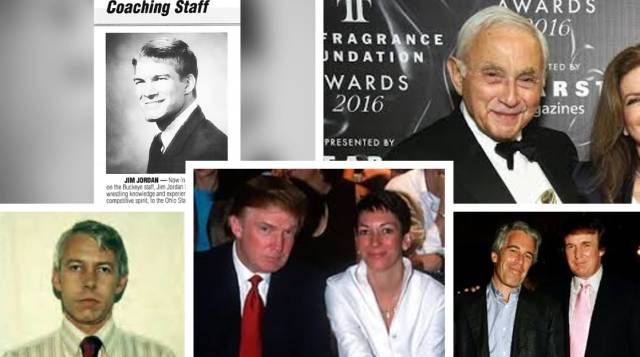
Clothing retail magnate Leslie Wexner, right, with accused sex crimes malefactors Donald Trump and Ghislaine Maxwell, center, Jeffrey Epstein, right with Trump, Dr. Richard Straus of Ohio State University, left bottom, and accused cover-up artist Jim Jordan, top left, the current U.S. House Judiciary Committee Chairman and a former coach of the Ohio State University wrestling team when Straus was molesting large numbers of wrestlers as a team physician.
Wayne Madsen Report Resistance Dateline: It's not just the Epstein Files. We must also see the Wexner Files, Wayne Madsen, left, Sept. 2-3, 2025. As Congress returns from the August break, there will be bi-partisan demands that the files the Department of Justice has waffled on producing to the public on the entire sordid matter involving international sex trafficker teenage girls Jeffrey Epstein; his partner-in-crime Ghislaine Maxwell; and Epstein's Miami-based U.S Attorney fixer Alex Acosta be fully opened.
However, there will be no similar demands for DOJ's records om Epstein's financial sugar daddy, billionaire retail magnate Les Wexner.
Deputy U.S. Attorney General Todd Blanche, right, who doubles as a corrupt mob lawyer for Donald Trump, interviewed Ms. Maxwell for two  days at the Federal Correctional Institution in Tallahassee, Florida, where she was serving a 20-year sentence for assisting Epstein in the sexual abuse of underage girls. Subsequent to that interview, Maxwell was ordered moved to a minimum-security "Club Fed" prison camp in Texas. B
lanche, Trump, Attorney-General Pam Bondi, below left, and other regime cover-up artists, including House Judiciary Committee chair Jim Jordan, were buoyed by Maxwell not revealing anything untoward concerning Trump's relationship with Epstein, who died in his suicide watch prison cell at the Metropolitan Correctional Center in Manhattan on August 10, 2019, while awaiting trial for underage sex trafficking. The U.S. Attorney General at the time was William Barr, whose father, Donald Barr, was the elite private Manhattan Dalton School headmaster who had helped arrange for Epstein's employment as a math teacher without a normally-required college degree.
Although Blanche, Bondi, and Trump may have considered themselves too clever by half in receiving from Maxwell, a demonstrated perjurer, a clean record on Trump's relationship with Epstein, Maxwell may have provided too much information on Wexner.
With her lawyer David Oscar Markus present, she told Blanche, a close friend of Markus, and three other Justice Department officials that Epstein was Wexner's closest friend during the early 1990s. Wexner had turned over to Epstein his power of attorney and all of his financial management responsibilities, including restructuring L Brands that included retailers The Limited, Victoria's Secret, PINK, Lane Bryant, Bath & Body Works, Tween Brands, Lerner New York, and Abercrombie & Fitch.
Maxwell claimed that after Wexner built New Albany, Ohio, an almost-exclusively Jewish enclave for the ultra-wealthy outside of Columbus,  Epstein ran the community like a "mayor." New Albany was envisaged by Wexner as a "Shangri-La for the wealthy." New Albany included very large homes surrounding Wexner's mega-mansion, a country club, a golf club, and New Albany International Business Park. Epstein owned two large homes in the enclave, one at 7558 King George Drive] and the other at 5025 East Dublin Granville Road.
Maria Farmer, right, alleged that Epstein sexually assaulted her at the King George Drive home in 1996. Epstein and Wexner were listed in Ohio corporation records as co-presidents of The New Albany Company.
In 1998, Wexner also turned over ownership of his Manhattan townhouse to Epstein. Even before the property transfer, Epstein had treated the residence as his own.
In 1994, Epstein and Trump had engaged in raping two girls, 13-year-old Katie Johnson and 12-year-old Maria Doe, both pseudonyms, at the townhouse near Central Park. Epstein was reportedly a stickler for having video cameras installed throughout his properties, including his estates in Palm Beach, Florida; Little Saint James Island in the U.S. Virgin Islands; Zorro Ranch in New Mexico; New Albany, Ohio; and the Wexner-turned-Epstein townhouse in Manhattan.]
One member of the U.S. House who said he is satisfied with Maxwell's statement to Blanche is Representative Jim Jordan of Ohio, below.
 Jordan, as chairman of the House Judiciary Committee, will be conducting hearings on the latest Trump scandal, known as the Epstein Files case. Jordan has a definite conflict-of-interest in the scandal owing to the scandal involving his Ohio State University wrestling team and the sexual molestation of his wrestlers by university sports doctor Richard Strauss between 1986 and 1994, the time period when Epstein was living in New Albany and handling all the finances for Wexner. Epstein would have been in charge of Wexner's sizable charitable donations to Ohio State during the time frame when Jordan failed to report Strauss's molestation to university or law enforcement officials.
Why is Jordan's silence on the 1429 sexual assaults and 47 rapes, resulting in 236 lawsuits and a determination by the Perkins-Coie law firm that Ohio State coaches and athletic administrators -- including Jordan -- knew for two decades about the abuse and failed to act, germane to the Epstein Files scandal?
There are allegations from throughout central Ohio that Wexner, who is 87, has sexual proclivities quite different from those of Epstein. The Wexner family and Limited Brands Foundation have donated some $235 million to the university over the years. One question remains. Did Ohio State and Jordan remain silent about the molestation by Strauss of its students — and perhaps others off campus in heavily-guarded communities like New Albany —in order to not jeopardize a major cash cow? It is hoped that Democrats on the House Judiciary and other committees have the guts to ask this question.
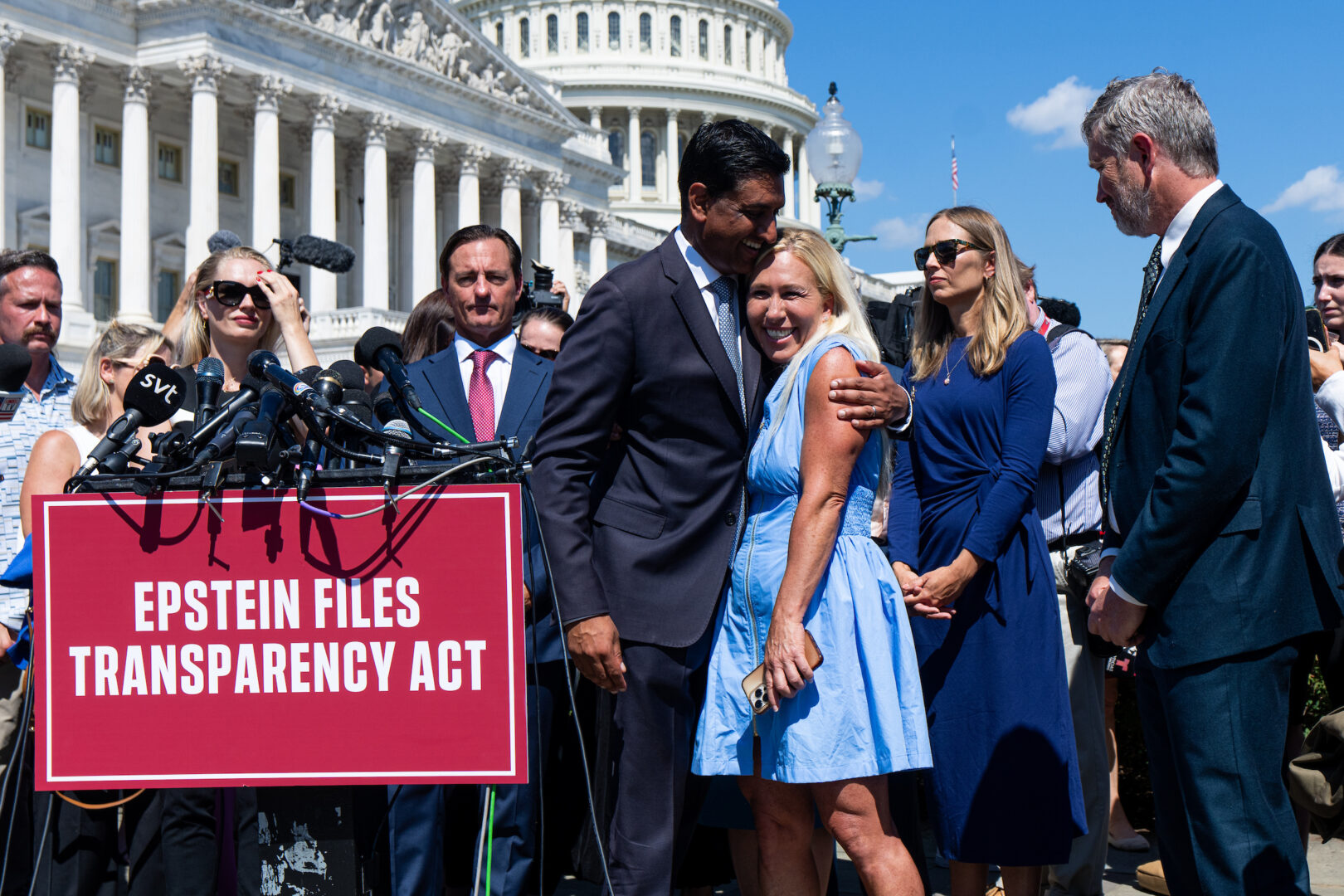 ‘I’m not afraid to name names’ on behalf of the victims, Greene says: Rep. Ro Khanna, D-Calif., hugs Rep. Marjorie Taylor Greene, R-Ga., during Wednesday’s news conference with Epstein survivors (CQ Roll Call photo by Bill Clark).
Roll Call, Epstein survivors say their push for transparency is ‘not a hoax’ Justin Papp, Sept. 3, 2025. A group of women stood in front of the Capitol on Wednesday to share stories of abuse, describing their childhood memories of Jeffrey Epstein and calling on Congress and the White House for transparency.
But the mood was more circus than somber on the House Triangle, as throngs of reporters and observers crowded the press conference organized by Reps. Ro Khanna, D-Calif., and Thomas Massie, R-Ky.
Speakers were at times barely audible over the din of protesters — who held signs with slogans like “Do right by the wronged” and old photos of a smiling Donald Trump standing next to Epstein — as Capitol Police worked to hold them back.
At one point, the loud roar of a U.S. military flyover drowned out the voices of the survivors, who raised questions they’ve been asking for years.
“Why did the government work so hard to protect Jeffrey and not so hard to protect me and my other innocent friends? Why was Jeffrey so important to the government, and why was I so insignificant?” asked Courtney Wild, who was 14 when she first met Epstein and is now a vocal victim rights advocate. “Why did nobody but our lawyers care before now? It seems people have only started to care because of Twitter and politics. But I would like to say this has nothing to do with politics.”
The event was part of a larger effort to bring renewed attention to the Epstein files, despite the objections of House leadership and the White House. Massie on Tuesday filed a discharge petition that could force a vote on legislation aimed at wresting more documents from the federal government.
In order to circumvent House leadership and get the measure to the floor, Massie needs 218 signatures, including at least six Republicans if all Democrats sign the petition. As of early Wednesday evening, 206 members had signed the discharge petition. Just three Republicans — Reps. Lauren Boebert of Colorado, Nancy Mace of South Carolina and Marjorie Taylor Greene of Georgia — had joined Massie.
Seemingly in an attempt to preempt Massie’s discharge effort, the House Oversight and Government Reform Committee, led by Rep. James R. Comer, R-Ky., on Tuesday began releasing a batch of documents obtained from the Justice Department.
Trump Battles Against Universities, Museums
New York Times, Harvard Secures a Court Victory in Its Fight With Trump, Alan Blinder, Sept. 3, 2025. Harvard had sued the Trump administration in an effort to restore billions in research funds that the government canceled this spring.
Harvard University won a crucial legal victory in its clash with the Trump administration on Wednesday, when a federal judge said that the government had broken the law by freezing billions of dollars in research funds in the name of stamping out antisemitism.
The ruling may not be the final word on the matter, but the decision by Judge Allison D. Burroughs of the U.S. District Court in Boston was, at the very least, an interim rebuff of the Trump administration’s campaign to remake elite higher education by force.
Although Harvard’s case centered on its research funding, the university contended that the administration had compromised its First Amendment and due process rights. Now, the judge’s decision stands to give Harvard new leverage with the White House in settlement talks.
The ruling was a significant milestone for the university, the only institution to sue over the Trump administration’s explicit assault on its research funding. But President Trump had vowed to appeal any ruling that cut against the government, and his administration has eagerly sought to pressure Harvard in ways beyond research money.
Judge Burrough’s ruling may not put an end to that campaign, but her opinion amounted to a bracing rebuke of the government.
“We must fight against antisemitism, but we equally need to protect our rights, including our right to free speech, and neither goal should nor needs to be sacrificed on the altar of the other,” Judge Burroughs wrote in an 84-page ruling. “Harvard is currently, even if belatedly, taking steps it needs to take to combat antisemitism and seems willing to do even more if need be.”
She added, “Now it is the job of the courts to similarly step up, to act to safeguard academic freedom and freedom of speech as required by the Constitution, and to ensure that important research is not improperly subjected to arbitrary and procedurally infirm grant terminations, even if doing so risks the wrath of a government committed to its agenda no matter the cost.”
As a part of the decision, Judge Burroughs said the Trump administration could not issue new blockades on Harvard’s federal research funding “in retaliation for the exercise of its First Amendment rights, or on any purported grounds of discrimination without compliance with the terms of Title VI.”
Neither Harvard nor the White House responded immediately to requests for comment.
Judge Burroughs’s decision came after both the government and the university asked her to issue what is known as summary judgment — a ruling on the case’s claims without a trial. Ultimately, the judge relied on voluminous filings, a select batch of evidence and oral arguments in her Boston courtroom on July 21 to reach a decision. Judge Burroughs had appeared immensely skeptical of the government’s position that day but said that she had not “prejudged” the case.Editors’ Picks6 Dude Ranches Where You Can Saddle Up and UnplugThink Candles Can’t Be Fun? Think Again.Korea’s Tattoo Artists Are Grabbing Attention, at Home and Abroad
Harvard sued the government in April. The Trump administration had insisted that the nation’s oldest university had became a wellspring of bigotry. Then, on April 11, it sent the school a letter trying to condition Harvard’s access to federal research money on its acquiescence to a range of demands.
Those terms included audits, the establishment of “merit-based” admissions and hiring policies, the shutdown of diversity, equity and inclusion programs and an examination of “programs and departments that most fuel antisemitic harassment or reflect ideological capture.”

New York Times, Smithsonian Responds to Trump’s Demand for a Review of Its Exhibits, Robin Pogrebin and Graham Bowley, Sept. 3, 2025. In a letter to the White House, the Smithsonian (whose oldest museum is shown above) asserted its “authority over our programming and content,” but said a team would review what information it would turn over.
Ever since the Trump administration announced last month that it would review the Smithsonian’s exhibitions and seek changes to programming it found objectionable, historians and curators have been wondering how the historically independent institution would respond.
 The Smithsonian offered the first indication on Wednesday afternoon when Lonnie G. Bunch III, right, the Smithsonian’s secretary, sent a letter to the staff indicating that the institution had agreed to set up a team to review turning over materials to the White House, as requested, but to do so as an autonomous institution.
“I take my responsibility to steward the institution on behalf of the American people very seriously,” the letter to staff said, adding, “Our independence is paramount.”
In a letter to Mr. Bunch last month, the administration told the Smithsonian to submit information about programming at eight of its 21 museums within a 75-day deadline, and that the White House would then direct possible changes in content.
While complimenting Mr. Trump’s “admiration and regard for the Smithsonian,” Mr. Bunch told the staff that his response to the White House, sent in a letter on Tuesday, had reiterated the institution’s intention to rigorously review its content for inappropriate partisanship. But he said it would be the Smithsonian, not the executive branch, that would direct the effort.
“Our own review of content to ensure our programming is nonpartisan and factual is ongoing, and it is consistent with our authority over our programming and content,” Mr. Bunch wrote in his letter to the staff.
At the same time, Mr. Bunch said he planned to share information with the White House to alleviate its concerns.
“I am assembling a small internal team to advise me and the senior team about what we can provide and on what timeline,” Mr. Bunch said, adding that the Smithsonian also planned to brief the White House about its internal review.
The White House did not immediately respond to a request for comment on Mr. Bunch’s letter, which was not released by the Smithsonian.
But Mr. Bunch discussed the substance of what he had written to the Trump administration in his letter to the staff, which was obtained by The New York Times. The letter was approved by the three-person executive committee of the Board of Regents, the Smithsonian’s governing body. It was not voted on by the full board, which includes Republicans, among them Vice President JD Vance. Chief Justice John G. Roberts Jr. also sits on the board as chancellor.
The debate over who controls programming at the Smithsonian had intensified on Aug. 12 when White House officials announced in a public letter to Mr. Bunch that it would begin a comprehensive look at current and planned exhibitions, wall text and social media to assess “tone, historical framing and alignment with American ideals.”
The White House had said in its letter that the purpose of its review was to replace “divisive or ideologically driven language with unifying, historically accurate and constructive descriptions.” The Smithsonian was given 120 days to “begin implementing content corrections” requested by the administration.
More U.S. Politics

Emptywheel, Analysis: A Tale of Two Governors: Confronting versus Dick-Wagging, Emptywheel (Marcy Wheeler, right), Sept. 3, 2025. Far too many late adherents to Gavin Newsom's trolling believe it works solely because he confronts Trump.
How he's confronting Trump matters. Newsom is eschewing mere recital of facts and instead presenting them in a way that baits others to contend with them.
In a column on an imagined split in the Democratic party over the word “distraction,” Ron Brownstein linked to this Molly Jong Fast interview with Gavin Newsom in support of his argument that Newsom was criticizing a focus on affordability.
In a recent interview with podcaster Molly Jong-Fast, Newsom implicitly criticized the instinct of other Democratic leaders to pivot back to economic issues whenever possible.
But Brownstein was misrepresenting the jist of the conversation with Newsom and Jong-Fast. He’s not alone in missing the point. Brownstein’s column is among many from pundits who belatedly discovered Newsom’s trolling but wildly misunderstand it to be exclusively about a willingness to directly confront Trump.
The primary focus of Jong-Fast’s interview with Newsom was about him breaking through the news cycle. From the very start, she dated his breakthrough to two weeks earlier (so around August 9), while he described the shift in his messaging strategy first to Trump and Elon Musk’s disinformation during the fires,
Those first few days they were winning the messaging battle.
But as Newsom described, his state of mind changed when Trump invaded Los Angeles, back when I first profiled his trolling efforts. And my state of mind radically changed at that moment. And our media shift [sic] changed. Our research, our clarity, the conditions changed, so we had to change. And we were no longer apologetic about things. I wasn’t trying to play nice.
And I know a lot of good people play nice. Talk about what you really focused on every day. And people will pay attention to your ten point plan on affordability. And talk about kitchen table issues. Well we’ve been doing that every damn day for years and years and years, with all due respect.
And that doesn’t get picked up. And then we’re chasing lies and misrepresentations and untruths.
And so about a few weeks ago, as it relates to redistricting, we decided yeah, we’re going to punch him back, and we’re going to put a mirror up to the absurdity that is Donald Trump.
Newsom’s comment was not about content — that ten point plan (indeed, he went on to lay out policies he dubbed progressive later in the interview).
It was about attention. That ten point plan “doesn’t get picked up,” which leaves you “chasing lies and misrepresentations and untruths.”

New York Times, In Texas, a Senate Race Turns Brutal Before It’s Even Declared, J. David Goodman, Sept. 3, 2025. Attorney General Ken Paxton is waging “legal war” against Beto O’Rourke, a possible Democratic rival, threatening jail and an investigation that could bankrupt his organization.
For the past month, two Texas political titans — the attorney general Ken Paxton and the former congressman Beto O’Rourke — have been locked in an escalating legal drama, complete with threats of jail time, courtroom showdowns and the possible bankrupting of a Texas voter registration effort.
The clashes have direct implications for the 2026 Senate race, given that Mr. Paxton is already a Republican candidate in the primary against Senator John Cornyn, and Mr. O’Rourke has been openly mulling a run as a Democrat. It has also served as an unusually direct example of how President Trump’s unapologetic use of government powers to pursue partisan ends has spread to political conflicts in the rest of the country.
More tangibly, the attorney general’s attacks threaten the future of Mr. O’Rourke’s political organization, Powered by People, which has spent nearly $400,000, about $100,000 a week, on litigation so far.
“He may very well be able to bankrupt the most successful voter registration program in the state,” Mr. O’Rourke said in a telephone interview. “This is weaponizing the political system to persecute your political enemies.”
It started last month as an offshoot of Mr. Trump’s push to have Republicans redraw congressional lines in Texas. Mr. Paxton directed his office to investigate Mr. O’Rourke’s political organization over its role in raising money for Democratic state lawmakers who had staged a walkout to stymie the redistricting push.
It quickly escalated to Mr. Paxton asking a Texas court to throw Mr. O’Rourke in jail. The legal wrangling has sprawled across the state to courtrooms in El Paso, Fort Worth and Austin.
“No matter how much Beto and Powered by People try and take us down in court, I will continue to wage legal war,” Mr. Paxton said in a news release last month.
Mr. Paxton was not made available for an interview, but his office provided a statement: “Beto’s desperate, unprecedented legal maneuvers will not stand, and there will be accountability for the Beto Buyoff of Texas politicians,” he said.
That was on top of at least 10 news releases his office has posted in four weeks related to the litigation with Mr. O’Rourke, not to mention the attorney general’s blustery social media posts.Though Mr. O’Rourke has not yet declared whether he’s going to run for Senate, he insisted the Paxton legal attacks were political.
That contest quickly ensnared Mr. O’Rourke, whose spirited-but-failed runs for the Senate, the presidency and governor over the past decade have made him a focus of Democratic politics in the state. Three days after the Democrats left Texas, Mr. Paxton, representing the state, accused Powered by People and Mr. O’Rourke, a former El Paso congressman, of illegally fund-raising on behalf of the Democratic walkouts in order to delay a final vote on the aggressively gerrymandered map.
The attorney general asked his office to conduct an investigation, at the same time conceding that he did not have evidence of anything amiss.
“We’re going to find out if they’ve done anything inappropriate,” Mr. Paxton said in an interview on Newsmax. “Depending on what the answers are, we’ll find out whether we have something to investigate, and to prosecute.”
Mr. O’Rourke’s group, which is based in El Paso, did not provide the requested information to Mr. Paxton. Instead, it prepared to ask a court to block the request.
But before the group could file a legal case, Mr. Paxton filed his own lawsuit, in Fort Worth, about 600 miles from El Paso, accusing Mr. O’Rourke and his group of violating consumer protection laws by raising money to support Democrats who opposed redistricting.
Less than two hours later, Mr. O’Rourke filed legal arguments in El Paso, claiming that Mr. Paxton was abusing his office by directing it against a political opponent and asking the court to block the request for information from Powered by People.
In Fort Worth, a Tarrant County court quickly ruled in favor of Mr. Paxton and issued a restraining order against Mr. O’Rourke. The judge’s order barred the former congressman from raising or spending money for “non-political purposes,” such as out-of-state travel.
“The Beto Bribe buyouts that were bankrolling the runaway Democrats have been officially stopped,” Mr. Paxton proclaimed.
Mr. O’Rourke has countered that his advocacy on behalf of Democrats in Texas is protected political speech. His lawyers argued that Mr. Paxton’s use of consumer protection laws against a political organization or a political rival was beyond the scope of the law.
Powered by People said last month that it had donated more than $1 million to the Texas House Democratic Caucus, which led the walkout, as well as to the Texas Legislative Black Caucus and the Mexican American Legislative Caucus.
Despite the Tarrant County order, Mr. O’Rourke continued to hold events around Texas to raise money in support of the Democrats. So Mr. Paxton’s office went back to the Tarrant County judge, Megan Fahey, and asked to put Mr. O’Rourke behind bars for contempt of court, “unless and until he demonstrates a willingness to abide by the Court’s orders pending the outcome of this lawsuit.”
The court did not order him to jail but scheduled a hearing over whether to extend the temporary restraining order against Mr. O’Rourke and Powered by People.
While Mr. Paxton was winning Tarrant County, he was losing in El Paso, where a court issued its own temporary restraining order against Mr. Paxton, and ordered him to be deposed.
The dueling rulings raised the question of which court had the proper jurisdiction and which orders would carry the day.
Mr. O’Rourke’s lawyers appealed the Tarrant County rulings to the 15th Appeals Court, which began operating just last year and was created to handle cases involving statewide officials such as Mr. Paxton.
Republican lawmakers designed the court to move such cases out of the local courts in Austin, where judges are elected by the city’s liberal voters. All of its inaugural judges were appointed by Gov. Greg Abbott, a Republican, and would eventually be elected statewide.
Still, a panel of the appeals court ruled against Mr. Paxton, temporarily setting aside the Tarrant County hearing.
Mr. Paxton then asked the Texas Supreme Court to intervene. All nine members are Republican statewide office holders. They declined.
New York Times, In Extraordinary Step, White House Orders Agencies to Thwart Offshore Wind, Maxine Joselow, Lisa Friedman and Brad Plumer, Sept. 3, 2025. The effort involves several agencies that typically have little to do with wind power, including the Health and Human Services Department.
The White House has taken the extraordinary step of instructing a half-dozen agencies to draft plans to thwart the country’s offshore wind industry as it intensifies its governmentwide attack on a source of renewable energy that President Trump has criticized as ugly, expensive and inefficient.
 Susie Wiles, right, the White House chief of staff, and Stephen Miller, a senior White House adviser, are leading the effort, according to two people briefed on the matter who spoke on the condition of anonymity because they were not authorized to comment publicly.
Agencies that typically have little to do with offshore wind power have been drawn into the effort, the two people said. At the Health and Human Services Department, for instance, officials are studying whether wind turbines are emitting electromagnetic fields that could harm human health. And the Defense Department is probing whether the projects could pose risks to national security.
Last week Robert F. Kennedy Jr., left, the health and human services secretary, said he was working with Doug Burgum, the interior secretary, Howard Lutnick, the commerce secretary, Chris Wright, the energy secretary, and Pete Hegseth, the defense secretary, as part of a “departmental coalition team” to investigate the risks from offshore wind farms.
“We’re all working together on this issue,” Mr. Kennedy said during a cabinet meeting.
Brigit Hirsch, a spokeswoman for Lee Zeldin, the Environmental Protection Agency administrator, said on Tuesday that he, too, is involved in discussions about offshore wind at “a high level.”
And Sean Duffy, the transportation secretary, last week canceled or withdrew $679 million in federal funding for marine terminals, port improvements and other facilities that were designed to support the offshore wind industry. Mr. Duffy called them “wasteful wind projects.”
New York Times, Trump Advisers Have Discussed a Job for Adams if He Quits Mayor’s Race, Dana Rubinstein, Nicholas Fandos, Maggie Haberman and William K. Rashbaum, Sept. 3, 2025. The conversations have also involved Curtis Sliwa with the goal of giving Andrew Cuomo a better chance of defeating Zohran Mamdani in November.
Advisers to President Trump have discussed the possibility of giving Mayor Eric Adams of New York City a position in the administration as a way to clear the field in November’s mayoral election and damage the chances of the Democratic front-runner, Zohran Mamdani, according to three people with knowledge of the discussions.
The talks have also involved finding a possible place in the administration for the Republican candidate, Curtis Sliwa.
The goal, the people said, would be to give former Gov. Andrew M. Cuomo a better chance of defeating Mr. Mamdani in November’s general election.
The discussions within Mr. Trump’s orbit about making a potentially audacious intervention date back weeks — and it is unclear if they will ultimately amount to anything. But the topic has taken on added urgency in New York in recent days as an already chaotic race steams into the last stretch of the campaign season.
Overlapping conversations have been playing out among some of the city’s biggest real estate executives and among allies of Mr. Cuomo, 67, a moderate Democrat who has known Mr. Trump for more than 40 years. Mr. Cuomo is running as a third-party candidate after badly losing June’s Democratic primary to Mr. Mamdani.
Those New Yorkers have been frantically searching for any way to halt the rise of Mr. Mamdani, a 33-year-old state assemblyman and democratic socialist who they fear will sour the city’s business climate, and have discussed potentially offering the mayor public or private sector jobs to encourage him to drop out.
John Catsimatidis, a billionaire grocery and oil magnate in New York, said in an interview that he had spoken with Mr. Trump about the race on Sunday and expected the shape of the contest could change in the coming days.
“He’s very concerned,” Mr. Catsimatidis said of the president. “How do they say it, this is for all the tea in China. This is serious.”
Intermediaries for Mr. Trump have been in touch with the associates of Mr. Adams, a Democrat running as an independent, about the possibility of leaving the race, according to two of the people briefed on the discussions. One of the sources, who like the others insisted on anonymity to detail private conversations, said the talks with Mr. Adams were ongoing “in several different directions.”
The Trump administration still has ambassadorship appointments to fill, as well as a number of law enforcement agencies with jobs. Mr. Adams is a former police captain and Mr. Sliwa, the founder of the Guardian Angels, has long focused on public safety.
New York Times, Trump Administration Live Updates: Appeals Court Blocks Deportations Under Alien Enemies Act, John Yoon and Francesca Regalado, Sept. 3, 2025. The ruling was a setback for a key part of President Trump’s immigration crackdown. The case is almost certainly headed to the Supreme Court.
A federal appeals court late Tuesday blocked President Trump from using an 18th-century wartime law to quickly deport a group of Venezuelans, rejecting the administration’s argument that the migrants were part of an “invasion” of the United States.
The Trump administration has said the migrants are members of Tren de Aragua, a violent gang with roots in Venezuela. A three-judge panel of the U.S. Court of Appeals for the Fifth Circuit said in a 2-1 ruling on Tuesday that it did not find that the law, the Alien Enemies Act, applied to the migrants’ case. The court said that it found no “invasion or predatory incursion” by a foreign power.
The case appears set to return to the Supreme Court in what is shaping up to be a decisive battle over Mr. Trump’s ability to use the Alien Enemies Act.
Lee Gelernt, a lawyer who argued the case for the American Civil Liberties Union, praised the ruling, saying in a statement: “This is an enormous victory for the rule of law, making clear that the President cannot simply declare a military emergency and then invoke whatever powers he wants.”
In April, the Supreme Court temporarily blocked the Trump administration from deporting the Venezuelan migrants while suits challenging Mr. Trump’s use of wartime powers proceeded through lower courts, including the case ruled on by the Fifth Circuit on Tuesday. The Venezuelans, who had received notices of imminent removal and were loaded onto buses, were returned to a detention facility in Texas after the Supreme Court order.
In May, the Supreme Court maintained the freeze on deportations and sent the matter back to the Fifth Circuit. The court instructed the appellate judges to consider whether Mr. Trump’s use of the Alien Enemies Act was legal and what kind of warning should be given before someone is expelled under the law.On Tuesday, the judges of the Fifth Circuit, considered one of the country’s most conservative appeals courts, said that their injunction applied only to the use of the Alien Enemies Act, and would not prevent the government from using other lawful means to remove foreign terrorists from the United States.
Until the Supreme Court rules on the case, the appellate court’s decision is binding on lower courts in the same circuit. The Fifth Circuit includes Louisiana, Mississippi and Texas, where deportations under the Alien Enemies Act have taken place.
“A country’s encouraging its residents and citizens to enter this country illegally is not the modern-day equivalent of sending an armed, organized force to occupy, to disrupt, or to otherwise harm the United States,” the court said. “There is no finding that this mass immigration was an armed, organized force or forces.”
The ruling is the latest recent setback in the courts for Mr. Trump’s immigration policies. Last week, a judge blocked the administration from carrying out rapid deportations far from the border. On Tuesday, a federal judge said that the Trump administration had illegally deployed thousands of military troops to Southern California after protests against federal immigration raids there.
Mr. Trump invoked the Alien Enemies Act in March, saying he was targeting Tren de Aragua, which had been designated as a terrorist organization in February. The next day, the A.C.L.U. filed a lawsuit in federal court seeking to block the president from using the law.
For months, courts across the country have struggled to answer the question of whether Mr. Trump is stretching the limits of the law by using the Alien Enemies Act.
The Contrarian, Opinion: Dems Must Hold Out for these Five Demands, Jennifer Rubin, right, Sept. 3, 2025. The price for helping keep the government open.
With the return of Congress to D.C., Republicans will have to decide whether to shut down the government or pass a continuing resolution at the end of the month (since they cannot manage to get the actual appropriations bills done by the end of the fiscal year). Republicans have the White House and majorities in both houses. It’s their call and their responsibility. If they cannot do it without a Democratic vote,Democrats have to extract a price.
As a preliminary matter, Democrats should insist on a floor vote in both houses with no Democratic assistance, on Republicans’ CR. When it fails, there will be no confusion as to who is to blame if the government shuts down. That should also help focus everyone’s attention on the critical question: What do Democrats want in exchange for bailing out Republicans’ from their utter incompetence?
Democrats should aim for the sweet spot, demanding meaningful and popular items that, should Republicans reject, will aid Democrats in 2026. Let’s be candid. Both the Democratic Party and democracy’s survival hinge on the midterms. It therefore follows that Democrats should look to underscore Republicans’ liabilities and remind voters that Democrats, not Republicans, are on their side.
Minority Leader Sen. Charles Schumer (D-N.Y.) incurred the wrath of Democrats when he saved Republicans from a shutdown in March. Unless he wants to trigger a full-on mutiny that would put Democrats’ 2026 prospects at risk, he needs to drive a hard bargain to deliver Democratic votes this time around.
First and foremost, no deal makes sense unless Republicans undo the rescissions and insert language (however symbolic) to refuse further White House efforts to take over spending authority. What is the point of appropriations if Donald Trump is simply going to come back with his to-don’t list and wipe out funding Congress previously authorized?
Trump practically dared Democrats to refuse cooperation last week when he tossed out another rescission demand, this time $4.9B to effectively destroy USAID. “Today’s announcement of the Administration’s plan to advance an unlawful ‘pocket rescission’ package is further proof President Trump and Congressional Republicans are hellbent on rejecting bipartisanship and ‘going it alone’ this fall,” Minority Leader Schumer said on Friday. “As the country stares down next month’s government funding deadline on September 30th, it is clear neither President Trump nor Congressional Republicans have any plan to avoid a painful and entirely unnecessary shutdown.”
Schumer would be smart to follow Sen. Chris Murphy’s advice. “I’ve obviously been the lone ‘no’ vote in the Appropriations Committee on these budgets, because I don’t understand how we can trust that any of the agreements we make are going to be adhered to by an administration that is acting illegally every single day,” the Connecticut Democrat told reporters, according to The Hill. “I don’t think the bills we’re voting on are actually what’s going to happen.” Which is why any deal with Democrats must include a ban on rescissions and restoration of the money from the previous one.
In addition, Democrats would be smart to demand reversal of the draconian Medicaid cuts that put Americans health at risk (especially pregnant women in rural areas). This should not be hard. Even Sen. Josh Hawley (R-Mo.), who voted for the Medicaid cuts the first time, now has second thoughts. “I want to see Medicaid reductions stopped and rural hospitals fully funded permanently,” he said just a couple of weeks after passage of the bill. Well, he and the other three Democrats who voted against the final big, ugly bill can provide the votes to undo it. And if Republicans start wailing about debt, they can pay for it by repealing the latest round of tax cuts for those making $1M or more.
Third, to fund the Department of Homeland Security, Democrats should demand—and Republicans should accept—several checks on MAGA’s abusive tactics: No deportations to third countries (e.g. Uganda), abide by congressional requests to inspect facilities (immediately, not a week later), and require that all ICE and other immigration personnel be unmasked and wear easily spotted identification. DHS should also be required to report monthly on the numbers of persons without criminal records arrested/detained, whether individuals detained were employed, and the number of years detainees resided in the United States. Americans by large margins disapprove of the Trump lawless, chaotic raids; Democrats should not be shy about installing these comparatively minor safeguards.
Fourth, Democrats now have the opportunity to force Republicans to pass new Russian sanctions measures, which the GOP members claim they favor. Russian President Vladimir Putin’s obvious contempt for Trump’s “diplomacy,” stepped-up attacks on Ukrainian civilians, and refusal to engage in any serious negotiations all necessitate congressional action. The looming shutdown provides the perfect opening to turn up the heat on Putin (and his sidekick Trump).
Finally, now is the time to insist Republicans pass ethics measures they, again, allegedly support. Those include a ban on stock trading for members of Congress as well as the president and vice president and mandatory ethics rules for the Supreme Court. Democrats can make clear these are the first, but certainly not the last, steps in a crusade to muck out the MAGA stables and attack Trump’s grotesque corruption.Subscribed
These items—banning/reversing rescissions; restoring Medicaid; curtailing DHS overreach and illegality; implementing Russia sanctions; and setting up basic ethics requirements for all three branches—have broad popular support. Some Republican lawmakers (e.g. Sen. Susan Collins on recession, Sen. Hawley on Medicaid and ethics requirements, Sen. Lindsey Graham on sanctions) say they back these things. So, what would be the problem in passing them as a condition to keep the government open?
If Republicans refuse to adopt these reasonable items, then they can figure out on their own how to keep the government running. If they fail, voters will see how unreasonable and incapable of governing MAGA Republicans truly are.
Popular Information, Accountability Journalism: How the media enables Trump on crime, Judd Legum, right, and Rebecca Crosby, Sept. 3, 2025. On Tuesday, President Trump pledged to deploy the military in Chicago and Baltimore. In a Tuesday morning post on Truth Social, Trump called Chicago "the worst and most dangerous city in the World, by far."
Last week, Trump called Chicago a "killing field."
In reality, Chicago has a lower violent crime rate than dozens of major American cities. In 2024, according to FBI data, Chicago had 540 violent crime incidents per 100,000 people. This rate ranked Chicago 55th among American cities with a population of 250,000 or more. Major cities in red states had significantly higher rates of violent crime per 100,000 people, including Memphis (2,501), Kansas City (1,547), Tulsa (942), and Louisville (707). Trump never mentions these cities when railing against urban crime.
According to Illinois Governor JB Pritzker (D), right, the Texas National Guard is preparing to deploy to Chicago. (Texas Governor Greg Abbott (R) denied the claim.) Five large cities in Texas had a higher violent crime rate per 100,000 people than Chicago in 2024: Houston (1,148), Corpus Christi (864), Lubbock (821), Dallas (658), and San Antonio (594).
In 2025, violent crime in Chicago has continued to plummet, particularly gun violence. Crime data expert Jeff Asher noted that the latest statistics indicate that, in 2025, "the available evidence suggests that Chicago has seen fewer shootings so far this year than any year since the mid-1960s."
Chicago is part of a nationwide trend of declining violent crime. 2024 was the safest year in America since the mid-60s. Yet, most Americans believe Trump's narrative that crime is rampant. A recent Associated Press poll found that 81% of Americans believe that crime is a "major problem" in large cities. The same poll found that 55% of Americans believe that it is "acceptable" for the U.S. military to "assist" local police.
Aggregate crime trends, however, are an example of something that no person can observe. People form their beliefs largely on what they learn from the media. News reports often reinforce Trump's misleading claims. For example, ABC News published a piece on Tuesday with this headline: "58 shot over Labor Day weekend in Chicago as governor rejects Trump threat to send National Guard."
Even one shooting is too many. But this ABC News piece does not mention until the 35th paragraph, after cataloging numerous individual shootings, that "violent crime in Chicago has dropped significantly in the first half of the year."
Moreover, the underlying assumption of the ABC News headline — and Trump's rhetoric — is that deploying the military is an effective way to reduce violent crime. The ABC News article does not scrutinize that premise at all.
Military occupation does not reduce crime
In reality, studies have shown that police militarization does not reduce crime. A 2018 study by Princeton University’s Jonathan Mummolo found that “militarized policing fails to enhance officer safety or reduce local crime.” The study, which analyzed law enforcement agencies with a SWAT team from 2000 to 2008, also found that police militarization “may diminish police reputation in the mass public.” Moreover, using data covering SWAT deployment in Maryland over a five-year period, the study found that militarized police units are more often deployed in communities that are predominantly made up of people of color.
A 2023 study from Brown University’s Robert Blair found similar results. The study, which analyzed a military intervention in Cali, Colombia, found “little to no credible evidence that military policing reduced crime or improved perceptions of safety during the intervention.”
Multiple studies have also found that surplus military equipment given to police departments by the federal government has “not reduced crime or increased officer safety.” Studies have also found that increasing police militarization leads to an increased number of civilian deaths. A 2018 study by Edward Lawson Jr. found that “as a police department’s militarization increases, so does the number of civilians killed.”
There are many alternatives to police militarization that can effectively reduce crime, including community violence intervention programs and gun violence prevention. Experts told the New York Times that Trump could instead invest in training and recruitment efforts for police departments or improve data collection. Chicago Mayor Brandon Johnson (D) suggested that the Trump administration restore hundreds of millions of dollars in federal funding that was cut for community violence prevention programs.
Baltimore's historic crime decline
Trump has also threatened to deploy the national guard in Baltimore. In August, Trump said that Baltimore was “so far gone” in terms of crime, and called the city a “hellhole” and a “horrible deathbed.”
Trump has also repeatedly attacked Maryland Governor Wes Moore (D). In a post on Truth Social, Trump wrote that “Wes Moore’s record on Crime is a very bad one” and called Baltimore “out of control” and “crime ridden.” Trump went on to threaten to “send in the ‘troops’” to “quickly clean up the Crime.”
But contrary to Trump’s claims, Baltimore is experiencing a historic decline in crime. In August, the city recorded seven homicides, which is “the lowest total for the month of August, historically one of the deadliest months of the year, on record,” according to a press release from Baltimore Mayor Brandon Scott (D). As of September 1, there have been 91 homicides in Baltimore this year, which is “the fewest Baltimore has seen through the first eight months of the year in over 50 years.” Compared to the same period last year, the city has seen a “29.5% drop in homicides and a 21% decrease in nonfatal shootings.”
In April, Baltimore saw five homicides, the fewest of any month since 1970, when the city began tracking monthly homicide numbers. This is part of a continued trend. In 2024, homicides in Baltimore dropped 23% compared to 2023, and non-fatal shootings dropped 34%.
Letters from an American, Historical Commentary: Sept. 2, 2025 [Seizing Childen On A Holiday], Heather Cox Richardson, right, Sept. 3, 2025. In the early hours of Sunday morning, in the middle of a three-day holiday weekend, the Trump administration attempted to take children out of government custody and ship them alone to their country of origin, Guatemala.
On Friday, Priscilla Alvarez of CNN broke the story that the administration was planning to move up to 600 children from the custody of the Office of Refugee Resettlement (ORR), where they are held according to law until they can be released to a relative or a guardian living in the U.S. who can take care of them while their case for asylum in the U.S. is being processed.
ORR is an agency within the Department of Health and Human Services. Its mission, according to its website, is to promote the health, well-being, and stability of refugees, unaccompanied alien children, and other eligible individuals and families, through culturally responsive, trauma-informed, and strengths-based services. Our vision is for all new arrivals to be welcomed with equitable, high-quality services and resources so they can maximize their potential.”
Alvarez notes that unaccompanied migrant children are considered a vulnerable population and are covered by the 2008 Trafficking Victims Protection Reauthorization Act. That law gives them enhanced protections and care, making sure they are screened to see if they have been trafficked or are afraid of persecution in the country they come from. Congress has specified that such children can be removed from the country only under special circumstances.
Nonetheless, the administration appears to have removed about 76 of these children from the custody of ORR—the only agency with legal authority to hold them—where they were waiting to be released to a relative or guardian, and transferred them to Immigration and Customs Enforcement (ICE). Once they were in ICE custody, the administration planned “to put them on flights to Guatemala, where they may face abuse, neglect, persecution, or even torture,” according to a U.S. court.
At about 1:00 in the morning, Eastern Time, on Sunday, August 31, advocates for the children filed a suit to prevent the administration from removing them. Shortly after 2:30 in the morning, Judge Sparkle Sooknanan got a phone call about the case, and by 4:00 she had issued an emergency order blocking the removal and scheduled a hearing for 3:00 that afternoon. She moved it up to 12:30 when she learned that the administration was already moving some children out of the country.
Legal analyst Anna Bower was on the call for the hearing and reported that Sooknanan said: “I got a call at 2:36 am because the government chose the wee hours of the morning on the Sunday of Labor Day weekend to execute a plan to move these children. That's why we're here. And I tried to reach the government. I have been up since then…and didn't reach anyone from the government until later this morning. And the imminence that the plaintiff claimed proved true, because, in fact, those planes *were* loaded. One actually took off and was returned. And so, absent action and intervention by the court, all of those children would have been returned to Guatemala, potentially to extremely dangerous situations.”
Some of the children were actually in a plane to be removed while the hearing was underway. Sooknanan required the government to report to her when each child was back in ORR custody. By noon Monday, according to the government’s lawyers, all the children were back in ORR custody.
The rush to deport children in the middle of the night on a holiday weekend, in apparent violation of the law, looked a great deal like the administration’s removal of undocumented immigrants from Venezuela to the notorious terrorist CECOT prison in El Salvador in March. At the time, President Donald J. Trump denied that he had signed the order invoking the 1798 Alien Enemies Act the administration used to justify the rendition of the men to El Salvador. “Other people handled it,” he said, even though his signature is on the document that appears in the Federal Register.
Trump’s apparent distance from that earlier removal comes to mind now because the other big story over Labor Day weekend was Trump’s relative disappearance from public view since last Tuesday. As Garrett Graff of Doomsday Scenario recorded, Trump, who normally talks to the press as often as possible, had no public appearances on Wednesday, Thursday, Friday, Saturday, Sunday, or Monday. Coming on top of Vice President J.D. Vance’s odd comment in an interview with USA Today last week that he was ready to be president if needed—“I’ve gotten a lot of good on-the-job training over the past 200 days,” he said—rumors flew. Over the weekend, “Is Trump dead?” was one of Google’s top searches.
Although he posted “NEVER FELT BETTER IN MY LIFE” on social media on Sunday, Trump continued to keep a long distance between himself and the press.
Trump appeared today in the Oval Office—an hour late—to announce he would move Space Force headquarters from Colorado to Alabama, apparently to put the rumors of his ill health to rest.
At the event, Trump referred to the recent court decision declaring many of his tariffs illegal, saying that “if you took away tariffs, we could end up being a third-world country.” In fact, the country’s economy has slowed significantly since Trump instituted his tariffs, and Trump’s agenda continues to take hits.
Yesterday, nine former directors of the Centers for Disease Control and Prevention (CDC), who served under both Democratic and Republican presidents reaching back to President Jimmy Carter, published an op-ed in the New York Times warning that Secretary of Health and Human Services Robert F. Kennedy Jr. “is endangering every American’s health.”
William Foege, William Roper, David Satcher, Jeffrey Koplan, Richard Besser, Tom Frieden, Anne Schuchat, Rochelle P. Walensky, and Mandy K. Cohen listed their concerns about Kennedy’s policies. He “has fired thousands of federal health workers and severely weakened programs designed to protect Americans from cancer, heart attacks, strokes, lead poisoning, injury, violence and more,” they wrote.
“Amid the largest measles outbreak in the United States in a generation, he’s focused on unproven treatments while downplaying vaccines. He canceled investments in promising medical research that will leave us ill prepared for future health emergencies. He replaced experts on federal health advisory committees with unqualified individuals who share his dangerous and unscientific views. He announced the end of U.S. support for global vaccination programs that protect millions of children and keep Americans safe, citing flawed research and making inaccurate statements. And he championed federal legislation that will cause millions of people with health insurance through Medicaid to lose their coverage.”
Kennedy’s firing of CDC director Dr. Susan Monarez last Wednesday, a firing Trump approved, appears to have been the event that spurred the former directors to speak up as a group. They wrote that what Kennedy has done to the CDC and to public health in the U.S. since taking office is “unlike anything we had ever seen at the agency and unlike anything our country had ever experienced.”
The former CDC directors warned that the health of every American is at risk. They urged Congress to exercise its authority over the Department of Health and Human Services, state and local governments and private philanthropy to cover the funding Kennedy has killed, and physicians to support their patients, and they called upon all Americans to “look out for one another.”
A post on Trump’s social media account yesterday morning seemed to try to blame “Drug Companies” for “let[ting] everyone rip themselves apart, including Bobby Kennedy Jr. and CDC,” suggesting that administration officials are aware that there is a political backlash brewing over the administration’s assault on public health.
The administrator of the Environmental Protection Agency, Lee Zeldin, says the administration is deliberately “driving a dagger straight into the heart of the climate change religion.” Today, more than 85 scientists released a joint review of the U.S. Department of Energy’s new climate report, saying it was “biased, full of errors, and not fit to inform policymaking.”
Trump’s attempt to defend Russian president Vladimir Putin took another hit yesterday when Russia appeared to jam the GPS of an airplane carrying European Commission president Ursula von der Leyen to Bulgaria. The European Commission is the executive branch of the European Union, which has stood firm against Russia’s invasion of Ukraine and continues to support Ukraine. Russia appears to have been jamming plane GPS in the airspace around the Baltic coast since it invaded Ukraine again in 2022 but denies it is doing so.
A source told the Financial Times that the pilots of the plane carrying von der Leyen had to land using paper maps.
Today, Judge Charles Breyer of the U.S. District Court for the Northern District of California ruled that Trump, Secretary of Defense Pete Hegesth, and the Department of Defense acted illegally when they used the Marines and the National Guard in Los Angeles, California. (As legal analyst Bower noted, whether their deployment of the military is legal is a separate case now pending before the Ninth Circuit.)
Judge Breyer noted that Congress had spoken clearly when it passed the Posse Comitatus Act in 1878, prohibiting the use of the U.S. military to execute domestic law. “Nevertheless,” the judge wrote, “at Defendants’ orders and contrary to Congress’s explicit instruction, federal troops executed the laws.” Evidence at trial showed that armed soldiers set up protective perimeters and traffic blockages, engaged in crowd control, and otherwise demonstrated a military presence in and around Los Angeles. “In short,” he concluded, the “Defendants violated the Posse Comitatus Act.”
Breyer noted that 300 troops still remain in Los Angeles, and he warned that Trump and Hegseth have “stated their intention to call National Guard troops into federal service in other cities across the country…thus creating a national police force with the President as its chief.” The judge prohibited the defendants “from deploying, ordering, instructing, training, or using the National Guard currently deployed in California, and any military troops heretofore deployed in California, to execute the laws, including but not limited to engaging in arrests, apprehensions, searches, seizures, security patrols, traffic control, crowd control, riot control, evidence collection, interrogation, or acting as informants.” Breyer stayed the order until noon on September 12 to give the administration time to appeal.
Yesterday, Americans turned out across the country to protest Trump and the administration, and popular anger at government overreach may be showing in the legal system as well. Six times now, federal grand juries have declined to indict defendants picked up in connection with Trump’s deployment of troops in Washington, D.C. Although right-wing media is slamming Judge James Boasberg today for releasing Nathalie Rose Jones after she made threats against Trump, a grand jury refused to indict her.
More famously, a grand jury last week refused to indict Sean Dunn, the former Justice Department paralegal who threw a submarine sandwich at a Customs and Border Protection officer. The government charged Dunn with felony assault, for which he would have faced up to eight years in prison if convicted. Although officers tackled Dunn at the scene, the government later posted a dramatic video of heavily armed law enforcement officers going to Dunn’s apartment to arrest him.
As Liz Oyer, a former pardon attorney for the Department of Justice, said: “What’s so extraordinary about this is it shows that we the citizens are the last line of defense for our democracy…and we the citizens are standing strong.”
The Guardian, US immigration sends Russian asylum seekers back to Moscow, Pjotr Sau, Sept. 3, 2025. Russian national who applied for asylum on political grounds describes inhumane treatment while in US custody.
US immigration authorities have deported dozens of Russian asylum seekers to Moscow, including a serviceman wanted for desertion who has since been detained, the Guardian can reveal.
At least two deportation flights operated by Immigration and Customs Enforcement (Ice) departed from the agency’s major detention hub in Alexandria, Louisiana and landed in Cairo, Egypt, where the asylum seekers were transferred to flights bound for Moscow with the cooperation of Egyptian and Russian authorities, according to interviews with passengers and human rights campaigners.
The first flight departed in mid-June and carried about 30 Russian citizens. The most recent, on 27 August, transported approximately 50 people.
“We were shackled and handcuffed, then forced on to an Ice plane to Cairo,” said one asylum seeker deported last week, who, like others, asked to remain anonymous to speak freely.
They said their documents were confiscated and that, after a two-hour stopover in Egypt, local authorities ordered them to board a flight to Moscow.
On arrival in Moscow, passengers were subjected to “filtration”: interrogations by Russia’s federal security services. Those without criminal convictions were released.
The exact number of Russians deported, and how many of them had applied for political asylum, remains unclear owing to the opaque and chaotic nature of US deportation practices.
Among those deported on 27 August was Andrei Vovchenko, a 25-year-old former Russian serviceman who deserted his post in October 2022. He was wanted for desertion, according to an official defence ministry notice sent to his family.people cross an intersection in a cityMoscow on Wednesday. Photograph: Olesya Kurpyayeva/AFP via Getty Images
The charges against him carry a sentence of up to 10 years in prison. The Guardian was unable to reach Vovchenko, but witnesses who were on the same flight said he was detained immediately on arrival in Moscow.
“He begged not to be put on the plane to Moscow, but Egyptian police restrained him and tied him up,” said another person who was on the same deportation flight. “They tied him to his seat, and he cried the entire way from Egypt to Moscow.”
The US Department of Homeland Security (DHS) did not immediately respond to requests for comment and has not issued any official statement.
Russia’s coordination with Egyptian security forces raises questions over whether US immigration authorities were aware that Russian citizens would ultimately be returned to Moscow.
“Unfortunately, our worst fears are coming true,” said Vladimir Osechkin, a Russian human rights activist who operates the site Gulagu.net.closeup of a man from the chest up with a stern expression looking into the cameraRussian exiled dissident Vladimir Osechkin in Paris on 20 September 2022. Photograph: Joel Saget/AFP via Getty Images
“People in need of protection, fleeing Putin’s war and dictatorship, FSB torture and repression, have ended up in US prisons, dressed in orange jumpsuits and shackled during transfers like criminals. Some of them have been handed over to the FSB and other security services. This is cruel and shameful,” Osechkin said.
“We appeal to the US authorities to halt these deportations and conduct a thorough review,” he added.
On Wednesday, the leading Russian opposition figures Yulia Navalnaya, Vladimir Kara-Murza and Ilya Yashin issued a joint statement calling on the Canadian prime minister, Mark Carney, to grant asylum to Russians facing deportation from the US.Ice agent‘I escaped one gulag only to end up in another’: Russian asylum seekers face Ice detention in the USRead more
“People who fled Kremlin repression and Putin’s prisons are ending up in American prisons. This appears profoundly unjust. Worse still, US courts are increasingly issuing denials of asylum claims and granting the executive branch the authority to deport our compatriots back to Russia – where, as a rule, this means immediate arrest by Putin’s security services,” they wrote in a letter published by the Globe and Mail.
“We ask that Canada adopt a decision to grant asylum to those Russian citizens whose opposition and anti-war activities are beyond doubt, and who are subject to deportation orders by the US authorities,” the letter added.
Donald Trump campaigned on a platform of mass deportation and his administration has reshaped immigration enforcement across the country.
At least 195,000 people have been deported by Ice under Trump so far, according to a tally by the Guardian.
Paul Krugman via Substack, Political-Economy Commentary: Yes, America Has a Housing Emergency, Paul Krugman, right, Sept. 3, 2025. But Trump will make it worse.
Something strange may be about to happen. It looks as if Trump officials will soon declare that we face a national housing emergency — and they’ll be telling the truth! We do, in fact, face such an emergency.
Unfortunately, everything Trump is doing that affects housing availability will make the emergency worse.
Background: Donald Trump loves emergencies. He has been in office less than 8 months, but has already formally declared 9 national emergencies, as well as a “crime emergency” in Washington DC.
He’s probably about to use similar claims about an urban crime emergency to send the National Guard into Chicago — which, as Jeff Asher notes, “has likely had fewer shootings this year than any year since 1965 or 1966.”
As far as I can tell, so far all of Trump’s claims about emergency have been false excuses for power grabs. There is no national crime wave demanding military action — America’s big cities are, on average, safer than they’ve been since the 1960s. There is no economic emergency to justify the highest tariffs in 90 years — Trump himself keeps insisting that the U.S. economy is doing great.
And when they get a chance, courts have by and large been declaring Trump’s power grabs to deal with imaginary emergencies illegal. Two courts have now ruled that he broke the law by invoking emergency economic powers to impose tariffs. Another court has ruled that he had no right to send the National Guard into Los Angeles.
Given this pattern, the scariest words in the English language right now may be “Trump officials declare that we are facing a national emergency.” So I got a sinking feeling when I saw Scott Bessent, the Treasury secretary, saying that the administration may soon declare a national housing emergency.
The thing is, Bessent isn’t wrong. We do, in fact, have a housing emergency. Over the past decade home prices have risen much faster than the overall cost of living, so the popular perception that housing has become unaffordable is grounded in reality: A graph of a price chart AI-generated content may be incorrect.
Why has this been happening? The home price surge since 2015 looks very different from the housing bubble of the 2000s. That bubble was largely driven by speculation, with house prices rising much faster than rents. The price surge also bypassed sunbelt cities like Atlanta, Houston and Dallas, where housing supply expanded to meet rising demand.
This time, however, we’re looking at a truly national phenomenon. As Edward Glaeser and Joseph Gyourko document in a recent paper, housing prices have risen rapidly, without eliciting a large increase in homebuilding, even in cities that avoided the 2000s bubble.
Back in July, looking at the case of Atlanta, I suggested that we might be looking at the limits of sprawl. In the 2000s cities like Atlanta could add housing by spreading ever further out, adding single-family homes at their edges. At this point, however, they’ve sprawled so far that this doesn’t work anymore. Another recent academic paper, by Orlando and Redfearn, argues that sprawl has been
pushing single-family home builders farther away from the amenities that make these urban areas attractive. Eventually, this progression reaches a limit in which commuting back to these amenities is too costly. At this point, the greenfield land is effectively “built out.”
The obvious answer is to turn inwards — to build more housing by increasing population density, in particular by building multifamily housing. As I noted in my Atlanta piece, sunbelt cities still have extremely low population densities compared with blue-state cities:
So they could add a lot more housing and bring prices down — if local politics would allow it. Unfortunately, it generally won’t. Glaeser and Gyourko conclude their paper on a despairing note, suggesting that all our major cities, in red states as well as blue, have become places where existing homeowners have become effective at stopping new construction.
Which brings me back to Bessent saying that we have a housing emergency. What will he do about it?
Another man, in another administration, might go YIMBY — “yes in my backyard” — and try to tackle the political obstacles to housing construction. But take a look at Mandate for Leadership, the manifesto issued by the Heritage Foundation’s Project 2025. It’s all for deregulation when it comes to things like pollution controls. But when it comes to housing, it goes full NIMBY:
Congress should prioritize any and all legislative support for the single-family home … American homeowners and citizens know best what is in the interest of their neighborhoods and communities. Localities rather than the federal government must have the final say in zoning laws and regulations, and a conservative Administration should oppose any efforts to weaken single-family zoning.
So no, the Trump administration won’t do anything to expand housing supply, which is the only way to make housing more affordable.
In fact, Trump’s non-housing policies will discourage home construction. Nothing says “make housing cheaper” like imposing a 35 percent tariff on imports of Canadian lumber and deporting many of the immigrant workers crucial to the U.S. construction industry.
So what are we to make of Bessent’s remarks about housing? If we’re lucky, they’ll turn out to be empty rhetoric, an attempt to pretend to be doing something ahead of the midterms.
Wayne Madsen Report, Resistance Dateline Investigative Commentary: Ten truths for Truth Month, Wayne Madsen, left, author of 24 books and former Navy intelligence officer, Sept. 3, 2025. The month of September was once Truth Month owing to the significance of the events on and surrounding September 11, 2001.
The advent of Trump-led fascism in the United States has resulted in the truth being in short supply. Nevertheless, the following are ten truths for this first week of September:
RFK, Jr. has been a serial philanderer and sexual assaulter throughout his three marriages and he was a close friend of Jeffrey Epstein. He has also been a heroin addict and abuser of the carcasses of animals, including a whale and a bear. RFK, Jr. has consumed dog, horse, and guinea pig meat. As Secretary of Health and Human Services, Kennedy's policies on public health and medical science pose a threat to the lives of every American.absolute genocide on a massive scale in Gaza and Yemen, no ifs, ands, buts, or AIPAC. Such genocide has not been witnessed since the Nazis genocide in Europe; the Turkish genocide of the Armenians, Greeks, Kurds, and Assyrians; and the genocide committed in Rwanda and Democratic Republic of Congo.why the assembled dictators and authoritarians, many burying the hatchets amongst them, are in a celebratory mood. Xi Jinping played host at the SCO Summit for those leaders who are looking either for cover in the wake of the collapse of American global influence or hoping to fill the vacuum left by Donald Trump. Present in Tianjin were Russian President Vladimir Putin, India's Prime Minister Narendra Modi, Azerbaijan's President Ilham Aliyev, Armenian Prime Minister Nikol Pashinyan, Myanmar Senior Gen. Min Aung Hlaing, Belarus's President Alexander Lukashenko, Pakistani Prime Minister Shehbaz Sharif, and Turkey's President Recep Tayyip Erdogan. SCO leaders like Uzbek President Shavkat Mirziyoyev, Tajik President Emomali Rahmon, Kazakh President Kassym-Jomart Tokayev, Turkmen President Serdar Berdimuhamedov, Malaysian Prime Minister Anwar Ibrahim, Kyrgyz President Sadyr Japarov, Mongolian President Ukhnaa Khurelsukh, Nepali Prime Minister KP Sharma Oli, Maldivian President Mohamed Muizzu, and Lao President Thongloun Sisoulith. Egyptian Prime Minister Mostafa Madbouly represented strongman President Abdel Fatteh al-Sisi. The Egyptian president has been praised by Trump in the past for his anti-democratic policies. Some of Trump's more vocal critics were also in China for the SCO Summit and military parade. They included Iranian President Masoud Pezeshkian and Cuba's President Miguel Díaz-Canel. Global News
New York Times, News Analysis: As Rubio Visits Mexico, Its President Walks a Political Tightrope, Jack Nicas, Sept. 3, 2025. U.S. pressure to crack down on corrupt politicians has squeezed President Claudia Sheinbaum of Mexico ahead of her meeting with Secretary of State Marco Rubio.
When the Mexican drug kingpin Ismael Zambada García was sentenced to life in prison in a New York courtroom last week, he delivered a message that many Mexican officials found uncomfortable to hear.
Reading his guilty plea aloud, the man known as El Mayo said he had operated freely inside Mexico for years by bribing politicians, the police and the military.
It was not exactly a bombshell — it is well known that Mexican cartels have long thrived by paying off officials. But it underscored a growing problem for President Claudia Sheinbaum of Mexico, who has been under intense pressure from the White House to do more to root out corruption.
For months, Ms. Sheinbaum has tried to manage two complex relationships at the same time: Mexico’s with the United States and her own with her powerful party at home. She has repeatedly said, in essence, that she wants to work with President Trump — but not take orders from him.
She will try to walk that tightrope again in Mexico City on Wednesday, when she meets with Secretary of State Marco Rubio to discuss how to battle the drug cartels.
Mr. Rubio has been one of the U.S. officials highlighting the problem of criminal groups’ power, telling Fox News in March that “in many cases, cooperation is hindered by the dangerous levels of corruption and influence over the judiciary.”
Mr. Trump has made similar remarks, saying in July that the Mexican authorities are “petrified to go to work because the cartels have a tremendous grip on Mexico and the politicians and the people that get elected.”
New York Times, Trump Says U.S. Attacked Boat Carrying Venezuelan Gang Members, Killing 11, Helene Cooper, Eric Schmitt, Edward Wong and Alan Feuer, Sept. 3, 2025 (print ed.). The vessel was transporting illegal narcotics through international waters to the United States, the president said.
A senior U.S. official said a Special Operations aircraft — either an attack helicopter or an MQ-9 Reaper drone — carried out the attack on Tuesday morning against a four-engine speedboat loaded with drugs. U.S. surveillance aircraft and other sensors had been monitoring cartel maritime traffic for weeks before the strike, said the official, who spoke on the condition of anonymity to discuss operational details.
The strike is an astonishing departure from traditional drug interdiction efforts. In the past, U.S. authorities focused on seizing drugs and identifying suspects to build a criminal case. A second senior U.S. official, also speaking on condition of anonymity, said there would be more such attacks against cartel boats.
The action comes amid a major buildup of U.S. naval forces outside Venezuela’s waters. The administration has also stepped up belligerent rhetoric about fighting drug cartels and labeled Venezuela’s president, Nicolás Maduro, a terrorist cartel leader.
“The president is very clear that he’s going to use the full power of America, the full might of the United States, to take on and eradicate these drug cartels, no matter where they’re operating from, and no matter how long they’ve been able to act with impunity,” said Secretary of State Marco Rubio before boarding a plane in Florida to head to Mexico.
In a deviation from Mr. Trump’s account, however, Mr. Rubio said that the vessel’s destination was probably Trinidad or another country in the Caribbean.Editors’ PicksKorea’s Tattoo Artists Are Grabbing Attention, at Home and Abroad2 Simple Secrets for Making Restaurant-Quality Scallops at HomeIs Bed Shopping Turning into a Consumer’s Nightmare?
Mr. Trump signed a still-secret directive in July instructing the Pentagon to use military force against some Latin American drug cartels that his administration has labeled “terrorist” organizations. Around the same time, the administration declared that a Venezuelan criminal group was a terrorist organization and that Mr. Maduro was its leader, while calling his government illegitimate.
Since then, the Pentagon has moved U.S. Navy assets, including warships, into the southern Caribbean Sea. In response, Mr. Maduro said that he was deploying 4.5 million militiamen around his country and vowed to “defend our seas, our skies and our lands” from any incursions.
New York Times, At Least 15 Dead After Lisbon Funicular Derails, Officials Say, Livia Albeck-Ripka and Tiago Carrasco, Sept. 3, 2025. The funicular line, one of three in Lisbon, is a popular tourist attraction.
Emptywheel, Analysis: Pete Hegseth Committed A(nother) Crime But We Can’t Throw Him in Prison, Emptywheel (Marcy Wheeler, right), Sept. 3, 2025. While Charles Breyer's opinion finding that DOD, on Pete Hegseth's personal orders, violated the Posse Comitatus Act in its invasion of Los Angeles, the opinion will have more lasting import for the ways it shows that the existing approach to Executive Power makes it impossible to enforce such laws.
Yesterday, a judge ruled that evidence presented at trial showed that Pete Hegseth, right, broke the law in ordering troops to take actions that amount to law enforcement. He criminally ordered troops to help invade MacArthur Park — and tried to ruin Father’s Day as part of the plan!
But the only way in which that law will mean anything is if SCOTUS stops permitting presidents, this President, to invent any bullshit excuse in the service of fascism.
Sept. 2
New York Times, Trump Administration Live Updates: A judge hands Trump a legal rebuke over his troop deployment in L.A., Shawn Hubler, Sept. 2, 2025. President Trump mobilized National Guard troops in California in June (with scenes from the federal incursion on July 7, 2025 into the city's MacArthur Park shown above, including photo of Los Angeles Mayor Karen Bass, top left) .
The Trump administration illegally used thousands of military troops in Southern California, a federal judge said on Tuesday, in a ruling that accused the president of effectively turning nearly 5,000 Marines and National Guard soldiers into a national police force.
The ruling, by Judge Charles R. Breyer of the Federal District Court in San Francisco, came more than two months into a contentious deployment that was set off by immigration protests in June and has since dwindled to about 300 National Guard soldiers. The judge ordered that the remaining troops should either be released or limited to guarding federal buildings.
The judge found that President Trump’s deployment had exceeded the limits of federal laws that generally prohibit the use of the military for domestic law enforcement.
The decision was a victory for Gov. Gavin Newsom of California, a possible presidential candidate who filed the lawsuit and who has rebuked Mr. Trump for sending the military into Los Angeles. But the Justice Department, which defended the Trump administration in the lawsuit, is expected to appeal the decision and could receive more favorable consideration from the U.S. Court of Appeals for the Ninth Circuit.
Judge Breyer’s ruling was the latest in a series of judicial battles over claims of expansive unilateral powers by the administration. Mr. Trump and administration officials have deported people without due process, imposed widespread and unpopular tariffs and rolled back energy regulations, citing wartime and emergency powers that have been disputed in federal court.
The president also declared crime in Washington, D.C., to be an emergency in order to send federal troops there in August, although crime rates in the nation’s capital have actually been falling and local officials said the deployment was not needed. Since then, Mr. Trump has publicly mused about sending the National Guard into other Democratic-led cities. Federal law gives the White House more latitude to conduct local law enforcement in the District of Columbia than in the states.
The decision on Tuesday arose from the president’s deployment this summer of about 4,000 members of the California National Guard and 700 Marines to Los Angeles, where demonstrations had erupted over immigration raids.ImageJudge Charles R. Breyer, wearing judges robes, stands at a microphone at a baseball game.Judge Charles R. Breyer of the Federal District Court in San Francisco in 2023.Credit...Jeff Chiu/AP Photo
In an executive order that was issued on June 7 over the objections of Mr. Newsom, who normally controls the state’s National Guard troops, the president wrote that “violent protests” had grown into “a form of rebellion,” and that the military was needed to “temporarily protect” federal agents and property.
City officials in Los Angeles vehemently disputed the president’s justification, noting that the police had been capably handling the protests, which were mostly confined to a few blocks in downtown Los Angeles near government buildings.
The White House, the officials said, had unnecessarily inflamed local outrage by sending masked and armed immigration agents into workplaces in a liberal city where immigrants make up roughly a third of the population, and then had used the ensuing demonstrations as a pretext to send in the military.
A 19th-century law, the Posse Comitatus Act, generally prohibits the use of the U.S. military for domestic civilian law enforcement, absent an insurrection. But the president did not invoke the Insurrection Act. Rather, he argued that an overarching federal law, Title 10 of the U.S. Code, which lays out the role of the armed forces, allowed him to commandeer National Guard units to execute federal law.
The administration contended that the troops were needed in California for federal agents to do their jobs because protesters were impeding their efforts. California officials quickly challenged the deployment, and Judge Breyer, an appointee of President Bill Clinton, a Democrat, temporarily blocked it in June.
A three-judge panel from the U.S. Court of Appeals for the Ninth Circuit, which included two appointees of Mr. Trump and one of former President Joseph R. Biden Jr., ruled that the judge had erred. The protests had been violent enough, they found, that the president could at least make an argument for deployment, and legal precedent required them to give “a great level of deference” to the president in weighing the facts underlying his executive order.
The decision allowed the troops to remain under the president’s control, pending a decision on a secondary request by the state to restrict how the troops could be used. Lawyers for California demanded that the military be limited, at most, to guarding federal buildings, and the appeals court determined that the administration’s use of the troops remained subject to judicial review.
By mid-June, the protests in Los Angeles had largely ended, but instead of releasing the troops, the administration kept them on duty in a sprawling tent city near Long Beach. The administration sent soldiers and Marines out with federal agents executing search and arrest warrants and conducting immigration raids.
Mr. Newsom challenged the administration’s claim that the troops were not conducting law enforcement. During a three-day hearing in August before Judge Breyer’s order, lawyers for California showed numerous photographs of armed National Guard troops engaged in what appeared to be police work — forming security perimeters around cannabis farms and workplaces where raids were being conducted, or wielding batons behind police tape as Immigration and Customs Enforcement agents handcuffed people.
In at least two instances, the state’s lawyers noted, members of the deployment briefly detained people. One occasion was early in the deployment in Carpinteria, when National Guard troops prevented a protester from entering an area where a raid was in progress. The other episode occurred later, when Marines held a man for about a half-hour after he tried to enter a Los Angeles federal building.
Gov. JB Pritzker of Illinois, center, alongside Mayor Brandon Johnson of Chicago and Lt. Gov. Juliana Stratton during a news conference on reports of federal deployment in Chicago, on Tuesday, Sept. 2, 2025 (Reuters photo by Jim Vondruska).
New York Times, After Trump says ‘We’re going in’ to Chicago with troops, Illinois officials slam his plan, Julie Bosman, Sept. 2, 2025. Officials in Illinois condemned the Trump administration on Tuesday for a planned immigration crackdown and influx of federal agents into the city, calling it a political stunt that will terrify residents and inflame tensions in Latino neighborhoods.
“There is no emergency that warrants deployment of troops,” said Gov. JB Pritzker of Illinois, standing alongside other elected officials, including Mayor Brandon Johnson of Chicago and State Attorney General Kwame Raoul. “He is insulting the people of Chicago by calling our home a hellhole, and anyone who takes his word at face value is insulting Chicagoans, too.”
In the Oval Office on Tuesday, Mr. Trump was asked if he had made a decision on sending National Guard troops to Chicago, and he said he intended to do it over Mr. Pritzker’s objections. “We’re going in,” he said.
Mr. Pritzker, a Democrat, cited statistics showing that crime, including murder, shootings and robberies, has plummeted in Chicago in recent years. He added that he believed President Trump has timed planned immigration enforcement actions to coincide with Mexican Independence Day festivities in Chicago, which begins on Saturday with a parade in Pilsen, a heavily Latino neighborhood.
The Trump administration has been making plans for an immigration crackdown in Chicago involving 200 homeland security officials and the use of a naval base near the city as a staging area.
If Mr. Trump chooses to deploy National Guard troops into Chicago, Mr. Pritzker said, the state is ready to fight the effort in court. Unlike in Washington, D.C., where the president used his power to deploy the district’s Guard as part of his security takeover there, governors normally have control of their state militias.
The president could separately deploy active-duty military. But on Tuesday, a federal judge ruled that Mr. Trump’s use of federal troops in Los Angeles was illegal, a ruling that could limit his ability to use the operation there as a precedent to justify deploying soldiers into other cities to fight crime.
Mr. Johnson criticized the administration for failing to focus on illegal gun trafficking, which he said is a major cause of violence in Chicago.
“This president doesn’t care about gun violence,” Mr. Johnson said, adding that the Trump administration has cut funds to violence prevention programs that have proven effective.
A coalition of advocacy groups is preparing to mount protests in downtown Chicago this week if the administration begins an immigration crackdown or sends federal troops into the city.
“We know there is a broad opposition to National Guard deployment in Chicago,” said Brandon Lee, a spokesman for the Illinois Coalition for Immigrant and Refugee Rights. “We’re just trying to be ready and stay ready.”
New York Times, Judge Apologizes to Conservative Justices in Case Over N.I.H. Cuts, Zach Montague, Sept. 2, 2025. The display of contrition came after Justices Gorsuch and Kavanaugh issued a stern warning directing judges to heed their orders in August.
Nearly two weeks after two Supreme Court justices delivered a stinging rebuke warning lower-court judges not to “defy” their rulings, the judge at whom the directive was aimed issued an apology from the bench, pledging to adjust to meet the highest court’s demands.
The acknowledgment on Tuesday by Judge William G. Young in Federal District Court in Massachusetts highlighted the precarious position that lower courts have landed in this year as they struggle to make sense of a growing number of unsigned orders the Supreme Court has produced through the court’s emergency docket.
Judge Young’s apology came at a hearing on Tuesday to discuss how to move forward after the Supreme Court in August overruled his decision to block the Trump administration from slashing hundreds of millions of dollars in grants awarded by the National Institutes of Health.
Writing as part of that emergency order, Justices Neil M. Gorsuch and Brett M. Kavanaugh had suggested that Judge Young subverted the court’s will by failing to apply an earlier emergency order focused on canceled Education Department grants to his N.I.H. case.
Judge Young said on Tuesday that he had not realized he was expected to rely on a slim three-page order issued with minimal legal reasoning in April to his case dealing with a different agency.
“Before we do anything, I really feel it’s incumbent upon me to — on the record here — to apologize to Justices Gorsuch and Kavanaugh if they think that anything this court has done has been done in defiance of a precedential action of the Supreme Court of the United States,” said Judge Young, who was appointed to the bench by President Ronald Reagan in 1985.
“I can do nothing more than to say as honestly as I can: I certainly did not so intend, and that is foreign in every respect to the nature of how I have conducted myself as a judicial officer,” he added.
Since the beginning of President Trump’s second term, the Supreme Court’s conservative majority has sided with White House in nearly every case it has considered.
But it has done so relatively opaquely through more than a dozen emergency orders — unsigned opinions issued relatively quickly and without oral argument.
Emergency orders are intended to be temporary, outlining whether a policy can be implemented while its legality is still being litigated. In practicality, the court’s orders — often encompassing a few paragraphs and little legal reasoning — have allowed the deportation of hundreds of thousands of people and the elimination of billions in government spending.
In the case about the N.I.H. grants in particular, the Supreme Court issued an unusually tangled decision, allowing the Trump administration to steam ahead with the terminations while simultaneously signaling that the president’s policy of canceling grants might be unlawful.
Before the Supreme Court acted, Judge Young had ruled in June that the grants could not be canceled, heaping scorn on the Trump administration’s decision to terminate those grants en masse based on what he described as discriminatory motives.
The grants supported a wide variety of research, including work on preventing suicide or chronic diseases, like Alzheimer’s and H.I.V. But in many cases, the grants appeared to have been canceled after the Trump administration, sifting through the government’s funding streams, identified them as funding research focused on race and gender identity, including disparate health outcomes in Black, L.G.B.T.Q. and other minority populations.
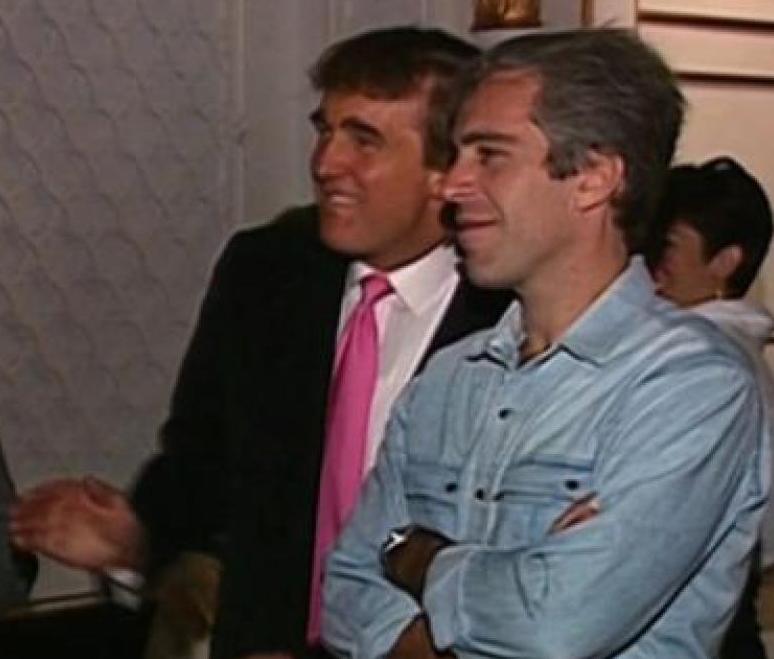
Donald Trump and Jeffrey Epstein seem to have spotted something Donald Trump and Jeffrey Epstein seem to have spotted something at a party Trump held for cheerleaders at Mar-a-Lago (NBC).
Axios, 1 big thing: Epstein files dump, Kate Santaliz and Andrew Solender, Sept. 2, 2025. After fleeing D.C. to avoid the issue in August, the House Oversight Committee released a redacted tranche of Epstein files tonight.
Why it matters: It's not the full, raw release demanded by the MAGA base, a handful of Republican lawmakers, and nearly every House Democrat.
But GOP leaders are betting that it will stymie Republican rebels who are pushing their own discharge petition on the files in the Jeffrey Epstein sex trafficking case.
Rep. Thomas Massie (R-Ky.) formally filed his long-awaited discharge petition today. If signed by 218 House members, it would force a vote on releasing the files.
Massie and Rep. Ro Khanna (D-Calif.) have pushed their respective parties to back the release of the files, but their populist revolt has faced resistance from House Speaker Mike Johnson and President Trump. Every House Democrat is expected to sign, with Massie telling reporters today he is "pretty confident" they can get the necessary Republican signatures as well.
The intrigue: Johnson, right, told reporters today he'd describe everything Massie has to say about Epstein as "meaningless."
After meeting with a group of Epstein's victims in the Capitol for over two hours today, Johnson called the discharge petition "moot" because of Oversight's progress in its probe. "It was inartfully drafted, it does not adequately protect the innocent victims," Johnson also said of the discharge petition.
The other side: Massie told us tonight of the Oversight panel's file release: "My staff has done a quick look at it and it looks like a bunch of redacted documents and nothing new, so it's not going to suffice."
Massie said there is a "pressure campaign from the White House" on the 11 Republicans who have co-sponsored his Epstein bill not to sign the discharge petition, but that "there are also ones that the White House is not whipping that may be inclined to sign it." "And then also, eventually, people are not going to be satisfied with what's happening in the Oversight Committee. It's not going to bring the closure they're looking for."
The bottom line: The DOJ sent "thousands of pages" of records to the Oversight Committee, with more on the way.
But the panel's top Democrat, Rep. Robert Garcia (Calif.), said the majority of the documents shared are already public. Oversight has lined up depositions with Bill and Hillary Clinton and former FBI director James Comey. Newly added to the list is former U.S. Attorney Alex Acosta. Oversight Chair James Comer (R-Ky.) also subpoenaed Epstein's estate for records last week, including a "birthday book" reportedly prepared by Ghislaine Maxwell. The deadline for that subpoena is Sept. 8.
Paul Krugman via Substack, Political-Economy Commentary: The Bonfire of Trump’s Vanities, Paul Krugman, right, Sept. 2, 2025. A richness of embarrassments. Busy day yesterday, so all I have this morning is a brief follow-up on last week’s post about the decision by an appeals court to uphold the Court of Trade’s ruling that most of Trump’s tariffs are illegal — which they clearly are.
Scott Bessent, the Treasury secretary, has argued that this ruling should not stand because it would embarrass the United States. (Actually, it would mainly embarrass Bessent and his boss.) As I noted, this is a novel legal principle: It’s OK to do illegal things when obeying the law would be embarrassing. What I failed to note is the sheer chutzpah of the argument.
Many of my readers probably know the concept — hey, “chutzpah” is in the Oxford English dictionary. In any case, the classic explanation of chutzpah is that it’s when you murder your parents, then plead for leniency because you’re an orphan. Here we have officials engaging in blatantly illegal actions, then saying that they should be let off the book because admitting that their actions were illegal would be humiliating.
Actually, the embarrassment would run deeper than many people realize. Who actually pays tariffs? Mostly American businesses, who have to pay a tax on goods they import. If those taxes were illegal, surely the government will have to refund the money. Sound implausible? Not to investors who have been buying up refund rights.
And who’s facilitating these bets that Trump’s whole tariff strategy will collapse? Cantor Fitzgerald, an investment bank run by the sons of Howard Lutnick, the Commerce Secretary.
So yes, obeying the law would be very embarrassing for the Trump administration. But honestly, there are so many embarrassing things going on now that one more would hardly make a difference. Here, for example, is what the White House put out yesterday: Raising $8 trillion in tariff revenue would be quite a trick, given that total U.S. imports last year were only $3.3 trillion.
And outside the realm of economics, the United States has just experienced a spectacular diplomatic disaster. America has spent decades trying to cultivate good relations with India, which could be a useful counterweight to China. Now we have a nearly complete rupture, with India actually cozying up to China.
And what was that about? Apparently Trump, in his bizarre pursuit of a Nobel peace prize, tried to bully Narendra Modi, India’s prime minister, into giving him undeserved credit for a cease-fire between India and Pakistan. The two men haven’t talked since.
And there’s much more, like Trump’s claim that the European Union is giving him $600 billion, which is news to the Europeans.
You might say that the Trump administration is suffering from a richness of embarrassments.
Trump has, of course, surrounded himself with slavish sycophants. And he may imagine that the world admires him the way his hangers-on pretend to. The truth, however, is that the world sees him as a dangerous buffoon. Dangerous because he runs America, an economic and military superpower, and has a fanatically supportive domestic base. A buffoon because he’s almost surreally vain, insecure and ignorant.
Given that reality, we really shouldn’t worry that a legal setback on tariffs will embarrass the administration, causing it to lose the world’s respect. Trump already has no respect left to lose.

New York Times, Scientists Denounce Trump Administration’s Climate Report, Lisa Friedman and Sachi Kitajima Mulkey, Sept. 2, 2025. Scores of researchers reviewed the Energy Department’s argument about greenhouse gases and found serious deficiencies
More than 85 American and international scientists have condemned a Trump administration report that calls the threat of climate change overblown, saying the analysis is riddled with errors, misrepresentations and cherry-picked data to fit the president’s political agenda.
The scientists submitted their critique as part of a public comment period on the report, which was to close Tuesday night.
“No one should doubt that human-caused climate change is real, is already producing potentially dangerous impacts, and that humanity is on track for a geologically enormous amount of warming,” the scientists wrote. They compared the administration’s report to efforts by the tobacco industry to create doubt around the health links between smoking and cancer.
The five researchers who prepared the administration’s July report were handpicked by Chris Wright, the energy secretary, and they all reject the established scientific consensus that the burning of oil, gas and coal is dangerously heating the planet. They acknowledged that the Earth is warming but said that climate change is “less damaging economically than commonly believed.”
The administration used the report to justify its recent announcement that it would repeal limits on greenhouse gas emissions that stem from burning fossil fuels.
Mr. Wright has accused the report’s critics of avoiding a robust discussion of the science. h
“People had been much less willing than I had hoped to engage in a thoughtful dialogue on climate change,” he said in a recent interview. “This is fundamentally a story about something that’s a real physical phenomenon that’s scientifically complicated. It’s a scientific, economic issue and people treat it too often as a religious issue.”
The Energy Department declined to comment on the criticisms from scientists about the report. Ben Dietderich, a spokesman for Mr. Wright, said in a statement that the agency sought an “open and transparent dialogue around climate science.” He added, “Following the public comment period, we look forward to reviewing and engaging on substantive comments.”
The Trump administration is pursuing an aggressive agenda to ramp up the production and use of coal, oil and gas, the burning of which is the main driver of climate change.
At the same time, average global temperatures have risen by between 1.25 and 1.41 degrees Celsius (or 2.25 to 2.53 degrees Fahrenheit), compared with preindustrial times. That may sound small, but the warming has impacted every region of the planet with more frequent and intense heat waves, floods, wildfires, droughts and other disasters.
Ross McKitrick, one of the report’s authors, said that their climate work for the Energy Department had been paused because of pending litigation. He defended the report’s lack of peer review, saying that it underwent an initial review within the Energy Department. Critiques submitted during the public comment period will be part of the public record, he said.
Dr. McKitrick said that the report’s authors followed their assignment and focused on themes that do not typically get enough attention.
But the 85 scientists, many of whom produced work that was cited in the Energy Department report, said that the report should be discredited.
In a chapter-by-chapter rebuttal that essentially serves as a peer review, the scientists took apart some of the government’s most eye-popping claims.
“Their goal was to muddy the waters, to put out a plausible-sounding argument that people can use in the public debate to make it sound like we don’t know whether climate change is bad or not,” said Andrew Dessler, a professor of atmospheric sciences at Texas A&M University, who led the rebuttal.
New York Times, Trump Administration: Court Hands a Loss to Groups Seeking Billions in Frozen Climate Funds, Claire Brown, Sept. 2, 2025. The nonprofit organizations are fighting a Trump administration effort to claw back climate and clean energy grants.
An appeals court on Tuesday ruled against several nonprofit groups that had $16 billion in climate grants frozen this year by the Trump administration.
In a 2-1 ruling, the U.S. Court of Appeals for the District of Columbia Circuit found that it did not have jurisdiction in the case and that the Trump administration acted legally in its attempts to claw back the funds, dashing the environmental groups’ hopes of immediately accessing money they were awarded more than a year ago.
“While some grantees may be forced to shutter their operations during the litigation, their harms do not outweigh the interests of the government and the public in the proper stewardship of billions of taxpayer dollars,” the court wrote in the majority opinion.
As part of President Joseph R. Biden’s signature climate law, the Environmental Protection Agency last year awarded eight nonprofit groups a total of $20 billion in climate and clean energy grants for things like financing solar installations and retrofitting buildings for energy efficiency.
But in February the money was frozen at the Trump administration’s request after Lee Zeldin, the E.P.A. administrator, suggested that the grants were vulnerable to fraud. A lengthy legal battle ensued.
At stake are billions in grant dollars, a total that amounts to roughly double the E.P.A.’s annual budget. Legal experts say the case is testing the limits of the Trump administration’s ability to claw back federal money that has already been committed.
Beth Bafford, the chief executive of Climate United, an organization that was awarded nearly $7 billion in grants, said the decision was not the end of the road. “While we are disappointed by the panel’s decision,” she said, “we stand firm on the merits of our case. The E.P.A. unlawfully froze and terminated funds that were legally obligated and disbursed.”
The funds were made available through the 2022 Inflation Reduction Act and the grants were legally committed before the November election. The grant dollars were deposited into recipients’ accounts at Citibank, which agreed to act as an intermediary between the government and the grant recipients.
Not long after entering office, E.P.A. administrator Lee Zeldin began calling for the return of the money, suggesting, without providing evidence, that the grants were vulnerable to waste, fraud and abuse.
Mr. Zeldin cited a hidden-camera video made public by the right-wing group Project Veritas in which a Biden-era E.P.A. staff member compared the outgoing administration’s efforts to allocate money in its final months to tossing gold bars off the Titanic. In public comments, Mr. Zeldin began referring to the grants as “gold bars.”
Citibank froze the recipients’ bank accounts at the government’s request, and several of the grant recipients sued the E.P.A. and Citibank for access to the funds in March.
The Justice Department and the E.P.A.’s acting inspector general opened investigations into the grants, but so far the agency has not provided evidence to substantiate Mr. Zeldin’s claims. The government could legally recoup the money if it found evidence of fraud.
In court, the E.P.A. has offered a different legal argument. It has said it can cancel the grants and reclaim the funding because its priorities have changed.
“It’s money that’s gone all the way through the fiscal process and is being pulled back, and that’s really not something administrations have done in the past,” said David Super, a law professor at Georgetown University.
On Tuesday, the court determined that the case should be heard in the Court of Federal Claims, which would decide whether the nonprofit groups are owed any money by the government. The decision vacated a previous District Court ruling that would have temporarily given the grant recipients access to some of their funds.

John Malone appears on CNBC. (Screen grab via SnapStream)
Status, Malone's CNN Groans; Infowars in Meltdown; Google's Giant Win, Oliver Darcy,Sept. 2, 2025. Mentioned in this edition: Chloe Malle, Emily Sundberg, Jim VandeHei, Jamie Heller, Clarissa Ward, Margaret Brennan, Benny Johnson, Elon Musk, Sundar Pichai, Howard Stern, Stephen Colbert, and more. But first, your Status Report.
John Malone’s swipes at CNN sparked a rare rebuttal from Warner Bros. Discovery—and plenty of annoyance inside Hudson Yards.
On Tuesday morning, John Malone—the Liberty Media boss, cable kingpin, and one of Warner Bros. Discovery’s most powerful shareholders—popped up on CNBC’s “Squawk Box.” Malone, dressed in a shirt and tie, was perched on a brown leather chair as he Zoomed in from his home to promote his new book, "Born to Be Wired." The first few minutes were standard fare covering how the book came together, what compelled him to write it, etcetera.
But once the obligatory promotional part of the interview was out of the way, the conversation grew much more interesting. Conservative co-host Joe Kernen criticized the state of the news media as being biased against Donald Trump, and pressed Malone for his take, especially on CNN, which he had infamously skewered years ago.
"Do you think CNN has changed to the point where you'd like, where you're seeing actual journalism now?" Kernen asked. "Do you see it across mainstream media anywhere?"
"No," Malone flatly replied, before delivering a somewhat rambling comment about how the journalism profession is rife with liberals and (again) praising Rupert Murdoch for how Fox News is operated. Malone did allow for the fact that CNN "has great journalists," but he lamented that those who work in the news industry "tend to be progressives personally" and "it's impossible to separate that sort of personal opinion structure from the way they cover the news."
Of course, it wasn't the first time Malone has jabbed CNN in recent days. In an interview with The New York Times' Ben Mullin published on Friday, Malone said the network is "a shadow of what its founder had envisioned," described its employees as "left of center" who "express their opinions too much in their news," and complained that WBD chief executive David Zaslav had been "unable to have a meaningful impact" on the editorial nature of the organization. “They can’t help themselves,” Malone told Mullin. “And so what you’ve got is a left-leaning, anti-Trump news service.”
New York Times, House Oversight Committee Is Set to Meet With Accusers of Jeffrey Epstein, Francesca Regalado, Sept. 2, 2025. Lawmakers are continuing their inquiry into Mr. Epstein, the disgraced financier, despite the Trump administration’s efforts to quell public demand for information.
A House committee plans to meet on Tuesday with 10 people who have accused the disgraced financier Jeffrey Epstein of sex trafficking, putting further attention on an issue President Trump has sought to downplay.
Mr. Trump’s supporters have been galvanized by conspiracy theories that Mr. Epstein was only one among a cabal of pedophiles in the upper echelons of American society. Mr. Epstein died in 2019 while in prison awaiting trial on sex trafficking charges.
Mr. Trump and his administration spent much of the summer trying to extinguish the conspiratorial fervor they fanned by promising the release of files connected to Mr. Epstein’s case.
Attorney General Pam Bondi released around 200 pages of documents in February. The Justice Department and the F.B.I. concluded in July that there was no list of Mr. Epstein’s clients, nor was there any evidence that Mr. Epstein had blackmailed prominent individuals.
Tuesday’s meeting suggests that some lawmakers in both parties are eager to keep a spotlight on an uncomfortable topic for Mr. Trump.
Many Americans believe that the government has concealed information about Mr. Epstein — 69 percent, according to a Reuters/Ipsos poll in July. The fallout has threatened Mr. Trump’s hold on his base, and it prompted Speaker Mike Johnson to start the House of Representatives’ summer recess early to avoid votes on the issue.
Representative Thomas Massie, Republican of Kentucky, and Representative Ro Khanna, Democrat of California, are trying to force the House to vote on a discharge petition demanding the release of the files.
The House cannot compel the Justice Department to release documents, but such a vote could lay bare a rift among Mr. Trump’s supporters in Congress. Six Republicans who are prominent in Mr. Trump’s MAGA movement, including Representatives Marjorie Taylor Greene of Georgia and Lauren Boebert of Colorado, have expressed support for Mr. Massie’s petition.
“I pray Speaker Johnson will listen to the pleas of these victims for justice and quit trying to block a vote on our legislation to release the Epstein files,” Mr. Massie wrote on social media on Monday. He added that the 10 victims would appear on the steps of the United States Capitol on Wednesday for a news conference.
More Global News
New York Times, Ukraine Pursues a Weapons Buildup More Potent Than Any Security Guarantee, Constant Méheut, Sept. 2, 2025. Kyiv sees a well-equipped army as a stronger deterrent to Moscow than any Western pledges to defend it. It is working to attract billions to buy more arms.
Ukraine is pursuing a multibillion-dollar arms buildup that would be funded by Europe, seeing it as the best chance of ensuring the country’s long-term survival as American assistance dries up and Western security guarantees remain uncertain.
Kyiv wants not only to sustain its army through the current war but also to make it the backbone of any postwar settlement, with the goal of deterring Russia from invading again. As Ursula von der Leyen, the European Commission president, recently put it: “Ukraine must become a steel porcupine, undigestible for potential invaders.”
At the center of these efforts is a new NATO-backed procurement system that will channel European funds into buying U.S. weapons for Ukraine. President Volodymyr Zelensky, left, hopes the system will enable $1 billion in purchases each month, with a particular focus on 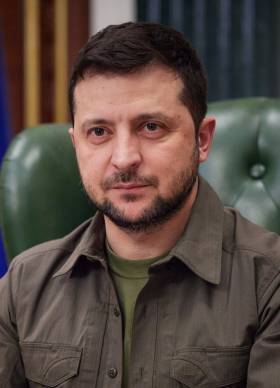 acquiring U.S.-made Patriot air-defense systems to expand Kyiv’s limited arsenal.
The new system would both help replace U.S. arms donations that President Trump has ended and also increase and streamline deliveries of weapons to Ukraine over time. A first sale of cruise missiles and GPS navigation kits, worth $825 million, was announced on Thursday.
Kyiv is also betting on its booming domestic defense industry, which has already delivered drones that swarm the battlefield and is now working to produce more powerful weapons. This month, Ukraine said it had completed the development and begun production of its first domestically made long-range cruise missile.
How far this military buildup can go remains uncertain. European nations that are already grappling with budget strains may struggle to sustain the level of funding Ukraine says it needs, and Kyiv’s army must address persistent manpower shortages to become a truly deterrent force.
But Ukraine has few options other than bolstering its own defense. Vague Western pledges of postwar security guarantees have yet to turn into concrete commitments, and the push for a more robust military reflects concerns that such promises may never materialize.
“The main guarantee of Ukraine’s security is a fully capable, well-trained army that remains in constant combat readiness,” Ihor Klymenko, Ukraine’s interior minister, said last week in an interview.
New York Times, Putin and Xi Invoke Wartime Unity as They Hail Ties in Beijing, Lily Kuo and Anton Troianovski, Sept. 2, 2025. The Russian and Chinese leaders drew on a shared view of their countries’ roles in World War II to cast their modern-day partnership as a challenge to the West.

New York Times, Landslide Kills Hundreds in Sudan, Declan Walsh and Qasim Nauman, Sept. 2, 2025. The landslide leveled a village in the remote Marra mountains (shown above), a local rebel group said. Its leader appealed for urgent help, saying, “This is a nightmare.”
Hundreds of Sudanese villagers were killed when a landslide engulfed their village in Darfur, a region already stricken by famine and war, according to officials and a local rebel group that issued an urgent appeal on Tuesday for international help.
The landslide happened on Sunday after days of heavy rain and leveled the village of Tarsin in the remote Marra mountains, the Sudan Liberation Movement/Army said in a statement.
The rebel group said that as many as 1,000 people had been killed in the disaster, with just a single survivor in the village. The toll was based on estimates of the village population.
The top U.N. official in Sudan, Luca Renda, said in a statement that between 300 and 1,000 people may have died. Sudan’s government and aid workers scrambling to reach the affected area offered similar estimates.
U.S. Justice, Crime, Courts
New York Times, White House Counsel Eases Trump’s Path on Aggressive Agenda, Maggie Haberman, Charlie Savage and Jonathan Swan, Sept. 2, 2025. David Warrington, the top lawyer inside the West Wing, focuses on “the art of the possible,” as one Trump adviser said.
President Trump’s first White House counsel, Donald F. McGahn II, had tense encounters with the president as he resisted Mr. Trump’s efforts to impede the Russia investigation, emerging as an avatar for people who believed the president needed containing.
In Mr. Trump’s second term, his White House counsel, David Warrington, has so far taken a much milder approach in one of the most important legal jobs in government — a position that historically has straddled a sometimes-murky divide between keeping the president on the right side of the law and finding ways to facilitate presidential desires.
Mr. Warrington, 57, has been at Mr. Trump’s side as the president has made numerous legally aggressive moves — prolifically invoking emergency powers, sending troops into cities, investigating his perceived foes, unilaterally raising import taxes and leveraging concessions from private sector companies.
The pattern raises the question of how such maneuvers have been shaped by the views of Mr. Warrington, who has no previous government experience. In an interview, the White House counsel described his role as informing the president about the legal landscape and providing guidance about potential consequences, including ways to reduce risks — but not making decisions for Mr. Trump.
“He’s the one that makes the ultimate decisions,” Mr. Warrington said, adding: “And whether I have a personal view of something is really, that’s — unless asked for it, I don’t give it.”
If Mr. Warrington has a lighter touch than Mr. McGahn or other past White House counsels, that’s in part because the job itself is different now. There is no special counsel investigation dogging Mr. Trump, as there was in his first term, and the Justice Department’s top ranks are filled with Mr. Trump’s personal lawyers. The Supreme Court last year granted presidents substantial immunity from prosecution for official actions.
And even before he won, Mr. Trump’s aides made it clear that they would not bring figures into his second administration who would thwart his agenda, as they believed some of his appointees had done in his first term — and made plans to appoint lawyers who would be more willing to bless aggressive actions.
Jack Goldsmith, a Harvard law professor and former senior Justice Department official in the Bush administration, said that it was Mr. Trump’s prerogative to organize how he received legal advice, but traditionally presidents have wanted a significant legal chop at policies to keep them out of trouble.
To those who have tangled with the administration in the courts, the current posture of the counsel’s office is striking. Anthony Romero, executive director of the American Civil Liberties Union, which sued over several administration policies, said his group had lines of communication with White House lawyers during Mr. Trump’s first term. This time around, “it’s clear that there are no adults in the room with the president,” he said.
“There is zero engagement and the forces arguing for restraint and balancing of equities aren’t in the inner circle,” Mr. Romero said. “The results are that a second Trump administration is a lot more unhinged than the first.”
Emptywheel, Analysis: Kristi Noem’s Non-Stop Slander Invites Congress to Ask Melania about Her Close Ties to Jeffrey Epstein, Emptywheel (Marcy Wheeler, right), Sept. 2, 2025. Kristi Noem has responded to a fourth request from Kilmar Abrego for an order gagging her unsubstantiated claims about him by creating a false censorship attack on CBS.
 Kristi Noem, left, loves to slander Kilmar Abrego Garcia.
DHS has long wanted to claim — but failed to substantiate — that Abrego is a member of MS-13.
For example, the whistleblower complaint from Erez Reuveni describes how DHS wanted to make such claims about Abrego, but had no evidence. When he failed to make such an argument in court, his boss Drew Ensign called to complain, explaining that the White House had wanted DOJ to make such a claim.
Todd Blanche, right, fired Reuveni after he refused to sign on a brief claiming that Abrego was a terrorist, a claim not made to the District Court.
And when DOJ attempted to convince two judges that Abrego was a dangerous terrorist, they failed. Magistrate Judge Barbara Holmes laid out that the evidence presented to her of MS-13 membership largely amounted to the feeling of a cooperating witness whose family has ties to a competing gang, but their key cooperating witness said he knew of no evidence Kilmar was a MS-13 member.
But Noem and her flunkies keep publicly claiming that Abrego is an MS-13 member.
Abrego has requested on four different occasions (one, two, three) for the judge in his criminal case to gag the government from making such inflammatory claims, most recently last Thursday. Each time, Judge Crenshaw has ordered parts of the government to comply — first the lawyers subject to local rules, and then anyone before the court — but he noted that it was not clear whether DHS is before him.
Noem, of course, doesn’t care.
Perhaps as a deliberate incitement Sunday, she went on Face the Nation, and repeated the same unsubstantiated claims that Holmes and Crenshaw both judged they had no evidence to prove, including that Abrego, “was a known human smuggler, an MS-13 gang member, an individual who was a wife beater, and someone who was so perverted that he solicited nude photos from minors.”
CBS cut that claim, and now Noem, Trump’s top propagandists, and Trump’s right wing mob is trying to liken it to CBS’ editing of the Kamala Harris interview.
In other words, even as Abrego asks the court to make DHS adhere to long-standing policies of public statements regarding pretrial defendants, Noem is deliberately stoking slander.
She’s doing so, presumably, comfortable in the knowledge that DOJ would substitute the government for Noem if Abrego sued. That is, she’s hiding behind the immunity of government employ to stoke a false propaganda campaign against a guy she trafficked to a concentration camp based on false claims.
I can’t help but note that Noem is gleefully engaged in slander in the wake of Melania Trump’s efforts to bully multiple entities — first Daily Beast, and then James Carville — into withdrawing reports about Jeffrey Epstein’s claims that he had role in introducing Melania to her spouse (or that they first fucked on his plane). Melania attempted to do the same with Hunter Biden, but he refused (and in the process, Hunter noted that NYT had published Epstein’s claim he introduced them before he died, with no retraction).
As Congress returns today, Epstein will remain a key focus, with a politicized inquiry unfolding under James Comer in House Oversight and a more aggressive effort pushed by Ro Khanna and Tom Massie, who have a discharge petition queued up for a vote. Both efforts have real cause to ask why Trump moved sex trafficker Ghislaine Maxwell to a minimum security prison camp close to Bryan, TX schools (including Texas A&M) to shut her up, and whether it has anything to do with Melania’s litigious interest in tamping down any questions about her ties to Epstein.
Those same members of Congress might take a lesson from Noem (or, for that matter, the members of Congress who made false claims about Hunter Biden).
The entire Trump Administration treats government employ is a platform for incendiary slander.
As Trump faces renewed scrutiny of his efforts to cover-up his ties to Jeffrey Epstein, that could get awkward for Melania.

From left: American real estate developer Donald Trump and his girlfriend (and future wife), former model Melania Knauss, financier (and future convicted sex offender) Jeffrey Epstein, and British socialite Ghislaine Maxwell pose together at the Mar-a-Lago club, Palm Beach, Florida, February 12, 2000. Getty Images.
Sept. 1

In the late 1800s, at the height of the Industrial Revolution in the United States, the average American worked 12-hour days and seven-day weeks in order to eke out a basic living, according to the St. Louis /Southern Illinois Labor Tribune, which republished the 1882 photo above showing America's first Labor Day march, which occurred in New York City on Sept.5,1882. "Despite restrictions in some states, children as young as five or six toiled in mills, factories and mines across the country, earning a fraction of their adult counterparts’ wages. People of all ages, particularly the very poor and recent immigrants, often faced extremely unsafe working conditions, with insufficient access to fresh air, sanitary facilities and breaks. Labor unions, which had first appeared in the late 18th century, grew more prominent and vocal. They began organizing strikes and rallies to protest poor conditions and compel employers to renegotiate hours and pay."
Letters from an American, Historical Commentary: Aug. 31, 2025 [Labor Movement's U.S. Struggles], Heather Cox Richardson, right, Sept. 1, 2025. Almost one hundred and forty-three years ago, on September 5, 1882, workers in New York City celebrated the first Labor Day holiday with a parade. The parade almost didn’t happen: there was no band, and no one wanted to start marching without music.
Once the Jewelers Union of Newark Two showed up with musicians, the rest of the marchers, eventually numbering between 10,000 and 20,000 men and women, fell in behind them to parade through lower Manhattan.
Their goal was to emphasize the importance of workers in the industrializing economy and to warn politicians that they could not be ignored. Less than 20 years before, northern men had fought a war to defend a society based on free labor and had, they thought, put in place a government that would support the ability of all hardworking men to rise to prosperity.
By 1882, though, factories and the fortunes they created had swung the government toward men of capital, and workingmen worried they would lose their rights if they didn’t work together. A decade before, the Republican Party, which had formed to protect free labor, had thrown its weight behind Wall Street. By the 1880s, even the staunchly Republican Chicago Tribune complained about the links between business and government: “Behind every one of half of the portly and well-dressed members of the Senate can be seen the outlines of some corporation interested in getting or preventing legislation,” it wrote. The Senate, Harper’s Weekly noted, was “a club of rich men.”
The workers marching in New York City carried banners saying: “Labor Built This Republic and Labor Shall Rule It,” “Labor Creates All Wealth,” “No Land Monopoly,” “No Money Monopoly,” “Labor Pays All Taxes,” “The Laborer Must Receive and Enjoy the Full Fruit of His Labor,” ‘Eight Hours for a Legal Day’s Work,” and “The True Remedy Is Organization and the Ballot.”
The New York Times denied that workers were any special class in the United States, saying that “[e]very one who works with his brain, who applies accumulated capital to industry, who directs or facilitates the operations of industry and the exchange of its products, is just as truly a laboring man as he who toils with his hands…and each contributes to the creation of wealth and the payment of taxes and is entitled to a share in the fruits of labor in proportion to the value of his service in the production of net results.”
In other words, the growing inequality in the country was a function of the greater value of bosses than their workers, and the government could not possibly adjust that equation. The New York Daily Tribune scolded the workers for holding a political—even a “demagogical”—event. “It is one thing to organize a large force of…workingmen…when they are led to believe that the demonstration is purely non-partisan; but quite another thing to lead them into a political organization….”
Two years later, workers helped to elect Democrat Grover Cleveland, left, to the White House. A number of Republicans crossed over to support the reformer, afraid that, as he said, “The gulf between employers and the employed is constantly widening, and classes are rapidly forming, one comprising the very rich and powerful, while in another are found the toiling poor…. Corporations, which should be the carefully restrained creatures of the law and the servants of the people, are fast becoming the people’s masters.”
In 1888, Cleveland won the popular vote by about 100,000 votes, but his Republican opponent, Benjamin Harrison, won in the Electoral College. Harrison promised that his would be “A BUSINESS MAN’S ADMINISTRATION” and said that “before the close of the present Administration business men will be thoroughly well content with it….”
 Businessmen mostly were, but the rest of the country wasn’t. In November 1892 a Democratic landslide put Cleveland back in office, along with the first Democratic Congress since before the Civil War. As soon as the results of the election became apparent, the Republicans declared that the economy would collapse. Harrison’s administration had been “beyond question the best business administration the country has ever seen,” one businessmen’s club insisted, so losing it could only be a calamity. “The Republicans will be passive spectators,” the Chicago Tribune noted. “It will not be their funeral.” People would be thrown out of work, but “[p]erhaps the working classes of the country need such a lesson….”
As investors rushed to take their money out of the U.S. stock market, the economy collapsed a few days before Cleveland took office in early March 1893. Trying to stabilize the economy by enacting the proposals capitalists wanted, Cleveland and the Democratic Congress had to abandon many of the pro-worker policies they had promised, and the Supreme Court struck down the rest (including the income tax).
They could, however, support Labor Day and its indication of workers’ political power. On June 28, 1894, Cleveland signed Congress’s bill making Labor Day a legal holiday.
In Chicago the chair of the House Labor Committee, Lawrence McGann (D-IL), told the crowd gathered for the first official observance: “Let us each Labor day, hold a congress and formulate propositions for the amelioration of the people. Send them to your Representatives with your earnest, intelligent indorsement [sic], and the laws will be changed.”
In the late 1800s, at the height of the Industrial Revolution in the United States, the average American worked 12-hour days and seven-day weeks in order to eke out a basic living. Despite restrictions in some states, children as young as five or six toiled in mills, factories and mines across the country, earning a fraction of their adult counterparts’ wages.
People of all ages, particularly the very poor and recent immigrants, often faced extremely unsafe working conditions, with insufficient access to fresh air, sanitary facilities and breaks.
As manufacturing increasingly supplanted agriculture as the wellspring of American employment, labor unions, which had first appeared in the late 18th century, grew more prominent and vocal. They began organizing strikes and rallies to protest poor conditions and compel employers to renegotiate hours and pay.
Many of these events turned violent during this period, including the infamous Haymarket Riot of 1886, in which several Chicago policemen and workers were killed. Others gave rise to longstanding traditions: On September 5, 1882, some 10,000 workers took unpaid time off to march from City Hall to Union Square in New York City, holding the first Labor Day parade in U.S. history.
Status, Ben Smith Talks New Column, Trump Coverage, and the State of Journalism, Oliver Darcy, Sept. 1, 2025. Mentioned in this edition: Anna Wintour, Chloe Malle, John Malone, Kristi Noem, Mark Thompson, Donna Brazile, Charles Blow, Tim Dillon, Woody Allen, Dwayne Johnson, Amanda Seyfried, Jude Law, and more. But first, The Spotlight. Mr. Smith Goes to Washington
 In a conversation with Status, Ben Smith, right, dishes on his new Washington-focused column at Semafor, whether he believes democracy is under threat, and the state of the news media.
In other media news:
Media blackout: As social media remains abuzz with questions about Donald Trump's health, Garrett Graff observed on Monday morning that there wasn't "a single story" covering the topic "on the homepage of The Washington Post, Wall Street Journal, New York Times, or CNN." [Doomsday Scenario]
In a Truth Social rant, Trump said "highly discredited" ABC News "should pay me more" and that the network should fire Chris Christie and Donna Brazile from their roles as contributors. [The Wrap]
Kristi Noem complained that CBS News "shamefully" edited out part of an answer she gave "Face the Nation" on Kilmar Abrego Garcia, in which she yet again smeared the Salvadoran citizen with the unproven allegation that he is an MS-13 gang member. [Mediaite]
Anna Wintour selected Chloe Malle as the next editor of American Vogue, Lauren Sherman reported. Per Sherman, who has been all over this story, Condé Nast could officially announce the move on Tuesday. [Puck]
RIP: CBS News White House correspondent Mark Knoller died at 73. As the CBS News obituary stated, he was, "to put it simply, a legend." [CBS News]
John Malone, who holds the absurd view that Fox News should be the benchmark for news outlets, trashed CNN as a "left-leaning, anti-Trump news service." Speaking to Ben Mullin, the media mogul lamented that Warner Bros Discovery boss David Zaslav, in his eyes, had  been "unable to have any meaningful impact" on moving the network into more MAGA friendly territory. [NYT]
In a statement, a CNN spokesperson said in part that network chief Mark Thompson "has made it clear from day one that he believes in a CNN that is fair-minded and biased in favor of the facts rather than any political party or interest."
Charles Blow, right, addressed his exit from The NYT in a Substack post announcing his return to writing: "My last years at the paper weren’t my most pleasant. My job went from being one I would say, earnestly, I would do for free, to one I struggled to justify doing for pay." [Blow the Stack]
The Parnas Perspective, Political Commentary: No Public Events for Trump on Labor Day and India Protests the Trump Administration, Aaron Parnas, right, Sept. 1, 2025. Indians protest the Trump Administration by burning Trump effigies, Trump requests voter data ahead of the 2026 elections, and ICE surges set to start
On the first Labor Day of Trump’s second term, labor advocates say his administration has been “brazenly anti-worker,” slashing pay and protections, gutting unions by ending collective bargaining for 1 million federal employees, weakening safety rules, and rolling back wage increases, while the White House insists Trump is putting “American workers first” through job gains, tax breaks, and lower inflation.
After social media rumors claiming Donald Trump had died went viral—amassing over a million engagements on X—the president dismissed them by posting “NEVER FELT BETTER IN MY LIFE” on Truth Social; speculation was fueled by his brief absence from public view and photos of bruising on his hand, but Trump was seen golfing in Virginia.
One day later, this morning, Donald Trump does not have any public events for Labor Day marking the sixth straight day the President has not appeared at a sanctioned event or spoken to the United States press corps.
At Nagpur’s annual Marbat Utsav, locals paraded and burned a giant effigy of Donald Trump to protest his administration’s new 50% tariffs on Indian goods over Delhi’s Russian oil imports; the centuries-old festival, traditionally aimed at warding off evil, has evolved into a venue for voicing social and political grievances, with this year’s symbolism channeling anger at U.S. trade policies.
The Trump administration, through the DOJ’s Civil Rights Division, has demanded unredacted voter registration data from states—including names, addresses, birthdates, driver’s license numbers, and partial Social Security numbers—sparking pushback from election officials in Arizona, Pennsylvania, and other states who call it an overreach and a threat to voter privacy, while critics fear the data could be used to fuel voter fraud claims ahead of the 2026 midterms.
Homeland Security Secretary Kristi Noem confirmed the Trump administration will expand ICE operations in major U.S. cities, including Chicago, amid reports of possible militarized federal activity; local leaders such as Chicago’s mayor and Illinois’ governor condemned the move as an abuse of power, while Noem insisted deployments are about safety and not politics, leaving open the possibility of National Guard involvement at Trump’s discretion.
The Trump administration has reportedly suspended visa approvals for nearly all Palestinian passport holders, expanding earlier restrictions on travelers from Gaza to now block access to the U.S. for medical treatment, education, and business; the move, which also included revoking visas for Palestinian Authority and PLO members ahead of the UN General Assembly, has drawn criticism for violating U.S. obligations as UN host and further aligns Washington with Israel’s right-wing government in rejecting a Palestinian state.
 The Contrarian, Global Commentary: The Most Communist President Ever, Jennifer Rubin, right, Sept. 1, 2025. How we lose our democracy and our economy.
Republicans, before the Donald Trump cult took hold, frequently railed (rightly so) against communist and fascist regimes that nationalized industry, indulged in crony capitalism, and substituted propaganda for the free flow of reliable information. (The five-year plan is working!) Well, well. How times have changed.
Sadly, but predictably, rather than reject these practices when they come from the Oval Office, corporate America, like Republicans more generally, has generally gone along with or whistled past the graveyard of capitalism, maintaining the pretense that all is well. Just as the First Amendment is too important to leave to the legacy media, a prosperous economy is too vital to leave to the Intel, Amazon, Space X, and other Wall Street spinners of conventional wisdom.
Former car czar Steven Rattner opined in The New York Times, “Mr. Trump is muscling his way into our economy in ways that are alien to traditional Republican principles, alien even to what more interventionist Democrats have argued for, and wildly at odds with any sensible notion of how the relationship between government and business should be managed.” Rattner noted that actions such as grabbing a 10% stake in Intel and trashing the independence of the Federal Reserve “bear resemblance to China’s state-directed capitalism.” Throw in a Rube Goldberg system of inflation-producing, growth-slowing tariffs, and you have the most anti-capitalist president in the modern era.
Consciously or not, Wall Street investors, pundits, and analysts keep alive the pretense of normalcy, as Nobel Prize-winning economist Paul Krugman, right, explained:
[M]arkets will remain calm until the illusion of normality becomes unsustainable. At that point market prices may “change violently.” The current technical term for this phenomenon is a “Wile E. Coyote moment” — the moment when the cartoon character, having run several steps off the edge of a cliff, looks down and realizes that there’s nothing supporting him. Only then, according to the laws of cartoon physics, does he fall.
Though we can joke about refusing to anticipate entirely foreseeable events (including the Spanish Inquisition!), market cluelessness does not prevent an inevitable reckoning (e.g., the 2008 crash) when economic gravity sets in. Markets can reckon for only so long that someone or something (the Supreme Court? the Senate? the other Fed governors?) will intervene to halt the unwinding of an independent Fed, for example. Better to hang tough and hope for the best, says the crowd deathly afraid of starting an economic stampede to the bottom.
Once a corrupt, dictatorial regime mars their reputations, investors, consumers, employers, and lenders might simply hunker down, put off decisions, and hope the dust settles. That paralysis, which we have already glimpsed in the fallout from tariffs, leads to recession—or, with a Fed untethered to reality and principled economics, to stagflation.

Prime Minister Narendra Modi of India, left, and President Xi Jinping of China on Sunday, Aug. 31, 2025, on the sidelines of the Shanghai Cooperation Organization summit in Tianjin, China, in a photo released by Mr. Modi’s office (Photo via Indian Prime Minister's Office and Associated Press).
New York Times, Xi Uses Summit, Parade and History to Flaunt China’s Global Pull, David Pierson, Mujib Mashal and Nataliya Vasilyeva, Sept. 1, 2025 (print ed.). With the leaders of Russia and India visiting, China’s president will show how he can use statecraft, military might and history to push for global influence.
Xi Jinping could hardly have scripted a more favorable moment. This weekend, the leaders of India and Russia joined him at a security summit in China — one leader pushed away by President Trump’s tariffs, the other brought out of isolation by his embrace.
For Prime Minister Narendra Modi of India, U.S. tariffs on Indian goods have raised doubts about leaning too heavily on Washington. For President Vladimir V. Putin of Russia, his red-carpet treatment in Alaska by Mr. Trump blunted Western efforts to punish him for the invasion of Ukraine.
At the center is Mr. Xi, turning America’s alienation of India into an opportunity, and finding validation for his own long alignment with Mr. Putin.
The summit of more than 20 leaders, mostly from Central Asia, followed by a military parade in Beijing showcasing China’s newest missiles and warplanes, is not just pageantry. It shows how Mr. Xi is trying to turn history, diplomacy and military might into tools for reshaping a global order that has been dominated by the United States.
“The success of Xi’s foreign policy strategy is reflected in the parade of leaders traveling to China,” said Jonathan Czin, a fellow at the Brookings Institution who previously worked at the C.I.A. analyzing Chinese politics. “Indeed, Xi today probably feels more besieged by visiting heads of state than encircled by the United States and its allies and partners.”
Mr. Xi, Mr. Putin and Mr. Modi are attending the summit of the Shanghai Cooperation Organization, a Eurasian security group led by China and Russia, in the eastern city of Tianjin on Sunday and Monday.
New York Times, India Was the Economic Alternative to China. Trump Ended That, Alex Travelli and Hari Kumar, Sept. 1, 2025. A lurch in policy has shaken the India-U.S. economic alliance against China, leaving India little choice but to consider reversing its own strategy.
President Trump’s 50 percent tariffs landed like a declaration of economic war on India, undercutting enormous investments made by American companies to hedge their dependency on China.
 India’s hard work to present itself to the world as the best alternative to Chinese factories — what business executives and big money financiers have embraced as part of the China Plus One strategy — has been left in tatters.
Now, less than a week since the tariffs took full effect, officials and business leaders in New Delhi, and their American partners, are still trying to make sense of the suddenly altered landscape.
Just how much things have changed was evident from Prime Minister Narendra Modi’s visit to China over the weekend to meet with Xi Jinping, China’s top leader. Trade and political relations between India and China have been strained, at times severely, and it was Mr. Modi’s first trip there in seven years.
The China Plus One approach has been critical to India’s budding ambitions to become a factory powerhouse. Manufacturing growth, especially in high-end sectors like technology, was seen by India as addressing chronic problems like the underemployment of its vast population of young workers. Now pursuing that path, without the support of Washington, and in potentially closer coordination with China, promises to be even more difficult.
Mr. Trump’s tariffs are already causing dislocation in supply chains. India has been rendered far less enticing to American importers. Companies can go to other places for lower tariffs, like Vietnam or Mexico. A U.S. court ruling, which on Friday invalidated the tariffs but left them in place while Mr. Trump appeals, did nothing to repair the rupture between the countries.
The “Trump shock will reduce manufacturing export growth and kill even the few green shoots of China Plus One-related private investment,” four Indian economists, including a former chief economic adviser to Mr. Modi, wrote in an Indian newspaper last week.
India still aspires to become one of the world’s three largest economies. It is currently fifth and on pace to overtake Japan soon. If the United States won’t help or, worse, gets in its way, India has no choice but to get closer to Beijing, even as it holds to its goal of becoming a stronger manufacturing rival to its giant neighbor.
Politico, Ukrainian police say Russia linked to murder of former parliament speaker, Veronika Melkozerova, Sept. 1, 2025. Authorities have arrested a suspect in the killing of Andriy Parubiy, a prominent politician who played a major role in Ukraine’s pro-WesternEuromaidan Revolution.
Ukrainian authorities have detained a suspect in the murder of Andriy Parubiy, below left, a senior politician and former parliamentary speaker, and allege there is a Russian link to the killing.
 “We know this crime is not accidental. There is a Russian trace in it,” Ivan Vyhivskyi, head of the National Police of Ukraine, said in a statement posted to Facebook on Monday. Vyhivskyi confirmed a suspect was arrested in the Khmelnytskyi region 36 hours after Parubiy’s murder. Ukraine’s general prosecutor’s office said the suspect is a 52-year-old resident of Lviv.
On Saturday — in broad daylight — a gunman disguised as a food delivery worker fired eight bullets at Parubiy in central Kyiv, killing him. Ukrainian President Volodymyr Zelenskyy said the killer was well-prepared and organized.
Parubiy’s murder is the latest in a string of killings of prominent Ukrainian politicians and activists this year, following the assassinations of former MP Iryna Farion in Lviv and anti-Russian activist Demian Hanul in Odesa.
Parubiy played a major role in leading Ukraine’s pro-Western Euromaidan Revolution in 2013-2014, which ousted the Kremlin puppet regime of Viktor Yanukovych, who is now in exile in Russia. In the winter of 2014, Parubiy served as the commander of protestor self-defense units that clashed with rogue police squads on the streets of Kyiv. He was also one of the top ideologists pushing for Ukraine’s cultural, linguistic and religious exodus from the Kremlin’s sphere of influence.
Russian President Vladimir Putin paints the Euromaidan Revolution as a coup d’état staged by the West and denies the legitimacy of the Ukrainian government. He is also seeking to force Kyiv to fully reinstate the Russian Orthodox church and Russian as a state language in Ukraine as his price for agreeing to a peace deal.
Emptywheel, Analysis: Trump’s Attempt to Repackage His Capitulation in Ukraine, Emptywheel (Marcy Wheeler, right), Sept. 1, 2025. The other day, Axios posted a ridiculous column (with Mike Allen as the first byline) beginning to lay the groundwork for Trump to repackage imminent failure on Ukraine. It starts by allowing senior White House officials anonymously and vaguely blame Europeans for Trump’s failure to craft a deal.
Frustrated Trump aides contend the blame should fall on European allies, not on Trump or even Russian President Vladimir Putin.
All three bases for that blame in the column are ridiculous:
- “White House officials are losing patience with European leaders, whom they claim are pushing Ukraine to hold out for
- “U.S. officials believe [Countries besides the UK and France] want the U.S. to bear the full cost of the war, while putting no skin in the game themselves.”
- Europeans aren’t prepared to add sanctions against Russia, even though, “European countries are already working on a new set of sanctions against Russia.”
What appears to have happened is that Mike Allen let a bunch of White House officials make ridiculous claims with no pushback.
Remember: as JD claims he knows better than Russian experts, Tulsi Gabbard is withholding their own intelligence on Russia even from Five Eyes partners. And Tulsi purged the top Russian expert who largely prepared the Alaska meeting over John Ratcliffe’s support by stripping her security clearance.
In the days leading up to President Donald Trump’s Aug. 15 Alaska summit with Russian President Vladimir Putin, one of the CIA’s senior-most Russia experts worked grueling hours, helping Trump and his team prepare for high-stakes diplomacy over Ukraine and making sure they were adequately briefed, according to a former agency colleague.
Four days later, the CIA officer — whom The Washington Post is not naming for her protection — was at work at the spy agency’s Langley headquarters when she was abruptly ordered to report to the security office. She was informed that her clearance to look at classified material was being stripped. In a span of minutes, her 29-year career in public service was essentially over.
The officer had been expecting an imminent move to Europe to take up a prestigious assignment approved by CIA Director John Ratcliffe.
Instead, she became the latest casualty of a widening cull by Trump and Director of National Intelligence Tulsi Gabbard, right, fueled at times by far-right activist Laura Loomer, targeting national security professionals whom they deem to have engaged in “politicization or weaponization of intelligence to advance personal, partisan, or non-objective agendas,” according to Gabbard’s Aug. 19 memo announcing the revocation at Trump’s direction of security clearances.
New York Times, Earthquake in Afghanistan Leaves More Than 800 Dead, Safiullah Padshah, Elian Peltier and Mike Ives, Updated Sept. 1, 2025. The quake, near the border with Pakistan, injured more than 1,300 people, the authorities said. The death toll was expected to rise.
The epicenter of the quake late Sunday was near Jalalabad, a city of about 200,000 people, the U.S. Geological Survey reported. Less than 100 miles away, residents of Kabul, Afghanistan’s capital, fled their homes as aftershocks were felt across the city throughout the night.
Politico, Marine Le Pen seizes her moment to shake France, Marion Solletty, Sept. 1, 2025. Undeterred by her ban on running for political office, the far-right leader is out to bring down the government and press for new elections.
If Prime Minister François Bayrou had hoped far-right leader Marine Le Pen would avoid bringing down France’s government because she is banned from running for political office, he sorely miscalculated.
In fact, Le Pen and her National Rally party, which tops the polls in France, look set to play a decisive role in ejecting Bayrou in a no-confidence vote on Sept. 8. They are adamant they want to seize on the deepening political crisis to press for a parliamentary election, and the resignation of President Emmanuel Macron.
Seeking to enact a highly unpopular €43.8 billion budget squeeze, Bayrou and Macron had effectively wagered that Le Pen — who controls the single largest opposition party in the National Assembly — would play along, when they called a no-confidence vote last week.
There was some logic to that gamble. As Le Pen is banned from running for office by an embezzlement conviction that goes to appeal only next year, why would she risk her parliamentary seat by potentially triggering an election? Wouldn’t she rather let Macron’s camp take the heat for painful financial cuts?
That’s not how Le Pen saw it, however. Barely an hour after the announcement of the confidence vote, she vowed she would mobilize her forces to topple Bayrou, and blamed eight years of Macronism for threatening France’s survival. “Only dissolution will now allow the French people to choose their destiny, that of recovery with the National Rally,” she wrote on social platform X.

New York Times, Fearing Bolsonaro Escape, Brazil Tightens Leash Ahead of Coup Trial, Ana Ionova, Sept. 1, 2025 (print ed.). Former President Jair Bolsonaro, who will stand trial on Tuesday, is being closely monitored by the Brazilian authorities, who fear he may try to flee.
The quiet gated community, in an upscale part of Brazil’s capital, Brasília, doesn’t see much crime. But these days, plainclothes police are standing guard here, tasked with an unusual mission: keeping close watch over former President Jair Bolsonaro.
Inside one of the luxury homes, Mr. Bolsonaro, wearing an ankle monitor, has been under house arrest for weeks. He is awaiting a trial that is to start on Tuesday, in which he is accused of plotting to stage a coup after losing the 2022 presidential elections. He denies the charges.
Now the Brazilian authorities have moved to further tighten the leash on the former leader, amid growing concerns that he may attempt to flee, according to a high-level police official who spoke anonymously about sensitive discussions.
Last week, the police opened a separate investigation into allegations that Mr. Bolsonaro and the son currently in the United States had lobbied foreign authorities with the aim of undermining Brazil’s judiciary and thwarting the case against him.
In July, President Trump suddenly became involved in Mr. Bolsonaro’s case, threatening Brazil with tariffs and demanding it end what he called a “witch hunt” targeting his political ally. He followed through, imposing 50 percent levies on Brazil and applying sanctions on Justice Moraes.
There have been signs suggesting that Mr. Bolsonaro planned to seek help from other right-wing leaders, too. The police said earlier this month that they had found a 33-page draft asylum request addressed to Argentina’s president, Javier Milei, on Mr. Bolsonaro’s phone.
U.S. Politics, Justice


New York Times, Already Pardoned by Trump, Jan. 6 Rioters Push for Compensation, Alan Feuer, Sept. 1, 2025 (print ed.). One of the rioters’ lawyers wants to create a panel that would decide on financial damages for what the rioters (shown above) believe were unfair prosecutions.
The rioters who attacked the Capitol on Jan. 6, 2021, secured a shocking double victory this year.
President Trump granted them clemency for their crimes on his first day back in the White House, and in the months that followed, he allowed his Justice Department to purge many of the federal agents and prosecutors who sought to hold them accountable.
But even though the president has given the rioters their freedom and has taken steps toward satisfying their desire for retribution, they are asking for more. In the past several weeks, the rioters and their lawyers have pushed the Trump administration to pay them restitution for what they believe were unfair prosecutions.
On Thursday, one of the lawyers, Mark McCloskey, said during a public meeting on social media that he had recently met with top officials at the Justice Department and pitched them on a plan to create a special panel that would dole out financial damages to the rioters — much like the arrangement of a special master to award money to the victims of the Sept. 11, 2001, terrorist attacks.
The panel, which Mr. McCloskey called a “voluntary nonjudicial resolution committee,” would consider rioters’ cases individually, he said, then assign them sums according to harms they had purportedly suffered at the hands of the federal government.
Mr. McCloskey said that he wanted the panel to be overseen by Jeanine Pirro, who runs the federal prosecutors’ office in Washington that took the lead in filing charges against nearly 1,600 rioters who joined in the Capitol attack.
“The only thing I can do as your lawyer,” he told the rioters who were at the online meeting, “is to turn your losses into dollar bills.”
Neither Ms. Pirro nor a spokesman for the Justice Department responded on Sunday to messages seeking comment on Mr. McCloskey’s plan, and it remains unclear how seriously top administration officials are taking it.
Still, the proposal represented a serious escalation of the efforts to rewrite the history of Jan. 6. If accepted, it would effectively designate members of the mob, whose Capitol break-in upset the lawful transfer of presidential power, as victims of the government and deserving of reparations.
Mr. McCloskey, who rose to prominence five years ago after he pointed an AR-15-style rifle at social justice protesters outside his home in St. Louis, has been leading the efforts to secure restitution for the rioters since at least March, when he announced that he and another lawyer, Peter Ticktin, a former classmate and longtime ally of Mr. Trump’s, were planning to sue the government.
The men originally said they were intending to bring claims that the people who were prosecuted for taking part in the Capitol attack had been mistreated by federal agencies like the Justice Department and the Bureau of Prisons.
 In May, many of the rioters took heart when Mr. Trump’s Justice Department agreed to pay nearly $5 million to settle a separate legal action: a wrongful-death lawsuit that was brought during the Biden administration by the family of Ashli Babbitt, right, an Air Force veteran who was fatally shot by the police while she was in a crowd that was trying to break onto the House floor on Jan. 6.
The settlement raised hopes that the department might look with favor on other lawsuits filed by the rioters themselves. But late last month, those hopes were tempered after department lawyers formally opposed a lawsuit that was brought in June by five members of the Proud Boys who were charged with sedition in connection with Jan. 6. The lawsuit claimed that federal officials had subjected them to “political persecution” as “allies of President Trump.”
During the online meeting last week, Mr. McCloskey acknowledged that he and Mr. Ticktin had also run into “significant difficulties” in pursuing legal action on behalf of the rioters.
He acknowledged that there could be problems following through on his initial plan to file cases under the Federal Tort Claims Act, which allows individuals to sue the government for injuries caused by federal employees. He also said it could be challenging to overcome the two-year statute of limitations on bringing tort claims against the government for things that happened nearly five years ago.
But Mr. McCloskey assured the rioters that they had allies inside Mr. Trump’s Justice Department. Chief among them, he said, was Ed Martin, who runs the so-called weaponization working group, a body that was created to investigate those who investigated Jan. 6 and other people whom Mr. Trump perceives to be his enemies.
“He’s 100 percent on our side,” Mr. McCloskey said of Mr. Martin.
New York Times, U.S. Immigration: Judge Halts U.S. Effort to Deport Guatemalan Children as Planes Sit on Tarmac, Miriam Jordan and Aishvarya Kavi, Updated Sept. 1, 2025. The temporary block ended another last-minute flurry of legal action over the Trump administration’s immigration crackdown.
With children already loaded onto planes, a federal judge on Sunday temporarily blocked the Trump administration from deporting dozens of Guatemalan minors and demanded assurances that they would remain in shelters until a more permanent ruling.
The order brought to a close, for now, another last-minute flurry of court action in the administration’s mass deportation drive. Lawyers for the children said that they would face peril if they were sent to Guatemala and that doing so would deny them due process. They also argued that the government had ignored special protections for minors who cross the border alone.
In the early morning hours on Sunday, Judge Sparkle L. Sooknanan of the U.S. District Court for the District of Columbia issued a temporary restraining order forbidding the administration from deporting the children after the National Immigration Law Center filed an emergency request.
Judge Sooknanan’s order was intended to be in place until an emergency hearing could be held in the afternoon. But there was initial confusion among lawyers whether the order applied to a limited number of children.
Dozens of children were then removed by immigration authorities from shelters overnight and boarded onto chartered planes. After lawyers for the children notified the judge, the emergency hearing was moved up to midday, and with planes awaiting takeoff in Texas, the judge clarified her order to apply to all Guatemalan children in the custody of the federal Office of Refugee Resettlement for the next 14 days while the case is pending. She directed the government to take the children off the planes, and in a court document on Sunday evening, the government confirmed that was done.
About 2,000 children, a majority of them from Guatemala, are currently being held in dozens of shelters.
“I don’t want there to be any ambiguity about what I am ordering,” said the judge. “You cannot remove any children” while the case proceeds.
In the hearing, the judge expressed frustration with the government and her inability to reach its representatives the early hours of Sunday, before issuing her initial order.
“I have the government attempting to remove minor children from the country in the wee hours of the morning on a holiday weekend, which is surprising,” she said.
The government’s lawyer, Drew Ensign, said that the repatriations had been requested by the Guatemalan government and that the children were to be reunited with parents and guardians in their home country.
New York Times, Man Who’d Served His Time in U.S. Is Deported to an African Prison, John Eligon and Hamed Aleaziz, Sept. 1, 2025. The case of Orville Etoria highlights a tension in President Trump’s deportation agenda, in which immigrants can be sent abroad and detained indefinitely.
After fatally shooting a man in the head in Brooklyn in 1996, Orville Etoria was convicted of murder and given a prison sentence of 25 years to life. During his incarceration, Mr. Etoria, a Jamaican citizen with legal residency in the United States, was ordered deported by an immigration judge.
But upon his release in 2021, immigration officials allowed him to stay in America, provided he complete annual check-ins with the authorities.
To those close to Mr. Etoria, 62, it was a reprieve that gave him a second chance at life. He earned a bachelor’s degree while behind bars, successfully completed parole after he got out, got a job at a men’s shelter and started pursuing a master’s degree in divinity.
To those who support President Trump’s stated mission to deport the “worst of the worst” and other immigrants in record numbers, Mr. Etoria is exactly the kind of dangerous felon who should be expelled from the United States.
In July, Mr. Etoria became a target of Mr. Trump’s immigration crackdown. He was among five men with criminal records deported to a prison in the kingdom of Eswatini, a southern African nation where none of the men hold citizenship. A Trump administration official called them “barbaric” and said that the men’s home countries had refused to accept them.
Mr. Etoria’s case represents a tension at the heart of the administration’s deportation agenda. Some legal experts argue that there is little justification for sending immigrants to far-flung countries where they have never been and can be detained indefinitely without charges, as is the case for Mr. Etoria. These critics argue that the administration is unnecessarily putting deportees at risk by sending them to unfamiliar nations where they have few prospects or access to due process, instead of simply sending them home
In a statement to The New York Times, the Department of Homeland Security countered that Mr. Etoria should have been deported long ago. “Our message is clear: Criminals are not welcome in the United States,” the statement said.
Mr. Etoria has not seen a lawyer since his arrival in Eswatini, his lawyers say, and family members say they have had little contact with him and are worried about his condition.
Mr. Etoria’s aunt Margaret McKen asserted that he should have been deported to Jamaica, where he holds a valid passport.
“It’s inhumane,” she said. “He paid the penalty for what he did. Why is he in prison again?”
Neither Eswatini nor the United States has explained why Mr. Etoria is being held despite completing his sentence in America and not being accused of any new crimes.
Since the early days of Mr. Trump’s second term, his government has brokered deals with countries to accept deportees from other nations. Immigration officials have instituted new rules that allow these third-country deportations from the United States in as little as six hours.
Some experts say the policy is part of an effort to encourage people to leave the United States voluntarily or risk being sent to a distant, unknown land. The administration has already sent foreign nationals to third countries that have concerning human rights records, including El Salvador and South Sudan.
In its statement, D.H.S. warned that immigrants who commit crimes in the United States should expect to “end up in CECOT, Eswatini, South Sudan, or another third country.” (CECOT is a notorious prison in El Salvador.)
The Eswatini government at one point requested a half-billion dollars from the United States in exchange for taking in third-country deportees, according to documents obtained by The Times.

New York Times, Nadler, Pillar of Democratic Party’s Old Guard, Will Retire Next Year, Nicholas Fandos, Sept. 1, 2025. Representative Jerrold Nadler, above, the ex-House Judiciary chairman who helped lead President Trump’s impeachments, will not seek re-election in New York.
Representative Jerrold Nadler, a New York Democrat who has been one of Congress’s leading liberal voices for three decades, will not seek re-election next year, heeding a call for generational change roiling his party.
The decision will mark the close of a 34-year congressional career that put Mr. Nadler at the center of major civil rights battles and three presidential impeachments. It will also almost certainly touch off a crowded primary fight over a rare open Democratic seat in the heart of Manhattan.
In a recent interview in his downtown Manhattan office, Mr. Nadler, 78, said he hesitated to step aside when he believes that President Trump is threatening the foundations of democracy. But he said he had been persuaded it was time for a changing of the guard.
“Watching the Biden thing really said something about the necessity for generational change in the party, and I think I want to respect that,” Mr. Nadler said, adding that a younger successor “can maybe do better, can maybe help us more.”
Mr. Nadler, who is both the longest-serving New Yorker and Jewish member of the House, had already been swept up in an intraparty reckoning over aging leaders. He was forced to give up his House Judiciary Committee leadership at the beginning of the term when it became clear a younger, more energetic colleague would beat him. Back home, he was facing a 26-year-old primary challenger.
Mr. Nadler shared his plans with The New York Times last week on the condition that they not be publicized until Monday. He spoke for an hour about triumphs, fears and his shifting views on the war in Gaza, all while surrounded by talismans of a half-century in public life: old maps of Manhattan, placards from 16 years in the State Assembly, a photo with Bella Abzug, a former congresswoman and a political mentor.
Emptywheel, Analysis: In Batshit Rant Trump Seems to Beg John Roberts to Rule before Full Brunt of His Tariffs Hits, Emptywheel (Marcy Wheeler, right), Sept. 1, 2025. A few weeks ago, when we were waiting for the Circuit Court of Appeals to issue its ruling on a challenge to Trump’s tariffs, I did this video providing my prediction for the way that Trump hoped to get the Supreme Court to uphold his claimed unilateral authority to impose tariffs.
On Friday, the court issued its ruling.
Seven judges joined in a per curiam opinion basically ruling that IEEPA, the basis Trump used to impose the tariffs in question, did not authorize the fentanyl-related and trade deficit tariffs in question.
While the court remanded the case to the Court of International Trade to adjust to SCOTUS’ recent rulings against universal injunctions (meaning CIT would have to certify a class of importers who qualify for relief), it basically froze its ruling entirely until October 14 to give both parties a chance to appeal.
Now, as Scott Bessent made clear, the plan from the Administration was always to delay a SCOTUS hearing until October so that by the time it ruled in January, the country would become so reliant on tariffs that SCOTUS would uphold the tariffs even if it recognized they were unlawful.
Since Friday, Trump has been engaged in his typical ranting, first repeating claims already made that if he lost the ability to arbitrarily destroy the US economy it would, “destroy the United States of America.” Then, Trump moved onto his bullshit invocation of partisanship, claiming that “a Radical Left group of judges didn’t care” that if he couldn’t bring in the “TRILLIONS OF DOLLARS” he falsely claimed he had brought in, then, “our Country would be completely destroyed.”
But then today Trump added an additional ploy: urgency.
Lying this time that his tariffs were bringing in $15 trillion of investments, Trump wailed that “TIME IS OF THE ESSENCE!!!” because if “a Radical Left Court” were allowed to terminate his tariffs, than the US would become the “Third World Nation” Trump is intent on making it.
Not only is this tweet financial fraud on a massive scale — none of the deals involve any enforceable investments, much less on a scale that keeps doubling with each passing day.
But it makes no postural sense. The tariffs will remain in place until at least October, just like Bessent wanted, unless the plaintiffs find a basis to appeal. And even then, it would be Trump’s far right SCOTUS making the decision, not the mixed group of appointees at the Circuit Court of Appeals.
The biggest reason to think the “TIME IS OF THE ESSENCE!!!” is that Congress is coming back and will have to pass a budget to deal with the destruction wreaked by Trump’s Big Ugly Bill if it understands that these tariffs are illusory, even while the tariffs themselves will continue to destroy small and even larger businesses.
Or perhaps more importantly, Congress is coming back with further evidence that Trump’s policies are deeply unpopular. Trump may feel the need to stave off the kind of rebellion we have yet to see from the captive right wing majorities on the Hill.

New York Times, Robert Mueller Has Parkinson’s Disease, Family Says, Michael S. Schmidt and Nina Agrawal, Sept. 1, 2025 (print ed.). The former special counsel, shown above in a file photo, who led the Russia investigation during President Trump’s first term, has had difficulty speaking in recent months. A congressional committee dropped a request for Mr. Mueller to testify this week.
Robert S. Mueller III, the former special counsel who investigated ties between President Trump’s campaign and Russia, was diagnosed with Parkinson’s disease four years ago, his family said in a statement on Sunday.
In recent months, Mr. Mueller, a former F.B.I. director, has had difficulty speaking and experienced mobility issues, people familiar with his condition said. As a result, a congressional committee has withdrawn a request for Mr. Mueller to give testimony this week in its inquiry into the government’s handling of the Jeffrey Epstein investigations.
“Bob was diagnosed with Parkinson’s disease in the summer of 2021,” the family said in a statement to The New York Times. “He retired from the practice of law at the end of that year. He taught at his law school alma mater during the fall of both 2021 and 2022, and he retired at the end of 2022. His family asks that his privacy be respected.”
The statement from the family came after the House Oversight and Government Reform Committee said it would subpoena him to testify on Tuesday. The committee had sought to question Mr. Mueller, 81, about the F.B.I.’s handling of the Epstein investigation when he served as its director from 2001 to 2013.
Mr. Mueller became F.B.I. director two weeks before the Sept. 11, 2001, terrorist attacks. During his tenure leading the bureau, he had a reputation as a commanding figure, known for not only his ability to remember minute facts about major national security cases but also his physical stamina.
Questions arose about Mr. Mueller’s health after he delivered a halting performance before Congress in 2019 about his report on ties between Mr. Trump’s campaign and Russia, and whether Mr. Trump had obstructed that investigation.
Since he testified, Mr. Mueller — who had a longstanding reputation of keeping a low profile — has not spoken publicly or given an interview to a major publication.
 Buford Pusser (Photo in 1973 by The Tennessean).
New York Times, Sheriff Who Inspired ‘Walking Tall’ Movie Killed His Wife, Inquiry Says, Adeel Hassan, Sept .1, 2025 (print ed.). Buford Pusser, who was portrayed in the 1973 hit movie, led people to believe that his wife was ambushed by his enemies, cold-case investigators in Tennessee said.
A rural Tennessee sheriff who was portrayed by Hollywood as a leader who had to bend the law in order to fight crime killed his wife 58 years ago, prosecutors announced on Friday.
They said that they had amassed enough evidence against the sheriff, Buford Pusser, who served in McNairy County from 1964-70, to present an indictment to a grand jury in the killing of his wife, Pauline Mullins Pusser, 33, who died in 1967.
Though Sheriff Pusser died in a car crash seven years after his wife’s death, prosecutors said it was critical to make public what they had learned, in part because the case inspired the Nixon-era law-and-order hit “Walking Tall” in 1973.
The movie is set in a Tennessee town taken over by bootlegging, illegal gambling, and prostitution. It starred Joe Don Baker as Sheriff Pusser, a crusading official who cleaned up the streets with the help of a colossal baseball bat.
Before becoming sheriff, Sheriff Pusser, 6-foot-6 and 250 pounds, had been a wrestler known as Buford the Bull.
According to Variety, “Walking Tall” was made for about $500,000 and earned more than $40 million worldwide.
“This case is not about tearing down a legend,” District Attorney Mark Davidson of Tennessee’s 25th Judicial District said in a news conference on Friday.
“It is about giving dignity and closure to Pauline and her family and ensuring that the truth is not buried with time,” he said. “The truth matters. Justice matters, even 58 years later. Pauline deserves both.”
Prosecutors in Mr. Davidson’s office worked with the Tennessee Bureau of Investigation, which began in 2022 to re-examine the file on Ms. Pusser’s death.
The agency’s director, David Rausch, said that the fresh look at the file, which contains more than 1,000 pages, had been part of a routine review of cold cases.
He said that the case, which resulted in no arrests, had largely been built upon Sheriff Pusser’s statements and quickly closed.
“Perhaps too quickly,” he added.
Mr. Davidson said that the case file revealed “physical, medical, forensic, ballistic, and re-enactment evidence that contradicts his version of events,” referring to Sheriff Pusser’s statements to law enforcement officials and others about his wife’s death on Aug. 12, 1967.
Associated Press via Politico, Rudy Giuliani injured in New Hampshire car crash, Staff Report, Sept. 1, 2025. Troopers witnessed the crash, which caused both vehicles to hit the highway median and left them “heavily damaged,” state police said.
Rudy Giuliani  is recovering from a fractured vertebra and other injuries following a car crash in New Hampshire in which he was a passenger, a spokesperson for the former New York City mayor said Sunday.
Giuliani was being driven in a rented Ford Bronco by his spokesperson Ted Goodman when their vehicle was struck from behind by a Honda HR-V driven by a 19-year-old woman late Saturday evening, New Hampshire State Police said in a statement.
Troopers witnessed the crash, which caused both vehicles to hit the highway median and left them “heavily damaged,” state police said. Goodman and the 19-year-old suffered “non-life-threatening injuries” and were taken to hospitals for treatment, the agency added.
State police said they are investigating the crash and no charges have been filed.
Giuliani, 81, was taken to a nearby trauma center and was being treated for a fractured thoracic vertebra, multiple lacerations and contusions, as well as injuries to his left arm and lower leg, according to a statement posted on X by Michael Ragusa, Giuliani’s head of security.

Page 23 of 37

Click below to watch, share and like the latest interview at these sites or others (via audio or video), and sign up for future shows!
District Insiders on YouTube @districtinsiders, Amazon, Apple Podcast, PodBean, Spotify

Andrew Kreig
JIP Editor
The Justice Integrity Project (JIP) researches official misconduct

Broadcast and lecture audiences can count on the Project's director to deliver blunt, entertaining and cutting-edge commentary about public affairs, with practical tips for the millions of Americans caught up in unfair litigation or regulation.
Based in Washington, DC, Andrew Kreig is an accomplished fighter for the public interest. Learn from his decades of reporting, analysis and advocacy:
• Shocking tales of recent corruption, deception and cover-up by both parties in communities ranging from small towns to world capitals; and
• Practical how-to tips for reformers on action that brings real-world results.
To book guest broadcast appearances on your station, write:
Advertisements
(adsbygoogle = window.adsbygoogle || []).push({});
© Justice-Integrity Project LLC. All rights reserved.

