
Editor's Choice: Scroll below for our monthly blend of mainstream and December 2025 news and views
Note: Excerpts are from the authors' words except for subheads and occasional "Editor's notes" such as this.
Dec. 31

Letters from an American, Historical Commentary: December 30, 2025 [Trump Defiance], Heather Cox Richardson, right, Dec. 31, 2025. The hallmark of the first year of President Donald J. Trump’s second term has been the attempt of the president  and his cronies to dismantle the constitutional system set up by the framers of that document when they established the United States of America. It’s not simply that they have broken the laws. They have acted as if the laws, and the Constitution that underpins them, don’t exist.
As soon as the 2024 election results were clear, billionaire Elon Musk, who had supported Trump’s campaign both through his purchase of Twitter—now X—and with $290 million in cash, posted on social media: “Novus Ordo Seclorum,” Latin for “New World Order.” Although he won with less than 50% of the vote, Trump announced that he had an “unprecedented and powerful mandate.” Musk would head a new “Department of Government Efficiency” that Musk vowed would cut at least $2 trillion from the federal budget.
Musk and his operatives muscled their way into government offices and gained access to computer systems. With strokes of a keyboard they eliminated jobs and programs, including, as Musk put it, feeding “into the wood chipper” most of the U.S. Agency for International Development, the government agency aimed at combating disease and malnutrition around the globe. That dismantling has caused the deaths of hundreds of thousands of people.
The Cato Institute, a libertarian think tank, recently concluded that while the Department of Government Efficiency did not actually reduce spending, it did cut almost 10% of federal employees, a key goal of Office of Management and Budget director Russell Vought, a key author of Project 2025.
And, crucially, it put operatives in virtually all government departments and agencies, where they gained access to privileged information about Americans, including citizens, legal residents, and undocumented immigrants.
Musk and DOGE also established the idea that the unelected officials in the Trump administration could do whatever they wished, without regard to the laws or the Constitution. The Constitution, judicial precedent, and the 1974 Impoundment Control Act all make it very clear that the power of the purse belongs to Congress. As the elected representatives of the American people, only members of the House of Representatives and the Senate can determine how the nation’s money is spent. Then the president must “take Care that the laws be faithfully executed.”
Democrats objected to the administration’s dramatic usurpation of the power of Congress, but Republicans did not complain. Most backed the administration’s claims it was eliminating “waste, fraud, and abuse.”
Although Republicans controlled both chambers of Congress, meaning that Trump should have been able to get any legislation he wanted, he 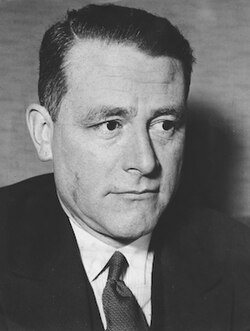 continued to try to get around the Constitution by declaring nine “emergencies” that would permit him to act without congressional oversight. This reliance on emergencies reflected the ideas of Nazi political theorist Carl Schmitt, left, whose writings were followed by right-wing leaders, including billionaire Peter Thiel and the man who influenced him, Curtis Yarvin. Schmitt argued that power belongs to the leader who can exploit emergencies that create exceptions to the constitutional order, enabling him to exercise power without regard to the law.
Trump asserted this view on August 26, claiming “the right to do anything I want to do. I’m the president of the United States. If I think our country’s in danger—and it is in danger in these cities—I can do it.” As now–Vice President J.D. Vance described Schmitt’s ideas in 2024: “There’s no law, there’s just power.”
Under these so-called emergencies, Trump launched a tariff war in April, taking from Congress a right the Constitution reserves to it alone.  When lawmakers moved to challenge those tariffs, House Republicans, led by Speaker Mike Johnson (R-LA), right, declared the rest of the session a single day with regard to legislation that could challenge Trump’s declaration of an emergency so that a required number of days could not pass before a vote to end that emergency.
With momentum still seeming to be behind Trump, Republicans delivered an omnibus law in July that put into practice the ideology Republicans had promised for a generation. The measure that Trump called the “One Big Beautiful Bill” extended the 2017 tax cuts that benefited primarily the wealthy and corporations while cutting Medicaid, Supplemental Nutrition Assistance Program (SNAP) benefits, and support for the purchase of healthcare insurance on the Affordable Care Act marketplace. By passing it under the terms of budget reconciliation, which cannot be filibustered, the Republicans pushed it through without any Democratic votes. In the Senate, three Republicans voted against the bill, requiring Vance to cast the deciding vote.
Meanwhile, administration policies put money into the pockets of the rich, especially Trump, who leveraged tariff discussions to win permissions to build golf courses, invested in cryptocurrency, and received donations to various projects from people with business before the government. When Congress tried to exercise its duty of oversight, administration officials treated the members with contempt, refusing to appear or declining to answer questions, talking over them, or insulting them.
But despite the administration’s attempt to act extraconstitutionally and outside the law, the law began to assert itself. Beginning in February 2024, long before the election, Democratic attorneys general had begun to write lawsuits challenging the executive orders and policies Trump’s appointees had boasted would be coming. Judges began to decide against the administration in those lawsuits at the same time that Americans vocally objected to the dramatic cuts to the civil service, the breaching of privacy laws by DOGE staffers, and the end of government services they had never imagined losing.

Then, in March, the government rendered more than 230 immigrants, mostly Venezuelans and nearly half with legal status in the U.S., to the notorious CECOT terrorist prison in El Salvador after a federal judge told them not to. Among those sent was Maryland man Kilmar Ábrego García (above right), whom a judge had ordered not be returned to El Salvador out of concern for his safety. The administration’s consistent refusal to bring Ábrego García back, despite the orders of a federal judge and the U.S. Supreme Court, helped to focus anger at the administration.
The slow pace of the law inspired the American people to speak out against the administration. Protests had begun with “Tesla Takedowns” to weaken Musk, and they continued to grow as people watched their public services and government agencies dismantled. On April 5 a coalition of civil rights organizations, women’s rights’ groups, labor unions, and protesters participated in “Hands Off” rallies around the country.
Meanwhile, sweeping deportation raids illustrated that Trump’s promise to deport “the worst of the worst” criminal undocumented immigrants he insisted were raping and murdering U.S. citizens was a lie. Masked agents from Immigration and Customs Enforcement (ICE) and the U.S. Border Patrol were arresting foreign students who had spoken out against U.S. policy on Israel/Palestine and all the undocumented immigrants they could find. By definition, this meant they were grabbing people who were well integrated into communities. Few had been charged or convicted of crimes.
Trump’s 79th birthday fell on the same day as the 250th anniversary of the U.S. Army—June 14—and he planned a military parade around that event in Washington, D.C. Protesters organized their own events that day, announcing they wanted “No Kings” in the United States of America. Trump’s popularity was dropping.
In June, Trump sent federalized National Guard troops to Los Angeles along with Marines, against the wishes of Democratic California governor Gavin Newsom, allegedly to protect federal officials and buildings from violence by those protesting deportation raids. In September, Trump deployed National Guard troops to Portland, Oregon, and in October, to Chicago.
Support for Trump’s policies continued to drop. And then, over Labor Day weekend, Trump disappeared for several days. Whatever had happened passed, but the president’s deteriorating health, both physical and mental, was an increasingly major story.
The momentum that had appeared to carry the Trump administration forward had stopped. In October, Gil Duran of The Nerd Reich highlighted that Yarvin thought nothing had gone far enough or fast enough and feared that the “second Trump revolution…is failing. It is failing because it deserves to fail. It is failing because it spends all its time patting itself on the back. It is failing because its true mission, which neither it nor (still less) its supporters understand, is still as far beyond its reach as algebra is beyond a cat.”
On Saturday, October 18, more than seven million people took to the streets in another “No Kings” day to demonstrate their opposition to the Trump administration. On Monday, October 20, Trump began to bulldoze the East Wing of the White House, the People’s House.
With disapproval of the president at near-historic levels, voters in the November elections strongly backed Democrats. They elected Democratic governors in Virginia and New Jersey by double-digit margins, with nearly every district moving away from the Republicans. Voters in New York City and Miami elected Democratic mayors, Miami for the first time in nearly 30 years. They broke Republican supermajorities in the Iowa and Mississippi state senates and, over the entire course of 2025, flipped 21% of the Republican-held seats on ballots during the year.
Meanwhile, the refusal of Attorney General Pam Bondi to release the Epstein files—materials from the FBI’s investigation into the activities of sex abuser Jeffrey Epstein—had created significant pressure on Congress to force the administration’s hand. Many MAGA Republicans had backed Trump in 2024 because of what they thought was a promise to release those files, and yet House speaker Johnson refused to allow the House to vote on a measure requiring their release.
A bipartisan team of representatives launched a discharge petition to bring such a measure to a vote, and they overrode his objection. On November 19, Congress passed the Epstein Files Transparency Act, requiring the Department of Justice to release the Epstein files to the public no later than December 19. The vote was overwhelming—a significant break of Republicans from Trump.
The administration failed to meet that legal deadline. But even the material that the Department of Justice has released and that has emerged from additional reporting since then offers evidence that Trump was more deeply involved with Epstein and his activities than he has admitted. Just tonight, the Wall Street Journal revealed that in the late 1990s and early 2000s, Trump’s Mar-a-Lago spa sent young women to perform massages, manicures, and spa services at Epstein’s nearby house, where Epstein would expose himself and pressure them for sex, and that Epstein’s associate Ghislaine Maxwell used the spa to recruit women to give Epstein massages.
On December 22 a federal judge ordered the Trump administration to file a plan to return the men it sent to CECOT or to hold hearings to permit them to challenge their detention, insisting they have the right to due process.
On December 23 the Supreme Court issued a preliminary rejection of Trump’s justification for deploying National Guard troops in Illinois.
As we reach the end of 2025, it appears the law is catching up to an administration that began the year by acting as if the law and the Constitution didn’t exist.
More than that, though, over the course of 2025, the administration’s refusal to recognize the tenets of American democracy has roused the American people to defend that democracy.
It appears that as we approach the 250th anniversary of the Declaration of Independence, when British colonists on the North American continent took the radical step of rejecting the idea not just of King George III but of all kings, and launched the experiment of government based on the rule of law created by the people themselves, the American people are reclaiming that history.
 New York Times, Trump Administration Live Updates: President Abandons Effort to Deploy National Guard to 3 Cities, Laurel Rosenhall, Dec. 31, 2025. Where Things Stand:
 and Los Angeles. His decision comes after the Supreme Court said last week that he could not deploy troops in the Chicago area over the objection of Illinois officials. The Guard is still deployed in Washington, New Orleans and Memphis. Read more ›
The Ninth Circuit Court of Appeals just effectively returned control of the California National Guard to Gov. Gavin Newsom. In a brief order, it lifted a stay on a lower court ruling that had required the president to return some 300 California National Guard members to state service.
A federal judge in San Francisco on Wednesday found that the Trump administration illegally moved to end temporary deportation protections for tens of thousands of people from Honduras, Nepal and Nicaragua.The ruling was a blow to the administration’s efforts to limit the reach of a humanitarian program meant to shield migrants from deportation to countries in crisis.
In her ruling, Judge Trina L. Thompson found that the efforts of the homeland security secretary, Kristi Noem, to terminate protections for people from the three countries had been preordained and driven by an intent to target the Temporary Protected Status program, known as T.P.S.
 In a 52-page ruling, she wrote that the government’s review of the program was conducted with a predetermined outcome and the ultimate decisions in June and July to cancel the program for migrants from the countries had failed to address key issues, notably “food insecurity in Nepal, staggering crime in Honduras, or humanitarian crises in Nicaragua.”
Judge Thompson, an appointee of President Joseph R. Biden Jr., also said that immigration advocates who had sued over the program cancellations had plausibly argued that the cancellations were motivated by racial animus. She cited statements from President Trump and Ms. Noem that repeatedly cast migrants, including those covered by the humanitarian program, as violent criminals seeking to invade the United States.
“These statements reflect a stereotyping of the immigrants protected under the TPS program as criminal invaders and perpetuate the discriminatory belief that certain immigrant populations will replace the white population,” Judge Thompson wrote.
The National T.P.S. Alliance, which brought the suit alongside seven individual T.P.S. holders, said that though it celebrated the ruling, the cancellations had already caused harm. In a statement from the group, one of the plaintiffs, a 30-year-old man from Honduras named Jhony Silva, said he had been living in the United States since he was 3 and had lost his job as a certified nursing assistant because of the cancellation.
Some 50,000 Hondurans, 7,000 Nepalis and 3,000 Nicaraguans are covered under Temporary Protected Status, according to the Congressional Research Service. The decades-old program allows people from countries facing armed conflict, natural disasters and other catastrophes to temporarily live and work in the United States, and protections for migrants from some countries have been renewed for years as turmoil in their nations continues.
The program has been a target of Mr. Trump’s administration deportation efforts. In total, it has moved to eliminate the program for more than one million people from eight countries this year.
On Tuesday, a federal judge in Boston temporarily blocked the government from ending T.P.S. for some 230 migrants from South Sudan, a country still reeling from recent civil war and famine.
In emergency orders, the Supreme Court, however, has allowed the government to end T.P.S. for other groups, even as litigation over the program has continued. In October, for instance, the Supreme Court cleared the way for the government to end T.P.S. for more than 300,000 people from Venezuela, which has been gripped by years of humanitarian and economic crisis.

Michael Cohen arrives at the Federal Correctional Institution in Otisville, New York, U.S., May 6, 2019 (Reuters photo by Mike Segar)
Meidas Touch Network, Commentary: The New Year Cold That Haunts Me, Michael Cohen, right, Dec. 31, 2025.  On the final night of the year, memory freezes time; where prison cold, broken promises, and unresolved grief remind us why forgetting is a luxury we can’t afford.
The last day of the year always lies to us a little.
 It pretends to be a finish line, a clean edge where we can neatly stack our accomplishments on one side and our failures on the other. It suggests closure. Resolution. Finality. But for many of us—especially in 2025—there is no neat accounting. There is only survival. There is only endurance. There is only the quiet question we carry into tomorrow: Can I do this again?Subscribed
Tomorrow, the year ahead is unwritten. Unknown. And that unknown doesn’t feel hopeful to a country that has spent the past year bruised—politically battered, economically stretched, emotionally exhausted. Fear, in moments like this, is not weakness. It is honesty. It is the body remembering what the mind wishes it could forget.
I know something about that; sadly, all too well.
No matter how hard I try, the memories do not fade. They do not soften. They do not retreat into some dusty corner of the past. They haunt the mind. They torment the heart. They terrorize the soul. And on nights like this, when the world counts down and pretends joy is mandatory, they return with precision and cruelty.
I am thinking about the New Year I spent at FCI Otisville. Away from my wife. Away from my daughter. Away from my son. Away from my extended family and friends. The first time in 27 years that midnight arrived without shared wishes, shared kisses, shared hope whispered into another human being’s ear.
For a long time, I believed I was alone in that pain. I carried it quietly, like contraband, only sharing it with my wife when it became too heavy to hold. But yesterday, that illusion cracked. I met up with an old friend from Otisville—someone I hadn’t seen since I walked out five years ago. And suddenly, the past wasn’t past anymore.
We talked about New Year’s Eve 2020. About “the boyz.” About how we didn’t celebrate the arrival of 2021; we accepted it. That distinction matters. Celebration requires hope. Acceptance is what you do when hope feels reckless.
We set up tables in the chow area. Everyone brought what they could—snacks, drinks, bits of food saved and traded like currency. Televisions flickered with images of Times Square, of fireworks exploding over cities we might as well have been watching from another planet. The building was ice cold. Brutally so. It was a Butler Building—metal frame, aluminum siding, zero insulation, over forty years old and warped by time and neglect.
The double doors didn’t meet their frames. Four doors. North, South, East, and West. Gaps of one to two inches along the bottom and sides, funneling winter air straight inside. The heating system barely functioned—until I asked two decent correctional officers I worked for in the Pipe Shop to help. C.O. Diamond could fix anything. C.O. Massey was a licensed electrician. Together, we got it running. But heat can’t compete with a wind tunnel.
So I did what desperation always demands: I improvised. Gorilla tape from the shop. Sealed the gaps. For one night—just one—the temperature wasn’t forty-two degrees on our beds. It was tolerable. Not comfortable. Not humane. Just tolerable.
Normally, we slept layered like refugees. Two pairs of socks. Thermals under sweatpants under work pants. Thermal shirt under a T-shirt under a sweater under a winter jacket. Gloves. Hat. If you were lucky—if you were connected—you had three blankets, each so thin that you’d need thirty to feel safe.
The next morning, C.O. DeLeo ordered the tape removed. Fire hazard, he said. Doors sealed, he claimed. Logic meant nothing. That the doors swung outward. That tape wouldn’t stop them from opening. That the building was metal and concrete and there was nothing to burn. Needs escaped him. Humanity escaped him. Remove it or go to the SHU; a/k/a: the hole.
So I complied.
That night, dressed in identical green, we waited for the year to arrive. Then we lined up for the phones. I called my wife. She answered. I heard the sadness in her voice—the same sadness I felt. The first New Year in nearly three decades spent apart. The phones were near the door. Cold air rushing in. Calls had to be brief. Emotional, but controlled. No tears allowed in prison. No privacy permitted.
That cold never really left me. It didn’t leave many of us. Otisville has a way of embedding itself into your bones, into your being, long after your body is free. You carry it into warm rooms. Into quiet moments. Into every night when the calendar flips and the world tells you to celebrate while your soul remembers how to brace.
So as we step into 2026, I’m not interested in performative resolutions or empty mantras whispered at midnight and forgotten by sunrise. I don’t believe in promises designed to dissolve the moment life becomes inconvenient. What I believe in now is harder. Heavier. Necessary.
Resolve to pay attention. To stay politically informed even when it exhausts you. To remain engaged when disengagement feels safer. To be active, vigilant, and unflinchingly present in a country that depends on our short memories to repeat its cruelties. Refuse the comfort of ignorance. Refuse the luxury of looking away.
Because hope is not found in pretending the cold never existed. Hope lives in memory. In discomfort. In the willingness to sit with what hurts and let it change how we show up for one another.
And if the coming year asks anything of us, let it be this: to remember who was left freezing in the dark—and to make damn sure we don’t leave anyone there ever again.

New York Times, Investigation: They, Too, Died After Beatings by Guards. No One Raised an Alarm, Jan Ransom, Dec. 31, 2025. Two brutal killings, less than three months apart, in New York State’s prison system raised troubling questions: Had other inmates met similar fates?
When an inmate named Ladale Kennedy stopped breathing one night in a New York State prison cell, no one paid it much mind.
No one opened a broad inquiry into the death of Mr. Kennedy, the 1,055th to be recorded in the prison system since 2014.
The local medical examiner classified the incident, in July 2022, as something of an official mystery: cause and manner “undetermined.”
In fact, just before he died, Mr. Kennedy, 41 and mentally ill, had been pepper sprayed by guards, beaten, handcuffed, held face-first under running water and fitted with a “spit hood” — a mesh restraint that is sometimes used to prevent inmates from biting or spitting on officers.
All because he had failed to return some food trays and cups that had been handed to him in his cell.
He had said, “I’m sorry” at least eight times as they pulled him from his cell, video shows. He had told the officers he could not breathe at least 20 times during the entire counter.
Over the past year, the prison system that held Mr. Kennedy has come under enormous scrutiny. Twenty guards were charged in the fatal beatings of two inmates, Robert L. Brooks and Messiah Nantwi. Lawmakers proposed a sweeping measure to strengthen prison oversight, and the governor signed it into law.
But Mr. Kennedy’s case, which passed by largely unnoticed, is a reminder that other men have died after beatings like Mr. Brooks and Mr. Nantwi did — and that the public still has not received a full accounting of those deaths.
The New York Times, after conducting dozens of interviews and reviewing thousands of pages of medical records, court filings and inmate death records, identified three other cases of inmates who died after beatings in the past three years, including Mr. Kennedy.Editors’ Picks
These new cases bear similarities to the high-profile deaths of Mr. Brooks and Mr. Nantwi. But where those cases stirred outrage, these have gone almost completely unnoticed.
Mr. Kennedy died at Upstate Correctional Facility.
Another inmate, Clement Lowe, 62, told his daughter that guards at Green Haven Correctional Facility had stomped on him and lashed his head with batons before he deteriorated and died of a massive brain bleed in November 2023.
The third occurred in October 2024, when Ameek Nixson, 39, began fighting with another inmate at Fishkill Correctional Facility and was beaten by officers until he went limp, according to records and interviews
Mr. Nixson’s was the only one of the three deaths that was ruled a homicide, although investigators have yet to determine whether it was caused by the inmate he was fighting or the guards who intervened.
None of the deaths have resulted in criminal charges.
Only Mr. Kennedy’s beating was captured on video, but many of the recorded actions are obscured by poor angles or guards’ bodies.
The New York State attorney general’s office, which is required by law to conduct an inquiry into every in-custody death, took the rare step of hiring an independent reviewer in April to scrutinize the medical examiner’s ruling in the case.
That reviewer, Dr. Christopher Milroy, said he was not able to determine what caused Mr. Kennedy’s death.
One expert who reviewed the case at the request of The Times called the findings into question.
 “They put a spit hood on, that you can see,” said the expert, Dr. Michael Baden, shown above in a file photo. “He starts at that point saying he can’t breathe.”
Dr. Baden, a former New York City chief medical examiner and longtime consulting pathologist who spent decades on a state board reviewing in-custody deaths, said: “In my opinion, this was a death from asphyxia caused by the spit mask.”
In a statement, a spokeswoman for the New York State Department of Corrections and Community Supervision said that evidence had shown that the prison staff members had not caused the deaths of any of the three inmates.
The rate of deaths per year in the correctional facilities has been on the rise even though the number of people being held in the prisons has declined, the records show. Last year the death count hit 144 — the highest number in the past seven years.
State law requires each of those deaths to be investigated, but the results of those inquiries are often not made public. That makes it difficult to know what surfaced during the investigations and how thoroughly the cases were reviewed.
Current and former inmates, advocates for the incarcerated and state watchdog officials said they have long suspected that many more of those deaths followed violent encounters with guards than has been publicly known.
“There is no accountability,” said Jose Saldana, a former New York prison inmate who runs a nonprofit that lobbies for the release of older prisoners. “If Robert Brooks’s brutal murder wasn’t inadvertently captured on a camera, they would have gotten away with it.”
Jan Ransom has been covering the turmoil in the New York State prison system. This article is based on dozens of interviews and a review of thousands of pages of court filings and inmate death records.
 Convicted sex trafficker Ghislaine Maxwell with her co-trafficker and co-rapist of underage girls and sometime boyfriend Jeffrey Epstein (Getty images).
News Round Up
The Parnas Perspective, Important Epstein News Update, Aaron Parnas, right,  Dec. 31, 2025. Jeffrey Epstein's relationship with Trump was much closer than previously reported. Trump vetos two bipartisan bills for political reasons. Trump quietly changes Kennedy Center bylaws.
Even on New Year’s Eve, the news does not slow down. There is a lot to cover, and much of it is consequential. Top of mind are the Epstein files and the growing body of reporting detailing Donald Trump’s far closer relationship with Jeffrey Epstein than previously acknowledged.
We are also digging into Trump’s veto of bipartisan legislation, the Kennedy Center board’s improper bylaw changes to advance his interests, and Attorney General Pam Bondi quietly deleting a post after falsely crediting Trump for policy successes that occurred under President Biden.
Here’s the news:
A new report detailed by The Wall Street Journal alleges that Donald Trump’s Mar-a-Lago club repeatedly sent young female spa employees to massage Jeffrey Epstein for years despite internal warnings about his sexual misconduct, with former staff saying Trump ultimately barred Epstein only after a 2003 complaint from an 18-year-old worker, though the incident was not reported to police; the White House denies wrongdoing, but the revelations have intensified scrutiny of Trump’s long relationship with Epstein amid controversy over missing DOJ files and the administration’s handling of the case.
President Donald Trump issued the first vetoes of his second term, blocking two bipartisan infrastructure bills—H.R. 131, which would have reduced Colorado communities’ costs for a water pipeline, and H.R. 504, which would have expanded land for the Miccosukee Tribe and funded flood mitigation—arguing they wasted taxpayer money, while Democrats including Michael Bennet accused him of political retaliation amid broader disputes with Colorado leaders, and GOP sponsor Lauren Boebert vowed to keep fighting the measure.
The Washington Post has confirmed that The John F. Kennedy Center for the Performing Arts quietly changed its bylaws earlier in 2025 to restrict voting power to trustees appointed by the president, a move that paved the way for a unanimous vote by Donald Trump’s appointees to add his name to the institution, drawing protests and criticism from excluded board members while the center said the rule change followed longstanding precedent.
Attorney General Pam Bondi deleted a social media post after being called out for falsely crediting Donald Trump for a sharp drop in U.S. drug overdose deaths that actually occurred during Joe Biden’s presidency, as the chart she shared—sourced from a Journal of the American Medical Association study—ended before Trump took office, prompting criticism from Democrats including Ted Lieu and renewed scrutiny of Trump administration claims amid drug policy cuts and controversial pardons.
Enhanced premium subsidies under the Affordable Care Act are expiring after today, likely driving 2026 premiums sharply higher for millions—by more than $1,000 on average according to KFF—with early signs showing lower new enrollment, more plan downgrades to cheaper bronze coverage, and some people dropping insurance altogether as Congress remains stalled on an extension, though states say systems could be updated quickly if lawmakers act.
New waivers take effect Jan. 1 banning the use of Supplemental Nutrition Assistance Program benefits to buy soda, candy and other items in five states—Indiana, Iowa, Nebraska, Utah and West Virginia—affecting about 1.4 million people as part of the Trump administration’s “Make America Healthy Again” push led by Robert F. Kennedy Jr., though retailers and health experts warn the complex rules could raise costs, cause checkout confusion, and may not significantly improve diets or health outcomes.
Donald Trump rang in the New Year with a late-night Truth Social rant falsely claiming overwhelming voter approval, dismissing negative polls as “rigged,” and boasting about border security, inflation and the economy, continuing his long-running tradition of pairing New Year’s greetings with attacks, exaggerations and grievances rather than conciliatory messaging.
According to Reuters, Peruvian shamans issued a ritual prediction warning that Donald Trump could become “seriously ill” in 2026, a claim that has drawn attention amid ongoing public scrutiny of his bruising and chronic venous insufficiency diagnosis, though the White House rejected the prophecy and insisted Trump remains in excellent health, while noting the shamans’ forecasts have historically mixed accuracy.
New bruising on Donald Trump’s left hand has renewed scrutiny of the 79-year-old president’s health, with medical experts saying the discoloration is likely benign and age- or medication-related but warning that the White House’s limited transparency—following earlier explanations about handshaking, aspirin use, and a diagnosis of chronic venous insufficiency—has fueled ongoing speculation about his condition.
The Trump administration froze all federal child care payments to Minnesota after a viral video alleged widespread daycare fraud, drawing praise from federal officials, criticism from Gov. Tim Walz as politically motivated, and prompting new nationwide verification requirements for child care funds.
According to the The New York Times, Donald Trump erupted at special envoy Keith Kellogg during an Oval Office meeting after Kellogg praised Volodymyr Zelensky as courageous and compared Ukraine’s fight for survival to Abraham Lincoln’s leadership in the Civil War, later dismissing Kellogg to advisers as “an idiot.”
According to The Guardian, the Trump family’s business delayed the launch of its $499 gold “T1” smartphone after supply disruptions linked to a government shutdown, undercutting claims that the device is “proudly American”–made and raising fresh questions about conflicts of interest as Trump Organization licenses the president’s name for a heavily regulated telecom venture run by Donald Trump Jr. and Eric Trump.
U.S. executions surged to a 16-year high in 2025, with 47 men put to death, nearly double last year’s total, a spike driven by Donald Trump’s push to revive capital punishment and the U.S. Supreme Court’s refusal to halt executions, deepening a growing disconnect between state actions and public opinion that now shows majority opposition to the death penalty, especially among younger Americans.
Taiwan remained on high alert after China’s large-scale “Justice Mission 2025” military drills—featuring rocket launches, warships, and aircraft near the island—began to ease, though Beijing has not formally declared the exercises over, keeping regional tensions elevated.
More On U.S. Crime, Courts, Law, Justice
New York Times, Justice Dept. Leaders Pushed to Charge Abrego Garcia, Emails Show, Alan Feuer, Dec. 31, 2025 (print ed.). The release of the emails raised serious questions about whether the Justice Department had misled a judge in telling him that local prosecutors had acted alone in charging Mr. Abrego Garcia, above right.
Federal prosecutors in Nashville have insisted in the past few months that senior Justice Department officials had no involvement in their decision to file charges against Kilmar Armando Abrego Garcia, the immigrant who was wrongfully deported to El Salvador in March and then brought back to the United States to face indictment.
But on Tuesday, excerpts from several emails released by a federal judge overseeing Mr. Abrego Garcia’s criminal case appeared to directly contradict those assertions, suggesting that Justice Department leaders — including Todd Blanche, the deputy attorney general — played a greater role in bringing the charges than prosecutors have acknowledged so far.
The emails, which were made public as part of a newly unsealed judicial order, largely reflected communications about the case that Robert E. McGuire, the acting U.S. attorney in Nashville, had with members of his staff and with Aakash Singh, a top official in Mr. Blanche’s office. They raised serious questions about whether the Justice Department had misled Judge Waverly D. Crenshaw Jr., who is overseeing the case, by telling him that local prosecutors had acted alone in charging Mr. Abrego Garcia.
“These documents show that McGuire did not act alone and to the extent McGuire had input on the decision to prosecute, he shared it with Singh and others,” Judge Crenshaw wrote in the unsealed order. “Specifically, the government’s documents may contradict its prior representations that the decision to prosecute was made locally and that there were no outside influences.”
One of the emails, dated April 30, was written by Mr. Singh to Mr. McGuire and another prosecutor, Jacob Warren, as the government was building its criminal case against Mr. Abrego Garcia, who at the time was still in custody in El Salvador.
In it, Mr. Singh made clear that charging Mr. Abrego Garcia was “a top priority” for Mr. Blanche’s office. In response, Mr. McGuire wrote, “We want the high command looped in.”
A little more than two weeks later, Mr. McGuire wrote to his staff that while the ultimate decision about whether to bring charges was his own, he had heard that Mr. Blanche and his chief deputy at the time, Emil Bove III, were pushing for charges to be filed. In the email, Mr. McGuire referred to Mr. Blanche as the “DAG” — or deputy attorney general — and to Mr. Bove as the “PDAG” — or principal deputy attorney general. He also mentioned the “ODAG” — or the office of the deputy attorney general.
“I have not received specific direction from ODAG other than I have heard anecdotally that the DAG and PDAG would like Garcia charged sooner rather than later,” Mr. McGuire wrote.
Judge Crenshaw’s order was only the latest in an ever-growing series of rebukes dealt to the Justice Department as it has pursued parallel efforts to both prosecute Mr. Abrego Garcia and expel him from the country again.
The Hill, Top Minnesota Republican: GOP caucus steered YouTuber Nick Shirley to day care sites, Max Rego, Dec. 31, 2025. Minnesota House Speaker Lisa Demuth (R) said Monday that her caucus pointed conservative YouTuber Nick Shirley in the direction of day care facilities in the state amid concerns over fraud.
 Demuth said at a virtual press conference that the state GOP has been “working with” Shirley to address fraud in the state.
“Our caucus has been working to expose fraud for years, including working with Nick Shirley and agency whistleblowers to get the information  out to the public and to hold the Walz administration accountable,” she said, referring to Democratic Gov. Tim Walz, right.
State Rep. Ryan Niska (R) clarified later in the press conference that staffers within the caucus provided information to a man identified in Shirley’s video as David.
Shirley released a video Friday detailing his visits to the day care sites. He alleged multiple centers were not providing services to children at all and asked employees to show whether children were present at the facilities.
The video drew new attention to the issue from the Trump administration and congressional Republicans. KSTP TV-5 reported in January, however, that the Minnesota Department of Human Services (MDHS) was already conducting more than 60 probes into child care centers receiving federal funding.
The Department of Homeland Security dispatched agents to Minneapolis on Monday, while the Small Business Administration and Department of Health and Human Services have paused payments to Minnesota.
The GOP-led House Oversight and Government Reform Committee has also scheduled hearings on the matter in the new year and invited Walz to testify.
Since 2022, the Department of Justice has charged 98 people as part of its sweeping probe into fraud within programs under the MDHS. Assistant U.S. attorney Joseph Thompson told reporters earlier this month it is possible that “half or more” of the $18 billion billed to 14 MDHS programs since 2018 is fraudulent.
Court records reviewed by the Minnesota Star Tribune, which has covered the story for more than a decade, indicate the amount defrauded is closer to $218 million.
Walz, who has disputed Thompson’s estimate, ordered a third-party audit of the 14 aforementioned programs in October. He also appointed Tim O’Malley earlier this month to serve as director of program integrity and strengthen fraud prevention.
 Paul Krugman via Substack, Political-Economy Commentary: Immigrant Derangement Syndrome, Paul Krugman, right,
 Dec. 31, 2025. Blaming brown-skinned people for everything bad.
Americans suffered a litany of horrors thanks to the Trump administration during 2025 – refusal to disburse emergency aid, soaring measles cases, collapsing small businesses, vindictive prosecutions, wanton destruction of the federal government, and (soon) soaring health insurance premiums. But few incidents were more shocking than the two-month siege of Chicago, in which America’s third-largest city was terrorized by a gang of violent, sadistic thugs.
The gang members in question were, of course, agents of the Trump administration, mainly although not all from ICE — U.S. Immigration and Customs Enforcement. If you think I’m being hyperbolic in calling them sadistic thugs, read the Chicago Tribune’s long article about Operation Midway Blitz, which describes scene after scene of what went down:
What happened here for more than two months is unlike anything in recent American history: the federal government sending agents dressed for war into neighborhoods of the country’s third-largest city to arrest mostly people who look Latino and to ask questions later. To target people largely on the basis of their skin color, on the presumption that they may be in the country without documentation, or that they may have a criminal record, or an association with a gang.
Trump officials claimed that they were cracking down on violent crime committed by illegal aliens, but their own operation demonstrated, better than any conventional statistical analysis, that claims of an immigrant crime wave are bogus. The Tribune found that “only about 1.5% of those detained for immigration-related reasons had been convicted of a violent felony or sex crime.”
Or consider the spectacular Sept. 30 raid carried out on a South Side apartment building — a building administration officials claimed was a base for a Venezuelan gang. “SWAT teams,” reports ProPublica, “rappelled from a helicopter, knocked down doors and hurled flash-bang grenades. They arrested 37 immigrants, most of them Venezuelans, who authorities say were in the country illegally. Agents also zip-tied and, for several hours, detained many U.S. citizens.” After all that, Federal prosecutors didn’t file charges against a single resident of the building.
And while the ICE tactics are blatantly illegal according to legal experts, they have been allowed by a corrupt Supreme Court that is clearly more intent on enabling authoritarianism than on than protecting the Constitution.
It’s clear that claims about crimes perpetrated by immigrants are just an excuse to inflict a reign of terror. And they’re also part of a much wider pattern of hostility to mostly brown-skinned immigrants that has nothing to do with the stated justifications. I call this IDS – Immigrant Derangement Syndrome – the syndrome of blaming immigrants for everything bad in America. And those bad things include both actual events – such as soaring housing costs – and fantasies that exist only in MAGA’s imagination, such as a wave of violent crime.
Claims about the harm done by immigrants range from the dubious to the ludicrous. At the dubious end, assertions that immigrants are taking away jobs from native-born workers, or depressing their wages, just don’t stand up under scrutiny. All the evidence suggests that foreign-born workers are complements, not substitutes, for native born workers. And as the native-born population ages, we really need immigrant workers, both directly to care for seniors and indirectly to keep the economy growing as the native-born labor force shrinks.
U.S. Governance, Politics
New York Times, Mamdani Reverses Call to End Mayoral Control of Public Schools, Troy Closson, Dec. 31, 2025. The mayor-elect’s turnaround came as he selected Kamar Samuels to lead New York City’s school system at a precarious moment.
 In a major shift, Mayor-elect Zohran Mamdani, right, on Wednesday said that he would no longer seek to end mayoral control of the New York City schools, a decision that came as he formally announced his choice to run the nation’s largest school system.
Mr. Mamdani’s reversal on mayoral control marked a significant change of heart. He argued often on the campaign trail that the system shuts out the voices of too many teachers, parents and students from crucial decisions, and maintained his opposition to the model during the final mayoral debates.
But on Wednesday, Mr. Mamdani said that while he disagreed with the way that the outgoing mayor, Eric Adams, wielded power over education, he understood the need for the mayor to be held accountable for public school outcomes.
The State Legislature typically renews mayoral control for two- or four-year terms, and Mr. Mamdani said that he would ask lawmakers this year for an extension of his authority over schools.
The ironclad grip that New York City’s mayor has on public schools contrasts sharply with many other school districts, which rely on elected school boards to shape policy. Mr. Mamdani’s shift will probably be welcomed by some veteran education leaders who worried he would take a hands-off approach to schools but could deeply frustrate some families who had hoped he would usher in a new model.
The mayor-elect promised on Wednesday to take a new approach to mayoral control.
“Though I held concerns about mayoral control, I also know that New Yorkers need to know where the buck stops: with me,” Mr. Mamdani said. “My approach to mayoral control will ensure that community involvement is not ceremonial or procedural, but tangible and actionable.”
Mr. Mamdani’s shift came as he appointed Kamar Samuels as his chancellor, one of his final major decisions before his inauguration early Thursday. He formally announced the selection at an environmental center in Central Park and also named Emmy Liss, a well-regarded former top education official who helped launch universal prekindergarten under Mayor Bill de Blasio, as the executive director of the city’s child care office.
Mr. Samuels, 48, will take over a job that has historically been regarded as the second-most influential education job in the United States after the federal education secretary.Dec 29
New York Times, Trump Administration Live Updates: President’s Vetoes Draw Claims of Retribution, Tyler Pager and Staff Reports, Dec. 31, 2025. Where Things Stand.
President Trump issued his first vetoes of his second term this week, rejecting legislation that passed Congress with bipartisan support and prompting criticism that his actions were the latest moves in the president’s retribution campaign.
The two bills aimed to fund a water pipeline in southeastern Colorado, and expand land reserved for the Miccosukee Tribe in Florida as well as direct the Interior Department to help mitigate flooding there.
In messages to Congress released Tuesday, Mr. Trump said he blocked the bills to save taxpayers’ money. But the president has grievances against the Miccosukee Tribe and the state of Colorado, leading lawmakers to accuse Mr. Trump of blocking the bills because of political disagreements. Throughout his second term, Mr. Trump has carried out a campaign of retribution against political opponents, law firms, universities and specific individuals.
In Florida, Mr. Trump suggested the veto of the bill to expand Miccosukee Tribe land was tied to its opposition to his immigration agenda. The Miccosukee Tribe joined a lawsuit earlier this year to block the administration from constructing an immigrant detention center in the Everglades nicknamed Alligator Alcatraz. And in Colorado, Mr. Trump has attacked the state’s leaders over the imprisonment of a former state election official, Tina Peters, for interfering with the 2020 presidential election.
“Despite seeking funding and special treatment from the federal government, the Miccosukee Tribe has actively sought to obstruct reasonable immigration policies that the American people decisively voted for when I was elected,” Mr. Trump wrote in a message to Congress. “My administration is committed to preventing American taxpayers from funding projects for special interests, especially those that are unaligned with my administration’s policy of removing violent criminal illegal aliens from the country.”
Both pieces of legislation passed by voice vote in Congress, indicating strong bipartisan support and suggesting lawmakers may try to override the president’s vetoes, which requires a two-thirds majority in both chambers. In Mr. Trump’s first term, he vetoed 10 pieces of legislation, one of which — the 2021 military policy bill — was overturned.
The Colorado legislation, which was sponsored by Representative Lauren Boebert, Republican of Colorado, would help local communities pay for the Arkansas Valley Conduit water pipeline.
“Enough is enough,” Mr. Trump wrote in a message to Congress. “My administration is committed to preventing American taxpayers from funding expensive and unreliable policies.”
Ms. Boebert slammed the president’s veto, arguing he was “denying clean drinking water for 50,000 people in Southeast Colorado.”
“I sincerely hope this veto has nothing to do with political retaliation for calling out corruption and demanding accountability,” she said in a statement.
Ms. Boebert was a vocal supporter of releasing the Epstein files, drawing backlash from the White House, and the president has attacked Colorado’s leaders in recent weeks over Ms. Peters. She was found guilty of interfering with voting machines in an effort to prove falsehoods that they had been used to rig the 2020 election against Mr. Trump. The president has pledged to pardon Ms. Peters, even though she was convicted in state court and Colorado officials argue he had no power to do so.
“This isn’t governing,” Senator Michael Bennet, a Democrat of Colorado, wrote on X about the president’s veto. “It’s a revenge tour.”

New York Times, Iowa Democrat Wins State Senate Seat, Fending Off G.O.P. Supermajority, Mitch Smith, Dec. 31, 2025 (print ed.). By holding a left-leaning seat in suburban Des Moines, Democrats ensured that Republicans would not have a supermajority in the State Senate.
A Democratic candidate won a special election for the Iowa State Senate on Tuesday, The Associated Press said, a result that prevents Republicans from reclaiming a supermajority in that chamber.
The Democrat, Renee Hardman, a member of the West Des Moines City Council, held a left-leaning suburban seat for her party, continuing a string of encouraging off-year election results for Iowa Democrats. Ms. Hardman defeated the Republican nominee, Lucas Loftin.
This year, Democrats flipped two Republican-leaning Iowa Senate seats in special elections, breaking a two-thirds supermajority that had allowed Republican lawmakers to confirm the governor’s appointees without support from Democrats. Republicans could have regained a supermajority with a victory on Tuesday.
Heather Williams, the president of the Democratic Legislative Campaign Committee, said her organization would work to prevent Republicans from gaining back a supermajority in next year’s election.
“Democrats have been on fire in state legislative special elections throughout 2025,” Ms. Williams said in a statement on Tuesday, “and Iowa is our latest proof point.”
The seat that Ms. Hardman won became vacant in October when Senator Claire Celsi, a Democrat, died after an illness. Last year, Ms. Celsi defeated a Libertarian candidate by 40 percentage points in a race that included no Republican.
Republicans maintain full control of the Iowa state government, with large majorities in both legislative chambers. Gov. Kim Reynolds, a Republican, has signed into law measures restricting abortion, banning school library books deemed sexually explicit and eliminating civil rights protections for transgender people.
Iowa Democrats, who have seen their support erode in recent years, hope their success in special elections could signal momentum for the 2026 midterms. Auditor Rob Sand, the only elected Democrat left in statewide office, is running for governor, and at least two U.S. House races are expected to be competitive.
New York Times, Judge Rules That Consumer Bureau’s Funding Cannot Lapse, Emmett Lindner, Dec. 31, 2025 (print ed.). The Trump administration had tried to defund the Consumer Financial Protection Bureau, which acts as a guardrail for the safety of the financial system.
A federal judge on Tuesday ruled that funding for the Consumer Financial Protection Bureau cannot lapse, a blow to the Trump administration, which had declared the agency’s cash stream illegal.
In her motion, Judge Amy Berman Jackson of the Federal District Court in Washington wrote that the C.F.P.B. could continue to receive funding from the Federal Reserve even though the Fed had been operating at a loss since 2022.
The Fed’s willingness to pay has not changed, she wrote, adding that “the only new circumstance is the administration’s determination to eliminate an agency created by Congress with the stroke of pen.”
 The future of the C.F.P.B. has been in question since Russell T. Vought, right, the White House budget director, who also serves as the consumer bureau’s acting director, began to dismantle the bureau in February. In a notice last month, the consumer bureau described its own supervision department as “the weaponized arm” of the agency under its Biden-era director.
Mr. Vought had ordered the agency to close its offices and did not request any funding from the Fed. That eventually left the agency unable to pay its roughly 1,400 workers.
“We want to put it out — and we will be successful probably within the next two, three months,” Mr. Vought said on “The Charlie Kirk Show,” a podcast, in October.
Last month, the Justice Department’s Office of Legal Counsel sent a memo to Mr. Vought declaring the agency’s funding stream illegal. The administration argued that because the Fed had been operating at a loss, there was no money for the C.F.P.B. The bureau warned that it would run out of money in early 2026. A 2010 law that created the bureau mandated funding from the Fed. Lawmakers intended that funding structure to protect the agency from partisan politics.
The C.F.P.B. has requested, and been granted, more than $1 billion from the Fed since 2022, but Mr. Vought refused to request any funding this year.
The Trump administration has sought to have greater sway over independent financial regulators, and Trump appointees have cut staffing and limited bank examinations. Mr. Vought stopped nearly all new work at the bureau after he took his position in February. Bank examiners were told to close out open matters and were barred from beginning new ones.
Mr. Vought’s changes to the agency this year have caused backlash from some of its employees. In November, after the bureau announced that it would require its financial examiners to recite a “humility pledge” to companies before beginning a review, the consumer bureau’s staff union responded with a statement that called the pledge “creepy” and “disrespectful.”
The C.F.P.B.’s examiners have forced banks and other lenders to return hundreds of millions of dollars to consumers, and helped uncover large industry issues since the agency began its operations in 2011.
Global News
New York Times, Venezuela Detains Americans Amid Growing U.S. Pressure, Anatoly Kurmanaev, Annie Correal and Edward Wong, Dec. 31, 2025. The number of American citizens held in Venezuela has grown since the start of the U.S. military and economic campaign against President Nicolás Maduro.
 enezuelan security forces have detained several Americans in the months since the Trump administration began a military and economic pressure campaign against the government of the South American nation, according to a U.S. official familiar with the matter.
Some of the detainees face legitimate criminal charges, while the U.S. government is considering designating at least two prisoners as wrongfully detained, according to the official. Those arrested include three Venezuelan-American dual passport holders and two American citizens with no known ties to the country, said the official, who spoke on condition of anonymity because the person was not authorized to speak publicly.
President Nicolás Maduro of Venezuela has long used detained Americans, whether guilty or innocent of serious crimes, as bargaining chips in negotiations with Washington, his greatest adversary.
President Trump has made the release of Americans held overseas a priority in his two presidencies, and sent his envoy, Richard Grenell, to Venezuela to negotiate a prisoner deal days after the start of his second term.
The ensuing period of talks between U.S. and Venezuelan officials resulted in the release of 17 American citizens and permanent residents held in Venezuela.
But the Trump administration’s decision to suspend those talks in favor of a military and economic pressure campaign against Mr. Maduro put an end to prisoner releases. The number of detained Americans in Venezuela began to rise again in the fall, according to the U.S. official. That rise coincided with the deployment of a U.S. naval armada in the Caribbean and the start of airstrikes against boats that Washington says transport drugs on Mr. Maduro’s orders.ImageA line of large, gray military planes with propellers parked on an airfield tarmac. Their tails rise into a clear blue sky.U.S. Air Force Hercules aircraft in Puerto Rico, in December, which are part of the buildup of U.S. forces in the region.Credit...Miguel J. Rodriguez Carrillo/Agence France-Presse — Getty Images
The United States further escalated its pressure campaign this month, targeting tankers carrying Venezuelan oil and paralyzing the country’s biggest source of exports.
The U.S. Embassy in Colombia, which deals with Venezuelan affairs, declined to comment on American detainees in Venezuela, and referred questions to the U.S. State Department.
The State Department did not respond to requests for comment.
Venezuela’s Communication Ministry, which handles the government’s press requests, did not respond to a request for comment.
Lincoln Square Media, Opinion: Trump’s Radio Silence, Frank Figliuzzi, Dec. 31, 2025. The President spilled the beans on a big donor's show that it was the CIA — not the military — that targeted Venezuela.
 On Monday, CNN reported that the CIA launched a drone strike on a remote port facility in Venezuela earlier this month.
Yet, CNN wasn’t the first place we heard about what appears to be the first U.S. strike inside that nation. The initial hint came from local radio talk show. As a national security professional for almost forty years, I’ve had a lot of trusted sources for sensitive intelligence developments; now I guess I should add WABC New York’s Cats & Cosby radio show. That’s where last Friday, President Trump first disclosed a classified U.S. strike on Venezuela to his big donor buddy and program co-host John Catsimatidis.Subscribed
The president casually noted to the large metro New York City audience:
“I don’t know if you read or saw, they have a big plant or a big facility where they send the, you know, where the ships come from. Two nights ago, we knocked that out. So, we hit them very hard.”
Catsimatidis is a Republican oil and real estate billionaire worth about $4.5 billion who donated $2.4 million to Trump and Republican candidates last year alone. That’s twice what he gifted in the 2016 election. CIA drone operations cannot legally be publicly disclosed.
Yet, I suppose if you give Trump enough money, he’ll happily reveal what most assuredly was a top-secret intelligence mission. That’s not the first time Trump has disclosed highly classified information, and it likely won’t be the last, given his known proclivity to squirrel away our nation’s secrets in his bathroom and shower. The Pentagon and the White House responded to Trump’s revelation with stone cold silence, likely as they scrambled to assess the damage of a premature disclosure.
There’s far more to this Venezuela strike story than Trump’s sloppy leak and the possibility that it might jeopardize further strike plans. Confirmation of the strike from CNN, and later the New York Times, with added details, raises important questions of who, what, and why.
First, who conducted the strike? It’s important to understand the significance of the CIA and not the military, running this attack. Both the CIA and the U.S. military control fleets of drones. Following the terror attacks of September 11, 2001, President George W. Bush acknowledged that the war on terror demanded more intelligence on the enemy, and more precise, discreet ways to act – lethally, on that intelligence.
As the U.S. drone program developed, it rapidly became the tool of choice for precision targeting of al-Qaeda leaders with less likelihood of civilian casualties. Under President Obama, drones were extensively used throughout the middle east, but the war against terrorists wasn’t the only battle brewing. A turf war broke out between the CIA and the military as to who should control drones and under what circumstances.
Ultimately, when the departmental drone dust settled, a general division of labor fell into place. That understanding of who should do what, and when, looked something like this: The military drone program would be for publicly acknowledged, large scale battlefield support, reconnaissance, and bold kinetic strikes against big combat targets or facilities within adversarial war theaters, usually where U.S. troops are fighting.ArticlesThe Trump Administration's Eye in the SkyFrank Figliuzzi · Dec 26The Trump Administration's Eye in the Sky
The only resources getting smaller at the Department of Homeland Security are their drones, and that should be a big concern. In a December 17 report in WIRED, we learned that U.S. Customs and Border Protection (CBP) plans to expand its vast surveillance program by placing smaller, portable drones at the heart of its strategy…
The CIA drone fleet would be used for classified covert strikes, usually against individual human or small-scale targets, and not necessarily in hostile territory or even in times of war. As for accountability and oversight, the military’s drone program answers to the armed services committees, while the top-secret CIA program must be closely briefed to the House and Senate Intelligence Committees.
As of this writing, we have no indication that either the of those committees have been briefed on what happened in Venezuela, including whether any of our lawmakers has had the chance to ask hard questions about the intelligence that led to the drone strikes. We’ll likely neither see nor hear much about this and any future strikes because of the CIA’s top-secret involvement — unless, of course, Trump is again a guest on a donor’s radio show.
Second, what was the target of this strike? According to multiple reports, the strike hit a dock on a remote port in east Venezuela, allegedly used by the designated terrorist organization and violent gang known as Tren de Aragua. Reportedly, the dock was not occupied, and no one was killed
Third, why did this really happen? As Trump claimed in his radio disclosure, this dock was supposedly used by the gang to store and launch drug shipments via boats.
There are at least three issues with this account. One, if this strike was about stopping the flow of drugs, we already know that Trump has it wrong when he claims that fentanyl comes from Venezuela. If this strike was about cocaine, experts agree that only a small fraction of cocaine flows from Colombia through Venezuela, and almost none of it comes to the U.S. Two, the targeting of an empty dock where no one was present, seems far more symbolic than actually designed to have any major impact on purported drug flow. In that sense, it’s a bit like the U.S. strikes on small vessels off the coast of Venezuela and in the eastern Pacific.
Three, the designation of Tren de Aragua as a terror organization is confounding. The label simply doesn’t meet our own definition of terrorism, which requires a political ideology that drives violence or threats of violence designed to intimidate or coerce. Is it a violent gang? Yes. Should we dismantle it? Yes. But the terror designation seems more of a thinly veiled rationale for intimidating a foreign country where Trump wants regime change – and oil.
The CIA drone strike may seem insignificant on its own. But it represents the next step toward future strikes against bigger targets within Venezuela, and the possibility of eventual war with a nation that possess the world’s largest proven crude oil reserves, even rivaling America’s and Saudi Arabia’s combined. Trump himself has said, Venezuela stole U.S. land and oil, and he wants it back; but that claim doesn’t hold up under legal scrutiny. The CIA drone strike might have been covert, but Trump’s objective is certainly no secret.
Frank Figliuzzi is an FBI Assistant Director (retired); 25-year veteran Special Agent; author of the national bestseller, The FBI Way, and Long Haul: Hunting the Highway Serial Killers.raise this question: Is it possible to have a cover-up without a crime (or some transgression)? After all, why throw up a smokescreen if there’s no fire?
New York Times, Sabotage Suspected in Cutting of Undersea Cable, Finnish Police Say, Neil Vigdor and Johanna Lemola, Dec. 31, 2025. The authorities seized the Fitburg, a cargo ship that was en route from Russia to Israel when it sliced the cable in the Gulf of Finland.
A cargo ship severed an undersea telecommunications cable in the Gulf of Finland on Wednesday in what the Finnish police said they suspected was an act of sabotage that led them to seize the vessel.
 The ship, the Fitburg, was en route from St. Petersburg in Russia to the port of Haifa in Israel when it damaged a cable connecting the capitals of Helsinki in Finland and Tallinn in Estonia, the authorities said.
The vessel was sailing under the flag of the Caribbean island nation of St. Vincent and the Grenadines at the time of the episode, which officials said happened around 5 a.m. local time.
The cut did not disrupt service, according to Elisa, the Finnish telecommunications company that operates the cable.
In a statement, Elisa said that its network was designed and secured with multiple routes, so services are not disrupted if a connection is cut. Details about the depth and thickness of the cable were not available.
The Finnish authorities said on Wednesday that they were investigating the incident as “aggravated criminal damage, attempted aggravated criminal damage, and aggravated interference with telecommunications.”
On Wednesday, officials stopped short of pointing fingers at a possible foreign actor.
“Hopefully it was not a deliberate act, but the investigation will clarify,” Alar Karis, Estonia’s president, said on social media of the damage to the cable. “The Estonian and Finnish authorities are working closely together to gather additional information.”
The section of cable that was damaged was in Estonia’s “exclusive economic zone,” according to investigators, who said that the Fitburg was intercepted in Finnish waters with its anchor lowered into the sea.
A tactical team with the Finnish Border Guard rappelled to the ship’s deck from helicopters before seizing the vessel and taking custody of its 14 crew members, the authorities said. The crew members were from Azerbaijan, Georgia, Kazakhstan and Russia.
According to maritime records, the ship is managed and operated by Albros Shipping and Trading Ltd., which is based in Istanbul. The company did not immediately respond to a request for comment on Wednesday.
A second telecommunications cable connecting Finland and Estonia experienced an outage on Wednesday, though it was not immediately clear if the two events were connected.
It was not the first time that an undersea cable in the Baltic region had been damaged.
New York Times, Most of Iran Shuts Down as Government Grapples With Protests and Economy, Ephrat Livni and Sanam Mahoozi, Dec. 31, 2025. Amid mounting street protests, businesses, universities and government offices stayed closed Wednesday under government orders, in 21 of 31 provinces, including the Tehran.
Businesses, universities and government offices stayed closed on Wednesday across most of Iran under a government-ordered shutdown, as the president struggled to address public frustration that has fueled mounting protests over the faltering economy and the government.
 The one-day shutdown in 21 of Iran’s 31 provinces, including Tehran, the capital, came as President Masoud Pezeshkian on Wednesday appointed a new central bank chief, the former economy minister Abdolnaser Hemmati. The president acknowledged that it was an “extremely difficult and complex” role that would subject the new bank head to intense pressure and criticism, according to state news media.
Iran’s inflation rate has spiked, driving frustrated merchants to the streets in Tehran and other cities, and prompting the abrupt resignation of the former central bank head, Mohammad Reza Farzin, on Monday.
The disruptions caused by the days of protests came as footage circulating on social media on Wednesday and verified by The New York Times showed demonstrators throwing objects at the gates of a government building complex in Fasa, in south-central Iran, and then shaking them until they opened.
The protests have spread and drawn in demonstrators from across sectors and society, with the demonstrators increasingly also expressing frustration and anger at the regime over not only the economy but severe water shortages and more. “Death to the dictator,” protesters shouted at a demonstration in Hamedan in west-central Iran, according to a video posted by BBC Persian.
New York Times, News Analysis: How Russia and Ukraine Are Fighting to Shape Trump’s View of the War, Constant Méheut, Dec. 31, 2025 (print ed.). Off the battlefield, each side is trying to influence President Trump’s perception of the military conflict as they look to negotiate a peace settlement in their favor.
As President Volodymyr Zelensky of Ukraine traveled back from Florida on Monday, he could breathe a sigh of relief. His meeting with President Trump to discuss a peace plan seemed to have passed without drama — the American leader had neither berated him nor echoed Kremlin talking points, at least publicly. By the standards of past encounters, that counted as progress.
 But while Mr. Zelensky was en route home, President Vladimir V. Putin was on the phone with Mr. Trump, introducing a new twist. Mr. Putin claimed that a Ukrainian drone attack had targeted one of his residences in Russia overnight. “I don’t like it,” Mr. Trump later told reporters, as he recounted the call. “It’s not the right time to do any of that. I was very angry about it.”
The accusation was just the sort that could derail Ukraine’s diplomatic effort. Mr. Zelensky swiftly denied it, describing the claim on social media as “a complete fabrication” designed “to undermine all achievements of our shared diplomatic efforts with President Trump’s team.” He reinforced the denial in a voice message to reporters in an online chat group, and his foreign minister also weighed in.
Meanwhile, several Russian officials relayed the accusation publicly, saying Moscow would toughen its stance in the negotiations as a response.
The flurry of statements from Ukraine and Russia over the claim, which so far lacks any clear-cut evidence, underscored an information war that has taken on outsized importance in the peace talks: the battle to shape Mr. Trump’s thinking.
Transitions
New York Times, Tatiana Schlossberg, Kennedy Daughter Who Wrote of Her Cancer, Dies at 35, Penelope Green, Dec. 31, 2025 (print ed.). An environmental journalist and child of Caroline Kennedy, she wrote of her struggle with leukemia in The New Yorker in November, drawing worldwide sympathy.
Tatiana Schlossberg, an environmental journalist and a daughter of Caroline Kennedy — and granddaughter of President John F. Kennedy — whose harrowing essay about her rare and aggressive blood cancer, published in The New Yorker magazine in November, drew worldwide sympathy and praise for Ms. Schlossberg’s courage and raw honesty, died on Tuesday. She was 35.
Her death was announced in an Instagram post by the John F. Kennedy Library Foundation in Boston, signed by her family. It did not say where she died.
Titled “A Battle With My Blood,” the essay appeared online on Nov. 22, the 62nd anniversary of her grandfather’s assassination. (It appeared in print in the Dec. 8 issue of the magazine with a different headline, “A Further Shore.”) In it, Ms. Schlossberg wrote of how she learned of her cancer after the birth of her daughter in May 2024. There was something off about her blood count, her doctor noticed, telling her, “It could just be something related to pregnancy and delivery, or it could be leukemia.”
It was leukemia, with a rare mutation. Ms. Schlossberg had a new baby, and a 2-year-old son.
“I did not — could not — believe that they were talking about me,” she wrote. “I had swum a mile in the pool the day before, nine months pregnant. I wasn’t sick. I didn’t feel sick. I was actually one of the healthiest people I knew. I regularly ran five to ten miles in Central Park. I once swam three miles across the Hudson River — eerily, to raise money for the Leukemia and Lymphoma Society.”
She added, “This could not possibly be my life.”
Dec. 30
New York Times, A Year Into Trump’s War on Immigration, Images of an Altered America, Luis Ferré-Sadurní, Photographs by Todd Heisler, Dec. 30, 2025. From Texas and New Mexico to Illinois and New York, a New York Times reporter and photographer spent the year documenting Mr. Trump’s immigration crackdown.
The crackdown and detentions swept from one coast to the other: day laborers in Los Angeles, a flower seller in Chicago, immigrants in New York courtrooms.
In just 11 months, about 500,000 people would be deported in an unrelenting campaign celebrated by those who saw it as long overdue and lamented by those who saw it as inhumane.
Over the year, the deportations forced Americans, even those who welcomed the stepped-up enforcement, to reckon with the human consequences of rounding up and expelling people from their streets.
Homes were emptied. Families were splintered. Neighborhoods were subdued.Mr. Trump, catapulted back to the White House by voters whose views had shifted sharply against illegal immigration, was making good on his campaign promise to enforce immigration laws to their fullest extent.
Americans were confronted with a swelling deportation force that, under pressure to meet arrest quotas, traded targeted raids for sweeps that critics saw as indiscriminate and supporters as vital.
Protesters clashed with armed agents as the dragnet widened, sweeping up recent and longtime immigrants, those with criminal records and many without.
The all-of-government effort was stunning, an abrupt pendulum swing for a country that had just absorbed a record influx of migrants during the Biden era, overwhelming cities, souring voters and fueling Mr. Trump’s hard-line agenda.
For decades, a fragile, tacit understanding had allowed millions of undocumented immigrants to build lives here, largely without fear of deportation, so long as they worked hard and stayed out of trouble.
In less than a year, that status quo was upended.

President Trump and President Volodymyr Zelensky of Ukraine spoke to reporters on Sunday after meeting at Mar-a-Lago in Palm Beach, Fla. New York Times photo by Tierney L. Cross).
New York Times, The Separation: Inside the Unraveling U.S.-Ukraine Partnership, Adam Entous, Dec. 30, 2025. As President Trump sought a peace deal and Vladimir V. Putin sought victory, factions in the White House and Pentagon bled the Ukrainian war effort.
The train left the U.S. Army depot in the west of Germany and made for Poland and the Ukrainian border. These were the final 800 miles of a trans-Atlantic supply chain that had sustained Ukraine across more than three long years of war.
The freight on this last day in June was 155-millimeter artillery shells, 18,000 of them packed into crates, their fuses separated out to prevent detonation in transit. Their ultimate destination was the eastern front, where Vladimir V. Putin’s generals were massing forces and firepower against the city of Pokrovsk. The battle was for territory and strategic advantage but also for bragging rights: Mr. Putin wanted to show the American president, Donald J. Trump, that Russia was indeed winning.
Advertising their war plan, the Russians had told Mr. Trump’s advisers. “We’re going to slam them harder there. We have the munitions to do that.” In Washington, the defense secretary, Pete Hegseth, had been talking about munitions, too, testifying to a Senate appropriations subcommittee that those earmarked for Ukraine by former President Joseph R. Biden Jr. were “still flowing.”
Three months earlier, in fact, Mr. Hegseth had, unannounced, decided to hold back one crucial class of munitions — American-made 155s. The U.S. military’s stocks were running low, his advisers had warned; withholding them would force the Europeans to step up, to take greater responsibility for the war in their backyard.
Day after day, then, thousands upon thousands of 155s earmarked for Ukraine had lain waiting on pallets at the ammunitions depot. The American commander in Europe, General Christopher G. Cavoli, had fired off email after email, pleading with the Pentagon to free them. The jam had been broken only after intervention from Jack Keane, a retired Army general and Fox News contributor who was friendly with the president.
But on July 2, as the train approached the Ukrainian border, a new order came in to the U.S. military’s European Command: “Divert everything. Immediately.”
Exactly why the liberated shells had been taken captive again was never explained. In the end, they waited for just 10 days, in a rail yard near Krakow. Yet to U.S. military officers who had spent the last three and a half years fighting to shore up the Ukrainian cause, the interrupted journey of the 18,000 shells seemed to encompass the entirety of America’s new, erratic and corrosive role in the war.
“This has happened so many times that I’ve lost count,” a senior U.S. official said. “This is literally killing them. Death by a thousand cuts.”A man in an apron and work gloves holding an artillery shell.
A worker handling a 155-millimeter artillery shell, a key munition provided to Ukraine, at the Scranton Army Ammunition Plant in Pennsylvania last year.
It was to hold back the Russian tide, perhaps even help win the war, that the Biden administration had provided Ukraine with a vast array of increasingly sophisticated weaponry. The Americans, their European allies and the Ukrainians had also joined in a secret partnership of intelligence, strategy, planning and technology, its workings revealed earlier this year by The New York Times. At stake, the argument went, was not just Ukraine’s sovereignty but the very fate of the post-World War II international order.
Mr. Trump has presided over the partners’ separation.
The headlines are well known: Mr. Trump’s televised Oval Office humiliation of the Ukrainian president, Volodymyr Zelensky, in February. The August summit with Mr. Putin in Alaska. The furious flurry of diplomacy that led to the Mar-a-Lago meeting on Sunday with Mr. Zelensky, the latest high-stakes but inconclusive negotiation in which the fate of Ukraine has seemed to hang in the balance.
It is still unclear when, and if, a deal will be reached. This is the chaotic and previously untold story behind the past year of head-spinning headlines:
The Ukraine specialists at the Pentagon afraid to utter the word “Ukraine.” Mr. Trump telling his chosen envoy to Russia and Ukraine, “Russia is mine.” The secretary of state quoting from “The Godfather” in negotiations with the Russians. The Ukrainian defense minister pleading with the American defense secretary, “Just be honest with me.” A departing American commander’s “beginning of the end” memo. Mr. Zelensky’s Oval Office phone call, set up by the president, with a former Miss Ukraine.

Demonstrators, including Nadine Siler, of Waldorf, Md., dressed in a pink frog costume, hold up signs at a designated protest point in front of the John F. Kennedy Memorial Center for the Performing Arts on Dec. 20, 2025, a day after a Trump-appointed board voted to add President Donald Trump's name to the Kennedy Center in Washington, DC (AP photo by Julia Demaree Nikhinson).
New York Times, New Year’s Eve Concerts at Kennedy Center Are Canceled, Adam Nagourney and Neil Vigdor, Dec. 30, 2025 (print ed.).The jazz drummer Billy Hart said the decision was “evidently” connected to President Trump’s name being added to the arts center.
A veteran jazz ensemble and a New York dance company have canceled events at the John F. Kennedy Center for the Performing Arts, intensifying the fallout at one of the nation’s pre-eminent arts centers after it was renamed to include President Trump.
The center had previously promoted two New Year’s Eve performances by the Cookers as an “all-star jazz septet that will ignite the Terrace Theater stage with fire and soul.” But those performances, like an annual Christmas Eve jazz concert hosted by Chuck Redd, are now canceled.
The Cookers did not give a reason for the decision in a statement on Monday that said, “Jazz was born from struggle and from a relentless insistence on freedom: freedom of thought, of expression, and of the full human voice.”
But the band’s drummer, Billy Hart, told The New York Times that the center’s name change had “evidently” played a role. He acknowledged that the group was concerned about possible reprisals.
Doug Varone and Dancers, a New York dance company, also said on Monday that it was canceling two performances in April that had been intended to celebrate its 40th anniversary. Mr. Varone, the head of the company, said it would lose $40,000 by pulling out.
“It is financially devastating but morally exhilarating,” he said in an email.
New York Times, C.I.A. Conducted Drone Strike on Port in Venezuela, Julian E. Barnes and Tyler Pager, Dec. 30, 2025 (print ed.). The attack last week, on a dock purportedly used for shipping narcotics, did not kill anyone, people briefed on the operation said. But it was the first known U.S. operation inside Venezuela.
 The C.I.A. conducted a drone strike on a port facility in Venezuela last week, according to people briefed on the operation, a development that suggests an aggressive new phase of the Trump administration’s pressure campaign against the Maduro government has begun.
The strike was on a dock where U.S. officials believe Tren de Aragua, a Venezuelan gang, was storing narcotics and potentially preparing to move the drugs onto boats, the people said.
No one was on the dock at the time, and no one was killed, they said. But the strike is the first known American operation inside Venezuela.
The details of the strike, which were reported earlier by CNN, fleshed out an attack that President Trump had already discussed openly, despite the secrecy that typically surrounds C.I.A. operations.
Speaking to reporters on Monday, Mr. Trump declined to say how the attack had been carried out or by whom but confirmed the United States was responsible.
More Global News
New York Times, Federal Judge Blocks Deportations of South Sudanese Migrants, Tim Balk, Dec. 30, 2025. The decision temporarily preserved deportation protections for more than 200 South Sudanese.
A federal judge in Boston on Tuesday blocked the Trump administration from ending temporary deportation protections for migrants from South Sudan, a move to halt any deportations that came a week before the migrants’ status was set to expire.
The decision, by Judge Angel Kelley, temporarily preserved deportation protections for about 230 South Sudanese nationals approved to live and work in the United States through Temporary Protected Status, a program that shields people from deportation to countries in crisis.
In a four-page opinion, Judge Kelley, a Biden appointee, blocked any deportations pending further court order, as litigation over the issue continues. She also cited “serious, long-term consequences, including the risk of deadly harm” facing the migrants should they be expelled. Absent the court’s intervention, the protection for the South Sudanese migrants had been set to expire Jan. 6.
The Homeland Security Department did not immediately respond to a request for comment.
In 2011, the Obama administration extended the protection to South Sudanese nationals living in the United States, declaring the designation necessary because of armed conflict in the East African country. The program was extended repeatedly in the years since.
A peace agreement in 2018 brought a tenuous end to a yearslong civil war in South Sudan that had been fueled by ethnic conflict, but the country continued to be gripped by violence, unrest and kidnappings. The U.S. State Department lists South Sudan at its highest risk level for travel and urges Americans not to visit.
In November, the Trump administration moved to withdraw the protections for migrants from the country. In a public notice, the Homeland Security Department attributed the decision to improvements in “South Sudan’s civil safety outlook” and in the country’s diplomatic relationship with the United States.
U.S. Crime, Courts, Law, Justice

Security camera footage of pipe bomb suspect during the insurrection attacks surrounding the U.S. presidential vote certification by Congress on Jan. 6, 2021 resulting in the launch of the Biden presidency following the 2020 elections ending the Trump presidency for the next four years.

Emptywheel, Analysis: Brian Cole’s Lawyers Admonish Jeanine Pirro for Yapping Her Mouth, Emptywheel (Marcy Wheeler, Ph.D), right, Dec. 30, 2025.  In their bid to get Brian Cole pretrial release, his attorneys nod to the special conditions of January 6 without explaining the full significance of it.
When DOJ released its detention memo for accused January 6 pipe bomber Brian Cole, the MAGAts showed almost no interest; they’re too busy claiming to have discovered benefits fraud in Minnesota first charged under Merrick Garland’s DOJ.
But Je anine Pirro, left, did. She want on social media and repeated the apparent miscitation of Cole’s own words I laid out here, treating a commentmade in the present tense this month — “I really don’t like either party at this point” — as if it were a comment about his mindset on January 5, 2021.
Unsurprisingly, Cole’s attorneys took note, arguing in their bid for bail that the “government-induced excitement” around Cole’s arrest should not factor into bail consideration and in fact is a violation of local rules about prejudicing a case.
The government-induced excitement around the arrest of Mr. Cole should not take this Court’s focus away from two essential principles of law that govern bail hearings.
1 Indeed the U.S. Attorney has made numerous comments in contravention of Local Criminal Rule 57.7(b), specifically concerning the“existence or contents of any confession, admission, or statement given by the accused” ((b)(3)(ii)) and “opinion[s] as to the accused’s guilt or innocence or as to the merits of the case or the evidence in the case” ((b)(3)(vi)). See https://abcnews.go.com/US/pipe-bomb-suspect-disappointed -2020-election-results-us/story?id=128157568 (U.S. Attorney Pirro telling the media that based on the evidence, it is “unmistakable” that Mr. Cole is guilty and that “[t]his guy was an equal opportunity bomber.”); see also https://www.facebook.com/judgeje aninepirro/posts/my-office-has-filed-court-documents-that-brian-cole-jr-accusedofplacing-pipe-b/1424070829083142/ (U.S. Attorney Pirro posting on Facebook that Mr. Cole “has admitted that he was responsible for the devices and gave a detailed confession to the charged offenses”).
The rest of their opposition memo provides mere hints of how or whether they might defend this case.
It describes the evidence against Cole as circumstantial evidence of past guilt, not proof of ongoing risk at issue in the present.
The government’s showing is entirely retrospective and circumstantial. Even if credited, the government’s evidence describes an isolated window on a single evening nearly four years ago. It does not point to a “pattern of troubling activity” that would typically warrant detention in other cases. Klein, 539 F. Supp. 3d at 155. No device detonated, and the government has not alleged any comparable conduct or dangerous affiliations in the years since. This circumstantial proof—absent a direct forensic tie or evidence of ongoing threats—cannot overcome the Bail Reform Act’s default in favor of release subject to appropriate conditions. See Munchel, 991 F.3d at 1283 (The “threat [to the community] must also be considered in context.”).
It describes the pipe bombs as having “weapon characteristics,” perhaps questioning whether they really were functioning bombs at all.
According to the affidavit, both devices were rendered safe by the U.S. Capitol Police and later assessed by the FBI Laboratory to have “weapon characteristics,” with components consistent with improvised explosive devices.
 It cites relevant DC Circuit opinions on pretrial release that just happen to be January 6 cases, here, Federico Klein — the former Trump State Department official with ties to Argentina’s fascist governments who was released on pretrial bail but ultimately sentenced to 70 months in prison — and Eric Munchel (AKA the Zip Tie Guy), whose pretrial release set the standard for many other January 6 defendants, but who was ultimately sentenced to 57 months in prison. Elsewhere the filing cites Bruno Cua, who was sentenced to just a year in prison after his pretrial release, largely because he was so young and impressionable during the events at hand.
All three, of course, have since been pardoned.
But Cole’s attorneys don’t mention those back stories to the detention precedents which must be applied to Cole too. Nor do they explain what they mean when they say the specific conditions that led young Bruno Cua to stalk the halls of the Capitol created a “specific risk profile for Mr. Cole,” just like it did Cua.
Finally, the unique conditions surrounding January 5–6, 2021, are unlikely to recur in a way that would present the same risk profile for Mr. Cole.
But that comment suggests they’re skeptical — perhaps have already seen reason to be skeptical — that Cole was telling the truth when he asserted there was no tie between his alleged planting of the pipe bombs and January 6, as the government’s detention memo asserts but does not quote directly.
They have reason to do that, of course. If planting the pipe bombs was part of January 6, then Cole may already have been pardoned, just like Klein and Munchel and Cua.
They do, however, confirm that Cole has been diagnosed with being on the spectrum.
Mr. Cole is an African American adult who has been diagnosed with Autism Spectrum Disorder, Level 1 and with obsessive compulsive disorder;
And like most bail memos, they include letters from character witnesses.
The only sign that today’s combined detention hearing and preliminary hearing, scheduled for 1PM before a Magistrate Judge who presided over only a (relative) handful of January 6 cases, might harbor some surprises is a repeat of their more explicit demand in a different filing that DOJ prove probable cause.
The defense understands that the detention hearing will begin with preliminary discussions that concern whether a rebuttable presumption that Mr. Cole should be detained arises in this case. The defense’s position is that the government cannot continue to keep Mr. Cole in custody absent a valid finding of probable cause.
One reason to do that is it raises the bar on pretrial detention.
True, the Bail Reform Act creates a rebuttable presumption “that no condition or combination of conditions will reasonably assure . . . the safety of the community if . . . there is probable cause to believe that the person committed” one of an enumerated list of crimes. 18 U.S.C. § 3142(e)(2). But for purposes of making that determination, “[a] grand jury indictment, by itself” is what establishes the probable cause “to believe that a defendant committed the crime with which he is charged.” Taylor, 289 F. Supp. 3d at 62 (quoting Stone, 608 F.3d at 945); see also United States v. Smith, 79 F.3d 1208, 1210 (D.C. Cir. 1996) (“[T]he indictment alone would have been enough to raise the rebuttable presumption that no condition would reasonably assure the safety of the community.”)
But who knows. There might be more.
More On U.S. Politics, Governance
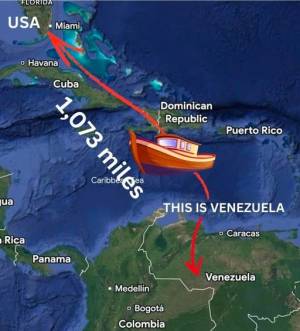
Letters from an American, Historical Commentary: December 29, 2025 [Trump Boasts of Bombings targeting Venezuela], Heather Cox Richardson, right, Dec. 30, 2025. In an appearance on New York’s WABC radio on Friday, President Donald J. Trump told billionaire businessman John Catsimatidis and co-host Rita Cosby: “We just knocked out—I don’t know if you read or you saw—they have a big plant or big facility where they send the, you know, where the ships come from. Two nights ago, we knocked that out. So we hit them very hard.”
Officials said Trump was referring to a drug facility in Venezuela. But as Tyler Pager and Julian E. Barnes of the New York Times reported, the White House and the Central Intelligence Agency (CIA) had no comment, and military officials said they had no information to share. Pager and Barnes added: “U.S. officials declined to specify anything about the site the president said was hit, where it was located, how the attack was carried out or what role the facility played in drug trafficking. There has been no public report of an attack from the Venezuelan government or any other authorities in the region.”
The reporters also noted that Venezuela is not a major producer of narcotics. It primarily traffics cocaine from Colombia. Meanwhile, Max Bearak, Simón Posada, and Christiaan Triebert of the New York Times reported today that in the wreckage left behind by one of the U.S. strikes on what the administration calls “narco-terrorists” were bodies, charred fuel containers, life jackets, and packets, most of which were empty, although a few had “traces of a substance that looked and smelled like marijuana.”
At Mar-a-Lago today, Trump said: “There was a major explosion in the dock area where they load the boats up with drugs. They load up the boats with drugs. So we hit all the boats and now we hit the area, it’s the implementation area. That’s where they implement. And that is no longer around.” Trump declined to say who was responsible for the operation. “I know exactly who it was, but I don’t want to say who it was,” he said. “But you know it was along the shore.”
Defense Secretary Pete Hegseth, who usually posts video of military strikes on social media, posted nothing about the strike Trump mentioned, although at 4:01 this afternoon, U.S. Southern Command posted that it had struck another small boat in the eastern Pacific, killing another two men. The new strike means that the U.S. military has killed more than 100 individuals in an operation widely condemned as illegal.
Tonight, Natasha Bertrand, Zachary Cohen, and Jim Sciutto of CNN reported that earlier this month, the CIA struck a remote Venezuelan port facility with drones, the first known U.S. attack on targets inside Venezuela. The U.S. says the Tren de Aragua gang was using the dock to store drugs and then to move them onto boats for reshipment. No one was at the facility when it was hit.
Sources told the CNN journalists that U.S. Special Operations Forces provided intelligence for the operation, but a spokesperson for U.S. Special Operations Command denied that allegation. The CIA declined to comment.
Josh Marshall of Talking Points Memo commented: “It’s a good commentary on 2025 that the US President announces a major military attack on a foreign country and even the straightest arrows think, 50% chance it’s an attack, 50% chance president is on another cognition bender.”
Saturday morning, the day before Ukraine president Volodymyr Zelensky was scheduled to meet with Trump for talks on ending Russia’s war against Ukraine, Russia launched a massive attack on Ukraine’s capital, Kyiv. The missile and drone strikes damaged more than ten residential buildings, killed at least one person who burned to death, and wounded 27 more, including two children.
When Zelensky arrived in Miami for his trip to Mar-a-Lago, there were no U.S. officials on hand to greet the plane. This was a deliberate snub, especially when compared to the literal red carpet Trump had U.S. military personnel roll out for Putin when he arrived on U.S. soil in August, followed by Trump greeting him while clapping, a military flyover, and a ride with Trump in the presidential limousine.
Trump’s preference for Putin was evident yesterday, too, when he posted on social media: “I just had a good and very productive telephone call with President Putin of Russia prior to my meeting, at 1:00 P.M. today, with President Zelenskyy of Ukraine.” He later told reporters that he and Putin talked for more than two hours.
At the meeting itself, Trump later told reporters, the negotiating teams “covered—somebody would say 95 percent, I don’t know what percent—but we have made a lot of progress on ending that war.” He once again referred to his fictional claims of being a peacemaker, adding: “I’ve settled eight wars, and this is the most difficult one.”
But, as Luke Harding of The Guardian noted, there is no sign that Putin is backing off from his extreme demands, including that Ukraine must give Russia much of its eastern territory. Trump’s negotiators suggest that such a concession would satisfy Putin, but skeptics doubt it. As White House chief of staff Susie Wiles told Chris Whipple in August in an interview for Vanity Fair, “The experts think that if he could get the rest of Donetsk, then he would be happy.” But, she said: “Donald Trump thinks he wants the whole country.”
Russia’s second invasion of Ukraine in February 2022 has lasted almost four years and, as Russian troops have routinely attacked civilian areas and civilian infrastructure, the damage to the country has been extreme. After meeting with Zelensky, Trump answered a reporter who asked whether Trump had spoken to Putin about the reconstruction of Ukraine: “I did. I did. They’re going to be helping. Russia’s going to be helping. Russia wants to see Ukraine succeed. Once—it sounds a little strange but I was explaining to the president, President Putin was very generous in his feeling toward Ukraine succeeding, including supplying energy, electricity, and other things at very low prices. So a lot of good things came out of that call today.”
Quite literally, Russia invaded Ukraine and continues to smash it. As former Representative Adam Kinzinger (R-IL) posted on social media: “With all this talk of how to end Russia’s war against Ukraine, and a cease fire, keep this in mind: If Ukraine ceases firing, Ukraine will cease to exist. If Russia ceases firing, the war will cease to exist.”
In his comments to reporters, one passage perhaps shed more light on events than Trump intended. Defending the idea that Putin, who is bombing Ukraine in an unprovoked assault, wants peace, Trump said: “I saw a very interesting President Putin today. I mean, he—he wants to see it happen, he wants to see it. He told me, very strongly. I believe him. Don’t forget, we went through the Russia Russia Russia hoax together. And he’d call me, I’d call him, I’d say, ‘Can you believe the stuff that they’re making up?’ And it turned out we were right. They made it all up, and despite that, we didn’t get into wars, or we didn’t get into problems, but we weren’t able to trade very much or any of that, which was a shame, because, you know, a lot of success could have been had by trading with Russia. They have great land, great minerals and other things, and we have things that they want very badly, but the Russia Russia Russia hoax, which was a terrible made-up fictional thing by crooked Hillary and by Adam Shifty Schiff and bad people, sick people. They made it up. It was all a made up hoax.”
But, of course, the idea that Russian operatives worked to put Trump into the White House in 2016 wasn’t a hoax.
The Senate Intelligence Committee, chaired by a Republican, unanimously concluded that “the Russian government engaged in an aggressive, multi-faceted effort to influence…the outcome of the 2016 presidential election.” Further, Trump campaign chair Paul Manafort’s close relationship with “Russia-aligned oligarchs in Ukraine” meant that his “proximity to Trump created opportunities for Russian intelligence services to exert influence over, and acquire confidential information on, the Trump Campaign. Taken as a whole, Manafort’s high-level access and willingness to share information with individuals closely affiliated with the Russian intelligence services…represented a grave counterintelligence threat.”
In 2016, Democratic presidential candidate Hillary Clinton would not consider lifting the sanctions placed on Russia after its 2014 invasion of Ukraine’s Crimea. Although Republicans at the time supported those sanctions, it was not clear that Trump was as firm. Lifting sanctions was part of the story of Russian support for Trump in 2016.
The Senate committee and Special Counsel Robert Mueller put more of the story together, explaining that in summer 2016, Manafort and Russian operatives “discussed a plan to resolve the ongoing political problems in Ukraine by creating an autonomous republic in its more industrialized eastern region of Donbas, and having [Russian-backed Viktor] Yanukovych, the Ukrainian President ousted in 2014, elected to head that republic.” The Mueller Report continued: “That plan, Manafort later acknowledged, constituted a ‘backdoor’ means for Russia to control eastern Ukraine.”
“All that is required to start the process is a very minor ‘wink’ (or slight push) from D[onald] T[rump] saying ‘he wants peace in Ukraine and Donbass back in Ukraine’ and a decision to be a ‘special representative’ and manage this process,” wrote a Russian operative. According to the Senate Intelligence Committee, the men continued to work on what they called the “Mariupol Plan” at least until 2018.
Trump has continued to pressure Zelensky into accepting that plan, so far without success. But Trump’s statement to reporters also suggests that with Russia’s economy crumpling under the weight of four years of war, Putin is desperate to grab Ukraine’s industrial regions and get rid of the sanctions under which his country has staggered since 2014 and especially since his second invasion of Ukraine in 2022. In late November, Russia began to sell its gold reserves in order to fund its budget.
Trump told reporters he had had another “very good talk” with Putin this morning, after his Sunday meeting with Zelensky.
Whether because of Trump’s or Putin’s weakening position—or both—both Trump and Putin appear to be eager to close the deal.
 Morning Shots via The Bulwark, Political Opinion: When It Comes to Trump, Trust Women, William Kristol, right,
 Dec. 30, 2025. They have recognized the president’s toxicity from the jump. It’s time
 men start listening to them. C’mon, Men!
As we approach the year 2026, the semiquincentennial of the nation’s founding, we’ll all be re-reading the Declaration of Independence and associated documents. As we should! But let me add a modest recommendation: Take a fresh look at the book Harvey Mansfield described as “at once the best book ever written on democracy and the best book ever written on America”: Democracy in America, by Alexis de Tocqueville.
If you take that look, you’ll find there, in Volume II, Part Three, Chapter Twelve, this remark by our nineteenth-century visitor and admirer:
Now that I approach the end of this book where I have shown so many considerable things done by Americans, if one asked me to what do I think one must principally attribute the singular prosperity and growing force of this people, I would answer that it is to the superiority of its women.
Contemporary politics vindicates the great Frenchman’s judgment. After all, if our last three elections had been decided by American women only, Donald Trump would never have become president. Whereas even now, after a decade of exposure to the Trumpian malady, American men remain remarkably and stubbornly resistant to reality.
A recent survey from Civiqs, for example, has President Trump at 40 percent approval, 56 percent disapproval. But that split conceals an enormous gender gap. Just about half of American men—wishful and credulous beings that they are—still give Trump the benefit of the doubt (47 percent approval vs. 49 percent disapproval). American women, on the other hand, disapprove of Trump by almost two-to-one (33 percent approval vs. 63 percent disapproval). (There is some hope among younger men.)
So a tip of my male hat to the female of the species—and to Tocqueville. But I also want to cite three women who’ve offered some of the most helpful guidance to the Trump phenomenon.
Two of them spoke before his rise, but their comments are indispensable to understanding the phenomenon of Trump. One is the late Maya Angelou, who told us, “When people show you who they are, believe them.”
Trump has shown us over and over again who he is, and yet we hesitate to believe him. He campaigned on the mass deportation of immigrants, but we’re startled when his administration goes ahead with it. He said he wants “his generals” to be loyal to him, but then we’re surprised when Pete Hegseth fires generals who might be more loyal to the laws or to the Constitution. Trump has shown over and over he doesn’t want the Epstein files out, but then we’re taken aback when his Justice Department fails to act in good faith to release them. Trump has repeatedly shown he’s well-disposed to Vladimir Putin, yet we’re a bit shocked each time he displays that preference.
And Trump has shown a willingness to thwart or to overturn the results of free and fair elections. Will we be shocked when he uses every means available to him to ensure that his opponents don’t prevail in 2028?
If Angelou helps us understand Trump, Dr. Ellie Sattler provides guidance for understanding his administration. In the famous scene in Jurassic Park, Ellie’s colleague, Dr. Alan Grant, says, “Okay, it’s just the two raptors, right.” But he does have the wit to ask Ellie, “You’re sure the third one’s contained?” And Sattler responds, “Yes, unless they figure out how to open doors.”
As Ellie seems to have suspected, the raptors had in fact figured that out.
As with our failure to take Trump seriously enough, we’re often quick to dismiss many of his subordinates as incompetent and ridiculous. So they often are. But enough of the apparatchiks populating the Trump administration have figured out how to open the doors to exercising power, or have been shown how to do so, that they are very dangerous indeed. With the instruments of the federal government at their disposal, and with the force of an almost-unchecked executive branch behind them, these not-so-bright velociraptor-like operatives don’t need to act with great precision or finesse. Brute force will do the trick.
The reality of a virtually unchecked executive branch, unchecked thanks to the acquiescence of the Republican party, leads me to a statement by a third American woman, former Rep. Liz Cheney. On June 9, 2022, Cheney remarked, “I say this to my Republican colleagues who are defending the indefensible: There will come a day when Donald Trump is gone, but your dishonor will remain.”
The defense of the indefensible by Republicans remains a fact. And since Trump is not yet gone, their behavior is not merely a stain on their honor. It has a real effect in helping him do far more damage than he could otherwise do.
Now I suppose it is too much to hope that the American male of the species, notoriously stubborn and boastful, will in 2026 attend to the guidance of Maya Angelou, hearken to the warning of Ellie Sattler, or listen to the remonstrance of Liz Cheney.
But here’s an offer to my fellow American men: You don’t have to acknowledge that’s what you’re doing if it offends your pride. You don’t have to admit publicly the superiority of American women. Give them no credit—they’re used to that.
But please, men, even if you don’t bow your heads, do mend your ways. Man up!
AROUND THE BULWARK
Quick Hits
INCHING TOWARD WAR: Donald Trump has been threatening for weeks that America will soon start attacking alleged drug targets, not only in Venezuelan waters, but on Venezuelan land as well. Now those attacks have begun, as CNN first reported yesterday:
The CIA carried out a drone strike earlier this month on a port facility on the coast of Venezuela, sources familiar with the matter told CNN, marking the first known US attack on a target inside that country.
The drone strike, the details of which have not been previously reported, targeted a remote dock on the Venezuelan coast that the US government believed was being used by the Venezuelan gang Tren de Aragua to store drugs and move them onto boats for onward shipping, the sources said. No one was present at the facility at the time it was struck, so there were no casualties, according to the sources.
Read the whole thing. It’s worth recalling at this juncture that Donald Trump’s own chief of staff, Susie Wiles, has said he would need congressional authorization for military action on land in Venezuela: “If he were to authorize some activity on land, then it’s war, then (we’d need) Congress,” she told Vanity Fair.
THE DRONE ZONE: To hear Trump tell it, a peace deal between Russia and Ukraine is now just around the corner. But you wouldn’t know it from listening to either the Ukrainians, who are unwilling to cede additional land, people, or sovereignty to Russia, or the Russians, who are unwilling to stop fighting until Ukraine ceases to be a viable and independent state. Both are keen to make sure that, in Trump’s eyes, the other is responsible for the lack of a peace deal.
Yesterday, without releasing evidence, Russia accused Ukraine of conducting a “terroristic” drone strike on the home of President Vladimir Putin, saying it would redouble its war efforts as a result. Zelensky fervently denied having authorized any such attack, calling the accusation “a complete fabrication” and “typical lying tactics of the Russians,” intended to justify “additional attacks against Ukraine” and “Russia’s own refusal to take necessary steps to end the war.”
Asked to weigh in yesterday during his meeting with Israeli Prime Minister Benjamin Netanyahu, Trump seemed at first to take Putin’s account as gospel: “It’s one thing to be offensive, because [Russia’s] offensive,” he told reporters. “It’s another thing to attack his house. . . . I was very angry about it.” In response to a follow-up question, however, he seemed to backtrack a bit: “Well, we’ll find out. You’re saying maybe the attack didn’t take place? That’s possible, I guess, but President Putin told me this morning.”
And hey, why would Putin lie?
THE MOST DECORATED PRESIDENT EVER: The participation trophies just keep coming. During their bilateral meeting yesterday, Israeli Prime Minister Benjamin Netanyahu announced that his country would award Trump its inaugural Israel Prize for Peace for his “tremendous contributions to Israel and the Jewish people”—the first time an Israel Prize has been awarded to a person who is neither a citizen nor a resident of Israel.
The Israel Prize itself is nothing to sneeze at: It’s the nation’s highest cultural honor, with annual awards handed out in several categories for more than seventy years. But the “Israel Prize for Peace” is a new category this year, having seemingly been created, like the FIFA Peace Prize, for the purpose of lavishing Trump with more hardware.
It’s easy to see why Netanyahu might want to keep Trump in a good mood. The two men are currently hashing out how to move the fragile ceasefire in Gaza into its second phase, which they have said would require Hamas to lay down its arms—something the militant group has not yet agreed to do. But Trump’s not above a little pampering: He called the award a “great honor,” saying that becoming the “first one outside of Israel is really something.”
Dec. 29
Security camera footage of pipe bomb suspect during the insurrection attacks surrounding the U.S. presidential vote certification by Congress on Jan. 6, 2021 resulting in the launch of the Biden presidency following the 2020 elections ending the Trump presidency for the next four years.
New York Times, Suspect Confessed to Planting Pipe Bombs Near the Capitol Before Jan. 6, Alan Feuer, Dec. 29, 2025 (print ed.). A Virginia man was charged with planting the bombs outside Democratic and Republican headquarters. Court documents show he believed that the 2020 election had been “tampered with.”
The Virginia man (shown above) arrested this month on charges of placing two pipe bombs in Washington on the night before a pro-Trump mob stormed the Capitol on Jan. 6, 2021, has given a detailed confession, according to court papers released on Sunday night.
In the public first hint at a motive in the case, the documents said that the man, Brian J. Cole Jr., felt he needed to “speak up” after he began to suspect that the 2020 election, in which President Trump was defeated, had been “tampered with.”
The papers, filed by the Justice Department in Federal District Court in Washington, gave an extensive description of Mr. Cole’s initial interview with the F.B.I. after his arrest. (More details and analysis below).

Paul Krugman via Substack, Political-Economy Commentary: MAGA’s Betrayal of Small Business, Paul Krugman, right, Dec. 29, 2025. A key right-wing constituency is feeling the painA key right-wing constituency is feeling the pain.
Owners of small businesses are, on average, a strongly right-leaning group. Indeed, along with white Christian nationalists, they are one of the core components of the MAGA base. And small business owners celebrated Donald Trump’s victory last fall. Small business optimism, as measured by the National Federation of Independent Businesses’ monthly survey, soared after the election: A graph with blue lines AI-generated content may be incorrect.Yet 2025 was a miserable year for small business — and 2026 will be worse.
Before I get into the reasons MAGA is so bad for some of its most fervent supporters, let’s talk about why small-business owners lean right.
 Partly it’s a matter of who they are. Other things equal, higher income — which means paying more in taxes and being less likely to depend on the safety net — tends to make a voter more Republican. However, higher levels of education, which are correlated with income, tend to make voters more Democratic.
This is a fairly new development — as recently as two decades ago the correlation between education and partisanship went the other way. I would attribute this reversal to the changing nature of the G.O.P., which has become ever more anti-intellectual and anti-science. For the purposes of today’s post, however, this doesn’t matter. The point, instead, is that if we ask who in America is likely to have relatively high income either without having a college degree or without having had any postgraduate education — and therefore be predisposed to favor Republicans — the answer is clearly owners of successful small businesses.
Beyond that selection effect, a recent study of small-business partisanship by Malhotra, Margalit and Shi finds that “the experience of being a small business owner leads people to adopt conservative views on government regulation.” So small business owners supported Trump in the belief that he would get the government off their backs.
That’s not what happened. Instead, the second Trump administration has been marked by increased government-imposed burdens on small business. High tariffs have been a body blow to the many small businesses that rely, one way or another, on imported goods. Mass arrests of immigrants have also been highly disruptive for businesses, such as construction contractors, that depend on foreign-born workers.
You might be tempted to say that these are burdens on all businesses, not just small business, which is true. But large businesses have been better able to weather the Trump shock than small businesses, for at least three reasons.
First, big businesses are more likely than small businesses to have the resources needed to adapt to a suddenly changed business environment. Suppose, for example, that a business has been heavily reliant on inputs imported from China, which now face an average tariff rate of 37 percent. A large corporation can try to find alternative suppliers in nations that face much lower average tariffs, such as Vietnam and Mexico. A small business won’t have the staff or money to search for and develop these alternative sources of supply.
Second, big businesses are better able to game the system. For example, one unanticipated result of the Trump tariffs has been much more thorough exploitation of the rules of the U.S.-Mexico-Canada trade agreement, the agreement formerly known as NAFTA. It turns out that until this past spring, there were many goods produced in Mexico and Canada that were legally entitled to enter the U.S. duty free — but as long as tariffs were low, many importers chose not to pay the legal fees or fill out the paperwork needed to claim these exemptions. When Trump went on his tariff spree, the incentives changed, and many companies decided that the cost of the extra paperwork was worth it, after all: A graph showing the value of a trade AI-generated content may be incorrect.
But big corporations were much better positioned than small businesses to bear the cost of certifying that the goods they import are “USMCA-compliant.”
Finally, under Trump the United States has moved rapidly toward crony capitalism, a situation in which businesses with strong political connections get favorable treatment. Under this system, big businesses can in effect buy themselves a privileged position. Small businesses can’t.
For example, Apple has so far dodged most of the negative impact of Trump’s tariffs. Over the summer Trump imposed punitive tariffs on India, which is where most iPhones sold in the United States are produced. But for some reason smartphones were exempted from Trump’s India tariffs. What’s the logic behind this exemption? Might it have something to do with the fact that Apple is helping to pay for the construction of the grotesque ballroom that Trump is building to replace the demolished East Wing of the White House?
All of these factors help explain the trends shown in the chart at the top of this post: 2025 was a difficult year for many businesses not benefiting from the AI boom, but it was especially hard on small business.
But the worst is yet to come — or, actually, is happening as you read this.
Small-business owners tend to be disdainful of government, yet in many cases they and their employees depend in crucial ways on government programs. In particular, almost half of the adults receiving health insurance via the government-run exchanges established by the Affordable Care Act — Obamacare — either own or work for small businesses.
However, the cost of buying insurance on these exchanges has more than doubled on average since a year ago, because Trump and his party have refused to extend enhanced subsidies enacted under the Biden administration. As a result, many small business owners are in the process of finding out that they can no longer afford health insurance for their employees — or, in many cases, themselves.
In short, small business placed its faith in Trump but has been betrayed. But then, that’s what has happened to everyone who trusted Trump, from farmers to blue-collar workers — everyone, that is, except for the tech billionaires who have bought their way into his inner circle.
Morning Shots via The Bulwark, Political Opinion: My Grandma and the Hot Stove, Andrew Egger,  right, Dec. 29, 2025. This year, I went back to my home in the Midwest for Christmas, visiting my parents and friends in St. Louis and both sides of my extended family in Iowa.
My family and childhood community are quite conservative and full of Trump voters. But I’ve never really understood the Sturm und Drang this seems to cause so many families—I’ve talked to the people I grew up around plenty about my work and my views, and it’s never been a bad or mean-spirited conversation.
This year’s conversations weren’t any worse in that department, but they were definitely different. For the first time, I was struck by just how many ways all the current unpleasantness is actively changing their lives for the worse.
It started when I noticed a Post-It note on my grandparents’ fridge. “I donated $10 to Trump to get $2000 tariff check,” it read. “At the end it said I am charged to give $10 monthly. I did not!”
When I asked my grandma about it, she showed me her phone. Her texts, it turns out, are absolutely clogged with the scuzziest GOP fundraising solicitations imaginable. “Before I sign your name on your Tariff Check, is Patricia spelled right?” “Patricia, it’s Trump & I’m heartbroken. I don’t have verification to claim your MAGA Golden Eagle Award.” “Can’t believe you said NO to Trump’s $5k Dividend Check. Are you sure that’s your answer?”
Not all these texts are from the actual Trump campaign, of course. These sorts of tactics have been adopted by a whole host of candidates and PACs in the MAGAsphere. (The group she was snookered into donating to happened to be a leadership PAC for Texas Rep. Jake Ellzey.)
When she asked me if she’d been scammed, my first instinct was to say “no”—this wasn’t some fake group pretending to be a GOP politician’s PAC, after all, but the real thing. But in a simpler, truer sense, it was a scam from top to bottom. There are no tariff checks to claim, and if there were, you wouldn’t have to give money to Rep. Ellzey or anybody else to get them.
The whole thing was infuriating, and there was nothing to be done about it. Her phone number is out there, circulating among various GOP fundraising lists. No matter how many times she tries to unsubscribe, there’s always another text, another “check,” another disappointed message from “Trump.”
Later, an uncle asked me what I knew about a guy named Nick Fuentes. He’d learned that a younger relative was a fan of the young neo-Nazi podcaster. And that this relative had begun to consider himself a white nationalist, too. And that he was full of alarming talk about how white people have to learn to see themselves as victims of the system. My uncle was shocked and unnerved by all this and seemed to be asking me how to get through to a person who had fallen so far into that particular rabbit hole. We talked for a while about it, but I hardly knew what to say.
That’s an underappreciated feature of our political age: It’s not just that things are bad, it’s that they’re relentlessly so. You can’t turn it off. You can’t escape it. You can’t distinguish between real and fake, good and bad, normal and abnormal. The stuff keeps piling up. When I mentioned the Fuentes conversation to one of my sisters, who currently attends a conservative Christian college, she said she’d seen an unnerving uptick in casual antisemitism among her own peers.
Maybe none of this should have surprised me. I’ve spent a lot of time over the years writing about the damage done by Donald Trump, his politics, and his strange cultural movement not only to the country in general but to the people who support him in particular. It’s clearer than ever to me that that damage is extensive and pervasive and will outlast him by years. But I can’t abide by the schadenfreude-laden viewpoint that anyone who ever pulled a lever for Trump deserves whatever’s coming to them as a result. The fact is that this political moment is immiserating good people. I don’t blame them for that. I blame him.
It’s a strange, sad time in American politics. Best we can do is buddy up. Come ride with us
News Roundup
The Parnas Perspective, Morning News Updateand Political Commentary, Aaron Parnas, right, Dec. 29, 2025. It is already a consequential start to the day. We learned that the United States may have carried out its first land strike on Venezuela without congressional approval. China announced large-scale military drills around Taiwan. Iran’s president declared the country is in “total war” with the United States, Israel, and Europe. At the same time, Congressman Massie says Attorney General Pam Bondi is redacting the names of accused sex offenders in the Epstein files.
Donald Trump said the United States “knocked out” a major facility in Venezuela as part of expanded military action against alleged drug trafficking, marking what could be the first known U.S. land strike in the campaign after months of attacks on boats, though the White House offered no details and NBC News has not independently confirmed the strike.
Congressman Thomas Massie is now alleging that Attorney General Pam Bondi is redacting the names of accused sex offenders in the Epstein files:
The U.S. House faces a January 30 government funding deadline with only three of twelve appropriations bills passed, as disputes over expiring Affordable Care Act subsidies, discharge petitions, and limited legislative days raise the risk of another shutdown despite leadership efforts to finalize remaining bills.
Assistant Attorney General for Civil Rights Harmeet Dhillon, a close ally of Donald Trump, launched an expletive-filled online tirade at MAGA influencers criticizing Attorney General Pam Bondi, insisting the statute of limitations does not block Justice Department action related to Jan. 6 and accusing conservative critics of spreading misinformation.
President Donald Trump is making high-stakes foreign policy gambles at year’s end by hosting talks with Volodymyr Zelensky and Benjamin Netanyahu to push Ukraine and Gaza peace efforts while also ordering U.S. military strikes against ISIS targets and escalating pressure abroad, highlighting his effort to secure a peacemaker legacy amid rising political and strategic risks.
Iranian President Masoud Pezeshkian said Iran is in a “full-fledged war” with the United States, Israel and Europe, citing continued pressure after Donald Trump ordered strikes on Iranian nuclear facilities and resumed harsh sanctions, as tensions persist despite a ceasefire ending the brief Iran–Israel conflict.
Rep. Mike Turner defended U.S. airstrikes on ISIS targets in Nigeria as a continuation of America’s ongoing fight against the group, saying the Christmas Day strikes were coordinated with Nigeria’s government and consistent with Donald Trump’s broader counter-ISIS policy. When asked whether Trump stood on the side of Russia or Ukraine, he could not give a clear answer:
China launched large-scale joint military drills encircling Taiwan as a “stern warning” to pro-independence and “external interference” forces after tensions over U.S. arms sales and comments from Japan, prompting Taipei to place its forces on high alert and condemn Beijing as destabilizing regional peace.
Israeli Prime Minister Benjamin Netanyahu is set to meet with a more cautious Donald Trump in Florida seeking tougher action against Hamas and warning about Iran’s missile advances, even as strains over Gaza, Syria and broader Middle East strategy underscore a relationship driven by mutual political need rather than trust.
Heavy winter rains flooded displacement camps across the Gaza Strip, worsening conditions for Palestinians living in damaged tents and contributing to deaths from hypothermia, as Netanyahu traveled to the United States for talks with Donald Trump on the next phase of the Israel-Hamas ceasefire amid mounting calls for more humanitarian aid.
Volodymyr Zelensky told reporters today that the United States has offered a 15-year security guarantee in a draft peace proposal to end the war with Russia, but he is urging a much longer commitment of up to 50 years as negotiations with Donald Trump advance and remain about 90 percent agreed
Zelensky further said Ukraine will not withdraw from the Donbas, warning such a move would pose major risks and would be rejected by the Ukrainian public in any referendum, making it unacceptable for Ukraine.
According to The Hill, a multi-agency human trafficking sting in San Diego County rescued 19 victims and led to the arrest of four men during the annual “Home for the Holidays” operation, with officials including California Attorney General Rob Bonta highlighting tougher new state laws and a continued focus on victim support and accountability.
Anthony Joshua sustained minor injuries after his car crashed into a stationary vehicle on the Lagos-Ibadan Expressway in Nigeria, killing two people, according to police in Ogun State, with the former world champion taken to hospital as authorities launched an investigation into the fatal collision.
Global News
New York Times, Analysis: With Critical Decisions Ahead, Netanyahu Faces Mounting Pressure, David M. Halbfinger, Dec. 29, 2025. Prime Minister Benjamin Netanyahu of Israel has a series of vexing choices to make in the year ahead on issues including Gaza, conscription and a judicial overhaul, with elections looming.
Benjamin Netanyahu, right, has been prime minister of Israel for so long that nearly everyone knows how he governs.
 He delays decisions. He keeps options open for as long as possible and creates new ones whenever he can. He wears down, outwaits and outlasts his adversaries — as well as his ostensible allies. He turns crises — including some of his own creation — into opportunities he can defuse, for a price.
But events are lining up in a way that may tax even his well-documented ability to stretch out tough decisions and shape them to his advantage.
Mr. Netanyahu’s criminal trial on charges of bribery and fraud is inexorably advancing. President Trump’s peace plan for Gaza is inching along toward a difficult Phase 2, and tensions are building with the White House over Israel’s actions in Syria and Lebanon. And polls indicate Mr. Netanyahu is headed to defeat in next year’s elections.
The pressure on him is mounting from every direction.
 That includes from the Israeli right, Mr. Netanyahu’s political base, which is agitating for him to pursue annexation of the Israeli-occupied West Bank despite Mr. Trump’s warnings that doing so would trigger a harsh U.S. response.
On each of these fronts, 2026 is shaping up as a momentous year for Mr. Netanyahu, 76, and for the country he has represented for the better part of three decades. He is almost certainly going to have to make a series of decisions with great consequence — for Israeli society and security, for Palestinians, and for the broader Middle East.
As he prepares to meet Mr. Trump in Florida on Monday, and as Israel awaits an election at some point in 2026, here is a look at some of his pivotal choices ahead.Conscription Exemption or Collapse
If he wants to maintain his decades-old political alliance with Israel’s ultra-Orthodox Jewish community, one of Mr. Netanyahu’s first tasks is to try to meet its demand for a law granting yeshiva students a new exemption from the draft, after an old exemption expired and the Supreme Court ruled in 2024 that they were legally obligated to serve.
A new exemption would be wildly unpopular with the vast majority of Israelis, who have been exhausted by the Gaza war’s demands on conscripts and reservists alike over the past two years.
Those opposing the exemption include members of Mr. Netanyahu’s own Likud party.
If Parliament does not enact the exemption, his government could collapse, precipitating elections early next year.
President Trump and President Volodymyr Zelensky of Ukraine spoke to reporters on Sunday after meeting at Mar-a-Lago in Palm Beach, Fla. New York Times photo by Tierney L. Cross).
New York Times, Analysis: For Zelensky, Just Keeping Trump Talking Counts as a Win, Constant Méheut, Dec. 29, 2025.Though discussions produced little tangible progress, President Volodymyr Zelensky of Ukraine at least avoided the type of setbacks that have blighted earlier meetings.
A new round of peace talks between President Volodymyr Zelensky of Ukraine and President Trump on Sunday seems to have produced little beyond a promise to meet again next month and a reminder of how distant a peace deal remains.
Yet for Mr. Zelensky, even a stalemate in the discussions counts as a measure of success.
Following setbacks in U.S. support for Ukraine this year, one of Mr. Zelensky’s main priorities when meeting Mr. Trump has been to prevent talks from derailing. After the meeting on Sunday, Mr. Trump signaled that he would remain engaged in the negotiations — a win for Ukraine given his repeated threats to walk away. Mr. Trump also backed away from setting another deadline to reach a peace deal, after having previously floated Thanksgiving and Christmas as target dates.
“I don’t have deadlines,” Mr. Trump told reporters as he greeted Mr. Zelensky at Mar-a-Lago in Florida for the talks. “You know what my deadline is? Getting the war ended.”
Most important for Ukraine, Mr. Trump did not echo Russia’s maximalist demands to stop the fighting, a departure from earlier in his term when he often appeared to side with the Kremlin. The change was also notable because Mr. Trump had spoken with President Vladimir V. Putin of Russia just before meeting Mr. Zelensky, the type of last-minute Russian intervention that has derailed Ukrainian hopes before.
That outcome may leave Mr. Zelensky hopeful that Kyiv and Washington have become more closely aligned in the peace negotiations. Several European leaders also joined Sunday’s talks by phone, and Mr. Zelensky said that the United States might host a new round of negotiations next month that could include them.
“The fact that they’re talking is a victory in and of itself,” Harry Nedelcu, a senior director at Rasmussen Global, a research organization, said of the American and Ukrainian presidents.
Still, Mr. Zelensky acknowledged some division between them on Monday, noting that while Mr. Trump has agreed to help secure Ukraine, he offered such guarantees for only 15 years, short of the several decades that Mr. Zelensky and Ukrainians seek.
U.S. Politics, Governance

U.S. Rep. Marjorie Taylor Greene, a Republican representing rural Georgia and aonetime fervant Trump supporter who is resigning from Congress at the beginning of January (New York Times photo by Philip Montgomery)
New York Times Magazine, ‘I Was Just So Naïve’: Inside Marjorie Taylor Greene’s Break With Trump, Robert Draper, Dec. 29, 2025. How the Georgia congresswoman went from the president’s loudest cheerleader to his loudest Republican critic.
Eleven days after Charlie Kirk was killed in September, Marjorie Taylor Greene, the third-term Georgia congresswoman, was watching his memorial service on TV as the luminaries of the conservative movement and the Trump administration gathered to pay tribute to the young activist.
What stayed with Greene long afterward were the last two speakers who took the stage. First there was Kirk’s widow, Erika, right, who stood in white  before the crowd filling the Arizona stadium, lifted her tear-filled eyes and said that she forgave her husband’s killer. And then there was President Trump. “He was a missionary with a noble spirit and a great, great purpose,” he said of Kirk. “He did not hate his opponents. He wanted the best for them. That’s where I disagreed with Charlie. I hate my opponent, and I don’t want the best for them.”
“That was absolutely the worst statement,” Greene wrote to me in a text message months after the memorial service. And the contrast between Erika Kirk and the president was clarifying, she added. “It just shows where his heart is. And that’s the difference, with her having a sincere Christian faith, and proves that he does not have any faith.”
It also, Greene said, clarified something about herself. Over the past five years, as Trump’s most notorious acolyte in Congress, she had adopted his unrepentant pugilism as her own. “Our side has been trained by Donald Trump to never apologize and to never admit when you’re wrong,” she told me in her Capitol Hill office one afternoon in early December. “You just keep pummeling your enemies, no matter what. And as a Christian, I don’t believe in doing that. I agree with Erika Kirk, who did the hardest thing possible and said it out loud.”
Greene’s reaction put her in a distinct minority among influential conservative figures. Almost immediately after Kirk was declared dead, many of her comrades on the right — the billionaire Elon Musk, the Fox News host Jesse Watters, the podcaster Steve Bannon — labeled the killing an act of war by the left and exhorted their audience to think in similar terms.
But Greene — who for years took a back seat to no one when it came to reactionary rhetoric, going so far, before she was in office, as to accuse Democrats, including Speaker Nancy Pelosi, of treasonous conduct and adding that treason was punishable by imprisonment or death — realized that she had suddenly lost all appetite for vengeance. She later told a friend, who confirmed the exchange: “After Charlie died, I realized that I’m part of this toxic culture. I really started looking at my faith. I wanted to be more like Christ.”
That was when the stress fracture that had been steadily widening between Greene and her political godfather became an irrevocable break. She had increasingly taken stands apart from the president and the Republican Party: declaring the war in Gaza a “genocide”; objecting to cryptocurrency and artificial-intelligence policies that, from her perspective, prioritized billionaire donors over working-class Americans; criticizing the Trump administration for approving foreign student visas, for enacting tariffs that hurt businesses in her district and for allowing Obamacare subsidies to expire.
Most significant, she defied the president and compliant House Republican leaders as she argued that all investigative material pertaining to Jeffrey Epstein should be released. “The Epstein files represent everything wrong with Washington,” Greene told me in December. “Rich, powerful elites doing horrible things and getting away with it. And the women are the victims.”Editors’ Picks19 Easy, One-Bowl Cookies for a Simply Sweet SeasonWhen Joy and Grief Collide on Your Wedding Day43 Things to Do on New Year’s Eve in N.Y.C.
As Greene made her opinions known, first to Trump and his team and then publicly, she tested the affection of the man who once said of her in a posted statement endorsing her re-election: “Marjorie Taylor Greene is a warrior in Congress. She doesn’t back down, she doesn’t give up, and she has ALWAYS been with ‘Trump.’”
U.S. Crime, Courts, Law, Justice
Security camera footage of pipe bomb suspect during the insurrection attacks surrounding the U.S. presidential vote certification by Congress on Jan. 6, 2021 resulting in the launch of the Biden presidency following the 2020 elections ending the Trump presidency for the next four years.
New York Times, Suspect Confessed to Planting Pipe Bombs Near the Capitol Before Jan. 6, Alan Feuer, Dec. 29, 2025 (print ed.). A Virginia man was charged with planting the bombs outside Democratic and Republican headquarters. Court documents show he believed that the 2020 election had been “tampered with.”
The Virginia man (above) arrested this month on charges of placing two pipe bombs in Washington on the night before a pro-Trump mob stormed the Capitol on Jan. 6, 2021, has given a detailed confession, according to court papers released on Sunday night.
In the public first hint at a motive in the case, the documents said that the man, Brian J. Cole Jr., felt he needed to “speak up” after he began to suspect that the 2020 election, in which President Trump was defeated, had been “tampered with.”
The papers, filed by the Justice Department in Federal District Court in Washington, gave an extensive description of Mr. Cole’s initial interview with the F.B.I. after his arrest.
At first, the government’s filing said, Mr. Cole denied planting the bombs outside the Republican and Democratic Party headquarters on the eve of the Capitol attack. But the filing said he admitted to doing so after agents displayed an image captured from surveillance cameras that they said showed him in a hooded sweatshirt carrying a backpack on the same route the bomber took that night.
“The interviewing agents reminded the defendant that lying to them was an additional criminal offense and asked the defendant again whether he was the individual on the surveillance video,” prosecutors said in the filing. “This time, the defendant paused for approximately 15 seconds, placed his head face down on the table, and answered, ‘yes.’”
The government’s assertion that Mr. Cole confessed to planting the bombs came just two days before he was scheduled to appear in court for a hearing to determine his bail. In their papers, federal prosecutors asked that Mr. Cole remain in custody as he awaits trial. His lawyers, who say he has severe autism, have not yet filed their own court papers laying out their views on their client’s pretrial detention.
The question of who planted the pipe bombs on the night before the Capitol was attacked has long stood as a kind of Rorschach test for wider views about the events of Jan. 6.
For years, conspiracy theorists have seized on the pipe bomb case, alleging that shadowy government forces had planted the explosives as a distraction to make it easier for the Capitol to be stormed, in an effort to ultimately blame the breach on Mr. Trump and his supporters.
The arrest of Mr. Cole, who has no apparent connections to the government, clearly contradicted those conspiracy theories, even though they had long been promoted by some of the very same F.B.I. officials unveiling a breakthrough in the case this month. Chief among those officials was Dan Bongino, the bureau’s deputy director, who accused the F.B.I. of covering up the pipe bomb case when he was working as a podcaster. Mr. Bongino recently announced that he was resigning from his post as the bureau’s No. 2 official.Editors’ Picks16 Fun Party Appetizers That Start With Frozen Puff PastryShe Sold a Painting for $165 Million and Gave It All AwayThe New Stealth Recliners
In his interview with federal agents, Mr. Cole insisted that he had never been “an openly political person,” the court papers released on Sunday said. But he also told investigators that as he began to follow the 2020 presidential race, he started to feel that if “something as important as voting in the federal election is being tampered with,” then “someone needs to speak up.” Mr. Trump repeatedly claimed without evidence that there was fraud in the results.
The papers said that Mr. Cole had told the F.B.I. that “the people up top,” including “people on both sides,” should not ignore the grievances of ordinary citizens or call them “conspiracy theorists,” “bad people,” “Nazis” or “fascists.”
On a motive behind his actions, he said “something just snapped” after “watching everything, just everything getting worse,” according to the documents. He added that he wanted to do something “to the parties” because “they were in charge.”
During his interview, Mr. Cole said “he was not really thinking about how people would react when the bombs detonated, although he hoped there would be news about it.” He claimed that he was “pretty relieved” when, in fact, the devices did not explode, asserting that he had specifically planted them at night because he did not want to see people get killed.
Before the arrest of Mr. Cole, the pipe bomb case had bedeviled the F.B.I. for years as agents chased a panoply of suspects and false leads. Investigators were finally able to crack the case after a bureau technician successfully gained access to cellphone data that implicated Mr. Cole and was previously thought to be corrupted.
Once he confessed to planting the bombs, the court papers said, Mr. Cole explained to investigators how he did it. According to the papers, he said that he had made the explosive powder in the devices using “charcoal, Lilly Miller sulfur dust and potassium nitrate that he purchased from Lowe’s.”
He mixed these ingredients in a Pyrex bowl, the papers said, and used “a spoon or measuring cup” to pour the powder into the bombs. Mr. Cole told the F.B.I. that he had learned to make the powder from a video game that listed the ingredients and had also “viewed various science-related videos on YouTube to assist him.”
In an affidavit filed when Mr. Cole was arrested, F.B.I. agents also said that they were able to use his cellphone to track his location on the night the bombs were set, then compare it with surveillance footage of the path the bomb planter took on the evening of Jan. 5.
Agents also viewed bank accounts and credit card records to track purchases from local stores, including Home Depot, where he picked up components of the weapons, including galvanized piping, nine-volt batteries, electrical wire, steel wool and white kitchen timers.
Emptywheel, Analysis: Jeanine Pirro Got Curiously Silent about What Brian Cole Did on December 14, 2020, Emptywheel (Marcy Wheeler), right, Dec. 29, 2025. The accused pipe bomber, Brian Cole, started regularly wiping his cell phone the day after he traveled to Capitol Hill weeks before planting the pipe bombs. But DOJ dropped his December 14, 2020 trip to Capitol Hill from its narrative of his alleged actions.
DOJ has submitted its detention memo for accused January 6 pipe bomber Brian Cole.
It largely tracks his arrest affidavit, only includes nifty maps and tables to show how his cell phone movement and his purchases showed his actions in preparation for and laying the pipe bombs.
It also includes details of his Mirandized, videotaped confession.
The description of his motive confirms he was a Trump supporter, but then explains he just planted the pipe bombs at both the DNC and RNC because he hated both parties — it had nothing to do with January 6, the filing claims (without quoting him).
The defendant stated that he does not align politically with his family members and did not tell them that he “was going to a protest in support of [then President] Trump.”
[snip]
When the interviewing agents returned to the defendant’s motive, he explained that “something just snapped” after “watching everything, just everything getting worse.” The defendant wanted to do something “to the parties” because “they were in charge.” When asked why he placed the devices at the RNC and DNC, the defendant responded, “I really don’t like either party at this point.” The defendant also explained that the idea to use pipe bombs came from his interest in history, specifically the Troubles in Ireland. The defendant denied that his actions were directed toward Congress or related to the proceedings scheduled to take place on January 6.
But there are two holes in the detention affidavit.
First, it describes Cole taught himself how to make explosives from YouTube, and used Google Maps to decide where to plant the bombs.
According to the defendant, he learned to make the black powder from a video game that listed the ingredients, and he also viewed various science-related videos on YouTube to assist him in creating the devices.
[snip]
The defendant explained that he had used Google Maps to look up these locations in advance.
Both of those details should show up in a Google warrant.
The detention memo makes no mention of them (or of any Google warrant).
More stunning, the detention affidavit drops a key detail from the arrest affidavit: That he was on Capitol Hill on December 14, 2020.
The FBI has analyzed COLE’s purchase history associated with the Accounts. Between January 2018 and January 2021, COLE made a total of five purchases within Washington, D.C. on or about the following dates: January 13, 2018; January 16, 2018; October 31, 2019; December 5, 2020; and December 14, 2020.
Approximately three weeks before the pipe bombs were placed, on or about December 14, 2020, COLE made a purchase at a restaurant located near First and D Streets, Southeast. The restaurant is located across the street from the entrance to Rumsey Court on D Street, Southeast.
What the detention affidavit does reveal is that — starting on December 15, 2020 — the day after being on Capitol Hill and a full three weeks before planting the pipe bombs, Cole started factory resetting his phone.
A Samsung cellular device was seized from the defendant’s person at the time of his arrest. A forensic review of the device’s contents showed that between December 2020 and December 2025, the device recorded 943 events identified as a “factory reset” or “wipe,” including a “wipe” event approximately three hours before the defendant’s arrest on December 4, 2025.2
2 The first “factory reset” or “wipe” event took place on December 15, 2020. The next such event did not occur until July 15, 2022. From that date, the “factory reset” or “wipe” events occurred at least once a week. On some days, the device appears to have been wiped multiple times in the same day.
The alleged pipe bomber started exercising operational security the day after that trip to Capitol Hill, the scene of his alleged crime.
And now, Jeanine Pirro, above, doesn’t want to talk about the trip he made there at all.
Update: Cole’s attorneys complain that DOJ is attempting to push his first appearance out to January 7 or 8, which would be past any 5-year statute of limitation (though his charged crimes have a longer 10-plus year statute of limtiation).
2. On December 28, 2025, when pressed on the question of proceeding with the preliminary hearing on December 30, the government asked to push the preliminary hearing to either January 7 or 8. That request comes too late and does not meet Rule 5.1(d)’s rigorous standard. The Court should confirm that December 30 is the preliminary hearing and detention hearing and direct the government to be prepared to present its evidence in support of probable cause.
[snip]
4. In its email to defense counsel, the government has identified no extraordinary circumstances; rather, the reasons referenced are ordinary scheduling matters and the possibility of a forthcoming indictment. Rule 5 “does not allow the [preliminary] hearing date” to be extended merely “to accommodate the pace of the grand jury investigation.” United States v. Gurary, 793 F.2d 468, 472 (2d Cir. 1986). And where the defendant does not consent—as he does not here—Rule 5.1(d) imposes “far more rigorous criteria” than the Speedy Trial Act’s ends-of-justice standard. Id. at 473; see also United States v. Fortenberry, 2014 WL 6969615, at *2 (D. Nev. Dec. 9, 2014) (“Rule 5.1 does not permit continuance solely to enable the government to avoid a preliminary hearing by securing an indictment.”) (citation omitted).
Update: This is a super minor point. But in the detention memo, DOJ quotes Cole as saying (this month), “I really don’t like either party at this point,” which is at least consistent with him having been a Trump supporter and souring on him.
A few paragraphs later, they change the tense of that, claiming he placed that opinion in 2020.
In his own words, the defendant did so because he did not “like either party,” but “they were in charge” and thus were, in the defendant’s mind, an appropriate target for extreme acts of violence.
And they turn it into a both-sides thing.
By his own admission, the defendant committed these chilling acts because he was unhappy with the response of political leaders on both sides of the political aisle to questions raised about the results of the 2020 election, and “something just snapped.” [my emphasis throughout]
It may well be that something about what Cole said makes it fair to put his animosity to both parties back in time to 2020, but that’s not the tense he used.
Additionally, this is the table DOJ uses to claim they found purchase records for all the components he used to make the bombs.
But this is misleading. While the table includes Lilly Miller sulfur dust, one of the things he said he used to make black powder (and charcoal, another, would be readily on hand), that’s actually a purchase 14 months earlier than any other component, and from a different store. But they didn’t find a purchase record for the potassium nitrate, which they say he said he got at Lowes (from which they have a bunch of other purchase records).
 Mass grave after massacre at Wounded Knee in South Dakota in1891.
Letters from an American, Historical Commentary: December 28, 2025 [A Western Massacre That Didn't Need To Be], Heather Cox Richardson, right, Dec. 29, 2025. On the clear, cold morning of December 29, 1890, on the Pine Ridge Reservation in South Dakota, three U.S. soldiers tried to wrench a valuable Winchester away from a young Lakota man. He refused to give up his hunting weapon. It was the only thing standing between his family and starvation, and he had no faith it would be returned to him as the officer promised: he had watched as soldiers had marked other confiscated weapons for themselves.
As the men struggled, the gun fired into the sky.
Before the echoes died, troops fired a volley that brought down half of the Lakota men and boys the soldiers had captured the night before, as well as a number of soldiers surrounding the Lakotas. The uninjured Lakota men attacked the soldiers with knives, guns they snatched from wounded soldiers, and their fists.
As the men fought hand to hand, the Lakota women who had been hitching their horses to wagons for the day’s travel tried to flee along the nearby road or up a dry ravine behind the camp. Stationed on a slight rise above the camp, soldiers turned rapid-fire mountain guns on them. Then, over the next two hours, troops on horseback hunted down and slaughtered all the Lakotas they could find: about 250 men, women, and children.
Fifteen years ago, I wrote a book about the Wounded Knee Massacre, and what I learned still keeps me up at night. But it is not December 29 that haunts me.
What haunts me is the night of December 28.
On December 28 there was still time to avert the massacre.
In the early afternoon, the Lakota leader Sitanka had urged his people to surrender to the soldiers looking for them. Sitanka was desperately ill with pneumonia, and the people in his band were hungry, underdressed, and exhausted. They were making their way south across South Dakota from their own reservation in the northern part of the state to the Pine Ridge Reservation. There they planned to take shelter with another famous Lakota chief, Red Cloud. His people had done as Sitanka asked, and the soldiers escorted the Lakotas to a camp on South Dakota’s Wounded Knee Creek, inside the boundaries of the Pine Ridge Reservation.
For the soldiers, the surrender of Sitanka’s band marked the end of what they called the Ghost Dance Uprising. It had been a tense month. Troops had pushed into the South Dakota reservations in November, prompting a band of terrified men who had embraced the Ghost Dance religion to gather their wives and children and ride out to the Badlands. But at long last, Army officers and negotiators had convinced those Ghost Dancers to go back to Pine Ridge and turn themselves in to authorities before winter hit in earnest.
Sitanka’s people were not part of the Badlands group and, for the most part, were not Ghost Dancers. They had fled from their own northern reservation two weeks before when they learned that officers had murdered the great leader Sitting Bull in his own home. Army officers were anxious to find and corral Sitanka’s missing Lakotas before they carried the news that Sitting Bull had been killed to those who had taken refuge in the Badlands. Army leaders were certain the information would spook the Ghost Dancers and send them flying back to the Badlands. They were determined to make sure the two bands did not meet.
But South Dakota is a big state, and it was not until late in the afternoon of December 28 that the soldiers finally made contact with Sitanka’s band. The encounter didn’t go quite as the officers planned: a group of soldiers were watering their horses in a stream when some of the traveling Lakotas surprised them. The Lakotas let the soldiers go, and the men promptly reported to their officers, who marched on the Lakotas as if they were going to war. Sitanka, who had always gotten along well with Army officers, assured the commander that the band was on its way to Pine Ridge and asked his men to surrender unconditionally. They did.
By this time, Sitanka was so ill he couldn’t sit up. Blood dripped from his nose. Soldiers lifted him into an Army ambulance—an old wagon—for the trip to the Wounded Knee camp. His ragtag band followed behind. Once there, the soldiers gave the Lakotas an evening ration and lent Army tents to those who wanted them. Then the soldiers settled into guarding the camp.
And the soldiers celebrated, for they saw themselves as heroes of a great war, and it had been bloodless, and now, with the Lakotas’ surrender, they would be demobilized back to their home bases before the South Dakota winter closed in. As they celebrated, more and more troops poured in. It had been a long hunt across South Dakota for Sitanka and his band, and officers were determined the group would not escape them again.
In came the Seventh Cavalry, whose men had not forgotten that their former leader George Armstrong Custer had been killed by a band of Lakotas in 1876. In came three mountain guns, which the soldiers trained on the Lakotas’ encampment from a slight rise above the camp.
For their part, the Lakotas were frightened. If their surrender was welcome and they were going to go with the soldiers to Red Cloud at Pine Ridge, as they had planned all along, why were there so many soldiers, with so many guns?
On this day and hour in 1890, in the cold and dark of a South Dakota December night, there were soldiers drinking, singing, and visiting with each other, and anxious Lakotas either talking to each other in low voices or trying to sleep. No one knew what the next day would bring, but no one expected what was going to happen.
One of the curses of history is that we cannot go back and change the course leading to disasters, no matter how much we might wish to. The past has its own terrible inevitability.
But it is never too late to change the future.
Sunday thought by Robert Reich, The reckoning, Robert Reich, Dec. 28-29, 2025. Sometimes a nation needs a nightmare before it can fully awaken to long-simmering crises.
Martin Luther King Jr. mobilized the nation against racial injustice by making sure almost everyone in the United States saw its horrors — on the nightly news, watching peaceful Black people getting clubbed and arrested for exercising their rights.
Were it not for that painful national exposure to racist brutality, we wouldn’t have gotten the Civil Rights Act or the Voting Rights Act.
Something similar happened in the first years of the 20th century, when muckraking journalists revealed the monopolies, corruption, and public-be-damned arrogance of the robber barons.
Were it not for that painful national exposure, we wouldn’t have gotten the reforms of the Progressive Era.
A similar dynamic is playing out as Americans witness the nightmare of Trump’s neofascism: its mindless cruelty, blatant attempts to silence critics, wanton destruction of much of our government, open racism and misogyny.
Trump has revealed himself in ways his first-term handlers wouldn’t allow — as a sociopath who posts AI cartoons showing himself shitting on millions of Americans who marched against him. A malignant narcissist unable to respond to the tragic killings of Rob and Michele Reiner without making it all about himself. A chronic liar who says prices are dropping when everyone knows they’re rising.
As Americans see all this, outrage has been growing. We are beginning to mobilize — not all of us, of course, but the great majority. Record numbers of us marched on October 18, No Kings Day. Democratic candidates have won just about every recent special election and mayoral and gubernatorial contest and a remarkable number of down-ballot races in bright red states and cities. MAGA is coming apart. Trump’s polls are tanking.
We are organizing and mobilizing with a resolve I have not seen in my lifetime. America had to come to this point. We couldn’t go on as we were, even under Democratic presidents. For 40 years, a narrow economic elite has been siphoning off ever more wealth and power.I’m old enough to remember when America had the largest and fastest-growing middle class in the world. We adhered to the basic bargain that if someone worked hard and played by the rules, they’d do better than their parents, and their children would do even better.I remember when CEOs took home 20 times the pay of their workers, not 300 times.
When members of Congress acted in the interests of their constituents rather than being bribed by campaign donations to do the bidding of big corporations and the super-wealthy.I remember when our biggest domestic challenges were civil rights, women’s rights, and gay rights — not the very survival of democracy and the rule of law.
But over the last 40 years, starting with Reagan, America went off the rails. Deregulation, privatization, free trade, wild gambling by Wall Street, union-busting, monopolization, record levels of inequality, stagnant wages for most, staggering wealth for a few, big money taking over our politics.
Corporate profits became more important than good jobs and good wages for all. Stock buybacks and the well-being of investors more important than the common good.Democratic presidents were better than Republican, to be sure, but the underlying rot worsened. It was undermining the foundations of America.Trump has precipitated a long-overdue reckoning. That reckoning has revealed the rot. It has also revealed the suck-up cowardice of so many CEOs, billionaires, Wall Street bankers, media moguls, tech titans, Republican politicians, and other so-called “leaders” who have stayed silent or actively sought to curry Trump’s favor.
America’s so-called “leadership class” is a sham. Most of them do not care a whit for the rest of America. They are out for themselves. The “fucking nightmare” is not over by any stretch. It’s likely to get worse in 2026 as Trump and his sycophants, and many of America’s “leaders,” realize 2026 may be their last unrestrained year to inflict damage and siphon off the spoils.But the nightmare has awakened much of America to the truth about what has happened to this country — and what we must do to get it back on the track toward social justice, democracy, and widespread prosperity.I’d like to believe that the horrific darkness of this past year is a necessary prelude to a brighter and saner future. Be well. Be safe. We will prevail.Share SHARE
U.S. Media, Education, Culture
Status, Sunday Spotlight: CBS’ New Year ResetI, Natalie Korach, Dec. 28-29, 2025. With a stalled “60 Minutes” segment, Tony Dokoupil’s national tour kicking off, and ratings pressure mounting, Bari Weiss enters 2026 needing to prove the network is driven by the news and not the Ellison noise.
Next Monday, CBS News will embark on another new era for the “CBS Evening News,” with Tony Dokoupil, right, taking the reins of the  venerable nightly broadcast. His first two weeks on the job will include a 10-cities-in-10-days “Live from America” tour—originating from Miami, Atlanta, Dallas, Denver, San Francisco, Detroit, Pittsburgh, and more—intended to reset the network’s connection with the broader country.
A lot is riding on the experiment. The appointment of Dokoupil and the kickoff tour serve as one of the first major programming decisions linked to Bari Weiss since becoming the network’s editor-in-chief. Yet the idea of a reset also applies to Weiss herself, who needs to demonstrate at least some acumen in the new-to-her realm of television news after a rocky start to her tenure—one marked by ratings blows, difficulty luring top talent, and the recent public relations fallout surrounding the network’s flagship news program, “60 Minutes.”
As it stands, Weiss is signaling a strategy intended to strengthen CBS News’ bond with viewers—and introduce Dokoupil in his new capacity after leaving the network’s morning show—by meeting audiences where they are.
Weiss, however, who came to CBS via Paramount’s acquisition of her “anti-woke” Substack site The Free Press, arguably hasn’t come even halfway in addressing the concerns of employees—including, most recently, her controversial decision to yank a “60 Minutes” segment hours before airtime, a move that rattled staff and fueled speculation about corporate pressure intruding on editorial discretion.
Get exclusive interviews, scoop-driven reporting, and deep analysis on the media forces shaping society.Upgrade to Paid
Support independent journalism and stay ahead—become a member today.
Seemingly undaunted by the internal and external blowback, Weiss reiterated her confidence in her decision to pull the segment on Wednesday, citing the need for additional reporting, and contending that the news division needs to earn back viewers’ trust. “No amount of outrage—whether from activist organizations or the White House—will derail us,” Weiss said. “We are not out to score points with one side of the political spectrum or to win followers on social media.”
That contention, however, provoked a fair amount of skepticism, largely because the role of Paramount chief David Ellison looms over all of Weiss’ decision-making, especially with perceptions that the company is willing to make concessions at CBS News to win regulatory favor from the Trump administration. According to reporting by The New York Times’ Teddy Schleifer, Donald Trump has privately said that Larry Ellison, David Ellison’s father and chief investor, assured him that CBS News would become more “conservative” under his son’s ownership.
That’s the backdrop to everything currently unfolding at CBS News, including the latest tumult surrounding the “60 Minutes” segment. Whether the White House has been asked again for an interview, what the new timeline looks like, and where correspondent Sharyn Alfonsi sits inside that process all remain unclear, especially after her memo decrying Weiss’ move as “political.” But if CBS continues down the path Weiss is insisting upon, adding further reporting to air during a future episode, the refreshed segment certainly won’t be able to escape comparisons to the original episode leaked in Canada, just ahead of Christmas.
The unintentional virality of the “60 Minutes” CECOT story stands in contrast to the “Evening News” rollout, where social media amplification is explicitly part of the plan. Weiss has made clear to staff that Dokoupil’s tour should be engineered to travel on social platforms, according to multiple people familiar with the matter. The network’s recent town hall with Erika Kirk, which drew shy of 2 million live viewers but generated what CBS calls its most-watched interview on social media ever, has been pointed to internally as proof of concept.
Dec. 28
 Donald Trump's Self-Image As Warrior Santa Claus
Letters from an American, Historical Commentary: December 27, 2025 [Trump's Christmas Surprise], Heather Cox Richardson, right, Dec. 28 2025. Over the Christmas holiday, the Trump administration threw its weight against the U.S. Constitution in favor of Christian nationalist authoritarianism.
The Framers of the Constitution established the United States of America on the rule of law, rejecting any religious qualifications for office or religious legal doctrine. They recognized that the establishment of one religion over others attacked a fundamental human right—an unalienable right—of conscience. If lawmakers could destroy the right of freedom of conscience, they could destroy all other unalienable rights. Those in charge of government could throw representative government out the window and make themselves tyrants.
In the First Amendment to the Constitution, ratified in 1791 as one of the ten amendments that make up the Bill of Rights, the new Americans agreed that “Congress shall make no law respecting an establishment of religion, or prohibiting the free exercise thereof.”
To that, sometimes under pressure, the nation has held. It is central to what it means to be an American.
And yet, on December 25, 2025, a religious holiday for many Christians, the Trump administration attacked that American principle to claim the U.S. is a Christian nation. As Ashley Ahn of the New York Times chronicled, Secretary of State Marco Rubio posted: “The joyous message of Christmas is the hope of Eternal Life through Christ.” The Labor Department posted: “Joy to the World. Let Earth Receive Her King.”
On December 24, over a video of officials wishing Americans Merry Christmas, Happy Hanukkah, and Happy Holidays, the Department of Homeland Security posted: “Christ is Born!” Over another video featuring iconic Christmas movies and scenes made up almost exclusively of white Americans and including several images of President Donald J. Trump, DHS posted: “Merry Christmas, America. We are blessed to share a nation and a Savior.” On December 25, over a video of iconic American scenes with “Hark the Herald Angels Sing” playing, DHS posted: “Rejoice America, Christ is born!”
Defense Secretary Pete Hegseth posted: “Merry Christmas to all. Today we celebrate the birth of our Lord and Savior, Jesus Christ. May His light bring peace, hope, and joy to you and your families.”
At 6:46 on Christmas evening, Trump’s social media account posted: “Tonight, at my direction as Commander in Chief, the United States launched a powerful and deadly strike against ISIS Terrorist Scum in Northwest Nigeria, who have been targeting and viciously killing, primarily,  innocent Christians, at levels not seen for many years, and even Centuries! I have previously warned these Terrorists that if they did not stop the slaughtering of Christians, there would be hell to pay, and tonight, there was. The Department of War executed numerous perfect strikes, as only the United States is capable of doing. Under my leadership, our Country will not allow Radical Islamic Terrorism to prosper. May God Bless our Military, and MERRY CHRISTMAS to all, including the dead Terrorists, of which there will be many more if their slaughter of Christians continues.”
As foreign policy journalist Anne Applebaum noted, rhetorically, “Not sure I understand why the Trump administration cares about Christians in Nigeria and not Christians in Ukraine.”
The Guardian explained yesterday that for years now, the U.S. right wing has insisted that Islamist terrorist groups are persecuting Christians in Nigeria. Those claims motivate Trump’s political base, the people he is depending on to stick with him as the rest of the country turns away.
Earlier this year, Trump designated the West African nation a “country of particular concern” under the 1998 International Religious Freedom Act and warned he might go in “guns-a-blazing” if the Nigerian government didn’t stop what he claimed was the “killing of Christians.”
Nigerian officials have pushed back on the idea that Christians are suffering at the hands of extremist groups more than people of other faiths. Nigeria has no official religion: Muslims make up about 53% of the population and Christians 45%, with the rest of the country’s population tending to follow traditional African religions. Most analysts agree that the violence in Nigeria is complex, often rooted in competition for water or land but exacerbated by ethnic and religious differences. In the northwest, The Guardian explains, heavily armed criminal gangs kidnap both Muslims and Christians and raid both Christian and Muslim communities.
 Nimi Princewill of CNN reported that Nigerian president Bola Tinubu, right, had given Rubio the “go ahead” for the strikes, apparently to hit camps of militants, but Nigerian foreign minister Yusuf Tuggar said the operation was not about religion but about trying to ensure safety for Nigerian civilians.
Nonetheless, Trump supporters cheered the strikes. Far-right activist Laura Loomer posted: “I can’t think of a better way to celebrate Christmas than by avenging the death of Christians through the justified mass killing of Islamic terrorists. You’ve got to love it! Death to all Islamic terrorists! Thank you.” “Amazing Christmas present by [Trump]!” Representative Randy Fine (R-FL) posted. “With Muslim terrorists attacking Christians in Nigeria, Syria, and even Europe—simply for refusing to submit to Islam—the President is showing that we will no longer tolerate these barbarians.”
Trump needs right-wing evangelical voters in order to stay in office, as protection from possible legal exposure but also  to continue the pattern of “extortion, conquest, and theft, Will Saletan of The Bulwark, left, identified yesterday. Saletan noted that “as president, [Trump] reduces every question to money.” What he can make from a deal determines both his domestic policy and foreign policy.
As Saletan puts it: “He arm-twists companies into giving the government a chunk of their stock. He withholds food stamps as a bargaining chip. He calls low-income housing an offense against rich people. He muses about awarding himself $1 billion from the Treasury.” His approach to foreign policy is to see what land or resources he and his cronies can grab by leveraging the economic or military power of the United States of America.
On December 23, Rebecca Ballhaus, Josh Dawsey, and C. Ryan Barber of the Wall Street Journal examined Trump’s use of the president’s pardoning power to cash in, with “lobbyists close to Trump” saying that “their going rate to advocate for a pardon is $1 million.” Some of those eager for a presidential pardon have offered lobbyists as much as $6 million if they succeed.
 The Justice Department’s former pardon attorney, Liz Oyer, right,was fired in March. She told the Wall Street Journal reporters that Trump “appears to be considering political, personal and financial interests and not the interests of the American public,” subverting the pardon process.
If his presidency gives Trump legal protection and the ability to grift, what Trump’s right-wing supporters get from his presidency is the promise of overturning traditional American values in favor of imposing white Christian nationalism on the rest of the country.
In addition to its Christian messaging at Christmas, DHS posted, “This Christmas, our hearts grow as our illegal population shrinks,” over a video of “Christmas after Mass Deportations.” U.S. Immigration and Customs Enforcement (ICE) shared an AI video of Santa Claus putting on a bulletproof vest, then handcuffing an immigrant, processing the person, and then loading them onto an “ICE” plane for deportation.
On December 22, Brian Lyman of the Alabama Reflector noted that the determination to purge the country of “others” is not limited to those in  the administration. Last week, Senator Tommy Tuberville (R-AL) escalated his attacks on Muslim Americans to demand their mass deportation. Tuberville has made it clear, Lyman wrote, “that he works for a very white, very Christian and very wealthy sliver of the population of Alabama.”
Tuberville, left, “considers large numbers of people who live here aliens or threats to public safety” and is running for governor. He has tried to downplay his threats, saying his critics are overreacting or, as he calls it, “pearl-clutching.” But “no one should treat this as one of Tuberville’s many stupid, provocative statements with no follow-through” or pretend “it’s performative…[o]r even grimly funny.” If elected, Lyman notes, “he will have access to law enforcement resources and the ability to act on his paranoia.”
“Just the threat of that should give you pause.”
On Christmas Day, Republican Indiana state senator Chris Garten posted AI images of himself punching, kicking, and body-slamming Santa Claus in front of the state capitol. His explanation for the images was that he was reacting to the “fact” that “the North Pole is trying to bring more bureaucratic overreach & unfunded mandates down the chimney disguised as ‘Christmas cheer.’” “We The People run Indiana, not the bureaucrats,” he wrote. “Take it back to the North Pole big guy.”
Garten called outrage over the posts “fake” and “a stark reminder of how overly sensitive society has become.” He later blasted the “intolerance, swearing, and outrage” over the images and said: “Some of you clowns are just insufferable…. Merry Christmas, snowflakes!”
More On U.S. Governance, Politics
Meidas Touch Network, Sunday Afternoon News Updates, Ben Meiselas, right, Dec. 28, 2025. Most importantly, I am following the meeting between Donald Trump and Ukrainian President Volodymyr Zelenskyy.
Trump’s actions this morning tell us everything we need to know. Right before he was set to meet with Zelenskyy, Trump made a point of announcing who he spoke to first. Can you guess who?
If you guessed Vladimir Putin, ding ding ding, you’d be correct.
Trump proudly posted that he had just enjoyed a “good and very productive” call with the Russian dictator ahead of his meeting with Zelenskyy. Here’s how the order of operations work when it comes to Trump: Putin first. Ukraine second. America last. Every time.
By the way, if this story sounds like a repeat, you’re not wrong. This is the same exact strategy Putin employed the last time Zelenskyy and Trump were set to meet. And because Putin was the last person Trump spoke with prior to meeting with Zelenskyy, that meeting completely blew up both in public and behind the scenes. We’ll see if today’s meeting meets the same fate.
Then of course, we need to talk about the setting of today’s meeting. Trump scheduled the meeting with Zelenskyy in the main dining room of Mar-a-Lago. Not the Oval Office, but the dining room in his private club. The disrespect is as obvious as it is intentional.
 The disrespect didn’t stop there. When Zelenskyy arrived in Florida, no U.S. officials were there to greet him. He was met only by Ukraine’s own ambassador. As journalist Julia Davis (creator of the Russian Media Monitor) noted, not a single American official showed up. Contrast that with the red-carpet treatment Trump gave Putin in Alaska, where American soldiers were literally photographed on their knees rolling out a red carpet.
And we’ve seen this movie before. Russian state media and Kremlin-aligned voices immediately began spinning the narrative. Illia Ponomarenko of the Kyiv Independent perfectly captured the pattern: “Let me guess — Putin again whispered sugary compliments to Trump about how he’s the greatest world leader in history, told him that Russian full victory is just five minutes away, promised his family a chance to make money off another round of “business projects,” and Trump melted. And now he’s once again going to start throwing maps around and swearing at Zelensky at Mar-a-Lago.”
While all of this was unfolding, Trump was also busy flooding his social media feed with lies, racism, and dangerous admissions. He falsely accused former President Barack Obama of funding Iran’s nuclear program. He reposted vile propaganda claiming Democrats want to replace Americans “with uneducated Mexicans who would be easier to enslave.” The text was written alongside imagery of nuclear annihilation.
Trump also reposted claims about “double tap strikes” under Obama, and in doing so, effectively admitted to engaging in them himself. He tried to blur the distinction between an actual war and U.S. forces killing people in boats off the coast of Venezuela.
Trump once again declared peace between Thailand and Cambodia, congratulating himself for ending “breakout fighting” that, conveniently, keeps “ending” every few weeks in his posts. War breaks out. War continues. And Trump constantly tries to spike the football as real lives hang in the balance.
I know my plea falls of deaf ears inside corporate media newsrooms, but please, stop playing along with what Trump says. He’s a liar. A fraud. A cheat. Don’t give him the headlines he is looking forward. Instead, expose the truth. Inevitably, you’ll find that Trump’s claims are about as legitimate as a FIFA Peace Prize.
 In other news, Trump’s billionaire head of the Small Business Administration, Kelly Loeffler, right, went on television claiming small business owners are thrilled with tariffs, thrilled to pay taxes, thrilled with an economy that actual small business owners will tell you is crushing them.
At HUD, officials were asked to defend Trump’s floated idea of 50-year mortgages, a proposal that would trap generations in permanent debt and do nothing to solve the housing crisis. HUD Secretary Scott Turner noted that “more research needs to be done.” The truth is, these officials have no answers. They are put on TV simply to defend Trump’s insanity, and as we all know, loyalty to Trump is valued over the truth.
Even Republican members of Congress, like Rep. Mike Turner, struggled to answer a basic question: which side is Trump on in the Russia-Ukraine war? That should be an easy one! “I, you know, clearly, umm, Trump is on the side of peace,” Turner sputtered.
Amid all of this, I do want to highlight one voice cut through the noise. Senator Bernie Sanders raised alarms about the unchecked spread of massive data centers, their environmental impact, and their role in driving up energy costs.
Speaking on CNN, Sanders remarked: “I think we need to be thinking seriously about a moratorium on these data centers. Frankly, I think you gotta slow this process down. It’s not good enough for the oligarchs to tell us, ‘It’s coming, you adapt.’ What are they talking about? Are they gonna guarantee healthcare to all people? What are they gonna do when people have no jobs? Make housing free?”
It’s always important that we level set and highlight the issues having the most impact on the American people, especially as Trump tries to distract.
President Trump and President Volodymyr Zelensky of Ukraine spoke to reporters on Sunday after meeting at Mar-a-Lago in Palm Beach, Fla. New York Times photo by Tierney L. Cross).
New York Times, Trump Administration Live Updates: President and Zelensky Cite Progress but Peace Deal Remains Elusive, Staff Reports, Dec. 28, 2025. Where Things Stand
Speaking before reporters at Mar-a-Lago after meeting on a revised 20-point peace plan, Mr. Trump said, “I do think we’re getting a lot closer, maybe very close,” and Mr. Zelensky said the peace plan was “90 percent” complete — the same figure he cited going into the meeting. Mr. Trump spoke by phone with President Vladimir V. Putin of Russia before Mr. Zelensky arrived, and said he would call him afterward as well.Ursula von der Leyen, below, the president of the European Commission, the executive arm of the 27-nation European Union, wrote on social media  that several European leaders held an hour-long call with Trump and Zelensky to discuss the peace negotiation discussions. “There was good progress, which we welcomed,” she said.
She added in a second post: “Europe is ready to keep working with Ukraine and our US partners to consolidate this progress. Paramount to this effort is to have ironclad security guarantees from day one.”
Asked what happens if no deal is reached, Trump replied, “they keep fighting and they keep dying,” he said, adding that “we don’t want that to happen.” On that note, Trump and Zelensky have ended the news conference.
Trump has brought up the federal investigation into his campaign’s ties with Russia several times in this appearance, suggesting that it helped him bond with Putin — whom he said he spoke with for more than two hours earlier on Sunday. “He wants to see it happen, he wants to see it,” Trump said Putin told him about his interest in peace. “He told me very strongly. I believe him. Don’t forget we went through the Russia Russia, Russia, hoax together.”
It’s unclear what Trump was referring to in his remarks about the Zaporizhzhia nuclear plant. Ukraine has repeatedly said it will not cooperate with Russia in jointly operating the facility. And Russia has a good reason for not bombing the plant -- its troops already occupy it.K
Asked about control over the Russian-occupied Zaporizhzhia nuclear plant, a major point of contention in the peace talks, Trump said that Putin was open to working with Ukraine. “President Putin is actually working with Ukraine on getting it open,” Trump said. “It’s a big step, when he’s not bombing that plant.”
Both men are stressing in their remarks that the matter of ending the war is complicated and that a peace breakthrough would take longer than a day or weeks. In other words, this long process will continue.
New York Times, Trump Administration Live Updates: Zelensky to Present Revised Peace Plan in Florida, Staff Reports, Dec. 28, 2025. Where Things Stand:
President Volodymyr Zelensky of Ukraine and President Trump will meet at around 1 p.m. local time on Sunday and then hold a call with European leaders, according to the Ukrainian president’s spokesman, Serhiy Nikiforov. Last night, before he flew to Florida to meet with Trump,Zelensky spoke with European leaders, whose nations would play a role in providing his country security guarantees.
 Representative Mike Turner, Republican of Ohio and a former chairman of the House Intelligence Committee, said on Sunday that the Russian airstrikes on Ukraine over the holidays had shown that the Trump administration “cannot be America First and be pro-Russia,” while stillpraising President Trump’s pursuit of a peace deal “a noble goal.” Turner said on ABC’s “This Week” that Ukrainians were “on the side of democracy and liberty, and Russia is on the side of authoritarianism and aggression,” but when pressed to say which side Trump was on, he said the president was “clearly” on “the side of peace.”
 The Opposition via The Bulwark, Political Opinion: The Biggest Dem Success Story Has Nothing to Do With D.C., Lauren Egan, above, Dec. 28, 2025. The governors are leading the fight against Trump—and making the party’s best prospects for 2028.
THE DEMOCRATIC PARTY was in a sorry state in 2017. Donald Trump had shockingly won the White House, and Republicans controlled the House and Senate. And outside of Washington, D.C., Democrats held just fifteen governorships. All of this meant that the opposition party had few tools to meaningfully push back against Trump and few prominent leaders around to fight him.
Eight years later, the Democratic party finds itself once more grappling with a shock Trump win and congressional minorities. But this time, the party controls far more gubernatorial seats.
Following November’s off-year elections, Democrats are about to hold twenty-four governorships in states that make up 57 percent of the U.S. population. Far from being nondescript members of the party, this cohort includes figures like California Gov. Gavin Newsom and Illinois Gov. JB Pritzker, leaders who represent the face of the Democratic resistance to Trump 2.0. Almost all of the most talked-about 2028 presidential contenders are governors, a far cry from the run-up to 2020, when none were among the top-tier candidates.
 “[Republicans] had a long term strategy of building the bench, and they were a little ahead of the Democrats in decades past in that regard,” former Gov. Jay Inslee, who served as the chair of the Democratic Governors Association during the 2018 election cycle, told me. “We’ve caught up.”
In what has otherwise been a bruising decade for Democrats, the party’s ability to rebuild its gubernatorial ranks is a genuine success story. And an unexpected one, at that.
 For years, operatives working on gubernatorial races complained their work was neglected even as Republicans made deep inroads in state after state. How the party reversed these trends is one of the underappreciated stories in politics, and I have been curious to know exactly how Democratic leaders managed to pull it off. So before the holidays, I spent a few days getting the backstory from officials like Inslee who were deeply involved in the rebuilding process. Here’s what I discovered.
In the mid-2010s, working at the Democratic Governors Association was seen as a second-tier job in national politics. Democratic staffers climbing the D.C. career ladder were clamoring to land gigs at the Democratic Congressional Campaign Committee or the Democratic Senatorial Campaign Committee. The DGA was a less sexy assignment. Current and former DGA officials described the association as being beset by low morale. It was hard to get the party’s donors to write checks and similarly difficult to get grassroots supporters interested in their work. The Barack Obama White House had also centralized a lot of the party’s campaign functions under its own political operation. That move engendered tunnel vision, with federal races becoming hyper-visible and the state ballot getting pushed out of view.
Once again, Trump’s emergence would upend politics on the state level. This time, the upheaval would be even more intense than it was in 2017.
In the first year of his second term in office, Trump has picked increasingly aggressive fights with Democratic governors. He has withheld funds from their states and gone after local projects they support. He’s clamped down on immigration in their largest cities and threatened to send the military to others. He’s picked fights with universities in Democratic-run states (although universities in Republican-run states have not been spared) and attempted to withhold disaster-relief money, even in the wake of natural disasters. But by picking public flights with Democratic governors, he has also turned them into household names.
“Today’s governors can thank one man for their higher name ID, which is Donald Trump,” said Leopold, noting that the governors who ran for the Democratic presidential nomination in 2020—Inslee, Steve Bullock of Montana, John Hickenlooper of Colorado, and Deval Patrick of Massachusetts—weren’t well known in the same way Newsom or Pritzker are today.
“[Trump’s] gone out of his way to pick fights with almost every Democratic governor, and that has put them on a national stage in a way that they weren’t before.”
U.S. Law, Courts, Crime, Justice
Civil Discourse, Legal Analysis: The Sunday Morning Wrap-Up, Joyce Vance, right,  Dec. 28 2025. Here's the highlight reel of the past week’s posts and events.
The Week Ahead: We started the week with questions about the incomplete release of the Epstein Files and whether Jack Smith’s behind-closed-doors testimony on the Hill would be made public. There was also interesting news about the aggressive approach Senator Mark Kelly’s lawyer took with Pete Hegseth in a letter demanding that the Secretary communicate with him about the investigation. To date, Hegseth had been using it for political talking points in the media. All of these issues will continue to be live in the coming week.
A Conviction, Two Orders, and A Lawsuit: We reviewed the conviction of Judge Hannah Dugan in Wisconsin and the likely issues on appeal. Then there were a pair of interesting judicial rulings. In D.C., Judge Boasberg certified a class action for people the Trump administration deported to El Salvador’s notorious CECOT prison. In Florida, Judge Aileen Cannon entered an order that will permit the government to drag out the delay before Volume II of Jack Smith’s special counsel report is released to at least February, despite an 11th Circuit ruling that was critical of her for not ruling in the matter earlier. Special counsel reports are routinely released. And finally, there was news of a lawsuit over Trump’s renaming of the Kennedy Center.
Live with Norm Eisen and Joyce Vance: One of the lawyers behind the lawsuit challenging Trump’s ability to add his own name to the Kennedy Center, Norm Eisen, joined us to explain the lawsuit and how they’ve threaded the needle on the sticky issue of who has the right to sue.
Which Side Is DOJ On: The Epstein Files: We tracked the most interesting information released by DOJ. If you’ve been out of the loop for the holiday, this is a piece you’ll definitely want to take a look at. DOJ is behaving more like Donald Trump’s lawyer than the people’s—and certainly not the victims’/survivors’ lawyer—in this matter.
Merry Christmas: If you need them (and who doesn’t?), there are chicken pictures.
Five Questions with Criminal Justice Reform Leader Adam Gelb: This week, Donald Trump took credit for the drop in crime in the country, claiming it was the result of closing the southern border. In this very timely interview, CCJ’s Adam Gelb discusses the organization’s report, which fills in the four-year gap since the feds stopped publishing detailed arrest data and shows that the arrest rate has fallen by 25% since 2019, with a 50% drop in drug arrests. In other words, crime is down despite the decrease in arrests. We discuss what data-driven criminal justice policy could look like, and Adam offers some important insights as we head into a midterm election cycle where Trump is going to try to take credit for events set in motion by others.
He Looks Like A Witness To Me: Trump’s Christmas Day post “to the many Sleazebags who loved Jeffrey Epstein” on Truth Social was more than just the sort of predictable trash this president. As I read through it, it struck me that Trump sounds like a witness. While Pam Bondi’s DOJ protects the president like a client, there’s a possibility of congressional hearings or even civil cases down the road. Whether he ever takes the stand or not, Trump clearly knows a lot more about Epstein’s conduct than he’s ever made public.

Supreme Court litigation expert Thomas Goldstein, a high-stakes poker player and now an accused tax cheat facing trial, says of poker: “I think of it as a pretty intellectual thing. Actually, I like it because what poker is, fundamentally, is management of luck and management of risk.” New York Times photo by Jonno Rattman).
New York Times Magazine, He Was a Supreme Court Lawyer. Then His Double Life Caught Up With Him, Jeffrey Toobin,Dec. 28, 2025. Thomas Goldstein  was a superstar in the legal world. He was also a secret high-stakes gambler, whose wild 10-year run may now land him in prison.
The high point of Thomas Goldstein’s career as a Supreme Court advocate took place a few minutes after 10 on the morning of Oct. 7, 2020. Goldstein had just begun his argument before the justices on behalf of Google in an immensely complicated, but highly significant, copyright dispute with Oracle. The controversy arose when Google, in developing its Android operating system for smartphones, used about 11,500 lines of computer code from Oracle’s Java SE, a platform that allows developers to write programs that can run on various devices. In a lower court, Oracle won a judgment that Google’s use of the code violated Oracle’s copyright. Google was facing $9 billion in damages.
Before Goldstein appeared in front of the court, he had focused on one main point in his written brief: Oracle’s platform was simply not copyrightable, so Google could not have committed infringement. But after hearing the first few questions from the justices, Goldstein made a sharp pivot — and took a big gamble. Even if Oracle possessed a valid copyright in Java SE, he argued, Google had made “fair use” of the platform, which was a distinctly subsidiary point in his brief. “Fair use” of copyrighted material is not infringement.
Goldstein’s shift was so dramatic that even the justices took note of it. “Mr. Goldstein,” Justice Neil M. Gorsuch said, “if I understand the conversation so far, you are moving past, rather rapidly, the primary argument in your brief that the code just simply isn’t copyrightable. And I think that’s probably a wise move.”
It was. The following April, the Supreme Court gave Google a smashing victory, entirely along the lines that Goldstein had raised on the fly at the oral argument. In a 6-to-2 majority opinion, Justice Stephen G. Breyer said that Google’s copying of the lines of software amounted to fair use, and thus the court overturned Oracle’s victory. Google wouldn’t have to pay a cent.
 For Goldstein, the decision was the latest chapter in an extraordinary story of professional ascent. The Supreme Court bar is a priesthood within a priesthood, an especially rarefied corner of the legal profession where almost all the leading performers share the same credentials: graduation from an elite law school, clerkship for a Supreme Court justice and service in the Office of the Solicitor General, which represents the federal government before the court. Goldstein did none of these things, but he still rose to the very top. At age 50, he had already argued more than 40 cases before the justices and co-founded SCOTUSblog.com, an authoritative guide to the work of the court. Thanks to a high-profile victory for a blue-chip client like Google, he could look forward to years of similarly important, and lucrative, assignments.
It hasn’t worked out that way. Just a couple of years after his victory in Google v. Oracle, Goldstein stunned the world of Supreme Court advocates and insiders by announcing that he would no longer represent clients before the justices. In public, he attributed the decision to the rightward drift of the court, but that explanation contained only a sliver of the truth. In fact, over the previous decade-plus, Goldstein had been leading a secret life of ultra-high-stakes gambling and “sugar daddy” relationships with multiple young women — a life so sheltered from those around him that no one knew the full extent of it, least of all his wife.
When it came to light, his life unraveled. His friends have largely abandoned him. His marriage of three decades is ending. He is nearly bankrupt. Most pressing of all, Goldstein is staring down a 22-count federal indictment on tax-fraud charges and a trial that is scheduled to begin in January. If convicted on the most serious charges, he will almost certainly face prison time.
Contemplating his future from his home office in Washington, Goldstein is frequently reminded of his current predicament. His bail conditions limit him to just two electronic devices — a phone and a desktop computer, where a message pops up every five minutes to inform him that the federal authorities are monitoring his activity. Goldstein sought to sell the house, valued at about $3 million, to pay his lawyers and expert witnesses, but prosecutors barred the sale; they plan to seize it, as the fruit of his crimes, if he is convicted.
Legal AF, Former Prosecutor ARRESTED After Standing Up to Trump, Michael Popok, Dec. 28, 2025. Join Legal AF for a special exclusive interview of former top NY prosecutor David O'Keefe who's one man protest against Big Law settling with Trump led to his arrest in violation of his first amendment and civil rights, and who has now filed a federal lawsuit about

White House advisor Stephen Miller, above left
Emptywheel, Analysis: “Border security is the primary element of national security,” Emptywheel (Marcy Wheeler, Ph.D), right, Dec. 28, 2025. That sentence — “Border security is the primary element of national security” — comes from page 11 of the National Security Strategy.
Border security is the primary element of national security. Not one important element. The primary one.
That’s an insane assertion, of course. The military, the economy, real terrorism (including far right terrorism), cybersecurity, sovereign democracy all take a back seat to whatever Stephen Miller flunky had final control over the edit of the NSS, who wrote down something insane, prioritizing the border over all else.
I’ve been obsessing about that comment ever since I read it, and kept thinking of it as I read this long NYT article that purports to explain Trump’s “policy” to target Venezuela. The article came out after I wrote this post attempting to understand Stephen Miller’s most prominent reversal over the last year, and in-between these two Tweets that make it very clear Miller’s entire conception about immigration to the US — even his own family’s immigration to the US — is based off his historically ignorant fantasies.
The story might be better staged as a Coen Brothers buddy movie featuring Stephen Miller, channeling Dr. Strangelove, looking for any opportunity to push harder against immigration, preferably in the form of bombing, even if it contributes to the root cause of drug trafficking and immigration, while Marco Rubio pursues the most stale kind of Cuban-American politics.
The story is so rambling, presumably because the subject and the insanity requires it, that I will attempt to map it.
NYT claims the current focus on Venezuela started when Marco Rubio signed a deal with Nayib Bukele to deport 300 people to his concentration camp.
The seeds of militarizing the approach to Mr. Maduro and Venezuelans were planted in February, when Mr. Rubio struck a deal with Nayib Bukele, the authoritarian leader of El Salvador, at his lakeside villa: The United States would pay nearly $5 million to send about 300 Venezuelans accused of being gang members to El Salvador’s Terrorism Confinement Center, or CECOT.
Soon after his visit with Mr. Bukele, Mr. Rubio designated eight Latin American criminal groups as foreign terrorist organizations. Tren de Aragua, a Venezuelan gang, topped the list.
Mr. Miller had already landed on a legal tool to bypass due process: the Alien Enemies Act, an 18th-century law that permits immediate detention and deportations of citizens of a country that has invaded the United States or is at war with it.
Mr. Trump signed an executive order in March invoking the act, with a title warning of “the invasion of the United States by Tren de Aragua.” In retrospect, the order was an important opening salvo against Mr. Maduro: It was the administration’s first formal framing of Mr. Maduro and the United States as being in a type of war. Contrary to a secret U.S. intelligence assessment, it said Tren de Aragua was an instrument of Mr. Maduro.
In this story, NYT is silent about Bukele’s goal with this deal — to obtain the return of MS-13 members who were testifying to his own ties to the gang (it is also silent about Trump’s pardon of Juan Orlando Hernández). It nods to the multiple lies Trump’s Administration told to claim the men it was sending to CECOT were gang members or even criminals (something covered at more length in this story, which it links). But it doesn’t describe how by misrepresenting the men, the Trump Administration failed to fulfill the terms of the deal made with Bukele.
Stephen Miller’s lies were a problem even for Nayib Bukele.
But NYT also doesn’t explain a temporal problem with this story: As the next major section of the story explains, at the beginning of the Administration, Ric Grenell had gotten Nicolás Maduro to accept deportation flights.
It began when Cuban American lawmakers pressed Mr. Trump early this year to end Chevron’s Biden-era confidential license. After Mr. Trump and Mr. Rubio announced in late February that they would do so, Mr. Maduro stopped accepting deportation flights of Venezuelans. Mr. Maduro had agreed to them on Jan. 31 with Richard Grenell, a special envoy for Mr. Trump.
One point of sending the men Stephen Miller falsely claimed were TdA members to CECOT was that Maduro was refusing to accept them. But Maduro had earlier agreed to accept them. So to understand the need to send planes full of men falsely claimed to be TdA members to Bukele’s concentration camp, you have to review Trump’s flip-flops on Chevron’s license to export Venezuelan oil.
That Chevron section goes like this:
January 31: Maduro makes a deal with Grenell. February: Cuban-American Members of Congress (CAMC) pressure Trump to pull the Chevron license, which he does in late February (possibly between the time Rubio signs the deal with Bukele and the day 200 mostly-innocent men are loaded on planes?). Chevron CEO Mike Wirth notes that if Chevron can’t export Venezuela’s oil, China will do so. CAMC learn that Trump might reverse his decision, so threaten to vote against the Big Ugly Bill. Stephen Miller pitches Trump on murderboats. Trump lets Chevron license expire on May 27. CAMC vote to pass Big Ugly. Around the same time Trump considers a pardon for convicted drug kingpin Hernández, Marco Rubio sells Trump on a claim that Maduro is a drug kingpin. July: Based in part on Wirth’s China argument, Trump reverses course, again, on Chevron license, Maduro accepts the CECOT prisoners and releases 10 Americans, including a triple murderer.
So while Trump was helping Nayib Bukele bury his ties with a dangerous gang and weighing a pitch to free convicted drug kingpin Juan Orlando Hernández, he began entertaining the idea of using the claim that Maduro is a drug kingpin so he can satisfy Stephen Miller’s need to bomb something and Marco Rubio’s Cuban-American fantasies.
Meanwhile, for reasons NYT doesn’t fully explain (though it suggests this was about SCOTUS’ decisions against the Alien Enemies Act), Stephen Miller was searching for things to bomb.
At the same time, Mr. Miller was exploring policies unrelated to Venezuela that, like the deportations, had their roots in the so-called U.S. war on terror. He looked at the idea of bombing fentanyl labs in Mexico. But it became clear that Mexican leaders would not consent, and the administration feared losing their cooperation on drug and migrant issues. The Washington Post reported earlier on Mr. Miller’s discussions about striking cartels in Mexico.
By early May, Mr. Miller’s team began asking for further options for using force against drug cartels.
White House officials and others bandied around relatively more constrained ideas, including using the C.I.A. to carry out covert strikes on docked boats that did not have people in them. But Mr. Miller’s team wanted to publicize the strikes. Officials also discussed blowing up fake drug boats to instill fear in traffickers. But Mr. Miller’s aides wanted the real thing, officials said.
This passage adds to what The Atlantic reported — that Miller wanted to murderbomb people “to paint immigrants as a dangerous menace.” But Miller demanded that he get real dead people, not just fake drug boats (and to be fair, given the degree to which various nations are tracking the specific people being murderboated, Miller was right that he needed real dead people for whatever purpose he believes this serves, even if his claim it serves that purpose is probably baseless).
Then Trump or Miller or Marco came up with a list of drug gangs they wanted to target, some of which have little relation to the danger the gangs represent, some of which are (like many of the claims about Tren de Aragua beforehand) invented.
On July 25, [Trump] signed a secret order telling the Pentagon to take action against drug-trafficking groups, putting in motion the targeting of Venezuelans.
[snip]
The two-page order contained a previously unreported written proposal for boat strikes. It directed Mr. Hegseth to target vessels in international waters carrying drugs for any of 24 Latin American “narco-terrorist” groups. The attached list included ones from Venezuela.
[snip]
The secret list of 24 groups included major cartels and groups that the Trump administration had formally designated as terrorists, along with numerous relatively obscure Mexican gangs. The same day Mr. Trump signed the directive, the Treasury Department announced sanctions against “Cartel de los Soles,” a slang term for drug corruption in Venezuela’s military, declaring it a terrorist organization led by Mr. Maduro. The name was at the bottom of Mr. Trump’s secret list.
And that’s where Trump’s flunkies turned to cutting and pasting legal rulings from the war on terror to be used in Stephen Miller’s campaign to create dead bodies that he can spin as evidence of the danger of immigrants.
Only, in their rush to brainlessly cut-and-paste from a WOT policy that was unsuccessful in its original incarnation, these geniuses failed to consider that drone strikes on the sea are different, legally, from drone strikes on land.
Around the same time, a Trump appointee with little national security law experience was drafting a Justice Department memo saying boat strikes would be lawful based on Mr. Trump’s wartime powers. The legal blessing was already developed by late July, when the Senate confirmed the top two lawyers responsible for reviewing such an operation — T. Elliot Gaiser, head of the department’s Office of Legal Counsel, and Earl G. Matthews, Pentagon general counsel. They were essentially presented with a done deal.
[snip]
Mr. Hegseth signed an execute order that created the operational framework for the attacks. Dated Aug. 5 and written without input from many career Pentagon officials, it lifted language from previous orders developed for drone strikes against Al Qaeda targets in places like rural Yemen.
It lacked elements crucial to maritime operations — including any mention of what to do with shipwrecked survivors of an attack, officials said.
[snip]
The Pentagon also bypassed a process called the Maritime Operational Threat Response, used to get input from various agencies when proposing a maritime action with international implications, said William D. Baumgartner, a retired Coast Guard rear admiral and lawyer who oversaw Caribbean operations.
Which is how Miller, Rubio, and Whiskey Pete Hegseth, right, got themselves in trouble for even worse murder, that of survivors of the initial drone strike.
But that wasn’t yet good enough for Strangelove Miller. One of his top aides then loosened the standards from what they were in the WOT.
During the planning, an aide to Mr. Miller, Anthony Salisbury, pushed the Pentagon for ways to expand the scope of the operations, including loosening standards — like the level of confidence military officials would need that a target meets the criteria. Gen. Dan Caine, the chairman of the Joint Chiefs of Staff, advised that the military establish targeting criteria using lessons learned from the post-Sept. 11 wars. Ms. Kelly, the White House spokeswoman, said the account of Mr. Salisbury’s role was “made up.”
The NYT story ends with the unresolved problem posed by murderboats — what to do with survivors.
On the same day, WaPo described what happened when one of the only survivors — a known drug trafficker — was returned to Ecuador.
The police arrived at the airport prepared to arrest a drug trafficker — a mariner whose crewmates the U.S. military had just killed.
Andrés Fernando Tufiño Chila was one of only two people known to have survived a U.S. strike on a vessel that the Trump administration alleged was smuggling drugs from South America. President Donald Trump had described the Ecuadorian and a fellow survivor of the Oct. 16 strike in the Atlantic Ocean as “terrorists” who would be returned to their countries of origin “for detention and prosecution.”
[snip]
Tufiño, then 41, stepped off the U.S. military plane at the Quito airport on the morning of Oct. 18 in shackles, cut and bruised from the attack but walking on his own, according to Col. Carlos Ortega, then the director of anti-narcotics for Ecuador’s national police. He was already a known trafficker: He had pleaded guilty in U.S. federal court to cocaine distribution conspiracy in 2021 and served more than three years in a U.S. prison before he was deported home to Ecuador last year. Now the U.S. military had picked him up amid the wreckage of a semisubmersible vessel — a “narco sub.”
In his gang-controlled hometown, Tufiño was known as Fresco Solo, neighbors said, a skilled navigator who they alleged was recruited by criminals to smuggle drugs north.
But in transferring him to Ecuadorian custody, three officials here said, U.S. forces didn’t provide any evidence that could be used to detain him — no seized drugs, no phone or GPS records, no videos, none of the intelligence that led them to target his vessel.
On landing in Quito, U.S. officials told the Ecuadorians that the transfer was a “humanitarian” repatriation, Ortega said.
Within hours, Tufiño was let go.
There’s very little discussion in the NYT about what happens if Marco and his Cuban-American cheerleaders get their wish, a collapse of the Maduro and Cuban Communist regimes. As noted, they ignore the degree to which this policy has led to three drug traffickers — Hernández, Bukele, and Tufiño — going free. There actually is an interesting question about what will happen to the drug trade if the US makes sea trafficking less lucrative after having shut down the US-Mexico border to illegal entries. Drug markets don’t disappear; they morph, and such shifts can bring really serious unintended consequences.
After all, one of Miller’s blind spots are the American citizens who play a key role in all this trafficking. And by treating drug trafficking as an immigrant problem, he surely makes it easier for citizens to go undetected — the kind of detail real drug criminals tend not to miss.
Meanwhile “China” is mentioned just twice in NYT’s 3,400-word article laying out how a rather senseless “policy” on Latin America has developed. But then these are the same geniuses who started a trade war with China that gave China a great deal of new leverage over the United States based, in part, on claims of fentanyl trafficking.
As noted, this NYT story really would be better as a humorous buddy flick, because it is so full of idiocy.
Update: Trump is murderboating off invented intelligence not just against Latin America; it appears he did the same in Nigeria.image_print
“Border security is the primary element of national security.”
Stephen Miller, who never ties of confessing that his understanding of immigrants in the United States is entirely fictional nonsense, has nevertheless prioritized his fight against the fictional immigration menace over more basic threats to the United States. The results might make a good comedy if they weren't so deadly serious.
New York Times, A Second Lawsuit Accuses Tyler Perry of Sexual Assault, Francesca Regalado and Mark Walker, Dec. 28, 2025 (print ed.). Mario Rodriguez, who had a role in one of Mr. Perry’s films, sued him on Thursday, months after another actor filed a similar lawsuit.
A second actor has sued the filmmaker and media mogul Tyler Perry, accusing him of sexual assault and seeking $77 million in damages, according to a complaint filed Thursday in the Los Angeles Superior Court.
In the lawsuit, which also names the production company Lionsgate as a defendant, the actor, Mario Rodriguez, said he was subjected to multiple instances of sexual assault at Mr. Perry’s Los Angeles home.
Mr. Rodriguez had a small role in the 2016 comedy “Boo! A Madea Halloween,” a movie that Mr. Perry directed and starred in. Mr. Rodriguez told Mr. Perry that he had never acted before auditioning to get that part, according to the lawsuit.
According to the complaint, Mr. Rodriguez was approached by a trainer at a Los Angeles Equinox gym in 2015 about meeting with Mr. Perry about a possible acting role as a “very good-looking college student” in a new movie that later became “Boo! A Madea Halloween.”
In the years that followed, Mr. Rodriguez said Mr. Perry subjected him to several unwanted sexual advances.
Among the instances, the complaint details two that took place between 2018 and 2019 in which Mr. Rodriguez said Mr. Perry apologized for unwanted sexual advances and stuffed $5,000 in his pocket on both occasions before he left.
This is the second such lawsuit filed against Mr. Perry this year.
More Global News
 President Trump, his former counsel and Russia advisor Rudy Giuliani, center, have a long history of trying to pressure Ukraine President Volodymyer Zelenskyy into concessions favoring Trump and Russia
Michael Cohen via Substack, Commentary: Ukraine's Peace Awaiting Trump's Approval, Michael Cohen, right, Dec. 28, 2025. As Kyiv bleeds, Trump treats peace like a personal endorsement, turning war, death, and diplomacy into a loyalty test for his ego and Nobel fantasy.
Last night, while Kyiv burned for ten straight hours under Russian missiles and drones, President Trump was busy polishing his imaginary Nobel Peace Prize. Bodies were being pulled from rubble. Hospitals were running on generators. Families were sleeping in basements. And yet, somehow, miraculously, Trump managed to make it all about himself.
That takes talent.
By the time Ukrainians woke up to shattered windows and fresh graves, Trump had already reduced their suffering to a footnote in the ongoing saga of Donald J. Trump: Savior of the World. His now-infamous line; “Zelenskyy doesn’t have anything until I approve it”, wasn’t just a diplomatic insult. It was a confession. A Freudian slip wrapped in faux bravado. Trump doesn’t see peace as a moral imperative. He sees it as a brand extension. A trophy. Something to put on a shelf between the Time magazine covers and the nonsensical FIFA Peace Award.
I know this man. I’ve sat in rooms where human lives were discussed with less seriousness than hotel carpeting. When Trump says “peace,” what he really means is leverage. When he says “deal,” what he means is dominance. And when he says “approve,” what he means is obedience.
Zelenskyy is coming to Florida with a 20-point peace framework; demilitarized zones, security guarantees, nuclear plant oversight, territorial negotiations. In a normal universe, this would be treated with gravity. In Trump’s universe, it’s another audition. Zelenskyy isn’t presenting a plan to stop a war; he’s pitching to a narcissist who believes the Nobel committee is just waiting for him to end a conflict with a sharpie and a handshake.
Trump’s framing is revealing. Ukraine doesn’t exist as a sovereign nation fighting for survival. It exists as a prop in Trump’s one-man show. Russia’s bombs? Background noise. Civilians killed? Inconvenient details. What matters is whether Trump can strut around Mar-a-Lago telling donors he personally brokered “peace,” preferably while hinting that Joe Biden and Barack Obama never could.
 And let’s be honest about what Trump is actually signaling. When he says Zelenskyy “doesn’t have anything” until Trump approves it, he’s not pressuring Putin, above. He’s pressuring Ukraine. Russia hasn’t moved an inch from its maximalist demands; full control of Donbas, permanent territorial concessions, submission dressed up as ceasefire. Trump knows this. He doesn’t care. In Trump-world, the weaker party always gets squeezed harder, because squeezing them looks like strength.
I’ve watched him do this for decades. Contractors. Lawyers. Employees. Allies. He mistakes cruelty for toughness and bullying for leadership. Putin understands that instinct perfectly. Zelenskyy, unfortunately, is being forced to navigate it while his country bleeds.
Trump claims he expects things to “go good” with both Zelenskyy and Putin. That’s not optimism; it’s moral vacancy. You don’t “get along” with an aggressor and the victim equally unless you’ve already decided whose pain matters less. And history tells us exactly how Trump resolves that equation: he sides with whoever flatters him, empowers him, or feeds the myth that he alone can fix everything.
Even his unrelated decisions betray the same pathology. Delaying military strikes for “symbolic reasons.” Timing violence like a marketing rollout. Calling airstrikes a “Christmas present.” To Trump, force isn’t about necessity or restraint; it’s about optics. It’s about the headline. It’s about how it makes him look and feel.
Now Netanyahu is coming. Zelenskyy is coming. “They all come,” Trump bragged, like a mob boss holding court. Respect, in Trump’s mind, isn’t earned through principle or reliability. It’s extracted through fear and dependency. If you need him, he believes you respect him. If you suffer without him, that’s your problem.
And hovering over all of this is the Nobel fantasy. Trump wants to be remembered not as the man who coddled autocrats, but as the genius peacemaker who bent history to his will. Never mind the bodies. Never mind the rubble. Never mind the fact that peace imposed through coercion isn’t peace at all; it’s surrender with better branding and optics.
The tragedy here isn’t just Trump’s ego. It’s the cost of indulging it. When the fate of Ukraine becomes a stage prop in a vanity project, real lives are devalued. When approval from one man matters more than international law, alliances fracture. And when a president believes nothing exists until he blesses it, democracy itself becomes conditional.
Kyiv doesn’t need Trump’s approval. It needs solidarity. It needs accountability. It needs a world that understands peace isn’t something you win; it’s something you protect.
For Trump, peace bends to his vanity, and the cost in lives is invisible until he gives the nod.
 Lincoln Square Media, Commentary: German Chancellor Warns Pax Americana Is Over — and Europe Is Entering a More Dangerous Era, Brian Daitzman, Dec. 28, 2025. Merz said Pax Americana is largely over for Europe, urged a rethink of lasting U.S. policy shifts, and warned Russia won’t stop if Ukraine falls.
Germany’s chancellor warned of a “fundamental change” in the transatlantic relationship and said Europeans should act as if the “decades of Pax Americana” are “largely over,” arguing that Europe is “not at war, but… no longer simply living in peace, either,” and warning that if Ukraine falls, “Putin won’t stop.”
 Germany’s chancellor, Friedrich Merz, right, warned on Dec. 13 that Europe should prepare for a “fundamental change” in the transatlantic relationship, signaling growing concern among U.S. allies that the American-led security order underpinning Europe for decades can no longer be assumed.
“The decades of Pax Americana are, for us in Europe and also for us in Germany, largely over,” Mr. Merz said in remarks to a Christian Social Union party convention in Munich.
 The phrase, long used to describe the period of relative stability enforced by U.S. military and political dominance after World War II, carried a pointed message: Europe, he argued, must now plan for a security environment in which American guarantees are less predictable and deterrence must increasingly be sustained at home.
This is part of The Intellectualist’s “History of the Present” premium series. Upgrade your Lincoln Square subscription today and never miss an article.Subscribed
Mr. Merz framed the moment as structural rather than temporary. He described what he called “a truly tectonic shift” in global political and economic power and said Europeans were “right in the middle” of it.
He rejected the idea that recent strains in the alliance reflected a passing phase. “No one should believe this is a short-term phenomenon,” he said.
Without naming specific American leaders, Mr. Merz said the United States was now asserting its interests “very, very forcefully,” and argued that Europe had “no other response” but to pursue its own interests with similar clarity.
The remarks reflect a broader recalibration underway inside NATO itself. At a summit in The Hague in June, alliance leaders agreed to invest 5 percent of gross domestic product annually by 2035 on defense and security-related spending, citing what the summit declaration described as “profound security threats,” including “the long-term threat posed by Russia.”
The agreement sets a baseline of at least 3.5 percent of GDP for core military capabilities within the broader target and pairs the spending pledge with reaffirmations of the “transatlantic bond” and NATO’s “ironclad commitment” to collective defense under Article 5.
Reuters reported that NATO’s secretary general, Mark Rutte, warned in public remarks on Dec. 11 that Russia could be capable of attacking NATO territory “within five years” if current trends continued, urging allies to move faster to expand military production and raise defense spending.
In Munich, Mr. Merz treated Russia’s war in Ukraine not as a regional conflict but as a direct and ongoing threat to Europe as a whole.
“It is a daily attack against all of Europe,” he said, describing not only territorial aggression against Ukraine but also what he called attacks on Europe’s data networks and freedom of information.
“We are not at war,” he added, “but we no longer live only in peace.”
New York Times, Zero Hour for the Middle East, Roger Cohen, Visuals by David Guttenfelder, Saher AlghorraDaniel Berehulak and Nanna Heitmann, Dec. 28, 2025. After more than a decade of wars, in Syria, Gaza and elsewhere, the region is exhausted by conflict. Is it ready to find another way?
Media, Education, Culture

A 1980s poster promotes a film festival in France featuring 18 movies of the iconic French star Brigitte Bardot, who died this week at age 91.
New York Times, From Sex Appeal to the Far Right, Brigitte Bardot Symbolized a Changing France, Elisabeth Vincentelli, Dec. 28, 2025. In the decades after becoming a megastar, the French actress became as known for her politics as she once had been for her acting career.
The actress, singer and activist Brigitte Bardot, who has died at 91, personified France in a literal way: In 1969, she became the first celebrity to be used as the model for Marianne, the symbol of the Republic that has adorned the country’s City Halls as well as official documents, stamps and coins since the French Revolution. Just over a year earlier, she had kicked off her TV special “Le Show Bardot,” wearing little besides thigh-high boots and a French flag, as the national anthem played and then quickly morphed into a peppy new pop tune.
B.B., as she was known, was a new France: bold, free and unconventional.
Yet Bardot wasn’t a consensual figure. You might even say she was among the first problematic stars of the modern era: Admired and reviled in turns, or even simultaneously, she was a star accused of being a bad actress, a cranky, unfiltered misanthrope doubling as an emblem of modernity and liberation, and a tireless crusader for animal rights who cottoned to the far-right National Front and was convicted multiple times for “inciting racial hatred.”
Bardot did not need anyone to cancel her, though: In a way, she did it herself, quitting acting in 1973 before she turned 40. Unlike many star retirements before and since, this one stuck. Many may argue that this left her with enough time on her hands to get in trouble, but for better or for worse, she wanted agency, and she got it.

New York Times, New College of Florida Was Progressive. Then Gov. DeSantis Overhauled It, Anemona Hartocollis, Dec. 28, 2025. Gender studies is out, ‘The Odyssey’ is required reading and a Charlie Kirk statue is coming. Has one ideological bubble replaced another?
April Flakne strides into the classroom to teach a course on “The Odyssey,” a new requirement at New College of Florida.
She has taught philosophy at the small state college for 25 years, but this class is different — seven weeks on one classic book, required of all students. Normally, her focus is on philosophers like Hannah Arendt and Simone de Beauvoir, and their theories of totalitarianism, revolution and feminism.
 This class on Homer is a turnabout from all that, and marks a signature accomplishment for conservatives who want to redirect higher education.
In early 2023, Gov. Ron DeSantis, a Republican (shown above in a file photo), executed what many viewed as a conservative takeover of New College, a struggling state school. With fewer than 1,000 students, the liberal arts college had long been a draw for nonconformists, where grades were verboten and students designed their own classes and majors.
It was “a little Club Med” for people who were “all ideologically the same,” said Richard Corcoran, the school’s new president.
Under a new board and president, and as required by a new state law, the school has installed a curriculum emphasizing the traditional Western canon, with “The Odyssey” serving as a foundational text. It has created new teams for sports like baseball, basketball and beach volleyball and recruited athletes to fill out their rosters. It has hired dozens of new professors, some with conservative backgrounds and a few who are known for their vocal opposition to liberal orthodoxies, like Spencer Klavan, a lecturer at the college last year, and host of the Young Heretics podcast, about classical education.
In September, it announced that a statue of Charlie Kirk, the assassinated conservative activist, would be placed on campus.
And the college was among the first to say it would sign the Trump administration’s Compact for Academic Excellence in Higher Education, which links preferential access to federal funding to a willingness to adhere to federal policies and demands, and which better known schools have scorned.
The school has also shed D.E.I. initiatives and gender studies.
About 20 faculty members and 200 students decamped within the first six months of the makeover, according to the college.
Meidas Touch Network, Commentary: Trump Calls Colbert 'A Dead Man Walking,' Says CBS Should 'Put Him To Sleep,' Troy Matthews, Dec 24, 2025. More deranged violent language from the president in his latest attack on the free press.
Donald Trump appeared to threaten late night host Stephen Colbert in a deranged rant on Truth Social Tuesday night. After calling Colbert a "pathetic trainwreck," Trump said Colbert was a "A dead man walking!" and said "CBS should, 'put him to sleep,' NOW, it is the humanitarian thing to do!"Screenshot 2025-12-24 at 11.39.32 AM
Trump then posted that if networks and their newscasts are "almost 100% Negative to President Donald J. Trump, MAGA, and the Republican Party" that they should have their broadcast licenses pulled, in yet another attack on the freedom of the press.
CBS announced in July that Colbert's contract would not be renewed in 2026. The news came almost immediately after Colbert criticized the network for settling in a lawsuit brought by Trump against the news program 60 Minutes.
The effects of that decision became evident this week, when CBS News editor-in-chief Bari Weiss pulled a segment from 60 Minutes at the last minute that featured an investigation into Trump's deportation of Luis Muñoz Pinto – a Venezuelan college student who sought asylum in the United States – to the CECOT prison in El Salvador, where he was tortured.
Weiss said the segment needed time for additional reporting, despite already having passed multiple rounds of editorial review, and being cleared by both CBS legal and standards and practices divisions.
The Late Show with Stephen Colbert won an Emmy for Outstanding Talk Series at the 77th Primetime Emmy Awards in September. Trump never won an Emmy for his reality TV show, The Apprentice, though he was nominated several times.
Dec. 27
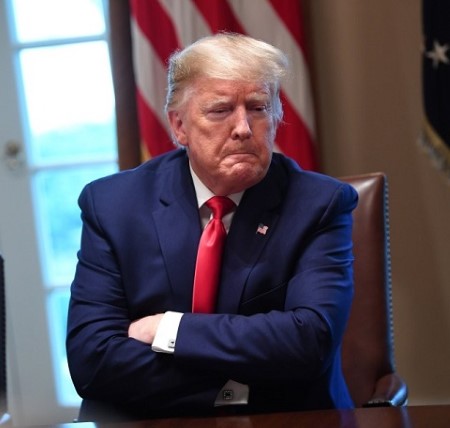

Donald Trump is shown above in a file photo via EPA and with an illustrative Drudge Report headline from his 2024 campaign rally coverage.
New York Times, Trump Promised Radical Change in His Second Term. Here’s What He’s Done So Far, Charlie Savage and Zolan Kanno-Youngs, Dec. 27, 2025. President Trump has driven illegal crossings at the border to record lows, helped bring about an uneasy cease-fire in Gaza and upended the global trading system.
Donald J. Trump promised to drive America in a different direction. One year into his second term, he is doing so, enacting or seeking fundamental changes to policy, politics and society.
He has driven illegal crossings at the border to record lows and has made clear that the United States has shut the door to most nonwhite refugees. He has eliminated diversity programs in the government and has pushed corporate America to do the same.
He helped bring about an uneasy cease-fire in Gaza, threatened to cut off aid to Ukraine and sent the military to kill suspected drug smugglers at sea while deploying troops under federal control into the streets of U.S. cities. He has put immense strain on relations with traditional allies and has pursued policies, including on cryptocurrencies, that have enriched his family and some of his top aides.
He has upended the global trading system by raising taxes on imports, arguing that doing so would eventually bring back jobs. At the same time, he has extended big corporate and income tax cuts from his first term. He has reversed Biden administration policies intended to address climate change, dismantled government agencies without getting congressional approval and slashed the federal work force.
Mr. Trump’s dizzying first year back in office has been polarizing, to say the least. The handful of other presidents who had comparatively momentous first years were responding to a true national crisis: Abraham Lincoln and the Civil War, Franklin D. Roosevelt and the Great Depression. The United States faced no such emergency in January, but Mr. Trump has routinely governed through emergency powers.
Politics in a democracy can sometimes follow a pendulum, as presidents and shifting party majorities course correct from the perceived excesses of predecessors, only to be replaced in turn.
But presidents can also leave behind permanent change. As Mr. Trump nears the end of the first year of his second term, how much of what he has done can be considered irreversible, and will Washington ever be the same?
Letters from an American, Historical Commentary: December 26, 2025 [Trump's immigration raids under, and despite, the law], Heather Cox Richardson, right, Dec. 27, 2025. On Tuesday, December 23, the U.S. Supreme Court made a preliminary finding that President Donald J. Trump’s deployment of federalized National Guard troops in the Chicago area beginning in October was unlawful.
Six of the nine justices held that the law Trump invoked to send in National Guard troops requires that a president first send in the regular U.S. military to execute the laws, and that the National Guard can be deployed only if the president remains “unable with the regular forces to execute the laws of the United States.”
But, they noted, the circumstances under which the president can use the military against U.S. citizens are “exceptional.” The 1878 Posse Comitatus Act prohibits the U.S. military from executing the laws “except in cases and under circumstances expressly authorized by the Constitution or Act of Congress.”
So, the justices concluded, “before the President can federalize the Guard…, he likely must have “statutory or constitutional authority to execute the laws with the regular military and must be ‘unable’ with those forces to perform that function. At this preliminary stage, the Government has failed to identify a source of authority that would allow the military to execute the laws in Illinois. The President has not invoked a statute that provides an exception to the Posse Comitatus Act.”
In an opinion concurring with the five justices who signed onto the majority opinion, Justice Brett Kavanaugh added a footnote addressing what have become known as “Kavanaugh stops.” In September the Supreme Court majority allowed immigration officers to stop individuals on the basis of their apparent race or ethnicity, speaking in Spanish or with an accent, working in certain sectors, or being present at certain locations, like an agricultural site—so-called racial profiling.
In his support for that decision, Kavanaugh wrote that when those individuals legally in the U.S. are stopped and questioned, “the questioning in those circumstances is typically brief, and those individuals may promptly go free after making clear to immigration officers that they are U.S. citizens or otherwise legally in the U.S.”
Since then, as Chris Geidner of Law Dork recorded, U.S. citizens have repeatedly been threatened, beaten, and detained. Currently, Immigration and Customs Enforcement (ICE) is holding a 22-year-old Maryland woman, Dulce Consuelo Diaz Morales, for deportation, although she has produced a U.S. birth certificate and Maryland immunization records and her lawyer insists she is a U.S. citizen. ICE officials say the documents are not valid and she is in the country illegally.
In his concurrence in Tuesday’s decision, Kavanaugh added a footnote saying: “The Fourth Amendment requires that immigration stops must be based on reasonable suspicion of illegal presence, stops must be brief, arrests must be based on probable cause, and officers must not employ excessive force. Moreover, the officers must not make interior immigration stops or arrests based on race or ethnicity.”
On Wednesday, December 24, the Department of Justice posted on social media that it might take “a few more weeks” to release the Epstein files after announcing that the U.S. attorney for the Southern District of New York and the Federal Bureau of Investigation (FBI) had just “uncovered over a million more documents potentially related to the Jeffrey Epstein case.” In fact, as Allison Gill of Mueller, She Wrote noted, prosecutors from the Southern District of New York were ordered to transfer all their files to Justice Department headquarters in January 2025.
Senate minority leader Chuck Schumer (D-NY) responded: “A Christmas Eve news dump of ‘a million more files’ only proves what we already know: Trump is engaged in a massive coverup. The question Americans deserve answered is simple: WHAT are they hiding—and WHY? Justice delayed is justice denied. Release the files. Follow the law.”
The Justice Department has not released many of the documents as required by the Epstein Files Transparency Act, but those few that have come out reveal proof that Trump has been lying about his involvement with the convicted sex abuser Epstein.
As Sarah Fitzpatrick reported Wednesday in The Atlantic, Trump started his 2024 campaign with the announcement that he “was never on Epstein’s Plane, or at his ‘stupid’ Island.” He blamed any reports of such visits on Democrats who were, he said, smearing him to hurt him politically.
 But documents released on Tuesday show a January 7, 2020, email from a New York prosecutor saying that flight logs show that Trump “traveled on Epstein’s private jet many more times than previously has been reported (or that we were aware), including during the period we would expect to charge in a [Ghislaine] Maxwell case. In particular, he is listed as a passenger on at least eight flights between 1993 and 1996, including at least four flights on which Maxwell was also present…. On one flight in 1993, he and Epstein are the only two listed passengers; on another, the only three passengers are Epstein, Trump, and then-20-year-old [redacted]. On two other flights, two of the passengers… were women who would be possible witnesses in a Maxwell case.”
Emails from before Epstein’s 2019 arrest show investigators talking about “10 co-conspirators,” while a 2020 email suggests prosecutors had amassed considerable material to charge “co-conspirators,” but never did so. The document discussing those charges is redacted.
Trump was mentioned more than 100 times in the documents released on December 23.
And there is pressure on Trump coming from a different direction as well. On December 17, Khadeeja Safdar and Joe Palazzolo of the Wall Street Journal reported that senators led by Ron Wyden (D-OR), the top-ranking Democrat on the Senate Finance Committee, wrote to the Justice Department and asked officials to explain why law enforcement officials never interviewed Epstein’s longtime attorney Darren Indyke or his accountant Richard Kahn when the officers were investigating Epstein’s sex trafficking.
The same Wall Street Journal reporters recently noted that the two men arranged fake marriages to keep women in the U.S., withdrew cash for Epstein in ways that avoided scrutiny, and sent payments to women who later claimed they had been sexually abused. As co-executors of Epstein’s estate, the men have control over the evidence in that estate and over Epstein’s more than $100 million in assets.
Representatives and staffers from the House Oversight Committee told journalist Fitzpatrick they are drafting subpoenas to learn more about the alleged co-conspirators. They are also drafting a resolution to hold Attorney General Pam Bondi in contempt for her failure to make sure that the Department of Justice complied with the Epstein Files Transparency Act, and are moving ahead with articles of impeachment against her.
Axios reported on December 23 that the White House has taken over the X account of the Justice Department, and on the same day, that account tried to undercut the new information by claiming that accusations in it are “unfounded and false.” But Trump’s behavior on December 25, Christmas, suggested otherwise.
Trump’s social media account posted: “Merry Christmas to all, including the many Sleazebags who loved Jeffrey Epstein, gave him bundles of money, went to his Island, attended his parties, and thought he was the greatest guy on earth, only to ‘drop him like a dog’ when things got too HOT, falsely claimed they had nothing to do with him, didn’t know him, said he was a disgusting person, and then blame, of course, President Donald J. Trump, who was actually the only one who did drop Epstein, and long before it became fashionable to do so. When their names get brought out in the ongoing Radical Left Witch Hunt (plus one lowlife ‘Republican,’ Massie!), and it is revealed that they are Democrats all, there will be a lot of explaining to do, much like there was when it was made public that the Russia, Russia, Russia Hoax was a fictitious story—a total Scam—and had nothing to do with ‘TRUMP.’”
After misrepresenting the New York Times, he went on: “Now the same losers are at it again, only this time so many of their friends, mostly innocent, will be badly hurt and reputationally tarnished. But, sadly, that’s the way it is in the World of Corrupt Democrat Politics!!! Enjoy what may be your last Merry Christmas! President Donald J. Trump.”
Bill Kristol of The Bulwark wrote: “Donald Trump, basically acknowledging that so far at least he’s losing the fight over Epstein.” MeidasTouch noted: “This is what’s known as “consciousness of guilt.”
This evening, Trump posted: “Now 1,000,000 more pages on Epstein are found. DOJ is being forced to spend all of its time on this Democrat inspired Hoax. When do they say NO MORE, and work on Election Fraud etc. The Dem[ocrat]s are the ones who worked with Epstein, not the Republicans. Release all of their names, embarrass them, and get back to helping our Country! The Radical Left doesn’t want people talking about TRUMP & REPUBLICAN SUCCESS, only a long ago dead Jeffrey Epstein—Just another Witch Hunt!!!”
“I love the smell of panic in the evening,” former representative and Trump critic Adam Kinzinger (R-IL) posted over Trump’s screed. “Smells like… victory.”
Even before Trump’s evening post, in Meditations in an Emergency, Rebecca Solnit noted that it seems “clear that there is likely something in the files that further incriminates” Trump, an observation with which scholar of authoritarianism Timothy Snyder agreed. He added: “Horrible as the facts at hand are, there must be something else, something verging on the unimaginable.”
The slow drip of the Epstein files, Solnit writes, is “undermining loyalty to Trump as nothing else has, and it is an important part of how the Trump regime and the Republican Party are falling apart before our eyes. This does not mean that the Trumpists are powerless,” she continues, “they are flailing and grabbing for all the kinds of power that they can.”
But “Trump appears to be disintegrating, rotting, collapsing before our eyes, mentally and physically, and Republicans in Congress—first of all with the vote to release the Epstein files—are breaking from him.”

 Michael Cohen via Substack, Political Commentary: Halfway To Autocracy, Michael Cohen, right, Dec. 27, 2025. I remember the eye rolls. The smirks. The patronizing head pats from cable news know-it-alls and Trumpworld operatives alike when some of us dared to say, out loud, that Project 2025 wasn’t a think-tank fever dream; it was a roadmap. A 920-page instruction manual for dismantling a democratic republic and replacing it with something narrower, meaner, and far more obedient.
“Fearmongering,” they called it.“Trump doesn’t even know what it is,” they said.“He hasn’t read a book in years,” they joked; ironically the only accurate part of that defense.
Donald Trump himself swore he had nothing to do with Project 2025. No knowledge. No involvement. No interest. Which, if you’ve ever worked for Donald Trump, as I unfortunately have, should have been your first clue that the opposite was true.
Fast-forward to today. Roughly half of Project 2025 has already been implemented.
Imagine that. Half.
This wasn’t a slow drift. This wasn’t bureaucratic inertia. This was a blitzkrieg executed through executive orders, ideological staffing, mass firings, and the weaponization of federal agencies. It turns out you don’t need Congress when you control the personnel, and you don’t need the truth when your base prefers the lie.
There’s an old saying in Washington: personnel is policy. Trump didn’t just remember it; he weaponized it. Russell Vought, right, one of Project 2025’s chief architects, now runs the Office of Management and Budget, the “nerve center” of executive power. Peter Navarro, who helped author the trade section, is back whispering tariff fantasies into Trump’s ear. Brendan Carr wrote the FCC wish list and now runs the FCC. That’s not coincidence. That’s compliance.
Let’s talk outcomes.
Project 2025 is obsessed with erasing modern understandings of gender, sexuality, race, and equality from federal life. And surprise; Trump’s White House has been remarkably efficient. Diversity, equity, and inclusion programs? Slashed or purged. Federal rules scrubbed of words like “gender identity,” “reproductive rights,” and “sexual orientation,” as if deleting language deletes reality. Data collection that could expose inequality? Gutted. Because if you don’t measure injustice, you can pretend it doesn’t exist.
Reproductive rights were supposed to be “left to the states,” remember? That was the campaign line. Meanwhile, behind the curtain, about 40 percent of Project 2025’s anti-abortion agenda has already been achieved. EMTALA (Emergency Medical Treatment and Labor Act) guidance protecting emergency abortion care was rescinded. Planned Parenthood was effectively defunded through Trump’s tax law and friendly courts, threatening the closure of up to 200 clinics and cutting off health care for more than a million people. The CDC; once the gold standard of public health, has been hollowed out, its reproductive health division decimated, its abortion data delayed and politicized.
This isn’t about “life.” It’s about control. Project 2025 treats abortion not as health care but as heresy, and Trump’s agencies have obediently followed suit.
For LGBTQ+ Americans, the story is just as bleak; and just as intentional. Federal agencies were ordered to purge references to LGBTQ+ people. Health research funding, over $800 million worth, was canceled, including studies on cancer and HIV prevention. Trans Americans were pushed out of public life through passport restrictions, insurance barriers, and the deliberate conflation of identity with “ideology.” The Pentagon reversed protections, halted gender-affirming care, and reinstated discriminatory service bans. All of it straight from the Project 2025 playbook.
Education? Trump couldn’t abolish the Department of Education outright, so he did the next best thing: hollowed it out. Core functions were transferred to other departments, leaving vulnerable students, those with disabilities, low-income families, student loan borrowers, caught in bureaucratic limbo. A national voucher program slipped through Congress, redirecting public funds to private schools while the administration launched a campaign to monitor and punish schools for so-called “indoctrination.” Translation: teach what we like, or else.
And the military; once proudly apolitical, has been reshaped into an ideological testing ground. DEI offices eliminated. High-ranking women and people of color pushed out. Abortion travel benefits revoked. Transgender service members sidelined. Even commemoration months were deemed too threatening. Merit-based, color-blind rhetoric now masks a very deliberate rollback of inclusion.
Now, here’s the most alarming part: this is only halfway.
Project 2025 was never about governance; it was about permanence. About baking ideology into the machinery of government so deeply that reversing it becomes nearly impossible. Trump didn’t need to admit he knew the plan. He just needed to follow it. And he has.
So the next time someone shrugs and says, “He told us he had nothing to do with Project 2025,” remember this: Trump lies the way other people breathe. And the evidence isn’t theoretical anymore; it’s operational.
So stay loud. Stay visible. Stay politically inconvenient. Talk to your friends. Organize. Vote like the Constitution depends on it; because this time, it actually does.
And remember, Project 2025 wasn’t a warning shot.
It was just the opening act.
Global News
New York Times, Russia Pummels Kyiv Before Trump-Zelensky Meeting, Cassandra Vinograd, Dec. 27, 2025. President Volodymyr Zelensky of Ukraine said that the assault, which continued for nearly 10 hours, showed that Moscow was not serious about peace.
Powerful explosions boomed in the skies over the Ukrainian capital on Saturday as Russia launched waves of missiles and attack drones. The hourslong assault came as President Volodymyr Zelensky of Ukraine prepared to meet with President Trump on Sunday to discuss a plan to end the war.
Mr. Zelensky said the attack made clear that Russia was not serious about peace talks.
“Russian representatives engage in lengthy talks, but in reality, Kinzhals and ‘shaheds’ speak for them,” he wrote on social media, using the names of ballistic missiles and attack drones. “This is the true attitude of Putin and his inner circle. They do not want to end the war and seek to use every opportunity to cause Ukraine even greater suffering.”
The attack began around 1:30 a.m. local time, heralded by the blare of air-raid sirens as the local authorities warned residents of Kyiv to take cover.
“Explosions in the capital,” the city’s mayor, Vitali Klitschko, wrote on Telegram. “Air defense forces are operating. Stay in shelters!”
Soon after, an eerie blue-and-white light flickered in the sky over part of the city, suggesting that an energy facility may have been hit. Blasts and the thunder of air defenses firing sounded through the night and late into the morning.Want to stay updated on what’s happening in Russia and Ukraine? Sign up for Your Places: Global Update, and we’ll send our latest coverage to your inbox.
Mr. Zelensky said just before 11 a.m. that even as the attack was ongoing, Russia had already launched about 40 missiles and nearly 500 drones. Moments later, more explosions were heard in Kyiv. By the time the initial all-clear was given, the capital had been under bombardment for nearly 10 hours. New air-raid warnings, though, came within the hour.
Two people were killed — one person in the suburbs of Kyiv and one in the city itself, according to the local authorities. At least 28 other people were wounded.
As thick plumes of gray smoke rose above the Kyiv skyline, officials said several fires were burning from strikes on multiple locations, including a university dormitory and residential high-rises.
Two firefighters hung from a crane outside one of those high-rise buildings on Saturday afternoon, clinging to what was left of the fourth and fifth floors and chipping away at its loose pieces. The side of the 21-story building was ripped off, exposing a cement structure and insulation.Editors’ Picks43 Things to Do on New Year’s Eve in N.Y.C.Our Best Air-Fryer Recipes9 Artists to Watch
Emergency workers perched precariously on what had been the ceiling of the fourth floor but was now bent in half and missing a chunk, shoveling debris off the side to the ground below.
 MSNOW, Analysis: Trump’s Christmas bombing of Nigeria has little to do with protecting Christians, Nicholas Grossman, Dec. 27, 2025. The United States military bombed Nigeria on Christmas, reportedly targeting ISIS militants.
 President Donald Trump claimed the U.S. struck terrorists “who have been targeting and viciously killing, primarily, innocent Christians, at levels not seen for many years, and even Centuries.”
Nigeria has been plagued by sectarian violence, but that violence hasn’t primarily targeted Christians — and certainly not at historically unprecedented levels. America’s logic here isn’t clear, but the strikes appear driven more by Trump putting on a show for his evangelical base than trying to reduce violence in Nigeria or even advance U.S. national interests.
It’s the first time the U.S. has ever fired missiles into Nigeria, but it’s one of several countries the Trump administration has bombed this year. In 2025, U.S. forces launched more than a thousand strikes against the Houthis in Yemen, more than a hundred in Somalia mostly targeting al-Shabab, dozens against ISIS in Syria, 29 and counting against alleged drug traffickers in the Caribbean and the eastern Pacific, plus some strikes targeting Iran’s nuclear program. All of those efforts killed people and damaged things, but none appear to have achieved anything lasting.
Those other strikes are different, though, because they took place in areas hostile to the U.S.
Nigeria is a U.S. counterterrorism partner.
More On Epstein Scandals, Trump Cover-up
Steady, Redacting The Truth, Dan Rather,  Dec. 26-27, 2025. Nothing to see here, or so Trump wants you to think.
The story of Jeffrey Epstein and his sordid life, how he died and who helped him recruit girls and young women to abuse is horrific to  contemplate and difficult to follow. That is by design. Those in high places don’t want you to know the truth. And we have a president, and longtime friend of Epstein, who doesn’t want you to care.
But you should.
With every slow-walked release of documents related to the case, more questions arise — especially for the victims. There are as many as a thousand girls and young women, all deserving of justice, and to know who was complicit in their abuse.If you haven’t been paying close attention to the news over the last few days, good for you.
But we all need to be up to speed on where this story is and where it is going. Much to the dismay of the president, it is not going away.
Although the process has been haphazard, the information without context, and the release incomplete, it is a Christmas miracle that any of the Epstein files have seen the light of day, considering the Department of Justice is now an extension of the White House.
After doing everything in his power to suppress the files, including getting Speaker Mike Johnson to send the House home and not seat a duly elected Representative for seven weeks, Trump lost.During the 2024 campaign, Donald Trump promised to release the Epstein files. He could have done it on Day One. He could have done it by executive order. Instead, he has denounced the content, deflected requests, and defamed  anyone, including his own supporters, who pressed the issue.
Apparently, Attorney General Pam Bondi, left, didn’t get the memo. In late February, she claimed she had the “client list” on her desk as she released 200 documents, ratcheting up excitement by labeling them “The Epstein Files: Phase 1.” Those files were anticlimactic, containing no new information. “Phase 2” never happened.
The vice president also seemingly wasn’t told to take his foot off the gas. “Seriously, we need to release the Epstein list. That is an important thing,” JD Vance said on a podcast in June.
Then suddenly, in early July, Bondi announced there was no “list,” that the DOJ was ending the Epstein investigation, and that Epstein died by suicide in a New York City jail. Case closed? Not so fast.
The uproar was loud and immediate and caused a schism in the heretofore rock-solid MAGA coalition.
While MAGA influencers from Candace Owens to Laura Loomer were expressing outrage with Trump over his handling of the Epstein “coverup,” as they called it, the House Oversight committee was gathering string.
On September 2, the committee released 33,000 documents it received from DOJ subpoenas. They sought all of the documents, but it is clear now that the committee got only a pittance.November 12, the day the House came back in session after Speaker Johnson’s extended holiday, a House committee released a trove of documents it received directly from the Epstein estate. In one email, Epstein claimed the president “knew about the girls.” And he bragged that, “I am the one able to take [Trump] down.” That dump of documents prompted Trump to call for investigations into any Democrat in the files.
Finally, on November 18, the House voted to release the Epstein files. The Senate quickly followed. On November 19 Trump signed the Epstein Files Transparency Act, mandating release within 30 days.
On December 19, the DOJ did make public 100,000 heavily redacted documents, though they admitted it wasn’t everything. Thousands more were uploaded to the DOJ website on December 22, then removed, then released in a different order. More came out on December 24. This disorderly, confusing, contextless, overly redacted process is likely by design.Trump’s name appears hundreds of times.
Though he posted in January 2024 that he was “never on Epstein’s plane,” the newly released documents show Trump traveled on the deplorably nicknamed “Lolita Express” at least eight times.
On Christmas Eve, the DOJ announced it had found a million (!) more documents possibly related to Epstein. The documents had been “discovered” in the New York FBI office and U.S. attorney’s office for the Southern District of New York.Do the math and you will find that the 130,000 documents released so far, which by law should have been all of them, is one-tenth of what’s out there.
The DOJ said it “will take a few more weeks” to release the newly discovered tranche. According to CNN, Deputy Attorney General Todd Blanche’s office has asked for help over the holidays from U.S. attorneys’ offices to review and redact the new documents.By law, only victims’ names and images are supposed to be redacted. Looking at the files that have been released, it is clear the DOJ has been liberal in its use of the black bar. On many pages every word has been blacked out. Conversely, in dozens of cases, victims’ names have appeared. Some survivors have accused the DOJ of violating the law and trying to intimidate them.“DOJ did break the law by making illegal redactions and by missing the deadline,” Thomas Massie, Republican congressman and co-author of the Epstein legislation, said.
The Justice Department has 14 days to explain any redactions.
One of the redactions that has drawn the most fire is a list of Epstein co-conspirators. Besides Ghislaine Maxwell, no co-conspirators had been identified prior to the release of the files this week.Seven of the names were redacted. Jean-Luc Brunel, a French modeling scout and Leslie Wexner, founder of Victoria’s Secret and an Epstein client, were listed. According to a note from an FBI investigator, three of the co-conspirators were in Florida, one in Boston, one in New York City, and one in Connecticut.“
Although the files are overly redacted, they’ve already demonstrated that the narrative painted by [FBI Director Kash] Patel in hearings, Bondi in press statements, and Trump himself on social media wasn’t accurate. A complete disclosure consistent with the law will show there are more men implicated in the files in possession of the government,” Massie told The Atlantic.
Another heavily redacted section involves the documents related to Epstein’s stunningly lenient 2007 plea deal. After pleading guilty to prostitution involving a minor, he received a 13-month sentence, during which he was allowed to go to the office daily. During his work release, investigators found that he continued to abuse girls. The prosecutor in the case, Alex Acosta, later became Trump’s first secretary of labor.
So much was redacted that we will likely never get answers about how and why the plea deal happened, why it was a secret, and why Epstein received immunity, according to Julie K. Brown, the Miami Herald reporter who has long been at the forefront of the Epstein investigation.
Massie and his co-author, Democratic Rep. Ro Khanna of California, have said they have pushed for the release of the documents because they are seeking justice for Epstein’s victims. That justice has been far too long in coming.
The girls and young women who were abused by Epstein have been failed by the system for almost 30 years. The botched release of the files only further compounds the harm done to the victims, but still marks a step, however small, toward some measure of justice for them.
U.S. Culture, Culture Wars, Media, Religion, Education
New York Times, Karoline Leavitt Says She’s Expecting Her Second Child, Tim Balk, Updated Dec. 27, 2025. The White House press secretary announced on Instagram that she was pregnant with a daughter who is due in May. She and her husband have a 1-year-old son.
Karoline Leavitt, right, the White House press secretary, announced Friday that she was expecting a baby girl in May.
 “My husband and I are thrilled to grow our family and can’t wait to watch our son become a big brother,” Ms. Leavitt, 28, wrote on Instagram, sharing an image of herself standing next to a Christmas tree.
Ms. Leavitt, who is the youngest person to ever serve as press secretary, is the mother of a 1-year-old boy with her husband, Nicholas Riccio. Her son, also named Nicholas, was born in July 2024 while Ms. Leavitt was working on President Trump’s campaign that year.
The White House said Ms. Leavitt would remain in her role as press secretary after the birth of her second child. A White House spokesman, Kush Desai, did not say whether Ms. Leavitt would take any leave.
Ms. Leavitt’s status as a White House press secretary while raising two small children would be challenging. She has credited her husband for helping her find balance.
“He’s fully supportive of me building my success in my career,” Ms. Leavitt told Megyn Kelly in an appearance on Ms. Kelly’s podcast early this year. Ms. Leavitt added, “Becoming a mother in the midst of this very chaotic political world that I work in has been the best thing I could ever imagine because it gives you great perspective.”
Ms. Leavitt has one of the most visible jobs in the president’s current administration, fielding questions from reporters in the White House briefing room on behalf of a president with an adversarial relationship to the mainstream media.
She frequently posts photos on social media of her son, most recently with a live turkey at the White House in November, in a pumpkin costume in October and on the beach in New Hampshire this summer.
Ms. Leavitt concluded her announcement on Instagram with a nod to her bosses.
“I am also extremely grateful to President Trump and our Chief of Staff Susie Wiles for their support, and for fostering a pro-family environment in the White House. 2026 is going to be a great year,” she wrote.
Dec. 26
Donald Trump's Self-Image As Warrior Santa Claus
The Hartmann Report, Commentary: Trump’s Christmas message "Scum" wasn’t just offensive. It was a warning, Thom Hartmann,  right, Dec. 26, 2025. The future lays before us now, and if we care about the country our children will inherit, we can’t let this moral vandalism to go unanswered.
 Yesterday, on Christmas of all days, Donald Trump chose to call Democrats “scum.” Not criminals. Not misguided. Not wrong. Scum. A word we usually reserve for things we scrape off the bottom of a shoe or skim off polluted water. A word whose entire purpose is to dehumanize.
That moment (shown below in his post on the Truth Social website he runs) matters far beyond the day’s news cycle, and far beyond partisan politics. It matters because leaders don’t just govern; they model.

Psychologists and social and political scientists have long pointed out that national leaders function, at a deep emotional level, as parental figures for their nations. They set the boundaries of what is acceptable. They establish norms. They shape the emotional climate children grow up breathing.
America has lived through this before, both for good and, now, for ill.
Franklin Delano Roosevelt, below, understood this instinctively. In the depths of the Great Depression and the terror of World War II, he spoke to the  country as a calm, steady parent. His fireside chats didn’t just convey policy; they conveyed reassurance, dignity, and solidarity.
He treated Americans as adults capable of courage and sacrifice. He named fear without exploiting it. The result was not weakness, but national resilience.
A generation raised under that moral tone went on to build the modern middle class, defeat fascism, and help construct a postwar world that valued democracy, human rights, and shared prosperity.
Contrast that with the bigoted, hateful, revenge-filled claptrap children have heard for the past decade from the emotionally stunted psychopath currently occupying the White House. Hours after calling you and me “scum,” he put up another post calling us “sleazebags.”
How presidential.
Presidents like  Eisenhower, right, warned Americans about the dangers of concentrated power and the military-industrial complex, modeling restraint and foresight.
Kennedy appealed to service, famously asking what we could do for our country. Johnson, for all his flaws, used the moral authority of the presidency to push civil rights forward, telling America that discrimination was not just illegal but wrong.
Even Reagan, below, whose policies I fiercely opposed, spoke a language of civic belonging and optimism rather than open  dehumanization.
Go back further, to the Founders themselves, and George Washington warned against factional hatred and the corrosive effects of treating political opponents as enemies rather than fellow citizens.
John Adams argued that a republic could only survive if it was grounded in virtue and moral responsibility. Thomas Jefferson wrote that every generation must renew its commitment to liberty, not surrender it to demagogues who feed on division.
They all understood something Trump doesn’t, or is so obsessively wrapped up in himself and his own infantile grievances that he doesn’t care about: the psychological power of example.
Donald Trump has spent ten years modeling for America the exact opposite of leadership.
And now he’s giving us the example of using ICE not simply as a law enforcement agency, but as a masked, armed, unaccountable weapon of state terror aimed not only at brown-skinned families, but at journalists, clergy, lawyers, and anyone else who dares to document their abuse.
Kids graduating from high school this year have never known anything else. That fact should alarm every parent.
Children learn what leadership looks like long before they understand policy debates. They absorb emotional cues, and notice who gets rewarded and who gets punished.
When a president calls fellow Americans “scum” and suffers no consequences, the lesson is clear: cruelty is permissible if you have power. Empathy is expendable. Democracy is a nuisance. Accountability is optional.
This is how normalization works. What once would have been unthinkable becomes routine. The outrage dulls. The abnormal becomes background noise. And a generation grows up believing this is simply how adults in authority behave.
History tells us where that road leads: dehumanizing language precedes dehumanizing actions.
Every authoritarian movement begins by teaching people to see their neighbors as less than fully human. Once empathy vanishes, abuses become easier to justify, and violence becomes easier to excuse.
That’s why we all — parents, grandparents, and citizens — have a special responsibility right now.
We can’t assume our nation’s children will automatically recognize how dangerous and abnormal this moment is; instead, we have to name it for them.
We have to tell them, plainly and repeatedly, that this is not what healthy leadership looks like.
That calling people “scum” and “sleazebags” is not strength. That praising autocrats while undermining democracy is not patriotism. That power without empathy is not leadership; it’s merely a simple pathology known as psychopathy.
MeidasTouch Network, It may be a holiday weekend, but the news rages on, Ben Meiselas, Dec. 26, 2025. It has been a catastrophic Friday morning for Donald Trump, and not because of anything unexpected. It is catastrophic because his usual playbook is no longer working. Trump believed that launching military strikes in Nigeria would distract the public from covering up the full scope of the Epstein files. That distraction failed immediately. The American people are not confused. They are not looking away. They know a whole lot is being hidden.
Before I dive deeper, I want to give you a huge shoutout. You are too smart for Trump’s feeble-minded distraction attempts. You have stayed laser focused on the most important issues. And truly, that’s Trump’s biggest fear.Subscribed
The Trump administration has admitted, implicitly and explicitly, that there may be millions of additional Epstein-related documents that were never disclosed, despite a legal requirement that they be released. The Epstein Files Transparency Act mandated full disclosure by December 19. That deadline passed. Now the administration claims it is “finding” massive quantities of new material. Sure.
Instead of complying with the law, Trump responded by posting an image of former President Bill Clinton and claimed that the push for Epstein transparency “boomeranged” on Democrats. That framing is cynical and dishonest, per usual. This is not about Republicans or Democrats. This is about releasing the files, all of them, as required by law. This is not about a political party. This is not a “hoax.” This is about justice for the survivors, and I promise that our reporting will always put survivors first.
People are not asking for spin. They are asking for documents. They are asking why a president who claims innocence would be fighting disclosure so aggressively. Everyone can draw their own conclusions about motive, but the existence of a cover-up is no longer in dispute. It appears even many of the most die-hard MAGA supporters are taking note.
Trump’s spent years socializing with Jeffrey Epstein. There are photos, videos, and contemporaneous statements. He once described Epstein as a “terrific guy” who liked women “on the younger side.” Trump has since been found civilly liable for sexual assault. Mar-a-Lago itself was identified as a location where sex trafficking occurred. Virginia Giuffre, who later died by suicide, was trafficked from Mar-a-Lago by Ghislaine Maxwell. Those are facts.
Yet even as the Epstein scandal deepens, Trump’s posts spiral outward into a broader authoritarian tantrum. On the same morning, he bragged about sanctioning European officials for enforcing basic digital consumer protection laws. The European Union’s regulations are designed to limit fraud, bots, and disinformation. Instead of supporting democratic guardrails, the Trump administration is attacking Europe while simultaneously easing pressure on Russia. Remember my warnings a few weeks back about Trump’s plot to destabilize Europe? Well, we are seeing that in full effect right now.
The hypocrisy is worth pointing out. The United States is not sanctioning Saudi Arabia, where free speech does not exist. It is not sanctioning China. It is sanctioning Europe for attempting to protect democratic discourse. That is not a coincidence. It aligns perfectly with Vladimir Putin’s talking points, even as Russia bans platforms like X (formerly Twitter) outright.
This foreign policy inversion is happening alongside domestic collapse. Trump’s approval rating is in the 30s, the lowest of any president at this stage. Democrats are leading generic congressional and Senate ballots. Democratic Senate candidates are outraising Republicans by tens of millions of dollars. The public is rejecting what it is seeing.
Trump’s response has been to escalate disinformation. He continues to repost conspiracy theories about the 2020 election he lost decisively. He is still tortured by the fact that Joe Biden “beat him like a drum.” He posts images depicting senators as zombies while railing against the filibuster. It all reeks of desperation and weakness.
Perhaps the most revealing brag of all came when Trump celebrated the reduction of federal employment, boasting that hundreds of thousands of jobs have been eliminated since he took office. These were not “deep state” positions. These were skilled civil service jobs that support emergency management, data collection, manufacturing planning, and public health. Those workers are now gone, unemployment has risen, and national debt has exploded by $2.2 trillion in less than a year. Jobs down. Spending up. Debt soaring. Heckuva job, Donald!
The consequences of Trump’s sabotage are showing up in the justice system as well. In the failed prosecution of James Comey, the case collapsed under the weight of unlawful conduct. A key witness’s attorney-client communications were improperly seized by the government. A federal judge ruled that the search was unlawful and ordered the materials returned. The Department of Justice missed the deadline and filed an emergency motion for more time, citing staffing shortages over the holidays.
Who signed that filing? The same U.S. attorney who had already been disqualified from the case. Lindsey Halligan.
Incompetence. Corruption. Grievance politics. It’s just another day in Trump’s America.
Trump can post all he wants. He can launch distractions. He can smear and deflect. But the truth is catching up to him. The Epstein files are not going away. The courts are pushing back. The public is paying attention. And no amount of chaos can hide the truth.
Just like Russia thought it would take Kyiv in 24 hours, Trump thought the American people would give into his authoritarian regime fast. But it’s communities like this one that have proved Trump wrong. You held the line. And now, Trump is more desperate than ever.
New York Times, U.S. Strikes ISIS in Nigeria After Trump Warned of Attacks on Christians, Helene Cooper, Saikou Jammeh and Eric Schmitt, Dec. 26, 2025 (print ed.). The attack comes after President Trump ordered the Defense Department last month to prepare to intervene militarily in Nigeria to protect Christians from Islamic militants.
The United States launched a number of strikes against the Islamic State in northwestern Nigeria, President Trump announced on Thursday, the latest American military campaign against a nonstate adversary — in this case, Islamic jihadis who the president asserts have been slaughtering Christians.
Mr. Trump said in a post on Truth Social that “the United States launched a powerful and deadly strike against ISIS Terrorist Scum in Northwest Nigeria, who have been targeting and viciously killing, primarily, innocent Christians at levels not seen for many years, and even Centuries!”
The strike involved more than a dozen Tomahawk cruise missiles fired off a Navy ship in the Gulf of Guinea, hitting insurgents in two ISIS camps in northwest Nigeria’s Sokoto State, according to a U.S. military official, who spoke on condition of anonymity to discuss operational matters. The operation was done in coordination with the Nigerian military, the official said.
In a statement, U.S. Africa Command said its initial assessment concluded that “multiple” ISIS terrorists were killed in the strike.
“U.S. Africa Command is working with our Nigerian and regional partners to increase counter terrorism cooperation efforts related to ongoing violence and threats against innocent lives,” Gen. Dagvin Anderson, the commander of U.S. Africa Command, said in a statement. “Our goal is to protect Americans and disrupt violent extremist organizations wherever they are.”
New York Times, Trump’s Claims About Nigeria Strike Belie a Complex Situation on the Ground, Ruth Maclean, Saikou Jammeh and Ismail Auwal, Dec. 26, 2025. President Trump said the targets of airstrikes in Nigeria were Islamic State terrorists responsible for killing Christians, but experts question his framing.
After the U.S. military launched airstrikes on sites in northwestern Nigeria on Thursday, President Trump said the targets were Islamic State terrorists “who have been targeting and viciously killing, primarily, innocent Christians.”
But analysts say that the situation on the ground is far more complicated.
Sokoto State, which was hit by more than 12 Tomahawk missiles Thursday night, is populated overwhelmingly by Muslims, who bear the brunt of terrorist attacks there, according to analysts and groups that monitor conflict. Bishop Matthew Hassan Kukah of Sokoto said recently that the area does “not have a problem with persecution” of Christians.
And analysts are divided over the existence of ties between insurgent groups in Sokoto and the Islamic State.
Some analysts say that the violent attackers in Sokoto, which are colloquially known as the Lakurawa, have links to the Islamic State’s Sahel Province branch, which is mostly farther north and west, in Mali, Niger and Burkina Faso.
But other analysts say evidence of those links is inconclusive, as the identity of the Lakurawa group remains very murky. Its militants have operated in Sokoto and other Nigerian states for years, winning popularity by fighting local bandits at first and then turning on the rural population.
“There’s a lot of fluidity and not a lot of ideological alliances,” Alkasim Abdulkadir, a spokesman for Nigeria’s foreign minister, Yusuf Tuggar, said of the Lakurawa.Want to stay updated on what’s happening in Nigeria? Sign up for Your Places: Global Update, and we’ll send our latest coverage to your inbox.
Even as the Nigerian authorities have disputed Mr. Trump’s claims about a Christian “genocide,” they have chosen to respond to his threats by cooperating with his administration. Nigeria has taken the opportunity to use U.S. firepower against insurgents that have plagued rural communities in the country’s northwest.
The Nigerian government made it clear on Friday that it was on board with the airstrikes, which came after a phone call between Secretary of State Marco Rubio and Mr. Tuggar “around bilateral issues and military cooperation,” according to Mr. Abdulkadir.
Mr. Tuggar relayed the conversation to Nigeria’s president, Bola Ahmed Tinubu, right, who approved the strikes, Mr. Abdulkadir said. He added that Nigeria had provided American forces with intelligence for the airstrikes.
The strikes were “meant to deter further operations of bandits in that area,” he said. “Air power is something that they can’t fight against.”
Mr. Abdulkadir said there were ongoing conversations with the U.S. authorities about possible further military action.

Morning Shots via The Bulwark, Political Opinion: The President Is a Pirate, Will Saletan, left, Dec. 26, 2025. Donald Trump calls himself the “Peace President.” But this week, as he outlined his plans to capture Greenland and hijack Venezuelan oil, his real agenda became obvious. It’s not peace. It’s extortion, conquest, and theft.
Trump spent his life pursuing wealth, not public service. As president, he reduces every question to money. He arm-twists companies into giving the government a chunk of their stock. He withholds food stamps as a bargaining chip. He calls low-income housing an offense against rich people. He muses about awarding himself $1 billion from the Treasury.
He treats international relations the same way. He slaps our allies with heavy tariffs, insisting that they “pay for the privilege of access to our market.” He bails out Argentina, meddles in its election, and then brags that his candidate’s victory “made a lot of money for the United States.” He bars immigrants from “third world countries” and sells visas to multimillionaires instead.
He also exploits war. Two months ago, in a speech to American troops in Japan, he fondly recalled the days when “they used to say, ‘To the victor belong the spoils.’” In more recent wars, he complained, “We’d win, and then we’d leave.” He made it clear that he would restore the doctrine of spoils. “Unlike past administrations, we will not be politically correct,” he told the troops.
In some parts of the world, Trump has cashed in on the use of force by other countries. In February, after Israel had leveled much of Gaza, he announced a plan to seize the territory, “own it,” and develop it into “the Riviera of the Middle East.” A reporter asked the president whether he truly meant permanent occupation. “I do see a long-term ownership position,” Trump replied.
In Ukraine, Trump has taken advantage of Russia’s invasion. By choking off Ukraine’s access to military aid and intelligence, he extracted Kiev’s agreement to give much of its mineral wealth to the United States. “I made a deal to take rare earth,” he boasted. “That’s the equivalent of much more” than the aid Joe Biden had sent to Ukraine, he said.
Trump also found a second revenue stream from the war: selling weapons to NATO—at “full price”—which NATO would then deliver to Ukraine. “We’re making money,” he told reporters. “We have the hottest company,” he added a minute later. Then, catching his slip, he corrected the last word to “country.”
Like Vladimir Putin, Trump has concocted grievances to justify aggression against other nations. In his inaugural address, he vowed to seize the Panama Canal, claiming that Panama had violated its 1977 agreement to keep the canal neutral. Then, in a bid to annex Canada, he threatened to choke off that country’s foreign trade. To rationalize his coercion, he alleged that Canada “stole” its auto industry from the United States.
Now Trump has deployed the Navy, the Coast Guard, and other forces to harass and intimidate Venezuela. Last week, he issued an ultimatum, warning that the military buildup would continue until Venezuelans “return to the United States of America all of the Oil, Land, and other Assets that they previously stole from us.”
Trump’s tales of oil and land theft apparently date to 1976, when Venezuela nationalized its oil industry. As usual, he’s wrong—American companies didn’t own any of Venezuela’s land or oil—but he’s plotting to capitalize on his propaganda. On Monday he said he had spoken to “all the big” U.S. oil companies about returning to Venezuela once the current government, under American pressure, is ousted.
And oil companies aren’t the only ones who stand to profit. Last week, Sen. Mike Lee of Utah, a Trump ally, introduced legislation authorizing “private American citizens and their businesses” to confiscate boats and other alleged property of drug cartels.
 Meanwhile, after months of hectoring Greenland to separate from Denmark and join the United States—under threats of tariffs and military force—Trump announced on Monday that he had appointed a special envoy whose self-described assignment was to “make Greenland a part of the U.S.” Trump dismissed Denmark’s sovereignty over Greenland, scoffing, “They say that Denmark was there 300 years ago or something with a boat. Well, we were there with boats, too, I’m sure.”
This isn’t the foreign policy many of Trump’s voters wanted. They thought “America First” meant staying home. Instead, Trump has gone abroad to seize land and treasure. He’s a pirate. And being a pirate is all fun and games until somebody loses an island.
News Roundups
New York Times, Trump Administration: One Relentless Year, Staff Reports, Dec. 26, 2025. A year of power flexes.
So much has happened since President Trump took office again that it can be hard to keep track of it all.
At home and abroad, he has driven change at warp speed, upending policy and challenging democratic norms. Along the way, he’s provided an often unfiltered narration of his own presidency, almost in real time.
Here, out of the blur of events, are some of the most consequential, illuminating or just plain remarkable moments from his first year back in the White House.
At home and abroad, he has driven change at warp speed, upending policy and challenging democratic norms. Along the way, he’s provided an often unfiltered narration of his own presidency, almost in real time.
Jan. 20: Trump kicks presidency off with a record number of executive orders.
The Parnas Perspective, Justice Department Scrambles as Bipartisan Condemnation Grows Concerning Epstein Files, Aaron Parnas, right, Dec. 26, 2025. Pressure on the Department of Justice is building quickly as the DOJ still has more than one million Epstein files to review, redact, and release in compliance with the Epstein Files Transparency Act.
The department is scrambling to process the documents while Donald Trump publicly wished Epstein’s associates a Merry Christmas, prompting one survivor to respond by saying, “Every accusation is a confession.”
Even in the middle of the holiday season, this is not a story the Justice Department or the White House wants the public focused on as we head into the new year. I refuse to let it fade away. Many of you have reached out with concerns about my safety because of this reporting. I understand the risks, and I am good, so please don’t worry.
Thank you for your continued support. If you believe this reporting matters, please subscribe to help keep it moving forward and reach millions more, even as other platforms attempt to censor it.Subscribed
Here’s what you missed:
The Justice Department sparked fresh controversy during the Christmas holiday by aggressively sparring with reporters on social media over its botched release of the Epstein files—denying the authenticity of a damaging letter while publicly insulting journalists, facing accusations from lawmakers of illegal redactions and missed deadlines under the Epstein Files Transparency Act, and deepening criticism that the Trump administration is mishandling the disclosures with unprofessional conduct and possible legal violations.
The U.S. Department of Justice scrambled during the Christmas holidays to recruit volunteer prosecutors to redact the massive Jeffrey Epstein files after missing a congressionally mandated deadline, underscoring internal strain, confusing redaction rules, and mounting backlash over delayed, heavily censored disclosures signed into law by Donald Trump.
An Epstein survivor, Marijke Chartouni, responds to Donald Trump wishing a merry Christmas to those who once supported Epstein: "Every accusation is a confession. Cheers."
Politico has confirmed that ICE has dramatically expanded its surveillance capabilities—spending hundreds of millions on facial recognition, social media monitoring, license plate readers, phone-location tracking, and bulk “skip-tracing” data—while the Trump administration has weakened privacy guardrails and oversight through executive orders and policy rollbacks, prompting warnings from civil liberties groups and some lawmakers that immigration enforcement is evolving into large-scale domestic surveillance that could also target U.S. citizens, critics, and protesters with limited accountability.
The Trump administration marked Christmas with overtly Christian messages from official government accounts—prompting criticism that such religious language blurs church–state separation—while supporters praised the emphasis as affirming Christianity’s role in public life.
Donald Trump’s plan to build a massive, privately funded White House ballroom will face its first public scrutiny at a January 8, 2026, National Capital Planning Commission meeting, marking the initial review step after the controversial demolition of the East Wing and amid lawsuits, preservation concerns, and ethics warnings that wealthy donors to the $200–$400 million project could gain undue influence or access. I plan to attend if they let the public in.
Donald Trump touted a major downsizing of the federal government, celebrating White House figures showing roughly 271,000 federal jobs cut since he returned to office in January, framing the workforce reduction as a significant win for his second presidency and broader push to shrink the federal bureaucracy.
According to the Texas Tribune, intensified Immigration and Customs Enforcement arrests across South Texas have severely disrupted the Rio Grande Valley construction industry—scaring workers off job sites, slowing projects, and contributing to labor shortages and rising housing costs—prompting builders to warn that continued enforcement under the Donald Trump administration could trigger business failures and broader economic fallout.
According to NBC, China imposed sanctions on 20 U.S. defense companies and 10 executives—freezing assets, banning business dealings, and blocking entry into China—in retaliation for a proposed U.S. arms-sale package worth more than $10 billion to Taiwan, escalating tensions over what Beijing calls a core sovereignty issue and warning that continued U.S. military support for the self-governed island risks further diplomatic and military confrontation.
Volodymyr Zelenskyy said he plans to meet Donald Trump in Florida on Sunday, December 28, for wide-ranging talks focused on security guarantees, a package of draft agreements, and a proposed economic framework, with Zelenskyy signaling that contentious issues—including territorial questions—will be raised, though he cautioned that no final deals or signings are guaranteed during the visit.
According to the Guardian, a U.S. federal judge temporarily blocked the Trump administration from detaining or deporting Imran Ahmed, a UK-based anti-disinformation activist and head of the Center for Countering Digital Hate, after he sued senior officials including Secretary of State Marco Rubio and Attorney General Pam Bondi, arguing that targeting him and other Europeans over efforts to curb online hate and misinformation amounts to unconstitutional retaliation against speech and part of a broader administration crackdown on foreign tech regulators and critics of U.S. platforms.
More On Epstein-Trump Scandals
Hopium Chronicles, Pro-Democracy Advocacy: In An Unhinged Christmas Message Trump Confesses, Simon Rosenberg, right, Dec. 26, 2025. The ghost of Epstein past appears to have tormented our mad leader on Christmas Day.
Yesterday, on Christmas, our deranged leader posted close to 150 times on Truth Social. His manic posting included this one which
The Epstein files release clearly has the old, sundowning orange guy rattled. As it should, for among the things we learned this week is that in 2019, while Trump was President and Bill Barr Attorney General (remember Barr’s father once hired Jeffrey Epstein), the DOJ had begun moving on 10 Epstein “co-conspirators” after his arrest. And then, nothing……
Emptywheel, Analysis: Much of Todd Blanche's Perceived Cover-Up Is Actually Incompetence, Emptywheel (Marcy Wheeler, right), Dec. 26, 2025. I have no doubt that Todd Blanche's actions will one day amount primarily to a cover-up -- such as when he is eventually cornered about his actions to silence Ghislaine Maxwell. But thus far, the chaos of the Epstein file release reflects incompetence more than cover-up.Something hilarious happened this week.
On Tuesday, Trump’s White House got Marc Caputo [left, writing for Axios] to write a credulous column platforming their  laughable claims that they’re not responsible for how chaotic the release of the Epstein files has been, that the whole Epstein thing is just unfair to poor Donald Trump.
Caputo’s column — the dutiful repetition of even ridiculous claims — is a read of Trump’s own perception of the challenge before him.
But before Caputo got to Tump’s flimsy excuses and the more damning detail — that the White House had taken over DOJ’s Xitter account — he started with his headline scoop: He allowed his sources to claim that the pain of this release will last one more week (that is, a week from Tuesday).
Only one more week.
[Axios] Scoop: Trump administration expects Epstein files release could last another week
 The Trump administration estimates it has about one week to go — and as many as 700,000 more pages to review — before it finishes releasing all the Jeffrey Epstein files.
[snip]
This will end soon,” another official said. “The conspiracy theories won’t.”
Imagine putting that prediction in writing!
The prediction lasted less than a day.
Even at the time, CNN was reporting that SDFL’s US Attorney’s Office has just solicited “volunteers” to work over the holiday to make this a one-week story.
The Justice Department’s leadership asked career prosecutors in Florida to volunteer over the “next several days” to help redact the Epstein files, in the latest Trump administration push toward releasing the hundreds of thousands of photos, internal memos and other evidence around the late convicted sex offender Jeffrey Epstein.
A supervising prosecutor in the Southern District of Florida’s US Attorney’s Office emailed the entire district office on Tuesday — two days before Christmas — announcing an “emergency request from the [Deputy Attorney General’s] office the SDFL must assist with,” according to a copy of the email reviewed by CNN. “We need AUSAs to do remote document review and redactions related to the Epstein files,” the email said.
Then, DOJ explained why they needed the volunteers: they (claim they) just discovered a million more pages.
This thing won’t be done in a week or even a month. And the people smoking Caputo need to understand that’s partly due to Todd Blanche’s incompetence, and partly due to the stuff that is a cover-up.
You’re likely to disagree with this opinion, because conventional wisdom on the left holds that the chaos of the Jeffrey Epstein releases to date reflects an attempted cover-up. But the chaos we’re seeing in the Jeffrey Epstein release is not (yet), primarily, a cover-up — though DOJ is flouting the law in ways that will create further scandal that may be entirely unrelated to protecting Donald Trump.
What you’re seeing is incompetence — frankly, the same incompetence we’ve seen from day one on Trump’s efforts to corral the Epstein conspiracy theories which his followers thrive.
Consider the things that have been identified as evidence of an imagined cover-up:
These actually could be readily explainable (and, indeed, all three fit one of the five rules on how to read Epstein files that Ankush Khardori offered on the day of the release — understand what kind of files you’re reading, and the biases people harbor or lies people will tell). For example, if DOJ had released the files with an inventory of the kinds of things the release would include, and the known reliability issues with various kinds of documents, then people might have been prepared to treat the claims made in civil suits with some skepticism. If DOJ had released the alleged Epstein letter with FBI’s own analysis of it, it would have persuaded people that the letter is a fake, if it is.
But DOJ did not do that.
 Instead, Todd Blanche, right, sat for a softball interview with Kristen Welker in which he did the following:
The key answer here was Blanche’s claim that DOJ needs to redact for reasons other than protecting victims.
KRISTEN WELKER:
Well, you’re talking about protecting the victims. The law directed the Justice Department to “release internal DOJ communications including emails, memos, meeting notes concerning decisions to charge, not charge, investigate or decline to investigate Epstein or his associates.” That’s the crux of what many of the victims or the survivors say they want to see. Why wasn’t that information prioritized in the first release, Mr. Blanche?
DEPUTY ATTORNEY GENERAL TODD BLANCHE:
Well, first of all it was. And there are numerous documents released on Friday that address what you just quoted from, from the statute that address internal communications within the Department of Justice and internal communications between law enforcement and the Department of Justice. But it’s for the same reason. Because many of those internal communications talk about victims. Many of those internal back and forths between prosecutors and law enforcement talk about victims and their stories. And that has to be redacted. And by the way, everybody expects us to redact that. So the same complaints that we’re hearing yesterday and even this morning from Democrats and from others screaming loudly from a hill about lack of production on Friday, imagine if we had released tons of information around victims? That would be the true crime. That would be the true wrong. And if anybody out there, I heard Congressman Raskin, the Democrat on the House Oversight Committee, releasing statements accusing Attorney General Bondi, Director Patel and myself of not doing our jobs. If they have an issue with me protecting victims, they know how to get a hold of me. But we’re not going to stop doing it.
[snip]
KRISTEN WELKER:
Okay. Let’s delve more deeply into the redactions. Is any information about President Trump redacted in any of the files that have or will be released?
DEPUTY ATTORNEY GENERAL TODD BLANCHE:
No. Not unless it’s supposed to be redacted under the law, which means victim information or any sort of privilege like attorney-client privilege. But I have no reason to believe that the lawyers that are working on this case were talking about President Trump. Because he had nothing to do with the Epstein files. He had nothing to do with the horrific crimes that Mr. Epstein committed. And so I don’t expect there will be anything redacted. But the short answer is we are not redacting information around President Trump, around any other individual involved with Mr. Epstein. And that narrative, which is not based on fact at all, is completely false. [my emphasis]
There are several problems for Todd Blanche’s claim that there are other reasons that DOJ can redact information — he mentions attorney-client privilege, but that could quickly expand to executive privilege (indeed, elsewhere in the interview he asserts he’ll never share his communications with Trump) or deliberative. The files are also being released with every DOJ identity redacted, including [prosecutors] Audrey Strauss and Geoffrey Berman. That may have the temporary advantage, for DOJ, of hiding who was complicit in the sweetheart deal in 2007 and which real champions of the victims, like Maurene Comey, Trump fired right in this middle of this realease.
The problem for Blanche is that judges have already ruled (in unsealing grand jury materials) that the transparency law supersedes other protections.
The Act requires disclosure of Epstein grand jury materials by requiring disclosure of “all unclassified records, documents, communications, and investigative materials.” Id. “All” is crystal clear and should be afforded its “ordinary, common-sense meaning.” … (where Congress was aware of a category and did not exclude the category from the statute, that category is covered).
And so Congress will go to [New York Senior U.S. District Judge] Richard Berman, right, and argue that by withholding privileged or  deliberative documents or even prosecutors’ names, DOJ is not complying with the law, and they’ll have precedent on their side.
Shit, Trump will be lucky if this only goes on for another month and not twelve.
The question Welker did not ask but should have is why DOJ is stuck doing this at the last minute if the FBI conducted an even bigger review of the files back in March. Why is DOJ in a mad rush to protect survivors now? Why wasn’t DOJ protecting survivors in March?
And the answer to that question is that, obviously, that earlier review was focused not on victims but on a political calculation: would the release of pictures of Bill Clinton in a public hotel pool in Brunei (which is what got released last week) outweigh the damage of files implicating Trump and his friends (starting with  Les Wexner, left, who was named as a potential co-conspirator in some documents already released), and that the conclusion of that earlier review, in July, was that this could not be weaponized like everything else, and so Trump and Todd Blanche personally attempted to pressure Congress to prevent this release at all costs but failed, which is why they’re stuck doing a second last-minute review after the earlier one in March.
And eventually, all that — including whatever lists they made in March that Blanche probably hopes to shield under claims of privilege — should be ripe for release under the law. The incompetence of this first release will lead to iterative later releases.
Which brings us to the excuses Caputo platformed. As he describes, everyone is just exasperated, because how dare people take top Trump supporters like Charlie Kirk and Jack Posobiec and Benny Johnson and Kash Patel and Dan Bongino seriously when they focus on these files?
Behind the scenes: There’s a palpable sense of exasperation and annoyance in the administration about all of the headlines pertaining to Trump and Epstein and the inability to explain everything and just get the disclosure done.
“It’s a combination of extreme frustration at everything: at what Congress did, at our response to it, and a concern that it won’t go away,” an official said. “There’s also a little bit of indignation at the media — that this wasn’t even a story for years and years. And now, not only is it a story, but the top of many news pages on a given day.”
How dare Trump’s trolls make this a huge story?!?!?!?!
This remains the problem with Blanche’s actions and everyone else’s. They’re misunderstanding that this is the scandal they rode in on.
They can’t just rely on past tools — like weaponization, like focusing on Clinton (as Trump attempted in his most recent wail about Epstein).
Because the Epstein scandal exists not because of anything Jamie Raskin or Ro Khanna did. The Epstein scandal exists because the conspiracism of it is the core of Trump’s power. Epstein conspiracy theories were always non-falsifiable (which I wrote about here and here and a bunch of other places).
And by attempting to bulldoze Congress on the big issues — on DOJ’s own prerogatives — Todd Blanche is only going to make things worse by creating new scandals.
More On U.S. Politics, Governance
New York Times, Guest Essay: I Was the President’s Pardon Attorney. He’s Making a Mockery of the Pardon Process, Liz Oye (shown in an official photo), Dec. 26, 2025 . President Trump took pardon abuse to a new level this year with a string of dubious clemencies that together present a unique case study in how this unfettered executive power can be used to degrade, corrupt and politicize the justice system.
The president pardoned one of his supporters, Michele Fiore, a Nevada politician who was convicted of federal charges that she used money from a police memorial fund for personal expenses, including for plastic surgery. He pardoned another supporter, Scott Jenkins, a former sheriff in Virginia who took bribes in exchange for badges. He pardoned Todd and Julie Chrisley, reality TV personalities imprisoned for tax evasion and defrauding banks, whose daughter campaigned for Mr. Trump. He commuted the sentence of Imaad Zuberi, a major donor convicted of a host of crimes including illegal lobbying.
Mr. Trump’s clemencies certainly aren’t the first to raise eyebrows. Both Republican and Democratic presidents have, in certain instances, used their constitutional pardon power for questionable ends: George H.W. Bush pardoned officials embroiled in the Iran-contra scandal; Bill Clinton pardoned the billionaire fugitive Marc Rich; Joe Biden pardoned his son.
But for the most part, they relied on the Justice Department’s pardon attorney — a position I held for nearly three years — to evaluate clemency applications. Even when they acted against their pardon attorney’s advice, they typically did so with the benefit of a thorough investigation and analysis prepared by a team of nonpolitical experts. Mr. Trump has flipped the table on the deliberative approach favored by his predecessors. The damage won’t be easily undone.
In my time as the pardon attorney, I led a team of approximately 40 lawyers and others whose sole job was to scrutinize applications for clemency. My tenure began during Mr. Biden’s administration and continued into the early weeks of Mr. Trump’s second term, but almost as soon as he took office, it became clear that my counsel was not wanted.Sign up for the Opinion Today newsletter Get expert analysis of the news and a guide to the big ideas shaping the world every weekday morning. Get it sent to your inbox.
On Inauguration Day, I read the news that he had pardoned about 1,500 people accused of crimes in connection with the Jan. 6 Capitol riot. Though I had not been consulted, my staff and I were still expected to begin facilitating the releases of all those incarcerated. Over the next three days, 27 more pardons were granted, all without even a nod to the traditional role of the Justice Department in advising the president on pardons.
Ordinarily, pardon applications face an exacting initial review by the Office of the Pardon Attorney. Applying detailed guidelines laid out in the Justice Manual, staff members assess applicants’ past criminal conduct, evidence of atonement, remorse and steps toward rehabilitation, and the reasons that they are seeking a pardon. Cases that clear this initial step then move to the F.B.I., which conducts a full background investigation. Prosecutors, judges and victims are then given an opportunity to weigh in. In four years as president, Mr. Biden granted more than 4,000 commutations (full or partial reductions of sentences) but only 80 pardons.
In March, after being sidelined for weeks, I was dismissed. I was replaced by Ed Martin, an organizer in the Stop the Steal movement who has described his pardon priorities unambiguously: “No MAGA left behind.” On his watch, the traditional application review process has been neutered.
Mr. Trump pardoned Tim Leiweke, a developer accused of bid rigging, after playing a round of golf with one of Mr. Leiweke’s lawyers. He pardoned Juan Orlando Hernández, the former president of Honduras and a convicted drug trafficker, who’d written Mr. Trump a letter casting himself as a victim of “political persecution.” And he pardoned Paul Walczak, a former nursing home executive who had pleaded guilty to tax crimes, after Mr. Walczak’s mother attended a Mar-a-Lago dinner.
After pardoning Changpeng Zhao, the billionaire founder of the cryptocurrency exchange Binance who had been convicted of money laundering violations, Mr. Trump told an interviewer, “I don’t know who he is.”
Ignoring a careful, merit-based review of clemency applicants is a dangerous proposition. We have already seen alarming cases of recidivism among the Jan. 6 defendants pardoned on Mr. Trump’s first day in office. Some have been charged with or convicted of offenses involving sexual exploitation of children, threats against public officials, and even a plot to kill federal employees. Several clemency recipients from Mr. Trump’s first term in office — when vetting was similarly casual — have also returned to prison. They include at least two recidivist fraudsters, as well as a drug trafficker subsequently accused of violent assaults.
But instead of forcefully confronting the corrosive effects of Mr. Trump’s reckless pardoning, congressional Republicans have chosen to focus on investigating the pardons issued by his predecessor.
Mr. Biden diminished the legitimacy of the pardon power at the end of his presidency when he issued a slew of last-minute, pre-emptive pardons to family members and allies. Those pardons, like Mr. Trump’s, bypassed ordinary channels of review; in those cases, my office was not consulted.
After pardoning his son, Hunter Biden, Mr. Biden pardoned five other members of his family, none of whom had any obvious criminal exposure. Those pardons sent at least two very damaging messages: First, that the pardon power is the president’s to use for personal gain. Second, that the justice system cannot be relied on to adjudicate cases fairly and dispose of those prosecutions that lack merit. His pre-emptive pardons also proved to be an irresistible enticement to one-upmanship, inviting Mr. Trump to test new and bigger ways to push the limits of the pardon power.
Mr. Biden’s late-term pardons leave an unfortunate legacy. But no cleareyed American could conclude that they justify the current administration’s abuse of this power. Both quantitatively and qualitatively, what Mr. Trump is doing with pardons is far more damaging to the American ideal of delivering justice evenhandedly.
A century ago, the Supreme Court reaffirmed the president’s vast discretion to grant pardons, explaining, “Executive clemency exists to afford relief from undue harshness or evident mistake in the operation or enforcement of the criminal law.” But, the court noted, “our Constitution confers this discretion on the highest officer in the nation in confidence that he will not abuse it.” Evidently, the Constitution’s framers were lacking in imagination, as we are now well past the point of abuse.
Our elected representatives are doing us no favors when they proceed as if what we are witnessing is typical or acceptable. Americans deserve an impartial assessment of all the misuses of the pardon power that we have seen from presidents of both parties. This isn’t — or shouldn’t be — a partisan concern. It is an issue that should alarm anyone who cares to live in a safe, fair and free country.
Demonstrators, including Nadine Siler, of Waldorf, Md., dressed in a pink frog costume, hold up signs at a designated protest point in front of the John F. Kennedy Memorial Center for the Performing Arts on Dec. 20, 2025, a day after a Trump-appointed board voted to add President Donald Trump's name to the Kennedy Center in Washington, DC (AP photo by Julia Demaree Nikhinson).
 Associated Press via Politico, Kennedy Center criticizes musician who canceled performance after Trump name added to building, Staff Report, Dec. 26, 2025. Board president Richard Grenell said he would seek $1 million in damages “for this political stunt,” in a letter to jazz artist Chuck Redd.
 The president of the Kennedy Center on Friday fiercely criticized a musician’s sudden decision to cancel a Christmas Eve performance at the venue after the White House announced that President Donald Trump’s name would be added to the facility.
“Your decision to withdraw at the last moment — explicitly in response to the Center’s recent renaming, which honors President Trump’s extraordinary efforts to save this national treasure — is classic intolerance and very costly to a non-profit Arts institution,” the venue’s president, Richard Grenell, wrote in a letter to musician Chuck Redd that was shared with The Associated Press.
In the letter, Grenell said he would seek $1 million in damages “for this political stunt.”
Redd did not immediately respond to a request for comment.
A drummer and vibraphone player, Redd has presided over holiday “Jazz Jams” at the Kennedy Center since 2006, succeeding bassist William “Keter” Betts. In an email Wednesday to The Associated Press, Redd said he pulled out of the concert in the wake of the renaming.
“When I saw the name change on the Kennedy Center website and then hours later on the building, I chose to cancel our concert,” Redd said.
President John F. Kennedy was assassinated in 1963, and Congress passed a law the following year naming the center as a living memorial to him.
According to the White House, Trump’s handpicked board approved the renaming, which scholars have said violates the law. Kennedy niece Kerry Kennedy has vowed to remove Trump’s name from the building once he leaves office, and former House historian Ray Smock is among those who say any changes would have to be approved by Congress.
The law explicitly prohibits the board of trustees from making the center into a memorial to anyone else, and from putting another person’s name on the building’s exterior.
The Contrarian, Opinion: The Best of the Congress, Jennifer Rubin, right,  Dec. 26, 2025. Real leadership is present if you know where to look.
We have spent the year commiserating with you over the shortcomings of most congressional Democrats. However, we have also seen profiles in courage and political excellence. These lawmakers have demonstrated that the minority is not without influence or power. These politicians consistently revealed not just the evils of the Trump regime, but the cowardice and irresponsibility of Trump’s MAGA pawns on the Hill. These lawmakers, too, deserve a shout out.
 Sen. Cory Booker (D-N.J.) inspired the country with a 25-hr. speech on March 31-April 1, which broke Strom Thurmond’s anti-civil rights filibuster. Enjoy some highlights:
Sen. Jeff Merkley (D-Oregon) delivered his own marathon masterclass in October on the threats to democracy:
Sen. Alex Padilla (D-Cal.), in June, was manhandled, thrown to the ground, and hustled out of the room when he simply tried to question Homeland Security Department Secretary Kristi Noem about federal immigration forces’ acts of brutality. He then delivered with immense dignity this speech on the Senate floor:
Six Democratic lawmakers, veterans of the military or intelligence services, produced a video reminding military personnel of their obligation to refuse to follow plainly illegal orders. They thoroughly rattled Trump, who went so far as to write a Truth Social post suggesting their behavior was “seditious,” the punishment for which is death, and set the stage for a furious debate on the extrajudicial killings in the Caribbean:
 Rep. Alexandria Ocasio Cortez (D-N.Y.) has been a force of nature—inspiring protestors, inveighing against autocracy, and restating fundamental principles on which the country was founded. If you ever need to recharge your batteries and lift your spirits, check out her BlueSky account. One hopes she will replace Sen. Chuck Schumer (D-N.Y.) sooner rather than later in the Senate.
Sen. Chris Van Hollen (D-Md.) in April had the courage to go to El Salvador to meet with Kilmar Abrego Garcia. He helped debunk the lie that Abrego Garcia was a dangerous gang member. More than any lawmaker, he focused the public’s attention on the illegal and inhumane effort to deport migrants to CECOT. He remains a forceful voice and fighter against the Trump regime, most recently co-sponsoring the Prohibiting Unauthorized Military Action in Venezuela Act of 2025.
Rep. Jamie Raskin (D-Md.) has effectively become the constitutional law tutor for the nation throughout the Trump era. He consistently reveals and denounces Trump’s assault on the Constitution. He uses what power he has to investigate Trump outrages and put out searing reports on misconduct, corruption, and policy failures. He is a favorite at resistance events and here at The Contrarian. Rakin’s appearances at committee hearings are invariably effective and memorable, and he is not afraid to litigate against the lawless Trump regime. What’s more, he does it all with good cheer, humanity, and wit.
Sen. Sheldon Whitehouse (D-R.I), in dozens of floor speeches over the years, has exposed the Supreme Court justices’ ethical misconduct, the role of dark money that influences the high court, and the weaponization of the Justice Department. In more than 300 speeches, he has shined a light on the dangers of climate change as well as climate change denial. While not the chairman (yet), Whitehouse is the most prominent figure on the Senate Judiciary Committee. He uses his position to denounce the abusive conduct of federal immigration forces, skillfully grill and slam incompetent and dangerous Trump officials or nominees (leading the charge against Emil Bove’s nomination), demand evidence to expose wrongdoing, elevate the pedophile-coverup scandal, and drill down on corruption. Without question, he should take over as chairman/ranking member on the Senate Judiciary Committee when Sen. Dick Durbin (D-Ill.) retires.
Rep. Robert Garcia (D-Cal.) has adeptly served as point man for Democrats in investigating Trump’s involvement with Jeffrey Epstein and foot-dragging in the release of files in which Trump is repeatedly mentioned. From his perch as ranking member on the House Oversight Committee (since June), Garcia has been confronting the regime on Trump’s corruption, shutdown shenanigans, FCC lawlessness, DHS abuses, and interference with (or firing) inspectors general. Imagine what he could (and hopefully will) do in the majority with the power of subpoena.
Sen. Elizabeth Warren (D-Mass.) champions pro-worker and pro-consumer policy as she leads the ongoing fight against Trump’s corrupt oligarchy. She has been a ferocious critic of Trump’s corruption and his utter failure to lower prices. Faced with Trump’s dismantling of the Consumer Financial Protection Bureau, Warren doggedly defended the entity she helped create. She has consistently skewered OMB director Russ Vought who has dismantled the CFPB and explained how its destruction encourages scams and abuse and forfeits billions of dollars that could be returned to taxpayers. She has demanded an investigation into Federal Housing Finance Agency (FHFA) Director William Pulte’s possible misconduct and misuse of federal funds in his quest to cook up a specious, vindictive claims against Trump’s enemies. She has fearlessly condemned the ballroom travesty, denounced deregulation of banks, fought against media monopolies, and slammed Trump for pricing millions out of healthcare coverage. Should Democrats win the Senate, Warren would likely chair the Finance and Banking Committees. That alone is reason to fight for the majority.
More On Christmas Holiday
 Everyone is entitled to my own opinion, Commentary: Oh, we forgot to have a War on Christmas, Jeff Tiedrich, right,
 Dec. 26, 2025. Remember the War on Christmas? Remember how much fun it was?
Fox News really fell down on the job this year. Back in the good old days, loofah enthusiast Bill O’Reilly would devote weeks to tirelessly documenting every instance of a public figure failing to pay proper tribute to Jesus Claus by saying 'Merry Christmas,' using instead the Karl Marx-approved, woke greeting 'Happy Holidays.'
But this year? crickets — and so it was up to rank and file Republicans to pick up the slack. Here’s Exhibit A: America’s dumbest senator, Terminally-Concussed Tommy Tuberville.
“Thankfully, Christmas is BACK under President Trump.”
Fun fact check: Christmas never went anywhere.
Now here’s a homey who apparently isn’t clear on the concept of Christmas: Republican Chris Garten.
 Chris is the Majority Floor Leader of Indiana’s State Senate — and for some inexplicable reason, he’s tis-the-seasoning by posting AI slop of him beating the s___ out of Santa Claus.
“When you find out the North Pole is trying to bring more bureaucratic overreach & unfunded mandates down the chimney disguised as ‘Christmas cheer.’ Not on my watch. We The People run Indiana, not the bureaucrats. Take it back to the North Pole big guy. Merry Christmas, Hoosiers!”
I’m sorry, but what childhood trauma led Chris to believe that Jolly Old Saint Nick and his elves are drafting bureaucratic legislation up there at the North Pole?
It sounds like Chris Garten’s parents were a real bunch of funsters. his childhood must have been amazing. ‘oh look what’s under the tree, honey — it’s a bill that mandates you eat all your broccoli.’
Do you know how Donny spent his Christmas Eve? By terrifying children.
 Which one of Donny’s handlers thought this would be a good idea? They actually let Donny and his Slovenian rent-a-wife answer calls to a Santa hotline (as shown above).
Pure gold, am I right? There’s no way a stunt like that could have gone south.
Donny: “I am fine. You sound beautiful and cute. How old are you?”
Girl: “I am eight.”
Wow, eight. That’s right in Dear Leader’s wheelhouse.
Did no one on Team Donny think this through? Are they not aware of his history?
 ‘Let’s take a demented old perv with no filters and a Dead Pedo Bestie problem, and let him talk to children. We’ll put it on camera and everything.’ Awesome stuff. Ten out of ten..
By the way, the above clip [of Q&A with children] cuts it off, but Donny’s next question to his new little pal was, ‘Do you have a boyfriend?’
Donny’s banter with the kiddies wasn’t all lighthearted flirting. There was also the serious business of making sure Santa wasn’t— wait, what does it say here? [checks notes] infiltrated?
“Well, we track Santa all over the world. We want to make sure that Santa is being— good. Santa’s a very good person. we want to make sure that— he’s not infiltrated. That we’re not infiltrating into our country a bad Santa. So we found out that Santa’s good, Santa loves you. Santa loves Oklahoma like I do. You know, Oklahoma was very good to me in the election. so I love Oklahoma. Don’t ever leave Oklahoma.”
Mommy, can I hang up the phone now? The bad man is scaring me.
It’s stunning how Donny can’t ever have a normal human response to anything. He came this close to telling a child all about how America is being infiltrated by immigrants, and fortunately lost his train of thought. But don’t worry, kid. we investigated Santa and found out that he’s good.
Then it was time for Christmas Eve dinner at Motel-a-Lago.
 Look at Donny (above). Alone. Ignored. Unloved. No one cares to talk to him. His Slovenian rent-a-wife (and her father) are sitting as far way from Donny as they can.
But wait. At midnight, Donny excused himself, waddled up to his room, and started rage-posting on his crappy app [Truth Social].
 Donald Trump kicked off Christmas Day with more than 100 Truth Social posts, attacking Somali immigrants, praised his economic policies and doubled down on his claim that the 2020 election was stolen.
The president’s social media spree, which includes scores of reposts, came hours after he wished a merry Christmas to “Radical Left Scum.”
If you ever needed proof of that old saying about how ‘Money can’t buy happiness,’ here it is.
It’s Christmas Eve. There’s a party going on — in the opulent golf motel he owns. Donny could be downstairs right now, having the time of his life — if he had any idea at all how to be happy. But he’s not. He’s alone, in his room, at one o’clock in the morning, focusing all of his rage onto a small slab of glass and metal.
Donny’s life is an endless series of grievances and power-loaded diapers. I simply cannot imagine what it must be like to be that broken inside.
And of course, no Christmas Day would be complete without the Annunciation:
“Merry Christmas to all, including the many Sleazebags who loved Jeffrey Epstein.”
"Drop him like a dog.”
Tell me, has Donny ever been in the same room as a dog? Donny seems to be under the impression that the only thing people do with dogs is mistreat them (or, if you’re an immigrant, eat them). He’s always bragging about how some terrorist ‘died like a dawg,’
And now, Epstein’s friends all ‘dropped him like a dog,’
Dude, dogs make people happy. They’re a thing of joy.
Let’s go out in style. Let’s see how a real president spreads some joy during the Christmas season.
While Donny was rage-crapping his diaper in his garish golf motel, Barack HUSSEIN Obama was making a surprise visit to a children’s hospital.
Look at that. Obama wasn’t creepy. He didn’t ask little girls weird questions. He didn’t brag about how he won every election. He simply brought the Christmas cheer to those who needed it.
Thank you, sir.
Letters from an American, Historical Commentary: December 25, 2025 [First U.S. Santa Claus], Heather Cox Richardson, right, Dec. 26, 2025. The modern version of Santa Claus arrived in the United States in 1863, when he stopped at an army camp of Union soldiers in the January 3 issue of Harper’s Weekly. Cartoonist Thomas Nast drew Santa wearing striped pants and a jacket emblazoned with stars as he sat in a sleigh under a giant American flag.
The article accompanying the image explained to readers that the “right jolly old elf” that Clement Clarke Moore had described in his 1823 poem “A Visit from Saint Nicholas” didn’t simply visit children. As the picture showed, he was bringing packages to soldiers while they relaxed with athletic games—like trying to catch a greased pig—before their Christmas dinner.
Nast drew Santa holding a puppet that looked much like Confederate president Jefferson Davis, and the article explained that he was “entertaining the soldiers by showing them Jeff Davis’s future. He is tying a cord pretty tightly round his neck, and Jeff seems to be kicking very much at such a fate.”
Nast’s 1863 Santa told a specific story about America in that terrible moment.
Nast had come to New York City from Germany as a child, one of the about 1.5 million German immigrants who arrived in the US between 1830 and 1860. In the 1850s, those immigrants and their native-born sons were a crucial part of the coalition that formed the Republican Party.
Those men threw themselves into the cause of the United States during the Civil War. About 216,000 German immigrants fought for the Union, making up the largest ethnic group among the troops. Another 300,000 native-born men of German ancestry also joined up, for a total of about 526,000 soldiers, about a quarter of the soldiers fighting for the Union. Their support was vital for the survival of the United States.
But by 1863, enthusiasm for the war was flagging. A war that most thought would be quick and easy had dragged on for almost two years, and the early battles had favored the Confederacy. The German-born troops had brought their songs into the army, and it was a small step from honoring those cultural traditions to Nast bringing the Santa Claus from his own childhood in Bavaria to visit the troops of the United States Army at Christmas to raise their spirits.
This was the first visit of Nast’s Santa to the United States, but he reappeared more famously in 1881. In that incarnation, too, he recalled the Civil War armies, but this time he represented what they had won.
The immediate postwar years were unsettled even before the terrible financial crash that began in 1873, but by 1880, Americans were feeling flush and optimistic. The country’s new white-collar workers who kept the record books for the new railroad corporations or sold industrial products to local consumers had money and time to spend on leisure activities…and on their families.
They began to celebrate significant personal events with parties and gifts. Weddings were no longer small affairs in someone’s front parlor; now they were elegant occasions in a decorated church with a reception afterward, where guests ate pieces of a cake that had been decorated to look like the bride’s gown. For the first time, parents held parties for their child’s birthday, and those invited brought gifts for the guest of honor.
In 1881, Nast’s iconic Santa highlighted this cultural change. Printed in Harper’s Weekly before Christmas that year, his image of Santa was one of the widespread American prosperity the Union victory had ushered in. Santa was fat, indicating he had access to good food and lots of it. He was warmly dressed and beaming. He carried an armful of children’s toys, including a military belt with a buckle embossed with the letters “US.”
As Nast’s Santa showed, the new prosperity was a product of the victory of the United States in the Civil War. Just a year before, the 1880 election had seemed to bury the political power of former Confederates once and for all as voters had reaffirmed the results of the Civil War by electing James A. Garfield, a Lincoln Republican who defended Black rights. An assassin ended Garfield’s term shortly after it began, but with Democrats nonetheless recognizing that to win national elections they must turn away from old southern leaders, it seemed the war had finally fallen into the past.
And there was a Santa Claus in Harper’s Weekly that children could dream about, brought to the U.S. by the American soldiers as a skinny immigrant who fought to put down the rebellion that threatened the country’s survival and then grown fat and happy in its aftermath.
Morning Shots via The Bulwark, Political Opinion: The Politics of Plunder, Will Saletan, Cathy Young, Andrew Egger, Sam Stein, and Jim Swift, Dec. 26, 2025. Trump’s domestic and foreign policies have one consistent theme.
MAGA Christmas was a choose-your-own-adventure affair this year.
Did you want to hear Donald Trump wax eloquent, in what is definitely his own writing, about “the graces of Christ’s life, death, and resurrection” that “pour out on all who believe”? Just head over to his “Presidential Message on Christmas,” posted to the White House website. Are you the sort who found all that a little pious and drab?
You might find Trump’s Truth Social message a little more your speed: Joy to the World! Happy Friday.
U.S. Immigration, Law, Courts, Crime

Thinking about...The evil at your door, Timothy Snyder, right,  Dec. 26, 2025. Deportation actions as regime change.
Individuals associated with the federal government have, in defiance of a court order and without a trial or any form of due process, deported hundreds of people from the territory of the United States to El Salvador, where they will be held indefinitely in a concentration camp.
1. This violated fundamental rights enumerated in the Constitution. Everyone in the United States has the right to a fair trial with due process of law. People who say things along the lines of “enemy combatants don’t have the right to due process” are wrong. And it is important to understand the implications of that position. Anyone can be named an “enemy combatant.” More fundamentally, once you accept any exception to the general rule, you are just inviting executive power to always use that exception, or make up another one. If you are a citizen and you are casting doubt on the importance of due process, remember this: you need due process in order to prove that you are a citizen.
2. The deportation was done in violation of a court order, according to a plan to undo the rule of law. This means that the action was not only specifically illegal, but designed as a challenge to the rule of law as such. Naturally, the individuals who chose to ignore a court order carefully selected the moment when they would do so. They chose a situation that they could characterize as us against them, the Americans against the foreigners, the regular people against the criminals. They are deliberately associating the law itself with people, the deportees, who they expect to be unpopular. This is a tactic, and historically speaking a very familiar one. In this way they hope to get popular opinion on their side as they ignore a court order. But if they succeed in making an exception once, it becomes the rule.
3. You do not know who was on those two planes to El Salvador. The individuals who arranged the deportation claim that the deportees were “foreign alien terrorists,” but we have no way of knowing whether this is true. They also claim that they were “monsters,” which is not true. We do not know the names of the human beings who were deported. We cannot therefore know whether they were foreigners or American citizens. As to whether they were terrorists: they were not convicted of any crimes, and so it is hard to know whether or how this would be true. There is no doubt that their rights were violated. But your rights have been violated as well. If you do not know the details about operations that forcibly remove human beings from the territory of the United States, you do not have a responsive government. And you are therefore at risk.
4. Immigration and emigration are matters of legislation, the responsibility for which is delegated by the Constitution to Congress. In organizing a deportation outside the bounds of any particular law, and indeed outside the bounds of law in general, the executive is not only challenging Congress but disputing its purpose. The deportation action, in other words, is a direct blow not only to the judiciary but to the legislative branch of the federal government. It is an assertion of total executive authority that has no basis in law or tradition.
5. The individuals involved are declaring their power to define reality, independently not only of judicial but of all verification. There is no basis for this deportation beyond speech acts and keyboard acts. The words (”foreign alien terrorists,” “monsters”) are doing the work. There are no procedures between the movement of mouths and the movement of bodies. If members of the executive branch are allowed to issue truth claims that have the consequence that human beings leave the United States, we are in a dictatorship. If we accept that the executive branch can simply deport anyone they call a “foreign alien terrorist,” then none of us has any rights. white tower near body of water during daytime
6. The language that is being used has a specific resonance, which, historically, has been used to change regime type. It is important that the rights of human beings were violated. It is important that the rule of law was ignored. It is important that the executive is trying to define reality. But beyond even the issues of right and wrong and reality and unreality is the issue of language and behavior. We must consider just how the words are selected and what they are meant to do to us. “Foreign” means that they are not us. “Alien” means that we should hate them. “Terrorist“ means that we should hate them enough to allow a state of exception, a suspension of normal practices, a change of regime. There is a long history of this, all around the world, including Hitler in 1933 and Stalin in 1934.
7. In an Orwellian reversal, defenders of the law are being associated with crime. The whole point of the rule of law is that everyone has a certain human dignity, which requires that they get their day in court, consistent with certain procedures. We do not know who is a criminal and who is not without these acknowledgements and these processes. The executive is claiming that it can simply name people “criminals” or “terrorists” or “monsters”-- and then contend that the defenders of law associates of criminals or monsters. In this way, the individuals who are carrying out this dictatorial action smear those who defend the Constitution by associating them with crimes, and of course with the most corporeal and unpleasant crimes. This is a logic entirely foreign to freedom, and destructive of it.
8. The smear campaign extends to political opponents. The executive branch is claiming that the people they call “terrorists” were in the United States thanks to the deliberate actions of the Biden administration, Democrats, and so on. “These are the monsters,” says the chief executive, “sent into our Country by Crooked Joe Biden and the Radical Left Democrats. How dare they!” Again, we do not know whether the deportees have committed any crimes, or indeed who they are. We are meant to accept the mouth and keyboard movements of individuals associated with the federal government as generative of dispositive truth on this matter. Pushing the blame for the existence of “foreign alien terrorists” onto political opponents is meant to delegitimate them, and to undermine their place in the political order. It is a strike, in other words, against democracy and basic political freedom.
9. Anyone can be dehumanized, portrayed as a “monster,” and the dehumanization proceeds from the humiliation of the body. If you took one of these deportees, gave him a certain haircut, and put him in a suit, he would look like a cabinet member. If you take a cabinet member, shave off his hair, put him in a prison jumpsuit, chain his hands, and then put him between two masked men who frogwalk him to a deportation plane, he would like like a criminal. The photos and videos of humans beings to whom this is done are dehumanizing, and deliberately so. We are meant to conclude from the images that these men must be “monsters” or “foreign alien terrorists.” The only thing we should be concluding is that individuals associated with the federal government are behaving in a way that is totally inconsistent with liberty under law.
10. This deportation was planned as a political spectacle. The deportees were carefully chosen, as was the language used to describe them. The messaging was obviously coordinated in advance. And the entire humiliating procedure was carried out before cameras that were already in place. The videos that are being distributed are not some assemblage of footage caught haphazardly by cell phones. They are the result of fixed cameras, set in place in advance, with camera operators awaiting the action. The result is propaganda film worthy of the 1930s, in which the Leader determines what is true and what is false and who is human and who is not (”monsters”) through a procedure of charismatic violence. If you watch these films, please consider that they are meant to draw you in to a politics of us and them, to a world of lying and hatred beyond law, to a new regime that can come to replace our republic -- but only with your assent.
New York Times, U.S. Immigration: Palm Beach Rallies Behind a Restaurant Manager Held at ‘Alligator Alcatraz,’ Guy Trebay, Dec. 23, 2025. After nearly two weeks in detention, José Gonzalez, the popular host of an upscale restaurant, returns home.
“He is one of those people that make this small town click,” said Nelson Hammell, who runs an antiques shop in West Palm Beach, Fla.
Mr. Hammell was referring to José Gonzalez, the manager and public face of Bice Ristorante, an upscale Italian restaurant in Palm Beach, the winter home to President Trump and some of the world’s wealthiest people.
On Dec. 10, Mr. Gonzalez, 53, was stopped by Florida Highway Patrol while driving a nephew’s pickup truck. The apparent offense was having tinted car windows. Mr. Gonzalez was arrested and turned over to U.S. Customs and Border Protection.
Then, as has happened to thousands of others in Florida, he was taken deep into the Everglades to the state-run immigration detention center known as Alligator Alcatraz.
On Monday, nearly two weeks after his arrest, Mr. Gonzalez was released.
Jeffrey Devore, the lawyer representing Mr. Gonzalez, said he had done nothing wrong. “He has a valid work permit and driver’s license,” Mr. Devore said, “so we hope this is the end of this.” He added that Mr. Gonzalez has “a pending asylum case,” dating to before his detention.
In a statement on Tuesday, the Department of Homeland Security said of Mr. Gonzalez: “All of his claims will be heard before an immigration judge, and he will receive full due process.”
Since immigrating to the United States from Mexico at age 16, Mr. Gonzalez has worked in the restaurant business — the last two decades at Bice on Worth Avenue. He has also operated a restaurant of his own and a mobile food truck called Tacos Agave.
His face is familiar not only to the billionaires, politicians and dignitaries who flock to Palm Beach, but also to the workers who keep the daily lives of the superrich friction-free.
Members of both groups came together for prayer vigils at Via Mizner, an airy plaza on the high-end shopping district of Palm Beach, and at the Guatemalan-Maya Center in nearby Lake Worth. Those gatherings took place after local TV news outlets The Palm Beach Post and Miami New Times brought attention to Mr. Gonzalez’s plight. There was also a robust “Free José” campaign on Facebook and Instagram.
The media attention and community support set the arrest and detention of Mr. Gonzalez apart from the thousands of similar cases that have made Palm Beach County an “epicenter of ICE arrests in Florida,” according to Representative Lois Frankel, a Democrat who represents Palm Beach County. What happened to Mr. Gonzalez “is just one horror story” among many, she noted in a phone interview on Tuesday.
Unlike so many others who are swept up in the immigration sweeps, Mr. Gonzalez has long been a popular figure, known even to some of the people who have backed the policies that sent him to the remote Everglades facility, Ms. Frankel noted.
Bram Majtlis, a former chair of the Palm Beach Code Enforcement Board and a longtime friend of Mr. Gonzalez, said the resolution of the case was helped along by the fact that “so many people made noise” during the days he spent in custody.
U.S. Markets, Economy, Inflation, Jobs
New York Times, As A.I. Companies Borrow Billions, Debt Investors Grow Wary, Joe Rennison, Dec. 26, 2025. Artificial intelligence companies looking to raise funds are being made to pay lofty interest rates, as debt investors become cautious.
Investors in the A.I.-fueled stock market have largely shrugged off warnings about a tech bubble, an optimism that has pushed up share prices to repeated new highs this year.
But the debt market is telling a different story, some investors say. New artificial intelligence companies looking to raise funds to supercharge their nascent businesses are being made to pay lofty interest rates on the money they borrow, indicative of investors’ skepticism when new, unproven A.I. businesses take on large debts.
In one debt deal for Applied Digital, a data center builder, the company had to pay as much as 3.75 percentage points above similarly rated companies, equivalent to roughly 70 percent more in interest.
There are other indicators of debt investors’ wariness: Some of the bonds have tumbled in price after being issued, in a sign of increased caution among investors. And the cost of credit default swaps, which protect bond investors from losses, has surged in recent months on some A.I. companies’ debt.
Construction delays at these sprawling data facilities could push out the time it takes before they can start generating revenue from their leases to A.I. companies. Investors also worry that, in the end, there could be less demand for A.I. computing power, creating a glut of unneeded data centers and leading to defaults on the debt used to finance the buildings.
“We just have to be much more pessimistic and not buy into the hype,” said Will Smith, a portfolio manager at AllianceBernstein.
Debt investors are stereotypically seen as pessimists, while stock investors are viewed as optimists. That is largely because of the difference between the two types of investments. Equity investors have unlimited upside for a company and its stock price to grow and keep rewarding their investment. Debt investors are just looking to get their money back with interest.
“The equity market stands to benefit from a lot of upside if this works well, so they are willing to take a lot of risk because of the upside,” Mr. Smith said. “For us, it’s different. If everything goes really well, we don’t benefit from that upside, so we are much more focused on the downside.”
Companies looking to finance the next leg of A.I. infrastructure have borrowed more than $100 billion this year, according to data from Refinitiv. Much of that has come from highly rated, well-known technology companies that are also sitting on a lot of cash. For example, Amazon raised $15 billion at market rates in November as it ramped up its capital investment in Amazon Web Services.
Global News
New York Times, Data Center Surge Reaches India as American Tech Giants Invest Billions, Alex Travelli and Pragati K.B., Dec. 26, 2025. Megacities in southern India are attracting enormous investments to help build artificial intelligence infrastructure to serve the world’s most data-hungry country.
Satya Nadella, Microsoft’s chief executive, was striding across a stage in New Delhi, extolling his company’s $17.5 billion investment in artificial intelligence and the benefits it would bring to his native country’s 1.4 billion people. While he was speaking, Amazon made a rival announcement, promising to throw $35 billion into A.I.-driven projects across India.
 A flood of money for data centers, cloud computing and other hardware has come to India. Two months before the near-simultaneous Microsoft-Amazon announcements, Google committed $15 billion to data centers in partnerships with two of India’s biggest conglomerates, the Adani Group and Bharti Airtel.
That $67.5 billion, to be spent over the next five years, is just the crest of a wave. A fourth American tech giant, Meta, is having a plant built near Google’s, as are India’s other biggest industrial houses, Reliance and Tata.
“This is going to be one of the largest single-sector investments that India’s ever seen,” said Somnath Mukherjee, chief investment officer at ASK Wealth Advisors in Mumbai.
These investments are vast in proportion to everything except for other A.I.-related investments. Trillions of dollars are at stake in this boom worldwide. In India, companies see a market with lots of room to run.
India hosts nearly 20 percent of the world’s data but only 3 percent of its storage. The United States has vastly more data centers than India, but India’s population, already the largest on the planet, is still growing, and its economy is expanding even faster.
“India is the largest consumer of data in the world, but with barely 5 percent of American data capacity,” Mr. Mukherjee said.
The enormous bets on India by Microsoft, Amazon, Google and Meta underscore the seemingly limitless reaches of the A.I. boom. President Trump stunned India with 50 percent tariffs this summer, casting a pall over the friendly and longstanding economic relationship between the countries. Negotiators from Washington and New Delhi are still trying to find some accommodation on trade. Yet artificial intelligence money plows ahead.
India’s economic strengths and weaknesses look like a mismatch for the A.I. investments. The data centers will require cheap land, abundant electricity and water. India’s whole territory is packed with farmland, and much of it suffers from unreliable power grids and scarce water supply. It does need jobs for a huge and semi-idle labor force, but data centers require minimal staffing
But India doesn’t want to miss out on the A.I. gold rush. It also doesn’t want to rely on data servers overseas.
Since 2018, India has been weighing laws that would require digital functions to be based on servers in India. For national security’s sake, the government already insists that banks and WhatsApp, which Meta owns, keep their data local. Mr. Mukherjee said the possibility of officials’ widening those demands was motivating foreign companies to install servers within India.
Another reason to keep the data centers closer to the people who will be using them is that data slows the farther it has to travel. Delays of even milliseconds between faraway servers can pile up during complex processing, causing whole systems to lag. Until a few years ago, most of India’s data was stored on servers in Singapore, 1,800 miles away across the Bay of Bengal.
The data centers for Google, Microsoft, Amazon and Meta will join a growing number of smaller centers spread between India’s biggest urban areas. Most are along the coasts, where they can be connected to undersea cables.
Luring giant plants to Hyderabad, an inland city of 11 million, required a feat of salesmanship on the part of the local government. That job fell to Jayesh Ranjan, a special secretary in charge of tech and investment for the state who devised India’s first data-center policy in 2016.
Hyderabad’s first data centers, which were built before A.I. started demanding more capacity, are already saturated. Now there are four.
Industrial-grade electricity is hard to come by in most of India. But Hyderabad’s data parks are connected to multiple energy sources and flooded with abundant power at wholesale prices. India’s electricity grid is balky, but in the aggregate it now generates more power than it needs and most of it is renewable. American electricity costs an average of 18 cents a kilowatt-hour, but Hyderabad’s data centers pay only 7 cents.
New York Times, Trump Administration Live Updates: Zelensky Says He Will Meet President Soon, Staff Reports, Dec. 26, 2025. Where Things Stand.
Ukraine talks: President Volodymyr Zelensky of Ukraine said on Friday that he would meet soon with President Trump, as Ukraine and the United States try to keep momentum going in American-led efforts to end the war with Russia. There was no immediate confirmation from the White House. Mr. Zelensky did not give a precise time frame but said in a social media post that “A lot can be decided before the New Year.” Read more ›
No detention: A federal judge in New York on Thursday temporarily blocked the Trump administration from detaining a British researcher it had accused of promoting the online censoring of American viewpoints. Imran Ahmed, the founder and chief executive of a nonprofit organization that works to stop the spread of online hate and disinformation, was among five Europeans barred by the State Department from the United States on Tuesday. Read more ›
Church and state: The Trump administration celebrated Christmas by posting a series of Christianity-focused messages from official government accounts, using language that drew challenges online from those who pointed to the country’s separation of church and state. Government officials have traditionally steered clear of such overtly religious language, as the Constitution bans an official state religion. Read more ›
Morning Shots via The Bulwark, Political Opinion:Donald and Vlad Want Elections . . . in Ukraine, Cathy Young, Dec. 26, 2025. There’s a lot that Moscow found not to like in the twenty-point U.S.–Ukraine draft peace plan unveiled on Wednesday. It offers Ukraine strong security guarantees, doesn’t restrict the size of the Ukrainian military as much Russia would like, doesn’t guarantee official status for the Russian language, doesn’t rule out further eastward NATO expansion, and doesn’t resolve the issue of Russia’s frozen assets.
But one element that is mentioned obliquely—and on which Donald Trump and Vladimir Putin appear to agree—is the push for new elections in Ukraine. The proposal, reports the New York Times, calls for elections in Ukraine “as soon as possible after a peace deal is signed.” Without adequate safeguards, that could easily become a trap.
The Kremlin has repeatedly stalled and derailed negotiations by claiming that Volodymyr Zelensky has been illegitimately acting as president of Ukraine since the expiration of his presidential term last May. This is, of course, utter nonsense: The Ukrainian constitution expressly prohibits wartime elections, and Zelensky’s mandate has been lawfully extended by the parliament.
Trump, though, appears to have bought the Kremlin line. “They haven’t had an election in a long time,” Trump said of Ukraine earlier this month. “You know, they talk about a democracy, but it gets to a point where it’s not a democracy anymore.”
Perhaps responding to the success steering Trump, Putin added another item to his demand for elections in Ukraine: “If elections are held,” he said during his annual press conference on December 18, “we have the right to demand that those organizing them provide Ukrainians currently living in Russia the right to vote on Russian territory.” He mentioned estimates of 5-10 million. That sounds like a lot—until you remember that in Putinspeak, “Russia” includes the Ukrainian territories he annexed.
The current adult population of the annexed territories has been estimated at about 4.5 million. There are also as many as 1.2 million Ukrainians living in Russia proper; it’s hard to tell how many of them voluntarily went to Russia as refugees and how many were essentially kidnapped, or at least coerced, during evacuations from war zones.
What’s behind Putin’s tender concern for their voting rights? One explanation is that he wants to use this captive population to try to sway the election results toward a pro-Russian candidate. Putin may well overestimate the number of Ukrainian citizens under his control—as well as the number of pro-Russian voters in Ukraine. He may well think that together, these two groups will create the winning bloc he needs. In reality, he’d be hard pressed to add to the bloc of six million voters he holds at gunpoint.
Putin’s backup plan may be to produce some Kremlin-controlled Ukrainian voters who will claim their rights were violated and use that to cast doubt on the integrity of the elections, and thereby to further delay negotiations, and so on.
Either way, the potential for mischief is enormous. It was bad enough when Ukraine only had to worry about Putin delegitimizing their government. Now they have to worry about Trump, too.
AROUND THE BULWARK
Quick Hits
GET A LIFE: It wouldn’t be a holiday if the Trump administration weren’t posting AI/animated videos deifying Trump or celebrating the rounding up of immigrants. This Christmas provided a bounty offensive material. There was the Department of Homeland Security posting an AI video depicting Santa as an ICE agent—ho ho horrible! There was another DHS video with the title: “We are blessed to share a nation and a Savior.” That one was probably offensive to the non-Christians in America who don’t share that Savior. It also featured six separate shots of Donald Trump (presumably the Savior), one of Melania Trump, and a call for all to “Celebrate our Homeland.” Subtle stuff!
But, for our money, the most spectacular social media clip was the Department of Interior’s offering. Presented in the Charlie Brown motif and with a Vince Guaraldi soundtrack, the video seems innocuous enough at the start—a park ranger here, a forest fire fighter there. And then you get about half-a-minute in and, what the hell? There’s a guy lighting a Christmas tree on an offshore oil rig? And, wait, are those cartoon brown kids in front of a chalkboard saying Bureau of Indian Education? And, dear lord, those are cops arresting what looks like an immigrant?! Why?
I guess the answer to “why” is that they want to elicit incredulous reactions. Congrats! What holiday cheer.
THE PARDON INDUSTRIAL COMPLEX: For a while now it has been apparent that the president is using his pardon power to solicit donations to his political causes or to generate business for the ventures he and his sons are running. But it was still a bit shocking to see it all put together in this Wall Street Journal report. The article walks through specific pardons, including the one given to Changpeng Zhao, founder of the world’s largest crypto exchange, Binance. But it also outlines how a cottage industry of influence peddling has popped up around the process, in which, the paper reports, “Pardon-seekers have offered some lobbyists close to the president success fees of as much as $6 million if they can close the deal, according to people familiar with the offers.”
And it’s not just well respected lobbyists who are getting in on this act. Real hucksters with criminal records of their own are using this pay-for-pardon scheme to enrich themselves. This paragraph nearly killed us:
Conservative operatives Jacob Wohl and Jack Burkman, who themselves pleaded guilty to felony telecommunications fraud in 2022, were paid $960,000 in the second quarter to lobby for a pardon for a former nursing-home operator who pleaded guilty to defrauding the government of $38 million. Trump pardoned the man, Joseph Schwartz, last month.
“We are so pleased that the President in his wisdom chose to act,” Burkman said in an email.
NONE OF THAT JAZZ: The genre is built around improvisation. But one has to imagine that Chuck Reed never had to do this type of pivot before in his line of work. The jazz musician who has hosted the annual Christmas Eve jazz concert at the John F. Kennedy Center for the Performing Arts since 2006 abruptly cancelled the performance last Friday. He did so because the Trump-appointed board decided—in defiance of the law—that it was renaming the center the Trump-Kennedy Center.
“When I saw the name change on the Kennedy Center website and then hours later on the building, I chose to cancel our concert,” Redd told the Associated Press.
The abrupt nature of the cancellation left the Kennedy Center without one of its holiday season offerings. And unfortunately for Trump, neither Kid Rock nor Ted Nugent appeared to be close enough to the nation’s capital to fill the vacancy. Next year we look forward to a Christmas rendition of Cat Scratch Fever.
Dec. 25

Merry Christmas from DC! (U.S. Botanical Gardens Display)
Presidential 2025 Christmas Messages
The Trumps at home on Christmas Eve, with Mama, festively dressed for a funeral, beaming with adoration at Papa, while he plays Santa's helper by speakerphone. Such a heartwarming scene!
Granny Grue, Commentary: On Christmas Eve, Whatsisname took calls from kids calling NORAD to track Santa Claus on his journey, Glee Violette, right, Dec. 25, 2025.  The exchanges were on speakerphone, so that the reporters summoned to Mar-a-Lago could record them for posterity. The kids, of course, had no idea who would be answering their calls. Most of them probably did not even know who Whatsisname is. Rather than being impressed, some of them might have become a bit confused.
“Santa’s a very good person,” Whatsisname told the first young caller. "We want to make sure he’s not infiltrated — that we’re not infiltrating into our country a bad Santa.”
This wasn’t exactly what Jasper, age 10, from Oklahoma had wanted to know, reports the Washington Post. He just wanted to find out if Santa was on the way to HIS house.
“Santa loves Oklahoma like I do,” said Whatsisname. “You know, Oklahoma was very good to me in the election, so I love Oklahoma. Don’t ever leave Oklahoma, okay?”
“Okay,” Jasper replied haltingly. “I’ll try.”
Jasper’s four-year-old sister, Anastasia, was next. She told Whatsisname that she wanted a dollhouse for Christmas.
“I think we can work that out,” Whatsisname replied. “I think Santa’s gonna bring you the most beautiful dollhouse you’ve ever seen.” Umm.... "work that out"? Were her parents in on that "deal"? Nice of him to make promises that HE does not plan to keep. Hope Anastasia didn't wind up on Christmas morning thinking Santa was a liar.
Next was Savannah, 8, from North Carolina, who wanted to know if Santa would be mad if she didn’t leave out cookies for him.
“This is getting good!” Whatsisname told reporters.
“I think he won’t get mad, but I think he’ll be very disappointed,” he counseled Savannah. “You know, Santa’s — he tends to be a little bit on the cherubic side. Do you know what cherubic means? A little on the heavy side. I think Santa would like some cookies.”
Um.... doesn't 'cherubic' mean kinda like a cherub? You know, angelic?
Amelia, 8, from Kansas, told Whatsisname she wasn’t sure what she wanted for Christmas. “But not coal,” she said.
“Not coal, no, you don’t want coal,” Whatsisname agreed.
And then he caught himself. WHOOPS. The PRESS was recording this!!!!
“Well, you mean clean, beautiful coal," he told the child. “Coal is clean and beautiful,” he told Amelia. “Please remember that, at all costs.” Just what an 8-year-old needs to hear from someone she is supposed to trust.
Next up came a five-year-old who said she was from Pennsylvania.
“Pennsylvania’s great,” Whatsisname said. “We won Pennsylvania — actually, three times."
The Washington Post fact checked that one. He did not.
His last call was with a pair of sisters, ages 6 and 10, from Tacoma, Washington. One of them told Whatsisname she’d like a pinball machine for Christmas.
“Pinball machine? That’s great.” he said. “You know Elton John?”
Maybe that was kinda before her time. Plus, it was actually the Who, not Elton John, that did "Pinball Wizard".
“We’ll have to send you a copy of ‘Pinball Wizard," he said.
No word, of course, if he actually planned to do so. Or if he simply didn't care if she thought Santa forgot about her.
. . . . . . . . . . . . . . . . . . . . . . . . . . . . . . . . . . .
That was it for the calls, thank goodness. His guests were starting to arrive for his gala Whatsisname Christmas Eve Feast. It was time for the reporters to leave.
“Show them the festivities,” he instructed his staff, “and then send them home.”
Festivities indeed! The hall was filled with elite diners at gilded tables. But the Washington Post noted that Whatsisname sat apart from them at a table near the center of the room, with his wife and father-in-law, cordoned off from his fellow revelers with a velvet rope.
It really gives you such a warm and fuzzy feeling, knowing that someone with a heart like Santa, expressing peace on earth and good will to all, really understands the true meaning of Christmas.
As he said so beautifully on his social media platform, “Merry Christmas to all, including the Radical Left Scum that is doing everything possible to destroy our Country, but are failing badly.”
We would expect no less from him. And sadly, not one bit more.
Former President Joe Biden and former First Lady Jill Biden (above): "With our hearts full of light and love, Merry Christmas and Happy Holidays. Getting to know our great-grandson Willie in his first year has been a blessing and a reminder of the hope we will always have for the future. Our wish for you and for our country is that we continue to seek in one another love, kindness, and compassion."
Former President Barack Obama and former first Lady Michelle Obama: "Merry Christmas! Michelle and I hope you have a wonderful holiday filled with light and joy,” from the former President, with the former First Lady sending a similar message with the same photo in her messaging.
Headline Stories
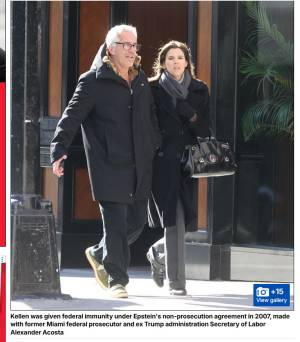 Jeffrey Epstein with his onetime aide and sex victim recruiter Sarah Kellen in a photo released by the Justice Department. As indicated by the photo caption, Kellen was given federal immunity under Epstein's non-prosecution agreement in 2007, arranged by Epstein's high-powered lawyer team that included Kenneth Starr and Alan Dershowitz in an arrangement with then-Miami federal prosecutor Alexander Acosta, whom President Trump later rewarded in 2017 with a successful nomination to become U.S. Labor Secretary, whose department oversees (among other responsibilities) allegations of sex trafficking victimizing United States .
New York Times, A Million More Epstein Documents Have Been Found, Justice Dept. Says, Devlin Barrett and Michael Gold, Dec. 25, 2025 (print ed.). Democratic lawmakers, who had criticized the Justice Department’s release of the material, accused the Trump administration of violating the law mandating the release of the files.
The Justice Department said on Wednesday that it had discovered over a million more documents potentially related to the investigation of the convicted sex offender Jeffrey Epstein — increasing the amount previously known and lengthening the time it will take to release the material.
To date, the department has released about 130,000 pages of information, some of it redacted, to comply with a law passed by Congress requiring the disclosure of most of the material about Mr. Epstein. Under the law, the administration may withhold records that identify victims or information that would “jeopardize an active federal investigation.”
The law gave the Justice Department a deadline of last Friday to release the files, and a batch of about 100,000 pages was released that day. But over the weekend, the deputy attorney general, Todd Blanche, right, said that about a million pages of information were being reviewed, and that the full release would take a few more weeks.
On Wednesday, the Justice Department said the F.B.I. and the U.S. attorney’s office in the Southern District of New York, which oversaw the investigations into Mr. Epstein and his longtime confidante, Ghislaine Maxwell, had informed the department “that they have uncovered over a million more documents potentially related to the Jeffrey Epstein case.”
Democratic lawmakers, who had criticized the Justice Department’s release of the material, immediately accused the Trump administration of violating the law mandating that the files be released by Dec. 19.
“It’s outrageous that the D.O.J. has illegally withheld over one million documents from the public,” Representative Robert Garcia of California, the top Democrat on the House Oversight Committee, said in a statement.
 Senator Chuck Schumer, above, Democrat of New York and the minority leader, accused the Trump administration of hiding something. “Justice delayed is justice denied,” he said in a social media post. “Release the files. Follow the law.”
Since late November, the department has assigned nearly 200 lawyers from the national security division to review the documents and remove any information about victims, or anything that would compromise continuing investigations or national security.
Earlier this week, department officials sent out an emergency request for reinforcements, asking for lawyers to volunteer over the holiday break to join the effort, according to a person familiar with the matter who spoke on the condition of anonymity to describe internal workings of the department. It is unclear how many lawyers volunteered.
“We have lawyers working around the clock to review and make the legally required redactions to protect victims, and we will release the documents as soon as possible,” the department said on social media. It added that releasing all the material may now take “a few more weeks.”
The department’s release of material related to Mr. Epstein has not gone smoothly. After the initial release last week, some photographs were removed from the online collection because of what the department described as concerns they might contain information about victims.
One image showed a credenza with a number of photos on it, including one of President Trump. Mr. Blanche disputed that the image was removed to protect the president, and said concerns had been raised about whether that image contained any victims. The image was later restored to the collection.
A subsequent release Monday of some 30,000 pages also got off to a rough start, as the pages were available for a few hours, then taken down, then put back online.
Meidas Touch Network, Political Commentary: Important Christmas Day News Updates, Ben Meiselas, right, Dec. 25, 2025. Merry Christmas, everyone!
As I mentioned yesterday, I’ve learned never to expect quiet from Donald Trump, even on Christmas morning. By mid-morning on Christmas Day, Trump was spiraling, and had already posted more than one hundred times on social media.Subscribed
Post. Post. Post. Post. Post. If you have the misfortune of setting notifications for Trump’s account like I do, your phone battery was probably drained by the time you woke up. Each post was more psychotic than the next, with not a normal Merry Christmas message to be found.
Trump called for the prosecution of former President Barack Obama. He repeated long-debunked lies about the 2020 election. He boosted posts declaring that the Affordable Care Act should be abolished “right away,” even as millions of Americans are already terrified about losing health care coverage after subsidies were allowed to lapse. He falsely claimed the 2020 election in Michigan was fraudulent. He again defamed Georgia election workers Ruby Freeman and Shaye Moss, women who endured years of threats after Trump allies targeted them and who later won their defamation case against Rudy Giuliani. If he were not the president, any objective individual would be calling for a 5150 hold.
Trump also amplified ICE accounts celebrating deportations and boasting that “ICE never sleeps,” while officials openly celebrated “Christmas deportations.” How’s that for the holiday spirit?
He promoted a conspiracy-laden video from Roseanne Barr claiming that COVID-19 was deliberately unleashed so Democrats could steal the 2020 election through mail-in voting. This was QAnon-style disinformation, pushed directly by the president on Christmas Day. He followed it with post after post attacking health care, immigrants, transgender Americans, and anyone he deems an enemy.
The volume alone should alarm anyone paying attention. Imagine someone in your life posting about a single topic two hundred times in a morning. You would ask if they were okay. This is not normal behavior. And yet this is the behavior of the person entrusted with nuclear codes, foreign policy, and the rule of law.
The contrast with other leaders could not have been clearer. Former President Joe Biden posted simple holiday photos with his family. Former President Barack Obama did the same. Trump spent Christmas morning rage-posting, spreading conspiracies, and inciting grievance.
And that meltdown did not happen in a vacuum.
As Trump flooded social media with chaos, the Justice Department quietly acknowledged the existence of roughly 1.2 million additional Epstein-related documents it claims it has never reviewed, coincidentally after MeidasTouch reported on the existence of said documents. These documents were referenced in emails years ago and only surfaced publicly after reporting forced the issue.
While Trump ranted online, Vladimir Putin continued brutal attacks across Ukraine on Christmas Day, striking Kyiv, Kherson, Kharkiv, Odessa, Sumy, and Donetsk. A bipartisan group of U.S. senators condemned the assaults, noting that Ukraine had agreed to a Christmas truce and that Putin rejected it, choosing violence instead on one of Christianity’s holiest days.
President Volodymyr Zelenskyy made it clear that this was not just another military decision, but a moral one. Russia rejected peace and escalated attacks, launching missile and drone strikes against Ukraine’s energy grid and civilian areas.
At the same time, the Trump administration moved to sanction European officials for enforcing consumer protection and anti-disinformation laws, while loosening pressure on Russian figures. Europe is punished for trying to stop fraud and disinformation. Russia is accommodated. This is the world order under the Trump regime.
European leaders increasingly view the United States as an unreliable partner, if not an adversary. Ukraine continues to fight for its survival with courage and success on the battlefield, even as Trump echoes authoritarian narratives and undermines democratic solidarity.
Trump’s Christmas meltdown should not be dismissed as noise. His words and his actions have real consequences, both in the U.S. and around the world.
Watch my full report above to catch up on today’s news, and thanks again for being a subscriber to the Meidas+ Substack. Merry Christmas and Happy Holidays to you and your family!
New York Times, What to Know About U.S. Military Action in Nigeria, Staff Reports, Dec. 25, 2025. Before the strikes on Thursday, President Trump said he would halt all aid and go in “guns-a-blazing” to target militants.
The U.S. strikes against the Islamic State in northwestern Nigeria followed President Trump’s threat earlier this year to take military action if Nigeria’s government did not stop the killing of Christians by Islamist militants.
Mr. Trump did not specify which attacks he was referring to, nor did he cite evidence for the claim, made by several of his political allies, that Christians are being targeted in Nigeria.
Here’s what you need to know:
What did the U.S. Attack?
Mr. Trump announced the strikes on Truth Social but provided few details. He said only that “the United States launched a powerful and deadly strike against ISIS Terrorist Scum in Northwest Nigeria,” accusing the group of “targeting and viciously killing, primarily, innocent Christians.”
The Defense Department said it worked with the Nigerian government to carry out the strikes.What did Trump threaten to do?
On Nov. 1, Mr. Trump said that if Nigeria’s government continued to “allow the killing of Christians, the USA will immediately stop all aid and assistance to Nigeria, and may very well go into that disgraced country, ‘guns-a-blazing.'”Want to stay updated on what’s happening in Nigeria? Sign up for Your Places: Global Update, and we’ll send our latest coverage to your inbox.
“I am hereby instructing our Department of War to prepare for possible action,” he wrote. “If we attack, it will be fast, vicious, and sweet”
Defense Secretary Pete Hegseth responded to the president’s post by writing, “Yes sir,” adding that the Pentagon was “preparing for action.”
A day earlier, the Trump administration said it would reinstate Nigeria as a “country of particular concern,” a designation that the U.S. government applies to nations deemed to have “engaged in severe violations of religious freedom.” Mr. Trump took a similar step in 2020, near the end of his first term, which was reversed during the Biden administration.
Mr. Trump’s threat of military intervention was a substantial escalation. When asked last month about specifics of his plan, he replied: “I envisage a lot of things. They’re killing the Christians and killing them in very large numbers. We’re not going to allow that to happen.”
In the days leading up to Mr. Trump’s threats, several of his political allies made similar accusations. Sen. Ted Cruz of Texas accused Nigeria of “facilitating the mass murder” of Christians.
Nigeria has denied the accusations. Its president, Bola Ahmed Tinubu, right, said on Saturday that the country remained committed to protecting religious freedom.
“Nigeria stands firmly as a democracy governed by constitutional guarantees of religious liberty,” Mr. Tinubu wrote on social media.
The characterization of Nigeria “as religiously intolerant does not reflect our national reality,” he added in a statement, citing what he described as sustained efforts by the government to safeguard freedom of religion and belief for all Nigerians.Violence in Nigeria
Nigeria, home to around 220 million people, has large populations of Christians and Muslims.
Parts of the country have long suffered violence from extremist groups, including Boko Haram, an Islamist terror group based in northeastern Nigeria that has attacked both Christians and Muslims it does not consider faithful enough. A splinter group, the Islamic State West Africa Province, has carried out similar attacks.
In a 2024 report, the United States Commission on International Religious Freedom said extremist violence in Nigeria “affects large numbers of Christians and Muslims in several states.”
Deadly clashes have also repeatedly occurred in central Nigeria between herders and farmers, as a battle for scarce resources stirs long-held tensions over religion and ethnicity. The herders are typically ethnic Fulani and Muslim, while the farmers are often Christian. Some conflicts are simply about armed men seizing land. And Northwest Nigeria has a significant kidnap-for-ransom industry.
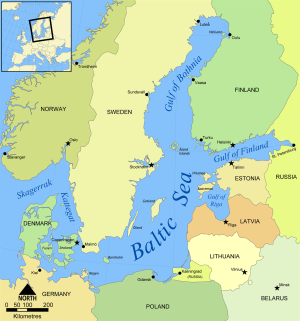 PPR Global, Russia's Kaliningrad Link Is Gone! Baltics Cut Off All Railways to Moscow, Staff Report, Dec. 24, 2025. History is being rewritten not with ink, but with dismantled rails. Estonia, Latvia and Lithuania have put forward a decision to physically destroy the railway lines leading to Russia and Belarus.
This is not an embargo, but the largest ‘Geographical Amputation’ operation modern history has seen.
In this video, we analyse how the Baltics are bringing down the ‘Iron Curtain’ again and the collapse of Russian logistics:
 Donald Watkins via Facebook, A Christmas Day Question for Inquiring Minds, Donald Watkins, Dec. 25, 2025. Yes, the photo is real. It was professionally shot and published in a December 1995 issue of InStyle magazine, depicting Donald Trump posing on a bed with his daughter Ivanka Trump during a magazine feature on the Trump family’s Manhattan penthouse.
The image was taken by fashion photographer Firooz Zahedi as part of a glossy lifestyle spread titled “Breakfast Above Tiffany’s.” After years of online debate, Snopes ultimately rated the photo TRUE, confirming its authenticity through scans of the original magazine and direct confirmation from the photographer.
Key facts that keep getting hand-waved away:
* This was not an edited meme or AI image. * It was not a private snapshot. * It was deliberately staged, shot, and distributed by a national magazine. * Ivanka was a minor at the time.
The photo has resurfaced repeatedly since at least 2016. It was often dismissed as fake until fact-checkers confirmed otherwise. Those sources are listed at the end of this commentary.
What kind of father would pose with his daughter in a sexually suggestive manner like this?
In 2006, Trump made this statement, “I've said if Ivanka weren't my daughter, perhaps I'd be dating her.”
In 2016, Trump told Howard Stern it was okay to call Ivanka a “fine piece of ass.”
To me, the objective evidence from the Jeffrey Epstein sex trafficking files overwhelming establishes that Donald Trump committed serial acts of child molestation and child rape with underaged girls.

On the Access Hollywood audiotape, Trump bragged (as reported above) about his compulsion to grab women and girls by the “p*ssy.”
Epstein’s 2019 letter to Larry Nassar confirmed that Trump like to “grab snatch” when "young, nubile girls" walked by. Contrary to DOJ bullshit claims, this letter is NOT a fake. It was mailed for Epstein by a friendly jailer who used the regular postal system in a clandestine manner, rather than the inmate mail system. This circumvention of the inmate mail system is done quite frequently in the federal prison system. The DNA under the postage stamp on the envelop is likely Epstein's.

Ivanka’s mother Ivana confirmed in a sworn divorce deposition that Trump “raped” her, a claim she clarified but NEVER retracted.In light of Donald Trump’s open sexual lust for Ivanka, my Christmas Day question for inquiring minds is this: Did Trump ever commit incest with Ivanka?
*****************
Fact-Checking Sources
[1] Snopes (Dec 2023). “Did a Photograph Show Donald Trump Sitting on a Bed with His Daughter Ivanka?” https://snopes.com/fact-check/trump-ivanka-lap-photo/ [2] Reuters Fact Check. “Images claiming to show Donald Trump inappropriately engaging with Ivanka Trump” https://reuters.com/.../fact-check-images-claiming-to.../ [3] Yahoo News. “Fact check: Donald Trump, Ivanka Trump photo on bed is real” https://yahoo.com/.../fact-check-donald-ivanka-trump... [4] Snopes. “Did Trump Pose with Ivanka in a ‘Tongue’ Photo?” https://snopes.com/fact-check/trump-ivanka-tongue-photo/ [5] BBC News. “Donald Trump and Ivanka: the images that keep resurfacing” https://bbc.com/news/world-us-canada-44278209 [6] The Independent. “Trump family photos and the controversy around them” https://the-independent.com/.../vanity-fair-portraits...
The Parnas Perspective, Trump Orders Military Strikes on Nigeria and Attacks Opponents on Christmas, Aaron Parnas, Dec. 25, 2025. Trump announced military strikes on Nigeria. I hope you had a wonderful Christmas holiday if you celebrate, surrounded by the people you love. I spent the day eating Chinese food, watching Wicked 2 in the theater with my wife, and ending the night with board games among friends.
Here’s the news:
Donald Trump has announced that the United States military has conducted strikes in Nigeria against ISIS targets.Meidas Touch Network, 2,900 DOJ lawyers leave Trump adiministration, Ben Meiselas, Dec. 25, 2025. MeidasTouch host Ben Meiselas and Talking Feds host Harry Litman report on Donald Trump getting stunned as some 2,900 U.S. Justice Department lawyers have resigned or been fired since the beginning of the Trump Administration in late January according to recent calculations, creating huge problems within the federal justice system because the drain in experience.

New York Times, Can Democrats Reinvent Themselves as Washington Disrupters? Lisa Lerer, Dec. 25, 2025. Since President Trump’s rise, Democrats have served as defenders of a political system many Americans believe is broken. Now the party is trying a new approach.
All year, top Democrats have shown a striking awareness of one of their biggest problems.
The party, Senator Chris Van Hollen of Maryland told NPR this month, needs to show how it will “shake up the status quo.”
“Embrace change,” Senator Elissa Slotkin of Michigan urged on “The Daily Show” in May. “The Democratic Party should be leading, rather than just saying: ‘No, no, no. Status quo, status quo.’”
“We have become the party of the status quo, when we’re not,” Senator Chris Murphy of Connecticut told NBC News in March.
As they try to repair their political brand before the midterm elections, Democrats are rushing to redefine themselves as Washington disrupters, eager to challenge a government that many Americans believe has failed to improve their lives.
For years, Democratic leaders have cast their party as a firewall against the threats to American democracy they argue are posed by President Trump and his political movement. With their fierce opposition to Mr. Trump, Democrats became the party of institutional preservation, championing political norms, expertise and the role of the federal government.
But with Republicans now in control of Washington, many Democratic politicians are trying to revamp their image with promises to upend existing power structures, whether they are the Trump administration, Congress or even their own party orthodoxy. It is a message for an electorate that barely trusts government, politicians or Washington to accomplish any change at all.
“I took on the powerful and corrupt Democrats,” Mayor Paige Cognetti of Scranton, a Democrat running for a swing House seat in northeast Pennsylvania, said in a video announcing her run that was widely praised across her party. “We can stand tall against a Washington that takes advantage of working people.”
But changing the party’s image won’t be easy for Democrats.
For much of the past year, they have fiercely opposed efforts by the Trump administration to drastically cut the size of the federal government. They have protested the shuttering of agencies like the U.S. Agency for International Development, defended federal workers and backed lawsuits filed by federal unions and advocacy groups.ImageFederal employees in February holding up signs and protesting government cuts by the Trump administration.Federal employees in February protesting government cuts by the Trump administration. Credit...Samuel Corum for The New York Times
Democrats know that those actions have affected how voters view their party. In the spring, congressional lawmakers were briefed in private meetings on polling by Navigator Research, a progressive public opinion firm, showing that a majority of voters described Democrats as focused on “preserving the way government works,” while only 20 percent said the same of Republicans, according to slides of the presentation given to The New York Times.
The challenge Democrats face is how to simultaneously defend government institutions that Mr. Trump is trying to gut while also offering a forward-looking message that resonates with voters who believe politics and democracy are broken.
“We have to embrace the need for change and reform. At the same time, I’m not interested in throwing the baby out with the bathwater,” said Representative Jason Crow of Colorado, a Democrat chosen by his party’s House campaign arm to recruit candidates. “We end programs that aren’t working, we reform agencies that are not delivering, and then we preserve those that are.”
New York Times, No Power, No Heat, No Water: Odesa’s Days of Hell Under Russian Fire, Kim Barker and Oleksandra, Mykolyshyn, Photographs by Laetitia Vançon, Dec. 25, 2025. The toll on older people and those with disabilities is especially severe as Moscow’s forces repeatedly attack the port city’s infrastructure.
When she hears explosions, Tetiana Rybak does the only thing she can: She lies in her bed and waits. Ms. Rybak cannot walk, cannot go to the shelter. Recently, she asked a social worker to tape over the windows of her apartment with festive red gift wrap, old military posters and a version of the Lord’s Prayer.
That way, she no longer has to see the Russian drones flying past.
For the past two weeks, Russia has focused its military might on pounding her hometown, Odesa, the largest port in Ukraine, repeatedly hitting it with drones and missiles in the city’s worst shelling through almost four years of war.ImageA city at night, with many buildings under a dark, overcast sky. Scattered windows across the buildings are faintly lit.Odesa has had many days without power this month.ImageOne person sits on a leopard-print bed, looking at another person standing in a room with a patterned wall rug.Tetiana Rybak being visited by a social worker at her home in Odesa. Ms. Rybak, who cannot walk, relies heavily on the assistance of social workers during power outages.
Ms. Rybak has not had electricity for at least nine days this month. For four of those, she had no heat and no water. A social worker needed to lug bottles of water to her up seven flights of stairs. Ms. Rybak, who has been disabled for years, dressed in two pairs of socks, two pairs of warm pants, a sweater and a thick terry-cloth bathrobe. She then slid under two blankets.
“Psychologically, no one can withstand this anymore,” said Ms. Rybak, 64, sitting in her bed during a recent visit with social workers. “My nervous system is completely shattered. Just last night, when the power went out and the shelling started — the air raid sirens — it was terrifyingly loud. But even more frightening was the blast wave. My doors and windows were shaking — thud, thud, thud — and I was lying there, unable to run anywhere, with nowhere to go.”
Ukrainians speculate that Moscow has been attacking Odesa, perched on the Black Sea, in retaliation for Ukraine’s recent attacks on the “shadow fleet” that Russia uses to transport its oil and evade sanctions. While major Ukrainian cities commonly experience bursts of intense Russian bombardment followed by quieter periods, Odesa has been under nearly constant attack since the early morning hours of Dec. 12. Russia has mostly targeted the city’s ports and its power infrastructure. At least nine people have been killed
With electricity, gas and water out for days at a time, residents resort to charging their phones and computers at government relief centers or grocery stores, and to cooking their meals on makeshift stoves outside. They put plastic bags of milk, eggs and sour cream on windowsills to keep them cold. Some have set up large generators in yards so neighbors can get power.
One man attached clamps to his car battery and strung the cord to his apartment to power his refrigerator and his washing machine. One couple documented their date at a seafood restaurant to the pop-pop-pop soundtrack of air defense rifles targeting Russian drones. Dozens of Tesla drivers waited for hours at the only charging point that still worked.
Ever since Russian troops invaded in February 2022, Ukrainians have rallied. Their resilience has been so celebrated that it’s almost a cliché. Oleksii Kolodchuk, 83, said the power and heat outages were not a big deal for him. His biggest regret: He forgot to put his borscht outside in the cold, and it went sour well before it should have
He also said he wished he could give a message to President Vladimir V. Putin of Russia. “Sometimes I think, if I could go up to Putin with a stick, I’d give him a good knock on the head — maybe it would knock some sense into him, because clearly something is very wrong there,” Mr. Kolodchuk said.
More On Epstein Files
Disclosures in the Epstein files echo, as did the E. Jean Carroll sexual assault lawsuit and other Trump scandals, Donald Trump's words in "Hollywood Access" videotape, reported upon above, that arose during the 2016 presidential campaign. Shown Above: Three copies of the front page of a 2016 New York Daily News edition, which contains his boast contrasting with his claimed innocence in the more than score of sexual assault and harassment allegations against him.
MeidasTouch Network, Christmas Message from Meidas Co-Founder, Ben Meiselas, right, Dec. 25, 2025. First, it’s hard to believe it’s Christmas already. I know that’s probably something we all say every year as we marvel at how quickly the year went by, but this year in particular felt both tortuously slow and shockingly quick at the same time, if that makes sense to you.
Second, there has been a lot of big news on Christmas Eve. I am proud that the MeidasTouch Network broke one of the biggest stories of the year. As you probably know, our reporting identified that at least 1 million records from the Epstein files from the SDNY prosecutors’ office were being concealed by the DOJ in Washington, D.C.
Following our reporting right here on Substack, the DOJ announced it had “uncovered” 1 million new records from SDNY and that it would take weeks to go through them. Congressman Robert Garcia, the Democratic Ranking Member on the House Oversight Committee, gave MeidasTouch a shoutout for uncovering this. This is a testament to the editorial team at Meidas that has been built by this community.
Third, I can’t help but reflect on the paradoxical feelings I see across this country of both pain and hope on this Christmas. There is a pain that has been inflicted on the people by this dastardly regime of tyrants. The suffering is real. The pain is palpable, and it’s being felt by people across all political parties—unless you are a billionaire right-wing oligarch.
But while there is pain, and while the country has been battered, I also see more hope than I did during Christmas 2024. We’ve made it through a year. We’ve stood up to a gangster regime. We’ve confronted the regime face to face, and they are weaker. The people are stronger. Trump and Elon Musk thought we’d all be subjugated by now. They thought we’d all bend the knee like corporate leaders and law firms and universities. We stood our ground. We stood shoulder to shoulder. We fought back, and the power of the Trump regime is collapsing before our eyes. People feel hope about what a world will look like when Trump is removed from power. We don’t have to live in this doom-cycle loop. We can live in a world of hope and love and moral clarity someday.
Fifth and finally, I want to thank you for being here with us each step of the way. We didn’t set out to beat Fox or Joe Rogan. We started this because my brothers and I were trying to make sense of the evilness and the assault on reason and democracy we saw. We tried to call it out clearly and rapidly and without holding back, and hence this network was born. This is a network built on community. Literally, this network was built by this Substack community, and now it not only competes with all corporate and cable networks, but leads every network on views and engagement on digital platforms.
There is a lot more building we need to do. There is much work ahead.
New York Times, Guest Essay: The Epstein Files Should Not Have Been Released This Way, Molly Jong-Fast, Dec. 25, 2025 (print ed.). As we try to find some cozy solace with our families for the holidays, the Department of Justice is starting to — as required by a law that it took an open political revolt by the MAGA base to enact — release the Epstein files.
It is doing so in what seems to be the most haphazard, obfuscatory and confusing a manner possible. As a result, we are not getting much closer to the truth about many of the fundamental facts of how Jeffrey Epstein ran his sex-trafficking ring, spun his favors and kept some of the most powerful men on the planet in his orbit.
Oh, actually, we do know something of how the last part went: He facilitated their receiving the attentions of young women. Some of this was plainly illegal — sex trafficking and rape. Much of the rest of it fell into the legal gray zone of abusive or exploitative. In any case, we seem no closer to getting justice for the women who were the victims of this vast scheme.
The release of the Epstein files was not supposed to be this way. The fight was to get them released, and then all would be revealed. Instead, social media is filled with a bewildering number of documents — some real, many not — and photographs with celebrities and without context. The contents have clearly been selectively released by the Department of Justice, a lot of it highly redacted, revealing little but stirring up much. (Referring to some of these materials, the department has said it “simply reproduced” redacted content.) The flood of files has created the worst possible outcome, an even more hyperpartisan blame game that is completely unfocused on justice for the victims.
And the powerful men that Mr. Epstein cavorted with, who in turn seemed to provide him with so much? Why did many of his 10 possible conspirators have their names shielded? Are they being protected?
For me, all of these pictures of life in the 1990s transported me back to my genteel but feral youth on the Upper East Side. The city was then still a little grimy, and Donald Trump was a tabloid peacock continually teetering on the edge of bankruptcy. The world I was raised in, which thought itself so cosmopolitan, was ruled by problematic men, all of whom were indulged without much compunction. My grandparents believed Alan Dershowitz—another notable man in Mr. Epstein’s circle—was “good for the Jews.
It turns out, I was the one who didn’t get it. A lot of us didn’t. We’re just playing catch-up now.
Part of the reason I didn’t get it was that I was ultimately insulated from the kinds of things that Mr. Epstein did. I didn’t need a job as a masseuse or money for new sneakers. I had access to well-connected, well-off people who would believe me, and I was — am — a loudmouth. These two things probably protected me from the fate of the hundreds of victims of Mr. Epstein.
 On Nov. 18, 2025, I traveled to Washington, D.C., to watch a troupe of now middle-aged women like me recount what Mr. Epstein and his friends did to them when they were young and, unlike me, vulnerable. One of these women, Maria Farmer (shown in a 1990s photo at right), had been begging the American government for an investigation since 1996. She accused Mr. Epstein of stealing nude images of her siblings, information that was relayed in an F.B.I. report and then apparently ignored. Ms. Farmer’s report was one of the very few interesting things made public by the Department of Justice’s Epstein dump.
It was an unusual, bipartisan news conference, with the MAGA firebrand Marjorie Taylor Greene, the Silicon Valley Democrat Ro Khanna and Kentucky’s libertarian-leaning Thomas Massie all standing together. I walked from the Cannon Building to the little triangle of grass between the big limestone buildings, which was fenced off with gray metal crowd-control fencing. A man dressed as a pink frog carried a sign that said, “Justice Epstein survivors.” A group of survivors stood in front of the microphones; they held photos of themselves around the time of their abuse. The women holding the photos looked centuries older than their victim selves.
The Epstein survivor Haley Robson started speaking, “And to the president of the United States of America, who is not here today, I want to send a clear message to you,” she said. “While I do understand that your position has changed on the Epstein files and I’m grateful that you have pledged to sign this bill, I can’t help to be skeptical of what the agenda is.”
It was clear these women were never going to get the kind of justice they wanted. I looked over at a correspondent I knew. Her eyes were filled with tears.
And so it has gone. The files have been released in a way that seems to be designed to maximize the arguing, give succor to conspiracy-mongers and minimize the illumination of what happened.
Why did at least 16 files disappear soon after the Department of Justice site went live? The department later reposted disappeared content, including a photo of Mr. Trump and Mr. Epstein. And so it goes.
I think about myself as a careless and brazen teenager, and I fear for those girls, the ones not insulated. Mr. Epstein is dead. But what about the other men?
Raw Story, Newly released Epstein file links Trump to murdered newborn baby dumped in Lake Michigan, David McAfee, Dec. 24, 2025. Donald  Trump's name appears on a newly released Epstein file in which a purported victim makes allegations about a newborn baby being murdered and dumped in Lake Michigan.
The Justice Department released this file ahead of Christmas Eve in which an unnamed individual, on Aug. 3, 2020, is looking for an update on the status of their earlier complaint. The report lists an unnamed uncle as the perpetrator and Trump as the witness.
"I previously provided a tip about 3 weeks ago, maybe 4 weeks ago, under an alias I have for myself," the letter says. "All the other details of the previous tip match all the information given in today's tip, except I am giving my real name. A detective from NYPD FBI sex trafficking task force called me a couple of weeks ago from a 212 area code number. I talked to him for about 20 or 30 minutes about my being sex trafficked by my uncle and Jeffrey Epstein in 1984 while I was 13 and [pregnant] ... I told him some other important information about other high profile individuals involved in my sex trafficking and the murder and disposal of my newborn daughter because I gave birth to her while in the middle of this ordeal."
In a section under which Trump's name listed, it says, "Again, just trying to find out the NYPD detective on the FBI sex trafficking task force that called me a couple of weeks ago and spoke to me about some of these issues."
"How is Contact Known: He participated regularly in paying money to force me to [redacted] with him and he was present when my uncle murdered my newborn child and disposed of the body in Lake Michigan," the letter says.
The White House didn't immediately return Raw Story's request for comment on Wednesday, and instead linked to a social media post from a Trump DOJ appointee:
"The Department of Justice has officially released nearly 30,000 more pages of documents related to Jeffrey Epstein. Some of these documents contain untrue and sensationalist claims made against President Trump that were submitted to the FBI right before the 2020 election. To be clear: the claims are unfounded and false, and if they had a shred of credibility, they certainly would have been weaponized against President Trump already. Nevertheless, out of our commitment to the law and transparency, the DOJ is releasing these documents with the legally required protections for Epstein’s victims," it says.
But that social media post itself was hit with a major fact check by X users:
"The claim of 'commitment to transparency' is unfounded: DOJ missed the Dec 19 deadline mandated by the bipartisan Epstein Files Transparency Act, releases only partial/heavily redacted files, and now faces bipartisan criticism for non-compliance and excessive redactions."
Read the newly released file here.
KJRH -TV, Tulsa (Channel 2), Report in Epstein Files references death in Kiefer, Okla. Samson Tamijani, Dec. 24, 2025. Report in Epstein Files references death in Kiefer, Okla.
More On U.S. Governance, Politics
Everyone is entitled to my own opinion, Merry Christmas and Happy Holidays, everyone!! Jeff Tiedrich, right, Dec. 25, 2025. Whatever you do (or don’t) celebrate, I hope your day plays out exactly as you want it to.
If you can’t be with friends and family, or if you are with your family and they’re driving you _____crazy, we’ll be your family. And remember: no matter what you’re doing, you’re having a better Christmas than the broken-inside grievance-baby who is incapable of experiencing joy (as shown above).
 The Warning with Steve Schmidt, Steve Schmidt: Trump Is RUINING Christmas in America, Steve Schmidt, Dec. 25, 2025. Trump’s return to office has been a year of chaos, abuse and moral collapse. Steve Schmidt reflects on what has been lost, and why Americans must vote MAGA out of power before even more damage is done.
Michael Cohen via Substack, Political Commentary: A Very Political Christmas, Michael Cohen, right, Dec. 25, 2025. A holiday meant for gratitude collides with war, debt, lies, weaponized justice, stolen years, and the uncomfortable truth that accountability never comes gift-wrapped.
It’s Christmas today. And whether you celebrate the holiday or not, let me start where we should all start; by wishing you a peaceful, joyful day. Because Christmas, stripped of theology and tradition, is really about something far more universal: family, community, generosity, laughter, and the fleeting illusion that we’re all in this together.
You can’t walk into a store or down a street without seeing Santa, jolly old Saint Nick, ringing a bell, smiling through a beard that’s seen better days, asking you to help raise money for people who genuinely need it. And most of us do. Because today, empathy feels less like a political position and more like a civic duty. We remember, if only briefly, that kindness isn’t weakness. It’s oxygen.
Then you get home. The food is cooking; too much food, always too much food. Family and friends gather around tables that somehow hold love, history, and unresolved grievances all at once. There’s laughter, side-eyes, inside jokes, and that one relative who shouldn’t be allowed near political conversations or the gravy boat. It’s loud. It’s messy. It’s familiar. It’s human.
And after a long day, you sit down with the remote, ready to unwind. Which is exactly why you should not turn on the news. Don’t do it. Watch the Yule log burn on an endless loop. Let Bing Crosby lie to you about a white Christmas. Protect your peace. Protect your sanity.
But of course, you turn it on anyway.
And instantly, the Grinch appears.
Another fishing boat blown up. Another headline. Another body count now exceeding 100. Fantastic. The war on drugs has clearly been resolved; just ignore the bodies, the poverty, and the decades of abject failure that pass for policy.
Struggling to make ends meet? Relax. According to Howard Lutnick, since U.S. GDP is up, your salary should be up too. Congratulations; your paycheck has apparently increased spiritually. Economically. Theoretically. So thank your President for putting more money in your pocket, even if you can’t actually see or feel it or spend it.
But don’t get too comfortable. If affordability is still crushing you; and that’s most Americans, brace yourself. Starting January 2026, if you have a federal student loan, Uncle Sam will begin garnishing your wages to ensure repayment. Nothing says “happy holidays” quite like the government reminding you that education was a lifelong financial sentence and your payment is overdue.
And then there’s Epstein. Because of course there is.
If you’ve been following the Epstein crime file saga, you learned that the FBI has somehow just “received” more than one million new documents that now need to be reviewed. One million. New. Documents. I’m confused. Were these files hiding in Obama’s basement? Biden’s garage? Because if the FBI; under Kash Patel’s incredible leadership, has been loudly preaching transparency, how exactly were they doing that without all the documents?
Or was the so-called release under the Transparency Act really just the files you already knew about? Wink wink. Transparency theater. Curtains open, lights off.
Now here’s the part I don’t joke about.
I try; especially on holidays like Christmas, Hanukkah, and New Year’s, to lead with gratitude. I really do. I’m grateful for my wife. For my children. For my family and friends. For this Substack community that stood by me when it would’ve been easier, and frankly more convenient, to disappear. Gratitude is how I survive. It’s how I remind myself that despite everything, I still have love, purpose, and a voice.
But every holiday, a darker, more ominous feeling rises; one I just can’t dismiss.
Because holidays also remind me of what was taken from me due to incarceration.
I lost an entire Hanukkah, Christmas, and New Year with my family. I lost celebrating my wife’s milestone 50th birthday together. I lost holding her hand and celebrating our 25th wedding anniversary side by side. I lost my children’s birthdays; moments that don’t come with reruns or second chances.
I lost my law license. My business. My finances. My honor. My family’s sense of security. Their joy. And yes; parts of my spirit.
All of it as a result of Donald Trump’s weaponization of the Department of Justice. All of it collateral damage in his obsession with loyalty over law, silence over truth.
Which is why, when people accuse me of “protecting” my former boss, it infuriates me. Deeply. Because they have no idea what it cost me to tell the truth. They don’t see the empty chairs at the table. They don’t feel the stolen time. They don’t feel the sadness this inflicted on my wife and children. They confuse survival with complicity, and resilience with silence.
So yes, today is Christmas. And I will be grateful; fiercely grateful. But gratitude doesn’t mean amnesia. It doesn’t mean pretending the damage never happened. It means remembering what matters, and why accountability still does as well.
So tonight, turn off the news. Hold your people close. Laugh loudly. Eat too much. Don’t take a single moment for granted.
They stole time from me I’ll never get back; but they didn’t steal my memory, my love, or my determination to make it mean something.
So, enjoy the day. Because tomorrow, our fight resumes.
And let us all say, Merry Christmas.
New York Times, Trump Says ‘Housing First’ Failed the Homeless. Here’s What the Evidence Says, Jason DeParle, Dec. 25, 2025. The Trump administration has sought to move away from the model, which supporters call “evidence based” but opponents consider overly permissive.
When the Trump administration announced plans last month to redistribute billions of dollars in homelessness aid, the move capped a conservative attack on the once-bipartisan philosophy that has guided federal work for a generation, an approach called Housing First.
The administration called the policy a permissive approach that had let homelessness rise, while supporters said Housing First was backed by proven science.
Housing First provides chronically homeless people long-term subsidized housing and offers, but does not require, treatment for mental illness or addiction. It contrasts with programs that condition help on sobriety or work, which Trump officials want to encourage though there is less direct research to suggest their efficacy.
Few aid policies have been studied as extensively as Housing First, and supporters’ faith that it is “evidence based” lends the debate special intensity.
Extensive research shows that Housing First places large shares of its clients in housing. It also appears to have played a major role in cutting homelessness among veterans, which has fallen by more than half.
“The primary goal of Housing First is to get people out of homelessness, and that’s what it does,” said Dennis P. Culhane, a professor at the University of Pennsylvania.
At the same time, Housing First programs have not consistently improved clients’ mental or physical health, as the success in finding housing would predict. And while Housing First is sometimes called lifesaving, the evidence does not clearly show it lowers mortality rates.
“The phrase I often hear is ‘evidence based’ or ‘we know what works,’” said Judge Glock of the conservative Manhattan Institute. “But we don’t know what works. There’s a lot of debate — not just about what the evidence shows but what counts as success.”
In seeking new rules to guide $3.9 billion in grants, the administration would sharply limit Housing First and promote treatment-focused alternatives. Two Federal lawsuits seek to halt the change, and a judge in December temporarily blocked it.
Here is what the evidence says about Housing First:
Does Housing First help the homeless find housing? Yes, at least for a year or two, the period most studies cover.
The Lancet, analyzing 15 studies, found that Housing First, often called permanent supportive housing, “significantly improved housing stability.” Another journal, examining 26 studies, found that Housing First programs “more effectively reduce homelessness” than alternatives did.
In Santa Clara County, Calif., 86 percent of people randomly placed in Housing First secured housing, versus 36 percent of those in “usual care,” meaning whatever mix of services a locality provides.
Such results are significant because they show that even people with untreated addiction or mental illness can be housed, especially with attentive casework. That contrasts with efforts to make people “housing ready” by treating their afflictions, at the risk of leaving homeless those who cannot or will not comply.

New York Times, Republicans Who Backed Afghan Visas Are Mum as Trump Halts Them, Megan Mineiro and Adam Sella, Dec. 25, 2025. After a fatal shooting, the Trump administration froze a visa program for Afghans that Republicans in Congress had championed. The G.O.P. has not objected.
Back in 2021, as Kabul fell to the Taliban following the chaotic U.S. military withdrawal from Afghanistan, Republicans in Congress were among the loudest voices in Washington arguing that the United States had to throw open its doors to those Afghans who had assisted Americans during roughly two decades of war.
At the time and in the years since, G.O.P. lawmakers have pressed for the expansion of a special visa program for Afghan allies, insisting in letters to the administration, in hearings and in news conferences staged outside the Capitol, that it be expanded.
Then Rahmanullah Lakanwal, an Afghan man who enlisted in a paramilitary force that worked with Americans and who was evacuated by the U.S. military in 2021, was charged with shooting two National Guard members in downtown Washington just before Thanksgiving, killing one and severely wounding the other.
President Trump declared that the United States “must now re-examine every single alien who has entered our country from Afghanistan” during the Biden administration. And even though Mr. Lakanwal was not admitted under a Special Immigrant Visa, the administration halted that program, closing the last legal pathway for Afghans to enter the country.
Republicans who were some of the leading advocates for the United States to provide refuge for Afghans have now gone quiet, apparently resigned to the demise of the Special Immigrant Visa program.
“Politically, I wouldn’t say it’s dead on arrival, but it’s severely damaged now,” Representative Michael McCaul, Republican of Texas, said of the push to issue more visas. “It’s just hugely unfortunate, because they fought alongside our military. They are veterans.”
U.S. Culture, Media, Education

An annual Christmas Eve jazz concert was canceled by its host after President Trump’s name was added to the Kennedy Center building (New York Times photo by Eric Lee).
New York Times, Kennedy Center’s Christmas Eve Jazz Show Canceled After Trump Name Added to Building, Francesca Regalado, Updated Dec. 25, 2025. Chuck Redd, a jazz musician, said he canceled his annual concert after President Trump’s name was affixed to the Washington building’s facade.
An annual Christmas Eve jazz concert scheduled for Wednesday at the John F. Kennedy Center for the Performing Arts was canceled by its host after a board appointed by President Trump added his name to the building.
Chuck Redd, a musician who has hosted the show for nearly two decades, said that he decided last Friday to call off the performance after learning that the name was being changed on the building in Washington.
Last week, the center’s board, chaired by Mr. Trump, announced that the Kennedy Center would be renamed the Trump Kennedy Center. Early this year, the Trump administration removed board members appointed by President Joseph R. Biden Jr., including its chairman David M. Rubenstein, and replaced them with people handpicked by Mr. Trump.
Mr. Trump’s name was added to the building’s facade on Friday, and the center’s website has been updated to reflect the new name. Representative Joyce Beatty, Democrat of Ohio, sued Mr. Trump on Monday, claiming that an act of Congress is required to rename the building.
Congress designated the center as a “living memorial” to President John F. Kennedy in 1964. Relatives of the slain 35th president opposed the change in posts on social media.
Mr. Redd said seven musicians were scheduled to perform on Wednesday. The concert had been held at the Kennedy Center for 20 years and was previously hosted by the jazz bassist Keter Betts, who died in 2005. Mr. Redd took over in 2006.
The Kennedy Center did not immediately respond to a request for comment after business hours. It was unclear whether ticket holders for the jazz concert would receive refunds.
U.S. Immigration Enforcement, Abuses
New York Times, Man Shot in ICE Confrontation in Maryland, Officials Say, Jazmine Ulloa and Charlotte Dulany, Dec. 25, 2025 (print ed.). Federal and local officials said the man, an immigrant from Portugal, tried to flee and harm agents. He and another man were hospitalized after a vehicle they were in crashed.
A quiet Baltimore suburb was shaken Wednesday morning after a U.S. Immigration and Customs Enforcement officer shot an undocumented driver trying to evade arrest, according to ICE and local officials, resulting in a crash that left the driver and a passenger hospitalized.
Tricia McLaughlin, the Department of Homeland Security’s assistant secretary, said in a statement that federal officers had approached a van with two undocumented men in the unincorporated town of Glen Burnie in Anne Arundel County.
Officers asked the driver to turn off his engine, but the man, Tiago Alexandre Sousa-Martins, of Portugal, refused and tried to flee, she said.
“He then drove his van directly at ICE officers,” she said. The man was shot after he rammed his van into several ICE vehicles and crashed in between two buildings, injuring the passenger, Ms. McLaughlin said.
Both Mr. Sousa-Martins and the passenger were in stable condition and expected to recover, Ms. McLaughlin said, adding that no officers were severely injured.
Justin Mulcahy, a spokesman for the Anne Arundel County Police, confirmed the shooting in a news conference. After ICE agents approached the van, he said, “that van attempted to run agents over.” He added that after the agents opened fire, the vehicle accelerated and eventually came to rest in a wooded area nearby. He also said no police officers were involved in the incident.
Attempts to contact a representative for Mr. Sousa-Martins were unsuccessful.
The encounter, first reported by The Baltimore Banner, occurred around 11 a.m. in the Parke West neighborhood. Lt. Josh Bramble, a spokesman for the Anne Arundel County Fire Department, said his agency had dispatched two ambulances to the area and took two people to a trauma hospital.
The shooting comes against a backdrop of rising tensions over the Trump administration’s immigration crackdown on migrants, as federal officers, often masked and highly armed, have used aggressive enforcement tactics to bring in detainees.
New York Times, They Were Supposed to Protect Young Workers. Instead, They Cashed In, Amy Julia Harris, Dec. 25, 2025. Profit-seekers co-opted America’s premier cultural exchange program, the J-1 visa, which brought young people to work in the United States. Some sponsors charged thousands in fees.
One group paid its leader more than $500,000 a year while shipping foreign trainees to American jobs where they said they felt like slaves.
Another put the wife, daughters and son-in-law of the chief executive on the payroll, netting the family more than $1 million in the past two years alone.
A third sent young people to work at a farm owned by the family of one of its executives and a winery owned by a board member.
All of them cashed in on a State Department cultural exchange program, the J-1 visa, that has become plagued with profiteering and conflicts of interest — because the U.S. government has failed to rein it in.
The groups, known as sponsors, are tasked with helping to advance diplomacy and spread the virtues of American culture. They are supposed to serve as guides and protectors for the more than 150,000 young people they bring in from overseas every year, placing them with reputable employers and ensuring they are safe while in the United States.
Instead, a New York Times investigation has found, some sponsors have charged unwitting visa-seekers steep fees, struck deals with employers they were supposed to oversee and ignored evidence of unsafe or abusive working conditions.
The executive of one group was paid more than $1 million a year, nonprofit tax filings show. Other sponsors have created health insurance companies and other side businesses and then required young people to purchase services from them, squeezing more revenue from the program.
Still others have sent the employers who hire their workers on free international recruiting trips.
None of this broke any rules. Sponsor groups have been allowed to exercise enormous amounts of control over everything from how much they charge in fees to how they vet prospective employers.
Even a private equity firm was permitted to take a stake in one large sponsor group, describing the investment as “expanding market presence and creating sustainable value for all stakeholders.”
The State Department itself has repeatedly flagged profiteering within the program but failed to respond to its own warnings. A 2000 audit from its inspector general said that some sponsors exist primarily “to make money” and that parts of the program were “out of control.”
There are more than 120 entities that are approved to act as sponsors in the program, from universities to large companies to boutique nonprofits, and many of the groups are highly regarded. Representatives of the sponsor industry said that the vast majority of participants were grateful for the business connections and had positive experiences in the United States.
“I can’t think of a more brilliant government program,” said James P. Pellow, the chief executive of the Council on International Educational Exchange, one of the largest sponsor organizations in the program. “If it didn’t exist, you would not have international students come to America to embrace our values, or to help our local businesses.”
But in interviews, lawsuits and complaints to the government, dozens of those participants described going into debt to pay sponsors who brought them in on false promises.
Dongho Kang, a college student from South Korea, said he paid nearly $5,000 in fees to a sponsor, J-1 Visa Exchanges, and its representative in 2023 after reading promotional materials that promised a “once-in-a-lifetime opportunity.”
Instead, he was sent to a steel plant in Indiana, where he got little training and was forced to clean septic tanks, according to a lawsuit he filed his year. When he complained, the sponsor did little to help him, and he was ultimately fired, he said in the lawsuit, which is still pending.
Global News
New York Times, Honduras Declares Trump-Backed Candidate Winner of Presidential Election, Annie Correal and Jeff Ernst, Dec. 25, 2025 (print ed.). Nasry Asfura was endorsed by President Trump in a contentious election and vote counting that experienced technical problems and claims of fraud.
Election officials in Honduras on Wednesday declared Nasry Asfura, right, a former mayor endorsed by President Trump, as the winner of the country’s presidential election, after weeks of delays, technical issues and claims of fraud.
 Mr. Asfura becomes the Central American country’s next president by a razor-thin margin after a hard-fought contest between two right-wing candidates that was upended by Mr. Trump’s involvement, and a vote count that took more than three weeks to play out.
It was not immediately clear whether Mr. Asfura’s opponent, Salvador Nasralla, would concede. The election’s many technical problems, painstaking revisions of disputed ballot boxes and days of politicians denouncing the counting process have stoked suspicions of election interference.
On Wednesday afternoon, Mr. Nasralla continued posting accusations of fraud to his X account.
 But Mr. Asfura said in a post on social media after the results were announced: “Honduras: I’m ready to govern. I won’t let you down.”
At his party’s campaign headquarters, his supporters chanted, “Yes, we did it!”
Outside observers had flocked to Honduras for the election, which they said defied predictions of meddling despite the accusations thrown around by each side.
“I have not found proof of widespread or large-scale fraud,” Héctor Corrales, the director of the Honduran research institute NODO who worked for the European Union’s electoral observer mission, said on Tuesday.
In a statement on Wednesday, Secretary of State Marco Rubio urged “all parties to respect the confirmed results so that Honduran authorities may swiftly ensure a peaceful transition of authority to President-Elect Nasry Asfura.”
If the results stand, the election would represent a victory for Mr. Trump, who endorsed Mr. Asfura, a construction entrepreneur, days before the Nov. 30 election. Mr. Trump said on social media that they could work together to confront the “Narcocommunists” — a disparaging term for the left-wing governments in the region, including Cuba’s and Venezuela’s — and bring aid to the country.
Mr. Trump also made a vague threat, saying that if Mr. Asfura didn’t win, “the United States will not be throwing good money after bad.” Since taking office again this year, Mr. Trump has assertively backed certain Latin American leaders as right-wing politicians have gained ground around the region.
New York Times, Why Russia Is Likely to Reject the New U.S.-Ukrainian Peace Plan, Ivan Nechepurenko, Dec. 25, 2025. The first draft essentially called for Ukraine’s surrender. The revised version includes the security guarantees Kyiv wants to prevent future Russian aggression.
On Tuesday, President Volodymyr Zelensky of Ukraine presented a 20-point peace plan formulated by Ukrainian and American officials that was a significant departure from a plan drawn up in October that would have essentially forced Ukraine to cede territory and rule out NATO membership.
Mr. Zelensky presented the new proposal as a reasonable compromise to the plan drawn up by Kirill Dmitriev, the special envoy of President Vladimir V. Putin of Russia, and Steve Witkoff, President Trump’s special envoy, and unveiled in November. The new blueprint includes the security guarantees Kyiv wants to prevent future Russian aggression, as well as plans to rebuild the war-ravaged nation.
But a Kremlin emboldened by Moscow’s advances on the battlefield and restrained by the difficulty of selling the new plan to the Russian public as a victory is unlikely to accept it.
“This is an absolute mockery,” Aleksei Naumov, an analyst of international affairs based in Moscow, said of the new Ukrainian plan in a post on the Telegram messaging app. “The idea is clear: Pitch this to the Americans as a ‘compromise,’ and then blame Russia for its failure.”'
Dec. 24

From left, American real estate developer Donald Trump and his girlfriend (and future wife) Melania Knauss, a former nude model and beauty contestant awarded U.S. citizenship on a special "genius" immigration grant, along with financier (and future convicted sex offender) Jeffrey Epstein, and British socialite and convicted sex offender Ghislaine Maxwell pose together at the Mar-a-Lago club, Palm Beach, Florida, February 12, 2000. (Photo by Davidoff Studios via Getty Images).F
Lincoln Square Media, Political Commentary: Donald Trump Is A ███████ █████████, Rick Wilson, right, Dec. 24, 2025. Trump, Bondi, and Blanche redact justice.
If you want to understand what kind of people would inflict a fresh round of suffering on the lives and souls of the victims of Jeffrey Epstein, Ghislaine Maxwell, and their wealthy friends, look no further than Washington, where Donald Trump, Pam Bondi, Todd Blanche, Kash Patel, and the Department of Justice just abused Epstein’s victims to protect Donald Trump and his friends from accountability.
The specific kind of pain Jeffrey Epstein’s victims carry, a long, chronic pain that doesn’t fade, doesn’t “move on,” doesn’t get politely folded into a news cycle, was made more acute this Friday, the government pretended to give them transparency and distributed an incomplete tranche of documents and photos redacted to protect Donald Trump and his allies.
This week, the Trump Justice Department did what this administration does best: it performed concern for victims while practicing control over the narrative. They complied with the concept of accountability and the aesthetics of disclosure, then used wildly overbroad redactions, selective releases, and procedural gamesmanship to make sure the public learned as little as possible about the things that actually matter.

And if you’re a survivor, if you were a child being trafficked, coerced, raped, used, manipulated, and discarded, what you’re hearing is simple:
That’s the betrayal.
That’s the knife twist for the victims. You survived the predators. You survived the system that shrugged or looked away or, worst of all, laughed it off, for years. And now you’re watching the system do it again; only this time, it’s live-streamed, branded, and spun as a nothingburger.
Congress didn’t ask for this charade. Congress passed a law demanding accountability and justice.
The Epstein Files Transparency Act, a bipartisan push led by Ro Khanna and Thomas Massie, didn’t say “release some stuff when you feel like it.”
It required the DOJ to make public, searchable, and downloadable releases of Epstein-related materials across the department, including internal DOJ communications and decisions about charging, declining, and immunity deals, as well as any records about “destruction, deletion, alteration, misplacement, or concealment” of Epstein-related files.
It also explicitly forbids withholding or redacting material because of “embarrassment, reputational harm, or political sensitivity.”
And it requires written justifications for all redactions.
This was not subtle. This was not ambiguous. There was no gray area, no confusion. This was Congress saying: Turn it all over. Do it now.
And the House didn’t pass it by a squeaker. It passed 427–1.
So what did DOJ do when the deadline arrived? They dumped a partial tranche, so heavily redacted as to be irrelevant, while pretending more will come later, rolling out excuses about volume and victim privacy.
Let’s be clear: protecting victims’ identities who don’t want their names and faces exposed to the horrors of today is not only legitimate; it’s mandatory. Survivors shouldn’t have to pay for “transparency” with their privacy or safety. DOJ says it received requests from alleged victims and lawyers, and pulled items “out of an abundance of caution.”
But many of the Epstein victims are already public, already in the spotlight, because they want justice, accountability, and closure from the horrors of men like Epstein and his friends like Donald Trump, Leon Black, and others. Their courage is an order of magnitude greater than that of Epstein’s friends and clients.
Fine. Protect victims.
But that’s not what this release did. This DOJ gamesmanship is shielding the powerful and using victim protection as a rhetorical riot shield.
Because here’s the tell: the release was stuffed with recognizable names and images, especially ones convenient for feeding the MAGA media conveyor belt, while references to Donald Trump were conspicuously sparse, despite years of public reporting about his intimate ties for decades with Epstein.
The DOJ spent thousands of man-hours and millions of dollars redacting Trump’s name.
The document trove was full of names, but Trump’s name just vanished…poof! A few references slipped through, and then (because nothing says “trust us” like digital sleight-of-hand on a Friday night) files mention Trump started disappearing.
A photo of Trump that appeared in the DOJ database (in an open drawer of Epstein’s desk) was removed, sparking immediate backlash, and then restored after DOJ said it determined no victims were depicted. Deputy AG Todd Blanche insisted the removal “has nothing to do with President Trump.”
Sure, Todd.
Congratulations, geniuses. You just rediscovered the Streisand effect: the harder you try to bury something, the more you guarantee the Internet will dig it up with a backhoe and a marching band. Pulling files made people search harder. Restoring them didn’t end the story…it proved the coverup.
This cover-up will not survive. They never do.
 This may be the first time anyone reading this has ever felt something like agreement with Marjorie Taylor Greene, right. But today, at the gut-wrenching and powerful press conference for Epstein and Maxwell survivors, there she stood. And her words sounded, well, reasonable.
And the DOJ’s public defense of “no effort to redact Trump’s name” isn’t the exoneration they think it is. Blanche told ABC there’s been “no effort” to redact Trump references, and said any document mentioning Trump would be released if consistent with the law. This is a lie, and Blanche knows it. Get ready to spend the next few years before Congressional committees, Todd.
The Khanna-Massie bill forbids politically sensitive redactions for members of either party. It demands broad release, not this Sharpie-fest.
So if the outcome is “everyone gets named except the people who matter,” you don’t get to wave your arms and shout “process!” You get investigated.
Which brings us to the part that has Trump’s people sweating through their makeup: consequences.
Khanna and Massie aren’t just doing cable-news complaining. They’re talking about contempt of Congress, specifically inherent contempt, a House-only enforcement mechanism that can impose daily fines to compel compliance. That’s not Twitter rage; that’s procedural steel. Pamela Jo, right, and her little minions think they’re above the law. Better get those pardons in before Trump shuffles off this mortal coil, Pam.
And contempt is only the front door.
The DOJ faces a broader portfolio of legal risks, as I’m sure nervous career attorneys are telling Bondi and Blanche; materially false statements about compliance, engaging in improper concealment of records, unlawful withholding of documents, conspiracy…it won’t just be bar-complaint professional discipline noise, either.
None of that is automatic, but this is exactly why Congress wrote the law to include internal communications and any documentation about “concealment” of Epstein-related materials in the first place.
Now, zoom out to the human scale, because this isn’t simply about protecting the shambling old degenerate at 1600 Pennsylvania Avenue.
For survivors, “selective concealment” isn’t an abstract phrase. It’s the story of their lives. The FBI gets a complaint in the 1990s and doesn’t act.
Powerful men circulate through parties and islands and and private jets and mansions and everyone looks away. Then, decades later, the government finally says “Here. We’re releasing it all.”
And the survivors open the files and find…black boxes, a tribute to the industrial cover-up complex that has accompanied powerful men in this long, long horror of abuse. Missing pieces. A timeline of institutional cowardice and failure, with the cowardice highlighted in Sharpie.
Khanna and Massie put it bluntly on Face the Nation: they say survivors are being slapped in the face, that redactions are excessive, and that key documents still haven’t been produced.
And that’s why this didn’t end the crisis for Trump. It widened it.
Because the central question isn’t partisan. It’s moral: Why is the Trump Administration protecting powerful abusers?
The administration wanted a lid on the pot, a lib-owning middle finger to America. Instead, they turned the heat to high and walked away.
That’s why the black marker isn’t just ink.
It’s power. It’s a new form of abuse, striking the lives and hearts of women who have suffered far, far too long.
And for the survivors, the women who have spent years being ignored, doubted, threatened, and litigated into silence, this latest act of bureaucratic theater tells them something cruel and Trumpian: the predators may be dead or jailed or too old to continue their sexual abuses, but the system that protected them is still alive, still staffed, still lawyered-up, still playing games with their lives, still dancing in the pain and fear of Epstein’s victims.
And that system is run from the Trump White House and Department of Justice, on the orders and direction of the President of the United States of America.
New York Times, Jeffrey Epstein Fallout: What to Know About the Latest Release of Documents From the Epstein Files, Debra Kamin, Katie Benner, Benjamin Weiser and Julie Tate, Dec. 24, 2025 (print ed.). The new documents — nearly 30,000 in all — contain hundreds of references to President Trump and include different versions of Jeffrey Epstein’s will.
The latest batch of files related to the investigations of the convicted sex offender Jeffrey Epstein disclosed hundreds of references to President Trump and contained two subpoenas sent to Mar-a-Lago, Mr. Trump’s residence in Florida, where, he once said, Mr. Epstein “hired away” an employee.
The new documents — nearly 30,000 in all — also include different versions of Mr. Epstein’s will; blacked-out pages of tax returns for Ghislaine Maxwell, a confidante of Mr. Epstein’s who was convicted of sex trafficking in 2021; and internal communications from the Manhattan jail where Mr. Epstein died. The partly redacted subpoenas sought employment records as part of the federal criminal case against Ms. Maxwell.
Mr. Trump has not been accused of wrongdoing in connection with Mr. Epstein or Ms. Maxwell. The Justice Department said in a statement that some of the newly released material contained false accusations, without specifying which claims it believed to be untrue.
Here are five takeaways from Monday’s release.
Some of the files addressed Mr. Trump’s relationship with Mr. Epstein.
Most appearances of Mr. Trump’s name in the files that were released on Monday by the Justice Department came from news reports and other documents, but some dealt directly with the relationship between the one-time friends.
One email, sent by an unidentified federal prosecutor in 2020, during Mr. Trump’s first term, alerted the recipient that Mr. Trump had flown on Mr. Epstein’s private jet “many more times than previously has been reported (or that we were aware),” though those trips have since become public knowledge.
The names of the sender and the recipient are redacted, but the prosecutor wrote that they were sending the email for “situational awareness” and that they “didn’t want any of this to be a surprise down the road.”A man asking for “new inappropriate friends” appears to be former Prince Andrew.
Ms. Maxwell received a series of letters from a sender she referred to as “Andrew,” which offer a number of identifying details that match those of Prince Andrew, who was recently stripped of his royal titles and evicted from the mansion where he lived because of his ties with Mr. Epstein.
In the emails, the sender — who identified himself only as “A” — asked Ms. Maxwell for “new inappropriate friends” and then inquired about “girls” before a trip to Peru.
Ms. Maxwell, who is serving a federal prison sentence for helping Mr. Epstein traffic underage girls, wrote back the same day, apologizing for disappointing him after being able to find only “appropriate friends.” In a reply, “A” said that he was “Distraught!”
Now known as Andrew Mountbatten-Windsor, he made an official visit to Peru in March 2002, the month after the email exchange, at one point posing for a photo with firefighters in Lima.
Got a confidential news tip? The New York Times would like to hear from readers who want to share messages and materials with our journalists.See how to send a secure message at nytimes.com/tips
The sender also said he was staying at Balmoral Castle, the British royal family’s summer residence in the Scottish highlands.
Mr. Mountbatten-Windsor’s friendship with Mr. Epstein, and allegations that he sexually abused a young woman trafficked to him by the financier, led to public scandal. He became a person of interest for federal prosecutors investigating Ms. Maxwell in 2021, which was noted in the emails released on Monday.A cast of Wall Street executives served as executors of Epstein’s estate. When he died, Mr. Epstein left behind a significant fortune that he had amassed during a decades-long rise from a high school math teacher to a financial confidant of the ultra wealthy. The new documents include copies of Mr. Epstein’s last will and testament, which offer an evolving list of the power players who were part of his life.
In one version, Jimmy Cayne, the chief executive of Bear Stearns, was named as an executor, while in another, James Staley, a top executive at JP Morgan Chase, was listed.
Mr. Epstein’s will in 2012 named as an alternate executor Andrew Farkas, a billionaire real estate mogul who co-owned a marina in St. Thomas with Mr. Epstein that was just north of the private island at the center of Mr. Epstein’s trafficking operation.
In a 2014 version, former Treasury Secretary Larry Summers was named as a backup executor. He is one of a few high-profile men who has stepped back from public life after their chummy relationships with Mr. Epstein were revealed.Federal agents tried to contact ‘co-conspirators,’ emails show.
A day after federal agents arrested Mr. Epstein on sex-trafficking charges in 2019, they were also apparently trying to contact about 10 people they called potential “co-conspirators,” according to a redacted email exchange in the new release. Because of the redactions, it is unclear who sent the emails.
The list of co-conspirators included three people whose names were not redacted: Leslie Wexner, the retail magnate behind The Limited and Victoria’s Secret stores; Jean-Luc Brunel, a former French modeling agent who was found dead in his Paris jail cell in 2022 and who was suspected of scouting girls for Mr. Epstein; and Ms. Maxwell.
A legal representative for Mr. Wexner told The New York Times that he was not a target of the federal investigation or considered a co-conspirator.Trump administration officials deflected attention from the president’s appearance in the latest batch of documents.
Unlike on Friday, when administration officials quickly noted the presence of former President Bill Clinton in files that had already been released, this time they adopted a far different tone.
“Some of these documents contain untrue and sensationalist claims made against President Trump that were submitted to the F.B.I. right before the 2020 election,” the department wrote on social media.
Such claims, the statement said, were “unfounded and false, and if they had a shred of credibility, they certainly would have been weaponized against President Trump already.”

President Trump and his administration have targeted Harvard University with some two billion dollars in research funding cuts and demands for control over such university policies as admission and faculty appointments that are widely regarded at Harvard and among education experts elsewhere as intending to transform the university into a pro-Trump model for other universities and colleges. Enforcement, ostensibly on the grounds of opposing anti-semiitism, is via the Trump Justice Department and Education Secretary Linda McMahon, a billionaire Trump ally who made her fortune along with her husband Vince McMahon in creating fake wrestling entertainments.
New York Times, In Private Letters, Harvard and Trump Administration Escalate Duel, Michael S. Schmidt, Alan Blinder and Michael C. Bender, Dec. 24, 2025. It is the latest twist in the marquee battle of the administration’s campaign to rein in colleges and universities it views as too liberal.
The letter landed with a thud on Saturday in the inbox of Harvard University’s president, Alan M. Garber.
 The message, from Linda McMahon, President Trump’s education secretary, conveyed an understanding of an emerging deal between Harvard and the White House that flew in the face of the terms the university had been insisting on.
 Dr. Garber, left, felt he had made clear in recent negotiations that the university would not agree to pay the federal government to settle a monthslong battle with the Trump administration over antisemitism on campus and other matters.
But Ms. McMahon’s Saturday message said the opposite. In it, she thanked Dr. Garber for what she portrayed as his commitment to sending $200 million to the government as part of a deal.
Dr. Garber wrote back to clarify Harvard’s position. But, in response, the administration doubled down, introducing terms that were so far-reaching that university officials saw them as nonstarters.
It was unclear whether Ms. McMahon’s interpretation of Harvard’s proposal resulted from a miscommunication or from a deliberate effort to force the university into a year-end deal after months of faltering negotiations.
Whatever the case, it was the latest twist in the long-running dispute between Harvard and the Trump administration, which has shaped up to be the marquee battle in the administration’s effort to exert more influence over elite colleges and universities it views as too liberal.
 The episode also underscored the emerging role played by people inside the administration who want to extract more concessions from Harvard. And it raised new questions about whether some of those voices were more interested in preserving the power of the government’s threat against Harvard as a message to other universities than in reaching a settlement with the nation’s wealthiest university.
While the interactions between Dr. Garber and Ms. McMahon plunged the sensitive talks into deeper turmoil, they also highlighted the unpredictability of the Trump administration. They showed how even high-stakes negotiations that could shape the direction of the country were defined by inconsistencies, confusion, communication breakdowns and combativeness.
This account of the negotiations between Harvard and the Trump administration is based on interviews with three people with direct knowledge of the talks and a New York Times review of some correspondence between the government and the university.
Harvard declined to comment. A White House spokeswoman declined to comment, and the Department of Education did not respond to requests for comment.
The rupture in recent days stands out amid the twists and turns that started when the White House targeted Harvard because it saw it as an incubator of liberalism that violated the civil rights of white and Jewish people.
The university has acknowledged that antisemitism had spread through parts of Harvard, affecting to some extent hiring, coursework and the culture of the campus in Cambridge, Mass. Dr. Garber, who is Jewish, has said he was “sorry for the moments when we failed to meet the high expectations we rightfully set for our community,” and has taken steps to combat antisemitism at Harvard.
The Trump administration, though, has routinely depicted Harvard’s efforts as tardy and insufficient. And Mr. Trump has suggested that he is looking to punish Harvard for both perceived past misdeeds and its defiance this year.
The conflict blew open in April, when an administration lawyer mistakenly sent Harvard’s lawyers a batch of demands that included policies on admissions and hiring, and a push for Harvard to shut down any programs related to diversity, equity and inclusion.
Outraged by the demands and the government’s subsequent move to choke off billions of dollars in research funding, Harvard sued and received praise from students, faculty and alumni for standing up to Mr. Trump.
The university won a significant victory in that lawsuit in September — the Trump administration last week filed a notice of appeal — but it has also faced a blitz of federal investigations and a threat to disqualify it as a government contractor.
And although the university has an endowment of roughly $57 billion and nearly four centuries of history, Harvard officials concluded in the spring that it was probably untenable to overcome so many threats from Washington, especially since Mr. Trump was not scheduled to leave office until 2029.
It opened settlement talks, which proceeded in fits and starts. Mr. Trump publicly declared that a deal was imminent, writing online in June that it would “be ‘mindbogglingly’ HISTORIC, and very good for our Country.” By mid-August, Harvard and Trump officials alike were convinced that they had a framework for an agreement.
But personnel changes in the West Wing convulsed the talks, and Mr. Trump’s deputy chief of staff, Stephen Miller, has seemed to undermine proposed agreements with Harvard in private meetings, according to two administration officials involved in the discussions. A White House spokeswoman declined to comment on the claims.
Significantly, the Justice Department’s civil rights chief, Harmeet K. Dhillon, has gained increased influence over the talks, which she has argued have teetered too much in Harvard’s favor.
The White House initially broached the idea with Harvard over the summer of having it spend $500 million on work force training programs to resolve the dispute. But now the administration is insisting that $200 million of that sum be paid as a fine to the federal government.
Tensions over that demand helped shape the talks between Ms. McMahon and Dr. Garber, even as Harvard spent weeks awaiting feedback from the government on other possible adjustments to settlement language.
 Trump's U.S. Department of Justice releases fake "Epstein" letter (above) purportedly written by Jeffrey Epstein to imprisoned fellow rapist Larry Nassar, supposedly confessing theirs and Donald Trump's love for "young, nubile girls." Columnists address below: Why would Justice Department act this way?
Everyone's Entitled To My Own Opinion, Commentary: New Dead Pedo Bestie Files drop, leaving more questions than answers, Jeff Tiedrich, right, Dec. 24,2025. Just a brief rant today for Christmas Eve.
So there we were, minding our own damned businesses, when the DOJ dropped a s_____ of new Dead Pedo Bestie Files on us — and right in the center of it was one eyebrow-raising stunner: a jailhouse letter written (below) by Jeffrey Epstein, days or hours before he epsteined himself.
Let’s let CNN lay it out for us.
“… thirty thousand pages of documents from the Epstein files released overnight, including one which was a letter sent by Jeffrey Epstein — apparently in the days before he took his own life — to convicted sex abuser Larry Nassar (below right), who, again, convicted of abusing so many US gymnasts over the years. In that letter, Epstein wrote to Nassar, ‘our president’ — and he was referring it seems to President Donald Trump at the time — ‘our president also shares our love of young, nubile girls.’”
 Just two convicted pedos, shooting the s___ via jailhouse letters — as one does, am I right?
But CNN is burying the lede. the entire passage in the Epstein letter goes into a bit more detail.
“Our president also shares our love of young, nubile girls. When a young beauty walked by he loved to ‘grab snatch,’ whereas we ended up snatching grub in the mess halls of the system. Life is unfair.”
That’s not a smoking gun — that’s an entire ammo depot on fire. Or is it?
Think about it. Doesn’t the sudden appearance of this letter seem a little too good to be true? Donny’s DOJ, who had been carefully curating the release of the Dead Pedo Bestie files so as to minimize any mention of Dear Leader, suddenly drops this bomb on us?
Remember, Epstein and his pedo besties talk like mobsters. They don’t come right out and confess shit. They speak in hints and whispers about the ‘wonderful secrets they share.’ It seems totally out of character for Epstein out of the clear blue to be writing about ‘grabbing snatch.’
I wouldn’t put it past Donny’s corrupt Department of What Used to be Justice to seed the Epstein trove with ginned-up files, in order to discredit the whole thing.
Oh, look who agrees with me: Philadelphia Inquirer columnist Will Bunch. In a thread on Bluesky, he’s calling bullshit on the Epstein-Nassar letter.
1. Keep your eye on the ball, people That Epstein-Larry Nassar letter has fake written all over it -- N. Virginia postmark, after JE’s death, in a handwriting that appears not his own It’s hard not to think DOJ WANTED this out there to then be debunked and thus discredit every mention of Trump...
2. ...Just in case you still didn’t get this, read DOJ’s ham-handed statement today that the new documents include “untrue and sensationalist claims” about DJT. They hope one obvious fake will discredit all the things about Trump that are true We’ve seen this before in 2004 when fake Nat’l Guard...
3. ... documents about GWB were swallowed up whole by CBS News, which ended a genuine Bush controversy. It was hard not to believe that those fakes were created by Team Rove
Bunch reminds us that we’ve seen this movie before. Back in 2004 — when George W. Bush was president — Dan Rather was working on a piece for 60 Minutes about Bush’s draft dodging. It had been suspected for years that strings had been pulled so George Junior could spend the Vietnam War in the Texas Air National Guard, instead of getting his ass shot off in some jungle — and Rather announced that he was going to blow the whistle on the whole thing.
What happened next is that someone purposely passed along to Rather some convincing-looking but very fake documents, which he used in his reporting. it discredited the whole story, and Rather’s career went f____-bye.
Donny’s DOJ is desperate for a win right now. wouldn’t it be super-convenient if they could ‘prove’ the existence of ginned-up Dead Pedo Bestie files, blame it all on ‘radical leftist lunatic Democrats,’ and make it go away?
Sure enough, the DOJ immediately started screaming fake! “The Department of Justice is currently looking into the validity of this alleged letter from Jeffrey Epstein to Larry Nassar and we will follow up as soon as possible. In the meantime, three facts stand out: -The postmark on the envelope is Virginia, not New York, where Jeffrey Epstein was jailed at the time. -The return address listed the wrong jail where Epstein was held and did not include his inmate number, which is required for outgoing mail. -The envelope was processed three days AFTER Epstein’s death.”
Excuse me, the DOJ is doing what? They’re looking into it now?
These files have supposedly been in the FBI’s hands since forever. Didn’t hundreds of FBI agents spend thousands of hours poring over this shit, flagging every mention of Donny? So why are they acting like this document is complete news to them?
And why is the DOJ working as Dear Leader’s personal law firm, trying to prove Dear Leader’s guilt or innocence?
and — oh look! the shortest investigation in the history of the FBI has been concluded. it took them just two hours to pronounce that the letter is fake fake fake. and the ‘evidence’ they cite is the ‘evidence’ they already cited. Not to go all dime-store Alex Jones on you, but doesn’t that seem convenient?
So either the letter is fake and the FBI just ‘proved’ it’s fake, or the letter is real and the FBI is claiming it’s fake. I’m not sure which is worse.
and just to muddy the waters, the existence of this letter has been known about since 2023 — but the alleged text of the letter wasn’t revealed until yesterday. Which proves nothing. The text could have been partially or completely altered from the original. How would we know? The FBI spent an entire two hours investigating it and called the case closed.
Iif only we had an administration we could trust not to lie to us about every ____ thing. Merry Christmas.
Sample News Coverage of Fake Epstein Letter to Nassar
The New Republic, Epstein Said Trump Shared Love of Young Girls in Apparent Suicide Note, Edith Olmsted, Dec. 23, 2025. In a letter to convicted sex offender Larry Nassar, Jeffrey Epstein appeared to reference his suicide plan—and mentioned Donald Trump.
 What do Jeffrey Epstein, Larry Nassar, and Donald Trump all have in common?
Buried in the latest trove of documents released by the Justice Department Monday, a postcard addressed to “L.N.” or Larry Nassar, right, the former U.S. gymnastics team doctor convicted of sexually abusing scores of women and girls, mentioned Trump by name—and more.
“As you know by now, I have taken the ‘short route’ home,” Epstein wrote, appearing to reference his later death by suicide. “Good luck! We shared one thing… our love and caring for young ladies and the hope they’d reach their full potential. Our president also shares our love of young, nubile girls. When a young beauty walked by he loved to ‘grab snatch,’ whereas we ended up snatching grub in the mess halls of the system. Life is unfair,” he continued, signing off “J. Epstein.”
The government also released an image of the envelope, which was addressed from Epstein to “inmate” Nassar, and was postmarked August 13, 2019, three days after Epstein died at the Metropolitan Correction Center in New York City. The letter, marked as return to sender, was addressed to Nassar at USP Arizona, where the high-profile pedophile had been held before he was transferred in 2018.
The Hill, FBI says Epstein letter to Larry Nassar was a fake, Rebecca Beitsch,The Justice Department on Tuesday said a postcard depicting Jeffrey Epstein indicating President Trump loved “young” girls was a “fake,” saying the document had been flagged for the FBI at the time.
The writer portends [sic] to be Epstein writing to Larry Nassar — the former sports doctor convicted of serially sexually abusing underage female gymnasts — while they were both in prison.
However, the postcard was sent three days after Epstein’s death and was also sent from a Virginia prison. Epstein was held in New York.
“The FBI has confirmed this alleged letter from Jeffrey Epstein to Larry Nassar is FAKE. The fake letter was received by the jail, and flagged for the FBI at the time,” the Justice Department wrote on the social platform X.
In the postcard, the writer says that “Our president also shares our love of young, nubile girls.”
“When a young beauty walked by, he loved to ‘grab snatch,’ whereas we ended up snatching grub in the mess halls of the system. Life is unfair,” it reads.
In a 2005 audio recording that was released in 2016, Trump was heard bragging about how being famous meant he could “grab [women] by the p‑‑‑‑.”
The note was postmarked Aug. 13, 2019, three days after Epstein’s death. The letter also appears to reference Epstein’s suicide.
“As you know by now, I have taken the ’short route’ home. Good luck! We shared one thing … our love and caring for young ladies and the hope they’d reach their full potential,” the letter reads.
The Justice Department said Tuesday it was “looking into the validity” of the message, writing that beyond coming from the wrong prison, the postcard also did not include Epstein’s inmate number, which is required for outgoing mail. Shortly thereafter, the department said the letter was a fake, adding that the handwriting did not appear to match Epstein’s.
“This fake letter serves as a reminder that just because a document is released by the Department of Justice does not make the allegations or claims within the document factual. Nevertheless, the DOJ will continue to release all material required by law,” the department wrote on X.
New York Times, Chasing an Economic Boom, White House Dismisses Risks of A.I., Tony Romm and Colby Smith, Dec. 24, 2025. The administration has downplayed concerns — from mass job losses, to a potential financial bubble — as President Trump cheers soaring stock prices and faster growth.
It was early November, and the stock market had grown jittery as investors recoiled anew over the enormous bets the nation’s largest technology companies had placed on artificial intelligence.
But the skittishness playing out on Wall Street that day barely registered at the White House. Asked whether he harbored any fears about an emerging bubble, one that could damage the economy if it were to pop, President Trump brushed aside all doubts.
“No,” he quickly replied, “I love A.I.”
For Mr. Trump, there is no risk, only reward, posed by the dawning and disruptive new age of computing. Over the past year, the president and his top aides have fully embraced A.I., and showered its leading corporate backers with money and regulatory support, as the administration looks to supercharge one of the primary areas of growth in an otherwise precarious U.S. economy.
That optimism was on display on Tuesday, after the federal government reported that the U.S. economy grew at an annual rate of more than 4 percent last quarter. Kevin Hassett, the director of the White House National Economic Council, told CNBC that the new data indicated that the president’s broader agenda was working as he touted the signs of a “boom” in A.I.
The administration’s unqualified support contrasts starkly with the more cautious tone struck by economists and even some technologists in Silicon Valley. Many still question whether A.I. might cause significant job losses, at least temporarily, and fret over the speed and methods that have allowed the industry to grow in ways that may not be sustainable and could risk financial havoc.
The White House has largely waved off many of those concerns. Instead, Mr. Trump, who has long viewed the stock market as a barometer of his economic success, has courted and celebrated the soaring stock prices of major technology companies like Nvidia. The stock market once again notched a record on Tuesday, propelled by tech companies with ties to A.I.

Letters from an American, Historical Commentary: December 23, 2025 [Military Tracks Santa], Heather Cox Richardson, right, Dec. 24, 2025. On December 24, 2025, the North American Aerospace Defense Command, or NORAD, will celebrate seventy years of tracking Santa’s sleigh (as shown above in a file photo.
According to legend, the tradition of tracking Santa’s sleigh began in November 1955, when a child trying to reach Santa on a telephone hotline advertised by a Sears, Roebuck & Co. store in Colorado transposed two digits. It was not Santa who picked up the phone, but Colonel Harry Shoup of Continental Air Defense Command, known as CONAD, located in Colorado Springs.
Shoup was brusque when a small voice asked if he was Santa, but he later recognized that interest in Santa could be an opportunity to call public attention to the air defense system that would shield the U.S. if Soviet bombers were able to reach the country from over the North Pole. After World War II, many Americans were hoping to turn away from world affairs, but U.S. and Canadian leaders worried that North America was vulnerable to an attack from the USSR over the polar region. That wasn’t on many Americans’ radar screens.
A few weeks after the young child’s call, Shoup told his public-relations officer to inform the news wire services that CONAD was tracking Santa’s sleigh as it traveled from his home at the North Pole. Reporters loved the story, and the following year they called to see if the trackers would be operational again.
In 1957,* Canada and the U.S. formed the North American Air Defense Command, or NORAD. By charting Santa’s ride, the agency illustrated the military’s mission to protect the citizens of the continent by tracking an object traveling from the North Pole, over the Arctic Ocean, to Canada, and beyond.
By Christmas Eve 1960, NORAD was posting updates and tracking the flight of “S. Claus.” It reported that the sleigh had made an emergency landing on the ice of Hudson Bay. When Canadian fighter jets stopped by to check on the incident, they found Santa tending to a reindeer’s injured foot. Once the animal was bandaged, the jets escorted Santa’s sleigh as he completed his annual flight. Since then, fighter jets have frequently intercepted the sleigh to salute Santa, who reins in his team to let the slower jets catch up.
Over time, NORAD became the North American Aerospace Defense Command, and its mission expanded to include collecting information about the Earth’s atmosphere, coastal waters, and intelligence. It is still key to U.S. and Canadian defense.
And what began in 1955 as a way to familiarize war-weary Americans with Cold War–era defense systems has become an operation in which more than 1,000 Canadian and American military personnel, Defense Department civilian workers, and local participants near Colorado Springs, where NORAD is headquartered, volunteer to answer the more than 100,000 phone calls that come from children around the world on Christmas Eve. It is a testament to the longstanding U.S.-Canadian friendship.
For one night a year, the hard-edged world of international alliances, intelligence, radar, satellites, and fighter jets turns into a night for adults to create a magical world for children.
Media, Culture, Propaganda, High-Tech, Education
 Billionairre Trump supporter Larry Ellison (New York Times photo).

New York Times, A Father, a Son and Their $108 Billion Push for Media Moguldom, Theodore Schleifer, Dec. 24, 2025. Larry and David Ellison didn’t always have a close relationship. Now they’re one of the most intriguing partnerships in business.
When David Ellison became a teenager, his father, Larry, bought him a gift not usually bestowed on a 13th birthday: his own Katana stunt plane. The two had spent little meaningful time together. But with their own aircraft, the father and son could bond in the air, practicing aerobatic flips and ruling the skies together.
Now, Larry Ellison is trying to help buy his son a media empire so they can rule Hollywood and news together.
What was once a relatively weak father-and-son relationship has transformed into one of modern media’s most intriguing business partnerships. Towering behind almost every move made by David Ellison, now 42 and the chief executive of Paramount, is his swaggering 81-year-old father, the billionaire co-founder of the software giant Oracle.
The two have formed an unusual tag team in their pursuit of major media deals, according to more than two dozen people with knowledge of their interactions. They bought Paramount this summer, and now they are hunting Warner Bros. Discovery with a $108 billion hostile bid.
On Monday, David Ellison made it clearer than ever that his father is the centerpiece of this bid, telling Warner Bros. that Larry Ellison personally guaranteed $40.4 billion for Paramount’s offer. David Ellison has referred to the deal as something “we” — or “the Ellison family” — were pursuing. Both have sought to arm-twist Warner executives.
Father and son speak about five times a week — sometimes about their tennis matches or their joint philanthropy at the University of Oxford. But these days, often the topic is deal-making. David Ellison consults his father at length on every deal-related decision, one person with knowledge of their interactions said.
They discuss how to navigate President Trump, whose administration must approve any major acquisition. Larry Ellison has taken the lead in making the case to the president for why Paramount and not Netflix, its rival bidder, should win control of Warner Bros., two of the people said. Mr. Trump has pledged to be “involved” in any decision about whether to approve a deal.
A Silicon Valley celebrity for decades, Mr. Ellison co-founded Oracle five decades ago and turned it into a $252 billion personal fortune. He has been deferential to his son on this year’s deal talks, a person close to the process said.
When talking about the hostile bid for Warner Bros., he has often referred to his history of hostile acquisitions during the 1990s and 2000s, two people with knowledge of the discussions said. His son, who interned at Oracle for two summers during that time, watched him work through some deals, the people said.
New York Times, They Seek to Curb Online Hate. The U.S. Accuses Them of Censorship, Adam Satariano, Dec. 24, 2025. The Trump administration said five regulators and researchers who work to tackle disinformation and abuse on the internet had been barred from entering the United States.
Josephine Ballon and Anna-Lena von Hodenberg lead a German legal aid organization that assists individuals facing online abuse and violent threats.
Clare Melford runs a British group that helps identify disinformation.
Imran Ahmed is a British activist who runs an organization that has chronicled anti-vaccination content on social media.
On Tuesday, the Trump administration accused all of them of a campaign of censorship against Americans.
The four individuals, along with a former senior European Commission official, Thierry Breton of France, were barred from entering the United States after Secretary of State Marco Rubio labeled them “radical activists” who undercut free speech.
On Wednesday, European officials including President Emmanuel Macron of France criticized the Trump administration’s decision.
“These measures amount to intimidation and coercion aimed at undermining European digital sovereignty,” Mr. Macron said on social media. “The rules governing the European Union’s digital space are not meant to be determined outside Europe.”
Thomas Régnier, a spokesman for the European Commission, said, “Our digital rules ensure a safe, fair and level playing field for all companies, applied fairly and without discrimination.”
The travel ban is a major escalation in a dispute between the Trump administration and Europe over the regulation of online content and social media.
In the United States, free speech protections allow social media companies to set their own content policies. And Mr. Trump and others on the right have successfully pushed social media firms to roll back moderation rules that they viewed as silencing conservative voices.
In Britain and the European Union, there are certain restrictions on hate speech and open bigotry. In 2022, the European Union passed a law called the Digital Services Act that requires social media companies to meet transparency standards and to remove certain racist, antisemitic and violent content if it violates national laws.
The Trump administration sees the Digital Services Act as an attempt to force American platforms to censor speech globally — an allegation European officials deny.
The issue came to a head this month when the European Commission, the executive branch of the European Union, fined Elon Musk’s social media platform X $140 million. The commission said that the site had violated the Digital Services Act by selling verification check marks that allow users to mislead others about their identities, by maintaining opaque advertising practices and by refusing to provide researchers with data access. In response, Mr. Musk said the European Union should be abolished.
Mr. Breton helped draft the digital services law when he was a European commissioner overseeing digital policy.
The other individuals facing a travel ban were involved in nonprofit organizations that the Trump administration accused of targeting American social media companies and users.
Global News
New York Times, Zelensky Opens Way to Demilitarized Zone in Eastern Ukraine to Reach Peace, Constant Méheut, Dec. 24, 2025. The offer was the closest Mr. Zelensky has come to addressing the thorny territorial disputes in Donetsk that have repeatedly derailed peace talks.
President Volodymyr Zelensky of Ukraine told reporters on Tuesday that he was ready to pull his troops back from areas of the eastern Donetsk region still under Kyiv’s control and turn them into a demilitarized zone as part of a possible peace deal with Moscow.
The offer was the closest Mr. Zelensky has come to addressing the thorny territorial disputes in Donetsk that have repeatedly derailed peace talks, signaling his willingness to compromise after weeks of U.S.-mediated negotiations.
But the proposal also hinted at the significant gaps that remain between Ukraine and Russia. Mr. Zelensky’s offer of a demilitarized zone came with a condition: Russia would have to pull its forces from an equivalent stretch of land in Donetsk. So far, the Kremlin has given no indication that it is willing to accept anything less than full control over the region.
Source: The Institute for the Study of War with American Enterprise Institute’s Critical Threats Project (areas of control as of Dec. 8, 2025)
The proposal forms part of a revised 20-point peace plan that was drawn up by Ukraine and the United States in the past few weeks and that Mr. Zelensky presented to reporters in Kyiv on Tuesday. The blueprint covers a broad range of issues, from potential territorial arrangements to the security guarantees Kyiv wants to prevent future Russian aggression, as well as plans to rebuild the war-ravaged nation.
Mr. Zelensky portrayed the plan as Ukraine’s best effort to end the war and said it was now up to Russia to decide how to respond. He said that the new draft was being presented to Russia by the United States, and that Kyiv expected a reply by Wednesday evening.
The Ukrainian leader said the various points in the plan “largely reflect the joint Ukrainian American position.” But Kyiv and Washington did not reach an agreement on two sticking points: the fate of Ukrainian-held territory in Donetsk and control of a major nuclear plant currently occupied by Russia. On the second point, Kyiv offered to manage the plant jointly with the United States as a form of compromise.
It remained unclear how the proposed Ukrainian concessions not yet accepted by the United States would be communicated by American officials to Moscow.
U.S. Governance, Politics
Emptywheel, Commentary: (Not) Home for Christmas, Rayne, Dec. 23, 2025. For the first time since he was in the service in the 1950s, my father may not be home for Christmas.
He was admitted to the hospital last week after experiencing complications related to chemotherapy. While his doctors are trying to work out a way to continue to treat him and release him, it’s likely he won’t be discharged on or before Christmas Day.
 It’s difficult to feel hopeful right now; I know my dad is aware of the odds because he reminded me of the statistics for pancreatic cancer when I last spoke with him.
He’s done well up to now, more than two years since his diagnosis. The original cancer was knocked out by radiation therapy. The first round of chemo also worked well. But this cancer is stubborn and his numbers didn’t look good after a blood test earlier this year, so back into chemo he went.
But now it’s the chemo damaging him more than the cancer. I won’t go into specifics but the reason he’s in the hospital now isn’t because of the cancer but because of the therapy.
There’s no other effective alternate therapy, either.
The cost is staggering, too. I don’t know how much Medicare and his insurance are covering, but at tens of thousands of dollar per infusion, chemo is going to eat his life savings. The odds of survival for pancreatic cancer are poor but some of the odds are certainly shaped by patients’ financial ability to fight the disease.
We went through this last year when my father-in-law died after a five-year battle with a different cancer. He was left nearly bankrupt. In his case there were two immunotherapies employed over five years, and they were effective just as long as his oncologist said they would be, almost to the month. He died of congestive heart failure which may or may not have been caused by his cancer since his other siblings also died of congestive heart failure in the absence of cancer.
My father-in-law only had to fight the cancer and his genetics.
My dad, however, has to deal with betrayal on top of cancer.
When I spoke with my dad we also discussed therapies – there aren’t any, really, just the radiation and chemo he’s had to date. If there were effective immunotherapies we would have explored them but there aren’t any. Nor will an mRNA vaccine for pancreatic cancer arrive soon to help my dad’s immune system fight the cancer on its own.
There won’t be any soon under the Trump administration with Robert F. Kennedy Jr. helming Health and Human Services. All cancer research has been affected but cancers without immunotherapies or other effective alternatives to radiation and chemotherapy are those most in need of mRNA vaccine research.
RFK Jr. has assured disruption to all, and discouraged researchers so much that many have left the U.S. to continue work abroad. The cuts to federal funding will suppress investment by other parties. The damage to the U.S. as a center for cancer and vaccine research will last long beyond Trump’s term in office.
It will last beyond my dad’s likely lifetime which will not receive the benefit of research in progress but throttled under Trump and RFK Jr.
It has to be utterly gutting to my dad who’s been a lifelong Republican voter to know the party to which he has been so loyal has been savaging public health at a time when he is most vulnerable and needs it the most — a betrayal unto death. Though we’ve discussed them before I haven’t and won’t ask him about the GOP or Trump because my dad doesn’t need the additional aggravation.
But Dad did touch on RFK Jr., condemning him in his tersest fashion.
My dad doesn’t swear often. Very rarely, usually when he’s injured himself or something has broken during a repair he might muster a muttered “Damn!” or “Shit.” I am so not like my dad.
I do not ever recall him dropping an F-bomb. Again, I am so not like my dad.
My dad could be the image used in the meme of the Asian father – the stern face demanding more of progeny. He asked a lot of us, but then to not ask a lot would have been a failure on his part. He came from humble origins; he was dirt poor, the first in his family to go to college. He chose from one of two universities based on the entrance fee he could afford. Dad managed to earn a bachelor’s and master’s degree in engineering and raise a family, each of whom went to college. His experience assured him that we were wholly capable of reaching his expectations.My siblings and I dreaded the look of disappointment and the clucking tsk-tsk upon our perceived failures. Bringing home something less than an A on a report card earned one a grilling over dinner and beyond. No epithets, just many intense questions for which we’d better have a reasonable answer including how we were going to fix the lapse going forward.
With this lifelong experience I didn’t expect to hear my dad swear about RFK Jr.’s gross mismanagement of HHS.
Instead my dad tsk-tsked and called RFK Jr. incompetent.
I wish I could convey the sensation of a mic drop at this point. In my dad’s view, to be incompetent is utter failure. Incompetency means one should be immediately replaced by someone with competency, because one doesn’t acquire competency overnight.
Again, I didn’t discuss Trump or the GOP with my dad but the incompetency doesn’t stop with RFK Jr.
It’s a mark of failure on every legislator who voted to approve RFK Jr. as Secretary of HHS in spite of his history of anti-vaccine propaganda and his lack of medical education. It’s a mark of failure on Trump for his nomination of RFK Jr., catering to the crunchy mom faction and the conditioned MAGA base, along satisfying the driver behind Russian influence operations which fed the anti-vaccine/anti-mask/anti-science faction.
Americans are going to die – some have already died – because of RFK Jr.’s incompetency. Some are becoming disabled and will become disabled because his incompetency doesn’t stop at throttling cancer and vaccine research, but undermining vaccine protocols and public health messaging.
The explosion of measles and whooping cough cases, both of which had been managed by vaccines, will lead to greater numbers of disabled Americans. Measles has already killed at least three this year.
But vaccination numbers have dropped and continue to drop because the incompetent running HHS believes vaccines are somehow less safe than the diseases they prevent.
This same incompetent worm-eaten wackjob, approved by GOP legislators after nomination by a GOP president, has now ensured hope for immunotherapy and vaccines for disease like pancreatic cancer are throttled for at least the next three years.
Unless somehow GOP members of Congress catch a clue and realize national security includes the current and future health of this country, and investing in it with federal funding is essential, unless they catch a clue that a president with obvious age-related cognitive deficits is not the leader they should follow to assure the nation’s safety.
Unfortunately I won’t bet on this awakening during my father’s now-foreshortened lifetime.
__________
You can help Congress catch a fucking clue; call your members of Congress at (202) 224-3121 and demand they impeach RFK Jr. for incompetency. 5Calls.org also has a petition you can use to demand RFK Jr.’s impeachment.
Members of Congress are back in their state and district for the holiday break. You could also call the closest local office and find out if and when they are making public appearances at which you can demand they support impeaching the incompetent RFK Jr.
New York Times, Judge Blocks Conditions Imposed on States Seeking FEMA Grants, Scott Dance, Dec. 24, 2025 (print ed.). The Trump administration had sought to require states to account for population losses tied to deportations in order to receive emergency preparedness grants.
A federal magistrate judge in Oregon ruled on Tuesday that the Trump administration could not withhold emergency preparation money from states that failed to provide updated population counts that accounted for deportations.
The Federal Emergency Management Agency imposed the requirement in October, adding a hurdle for states in order to access hundreds of millions of dollars in grants to buy equipment, pay staff and otherwise prepare for disasters. The Census Bureau is responsible for population estimates across the country.
The ruling, by Magistrate Judge Amy Potter, also said FEMA could not arbitrarily shorten the window in which states could use the emergency grants or money awarded through another program focused on investments in homeland security. The administration had sought to shorten the three-year grants to a single year.
A group of 11 states filed the lawsuit last month: Michigan, Oregon, Arizona, Colorado, Hawaii, Maine, Maryland, Nevada, New Mexico, Wisconsin and Kentucky.
Judge Potter, who was appointed to the bench by district court judges in September, found that the Trump administration went beyond the legal framework around the grant programs in adding the new requirements of the states, and violated the federal Administrative Procedure Act.
Trump administration officials could not immediately be reached for comment on the ruling. In October, a FEMA spokesman, Daniel Llargues, said that the agency had enacted the policy “to prevent fraud and abuse.”
It was the second federal ruling in two weeks against the Trump administration and in favor of states arguing that the government was illegally limiting their access to funds to prepare for disasters.
A federal judge in Massachusetts ruled earlier this month that the Trump administration could not unilaterally cancel a grant program that helps state and local governments pay for projects that make communities more resilient to extreme weather events and other disasters.
State and local leaders have said the new grant requirements and limitations and program cancellations have significantly slowed recovery efforts after disasters and could impede disaster preparations.
More On Epstein-Trump File Release / Cover-up
New York Times, Redacted Material in Some Epstein Files Is Easily Recovered, Santul Nerkar, Dec. 24, 2025 (print ed.). The ease of recovering information that was not properly redacted digitally suggests that at least some of the documents released by the Justice Department were hastily censored.
Portions of some files released from the Justice Department’s investigation of Jeffrey Epstein, the disgraced financier and convicted sex offender, were not properly redacted digitally, with some censored information easily revealed by copying and pasting blacked-out text into a separate file.
The information from the failed redactions surfaced by The New York Times shed no additional light on the well-documented ties between President Trump and Mr. Epstein.
But it showed more examples of how Mr. Epstein carried out his abuse and concealed his money through financial and corporate structures, and the ease of recovering the material suggested that at least a few materials in the trove of documents released by the Justice Department were hastily censored.
One such failed redaction occurred in a civil suit against the executors of Mr. Epstein’s estate, filed in the Virgin Islands in 2021. According to the redacted portion of the civil suit, revealed through copying and pasting into another document, one of the executors, Darren K. Indyke, signed a check from Mr. Epstein’s foundation to an immigration lawyer who was “involved in one or more forced marriages arranged among Epstein’s victims.”
It is unclear how the files were redacted in a way that could allow for withheld names and entities to be identified. The Guardian reported earlier on some of the documents’ redactions being undone.
A spokesman for the Justice Department declined to comment.
President Trump last month signed into law a bill promising the release of all files related to the Epstein investigation, as well as transparency around their release. The bill said that no documents could be redacted on the basis of “embarrassment, reputational harm, or political sensitivity.” It granted exceptions for redactions in a number of situations, including where victims’ personal information could be compromised.
“The only redactions being applied to the documents are those required by law — full stop,” Todd Blanche, the deputy attorney general, said in a statement last week.
Meidas Touch Network, Commentary: Important Christmas Eve News Updates, Ben Meiselas, right, Dec. 24, 2025. Christmas Eve is typically a moment of pause in American public life. But no day under Trump is typical. For Trump, Christmas Eve has been catastrophic with so many threads of failure, cruelty, and dishonesty converging at once.
Let me start with the numbers. New national polling from Susquehanna Polling & Research shows Trump’s approval at 38%, with disapproval at 56%, a net negative of 18%. Asked what matters most heading into the midterms, voters are clear that they want accountability and balance against Trump’s overreach.
Now let’s take a look behind the numbers. What has truly defined the day, at least so far, was the conduct of the Trump administration itself. On Christmas Eve, the official White House account posted a meme urging migrants to “self-deport before Christmas,” mocking human suffering. ICE amplified similar messaging.
At the same time, the Department of Justice, a once-esteemed institution, continued its public meltdown over the Epstein files. After the MeidasTouch Network reported on troubling inconsistencies and apparent fabrications in recently released documents, the DOJ’s official social media account responded with with insults. When reporter Jamie Dupree asked why the department would release a document it now claims is fake, the DOJ replied by calling him a “dope” and mocking critics who dare to accuse it of breaking the law. Following these bizarre exchanges, we learned from Axios reporting that the Trump White House has assumed control over the DOJ’s social media accounts. Now it all makes sense.
These unprofessional exchanges would have been unthinkable in any prior administration. This simple question remains unanswered: if the administration claims certain Epstein documents are fabricated, why prioritize their release over FBI interview reports, survivor statements, draft indictments, or the forensic handwriting analysis ordered in 2020? That analysis has never been produced. Instead, the public was offered social media attacks that looks as if Trump wrote them himself.
Side note: remember the infamous 2016 tarmac meeting between Obama AG Loretta Lynch and Bill Clinton, who briefly spoke for a few minutes when they happened to be in the same location at the same time? Remember the media outrage? The headlines slamming the meeting as violating the independence of the DOJ, because Hillary Clinton’s emails had been leaked? Once upon a time, we all agreed that the Justice Department was supposed to keep its investigations independent of the White House. Even a whiff of violating that sacred notion was viewed as blasphemous. Now, the Trump DOJ is acting as Trump’s personal public relations crisis management firm, and they’re not even hiding it. Where is the outrage?
The rot is so deep that even members of Trump’s own party are saying so. Representative Thomas Massie (R-KY) publicly accused the administration of violating the Epstein Files Transparency Act. On X, Massie wrote: “DOJ did break the law by making illegal redactions and by missing the deadline. By the way, who’s controlling the DOJ X account on Christmas Eve and using words like “dope” to refer to reporters?”
Representative Marjorie Taylor Greene (R-GA) echoed claims of a cover-up and, in a separate post, highlighted the exploding cost of health insurance as Trump refuses to extend the Affordable Care Act subsidies.
Trump promised he would fix everything within 24 hours. The war in Ukraine would end. Prices would fall. Prosperity would return. “The Golden Age!!!”
Instead, the United States now faces a world in which a senior French military official has described America as a potential strategic adversary to Europe. The administration has eased pressure on Russian elites while sanctioning European officials who enforce consumer protection and anti-disinformation laws. Alliances built over generations are being squandered.
Now let’s talk economy. Senior Trump adviser Peter Navarro, recently released from prison for contempt of Congress related to January 6, now speaks openly about a future in which artificial intelligence wipes out white-collar jobs while tariffs somehow save the economy. This, of course, as Trump works to block all AI regulation.
Manufacturing gains under the previous administration have reversed. More than a million jobs have been lost. Unemployment is rising. The administration’s response is to lie and tell everyone that everything is amazing.
Everywhere you look with this administration, it’s some strange alternate reality. Officials insist that massive data centers will lower electricity costs, even as prices have risen roughly 15 percent nationwide. Gas prices may fluctuate modestly, lowering recently, but health care costs are exploding by double and triple digits. Communities across the political spectrum are mobilizing against environmentally destructive data center projects that benefit corporations while harming residents. Because no matter what Trump or his officials say, people feel the pain. They don’t need an economic report to know what prices are like. They have receipts. Literally!
In addition, newly reported ICE documents describe plans to detain up to 80,000 immigrants in warehouse-like facilities. The agency’s acting director compared the system to Amazon Prime, except with human beings. Where is the humanity?
Here are some other stories I’m tracking today:
CBS’s Kennedy Center Honors just hit an all-time ratings low. Preliminary Nielsen data shows only ~2.65M viewers tuned in to the Trump-hosted show, down from 4.1M in 2024. A stunning 35% year-over-year collapse. Yikes!
The DOJ says they have now just “uncovered” the existence of a million more documents related to the Epstein case, and that the process going through them will take weeks. This DOJ statement came hours after I reported this morning that there were millions of documents missing. I also called this out yesterday on social media. I discovered this by simply reading through the files. Why didn’t they? Image
Former Special Counsel Jack Smith has asked House Judiciary Committee to promptly release “the full videotape” of his deposition with a Republican-led panel this month. Republicans have rejected all calls for transparency.
As the year closes, I feel more optimistic than I have in a long time. Last year, with Trump’s inauguration just weeks ahead, there was an impending sense of doom. Now, thanks to your resilience, there is hope. The Trump regime is spiraling. More and more Americans are seeing the truth. Now’s the time we must uplift rather than degrade, inform rather than deceive, and defend democratic principles with courage and persistence.
Civil Discourse, Which Side Is DOJ on: The Epstein Files? Joyce Vance, right, Dec. 24, 2025. With apologies for writing about such a serious topic as we enter the Christmas holidays, these developments seemed too important to ignore. Many thanks to all of you for being part of the Civil Discourse community. I cherish our ability to fight for democracy together.Subscribed
Early today—on Christmas Eve Day—there was reporting that the White House has taken over DOJ's X account in order to handle the increasing controversy about Donald Trump’s inclusion in the Epstein files. Axios reports that “The account is also taking on a sharper tone that has more of a rapid-response campaign edge and less of the stodgy just-the-facts tone associated with the department.”
No other person whose name surfaces in a criminal case gets this sort of boost on the official Justice Department account, and it’s an outrage (and another marker of authoritarianism) that this president does. The Justice Department doesn’t represent the president, or at least it isn’t supposed to. But this DOJ is led by an Attorney General who represented Trump when he was impeached and a Deputy Attorney General who was his personal criminal defense lawyer. Many of the U.S. Attorneys bear strong personal loyalty to Trump. It’s unprecedented, but that doesn’t mean we can’t label an outrage as an outrage. My pinned tweet has stayed the same since the end of Trump’s first year in office.
The news is also revelatory in the sense that it means Trump, or people close to him, believe he needs protection from the rest of the Epstein file disclosures. Trump has been calling the Epstein Files a “Democratic hoax” in recent weeks, but what’s come so far demonstrates that is not the case. Many of us support believing women who come forward to report sexual abuse and violence. It’s difficult and dangerous, especially when powerful men are involved, as the Epstein saga demonstrates far too well. But for those who are unwilling to believe women, the documents and new information, like the fact that Trump flew on Epstein’s plane far more times than he has previously acknowledged, suggest this is far from a hoax.
In that regard, it’s important to note that flying on Epstein’s plane isn’t proof of criminal conduct. But concealing facts about a relationship with him is. Trump has certainly tried to minimize their friendship despite numerous photos showing them partying together, including one of Trump and Melania with Epstein and his convicted co-conspirator Ghislaine Maxwell. Bill Clinton, for instance, acknowledged in his book that he had flown with Epstein repeatedly in the course of doing work for his foundation, while denying he’d ever visited the Island. Just like his prior statements will be scrutinized as new information is released, Trump’s should be too. But ultimately, we need a national reckoning over the failure to believe survivors like Maria Farmer, who came forward and spoke with the FBI almost 10 years before the Florida prosecution of Epstein. That’s a decade of abuse of girls that happened because we still, after all the country has been through, don’t believe women as witnesses in these cases. In any other sort of case—bank robbery, murder, fraud, take your pick—witnesses give testimony that agents run to the ground to determine if crimes have been committed. Yet in this most serious of cases, brave people who came forward to tell their stories were all too often bypassed.
It’s shocking that Deputy Attorney General Todd Blanche spoke with convicted child sex trafficker Ghislaine Maxwell, in an interview that can only be described as benefiting the president and following which she received special treatment in prison. In the meantime, some survivors have said they’ve had no contact with DOJ during this same timeframe.
Some of the key information in the most recent release includes the following:
The coconspirator email, which reveals that at one point, prosecutors and agents in the Southern District of New York believed there were 10 potential Epstein co-conspirators. Only three are named: Maxwell, Jean-Luc Brunel (the former French modeling agent, found dead in a Paris jail cell in 2022, was suspected of scouting victims for Epstein), and Leslie Wexner (billionaire businessman—Victoria’s Secret and Abercrombie, among other companies). Seven are not named. We do not know why. They could also be victims whose names are being withheld. The email says they are receiving grand jury subpoenas, which could suggest they became cooperating witnesses in lieu of being charged. Since Epstein died in prison before his trial, it’s possible they got deals they never had to deliver on. The point of the Epstein Transparency Act was, well, transparency, on this and other issues. We still don’t have that.
Trump flew on Epstein’s jet at least eight times in the 1990s. That’s more than he has previously acknowledged. There is no indication he ever visited Epstein’s Island.
After Epstein's 2019 death, prosecutors drafted a number of memos that have not been produced but that would clearly illuminate knowledge about the scope of Epstein and others’ criminality. An email says there is: a seven-page memo on co-conspirators who could potentially be charged; an updated coconspirator member of 86 pages written seven months later, which indicates additional investigation was pursued; a memo about possible corporate prosecutions (that could be banks or anyone else who aided and abetted Epstein) with the notation it was never discussed, presumably with higher ups at DOJ; and a “prosecution memo,” the document prosecutors draft when they are preparing to indict a case, referring to potential perjury charges. It’s worth noting that much of this happens during the Biden administration, and with Trump’s indelible effort to focus blame for Epstein on Democrats, it’s hard to imagine why he’d miss out on the opportunity to hang it on the Biden Justice Department, unless the documents themselves were highly damaging to others.
There is, of course, much more. Case files include all of the information agents collect as well as 302s (reports of interview) from witnesses. Not all of it is reliable. Before prosecutors can offer any of it into evidence at trial, they would have to authenticate it. So, as people talk about sensational new information, be cautious.
An example of that is a supposed Epstein letter to convicted sex offender Larry Nassar. It seemed a little too convenient and appeared to be lacking information, like a prisoner number, that would have been needed for Epstein to place it in the prison mail system. I was hesitant about its legitimacy when it first surfaced, and now DOJ is claiming it is not authentic. We still don’t know the truth of the matter. The point is, with the utter chaos surrounding the release and DOJ’s mixed, and clearly conflicted, motivation for at least some of how it is being handled, this is a good moment for caveat emptor. U.S. Department of Justice@TheJusticeDeptThe FBI has confirmed this alleged letter from Jeffrey Epstein to Larry Nassar is FAKE. The fake letter was received by the jail, and flagged for the FBI at the time. The FBI made this conclusion based on the following facts: -The writing does not appear to match Jeffrey8:27 PM · Dec 23, 2025 · 1.58M Views2.35K Replies · 1.84K Reposts · 7.68K Likes
DOJ has come off as the gang that can’t shoot straight, releasing parts of the files and then taking them back down, then putting them back up. Some of the redactions were accomplished incompetently and can be pierced. And despite what’s been released, we still don’t know who, along with Epstein and Maxwell, was involved in abusing girls. The survivors deserve better.
The releases to date continue to raise more questions about Donald Trump and others than they answer. What did Donald Trump mean when he said he ended his relationship with Epstein because he was a “creep”? What was the true nature of their falling out? Americans, and especially survivors, deserve answers from the man who claims moral authority to lead our nation. The survivors have endured far too many half-truths, lies, and outright concealment. We’ve reached the moment where it’s no longer enough. There’s far too much sustained interest from across the country. The Trump administration “estimates it has about one week to go — and as many as 700,000 more pages to review — before it finishes releasing” all of the Epstein Files. It’s likely that if they do release, without improper withholding, which remains a key question here, what’s coming will be much worse—it’s being held for release during Christmas week, a time when news usually goes to die. But I don’t think that’s going to happen here.
The man who struggles to tell the truth, whether it’s about elections, inauguration crowd size, or his own physician exams, is finally in a moment where Americans are demanding it and won’t take no for an answer.
Stephen Miller called for the firing of CBS producers who objected to Bari Weiss pulling the 60 Minutes segment on CECOT prison. He said this, which resonates in this very different context of the Epstein Files: “Under President Trump, we are not going to let little girls get raped and murdered anymore,” Miller said. Agreed. That shouldn’t happen under any president.
Not everything Jeffrey Epstein got away with can or should be laid at Trump’s door. But Congress has passed the Epstein Files Transparency Act, and Trump’s DOJ is violating it, flagrantly. The cover-up, as we’ve learned, is frequently as important as and can be even worse than the crime. Here, it’s unforgivable, especially since Trump campaigned on releasing the Files. It’s time to release all of them and give survivors the comfort they are able to take from knowledge about what happened to them and who was responsible. It would also give Congress information on what went wrong, and the opportunity to enact new and better laws to prevent anything like this from happening again.
One survivor, who told law enforcement in 2009 that she had been both a victim of and a witness to Epstein’s crimes, was ignored at the time. She never came forward publicly. She was stunned to see her name made public in the initial release of documents and had to repeatedly contact DOJ to request its removal. She told CNN, “The reason I feel so passionate is it’s not just about me and what happened. I fear for the little girl who’s calling the FBI right now and asking for help,” Jane Doe said. “I am so afraid for her, because if I have to do all of this right now … I have no words. I just have no words. It hurts my heart. It haunts me to my core.”
My heart hurts for victims and survivors who have never received the justice they deserve. But Jane Doe is spot-on. A country that had begun to make progress in believing women is regressing. In this environment, it becomes more and more difficult for victims to come forward, which means that the people committing crimes against them are going to get away with it. Again.
We’re in this together,
New York Times, Pro-Trump Influencers Stay Conspicuously Quiet About Epstein Files, Alan Feuer, Dec. 24, 2025 (print ed.). Their silence contrasted with the uproar made over the weekend when the Justice Department’s first release focused on former President Bill Clinton.
Pro-Trump influencers have always had a lot to say about the Jeffrey Epstein files.
Several called for their release before President Trump was re-elected, certain that the files would expose a cabal of Democrats who had palled around with Mr. Epstein even though he had been exposed as a convicted sex offender.
And several criticized Mr. Trump himself this year after he repeatedly sought to block the files’ release, referring to them as a “Democratic hoax.”
But many of them were conspicuously quiet on Tuesday, when the Justice Department released a batch of materials that contained hundreds of mentions of Mr. Trump. Their silence contrasted with the uproar made over the weekend when the department’s first release focused on former President Bill Clinton, including an image, stripped of context, showing him reclining in a hot tub. (Mr. Clinton has never been accused of wrongdoing in connection with Mr. Epstein.)
 “It’s pretty rich how the Democrats falsely accused President Trump of being a pedophile, only for the Trump DOJ to release Epstein files that show Bill Clinton skinny dipping with a pedophile in the pedo’s pool,” Laura Loomer, right, the arch Trump ally and conservative commentator, wrote on social media on Saturday. “Maybe now the media will stop obsessing over these files.”
On Tuesday, however, Ms. Loomer said nothing about the newly released materials, which showed, among other things, that federal prosecutors had determined that Mr. Trump had flown on Mr. Epstein’s private plane more times than they originally knew.
Instead, Ms. Loomer seemed to post about everything except the Epstein files: immigrant work visas; “anti-white racism”; next year’s midterm elections; and Zohran Mamdani, the mayor-elect of New York.
A similar pattern appeared in the X account of Rogan O’Handley, a lawyer and conservative influencer who posts under the handle DC Draino.
On Friday, Mr. O’Handley assailed Mr. Clinton, writing that the Epstein files had depicted him “shirtless in a hot tub with a female that is not his wife.”
But on Tuesday, Mr. O’Handley had nothing at all to say about the files.
Benny Johnson, a popular pro-Trump podcaster and host of “The Benny Show,” also avoided mentioning the Epstein files on Tuesday. He focused on other issues, including a transgender instructor who was fired from the University of Oklahoma and a bus driver from Pennsylvania who lost her job after asking students she was driving to speak English.
One Trump-friendly account did, however, post about the newly released files: the one run by the Justice Department. The department released a statement on Tuesday, seeking to give context to the material, some of which contained unverified or unsubstantiated accusations against Mr. Trump.
“Some of these documents contain untrue and sensationalist claims made against President Trump that were submitted to the F.B.I. right before the 2020 election,” the department’s statement said.
The claims, it added, were “unfounded and false, and if they had a shred of credibility, they certainly would have been weaponized against President Trump already.”
U.S. Law, Courts, Justice, Crime
New York Times, How a Scholar Nudged the Supreme Court Toward Its Troop Deployment Ruling, Adam Liptak, Dec. 24, 2025. Accepting an argument from a law professor that no party to the case had made, the Supreme Court handed the Trump administration a stinging loss that could lead to more aggressive tactics.
The Supreme Court’s refusal on Tuesday to let the Trump administration deploy National Guard troops in the Chicago area was in large part the result of a friend-of-the-court brief submitted by a Georgetown University law professor named Martin S. Lederman.
The argument Professor Lederman set out, and the court’s embrace of it, could help shape future rulings on any further efforts by President Trump to use the military to carry out his orders inside the United States.
Professor Lederman’s brief said that the government had misunderstood a key phrase in the law it had relied on, which allows deployment of the National Guard if “the president is unable with the regular forces to execute the laws of the United States.”
The administration said “the regular forces” referred to civilian law enforcement like Immigration and Customs Enforcement. Professor Lederman argued that the great weight of historical evidence was to the contrary.
The regular forces, he wrote, was the U.S. military. And, he added, “there is no basis for concluding that the president would be ‘unable’ to enforce such laws with the assistance of those forces if it were legal for him to direct such a deployment.”
Professor Lederman wrote his brief over a weekend. “I hesitate to acknowledge that,” he said on a podcast last month, “but it’s really true that I didn’t have like some great background knowledge in this statute.”
A veteran of the Office of Legal Counsel, the elite Justice Department unit that advises the executive branch on the law, Professor Lederman identified what he called a glaring flaw in the administration’s argument. “None of the parties were paying attention to it,” he said.
But the justices were. A week after Professor Lederman filed his brief, the court ordered the parties to submit additional briefs on the issue he had spotted. They did, and almost two months passed.
In the end, the majority adopted the professor’s argument, over the dissents of the three most conservative justices. It was the Trump administration’s first major loss at the court in many months. During that time, the court granted about 20 emergency requests claiming broad presidential power in all sorts of other settings
The loss in the Illinois case, however, was temporary and provisional, and all but dared the administration to make more extreme arguments. In particular, Mr. Trump could turn to the Insurrection Act, which he has not yet invoked to deploy military forces on domestic soil.
Mr. Trump has long floated the possibility of invoking the act, which gives the president the power under certain circumstances to use military forces to quell widespread public unrest and to support civilian law enforcement agencies. Mr. Trump said in October that he considered the Insurrection Act a possible “way to get around” the opposition to deploying the National Guard to support his deportation campaign. But doing so, he added, had not yet proven necessary.
The loss in the Supreme Court on Tuesday still stung, particularly because it appeared to bar, at least in the short term, similar National Guard deployments in Los Angeles and Portland, Ore.
Two of the dissenting justices criticized the majority for entertaining an argument not presented by a party to the case.
U.S. v. Venezuela
New York Times, U.S.-Venezuela Tensions: Long Carrier Deployment Projects U.S. Strength, and Carries Costs, John Ismay and Eric Schmitt, Dec. 24, 2025. The U.S.S. Ford has been deployed for six months, now in the Caribbean as part of President Trump’s pressure campaign on Venezuela. Maintenance woes and strains on sailors will likely mount.
The men and women of the aircraft carrier Gerald R. Ford are spending Christmas Eve at sea instead of at home, as the sixth month of their deployment comes to a close on Wednesday.
What began for the roughly 4,500 sailors of the Ford as a European and Mediterranean cruise changed drastically on Oct. 24, when Defense Secretary Pete Hegseth ordered them to leave Split, Croatia, and steam directly for the Caribbean to add weight to President Trump’s pressure campaign on President Nicolás Maduro of Venezuela.
As their seventh month at sea begins, the sailors will get a rare treat of prime rib and lobster tails on Christmas Day. But neither the Navy nor the Pentagon has said when this deployment will end, nor whether there is another carrier being readied to take their place.
At stake is whether Mr. Hegseth further extends the deployment to keep his military options open. If so, that decision will probably increase costs down the road by delaying crucial maintenance for the Ford and putting strain on the crew's morale.
Although the Navy regularly kept carriers deployed for nine months at a time or longer during the post-9/11 wars, peacetime deployments typically do not go past six. Mr. Trump maintains that the United States is in a formal armed conflict with drug cartels in the region and cites that as justification for the substantial military deployment in the Caribbean.
New York Times, Trump’s Seizures of Oil Tankers Challenge Maritime Rules and Customs, Peter Eavis, Dec. 24, 2025. Recent U.S. actions against ships near Venezuela may embolden other countries to seize or detain ships, legal experts said.
President Trump’s recent actions against tankers near Venezuela, the dramatic seizure of a vessel called Skipper and the detention of another called Centuries, appear to bend international maritime laws and customs, legal experts say.
Countries have authority to seize vessels in their territorial waters. But policing international waters can be difficult, which is why large numbers of vessels transport illicit or dubious cargo often with impunity. The United Nations has established rules for shipping under its Convention on the Law of the Sea. While the United States has adopted many of the rules in practice, it has not ratified the convention.
The Trump administration’s actions differ in crucial ways from the approach that other administrations, including Mr. Trump’s first one, took toward ships engaged in trade the government wanted to restrict. By moving so forcefully, legal experts say, the president may embolden other countries to use similar tactics when it suits them. If such seizures and detentions become more common, that could hurt the shipping industry and international trade.
Previously, the United States typically put pressure on foreign shipping companies to direct their vessels to a place where they would give up oil and other products targeted by the U.S. government. In 2020, the Trump administration used this approach to remove Iranian fuel from four Greek-owned tankers destined for Venezuela.
That method avoided the potentially provocative step of using the U.S. military to take over ships in international waters, which are supposed to be neutral.
“That’s what I think is novel about this,” said Francisco Rodríguez, a senior research fellow at the Center for Economic and Policy Research, a left-leaning research organization.
Now, some analysts fear that the recent seizure and detention will undermine the rules and customs that have for decades maintained order on the high seas.
Jennifer Kavanagh, director of military analysis at Defense Priorities, a research institute that favors restraint in foreign policy, said other countries, particularly China, might conclude that they, too, could take similar steps.
“This would be a precedent that they could fall back on,” she said, “that they were only doing what the United States had indicated was legal.”
Robert Reich via Substack, The Brazen Cruelty of the Trump Regime, Robert Reich, right,  Dec. 24, 2025. Its plan to warehouse immigrants has shades of Nazi concentration camps and America's shameful imprisonment of Japanese Americans during World War II.
According to today’s Washington Post, the Trump regime plans to renovate industrial warehouses to hold more than 80,000 immigrant detainees at a time.
The plan is for newly arrested detainees to be funneled — let me remind you, with no due process, or independent magistrate or judge checking on whether they are in fact in the United States illegally — into one of seven large-scale warehouses holding 5,000 to 10,000 people each, where they would be “staged” for deportation.
The large warehouses would be located close to major logistics hubs in Virginia, Texas, Louisiana, Arizona, Georgia and Missouri. Sixteen smaller warehouses would hold up to 1,500 people each.
America’s immigrant detention system is already the largest in the world.
With the $45 billion Congress appropriated for locking up immigrants, the regime has revived dormant prisons, repurposed sections of military bases, and partnered with Republican governors to build immigrant tent encampments in remote regions.
“We need to get better at treating this like a business,” ICE acting director Todd M. Lyons said at a border security conference in April, according to the Arizona Mirror. The administration’s goal, he said, was to deport immigrants as efficiently as Amazon moves packages: “Like Prime, but with human beings.”
The logistical problems of converting warehouses into detention camps are significant. Warehouses are designed for storage and shipping of things, not people. They are often poorly ventilated and without precise temperature controls, and they lack access to the plumbing and sanitation systems needed to support thousands of full-time residents.
Beyond logistics is the dehumanization.
Ninety-three years ago, in March 1933, the Nazis established their first concentration camp in what is now Dachau, Poland. Other camps were soon established in Buchenwald and Sachsenhausen.
Initially, the Nazi’s put into these camps Communists, Social Democrats, trade unionists, and others deemed a threat to the Nazi regime.
After the Kristallnacht pogrom of November 9-10, 1938, approximately 30,000 Jewish men were arrested and sent to these camps in a mass, large-scale action that targeted them for being Jewish. The systematic mass murder of Jews in camps designed as extermination camps did not begin until late 1941 and early 1942, as part of the “Final Solution.”
The U.S. began forcibly moving Japanese Americans into America’s own camps in early 1942, following President Roosevelt's signing of Executive Order 9066 of February 19, 1942, which authorized military exclusion zones. Initial roundups of Japanese Americans, deemed "enemy aliens," started immediately after Japan’s attack on Pearl Harbor attack on December 7, 1941.
Around 120,000 people of Japanese descent, mostly U.S. citizens from the West Coast, were incarcerated in ten camps in remote inland states and temporary Assembly Centers. Hundreds more were imprisoned in Hawaii.
Once dehumanization begins, it’s hard to end.
As I noted, ICE is arresting, imprisoning, and deporting people it accuses of being in the United States illegally — but there is no due process, no third-party validation of ICE’s accusations.
ICE now holds more than 68,000 people in detention facilities, according to agency data. Nearly half — 48 percent — have no criminal convictions or pending criminal charges, ICE data shows.
ICE’s biggest current facility is a tent encampment at the Fort Bliss U.S. Army base in Texas, which now holds around 3,000 people but was expected to have a capacity of 5,000 by year’s end.
The largest proposed ICE warehouse would hold up to 10,000 detainees in Stafford, Virginia. Another with capacity for up to 9,500 is planned for Hutchins, near Dallas. A third, with space for 9,000, in Hammond, east of Baton Rouge.
There is no place in a civilized society for the warehousing of people.
There is no justification in a society putatively organized under the rule of law to imprison people without due process.
There is no decency in removing hardworking members of our communities from their families and neighbors and imprisoning them and then deporting them to other countries, some of which are brutal dictatorships.
When the history of this cruel era is written, the shame should be no less than the shame we now feel about the roundups and detention of Japanese Americans in World War II.
Hopefully, the dehumanization of the people that the Trump regime aims to warehouse will not result in the sadistic cruelties of the Nazi’s starting ninety-three years ago.
U.S. Markets, Jobs, Inflation
New York Times, Investors Warn of ‘Rot in Private Equity’ as Funds Strike Circular Deals, Maureen Farrell, Dec. 24, 2025. Buyout firms have struggled to sell companies they own and have instead found a workaround to get cash back to clients: Selling the companies to themselves.
In May 2022, clients of the private equity firm Clearlake Capital gathered at a California resort with dazzling views of the Pacific Ocean, where champagne and shrimp flowed freely.
Perhaps even more dazzling than the setting at the Monarch Beach Resort & Club was Clearlake’s recent performance, which had blown through almost every imaginable benchmark, with one fund generating average annual returns of 50 percent.
One reason for the firm’s success, according to one attendee and documents shared at the gathering: Clearlake was selling the companies it owned from one set of investment funds to another set of funds it also managed called “continuation vehicles.”
Continuation funds are meant as a temporary fix for a serious problem that has been bedeviling firms like Clearlake.
Private equity firms have been struggling to deliver on their core business model of taking on debt, buying companies and selling them for a profit. Several years of high interest rates have made it too expensive for many would-be buyers to purchase companies with debt, and private equity firms are contending with a backlog of more than 31,000 unsold companies, a record amount. Deal activity picked up toward the end of this year, but not enough to make a significant dent in the backlog.
Continuation vehicles are providing a short-term solution by allowing firms to sell the companies to themselves, book a paper gain and wait for interest rates to improve.
Private equity firms have been turning to this strategy more frequently. The dollar value of continuation vehicles across the industry is expected to total $100 billion or more by the end of 2025, up from about $35 billion in 2019, according to the investment bank Evercore.
Private equity is one of the biggest parts of the global economy, with more than $7 trillion in investors’ money, and some of those investors are getting increasingly worried that strategies like continuation vehicles are putting off a painful reckoning.
Private equity firms say they are selling only their best-performing companies to continuation vehicles, which would yield big profits when the companies can eventually be sold to outside buyers.
The risk, investors say, is that the insular nature of these sales — where the private equity firm is both the buyer and seller — is leading to questionable valuations and unrealistic projections, leaving investors vulnerable to painful surprises.
Dec. 23 
New York Times, Trump Administration Live Updates: Supreme Court Refuses to Allow National Guard Deployment in Chicago, Ann E. Marimow, Dec. 23, 2025. Where Things Stand.
The Supreme Court on Tuesday refused to allow President Trump to deploy hundreds of National Guard troops in the Chicago area over the objection of Illinois officials. The justices’ order is preliminary, but it blocks the Trump administration for now from ordering the state-based military force to the Chicago area, where an immigration crackdown led to thousands of arrests and confrontations between residents and federal agents.
In its temporary ruling against the administration, the court refused to grant the president broad discretion to deploy the military in U.S. cities. It represented a rare departure from recent cases, in which the conservative majority has overwhelmingly sided with Mr. Trump in preliminary tests of presidential power.
At this stage in the litigation, the court said the Trump administration had not shown that the statute at issue “permits the president to federalize the Guard in the exercise of inherent authority to protect federal personnel and property in Illinois.”
Three conservative justices — Clarence Thomas, Samuel A. Alito Jr. and Neil M. Gorsuch — noted their dissents.
Mr. Trump had also in recent months ordered the National Guard to Portland, Ore.; Los Angeles; and Washington, D.C., over the objections of state and local leaders. The president’s efforts to use troops for domestic policing have prompted legal challenges accusing the Trump administration of exceeding its authority and infringing on traditional state powers over policing. The state-based troops are typically deployed at the request of governors to respond to emergencies in their own states such as natural disasters.
Federal law allows the president to federalize members of the National Guard without the permission of state officials in certain circumstances, including when there is a “rebellion or danger of a rebellion” against the government or when law enforcement is overwhelmed and cannot execute U.S. law.
Federal courts around the country have generally said the conditions do not exist to allow Mr. Trump to federalize guard troops. But an appeals court in Washington has allowed troops to remain in the nation’s capital while litigation continues, citing the city’s unique status as a federal district. The court battles come against the backdrop of street protests against the guard and violence in Washington, where a targeted attack on two National Guard members on Nov. 26 left one dead and another seriously injured.
With legal uncertainty hanging over the deployments, the Pentagon decided in November to withdraw hundreds of out-of-state soldiers from Illinois and Oregon, while keeping hundreds of other local troops activated.
At issue in the case in Chicago and a similar matter in Portland are competing accounts of the protests, which the administration characterizes as violent and coordinated and which local officials — and some lower court judges — have said do not amount to a rebellion.
The legal questions have divided the lower courts, and the Supreme Court’s order should set the ground rules for other litigation involving Los Angeles and Portland.
In other immgration-related legal news, a federal court in Washington ruled in favor of the Trump administration’s $100,000 fee on H-1B visas for skilled foreign workers, which was challenged by the U.S. Chamber of Commerce. In the ruling, Judge Beryl A. Howell wrote that the president had broad statutory authority to issue the policy, regardless of the Chamber’s claim of economic harm.
Talking Feds, An Early Christmas Miracle from the Supreme Court, Harry Litman and Leah Litman, Dec. 23, 2025. Unpacking the administration’s huge loss in Trump v. Illinois.
In the minutes following the Supreme Court’s momentous opinion in Trump v. Illinois, Leah Litman, Michigan Law professor and Strict Scrutiny host, joined me to break down the Court’s 6-3 decision. The Court blocked the administration’s attempt to federalize the National Guard under 10 USC §12406, rejecting claims “untethered to facts” and reinforcing limits on presidential authority
Leah and I discussed the statutory and historical framework behind the case, how the justices appeared to align, and why the Court’s careful statutory interpretation marked a critical check on executive overreach. We traced the impact of Marty Lederman’s amicus brief, which asserted that “regular forces” means the military and shaped the Court’s reasoning. And for a closer look at the argument that helped swing the case, check out my earlier one-on-one with Marty Lederman.
The ruling not only ends this federalization attempt but also provides important guidance for emergency powers, the Posse Comitatus Act, and the balance of power between the presidency and Congress.
The Parnas Perspective, Evening Update: Chaos at the DOJ Over Epstein Files as Trump Caught in Another Lie, Aaron Parnas, right, Dec. 23, 2025. The Justice Department can’t seem to keep its story straight.
Survivors of Jeffrey Epstein are publicly condemning the DOJ’s handling of the case. Donald Trump has been caught in yet another lie after previously claiming he was never on Epstein’s plane, a claim that is now clearly false. And newly released documents continue to paint a picture of chaos and confusion inside the DOJ in the days following Epstein’s death.
All of that is to say: there is a lot to unpack tonight. And my day isn’t over yet. Later this evening, I’ll be interviewing Ro Khanna about the Epstein files. You’ll have that interview in the morning.
Here’s what you missed:
A newly surfaced Truth Social from 2024 shows Donald Trump claiming he was “never” on Epstein’s plane. Today we learned that the Justice Department had documents showing that Trump was not just on Epstein’s plane, but that they were surprised he was on Epstein’s plane as often as he was:
The Justice Department said, after a two hour long investigation, that a purported note signed by Jeffrey Epstein and addressed to Larry Nassar was fake after review, noting the writing did not match Epstein’s and warning that documents released by the Justice Department are not inherently factual, despite the letter’s shocking content and a postmark dated days after Epstein’s death via the USPS. Image
The only problem with the DOJ’s investigation is that in 2019, the DOJ ordered a hand-writing analysis of the note. The DOJ did not release the results of the hand writing analysis today.
Deputy Attorney Todd Blanche, meanwhile, is now claiming that more “fake” documents could soon be released to the public:
Danielle Bensky, a survivor of Jeffrey Epstein’s abuse, said she feels revictimized by systemic failures, accusing the Department of Justice of handling survivors carelessly and in an “abhorrent” manner.
More documents show the Justice Department discussing memos concerning “co-conspirators” but these memos have not been released to
Newly released records show confusion and poor communication after Jeffrey Epstein’s Aug. 10, 2019, death, with the U.S. Marshals Service notifying the U.S. Attorney’s Office even as the death was already public, prompting frantic complaints that prosecutors lacked basic facts such as the time and cause of death.
Documents released by the Department of Justice in the Jeffrey Epstein case were found to have flawed redactions that can be easily reversed, revealing allegations about payments, concealment of abuse, and financial misconduct, raising questions about DOJ transparency and compliance with redaction standards
According to The Guardian, the Department of Veterans Affairs halted abortion services for veterans — including in cases of rape or incest — after a Department of Justice memo found the Biden-era policy legally unsound, drawing criticism that the move denies essential health care to veterans
Beginning in early 2026, the Trump administration plans to resume wage garnishment for student loan borrowers in default—starting with about 1,000 borrowers and expanding monthly—drawing criticism from advocates amid concerns that millions could soon face involuntary collections after pandemic-era payment pauses ended and repayment plans were overhauled.
According to NBC, Authorities arrested a California mother on suspicion of first-degree murder after the body of her 9-year-old daughter, Melodee Buzzard, was found in rural Utah, with investigators citing evidence of premeditation following the child’s disappearance during a multistate road trip.
 According to Reuters, Venezuela’s ruling-party–controlled National Assembly fast-tracked and approved a law to criminalize oil tanker seizures and related acts, threatening up to 20 years in prison, in direct response to U.S. seizures of tankers under pressure from Donald Trump against President Nicolás Maduro, right, and the country’s sanctions-evading oil trade.
NBC has confirmed that at least two people were killed and others injured after a suspected natural gas explosion collapsed part of the Silver Lake Nursing Home in Bristol, Pennsylvania, prompting ongoing rescue efforts and an investigation, with Gov. Josh Shapiro calling the incident catastrophic and officials citing a likely gas leak as the cause.
Libya’s top military commander, Gen. Mohamed Ali Ahmed El Haddad, and seven others were killed when a private jet crashed after takeoff from Ankara, Turkey, due to an apparent technical malfunction, cutting short high-level defense talks aimed at strengthening military cooperation between Libya and Turkey.
The New Republic, Trump Flew on Epstein’s Jet “Many More Times” Than Previously Reported, Malcolm Ferguson, Dec. 23, 2025. Epstein files leaked on Monday night confirmed what so many people already suspected: President Trump spent much more time with Epstein—and young women—than he’s said he has.
An email from an assistant U.S. attorney from January 2020 reads, “For your situational awareness, wanted to let you know that the flight records we received yesterday reflect that Donald Trump traveled on Epstein’s private jet many more times than has previously been reported.”
“He is listed as a passenger on at least eight flights between 1993 and 1996, including at least four flights on which Maxwell was present,” the attorney continued, noting that Trump brought his wife, son Eric, and daughter Tiffany at times.
On one flight, the only three listed passengers were Trump, Epstein, and a 20-year-old whose name has been redacted, likely a victim of Epstein and Maxwell.
X screenshot Keith Edwards @keithedwards Holy shit. More Epstein files were uploaded and accidentally leaked. In one email a Asst U.S. Attorney writes in 2020: "Donald Trump traveled on Epstein's private jet many more times than previously has been reported...including during the period we would expect to charge in a Maxwell case...didn't want any of this to be a surprise down the road" (screenshot of letter)
This email completely undermines Trump’s various stories regarding his friendship with Epstein, from saying that he viewed Epstein as some kind of creep to be kept at arm’s length, to saying he barely knew him. Regardless of how their relationship ended, the president was flying around on a private jet with a sexual predator who abused children—which explains the lengths the administration went to keep these files from coming out even as a notable portion of their voter base recognized it as an issue.
It will be interesting to hear Trump and his helpers explain this one. Why would Trump fly on the sex trafficker’s plane multiple times? Did he just not know then too?
“Trump was on Epstein’s plane, with Epstein victims,” one X user wrote. “Yet another reason why he was trying to keep the Epstein files from ever seeing the light of day.”
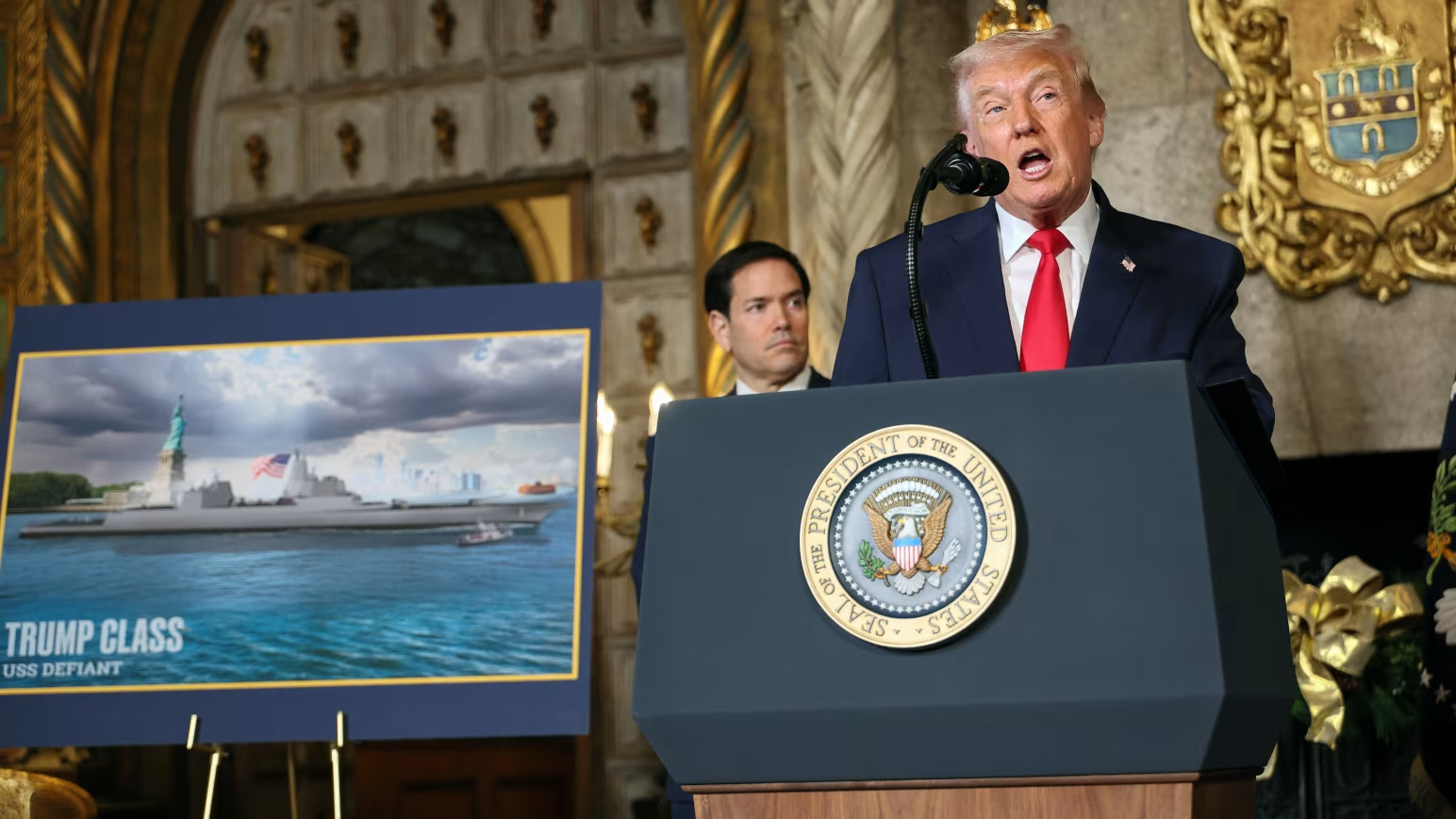
U.S. President Donald Trump makes an announcement about the Navy's "Golden Fleet," as Secretary of State Marco Rubio listens, at Mar-a-lago in Palm Beach, Florida, on December 22, 2025. (Reuters photo by Jessica Koscielniak).
Letters from an American, Historical Commentary: December 22, 2025 [Fading Trump Focusings On Legacy?], Heather Cox Richardson, right, Dec. 23, 2025. This afternoon, President Donald J. Trump announced that the U.S. Navy will build two new “Trump-class” battleships.
As Lara Seligman and Marcus Weisgerber of the Wall Street Journal note, Trump has complained for years that America’s warships are “terrible-looking,” and has been involved in the design of the new “Golden Fleet.” A former rear admiral who is director at the Foundation for the Defense of Democracies told Seligman and Weisgerber that the Golden Fleet is “exactly what we don’t need.” The last battleship in history to be built was the HMS Vanguard, completed in 1946; the last battleship commissioned by the U.S. was the USS Missouri, which was decommissioned in the 1990s. The proposed ships are, he said, “focused on the president’s visual that a battleship is a cool-looking ship.”
In an illustration of the new battleship provided by the White House, the vessel sports an image of Trump on its upper deck.
Trump seems to be focusing on creating a golden legacy for himself as the MAGA movement falters.
At a news conference today from Mar-a-Lago announcing the new Trump-class ships, Trump expressed concern that Americans were still talking about the Epstein files. “A lot of people are very angry that pictures are being released of other people that really had nothing to do with Epstein. But they’re in a picture with him because he was at a party, and you ruined a reputation of somebody,” Trump said. “A lot of people are very angry that this continues. A lot of Republicans,” he added.
The Epstein Files Transparency Act required the Justice Department to release all the files by Friday, but it has released only about 10,000 of what are apparently hundreds of thousands of documents, and those are heavily redacted. Department leaders are quite obviously covering up material, suggesting that what remains unknown is so hideous that Trump and his loyalists have concluded it’s better to break the law Congress passed to provide transparency, thus infuriating the MAGA base that voted for Trump because he lied that he would release the files, than to let anyone know what they’re hiding.
Former president Bill Clinton issued a statement today demanding that the Department of Justice follow the law and “produce the full and complete record the public demands and deserves.” The material the department has released implies that a major perpetrator of abuse in the files is Clinton. Today he noted that the department’s actions make it clear that “someone or something is being protected.” Clinton says he needs “no such protection” and calls “on President Trump to direct Attorney General Bondi to immediately release any remaining materials referring to, mentioning, or containing a photograph of Bill Clinton.”
In other words, as USA Today opinion columnist Michael J. Stern put it: “Bill Clinton just called Trump & Pam Bondi’s bluff.”
MAGA leaders are now openly fighting over its future. At this weekend’s Turning Point USA AmericaFest, Erika Kirk, the widow of the late Charlie Kirk, announced her support for Vice President J.D. Vance for president in 2028, although Trump has been handing out Trump 2028 hats. As recently as last week, Brian Schwartz of the Wall Street Journal reported that Trump has been talking with lawyer Alan Dershowitz about ways in which he could constitutionally serve a third term. (He cannot.)
As Andrew Howard of Politico reported, the conference featured infighting in which prominent podcaster Ben Shapiro called out right-wing influencers Candace Owens, Tucker Carlson, Megyn Kelly, and Steve Bannon, who have lately moved even further toward the Nazi far right as “frauds and grifters.” Meanwhile, prominent employees are leaving the Heritage Foundation after its right-wing leader, Kevin Roberts, defended Carlson’s friendly interview with far-right Groyper leader Nick Fuentes. Many of those leaving Heritage are moving to former vice president Mike Pence’s Advancing American Freedom foundation, established in 2021 after Trump supporters called for Pence’s hanging. Pence’s shop rejects the trade walls, isolationism, and strongman rule of Trumpism.
That split is showing elsewhere. Ewan Palmer of The Daily Beast reported today that Texas senator and podcaster Ted Cruz is bad-mouthing Vance as he considers a 2028 presidential run, and notably, the state senators in Pence’s home state of Indiana recently rejected Trump’s demands that they redistrict the state in Trump’s favor.
And there is strong pushback to what appears to be last night’s attempt to censor the press.
On Sunday the new editor-in-chief of CBS News, Bari Weiss, pulled a 60 Minutes story about the Trump administration’s renditions of migrants to the notorious CECOT terrorist prison in El Salvador just hours before it was scheduled to air. The 60 Minutes story had undergone the normal process of vetting, fact-checking, and legal reviews. In an email to the newsroom, Weiss said she pulled the story, which focused on the torture the prisoners endured, because it did not present the administration’s justification for sending 252 migrants to CECOT.
Weiss took over the top editorship of CBS News in October after Paramount Skydance, owned by Trump loyalist David Ellison, bought her opinion website Free Press for $150 million. Ellison’s Paramount Skydance is currently in the midst of attempting a hostile takeover of Warner Bros. Discovery, which owns CNN. Yesterday, billionaire Larry Ellison, David Ellison’s father, personally guaranteed that he would stand behind more than $40 billion in financing required for the deal.
The 60 Minutes correspondent who reported the story, Sharyn Alfonsi, wrote in an email to her colleagues: “Our story was screened five times and cleared by both CBS attorneys and Standards and Practices. It is factually correct. In my view, pulling it now—after every rigorous internal check has been met is not an editorial decision, it is a political one.”
Alfonsi also noted that the journalists had repeatedly asked for interviews with administration officials, who did not answer. “Government silence is a statement,” she wrote, “not a VETO. Their refusal to be interviewed is a tactical maneuver designed to kill the story. If the administration’s refusal to participate becomes a valid reason to spike a story, we have effectively handed them a ‘kill switch’ for any reporting they find inconvenient.”
But it turned out that the segment had already been distributed in Canada, and copies of it appeared in the U.S. this afternoon. Legal analyst Asha Rangappa watched it and explained that it “debunks the fundamental claim used by [the] Trump admin[istration] that the detainees it sent there are ‘terrorists’ and corroborates torture using clips from El Salvadorean influencers Bukele uses internally. Would be a shock to low information voters, probably.” Journalist Parker Molloy, who covers the media and culture, observed: “People are going to get to see a totally normal news piece that clearly isn’t biased against Trump and think, ‘She was afraid that THIS would upset the administration??’”
Allison Gill of Mueller, She Wrote commented: “Had Bari Weiss just ran the story, it would have been seen by a couple million people tops. The bootleg has now gone viral, and may end up being the most-watched 60 Minutes segment ever.”
In a new YouGov poll conducted for The Economist, fewer than half of Republicans say they “strongly approve” of Trump, and only a third of Republicans approve strongly of his handling of inflation and prices.
All of this adds up to a president who thinks a lot about gold and his legacy. On Friday, Josh Marshall of Talking Points Memo observed that, these days, the political world around Trump “has a feeling of drift, spectacle and fragmentation. Trump’s ballroom epitomizes it—crass, stupid, vulgar, unacceptable and yet ultimately meaningless. It’s the full-size version of having his stacked Kennedy Center board, of which he is the chairman, rename the institution after him…. These all have the feeling of a man who is bored, tapped out, losing coherence and energy and who others are trying to keep distracted.”
Toria Sheffield of People magazine reports that at this weekend’s Turning Point USA AmericaFest, Fox News Channel host Jesse Watters told the audience that the ballroom President Donald J. Trump wants to build next to the White House is “four times the size of the White House.” According to Watters, Trump told him: “Jesse, it’s a monument. I’m building a monument to myself because no one else will.”
The Contrarian, Opinion: Lessons from 2025, Jennifer Rubin, right, Dec. 23, 2025. What will guide us going forward?
We can draw important lessons from looking back on 2025 and reviewing the assault of our democracy and the debasement of American society as we knew it—as well as the victories for democracy, decency, and inclusion. There is plenty to digest as we steel ourselves for another year.
First, most politicians do not lead. They follow. We began Donald Trump’s second term with a chorus of credulous Democrats insisting they could find “common ground” with Donald Trump and Republicans. Senate Democrats caved in March on the continuing resolution. A rump group did it again in November. Too often, Democratic leaders still cannot help themselves in excusing Trump. They too frequently shy away from issues they imagine that they cannot win. What moves them to do their job, as we saw repeatedly, was fulsome, angry, and mass public opposition.
Second, Republicans care not one bit about their own constituents. Pointing out that slashing Medicaid and SNAP, zapping Affordable Care Act subsidies, messing with vaccine guidelines, and enacting cost-raising tariffs disproportionately hurt red states, especially rural residents, falls on deaf MAGA ears. They, apparently, do not care. They wish away reality to double down on radical policies, conspiracies, and downright lies to avoid Trump’s wrath and the prospect of a primary challenge. They hide from scrutiny inside the right-wing propaganda bubble. Democrats can appeal to voters on these issues; but this gang of Republicans appear prepared to lose before crossing Trump or adjusting their policies to help their own people.
Third, the Supreme Court is beyond public shaming. No matter how transparent the “Calvinball” jurisprudence, how egregious the misuse of the shadow docket, and how outraged the lower courts may be, the six justices on the MAGA majority simply keep doubling down on partisan hackery. They seem entirely indifferent to criticism from scholars and the general public. Their rulings and oral arguments shrug off consistent, serious legal analysis in favor of ideological diktats. They remain defiant, cushioned by the security of lifetime jobs, utterly cut off from the real lives of Americans. We can address their partisan hackery and assault on our constitutional system through comprehensive reform—including a mandatory ethics regimen, term limits, jurisdictional limits (they can keep original jurisdiction plus, say, maritime cases), and court expansion.
Fourth, winning requires moving public opinion to further the cause of democracy. The right-wing has understood that many battles are generational (e.g. control of the courts), and that losing battles or blips in criticism in the short-term (e.g. nixing immigration reform under President Biden) nevertheless can increase their chances of gaining power and/or undermining the other party. Democrats must take the same stance (i.e. the fight is the point), whether it is a fight to preserve ACA subsidies, filing suits to challenge lawlessness, breaking quorum in Texas and fighting the re-redistricting fight, or opposing deployment of ICE, CPB, and the national guard. Such efforts may not change the outcomes immediately, but they collectively fuel the campaign against autocracy. Americans gravitate to those who fight on their behalf.
Fifth, “electability” is a pundit-created myth. Neither elite pundits, donors, nor political operatives really know who is electable. On paper, few in those categories thought Donald Trump, Zohran Mamdani, or Rep. Alexandria Ocasio-Cortez (D-N.Y.) were “electable.” The candidates proved otherwise. By the same token, “safe” candidates, especially lifelong professional politicians, lose when they prove unable to galvanize voters (e.g., Terry McAuliffe in 2021 Virginia governor’s race, Sen. Bob Casey, Jr. in 2024). A disciplined, articulate politician who can authentically connect with people on issues they care about deeply will get elected. The voters decide electability.
Sixth, religious appeals do not work with White Christian nationalists. As we have discussed many times, White Christian nationalists generally do not seem interested in good works, helping the most vulnerable, or personal character. This is a movement seeking power, not redemption. Its adherents are motivated to remake America into a white, Christian dominated nation. Lacking the votes to bring their goals about through democracy, they are all too willing to suppress voting and rely on other anti-democratic measures. Blowing up people on the high seas, separating children from parents, brutalizing Hispanics, and taking away SNAP benefits are features, not bugs for people lacking empathy who seek racial and religious dominance.
Seventh, moderate Republicans are nonexistent. The myth of moderate Republicans willing to make deals on a bipartisan basis dies hard. But when the Senate Republicans near-unanimously rubber stamps the most extreme, unqualified nominees; Republicans in both houses pass the big, ugly big slashing Medicaid and SNAP to partially pay for tax cuts for the rich; do not demand that RFK, Jr. or Pete Hegseth resign; and instead overwhelmingly condone an abusive, chaotic immigrant scheme, it is time to stop applying the label “moderates” to the likes of Sen. Susan Collins (R-Maine), Sen. Lisa Murkowski (R-Alaska), Rep. Mike Lawler (R-N.Y.), Rep. Rob Bresnahan (R-Pa.), and others who enable their MAGA colleagues’ agenda.
Eighth, no lie is too ridiculous for MAGA cultists to reject. Nothing Trump says (e.g., denying the affordability crisis, claiming he inherited the worst inflation in history, blaming windmills for killing whales) is so absurd as to trigger guffaws—let alone objections—from MAGA Republicans in the base, Congress, or the right-wing media. Like any cult, MAGA is a closed circuit without room to question the leader’s infallibility. The right-wing media bubble certainly helps to insulate MAGA voters from reality, but it is human nature to stick with a fraudster or con man rather than admit you’ve been duped. Educating those Americans outside of the cult is possible; reaching those inside is a waste of time.
Ninth, Americans may have voted for Trump, but they overwhelmingly reject what he is doing. As obvious as it may have been to many of us that Trump was unhinged and intent on doing exactly what he said (deporting millions of people, enacting an international trade war, selling out our allies, aspiring to become a dictator), with each passing week more Americans are rejecting him and his agenda. That development should inspire confidence that Americans are not irretrievably hooked on a racist, pro-totalitarian, and pro-oligarchy agenda. We can still achieve a pro-democracy electoral majority.
Tenth, the public is the key to saving democracy. The courts matter. Opposition politicians matter. Reality (e.g., rising prices) matter. But ultimately, we have learned that only when millions of Americans get engaged, turn out to protest and vote, and take ownership of our democracy can we collectively defeat autocracy. Speaker emerita Nancy Pelosi’s favorite Lincoln quote—“Public sentiment is everything. With public sentiment, nothing can fail; without it, nothing can succeed”—has never been more apt.
What does this all add up to? Pro-democracy forces will not shame or argue MAGA Republicans into capitulation or retreat. With a helping hand from diligent lower courts, an organized electorate can end the authoritarian nightmare. Everything rests on the midterms. New leaders will emerge along the way, but only ordinary Americans who dedicate themselves to exposing the evils, unpopularity and failures of the MAGA movement can achieve a decisive victory next November.
The Contrarian is reader-supported. Thank you! To enable our work, help with litigation efforts, and keep this dedication to democracy engaged through 2026 and beyond, please join our community as a free or paid subscriber.
 Lance's Substack, Political Opinioon: So, He Wants “Trump Class” Battleships Now? Lance Rosen, right, Dec. 23, 2025. Just Give Him One...To Play With In His Bathtub.

Trump’s proposal for a new “Golden Class” of battleship named after himself is a nauseating, bizarre, a narcissist’s wet dream, an obscene vanity project by a psychotic egotist who is on a manic binge to put his name on literally everything, like a graffiti artist strung out on Meth equipped with a lifetime supply of spray paint. One might expect him any day to try and change the name of our entire world, from Earth to “Planet Trump.”
But that’s not the worst part.
As Professor HCR [Heather Cox Richardson], left, wrote in today's letter, we don’t build battleships anymore, and have not for many decades. She did not elaborate on why, but they are more or less obsolete for modern warfare in the nuclear age.
Our nuclear deterrent is our triad, air, land, and sea-based nuclear missiles of varying ranges and types. The sea part of our strategic forces are primarily submarines, but we also deploy carriers and guided missile carrying destroyers. Battleships are vulnerable to attack, costly to operate, and strategically not suitable in a strategic conflict with a nuclear power.
So, why does he want to build them?
 It’s what I wrote about the week before last. Trump’s abandonment of NATO and plans for strategic withdrawal into our own hemisphere are his priority. Under his new national security doctrine the intent is to lay claim to the raw materials, energy, food supplies, water resources, rare earth minerals, and labor forces of the nations of our hemisphere, which will also include annexation of Greenland and plans for retaking control of the Panama Canal.Trump Administration New National Security Strategy (NSS 2025)Lance F Rosen · Dec 6
Most of my readers are avid followers of Professor Heather Cox Richardson, as am I and my wife Martha. Today’s letter is a bell ringer which needs to be both read in its entirety and internalized. What was surprising in a good way was her calling out of the Trump regime’s latest policy atrocity as “Nazi,” with the quip that they should have assigned the…
Which means he needs three things. The means to seize or control hemispheric shipping lanes and deepwater ports. More conventional hi-tech firepower and presence for intimidation purposes to disrupt the trade by Latin America with China in our hemisphere in particular, as well as other nations Trump targets. The ability to topple governments through the use of blockades to shut down all commerce of nations who don’t cooperate. Therefore he wants a naval shipbuilding program as his “muscle” to enforce a sort of mafia-style protection racket against our neighboring soon-to-be former partners and allied nations.
Tariffs are a weapon of trade war. Financial looting, a trade embargo of goods such as pharmaceuticals and a credit cutoff are forms of economic warfare. According to international law, any naval action to blockade coastal nations dependent on maritime commerce is, in fact, technically a military act of war. Such as what the US is illegally doing to interdict Venezuela’s oil tankers right now.
That’s why he wants battleships, because their plan for massive escalated looting under their new security doctrine requires an imperial Navy.
They want something akin to that of the 18th and 19th Century British Empire model, which you might remember we successfully fought our revolution against.
 The British looted and starved their colonies, causing mass famine in India and Ireland. They worked millions of people worldwide in slave labor, in the Caribbean, and their African mines, causing mass death and hardship, and they imposed systemic racial separation and discrimination. They built infrastructure such as rail and roads only to facilitate the extraction of wealth, from the mines to the ports, not to enhance quality of life or raise living standards. To this day, there is no Trans-African rail line, they are all along the coastline and very few that are cross-border. That is the legacy of colonialism which is still blocking African development.
In the 19th century, they diverted Indian agriculture to grow cash crops for the Empire, especially Cotton and Poppy. That was a significant factor in why famine killed so many millions of Indians under British rule, because under their system of “free trade,” cash crop substitution and forced food exports left them vulnerable to drought, or blights, as it did in Ireland.
The cheap Indian Cotton went to British mills in Manchester, and the use of looms and spinning wheels to manufacture cloth was banned in India, so they had to buy much of their finished textiles directly from England. This is why the symbol of the Gandhi’s independence movement was the spinning wheel, for example, and why he made his own clothes as an act of civil disobedience.
The British refined the Poppy into Opium in Northern India, and their East India Company fleet proceeded to force the Opium trade on China, which soon became the biggest net source of revenue for the Empire.
China responded by fighting two wars in the 19th century against Great Britain to kick the Opium traders out, both because of the harm it did to their population, and the larger threat of being subjugated by them. That is why they were so adamant on getting Hong Kong back, because it was where the British monarchy system located their banks and businesses to facilitate the Opium trade. It was a combination of China’s desire for repatriation of people and wealth, but also the symbolism of it. The Opium Wars were also the origin of China’s historic distrust of the west’s “white devils.”
Britain’s control of African raw materials, minerals, precious metals, their control of Indian cotton, Opium, food, and labor, were dependent on maintaining naval superiority. This is why they were preoccupied with geopolitical control of the world’s naval choke points in South Africa, the Straits of Gibraltar and Malacca, and later the Suez Canal as Middle East petroleum became the key to energy.
It is also a major reason why they later instigated World War I in Europe, in part to disrupt Germany’s plan to build a Berlin to Baghdad railway, because overland shipping by rail is faster and cheaper than by sea. Continental Europe, and Russia with its Trans-Siberian line, would have eventually surpassed the British economic footprint in Eurasia and the east. As long as the only overland access to the British “milk cow” India was through the mountainous Khyber Pass, Britain’s control of maritime shipping routes maintained their monopoly on trade with the far east.
There was an old saying, “The sun never sets on the British Empire.” An old friend of ours named Dr. Fred Wills, once the UN Ambassador for Guyana, used to say the reason was that “God doesn’t trust them in the dark.”
That was the evil system Americans repudiated and threw off nearly 250 years ago, and that which Donald Trump’s controllers wish to restore today.
People will make light of this latest news dump of Trumpian idiocy in trying to name everything after himself, and want to keep making jokes about it. Like the ballroom, the Kennedy Center, the Institute For Peace, the new DC Football stadium, etc. But, this one isn’t funny at all.
 He is out to destroy the United States by making us into a tyrannical, belligerent, imperial regime, modeled on the worst empire systems in world history.
Trump’s fever dream of restoring white supremacy is not just a domestic program for the US. It is for the entire western hemisphere. Say goodbye to FDR’s “Good Neighbor” policy and JFK’s “Alliance For Progress” with Latin America. This is intended to inaugurate a “Super-NAFTA” system for every nation within our Navy’s reach, to be imposed at gunpoint.
They are a fascist cult, driven by greed, racism, and a thirst for blood. That’s why he wants “golden battleships” branded with his cursed name. He wants to become “Trump The Conqueror.”
Will it happen? Congress is going to have to obstruct the funding. It’s that simple. Trump will try to do it by reallocating funds already budgeted for other things, and Congress will have to fight it by any means necessary. This might even be the moment where some Governors have to go with the nuclear option of withholding all federal taxes owed by the states in order to disrupt them.
If the Democrats retake the majority before the midterms, due to GOP retirements and resignations, as appears to be possible, then we will be in a position to obstruct them. Such moves by the administration will likely be litigated and eventually go to the SCOTUS for a decision.
But the Democrats cannot let him have this. They can’t say, “our hands are tied, we have no leverage, we don’t have the numbers.” They have kids too, and grandchildren. Do they want them drafted and deployed to slaughter people in Brazil in order to loot and strip the Amazon rainforest? Or to seize Ecuador’s Lithium for our EVs? Or being sent into Mexico for combat with the heavily armed cartels when drugs are just the pretext for occupying their industrial/breadbasket northern border region? That’s what this means, it isn’t just Trump’s latest game of “Show And Tell.”
I have little doubt that the naming part of this is just Trump’s personal obsession and that most of the people around him think it is whacked, except for maybe Mr. Suck-up Hegseth, and a few other of the utopian fascist nutcases around him. But the policy behind it will outlive Trump if we let it.
People can’t afford healthcare and this monstrous fool wants battleships? In a sane world this idea would be DOA.
It means the impending self-immolation of the GOP if they continue deferring to his madness, so I think there might be more dissent in his own house over it and that there will be a fight.
The bottom line though is that he thinks there are no checks on his power on matters of national security. That he doesn’t have to listen to the courts or Congress because he is Commander-in-Chief, and can do anything he wants. This is the larger danger overall, that of his abrogating unchecked power by defining every single issue related to government as a national security emergency.
Moving foward, we should seize upon our new openings. Trump, Patel, and Bondi especially, have really screwed themselves with their attempts to distort, redact, and bury the Epstein files. Likewise, their blatant moves to censor the press and turn our TV networks into a version of Russian state television with this latest CBS BS, are also blowing up in their faces.
And Trump’s own Vice-President just accepted in-person the endorsement as Presidential “successor” from Turning Point USA, presented by Erika Kirk, when Trump never said he isn’t running again. In a way it’s an acknowledgment that he probably won’t live that long in any event, but still, Vance has tipped his hand, he is antsy and wants the Oval Office sooner, a clear sign that a part of MAGA is splitting off and dumping Trump. Everyone who watched Vance’s and the others speeches got that message loud and clear.
I think we have them on the defensive for the first time, but we haven’t won anything yet. The dynamic has changed in our direction, but we cannot take our foot off the gas.
We will all try to enjoy a quick break for the holidays, but I encourage folks to not tune out altogether, and to make plans to escalate after New Years. Things are really going to get hairy then.
More On Epstein-Maxwelll-Trump Files
The Parnas Perspective, Political Commentary, Major Epstein Update: Bombshell Files Released Overnight and Many Mentions of Trump, Aaron Parnas, Dec. 23, 2025. The Justice Department released thousands of documents while you were asleep. I have reviewed many of them.
Overnight, the Justice Department released a significant new tranche of Jeffrey Epstein–related documents. I have spent several hours reviewing them—yes, already on my second cup of coffee—and there are developments that warrant immediate attention.
Minutes after the documents were released, the Justice Department issued a statement flagging that the dump contains several “sensational” references to Donald Trump. That caveat was notable not only for what it said, but for what it did not: no comparable disclaimer was issued regarding Bill Clinton or any other uncharged third party mentioned in the materials. Even more striking was the Department’s defensive framing—suggesting that if allegations involving Trump had any credibility, they would already have been “weaponized” against him. That logic is difficult to reconcile with basic prosecutorial principles: if allegations are credible, pursuing them is not weaponization by definition. The statement raises more questions than it answers.
Document One: Internal Shock Inside SDNY
The first document that stood out is EFTA00028716, an internal email from the U.S. Attorney’s Office for the Southern District of New York, written just shortly before Maxwell’s indictment.
What makes this document remarkable is its tone. The Assistant U.S. Attorney handling the case appears genuinely surprised by how frequently Donald Trump flew on Epstein’s plane between 1993 and 1996—sometimes accompanied by women who may later have become witnesses in the Epstein or Ghislaine Maxwell cases.
This is not a tabloid allegation; it is an internal prosecutorial communication expressing concern in real time.Document Two: A Disturbing, Postmarked Letter to Larry Nassar
The second document, EFTA00035768, is among the most unsettling in the release. It is a letter Jeffrey Epstein attempted to send to Larry Nassar in August 2019, days after Epstein was found dead in his jail cell.
The letter—postmarked August 13, 2019, and ultimately returned to sender—includes grotesque language, references to shared predatory behavior, and an explicit claim that “our president also shares our love of young, nubile girls.” Epstein also wrote that he had taken the “short route” home, language that appears to suggest foreknowledge of his own death.
Epstein was officially found dead on August 10, 2019, while awaiting trial on federal sex-trafficking charges.
For context, Nassar was arrested in 2016 and ultimately sentenced to decades in prison for sexually assaulting at least 265 girls and young women under the guise of medical treatment while serving as a gymnastics doctor.Document Three: The “No Co-Conspirators” Claim Falls Apart
The third key document provides, for the first time, written confirmation that the Justice Department was investigating ten additional co-conspirators connected to Epstein and Maxwell. The internal email discusses plans to issue subpoenas to these individuals.
This directly contradicts sworn statements and public representations made earlier this year by Attorney General Pam Bondi and FBI Director Kash Patel, both of whom asserted—whether in memos or before Congress—that no other chargeable co-conspirators existed.
Those two positions cannot both be true.
The timing, content, and tone of this letter alone merit serious scrutiny.Document Four: A Photo on Steve Bannon’s Phone
Another newly released record shows that investigators examining Steve Bannon’s role in the “We Build the Wall” scheme discovered a photo of Donald Trump and Ghislaine Maxwell on Bannon’s phone in June 2021. While the photo itself does not establish wrongdoing, its presence in the context of an unrelated criminal investigation underscores how interconnected these figures remain years after Epstein’s death.
A Flood of FBI Tips — and the Need for Caution
You will also see numerous FBI tip summaries in this document dump. Many were submitted by anonymous third parties and reference Trump and other powerful individuals. At this stage, we do not know who made these tips or whether the allegations are supported by evidence.
It is important to be clear: anyone can submit a tip, and the FBI is required to log it. Sensational claims will spread quickly today for that reason alone. I am actively working to determine whether any of these tips can be corroborated. If and when evidence emerges, I will share it. Until then, caution is essential.
This release does not offer neat conclusions—but it does expose inconsistencies, internal concerns, and statements that conflict with official narratives presented to the public and to Congress. That alone makes this document dump significant.
Morning Shots via The Bulwark, Political Opinion: Justice . . . and Schadenfreude, William Kristol, right, Dec. 23, 2025. Yesterday, at Mar-a-Lago, in response to a question about the release of the Epstein files, Donald Trump showed annoyance. “I thought this was finished,” he complained. “A lot of people are very angry that this continues.”
And, he elaborated, he was particularly upset about the innocent people who are being hurt. “You probably have pictures being exposed of other people that innocently met Jeffrey Epstein years ago—many years ago. And they’re highly respected bankers and lawyers and others.” These people, Trump made clear, are allegedly innocent friends of Epstein, bankers and lawyers and the like, whose reputations could be tarnished by documents being released. Not to mention Trump himself, who appears many times in the latest tranche of documents: on Epstein’s plane and at parties each man hosted.
I was pleased to see Trump unhappy. Was that wrong of me? In this Christmas season of peace on earth and good will to all men, should one resist being cheered up by the discomfort of another—even if that other is one Donald J. Trump?
Nah. Here’s why.
Trump went out of his way yesterday to express concern for supposedly innocent big shots who might take a reputational hit from being mentioned in the Epstein files. But Trump expressed not a word of sympathy for Epstein’s victims. Not a word. In fact, through this whole process, has Trump ever shown any concern or empathy for Epstein’s victims, for what they endured and how they have subsequently been treated by the government? Trump can’t bring himself to pretend, even for a minute, to empathize with those who were victimized by this monster, who was his good friend.
So I make no apologies for taking some pleasure in Trump’s discomfort. It’s not enough, God knows, to balance the scales of justice, but it’s a start.
It also suggests that Trump knows his coverup is not going well.
That’s partly because it’s being carried out in such a shambolic way.
Yesterday afternoon, for example, a tranche of the Epstein files were briefly posted on the Justice Department’s website. They were at a link that was not immediately visible, but sleuths were able to find it. The URL corresponded to the next set of documents to be released. Then they all disappeared without explanation.
So documents are appearing (sort of) and then disappearing. Not exactly a confidence-inspiring process.
But beyond that, yesterday’s ghostly documents were a useful reminder of an important fact: Just how much has not been released. As Politico explains:
After Epstein’s August, 2019 death, prosecutors produced a seven-page memo on co-conspirators they might consider charging and followed that with an 86-page update in December, according to the files. They also produced a 13-page memo of corporate prosecutions they might pursue and a 26-page memo regarding another target prosecutors considered pursuing. Only references to the memos—not the documents themselves—appeared in the tranche temporarily published Monday.
So these references in yesterday’s documents are yet another indication of just how much is being held back. And this is to say nothing of the fact that we know of many other documents we also haven’t seen, such as the 60-count draft indictment of Epstein from 2008 and a raft of victim statements that the victims want made public.
A cover-up that highlights how much important material is still being covered up isn’t an effective coverup at all. Which is a good thing. And if that’s making Trump unhappy? I kind of think that’s a good thing, too.
U.S. Governance, Politics

New York Times, Trump Administration Orders Nearly 30 U.S. Ambassadors to Leave Their Posts, Edward Wong, Dec. 23, 2025 (print ed.). A union representing career diplomats said such a mass recall had never happened in the history of the U.S. Foreign Service.
The Trump administration has ordered nearly 30 ambassadors in embassies around the world to return to the United States within weeks, a move that would leave a large gap in the American diplomatic corps even as President Trump has said he wants to resolve conflicts through diplomacy.
Many of the ambassadors were told in recent days to leave their posts by mid-January. They are all foreign service officers who had been appointed to their positions by the Biden administration and confirmed by the Senate. A standard tour is three to four years.
The union representing career diplomats said this was the first time that such a mass recall had taken place of career diplomats serving as ambassadors or chiefs of mission.
“Those affected report being notified abruptly, typically by phone, with no explanation provided,” said Nikki Gamer, a spokeswoman for the union that represents career diplomats, the American Foreign Service Association. “That method is highly irregular.”
“The lack of transparency and process breaks sharply with longstanding norms,” she added.
Ms. Gamer said that after checking its archives, the union “can say definitively that such a mass recall has never happened since the founding of the Foreign Service as we know it.”
Candidates for ambassador are nominated by the president and confirmed by the Senate. There are two types of ambassadors: career diplomats and political appointees. The latter are often donors or friends of the president, and they are expected to offer their resignations at the start of a new administration. That was the case when Mr. Trump took office in January, and he immediately accepted the resignations.
However, that is not the norm for career diplomats, who often serve for years into a new administration. The Trump administration did not give a reason for the recalls and has not publicly announced them.
“This is a standard process in any administration,” the State Department said in a statement, when asked about the recalls. “An ambassador is a personal representative of the president, and it is the president’s right to ensure that he has individuals in these countries who advance the America First agenda.”
Ms. Gamer said that the union did not have an exact count of the number of ambassadors to be recalled, and that it was trying to piece together the full picture. Politico reported on the recalls on Friday.An unofficial list circulated among diplomats on Monday. It showed ambassadors being recalled from every part of the world, with about a dozen being told to leave posts in sub-Saharan Africa. Several diplomats said the list was fairly accurate.
Candidates for ambassador are nominated by the president and confirmed by the Senate. There are two types of ambassadors: career diplomats and political appointees. The latter are often donors or friends of the president, and they are expected to offer their resignations at the start of a new administration. That was the case when Mr. Trump took office in January, and he immediately accepted the resignations.
However, that is not the norm for career diplomats, who often serve for years into a new administration. The Trump administration did not give a reason for the recalls and has not publicly announced them.
“This is a standard process in any administration,” the State Department said in a statement, when asked about the recalls. “An ambassador is a personal representative of the president, and it is the president’s right to ensure that he has individuals in these countries who advance the America First agenda.”
Ms. Gamer said that the union did not have an exact count of the number of ambassadors to be recalled, and that it was trying to piece together the full picture. Politico reported on the recalls on Friday.
An unofficial list circulated among diplomats on Monday. It showed ambassadors being recalled from every part of the world, with about a dozen being told to leave posts in sub-Saharan Africa. Several diplomats said the list was fairly accurate.
Morning Shots via The Bulwark, Political Opinion: MAGA Is Becoming a Leaderless Cult, Andrew Egger, right, Dec. 23, 2025. In recent weeks, right-wing infotainers have spent more and more of their time fighting over an existential question: Are neo-Nazis and hardcore antisemitic conspiracy theorists welcome in the MAGA movement? This weekend, Vice President JD Vance weighed in twice on the matter—once in each direction.
On Sunday, Vance spoke at Turning Point USA’s annual conference, AmericaFest, where he scolded attendees to set aside what divides them to focus on fighting the left. “When I say that I’m going to fight alongside of you, I mean all of you. Each and every one,” he told the crowd. “President Trump did not build the greatest coalition in politics by running his supporters through endless self-defeating purity tests.”¹
And yet there remain some purity tests Vance seems at least half-heartedly willing to enforce. In an interview with UnHerd released yesterday, Vance finally took aim at one of the leading lights of the right’s burgeoning neo-Nazi faction. “Anyone who attacks my wife, whether their name is Jen Psaki or Nick Fuentes, can eat shit. That’s my official policy as vice president of the United States. . . . Antisemitism and all forms of ethnic hatred have no place in the conservative movement.”
There’s a lot to unpack in Vance’s position, which seems facially unsustainable and self-defeating.² If there’s no place on the right for neo-Nazis, but the neo-Nazis are unwilling to self-deport from the coalition, then the only way to get them out is for the rest of the coalition to enforce a no-Nazis standard—exactly the sort of “self-defeating purity test” Vance loves to denounce. (It’s also worth noting that Vance isn’t exactly walking the walk here: The White House still employs Paul Ingrassia, a raging bigot with a self-described “Nazi streak.”)
But the most salient fact about Vance’s stance isn’t that it’s nonsensical. It’s that nobody he’s talking to is paying it much attention. As our colleague Will Sommer reports, other MAGA personalities spent their stage time at AmericaFest escalating the fight rather than making nice. Ben Shapiro fiercely denounced the right’s open antisemites and looniest conspiracy cranks, from Nick Fuentes and Tucker Carlson to Candace Owens and Megyn Kelly. And the woolier faction punched back: Shapiro is “like a cancer” on the movement,” Steve Bannon told the AmericaFest crowd, “and that cancer spreads.”
It doesn’t matter how many times Vance and Co. issue mealy-mouthed calls for “unity” against the left. The differences they’re trying to paper over are foundational and ever-present. How are right-wing Jews supposed to share a coalition with people who feel that every political problem can ultimately be traced back to Jewish treachery?
There’s one more striking thing to note here. While the various combatants in this MAGA civil war seem happy to ignore JD Vance’s exhortations, there’s someone else who you could imagine them paying a bit more attention to. But Donald Trump has shown himself completely incurious about the fight for the soul of the movement he built.
Last month, Trump was asked to weigh in after Carlson’s softball interview of Fuentes—one of the sparks that helped ignite the current flame. But Trump, as usual, seemed incapable of approaching the question except through the usual lens of his own vanity: “Well, I found him to be good,” Trump said of Carlson. “I mean, he said good things about me over the years. . . . I did an interview with him, we were at 300 million hits.”
The president’s monomania has helped give him unprecedented control over the present state of his party. Over the last decade, it gradually dawned on Republicans that there were no circumstances in which Trump would tolerate dissent, precisely because there was no standard for Republican policy or practice he cared about beyond “are they with Trump or not?” Quickly or gradually, they all either left or fell in line.
But that monomania is a double-edged sword. The exact traits that have given Trump such historic control over the movement’s present are also now leaving Trump superfluous to the movement’s future. He can’t weigh in on questions about what comes after him because it’s not clear he’s even capable of grasping the concept of an “after.” “MAGA was my idea,” Trump said last month. “MAGA was nobody else’s idea.” And what it may turn into later doesn’t seem to be any of his concern.
AROUND THE BULWARK
Quick Hits
IT’S THE ‘CLUTTER,’ HONEST: Donald Trump has been citing “national security” as a pretext for doing whatever he already wanted to do since early in his first term. But yesterday, we got perhaps the most egregious example yet of this excuse. The White House announced it would immediately halt all leases for off-shore wind projects, claiming that such installations created unacceptable radar “clutter.”
The announcement comes just weeks after a federal judge threw out a Trump executive memo from January ordering a halt to all leasing for wind projects—the same order, in other words, minus the tacked-on national-security fig leaf. We’re sure that’s just a coincidence.
Trump has long fumed against wind power for reasons that have nothing to do with national security. They even predate his term as president: He spent the early 2010s locked in an ultimately fruitless court battle to prevent the construction of wind turbines near his coastside Aberdeenshire golf course in Scotland. For years, he has groused that wind power is unreliable: “Darling, I would like to watch the president on television tonight,” he’s often said at campaign rallies. “Honey, I don’t think we’ll be able to—the wind is not blowing.” Funnily enough, he didn’t mention national security issues during these tirades.
Wind-power trade groups reacted to the news with unsurprising hostility. National Ocean Industries Association President Erik Milito told Axios that the national-security ramifications of the offshore projects had already been assessed as part of a “rigorous” regulatory process, and said that “every project under construction has already undergone review by the Department of Defense with no objections.” But the transparent nonsense of Trump’s national-security gambit barely matters, at least in the short term. The courts may catch up eventually or they may not—but in the meantime, Trump has dealt another real blow to America’s renewables industry.
THE RENAMINGS WILL CONTINUE UNTIL MORALE IMPROVES: When the White House scheduled a presidential announcement yesterday afternoon that would also feature Defense Secretary Pete Hegseth and Navy Secretary John Phelan, journalists across D.C. pricked up their ears: Was some news forthcoming about America’s rapidly intensifying hostilities toward Venezuela? No, it turned out. The announcement was for something far more important: Another thing Donald Trump realized he could slap his own name on. Specifically, a new “Trump-class” battleship for the Navy’s new “Golden Fleet.” The Wall Street Journal has more:
The new battleship will be an upgrade to the Navy’s Arleigh Burke-class destroyers, which are the workhorse of the current fleet and which Trump has compared unfavorably to rival navies, according to the U.S. official and another person familiar with the discussions. The “battleship” name harks back to the ships with large main guns used until the end of the Cold War, but the new ships will feature a next-generation design. . . .
Mark Montgomery, a former rear admiral who is senior director at the Foundation for Defense of Democracies, who is in touch with people involved in the discussions, said Trump will announce the battleship on Monday. However, he criticized the Golden Fleet plan as “exactly what we don’t need,” and noted that each new battleship will cost at least $5 billion.
“We do not need ships that are not optimized to provide lethality against the Chinese threat,” Montgomery said, adding that the new frigate has “zero tactical use” because it will not be equipped with a vertical launch system or the Aegis ballistic [missile] defense system.
To which we say: Hey, shut up, Mark! All the president wants is a little recognition for a job well done in the form of his name on a heap of $5 billion warships, and here you are nit-picking about minutiae like “will these ships actually make our military more lethal and Americans safer.” Of course they’ll make Americans safer! If Trump doesn’t care about national security, what’s he going after those wind farms for?
Global News
New York Times, Zelensky says the U.S.-backed peace plan for Ukraine is ‘quite solid,’ Constant Méheut, Dec. 23, 2025. Russia unleashed a barrage of missile and drone strikes against Ukraine early on Tuesday, hours after President Volodymyr Zelensky of Ukraine said that the latest American-backed proposals for a peace deal between Kyiv and Moscow looked “quite solid,” while hinting that obstacles remain in the talks.
“There are certain things we are not prepared to accept,” Mr. Zelensky wrote late Monday on social media about the peace proposals. “And there are things — of that I am sure — that the Russians are not prepared to accept either.”
 But the Kremlin has shown a willingness to continue the war unabated. Just hours after Mr. Zelensky’s comments, Russia started attacking Ukraine’s energy sector and civilian buildings with over 650 drones and dozens of missiles, according to Ukrainian authorities.
At least three people were killed, including a four-year-old child in the Zhytomyr region, west of Kyiv, according to the Ukrainian authorities.
Yulia Svyrydenko, Ukraine’s prime minister, said that “energy facilities in western regions of Ukraine were hit the hardest,” and the country’s energy ministry said that least three regions — Rivne, Ternopil, and Khmelnytskyi — were completely without power. Six other regions suffered power outages and power cuts were introduced across the country, the ministry said in a statement.
The assault — in the midst of negotiations aimed at ending the war — “sends an extremely clear signal about Russia’s priorities,” Mr. Zelensky said on Tuesday morning.
He later said that Ukrainian negotiators had returned from talks in the United States and delivered a detailed report about the outcome of their meetings with U.S. officials. Several “draft documents,” which include security guarantees for Ukraine, have been prepared, Mr. Zelensky wrote on social media, adding that Kyiv will continue working constructively in the process.
“Every Russian strike against Ukraine and the intense Russian assaults on the front line prove that Ukraine’s commitment to ending the war far exceeds Russia’s — and this must be addressed by stepping up global pressure on the aggressor,” he said.
Mr. Zelensky’s comments underscored a primary tension in the talks: Russia is likely to reject whatever makes a peace deal acceptable to Ukraine. Reflecting that gap, which centers primarily on questions of territorial concessions and security guarantees, a senior Kremlin official over the weekend called the latest peace proposals “rather unconstructive.”
Ukraine is seeking ironclad security guarantees that would prevent Russia from attacking again once peace is achieved. On Monday, Mr. Zelensky outlined a package discussed with the United States that would include keeping Ukraine’s army at a peacetime strength of 800,000 troops, with funding from Western partners; membership in the European Union; European military support; and bilateral security guarantees from the United States.
Mr. Zelensky said European military support would come from the so-called Coalition of the Willing, a group of about 30 countries that have committed to strengthening Ukraine’s postwar security by contributing to its defenses in the air, on land and at sea. That could include the deployment of European forces in Ukraine.
Russia has long opposed any presence of Western troops in Ukraine, portraying it as a red line in peace talks. Moscow has also sought limits on the size of the Ukrainian military. An earlier peace proposal drafted by the United States and Russia suggested capping the size of the Ukrainian Army at 600,000 troops.
Mr. Zelensky said on Monday that American officials were continuing negotiations with Russian representatives and that Kyiv would “receive feedback” on the discussions.
U.S. Economy, Inflation, Jobs, Markets
Morning Shots via The Bulwark, Political Opinion: Good Economic News, Bill Kristol, Andrew Egger and Jim Swift, Dec. 23, 2025. We got some unexpectedly great economic news this morning: Inflation-adjusted GDP grew at a 4.3 percent annualized rate in the third quarter of this year, a much stronger than expected number. (The release of the numbers, like so much economic data recently, was delayed by the government shutdown earlier this year.)
This apparent strong growth stands in odd contrast to other, murkier economic indicators we’ve gotten recently, most notably a rise in the unemployment rate. But as they teach in business school: Growing is better than shrinking! Happy Tuesday.
New York Times, U.S. Economic Growth Surged in Third Quarter of 2025, Talmon Joseph Smith, Dec. 23, 2025. Gross domestic product grew at a 4.3 percent annual rate, faster than the previous three months.
The U.S. economy grew at a vigorous pace through the end of September, despite the uncertainty created by tariffs and widespread concerns about affordability among households.
Economic growth rose at a 4.3 percent annual rate in the third quarter, the Commerce Department reported Tuesday, an acceleration from the previous quarter.
The third-quarter reading shows that, even in the face of negative consumer sentiment and a softening job market, the roughly $30 trillion economy started October on relatively solid footing as a whole, outperforming the bearish expectations of some experts only months before.
The strong growth “reflected increases in consumer spending, exports, and government spending that were partly offset by a decrease in investment,” according to the Bureau of Economic Analysis.
That the economy has remained strong is the latest indication that President Trump’s tariffs have not had the giant depressive effect that many economists had once feared. Although tariffs have undoubtedly raised the costs of some goods, consumers have continued to spend. Consumption, which constitutes roughly 70 percent of the economic pie in a typical year, rose at a 3.5 percent annualized pace in the quarter.
Lower-income families are wrestling with slowing wage growth and rising costs of various household goods, like beef, coffee and furniture. Still, even as some major corporations have announced work force reductions, the limited extent of overall layoffs is still buttressing activity. And much of consumption growth has come from spending by affluent and upper middle-class Americans, who have continued paying for travel, recreation, restaurants and other discretionary purchases.
More On U.S. Politics, Transitions
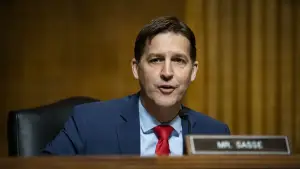
Former U.S. Sen. Ben Sasse, Republican of Nebraska (Associated Press photo by Al Drago).
New York Times, Ben Sasse Says He Has Terminal Pancreatic Cancer, Adeel Hassan, Dec. 23, 2025. Mr. Sasse, a former senator from Nebraska, wrote on social media that he had received a diagnosis last week for Stage 4 pancreatic cancer.
Ben Sasse, a Republican former senator from Nebraska and a former president of the University of Florida, announced on Tuesday that he had received a diagnosis of terminal Stage 4 pancreatic cancer.
“Since a bunch of you have started to suspect something, I’ll cut to the chase,” Mr. Sasse, 53, wrote in a long message on X. “Last week I was diagnosed with metastasized, stage-four pancreatic cancer, and am gonna die.”
Mr. Sasse, who has degrees from Harvard, St. John’s College and Yale, was a U.S. senator from Nebraska from 2015 to 2023. Mr. Sasse was appointed president of the University of Florida in November 2022.
Mr. Sasse stepped down last year as Florida’s president, citing the health of his wife, Melissa, who had an aneurysm and a series of strokes in 2007, and had just been diagnosed with epilepsy.
In the Senate, Mr. Sasse was reliably conservative but also a critic of President Trump. In February 2021, Mr. Sasse was one of only seven Republicans in the Senate who voted to convict Mr. Trump on a charge of incitement of insurrection in his second impeachment trial. Mr. Trump was acquitted by the Senate.
A year earlier, Mr. Sasse had joined almost all of the Republican senators in voting to acquit Mr. Trump during his first impeachment trial.
Dec. 22
New York Times, Investigation: Hundreds of Big Post-Election Donors Have Benefited From Trump’s Return to Office, Karen Yourish, Kenneth P. Vogel and Charlie Smart, Dec. 22, 2025. The president’s team has created a highly unusual fund-raising apparatus for causes he favors. The Times analyzed more than half a billion dollars in contributions from 346 donors. Some have received pardons, jobs, access to the president and other valuable gains.
Since President Trump was elected a second time, he and his allies have raised nearly $2 billion for his favored political causes and passion projects. That total, which was confirmed by four people involved in the fund-raising, likely eclipses the amount raised to support his 2024 campaign.
The astounding haul hints at a level of transactionalism for which it is difficult to find obvious comparisons in modern American history. The identities of the donors behind much of the cash are not legally required to be, and have not been, publicly disclosed. In some cases, Mr. Trump’s team has offered donors anonymity.
To shed light on what has been a largely opaque fund-raising apparatus, The New York Times conducted a comprehensive investigation. It relied on previously unreported documents and public campaign finance filings, as well as interviews with dozens of people who are familiar with the solicitations or are involved in the fund-raising. It traced a large portion of the funds raised — more than half a billion dollars’ worth — back to 346 donors who each gave at least $250,000. It also found that more than half of them have benefited, or are involved in an industry that has benefited, from the actions or statements of Mr. Trump, the White House or federal agencies.
It is not possible to prove that any of the donations directly led to favorable treatment from the Trump administration. And the contributions do not personally enrich Mr. Trump, unlike some of his family’s cryptocurrency ventures.
But many of the deep-pocketed individuals and corporations who have given large sums have a lot riding on the administration’s actions, raising questions about conflicts of interest.
The president’s inaugural committee raised nearly $240 million, more than double the record, which Mr. Trump himself set in 2017. The 284 donors shown here each gave at least $250,000.284 red dots are arranged into a circle on the screen.
After Mr. Trump won, the fund-raising didn’t stop for a super PAC devoted to him and run by his advisers. At least 81 donors gave $250,000 or more to MAGA Inc. It raised $200 million from Nov. 7, 2024, to June 30, 2025.81 of the dots separate from the main group and are highlighted.
According to Mr. Trump, $350 million has been raised for his White House ballroom project, which is largely being processed by the Trust for the National Mall. The Times has identified pledged or completed donations from 14 ballroom donors, which amount to about $100 million.The original group of dots re-forms and a new group of 14 dots separates and is highlighted.
The biggest donors to the White House Historical Association to support this year’s Easter Egg Roll, including the four shown here, were offered new types of branding opportunities and access to an event beforehand with Melania Trump, the first lady.The original group of dots re-forms and a new group of four dots separates and is highlighted.
The president’s team has also raised money for America250, a nonprofit group that was formed to produce celebrations for the country’s semiquincentennial birthday. Eight of the donors identified by The Times sponsored this group after the 2024 election.altText:The original group of dots re-forms and a new group of 8 dots separates and is highlighted.
Of the 346 donors identified by The Times, at least 197 have benefited, or are in industries that have benefited, from policies or actions of Mr. Trump or his administration. Those include pardons, favorable regulatory moves, the dropping of legal cases, access to the president and more.altText:The original group of dots re-forms and a new group of 197 dots separates and is highlighted.
Hover or tap on each of the circles here to learn more about the individual and corporate donors who have given at least $250,000 to Trump-approved causes. (Dollar figures may be undercounts, since some kinds of donations do not need to be disclosed.)The dots return to their original arrangement in a circle.
Presidents of both parties have raised funds for their inaugurations, and many major companies have long histories of donating to them. But second-term presidents usually begin winding down their own fund-raising after their inaugurations, focusing instead on boosting their parties’ committees and candidates.
Mr. Trump, on the other hand, was emboldened by the record-breaking sum of nearly $240 million raised by his inaugural committee. He immediately tasked his fund-raising team, led by his campaign’s finance director, Meredith O’Rourke, to raise money for an array of groups and causes supported by the president, according to three people involved in the fund-raising. They requested anonymity to discuss nonpublic information, as did five others who discussed other elements of the fund-raising.
It is a buffet of options that allows donors to pay tribute to Mr. Trump and sometimes receive access to him to pitch their own interests. While the groups raising funds are independent from one another, and some are nonpartisan, they are presented to donors as part of a fund-raising apparatus to which Mr. Trump or his allies would like them to give, according to four people familiar with the fund-raising. They said Mr. Trump closely tracks which companies have given, and how much, debriefing regularly with Ms. O’Rourke.
Lobbyists with connections in Mr. Trump’s orbit recommend that their clients donate to these groups to try to win him over, said five people familiar with the fund-raising.
“In this town, money talks, and that is going to give you an opportunity to at least have a seat at the table,” said Harrison Fields, a former Trump White House official who left in August and became a lobbyist. His firm, CGCN Group, has represented companies that have donated to projects Mr. Trump supports, including the new White House ballroom, America250 and MAGA Inc.
“These people are not getting coerced. They are making business decisions,” said Mr. Fields.
At least 51 of the donors have given to more than one of the groups in this analysis since the election.
While MAGA Inc., the inaugural committee and the Republican National Committee (another entity for which Trump-allied fund-raisers are soliciting money) are required to disclose their donors to the Federal Election Commission, there is no such requirement for contributions to other groups for which the president’s allies are raising funds.
Those groups include the Trust for the National Mall, America250, the White House Historical Association, a political nonprofit group called Securing American Greatness and the John F. Kennedy Center for the Performing Arts, which Mr. Trump’s allies have remade in his own image, including adding his own name to the title and the building’s facade.
The Times’s investigation identified a number of donations, or potential benefits to donors, that had not been publicly known.
One $2.5 million contribution to MAGA Inc. was given by a South Florida woman whose father months later received an unusually lenient deal from top Justice Department officials to settle charges that he bribed Puerto Rico’s then-governor in 2020.
Another $2.5 million pledged donation — this one to Mr. Trump’s White House ballroom project — came from Parsons Corporation, an engineering firm that has won government contracts for years, including under Mr. Trump, and is jockeying for some of the more than $1 trillion in contracts that could be awarded to build a missile defense system proposed by the president called the “Golden Dome.” Also giving $2.5 million to the ballroom project was the chief executive of Roblox, a popular online video game company that has applauded a Trump executive order and other initiatives involving children’s use of artificial intelligence.
A couple who donated $1 million to Mr. Trump’s inaugural committee and $500,000 to MAGA Inc., as well as an undisclosed amount to the ballroom fund, saw Mr. Trump nominate their son to be U.S. ambassador to Finland.
And a company that was accused last year by the Justice Department of colluding over ticket prices donated $250,000 to Mr. Trump’s inauguration. The president pardoned the company’s co-founder in a separate case this month.
In other cases, The Times was able to quantify large donations for which the amounts were previously unknown. Those included gifts from the technology firm Palantir, which donated $10 million to the ballroom project and $5 million to America250. Additionally, the Palantir co-founder Alex Karp donated $1 million each to the inauguration and to MAGA Inc. In Mr. Trump’s second term, Palantir has secured federal contracts worth hundreds of millions of dollars, including to develop software to help Immigration and Customs Enforcement deport people. But a Palantir official said in a previously unpublished response to an inquiry from Senator Richard Blumenthal, Democrat of Connecticut, that the company did not seek and was not offered any special consideration for its donation to the ballroom project.
While a foundation funded by Miriam Adelson, a casino magnate, mostly supports Jewish and Israeli causes, it pledged to donate $25 million to the ballroom project, according to two people familiar with the donation. In a speech at a White House Hanukkah party last week, Mr. Trump praised Dr. Adelson, a physician by training, for donating tens of millions of dollars to help his campaigns and using her access to lobby for greater U.S. backing for Israel. Calling her to the lectern, Mr. Trump said, “When somebody can give you $250 million, I think that we should give her the opportunity to say hello.” The two embraced and bantered about how Dr. Adelson would be willing to donate $250 million more to help Mr. Trump seek an unconstitutional third term.
Mr. Trump’s continued fund-raising is all the more striking given his boasts during his first presidential campaign a decade ago that he was an outsider whose personal wealth made him impervious to Washington’s pay-to-play politics and the manipulation of major donors, including Dr. Adelson’s late husband.
Liz Huston, a White House spokeswoman, rejected the suggestion that donors were getting special treatment. She said in a statement that Mr. Trump’s “only motivation as the president of the United States is improving the lives of the American people and making our country greater than ever before.” Donors who support him “should be celebrated, not attacked,” she said.Donors who received administration jobs, government contracts, partnerships and approvalsHover to see donor details
While the donations far exceed most Americans’ means, the sums pale in comparison to the contracts being sought from the Trump administration.
Take Mr. Trump’s “Golden Dome” missile defense project, which could yield lucrative work for a number of contractors. Palantir has already held discussions about being involved. Firms including Lockheed Martin and Boeing also are expected to compete for pieces of the work; each company donated $1 million to Mr. Trump’s inaugural committee. That is the same amount they gave to President Joseph R. Biden Jr.’s inaugural committee.
But Lockheed Martin also donated $10 million to the Trust for the National Mall for Mr. Trump’s ballroom project and $5 million to America250, according to two people familiar with the sums. Lockheed is the primary maker of F-35 fighter jets, which cost about $80 million to $110 million each. While some national security officials have expressed concern about selling the jets to Saudi Arabia, Mr. Trump announced last month that he planned to approve such sales. The next day, Lockheed’s chief executive attended a black-tie dinner at the White House honoring Crown Prince Mohammed bin Salman of Saudi Arabia, which was also attended by executives for other defense contractors.
 Former FBI Director James Comey, left, former Obama National Security Advisor James Clapper, center, and former CIA Director testify about Russian threats to the United States.
New York Times, Ex-C.I.A. Chief Asks to Keep Justice Dept. From Steering Case to Favored Judge, Charlie Savage, Dec. 22, 2025. The request, addressed to the top federal judge in Miami, sought to block a U.S. attorney from pursuing a politically charged inquiry before Judge Aileen Cannon,who has repeatedly decided in President Trump’s favor.
John O. Brennan, below left, the former C.I.A. director, sought on Monday to prevent the Justice Department from steering a sprawling investigation into political adversaries of President Trump to a judge in Florida who issued rulings favorable to Mr. Trump during his classified documents case.
The request, addressed to Chief Judge Cecilia M. Altonaga, right, 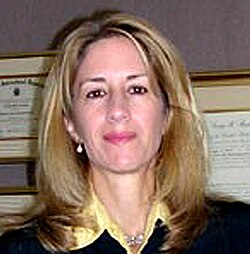 of the Federal District Court for the Southern District of Florida, was extraordinary. It would be highly unusual for a chief judge to block a colleague from overseeing an investigation. But a lawyer for Mr. Brennan argued that under the circumstances, she had the authority and a duty to do so.
In a 16-page letter, the lawyer, Kenneth L. Wainstein, asserted that the Justice Department, in what he portrayed as a violation ofprosecutorial ethics, appeared to be planning to “manipulate grand jury and case assignment procedures” to put the investigation into Mr. Trump’s perceived foes under Judge Aileen M. Cannon, left.
 Citing a pattern of the judge’s rulings in the documents case as indicating bias, Mr. Wainstein wrote, “We urge your honor to exercise your supervisory authority as chief judge to ensure the United States attorney does not steer this matter to the Fort Pierce division and to the courtroom of Judge Aileen Cannon.”
The Justice Department, Judge Altonaga and Judge Cannon did not immediately respond to requests for comment.
The letter by Mr. Wainstein, right, 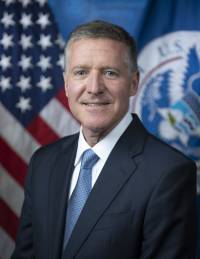 who served in the administrations of Presidents George W. Bush and Joseph R. Biden Jr., also amounted to a public pushback on what he described as a “concocted case” and “politically motivated and fact-free criminal investigation.”
Mr. Wainstein said he was making his request public “as a means of shedding light on the government’s course of action in this matter.” Prosecutors loyal to Mr. Trump, he wrote, had been “taking advantage of the secrecy around the grand jury process to undertake irregular activity outside of public view.
The investigation, led by the U.S. attorney in Miami, Jason A. Reding Quiñones, has already involved subpoenas to former officials in a January 2017 intelligence assessment that concluded that Russia was trying to help Mr. Trump win the 2016 election. The focus for now appears to be on Mr. Brennan, who helped oversee the assessment.
But that may just be the start. Mr. Trump’s allies have zealously promoted a “grand conspiracy” investigation aimed at pursuing all former officials involved in scrutinizing the 2016 campaign’s ties to Russia and in bringing charges against Mr. Trump over his efforts to overturn the 2020 election and over his hoarding of classified documents. The idea is to portray the disparate investigations into Mr. Trump as stemming from a single “deep state” conspiracy to violate his constitutional rights.
An inspector general and a special counsel have already scrutinized the Russia investigation, finding no basis for charges against high-level officials. Most of the relevant events took place in and around the District of Columbia, and those that happened more than five years ago would normally be beyond the statute of limitations.
But in his second term, Mr. Trump has openly pushed the Justice Department to leverage its prosecutorial power to settle scores against his adversaries on his behalf. By positing a “grand conspiracy,” the president’s allies have connected his grievances over the Russia investigation to the 2022 F.B.I. search for classified documents at Mar-a-Lago, his home and club in Palm Beach, Fla. That search remains within the statute of limitations and would establish venue in South Florida.
Pursuing the case in Fort Pierce, Fla., would draw jurors from a more conservative area than the District of Columbia and put it under Judge Cannon, who showed Mr. Trump unusual favor during the documents investigation. In particular, Mike Davis, an influential former Republican Senate staff aide and friend of Mr. Reding Quiñones, has pushed the idea of a Fort Pierce grand jury, warning Mr. Trump’s adversaries to “lawyer up.”
Under the rule for the Southern District of Florida, the judge on duty at a courthouse oversees any grand jury that meets there. As the only judge at the federal courthouse in Fort Pierce, Judge Cannon is by default its duty judge. Mr. Reding Quiñones has convened a special extra grand jury to meet in Fort Pierce starting next month, exciting Mr. Trump’s supporters.
Mr. Reding Quiñones, left,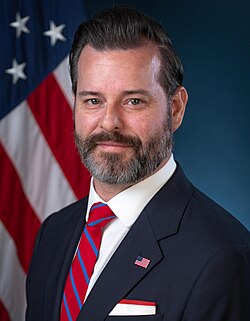 has not said why he is putting an extra grand jury in Fort Pierce.
The judge overseeing a grand jury wields particular influence over a contested investigation. She could quash subpoenas on grounds ranging from an expired statute of limitations to claims of privilege, or grant requests by prosecutors to compel recalcitrant witnesses to testify under threat of being jailed for contempt of court
The letter did not mention that Chief Judge Altonaga tried to intervene with Judge Cannon in 2023, an episode reported by The New York Times.
At the time, Mr. Trump had just been indicted in the documents case, which was randomly assigned to Judge Cannon. The assignment raised eyebrows because of her involvement in the investigation at an earlier stage. After the F.B.I. searched Mar-a-Lago, Mr. Trump had filed a lawsuit that went to her. She had blocked the bureau from working with classified files and appointed a special master to review them for executive privilege — only to be overturned by a sharply critical appeals court panel.
When Judge Cannon was randomly assigned to oversee the indicted case, two of her colleagues, including Chief Judge Altonaga, urged her to decline and let it be reassigned to another judge. But Judge Cannon insisted on keeping it, according to two people briefed on the conversations.
She then moved slowly on pretrial proceedings as Mr. Trump sought to run out the clock to prevent any trial before the 2024 election, only to abruptly dismiss the case. In doing so, she cited what she considered a technicality about the appointment of special counsels that clashed with decades of precedents.
The Justice Department dropped its appeal of that ruling after Mr. Trump won the election because it considers sitting presidents immune from prosecution. Judge Cannon has since blocked the release of a special counsel report about the documents case. An appeals court last month rebuked her for “undue delay” on that issue.
In his letter, Mr. Wainstein argued that for Judge Cannon to have a role in an investigation into Mr. Brennan would be improper because she had a “demonstrated pattern of favoring Donald Trump’s litigating positions” that raised a basis to question her impartiality. Moreover, Mr. Wainstein wrote, if there were a conspiracy case that involved the documents investigation, Judge Cannon could be a potential witness to the government’s conduct.
There would be no reason for Judge Altonaga to intervene, Mr. Wainstein added, if Mr. Reding Quiñones publicly promised that the Brennan matter would never be moved to Fort Pierce. But absent such a statement, he said, the circumstances clearly indicated that Mr. Reding Quiñones was “attempting to steer this matter toward Judge Cannon.”
 Morning Shots via The Bulwark, Political Opinion: Trump and Co. Can’t Keep Their Lies Straight, Bill Kristol & Andrew Egger, Dec. 22, 2025. From the Epstein files to the Justice Department, it’s hard for the mooks to remember which lie they’re supposed to tell.
Sen. Lindsey Graham, above, is typically a reliable cheerleader for the White House at home and abroad.
So it was notable to hear him say yesterday, fresh off a trip to the Middle East, that the peace deal between Israel and Hamas might be working less well than the administration has hoped: “What did I learn on this trip? That Hamas is not disarming,” Graham told NBC’s Meetthe Press. “They’re rearming. Hamas is not abandoning power. They’re consolidating power.”
Happy Monday.
News Roundups

Members of the "Mara 18" and "MS-13" gangs are seen in custody at the CECOT maximum security prison in Izalco, Sonsonate, El Salvador, on Sept. 4, 2020 (AFP Photo by Yuri Cortez via Getty Images).

The Parnas Perspective, Political Commentary, CBS Cancels 60 Minutes Episode to Prevent White House Backlash and Epstein Survivors Blast Justice Department, Aaron Parnas, right, Dec. 22, 2025. This week is already shaping up to be intense—but I need to start with something deadly serious.
Media is dying in real time. Bari Weiss killed a 60 Minutes segment on the CECOT terrorism facility because it would upset the White House. That is censorship—plain and simple.
This morning, one of my videos on TikTok was censored for quoting statements directly from Epstein survivors. That is also censorship. This isn’t accidental. It isn’t moderation. It’s control.
That’s why independent media matters more now than ever before. I am not afraid of this White House. I am not afraid for my safety. I do not answer to political power, corporate media, or tech platforms. I answer to you.
If you believe in independent journalism, if you believe the truth should not be filtered to protect the powerful, subscribe today and support my work. Together, we will challenge those in power and expose the stories they want buried.Subscribed
The truth doesn’t need permission—and we’re not asking for it. Here’s what you missed overnight:
This morning, I have obtained a new statement from more than one dozen Epstein survivors blasting the Department of Justice for failing to redact the information of survivors and failing to communicate with survivors. The statement calls for immediate Congressional action to ensure that survivors are protected and to force the Department of Justice to follow the law when releasing the files. This is the most forceful statement from survivors to date.
CBS News pulled a planned 60 Minutes segment about a maximum-security prison in El Salvador where the Trump administration sent Venezuelan deportees, saying the piece required additional reporting; the late decision, made under editor in chief Bari Weiss, sparked massive internal criticism. This is the trailer of the 60 Minutes episode Weiss does not want you to see:
Sharyn Alfonsi, right,  told fellow correspondents that she learned at the last minute that CBS News editor in chief Bari Weiss had pulled a planned 60 Minutes segment on a maximum-security prison in El Salvador where the Trump administration sent Venezuelan deportees. In a Sunday email to colleagues including Lesley Stahl, Scott Pelley and Anderson Cooper, Alfonsi said the story was “spiked” and argued the move was political rather than an editorial judgment.
While CBS won’t report what’s happening at CECOT to avoid criticism from the Trump Administration, I will. A joint investigation by Human Rights Watch and Cristosal found that Venezuelan migrants deported by the United States government to El Salvador’s CECOT mega-prison were subjected to arbitrary detention, enforced disappearance, and  systematic torture—including beatings, incommunicado confinement, and sexual violence—despite many having no criminal records, concluding that both the US and El Salvador government violated international human rights law and the principle of non-refoulement.
Donald Trump appointed Louisiana Governor Jeff Landry as special envoy to Greenland, reviving U.S. ambitions to bring the self-governing Danish territory under American control and triggering sharp criticism from Denmark and Greenlandic leaders, who stressed respect for Danish sovereignty and Greenland’s right to decide its own future.
 MSNBC reports that FBI Director Kash Patel, right, has drawn scrutiny for requesting and using specially armored luxury BMW SUVs—departing from the bureau’s traditional use of Chevrolet Suburbans—and for previously pressing, unsuccessfully, for a costly new FBI jet, fueling criticism from lawmakers and former officials who argue the moves reflect questionable use of taxpayer-funded security resources despite Patel’s claims of cost savings and operational necessity.
NBC News reports that deep tensions have emerged within the Trump administration over diplomacy on the Russia–Ukraine war, with special envoy Steve Witkoff repeatedly sidelining Secretary of State Marco Rubio through unilateral travel, opaque negotiations, and a Russia-leaning peace plan, raising concerns among U.S. and European officials about coordination, security lapses, and whether U.S. foreign policy is being shaped by an informal power broker rather than the State Department.
A Guardian investigation found that the U.S. Department of Justice has failed to distribute nearly $90 million in congressionally approved funding for organizations that support survivors of human trafficking, forcing more than 100 groups to cut services, housing, and staff and prompting lawmakers to accuse the Trump administration of illegally withholding funds and putting vulnerable survivors at risk of homelessness, deportation, and re-exploitation.
Reuters has confirmed that the U.S. Coast Guard is actively pursuing a sanctioned “dark fleet” vessel off the coast of Venezuela that U.S. officials say is evading sanctions by flying a false flag and operating under a judicial seizure order, marking a potential third U.S. interdiction in the Caribbean as tensions escalate between Washington and Caracas. The pursuit has drawn condemnation from ALBA, whose members accuse the United States of piracy and illegal seizure of Venezuelan oil, while the Trump administration signals a tougher posture that could further strain bilateral relations.
The Trump administration has escalated pressure on Venezuela by seizing a second sanctioned oil tanker and pursuing a third, prompting President Donald Trump to plan a public announcement alongside Defense Secretary Pete Hegseth as critics warn the actions—framed by Homeland Security Secretary Kristi Noem as targeting sanctions evasion—risk provoking wider conflict, disrupting oil markets, and drawing bipartisan concern, including warnings from Sen. Rand Paul about a slide toward war.
According to NBC, Paramount has strengthened its hostile bid for Warner Bros. Discovery by adding a $40.4 billion personal guarantee from Larry Ellison and raising the breakup fee, even as Warner Bros. Discovery presses ahead with a competing deal to sell key assets to Netflix, a battle that has also drawn attention to political sensitivities around CBS News and the recent pulling of a “60 Minutes” segment under editor in chief Bari Weiss.
Kansas Reflector reports that Kansas Supreme Court Chief Justice Marla Luckert will resign as chief justice on Jan. 2 and retire by early February following an October stroke, a decision that will elevate Justice Eric Rosen to chief justice and give Democratic Gov. Laura Kelly another appointment to the court as voters prepare to weigh possible changes to the state’s judicial selection system in 2026.
This is the 60 Minutes trailer of the horrific conditions at CECOT that CBS News has scrubbed. I think everyone should see it.
Epstein Cover-Up Protests
 Politico, Bill Clinton spox calls on DOJ to release Epstein files referencing the former president, Jacob Wendler, Dec. 22, 2025. The former president’s spokesperson accused the DOJ of weaponizing the documents against him.Bill Clinton speaks.
A spokesperson for Bill Clinton, shown above in a file photo, on Monday called on the Department of Justice to release any documents related to the former president in its ongoing release of files related to convicted sex offender Jeffrey Epstein.
The rare statement from Clinton spokesperson Angel Ureña comes as the Trump administration has attempted to make him the GOP’s new boogeyman in a monthslong saga related to the files that has plagued the White House, sparking sharp rebukes from allies and MAGA firebrands.
“What the Department of Justice has released so far, and the manner in which it did so, makes one thing clear: someone or something is being protected,” Ureña said in the statement. “We do not know whom, what or why. But we do know this: We need no such protection.”
The Justice Department released its first batch of a vast trove of files Friday but stopped short of publishing all of the federal government’s documents related to various investigations into the disgraced financier, as mandated by the Epstein Files Transparency Act, signed into law by President Donald Trump last month.
Deputy Attorney General Todd Blanche said last week that the DOJ was reviewing the material in its possession in order to protect victims’ identities and would be releasing potentially hundreds of thousands of additional files in the coming weeks.
He also said that “there’s no effort to hold anything back because there’s the name Donald J. Trump or anybody else’s name.”
The DOJ on Friday released multiple photos of Clinton with Epstein’s convicted co-conspirator Ghislaine Maxwell and individuals with redacted faces, among the thousands of photos and other records it disclosed. The law allowed the DOJ to redact material related to active investigations and records that “contain personally identifiable information of victims.”
Ureña said that if the DOJ declines to comply with Clinton’s request, it will confirm the administration’s intention of “using selective releases to imply wrongdoing about individuals who have already been repeatedly cleared by the very same Department of Justice, over many years, under Presidents and Attorneys General of both parties.”
The White House deferred to the DOJ, which did not immediately respond to a request for comment on Ureña’s statement.
Clinton has been linked to Epstein since the early 1990s, with the two having been photographed together several times, although the former president has said he was not aware of Epstein’s crimes, and he has never been accused of any wrongdoing in connection to Epstein. As has been previously reported, Clinton flew on Epstein’s plane in the 1990s to several international locales, and the former president’s spokesperson stated that his Secret Service detail was with Clinton during the trips.
Blanche, the second-highest ranking official at the DOJ, has insisted that the Trump administration is complying with the law despite heavily redacting and omitting substantial materials from the Friday release. Bipartisan lawmakers have accused the administration of “flouting” the law, although the act does not provide a clear legal penalty for failing to release all the mandated files within the 30-day timeline.
Blanche also defended the DOJ’s decision to temporarily take down several documents published in the initial release, including one that featured a photo of Trump, telling NBC’s Kristen Welker during an interview Sunday on “Meet the Press” that the photo was taken down in response to concerns raised by victims and that it would be reinstated following a review.
More On U.S. Politics, History, Governance
Politico, Trump administration halts offshore wind projects from Virginia to New England, in major blow to clean power, Kelsey Tamborrino and Benjamin Storrow, Dec. 22, 2025. The move is yet another escalation from President Donald Trump, who has vowed to throttle wind projects despite his party's worries about electricity affordability.
The Trump administration on Monday ordered a halt to five offshore wind projects currently being built in the United States, a major new attack on a power-generating industry even as voters fret about climbing electricity prices.
The Interior Department announced it is pausing all leases for large-scale offshore wind projects that are currently under construction, effective immediately. It lands as the Trump administration is facing political heat from skyrocketing energy costs in part from the growth of data centers and artificial intelligence. Residential retail electricity rates rose roughly 7 percent in September from a year prior, according to monthly tracking by the U.S. Energy Information Administration.
The pauses affect the Vineyard Wind 1, Revolution Wind, Coastal Virginia Offshore Wind, Sunrise Wind and Empire Wind 1 projects stretching from Virginia to New England, initiatives that together would generate enough electricity to power almost 2.7 million homes.
Interior cited national security risks that were identified by the Department of Defense in “recently completed classified reports.” The department said the pause will give the administration time to work with leaseholders and states to assess the possibility of mitigating the risks.
“The Trump administration has paused the construction of all large-scale offshore wind projects because our number one priority is to put America First and protect the national security of the American people,” said Taylor Rogers, a White House spokesperson.
The move represents a new escalation for the Trump administration, which has repeatedly sought to halt the offshore wind sector that was a focus of the Biden administration. Trump has called wind turbines a “disgrace” and “a scam,” and has said his administration would not approve any projects.
Just weeks ago, people familiar with the administration’s thinking had told POLITICO that White House and Interior Department staff were discussing a compromise that would allow the five projects to finish construction. Such a plan would still have allowed the administration to revoke permits for other Biden-era projects whose construction has yet to begin. But Monday’s announcement seemed to put an end to that discussion.
Instead, the administration has said it will bring down energy costs by undoing Biden administration regulations and embracing baseload power sources such as fossil fuels and nuclear power.
The action Monday puts two projects in the crosshairs that had previously faced the administration’s opposition. The Empire Wind project off the coast of New York was already halted in April by the administration, as was the Revolution Wind project that was blocked in August.
Those pauses caused widespread angst among developers and offshore wind supporters. A separate judge this month also called the administration’s halt of permits for offshore wind projects illegal.
Both pauses were ultimately lifted — one after Trump claimed to strike a deal with New York and the other after a federal judge intervened. David Schoetz, a spokesperson for Empire Wind’s developer Equinor, said the company is evaluating the order and “seeking further information from the federal government.”
One of the projects halted Monday is already generating electricity. Half of the 62 turbines at Vineyard Wind off Massachusetts were producing power as of the end of September. It wasn’t immediately clear whether the stoppage would lead to a shut-down of the turbines already in operation.
Neither Interior nor Vineyard Wind, a joint venture of Avangrid and Copenhagen Infrastructure Partners, immediately provided comment on the pause and impact to operational turbines.
ISO New England, the regional grid operator, has said it is counting on Vineyard Wind’s power this winter. It previously expressed concerns when Interior halted Revolution Wind in August, saying the stoppage raised reliability risks to New England.
Dominion Energy, which is developing the Coastal Virginia Offshore Wind project, said in a statement that stopping the project “for any length of time” will threaten grid reliability for some of the nation’s most important war fighting, AI, and civilian assets.” The project — which is located about 23 miles from Virginia Beach — has the support of key Republican officials, including House Speaker Mike Johnson and Virginia Rep. Jen Kiggans.

Politico, Trump critic George Conway files to run for NY House seat, Cheyanne M. Daniels, Dec. 22, 2025. Conway, above, a sharp critic of President Donald Trump, has filed to run as a Democrat.Attorney George Conway is outside the New York City courthouse.
George Conway, a conservative lawyer and vocal critic of President Donald Trump, filed paperwork on Monday to run as a Democrat for the seat Rep. Jerry Nadler (D-N.Y.) is vacating.
News of Conway entering the race began surfacing last month, especially after Conway confirmed he had hired a Democratic pollster to weigh his chances.
Conway was previously married to Kellyanne Conway, who helped manage Trump’s 2016 presidential bid and then served in the White House during Trump’s first term.
Though George Conway was also offered a position with the administration during Trump’s first term, he declined. The relationship between the president and Conway turned contentious, with Conway often criticizing Trump and the president in turn commenting on the Conways’ marriage.
The feud ultimately culminated in Trump calling Conway a “stone cold LOSER & husband from hell” and Conway calling Trump a “fascist.” Conway went on to pen an essay that called Trump “unfit for office.”
The lawyer eventually co-founded The Lincoln Project, a PAC of former Republicans with a self-described purpose of defeating Trump, and has continued to criticize the president.
Shortly after Conway filed to run, Councilmember Erik Bottcher announced he is ending his campaign for House of Representatives, choosing instead to run for New York State Senate.
But Conway will still join an increasingly crowded primary race for Nadler’s seat. At least nine hopefuls — including Jack Schlossberg, the only grandson of John F. Kennedy — have filed to run for the position since Nadler announced in September he would not seek reelection.
March for Our Lives organizer Cameron Kasky, Assemblymen Alex Bores and Micah Lasher have also filed to run for the Manhattan-based seat.
A.Letters from an American, Historical Commentary: December 21, 2025 [A 'Christian Nation?'], Heather Cox Richardson, right, Dec. 22, 2025. Speaking today at Turning Point USA’s annual “AmericaFest” conference, Vice President J.D. Vance said, to great applause: “The only thing that has truly served as an anchor of the United States of America is that we have been, and by the grace of God we always will be, a Christian nation.”
Actually, we haven’t.
Vance’s statement flies in the face of our Constitution, whose First Amendment reads: “Congress shall make no law respecting an establishment of religion, or prohibiting the free exercise thereof….” James Madison of Virginia, the key thinker behind the Constitution, had quite a lot to say about why it was fundamentally important to make sure the government kept away from religion.
In 1772, when he was 21, Madison (shown in a portrait at right) watched as Virginia arrested itinerant preachers for attacking the established church in the state. He was no foe of religion, but by the next year, he had begun to question whether established religion, which was common in the colonies, was good  for society. By 1776, many of his broad-thinking neighbors had come to believe that society should “tolerate” different religious practices; he had moved past tolerance to the belief that men had a right of conscience.
In that year, he was instrumental in putting Section 16 into the Virginia Declaration of Rights, on which our own Bill of Rights—the first ten amendments to the Constitution—would be based. It reads, “That religion, or the duty which we owe to our Creator, and the manner of discharging it, can be directed only by reason and conviction, not by force or violence; and therefore all men are equally entitled to the free exercise of religion, according to the dictates of conscience; and that it is the mutual duty of all to practice Christian forbearance, love, and charity toward each other.”
In 1785, in a “Memorial and Remonstrance against Religious Assessments,” he explained that what was at stake was not just religion, but also representative government itself. The establishment of one religion over others attacked a fundamental human right—an unalienable right—of conscience. If lawmakers could destroy the right of freedom of conscience, they could destroy all other unalienable rights. Those in charge of government could throw representative government out the window and make themselves tyrants.
Madison believed that a variety of religious sects would balance each other out, keeping the new nation free of the religious violence of Europe. He drew on that vision explicitly when he envisioned a new political system, expecting that a variety of political expressions would protect the new government. In Federalist #51, he said: “In a free government the security for civil rights must be the same as that for religious rights. It consists in the one case in the multiplicity of interests, and in the other in the multiplicity of sects.”
In 1790, the year after he took office as the nation’s first president, George Washington, shown in a portrait at left, assured a Jewish congregation in Newport, Rhode  Island, that in the United States of America, “[a]ll possess alike liberty of conscience and immunities of citizenship.” The government of the United States, he wrote, “gives to bigotry no sanction” and “to persecution no assistance.” He wished that Jewish Americans “continue to merit and enjoy the good will of the other inhabitants— while everyone shall sit in safety under his own vine and fig tree and there shall be none to make him afraid.”
The next year, the states ratified the First Amendment to the Constitution. In order to ensure men had the right of conscience, it reads: “Congress shall make no law respecting an establishment of religion, or prohibiting the free exercise thereof….”
In 1802, President Thomas Jefferson, shown at right, called this amendment “a wall of separation between Church & State.” In a letter of January 1, 1802, he explained to a group of Baptists from Danbury, Connecticut, how that principle made him refuse to call for national religious days of fasting  and thanksgiving in his role as head of the government.
Like Madison, he maintained that “religion is a matter which lies solely between Man & his God, that he owes account to none other for his faith or his worship.” “[T]he legitimate powers of government reach actions only,” he wrote, “[and] not [religious] opinions.”
“[T]hat act of the whole American people which declared that their legislature should ‘make no law respecting an establishment of religion, or prohibiting the free exercise thereof,’” he wrote, built “a wall of separation between Church & State.”
In the early years of the nation, Americans zealously guarded that wall. They strictly limited the power of the federal government to reflect religion, refusing even to permit the government to stop delivery of the U.S. mails on Sunday out of concern that Jews and Christians did not share the same Sabbath and the government could not choose one over the other. The Constitution, a congressional report noted, gave Congress no authority “to inquire and determine what part of time, or whether any has been set apart by the Almighty for religious exercises.”
But the Civil War marked a change. As early as the 1830s, southern white enslavers relied on religious justification for their hierarchical system that rested on white supremacy. God, they argued, had made Black Americans for enslavement and women for marriage, and society must recognize those facts.
A character in an 1836 novel written by a Virginia gentleman explained to a younger man that God had given everyone a place in society. Women and Black people were at the bottom, “subordinate” to white men by design. “All women live by marriage,” he said. “It is their only duty.” Trying to make them equal was a cruelty. “For my part,” the older man said, “I am well pleased with the established order of the universe. I see…subordination everywhere. And when I find the subordinate content…and recognizing his place…as that to which he properly belongs, I am content to leave him there.”
The Confederacy rejected the idea of popular government, maintaining instead that a few Americans should make the rules for the majority. As historian Gaines Foster explained in his 2002 book Moral Reconstruction, which explores the nineteenth-century relationship between government and morality, it was the Confederacy, not the U.S. government, that sought to align the state with God. A nation was more than the “aggregation of individuals,” one Presbyterian minister preached, it was “a sort of person before God,” and the government must purge that nation of sins.
Confederates not only invoked “the favor and guidance of Almighty God” in their Constitution, they established as their motto “Deo vindice,” or “God will vindicate.”
The United States, in contrast, was recentering democracy during the war, and it rejected the alignment of the federal government with a religious vision. When reformers in the United States tried to change the preamble of the U.S. Constitution to read, “We, the people of the United States, humbly acknowledging Almighty God as the sources of all authority and power in civil government, the Lord Jesus Christ, as the Ruler among nations, and His revealed will as of supreme authority, in order to constitute a Christian government, and in order to form a more perfect union,” the House Committee on the Judiciary concluded that “the Constitution of the United States does not recognize a Supreme Being.”
That defense of democracy—the will of the majority—continued to hold religious extremists at bay.
Reformers continued to try to add a Christian amendment to the Constitution, Foster explains, and in March 1896 once again got so far as the House Committee on the Judiciary. One reformer stressed that turning the Constitution into a Christian document would provide a source of authority for the government that, he implied, it lacked when it simply relied on a voting majority. A religious amendment “asks the Bible to decide moral issues in political life; not all moral questions, but simply those that have become political questions.”
Opponents recognized this attempt as a revolutionary attack that would dissolve the separation of church and state, and hand power to a religious minority. One reformer said that Congress had no right to enact laws that were not in “harmony with the justice of God” and that the voice of the people should prevail only when it was “right.” Congressmen then asked who would decide what was right, and what would happen if the majority was wrong. Would the Supreme Court turn into an interpreter of the Bible?
The committee set the proposal aside.
Now, once again, we are watching a minority trying to impose its will on the majority, with leaders like Vice President J.D. Vance trying to rewrite American history.
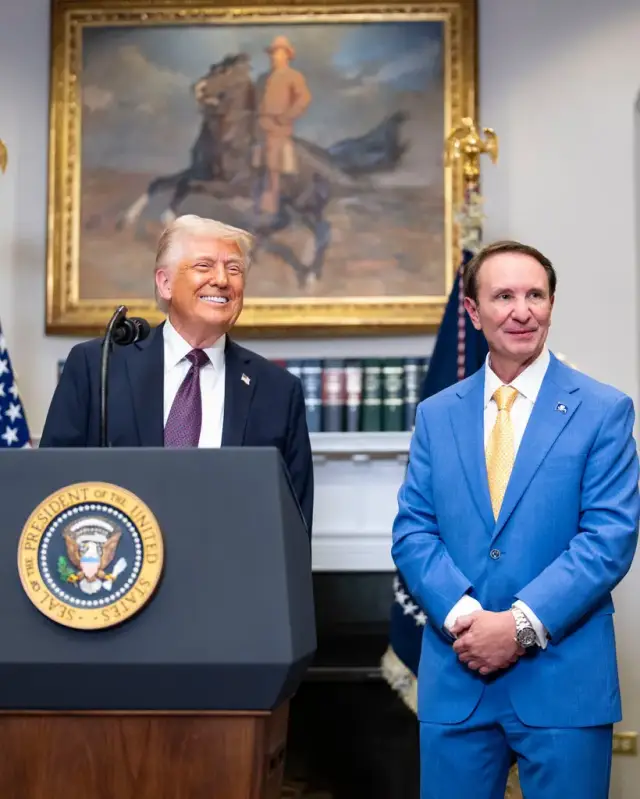
Governor Jeff Landry of Louisiana, right, with President Trump at the White House in March (New York Times photo by Doug Mills).
New York Times, Angering Denmark, Trump Appoints Special Envoy to Greenland, Amelia Nierenberg, Jeffrey Gettleman and Maya Tekeli, Dec. 22, 2025. President Trump, who has long said he wants to “get” the semiautonomous Danish territory, tapped Louisiana’s governor for the new position. Officials in Greenland and Denmark expressed outrage.
Officials in Denmark and Greenland on Monday reacted with anger to President Trump’s decision to appoint a special envoy to Greenland, as he intensifies his efforts to take over the semiautonomous Danish territory.
 Mr. Trump announced on social media on Sunday that he was appointing Gov. Jeff Landry of Louisiana, a political ally, to the position. Denmark’s foreign minister quickly criticized the move as “totally unacceptable” and said he would summon the American ambassador in Copenhagen for an explanation.
It appeared to be the first time the United States had appointed a special envoy to Greenland. That gives the territory — a gigantic frozen island inhabited by fewer than 60,000 people — something in common with the war in Ukraine, the conflicts in the Middle East, and a handful of other issues; Mr. Trump has tapped someone close to him to manage all of these as priorities.
Mr. Landry quickly made it clear that he understood what Mr. Trump wanted from him, writing on X: “It’s an honor to serve you in this volunteer position to make Greenland a part of the U.S.”
In a post on Truth Social, Mr. Trump wrote that “Jeff understands how essential Greenland is to our National Security.”Want to stay updated on what’s happening in Denmark, Greenland and Louisiana? Sign up for Your Places: Global Update, and we’ll send our latest coverage to your inbox.
But the appointment drew condemnation from Greenland and further deteriorated the relationship between the United States and Denmark, which used to be close allies.
“You cannot annex other countries,” Prime Minister Mette Frederiksen of Denmark and Prime Minister Jens-Frederik Nielsen of Greenland said in a joint statement on Monday. “Not even by invoking international security. Greenland belongs to the Greenlanders, and the United States must not take over Greenland.”
Mr. Nielsen added in a statement on Facebook that the appointment “may sound big,” but “doesn’t change anything for us at home.”
“We decide our future ourselves,” Mr. Nielsen saidImageA town street scene with pedestrians and cars, flanked by buildings. A vast, snow-capped mountain dominates the background.Nuuk, the capital of Greenland, in May.Credit...Sigga Ella for The New York Times
Lars Lokke Rasmussen, Denmark’s foreign minister, told Danish television on Monday that he was “deeply upset” by Mr. Trump’s announcement and that he planned to summon Ken Howery, who became the American ambassador to Denmark in October.
The Danish government has twice this year summoned American diplomats to complain about reports that the United States was spying and running a covert influence campaign in Greenland. Earlier this month, in a first for the Danish government, Denmark’s military intelligence said that shifts in American policy were generating new uncertainties for Denmark’s security.
The appointment of a special envoy for Greenland could put pressure on Mr. Howery, a former executive at PayPal who is considered close to Mr. Trump. In November, Mr. Howery dodged a question from journalists about whether the United States would ever take Greenland by force, but he pledged cooperation.
“I very much look forward to working with my colleagues in the Danish government on our shared concerns regarding security in the Arctic,” he said, according to DR, the Danish broadcaster.
Mr. Landry, a Republican who was elected Louisiana’s governor in 2023, has spent his first term projecting toughness and loyalty to Mr. Trump. The president often calls Mr. Landry a “great governor.”
Mr. Landry has prioritized tackling crime, particularly in New Orleans. He has enthusiastically supported Mr. Trump’s use of the National Guard, asking the president in September to deploy as many as 1,000 National Guard troops in his state.
Danish officials and analysts said that while the United States has previously appointed envoys for the entire Arctic region, Mr. Landry would be the first special envoy just for Greenland.
Mikkel Runge Olesen, a senior researcher at the Danish Institute for International Studies, described the move as a “significant escalation” by Mr. Trump, who has threatened to acquire Greenland through a financial transaction or military force several times since he returned to the Oval Office.
“It is not as if there is an abundance of special envoys,” Dr. Olesen said. “So when one is appointed with the purpose of asserting control over Greenland, it signals that Greenland is very much in focus at the highest level.”
Morning Shots via The Bulwark, Political Opinion:,Trump’s Modified Limited Coverup, William Kristol, right, Dec. 22, 2025.
 President Richard Nixon, left: You think, you think we want to, want to go this route now? And the—let it hang out, so to speak?
White House Counsel John Dean: Well, it’s, it isn’t really that—
White House Chief of Staff H.R. Haldeman: It’s a limited hangout.
Dean: It’s a limited hangout.
Assistant to the President John Ehrlichman: It’s a modified limited hangout.
— Audiotape of Oval Office meeting, March 22, 1973
Half a century later, we’re in the early stages of another modified limited hangout. And as in Watergate, a modified limited hangout really means a modified limited coverup. A partial truth is a partial lie. The Nixon Oval Office exchange quoted above immediately followed a discussion of John Dean creating a false report of the White House’s role in the Watergate break-in. Nixon’s modified limited hangout wasn’t some kind of an attempt to come clean.
Nor is Donald Trump’s. The problem with the Justice Department’s modified, limited release of the Jeffrey Epstein files since Friday afternoon isn’t that there have been some mistaken redactions and some mistaken non-redactions. The problem is that the administration has decided simply not to release key documents, like the original victim statements and the 60-count draft indictment of Epstein.
We’re in the midst of a coverup. A modified coverup, perhaps, but a coverup nonetheless.
One implication of this is that we need to shed all our old, post-Watergate assumptions about the Department of Justice. Trump’s “Department of Justice” is Trump’s defense team. There should be no presumption they’re acting in good faith. One has to think of them as one thought of a Soviet bloc “Department of Justice”—as dedicated to pro-regime propaganda, not justice or the truth.
The good news, as I’ve suggested before, is that partial coverups are difficult to pull off. Once you have to abandon the initial attempt to stonewall—Nixon’s original blanket denial of White House involvement in the Watergate burglary, the Trump administration’s attempt to shut the door to any action on the Epstein matter with the “nothing to see here” statement from the Justice Department and FBI on July 6—you’re sailing in dark and choppy waters. Visibility is limited. It’s hard to keep your balance. A coverup is hard to navigate. Especially if you don’t have Soviet-like control of the other institutions of society.
Why the decision to cover-up? Well, in the case of Watergate, there were things Nixon and his lieutenants didn’t want Congress and the public to know. With regards to the Epstein files, it certainly seems that there are things that Trump and his lieutenants don’t want Congress and the public to know. Presumably these are things that, to put it gently, don’t reflect well on Trump. Since he has been pretty successful in his ability to survive embarrassing revelations, it’s a reasonable assumption these secrets really don’t reflect well on him.
A little more than a month after the March 22, 1973, Oval Office meeting, Nixon fired its participants—Haldeman, Ehrlichman, and Dean—along with Attorney General Richard Kleindienst. That bought him a little time, perhaps, but didn’t really change the trajectory of the scandal. The public understood that Watergate was Nixon’s crime and coverup, not that of his aides. A little over a year later, President Nixon was forced to resign. The other participants in the Oval Office meeting ended up in jail.
I offer the obvious disclaimer: For a million reasons, history is unlikely simply to repeat itself a half century later. Alas! On the other hand, this scandal has unraveled far more than most thought possible several months ago. Few observers of American politics expected Robert Garcia and Ro Khanna and Thomas Massie to be among the most consequential members of the House in 2025.
It’s probably too much to hope that today’s modified limited coverup will end in a failure as resounding as Nixon’s. I suppose such a ringing vindication of justice is too much to expect today.
But politics is full of surprises. One heartening surprise of this past year is that the Epstein victims have finally been accorded the standing and respect they deserve. Their ongoing effect on unraveling this coverup shouldn’t be underestimated. And in any case, we owe them our continued and unsparing effort to uncover the truth and achieve justice.
Thanks for reading Morning Shots. If you like what you see, why not consider joining Bulwark+? Get all our content in your inbox, the ability to join in the conversation in the comments, and more.
Morning Shots via The Bulwark, Political Opinion: The Wrong Lie at the Wrong Time, Will Saletan, Dec. 22, 2025. Speaking of keeping track of lies: One problem with lawyering for an overt crook is that it’s hard to keep track of which lies you can get away with, because the crook sometimes blurts out what you’re trying to cover up.
This was the predicament Todd Blanche found himself in on Sunday. Blanche, Trump’s former personal lawyer, is now the deputy attorney general of the United States. On Meet the Press, Kristen Welker asked him about the September 20 Truth Social post in which Trump openly pressured Attorney General Pam Bondi to indict former FBI Director James Comey, Sen. Adam Schiff, and New York Attorney General Leticia James.
Welker asked, “Does President Trump speak to you or to the attorney general directly about individual criminal cases and investigations, Mr. Blanche?”
In an ethical administration, the deputy attorney general could have honestly said: No, the president doesn’t do such things. But Blanche didn’t say that. Instead, he stonewalled: “I will never talk about the communications I have with President Trump.”
Why did Blanche play it safe? Maybe because Welker, by reminding him of what Trump had publicly written, made Blanche think that lying about the pressure campaign would be untenable.
But then Welker brought up Erik Siebert, a career federal prosecutor who, as she recounted, “was fired after refusing to prosecute these cases against James Comey.” This time, Blanche decided to risk a denial. “Mr. Siebert wasn’t fired because he refused to bring cases,” he shot back. “He resigned, okay?”
Poor Blanche. He might have answered that question differently if Welker had read him the rest of Trump’s September 20 post. Siebert “lied to the media and said he quit,” the president wrote. “No, I fired him.”
In another post earlier that day, Trump said the same thing: “He didn’t quit, I fired him!”
This is one of those rare cases in which Truth Social told the truth. Trump pushed out a prosecutor for admitting there was no case against Comey. Then Trump berated Bondi for failing to secure indictments against his enemies, and he installed another flunky to orchestrate the bogus indictment, which was then dismissed. All along, Trump has been hectoring Bondi, Blanche, and others to pursue his vendettas.
For a minute there, Blanche thought he could get away with lying about it. He forgot that the boss had already spilled the beans.
AROUND THE BULWARK
Quick Hits
SELF-CENSORSHIP AT CBS: The promos were cut—and then promptly deleted. CBS News head honcho Bari Weiss decided at the last minute to pull a 60 Minutes report on CECOT, the hellhole prison in El Salvador to which the Trump administration sent hundreds of mostly innocent people, often without due process. What were the reasons for her decision?
In a statement Sunday night, Weiss said:
“My job is to make sure that all stories we publish are the best they can be. Holding stories that aren’t ready for whatever reason—that they lack sufficient context, say, or that they are missing critical voices—happens every day in every newsroom. I look forward to airing this important piece when it’s ready.”
What critical voices were missing from the story about a torture factory? Not those of the victims—they were reportedly well represented in the story. Weiss held the feature because she wanted to get a comment from the Trump administration. She reportedly gave the lead journalist on the story, Sharyn Alfonsi, the cell phone number for Stephen Miller. Alfonsi noted that she had reached out to the White House, the Department of Homeland Security, and the State Department, all of which declined to comment.
So, not the voices of the victims, but of their assailants.
The New York Times obtained an email from Alfonsi to her CBS colleagues: “If the administration’s refusal to participate becomes a valid reason to spike a story, we have effectively handed them a ‘kill switch’ for any reporting they find inconvenient.” It must be noted that this all took place just weeks after Trump launched his latest salvo against the program, lamenting that it hadn’t changed under the stewardship of CBS’s new owner, David Ellison.
Weiss has consistently trumpeted her commitment to treating all sides evenly and fairly. It’s hard to see how this decision was “fair” to the Trump administration—or those it oppressed. But hey, at least they didn’t edit down an interview this time!
ADIOS, ELISE: Elise Stefanik has seen enough. The New York Republican announced Friday that she will suspend her campaign for governor and will not seek re-election to her House seat. It’s a sudden, stunning end—or at least intermission—in the career of someone who once seemed a rising GOP star in two different eras: first as a young, moderate Paul Ryan protégée, and then, when she sensed the party’s direction shifting, as a hyper-partisan Donald Trump acolyte.
Stefanik’s reinvention was transparently political, a source of black humor for onetime allies and supporters who thought she sold her soul. But the bet seemed to be paying off—until, suddenly, it wasn’t. Trump nominated her to serve as ambassador to the United Nations, then abruptly yanked her nomination to protect her seat in the House. When she decided to run for governor instead, she assumed he would endorse her and clear the field, but that endorsement never materialized.
Stefanik has always been more of a canny operator than a true believer; as Republicans’ midterm prospects sour, she seems uninterested in going down with the ship. And maybe there are more reinventions to come in her future. For now, though, her foreshortened career is a cautionary tale of the limits of a devil’s bargain with Trump, who never comes through more than he feels like.
PRINCE JD: For years now, Donald Trump has held the Republican party in thrall in a way that’s politically unprecedented in America; if and when he steps off the political stage, the intra-GOP power vacuum will be immense. But a powerful, organized effort is already underway to ease the transition. The Wall Street Journal reports on Turning Point USA’s effort to turn JD Vance from the first among a host of possible next Republican leaders to Trump’s inevitable-seeming successor:
Before Charlie Kirk was fatally shot, he was readying for JD Vance to become the next president of the United States. Now, Erika Kirk is determined to make that happen.
In her kickoff remarks for Turning Point USA’s first major event since his death, Kirk’s widow told the 31,000 attendees: “We are going to get my husband’s friend JD Vance elected for 48 in the most resounding way possible.”
The vice president closed the mega conference held here Sunday. Behind the scenes, Turning Point is setting up infrastructure to boost his potential 2028 presidential bid. The conservative group is planning to put representatives in all of Iowa’s 99 counties ahead of the presidential primary.
Iowa is an important early state in the presidential nominating process, and Turning Point is already trying to build grassroots support for Vance there, according to Tyler Bowyer, a top executive with the organization and a close friend of the late Kirk.
“Why mess around? Let the Democrats destroy each other in the primary process, while we benefit from the rare luxury of having a candidate that’s so clearly the front-runner,” Bowyer said in an interview backstage at the conference. Read the whole thing.
New York Times, Vance Refuses to Take Sides in G.O.P. Fight Over Bigotry, Zolan Kanno-Youngs, Updated Dec. 22, 2025. The vice president’s plea for a big-tent coalition at an annual conservative gathering belied the cracks in his party over antisemitism, racism and conspiracy theories.
The bitter infighting over antisemitism, free speech and bigotry during Turning Point USA’s annual national conference not only exposed fissures in President Trump’s movement but also laid bare a challenge for his potential successor.
How would his likely heir apparent handle an explosive debate among Republicans over whether extremists and conspiracy theorists should be embraced or excluded from the conservative coalition?
On Sunday, Vice President JD Vance (shown above in a file photo) gave an answer, suggesting he was more than willing to forgo imposing any moral red lines.
“When I say that I’m going to fight alongside of you, I mean all of you — each and every one,” Mr. Vance said at Turning Point USA’s annual gathering, AmericaFest, where prominent conservative leaders called on their peers to stop promoting conspiracies and hate. “President Trump did not build the greatest coalition in politics by running his supporters through endless, self-defeating purity tests.”
 The vice president’s plea for a big-tent coalition, however, belied the cracks visible in the past week in his party. The annual conservative gathering was just a year ago a platform united under Mr. Trump and elevated by its co-founder, Charlie Kirk, above, a young rising figure on the right. Mr. Kirk’s assassination in September galvanized Republicans and fueled conspiracy theories among them, and it prompted Mr. Vance to call on Americans to coalesce around criticizing what he called the far left.
This year, the event showcased the intense jostling over the direction of Mr. Trump’s movement and whom it would platform.
Last week, Ben Shapiro, a conservative commentator, warned that the “conservative movement was in serious danger” by those willing to  amplify conspiracies, including Candace Owens, left, the podcaster widely accused of antisemitism. She has also spread unfounded theories about Mr. Kirk’s death. Mr. Shapiro’s warning also targeted Tucker Carlson, the former Fox News host who recently held a softball interview with Nick Fuentes, a Holocaust denier and avowed antisemite. Mr. Carlson later accused Mr. Shapiro of trying to censor him.
On Friday, Vivek Ramaswamy, an Indian American who is running for governor of Ohio as a Republican, also criticized a faction of the party. He went after those who have embraced the idea that so-called “heritage Americans” — a predominantly white group whose families have been in the country for multiple generations — have a greater claim to the nation than more recent arrivals.
Those comments appeared to put Mr. Ramaswamy at odds with Mr. Vance, who has spoken out against “importing millions and millions of low-wage serfs” and argued that mass migration was the “theft of the American dream.”
Mr. Ramaswamy also took on those who have issued derogatory attacks against Mr. Vance’s wife, Usha Vance. And he said Mr. Fuentes and others promoting hateful views had “no place in the future of the conservative movement.”
The Contrarian, Opinion: Remember the Unsung Resistance Fighters, Jennifer Rubin, right, Dec. 22, 2025. A Year in Protest: All year, the horrors persisted — and all year, we resisted. Some punched above their weight.
As we continue our look back on 2025, we must not forget the role played by unexpected heroes, the people and institutions we never imagined standing up to a budding dictator. It has been far easier to go along to get along, to cut deals with the regime, or simply to remain silent. But when the chips were down—as they’ve been all year—some critical players refused to be bluffed, bullied, or badgered into subservience.
Two Media stars: In vivid contrast to CBS, ABC, and Washington Post (to name just a few of the enablers who disgraced the profession), stalwart defenders of the First Amendment emerged from unexpected places. When kicked out of briefings and excluded from the press pool for refusing to adopt the ludicrous “Gulf of America” nomenclature for the Gulf of Mexico, the Associated Press—a studiously apolitical newswire that eschews editorializing—held its ground and sued in February. (The appeals court just heard argument). “The press and all people in the United States have the right to choose their own words and not be retaliated against by the government,” AP’s lawsuit stated. “The Constitution does not allow the government to control speech. Allowing such government control and retaliation to stand is a threat to every American’s freedom.”
 Even more remarkable, the tiny nonprofit Media Matters stood up to a flood of specious litigation after it accurately described X’s practice of featuring ads next to neo-fascist and White nationalist posts. It filed suit against the FTC in June challenging its investigation. In a critical victory, a federal court in August held that the FTC could not open an inquiry into Media Matters. “U.S. District Judge Sparkle L. Sooknanan ruled Aug. Aug. 15 that the FTC’s probe of Media Matters, ‘purportedly to investigate an advertiser boycott concerning social media platforms,’ represents a clear violation of the group’s freedom of speech.”Subscribed
 The Fed’s Chairman: Federal Reserve Chairman Jerome Powell has received his share of criticism about the Fed’s record on inflation, but no one can dispute that he stood up to Donald Trump’s brazen threats, efforts to politicize the Fed, and even an illegitimate attempt to fire Fed governor Lisa Cook. He even publicly rebutted in July Trump’s false claim about a renovation of the Fed’s building. In his quiet and firm way, he refused to be intimidated, and kept up a steady drumbeat of criticism of Trump’s inflation-producing tariffs. That’s why Trump is replacing him.
Canada: Yes, our nice and polite neighbor, Canada, unexpectedly became the target of Trump’s ire. It’s hard to remember  his frequent rants about making it the 51st state. (Remember he used to vow he would take back the Panama Canal? Or force Denmark to give us Greenland?) His tariff war against a key trading partner undermined centuries of friendly relationship between the two neighbors.Canadian prime minister Mark Carney in May held his ground in an Oval Office meeting with Trump, refused to buckle or take Trump’s bait, and reaffirmed the importance of the U.S.-Canada relationship. To their credit, Canadians spoke out and spoke with travel dollars, choosing not to support their tormentor to the south. (Ontario’s premier Tom Ford rattled Trump in October with an anti-tariff ad using Ronald Reagan’s own words.)
European allies: Facing Trump, a vengeful puppet of Vladimir Putin, European leaders had to take historic steps to reimagine and build out their own national defense industry. They repeatedly utilized their diplomatic heft in defense of Ukraine, differentiated themselves from Trump’s stance enabling Israeli Prime Minister’s Benjamin Netanyahu’s conduct in the Gaza war and starvation of innocents, and reaffirmed their commitment to democracy and progressive governance over far-right ideology in one election after another. The Free World has leadership, just not in the U.S. Not since Winston Churchill and Britain stood alone against the Nazis—with America in isolationist mode—has Europe been so critical to the survival of Western democracy.
DOJ heroes: Hundreds of Justice Department lawyers have quit or been forced out for refusing to facilitate Trump’s authoritarian project. Others insisted on telling courts the truth—only to be fired. A parade of conscientious prosecutors in the Southern District and Main Justice quit rather than facilitate the “corrupt bargain” to dismiss without prejudice a multi-count federal indictment against New York City Mayor Eric Adams (a transparent ruse to gain his cooperation in Trump’s immigration crackdown). Others turned whistleblower in revealing the machinations of Emil Bove, who nevertheless was confirmed for a spot on the 3rd Circuit. Many others shared their stories to document the corruption and politicization of the once-revered institution. Still others filed amicus briefs to oppose the weaponization of the department in they once worked.
Texas Democratic lawmakers: Refusing to take the nefarious scheme to re-redistrict Texas lying down, more than fifty Democratic state lawmakers chose to break quorum and depart for Illinois. They endured threats, investigations and lawsuits, and the sneers that this was a merely “symbolic” stunt. They spoke to the nation, educated fellow Americans, energized Texans and others around the country, and lit a fire under Democratic leaders to fight back against Trump’s effort to rig the 2026 election. Thanks to them, states including California, Maryland, and Virginia have fought fire with fire, essentially leveling the playing field with Republicans and keeping alive hopes to take back the House. The Texans set an example: The fight, not the immediate outcome (i.e., Texas added 5 supposedly GOP seats), is what political organization and principled advocacy is all about.
The Epstein survivors: Rarely have such a brave group of traumatized people spoken out for the greater good. Jeffrey Epstein victimized them as girls, but now they have taken on some of the most powerful people and institutions in their quest for accountability for their rapists and those who enabled them. They forced Congress to pay attention and compelled Republicans for the first time to turn on Trump on a matter of grave importance to him. In doing so, the women not only shined a spotlight on the men who have never been accountable, but on the current Justice Department that has dissembled and perpetuated the conspiracy of silence (made possible by state and federal prosecutors who initially let Epstein off with a hand slap), and the egregious favoritism shown toward Epstein’s co-conspirator and imprisoned sex offender Ghislaine Maxwell.
The grassroots: The scope of public protest has been breathtaking. Groups of all sizes—from small crowds picketing outside Tesla dealerships to 7 million on the second No Kings Day energized the resistance. The mass events grew from President’s Day to Hands Off in April to No Kings on June 14 (contrasting with Trump’s pathetic, militarized birthday parade in D.C.) to Oct. 18. In between, people made their voices heard to protest DOGE layoffs. Thousands cancelled Disney subscriptions to protest Jimmy Kimmel’s suspension; others rose up in protest and fanned out to defend immigrant neighbors in Chicago, Los Angeles, D.C., Portland, and elsewhere. Pro-democracy voters mobilized to pick up wins in April 1’s Wisconsin Supreme Court race, allow Democrats’ overperformance in a slew of special elections, and achieve a blue sweep in November. The Contrarian covered much of the action in pictures, and we invite you to enjoy reviewing the progress of the largest mass movement in decades.
Ultimately, ordinary people will lead us to brighter days for democracy. We look forward to making that journey with all of you.
 Lawfare, Why the Sahel’s Violence Is More Than a Local Problem, Jason Warner and CJ Pine, Dec. 21, 2025. Terrorist groups are expanding their reach and affecting U.S. and other countries’ interests. The constant jihadist violence in the Sahel has long been a danger to local regimes, andU.S. efforts to combat it have made little headway. Jason Warner and CJ Pine note that the violence in the region is growing and is increasingly affecting U.S. interests. As a result, ignoring the region is a recipe for disaster.
Africa has become the new epicenter for global jihadist terrorism. By 2022, the Global Terrorism Index identified the Sahel as the region with the deadliest and fastest-growing terrorist groups, and the UN secretary-general likewise declared Africa as the new global hub of terrorism. When Iraq, Syria, and Afghanistan were the locus of such activity during various stages of the global “war on terror,” they received overwhelming global attention, for better or for worse; in contrast, the global community has offered a general collective shrug as a combination of al-Qaeda and Islamic State affiliates have run roughshod over Mali, Burkina Faso, and Niger, and are now making concerted pushes to the West African littoral. This logic reflects policymakers’ relative deprioritization of African security and conclusion that Sahelian violence, while tragic and destabilizing, is primarily local and not directed outside of the region.
To the contrary, we argue that while the Sahel’s violence itself appears likely to remain centered in the region, recent events demonstrate that the consequences of the Sahel’s spiraling violence will not remain localized. From economics to security to humanitarian demands, the Sahel’s violence requires new policy responses, shifts in investments, and security partnerships.
Territorial and Technological Advances
Sahelian terrorist groups’ territory and reach are expanding like never before. In the region, they already operate in wide swathes of Mali and Burkina Faso and parts of Niger. Both al-Qaeda-affiliate Jama’a Nusrat ul-Islam wa al-Muslimin (JNIM) and the Islamic State-Sahel Province are continuing their concerted pushes southward toward coastal West Africa in a bid to create a contiguous land bridge that would strengthen their mobility and illicit trade. They have conducted attacks in Togo and Benin—though not yet in Ghana—to make that happen. JNIM’s recent expansion westward has gone so far as to lead it to conduct attacks in close proximity to Senegal’s border and, farther north, arrests of Sahel Province members have occurred in Morocco. In northwestern Nigeria, Lakawura, an emergent group that has also pledged allegiance to the Islamic State, has opened a new front against government forces.
African affiliates of al-Qaeda and the Islamic State have aided their expansion with their rapid and effective adoption of commercial drones to drop explosives and conduct reconnaissance. Concurrently, they have reportedly increased their collusion with certain Latin American drug cartels to traffic drugs, raising new concerns for U.S. policymakers. These realities, combined with the ever-deepening centrality of Africa to the global jihadist movement—exemplified by the emir of the Islamic State now (allegedly) basing his operations in Somalia—speak to the facilitating structural conditions on the continent.
Civilians in the Sahel bear the brunt of the insecurity. According to the United Nations, as of October 2025, four million people in the Sahel have been displaced by a combination of conflict and climate change; 80 percent of these are women and children. Civil society coalitions have raised the alarm that Sahelian governments’ stringent regulations under the auspices of countering terrorist financing have blocked humanitarian services. Governments’ heavy-handed military tactics and abuses against journalists and human rights defenders have fueled popular anger and fear and accelerated terrorist recruitment.
Global Actors Drawn In
Against the backdrop of the deteriorating situation, a handful of recent events have shown the overlapping paths by which Sahelian violence is compelling international action. These short-term responses, though, are inadequate to the challenge, which will require a long-term plan.
The first event, and likely the most overlooked, was the kidnapping of American missionary Kevin Rideout from Niamey, Niger, on Oct. 21. Abducted from outside his home in the capital in the same neighborhood as the Nigerien presidential palace, his whereabouts have been tracked to a region where the Islamic State-Sahel Province is active, leading to assumptions that the group was responsible. The U.S. Embassy has been working with local Nigerien authorities to secure his release and has updated travel warnings to the country, noting a “heightened risk of kidnapping throughout Niger.” Other countries are responding to similar situations: In October, the United Arab Emirates (UAE) paid some $50 million for the release of two of its citizens kidnapped by JNIM. JNIM has also released French, Spanish, and Australian citizens; their governments likely paid ransoms as well, though they did not officially acknowledge this.
Second was the revelation that Nigeria has been newly designated as a “Country of Particular Concern” by the United States over accusations that it was allowing the targeted killing of Christians in the country by violent extremist organizations. Though numerous observers have made clear that more Muslims have died at the hands of the perpetrators—a combination of jihadist and non-jihadist actors, some associated with the Islamic State—the United States has nevertheless threatened a possible intervention in Nigeria unless the killings are halted. This prospect has raised serious concerns in Nigeria, the United States, the African Union, and globally. While it remains unclear how serious a U.S. intervention in Nigeria to stop al-Qaeda and Islamic State-linked militants might be, a vibrant ecosystem of U.S. political actors referring to a “Christian genocide” in Nigeria has fueled these calls.
The third development has been JNIM’s fuel blockade in Mali. Beginning in September, JNIM, an offshoot organization of al-Qaeda in the Islamic Maghreb (AQIM), started encircling Bamako, blocking major roadways in and out of the capital. The result has been widespread fuel shortages, higher food prices, a crippled ruling government, and the suspension of schooling. Perhaps most damagingly, the blockade has burnished the image of the terrorist group in the eyes of would-be recruits. JNIM has conducted a campaign of unabating violence that made Burkina Faso and Mali the first and third most terror-ridden countries globally in 2024, and the Sahel the generator of more than half of the world’s terrorist deaths in the same year.
But more than merely crippling Mali, JNIM’s fuel blockade has also compelled action from global states. Many states—including the United States, France, and the UAE—have urged their citizens to evacuate and avoid travel to Mali, and additionally, JNIM’s fuel blockade has caused policymakers to worry that Bamako could fall to an al-Qaeda-affiliate, similar to the Taliban takeover of Afghanistan. Concerns about the emergence of a jihadist state or statelet in the Sahel have become common among analysts, researchers, think tanks, academics, and media, who worry that an al-Qaeda-led state in the Sahel could serve as a global recruiting hub and a launching pad for extra-Sahelian attacks.
Indeed, the violence in the Sahel has affected the relationships of all global powers with the region. For its part, Russia has been explicitly involved in the Sahel’s fight against militant groups. The Russia-linked Wagner Group’s brutal assistance to Mali’s counterterrorism efforts has made it an enemy of JNIM; the terrorist group has stated that it seeks reprisals for Wagner’s atrocities, which include the killing of more than 500 Malians in 2022. In the United States, the new National Security Strategy explicitly demands that the United States monitor resurgent Islamist terrorist activity in Africa while avoiding a long-term U.S. presence. As China ramps up its efforts to become a major counterterrorism player in Africa, Beijing is increasingly likely to find itself in the crosshairs of such groups on the continent. In September, JNIM targeted six Chinese firms in Mali in retribution for their cooperation with the Malian junta, kidnapping at least 11 Chinese citizens. France continues to struggle to adjust to the new foreign policy realities of its deep unpopularity in Africa following its legacy of failing to stem Sahelian violence. For other middle-power states, Sahelian violence opens new doors for economic statecraft: States like Turkey and the UAE are responding to the violence by capitalizing on the sale of weapons to governments fighting Sahelian non-state actors.
New Era, New Demands
Some analysts argue that the violence in the Sahel is not new and that, while lamentable, its capacity to impact the U.S. homeland (or that of other major states) is limited. This, at present, seems to be true. However, what is new about the current moment is the never-before-seen depth, breadth, and imbrication of Sahelian violence, coupled with an active U.S. discussion of intervention in at least one theater of it. Never before have so many parts of the region been so widely overrun by al-Qaeda and the Islamic State, such that state takeover is a legitimate concern, while threats of U.S. intervention linger in the background. And thus, while Sahelian violence itself will likely remain localized, the second- and third-order impacts of its exponential growth are already creating policy challenges for states that extend far wider than ever before.
If the current super-charged Sahelian jihadist constellation continues its current growth, it may begin targeting global states outside the region. JNIM could hypothetically set its sights on Russians outside the Sahel akin to the Islamic State-Khorasan Province’s attack on Russia’s Crocus Hall in April 2024. For its part, al-Qaeda has long been a critic of China for its treatment of Uyghur Muslims, and China could likewise theoretically face international attacks from Sahelian jihadists. The United States—which has had its citizens kidnapped, soldiers killed, and embassies in the region targeted for attacks—cannot lull itself into believing that an attack launched abroad from the region is impossible. Other terrorist groups have shifted tactics to conduct international attacks in a desire to gain new recruits and demonstrate their strength to existing members. Sahelian jihadists’ increased local control may amplify their ability to train and direct operations far away from their territory.
Few Good Options
While none of the developments above—military or humanitarian—could or should transform the Sahel into a primary U.S. national security priority (or that of any other major state), the emergence of a new era of jihadism in the Sahel should concern global powers around the world.
How to challenge these groups’ growing reach remains a challenge. First, there is no single group to address; instead, there are multiple members and groups affiliated with al-Qaeda and the Islamic State that, given their existence in the same area of operation, collaborate, flip-flop, and engage with each other and other non-jihadist elements—including criminals, insurgents, and independence movements—when the opportunity arises.
Second, and further complicating the matter, the states most deeply beset by terrorists are ruled by military juntas. Mali, Burkina Faso, and Niger have alienated themselves from regional states in the Economic Community of West African States (ECOWAS) and international partners, such as France, the United States, the United Nations, and, increasingly, even Russia, such that they now have few true partners beyond each other. The attempted coup in Benin in early December, though thwarted, demonstrates that the club of juntas could expand, and it is the latest case of the Sahel’s ignoble distinction as the locus of coups globally.
Third, even if the operational environment were less fraught, the options to address the spiral are ever more limited. Russia’s slash-and-burn approach to counterterrorism, which has increased fragmentation within the Malian armed forces and fed into jihadist recruitment, has been even less effective than the more measured, but still insufficient, approaches taken by the United States and France over the past decade. While China seeks to enter the African counterterrorism fray and Turkey provides some assistance, neither state’s efforts rise to the level of fundamentally altering an intractable situation. International fora like the Global Coalition to Defeat Daesh offer a laudable convening forum but have proved to be far more successful at articulating that threats exist in Africa than they have been at actually coordinating action to address them. The sidelining of the Global Fragility Act—a strategy for integrated, regional support for conflict-affected states—shows that previous promising efforts have not been sustained.
No single powerful country in Africa or outside it can defeat the intertwined threats of Sahelian violence, and it is increasingly evident that none is foolish enough to try to do so alone.
In this vacuum, a seemingly taboo option is worth reconsidering: a multinational mission with the United Nations. The Malian junta’s ouster of the United Nations Multidimensional Integrated Stabilization Mission in Mali (MINUSMA) in June 2023 has rightfully led most observers to consider the possibility of future UN engagement foreclosed. (The junta questioned MINUSMA’s effectiveness in improving security and claimed it should have undertaken offensive operations. Meanwhile, MINUSMA’s former head, El-Ghassim Wane, pointed to the constraints imposed on the mission, including a lack of freedom of movement and disinformation.) Nevertheless, past failures do not preclude new initiatives, provided they adapt and have regional support.
The UN Security Council’s authorization of the Gang Suppression Force in Haiti is a case in point. In that instance, the region is behind the force, and the United States not only supported, but co-led the UN Security Council’s action with Panama. Full international support is not guaranteed, as Russia and China abstained, and the effectiveness of the Gang Suppression Force in Haiti remains to be seen. But the authorization gives reason to believe that in today’s geopolitical landscape, there is still room to develop a mix of new and old options for the Sahel.
While many steps would be needed to bridge the tensions between the junta club and its neighbors, a rapprochement would lay the foundation for a regional force with multinational backing. The African Union appointed an envoy to the Sahel in July to facilitate regional dialogue, though no results have been observed, yet. The new multinational mission should be focused on regional security, including coordinated border patrols, which was one of 30 potential mandate options identified by the 2024 Future of Peacekeeping study. Its mandate should strike a balance between offensive operations and human rights guardrails, and in this regard, it should learn from whether the new force for Haiti is successful under the heading of conducting “intelligence-led, targeted operations.” The size of a new mission for the Sahel would likely range between the 5,000-strong ECOWAS standby force and the 15,000-person size of the previous MINUSMA mission.
While the United States and other global states have historically had the luxury of ignoring Sahelian violence, the situation today requires action. Although good options are few and difficult to implement, the most foolish approach would be to rely on outdated assumptions that the region and its terrorist threats can be ignored.
More On U.S. Media, Culture, Religion, Education
New York Times, ‘60 Minutes’ Pulled a Segment. A Correspondent Calls It ‘Political,’ Michael M. Grynbaum, Dec. 22, 2025 (print ed.). Sharyn Alfonsi, a “60 Minutes” correspondent, criticized the network’s decision to remove her reporting from Sunday’s edition of the show.
In a move that drew harsh criticism from its own correspondent, CBS News abruptly removed a segment from Sunday’s episode of “60 Minutes” that was to feature the stories of Venezuelan men deported by the Trump administration to what the program called a “brutal” prison in El Salvador.
 CBS announced the change three hours before the broadcast, a highly unusual last-minute switch. The decision was made after Bari Weiss, the new editor in chief of CBS News, requested numerous changes to the segment. CBS News said in a statement that the segment would air at a later date and “needed additional reporting.”
But Sharyn Alfonsi, the veteran “60 Minutes” correspondent who reported the segment, rejected that criticism in a private note to CBS colleagues on Sunday, in which she accused CBS News of pulling the segment for “political” reasons.
“Our story was screened five times and cleared by both CBS attorneys and Standards and Practices,” Ms. Alfonsi wrote in the note, a copy of which was obtained by The New York Times. “It is factually correct. In my view, pulling it now, after every rigorous internal check has been met, is not an editorial decision, it is a political one.”
 Ms. Weiss, right, said in a statement late Sunday: “My job is to make sure that all stories we publish are the best they can be. Holding stories that aren’t ready for whatever reason — that they lack sufficient context, say, or that they are missing critical voices — happens every day in every newsroom. I look forward to airing this important piece when it’s ready.”
Sunday’s unusual events have once again placed “60 Minutes” at the center of a media and political fracas.
Ms. Weiss was appointed in October after David Ellison, the owner of CBS’s parent company, Paramount Skydance, acquired her independent news and opinion site, The Free Press.
Mr. Ellison’s acquisition of Paramount earlier this year was approved by the Trump administration after Paramount paid $16 million to settle a lawsuit that President Trump had brought against “60 Minutes.”
Mr. Ellison is currently making a hostile bid to outmaneuver a rival company, Netflix, and acquire the media behemoth Warner Bros. Discovery. He has been courting Mr. Trump’s support for his bid, but the president has used recent episodes of “60 Minutes” to suggest he is displeased with Mr. Ellison’s stewardship of CBS.
“For those people that think I am close with the new owners of CBS, please understand that 60 Minutes has treated me far worse since the so-called ‘takeover,’ than they have ever treated me before,” Mr. Trump wrote on Truth Social last week.
The segment was focused on Venezuelan men who were sent by the Trump administration to the Terrorism Confinement Center, a notorious prison in El Salvador. In a news release on Friday promoting the segment, CBS News said that Ms. Alfonsi had spoken with several men now released from the prison “who describe the brutal and torturous conditions they endured.”
Ms. Weiss first saw the segment on Thursday and raised numerous concerns to “60 Minutes” producers about Ms. Alfonsi’s segment on Friday and Saturday, and she asked for a significant amount of new material to be added, according to three people familiar with the internal discussions.
One of Ms. Weiss’s suggestions was to include a fresh interview with Stephen Miller, a White House deputy chief of staff and the architect of Mr. Trump’s immigration crackdown, or a similarly high-ranking Trump administration official, two of the people said. Ms. Weiss provided contact information for Mr. Miller to the “60 Minutes” staff.
Ms. Weiss also questioned the use of the term “migrants” to describe the Venezuelan men who were deported, noting that they were in the United States illegally, two of the people said.
In her note, Ms. Alfonsi said that her team had requested comment from the White House, the State Department, and the Department of Homeland Security. “If the administration’s refusal to participate becomes a valid reason to spike a story, we have effectively handed them a ‘kill switch’ for any reporting they find inconvenient,” Ms. Alfonsi wrote.
“We have been promoting this story on social media for days,” Ms. Alfonsi added. “Our viewers are expecting it. When it fails to air without a credible explanation, the public will correctly identify this as corporate censorship. We are trading 50 years of ‘gold standard’ reputation for a single week of political quiet.”
Billionairre Trump supporter Larry Ellison (New York Times photo).
New York Times, Larry Ellison Personally Guarantees Paramount Bid for Warner Bros., Lauren Hirsch, Dec. 22, 2025. Mr. Ellison’s personal guarantee is meant to address concerns that the Warner Bros. Discovery’s board had expressed about Paramount’s original offer.
Paramount said on Monday that Larry Ellison, the father of Paramount’s chief executive, David Ellison, is personally guaranteeing the roughly $40.4 billion in equity that the company is offering as part of its bid for Warner Bros. Discovery.
The announcement of Mr. Ellison’s personal guarantee is meant to address concerns that the Warner Bros. Discovery’s board had expressed about Paramount’s original offer.
 Warner Bros. Discovery recently announced an $83 billion deal to sell a large part of its business to Netflix. Warner Bros. said Netflix offered a better deal for its shareholders than Paramount’s $108 billion bid to acquire the full company. After the Warner Bros. Discovery board rejected Paramount’s bid, it brought the same offer to the company’s shareholders.
Last week, Warner Bros. Discovery advised shareholders to reject Paramount’s offer. One of the main concerns Warner Bros. Discovery mentioned in its recommendation was the lack of a personal guarantee from the Oracle co-founder Larry Ellison. According to the terms of that offer, a revocable trust in Mr. Ellison’s name would back the bid, and the board worried that it would have limited recourse if it fell apart.
 Paramount said on Monday that the deal would now include a personal guarantee from Mr. Ellison, putting one of the richest men in the world on the hook if the deal fell apart. He is expected to get financial contributions from other partners for the deal, including roughly $24 billion from Middle Eastern sovereign wealth funds as well as debt financing from a group of banks.
“Paramount has repeatedly demonstrated its commitment to acquiring WBD,” David Ellison said in a statement. “We expect the board of directors of WBD to take the necessary steps to secure this value-enhancing transaction and preserve and strengthen an iconic Hollywood treasure for the future.”
Shares of Warner Bros. Discovery were up more than 3 percent in morning trading. A company representative did not immediately respond to a request for comment.
Paramount made other revisions to the deal to address Warner Bros. Discovery’s concerns. It increased the amount it would pay Warner Bros. Discovery if regulators blocked the deal to $5.8 billion, up from $5 billion. Netflix has offered to pay Warner Bros. Discovery $5.8 billion as part of its deal.
Mr. Ellison has been a key figure in David Ellison’s efforts to amass a media empire. Larry Ellison helped finance his son’s $8 billion deal for Paramount, which closed this summer. He also met with Warner Bros. Discovery executives as he backed his son’s monthslong courtship of the media giant.Editors’ PicksGive Thanks for the Winter Solstice. You Might Not Be Here Without It.Behind the Curtain of Luxury Room Service at the Plaza HotelHow to Master the Treadmill
In those efforts, Larry Ellison’s friendly relationship with President Trump has taken center stage, given the president’s frequent interest in media deals. The Ellisons’ acquisition of Paramount, which owns CBS News, dragged on for months as it grappled with a lawsuit brought by Mr. Trump over the editing of an interview on the CBS News program “60 Minutes.” The deal closed shortly after Paramount agreed to settle the suit for $16 million.
On Sunday, “60 Minutes” again found itself in the spotlight, after it abruptly removed a segment that was to feature the stories of Venezuelan men deported by the Trump administration to a prison in El Salvador.
Everyone's Entitled To My Own Opinion: First they came for the white people, and I didn’t speak out, Jeff Tiedrich, right, Dec. 22, 2025. Sunday round-up.
Is there some kind of Nobel Prize for being repellent? Could we get FIFA maybe to work on one?
[JD Vance, above, "a lock to win such a thing"] was at Turning Point’s ‘Americafest’ yesterday. Check out the word-adjacent mouth-sounds that seeped out: “In the United States of America, you don’t have to apologize for being white anymore.”
Oh, thank God. Finally — all those centuries of oppression are over for white people.
‘I can’t believe I had to apologize for being white,’ said no white person ever.
White people have been at the top of America’s food chain since day one — and yet, no one ever went broke selling MAGA on the fever-swamp fantasy that it’s the white people who are the real victims. It’s the easiest grift in the world.
Hindu wife Usha sure looks thrilled to be married to a guy who eagerly tossed away his reputation as a well-respected author and embraced his inner Nazi.
Wow, CBS’ flagship news show 60 Minutes is doing a segment on that notorious Salvadoran slave-labor gulag that Donny’s fascist thugs have been disappearing innocent immigrants into.
Check out the trailer:
“It began as soon as the planes landed. the deportees thought they were headed from the US back to Venezuela — but instead, they were shackled, paraded in front of cameras, and delivered to CECOT, the notorious maximum security prison in El Salvador, where they told 60 Minutes they endured four months of hell.”
This looks awesome. Donny’s massive abuse of human rights is an important story, and we should all be looking forward to seeing it.
Oh no, wait, we can’t see it — because hours before it was set to air yesterday evening, CBS yanked the episode from their broadcast schedule.
 CBS announced the change three hours before the broadcast, a highly unusual last-minute switch. The decision was made after Bari Weiss, the new editor in chief of CBS News, requested numerous changes to the segment. CBS News said in a statement that the segment would air at a later date and “needed additional reporting.”
Bari was just doing the job that her corporate overlords at Paramount had hired her to do: ensure that anything critical of Dear Leader never sees the light of day.
But Sharyn Alfonsi, the veteran “60 Minutes” correspondent who reported the segment, rejected that criticism in a private note to CBS colleagues on Sunday, in which she accused CBS News of pulling the segment for “political” reasons.
That’s the whole reason Bari Weiss was hired — to pull CBS News all the way to the extreme right, turning it into a sort of Fox News for people who know which fork is for salad.
Even the once-respected Margaret Brennan has now been reduced to carrying water for Donny’s sewer clowns.
Here’s Brennan yesterday, defending the DOJ’s Dead Pedo Bestie Files — and insulting the intelligence of her guests, Ro Khanna and Thomas Massie:
“This isn’t everything you asked for just yet, but would you acknowledge that they are complying with the spirit if not the intent of your law?”
 Jake Tapper, can you come in here for a second and show us (as above this weekend with the blacked-out Justice Department Epstein "disclosures') what the Brennan considers ‘complying with the spirit of the law’?
The pre-Weiss Brennan would have never taken Donny’s side on any issue. she would have nailed Pam Bondi to the wall and ripped her several new ones. But she’s now traded her reputation as a serious journalist for a handful of Paramount’s magic beans. I hope it was worth it, Meg.
Weiss, CBS News and their new overlords at Paramount are being short-sighted — because when all this is over, we’re not going to forgive the institutions that failed us.
Fascist regimes come, and fascist regimes go. When this current nightmare finally runs its course, no one is going to say, ‘Wasn’t it awesome how CBS slobbered all over Dear Leader’s shoes?’
Oh look, Bari Weiss isn’t finished with us. Apparently, she wants to play a round of ‘easy questions, easy answers.’
“Has feminism failed women?”

Meidas Touch Network, Commentary: A Message to CBS from MeidasTouch, Ben Meiselas, right, Dec. 22, 2025. What an utter embarrassment you’ve become, CBS.
You were once the gold standard of journalism.
I grew up admiring you and your award-winning programs like 60 Minutes.
Your reporters had the utmost integrity. You gave a voice to the voiceless. You broke the biggest stories of the day. You commanded respect.
Now, you are no different than Newsmax or Breitbart or Fox.
You have become state regime media.Let me briefly explain what happened, for those who don’t know.
Last night, 60 Minutes was supposed to air an episode exposing the torture and abuse inflicted on Venezuelan migrants sent by the Trump regime from the United States to the CECOT detention center in El Salvador without due process.
With just a few hours before the show was going to air, the new Editor-in-Chief, Bari Weiss, canceled the episode since it was critical of the Trump regime. Bari Weiss claimed she didn’t like the use of the word “migrant,” and she wanted more interviews with Stephen Miller to be in the episode, despite the fact that Miller and the Trump regime refused repeated requests to be interviewed.
The 60 Minutes staff was caught off guard and said the episode went through every level of rigorous vetting and legal review. In the end, Bari Weiss simply did not want to make Donald Trump upset, so she canceled the episode. This follows Trump attacking 60 Minutes for its interview with Marjorie Taylor Greene earlier this month, where Trump demanded an apology from CBS. You will also recall that CBS settled a frivolous lawsuit Trump filed against it back in July as a quid pro quo for Trump to approve the sale of CBS to a company called Skydance, which now controls the company.
This has been the weekend of cover-ups, and CBS is complicit. Trump has been covering up the Epstein files, his health records, the video of the strike on survivors from a fishing boat by Venezuela in an initial strike, and now the refusal to air this 60 Minutes episode exposing Trump’s attacks against migrants.
In a short time, Bari Weiss has fully destroyed CBS. It’s ironic that Bari pretended to be a free speech absolutist and against censorship, while herself engaging in the type of censorship we’ve seen in places like Russia and North Korea.
Last night, I thanked CBS for handing MeidasTouch its audience. As CBS and other corporate news outlets destroy themselves for a collapsing Trump regime, their viewers are coming to the MeidasTouch Network. Already, MeidasTouch gets significantly more YouTube views and engagement than CBS. MeidasTouch digital views exceed CBS digital views by multiples.
As we look ahead to 2026, one of the things I want MeidasTouch to build out is a show like 60 Minutes.
I want to let brilliant reporters and teams of journalists engage in long-form investigative pieces that can be made available on our network, free from any influence by the regime. That’s one of the pillars of the future growth of MeidasTouch, in addition to international expansion and getting more on-the-ground reporters on Capitol Hill.
As CBS and corporate news destroy themselves, it has led to the rapid growth of MeidasTouch. It’s ironic that Bari Weiss, who started on Substack many years ago and was ahead of her time for doing so, would abandon it and run a legacy media property like CBS into the ground.
 President Trump promoted on his Truth Social website images portraying him and Vice President J.D. Vance as American kings and Democratic House Minority Leader Hakeem Jeffries,, below at left, and Senate Minority Leader Chuck Schumer as adorning themselves with sombreros. Meanwhile, construction crews were demolishing part of the White House East Wing exterior to build a ballroom rump wants while security personnel forbade nearby Treasury Department employees from recording the deconstruction on their cellphones.
New York Times, Trump Administration: Are Trump’s Actions Unprecedented? We Asked Historians (Again), Francesca Paris, Alicia Parlapiano and Josh Katz, Dec. 18, 2025, featured Dec. 22 (interactive). Since the start of his second term, President Trump has cut budgets, made demands on public institutions, and attacked the media and speech in actions regularly called unprecedented.
In April, we asked presidential historians if they could come up with comparable examples in previous administrations — and to tell us when they couldn’t. You can read that earlier article here.
We went back to the historians (and some political scientists) to help us categorize the administration’s actions and pronouncements that have happened since: whether they’re unprecedented, relatively common or somewhere in between.No clear precedent
President Trump has taken some actions that do not have a comparable historical example, according to historians.Used the military to attack and kill suspected drug smugglers
TRUMP’S ACTIONS
President Trump has ordered the military to kill people aboard boats he says have been smuggling drugs, claiming the power to redefine drug trafficking as armed conflict.
Emptywheel, Analysis: The Storytelling We Need to Rebuild Belief in Government, Emptywheel (Marcy Wheeler, Ph.D), right, Dec. 22, 2025. As we look ahead to the new year, we need to figure out ways to tell the story of the damage Trump caused so we can hold him accountable.
After Trump spent a year destroying government, there have been several attempts in recent days to tell the story of what  Trump took away with his assault on government. This is a story we need to tell, and tell far better, in the new year if we want to hold Trump accountable and not just reverse the damage he did, but use his destruction as a way to rebuild better.
Consider this WaPo story, “The year Trump broke the federal government.”
It tells the stories of hundreds of Federal workers, including those who left and those who stayed through the DOGE and Russ Vought massacres. It is great! But it also only mirrors the full story (and potentially buried in a holiday weekend).
It very poignantly captures the cruelty of Trump’s firings, such as this anecdote about a woman killing herself just after Elon Musk’s Five Things emails started.
In Virginia, the family of Centers for Medicare and Medicaid Services worker Caitlin Cross-Barnet checked her into a mental health facility. She was struggling with despair after a difficult hysterectomy, and because she felt Trump was unraveling the government. In daily calls to her husband, she asked about changes to the federal workforce. Six days after the “What did you do” email, she killed herself.
While it describes many benefits shuttered, it doesn’t describe what happened to the people affected by these losses.
What happened, for example, when those working a suicide prevention line could no longer offer their clients privacy?
Veterans who called to confess thoughts of suicide could hear people speaking in the background.
What happened when LGBTQ+ veterans stopped showing up for counseling appointments?
The psychologist’s LGBTQ+ patients stopped showing up to their appointments.
What is the impact of rising rates of mental illnesses among service members, now left neglected in the wake of another firing?
Another morning gone with no chance to turn to his studies of rising rates of mental illness among service members. Or his proposals, languishing for almost a year now, on how the government could drive those down.
What happened when the government fired a bunch of people focusing on educational access for Native Americans (even while moving health experts to Indian Health Services)?
Her job was helping administer grants to support Native American students. Then she remembered. She’d once served as president of an affinity group for Native Americans and Alaskans at the department.
You might ask what happened to the people Erica Hagen might be harmed in advance of her firing.
She thought about all the frozen programs she had helped oversee: One treating and preventing HIV. Another educating children in rural areas. A third reducing plastic in the oceans.
But a number of people have told the story of what happened with Marco Rubio cut USAID, both in sheer terms — the hundreds of thousands who’ve already died and the 14 million who may one day die, but also the children dying of hunger in Kenya or the cholera outbreak in South Sudan.
What happened to those who might benefit from sustainable energy programs that got cut?
At the Energy Department, one worker prepared memos arguing that his projects would cut costs for American homes and businesses. Someone decided to cancel many anyway. So he, like other employees, began deleting: Any mention of “carbon.” “Sustainability.” The word “green.”
What about FDA inspections that didn’t happen? Who got sick?
A Food and Drug Administration staffer couldn’t purchase dry ice or environmental swabs, nor pay the highway tolls that safety inspectors incurred driving for work.
One I’m self-interested in, as a former Great Lakes resident, what happened when they cut the carp program?
In the Midwest, union leader Colin Smalley watched his Army Corps of Engineers unit dwindle. Among the departed: An employee so knowledgeable about rock blasting that the government brought him back the first time he tried to retire. A staffer who was spearheading a novel project to stun invasive carp with electric shocks. How, Smalley asked his wife, could they ever replace someone who knew how to electrify rivers?
The answer, I think, is that this is one of the few things Gretchen Whitmer won by normalizing Trump.
The story describes how Trump’s cuts delayed efforts to prepare Colorado for fire season — ostensibly something Trump cares about. But did it exacerbate fires or did we get lucky?
In a Colorado branch of the Forest Service, one man was designated purchaser for the entire office. Anyone who wanted to buy horse fodder or irrigation pipes had to wait until the man returned from weeks-long firefighting trips. The new system meant staff were a week late buying chainsaw fuel, delaying the thinning of flammable forest brush. “In 15 years, I have never seen us so unprepared for fire season,” the local fire management officer told staff at a meeting, according to one worker in attendance.
The nation’s parks and forests are rotting from neglect. What does that look like?
In Lander, Wyoming, three Forest Service retirees noticed fences tilting over, docks slipping into lakes, mountain roads caving inward from water pressure.
Like the USAID cuts, this is story that is already getting told elsewhere; it is a story that is generating a lot of localized anger.
This great video from Molly Jong-Fast, which includes a bunch of great regulators — like Lina Khan, Alvaro Bedoya, Doha Mekki, and Elizabeth Wilkins — who got fired addresses many of these impact questions.
I’m a big fan of all these people and Khan (who’ll have a platform working for Mayor Mamdani) can explain the import of regulation to anyone. All of these fired experts are exceptional at explaining how overturning regulation harms people, like construction workers or taxi drivers or renters or chicken farmers.
But imagine a video that started from one or another harm that mentioned repeatedly — such as the harms, including encouraging suicide, caused by bots and AI. That’s a story that would resonate with mothers, as opposed to primarily Democrats who want to strategize how to reverse Trump’s destruction.
To be sure: at 39:00, Wilkins talks about how important story telling is. She describes that we need to explain all this in terms of villains. “Tell the story of who is the bad guy in this story, who is the hero of this story.” But we also need to invite every American into the story, because they’ve lost something from Trump’s assault on government.
One (very) simple example really resonated with me, at least. In a piece explaining the value of NCAR to Americans in advance of Trump’s assault on it, It’s just a list of eight things that are not (as Russ Vought targeted) “climate alarmism.”
In accessibly wonky terms, it translates some of the things NCAR does — like making flights safer — into things people care about.
As a child, I remember hearing news stories about commercial airplanes crashing due to wind shear. Microbursts, which are localized downburst of sinking air associated with thunderstorms, were often the culprit. The Low-Level Wind Shear Alert System developed by NCAR researchers has helped to virtually eliminate microburst-related wind shear crashes. Such advances, along with Terminal Doppler Radar, are examples of the R&D machine at work for our benefit even as you may not realize it as your plane takes off or lands safely. Additionally, many of the computer algorithms used to alert pilots and airline managers about turbulence were developed at NCAR. Likewise, NCAR’s aircraft icing products have been a staple in the aviation industry and distributed by NOAA’s Aviation Weather Center.
Regular fliers are already outraged by the continued enshittification of air travel, including Crash Sean Duffy’s reversal of consumer protection rules imposed by Pete Buttigieg.
Here’s one aspect, turbulence, that Trump is actively planning to make worse.
Again, I think all of these are really good stories. I’m just looking ahead — not to elections, or even to what Khan will do as a key aide to the Mayor of New York — but to ways we can better tell stories about what Trump took away, about what Trump stole from the American people, so we can hold him accountable.
Global News
New York Times, What We Know About U.S. Interceptions of Oil Tankers in Venezuela, Genevieve Glatsky, Dec. 22, 2025. A Venezuela-bound vessel fled after rebuffing an attempt by the Coast Guard to seize it, the latest twist in the escalating U.S. pressure campaign against the Maduro government.
President Trump’s drive to crack down on vessels moving oil from Venezuela, an escalating part of his pressure campaign against the government of Nicolás Maduro, took an unusual turn over the weekend.
In the Caribbean Sea on Saturday, the U.S. Coast Guard tried to intercept a tanker called the Bella 1, which officials said was not flying a valid national flag, making it a stateless vessel subject to boarding under international law. U.S. officials had obtained a seizure warrant for the Bella 1 based on its prior involvement in the Iranian oil trade, but officials said the ship refused to submit and sailed away.
Here’s what we know about the situation.The ship fled into the Atlantic Ocean.
Ship-tracking data showed the Bella 1 had been en route to load Venezuelan crude oil and was not carrying cargo. The vessel has been under U.S. sanctions since last year for transporting Iranian oil, which the authorities say was used to finance terrorism.
The Bella 1 had not yet entered Venezuelan waters and was not under naval escort. The cargo it was scheduled to pick up had been purchased by a Panamanian businessman recently put under sanctions by the United States for ties to the Maduro family, according to data from Venezuela’s state oil company.
U.S. forces approached the Bella 1 late on Saturday. But it refused to be boarded, instead turning and creating what one U.S. official described as “an active pursuit.”
By Sunday, the Bella 1 was still fleeing the Caribbean and was broadcasting distress signals to nearby ships, according to radio messages reviewed by The New York Times and first posted online by a maritime blogger. The vessel was traveling northeast into the Atlantic Ocean, more than 300 miles away from Antigua and Barbuda, the messages showed. By Sunday evening, Bella 1 had sent over 75 alerts.
It is not clear what steps the United States is taking to pursue the ship. The White House said Mr. Trump would make an announcement on Monday afternoon with his defense secretary and his navy secretary but provided no indication of the subject.The tanker was one of two intercepted by the U.S. this weekend.
The Coast Guard on Saturday stopped and boarded the Centuries, a tanker that had recently loaded Venezuelan oil, reportedly for a Chinese trader. The U.S. authorities did not have a seizure warrant for the Panamanian-flagged vessel and said they were verifying the validity of its registration. It was unclear how long the ship would be detained.
On Dec. 10, the United States had seized another tanker, the Skipper, which was transporting Venezuelan crude but had earlier carried Iranian oil. The Skipper has been escorted to Galveston, Texas.
The Real Michael Cohen, Commentary: America’s Pirate-in-Chief, Michael Cohen, right, Dec. 22, 2025. A president plays pirate king, seizing tankers, rewriting history, daring international law, and reminding the world that grievance, not strategy, now sets America’s course.
I never thought I’d live long enough to see the President of the United States cosplay as Blackbeard, but here we are. President Trump, commander in chief and part-time grievance archaeologist, is now roaming the Caribbean like a reality-TV pirate king, seizing oil tankers and declaring blockades as if international law were just another prenup he never read.
This week’s prize? A Venezuelan tanker called Bella 1, currently being pursued in international waters by the U.S. Coast Guard under a judicial seizure order. Not boarded yet; because the ship didn’t stop, but pursued, chased, hunted. A word choice that matters. This wasn’t diplomacy. This wasn’t law enforcement. This was a naval chase scene ripped straight out of Pirates of the Caribbean, minus the charm of Johnny Depp and with significantly more ALL CAPS Truth Social posts.
According to U.S. officials, Bella 1 is part of the so-called “shadow fleet,” sanctioned for links to Iranian oil transport, allegedly flying a false flag and operating without a proper registry. Translation: the ship is sketchy. But sketchy ships exist everywhere. What makes this moment special is that this is now the third Venezuelan-linked tanker Trump’s administration has gone after in short order.
The first two? Allegations tied to drugs. The third? Sanctioned oil. Different justifications, same outcome: Trump pointing at the sea and yelling “mine.”
On Saturday, the Coast Guard intercepted another tanker, the Centuries, in international waters off Venezuela. This one wasn’t even sanctioned as a vessel, though it was carrying sanctioned Venezuelan oil; about two million barrels of it, according to energy analysts. It had its AIS transponder on, broadcasting its location like a ship that assumed it wasn’t about to be hijacked by the world’s most powerful navy. Wrong!
Homeland Security Secretary Kristi Noem proudly posted a seven-minute helicopter video of the operation, complete with “predawn action” vibes, because nothing says serious foreign policy like a cinematic drone shot for social media. The message was clear: this is what strength looks like now. Hover. Seize. Post.Trump, for his part, has ordered what he calls a “total and complete blockade” of sanctioned oil tankers going in and out of Venezuela. He claims the country “stole” American oil, land, and assets during nationalizations that occurred in the 1970s; before disco died and long before he started holding grudges old enough to collect Social Security. Never mind that international law does not include a “finders keepers” clause for former empires with bruised egos.
In Trump’s telling, Venezuela’s oil funds narco-terrorism, human trafficking, murder, kidnapping, and probably bad polling numbers. Therefore, he’s assembled what he describes as the “largest Armada ever assembled in the History of South America.” Blackbeard would blush.
The problem; aside from the small inconvenience of international law, is that this looks less like sanctions enforcement and more like maritime vigilantism. Venezuela says the U.S. is hijacking private vessels. China says it’s a “serious violation of international law.” Even Senator Rand Paul, not exactly a dove in progressive clothing, is calling this a provocation and a prelude to war. When Rand Paul starts sounding like the adult in the room, you should probably put the sword down.
Paul is right about one thing: Congress declares war. Presidents don’t get to freelance naval blockades because they feel emotionally connected to oil fields nationalized half a century ago. Blockades are acts of war. Full stop. And chasing tankers in international waters; especially those headed to Asia, mostly China, has the subtlety of lighting a cigar in a fireworks factory.
And for what? Global oil prices aren’t even expected to spike. Most Venezuelan crude already sitting offshore China has nowhere else to go. This isn’t about stabilizing markets or protecting Americans at home. This is about optics. It’s about Trump playing pirate king, waving the skull-and-crossbones of “America First” while daring anyone to challenge him.
The irony, of course, is thick enough to clog a tanker. Trump, the man who spent years screaming about endless wars and foreign entanglements, is now flirting openly with one; over oil. Not because we were attacked. Not because there’s an imminent threat. But because he believes Venezuela owes him something. And Donald Trump has never met a perceived debt he didn’t try to collect with interest and a spectacle.
Blackbeard flew a black flag to signal no quarter. Trump flies a Truth Social post. Same energy. Different century.
The difference is that pirates didn’t pretend they were enforcing international order. They didn’t dress it up as morality or counter-terrorism. They took what they wanted because they could. At least Blackbeard was honest about it.
What we’re watching now is a president who sees the ocean as a stage, oil as a prop, and the U.S. military as his personal armada. It’s theater with real consequences, filmed in seven-minute clips and justified with words like “illegal” and “terrorism” that stretch thinner with every chase.
History doesn’t usually remember pirate kings kindly. And it rarely forgets the wars they accidentally start.
New York Times, For Fallen Syrian Dictator Assad and Family, an Exile of Luxury and Impunity, Erika Solomon, Christiaan Triebert, Haley Willis and Ahmad Mhidi, Dec. 22, 2025. Bashar al-Assad’s long, brutal reign ended swiftly, but he and his close circle have had a soft landing in Russia.
Just a few weeks after a whirlwind rebel offensive seized control of his homeland last year, a Syrian expatriate in Moscow treated himself to a meal in the city’s tallest skyscraper.
With views from the 62nd floor, stylish hostesses and elaborate cocktails, the restaurant “Sixty” regularly welcomes members of Russia’s political elite and foreign celebrities.
So the Syrian diner, who spoke on the condition of anonymity, said he had not been surprised when waiters asked him to refrain from taking photos.
But he was surprised to discover who one of the V.I.P. s dining in his midst was: his country’s ousted dictator, Bashar al-Assad.
U.S. Crime, Justice, Courts
New York Times, Judge Tells U.S. to Help Bring Back Deported Venezuelans or Allow Legal Challenges, Alan Feuer, Dec. 22, 2025. The judge said the administration had to decide by Jan. 5 whether it wanted to “facilitate” the men’s return to the United States or let them contest their initial removals in the federal courts.
A federal judge in Washington ruled on Monday that the Trump administration had to either help bring back to the United States a group of Venezuelan immigrants who were deported to El Salvador in March and subsequently sent back to their homeland or give them a chance to contest their expulsions in the U.S. courts.
 The ruling by the judge, James E. Boasberg, right, was the latest twist in the long-running saga of the Venezuelan men who were expelled from the country on March 15 under a proclamation by President Trump invoking the expansive powers of an 18th-century law known as the Alien Enemies Act. Mr. Trump used the act to summarily deport the men, accused of belonging to the Venezuelan street gang Tren de Aragua, to a notorious prison in El Salvador where many later claimed they had been tortured.
In the past nine months, the case of the Venezuelans has passed through every layer of the federal courts, including the Supreme Court, on a variety of issues — among them, whether the Trump administration should be held in contempt for having violated Judge Boasberg’s initial order stopping the deportation flights from going to El Salvador.
The most important aspect of the judge’s ruling on Monday was to present the administration with a choice about what to do with the men who were returned to Venezuela this summer under a prisoner swap in exchange for 10 Americans and U.S. permanent residents. By Jan. 5, Judge Boasberg ruled, Trump officials would have to decide whether they wanted to “facilitate” the return of the men to the United States or permit them to use the federal courts to challenge their original removals.
If those challenges are made, they would not ultimately rest on arguments that Mr. Trump had improperly invoked the Alien Enemies Act to begin with — a question that is currently being heard by a different court in Texas. Rather, the challenges would be based on the narrower issue of whether the men were members of Tren de Aragua at all and should have fallen under the purview of the president’s proclamation.
“Even if the A.E.A. was properly invoked as a general matter, it is beyond cavil that designated ‘alien enemies’ under that act must be afforded some process to contest their designation,” Judge Boasberg wrote. “Here, plaintiffs received none. They were not told of their designation or informed that they could challenge it before being loaded onto planes and shipped out of the United States.”
The American Civil Liberties Union, which has been representing the Venezuelan men, hailed Judge Boasberg’s ruling as a victory for its clients.
“This an important ruling not just for these men who were tortured but for the rule of law,” said Lee Gelernt, the lead lawyer in the case for the A.C.L.U. “The court made clear that the Trump administration cannot so easily escape judicial scrutiny of its policies, which has been its goal all along.”
The story of the Venezuelan men returned to the news this weekend — albeit for a different reason. “60 Minutes” had been planning to air a segment on their plight, but the episode was pulled at the last minute after Bari Weiss, the new editor in chief of CBS News, requested numerous changes.

New York Times, Uber Cleared Violent Felons to Drive. Passengers Accused Them of Rape, Emily Steel, Dec. 22, 2025. The ride-hailing giant’s background check process was intended to speed drivers onto its network while keeping costs down, internal documents show.
Uber says its background checks are essential for keeping passengers safe, promising that all of its drivers have passed a screening for violent crimes.
The claim, made in marketing materials, ignores a critical detail: The system approves people with many types of criminal convictions, including violent felonies. That is because Uber has limited the criteria used to vet potential drivers, part of a push to speed them onto the ride-hailing network while keeping costs down, a New York Times investigation found.
Uber rejects prospective drivers who have been convicted of murder, sexual assault, kidnapping and terrorism. But in 22 states, The Times found, the company approves people convicted of most other crimes — including child abuse, assault and stalking — so long as the convictions are at least seven years old.
There are also gaps in Uber’s screenings. Background checks in 35 states are based on where a person has lived in the past seven years. The result is that a crime that happened elsewhere could go unnoticed.
Over time, company executives considered and ultimately chose not to expand the types of offenses that would disqualify someone, according to internal documents reviewed by The Times.
They also debated how thoroughly to look back for convictions. “We are def not doing everything we can,” Brooke Anderson, then Uber’s head of safety communications, said in a 2018 email exchange about background checks.Read an excerpt from Ms. Anderson’s email
One brainstorming document listed nearly two dozen safety measures the company could adopt. In-person interviews were deemed logistically challenging, the document shows. Fingerprint checks were considered costly and time intensive.
Women who reported being sexually assaulted during Uber rides said that the company’s vetting practices put them in harm’s way, accusations reflected in lawsuits and other court records reviewed by The Times.
Talking Feds, Legal Analysis: Trump Suffers SHOCK Supreme Court LOSS Nobody Saw Coming, Harry Litman, Dec. 22, 2025. Harry breaks down the Supreme Court's siding against Trump in an Emergency Docket case.
U.S. Markets, Jobs, Economy
New York Times, Jim Beam Halts Production, as Whiskey Market Struggles, Clay Risen, Dec. 22, 2025. The bourbon giant is closing its flagship distilling operation for all of 2026. Jim Beam, the country’s largest maker of bourbon, has announced a one-year pause in production at its flagship facility in Clermont, Ky., a stunning move that underlines the immense challenges facing the American whiskey industry after more than two decades of rapid growth.
The decision by the brand, owned by the Japanese conglomerate Suntory Holdings, is the latest in a series of production cuts, layoffs and financial crises across the wine, beer and spirits sector, which has seen sales drop by about 5 percent over the past year.
The situation will likely get worse as 2025 draws to a close: At the end of October MGP Ingredients, which distills whiskey on contract for other brands, reported a 19 percent drop in sales for the third quarter.
In September, the global drinks company Diageo paused distillation at its Cascade Hollow facility in Tullahoma, Tenn., which produces George Dickel Tennessee whiskey. In January, Brown-Forman, the maker of whiskeys like Jack Daniel’s and Old Forester, announced it was laying off about 650 employees, or 12 percent of its work force, in the face of declining demand.
And over the last year several large whiskey companies have gone into receivership, including the Garrard County Distilling Co. in Kentucky and Uncle Nearest in Tennessee.
In a statement, Jim Beam said that the pause would begin on Jan. 1 and last the entire year. The facility produces about a third of the company’s annual output of approximately 26.5 million gallons.
It also said it would continue production at its two other distilleries in Kentucky and would keep its bottling facility and visitor center open at the Clermont site. It did not say whether the workers at the distillery would be furloughed or moved to other facilities.
Both the Clermont distillery and another, larger facility, located in nearby Boston, Ky., produce most of Jim Beam’s subsidiary brands, including Knob Creek, Booker’s and Basil Hayden. The third, much smaller distillery, also located in Clermont, is for experimental and limited-edition brands.
It will also continue production at the Maker’s Mark distillery in Loretto, Ky., which it also owns.
The sudden, steep decline in bourbon sales comes after more than 20 years of expansion in American whiskey, which regularly reached 5 percent in annual growth. It went from about $1.4 billion in sales in 2004 to about $5.2 billion in 2024, according to data from the Distilled Spirits Council of the United States, a trade group.
American whiskey proved especially popular during the pandemic. Consumers stuck at home with spare cash and time fueled an explosion in collecting and buying bottles through auctions and online via informal (and often illegal) markets.
In response, distilleries boosted production, putting aside millions of barrels to age, announcing multimillion-dollar expansions and flooding the market with new products. Today there are an estimated 16.1 million barrels of whiskey aging across Kentucky. A standard barrel holds 53 gallons, though a significant amount is lost to evaporation during aging.
Much, but not all, of that whiskey came from big legacy producers like Jim Beam. But it also came from a relatively new category of distilleries that produce on contract for customers and investors, who saw the quick growth in whiskey as an easy and fun way to make money.
It was likely, industry experts say, that a correction was in order as retailers and consumers, flush with inventory, slowed down their purchases and the market returned to normal after the pandemic buying spree.
Analysts also cite recent economic challenges related to President Trump’s tariffs. A backlash from Canadian consumers and provinces, which control alcohol sales, has virtually stopped the sale of American whiskey in what was once among the industry’s biggest export markets.
Dec. 21

New York Times, News Analysis: Trump Takes America’s ‘Imperial Presidency’ to a New Level, Peter Baker, Dec. 21, 2025. In his first year back in the White House, President Trump has greatly expanded executive power while embracing the trappings of royalty in ways not seen in the modern era.
When President Trump hosted the crown prince of Saudi Arabia last month (as shown above in a New York Times photo), he pulled out all the stops. To the traditional pomp of a formal White House visit, he added a few even fancier touches: a stirring military flyover, a procession of black horses and long, regal tables for the lavish dinner in the East Room instead of the typical round tables.
For surprised White House veterans who were paying attention, the unusual flourishes looked a little familiar. Just two months earlier, King Charles III of Britain welcomed Mr. Trump for a state visit that included, yes, a stirring military flyover, a procession of black horses and a long, regal table for the lavish dinner in St. George’s Hall at Windsor Palace.
In his first year back in office, Mr. Trump has unabashedly adopted the trappings of royalty just as he has asserted virtually unbridled power to transform American government and society to his liking. In both pageantry and policy, Mr. Trump has established a new, more audacious version of the imperial presidency that goes far beyond even the one associated with Richard M. Nixon, for whom the term was popularized half a century ago.
 He no longer holds back, or is held back, as in the first term (as shown above in a relatively subdued ceremony with autocrat rulers of Saudi Arabia and Egypt celebrating their global power).
Trump 2.0 is Trump 1.0 unleashed. The gold trim in the Oval Office, the demolition of the East Wing to be replaced by a massive ballroom, the plastering of his name and face on government buildings and now even the John F. Kennedy Center for the Performing Arts, the designation of his own birthday as a free-admission holiday at national parks — it all speaks to a personal aggrandizement and accumulation of power with meager resistance from Congress or the Supreme Court.
Nearly 250 years after American colonists threw off their king, this is arguably the closest the country has come during a time of general peace to the centralized authority of a monarch. Mr. Trump takes it upon himself to reinterpret a constitutional amendment and to eviscerate agencies and departments created by Congress. He dictates to private institutions how to run their affairs. He sends troops into American streets and wages an unauthorized war against nonmilitary boats in the Caribbean. He openly uses law enforcement for what his own chief of staff calls “score settling” against his enemies, he dispenses pardons to favored allies and he equates criticism to sedition punishable by death.ImagePeople seated at three long banquet tables in the White House.President Trump hosted the crown prince of Saudi Arabia for a dinner at the White House that had all the trappings of his visit with King Charles III of Britain.Credit...Kenny Holston/The New York Times
Mr. Trump’s reinvention of the presidency has altered the balance of power in Washington in profound ways that may endure long after he departs the scene. Authority once seized by one branch of government is rarely given back willingly. Actions that once shocked the system can eventually become seen as normal. While other presidents pushed the limits, Mr. Trump has blown right through them and dared anyone to stop him.
“His second term in many respects represents not simply a break from presidential norms and expectations,” said Matthew Dallek, a political historian at George Washington University. “It’s also a culmination of 75 years in which presidents have reached for more and more power.”
It is also a culmination of four years of planning between Mr. Trump’s first term and his second. The last time around, he was a political novice who did not understand how government worked and surrounded himself with advisers who tried to restrain his most extreme instincts. This time, he arrived in office with a plan to accomplish what he did not in his first term, and a team of like-minded loyalists intent on remaking the country.
“The president knew exactly what he wanted to do coming into office this time,” said Jason Miller, a longtime Trump adviser. “Now the president had four years under his belt. He knows exactly how everything works. He knows all the international players. He knows all the national players. He knew what strategies and tactics worked the first go around and what strategies didn’t work.”

Epstein-Trump Scandals, Cover-ups
Everyone Is Entitled To My Own Opinion, Commentary: The DOJ is already playing games with the Dead Pedo Bestie files, Jeff Tiedrich, right, Dec. 21, 2025. Sleazy photos of Dear Leader are mysteriously disappearing from the Epstein website
NEW YORK (AP) — At least 16 files disappeared from the Justice Department’s public webpage for documents related to Jeffrey Epstein — including a photograph showing President Donald Trump — less than a day after they were posted, with no explanation from the government and no notice to the public.
Stuff that was already on line is now disappearing — ‘with no explanation.’
Fortunately for us, the internet never forgets — so we can give you at least one explanation:
Someone .... accidentally posted a photo of Dear Leader posing with bikini-clad teenagers. Here’s ‘photo 468’ from the original collection that was posted on Friday. Let’s zoom in on the bottom left of that pic.
 Oh my. some bleary-eyed FBI Special Agent who’d spent a month working 20-hour days, scouring every photo for appearances of Dear Leader, missed this one.
Photo 468 is now gone. if you click on the directory listing for it, you get an error message.
Hey, it’s pretty weird how Jeffrey Epstein kept photos of Donny with teenage girls in his desk drawer, isn’t it? You don’t suppose Donny’s dead pedo bestie was planning on using that shit as kompromat, do you?
From left, American real estate developer Donald Trump and his girlfriend (and future wife) Melania Knauss, a former nude model and beauty contestant awarded U.S. citizenship on a special "genius" immigration grant, along with financier (and future convicted sex offender) Jeffrey Epstein, and British socialite and convicted sex offender Ghislaine Maxwell pose together at the Mar-a-Lago club, Palm Beach, Florida, February 12, 2000. (Photo by Davidoff Studios via Getty Images).F
Here’s another photo (above) that got scrubbed from the DOJ web site. Why? This photo has been in the public domain for years. We’ve all seen it a hundred times.
Meanwhile, Donny’s minions are doing their best to smear Bill Clinton as the real criminal in the Epstein Saga. They front-loaded the first batch of the Dead Pedo Bestie Files with as many photos of Bill as they could. [In the version of the photo released by Trump's Justice Department, the face of the children in the below right-hand corner are blacked out, as if they were victims of Clinton and/or Jackson. As shown in the photo released below, they were actually Jackson's own children attending a public fundraiser with him.]

Here’s White House Deputy Press Secretary Abigail Johnson, gleefully implying that Clinton and Michael Jackson were cavorting with ‘victims and/or minors.’
“Per the Epstein Files Transparency Act, DOJ was specifically instructed only to redact the faces of victims and/or minors. Here is a picture of Bill Clinton with his arm around Michael Jackson, and redacted individuals.”
This photo doesn’t even have anything to do with Jeffrey Epstein. It’s Clinton with Michael Jackson and his children, and Diana Ross and her son, taken at a fundraiser in DC in 2003.
Look, if Bill Clinton was doing sick shit with minors, nail his ass to the wall. Chuck him the fuck into prison and throw away the key. I don’t think you’ll find one person on the left who would say anything different. But don’t you dare gun up fake evidence.
That’s the difference between us and them. we want justice, no matter where the chips fall. They want Dear Leader protected at all costs.
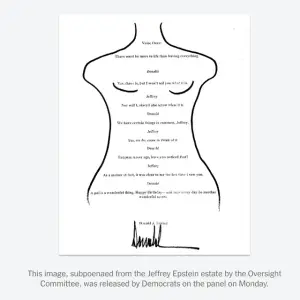 Tell me, when Donny sent that birthday card (above) to his dead pedo bestie with the poem about the ‘wonderful secrets they shared,’ do you think this is what he was talking about?
Here’s another question: do words even have meanings any more? I ask, because look at the twaddle Pam Bondi, right, posted to Elon’s Nazi Bar. ....She’s calling the release of heavily-redacted documents ‘transparency.’
Attorney General Pamela Bondi@AGPamBondiPresident Trump is leading the most transparent administration in American history. By moving to unseal these documents, we hope to give the American people more answers about that fateful day in Butler, Pennsylvania. WDPAnews @WDPAnews Earlier today, the Department of Justice received court approval to disclose to Congress documents gathered as part of the FBI’s investigation of Thomas Crooks and his attempt to assassinate President Trump. The Department of Justice is committed to transparency, following the12:52 AM · Dec 20, 2025 · 6.1M Views14K Replies · 1.67K Reposts · 9.33K Likes
Cool story, Pam. let’s fact-check your claim of ‘transparency.’
Congratulations are in order — because Pam’s outdone George Orwell. To ‘war is peace,’ ‘ignorance is strength,’ and ‘freedom is slavery,’ we can now add ‘censorship is transparency.’
Look at what else? They forced Jake Tapper to commit a journalism.....come on, people. Jake doesn’t want to be scrolling though his phone, showing you redacted files. He’s got sixteen more books to write about how Joe Biden is icky and old and smells bad and probably doesn’t even realize that he’s already dead.
“Talk about blacking out," Tapper said. "I don’t know if we can get a close-up of my phone. this is one of the documents that the Justice Department released. it’s a hundred pages. this is what it looks like. it’s all black. it’s just one hundred pages of redaction. that’s the ‘transparency’ we’re getting here.”
Let’s gif .... for posterity’s sake:
Pam Bondi’s DOJ was required by law — one that Dear Leader signed — to release everything by December 19. there were no if, and, or buts. the law didn’t say if it was too hard to get the job done in time — let’s say because there were so many references to Donny that had to be scrubbed — they get a mulligan.
They’re not supposed to crap out some unreadable tiny fraction of the files and pinky-swear to release the rest of it any day now.
Unfortunately, legal accountability for suppressing the Dead Pedo Bestie Files is going to be hard to come by. sure, Congress could submit a criminal referral for obstruction of justice — but do you know who any such referral would be sent to? Pam Bondi. good luck with that.
But here’s one workable option that’s already on the table: impeach ..... Bondi.
“DEVELOPING: Reps. Ro Khanna and Thomas Massie say they’re drafting articles of impeachment against AG Pam Bondi over the illegal handling of the Epstein files. This just escalated fast. Accountability is coming.”
Sounds like a plan.
 Mobology, Commentary on Mob Tactics: The Republicans are now using Bill Clinton as their foil in the Epstein scandal, Dan E. Moldea, Dec. 21, 2025. History shows that when the GOP demands showdowns on the issue of morality, the Democrats should gladly oblige. With the help of AI, here are lessons learned from my role in the motherlode of opposition research during the Clinton impeachment drama 27 years ago.
To be clear, during the impeachment drama, Flynt and I had no communication—directly or indirectly, on or off the record—with anyone at the White House.
For my full explanation of the events leading to the impeachment battle and its immediate aftermath, see:
* The suicide of Vincent Foster: Investigating the political firestorm that followed this tragedy
* Ken Starr and the OIC leaks: A prosecutorial goon squad targets President Clinton
* The Clinton Impeachment and The Flynt Project: At play in the fields of scandal
Also, in a separate matter, see:
* On the tragic D.C. Madam (3): “So tell me about David Vitter”
Lesson learned? . . . . Amid its “investigation” of the Jeffrey Epstein scandal, the Republican-controlled U.S. House Oversight Committee, led by Rep. James Comer (R-Kentucky), has targeted Bill and Hillary Clinton in a blatant attempt to deflect any and all attention away from Donald Trump and/or whomever he is attempting to protect.
Advice to the Democrats: When the Republicans demand a public showdown on the issue of morality, give it to them.
A question posed to the top AI sites—ChatGPT, Claude, Copilot, Gemini, Grok, and Perplexity: “Did Dan Moldea help President Clinton during the 1998-1999 impeachment process?”
Below, the first site, Perplexity, had the most accurate summary, which is followed by statements about my related work that appeared in four published books by well-known and respected authors. The comments from the other AI sites follow. All of these AI summaries—none of which come close to telling the whole story—are unedited.
* Perplexity
Yes. Dan Moldea actively aided Clinton’s defense effort during the impeachment fight, but he did so as an outside investigative journalist rather than a formal White House adviser or staffer.
Public defense of Clinton
Moldea emerged as a vocal defender of Clinton after researching and writing about Vince Foster’s death, concluding it was a suicide and that a network of anti‑Clinton activists and journalists had tried to weaponize the case against the administration. When the Lewinsky scandal broke in 1998, Moldea “decided to take sides” and publicly backed the president while attacking the fairness and legality of Independent Counsel Kenneth Starr’s investigation in media appearances and speeches.
Letters from an American, Historical Commentary: December 12, 2025 [Scoffing at Epstein Transparency Act and Epstein victims], Heather Cox Richardson, right, Dec. 21, 2025. On November 19, 2025, Congress passed H.R. 4405, the Epstein Files Transparency Act, and although there was none of the usual publicity and fanfare President Donald Trump enjoys around a bill signing, the White House said that Trump signed it the same day, making it a law.
It required the United States Attorney General to “release all documents and records in possession of the Department of Justice relating to Jeffrey Epstein” no later than 30 days after the date the measure became law. It required that the Department of Justice “make publicly available in a searchable and downloadable format all unclassified records, documents, communications, and investigative materials in the possession of the Department of Justice, including the Federal Bureau of Investigation and United States Attorneys’ Offices, that relate to: Jeffrey Epstein including all investigations, prosecutions, or custodial matters…. Ghislaine Maxwell…. Flight logs or travel records, including but not limited to manifests, itineraries, pilot records, and customs or immigration documentation, for any aircraft, vessel, or vehicle owned, operated, or used by Jeffrey Epstein or any related entity…. Individuals, including government officials, named or referenced in connection with Epstein’s criminal activities, civil settlements, immunity or plea agreements, or investigatory proceedings…. Entities (corporate, nonprofit, academic, or governmental) with known or alleged ties to Epstein’s trafficking or financial networks.”
It required the release of “[a]ny immunity deals, non-prosecution agreements, plea bargains, or sealed settlements involving Epstein or his associates” and “[i}nternal DOJ communications, including emails, memos, meeting notes, concerning decisions to charge, not charge, investigate, or decline to investigate Epstein or his associates.”
It required the Department of Justice to produce “[a]ll communications, memoranda, directives, logs, or metadata concerning the destruction, deletion, alteration, misplacement, or concealment of documents, recordings, or electronic data related to Epstein, his associates, his detention and death, or any investigative files.” It demanded “[d]ocumentation of Epstein’s detention or death, including incident reports, witness interviews, medical examiner files, autopsy reports, and written records detailing the circumstances and cause of death.”
The law established that the Department of Justice could withhold only information that was classified or that contained “personally identifiable information of victims or victims’ personal and medical files and similar files the disclosure of which would constitute a clearly unwarranted invasion of personal privacy”; images that “depict or contain child sexual abuse materials… [or] would jeopardize an active federal investigation or ongoing prosecution, provided that such withholding is narrowly tailored and temporary”; images that “depict or contain images of death, physical abuse, or injury of any person; or…contain information specifically authorized under criteria established by an Executive order to be kept secret in the interest of national defense or foreign policy and are in fact properly classified pursuant to such Executive order.”
The law required that the Department of Justice must justify all redactions with “a written justification published in the Federal Register and submitted to Congress.”
Otherwise, it said, records could not be “withheld, delayed, or redacted on the basis of embarrassment, reputational harm, or political sensitivity, including to any government official, public figure, or foreign dignitary.”
The deadline for the release of that information was yesterday, December 19.
In the afternoon, the department began to release the required materials. But despite the law’s specification that the department release ALL the records, it released just a fraction of the required materials, saying it would release more later. Missing were any of the FBI interviews with survivors or internal Justice Department memos about charging decisions.
There are very few images of Epstein with Trump, despite their close relationship. Instead, the files focused on former Democratic president Bill Clinton, whose office responded with a statement saying: “The White House hasn’t been hiding these files for months only to dump them late on a Friday to protect Bill Clinton. This is about shielding themselves from what comes next, or from what they’ll try and hide forever. So they can release as many grainy 20–plus-year-old photos as they want, but this isn’t about Bill Clinton. Never has, never will be. Even Susie Wiles said Donald Trump was wrong about Bill Clinton.”
And then there were the redactions. So much of the material was redacted that, in front of television cameras, Jake Tapper of CNN scrolled through an entirely-blacked-out 100-page document on his phone and said: “That’s the transparency we’re getting here.”
Today observers caught that for all that the Department of Justice had omitted materials the law required they produce, Justice Department staffers had inserted unrelated material: a photo of former Democratic president Bill Clinton, pop music star Michael Jackson, and music legend Diana Ross, with children, suggesting that the three were associated with sex abuser Jeffery Epstein. The image was quickly identified by social media users not as a private image from the Epstein files, but as a publicly available image from a 2003 fundraiser. The children were not Epstein victims, but rather Jackson’s and Ross’s own kids.
Then it turned out, as Michael R. Sisak and David B. Caruso of the Associated Press reported, at least 16 files that had initially been posted on the Justice Department’s public website have disappeared without explanation, including one that showed multiple photographs of Trump with Epstein.
Democratic lawmakers Representative Robert Garcia of California, the top Democrat on the House Oversight Committee, and Representative Jamie Raskin of Maryland, released a statement yesterday after Deputy Attorney General Todd Blanche said that the Department of Justice would not meet the deadline for the release of the Epstein files established by law.
“Donald Trump and the Department of Justice are now violating federal law as they continue covering up the facts and the evidence about Jeffrey Epstein’s decades-long, billion-dollar, international sex trafficking ring,” the two wrote. “For months, [Attorney General] Pam Bondi has denied survivors the transparency and accountability they have demanded and deserve and has defied the Oversight Committee’s subpoena. The Department of Justice is now making clear it intends to defy Congress itself, even as it gives star treatment to Epstein’s convicted co-conspirator, Ghislaine Maxwell.
“Courts around the country have repeatedly intervened when this Administration has broken the law. We are now examining all legal options in the face of this violation of federal law.”
Officials in the Trump administration have been treating members of Congress with contempt since Trump took office, deliberately flouting the 1974 Impoundment Act that prohibits presidents from unilaterally deciding to withhold funds Congress has appropriated, for example, and ignoring the 1973 War Powers Act that requires congressional approval for military actions that last more than 60 days.
Now, with their disregard for the Epstein Files Transparency Act, they are also treating voters, especially their own MAGA voters who stood behind Trump because he promised to release the Epstein files, with outright contempt.
 First lady Melania Trump, pictured in her upcoming film 'Melania' set to be released on January 30, 2026 via Amazon/MGM.
Ahead of the film's release, past sexual misconduct allegations against him have also resurfaced.
Once a prominent Hollywood filmmaker, Ratner became embroiled in the #MeToo movement in 2017 after a Los Angeles Times investigation reported that six women, including actresses Olivia Munn and Natasha Henstridge, accused him of sexual misconduct.
Ratner has consistently denied the allegations and was never criminally charged.
Nevertheless, during a recent episode of The View, co-host Alyssa Farah Griffin, who worked for former Vice President Mike Pence during the first Trump administration, criticized the First Lady's decision to work with Ratner.
Griffin said his history distracts from the project and raises concerns about placing the First Lady in an uncomfortable position.
While she said the allegations gave her pause, Griffin added that she might still consider watching the documentary when it becomes available.
'What bothered me about this doc, the director has been accused of sexual misconduct by many prominent actors, Griffin noted on a recent episode of The View.
'He denies all allegations, but I wouldn't, as a staffer, put the First Lady in a position of working with somebody who had that history. It's a distraction from it,' Griffin continued,' also noting that Ratner's ties make her 'on the cusp of even wanting to watch it.'
In addition to the original accusations, Ratner was also accused of rape by Hawaii resident Melanie Kohler in 2017, a claim he denied. Brett Ratner is seen on May 7, 2023 in Miami, Florida
 Brett Ratner, right, is seen on May 7, 2023 in Miami, Florida (Photo by cocoparisienne via pixabay, GC Images and Daily Mail).
He filed a defamation lawsuit against Kohler, which he later dropped in 2018. More recently, in 2023, actress Rebecca Romijn said she had negative experiences working with Ratner on X-Men: The Last Stand, stating she felt he 'had it coming' when his career stalled, though she declined to provide further details.
Ratner had not directed a film in nearly a decade before being selected for the Melania documentary. He was previously  known for his work on the 'Rush Hour' series, as well as other films, including X-Men and War Dogs.
According to reports, Melania Trump (portrayed with him in a collage) was a fan of his work, and sources claimed she did not view his being 'canceled' as a drawback.
The project has reportedly drawn concern from Secret Service agents and others due to Ratner's past, especially given that he was granted extensive access to the Trump White House during filming.
New York Times, ‘Here We Go Again’: In Melania Trump’s Movie, This Time She Knows What She’s Doing, Katie Rogers, Dec. 17, 2025. The first lady is behind a movie that she has said will give a better idea of what it was like for her to move into the White House for a second time.
On Inauguration Day in 2021, Melania Trump left Washington as first lady. She wore a blue-and-orange caftan, a pair of navy flats and a face-swallowing pair of sunglasses — the fashion equivalent of an out-of-office message. Given that the events of Jan. 6, 2021, had not yet been rewritten, she and her husband were as close to becoming a pair of political pariahs as they would ever get.
Things change, she wants you to know.
With her new movie, “Melania,” the trailer for which was released on Wednesday, Mrs. Trump is asserting direct and creative control over her story. In just over a minute, she tells Americans, who have at times been mystified by her actions, exactly how she wants to be seen.
“Here we go again,” a (slightly) smiling Mrs. Trump says into the camera, a military aide on her arm and a wide-brimmed hat on her head, as she heads into Donald J. Trump’s second swearing-in ceremony. This time, with her eyes partially obscured and the curl of her lips visible, there is no question which history-making first lady she most resembles: herself.
New York Times, Live Updates: Trump Administration Live Updates: Justice Dept. Reposts Epstein Files Image Showing Trump Picture, Devlin Barrett, Dec. 21, 2025. Where Things Stand:
Epstein files: The Justice Department reposted an image containing a photo of President Trump that it had removed from an online collection of files on the convicted sex offender Jeffrey Epstein. The department said it reposted the image on Sunday after it was re-examined and found not to contain images of Mr. Epstein’s victims. Todd Blanche, the deputy attorney general, said earlier that department officials were “not redacting information around President Trump.” Read more ›The Justice Department has republished an image from the Epstein files that it had released in an online collection on Friday and then removed, which showed a number of photographs on a credenza in one of Epstein’s houses, including one of Donald J. Trump. The removal of the image had raised questions about whether the department was trying to shield the president.
Deputy Attorney General Todd Blanche said on Sunday that the image was pulled down over concerns that it might contain images of victims.
“After the review, it was determined there is no evidence that any Epstein victims are depicted in the photograph, and it has been reposted without any alteration or redaction,” the Justice Department said in a statement on social media.
The U.S. Coast Guard is pursuing an oil tanker linked to Venezuela.
The U.S. Coast Guard on Saturday tried to intercept an oil tanker linked to Venezuela that is now fleeing in the Caribbean Sea, according to three U.S. officials who spoke on the condition of anonymity to discuss a sensitive operation, days after President Trump said he would crack down on sanctioned vessels involved in the country’s oil trade.
The tanker, called the Bella 1, was en route to pick up oil in Venezuela and was not carrying cargo, according to one of the officials and ship-tracking data. The tanker has been under U.S. sanctions since last year for transporting Iranian oil, which federal authorities say is sold to finance terrorism.
When U.S. forces approached the Bella 1 late on Saturday, it was not flying a valid national flag, the officials said, making it a stateless vessel liable to be boarded at sea under international law.
American authorities had obtained a seizure warrant from a federal magistrate judge, which would allow them to take possession of the ship, two of the officials said. The warrant had been sought because of the Bella 1’s previous involvement in the Iranian oil trade, not because of its links to Venezuela.
But the ship did not submit to being boarded and continued sailing, one of the officials said. A second official referred to the situation as “an active pursuit.” The Coast Guard had successfully boarded another tanker earlier on Saturday, and the United States had taken possession of a third tanker on Dec. 10 that is now at port in Texas.
The U.S. actions represented a significant escalation of Mr. Trump’s pressure campaign against President Nicolás Maduro of Venezuela. They come as Mr. Maduro has ordered Venezuelan Navy vessels to accompany some oil tankers leaving his country — raising the possibility of an armed confrontation at sea. The Bella 1 had not yet reached Venezuelan waters and did not have such an escort, according to one of the officials and ship-tracking data.
Mr. Trump has accused Mr. Maduro of flooding the United States with fentanyl and of stealing oil from American companies, without providing evidence. Venezuela’s economy depends on exporting oil, and the seizures are an attempt to squeeze this vital trade.
Earlier on Saturday morning, the Coast Guard had stopped and boarded a second vessel, the Centuries, which had recently picked up oil in Venezuela and was headed east. Two people inside Venezuela’s oil industry said the cargo belonged to an oil trader based in China.
Unlike in the Bella 1 case, U.S. forces did not have a warrant to seize the Centuries. It was unclear how long the United States intended to detain the vessel, which was flying under a Panamanian flag. A U.S. official said that the Coast Guard was trying to determine whether the ship’s Panama registration was valid.
Mr. Trump signaled on Tuesday that more seizures were coming, announcing a “complete blockade” on oil tankers that were traveling to and from Venezuela and were under U.S. sanctions. But the Centuries does not appear on a public list of entities under U.S. sanctions maintained by the Treasury Department.
The events have added to the uncertainty surrounding the Trump administration’s ultimate intentions. If the United States continues to allow most vessels to freely enter and leave Venezuelan ports, it is not a real blockade, which would constitute an act of war. Instead, the operation would more closely resemble a law enforcement action.
Kristi Noem, the homeland security secretary, said in a social media post on Saturday afternoon that the Coast Guard had “apprehended” a tanker that had been docked in Venezuela, seemingly referring to the Centuries.
“The United States will continue to pursue the illicit movement of sanctioned oil that is used to fund narco terrorism in the region,” she wrote. “We will find you, and we will stop you.”
Ms. Noem also posted a video that appeared to show U.S. forces rappelling from a helicopter onto the ship’s deck.
The White House declined to comment on the boarding of the Centuries and did not immediately respond to questions about the interception of the Bella 1.
In response to the boarding of the Centuries, the Venezuelan government said that the country “denounces and categorically rejects the theft and hijacking of another private vessel transporting Venezuelan oil, as well as the forced disappearance of its crew.”
The ships being targeted are part of a ghost fleet of tankers that move oil from Iran, Venezuela and Russia in violation of sanctions imposed by the United States and other countries. Shipping and energy experts estimate that these ghost tankers make up as much as 20 percent of the global tanker fleet.
MeidasTouch Network, Analysis: Sunday Morning Message from MeidasTouch Founder, Ben Meiselas, right, Dec. 21, 2025. It’s the Sunday before Christmas. As you know, the Sunday post is my favorite, where I get to grab a cup of coffee with you and reflect on the week.
Obviously, I am reflecting on Trump’s awful cover-up of the Epstein files. In my prior career as a litigator, when I brought down billion-dollar Ponzi schemes or exposed corruption inside police departments with officers actually selling drugs, the cover-ups were far more sophisticated. In those instances, the criminals knew that if they were caught, they would be brought to justice, so they went through intricate ways to hide their schemes.
This is not the case with this criminal Trump regime. They have destroyed the Justice Department. They have a supine right-wing Supreme Court that gave Trump “absolute immunity.”
The criminal regime shows no concern for the laws they don’t enforce and openly break. In plain view, criminal Trump has violated the Epstein Transparency Act. In the small batch of documents they did produce—which is about 5 percent of the overall files, and where most of what was produced was entirely redacted—they have now deleted documents made public that included a photo of Trump. The criminal Trump regime has said the men who are implicated in Epstein’s child sex trafficking ring are the “new victims” and must be protected at all costs.
We have a criminal regime in the White House that is openly and willfully covering up a child sex trafficking ring. We have a criminal regime in the White House led by a convicted felon. Led by someone who has been found liable for sexual abuse and who is on tape bragging about sexually assaulting women. Led by someone who has been a lifelong fraud. Led by someone who has bankrupted company after company.
We know Trump’s name is in the files. We know Trump, Epstein, and Ghislaine Maxwell were close friends. This is not a point that can be disputed. What do you think they were doing together during that period of time—a period when they were also hanging out with other men who led so-called model agencies that were being used for grooming girls, with some of those men also dying under unusual circumstances?
It’s not just the cover-up of the Epstein files on display this week. It’s the cover-up of everything this week. There’s the cover-up of Trump’s health, with the refusal to turn over his MRI reports and credible medical information. Some are speculating he has dementia or early signs of Alzheimer’s, and his performance at a speech in North Carolina at the end of the week raised even more red flags. The White House’s claim that the bandages on his hand and the discoloration are from “many handshakes” is yet another example of how bad their lies are.
Then, of course, there is the cover-up of the video showing the United States military murdering survivors of a boat strike on September 2 off the coast of Venezuela. And speaking of Venezuela, the gangster Trump regime continues to seize tanker ships off the coast, trying to provoke a response that could be used as a pretext for war. The criminal regime desperately wants war to distract from its failures at home.
The American people don’t want war. The American people want healthcare. The American people want affordable things. The American people want to be paid a wage with dignity and be able to afford a home. We also want transparency and a government that follows the Constitution and supports democracy. The Trump regime and MAGA have betrayed the American people. Trump and MAGA literally shut down Congress and took an early vacation to deprive the American people of needed extensions of the Affordable Care Act subsidies.
With all of this going on, and as I finish my cup of coffee, the word I continue to think about in how the people have responded to all of this is “resiliency.” It’s remarkable how our institutions have largely bent the knee or been complicit in this madness and criminality—but what never bent or gave an inch was the people of this country.
Over the past year, the people of this country have made it clear we don’t want a dictatorship. We don’t want an oligarchy that subjugates us. We don’t want our books banned or our neighbors disappeared off the streets. We don’t want a mad king ruling by social media post and bragging about passing cognitive exams by recognizing the distinction between a giraffe and a hippopotamus. We don’t want to be allies with Putin. We don’t want to pull out of NATO or cancel funding for pediatric cancer. We don’t want this.
What I am most proud of is working with you to build a new force for good that stands up to these criminals. It was critical that we get the truth out and keep the people informed and united. I am thrilled we inspired a new generation of independent media that is meeting the moment. I am thrilled that we held the line—and will continue to hold the line—with you by our side.
Now I am getting all emotional on this Sunday post. You see what happens when I write these a little later than usual… OK, on that note, I have to record my next video. Thanks for all you do. I appreciate all you do, and I’m honored to call you a friend.
If you aren’t yet a subscriber, please become a subscriber today and help grow this platform. We are still leading Fox, and we know next year the competition will be fierce. We need all the help we can get. Let’s keep fighting.
MeidasTouch Network, Analysis: Lawyer For Eleven Epstein Survivors Has Warning for Trump, Ben Meiselas, right, Dec. 21, 2025. My interview with Arick Fudali, who represents eleven Epstein survivors, about his the survivors' response to Trump’s cover-up of the files.
I spoke this week with attorney Arick Fudali, who represents eleven survivors of Jeffrey Epstein’s abuse, about what the Trump administration has labeled its “release” of the Epstein files. It was a devastating account of how power continues to protect itself by hiding behind the very people it harmed.Subscribed
As many predicted, the Trump administration did not meet the requirements of the Epstein Files Transparency Act. The law is not ambiguous. It requires the release of all unclassified Epstein-related records in a searchable format, with any redactions narrowly tailored and legally justified. What the Department of Justice produced instead was a nonfunctional website, thousands of unlabeled files, and a vague promise that this was merely an “initial” step.
The DOJ has attempted to justify this failure by claiming it is acting to protect victims. That assertion is not only legally incorrect. It is morally offensive.
As Fudali told me, survivors’ names are being invoked as a shield for secrecy rather than as a mandate for transparency. The result is that survivors are once again used, not supported. “This is nothing new for them,” Fudali said. “They’ve been wronged by administration after administration, Justice Department after Justice Department, for decades.”
The administration’s conduct is particularly glaring given what we know about the scope of the material being withheld. Public reporting confirms that the FBI and DOJ possess terabytes of Epstein-related data and that tens of thousands of hours were spent reviewing those materials earlier this year. Additional teams of national security lawyers were reportedly pulled into the process. After all of that, the public was handed a digital maze that, at least initially, did not even allow basic name searches.
For survivors, this is a continuation of trauma. Fudali described the current moment as psychologically torturous, reopening wounds for people who have already endured the worst forms of abuse and intimidation. The release was supposed to offer closure. Instead, it has become the beginning of another long battle.
That pattern extends beyond documents. Survivors were not consulted when the DOJ transferred Ghislaine Maxwell from a maximum-security prison to a minimum-security facility. She remains the only person convicted in connection with Epstein’s trafficking operation, despite decades of credible allegations and investigations. The message to survivors is unmistakable: accountability is negotiable.
Fudali’s work underscores how deep that failure runs. One of the survivors he represents, known publicly as Rosa, was trafficked from Uzbekistan by Jean-Luc Brunel under the guise of modeling opportunities, Fudali says. When she arrived in the United States, she was introduced to Epstein while he was wearing an ankle monitor, the product of a plea deal that should never have existed. Had Epstein been fully prosecuted years earlier, Rosa would never have encountered him.
Instead, Epstein used her immigration status, isolation, and fear as tools of control. According to Fudali, that kind of coercion was not incidental. Epstein identified each victim’s vulnerabilities and exploited them relentlessly, threatening family members, livelihoods, and legal status. Many survivors, he said, continue to live in fear long after Epstein’s death, still convinced that his power extends beyond the grave.
What is often lost in the public discourse is the scale and nature of Epstein’s abuse. While there were instances involving other powerful men, Fudali said that Epstein primarily trafficked victims for himself, sometimes abusing multiple girls a day for years. The fixation on political scorekeeping obscures the reality that this was a system built on serial violence, intimidation, and impunity.
The administration’s document dump mirrors that abuse in form, if not in kind. Thousands of files with no context, no organization, and massive redactions that extend far beyond what is legally permissible are not transparency. They are obfuscation. In civil litigation, such tactics are recognized for what they are: attempts to hide the truth in plain sight.
The question now is enforcement. What happens when the very institutions charged with upholding the law are the ones violating it? Fudali made clear that litigation is not off the table. He has already sued the FBI over its historic failures and is exploring further legal action to compel compliance, including possible intervention before federal judges who already have jurisdiction over related matters.
The survivors are not backing down. “They’re the only reason we’ve gotten this far,” Fudali said. “And we’re not going to stop fighting.”
That, ultimately, is the point the administration seems to misunderstand. Survivors are not a convenient excuse for secrecy. They are the reason the law exists. Transparency is not a threat to justice here. It is the only path to it.
Global News
New York Times, Land Grab: Israel’s Escalating Campaign for Control of the West Bank, Michael D. Shear, Daniel Berehulak, Leanne Abraham and Fatima AbdulKarim, Dec. 20, 2025 (interactive). Israeli seizure of Palestinian lands, often brutally, has accelerated, raising doubts about the prospects of a peaceful solution to the conflict.
Every Saturday, sheep owned by Jewish settlers march through the olive groves that Rezeq Abu Naim and his family have tended for generations, crushing tree limbs and damaging roots. The extremist settlers, armed and sometimes masked, lead their herds to drink from the family’s scant water supplies while Mr. Abu Naim watches from the ramshackle tents of Al Mughayir, where he lives above the valley.
“I beg you, I beg you. God, just let us be,’” Mr. Abu Naim recalled telling settlers during a recent confrontation. “Just go away. We don’t want any problems.”
Vast stretches of his family’s farm and wheat have been seized by Israeli settlers who have set up outposts, illegal encampments that can eventually grow to become large settlements, on the nearby hills.
New roads cut through the land on which his own flock of sheep graze — and settlers routinely steal the animals, he said. Six months ago, a masked settler armed with a gun broke into his family home at 3 a.m., he recalled. He described raiders tearing through his son’s nearby home at night last December, slashing tents and stealing solar panels.
The family takes turns at night guarding their sheep against attacks from settlers. On a recent day, we found Mr. Abu Naim resting on pillows, a portable radio pressed to his ear listening for regional news.

Fair Observer, EU to freeze €210bn in Russian assets indefinitely, Dec. 21, 2025. Frozen Russian Assets And The Moment Of Truth For The World Order
Frozen Rubles: How did we get here? What has the US done?
On Friday, December 12, the European Union decided to freeze Russian central bank assets indefinitely. This decision is the result of a process that started right after Russia launched its full-scale invasion of Ukraine back in February 2022.
In the immediate aftermath of the invasion, Western governments acted quickly, freezing about $300 billion in Russian government reserves held overseas. Most of that — about $246 billion — is held in Europe, mainly at Euroclear, the Belgium-based financial firm that settles cross-border securities. Freezing the funds proved relatively straightforward; determining their long-term status did not.
At first, Europe played it safe. Legally, they had to renew the sanctions every six months. There was a reluctance to block a country’s central bank reserves permanently — these assets have always seemed to be almost untouchable. European officials expressed concern that moving beyond a temporary freeze could unsettle markets, weaken confidence in the euro or expose European institutions to legal and financial risk.
But the war waged on. In February 2025, the United Nations estimated Ukraine’s reconstruction costs in the hundreds of billions of dollars. European Council President António Costa later recalled a commitment by EU leaders to keep the assets immobilized until Russia ends its war of aggression and compensates Ukraine for the damage inflicted.
This week, EU officials removed the requirement that sanctions be renewed every six months; the freeze is now indefinite. Europe has sent a strong signal to Russia and the rest of the world, signaling it is now ready to accept legal and diplomatic risks to maintain control of the funds. This decision comes even as Moscow continues to threaten Euroclear and other European financial institutions.
The US has had its own role in all this. The Biden administration imposed tough financial sanctions on Russia and kept reiterating that Russia should pay for Ukraine’s recovery. That position diverged from a reported 28-point peace plan later advanced by President Donald Trump’s administration officials and Russian envoys. Their proposal would have taken control of the frozen assets away from Europe and handed most of the money to a US-run investment scheme.
European governments rejected the plan. By making the freeze indefinite, they kept the assets under EU control and ditched the old system of time-limited renewals. Whether the funds are used to support Ukraine’s recovery or remain tied to a future settlement remains unresolved, but Europe has now made clear that the assets will not automatically return once the war ends.
What are the reactions?
Responses to this new freeze have been varied. Russia, as one would expect, is vehemently against the move, saying it undermines peace efforts and that the EU’s leaders are hiding the fact that EU citizens will be paying a price for this. Moscow has filed suit against Euroclear, seeking $230 billion in damages. Ukraine, of course, supports the action, as any blow against Russia supports their cause and their own badly depleted coffers need filling.
However, things have taken a step further. The EU has begun talks to use the frozen money to directly fund Ukraine by sending €90 billion ($105 billion) to the war-torn nation. As of December 19, 2025, leaders have still failed to agree on and use the frozen Russian assets. This proposal comes at a time when the US says it will host a peace summit with Russia in Florida. The Trump administration has been pressuring the EU to back off on this new proposal, according to several officials from Ukraine and within the EU.
This is not the first time the EU has floated such an action, but it is the next logical step to discuss. Among leaders, a number of countries have said they want Russia to pay for the damage it has caused, but several key members oppose the move.
U.S. Media, Culture, Education, High-Tech, Religion
New York Times, Media Year In Review: 329 Days of Trump, Trump, Trump, Michael M. Grynbaum and Stuart A. Thompson, Dec. 21, 2025 (print ed.). The president dominates the collective consciousness. The Times broke down how he has relentlessly pursued attention in his second term.
To understand how Mr. Trump has achieved this omnipresence, The New York Times reviewed the first 329 days of his second term, finding at least one instance each day when he attracted the public’s attention to himself and his actions.
The review encompassed more than 250 media appearances, more than 320 official appearances, and more than 5,000 Truth Social posts or reposts. The analysis shows that while Mr. Trump has lagged his predecessors in his number of official appearances, he has pursued a raft of innovative methods to force himself into the public consciousness on a daily, and sometimes even hourly, basis.
The battery of activity started from the moment he was inaugurated, when he traveled from the Capitol Building to the Capital One Arena to publicly sign a flurry of executive orders.
The Daily, Top Senate Democrat Vows That Trump's Name Will Be Removed From The Kennedy Center, Sarah Jones and Jason Easley, Dec. 20, 2025. While speaking to protesters outside the Kennedy Center, Sen. Chris Van Hollen (D-MD) said that it doesn't matter if it takes weeks or months, Trump's name will come off the Kennedy Center
The Kennedy family is outraged that Donald Trump has decided to illegally slap his name on the national monument to honor the late President John F. Kennedy.
Many Kennedy family members have released statements expressing their dismay and outrage.
The Daily is outside the Beltway journalism for the people. Please support our work by becoming a subscriber.Upgrade to paid
One example came from JFK’s niece Maria Shriver:
The Kennedy Center was named after my uncle, President John F Kennedy. It was named in his honor. He was a man who was interested in the arts, interested in culture, interested in education, language, history. He brought the arts into the White House, and he and my Aunt Jackie amplified the arts, celebrated the arts, stood up for the arts and artists.
It is beyond comprehension that this sitting president has sought to rename this great memorial dedicated to President Kennedy. It is beyond wild that he would think adding his name in front of President Kennedy’s name is acceptable. It is not.
Next thing perhaps he will want to rename JFK Airport, rename the Lincoln Memorial, the Trump Lincoln Memorial. The Trump Jefferson Memorial. The Trump Smithsonian. The list goes on.
Can we not see what is happening here? C’mon, my fellow Americans! Wake up! This is not dignified. This is not funny. This is way beneath the stature of the job. It’s downright weird. It’s obsessive in a weird way. Just when you think somone can’t stoop any lower, down they go…
The next logical step is for Trump to rename the Lincoln Memorial, the Trump Lincoln Memorial, and plop himself on Honest Abe’s lap.
The good news is that Trump can’t legally change the name of the Kennedy Center, and one senator already has a plan to get the president’s name off of the building.
U.S. Politics, Governance
New York Times, How the Supreme Court’s Mail-In Ballot Ruling Could Affect Voters, Nick Corasaniti and Christine Zhang, Dec. 21, 2025 (print ed.). Hundreds of thousands of Americans in rural and urban areas alike could see their votes rejected if the court decides that ballots must arrive by Election Day.
The Supreme Court is set to decide this term whether states can count mail-in ballots received after Election Day. The case centers on a law in Mississippi, but a total of about 18 states and territories accept such late-arriving ballots as long as they are postmarked by Election Day.
Should the court rule that all ballots nationwide must be received by Election Day, it could lead to the rejection of tens, if not hundreds, of thousands of ballots in the future, affecting a swath of American voters in rural and urban areas.
In 2024, at least 725,000 ballots were postmarked by Election Day and arrived within the legally accepted post-election window, according to election officials in 14 of the 22 states and territories where late-arriving ballots were accepted that year. (Four of these states — Kansas, North Dakota, Ohio and Utah — have since changed their policies and will accept only mail ballots that arrive by Election Day.)
Another roughly 104,000 mail ballots were rejected nationwide for arriving after the deadline, according to a federal report on election data.
The roughly 725,000 ballots represent a sliver of the total number of mail ballots cast in the 2024 election across the 14 states and territories — about 24 million, according to federal election data. Nonetheless, 725,000 voters constitute nearly the population of a congressional district, a significant number to be potentially left uncounted.
Of course, a decision by the court eliminating late-arriving ballots would not effectively cause 725,000 votes to be left uncounted. Voter education efforts by election officials, and potential changes in policies and procedures, would most likely help the vast majority of voters avoid having their ballot rejected based on the court’s ruling.
But education and policy changes can go only so far. During the 2020 election, the State Supreme Court in Pennsylvania, a top political battleground, ruled that ballots postmarked by Election Day should be counted if they arrived within three days after the closing of polls. Roughly 10,000 ballots arrived and were counted in those three days, according to the secretary of state at the time.
That onetime allowance wasn’t codified into law, and the current law requires all ballots in Pennsylvania to be received by Election Day. In 2024, 6,816 ballots were rejected by the state for arriving after the date. (Because the total number of mail ballots cast was lower than it was in 2020, the share of voters who sent in late ballots in 2024 was basically unchanged.)
A majority of Pennsylvania’s late ballots came from younger voters, who generally vote less frequently than older ones.
“For people who are voting once every four years, or once every two years, they’re not familiar with all these procedures and changes, and this could have a big impact on them,” said David Becker, the executive director of the Center for Election Innovation and Research, a nonpartisan group that advises election officials. “And by the way, those people broke for Trump in 2024.”
Determining whether Democrats or Republicans would suffer greater harm as a result of an Election Day deadline is a murky task. Democrats still far outpace Republicans in their use of mail voting, a trend intensified by the 2020 election.
So, in most states, the rejected ballots are likely to lean more Democratic than Republican. In Virginia, 73 percent of the ballots that arrived after Election Day and were counted in 2024 were cast for Vice President Kamala Harris, compared with just 23 percent for Donald J. Trump. Mail ballots that arrived before Election Day had almost the same partisan breakdown.
Lincoln Square Media, Weekly Wrap Political Commentary: The Reiner Tragedy, Susie’s Plea Deal with History, & Can Dems Recover from ‘24? Susan Demas & Edwin Eisendrath, Dec. 21, 2025. Catch up on all the best shows and interviews you may have missed on Lincoln Square.
Trump’sVile Attacks on Rob Reiner
Rob Reiner and his wife, Michele, were murdered last week in a horrific act of violence that saw their son Nick Reiner arrested for the crime. The very next day, the President of the United States made a sadistic post on his social platform blaming Reiner’s political beliefs on his death. Susan and Edwin tackle this disgusting reaction and more in this Live.
Susan J. Demas: Well, I know this week our list of topics was particularly long – but I think we need to start with Trump managing to outdo himself in cruelty with his response to actor and director Rob Reiner’s death. I mean, this tweet was one for the books. As usual, it has to be all about him.
And you know, I just want to get real here. If you have a member of your family who has Alzheimer’s, you know this behavior and you don’t want that person having the keys to the car, much less having the nuclear codes. And this just strikes me as tirades that I have heard from folks in my life at family gatherings where you just have to sit there and endure it if you love this person. But as a country, I think we’re all tired of enduring this.
Edwin Eisendrath: Let’s start with this: Rob Reiner was a national treasure, and his wife. They have a family tragedy. They have a son with serious mental illness, a terrible tragedy, something that would be painful for any family and now terribly tragic with this kid at least charged with murdering his parents in a brutal way.
This is heartbreaking for anybody and shocking. And any reaction that’s different from that is not a normal human reaction. I mean, go back to Charlie Kirk. You know, I wrote a piece when he was shot about how much I hope he lived because that’s not how we want to do things, right?Subscribed
And that’s not a guy I agree with about anything. Donald Trump’s reaction to this tragedy is: me, me, me, me, me. You just want to say, “We all know it’s about you, Donald.” I mean, there’s no news here, but you’re just showcasing what a terrible human being you are. I mean, every story we have has been about what a terrible human being he is. This one was just revolting. Just personally revolting. And I’m pleased that some of the Republicans said so. I mean, it’s nice to know – and we’re finding this inch by inch all over the country.
And I don’t want to give them more credit than they deserve, but now that his poll numbers are in the tank, we’re finding that people are willing to say, “oh, there are other things to value. You may not be the God we thought you were. Indiana said no. And I think Republicans, a couple of them have come out and said, “Yeah, no, we think this was a tragedy.”
New York Times, Turning Point’s Annual Gathering Turns Into a Gripefest, Richard Fausset and Ken Bensinger, Dec. 20, 2025. At AmericaFest, conservative leaders insulted one another, revealing serious rifts over conspiracy theories, antisemitism and who belongs in America.
Since 2021, Turning Point USA’s annual gathering, AmericaFest, has featured a star-studded roster of conservative influencers and politicians who have been virtually unified in their focus on a common foe, one that Charlie Kirk, the group’s co-founder, called the “woke” left.
But this weekend in Phoenix, speakers at AmericaFest have scarcely mentioned Democrats and other liberal foils. Instead, some of the most prominent right-wing leaders in the country have been criticizing members of their own movement, accusing them of being “frauds,” “pompous” and a “cancer.”
Driving the enmity have been some of the most explosive and unresolved issues confronting the MAGA movement: resurgent antisemitism, the prevalence of conspiracy theories and the rise of the concept of “heritage Americans” and what that concept — considered by some to be a thinly veiled racist dog-whistle — means for nonwhite conservatives.
Notably, in the wake of the revolt against left-wing “cancel culture,” there have also been questions about what kinds of ideas might be grounds for cancellation within conservatism itself.
It has been a snapshot of a powerful movement in an uncharacteristic state of discord just three months after the assassination of Mr. Kirk, a gifted communicator who had helped construct a big tent under which American conservatives of many stripes could coexist in the Trump age.
Without Mr. Kirk, the movement’s boldface names have appeared to be jockeying this weekend to influence the direction of the MAGA movement at a time when its most towering figure, President Trump, is in his second term.
For some true believers, it has been hard to watch.
More U.S. Politics
New York Times, Elise Stefanik Tried Everything to Please Trump. He Still Jilted Her, Annie Karni, Dec. 19, 2025. The G.O.P. congresswoman who ran as a moderate but became an “ultra MAGA” Trump acolyte ultimately found herself undermined by the president and politically adrift.
Representative Elise Stefanik, Republican of New York, was willing to be the team player with the stiff upper lip.
But everyone has their limits.
After a series of public humiliations delivered to her by President Trump — his yanking of her nomination to serve as U.N. ambassador; his Oval Office love fest with New York City Mayor-elect Zohran Mamdani, during which the president undercut her; and the coup de grâce of his refusal to endorse her in the Republican primary for governor — Ms. Stefanik on Friday afternoon announced she’d had enough.
She was done with the governor’s race, for which she had raised more than $12 million from donors who may now be frustrated with her decision to pull out. And done with Congress altogether: She said she would not seek re-election next year.
Now, at war with Speaker Mike Johnson, privately livid at Mr. Trump and deeply frustrated with her job in Congress, it is not clear whether Ms. Stefanik even has any interest in finishing her term, although people close to her said she planned to stay until the end of her term.
“My most important title is Mom,” she wrote in a long post on social media on Friday.
People close to Ms. Stefanik said she was not upset with the president, noting that the two had spoken multiple times, including in person, over the past few weeks, conversations in which they saw eye to eye about Ms. Stefanik’s decision and her future.
To detractors, Ms. Stefanik’s shoddy treatment by the president amounted to karmic comeuppance for a Republican lawmaker who came to Congress as a Harvard-educated moderate but tacked unapologetically to the MAGA right when it suited her political purposes. They said she personified the opportunistic shape-shifting that gripped her party.
“My greatest disappointment is Elise Stefanik, who should know better,” Representative Don Beyer, Democrat of Virginia, said in an interview last year, describing her as a one-time friend. “She went off the deep end.”
Her tumble from grace crystallized the limits of MAGA loyalty and the risks of building a political identity around Mr. Trump, who can turbocharge or torpedo a career — sometimes both. Once one of the president’s most stalwart defenders, Ms. Stefanik, who referred to herself as “ultra MAGA” and styled herself after Mr. Trump, ultimately found herself undermined by him and politically adrift.
In truth, Ms. Stefanik, first elected in 2014 as the youngest woman to serve in the House, has been burned out on Congress for years.
Instead of seeking to rise in the House, Ms. Stefanik set her sights on serving in a second Trump administration. When every other member of House Republican leadership ran for speaker in 2023, she sat it out. Instead, she looked in the mirror and saw a cabinet secretary looking back.
Representative Marjorie Taylor Greene, the hard-right Georgia Republican who was a true believer but dared to break publicly with the president on a variety of issues, recently experienced the inevitable falling out with him for doing so.
But Mr. Trump’s treatment of Ms. Stefanik was more surprising because no one had ever viewed her as a true believer, and she still never dared to vent frustration or disagreement with the president.
U.S. Jobs, Immigration, Affordability, Economy, Markets
New York Times, ‘It’s Just Us’: The Firefighter, His Son and a Treacherous Choice, Hannah Dreier, Photographs by Loren Elliott, Dec. 21, 2025. For two decades, Luis Martinez has fought wildfires for the U.S. government. Now he faces cancer, debt and the threat of separation from his 11-year-old.
He worked for a private firefighting company, but in the field, everyone took orders from U.S. Forest Service supervisors. He was usually assigned “mop-up,” one of the smokiest parts of the job. After flames had died down, he would get on his hands and knees to feel for spots that were still smoldering. When he found lingering embers, he smothered them with dirt.
The Forest Service’s own researchers warned in 2016 that supervisors were assigning mop-up more often than needed, endangering firefighters’ health. The agency’s policy is to limit mop-up to only what is strictly necessary. In practice, though, that work is still frequently being done — it has just fallen to immigrants.
Dozens of the firefighting companies that the government relies on are built on immigrant labor. Worker advocates and the Forest Service’s internal watchdog have estimated that as many as 70 percent of these firefighters are undocumented.
Meidas Touch Network, Commentary: Ice Kills Thirty In Custody, Michael Cohen, Dec. 21, 2025. Four people died in ICE custody this week, proving the cruelty isn’t the arrest itself — it’s the neglect, indifference, and silence that follow once the doors lock.
I’ve been out of federal custody for a while now, but the memories don’t fade. They linger. They itch. They wake you up at night like a phantom pain from a limb you didn’t even know the government could amputate. Since my release from FCI Otisville, I’ve been very clear — borderline annoying, if you ask my former captors — about what it means to be human warehoused by the United States government.Subscribed
Fifty-one days in solitary confinement. Three days without food. A sink and toilet that didn’t work, which is a polite way of saying I lived with my own waste. A broken window that let rain soak my bed like I was camping, minus the fun and marshmallows. Gnats. No ventilation. Temperatures pushing 100 degrees. And this wasn’t some secret black site in a failed state. This was a federal facility in the United States of America.
And here’s the part that matters: I am a U.S. citizen. I was the former personal attorney to the sitting President of the United States. I had a megaphone — family, friends, journalists, celebrities, members of Congress — people who noticed when I coughed, sneezed, or didn’t get fed. If that’s how the system treated someone with visibility, resources, and a last name people recognize, let me ask you something uncomfortable: what do you think happens to the people nobody is watching?
Now imagine you’re in ICE detention.
This month alone, four people died in immigration detention over the span of four days. December 12. December 14 — twice. December 15. That’s not a coincidence. That’s a pattern. Or, as the ACLU’s Eunice Cho accurately put it, a “red-hot crisis.” When four human beings die in government custody in less than a workweek, the problem isn’t bad luck. It’s bad conditions.
The names matter. Jean Wilson Brutus, 41, Haitian, dead one day after entering ICE custody in Newark. Nenko Stanev Gantchev, 56, Bulgarian, died in Michigan. Delvin Francisco Rodriguez, 39, Nicaraguan, died in Mississippi. Fouad Saeed Abdulkadir, 46, Eritrean, died in Pennsylvania. ICE says two died of “natural causes” and two from “medical complications,” which is bureaucratic shorthand for “please don’t ask follow-up questions.”
Thirty people — THIRTY — have died in ICE custody in 2025 alone; the highest number since 2004. That tally includes two people killed in a shooting at a Dallas ICE facility, because apparently even detention centers now need active-shooter disclaimers. Nearly 66,000 people are currently detained, a record high, while the Trump administration is asking Congress for $45 billion to expand immigration detention. More beds. More bodies. More risk. More death.
At the same time, oversight has been quietly strangled. Watchdog agencies closed, then half-reopened after public backlash. Lawyers and advocates say conditions are deteriorating unchecked. ICE, meanwhile, insists deaths are “less than 1%,” a statistic offered without math, methodology, or shame. Detention, they remind us, isn’t supposed to be punitive. Funny — because the people inside keep dying like it is.
Several of these deaths occurred within days of people being taken into custody, raising serious concerns about trauma, medical neglect, and the shock of arrest itself. If you’ve never experienced the moment when the state decides it owns your body, let me assure you — it’s not calming. It’s violent, even without bruises.
Members of Congress like Pramila Jayapal and Patty Murray are calling for oversight and accountability, describing the deaths as “appalling and unacceptable.” Lawsuits allege overcrowding, lack of beds, inadequate food, nonexistent medical care. ICE officials respond with press releases and confidence bordering on satire, claiming they maintain “higher standards of care than most prisons that hold U.S. citizens.”
Let me translate that for you: Don’t believe your lying eyes.
Here’s the truth they don’t want to say out loud. Immigration detention has become a business model built on volume, speed, and indifference. People are processed, parked, and ignored until something goes catastrophically wrong; and then it’s labeled unavoidable. Natural. Complicated.
I survived my time in custody only because people were watching. ICE detainees don’t get that luxury. No book deals. No TV hits. No army of reporters asking why the sink doesn’t work or why my medication didn’t arrive.
If this is how America treats the most vulnerable people in its care, then the problem isn’t immigration. It’s us. Because silence isn’t neutral; it’s permission. And history has never been kind to societies that confuse detention with justice and cruelty with control.
New York Times, Immigration Crackdown Creates Fault Lines Among Baptists, Elizabeth Dias and Shannon Sims, Dec. 21, 2025. An increasingly loud contingent supports the Trump administration’s efforts to deport illegal immigrants.
When federal agents descended on Louisiana this month to pursue their aggressive deportation campaign, a group of Roman Catholic priests privately brought the Eucharist to the homes of immigrants too worried to step outside.
But Lewis Richerson, the pastor of Woodlawn Baptist Church in Baton Rouge, planned to take an opposite approach.
“I would not knowingly extend communion to an illegal immigrant who is visiting our church,” he said. “That person would be in sin by being in this country illegally, and Christians should obey the law of the land.”
Instead, the main way he would minister to them would be “to help them submit themselves to the authorities,” he said. “They should absolutely deport themselves.”
Mr. Richerson’s church is part of the Southern Baptist Convention, the largest Protestant denomination in the United States, with about 12.7 million members. For years, the denomination has supported immigration reforms, especially given its extensive missionary work and theological commitments to helping “the least of these,” as Jesus says in the gospel of Matthew.
But while Catholic bishops this year have repeatedly rebuked the Trump administration over its deportation actions, Southern Baptists are contending with an increasingly loud contingent in their ranks that, like Mr. Richerson, supports the immigration crackdown. Even as many rank-and-file churches continue to support immigrant ministries, signs of fracture are emerging.
In April, leaders of 13 Southern Baptist ethnic groups came together to ask the denomination’s leaders “to stand firm for religious liberty and speak on behalf of the immigrant and refugee,” and to request that the Trump administration consider penalties other than deportation.
At the Southern Baptists’ annual convention in June, the topic was largely absent. Delegates considered resolutions with positions on abortion, pornography and sports betting, not immigration.
But delegates also held a vote on dismantling the Southern Baptists’ public policy arm, the Ethics and Religious Liberty Commission, which has spearheaded action on immigration for the convention.
Dec. 20

Convicted sex trafficker and rapist of underaged girls Ghislaine Maxwell and Donald Trump (file photo).
MeidasTouch Network, Trump's Cover-up Saturday, Ben Meiselas, right, Dec.20, 2025. Donald Trump is having what can only be described as an awful Saturday, and the public can feel it in the silence. The president has effectively shut down press access, retreating to Mar-a-Lago after a brief, deranged, low-energy appearance in North Carolina before what he labeled a “rally.” He took no questions, offered no accountability, and then disappeared.
This retreat comes as his administration faces mounting scrutiny over its handling of the Epstein files, which by law were required to be released in full. Instead, the Department of Justice has produced only a fraction of the records in its possession, and even that small slice is overwhelmingly redacted. Roughly 5 percent of the files were turned over, and of that, nearly everything is blacked out. This is blatant obstruction.
And it gets worse. Among the materials briefly posted to the Department of Justice website was an image from Epstein’s home that included photographs of Donald Trump in a drawer in Epstein’s credenza. That image, identified as file 468 in the DOJ’s own index, was visible long enough for the public to notice. Then, without explanation, it vanished. The file numbering now skips directly over it, as if it never existed. Poof. Gone.
Deleting a file after it has been produced is a serious act with legal implications. The law governing the Epstein records was explicit: all unclassified materials were to be released by a set deadline, with redactions permitted only to protect victims’ identities. There is no legal basis for erasing records because they are embarrassing or politically damaging to powerful men.
Yet that is precisely the rationale the Trump administration has embraced. The Justice Department has taken the extraordinary position that the perpetrators named in the Epstein files are themselves “victims” who must be shielded from exposure. In other words, the men accused of participating in a sex trafficking network are being protected from reputational harm, while the public is denied the truth.
The manipulation did not stop there. The administration was also caught inserting a decades-old, publicly available photograph of Bill Clinton, Michael Jackson, and Diana Ross into the Epstein materials, with faces redacted to imply the presence of underage victims. In reality, the photo shows Ross with her own children at a fundraiser, entirely unrelated to Epstein. One of Ross’s children publicly identified themselves in the image. The implication was false, but the damage was intentional: confuse the public, muddy the waters, and redirect attention away from Trump.
As the president sealed himself off from reporters, his grift op—I mean, political operation—continued unabated. Fundraising emails went out, urging supporters to donate money while the White House refused to answer basic questions about compliance with federal law.
Even within Trump’s own political orbit, the backlash has been sharp. Rep. Marjorie Taylor Greene publicly slammed the administration’s approach, citing the plain language of the statute. The law, she noted, explicitly prohibits withholding or redacting records due to embarrassment, reputational harm, or political sensitivity, including for government officials and public figures. That provision was designed for this exact moment.
Conservative commentator Joe Walsh argued that the only plausible explanation for Trump’s willingness to absorb such a massive political hit is fear of what the files reveal about him personally.
Meanwhile, right-wing media has largely looked away. While most outlets focused on the administration’s failure to release the Epstein files, Fox News filled airtime with trivial distractions, from viral animal clips to culture-war detours. This is not accidental. It is how propaganda works. Flood the zone with nonsense long enough to evade accountability.
The stakes here extend beyond Epstein. This pattern of secrecy includes withheld military footage of alleged war crimes, unanswered questions about Trump’s own medical records, and a broader governing philosophy rooted in secrecy and cover-ups.
We deserve sunlight. When that light is deliberately blocked, erased, or replaced with manufactured distractions, the damage is real. We’ll continue shining out light on the darkness of this administration, and with your help, our messages will continue to be spread far and wide.
Proof, Investigative Commentary: Itemizing Every Violation of the Epstein Files Transparency Act By the Trump Administration, Seth Abramson, left, Dec. 19, 2025.  Major media reports confirm that (a) Trump is personally overseeing the case—and thus all violations of federal law now known—and (b) those running the show day-to-day are all his lawyer-agents.
Violation of Federal Law #1
The full Epstein Files were supposed to be released today. Instead, only ~30% were.
Violation of Federal Law #2
The released documents were supposed to be searchable, but they are not.
Violation of Federal Law #3
Anyone undergoing criminal investigation for their association with Jeffrey Epstein—a group that at this point includes exclusively powerful Democrats, by Donald Trump’s own order to his personal lawyers DOJ and the FBI—must be redacted from the Files.
But in fact Trump appears to have had his team do exactly the opposite, deliberately focusing today’s releases on under-investigation Democratic Party politicians like Bill Clinton—even though his own chief of staff, Susie Wiles, just publicly exonerated Clinton following her own review of the Files.
Violation of Federal Law #4
The Act lists the acceptable bases for redaction. CNN now reports that Trump and his team ignored the law, with “redactions of the files [that] are vast—and [with] reasons for redaction that go beyond what the law [allows].”
Violation of Federal Law #5
The Act was written in a way that aims to make the document release apolitical. But Trump’s team devised entirely elective, non-prescribed internal “protocols,” per CNN, that are apparently intended to politicize the document dump in a very particular way—by focusing media attention on Democrats.
CNN reports that Trump’s personal lawyer Todd Blanche, right, “instructed DOJ attorneys to report to Congress any ‘government officials and politically exposed persons named or referenced’ in the documents that were released,” even though this entirely artificial and elective protocol now has the effect—because it’s coupled with the above Violation of Federal Law #3—of giving congressional Republicans documents they can wave about that are littered with the very names Trump protected from disclosure by placing them under active federal criminal investigation(s) for partisan reasons.
Violation of Federal Law #6
The Act says that if Trump releases an Executive Order protecting certain classified information in the Files from being released for “national security” or even “foreign policy” reasons, that’s acceptable. But despite Trump never issuing any such Order, and there being no indication that there’s any classified intelligence in the Files, and the Epstein case allegedly (per the Trump administration) having nothing to do with either national security or foreign policy, Trump’s personal lawyer now says that there were redactions of this sort (namely, “classified national defense or foreign policy information”) in today’s releases.
It’s worth noting that Trump is running the redaction operation himself, has said before that he can classify and declassify documents with his mind in an instant, is willing to author unreleased and non-public executive orders, deems any information that could be seen as harmful to him as a national security threat or a congressional interference with foreign policy promulgation, and therefore may well have used this non-existent, self-crafted exemption of certain Epstein Files documents from release to form a massive black hole at the center of the Files that no one can ever see inside.
In fact, Trump could even have used this method to separate out certain documents from the Files and hide them in classified storage facilities without leaving a paper trail or other record indicating what was taken out, why it was removed, or where it is.
Violation of Federal Law #7
Despite previously claiming that all Epstein victims had been identified—meaning that there is only a single “list of Epstein victims” and not a “list of potential Epstein victims”—Trump and his team have pretended that there’s an ongoing effort at DOJ and the FBI to identify Epstein victims (though there is not) so that they can illegally redact entire pages identifying Epstein employees… all on the claim that these persons are “potential Epstein victims.”
But that ideational status only exists if there is an active probe of Mr. Epstein’s crimes, which Trump personal lawyer Pam Bondi assured us in July 2025 there is not (and any new investigation opened at Trump’s request wouldn’t entail discovering new victims but rather new perpetrators who may have victimized already-known persons). All of these 254 name redactions, minus the less than half that number identified previously by Team Trump as bona fide Epstein victims, are therefore illegal. Because many of these persons may have been recruited from President Donald Trump’s own employ at Mar-a-Lago, hiding their names has the effect of hiding his involvement in Epstein’s crimes.
Violation of Federal Law #8
As someone who (while working as a federal criminal investigator in D.C. in the 1990s) had to deal with formalized redactions, this author knows that federally mandated (and for that matter proscribed) redactions must be consistent: one cannot sometimes protect and sometimes not protect a given name, for the obvious reason that federal redactors might then choose to protect someone when knowing their name would lead to new evidence against (say) Donald Trump but not protect that same person when the release of their name in a given document wouldn’t hurt him.
Inconsistent redaction is even more dangerous than this, however, as for obvious reasons it can be very hard to detect—giving bad-faith redactors reason to engage in this odious practice strategically.
CNN now reports that the documents Trump just released are filled with inconsistent redactions “across” tens of thousands of pages. This constitutes a willful violation of the Act, as the volume of these errors and the amount of time Trump’s DOJ and FBI had in advance to avoid them renders them either deliberate error or gross negligence.
New York Times, Epstein Victims Upset About Lack of Transparency in Newly Released Files, Matthew Goldstein and Mike Baker, Dec. 20, 2025 (print ed.). Several victims said they were frustrated by the heavy redactions of photos and documents that the Justice Department released on Friday.
Disappointed. Frustrated. Suspicious.
Several of Jeffrey Epstein’s victims said Friday that Justice Department failed them with its partial release of files related to the federal investigations into Mr. Epstein’s decades-long sexual abuse of teen girls and young women. They said the release of thousands of pages of photographs and heavily redacted documents did little to shed new light on the investigations and the scope of Mr. Epstein’s crimes or conspirators.
“They are proving everything we have been saying about corruption and delayed justice,” said Jess Michaels, one of the earliest known victims of Mr. Epstein. “What are they protecting? The coverup continues.”
Ms. Michaels has said she was sexually assaulted by Mr. Epstein in 1991 when she was 22 years old and training to be a dancer. She was among the victims who lobbied for the bipartisan law that directed the Justice Department to release virtually everything it had gathered during its sex trafficking investigations of Mr. Epstein and one of his main enablers, Ghislaine Maxwell.
But the more than 13,000 files released on Friday were heavily redacted and not easily searchable.
“If everything is redacted, where is the transparency?” said Marijke Chartouni, who has said she was sexually abused by Mr. Epstein when she was 20 years old.
Among the tens of thousands of pages was one document that did provide a long-sought window into the F.B.I.’s handling of Mr. Epstein’s case: The file showed that Maria Farmer, another of Mr. Epstein’s earliest victims, filed a federal “child pornography” complaint against him in 1996. But investigators did not begin to thoroughly scrutinize Mr. Epstein until about a decade later.
Ms. Farmer, who fought for years to get the F.B.I. to make public her complaint, said she felt “vindicated” to finally see the document but also was heartbroken at the knowledge that the F.B.I. did not act on her complaint.
“It’s a tremendous relief that she doesn’t have to continue to fight to prove her truth,” said Ms. Farmer’s sister, Annie Farmer. She noted, though, that she was disappointed by the general lack of transparency with Friday’s release.
“So many of the photos are irrelevant,” said Marina Larcerda, who has said Mr. Epstein sexually abused her when she was 14. She was an important witness in the 2019 federal investigation that led to the filing of sex trafficking charges against Mr. Epstein. But she only recently went public with her story.
“We have been let down,” Ms. Larcerda said. “We waited for this day to bring these other men who have been protected to justice.”
New York Times, Epstein Files Include 1996 Child Porn Complaint That F.B.I. Ignored, Mike Baker and Matthew Goldstein, Updated Dec. 20, 2025. Newly released files show how Maria Farmer, above, who worked for Mr. Epstein in the 1990s, had urged the F.B.I. to investigate him. The case went nowhere for years.
A woman who once worked for Jeffrey Epstein filed a complaint to the F.B.I. about his interest in “child pornography” in 1996, about a decade before investigators began scrutinizing his predatory behavior.
The woman, Maria Farmer, has for years said that she had called federal investigators in the summer of 1996, but the F.B.I. had never publicly acknowledged her original report, even to Ms. Farmer. Some people following the Epstein case had accused her of inventing the story. After the release of thousands of Epstein files on Friday, The New York Times contacted Ms. Farmer about a report stamped with the date of Sept. 3, 1996. She broke down in tears.
“I’ve waited 30 years,” she said. “I can’t believe it. They can’t call me a liar anymore.”
Ms. Farmer said she was grateful to be “vindicated” but heartbroken that the F.B.I. did not take steps to stop Mr. Epstein until years after her report.
“They should be ashamed,” Ms. Farmer said, adding: “They harmed all of these little girls. That part devastates me.”
The F.B.I. did not immediately respond to a request for comment.
Brad Edwards, a lawyer who has represented many Epstein victims, said Friday night that if the F.B.I. had listened to Ms. Farmer, the government could have stopped Mr. Epstein in the 1990s and prevented hundreds of victims from being abused. He said the government until now has denied the existence of Ms. Farmer’s report, and that it was “shameful” that it was kept secret.
“There should be a full fledged investigation into every government employee who knew about this document and allowed a narrative to be publicized that it did not exist,” Mr. Edwards said.
An internal investigation of the Department of Justice’s handling of the Epstein case, released in 2020, made no mention of Ms. Farmer’s original complaint.
The newly released report leaves Ms. Farmer’s name redacted, describing her only as a professional artist. She had been hired by Mr. Epstein to acquire art on his behalf.
The complaint says that she had taken photos of her younger sisters — ages 16 and 12 — for her personal art work, and Ms. Farmer clarified in an interview that the photos included nude images. “Epstein stole the photos and negatives,” the handwritten F.B.I. report says. The report also says that Mr. Epstein had asked Ms. Farmer to take pictures of young girls at swimming pools and threatened to “burn her house down” if she told anyone about the photos.Editors’ PicksShe Put the Heat in ‘Heated Rivalry’3 Make-Ahead Holiday Brunch Recipes for a CrowdOnce a Year the French Literary Scene Goes to the Dogs (Cats, Too)
Ms. Farmer said she did not hear from the F.B.I. until a decade later, when a fuller investigation ensued, ending in a 2008 plea deal for Mr. Epstein in Florida. She said she had lived in fear after trying to report Mr. Epstein.
Ms. Farmer said that while the complaint captured part of her concerns, it did not capture all of them. She said she urged investigators to take a larger look at Mr. Epstein’s orbit, citing his relationship with powerful people such as Bill Clinton — then the sitting president — and Donald J. Trump. She said much of her concern was about Mr. Epstein’s companion, Ghislaine Maxwell, but the document does not include Ms. Maxwell’s name or the names of other powerful people.
Ms. Farmer said she saw Mr. Trump in 1995 at Mr. Epstein’s offices in Manhattan. She was in running shorts and said Mr. Trump came into the office and began hovering over her, staring at her bare legs.
Then Mr. Epstein entered the room, and she recalled him saying to Mr. Trump: “No, no. She’s not here for you.” After the two men left the room, Ms. Farmer said, she could hear Mr. Trump commenting that he thought she was 16 years old. The White House has denied her account.
Ms. Farmer eventually broke from Mr. Epstein after what she described as a sexual assault at the hands of Mr. Epstein and Ms. Maxwell. It was then that she discovered that the nude photographs of her sisters were missing.
Ms. Farmer later spoke to her sister, Annie, who had her own problems with Mr. Epstein. Annie Farmer later testified at Ms. Maxwell’s trial about she had been invited to Mr. Epstein’s ranch in New Mexico when she was 16. There, he climbed into bed with her one morning to “cuddle.” Ms. Maxwell, she said, had at one point given her a massage, rubbing her bare chest.

Justice Department Special Prosecutor Jack Smith, left, and former President Donald Trump, shown in a collage.
Esquire, Opinion: Jack Smith Just Gave Trump Another Reason to Fear Him, Charles P. Pierce,  Dec. 18, 2025. Judging by statements he made in a recent closed session, the former special counsel isn’t backing down from a fight against the president.
On Wednesday, former special counsel Jack Smith met with the clowns and mountebanks of the House Judiciary Committee in a special closed session. He also met with the Democratic members of the committee. Judging by his opening statement, which was obtained by Politico and a number of other outlets, Smith gave a vivid demonstration of  why you never will see him in a public hearing.
“The decision to bring charges against President Trump was mine, but the basis for those charges rests entirely with President Trump and his actions, as alleged in the indictments returned by grand juries in two different districts,” said Smith, according to a copy of portions of that statement. He maintained that this team found evidence to prove “beyond a reasonable doubt that President Trump engaged in a criminal scheme to overturn the results of the 2020 presidential election and to prevent the lawful transfer of power. Smith also said his team found “powerful evidence” in the classified documents case and alleged that the president “repeatedly tried to obstruct justice.”
He’s daring them now. Go ahead. Put me on television and you’ll see that, by comparison, John Dean was a piker. Please. Do it, so I can tell Jim Jordan (R-Van Heusen) to his face what a jacketless putz he is. Let the nation watch as I bury them all in receipts. And, oh, by the way, can you tell America’s Hysterical Auntie, Lindsey Graham, to stop bellyaching about his telephone?
He added that he would have made the same decision if Trump had been a Democrat or a Republican—a nod to the GOP members of the committee who believe Smith was pursuing a partisan witch hunt against the president.
Their fury has only intensified in the wake of recent revelations Smith secretly obtained phone records of at least eight Republican senators in his election interference probe. Smith also defended that decision to request lawmakers’ phone data, for which Smith’s team did not receive the content of the calls. “Exploiting that violence, President Trump and his associates tried to call Members of Congress in furtherance of their criminal scheme, urging them to further delay certification of the 2020 election,” Smith said. “I didn’t choose those Members; President Trump did.”
Though any testimony Smith gives Congress in any setting is necessarily circumscribed by the rules and statutes regarding grand jury testimony, that last quote is a thunderous shot across the bows of Republican legislators. If El Caudillo del Mar-a-Lago called you in those perilous days and you didn’t immediately throw your telephone out a window, you were accessorial to the violence that came later. And if you didn’t vote to impeach him when he was powerless to keep you from doing so, then Jack Smith is going to embarrass you in public too. Hear the bell tolling, you passel of feckless cowards.
I suspect that the ass-covering, out-of-context leaks regarding what Smith told the committee will soon be forthcoming. To which the only proper reply is to demand they call a public session. I think three or four days of television would be about right.
The Contrarian, Opinion: Will Trump Pardon Ghislaine Maxwell? Norman Eisen, right,  Dec. 2025. What His 10 Worst Pardons Teach Us; Also, Publisher's Roundup 48.
No president in American history has used–and abused–the constitutional clemency power quite like Donald Trump. It’s not just that he’s used his authority to pardon people who probably shouldn’t be pardoned; other presidents have done that, although in smaller quantities. What’s unique about Trump’s abuses is the sheer number–and how brazenly self-interested they’ve been. Thus far in his second term, he’s used the constitutional pardon prerogative in support of his larger vision of a government that’s set up to help him make money, reward loyalty, and undermine his perceived political enemies.
For our final Top 10 Worst of 2025, we detail the most egregious of Trump’s abuses of the pardon and other clemency powers. They are atrocious–so much so that we cannot rule out even worse pardons ahead, such as of Jeffrey Epstein’s co-conspirator Ghislaine Maxwell. Neither does Trump rule it out; when asked after the Supreme Court rejected her final appeal in October whether he would consider a pardon for her, Trump dodged the question by stating “I’d have to take a look at it.”Subscribed
As the country reviews the Justice Department’s most recent Epstein files document release, more light might be shed upon the matter. Or not, if as it so far appears, material has been overwithheld. Thanks to you, we won’t have to take the DOJ’s word for it; your paid subscriptions support our democracy litigation and related work, including our pending case to force the release of all the Epstein files. With your support, we stand ready to go to court as needed to ensure full transparency.
In the meantime, let’s have a look back at Trump’s 10 worst pardons of 2025, followed by our usual round up of all the Contrarian coverage of the week.
Capitol Clemency Catastrophe

We begin our putrid pardon-palooza on Day One of Trump, when he granted clemency to over 1,500 insurrectionists who stormed the capitol in his name on Jan. 6, 2021. Among those pardoned for their crimes on the “day of love,” as he puts it, were 608 people who were charged with violent crimes and approximately 174 who were “charged with using a deadly or dangerous weapon or causing serious bodily injury to an officer.” Trump defended the pardons on the grounds that “these people have already served a long period of time” and that many sentences were “ridiculous and excessive.” Tell that to the cops who were targeted.
Juan Orlando Hernández
 Despite all his bluster about fighting drug trafficking in Central and South America, Trump pardoned former Honduran president Juan Orlando Hernández, above, who was serving a 45-year sentence for pumping poison on a “cocaine superhighway” into our communities. Press Secretary Karoline Leavitt said the prosecution was the result of a “weaponized” Justice Department, which brought the case because Hernández was “opposed to the values of the previous administration.” But the case was pushed by then-prosecutor Emil Bove, later Trump’s defense lawyer, senior DOJ official, and now Third Circuit judge!
Ross Ulbricht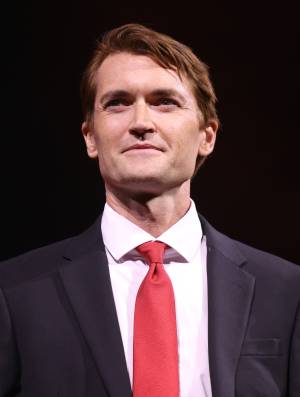
More drug hypocrisy: Ross Ulbricht, (right, in a Gage Skidmore portrait), who operated the Silk Road, a notorious underground online market used by drug dealers, landed one of the first pardons Trump signed. Ulbricht was sentenced to life in prison for his role in facilitating the flow of heroin and other illicit drugs into our communities. Trump defended the pardon because Ulbricht was put in jail by “the same lunatics who were involved in the modern day weaponization of the government against me.” Yet Trump just declared that illicit fentanyl is a “weapon of mass destruction.”
Changpen “CZ” Zhao

As we discussed last week, CZ is one of Trump’s crypto cronies. That includes CZ’s crypto exchange Binance using a Trump-supported tablecoin, USD1, to finance a $2 billion transaction (potentially generating huge revenue for the Trumps). CZ, who spent nearly four months in jail for money laundering issues at Binance, scored clemency a few months after the USD1 deal. Binance announced that it would launch trading of the USD1 stablecoin and another Trump-linked crypto product on its exchange a week after Trump signed CZ’s pardon. When asked about the pardon, Trump said, “I have no idea who he is. I was told that he was a victim, just like I was and just like many other people, of a vicious, horrible group of people in the Biden administration.” Sure.
Giuliani, Meadows, and the Election Co-Conspirators
 Shown above are mug shots of then-former President Trump, his former White House aide Mark Meadows, his counsel Rudy Giuliani, and 11 other co-defendants accused of election-related crimes.
Trump’s decision to issue pardons for 77 people involved in the scheme to overturn the 2020 election results and keep Trump in power was no surprise. His pardon attorney, Ed Martin, revealed the clemencies by replying to his own May post on X in which he said, “No MAGA Left Behind.” The only real shock here is that it took so long for Trump to protect Rudy Giuliani, John Eastman, Mark Meadows, Sidney Powell, and company from future accountability (none is facing federal charges). Just like the Jan. 6 mass pardons, this grant of clemency was yet another attempt to re-write the history of the attempted coup–and convey to future would-be plotters that they will not face consequences if they try again.
Rep. Henry Cuellar
 Trump suggested that his decision to pardon Rep. Henry Cuellar (D-TX), right, and his wife for allegedly engaging in a bribery scheme was mostly about politics: namely, hoping the congressman would switch parties or retire. But when Rep. Cuellar refused to jump ship, Trump exploded in a Truth Social rant, accusing Cuellar of “a lack of LOYALTY, something that Texas Voters, and Henry’s daughters, will not like.” For his part, Cuellar clapped back by paraphrasing the words of his fellow Texan and former president Lyndon B. Johnson, with Cuellar saying, “I’m an American, I’m a Texan, and I’m a Democrat, in that order … and I think anybody that puts party before their country is doing a disservice to their country.”
Todd and Julie Chrisley
 It is possible that Trump saw some of himself in Todd and Julie Chrisley, former millionaire stars of the reality show Chrisley Knows Best, who received pardons after being convicted of fraud by an Atlanta jury in federal court in 2022? The pardon follows lobbying from the Chrisleys’ daughter Savannah, including a prime-time appearance at the 2024 Republican National Convention, where she argued that her parents were the victims of (you guessed it) political persecution. Trump’s pardon also fully relieved the Chrisleys of the more than $22 million they owed to victims of their tax fraud and tax evasion scheme. Not a bad deal– except for the victims.
BitMEX Co-Founders–and BitMEX
Trump appears to have made history in March when he used the pardon power to grant clemency to a corporation: crypto exchange BitMEX. The exchange pleaded guilty to “wilfully” failing to “establish, implement, and maintain an adequate anti-money laundering” program; Trump’s pardon coincided with a surge of activity on the exchange. The grant also extended to the exchange’s founders, Ben Delo, Arthur Hayes, and Samuel Reed, and employee Gregory Dwyer for their participation in similar schemes to flout U.S. laws. For its part, the company celebrated the pardon, thanking the president and boosting itself as “the safest, most trusted, financially-stable, and professionally operated crypto derivatives exchange.”
Scott Jenkins

Trump’s decision to pardon Scott Jenkins, an ardent MAGA supporter who was convicted of bribery and honest services fraud for running a “cash for badges” scheme, is one of the best examples of Trump’s putrid pardon philosophy. If you’re a MAGA official convicted of corruption offenses, you’re pardon eligible. Jenkins “displayed a shocking disregard for his ethical and legal responsibilities,” according to prosecutor Zachary T. Lee (who was then Trump’s acting U.S. Attorney before resigning in October). No matter. The day before the pardon was announced, Martin dropped his infamous “No MAGA left behind” post on X. Trump, as usual, defended the pardon because Jenkins “is a victim of an overzealous Biden Department of Justice”--even though it was his DOJ that secured Jenkins’ 10-year sentence.
Trevor Milton
Trevor Milton , right, convicted of defrauding investors in his electric car startup in 2022, received a pardon in March. Trump labeled Milton, who was represented at his trial by Attorney General Pam Bondi’s brother, Brad Bondi, as yet another victim of persecution: “the thing that he did wrong was he was one of the first people that supported a gentleman named Donald Trump for a president.” He certainly did support Trump and his agenda–to the tune of at least $930,000 to the Trump campaign or Trump-aligned PACs and $750,000 to the MAHA Alliance, a PAC designed to convince Robert F. Kennedy Jr. supporters to vote for Trump in 2024. Milton bombastically declared that the pardon is really about “every American who has been railroaded by the government.”
Dishonorable mention: George Santos
 Trump loves those who have made their support for him clear. And few people have been better at that than George Santos, the disgraced former congressman and conman whose sentence Trump commuted in October. Santos was serving a seven-year sentence for wire fraud and identity theft. The commutation also relieved him of his requirement to pay more than $370,000 in restitution to his victims. Trump even called him “somewhat of a ‘rogue’” who “lied like hell”--but there are “many rogues throughout our Country that aren’t forced to serve seven years in prison.” This commutation, despite not technically being a pardon, makes the list as a dishonorable mention.
More On Epstein Files
New York Times, Epstein Files Photos Disappear From Government Website, Including One of Trump, Alan Feuer, David Enrich and Dylan Freedman, Dec. 20, 2025. A total of 16 photos were taken down at some point on Saturday from the website that the Justice Department created. One featured an open drawer containing other photos, including at least one of President Trump.
More than a dozen photos — including one featuring President Trump — were removed without explanation from the large collection of files connected to the investigations of Jeffrey Epstein that the Justice Department released on Friday.
A total of 16 photos were taken down at some point on Saturday from the website that the department created to house files — among them, one of the few that contained Mr. Trump’s image. It was a photo of a credenza in Mr. Epstein’s Manhattan home, with an open drawer containing other photos, including at least one of Mr. Trump.
The Justice Department did not explain on the site why the images had been removed, and a department spokesman did not respond to a message seeking comment.
Democrats on the House Oversight Committee immediately seized on the missing photo of Mr. Trump, reposting it on social media and asking Attorney General Pam Bondi if it was true that the image had been removed.
“What else is being covered up?” the post said. “We need transparency for the American public.”
Twelve of the other missing photos pictured the infamous massage room on the third floor of Mr. Epstein’s mansion in New York. The room, which sat down the hall from Mr. Epstein’s bedroom, was where investigators say that many of his sexual assaults occurred — some of them against teenage victims. The shelves in the room were stocked with lubricants and a silver ball and chain, among other things.
The massage room images that were removed depicted paintings and photographs of nude women, some with their faces redacted. But other images and artwork featuring nude women remained on the site. And some photos of the massage room — including the nude imagery — also remained.
The missing photos were part of a vast collection of materials that the Trump administration was compelled to release after the passage last month of a law mandating that the Justice Department disclose all files in its possession related to Mr. Epstein, a convicted sex offender who died in jail in 2019 while awaiting trial on charges of trafficking minors.
Despite mounting expectations, the released files, which included thousands of photographs and investigative documents, were something of an anticlimax. They added little to the public’s understanding of Mr. Epstein’s conduct, and also did not provide much additional insight into his connections to wealthy and powerful businessmen and politicians who associated with him.
Mr. Trump has, uncharacteristically, said nothing about the files, which contained far more material about one of his political adversaries, former President Bill Clinton, than about him. Still, the Justice Department has said that more disclosures from its files about Mr. Epstein would be coming in the next few weeks.Editors’ Picks‘Avatar: Fire and Ash’: What to Remember Before Seeing the New MovieAn Engine of Fossil Discovery Fights Its Own Extinction2025 Holiday Gift Guide
On Saturday, the department released a second tranche of files that included transcripts from the closed-door grand jury proceedings in the federal investigations into Mr. Epstein and his close associate, Ghislaine Maxwell.
While those documents had never before been made public, they added little to what has already been known about the cases.
The Real Michael Cohen, Fifty Shades Of Black Marker, Michael Cohen, right, Dec. 20, 2025. The files were due, the law was clear, but truth arrived censored, delayed, and carefully curated to spare those who mattered most.
Yesterday was the moment we were promised the Epstein files; fully released, completely transparent, no more excuses. Not a teaser. Not a cliffhanger. Not a “wait for the sequel.” Just sunlight, disinfectant, and the truth… right before someone turned off the lights.
What we got instead was a federal arts-and-crafts project titled Fifty Shades of Black Marker.
This Substack is reader-supported. To receive new posts and support my work, consider becoming a free or paid subscriber.Subscribed
I’ve seen this movie before. Literally.
Back in 1992, when I was prepping for a medical malpractice trial; back when facts still mattered and photocopiers were the backbone of justice, I had to duplicate thousands of pages of hospital records. Charts, notes, reports, the whole bloody mess. The copier malfunctioned. The technician shrugged and told me the roller was faulty. Every page came out pitch black. Not “hard to read.” Not “a little smudged.” Just pure, existential darkness. A legal blackout.
Apparently, that same technician now works for the Department of Justice.
Because yesterday’s “release” of the Epstein files looked like someone fed the truth into a Xerox machine, slammed the lid shut, and said, “Good enough; ship it.” Thousands and thousands of documents. Entire pages redacted. Not lines. Not names. Pages. Black slabs of nothingness. Even Kafka would’ve asked them to tone it down.
Let’s be clear: this wasn’t some rushed FOIA request that landed on a bureaucrat’s desk 30 days ago. This process has been dragging on for more than 9 months. Congress passed a law mandating the release. Trump signed it. A deadline was finally set. Friday came. And instead of disclosure, we got performance art masquerading as transparency.
The Justice Department insists this was progress. Proof of commitment. Exhibit A in the case of See, We Tried. What they actually released was a recycling bin of deja vu: photos already public, flight logs already dissected, documents already litigated in the court of public opinion for years. The same story, reheated; just darker.
The anticipation was extraordinary. The expectation? A comprehensive look at two decades of government scrutiny into one of the most grotesque abuse scandals in modern history. What emerged was a document dump so aggressively redacted it made the Pentagon Papers look chatty.
And then there’s the selective “transparency,” which is where the satire writes itself.
Bill Clinton? Oh, he’s in there. Photos on planes. Photos in pools. Photos in hot tubs. Faces redacted, context missing, meaning unspecified; but plenty of imagery for social media interns to circle like sharks. Senior Trump aides gleefully blasted those images online, complete with emojis, as if they’d just discovered a new meme instead of a decades-old national disgrace.
Donald Trump, meanwhile, appears like Bigfoot: rumored, blurry, and somehow always just out of frame. A few well-known photos from the public domain. Nothing new. Nothing revealing. Nothing that might cause discomfort at 1600 Pennsylvania Avenue.
Funny how that works.
Trump’s relationship with Epstein is not speculative; it’s documented. Flights, parties, Mar-a-Lago overlap, public quotes. Yet the files somehow managed to treat him like a background extra who wandered onto the wrong set. The White House calls this transparency. I call it careful curation.
Deputy Attorney General Todd Blanche assures Congress that the Department is “still reviewing” documents and that more may come by the end of the year. Translation: Please stop bothering us; we’re still deciding what the public can handle.
Attorney General Pam Bondi has gone one step further, ordering an investigation into Epstein’s connections to Trump’s political foes. Because when confronted with a bipartisan demand for truth, the instinct is not accountability; it’s opposition research.
And now lawmakers are openly discussing impeachment. Not because the files revealed too much, but because they revealed too little. Because missing deadlines isn’t the real offense here; missing honesty is.
The most haunting part of this story isn’t the redactions. It’s the familiarity. We’ve seen this before. Survivors begging for answers. Institutions stalling. Power protecting itself while pretending to comply. Marina Lacerda, one of Epstein’s survivors, said it best: “Just put out the files. And stop redacting names that don’t need to be redacted.”
That’s the part the DOJ seems incapable of grasping. Transparency without enforcement isn’t transparency. It’s theater. Redactions become weapons. And the truth depends entirely on who’s holding the marker.
After nearly twenty years, we know the broad strokes. Epstein abused girls. Authorities failed them. Deals were cut. Silence was purchased. What we still don’t know; and what yesterday was supposed to illuminate, is who else knew, who else benefited, and who else was protected.
Instead, we got black pages and a press release.
Emptywheel, Analysis: The Most Complex Friday Night News Dump, Ever? Emptywheel (Marcy Wheeler, Ph.D), right, Dec. 20, 2025. There's a lot of shit going down with Todd Blanche's name on it. He still seems to believe he can juggle his way through politicizing the Department of Justice.
President Trump arrived late to a healthcare announcement yesterday and didn’t take any questions. Starting around the same time, DOJ launched some of the most complexly executed Friday Night News dumps going.
Epstein Limited Hangout
The big attraction was the release of the first batch of the Epstein files. The limited release violates the law, which required all files to be released yesterday.
Instead, there were a whole bunch of Bill Clinton photos, the document reflecting Maria Farmer’s complaint from 1996, that went ignored for years, and redacted grand jury transcripts that clearly violate the law. The government did not release the proposed indictment and prosecution memo for the indictment that should have been filed in 2007; that may be sealed as deliberative.
Todd Blanche’s wildly dishonest letter (particularly with regards to his claimed concern for victims, after being admonished repeatedly by judges for failing to take that responsibility seriously and a last minute bid that promised but failed to put Pam Bondi on the phone) explaining the release emphasizes how Bondi, right, took over a hundred national security attorneys off their job hunting hackers and spies to conduct a second review; it does not mention the even bigger review the FBI accomplished in March.
The review team consisted of more than 200 Department attorneys working to determine whether materials were responsive under the Act and. if so, whether redactions or withholding was required. The review had multiple levels. First, 187 attorneys from the Department’sNational Security Division (NSD) conducted a review of all items produced to JMD for responsiveness and any redactions under the Act. Second, a quality-control team of 25 attorneys conducted a second-level review to ensure that victim personally identifying information wasproperly redacted and that materials that should not be redacted were not marked for redaction.The second-level review team consisted of attorneys from the Department’s Office of Privacy and Civil Liberties (OPCL) and Office of Information Policy (OIP)—these attorneys are experts in privacy rights and reviewing large volumes of discovery. After the second-level review team completed its quality review, responsive materials were uploaded onto the website for public production as required under the Act. See Sec. 2(a). Finally, Assistant United States Attorneys from the Southern District of New York reviewed the responsive materials to confirm appropriate redactions so that the United States Attorney for the Southern District of New York could certify that victim identifying information was appropriately protected.
That John Eisenberg’s department was in charge of a second pass on these documents is of some interest; there’s no specific competence Nat Sec attorneys would have, but Eisenberg has helped Trump cover stuff up in the past, most notably the transcript of his perfect phone call with Volodymyr Zelenskyy.
Thus far the limited hangout has shifted the focus onto Clinton and away from Trump, but as Kyle Cheney lays out, it risks creating a WikiLeaks effect, in which a focus remains on Epstein for weeks or even months.
Deputy Attorney General Todd Blanche, right, confirmed Friday that the documents would be released on a rolling basis through the holidays — and possibly beyond. And, in court papers filed shortly after Friday’s partial release, the Justice Department emphasized that more files are still undergoing a review and redaction process to protect victims and new Trump-ordered investigations before they can be released.
The daily drip is a remarkable result for President Donald Trump, who has urged his allies to move past the Epstein files — prompting jeers from Democrats who say he’s trying to conceal details about his own longtime relationship with Epstein. Trump has maintained for years that he and Epstein had a falling out years ago, and no evidence has suggested that Trump took part in Epstein’s trafficking operation. Trump advocated for the release of the files only after Republicans in Congress rebuffed his initial pleas to keep them concealed.
New York Times, 6 Takeaways From the First Batch of the Epstein Files, Alan Feuer, Updated Dec. 20, 2025. Many of the Justice Department documents were heavily redacted, and President Trump’s name was rarely mentioned. The White House also sought to make political hay of the release of photos of Bill Clinton.
The Justice Department, rushing under pressure from Congress to comply with a law signed by President Trump last month, released more than 13,000 files on Friday arising from investigations into Jeffrey Epstein, the financier and convicted sex offender who died in jail in 2019 while under indictment on federal charges of sex trafficking minors.
The release of the files had been long awaited by those who believed the materials could shed light on Mr. Epstein’s activities and his ties to prominent and powerful men. The Justice Department said more documents would be released in the coming weeks.
Here are six takeaways about what the first batch of files divulged — and did not.
The documents produced no major revelations.
The released files, which included thousands of photographs and investigative documents, added little to the public’s understanding of Mr. Epstein’s conduct. The materials also did not provide much additional insight into Mr. Epstein’s connections to wealthy and powerful businessmen and politicians who associated with him.
The materials were mostly drawn from investigations into Mr. Epstein reaching back to an initial inquiry opened by the police in Palm Beach, Fla., in 2005. There were also files from a subsequent investigation conducted by federal prosecutors in Florida that ended in 2008 with a plea deal, and from a final inquiry by prosecutors in Manhattan in 2019 that was never resolved, after Mr. Epstein died in jail while the case was still proceeding.
Many of the documents, which included phone records, travel logs and what appeared to be case files with interviews featuring some of Mr. Epstein’s female victims, were heavily redacted. One of the redacted files, amounting to 119 pages and entitled “Grand Jury NY,” was entirely blacked out.The reaction from the right was muted.
Mr. Trump’s right-wing supporters have traditionally been among the most ardent advocates for releasing the Epstein files. They have long been convinced that the documents would contain evidence that a cabal of prominent men — in their telling, mostly Democrats — had joined Mr. Epstein in abusing young women and covering up their crimes.
But those same supporters were largely silent as the files came out, perhaps in response to the dearth of new incriminating information. Mr. Trump on Friday conspicuously refrained from commenting on the release of the materials, even though the case has haunted him politically.
Whether those who have woven elaborate conspiracy theories around Mr. Epstein and the government’s handling of the investigation will be satisfied by anything the Justice Department releases seems open to question.Bill Clinton was featured prominently.
Whether by design or chance, many of the photographs included in the files were of one of Mr. Trump’s most prominent political adversaries: former President Bill Clinton.Editors’ PicksThis Simple Brisket Deserves a Place at the Holiday Table2025 Holiday Gift GuideCan Science Win on Social Media? Ask Dr. Noc.
One image depicted Mr. Clinton reclining in a hot tub with a person whose face had been blacked out. In many of the photos of Mr. Clinton, he was the only person whose identity could be discerned. The files provided little or no context for the pictures.
The photos of Mr. Clinton were made public after Mr. Trump ordered the Justice Department last month to investigate any ties between the former president and other Democrats to Mr. Epstein. Attorney General Pam Bondi immediately followed up on Mr. Trump’s instructions by directing Jay Clayton, the U.S. attorney in Manhattan, to undertake the case.
The White House on Friday sought to make political hay of the release of the photos of Mr. Clinton.
“We did see something,” Abigail Jackson, a White House spokeswoman, wrote in a social media post on Friday above the image of Mr. Clinton in the hot tub. “Just not what you wanted.”
A spokesman for Mr. Clinton suggested that the White House had engineered the release of the photos to distract from Mr. Trump’s own relationship with Mr. Epstein.
“The White House hasn’t been hiding these files for months only to dump them late on a Friday to protect Bill Clinton,” said the spokesman, Angel Urena. “This is about shielding themselves from what comes next, or from what they’ll try and hide forever.”There were few mentions of Trump.
For months, Mr. Trump actively fought the release of the Epstein files, calling them a Democratic “hoax” and threatening to punish members of Congress who voted to allow them to be made public.
But his name was mentioned rarely in the materials released on Friday. It remained unclear, though, whether he would figure more in the release of files still to come and whether the Justice Department selected the initial batch with politics in mind.
Mr. Trump and Mr. Epstein were close friends for years, and the president’s earlier reluctance to release the files prompted speculation about whether they prominently featured him.
Most of the photos of Mr. Trump released on Friday had already been made public, including images of him and his wife, Melania, with Mr. Epstein and Ghislaine Maxwell, who is serving a federal prison sentence for helping Mr. Epstein traffic underage women.
Written references to Mr. Trump came up in Mr. Epstein’s address book and flight logs, as well as a message book in which Mr. Epstein’s assistants let him know about missed phone calls. Versions of those documents were already public.
Mr. Trump’s name also comes up in interviews with Ms. Maxwell, transcripts that the Justice Department had previously made public and rereleased on Friday.Epstein attracted the rich and famous.
The files showed how Mr. Epstein attracted a remarkably broad spectrum of famous people into his orbit, from the rock stars Michael Jackson and Mick Jagger to the legendary newsman Walter Cronkite.
While the materials bore no suggestion that these celebrities had any knowledge of or involvement in Mr. Epstein’s illicit activities, they stood nonetheless as a remarkable testament to his ability to attract attention from the rich and famous.
Still, the documents and photos were largely silent about a roster of other well-known people who have long been associated with Mr. Epstein and his finances, including businessmen like Leon Black and Leslie H. Wexner.There’s more to come, eventually.
In an interview on Fox News on Friday morning, Todd Blanche, the deputy attorney general, acknowledged that the Justice Department was not finished releasing files. Thousands more would be made public “in the coming weeks,” he said.
The delay meant that the Trump administration would apparently violate the law signed by the president in November ordering the complete release of all unclassified materials about Mr. Epstein in the Justice Department’s possession within 30 days, with limited exceptions.
Under the law, the administration can withhold records that identify victims or include images of child sexual abuse. The legislation also allows the Justice Department to withhold records if they are otherwise classified or would “jeopardize an active federal investigation.”
Several members of Congress quickly moved to criticize Mr. Blanche, saying that the department’s partial release of the Epstein files meant it had failed to meet its legal obligations.
New York Times, Bill Clinton, a Main Character in the Epstein Drop, Just Can’t Escape Scandal, Lisa Lerer, Dec. 20, 2025. The Republican-led Justice Department’s release of photos of the former president with Jeffrey Epstein will introduce yet another generation to his flaws and controversies.
One photo shows him sitting on a private plane, smiling and slightly red-faced, with a young blonde draped across the arm of his chair. In another image, he is relaxing, shirtless, in a hot tub with his arms behind his head, the face of the person beside him redacted in a black box.
There he is, grinning next to Mick Jagger in a button-down shirt and blazer. And again, swimming in a luxuriously marble-tiled indoor pool alongside Ghislaine Maxwell, who helped run Jeffrey Epstein’s sex trafficking operation.
 And smiling broadly in a silky patterned shirt, standing shoulder to shoulder with Mr. Epstein.
Former President Bill Clinton and Jeffrey Epstein, left, in one of the photos released by the Justice Department on Friday. Information was not provided on when or where it was taken.
The photos were released without context by President Trump’s Justice Department, and lacked information about where they were taken, when and why.
But the man in them is unmistakable: Bill Clinton, the former two-term president, globe-trotting philanthropist and one of the most recognizable symbols of the Democratic Party.
Over the quarter-century since he left the White House, he has painstakingly worked to overcome the personal scandals that marred his presidency. At 79, Mr. Clinton has been enjoying the lifestyle of an elder statesman, traveling the world to deliver speeches and eulogies, writing memoirs and political thrillers, and continuing his philanthropic work.
But the Justice Department’s avalanche-like release on Friday of more than 13,000 files related to Mr. Epstein served as a powerful reminder of Mr. Clinton’s long-scrutinized ties to the disgraced financier as well as some of the former president’s less statesmanlike traits — his womanizing, reckless judgment and impulsivity.
The rise of the #MeToo movement in 2017 prompted a new generation of Democrats to grapple with the accusations made by women against Mr. Clinton. The party confronted uncomfortable questions about its complicity in defending him from allegations that included groping, exposing his genitals without consent and rape — which Mr. Clinton has denied.
Now, thanks to the Republican-led Justice Department, the never-before-released images in the Epstein files will introduce yet another generation to the former president’s flaws, scandals and misconduct.
Notably, the collection of documents, photographs and files disclosed on Friday included many photos of Mr. Clinton but few mentions of Mr. Trump, himself a longtime friend of Mr. Epstein’s.Editors’ PicksShe Put the Heat in ‘Heated Rivalry’3 Make-Ahead Holiday Brunch Recipes for a CrowdOnce a Year the French Literary Scene Goes to the Dogs (Cats, Too)
The Justice Department said more documents would be released in the coming weeks. But the political motivations of the White House in this first drop were obvious and well-worn: Distract from Mr. Trump’s involvement in the scandal by pointing the finger at Mr. Clinton.
“Slick Willy! @BillClinton just chillin, without a care in the world. Little did he know…,” Steven Cheung, the White House communications director, wrote on X, posting the photo of Mr. Clinton in the hot tub and using an epithet that dates back to his time as governor of Arkansas.
The New York Post, a longtime antagonist of Mr. Clinton’s, resurrected another moniker for him on its front page, which blared, “Tubba Bubba.”
A spokesman for Mr. Clinton said the Justice Department was releasing photos of the former president to try to deflect from whatever might be coming in future disclosures.
“It’s obvious what the Republicans in the White House and at Justice and their desperate congressional cronies are doing,” said Angel Ureña, deputy chief of staff for Mr. Clinton. “What they’re hiding is not obvious. But it must not be good.”
The photographs are unlikely to be the end of Mr. Clinton’s troubles surrounding his involvement with Mr. Epstein. The Clintons have spent months trying to avoid appearing in person before the House Oversight Committee to testify in the Epstein investigation. Such an appearance would be highly unusual: No former president has appeared before Congress since 1983, when President Gerald Ford did so to discuss the celebration of the 1987 bicentennial of the enactment of the Constitution.
The release of these images could intensify public pressure on the couple to publicly participate and raise fresh questions about Mr. Clinton’s description of the relationship. He has said that he did not know about Mr. Epstein’s crimes and that he stopped contact after reports began to emerge in 2005 that the financier was being investigated.
“There are two types of people here,” Mr. Ureña said in a statement posted on X. “The first group knew nothing and cut Epstein off before his crimes came to light. The second group continued relationships with him after. We’re in the first. No amount of stalling by people in the second group will change that.”
While the photographs may be striking, the political back-and-forth over Mr. Clinton’s personal conduct is by now familiar. In the decades since he left office, Republicans have wielded the accusations that Mr. Clinton abused women as a political cudgel, a way of deflecting the claims from more than a dozen women who have accused Mr. Trump of sexual misconduct.
At times, Republicans have injected not only the accusations but also the women themselves into the highest-profile moments in American political life.
In 2016, less than two hours before the second presidential debate, Mr. Trump and his campaign chief executive, Stephen K. Bannon, staged an impromptu news conference with three women who said that Mr. Clinton and Hillary Clinton had minimized and belittled their claims of sexual misconduct.
In 2019, hours after Mr. Epstein was found dead by suicide in his prison cell, Mr. Trump posted a conspiracy theory on social media claiming without evidence that Mr. Clinton had been connected to his death.
Since then, Mr. Trump has maintained a steady drumbeat of claims that Mr. Clinton spent significant time visiting Mr. Epstein on his private island — an accusation Mr. Clinton denies. Those claims have also been undercut by Susie Wiles, the White House chief of staff, and Ms. Maxwell.
But Republicans aren’t the only ones who see the accusations of sexual assault and harassment against Mr. Clinton as a political liability.
While only a handful of prominent Democrats have publicly distanced themselves from Mr. Clinton’s behavior, their party has quietly tried to leave the former president and his baggage behind.ImageBill Clinton, looking down and smiling, is walking away from a lectern in a crowded arena.Former President Bill Clinton at the 2024 Democratic National Convention in Chicago. He has written about “brief meetings” with Mr. Epstein.Credit...Todd Heisler/The New York Times
He has been welcomed on the campaign trail far less than he once was, with some candidates avoiding his presence altogether. At the party’s convention in 2020, Mr. Clinton was little more than an afterthought, speaking for less than five minutes in a prerecorded message that aired before prime time. He returned to the stage four years later and spoke for 27 minutes — 15 more than his allotted time.
With the latest disclosure of the photographs, Mr. Clinton’s detractors appear to have new leverage on an old chapter that he has long struggled to close.
In a memoir published in 2024, Mr. Clinton said he had only two “brief meetings” with Mr. Epstein, one at his office in Harlem and another at Mr. Epstein’s house in New York.
He flew on Mr. Epstein’s plane with his staff and Secret Service detail several times in 2002 and 2003 to “support the work of his foundation,” Mr. Clinton said. On each trip, in exchange for the flight, the former president would take “an hour or two” to discuss politics and economics with Mr. Epstein.
“That was the extent of our conversations,” Mr. Clinton wrote. “Even though it allowed me to visit the work of my foundation, traveling on Epstein’s plane was not worth the years of questioning afterward.”
He ended the brief section of his book with a line that was more revealing, perhaps, than even the photographs.
“I wish I had never met him,” he wrote.
U.S. Politics, Elections, Governance
New York Times, Koch Political Operation Spent Nearly $550 Million During 2024 Cycle, Theodore Schleifer, Graphic by Ashley Cai, Dec. 20, 2025. The huge sum shows that while the Koch network may not hold significant power at high levels of the Republican Party, it remains a financial juggernaut. The Koch family network now downplays its commitment to campaigns and elections, but it has continued to spend money on politics.
The political operation founded by Charles and David Koch raised and spent well over half a billion dollars during the 2024 election cycle, showing that the family unit remains a financial juggernaut despite its opposition to President Trump’s re-election.
 Mr. Trump is no fan of the libertarian politics long pushed by Charles Koch, left, now 90, and David Koch, who died in 2019. But their network’s huge 2024 spending, revealed in new tax filings provided to The New York Times, points to the operation’s staying power even in a party in which it has diminished influence.
During the two-year 2024 election cycle, the family’s network raised about $578 million and spent about $548 million, the documents show. The two flagship Koch political and policy organizations, the nonprofit group Americans for Prosperity and a sibling super PAC, Americans for Prosperity Action, took in $397 million and $181 million from donors over that period.
Much of the overall money raised appears to stem from more than $5 billion in Koch Industries stock that Charles Koch directed into the network between 2020 and 2022.
The figures in this article are based on a Times analysis of tax filings and a review of Federal Election Commission records.Sign up to get Theodore Schleifer's articles emailed to you. Theodore Schleifer is a political reporter covering billionaires and their impact on the world. Get it sent to your inbox.
Last year alone, Americans for Prosperity raised $215 million, its biggest annual total in its two decades of existence. The organization largely spent its money on its grass-roots field operation, employing 616 people in the calendar year.
Notably, the Koch network pursued a failed mission to try to stop Mr. Trump from claiming the Republican presidential nomination. Americans for Prosperity Action endorsed Nikki Haley in late 2023 and spent over $40 million on her behalf, records show. That deepened the Koch operation’s rift with Mr. Trump, who has long considered the network too opposed to his agenda on tariffs and immigration.
The Koch operation reportedly spent about $250 million during the 2016 cycle. That is a rough estimate because some of the operation’s political work is done quietly through nonprofit groups.Editors’ PicksShe Put the Heat in ‘Heated Rivalry’3 Make-Ahead Holiday Brunch Recipes for a CrowdOnce a Year the French Literary Scene Goes to the Dogs (Cats, Too)
The Koch operation retooled its political philanthropy in the wake of Mr. Trump’s victory in 2016. In 2019, the network renamed itself Stand Together and centralized its operations. The death that year of David Koch, the more politically active brother, also shifted the network’s footing.
Beyond its spending on campaigns and elections, the Koch family has continued to lavish money on organizations aligned with its libertarian agenda, such as the Cato Institute and other think tanks. The Kochs prefer to draw attention to their nonprofit work, such as on criminal-justice reform and artificial intelligence.
A Stand Together spokeswoman, Corinne Clark, said in a statement that the network’s “community includes hundreds of organizations in more than 1,300 communities across the country,” adding, “Public policy, while important, is just one part of our work.”
Presidential campaign cycles are typically when political groups are at their largest, and allow for the most clarity on their operations. And a review of the Koch operation’s newly filed tax returns for 2024 shows that the network now revolves around several large “dark money” nonprofit groups, which often pass hundreds of millions of dollars between them, and one allied super PAC.
Only the super PAC is required to disclose its donors. But the nonprofit groups’ yearly tax returns do disclose the grants they give out, and the operation can be roughly pieced together that way.
The nonprofit groups are technically social-welfare groups, organized under section 501(c)(4) of the tax code, and they can spend only a fraction of their money on clear political advocacy. But years ago, the Kochs pioneered a new model of political influence, in which they set up a labyrinth of nonprofit groups that passed millions among one another to maximize the operation’s political flexibility while also abiding by the law.
A relatively new daisy chain emerged in the 2024 cycle, the filings show.
First, between 2020 and 2022, the more than $5 billion in Koch Industries stock was directed to two relatively new nonprofit groups, Key Change Inc. and Believe in People Inc. They are run by Charles Koch’s son, Chase Koch, who largely oversees the family giving but also focuses on venture capital and his passion for live music.
During the 2024 cycle, those groups funneled at least $630 million total to a separate, new nonprofit group, Stand Together C4 Fund. It functions largely as a bank account: It says it has no employees and appears to exist largely to spread money to other Koch organizations.
In turn, the fund sent just under $350 million total in turn to Americans for Prosperity and the Kochs’ core organization, called the Stand Together Chamber of Commerce, according to the filings. The chamber financed Americans for Prosperity and its super PAC with just under $330 million in cash and services total during the cycle, the filings say. Charles Koch’s company also gave the super PAC an additional $40 million.
In January, Americans for Prosperity said it would spend $20 million to push for a renewal of Mr. Trump’s first-term tax cuts. But relations remain tense: A few days before his inauguration, Mr. Trump posted online that he did not want any recommendations for new administration staff members who were supported by the Kochs, or what the president-elect called “Americans for No Prosperity.”
Politico, DOJ appeals ruling that tanked Comey, James criminal cases, Kyle Cheney, Dec. 19, 2025. The Justice Department is challenging the dismissal of prosecutor Lindsey Halligan.Lindsey Halligan fixes an earring at the end of an interview outside of the White House.
The Justice Department is appealing the ruling that resulted in the dismissal of criminal charges against former FBI Director James Comey and New York Attorney General Letitia James.
The appeal, lodged in both cases, challenges a judge’s finding that the lead prosecutor, Lindsey Halligan, was illegally appointed to her position.
Attorney General Pam Bondi, at President Donald Trump’s urging, appointed Halligan in September as interim U.S. attorney in the Eastern District of Virginia. Halligan, a former personal attorney to Trump with no prosecutorial experience, secured criminal charges against Comey and James within days.
But U.S. District Judge Cameron Currie concluded that Halligan should never have been in the role in the first place because her predecessor, Erik Siebert, had already filled the interim position for a legal maximum of 120 days. And because Halligan was the only prosecutor who signed the Comey and James indictments, Currie concluded that the indictments were defective and had to be tossed.
Comey was indicted in late September on charges that he lied to Congress in 2020, during a hearing related to the FBI’s investigation of the 2016 Trump campaign’s contacts with Russia. James was charged with mortgage fraud related to a property she purchased in Virginia. Both pleaded not guilty and noted that they were indicted by Halligan just days after Trump demanded that his Justice Department quickly bring charges against his political adversaries.
The decision to appeal followed two failed efforts by Justice Department prosecutors to re-indict James — extraordinary rebukes by grand juries amid widespread indications that the charges against Comey and James were driven by Trump’s personal animus against them for his own legal travails.
Comey’s case is more complicated to revive because he was initially indicted just days before a five-year statute of limitations that expiredHis team contends that the failure to bring a valid indictment by the deadline suggests he can no longer be charged.
The Daily, Top Senate Democrat Vows That Trump's Name Will Be Removed From The Kennedy Center, Sarah Jones and Jason Easley, Dec. 20, 2025. While speaking to protesters outside the Kennedy Center, Sen. Chris Van Hollen (D-MD) said that it doesn't matter if it takes weeks or months, Trump's name will come off the Kennedy Center
The Kennedy family is outraged that Donald Trump has decided to illegally slap his name on the national monument to honor the late President John F. Kennedy.
Many Kennedy family members have released statements expressing their dismay and outrage.
The Daily is outside the Beltway journalism for the people. Please support our work by becoming a subscriber.Upgrade to paid
One example came from JFK’s niece Maria Shriver:
The Kennedy Center was named after my uncle, President John F Kennedy. It was named in his honor. He was a man who was interested in the arts, interested in culture, interested in education, language, history. He brought the arts into the White House, and he and my Aunt Jackie amplified the arts, celebrated the arts, stood up for the arts and artists.
It is beyond comprehension that this sitting president has sought to rename this great memorial dedicated to President Kennedy. It is beyond wild that he would think adding his name in front of President Kennedy’s name is acceptable. It is not.
Next thing perhaps he will want to rename JFK Airport, rename the Lincoln Memorial, the Trump Lincoln Memorial. The Trump Jefferson Memorial. The Trump Smithsonian. The list goes on.
Can we not see what is happening here? C’mon, my fellow Americans! Wake up! This is not dignified. This is not funny. This is way beneath the stature of the job. It’s downright weird. It’s obsessive in a weird way. Just when you think somone can’t stoop any lower, down they go…
The next logical step is for Trump to rename the Lincoln Memorial, the Trump Lincoln Memorial, and plop himself on Honest Abe’s lap.
The good news is that Trump can’t legally change the name of the Kennedy Center, and one senator already has a plan to get the president’s name off of the building.
New York Times, Ramaswamy Challenges Conservatives on Surging Bigotry on the Right, Pooja Salhotra, Updated Dec. 20, 2025. The leading Republican candidate for Ohio governor is calling out his party for rising intolerance, including against Indian American immigrants and their children, like him.
Vivek Ramaswamy, the front-running Republican candidate for Ohio governor, challenged a gathering of conservative activists in Arizona on Friday to denounce a rising tide of bigotry on the political right and reject the idea that ancestry or “heritage” defines what makes an American.
“The idea that a ‘heritage American’ is more American than another American is un-American at its core,” Mr. Ramaswamy, a wealthy entrepreneur and candidate for the presidency in 2024, told an audience at AmericaFest, a conservative conference organized by Turning Point USA, the organization founded by the slain activist Charlie Kirk.
He added, “The online comment threads of Twitter might preach that our lineage is our strength. No, I’m sorry, our lineage is not our strength. Our true strength is what unites us across that diversity and through that lineage.”
Mr. Ramaswamy, who shaped his political identity with a series of books and media appearances denouncing left-wing “woke” ideology, has become perhaps the most visible target of a right-wing ideology — sometimes labeled “blood and soil” nationalism, a Nazi slogan that was used in Germany and has resurfaced among white supremacists globally. It is a worldview shaped by intolerance of immigrants, and those from India are one of the latest targets.
“Older Republicans who may doubt the rising prevalence of the blood-and-soil view should think again,” he wrote in an opinion article in The New York Times this week. “My social media feeds are littered with hundreds of slurs, most from accounts that I don’t recognize,” he wrote.
He went further on Friday, saying that people who cannot denounce hateful ideas toward any ethnic group “without stuttering” do not have a “place as a leader at any level in the conservative movement.”
In recent weeks, mainstream conservatism has been rocked by a series of incidents that have highlighted bigotry within its ranks. In mid-October, flagrantly racist, antisemitic and homophobic texts exchanged by young Republicans came to light. Weeks later, the conservative commentator Tucker Carlson, who remains close to President Trump and Vice President JD Vance, sat down for a friendly interview with Nick Fuentes, an openly racist and antisemitic white nationalist.
When the president of the Heritage Foundation, Kevin Roberts, released a video refusing to criticize Mr. Carlson, senior officials and board members at the conservative think tank resigned in protest.Editors’ Picks‘Avatar: Fire and Ash’: What to Remember Before Seeing the New MovieWhen a Performer Met a PlaywrightA Study Linked Cheese to Lower Dementia Risk. Is That Too Good to Be True?ImageNicholas Fuentes, a 27-year-old white nationalist and late night streaming show host, in his home studio in Berwyn, Ill.Credit...Jamie Kelter Davis for The New York Times
Now, Mr. Ramaswamy is highlighting a new pressure point facing his party, surging intolerance toward Indian Americans.
“This is deeply personal to me,” he said in a text to The Times. “It isn’t really about defending Jews, Indians, or any other minority group. It’s about defending the essence of America itself.”Sign up for the Race/Related Newsletter Join a deep and provocative exploration of race, identity and society with New York Times journalists. Get it sent to your inbox.
Corbin Wills, 25, a student at Arizona Christian University who attended AmericaFest, called Mr. Ramaswamy “a great leader in the
New York Times, Cynthia Lummis, a One-Term G.O.P. Senator, Will Not Seek Re-election, Catie Edmondson, Dec. 20, 2025. A conservative who has served in the Senate since 2021, Ms. Lummis attributed the decision to the “difficult, exhausting session” this fall on Capitol Hill.
Senator Cynthia Lummis, Republican of Wyoming, said on Friday that she would not seek re-election next year after serving one term.
In a statement, Ms. Lummis, who has served in the Senate since 2021, attributed the decision to the grueling weeks in session this year on Capitol Hill. Her departure will tee up a primary in the conservative state of Wyoming.
“Deciding not to run for re-election does represent a change of heart for me, but in the difficult, exhausting session weeks this fall I’ve come to accept that I do not have six more years in me,” Ms. Lummis, 71, said. “I am a devout legislator, but I feel like a sprinter in a marathon. The energy required doesn’t match up.”
Her comment, unusually candid by the standards of staid Washington statements, came after a year on Capitol Hill that included the nation’s longest government shutdown and multiple all-night sessions of votes, including to pass President Trump’s marquee tax and spending cuts legislation. Senators took more than 600 roll call votes this year alone, the most in modern history, according to a G.O.P. leadership aide.
She is one of a growing number of Republicans who have indicated they have little interest in staying in Congress. Two of her colleagues, Senators Tommy Tuberville of Alabama and Marsha Blackburn of Tennessee, are running for governor in their respective states; two others, Senators Joni Ernst of Iowa and Thom Tillis of North Carolina, have declined to run for re-election altogether.
In 1978, Ms. Lummis became the youngest woman elected to Wyoming State Legislature, at 24. She went on to win a seat in the House, serving from 2009 to 2017. Ms. Lummis then joined the Senate in 2021, where she was often seen with a smile on her face and a Celsius energy drink in hand.
She quickly became known for her support of the crypto industry, earning the moniker of “Crypto Queen” on Capitol Hill. An early adopter of Bitcoin, she went so far as to edit “laser eyes” into her social media avatars, an image associated with Bitcoin enthusiasts.
More On U.S. Law, Crime, Justice
Lawfare, Why the Government Keeps Failing to Re-Indict Letitia James, Molly Roberts, right, Dec. 19, 2025. Prosecutors are satisfying the definition of insanity—doing the same thing over and over again and expecting different results.
Not-really-U.S. Attorney for the Eastern District of Virginia Lindsey Halligan and her ragtag team of prosecutors seem to have taken the old adage very literally: If at first you don’t succeed, try, try again.
After their case against Letitia James was dismissed on the grounds that Halligan was improperly appointed, they attempted to indict the New York attorney general again in Norfolk—and again in Alexandria the following week. These efforts failed. (The possibility remains that the government may add another “try” to the time-worn saying on any given Thursday.)
This series of events invites the question: Why can’t the office Halligan is continuing to pretend to lead seem to earn a second true bill? After all, when Halligan presented to the first grand jury herself two months ago, she emerged victorious … for about a month, at least.
Arriving at a conclusive answer is impossible without seeing three separate grand jury transcripts. Informed speculation, however, is suddenly easier than ever.
That’s because the most recent grand jury, in Alexandria, made the unusual decision this week to present the indictment it rejected in open court, and U.S. Magistrate Judge William Porter issued an order Dec. 15 denying the government’s request to keep those records sealed. A comparison of this failed indictment to the version from the original prosecution may help explain why the U.S. attorney’s office’s tenacity isn’t yielding results.
What’s Old Is New Again
The essentials of the two indictments are the same: alleged violations of the bank fraud law (18 U.S.C. § 1344) and a law prohibiting false statements to a financial institution (18 U.S.C. § 1014). To have committed a crime under these statutes, James would have to have knowingly made a false statement that was intended to deceive as well as either intending, or tending, to influence the decision of a bank.
The later indictment also focuses on the same property as the earlier—a three-bedroom, one-bathroom house in Norfolk on Peronne Avenue (though this is spelled alternately as “Peronne” and “Perrone” in the document, only the former of which corresponds to the spelling on Google Maps). The basic allegation of occupancy fraud carries over into this go-around, too. The government argues that James misrepresented herself to her lender, OVM Financial, when she indicated in mortgage forms that she would treat the property as a secondary residence.
And once again, a “Second Home Rider” is central to the case. This is a form Fannie Mae statement that bars borrowers from entering into “a timesharing or any other shared ownership arrangement” that requires them “either to rent the property or give any other person control over the occupancy or use of the property.” What was odd—or obfuscatory—about the initial indictment was that it never claimed that James breached that rule. It simply said she rented “the property to a family of (3),” implying that the terms of the rider weren’t honored, when really the rider explicitly allows short-term renting during the first year so long as the property remains under the borrower’s control and “available” for the borrower’s personal use.
The new indictment, similarly, zeroes in on the rider as the basis of one of its false statement counts. This time, it doesn’t mention rental to a family of three—probably because the family in question, as the New York Times reported shortly after the initial indictment, has turned out to be James’s own grandniece and her children, who appear to have lived in the house for years almost entirely rent-free. Indeed, when the indictment introduces the existence of the rider, it doesn’t mention rental at all; it merely says that James “never had any intention of occupying and using” the property “as a second home.”
This focus on occupancy frames the rest of the new indictment. But in this instance, it doesn’t resolve the old indictment’s central problem: There’s no evidence that James acted contrary to the rider’s specific requirements. And to have made a false statement to a financial institution, she would have to have actually stated or certified something false.
What’s New Isn’t Much Help Either
The most obvious difference between the revised indictment and its previous incarnation is the addition of another—third—count: also alleging false statements to a financial institution but based on a separate document.
That document is an “Affidavit of Occupancy” that James signed when applying for the loan. Assuming that affidavit is the same one the government eventually submitted as supporting documentation in the now-dismissed case, this allegation has bones even barer than the allegation regarding the rider. Next to the line, “Second Home: At least one borrower will occupy the property as a second home (vacation, etc) while maintaining a principal residence elsewhere,” James has ticked a box.
The indictment says that James’s checking of this box constituted a false declaration of her “intent to occupy” the property “as a second home…when in truth and fact…she never had any intention” of doing so. And, as with the rider, there is scant discussion of how exactly James failed to occupy the property as a second home. The relevant Fannie Mae guidelines more or less mirror the second-home rider—and they state that the borrower must occupy the property “for some portion of the year.”
The prosecutors suggest James didn’t occupy the property at all, pointing to Schedule E tax forms on which she indicates zero “personal use days.” They also reference reservations she made at hotels in the area. The New York Times, however, reports that James makes “regular visits” to the property—and the credit card receipts for hotel reservations the government produced while its abortive case was still active cover only a single week around the time of purchase.
But the government’s trouble is deeper than just this. Prosecutors not only need to show the willful violation of rules for secondary residences—they also need to show that those violations influenced the decision of a bank. And the shift in focus away from allegedly renting the property to allegedly failing to occupy it renders that task even trickier. The old indictment sought to meet the bar by avowing, based on the Schedule E tax forms, that James had received “thousand(s) of dollars in rents” and was therefore treating her home as an investment property. Lying about whether the home was an investment property might have influenced the bank—because a mortgage for an investment property would have carried a higher interest rate.
The new indictment doesn’t do that. Indeed, it dispenses with the “thousand(s) in rent” language entirely, perhaps because the Schedule E forms include only $1,350 in rents received and reveal a matching $1,350 in utilities paid. Read carefully, the Schedule E forms indicate that after taking into account mortgage interest, taxes and depreciation, James lost money on the property in 2020.
Yet the truth can hurt, and in this matter the indictment’s (relative) honesty may harm the government’s case in the eyes of a reasonable grand juror. After all, if this house wasn’t a second home, what was it—and how did James’s alleged misrepresentations of her occupancy of it influence the decision of a bank to issue a loan at a given rate? The government does eventually say the property would have been “accurately represented…as an investment property.” But, because this time around prosecutors didn’t include any facts even remotely suggesting James was profiting from her ownership, they haven’t come close to demonstrating that she viewed the house as an investment at all.
Prosecutors rely instead only on the Schedule E forms and New York financial disclosures. The Schedule E forms report income or losses from “rental real estate”; the New York disclosure forms instruct respondents not to list property that is their primary or secondary residence, and James has indicated that the general nature of the property is “investment.” These filings, however, don’t necessarily mean that the home wasn’t “available” for James’s use (as the second home rider requires) or that she did not use it “for some portion of the year” (as the affidavit of occupancy attests). Quite possibly, James was attempting to cross “i”s and dot “t”s by disclosing the origin of any income she was receiving that would otherwise be unaccounted for, rather than accidentally admitting to having defrauded a financial institution when she obtained her loan.
(The closest the indictment comes to catching James in anything that looks even a little like a lie is when it introduces an insurance policy James signed, not featured in the previous indictment, that indicated the total number of residents in the household including children would be one. But, besides the fact that James isn’t charged with insurance fraud, it’s unclear whether she would have been obligated to include the family members who eventually lived in her property as members of the economic unit that makes up her household. Arguably if the residents actually were tenants rather than household members, they should have obtained their own policy.)
Ultimately, the indictment betrays its lack of confidence in its own contention that the “Peronne Property” was legally an investment property—waffling over whether James was perpetrating a money-making ploy or doing a family member a favor by “secur[ing] a mortgage…that her family member could not have qualified for.” The latter would be illegal if the family member were secretly responsible for the home and the mortgage payments. But, as far as we know and apparently as far as the government knows either, the family member was not.
What’s the Story?
So why did Assistant U.S. Attorney Roger Keller—who took charge of this case, including the presentation of the indictment to the grand jury, after the improper appointment debacle—fail not once, but twice now, to do what Lindsey Halligan in all her inexperience managed to do two months ago?
One possible explanation is random variance in the grand jury pool. Different grand juries have different grand jurors, and these latter grand jurors may have been less persuadable than the earlier ones, even though persuading 12 or so people of probable cause is notoriously, and historically, easy.
Another possible explanation resides in the indictment itself: This time, the government has done even less than last time to demonstrate that the house was anything other than a second home according to Fannie Mae’s malleable guidelines; or that Letitia James knew as much; or that any gap between her representations and reality had any influence on her lender’s decisions. And at least some of the reason it has done less may be that it feels more bound by normal procedure than it did last time.
The defense submitted a motion for the disclosure of certain grand jury materials in the since-dismissed case questioning whether Halligan may have “infected” the grand jury proceedings with “instructional error”—as the record shows she did in former FBI Director James Comey’s case. A grand jury in Norfolk originally heard testimony from the grandniece; but the grand jury that returned the indictment was seated in Alexandria, and the niece wasn’t asked to testify again. The inspector general for a key housing agency was ousted after he reportedly attempted to provide constitutionally required information to EDVA—suggesting there may have been exculpatory evidence that prosecutors should have but did not present to the Alexandria grand jury.
In other words, the case may look weaker this time around, because the case always was weaker but now the government is doing less to hide that weakness.
The final possible explanation: Grand jurors have been reading the news. In declining the government’s request to seal the rejected indictment after the grand jury presented it in open court, the judge said he wouldn’t speculate why the grand jury had taken that extraordinary step. But he also said that making the no bill public “serves the interest of transparency when an individual has already suffered the stigma of public criminal charges.” The grand jury—aware of President Trump’s efforts to punish a political opponent come hell, high water, or dismissal on the basis of improper appointment—may have thought along the same lines. It, or some members of it, may also have been aware of prior grand jury rejection of charges. And grand jurors may have been aware of the judicial dismissal of the previous charges.
The full explanation could be some combination of the above. But the inability of the Department of Justice to secure the retribution it has been ordered to seek suggests that trying, trying again doesn’t always lead to success. Sometimes, it just leads to repeated failure.

All Rise News, Dugan's split verdict: A guide for the perplexed, Adam Klasfeld, right, Dec. 20, 2025. Ex-prosecutor Glenn Kirschner and I explain the possible reasons why a federal jury convicted Judge Dugan of obstructing, but not concealing, an immigrant's arrest.
Judge Hannah Dugan is guilty of obstructing an arrest of an undocumented immigrant, but she is not guilty of concealing the same undocumented immigrant from his arresting federal agents.
If you find that verdict confusing, you’re not alone.
Dugan’s lead attorney Steven Biskupic signaled during a press conference held immediately after the trial that the seeming disconnect could figure in the judge’s appeal.
“How can you find guilty there and not go to the first?” Biskup asked reporters, noting that his client’s sentencing and post-trial briefings have not yet been scheduled.
“I would just say the case is a long way from over,” he added.
In a roughly half-hour conversation on Friday, former federal prosecutor Glenn Kirschner and I hashed out how the jury’s notes could have explained the seemingly inconsistent verdict. In two separate notes, jurors asked whether Judge Dugan needed to know the identity of the subject of the warrant and the identity of the subject of the pending immigration proceeding in order to convict her.
The question about the warrant pertained to Count One, the misdemeanor, and the one about the pending proceeding used the statutory language of Count Two, a felony.
U.S. District Judge Lynn Adelman provided varying standards for the different counts: The judge made clear that Dugan needed to know the identity of the subject of the warrant, but he also instructed the jury that Dugan only needed sufficient knowledge about the nature of the pending proceeding.
The distinction was crucial because prosecutors did not present evidence that federal agents showed Dugan their warrant or mentioned the name Eduardo Flores-Ruiz, the man they were trying to arrest.
In legal jargon, a “repugnant verdict” is one that is internally inconsistent, but Dugan might have a challenge overturning her conviction on that basis.
“The Supreme Court has said, ‘Inconsistent verdicts are just fine,’” Glenn noted.
New York Times, Brooklyn Man Accused of Stealing $16 Million in Crypto From Victims, Hurubie Meko, Dec. 20, 2025 (print ed.). From a house in Sheepshead Bay, Ronald Spektor bilked about 100 people across the United States, prosecutors say. Then, he went online to brag.
The Coinbase users’ phones would get flooded with alerts. They would panic, thinking their cryptocurrency accounts had been compromised.
Then, they would get an email saying an employee with the company, the largest crypto exchange in the United States, would call with help. Sometimes, the email included the name “James Wilson.”
The users would follow the caller’s instructions, moving money to what they were told was a new, safer account that would be controlled only by them. At that point, prosecutors said, their funds vanished into the control of Ronald Spektor, a 23-year-old man who lived in his father’s home on the edge of Brooklyn in Sheepshead Bay.
The Brooklyn district attorney’s office says about 100 users fell prey to his scheme, losing nearly $16 million in cryptocurrency, but they believe there could be more victims. Mr. Spektor emptied crypto wallets, the authorities said, recruited helpers, laundered the money and laughed about it online.
On the encrypted app Telegram, Mr. Spektor posted as @lolimfeelingevil. He bragged, according to prosecutors, of how he lost $6 million in crypto by gambling but made millions more through swindles.
On Friday, Mr. Spektor appeared in State Supreme Court in Brooklyn in khaki pants and an oversize brown jacket, his hands cuffed behind him. He was quiet while he was arraigned on a 31-count indictment charging him with first-degree grand larceny, first-degree money laundering and other counts.
ABC-TV (WLS, Chicago), Bulgarian Chicago business owner dies in ICE custody, sparking calls for 'immediate investigation,' Mark Rivera and Barb Markoff, Christine Tressel and Tom Jones, Dec. 19, 2025. Nenko Gantchev, 56, lived in Chicago for 30 years, died Monday at North Lake Correctional Facility in Baldwin, Michigan: Officials.
A Bulgarian man from Chicago arrested during the recent fall immigration enforcement 'blitz' has died while in the custody of U.S. Immigration and Customs Enforcement (ICE) at a Michigan private prison.
Nenko Gantchev, 56, died Monday at the North Lake Correctional Facility in Baldwin, MI, which is contracted by ICE to hold undocumented migrants.
After multiple inquiries from the ABC7 I-Team, a DHS statement published online said Gantchev's death is "suspected to be from natural causes," but "the official cause of death is still under investigation."
But Gantchev's family and friends tell the I-Team questions are mounting surrounding his deteriorating medical condition the past few months while he was in custody at North Lake, leading up to what happened the day he died.
"I want people to know what happened to him, a man who lived 30 years here, hardworking, paid taxes, and they treated him like an animal," said Gantchev's wife, a U.S. citizen who asked the I-Team not to use her name as she fears retaliation from federal officials. "They are so rude to him... They treated him like he was a murderer."
Chicago Congresswoman Delia Ramirez has called for an "immediate, transparent investigation into the circumstances of Mr. Gantchev's death, including an investigation into reports from other detainees that he asked for medical assistance and did not receive it in time to save his life."
"We are aware of at least 30 deaths at ICE detention centers this year, making 2025 the deadliest year for immigrants in ICE custody," Ramirez said in an online statement.
Nenko Gantchev was pronounced dead this week in an ICE detention facility in Baldwin, MI.Nenko Gantchev was pronounced dead this week in an ICE detention facility in Baldwin, MI.BGVoice
Gantchev was one of hundreds of people that a federal judge in Chicago ordered released on bond last month, after his warrantless arrest was flagged as possibly violating the Castañon Nava consent decree in place. In court records, federal officials indicated Gantchev's release was not considered a high risk to public safety.
New York Times, Crypto Fraudster Sam Bankman-Fried Has New Pursuit: Jailhouse Lawyer, Jonah E. Bromwich, Dec. 20, 2025. The man convicted of taking billions has advised the former president of Honduras and Sean Combs, among others. He said in an interview that he helps in ways overwhelmed lawyers cannot.
Twenty months ago, Mr. Bankman-Fried was sentenced to more than two decades in prison and ordered to pay $11 billion in restitution after being found guilty of a multibillion-dollar fraud in a case that upended the cryptocurrency industry. During the trial, he testified on his own behalf — a risky move that did not pay off — and appeared at odds with his own lawyers. But since then, he has become a prolific jailhouse lawyer himself, dispensing advice to his fellow prisoners, several of whom have since expressed their gratitude.
Carmine Simpson, a former police officer convicted of soliciting nudes from a minor, said that while his sentence was “unreasonable and excessive,” he was “confident that I would be in a worse spot now if not for Sam’s help.”
Global News
New York Times, With Attacks on Oil Tankers, Ukraine Takes Aim at Russia’s War Financing, Kim Barker, Ephrat Livni and Valerie Hopkins, Dec. 20, 2025. Strikes on four vessels signal that Kyiv is willing to expand the maritime theater of the conflict in an effort to crimp Moscow’s military funding.
Ukraine has used drones four times in the past few weeks to hit oil tankers from Russia’s shadow fleet, escalating the war in the seas and showing that Ukraine’s security services agency feels increasingly emboldened to launch audacious attacks and claim them publicly.
One ship was struck by aerial drones on Thursday night in the Mediterranean Sea, more than 1,200 miles from Ukraine. The other three were hit by sea drones in the Black Sea. The attacks are the first on Russia’s sanction-defying oil tankers that Ukraine has acknowledged since Russia’s full-scale invasion in 2022.
The security agency also said it had attacked Russian oil production platforms in the Caspian Sea four times in the past 10 days, including on Thursday.
The oil business fuels Russia’s economy and its war, and throughout the conflict, the West has tried to crack down on its profits with sanctions.
“No money, no war machine,” said Benjamin Jensen of the Center for Strategic and International Studies, a nonpartisan think tank in Washington.
To evade those sanctions, Russia has developed its so-called shadow fleet, a clandestine network of hundreds of dilapidated oil and gas tankers with hard-to-trace owners that covertly shuttle fuel to countries like India and China. Ukraine believes that if it can disrupt this business through attacks on the shadow fleet, as well as on oil refineries, it may gain leverage in peace talks now being pushed by President Trump by appearing to be on the attack against Russia.
In addition, Ukraine hopes to force Russia to the negotiating table by cutting its oil profits.
So far, President Vladimir V. Putin of Russia has given no indication that he is interested in ending the war. He says he is winning, and on Friday, he said Kyiv’s attacks on the shadow fleet would not have any effect. He also threatened retaliation. “We will definitely respond,” he said during his end-of-year news conference.
The recent attacks are part of a new front in the conflict. For years, the Biden administration had warned Ukraine against hitting Russia’s oil industry because of fears of driving up global prices and escalating the war. Ukraine’s public claims suggest that Mr. Trump might have known about them, as Ukraine would not risk angering Mr. Trump at this stage of negotiations.Editors’ Picks6 New Movies Our Critics Are Talking About This WeekMy Ex-Lover Lied About His Marriage Being Over. Should I Tell His Wife?They Sang, They Danced, They Camped Out: What Fans Did for Bad Bunny
The White House did not respond to a request for comment.ImageA cityscape with only a few lights showing in scattered windows.Odesa, Ukraine, on Wednesday during a power cut. Russia has been pounding the port city for almost a week.Credit...Laetitia Vancon for The New York Times
All four tankers disabled by Ukraine’s security services were empty. The security agency, known as the S.B.U., said the three vessels in the Black Sea were on their way to fill up with oil in Novorossiysk, the busiest port in Russia, on the sea’s northeastern coast.
The attack on Thursday night in the Mediterranean Sea, on a tanker identified as the Qendil, was the most surprising, as the vessel was so far from Ukraine. Officials did not say where the aerial drones were launched from.
Experts said the attacks were a signal to Russia that Ukraine was willing to escalate the war, and a message to Europe to enforce sanctions or face more problems in shipping lanes.
Ukraine “will pursue a decisive policy,” said Andrii Klymenko, who runs a group monitoring the shadow fleet for the Black Sea Institute of Strategic Studies, a Ukrainian think tank. He added, “That is, we will hit everyone who goes to Novorossiysk or to other Russian ports for oil — before they get the oil.”
New York Times, U.S. Coast Guard Boards Tanker Carrying Venezuelan Oil, Nicholas Nehamas and Anatoly Kurmanaev, Dec. 20, 2025. The vessel, which was flying a Panamanian flag, was not on a list of tankers under U.S. sanctions.
The U.S. Coast Guard stopped and boarded a Panamanian-flagged tanker carrying Venezuelan oil early Saturday, according to a U.S. official and two people inside Venezuela’s oil industry.
All three spoke on condition of anonymity to discuss a sensitive topic. The boarding represents the United States’ second action this month against a tanker carrying Venezuelan crude oil to Asia, escalating President Trump’s pressure campaign against the Venezuelan leader Nicolás Maduro. Mr. Trump has accused Mr. Maduro of flooding the United States with fentanyl and of stealing oil from American companies, without providing evidence.
On Tuesday, Mr. Trump had announced “a total and complete blockade of all sanctioned oil tankers going into and out of Venezuela.”
But the vessel boarded on Saturday, called the Centuries, is not on a list of tankers under U.S. sanctions that is publicly maintained by the Treasury Department. The people inside Venezuela’s oil industry said the cargo belongs to an established China-based oil trader with a history of taking Venezuelan crude oil to Chinese refineries.
The ship had recently left Venezuela and was in Caribbean waters.
Kristi Noem, the homeland security secretary, said in a post on X Saturday afternoon that the Coast Guard had “apprehended” a tanker that had been docked in Venezuela.
“The United States will continue to pursue the illicit movement of sanctioned oil that is used to fund narco terrorism in the region,” she wrote. “We will find you, and we will stop you.”
Ms. Noem also posted a video that appeared to show U.S. forces rappelling from a helicopter onto the ship’s deck.
It was unclear if the United States intended to seize the Centuries, as it did another tanker carrying Venezuelan oil last week. The U.S. official said that American authorities did not have a seizure warrant to take possession of Centuries or its cargo.
The Pentagon referred questions to the White House, which did not immediately respond to requests for comment.
New York Times, U.S. and Venezuela Jam Caribbean GPS Signals to Thwart Attacks, Raising Flight Hazard, Riley Mellen and Anatoly Kurmanaev, Dec. 20, 2025. Military brinkmanship between President Trump and Nicolás Maduro of Venezuela has led to an increase in electronic warfare in the region.
An escalating standoff between the United States and Venezuela has led both countries’ militaries to jam satellite navigation signals in the Caribbean to guard against a potential attack, data show, putting air and sea traffic in the region at greater risk of a collision or accident.
At least some of the U.S. warships that have deployed to the Caribbean in recent months have been jamming GPS signals in their vicinity, according to an analysis of data provided by Stanford University and a U.S. official who spoke on the condition of anonymity to discuss operational matters.
The Trump administration says the warships, which include the Navy’s most modern aircraft carrier, the U.S.S. Gerald R. Ford, are targeting drug trafficking to the United States orchestrated by the Venezuelan government.
In response to U.S. military pressure, the armed forces of President Nicolás Maduro of Venezuela have jammed the GPS signals around the country’s critical infrastructure, including military bases, oil refineries and power plants, according to an analysis by Spire Global, a satellite data firm.
Signals experts said both militaries appeared to be trying to protect assets against attacks by drones and precision munitions, which can be guided by GPS or similar positioning systems.
“It is defensive in nature,” said Logan Scott, a radio frequency expert who helped build the world’s first digital GPS receivers in the 1980s, referring to the sources of jamming shown in the data. “You’ve got a military emplacement and you want to keep drones, and whatnot, from getting to it.”
The similar tactics employed by the two adversaries, he added, are amplifying the range and intensity of the jamming. “The only difference is which side of the line you’re on,” Mr. Scott said.
These military tactics have come at the cost of disrupting civilian transport that relies on GPS.
The Steady State, Analysis: Why Are We in Venezuela? Jonathan Winer, Dec. 20, 2025. The Enemy Abroad, The Enemy Within.
The Trump executive order [designating Fentanyl as a Weapon of Mass Destruction] asserts that fentanyl’s lethality renders it a “chemical weapon,” and links it—without specifying any evidence—to assassinations, terrorist acts, insurgencies, and the potential for use by America’s adversaries in concentrated, large-scale terror attacks, implicitly invoking the logic of September 11. These assertions are presented as justification for elevating fentanyl from a public health and law-enforcement challenge into a top-tier national-security threat.
Notably, the order cites no evidence that the two unnamed cartels it references—almost certainly the Sinaloa Cartel and the Jalisco New Generation Cartel, both Mexican criminal organizations—have engaged in, or are planning, acts of terrorism, assassination, or mass-casualty attacks against the United States using fentanyl. Nor does it acknowledge that these groups pose a far greater violent threat to Mexico than to the United States. In reality, fentanyl has not been deployed as a weapon of terror. It has been trafficked for profit, consumed individually, and rendered lethal through misuse and adulteration—not through organized attacks designed to produce mass casualties or public spectacle.
“…That distinction matters. Terrorism, chemical warfare, and weapons of mass destruction are defined not only by lethality, but by intent and mode of use. Chemical weapons regimes were built to prohibit substances designed, produced, and deployed for the purpose of inflicting indiscriminate mass harm. Fentanyl’s legitimate medical uses, its regulation under narcotics law, and the absence of evidence of state-directed or cartel-directed weaponization all place it squarely outside that category.
“Yet by declaring fentanyl a WMD, President Trump instantaneously transforms what has long been treated as a law-enforcement and public-health problem into an existential national-security threat.Military–Civilian Fusion
“This rhetorical transformation has sweeping consequences. It recasts drug trafficking as a matter not merely for criminal investigation and prosecution, but for sanctions, intelligence operations, homeland security measures, and military support. The order directs the Department of Homeland Security and the newly rebranded Department of War to “support the full spectrum of counter-fentanyl measures,” without defining the limits of that spectrum.
“In principle, that ambiguity opens the door to actions that extend far beyond traditional counternarcotics policy: the use of U.S. military assets in foreign operations; the portrayal of migrants as vectors or enablers of WMD threats; the expansion of detention and removal authorities; and the characterization of opposition to administration policy as interference with national security. Military and civilian authorities are thus integrated as two arms of a single campaign—the federal state mobilized against perceived enemies abroad and at home.
Jonathan M. Winer is the former Special Envoy for Libya and Deputy Assistant Secretary of State for International Law Enforcement and a Distinguished Diplomatic Fellow at MEI.
President Trump with Saudi Crown Prince Mohammed Bin Salman, left, and Syrian President Ahmed al-Sharaa earlier in 2025.
New York Times, U.S. Strikes on Syria Underscore Scale of Challenge for Its President, Abdi Latif Dahir, Dec. 20, 2025. The Syrian government did not comment directly on the extensive American strikes targeting the Islamic State on Friday, but said it was intensifying its own efforts to fight the group.
The barrage of airstrikes launched by the United States across Syria late on Friday underscored the challenges facing the country’s president,  Ahmed al-Sharaa, left, as he struggles to assert control over the nation and navigate a fragile, nascent relationship with President Trump.
American fighter jets, attack helicopters and artillery attacked more than 70 suspected Islamic State positions across central Syria, targeting the group’s infrastructure and weapons sites, according to the U.S. military’s Central Command. Jordanian warplanes assisted in the operation, it said.
The Syrian government did not comment directly on the extensive strikes but said in a statement early on Saturday that it was intensifying its own military operations against the Islamic State, which is also known as ISIS.
Since Syria joined a global coalition to defeat the Islamic State last month, the group has ramped up its attacks, according to American and Syrian officials, as well as security experts.
“The Syrian Arab Republic invites the United States and member states of the international coalition to support these efforts in a manner that contributes to the protection of civilians and the restoration of security and stability in the region,” the Syrian government said.
Nanar Hawach, senior Syria analyst at the International Crisis Group, a think tank, said that Mr. al-Sharaa’s government wanted to project authority over Syria’s affairs, while balancing that with a need to engage with its international partners.
Some of Mr. al-Sharaa’s more hard-line supporters could bristle at a Western country carrying out strikes on their homeland, Mr. Hawach added. “The government is trying very hard to walk a thin line,” he said.
The U.S. strikes came a week after Mr. Trump said he would retaliate against ISIS for killing two American soldiers and a civilian U.S. interpreter in the ancient city of Palmyra.
No group has yet claimed responsibility for that attack, though initial assessments suggest that it was most likely carried out by the Islamic State, according to the Pentagon and American intelligence officials.
Syrian officials said the gunman was a member of the country’s security forces who was slated to be removed from duty because of his extremist beliefs. The killings exposed persistent weaknesses within Syria’s security structure. Some supporters of Mr. Trump have called for a withdrawal of U.S. troops.
Mr. al-Sharaa and his rebel forces swept to power just over a year ago after toppling Bashar al-Assad, Syria’s longtime dictator. The country has since grappled with a shattered economy, rising sectarian violence, political instability and the growing threat of terrorism..
U.S. Media, Culture, Education, Religion

New York Times, Opinion: Candace Owens Is the Conservative Movement’s Frankenstein Monster, Michelle Goldberg, right,  Dec. 20, 2025. This week, Charlie Kirk’s widow, Erika Kirk (shown above in a file photo), traveled to Nashville to meet with Candace Owens, a podcaster who has become the premier purveyor of conspiracy theories about her husband’s murder. If the summit was meant to convince Owens to back off her paranoid and fantastical speculations, it failed.
On Thursday, Owens (shown below at left) had on her show a man who claimed to have seen Erika Kirk at an army base the day before Kirk’s assassination, implying that Erika was somehow part of the plot against her husband. That plot also involves, in Owens’s telling, the French Foreign Legion, the federal government and leaders of Turning Point, Kirk’s organization, all somehow masterminded by demonic Zionists.
Owens musings are unhinged, but Erika Kirk’s trip to Nashville, brokered by the conservative star Megyn Kelly, demonstrates that they’ve become too influential for right-wing leaders to ignore. Kelly herself — a former Fox News host who’d never been known for her outré views — has refused to denounce Owens, insisting her ideas are legitimate. On her podcast on Tuesday, Kelly said that she buys the official story that Kirk was murdered by Tyler Robinson, the Utah man charged with the crime. But, she added, “many people believe there’s more to this story, that we’re being lied to by our F.B.I., that there are too many inconsistencies around the official story. And those people are more than entitled to that belief.”
The aftermath of Kirk’s assassination should have been a unifying moment for the right. The facts of the case — Robinson is said to have had a trans partner and was angry about Kirk’s demonization of sexual minorities — would have been easy for conservatives to exploit in their fight against gender nonconformists. But Robinson evidently wasn’t a grand enough enemy for some on today’s right, which is increasingly built on conspiracies and the content they generate. So Kirk’s killing, far from knitting the movement together in grief and anger, has precipitated a bitter, squalid internecine feud.
“Today the conservative movement is in serious danger,” Ben Shapiro said in a blistering speech on the opening night of Turning Point’s AmericaFest conference on Thursday, the first since Kirk’s death. That danger comes not just from the left, Shapiro said, but “from charlatans who claim to speak in the name of principle but actually traffic in conspiracism and dishonesty.” He went on to denounce Owens by name, as well as his fellow Turning Point speakers Tucker Carlson and Steve Bannon.
Shapiro, however, doesn’t have the power to excommunicate Owens. Maybe no one does. Her audience is simply too big. As of this writing, she is ninth on Spotify’s podcasts charts, ahead of every other right-wing podcast except Carlson’s. (Shapiro is at 48, right behind Oprah Winfrey.) A TikTok video she posted after her meeting with Erika Kirk was viewed over 14 million times. Her fandom extends beyond political junkies; on TikTok, you’ll find Owens followers who otherwise post mostly about celebrities and wellness, both subjects she talks about often. In a world where traditional gatekeepers have lost most of their power, she’s a star.
U.S. Inflation, Jobs, Economy, Markets
New York Times, These Young Adults Make Good Money. But Life, They Say, Is Unaffordable, Sabrina Tavernise, Dec. 20, 2025. Economists say that a typical middle-class family today is richer than one in the 1960s. Americans in their 20s and 30s don’t believe it.
A nerdy economics essay recently went viral. It asserted that the federal measure for the poverty line was woefully outdated and that for a family of four, the income needed today to function in American society was $140,000.
The essay, by Michael Green, a financial market strategist, struck a nerve and set off another round of debate about affordability, focused this time on whether people with six-figure incomes should feel strapped.
Economists derided the essay. They pointed out that the typical middle-class family today is actually much richer than its counterpart in the 1960s, when the poverty measure came about. And, they added, most Americans eat out, have smartphones and take flights, unimaginable luxuries generations ago.
President Trump has tried to dismiss the issue of affordability, saying in a speech last week that it was “a hoax” and “you don’t need 37 dolls for your daughter.” On Wednesday, he returned to the topic, defending his record and asserting that gas and drug prices had come down.
But in interviews with Americans in their 20s and 30s, they said that the raw numbers did not come close to capturing the reality of their lives. They were all what economists regard as middle class, some making well over $63,360, the median for full-time, year-round workers.
Dec. 19
In this undated photograph from the personal collection of convicted sex offender Jeffrey Epstein, President Donald Trump is seen talking to a woman and standing next to Epstein. The photo, from Epstein’s estate, was released Dec. 12 by the Democrats on the House Oversight Committee. In a 2010 sworn deposition below, Epstein declined to answer questions about his involvement with Trump, Epstein's onetime close friend. Trump's Justice Department released heavily redacted files Dec. 19 regarding Epstein's involvement with crimes and colleagues, with redactions allegedly violating or delaying implementation of a new law requiring full disclosure except for narrowly drawn exceptions.

The Parnas Perspective, Epstein Files Heavily Redacted as DOJ Covers Up the Truth, Aaron Parnas, right, Dec. 19, 2025. I have just finished reviewing roughly 2,000 Epstein documents, one thing has become immediately clear: the scale of material is far smaller than initially expected, and the review process itself is moving much faster than anticipated.
The reason for this speed, however, is not efficiency or transparency—it is extensive redaction. An overwhelming majority of the files, approximately 80 percent, are either partially or completely redacted. In many cases, entire pages are obscured, leaving little more than black bars and vague headings. I am going to finish going through them by the end of the night at this pace, but I am not stopping now.
Before I continue, subscribe to support my work if you can. I can only do this work with your support:Subscribed
This level of redaction raises serious questions about the intent and scope of the release. While thousands of pages technically exist, the usable information contained within them is minimal. Names, dates, locations, and contextual details are routinely hidden, making it difficult—if not impossible—to draw firm conclusions from many of the documents. What remains visible often feels fragmented, stripped of the very details that would provide accountability or clarity.
Before outlining what has been observed so far, it is important to state a key principle: accountability should apply universally. It does not matter who appears in these documents or photographs. Political affiliation, celebrity status, or public perception should offer no protection. Everyone should be held to the same standard, without exception.
Based on the review thus far, one notable observation stands out. Despite widespread public discussion and speculation, Donald Trump appears in very few—if any—of the non-redacted files released in this batch. This is notable not because it clears anyone of wrongdoing, but because it highlights a discrepancy. It is already publicly acknowledged that his name exists somewhere within the broader collection of files. That reality naturally raises the question: if some names and images are visible, why are others still withheld? What criteria is being used, and what information is the Department of Justice choosing not to release?
Among the materials that are visible, there are photographs showing Jeffrey Epstein alongside Bill Clinton. These images, while not new to public discourse, reinforce known associations and underscore why transparency matters.
There are also photographs of Epstein with Michael Jackson. As with other materials, the context surrounding these images is limited, and in many cases accompanying information is heavily redacted. Without context, such images invite speculation rather than understanding, which again highlights the problem created by incomplete disclosure. Image
Beyond photographs, the document set contains numerous pages of written material that are almost entirely blacked out. These include what appear to be logs, notes, correspondence, and administrative records. In their current form, they offer little more than confirmation that information exists—but remains hidden.
Perhaps the most disturbing items encountered are scrapbook-style pages. These are described as graphic and deeply troubling, yet they too are heavily redacted. The fragments that remain visible suggest content of a horrific nature, but the extent and details are obscured. This selective visibility creates an unsettling dynamic: enough is shown to shock the reader, but not enough to fully understand or confront what is being documented.
Taken together, this release feels less like transparency and more like controlled exposure. While some information has been made public, much of what could provide real answers remains concealed. The result is a document dump that raises more questions than it resolves—about who is being protected, why certain materials are withheld, and whether full accountability is truly being pursued.
Until the redactions are meaningfully addressed, the public is left with fragments, shadows, and unanswered questions—hardly the standard of openness that such a serious matter demands.
New York Times, Justice Dept. Won’t Meet Friday Deadline to Release All Epstein Files, Alan Feuer and Michael Gold, Dec. 19, 2025. Several members of Congress criticized the department’s No. 2, Todd Blanche, after he said more documents would be coming weeks late.
The Justice Department will not release all of its files related to Jeffrey Epstein, the financier and convicted sex offender who died in prison, by its congressionally mandated deadline of Friday, Todd Blanche, the deputy attorney general, said.
Appearing on Fox News, Mr. Blanche, the department’s No. 2 official, said that while the Trump administration would release “several hundred thousand documents” related to Mr. Epstein by Friday, officials would make public “several hundred thousand more” in the coming weeks.
“There’s a lot of eyes looking at these, and we want to make sure that when we do produce the materials we are producing,” Mr. Blanche added, “that we are protecting every single victim.”
The delay meant that the administration would apparently violate a law signed by President Trump in November ordering the complete release of all unclassified materials about Mr. Epstein in the Justice Department’s possession within 30 days, with limited exceptions.
Under the law, the administration may withhold records that identify victims, that include images of child sexual abuse, or are otherwise classified. The legislation also allows the Justice Department to withhold records if they would “jeopardize an active federal investigation.”
Attorney General Pam Bondi ordered federal prosecutors in Manhattan to investigate ties between Mr. Epstein and prominent Democrats shortly after Mr. Trump directed her to do so last month.
Mr. Blanche, in his interview, said he was aware of the 30-day window, adding that department officials had been “working tirelessly” to review and make public “every single document that we have within the Department of Justice.”
Several members of Congress quickly moved to criticize Mr. Blanche, saying that the department’s partial release of the Epstein files meant it failed to meet its legal obligations.
Representative Thomas Massie, the Kentucky Republican who broke from Mr. Trump to push for the release of the files, voiced his discontent in a social media post, sharing a photo of the law in which he highlighted the language requiring the department to release “all” of its files by Friday“Time’s up. Release the files,” Mr. Massie wrote in a follow-up post.
Senator Chuck Schumer, Democrat of New York and the minority leader, accused the White House of breaking the law and assailed Mr. Trump and Attorney General Pam Bondi as being “hellbent on hiding the truth.”
Representative Ro Khanna, Democrat of California and one of the lawmakers who introduced the Epstein files law, criticized the Trump administration as well, saying it had ample time to prepare for the full release. But Mr. Khanna said that if the Justice Department clarified its timeline to release the rest of the material, it would be “a positive step.”
New York Times, Trump Administration Live Updates: Kennedy Center Adds Trump’s Name to Facade, Staff Reports, Dec. 19, 2025. Where Things Stand:
In other news, President Trump on Friday announced deals with nine pharmaceutical companies to reduce some drug prices, the latest step in his bid to try to align U.S. costs with the lower drug prices in European countries. Mr. Trump has now reached deals with 14 of the 17 drugmakers to which he sent letters in July demanding that they lower prices. Under the arrangements, the manufacturers will offer some of their drugs through websites where Americans can bypass insurance and use their own money to buy the products.
To help patients navigate that process, the Trump administration plans to create a site called TrumpRx.gov, which will direct patients to the manufacturers’ direct-buy websites. Officials put up a promotional version of the TrumpRx website this fall and said they plan for it to be operational in January.
The U.S. military on Thursday killed another five people accused by the Trump administration of trafficking narcotics by sea, Pentagon officials said. The two strikes bring the known death toll in the administration’s lethal campaign to 104 people since early September. The strikes are the 27th known lethal operation since President Trump authorized military action against drug cartels. U.S. Southern Command announced the strike on social media with an accompanying video that showed a boat apparently being blown up.

President Trump delivers a nationwide address from the Oval office carried on all four major television networks Wednesday, Dec.17, 2025 (New York Times pool photo by Doug Mills).
Paul Krugman via Substack, Political-Economy Commentary: Damned Lies and Trump Speeches, Paul Krugman, right, Dec. 19, 2025. What MAGA genius thought that Trump’s “affordability” speech was a good idea?
The main topic that I want to talk about is uncomplicated: the speech that Donald Trump gave on Wednesday night. The purpose of the speech was to turn around Trump’s cratering public approval on his handling of the economy. I will also address a slightly more complicated topic: health insurance and the complete inability of Trump and Republicans in general to address public concerns about healthcare affordability.
To paraphrase Thomas Hobbes, Trump’s speech was nasty, brutish, but, mercifully, short. Apparently it was short because the networks told him that they would only give him 15 minutes (although they didn’t cut away when he went over). It was a blizzard of lies. I can’t find a single factual assertion Trump made that was true.
So many lies, so little time, as well as reader patience. However, the major media organizations are doing a decent job of fact-checking, so I won’t inflict upon you another laundry list of his mendacities.
Yet one hallucination I will highlight — in this case I say “hallucination” rather than lie because Trump, surrounded by sycophants, may actually believe it — is his persistent claim that the world despised the US economy a year ago and now admires his achievements. From the speech:
One year ago, our country was dead. We were absolutely dead. Our country was ready to fail. Totally fail. Now we’re the hottest country anywhere in the world. And that’s said by every single leader that I’ve spoken to over the last five months.
What was the world actually saying about America a year ago? From The Economist, in October 2024:A person on a unicycle with a flag in front of a crowd of people AI-generated content may be incorrect.
Furthermore, truth wasn’t the only thing completely lacking in Trump’s diatribe. Also lacking was anything resembling an actual policy to deal with concerns about affordability.
It was notable that while making the false claim that overall prices are coming down, the specific prices Trump highlighted (with fake numbers) were turkeys, eggs and gasoline — all prices over which policy has very little influence. Egg prices, for example, fluctuate wildly over time, not because of anything the government does, but because of the vagaries of bird flu. And, by the way, the Trump Administration has shut down a research project that was developing a bird flu vaccine.
Healthcare, by contrast, is an area where policy has a huge effect on affordability. It’s also an area in which Trump talked utter nonsense.
Here’s what you should know: The Affordable Care Act, aka Obamacare, offers Americans who aren’t covered by Medicare, Medicaid or through their employers the ability to purchase insurance coverage from private insurers, with the federal government subsidizing most enrollees’ premiums. However, enhanced subsidies put in place under the Biden administration will expire on January 1st, 2026, leading to large cost increases for many families.
Costs will soar for two reasons. There’s the direct effect of losing subsidies. But there’s also an indirect effect, because the loss of subsidies will lead millions of people to drop their coverage — and those who drop coverage will, on average, be healthier than those who don’t, worsening the risk pool. Insurers, anticipating this effect, have already sharply raised premiums.
Charts from KFF [Kaiser Family Foundation] show the effects on some representative couples. More than 20 million would be affected, but the worst hit will be older, moderately well-off Americans who are earning just a bit too much to remain eligible for subsidies. For example, a 60-year-old couple with an income of $85,000 will face a premium hike equal to more than a quarter of their pre-tax income:
What should the Trump Administration do? Here’s Trump:
I’m also taking on the gigantic health insurance companies that have gotten rich on billions of dollars of money that should go directly to the people. The money should go to the people. That’s you, so they can buy their own health insurance, which will give far better benefits at much lower costs.
So Trump says that he’ll replace the current system, in which people buy their own health insurance with the aid of government subsidies, with a system in which the government gives people money they can use to buy their own health insurance. How is that different?
 In fact, it isn’t different except for one devastating detail: Republicans in Congress will never approve subsidies adequate to make health insurance affordable. Because the Republican plan would be far stingier than the one currently in place, millions of people will be forced to drop their insurance. And as I said, because it’s the younger and relatively more healthy that will drop their coverage, the pool of those who keep their coverage will be older and sicker. And you know what happens next – premiums go up even further. No wonder that four Republican congressmen in purple districts defied Mike Johnson and voted to extend the Obamacare subsidies.
So what should we make of Trump’s speech? Many commentators are describing it as a nothingburger, because it’s unlikely to do anything to move the political needle. (PS: The price of nothingburgers has risen 18 percent since Trump took office.)
Let me say something about the latest report on consumer prices, which showed lower inflation than expected. The general view among economists I follow is that this report was seriously distorted by the effects of the government shutdown, although we don’t know by how much. For now, the best guess is that troubling inflation, and with it public concern about affordability, will persist.
But leaving the short-run politics aside, the speech revealed something important: Namely, Trump has no idea how to govern. Faced with adversity, he’s unable to propose policies to improve the situation. All he can do is continue to gaslight the public and claim that everything is great, while smearing his opponents.
That was a short speech, but it presages a very long next three years for ordinary Americans. And for congressional Republicans, it presages a very ugly November 2026.
Musical Coda: "Everything's Coming Up Roses (From "Gypsy," 1958).
New York Times, Europe Agrees to $105 Billion Funding Plan for Ukraine, Jeanna Smialek, Dec. 19, 2025 (print ed.). European Union officials wanted to use Russia’s frozen assets to back a major loan to Ukraine. Unable to overcome opposition, they settled on another way to lend the money
European leaders agreed early on Friday morning to keep Ukraine funded for two years with a loan of 90 billion euros, or about $105 billion, though they failed to agree on their first-choice option of using Russian state assets frozen on the continent as backing for the loan.
That ambitious frozen-asset plan was killed at the 11th hour as European heads of state and government met in Brussels — a show of division that risked making the European Union appear indecisive at a key moment.
Instead, European leaders announced that they will funnel money to Ukraine with a loan backed by the E.U. budget. Because the plan does not leverage the large stash of Russian savings immobilized in Europe, it is likely to cost more and could prove more difficult to quickly scale up than the original idea.
But because it will still get needed cash to Kyiv, officials celebrated it as a win.
“This will address the urgent financial needs of Ukraine,” Antonio Costa, the president of the European Council, said at an early morning news conference in Brussels.
He added that the European Union would reserve its option to eventually use Russia’s immobilized assets. European nations took action last week to freeze those savings indefinitely.Want to stay updated on what’s happening in Russia and Ukraine? Sign up for Your Places: Global Update, and we’ll send our latest coverage to your inbox.
For months, European leaders had hoped to overcome Belgian concerns to clinch a deal on using the 210 billion euros of frozen Russian assets held in Europe to back the massive loan to Ukraine. The setup was supposed to fund much of Ukraine’s governing and war expenses in 2026 and 2027.
But the idea of such a loan was always risky: Russia is already taking legal action over what it paints as the unlawful seizure of its assets. After weeks of back-and-forth, Belgium — where most of the assets frozen in Europe are held — remained unconvinced headed into Thursday’s meeting, worried that it could be on the hook for Russian retaliation.
The guarantees that Belgium demanded to protect against that threat, however, proved too much for some other European countries to quickly accept.
The funding plan comes at a crucial moment, as Ukraine negotiates potential peace terms with the United States. And timing was important. Ukraine is expected to begin running out of money early in 2026.
European officials had painted the funding decision as an opportunity to show that they are powerful actors on the global stage — and strong partners for President Volodymyr Zelensky of Ukraine.
Europeans want a voice in determining how to end the biggest war on their continent in 80 years and secure peace afterward. But President Trump and the Kremlin have frequently left Europe out of discussions over Ukraine’s future.
In fact, the Trump administration has recently made it clear how negatively it views the European Union. The administration warned in a national security strategy that Europe faces “civilizational erasure,” charging that the bloc and other transnational bodies “undermine political liberty” and national sovereignty, allow uncontrolled immigration and place the continent on a path that will leave it “unrecognizable in 20 years or less.”
The weeks spent wrangling over the frozen asset plan that ultimately failed may suggest to the world that the European Union’s clunky structure and diverse voices remain barriers to rapid action — even at urgent moments.
Mr. Zelensky of Ukraine met with European leaders in Brussels on Thursday as they tried to push the frozen-asset deal toward completion. He called it “one of the clearest and most morally justified decisions that could ever be made,” speaking at a news conference.
The collapse of the frozen asset loan plan was a political stumble for both Friedrich Merz, left, the German chancellor, and Ursula von der Leyen, the head of the European Commission, the bloc’s executive arm. Both had championed it.
Still, leaders argued that the agreed-upon alternative would serve its purpose. They emphasized that Ukraine will still not be asked to pay back the loan unless Russia pays reparations.
“This is a decisive message for an end to the war,” Mr. Merz said in a statement. “Putin will only make concessions once he realizes his war will not pay off.”

A split image shows Claudio Neves-Valente, identified as the Brown University gunman, wearing the same jacket as a man identified earlier as a person of interest in the case. (Providence Police Department)
New York Times, Updates: Suspect in Brown University Shooting Is Found Dead in New Hampshire, Glenn Thrush, Chelsia Rose Marcius, Maria Cramer and Alan Blinder, Dec. 19, 2025 (print ed.). The man, a 48-year-old former Brown student, was found with a self-inflicted gunshot wound in a storage unit, officials said.
 The body of a man suspected in the killing of two students at Brown University and a Massachusetts Institute of Technology professor was found in a storage unit in New Hampshire on Thursday night, law enforcement officials said.
The authorities had swarmed the storage facility, in Salem, N.H., earlier in the evening in pursuit of a man wanted in connection of with the two deadly attacks, which had stunned New England and set off days of frustrated searching.
Federal investigators obtained a warrant for a unit that they believed was linked to the person they were seeking, according to one official with knowledge of the situation who requested anonymity to discuss an ongoing matter. Col. Oscar Perez, the police chief in Providence, R.I., where Brown’s campus is, said the suspect had died by suicide.
Colonel Perez identified the person as Claudio Manuel Neves Valente. He said the man was a 48-year-old former Brown student whose last known address was in Miami, and that the motive was not clear for the attack at Brown or the shooting Monday night of the M.I.T. professor in Brookline, Mass.
But Christina H. Paxson, Brown’s president, said it was “safe to assume” that the suspect had, during a brief stint as a graduate student in the early 2000s, spent considerable time in the campus building where the Brown attack unfolded.
Law enforcement’s rush to Salem on Thursday had raised hopes that officials might be near ending a search that began on Saturday, after a masked gunman dressed in black burst into a lecture hall in the Barus and Holley science building at Brown and opened fire on students who had gathered for a review session before final exams. Two students were killed, and nine others were injured.
Two days later, the authorities in Brookline were called to the home of the M.I.T. professor, Nuno F.G. Loureiro, who had been shot. He was pronounced dead on Tuesday morning. Ted Docks, the special agent in charge of the F.B.I. in Boston, initially said there seemed to be “no connection” between the attack at Brown and Dr. Loureiro’s death.
 Nuno F.G. Loureiro, a professor and the director of the Plasma Science and Fusion Center at the Massachusetts Institute of Technology, died after the shooting at his home (MIT Photo).

The manhunt: The search focused on video clips of a figure seen walking past doorbell cameras in the neighborhood east of Brown’s campus in Providence, R.I., whose face was largely obscured behind a medical mask. It is unusual for a suspect in a shooting attack to evade capture for days. Read more ›
Two students lost: The two students killed at Brown were MukhammadAziz Umurzokov, whose family arrived in the United States in 2011 from Uzbekistan and who earned a scholarship to attend the university, and Ella Cook, a talented pianist who became vice president of the campus Republican Club.
A scholar killed in Massachusetts: Dr. Loureiro was the director of Plasma Science and Fusion Center at M.I.T., home to more than 250 researchers, staff members and students. Dr. Loureiro, who was born and raised in Portugal, had researched the generation and amplification of magnetic fields in the universe. On Thursday night, the F.B.I. said it believed that the suspect had attended the same Lisbon university as Dr. Loureiro.
Threats Against Judges
Milwaukee County Circuit Court Judge Hannah Dugan has been found guilty of a felony and cleared of a misdemeanor following a four-day trial on accusations that she helped an undocumented immigrant in her courtroom evade arrest.
On April 18, six federal agents showed up in the hallway outside the judge’s courtroom to arrest Eduardo Flores-Ruiz, who faced misdemeanor domestic violence charges in Dugan’s court. Flores-Ruiz was deported to Mexico in November.
Once informed about Immigration and Custom Enforcement’s presence, Dugan walked into the hallway with fellow Judge Kristela Cervera to confront the agents and referred them to Chief Judge Carl Ashley after they said that they had an administrative warrant, not a judge-signed one. Two federal agents stayed behind in the hallway, and Dugan called Flores-Ruiz’s case.
After an off-the-record conference, Dugan sent the defendant and his attorney through the jury door into a restricted hallway with two exits: a private stairwell and a public hallway, where agents were waiting.
Flores-Ruiz and his attorney took the latter option and walked by two federal agents, but prosecutors claimed that the plan was to send him down the stairs.
The jury’s first question during deliberations sought exhibits concerning Immigration and Customs Enforcement’s notification requirements before and after issuing a warrant.
Shortly after, the jury asked a second question: “We desire clarity as to whether or not Judge Dugan needed to know the identity of [the subject of] the arrest warrant — for example, his specific name."
Dugan’s attorney Nicole Masnica argued that the answer that her client needed to know the identity of the subject, noting that the indictment specifically alleged that she did.
"There was no warrant issued for anyone else," Masnica said.
Over the prosecution’s objection, U.S. District Judge Lynn Adelman largely agreed, drafting an instruction incorporating the crux of the defense’s position. The final instruction read that the “defendant needed to know the identity of the subject of the warrant."
Dugan stood up and smiled broadly after hearing Adelman’s ruling, but that questions related only to the first misdemeanor count.
The verdict came in at 8:26 p.m. Central Time, after six hours of deliberations.
New York Times, Opinion Video: Threats Against Judges Could Lead to a Judicial System Crisis, Esther Salas, Video by Francesca Trianni and Ingrid Holmquist, Dec. 18, 2025.
 “The Domino’s pizzas arrived at the homes of federal judges without explanation,” the Times editorial board wrote earlier this year. “The message was clear: We know where you live.”
In the Opinion Video above, Esther Salas, right, a federal district judge in New Jersey, describes the stakes of increasingly frequent threats against members of the judiciary, which, in Judge Salas’s view, are fueled by today’s sharply divisive political rhetoric.
If a judge is forced “to think about a safer choice” when weighing the verdict of a case, she asks, “is that justice?” For Judge Salas, the issue is personal: Her husband was shot and her son was killed by a man seeking to kill her. And now those pizzas are being delivered in her dead son’s name.
More On U.S. Justice, Crime, Law
Nuno F.G. Loureiro, a professor and the director of the Plasma Science and Fusion Center at the Massachusetts Institute of Technology, died after the shooting at his home (MIT Photo).
New York Times, Suspect in Death of M.I.T. Professor Was a Former Classmate, Prosecutors Say, Pooja Salhotra and Francesca Regalado, Dec. 19, 2025. Nuno F.G. Loureiro, the professor, attended the same physics program in Portugal as the man suspected in his killing.
Federal prosecutors said Thursday that the suspect in the killing of a Massachusetts Institute of Technology professor was his former classmate.
Claudio Manuel Neves Valente had attended the same academic program in Portugal as Nuno F.G. Loureiro, the M.I.T. professor, from 1995 to 2000. Dr. Loureiro, 47, graduated with a degree in physics from the Instituto Superior Técnico in 2000, according to his M.I.T. profile.
Mr. Neves Valente, 48, entered the United States on a student visa in 2000, enrolling briefly in a graduate physics program at Brown University until the spring of 2001, according to the university. The U.S. attorney in Massachusetts, Leah Foley, said that Mr. Neves Valente became a permanent resident in 2017, with his residence registered in Florida.
In Portugal, Dr. Loureiro worked as a researcher at the institute until 2016, when he came to the United States to join M.I.T. as a professor of nuclear science and engineering, according to his profile. In 2024, he was appointed the director of M.I.T.’s Plasma Science and Fusion Center, one of the school’s largest labs.
On Dec. 1, Mr. Neves Valente rented a Nissan Sentra sedan from an Alamo rental agency in Boston and drove to Brown University in Providence, R.I., according to an affidavit filed by the Providence police. License plate readers captured the car in Brown’s vicinity in the days leading up to the campus shooting, according to the affidavit.ImageA man in a suit sits in a gray easy chair.Dr. Loureiro in an undated photo. He and Mr. Neves Valente had attended the same academic program in Portugal.Credit...Jake Belcher/M.I.T., via Associated Press
As he traveled across states, Mr. Neves Valente took pains to conceal his identity and movements, including changing the rental car’s Florida license plate to an unregistered plate from Maine and using a phone that disguised his location, Ms. Foley said.
“He was sophisticated in hiding his tracks,” she said.
The car was seen around the Brown campus until Dec. 12, the day before Mr. Neves Valente allegedly opened fire on an auditorium full of students reviewing for final exams. Two students were killed and nine others were injured in that shooting on Saturday.
Three days later, on Tuesday, Dr. Loureiro was found with gunshot wounds by his neighbor at his home in Brookline, Mass., a suburb of Boston near the M.I.T. campus. He was taken to a hospital, where he was pronounced dead. Security footage showed Mr. Neves Valente within a half mile of Dr. Loureiro’s residence, the authorities said.
Ms. Foley said Mr. Neves Valente drove to Salem, N.H., and entered a storage facility within hours of shooting Dr. Loureiro. He was seen in security footage entering a storage unit, wearing the same clothes he had worn in Brookline.
The police found Mr. Neves Valente dead of a self-inflicted gunshot wound in a storage unit on Thursday. It was unclear when he had died.
With his death, the authorities said that both cases in Providence and Brookline were closed. “He is the person responsible not only for the Brown shootings, but for the Brookline shooting,” Ms. Foley said in a news briefing on Thursday evening.
“We hope that this outcome tonight brings an increased sense of safety for our community,” said Christina Paxson, the president of Brown University.
New York Times, A Reddit Post Led to a Breakthrough in the Brown Shooting Investigation, Ashley Ahn and Qasim Nauman, Dec. 19, 2025. A Reddit user provided information that helped identify Claudio Manuel Neves Valente as not only the suspect in the campus shooting, but also the murder of an M.I.T. professor.
Three days after the deadly shooting at Brown University, officers received an anonymous tip that stuck out from a flood of information. It directed the authorities to a post on Reddit.
“I’m being dead serious. The police need to look into a grey Nissan with Florida plates, possibly a rental,” the Reddit user posted, according to an affidavit filed by the police in Providence. R.I.
That tip would later lead to a breakthrough in not only the search for the campus attacker but also the suspect in the murder of a professor at the Massachusetts Institute of Technology. It also ended the dayslong manhunt that had put both the Brown and M.I.T. communities on edge.
A day after the Reddit post was made, the writer approached law enforcement officials and told them about his encounter with a suspicious man in Brown University’s Barus and Holley building. The information “blew this case right open,” Attorney General Peter F. Neronha of Rhode Island said in a news conference Thursday.
The tipster, whom the police referred to only as John, said that he had encountered the suspect inside a bathroom on the ground floor of the building between 1:45 p.m. and 2 p.m., around two hours before the first shots were reported. John said the suspect’s clothing was inappropriate for the weather and that they had made eye contact.
More On U.S. Governance, Politics, Democracy Advocacy
Lincoln Square Media, Bad Polling Won’t Stop Trump’s Authoritarian Project, Andrew Wilson, Dec. 19, 2025. With the GOP's grip on the House slipping and voters increasingly angry at the White House, Democrats have a rare opening to repair their brand and own the affordability argument.
Throughout Donald Trump’s second term, we have seen bad poll after bad poll. His favorability among moderate and independent voters has collapsed. Hispanic voters, disturbed by Trump’s deportation campaign and a faltering economy, have done a complete 180. Even Republicans—especially within the core MAGA constituency—are starting to show cracks.
All of that is disastrous for Trump and for Republicans. But bad numbers alone will not miraculously stop us from careening toward the black hole that is Trump 2028. Polling doesn’t tell whether we win or lose elections. It measures public mood as best it can—a game of telephone where voters tell pollsters, pollsters tell us, and meaning is often distorted along the way.Subscribed
Voters are angry about prices. Trump, in his dotage, cannot change his mind. Inflation driven by tariffs is here to stay, regardless of what the Supreme Court does. High prices in cities are nothing new, but Trump’s tariffs have nationalized the problem, dragging it into the smallest corner of rural America. This is Trump’s economy now. He owns it and voters know it.
To their credit, Democrats are largely nailing the affordability argument. But a trust gap still lingers after the Joe Biden presidency. That’s why the combination of affordability and Epstein matters. It isn’t just scandal-mongering; it’s a narrative that’s been missing. Trump promised the moon but delivered only oozing corruption and incompetence. Democrats finally have an opportunity to repair a badly damaged brand by making the contrast unavoidable.
You can tell Trump knows he’s failing by the manic, flailing “address” he gave Wednesday night. Nothing telegraphs confidence like a breathless rant. Unfortunately for Americans, things are about to get worse. ACA subsidies are expiring. Prices are still rising. And voters are directing their anger exactly where it belongs: at Trump and at Congress.
Mike Johnson’s house is on fire. The shutdown and Epstein have pushed more vulnerable districts into play, and Democrats should exploit that relentlessly. This is where affordability becomes a weapon. Democrats can—and should—hammer the Republican “moderates” who have meekly gone along with Project 2025. GOP retirements and defections are no longer isolated incidents; they’re a full-blown crisis. Mike Johnson’s grip on the House is nonexistent, and his prospects even worse.
Meanwhile, MAGA voters feel abandoned. For a year, they’ve watched Trump fete foreign dictators and tech billionaires. While their bills kept rising, Trump played architect and interior decorator. That said, MAGA is not a spent force in electoral politics, but without Trump’s name on the ballot, there is nothing to redeem Republican hopes.
Trump knows his polling is grim, but he has pinned his hopes on a fantasy: some future economic miracle, when the tax cuts finally kick in and your rich uncle dies. He is just as delusional as his most loyal minions. Remember, Biden managed to stabilize and grow the economy, yet his polling never recovered. Trump is headed for the same fate, only with far less patience from voters and far more damage along the way.
As Trump’s star wanes, Democrats do not automatically benefit. Across every survey, the economy and inflation remain the abiding concerns of the American people. The path forward is narrow but clear. Democrats should stay relentlessly focused on affordability—prices, rent, healthcare, and energy—and treat everything else as noise.
Not because polls say so—but because voters already have.
New York Times, R.F.K. Jr. Likely to Swap U.S. Childhood Vaccine Schedule for Denmark’s, Apoorva Mandavilli, Dec. 19, 2025. The shift would mean fewer shots recommended for children. But a Danish health official found the idea baffling, saying the United States was getting “crazier and crazier in public health.”
 Over the last year, Health Secretary Robert F. Kennedy Jr., right, and his appointees have taken tentative steps toward his longstanding goal of remaking the childhood vaccination schedule.
But emboldened by a directive from President Trump, Mr. Kennedy is now poised to make a seismic shift. He is expected to announce in the new year that American children should be immunized according to a different schedule with fewer vaccines, used by the much smaller, largely homogenous country of Denmark.
A wholesale revision of the schedule would bypass the evidence-based, committee-led process that has underpinned vaccine recommendations in the country for decades, and could affect whether private insurance and government assistance programs will cover the shots.
And many medical experts worry that losing strong endorsements of some vaccines will create financial and logistical hurdles to obtaining them, further erode Americans’ confidence in immunizations and increase the chances of disease outbreaks. Measles and whooping cough are already resurgent in multiple states because of dropping vaccination rates.
It is states, not the federal government, that decide which shots are mandated for children to attend day care or kindergarten. And the specifics of changes in the vaccine schedule are as yet unclear.
Also unclear is whether any changes will still protect vaccine manufacturers from being sued for claims of harm. Without that guarantee, companies might face “frivolous” lawsuits and flee the American market as they did before such protections were instituted in the 1980s, some vaccine experts warned.
Mr. Trump directed Mr. Kennedy to align recommendations for childhood vaccines with “best practices from peer, developed countries,” calling the United States “a high outlier in the number of vaccinations recommended for all children.” He pointed to Denmark, Germany and Japan as examples of nations that immunize against fewer diseases.
The directive said that health officials should make the changes “while preserving access to vaccines currently available to Americans,” suggesting to some public health experts that those who wish to get them may still be able to do so in consultation with a health care provider.
Still, even if only some Americans follow a reshaped schedule that includes fewer immunizations, medical experts said, it is almost certain to lead to more cases of infectious disease.
“They’re going to bring back suffering and death,” said Dr. Sean O’Leary, chair of the infectious disease committee for the American Academy of Pediatrics. “I don’t say that with any hyperbole, that’s exactly what’s going to happen.”
The Health and Human Services Department did not immediately respond to a request for comment.
Public health experts challenged the notion that United States is an outlier when it comes to the childhood immunization schedule.
With one or two exceptions, the schedule in the United States is nearly identical to those of Canada, Britain, Australia and Germany. Japan omits some vaccines in the American schedule but includes others, like a shot against Japanese encephalitis, that are not routinely administered in the United States.
On the contrary, they said, it is Denmark, a country with a population the size of Wisconsin’s and universal health care, that is the outlier among richer nations.

New York Times, Elise Stefanik Drops Out of N.Y. Governor’s Race and Will Leave Congress, Nicholas Fandos, Dec. 19, 2025. Ms. Stefanik, a Republican congresswoman (shown above in a file photo) and staunch ally of President Trump, abruptly ended her bid to unseat Gov. Kathy Hochul and said she would not seek another House term.
Representative Elise Stefanik of New York, a conservative Republican with close ties to President Trump, abruptly announced on Friday that she was suspending her campaign for governor and would give up her seat in Congress next year.
“While spending precious time with my family this Christmas season, I have made the decision to suspend my campaign for governor and will not seek re-election to Congress,” she wrote in a post on X. “I did not come to this decision lightly for our family.”
The decision was a stunning turn in fortune for one of Republicans’ biggest stars and upended one of the nation’s top governor’s races.
Ms. Stefanik, 41, was a Harvard-educated phenom when she took office a decade ago, becoming the youngest woman to serve in the House in its history. Over the years she transformed herself from a moderate Republican into a full MAGA warrior, shot up through House leadership ranks and was nearly ambassador to the United Nations.
Now, she will join a growing list of Republican lawmakers headed to the exits of the Capitol as they openly bristle under the leadership of Speaker Mike Johnson. She is the second high-profile Republican who had been close to Mr. Trump to call it quits in about a month, following Representative Marjorie Taylor Greene of Georgia, who is leaving office in January.
Ms. Stefanik said Friday she would serve out her term in Congress.
In New York, she was widely viewed as the front-runner for the Republican nomination for governor when she entered the race in November. A Fox News regular with an aggressive style and a national fund-raising machine, she lined up state party leaders behind her as she relentlessly attacked Democrats.
But her hopes of running unopposed in a primary were dashed in recent weeks when Bruce Blakeman, the Nassau County executive, joined the contest and began to compete for Mr. Trump’s blessing.
Allies said Ms. Stefanik, who represents New York’s North Country, had always believed she would have a steep uphill fight to defeat Gov. Kathy Hochul, a Democrat, in a state where Democrats outnumber Republicans and have held the governor’s mansion for two decades.
Surveys showed her far behind Ms. Hochul in a head-to-head contest, with a recent poll by Siena University showing her trailing by 19 points.
Mr. Blakeman’s entrance into the race, though, raised the prospect of a potentially costly and damaging intraparty fight. An ally familiar with Ms. Stefanik’s thinking said she was not interested in running a “suicide mission” and blamed Mr. Blakeman and his supporters in Nassau County Republican circles for squandering the party’s shot at beating Ms. Hochul.
The announcement by Ms. Stefanik that she would quit the governor’s race and leave her seat in Congress caps a remarkable political run, at least for now.
Her loyalty to Mr. Trump — which involved defending him during his first of two impeachment inquiries and amplifying his lies about the 2020 election — appeared to pay off after he won back the White House in 2024. Mr. Trump nominated her to be ambassador to the United Nations, a cabinet-level post.
But Mr. Trump rescinded the invitation in March, fearing Republicans would go on to lose her House seat if a special election were held. Ms. Stefanik returned to the House in frustration, and has openly clashed with Mr. Johnson in the months since.
Mr. Trump, who holds huge sway over Republican primary voters, had initially encouraged Ms. Stefanik to run for governor. Yet with Mr. Blakeman in the race, Mr. Trump pointedly declined last week to take sides.
Robert Reich via Substack, Political Opinion: After almost a year of Trump II: What’s it REALLY all about? Robert Reich, Dec. 19, 2025. The fundamental choice is democracy, the rule of law, social justice, and equal political rights VERSUS white male Christian nationalism.
Today, after almost a year of Trump’s second regime, I want to talk about the challenge Trump and his regime pose to America’s moral purpose. The best way into the subject is, I think, to ask a few questions about what’s been happening, and then offer an answer to all of them.
Questions:
— Why does Trump’s latest National Security Strategy, released this month, make no distinction between despotism and democracy?
— Why is Trump abandoning Europe and siding with Putin over Ukraine?
— Why is Trump also solicitous of Saudi Arabia’s Crown Prince MBS, Hungary’s Viktor Orban, and Benjamin Netanyahu?
— Why is the Trump regime so intent on detaining or deporting undocumented people in the United States who have not committed any crimes and have been productive members of their communities for years?
— Why is the Trump regime barring people from even entering the United States whose home countries are predominantly Muslim or whose inhabitants have mostly black or brown skin?
— Why has the Trump regime allowed Andrew and Tristan Tate — arrested in Romania in 2023 on charges of human trafficking, rape, and forming an organized criminal group to sexually exploit women — to come to the United States?
— Why is the Trump regime admitting into the U.S. white South Africans as refugees, but not Black or brown people who are in grave danger around the world?
— Why has the Trump regime cracked down on diversity, equity, and inclusion initiatives in universities, the public sector, and the private sector?
— Why has Trump targeted for prosecution or intimidation so many women of color who are now in, or have recently occupied, positions of power in the United States?
Answer to all of the above:
Trump and the people around him are not interested in protecting America’s democratic ideals from the global enemies of those ideals. They reject the progress America and the rest of what used to be called the “free world” have achieved in advancing democracy, the rule of law, social justice, and human rights.
The world they seek is one of white supremacy, male dominance, the superiority of the Judeo-Christian tradition over all other creeds, and America-first nationalism.
White male Christian nationalism is about power. It seeks to give white Christian men power over Black and brown people, over women, over people who are not Judeo-Christians, over people born outside the United States, and over anyone who does not fit neatly into the structure and roles of a traditional family.
White male Christian nationalism has more in common with Vladimir Putin, who condemns LGBTQ+ people and scoffs at human rights; with Saudi Arabia, which confines women to second-class status and murders critics of the regime; and with Viktor Orban, who views Muslim immigrants as direct threats to Europe’s Christian values, than it does with America’s traditional allies.
So, when Trump and his regime refer to America’s “national security,” they are not talking about security against authoritarian regimes that eschew democracy, the rule of law, and human rights. Their view of “national security” is security against forces — both inside America as well as abroad — that advocate democracy, the rule of law, and human rights (which they describe derisively as “woke” or “diversity, equity, and inclusion”) rather than white male Christian nationalism.
White male Christian nationalism is a throwback to the world before the enlightenment of the 18th century took root in the West; before the core ideals expressed in the Declaration of Independence, the Constitution, and the Bill of Rights provided a beacon to America and the world; before Thomas Paine wrote The Rights of Man.
America has not always lived up to these core enlightenment ideals, but it has at least striven to face its shortcomings and overcome its moral hypocrisies. It fought a horrendous civil war that ended the scourge slavery. It extended voting rights to women. It enacted the Civil Rights and the Voting Rights Acts to guarantee equal political rights to Black and brown people. It committed itself to equal marriage rights.
Our system of rights has rested on a civic culture that demands mutual respect, adherence to the egalitarian principles enshrined in the Constitution and the Bill of Rights, rejection of bigotry and hatred, dedication to freedom and justice, and deep suspicion of centralized power whether in government or in the economy.
Letters from an American, Historical Commentary: December 18, 2025 [Founders' American Idea], Heather Cox Richardson, right, Dec. 19, 2025. “These are the times that try men’s souls. The summer soldier and the sunshine patriot will, in this crisis, shrink from the service of their country; but he that stands by it now, deserves the love and thanks of man and woman.”
These were the first lines in a pamphlet that appeared in Philadelphia on December 19, 1776, at a time when the fortunes of the American patriots seemed at an all-time low. Just five months before, the members of the Second Continental Congress had adopted the Declaration of Independence, explaining to the world that “the Representatives of the United States of America, in General Congress, Assembled…do…solemnly publish and declare, That these United Colonies are, and of Right ought to be Free and Independent States; that they are Absolved from all Allegiance to the British Crown, and that all political connection between them and the State of Great Britain, is and ought to be totally dissolved.”
The nation’s founders went on to explain why it was necessary for them “to dissolve the political bands” which had connected them to the British crown.
They explained that their vision of human government was different from that of Great Britain. In contrast to the tradition of hereditary monarchy under which the American colonies had been organized, the representatives of the united states on the North American continent believed in a government organized according to the principles of natural law.
Such a government rested on the “self-evident” concept “that all men are created equal, that they are endowed by their Creator with certain unalienable Rights, that among these are Life, Liberty and the pursuit of Happiness.” Governments were created to protect those rights and, rather than deserving loyalty because of tradition, religion, or heritage, they were legitimate only if those they governed consented to them. And the American colonists no longer consented to be governed by the British monarchy.
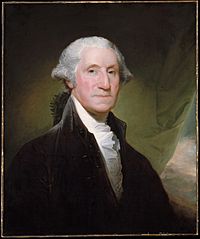 This new vision of human government was an exciting thing to declare in the heat of a Philadelphia summer after a year of skirmishing between the colonists and British regulars, but by December 1776, enthusiasm for this daring new experiment was ebbing. Shortly after colonists had cheered news of independence in July as local leaders read copies of the Continental Congress’s declaration in meetinghouses and taverns in cities and small towns throughout the colonies, the British moved on General George Washington (shown in a 1795 portrait by Gilbert Stuart) and the troops in New York City.
By September the British had forced Washington and his soldiers to retreat from the city, and after a series of punishing skirmishes across Manhattan Island, by November the Redcoats had pushed the Americans into New Jersey. They chased the Continental Army all the way across the Delaware River into Pennsylvania.
By mid-December, things looked bleak for the Continental Army and the revolutionary government it backed. The 5,000 soldiers with Washington who were still able to fight were demoralized from their repeated losses and retreats, and since the Continental Congress had kept enlistments short so as not to risk a standing army, many of the men would be free to leave the army at the end of the year, further weakening it.
As the British troops had taken over New York City and the Continental soldiers had retreated, many of the newly minted Americans outside the army were also having doubts about the whole enterprise of creating a new, independent nation based on the idea that all men were created equal. Then things got worse: as the American soldiers crossed into Pennsylvania, the Continental Congress abandoned Philadelphia on December 12 out of fear of a British invasion, regrouping in Baltimore (which they complained was dirty and expensive).
“These are the times that try men’s souls.”
The author of The American Crisis was Thomas Paine, whose January 1776 pamphlet Common Sense had solidified the colonists’ irritation at the king’s ministers into a rejection of monarchy itself, a rejection not just of King George III, but of all kings. In early 1776, Paine had told the fledgling Americans, many of whom still prayed for a return to the comfortable neglect they had enjoyed from the British government before 1763, that the colonies must form their own independent government.
Now he urged them to see the experiment through. He explained that he had been with the troops as they retreated across New Jersey and, describing the march for his readers, told them “that both officers and men, though greatly harassed and fatigued, frequently without rest, covering, or provision, the inevitable consequences of a long retreat, bore it with a manly and martial spirit. All their wishes centred in one, which was, that the country would turn out and help them to drive the enemy back.”
For that was the crux of it. Paine had no doubt that patriots would create a new nation, eventually, because the cause of human self-determination was just. But how long it took to establish that new nation would depend on how much effort people put into success. “I call not upon a few, but upon all: not on this state or that state, but on every state: up and help us; lay your shoulders to the wheel; better have too much force than too little, when so great an object is at stake,” Paine wrote. “Let it be told to the future world, that in the depth of winter, when nothing but hope and virtue could survive, that the city and the country, alarmed at one common danger, came forth to meet and to repulse it.”
In mid-December, British commander General William Howe had sent most of his soldiers back to New York to spend the winter, leaving garrisons across the river in New Jersey to guard against Washington advancing.
On Christmas night, having heard that the garrison at Trenton was made up of Hessian auxiliaries who were exhausted and unprepared for an attack, Washington and 2,400 soldiers crossed back over the icy Delaware River in a winter storm. They marched nine miles to attack the garrison, the underdressed soldiers suffering from the cold and freezing rain. Reaching Trenton, they surprised the outnumbered Hessians, who fought briefly in the streets before surrendering.
The victory at Trenton restored the colonists’ confidence in their cause. Soldiers reenlisted, and in early January they surprised the British at Princeton, New Jersey, driving them back. The British abandoned their posts in central New Jersey, and by March the Continental Congress moved back to Philadelphia. Historians credit the Battles of Trenton and Princeton with saving the Revolutionary cause.
There is no hard proof that Washington had officers read The American Crisis to his troops when it came out six days before the march to Trenton, as some writers have said, but there is little doubt they heard it one way or another. So, too, did those wavering loyalists.
“Tyranny, like hell, is not easily conquered,” Paine wrote in that fraught moment, “yet we have this consolation with us, that the harder the conflict, the more glorious the triumph. What we obtain too cheap, we esteem too lightly: it is dearness only that gives every thing its value.”

Health Secretary Robert F. Kennedy Jr., with President Trump and Mehmet Oz, the Medicaid and Medicare services administrator, in the White House in September (New York Times photo by Tierney L. Cross)
New York Times, Trump Moves to End Access to Gender-Related Care for Minors, Azeen Ghorayshi, Amy Harmon and Reed Abelson, Dec. 19, 2025 (print ed.). Proposed new rules would pull all federal financing from hospitals that continue to provide gender treatments for adolescents.
The federal government on Thursday acted to put an end to gender-related care for minors across the nation, threatening to pull federal funding from any hospital that offered such treatment.
The move reflects the laserlike focus on the issue by President Trump, who in his first days in office called gender treatments for minors “a stain on our Nation’s history.” The administration’s action is not just a regulatory shift but the latest signal that the federal government does not recognize even the existence of people whose gender identity does not align with their sex at birth.
 If finalized, the proposed new rules, announced by Health Secretary Robert F. Kennedy Jr. at a news conference Thursday morning, would effectively shut down hospitals that failed to comply. Medicare and Medicaid account for nearly 45 percent of spending on hospital care, according to KFF, a nonprofit health policy research group.
It follows other efforts by the administration to pull back from or eliminate policies that recognize gender identities beyond being born male or female.
The new rules come one day after a divided House of Representatives voted to approve legislation that would criminalize gender transition treatments for minors and would subject providers to up to 10 years in federal prison. The House is expected to pass another bill Thursday that would bar Medicaid payments for gender-related treatments for minors. The two bills have little chance of passing in the Senate but showed how far the ultraconservative Republican majority was willing to go to deliver on President Trump’s campaign promise to end such medical treatment.
But the proposed rules go much farther: by trying to force hospitals nationwide to stop providing the treatments altogether. The proposed rules for Medicare and Medicaid will be followed by a 60-day public comment period and will most likely be subject to legal challenges before going into effect.
If finalized, the rule would be “a death sentence — hospitals have such razor-thin margins as it is,” said Caroline Farrell, a former lawyer in the Centers for Medicare and Medicaid Services division of the Health and Human Services Department’s office of the general counsel, and now a lawyer with the firm Foley Hoag. The proposed rule “means just forcing them to stop the care,” she said.
Gender-related treatments for minors, which can include puberty-blocking drugs, hormone therapies and, in rarer cases, surgeries, have been a subject of fierce debate worldwide but are endorsed by most medical groups in the United States.
The announcement on Thursday also included other actions: Another C.M.S. rule would prevent Medicaid from paying for the treatments for minors. And the Food and Drug Administration announced that it was issuing warning letters to 12 manufacturers of breast binders, tight garments used to flatten and masculinize chest appearance under clothing, for “illegal marketing” of the products to children as a treatment for gender dysphoria.
Kelley Robinson, president of the Human Rights Campaign, said, “These rules are proposals, not binding law.” She added, “Community members, health care providers, administrators and our allies should be vocal in pushing back by sharing the ways these proposals would be devastating to their families and the health care community at large.’’
Thursday’s announcement follows a clear road map set out by Mr. Trump in executive orders issued in his first days in office that denied the very existence of transgender people. “It is the policy of the United States to recognize two sexes, male and female,” the president wrote, demanding that the department of Health and Human Services produce a report reviewing the evidence for such treatments.ImageAn exterior view of Children's Hospital Los Angeles on a rainy winter day.Children’s Hospital Los Angeles, one of several pediatric gender clinics that stopped providing puberty blockers and hormone therapies for gender transition this year, citing threats from the administration to withhold federal funds.Credit...Robyn Beck/Agence France-Presse — Getty Images
A final version of that report, which was written by several vocal critics of the medical treatments on both sides of the political aisle, was released in November. It concluded that while the benefits of medical interventions were uncertain, the harms, which can include loss of fertility, were more known. The report instead prioritized the role of psychotherapy, an intervention that is also supported by little evidence, but that the authors wrote argued had fewer risks.
The health department report formed the centerpiece of the new rules on Thursday: Mr. Kennedy cited its conclusions to argue that the treatments do not meet professionally recognized standards for medical care, and that hospitals providing such treatments will therefore be considered to be violating the conditions of participation for hospitals to receive federal funding.
That conclusion is “unprecedented,” Ms. Farrell said. Regarding abortion, a statute called the Hyde Amendment, passed by Congress in 1976, stipulates that hospitals may not use federal funds to pay for abortions for patients, except in rare cases. But the proposed rule, which does not stem from legislation, goes even further, issuing an existential threat to hospitals that accept any federal funding, even if that money is not used to pay for the treatments themselves.
U.S. Inflation, Jobs, Economy

The Bulwark, Political Commentary: Trump Is Walloping Construction Businesses. The Industry Stays Quiet, Catherine Rampell, Dec. 18-19, 2025. I’m slightly obsessed with the question of why corporate America has stayed mum even as President Trump destroys everything they need to survive.
I’m not looking for private industry to stand up for democracy or the rule of law, per se; I’m just wondering why businesses don’t stand up for their own self-interest. Tariffs, arbitrary changes to regulations, weaponization of government tools like antitrust and audits, etc. are bad for business. And yet, the industry groups that are supposed to protest these things, and shield individual members from possible retaliation, have been eerily quiet.
This week’s newsletter looks at one industry in particular: the construction industry. Construction sites have increasingly been targeted in warrantless immigration raids, which seem to be rounding up anyone who looks vaguely Latino, including some U.S. citizens:
WHEN LEO FELER GOT HOME, there was blood everywhere. On his front door, the window sills, the foyer. This wasn’t some tragic accident or a murder scene; rather, while he was out of town to run a marathon, immigration agents had decided to attack the workers replacing windows on his house.
Footage from Ring surveillance cameras around the house, as well as cell-phone videos from protesters outside, tells the story: Masked agents sent to Chicago as part of “Operation Midway Blitz” saw workers taking items to a dumpster in front of Feler’s home. The agents then hopped his locked gate. They trampled his property, aggressively manhandled at least one worker, and entered Feler’s garage. They even tried to pull a bleeding worker out of a second-story window.
They did it all without ever presenting badges, identification, or a warrant.
“It was violent. There’s blood all over the house. It’s insane,” Feler, who is a U.S. citizen, told me the day after this happened in October. “It’s complete lawlessness. How does the government have impunity to jump into my home without a warrant?”
As far as Feler has been able to discern, his house and the crew working on it were targeted at random. The Department of Homeland Security did not reply to detailed questions about agents’ actions or why they were there, but did send me a statement complaining about “agitators” (i.e., protesters) in the street who “obstructed federal law enforcement and ignored multiple warnings to disperse.”
This wasn’t an isolated incident. Rather, it was just one of a rash of warrantless raids on private, residential construction sites recently—raids that are sweeping up basically anyone who looks Latino, including U.S. citizens, and subjecting them to dangerous and sometimes life-threatening conditions.
In a Minneapolis suburb this week, masked men wearing ICE vests—who refused to present a warrant or identify themselves—roped off a construction site, trapping two workers on a partially built roof for hours in subzero temperatures. It was so dangerously cold that “at least 30” masked federal agents present took shifts rotating in and out of their cars to stay warm, a state representative on the scene told local media.
Protesters gathered; some said they were prevented from bringing the trapped, shivering workers warm blankets and extra coats. In one dramatic video, a bystander climbed the spindly rafters herself to hand a worker a cup of hot coffee.
Eventually the masked men left, and one worker on the roof was taken away by ambulance.
There is no question that this wave of deportation operations has hurt workers who are just trying to do their jobs. But it’s also terrible for the contractors and construction companies that employ them. So why hasn’t the construction industry, ya know, done anything?
Here’s what I found when I attempted to get an answer to this question.
First, some background: The construction industry has been facing headwinds for a while now, thanks to high interest rates, tariffs, overall inflation, permitting challenges, and labor shortages. Needless to say, these raids are not exactly helping.
Recruiting workers for construction jobs, particularly in the skilled construction trades, is hard. The work itself is physically demanding and often dangerous. Roofers, for instance, have among the highest fatal work injury rates of any occupation in America.
Immigrants (both legal and undocumented) also make up about a quarter of construction workers overall. They are particularly overrepresented in some trades essential for homebuilding; 61 percent of plasterers and stucco masons are immigrants, as are about half of roofers. The heavy concentration of immigrants in this industry is among the reasons why policy wonks have been warning that mass deportations might worsen the housing crisis.
And yet, the construction industry has been curiously mum about it all.
Earlier this week, I requested an interview with the National Association of Home Builders, an organization I’ve talked with many times over the years about various challenges facing the residential construction industry. I asked to speak with someone about the recent rise in raids and how they have affected the industry. I was told they “do not have anyone available who would be able to address what you are looking for.”
More Global News
New York Times, Putin Reaffirms Broad Military Goals for Russia in Ukraine, Ivan Nechepurenko and Paul Sonne, Updated Dec. 19, 2025. President Vladimir V. Putin spoke at an annual news conference that highlights his grip over Russia and often sets the Kremlin’s tone for the next year.
President Vladimir V. Putin of Russia began his annual news conference on Friday by reaffirming the Kremlin’s determination to continue the war in Ukraine until all of its conditions were met.
Mr. Putin immediately boasted about Russia’s recent battlefield successes and said that the country was not ready to settle the conflict diplomatically unless its maximalist demands, including territorial ones, were fulfilled by Ukraine and its allies.
“The strategic initiative is completely in the hands of the Russian forces,” Mr. Putin said. He added that Russia was “ready to end the conflict peacefully” on the basis of principles he stated in June last year, a reference to the demand that Ukraine cede large swaths of its eastern territories. That is a nonstarter for Kyiv.
But even as he accused Ukraine of refusing to end the conflict peacefully or to negotiate on the question of territory, Mr. Putin said that there were “certain signals” that Kyiv was “ready to engage in some kind of dialogue.”
Russia said this week that it was waiting to meet with President Trump’s representatives to review amended peace proposals after discussions among Ukrainian, American and European officials.Want to stay updated on what’s happening in Russia? Sign up for Your Places: Global Update, and we’ll send our latest coverage to your inbox.
Mr. Putin’s year-end news conference, an annual tradition, is an hourslong marathon where journalists and citizens pose their questions to the Russian leader. It has become an elaborately orchestrated television show and a demonstration of how, over the past three decades, Mr. Putin has solidified his position as the ultimate decision maker in the country. He is portrayed as personally engaged in everyday issues like leaking pipes in small cities, even as he oversees major matters of foreign conflict.
A dedicated studio was built in a giant exhibition center next to the Kremlin for the news conference, which started at midday. It usually sets the tone for the coming year, reflecting the Kremlin’s primary concerns and the messaging it aims to send to the world.
During past news conferences, reporters came with large posters and even fluffy toys to draw Mr. Putin’s attention. This time, only small sheets of paper were allowed, giving the event a more reserved feel. Mr. Putin’s spokesman, Dmitri S. Peskov, asked audience members not to yell out to be chosen to ask a question.
U.S. Religion, Media, Culture, Education

New York Times, Pope Leo Names Illinois Bishop to Replace Cardinal Dolan in New York, Elizabeth Dias and Maya King, Dec. 19, 2025 (print ed.). The appointment of Bishop Ronald A. Hicks is expected to bring a markedly different leadership style to New York’s archdiocese
Pope Leo XIV on Thursday named an Illinois bishop to replace the powerful conservative Cardinal Timothy Dolan as leader of New York’s Roman Catholic archdiocese, a selection that signals his embrace of a more mild and unifying style after the political upheaval of Pope Francis’s papacy, while preserving the spirit of the late pope’s reforms.

Bishop Ronald A. Hicks, shown preaching at the 75th Anniversary Regional Mass at Lewis University(By Matschreiner23 - Own work, CC BY-SA 4.0)
The naming of Bishop Ronald A. Hicks to be the next Roman Catholic archbishop of New York is one of the most anticipated decisions of Pope Leo’s young papacy, his first major move indicating the direction he wants the church to take in his home country.
The appointment echoes Pope Leo’s own ascent earlier this year, the unexpected elevation of a little-known bishop from Chicago with a longtime focus on pastoral work and smooth governance.
Soft-spoken and steady, Bishop Hicks, 58, has led the Diocese of Joliet, Ill., since Pope Francis appointed him in 2020. The bishop has largely avoided outspoken politics, unlike Cardinal Dolan, who has boldly championed conservative causes, appeared often on Fox News and prayed at both of President Donald Trump’s inaugurations.
The choice suggests a significant shift in leadership style for New York’s archdiocese, the country’s second largest and one of its most influential, serving 2.5 million Catholics across the city’s five boroughs and northern suburbs. The selection also comes at a pivotal moment in the city’s political and religious life.
From his start early in the Obama era, Cardinal Dolan has called for Catholic leaders to become more politically involved amid national debates about abortion and same-sex marriage. He became a favorite of center-right Catholics, particularly after he fought the Obama administration’s rule requiring some religious groups to provide contraception for employees. Recently, he described the assassinated conservative activist Charlie Kirk as “a modern-day Saint Paul.
Cardinal Dolan  (shown at left during the entrance procession of mass at the University of St. Thomas in Minnesota in 2019) turned 75 in February, the age when bishops formally submit their resignations to the pope for him to accept or ignore. But Pope Francis’ death and the following papal transition put many such major ecclesial changes on hold, leaving them for the new pontiff.
Bishop Hicks has advanced under the leadership of more progressive church leaders, including Cardinal Blase Cupich of Chicago, an ally of Pope Francis who has prioritized immigrants and a welcoming stance toward L.G.B.T.Q. people. In Chicago before going to Joliet, Bishop Hicks served as an auxiliary bishop.
But in the diocese of Joliet, he also has found support from conservative priests and parishioners who observe the traditional Latin Mass, an old form of worship that Pope Francis attempted to discourage.
Before his election, Pope Leo led an influential Vatican post that selects and manages bishops globally. On a smaller scale, Bishop Hicks currently chairs the United States Conference of Catholic Bishops’ committee responsible for clergy and vocations, a position that helps bishops and priests navigate pastoral needs.
In June, Bishop Hicks helped organize a seminar at the University of Notre Dame to help newer bishops learn how to govern a diocese, with  sessions on decision making, oversight and communications.
His pastoral messages, in English and in Spanish, have stressed the value of unity and the importance of peacemaking across divides and of listening to one another with respect.
“I’ve been told that I have a gentle spirit, yet I’m able to also be strong and to try to set vision and agendas,” Bishop Hicks once told a Catholic diocesan publication.Editors’ PicksHe’s Only 4 Feet Tall, but Paddington Is London’s Biggest New Musical StarA Study Linked Cheese to Lower Dementia Risk. Is That Too Good to Be True?The Most Memorable Wines of 2025
The high-profile nature of the position is a drastic change from the diocese of Joliet: With about 520,000 Catholics, it is just a quarter of the size of the archdiocese of New York. Being elevated from a small diocese to a major seat is fairly rare, especially after a relatively short tenure of about five years. The archbishop of New York is historically also elevated to become a cardinal, the church’s top clerical position below the pope.
The change in leadership also comes as the church is speaking out vocally in support of immigrants under deportation threat.
New York, which is home to one of the nation’s largest immigrant populations, has contended with a marked increase in immigration enforcement activity, and parts of the city have been scouted as possible detention centers. Though houses of worship have long been considered off limits for immigration enforcement, clergy have been under outsize pressure to protect their congregations. Catholic leaders have been particularly critical of the Trump administration’s crackdowns.
Zohran Mamdani, who will be the city’s first Muslim mayor on Jan. 1, met with Cardinal Dolan this fall, shortly before the November mayoral election.
Cardinal Dolan, who was appointed to lead the archdiocese of New York by Pope Benedict XVI in 2009, has held the position through some of the city’s most tumultuous eras. The cardinal has wielded particular influence over the church’s real estate holdings and archdiocesan schools, in part to help fund the church’s legal defense against sexual assault claims. He was made a cardinal in 2012.I
Last week, Cardinal Dolan said that the archdiocese would raise at least $300 million to settle claims brought forth by more than 1,300 people who said they were sexually assaulted by priests and lay staff members. To raise the funds, the archdiocese has weighed selling some of its real estate holdings, including its First Avenue headquarters in Manhattan, which sold for more than $100 million last year.
Both Bishop Hicks and Pope Leo grew up in Chicago’s south suburbs — the bishop at 155th and Woodlawn, and the pope seven minutes’ drive north at 141st and Indiana. They each spent years in Latin America as missionaries.
But they did not meet until last year, when Cardinal Robert F. Prevost spoke at an Illinois parish before he became Pope Leo, Bishop Hicks later told a local television station. They celebrated Mass together at an event with the Midwest Augustinians, the Pope’s home order.
As a priest in El Salvador, Bishop Hicks led Nuestros Pequeños Hermanos, an organization that cares for orphaned children in nine Latin American countries. His favorite saint is Archbishop Óscar Arnulfo Romero, the Salvadoran who championed the poor and was assassinated as he said Mass in 1980.
On Christmas Day three years ago, Bishop Hicks visited inmates at the Joliet Treatment Center. Last month, he returned and baptized four.
This understated leadership style reflects Pope Leo’s own sensibilities.
“I really, as the shepherd of the entire diocese, have to take a number of voices and perspectives and opinions all into context,” Bishop Hicks said in a video for the United States Conference of Catholic Bishops last year. “The way to remedy that is surround myself with some really good people and try to collaborate and get the best advice and never make decisions just on my own.”
But unlike Pope Leo, Bishop Hicks roots for the Chicago Cubs, not the White Sox.
The Contrarian, Opinion: Undaunted in Faith, Jennifer Rubin, right, Dec. 19, 2025. Three religious leaders provide inspiration: Pope Leo XIV; Reverend Mariann Edgar Budde; and Pastor Jamal Bryant.
In our warped political era, bullies and bigots with the chutzpah to flash their White evangelical Christian credentials get rewarded for vile behavior. The worse they behave, the more attention and power they seem to accumulate
Evangelical Peter Wehner wrote this week: “Many of the people who claim to follow Jesus are instruments of a merciless leader and a merciless movement. They have chosen their political loyalties over their faith, even while using the latter to validate the former. There is something morally twisted and discrediting in this.”
We therefore desperately need reminders of how leaders of true faith should act. Providing a compelling counterpart to religion-spouting hypocrites, three faith leaders stood out this year as undaunted proponents of decency, empathy, and social responsibility.
Pope Leo has certainly met the moment. This year, he castigated xenophobia, challenged hateful rhetoric, and rebuffed phony excuses to ignore the plight of our neighbors. NPR reported on his discussion with journalists in November:
We have to look for ways of treating people humanely; treating people with the dignity that they have. If people are in the United States illegally, there are ways to treat that. There are courts. There’s a system of justice.
Treating people who have been here for decades, he said “in a way that is, to say the least, extremely disrespectful, and with instances of violence, is troubling.” His plea to care for immigrants inspired or impressed upon Catholic interfaith organizations, non-religious community activists, and ordinary individuals to aid and defend their neighbors.
Demonstrating his adeptness on social media, he tweeted after Australia’s massacre on Chanukah: “Today I particularly wish to entrust to the Lord the victims of the terrorist massacre carried out yesterday in #Sydney against the Jewish community. Enough with this antisemitic violence! Let us eliminate hatred from our hearts.”
Pope Leo also consistently spoke out against Russia’s invasion of Ukraine (even decrying efforts to impose Russia-friendly terms on Ukraine and Europe) and denounced starvation in Gaza. He insisted that concern for the poor get translated into action. “It is my hope, then, that this Jubilee Year will encourage the development of policies aimed at combating forms of poverty both old and new, as well as implementing new initiatives to support and assist the poorest of the poor,” he said. “Labor, education, housing and health are the foundations of a security that will never be attained by the use of arms.”
Pope Leo sounds as if he is directly criticizing Trump, because Trump exemplifies evils that the pontiff decries—neglect of the poor, crass materialism, embrace of violence, and bigotry. While Trump oppresses; the pontiff stands with the oppressed, bringing light and hope to the dark Trump reign.
In the U.S, the National Cathedral’s Reverend Mariann Edgar Budde captured Americans’ attention shortly after the inauguration by telling Trump:
In the name of our God, I ask you to have mercy upon the people in our country who are scared now. There are gay, lesbian, and transgender children in Democratic, Republican and Independent families, some who fear for their lives. And the people, the people who pick our crops and clean our office buildings, who labor in poultry farms and meat packing plants, who wash the dishes after we eat in restaurants and work the night shifts in hospitals, who wash the dishes after we eat in restaurants and work the night shifts in hospitals. They, they may not be citizens or have the proper documentation, but the vast majority of immigrants are not criminals. They pay taxes and are good neighbors.
After reminding Trump these are people of faith, she implored him to “have mercy, Mr. President, on those in our communities whose children fear that their parents will be taken away and … those who are fleeing war zones and persecution in their own lands, to find compassion and welcome here.”
In our interview, I witnessed how Rev. Budde models grace, humility, and kindness. She affirmed, as Contrarians have grasped, that “courage is contagious.” She continued: “[W]e sort of pass it around to each other when we need it, or you may have it for a day, I may need it tomorrow. It’s communal,” she said. “[T]there is a power that moves through us and allows us to step into that space, and it’s just so encouraging to know that we’re not alone.” As I wrote in January, Rev. Budde certainly channeled Americans’ fears, but she also provided emotional and spiritual armor to fight for the vulnerable.
Another religious leader, Pastor Jamal Bryant of Georgia’s New Birth Baptist Missionary Church, also personified faith in action. The Contrarian’s April Ryan interviewed him twice this year. One central topic he spoke about with notable passion was his leadership in the national boycott against Target. While he did not start the boycott, he quickly became the face of the movement responding to Target’s cowardly compliance with Trump’s assault on DEI. “I wanted to bring a spiritual dynamic to it,” he told April. The movement had a stunning impact, inflicting $12B in losses and prompting the CEO’s exit (unfortunately, the COO replaced him), although Target persists in its anti-DEI stance.
Pastor Bryant recently posted on Instagram:
I’m amazed how @target is willing to do everything except the right thing. Making the staff smile won’t do it! Fake sale prices won’t do it! Giving checks to black churches won’t do it! Paying black influencers to post won’t do it and bribing HBCU students with discount cards won’t do it. … We don’t want to hand you violins to play on the Titanic. This is fixable … just do the right thing!
Beyond Target, Pastor Bryant hammered away at the regime’s attacks on history and inclusivity. When Trump replaced Martin Luther King Jr. Day and Juneteenth with Flag Day/Trump’s birthday as a free day at National Parks, Pastor Bryant blasted Trump’s gob-smacking move. “This is a slap in the face, not just to African Americans but to Americans at large,” he said. “The narcissism unleashed to take it away from Dr. King and laud it upon himself says that America is going backward, is in tremendous danger.”
In sum, when MAGA politicians cloak themselves in religious platitudes while simultaneously spouting hatred toward immigrants, taking SNAP benefits from children, and cheering grandmothers’ deportation, many Americans are desperate for hope, insight, and compassion from authentic religious leaders.Subscribed
Providing spiritual guidance and inspiration, Pope Leo, Rev. Budde, and Pastor Bryant showed us that true faith leaders do not oppress or demonize others and certainly do not deify a noxious politician (one whose conduct and rhetoric revolts even other MAGA pols). Whether religious or not, Americans can be grateful for genuinely religious voices who reiterate that faith without deeds is useless and remind us that silence in the face of hateful actions and words is abhorrent. We honor each of them, in addition to all courageous leaders who seek to bring us together.
Dec. 18
President Trump delivers a nationwide address from the Oval office carried on all four major television networks Wednesday, Dec.17, 2025 (New York Times pool photo by Doug Mills).
The Hartmann Report, Political Commentary: Was That a Speech or a Breakdown? Thom Hartmann, Dec. 18, 2025. A stark look at the speech that blurred the line between leadership and losing control on the world stage…
Let me take off my psychotherapist hat and simply speak as a parent, an adult, a businessman, a citizen, and a human being.
There is something deeply and fundamentally wrong with Donald Trump.
Last night’s speech demonstrated it. (Excerpt continued below.)
New York Times, A Bellicose Trump Points Fingers in Defending His Record on the Economy, David E. Sanger, Dec. 18, 2025. In an 18-minute address, President Trump said the economy was booming despite the public’s consistent concerns about prices. Here are six takeaways from the speech.
President Trump gave an 18-minute speech intended to defend his accomplishments in the first year, and argue that the “Golden Age” he promised in his presidential campaign last year was building steam.
The speech was, in typical form, largely strung together from familiar lines he uses at White House events, rallies and speeches. And, in Trumpian style, there were a long list of exaggerations and misleading statements.
But notably absent from the president’s remarks was his argument from recent weeks that “affordability” was nothing but a “hoax” and a “con job” by Democrats — a line that made his own advisers cringe.
Here are six takeaways from his speech.
The president’s tone was combative.
Mr. Trump, always more comfortable with what he calls his “weave” of free association rather than reading from a teleprompter, raced through his talk as if he was late to an important dinner. There were no digressions, unlike his speech in Pennsylvania a week ago when he repeatedly veered from the topic. At times he seemed to be yelling — almost as if he didn’t believe he had to take the time to convince his audience of how well his first 11 months had gone.
Not surprisingly, he blamed former President Joseph R. Biden Jr. from the first sentence: “I inherited a mess.” He described a country that a year ago, he said, was overrun by illegal immigrants, its manufacturing base hollowed out, its cities ridden with crime. All these problems had been solved, he said, and he vowed more relief if people will wait to see their paychecks fatten.
But the message was a bit overshadowed by his angry tone, which seemed to belie his recognition that he was under pressure to show results fast, before a narrative settles that he has mismanaged the economy.
He risked repeating a Biden mistake of arguing with voters about how they feel.
Mr. Trump was propelled to victory in 2024 by voters who thought Mr. Biden was out of touch and too old for the job, and who were repelled by Mr. Biden’s insistence that they should be feeling better. Now it is Mr. Trump who runs the same risk.
Just as Mr. Biden often argued that the economy was in far better shape than the public believed, Mr. Trump was essentially shouting that they should be grateful to him for bringing back manufacturing jobs and getting illegal immigrants out of the work force.
At moments it sounded as if the man who just threw a Gatsby-themed party at Mar-a-Lago did not realize what the job market feels like to ordinary Americans. In fact, the country continues to lose manufacturing jobs. But most importantly Americans appear unconvinced about tariffs — “my favorite word, tariffs.”
He described foreign investment pouring into the United States but cited a figure twice as high as his own White House has estimated. Perhaps he will be right in the long term, though he was having a hard time closing the sale based on what has happened so far, including overstating the pace at which foreign companies determine they must move facilities to the United States to avoid tariffs.He made highly selective — and often misleading — use of statistics.
Mr. Trump argued he cut drug prices by 400, 500 or 600 percent, all mathematical impossibilities. He claimed that inflation had dropped significantly since he became president, without mentioning that in September, the last month for which the government has numbers, it had returned to 3 percent, exactly where it was on Mr. Biden’s last weeks in office. He argued that gasoline was now under $2.50 a gallon in much of the country; his own department of energy reports it was $2.90. And he claimed there were states where gas was $1.99; in fact, no state average gas price was that low, AAA reports.
He failed to mention that the latest unemployment numbers — which were boosted by government layoffs executed by his administration — showed the unemployment rate at 4.6 percent, the highest in four years, since the nation was just pulling out of the Covid-19 pandemic. Spending on factory construction has fallen in recent times.
All presidents bend statistics to their advantage but Mr. Trump has turned exaggeration into an art form. There was an air of desperation to the president’s arguments, perhaps reflective of polls showing that even those who voted for him believing he would manage the economy well, were having second thoughts.

New York Times, F.C.C. Chair Says Agency ‘Isn’t Independent,’ Breaking From Tradition, Cecilia Kang, Dec. 18, 2025 (print ed.). The comment from Brendan Carr, a Republican, raised concerns from lawmakers about how President Trump might use the agency.
The chairman of the Federal Communications Commission said in a hearing on Wednesday that the agency was not independent, stunning Democratic lawmakers concerned that President Trump could use the government office as a tool for censorship.
 The Republican chair, Brendan Carr, said in an agency oversight hearing by the Senate Commerce, Science and Transportation Committee that “formally speaking, the F.C.C. isn’t independent.”
Democrats grilled Mr. Carr in the hearing over a series of threats he had made to broadcasters about revoking local broadcast licenses for content that is not in the public’s interest. In September, he threatened to take away local licenses of ABC stations that aired Jimmy Kimmel’s late-night show because of Mr. Kimmel’s remarks about the killer of the right-wing activist Charlie Kirk.
Sinclair and Nexstar briefly suspended Mr. Kimmel’s show on local ABC stations that they own, and ABC, which is owned by Disney, temporarily pulled it off the air. Mr. Carr has also opened investigations into all of the major broadcasters, including NPR, for content decisions and advertising.
Mr. Carr has argued that local stations that carry the television and radio content are held to a “public interest” standard. Mr. Trump has pushed for the F.C.C. to use its powers over the broadcast industry to retaliate against coverage that he has deemed unfavorable to him. The agency’s main power over the industry lies in its approvals of mergers and of licenses to broadcasters to use the public airwaves.
In Wednesday’s hearing, Mr. Carr, a career telecommunications lawyer, said the 1934 Communications Act did not explicitly describe the president’s authority over the agency. “So I can be fired by the president for no reason or any reason at all,” he said.
Democrats balked at his remarks. Senator Edward J. Markey of Massachusetts said the use of broadcast license renewals to pressure media that have mergers and other regulatory matters before the agency would be “weaponizing the public interest standard.”
Several Democrats noted that the F.C.C. website’s mission statement describes it as an independent agency. As of Wednesday afternoon, the word “independent” did not appear on the agency’s mission page.
“Trump is not your boss, so the American people are your boss,” said Senator Andy Kim, Democrat of New Jersey.

Popular Information, Accountability Journalism: Breaking precedent, networks interrupt prime time for Trump political diatribe, Rebecca Crosby, Noel Sims, and Judd Legum, right, Dec. 18, 2025. 
On Wednesday night at 9 PM Eastern, President Trump (shown above) delivered a prime time address to the nation that was aired by all major broadcast networks. It preempted the season finale of “Survivor” on CBS, one of the network’s most highly-rated shows, the season finale of “The Floor” on Fox, and holiday specials on ABC and NBC.
Typically, networks will interrupt their primetime schedule for presidents to address wars, crises, or very significant new policies. In his remarks on Wednesday, Trump delivered his standard talking points, bragging about his mass deportation policies and tariffs and attacking Democrats and the Biden administration. The only crisis was Trump’s sagging approval ratings.
“Over the past 11 months, we have brought more positive change to Washington than any administration in American history,” Trump said during the speech. “There’s never been anything like it.”
Trump blamed the Democrats for the increased cost of health insurance. “You see that now in the steep increase in premiums being demanded by the Democrats, and they are demanding those increases, and it’s their fault,” he said. Millions of Americans will see their insurance rates increase after Republicans refused to extend government subsidies that will expire at the end of the year.
The speech's partisan political content was not a surprise.
White House Press Secretary Karoline Leavitt, right, said that Trump would address the country “about all of his historic accomplishments over the past year” and “all that he’s done to bring our country back to greatness.” Specifically, Leavitt stated that Trump would likely discuss “border security and lower gas prices.”
The networks decided to break precedent and air it anyway.
The networks have declined to air prime time speeches from the last two Democratic presidents, claiming they were too political. In 2022, for  example, broadcast networks declined to air a prime time speech by former President Joe Biden where he warned about threats to democracy, deciding the speech would be too “political.” Instead, NBC ran a rerun of “Law & Order” and CBS aired a rerun of “Young Sheldon.”
In 2014, major networks also refused to air a speech by former President Barack Obama about immigration reform, claiming it was too partisan. The speech outlined a plan to protect millions of undocumented immigrants from deportation, which the Washington Post called “the most significant presidential intervention to alter the U.S. immigration system in nearly three decades.” But instead of airing the speech, CBS opted to air “The Big Bang Theory” and NBC aired “The Biggest Loser: Glory Days.”
The Obama White House made a comparison to a decision by networks to air a 2006 speech by former President George W. Bush that also covered immigration policy, but networks argued that Bush’s announcement was “bipartisan,” while Obama’s speech was an “overtly political move by the White House,” a network insider told Politico at the time.
But major broadcast networks did air a 2019 speech by Trump about the border wall, which did not have bipartisan support. Network officials argued that the speech should be aired because of its “newsworthiness.” One official told the Washington Post that while the Obama speech was “very political” and had “no crisis around it,” Trump’s speech happened during the “backdrop of the crisis of a government shutdown.”
After then-House Speaker Nancy Pelosi (D-CA) and then-Senate Minority Leader Chuck Schumer (D-NY) demanded equal airtime, networks gave Pelosi and Schumer less than five minutes of airtime directly following Trump’s speech. The networks did not air any Democratic response to Trump’s Wednesday night address.
A pattern of capitulation
During his second term, the networks have consistently capitulated to Trump’s demands.
In December 2024, ABC settled a defamation lawsuit brought by Trump, agreeing to contribute $15 million to his presidential library and pay $1 million in legal fees. Trump sued ABC after anchor George Stephanopoulos incorrectly said on air that Trump was found liable for raping E. Jean Carroll, when he was actually found liable for sexual abuse. Legal experts believed Trump’s case was weak.
Another concession to Trump came in July when CBS settled a lawsuit over the editing of an October 2024 “60 Minutes” interview with former Vice President Kamala Harris for $16 million. Trump’s lawyers alleged that he experienced “mental anguish” over the interview and that it had been edited to make Harris look better.
After the settlement, Paramount, CBS’s parent company, got Federal Communications Commission (FCC) approval for a proposed merger with Skydance Media. The merger made David Ellison — son of billionaire Trump ally Larry Ellison — Paramount’s CEO. Since then, CBS has made changes favorable to Trump.
As a condition of approval for the merger, CBS appointed an ombudsman to evaluate “any complaints of bias or other concerns involving CBS.” The network chose Kenneth Weinstein — the former president of a right-wing think tank and frequent defender of Trump — for the job. Then, Paramount made Bari Weiss, an anti-woke pundit with no broadcast news experience, the editor-in-chief of CBS News.
Fox’s broadcast channel shares the same corporate parent as Fox News, which airs hours of pro-Trump programming daily. Comcast, the corporate parent of NBC News, donated $1 million to Trump’s inauguration and an undisclosed amount to finance the Trump ballroom.
Epstein-Trump Files Updates (Part 1, Continued Below)
The Parnas Perspective, Important Epstein Files Update, Aaron Parnas, Dec. 18, 2025. Trump had a much closer relationship with Epstein as we are getting even more photos released by the Oversight Committee.
With just 24 hours remaining before the U.S. Department of Justice is required to release the long-anticipated Epstein files, new material is already shedding light on what the public may soon confront. Today, the House Oversight Committee released an additional 70 photographs connected to the Epstein investigation.
Warning, before you click the next link, some of the images can be very triggering for anyone who is a survivor of abuse. I will link to those images here and highlight several that stand out for their significance and gravity.
As the DOJ release approaches, today’s photographs and the accumulating reporting serve as a sobering reminder of what is at stake: accountability for powerful figures, transparency from institutions, and—above all—justice and protection for survivors. The coming days will not answer every question, but they may finally begin to illuminate a system that for too long operated in the shadows.
New York Times, ‘Don’s Best Friend’: How Epstein and Trump Bonded Over the Pursuit of Women, Nicholas Confessore and Julie Tate, Dec. 18, 2025. Documents and interviews reveal a complicated relationship in which chasing women was a game of ego and dominance, and female bodies were currency.
The president has tried to minimize their friendship, but documents and interviews reveal an intense and complicated relationship. Chasing women was a game of ego and dominance. Female bodies were currency.
The Times interviewed more than 30 former employees of Jeffrey Epstein, victims of his abuse and others who crossed paths with Mr. Epstein and President Trump. The Times also obtained new documents that illuminate their relationship.Dec. 18, 2025, 5:00 a.m. ET
Jeffrey Epstein was a “terrific guy” and “a lot of fun to be with.” He and Donald J. Trump also had “no formal relationship.” They went to a lot of the same parties. But they “did not socialize together.” They were never really friends, just business acquaintances. Or “there was no relationship” at all. “I was not a fan of his, that I can tell you.”
For nearly a quarter-century, Mr. Trump and his representatives have offered shifting, often contradictory accounts of his relationship with Mr. Epstein, one sporadically captured by society photographers and in news clips before they fell out sometime in the mid-2000s. Closely scrutinized since Mr. Epstein died in a Manhattan jail cell during Mr. Trump’s first term, their friendship — and questions about what the president knew of Mr. Epstein’s abuses — now threatens to consume his second one.
The controversy has shaken Mr. Trump’s iron hold on his base like no other. Loyal supporters have demanded to know why the administration has not moved more quickly to unearth the convicted sex offender’s remaining secrets. In November, after resisting months of pressure to release more Epstein-related documents held by the federal government — and facing an almost unheard-of revolt among Republican lawmakers — Mr. Trump reversed himself, signing legislation that requires their release beginning this week.
Mr. Epstein had a talent for acquiring powerful friends, some of whom have become ensnared in the continuing scrutiny of his crimes. For months, Mr. Trump has labored furiously to shift himself out of the frame, dismissing questions about his relationship with Mr. Epstein as a “Democrat hoax” and imploring his supporters to ignore the matter entirely. An examination of their history by The New York Times has found no evidence implicating Mr. Trump in Mr. Epstein’s abuse and trafficking of minors.
But the two men’s relationship was both far closer and far more complex than the president now admits.
Beginning in the late 1980s, the two men forged a bond intense enough to leave others who knew them with the impression that they were each other’s closest friend, The Times found. Mr. Epstein was then a little-known financier who cultivated mystery around the scope and source of his self-made wealth. Mr. Trump, six years older, was a real estate scion who relished publicity and exaggerated his successes. Neither man drank or did drugs. They pursued women in a game of ego and dominance. Female bodies were currency.
Over nearly two decades, as Mr. Trump cut a swath through the party circuits of New York and Florida, Mr. Epstein was perhaps his most reliable wingman. During the 1990s and early 2000s, they prowled Mr. Epstein’s Manhattan mansion and Mr. Trump’s Plaza Hotel, at least one of Mr. Trump’s Atlantic City casinos and both their Palm Beach homes. They visited each other’s offices and spoke often by phone, according to other former Epstein employees and women who spent time in his homes.
With other men, Mr. Epstein might discuss tax shelters, international affairs or neuroscience. With Mr. Trump, he talked about sex.
“I just think it was trophy hunting,” Stacey Williams, who rose to fame as a star of the Sports Illustrated swimsuit editions during the 1990s, said in an interview with The Times. In social media posts and interviews with news outlets in recent years, Ms. Williams has described how Mr. Trump groped her in 1993 at Trump Tower while Mr. Epstein — whom she was then dating — watched. “I think Jeffrey liked that he had this Sports Illustrated model who had this name, and that Trump was pursuing me,” she said. Mr. Trump has denied her account
To shed light on their friendship, The Times interviewed more than 30 former Epstein employees, victims of his abuse and others who crossed paths with the two men over the years. The Times also obtained new documents that illuminate their relationship and scoured court documents and other public records.
Many of the people interviewed by The Times asked to share their stories anonymously, saying they feared for their safety at the hands of supporters of Mr. Trump, a president who has deployed the might of the federal government to target and punish his political opponents. Some Epstein victims have already received death threats for demanding a full accounting of the government’s investigations, according to a statement released by more than two dozen of them last month.
Over the years, Mr. Epstein or his partner, Ghislaine Maxwell, introduced at least six women who have accused them of grooming or abuse to Mr. Trump, according to interviews, court testimony and other records. One was a minor at the time. None have accused Mr. Trump himself of inappropriate behavior.
One of the women, who has never before spoken publicly about the experience, told The Times that Mr. Epstein had coerced her into attending four parties at Mr. Epstein’s home. Mr. Trump attended all four, the woman said. At two of them, she said, Mr. Epstein directed her to have sex with other male guests.
More On U.S. Governance, Politics
Paul Krugman via Substack, Opinion: Why Trump’s Viciousness Matters, Paul Krugman, right, He wants to destroy our values, not just our democracy.
My first reaction upon reading Donald Trump’s despicable statement on the murders of Rob Reiner and his wife Michele was a sense of both shock and lack of surprise. It wasn’t news to me that the president of the United States is a vicious shmuck. My second reaction was the thought that I have nothing new to contribute here, as plenty of other people were already denouncing yet another example of Trump’s vindictive narcissism.
Yet, on reflection, I realized that there’s a story here that’s bigger than Trump, a story in which Trump is one especially egregious example of a larger pattern. What is that pattern? That being vicious and bigoted is cool, is based in current slang. Trump is one data point in the midst of an epidemic of performative hatemongering in America. And while most of this is emanating from right-wing extremists, not all of it is.
I am not going to present some rose-tinted, Pollyannaish view of America’s past here. There were people who crowed over the assassination of Martin Luther King Jr. For most of our history there were Americans who reveled in harming, subjugating and dispossessing those who were considered of the wrong race, ethnicity, religion, sexual orientation or gender identity. But we, as a country, changed. Over time, Americans on the whole became more humane and tolerant.
It’s true that significant numbers of Americans were never fully on board with liberal humanism. For example, a majority of white American’s didn’t approve of interracial marriage until 1997. However, we were slowly becoming a country in which open bigotry was frowned upon. Although we were never perfect, there was a growing sense of norms that contained any underlying hatred.
Now the impulse to hate is back. For example, according to a long-running survey conducted by NORC and the ADL, antisemitism has been making a big comeback: Antisemitic Attitudes in America 2024
And Trump has made innumberable crudely racist comments about Black Americans, particularly about Black American women. He’s demonized immigrants and Muslims, and suggested Democratic politicians should be executed. But the resurgence of hate speech isn’t just about Trump, nor is it solely about politics. Grown men — it’s mostly, although not only, men — now feel free to be publicly cruel and vindictive, spouting childish insults against whomever they dislike.
Why is this happening? The rise of social media is one significant factor in making it far easier for the like-minded to find one another and magnify their hate.
The app formerly known as Twitter is thoroughly infested with bigots and bots, and all too many people who immerse themselves in that toxic environment end up internalizing the viciousness. Even right-wing activists like Chris Rufo are complaining that X has been “increasingly hijacked by bad actors who peddle baseless conspiracies and indulge their personal psychopathologies.” And G. Elliott Morris’s Substack “Strength in Numbers” has an excellent post on how Fox News polarized American voters and helped break American politics.
However, media alone are not to blame. I’ve been reading the British economist Simon Wren-Lewis, who has been writing about “the growing acceptability of xenophobic discourse” in the UK. His thesis is that there have always been a substantial number of people in Britain — and, surely, in every Western nation — who are socially reactionary and racist. In the past, however, mainstream political parties refused to associate themselves with anyone espousing such views. Eventually the cynical search for votes led to a breakdown of this cordon sanitaire — the Germans call their equivalent the Brandmauer, or firewall — and the latent viciousness broke into the open.
In a follow-up post Wren-Lewis, citing the work of the political scientist Vicente Valentim, acknowledges thatbroader social norms, largely established after World War II, also made overt racism and other forms of bigotry unacceptable in the public sphere. Even people who were privately cruel and bigoted – some of them in influential positions – felt obliged to be hypocrites and hide their true nature.
In time, however, events, ranging from the Syrian refugee crisis in Germany to the election of America’s first Black president, loosened the grip of these social norms. The already-existing pool of cruelty and bigotry, which had previously been veiled by hypocrisy, came back into full view.
A similar phenomenon is occurring in the US, where some Trump supporters are gleeful that Trump’s presidency will allow them to drop the veil of hypocrisy. For example, the Financial Times reported on the reasons some on Wall Street were welcoming Trump’s return:
“I feel liberated,” said a top banker. “We can say ‘retard’ and ‘pussy’ without the fear of getting cancelled . . . it’s a new dawn.”
Now, Trump is purposely breaking norms and engaging in open expressions of hate and bigotry. And among a set of people, this serves as a signal that it’s now socially acceptable to do the same – look, for example, atthe extremely racist and Nazi-praising chats among young Republican activists leaked to Politico. While these young MAGA-landers were outed and chastised, it’s clear that within MAGA-world emulating Trump’s hate-filled rhetoric is considered a way of signaling that you are loyal to the movement.
And it’s also clear that if Trumpism persists, we are facing a future in which such behavior is no longer publicly unacceptable. Because Trump’s remarks about the murder of the Reiners weren’t just his personal venting. They were a symptom and a symbol of his systematic destruction of our norms, our humanism, just as he tried to destroy the norms of American democracy on January 6, 2021. It’s a profoundly nihilistic vision for America.
And one of these days, I predict, history will judge harshly those who stayed silent.
Addendum: Trump gave a speech on the economy last night. It was nasty, brutish but mercifully short. It was, of course, full of lies. Were there any true factual claims? So far I haven’t found any. And it closed out with ugly claims about immigrants. A few more words about it tomorrow.
More On Trump's Speech
Morning Shots via The Bulwark, Political Opinion: Can We Get Those 18 Minutes Back? William Kristol, right, Dec. 18, 2025. What to think of Donald Trump’s speech from the White House last night?
I’m with Tim Miller: “I was embarrassed. It’s really unbelievably stupid that we’re here, that this person is the president, and that that was real—that was not a spoof.”
I’d only add that it’s unbelievably stupid that we’re stuck with this person as president for three more years. And we’re stuck with apologists like Newt Gingrich, once a formidable figure. Last night, Newt made this unbelievably stupid statement: “Some day, people will say it was one of the most important speeches of his career . . . I think it’s a very, very important speech.”
No, it wasn’t a very, very important speech. It wasn’t even a slightly important speech. It was a pointless speech. It was a waste of 18 minutes of prime time.
But it also left me with a sense of relief. Only perhaps temporary relief, to be sure—but still, you take what you can get these days.
Why?
Because Trump didn’t use the network prime time he’d requested to announce we were going to war in Venezuela. After all his bellicose rhetoric, after all his bluster in press gaggles, Trump had a chance to make his case for war to the nation. He failed to take it. He didn’t even mention Venezuela.
I suppose Trump could still launch an attack soon. He surely doesn’t think a president has some kind of obligation, if he’s going to use military force, to explain the rationale to the public—let alone to get authorization for it from the people’s representatives in Congress. Perhaps he’s just waiting until Congress is out of town next week, so there’s less chance of effective pushback.
Still, the idea of a war with Venezuela is already unpopular. It’s hard to see why it’s going to get any more popular. Perhaps Trump will continue to bluff rather than fight. So maybe we’ll be spared an unauthorized and unjustified foreign war.
Which would be good.
There’s another reason for my sense of relief. Last night’s speech reveals Trump has no sense of how he might save his foundering presidency, or even much of an inclination to try to do so. Indeed, yesterday’s Republican meltdown in the House in the face of increased health insurance costs, a faltering economy, and the deadline for the release of the Epstein files tomorrow—all of these suggest a rough holiday season for the administration.
Which is good. A weaker Trump administration is better for America.
One more point. A normal president, speaking after this past week—in which two U.S. soldiers were killed in Syria, after the shooting of the students at Brown, after the terrible attack on Jews celebrating Hanukkah in Sydney, and after the horrible murder of Rob and Michele Reiner—would have said something about how we mourned these tragedies. He might have asked for prayers for victims and their families in this holiday season.
Of course, this never even occurred to the pathological narcissistic we have as our president. Indeed, I doubt people thought he’d bother mentioning this at all: The soft bigotry of low expectations.
In any case, Trump is an embarrassment. And he will be a failed president. The question is how much more damage he’ll be able to do to our polity, our society, and our country.
The Hartmann Report, Political Commentary: Was That a Speech or a Breakdown? Thom Hartmann, Dec. 18, 2025. A starklook at the speech that blurred the line between leadership and losing control on the world stage…
Let me take off my psychotherapist hat and simply speak as a parent, an adult, a businessman, a citizen, and a human being.
There is something deeply and fundamentally wrong with Donald Trump.
Last night’s speech demonstrated it. He didn’t need to trash-talk Joe Biden, or try to claim that the country was “dead” when he came into office, or exaggerate his accomplishments, or lie about the state of things. None of that was necessary.
He didn’t need to put depreciating comments under the pictures of prior presidents in the White House, or replace Joe Biden’s picture with a autopen. These are the kind of things junior high school boys do. And not even most junior high school boys; just the really dysfunctional ones. The bullies. The ones who are desperate to be part of the in crowd, but always on the outside looking in. The ones no one wants as friends.
This man is sick. And he’s inflicting his sickness on our country. And he’s surrounded himself with sick people, or at least with people willing to tolerate his mental, emotional, and spiritual sickness.
As well as people who share his sickness: there’s also clearly something wrong with man-children like Stephen Miller, Pete Hegseth, and Kash Patel. With these men, it goes beyond the normal sellout-type of person willing to do anything for wealth and power, the kind of behavior we see in people like Pam Bondi or the administration members who’ll swear that the 2020 election was stolen.
There’s a deep cruelty combined with a pathological insecurity and a level of hate and intolerance for others that’s shocking. Anybody who’s ever played any sort of role in leadership is looking at this administration aghast. The leaders of the rest of the rest of the world must be in shock.
There’s a deep sickness at the head of this government. The childishness. The violence. The bloodlust that we see off the coast of Venezuela. The willingness to sanction rape and murder and land grabs in Ukraine. The enthusiasm to bring our country to the brink of war. Plastering gold-painted geegaws all over it the White House.
And then last night Trump goes off for 20 minutes quite literally shouting at the country like an old man yelling at kids on his lawn. Ranting about Black Somalis. Bragging about nonexistent victories and peace deals. Just making shit up.
No president of the United States has ever behaved this way. Probably no governor or mayor has ever gotten away with this kind of psychopathology and obscene behavior.
It’s embarrassing. It’s humiliating America.
It’s setting a terrible example for our young people. Children who were just entering the early years of public school when Trump first ran based on a racist rant in 2015 are now graduating from high school thinking that this is normal.
That, in and of itself, is a disaster for their and America’s future.
And now he has an “armada” poised off the coast of Venezuela trying to provoke a war with that nation.
It’s also becoming increasingly clear that he was right in the middle of it all with Jeffrey Epstein, and is now frantically trying to avoid questions about the teen modeling agency and talent show he owned back in those days.
He’s gutted America’s principal agencies of soft power, The Voice of America and USAID, strung Ukraine along for almost an entire year as their people get slaughtered, and accepted hundreds of millions of dollars worth of naked bribes from foreign autocrats and American business leaders.
He’s deployed masked, secret police into our cities who are gleefully brutalizing brown-skinned people and anybody who tries to document their hugely unAmerican activity.
He kowtows before Vladimir Putin and China’s president Xi, and embraces murderous dictators who’ve ordered the killing of an American journalist and routinely cut the heads off of their own people. He tore down the East Wing of the White House in defiance of federal and local law, history, and respect for “The People’s House.”
It’s reached the plant where we’re now confronted with a hard truth: this isn’t about left versus right anymore or even politics as usual. It isn’t about tax policy or border policy or whose yard sign we prefer.
This is now about whether we’re willing to normalize sickness in power.
Whether we tell ourselves comforting stories because confronting the actual reality in front of us is frightening.
Whether we allow cruelty, lying, and instability to become the cultural baseline simply because calling it out makes dinner conversations awkward or costs us friends or clicks or donors.
Turning points in history don’t usually announce themselves with marching bands. They creep in while decent people look away, hoping the fever will break on its own.
But it never does. Fevers break only when the body fights back. Democracies survive only when citizens decide that character still matters, that truth still matters, that children deserve better examples than tantrums and threats and gold-plated vulgarity.
Silence is not neutrality: It’s consent.If you’re reading this, you still have agency. Use it. Talk to your neighbors. Support journalists and organizations willing to tell the truth. Show up, vote, organize, refuse to laugh it off, refuse to excuse it, refuse to become numb.
Demand leaders who are adults, not bullies. Who are steady, not sick. Who see power as a responsibility, not a toy.
The future is watching us right now, and one day our children will ask what we did when it mattered. Let’s make sure we have an answer we can live with.

President Trump (New York Times file photo by Kenny Holston).
New York Times, Fact-Checking Trump’s Prime-Time Address on the Economy, Linda Qiu, Dec. 17, 2025 (print ed.). The president cited misleading statistics to insist, wrongly, that prices were coming down.
President Trump praised what he portrayed as the economic gains under his administration in an address from the White House on Wednesday, even as consumers express concerns about affordability and voice discontent over how he has handled the economy.
“I am bringing those high prices down and bringing them down very fast. Let’s look at the facts,” Mr. Trump said, before ticking off a litany of misleading claimsl. Here’s a look at those facts.
What Was Said
“When I took office, inflation was the worst in 48 years, and some would say in the history of our country.”
False. Inflation had already fallen to 3 percent in January, when Mr. Trump took office. Inflation did reach a four-decade high in the summer of 2022, at about 9.1 percent that June, but had declined since then. That number was also not a record; inflation reached higher points in the 1910s, 1970s and 1980s.
What Was Said
“The price of a Thanksgiving turkey was down 33 percent compared to the Biden last year. The price of eggs is down 82 percent since March, and everything else is falling rapidly, and it’s not done yet.”
This is exaggerated. Mr. Trump may have been referring to, and overstating, a report from the American Farm Bureau, which estimated that the cost of a turkey at the grocery store before Thanksgiving had declined by 16 percent this year from last year. But wholesale turkey prices had actually risen this year, according to data from the Agriculture Department and a Purdue University report. This is likely because turkeys are known as loss leaders, or items that retailers may sell at a loss to entice consumers to the store.
On eggs, Mr. Trump is correct that the wholesale price of eggs had fallen from more than $8 a dozen in late February to $1.45 last week, a decline of more than 80 percent. The retail price of eggs declined less sharply, about 44 percent, from March to September, the month with the most recent data available.
Mr. Trump was also wrong that “everything else is falling rapidly.” In fact, the Consumer Price Index rose by 3 percent in September.
What Was Said
“Gasoline is now under $2.50 a gallon into much of the country. In some states, it, by the way, just hit $1.99 a gallon.”
Emptywheel, Analysis: Rent-Seeking: Trump Sells Patriotic Fraud to Boost His Tariff Lies, Emptywheel (Marcy Wheeler, Ph.D), right, Dec. 18, 2025. Among the blizzard of lies Trump told last night is that the $1,776 check he's sending to service members has anything to do with his tariffs.
I was going to write about how Trump’s promise, last night, to send a bunch of service members a $1,776 checks, was actually a confession that there will be no tariff rebates for civilians.
Two paragraphs after Trump introduced his false claims about tariffs — “my favorite word” — he said that because of tariffs, along with the Big Ugly, Trump was sending some number (he bolloxed the number repeatedly) service members would get a check.
This historic trend will continue. Already, I’ve secured a record-breaking $18 trillion of investment into the United States, which means jobs, wage increases, growth, factory openings and far greater national security. Much of this success has been accomplished by tariffs, my favorite word, tariffs, which for many decades have been used successfully by other countries against us, but not anymore. Companies know that if they build in America, there are no tariffs, and that’s why they’re coming home to the U.S.A. in record numbers. They’re building factories and plants at levels we haven’t seen. A.I., automobiles, we’re doing what nobody thought was even possible, not even remotely possible. There has never, frankly, been anything like it.
[snip]
Because of tariffs, along with the just passed One Big, Beautiful Bill, tonight I am also proud to announce that more than 1,000, 450,000, think of this, 1,450,000 military service members will receive a special, we call warrior dividend before Christmas, a warrior dividend. In honor of our nation’s founding in 1776, we are sending every soldier $1,776. Think of that. And the checks are already on the way. Nobody understood that one until about 30 minutes ago. We made a lot more money than anybody thought because of tariffs, and the bill helped us along. Nobody deserves it more than our military. And I say congratulations to everybody. And by the way, we now have record enlistment in our military, and last year we had among the worst recruitment numbers in our military’s history. What a difference a year makes.
He once was offering bigger refunds — $2,000 — for everyone but high income people. That was, as Dean Baker did the math at the time, totally unaffordable, even ignoring that Trump is likely to have to pay some portion of the tariffs back, only to importers, not the consumers who have paid increased prices for consumer goods.
Doing the simple arithmetic, the country has 340 million people. If 10 percent of these people fit Trump’s definition of high-income, and therefore don’t get the rebate, roughly 300 million people would get the checks.
At $2,000 a piece it would come to $600 billion, more than twice what Trump is collecting from us with his import taxes. Since he’s already $330 billion short, how can Trump think he has money to pay down the national debt? Also, he seems not to know that our deficit this year is projected to be $1.8 trillion, so he is actually adding considerably to the debt and would be adding even more with his $600 billion tariff “rebate.”
So, I figured, promising a smaller number (but hiding the smaller amount in patriotic shlock) to a far smaller number of people would serve the purpose of the rebates — to generate public support for keeping the tariff revenue rather than paying them back — in a way that would be hard to oppose.
Who would begrudge service members a check, after all.
But once you give that $2.5 billion away (assuming the larger number is the correct one), you’ve started eating into the $100 billion you might be able to use to give money away.
The service members were going to get the check instead of everyone.
But according to Defense One, even that is not what is going on. Trump is taking money Congress allocated to expand housing allowances and paying it as a direct check instead.
President Donald Trump’s $1,776 checks for more than a million troops, announced Wednesday, come from Congressionally-allocated reconciliation funds intended to subsidize housing allowances for service members, a senior administration official confirmed.
During a prime-time TV address, Trump said he was “proud to announce” that “1,450,000 military service members will receive a special, we call ‘warrior dividend,’ before Christmas.” He added that to honor the nation’s founding, “we are sending every soldier $1,776. Think of that. And the checks are already on the way.”
The senior administration official told Defense One in an emailed statement late Wednesday evening that Defense Secretary Pete Hegseth, right, directed the Pentagon to “disburse $2.6 billion as a one-time basic allowance for housing supplement” to all eligible service members ranks 0-6 and below.
“Congress appropriated $2.9 billion to the Department of War to supplement the Basic Allowance for Housing entitlement within The One Big Beautiful Bill,” the senior official said. “Approximately 1.28 million active component military members and 174,000 Reserve component military members will receive this supplement.”
It has nothing to do with tariffs (though was provided, without enough guidance to prevent such a gimmick, in the Big Ugly bill). Trump just told that lie along with his $18 trillion lie in order to claim his tariffs have been less disastrous than they have been.
Who knows? Maybe Trump will bankrupt the country to send rebates to cover over how much consumers have paid for these tariffs.
For now, though, Trump is simply piling lie on top of lie about it all.
Morning Shots via The Bulwark, Political Opinion: His Glory Is He Has Such Friends, Will Saletan, Dec. 18, 2025. Donald Trump’s central goal in his prime-time address on Wednesday night was to reconnect with his voters. Many of them have said he’s spending too much time on foreign affairs and not enough on domestic concerns, especially the cost of living.
So it was odd to hear the president, in his remarks, reassure America that the country is doing well because his foreign buddies say so.
“One year ago our country was dead. We were absolutely dead,” Trump said. But “now we’re the hottest country anywhere in the world. And that’s said by every single leader that I’ve spoken to over the last five months.”
During those months, Trump has named many of the autocrats and VIPs he claims have said this to him: Vladimir Putin, Xi Jinping, “the king of Saudi Arabia,” “the emir of Qatar,” the prime minister of Hungary, and “every leader of NATO.”
Trump is, of course, lying. Some foreign leaders, to flatter him and mitigate their risk of exorbitant tariffs, have probably told him he’s doing a great job. But it’s absurd to imagine that all the presidents and prime ministers of NATO countries have told him (as Trump has alleged more than once) that America was dead a year ago. To say such a thing wouldn’t just overtax their tolerance for self-abasing dishonesty, it would damage their post-Trump relations with the United States.
So why does Trump keep boasting that they said it? Because he’s a pathological narcissist. And because he thinks it will impress Americans.
Last month, Trump hosted a White House dinner to honor a man for whom he has expressed glowing affection. It wasn’t a Pennsylvania miner or a Michigan auto worker. It was Mohammed bin Salman, the crown prince of Saudi Arabia. In his remarks, Trump said the crown prince was the first to tell him, “One year ago, we thought your country was dead. And now you have the hottest country anywhere in the world.”
Then Trump told the crown prince why he was so grateful for those words: “I want to thank you for giving me one of the most effective lines that I have.”
That’s how Trump thinks about the praise he extracts—or fabricates—from foreign leaders. It’s material he can use to manipulate American voters.
In his speech last night, Trump insisted, as he always does, that he’s bringing prices down. That’s a lie, and Americans know it. He’s more interested in starting wars and chasing phony peace prizes than he is on fixing health care or inflation.
So he assures Americans that everything’s fine and they’re doing really well, because guys like Putin, Xi, and MBS have told him so. He’s not refuting the accusation that he cares more about those dictators than he does about you. He’s proving it.
AROUND THE BULWARK
Quick Hits
JACK SMITH SPEAKS: Former special counsel Jack Smith testified yesterday to a closed-door meeting of the House Oversight Committee that his team had “proof beyond a reasonable doubt” that Trump’s stop-the-steal efforts were “criminal” and that he had “willfully retained highly classified documents” and “repeatedly tried to obstruct justice” to keep them secret. Portions of Smith’s testimony were obtained by NBC  News. His prosecutions were cut short when Trump was reelected last year, but Smith seems confident that if the election had gone the other way, he would have secured a conviction.
Smith, right, has been repeatedly targeted by Republicans this year. GOP lawmakers have been incensed by revelations that his investigators pulled some of their phone metadata during his investigation; Trump has said Smith belongs in jail. In his testimony, however, Smith told the committee that those phone records “were lawfully subpoenaed and were relevant to complete a comprehensive” investigation. Trump had called lawmakers to try to further a criminal scheme to steal an election, Smith argued. “I didn’t choose those members. President Trump did.”
WALL OF SHAME: Donald Trump has spent a lot of time this year trying to get revenge on various political enemies. But with various attempts to prosecute the likes of James Comey and Letitia James continually blowing up on the launchpad, he’s lately had to find more creative outlets for his endless spleen. Yesterday, the White House revealed the latest: a series of puerile “biographies” of recent presidents displayed on plaques beneath their portraits on Trump’s White House “presidential wall of fame.”
Many long-ago presidents have normal biographies. Those Trump personally likes or dislikes, however, got a different treatment. “Barack Hussein Obama” was “one of the most divisive political figures in American history” who “passed the highly ineffective ‘Unaffordable’ Care Act,” “crippled small businesses with crushing regulation and environmental red tape,” allowed ISIS to “spread across the Middle East,” and “presided over the creation of the Russia, Russia, Russia Hoax.” “Sleepy Joe Biden”—whose portrait is not even displayed, with Trump having framed a picture of an autopen instead—is “by far the worst President in American History,” who was elected “as a result of the most corrupt Election ever seen in the United States” and “oversaw a series of unprecedented disasters that brought our Nation to the brink of destruction.”
If you think you detect a certain authorial presence behind these descriptors—well, you’re right. “The plaques are eloquently written descriptions of each president and the legacy they left behind,” White House Press Secretary Karoline Leavitt told reporters yesterday. “As a student of history, many were written directly by the president himself.”
Such are the projects on which the president of the United States decides to fritter away his precious time in office.
MINT CONDITION MAGA: The U.S. Mint has nixed Biden administration designs for special commemorative quarters for the nation’s 250th birthday of the American nation. Treasurer of the United States Brandon Beach derided them as “DEI and critical race theory” stuff, and the designs have been replaced.
On the scrap heap: designs commemorating women’s suffrage, the abolition of slavery, and the Civil Rights movement. Also, the Constitution commemorative coin will now feature Philadelphia’s Independence Hall instead of the Statue of Liberty. (None of those “huddled masses,” please.) New Trump designs celebrate the Mayflower pilgrims and the Revolutionary War, while abolition is obliquely referenced in a “Gettysburg Address” coin with two clasped arms on one side and Abraham Lincoln on the other. The Biden abolition coin would have had hands breaking shackles—and Frederick Douglass.
U.S. Justice, Law, Courts, Crime
The New Republic, Legal Commentary: The Trump Judge Who Tried to Rewrite the Bill of Rights, Matt Ford, Dec 18, 2025. Trump appointee Amul Thapar unleashed an appalling judicial broadside against the constitutional rights of noncitizens that amounts to a wholesale negation of our judicial history.
A federal judge in Kentucky proposed in a judicial opinion this week that the Bill of Rights does not protect more than 50 million immigrants in the United States. Judge Amul Thapar, who serves on the Sixth Circuit Court of Appeals, argued that originalism required him to exclude all noncitizens from the Constitution’s protections.
“Originally understood, neither the First nor Fourth Amendment clearly extends to noncitizens,” he wrote in a concurring and dissenting opinion on Monday. “And, properly read, the Supreme Court’s guidance on these amendments is far from consistent, in part due to the drift of First and Fourth Amendment caselaw from the original public meaning of the text.”
Thapar’s opinion is a train wreck, to put it mildly. Though the case only concerned the scope of the Second Amendment as it applies to undocumented immigrants, the Trump appointee goes far beyond the facts and briefs to forcefully argue that millions of people living lawfully in the United States can be silenced and seized at the government’s whims. To build his case, Thapar commits a series of profound moral and legal errors that disprove his argument altogether.
The case at hand, United States v. Escobar-Temal, involves a Guatemalan man who illegally crossed the U.S. border some time before 2012. According to court documents, he has lived in the Nashville area for the past 13 years, where he married a woman and had two children with her. Police searched his home in 2022 after his wife alleged that he had abused their daughter and found three guns that Escobar-Temal owned.
Federal law makes it a felony offense for people unlawfully present inside the United States to possess a firearm, and federal prosecutors charged him accordingly. Escobar-Temal then challenged the constitutionality of his indictment, claiming that provision in question violates the Second Amendment. This is unsurprising: Escobar-Temal’s challenge is one of dozens, if not hundreds, of legal challenges to existing gun regulations that have arisen since the Supreme Court rewrote its test for Second Amendment cases in 2022.
At issue in this particular case is who counts as “the people” for Second Amendment purposes. Escobar-Temal argued that he fell within that category and pointed to two grounds to justify this interpretation. First, he argued, the Constitution’s Framers saw no distinction between the Bill of Rights’ protections for citizens and for “aliens” present inside the United States. Escobar-Temal pointed to language from the Framers to support that view, but we’ll come back to that later.
Additionally, Escobar-Temal argued that Supreme Court precedent supports his interpretation. He pointed to a 1990 case, United States v. Verdugo-Urquidez, where the justices concluded that foreign nationals could invoke the Fourth Amendment’s protections against unreasonable searches and seizures. “The people,” the court reasoned, includes both those who are U.S. citizens and those who have “developed sufficient connection with this country to be considered part of [the national] community.” The Justice Department and the federal district court disagreed.
The Sixth Circuit took a more nuancd view than Escobar-Temal. Judge Stranch, writing for the panel, concluded that the government’s “ample historical evidence” did not conclusively show that “unlawfully present individuals are excluded from ‘the people.’” She pointed to some of the precedents invoked by Escobar-Temal, as well as related rulings that suggested unlawfully present immigrants might enjoy some measure of the Bill of Rights’ protection.
Ultimately, however, Stranch rejected the defendant’s challenge on Second Amendment grounds. The Supreme Court’s history-and-tradition test for gun restrictions, she noted, allows them to survive if they are part of a long-standing historical tradition. Stranch cited numerous examples where colonial and post-independence legislatures disarmed entire groups of people presumed to be dangerous and outside the normal “political community,” such as Catholics or Native Americans. “While many individual liberties were preserved for resident aliens, the right to bear arms was restricted to those who had a special relationship with the United States government,” she concluded.
I doubt any side in the gun control debate would disagree with the outcome of this case. Even those who favor a broad reading of the Second Amendment appear to have their limits: No gun rights groups filed friend-of-the-court briefs to side with Escobar-Temal, unlike in similar cases. Gun control advocates would also likely find this debate to be pointless since they generally don’t believe the Second Amendment protects an individual right to bear arms at all, contra the Supreme Court’s 2008 ruling in District of Columbia v. Heller.
While Thapar joined the other two judges in their ultimate conclusion—that Escobar-Temal’s challenge had failed—he categorically rejected the notion that an “illegal alien” might be entitled to Second Amendment rights. “Plain and simple, ‘the people’ refers to the American citizens who consented to the government of the United States,” he wrote in a separate opinion. “Since illegal aliens aren’t citizens, they can’t assert ‘the right of the people to keep and bear arms.’”
From there, Thapar argued that his narrow reading of “the people” to only mean citizens extended to the entire Bill of Rights. This would be a seismic shift in the American constitutional landscape. If Thapar’s opinion became the law of the land, it would instantly strip the rights from roughly 52 million people currently living in the United States, most of whom are lawfully present in the country. Roughly one out of every seven people in the country would lose their rights to free speech, to not face unreasonable searches and seizures, and more. It would immediately create an underclass of millions of people who could be lawfully subjected to official abuses without any opportunity for relief or recourse.
To justify that reprehensible outcome, Thapar engages in some interpretive bait and switch. He leans heavily on precedents that suggest that not every constitutional right applies with equal force to noncitizens. Most notably, he pointed to rulings that upheld campaign finance restrictions against noncitizens. As then-Judge Brett Kavanaugh noted in a 2011 opinion while serving on the D.C. Circuit Court of Appeals, for example, Congress “may exclude foreign citizens from activities that are part of the democratic self-government of the United States.”
“The majority errs in assuming that modern caselaw guarantees First Amendment rights to noncitizens, let alone illegal aliens,” Thapar claimed. “The Supreme Court has consistently found that noncitizens may assert speech protections in more limited circumstances than American citizens.” But there is a vast gulf between arguing that someone possesses a slightly narrower set of First Amendment rights than a U.S. citizen does and arguing that they possess no First Amendment rights at all.
Thapar also rejected the courts’ clear presumption that constitutional rights apply to noncitizens unless convincingly argued otherwise. Those cases are amply and favorably cited to chastise the majority for assuming that the Bill of Rights applies to noncitizens with equal force. When other Supreme Court precedents clash with Thapar’s understanding, however, they are brushed aside in favor of the “original understanding” from the Founding era that he has supposedly unearthed.
Thapar’s historical excavation is not remotely persuasive. Most disturbing of all are his citations of the Alien and Sedition Acts as evidence of the original public understanding of the Bill of Rights. Those laws, which were enacted by the John Adams administration, were vehemently criticized at the time and arguably led to Adams’s defeat in the 1800 election. The Thomas Jefferson administration either allowed them to expire or repealed them outright, with the exception of the Alien Enemies Act.
Since then, the rest of the Alien and Sedition Acts have taken on a sort of anti-canonical status in constitutional law. While judges often look to Founding-era practices to understand how early Americans thought the government should operate, the acts are typically seen as an exception to that principle—and a warning for future generations. In 2018, for example, fellow originalist Justice Clarence Thomas argued in a dissenting opinion in Sessions v. Dimaya that noncitizens might not be entitled to the due process clause’s protections.
Thomas favorably cited the Federalists’ arguments in favor of the Alien Friends Act, which gave the president broad deportation powers to target anyone that he deemed “dangerous.” Thomas noted that the Federalists believed that the “rights of aliens were governed by the law of nations, not the Constitution.” He also argued that deportations did not fall under the banner of “life, liberty, or property,” which he described as a “relatively narrow set of core private rights.”
New York Times, For Families Fighting Addiction, Reiner Tragedy Strikes a Nerve, Sonia A. Rao, Dec. 18, 2025. Nick Reiner, charged with murdering his parents, Rob and Michele Singer Reiner, spent much of his life battling drug addiction, an affliction that millions of Americans face.
He went to drug treatment 18 times as a teenager. He had a heart attack on a plane after doing cocaine. He tormented his family with violent outbursts, stints living on the streets and a never-ending cycle of relapse.
Nick Reiner, 32, struggled with drug addiction for nearly two decades, something he and his family shared with the public. This week, he was charged with murder in the death of his parents, the director Rob Reiner and his wife, Michele Singer Reiner.
His ordeal, and its impact on his parents and family, has resonated with millions of people, including Pattie Vargas. Her daughter isolated herself and lived on the streets while battling addiction to alcohol and drugs. Her son developed a heart condition from drug use and died of heart failure in 2017 while intoxicated, just one month shy of turning 36.
“As a parent, I would have cut off both my arms to save my kids,” said Ms. Vargas, of Vacaville, Calif. She took out a second mortgage and eventually lost her home covering treatment costs, she said. “This is a health crisis. It’s not a moral failing, it’s not a family screw-up. It’s an illness.”
Some 50 million Americans struggle with drug and alcohol addiction. It can require multiple stints in rehab before people truly begin the recovery process, according to experts. Others may never reach that point — drug overdose is the leading cause of death for Americans between 18 and 45 years old.
“It’s really hard to know whether or not someone is going to recover,” said Colleen Berryessa, a Rutgers University professor who studies addiction.
Though rare, drug use and related mental health disorders can sometimes lead to violent and deadly actions, usually while a person is under the influence of some types of drugs or trying to obtain them. In 2021, a man whose family said he was addicted to opioids — and grew angry when doctors wouldn’t prescribe them — was sentenced to life in prison for a deadly shooting at a Minnesota health clinic.
Prosecutors in the Reiners’ killing have not indicated whether they believe substance use played a role in the murders, and no information about Nick’s mental health history has emerged.
As the celebrity son of a prominent Hollywood filmmaker, Nick Reiner and his family had access to the highest-end resources to treat his addiction. But sometimes money and resources aren’t enough, said Gary Mendell, a hotel executive whose son, Brian, killed himself in 2011.
His son was 25 and had struggled with addiction for over a decade, said Mr. Mendell, who lives in Westport, Conn. Mr. Mendell founded Shatterproof, an addiction crisis nonprofit, after his son’s death.
“I had all the resources that anyone could have,” he said. “I could afford anything related to the treatment of my son.” But shame and stigma still drove Brian to die by suicide, he said.
The Reiners also struggled with how to treat Nick’s addiction. In 2015, Rob Reiner told The Los Angeles Times that he regretted not listening to his son, who said a drug-treatment program was not working for him.
“We were desperate, and because the people had diplomas on their wall, we listened to them when we should have been listening to our son,” Rob Reiner said.
Global News
Morning Shots via The Bulwark, Political Opinion: Reflections on Bondi Beach, Mona Charen, right,  Dec. 18, 2025. When I go to synagogue, I always smile and wave at the armed police officers stationed outside.
I want them to know they’re appreciated, but also, at some level, I guess it’s fair to say that I’m trying to ingratiate myself so that the cop will want to put his or her life on the line to save us if a gunman decides to open fire on or torch our congregation, as happened in Pittsburgh (2018), Poway ( 2019), Miami (2019), Monsey (2019), Halle, Germany (2019), Colleyville (2022), Jerusalem (2023), Djerba, Tunisia (2023), Berlin, Germany (2023), Yerevan, Armenia (2023), Rouen, France (2024), Athens, Greece (2024), Melbourne, Australia (2024), Los Angeles (2024), Manchester, UK (2024), and New York (2025).
That list contains only the successful attacks on houses of worship in recent years. It omits the thwarted ones, as well as attacks like the sniper killings of a young engaged couple (one an Israeli diplomat, the other an American-citizen employee of the Israeli embassy) who were exiting the Jewish Museum in Washington, D.C., the arson attack on Gov. Josh Shapiro’s home, the desecration of cemeteries, the harassment of Jewish students, the Boulder, Colorado man who attacked a demonstration calling for the release of hostages with a spray of Molotov cocktails, or of hundreds of menacing threats like the London “pro-Palestine” demonstration that featured loudspeakers broadcasting “Fuck the Jews. Rape their daughters.”
Antisemitism is a poison like radon, always present below the surface in low doses, but sometimes rising to lethal concentrations. Except that radon, being colorless and odorless, is hard to detect without special equipment. Antisemitism, by contrast, is unsubtle and requires deliberate choices to unsee.
We have whole industries devoted to unseeing antisemitism and other outrages perpetrated by our ideological allies, and those same industries instantly become rage machines ready to exploit every act of violence when committed by ideological foes.
In this competitive atrocity era, no good massacre goes to waste. In the hours after the mass killing of Jewish Australians at Bondi Beach on the first night of Hannukah, right-wing rage merchants like Sen. Tommy Tuberville called for the mass deportation of all Muslims from the United States. In a characteristically nuanced take, he tweeted: “Stop worrying about offending the pearl clutchers. We’ve got to SEND THEM HOME NOW or we’ll become the United Caliphate of America.” Lindsey Graham blamed Obama and Biden. And Rep. Randy Fine weighed in with this analysis: “It is time for a Muslim travel ban, radical deportations of all mainstream Muslim legal and illegal immigrants, and citizenship revocations wherever possible.”
It’s possible that these guys are letting their amygdalas overwhelm their prefrontal cortexes. Violence does excite the fear/anger receptors in our brains and prepare us to respond in kind. When we see blood, we see red.
But people also have judgment and self-control. They aren’t lab rats robotically responding to stimuli. So unless they respond to every episode of violence—say, Dylan Roof’s murders, or the Christchurch massacre—with similar extreme proposals, it’s safe to assume that they are atrocity opportunists.
The left’s atrocity detectors are tuned to a different channel. They are activated by Israeli wrongdoing (which is real) but quiescent in the face of anti-Israel massacres such as October 7th or the antisemitic attacks that have erupted worldwide in the years since. It wasn’t hard to imagine—and many of us warned—that some people who heard and chanted “Globalize the Intifada” had in mind what was done at that Australian beach. Some on the left object that Jews are using the claim of antisemitism to attempt to silence criticism of Israel. But please tell me what Alex Kleytman, the 87-year-old Holocaust survivor who died shielding his wife, Larisa, from bullets on Bondi Beach, had to do with criticism of Israel? What did ten-year-old Matilda [surname withheld at family’s request] have to do with events in Gaza?
Perhaps some overwrought Israel defenders do overuse accusations of antisemitism, but it’s also true that antisemites use any perceived crime or error by Israel as permission for open season on Jews worldwide.
The murderers in Australia were Muslims who had been radicalized by ISIS. But the hero of the day, Ahmed Al Ahmed, was also a Muslim, a bystander who wrestled the gun away from one of the terrorists and was then shot multiple times by the other. Al Ahmed, who is recovering in the hospital, is a Syrian refugee and father of two girls. His story defies the atrocity mongers who want to exploit this crime to quicken hatred in the world. His shining example is a beacon at a time of year when we celebrate miracles.
More On U.S. Inflation, Economy, Markets
New York Times, Live Updates: Inflation Unexpectedly Slowed to 2.7% in November, Colby Smith, Dec. 18, 2025. The latest Consumer Price Index was below what economists had expected and likely reflects what they called distortions caused by the government shutdown.
U.S. inflation eased in November in what economists said likely reflected distortions caused by the government shutdown, creating an uncertain picture for the Federal Reserve as it simultaneously contends with rising unemployment.
The latest Consumer Price Index, released by the Bureau of Labor Statistics on Thursday, rose 2.7 percent from the same time last year. That fell short of the previous 3 percent pace and was well below economists’ expectations for a 3.1 percent rise.
“Core” inflation, which the central bank tracks as a gauge of underlying inflation since it strips out volatile items like energy and food prices, rose at an annual rate of 2.6 percent. It last stood at 3.1 percent.
The latest inflation report arrives at a pivotal political moment for the White House. With prices still stubbornly high, voters increasingly say that they are unhappy with President Trump’s handling of the economy and frustrated with the slow pace of improvement, according to recent polls.
Mr. Trump has tried to argue that conditions have improved under his watch. He took that message to the American public last night, insisting in a highly combative speech that inflation is under control, wages are rising and any current turbulence in the economy is the fault of his predecessor, President Joseph R. Biden Jr. “I am bringing those high prices down and bringing them down very fast,” he said.
New York Times Magazine, How ‘Affordability’ Became a New Magic Word for Politicians, Nitsuh Abebe, Dec. 18, 2025. You know exactly how Democrats feel about “affordability” right now, because they will not stop telling you.
It’s “the story of this moment” (per Raphael Warnock) and “definitively the decisive issue” (Hakeem Jeffries) and “the central reason to be a Democrat” (Elizabeth Warren). A database tracking newsletters from members of congress shows the party’s use of the word approaching talismanic levels of repetition, nearly tripling in the months leading up to a very successful Election Day.
You can also tell how Donald Trump feels about this. He won the presidency with promises to lower prices and “make America affordable again,” and greeted Election Day by posting that “if affordability is you issue, VOTE REPUBLICAN!” After the races were called, though, he started talking about the concept as if halfway through a tumultuous breakup. Sometimes he tried to win it back, calling himself “the affordability president” and Republicans “the Party of Affordability.” Sometimes he contemplated his rivals: “You know, they have this new word called ‘affordability,’ and we don’t talk about it enough.” But mostly he’s been irritated — snapping that “I don’t want to hear about the affordability,” posting that the issue was “DEAD! STOP LYING!!!,” calling it “a con job created by the Democrats.” “They just say the word,” he complained. “It doesn’t mean anything to anybody.”
Can you be against affordability? As with “crime,” it’s tough to stake out a contrary position; the word’s too modest and common-sensical, redolent of an era when political ads depicted median suburbanites at kitchen tables frowning over checkbooks. Trump is right to call it new, though. A phrase like “affordable housing” would not have made those suburbanites think hopefully about their own mortgages; it would have made them picture low-income units denting their property values. “Affordability” was about somebody else’s problems.
With housing, “affordable” started off as a pleasant substitute for “low rent” or “public,” but it still pointed squarely at somebody else’s struggles.
Advertising recognized this. For decades, it deployed “affordable” with care: Like “value” or “budget,” the word could easily suggest that a product was bare-bones or second-rate, better suited to somebody poorer than you. It wasn’t until the 1990s that marketers found a way to invert that dollar-store aura with concepts like “affordable luxury” — “high end” brands selling a few mid-price items, letting consumers feel like they’re accessing goods of somebody richer.
Policymaking has its own way of reframing things. With housing, “affordable” started off as a pleasant substitute for “low rent” or “public,” but it still pointed squarely at somebody else’s struggles. That changed as public housing policy shifted its focus toward private markets, as with the National Affordable Housing Act and, later, George W. Bush’s “ownership society” push to increase home buying, with its frequent talk of single-family home affordability. The research that informed the Affordable Care Act pointed down a related path: Language about “universal” coverage, it found, made people picture government bureaucracy and expensive handouts to the undeserving. “Guaranteed affordable choice” suggested coverage being purchased, now at a reasonable price.
With housing and health care, of course, costs had risen enough to trouble even the middle class. In every other realm, Americans did not much talk about affordability; we talked about “the economy,” a vast network of phenomena we assumed would, if dutifully appeased and ministered to, provide us with jobs and homes and good deals on groceries. Today’s voters, by contrast, seem hyperaware that “the economy” can thrive even as their own lives worsen — a gap that “affordability” easily steps into. G. Elliott Morris, a data journalist who does polling research, told me that he sees fewer and fewer Americans echoing concerns about broad economic issues like “growth” and “jobs”; they talk about their specific experiences of “affordability,” “prices” and the “cost of living.”
Epstein-Trump Files Updates (Part 2)
The Parnas Perspective, Important Epstein Files Update, Aaron Parnas, right, Dec. 18, 2025. Trump had a much closer relationship with Epstein as we are getting even more photos released by the Oversight Committee.
With just 24 hours remaining before the U.S. Department of Justice is required to release the long-anticipated Epstein files, new material is already shedding light on what the public may soon confront. Today, the House Oversight Committee released an additional 70 photographs connected to the Epstein investigation.
Warning, before you click the next link, some of the images can be very triggering for anyone who is a survivor of abuse. I will link to those images here and highlight several that stand out for their significance and gravity.
First, the newly released photographs include further documentation of Epstein’s interactions with Steve Bannon, who served as a senior advisor to Donald Trump. The nature, frequency, and context of that relationship raise questions that warrant far deeper scrutiny. These images add to a growing body of evidence that Epstein’s social and political reach extended well into influential circles, underscoring the need for a comprehensive accounting of who knew him, who associated with him, and under what circumstances.
Second, a substantial portion of the new material consists of photographs of heavily redacted passports belonging to young girls who are survivors of Epstein’s trafficking operation. While the redactions are necessary to protect victims’ identities, the images themselves are a stark reminder that this case is not abstract or historical—it centers on real children whose lives were profoundly harmed. The presence of these documents within congressional records underscores the international dimensions of the trafficking network and the vulnerabilities exploited by Epstein and his associates.
Third, among the most disturbing releases is a WhatsApp text chain. The messages (below) appear to discuss the movement and trafficking of a young girl, offering a chilling glimpse into how Epstein’s operation may have functioned in real time.
 The casual tone of the messages, juxtaposed with their apparent subject matter, is deeply unsettling and illustrates why so much of the forthcoming DOJ release will necessarily be redacted. Child sexual abuse material cannot—and should not—be made public, even as the public seeks accountability.
These 70 photographs likely represent only a small fraction of what will emerge when the DOJ files are released tomorrow. There will be extensive redactions, both to protect survivors and to comply with the law. Still, the scope and seriousness of what remains visible should help clarify the scale of Epstein’s network and the failures that allowed it to persist for so long.
I plan to spend the entire weekend reviewing the released materials in detail and speaking directly with survivors and lawmakers. The goal is to provide as complete and accurate an account as possible, grounded in verified documents and firsthand testimony, so that the public receives the full truth rather than fragments taken out of context.
All of this comes as new reporting adds further context to Epstein’s social world. The New York Times reported this morning that Donald Trump and Jeffrey Epstein had a far closer, longer, and more intertwined relationship from the late 1980s through the early 2000s than Trump has publicly acknowledged. According to dozens of interviews, along with documents, photographs, calendars, and emails, the two men socialized frequently, shared party circuits in New York and Florida, and maintained regular contact. Epstein reportedly often acted as Trump’s “wingman,” particularly in social settings involving young women.
Witnesses cited by the Times recall Trump being a routine presence in Epstein’s life, with meetings and encounters at Mar-a-Lago, Trump Tower, Epstein’s Manhattan mansion, and various social events. These accounts stand in tension with later denials that minimized the relationship.
The reporting also notes that at least six women who later accused Epstein or Ghislaine Maxwell of grooming or abuse were introduced to Trump through Epstein or encountered him at Epstein-hosted gatherings. None of these women accuse Trump of abusing minors. However, several describe Trump attending events where Epstein allegedly directed women to have sex with other men.
Additionally, multiple women and former employees describe a broader culture of sexualized behavior surrounding Epstein, in which Trump is alleged to have participated—through leering, groping, or explicit conversations. Trump has denied these accounts. At the same time, nearly 20 women have publicly accused him of sexual misconduct over the years, including in the civil case brought by E. Jean Carroll.
As the DOJ release approaches, today’s photographs and the accumulating reporting serve as a sobering reminder of what is at stake: accountability for powerful figures, transparency from institutions, and—above all—justice and protection for survivors. The coming days will not answer every question, but they may finally begin to illuminate a system that for too long operated in the shadows.
New York Times, ‘Don’s Best Friend’: How Epstein and Trump Bonded Over the Pursuit of Women, Nicholas Confessore and Julie Tate, Dec. 18, 2025. Documents and interviews reveal a complicated relationship in which chasing women was a game of ego and dominance, and female bodies were currency.
The president has tried to minimize their friendship, but documents and interviews reveal an intense and complicated relationship. Chasing women was a game of ego and dominance. Female bodies were currency.
The Times interviewed more than 30 former employees of Jeffrey Epstein, victims of his abuse and others who crossed paths with Mr. Epstein and President Trump. The Times also obtained new documents that illuminate their relationship.Dec. 18, 2025, 5:00 a.m. ET
Jeffrey Epstein was a “terrific guy” and “a lot of fun to be with.” He and Donald J. Trump also had “no formal relationship.” They went to a lot of the same parties. But they “did not socialize together.” They were never really friends, just business acquaintances. Or “there was no relationship” at all. “I was not a fan of his, that I can tell you.”
For nearly a quarter-century, Mr. Trump and his representatives have offered shifting, often contradictory accounts of his relationship with Mr. Epstein, one sporadically captured by society photographers and in news clips before they fell out sometime in the mid-2000s. Closely scrutinized since Mr. Epstein died in a Manhattan jail cell during Mr. Trump’s first term, their friendship — and questions about what the president knew of Mr. Epstein’s abuses — now threatens to consume his second one.
The controversy has shaken Mr. Trump’s iron hold on his base like no other. Loyal supporters have demanded to know why the administration has not moved more quickly to unearth the convicted sex offender’s remaining secrets. In November, after resisting months of pressure to release more Epstein-related documents held by the federal government — and facing an almost unheard-of revolt among Republican lawmakers — Mr. Trump reversed himself, signing legislation that requires their release beginning this week.
Mr. Epstein had a talent for acquiring powerful friends, some of whom have become ensnared in the continuing scrutiny of his crimes. For months, Mr. Trump has labored furiously to shift himself out of the frame, dismissing questions about his relationship with Mr. Epstein as a “Democrat hoax” and imploring his supporters to ignore the matter entirely. An examination of their history by The New York Times has found no evidence implicating Mr. Trump in Mr. Epstein’s abuse and trafficking of minors.
But the two men’s relationship was both far closer and far more complex than the president now admits.
Beginning in the late 1980s, the two men forged a bond intense enough to leave others who knew them with the impression that they were each other’s closest friend, The Times found. Mr. Epstein was then a little-known financier who cultivated mystery around the scope and source of his self-made wealth. Mr. Trump, six years older, was a real estate scion who relished publicity and exaggerated his successes. Neither man drank or did drugs. They pursued women in a game of ego and dominance. Female bodies were currency.
Over nearly two decades, as Mr. Trump cut a swath through the party circuits of New York and Florida, Mr. Epstein was perhaps his most reliable wingman. During the 1990s and early 2000s, they prowled Mr. Epstein’s Manhattan mansion and Mr. Trump’s Plaza Hotel, at least one of Mr. Trump’s Atlantic City casinos and both their Palm Beach homes. They visited each other’s offices and spoke often by phone, according to other former Epstein employees and women who spent time in his homes.
With other men, Mr. Epstein might discuss tax shelters, international affairs or neuroscience. With Mr. Trump, he talked about sex.
“I just think it was trophy hunting,” Stacey Williams, who rose to fame as a star of the Sports Illustrated swimsuit editions during the 1990s, said in an interview with The Times. In social media posts and interviews with news outlets in recent years, Ms. Williams has described how Mr. Trump groped her in 1993 at Trump Tower while Mr. Epstein — whom she was then dating — watched. “I think Jeffrey liked that he had this Sports Illustrated model who had this name, and that Trump was pursuing me,” she said. Mr. Trump has denied her account.
To shed light on their friendship, The Times interviewed more than 30 former Epstein employees, victims of his abuse and others who crossed paths with the two men over the years. The Times also obtained new documents that illuminate their relationship and scoured court documents and other public records.
Many of the people interviewed by The Times asked to share their stories anonymously, saying they feared for their safety at the hands of supporters of Mr. Trump, a president who has deployed the might of the federal government to target and punish his political opponents. Some Epstein victims have already received death threats for demanding a full accounting of the government’s investigations, according to a statement released by more than two dozen of them last month
Over the years, Mr. Epstein or his partner, Ghislaine Maxwell, introduced at least six women who have accused them of grooming or abuse to Mr. Trump, according to interviews, court testimony and other records. One was a minor at the time. None have accused Mr. Trump himself of inappropriate behavior.
One of the women, who has never before spoken publicly about the experience, told The Times that Mr. Epstein had coerced her into attending four parties at Mr. Epstein’s home. Mr. Trump attended all four, the woman said. At two of them, she said, Mr. Epstein directed her to have sex with other male guests.
In an email among those released by Congress in November, Mr. Epstein boasted that he “gave” Mr. Trump a 20-year-old woman whom Mr. Epstein dated in the 1990s. During a flight together in the early 1990s, Mr. Trump came on to another Epstein employee traveling with them, telling her that he could have anyone he wanted, according to a different Epstein worker who learned of the incident. A separate Epstein employee from that era recalled that Mr. Trump would occasionally send over modeling cards for Mr. Epstein to peruse, like a menu.
Mr. Epstein, who claimed he required three orgasms a day, exploited or abused hundreds of women and girls before dying in what was ruled a suicide. Mr. Trump does not stand accused of sexually abusing a minor. But over the course of his friendship with Mr. Epstein and beyond, he left a trail of alleged abuse and assault, many details of which began to surface publicly during his successful 2016 presidential campaign.
Close to 20 women have publicly accused Mr. Trump of groping, forcibly kissing or sexually assaulting them — behavior that he once bragged he could get away with because of his celebrity but later denied ever engaging in. In 2023, the writer E. Jean Carroll won a $5 million civil judgment against Mr. Trump for sexual abuse and defamation.
In response to a detailed list of questions from The Times, the White House press secretary, Karoline Leavitt, issued a statement: “This fake news story, which is not worth the paper it’s printed on, is just another stale regurgitation of decades-old false allegations against President Trump. The truth will remain the same no matter how many times The New York Times tries to change it. President Trump did nothing wrong, and he kicked Jeffrey Epstein out of Mar-a-Lago for being a creep.”
It is unclear what new information may emerge under the new law passed by Congress. The statute allows the Trump administration to withhold records that identify victims, including images of child sexual abuse, or documents that are otherwise classified. His appointees can also hold back records that could jeopardize an active federal investigation — such as a new inquiry ordered by Mr. Trump into Democrats associated with Mr. Epstein. In a statement in late November, a group of Epstein accusers wrote, “Other than redacting victim names, we want all the files disclosed.”
Mr. Trump has denied knowing of Mr. Epstein’s abuse of underage girls. But in a tranche of emails released in November, Mr. Epstein suggested otherwise. In a 2019 message to the journalist Michael Wolff, he wrote of Mr. Trump, “of course he knew about the girls as he asked ghislaine to stop.” The full context of Mr. Epstein’s remark is unclear.
In a 2010 deposition, Mr. Epstein was asked if he had ever socialized with Mr. Trump with girls under 18. As he did more than three dozen times during the deposition, Mr. Epstein invoked his constitutional right not to answer.
“Though I’d like to answer that question, at least today, I’m going to have to assert my Fifth, Sixth and 14th Amendment rights, sir,” he replied.Sex Talk and Office Hours
Sometimes the phone would ring in Mr. Trump’s office at Trump Tower. The caller — “the mysterious Jeffrey,” as Mr. Trump described him in a 2004 book of business advice — never gave a last name, nor did he need to, Mr. Trump wrote. A few times a week, the phone would ring in Mr. Epstein’s office in the Villard Houses on Madison Avenue. Mr. Trump would be on the line. On one occasion, recalled an Epstein assistant from the mid-1990s, Mr. Trump refused to give any name at all.
The White House spokeswoman declined to say whether Mr. Trump’s book was referring to a different Jeffrey. But the two talked at least three times a week during the mid-to-late 1990s, according to a second Epstein assistant from that period.
The first assistant, who often worked late, recalled that sometimes, when the office emptied out, Mr. Epstein would check to see that she was at her desk and put Mr. Trump on speaker. Mr. Trump, she said, seemed to enjoy regaling Mr. Epstein with tales of his sexual exploits. And Mr. Epstein seemed to delight in how uncomfortable it made her to overhear them.
She remembered one call in the mid-1990s on which the two men discussed how much pubic hair a particular woman had, and whether there was enough for Mr. Epstein to floss his teeth with. On another, Mr. Trump told Mr. Epstein about having sex with another woman on a pool table, the former assistant said.
A woman known in court records as Jane Doe, whom Mr. Epstein trafficked during the mid-1990s, beginning in her early teens, testified in Ms. Maxwell’s criminal trial in 2021 that Mr. Epstein often put famous friends on speakerphone in front of other people.
The calls with Mr. Trump continued through the later years of the men’s friendship, according to a third former employee, who worked for Mr. Epstein on and off through most of the 2000s and also recalled him putting Mr. Trump on speaker. They would talk about pageants or modeling shows or which countries’ women were in vogue in the fashion world. Sometimes, the third employee said, Mr. Trump went on so long that Mr. Epstein — whose attention span was famously short — would leave the room while his friend was still talking.
Maria Farmer, an artist who has said she was sexually assaulted by Ms. Maxwell and Mr. Epstein during the mid-1990s, told The Times in 2019 that Mr. Epstein had once summoned her to meet Mr. Trump at the Villard Houses office. Mr. Trump leered at her, she said, before Mr. Epstein informed him that “she’s not for you.”
This summer, a spokesman for Mr. Trump denied that the president had ever set foot in Mr. Epstein’s office. The first former assistant, though, recalled Mr. Trump meeting there briefly with Mr. Epstein at least several times during the mid-1990s. Her account was supported by Mark Epstein, Mr. Epstein’s brother, who said that Jeffrey had told him that Mr. Trump visited him frequently.
“He was in the office all the time back then,” Mr. Epstein said in an interview with The Times.
Daily handwritten notes kept by the first former assistant and reviewed by The Times suggest that Mr. Trump was a regular presence in Mr. Epstein’s life. The notes, spanning several months in late 1994, have not been previously reported.
Some pages contain instructions to call Mr. Trump or return his call. One note reminded the assistant to call Mr. Trump’s office to see if he was “flying to Fla tomorrow.” Another recorded that a package would be arriving with an invitation to a Mar-a-Lago event.
On one page are instructions about invitations for an upcoming party. Mr. Trump was to be invited — but only if his ex-wife Ivana, with whom Ms. Maxwell was friendly, declined.
Their relationship was riddled with undertones of envy and disdain. Mr. Epstein seemed to hold a low opinion of his friend’s business acumen, according to the former employees and others who knew him. On one occasion around 2001, the third former employee said, Mr. Epstein was annoyed after Mr. Trump called him. He later told the employee that Mr. Trump was short on cash and wanted a ride on Mr. Epstein’s plane.
During the early years of their friendship, Mr. Trump was racing toward a reckoning over the billions of dollars he had borrowed to assemble his struggling empire, including casinos, hotels, an airline and a yacht. According to former Epstein employees, Mr. Trump seemed attracted to the financier’s wealth and business network.
It is unclear whether Mr. Epstein — who ostensibly specialized in offering tax and estate planning for wealthy clients — helped Mr. Trump navigate his financial problems. But in his 2020 memoir of representing Epstein victims, “Relentless Pursuit,” the Florida lawyer Bradley J. Edwards wrote that Mr. Epstein had claimed to some young women that he had bailed his friend out of bankruptcy.
Even as he dismissed Mr. Trump’s deal-making, Mr. Epstein — who could be socially awkward at other people’s parties — seemed to admire his friend’s brash confidence and access to higher realms of nightlife and celebrity. He frequently mentioned his friendship with Mr. Trump, according to several accusers, telling one he had a bedroom reserved at Mar-a-Lago. Even after they fell out, Mr. Epstein kept a framed photo of himself with Mr. Trump and his future third wife, Melania, on a credenza in his Upper East Side dining room.The Party Circuit
A few years into Mr. Trump’s friendship with Mr. Epstein, Ivana Trump filed for divorce. Mr. Trump’s affair with Marla Maples, a former pageant contestant, was running hot and cold. In 1992, he invited NBC to Mar-a-Lago to shoot video for a feature about his post-divorce life on the talk show “A Closer Look.”
“I love beautiful women, I love going out with beautiful women and I love women in general,” he said in the footage.
The cameras captured him and Mr. Epstein at the Palm Beach estate, surrounded by cheerleaders from the Miami Dolphins and Buffalo Bills. In the video, Mr. Trump grabs a smiling woman from the rear and pats her on the behind; in another clip, he appears to point toward women on the dance floor, and Mr. Epstein doubles over laughing at something his friend has whispered.ImageMr. Trump speaking and pointing to Mr. Epstein.Mr. Trump and Mr. Epstein appeared at Mar-a-Lago, in Florida, during an NBC feature in 1992.Credit...via YouTube
In January 1993, Mr. Trump held another party at Mar-a-Lago, this one to kick off a beauty pageant he was bringing to Atlantic City with two business partners, George Houraney and Jill Harth. Two dozen or so potential contestants were flown in to meet Mr. Trump. The only other guest at the party, Mr. Houraney told The Times in 2019, was Mr. Epstein.
During dinner that night, Ms. Harth alleged in a 1997 lawsuit, Mr. Trump groped her under the table, then cornered her in a bedroom normally used by his daughter Ivanka and “forcibly kissed, fondled and restrained” her from leaving.
Got a confidential news tip? The New York Times would like to hear from readers who want to share messages and materials with our journalists.See how to send a secure message at nytimes.com/tips
Later, in the predawn hours, she alleged in the suit, Mr. Trump also sneaked into a bedroom being used by a 22-year-old contestant. Climbing into her bed uninvited, he groped her, too, according to the suit.
Mr. Trump has denied the allegations by Ms. Harth, who declined to comment. The pageant partnership later fizzled, leading Mr. Houraney to separately sue Mr. Trump in 1995 for breach of contract. Ms. Harth said she withdrew her subsequent harassment lawsuit as a condition for settling the contract dispute. She went on to briefly date Mr. Trump.
According to Mr. Epstein, he and Mr. Trump partied at his house, too. In a 2015 email exchange with Landon Thomas Jr., then a Times reporter, he recounted a moment when Mr. Trump was so focused on young women swimming in his pool that he walked into a glass door. Mr. Epstein also referred to the 22-year-old contestant from that night in 1993, indicating she had pictures of “donald and girls in bikinis in my kitchen” and providing her email address.
The emails, among those released by Congress last month, came as Mr. Trump led in the polls for the Republican presidential nomination. Mr. Thomas, who had once pitched Mr. Epstein on a sympathetic profile, said he was being approached by people who thought he had “juicy info on you and Trump.”
It is unclear whether the photos Mr. Epstein referenced exist. The former contestant could not be reached for comment. The Times is withholding her name because she has not publicly come forward with her own account of the events. (Mr. Thomas has said he never received any photographs; he left The Times in 2019 after disclosing that he had solicited a charitable contribution from Mr. Epstein.)
In November 1993, Mr. Trump’s chosen pageant contestants flew in from around the world for a week of events at his properties in New York and Atlantic City. At one point, Ms. Harth said in her lawsuit, Mr. Trump demanded that she provide him with “access” to a 17-year-old Czech contestant. The suit does not say if she complied or if Mr. Trump met the contestant.
Toward the end of the week, the contestants joined Mr. Trump for a press luncheon at the Plaza. One contestant, Béatrice Keul, then a bank employee and part-time model from Switzerland, said in an interview with The Times that during the event, one of Mr. Trump’s employees asked her to meet privately with him in a suite upstairs. Almost as soon as she arrived, Ms. Keul said, Mr. Trump began groping her, kissing her and trying to lift her dress. “I yelled, I screamed, I pushed him,” she said. “He didn’t want to give up.”
She said she was withholding some details of what happened because she had been subject to anonymous threats. Ms. Keul first described aspects of the episode to The Daily Mail last year. A friend, Pascal Claivaz, told The Times that Ms. Keul recounted the episode at the Plaza to him around 2004. Ms. Keul also provided The Times with pictures of documents corroborating her participation in the pageant and of herself with Mr. Trump.
Before the private meeting, she was also approached by Mr. Epstein.
“I’m Jeffrey. I’m Don’s best friend,” she recalled him saying. She was confused at first, Ms. Keul said, because he didn’t seem to be affiliated with the pageant. She didn’t understand why he had been allowed into the press luncheon. “He said, ‘Don likes you very much,’ and that they were organizing parties at Mar-a-Lago and he would love me to join,” Ms. Keul said. He would take care of her, her flights, her hotel. “You just need to pack and come to the party at Mar-a-Lago,” she recalled him saying.
When Ms. Keul demurred, Mr. Epstein tried other tactics — going on about the wealth he kept in Swiss banks, then about famous friends with whom he could arrange meetings.
“Epstein knew exactly what he was doing,” she said. “He had a hunting method. It was a routine.”
The first of Mr. Epstein’s former assistants interviewed by The Times said that on dozens of occasions in the mid-1990s, the financier instructed her to call a pageant winner from somewhere in the world and invite her to visit him in Florida. His standing offer, the assistant said, was an all-expenses-paid trip and $5,000 in cash to go shopping on Worth Avenue, Palm Beach’s famed shopping destination.
In December 1993, not long after the pageant, Mr. Trump married Ms. Maples at the Plaza. Photos show Mr. Epstein in attendance. But the parties continued.‘Dress Sexy’
In the early 2000s, guests mingled in the library or dining room of Mr. Epstein’s Upper East Side mansion as their host held court. The women were beautiful and numerous. The men were older and few. Occasionally, one of the women would head toward the bedrooms. One of the men would shortly follow.
One woman, then a model and college student in her early 20s living in Manhattan, said she attended four parties at the mansion. She cannot recall the names of most of the men she met at the gatherings, not even those Mr. Epstein directed her to “take care of” at two of them. Recruited by Ms. Maxwell and then abused by Mr. Epstein, she buried her shame and kept their secrets for years. But Mr. Trump’s presence stood out, she told The Times. He was a household name, someone Mr. Epstein often bragged about to the women around him, yet also seemed to compete with.
“It was like a pissing contest — who had the most women,” she recalled. She requested anonymity to describe her experiences in detail, saying she feared for her family’s safety after Mr. Trump said some of his critics could be executed for sedition.
To people in the modeling business, men like Mr. Trump and Mr. Epstein were a familiar part of the scene: wealthy men who used their money, clout and personal connections in fashion to meet the young women who worked in the industry. “Two days a week, you’d be at a model dinner at a restaurant,” said Heather Braden, a model and filmmaker. “And there’d be these men we didn’t know.” Ms. Braden, who now lives in Utah, said she often saw Mr. Trump and Mr. Epstein at the same parties or dinners during the 1990s in New York and South Florida, including at Mar-a-Lago, which Mr. Trump converted to a members’ club in 1995.
Each man cultivated relationships that in turn put them in proximity to young women in the industry. Mr. Epstein exploited his close relationship with Les Wexner, the owner of Victoria’s Secret, sometimes telling women he could get them meetings or bookings. Photographers or camera crews captured Mr. Epstein and Mr. Trump together at Victoria’s Secret events in 1997 and 1999.
Mr. Trump befriended the Hawaiian Tropic founder Ron Rice, who told The Boston Globe that he would send models and pageant contestants to Mar-a-Lago for parties at Mr. Trump’s request, and John Casablancas, the founder of Elite Model Management, whose Look of the Year contest Mr. Trump sponsored and helped judge in the early 1990s.
For Mar-a-Lago gatherings, groups of models were sometimes bused in from Miami, often with help from Mr. Trump’s friend Jason Binn, a co-founder of the society magazine Ocean Drive. Mr. Binn did not return calls and emails seeking comment.
Dec. 17
New York Times, House Rejects Measure to Bar Strikes Inside Venezuela, Robert Jimison, Dec. 17, 2025. The Democratic measure was defeated mostly along party lines, along with another resolution that would have halted the military’s escalating campaign of boat attacks.
The House on Wednesday rejected a pair of resolutions that would have forced President Trump to go to Congress for approval before attacking Venezuela and to continue his campaign of striking vessels in the Caribbean Sea and Pacific Ocean.
The mostly party-line votes came as lawmakers in both parties have expressed grave concern about the nature and legality of the boat strikes, as well as the administration’s lack of consultation with Congress about the offensive, and worries that Mr. Trump’s moves in the region could lead to a wider conflict.
It unfolded one day after the president ordered what he called a “complete blockade” on sanctioned oil tankers arriving and departing from Venezuela, an escalation of his administration’s pressure campaign against President Nicolás Maduro of Venezuela.
The votes were a victory for Mr. Trump and Speaker Mike Johnson, Republican of Louisiana, who have struggled to contain dissent within their conference and have taken extraordinary measures to avoid votes that directly challenge the president’s authority.
In forcing the House to weigh in on the matter, Representatives Jim McGovern of Massachusetts and Gregory W. Meeks of New York, both Democrats, invoked a provision of the 1973 War Powers Act, which requires that resolutions to terminate hostilities be considered under expedited procedures.
The resolution by Mr. Meeks, the top Democrat on the Foreign Affairs Committee, aimed to end the strikes against vessels in the Caribbean or Pacific “unless authorized by a declaration of war or a specific congressional authorization for use of military force.”
The United States has carried out at least 25 strikes on vessels accused of ferrying narcotics to U.S. shores since the campaign began in September, killing at least 95 people in the Caribbean and Pacific.
The measure offered by Mr. McGovern, a leading antiwar voice in Congress, sought to force the Trump administration to ask Congress for authorization to use military force before engaging in hostilities “within or against Venezuela.”
For months, the U.S. military has been building up a large naval force in the Caribbean as Mr. Trump continues to threaten to strike inside Venezuela. Tuesday's announcement of a blockade appeared aimed at targeting a crucial economic lifeline to inflict more pain on the Maduro government.Editors’ PicksWhat Happened to the American Dream? Will It Ever Come Back?A Fiery Coat and Socks to MatchWhat Can I Watch With My Kids?
“I do not want any war in Venezuela” Mr. McGovern said ahead of the vote. “I am deeply troubled by the idea of endless wars of America spending more of its treasure on wars that are not clearly defined,” he added, “at a time when we cannot even provide health care in this country”
Just two Republicans, Representatives Thomas Massie of Kentucky and Don Bacon of Nebraska, joined nearly all Democrats in backing the proposal to end the boat strikes, which was defeated on a 216-to-210 vote.
Representatives Henry Cuellar and Vicente Gonzalez, both from Texas, were the only Democrats to vote against Mr. Meeks’s resolution. Mr. Bacon and Mr. Massie were joined by Representative Marjorie Taylor Greene of Georgia as the three Republicans backing the measure to bar an attack on Venezuela, which was rejected 213 to 211. Mr. Cuellar was the sole Democrat to reject it.

Letters from an American, Historical Commentary: December 16, 2025 [News Roundup], Heather Cox Richardson, right, Dec. 17 2025. While President Donald J. Trump was gloating over the horrific murders of Hollywood legend Rob Reiner and his wife, photographer and producer Michele Singer Reiner, the U.S. military yesterday struck three small boats in the eastern Pacific, killing eight people.
U.S. Southern Command announced the strikes on social media, saying they were conducted “at the direction of [Secretary of] War Pete Hegseth.” It claimed that intelligence had confirmed that the vessels were “engaged in narco-trafficking.”
This brings the number of people killed in the U.S. strikes to at least 95.
As Piper Hudspeth Blackburn of CNN reports, the administration maintains the U.S. is in an “armed conflict” against drug cartels. But legal experts dismiss this claim and say the U.S. has no legal basis for the deadly attacks on the small boats. Notably, as Bill Kristol, right, of The Bulwark pointed out on December 11, the government has gotten legal justification for its actions when it can: before the U.S. seized an oil tanker off the coast of Venezuela last week, the government apparently secured a warrant for the seizure from a federal judge because the Treasury Department had sanctioned the ship in 2022 for illegal activities related to smuggling Iranian oil.
In the case of the strikes on the small boats, though, the administration has not provided evidence of its claims either to the public or to Congress, whose permission to continue the strikes is required by the 1973 War Powers Act if indeed the country is engaged in an armed conflict.
Today, Hegseth and Secretary of State Marco Rubio briefed the House and the Senate on the strikes but continued to refuse to show the lawmakers an unedited version of the video of a strike of September 2 that killed two survivors of a previous strike, an event that legal analysts suggest is a war crime or murder.  After he left the briefing, Senator Chris Murphy (D-CT) said “that the administration had no legal justification for these strikes and had no national security justification for these strikes.” He noted that the officers admitted that the drugs going through Venezuela were not fentanyl, as the administration has suggested, but rather primarily cocaine headed for Europe.
Representative Alexandria Ocasio-Cortes (D-NY) called the briefing “a joke.… There was not a single piece of intelligence that was shared that even rises to the level of any other briefing that we’ve seen on Ukraine, China, anything…. This was not a serious intelligence briefing; this was a communication of an opinion.”
Hegseth later told reporters that members of the House and Senate Armed Services committees will be able to see the unedited video tomorrow, adding: “Of course, we’re not going to release a top-secret, full, unedited video of that to the general public.”
Ashley Murray of News from the States quoted Senate minority leader Chuck Schumer (D-NY), who said after the meeting: “The administration came to this briefing empty handed. If they can’t be transparent on this, how can you trust their transparency on all the other issues swirling about in the Caribbean? Every senator is entitled to see it.” Senator Chris Coons (D-DE) said: “It is hard to square the widespread, routine, prompt posting of detailed videos of every strike, with a concern that posting a portion of the video of the first strike would violate a variety of classification concerns.”
The Department of Justice today argued in court that Trump’s ballroom project must go forward for reasons of national security despite the lawsuit filed on Friday. The National Trust for Historic Preservation is suing to stop the project from going forward without legally required reviews and public input. Secret Service deputy director Matthew Quinn told the court that when Trump tore down the East Wing in October, he destroyed the security infrastructure under the building. Now, he said, “any pause in construction, even temporarily, would…hamper the Secret Service’s ability to meet its statutory obligations and protective mission.”
But while Trump focuses on his architectural projects, the administration seems unable to meet other obligations.
Federal Bureau of Investigation director Kash Patel, right, is facing criticism for announcing on social media that the FBI had detained a person of interest in Saturday’s mass shooting at Brown University in Providence, Rhode Island, that killed two and injured nine others. That individual was released hours later. This is not the first time Patel has rushed to make an announcement that later turned out to be incorrect.
When asked why the FBI is having trouble locating the suspect, Trump tried to blame the university. “You’d really have to ask the school a little bit more about that because this was a school problem,” he said. “They had their own guards. They had their own police. They had their own everything, but you’d have to ask that question really to the school, not to the FBI. We came in after the fact, and the FBI will do a good job, but they came in after the fact.”
An interview with White House Chief of Staff Susie Wiles published in Vanity Fair today reinforces the impression that the administration is chaotic. In eleven interviews with Wiles over the course of Trump’s second term so far, journalist Chris Whipple, left, examined the administration’s  handling of major issues: the destruction of USAID,
 deportations of immigrants, Trump’s tariff war, the deployment of National Guard troops in Democratic-dominated cities, Trump’s “revenge” against those he perceives as enemies, the destruction of Gaza, and the administration’s attack on small boats from Venezuela.
Wiles told Whipple that Trump “has an alcoholic’s personality,” suggesting he cannot imagine limits on his behavior, and quoted him as judging people “by their genes”; that Vice President J.D. Vance converted from being a Never Trumper to a major MAGA booster for political reasons; that director of the Office of Management and Budget Russell Vought, a key author of Project 2025, is “a right-wing absolute zealot”; that Musk’s reposting of a tweet about public sector workers killing millions under Hitler, Stalin, and Mao was a reflection of his drug use; and that Trump is, indeed, embarked on a project to use the power of the government to hurt people he hates.
After the article appeared, Wiles issued a statement that did not say Whipple had misquoted her, but called the article “a disingenuously framed hit piece on me and the finest President, White House staff, and Cabinet in history.” She continued: “Significant context was disregarded and much of what I, and others, said about the team and the President was left out of the story. I assume, after reading it, that this was done to paint an overwhelmingly chaotic and negative narrative about the President and our team.”
Apparently to demonstrate unanimity, the White House got senior officials to put out on social media statements supporting Wiles.
One of the things Wiles, right, discussed with Whipple was the administration’s strikes against the small boats from Venezuela. Wiles suggested that,  for all his talk about drug dealers, Trump is primarily interested in regime change. “He wants to keep on blowing boats up until Maduro cries uncle,” Wiles told Whipple. “And people way smarter than me on that say that he will.”
This afternoon, Trump announced he would address the nation tomorrow night.
Then, at 6:46 this evening, he posted on social media: “Venezuela is completely surrounded by the largest Armada ever assembled in the History of South America. It will only get bigger, and the shock to them will be like nothing they have ever seen before—Until such time as they return to the United States of America all of the Oil, Land, and other Assets that they previously stole from us. The illegitimate Maduro Regime is using Oil from these stolen Oil Fields to finance themselves, Drug Terrorism, Human Trafficking, Murder, and Kidnapping. For the theft of our Assets, and many other reasons, including Terrorism, Drug Smuggling, and Human Trafficking, the Venezuelan Regime has been designated a FOREIGN TERRORIST ORGANIZATION. Therefore, today, I am ordering A TOTAL AND COMPLETE BLOCKADE OF ALL SANCTIONED OIL TANKERS going into, and out of, Venezuela. The Illegal Aliens and Criminals that the Maduro Regime has sent into the United States during the weak and inept Biden Administration, are being returned to Venezuela at a rapid pace. America will not allow Criminals, Terrorists, or other Countries, to rob, threaten, or harm our Nation and, likewise, will not allow a Hostile Regime to take our Oil, Land, or any other Assets, all of which must be returned to the United States, IMMEDIATELY. Thank you for your attention to this matter!”
Senator Andy Kim (D-NJ) noted that the “threatened military action directly contradicts what Secretaries Rubio and Hegseth told my Senate colleagues and I today about the mission and goals of their operations in the Caribbean. This is a dangerous escalation, and this administration must come before Congress for public hearings and explain to the American people why they are risking pulling us into another forever war.”
New York Times, Trump Administration Live Updates: 4 Republicans Buck Party to Force House Vote on Obamacare Subsidies, Staff Reports, Dec. 17, 2025. Where Things Stand:
force a House vote in 2026 on a three-year extension of expiring Affordable Care Act subsidies. The subsidies are set to lapse at the end of the year, but the Republicans’ action guaranteed that the House will have to address them. Democrats called on House Republicans to scrap alternative legislation being debated Wednesday and vote on the extension before year’s end. Read more ›right, the former special counsel, was testifying behind closed doors before the House Judiciary Committee. According to his prepared remarks, he planned to say that his investigation had developed “proof beyond a reasonable doubt” that Mr. Trump had engaged in a criminal scheme to overturn the 2020 election.President Trump’s blockade on sanctioned oil tankers near Venezuela will almost certainly make it more difficult for the country to export oil. But it was unclear on Wednesday how sweeping the prohibition would prove to be.
More than 400 tankers have moved Venezuelan oil or related products since 2019, according to Samir Madani, co-founder of TankerTrackers.com. These vessels are part of a bigger fleet of ships that trade oil illicitly, often by disguising their whereabouts. But only about 40 percent of such tankers that have transported Venezuelan crude have been placed under U.S. sanctions, said Mr. Madani, whose firm monitors global shipping.
Analysts have interpreted the blockade Mr. Trump announced late Tuesday as applying only to those designated vessels, meaning Venezuela would continue to have ways to export its oil, at least theoretically.
Administration officials did not immediately respond to questions seeking clarification on the scope of the U.S. blockade.
Venezuelan oil reaches the global market on tankers engaged in illicit trade and also via Chevron, which pumps oil in the country and is allowed to export it under a license from the U.S. government. Other Western oil and gas companies operating in Venezuela are no longer getting paid for the fuel they produce there.
That said, the U.S. seizure of a sanctioned oil tanker and other activities in the Caribbean Sea appear to be making fleet operators more reluctant to move Venezuelan oil. Several tankers that had been headed toward Venezuela recently turned around, said Matt Smith, an analyst at Kpler, another shipping data firm. Vessels are likely to proceed with “extreme levels of caution here,” Mr. Smith said.
Venezuela produces around 850,000 barrels of oil a day, according to S&P Global Energy, which is less than 1 percent of what the world consumes. U.S. oil prices rose modestly after Mr. Trump said he was ordering a blockade, trading around $56 a barrel on Wednesday, up less than 2 percent.
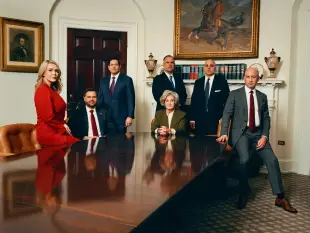
White House Chief of Staff Susie Wiles, seated at center, is surrounded by other top Trump Advisors of his second term ("Trump 2.0") as portrayed by a major two-part Vanity Fair portrait based on months of interviews by Chris Whipple (Photos by Christopher Anderson).
The Parnas Perspective, White House "Extremely Demoralized" as Wiles Interview Backfires and Cracks Within GOP Widen, Aaron Parnas, right, Dec. 17, 2025. Today is shaping up to be an extremely busy and consequential news day. This evening, the President will deliver a live address to the nation, which I will be covering in real time and updating you immediately if any major developments emerge during the speech. At the same time, the White House is reeling after yesterday’s Vanity Fair interview with Susie Wiles, with insiders describing the mood as “extremely demoralized” as visible cracks inside the Republican Party widen.
Staff sounds off on the crises of Trump 2.0 (Part 1 of 2). Reactions:
For those who have asked, I’m feeling better—thank you sincerely for all the well wishes—and the timing couldn’t be more critical. We are now just two days away from the release of the Epstein files, while tensions continue to escalate toward a potential conflict with Venezuela. This is a volatile moment in the news cycle, and the stakes are only rising.
Continuing he Parnas Perspective, here’s what you missed:
A sweeping Vanity Fair profile of White House Chief of Staff Susie Wiles triggered private alarm and frustration among Republicans and West Wing aides, who described the interview, according to Politico, as “extremely demoralizing” and questioned why the administration granted such extensive access.
The article featured pointed critiques of President Donald Trump and senior officials, fueling concerns about internal discipline and media strategy at a time of falling approval ratings and political setbacks. Despite the backlash, Trump publicly reaffirmed his confidence in Wiles, while allies dismissed the story as a biased hit piece and closed ranks around her leadership.
Rep. Marjorie Taylor Greene, right, said cracks are widening within the GOP against President Donald Trump, calling his response to filmmaker Rob Reiner’s death “classless,” warning he is out of touch with voters on affordability, and expressing doubt that Republicans can win the midterms if internal frustration with Trump continues to grow.
President Donald Trump ordered a total blockade of all sanctioned oil tankers entering or leaving Venezuela, sharply escalating pressure on President Nicolás Maduro by targeting oil revenues, prompting Venezuela to accuse the U.S. of violating international law and threatening to take the dispute to the United Nations.
President Donald Trump announced a 9 p.m. live White House address to the nation, saying he will highlight his administration’s accomplishments and preview possible policy actions for the coming year, according to statements from press secretary Karoline Leavitt. I will be watching it and will cover it for you so that you don’t have to watch if you do not want to.
 Overnight, Trump suggested arresting former FBI Director Christopher Wray, left, and former Attorney General Merrick Garland, below right.

USA Today is reporting that the Trump administration is moving to dismantle the National Center for Atmospheric Research in Boulder, Colorado, labeling it a hub of “climate alarmism” and planning to eliminate or relocate programs it deems “woke,” while preserving core weather modeling functions. The move would shutter key facilities, threaten hundreds of research jobs, and mark a major escalation in Trump’s broader effort to roll back federal climate science, drawing sharp criticism from scientists who call NCAR a cornerstone of U.S. weather and climate research.
The New York Times has confirmed that Harvard secretly opened a disciplinary investigation into two students who filmed and shared videos of former president Larry Summers discussing his ties to Jeffrey Epstein, focusing on possible violations of rules against unauthorized recording and attending classes they were not enrolled in, with potential penalties up to withdrawal from the university.
Warner Bros. Discovery urged shareholders to reject a hostile takeover bid from Paramount Skydance and the Ellison family, saying the offer undervalued the company and that its previously announced deal to sell its studio, HBO and HBO Max to Netflix is superior and in shareholders’ best interests.
 Democrat Gary Clemons won a special election to fill Kentucky’s 37th Senate District seat with about 73% of the vote, becoming the first union leader elected to the General Assembly and set to be sworn in at the start of the 2026 legislative session. This was a 42 point over performance year over year in favor of the Democrats.
According to Politico, Denver’s City Council voted 11–1 to block an expansion lease for Key Lime Air at Denver International Airport, citing opposition to the airline’s role in operating ICE deportation flights and using the decision as a symbolic stand against the Trump administration’s immigration enforcement.
 A federal judge rejected preservationists’ bid to immediately halt President Donald Trump’s $300 million White House ballroom project, allowing below-ground construction to continue while signaling he will later consider whether the project violates federal preservation and environmental laws.
Maryland lawmakers overrode Gov. Wes Moore’s veto to create a commission that will study possible reparations for slavery, arguing further analysis is needed to design legally sound and meaningful remedies, even as Moore said he prefers immediate action and pledged to work with legislators.
According to the Wall Street Journal, a Chinese citizen-journalist who documented alleged abuses against Uyghurs is being held by U.S. Immigration and Customs Enforcement in New York and faces possible deportation to China, prompting warnings from activists at Human Rights in China that he could face severe punishment if returned; supporters, including Rep. James P. McGovern, are urging U.S. officials to grant him asylum as an immigration judge prepares to hear his case.
Reuters has confirmed that Russian President Vladimir Putin warned that Moscow will expand its territorial gains and a “buffer security zone” in Ukraine if peace talks fail, saying Russia prefers a diplomatic solution but is prepared to achieve its goals militarily, while Kyiv and its Western allies reject Kremlin demands as violations of Ukraine’s sovereignty amid ongoing U.S.-led negotiations.
Australian authorities charged the surviving suspect in the Bondi Beach shooting with terrorism and 15 counts of murder, alleging the ISIS-inspired attack targeted a Hanukkah celebration and killed members of the Jewish community, as funerals were held under heavy security and investigators probed possible extremist links abroad.

Everyone Is Entitled To My Own Opinion, Commentary: Susie Wiles s___-talks sewer clowns. Hilarity ensues, Jeff Tiedrich, right, Dec. 17, 2025. Is Wiles a Russian asset?
Oh look, White House Chief of Staff Susie Wiles (above) is a bit of a blabbermouth. Who knew?
It seems that over the last eleven months, Overly Talkative Suze has sat for eleven interviews with Vanity Fair’s Chris Whipple, which VF just published in a two-parter here and here.
Here’s the beauty part: this Vanity Fair two-parter ain’t some rote, by-the-numbers snoozefest about how honored Susie Wiles is to be working with some of the finest minds yadda yadda yadda zzzzzzzzzzzz.
She actually takes a big stinky s___ all over her co-workers.
The Dem Party’s social media team has put together a lovely highlight reel.
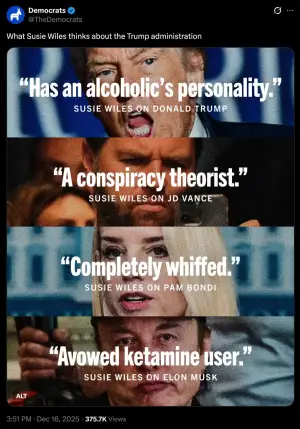
So, Donny Convict ‘has an alcoholic’s personality.’ Couchf____ McGee is ‘a conspiracy theorist.’ Pamnesia Pam Bondi has ‘completely whiffed.’ And the Space Nazi is an ‘avowed ketamine user.’
To which I say: tell us something we don’t already know, Suze.
All this is old-hat to anyone who’s been paying attention from the get-go.
So, you’d figure the reaction from the White House would be thermonuclear, and that Susie Wiles would already be the former Chief of Staff — but you’d figure wrong. because what happened next is that every sewer clown simultaneously tweeted statements of undying support for Wiles.
Look at this. not only did Donny laugh off Wiles’ remarks, he said he agreed with them.
Trump even admitted to having an “alcoholic personality,” which some around the president considered among Wiles’ most incendiary remarks because of the president’s long and well-known aversion to alcohol and his brother’s struggle with alcoholism.
“I’m fortunate I’m not a drinker,” Trump told the New York Post.
What the f___is going on? Did Putin give Susie Wiles a copy of the pee-tape to use as job insurance?
it’s not a silly question — because it seems that Chatty Suzie has been working with Russian oligarchs for since like forever. Look at this, from the Byline Times, published a year ago.
Trump’s newly appointed Chief of Staff, Susie Wiles, brings a complex political profile, with ties to Russian oligarchs and Chinese surveillance firms.
Before joining Trump’s 2024 campaign, Wiles was a co-chair at a firm that lobbied for sanctioned individuals and companies. A lobbyist who recommended Wiles to lead U.S. President-Elect Donald Trump’s campaign represented a Russian-born oligarch connected to the Russian President Vladimir Putin and a state-owned oil corporation Rosneft.
Wiles’ ex-husband has ties to a Kremlin-linked lobbyist known for attending the 2016 Trump Tower meeting, where “dirt” on [Democratic presidential contender Hillary] Clinton was offered on the Russian Government’s behalf. Wiles’ daughter failed the White House background check.
 Russian leader Vladimir Putin meets his China counterpart Xi Jinping in Beijing (2022 file photo via by Sputnik via Reuters).
That’s all pretty convenient.
What does Susie know, and why is her job being protected? And who is she really working for?
As always with All Things Donny, there are a thousand questions, and zero satisfying answers.
Lincoln Square Media via Substack, Political Commentary: Susie Wiles' Plea Deal with History, Rick Wilson, right, Stuart Stevens and Joe Trippi, Dec. 16-17, 2025. Susie and The Banshees.
The Trump administration now operates through internal sabotage and public self-preservation rather than discipline or loyalty. The cruelty on display has become aesthetic as much as political, signaling rot instead of strength. Attacking cultural figures like Rob Reiner fractures a coalition that once rationalized anything.
It’s the holidays, so you’re getting a special sneak peek at Strategy Session, which is a special show for our Lincoln Loyal paid subscribers. Never miss the inside scoop from Rick, Joe, and Stuart. Upgrade your subscription today.
Rick, Stuart, and Joe circle the same unsettling conclusion from different angles: this is what a system looks like when everyone knows the ending and starts freelancing their own alibis.
Rick’s focus on imagery and power reveals how decay announces itself visually before it collapses institutionally, while Stuart sharpens the moral indictment by treating these moves as intentional acts of historical positioning. Joe keeps returning to how abnormal this is — how no previous White House tolerated this level of self-exposure without consequences — because the abnormality is the point.
Together, they sketch a culture that no longer believes in governance, only exits, where cruelty is rewarded, loyalty is transactional, and the final fight is over who gets to say they weren’t really part of it.
Tune in for a conversation that strips away the excuses and asks what responsibility looks like when everyone can see the collapse coming.
New York Times, Trump Administration Live Updates: Venezuela’s Navy Begins Escorting Ships as U.S. Threatens Blockade, Staff Reports, Dec. 17, 2025. President Trump said he would impose a blockade on all “sanctioned oil tankers” going to and from Venezuela Where Things Stand:
House Republicans pressed the former special counsel Jack Smith over his investigations of Trump.ImageJack Smith, the former special counsel, during a break in a closed-door deposition with the House Judiciary Committee.Credit...Anna Rose Layden for The New York Times
House Republicans grilled Jack Smith, the special counsel who twice indicted Donald J. Trump, in a closed-door deposition on Wednesday that began with Mr. Smith’s blistering declaration that Mr. Trump’s actions — and not political bias — prompted the prosecutions.
The stakes for Mr. Smith, a former anticorruption and war crimes prosecutor, were high. Republicans, acting on Mr. Trump’s demand to pursue those who pursued him, pelted Mr. Smith with detailed questions in hopes of catching him in a misstep that would justify a prosecution by the Justice Department, according to lawmakers in both parties.
But even Mr. Smith’s adversaries conceded that his tight-lipped, painstaking approach made tripping him up particularly difficult. And Mr. Smith quickly made it clear on Wednesday that he intended to take the fight to Mr. Trump.
“If asked whether to prosecute a former president based on the same facts today, I would do so regardless of whether the president was a Republican or Democrat,” Mr. Smith said in his opening remarks, according to excerpts provided to The New York Times.
Mr. Smith said that his team of investigators had “developed proof beyond a reasonable doubt” that Mr. Trump had tried to overturn the 2020 presidential election. He also told House Judiciary Committee lawmakers and staff members that he had “developed powerful evidence that showed President Trump willfully retained highly classified documents after he left office in January 2021” and that Mr. Trump “repeatedly tried to obstruct justice.”
The committee has already referred one of Mr. Smith’s top deputies, Thomas Windom, to the Justice Department for not fully answering similar questions. Mr. Windom, now Mr. Smith’s law partner, has denied those allegations.
Mr. Smith requested that his appearance before the committee take place in public, and picked up an unlikely ally in that cause: Mr. Trump himself. But Republicans opted to keep his deposition private out of concern that Mr. Smith would use a hearing as an opportunity to make the case against Mr. Trump that two courts had denied him.
Wednesday’s session opened with a barrage of questions about Mr. Smith’s decision to subpoena the metadata phone records of Republican senators as part of his investigation of a White House effort to marshal support for reversing Joseph R. Biden Jr.’s lawful election, according to two people with knowledge of the situation.
Mr. Smith held his own, according to Representative Jamie Raskin of Maryland, the top Democrat on the committee, who said Mr. Smith “schooled” his questioners.
Republicans have accused Mr. Smith, who was appointed by Attorney General Merrick B. Garland in November 2022, of conducting a politically motivated witch hunt against the president.
In the hours before the deposition, the Justice Department and F.B.I. turned over to Congress selective internal communications from the summer of 2022 showing that some F.B.I. agents expressed concerns about conducting a search of Mar-a-Lago, the president’s resort and residence in Florida.
Trump allies and administration officials promoted that report as a “bombshell” — proof that the Biden Justice Department had raided Mar-a-Lago without first gathering evidence of wrongdoing.
In fact, the initial internal debate over the search was already previously known. Senior F.B.I. officials eventually agreed that the search was justified because of video showing Trump associates moving around boxes believed to contain classified materials.
The search, which was approved by a magistrate judge, uncovered a substantial trove of sensitive government documents stored in places accessible to the public, including a bathroom.
Mr. Smith’s testimony came in the middle of an ongoing court battle over whether to release the portion of his prosecutorial work that still remains under seal: a report detailing the investigation into Mr. Trump’s mishandling of highly sensitive classified documents.
That report could contain undisclosed and embarrassing details about how Mr. Trump brought the documents from the White House to Mar-a-Lago, then obstructed efforts by the Justice Department to retrieve them.
Judge Aileen M. Cannon, a Trump appointee who handled the documents case, has sat on requests to release Mr. Smith’s report for months. But a federal appeals court, concerned by her slow-walking, recently ordered her to make a decision about the volume by early January.
Two weeks ago, Mr. Trump filed court papers asking Judge Cannon not to release the report, saying that doing so would only “perpetuate Jack Smith’s unlawful criminal investigations and proceedings.”
New York Times, Trump Administration Aims to Strip More Foreign-Born Americans of Citizenship, Hamed Aleaziz, Dec. 17, 2025. The Trump administration plans to ramp up efforts to strip some naturalized Americans of their citizenship, according to internal guidance obtained by The New York Times, marking an aggressive new phase in President Trump’s immigration crackdown.
The guidance, issued on Tuesday to U.S. Citizenship and Immigration Services field offices, asks that they “supply Office of Immigration Litigation with 100-200 denaturalization cases per month” in the 2026 fiscal year. If the cases are successful, it would represent a massive escalation of denaturalization in the modern era, experts said. By comparison, between 2017 and this year to date, there had been just over 120 cases filed, according to the Justice Department.
Under federal law, people may be denaturalized only if they committed fraud while applying for citizenship, or in a few other narrow circumstances. But the Trump administration has shown a zeal for using every tool at its disposal to target legal and illegal immigrants, leading activists to warn that such a campaign could sweep up people who had made honest mistakes on their citizenship paperwork and sow fear among law-abiding Americans.
The guidance comes as Mr. Trump has spent much of this year closing loopholes in the immigration system and throwing up roadblocks for people seeking to enter and stay in the country. The sweeping campaign, which has gone further than purging the country of unlawful migrants, has included blocks on asylum at the southern border, a pause on asylum applications inside the United States, and a ban on entry for travelers from predominantly African and Middle Eastern nations. Officials say their actions will make the country safer and preserve the country’s values
A targeted campaign to increase the number of American immigrants stripped of their citizenship represents an escalation of an already ambitious campaign.
“It’s no secret that U.S. Citizenship and Immigration Services’ war on fraud includes prioritizing those who’ve unlawfully obtained U.S. citizenship — especially under the previous administration,” said Matthew J. Tragesser, a U.S.C.I.S. spokesman. “We will pursue denaturalization proceedings for those individuals lying or misrepresenting themselves during the naturalization process. We look forward to continuing to work with the Department of Justice to restore integrity to America’s immigration system.”
In interviews, some former agency officials expressed concern at the scale of the case goals for denaturalization pushed by U.S.C.I.S. leadership.
“Imposing arbitrary numerical targets on denaturalization cases risks politicizing citizenship revocation,” said Sarah Pierce, a former U.S.C.I.S. official. “And requiring monthly quotas that are 10 times higher than the total annual number of denaturalizations in recent years turns a serious and rare tool into a blunt instrument and fuels unnecessary fear and uncertainty for the millions of naturalized Americans.”
Proponents of stricter immigration laws said it was necessary to more aggressively root out people who had been improperly granted citizenship.
New York Times, ICE Arrests Disrupt Schools, Prompting Fear Among Families, Madeleine Ngo, Dec. 17, 2025. President Trump’s immigration crackdown has at times resulted in arrests near schools, setting off concerns among parents, educators and students.
Last month, Adam Gonzalez, a lawyer at a nonprofit in Chicago, pulled into his son’s day care and noticed something unusual. Two cars were parked directly in front of the school, blocking the entrance.
Worried about bringing his 17-month-old son into a potentially dangerous situation, he locked his car and walked toward the building. He said his “heart sank” when he saw officers with tactical gear indicating that they were with Immigration and Customs Enforcement, and he started recording with his phone. A
The Independent, White House adds plaques below Biden and Obama portraits, calling them ‘the worst President in American history’ and ‘divisive,’ Ariana Baio, Dec. 17, 2025. Newest additions appear to be part of the administration’s ongoing ‘troll’ campaign against former presidents and Trump’s opponents.
White House staff updated the so-called “Presidential Walk of Fame” Wednesday by adding lengthy descriptions of each former president, in rhetoric that aligns with President Donald Trump’s – such as calling former President Joe Biden “the worst President in American History.”
As part of the president’s ongoing effort to customize the White House to his liking, Trump set his well-known opinions of each former president in stone by adding plaques underneath the portraits that now hang along the colonnade.
But rather than neutrally describing each president, Trump chose to invoke more color – claiming former President Barack Obama is “one of the most divisive political figures” and asserting former President Ronald Reagan “was a fan.”
White House Press Secretary Karoline Leavitt said, “The plaques are eloquently written descriptions of each President and the legacy they left behind. As a student of history, many were written directly by the President himself.”
“Sleepy Joe was, by far, the worst President in American History,” the plaque underneath Biden’s portrait, which is an autopen as opposed to his official portrait, reads. “Taking office as a result of the most corrupt Election ever seen in the United States.”
 Fani Willis, wearing a white outfit, sits at a table with a microphone in a hearing room.District Attorney Fani T. Willis assailed Republican adversaries and stumped for political allies at the hearing on Wednesday, Dec. 17 (Associated Press photo by Brynn Anderson). Shown below her are mug shots of then-former President Trump and 13 other co-defendants accused of election-related crimes.
New York Times, Fani Willis Calls Trump and Allies ‘Criminals’ at Georgia Senate Hearing, Richard Fausset and Danny Hakim, Dec. 17, 2025. The district attorney in Atlanta addressed a Republican-led committee created to investigate her conduct during her prosecution of President Trump last year.
Fani T. Willis, the district attorney of Fulton County, Ga., was unrepentant about her failed elections case against President Trump during a combative hearing on Wednesday, calling Mr. Trump and his former co-defendants “criminals” and “crooks” before members of the Republican-led State Senate.
The hearing, in a packed room at the State Capitol in Atlanta, took place a few weeks after a state judge dismissed Ms. Willis’s election interference case. She was removed from the case last year, following revelations that she had a romantic relationship with the lawyer she had hired to oversee it.
 For Ms. Willis, an elected Democrat, the dismissal was a humiliating end to what had begun as one of the most significant cases against Mr. Trump after he sought to overturn his 2020 election loss in the state — one that might have culminated in the trial of a lifetime for the longtime Georgia prosecutor.
But if state Republicans hoped to use the hearing to embarrass her, Ms. Willis appeared equally intent on turning the tables. She used her time to assail a number of Republican adversaries, stump for political allies and criticize the lawmakers for their fealty to Mr. Trump.
The committee of five Republicans and two Democrats was created early last year to investigate Ms. Willis, following the revelations of her relationship with Nathan Wade, the lawyer she had hired. Defendants in the elections case had accused her of “self-dealing” because she took a number of vacations with Mr. Wade after hiring him, while using public funds to pay him more than $650,000 for his work on the case.
Ms. Willis walked into the hearing room on Wednesday cheered on by supporters holding signs, one of which read “Fearless With Fani.” She took her place before the committee alongside her lawyer, the former Democratic governor Roy Barnes, who repeatedly advised Ms. Willis not to answer questions and cast doubt on the powers of the committee to pursue some lines of inquiry.
She was in no mood to sit quietly. She accused the Republican members of being racist, divisive and unconcerned about the Jan. 6, 2021, assault on the U.S. Capitol. She also accused them of holding the hearing to help their own political campaigns.
Three of the Republicans on the committee are running for lieutenant governor, and a fourth, Bill Cowsert, the committee chairman, is running for attorney general of Georgia. Mr. Cowsert did not attend the meeting because of a medical issue.
In a fund-raising social media post in June, Mr. Cowsert said that if he was sworn in as attorney general, Ms. Willis would have a “rude awakening coming.”
Ms. Willis asked Mr. Dolezal, “You and Jim Jordan working together?” She was referring to Representative Jim Jordan, an Ohio Republican and Trump ally who chairs the House Judiciary Committee, which has been conducting its own investigation of Ms. Willis’s office in the wake of her Trump investigation.
Mr. Dolezal said he had “never talked to Mr. Jordan.”
Mr. Trump has referred to Ms. Willis as a “criminal.” And he has directed the Department of Justice to prosecute his perceived enemies, in a sharp break from norms. The New York Times reported earlier this year that the department has issued several dozen subpoenas in an investigation related to Ms. Willis.
On Wednesday, Ms. Willis referred to the defendants in her failed case as “criminals” more than once, saying at one point that she had “no way of knowing that these criminals were going to commit a crime.”
 She also criticized Pete Skandalakis, left, a veteran Georgia prosecutor who took over the Trump case after she was removed from it by the state courts. In November, Mr. Skandalakis determined that no charges were warranted against Mr. Trump, the final nail in the coffin on the matter.
She said that Mr. Skandalakis, who last ran for office as a Republican, had not taken a close enough look at the huge amount of evidence that had been amassed.
“There is no way he read the entire file,” she said. “There’s no way that he reviewed all the evidence.”
Ms. Willis also defended the charges in the case, which accused Mr. Trump and a number of his allies of organizing a criminal racketeering enterprise to reverse the 2020 election results in Georgia. “They got charged because they came into my community and committed a crime, and two grand juries passed forth an indictment,” she said.
At one point, the committee members appeared to cut her microphone. Ms. Willis could still be easily heard from the back of the room.
Ms. Willis’s eagerness to publicly excoriate the Republican committee members tracks with Georgia Democrats’ broader calculation that Mr. Trump will prove to be a weight around the necks of Republican candidates in the swing state in next year’s midterm elections.

New York Times, Bongino to Step Down From F.B.I., Glenn Thrush, Maggie Haberman and Adam Goldman, Dec. 17, 2025. Dan Bongino, the No. 2 official at the F.B.I., said on Wednesday that he would step down next month, bringing an end to his brief but tumultuous stint at the bureau, where he was known for his volcanic temper, missteps and hyperactive presence on social media.
“I will be leaving my position with the FBI in January,” Mr. Bongino wrote on social media, shortly after President Trump appeared to confirm earlier news reports that Mr. Bongino planned to step down by mid-January.
Mr. Bongino, a Trump political ally with minimal experience, at times struggled with the immense demands of a job that required running the day-to-day operations of the bureau — particularly his awkward efforts to square a previous embrace of conspiracies with F.B.I. investigations that often debunked them.
He served less than a year in a post responsible for overseeing dozens of field offices around the country and world. He has suggested he would return to his previous job as a pro-Trump podcaster and social media personality.
Mr. Bongino had planned to announce his departure on Friday but accelerated his announcement after Mr. Trump addressed his status with reporters on Wednesday, according to a person with knowledge of the situation who requested anonymity to discuss internal deliberations.
The Long Island native was one of several political appointees — including Kash Patel, the F.B.I. director — installed into senior positions at the bureau, a first in the agency’s history. It signaled the White House’s intent to wrest control of the law enforcement agency’s once proud independence.
Mr. Bongino’s departure seemed inevitable after the White House in August hired the Missouri attorney general, Andrew Bailey, to share his job as deputy director. It was an unusual arrangement at the bureau for a job that had never been shared nor held by someone other than a veteran F.B.I. agent.
New York Times, Trump Orders Blockade of Some Oil Tankers to and From Venezuela, Edward Wong, Simon Romero, Charlie Savage and Julian E. Barnes, Updated Dec. 17, 2025. The move is an escalation of military operations and a pressure campaign against Nicolás Maduro, Venezuela’s leader. But its scope and economic impact are not clear.
President Trump on Tuesday ordered a “complete blockade” on sanctioned oil tankers going to and from Venezuela, an escalation of his administration’s monthslong pressure campaign against Nicolás Maduro, the leader of Venezuela.
“Venezuela is completely surrounded by the largest Armada ever assembled in the History of South America,” Mr. Trump wrote on social media. “It will only get bigger, and the shock to them will be like nothing they have ever seen before.”
The move could hobble Venezuela’s oil exports, which are the lifeblood of the country’s economy. Venezuela relies entirely on tankers to export its oil to world markets. There were more than 30 vessels operating in Venezuela earlier this month that had been sanctioned by the United States, according to the independent tracking service Tanker Trackers.
Last Wednesday, the United States seized a tanker in the Caribbean Sea that was carrying Venezuelan oil for Cuba and China. A federal judge had issued a warrant for the seizure based on the fact that the tanker had recently transported oil from Iran.
The U.S. military has been building up a large naval force in the Caribbean in recent months, and Mr. Trump has threatened strikes inside Venezuela. Since September, the U.S. military has been carrying out airstrikes on boats in the Caribbean and eastern Pacific, many of them near Venezuela, in a campaign that has killed at least 95 people in 25 attacks.
Mr. Trump has said those attacks are aimed at stopping drug trafficking to the United States. But Venezuela is not a drug producer, and the cocaine that transits through the country and the waters around it is generally bound for Europe. Many legal experts say that the attacks are illegal and that the military is killing civilians.
Behind the scenes, Trump administration officials have also focused intently on Venezuela’s oil reserves, the largest in the world.
In his social media announcement on Tuesday, Mr. Trump wrote in all capital letters that he was ordering a “a total and complete blockade,” which by itself would have been a substantial step. In international law, a blockade prevents all vessels from entering and leaving the ports of an enemy country during an armed conflict. But Mr. Trump added the qualifier “of all sanctioned oil vessels,” which changed the meaning.
Mr. Trump appeared to be threatening to enforce existing sanctions against some of the tankers exporting oil. If the U.S. Navy continues to allow most vessels to freely enter and leave Venezuelan ports, it is not a real blockade.
Still, any threat of seizure may be enough to scare off many companies that transport Venezuelan oil.
Mr. Trump also wrote that the U.S. operation would continue until Venezuela returned to the United States “all of the Oil, Land, and other Assets that they previously stole from us.”
Mr. Trump did not define what he meant by those assets. He might have been referring to the changes in Venezuela’s oil industry after leaders there put it under state control in the 1970s.
American oil companies had been prominent players in the industry for decades before that. During nationalization, Exxon, Mobil, Shell and Gulf Oil lost $5 billion in assets and were compensated only $1 billion, according to a New York Times article from that time. Until then, foreign companies accounted for 70 percent of the oil production in Venezuela.
Some American companies re-entered the industry in the 1990s during a period of loosening by Caracas. But they were later forced by Hugo Chávez, who became leader of Venezuela in 1999, to limit their investments to minority shares in joint ventures with the main state-owned enterprise, Petróleos de Venezuela, S.A., or PDVSA.
Chevron is the one American company that stayed in Venezuela through all those decades and through the recent era of U.S. sanctions, and it continues to operate there with a newly extended confidential license from the U.S. government. Mr. Trump’s announcement of a blockade is not expected to have an effect on Chevron, the company said.
More On U.S. Politics, Governance
Morning Shots via The Bulwark, Political Opinion: Why Aren’t Dems Going After Trump’s Tariffs? Bill Kristol, Andrew Egger and Jim Swift, Dec. 17, 2025. They don’t work and Americans hate them. Layup.
Rep. Marjorie Taylor Greene’s “f— it, we ball” tour continues! In a CNN interview last night, the former diehard Trump ally took swing after swing at the president. She called his lunatic post about murdered director Rob Reiner “absolutely, completely below the office of the president of the United States,” “classless,” and “just wrong.”
Greene, right, suggested he lacks empathy for economically uneasy Americans: “When he looks into a camera and says affordability is a hoax and just totally tries to make nothing out of inflation, he’s talking to Americans that are just suffering.” And she took aim at his air of invulnerability with the GOP base: “I think the dam is breaking. . . . Lame duck season has begun.”
Will all this hurt Trump? Or will the venue for Greene’s attacks—a series of suddenly sympathetic mainstream media platforms—burn down her own credibility with the MAGA base faster than Trump himself ever could? Guess we’ll see. Happy Wednesday.
U.S. Economy, Markets, Inflation, Jobs

Paul Krugman via Substack, Political-Economy Commentary: An A+++++ Economy, My A++, Paul Krugman, right, Dec. 17, 2025. Trump made big boasts but he isn’t delivering.
When Politico recently asked Donald Trump to grade the current U.S. economy, he replied “A-plus-plus-plus-plus-plus.” He made this boast at a time when actual economic data were still scarce, a consequence of the government shutdown that stopped or delayed key information about the state of the job market.
Yesterday the report on employment during the month of November finally arrived. And the message of the report on the state of the US economy was clear: A+++++ my A++. While it’s too soon to declare that we’re in a recession, the data are at least pre-recessionary: that is, the numbers are weak enough that we should be seriously worried that a recession is coming. And that’s a state of affairs completely at odds with Trump’s rose-colored — spray-tanned? — picture.
I’ll talk about the reasons the gap between Trump’s big boasts and the glum reality matters in a minute. First, however, let’s talk about what we learned from yesterday’s report.
Most importantly, the data show a weak labor market. Employment isn’t falling off a cliff, but job growth has been weak and hasn’t kept pace with the number of people seeking work. The headline unemployment rate in November was 4.6 percent, up from an average of 4 percent in 2024. That number is close to triggering the Sahm Rule, an economic rule of thumb devised by Claudia Sahm, a former economist at the Board of Governors of the Federal Reserve, that has historically been highly successful at identifying the early stages of a recession.
We can’t do a strict application of the Sahm Rule yet because Sahm’s method is based on the average unemployment rate over the past three months. Unfortunately, the shutdown prevented the Bureau of Labor Statistics from collecting key data in October. But if we do an interpolation of October’s unemployment rate by averaging over September’s rate of 4.4% and November’s rate of 4.6%, we can estimate that October’s unemployment rate was 4.5%. And those 3 months of unemployment numbers bring us within a whisker of the unemployment rise that, according to the Sahm Rule, signals that a recession is on the horizon.
The state of the economy looks even worse if we take a wider view of the labor market. The BLS calculates 6 different measures of unemployment. The most commonly cited number is U-3 — the number of workers who are actively seeking jobs but haven’t found them. But the broadest measure is U-6, which includes underemployed workers stuck in part-time employment and discouraged workers who have temporarily given up job search. And U-6 has risen sharply since January, when Trump took office:
Further evidence consistent with a poor and deteriorating job market is data showing that the number of job-seekers who are long-term unemployed – that is, have been unemployed for 27 weeks or more – has risen by almost a third (from 1.45 million to 1.91 million) since 2024. This means that the unemployed are finding it harder to find jobs.
In addition to collecting data from workers, the BLS surveys employers. Interpreting the employer-side numbers is a bit tricky right now, because there are technical challenges in how the BLS models the birth of new firms and the deaths of old ones. None other than Jerome Powell has suggested that official job growth is probably overstated by around 60,000 a month. Yet even if we ignore this likely overstatement of the number of jobs created, yesterday’s numbers are definitely pointing to a troubled economy.
In particular, the Trumpian project of bringing “masculine” blue-collar jobs back is going badly. I’m going to steal a chart from Joey Politano, whose Substack you should be reading: A graph on a black background AI-generated content may be incorrect.
So while yesterday’s job report wasn’t a cause for outright panic, it does reveal real reasons to worry that the economy is deteriorating.
And Trump owns this economy — because he broke it.
Normally, when a president experiences a troubled economy during his first year he dispatches his flying monkeys minions to declare that it’s all his predecessor’s fault. And some Trump officials, like Scott Bessent, are indeed trying to play the blame game. But this standard political tactic is unlikely to work for this president.
Politics aside, it’s important to understand that the bleak economic news we’re getting is only the beginning. “Populist” leaders like Trump — I don’t like the term, but it has come to mean politicians who have disdain for responsible policy and the rule of law — do long-term economic damage. One comprehensive comparative study found that, on average, such leaders leave GDP 10 percent lower after 15 years than it would otherwise have been. So Trumpism is reducing our future living standards.
Trump is going to make a prime-time address to the nation tonight. The details of his speech haven’t been announced, but it’s a good guess that he intends to gaslight Americans yet again, claiming that things are going well. They aren’t.
New York Times, Trump Dangles Cash Payments to Buoy Voters’ Views of the Economy, Tony Romm and Andrew Duehren, Dec. 17, 2025. With tariffs unpopular and prices still high, the White House has teased the promise of tariff rebates and large tax refunds next year.
Tariffs are unpopular, prices remain stubbornly high and Americans are souring on President Trump’s handling of the economy.
So Mr. Trump has reprised a familiar political strategy: promise people cash.
The White House is trying to tamp down Americans’ economic anxieties by dangling the prospect of checks and other paydays next year, hoping that the money might assuage voters who blame the president for their rising cost of living.
Mr. Trump, who is set to address the nation on Wednesday night, has repeatedly teased the idea of sending one-time $2,000 rebate checks to many families, funded using money collected from his sweeping global tariffs. But he has not devised a detailed plan for providing the rebates, an expensive policy that Republicans in Congress must approve and one that they have not yet considered.
The president has also begun hyping up the tax refunds that Americans are slated to receive in 2026. For many people, these cash payments are expected to be larger than they were last year, after Republicans adopted a sprawling set of tax cuts in July.
Both Mr. Trump and members of his administration have periodically drawn an equivalence between the supposed tariff rebates and the enacted tax law. They have claimed the money could bolster the economy and alleviate some of the financial strains on families, even at a time when Mr. Trump maintains that much of the talk about affordability is a “hoax.”
“Next year is projected to be the largest tax refund season ever, and we’re going to be giving back refunds out of the tariffs, because we’ve taken in literally trillions of dollars,” Mr. Trump said at a cabinet meeting last week. “And we’re going to be giving a nice dividend to the people, in addition to reducing debt.”
But economists take a dimmer view. Even if Americans were to delight in a series of new government-issued checks, the payments would hardly address the reasons that prices remain so high — including a shortage in housing that has driven up rents and mortgages and the global tariffs that have made imports more expensive. And the money that may soon be sloshing around the economy could end up worsening inflation, undermining Mr. Trump’s own economic goals.
Alex Durante, a senior economist at the Tax Foundation, said that simply “pumping money” into the economy — without any other underlying changes — threatened to “just generate a cycle where you continue to get higher prices.”Listen to this a
New York Times, What Trump’s Embrace of Crypto Has Unleashed, David Yaffe-Bellany and Eric Lipton, Dec. 17, 2025. A boundary-pushing array of new crypto ventures have reached the stock market, enticing investors and leading to more risk taking.
This summer, a group of executives pitched a business plan to Anthony Scaramucci, the Wall Street financier and short-lived adviser to President Trump.
They wanted Mr. Scaramucci to join a publicly traded company with a peculiar strategy: accumulating enormous quantities of cryptocurrency to make its business more appealing to investors.
They “didn’t really have to pitch it to me,” said Mr. Scaramucci, who was soon unveiled as an adviser to three little-known companies with this same plan. “It was a pretty easy conversation.”
The excitement did not last. The crypto market cratered this fall, sending shares of all three of Mr. Scaramucci’s ventures tumbling. The worst performer plunged more than 80 percent.
The businesses were part of a frenzy of crypto activity driven by Mr. Trump, who has turned the once obscure world of digital currencies into a major force in the global economy. Declaring himself the first “crypto president,” Mr. Trump ended a regulatory crackdown on crypto companies, promoted crypto investments from the Oval Office, signed pro-crypto legislation and even launched a “memecoin” called $TRUMP.
Now the consequences of that advocacy are coming into focus.
An array of boundary-pushing new crypto ventures have emerged this year, exposing more people to the volatile world of virtual currencies. More than 250 publicly traded companies are now stocking up on cryptocurrencies, which are digital assets that fluctuate in price like stocks, bonds or other investments.
New York Times, Heating Costs Expected to Rise 9.2% This Winter, Ivan Penn, Dec. 17, 2025. Colder weather and rising electricity and fuel costs will lead to a big jump in costs for individuals, according to estimates from a group representing state energy officials.
Consumers already tapped out from rising home energy costs face yet another strain on their pocketbooks — surging heating costs.
Higher electricity and natural gas prices coupled with forecasts for unusually cold temperatures across parts of the country are expected to drive up bills as winter takes hold. The average U.S. household is projected to spend nearly $1,000 this winter to heat its home, up 9.2 percent from a year earlier, according to the National Energy Assistance Directors Association, which represents state governments in securing federal money.
Even as costs rise, the federal government is offering states less money to help low-income residents pay for heat. The budget for a critical federal program has been cut by about a third this year compared with two years ago.
“These increases may not sound dramatic to higher-income households, but for families already struggling, they are devastating,” said Mark Wolfe, executive director of the energy assistance association. “Millions of households are being pushed deeper into utility debt and closer to shut-offs simply because they cannot afford to keep their homes warm.”
Home energy costs have steadily increased over the last few years as utility companies have spent more money on electric grids after devastating wildfires and extreme weather and to make up for deferred maintenance. Power providers are also spending billions of dollars on upgrades in anticipation of rapid growth in electricity demand from data centers used for artificial intelligence services.
The cost of energy has emerged as one of the nation’s leading consumer concerns and played a critical role in recent statewide elections in Georgia, New Jersey and Virginia.
New York Times, Next Fed Chair in ‘No-Win Scenario’ as Selection Process Draws to a Close, Colby Smith, Dec. 17, 2025. The person picked to replace Jerome H. Powell will be thrust into a credibility problem that will be difficult to escape.
It was always going to be one of the Kevins. At least that was the impression among many across Wall Street and Washington when it came to President Trump’s selection for the next chair of the Federal Reserve.
Mr. Trump had hinted for months that he wanted his Treasury secretary, Scott Bessent, for the job. But Mr. Bessent kept declining the offer.
That placed Kevin A. Hassett, a longtime loyalist and economic adviser to Mr. Trump, and Kevin M. Warsh, a former Fed governor who had been in spitting distance of becoming chair during the president’s first term, in leading positions to take over for Jerome H. Powell in May.
The decision comes down to who Mr. Trump believes will be more successful in delivering the substantially lower borrowing costs that he has long struggled to get from the Fed under Mr. Powell. Mr. Trump, who elevated Mr. Powell to chair in 2017, appears haunted by that decision. He has made it clear that this time he wants someone more malleable who will take his advice.
That prerequisite creates a credibility problem for whoever is selected, one that will be difficult to escape. A chair who is seen as beholden to the president risks eroding the public’s confidence that the Fed is making decisions in the best interest of the economy, not the White House. If that crumbles, borrowing costs could move higher, not lower as the president wants.
“Anyone who gets the job is damaged goods,” said Andy Laperriere, head of U.S. policy research for Piper Sandler.
“You’re either going to be the guy who succeeds in getting what the president wants, which will not bode well for your treatment in the history books,” Mr. Laperriere said, “or you’re going to be the guy who doesn’t get what the president wants, and he’s going to probably turn on you.”
Morning Shots via The Bulwark, Political Opinion: Time To Twist the Knife on Tariffs, Andrew Egger, Dec. 17, 2025. Donald Trump sees his tariffs as an economic panacea that will supercharge the economy, pay down the national debt, and breathe new life into the manufacturing sector.
But in the eight months since “Liberation Day,” they’ve done the opposite. The economy is stagnant. The federal debt keeps growing. And yesterday, the Bureau of Labor Statistics reported that the economy lost manufacturing jobs for the seventh straight month.
Trump’s tariffs are a bust. So why do Democrats seem oddly reluctant to twist the knife?
In one sense, Democrats are spending a lot of time these days talking about Trump’s tariffs. But they tend to do so broadly and obliquely—passing over the specific issue of the trade wars to talk in more general terms about Trump’s failure to deliver on affordability. There are plenty of reasons for this. Some Democrats, particularly in the upper Midwest, still have a protectionist streak themselves: They might not like these tariffs, but they’re not opposed to tariffs in principle. And at any rate, talking about tariffs is wonkier and more complicated than talking about rising prices.
“People know tariffs raise costs. Costs are the overriding issue,” Democratic strategist David Axelrod told The Bulwark last week. “You don’t [have] to be the master strategist in this one.”
There’s little doubt that Trump’s tariffs are damaging him politically, even without Democrats’ help. They may be tempted to simply sit back and watch it happen. But it’s unclear just how poised Democrats are to benefit from Americans’ tariff remorse. Writing in the Argument last week, Lakshya Jain noted that while voters don’t like how Trump is handling the economy, many “simply aren’t sold on Democrats as the alternative.” Despite Trump’s flailing on the issue, Jain pointed out, Democrats are still having a harder time reaching voters who say that cost-of-living is a top-two issue than with voters who don’t.
This is hardly surprising: It wasn’t long ago that voters turned hard against Democrats as inflation flared out of control on Joe Biden’s watch. But what better way to get that bad taste out of voters’ mouths than by declaring war on Trump’s most preposterous economic policies?
One of the most resounding lessons Democrats learned—or, at least, should have learned—from 2025 is that they have more agenda-setting power when opposing Trump than when trying to cooperate with him. Trump and congressional Republicans are still flailing in the face of expiring Affordable Care Act subsidies, which they have repeatedly refused to renew while failing to put forward a workable replacement plan. Millions of Americans are set to see their health-insurance premiums spike in a matter of days. All this has damaged Trump and been a political win for Democrats.
On messaging, at least, Democrats came out ahead after the last shutdown battle. So with government funding again just weeks from expiring, why not move on to another pain-point issue? Why not refuse to fund the government unless Republicans agree to claw back some of Trump’s economy-killing tariffs?
While Democrats seem to be gliding toward huge wins in next year’s midterms, there’s one possible event that could do major damage to their prospects. If the Supreme Court rules in the weeks ahead that Trump’s tariffs are broadly unconstitutional, it would change the economic landscape of the country immediately—not only taking a pillow off the face of the economy, but giving it a massive adrenaline shot in the form of corporate refunds for tariffs collected so far.
Even if Trump were to try to put tariffs back in place under other emergency authorities—as he and his allies have suggested they’d do—they’d still likely be obliged to return more than $100 billion in duties collected this year. And if the Court is willing to push back on Trump’s tariff-authority claims in one area, they may be willing to do the same in others.
The result could be a world where the economy escapes Trump’s tariffs despite his best efforts—and where, as Catherine Rampell has written, Trump perversely reaps the political reward, standing to take credit for a suddenly “HOT” economy even when he was the one singlehandedly keeping it cold before.
In a world where this outcome is a real possibility—and it sure seems like it is—then “cost talk is better than tariff talk” suddenly becomes terrible advice for Democrats. They should be out there screaming from the rooftops that it’s the trade wars that are responsible for America’s economic malaise. If the Supreme Court ends up saving the economy from Trump’s tariffs, Democrats will need to convince the electorate that the Court saved them from Trump. The best time to start would have been months ago. The second-best time is right now.
Mass Shootings, Other Gun Murders

Brown University Shooting Suspect: Video footage shows a man in black walking near lawn hedge. The Providence Police Department released enhanced security camera footage of a person they are looking for in the Brown University shooting (Photo via Providence Police and Reuters).
New York Times, One Way the Brown Attack Was Unusual: The Gunman Escaped, Shaila Dewan, Dec. 17, 2025. It is rare for a gunman in a high-profile shooting to get away, and many are apprehended within days. The authorities shared grainy video and begged for tips as the search stretched into its fourth day.
He could be so many people on the street: dark winter hat, dark zippered jacket, black pants. Even the gun the police say he used to open fire in a Brown University classroom on Saturday was one of the world’s most common types, a 9-millimeter handgun.
The man who carried out a rampage that killed two students and wounded nine seemed to have left little behind, other than shell casings and video snippets of a portly figure pacing past doorbell cameras in the neighborhood east of campus, his facial features concealed behind a medical mask.
The hunt has put the city, and the authorities, in a tense situation, with a high-profile case and a killer in the wind. On Tuesday afternoon, as the three-day manhunt inched toward four, they released yet another grainy image of the suspected gunman and said that they were confident that once he was identified, he could be found.
“We just need a little bit of patience, as hard as it is to say that in this really horrible context,” Peter Neronha, Rhode Island’s attorney general, said at a 5 p.m. news conference where the centerpiece was not an investigative breakthrough but a new compilation of “enhanced” surveillance video that, he admitted, was not great.
It is unusual, but not unprecedented, for manhunts in high-profile attacks to stretch on, dangerous as any delay may be. Three days passed before the F.B.I. released photos of the Boston Marathon bombers in 2013, and during the ensuing search, the fugitives shot three police officers, two fatally. It took five days to capture Luigi Mangione, now accused of killing the C.E.O. of United Healthcare one year ago.
But in apparently random, public shootings like the one at Brown, the majority of attackers kill themselves or are killed by law enforcement officers at the scene.
In cases where they do not, some suspects are at least identified well before they are found, like the man accused of a mass shooting in a bar in Anaconda, Mont., who was found a week later. In 2023, the man who carried out a shooting spree that began at a bowling alley in Lewiston, Maine, was found in a tractor-trailer, dead from a self-inflicted gunshot wound, after more than two days had elapsed.
If witnesses from the day prove unhelpful, investigators may still find hope in the fact that between 60 and 90 percent of mass attackers communicate their intent to a third party in advance, a behavior known as leakage. “There is likely to be planning and preparation and research,” said J. Reid Meloy, a forensic psychologist who has studied such attacks. “There will be others that will be aware of the movement on the pathway to violence.”
But as days pass, people’s memories become clouded by news coverage and social media, said Tyrone Powers, a retired F.B.I. agent who worked on fugitive squads. “It’s just a matter of catching somebody as quick as you can,” he said.
In Rhode Island, there is no indication that the authorities know whom they are looking for, where he may be or even whether he is alive. They do not know, they said, what motivated him or whether he had any connection to Brown.
They are analyzing ballistic evidence and parsing what Chief Oscar L. Perez Jr. of the Providence Police Department described as “terabytes” of video. Yet they also made it clear that they were banking on the chance that someone would come forward with information.
They have offered a $50,000 reward, asked anyone who was in the engineering and physics building on Saturday to submit to an interview and canvassed the neighborhood for witnesses. Chief Perez urged the public to study the new video compilation with an eye to the suspect’s posture, gait and arm gestures.
“We are relying on the press and public to help get us there,” Mr. Neronha said.
The videos show the suspect in the neighborhood as early as 10:30 a.m., hours before the shooting began shortly after 4 p.m.
There have been many questions about why there was not more security video from inside the Barus and Holley engineering building, where the shooting occurred in an amphitheater-style classroom. Mr. Neronha said that the classroom was in an older part of the building, while the cameras were in the newer part. “They show things like chaos after the shooting,” he said. “What they don’t show is this person of interest.”
Still, Mr. Powers, the former F.B.I. agent, said, things were far from hopeless. “This is not some high-level operative from some intelligence agency in some foreign country” who could conduct a lethal operation without a trace, he said. “Somebody knows something, and we’re going to find out who that is.”
The Contrarian, Opinion: Two Countries, Jennifer Rubin, right, Dec. 17, 2025. Two responses to gun massacres.
The side-by-side comparison between Australia’s response to a gun massacre and the United States’ non-response to the mass shooting at Brown University highlights the contrast between a functional democracy and a dysfunctional one, between one governed by a grown-up and one ruled by a self-obsessed man-child with aspirations of autocratic control. From the start, we saw the vivid contrast in both competence and compassion between the two governments. In the United States, the Trump regime played the role of crank commentator. In the middle of the emergency, with students and faculty hunkering down in closets, cafes, and dorms, Donald Trump falsely announced that the suspect was in custody.
Brett Smiley, the mayor of Providence, Rhode Island, on Saturday effectively told residents to ignore the White House. “In this day and age, there is a lot of misinformation that can spread.” He told them that if an update did not come from the city government, “then it is not official.” Ponder that: For our own safety we need to ignore Trump’s impulsive posts.
Later, Trump effectively blamed the university for “reversing” its warning. You would think the president would have the latest facts. On Monday, Trump continued to blame Brown for not finding the culprit, as if this were not the FBI’s job. (Brown University is absent from the national security org. chart.) The FBI was no help. Director Kash Patel got slammed for posting about the person in custody just hours before he was released. Critics pointed out that Patel made the very same blunder (prematurely declaring a suspect in custody) in the Charlie Kirk murder. Patel also claimed credit for technological wizardry in locating the person (who wasn’t a suspect at all), when in fact a local tip alerted police. The New York Times reported:
Mr. Patel’s impulse to seize the spotlight and publicize the work of the bureau under his leadership has revived questions about his competence and his future in the administration. …It has added to the growing criticism over his recreational travel, his use of a SWAT team to protect his girlfriend and his handling of the Epstein files.
Until Trump decides to remove his embarrassing pick, Patel will persist in destroying the institution formerly regarded as the gold-standard in law enforcement. (Fortunately, the regime’s utterly irresponsible utterances did not result in any further injuries or deaths at Brown—but the deterioration in the federal government’s credibility will surely intensify under this crowd.)Subscribed
In Australia, information about the slaughter of 15 Jews (with scores more injured) was released in a formal, dignified appearance by top officials once they had solid information. Within hours of the mayhem, the police commissioner declared it was a terrorist attack; New South  Wales Premier Chris Minns said the shooting was a targeted assault on Sydney’s Jewish community. Prime Minister Anthony Albanese, right, spoke with dignity and authority at a press conference:
This afternoon, there has been a devastating terrorist incident at Bondi at the Chanukah by the Sea celebration. This is a targeted attack on Jewish Australians on the first day of Chanukah, which should be a day of joy, a celebration of faith.
He emotionally embraced the Jewish community. “An attack on Jewish Australians is an attack on every Australian, and every Australian tonight will be like me, devastated by this attack on our way of life,” he said. “There is no place for this hate, violence and terrorism in our nation. Let me be clear—we will eradicate it.” He continued: “Amidst this vile act of violence and hate will emerge a moment of national unity where Australians across the board will embrace their fellow Australians of Jewish faith.”
When asked about criticism that his government had not acted sooner to stop a spate of antisemitic violence, he did not insult the reporter. He replied calmly, “Yes, we have taken it seriously and we’ve continued to act. We’ve continued to work with Jewish community leaders. We’ve continued to take all the advice from the security agencies to put in place special measures, and we will continue to do so.”
The contrast between Australia and the U.S. sharpened in subsequent days. In Australia, the press, public, and politicians all operated with the assumption that something would be done about guns. (Australia already has tough gun laws enacted after the Port Arthur mass shooting; it had not experienced anything comparable in the intervening 30 years.)
Within a day, Albanese announced that “the Government is prepared to take whatever action is necessary.” He added: “Included in that is the need for tougher gun laws. … I will put on the agenda of the National Cabinet tougher gun laws, including limits on the number of guns that can be used or licensed by individuals, and a review of licenses over a period of time.”
Moreover, Albanese acknowledged that former prime minister John Howard’s “gun laws have made an enormous difference in Australia and a proud moment of reform, quite rightly, achieved across the Parliament with bipartisan support.” (Imagine praising your predecessor!) He added, “If we need to toughen these up, if there’s anything we can do, I’m certainly up for it and I hope to get National Cabinet on board for that this afternoon as well.”
That is how a responsive and responsible government behaves in the wake of a devastating event: It acts.
In the U.S., just as we tragically have come to expect (our expectations attest to the severity of our political dysfunction) there was little to no talk of new gun laws or mental health funding (slashed in the big ugly bill’s Medicaid cuts and endangered when people lose Obamacare coverage).
Instead, Trump declared: “Things happen,” an appalling admission that MAGA forces have no interest in protecting Americans from mass killings. Trump’s callousness and fatalism reflect his own warped mind, but also the attitude of a rightwing movement that insists on denouncing any limitation on their rights (you’re not the boss of me!) for the greater good (e.g., stop mass killings of kids). This does not include women’s reproductive rights, unsurprisingly.
In other words, the gun lobby only partially accounts for failure to enact national common sense gun laws. We cannot ignore the role played by a reactionary ideology antithetical to American progress and reform, one badly ignorant of our own history and dependent on judicial fiat to get its way.
We have a popular consensus on many gun safety measures (e.g., red flag laws). However, we have a democracy problem preventing their enactment. So long as one party (insulated from accountability by gerrymandering) remains in the thrall of a paranoid anti-government cult allergic to social responsibility, we will be stuck in the endless loop of death, finger pointing, and paralysis.
Australia shows us there is another way for democracies to function. Perpetual slaughter of our children is a choice—one no civilized country should make.
 Actor-Director Rob Reiner and his wife, photographer Michele Singer Reiner (File photo via Getty Images).
New York Times, Reiner Family Associate Details Events Before and After Killings Were Discovered, Shawn Hubler and Matt Stevens, Dec. 17, 2025 (print ed.). A person close to the family provided a detailed account of what occurred in the Reiner house after a massage therapist received no response at the gate.
It was Sunday afternoon when a massage therapist arrived at the white-gated home in the affluent enclave of Brentwood for a scheduled appointment with Rob and Michele Singer Reiner. The couple was scheduled to have dinner with Barack and Michelle Obama and others in just a few hours.
Getting no answer at the gate, the massage therapist called the couple’s daughter, Romy Reiner, who quickly came by with a roommate. She walked in and found her father’s body and the gruesome scene of his death.
The account of what transpired is based on an interview on Tuesday with a person who is close to the Reiner family. The person, who provided one of the first detailed descriptions of the tragedy from the family’s perspective, spoke to The New York Times on condition of anonymity because the immediate family was not yet ready to speak publicly.
Nick Reiner, left, who is in custody but has not been charged with a crime, has openly discussed his battles with heroin and cocaine in interviews and podcasts (Aude Guerrucci photo via Reuters)
On Tuesday, prosecutors in Los Angeles charged Nick Reiner, the couple’s younger son, with two counts of first-degree murder in connection with the death of his parents, who were luminaries in show business and Democratic Party politics. The second of three grown children the couple had together, he had been living with his parents in a guesthouse on the property.
A spokesman for the Los Angeles County District Attorney’s office declined to comment Tuesday on the details of the investigation.
What you should know. The Times makes a careful decision any time it uses an anonymous source. The information the source supplies must be newsworthy and give readers genuine insight.Learn more about our process.
In a news conference, however, the district attorney, Nathan Hochman, said that “prosecuting these cases involving family members are some of the most challenging and heart-wrenching cases that this office faces because of the intimate and often brutal nature of the crimes involved.”
The person close to the family said that nothing in recent weeks suggested that Nick Reiner, 32, would be capable of such violence.
The person disputed accounts that suggested the family had been especially apprehensive in recent weeks about Nick Reiner’s behavior. Nick Reiner had struggled for more than half of his life with drug addiction, but the person close to the family said they were accustomed to working through his problems together.
In 2016, the father and son had made and released a film together that was loosely based on their experience with the son’s battles with cocaine and heroin.
In fact, the person pointed out, just the night before, the family had attended a Christmas party together. The gathering, at the home of the comedian Conan O’Brien, had been crowded with people in show business and neighborhood friends.
The Times reported on Monday that Nick Reiner had behaved erratically that evening and had alarmed guests with his behavior, according to two people who attended the party. One of those two guests, who spoke on condition of anonymity to preserve relationships, said Rob Reiner had rebuked his son, telling him that his behavior was inappropriate for a guest in someone else’s home.
The person close to the family was not in a position to dispute that account, but said that Rob and Nick Reiner did not have a heated argument and that the episode was being overblown. The intensity of any conversation that might have taken place between father and son may have been misinterpreted, the person said.
He took issue with news accounts that suggested the family might have left the party early because of the son’s behavior. Nick Reiner’s behavior at the party, the person said, was not unusual to the Reiners, who had grown used to it over the years.
The day after the party on Sunday afternoon, Romy Reiner, 28, fled the house in anguish upon encountering her father’s body inside the house. Her roommate, waiting outside, called 911, the person said.
When the paramedics arrived, the person said, Romy Reiner told them that her brother lived on the property also, but she did not suggest to the authorities that her brother might be a suspect, as some news outlets have reported.
Romy Reiner did not see her mother’s body in the house and learned from the paramedics outside that she was dead, too, the person said.
Investigators did not find the son in the guest house. He was arrested without incident later that evening around 9:30 p.m. by officers from the Los Angeles Police Department Gang and Narcotics Unit who had located him about 15 miles away near the neighborhood of Exposition Park southwest of downtown. It was not clear how the police found him.
On Tuesday, the Los Angeles police chief, Jim McDonnell, said the coroner had not yet determined whether the Reiners had died on Saturday night or Sunday.
Trump Family Fortunes


Popular Information, Accountability Journalism: Kushner’s Serbian boondoggle collapses amid corruption scandal, Judd Legum, right, Dec. 17, 2025. This week, Jared Kushner, above right, abruptly canceled his plans to build Trump Tower Belgrade after the project became enmeshed in a criminal corruption scandal involving Serbian government officials.
Kushner, President Trump’s son-in-law, has resumed his role as one of Trump’s top foreign policy advisers — representing the Trump administration in high-stakes negotiations over Gaza and Ukraine. But Kushner has also continued to run his private equity firm, Affinity Partners.
In 2024, armed with billions of dollars from Saudi Arabia and other foreign governments, Kushner inked a deal with the Serbian government to redevelop the former headquarters of the Yugoslav Army in Belgrade into a luxury hotel and residences. The building was damaged by NATO in 1999 during an aerial bombing campaign.
 The deal included extremely favorable terms for Kushner, left. The Serbian government agreed to grant Affinity Partners a 99-year lease to the property, which is a prime location in central Belgrade, for free. Kushner also had the option to convert the lease to full ownership at no cost. Affinity Partners would then keep 78% of the profits from the $500 million development, with the Serbian government entitled to 22%.
In January 2025, shortly before Trump’s second inauguration, Kushner reached a deal with the Trump Organization to brand the development as a Trump Tower. That agreement meant Trump would directly profit from the successful development of the site.
There was one big problem: the property was designated a culturally protected site by Serbian law. It could not be developed unless the Serbian government changed its status.
The deal struck between the administration of Serbian President Aleksandar Vucic and Kushner required the Serbian government “to remove the cultural designation of the complex and to complete demolition work of the existing buildings” by May 2026. Failure to do so would entitle Affinity Partners to millions in penalty payments from the Serbian government.
Beyond the economic penalties, the Serbian government was eager to keep the project moving as it sought improved relations with the Trump administration. American sanctions have effectively shuttered NIS, Serbia’s “only oil importer and refiner of oil,” which is majority-owned by Russia. The New York Times reported that Vucic has “been seeking [Trump’s] help all year on economic issues.”
According to Serbian organized crime prosecutors, however, the Serbian agencies empowered to lift the designation on the property refused to do so. Serbian officials, prosecutors allege, then forged documents claiming that the property was no longer culturally protected.
The allegation was first made public in May 2025, when prosecutors announced “the arrest of Goran Vasic, the acting director of the Republic Institute for the Protection of Cultural Monuments, and said he had admitted fabricating an expert’s opinion.” Vucic was undaunted. He said there were no forgeries and vowed that the Kushner development would continue.
In November, in an effort to circumvent the forgery issue, the Serbian parliament passed emergency legislation to remove the cultural designation and allow the Trump Tower project to proceed. The passage of that legislation prompted a wave of youth protests. Thousands “symbolically formed a human shield… around a bombed-out military complex, vowing to protect it from redevelopment.”
Nevertheless, the Trump Tower project continued until Monday when prosecutors criminally charged Nikola Selakovic, one of Vucic’s closest political allies, and three other officials. Selakovic and the others were accused of “falsification of an official document” and other crimes.
Hours after the charges were announced, Affinity Partners released a statement saying it was pulling out of the project. “Because meaningful projects should unite rather than divide, and out of respect for the people of Serbia and the City of Belgrade, we are withdrawing our application and stepping aside at this time,” the company said.
The collapse of the deal is a case study in how Kushner’s dual role as an international investor and top Trump foreign policy advisor puts immense pressure on foreign governments. In Serbia, according to prosecutors, the pressure to deliver Kushner what he wanted was so great that top government officials were willing to violate the law.
Kushner’s luxury development in Albania required new law
In Albania, Kushner’s Affinity Partners is building an ultra-luxury resort on Sazan Island, which is owned by the Albanian government. Sazan  Island, however, is part of Karaburun-Sazan National Marine Park. It is home to an endangered seal species, serves as a key feeding ground for turtles, and contains marshlands that are important to the health of the Mediterranean Sea.
A 2010 Albanian law made Sazan Island off-limits to development because of the park’s role in preserving marine life and promoting biodiversity. The island is currently completely uninhabited and has no access to fresh water. A luxury resort would likely require constructing a desalination plant and a sewage system.
In 2024, shortly after Kushner’s interest in developing the island became public, the Albanian legislature passed a law creating an exception to Sazan Island’s protected status for “strategic investments.” Subsequently, the Albanian government granted Affinity Partners “Strategic Investor” status, allowing Kushner to take advantage of the new law.
An Albanian NGO, the Protection and Preservation of Natural Environment, argues that the new law violates the Albanian Constitution by ignoring international law. The European Union (EU) has criticized the law, calling it a “negative development.” The EU believes that the revised law may violate the Bern Convention, an international treaty on wildlife. The issue could complicate Albania’s effort to join the EU.What happens when you send billions of dollars to Kushner
In addition to an international scandal, the collapse of Trump Tower Belgrade also highlights Kushner’s inexperience as a private equity manager and businessman. His prior business experience involved nearly bankrupting his family’s real estate company. Kushner’s pitch to investors was that his government experience enabled him to navigate geopolitical risk effectively.
In Serbia, however, Kushner tied up $500 million for several years in a project that will never earn a profit. During that time, Saudi Arabia and other sovereign wealth funds paid Kushner tens of millions in fees to hold their cash. The lost time is a massive opportunity cost.
This is exactly why the investment committee of Saudi Arabia’s sovereign wealth fund (PIF) argued against investing with Kushner’s fund in 2021. This is a summary of their objections, based on internal documents, that was published in the New York Times:
[O]bjections included: “the inexperience of the Affinity Fund management”; the possibility that the kingdom would be responsible for “the bulk of the investment and risk”; due diligence on the fledgling firm’s operations that found them “unsatisfactory in all aspects”; a proposed asset management fee that “seems excessive”; and “public relations risks” from Mr. Kushner’s prior role as a senior adviser to his father-in-law, former President Donald J. Trump…
Ultimately, these objections were overruled by Saudi Crown Prince Mohammed bin Salman, and PIF invested $2 billion with Kushner. That investment appears indefensible on economic terms. But, viewed as the cost of buying influence with the Trump administration, it is still a bargain.
 Senior U.S. District Judge Colleen Kollar-Kotelly, above, is a Republican-nominated judge sitting in Washington, DC. She issued an important ruling regarding the Trump administration's federal prosecution of former FBI Director James Comey, shown in a file photo below, in the Eastern District of Virginia (EDVA) regarding messages seized by the FBI from Comey's lawyer and friend Daniel Richman, also shown below.
Emptywheel, Analysis: Colleen Kollar-Kotelly's Attempted Baby-Splitting Leads to Exploding Diaper, Emptywheel (Marcy Wheeler), right, Sept. 24, 2024. Jim Comey and Judge Colleen Kollar-Kotelly have a history of producing problematic Fourth Amendment precedent. And that seems to be happening again with Kollar-Kotelly's attempt to craft a neat solution to a problem caused by the government's unlawful searches of Comey's communications.
I suppose I should have reminded readers, somewhere in my close tracking of Judge Colleen Kollar-Kotelly’s attempt to craft a nifty solution to a difficult Fourth Amendment question, that she authored a 2004 FISA opinion from which a decade of bulk collection on Americans arose.
I delayed doing so, in part, because Tulsi Gabbard has deprecated the link to the official version and so I need to go find a copy. But this post describes the substance of the opinion. This post describes how subsequent phone dragnet opinions relied on it. And this timeline explains  how, after Kollar-Kotelly was just the second FISA Judge read into the unconstitutional Stellar Wind program, and after she raised concerns about it, a guy named Jim Comey (shown at right) refused to reauthorize it in its then current form, which led to a famous standoff in a hospital, much drama, but only limited (and still largely undisclosed!) changes in the program, before Kollar-Kotelly wrote an opinion authorizing bulk collection that would be the cornerstone for 11 more years of bulk collection.
When we last reviewed this difficult Fourth Amendment question, Kollar-Kotelly had simply waved her hands over the original sins of unscoped  seizures and overseized data targeting Dan Richman, right — which she deemed plausible Fourth Amendment violations but not something she had to deal with, she said, because she had found the later search of that likely unscoped data was itself a violation of the Fourth Amendment and so could apply a bunch of DC precedents that all addressed property that was, in the initial seizure, lawfully collected to data she agreed was plausibly also unlawfully collected. Then she ordered the government to send that unlawfully searched data to EDVA, where different precedents would apply, and where the government could get a warrant to access what they wanted.
In a motion to modify and clarify that was also, in a footnote, a motion for reconsideration, the government deftly asked to change the rules such that they would be able to keep the fruits of several iterations of unlawful searches, and Dan Richman would be gagged from revealing that’s what happened.
So here’s what Kollar-Kotelly — she of the history of difficult Fourth Amendment decisions and she with the two decade history with Jim Comey — has done since.
First, she issued an order bitching about the government’s last minute request and complaining that they didn’t raise these issues on the first go-around, but giving the government permission to keep anything derivative of those three iterations of unlawful seizures.
The Government’s [22] Motion, which was filed approximately one hour before the deadline for the filing of a certification of compliance set forth in this Court’s [20] Order, raises a variety of issues related to the handling of classified information and information that may be subject to the Government’s own privileges, including the attorney-client privilege and the deliberative process privilege. The Government could have -- and should have -- raised many of these issues earlier in its initial Response to Petitioner Richman’s [1] Motion for Return of Property, but it did not do so. The Court will clarify its [20] Order at greater length by separate order and, if appropriate, will request further briefing from the parties. For now, the Court notes three important clarifications:
[snip]
Further, this Court’s Order directed the return of Petitioner Richman’s own materials (and any copies of those materials), not any derivative files that the Government may have created. See Order, Dkt. No. 20, at 1 (directing the return of the original materials, copies of those materials, and any materials “directly obtained or extracted” from them); see also id. at 41 (explaining that the Court would not bar the Government from “using or relying on” the relevant materials in a separate investigation or proceeding). Accordingly, compliance with the Court’s Order will not intrude upon any of the Government’s privileges.
This order, by itself, would amount to permitting the government to use stuff tainted by a breach of attorney-client privilege (Jim Comey’s attorney-client privilege), something she has not dealt with at all.
Then yesterday, Kollar-Kotelly issued an order noting (in a footnote) the government request for reconsideration they buried in a footnote, but blowing it off …
1 In a footnote, the Government requests reconsideration of this Court’s merits ruling that the Government’s retention of the materials at issue violates Petitioner Richman’s Fourth Amendment right against unreasonable seizures. See Gov’t’s Mot., Dkt. No. 22, at 7 n.5. However, the primary focus of the Government’s [22) Emergency Motion is the proper scope of the remedy to be awarded. Accordingly, the Court focuses here on issues that are directly relevant to the issue of remedy.
… But also requiring (among other things) the parties to explain three things, with the following deadlines:
By 9:00 a.m. ET on Wednesday, December 17, 2025, the government should share its great ideas on how to keep all this data secure at EDVA. By 10:00 a.m. ET on Wednesday, December 17, 2025, the government should explain what it has from the original searches. By 2:00 p.m. ET on Wednesday, December 16, 2025, Richman should explain what he wants back, some of which may be influenced by the 10AM briefing.
The order pertaining to that 10AM explanation betrays how inadequate the original baby-splitting solution was, not least because Kollar-Kotelly doesn’t unpack that the stuff the government originally seized from Richman is evidence — or at least includes it.
Second, the Government argues in its [22] Emergency Motion that the Court’s Order “appears to require the Government to delete or destroy evidence originally, and lawfully, obtained pursuant to search warrants issued by the U.S. District Court for the District of Columbia in 2019 and 2020.” Gov’t’s Mot., Dkt. No. 22, at 5. To be clear, the Court has not ordered the Government to delete or destroy any evidence; instead, it has ordered the Government to return certain materials to Petitioner Richman, while depositing others with a third-party custodian for safekeeping. However, to ensure that the remedy awarded in this case is appropriately tailored to the facts, the Court would benefit from more factual details regarding the Government’s execution of the search warrants issued in this District in 2019 and 2020. Id. Accordingly, it is ORDERED that, no later than 10:00 a.m. ET on Wednesday, December 17, 2025, the Government shall file with the Court a brief response to the following questions:
(1) Does the Government have in its possession a complete copy of any of the following:
(i) the “forensic image” of Petitioner Richman’s personal computer hard drive that the Government was authorized to search under the warrant issued in this District on August 27, 2019;
(ii) the information disclosed by Columbia University to the Government pursuant to the warrant issued in this District on October 22, 2019;
(iii) the information disclosed by Apple to the Government pursuant to the warrant issued in this District on January 30, 2020; or
(iv) the “contents of a hard drive … containing backup files of one Apple iPad 4 and one Apple iPhone 5S” that the Government was authorized to search under the warrant issued in this District on June 4, 2020?
(2) Under each of the four search warrants at issue, the Government was authorized to seize only responsive material, which constituted a subset of the information it was permitted to search. Did the Government create a separate file, disk, hard drive, or any other segregated collection of responsive material for any of the following:
(i) the material seized from Petitioner Richman’s personal hard drive pursuant to the warrant issued in this District on August 27, 2019;
(ii) the material seized from Petitioner Richman’s Columbia University email accounts pursuant to the warrant issued in this District on October 22, 2019;
(iii) the material seized from Petitioner Richman’s iCloud account pursuant to the warrant issued in this District on January 30, 2020; or
(iv) the material seized from the backup files of Richman’s Apple iPad 4 and Apple iPhone 5S pursuant to the warrant issued in this District on June 4, 2020? [my emphasis]
As Kollar-Kotelly alludes to elsewhere, these questions should have been answered before she made her original decision. But she doesn’t acknowledge that she would have needed this information, in part, to understand whether the first two seizures violated the Fourth Amendment, which — if they do — would mean her application of multiple precedents that all assume the initial seizure was lawful would be totally inapt.
But there are two reasons why even these belated questions are inadequate to her purpose.
First, as Kollar-Kotelly noted in her own opinion, which she cited via William Fitzpatrick’s opinion which in turn cited this FBI declaration, when the FBI searched all this data in September, they searched a full extraction of Richman’s phone and iPad.
For this search, an FBI agent was instructed to review “a Blu-ray disc that contained a full Cellebrite extraction and Reader reports” for two of Petitioner Richman’s devices to identify “conversations between [Petitioner Richman] and [Mr. Comey].”
As the full quote from the FBI declaration explained, when Francis Nero did that search, he received a Blu-ray sealed with red evidence tape.
On or about September 12, 2025, while assigned to the Director’s Advisory Team, I was requested by Special Agent Spenser Warren to review a Blu-ray disc that contained a full Cellebrite extraction and Reader reports of an iPhone and iPad backups. I was requested to review the Cellebrite extraction for conversations between RICHMAN and JAMES COMEY. SA Warren handled this agent a manilla envelope sealed with red evidence tape that contained the Blu-ray disc with the Cellebrite extraction.
We know this full extraction contained attorney-client communications. Kollar-Kotelly doesn’t ask, in her second question above, how privileged communications were treated back in 2019 and 2020. She needed to ask whether the FBI only scoped the data not covered by Richman’s privilege declarations (which is what happened, if they scoped it at all) or whether they gave him scoped materials on which to make privilege declarations. Whichever it is, though, there needs to be a question 3, because the government never had the right to search privileged materials (except, arguably, on the original image itself, because such searches were not yet explicitly prohibited).
More importantly, if Spenser Warren handed Nero the full extraction, then it doesn’t matter what happened in step 2 of Kollar-Kotelly’s question above, because the government simply searched, without a warrant, unscoped data that should have been destroyed. That red evidence tape may well be what the government did to ensure that the FBI didn’t snoop on unscoped data. If so, the smoking gun in this chain of unlawful seizures was the decision, by someone on the Director’s Advisory Team, to search unscoped data without a warrant. That’s not covered by Kollar-Kotelly’s questions at all.
The other reason Kollar-Kotelly’s questions are inadequate is because of this disclosure (which didn’t make Fitzpatrick’s opinion and so may not be before her).
5 The Order also required the government to provide, in writing, by the same deadline: “Confirmation of whether the Government has divided the materials searched pursuant to the four 2019 and 2020 warrants at issue into materials that are responsive and non-responsive to those warrants, and, if so, a detailed explanation of the methodology used to make that determination; A detailed explanation of whether, and for what period of time, the Government has preserved any materials identified as non-responsive to the four search warrants; A description identifying which materials have been identified as responsive, if any; and A description identifying which materials have previously been designated as privileged.” ECF No. 161 at 1-2.
Despite certifying on November 6 that it had complied with the Court’s Order, ECF No. 163, the government did not provide this information until the evening of November 9, 2025, in response to a defense inquiry. The government told the defense that it “does not know” whether there are responsive sets for the first, third, and fourth warrants, or whether it has produced those to the defense, and said that in that regard, “we are still pulling prior emails” and the “agent reviewed the filtered material through relativity but there appears to be a loss of data that we are currently trying to restore.” [my emphasis]
On November 9, in response to the same questions Kollar-Kotelly asked in her order but posed by Fitzpatrick, the government told Comey — but not in writing! — that they had no fucking clue what happened with the first, third, and fourth warrants, because something happened with Relativity, the software on which these distinctions would have been preserved. So they had to pull prior emails to figure out what the fuck they were doing searches on.
The government may still have no fucking clue what they’re dealing with, because they asked for a 48-hour extension on both their own deadlines.
Richman agreed to that delay but only if he also got an extension.
Counsel for Petitioner has informed the Government that he takes no position on this request, but respectfully requests that the Court provide Petitioner an equivalent extension of time to file his brief, see ECF No. 27 at 3, should the Court grant the Government’s motion.
Late yesterday, Kollar-Kotelly issued a docket order granting the government its two-day extension on the easier question — how to keep this data secure at EDVA — but just a two hour extension to the harder deadline — what the fuck happened with this data. She did not, however, grant Richman an extension at all, so his response must now be filed two hours after the government’s response.
The Court is in receipt of the Government’s 28 Motion for Additional Time to Respond to this Court’s 27 Order for supplemental submissions, which the Government filed at 6:28 p.m. ET this evening. The Government’s 28 Motion is GRANTED IN PART and DENIED IN PART. The Government’s Motion is GRANTED as to the 9:00 a.m. deadline for the submission of “best practices on safekeeping evidence,” which is CONTINUED to 9:00 a.m. ET on Friday, December 19, 2025. The Motion is GRANTED IN PART and DENIED IN PART as to the Government’s deadline to respond to the factual questions presented in this Court’s 27 Order. The Government shall file brief responses to these questions no later than 12:00 p.m. ET on Wednesday, December 17, 2025. The Motion is otherwise DENIED. Petitioner Richman’s response deadline is unchanged.
Again, Kollar-Kotelly needed answers to these questions before she crafted the baby-splitting solution. Because if the original data was overseized and then not preserved in its scoped form (or if someone fiddled with Relativity in the interim to muddle what data was properly seized in the first search), then her application of DC precedent was inappropriate. At least some of this data was — as far as we know (though there may be other warrants) — always unlawfully seized.
That 2004 opinion Kollar-Kotelly wrote was an attempt to solve an enormous problem caused by unlawful government spying, but it served as the cornerstone for 11 more years of unlawful government spying. This particularly baby-splitting solution may lack the gravity of that earlier opinion, but in its currently muddled form, has the potential of causing another decade of problems.
U.S. Media, Culture, Education

American neoconservative theorist and writer Norman Podhoretz at home in New York City. (Photo by David Howells/Corbis via Getty Images)
Morning Shots via The Bulwark, Political Opinion: Norman Podhoretz, 1930–2025, William Kristol, Dec. 17, 2025. Norman Podhoretz—perhaps the last of the New York intellectuals, one of the great magazine editors of our time, a gifted and powerful writer—died last night at age 95. His son John reports in his lovely eulogy that he died peacefully, “with a new translation of The Odyssey on his desk that had been sent to him by his friend Roger Hertog. It sat next to a copy of Alexander Pope’s legendary translation, which he had asked my sister Naomi to order for him so he could compare the two.”
I would have liked to hear Norman reflect on the relative merits of the Homer of Alexander Pope and of Daniel Mendelsohn. He would certainly have had interesting thoughts, most likely idiosyncratic ones. He surely wouldn’t have been bashful in judging the work of the translators—or for that matter, in judging the work of Homer himself.
Norman Podhoretz was perhaps best known for his firm judgments, expressed powerfully and compellingly. He was a leading and unapologetic participant in the war of ideas—actually, in several wars of ideas. I’d point in particular to his engagement on three fronts: the Cold War, Israel, and America.
Defending the necessity and justice of fighting the Cold War was more controversial in the 1970s and 1980s than we now tend to remember. Norman was an unwavering and unapologetic Cold Warrior, and he emboldened many of us to stay the course in that fight. And not only here in the United States. Many former dissidents from the Soviet Union and Eastern Europe have volunteered how important Norman’s articles, and the pieces he edited and published in Commentary, were to them in their struggle.
Speaking of Commentary, I should say that Norman’s tenure there from 1960 to 1995 ranks as one the most distinguished and important magazine editorships in our history. Take a look at some issues from that period. What a combination of argument, polemic, criticism, and appreciation! And at what a high level!
Norman and Commentary were of course well known as leading voices in making the case for Israel. Norman’s own contributions were distinctive, forceful—and crucial. The defense of Israel was controversial fifty years ago. It remains so today. Which is why his contributions, as writer and editor, were so important.
And Norman was a proud defender of America. His own odyssey from left to right began with a revulsion at what he saw as the left’s anti-Americanism in the 1960s. From then until the end of his life, he went to war for American decency and greatness when that cause was by no means popular in intellectual circles.
But Norman was more than a warrior for ideas. He was a man of ideas. As John put it, “At the very end of his life, Norman Podhoretz was his truest self, a man of letters.” Which meant that even if you didn’t always agree with him, you could always learn something from him, and from the magazine he edited with such distinction.
When I think of Norman, though, I won’t think first of his writing, or his editing, or his many contributions to our public life. I’ll think of him as a friend. And I’ll remember especially the wonderful Passover seders hosted by his daughter Rachel, which would culminate in Norman and Midge agreeing to sing the remarkable Yiddish song, “What Will Happen When the Messiah Comes?” This conclusion to the Seder, at once joyful and melancholy, is a memory Susan and I, and our children, will always cherish.
I don’t know what will happen when the Messiah comes. I am sure that if and when he comes, Norman will be grateful. But he’ll also have many challenging questions. He’ll make some combative arguments. What a scene that will be!
But until then, may Norman’s memory here on earth be a blessing.
Dec. 16
White House Chief of Staff Susie Wiles, seated at center, is surrounded by other top Trump Advisors of his second term ("Trump 2.0") as portrayed by a major two-part Vanity Fair portrait based on months of interviews by Chris Whipple (Photos by Christopher Anderson).
New York Times, Trump Administration: Live Updates: Trump Announces Blockade on Some Oil Tankers Going to and From Venezuela, Staff Reports, Dec. 16, 2025. Where Things Stand:
Blockade: President Trump announced that the United States would impose a blockade on all “sanctioned oil tankers” going to and from Venezuela, in an escalation of the administration’s monthslong pressure campaign against Nicolás Maduro, the leader of Venezuela. The move could lead to a drop in revenues that the Venezuelan government and its state-owned oil company get from oil exports. But the announcement left much unclear, including how many oil tankers would be affected. Read more ›
Boat strikes: Defense Secretary Pete Hegseth refused to share video of a heavily scrutinized Sept. 2 military strike on a suspected drug boat during briefings with Congress on Tuesday. Mr. Hegseth faced calls to share unedited video of the attack, in which a follow-up strike killed two survivors, but said he would play it only for the House and Senate Armed Services committees. Mr. Hegseth added that it would not be made public. Read more ›
Travel ban: President Trump expanded his broad travel restrictions to 20 more countries on Tuesday, limiting travel from several African nations and fully blocking travel from Syria and four other countries, as well for people with travel documents issued by the Palestinian Authority. Earlier this month, officials blocked immigration applications for people from the 19 initial travel ban countries, causing panic and canceling citizenship ceremonies.
In other news,President Trump announced that he is nominating a senior Department of Homeland Security official to be his ambassador to El Salvador. In a social media post, Trump praised his nominee, Troy Edgar, for his “deep understanding of Border Security and Western Hemisphere challenges.” El Salvador has factored prominently in the Trump Administration’s border security approach, working with D.H.S. to detain more than 200 Venezuelan men who were swept up in Trump’s immigration crackdown in a notorious Salvadorian prison.L
Speaking in the East Room at a Hanukkah ceremony, President Trump said the cost of his planned new ballroom has doubled from its original estiimate. He described the ballroom as costing $400 million, which he is raising from business interests and wealthy donors. He previously said the ballroom will cost $300 million, and before that $200 million. Earlier today, a judge said he would refrain from ordering construction on the ballroom to be immediately halted, as had been requested by the National Trust for Historic Preservation, which has sued over the project.
U.S. oil prices climbed modestly after President Trump said he was ordering a “blockade of all sanctioned oil tankers” entering and leaving Venezuela. Prices briefly topped $56 a barrel Tuesday evening after trading around $55 earlier in the day. The market has largely shrugged off the U.S. government’s efforts to isolate Venezuela’s oil industry because the country produces less than 1 percent of the crude the world uses.Edward WongDec. 16, 2025, 7:57 p.m. ET2 hours ago
A judge declined to immediately halt Trump’s ballroom project.ImageA large crane next to the White House.Construction equipment for the new ballroom at the White House in November. President Trump’s vision for the project has steadily grown in scale from more modest proposals discussed in October.
The Trump administration told a federal judge on Tuesday that it would submit plans for a new White House ballroom to be built in place of the East Wing to two federal oversight entities for review by the end of the month.
With that pledge in hand, Judge Richard J. Leon said he would refrain from ordering construction on the ballroom to be immediately halted, as had been requested by the National Trust for Historic Preservation, which has sued over the project.
But Judge Leon said that after the plans were delivered, he would hold a follow-up hearing in mid-January in which he would revisit whether the government was following protocol on construction.
“Let me assure you of something: The court will hold them to that,” he said. “They have until then to get it done.”
A lawyer for the administration told Judge Leon that it would file plans for the new 90,000-square-foot ballroom to the National Capital Planning Commission and the Commission of Fine Arts and, in the meantime, limit construction to underground preparatory work.
The two bodies, both established by Congress, play distinct roles in the review of certain federal projects on public lands. The National Capital Planning Commission, established in 1924, has a statutory authority to review and approve federal development projects. It is chaired by an appointee of the president but its membership includes non-Trump appointees, including residents selected by Washington’s mayor.
Shortly after Mr. Trump forged ahead with demolishing the East Wing, he also fired all six members of the Commission of Fine Arts. At Tuesday’s hearing, a lawyer for the government said Mr. Trump would need to appoint new members to the group.
The hearing came in response to a lawsuit filed last week by the National Trust, which argued that federal law requires the president to seek “express authorization” from Congress to proceed with such major changes to the White House and make its plans open for public comment.
During the hearing, Adam Gustafson, a Justice Department lawyer, said that plans for the ballroom were still in flux, and that Mr. Trump himself was “directing this process.” He told Judge Leon that with the East Wing already fully demolished, there was little the court could do to intervene in the next steps.
In a filing on Monday, the Trump administration said the changes were designed to adapt to the “evolving needs of the presidency.” The White House hosts major events and, without a large ballroom space, events routinely spill outside or must cap attendance. The administration sought to equate the project to other, far more minor renovations and additions that presidents have made throughout American history.
But Judge Leon appeared skeptical at times about the project’s rapid progression, pressing for details about its final scope.
Lawyers representing the National Trust argued in filings that the construction of the proposed structure, which is intended to accommodate as many as 1,000 people, had ballooned in scope to such an extent that it could overshadow much of the White House complex.
They described the president’s goal as “perhaps the most substantial exterior alteration to the country’s most recognizable and historically significant building since it was reconstructed after being burned during the War of 1812.”
In a filing before the hearing, the lawyers had asked the court to slam the brakes on “any and all actions in furtherance of the physical development of the ballroom project,” including further demolition, laying foundations and altering the surrounding landscape.
A nonprofit organization chartered by Congress to manage preservation of historical areas, the National Trust said the administration had violated a number of clear requirements in a secretive rush to realize Mr. Trump’s vision. It argued the White House had proceeded without soliciting public comment or submitting an environmental review, as required under the National Environmental Policy Act.
Tad Heuer, a lawyer representing the National Trust, told Judge Leon that at every stage of the project, starting with the initial demolition of the East Wing in October, groups concerned about the fate of the White House had been flying blind. He said the White House had consistently ignored past promises to release more details about the projects, and that the judge could not trust the new vow to submit the ballroom’s plans before the end of the month.
“It’s always going to happen in ‘the next two weeks,’” Mr. Heuer said of the pledge.
Since October, Democrats in Congress and media outlets have homed in on the corporations and wealthy donors who financed the project’s costs, which have ballooned and which Mr. Trump newly estimated at $400 million on Tuesday night. The lawsuit also documented the president’s evolving public statements about the project, which he once pledged would not involve demolition of existing structures and which has steadily grown in scale from more modest proposals discussed in October.Tyler PagerHamed AleazizDec. 16, 2025, 6:50 p.m. ET4 hours ago
President Trump on Tuesday expanded travel restrictions to include 20 more countries, just weeks after he promised to do so when authorities arrested an Afghan national in the shooting of two National Guard troops in Washington.
The revised policy, which takes effect on Jan. 1, fully blocks travel for individuals from five additional countries — Syria, South Sudan, Niger, Mali and Burkina Faso — and also for people with documents issued by the Palestinian Authority. The Trump administration also added partial travel restrictions for individuals from 15 additional countries, predominantly in Africa. With the expansion, there are now more than 35 countries with U.S. travel restrictions.
Mr. Trump first instituted a travel ban on 12 countries, including Afghanistan, in June and vowed after the shooting last month to “permanently pause migration from all third world countries.” Kristi Noem, the homeland security secretary, said she recommended to Mr. Trump “a full travel ban on every damn country that’s been flooding our nation with killers, leeches, and entitlement junkies.”
The partial travel restrictions apply to people from Angola, Antigua and Barbuda, Benin, Ivory Coast, Dominica, Gabon, Gambia, Malawi, Mauritania, Nigeria, Senegal, Tanzania, Tonga, Zambia and Zimbabwe.
The new policy also applies to spouses, children and parents of U.S. citizens as well as to Afghan Special Immigrant visas, which were set up for people who had helped the U.S. military and government during the war in Afghanistan.
Morning Shots via The Bulwark, Political Opinion: The Psych-Ward Presidency, Mona Charen, Mark Hertling, and Jim Swift, Dec. 16, 2025.The president has no moral core. And, according to his own chief of staff, he’s surrounded by amateurs, opportunists, and drug users.
Another tranche of sour economic data came down from the Bureau of Labor Statistics today. Jobs rose by 64,000 in November, but fell in October by 105,000, thanks in part to DOGE-induced federal layoffs that finally took effect. Worse: The economy is now losing blue-collar jobs—for the first time since the pandemic— and the unemployment rate ticked up more than expected, to 4.6 percent, the highest in four years. Happy Tuesday.
New York Times, Updates: U.S. Unemployment Rate Rises, a Warning Sign for Economy, Rebecca Davis O’Brien, Dec. 16, 2025. Employers added 64,000 jobs in November, according to data delayed by the government shutdown. The unemployment rate ticked up to 4.6 percent, its highest level since September 2021.
The unemployment rate rose in November, a warning sign for the health of a labor market that has been strained by federal layoffs and rising costs.
Unemployment last month rose to a rate of 4.6 percent up from 4.4 percent in September, the last month in which officials had a full picture of the labor force before the weekslong government shutdown. Employers added 64,000 jobs in November, but the federal government lost 105,000 jobs since September as workers hit by deferred resignations came off the payroll.
The data offered the first official snapshot of the U.S. labor market since the government shutdown, information that analysts and policymakers hoped would help clarify the state of the economy after months of conflicting signals. The report also included some belated data on October, collected from a survey of employers after the government shutdown ended.
Here’s what to know about the report:


Map of Terrorist Attack at Australia's most popular beach (New York Times graphic).
New York Times, Live Updates: Sydney Gunmen Were Motivated by ISIS, Australia’s Leader Says, Victoria Kim, Jin Yu Young, Yan Zhuang and Livia Albeck-Ripka, Dec. 16, 2025. Prime Minister Anthony Albanese said two gunmen who killed 15 people at a Jewish holiday celebration were motivated by the Islamic State.
Here’s the latest.
“Radical perversion of Islam is absolutely a problem,” Prime Minister Anthony Albanese of Australia said at a news conference.
At the news conference, officials named the older gunman, who was shot and killed at the scene, as Sajid Akram. They did not name his son, who was injured and remains in a coma.
Sajid Akram was an Indian citizen from Hyderabad, in southern India, who moved to Australia in 1998 in search of a job, according to a statement released Tuesday by police in the southern Indian state of Telangana. The statement said that Mr. Akram had married in Australia, where he had two children who are Australian citizens: a son, Naveed, and a daughter.
Mr. Akram’s family in India told police there that he had rarely been in touch with them, visiting six times since his departure, the statement said, adding that Mr. Akram did not have a criminal record.
Australian officials said Tuesday that both the father and son had traveled to the Philippines last month, and that the reasons for that trip were being investigated.
The Philippine Bureau of Immigration said they had arrived in the country together on Nov. 1, reporting their final destination as Davao, a city considered the gateway to the south of the country. Parts of the southern Philippines remain a center for Islamic State militant activity. The two men left the country on Nov. 28.
The father was a licensed holder of six firearms that were registered to him legally, according to the authorities.
Officials previously said the son had come to the authorities’ attention in 2019, but that it was determined that he did not pose an immediate threat. His father was also interviewed at the time, officials have said.
The Australian news media has reported, citing unnamed police sources, that the 2019 investigation was over Naveed Akram’s links to Isaac El Matari, a self-proclaimed Islamic State commander based in Sydney who was convicted of plotting a terrorist attack. He was sentenced to seven years in prison in 2021.
Here’s what else to know:
Nick Reiner, who is in custody but has not been charged with a crime, has openly discussed his battles with heroin and cocaine in interviews and podcasts (Aude Guerrucci photo via Reuters).
New York Times, Reiners’ Son Formally Charged With Murder in Parents’ Deaths, Staff Reports, Dec. 16, 2025. Nick Reiner, 32, is accused of killing his parents, the director Rob Reiner and Michele Reiner. He faces two counts of first-degree murder.
Nick Reiner, a son of the beloved Hollywood fixtures Rob Reiner and Michele Singer Reiner, was formally charged Tuesday with two counts of first-degree murder in the death of his parents, prosecutors said.
Nathan J. Hochman, the Los Angeles County district attorney, said that prosecutors would request that the murder charges be considered under “special circumstances,” in part because there were multiple murders, meaning that the maximum sentence could be the death penalty or life in prison without parole.
Although Gov. Gavin Newsom of California has put a moratorium on executions, Mr. Hochman said that his office was still weighing whether to pursue the death penalty in this case.
The charges came two days after the couple were found stabbed to death on Sunday afternoon in their home in the Brentwood section of Los Angeles.
Nick Reiner, 32, did not appear in court on Tuesday because he had not been medically cleared to be transferred to the courthouse from the jail, his lawyer told reporters at the courthouse. The screening is a requirement to ensure that detainees do not need medical treatment, and Nick Reiner, once medically cleared, will be brought to court for arraignment, Mr. Hochman said. At that time, Nick Reiner will enter a plea. Nick Reiner is being represented by Alan Jackson, one of the most well-known criminal defense lawyers in the region.
Deputy Chief Alan Hamilton of the Los Angeles Police Department said Nick Reiner was arrested without incident Sunday night near Exposition Park, not far from the campus of the University of Southern California.
New York Times, Death of Rob Reiner: Nick Reiner’s Struggles With Drugs Left His Parents ‘Desperate,’ Julia Jacobs and Nicole Sperling, Updated Dec. 16, 2025. Mr. Reiner, who was arrested in connection with the deaths of Rob and Michele Reiner, once estimated he had been in drug treatment 18 times as a teenager.
After Nick Reiner entered his first drug treatment program around the age of 15, his turbulent life veered between rehab and homelessness, sobriety efforts and relapse.
At times, it appeared as though he had achieved more stability in adulthood. But any semblance of equilibrium was shattered when Mr. Reiner’s parents, the Hollywood director Rob Reiner, 78, and Michele Singer Reiner, 70, were found stabbed to death in their Los Angeles home on Sunday.
Nick Reiner, 32, was arrested on suspicion of murder and is being held without bail.
For many years, Rob Reiner, the creator of beloved movies such as “When Harry Met Sally …” and “The Princess Bride,” was contending with a child in crisis. The family struggle was largely kept private when Nick Reiner was young, but as an adult he openly discussed his battles with heroin and cocaine in interviews and podcasts. He once estimated he had been in drug treatment 18 times during his teenage years.
In the public interviews, Nick Reiner told anecdotes about his crises and his volatile behavior. Once, awake for days on cocaine in his parents’ guest house, he “started punching out different things,” including a television and a lamp, he recalled on the podcast “Dopey” in 2018. “Everything in the guest house got wrecked,” he said.
Another time, he said, he had a heart attack on a plane because of cocaine use and woke up in a hospital.
And he once threw a rock through a window at a treatment center to convince officials that he needed medication, he said on another podcast about addiction in 2016.
“I was so lost — I didn’t know anything about myself or the world,” Mr. Reiner said on the podcast. “And that’s all I knew as a coping mechanism.”
New York Times, Trump Seizes on Rob Reiner’s Death to Attack the Hollywood Director, Luke Broadwater, Dec. 16, 2025 (print ed.). The president attributed the killing to “Trump derangement syndrome,” but his disparaging comments drew backlash even from conservative allies (such as U.S. Rep. Marjorie Taylor Greene, below) who said they were inappropriate.
President Trump seized on the stabbing death of Rob Reiner and his wife to make a baseless attack on the Hollywood director less than a day after reports of his killing, suggesting that Mr. Reiner’s criticism of Mr. Trump may have led to his murder.
The attack on Mr. Reiner, so soon after his death, prompted a rare backlash against the president from some MAGA-aligned Republicans, some of whom urged the president to retract his comments.
Mr. Trump wrote on Truth Social on Monday that Mr. Reiner’s death was “reportedly due to the anger he caused others through his massive, unyielding, and incurable affliction with a mind crippling disease known as TRUMP DERANGEMENT SYNDROME.”
Asked by reporters later in the day whether he stood by those comments, Mr. Trump was unapologetic: “Well, I wasn’t a fan of his at all. He was a deranged person.” He added, “I thought he was very bad for our country.”
The Reiners’ 32-year-old son has been booked on suspicion of murder, the police said. There was no indication from the authorities that the couple’s political beliefs had anything to do with their deaths. Mr. Reiner was found dead on Sunday alongside his wife, Michele Singer Reiner, at their home in Los Angeles.
Mr. Trump’s attack brought immediate outrage, including from close allies who said the attack undercut Republicans’ calls for civility after the assassination of Charlie Kirk. Prominent conservatives called for public shaming, firings and the threat of prosecution for those who spoke ill of Mr. Kirk.
“A man and his wife were murdered last night. This is NOT the appropriate response,” Jenna Ellis, right, Mr. Trump’s former lawyer who is now a  conservative radio host, wrote on social media on Monday. “The Right uniformly condemned political and celebratory responses to Charlie Kirk’s death. This is a horrible example from Trump (and surprising considering the two attempts on his own life) and should be condemned by everyone with any decency.”
Over the years, Mr. Trump has shown little empathy over the deaths of perceived rivals. He criticized Senator John McCain, Republican of Arizona, after his death and suggested a deceased Democratic lawmaker, John D. Dingell of Michigan, was looking up from hell.
His attack on the Reiners came as many were still in shock over their violent deaths.
Sage Steele, the former ESPN host and Trump ally, responded online, calling the president’s post “so disappointing.” She added: “It’s comments like this that take away from the countless great things @realDonaldTrump does for America.”
Representative Thomas Massie, Republican of Kentucky, wrote on social media that “regardless of how you felt about Rob Reiner, this is inappropriate and disrespectful discourse about a man who was just brutally murdered.” He added: “I guess my elected GOP colleagues, the VP, and White House staff will just ignore it because they’re afraid? I challenge anyone to defend it.”
More On U.S. Politics, Governance
Morning Shots via The Bulwark, Political Opinion: The President Is Morally Sick, Mona Charen, right, Dec. 16, 2025. Yesterday, the world reacted in horror to the news of the murder of Rob Reiner and his wife, apparently at the hands of their own troubled son. Donald Trump had a more unique response. The post is deranged, pathologically narcissistic, crude, stupid, and cruel. No human adult outside a psych ward expresses such thoughts. To have them at all is evidence of a twisted soul.
A couple has been murdered in their own home, their throats slit. Rob Reiner was a Hollywood giant who played a huge part in American culture for half a century and brought pleasure to millions around the globe. One might think that Trump’s admiration for fame and money alone might have stayed his hand in celebrating this tragic crime.
But no. Reiner was a Democrat and an opponent of Trump, so our commander in chief, who evidently fantasizes about the violent death of every critic, took time out of his busy TV-watching schedule to gloat that Reiner had been murdered because of his “raging obsession” with Trump.
Take a minute just to marvel at this. For most people, the idea of political violence committed by one’s own side is so psychologically uncomfortable that many would prefer to pretend it doesn’t exist. When such violence does break out, many prefer to retreat into comfortable lies rather than face the fact that their allies might stoop to such lows. And when the evidence is overwhelming that their confederates have done something despicable, they reach for crutches like “false flag.”
Trump is the opposite. So powerful is his thirst for political violence that he not only fails to recoil from it when it breaks out; he fantasizes that it’s taking place even when it isn’t. There’s zero reason to believe Reiner’s murder had anything to do with his political opposition to Trump. But the president says this is true for the same reason he says many false things are true: because he wants it to be true.
Has there ever been a simpler encapsulation of the Trump era? We suffer through daily reminders of the weakness of the president’s mind, but the United States has muddled along with other dim presidents.
Where Trump occupies a category all his own is in his breathtaking moral depravity.And witness the devoted cheering section who insist upon overlooking this man’s monstrousness. Trump’s immorality has been on vivid display for a decade, but the response by his defenders has always been to treat attention to the matter either as pure partisanship or as class condescension. For those whose minds were not nailed shut, however, the brutality of his actions comes as no surprise. Yes, a man who could rouse a crowd to murderous fury to attack Congress and his own vice president can assassinate people in boats, starve and kill hungry mothers and children in poor nations, pardon powerful drug runners, and send hapless immigrants to foreign gulags.
During these ethical swamp years, Trump’s denizens have fallen back again and again to excusing his evil as a matter of manners. Sorry, no. This is not a matter of style. The man is a moral abomination, and so are his defenders.
Not only that—notice how he continually makes his lackeys worse. Before Trump weighed in yesterday, most of the right wing’s social media discourse over Reiner was taking place in an odd, sanctimonious register—genuine shock and mourning over the tragedy paired with a million self-congratulatory little soliloquies about how Republicans, unlike those deranged leftists, don’t dance on the graves of their opponents. But then Trump posted, and the tone swung round at once: Suddenly dancing on Reiner’s grave was very much in style.
It is hard to be surprised. When you’ve spent ten years allowing your conscience to atrophy, there’s no muscle left. The president has no moral core. And, according to his own chief of staff, he’s surrounded by amateurs, opportunists, and drug users.
And witness the devoted cheering section who insist upon overlooking this man’s monstrousness. Trump’s immorality has been on vivid display for a decade, but the response by his defenders has always been to treat attention to the matter either as pure partisanship or as class condescension. For those whose minds were not nailed shut, however, the brutality of his actions comes as no surprise. Yes, a man who could rouse a crowd to murderous fury to attack Congress and his own vice president can assassinate people in boats, starve and kill hungry mothers and children in poor nations, pardon powerful drug runners, and send hapless immigrants to foreign gulags.
During these ethical swamp years, Trump’s denizens have fallen back again and again to excusing his evil as a matter of manners. Sorry, no. This is not a matter of style. The man is a moral abomination, and so are his defenders.
Not only that—notice how he continually makes his lackeys worse. Before Trump weighed in yesterday, most of the right wing’s social media discourse over Reiner was taking place in an odd, sanctimonious register—genuine shock and mourning over the tragedy paired with a million self-congratulatory little soliloquies about how Republicans, unlike those deranged leftists, don’t dance on the graves of their opponents. But then Trump posted, and the tone swung round at once: Suddenly dancing on Reiner’s grave was very much in style.
It is hard to be surprised. When you’ve spent ten years allowing your conscience to atrophy, there’s no muscle left.

The Triad via The Bulwark, Trump's Consigliere Just Stepped In It, Jonathan V. Last, above, Dec. 16, 2025. No one will ever pay for this.
Someday this will be over.
I can’t tell you how it will resolve, or in which direction. Maybe America sinks into illiberal democracy, like Hungary. Or maybe we roll back the autocratic push and reestablish a stable democracy. But three years from now, or seven years from now, or twelve years from now, this intermediate period will end.
Here’s what I can tell you: If we get lucky enough save democracy, then the people who did this to America—the people who excused, and covered, and enabled Trump’s autocratic attempt—will take it as proof that Trump was never a real danger to begin with.
Look how overwrought you were, they’ll say. You spent a decade telling us that Trump was trying to overturn democracy. But the fact that we don’t live in a dictatorship proves that Trump was normal and that we should never listen to you hysterics.
Our success will be used to discredit us, like a quantum theory of suicide:¹ If democracy survives, then that is proof that it was never under threat in the first place.
That’s just something for you to meditate on this holiday season. The people who did this to America will never pay a price. And if we defeat them, our success will be used as an argument against us.
It will be an approximation of our post-COVID experience. The Americans who made it through COVID took their survival as proof that the pandemic was never that serious and the real villains were the people and protocols that saved, and thereby inconvenienced, them.
2. Susie Suzie Suzy
White House Chief of Staff Susie Wiles, seated at center, is surrounded by other top Trump Advisors of his second term ("Trump 2.0") as portrayed by a major two-part Vanity Fair portrait based on months of interviews by Chris Whipple (Photos by Christopher Anderson).
Speaking of people who will never pay a price, Trump’s chief of staff, Susie Wiles, sat for a long series of interviews with Vanity Fair’s Chris Whipple and holy motherforking shirtballs.
I’ve read the entire thing and it’s an astonishing document.
People will say that this piece is devastating because Wiles is so candid. I disagree. The most devastating aspect is the extent to which Wiles contradicts herself and is an unreliable narrator. For instance:
Wiles said Trump has “an alcoholic’s personality.” He “operates [with] a view that there’s nothing he can’t do. Nothing, zero, nothing.”
Then there’s this section in which she insists that Trump isn’t seeking retribution:
Back in March, on the 56th day of Trump’s presidency, I’d asked Wiles: “Do you ever go in to Trump and say, ‘Look, this is not supposed to be a retribution tour?’”
“Yes, I do,” she’d replied. “We have a loose agreement that the score settling will end before the first 90 days are over.”
In late August, I asked Wiles: “Remember when you said to me months ago that Trump promised to end the revenge and retribution tour after 90 days?”
“I don’t think he’s on a retribution tour,” she said. “A governing principle for him is, ‘I don’t want what happened to me to happen to somebody else.’ And so people that have done bad things need to get out of the government. In some cases, it may look like retribution. And there may be an element of that from time to time. Who would blame him? Not me.” . . .
Which brings Whipple to Trump’s attempts to indict his enemies:
“So all of this talk,” I said, “about accusing Letitia James of mortgage fraud. . . .”
“Well, that might be the one retribution,” Wiles replied. . . .
In November, it was Comey’s turn in the dock. “So tell me why the Comey prosecution doesn’t just look like the fix is in,” I asked her.
“I mean, people could think it does look vindictive. I can’t tell you why you shouldn’t think that.” Wiles said of Trump: “I don’t think he wakes up thinking about retribution. But when there’s an opportunity, he will go for it.”
And then to the question about a third term:
“Will the president run for a third term?” I asked in November.
“No,” she said and then added, “But he sure is having fun with it.” Wiles said he knows it’s “driving people crazy.”
“So that’s why he talks about it,” I said.
“Yeah, 100 percent.”
“Would you say categorically no, and that the 22nd Amendment rules out [a third term]?”
“I do. Yeah. And I’m not a lawyer, but based on my reading of it, it’s pretty unequivocal.”
“And has he told you that in so many words?”
“Yes. Oh, a couple times, yeah.”
And then she went on. “Sometimes he laments, ‘You know, gosh, I feel like we’re doing really well. I wish I could run again.’ And then he immediately says, ‘Not really. I will have served two terms and I will have gotten done what I need to get done, and it’s time to give somebody else a chance.’ So, you know, any given day, right? But he knows he can’t run again.”
So according to Wiles:
How does that work?
Also: She lies. Here’s Wiles claiming that when everyone saw Trump fall asleep, he wasn’t asleep:
In December, when asked about Trump falling asleep in Cabinet meetings, Wiles said, “He’s not asleep. He’s got his eyes closed and his head leaned back . . . and, you know, he’s fine.”
And here’s Wiles insisting that Republicans will actually win the midterm elections:
I asked Wiles for her prediction [on the 2026 elections]. “We’re going to win the midterms,” she said crisply.
Keep these instance in mind when evaluating everything this woman says.
Another recurring theme is the extent to which Trump has no idea what his administration is doing. Here’s Wiles on the dismantling of USAID:
Trump’s chief was shocked when [Elon Musk] eviscerated USAID, the United States Agency for International Development. “I was initially aghast,” Wiles told me. “Because I think anybody that pays attention to government and has ever paid attention to USAID believed, as I did, that they do very good work.”
In his executive order freezing foreign aid, Trump had decreed that lifesaving programs should be spared. Instead, they were shuttered. “When Elon said, ‘We’re doing this,’ he was already into it,” said Wiles. “And that’s probably because he knew it would be horrifying to others. But he decided that it was a better approach to shut it down, fire everybody, shut them out, and then go rebuild. Not the way I would do it.”
Wiles knew that fixing this was on her. “The president doesn’t know and never will,” she told me. “He doesn’t know the details of these smallish agencies.”
The president also seems not to know anything about what the government is doing with Ghislaine Maxwell:
In July, Todd Blanche, the deputy attorney general and Trump’s former lawyer, traveled to a Tallahassee, Florida, courthouse to interview Epstein’s longtime associate, Ghislaine Maxwell. Convicted on sex trafficking charges in 2021, she received a 20-year prison sentence. “It’s not typical, is it,” I asked Wiles, “to send the number two guy in the DOJ and the president’s former defense lawyer to interview a convicted sex trafficker?” According to Wiles, “It was [Blanche’s] suggestion.”
Wiles said that neither she nor Trump had been consulted about Maxwell’s transfer to a less restrictive facility after Blanche’s visit. “The president was ticked,” according to Wiles. “The president was mighty unhappy. I don’t know why they moved her. Neither does the president.” But, she said, “if that’s an important point, I can find out.” (At press time, Wiles said she still had not found out.)
So: Trump is completely keyed in on what regional federal prosecutors are doing on mortgage fraud investigations, but he has no idea what happens with USAID or Ghislaine Maxwell.
Sure.
Wiles says that Trump says factually incorrect things:
Wiles told me she’d read what she calls “the Epstein file.” And, she said, “[Trump] is in the file. And we know he’s in the file. And he’s not in the file doing anything awful.” Wiles said that Trump “was on [Epstein’s] plane . . . he’s on the manifest. They were, you know, sort of young, single, whatever—I know it’s a passé word but sort of young, single playboys together.” . . .
Trump has claimed, without evidence, that Bill Clinton visited Epstein’s infamous private island, Little St. James, “supposedly 28 times.” “There is no evidence” those visits happened, according to Wiles; as for whether there was anything incriminating about Clinton in the files, “The president was wrong about that.”
So: The Epstein files aren’t a hoax. Trump is in them. He was on Epstein’s plane. And contra Trump’s assertions, there is no evidence putting Bill Clinton on Epstein’s island.
Good to know.
But it’s interesting that Wiles’s modified, limited hang-out draws the line at Trump’s birthday note to Epstein, which Wiles insists—without evidence—is fake:
What about the birthday greeting featuring a sketch of a nude woman, which, according to The Wall Street Journal, bore Trump’s name and was sent to Epstein for his 50th birthday? “That letter is not his,” Wiles said. “And nothing about it rings true to me, nor does it to people that have known the president a lot longer than I have. I can’t explain The Wall Street Journal, but we’re going to get some discovery because we sued them. So we’re going to find out.”
How could Wiles possibly know if the letter is authentic? She can’t.
That she draws the line here tells us about where Trump’s defenders are going to make their stand on Epstein.
I am not particularly interested in the disposition of Wiles’s soul. But I am interested in understanding how this woman operates, because that knowledge guides our preparations for future events.
And here is all you need to know about Susie Wiles as a chief of staff:
After an hour, as I got up to go, I told her about how President Barack Obama’s chief Rahm Emanuel used to complain to visitors about how thankless his job was: “This is nice,” he said, pointing to the wood-burning fireplace, “and this is nice,” gesturing toward the outdoor patio. “And everything in between sucks.” Wiles replied: “I don’t feel that way at all.”
To the left of the fireplace was a freestanding video monitor: a live feed of Trump’s Truth Social posts. . . .
Wiles told me in March that she had difficult conversations with Trump every day. “They’re over little things, not big,” she said. “I hear stories from my predecessors about these seminal moments where you have to go in and tell the president what he wants to do is unconstitutional or will cost lives. I don’t have that.”
The unmistakable conclusion is that this is not an administration that can be counted on to stop itself from doing terrible things. Un-American things. Even illegal things. And Trump’s chief of staff just said so, out loud.
The Vanity Fair piece is a long two parts, but it’s worth your time. I just want to mention one minor aspect, about Elon Musk.
When I asked her what she thought of Musk reposting a tweet about public sector workers killing millions under Hitler, Stalin, and Mao, she replied: “I think that’s when he’s microdosing.” . . .
Wiles says she called Musk on the carpet. “You can’t just lock people out of their offices,” she recalls telling him. At first, Wiles didn’t grasp the effect that slashing USAID programs would have on humanitarian aid. “I didn’t know a lot about the extent of their grant making.” But with immunizations halted in Africa, lives would be lost. Soon she was getting frantic calls from relief agency heads and former government officials with a dire message: Thousands of lives were in the balance. . . .
“Elon’s attitude is you have to get it done fast. If you’re an incrementalist, you just won’t get your rocket to the moon,” Wiles said.
Two observations:
(1) Musk has never put a rocket on the moon.
(2) To date, the only American group which has put rockets on the moon was NASA, a government-run organization staffed with careful, diligent engineers who absolutely built the American space project incrementally.
It is one thing to make up ahistorical nonsense to cover for your principal. It’s quite another to do it to excuse someone who caused the deaths of hundreds of thousands of poor people.
What a fucking monster. Both of them.
More On Epstein-Trump Scandals
Emptywheel, Analysis: The Epistemology of the Epstein Scandal, Emptywheel (Marcy Wheeler), right, Dec. 16, 2025. In her interviews with Vanity Fair, Susie Wiles and an anonymous White House official who might be conspiracy theorist JD Vance claim that only newer Trump voters really care about Jeffrey Epstein.
One of the longest part of Vanity Fair’s two-part (one, two) interview with Susie Wiles focuses on Jeffrey Epstein. It goes like this:
¶1: Chris Whipple’s explanation of why it’s important.¶2: Wiles’ admission she underestimated the import of it.¶3: A review of Pam Bondi’s binder fiasco, with Wiles commenting on Bondi’s fuck-up.¶4: A report on how many FBI agents reviewed the files, with Wiles’ claim they weren’t just searching for Trump.¶5: Wiles’ claim there was nothing bad on Trump in the files, just him and Epstein being “young, single playboys.”¶6: Wiles debunking Trump’s false claims about Clinton’s ties to Epstein.¶7: Wiles describing that Kash Patel and Dan Bongino really understood Epstein, except Kash was wrong.¶8: Wiles’ failure to offer an explanation for Todd Blanche’s interview with Ghislaine Maxwell.¶9: Wiles’ claim that Trump was pissed Ghislaine got moved.¶10: Wiles’ claim that the birthday letter to Epstein is not from Trump.¶11 – ¶12: Wiles’ claim that Trump would sit for a deposition in his WSJ lawsuit if necessary.¶13: Whipple explaining the threat of the Epstein files again, then quoting Wiles on who cares about it.¶14: Someone at the White House who might be JD Vance explaining who cares about it.¶15: A specific mention of Vance, with further explanation of those who care about Epstein.
Elsewhere, Wiles credits herself with a great read of electoral outcomes (even while describing her own prediction that Jack Ciattarelli might beat Mikie Sherill last month): She was certain they would win last year, she didn’t think November would be that bad, they’re going to win midterms.
Her confidence (even if feigned) is why I’m so interested in Wiles’ description of the relative knowledge about Epstein. As noted, she admitted to Whipple that she didn’t understand how important this scandal could be, deferring knowledge on such issues to Kash Patel, Dan Bongino, and JD Vance — two of whom she describes as conspiracy theorists.
Wiles told me she underestimated the potency of the scandal: “Whether he was an American CIA asset, a Mossad asset, whether all these rich, important men went to that nasty island and did unforgivable things to young girls,” she said, “I mean, I kind of knew it, but it’s never anything I paid a bit of attention to.”
[snip]
The people that really appreciated what a big deal this is are Kash [Patel] and [FBI deputy director] Dan Bongino,” she said. “Because they lived in that world. And the vice president, who’s been a conspiracy theorist for a decade…. For years, Kash has been saying, ‘Got to release the files, got to release the files.’ And he’s been saying that with a view of what he thought was in these files that turns out not to be right.” [brackets original]
But then six paragraphs after describing that longtime Trump loyalist Kash Patel was totally into [a false belief] about the Epstein files, first Wiles and then someone who might be JD Vance (who is mentioned in the following paragraph) describe their understanding of who cares about this: “people that are sort of new to our world.”
The Epstein files debacle poses a dire political threat to Trump and the future of the GOP. “The people that are inordinately interested in Epstein are the new members of the Trump coalition, the people that I think about all the time—because I want to make sure that they are not Trump voters, they’re Republican voters,” Wiles said. “It’s the Joe Rogan listeners. It’s the people that are sort of new to our world. It’s not the MAGA base.”
A senior White House official described the mindset of an overlapping bloc of voters who are angered by both Trump’s handling of the Epstein files and the war in Gaza. It’s as much as 5 percent of the vote and includes “union members, the podcast crowd, the young people, the young Black males. They are interested in Epstein. And they are the people that are disturbed that we are as cozy with Israel as we are.”
Susie Wiles, who has been around Trump since he was first elected, claims “the people that are inordinately interested in Epstein” are “not the MAGA base”!!!
And then that anonymous White House official who might be JD Vance (whom Wiles explains is a conspiracy theorist) describes that the “young Black males” are the ones who care about Epstein.
To be fair, it is the case that the MAGAt base voters who do care deeply about this — people like Charlie Kirk, Benny Johnson, and Jack Posobiec — quickly fell in line when Trump demanded they stop talking about Epstein in July.
But like Kash and Bongino themselves, these are the people who made Epstein specifically and conspiracy theories about pedophiles more generally some of the central glue of Trump’s coalition.
As I wrote for TPM’s anniversary series, the superpower of reclaiming attention which Trump has honed with these same far right trolls has always been developed in parallel with the use of conspiracy theories about pedophilia — from Posobiec’s Pizzagate, to QAnon, to Epstein — to keep that attention.
On July 8, something happened to Donald Trump that I’ve not seen happen in the entire decade he has dominated presidential politics. As his base clamored for more disclosures about sex trafficker Jeffrey Epstein, his superpower — his ability to grab and redirect attention — briefly failed him. “Are you still talking about Jeffrey Epstein?” he whined when a journalist asked about the Justice Department’s decision to abort any further disclosure of documents related to the case. “This guy’s been talked about for years.”
[snip]
Two things had disrupted Trump’s superpower. First, after Trump’s top DOJ appointees — Attorney General Pam Bondi, FBI Director Kash Patel, and his deputy Dan Bongino – had fueled, then disappointed, MAGA’s demand for Epstein disclosures, the failure to fulfill their promises fed the conspiracy itself. By thwarting the conspiracists’ demands, Bondi, especially, created rifts and distrust in Trump’s own base.
Conspiracy theories about Epstein were always non-falsifiable; the mob will never be satisfied. But Bondi made that dynamic worse.
More important for understanding what happened in July: the very same online trolls who’ve been critical partners in Trump’s success managing attention were precisely the same people who had spun those conspiracy theories. There is a direct through-line from a relatively small set of social media accounts that helped Trump win the 2016 election to PizzaGate and, after that, QAnon. QAnoners played a key role in Trump’s 2021 insurrection attempt, and its adherents remain a substantial portion of Trump’s base. Since 2016, pro-Trump trolls’ exploitation of social media algorithms to redirect political news coverage — whether from legacy media or newer outlets — has disrupted traditional news cycles.
And while some of what Wiles says about Epstein — her claim Trump was pissed Ghislaine got moved, her feigned certainty that the birthday letter is not from Trump — is clearly bullshit, Wiles and the anonymous person who might be JD nevertheless offered a very specific, and very inaccurate, description of which Trump voters care about Epstein.
Maybe they’re telling this tale because it’s the same thing they told House members in a bid to kill the Massie-Khanna discharge petition. Maybe they’re telling this tale because everyone Wiles thinks knows about Epstein is a conspiracy theorist and the guy who really knows is just a former young playboy.
But even though Trump got Kirk and Benny and Posobiec to give up their sustained demand for Epstein materials, it remains the case that Trump has never fully recovered from the fiasco in July. First Mike Johnson had to flee a week early in July or risk embarrassing votes, then Bondi’s desperate bid — using the White House situation room — to convince Lauren Boebert to defect from the discharge petition backfired, then the Epstein fiasco ultimately led Marjorie Taylor Greene to break with Trump more substantially.
And tomorrow, DOJ will be forced to hand over the Epstein files themselves.
For five months, Epstein has remained at least a low-level burn undermining Trump’s ability to manage the public’s focus and his own policy goals. The Epstein thing was the first thing that led Republicans to defect, and now they’re defecting left and right.
And yet Wiles (and her anonymous friend who might be conspiracy theorist JD Vance) professes to believe the only people who care about Epstein are the young Black voters that Trump just won over last year?
That’s either a fantastic lie. Or a confession that explains far more about why Trump has bolloxed Epstein so badly.
 Jeffrey Epstein posed for a photo when Cosmopolitan magazine named him its “bachelor of the month” in July 1980 (PhotoCredit: Stephen Ogilvy).
New York Times Magazine, Scams, Schemes, Ruthless Cons: The Untold Story of How Jeffrey Epstein Got Rich, David Enrich, Steve Eder, Jessica Silver-Greenberg and Matthew Goldstein, Dec. 16, 2025. For years, rumors swirled about where his wealth came from. A Times investigation reveals the truth of how a college dropout clawed his way to the pinnacle of American finance and society.
The reporters, who have been investigating Jeffrey Epstein since 2019, interviewed dozens of his former colleagues, girlfriends, business partners and others. They also dug through archives, reviewed photos, notes and emails and scoured thousands of pages of public records.
One evening in early 1976, a bushy-haired Jeffrey Epstein showed up for an event at an art gallery in Midtown Manhattan. Epstein was a math and physics teacher at the city’s prestigious Dalton School, and the father of one of his students had invited him. Epstein initially demurred, saying he didn’t go out much, but eventually relented. It would turn out to be one of the best decisions he ever made.
At the gallery, Epstein bumped into another Dalton parent, who had heard tales of the 23-year-old’s wondrous math skills. The parent asked if he’d ever thought about a job on Wall Street, according to an unreleased recording of Epstein and a document prepared by his lawyers. Epstein was game. The parent dialed a friend: Ace Greenberg, a top executive at Bear Stearns. Epstein, the friend told Greenberg, was “wasting his time at Dalton.”
Greenberg invited Epstein to the investment firm’s offices at 55 Water Street at the southern tip of Manhattan. Epstein showed up in a turtleneck. Greenberg was impressed — even though the young man didn’t have the foggiest idea of how Wall Street worked. Greenberg had helped build Bear Stearns into one of the industry’s scrappiest firms by eschewing the traditional investment-banking practice of hiring Ivy Leaguers with M.B.A.s. He preferred what he called P.S.D.s: those who were poor, smart and had “a deep desire to become rich.”
Epstein fit the bill. He grew up in a working-class family in Coney Island. Friends described him as a math whiz and a piano virtuoso. And, as Greenberg and his colleagues would soon learn, he yearned for wealth. That trait had been apparent as early as ninth grade: A classmate told us that Epstein predicted to her that one day he would be very rich.
Before offering Epstein a job, Greenberg had him meet another senior executive, Michael Tennenbaum. His son happened to be a Dalton student, who reported to his father that Epstein was popular with students and the school’s young female staff members. Epstein went to Tennenbaum’s office overlooking New York Harbor for an interview. “He was just a hell of a salesman,” Tennenbaum told us. Epstein was hired.
It was an extraordinarily lucky break for him — the first of many. Administrators at Dalton, unimpressed with Epstein’s teaching, had asked him to leave the school after the academic year ended. Now, just like that, he had a new job that paid about $25,000 a year (roughly $140,000 in today’s dollars).
Greenberg viewed the young man as a protégé. Early on, he invited Epstein to a dinner party and seated him next to his 20-year-old daughter, Lynne, who told us that she suspected it was a setup. The two hit it off and started dating. Word of the new guy’s romance with the boss’s daughter spread quickly, granting Epstein something akin to protected status at the firm.
Tennenbaum soon became Epstein’s supervisor. “He was proving to be quite talented,” Tennenbaum told us. But in late 1976, he received a disconcerting phone call from the head of Bear Stearns’s personnel department. Employees had belatedly gotten around to checking Epstein’s résumé, which stated that he had received degrees from two California universities
“Are you sitting down?” the H.R. official asked Tennenbaum. “Neither school has heard of him.”
Tennenbaum was in a delicate spot. He asked Greenberg what to do. The response, Tennenbaum told us, was that he should treat Epstein as if he were a normal employee — an instruction that made clear that, thanks to his relationships, Epstein was in fact not a normal employee.
He summoned Epstein to his office. “You lied about your education,” he said.
“Yes, I know,” Epstein calmly replied. He had never graduated from college. Tennenbaum recalls being disarmed by the admission. Decades later, he would regard it as an example of Epstein’s ability to manipulate his marks — in this case, him.
“Why did you do it?” Tennenbaum stammered.
Without an impressive degree or two, Epstein said, “I knew nobody would give me a chance.”
This resonated with Tennenbaum. He had benefited from his own share of second chances over the years. And so he agreed to give Epstein one as well.
It was perhaps the first example of Epstein getting caught cheating — and then avoiding punishment thanks to his uncanny ability to take advantage of those in positions of power. This would become a lifelong pattern, one that largely explains Epstein’s remarkable success at amassing wealth and, eventually, orchestrating a vast sex-trafficking operation.
Nearly five decades later, and more than six years after his death, Epstein has become an American obsession. The public fascination only intensified after President Trump initially refused this year to release federal investigative records about the infamous sex offender — before reversing himself under pressure.
Much of the last quarter-century of Epstein’s life has been carefully examined — including how, in the 1990s and early 2000s, he amassed hundreds of millions of dollars through his work for the retail tycoon Leslie Wexner. Yet the public understanding of Epstein’s early ascent has been shrouded in mystery. How did a college dropout from Brooklyn claw his way from the front of a high school classroom to the pinnacle of American finance, politics and society? How did Epstein go from nearly being fired at Bear Stearns to managing the wealth of billionaires? What were the origins of his own fortune?
We have spent months trying to pierce this veil. We spoke with dozens of Epstein’s former colleagues, friends, girlfriends, business partners and financial victims. Some agreed to speak on the record for the first time; others insisted on speaking confidentially but gave us access to never-before-seen records and other information. We sifted through private archives and tracked down previously unpublished recordings and transcripts of old interviews — including one in which Epstein gave a meandering account of his personal and professional history. We perused diaries, letters, emails and photo albums, including some that belonged to Epstein. We reviewed thousands of pages of court and government records.
What emerged is the fullest portrait to date of one of the world’s most notorious criminals — a narrative that differs in important respects from previously published accounts of Epstein’s rise, including his arrival at Bear Stearns.
In his first two decades of business, we found that Epstein was less a financial genius than a prodigious manipulator and liar. Abundant conspiracy theories hold that Epstein worked for spy services or ran a lucrative blackmail operation, but we found a more prosaic explanation for how he built a fortune. A relentless scammer, he abused expense accounts, engineered inside deals and demonstrated a remarkable knack for separating seemingly sophisticated investors and businessmen from their money. He started small, testing his tactics and seeing what he could get away with. His early successes laid the foundation for more ambitious ploys down the road. Again and again, he proved willing to operate on the edge of criminality and burn bridges in his pursuit of wealth and power.
Rung by rung, Epstein climbed a social and financial ladder, often using young women as a potent form of currency. His girlfriends, lovers and even exes helped elevate his status inside a bank, got him hired to track down missing assets and gained him entree to prestigious organizations. And deliberately or not, some of them enabled him as he constructed a sex-trafficking operation that would later ensnare hundreds of teenage girls and young women.
That story starts at Bear Stearns, the place where Epstein learned how to win and use power. The institution continued to enable him long after he had shown his true colors.
More than four decades later, Tennenbaum still regrets that he didn’t end Epstein’s career when he had the chance.
“I didn’t realize,” he said, “that I was creating one of the monsters of Wall Street.”
More On U.S. Politics
The Contrarian, Opinion: Words & Phrases That Have Lost All Meaning, Jennifer Rubin, right, Dec. 16, 2025. During the last two weeks of 2025 we will post special columns (lists, the year in review, etc.) so this is our final “Words & Phrases” of the year. In thinking about which canard has dominated and distorted coverage of Donald Trump’s first year of autocratic rule, one phenomenon stands out: The myth that there is still something called the “Republican Party.”
The “Republican Party” today most resembles a cult—its members may be properly characterized as Trump idolaters, followers, zealots, sycophants, or devotees—but this assemblage of supplicants lacks not just a concrete policy agenda but all other fundamental elements of a political party.
For starters, an empty political shell based exclusively on fidelity to a decrepit, unhinged autocrat does not qualify as a political “party” (“a group of persons organized for the purpose of directing the policies of a government”). Trump’s congressional allies have no interest in controlling the purse strings or conducting oversight—i.e., the main ways in which Congress advances policy. At the command of Trump, MAGA lawmakers passed just one significant piece of legislation – the big, ugly bill, which several members later denounced while others frantically tried to reverse course or correct their own refusal to include extension of the Obamacare subsidies.
They have no consistent ideology. “States rights”? Well, they rail against federal regulatory overreach, but they condone federal troops’ invasion of U.S. cities. Indiana’s right-wing governor has threatened his own Republican state lawmakers for not capitulating to Trump’s gerrymander demands, just as MAGA Texas Governor Greg Abbott leaned on his state legislators (at Trump’s behest) to pass a redistricting grab that Texas lawmakers disliked. And while the MAGA contingent nominally supports “law and order,” it cheers the pardon of Jan. 6 felons and the dismissal of those who prosecuted them. Invariably, policy inconsistencies (e.g., America First but start a war with Argentina, fiscal hawkishness but run up the debt) swallow any cogent dogma. The only consistency is subservience to Trump. (Recall that the “party” platform boiled down to “whatever Trump wants.”)
Likewise, unlike normal political parties, the MAGA crew has no minimum standards for membership. Racists, misogynists, xenophobes, conspiracy mongers, criminals, antisemites, insurrectionists, and adjudicated sexual assaulters are all welcome—indeed, they can rise to highest rungs of the party! The days when conservatives ejected the John Birch Society are long gone.Subscribed
If the current Trump cult lacks the attributes of a “party” it surely bears no resemblance to the Party of Lincoln, the so-called Grand Old Party. (Which is why I try to avoid “GOP” whenever possible.) In 1856, that party’s presidential platform included this:
Resolved: That the maintenance of the principles promulgated in the Declaration of Independence, and embodied in the Federal Constitution are essential to the preservation of our Republican institutions, and that the Federal Constitution, the rights of the States, and the union of the States, must and shall be preserved.
Well, the current gang worships Trump, who declares that Article 2 means he can do whatever he wants. It disdains the creed set forth in the Declaration (“all men are created equal”) in favor of White nationalism. Today’s MAGA sect surely does not subscribe to the 1856 platform nor any subsequent platform that extolled limits on executive power, judicial humility, free markets (vs. crony socialism), clean government, defense of freedom around the world, or opposition to Russian aggression.
Frankly, a group that wants to erase a critical section of the post-Civil War 14th Amendment (birthright citizenship) and strike down the Voting Rights Act, really has no grounds to claim Lincoln as its founding father.
Likewise, the current crowd is about as supportive of free markets as Karl Marx. It condones Trump dictating which company should own Warner Bros., enacting massive unilateral taxes (“tariffs”), stymieing legal immigration, and extracting a cut of chips deals.
No one should think Trump cultists are the inheritors of a party that for decades defended Europe against the “Evil Empire,” helped sustain a rules-based international order, upheld bilateral and multilateral free trade agreements, punished aggressive nations that attacked neighbors with no legal justification, worked cooperatively with neighbors in our hemisphere to stop the influx of narcotics, cracked down on international corruption, and saved millions of lives through PEPFAR.
And certainly, a gang that cheers a president’s retaliation for protected 1st Amendment activity, investigation of political adversaries, pursuit of charitable organizations he dislikes; who resorts to nonstop censorship cannot claim to be members of a party founded on fidelity to the Constitution. (No Republican president would have countenanced dictator-style cultural capture such as taking over an independent arts facility or defacing the White House’s interior and exterior.)
Let’s face it, the current crowd bears no resemblance to the party with a policy legacy that includes such achievements as the Emancipation Proclamation, the post-Civil War amendments, the Land Crant Colleges and Homestead Act, civil service reform, the Sherman Anti-Trust Act, the National Park system, the first food and drug safety act, the interstate highway system, the EPA, the peaceful integration of Germany at the end of the Cold War, and the Americans With Disabilities Act. Indeed, no doubt Trumpists would condemn all that as part of a “woke,” communist agenda.
Looking at the broader picture, the Republican Party used to conceive of America as a “Shining City on the Hill,” rooted in the belief we were on the side of goodness, decency, and fairness. (That surely was not practiced consistently, but hypocrisy is the compliment vice pays to virtue.) Now, Trump and his flock openly delight in brutality, cruelty, raw exercise of power, bullying, and rudeness.
In short, the Trump cult, headed by a leader who emulates the current leader of Russia’s Evil Empire, has become what the Republican Party used to despise. So, let’s do away with the “Republican Party” label, since the Trumpists have certainly done away with anything resembling a normal political party, let alone one founded on an anti-slavery platform that stood for a coherent conservative ideology (as opposed to one with a reactionary, extreme, and ethno-nationalistic bent). Trump likes to stamp his name on everything, so why not change the name to the “Trump Party,” and the elephant iconography to his mug shot? At least that would accurately mark the end of the once serious party.
Global News
New York Times, Ukraine Says It Hit a Submarine With Underwater Drones, Maria Varenikova, Updated Dec. 16, 2025. As it tried to demonstrate its continuing ability to fight, Ukraine said it had used drones to inflict serious damage on a Russian Kilo-class submarine at a Black Sea port.
Ukrainian underwater drones struck a Russian submarine for the first time on Monday, causing critical damage to the vessel and making it the first publicly acknowledged use of the new class of Ukrainian weapons, according to Ukraine’s domestic intelligence agency.
At the time of the attack, the Kilo-class submarine was docked in a Russian Black Sea port near the city of Novorossiysk and carried four launchers for Kalibr cruise missiles, which Moscow regularly uses to attack across Ukraine, the agency said. Kilo-class vessels are not nuclear-powered and do not carry nuclear-armed ballistic missiles.
Russia confirmed the attack but denied that its submarine had been damaged.
The Ukrainians said the operation had been conducted by the Security Service in cooperation with the Navy, on a day when President Volodymyr Zelensky met with U.S. negotiators and European leaders in Berlin to discuss peace proposals. The strike appeared intended to bolster Mr. Zelensky’s argument that Ukraine can continue to fight back and pose a threat to Russia’s superior forces if no agreement is reached.
“Today, achieving results on the front line is crucial so that Ukraine can achieve results in diplomacy,” Mr. Zelensky said on Friday while visiting Ukrainian positions near the northern frontline town of Kupiansk, where Ukraine said its forces had recently encircled dozens of Russian soldiers. “This is exactly how it works: strong positions inside the country translate into strong positions in negotiations to end the war.”
The Security Service said the drones involved were of a type called Sub Sea Baby, but provided no more details about them. Ukraine has been developing a fleet of unmanned, miniature submarines ranging from about a foot to more than a yard in diameter. The weapons are essentially long-range torpedoes, looking like black cylinders with fins, some capable of traveling hundreds of miles.
Morning Shots via The Bulwark, Political Opinion: Ukraine Is Still Fighting to Win, Mark Hertling,Dec. 16, 2025. Despite the waning attention of many Americans, the war in Ukraine continues unabated. And the events of each day shape how—and whether—it can end.
This weekend, Ukraine reported damaging a Russian submarine at the port of Novorossiysk with a sea drone. Open-source reporting confirms that Ukraine appears to have damaged a Kilo-class diesel-electric submarine tied to a pier in that port. The name of the sub has not been confirmed, but the identity matters less than the role the platform plays.
Kilo-class submarines assigned to Russia’s Black Sea Fleet are designed to operate quietly in confined waters. They can launch cruise missiles against land targets, and that’s largely the role they’ve played in this war. They allow Moscow to hit Ukrainian cities while limiting risk to the Russian Navy’s surface fleet and the Russian Air Force’s long-range bombers.
Even if the Ukrainians didn’t sink the sub, just damaging it could have strategic implications. A damaged boat tied to a pier does not launch missiles, threaten shipping, or force Ukraine to divert air defenses. But it does represent one less instrument available to attack Ukraine. And that matters.
The port’s location matters, too. Novorossiysk, 500 kilometers east of Crimea, is where the Russian Black Sea Fleet fled to after previous rounds of Ukrainian attacks made its desired home port, Sevastopol in Crimea, unsafe. A successful strike in Novorossiysk undermines Russian assumptions about fleet security and forces Moscow to allocate more resources to defending its own assets. It also reaffirms that Ukraine can fight and win in the Black Sea, which is vital for its exports and its future economic viability.
Contrast Ukraine’s strike against a missile-launching submarine and other military targets with Russia’s actions over the same weekend.
Russia continued to launch waves of strikes against Ukraine’s civilians, battering energy infrastructure and towns with no military significance. These were not battlefield strikes. They are continuing and deliberate efforts to degrade electricity and heat, specifically targeting civilians in winter—and meeting the definition of a war crime according to the Geneva Convention. This pattern is not accidental. It reflects the continuation of a campaign that is central to the Russian approach, aimed at making the daily life of Ukraine’s citizens so difficult that resistance weakens and pressure builds for concessions. It is also designed to create the appearance of victory where none exists, a deception intended as much for the Russian public as for the White House.
This distinction between Ukraine’s and Russia’s strategies is essential. One side is attacking the war-fighting capacity. The other is attacking society.
This is where those emphasizing a “deal”—including American envoys who are former business negotiators—get it wrong. Calls for Ukraine to accept military disadvantage in the name of cessation of hostilities assume Russia will respond with restraint. But experience suggests the opposite. Anyone who has dealt with Russia on any issue knows when they gain breathing room, they use it to escalate pressure. Concessions are interpreted not as goodwill but as opportunity.
Most wars do not end because both sides want peace. They end when one side can no longer achieve its objectives at an acceptable cost. While envoys talk, Russia continues to strike civilians—and Ukraine attempts to dismantle the machinery that makes those strikes possible. That contrast hasn’t changed. We’ve just stopped paying attention to it.
AROUND THE BULWARK
It’s Still Not Too Late to Do Something About Those Obamacare Premiums… People are already seeing price spikes—and many will have to give up health insurance. But Congress could enact a retroactive fix, reports JONATHAN COHN in The Breakdown.
Remembering The Best of Rob Reiner… In a special livestream, SONNY BUNCH, BILL KRISTOL, RICHARD RUSHFIELD, and DAVE WEIGEL celebrate the life and work of Rob Reiner.
Forget ‘Double Tap.’ The First Strike Was a Crime… Georgetown professor ROSA BROOKS joins MONA on The Mona Charen Show to discuss the legality (or the lack) of Trump’s drug boat attacks as well as the bonkers National Security Strategy document.
America Is an Unserious Country Filled With Unserious People… In The Triad, JVL shares some stories about revealed preferences and who we really are.
Don’t Blame the Australia Attack on Palestinian Statehood… Advocates for Israel are claiming that support for Palestinian statehood entails violence against Jews. That’s wrong—and it’s a recipe for terrorism, writes WILL SALETAN.
More On Media, Culture, Politics
Actor-Director Rob Reiner and his wife, photographer Michele Singer Reiner (File photo via Getty Images).
Popular Information, Accountability Journalism: What Rob Reiner believed, Judd Legum, right, and Noel Sims, Dec. 16, 2025. Rob Reiner, an actor, writer, and director, and his wife, Michele Singer Reiner, a photographer and producer, were found dead at their home in Los Angeles on Sunday. Their son, Nick Reiner, who has struggled with drug addiction, was booked for murder and is currently being held without bail.
Reiner was best known for his involvement in iconic television shows and movies, including All in The Family, When Harry Met Sally, and The Princess Bride. He was also a progressive political activist.
Just hours after his death, President Trump attacked Reiner. In a post on Truth Social, Trump said Reiner’s death was “due to the anger he caused others through his massive, unyielding, and incurable affliction with a mind crippling disease known as TRUMP DERANGEMENT SYNDROME.” According to Trump, Reiner “was known to have driven people CRAZY by his raging obsession of President Donald J. Trump, with his obvious paranoia reaching new heights as the Trump Administration surpassed all goals and expectations of greatness.”
Reiner was an outspoken critic of Trump. But he leaves behind a rich political legacy that began long before Trump’s political career. Reiner redefined celebrity political advocacy, not only lending his voice to important causes, but also implementing strategies that brought change.
Reiner, who played the character “Meathead” on All in the Family, said his activism was influenced by Norman Lear, the creator of the show. “What I learned from Norman was that you could use your fame, your celebrity, whatever, to actually do some things in the political sphere,” Reiner said in a 2024 interview. “Norman was a tremendous inspiration to me.”
Reiner was a champion for young children
In 1997, Reiner created the I Am Your Child Foundation to raise awareness about the importance of the first three years of childhood development. That year, Reiner was invited to speak at the White House Conference on Early Development and Learning , where he made the case for supporting children from age zero to three.
If we want to have a real significant impact, not only on children’s success in school and later on in life, healthy relationships, but also an impact on reduction in crime, teen pregnancy, drug abuse, child abuse, welfare, homelessness, and a variety of other social ills, we are going to have to address the first three years of life. There is no getting around it. All roads lead to Rome.
In 1998, Reiner was the driving force behind California’s Proposition 10, which imposed a tax on cigarettes and other tobacco products to support early childhood development. He recruited Republican Michael Huffington as a co-chair to ensure it would be a bipartisan effort. After the initiative passed, Reiner served as chairman of the California Children and Families Commission, now known as First 5 California Ca, for seven years.
Twenty percent of the revenue generated by the tobacco tax goes to First 5 California to advance “early care and education, child health and development, family resiliency, research, and community awareness” statewide. The remainder of the revenue is distributed to California’s 58 counties to fund programs tailored to each area. In fiscal year 2023-24, the tax generated over $300 million in revenue.Reiner played a critical role in establishing marriage equality as a federal right
After the 2008 passage of Proposition 8, which banned same-sex marriage in California, Reiner established the American Foundation for Equal Rights (AFER). Reiner used the group to finance the legal battle challenging the ban. Bucking much of the liberal establishment, Reiner insisted on a high-risk legal strategy that sought to challenge Proposition 8 as unconstitutional.
AFER recruited Ted Olson, a prominent conservative lawyer, and David Boies, a top liberal lawyer, to lead the legal effort. Olson and Boies had squared off against each other in the Supreme Court case Bush v. Gore, which decided the 2000 election.
In an appearance on MSNBC, Reiner argued marriage equality was a core civil rights issue. “We don’t believe in separate but equal in any other legal position except this,” Reiner said. “We feel that this is the last piece of the civil rights puzzle being put into place.”
The couples represented by AFER lawyers won their case in federal district court. The Supreme Court eventually dismissed the appeal on standing grounds, effectively restoring same-sex marriage in California. The case paved the way for the eventual establishment of a federal right to same-sex marriage in 2015.
After the victory, Reiner continued to speak out for equal rights for all people. “We have to move past singling out transgender, LGBTQ, Black, white, Jewish, Muslim, Latino. We have to get way past that and start accepting the idea that we’re all human beings,” Reiner said at a Human Rights Campaign event in 2019. “We’re all human beings, we all share the same planet, and we should all have the same rights, period.”Reiner opposed the Iraq War, saying protesters were patriots
“This is the greatest support we could ever give to our troops because what we are trying to do is protect them from going into harm’s way needlessly,” Reiner said in a 2003 CNN interview. “There is no God-awful reason to go to war at this moment. There is no reason to rush into this war, and what we are trying to do is protect our troops from sending them into harm’s way.”
Reiner frequently compared the Iraq War to the Vietnam War. “I just couldn’t believe we were going to war twice based on lies in my lifetime,” Reiner told The Independent in 2018. Reiner produced a movie, Shock and Awe, that highlighted the work of Knight Ridder journalists who were among the few that questioned the official Bush administration narrative.Reiner warned of the rise of Christian Nationalism
One of Reiner’s last projects was God & Country, a 2024 documentary about the growing Christian Nationalist movement. Reiner sought to distinguish Christianity, the religion, from Christian Nationalism, which is a political ideology.
“We have experts in the film, very conservative, devout Christians, leaders, thinkers, pastors, who talk specifically about how this movement is completely antithetical to the teachings of Jesus,” Reiner explained in a February 2024 podcast. “And that really is what you have to focus in on, because the idea that you could promote a political agenda in the name of God and that would give you permission to resort to any means, to get what you want up to and including violence, which we saw on January 6th, is completely antithetical to the teachings of Jesus, which is love thy neighbor, do unto others, and so on.”
Associated Press, How an AM radio station in California weathered the Trump administration’s assault on media, Byron Tau, Dec. 15-16, 2025. Before Jimmy Kimmel, there was KCBS.
Just six days into President Donald Trump’s new administration, the San Francisco Bay-area radio station KCBS-AM reported that immigration agents were in the area — driving “unmarked vehicles including a black Dodge Durango, a gray Nissan Maxima and white Nissan truck.”
The brief story — also reported by other outlets — quickly drew the ire of conservative influencers who attacked KCBS’ report as endangering agents’ lives, sparking a deluge of complaints from listeners and callers.
That was just the start of KCBS’ troubles. The Trump administration’s top broadcast regulator, Brendan Carr, soon accused KCBS of failing to operate in the public interest and said he was opening an investigation.
By targeting KCBS, Carr revealed his willingness to expand the Republican administration’s offensive on perceived media foes beyond major broadcasters like ABC, CBS and NPR. In KCBS’ case, the radio station took steps to mitigate the potential of drawing further attention from conservative influencers or Carr, the chairman of the Federal Communications Commission, according to eight current and former station employees who insisted on anonymity out of fear of reprisal.
KCBS demoted a well-liked anchor and dialed back on political programming, people said. For months, reporters were dissuaded from pursuing political or controversial topics and instead encouraged to focus on human interest stories, according to the current and former staffers.Related Stories
Trump attacks ABC reporter after question about killing of Saudi journalist Khashoggi
When journalists were given permission to pursue politics or Trump administration policies, some of the staffers said, the tone of the stories was heavily scrutinized.
Doug Sovern, a veteran political journalist at the station, said he was sidelined after Carr announced his investigation.
“‘Chilling effect’ does not begin to describe the neutering of our political coverage,” said Sovern, who retired in April. He said his retirement was not related to the controversy.
FCC scrutiny has eased in recent months, and the station has been increasingly willing to tackle more topics that might draw attention from the administration and conservative critics, the staffers said. The station, for example, assigned a reporter in October to cover the No Kings Day protests of the Trump administration, which the staffers described as a welcome change.
In a statement, KCBS said it would not “comment on internal personnel matters.”
“There has been no change in policy or editorial direction at KCBS,” the station added. “We remain committed to providing our Bay Area listeners with trusted news, including our political coverage, that is balanced and objective.”
The FCC did not respond to a request for comment.
Trump’s enforcer
In Trump’s second term, Carr has emerged as a top enforcer of Trump’s agenda, using his perch to take on one of the president’s favorite targets: media outlets.
His threat to ABC in September that “we can do this the easy way or the hard way” led to Kimmel, a late-night host and comedian, being briefly pulled off the air by parent company Disney over statements in one of his monologues about the political reaction to the slaying of Charlie Kirk, a conservative activist. ABC and CBS settled what some experts said were long-shot libel lawsuits by Trump at the same time their parent companies had significant interests before the FCC. NPR and PBS affiliates came under scrutiny over whether they were crossing the line into commercial advertising.
When the FCC later approved a merger involving CBS’ parent company, the network’s new owners committed to making “significant changes” at the broadcast network — a move the FCC chairman praised in his statement approving the
More On U.S. Law, Justice, Crime
deal. And in November, Carr reshared a Trump social media post that called for comedian Seth Meyers to be fired from NBC.
New York Times, At Many Top Law Schools, Black Student Enrollment Continues to Drop, Stephanie Saul, Dec. 16, 2025. The New York Times examined data from 18 of the nation’s top law schools and found that first-year Black enrollment had increased at only four, including at Harvard.
The number of Black students entering many of the nation’s most elite law schools declined this year, according to data released on Monday by the American Bar Association.
The drops, including at the University of Virginia and Northwestern University, continue a trend that began in fall 2024 after the U.S. Supreme Court banned the use of affirmative action in university admissions a year earlier.
The New York Times examined the A.B.A. admissions data from 18 of the nation’s top law schools and found that first-year Black enrollment had increased at only four, including at Harvard, which enrolled 50 Black law students this fall compared with 19 last year. At Georgetown University, first-year Black enrollment jumped to 67 this year compared with 30 last year. Two other elite law schools, Columbia and Stanford, saw a slight upward tick in the number of Black students.
The changes have implications for the long-term racial make up of the profession, including who oversees and argues cases in the nation’s top courtrooms. Top-ranked schools typically supply graduates to the nation’s elite law firms and federal courts, where they serve as clerks and go on to be judges. Currently, all but one member of the Supreme Court attended either Harvard or Yale Law.
David Wilkins, a law professor at Harvard, who has argued that diversity in law is important because most of the world is not white, celebrated the increase in Black first-year students at his school.
“The Supreme Court decision is clearly making things more difficult,” Professor Wilkins said. He also attributed the broader declines to the “mood in the country from the administration and others,” referring to President Trump’s campaign to end diversity programs and preferences in schools.ImageYale Law School in New Haven, Conn.Credit...Christopher Capozziello for The New York Times
The American Bar Association recently suspended the use of law school diversity standards in accrediting schools, under pressure from the Trump administration.
Opponents of diversity efforts in university admissions argue that they undermine merit and create an unlevel playing field, and that they could possibly stigmatize those they are seeking to help by suggesting they are inferior.
Edward Blum, whose nonprofit organization, Students for Fair Admissions, filed the lawsuit that reached the Supreme Court, argued for expanding opportunities for students early in life, not racial preferences, as the solution to increasing diversity.
“Law schools applicants should be evaluated on their academic qualifications, personal achievements and economic background — not on their race or ethnicity,” he said in a statement.
The demographic shifts at law schools mirror broader admissions trends at selective undergraduate programs that previously relied on race to create more diverse freshman classes.
But law school classes are typically small, complicating efforts to measure trends, even as experts caution that one or two years of data may not reflect long term trends. Still, several top law schools saw changes this year that, on a percentage basis, were significant.
At the Carey Law School at the University of Pennsylvania, 10 Black first-year students enrolled this year compared with 19 last year and 22 in fall 2023, according to the A.B.A. data.
Emptywheel, Analysis: The Government Attempts to Gag Dan Richman from Speaking about His Own Data, Emptywheel (Marcy Wheeler), right, Dec. 15, 2025. In addition to demanding treatment inconsistent with what Todd Blanche and Lindsey Halligan demanded for Donald Trump in similar situations in his stolen document prosecution, DOJ wants an order preventing Dan Richman from using his data for any purpose other than the legal challenge he has launched to get it back.
There’ve been a flurry of government filings in the Dan Richman case.
In addition to correcting Lindsey Halligan’s confusion over her own identity and that of Robert McBride, the government has written an emergency request asking for a week to comply with Judge Colleen Kollar-Kotelly’s order to destroy all evidence after depositing a copy with EDVA.
Only, the entire motion reneges on that claim.
Some of the government requests are reasonable — they’ll promise not to access the data in the interim week, they don’t want to return the Jim Comey memo that was up-classified after he sent it to Richman in 2017 because it is now classified, and they don’t want Pam Bondi to make promises herself (which is different from Todd Blanche doing so).
To that latter end, though, they cannot imagine any reason why it’d be necessary for someone at Main DOJ — and not someone at EDVA — to certify compliance, not even given Pam Bondi’s repeated intrusion in this matter.
The Attorney General has directed appropriate Department of Justice personnel to seek clarification of the obligations imposed by this Court’s order and to take steps to comply with those obligations. But there is no practical or legal reason to require the Attorney General to immediately and personally certify compliance on the unusually expedited timeframe imposed by the Court’s order, rather permit her to rely on any of her hundreds of attorneys and officers, including any attorney employed by the U.S. Attorney’s Office for the Eastern District of Virginia or the Department of Justice, generally.
The reason why, of course, is that lawyers have shared this information between — at least — EDVA, WDVA, and SDFL. And the only people with authority over all those offices are Pam Bondi and Todd Blanche.
In a footnote, the DOJ request preserves a request for reconsideration, which makes you wonder whether there’s not more going on.
5 The Government maintains its position that the Government did not engage in an impermissible search in the 2025 investigation, nor did the Government engage in an unreasonable seizure by continuing to hold the documents obtained by the Government through a lawful search warrant in 2019. Petitioner Richman voluntarily provided these documents pursuant to consent, and while the consent agreement with Petitioner Richman includes limitations on searches, it does not provide, in the event of a prohibited search, for return of property or render continued possession of the property an unlawful seizure. Accordingly, this Court erred in treating any impermissible search as authorizing this Court’s order under Rule 41(g)—which addresses unlawful or harmful seizures—and the Court should grant reconsideration on that basis.
 In a paragraph that could invite estoppel considerations, half of Trump’s defense team from his Florida prosecution (in which Todd Blanche and Lindsey Halligan, right, argued the government had no business seizing records because their retention violated the Federal Records Act) argued that they can’t turn over the materials because … they’re covered by the Federal Records Act.
The Government is simultaneously complying with a litigation hold put in place pursuant to a preservation letter from counsel for James Comey.3 See Gov. Ex. 1 at 19. The Government further understands that copies of portions of the relevant files are in the possession of government personnel (e.g., having been printed, saved locally, or emailed). Finally, the Government understands that the relevant files may include e-mails and other electronic communications between Petitioner Richman and James Comey, when both individuals were employed at the FBI, and regarding government business. 4 Such files are undoubtedly property of the Government and are likewise required to be maintained by the Government, and in the Government’s possession, pursuant to the Federal Records Act of 1950.
3 The Government’s compliance with the order may also implicate the Government’s obligation to maintain files pursuant to the Federal Records Act. See 44 U.S.C. § 3301 et seq.
4 Indeed, as the Court noted in its December 12, 2025 opinion, the Arctic Haze investigation in part concerned alleged “theft and conversion of public records.” See ECF No. 19 at 8; see also 18 U.S.C. § 641.
Nothing about this claim is consistent with a goddamn thing Blanche and Halligan argued before Aileen Cannon in 2022.
Not.
A.
Thing.
As noted, the government wants to avoid giving Richman, right, the stuff they’ve copied and emailed, deeming those government records.
It repeats this concern in its request for clarification.
b. It is similarly unclear to the Government whether the Court means for the Government to provide Richman with all copies of portions of the covered materials that are in the possession of government personnel (e.g., having been printed, saved locally, or emailed) in addition to a full and complete copy of the covered materials, or whether the Court intended that such documents be destroyed by the Government. The provision of such documents to Richman might in some cases (e.g., if a document from the covered materials was attached to an email sent by an attorney for the Government) seriously implicate the Government’s attorney-client privilege, the attorney work-product doctrine, attorney-client confidentiality, the deliberative process privilege, and, potentially, other applicable law, including, but not limited to, sealing orders accompanying the search warrants and any potential grand jury material subject to Rule 6(e) of the Federal Rules of Criminal Procedure.
And then it repeats it in the order itself!
3. Other than providing full and complete copies of the covered materials to Richman (not including any classified information) and the Classified Information Security Officer for the United States District Court for the Eastern District of Virginia, the Government shall maintain the original evidence (and any other portions of the covered materials in the possession of the Government) and shall not access the covered materials or share, disseminate, or disclose the covered materials to any person without first seeking and obtaining a Court order.
This is the opposite of what Kollar-Kotelly ordered. They’re asking only for the protective order, not the return — or at least destruction — of Richman’s property!
Most interestingly, though, the proposed order seeks to prevent Richman from using the hypothetically returned data — his own data!!! — for any purpose other than “this proceeding,” which would permit him to expand his Fourth Amendment complaints, but not to bitch (or sue) about what they did with his data.
8. Materials produced to Richman pursuant to this Order may be used solely for purposes of this proceeding and shall not be disclosed, disseminated, or used for any other purpose absent further order of the Court.
The problem, of course, is that it is his data. DOJ would be returning this data because … it is his data. While this may be in the order for no reason other than boilerplate, this would gag Richman from talking about what the FBI did when they conducted unlawful searches of his data (which evidence would be withheld anyway on the other complaints).
Sorry, FBI, maybe you shouldn’t have conducted warrantless searches of someone’s data if you wanted to withhold evidence of the unlawful searches of Dan Richman’s data you did.
But a judge has ruled it is his data — it belongs to him. And the notion that you’re going to gag him about what the data looked like after being returned from six years of FBI custody defies the very claims of property rights that Judge Kollar-Kotelly, above, has already granted.
Update: Judge KK clarified her order on these two issues, while granting the delay (but complaining that DOJ didn’t raise them in briefing).
Further, this Court’s Order directed the return of Petitioner Richman’s own materials (and any copies of those materials), not any derivative files that the Government may have created. See Order, Dkt. No. 20, at 1 (directing the return of the original materials, copies of those materials, and any materials “directly obtained or extracted” from them); see also id. at 41 (explaining that the Court would not bar the Government from “using or relying on” the relevant materials in a separate investigation or proceeding). Accordingly, compliance with the Court’s Order will not intrude upon any of the Government’s privileges.
Finally, it was not the Court’s intention to require a personal certification of compliance by the Attorney General of the United States. The Court’s Memorandum Opinion makes clear that a designee of the Attorney General could discharge this responsibility. See Mem. Op., Dkt. No. 21, at 4 (“The Court shall further ORDER the Attorney General of the United States or her designee to certify …. “). The Court also understood the certification of compliance to be among the responsibilities that the Attorney General may delegate in the routine performance of her duties. Consistent with these understandings, the Court shall clarify its Order to specify that a designee of the Attorney General may certify compliance.
Dec. 15
Actor-Director Rob Reiner and his wife, photographer Michele Singer Reiner (File photo via Getty Images).
New York Times, Live Updates: Reiners’ Son Arrested After Director and His Wife Found Stabbed, Matt Stevens, Shawn Hubler, Nicole Sperling and Jill Cowan, Dec. 15, 2025. The Los Angeles Police Department said it was investigating an “apparent homicide” at the home of Rob Reiner and his wife, Michele. Nick Reiner, 32, is being held in jail on $4 million bail.
A son of the celebrated Hollywood director Rob Reiner and Michele Singer Reiner has been arrested after the couple were found dead in their Los Angeles home, according to online jail records viewed on Monday.
The couple were found stabbed to death on Sunday in an apparent homicide, according to the police, friends of the family and two people who were briefed on the case but not authorized to speak publicly.
 The son, Nick Reiner, 32 (right, shown in a file photo via Getty Images), was arrested on Sunday night and is being held in a jail in Los Angeles County on $4 million bail, according to county jail records. No information about criminal charges was immediately available.
Rob Reiner, 78, was a popular sitcom actor before directing a slate of beloved films, including “This Is Spinal Tap,” “When Harry Met Sally …” and “The Princess Bride.” He went on to become a force in California and national Democratic politics, championing gay marriage and other causes. Ms. Reiner, 70, was a photographer and later a producer.
Nick Reiner had spoken over the years about his struggles with drug abuse and bouts of homelessness beginning with his teenage years. He worked with his father on a movie, “Being Charlie,” that was loosely inspired by his early life.
Police officials said on Sunday that officers had responded to a death investigation at the Reiners’ home in the upscale Brentwood neighborhood at about 3:40 p.m. local time and found two bodies. They said then that investigators were trying to get a search warrant for the home.
New York Times, Live Updates: Hollywood Director Rob Reiner and His Wife, Michele, Are Found Dead, Matt Stevens, Shawn Hubler, Nicole Sperling and Jill Cowan, Dec. 15, 2025. The Los Angeles Police Department said it was investigating an apparent homicide at the Reiners’ home. The couple’s family said they were “heartbroken by this sudden loss.”
Here’s what else to know:
New York Times, Live Updates: Police Renew Search for Gunman in Deadly Brown University Attack, Mitch Smith, Qasim Nauman, Mark Arsenault and Thomas Gibbons-Neff and Mark Arsenault, Dec. 15, 2025. Officials released a person of interest late Sunday after they could not find enough evidence connecting him to the shooting that killed two people.
Here’s the latest.
Law enforcement officials on Monday urgently renewed their search for the gunman who killed two people at Brown University in Rhode Island over the weekend, after investigators released a person of interest because they could not find enough evidence connecting him to the shooting.
Mayor Brett Smiley of Providence, R.I., said Sunday night that officials had no way of knowing if the attacker, who killed at least two students and injured nine others in the attack on Saturday, was still in the city.
The turn in the investigation came hours after the authorities said they had detained a person of interest. Kash Patel, the F.B.I. director, said that federal investigators had found the person in a town near Providence after receiving a lead from the city police.
But investigators could not charge that person in connection with the shooting, Col. Oscar Perez, the Providence police chief, said at a news conference on Sunday night.
The Brown University campus was placed on lockdown after a person entered a lecture hall and started shooting with a rifle on Saturday afternoon.
Law enforcement officials have not named any other suspects or mentioned potential motives. The police released a video of the possible shooter in the hopes that someone might recognize him. Attorney General Peter F. Neronha of Rhode Island said there was a lack of video footage from the campus. “There just weren’t a lot of cameras in that Brown building,” he said, referring to the engineering building where the shooting took place.
Here’s what we’re covering:
New York Times, Gunshots, Then 12 Hours of Fear at Brown University, Mark Arsenault and Dana Goldstein, Dec. 15, 2025 (print ed.). Students sheltered in place in classrooms and basements, waiting for the all clear.
Map of Terrorist Attack at Australia's most popular beach (New York Times graphic).
New York Times, Shooting in Australia: Live Updates: Australian Police Plan to Charge Suspect in Bondi Massacre, Victoria Kim, Yan Zhuang and Livia Albeck-Ripka, Dec. 15, 2025. Officials said a father and son killed at least 15 people at a Jewish holiday celebration. More than three dozen others were hospitalized, including a surviving suspect.
Australian police said on Monday that they expected to bring criminal charges against the surviving gunman in a deadly shooting spree that targeted a Jewish holiday celebration in Sydney.
The authorities said they had concluded that the attack on Sunday at Bondi Beach, which they said was carried out by a father and son, was an act of terrorism. Prime Minister Anthony Albanese told the Australian Broadcasting Corporation that they had acted alone and that there was no evidence that they were part of a wider terror cell.
But officials declined to provide additional details, including the suspects’ ideology or exact motive.
At least 38 people remained hospitalized following the mass shooting. Hundreds of people had gathered at the beach, a famed half-mile crescent of sand, for a Hanukkah event. Children played as music and bubbles filled the air until the attackers emerged from a silver hatchback near a pedestrian bridge and opened fire. Gunshots ripped through the celebration.
Danny Ridley, a photographer who was documenting the gathering, said one attacker fired at him as he was hiding behind a parking meter, leaving him with a light gash on his left rib. “It was just carnage,” he said.
Investigators did not release the names of the suspects, but described them as a 50-year-old man and his 24-year-old son. The older man died after being shot by officers. The younger man sustained critical injuries and is in a coma, the authorities said on Monday.
Officials said that the father was an immigrant who came to Australia in 1998 on a student visa and stayed in the country for decades on different kinds of visas. It was unclear what country he was from. The son is an Australian-born citizen, officials said.
Mr. Albanese said that the younger suspect had first come to the attention of the police in 2019 because of his connections to two other people, whom he did not identify. Police also interviewed his father at the time. But Australia’s intelligence service had determined that there was no evidence that they had been radicalized, Mr. Albanese said.
Neither of them were known to have any history of previous criminal offenses, according to the police.
 Politico, Rand Paul says partisan gerrymandering 'might lead to violence in our country,' Jacob Wendler, Dec.15, 2025 (print ed.). The Republican warned that the escalating redistricting wars could have grave consequences for political violence.
Sen. Rand Paul (R-Ky.), shown above in a file photo, said Sunday that partisan gerrymandering will “lead to more civil tension and possibly more violence in our country,” urging restraint in the ongoing redistricting wars playing out in more than a dozen states.
“I think there is the potential that when people have no representation, that they feel disenfranchised, that it can lead, it might lead to violence in our country,” Paul said in an interview with Kristen Welker on NBC’s “Meet the Press.”
Paul’s warning comes as state lawmakers across the country consider redrawing congressional lines at the insistence of President Donald Trump, with Democratic-led states like Virginia and Maryland weighing mid-cycle redistricting to counter GOP gains in Texas, Missouri and North Carolina.
The Kentucky Republican predicted that eliminating minority seats in Congress could lead to voters feeling disenfranchised and empowering them to “resort to other means.”
“I’m concerned if there are no representatives, like no Republican representatives in California or no Democrats in Texas, that it will be so thoroughly one-sided that people will feel like their vote isn’t counting,” Paul said, adding: “It’s a mistake of both parties.”
State legislators in Indiana delivered a brutal blow to Trump’s push to redraw maps in the GOP’s favor ahead of next year’s midterm elections, voting down a new map that would have potentially gerrymandered two additional seats for Republicans despite an immense pressure campaign from the White House and anonymous death threats.
Illinois Democrats, who had promised to respond with a tit-for-tat gerrymander if Indiana Republicans moved forward with the effort, momentarily backed off in the wake of the rebuke, signaling that Indiana’s retreat could lead to a temporary ceasefire in the escalating redistricting wars.
Illinois Gov. JB Pritzker left the door open for redistricting in his state during an interview with Crooked Media’s Jon Lovett that aired Sunday on “Pod Save America” even though he said he’s “generally opposed” to mid-cycle redistricting.
“I don’t want to change the districting mid-decade in Illinois, but we will if we have to,” he said.
Trump has repeatedly threatened to support primary challengers to Indiana Republicans who rebuffed the gerrymandering push, vowing on Thursday to “do everything within my power” to have Indiana Senate Republican leader Rodric Bray and others pushed out of the party for their defiance.
Speaking to host Jacqui Heinrich on “Fox News Sunday,” Sen. Jim Banks (R-Ind.) called the failure of Indiana’s redistricting effort “a missed opportunity,” adding that “you don’t want to be on the other side of Donald Trump.”
“Those primaries will happen, but it’s not about Donald Trump, it’s about the country. It’s about keeping the Republican majority in the House of Representatives and addressing issues like health care affordability and saving this country from those who want to tear it down,” Banks said.
Trump Watch
Hopium Chronicles, A Corrupt And Malevolent Monster, Greg Sargent On Stephen Miller and "Determination," My Report From Los Angeles, Simon Rosenberg, right, Dec. 15, 2025. Let’s start with this from Punchbowl News:
The big picture. With just 17 days until the Obamacare tax credits expire, we can say definitively that Congress — and the country — is going over the Obamacare cliff. Even if the House passes something, the Senate isn’t going to move anything by the deadline.
The Punchbowl story then goes on to describe the chaos, incoherence, and buffoonery of Mike Johnson’s House as they desperately, and pathetically, scramble to make it appear as if somehow they give a shit about the American people. For we need to be clear: The savaging of our health care system was THE CENTRAL AIM of their big ugly bill this summer. They took money from the health care of working people and gave it to large corporations and wealthy people. That was the policy. While also raising utility bills for all of us by eliminating energy subsidies and raising prices on everything else through their illegal and unconstitutional tariffs and inhumane mass deportation program.
Helping the rich and privileged and making it harder for working people to get ahead is Trump’s overarching governing strategy, one we call here “more for me and less for all of you” or “they are for the oligarchs, and we are for the people.”
Of course this represents an extraordinary betrayal of what the flim-flam confidence man promised the American people when he ran last year. This sense of betrayal is captured in a new and truly remarkable Washington Post story this morning, "MAGA leaders warn Trump the base is checking out. Will he listen?" A passage (gift link) from that article:
a growing chorus of faithful MAGA supporters who have begun raising concerns over what they see as Trump’s second-term shortcomings. In recent weeks, pockets of the president’s base — well-known for its unwavering dedication to Trump and his MAGA agenda — have accused the president of focusing too much on foreign affairs, failing to address the cost of living issues he pledged to fix, aligning himself too closely with billionaires and tech moguls, and resisting the release of more investigative files on the deceased sexual predator Jeffrey Epstein.
Across the conservative spectrum, a steady drumbeat of commentators have warned that Trump’s coalition is weakened, and the party is headed for defeat in November’s midterms elections. There are concerns that the base won’t show up over frustrations that Trump hasn’t pursued the MAGA agenda aggressively enough. And others worry economic concerns could threaten his standing with the independent voters key in next year’s midterms.
Now let’s spend time with the comments for this story from Mark Mitchell, the lead pollster for Rasmussen, the most important of the right-aligned red wave pollsters, a man whose blood flows as MAGA red as anyone in America:
As Donald Trump ate his crab cake lunch inside the White House last month, conservative pollster Mark Mitchell tried to explain that there was a disconnect between what the administration seemed to be focused on, and what Trump’s passionate base of supporters want to see.
“Sir, you got shot at the Butler rally,” Mitchell said, invoking the “really strong optics” of Trump raising his fist in defiance after the attempted assassination in July 2024.
“You said, ‘Fight, fight, fight.’ But nobody ever clarified what that means,” Mitchell continued. “And right now, you’re fight-fight-fighting Marjorie Taylor Greene, and not actually fight-fight-fighting for Americans.”
The head pollster at Rasmussen Reports warned Trump that many of his supporters believe he hasn’t “drained the swamp” in Washington, and suggested the president refocus with a plan to embrace “pragmatic economic populism.”
“To the extent to which we were talking about the economic populism message, he wasn’t as interested as I would have hoped,” Mitchell said, adding that it was a “long-ranging conversation.”
And…..
Mitchell was invited to the White House by Vice President JD Vance, who follows him on X and has communicated with Mitchell about polling in recent months. Before lunch with Trump, Mitchell met with Vance, White House chief of staff Susie Wiles and Secretary of State Marco Rubio. Mitchell is not part of the president’s political operation, but Trump’s advisers were interested in hearing his outside perspective, a White House official told The Post.
Mitchell said Trump listened to his concerns and asked questions, but eventually pivoted to one of his favorite conversation topics: golf. He gushed about two of his golf partners, Sen. Lindsey Graham (R-South Carolina) and Fox News host Bret Baier, both of whom are the subject of MAGA-faction ire. Trump also bragged about how much money he had raised during a golf fundraiser for Graham the weekend before, a day after he declared he was rescinding his support for Greene.
In an interview, Mitchell suggested that it would have been better for the administration to acknowledge early on that repairing the economy would take significant changes and would not occur overnight.
“The very first thing they shouldn’t have done is lower gas prices one dollar and then say, ‘The Golden Age is here,’ ” he said.
And……
Many supporters like her have been turned off seeing what was once a full calendar of rallies in Middle America replaced with opulent events with business leaders, deal-signings with billionaires and travel to other continents. While meeting with Trump, Mitchell told the president his base of supporters wanted to see him “smash the oligarchy, not be the oligarchy.”
“Building billionaire-funded ballrooms and jet-setting around the world and trillion-dollar investment deals looks a lot like oligarchy stuff,” Mitchell told The Post.
Crab cakes, golf outings, fundraising, gilded ballrooms and oligarchy - just OMFG!!!!!!!!!!!!!!!!!!!!!!!!!!!!!!!!!!!!
They are figuring it out. Even the loyalists. That Trump only cares about himself, his power, his cronies and does not give a shit about any of us. Why else would they let measles rage in South Carolina without the Federal government lifting a finger? Or keep the tariffs in place despite the harm they are doing to working people, small businesses, and farmers? Or trample the rights and liberties of citizens and sell out the West for Russian bribes, as we discussed on Saturday? Or literally do nothing to try to address their intentional breaking of the health care system? Or post deranged stuff like this? Image
In the Capital this Washington Post story is something, for it gets to the heart of the matter: that his own supporters are figuring out what a corrupt and malevolent monster he is. Here’s another passage:
In Georgia, 36-year-old Jessie Meadows, a Trump voter who describes herself as “MAGA,” grew frustrated this year as prices remained high and the president responded dismissively to the push to release more files on Epstein. Her disappointment hardened as Trump attacked Greene and Rep. Thomas Massie (R-Kentucky), who also pushed for the files’ release. Trump’s online posts touting favorable polls and success bringing down inflation seemed like his own version of “fake news,” Meadows said.
She voted for Democratic candidates in November’s Public Service Commission elections in Georgia that flipped the seats from the GOP, and said that going forward, she will back candidates she considers “America First,” regardless of party.
“If I had known what Trump was going to turn into now, I would have stayed home,” Meadows said.
Everyone's Entitled To My Own Opinion: ‘Things can happen’ — Donny is incapable of a human response to tragedy, Jeff Tiedrich, right, Dec. 15, 2025. Here’s what we know so far:
On Saturday afternoon, some f___ obtained a weapon of mass death, just as our founders intended. He took that weapon into Brown University in Providence, Rhode Island, and opened fire, just as our founders intended, indiscriminately spraying bullets, just as our founders intended, and sending nine people to the hospital and two to the morgue, just as our founders intended.
The unknown shooter then ran off and, as of this writing, is still at large, just as our founders intended.
Terrified students spent the entire night barricaded in their classrooms, just as our founders intended.
It was the 465th mass shooting in America this year, just as our founders intended.
Before we get to Donny Convict’s disgracefully callous response to this tragedy, here’s how a real president mourns.
Joe Biden: “Students should have the freedom to learn in school without having to fear for their lives. Period. We must never accept senseless violence that leaves families and communities shattered. It pierces the very soul of our nation. We can and must do more to prevent gun violence and save lives. Jill and I are grieving the lives lost and those wounded at Brown University, and we are keeping the victims, their loved ones, and all of Providence in our prayers.”
Thank you. I miss this guy every day.
Now let’s compare that with the reaction of the diaper-____ sociopath ever to befoul the Oval Bordello.
“And, uh. Brown University. Great school. Great— great, really one of the greatest schools anywhere in the world. Things can happen."
First of all, excellent job on the makeup, Mister President. My compliments to your embalmer.
Not one single shred of humanity. just a dispassionate, monotone ‘things can happen.’ Donny puts more emotion into talking about Arnold Palmer’s dick.
We got the same f___uip response last month, as Donny sat next to the Crown Prince of Bone Saw Arabia and rationalized away the murder of Jamal Khashoggi: ‘Things happen.’
This isn’t how a president talks. This is how a mob boss talks.
But at least Donny switches it up every now and then. When schoolchildren were gunned down in their classrooms in Perry, Iowa, he didn’t tell us that ‘things happen.’ Instead, it was ‘we have to get over it.’
The Contrarian, Political Commentary: Trump is Losing it, Jennifer Rubin, right, Dec. 15, 2025. A wounded, humiliated Trump may be the most dangerous of all.
Donald Trump is losing it. He is losing more court cases (e.g., Letitia James, Kilmar Abrego Garcia, California national guard deployment), losing the aura of invincibility; losing the power to convince members of Congress they should fear him more than the voters and to convince voters not to believe their own life experience (“affordability is a hoax!”); and losing the strength to bend state legislatures to his will. Most vividly, he has lost control over himself. The result is a presidency and a MAGA movement in free fall.
In the Senate, he lost 4 Republicans on the vote to extend the Affordable Care Act subsidies. While the Senate mounted a feeble attempt to provide a transparently useless alternative (healthcare spending accounts), no Democrat went along, even Sen. Rand Paul (R-Ky.) bought it, and Republicans utterly failed to convince anyone outside the MAGA cult that they have a serious solution to the healthcare crisis they created. Voters will hold them singularly responsible for pricing millions out of healthcare insurance. (The House is so chaotic it is not clear what, if any, measure will come to the floor.)
Over in the House, Speaker Mike Johnson, right, is also in a tailspin. His members are in revolt (regularly resorting to discharge petitions, a previously unimaginable challenge to leadership). They are more eager to distance themselves from the sinking Trump-Johnson ship. We saw stark evidence of precisely that when Republicans joined in a discharge petition and then a lopsided vote to override Trump’s union busting executive order purporting to strip thousands of government workers’ bargaining rights. A discharge petition on healthcare may come this week.
Trump’s most humiliating defeat to date came in deep red Indiana, where Trump had huffed and puffed and threatened lawmakers unless they passed a re-re-redistricting plan. When they refused, the headlines were harsh. From Daily Beast: “Trump Power Grab Foiled in Humiliating Republican Revolt.” From the Washington Post: “Trump’s redistricting effort fails in Indiana as GOP lawmakers deliver rare rebuke.” And these: “Indiana Republicans defy Trump and reject his House redistricting push in the state” (Associated Press), “The State That Handed Trump His Biggest Defeat Yet,” (Atlantic), and “Indiana Redistricting Plan Rejected in Rebuke to Trump” (Wall Street Journal).
Aside from Texas, therefore, Trump does not appear able to carry out more re-redistricting power grabs. (Missouri’s plan likely will be reversed by a ballot measure.) Worse, his bullying spurred Democrats to create more seats in California and perhaps in Illinois, Virginia, and Maryland. Moreover, with MAGA’s collapse in support among Hispanics, some of those 5 new “Republican seats” in Texas may well wind up in Democratic hands. His 2026 midterm strategy is worse than a wash: It backfired, and even in states where no redistricting battle raged, it galvanized Democrats.Subscribed
That might not have been his biggest blunder. Trump’s insistence that Americans do not really have an affordability crisis has gone over like a lead balloon. He no doubt provided clips for many 2026 Democratic ads with a cringeworthy speech in Pennsylvania, garnering headlines like “Trump lashes out during Pennsylvania rally, hurls hate speech and racist insults.” Quite apart from the crazed digressions and unhinged rants, he tried to skate by on lies about prices and “spent most of the time mocking the term ‘affordability’ and insisting that Americans were doing better than they had ever done before,” as the New York Times reported.
Recycling his austerity hectoring did not help his cause. He babbled: “You can give up certain products, you can give up pencils because under the China policy, you know, every child can get 37 pencils. They only need one or two.” The guy who has flocked the Oval Office in gold, wants a Versailles-style ballroom and used his office to lard up on crypto insisted: “You don’t need 37 dolls for your daughter. Two or three is nice, but you don’t need 37 dolls.” Austerity for thee, but not for me, much?
Unsurprisingly, Trump’s cavalier attitude and contempt for voters’ lived experience and receipts have freaked out smarter Republicans. At least former president Joe Biden acknowledged people’s pain as the economy recovered; Trump will not do even that—that would suggest he has failed. Judging from the 2025 election results, his strategy will flop.
From all this, a picture of a decrepit, flailing, desperate man-child emerges. The latest AP-NORC poll, which shows his overall approval rating at a dismal 36%, is nothing short of disastrous for Trump and MAGA Republicans who have tied themselves to him. “Only 31% of U.S. adults now approve of how Trump is handling the economy…That is down from 40% in March and marks the lowest economic approval he’s registered in an AP-NORC poll in his first or second term.” His approval has also sunk on critical issues such as managing the federal government, where he “has not seen an approval bump even after congressional Democrats effectively capitulated to end a record-long government shutdown last month.”
Moreover, Trump’s strengths have become liabilities. “Just a few months ago, 53% of Americans approved of Trump’s handling of crime, but that’s fallen to 43% in the new poll. There’s been a similar decline on immigration, from 49% approval in March to 38% now.”
Despite his bravado, Trump’s more frequent and extreme temper tantrums reveal he is also losing his ability to ignore criticism, control himself, and manage pressure. He blew up at the New York Times for covering his declining physical condition. He went on a wild Truth Social barrage after his miserable Pennsylvania speech, and went nuts over his bad polls. He routinely lashes out at female reporters who have the temerity to ask basic questions. (The White House staff might want to lock up the ketchup bottles.)
Trump is in a dangerous downward spiral. As Americans come to terms with his chaotic reign, they increasingly recoil at (and protest) his cruelty, incompetence, and recklessness. That leads to electoral defeats, which prompt Republicans to see their own political survival at risk. They are emboldened to revolt, revealing him to be a paper tiger. His base then perceives him as weaker. Naturally, his own volcanic narcissism then explodes.
Matters are likely to get worse. The release of graphic images from the Epstein files will prey on his psyche, frighten his lackeys, and send more Republicans racing for the exits. And even the Supreme Court appears poised to throw out his tariff scheme, while signs of dismal growth and rising unemployment will surely prompt him to rail against “phony” data (from his own bureaucracy?!). He therefore will be even more motivated to distract voters with a war or more crazed domestic gambits.
The legacy media’s refusal to recognize Trump’s mental and emotional unraveling cannot conceal a stark reality: Trump has lost it. That might spell misfortune for MAGA Republicans, but it also poses new dangers to our democracy and security.
Morning Shots via The Bulwark, Numbness in Providence, Hannah Yoest, Dec. 15, 2025. The doors are not the problem.
In the aftermath of the mass school shooting at Brown University on Saturday, in which two died and nine were injured, many have started to call for the school to follow Columbia and Yale in completely locking down and gating the campus. This willful avoidance of the real issue says a lot about how we deal with these tragedies. The continued failure to address gun violence has engendered learned helplessness. We treat the Second Amendment—and a questionably broad reading of it—like an immutable commandment rather than a matter of policy.
The Rhode Island School of Design, where I’m a graduate student, shares much of Brown’s campus. The security measures in place are already extensive. Most buildings require you to swipe an access badge to get through multiple locked doors.
In a press conference Sunday morning at the local fire station, one reporter mentioned the two Brown students who were already survivors of a mass shooting from their time in high school. She pressed Providence Mayor Brett Smiley, “What do you feel needs to be done to keep this from happening, to stop that cycle of violence?”
Smiley declined to address her concern directly, admonishing her that, so soon after the murders, the time for advocacy was not yet right. But he recalled what one student in the hospital who “showed tremendous courage” told him: ”You know that active-shooter drill they made me do in high school actually helped me in the moment.”
 That observation, Smiley said, “provided me hope, and was so sad. We shouldn’t have to do active-shooter drills, but it helped, and the reason it helped and the reason we do these drills is because [mass shootings are] damn frequent.”
Active-shooter drills are a way of hardening our softest targets. They’re also a way of hardening our hearts, accepting that to be a student in America is to be a victim-in-waiting.
After so many years and so many young deaths, it’s not hard to see why America has become such a low-trust society. But it’s jarring to be treated as if reporting on a mass shooting is to be an accomplice after the fact. Walking around campus and at the hospital, asking people if they’d be willing to share their experience, I was met with a range of suspicion, and even hostility.
There was a time when the families and friends of victims—and the survivors—wanted their stories told. Not anymore. Maybe in past years they knew the power of their experiences, but since then they’ve seen their impotence.
The problem is threefold: First, after Sandy Hook, we saw the families of victims targeted, smeared, and plagued by lies and conspiracy theories promoted by charlatans posing as “journalists,” with little recourse but the glacial judicial system.
In the dozen years since, things have gotten worse. At the top, we have a leader who has made lying the foundation of his movement while attacking the media at every turn, weakening a once-robust force for accountability.
And on the opposite end of the spectrum, there is a streak of political correctness, especially among people my age or younger, whose sensibilities about media gatekeeping and the morality of telling someone else’s story is, to borrow a term, “problematic.” The net effect is that no one seems to believe in the power of the truth anymore.
Those few who were willing to open up showed grace in the wake of the tragedy. I spoke with a pair of sophomores on the main quad who asked to not be named because their parents had warned them never to trust the press. They were building a snowman.
“It’s a terrible situation, and we’re all shocked,” one said, “Brown, though, is the ‘Happy Ivy.’ It’s in our nature to be out on the green here doing fun things, but it’s obviously not the same now.”
Later in the evening, at a vigil held by the Providence City Council in lieu of a planned holiday celebration, more than 200 people gathered to light candles and mourn together. The Red Cross provided hot drinks and blankets as snow fell on the crowd. Two other sophomores, who had known one of the victims, encapsulated the feeling of helplessness attendant to grief: “Vigils always help,” one said.
U.S. Media, Technology, Politics, Culture

Top Tech Titans and Authoritarians (Source: The Authoritarian Stack).
Paul Krugman via Substack, Political-Economy Commentary: MAGA, the Broligarchs and the Media, Paul Krugman, right, Dec. 15, 2025. This isn’t just about business; it’s about democracy.
Warner Bros. Discovery, which among other things controls CNN, has agreed to sell itself to Netflix.But it isn’t a done deal, because Paramount has made a rival, hostile bid.
Now, most Americans, even those like me who pay a lot of attention to the economy, don’t usually take much interest in insider baseball about corporate wheeling and dealing. But this is a bigger story than usual, for three reasons.
First, there’s an antitrust issue. In an earlier era, when the U.S. government took monopoly power seriously, both proposed acquisitions would probably have been blocked by regulators.
Second, there’s a financial issue. On its own, there is no way that Paramount, which is deeply in debt and whose credit rating is “a notch below ‘junk’” could afford to buy Warner. It’s able to make a semi-credible bid only because of assurances of support from Larry Ellison, one of the world’s richest men thanks to his stake in the software giant Oracle. But when analysts look closely at the details, they find that Ellison’s promises of support are more than a bit squirrely:
[T]he Warner Bros. Discovery board worried that Mr. Ellison did not personally guarantee the bid under his name and is planning to contribute equity for the deal through a trust with holdings that could be modified at any time.
Adding to the risk of Oracle’s deal is the fact that Oracle is itself shaky according to the estimation of gimlet-eyed financial markets due to its huge, debt-financed bets on AI.
As Bloomberg reports, its investment grade debt now “trades like junk.”
But it’s not just about the money. For the average American, there is something fundamentally important about this corporate cage-match to win Warner Bros. Discovery. And it’s not about entertainment, it’s about democracy. You should understand that Paramount’s hostile bid is, above all, a political move in the pursuit of cementing the dominance of MAGA-supporting tech billionaires and further eroding American democracy.
Back in 2018, during Trump I, the political scientists Steven Levitsky and Daniel Ziblatt published How Democracies Die, which described how nations like Hungary had descended into one-party authoritarianism although the formal, but now toothless, institutions of democracy remain. In the latest edition of Foreign Affairs Levitsky, Ziblatt and Lucan Way say that this process is already well underway here in the U.S.:
In Trump’s second term, the United States has descended into competitive authoritarianism—a system in which parties compete in elections but incumbents routinely abuse their power to punish critics and tilt the playing field against their opposition. Competitive authoritarian regimes emerged in the early twenty-first century in Hugo Chávez’s Venezuela, Recep Tayyip Erdogan’s Turkey, Viktor Orban’s Hungary, and Narendra Modi’s India. Not only did the United States follow a similar path under Trump in 2025, but its authoritarian turn was faster and farther-reaching than those that occurred in the first year of these other regimes.
Now, in some ways America is unusually well-positioned to resist this authoritarian push. As Levitsky et al note, we have a “well-organized and rich civil society” — ranging from law firms to universities to nonprofits — that can push back. And while some of these institutions are led by cowards, not all are. We also have unified political opposition in the form of the Democratic Party, which is very different from the splintered opposition that faced Viktor Orban in Hungary, for example.
Yet, ominously, Trump and Trumpism have powerful allies that had no counterpart in previous competitive authoritarian regimes. Namely, there is a network of deeply anti-democratic tech billionaires, of which Ellison is a very significant player. The Authoritarian Stack project, which tracks that network, calls it the “Authoritarian Tech Right”. I’ve put their chart of some of the keyplayers at the top of this post. Some of us refer to that network, less formally, as the “broligarchy.”
As I have written recently, the broligarchy has deep antipathy to liberal principles in general and to democracy in particular, which they don’t try to hide. Peter Thiel has declared, “I no longer think that freedom and democracy are compatible.” Musk has derided empathy and made common cause with the German neo-Nazi party AfD. Alex Karp, head of the Pentagon contractor Palantir, has said that he hopes killing helpless shipwrecked sailors will be made constitutional so that he can make more money selling equipment to the Pentagon. And Joe Lonsdale says that public executions should come back.
Consistent with their agenda of disabling a pluralistic, democratic society, the broligarchy is engaged in an effort to seize control of media, both traditional and social. With Donald Trump’s blessing, they are trying to control media so that, as in Orban’s Hungary or Chavez’s Venezuela, the only political news that we see is what the authoritarian powers want us to see.
 Elon Musk’s purchase of Twitter and Jeff Bezos’s purchase of The Washington Post were early stages in this campaign. Since Musk’s acquisition, the app formerly known as Twitter has become a bot- and Nazi-infested hellhole. My own account was hijacked by an entity in Saratov, Russia, and I have never attempted to reclaim it.
Then there is the sad story of the Washington Post. While it first appeared that Bezos would continue to run it as a quality news source, the owner’s increasingly blatant political agenda has led the once-great paper to hemorrhage both talent and readers.
Under Trump II, the broligarch campaign to take down independent media has gone into overdrive. And Larry Ellison is at the wheel.
This last summer Paramount merged with Skydance Media, whose CEO is David Ellison, Larry Ellison’s son. The main prize the Ellisons sought via the merger was control of Paramount-owned CBS News. Likewise, in Paramount’s hostile bid for Warner, the prize that the Ellisons are seeking is control of CNN. And they are not even trying to hide their Trump-serving agenda. CNN has been among the major outlets most critical of Trump, in direct, unvarnished and courageous reporting. As a result, Trump has openly called for drastic changes at CNN. When a CNN reporter asked why the Pentagon isn’t releasing footage of airstrikes on boats allegedly carrying drugs, he denounced it as “an arm of the Democrat Party”.
The true intent of the broligarchs’ actions is revealed by the financial numbers: these media outlets make only very modest amounts of money, yet the broligarchs are throwing billions at them. Moreover, previous takeovers have shown that the outlets make even less money when they are forced to serve a right-wing agenda. The Washington Post is bleeding talent and subscribers, while X/Twitter has lost so many advertisers as well as readers that Musk has sued former advertisers, claiming that their decision not to spend money on his platform is an illegal boycott.
Yet another example of the decline of a media outlet in the aftermath of a Tech Right takeover is CBS. After the Ellison takeover, Paramount put Bari Weiss — whose career was built on attacking mainstream media for alleged left-wing bias — in charge of CBS News. How’s that going? On Saturday, when Weiss led a news special featuring an interview with Charlie Kirk’s widow, major advertisers were conspicuously absent. Instead, as Variety put it,
commercial breaks were largely filled with spots from direct-response advertisers, including the dietary supplement SuperBeets; the home-repair service HomeServe.com; and CarFax, a supplier of auto ownership data.
And let’s not forget the recent episode in which Trump’s FCC chair, Brendan Carr, tried to force Jimmy Kimmel off the air. Disney immediately capitulated and suspended Jimmy Kimmel, but quickly backtracked in face of widespread subscriber backlash.
So there’s every reason to expect a financial debacle if the Ellisons succeed in capturing Warner and degrading CNN. But financial losses on media capture are immaterial to the broligarchs because the money is irrelevant. What they are after is buying favor with Donald Trump and, more broadly, advancing their own authoritarian agenda.
However, there are reasons for hope in stopping the destruction of CNN. One, both mergers – the one proffered by Netflix as well as the one proffered by Paramount – are very likely illegal under an objective assessment of their anti-competitive consequences. Clearly, this is something that should not go unnoticed by a future Democratic administration, which could quite plausibly reverse the merger. And, second, the shaky terms of Paramount’s bid along with the Oracle’s dire financial condition appear to have put off Warner’s shareholders.
But it’s a terrifying prospect that we are so close to authoritarian media capture. Just take a look at Hungary or Venezuela to see what that leads to.
Morning Shots via The Bulwark, The Murder of Innocents, William Kristol, right, Dec. 15, 2025.
Things fall apart; the centre cannot hold;
Mere anarchy is loosed upon the world,
The blood-dimmed tide is loosed, and everywhere
The ceremony of innocence is drowned.
—William Butler Yeats, “The Second Coming”
The cascade of murders of innocents this past weekend—students preparing for final exams at Brown, Jews celebrating the festival of Hanukkah in Sydney, Rob and Michele Reiner in Los Angeles—hit home for me, as I imagine it did for many of us, with particular force.
And so this morning, though I’d jotted down notes last night on several possible topics for this newsletter, I find I don’t really want to address any of them yet. I’m not quite ready to move on.
Mind you, it’s not that I have any great insights to share on the terrible events of the past weekend. It’s not as if I have compelling or comforting words to offer in the face of these tragedies.
And it’s not as if I claim especially close connections here. I’ve been friendly with Brown students and faculty, and I very much admire the Australian Jewish community. I’ve enjoyed getting to know Rob Reiner a bit in the last decade. But there are so many others who have been and who are so much closer to those worlds than I. They’re speaking eloquently about their loss, and ours. They’re offering moving tributes to those who are gone. They’re discussing the various policy issues raised by the events.
I respect and admire those contributions.
For my part, words fail me when I read that Alex Kleytman, an 87-year-old Ukrainian Holocaust survivor, was celebrating Hanukkah at Bondi Beach with his wife of 57 years, also a Holocaust survivor. He was killed while shielding Larisa from the bullets with his own body.
What can one say? We can bow our heads in respect—to him, and to all this weekend’s victims and their families and friends. We can take a moment to reflect. We can vow to remember. And then we can move forward, re-dedicating ourselves to creating a world in which such horrors are less likely in the future.
Our community is dedicated to trying to make our politics a little less horrible. If you’ve been reading Morning Shots for a while, we’d love for you to join us. Start a free trial today. You can also give Bulwark+ memberships as gifts this holiday season. And as always, money should be no impediment to membership, so if you want to join but can’t swing it right now, send us an email and we’ll work something out.
More On U.S. Goverance, Politics
 Popular Information, Accountability Journalism: As measles ravages South Carolina, RFK Jr. undermines the vaccine, Judd Legum, right, Dec. 15, 2025. There is a massive measles outbreak spreading rapidly in Upstate South Carolina. Already, 111 people, mostly in Spartanburg County, have contracted the virus. People have been exposed to measles at church, in health care facilities, and at schools.
According to the South Carolina Department of Public Health, 254 people are currently in quarantine, including 43 children. Dr. Linda Bell, the state epidemiologist, says the measles outbreak is “accelerating.”
Measles was “declared eliminated from the United States in 2000.” But that is due to the effectiveness of the Measles, Mumps, and Rubella (MMR) vaccine. In Spartanburg County, the immunization rate in schools is 90%, and many large schools have vaccination rates in the low-80s. According to the CDC, “[o]ne person infected with measles can lead to a dozen other people becoming infected in any community where less than 95% of people have been vaccinated against measles.”
Measles is a dangerous disease. Symptoms of the disease include a high fever, cough, and a rash. In severe cases, the disease can cause “blindness, pneumonia or encephalitis, swelling of the brain.” Twenty percent of measles cases among the unvaccinated result in hospitalization and “between one and three of every 1,000 children who get measles die from respiratory or neurologic complications,” Forbes reported. Before vaccines became widely available, “measles was the single leading killer of young children globally.”
As Bell noted, increasing vaccination rates now could slow the spread of measles in South Carolina. “If people are willing to be vaccinated, receiving an MMR vaccine within 72 hours of exposure has been shown to prevent measles infections,” Bell said.
In response to the South Carolina measles outbreak, Health and Human Services Secretary Robert F. Kennedy Jr., left, the nation’s top public health official, has said nothing. Kennedy Jr. has a long history of promoting dangerous misinformation about the MMR vaccine, which has contributed to lower vaccination rates.
In his 2023 book, Vax-Unvax, Kennedy Jr. promoted debunked research from Andrew Wakefield, a former English doctor, who linked the MMR vaccine to autism. (The study was retracted by Wakefield’s co-authors nearly 20 years earlier.) In 2019, while leading the anti-vaccine organization Children’s Health Defense, Kennedy Jr. wrote that MMR vaccines have an “unconscionably high injury rate.” A 2024 study published in Lancet found the measles vaccine prevented “93.7 million deaths globally between 1974 and 2024.”
As HHS Secretary, Kennedy Jr. removed language from the CDC website which stated that vaccines did not cause autism.
Kennedy has simultaneously downplayed the danger of the measles virus. “If you look at the kids in Africa who get measles, these other diseases, they’re all malnourished. It’s hard for the disease to affect a healthy kid. It’s easy for the disease to affect an unhealthy person with a ragged immune system,” Kennedy said in a 2023 interview with Joe Rogan.
In response to an outbreak earlier this year in Texas, Kennedy Jr. has issued a boilerplate statement encouraging people to get vaccinated against measles. But, as HHS Secretary, Kennedy Jr. has simultaneously continued to promote false claims about the dangers of the MMR vaccine.
In a March 11 interview with Fox News’ Sean Hannity, Kennedy Jr. claimed the MMR vaccine “does cause deaths every year,” including “all the illnesses that measles itself causes, encephalitis and blindness, et cetera.” As a result, Kennedy Jr. said, whether or not to vaccinate is a personal choice.
According to the Infectious Diseases Society of America, Kennedy’s claims are false. To the contrary, there are “no deaths shown to be related to the MMR vaccine in healthy people.” The MMR vaccine only poses a risk to immunocompromised individuals, who already do not receive the vaccine.
In a March 3 interview on Fox Nation, Kennedy Jr. said that it is “very very difficult for measles to kill a healthy person.” Therefore, the best way to prevent measles is “to keep themselves healthy.” Children died in Texas from measles this year with no underlying health conditions. In the same interview Kennedy Jr. promoted “cod liver oil” for the treatment and prevention of measles. Cod liver oil is not a substitute for vaccination. Vitamin A may be useful for the treatment of measles but it is impractical to get a therapeutic dose of Vitamin A from cod liver oil. To do so, “you would have to ingest 45 teaspoons of cod liver oil per day for 2 days.”
Kennedy appoints anti-vax conspiracy theorists to key roles
The Advisory Committee on Immunization Practices (ACIP) is “a federal advisory committee that develops recommendations on the use of vaccines in the civilian population of the United States.” On June 9, Kennedy removed all 17 voting members of ACIP.
In their place, Kennedy selected some of the leading purveyors of anti-vaccine misinformation. Kennedy appointed Vicky Pebsworth, the research director of the National Vaccine Information Center, an anti-vaccine advocacy group. For decades, Pebsworth has argued that the MMR vaccine caused her son to develop autism.
The new vice-chair of ACIP is Robert Malone, who the New York Times dubbed a “COVID misinformation star.” When a child died after contracting measles early this year, Malone published a newsletter claiming the child had died from other causes. A statement from the hospital disputed Malone’s framing of the tragedy. “The child was receiving treatment for complications of measles while hospitalized,” the hospital said in a press release. “It is important to note that the child was not vaccinated against measles and had no known underlying health conditions.” In a December 2025 ACIP meeting, Malone suggested that administering multiple vaccines to children at the same time, as the MMR vaccine does, could be dangerous. “My point of view is that this topic has merit,” Malone said. “It’s the whole reason why we now have a childhood vaccine schedule working group.”
In August, Kennedy appointed Jim O’Neill as the acting head of the CDC. O’Neill, who is also the deputy HHS Secretary, has no medical or scientific training.
In October, O’Neill called for the MMR vaccine to be divided into three separate vaccines, echoing a call by Trump from September. Breaking up the MMR vaccine has been a priority of the anti-vax movement for many years, even though there is no evidence that the combination poses any danger. It is a major priority of Wakefield, who has made a career falsely linking vaccines to autism.
Three separate vaccines would require every child to receive six shots, making it much more difficult to be fully protected. Further, individual vaccines for measles, mumps and rubella are not currently available or licensed in the United States. In the meantime, O’Neill’s statements suggest the current combination vaccine is unsafe at a time when increasing the vaccination rates in South Carolina and other hot spots is critical.
 Former President Bill Clinton and former First Lady and Secretary of State Hillary Clinton, shown in a file photo by Karen Smith via Flickr.
New York Times, Inside the Clintons’ Fight to Avoid Testifying in the House Epstein Inquiry, Annie Karni, Dec. 15, 2025 (print ed.). Bill and Hillary Clinton have repeatedly offered to provide sworn statements, but Representative James R. Comer has threatened to hold them in contempt of Congress if they fail to appear.
A quiet, monthslong battle between Representative James R. Comer of Kentucky, the Republican chairman of the Oversight Committee, and Bill and Hillary Clinton over the panel’s Jeffrey Epstein investigation could come to a head this week. Mr. Comer has threatened to begin contempt of Congress proceedings against them if they fail to appear in person for depositions.
The threat is the starkest example yet of the attempt by House Republicans to shift the focus of the Epstein affair away from President Trump and his administration and onto prominent Democrats who once associated with the convicted sex offender and his longtime companion, Ghislaine Maxwell.
After Democrats on his panel effectively forced him to subpoena the Justice Department for its files, Mr. Comer also issued subpoenas in August to the Clintons, as well as to eight former top law enforcement officials. Since then, the chairman has withdrawn the subpoenas for five former attorneys general who wrote in statements to the panel that they had no knowledge relevant to the investigation. The committee also excused former F.B.I. directors James B. Comey and Robert S. Mueller III from giving live depositions. Only one person, former Attorney General William P. Barr, has appeared to testify.
But Mr. Comer has refused to excuse the Clintons, even though they have repeatedly offered to provide the same kind of sworn statement to the committee.
Instead, Mr. Comer has falsely accused them of ignoring his subpoenas and continued to demand that they appear for live depositions or face the possibility of being held in contempt, typically a first step in referring someone to the Justice Department for prosecution.
For months, the Clintons have been engaging with Mr. Comer far more than was previously known to respond to his requests and avoid having to appear on Capitol Hill. Their longtime attorney, David Kendall, has sent three letters explaining in detail his argument that the Clintons should be required to provide only sworn statements to the committee. On Sept. 30, Mr. Kendall met in person with Mr. Comer’s staff to discuss the requests.
Mr. Comer, in response, has only amped up his threats to penalize the Clintons if they fail to show up in person.
“The former president and former secretary of state have delayed, obstructed and largely ignored the committee staff’s efforts to schedule their testimony,” Mr. Comer said in a statement on Friday night. He again threatened to start contempt proceedings against them if they did not appear before his committee on Dec. 17 and 18, or schedule a date in early January to do so.
In a letter last week, Mr. Kendall accused Mr. Comer of going after the Clintons with “weaponized legislative investigations and targeted criminal prosecutions,” and said that it was neither appropriate or tenable for them to appear and be held to a different standard than others who had been excused.
“President Trump has consistently sought to divert attention from his own relationship with Mr. Epstein and unfortunately the committee appears to be complicit,” Mr. Kendall wrote in the letter, one of three that were provided to The New York Times by a Democratic lawmaker and have not been previously disclosed. He said Mr. Comer’s only reason for targeting the Clintons was “to catalyze a public spectacle for partisan purposes.”
Mr. Clinton was acquainted with Mr. Epstein — an association the former president described in his memoir — but never visited his private island and cut off contact with him two decades ago. Mr. Clinton took four international trips on Mr. Epstein’s private jet in 2002 and 2003, according to flight logs, and an undated photograph of Mr. Clinton and Mr. Epstein signed by the former president was part of a batch of images released by House Democrats last week highlighting Mr. Epstein’s ties to powerful men.
“Given what came to light much after,” Mr. Kendall wrote to Mr. Comer in one of his letters, “he has expressed regret for even that limited association.”
Angel Urena, a spokesman for Mr. Clinton, said that “for months, we’ve been offering the same exact thing he accepted from the rest, but he refuses and won’t explain why.”
He added, “Make of that what you will.”
More On U.S. Law, Justice, Crime
Brian J. Cole, Jr., shown above, is a purported Trump supporter recently arrested on federal charges of planting pipe bombs (which failed to explode) at the headquarters of the Democratic National Committee and the Republican National Committee on Jan. 5, 2021, just prior to the insurrection at the nearby Capitol that sought to stop the certification of the 2020 election results that forced then-President Trump to leave office later that month.

Emptywheel, Analysis: Four Years and 345 Days, Emptywheel (Marcy Wheeler), right, Dec. 15, 2025.The people involved in the Brian Cole prosecution are likely involved in a delicate game of chicken having to balance weaknesses of the case, a ticking clock, and the political disinterest in learning too much more about this case.
As originally scheduled, Magistrate Judge Michael Harvey would have held a detention hearing today for Brian Cole, the guy accused of planting pipe bombs on January 5, 2021.
We might have learned more about evidence and motive at such a hearing, but now we’ll have to wait until December 30, if at all.
Last Wednesday, the AUSA in the case, submitted a filing basically saying, “Regarding your question about whether we still need a detention hearing on December 15, I respond that the defense wants another two weeks to review discovery before such a hearing, and we’d like an exclusion of time under Speedy Trial Act.”
The United States respectfully moves the Court to exclude time under the Speedy Trial Act from the date of defendant Brian J. Cole, Jr.’s arrest on December 4, 2025, through the date of the detention hearing, which the defense has requested to continue. 1
In response to the Court’s inquiry, the government conferred with defense counsel. Defense counsel has requested that the government represent the following to the Court in this motion: The defense requests that the Court continue the detention hearing in this case currently set for December 15, 2025, to allow the defense additional time to review the significant amount of discovery provided by the government to date. The defense consents to the exclusion of time under the Speedy Trial Act from December 4, 2025, through the date of the rescheduled detention hearing.
The government does not oppose a defense continuance of the detention hearing. The parties jointly request that the detention hearing be reset for December 30, 2025.
1 For administrative efficiency, the government is submitting a single motion reflecting the relief sought by both parties.
Before I unpack what this means — and what we can or cannot assume from this — let me point to this WSJ story that explains why it took so long to find Cole: Basically, an FBI Agent wrote code to be able to read cell tower dumps T-Mobile provided, which the government had claimed — for years! — was corrupted.
For four years, a tranche of cellphone data provided to the FBI by T-Mobile US sat on a digital shelf because investigators couldn’t figure out how to read it, people familiar with the matter said. The data turned out to be essential to cracking the case, the people said, a breakthrough that happened only recently when a tech-savvy law-enforcement officer wrote a new computer program that finally deciphered the information. That move led to the arrest of 30-year-old Brian Cole Jr. at his home in Northern Virginia, where he had been quietly living with his mother and other relatives.
[snip]
Increasingly desperate and under pressure to make progress, supervisors urged agents and analysts to take a new look at what they had, including the data from T-Mobile—reflecting phone locations based on internet usage—that investigators had set aside years earlier.
Once investigators were finally able to read the data, they said it led them to Cole’s phone number because his cellphone’s movements tracked what investigators had seen in surveillance footage.
I have no doubt that the government believed they couldn’t access some or most of the T-Mobile data; it is a problem that has shown up in court filings for years. How well-founded that belief was is something we may learn in the months ahead.
WSJ also describes why we’re getting — and why we should expect to continue get — so much leaking from this investigation: Because Kash Patel is claiming credit and accusing the FBI of sandbagging before now.
In a four-hour interview with investigators, Cole acknowledged placing the bombs, people familiar with the probe said. He expressed support for Trump and said he had embraced conspiracy theories regarding Trump’s 2020 election loss, the people said. He had thrown out the Air Max sneakers, he said. Cole hasn’t entered a plea, and his lawyer didn’t respond to requests for comment.
Inside the Justice Department, agents and prosecutors have privately expressed widespread relief that an arrest has finally been made, but also resentment over FBI Director Kash Patel, right, who has suggested that they didn’t work doggedly on the probe until Trump administration leadership arrived.
The assertion that Cole is a Trump supporter, which was always the most likely explanation for his actions, adds to the likelihood of leaks. All the people crowing about the Cole arrest — Pam Bondi, Kash, and Dan Bongino — could well get fired if they find proof of another Trump- supporting terrorist. So they’re no doubt trying to minimize the chances that becomes public via official channels.
The fact that the FBI had to write code simply to read the T-Mobile data may explain something that I allude to here: The language the complaint uses to refer to location data is not described in the normal way, usually expressed as a percentage likelihood that a device was within a certain rage at the time in question.
The seven transactions between the COLE CELLPHONE and Provider’s towers occurred at approximately 7:39 p.m., 7:44 p.m., 7:59 p.m., 8:14 p.m., 8:23 p.m., and 8:24 p.m. Two transactions took place at 7:39 p.m. During this time period, the COLE CELLPHONE had transactions with five different sectors on Provider’s cell towers.
a. At approximately 7:39:27 p.m., the COLE CELLPHONE interacted with a particular sector of Provider tower 59323, which faces southeast (approximately 120˚) from its location at 103 G Street, Southwest in Washington, D.C. (“Sector A”). Also at 7:39:27 p.m., the COLE CELLPHONE interacted with a particular sector of Provider tower 126187, which faces east1 (approximately 90˚) from its location at 200 Independence Avenue, Southwest in Washington, D.C. (“Sector B”). Video surveillance footage shows that at approximately 7:39:32 p.m., the individual who placed the pipe bombs walked westbound on D Street, Southeast and then turned southbound on South Capitol Street, Southeast. These locations are consistent with the coverage areas of Sector A and B.
b. At approximately 7:44:36 p.m., the COLE CELLPHONE interacted with Sector B of Provider tower 126187. Video surveillance footage shows that at approximately 7:44:36 p.m., the individual who placed the pipe bombs walked east on Ivy Street, Southeast. This location is consistent with the coverage area of Sector B.
Here, the complaint claims only that the cell tower data is consistent with Cole’s presence in a certain cardinal directions from the cell towers; it doesn’t even explain how far that cell site is.
Even without the hack of the data needed to read the T-Mobile data, this case might have been vulnerable on Fourth Amendment grounds in any case. While the geofences for the Capitol itself have been sustained in a series of court orders, these tower dumps did not (as the Capitol-focused geofences did) collect data of people who were by definition culprits or victims. But if the T-Mobile data showing Cole’s location comes from some untested code, it would be far more vulnerable to challenge, with the likelihood of dueling experts about whether the software hack faithfully rendered the location data.
Sure, there’s the confession, but any good defense attorney will attempt to challenge any Miranda waiver, particularly in the case (as here) where a suspect is reportedly on the spectrum or is otherwise vulnerable to pressure.
Meanwhile, consider the implications of DOJ finding a way to read T-Mobile data that had been unavailable for years. What else might that data reveal? Might that data reveal a meeting between Cole and someone else on Capitol Hill on December 14?
Approximately three weeks before the pipe bombs were placed, on or about December 14, 2020, COLE made a purchase at a restaurant located near First and D Streets, Southeast. The restaurant is located across the street from the entrance to Rumsey Court on D Street, Southeast.
I think it inconceivable that Cole placed those bombs at the perfect location set to explode at the perfect time for an attack the following day. Which means any investigation into Cole could break open (or reopen) an investigation into the far more coordinated attack that was evident in movement that day but — for whatever reason — not charged.
Imagine the possibility that the FBI could find proof — and a witness — to explain how January 6 was an exceedingly well-coordinated terrorist attack? That would be sure to get Bondi, Kash, and Bongino fired!
As noted, DOJ asked for and got an exclusion of the 15-day delay in detention hearing time from the Speedy Trial Act (STA). That’s actually a very big deal, because when DOJ arrested Cole on December 5, the month they had to indict Cole under the STA coincided with the month that existed before the normal 5-year statute of limitations on most crimes expired.
The charges against Cole, 18 USC 844(d) & (i), actually have an extended (at least ten year) statute of limitations, as would some other charges, but some other possible charges (or conspiracy charges) might not.
So several things are likely going on:
First, while I think it likely FBI got their guy, if Cole’s confession is at all vulnerable to challenge, the case might be exceedingly weak, not least because the data has been manipulated.
Meanwhile, DOJ really is in crunch time regarding both the charges and any further investigation. That likely suits Trump’s appointees, who could be fired if the arrest of Cole provides cause to investigate further.
And that’s all on top of any colorable claim that Cole is entitled to the pardons Trump has already given his mob (not least if he had contact with someone else who has already been pardoned).
That’s the kind of mix that gives DOJ strong incentive to push for a plea, using as leverage the possibility of further charges, on top of an already draconian possible 40-year sentence.
Everyone else may be focused on holidays. But the people involved in this prosecution are likely involved in a very delicate game of chicken, as the ticking clock of dual deadlines threatens to explode.
Legal AF, Legal Commentary: Trump DOJ Dragged Into Court by Federal Judge for Emergency Hearing, Michael Popok, Dec. 15, 2025. Judge Richard Leon has ordered that the Trump  Administration account for itself and explain by tonight at 5 pm ET, how it can demolish the East Wing and build a 90,000 square foot golden ballroom in its place, without obtaining any public comments, Congressional approval or approval from 4 different boards.
Popok briefs the audience on the emergency injunction hearing set for Tuesday and what the National Trust is asking for and what Judge Leon can do about it.
News Round-ups
Morning Shots via The Bulwark, Political Opinion: Shock. Horror. Tragedy, Bill Kristol, Andrew Egger and Jim Swift, Dec. 15, 2025. Murder and terror at opposite ends of the world.
It was a weekend of horrible news, with appalling outbreaks of violence both here in America and abroad. We’re praying for all those affected by the attacks at Brown University and on the Jewish community in Australia. It’s not a happy Monday.
The Parnas Perspective, Major Fractures Emerge in MAGA as Republicans Struggle to Coalesce the Party Around Affordability, Aaron Parnas, right, Dec. 15, 2025. Trump officials celebrates cuts that led to Cholera deaths with cake. Ahmed el Ahmed is out of surgery and recovering.
This is a heavy morning. We have seen tragedy after tragedy. From the Brown shooting, where the person of interest has now been released, to the Bondi Beach terrorist attack, where the man who stopped the attacker is out of surgery, to the devastating news of Rob and Michele Reiner’s deaths, it has been a horrifying weekend.
At the same time, major fractures inside the Republican Party are coming into clearer view as costs rise and the party struggles to present a coherent direction for what comes next.
Thank you to everyone for the warm Hanukkah wishes, and for the messages checking in after my mild concussion. This platform is the best gift I could ask for this holiday season because we are reaching people across America, including many who will never sit down with traditional news. We are doing it together, and we are not backing down or selling out.
Here’s what you missed:
As he heads toward the 2026 midterms, President Trump faces growing voter frustration over high living costs that undercut his populist image—once symbolized by his McDonald’s campaign stop—with polls showing low approval of his economic handling, mixed price trends, and concern even among Republicans that denying affordability struggles while blaming Biden risks making Trump appear out of touch unless he pairs empathy with a credible case that his policies will eventually ease household financial pressure.
A fracture is growing within the Republican Party over it’s future as more Republicans self-identify as “traditional” versus “MAGA” than ever before:
Meanwhile, Republicans are growing weary over the direction of the country, as a growing number of Republicans now say the country is heading the wrong direction:
ProPublica reports that Trump appointees and DOGE-linked officials celebrated deep USAID cuts even after being warned they would worsen South Sudan’s cholera outbreak, and that funding delays and terminations left clinics and sanitation programs shuttered during the crisis—contributing to a surge in cases and uncounted deaths—while senior officials publicly insisted lifesaving aid remained active and that no one died because of the cuts.
The race to find a healthcare plan is on. With enhanced Obamacare subsidies set to expire soon, Democrats have coalesced around a straightforward push to extend them to avoid sharp premium hikes and coverage losses for millions, while Republicans are split between conservatives opposing any extension and moderates fearing electoral backlash, leaving GOP leaders advancing a narrow, fragmented health care package with no unified message or guaranteed path to prevent a looming insurance cost shock.
After a mass shooting during a Hanukkah celebration at Bondi Beach that killed at least 16 people, Ahmed al-Ahmed, a 43-year-old Australian citizen of Syrian origin, is being hailed as a hero after risking his life to tackle and disarm an alleged gunman; now in critical but stable condition after being shot multiple times, al-Ahmed’s family says he acted purely out of conscience and humanitarian instinct, drawing praise from Australian leaders and becoming a symbol of courage, unity, and selflessness amid national grief and fear of backlash toward Muslim communities.
A JetBlue flight traveling from Curaçao to New York narrowly avoided a midair collision near Venezuelan airspace after a U.S. Air Force aircraft without an active transponder crossed directly into its flight path, forcing the pilot to halt the plane’s climb, as JetBlue and U.S. military officials investigate the incident and stress that flight safety remains a top priority.
A Syrian official told Politico that the gunman who killed two U.S. service members and an American civilian near Palmyra was a recent recruit to Syria’s internal security forces who had raised suspicions of possible Islamic State ties and was reassigned before the attack, underscoring both a major security breach and the fragility of the expanding U.S.–Syrian partnership as authorities launch sweeps to root out IS infiltration.
The Washington Post confirmed that the Trump administration moved to potentially take control of Washington, D.C.’s three municipal golf courses by issuing a notice of default to their nonprofit manager, National Links Trust, escalating a quiet power struggle over prominent public land and opening the door for the president to operate the city’s public golf properties.
Axios is reporting that Trump advisers are angrily criticizing Sen. Josh Hawley for launching a new anti-abortion group, viewing it as a politically damaging move that could hurt Republicans in the 2026 midterms and as a self-serving attempt by Hawley to raise his profile and position himself for a potential 2028 presidential challenge against Vice President Vance.
Erika Kirk, the widow of far-right activist Charlie Kirk and new CEO of Turning Point USA, is set to confront Candace Owens in a private, face-to-face meeting after Owens fueled conspiracy theories about Kirk’s death, a clash that highlights deepening rifts and personal power struggles within the post-Kirk MAGA movement.
Russia’s central bank is seeking about $230 billion in damages from Euroclear over frozen sovereign assets, a legal move meant to warn the EU against plans to use tens of billions of euros in seized Russian funds to back loans for Ukraine, as Brussels presses ahead with the scheme despite Moscow’s threats of retaliation and legal challenges abroad.
Hong Kong media tycoon and pro-democracy figure Jimmy Lai was convicted of national security and sedition charges and now faces a possible life sentence, a ruling widely condemned by rights groups and Western governments as a politically motivated “sham conviction” that underscores the erosion of press freedom, judicial independence, and civil liberties under Beijing’s national security law.
More On U.S. Governance, Politics
New York Times, Trump’s Cuts to U.S. Labor Board Leave Festering Disputes and a Power Struggle, Rebecca Davis O’Brien, Dec. 15, 2025. Advocates fear damage to labor protections if the Supreme Court upholds the president’s move to control federal agency staffing.
The agency charged with overseeing U.S. labor relations has been largely sidelined for the past year, mired in a legal limbo that has delayed the handling of major cases and fueled deep uncertainty about the future of federal labor law.
The agency, the National Labor Relations Board, has for months had merely a single member on its five-seat board, two short of the required number to hear cases. Even if the vacancies are filled — the Senate could vote to confirm two nominees from President Trump as soon as this week — the board could fundamentally change if the Supreme Court rules in coming months that the president has wide powers to fire appointed officials at federal agencies.
“The inability of the board to function for the last year has highlighted, for people who care about labor relations in this country, how broken the system is,” said Lauren McFerran, a Democrat and former chairwoman of the N.L.R.B. “Anyone could have seen this coming, but a year of nonfunctional labor law is a crisis point.”
In one case, which grew out of unfair labor practice claims against SpaceX and two other companies, the U.S. Court of Appeals for the Fifth Circuit ruled in August that the N.L.R.B.’s structure was unconstitutional, and granted the companies an immediate hold on the cases against them. This means that labor law is effectively unenforceable in Texas, Louisiana and Mississippi, which make up the circuit.
With the N.L.R.B.’s future uncertain, New York and California have moved to strengthen their own labor oversight agencies, prompting legal challenges by the N.L.R.B. and Amazon, moves supported by trade groups.
“There is no room for parallel or complementary state legislation,” said William B. Cowen, the labor board’s acting general counsel.
Mr. Cowen said the agency remained effective despite the lack of a sitting board, because the vast majority of cases are resolved in earlier stages. In the 2024 fiscal year, according to the board’s data, regional offices settled 96 percent of cases that advanced past filing.
More On U.S. Justice: Examining The Comey Prosecution In Depth
Senior U.S. District Judge Colleen Kollar-Kotelly, above, is a Republican-nominated judge sitting in Washington, DC. She issued an important ruling regarding the Trump administration's federal prosecution of former FBI Director James Comey, shown in a file photo below, in the Eastern District of Virginia (EDVA) regarding messages seized by the FBI from Comey's lawyer and friend Daniel Richmanlly, above, is a Republican-nominated judge sitting in the Washington, DC-suburb of Alexandria and who issued an important ruling regarding the Trump administration's federal prosecution of former FBI Director James Comey, shown in a file photo below, in the Eastern District of Virginia (EDVA).

Emptywheel, Analysis: Colleen Kollar-Kotelly's Baby-Splitting with Dan Richman's Devices, Emptywheel (Marcy Wheeler), right, Dec. 15, 2025. It's true that Judge Kollar-Kotelly's decision requiring the government to get a warrant if it wants to use stuff seized from Dan Richman to prosecute Jim Comey may cause headaches for the dream of further prosecution. But it's not at all clear that it's a sound decision.
Judge Colleen Kollar-Kotelly issued an order that — if DOJ abides by it — should have the effect of forcing DOJ to do what they should have done in the first place before charging Jim Comey: Obtain a warrant for materials it claims supports their imagined crime.
At first, this looks like a tidy solution — and (as Politico notes) it may well present unbridgeable barriers to a renewed indictment of Jim Comey in EDVA, to say nothing of the Grand Conspiracy in SDFL. It’s also a solution that may prove resilient to appeal and because of that, avoid further scrutiny of its apparent tidiness.
But I’m not sure it is a just solution.
Start with the end result: DOJ has to destroy all copies of Dan Richman’s data in its possession, but first, Kollar-Kotelly ordered, they must give a copy of it all under seal to EDVA.
[T]he Court shall further ORDER that, before returning the covered materials to Petitioner Richman, the Government may create one complete electronic copy of those materials and deposit that copy, under seal, with the U.S. District Court for the Eastern District of Virginia, which shall have supervisory authority over access to this material, for future access pursuant to a lawful search warrant and judicial order. The U.S. District Court for the Eastern District of Virginia may then exercise its discretion to decide whether to allow Petitioner Richman an opportunity to move to quash any such warrant before it is executed.
Kollar-Kotelly describes this as a balancing solution, protecting Richman, right, but preserving the government’s ability to use this data against Comey.
Allowing the Government to retain a copy in its own possession therefore would not provide adequate redress to Petitioner Richman. Meanwhile, requiring the Government to return all copies of the files to Petitioner Richman could unduly impede the Government’s interests in pursuing future investigations and prosecutions if—as the Government strongly suggests in its briefing—it intends to pursue further prosecution of Mr. Comey. See supra Section III.C. The appropriate way to balance these interests, and to provide redress to Petitioner Richman without transforming his motion into a “collateral (and premature) motion to suppress evidence in another criminal proceeding,” see Gov’t’s Opp’n & Mot. at 7, is to allow a copy of the files to be retained for
As noted, this solution may well pose grave problems for the government, at least its hopes of reindicting in EDVA.
When Magistrate Judge William Fitzpatrick first laid out the Fourth Amendment violations involved in the searches targeting Jim Comey, he speculated that the reason DOJ did not get a warrant to access the material is because they were rushing to beat the statute of limitations.
That may be part of it, but there’s another reason. The theory of crime behind the indictment is that Jim Comey lied in September 2020 when he said that he had never authorized anyone at the FBI to leak anonymously. But as Comey laid out as part of his bid for a Bill of Particulars, none of the exhibits presented to the grand jury match that theory: they either involve stuff Richman did publicly or stuff he did after he left the FBI.
Here, the government has repeatedly failed to provide a coherent factual basis for its theory that Mr. Comey authorized Mr. Richman to be an “anonymous source” in news reports regarding the Midyear Exam investigation while Mr. Richman was “at the FBI.” Of the communications following Mr. Comey’s October 28, 2016 letter that the government cites in both briefs, none reflect Mr. Comey authorizing Mr. Richman to be an anonymous source. For instance, the communications show Mr. Richman discussed materials that were already public, like Mr. Comey’s letter to Congress. See, e.g., Opp. at 3 (“Wittes and I are spending a lot of time saying your letter means exactly, and only what it says.” (emphasis added)); id. at 3-4 (quoting the defendant as telling Mr. Richman that Richman’s contributing to a New York Times Opinion piece “would [be] shouting into the wind,” and “that they would ‘figure it out’” without Richman’s contributions). And even where the government alleges that Mr. Comey encouraged Mr. Richman to speak to the press in late October and early November 2016, there is no indication that Mr. Richman did so anonymously; to the contrary, one of the exhibits the government cites references Mr. Richman’s televised interview with Anderson Cooper. Opp. at 4 (citing ECF No. 138-6, 138- 7). The remaining communications cited by the government in its Opposition to Defendant’s Motion to Dismiss Indictment Based on Vindictive and Selective Prosecution suffer from numerous defects, but most critically, all occurred after February 7, 2017, when Mr. Richman left the FBI. This alone makes the government’s theory that Mr. Richman was “at the FBI” when these communications occurred incomprehensible. [Emphasis original]
To get a warrant — at least for the theory of the case presented in the EDVA indictment — DOJ would have to lay out what it failed to here, that there’s probable cause that Comey intentionally had Richman leak stuff anonymously while still at the FBI. Worse, in a warrant affidavit, unlike in a grand jury, the FBI would have to be honest about all the exculpatory evidence, such as the date Richman left. And even assuming DOJ could get that warrant, they would have to adhere to the terms of it; the warrant likely would not permit them to access materials that post-date Richman’s FBI departure, for example, which is the stuff they want the most.
Putting the materials at EDVA — where DOJ claims, unpersuasively, any and all ongoing investigation is — would ensure that prosecutors from WDVA or SDFL have to go there to obtain this information for other investigations. Even if Aileen Cannon approved an outrageous warrant for the Grand Conspiracy investigation, EDVA would have some visibility on it, most notably on any claim that there’s something criminal about releasing a memo showing Trump’s corruption when John Durham couldn’t find a crime in that after four years of looking.
And putting the material at EDVA would ensure that prosecutors do what they tried to avoid with their bid for a filter protocol: ignoring Fourth Circuit precedent by excluding courts from any privilege determination. They will not get a warrant in EDVA that does not provide Comey an opportunity to assert his own privilege claims.
Where I have some discomfort with Kollar-Kotelly’s opinion, though, is in limiting her holding to how badly DOJ fucked Richman’s Fourth Amendment rights.
As she laid out, Richman described three ways DOJ violated his Fourth Amendment rights: (1) by seizing data outside the temporal limits of the warrants, (2) by failing to scope the data specific to the crimes under investigation and sealing or destroying the rest, and then (3) by searching the raw data without a warrant five years later.
To obtain the return of his property under Rule 41(g), Petitioner Richman must show that “the property’s seizure was illegal.” United States v. Wright, 49 F.4th 1221, 1225 (9th Cir. 2022) (citation modified). Petitioner Richman contends that the Government’s seizure of his property violated his Fourth Amendment rights “in at least three ways.” Pet’r’s T.R.O. Mem., Dkt. No. 9- 1 at 17. First, he argues that the Government “exceeded the scope” of the prior warrants it obtained in 2019 and 2020 to search his property by “seizing both responsive and non-responsive materials.” Id. at 17–20. Second, he argues that the Government has continued to retain his materials for an “unreasonable” period of time. Id. at 17, 20–22. Third, he argues that the Government executed an unreasonable warrantless search of the retained property in 2025. Id., at 17, 22–23.
William Fitzpatrick, in ruling these were likely Fourth Amendment violations, put the fault on the original Arctic Haze investigators more than on the current Jim Comey team.
There is nothing in the record to suggest the government made any attempt to identify what documents, communications or other materials seized from Mr. Richman constituted evidence of violations of 18 U.S.C. § 641 and § 793. To be clear, ensuring that agents and prosecutors seize only those things which a court has authorized is a critical early step in the execution of any warrant and an elemental responsibility of all government agents.
But having laid those out as three problems, Kollar-Kotelly then flattens item one and two into one issue: the initial seizure. Her initial discussion discusses only whether or not the government scoped the material it seized within the two crimes at question; it ignores the question of the temporal overseizure, which (unless there are warrants DOJ is hiding) should be clearcut.
Petitioner Richman’s motion concerns the Government’s seizure of his property pursuant to four different search warrants executed in 2019 and 2020. Petitioner Richman claims that the Government’s execution of these warrants violated his Fourth Amendment rights because the Government seized more material than the warrants authorized. Pet’r’s Mem., Dkt. No. 2-1 at 13. Petitioner Richman neither contests the validity of the four search warrants nor disputes the fact that the warrants permitted the Government to search his property “broadly.” Id. Petitioner Richman, however, claims that the warrants only authorized the Government to seize information that constituted “evidence and/or instrumentalities of” a violation of either 18 U.S.C. § 641 (theft and conversion of government property) or 18 U.S.C. § 793 (unlawful gathering or transmission of national defense information).
But then she just waves her hands and says she doesn’t have enough information to hold that that is a Fourth Amendment violation.
In light of Magistrate Judge Fitzpatrick’s findings, the Court concludes that Petitioner Richman has established a reasonable basis for his claim that the Government exceeded the scope of the 2019 and 2020 “Arctic Haze” warrants when seizing his property. On the present record, however, the Court shall not determine whether Petitioner Richman has conclusively established a violation of his Fourth Amendment rights based on his claim that the 2019 and 2020 “Arctic Haze” seizures at issue were overbroad. Magistrate Judge Fitzpatrick’s findings raise a substantial question as to whether Petitioner Richman’s Fourth Amendment rights were violated when the Government executed the 2019 and 2020 warrants at issue. However, the parties have not provided the Court with additional information in the record that would enable the Court to make a conclusive determination of Petitioner Richman’s Fourth Amendment claim about over-seizure as to the 2019 and 2020 “Arctic Haze” warrants.
So Kollar-Kotelly bases her baby-splitting ruling exclusively on DOJ’s search in 2025 without a warrant.
The Court will address each of Richman’s arguments in turn. In doing so, the Court concludes that, although the Government’s initial seizure of Richman’s property and its continued retention of that property did not violate Richman’s Fourth Amendment rights, the Government’s warrantless search of his property in 2025—approximately five years after it initially seized that property—did violate those rights. The Court further concludes that the Government’s mishandling of Petitioner Richman’s property renders its continued retention of that property an unreasonable Fourth Amendment seizure.
My guess is Kollar-Kotelly did this because she didn’t need to pursue the question further to achieve her Solomonic outcome. Simply finding a clear Fourth Amendment violation — here, in searching Richman’s data without a warrant — proved enough to find him aggrieved and injured.
There are several problems with this.
Having dispensed with the mystery overseizure by date and the failure to seize the data pertinent to two suspected crimes and seal the rest, Kollar-Kotelly then applies four different decisions to this data:
United States v. Jacobsen: A 1984 case about the test of white powder after having seized it. Asinor v. DC: An effort to get a bunch of physical cell phones (one belonging to an independent journalist) back years after DC’s Metropolitan Police Department seized them at an August 13, 2020 George Floyd protest. Last year, Greg Katsas ruled for the protesters. In the Matter of the Search of 26 Digital Devices: A set of opinions in which first Magistrate Judge Michael Harvey and subsequently then-Chief Judge Beryl Howell considered a warrant to access a bunch of devices. Harvey first held that the government could not go back into data retractions after closing an investigation. Howell reversed that.
Here’s how Kollar-Kotelly incorporated these decisions.
Judge Howell noted two critical procedural requirements for searches of stored extracts of digital device data from prior investigations, both of which had been satisfied in the case before her. First, and most fundamentally, “in order for the [G]overnment to search a cell phone’s digital data[,] the [G]overnment must get a probable cause warrant.” Digital Devices II, 2022 WL 998896, at *15 (citing Riley v. California, 573 U.S. 373 (2014)). Second, “[o]nce the government’s investigation unearths the likelihood that evidence of offenses not covered by the initial warrant exists, the government must set forth adequate probable cause and particularity to secure a warrant expanding the scope of its search of previously seized evidence.” Id.
Although nearly all of Judge Howell’s reasoning remains powerfully persuasive, one aspect of her analysis appears to have been altered by the D.C. Circuit’s intervening decision in Asinor v. District of Columbia, 111 F.4th at 1262. Judge Howell’s decision that the closure of the prior investigation did not preclude the Government from obtaining a warrant to search the stored extracts for a later proceeding rested in part on a conclusion that “[t]he Fourth Amendment does not operate as an arbiter of law enforcement retention policies for lawfully seized evidence.” Digital Devices II, 2022 WL 998896, at *1. Although Judge Howell’s conclusion on this point is consistent with the law of many circuits, the D.C. Circuit recently held in Asinor that the Fourth Amendment does regulate the Government’s retention of evidence by requiring “continuing retention of seized property to be reasonable.” 111 F.4th at 1261. The court reasoned that although it is not clear from the text of the Fourth Amendment’s protection of the right to be “secure” against “unreasonable . . . seizures” whether the provision regulates retention after an initial lawful seizure, history and common-law tradition from the Founding era support the conclusion that the reasonableness requirement governs not only the “taking possession” but also the “continued retention” of property. Id. at 1254–55.
[snip]
Applying each of these principles, the Court concludes that it was reasonable for the Government to retain Petitioner Richman’s files after it closed the “Arctic Haze” investigation, but only so long as the Government adequately protected those files by refraining from accessing or searching them without a warrant.
But let’s go back and look at the problems. The most direct precedent, the 26 Digital Devices, involves warrants served the same year (2021) as the phones were originally seized. There’s a difference between retention for a matter of months and for years.
And all of these rulings assume the initial seizure was legal; by hand-waving over the two claimed overseizures in 2020 (one based on temporal overseizure, another based on failure to scope and seal), Kollar-Kotelly has applied potentially inapt precedents to this case, and in so doing simply said that the government needed a warrant and the government needs a warrant.
And then she sent the data to EDVA in the Fourth Circuit, where a different set of precedents apply which … now that part of the decision looks especially reckless.
From there, Kollar-Kotelly goes further, refusing to adopt Richman’s application of taint to the data the government already unlawfully seized (Kollar-Kotelly dodges all discussion of DOJ’s attorney-client violations in this opinion as well).
Finally, Petitioner Richman requests an order barring the Government from “using or relying on in any way” the information derived from the image of his laptop. See Pet’r’s Rule 41(g) Mem. at 26; see also id. at 19 (arguing that the Government should be “barred from using evidence obtained from” the image in its case against Mr. Comey). This remedy would be broader than an order for return of property to which Petitioner Richman is entitled. It would not only deprive the Government of the opportunity to use Petitioner Richman’s materials as evidence, but it would also presumably bar the Government from presenting testimony or Finally, Petitioner Richman requests an order barring the Government from “using or relying on in any way” the information derived from the image of his laptop. See Pet’r’s Rule 41(g) Mem. at 26; see also id. at 19 (arguing that the Government should be “barred from using evidence obtained from” the image in its case against Mr. Comey). This remedy would be broader than an order for return of property to which Petitioner Richman is entitled. It would not only deprive the Government of the opportunity to use Petitioner Richman’s materials as evidence, but it would also presumably bar the Government from presenting testimony or pursuing investigative leads based on what Government agents learned by reviewing those materials before returning them. Such a broad order might also bar the Government from seeking to obtain the materials again in the future by obtaining a valid search warrant from a judicial officer
Here, too, Kollar-Kotelly’s initial scope — accepting just one of Richman’s three claimed injuries — allows her a baby-splitting solution. The searches that got into Jim Comey’s privileged communication would have been illegal on the scope issue, but Kollar-Kotelly is making it available the government (pending a warrant and privilege review) in a way in which Comey would not have Fourth Amendment injury.
As I said, perhaps Kollar-Kotelly adopted this solution because she just wants an answer that is far easier than the data provides. Perhaps she adopted the solution because something that the unnamed AUSA with whom she was in communication (who might be Jocelyn Ballantine) explained — at least — the temporal overcollection but did so in such a way that renders the AUSA’s testimony unavailable to Richman.
First, although the Court has been in communication with attorneys from the U.S. Attorney’s Office for the District of Columbia, 1 the U.S. Attorney’s Office for the District of Columbia has not yet entered an appearance to make representations on behalf of the Government, and counsel for the Government has not yet been identified. See Pet’r’s Ex. A, Dkt. No. 9-2.
1 These attorneys have helpfully facilitated communication on administrative matters. The Court appreciates counsel’s prompt assistance on these matters.
And maybe it’ll work? Maybe this will result in Richman’s entire digital life collecting dust in EDVA, where his standing to challenge it is much less clear.
Or maybe DOJ will give the data to Richman (as opposed to simply destroying it) and he’ll have basis to prove the two underlying Fourth Amendment injuries and be able to (and willing to) ask for more.
But while it is an interesting ruling for the Comey case, it is a highly unsatisfying ruling from a Fourth Amendment.
Global News
New York Times, Zelensky Meets U.S. Envoys and European Leaders in New Push to End War, Christopher F. Schuetze, Dec. 15, 2025. For the second day running, President Volodymyr Zelensky of Ukraine met in Berlin with American diplomats, seeking to bridge divides over how to end the war.
President Volodymyr Zelensky of Ukraine met in Berlin on Monday with senior American and European leaders, his office said in a brief statement, in the second day of high-level talks aimed at ending the war in Ukraine.
The meeting followed a five-hour discussion on Sunday between Mr. Zelensky; Steve Witkoff, an envoy for President Trump; and Jared Kushner, President Trump’s son-in-law, in which, Mr. Witkoff’s office said, “a lot of progress was made.”
Mr. Zelensky also met on Monday with Alexander Stubb, the Finnish president, who had also talked with Mr. Kushner on Sunday, according to Mr. Stubb’s office. Other European leaders, including Prime Minister Keir Starmer of Britain, President Emmanuel Macron of France and Secretary General Mark Rutte of NATO, were scheduled to join Mr. Zelensky on Monday evening. Russia was not expected to send representatives.
The Americans and Europeans are scrambling to overcome wide divides over what concessions Ukraine should make to persuade Russia to agree to a cease-fire. The United States has proposed that Ukraine cede some territory that Russia has yet to occupy. Ukraine has said it will not give up more land, a position largely backed by European leaders, who are wary of rewarding Russia for the full-scale invasion of Ukraine in February 2022.
Ukraine raised hopes of a compromise on Sunday when Mr. Zelensky reiterated that Kyiv would suspend its goal of joining NATO, at least for now. In return, Mr. Zelensky said, Ukraine would need strong guarantees that the United States would step in if Russia attacked again.ImageFour men in suits stand in bright sunlight next to a car.Steve Witkoff, left, and Jared Kushner, second from right, leaving the U.S. Embassy in Berlin on Monday.Credit...Christian Mang/Getty Images
Mr. Zelensky also met on Monday with Frank-Walter Steinmeier, the German president, and Julia Klöckner, speaker of the German Parliament, and was expected to also attend a gathering about Ukrainian-German economic ties.
Leaders from Denmark, Italy, the Netherlands, Norway, Poland and Sweden, as well as Ursula von der Leyen, the president of the European Union’s executive branch, were all scheduled to arrive in Berlin by Monday evening for a dinner at the chancellery with Mr. Merz, Mr. Starmer, Mr. Macron and Mr. Rutte.
The diplomatic gathering was put together hastily by German, Ukrainian and U.S. officials as pressure mounts to find a compromise to end the war. Mr. Trump said during his presidential campaign that he could stop the fighting in 24 hours, but the reality has proved different.
On Sunday, after receiving both the Ukrainian and U.S. delegations, Mr. Merz posted on social media: “We want lasting peace in Ukraine. Difficult questions lie ahead, but we are determined to move forward.”
The flurry of diplomatic activity comes after American negotiators presented a 28-point peace plan last month that Ukrainians dismissed as being too aligned with Russian interests. European leaders did not dismiss that plan outright, but they have supported Ukraine’s coming up with a counterproposal in which Kyiv would hold onto the territory it currently controls and receive security guarantees from Washington.
European leaders, especially Mr. Merz, Mr. Macron and Mr. Starmer, have been trying to bolster Kyiv’s position and involve themselves in the negotiations because the outcome affects Europe’s broader security as well as Ukraine’s.
Highlighting broader European efforts to restrict Russia and its allies, the European Union announced on Monday that it had sanctioned several people and companies involved in Russian oil sales. The bloc also said that it had made it easier to place sanctions on Belarus, a key ally of Russia.

Page 19 of 37

Click below to watch, share and like the latest interview at these sites or others (via audio or video), and sign up for future shows!
District Insiders on YouTube @districtinsiders, Amazon, Apple Podcast, PodBean, Spotify

Andrew Kreig
JIP Editor
The Justice Integrity Project (JIP) researches official misconduct

Broadcast and lecture audiences can count on the Project's director to deliver blunt, entertaining and cutting-edge commentary about public affairs, with practical tips for the millions of Americans caught up in unfair litigation or regulation.
Based in Washington, DC, Andrew Kreig is an accomplished fighter for the public interest. Learn from his decades of reporting, analysis and advocacy:
• Shocking tales of recent corruption, deception and cover-up by both parties in communities ranging from small towns to world capitals; and
• Practical how-to tips for reformers on action that brings real-world results.
To book guest broadcast appearances on your station, write:
Advertisements
(adsbygoogle = window.adsbygoogle || []).push({});
© Justice-Integrity Project LLC. All rights reserved.

 This 2016 photo shows Judge Hannah Dugan in Milwaukee. (Lee Matz/Milwaukee Independent via AP)
