
Editor's Choice: Scroll below for our monthly blend of mainstream and alternative March 2026 news and views s between March 1 and March 16. See March News 2026 (Pt. 2) for news after March 16.
Note: Excerpts are from the authors' words except for subheads and occasional "Editor's notes" such as this. Nearly all excerpts are drawn from news sources for which the Justice Integrity Project pays a subscription. Readers here are encouraged also to subscribe to these outlets also to receive their full coverage and to support their work.
March 16
Top Headlines

 The Contrarian, Opinion: Trump’s War is the Worst Conceived in American History, Jennifer Rubin, right, March 16, 2026. Ignoring experts comes at a steep price.
 March 16, 2026. Thanks to Trump, we’re held in contempt even by our closest allies.
U.S. Law, Crime, Justice, Rights
More On Iran War
 Today, as the country enters its third week of war against Iran, President Donald J. Trump was on the golf course, illustrating the observation of journalist E.J. Dionne in the New York Times that “from the very beginning of this war, we got a sense that there wasn’t a great deal of serious thought put into it by the president of the United States about how it might end, what our objectives were, what needed to be done to protect Americans who are in the Middle East, what might happen to oil in the Strait of Hormuz.”
News Roundup
 March 16, 2026. We've got a lot of news to cover this Monday morning from a criminal referral sent to the Department of Justice for Department of Homeland Security Secretary Kristi Noem. Here's what Scott McFarlane, who is a great journalist, just put out this morning. Also, Donald Trump spent time lashing out at media companies calling for their arrest for treason.
More Global News
 March 16, 2026. After Donald Trump won the presidency in 2024, Jared Kushner, his son-in-law, dismissed concerns that his private equity firm would be a vehicle to buy foreign influence.
U.S. Elections, Politics, Governance

Graphic by the Lincoln Project of Imagined Trump Rally.
 right, March 16, 2026. Pro-Democracy Forces Must Fight Now For An Urgent, Dramatic Course Correction. This morning we wake to Trump’s America, and what has now become an ongoing, global humiliation of our once great country. We cannot, and should not, sugar coat the gravity of what Trump has done. He’s thrown the entire world into chaos. Energy, food, and price shocks are coming for literally every person in the world. This morning governments from all over the world are telling him to f*ck off, leaving America alone, weakened, humiliated.
 Geoffrey Skelley, March 16, 2026. Democrats have high-stakes primaries in solidly blue seats, highlighted by the party's Senate primary to succeed retiring Sen. Dick Durbin.
Trump Health Care Decision-Making
Media, Entertainment, Education

Top Stories
 New York Times, Iran War Live Updates: Israel Expands Lebanon Offensive; Trump’s Oil-Route Demands Draw Cool Response, Aaron Boxerman and Yan Zhuang, March 16, 2026. The Israeli military said that it was escalating ground attacks against Iran-backed Hezbollah. China and other nations reacted tepidly to President Trump’s call for warships to reopen the Strait of Hormuz.
Here is the latest.
The Israeli military said on Monday that it was expanding its ground assault in southern Lebanon against the Iran-backed armed group Hezbollah, as countries responded cautiously, if at all, to President Trump’s demand that they send warships to break the de facto Iranian blockade of the Strait of Hormuz.
The American-Israeli air war against Iran, now in its third week, has drawn in much of the Middle East and killed over 2,000 people, mostly in Iran and Lebanon. Global energy prices have skyrocketed with tanker traffic all but stopped through the Strait of Hormuz, a conduit for around a fifth of the world’s oil shipments. The price of Brent crude, the global benchmark for oil, briefly reached $106 on Monday.
And there are few signs that the conflict is easing. Israeli forces announced that they were widening their ground attacks in southern Lebanon, adding to fears that they could soon launch a more sweeping invasion. Israeli leaders have rebuffed Lebanese and French initiatives to negotiate a de-escalation of the conflict, which began when Hezbollah fighters fired rockets at Israel in solidarity with Iran.
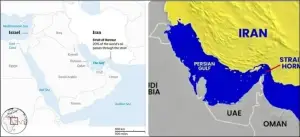 As Iran on Monday repeated its threat not to let ships from “hostile” nations through the Strait of Hormuz, concerns are growing about the global economic fallout. Mr. Trump’s latest attempt to reopen the strait — calling on other countries, including China, to send warships there — did not immediately yield any commitments to do so.
Officials in Japan and Australia said that they did not plan to send ships. Britain, France, the European Union and South Korea were noncommittal.
 Iran is allowing ships carrying oil to China to cross the strait, but other oil tankers have been attacked by projectiles. Mr. Trump threatened to postpone a planned summit in Beijing with Xi Jinping, China’s leader, if it did not comply.
Mr. Trump said NATO member nations should help too. “If there’s no response or if it’s a negative response, I think it will be very bad for the future of NATO,” he told The Financial Times on Sunday.
Here’s what else we are covering:
 The Contrarian, Opinion: Trump’s War is the Worst Conceived in American History, Jennifer Rubin, right, March 16, 2026. Ignoring experts comes at a steep price.
 General Dan Caine, left, the chairman of the Joint Chiefs of Staff, warned Donald Trump that an attack on Iran would provoke its closure of the Strait of Hormuz.
Every president contemplating war in the Middle East has known this and therefore avoided a full regional war. But Trump said he knew better and plunged into war. Of course, Trump was wrong — monumentally, predictably, and inexcusably wrong. Now, the Strait is mined and closed, the war rages out of control, oil prices have spiked, and the economy is teetering.
This catastrophic blunder stems from Trump’s delusion that a forty-seven-year-old Islamic regime insulated by layers of bureaucracy, an enormous military, an entrenched ideology, and a fervent national identity could be bombed out of existence. He convinced himself and his cult that — without adverse consequences — he could replace the mullahs with a friendlier regime (who, exactly, he never said). This madness, enabled by the phalanx of yes-men afraid to tell Trump he is wrong (even about their shoe size), was not unique to Trump.
Israel’s Prime Minister Benjamin Netanyahu, another regime change fabulist, frequently insisted, as he did at the war’s start, that full-scale war would “create the conditions for the brave Iranian people to take their destiny into their own hands.”
 Netanyahu is now back-pedaling furiously. “I can’t tell you with certainty that the Iranian people will bring down the regime,” Netanyahu said at his first wartime press conference last week. “If it doesn’t fall, it will be much weaker.” Oh, now he tells us.
The realization that regime change is a pipe dream, which U.S. presidents have learned repeatedly, has swamped Trump’s megalomania and Netanyahu’s dream of “forever” removing an Iranian threat. (The latter requires forever war.) By Friday, even Trump figured out that toppling the regime is a “very big hurdle.” He sounds as if he just discovered his goal’s impossibility: “Who’s going to do that? They literally have people in the streets with machine guns, machine gunning people down if they want to protest.” What did he think would happen?
On the American side, sane voices consistently have derided labeled regime change as a fantasy. The U.S. intelligence community reiterated its view that the Iranian government “is not at risk of collapse,” Reuters reported. It turns out that Trump’s “feeling” he could pull it off was baseless, perhaps a function of untreated malignant narcissism.Subscribed
The reasons other presidents avoided war against Iran — economic cost to the U.S., bombardment of our Gulf allies, closure of the Strait of Hormuz and soaring oil prices, high civilian casualties, a vengeful regime still in place but more determined to pursue a nuclear weapon, and Russia’s economic bonanza — all have surprised Trump and his regime of lickspittles. “When past presidents balked at the possibility of war with Iran, they weren’t just dodging a hard choice; they were deterred by all of the obvious reasons a conflict could perilously spiral,” Franklin Foer wrote recently. “Nobody should be shocked that the expected is now coming to pass.” Except the least competent president ever.
The annals of regime change are not littered with success stories. Wherever attempted (e.g. Iraq, Afghanistan, Libya), it begat endless, bloody war and an inconclusive outcome, at best. While we may wish for a better Iran regime, Phil Gordon at Brookings wrote early in the war: “By thinking he can defy deep historical lessons from the region, and by launching a war with no congressional mandate or significant public support, Mr Trump is taking a massive and unnecessary gamble—not just with his presidency but with the lives of countless Americans, Iranians and others.” He is losing his gamble, with others to pay the price.
Atrocious economic news (“Fourth-quarter GDP revised down to just 0.7% growth; January core inflation was 3.1%”) makes the added economic pain that much harder to tolerate. Moreover, in past wars, the U.S. has restrained Israel; in this war, Netanyahu and Trump have egged each other on with no plan for when to stop or evident consideration of what happens afterward.
The war reminds us that the current right-wing Israeli government and the U.S. do not have identical interests, although Netanyahu and Trump personally are two peas in the autocrat pod (e.g., corrupt, contemptuous of the press, law, and public opinion; antagonistic toward democracy). Netanyahu, in search of his white whale of regime change/redemption for the October 7 catastrophe, might be content with perpetual war. The U.S. public and sane bipartisan foreign policy voices have limited appetite for casualties, soaring oil prices, and long-term strain on our other alliances. Israel’s right-wing government may want to turn Iran into a failed state. From the U.S. perspective, a failed state of 90M people will likely become a hotbed of terrorism, a source of mass migration and violence, a spur to regional instability, and an elevated risk of nuclear proliferation.
The two powers now differ even on targeting. Yousef Munayyer wrote for The Guardian: “Israel struck oil facilities in Tehran that led to apocalyptic scenes in the Iranian capital, heightened Iran’s resolve to target oil infrastructure in neighboring US allies, sent shockwaves into the oil market that puts the greatest pressure on Trump and poisoned the environment in a city of 10 million people.” (Of course, the Gaza War already demonstrated the countries’ divergent interests: Netanyahu’s one-state fantasy to completely subjugate the Palestinians without regard for civilians’ well-being is both unattainable and, to most Americans, reprehensible.)
Polls, oil prices, and/or casualties may force Trump to find an off-ramp. But after the fighting, the region will be more volatile, the human cost breathtaking, and the need for an agreement to contain Iran’s nuclear program that much more essential. To both allies and foes, the U.S. will appear unreliable and disingenuous.
This war may be an even greater strategic disaster than the Iraq War. “[I]t is really incredible malpractice that they have launched this war, created the set of circumstances in the region that has long-term economic and strategic consequences without fully thinking through the potential outcomes,” Brookings Institution’s Suzanne Maloney observed.
Democrats need a different Middle East vision, one grounded in four principles:
1.) The U.S. does not unconditionally arm Israel or approve every Israeli action (as is true with all allies);
2.) The U.S, needs regional stability, which requires containing Iran, preventing more failed states, and protecting Israel’s legitimate security needs but restraining its regional aggression and working toward resolving the Palestinian crisis;
3.) A robust clean energy policy must weaken dependence on fossil fuel (while a net energy exporter, the U.S. is in a global oil market); and
4.) Wars (whether labeled “excursions” or without the malapropism, “incursions”) must be a last resort, never undertaken without public and congressional support.
In sum, only public pressure will force Trump to end his war. Going forward, policymakers should remember Trump’s blunders and do the opposite. Finally, voters must remember that regardless of what they say, Republicans cannot resist a Middle East war and invariably underestimate its cost in blood and treasure.
Paul Krugman via Substack, Political-Economy Commentary: No, America is Not Respected, Paul Krugman, right, March 16, 2026. Thanks to Trump, we’re held in contempt even by our closest allies.
There’s a real Baghdad Bob feel to pronouncements from the Trump administration these days. The war is going great! We’ve been totally victorious! Also, other countries — including China! — must immediately send ships to escort oil tankers through the Strait of Hormuz, which the U.S. Navy isn’t doing because it’s too dangerous.
But this has been the pattern ever since Trump returned to power. Despite repeated failures to deliver on his campaign promises — remember how he was going to cut energy prices in half? — he and his minions have continually insisted that everything is wonderful, that everything they do is a triumphant success story. And he’s still doing it. On Thursday he told a rally that:
"Inflation is plummeting, incomes are rising, the economy is roaring back and America is respected again."
As I and others have documented ad nauseam, none of those economic assertions are true. Today, however, I want to focus on the bolded claim. Trump constantly insists, in speeches and social media posts, that he took over a weak, despised nation and restored its international reputation. This is clearly something that matters a lot to him and his sense of self-worth.
It’s also the total opposite of the truth.
A stunning poll from Politico — just released, but taken last month — confirms what I and other observers strongly suspected: America is now widely despised, despised like nobody has ever been despised before.
I don’t mean that we’re disliked, although that too. But this isn’t a case of oderint dum metuant — let them hate so long as they fear. Instead, the world increasingly holds America in contempt.
Our former friends no longer consider us trustworthy: A graph of a company AI-generated content may be incorrect.
And they no longer believe that being a U.S. ally offers protection, that a good relationship with America will deter potential enemies from attacking them: A graph with different colored arrows AI-generated content may be incorrect.
At this point, a plurality of the population in every one of our erstwhile allies considers China a more reliable partner than the United States: A graph of a person AI-generated content may be incorrect.
And outside the United States, China, not America, is widely perceived as the great power of the future.
If this is world respect, what would world contempt look like?
Why has America’s global reputation fallen so far, so fast? It’s not a mystery.
After all, why would anyone consider America a trustworthy ally when Trump keeps insulting our neighbor and former closest ally, Canada, by insisting that it must become the 51st state and repeatedly calling its Prime Minister “governor”? Why trust us when Trump tried to bully NATO member Denmark into handing over Greenland?
Beyond that, Trump’s tariffs aren’t just economically damaging. They aren’t just, as the Supreme Court finally ruled, illegal under our own laws. They are also in clear, overwhelming violation of international trade agreements solemnly signed by previous presidents. Given the way the current administration has casually ignored those agreements, why would anyone expect America to honor any future deals?
Last but not least, I don’t think Trump and company have any idea how much their betrayal of Ukraine has weakened America.
I mean, here we have a nation fighting and dying to defend democracy against a brutal dictatorship that the U.S. has long considered an adversary. Yet Trump has rewarded Ukrainian courage by completely cutting off aid:
Trump has also repeatedly belittled Volodymyr Zelenskyy while praising Vladimir Putin, and made it increasingly clear that he wants Putin to win. In a way, America’s reputation has been further diminished by the fact that Trump isn’t getting his wish, because Ukraine keeps refusing to be defeated. So Trump can’t even do betrayal right.
What’s especially depressing about that Politico poll is that it was taken a month ago. That is, it reflects international attitudes before the debacle in Iran.
As everyone other than the most slavish Trump acolytes realizes, the war is going badly. The U.S. has spent billions of dollars bombing a third-rate power, badly depleting our stockpiles of sophisticated munitions, yet the regime survives and remains able to blockade a fifth of the world’s oil supply.
The Trump administration’s incompetence at war planning has been revelatory, in the worst way. The U.S. military’s lack of preparedness has also been shocking. Everyone following the Russia/Ukraine conflict, with its drone-infested battlespace, has been wondering whether American forces are ready for this new kind of war. Now we know that they aren’t. In a hair-raising article, the military historian and expert Phillips O’Brien says that this is a sign of rot in the U.S. military. I wish I were sure that he is wrong.
Now, Ukraine has learned the hard way how to fight this kind of war — and it moved quickly to help the United States and its allies in the region make use of its drone-fighting technology, despite Trump’s betrayals. Meanwhile Russia is aiding Iran. But Trump is still demeaning and insulting Zelenskyy while praising Putin.
The general public may not be aware that Trump’s America offers no reward to nations that come to its aid and does nothing to punish nations that aid its adversaries. But I guarantee that every leader in the world — very much including the leaders of nations Trump is now begging for help in the Strait of Hormuz — has taken notice and will treat the United States accordingly.
In short, Trump’s actions have drastically reduced the world’s respect for the United States. Yet Trump and his officials keep asserting that they have, well, made America great again. Why?
I don’t think it’s mainly about persuading the public. It is, instead, a desperate attempt to persuade themselves. For Trump, life is all about dominance displays; his sense of self-worth depends on believing that he’s cowing the world into submission. Others in his administration have more specific motivations. Pete Hegseth has built his brand around the notion that “warrior ethos” and “lethality” are what make a nation strong. Admitting that being smart and having allies are more important than macho posturing would be an implicit concession that he’s been wrong about everything.
The truth is that America used to be respected, not simply because we were a superpower, but because we were a different kind of superpower — a nation that stood by its allies, that mostly obeyed the rules of the system we created, that possessed an army that was professional, smart and incorruptible. Now Trump has thrown all that away. And I don’t know how or when we can ever get it back.
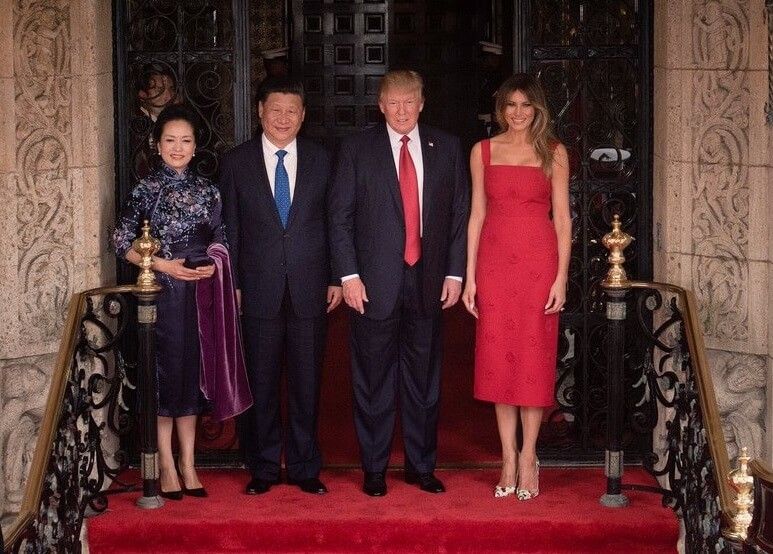
President Trump with China's President Xi Jinping and their wives in April 2017.
New York Times, Trump’s Threat to Delay Summit With Xi Casts New Shadow Over China Relations, Ravi Mattu, March 16, 2026. President Trump warned that he could postpone a meeting set to begin in just over two weeks if China refuses to help reopen the Strait of Hormuz.
President Trump threatened to postpone a long-planned summit with Chinese leader Xi Jinping as he called on China to send warships to help reopen the Strait of Hormuz, casting a new shadow over the relationship between the world’s two biggest economies.
Mr. Trump told the Financial Times on Sunday that he “may delay” the meeting, which is expected to start on March 31 in Beijing, if China does not answer his demand to help reopen the strait to shipping in the next two weeks. Mr. Trump said that waiting until the summit for an answer may be too long.
“We’d like to know before that,” he said.
China is one of several countries that have responded cautiously to Mr. Trump’s demands for naval assistance to thwart Iran’s efforts to block the strait, which is a transit route for about a fifth of the world’s oil. China, the biggest buyer of Iranian oil, has not responded directly to Mr. Trump’s remarks but has previously called for the cessation of hostilities.
A spokesman for China’s foreign ministry said on Monday that officials from both countries were discussing plans for the summit, and stressed that direct discussions between the leaders were essential.
“Head-of-state diplomacy plays an irreplaceable, strategic guiding role in China-U.S. relations,” Lin Jian, the spokesman, told reporters at a daily briefing in Beijing.
In Paris, Treasury Secretary Scott Bessent was holding a second day of talks with He Lifeng, his Chinese counterpart, to finalize preparations for the meeting. They were scheduled to speak to reporters on Monday afternoon local time.
Mr. Xi invited Mr. Trump to visit Beijing when the leaders met in Busan, South Korea last October.
Since the start of the war in the Middle East late last month, the price of oil has soared above $100 a barrel. Israel has targeted Iranian oil facilities and the United States has hit military sites on Kharg Island, where about 90 percent of Iran’s oil exports are processed. Iran has retaliated by effectively closing the Strait of Hormuz and launching missile and drone strikes against the oil infrastructure of U.S. allies in the Persian Gulf.
Mr. Trump has previously said that the United States and Israel did not require help from other countries to conduct their military campaign against Iran. But in recent days, he has criticized European and Asian allies for not participating in the attacks.
 Morning Shots via The Bulwark, Political Opinion: Trump’s Fork in the Road to Tehran, Bill Kristol, Andrew Egger and Jim Swift, March 16, 2026. He only has bad options.
 Leading the New York Times this morning: Israel is stepping up its ground attacks against the Iranian proxy Hezbollah in Lebanon, while other nations appear to be shrugging at Trump’s demand that they send warships to reopen the Strait of Hormuz. All perfectly standard procedure for a war that, as the White House keeps telling us, will be ending any minute now. Happy Monday.
U.S. Law, Crime, Justice, Rights
New York Times, News Analysis: Justice Dept. Struggles to Take Basic Steps in Targeting Trump’s Rivals, Michael S. Schmidt and Alan Feuer, March 16, 2026. A ruling Friday that derailed an investigation into the Federal Reserve chair at an exceptionally early stage showed the limits of President Trump’s campaign of legal retribution.
A judge has thrown out two of their most high-profile indictments.
Grand juries have repeatedly refused to charge those they are targeting.
And now, in the wake of a lacerating ruling by a federal judge derailing an inquiry into the Federal Reserve chair, Jerome H. Powell, officials at the Justice Department have encountered an even more profound problem: Prosecutors are floundering in the most basic steps of criminal investigations into those President Trump wants scrutinized.
The latest setback in the president’s retribution campaign came on Friday when Judge James E. Boasberg of Federal District Court in Washington quashed grand jury subpoenas to the central bank for information about the renovations underway at its headquarters and Mr. Powell’s testimony to Congress about them.
The U.S. attorney overseeing the case, Mr. Trump’s longtime friend and ally Jeanine Pirro, has vowed to appeal the decision and cast Judge Boasberg, who has clashed with the Trump administration, as an activist. And an appeals court could ultimately overturn the decision.
Still, Judge Boasberg’s ruling was an extraordinary example of pushback by the judicial branch, cutting short the investigative process at an exceptionally early stage, when prosecutors are essentially doing the most basic work of federal law enforcement.
Last fall, after Mr. Trump demanded his political appointees ratchet up his retribution campaign, the Justice Department ran into roadblocks once a judge tossed out indictments against the former F.B.I. director, James B. Comey, and the New York attorney general, Letitia James. The prosecutor who brought the charges, the judge declared, had been appointed illegally.
Instead, the judge surmised, the real reason the subpoenas were issued was political: because Mr. Trump wanted to strong-arm Mr. Powell into lowering interest rates.
“The subpoenas’ dominant (if not sole) purpose is to harass and pressure Powell either to yield to the president,” Judge Boasberg wrote, “or to resign and make way for a Fed chair who will.”
Judge Boasberg explicitly acknowledged the reality of Mr. Trump’s revenge campaign, writing that the president had urged the Justice Department to investigate his adversaries and adding that the department’s prosecutors had listened. In and of itself, it was an extraordinary acknowledgment. Citing a Supreme Court case, he wrote that “judges ‘are not required to exhibit a naïveté from which ordinary citizens are free.’”
The Federal Reserve subpoenas were not the only ones associated with Mr. Trump’s revenge campaign to have been dealt a blow last week. A New York judge, Lorna G. Schofield, refused to pause her own order blocking Justice Department subpoenas related to an attempted civil rights investigation into the New York attorney general, Ms. James. Judge Schofield said that the U.S. attorney who sent the subpoenas, John A. Sarcone III of the Northern District of New York, had remained in his position unlawfully, invalidating the inquiry into Ms. James.
When Mr. Trump began his second term, he was determined to use his expansive powers over the department to go after his rivals, subjecting them to the same legal ordeal that he believed he had unfairly undergone when he was out of office.
He wanted indictments, trials, guilty verdicts and ultimately jail for his enemies.
But the cases he has demanded in recent months have become so far removed from justifiable prosecution that even the loyalists he has installed have found it difficult to push them through a judicial system that does not appear to have hesitated to push back.
As remarkable as Judge Boasberg’s ruling was, it reflected a broader trend of judges across the country who increasingly doubt the word of lawyers for the Justice Department. Those lawyers have traditionally enjoyed a solid bond of trust with courts known in legal parlance as the presumption of regularity.
Then, in February, a grand jury in Washington refused to indict six Democratic lawmakers whom Mr. Trump wanted prosecuted for sedition after they released a video reminding military and intelligence personnel of their obligation not to obey illegal orders.
But Judge Boasberg’s block on the subpoenas against the Federal Reserve was in some ways an even sharper rebuke, stopping prosecutors in their tracks at the fact-gathering stage of their investigation after determining that it was flawed from the outset. The move proved again that even though Mr. Trump has long claimed nearly boundless powers to use the law as a cudgel against his foes, he does not exercise full or unilateral control over the legal system.
In a lengthy, rambling Truth Social post late Sunday, Mr. Trump lashed out at the courts and Judge Boasberg over his ruling.Editors’ PicksA New Magazine of International Reportage? In This Media Environment?Why Are We in Iran? On ‘S.N.L.’, Pete Hegseth Has the Answer: ‘I Don’t Know’8 Songs We’re Talking About This Week
“The Courts treat Republicans, and me, so unfairly, always seeming to protect those who should not be protected,” Mr. Trump said. “They are highly politicized. Cases don’t matter, the Judge does! As an example, how is this absolutely terrible Federal Reserve Chairman, Jerome ‘Too Late’ Powell, not even allowed to be investigated for the horrible job he does?”
Mr. Trump said Judge Boasberg should be removed from ruling on all cases related to the Trump administration and “suffer serious disciplinary action.”
As a general rule, prosecutors are given great leeway in issuing grand jury subpoenas, a common tool in the early stages of investigations. Unlike search warrants, they do not require a finding of probable cause by a judge that there might be evidence a crime was committed.
But Judge Boasberg found that Ms. Pirro’s office did not even meet the extremely low threshold needed to send the subpoenas, ruling there was “essentially zero evidence to suspect Chair Powell of a crime.”
 The Big Newsletter, Monopoly Round-Up: Bombshell Document Details Watergate-Style Corruption at the Antitrust Division, Matt Stoller, right, March 15, 2026. From Ticketmaster to Paramount to Hewlett Packard, the Trump administration and corporate America are involved in an orgy of corruption. Finally, we are seeing the first real investigation take place.
 Lots of monopoly news this week, as usual. Economic growth slowed, the $2 trillion unregulated segment of Wall Street known as private credit is tottering as a top private equity official calls lenders ‘arrogant,’ fertilizer and oil prices are going haywire due to the conflict in the Middle East, and there was huge drama in the Ticketmaster antitrust case as Trump tried to give the company a pardon, but state-level enforcers effectively said ‘Hell no.’
All of that is in the round-up after the paywall.
Before getting to the full slate of news, I want to focus on an explosive and little-noticed document filed on Friday that represents the first meaningful in-depth investigation into the Trump Presidency that could have significant legal repercussions. And it has to do with an antitrust case.
Live Nation/Ticketmaster was filed in 2024, and went to trial two weeks ago in a New York City courtroom, in front of a jury of normal people.
The argument put forward by the Department of Justice and dozens of states is that Live Nation/Ticketmaster has market power in ticketing software, artist promotion, and performance venues, and uses these different lines of business to extract revenue, fortify their competitive advantages, and extend their monopolies. It’s a widely loathed company, on both sides of the aisle; one of their biggest critics is Trump-supporting artist Kid Rock.
It was a reasonable case, with documents coming out showing Live Nation executives talking about how stupid their customers were and how they were “robbing them blind.” But on Monday, Live Nation surprised everyone, including the judge, with the announcement they had settled the case with the Trump Department of Justice. The trial, they thought, would end.
The deal reached by the company and Trump would compel Live Nation to allow rival ticket sellers to use its platform for secondary ticket sales, force it to give up control, though not ownership, of just 13 amphitheaters nationwide, and have a modest payout to states. There have been multiple such “settlements” in the last twenty years, and Live Nation’s monopoly power has only grown. So this settlement was widely seen as a corporate pardon by Trump of a hated monopoly.
And the process amplified that impression. The judge called the circumstances “mind boggling.” You are not supposed to surprise judges, you are supposed to tell them you are in negotiations. But Live Nation, whose strategy is led by a boomer antitrust lawyer named Dan Wall, did not do that. In fact, the DOJ’s own lead litigating attorney, David Dahlquist, didn’t even know about the settlement, and neither did the state attorneys general who were co-plaintiffs. I suppose the goal was to shock the state co-plaintiffs into accepting the deal, since they were unprepared to take over the trial.
But instead of working, the gambit backfired. The judge said the state attorneys general must continue the trial on Monday, without the DOJ, or settle. And 33 of them chose to move forward. These state officials were mostly Democratic, but some -- like Texas’s Ken Paxton -- are conservative enforcers. And a few, such as Colorado Attorney General Phil Weiser, are experienced at overseeing antitrust cases. Moreover, they hired a rock star antitrust lawyer, Jeff Kessler, to take over the case. Kessler has a long and illustrious career, his last win was beating NASCAR on behalf of Michael Jordan. This guy is not someone Live Nation wanted to face.
The backstory of this whole deal is, unsurprisingly, corruption. Live Nation has on retainer influential Republican Kellyanne Conway, as well as Mike Davis, a MAGA lobbyist close to Donald Trump and Pam Bondi. Months ago, Davis was able to force the ouster of the previous Antitrust chief, Gail Slater. Davis has a book of business, including forcing through the merger of two of the biggest real estate brokerages in America without the DOJ asking any real questions.
More On Iran War
Letters from an American, Historical Commentary: March 15, 2026 [Checking Claims of War Victory], Heather Cox Richardson, right, March 16, 2026. Today, as the country enters its third week of war against Iran, President Donald J. Trump was on the golf course, illustrating the observation of journalist E.J. Dionne in the New York Times that “from the very beginning of this war, we got a sense that there wasn’t a great deal of serious thought put into it by the president of the United States about how it might end, what our objectives were, what needed to be done to protect Americans who are in the Middle East, what might happen to oil in the Strait of Hormuz.”
Although the administration appears to be trying to convince Americans that the U.S. military’s destruction of the Iranian military means the U.S. has won the war, Iranian leadership needed simply to continue in power to declare victory. Then, blocking the 20% of the world’s oil that flows through the Strait of Hormuz would give them leverage over the war’s outcome.
On March 10, Helene Cooper and Eric Schmitt of the New York Times reported that senior defense officials told them the Iranian military is adjusting its tactics to strike at the communications and defense systems protecting U.S. troops. Those tactics include drone strikes. The same day, Marc Caputo, Barak Ravid, and Colin Demarest of Axios reported that Ukrainian officials had tried several months ago to sell the U.S. anti-drone technology for downing Iran-made drones as a sign of thanks for U.S. support and as a way to strengthen ties between the U.S. and Ukraine, but the U.S. did not pursue the offer.
White House spokesperson Anna Kelly responded: “This characterization made by these cowardly unnamed sources is not accurate and proves that they are simply outside looking in. [Defense] Secretary [Pete] Hegseth and the armed forces did an incredible job planning for all possible responses by the Iranian regime, and the undisputed success of Operation Epic Fury speaks for itself.”
And yet the fallout from the strikes on Iran by the U.S. and Israel appears to have caught the administration by surprise. Trump told Kristen Welker and Alexandra Marquez of NBC News yesterday that he was “surprised” that Iran attacked other countries after the U.S. and Israeli strikes. He also said strikes on Saturday on Kharg Island, which is about fifteen miles off the Iranian coast and is home to Iran’s primary oil export terminal, “totally demolished” most of the island but that “we may hit it a few more times just for fun.”
President Donald J. Trump posted on social media Saturday morning: “Many Countries, especially those who are affected by Iran’s attempted closure of the Hormuz Strait, will be sending War Ships, in conjunction with the United States of America, to keep the Strait open and safe. We have already destroyed 100% of Iran’s Military capability, but it’s easy for them to send a drone or two, drop a mine, or deliver a close range missile somewhere along, or in, this Waterway, no matter how badly defeated they are.”
Despite what Trump claimed was the utter destruction of Iran’s military, he asked other countries to contribute to the effort to reopen the strait. “Hopefully China, France, Japan, South Korea, the UK, and others, that are affected by this artificial constraint, will send Ships to the area so that the Hormuz Strait will no longer be a threat by a Nation that has been totally decapitated. In the meantime the United States will be bombing the hell out of the shoreline, and continually shooting Iranian Boats and Ships out of the water. One way or the other, we will soon get the Hormuz Strait OPEN, SAFE, and FREE!”
Since he took office more than a year ago, Trump has gone out of his way to antagonize our allies and partners, warning them that the United States will act alone and working to undermine the international alliances the U.S. has shaped since World War II. Now, having sparked a regional war in the Middle East after ignoring what virtually everyone said would be the result of attacking Iran a second time, Trump is begging other countries to come to his aid.
In yesterday’s NBC News interview, Trump told Welker and Marquez that several countries have committed to helping reopen the strait, but he declined to name them. “They’ve not only committed, but they think it’s a great idea,” he said. He also said that “Iran wants to make a deal,” but he has declined “because the terms aren’t good enough yet.” Today Iran’s foreign minister, Abbas Araghchi, said Tehran had not even asked for negotiations, let alone a ceasefire.
That the White House is in turmoil showed this morning first of all in the fact that one of the people making the administration’s case on the talk shows was U.S. Ambassador to the United Nations Mike Waltz, the man who added Atlantic editor Jeffrey Goldberg to the Signal messaging app on which members of the administration were making plans to strike Houthi militants in Yemen, a chat that would hide administration discussions from the record-keeping required by public records laws.
On CNN’s State of the Union this morning, over a chyron that read, “OIL PRICES SKYROCKET AS IRAN THROTTLES TRAFFIC IN STRAIT OF HORMUZ,” Jake Tapper noted that while the U.S. has said it would soon send naval escorts through the strait, shipping executives have told CNN “that all their requests for escorts have…been rebuffed. Tapper asked Waltz if Trump is simply hoping other countries will send naval escorts through the Strait of Hormuz or if they had committed to it.
Waltz answered that “we have the energy dominance in place,” then noted that in the past, other countries had worked alongside the U.S. to keep energy flowing through the strait, and Trump is calling on the world to do the same thing again. Waltz said: “We certainly welcome, encourage, and even demand their participation to help their own economies.”
On Face the Nation, another odd salesperson for Trump’s war, National Economic Council director Kevin Hassett, told host Margaret Brennan that “you have to understand that America is not going to have its economy harmed by what the Iranians are doing.” Hassett implied that because the U.S. produces more oil now than it did in the 1970s, it doesn’t really need oil from the Persian Gulf. The Iranians “think that they’re gonna harm the U.S. economy and get President Trump to back down,” he said. “There couldn’t be anything that was a stupider thing to say. ‘Cause the bottom line is that our economy has got all this momentum in the world, and we’ve got lots and lots of oil.”
The U.S. does indeed produce more oil and natural gas than it consumes, but it cannot use much of what it produces. The key is prices and refineries. The U.S. tends to produce light, sweet crude oil, a term for oil that flows easily and has low sulfur content. Because it is easy to refine and more valuable than heavy, sour crude, U.S. producers have an incentive to sell it on the open market. Even if they wanted to keep it at home, U.S. refineries are set up to refine the cheaper heavy crude oil, so the U.S. does not have the refining capacity to process the oil it currently produces and must buy what it needs from elsewhere. This means the U.S. is inextricably tied to the international oil markets.
The administration appears to be taking the position that the problem is not Trump’s launching an ill-thought-out war, but rather the media outlets’ reporting on that war. Although Trump has been conversing freely with reporters by cell phone since the war broke out, yesterday morning he posted on social media: “The New York Times and The Wall Street Journal (in particular), and other Lowlife “Papers” and Media actually want us to lose the War. Their terrible reporting is the exact opposite of the actual facts! They are truly sick and demented people that have no idea the damage they cause the United States of America. Fortunately, as proven by our Great and Conclusive Election Win in 2024, the People of our Country understand what is happening far better than the Fake News Media!”
Less than two hours later, Trump posted an image titled “PRESIDENT TRUMP IS RESHAPING THE MEDIA,” with three categories: “GONE,” “REFORMS,” and “WINNING.” Under “gone” was the defunding of PBS and NPR, as well as a list of reporters who have been fired since Trump took office in 2025. Under “reforms,” the image claimed Trump was the “Most Accessible POTUS Ever,” boasted that under CBS’s new ownership by Trump ally David Ellison the station has a “News Bias Ombudsman,” and suggested that CNN would soon be under “New Ownership” as well. Under “winning” was a quotation from The Guardian that “Trump is waging war against the media—and winning.”
Hours later, Federal Communications Commission chair Brendan Carr, right, threatened the broadcast licenses of media stations. He quoted  Trump when he posted: “Broadcasters that are running hoaxes and news distortions—also known as the fake news—have a chance now to correct course before their license renewals come up. The law is clear. Broadcasters must operate in the public interest, and they will lose their licenses if they do not…. It is very important to bring trust back into media, which has earned itself the label of fake news.” Then Carr slipped in his own fake news, suggesting that Trump won “a landslide election victory” when in fact he received less than 50% of the vote, and concluded: “Time for change!”
The Framers of the U.S. Constitution understood that a free press is imperative for a democracy. They established the right to a free press in the First Amendment that begins the Bill of Rights. Silencing critics is the refuge of those who know what they are doing is unpopular and unjustifiable.
Jim Acosta, who left CNN, noted that while the administration is attempting to establish a state media, the American people increasingly have the option of reading independent journalism. “Yes,” Acosta wrote, “Trump put me on his media hit list. I regret to report to the notoriously thin-skinned, twice elected, yet soon to be thrice-impeached president that I am still here, loving the freedom of independent media…. Living rent free in the mind of the president of the United States is indeed liberating, especially when you are coloring outside the lines of corporate media.”
Yesterday evening, the official White House social media account on X tried to reassure Americans that Trump knows what he’s doing. It posted an image of the American flag over a stealth bomber with the words “PEACE THROUGH STRENGTH” and “NO PANICANS!”
And yet, in what seemed to be panicked comments tonight, Trump on social media appeared to take on the rifts showing up among MAGA leaders over the Iran war, saying of isolationist America First MAGAs: “THEY ARE NOT MAGA, I AM, and MAGA includes not allowing Iran, a Sick, Demented, and Violent Terrorist Regime, to have a Nuclear Weapon to blow up the United States of America, the Middle East and, ultimately, the rest of the World.”
Another post blamed Iranian AI and disinformation for stories that he said are “FAKE and, in a certain way, you can say those Media Outlets that generated it should be brought up on Charges for TREASON for the dissemination of false information.” He reiterated support for Carr’s attack on the media and insisted he won the presidential election “IN A LANDSLIDE.”
In yet another post, the president’s account attacked the U.S. Supreme Court for declaring his tariffs unconstitutional, then blamed the justices for ruining the nation by permitting Democrat Joe Biden to be inaugurated rather than “call out The Rigged Presidential Election of 2020.”
In an interview with Financial Times published this evening, Trump warned that the North Atlantic Treaty Organization (NATO) would have a “very bad” future if allies don’t help open the Strait of Hormuz. And tonight, on Air Force One, Trump told reporters: “Really, I’m demanding that these countries come in and protect their own territory, because it is their territory. It’s the place from which they get their energy, and they should come and they should help us protect it. You could make the case that maybe we shouldn’t even be there at all, because we don’t need it. We have a lot of oil.”
Morning Shots via The Bulwark, Political Opinion: It’s Worse Than It Looks, William Kristol, right,  March 16, 2026. On Bulwark on Sunday yesterday, my guest, the historian Robert Kagan, explained the broad implications of the Iran war as well as anyone I’ve seen. I thought his remarks were helpful and important enough that I’m going to devote this space to some of his key points.
Kristol: Give me your read on where we stand in the war and what its geopolitical implications are so far.
Kagan: The outcome of the war is in doubt. We can’t really foresee what’s going to happen, partly because we don’t know what Donald Trump is going to do. He has a huge choice to make: either go all-in and really deal with this problem once and for all, which also implies a huge long-term American military commitment (you can’t just go in and do that and then run out), or try to find some way to bug out and declare victory. Until he makes that choice, I don’t think we’re going to know how this war turns out.
But even before knowing the outcome, we can see some of the repercussions in terms of the rest of the world. The top-line, big-picture result is that one undoubted effect of the Iran war has been to drive a deeper wedge between the United States and pretty much all of its traditional allies—in Europe, in Asia, and potentially even in the Middle East.
* * *
Buckle up. This is about to get bleak. But it’s an important conversation, and we call it like we see it.
Kristol: Let’s go through those in order. Start with Europe.
 Kagan, right: For the Europeans, they face an existential threat from Russian aggression right now. From the Europeans’ perspective, this war has been a real strategic disaster, for two main reasons. First, oil prices have skyrocketed, and even before Trump lifted sanctions on Russia—over the unanimous objection of the other G7 leaders—that was going to increase Russian income. It’s a real lifeline to Putin.
Second, American forces are—perhaps unexpectedly—burning through major stocks of weaponry, particularly Patriot and other interceptors that Ukraine depends on heavily to defend its cities from Russian attacks. So on both ends—helping Russia and hurting Ukraine—this has been a major setback for Europeans.
And it’s clear that the Trump administration couldn’t care less about the effect on Europe. They didn’t consult the Europeans before the war.
* * *
Kristol: And Asia?
Kagan: Very few countries in the world are more dependent on Middle East oil than Japan. The Japanese were not consulted. The skyrocketing oil prices are really damaging our allies. On top of that, the Japanese will notice that the United States has sent significant forces that are dedicated to the defense of Japan and critical to any response to a Chinese attack on Taiwan, to the Middle East.
The Chinese can also see that in order to conduct this war against a much lesser power, the U.S. has had to strip the Western Pacific of significant forces dedicated to a potential China threat. I don’t see why China should be more worried about the U.S. after this than before it.
* * *
Kristol: The Middle East?
Kagan: The Gulf States in particular are wondering whether they’ve joined the right team. They thought they had a pretty good arrangement with the Iranians: a kind of live-and-let-live agreement. So they didn’t favor the war and were overruled. And now it turns out the United States can’t really protect them. They’ve been targets; they’ve lost money on oil. They had—with tremendous cooperation from the Trump family and social circle—been working to make themselves an attractive destination for investment in AI and other sectors, hosting data centers for major companies, positioning themselves as a hub for investment and tourism. This war is devastating for all of that.
And now Trump is calling on China to help keep the strait open. It’s not hard to see how that pushes certain Gulf states toward viewing China as an equally reliable partner—or maybe more reliable—than the United States has turned out to be.
* * *
Kristol: The big picture?
Kagan: At the largest level, whatever outcome we eventually get, however decent, it will be because the United States brought enormous power to bear. And history shows it’s not enough to bring that power to bear to secure a victory. You have to keep it there to sustain the victory. The United States won a big victory in World War I, totally transformed the balance of power in Europe in a way favorable to peace, then pulled out—and then the balance of power got refashioned in ways that didn’t sustain peace, and we ended up in World War II. Something similar could happen in the Middle East if the U.S. brings great power to bear to create a certain situation but isn’t willing to keep it there.
That’s why Trump is at a fork in the road. It seems to me Trump faces one of two choices: establish a long-term, large American military presence to sustain whatever gains the war has made, or pull back and let things take whatever course they take. I find both highly problematic. But splitting the difference won’t solve anything.
And as every expert I’ve read says, the only way to guarantee keeping the strait open is to control the Iranian coastline from which most of the attacks originate. And you can only control the coastline with ground forces. If you ask me right now, I would say Trump is going to use ground troops, and we’re going to be in this war for months at minimum.
Kristol: That’s striking. Did you think that two weeks ago?
Kagan: No. Like most people, I thought Trump would declare victory and bug out. But things have gotten to the point where I don’t think he can.
We told you it was gonna get bleak. Points for honesty on our part.
* * *
Kagan: And there’s one thing we haven’t mentioned that I find genuinely concerning: the domestic ramifications.
Kristol: Say a word about that.
Kagan: One reason I worry Trump is willing to let this war go on for months is that it’s a potential weapon against domestic opposition. Brendan Carr, right, just threatened to start looking into the broadcast licenses of news organizations running coverage the Trump administration doesn’t like. They could use this to silence the media further, or pressure corporate chiefs to rein in their news organizations.
And that doesn’t even get to national security authorities—whether it’s around elections or some other context, justified by the fact that we’re at war and facing threats. Can we trust the FBI under Kash Patel to tell us a threat is real, rather than manufacture one? What happens when there are anti-war protests? Do they get labeled domestic terrorists for protesting a great patriotic war?
I’ve always thought Stephen Miller was particularly enthusiastic about the Venezuela action not because he cared about who was ruling Venezuela, but because of the domestic authorities it might give him to wield. I worry the Iran war, as it continues, could open the same opportunity. Trump would not be the first leader in history to find a foreign war useful for domestic consolidation.
* * *
A bracing and important analysis. Watch the whole thing. And watch Bob’s very good talk with Tim Miller from six weeks ago on Trump’s new world disorder.
News Roundup
The Parnas Perspective, News and Commentary: Criminal Referral Sent for Kristi Noem as Trump Lashes Out at Critics, Calls for Treason Charges Against Media Companies, and Allies Ignore His Demands, Aaron Parnas, right, March 16, 2026. We've got a lot of news to cover this Monday morning from a criminal referral sent to the Department of Justice for Department of Homeland Security Secretary Kristi Noem. Here's what Scott McFarlane, who is a great journalist, just put out this morning. Also, Donald Trump spent time lashing out at media companies calling for their arrest for treason,
Donald Trump spent the evening lashing out at critics ranging from the Supreme Court to Republicans who do not support his war in Iran, while also defending his PAC for using a photo from a dignified transfer in a fundraising email.
At the same time, Trump is calling for the criminal prosecution of media companies for treason for sharing videos he claims are AI related to the war in Iran that he does not like. He is also making clear that the chairman of the FCC is looking into revoking the broadcast licenses of several media organizations.
The attack on the media has never been greater, and it is exactly why independent journalism matters right now.
Here’s the news:
According to Scott MacFarlane, who is a friend and recently left CBS to be independent, Congressional Democrats, led by Dick Durbin and Jamie Raskin, are sending a referral to the U.S. Department of Justice requesting an investigation into whether outgoing Homeland Security Secretary Kristi Noem committed perjury during congressional testimony earlier in March. Previously, Republican Senator John Kennedy also suggested Noem lied under oath:
The referral alleges that several of Noem’s statements to Congress—about a $220 million taxpayer-funded ad campaign, conditions in immigrant detention facilities, the detention of U.S. citizens, and compliance with federal court orders—may have been false or misleading.
During a press exchange, Donald Trump defended a fundraising email from his PAC that used photos of him at a military dignified transfer, saying he believed the message was appropriate and arguing that no one has been more supportive of the U.S. military than he has. When questioned by a reporter from ABC News about criticism of the email, Trump dismissed the outlet as “one of the worst, most fake, most corrupt” and said he did not want further questions from them.
Donald Trump said that U.S. media outlets could face serious legal risk for publishing information he claims they know is false, arguing that spreading knowingly inaccurate reporting is “pretty criminal,” undermines their credibility, and poses a danger to the country.
During an exchange with a reporter from ABC News, Donald Trump declined to explain the purpose of sending 5,000 Marines and sailors and instead told the reporter to be quiet, calling them “a very obnoxious person.”
When asked by a reporter for comment on six deceased U.S. service members, Donald Trump did not respond to the substance of the question and instead ignored it, saying “Go ahead. Who else?” as he moved on to another reporter.
Donald Trump accused unnamed media outlets of knowingly publishing a “fake” story and suggested they could face treason charges for spreading false information, while praising Brendan Carr for examining the broadcast licenses of what Trump called corrupt and unpatriotic news organizations.
In a statement, Donald Trump said that preventing Iran from obtaining a nuclear weapon is central to the MAGA movement, calling the Iranian government a “sick, demented, and violent terrorist regime” and arguing that stopping its nuclear ambitions is necessary to protect the United States, the Middle East, and global security while praising the U.S. military and his efforts to rebuild it.
In a phone call with the Financial Times, Donald Trump warned that it would “be very bad for the future of NATO” if allies refuse to help secure the Strait of Hormuz during the ongoing conflict involving Iran, pressing NATO countries and other major economies to send warships to escort shipping through the vital oil corridor. Several allies have responded cautiously or rejected the idea of a NATO mission, highlighting tensions within the alliance over involvement in the escalating Middle East conflict.
Donald Trump criticized the Supreme Court of the United States, claiming the country had been “ransacked” by the court and accusing it of becoming a weaponized and unjust political organization.
Several European countries are resisting pressure from Donald Trump to send warships to help reopen the Strait of Hormuz, with leaders such as Antonio Tajani saying existing EU naval missions are defensive and not intended to expand into the strait. Officials including Xavier Bettel also signaled reluctance to commit troops or military assets, reflecting broader caution across Europe as governments weigh the risks of being drawn deeper into the escalating conflict and instead emphasize diplomatic or limited support measures.
Australia has declined requests from Donald Trump to send warships to the Strait of Hormuz, signaling reluctance to become directly involved in the effort to reopen the vital oil shipping corridor amid the escalating regional conflict.
According to a report by the New York Post, U.S. intelligence officials told Donald Trump that Mojtaba Khamenei may be gay, an allegation reportedly based on classified intelligence sources and longstanding rumors about his personal life. The report says Trump and some aides reacted with surprise and laughter during the briefing, though the claim has not been publicly confirmed and comes amid escalating tensions between the United States and Iran.
Keir Starmer said the United Kingdom will not be drawn into a broader Middle East war, emphasizing that the government’s priority is to work with allies toward a swift resolution to the conflict rather than expanding its military involvement.
China said it is continuing diplomatic communication with the United States about an upcoming visit by Donald Trump, despite Trump threatening to delay the trip unless Beijing helps reopen the Strait of Hormuz, which Iran has effectively shut down. Chinese officials said a planned summit between Trump and Xi Jinping remains under discussion while urging all parties to halt military actions and avoid further escalation that could disrupt global economic stability.
Iran’s Foreign Minister Abbas Araghchi said Iran is not seeking a ceasefire in the current conflict because it wants the war to end in a way that deters future attacks, arguing that Iran must demonstrate it will defend itself and continue fighting as long as necessary to ensure its adversaries do not attempt similar actions again.
According to Reuters, Israel Katz said the Israel Defense Forces has begun a ground maneuver in Lebanon aimed at removing threats and securing northern Israel, warning that hundreds of thousands of Shiite residents displaced from southern Lebanon and Beirut will not be allowed to return south of the Litani River until Israel says the region is safe.
NBC News has confirmed that Cuba will allow Cuban nationals living abroad—including many in the Miami area—to invest in and own private businesses on the island as part of new economic reforms aimed at reviving its struggling economy, according to Deputy Prime Minister Oscar Pérez-Oliva Fraga. The move comes amid an energy crisis, protests, and pressure from the administration of Donald Trump, with Cuban officials blaming U.S. sanctions for limiting access to fuel, technology, and financing while also confirming that talks have begun between Havana and Washington about future relations.
According to NBC, former Return to Nature Funeral Home co-owner Carie Hallford faces up to 20 years in federal prison after pleading guilty to conspiracy to commit wire fraud for taking more than $130,000 from families for cremations while often giving them urns filled with concrete instead of ashes and helping conceal nearly 200 decomposing bodies at the facility.
More Global News
Popular Information, Accountability Journalism: Kushner breaks pledge, seeks $5 billion more from foreign governments, Judd Legum, right, March 16, 2026. After Donald Trump won the presidency in 2024, Jared Kushner, his son-in-law, dismissed concerns that his private equity firm would be a vehicle to buy foreign influence.
In December 2024, Kushner said that he “preemptively” raised $1.5 billion earlier that year. The $1.5 billion came from Qatar’s sovereign wealth fund and Lunate, an investment fund linked to the UAE government.
The influx of cash, Kushner said, would allow his firm “to avoid any conflicts” and ensure “we don’t have to raise capital for the next four years.” Kushner made the comments on the December 20, 2024, edition of “Invest Like The Best,” a podcast hosted by Patrick O’Shaughnessy.
Kushner’s claim that he would not raise additional money during Trump’s presidency to avoid conflicts turned out to be a lie.
On Friday, the New York Times reported that Kushner “has spoken with potential investors in recent weeks about raising $5 billion or more for Affinity Partners.” Kushner’s team has “already met with Saudi Arabia’s Public Investment Fund [PIF].” PIF, Kushner’s biggest client, invested $2 billion with Affinity Partners in 2021. According to the report, Kushner is also seeking additional funds from Qatar and the UAE.
Kushner reportedly tried to drum up new investments while at the World Economic Forum in Davos as part of the official Trump administration delegation.
Kushner is seeking billions in additional funding from the Saudi government as he serves as one of Trump’s top negotiators with Iran. Notably, “Saudi Crown Prince Mohammed bin Salman [MBS] made multiple private phone calls to Trump” in February, advocating a U.S. attack,” according to reporting in the Washington Post. Last week, Trump said Kushner was one of a handful of top advisers who convinced him to launch major combat operations in Iran. According to CNN, the UAE was also lobbying the Trump administration to strike Iran.
After leaving the White House in 2021 and quickly accepting billions from PIF, Kushner acted as a de facto foreign policy advisor to Saudi Arabia. According to a Reuters report, Kushner advised MBS on “U.S.-Saudi diplomatic negotiations involving Israel…multiple times.” Since Trump’s second inauguration, Kushner has resumed his role as one of his father-in-law’s most important foreign policy advisors. Kushner has been one of the administration’s top diplomats for nearly every major foreign policy issue — from the war in Ukraine to Gaza to Iran.
Kushner’s deep involvement with the Trump administration’s foreign policy also breaks a pledge he made before Trump’s second term.
In February 2024, at an event hosted by Axios, Kushner was asked whether accepting billions in investments from Middle Eastern governments would make it “very difficult… to do any sort of foreign policy work” in a second Trump administration.
“I’m an investor now,” Kushner replied. “I served in government, and I think my track record is pretty impeccable. Now I’m a private investor.” Axios titled the video, “Jared Kushner tells Axios he will not join Trump’s administration.”
During the December 2024 podcast with O’Shaughnessy, Kushner presented himself as law-abiding and scrupulously ethical. At the same time, Kushner insisted his critics were ignorant people who did not understand how business is done. “I’m not going to allow people like the media or these ethics experts, who quite frankly don’t have real jobs and get paid to try to find potential conflicts that don’t exist, to change what we think and what we’re going to do,” Kushner said.Kushner’s dual role and the Constitution
Is it permissible for Kushner to hold a key position in the Trump administration while simultaneously accepting tens of millions in fees from foreign governments? Not according to the Foreign Emoluments Clause of the Constitution, which prohibits someone “holding any Office of Profit or Trust” from the federal government from accepting “any present, Emolument, Office, or Title, of any kind whatever, from any King, Prince, or foreign State.”
Previously, the Trump administration claimed that Kushner had no “office” and was simply acting as a volunteer. This argument was unlikely to withstand scrutiny, since the legal test is an individual’s actions, not the label assigned. Kushner is conducting high-level diplomacy on behalf of the Trump administration.
But all doubt was eliminated on February 19, when Trump named Kushner a Special Envoy for Peace. That designation formalized his role with the Trump administration and triggered a requirement to file a public financial disclosure within 30 days. Steve Witkoff, who participates in most negotiations, is also a Special Envoy and has filed his financial disclosure.
Citizens for Responsibility and Ethics in Washington (CREW), a government watchdog group, sent a letter to White House Counsel David Warrington last week highlighting this requirement. “As you know, collecting Mr. Kushner’s disclosure report is a critical first step, potentially followed by any needed divestment, changes to trust arrangements, or other steps as required by OGE to ensure that he is in compliance with federal law and the Constitution,” CREW wrote.
Kushner has five days left to comply.

U.S. Secretary of State Marco Rubio sits at a conference table with other officials in Doral, Florida under a backdrop that displays "Shield of the Americas Doral 2026" on March 7, 2026. Flags from participating countries are displayed behind the officials. (U.S. State Department photo).
Roll Call, Senate Democrats seek to prevent military action against Cuba, Rebecca Kheel, March 16, 2026, Measure is latest effort from Senate Democrats to constrain Trump’s military interventions.
Amid concerns that Cuba could be President Donald Trump’s next target for military action, a trio of Senate Democrats has introduced legislation aimed at blocking him from doing so.
The war powers resolution from Democratic Sens. Ruben Gallego of Arizona, Tim Kaine of Virginia and Adam B. Schiff of California would direct the president to “remove the United States Armed Forces from hostilities within or against Cuba,” according to text released Friday.
“As if the disaster of the Iran War and the resulting spike in oil prices weren’t enough, Trump is now threatening to intervene in Cuba as well,” Gallego said in a news release announcing the joint resolution. “He ran on America First, but now it’s clear he’s become a puppet of the war hawks in his party.”
The measure is the latest effort from Senate Democrats to constrain Trump’s military interventions, following similar measures on Venezuela and Iran.
While those past efforts fell short, and there are no signs a Cuba measure would fare differently, supporters of the measures argue they are still important exercises in getting lawmakers on record, forcing a public debate about the use of military force and sending a message to Trump about Congress’ authority in matters of war.
“Only Congress has the power to declare war under the Constitution, but he operates with the belief that the U.S. military is a palace guard, ordering military action in the Caribbean, Venezuela, and Iran without Congress’ authorization or any explanation for his actions to the American people,” Kaine said in a statement Friday.
Kaine and Schiff are also among a group of six Democratic senators who recently introduced several more Iran war powers resolutions in an effort to force public hearings on the Iran war.
Cuba was one of several countries Trump threatened at the beginning of the year after the U.S. military raid in Venezuela. After he ordered military action against Iran, speculation has swirled that Cuba could be next.
Sen. Lindsey Graham, R-S.C., a close Trump ally who campaigned for military action against Iran, said on Fox News last week that “the liberation of Cuba is upon us. It’s just a matter of time.”
A couple days earlier, Trump told CNN in an interview that “Cuba is gonna fall pretty soon.”
 Since January, the United States has imposed a blockade of oil shipments to Cuba, causing fuel shortages on the island that have led to lengthy blackouts and aggravated an economic crisis.
Amid the U.S. pressure campaign, Cuban President Miguel Díaz-Canel on Friday acknowledged for the first time that his government has held talks with U.S. officials. The talks, he said in a speech, “were aimed at finding solutions through dialogue to the bilateral differences between our two nations,” according to The Associated Press.
Under the 1973 War Powers Resolution, Gallego, Kaine and Schiff will be able to force an initial procedural vote on their Cuba measure after 10 days of introduction. The measure was introduced on Thursday.
“The president’s saber rattling toward Cuba makes clear where his sights are next,” Schiff said in a statement. “Congress must make its voice heard, or we risk involvement in another risky war of choice and losing our constitutionally granted authorities forever.”
Even if the measure were to be passed by the Senate, it would face an uncertain future in the GOP-controlled House since the War Powers Resolution does not prescribe expedited procedures for consideration of such a joint resolution in that chamber. And it would almost certainly be vetoed if it did reach the president’s desk.
New York Times, Opinion: Go-Go Dubai Was Not Built for War, Richard Florida (author of “The Rise of the Creative Class” and “The New Urban Crisis”), March 16, 2026. A video was circulating on social media last week, of what appeared to be an Iranian Shahed drone flying over the al-Mamzar beach in Dubai on March 8. A fighter jet was in hot pursuit, trying to shoot the drone down. Down below, people were sunbathing under umbrellas.
The comments ponged between whether it was more amazing that people were still on the beach during wartime, or whether it was news at all that people kept living their “best lives,” since they trusted their government to keep them safe.
Dubai, which sits near the Strait of Hormuz, was supposed to be safe. Instead, it has been under attack by Iran since Feb. 28. More than 260 ballistic missiles and over 1,500 drones have been detected over the U.A.E.; most have been intercepted, but their percussive booms have become part of the city’s soundscape. The city that had spent decades billing itself as a sleek sanctuary — luxe, apolitical, income-tax-free, floating above and apart from the fractious region around it — was suddenly no longer insulated.
Dubai is on edge. Big banks asked employees to stay away from their office towers. People sheltered in underground parking garages or wherever they could find cover. Parents told their children the explosions overhead were Ramadan fireworks. At least four people have been killed so far in the U.A.E. — including a Pakistani, a Nepali and a Bangladeshi.
Those with means, many of whom had come to Dubai to work in financial firms, hedge funds, family offices, law firms and consultancies, scrambled for commercial flights and private jets out of the Gulf.
The strikes kept coming. On March 11, four people were injured when two drones fell at Dubai International Airport. Since about two-thirds of the world’s population is within an eight-hour flight, it has become an essential transit hub, and Dubai’s airline, Emirates, a global force. Since the war began, the airport has repeatedly suspended its operations for brief periods. Thousands of flights to and from the region have been cancelled.
The attacks struck at the fundamental premise of Dubai’s model as a new type of global metropolis. It’s developed into what could be called a city as platform — less a rooted place with people and history than a blank slate for the exchange of capital. Its success has even spawned a term, “Dubaification” — the spread of the same malls and towers, restaurants, airport lounges and luxury brands that make places feel secure and, despite its proximity to Iran and the now blockaded Strait of Hormuz, out of harm’s way. What could ever go wrong when there are a Nobu and a Louis Vuitton boutique nearby?
U.S. Elections, Politics, Governance
Graphic by the Lincoln Project of Imagined Trump Rally.
Hopium Chronicles, Political Advocacy: This Trump Thing Has Failed, Utterly, Simon Rosenberg, right, March 16, 2026. Pro-Democracy Forces Must Fight Now For An Urgent, Dramatic Course Correction.
This morning we wake to this other America, Trump’s America, and what has now become an ongoing, global humiliation of our once great country. We cannot, and should not, sugar coat the gravity of what Trump has done. He’s thrown the entire world into chaos. Energy, food, and price shocks are coming for literally every person in the world. This morning governments from all over the world are telling him to f*ck off, leaving America alone, weakened, humiliated.
Watch this video. Stuff like this is all over the global Internet. Sound on:
Trump is getting his ass kicked so badly in global social media that he is now bitterly complaining about it, lashing out, pathetically, threatening everyone:
I stand by my post last week - Trump is a titanic, vainglorious fuck up. His moment for declaring victory and ending the war has passed. Escalation will be an even bigger catastrophe. He has no good options left, but the best option for him, for the country, for the world, is to somehow get him to end the war as soon as possible.
We are learning why no American President ever attempted to attack Iran before - for whatever gains we might achieve on the battlefield, the costs of the war - to America and the world would not be worth it. With Claude’s help here is a fresh and very conservative estimate of the direct costs of the war - $6 to $10 trillion, or between 5% and 9% of global GDP. It is already rivaling the cost of the entire global financial crisis in 2008-2009.
Remember these energy, food, and commodity shocks are not just about money - they mean slower growth, rising unemployment, bankrupt companies, social strife, literally everywhere in the world. As farmers all around the world, including in the US, are struggling to get access to affordable fertilizer manufactured in the Middle East, Trump may have also triggered a global food crisis that may already be impossible to reverse.
This new threat comes a year after Trump and Musk vaporized USAID, weakening the already fragile social safety net in the poorest countries of the world. Estimates are that Trump’s elimination of USAID will lead to at least 14 million deaths by 2030, and (yes Trump is a mass murderer):
“They risk abruptly halting - and even reversing - two decades of progress in health among vulnerable populations. For many low- and middle-income countries, the resulting shock would be comparable in scale to a global pandemic or a major armed conflict.”
And this all comes on top of Trump illegally placing unilateral across the board tariffs on every country in the world, putting additional strain on global supply chains, small businesses and farmers throughout the world. Here is Republican Senator Chuck Grassley this weekend:
Trump’s tariffs and mass deportations have already pushed American farmers into crisis. Now we have exploding fertilizer costs, reduced availability, and skyrocketing diesel prices, the fuel that powers the farm economy in America.
The protests from redder parts of America about the costs of this war are about to get very, very loud.Subscribed
Meanwhile, here in the US we’ve had two terror attacks in the past few days that could be attributed to the fallout from the war. And DHS remains shut down, unable to protect us, for Trump and Miller want to maintain their ability to act lawlessly and terrorize communities across the US. Trump went to war with a major global sponsor of terrorism without having our guard up here in America. His lack of concern for the security and well being of the American people remains unacceptable and shocking……
The bottom line here is that it has become clear that Trump is a failed President. Nothing he has done has been good for America. He is leaving us less prosperous, less safe, and less free. He has enriched himself while putting the entire world - and all of us - in danger. Pro-democracy forces in the US must grow bolder now, as the crisis in front of us is grave and serious. We must fight to end the war, to block this ridiculous “make it harder for everyone to vote” bill in Congress this week, but we must be more strategically ambitious now, and make it clear to the American people that we are urgently fighting for a much larger course correction/better path. Something along the lines of our emerging agenda:
Top races to watch: U.S. Senate; 2nd, 7th, 8th, and 9th congressional districts Left to right: Lt. Gov. Juliana Stratton, Rep. Raja Krishnamoorthi, and Rep. Robin Kelly are the main contenders in Illinois’s Democratic primary for U.S. Senate. (Images: Stratton, Krishnamoorthi, and Kelly campaigns). A three-cornered Senate primary.
Decision Desk HQ, 5 races to watch in Illinois, Geoffrey Skelley, March 16, 2026. Democrats have high-stakes primaries in solidly blue seats, highlighted by the party's Senate primary to succeed retiring Sen. Dick Durbin.
The votes happening in Illinois on March 17 are the next significant batch of nomination contests following the March 3 primaries in Texas, North Carolina, and Arkansas. (With apologies to Mississippi, which had a few uncompetitive primaries on March 10.)
Whereas both parties had must-watch contests on March 3, Democrats host all of the major primaries on the March 17 slate. Five stand out: The races for Illinois’s open U.S. Senate seat and four open U.S. House seats in solidly Democratic districts. Democratic Gov. JB Pritzker is unopposed for renomination and will be a heavy favorite to win reelection. But the potential 2028 presidential contender is closely involved in his party’s Senate primary.Illinois
An open-seat race for Senate is the most notable contest on the Illinois primary ballot. Democratic Sen. Dick Durbin is retiring, and three major candidates are tussling in the Democratic primary to succeed him: Rep. Raja Krishnamoorthi, Lt. Gov. Juliana Stratton, and Rep. Robin Kelly. Krishnamoorthi holds a narrow lead in the polls over Stratton in a contest that has featured large amounts of outside spending targeting the two leading contenders.
Democratic primaries in four open and solidly blue U.S. House seats also feature on March 17. The contests in the 2nd, 7th, 8th, and 9th congressional districts feature ample outside spending, arguments over the influence of AIPAC, and skirmishes between progressive and more moderate Democrats.
Trump Health Care Decision-Making
New York Times, Judge Strikes Down Kennedy’s Vaccine Policies, Apoorva Mandavilli, March 16, 2026. Ruling on a lawsuit brought by several prominent medical organizations, a district court said the federal government had not based its decisions on science in limiting Covid shots and revising the childhood immunization schedule.
In a severe blow to the Trump administration’s health agenda, a federal judge in Massachusetts on Monday blocked the government from implementing a series of decisions on vaccines made over the last year by Health Secretary Robert F. Kennedy Jr.
The ruling also reversed, at least for the time being, all decisions made by the panelists that Mr. Kennedy appointed to the Advisory Committee for Immunization Practices, which makes recommendations on which vaccines Americans should take. The court decision will prevent the committee from meeting later this week, as it was scheduled to do.
The judge’s ruling brought an abrupt halt to the major changes that Mr. Kennedy, who has long been skeptical of vaccines, had set in motion, upending national vaccine policy and making sweeping revisions to the recommendations for what shots are given and when. Those included cutting down the number of diseases covered by routine immunization, and restricting access to Covid vaccines, two pillars of Mr. Kennedy’s vaccine agenda.
In his decision, Judge Brian Murphy, of the U.S. District Court for the District of Massachusetts, noted that the vaccine committee has historically made decisions through careful review of scientific evidence, “a method scientific in nature and codified into law through procedural requirements." But, he added “unfortunately, the government has disregarded those methods and thereby undermined the integrity of its actions.”
The ruling by Judge Murphy, who was appointed to the federal bench by former President Joseph Biden, a Democrat, will almost certainly be appealed. Andrew Nixon, a spokesman for the Department of Health and Human Services, said, “H.H.S. looks forward to this judge’s decision being overturned just like his other attempts to keep the Trump administration from governing.”
Judge Murphy made the ruling in a lawsuit brought by six medical organizations, that contended Mr. Kennedy and his appointees had made “arbitrary and capricious” changes to the childhood vaccine schedule, bypassing the careful, evidence-based practice that in the past has underpinned the recommendations.
The lawsuit also argued that the panelists Mr. Kennedy appointed did not have the qualifications to recommend vaccinations and that their decisions endangered the health of Americans.
In his decision, Judge Murphy wrote that only six of the 15 panelists “appear to have any meaningful experience in vaccines — the very focus of A.C.I.P.”
Lawyers for the federal government, for their part, had argued that changes to the vaccination schedule represented reasonable disagreements about health policy. They noted that the states — not the vaccine committee or the federal government — are the ultimate authority in decisions about which vaccines are required.
In a hearing this month, Isaac Belfer, a lawyer for the Trump administration, argued that Mr. Kennedy and the committee had “unreviewable” — or absolute — authority to make vaccine policies, even if that included recommending that people become infected with measles instead of getting vaccinated.
Judge Murphy was clear in his dismissal of that argument. “Suffice it to say that the Court disagrees,” he said.
The decision was the clearest outcome yet in an escalating battle between the medical establishment and the Health Department, which under Mr. Kennedy has embraced anti-vaccine conspiracies, including debunked theories that childhood shots cause autism, asthma or other diseases.
“This is a significant victory for public health, evidence-based medicine, the rule of law, and the American people,” Richard Hughes, a lawyer for the plaintiffs, told reporters after the court made its ruling.
The government may appeal the decision, Mr. Hughes noted, “but for now, we get to celebrate a rare bit of good news.”
The vaccine committee’s decisions powerfully influence states’ vaccination requirements for entry into day care and elementary school and shape insurance coverage of the shots.
The panel was initially scheduled to meet in February, but the Health Department did not file the necessary federal notices for the meeting and postponed the session.
The lawsuit was filed in July by the medical organizations, including the American Academy of Pediatrics, after Mr. Kennedy announced on social media that Covid vaccines would no longer be recommended for healthy children or pregnant women.
New York Times, U.S. Considers Withholding H.I.V. Aid Unless Zambia Expands Minerals Access, Stephanie Nolen, March 16, 2026. A draft State Department memo outlines ways the Trump administration may ratchet up pressure on the African country by ending health support “on a massive scale.”
The State Department is considering withholding lifesaving assistance to people with H.I.V. in Zambia as a negotiating tactic to force the government of the southern African country to sign a deal giving the United States more access to its critical minerals.
“We will only secure our priorities by demonstrating willingness to publicly take support away from Zambia on a massive scale,” a draft of a memo prepared for Secretary of State Marco Rubio by the department’s Africa Bureau staff says. A copy of the memo was obtained by The New York Times.
Some 1.3 million people in Zambia rely on daily H.I.V. treatment that is provided through the decades-old U.S. President’s Emergency Plan for AIDS Relief (known as PEPFAR) and on tuberculosis and malaria medications that save tens of thousands of Zambian lives each year. The Trump administration is considering whether to “significantly cut assistance” as soon as May, to increase pressure on Zambia, the memo says.
In the wake of the Trump administration’s broad cut to foreign aid last year, the State Department has been pushing countries to sign new agreements pledging to meet certain conditions to receive American funds. Twenty-four countries have signed agreements so far, worth a total of $20 billion in health aid over five years. In most cases the main requirement on the recipient country is that its government commit to increasing its own health spending.
While most countries have signed, Zimbabwe’s government recently walked away from negotiations, saying demands about data and biological sample sharing were an intolerable infringement on sovereignty. Activists in Kenya have taken that country’s deal to the courts over similar concerns.
Unlike the other agreements, which are limited to funding for health programs, the United States is trying to use the deal it is negotiating with Zambia to address a longtime source of frustration: what is sees as China’s unfettered access to the country’s mineral wealth. Zambia is one of the world’s major copper producers, and also has huge reserves of minerals like lithium and cobalt, all of which are key in the green energy transition.
While the terms of the deal have not been made public by either government, a draft of the health component seen by The Times says the United States proposes to give Zambia $1 billion in health funding over five years, if Zambia commits $340 million in new health spending of its own. This is less than half the amount of health assistance Zambia received before the Trump administration took office.
The second piece is an agreement on steps that would give American businesses more access to Zambia’s vast mineral deposits and, by extension, end what the United States sees as China’s preferential access to Zambian mines.
The third is a renegotiation of a contract with the Millennium Challenge Corporation, an American foreign assistance agency focused on economic governance. The original contract, signed in 2024, gave Zambia a $458 million grant to support its agricultural sector. The Trump administration wants it restructured to require regulatory changes in mining and other industries. Editors’ PicksHow an Artist Lives on $36,000 a Year on the Upper West SideTips to Avoid Becoming the ‘Dead Wife in a Movie’ TropeI’m a Small Landlord. What Can I Do About My Nonpaying Tenants?
Zambia will need to agree to all three by May in order to keep a portion of the health aid it now receives through PEPFAR, the draft memo suggests.Want to stay updated on what’s happening in Zambia? Sign up for Your Places: Global Update, and we’ll send our latest coverage to your inbox.
The State Department declined to comment on the memo. Responding to questions from The Times, the department’s press office said by unsigned email that it would not comment “on purportedly leaked documents or on deliberative diplomatic discussions.” The draft memo was prepared by the Zambia desk in the Africa Bureau and circulated among, and approved by, a number of officials who are informing the American side of the negotiations.
Cornelius Mweetwa, Zambia’s minister of information and its chief government spokesman, declined to comment on the negotiations.ImageA large sign reads "forging prosperity through mining wealth" at a roadside as a car passes by it.Signs advertising Zambia’s mineral wealth on a street in Lusanka.Credit...Arlette Bashizi for The New York Times
The Trump administration had expected Zambia to sign late last year, when other African countries were agreeing to contracts, and officials traveled from Washington to Lusaka, the Zambian capital, to try to close the deal.
But it remains unfinished, and the administration’s frustration has grown with Zambia — a country with vast mineral wealth but also an immense foreign debt burden that has long been dependent on foreign aid and cheap loans from China.
The draft memo prepared for Mr. Rubio says that getting the agreement signed would involve “the potential use of sticks” and warned that Zambia could not be allowed to backtrack because other countries are watching.
If Zambia won’t sign, “sharp public cuts to American foreign assistance would significantly demonstrate to aid-receiving countries the seriousness of our interest in collaboration and our insistence on tangible benefits under our America First foreign policy,” the draft memo says.
Zambia has been one of the largest recipients of PEPFAR assistance — more than $6 billion — in the past two decades. When the assistance began, during the administration of George W. Bush, some 90,000 people a year were dying of H.I.V. in Zambia and the health system was entirely overwhelmed.
New York Times, In Tense Meeting, Mehmet Oz Pressed Medical Societies on Trans Care for Teens, Jeremy W. Peters, March 16, 2026. Most groups defended their support for medical intervention. But the Society for Plastic Surgeons broke with the consensus.
Over the winter, Mehmet Oz, the head of the Centers for Medicare and Medicaid Services, summoned the leaders of the country’s major medical societies to his office for what he called a “grand rounds” — a hospital term for a meeting where doctors discuss complex cases.
The topic was one of the most contentious in American medicine: Transgender medical care for teenagers.
Dr. Oz pressed on a question that hangs over the entire field: Why did these organizations recommend medical intervention for young patients — including hormone treatment, puberty blockers and surgery — when the research on whether it helped young patients in the long term, especially on mental health, was inconclusive?
The meeting, which has not been widely reported, was remarkable for convening, in the same room, medical experts with such divergent opinions.
On one side were the medical societies, including the American Medical Association, the American Psychiatric Association and the American Society of Plastic Surgeons, which have helped set the policies and recommendations for doctors treating adolescents with gender dysphoria. Gender care providers and patients say that the treatments can help young people feel more aligned physically with their gender identity, leading to improved mental health and well-being.
On the other side were doctors and academics who have argued that gender clinicians have misrepresented the data. Dr. Oz himself has spoken harshly about these treatments, calling them “sex-rejecting” experiments performed on children as if they were “lab mice.”
At the meeting, his tone was more inquisitive than hostile, said Zhenya Abbruzzese, who attended along with several colleagues from a group she co-founded that funds and promotes research critical of the medical consensus, the Society for Evidence-Based Gender Medicine.
“What’s the barrier to engaging with the evidence?” Ms. Abbruzzese recalled Dr. Oz asking. “What gives?”
Dr. Oz’s goal, however, was lost on no one.
According to five people at the meeting, the leaders of the medical societies each took turns defending their guidelines. But the last speaker, representing the plastic surgeons, surprised many in the room. The society was changing its position, its official said, after determining that studies on the medical benefits of surgery in minors were limited and of low quality.Editors’ PicksHow an Artist Lives on $36,000 a Year on the Upper West SideTips to Avoid Becoming the ‘Dead Wife in a Movie’ TropeI’m a Small Landlord. What Can I Do About My Nonpaying Tenants?
Going forward, the group would recommend that any gender-related surgeries, including mastectomies, the most common gender-related surgical procedures in minors, wait until patients turn at least 19.
For the better part of a decade, the American medical societies have endorsed medical intervention as an evidence-based and potentially lifesaving method of caring for adolescents diagnosed with gender dysphoria.
But several independent reviews have challenged the research underpinning those recommendations, finding gaps and deficiencies in many studies, including their size, length of follow-up, lack of adequate controls and the number of study participants who had dropped out.
In several countries, the independent reviews have led to major changes in the way gender medicine is practiced — a fact that Dr. Oz raised in the meeting. Health officials in Britain, Finland, Sweden and New Zealand have agreed to restrict medical treatments for youth, citing the reviews. At the same time, groups drafting guidelines in Germany, Austria and Switzerland have cautiously endorsed medical intervention, citing a consensus among clinicians and the lack of apparent alternatives, while acknowledging the uncertain evidence.
In the United States, however, the debate has become far more entangled in politics, as the Trump administration leverages the power of the federal government to try to halt the practice of pediatric gender medicine and, more broadly, to eliminate social accommodations and legal rights for transgender people by targeting institutions, including schools, universities, hospitals, the military and sports associations.
Media, Entertainment, Education
 Morning Shots via The Bulwark, Political Opinion: Carr Wreck, Andrew Egger, March 16, 2026. The Federal Communications Commission is a relatively obscure federal agency, so its chairman, Brendan Carr, tends to get into the news only when he starts threatening to revoke broadcast licenses over speech he dislikes. Unfortunately, he’s back in the news.
On Saturday, after President Trump posted a message to Truth Social grumbling about coverage of his war in Iran (“Media actually want us to lose the war. Their terrible reporting is the exact opposite of the actual facts!”), Carr chimed in: “Broadcasters that are running hoaxes and news distortions—also known as the fake news—have a chance now to correct course before their license renewals come up. The law is clear. Broadcasters must operate in the public interest, and they will lose their licenses if they do not.”
Naturally, for Carr the public interest is Trump’s interest. If this wasn’t obvious enough from the fact that he attached a screenshot of Trump’s kvetching post to his threat, Carr went on: “When a political candidate is able to win a landslide election victory after in the face of [sic] hoaxes and distortions, there is something very wrong. It means the public has lost faith and confidence in the media. And we can’t allow that to happen.”
Apparently, Carr believes that reporting that tanker planes were “struck” in an Iranian missile strike—the headline that set Trump grumbling in the first place¹—is to invite the government to label you “fake news” and retaliate against you as such. But lest you think he’s just being an incredible stickler for accuracy, in the very same post Carr proclaims that Trump “won a landslide victory” in 2024—an interesting way to describe a 1.5-point win with a plurality of the popular vote.
Because he’s not insane, Carr, right, wants to frame his threat as mere concern for fair coverage. But the president he’s channeling, who is insane, isn’t really bothering.
In one post last night, Trump accused the “Fake News Media” of working “in close coordination” with Iran to spread AI-generated disinformation about the war: “Buildings and Ships that are shown to be on fire are not.” He added that “the Media Outlets that generated it should be brought up on Charges for TREASON for the dissemination of false information!”
Which outlets were these? Who knows! Trump didn’t name them, and since no actual outlets have actually been spreading such AI-generated disinformation, it’s hard to know from context clues. (I asked the White House this morning which outlet in particular the president was accusing of treasonous AI-generated coverage. They did not respond.)
Trump’s post suggests that different adversaries are blurring together in the president’s mind: He starts by taking issue with a Wall Street Journal report, then pivots to denouncing AI clips he seemingly bumped into on social media before smash-cutting to Carr-like threats against broadcasters’ FCC licenses and, for good measure, a parting shot at “the Late Night Morons, who get gigantic Salaries for horrible Ratings.”
It’s possible that Carr, channeling Trump, was making an empty threat intended to keep Trump’s media opponents off-balance. Carr’s last foray into the headlines is perhaps instructive here: Last year, after threatening to revoke ABC affiliates’ broadcast licenses over a Jimmy Kimmel monologue he didn’t like, Carr ended up backtracking pretty quickly.
Or maybe this time Carr is more serious. The White House has had media suppression on the mind lately—think of Defense Secretary Pete Hegseth’s remark Friday that “the sooner David Ellison takes over [CNN], the better.”
And wartime has always made for better opportunities than peacetime for opportunistic governments to start chiseling away at the structures restraining their power. The stakes are too high, a would-be wartime autocracy argues, for subversive internal elements to be allowed to go on poisoning the body politic.
Whatever Carr intends, it’s plain he isn’t freelancing here. CNN’s Brian Stelter notes that Carr’s threat came during a trip to Mar-a-Lago, where he was seen Saturday meeting with Trump. That same day, Trump posted a chest-thumping graphic (above) to Truth Social detailing the ways he is “reshaping the media,” which Stelter theorized may have been provided to him by Carr:
Apparently, Carr and Trump intend to reshape it still further—perhaps by threats alone, perhaps by force.
AROUND THE BULWARK
Quick Hits
THE BEST AND BRIGHTEST: It’s been a tough week for the DOGEbros. Elon Musk’s kid arsonists, who spent the early part of last year slashing and burning their way across the federal government, have been sitting for depositions in a court case brought by groups seeking to reverse their cuts. The groups have argued that the cuts were illegal and arbitrary, and the DOGEbros aren’t exactly beating the allegations. As the New York Times reported earlier this month, much of DOGE’s “work” involved downloading grant summaries and feeding them into ChatGPT with a simple prompt: “Does the following relate at all to D.E.I.? Respond factually in less than 120 characters. Begin with ‘Yes’ or ‘No.’”
Recently, clips from the DOGEbros’ depositions have gone viral on social media, especially one in which staffer Justin Fox repeatedly struggles to define what D.E.I. actually is. In another, staffer Nathan Cavanaugh is asked whether he regrets that people might have lost income to DOGE’s fast-and-loose work. “No,” he replies, “I think it was more important to reduce the federal deficit from $2 trillion to close to zero.” (The federal deficit last year ended up being about $1.7 trillion.)
Clowning on the DOGEbros is fun and cathartic, but perhaps not conducive to achieving a sober outcome in the lawsuit. On Friday, a judge ordered that the deposition videos be removed from the internet. Late last night, Musk said that he had offered his former staffers “legal support as needed.” Big of him.
WITH COURTS LIKE THESE: The Fake News Media weren’t the only institutions that felt Donald Trump’s social media wrath this weekend. He also had some revealingly insane things to get off his chest about the Supreme Court. In the wake of their tariff decision, which found—to the shock of no one—that Trump did not actually have unlimited power to place tariffs on any product from any country at any level for any duration for any reason at any time, the president fumed that the justices he appointed weren’t giving him the respect they owed him: “They openly disrespect the Presidents who nominate them to the highest position in the Land, a Justice of the United States Supreme Court, and go out of their way, with bad and wrongful rulings and intentions, to prove how ‘honest,’ ‘independent,’ and ‘legitimate’ they are.”
And Trump wasn’t finished: “They wouldn’t even call out The Rigged Presidential Election of 2020. . . . This completely inept and embarrassing Court was not what the Supreme Court of the United States was set up by our wonderful Founders to be.”
New York Times, The Oscars 2026 Winners: The Complete List, Shivani Gonzalez, March 16, 2026 (print ed.). The winning actors, directors, pictures and more at the 98th annual Academy Awards.
The movie awards season finally came to a close Sunday night, with the 98th edition of the Academy Awards, which took place at the Dolby Theater in Hollywood.
“One Battle After Another,” which was nominated for 13 awards, received the highest honor of the night: best picture. Paul Thomas Anderson won for best director and Sean Penn, though he wasn’t in attendance, received the best supporting actor award. The film also won in the newly added category, best casting (Cassandra Kulukundis).
With a record-breaking 16 nominations, “Sinners” took home four awards. Its writer-director Ryan Coogler won best original screenplay, and its star, Michael B. Jordan received best actor.
Conan O’Brien hosted the show with a slew of gags about the future of A.I., while a heartfelt in memoriam segment honored Rob and Michelle Reiner, Robert Redford, Diane Keaton, Catherine O’Hara and others.
See below for a full list of winners.unregulated segment of Wall Street lending may soon collapse, and the new New Jersey Governor Mikie Sherrill is centering part of her agenda on attacking personalized pricing. That and much more, after the paywall. Read on!
New York Times, Kennedy Center Board Votes to Close for 2-Year Renovation Project, Julia Jacobs, March 16, 2026. Ahead of the vote, President Trump criticized the center’s physical condition and previous financial management.
The board of the John F. Kennedy Center for the Performing Arts voted on Monday to shutter the institution for a two-year renovation project after President Trump warned them that the building was in “very bad shape” and had been on “the verge of collapse” before he took over.
Shortly before the vote, Mr. Trump had assembled the board members — a vast majority of them allies whom he appointed — at the White House, where he urged them to approve his plan.
“What I know best in the world is construction,” Mr. Trump, the board’s chairman, said in his public remarks. “The best way to do it is close it, do it properly and reopen it, have a grand reopening. And when it’s finished it’s going to be far better than it was when it was originally built.”
A news release from the center, which will close in July, said the vote was unanimous.
The full scope of the renovations is not entirely clear. But Mr. Trump has said that both structural and internal work was needed, noting on Monday that the building’s heating system would be “ripped out in its entirety,” and that new theater seating and new marble would be installed.
“You can’t have people walking over the marble every night, as it’s drying and setting, and going to a play,” Mr. Trump said during his remarks, which veered from criticisms of the center’s unions to commentary on the personal wealth of the board’s members.
After keeping Washington’s pre-eminent arts institution at a distance during his first term, Mr. Trump has made the center a fixation of his second. He replaced the board’s leadership with allies and personally hosted its marquee event, likening himself to Johnny Carson. Late last year, the center added the president’s name to the center’s facade, prompting a new wave of cancellations from artists and boycotts from some patrons.
The announcement of the plans to close last month prompted an uproar from Democrats, who have suggested that the decision was actually motivated by financial problems that have stemmed from declining ticket sales and cancellations from artists over the past year.
Representative Joyce Beatty of Ohio, a Democrat and an ex officio member of the board, has filed a lawsuit that challenges the board’s authority to close the center, citing her fears that Mr. Trump would demolish the center without warning, as he did with the East Wing of the White House last year. (Mr. Trump has said he does not plan to tear down the center.)
Ms. Beatty told reporters on Monday that before the voice vote by the board, she shared her strong opposition to closing the building without consulting Congress, which established the center in 1958 and later designated it as a living memorial to President Kennedy.
New York Times, ICE Releases Columbia Protester Who Was Held For 1 Year, Maria Cramer, March 16, 2026. A New Jersey woman who took part in pro-Palestinian demonstrations at Columbia University in 2024 has been released from a federal detention center in Texas, where she had been held for more than a year.
The woman, Leqaa Kordia, 33, was freed on Monday, about a month after she said she had been chained to a hospital bed following a seizure inside the Prairieland Detention Center in Alvarado, Texas, where she described filthy and inhumane conditions. She has not been charged with a crime.
On Friday, she appeared before an immigration judge, who ordered her released on $100,000 bond. It was the third time that the judge had ordered her release. But government lawyers had appealed the judge’s earlier decisions, forcing her to remain in detention.
Former U.S. House Speaker Newt Gingrich advocated using nuclear weapons to carve a new waterlane access to oil and gas products traditionally transported through the now-closed Strait of Hormuz off the coast of Iran. Gingrich's conclusion, including a quotation, was apparently based on the column below by a group called Plowshares.
Gingrich apparently missed, or did not understand the sentence below in boldface signfying that the column was a parody, something that also would have been apparent from the name "Plowshares," whic is a longstanding group advocating for peaceful solutions to global issues:
Plowshares, An open letter to Secretary Hegseth, Jordan Schneider, March 15, 2026.
Dear Mr. Secretary,
On Friday you told reporters: “The only thing prohibiting transit in the straits right now is Iran shooting at shipping.” Fifteen days in, and the best we’ve got is the President asking the UK, France and even China to send warships. That’s not MAGA. That’s weakness.
I have a solution that doesn’t require a single phone call to Xi. A solution that only President Trump could pull off, because only he has the vision, and the arsenal, to do it.
America has dared to solve problems with nukes before. In 1957, the Atomic Energy Commission launched Project Plowshare. Named after the Bible. Isaiah. “They shall beat their swords into plowshares.” I know you’re more of a swords man, but plowshares are lethal too. Especially when your plowshare is a thermonuclear device.
The guy behind it was Edward Teller, father of the hydrogen bomb and Princeton man (before that meant woke).1 The Atlantic-Pacific Interoceanic Canal Study Commission spent years planning to nuke a sea-level canal through Colombia. They were “confident that someday nuclear explosions will be used in a wide variety of massive earth-moving projects,” but some hippies got worried about radiated milk and killed their momentum. The time to cash in on Teller’s vision is now.The Plan
Instead of fighting over a 21-mile-wide bottleneck forever, we cut a new channel through friendly territory. A dozen thermonuclear detonations and you’ve got a waterway wider than the Panama Canal, deeper than the Suez, and safe from Iranian attacks.2
The Canal Commission estimated you could nuke a canal for $5 billion. You know what else costs $5 billion? A few days of this war. It pays for itself before the fallout settles.
See below for the CONOP I threw together in Gotham. Or click the link to nuke your own.Preempting the Hand-Wringers
Now, I know what the woke deep state is going to say, and I want to save you the trouble of listening to them.
“The Comprehensive Nuclear-Test-Ban Treaty?” Never ratified it. Even if we did, who cares. Next.
“The environmental impact?” Mr. Secretary, Iranian oil is leaking everywhere. Tankers are on fire near Fujairah. This approach is constructive destruction.
“Radiation?” Radiation is the most overblown left-wing conspiracy since climate change. The Plowshare’s 1962 underground Sedan test fallout reached South Dakota in 1962 and South Dakota is fine. Went for Trump by thirty points. Plus, the residual glow keeps Iran from trying anything funny near the new channel.The Trump Canal
Your boss is a builder. Trump doesn’t want to play nice with a coalition of countries he hates to patrol the Strait of Hormuz. He wants to cut a ribbon and watch the chyron on Fox. “TRUMP CANAL OPENS — LARGEST IN HUMAN HISTORY.” Mr. Secretary, give him that chyron and you win the war and keep your job. We can even tariff the tankers.
The views expressed above do not necessarily represent those of anyone with brain cells.
New York Times, One of Epstein’s Levers of Power: Access to Elite Private Schools, Jan Ransom, March 16, 2026. Jeffrey Epstein used his money and influence in the world of elite private schools to assist friends and acquaintances.
After Jeffrey Epstein agreed to pay more than $14,000 in private school tuition for the children of a German artificial intelligence researcher, he followed up with a pointed request: “You have yet to tell me your insights into how people see me.”
It was the summer of 2017. Mr. Epstein had recently been sued by yet another woman who had accused him of having trafficked her for sex, and he was eager for the opinion of the researcher, whose work he was funding.
The exchange, which was included in the millions of files related to Mr. Epstein released by the Justice Department, shows how he wielded tuition payments to private primary and secondary schools, and the perception that he could sway their admissions processes, to build relationships and gain influence even after he was convicted of sex crimes in Florida.
A review of the Epstein files turned up dozens of mentions of the Trinity School in Manhattan, Riverdale Country School in the Bronx, the Masters School in Westchester and other elite academies across casual conversations, dashed off emails and other records. In some cases, hopeful parents contacted Mr. Epstein for help with tuition or gaining admission for their children. In others, he appeared to reach out to the parents on his own initiative.
Among the parents were the researcher, Joscha Bach; the media and real estate mogul Mortimer Zuckerman; Eva Andersson-Dubin, a former Trinity board member who dated Mr. Epstein before marrying the hedge fund manager Glenn Dubin; and Mr. Epstein’s private banker.ImageA man in a suit speaks at a glass lectern and a woman in a dress stands next to him, her hands folded.Glenn R. Dubin and Dr. Eva Andersson-Dubin attend the opening of Dubin Breast Center at the Tisch Cancer Institute at Mount Sinai Hospital in 2011.Credit...Rob Kim/FilmMagic
All the exchanges occurred after Mr. Epstein was convicted of sex crimes in Florida in 2008, and before federal prosecutors in Manhattan accused him of sexually abusing dozens of girls and indicted him on sex trafficking charges in the summer of 2019. There is no suggestion in the files that the parents aided Mr. Epstein in any wrongdoing.
But the messages underscore how deeply entrenched Mr. Epstein had remained in the circles of the powerful even after he registered as a sex offender.
Mr. Epstein had long associated with prestigious private schools. He served briefly as a math and science teacher at the Dalton School on Manhattan’s Upper East Side before he was dismissed for poor performance and went to work in finance, and in the years that followed he moved in the same circles as some of the school’s leaders and prominent alumni.
In doing so, and occasionally offering to call in favors, Mr. Epstein was following a well-worn path for Americans of wealth and privilege, said Adam Howard, an education professor at Colby College who has studied prestigious private schools.
“This issue is not simply about Epstein or one man,” Mr. Howard said. “It is that these elite institutions often operate in a culture of quiet sponsorship and leverage and social networks. Most of us in the U.S. have no way of accessing these kind of networks that have one function and one function only: to make and remake elites.”
For Mr. Bach, the tuition payments came as part of an agreement that Mr. Epstein would fund his research at M.I.T. and Harvard — and his family’s living costs in the United States — from about 2013 to 2019.
Mr. Bach, who studies theories of consciousness and artificial intelligence, said he was connected with Mr. Epstein by other prominent scientists. In all, Mr. Bach accepted more than $180,000 from Mr. Epstein and stayed in one of his Manhattan apartments for a time in 2015.
The payments included more than $31,000 in tuition for Mr. Bach’s children to attend the private German International School Boston in 2016 and 2017, emails show. School officials did not immediately respond to a request for comment.Editors’ PicksA TV Empire Built on Humor and HeartHow Gin, Wax and Heat Guns Make Onscreen Meals Look DeliciousCan You Really ‘Detox’ From Plastic?
In an email to The New York Times, Mr. Bach said he received advice from scientists he respected saying that he should accept funding from Mr. Epstein.
“However, if I had known or suspected the horrible things that Epstein had been accused of after he was arrested again, or that he might engage in any renewed criminal conduct, I would not have accepted his funding or associated with him in any way,” Mr. Bach said.
“When Epstein offered to fund my research,” Mr. Bach said, “I told him that this might be difficult, because I have two children and would have to move my family to the U.S., which I could not afford.”
“He told me that he would take care of our living expenses for the time of the project,” he added, and said of the tuition payments: “This was part of the research funding he gave me.”
The files do not include a reply from Mr. Bach in which he shared his views about Mr. Epstein’s reputation. In a post on the website Substack late last year, he described Mr. Epstein as a “high-functioning sociopath” who was “high strung, intensely curious and utterly devoid of fear, guilt or shame.”
In the case of Mr. Zuckerman, he and Mr. Epstein had a long association, socializing and even at one point investing alongside one another. But by early 2014, their relationship had become tense: Mr. Epstein was aggressively pushing for Mr. Zuckerman, a billionaire, to hire him for estate planning, and Mr. Zuckerman had decided against doing so, the files show.
“Jeffrey, I just don’t feel comfortable with your structure I have tried and it doesn’t fit,” Mr. Zuckerman wrote to Mr. Epstein that February. “Sorry but that is why I could not proceed.”
Eight days later, Mr. Epstein sent an email to Mr. Zuckerman suggesting that he had learned through Ms. Andersson-Dubin that Mr. Zuckerman was trying to get his daughter into the Trinity School in Manhattan.
“We should speak,” Mr. Epstein wrote.
It was not clear whether Mr. Epstein took steps to aid Mr. Zuckerman’s daughter, but later that week, he emailed Mr. Zuckerman again, saying that he “was glad that everything worked out” for her.
Mr. Zuckerman, 88, did not respond to requests for comment.
Ms. Andersson-Dubin, for her part, called on Mr. Epstein for a favor related to Trinity when she was serving as a board member there in 2012, the files show.
That September, she emailed asking whether Mr. Epstein could arrange for the Nobel laureate and molecular biologist Richard Axel to speak at an assembly in 2012. She also noted that “if Woody Allen would consider this they would die!”
It was not clear whether either man ever attended an event at the school, and neither Ms. Andersson-Dubin nor representatives of Trinity responded to requests for comment.
Mr. Epstein also made tuition payments totaling more than $89,000 for the daughter of his longtime accountant, Richard Kahn, to attend the Nightingale-Bamford School on Manhattan’s Upper East Side.
Mr. Kahn’s lawyer declined to comment, as did a representative of the school.
In February 2018, Mr. Epstein’s personal banker, Paul Barrett, provided Mr. Epstein with a list of the headmasters and board members for Riverdale Country School, the Ethical Culture Fieldston School and the Masters School in Westchester and asked for help in getting his son off the schools’ wait lists, emails show.
Mr. Epstein replied, “late, but I’ll try.”
It was unclear what, if any, steps Mr. Epstein took on behalf of Mr. Barrett, who wrote again a month later, saying: “Did you have any more thoughts on this? Public school looking likely at this point.”ImageA view of a building on a private school campus in Westchester.The Epstein files contain references to the Masters School, a private school in Westchester.Credit...Tony Cenicola/The New York Times
Mr. Barrett declined to comment.
Aside from those transactions, Mr. Epstein also donated more than $400,000 over a 13-year period beginning in the 1990s to Interlochen Center for the Arts, a prestigious boarding school in Michigan with grade-school- and high-school-level programs. And he and his longtime companion, Ghislane Maxwell, used a lodge that he funded there to recruit some of their earliest victims, NPR reported in February.
A spokeswoman for Interlochen said that in 2009, when administrators learned of Mr. Epstein’s criminal convictions, the school conducted an internal review and found no record of complaint or concern about Mr. Epstein, who died in a Manhattan jail cell while awaiting trial on the federal sex trafficking charges in 2019. His death was ruled a suicide.
After his arrest in 2019, a second review was conducted at Interlochen that failed to turn up any complaints about Mr. Epstein, said the spokeswoman, Maureen Oleson.
“We continue to be appalled at what we have learned about the scope of conduct by Epstein and his co-conspirators and we expect that a more comprehensive understanding of the full scope will continue to evolve,” Ms. Oleson said.
The Honest Editor via Substack, Commentary: The myths of London Book Fair, Phoebe Morgan, March 14, 2026. An honest look at the reality behind the noise!
If you’re at all interested in the publishing industry, you won’t have missed the fact that last week was the London Book Fair. This happens every year, and is basically a three-day trade fair, at which international editors, agents, and scouts gather in the event space Olympia to talk about books. The basic aim is buying and selling rights, but there are also interesting panel talks and speeches from industry professionals, often debating the key issues of the day such as AI, English language rights, audio growth and more.
It’s not really a place for writers. There are ‘authors of the fair’ (this year one of ours, the brilliant AF Steadman, was present on the Tuesday) and those authors are invited to meet their translation publishers or to give talks, but it’s not a place for unpublished writers or even for most published writers. It’s more for those working in the industry on the publishing side. If you are an aspiring writer there is no need to go. It’s not where you would find an agent or a publisher and it’s expensive! I’m only saying this as I think sometimes authors feel confused and worry they should attend so I’m telling you honestly, you don’t need to!
The other reason I wanted to write this post is to help dispel the sense of anxiety, failure and fear of missing out that can descend (on both writers and editors) around LBF. It is so, so easy to read the Bookseller or go on social media and see endless six-figure whirlwind announcements and feel bad about yourself because you’re not one of them (either as an author or as a publisher/agent). HOWEVER, and I cannot stress this enough, when these announcements go out they are only one small piece of the picture, and a pretty small piece at that…
Here are some myths dispelled!
March 15
Top Headlines

No More Billionaires (graphic by the advocacy group The Other 98 Percent).
 Times, Opinion: It’s Good to Be a Billionaire, Even at Tax Time, Jeff Sommer (author of Strategies, a weekly column on markets, finance and the economy), March 15, 2026. Paying taxes would feel better if the truly rich were bearing a fair share, our columnist says. March 15, 2026. The family of a service member killed in the Iran war is condemning the conflict and urging Americans to vote in November. Crude oil prices are surging as former Republican Speaker Newt Gingrich suggests using nuclear explosions to carve a new canal to bypass the Strait of Hormuz. China and Russia are providing military support to Iran while China ramps up pressure around Taiwan.
 Christopher Flavelle, Madeleine Ngo and Georgia Gee, March 15, 2026. Markwayne Mullin’s financial dealings take on new importance as the Senate considers his nomination to lead an agency whose budget has vastly expanded.families in 2026. That appears at risk in his war with Iran.
U.S. Governance, Politics, Elections, History

Photo of a Maine Island community after a snowstorm by Buddy Poland.
March 15, 2026. March 15 is a crucially important day in U.S. history. As the man who taught me to use a chainsaw said, it is immortalized by Shakespeare’s famous warning: “Cedar! Beware the adze of March!” It’s not just that I’ve had to watch the Trump administration destroy cherished alliances, like ours with Western Europe and Canada, that have upheld freedom, democracy and global trade since World War II. It’s also been the stunning cowardice and boundless greed with which leaders of big law firms and Big Tech have bent their knees to King Donald and indulged a cabinet of clowns — not one of whom they’d hire in their own businesses.March 15, 2026. Trump's terrible, fascistic "Make It Really Hard For Everyone To Vote" bill comes to the Senate this week.
More On Iran War
New York Times, Iran War Live Updates: Israel Launches New Strikes on Iran, Aaron Boxerman and Vivian Nereim, March 15, 2026. Here is the latest.Global News
More On Epstein Files, Trump Coverup
Global News
 New York Times, Two Arrested in Death of Anti-Iranian Regime Activist in Canada, Yan Zhuang, March 15, 2026. A man and a woman were charged with murder in what the authorities described as a “targeted incident” against Masood Masjoody, who had gone missing weeks ago in British Columbia.
U.S. Tariffs, Economy, Jobs, Inflation
Transitions
 The Columbus Free Press, In Memoriam: Clifford O. Arnebeck, Democracy Warrior, Bob Fitrakis, Jan. 3, 2023, republished. Cliff Arnebeck, right, who could pass for Clark Kent, transformed himself into Superman as he came to our rescue in times of democratic crisis.
March 15
Top Stories
No More Billionaires (graphic by the advocacy group The Other 98 Percent).
New York Times, Opinion: It’s Good to Be a Billionaire, Even at Tax Time, Jeff Sommer (author of Strategies, a weekly column on markets, finance and the economy), March 15, 2026. Paying taxes would feel better if the truly rich were bearing a fair share, our columnist says.
If you’ve been thinking about your tax bill, here’s something else to stew about.
Scores of people with enormous wealth are paying relatively little, if anything, in taxes. Billionaires — and those with fortunes that are merely in the hundreds of millions — can avoid taxes legally, using loopholes that are unavailable to the rest of us.
The income tax is for working people. So is the payroll tax — which wage earners and their employers pay into Social Security and Medicare, week after week. The payroll tax and the income tax corral nearly everybody who holds down a job.
Then there are the superrich. They live by another set of rules. The wealthiest people in the United States pay taxes on a minuscule proportion of their income, and some avoid the income tax and payroll tax entirely, says Ray Madoff, an expert on taxes at Boston College Law School. Much of their staggering wealth — assets including cash, stock, bonds, gold, art collections, homes, yachts and every other valuable thing they have already accumulated — is barely taxed, she says.
Professor Madoff has written a persuasive book, “Second Estate: How the Tax Code Made an American Aristocracy.” She says billionaires in the United States can be virtually exempt from taxes, like the French aristocracy before the revolution of 1789.
Some billionaires manage to bypass the income tax entirely, she says. And they are all barely touched by the payroll tax because the income captured by that tax is capped at $184,500.
“There are two classes of people in the United States today,” she said in a long phone conversation. “Those who pay taxes, which is most of us, and the ‘wealth class’” — a self-perpetuating elite that passes on riches that are barely taxed, from generation to generation.
The tax code, she said, has helped create a new “hereditary class,” which is taking advantage of arcane rules that are hard for most people to fully understand.
Taxes Are for Workers

Top Tech Titans and Authoritarians (Source: The Authoritarian Stack).
Salaries are heavily taxed, Professor Madoff writes. So perhaps the most critical move in the standard “Tax-Avoidance Playbook” for billionaires, she adds, is “to avoid those traditional earnings.”
On the face of it, that seems a little strange. After all, traditional earnings are all I’ve ever had. I’ve usually assumed that I don’t have enough. And if I retire one day, most of the money I’ve put away in tax-sheltered 401(k) and individual retirement accounts will be taxed in the traditional way when I start to spend it.
But if I were a billionaire, I’d know better. The superrich don’t need to bother with paychecks or 401(k) withdrawals. There are much better ways for them to minimize taxes and, perhaps, avoid paying them entirely.
Consider that The New York Times has published annual accounts of the compensation of the highest-paid chief executives in the United States, using Equilar data, for the past 18 years. These tallies often have not included some of the richest people in corporate America — billionaires like Jeff Bezos, Warren Buffett, Steve Jobs, Mark Zuckerberg, Peter Thiel and, for a time, Elon Musk.
Why have they been missing? These billionaires paid themselves little or nothing in salary, instead amassing wealth mainly in stock shares and options. (Even so, Securities and Exchange Commission regulations have led to the disclosure of occasional gargantuan stock grants.)
For day-to-day expenses, to say nothing of yachts and planes and private islands, billionaires have excellent options, from a tax standpoint, to raise cash.
The most straightforward is to sell assets. Even if you sell hundreds of millions of dollars’ worth of stock or other assets, like art collections, you will be taxed at a low federal rate for long-term capital gains — an advantage often advocated by economists as an incentive for investment. But this preferential treatment makes an already tilted playing field even steeper.
“Capital gains are taxed at much lower rates than earnings from work,” Professor Madoff writes. “Because of this difference in tax treatment, someone who earns $50,000 from working a job pays higher taxes than someone who makes $50,000 from selling an investment.”
The truly rich may never need to sell their assets. Instead, banks and private credit firms will happily lend money at favorable rates, using wealth as collateral. And as long as their wealth grows at a higher rate than the interest rate charged on their loan, they become richer, tax-free.
Along with everything else they reveal, the millions of pages of documents released by the federal government in the Jeffrey Epstein files shed light on this tax strategy of the superrich. They show how Mr. Epstein helped Leon Black, the former chief executive of the Apollo Group private equity firm, live luxuriously while minimizing his taxes. Mr. Black was able to spend hundreds of millions of dollars, which he received in low-interest bank loans, using his art collection as collateral. As an account by John Hyatt points out in Forbes, the collection’s value grew from an estimated $1 billion in 2014 to $1.4 billion in 2017.
The Parnas Perspective, News and Comment, Family of Fallen Service Member Slams Iran War, Oil Prices Surge, Trump Turns Back to Migrant Labor, Aaron Parnas, right, March 15, 2026. The family of a service member killed in the Iran war is condemning the conflict and urging Americans to vote in November. Crude oil prices are surging as former Republican Speaker Newt Gingrich suggests using nuclear explosions to carve a new canal to bypass the Strait of Hormuz. China and Russia are providing military support to Iran while China ramps up pressure around Taiwan.
At the same time, after carrying out mass deportations of migrant farmworkers, the Trump administration is now changing course and moving to bring more migrant labor back into the country.
Some of you have told me you are having trouble seeing my reporting on other platforms, and others have warned me about fake AI videos of me circulating online. That is exactly why I am here, and why I am asking for your help to keep building this space. If you can, please consider subscribing or gifting a subscription to support this work.
This is the only platform where I fully control my reporting without an algorithm deciding who gets to see it. No matter how many people try to undermine what we are building, I am not going anywhere.Subscribed
Here’s the news:
After conducting mass deportations, the Trump administration is now changing rules in the H-2A agricultural visa program to increase the number of foreign farmworkers entering the U.S., making it cheaper and easier for farms to hire temporary migrant labor as the industry faces severe labor shortages. Officials acknowledged to the New York Times that immigration raids, deportations and tighter border enforcement have worsened the shortage of workers in agriculture. The new rules lower wage requirements for H-2A workers in many states and allow housing to count as part of compensation, a move farmers support but critics say could reduce pay for U.S. farmworkers and deepen reliance on migrant labor.
 According to the Daily Beast and NBC4, family members of Tech Sgt. Tyler Simmons, one of six U.S. airmen killed when a refueling aircraft crashed during operations tied to the Iran war, criticized the conflict as unnecessary and said his death could have been prevented.
Their comments came as President Donald Trump spent the weekend golfing, drawing attention to the growing toll of the war, which has killed 13 U.S. service members and injured more than 140 since it began Feb. 28. This is from an Instagram post from one of his close friends:
The New York Times has confirmed that Jared Kushner, serving as President Trump’s Middle East envoy, has been seeking to raise at least $5 billion for his private equity firm Affinity Partners from foreign governments and sovereign wealth funds in the region, including Saudi Arabia’s Public Investment Fund. The fundraising effort has drawn scrutiny because it overlaps with his diplomatic role in the Middle East, raising concerns about potential conflicts between public duties and private business interests.
American oil executives warned the Trump administration that the energy crisis triggered by the Iran war could worsen, citing rising global prices and supply disruptions tied to instability in the Strait of Hormuz, according to a Wall Street Journal report.
U.S. oil prices rose above $100 a barrel as the Trump administration threatened strikes on Iran’s key oil export facilities on Kharg Island, escalating tensions in the war and raising fears of further supply disruptions. Analysts warn that attacking the island, which handles about 90 percent of Iran’s oil exports, could trigger severe retaliation and worsen the global energy crisis already driven by the near shutdown of the Strait of Hormuz.
Energy Secretary Chris Wright said the Strait of Hormuz is effectively closed because the vital shipping route runs directly along Iran’s coastline, responding to questions about why the administration had not prevented the disruption despite saying it had prepared for the possibility.
 Former House Speaker Newt Gingrich, left, suggested using nuclear explosions to create a new shipping route as an alternative to relying on the Strait of Hormuz, proposing that a series of thermonuclear detonations could carve a canal through allied territory that would be wider and deeper than major existing waterways and protected from Iranian interference.
The Trump administration plans to announce as soon as this week that several countries have agreed to form a maritime coalition to escort commercial ships and oil tankers through the Strait of Hormuz along Iran’s coast, according to U.S. officials cited by The Wall Street Journal. The proposed coalition would aim to protect shipping through the critical oil transit route, which has been heavily disrupted during the war with Iran.
Canadian Prime Minister Mark Carney said Canada will not take part in offensive military operations by the United States and Israel against Iran, declaring the country “will not, ever” join the attacks. His remarks come amid broader international distancing from the conflict, including protests in Japan, restrictions affecting U.S. shipping in the Strait of Hormuz and signs that several allies are reconsidering their support for American military actions.
FCC Chair Brendan Carr faced criticism from Republicans and Democrats after warning that broadcasters could lose their licenses if they air what the agency considers “fake news” about the Iran war. Republican Sen. Ron Johnson said the government should not interfere with free speech, while Democrats including Sens. Elizabeth Warren and Chris Murphy called the threat unconstitutional.
Iranian Foreign Minister Abbas Araghchi said Russia and China are providing Iran with political, economic and military cooperation during its war with the United States and Israel, describing both countries as strategic partners. He also said Iran has restricted the Strait of Hormuz to U.S. and Israeli ships and their allies, while allowing other vessels to pass despite rising global oil prices and tensions in the region.
Energy Secretary Chris Wright said the U.S. and Israel’s war with Iran will likely end within weeks and predicted that oil and gas prices will fall afterward, despite a recent surge caused by Iran closing the Strait of Hormuz. The Trump administration is taking steps to stabilize energy markets, including releasing oil from the Strategic Petroleum Reserve and easing some sanctions on Russian crude, while working with international partners to reopen the strait.
The U.S. identified six Air Force crew members killed when a KC-135 refueling plane crashed in Iraq during operations related to the Iran war: Maj. John A. Klinner, Capt. Ariana G. Savino, Tech. Sgt. Ashley B. Pruitt, Capt. Seth R. Koval, Capt. Curtis J. Angst and Tech. Sgt. Tyler H. Simmons. Officials said the crash was not caused by hostile fire and remains under investigation, and their deaths bring the number of U.S. service members killed since the conflict began Feb. 28 to 12, with one additional death linked to a medical issue.
Taiwan reported 26 Chinese military aircraft and seven naval ships operating near the island on Saturday, with 16 planes entering parts of Taiwan’s Air Defense Identification Zone. The surge follows an unusual two week drop in Chinese military flights, which analysts say could be linked to China’s legislative meetings, shifts in military training, or possible efforts to ease tensions ahead of a potential visit by U.S. President Donald Trump to China.
According to CNN, the disappearance of retired Air Force Maj. Gen. William Neil McCasland, a former commander of the Air Force Research Laboratory at Wright-Patterson Air Force Base, has renewed attention on the Ohio installation long linked to UFO speculation and advanced military research. The base became central to UFO lore after rumors that debris from the 1947 Roswell crash was secretly transported there for analysis, and it has since remained a hub for aerospace intelligence and research, though the U.S. military has repeatedly denied possessing extraterrestrial technology.
North Korean leader Kim Jong Un and his daughter were shown observing missile tests that destroyed a target island during a military demonstration, as the regime showcased its advancing rocket and strike capabilities.
Leaked data from the Department of Homeland Security’s technology incubator shows the agency funding AI projects that could significantly expand surveillance, including airport passenger monitoring, phone based biometric scanning and systems that analyze nationwide 911 data to predict crime trends. The records reveal more than $845 million in contracts over two decades with hundreds of companies developing technologies critics warn could enable predictive policing and broader government surveillance.
Hundreds of people protested in Burlington, Vermont after a chaotic ICE raid in nearby South Burlington that led to the detention of three immigrants even though the man agents were seeking was not found. Demonstrators demanded the detainees’ release and criticized local police for helping clear protesters with tear gas, flash bangs and force, while officials said officers were trying to maintain order during the confrontation.
Long security lines formed at major U.S. airports after TSA agents missed their first full paycheck during the Department of Homeland Security funding shutdown, with staffing shortages and more than 300 workers quitting since February worsening delays. Travelers reported waits of up to two hours at airports including Atlanta, Chicago, Austin and Philadelphia as agents continue working without pay while Congress remains deadlocked over funding.
Israeli forces killed a Palestinian father, mother and two of their young children in the occupied West Bank after troops fired on their vehicle during an operation in the village of Tammun, according to Palestinian health authorities, while the Israeli military said soldiers shot after perceiving the car as an immediate threat. Two other children survived with injuries, and the military said the circumstances of the incident are under review as violence in the West Bank and Gaza has increased amid the ongoing Israel Iran conflict.
CEOs of major U.S. airlines urged Congress to end the 29 day partial government shutdown that has left about 50,000 TSA officers working without pay, warning that staffing shortages are causing long security lines and travel disruptions during the busy spring break season. The executives also called for legislation to ensure aviation personnel are paid during future shutdowns as more than 300 TSA officers have already quit since the funding lapse began.
Politico, Iran warns of retaliation; Trump urges countries to send warships, Claudia Chiappa, March 15, 2026. Trump called on the U.K., France, China and Japan, among others, to help secure the Strait of Hormuz.
 U.S. President Donald Trump urged countries to send warships to help protect the Strait of Hormuz, as Iran warned it would strike U.S.-linked oil and energy infrastructures in the Middle East if its own oil facilities are attacked.
Tehran reiterated its threat of retaliation in response to the U.S. bombardment of military targets on Iran's Kharg Island. The Iranian warnings specified American interests in the United Arab Emirates, which later suffered a drone strike.
“In the event of an attack on the oil, economic and energy infrastructure of the Islamic Republic of Iran … all oil, economic and energy infrastructure belonging to oil companies throughout the region that own American stocks or cooperate with the United States will be immediately destroyed,” a spokesperson for Iran's Khatam al-Anbiya Central Headquarters said, according to a report by Iran's Fars news agency.
“They will be destroyed and turned into a pile of ashes,” the spokesperson added.
Iran’s Khatam al-Anbiya Central Headquarters warned that U.S. interests in the United Arab Emirates, including ports, docks and military locations, were legitimate targets, according to media reports. Hours later, a drone attack on Fujairah port, a major bunkering hub in the UAE and crude export terminal, forced the facility to suspend some oil-loading operations, Reuters reported.
Trump late Friday said the U.S. had launched air strikes on Kharg Island, targeting only military assets in what he called one of the “most powerful bombing raids in the History of the Middle East.” The island, a 5-mile strip of land, is home to Iran’s most important oil facility, where roughly 90 percent of the country’s crude is processed.
Trump said the U.S. attack spared vital oil infrastructure on the island.
But "should Iran, or anyone else, do anything to interfere with the Free and Safe Passage of Ships through the Strait of Hormuz, I will immediately reconsider this decision," he said on social media.
New York Times, How Trump’s Homeland Security Pick, a Prolific Investor, Got a Lot Wealthier in Congress, Christopher Flavelle, Madeleine Ngo and Georgia Gee, March 15, 2026. Markwayne Mullin’s financial dealings take on new importance as the Senate considers his nomination to lead an agency whose budget has vastly expanded.
A few days after Christmas, Senator Markwayne Mullin’s expansive stock portfolio got significantly bigger.
Mr. Mullin, right, reported buying shares in Chevron, the only major U.S. oil company producing in Venezuela. Five days after the purchase, President Trump attacked Venezuela, demanding that its leadership give better terms to U.S. oil companies. Chevron’s stock price has since jumped, even as the market as a whole has slipped.
The Chevron transaction, which Mr. Mullin reported in January, was among as much as $2.8 million he invested in 31 companies on Dec. 29 — and part of a pattern of large and frequent trades that has made him one of the most prolific stock buyers in Congress.
 There is no indication that Mr. Mullin, an Oklahoma Republican and member of the Senate Armed Services Committee who has said he speaks with Mr. Trump “all the time,” had inside knowledge of the administration’s plans before those stock transactions. Federal law doesn’t prohibit members of Congress from trading stock, even in industries overseen by committees on which they serve.
But Mr. Mullin’s financial dealings take on new importance this week as the Senate is set to consider his nomination to lead the Homeland Security Department, which is issuing billions of dollars in new contracts as part of the administration’s immigration crackdown.
Many prominent leaders, including Mr. Trump, have called for new limits on stock trading by lawmakers and their families, arguing that unfettered trading creates the potential for government officials to make decisions that benefit their private interests rather than those of the public. The previous secretary, Kristi Noem, was ousted by Mr. Trump amid questions about conflicts of interest at D.H.S.
A spokeswoman for Mr. Mullin said the senator does not personally direct or inform his family’s stock purchases and complies with all laws and ethics rules. “Senator Mullin uses an independent, third-party operator firm that manages all stock investments on his behalf,” she said in a statement.
Abigail Jackson, a White House spokeswoman, added that, if confirmed as D.H.S. secretary, Mr. Mullin “will comply with all ethics and conflict of interest rules, just as every cabinet secretary does.”
Mr. Mullin’s frequent trading, which ramped up after he joined the Senate three years ago, has contributed to a level of personal wealth that has ballooned since he arrived in Washington in 2013 to represent an eastern Oklahoma House district. His assets were worth between $29 million and $97 million in 2024, according to his financial disclosure forms, compared with $2.8 million to $9 million in 2012. (Congressional rules only require lawmakers to report the value of their assets within broad ranges.)Editors’ PicksThis Month the Book Review Book Club Is Reading ‘Kin’. Join Us for Discussion.How Neighborly Do Home Additions Have to Be?Want More Fiber and Protein? These Sheet-Pan Meals Make It Easy.
Mr. Mullin also reported liabilities — a mortgage and a line of credit — valued at between $6 million and $30 million.
Members of Congress are required to disclose their stock transactions on a regular basis, but have to reveal their wealth only once a year. Mr. Mullin’s 2024 annual report is the most recent available. His spokeswoman declined to share more up-to-date or precise figures for Mr. Mullin’s total wealth.
Frequent stock trading is a recent addition to Mr. Mullin’s investment strategy. For his first eight years in Congress, most of Mr. Mullin’s wealth came from the value of his family’s plumbing company. His financial disclosure documents from that period report just a handful of individual stocks and trades.
After selling his company in 2021, Mr. Mullin reported fewer than 30 stock trades in 2022, which were listed under his wife, according to an analysis of his disclosure forms by The New York Times. In 2023, his first year as a senator, Mr. Mullin reported more than 100 trades, rising to more than 130 trades last year. In the first two months of this year alone, he has reported 40 stock trades. Those figures include trades in Mr. Mullin’s name, in his wife’s name, and in both their names.
Mr. Mullin’s transaction records reveal not just frequent trades, but successful ones too. From 2024 to 2026, the returns on Mr. Mullin’s stock purchases outperformed the market by 8 percent, according to Bruce Sacerdote, a Dartmouth economist who examined Mr. Mullin’s trades at the request of The Times and has researched stock trading among members of Congress.

New York Times, For Trump, a Promised Economic Boom Collides With the Costs of War, Tony Romm and Colby Smith, March 15, 2026 (print ed.). President Trump had envisioned a growing economy and improving fortunes for American families in 2026. That appears at risk in his war with Iran.
To President Trump, the U.S. economy appeared to be moving in his direction at the turn of the year.
The stock market was buoyant, prices had started to level out and White House officials saw ample evidence for robust growth on the horizon. There were mounting signs of strain, but the president projected optimism anyway, as he tried to convince a restive public that the nation’s fortunes had improved.
But that was before Mr. Trump started the war in Iran in a move that has unnerved consumers and businesses around the world. Now, by his own hand, the president has upended his vision for the nation’s economic trajectory, creating a new set of hazards months before the midterm elections.
For Mr. Trump, the greatest threat is the rapid rise in energy prices, which have rippled across the economy in ways that have pinched American families even beyond the gasoline pump. The soaring oil costs have at times spooked financial markets, one of Mr. Trump’s preferred barometers for success, and threatened to aggravate what has already been a long, tough battle with inflation.
Gas prices have also undercut Mr. Trump’s lofty projections of growth this year, which he and aides previously pegged at 4 percent or more. Now, their talk of a boom has been replaced with a new round of speculation among economists over the odds of a recession, as families and businesses pull back in the face of higher gasoline prices and elevated uncertainty.
Not everything was as rosy as the White House had claimed before the war in Iran began. The first year of Mr. Trump’s second term touched off a period of immense disruption, particularly in the labor market, which saw new job cuts as businesses grappled with the twin shocks of a trade war and new technology.
But those weaknesses have hardly abated as Mr. Trump forges ahead with what he frequently describes as a “short-term excursion” in Iran. Speaking at a political rally in Hebron, Ky., on Thursday, the president barely acknowledged the growing pain at the pump, as he proclaimed his economic agenda to be an unfettered success.
“Inflation is plummeting, incomes are rising, the economy is roaring back and America is respected again,” he said.
A series of economic indicators released by the government one day later appeared to tell a different story.Editors’ PicksThis Month the Book Review Book Club Is Reading ‘Kin’. Join Us for Discussion.How Neighborly Do Home Additions Have to Be?‘We Had Flunked Out of College and Did Not Want to Face Our Parents’
Inflation actually ticked up to open the year, according to a gauge preferred by the Federal Reserve, with prices rising at an annual rate of 2.8 percent. That cut into what had been an increase in personal income in January. And the government found that the economy grew more slowly in the final three months of 2025 than it had initially estimated. The dip came as a result of the government shutdown during that period.
Olu Sonola, the head of U.S. economic research at Fitch Ratings, said in an analysis on Friday that the inflation report, in particular, painted a picture of the economy in which prices were heating up and consumers were “losing steam.” But all of the data was collected before Mr. Trump began his war with Iran, which Mr. Sonola said had threatened to “squeeze” households even further, putting future growth at risk.
By the end of trading on Friday, global oil futures had reached $103 a barrel, having only briefly and barely budged after the United States joined other countries in releasing fuel from their reserves earlier in the week. Meanwhile, the average cost of a gallon of gasoline topped $3.67 nationally, according to the AAA motor club, with prices on Saturday marking a roughly 25 percent increase from a month ago.
New York Times, Iran and the United States: A Long History of Antagonism, Neil MacFarquhar, March 15, 2026. The governments of both countries have repeatedly cast the other as evil, perpetuating a cycle that has culminated in the present war.
While President Trump has used a scattershot approach to explain the goals of his war on Iran — one day it’s regime change, the next stopping an immediate nuclear threat — he has been relatively consistent in framing the conflict as the culmination of historic grievances.
“For 47 years, the Iranian regime has chanted ‘Death to America’ and waged an unending campaign of bloodshed and mass murder, targeting the United States, our troops and the innocent people in many, many countries,” Mr. Trump said in his first speech about the war on Feb. 28, stressing repeatedly that it was time to end the threat.
His comments fit into a longstanding narrative. No country has bedeviled the United States quite like Iran ever since the Islamic Revolution in 1979 toppled Shah Mohammed Reza Pahlavi, a brutally repressive, staunch American ally. A fundamental clash in political agendas has repeatedly brought the two countries to the brink of war.
Iran cast the United States as the “Great Satan,” with habitual chants against America and Israel at virtually every officially sanctioned prayer gathering or demonstration. All that might seem like agitprop. But the ritual underscored that a cornerstone of the Muslim Shiite theocracy was to undermine American influence in the Middle East and beyond.
“I don’t think Americans actually care that much about Iran, but Iran deeply cared about America and deeply cared about its commitment to overturning what it saw as the American-led global order,” said Afshon Ostovar, the author of “Wars of Ambition: The United States, Iran and the Struggle for the Middle East.”
“Israel was a huge piece of that,” he added, with Iran encircling it by empowering a rogue’s gallery of hostile organizations, including  Hezbollah, Hamas and the Houthis. Iran “advanced its agenda but also stayed on the radar of the United States,” he said.The Birth of a Rogue State
For Washington, Iran became something of a permanent boogeyman starting within months of the revolution, when militants seized the U.S.Embassy in Tehran and held 52 employees hostage for 444 days. Iran’s refusal to follow diplomatic protocol cemented the U.S. perception of it being a rogue state.
Iran would say the bad relationship began further back, in 1953, when the C.I.A. engineered a coup to empower the shah as an absolute ruler by overthrowing Mohammad Mosaddegh, left, the prime minister who had moved to nationalize the oil industry.
U.S. Governance, Politics, Elections, History
Photo of a Maine Island community after a snowstorm by Buddy Poland.
Letters from an American, Historical Commentary: March 9, 2026 [As Maine Goes, So Goes the Union], Heather Cox Richardson, right, March 15, 2026. March 15 is a crucially important day in U.S. history. As the man who taught me to use a chainsaw said, it is immortalized by Shakespeare’s famous warning: “Cedar! Beware the adze of March!”
He put it that way because the importance of March 15 is, of course, that it is the day in 1820 that Maine, the Pine Tree State, joined the Union.
Maine statehood had national repercussions. The inhabitants of this northern part of Massachusetts had asked for statehood in 1819, but their petition was stopped dead by southerners who refused to permit a free state—one that did not permit human enslavement—to enter the Union without a corresponding “slave state.” The explosive growth of the northern states had already given free states control of the House of Representatives, but the South held its own in the Senate, where each state got two votes. The admission of Maine would give the North the advantage, and southerners insisted that Maine’s admission be balanced with the admission of a southern slave state lest those opposed to slavery use their power in the federal government to restrict enslavement in the South.
They demanded the admission of Missouri to counteract Maine’s two “free” Senate votes.
But this “Missouri Compromise” infuriated northerners, especially those who lived in Maine. They swamped Congress with petitions against admitting Missouri as a slave state, resenting that slave owners in the Senate could hold the state of Maine hostage until they got their way. Tempers rose high enough that Thomas Jefferson wrote to Massachusetts—and later Maine—senator John Holmes that he had for a long time been content with the direction of the country, but that the Missouri question “like a fire bell in the night, awakened and filled me with terror. I considered it at once as the knell of the Union. It is hushed indeed for the moment, but this is a reprieve only, not a final sentence.”
Congress passed the Missouri Compromise, but Jefferson was right to see it as nothing more than a reprieve.
The petition drive that had begun as an effort to keep the admission of Maine from being tied to the admission of Missouri continued as a movement to get Congress to whittle away at slavery where it could—by, for example, outlawing the sales of enslaved Americans in the nation’s capital—and would become a key point of friction between the North and the South.
There was also another powerful way in which the conditions of the state’s entry into the Union would affect American history. Mainers were angry that their statehood had been tied to the demands of far distant slave owners, and that anger worked its way into the state’s popular culture. The opening of the Erie Canal in 1825 meant that Maine men, who grew up steeped in that anger, could spread west.
And so they did.
In 1837, Elijah P. Lovejoy, who had moved to Alton, Illinois, from Albion, Maine, to begin a newspaper dedicated to the abolition of human enslavement, was murdered by a pro-slavery mob, who threw his printing press into the Mississippi River.
Elijah Lovejoy’s younger brother, Owen, had also moved west from Maine. Owen saw Elijah shot and swore his allegiance to the cause of abolition. “I shall never forsake the cause that has been sprinkled with my brother’s blood,” he declared. He turned to politics, and in 1854 he was elected to the Illinois state legislature. His increasing prominence brought him political friends, including an up-and-coming lawyer who had arrived in Illinois from Kentucky by way of Indiana, Abraham Lincoln.
Lovejoy and Lincoln were also friends with another Maine man gone to Illinois. Elihu Washburne had been born in Livermore, Maine, in 1816, when Maine was still part of Massachusetts. He was one of seven brothers, and one by one, his brothers had all left home, most of them to move west. Israel Washburn Jr., the oldest, stayed in Maine, but Cadwallader moved to Wisconsin, and William Drew would follow, going to Minnesota. (Elihu was the only brother who spelled his last name with an e).
Israel and Elihu were both serving in Congress in 1854 when Congress passed the Kansas-Nebraska Act, overturning the Missouri Compromise and permitting the spread of slavery to the West. Furious, Israel called a meeting of 30 congressmen in May to figure out how they could come together to stand against the Slave Power that had commandeered the government to spread the South’s system of human enslavement. They met in the rooms of Representative Edward Dickinson, of Massachusetts—whose talented daughter Emily was already writing poems—and while they came to the meeting from all different political parties, they left with one sole principle: to stop the Slave Power that was turning the government into an oligarchy.
The men scattered for the summer back to their homes across the North, sharing their conviction that a new party must rise to stand against the Slave Power. In the fall, those calling themselves “anti-Nebraska” candidates were sweeping into office—Cadwallader Washburn would be elected from Wisconsin in 1854 and Owen Lovejoy from Illinois in 1856—and they would, indeed, create a new political party: the Republicans. The new party took deep root in Maine, flipping the state from Democratic to Republican in 1856, the first time it fielded a presidential candidate.
In 1859, Abraham Lincoln would articulate an ideology for the party, defining it as the party of ordinary Americans standing together against the oligarchs of slavery, and when he ran for president in 1860, he knew it was imperative that he get the momentum of Maine men on his side. In those days Maine voted for state and local offices in September, rather than November, so a party’s win in Maine could start a wave. “As Maine goes, so goes the nation,” the saying went.
So Lincoln turned for his vice president to Hannibal Hamlin, who represented Maine in the Senate (and whose father had built the house in which the Washburns grew up). Lincoln won 62% of the vote in Maine in 1860, taking all eight of the state’s electoral votes, and went on to win the election. When he arrived in Washington quietly in late February to take office the following March, Elihu Washburne was at the railroad station to greet him.
I was not a great student in college. I liked learning, but not on someone else’s timetable. It was this story that woke me up and made me a scholar. I found it fascinating that a group of ordinary people from country towns who shared a fear that they were losing their democracy could figure out how to work together to reclaim it.
Happy Birthday, Maine.
 The Opposition via The Bulwark, What Life’s Like for the Muslim Constituents of Congress’s Nastiest Islamophobe, Lauren Egan, above, March 15, 2026. A visit to Nashville’s Little Kurdistan, Greetings from my adopted home of Nashville, a city that has a political history both rich and fractured.
The latter term I mean literally: A few years back, state Republicans divided up the city’s congressional district into thirds to dilute Democratic power. The result was various communities that had been tied together were now strategically placed into different GOP districts. One of those is Little Kurdistan, a diaspora of Kurds who came to this country for reasons most immigrants do: because they were fleeing violence, looking for a better life for their family, or simply drawn to the quintessential American Dream.
I spent some time in Little Kurdistan last week in pursuit of another increasingly quintessential American story: to document the fallout of the virulent Islamophobia that has burst out on Capitol Hill in recent days.
 Among the GOP members of Congress who have declared that they don’t believe Islam to be compatible with America is Rep. Andy Ogles, shown above with his family and guns in a Christmas message, a congressman whose district includes a slice of Little Kurdistan. What I found among the people there was worse than anger. It was fear—fear that the shift toward open Islamophobia presages something darker than mere rhetoric.
Before we get to it, a quick note. This is a newsletter dedicated to covering the Democratic party. The people of Little Kurdistan aren’t all Democrats, naturally. But the title of this newsletter is also The Opposition. And to understand what it means to oppose the Trump administration in this day and age, it’s vital to understand what the climate created by Trumpism has done to voters and communities across the country.
That’s why I spent the day in Little Kurdistan. And it’s why our readers recognize the value of what we are doing here at The Bulwark.
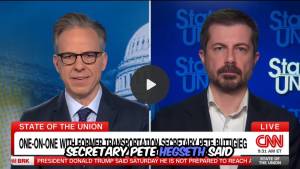 Military veteran and former Transportation Secretary Pete Buttigieg, right, and CNN host Jake Tapper discuss Trump's war against Iran on March 15, 2026.
PoliticusUSA, Pete Buttigieg Blasts Trump For Raising Money Off Of Troops That He Got Killed,.Jason Easley,  right, March 15, 2026. There are many reasons why Donald J. Trump is unfit for the presidency, but it doesn’t get much lower than profiting off of fallen troops. Those troops and their families deserve better from the presidency than what they are getting from Trump.
 The Trump administration is still refusing to look the American people in the eye and tell them the truth about the Iran war. The administration continues to look at the war through optimistic eyes and claims that gas prices will fall in a couple of weeks and the war will end.
It is important for America that those who have been through war in the Middle East speak up and deliver a clear-eyed assessment.
Besides being a veteran and the former secretary of transportation, Pete Buttigieg is a former and perhaps future presidential candidate.
On Sunday, Buttigieg discussed Trump’s Iran war in clear terms.
What I'm worried about is not the soldiers and the people who are serving. What I'm worried about is their political leadership, like Pete Hegseth and Donald Trump.
We lived through a war that was sold to us on false pretenses when I was younger. This war has not been sold on any pretense. The president just went ahead and did it.
Here's the biggest thing that has not changed since the war in Afghanistan or the war in Iraq. The biggest thing that has not changed is who pays the price. We have now seen 13 American service members killed. And when you prepare to go to war, the thing you think about, the thing you most dread is your family being the ones to get that knock on the door.
More than a dozen American families have now gotten that knock on the door. And the president has basically assured us that there will be more where that came from. And while they're paying the ultimate price, every American is paying some price. Right now, mortgage rates are up because of this war.
Food is going to be more expensive because of this war. And, of course, the price of gas that we're paying at the pump is more expensive because of this war.
Buttigieg didn’t stop with telling America that we are being sold a war on no pretenses.
He called out Trump for using the bodies of the fallen to make money.
CNN’s Jake Tapper asked Buttigieg, “So the Trump administration argues that they needed to take action to take out Iran's nuclear weapons program and Iran's ballistic missile program, because, when they came into office, the Biden administration, your administration had done nothing in four years to stop Iran from building a nuclear weapon, developing ballistic missiles, funding terrorism around the world. Are they wrong?”
Buttigieg answered:
Yes, of course they're wrong.
I mean, for one thing, the president assured us that the nuclear program, President Trump assured us that the nuclear program was, in his words, obliterated just a few months ago. And let's also remember that, in the past, Iran's nuclear program was contained without a shot being fired.
I think President Trump thought he could get a better deal than the Obama administration did. He failed to get that better deal. And he went off and launched a war without planning, without being ready for even some of the most basic things.
I mean, it is a certainty that the military would have advised him that the Straits of Hormuz would have been closed, that that was a likely scenario. And yet they're talking about this and clearly acting as though they didn't think this would happen.
Secretary Hegseth went so far as to say that the Straits of Hormuz is open, other than the fact that there would be fire against vehicles transiting the strait. This is clearly amateur hour at the Pentagon and in the White House. And, again, the price is being paid by all of us.
You can also just tell from the administration's attitude toward this war, the fact that they're putting out videos treating this like a video game. It's not a video game for the families of the fallen. And then, just this week, we saw campaign fund-raising materials being put out, e-mails, where the president's committee, the president's political operation was raising money off of images of him at a dignified transfer.
Any politician who does that has no business leading American troops in a war. If the president is willing to raise campaign funds over the bodies of America's war dead, he is unfit to be the commander in chief.
I am old enough to remember when George W. Bush caught criticism for using 9/11 and footage of US troops in the Middle East in his 2004 reelection campaign. Now, Donald Trump is raising money for his super PAC off of the dignified transfer of remains of troops that he got killed through his war of choice in the Middle East.
As usual, the mainstream press is at best asleep at the wheel and at worst willfully ignoring that a president is not only abusing his power by starting a war with no justification. Veterans like Sens. Reuben Gallego and Mark Kelly, along with former Secretary Buttigieg, are important voices at this moment because voices like theirs were suppressed and not visible before the Iraq invasion.
New York Times, Opinion: How Minnesota Beat Trump, Thomas L. Friedman, right March 15, 2026. The last year has been one of the most depressing of my nearly 50 years as a journalist.
It’s not just that I’ve had to watch the Trump administration destroy cherished alliances, like ours with Western Europe and Canada, that have upheld freedom, democracy and global trade since World War II. It’s also been the stunning cowardice and boundless greed with which leaders of big law firms and Big Tech have bent their knees to King Donald and indulged a cabinet of clowns — not one of whom they’d hire in their own businesses.
But then I spent time in my native state, Minnesota, after something else that I’d never seen in nearly 50 years: a spontaneous uprising of civic activism propelled by a single idea — I am my neighbor’s keeper, whoever he or she is and however he or she got here.
It was one of the most courageous battles ever fought by American men and women not in uniform. It was led by moms ready to donate their breast milk to strangers and dads ready to drive someone else’s kids to school because the parents, terrified of ICE agents, were too afraid to go out outdoors. It was neighbors ready to hit A.T.M.s to help out neighborhood restaurants and businesses deciding not to open — thus forgoing their income — for fear that masked ICE agents might drag away their cooks or dishwashers or desk clerks.
And the best part was this: At a time when we have a president so shameless that he insists on putting his name on every public building he can, these good Samaritans of all colors and creeds acted without fanfare. “There were hundreds of leaders of this movement,” Bill George, a longtime Twin Cities business executive, said to me, “and I don’t know a single one of their names.”
Many surely got to know one another, though, because they were all propelled by a verb I’d never heard before: “neighboring,” as in, Today I will be neighboring — going out to protect the good people next door or down the block. Not because I favor illegal immigration, but because I oppose the fundamental indecency of President Trump and Stephen Miller and the blessedly now departed Kristi Noem trying to fulfill their daily quota for evicting illegal immigrants by arresting my neighbors, most of whom work hard, pay taxes, go to church or mosque and help me dig out my car from the snow in winter.
Here’s some free advice for Trump and Miller: Minnesotans are winter people. Don’t come for winter people in winter. They’re not afraid of the cold. Just the opposite. The weather has forged a unique Minnesota neighborliness — not everywhere, not always, but in a lot of places on a lot of days. Its power is rooted in its ordinariness — just a basic human impulse to look out for your neighbors and, yes, dig their cars out of the snow on Monday because you know they will do the same for you on Wednesday.
Observing it up close made me think about what Stephen Miller told CNN’s Jake Tapper in January: “We live in a world in which you can talk all you want about international niceties and everything else. But we live in a world, in the real world, Jake, that is governed by strength, that is governed by force, that is governed by power.”
Well, Stephen, maybe you don’t know the real world after all, because your private ICE army — “governed by strength” and “force” — was sent packing by a bunch of moms and dads armed only with cellphone cameras and whistles, ready to walk out on a freezing morning in bathrobes and bunny slippers, to defend their neighbors, some of whom they barely knew.
Yes, Stephen, maybe you don’t know the “real world” after all, because the real score here is: Neighboring, 1. Trumpism, 0.
More On Iran
New York Times, Iran War Live Updates: Israel Launches New Strikes on Iran, Aaron Boxerman and Vivian Nereim, March 15, 2026. Here is the latest.
Iran’s foreign minister claimed the Strait of Hormuz was open to all except America or its allies. President Trump had threatened to strike Iran’s main oil export terminal if it did not lift the de facto blockade.
Israel said it had launched a new wave of airstrikes on Iran on Sunday, while Iranian forces said they were firing at U.S. and Israeli targets as fears grew about the economic fallout from the Middle East war, now in its third week.
President Trump called on a host of other countries, including Britain, France, and China, to send warships to the Strait of Hormuz to end a de facto Iranian blockade on the shipping of oil through the strategic waterway. It was far from clear, however, whether any countries would volunteer to patrol the strait, through which about a fifth of the world’s oil transits.
Iran’s foreign minister, Abbas Araghchi, said on Telegram that the strait “is open to everyone, except American ships and those of its allies.” In practice, however, the oil shipped through the passage is coming from either Iran or American allies such as Saudi Arabia and Kuwait.
Oil prices have risen steeply since the United States and Israel launched their air war on Iran on Feb. 28. While the Trump administration and other governments have sought to calm the volatility and bring prices down — including by easing sanctions on some Russian oil — they have seen little success thus far.
Mr. Trump threatened to attack oil infrastructure on Kharg Island, home to Iran’s main oil export terminal, unless Tehran allowed ships to pass through the Strait of Hormuz. Such a move would almost certainly rattle energy markets further. U.S. consumers have already seen the price of a gallon of gasoline rise by 25 percent on average, according to the AAA motor club.
On Saturday, Iran’s powerful Islamic Revolutionary Guards Corps rejected Mr. Trump’s threat, asserting in a statement that the critical waterway was under its full control and that “any attempt to move or transit will be targeted.”
Iran faced new Israeli strikes on Sunday. The Israeli military said it has conducted more than 7,000 attacks on the country since the war began.
The Revolutionary Guards force said it was continuing to target Israel and U.S. assets in the region. Iranian missiles repeatedly set off air raid sirens in Israel. Saudi Arabia said it had intercepted drones near the capital and in an eastern province, without saying where they came from.
Here’s what else we are covering:
Israel and Hamas agreed to a cease-fire late last year, but the Israeli military has accused the Palestinian militant group of violating the agreement and continued to bombard the territory. While backed by Iran, Hamas has not joined the regional war, unlike Hezbollah, an Iran-supported militia in Lebanon.
In parallel to Israel’s spiraling war with Iran, the Israeli military has not stopped attacking Gaza, where it fought Hamas, the Palestinian armed group, in a devastating two-year war. On Sunday, at least eight police officers affiliated with the Hamas-controlled administration in the territory were killed in a strike, the Gazan interior ministry said in a statement. The Israeli military did not immediately comment on the incident.
The energy secretary says there are “no guarantees” oil prices will fall soon.ImageEnergy Secretary Chris Wright, wearing a gray suit, sits at a table. American flags are behind him.In an interview with ABC News on Sunday Energy Secretary Chris Wright expressed some confidence that the United States would be able to secure the Strait of Hormuz within weeks.
Energy Secretary Chris Wright said on Sunday there were “no guarantees” that oil prices would fall in the coming weeks, despite President Trump’s having vowed repeatedly that the United States will try to force Iran to stop attacks on oil tankers in the Strait of Hormuz.
“There’s no guarantees in wars at all,” Mr. Wright said in an interview on ABC’s “This Week.” “I can guarantee the situation would be dramatically worse without this military operation to defang the Iranian regime.”
“Right now, our focus is destroying their military capabilities, including those that are used specifically to threaten the straits,” he added. “But we need to finish those tasks first, and you will see the straits open again in the not-too-distant future.”
The Iranian military has been carrying out projectile attacks against tankers in the area, setting ships ablaze and sending the price of crude oil surging on world markets. It has also begun laying mines in the strait, despite the U.S. military’s having destroyed some Iranian naval vessels capable of that type of operation.
Mr. Wright said in another interview on Sunday that the strait was not safe for tanker passage. “No, it is not,” he said on NBC’s “Meet the Press.”
About 20 percent of the world’s oil goes through the narrow waterway connecting the Persian Gulf and the Gulf of Oman.
At a later point in the ABC News interview, Mr. Wright expressed some confidence that the United States would be able to secure the Strait of Hormuz within weeks.
“Yeah, I think that this conflict will certainly come to the end in the next few weeks,” he said, adding that the war could also end sooner than that. “We’ll see a rebound in supplies and a pushing down of prices after that.”
He said the administration was “very aware” that the world “would have short-term disruption” as a result of the war that the United States and Israel started against Iran on Feb. 28. “We would cause a little bit of increased prices on Americans,” he added, noting that “this is short-term pain to get through to a much better place.”
Mr. Wright also rebutted criticism from Democratic lawmakers and others who say the Trump administration did not plan sufficiently for Iran to stop oil tanker traffic through the strait.
“Of course meticulous planning went into what might happen with the Strait of Hormuz, how to deal with that,” he said. “Our chairman of the Joint Chiefs of Staff, General Caine, is known for many things, but high on that list is an absolute meticulous planner of all of the scenarios that might unfold.”
The New York Times reported on Tuesday that Mr. Trump and his advisers miscalculated the scope of Iran’s retaliations — it has carried out missile and drone attacks for the past two weeks across the Middle East, widening the war and disrupting the economy — and its ability to bring traffic in the Strait of Hormuz to a halt.
Mr. Wright deflected a question on which other countries might send warships to help escort tankers through the strait, as Mr. Trump has promised would happen. Mr. Trump listed China, France, Japan and South Korea last week.
“All nations of the world depend on products that come from the Straits of Hormuz,” Mr. Wright said, without mentioning any commitments from other nations to send escort ships.
Iran appears to be allowing some tankers to pass through the strait, including ones carrying oil to China, U.S. officials said. Abbas Araghchi, the foreign minister of Iran, told CBS News on Sunday that the country was not ready to negotiate with the United States, despite President Trump saying the previous day that Iran wanted to make a deal.
“We never asked for a cease fire, and we have never asked even for negotiation,” Araghchi told “Face the Nation.” “We are ready to defend ourselves as long as it takes.” Trump said in a phone interview with NBC News on Saturday that “”Iran wants to make a deal, and I don’t want to make it because the terms aren’t good enough yet.”

Sunday Hopium Chronicles, Democratic Advocacy: Trump Begs The World For Help, Ukrainian Wartech To The Rescue, Senate Rs Getting Worried The Chamber May Flip, Simon Rosenberg, right, March 15, 2026. Trump's terrible, fascistic "Make It Really Hard For Everyone To Vote" bill comes to the Senate this week.
Our failed leader found a new pathetic and desperate path to go down yesterday: He is demanding that other nations of the world come help him fight his war now that it isn’t going so well (note he leaves off Russia here, which is actively supporting Iran in this war with the U.S.). His claim, of course, that these nations will be sending “War Ships” is made up, delusional, Mad Kingy:
Yes, the war has gone to shit. Yesterday the State Department has told Americans living in Iraq -- yes Iraq -- to leave immediately:
There is no domestic option for our allies to step in and help Trump in his failed war.
Historian Phillips O’Brien has a great new article looking into the way Ukraine’s wartech start ups are changing the way war is is fought in Russia-Ukraine, and now likely for the US and in Europe and the Middle East too:
I realize that I and others have been writing much more about the US bombing of Iran in the last two weeks. While that is not surprising (nor a bad thing as what is happening there is so important), it is also vital that the Russo-Ukraine War does not lose attention. Indeed, as we are still in the early phases of 2026, it is worth thinking about where things stood a year ago to understand the strategic value of Ukraine for Europe now and going forward. In a nutshell, a year ago many people were saying Ukraine was failing, that Europe had to take on Ukraine as a burden, etc. Ukraine was portrayed as facing a manpower crisis that would soon see unable to hold back the Russian steamroller and with the USA now under the leadership of Donald Trump, it was proclaimed that Ukraine faced a very bleak future.
The reality ended up being rather different. This year the focus is not so much on Ukrainian weakness but on Ukrainian attempts to fight back and whether they have a chance at success. That is remarkable with the US changing sides and the Russians hammering Ukrainian infrastructure all winter. This change in narrative is because certain key Ukrainian strengths and capabilities are now far more apparent to the media and analytical community than they were a year ago. Much of this strength is in war production and technology, strengths that have become glaringly apparent over the last two and a half weeks. They are so vital that Europe’s defense future now requires Ukraine. Ukraine is now achieving what Europe has struggled with for decades—creating new and innovative start-ups.
The West must now not only embrace the Ukrainian-led tech revolution, but we must make the transition from fossil fuels to cleaner, cheaper, and more distributed energy a national obsession now:
Finally, Politico has a remarkable bit of reporting today, Senate Republicans worry they’re losing ground in the midterms. Some excerpts:
Senate Republicans are growing anxious about the midterms.
They once felt like they had a glidepath to keep or even grow their majority in November, unlike in the House, where GOP control is razor-thin and members have become increasingly on edge about Democrats returning to power.
It’s pretty clear now that Trump has hit the panic button. His big play to change the trajectory of an election he’s losing -- Iran -- has become a global fiasco. Now, his next big play -- passing SAVE -- also looks it is going to fail. In both cases he has ignored warnings from steady hands that he was pursuing a dangerous course and just plowed ahead. More from that Politico story:
Asked about Trump’s claim that the party will be in trouble if it doesn’t pass the SAVE America Act, Senate Majority Leader John Thune told reporters this week that he believed the election is instead “going to be about the economy, and that’s why I think we’re focused on that.”
Republicans in the Senate are right to be worried. Captain Ahab is at the helm of their ship, the ridiculous war is going to make an already weakened American economy far worse, Democrats keep winning and overperforming everywhere, and Senate Democrats have had a great recruitment cycle. Look at the Senate polling we got this week…..
It’s why it is time now……..To Get To Work Everyone!!!!!!!!!!!!!!!!!!!!
Here’s our working Hopium Post-Iran Disaster Agenda:
Keep working hard all. We are entering a dangerous place, and we need to be very, very loud now - Simon
More On Epstein Files, Trump Coverup
 The Other 98%, Advocacy: This is the move everyone has been waiting for, March 14, 2026. Philadelphia DA Larry Krasner, above top, just told every person connected to Jeffrey Epstein's trafficking empire that state prosecutors are coming for them, and there's not a thing Donald Trump can do about it.
 "Hey Epstein class, you may think that whatever happened on that island or happened in Epstein's mansion is not going to haunt you," Krasner said. "Let me tell you who is going to haunt you. It's the prosecutors at the state court level who still care about the Constitution, the laws, and justice."
Because Epstein's operation was sprawling and transnational, it crisscrossed through countless local jurisdictions. That means state prosecutors across the country potentially have standing to bring charges. And here's the part that should have every powerful person on that client list losing sleep: state court convictions cannot be pardoned by any president. Period.
Krasner emphasized that the statute of limitations for crimes involving children extends for years, giving prosecutors a long runway. Any conviction at the state level means real time served, no matter who's in the White House.Krasner already founded the F.A.F.O. coalition, a network of progressive prosecutors from cities including Minneapolis, Dallas, Austin, and multiple Virginia jurisdictions, built specifically to hold powerful people accountable when the federal government refuses to.
He's not bluffing. He's building infrastructure.Under Pam Bondi, the DOJ has shown zero interest in pursuing Epstein's associates. The files have been buried. The investigations have stalled. The coverup is happening in plain sight.So if the federal government won't do its job, Krasner is saying the states will. And the beauty of this approach is that it only takes one indictment. One associate flips. Then another. Then the whole thing unravels.The powerful have spent years assuming they were untouchable. Krasner just told them they're not.
Other98 uses meme warfare and strategic coalition-building to challenge the corporations and billionaires that have hijacked our democracy. We're elevating stories from the front lines of crucial struggles for justice to fight like hell for an America that works for the other 98% of us.
 Four Jeffrey Epstein trafficking victims file suit against Attorney Gen. Pam Bondi, shown below right, with Epstein shown at center (March 10, 2026).
The Search for Accountability, The Epstein Cover-Up: A Lawsuit Against Pam Bondi and the Fight for Justice, Duyen Elaine and Tháng Ba, March 11, 2026. In a shocking turn of events, dozens of survivors of Jeffrey Epstein’s abuse have filed a lawsuit against former Florida Attorney General Pam Bondi, alleging that she played a crucial role in shielding Epstein from a more thorough investigation.
This lawsuit, led by Maria Farmer—one of the first women to accuse Epstein publicly—has become a focal point for those who have fought for years to bring the truth about Epstein’s crimes to light.
The plaintiffs claim that critical details about Epstein’s activities were concealed during the initial investigation and that influential figures, including Bondi, may have deliberately allowed Epstein to avoid more serious charges. This explosive lawsuit has not only rekindled interest in the Epstein case but also raised serious questions about the role of powerful individuals in protecting one of the most infamous sex traffickers in modern history.
As the case gains momentum, it could reveal new, vital information about the way Epstein’s case was mishandled—and whether those who could have stopped him were instead complicit in his ability to evade justice for years.
Bondi faces pressure after first release of Epstein files fell short of expectations | PBS News
The Jeffrey Epstein case has become a symbol of corruption and the deep-rooted power dynamics that allow sexual abuse and trafficking to flourish within the elite circles of society. For years, Epstein’s wealth and connections seemed to shield him from prosecution, despite mounting evidence of his crimes. It was only in 2019, after Epstein’s arrest on federal charges of sex trafficking minors, that the full scope of his abuse began to unravel.
Before his arrest, Epstein had faced allegations of sexual abuse from numerous women, some of whom were minors at the time. Yet, his high-profile connections—spanning politicians, business leaders, and celebrities—allowed him to avoid serious consequences for years. The leniency with which his previous cases were handled raises unsettling questions about the extent to which Epstein was protected by those in power.The Role of Pam Bondi: A Controversial Figure
Pam Bondi, the former Attorney General of Florida, has come under intense scrutiny for her actions during the handling of Epstein’s case in the early stages. According to the lawsuit, Bondi, alongside other officials, played a role in covering up crucial information that could have led to more serious charges against Epstein.
In 2008, Epstein struck a controversial plea deal in which he pleaded guilty to two state charges of soliciting prostitution from a minor. The deal, which many have criticized as a “sweetheart deal,” allowed Epstein to serve just 13 months in a county jail, with work release privileges. Despite the severity of the charges, the deal effectively protected Epstein from facing federal charges related to sex trafficking.
The plaintiffs in the lawsuit argue that Bondi, as the Attorney General at the time, was part of a larger effort to protect Epstein. They claim that key details about his crimes were intentionally overlooked or suppressed, allowing him to continue his predatory behavior unchecked for years. The survivors believe that Bondi’s involvement in the investigation’s early stages helped Epstein avoid more severe charges and prolonged his reign of abuse.

Global News

New York Times, State Department Cuts Price of Renouncing U.S. Citizenship to $450, Ali Watkins, March 15, 2026. The fee had been increased to $2,350 in 2015, prompting criticism and legal challenges from advocacy groups and Americans living abroad
The State Department is drastically reducing the cost of renouncing American citizenship, ending a yearslong legal battle over the price of relinquishing a blue passport.
In an update published in the Federal Register on Friday, the State Department said it was reducing the consular fees of renouncing U.S. citizenship to $450 from $2,350, a more than 80 percent reduction in cost for the clunky, bureaucratic process.
The policy change, which is effective April 13, was proposed in October 2023.
The change announced on Friday returns the fee to what it was in 2010, when the State Department first instituted a charge for Americans renouncing their U.S. citizenship.
The process, which is arduous and costly, requires extensive work from consular officials, including confirming that anyone seeking to give up their citizenship fully understands the implications of doing so.
Obtaining a “certificate of loss of nationality” requires two separate interviews with consular officials, a vetting process and a formal oath of renunciation. The process can take months.
The department warns on its website that the risks of renouncing U.S. citizenship include becoming “stateless” and requiring a visa to enter the United States.
For years, the government has jousted with lobbying groups representing Americans and ex-Americans abroad, who have called the $2,350 fee exorbitant.
Among them is the Paris-based Association of Accidental Americans, which legally challenged the increased fee and sought to have the difference returned to their clients.
“This fee reduction is a concrete first victory — but our fight to have the right to renounce recognized as a fundamental constitutional right continues,” the group’s president, Fabien Lehagre, said in a statement on the group’s Facebook page.Editors’ PicksTips to Avoid Becoming the ‘Dead Wife in a Movie’ TropeHow Neighborly Do Home Additions Have to Be?This Month the Book Review Book Club Is Reading ‘Kin’. Join Us for Discussion.
While there are no figures showing how many Americans have formally renounced their citizenship, an estimated 9 million Americans live abroad.
For them, American citizenship can become a burden — the United States is one of only a few countries that levies taxes based on citizenship rather than geography. This means that Americans living abroad must file a tax return, and they may find it more difficult to open a bank account, because of reporting rules for foreign banks imposed by the U.S. government.
Renouncing U.S. citizenship was free until 2010, when the State Department first instituted the $450 administrative fee. It acknowledged that amount covered “less than 25 percent of the cost to the U.S. government” to process and certify loss of nationality, but kept it at that price in part to keep from discouraging those who sought to use the service.
But a sharp increase in requests — driven in part by foreign banking requirements instituted in 2010 — led the State Department to increase the fee to $2,350 in 2015, to cover the full processing costs.
But the change sparked outrage from expatriate Americans who said the new fee was prohibitive.
“Members of the public have continued to raise concerns about the cost of the fee and the impact of the fee on their ability to renounce their citizenship,” the department said in its announcement.
The State Department first announced in October 2023 that it intended to lower the fee associated with rescinding citizenship. At the time, hundreds of commenters spoke in favor of the change, with many citing bureaucratic American tax policy as the reason they hoped to give up their citizenship.
“Many reported spending hundreds or thousands of dollars a year on tax professionals, even when they might have no U.S. tax liabilities,” the State Department said in announcing the change. “Some stated that despite being required to comply with U.S. tax laws, they received and/or benefited from few of the services for which their taxes were collected.”
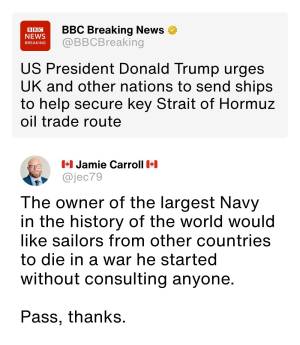
New York Times, Two Arrested in Death of Anti-Iranian Regime Activist in Canada, Yan Zhuang, March 15, 2026. A man and a woman were charged with murder in what the authorities described as a “targeted incident” against Masood Masjoody, who had gone missing weeks ago in British Columbia.
The Canadian authorities have charged two people with murder in the death of an activist who spoke out against the Iranian regime, in what the police described on Saturday as a “targeted incident” involving people who were connected on social media.
The remains of Masood Masjoody, 45, a former university math instructor, were found about a week ago in Mission, British Columbia. Officials had launched an investigation into his disappearance in early February after his neighbors in Burnaby, British Columbia, raised concerns.mageA headshot of a man with glasses standing in front of bare branches.Masood Masjoody in an undated photograph released by the Royal Canadian Mounted Police.Credit...Royal Canadian Mounted Police
On Saturday, the police announced they had arrested a man and a woman, Mehdi Ahmadzadeh Razavi, 48, from Maple Ridge, British Columbia, and Arezou Soltani, 45, from North Vancouver, in the same province. Both were charged with one count of first-degree murder, the Integrated Homicide Investigation Team, a branch of the police, said in a statement.
“While the motive is still under investigation, we can say the victim and the two accused were known to each other and that this was a targeted incident,” Freda Fong, the department’s spokeswoman, said at a news conference.
Public records show that the three people had continuing disputes and exchanges on social media, but it was unclear if those played a role in the killing, Ms. Fong said. She added that neither Mr. Ahmadzadeh Razavi nor Ms. Soltani had a criminal record in Canada, and had limited prior interactions with the police.
Mr. Masjoody was a critic of the Islamic Revolutionary Guards Corps and served as a board member of the Iran Front for the Revival of Law and National Sovereignty, an anti-regime activist group active in Europe and elsewhere.
In early February, the group released a statement expressing concerns about his disappearance, describing him as someone who had devoted years to exposing “influence and intimidation networks linked to the Islamic Republic within the host countries of Iranian communities.”
In recent years, Mr. Masjoody had also filed a number of lawsuits against parties, including the university where he had previously taught, the social media company X and Reza Pahlavi, the son of the last shah of Iran who lives in the United States and has sought to position himself as an counterweight to the Islamic Republic.
Court records show that Mr. Masjoody lost his job at Simon Fraser University because of instances of professional misconduct, including using an alternate grading system and publicly accusing staff members of providing a “safe haven for Islamic Republic thugs.”
A Truth For You, Plot twist of the century: Israeli PM Benjamin “Bibi” Netanyahu is basically a Philly suburb kid who rebranded harder than a TikTok influencer! March 15, 2026. The future prime minister is shown in a high school photo and bio below:
 Born in Tel Aviv (1949), but teen years? Straight-up Cheltenham High School, class of ’67 in suburban Philadelphia. Played soccer (left wing—goals AND geopolitics?), debate club (foreshadowing much?), chess club (checkmate on world leaders?).
Skipped his own graduation to get back to Israel and join the IDF right before the Six-Day War. Iconic move.
 But wait—his last name wasn’t always Netanyahu. Family original: Mileikowsky (very Polish, very Ashkenazi Jewish from Warsaw). Grandpa Nathan Mileikowsky—a rabbi and hardcore Zionist—moved everyone to Mandatory Palestine in 1920, started signing articles “Netanyahu” (Hebrew for “God-given”), and the fam fully switched it.
Classic early Zionist glow-up: ditch the European surname for that biblical Hebrew flex. (Ben-Gurion was Grün, Sharon was Scheinerman… whole squad was rebranding like it was 1920s MySpace.)
So yeah, from Polish-Jewish roots → Philly high school jock → global controversy magnet. The guy who lectures the world on history spent his awkward teen years in the land of cheesesteaks and mall hangs. Who knew the future PM was dodging dodgeball in Pennsylvania?
Bonus drama: Inducted into Cheltenham’s alumni Hall of Fame in ’99… until 2025 when students petitioned to boot him. Small-town shade hits different!
Wildest “world leader was secretly one of us” story?

South African leader Cyril Ramaphosa (Reuters photo).
New York Times, News Analysis: New U.S. Diplomat Was Not So Diplomatic. South Africa Pushed Back, John Eligon, March 15, 2026. The latest clash between the two countries illustrates the depths to which relations have sunk and the struggle to forge a new path forward.
Less than a month into his job, the new United States ambassador to South Africa delivered some harsh words against the government.
He claimed that South Africa had more than 150 laws “aimed against whites,” and that the Trump administration was “running out of patience” with the South African government.
He made veiled comments about South Africa’s president, Cyril Ramaphosa, subtly accusing him of “insulting our president,” an apparent reference to Mr. Ramaphosa’s criticisms of President Trump in a recent interview with The New York Times. And he rejected a South African court’s ruling that an anti-apartheid song was not hate speech. “I don’t care what your courts say,” said the ambassador, L. Brent Bozell III, speaking at a business forum in the Western Cape Province.
 After making those statements, Mr. Bozell was summoned by the foreign minister on Wednesday to explain his “undiplomatic remarks.”
This latest clash between the United States and South Africa illustrates how deeply relations between the two governments have fallen. Early last year, South African officials worked hard to explain their policies to the Trump administration, eager to find common ground with their nation’s second-largest trading partner. They sent envoys and requested meetings.
Now, South Africa appears to have given up trying to reason with Trump officials on subjects like the killing of white farmers, government land seizures and laws meant to redress the legacy of apartheid. “We will not be bullied,” Mr. Ramaphosa said in his state of the nation addresses last month and last year.
South African officials have realized that “trying to explain or clarify or debunk those negative narratives is a largely futile exercise,” said Ziyanda Stuurman, a Cape Town-based adviser at Africa Practice, a strategic advisory firm. “Ultimately, right now, I think that the relationship is in a state of managed decline where neither side will climb down from their view of the other.”
This icy posture with the United States carries great risk for South Africa, a much smaller country. But South Africa also has a history of diversifying its alliances with the hope of making itself less reliant on global superpowers. That strategy of seeking out like-minded middle powers has become more pronounced amid global disruptions caused by Mr. Trump, analysts say.
On the same day that Mr. Bozell made his remarks, Mr. Ramaphosa was on a state visit to Brazil, where its president, Luiz Inácio Lula da Silva, suggested that their nations deepen defense cooperation. “I don’t know if Comrade Ramaphosa realizes that if we don’t prepare in terms of defense, one day someone might invade us,” he said during a joint news conference.
“We have a lot to learn from each other,” Mr. Ramaphosa replied.
As the leader of Africa’s largest economy, Mr. Ramaphosa has long trumpeted the role of middle powers on the global stage. In his interview last month with The Times, he criticized what he described as attempts by some countries to dominate others using economic pressure and other levers.
“We’ve now arrived, and it is wrong for us to keep on being locked out of the door,” he said. “Much as we are small or middle power countries, respect us as well and deal with us on the basis of respecting our sovereignty and seeking to advance the interests of all.”
But Mr. Ramaphosa and his government have been accused, even by allies, of not always practicing what they preach. After Russia invaded Ukraine four years ago, South Africa walked back its initial statement that Russian troops should withdraw, a move that angered its European partners.
Mr. Ramaphosa also drew condemnation this month for sending a condolence letter to the Iranian Embassy after the country’s supreme leader was killed by U.S.-Israeli bombings.
South Africa’s critics have argued that its claims of nonalignment have been used as a tactic by the governing party, the African National Congress, to maintain alliances with apartheid-era allies that the West now views as enemies, like Cuba and Russia.
“Nonalignment is used to pretend neutrality as cover for aligning with anti-Western interests,” Joshua Meservey, a senior fellow at the Hudson Institute, a conservative think tank, wrote in a thread on X. “SA has openly aligned against the US on key issues for decades, something the US ignored until recently.”
At the business conference, Mr. Bozell said he was also concerned about “South Africa’s growing engagement with some of America’s greatest adversaries,” an apparent reference to Tehran.
After his meeting with South African officials, Mr. Bozell clarified his remarks on social media on Wednesday, in an effort to bring down the temperature. But the substance of his comments has not changed.
“If the U.S. ambassador sticks to his guns on these issues,” said Priyal Singh, a senior researcher at the Institute for Security Studies, a South African think tank, “it’s definitely going to be a tough couple of years for South Africa and the U.S.”
U.S. Tariffs, Economy, Jobs, Inflation
Politico, Trump’s latest tariffs face a fresh set of legal hurdles, Josh Gerstein, March 15, 2026. Here are the key issues in the court fight over Trump’s newest tariffs after the Supreme Court’s ruling.
Just three weeks after the Supreme Court handed President Donald Trump a stinging defeat over the sweeping tariffs he imposed last year, the legal battle over his first move to replace those import taxes is heating up.
Democratic attorneys general and governors from 24 states and a libertarian group representing two small businesses filed their first legal briefs Friday asking a federal trade court to strike down the 10 percent tariffs Trump imposed on most U.S. trading partners in February.
Trump promised to hike those tariffs to 15 percent, but hasn’t yet done so.
Legal experts told POLITICO that Trump’s backup tariffs are probably on stronger legal footing than the “Liberation Day” taxes the high court struck down.
Despite that, his challengers are exuding bravado about their chances.
“We are 100 percent confident that we will be successful in the Court of International Trade,” New York Attorney General Letitia James told reporters last week.
Trump is also projecting confidence, repeatedly claiming that the same Supreme Court went ahead and blessed his use of other authorities, like the so-called Section 122 tariffs he’s turned to as a short-term fix.
That is not true. While the three justices who dissented from last month’s decision did cite Section 122 as one of the tools Trump could use to rebuild his tariff scheme, the court’s six-justice majority explicitly declined to embrace that position. “We do not speculate on hypothetical cases not before us,” Chief Justice John Roberts wrote.
While Trump called his new approach “time tested,” that authority has never been invoked before, and the high court has not given its blessing to Trump using that specific law in the current circumstances.
Here’s a look at the key issues in the legal fight over Trump’s replacement tariffs.
Transitions
The Columbus Free Press, In Memoriam: Clifford O. Arnebeck, Democracy Warrior, Bob Fitrakis, Jan. 3, 2023, republished. Cliff Arnebeck, right, who could pass for Clark Kent, transformed himself into Superman as he came to our rescue in times of democratic crisis.
I first encountered Cliff when I was campaign manager during Tom Erney’s 1990 run for Chalmers Wylie’s 15th district congressional seat. Cliff also ran against Wylie in the Republican primary.
I planned a series of debates where Wylie failed to attend but Cliff always showed up. Cliff was one of the most honest and forthright speakers I’d ever heard. He shared the same democratic values put forth by the Erney campaign. He wanted to get rid of the “permanent Congress” that dominated U.S. politics. We became political friends and allies on key issues.
The next time I remember Cliff’s work is when I wrote about his attempt to prevent the city’s destruction of the old Ohio penitentiary, using historical preservation laws to preserve it. Later, I supported his lawsuit that successfully challenged the 2000 Ohio Chamber of Commerce's financing of a campaign to defeat Democratic Justice Alice Robie Resnick. Early on, Cliff realized that the Chamber was involved in illegal court packing and results would be devastating for democracy in Ohio. I was also especially impressed when Cliff agreed to join the Reverend Gary Witte and I on a last-minute trip to the Mansfield prison’s death row trying to get a last testimony from Johnny Byrd before his impending execution.
Cliff and I were two of the four attorneys who challenged the 2004 Ohio presidential election results. He was one of the original attorneys who heard the public’s testimony in hearings we held all over the state about election irregularities. As a result of the numerous election complaints, US Representative John Conyers called congressional hearings in Washington DC and Columbus, where Cliff and I testified. Conyers issued a long report on the irregularities causing the election results to be challenged in the US House and Senate.
Cliff played a key role in subsequent litigation regarding the 2004 presidential election in Ohio. The Moss v Bush case sued to overturn the 2004 election results and the King Lincoln Bronzeville Neighborhood Association v Blackwell case sued to correct the election results and seek fair election reforms. Fighting for free and fair elections then became Cliff’s main political purpose in life.
Starting in 2005, Cliff shared an office with the Columbus Free Press and independent media center. We continued to collaborate on election integrity activities including books, articles, conferences, radio shows, movies, hearings, election protection, speaking engagements and more lawsuits. Cliff and I took testimony from Michael Connell, the Bush family and Karl Rove’s IT guru responsible for the system that flipped votes in 2004, just prior to his untimely death in a small plane accident. Cliff was a tireless advocate for election reform and exposing political corruption. He represented me in court several times in my lawsuits to prevent election rigging in the state.
Cliff was a happy warrior, always in good humor, and he and his wife Sibley were a constant presence at the monthly Free Press Second Saturday Salons. The Free Press awarded them a “Libby” award for the devotion to community service.
Ultimately, Cliff began as a corporate Harvard lawyer who gave up much of his fiscal well-being to fight for democracy. Cliff passed away in December 2022 in Michigan of non-Hodgkins lymphoma.
Status, POLITICO’s Precarious Perch, Natalie Korach, March 15, 2026. As Axel Springer searches for the publication’s next top editor, Status has learned executives may also be quietly weighing a business-side leadership shakeup as well.
 Earlier this month, a report in Puck took some at POLITICO by surprise. The story said that executives at parent company Axel Springer had taken meetings with media industry leaders, fueling internal speculation that they might be considering replacing POLITICO’s chief executive, Goli Sheikholeslami.
The possibility that Mathias Döpfner, Jan Bayer, Claudius Senst, and other Axel executives might be eyeing a business-side shakeup had not been on the radar of those inside POLITICO, where many assumed the company’s immediate focus was limited to finding a successor to John Harris as editor-in-chief. Some also believed that Döpfner’s attention was elsewhere, particularly as the company was finalizing its bid for The Daily Telegraph.
Status has since independently confirmed that Axel brass has indeed spoken with industry executives about the potential role, according to two people familiar with the matter. One person told Status that Döpfner had explicitly asked them for recommendations of candidates who might be a good fit to run the outlet. Axel Springer disputed that characterization in a statement. Senst, the German publishing giant’s chief operating officer, told Status: “Any speculation about replacing Goli or questioning our confidence in her as CEO is unfounded. She has our full support, and we look forward to POLITICO's continued growth under her leadership.”
Get exclusive interviews, scoop-driven reporting, and deep analysis on the media forces shaping society.Upgrade to Paid
Support independent journalism and stay ahead—become a member today.
Still, that vote of confidence appears unlikely to quell chatter about Axel Springer reassessing POLITICO’s leadership structure. Last year, Harris announced he would step aside from the top editor role, kicking off a widespread search for a global leader to replace him. That search has prompted internal speculation about how much change Axel Springer is looking to implement at the Washington political outlet.
Sheikholeslami was named chief executive of POLITICO in 2022, one of the first big hiring decisions Axel Springer made after acquiring the publication the year prior for over $1 billion. At the time of her appointment, Bayer, the chairman of Axel’s supervisory board, said that Sheikholeslami would expand on Axel’s plans to “build the global news and information leader on politics, policy and regulation in power centers across the world.”
March 14
Top Headlines
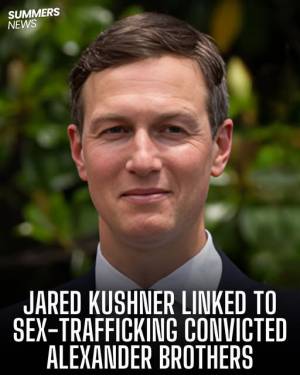 New York Times, Jared Kushner Solicits Funds for His Firm While Working as Mideast Envoy, Copeland and Maureen Farrell, March 14, 2026 (print ed.). President Trump’s son-in-law is trying to raise $5 billion or more from foreign governments and others for his private equity firm.PoliticusUSA, News and Commentary:Trump's FCC Chair Threatens To Take Away Broadcasting Licenses If Networks Don't Push Iran War Propaganda, Sarah Jones and Jason Easley, March 14, 2026. Trump's FCC Chair Brandon Carr threatened to take away licenses from broadcasters if they don't stop telling the truth about the Iran war.
The Case For Trump Treason Over Iran War
 March 13-14, 2026. The fully sourced, highly specificcase for investigating Donald Trump for Treason—a federal criminal offense (18 U.S. Code § 2381) punishable by death—is in fact not complicated.
News Roundups
March 14, 2026. President Trump has privately acknowledged to his staff that he did not expect Iran to close the Strait of Hormuz.More On Iran
March 14, 2026. Trump claims that he did the rest of the world a favor by starting a war with Iran, so now he wants other countries to join the war to open the Strait of Hormuz.right, March 14, 2026. Every day we are reminded that Trump doesn't give a sh*t about America or the American people. U.S. Governance, Elections, Politics
U.S. Justice, Law, Crime, Courts, Rights
U.S. Media, Propaganda, Artificial Intelligence
Top Stories
New York Times, Why Little Was Done to Head Off Oil’s Strait of Hormuz Problem, Rebecca F. Elliott and Vivian Nereim, Rebecca Elliott and Vivian Nereim, March 14, 2026. Geography and regional rivalries have prevented Gulf countries from finding a true alternative to the strait, which the war with Iran has effectively shut down.
Of all the risks the global energy system has long faced, none was bigger or better known than the potential closure of the Strait of Hormuz.
The narrow passageway out of the Persian Gulf is both vital — serving as the only gateway to the rest of the world for huge amounts of oil and natural gas — and extremely vulnerable to attacks.
But despite being widely recognized as a potential choke point, the strait remains the only way to export most of the energy produced in the region. That has come into sharp relief in the second week of the war in the Middle East, as the near-closure of the waterway sent oil prices soaring above $100 a barrel for the first time in almost four years.
The reason there is no true alternative comes down to a combination of geography, political tensions and economic competition among the region’s oil powers. There have been efforts to circumvent the strait, notably by Saudi Arabia and the United Arab Emirates. But the pipelines through those countries can carry only a small fraction of the energy produced in the Persian Gulf.
For many other energy-producing countries in the region, the only way to avoid the strait would be to lay a pipeline across a neighboring country — an expensive and politically fraught endeavor. Take Qatar, one of the world’s biggest natural gas exporters. Its only land border is with Saudi Arabia — a country that cut off diplomatic ties and closed that border during a regional spat resolved five years ago. Plus, any pipeline would itself be vulnerable to Iranian attacks.
New York Times, Iran War Live Updates: Iran Defies Trump’s Threats Over Strait of Hormuz Blockade, Aaron Boxerman, Yeganeh Torbati, Farnaz Fassihi and Erika Solomon, March 14, 2026. President Trump threatened to “wipe out” oil infrastructure on Kharg Island if Iranian forces continued to block the critical conduit for fuel. The U.S. Embassy in Baghdad was hit for the second time since the war started.
Iran on Saturday rebuffed President Trump’s threats to potentially bomb Iranian oil infrastructure unless Iranian forces ceased menacing ships in the Strait of Hormuz, saying that the critical waterway was under its full control and that “any attempt to move or transit will be targeted.”
The defiant statement came a few hours after an Iran-backed militia said it had hit the American Embassy in Iraq late Friday night, and after the United States bombed military installations on Kharg Island, Iran’s main oil export hub.
Mr. Trump said he had ordered the military to spare the island’s energy infrastructure for now, but that he could “wipe out” the terminal if Iran continued to block the Strait of Hormuz. But on Saturday, Iran’s Islamic Revolutionary Guards Corps made clear that they did not intend to give up control of the strait.
The powerful Iranian military force said in a statement carried by Iranian media that it would not allow any “oil tankers or commercial ships” belonging to “aggressors and their allies” to pass through the area, a funnel for about one-fifth of the world’s oil shipments.
Also on Saturday, Kataib Hezbollah, an Iran-backed militia group in Iraq, shown at right in a flag-map,said it had fired on the U.S. Embassy in Baghdad, the second time the U.S. mission there has been attacked in as many weeks. Two Iraqi security officials who were not authorized to speak publicly confirmed the attack but could not give additional details.
An Iran-backed militia took responsibility for an overnight attack on the U.S. Embassy in Baghdad. President Trump called on other nations to help escort oil tankers through the Strait of Hormuz.
President Trump on Saturday afternoon reiterated calls for countries that rely on oil flowing through the Strait of Hormuz to help secure the shipping route. In a Saturday post on Truth Social he said the United States had “completely decimated” Iran and would assist other nations in securing the passage, adding, “This should have always been a team effort, and now it will be.”
Earlier today, Mr. Trump said in a separate post that “hopefully” many countries - including China, France, Japan and South Korea and the United Kingdom - would send naval assets to help secure the strait.
Nations in the Persian Gulf continued to report attacks by drones and missiles on Saturday, but the pace appeared to follow a broader slowdown in Iranian strikes. In Qatar and Kuwait, the daily number of strikes by missiles and drones were in the single digits, according to governments defense reports.
The United Arab Emirates defense ministry said its air defenses “engaged” 9 ballistic missiles and 33 drones launched by Iran on Saturday, and Saudi Arabia’s defense ministry reported a handful of drone interceptions during the day. Bahrain’s military said it had destroyed 124 missiles and 203 drones since the start of Iran’s attacks, but did not specify a daily number.
 As the war entered its third week on Saturday, more than 2,000 people have been killed, the vast majority of them in Iran and Lebanon. Millions of people have been displaced in countries across the Middle East, according to the United Nations agency for refugees.
The Trump administration has struggled to sell the war with Iran to a skeptical American public, including Mr. Trump’s own right-wing supporters. His advisers appear to have miscalculated how severely Iranian retaliation could disrupt global energy markets.
In part as a result of the Iranian blockade of the Strait of Hormuz, oil prices have risen by more than 40 percent, defying efforts to calm markets. On Saturday, U.S. gasoline prices jumped again, to a national average of $3.68 a gallon, according to the AAA motor club, an increase of 23.5 percent since the war began.
Since the war began, the United States and Israel have struck over 15,000 targets in Iran, according to the Pentagon. In the Iranian capital of Tehran, the streets are often empty in the daytime and security forces deploy at night, deterring potential demonstrators, one city resident said.
In the morning, he said, he wakes up to the sound of explosions. He spoke on the condition of anonymity to avoid government reprisals.
Here’s what else we are covering:
The Lebanese health ministry raised the number of people killed in Lebanon during the Israeli military campaign against Hezbollah to 826, according to the country’s state media. More than 2,000 people in the country have been wounded since the war began.
An overnight strike in Baghdad hit a headquarters of the Iran-aligned militia, Kataib Hezbollah, killing three people, including one of its commanders, known as Abu Ali al-Amiri, according to an official from the group as well as an Iraqi security official. Both asked not to be identified because they were not authorized to discuss the matter publicly.
 António Guterres, above, the U.N. secretary general, was asked on Saturday about comments from some Israeli officials suggesting that the devastation in Gaza could be used as a model for Lebanon. He responded that such a scenario must be avoided. On Friday, Israel dropped leaflets over Beirut, the Lebanese capital, that referred to its invasion of Gaza as “a remarkable success.” Guterres said: “What happened in Gaza is a disaster that must be avoided anywhere else in the world.”

Jared Kushner, shown at top right with Elon Musk and royalty at a World Cup match in Qatar on Dec. 18, 2022.
New York Times, Jared Kushner Solicits Funds for His Firm While Working as Mideast Envoy, Copeland and Maureen Farrell, March 14, 2026 (print ed.). President Trump’s son-in-law is trying to raise $5 billion or more from foreign governments and others for his private equity firm.
Jared Kushner, one of the U.S. government’s chief negotiators in the Middle East, is trying to raise more money for his private equity firm from governments in the region.
Mr. Kushner, President Trump’s son-in-law, has spoken with potential investors in recent weeks about raising $5 billion or more for Affinity Partners, his investment firm, according to five people with knowledge of the talks who were not permitted to speak publicly about the discussions.
As part of the fund-raising effort, Affinity’s representatives have already met with Saudi Arabia’s Public Investment Fund, which invests the proceeds of the kingdom’s vast oil reserves, two of the people briefed on the discussions said. PIF is led by Crown Prince Mohammed bin Salman, who has formed close ties with Mr. Kushner and the Trump administration.
PIF, which is already the largest and earliest investor in Affinity, invested $2 billion soon after the first Trump administration ended.
As part of that deal, the Saudis must be given the first chance to invest during any subsequent attempts by Affinity to raise funds, the two people said. Other Middle Eastern sovereign wealth funds that invested earlier in Affinity, including those in the United Arab Emirates and Qatar, are also expected to be asked for more, the people said.
Mr. Kushner’s fund-raising is expected to stretch on for the better part of this year.
The efforts show the blurring of the lines between public service and private profit-seeking during Mr. Trump’s second term. Only a few weeks ago, in his role as Mr. Trump’s “peace envoy,” Mr. Kushner met in Geneva with Iran’s foreign minister. The U.S. and Israeli bombing campaign in Iran began shortly after those meetings concluded without a deal on Iran’s nuclear program.
Mr. Kushner, 45, also spearheaded the Trump administration’s successful efforts to extract hostages from Gaza and negotiated between Russia and Ukraine in an attempt to end their war.
In January, Mr. Kushner traveled to Davos, Switzerland, as part of the official U.S. delegation at the World Economic Forum, where he unveiled the Trump administration’s plan for a “New Gaza.”
While at Davos, Kushner also discussed his plans to raise billions in new investments for Affinity in private meetings with international business leaders, two people with knowledge of the conversations said.
As recently as December 2024, Mr. Kushner suggested that he would not seek more money for Affinity during Mr. Trump’s second term. That month, he told the podcaster Patrick O’Shaughnessy that he would “pre-emptively try to avoid any conflicts.”
“We don’t have to raise capital for the next four years,” Mr. Kushner added.
That appears to have changed. In materials provided to potential investors this year and reviewed by The New York Times, Affinity indicated that more than three-quarters of the roughly $5 billion it had raised since its founding had already been spent on investments in companies such as Phoenix Financial, an Israeli insurer, and Revolut, a financial technology start-up.
Affinity’s preliminary internal projections suggest that it has earned an estimated 25 percent rate of return since its 2021 founding, the documents show.
The scion of a prominent real estate family, Mr. Kushner is a relative newcomer to private equity, an industry where giant investors buy part or all of companies and try to improve the businesses before selling them.
When he began Affinity, based in Miami, he leaned heavily on his government contacts. During the first Trump administration, Mr. Kushner served as a senior adviser to his father-in-law, often accompanying him on trips to meet with foreign officials.
PoliticusUSA, News and Commentary:Trump's FCC Chair Threatens To Take Away Broadcasting Licenses If Networks Don't Push Iran War Propaganda, Sarah Jones, right, and Jason Easley, March 14, 2026 . Trump's FCC Chair Brandon Carr threatened to take away licenses from broadcasters if they don't stop telling the truth about the Iran war.Sarah Jones.
The signal was sent during Secretary of Defense Pete Hegseth’s latest briefing, which was a loss in the media and a loss in the war in Iran. Hegseth attacked the media for reporting details about the planning mistakes that appear to have been made by the Trump administration, and that the war is not going as well as the rosy picture that the White House likes to paint would suggest.
Hegseth took time out of his briefing to lecture the press about how he thought they should cover the war. To the surprise of no one, the Trump administration official wants the war to be covered as sunshine and rainbows as the United States marches to an easy victory.
The reality is that Donald Trump spent Saturday posting that the allies of the United States, whom he trashed, should be helping to open the Strait of Hormuz.
Trump’s administration doesn’t want to acknowledge that its war in Iran is the least popular war at such an early stage in the history of public opinion polling.
The administration is blaming the media for the unpopularity of the war, so their answer is to use their power to threaten broadcasters.
Trump’s FCC Chair Brendan Carr, right, posted on X on Saturday:
Broadcasters that are running hoaxes and news distortions - also known as the fake news - have a chance now to correct course before their license renewals come up.
The law is clear. Broadcasters must operate in the public interest, and they will lose their licenses if they do not.
And frankly, changing course is in their own business interests since trust in legacy media has now fallen to an all time low of just 9% and are ratings disasters.
The American people have subsidized broadcasters to the tune of billions of dollars by providing free access to the nation’s airwaves.
It is very important to bring trust back into media, which has earned itself the label of fake news. When a political candidate is able to win a landslide election victory after in the face of hoaxes and distortions, there is something very wrong. It means the public has lost faith and confidence in the media. And we can’t allow that to happen.
The “landslide victory” Carr was referring to was Donald Trump's in 2024. Even though Trump did not win by a landslide, and the corporate media spent much of the campaign working on Trump’s behalf by refusing to mention his felony convictions, the 1/6 case against him, or Trump’s theft of classified materials.
Carr’s comments are making it clear that the FCC is a partisan instrument to do Donald Trump’s bidding, and no longer acting in good faith for the American people.
It is not Carr’s job to promote “trust in the media,” whatever that is. Carr’s job is to implement the law.
Carr does not have any power over cable networks or the internet, but his comments are trying to create a chilling effect across all media.
The administration wants the media to be afraid to tell the truth about the Iran war.
The media isn’t the reason why the war is unpopular, and even if all the broadcast networks spread propaganda, the popular opposition is likely to keep growing.
The Case For Trump Treason Stemming From Iran War
Proof, Investigative Commentary; Yes, It’s Finally Time to Talk About Trump and Treason, Seth Abramson, left, attorney, best-selling author, professor, March 13-14, 2026. The fully sourced, highly specific case for investigating Donald Trump for Treason—a federal criminal offense (18 U.S. Code § 2381) punishable by death—is in fact not complicated.
The United States is at war with Iran (whether declared or not is immaterial for 18 U.S. Code § 2381 purposes, as the Trump administration has repeatedly acknowledged America is at war before trying to take it back—as have key members of Congress who refuse to vote on it anyway, and all of American media—and also because such de facto and de jure distinctions don’t matter for statutory purposes if jus in bello applies, as it certainly does now in Iran). Due in part to this new fact, it is finally appropriate to have a real rather than merely rhetorical conversation about Trump and Treason.
 The second of the Treason statute at issue here effectively requires a military conflict rather than “merely” the workaday betrayals of American interests Donald Trump has authored since 2015—corrupt actions which have understandably seen him deemed “treacherous” or a “traitor” in lay terms even as no lawyer would argue the Treason statute has been formally triggered. It’s for this reason that this author, an attorney as well as a Trump critic and presidential historian, has often observed that while Trump engages in treachery of American interests and has betrayed his countrymen too many times to count in ways large and small, the Treason statute isn’t applicable here.
Well, now it may be.
Here is the case for a federal criminal investigation into whether Donald Trump has committed the death-penalty-eligible offense of Treason, an offense that—to be very clear—he’s often accused political rivals of and said they should be put to death for.
(1) A never-followed-up-on FBI report hidden by Donald Trump’s personal lawyers for a year but just now released to the American public in the latest Epstein Files tranche says that (a) Jared Kushner is running the Trump administration, (b) he is an Israeli agent who does the bidding of Israeli prime minister Benjamin Netanyahu, and (c) this and other secret Israeli incursions into the United States government have caused President Donald Trump to be “compromised” by Israel.
This claim by a trusted FBI confidential source is not unanchored by other facts—in fact, it’s highly consistent with all presently known evidence relevant to the question—even though neither the first nor second Trump administration ever designed to investigate it.
Readers will recall that Jared Kushner was denied a security clearance because of his foreign dealings, which dealings led to the U.S. Intelligence Community fearing current “foreign influence” over him. He received a security clearance only because his father-in-law (now accused, alongside his son-in-law, of being a compromised foreign agent) overruled the entire national security apparatus of the United States.
Kushner thereafter was accused of leaking classified intelligence to foreign autocracies and seeking a clandestine and illegal backchannel to the Kremlin. Foreign autocrats were then overheard boasting that they had Kushner “in their pocket.”
His friendship with Netanyahu has lasted decades, to the point that the man has slept in Kushner’s childhood bed many times. Kushner has never taken any public stance or action that opposes any action by the Israeli state, and has repeatedly pursued policies (as his father-in-law’s Middle East envoy for two administrations now) that benefit Israel and harm American interests, including supporting a genocide in Gaza and—according to President Trump—being the person who told him that Iran was an imminent threat America had to launch a war against in both 2025 and 2026, despite not one member of Congress (or even any member of the Trump administration) making that case to the American people or one another in a way that passes muster under international law, federal law, historical precedent, or any other measure. In fact, to the contrary the Mueller Report identified numerous instances in which Jared Kushner engaged in clandestine collusion with both Russian and Israeli nationals, a key finding given that the aforementioned never-followed-up-on FBI report links Kushner’s foreign-agent status to Chabad, a radical far-right entity whose birthplace and chief sphere of operation is Russia even as it works on behalf of Israel in transnational operations.
(2) The Trump administration has admitted that America is at war with Iran right now because of the desires of Benjamin Netanyahu—not American intelligence assessments about whether Iran was an imminent threat to America in either 2025 or 2026. Marco Rubio, the United States Secretary of State, confirmed the reporting of longtime British diplomat Alastair Crooke in saying that America co-launched the Second Iran War because—just as the neutral Omanis were telling the world that America and the Iranian regime were on the cusp of a new nuclear deal that (we now know) the Israelis opposed—Netanyahu told President Trump that Israel was going to attack Iran unilaterally (a war crime) one way or another.
In the aftermath of this stunning statement by Netanyahu, a wanted war criminal who is under indictment also in his own country for numerous public-corruption felonies, Trump decided that America would go to war rather than anger the very same foreign leader that a never-followed-up-on FBI report says he’s beholden to through Kushner.
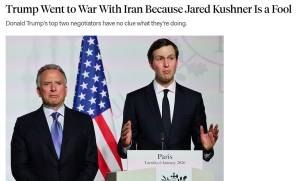 In order to maintain a false cover story justifying war, Trump turned to none other than… Jared Kushner (shown above with fellow Trump envoy Streve Witkoff under a disparaging headline from a commentator.).
Kushner is who Trump now cites as the source who told him Iran posed an immediate danger and had to be engaged in a full-scale war. Kushner has no intelligence or foreign-policy training or credentials, offered no evidence to back up his claim, and indeed was only in a position to advise his father-in-law this way because his father-in-law put him in a position of power despite being warned by the U.S. intelligence community that Kushner was likely compromised by a foreign power through any of (a) his lifelong friendship with Netanyahu, (b) his radical far-right religious beliefs about the centrality of Israel in all human affairs, (c) his own personal business interests as an investor in a postwar Gaza luxury development that could eventually make him billions of dollars, (d) billions in corrupt investments from the Saudis and Emiratis (who would benefit directly from the collapse of the Iranian regime), or simply (e) the possibility that he’s under the control of Mossad either via blackmail, Chabad, or wittingly (an allegation also made, in the Epstein Files, about Jeffrey Epstein, long an acquaintance of Jared Kushner and accused, like Kushner, of loyalties to Russia and Israel and financial compromise by both the Saudi and Emirati royal families.)
(3) The Second Iran War is manifestly not in the interests of the United States, has caused the deaths of a number of American soldiers, has harmed the American economy, has damaged America’s standing in the world—including its military alliances—and poses an ongoing violent threat to the American homeland and to U.S. bases abroad via missiles, drones, lone-wolf terror attacks, cyberattacks, and more. In the context of this, it remains the case that neither Trump nor anyone in his administration has articulated any reason for the United States to be at war with Iran beyond assisting a known war criminal from a country hostile to the United States—as it has interfered openly and criminally on Trump’s behalf in recent U.S. presidential elections—in a war of choice primarily intended to keep him (Benjamin Netanyahu) in power and out of prison in his own country.
 Notably, Trump’s words himself underscore that the Second Iran War is solely aimed at aiding and abetting the war criminal Netanyahu (shown together in an October 2025 meeting) rather than American interests.
The president said in mid-2025 that Iran’s nuclear capabilities were “obliterated,” and maintains this stance to the current day, so he can’t say America is at war to end Iran’s nuclear program. No Iranian missiles can reach the American homeland, nor can any Iranian drones (which have a maximum range of only 1,200 miles). The only attacks by Iran on U.S. bases in the Middle East have been in response to U.S. attacks on Iran, so the president can’t claim that Iran is a ballistic missile threat even to U.S. interests overseas. While Iran is a state sponsor of terror, it’s been so for nearly a half-century and has gained no new capacity or aggressiveness in this regard to warrant turning ongoing law enforcement operations into a full-blown military conflict. And we must also note that it is this military conflict that has now increased the domestic terror threat, a reality so damning to Trump and Kushner that they have tried to block its release to the American people. Nor is this way targeted in any way to reduce terror attacks on American soil; in fact, Trump and his personal lawyers Pam Bondi and Kash Patel have reduced every single domestic capacity American federal law enforcement has to detect, track, and thwart Iranian terror threats (see here for more), so it’s not possible to say that the Second Iran War has anything to do with terrorism.
(Summation) In view of all the foregoing, there’s ample reasonable suspicion that the United States has been thrust into a war that is (a) killing our troops and citizens at home, (b) dramatically increasing the threat to our homeland, (c) all but destroying our standing with our allies, (d) destabilizing the American and world economy, and (e) pushing the United States to commit multiple war crimes that could end future international cooperation with the USAF in military matters (to include the Minab War Crime and the Dena War Crime), and that the President of the United States—in conspiracy with his son-in-law Jared Kushner, an accused Israeli agent—has now harmed America in wartime exclusively to “adhere to an give aid and comfort to our enemies” (which, in the context of Iran, the Netanyahu Regime in Israel definitionally is, as reporting confirms it sought to destroy our peace negotiations with Iran via a military intervention that America opposed and that damaged American interests).
This investigation doesn’t require a finding that America is at war with Israel or that the state of Israel is definitionally an enemy of the United States; neither is true at this point. But the early evidence—which currently stands well beyond the reasonable suspicion standard in play here—supports a determination that this Israeli government chose to make itself a belligerent against U.S. interests during the peace negotiations held subsequent to the First Iran War, in doing so directly causing American deaths in a second war in Iran that the U.S. was attempting to avoid. And it had avoided it, until Jared Kushner, an accused Israeli agent, lied to the United States—aided and abetted by his father-in-law—to manufacture a conclusively fraudulent casus belli.
Those who think this is all an academic matter fail to appreciate that in well under a year the Democratic Party will likely control not only the United States House of Representatives—which future at present seems certain—but maybe even the Senate.
It’s therefore necessary for the current minorities in both those houses of Congress to begin their own investigations of Treason by the President of the United States so that Donald Trump can be impeached for Treason immediately upon the convening of the next House of Representatives in early 2027 if the facts of the investigations confirm what the reasonable suspicion above points toward. Treason cannot be abided for one minute more than is absolutely necessary.

Seth Abramson, shown above with the cover of one of his books documenting Trump scandals, is an author, attorney and former college professor.
News Updates
The Parnas Perspective, News and Commentary: Trump Attacks Media Coverage of Iran War After Privately Acknowledging He Thought Tehran Would Capitulate Instead of Closing the Strait of Hormuz, Aaron Parnas, right, March 14, 2026. President Trump has privately acknowledged to his staff that he did not expect Iran to close the Strait of Hormuz.
He believed Iran’s government would quickly capitulate. That did not happen. The strait has become a central pressure point in the conflict, global energy markets are reacting, and the war is proving far more complicated than the administration anticipated. At the same time, Trump is increasingly lashing out at the media over coverage he believes is biased.
Meanwhile, investors behind the TikTok deal are paying the U.S. government 10 billion dollars tied to the administration’s role in executing the agreement. Laura Loomer is also facing backlash internationally after being called out in India for posts widely criticized as racist and Islamophobic.
Today I will spend time digging into several major stories that many people have stopped talking about. That includes the Epstein files, developments in Minnesota, ICE, and much more. These issues are still unfolding and deserve continued attention.
Here’s the news:
More than two weeks after Donald Trump launched U.S. strikes on Iran that killed Supreme Leader Ali Khamenei, the conflict has expanded into a wider regional war with Iranian retaliation, disruption of oil shipments through the Strait of Hormuz, rising global energy prices, and growing concern among U.S. officials and allies that the administration lacks a clear strategy or exit plan.
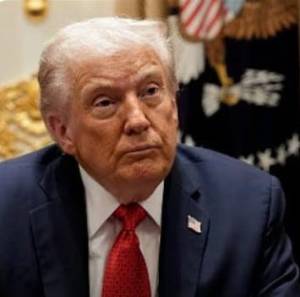 Donald Trump proceeded with military action against Iran despite warnings from advisers that Tehran could shut the Strait of Hormuz, betting Iran would back down; instead, the waterway has been largely blocked, oil prices have surged, and the conflict has expanded with casualties, economic fallout, and uncertainty over how the war will end.
U.S. law enforcement officials warn of elevated terrorism risks in the United States amid the war with Iran, following several recent violent incidents and concerns that staffing cuts and departures at the Federal Bureau of Investigation and the United States Department of Justice could weaken the government’s ability to detect and prevent potential attacks.
Donald Trump claimed Iran could have up to 1,700 “sleeper cells” in the United States, but the White House said there is no credible threat to the U.S. homeland, highlighting conflicting messages from officials as tensions rise during the ongoing war with Iran.
Donald Trump attacked the media for, what he views as, improper coverage of the war in Iran:
An Iranian missile strike damaged five U.S. Air Force refueling aircraft at Prince Sultan Air Base in Saudi Arabia, according to U.S. officials, marking a direct hit on American military assets in the region amid escalating conflict tied to the war with Iran. This was Trump’s response:
As the war enters its third week, Donald Trump threatened to strike Iran’s vital oil export hub on Kharg Island if attacks on shipping in the Strait of Hormuz continue; Iran responded defiantly, downplaying damage from U.S. strikes, launching missiles and drones toward the UAE, and warning it could target regional energy infrastructure and U.S. facilities, while disruptions to oil loading in the UAE and uncertainty about the conflict’s duration have caused volatility in global energy markets.
United States Central Command said U.S. forces carried out a large-scale precision strike on Kharg Island, destroying about 90 Iranian military targets while avoiding oil infrastructure at the strategic terminal that handles most of Iran’s exports, prompting Iran to warn it could retaliate by attacking oil and gas facilities tied to the U.S. and its allies across the region.
A strike hit a helipad inside the United States Embassy Baghdad compound in Baghdad’s heavily fortified Green Zone, according to Iraqi security officials, marking the latest attack on the facility frequently targeted by Iran-aligned militias amid escalating regional tensions.
Mohsen Rezaei said the Strait of Hormuz will not reopen unless the United States leaves the Persian Gulf and regional states control the waterway, adding that Iran would only consider ending the war after receiving compensation and security guarantees from Washington.
An explosion lightly damaged a Jewish school in Amsterdam in what Mayor Femke Halsema called a deliberate attack against the Jewish community; no one was injured, but authorities increased security at Jewish institutions amid rising antisemitic incidents, including recent attacks on synagogues in the Netherlands and Belgium, and broader tensions linked to the ongoing conflict between Israel, the U.S., and Iran.
Major General Mohsen Rezaei said Iran controls whether the war ends and would only agree to stop fighting if the United States fully compensates Iran for all losses and withdraws from the Persian Gulf, which he framed as a necessary guarantee against future conflict.
 Donald Trump attacked Maggie Haberman (author of the book Confidence Man and a longtime reporter forthe New York Times) in a post, calling her a “sleazebag writer” and saying he may add her and other reporters to his Florida lawsuit against The New York Times, accusing them of publishing false stories about him.
Rajdeep Sardesai criticized Laura Loomer for remarks about Kamala Harris, Indians, and immigrants, calling them “brazenly racist and Islamophobic” and condemning the comments as offensive toward immigrant and Indian communities.
According to the New York Times, investors backing a U.S.-controlled version of TikTok — including Oracle, Silver Lake, and Abu Dhabi’s MGX — are set to pay a $10 billion fee to the U.S. Treasury for the government’s role in arranging the deal championed by Donald Trump and led by JD  Vance, an unusually large government charge tied to resolving national-security concerns over TikTok’s former Chinese parent ByteDance.
North Korea fired about 10 ballistic missiles into the sea off its east coast in a show of force during joint U.S.–South Korea military drills, underscoring rising regional tensions as Pyongyang condemns the exercises, signals defiance toward Washington and Seoul, and links the standoff to broader global instability amid the Middle East war.
A recruiting pitch by headhunting firm Heidrick & Struggles sought to lure Wall Street bankers to join a new investment team at the United States Department of Defense by promising high salaries, privileged access to senior officials and foreign sovereign investors, and the chance to help deploy up to $200 billion in government-backed investments in strategic industries—an effort tied to the economic and national-security strategy of Donald Trump but criticized by ethics experts as potentially enabling conflicts of interest and corruption.
According to the Atlantic, Donald Trump’s personal cellphone number has widely circulated among journalists, executives, and political figures, leading to a surge of direct calls to the president that sometimes influence news coverage and even financial markets, while White House officials worry the informal, unscripted conversations—especially during the war with Iran—can create confusion or spread inconsistent messaging.
Palestinians in Gaza Strip say their humanitarian crisis is being overshadowed by the expanding regional conflict involving Iran, as ceasefire progress between Hamas and Israel stalls, aid deliveries decline, crossings close, and many displaced families continue living in tents or even cemeteries while facing severe shortages of food, water, and medical supplies.
A large Russian missile and drone barrage struck the Kyiv region, killing at least four people and injuring more than 15 while damaging homes and energy infrastructure, as stalled peace talks and the global focus on the Middle East war raise concerns that Russia may exploit the distraction to intensify its campaign against Ukraine.
Iranian lawmaker Ebrahim Azizi warned that Ukraine could become a “legitimate and lawful target” after Volodymyr Zelenskyy said Kyiv would help the U.S. and Israel counter Iran-designed Shahed drones in the Middle East, escalating rhetoric as the wider regional conflict expands.
A federal jury in Fort Worth convicted eight people on terrorism charges linked to a 2025 shooting outside the Prairieland ICE detention center, a case pursued by the U.S. Department of Justice after Donald Trump designated antifa a domestic terrorist organization; prosecutors said the defendants were tied to antifa, while defense attorneys argued the protest was not an organized terrorist plot and warned the verdict could have major implications for protest rights.
The United States has formally intervened at the International Court of Justice to defend Israel against South Africa’s genocide allegations over the Gaza war, arguing that the legal standard for genocide is being misapplied, while countries such as the Netherlands and Iceland have also joined the case, with the Dutch urging scrutiny of whether aid was deliberately withheld from Gaza.
More On Iran
New York Times, War in the Middle East: War in Iran Has Put Middle East Water Supplies at Risk, Mira Rojanasakul, Claire Brown and Hiroko Tabuchi March 14, 2026 (print ed.). Two weeks into the war in Iran, two water desalination plants in the region have been damaged in military operations, raising concerns over the vulnerability of a system that serves as a lifeline for millions across the Middle East.
Last week, Abbas Araghchi, Iran’s foreign minister, said an attack on a desalination plant on Qeshm Island, in the Persian Gulf, on March 7 had affected the water supply to 30 villages. While Iran blamed the United States for the attack, the Pentagon has denied responsibility, as has Israel.
And in Bahrain, the Interior Ministry blamed an Iranian drone for “material damage” to a desalination plant, though the country’s water and electricity authority said water supplies had not been affected.
Over the last few decades, the arid countries of the Persian Gulf have become increasingly reliant on desalination plants to supply water to cities and towns.
Desalination plants have become crucial infrastructure in places like Qatar and Bahrain, both of which now rely on the technology for more than 50 percent of their fresh water.Share of water from desalination plants Even if desalination plants aren’t targeted directly, damage to surrounding facilities could still disrupt their operations. Some plants draw water from the sea, raising the prospect that polluted water could clog plant filters or contaminate pipes.
“Say there is an oil spill next to the intake to the desalination plant,” Mr. Elimelech said. “That would practically kill the desalination plant.”
In 1991, the United States accused Iraq of deliberately spilling millions of gallons of Kuwaiti crude oil into the Persian Gulf with the intention of crippling desalination capacity or thwarting an amphibious invasion.
That created a nine-mile oil slick and prompted a monthslong effort to keep the oil from shuttering a desalination plant that supplied half of the drinking water for Riyadh, the Saudi capital. Oil spills on land, meanwhile, infiltrated many of Kuwait’s aquifers.
Hopium Chronicles, Advocacy: 2,500 Marines Are Headed To The Middle East, Kushner Shakes Down Gulf Leaders, Trump Is A Titanic F*ck Up, Simon Rosenberg, right, March 14, 2026. Every day we are reminded that Trump doesn't give a sh*t about America or the American people.
Brent crude rose overnight:
Yesterday I shared new data showing the economy grew far less than we thought in the fourth quarter of last year, and inflation remains way above the Fed target rate - all before the price spikes we are now seeing from the war.
The Wall Street Journal has a new, in-depth report on the “planning” that went into Trump’s new war, and how Trump just decided to go for it, despite the incredible damage the war could do to an American economy already weakened by his ruinous domestic agenda (gift link):
Before the U.S. went to war, Gen. Dan Caine, the chairman of the Joint Chiefs of Staff, told President Trump that an American attack could prompt Iran to close the Strait of Hormuz.
Caine said in several briefings that U.S. officials had long believed Iran would deploy mines, drones and missiles to close the world’s most vital shipping lane, according to people with knowledge of the discussions.Trump acknowledged the risk, these people said, but moved forward with the most consequential foreign-policy decision of his two presidencies. He told his team that Tehran would likely capitulate before closing the strait—and even if Iran tried, the U.S. military could handle it.
Now, two weeks into the war, Iran’s leaders have refused to back down, and the Strait of Hormuz has emerged as Tehran’s most potent leverage point.Iran has blocked tankers from the strait and struck cargo ships, triggering a surge in oil prices and an energy shock rippling around the world. U.S. forces are targeting Iran’s mine-laying ships and factories, trying to prevent the country from lining the waterway with explosives.
The joint U.S.-Israel military operation has killed Iran’s supreme leader, targeted military headquarters and damaged or destroyed more than 90 Iranian vessels.
Yet, the price has been steep. At least 13 Americans have been killed, including six in a crash Thursday of an Air Force refueling plane, making the war in Iran the deadliest military operation of Trump’s two terms. At least 140 Americans have been wounded in the conflict. Roughly 175 people, mostly children, were killed in a strike on a girls’ school in Iran, which a preliminary U.S. investigation found was likely launched by U.S. forces.
The U.S. operation is costing billions of dollars a week. More broadly, the growing risk of a widening and drawn-out war threatens the American economy, raising warnings of stagflation, a quagmire of stagnant growth and high inflation.Behind Trump’s rationale for war was a deep confidence in the capabilities of the U.S. military to deliver a swift, decisive victory, according to administration officials and others familiar with the matter.
The president’s trust in Caine was buoyed by the successful U.S. strikes on Iran’s nuclear sites last year and the January raid that captured Venezuela’s autocratic leader, Nicolás Maduro
Typically, war preparations include weeks or months of classified deliberations, written planning documents, the airing of dissenting views from diplomats and intelligence officials, and National Security Council meetings with cabinet members to make the most informed decision.
Only a small group was looped into the preparations for Iran—including Vice President JD Vance, Secretary of State Marco Rubio and Hegseth. That narrowed the advice, information and ideas available to the president, who had to balance the many downsides of an attack.
Foreign diplomats in Tehran anticipate that Iran will aggressively police the waterway, hoping the high cost to the U.S. will persuade Trump to walk away from the war.The president and some advisers were surprised at the breadth and scope of Iran’s retaliation, which included missiles and drones launched at regional countries from Azerbaijan to Oman, according to people familiar with the matter.
Allies in the Gulf are privately furious with the U.S., according to diplomats and others familiar with the matter. They blame the Trump administration for triggering a war that put them in the crosshairs and pierced their image of a luxurious, business-friendly locale free of the region’s chaos. Trump has been privately calling those leaders this week, according to a person familiar with the conversations.
Americans have been caught in danger, as well. The State Department didn’t urge U.S. citizens to depart countries in the region or evacuate some embassies until after the war began. By then, commercial airspace was already closed, leaving tens of thousands of Americans stranded in the Middle East and U.S. diplomats at some embassies in harm’s way.As we’ve discussed here given the failure of Trump’s early strategy he had two choices - declare victory and get out, or escalate. Yesterday Trump decided to escalate:
Yesterday, Pete Hegseth, in his bloodthirsty and unhinged press conference, committed a clear and undeniable war crime by declaring “no quarter,” a military term meaning that we will kill all prisoners.
Trump has responded to intelligence reports that Russia is helping Iran fight America, and Ukraine’s providing us technology to defend ourselves against Iranian-Russian Shahed drones, by relaxing sanctions on Russian oil and providing billions to fund Putin’s war in Ukraine.
As Trump uses the war to help his buddy Putin he is also using it to enrich himself and his family (gift link):
Jared Kushner, one of the U.S. government’s chief negotiators in the Middle East, is trying to raise more money for his private equity firm from governments in the region.Mr. Kushner, President Trump’s son-in-law, has spoken with potential investors in recent weeks about raising $5 billion or more for Affinity Partners, his investment firm, according to five people with knowledge of the talks who were not permitted to speak publicly about the discussions.
Yes, all of this is why we need keep working hard everyone……So, Now, Let’s Get To Work!!!!!!!!!!!!!!!!!!!!Winning The Midterms, Competing In Red States and Red Places, Expanding The Map.
PoliticusUSA, News and Commentary:Trump Trashed America’s Allies Now He Begs For Their Help In Iran, Jason Easley, right, March 14, 2026. Trump claims that he did the rest of the world a favor by starting a war with Iran, so now he wants other countries to join the war to open the Strait of Hormuz.
What happens when a president starts a war and completely misjudges how the country that he is attacking will respond?
Unfortunately for the American people, we are finding out the hard way.
Trump appears to have believed that Iran would not respond to a full-scale bombing operation with economic warfare, even though Middle East experts have been saying for decades that if the Iranian regime were ever attacked, it would, with near certainty, try to destabilize and cut off a significant amount of the world’s oil supply.
None of this is a surprise.
The idea that Iran would fight back economically was something that was factored into every previous president’s policymaking on Iran for nearly half a century.
Donald Trump thought he was different and that Iran would never do this to him.
According to AAA, the price for a gallon of regular gasoline has increased by four cents since yesterday. The national average is now $3.67. The price has increased by twenty-six cents over the last week, and by seventy-four cents a gallon over the past month.
Another week of this war will likely result in gas prices increasing by one dollar a gallon.
Trump’s solution to this problem is to make the rest of the world clean up his mess.
Trump posted on Truth Social:
Many Countries, especially those who are affected by Iran’s attempted closure of the Hormuz Strait, will be sending War Ships, in conjunction with the United States of America, to keep the Strait open and safe. We have already destroyed 100% of Iran’s Military capability, but it’s easy for them to send a drone or two, drop a mine, or deliver a close range missile somewhere along, or in, this Waterway, no matter how badly defeated they are.
Hopefully China, France, Japan, South Korea, the UK, and others, that are affected by this artificial constraint, will send Ships to the area so that the Hormuz Strait will no longer be a threat by a Nation that has been totally decapitated. In the meantime, the United States will be bombing the hell out of the shoreline, and continually shooting Iranian Boats and Ships out of the water. One way or the other, we will soon get the Hormuz Strait OPEN, SAFE, and FREE!
Trump spent years campaigning before the 2024 election on the claim that Joe Biden and Kamala Harris were going to start World War III.
Now that he is stuck in a war with that he started but has no clue how to end, Donald Trump is casually suggesting that other countries join his folly, in what looks a lot like World War III.
None of the other countries that Trump listed asked him to start a war with Iran.
Trump wants to be thanked for something that other countries didn’t want.
Donald Trump wants US allies who he has spent most of his term bad-mouthing to run to his aid now that he is stuck in a war of his choice with Iran.
Those countries should tell Trump to go pound sand.
Donald Trump broke it. Now he owns war with Iran.
U.S. Governance, Elections, Politics
New York Times, Trump Administration Live Updates: Kennedy Center’s President Leaving After Tumultuous Year, Adam Nagourney and Julia Jacobs, March 14, 2026 (print ed.). What We’re Covering.
Mr. Trump announced Mr. Grenell’s departure from the center, which will soon close for two years of renovations, in a post on social media on Friday afternoon.
“Ric Grenell has done an excellent job in helping to coordinate various elements of the Center during the transition period, and I want to thank him for the outstanding work he has done,” Mr. Trump wrote.
The president said Mr. Grenell, right,  would be replaced by Matt Floca, the center’s vice president of facilities operations. Mr. Trump said Mr. Floca “has helped us achieve tremendous progress in bringing the Center to the highest level of Excellence!”
Mr. Grenell, the former ambassador to Germany, is stepping aside as the center prepares to close on July 4. Mr. Trump announced the shutdown after months of headlines about boycotts by patrons and high-profile artists, including the composer Philip Glass, the Grammy-winning banjo player Béla Fleck, the San Francisco Ballet and the traveling production of “Hamilton.”
He leaves behind an institution that is drastically changed from a year ago, when Mr. Trump installed himself as chairman of the center and filled the board with loyalists as he moved to put his imprint on the center, including what appeared on its stages. The president went on to insert his name into that of the center, which opened in 1971 in tribute to John F. Kennedy.
The upheaval at a traditionally nonpartisan institution, where Republicans and Democrats have over the decades sat side by side for opera, theater and orchestra performances as well as black-tie gala events like the Kennedy Center Honors, set off a storm in the cultural world.
The Washington National Opera, a cultural pillar of the center, announced that it was moving out because of a decline in attendance and an edict from Mr. Grenell that all productions had to show how they would break even before the curtain raised. (Operas rarely make a profit from ticket sales alone, relying instead on contributions.)
The National Symphony Orchestra continued to perform at the Kennedy Center, often to many empty seats, but last week its executive director, Jean Davidson, announced she was leaving. She previously had been a public advocate of the orchestra’s staying put but said then that she did not “see how I could be effective as a leader in the current climate.”
Mr. Floca is stepping in as the center moves from offering arts programs to construction and rebuilding, an extension of the kind of work he was doing in his previous positions.
On Friday, Mr. Trump posted two renderings of the future Kennedy Center online and said that it would be “the finest facility of its kind anywhere in the World!” It is not clear, however, whether performers and audiences will return as enthusiastically, much less what it will look like after the project is completed.
In other administrataion news, a federal judge criticizes the government for pursuing an investigation of Jerome H. Powell.
A federal judge in Washington threw a major roadblock into a criminal investigation of Jerome H. Powell, the Federal Reserve chair, quashing grand jury subpoenas issued to the central bank by federal prosecutors over renovations underway at its headquarters in Washington.
 In a blistering 27-page decision unsealed on Friday, the judge, James E. Boasberg, left, derided the U.S. attorney’s office in Washington, led by the Trump loyalist Jeanine Pirro, for pursuing a case against Mr. Powell when it appeared that its only reason to do so was President Trump’s desire to seek vengeance against him. Mr. Powell has long resisted calls from the White House to significantly lower borrowing costs, prompting a litany of attacks that has extended to the president’s effort to fire another top official, Lisa D. Cook.
“There is abundant evidence that the subpoenas’ dominant (if not sole) purpose is to harass and pressure Powell either to yield to the president or to resign and make way for a Fed chair who will,” Judge Boasberg wrote.
He continued, “On the other side of the scale, the government has offered no evidence whatsoever that Powell committed any crime other than displeasing the president.”
Judge Boasberg’s decision did not necessarily mean the end of Ms. Pirro’s inquiry, but it did deal the investigation a devastating blow. If prosecutors intend to continue pursuing it, they would have to find other ways of obtaining evidence, like persuading a judge to issue a search warrant.
A fiery Ms. Pirro, appearing at a hastily called news conference in her office up the block from Federal District Court in Washington, where Judge Boasberg sits as the chief judge, said she planned to both appeal and file a motion requesting the judge to reconsider.
She also followed the bellicose lead of her boss, Mr. Trump, by attacking the judge, accusing him of harboring an animus toward the president and claiming that he had “neutered the grand jury’s ability” to obtain information from the Federal Reserve about its expenditures.
“Jerome Powell today is now bathed in immunity, preventing my office from investigating the Federal Reserve,” said Ms. Pirro, who asserted the subpoenas were issued because Mr. Powell ignored earlier requests for information. “This is wrong and it is without legal authority.”
The exchange was the latest development in a three-sided battle between a top Trump ally determined to pursue a dubious legal course to placate the president, a Fed chair fighting for the independence of an institution whose stewardship is essential to the economy, and a judge who has emphatically rejected the administration’s maximalist legal strategy.
The investigation began late last year, when Ms. Pirro’s office served two subpoenas to the Fed’s Board of Governors. Prosecutors sought records about recent renovations of the board’s buildings and testimony that Mr. Powell delivered to Congress that briefly discussed the project, which is running over budget by about $700 million and is set to cost around $2.5 billion. The administration seized on those cost overruns and accused Mr. Powell of mismanaging the project, culminating in a visit by Mr. Trump at the construction site in July.
The criminal investigation is only the latest in a string of attacks by the White House to pressure the Fed into lowering borrowing costs. The Justice Department’s investigation prompted a rare rebuke from Mr. Powell, who accused the White House of using the threat of criminal charges to coerce the central bank into lowering rates.
New York Times, Judge Rules Lawmaker Must Be Allowed to Join Kennedy Center Board Meeting, Zach Montague, March 14, 2026. A judge ordered that Representative Joyce Beatty, a Democrat, be given access to planning documents and have the chance to oppose changes to the center at a board meeting next week.
A federal judge in Washington on Saturday ordered that Representative Joyce Beatty, Democrat of Ohio, be granted more information and be allowed to participate in a planning meeting about the future of the John F. Kennedy Center for the Performing Arts, temporarily resolving a minor standoff with President Trump.
The ruling gave Ms. Beatty a window into the president’s goals for remaking the center in his own image, after dozens of performers canceled shows in protest and patrons worried about a proposed multiyear closure of the performance space.
Ms. Beatty was designated an ex officio member of the board of the Kennedy Center and has used that role to fight against changes to the institution as Mr. Trump asserts more control over its governance.
The center’s board is scheduled to meet on Monday, though Ms. Beatty argued that the purpose of the meeting had not been explained, and that she had been kept out of the loop.
On Saturday, Judge Christopher R. Cooper of the Federal District Court in Washington agreed that Ms. Beatty needed to receive a more thorough accounting of plans and be allowed “a meaningful opportunity to lodge her dissent” at the meeting, “and not be categorically barred from speaking.”
She has said that she plans to attend and voice her opposition to Mr. Trump’s proposals to overhaul the performing arts center.
Judge Cooper wrote that the secrecy surrounding the project and the agenda on Monday appeared hard to square with the scale of the president’s stated ambitions.
“These are exceptional circumstances, both in the potential immensity of the announced work on the Kennedy Center and the manner in which most of its trustees have been sidelined from one of the more consequential decisions in the institution’s life span,” he wrote.
Ms. Beatty has also asked the court to issue an order barring Mr. Trump from redeveloping the site, arguing that her job on the board was to be a steward of the center. Judge Cooper has not yet considered that request.
Mr. Trump has told performers and staff that he intends to transform the space into a “new and spectacular Entertainment Complex.”
In a 37-page opinion, Judge Cooper laid out a list of documents — including budgets and planning reports — that had to be sent to Ms. Beatty within 24 hours, “to the extent they exist.” He added that the government’s claims in the lawsuit that no plans had been finalized, just four days before the board could meet to approve them, “borders on preposterous.”
New York Times, Trump Administration Readies Plans to Dismantle Renowned Science Lab, Eric Niiler, March 14, 2026 (print ed.). Proposals include transferring a supercomputer to the University of Wyoming and shifting a space weather lab to a private company.
The Trump administration is reviewing proposals to break up one of the world’s leading climate and weather laboratories, transfer its work to universities and private companies, take away its aircraft, and sell its property in Boulder, Colo.
The laboratory, the National Center for Atmospheric Research, has been targeted for months by the Trump administration. In a social media post in December, Russell Vought, the White House budget director, called the Colorado center “one of the largest sources of climate alarmism in the country.”
The center, founded in 1960, is responsible for many of the biggest scientific advances in understanding of weather and climate. Its research aircraft and sophisticated computer models of the Earth’s atmosphere and oceans are widely used in forecasting weather events and disasters.
Scientists say the move to dismantle the center would weaken research that is crucial to understanding the atmosphere, space and oceans, air pollution and climate change. It would leave emergency officials and planners less prepared for extreme weather events, critics said.
The center’s staff includes about 830 employees working under the University Corporation for Atmospheric Research, a nonprofit consortium of colleges and universities that oversees the center for the federal government.
The center also operates a massive supercomputer, known as Derecho, in Cheyenne, Wyo., that scientists use to predict the behavior of wildfires, space weather, hurricanes and other complex weather patterns.
Proposals are due on Friday to the National Science Foundation from institutions that want to take over management of the center’s research portfolio and various facilities; comments from the public about the center’s future are also due then.
Michael England, a spokesman for N.S.F., which oversees the center, said the proposals and comments from interested parties would not be made public. He would not say when the officials would make a final decision about the fate of the center.
“I don’t have anything on that for you,” Mr. England said.
Colorado’s elected officials have been fighting to preserve the center. Putting it on the chopping block would also be an economic blow to the state. President Trump has feuded with Gov. Jared Polis, a Democrat, over Mr. Trump’s pardoning of a former Colorado election official who was convicted of multiple state felonies after she gave Mr. Trump’s supporters unauthorized access to voting machines after the 2020 presidential election.Editors’ PicksWhen It Came to Their Vows, Rapper Remy Banks Didn’t Miss a BeatThe Best Writing Tip? Get a Dog.Inside the Kitchen That Feeds Hollywood on Oscars Night
“Breaking up the institution would have detrimental impacts,” Gov. Polis said in a statement on Thursday. “People evacuate more quickly and safely from fires because of NCAR.”
The center’s data, Mr. Polis said, “improve forecasting of severe weather events like fires and floods, support safer aviation and transportation, and help businesses and communities make informed decisions.”
In a letter to the N.S.F.’s acting director, Brian Stone, Representatives Joe Neguse, a Democrat, and Jeff Hurd, a Republican, wrote that dismantling the center would increase costs and “erode critical research capacity, disrupt longstanding partnerships, and diminish our ability to understand, anticipate and respond to extreme weather-related risks.”
New York Times, A federal judge orders the V.A. to restore a union contract with 300,000 workers, Zach Montague, March 14, 2026 (print ed.). A federal judge in Rhode Island ordered the Trump administration to restore a union contract with more than 300,000 Veterans Affairs Department workers, after Doug Collins, right, the V.A. secretary, moved to nullify the agreement in August.
 In a 29-page opinion, Judge Melissa R. Dubose wrote that the union, the American Federation of Government Workers National V.A. Council, had made clear that the termination of the contract was retaliatory — and therefore in violation of the First Amendment — given the opposition to the Trump administration’s labor policies mounted by the union’s umbrella group, the American Federation of Government Employees.
Noting that the union was already shedding members after the termination of the agreement, Judge Dubose reasoned that waiting until the lawsuit was finished to restore the contract would cause painful losses for the union and its workers. She ordered that the three-year contract, which was ratified in June 2023, be reinstated for the remainder of its term.
The decision to end the agreement, she wrote, “seems substantially motivated by the plaintiffs’ history and frequency of vocally opposing changes to labor policies.”
The union had argued that the decision hinged on its opposition to Mr. Trump’s presidential policies. The union is part of the American Federation of Government Employees, which represents workers at many other government agencies. It has, Judge DuBose noted, “actively litigated against the Trump administrations.”
Judge Dubose acknowledged that First Amendment claims based on retaliation against unions have had a mixed record nationally.
She pointed to a decision in August by the U.S. Court of Appeals for the Ninth Circuit, which reasoned that President Trump would likely have signed an executive order last year stripping more than a million federal workers of collective bargaining rights regardless of their public stances. But she concluded that the union had made a strong argument that the cancellation of the contract was related to existing resentments toward the union and its members.
She cited a White House fact sheet on an executive order Mr. Trump’s executive order signed in March, which stated that “certain federal unions have declared war on President Trump’s agenda.” And she noted various anti-labor statements by Mr. Collins, which she said demonstrated that the “laser focus” of the agency’s leaders “was on the ways the V.A. perceived employee unions as frustrating the work and purpose of the V.A.”
In a statement celebrating the news, Mary Jean Burke, the president of the smaller National V.A. Council, said the decision overcame “this administration’s shameful and hostile attempts to silence V.A. workers.”
U.S. Justice, Law, Crime, Courts, Rights
New York Times, Justice Dept. Legal Threat Complicates Trump’s Pick for Fed Chair, Colby Smith and Tony Romm, March 14, 2026. An investigation of the Federal Reserve was thwarted on Friday, but a department appeal could reimpose an obstacle in Kevin Warsh’s path.
For a moment on Friday, Kevin M. Warsh was on a glide path to becoming the next chair of the Federal Reserve.
That afternoon, a federal judge tossed out a pair of subpoenas that the Justice Department had issued to the central bank as part of a criminal investigation into Jerome H. Powell, the Fed’s chair, and his handling of its headquarters renovation.
The inquiry, opened by Jeanine Pirro, the U.S. attorney for the District of Columbia and a longtime ally of President Trump, had been the main obstacle between Mr. Warsh and one of the most powerful economic policymaking jobs in the world.
But Ms. Pirro soon made it clear that the fate of Mr. Warsh — and the president’s desire to appoint more of his supporters to the Fed — remained in her hands.
As a court unsealed the judge’s decision, Ms. Pirro hastily convened a news conference, where she defiantly threatened to continue the fight. In a span of about an hour, a possible pathway for Mr. Warsh narrowed about as quickly as it had emerged, turning instead into his latest political hurdle.
Ms. Pirro’s criminal investigation had rankled several powerful members of the Senate Banking Committee, which oversees the Fed. They included Senator Thom Tillis, Republican of North Carolina, who vowed again on Friday to block Mr. Trump’s choice to lead the Fed until the investigation was scrapped.
“This ruling confirms just how weak and frivolous the criminal investigation of Chairman Powell is, and it is nothing more than a failed attack on Fed independence,” Mr. Tillis said in a statement. “We all know how this is going to end, and the D.C. U.S. attorney’s office should save itself further  embarrassment and move on. Appealing the ruling will only delay the confirmation of Kevin Warsh as the next Fed chair.”
Since returning to office, Mr. Trump has spared no opportunity to try to steer the actions of the Fed, frequently testing the limits of the law. But his administration’s maneuvers threaten to keep the president from what he has sought most: a new leader at the Fed who is more sympathetic to lower interest rates.
At the center of the saga is Mr. Powell, whose term as chair ends in May. Mr. Trump has spent years scolding Mr. Powell, whom he elevated to chair during his first term, for not slashing borrowing costs. In late January, Mr. Trump tapped Mr. Warsh to succeed Mr. Powell, writing that Mr. Warsh, a former Fed governor, would “go down as one of the GREAT Fed Chairman, maybe the best.”
Mr. Warsh, right, is well liked among Republicans, who control the Senate. But lawmakers quickly realized they would have difficulty advancing anyone Mr. Trump picked in the wake of the Justice Department’s criminal investigation.
Republicans had been looking for an offramp that would allow Mr. Warsh’s nomination to proceed. Treasury Secretary Scott Bessent sought to downplay the ramifications of the investigation and made clear his desire to get the confirmation process underway.
“We’ll see where the investigation goes with Jeanine Pirro’s office,” Mr. Bessent said on CNBC last month. “There were subpoenas issued. But that doesn’t have to mean that there are charges.”
The latest entreaty came from Senator Tim Scott of South Carolina, the chair of the Banking Committee. On Wednesday, he said he hoped the investigation into Mr. Powell just “goes away.”
New York Times, Lobbyist Arrested in Extortion Attempt of Client Who Received a Trump Pardon, Kenneth P. Vogel, William K. Rashbaum and Santul Nerkar, March 14, 2026. Josh Nass, a lawyer and lobbyist, had recently represented Joseph Schwartz, a former nursing home executive pardoned by the president late last year.
Josh Nass, a lawyer and lobbyist with connections in President Trump’s orbit, was arrested by F.B.I. agents on Friday afternoon in Manhattan and charged with attempted extortion, according to court papers.
Mr. Nass, who has connections in conservative Jewish and evangelical circles, had recently been paid $100,000 to pursue clemency for Joseph Schwartz, who was convicted of tax crimes related to a nursing-home empire that had collapsed amid allegations of endangering the residents and defrauding his employees.
Joseph Nocella Jr., the United States Attorney for the Eastern District of New York, in a statement issued Saturday morning, accused Mr. Nass of having “plotted the violent extortion of one of his own clients.”
Mr. Nass had been paid $100,000 by the client, but was owed an additional $500,000, according to court papers in the case unsealed on Saturday. The filings claim that Mr. Nass instructed someone he hired to “do anything and everything” to collect the outstanding funds from the client’s son.
The papers strongly suggest that the targets of Mr. Nass’s threats were Mr. Schwartz and one of his sons, though they are not named.
Mr. Nass, 34, is expected to be arraigned Saturday in Brooklyn.
Mr. Nass’s efforts on behalf of Mr. Schwartz were detailed in an article this month in The New York Times.
An associate of Mr. Nass said that he was arrested on Friday in Midtown Manhattan after leaving a meeting at a hotel about securing business from other clemency seekers.
Mr. Nass could not be reached for comment. One of his lawyers, Marc Agnifilo, said he would comment after reviewing the charges. Mr. Schwartz did not immediately respond to a request for comment.
Mr. Schwartz had pleaded guilty in 2024 to tax crimes in federal and Arkansas courts related to his failure to pay nearly $40 million in employment and payroll taxes, as well as to a state Medicaid fraud charge in Arkansas. He was sentenced to three years in federal prison.New York Times,East
U.S. Media, Propaganda, Artificial Intelligence
New York Times, Cascade of A.I. Fakes About War With Iran Causes Chaos Online, Stuart A. Thompson and Alexander Cardia, March 14, 2026 (print ed.). A torrent of fake videos and images generated by artificial intelligence have overrun social networks during the first weeks of the war in Iran.
The videos — showing huge explosions that never happened, decimated city streets that were never attacked or troops protesting the war who do not exist — have added a chaotic and confusing layer to the conflict online.
The New York Times identified over 110 unique A.I.-generated images and videos from the past two weeks about the war in the Middle East. The fakes covered every aspect of the fighting: They falsely depicted screaming Israelis cowering as explosions ripped through Tel Aviv, Iranians mourning their dead and American military vessels bombarded with missiles and torpedoes.
Collectively, they were seen millions of times online through networks like X, TikTok and Facebook, and countless more times within private messaging apps popular in the region and around the world.
The Times identified the A.I. content by checking for both obvious signs — such as depictions of buildings that do not exist, garbled text and behaviors or movements that defy expectations — and for invisible watermarks embedded within the files. The posts were also checked with multiple A.I. detector tools and compared with reports from news organizations.
A sophisticated new wave of A.I. tools makes the fakes possible, enabling nearly anyone to create lifelike simulations of war that can deceive the naked eye for little to no cost. Similar content has spread in other conflicts, including the war between Ukraine and Russia. But this war has multiple fronts, and that has led to a proliferation of fake content since the United States and Israel first attacked Iran, according to experts.
“Even compared to when the Ukraine war broke out, things now are very different,” said Marc Owen Jones, an associate professor of media analytics at Northwestern University in Qatar. “We’re probably seeing far more A.I.-related content now than we ever have before.”
 Stars and Stripes, U.S.Pentagon plan expands oversight of Stars and Stripes, limits content, Rose L. Thayer, March 13, 2026. A March 9 memo affirmed the independence of the publication while announcing new restrictions.
The Pentagon has released a modernization plan for Stars and Stripes that affirms the publication’s independence while expanding Defense Department oversight, introducing new restrictions on content and transitioning away from a print publication.
An eight-page memo, dated March 9 and effective immediately, limits the use of wire services, bars comics and other syndicated features and states that content must be consistent with “good order and discipline,” a phrase borrowed from the Uniform Code of Military Justice.
The memo is the first formal explanation since Pentagon Press Secretary Sean Parnell said in a Jan. 15 social media post that the Defense Department intended to “refocus” the news organization “from woke distractions that syphon morale.”
On Friday, Parnell in a statement provided the first direct comment to the organization since Jan. 15. He said the department is “returning S&S to its original mission: an independent news source for service members stationed overseas that is by the warfighter and for the warfighter.”
Parnell said the effort includes “a transition from print to digital, transition to uniformed staff at locations outside the continental U.S., and other efficiency measures that will eliminate redundancies and ensure smart use of DOW resources.”
Stars and Stripes staff currently includes service members on one- to three-year assignments who are mentored by civilian journalists. The service members are typically trained by the services in public relations.
Parnell did not answer questions about how his office is coordinating with the news organization to implement these changes or if the decisions are based on any formal review or evaluation of Stars and Stripes operations.
No coordination
Stars and Stripes Publisher Max Lederer told U.S.-based staff of the memo Thursday and said he would begin meeting with the organization’s leadership to discuss implementation of the memo.
Lederer said he has not been contacted directly by anyone from the Pentagon about the changes, despite reaching out to them. The memo, which was sent to Pentagon leaders and combatant commanders, was written without Stars and Stripes’ input.
Stars and Stripes was not notified about publication of the memo, which was found during a search on a DOD website.
“It is unlikely that the Pentagon was aware of the extensive modernization that Stars and Stripes had already begun,” Erik Slavin, Stars and Stripes editor in chief, said in a statement Thursday. “Over the past year, the changes to our digitally produced news and information have resulted in significant increases in pageviews, engagement and subscribers.”
Reader feedback and real-world usage drove the efforts, said Slavin, who became the organization’s top editor late last year after more than 20 years stationed with the company in Japan, Iraq, South Korea and Germany.
Business operations and funding remain largely unchanged by the memo.
‘A threat to the First Amendment’
Press freedom advocates said the memo shifts authority over content decisions in a way that risks undermining the newsroom’s independence.
“This clearly shows that the Pentagon is trying to increase its influence over content decisions at Stars and Stripes,” said Timothy Richardson, program director of journalism and disinformation for PEN America, a nonprofit that protects free expression.
“That’s a threat to the First Amendment, certainly, and the independence that the Congress has long guaranteed for the newsroom,” he said Thursday after reviewing the memo.
PEN America and five other press-freedom organizations sent a letter to Congress last month in support of Stars and Stripes’ editorial independence.
Stars and Stripes, which is owned by the Defense Department, was first published by Union troops during the Civil War and has been published continuously since World War II. The newspaper publishes print editions overseas and a U.S. weekly edition. It distributes to combat zones as needed.
Its website and other digital offerings have gained readership among troops stationed across the U.S. and among veterans.
The news organization has been threatened with closure over the years but has repeatedly garnered support from veterans and bipartisan members of Congress.
The Pentagon in January withdrew a federal regulation that underpinned the mandate set by Congress for Stars and Stripes to provide independent journalism to the military community under the principles of the First Amendment.
The new memo confirmed that Stars and Stripes’ editorial operations are “independent of the military chain of command, military public affairs activities or other external influences,” but makes no mention of First Amendment freedoms.
It moves the defense secretary’s public affairs office into an oversight role. Previous guidance gave it an administrative role to help with funding, military manning and other regulatory steps. It also calls for an advisory board of Defense Department personnel.
Content overhaul
The memo bars purchased content on the assumption that all service members overseas have online access to all commercially available news on their own. Exceptions for purchased content can be approved by Parnell, according to the memo.
Stars and Stripes uses wire services to provide more complete world coverage of interest to the military community.
Jacqueline Smith, Stars and Stripes’ ombudsman, said wire services add value because they fill gaps and make a news outlet a “one-stop shop.”
“A complete newspaper should include national sports and entertainment ...,” she said. “Stripes does not have the resources to do its own reporting in those areas. Yet sports and entertainment contribute to the morale of troops.”
Losing this “will reduce the quality and breadth of information available to readers,” Slavin said.
The memo calls on Stars and Stripes to be a “‘hometown-style’ publication for the increasingly niche U.S. military community” and says it “should” republish content created by the Defense Department public affairs offices with a label describing its origin, though it grants the publisher latitude to determine whether such content serves readers’ needs.
The memo does not specify which publications should include public affairs content.
“We have no plans to commingle military public relations offerings with our independent reporting,” Slavin said. “Stars and Stripes remains committed to balanced and accurate reporting on behalf of the military community we serve.”
Other changes require the ombudsman to send information bound for Congress through the Defense Department Legislative Affairs Office.
“The House Armed Services Committee created the independent position in 1990-91 with the requirement the ombudsman report to the committee on matters of importance to maintaining Stripes editorial independence,” Smith said. “If that report must go through the Pentagon’s legislative affairs staff, then there is no assurance it would be complete and unchanged and there would be no opportunity to ask the ombudsman questions.”
The memo also bars reporters from requesting public records through the Freedom of Information Act in an official capacity and prohibits the organization from publishing “controlled unclassified information.” This label has often been used to limit the release of information under broadly defined terms.
Last year, the Pentagon asked all reporters working within the building to sign a pledge that included a similar demand. Dozens of journalists turned in their access badges, while a new group of reporters signed the agreement and replaced them.
“The obstacles that the Pentagon continues to throw in the way of credible reporting are growing, and [the memo] is another clear example of that,” Richardson said.
March 13
Top Headlines

U.S. Secretary of Defense Pete Hegseth, an ultra-right Christian nationalist who calls himself "Secretary of War" despite his legally defined title as "Defense" Secretary, addresses senior military leaders at Marine Corps Base Quantico on September 30, 2025 in Quantico, Virginia.
Defense Secretary Pete Hegseth said that the U.S. military would stop Iran from choking off the Strait of Hormuz but did not say how. Oil prices remained high even after the Trump administration eased restrictions on Russianshipments. Here’s the latest.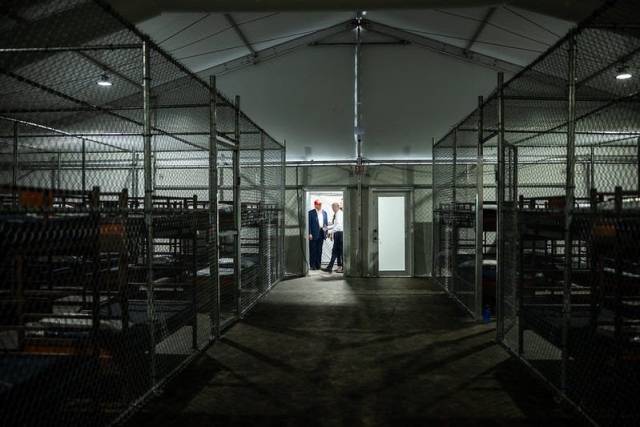 13, 2026. ICE’s immigrant mass-detention facilities fit a dark, century-old pattern. Donald Trump tours “Alligator Alcatraz” (White House photo at right).
 New York Times, Trump Removes Sanctions on Russia to Help Oil Flow Amid Iran Conflict, Alan Rappeport, March 13, 2026 (print ed.). TreasurySecretary Scott Bessent said it was “unfortunate” that the move could benefit Russia, but maintained that it was only for the short term.
 Yesterday, Scott Bessent lifted sanctions on any Russian oil currently stranded at sea (including oil that Russia managed to “strand” at sea between Monday, when Trump spoke with Putin, and yesterday).
News Updates
March 13, 2026. The United States reportedly underestimated Iran’s willingness to close the Strait of Hormuz, and now Iran has done exactly that. Meanwhile Defense Secretary Pete Hegseth said the quiet part out loud by openly attacking the press and saying he can’t wait for CNN to be sold. The US has temporarily lifted sanctions on Russian oil, more American service members have been killed in the conflict, and Donald Trump said it is his “honor” to kill Iranian leaders while simultaneously fundraising off the war.More News Updates: U.S. Elections, Politics, Governance
 Letters from an American, Historical Commentary: March 12, 2026 [Billionairre Candidate Profits Big], Heather Cox Richardson, right, March 13, 2026. In Ohio today, Republican candidate for governor Vivek Ramaswamy, above, launched a $10 million TV and digital ad campaign to run until Election Day.Jeremy Pelzer of Cleveland DOT com explained that this ad buy alone is more than twice as much as the $4.4 million Democratic candidate Amy Acton, the former state health director, has raised, and it is only about half of the $19.5 million Ramaswamy’s campaign has raised.
More On Iran War
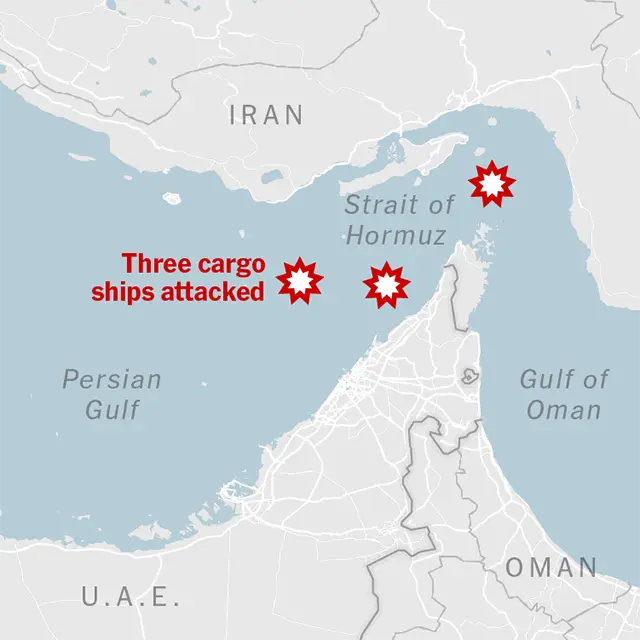
New York Times, 4 Killed in Crash of U.S. Refueling Plane in Iraq, Military Says, Helene Cooper, Greg Jaffe and Eric Schmitt, Updated March 13, 2026. The crash was not because of hostile or friendly fire, U.S. Central Command said. Four crew members died, it said, bringing the number of U.S. service members killed in the Iran conflict to at least 11.March 13, 2026. Donald Trump has been mocked for calling the Iran war an “excursion,” indeed a “little excursion.” And deservedly so.U.S. Law, Courts, Crime, Civil Rights
More Global News
Emptywheel, Analysis: Trump Rewards Russia for Helping Iran Target US Service Members, Emptywheel (Marcy Wheeler), March 13, 2026. Yesterday, Scott Bessent lifted sanctions on any Russian oil currently stranded at sea (including oil that Russia managed to “strand” at sea between Monday, when Trump spoke with Putin, and yesterday).More On U.S. Inflation, Economy, Jobs, Markets
right, March 13, 2026. If the Strait stays closed, look out above. U.S. Media, Culture, Education
Top Stories
U.S. Secretary of Defense Pete Hegseth, an ultra-right Christian nationalist who calls himself "Secretary of War" despite his legally defined title as "Defense" Secretary, addresses senior military leaders at Marine Corps Base Quantico on September 30, 2025 in Quantico, Virginia.
New York Times, War Live Updates: Hegseth Vows to Reopen Key Strait as U.S. Measures Fail to Calm Oil Markets, Eric Schmitt, Helene Cooper and Adam Rasgon, March 13, 2026. Defense Secretary Pete Hegseth said that the U.S. military would stop Iran from choking off the Strait of Hormuz but did not say how. Oil prices remained high even after the Trump administration eased restrictions on Russian shipments.
Here’s the latest.
U.S. officials on Friday vowed to thwart Iran’s attempts to block the Strait of Hormuz, as oil markets appeared largely unmoved by the Trump administration’s efforts to avert an energy crisis stemming from the Middle East war.
Defense Secretary Pete Hegseth said at a news conference that the disruptions in the strait were “something we are dealing with,” adding: “Don’t need to worry about it.” Gen. Dan Caine, the chairman of the Joint Chiefs of Staff, said that the U.S. military was targeting Iran’s ability to lay mines in the strait, through which 20 percent of the world’s oil normally travels.
“There’s a reason why we chose as one of our primary objectives to destroy their Navy,” Mr. Hegseth said. “We have a plan for every option here,” he added. “That’s not a strait we’re going to allow to remain contested.”
The war in the Middle East has killed more than 2,000 people over the past two weeks, mostly in Iran and Lebanon, and displaced millions of others. Iran’s new supreme leader, Mojtaba Khamenei, has vowed to keep blocking the Strait of Hormuz, a move that has disrupted global energy supplies and rattled financial markets.
Exchanges of fire by Israel; the United States; Iran; and its Lebanese ally, Hezbollah; showed little sign of slowing on Friday. Mr. Hegseth said at the news conference that Israeli and U.S. air forces had struck over 15,000 targets since the war started on Feb. 28.
In Tehran, Iran’s capital, Iranians thronged the streets for an annual anti-Israel rally. An explosion was seen close to where crowds had gathered, according to videos shared by Iranian state television. It was not immediately clear what had caused the blast, but earlier in the day Israel had warned of more strikes in Tehran.
In Turkey, NATO air defenses intercepted a missile fired from Iran and entering Turkey’s airspace on Friday, the Turkish defense ministry said. It was the third such interception of an Iranian missile.

New York Times, Hegseth’s Boasts of ‘Maximum’ Engagement Authorities Face Scrutiny After School Is Hit, Charlie Savage, March 13, 2026 (print ed.).The defense secretary has disparaged restrictive rules for opening fire that are aimed at reducing the risk of mistakes and civilian casualties.
Defense Secretary Pete Hegseth has made contempt for what he calls “stupid rules of engagement” — limits meant to reduce risks to civilians — central to his political identity, and has boasted that he unleashed the military to use “maximum authorities on the battlefield” in the Iran war.
“Our warfighters have maximum authorities granted personally by the president and yours truly,” Mr. Hegseth said at a briefing four days after the war started. “Our rules of engagement are bold, precise and designed to unleash American power, not shackle it.”
This and similar statements are now the backdrop to a body of evidence that the destruction of an Iranian elementary school during the opening hours of the war was likely caused by an American missile strike. The preliminary finding of an ongoing military investigation has determined that the United States was responsible, The New York Times has reported.
The destruction of the school, which coincided with an attack on an adjacent Iranian naval base, killed about 175 civilians, most of them children, according to Iranian officials.
 Long before this war, Mr. Hegseth’s opposition to stricter versions of limits on what U.S. forces need to see and know about a potential target before they may open fire drew criticism. Retired commanders argue that the point of such constraints is not just law, morality and honor, but strategic self-interest. Mistakes that kill civilians stoke anti-Americanism — alienating allies, creating new enemies and making wars harder to win.
“You don’t want to turn the entire population against the United States,” said Mark Hertling, a retired three-star Army general (shown at right in an official photo in 2011 before his retirement). “If you are bombing indiscriminately — like may have happened on several occasions, to include the girls’ school — that would negate any opportunity to have a positive regime change.”

Pressed about the incident (photos of the schoolgirls are shown above) as the details have gradually come to light, Mr. Hegseth has repeatedly responded by saying the matter is under investigation and stressing that the United States does not target civilians.
“We’re certainly investigating,” Mr. Hegseth said on Saturday, for example, standing behind President Trump on Air Force One. “But the only — the only side that targets civilians is Iran.”
But the issue is not targeting civilians — such as a situation in which an armed force deliberately attacks a civilian building knowing full well what it is, because it wants and intends to kill civilians.Editors’ PicksWhat You Really Need to Know About HerniasSlowly, Slowly, ‘Darwin’s Finches of the Snail World’ Return From Near ExtinctionSilicon Valley’s Image Takes a Dark Turn in Pop Culture
If the United States attacked the building under the mistaken belief that it was a military facility, the issue is instead how strict or lax the rules of engagement in Mr. Hegseth’s Pentagon were for identifying and verifying the nature of a potential target.
What standards of certainty were imposed on planners for the strikes for vetting and validating potential targets? Does Mr. Hegseth’s repeated statement that he gave the military “maximum authority on the battlefield,” compared with the practice in past wars, mean the standards were formally lowered? Whatever the rules were on paper, did such comments contribute to a culture of moving faster and with less care — of “no hesitation,” in his words — among the planners, resulting in negligence or recklessness?
The school was next door to an Iranian military base full of buildings that were destroyed by precision missile strikes. The school building was once part of that base, before it was fenced off between 2013 and 2016 and converted to civilian use. Officials familiar with the preliminary findings of the official investigation said the strike relied on outdated intelligence and questions remained about why it had not been double checked.ImageA man holding a backpack as peopel search through the rubble of a destroyed building.Rescue workers searched through the rubble of a girls’ elementary school after an airstrike on Feb. 28 in Minab, Iran, that preliminary evidence suggests was carried out by the United States.Credit...Mehr News Agency, via Associated Press
The Pentagon press office declined to comment, saying only that “the incident is under investigation.” It also declined to say who is conducting the investigation.
Usually, the Navy would perform an after-action review of strikes involving Tomahawks fired from a naval vessel, which would ultimately go to Mr. Hegseth for review and approval.
In theory, the Pentagon’s inspector general could conduct a more independent inquiry. But Mr. Trump last year fired the experienced watchdog there, and recently installed as a replacement a former political appointee from his first administration with no prior experience doing inspector general work, Platte B. Moring III.
Last month, Mr. Moring froze a staff proposal to evaluate targeting practices and procedures in the military attacks on boats the administration says are suspected of smuggling drugs, saying he wanted to consult department leadership. He also told staff that it sounded like such a project could be highly political, according to a person briefed on the matter, who spoke on the condition of anonymity to discuss internal deliberations.
His office noted it has not publicly announced any projects related to the Iran war operation and declined to comment on the status of the boat strike matter.Challenging guardrails
“War is hell,” as Mr. Hegseth frequently points out. But traditionally, American military leadership has expressed concern about the risk of civilian casualties. Especially during the counterinsurgency efforts of the Afghanistan and Iraq wars, when U.S. and allied commanders realized that winning local cooperation was key, they imposed rules of engagement that the military considered to be more restrictive than the minimum guardrails required by the laws of war.
The Pentagon’s own law-of-war manual states that the military, in planning and conducting attacks, must “in good faith based on the information available at the time, take feasible precautions to verify that the person or object is a military objective.” It also notes that “policymakers may choose to apply heightened standards of identification, greater than those required by the law of war, to reduce the risk of incidental harm in conducting an attack.”
Mr. Hegseth thinks differently. He has tried to reshape Pentagon culture, reveling in lethality with “no apologies, no hesitation.” He has portrayed this approach as a “warrior ethos,” one that is tough and manly.
He came up as an Army infantry officer and, as he wrote in his 2024 memoir “The War on Warriors,” loathed strict rules of engagement imposed to minimize risk to civilians, seeing heightened standards for when his platoon could open fire as putting soldiers at greater risk on the battlefield. He blamed judge advocate general lawyers, or JAGs, for such rules — even though it is commanders, not lawyers, who issue them.
Mr. Hegseth later continued that line of thinking as a Fox News contributor and host and as an advocate for U.S. service members charged with war crimes. In his 2024 book, he questioned the need to obey the Geneva Conventions and derisively referred to military lawyers as “jagoffs.”
After Mr. Trump appointed him to lead the Defense Department, Mr. Hegseth fired the top JAGs for the military services and shuttered Pentagon offices that focused on preventing and responding to civilian harm during U.S. combat operations.
For the first few days of the war in Iran, when details about the school strike were murky, Mr. Hegseth boasted at briefings about how he had dialed the rules of engagement down to a minimum.
Unlike traditional American allies “who wring their hands and clutch their pearls, hemming and hawing about the use of force,” he said on March 2, the United States was using force on its own terms “with maximum authorities — no stupid rules of engagement.”
Donald Trump tours “Alligator Alcatraz” (White House photo).
The Contrarian, Analysis: Is Trump Building ‘Concentration Camps’? These Experts Have No Doubts,Tim Dickinson, March 13, 2026. ICE’s immigrant mass-detention facilities fit a dark, century-old pattern
Donald Trump’s brutal ICE detention facilities have been blasted as “concentration camps.” This is a freighted term — summoning more than a century of deplorable history.
But experts in the field have no hesitation in using these words to describe the network of facilities that the federal government is using to literally warehouse tens of thousands of immigrants — men, women, and even children — snatched out of their communities by masked federal agents.
The activist group 50501 recently hosted a video call on this topic. It featured Andrea Pizer, the author of One Long Night: A Global History of Concentration Camps, as well as journalist Frank Abe, co-editor of The Literature of Japanese American Incarceration and a longtime activist in pursuing redress for the abuses of America’s World War II camps.
In his introductory remarks, Abe insisted that Trump’s new ICE warehouses “are nothing but 21st Century American concentration camps.” He added that the subject was personal to him: “I’m a third-generation Japanese American, and I know a concentration camp when I see one.”
The words “concentration camp,” for many, evoke the horrors of Hitler and of facilities like Auschwitz, where more than 1 million people were murdered by the Nazis. But Pitzer drew a firm distinction (as do other experts) between “extermination centers” and concentration camps. The latter are not synonymous with “death camps” — although people held in concentration camps often die by disease, deprivation, or indifference.
Concentration camps have been around since the 1890s and documented on six continents. Pitzer, who has traced that history, offered the audience her own general definition: “A concentration camp is a mass detention of civilians on the basis of identity — something you are, rather than what you’ve done,” she said. “It is generally used without due process. And it is done to entrench and expand political power for an authoritarian-style government.”
The label “concentration camp” has always been controversial. Nearly from the beginning, Pitzer explained, authorities running concentration camps have routinely denied that they are, in fact, running “concentration camps.” The first camps were established by the Spanish in Cuba — followed shortly by the British in southern Africa.
But even those Brits were adamant that their camps were different. “Literally from the beginning of concentration camp history, every country that had concentration camps would argue, ‘No. These aren’t really like those other camps,’” making the claim that their regime of mass-incarceration was somehow justified on the basis of public safety, rather than cruelty and control.
“This is a dialogue and a debate that still goes on today,” Pitzer underscored. “So if you hear that about immigrant detention today — ‘Well, it’s not really concentration camps’’ — it is very much so.”
A key indicator that Trump’s ICE camps fit the definition, for Pitzer, is the lawless way the administration is filling them. “You have masked secret police that don’t identify themselves on the streets, kidnapping people,” she described, “and taking them quickly from a local detention to a transit camp — so attorneys can’t find them to give them legal rights.”
And then there is the “dismal” reality of ICE camps themselves — where detention conditions are a threat to human health and so noxious that many detainees agree to deportation rather than pursuing their rights to due process. “People in feces [from overflowing toilets]. People without clean water to drink. People without adequate food,” Pitzer said, reeling off a litany. “They’re denied medical care. They’re denied their own medicine, even if they brought them in. There have been multiple deaths — with one of them even declared a homicide.”
Emphasizing that these are the early days of a system that is unlikely to improve, Pitzer added: “We are already looking at a tremendous amount of suffering” — including outbreaks of deadly disease ranging from measles to tuberculosis.
That suffering is attributable, in part, to a mad rush by the administration, and state allies like Florida, to expand detention capacity by erecting makeshift tent-walled camps. These include Camp East Montana — the largest facility in the ICE network, built at an El Paso military base that was previously the site of a Japanese “internment camp;” and Alligator Alcatraz, a Florida-state facility that operates in conjunction with the Trump regime. (Tallahassee and the MAGA administration are now feuding over who should pay for the $600 million camp.)
The experience at both facilities have been hellish for detainees, but also logistically: “Hygiene, water, weather, disease outbreaks — different things [are] just going horribly for them,” Pitzer said.
The administration is now pivoting to more permanent facilities — seeking to spend as much as $38 billion to acquire new detention centers. Many of these will consist of caged bunkhouses, built inside huge industrial warehouses — with the goal of adding tens of thousands of additional bunks to the ICE system. The largest facilities, described by the government as “mega-centers,” — could house 10,000 people apiece.That scale that would put ICE camps on par with the federal camps opened during World War II to incarcerate Japanese Americans. “That’s the size of a Manzanar or Tule Lake,” said Abe, naming two giant “relocation” facilities that have been acknowledged in federal records (and by the Truman Library) as “concentration camps.”
Abe helped secure a national apology during the Reagan administration to Americans of Japanese descent who were imprisoned at such camps, including his father and stepfather. “We won that in 1988. We thought, Mission Accomplished; America will never do that again,” Abe said. “And yet, here we are.”ICE is currently detaining about 70,000 people, nearly three-quarters of whom have no criminal record, and whose only alleged wrongdoing relates to civil violations of immigration statutes. Nonetheless, the government is working overtime in the courts to prevent such individuals from being released on bond until their immigration cases are resolved.
The number of ICE detainees has soared by about 75 percent since Trump took office. And if anti-immigrant zealots in the White House, like Stephen Miller, have their way, the administration is just getting started. “Their goal is to deport 15 to 20 million people,” Pitzer said. “For historical context, that is [the size of] the Soviet Gulag. The Soviet concentration camp system had 18 to 20 million people move through it in more than 20 years.”The Trump regime is seeking to move much more quickly. “That is impossible to do without a tremendous amount of death and suffering — even if we never reach the stage of extermination camps that we saw in Nazi Germany,” Pitzer said, adding: “I don’t think that we are close to those.”But the concentration camp scholar emphasized that stopping short of Nazi crimes against humanity is a cold comfort. “There can be plenty of deaths without ending up with gas chambers and mass executions,” she said. “The system itself will do a lot of that.”The hour-long 50501 presentation is well worth your time, and includes success stories of local activists who marshalled their communities to block the administration’s planned acquisition of warehouse space. The video is available at the link below:
Tim Dickinson is the senior political writer for The Contrarian.
The Contrarian is community-supported. To enable our work, help hold those in power accountable, and learn about relevant cultural voices of the resistance, please join us as a subscriber. SubscribedThank you for being part of The Contrarian. Share this piece to help spread the word.ShareHaving trouble with your account? Visit our FAQ page for up-to-date resources. SHARE
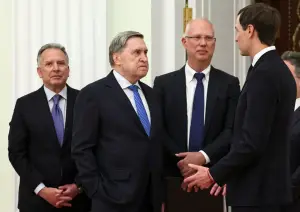 A photo released by Russian state media shows Kirill Dmitriev, second right, with Trump financial allies with billions of dollars in personal projects pending Steve Witkoff, left, and Jared Kushner, right, at the Kremlin in January (Pool photo by Alexander Kazakov).
New York Times, Suspended U.S. Sanctions Add a Political Win to Russia’s Economic Gains, Ivan Nechepurenko and Paul Sonne, March 13, 2026. Kremlin officials said the American move, which Europe opposes, showed that Moscow could not be dislodged from the center of global energy markets.
The U.S. decision to temporarily lift some restrictions on Russian oil has delivered a geopolitical victory to the Kremlin on top of the boon that Russia’s war-strained budget is already receiving from soaring energy prices.
The American move, announced on Thursday, is intended to ease an energy shock that has accompanied the U.S.-Israeli attacks on Iran and at times sent the price of oil soaring over $100 a barrel.
Analysts said they did not believe the suspension of sanctions on Russian oil would substantially ease the worst supply shock to the global market since the 1970s, given that Russia had been able to transport and sell its oil for years despite the restrictions.
“Right now, obviously, the world needs every extra barrel that is available, and I can understand why the White House, under political pressure, would want to check this particular box,” said Pavel Molchanov, an energy analyst at Raymond James. “But it’s not going to make any meaningful difference.”
European countries, which have been at the forefront of imposing sanctions on Russia and are also suffering from higher energy prices, opposed the American move. President Volodymyr Zelensky of Ukraine said during a news conference on Friday that the move “certainly does not help peace,” adding: “This single easing by America alone could give Russia around $10 billion for the war.”
The temporary loosening of the U.S. restrictions, some analysts said, could reduce the discount that Russia has been forced to offer buyers of its oil since the invasion of Ukraine four years ago. Still, the real boon for Russia, they noted, is from higher prices, which the conflict in Iran was prompting before the United States loosened restrictions.
The mood in Moscow was triumphant, after years in which the United States and European countries have tried to starve Russia’s economy of the energy revenues needed for its war machine. Russian officials said the American move showed that Russia could not be dislodged from its central place in global energy markets.
Kirill Dmitriev, President Vladimir V. Putin’s special envoy for foreign investment and economic cooperation, boasted in a post on Telegram that the United States was “effectively acknowledging the obvious: without Russian oil, the global energy market cannot remain stable.”Editors’ PicksWith No Time to Spare, They Traded a House in Austin for a Condo in ChicagoAllergy Season Is Coming. These 4 Steps Can Help You Prepare.My Sister Won’t Vacation With My Kids. Is She Being Selfish
In a post on social media, Mr. Dmitriev was even more blunt: “EU bureaucrats will soon be forced to recognize this reality, acknowledge their strategic blunders, and atone.”
Mr. Dmitriev met this week in Florida with Steve Witkoff, President Trump’s special envoy, and Jared Kushner, the president’s son-in-law. They discussed energy issues in addition to the peace negotiations that Mr. Witkoff and Mr. Kushner have been leading.Want to stay updated on what’s happening in Central Asia, Eastern Europe and the Middle East? Sign up for Your Places: Global Update, and we’ll send our latest coverage to your inbox.
The Kremlin spokesman, Dmitri S. Peskov, told journalists on Friday that the interests of the United States and Russia had aligned in the current environment and welcomed the U.S. move.
“Such measures will help stabilize the market,” Mr. Peskov said. “Without significant volumes of Russian oil, market stabilization is impossible.”
The decision came as the Trump administration scrambled to contain the energy shock that has resulted from production disruptions in Gulf countries and the de facto closure of the Strait of Hormuz, a key transit corridor for oil and gas. The U.S. move was announced by the Treasury Department, which said the exemptions would be in place until April 11 and apply only to Russian oil that was loaded onto tankers on or before Thursday.
Washington previously issued a 30-day waiver to allow India to buy Russian oil, an about-face after the Trump administration pressured New Delhi to cease purchases last year. Indian firms moved rapidly to buy the Russian oil available on the market. David Wech, chief economist at the oil and gas cargo tracking firm Vortexa, said he expected Indian imports of Russian crude to “reach new record highs” from next month, providing the situation in the Middle East continued.
Since Mr. Putin launched his full-scale invasion of Ukraine four years ago, China, Turkey and India have been among Russia’s biggest oil purchasers.
Soaring energy prices and sanctions relief during the conflict with Iran have offered the Kremlin a lifeline at a difficult financial moment.
On Tuesday, the Russian finance ministry reported that its revenues had collapsed by more than 10 percent since the start of the year, with its budget deficit reaching $43 billion, more than 90 percent of what was forecast for all of 2026.
Now, prices have risen and restrictions have vanished on the barrels of its oil currently at sea: around 100 million of them, according to Mr. Dmitriev.
“Russian oil has gone from global pariah to now being extremely sought after, with the discount on Urals crude versus the global Brent benchmark almost disappearing,” Robin Brooks, a senior fellow at the Brookings Institution, wrote in a post on Substack. Urals crude is the blend most often produced by Russia.
Russia’s budget is set to gain more than $1.6 billion per month from each $10 increase in the price of its crude, according to Sergey Vakulenko, a senior fellow at the Carnegie Russia Eurasia Center in Berlin and a former top manager at Gazprom Neft, one of Russia’s largest oil producers.
As of Friday, Russia’s Urals oil benchmark had increased by about $30 per barrel since before the war with Iran, according to Argus Media, a price reporting agency used by the Russian government to calculate its oil extraction taxes. That would mean that the country is receiving more than $150 million extra every day.
President Emmanuel Macron of France said on Wednesday that “the current situation does not justify lifting the sanctions on Russia.”
Chancellor Friedrich Merz of Germany expressed a similar sentiment the day before. “Faced with the choice between sanctions and solidarity, our position is clear: We stand with Ukraine and are prepared to endure such a phase if necessary,” he said.
The oil crunch in the Middle East has the potential to do more than prop up the Russian budget, more than a third of which is being spent on the war in Ukraine. It could also shift the Kremlin’s leverage in the global market, with countries in Asia beginning to view Moscow as a more necessary long-term partner.
For years, China has been reluctant to pursue Moscow’s ambitious plans for a gas pipeline and other projects. But it may now be more amenable, looking to diversify its supplies away from the Middle East in the longer term.
“China may realize that shipments from the Gulf are a problem,” Mr. Vakulenko said.
New York Times, Trump Administration, Wall Street Bankers Offered Lucrative Access to Join the Pentagon, Ana Swanson, March 13, 2026. A presentation from a headhunting firm aimed to recruit Wall Street investors to the Pentagon by offering “unmatched access” to government officials and fund-raising opportunities among foreign sovereigns.
A headhunting presentation aimed at recruiting Wall Street investment bankers to the Pentagon dangled access to government officials and foreign royal families that could be used to raise capital in the future, according to a slide deck viewed by The New York Times.
The presentation says that the Pentagon is seeking to build a 30-person investment team to deploy up to $200 billion in government investment over the next three years. Joining the team offers “unmatched access to top-level government officials and privileged information flow — whatever you need, you can get.”
The document was prepared by Heidrick & Struggles, a headhunting firm. It is not clear whether Pentagon staff members approved or dictated the content of the presentation, which features an agency logo.
The Defense Department declined to comment. Heidrick & Struggles did not immediately respond to a request for comment. The presentation was earlier reported by Semafor.
Officials in and around the Trump administration have continually blurred the lines between public service and individual profit seeking.
The president’s family continues to profit off a cryptocurrency venture that has received investment from foreign officials also negotiating with the government. David Sacks, the White House A.I. czar, has promoted policies that could benefit stakes he holds in hundreds of A.I. companies. In January, Howard Lutnick, the commerce secretary, extended a loan to a company that was also doing business with his former firm, which is now run by his sons.
The Pentagon recruiting effort dangles both money and access, offering Wall Street recruits the opportunity to manage “more capital than most investors deploy in their entire careers.” Salaries could reach as much $300,000 at the Pentagon, or $500,000 to $600,000 “if employed through a government-aligned nonprofit.” According to federal statistics, the average pay for a federal worker is about $100,000, and only about 3 percent make $200,000 or more.
The investment teams would focus on an array of industries and technologies, including undersea cables, minerals extraction and refining, strategic logistics, munitions, drones, satellites and energy generation. The Trump administration has been trying to invest to build up critical industries domestically, to reduce what national security officials see as a dangerous dependence on foreign countries, including potential rivals like China.
In addition to offering loans, the administration has begun taking a series of equity stakes in firms in industries such as mining, semiconductors and steel, in what it says will result in a better deal for U.S. taxpayers.The presentation emphasizes the access to information and the new relationships the move could offer new recruits, as well as subsequent opportunities for enrichment.
New York Times, Trump Removes Sanctions on Russia to Help Oil Flow Amid Iran Conflict, Alan Rappeport, March 13, 2026 (print ed.). Treasury Secretary Scott Bessent said it was “unfortunate” that the move could benefit Russia, but maintained that it was only for the short term.
The United States on Thursday temporarily lifted sanctions on Russian oil that is currently at sea, allowing it to be shipped to buyers around the world as the Trump administration scrambles to contain energy prices that have been soaring because of the war in Iran.
The exemptions, which were issued by the Treasury Department, will be in place until April 11. Treasury Secretary Scott Bessent estimated that freeing Russian oil could add hundreds of millions of barrels of crude to global markets, curbing prices that have been hovering near $100 per barrel as a result of the Iran conflict.
The decision was a significant turning point in America’s effort to punish Russia for its war in Ukraine.
Russia has faced punishing sanctions from the United States and the rest of the Group of 7 advanced economies since Moscow’s invasion of Ukraine in 2022. Those sanctions have included a price cap on Russian oil and a crackdown on Russia’s “shadow fleet” of unmarked vessels that oil exporters have used to evade sanctions.
As President Trump’s war with Iran has unfolded, his administration has looked for ways to mitigate the economic pain. His administration temporarily freed Russian oil last week that was sitting at sea and was set to be delivered to India. It is also in the process of offering a $20 billion maritime insurance backstop through the U.S. International Development Finance Corporation, an agency that generally lends to and invests in overseas companies and projects.
 Mr. Bessent, above, asserted on Thursday that Russia would not benefit significantly from the sanctions relief but acknowledged that Moscow would see some financial benefit.
“To increase the global reach of existing supply, Treasury is providing a temporary authorization to permit countries to purchase Russian oil currently stranded at sea,” he wrote in a social media post. “This narrowly tailored, short-term measure applies only to oil already in transit and will not provide significant financial benefit to the Russian government, which derives the majority of its energy revenue from taxes assessed at the point of extraction.”
In a podcast interview on Thursday, Mr. Bessent said that it was “unfortunate” that Russia stood to gain financially from the conflict in Iran but that he hoped it would benefit for only a “micro period.”
Top Senate Democrats assailed the Trump administration for easing sanctions on Russia, saying that it was done to mitigate a war of Mr. Trump’s own making.
“This war has resulted in huge spikes in gas prices for Americans, who are now paying more at the pump than at any point in either of President Trump’s two terms,” they wrote in a joint statement.
The lifting of oil sanctions represents a sharp reversal from last summer, when the administration doubled tariffs on India as punishment for its purchases of oil from Russia.
“In one fell swoop we’ve undone a huge amount of pressure on Russia,” said Edward Fishman, a senior fellow and director of the Maurice R. Greenberg Center for Geoeconomic Studies at the Council on Foreign Relations.
About 130 million barrels of Russian oil is currently at sea, according to the commodities data tracking service Kpler.
The move by the Trump administration could further divide the United States and Europe, which has been skeptical of Mr. Trump’s attack on Iran and has expressed a desire to continue to exert economic pressure on Russia.
Mr. Fishman said he did not think that easing the Russia oil sanctions would lower prices, noting that the move last week to let Russian oil be delivered to India did not have an impact. He noted that the price of Russian oil had been rising since the war in Iran started, and that it was likely that the sanctions relief could be extended indefinitely.
“I do worry that this is effectively the destruction of the oil sanctions on Russia,” said Mr. Fishman, the author of “Chokepoints: American Power in the Age of Economic Warfare.”
Emptywheel, Analysis: Trump Rewards Russia for Helping Iran Target US Service Members, Emptywheel (Marcy Wheeler), right, March 13, 2026. Yesterday, Scott Bessent lifted sanctions on any Russian oil currently stranded at sea (including oil that Russia managed to “strand” at sea between Monday, when Trump spoke with Putin, and yesterday). (Excerpt continued below.)
This move comes in the wake of reports — first from WaPo,
Since the war began Saturday, Russia has passed Iran the locations of U.S. military assets, including warships and aircraft, said the three officials, who spoke on the condition of anonymity because of the matter’s sensitivity.
“It does seem like it’s a pretty comprehensive effort,” one of the people said.
And detailed further by CNN that Russia was providing Iran with satellite intelligence about US movements.
Russia is helping Iran with advanced drone tactics from its war in Ukraine to hit US and Gulf nation targets in the Middle East, according to a Western intelligence official.
Shahed drones, designed by Iran but mass produced by Moscow for use in Ukraine, have been unexpectedly successful in penetrating the air defenses of Gulf nations. Russian intelligence sharing with Iran has until now been reported as general assistance with targeting, but specific tactical advice is a new level of support.
Morning Shots via The Bulwark, Political Opinion: Trump to America: Thank Me for Your Gas Bill, Bill Kristol, Andrew Egger and Jim Swift, March 13, 2026. Higher prices = more money, according to the president.
At today’s Pentagon press briefing on the ongoing war in Iran, Defense Secretary Pete Hegseth started the show laser-focused on what really matters: not that more American service members had lost their lives in the Middle East, but how unfair the big bad media’s being to the administration.
“People look up at the TV and they see banners, they see headlines . . . ‘Mideast War Intensifies,’ splashing on the screen the last couple days,” Hegseth fumed. “What should the banner read instead? How about ‘Iran Increasingly Desperate.’ Because they are.”
Not to worry, though: Trump’s billionaire pals are buying up more and more of the media every day!
“More fake news from CNN—reports that the Trump administration underestimated the Iran war’s impact on the Strait of Hormuz,” Hegseth said. “It’s a fundamentally unserious report. The sooner David Ellison takes over that network, the better.” Happy Friday.
News Updates
The Parnas Perspective, News and Commentary: Trump Underestimated Iran's Willingness to Close Strait of Hormuz, Pentagon Lashes Out at Media, Trump Says it is an "Honor" to Kill Iranians, Aaron Parnas, right, March 13, 2026. The United States reportedly underestimated Iran’s willingness to close the Strait of Hormuz, and now Iran has done exactly that. Meanwhile Defense Secretary Pete Hegseth said the quiet part out loud by openly attacking the press and saying he can’t wait for CNN to be sold. The US has temporarily lifted sanctions on Russian oil, more American service members have been killed in the conflict, and Donald Trump said it is his “honor” to kill Iranian leaders while simultaneously fundraising off the war.
This is why independent media matters right now more than ever. Here’s the news:
According to CNN, the Trump administration reportedly underestimated the possibility that Iran would close the Strait of Hormuz in response to US military strikes. Officials believed Iran would avoid doing so because it would harm Iran’s own economy more than the United States. As a result, the scenario was not fully planned for during the administration’s strategy discussions. Sources tell CNN that President Trump relied on a small circle of advisers, which limited broader interagency debate about the economic consequences. Although the Energy and Treasury Departments were involved, detailed economic analysis that previous administrations typically used in similar decisions played a smaller role.
Iran’s closure of the strait has created major disruption in global energy markets. Oil tanker companies have requested US Navy escorts through  the waterway, but the Pentagon has said it is currently too dangerous due to Iranian drones, missiles, and sea mines.
Defense Secretary Pete Hegseth, right, attacked media coverage of the Iran conflict, arguing that headlines like “Mideast War Intensifies” are misleading and should instead read that Iran is “increasingly desperate.” He also lashed out at CNN, saying it spreads “fake news,” and added, “The sooner David Ellison takes over that network, the better.” The remark drew criticism for openly pressuring a news outlet’s ownership and attacking the press while serving as the nation’s top civilian defense official.
According to Axios, President Trump told G7 leaders during a virtual meeting that Iran was “about to surrender,” but also said there were no remaining officials in Tehran with the authority to formally make that decision, suggesting the country lacked clear leadership capable of announcing  a surrender.
Defense Secretary Pete Hegseth said Iran’s leadership has gone into hiding and mocked them as “rats,” claiming the country’s new supreme leader is wounded, possibly disfigured, and lacks legitimacy. He argued that the leader’s recent message was only released as a written statement without audio or video because he is injured, scared, and on the run following the death of his father and ongoing US strikes.
Despite Hegseth’s claim, Iranian leadership was marching in the street today. This is an image of Ali Larijani, Iran’s top National Security Advisor.
The Trump administration temporarily lifted sanctions on Russian oil already at sea to increase global supply and ease rising energy prices caused by the Iran conflict. Treasury Secretary Scott Bessent said the move is a short term measure that may slightly benefit Russia financially, but critics argue it weakens pressure on Moscow and represents a major shift from earlier US sanctions policy.
German Chancellor Friedrich Merz criticized the Trump administration’s decision to temporarily lift sanctions on Russian oil to lower energy prices during the Iran conflict, calling the move “wrong” and warning it could allow Russia to exploit the war to weaken Ukraine while undermining Western pressure on Moscow.
California Governor Gavin Newsom is blaming President Donald Trump and the Iran war for rising gasoline prices, arguing the conflict caused recent spikes at the pump. Republicans and the White House counter that California’s high fuel costs stem from the state’s own policies and refinery shutdowns, while the global oil shock from the Iran conflict has intensified the political fight over who is responsible.
Oil industry executives expressed concern to Politico after President Donald Trump posted that higher oil prices during the Iran war mean the United States “makes a lot of money,” with some in the industry worried the comment reinforces public perceptions that oil companies profit from war and rising fuel costs even as companies face volatility and political backlash from the price spike.
Four of the six crew members aboard a US KC-135 military refueling aircraft were confirmed dead after the plane crashed in western Iraq during operations related to the Iran war. The US military said the crash was not caused by hostile or friendly fire and that rescue efforts for the remaining crew members were ongoing, bringing the total number of US service members killed since the conflict began on February 28 to ten, with another death attributed to a medical issue.
President Donald Trump posted on social media during the Iran conflict that the United States was attacking Iran’s leadership, calling them “deranged scumbags” and saying, “Watch what happens to these deranged scumbags today… I, as the 47th President of the United States of America, am killing them. What a great honor it is to do so,” as part of escalating rhetoric amid ongoing US and Israeli strikes against Iranian targets.
A fundraising email from Donald Trump promotes a “National Security Briefing Membership” for supporters who donate, promising private briefings and insider updates on threats facing the United States. The message also uses an image from a dignified transfer ceremony for fallen US service members, which critics say politicizes a solemn military event and raises ethical concerns about linking national security themed access to campaign fundraising.
During a live interview, US Treasury Secretary Scott Bessent was suddenly pulled off air after being told that “the President wants you right away.” When he returned to the broadcast, observers noted that his voice sounded noticeably shaken.
When asked by a reporter about reports that a US airstrike may have hit a girls’ school in Iran, Defense Secretary Pete Hegseth declined to confirm details, saying the military would not let media reporting dictate its response. He added that in the conflict with Iran, the United States is the only side that “literally never targets civilians.”
A French soldier, Warrant Officer Arnaud Frion, was killed and six others were wounded in a drone attack on a Kurdish military base in the Irbil region of Iraq. French President Emmanuel Macron condemned the strike as “unacceptable,” saying French troops are stationed there solely to fight ISIS and that the war with Iran cannot justify attacks on them.
Turkey said NATO air defenses in the eastern Mediterranean intercepted a third ballistic missile launched from Iran toward Turkish territory. The Turkish Defense Ministry said it is taking all necessary measures to protect its airspace and is seeking clarification from Iran, while reports also described an overnight explosion near the Incirlik military base in southern Turkey where US and allied troops are stationed.
An AFP investigation found that thousands of Chinese fishing boats have been gathering in large geometric formations in the East China Sea, with experts suggesting the coordinated activity may be part of preparations for a potential regional crisis or conflict.
The US economy grew at a slower than expected annual rate of 0.7 percent in the fourth quarter, significantly below earlier estimates and far weaker than the previous quarter’s growth. The slowdown comes as the economy enters the Iran war period, with rising oil prices, job losses, and cautious consumer spending raising concerns about additional inflation and potential economic instability if the conflict continues.
Authorities told NBC News that the man suspected of carrying out a car ramming attack at a synagogue in the Detroit area had recently lost several family members in Israeli airstrikes in Lebanon. Officials said two of his brothers, who were reportedly affiliated with Hezbollah, as well as his niece and nephew were killed in the strike, though investigators have not yet determined whether that event was connected to the motive for the attack.
Two California Democratic lawmakers said they would return political donations from Flock, a company that operates AI powered license plate reader cameras, amid concerns that its data could be accessed by federal immigration authorities and used to support deportation efforts. Privacy advocates and lawmakers worry the technology could allow federal agencies to track people in ways that violate California’s data sharing restrictions.
According to the Guardian, court testimony revealed that ICE agents in Oregon were instructed to aim for about eight arrests per day and used a surveillance app called Elite to identify neighborhoods and individuals to target. The disclosures came during a federal lawsuit challenging warrantless detentions, with a judge criticizing the tactics and ruling that such arrests in Oregon violated constitutional protections.
Michael Cohen appeared on Lara Trump’s show and said he is working with Laura Loomer to launch a new podcast together.
Dale Steele, a 100 year old World War II veteran from Nebraska who helped concentration camp survivors and guarded Nazi leaders during the Nuremberg trials, became the oldest known organ donor in the United States after his liver was successfully transplanted following his death, demonstrating that organ donation depends more on health than age.
More News Updates: U.S. Elections, Politics, Governance
Letters from an American, Historical Commentary: March 12, 2026 [Billionairre Candidate Profits Big], Heather Cox Richardson, right, March 13, 2026. In Ohio today, Republican candidate for governor Vivek Ramaswamy, above, launched a $10 million TV and digital ad campaign to run until Election Day. Jeremy Pelzer of Cleveland DOT com explained that this ad buy alone is more than twice as much as the $4.4 million Democratic candidate Amy Acton, the former state health director, has raised, and it is only about half of the $19.5 million Ramaswamy’s campaign has raised.
Forbes reported in December 2025 that Ramaswamy’s net worth had nearly doubled, from about $1 billion to about $1.8 billion, since he announced his candidacy in February 2025.
On March 9, Mike Baker and Steven Rich of the New York Times published a long exposé of the corruption of American politics by billionaires. They explain how underwriting political campaigns from those for local school boards to the presidency has enabled the very wealthy to lock in their policy preferences for tax cuts, deregulation, and cuts to the social safety net while also steering valuable government contracts to themselves.
In 2024, Baker and Rich note, 300 billionaires and their immediate family members donated 19% of all political contributions in federal elections, either directly or through political action committees (PACs). While that amount does not account for money that might have gone through dark money groups that don’t have to disclose their donors, it still amounts to more than $3 billion, or an average of $10 million per family.
The authors’ example of what this flood of money looks like in the political system is the victory of Senator Tim Sheehy (R-MT), who beat popular Democratic incumbent Jon Tester in 2024 with the help of $8 million from billionaire Stephen Schwarzman and at least 63 other billionaires and 37 of their immediate family members, who donated about $47 million to Sheehy’s Senate race.
In the Senate, Sheehy “has become a key ally on tax policies that benefit the wealthy and cosponsored a proposal to eliminate the estate tax,” the authors note. Sheehy has been in the news lately for killing a decades-old solar energy tax credit when his own home uses solar power. Sheehy’s spokesperson declined to tell reporters if he had used the tax credit for 26% of the system’s cost.
Sheehy has also been in the news for jumping into the effort of three Capitol Police officers to eject a protester opposed to the Iran War from a Senate Armed Services Committee hearing. The arm of Brian McGinnis, a Marine Corps veteran who was wearing his dress uniform, was stuck behind the door. As Sheehy threw his weight into McGinnis, there was the audible crack of his arm breaking. When a spectator called Sheehy a coward, the senator appeared to tell him: “Go f*ck yourself.” Sheehy later said he was trying to “de-escalate the situation” and blamed McGinnis for “causing…violence.”
Billionaire Elon Musk spent close to $300 million in the 2024 elections, putting much of it, as well as the support of the social media platform X, behind Trump. After his leadership of the Department of Government Efficiency created a backlash to his companies and sparked a rift between him and Trump, Musk said he was going to step back from political spending.
And yet by the end of 2025, he had already given $20 million to Republicans to prepare for the 2026 elections. “It’s a big deal for Trump and for the Republicans to have the world’s richest man on their side,” Republican strategist Brian Seitchik told Julia Mueller and Julia Shapero of The Hill in February.
Baker and Rich noted that while both parties had reaped windfalls from billionaires in the past, in 2024 that money turned sharply toward Republicans. For every dollar of billionaire money that went to Democrats, they wrote, five dollars went to Republicans.
During his term, President Joe Biden called for securing the solvency of Social Security and Medicare and addressing the growing national debt with higher taxes on the wealthy and corporations. He wanted to increase the tax rate for those making more than $400,000 a year, to close the carried-interest loophole, and to impose a tax of 25% on Americans with a wealth of more than $100 million, saying during his 2024 State of the Union address: “No billionaire should pay a lower tax rate than a teacher, a sanitation worker, a nurse.” When she took over as the Democratic candidate, Vice President Kamala Harris also called for higher taxes on the wealthy, although at slightly lower rates than Biden backed.
In contrast, Trump promised billionaires he would extend the 2017 tax cuts that benefited the wealthy and corporations. At a fund raiser at Mar-a-Lago, he told oil executives that they should raise $1 billion to put him back in office. That price tag would be a “deal,” he told them, because of the taxes and regulations they would avoid if he were in charge.
And so, some of them pumped money into his campaign. Once back in office, Trump gave his wealthy supporters what he promised: the One Big Beautiful Bill Act that extended the 2017 tax cuts, cut regulation, and slashed the social safety net.
But along with those tax cuts and deregulation, those who supported Trump gave the country an erratic president who has destabilized the world economy through tariffs and now has led us into war in the Middle East.
Today Paul Krugman wrote in his newsletter that this is “The Billionaires’ War,” since it was their campaign money that mobilized low-information voters to rally behind Trump and his minions: “The Gang That Couldn’t Think Straight,” as Krugman puts it.
There are major societal implications for that war. It is already costing at least $1 billion a day, and administration officials have suggested they are going to ask Congress for more money for it. That request will come on top of the news of March 10 that, according to the Congressional Budget Office, the U.S. has borrowed $1 trillion over the past five months—that’s $50 billion a week on average—as Trump’s tax cuts slash revenue.
Republicans are sounding the alarm about the ballooning debt and suggesting the only way to address it is to cut more programs that benefit the American people. But that raises fundamental questions about the purpose of the U.S. government. What should it do? Whom should it benefit, and why?
In the 1860s, during the U.S. Civil War, the Republican Party reacted to rising expenses and growing debt not by punishing everyday Americans, but by inventing the income tax. In a time when the very existence of the American government was under threat, Republicans argued that the federal government had a right to “demand” 99 percent of a man’s property for an urgent necessity. When the nation required it, Vermont’s Justin Smith Morrill said, “the property of the people…belongs to the Government.”
From the beginning, congressmen graduated the taxes according to income. Morrill said: “The weight [of taxation] must be distributed equally not upon each man an equal amount, but a tax proportionate to his ability to pay.”
Recognizing that those who supported the government financially would care deeply about its survival, the American people welcomed the taxes. Even conservative Republican newspapers declared, “There is not the slightest objection raised in any loyal quarter to as much taxation as may be necessary.”
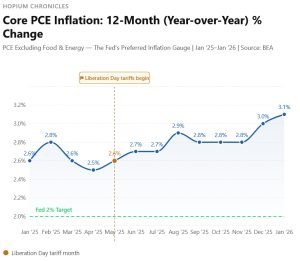
Hopium Chronicles, Advocacy, Inflation Comes In Hot (Again), Nation State AI Propaganda Here Now, New 2026 Battlefield Emerging, Simon Rosenberg, right, March 13, 2026. Hegseth, Witkoff, and Kushner Are All Up Schitt's Creek.
We start the day with more evidence of how badly Trump’s economic program has failed us. The Fed’s preferred gauge of inflation, Personal Consumption Expenditures, above, came in hot again. The “core” result, minus food and energy, rose 0.4% in January, the second straight month of a 0.4% (5% annualized) gain. Over the last twelve months core PCE has risen 3.1%, more than 50% above the Fed’s target of 2%. With Claude’s help here’s the core PCE trendline. Note the increase since the tariffs were illegally levied:
Another inflation gauge, PPI, showed a similar upward trend in January:
The third inflation gauge, CPI, was released earlier this week, and it too came in above the Fed target:
Trump’s policies have pushed inflation to an unacceptable level, which is helping slow economic growth too. We lost jobs last month, the 5th time we’ve lost jobs in the last 9 months (since the tariffs):
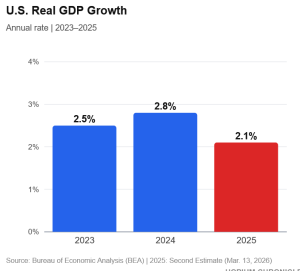 And we got a revised GDP number today showing that in that in q4 GDP growth was just 0.7%, down from an initial estimate of 1.4% (with annual charts shown above). So not only are we seeing job loss, not gains, the economy barely grew at all in the fourth quarter, and came in much slower in 2025 than 2023 or 2024:
Again, all this data is from before the war. Trump went to war with an American economy slowing and inflation rising - and now we have soaring gas and other commodity (incl fertilizer) prices which will both drive prices higher and further slow an economy already teetering on recession. A new CNN report helps explain why the Trump regime was willing to take this extraordinary risk with our economy and our economic lives - they didn’t think Iran would close the Strait of Hormuz. Okey-Dokey!
Gird yourself from historic levels of dangerous Trumpian incompetency:
Top Trump officials acknowledged to lawmakers during recent classified briefings that they did not plan for the possibility of Iran closing the strait in response to strikes, according to three sources familiar with the closed-door session.
The reason, multiple sources said, was administration officials believed closing the strait would hurt Iran more than the US — a view that was bolstered by Iran’s empty threats to act in the strait after US strikes on Iranian nuclear facilities last summer……
….The reality in the strait has left diplomatic counterparts, former US economic and energy officials and industry executives who spoke with CNN in a state of confusion and disbelief.
“Planning around preventing this exact scenario — impossible as it has long seemed — has been a bedrock principle of US national security policy for decades,” a former US official who served in Republican and Democratic administrations said. “I’m dumbfounded.”
…The Pentagon and National Security Council significantly underestimated Iran’s willingness to close the Strait of Hormuz in response to US military strikes while planning the ongoing operation, according to multiple sources familiar with the matter.
President Donald Trump’s national security team failed to fully account for the potential consequences of what some officials have described as a worst-case scenario now facing the administration, the sources said.
While key officials from the Departments of Energy and Treasury were present for some of the official planning meetings about the operation before it started, sources said, the agency analysis and forecasts that would be integral elements of the decision-making process in past administrations were secondary considerations.
Treasury Secretary Scott Bessent and Energy Secretary Chris Wright have been key players throughout the planning and execution stages of the conflict, the sources acknowledged. But Trump’s preference of leaning on a tight circle of close advisers in his national security decision making had the effect of sidelining interagency debate over the potential economic fallout if Iran were to respond to US-Israeli strikes by closing the strait.
And now it may be weeks before the administration’s efforts to alleviate the intensifying economic fallout take hold, officials said Thursday, including high-risk naval escorts of oil tankers through the strait that the Pentagon believes are currently too dangerous to conduct. The president, meanwhile, has continued to downplay the tumult in energy markets and the danger. He told Fox News in an interview airing Friday that oil tanker crews should “show some guts” and go through the strait.
This morning the thin-skinned Fox News Host running the Pentagon lashed out at CNN for their reporting, claiming the war wasn’t “widening” but “shrinking.” Really……
Yes, all of this is further confirmation that Trump is a titanic, vainglorious fuck up.
In most countries the Trump government would have fallen by now. Consider:
Trump is leading a wildly illegal cover up of global sex trafficking ring led by his “best friend,” and there are now credible reports of him raping and beating a thirteen year old girl
His tariffs that did so much damage to our economy, and our standing in the world, were declared illegal by the Supreme Court. Those original tariffs were in my mind the greatest abuse of Presidential power in US history. And rather than accepting the Court’s judgement, and that of Congress’ where each chamber voted to rescind the tariffs, he defiantly, illegally, recklessly both levied new tariffs to replace the ones struck down by the Court and has refused to pay back the hundreds of billions he owes to Americans. Seriously WTF……
Trump unleashed an illegal, unconstitutional paramilitary force to terrorize communities across the country, illegally detain many thousands of people, and kill Americans in cold blood on the streets of our cities. Noem has fallen for this. Miller should follow.
The ridiculous Iran war. This is now the greatest abuse of Presidential power in our history, outstripping the tariffs; and also perhaps the greatest policy mistake our great country has ever seen. The Trumpian incompetence the entire world is experiencing now - incompetence magnified by his extraordinary malevolence and stunning recklessness - should cause the immediate departure of Hegseth, Wifkoff, and Kushner.
Trump is an historic fuck up who has done jawdropping levels of damage to America and the world. It’s incredible that our political system is allowing him to remain in power. It’s why we have to working as hard as we can all.
 The Other 98%, Advocacy: Keeping the Class War classy! Palantir CEO Alex Karp just announced on camera that he is going to reduce the economic power of highly educated Democratic voters, Staff and wire reports, March 13, 2026. In a recent CNBC interview, Karp stated that his AI technology disrupts humanities trained, largely Democratic voters and makes their economic power less, while increasing the economic power of vocational, working class, often male voters.
He then had the audacity to admit these technologies are "dangerous societally," but justified it with a Cold War style argument that if America doesn't do it, adversaries will. This isn't some fringe conspiracy. This is a sitting CEO, with billions in government contracts, telling you exactly what he's doing to your democracy while daring you to stop him.
The mechanism is straightforward and worth understanding. As AI automates the cognitive, analytical, and communications work that college educated professionals have built careers around, those white collar jobs shrink in value and number. The people most exposed are educated women who vote Democrat. Meanwhile, trade and vocational workers, the plumbers, electricians, and machinists who lean Republican and male, become harder to replace with software. Karp isn't just predicting this shift. He is building the technology that accelerates it, cashing Pentagon checks along the way, and calling it patriotism.
We are watching a tiny class of AI billionaires reshape society, redistribute political power, and embed themselves into government infrastructure without a single vote being cast. Even Palantir's own head of communications called the company's political drift "concerning." The solution is not complicated: tax these people aggressively, break up these contracts, and demand democratic oversight of AI before the architecture of our entire society gets quietly handed over to a few unelected men with god complexes and government clearances. See lessNew York Times, U.S. Involvement in Venezuela
Trump’s Advice to Machado Restarting Diplomatic Relations Maduro’s Last Days in Power Venezuela’s Oil
More On Iran War
New York Times, Weakened by War, Iran Hits Back by Strangling a Vital Waterway, Anton Troianovski, Julian E. Barnes and Greg Jaffe, March 13, 2026 (print ed.). The threats to shipping in the Strait of Hormuz are complicating President Trump’s calculations about how and when to end the war.
Nearly two weeks after the United States and Israel attacked Iran with an extraordinary display of firepower, Iran has found a way to inflict pain back on its enemies by strangling one of the world’s most vital waterways.
By threatening shipping traffic through the Strait of Hormuz, attacking tankers in an Iraqi port and beginning to lay mines in the strait, Iran has sent oil prices surging and slowed global trade. It has also made clear that it is intent on using what advantages it has to sap the will of the United States to sustain the war.
The Iranian tactics have forced the United States to prepare to provide naval escorts for shipping traffic through the strait and to plan for anti-mine operations even as American forces target what is left of the Iranian navy, including Iranian mine-laying vessels.
On Thursday, Mojtaba Khamenei, right, the new supreme leader of Iran, sent the regime’s clearest signal yet that it would continue to endanger  commercial shipping in the strait, through which a fifth of the world’s oil was passing before the war began.
“Certainly, the lever of closing the Strait of Hormuz must continue to be used,” Mr. Khamenei said in his first statement since being chosen to succeed his father, who was killed in an airstrike at the start of the war.
Iran, analysts say, is demonstrating that even in a weakened state, it can inflict significant economic and military damage on the United States. That further complicates President Trump’s calculations about how and when to end the war and how to deal with a post-conflict Iran.
“This war isn’t only about what happens in the current cycle,” said Caitlin Talmadge, a professor at the Massachusetts Institute of Technology who has long studied security issues in the Persian Gulf. “It is about re-establishing Iranian deterrence for the next war.”
New York Times, 4 Killed in Crash of U.S. Refueling Plane in Iraq, Military Says, Helene Cooper, Greg Jaffe and Eric Schmitt, Updated March 13, 2026. The crash was not because of hostile or friendly fire, U.S. Central Command said. Four crew members died, it said, bringing the number of U.S. service members killed in the Iran conflict to at least 11.
Four of six crew members died after a U.S. military KC-135 refueling aircraft that was part of the American war against Iran crashed in neighboring Iraq, United States Central Command said on Friday.
In a statement, it said that rescue efforts were continuing and that the circumstances of the crash were under investigation, but added that “the loss of the aircraft was not due to hostile fire or friendly fire.”
The deaths brought the number of U.S. service members killed in operations related to the Iran conflict to at least 11.
Central Command did not immediately identify the four crew members who were killed, pending notification to their families.
It said on Thursday that an incident involving two aircraft had “occurred in friendly airspace,” and one aircraft went down, while the other landed safely.
The last American tanker crash occurred in 2013. In that incident, a K-135, taking part in refueling missions over Afghanistan, crashed soon after departure from the Manas airport in the Central Asian state of Kyrgyzstan. Three airmen died in the incident.
The KC-135s are among the most heavily used aircraft in the Air Force’s arsenal, and among its oldest airframes. The planes are used to refuel all kinds of aircraft to include fighter jets, surveillance planes and cargo aircraft.
A U.S. official said that the other plane involved in the collision was also a KC-135, which landed safely.
Air-to-air refueling missions are performed regularly by Air Force pilots and mishaps are rare. But the maneuver is still challenging, especially in bad weather or high winds. Investigators suspect a midair collision may have caused the crash, but details are still murky, Air Force officials said. The inquiry is still going on along with a search and rescue effort to locate the downed crew.
The western Iraq region where the plane crashed consists mostly of isolated desert.
This is the fourth manned aircraft to be downed since Operation Epic Fury began in late February, though none of the crashes were caused by hostile Iranian fire. Three Air Force F-15E Strike Eagle fighters were shot down by Kuwait F/A-18 aircraft in a friendly fire incident in early March.
Morning Shots via The Bulwark, Political Opinion: Trump’s Iran ‘Excursion’, William Kristol, right, March 13, 2026. Donald Trump has been mocked for calling the Iran war an “excursion,” indeed a “little excursion.” And deservedly so.
For one thing, it’s wildly inappropriate to use that term when people are getting killed in this conflict—lots of people, from American service members to Iranian schoolgirls. In fact, it’s more than inappropriate. It’s grotesque. If you’re president of the United States and you start a war, you should have enough of a sense of decency and dignity to treat it as a serious matter.
To make this obvious point isn’t to be woke or even antiwar. It’s to be adult and civilized. And however much Trump has degraded our civic culture, I think it’s a point with which most Americans would agree.
Now it’s probably the case that Trump stumbled into the term “excursion.” It surely wasn’t the word that Trump was meant to use. As part of their effort to avoid the word “war,” his aides must have advised Trump to call it an “incursion.”
But they failed on both counts. They didn’t talk him out of using “war.” Trump’s vanity makes him want to be a war president, so he won’t avoid boasting about his “war.” And Trump’s deficient grasp of the English language led “incursion” to become “excursion.”
Or did Trump—perhaps subconsciously—shy away from the word “incursion” because he vaguely remembered hearing about Richard Nixon’s politically disastrous and ultimately unsuccessful 1970 Cambodian “incursion”?
Anyway, Trump landed on the term “excursion.” He seems to like it. He’s embraced it. As Will Saletan points out, he’s used it at least sixteen times in the past week.
It’s irresponsible. It’s distasteful. It’s grotesque.
But couldn’t it be something of a political opportunity? Trump has taken us to war. The damage of his unilateral and irresponsible decision to do so is mounting, in terms of death and destruction in the Middle East, American casualties, and economic damage globally and at home. And it doesn’t look as if there’ll even be regime change in Iran. Trump’s war is a mistake heading towards disaster.
And Trump’s enjoying it all. For him, it’s exciting! It’s fun! It’s an excursion!
Consider George W. Bush and Iraq. Bush didn’t revel in the Iraq war and didn’t deny it was a war. And of course he had congressional approval for it. But he paid a great political price when it didn’t go well, and that price was exacerbated by his seeming to claim, a few weeks in, that it was a “mission accomplished.”
Couldn’t Trump’s “little excursion” into Iran be his “mission accomplished”? Couldn’t the expression be wrapped around Trump’s neck by his opponents as a term of well-deserved ridicule and opprobrium? Why shouldn’t “Trump’s Excursion” become an important signpost in the downward trajectory of a failed presidency?
U.S. Law, Courts, Crime, Civil Rights
Public Notice, How Trump hacked the judiciary, Lisa Needham, March 13, 2026. His fake "emergencies" are pushing the country toward autocracy.
There’s no question that the Department of Justice is an absolute shambles under Attorney General Pam Bondi and President Trump, given that the latter basically dictates what the DOJ does now, and he’s a crumbling mess of capriciousness and id.
 However, whether by accident or design, the DOJ has hit on one strategy that works: exploiting little-known, sometimes even never-before-used laws as the basis for Trump’s constant states of emergency.
This is a neat trick for two reasons. First, it confounds the courts a bit as they are forced to grapple with scenarios where there isn’t a well-developed body of law to rely on to interpret whether whatever ridiculous or evil thing that Trump is doing is permitted. And because of those gaps in the law, Trump is able to exploit the judiciary’s deference to the executive branch, particularly if the president is claiming there’s some sort of national security need.
It’s easy to get frustrated at the federal courts for not being bolder, especially earlier in Trump’s lawless reign. But courts — the current conservatives on the Supreme Court notwithstanding — are inherently small-c conservative and cautious entities. Their work is built on precedent, on looking at what has come before.
It takes time. And that’s a weakness in the judicial system that Trump exploits over and over again.Trump’s military excursion, into an abyss Trump’s military excursion, into an abyssDavid R. Lurie · Mar 12Read full story
Broadly speaking, Trump’s (mis)use of the law falls into four categories. Distressingly, at root, all of these excesses are about this administration’s abiding, unwarranted hatred for immigrants and for other countries, even when there are spillover effects for everyone else.
First, the administration has invoked a mishmash of domestic law to justify its international crimes in bombing boats in the Caribbean (and the country of Iran). Next, existing immigration laws have been cobbled together in a sort of unholy patchwork, an ever-shifting mess that allows the administration to pretend there’s some legal authority for what is nothing but xenophobia-fueled cruelty. Third, Trump relies on never- or seldom-used laws about presidential authority to deploy active-duty troops domestically, warping beyond reason any conception of state sovereignty. Finally, of course, there was the use of emergency powers to justify his sweeping, random, and retaliatory tariffs, which is where Trump received the biggest setback.
Yes, indeed, it’s inherently depressing that the only meaningful limitation the Supreme Court has seen fit to impose on Trump’s powers related far more to ensuring the safety of some justices’ pocketbooks rather than the safety of immigrants, Americans living in blue cities, and unarmed fishermen and fishing boats in the Caribbean. But Trump and his lawyers have also had a lot of success in the lower courts thanks in part to their brazen distortions of the legal code.The very legal and very cool clause
It feels odd to be discussing how Trump has used domestic laws to create international chaos without discussing his unprecedented, undeclared war in Iran that is currently spiraling out of control. But Trump hasn’t actually relied on any laws for that. Instead, he’s just claiming that his inherent Article II power magically gives him the authority to do it, despite the power to declare war exclusively belonging to Congress.
Trump loves claiming that his Article II power is basically unlimited, allowing him to ignore courts and Congress as long as he can say there’s an emergency or he’s acting with his inherent prerogative as president or both. That’s a justification that conservatives have adopted wholesale to justify the Iran War, even though it literally contradicts the Constitution.Aaron Rupar @atrupar.comQ: The president has not ruled out boots on the ground. Six American service members have already been killed. Where is Congress? THUNE: Congress obviously has the power of the purse. The president has broad authorities under Article 2 when it comes to defending America's national security interestTue, 03 Mar 2026 20:09:04 GMTView on Bluesky
Though Trump did some Article II flexing back when he was bombing fishing boats in and around the Caribbean, his justification for those strikes was a mashup of emergency powers, a tortured reading of some laws, a claim that national security is at stake, and an assertion that he can do whatever he wants. The administration did release a heavily-redacted version of a Office of Legal Counsel memo, which it says justifies the boat strikes and the invasion of Venezuela to abduct Nicolas Maduro. That memo floated the idea that maybe 10 U.S.C. § 274(b)(2)(F)(iii), which allows the defense secretary to make personnel available to transport suspected terrorists from foreign countries, could provide a legal basis, but went on to concede that whoops, that would have required Maduro to be charged with specific crimes he hadn’t been charged with, such as material support of terrorism.
So instead, the administration’s stance is, at root, that the president can do whatever he wants, whenever he wants. And with the boat strikes, who can stop him?
There’s not really a way to sue the government to stop this, as there’s no one who has standing. Families of victims of the boat strikes have filed wrongful death lawsuits against the administration, but those cases aren’t about attacking the justification for the strikes directly, nor do they function as a way to stop Trump and Hegseth from continuing to do this.Fake invasions
While Trump barely pretends to have a legal justification for his brutality abroad, he’s stretching laws to the breaking point to provide a veneer of legitimacy for mass deportation.
In March of last year, Trump invoked the Alien Enemies Act (AEA) to say that somehow, a combination of the Tren de Aragua gang and the Venezuelan government, then headed by Maduro, was a “hybrid criminal state” that was invading the United States. This, in turn, formed the basis for the dead-of-night deportation of 261 alleged Venezuelan TdA gang members to CECOT, El Salvador’s notorious prison. The fight over the administration’s defiance of Judge James Boasberg’s order to turn the planes around is continuing, nearly a year later.Aaron Rupar @atrupar.comTrump on El Salvador: "They've built a massive prison system. It's a hell of a system. We bring people there, and when they go there, they don't get out ... it's a brilliant system."Fri, 27 Jun 2025 16:12:45 GMTView on Bluesky
The AEA has only been invoked three times, and only in times of war — the War of 1812, World War I, and World War II. It’s most well-known as the justification for interning tens of thousands of Japanese-Americans during World War II. (A normal president wouldn’t want to invoke that shameful legacy, but we have Donald Trump instead.)
Because the AEA has never been invoked in peacetime, has never been invoked in the immigration context, and because the idea of a “hybrid criminal state” was invented out of whole cloth, courts have struggled with what to do, which is why there is still no final ruling on whether Trump can use the AEA in this fashion.John Roberts will save the judiciary if he has to burn it down John Roberts will save the judiciary if he has to burn it downLiz Dye · April 10, 2025Read full story
In May 2025, the Supreme Court, closing the barn door after the horse had bolted, refused to lift a temporary block on using the AEA to deport Venezuelans based on Trump’s nonsense. But that’s only because litigation is continuing, and the court severely limited relief for people the administration is trying to deport by saying the only way to challenge their detention under the AEA is to bring an individual habeas claim.
In January, the Fifth Circuit Court of Appeals sitting en banc — which is when the whole court re-hears a case after an initial three-judge panel ruling — heard oral arguments about whether the AEA allows this. The administration’s stance is its typical one: courts are simply not allowed to review any of Trump’s proclamations under the AEA.
This stance carves out wholly new ground. At root, it makes two new arguments courts haven’t dealt with yet. First, whether the AEA is even applicable to a newly-invented concept of a non-wartime “invasion” by a “hybrid criminal state.” Next, whether Trump’s authority in using it in this new context is so vast that courts cannot even consider it. Meanwhile, the administration continues to treat the need to round up random Venezuelans as an inherent emergency, a vital national security interest.
Trump has also used a byzantine combination of portions of the Immigration and Nationality Act to drastically increase its detention and deportation efforts. These rationales shift over time, but are always a complicated, tortured reading of those statutes that somehow — you guessed it — lets Trump do whatever he wants.
Trump has also broken new ground — not in a good way, mind you — with his use of laws about federalizing active-duty troops and deploying them domestically. (Only in blue cities, naturally.)
This was inevitable given how desperately Trump wanted to invoke the Insurrection Act in his first term during the 2020 George Floyd uprising. He hasn’t gone that far this time around, but he’s worked hard to figure out other ways to achieve his goals, and anti-ICE protests in Los Angeles gave him a perfect opportunity to try out a new theory: that the president can magically federalize a state National Guard based on vibes.“Neither our media nor our political system is designed to deal with a far right authoritarian party” “Neither our media nor our political system is designed to deal with a far right authoritarian party”Aaron Rupar and Thor Benson · June 21, 2025Read full story
On June 7 of last year, Trump issued a memo invoking 10 U.S.C. 12406. That’s a provision that allows the president to federalize a state National Guard, and up until then, that had always been read to require orders to be issued via the governor of the state. That section also can only be used if there is an invasion or danger of invasion, a rebellion or danger of rebellion against the government, or if the president could not execute federal laws with the regular forces available.
Trump didn’t get the consent of California Gov. Gavin Newsom, nor was it in any way credible to claim there was a “rebellion” or that Trump could no longer execute federal laws with the glob of ICE and CBP goons already in place. But Trump just went ahead anyway, with the truly novel idea that the requirement orders be issued “through” the governor was met by Defense Secretary Pete Hegseth ordering the commander of the California National Guard to allow federalization and, since the commander reports to Newsom, voila! Orders were issued “through” Newsom.
The administration also took the unprecedented step of arguing that any “protests or acts of violence” were actually a rebellion. So Trump rolled troops into Los Angeles, shouting “emergency” and “national security” all the while.
District Court Judge Charles Breyer blocked Trump from doing so nearly immediately, only to have the Ninth Circuit Court of Appeals step in and stay that order indefinitely. That left the case in limbo and the troops on the streets while the litigation proceeded. This proved enough of a mess that Breyer wasn’t even sure, for a time, that he had jurisdiction to hear the case. But Breyer ended up having to conduct a trial and ultimately wasn’t able to rule until December 2025 that Trump had to get the troops out.
During those months, however, Trump kept pushing the envelope because there was no court ruling telling him he couldn’t. So, in October, when a lower court ruled he could not similarly federalize the Oregon National Guard over sporadic anti-ICE protests there, he hit upon the notion of sending the already-federalized California National Guard to Oregon instead.
At the same time, Trump leveraged the fact that he’d been allowed to federalize California guard members under his tortured readings of both “through the governor” and “rebellion” to also federalize the Illinois National Guard in preparation for a deployment to Chicago. The Supreme Court finally ruled on this in December 2025, telling the administration it wouldn’t let him send troops to Chicago because “at this preliminary stage, the government has failed to identify a source of authority that would allow the military to execute the laws in Illinois.”
Well, the Supreme Court sort of ruled. This came down on the shadow docket, so it isn’t a final ruling on anything. After six months of wrangling, the best that blue states could get was a temporary reprieve, a limbo. There’s no definitive ruling that Trump’s perverse and risible re-reading of the law is wrong and can’t be used ever again. The state of permanent emergency invented by the administration therefore continues.How the Supreme Court taught Trump to rewrite history How the Supreme Court taught Trump to rewrite historyMatthew Wollin · October 17, 2025Read full story
Of course, the administration wasn’t going to let a little thing like the Supreme Court stop it from invading states. Only 10 days after the Supreme Court’s ruling on the Illinois federalization came down, the administration surged thousands of ICE agents into Minnesota, based not on some purported rebellion, but somehow because of alleged fraudulent misuse of federal money. The administration was also savvy enough not to rely on any laws for this one, instead saying only that the president had clear authority under Article II to invade a state to enforce federal immigration laws.
Who says the Trump administration can’t learn from its mistakes, right?
Finally, there were all the emergency invocations of Trump’s powers under the International Emergency Economic Powers Act (IEEPA) to impose whatever tariffs his fevered brain came up with, for any reason. He lost at the Supreme Court on that one, but then promptly pivoted to saying he would just use different, never-before used laws to impose tariffs, starting a whole new round of litigation.Flooding the zone
This administration’s philosophy towards laws is fundamentally the Steve Bannon approach — to flood the zone with shit.
It does things with no legal justification at all. It does things based on legal justifications that are obviously false. It does things based on legal justifications that have never been used before. It does things based on legal justifications that stretch far beyond reason. And it does so, always, by saying there is some emergency that allows — even requires — such action.
Courts are tangled up in this mess, playing whack-a-mole with each new development, while the rest of us try to survive a lawless, dangerous presidency.
Executive Dysfunction, Legal Analysis: We Have a Winner for Most Grotesque Supreme Court Audition Yet, DahliaLithwick and Mark Joseph Stern, March 13, 2026.
Judge Lawrence VanDyke issued a crass and indecent solo dissent on Thursday, castigating his colleagues for protecting the rights of transgender women. VanDyke—a Donald Trump appointee to the 9th U.S. Circuit Court of Appeals—attempted to shame his fellow judges with lewd descriptions of genitalia, and ultra-partisan complaints about trans anti-discrimination laws, which he derided as “Frankenstein social experiments.” Although VanDyke regularly belittles his own federal appeals court with juvenile insults, this latest shock-jock routine crossed the line from attention-grabbing performance art into outright vulgarity, prompting an unprecedented rebuke from 29 of his own colleagues across the entire ideological spectrum. His trolling, however, may well draw the attention of President Trump, who was clearly the intended audience for this obscene Supreme Court audition.
On this week’s Slate Plus bonus episode of Amicus, co-hosts Dahlia Lithwick and Mark Joseph Stern discussed VanDyke’s appalling dissent, the extraordinary response from his life-tenured colleagues, and the implications of this sordid spectacle for judicial independence. A preview of their conversation, below, has been edited and condensed for clarity.
--Dahlia LITHWICK: Judge VanDyke has constructed a reputation for himself as the judiciary’s most decorum-shredding troll. There’s stiff competition for that position, to be sure, but he outdid himself with this dissent. He began it this way: “This is a case about swinging dicks.” And it only gets worse from there.
----Mark Joseph STERN: I’m going to limit how much I quote VanDyke, because I hesitate to give him the attention he so obviously craves, but here is what he went on to write: “You may think that swinging dicks shouldn’t appear in a judicial opinion. You’re not wrong. But as much as you might understandably be shocked and displeased to merely encounter that phrase in this opinion, I hope we all can agree that it is far more jarring for the unsuspecting and exposed women at Olympus Spa—some as young as thirteen—to be visually assaulted by the real thing.”
So what’s actually going on here? Olympus is a Korean spa in Washington state whose Christian owners say they only allow entry to “biological women,” which apparently excludes preoperative transgender women. Washington’s Human Rights Commission found that this policy violated state law because state law outlaws discrimination on the basis of gender identity and public accommodations. The spa argued that it had a religious right under the First Amendment to discriminate against transgender patrons. A panel for the 9th Circuit disagreed, holding that the statute “imposes only incidental burdens on religious expression” and is both neutral and generally applicable. The spa petitioned for rehearing en banc, which was denied by the appeals court. That’s what prompted VanDyke to write this grotesque dissent.
--LITHWICK: Let’s stipulate that nobody should be surprised by VanDyke’s conduct. In a judicial attention economy, we have a lot of judges who all want the president’s solo attention waving their hands and saying: No, I am the grossest one of all! Nobody should be surprised that when he was nominated in 2019, the American Bar Association rated VanDyke “Not Qualified” based on 60 interviews with lawyers and judges, who found him to be an “arrogant, lazy,” “ideologue” who “lacks humility, has an ‘entitlement’ temperament, does not have an open mind, and does not always have a commitment to being candid and truthful.” They also questioned, at the time, whether he “would be fair to persons who are gay, lesbian, or otherwise part of the LGBTQ community.” Confronted with this assessment, he cried during his confirmation hearing.
But let’s see how he described Washington state’s unexceptional trans rights law: “Sometimes, it feels like the supposed adults in the room have collectively lost their minds. Woke regulators and complicit judges seem entirely willing, even eager, to ignore the consequences that their Frankenstein social experiments impose on real women and young girls.” I think the ABA is vindicated in its assessment, and deserves a little medal for prescience here.
----STERN: The ABA deserves a medal, a trophy, a Chili’s gift card. Unfortunately, Republican senators did not heed its warning, which is what led to this stunning dissent. Speaking of his bias, VanDyke also wrote that Washington’s law “will be used by sexual deviants to prey on women in female-only spaces,” and that these “sick and twisted consequences” are a result of “woke judges’ willingness to sacrifice those rights on the altar of ‘social progress.’ ”
I want to be clear that there is no evidence in the record that Washington’s transgender women will abuse the law in the way VanDyke warns. And the spa can exempt itself from this civil rights law if it operates as a private club or as part of a religious institution rather than as a for-profit business, which is what it currently is. The spa can also urge the Legislature to change the statute to give an exemption to businesses like theirs. I’ll note that when LGBTQ+ people have asked courts to protect their rights, conservative judges have long argued that they should really be working through the democratic process rather than asking unelected judges to do their bidding. And there is real irony in the fact that conservative judges are now telling a commercial establishment that it should be able to leapfrog over that democratic process to get permission from unelected judges to discriminate against transgender people.
Reasonable people can disagree about the precise scope of LGBTQ+ nondiscrimination laws. But this case is not a debate about the wisdom of Washington’s law. This is certainly not a case about whether men can go into a women’s spa and assault women—that is already prohibited under state law. This is about whether a federal court should step in and tell a state that its civil rights law goes too far, under the pretense of claiming there’s some kind of religious discrimination against a commercial establishment. The 9th Circuit correctly concluded that it should not.
--LITHWICK: One fascinating thing about VanDyke’s opinion is that it prompted a truly remarkable clapback among 29 of the 9th Circuit’s active and senior judges. Twenty-six judges joined an opinion by Judge Margaret McKeown in which she writes that VanDyke’s language “makes us sound like juveniles, not judges, and it undermines public trust in the courts. The lead dissent’s use of such coarse language and invective may make for publicity or entertainment value, but it has no place in a judicial opinion.” She added: “The lead dissent ignores ordinary principles of dignity and civility and demeans this court. Neither the parties nor the panel dissent found it necessary to invoke such crude and vitriolic language.”
Some very conservative judges signed onto that, including Jay Bybee, the George W. Bush appointee who gave his seat to VanDyke, and Eric Miller, a Trump appointee. Danielle Forrest, another Trump appointee, signed onto a separate opinion by Judge John Owens that states: “Regarding the dissenting opinion of Judge VanDyke: We are better than this.” This entire revolt tells us that even some people who agree ideologically with VanDyke’s positions are tired of this flagrant Miss America–style campaigning for a Supreme Court seat that may or may not open up this summer.
Does this rebuke only make VanDyke look better in the eyes of the only judge of this Miss America pageant, Donald J. Trump? And also, to Judge McKeown’s point: Won’t this one-way ratchet just completely collapse public confidence in the judiciary?
New York Times, Guest Essay: The Trump Administration Floats a New Way to Humiliate the Legal Profession, Deborah Pearlstein (director of the Princeton Program in Law and Public Policy and a visiting professor of law at the Princeton University School of Public and International Affairs), March 13, 2026.
For presidents, broadly speaking, lying is not against the law. For lawyers pursuing a president’s agenda, however, it’s a very different story.
Like all other lawyers licensed to practice in the United States, if they violate legal ethics rules, they can face sanctions in court or professional discipline, up to and including the permanent loss of their license to practice. Efforts to overturn the 2020 election foundered in court more than 60 times, before judges of both parties, in part because lawyers arguing President Trump’s case often feared telling a court the same extravagant lies that the president was telling the American people.
That was then. Now, under pressure to ignore a range of ethics rules, a large number of Department of Justice attorneys have quit, opting to lose their jobs but save their careers. Between these departures and a purge of legal staff members seen as insufficiently loyal to the president’s agenda, the department has lost thousands of lawyers. It shows: Briefs are riddled with errors. Attorneys come to court grossly unprepared. Worst, court orders stand violated — in some cases, it seems, because there weren’t enough lawyers available to ensure they were carried out.
To fill those empty seats, the department has launched an increasingly desperate effort to recruit new hires. (“Don’t be scared off by the transcript requirement,” a conservative law school reportedly told its students. “G.P.A. is not a strong factor.”) Even so, it seems too few lawyers are willing to take the chance. So the Trump administration last week offered up a different solution: a proposed rule that aims to shield Department of Justice lawyers from independent ethics investigations.
Such an arrangement would run afoul of a federal law known as the McDade Amendment, which says that government lawyers are subject to the ethics rules of the states in which they practice, “to the same extent and in the same manner” as every other lawyer licensed in the state. The proposed rule would be challenged in court immediately if it were ever to take effect. It shouldn’t get that far, however. It would do much more than potentially give department lawyers a free pass to lie on the president’s behalf. It would severely limit the courts’ ability to offer any kind of independent check on the executive branch.Sign up for the Opinion Today newsletter Get expert analysis of the news and a guide to the big ideas shaping the world every weekday morning. Get it sent to your inbox.
Rules requiring lawyers to serve as honest officers of the court have been adopted by every state and the District of Columbia. They serve a host of purposes, starting with the basic right to fairness. These rules are also critical to the independence of the courts, which depend on access to reliable evidence and accurate representations by counsel.
Such rules serve an especially critical function in constitutional democracies, which distinguish themselves from authoritarian regimes in part by insisting that truth and falsehood exist separately from whatever the government may assert. Facts, no less than law, constrain government power. Against the “flood the zone” strategy of misinformation that the current administration seems to favor, lawyers and judges, bound by legal, professional and social obligations to work in a reality-based world, can function as a critical levee.
The Trump administration lawyers who remain have spent the past year testing this levee, amassing a staggering record of false sworn statements, withheld information, contradictory testimony and more. Judges appointed by presidents of both parties have repeatedly called out Justice Department lawyers for their failures, excoriating attorneys for wasting judicial resources in some cases, threatening lawyers with sanctions in others. So damaged is the department’s reputation for truth-telling at this point, one judge noted despairingly, that “the court is left with little confidence” that government lawyers “can be trusted to tell the truth about anything.”
Under the proposed rule, the attorney general could ask any independent disciplinary authority to suspend ethics proceedings against a Justice Department lawyer (on threat of unspecified enforcement action), and send the matter to the department’s own Office of Professional Responsibility. But an O.P.R. review is not a serious substitute for a state bar investigation. Even before Mr. Trump, the office, which answers to a political appointee, had a reputation of operating like a black hole, with the details of investigative findings almost never made public.
The O.P.R. came into being as a compromise measure, designed to stave off calls for more radical reforms at the Justice Department when it became clear how many of its lawyers had aided Richard Nixon’s corruption. It has never had the power to subpoena testimony or information from outside the department. At the moment, it doesn’t even have a leader. That leaves it up to Deputy Attorney General Todd Blanche — who recently declared that the administration was at “war” with the federal courts — to move any internal evaluation along as fast, or as slowly, as he wants.
The state bar disciplinary system is far from perfect. Proceedings can drag on for years. Some bar authorities are reluctant to investigate Trump administration lawyers. Even disciplinary systems with the courage to move forward could have a tough time handling the sheer number of administration lawyers who have apparently lied. Still, coupled with other deterrents — the courts themselves, and lawyers’ concern for their own reputations — the risk of state bar discipline remains a critical tool for protecting the truth-finding function of the federal courts. No wonder the administration is determined to go after them.
The move against state bars is of a piece with the administration’s broader strategy against universities, the media, law firms — any set of organizations capable of challenging the president’s power. And few things threaten it more than holding it to the truth.
New York Times, Lebanese Family Members of Synagogue Attacker Died in Airstrike, Jacey Fortin, Hwaida Saad, Neal E. Boudette and Kurt Streeter, March 13, 2026. The man was identified as a U.S. citizen born in Lebanon, who lived and worked outside Detroit. The attack on Temple Israel left Jewish communities across America rattled
The man who rammed his truck into a Michigan synagogue on Thursday lost four family members in an airstrike in Lebanon the week before, according to an imam in Dearborn Heights, Mich., and a Lebanese official who said he knew the man and his family.
The attacker was identified by federal officials as Ayman Mohamad Ghazali, a 41-year-old naturalized U.S. citizen who was born in Lebanon. He lived outside Detroit, where a mosque held a memorial for his slain family members this week, according to the imam, Hassan Qazwini of the Islamic Institute of America, who performed the service but did not know Mr. Ghazali, he said.
Mr. Ghazali was killed on Thursday after driving through the temple doors and down the hallway of Temple Israel in West Bloomfield Township, Mich. He exchanged gunfire with security guards, officials said, though they added on Thursday that his cause of death of was not yet clear.
No one else was killed in the attack, which set the building on fire and sent some 30 police officers to the hospital to be treated for smoke inhalation. One security guard was hit by the vehicle and injured. He is expected to recover.
The episode heightened fears among Jews in Michigan and across the United States. A wave of rising antisemitism in America has been exacerbated by the U.S.-Israeli war on Iran, which has extended into attacks by Israel on Lebanon in an attempt to root out the Iran-backed militant group Hezbollah.
It also prompted anxiety for members of the area’s large Arab community, who braced for extra scrutiny after they learned that the attacker was from Lebanon. “This tragedy comes at a time when communities everywhere are confronting rising hate and senseless violence,” said Mayor Mo Baydoun of Dearborn Heights, Mich., where the attacker worked at a local restaurant.ImageTwo uniformed law enforcement officers patrol an area outside a building near a playground. A fire truck sits nearby.The attack set the building on fire and sent some 30 police officers to the hospital to be treated for smoke inhalation.Credit...Sarah Rice for The New York Times
Mayor Baydoun said in a statement late Thursday that Mr. Ghazali had lost several members of his own family, including his niece and nephew, in an Israeli attack this month, though the source of his information was unclear. But it matched what an official in Lebanon and Imam Qazwini told The New York Times on Friday.
The Lebanese official, speaking on condition of anonymity because he feared reprisals, said Mr. Ghazali’s brother, Ibrahim, and his two children, as well as another brother, Qassem, were killed in a strike on their three-story building. Ibrahim’s wife was seriously wounded and is in a hospital, the official said.
Lebanon’s health ministry said that an Israeli airstrike had killed four people and injured a woman in the eastern town of Mashgharah on March 5, according to reports by The Associated Press.
Though investigators in Michigan said they had not determined a motive for the synagogue attack, officials described it as a clear indication of rising antisemitism. Temple Israel is one of the country’s largest Reform houses of worship and the largest in metropolitan Detroit.
 “It was hate, plain and simple,” Gov. Gretchen Whitmer of Michigan, above, said on Friday. “We will fight this ancient and rampant evil. We will stand together as we do it, and we will call it out.”
Temple Israel includes a nursery school and a religious school for children in prekindergarten to 12th grade. About 140 children were inside when the vehicle rammed the building shortly after noon. All of them were evacuated from the building without injury.
Cassi Cohen, 50, a director at Temple Israel, was in the synagogue’s administrative offices during the attack. “We heard a really loud crash,” she said. “We saw debris flying everywhere, and heard a bang. We knew we had to get out of there.”
Mr. Ghazali came to the United States in 2011 on a visa for foreign-born spouses of U.S. citizens, the Department of Homeland Security said. He became a citizen in 2016. Residents in Dearborn Heights, a Detroit suburb with a large Lebanese community, said that Mr. Ghazali had worked at a popular restaurant known for its Mediterranean food.
Chadi Zreik, 32, a neighbor of Mr. Ghazali, said that news of the attack spread quickly, appalling residents of Dearborn Heights. “And now there’s going to be blowback on our community,” he said. “Anytime anything happens in this community, it’s under a microscope.”
Checks & Balances, Commentary: When Homeland Security Threatens the Citizens It Was Created to Protect, Nuala O’Connor, A warning from the first-ever Chief Privacy Officer of the DHS.
In 2003, I became the first Chief Privacy Officer of the US Department of Homeland Security, when serving in the Bush administration under DHS Secretary Tom Ridge. I was the first statutorily mandated CPO in the federal government, and my job was to ensure that even as we defended America against terrorism, we never sacrificed the civil liberties that define us as a nation. We understood then what seems forgotten now:
A government that surveils its own citizens in the name of security becomes the very threat it claims to guard against.
 That’s why I’m alarmed by recent reports that DHS is demanding voter rolls and other personal data from states like Minnesota. This isn’t about border security or preventing terrorism. This is about amassing a surveillance apparatus aimed at American citizens—and it represents a fundamental betrayal of the department’s mission.
When DHS was established after 9/11, Congress recognized the extraordinary powers we were granting a federal agency. They insisted on safeguards, including my position, precisely because they understood the danger of unchecked government access to personal information. We built privacy protections into the department’s DNA because Americans were willing to accept enhanced security measures only if their fundamental rights remained intact.
The current request violates those founding principles in several ways. First, voter registration data contains deeply personal information: names, addresses, dates of birth, party affiliations, and voting history. This isn’t abstract metadata—it’s the detailed political profile of every registered voter. When the federal government demands this information without specific criminal or national security justification, it crosses a constitutional line.
Second, there’s no legitimate homeland security purpose for wholesale collection of state voter data. DHS’s core mission is to defend our home: prevent terrorist attacks and secure our borders. Voter rolls don’t tell us who poses a terrorist threat. They don’t help identify smuggling operations or cybersecurity vulnerabilities in critical infrastructure. What they do provide is the ability to monitor, track, and potentially intimidate citizens based on their political activities.
Some will argue this data will only be used for legitimate purposes like verifying citizenship or preventing voter fraud. But we’ve seen this playbook before. Mission creep is inevitable once surveillance infrastructure exists. Data collected for one stated purpose invariably expands to others. When we created post-9/11 security measures, we promised they’d only target terrorists. Soon those tools were being used for routine law enforcement. The same will happen here.
Moreover, timing matters. This request comes amid broader efforts to centralize power and weaken the federal-state balance that protects liberty. When the national government can demand detailed information about citizens from state authorities without clear legal authority, federalism loses its meaning. States become administrative branches of federal surveillance, rather than independent sovereigns that can push back against overreach.
I saw firsthand how easily good intentions can morph into civil liberties violations when proper oversight is absent. After 9/11, there were proposals to create massive databases tracking everything from library records to travel patterns. We fought those efforts not because we didn’t take security seriously—security was our full-time job—but because we understood that a free society cannot function when citizens fear their government is watching their every move.
The chilling effect of such surveillance is real. When people know the government is collecting information about their political activities, they self-censor. They avoid certain associations. They think twice before speaking out. This isn’t hypothetical—it’s documented across authoritarian societies and in America’s own history, from COINTELPRO to the surveillance of civil rights leaders.
DHS should return to its core mission: protecting Americans from external threats while respecting the Constitution that is our nation’s framework for being. That means rejecting broad fishing expeditions for citizen data and focusing instead on genuine security challenges. It means recognizing that privacy isn’t the enemy of security—it’s the foundation of the liberty we’re trying to secure.
Minnesota and other states should refuse these requests unless DHS provides specific legal authority and clear national security justification. Congress should investigate and, if necessary, legislate clear limits on federal access to state voter and other data. And citizens should demand that their representatives stand firm against this overreach.
Done right, security and liberty aren’t opposites. But the current path threatens that balance. When Homeland Security becomes a tool for monitoring American citizens rather than protecting them, we’ve lost our way. It’s time to find it again.
Nuala O’Connor was the first Chief Privacy Officer of the US Department of Homeland Security and founding member of the President’s Board on Safeguarding Americans’ Civil Liberties under President George W. Bush. She has held senior legal, data, and technology leadership positions at companies including Amazon, General Electric, and Walmart, and served as president and CEO of the Center for Democracy & Technology from 2014 to 2019. She currently serves on several company and nonprofit boards and is a member of the advisory council of the Society for the Rule of Law.
New York Times, Treasure Hunter Released From Prison After Refusing to Turn Over Gold Coins, Remy Tumin, March 13, 2026 (print ed.). Thomas G. Thompson was held in contempt for 10 years for repeatedly denying he knew the whereabouts of 500 missing gold coins.
A former-scientist-turned-treasure-hunter was released from prison last week after serving his 10-year sentence for contempt of court for refusing to share the location of missing gold coins.
During his searches, Thomas G. Thompson, 73, discovered the S.S. Central America in 1988 off the South Carolina coast. The steamship went down in 1857, in a hurricane, with 450 passengers and tons of coins, bars and nuggets of California gold worth millions of dollars.
It was known as the Ship of Gold, and since its discovery, insurers and angry investors have wanted to collect their share of the bounty. In 2005, some investors who had backed his efforts sued Mr. Thompson, saying they had yet to receive any money from a $50 million sale of some of the treasure. Mr. Thompson went into seclusion in Florida. In 2012, a judge issued a warrant for his arrest after he failed to show up to court.
Three years later, the authorities tracked him down. The judge held him in contempt and sent Mr. Thompson to prison for refusing to cooperate in the recovery of 500 coins missing from the loot. He has maintained that the gold coins were commemorative coins known as restrikes — melted down from a bar from the ship and pressed using a 19th-century machine from the San Francisco Mint — and part of his share of the payment. He turned the coins over to a trustee in Belize around 2009, and has repeatedly said he has no clue where the coins are.
Mr. Thompson has been fascinated with the deep sea since he was a boy, said his lawyer Keith Golden, who has known him since the 1970s. He wanted to get into deep sea oceanic studies but couldn’t line up the funding, so a friend suggested he turn to treasure hunting to help raise money, Mr. Golden said. Mr. Thompson spent hours deciding which treasure to “go after,” Mr. Golden said.
Mr. Thompson, then at Battelle Memorial Institute in Columbus, a private contractor specializing in science and technology, decided on the S.S. Central America. He persuaded some 250 investors to back his hunt.
“It’s the greatest treasure in American history,” said Dwight Manley, a California coin dealer who bought and sold nearly 93 percent of the available treasure.
Mr. Thompson’s contempt order was terminated in 2024, but he still had to serve the two-year sentence from the initial charge of failing to appear before the judge.
More Global News
New York Times, Canada to Expand Military Presence in Arctic, Following Trump Threats, Ian Austen, March 13, 2026 (print ed.). Prime Minister Mark Carney said Canada would build three bases in the region. The government also plans to improve infrastructure and airports in the north.
Prime Minister Mark Carney of Canada unveiled a multibillion-dollar plan on Thursday to significantly build up the country’s military capacity in the Arctic, including establishing new bases in a region where the country has had to rely on the United States to ensure its defense.
The announcement follows President Trump’s repeated calls for Canada’s annexation and his musings about acquiring Greenland, Canada’s Arctic neighbor.
Mr. Carney is not the first Canadian prime minister with grand plans for improving the security and asserting Canada’s sovereignty over its enormous yet largely unpopulated Arctic region. But his proposal is more comprehensive and extensive than past efforts.
“With this plan, we are taking control of our future,” Mr. Carney said, speaking in an airplane hanger in the city of Yellowknife surrounded by troops. “We will no longer rely on others to defend our Arctic security or to fuel our economy. We are taking full responsibility for defending our sovereignty.”Mr. Carney said that past efforts “lacked the scale of ambition and the depth of strategy worthy of this vast region and its people.”Want to stay updated on what’s happening in Canada? Sign up for Your Places: Global Update, and we’ll send our latest coverage to your inbox.
The cornerstone of the new effort will be spending 32 billion Canadian dollars, about $23.5 billion, to build three military bases in the northern territories, including one in Yellowknife, and making improvements at an existing base in Labrador. Two “operational support nodes” — essentially service stations for military aircraft and troops — will also be built for another 2.67 billion Canadian dollars. The government will spend 294 million dollars on improving two Arctic airports to allow the landing of larger aircraft, civilian and military.
“The primary purpose of all this spending is to show Donald Trump that Canada can take care of security in its own Arctic, so that the U.S. doesn’t need to,” said Michael Byers who studies Arctic sovereignty and Canadian defense policy at the University of British Columbia.
Professor Byers added that “in other circumstances, permanently stationing more than a few hundred troops in the Canadian Arctic would not make sense. It’s too vast, cold, and sparsely populated.”
He said that it would be more effective and less expensive to set up a special northern rapid reaction force in southern Canada that could be swiftly sent north.
David Perry, president of the Canadian Global Affairs Institute, a defense and international affairs research group, said that “these are massive, not seen in several generations investments.”
A senior government official, who spoke on the condition of anonymity because of public service rules, said the new bases and supply stations would allow Canada to maintain a constant presence of a sizable number of troops and aircraft in the north, rather than just dispatching them for occasional training exercises. The official said that work on some of the projects had already started and that the government had called for bids on the others.
The entire project is expected to take at least a decade to complete.
The expanded military presence follows Canada’s decision to spend 6.5 billion Canadian dollars on an Australian radar system to monitor Arctic airspace. During a visit to Australia last week, Mr. Carney attended a demonstration of that system by the Royal Australian Air Force.
New York Times, Cuban President Acknowledges Talks With Trump Administration, Frances Robles, David C. Adams and Patricia Mazzei, March 13, 2026. President Miguel Díaz-Canel, whose country is rapidly running out of fuel, said the talks were based on “respect for the political systems of both countries.”
In what was seen as a last-ditch effort to save his hobbled government, President Miguel Díaz-Canel of Cuba announced on Friday that his government had been holding talks with the Trump administration while managing an increasingly severe lack of fuel.
Cuba’s government is facing an existential crisis as the Trump administration ratchets up pressure on the 67-year-old Communist state, maintaining what amounts to an oil blockade. Fuel is rapidly running out, plunging Cuba into prolonged periods of darkness.
Though the discussions with the United States had previously been reported by U.S. news outlets, it was the first time the government had acknowledged that talks were underway.
Mr. Díaz-Canel, in a 90-minute news conference broadcast on state media, said the talks were aimed at finding solutions to Cuba’s differences with the United States. He said the discussions were based on “respect for the political systems of both countries, sovereignty and our government’s self-determination,” suggesting that, from his point of view, political changes in Cuba were not on the table.
He said international factors had facilitated the exchanges, without providing specifics. Cuba’s foreign minister recently met with the Vatican, as did Mike Hammer, the top U.S. diplomat in Havana.
The Vatican’s secretary of state, Cardinal Pietro Parolin, said the Vatican had taken “the necessary steps, always with a view to a dialogue-based solution to the problems that exist.”
Cuba’s government announced on Thursday that it would soon release 51 prisoners, in what appeared to be an effort to appease the Trump administration.
Mr. Díaz-Canel said a development to be announced on Monday would “greatly facilitate” the participation of Cubans abroad in the island’s “economic and social development program,” strongly suggesting that the government would allow Cubans overseas to invest in the nation’s economy. Exiles in Florida and other places with large Cuban communities have been pushing for that for years.
Over the past year, Mr. Díaz-Canel said, the island’s foreign ministry has held talks with Cubans abroad to listen to their ideas. He acknowledged that there had been a significant exodus from the country, saying the number of Cubans overseas “has grown.”
(a) Except as provided in paragraph (b) of this general license, all transactions prohibited by the above-listed authorities that are ordinarily incident and necessary to the sale, delivery, or offloading of crude oil or petroleum products of Russian Federation origin loaded on any vessel, including vessels blocked under the above listed authorities, on or before 12:01 a.m. eastern daylight time, March 12, 2026 are authorized through 12:01 a.m. eastern daylight time, April 11, 2026.
-- U.S. Sanctions Against Russia
Emptywheel, Analysis: Trump Rewards Russia for Helping Iran Target US Service Members, Emptywheel (Marcy Wheeler), right, March 13, 2026. Yesterday, Scott Bessent lifted sanctions on any Russian oil currently stranded at sea (including oil that Russia managed to “strand” at sea between Monday, when Trump spoke with Putin, and yesterday).
This move comes in the wake of reports — first from WaPo,
Since the war began Saturday, Russia has passed Iran the locations of U.S. military assets, including warships and aircraft, said the three officials, who spoke on the condition of anonymity because of the matter’s sensitivity.
“It does seem like it’s a pretty comprehensive effort,” one of the people said.
And detailed further by CNN that Russia was providing Iran with satellite intelligence about US movements.
Russia is helping Iran with advanced drone tactics from its war in Ukraine to hit US and Gulf nation targets in the Middle East, according to a Western intelligence official.
Shahed drones, designed by Iran but mass produced by Moscow for use in Ukraine, have been unexpectedly successful in penetrating the air defenses of Gulf nations. Russian intelligence sharing with Iran has until now been reported as general assistance with targeting, but specific tactical advice is a new level of support.
“What was more general support is now getting more concerning, including UAS [drone] targeting strategies that Russia employed in Ukraine,” said the official, who did not want to be identified discussing sensitive intelligence. While the official declined to specify the exact tactical help, Russia has used Shahed drones against Ukraine in waves, with multiple drones flying together and changing course regularly to elude air defenses.
Both WaPo and, in an earlier story on Russian assistance, CNN mentioned the six people who died in a facility in Kuwait. Later CBS reporting described the full extent of the damage and one of the reservists injured in the attack has described it.
No one has circled back and considered whether Russia helped Iran target a much more sophisticated attack, the March 1 strike on Prince Sultan Airbase in Saudi Arabia that NYT described this way:
On Saturday night, the Islamic Revolutionary Guards Corps announced that the Prince Sultan Air Base in Saudi Arabia had been targeted with missiles and drones. The following morning, satellite imagery captured a mile-long smoke plume rising from a building connected to the site.
Another satellite image captured on Tuesday showed the structure was largely destroyed.
The building that was hit is close to a radome and sits within a fenced-off area roughly six miles east of the main base, indicating Iranians may have been specifically targeting a communications section of the site.
That is likely the strike that injured SpaceComm soldier Benjamin Pennington, leading to his death on March 8.
Army Sgt. Benjamin N. Pennington, 26, of Glendale, Kentucky, died Sunday after being wounded during a March 1 attack on the Prince Sultan Air Base, Saudi Arabia, a Pentagon statement said.
[snip]
Pennington was assigned to the 1st Space Battalion, 1st Space Brigade of the U.S. Army Space and Missile Defense Command based at Fort Carson, Colorado.
The unit’s mission focused on “missile warning, GPS, and long-haul satellite communications,” according to their website.
There is chatter about redeployments of refueling tankers (the same kind of tanker that went down in Western Iraq yesterday) from Prince Sultan and a significant MEDEVAC to Landstuhl, the kind of MEDEVAC DOD was trying to arrange before Pennington passed away, though I’m still trying to confirm their accuracy.
 To be clear, Russia told Trump, Steve Witkoff, right, and Jared Kushner — all of whom have a history of being easy marks for Russia — they weren’t helping Iran, which Witkoff, AKA “Dim Philby,” described this way.
Russian leaders in a call with President Donald Trump on Monday denied allegations that they are sharing intelligence with Iran during the war, U.S. Special Envoy Steve Witkoff said.
“So, you know, we can take them at their word,” Witkoff told CNBC’s “Money Movers” during an interview on Tuesday. “Let’s hope that they’re not sharing.”
[snip]
“Well, I’m not an intel officer, so I can’t tell you,” Witkoff replied.
“I can tell you that yesterday, on the call with the president, the Russians said they have not been sharing,” Witkoff said. “That’s what they said.”
Witkoff also said he and Trump’s son-in-law, Jared Kushner, had separately had a phone call on Monday morning with Yuri Ushakov, Putin’s foreign policy advisor.
Ushakov, in that call, “reiterated the same,” that Russia is not sharing intelligence with Iran, Witkoff said.
Wednesday, as service members continue to risk their lives in Trump’s illegal war, Witkoff and Kirill Dmitriev met in Miami to discuss business deals.
Thus far, Trump’s illegal war has led to an increase of Iranian oil shipping:
Iran is exporting more oil through the Strait of Hormuz than before the war, showing it is in control of a strategic waterway that it has closed off to the rest of the region’s oil producers.
As Gulf Arab oil producers from Saudi Arabia to Iraq cut production and scramble for new routes that bypass the strait, Iran is conducting business as usual, according to data from tanker-tracking firm Kpler, throwing a financial lifeline to Tehran as it comes under blistering attack from the U.S. and Israel.
Since the war started on Feb. 28, seven tankers have loaded oil off the Iranian coast, according to Kpler. At least two of the most recent loadings are out of the Persian Gulf, Kpler said. Over the past six days, tankers have loaded a daily average of 2.1 million barrels of Iranian oil, higher than the 2 million barrels a day Iran exported in February, according to Kpler.
Iran’s export levels can vary week to week, but the recent increase shows that, unlike other producers, their shipments are unimpeded and that China hasn’t lost its appetite for Tehran’s crude.
New York Times, Phones ‘Ringing Off the Hook’ for Ukraine Defense Firms as Mideast Seeks Help, Andrew E. Kramer and Maria Varenikova, Visuals by Brendan Hoffman, March 13, 2026. Ukraine wants to leverage its defense expertise into security partnerships and to reap potentially vast profits for its arms industry.
For most of its four-year-long war with Russia, Ukraine has been a recipient of security aid from the United States and European allies. With war now raging in the Middle East, Ukraine’s government is seeking to turn the tables by offering a pivotal technology to intercept the exploding drones menacing the region’s oil facilities and shipping.
 In a possible prelude to sales agreements, Ukraine has sent interceptor drones and teams to operate them to three American allies in the Persian Gulf: Saudi Arabia, Qatar and the United Arab Emirates.
Eleven countries in all, including the United States, European nations and Gulf monarchies, have sought Ukraine’s assistance or advice on shooting down Iranian-made Shahed drones, according to President Volodymyr Zelensky. For years, Ukraine has been fine-tuning defenses against such drones, which Russia fires into the country by the thousands each month.
“This phone has been ringing off the hook,” said Oleg Rogynskyy, the chief executive of Uforce, a conglomerate of Ukrainian defense technology start-ups that has attracted seed capital valuing it above $1 billion. As the U.S.-Israeli war against Iran spreads through the Middle East, interest in the company’s drone aircraft and boats is skyrocketing, he said.
Ukraine wants to leverage its defense expertise into political recognition of a security partnership with the United States and European countries, and to reap potentially vast profits for its arms industry. While no deals have been announced yet, the market for drone defenses for oil fields and tankers could run to many billions of dollars, Ukrainian defense executives say.
Ukraine’s counter-drone technology, initially cobbled together from off-the-shelf consumer goods and video game gear, now rivals conventional air defense systems but at a fraction of the cost, military analysts say.VideoAn interceptor drone being piloted at a training center.
The most common type of Ukrainian drone used to intercept Shaheds resembles a toy rocket. It is made of 3-D-printed plastic parts, stands about three feet tall and is powered by electric motors and propellers. It zooms at speeds close to 200 miles an hour and can hit targets up to an altitude of about 15,000 feet.
By last year, Ukrainian companies’ capacity to produce such drones exceeded the government’s budget to buy them. Mr. Zelensky lifted wartime restrictions on exports, saying that export revenues could help domestic arms companies cover costs at home.
Skyfall, a Ukrainian drone maker, says it can produce 50,000 of its P1-Sun interceptors per month. Another manufacturer, General Cherry, can make 10,000 of its Bullet interceptor drones a month. F-Drones, which makes the Litavr interceptor, has adapted its systems for compatibility with foreign radars, the company’s founder, Hnat Buyakin, said.
More On U.S. Inflation, Economy, Jobs, Markets
New York Times, Oil Prices Rise Despite Trump’s Decision to Lift Russia Sanctions, Updated March 13, 2026. The worldwide price of oil rose slightly on Friday, continuing to trade around $100 a barrel on heightened fears about the economic impact of a sustained blockage of Middle East energy.
The latest move by President Trump to signal relief to markets slowed but did not reverse the increase in prices. Treasury Secretary Scott Bessent announced on Thursday night that the U.S. government had temporarily removed sanctions on Russian oil currently at sea to add oil to global markets.
Stock markets in Asia fell again on Friday, a day after the S&P 500, the U.S. stock benchmark, slumped to its worst single-day performance since the war began.Here is the latest on how some crucial markets are reacting:
Oil price spike eases but hovers around $100. Global stocks fall. Gasoline prices go up again.
Oil price spike eases but hovers around $100.
The price of Brent crude, the global benchmark for oil, was hovering around $100 a barrel on Friday in London. It settled at $100.46 a barrel on Thursday, up 10.1 percent, the highest settlement level since August 2022.
West Texas Intermediate crude, the U.S. benchmark, was around $95 a barrel. It settled at $96.40 a barrel on Thursday, up 10.5 percent.
Oil markets have been on a convulsive path since the United States and Israel attacked Iran on Feb. 28. The price of Brent jumped to nearly $120 a barrel on Monday as traders feared long-lasting cuts in supplies. Prices have pulled back since then, but remain sharply higher than before the war.
Investors and analysts across the world are focused on the Strait of Hormuz, the narrow waterway between Iran and Oman that is a vital trading route for oil and natural gas, which normally carries as much as one-fifth of the world’s oil supply. Shipping traffic exiting the Persian Gulf through the strait has been effectively halted and tankers are stranded because of the risk that vessels could be attacked.
Governments have tried to assuage concerns about the global supply of oil. World leaders agreed on Wednesday to release 400 million barrels of oil from their strategic reserves. Before its broader waiver on Russian sanctions, the Trump administration last week similarly freed India from some sanctions restricting its purchases of Russian oil.
Paul Krugman via Substack, Political-Economy Commentary: Oil Prices Could Easily Go Much Higher, Paul Krugman, right, March 13, 2026. If the Strait stays closed, look out above.
I did not have time yesterday to do a full post for today, but wanted to say something I suspect many economists are thinking, but which I haven’t seen clearly expressed: the world economy’s very robustness to oil price shocks may lead to extremely high oil prices.
Or to put it differently: even after the spike in oil prices we’ve seen, those prices aren’t high enough to cause a global economic crisis. And that’s a reason prices may have to go much, much higher.
The rise in prices since the bombs began falling has evidently come as a huge shock to Trump and company, and they are flailing furiously (and epically.) But as I and many others have pointed out, the U.S. and other major economies are a lot less oil-dependent than they were in the 1970s, and even at $100 a barrel oil prices are not high enough to provoke a major crisis.
In fact, as the chart at the top of this post shows, the real price of oil — the price of oil relative to the prices of everything else, as measured by the Consumer Price Index — isn’t much higher than it was during much of Trump’s first term, when nobody was talking about an energy crisis.
Yet if one looks at the state of global oil supply, it’s extremely dire. Around 20 percent of the world’s normal flow of oil is bottled up inside the Strait of Hormuz — and as we’ve seen in the past day, even tankers and oil facilities inside the Strait are vulnerable to attack. If this blockade persists, it will be a much worse shock to world oil supplies than the 1973 embargo, the 1979 Iranian revolution, or the 2022 Russian invasion of Ukraine.
So what happens if the Strait remains closed for months? It’s a matter of supply and demand. If the quantity of oil supplied to world markets can’t rise — which, as far as we can tell, it won’t until the mullahs decide to let tankers through again — the price of oil will have to rise high enough to reduce the quantity demanded.
And how high would that price have to be? It would have to be high enough to persuade drivers to stop driving, trucks to stop trucking, airlines to stop flying.
In other words, the price of oil would have to rise enough to cause a global economic crisis even though the world is much less oil-dependent than it used to be.
Given time to adjust, the world can conserve oil in many different ways. For example, gas mileage roughly doubled in the decades that followed the 70s oil shocks — and that was before hybrid and electric vehicles. In the long run, the world economy could make do without Persian Gulf oil, at minimal cost in terms of global GDP.
But in the long run we are all dead. In the short run, the economic impact of a sustained loss of Gulf oil could be very ugly. In fact, it would have to get ugly to persuade the world to buy a lot less oil.
I’ve seen some alarmists warn that a long war in the Gulf could lead to oil at $150 a barrel. That looks low to me.
Morning Shots via The Bulwark, Political Opinion: Magical Thinking, Andrew Egger, March 13, 2026. Wake up, babe: Donald Trump is field-testing a new Iran-war messaging strategy. Spiking oil prices, he informed us by tweet yesterday, are good, actually: “The United States is the largest Oil Producer in the World, so when oil prices go up, we make a lot of money.”
If this sounds like a flailing attempt to stanch a massive political wound—well, that’s because it is. But it’s also an illustration of the exact mindset that led Trump to do so much damage to the U.S. economy even before the war: his insistence that tuning the economy to the benefit of a few favored producers is a victory, even if it harms the vast majority of consumers.
A spike in oil prices distributes strain across the economy. Consumers feel it directly in higher prices at the pump, but the costs to them don’t end there: more costly gas makes moving all people and goods around more expensive, pushing up prices on pretty much everything. U.S. oil producers do well (provided they’re not themselves too exposed to the Strait-of-Hormuz woes); everybody else suffers.
Trump didn’t set out to make this happen, of course. But what he’s done to oil by accident is pretty much exactly what he’s spent a year doing to commodities like steel and aluminum and derivative products like copper pipes on purpose. This is the whole point, after all, of commodity tariffs: to artificially raise the costs of stuff out there coming in here to let the people making and selling the same stuff here charge more.
One price that’s not going up is the price of a Bulwark+ membership. For a limited time, get a whole year for 20 percent off! (And if it’s not financially realistic for you, just send us an email—we’ll work something out.)Subscribed
And although the costs may not be quite as screamingly obvious as more expensive oil equals more expensive gas, the ripple effects are the same. More expensive metal commodities means more expensive metal goods—cars, housing, electronics, the four cans of La Croix I drank while writing this. It also means more strain on the manufacturers that turn those commodities into those goods, who are forced to be the bearers of economic bad news.
Trump is far from the first politician to embrace tariffs for political ends. But he may well be the first to treat them not as a porky handout to a favored constituency, but as a no-downside win for the entire economy. For past politicians, tariffs were a hacky political trick: trumpet the concentrated benefit to a favored class while quietly ignoring the distributed cost to everybody else. But it takes a mind as unique as Trump’s to suggest: Why not just fix the WHOLE economy by putting tariffs on EVERYTHING?
In some respects, reality has begun to intrude. The tariffs have intensified consumer anxieties about affordability while also hammering American manufacturing broadly. As our Catherine Rampell put it last month, downstream manufacturers—firms that make machinery, computer parts, or transportation equipment—are “screwed and shedding workers.” It’s gotten so bad, in fact, that the White House has quietly begun looking for ways to roll back certain metal tariffs. The Financial Times reported last month that “trade officials in the commerce department and US trade representative’s office believed the tariffs were hurting consumers by raising prices for goods such as pie tins and food and drink cans.”
But don’t think for a moment that Trump’s magical thinking has changed. He retains his unique economic perspective—the kind that looks out over a global spike in oil prices and thinks, Okay, so what’s the bad news?
AROUND THE BULWARK
twists the English language during his no war presidency.Quick Hits
MASS DEPORTATION VIBE CHECK: After his disaster in Minneapolis, Donald Trump publicly signaled he was tapping the brakes on his max-carnage mass-deportation strategy. Many reasonably wondered: Did this signal a real policy change, or was Trump just trying to weather a hard political moment before stomping the gas again?
Now signs are emerging that the Department of Homeland Security really has pulled back its enforcement operations. Politico reports that “the torrent of emergency lawsuits mounted by ICE detainees” has begun to slow:
Courts have been flooded for months with petitions for habeas corpus—requests by ICE detainees to be released from custody or at least to have a chance to plead their cases. Habeas petitions are still arriving at astonishing levels, but have noticeably declined since the administration pulled back from its mega-enforcement operation in Minnesota. . . .
Habeas petitions peaked at more than 400 on Feb. 6 but have since steadily declined, dipping below 300 per day late last month and approaching 200 per day by early March.
Not everyone is thrilled. An assortment of immigration hardliners launched a new lobbying effort this week, the “Mass Deportation Coalition,” to try to talk Trump out of his newfound skittishness on the topic. “Overwhelmingly, Trump voters expect this from the administration,” said Chris Chmielenski, president of the hawkish Immigration Accountability Project. “They don’t just support it, they expect it.”
Meanwhile, DHS remains in a turbulent state, amidst an expected leadership transition from Secretary Kristi Noem to Trump’s new nominee, Sen. Markwayne Mullin. And the department is still unfunded, with many employees on furlough. Earlier this week, Senate Democrats repeatedly attempted to pass a measure that would fund everything in DHS except ICE and the Border Patrol, which they have pledged not to fund until Republicans agree to various civil-rights reforms. Republicans blocked them every time.Subscribed
THE HOUSING SQUEEZE by Cathy Young: It’s one of the strongest political throughlines of our era: Even when the economy’s been good, people still feel oddly bad about it. One reason is the housing crunch. America just doesn’t have enough homes, and competition for our limited stock has pushed prices sky-high for buyers and renters alike.
Both parties have pledged to tackle the issue. But increasingly, they’re both looking to do it through an empty-calorie fad idea: blaming the crunch on private-equity firms that they accuse of buying up housing to drive up prices. In reality, such purchases are barely a blip in the overall housing picture, and the narrative gets the causality backwards: Housing has become an attractive purchase for large investors because supply constraints are putting so much upward pressure on prices, not the other way around. But the idea has excited voters, and everyone from Donald Trump to Elizabeth Warren has rushed to the slopulist trough to feast.
The unfortunate result is a housing policy change that may actually make the situation worse. Yesterday, the Senate passed the bipartisan ROAD to Housing Act, a housing-supply bill with many good provisions—and one big mistake. The bill would ban large companies (defined as any company that manages more than 350 units) from building new single-family homes for the purpose of bringing them to market as long-term rentals. Under the bill, the company would be required to sell such homes after seven years.
This is a totally different scenario than the panic about private-equity homebuying. That narrative imagines that big companies are squeezing the housing stock—but build-to-rent companies are expanding it. (Such companies are currently building about 8 percent of America’s new housing stock.) Many housing groups have warned that this provision would ruin the financials of such businesses, leading to less new housing overall—the exact opposite of the desired policy aim. But for most of the Senate, from Sen. Warren on down, notching an empty political win against “private equity” outweighs the policy imperative of easing the housing squeeze. Despite a last-minute push from Sen. Brian Schatz, the provision stayed in. The bill now heads to the House.
Trump to CBS: Roll Over: There’s trouble in the MAGA-friendly paradise of the David Ellison/Bari Weiss CBS News. White House officials, reports Axios, are “outraged” over the hiring of Jeremy Adler, a communications executive and former staffer to Rep. Liz Cheney—or “Liz Cheney’s flack who has worked to jail President Trump,” as a White House staffer put it, asking, “What the hell is Bari Weiss thinking?”
CBS had no comment, but you could see the glass as either half empty or half full. The good news: Ellison and Weiss are willing to antagonize the Trump White House and even the vindictive president himself. The bad news: Some Trump underlings feel entitled to vent about a CBS News hire that rubs the president the wrong way.
Recall that because of Trump’s absurd “voter interference” complaints against CBS News, the network is under an unprecedented FCC order requiring special oversight of bias allegations. Critics have said this amounts to a directive not to offend Trump. Clearly, some White House officials agree with that characterization.
This situation puts Ellison and Weiss in a bind. Go full sycophant, and risk further alienating audiences and talent. Act too independent, and Trump gets mad. They painted themselves into this corner, so good luck.
But what about the broader implications? Obviously, we’re nowhere near Vladimir Putin-level media controls (yet). But given that Ellison’s empire is also likely to absorb CNN, it’s a worrying picture.
New York Times, Trump Administration Live Updates: D.H.S. Staff to Miss Paycheck as Shutdown Continues, Carl Hulse, March 13, 2026. What We’re Covering Today.
The bill to fund the Department of Homeland Security failed to get the 60 votes needed to advance.ImageA passenger at O’Hare International Airport in Chicago last month. Credit...Nam Y. Huh/Associated Press
The congressional impasse over funding the Department of Homeland Security is entering its second month after the Senate on Thursday again deadlocked over providing money for the agency, even as airports continued to experience security line backups.
With Democrats refusing to back money for the agency without significant new restrictions on federal immigration officers, legislation providing new funding failed on a vote of 51 to 46, well short of the 60 votes required to advance the bill. All but one Democrat, Senator John Fetterman of Pennsylvania, voted no.
The outcome meant that agencies including the Transportation Security Administration, the Federal Emergency Management Agency, the Coast Guard and a federal cybersecurity office would continue without funding, leaving thousands of employees without paychecks, as they have been since the closure began on Feb. 14.
Border control and immigration enforcement agencies are operating with additional funding approved separately by Republicans last year.
“This cannot continue this way,” said Senator Susan Collins, Republican of Maine and the chairwoman of the Appropriations Committee. “The stakes are far too high.”
Senate tensions have been mounting over the extended shutdown and the potential political backlash in an election year, and both parties have been maneuvering to try to shift the responsibility — and the blame — to the other.
Over the past two days, Democrats have taken to the Senate floor to propose funding T.S.A. and other branches of the Department of Homeland Security separately, to clear the way for paying federal employees while lawmakers seek negotiations with the White House over limits on the immigration agents.
“Let’s not have T.S.A. officers in the middle of this fight,” Senator Jacky Rosen, Democrat of Nevada, said on Thursday as she offered a plan to fund that agency. “They don’t deserve it.”
Republicans argued that Democrats’ piecemeal approach was unfair to other workers who would go without pay.
“Let’s fund the whole department,” said Senator Bernie Moreno of Ohio. “Let’s get this over with.”
He and other Republicans have proposed that the agency be funded without conditions for two weeks to allow time for stepped-up talks on immigration enforcement tactics. But Democrats have balked at that approach, arguing that the White House has been unwilling to meet key demands for limits on federal officers carrying out President Trump’s deportation drive.
Democrats dug in against the funding for the agency after federal agents fatally shot two U.S. citizens in Minneapolis earlier this year during an immigration crackdown that has since been dialed back. After the deaths, Democrats said they would refuse to cooperate in providing funding unless legislation putting new restrictions on federal officers was signed into law, a position they have maintained even as pressure has mounted for them to relent.
Democrats have pushed for an end to masked officers and random roundups of suspected undocumented immigrants, in addition to requirements for body cameras and new requirements for warrants issued by a judge for arrests and home entry. But talks with the White House have not resulted in much progress and have been stalled for the past two weeks.
Republicans are hoping that airport disruptions stir at least enough Democrats to break with the party to fund the agency, as happened last year with a broader government shutdown. But so far the party has remained united. Republicans say that the need to get the Department of Homeland Security back at full strength has become particularly acute now, given the military assault on Iran and the possibility of retaliatory terror attacks.
“All warning lights are flashing red,” Senator John Barrasso of Wyoming, the No. 2 Republican, said Thursday as he berated Democrats for holding up the agency funding.
U.S. Media, Culture, Education
The Contrarian, Opinion: Undaunted, Jennifer Rubin, right, March 13, 2026. Reporting on Trump need not be wishy-washy.
We do not spare legacy media outlets when they fall short in exposing Donald Trump’s cruelty, serial law-breaking, and lies. However, when reporters do step up to inform the public without equivocation and dismantle his deceitful excuses, they deserve credit.
During this unconstitutional, reckless, and unnecessary war, repeatedly justified by exaggerations and outright lies, we have seen dogged reporters fulfill their mission as truth-tellers and protectors of democracy. A case in point was the aftermath of the U.S. Tomahawk missile strike on a school, killing 175 people, mostly children. Donald Trump told the jaw-dropping lie during an exchange with the press on Air Force One: that Iran could be responsible for the missile strike and deaths. To their credit, reporters at the New York Times and other outlets unequivocally proved Trump was lying.
The New York Times reported:
The video, uploaded on Sunday by Iran’s semiofficial Mehr News Agency and verified by The New York Times, shows a Tomahawk cruise missile striking a naval base beside the school in the town of Minab on Feb. 28. The U.S. military is the only force involved in the conflict that uses Tomahawk missiles.
In addition, a Times’ reporter smartly framed a question to reveal Trump’s duplicity. In response to a question from CNN’s Manu Raju about overwhelming evidence that the U.S. killed the civilians, Trump again lied, stating it could have been Iran’s own strike. He further lied by insisting that other countries have these weapons, which he claimed are “generic.”
Shawn McCreesh of the New York Times, putting on a clinic for the White House press corps in how to question and confront Donald Trump, asked the critical follow-up:
MCCREESH: You just suggested that Iran got its hands on a Tomahawk and bombed its own elementary school on the first day of the war. You’re the only person in your government saying this. Even your defense secretary wouldn’t say that when he was asked, standing over your shoulder on your plane on Saturday. Why are you the only person saying this?
TRUMP: Because I just don’t know enough about it.
The exchange pierced the thin veil of normalcy that usually shrouds Trump, revealing him to be both dishonest and addled. (He does not know enough, so he says something no one else believes is true?!) Good reporting can beget a splurge in truth-telling.
Even a hard-bitten MAGA politician such as Sen. John Kennedy (R-LA) was forced to concede about the horrific killings: “It was terrible. We made a mistake.” He added, “Other countries do that sort of thing intentionally, like Russia. We would never do that intentionally. I think the department is investigating it now, and I’m sorry.”
Jennifer Griffin, a credible journalist, even managed to tell the Fox News audience that Trump’s claim was a lie. “That was a bit surprising to me because, basically, the U.S. has Tomahawks,” Griffin said. “The Brits and the Australians have Tomahawks, but they’re not part of this conflict.” She added, “I think the president knows that. He just knows that this is certainly a mistake, a big mistake, and it’s being investigated. But he is trying to sort of muddy the waters by talking about the Tomahawks.” In other words, he was lying.
CNN’s Aaron Blake likewise broke down Trump’s nonsense. He wrote: “There has never been an indication that Iran has any Tomahawks, which are made by US defense manufacturer Raytheon for the US military, subject to strict export controls and not the ‘generic’ product Trump claimed Monday.” He reiterated that the only other powers with these weapons “include the United Kingdom, Australia, Japan and the Netherlands, but not Israel or any other ally in the Middle East… [and] certainly does not include Iran.” Blake also added commentary from Trump critic, Gen. Barry McCaffrey (Ret.) identifying Trump’s “bald faced” and “childish” lying.
Other reporters have shown the value of persistent, fact-based reporting and pointed questioning. “You said the war is ‘very complete,’” an unidentified reporter began. “But your defense secretary says, ‘this is just the beginning.’ So, which is it?” Trump incoherently answered, “both.”
By Wednesday, the New York Times reported: “An ongoing military investigation has determined that the United States is responsible for a deadly Tomahawk missile strike on an Iranian elementary school. . . . Striking a school full of children is sure to be recorded as one of the most devastating single military errors in recent decades.” Now the question must turn to how this occurred and who will shoulder responsibility for a failure of this magnitude.Subscribed
It is easy to ask why the White House press corps and their outlets are not this effective all the time. It is not simply that Trump’s lies have become more obvious or that war coverage brings out the best in reporters (although both are true). Several factors explain this bonanza of quality journalism — and collectively indicate tougher reporting is transferable to other issues.
First, given the war’s importance, the press is compelled to focus on a single issue. Trump’s usual tactic — unleashing a stream of outrageous actions and execrable statements so one shocker displaces the previous one(s) — falters when everyone knows the one big topic deserving of focus. Lesson: Even when there are multiple topics of interest, it behooves reporters to focus on one topic at a time, as State Department reporters do — e.g., first all the Russia questions, then the Venezuela issues, etc.)
Second, if reporters listen to one another and follow up as McCreesh did, the result will make them all look better. It is inexcusable that Trump can avoid a hard question by insulting one reporter (especially if it’s a woman) and moving on. Lesson: Reporters cannot let Trump pick off one reporter at a time, avoiding the hard topics.
Third, in war, reporters know not to treat serious matters of life and death like a sporting match or horse race. The critical questions are not “Will Trump get away with it? Will Democrats or Republicans benefit from this?” Rather, the essential lines of inquiry must be: “What happened, and why is Trump ignoring reality/lying?” This should be true of domestic topics as well. Presenting Trump with contradictions/binary choices can help expose his lies and incoherence. For example: “You said foreign countries pay tariffs, but domestic companies and consumers are claiming refunds, so which is it?” Lesson: Reporters need to press Trump on his obvious, concrete lies to re-establish a baseline rooted in reality. Do not turn him into a pundit; hold him accountable for his decisions.
In sum, undaunted, undistracted reporters do not aim to create “balance” between lies and truth or between a pro-democracy party and a cult. Armed with facts, they can ferret out lies and hold the government accountable, which in turn preserves a free press, objective truth, and, therefore, democracy itself.
Now, more than ever, the press must rigorously expose Trump’s delusions, lies, and blunders while they spotlight the victims and consequences of Trump’s reign of chaos. We should applaud journalists who do just that — and admonish those who need to do better.
Lincoln Square Media, Opinion: How U.S. Media Uncovered the Truth about the Iran School Strike, Jennifer Schulze, March 13, 2026. Dogged investigative news reporting has revealed the U.S. role in the deadly school bombing—but you won't hear much about that from Trump-friendly media.
One of America’s precision weapons — a Tomahawk missile — hit an elementary school in Iran, killing nearly 200 children. It appears to be the worst tragedy so far in the U.S.-Israel-launched war. The United Nations calls it a violation of international humanitarian law and Human Rights Watch says it requires a war crimes investigation.
It was dogged reporting by U.S. and international journalists using open-source intelligence — “geolocated videos, public statements from U.S. officials and the assessment of munitions experts” — that uncovered the growing evidence that it was the U.S. military that launched not one, but two Tomahawk missiles at the school. Now the New York Times is reporting that a preliminary government inquiry does place the blame squarely on the U.S.
The images are truly devastating. Bystander videos show parents clawing through the rubble searching for survivors. There is aerial footage of row after row of tiny graves. Iranian state T.V. had live coverage of the funerals with enormous crowds of mourners.Subscribed
The tragedy is an important part of the story of this war. But because it has become a political liability for Donald Trump, MAGA media has mostly ignored it.
There’s barely a mention of it on the war-with-Iran cheerleader, Fox. The same is true for the Trump-friendly Sinclair- and Nexstar-owned local television stations. CBS News is also lagging far behind on the school strike story while doing its fair share of Iran war cheerleading.
The school bombing occurred just hours into the start of the war on Saturday, Feb. 28. (Saturday is a school day in Iran.) It happened hundreds of miles away from the Iranian capital of Tehran in Minab, a town near the Strait of Hormuz. Despite its relatively remote location and Iran’s on-and-off again internet access, video of the bombing aftermath quickly ricocheted around the world. Soon after, the finger-pointing began. Did Israel bomb the school or was it the U.S.? Trump claimed it was an Iran misfire that killed all of those kids. Credible media outlets quickly tried to answer those critical questions.The Mainstream Media Investigates
Using “satellite imagery and visuals of the aftermath of the Minab attack,” the Reuters News agency was first to report the likely U.S. role in the bombing. More news coverage soon followed, with journalists using rigorous investigative techniques similar to those used to uncover details of the fatal shootings of Renee Good and Alex Pretti by border agents in Minneapolis in January.
These are some of the headlines from the first round of investigative pieces on Minab. Nothing like this was evident on MAGA media.
WSJ: U.S. Likely Hit Girls’ School Attached to Iranian Military Compound
ABC News: US was operating in area of elementary school ahead of deadly strike: Sources
NYT: Analysis Suggests School Was Hit Amid U.S. Strikes on Iranian Naval Base
NBC News: The U.S. military was targeting an area near bombed Iranian school, sources say
The impressive reporting on the nightmare has continued this week with Bellingcat geolocating video of a Tomahawk missile hitting near the school and the NYT’s story about how the bomb fragments have U.S. markings. Also important this week: when New York Times reporter Sean McCreesh directly confronted Trump at a news conference on Monday on the U.S.’s culpability. It was quite an exchange, certainly not something we are used to seeing from the White House press corps.
McCreesh: “You just suggested that Iran somehow got its hands on a Tomahawk and bombed its own elementary school on the first day of the war, but you’re the only person in your government saying this. Why are you the only person saying this?”
Trump: “Because I just don’t know enough about it. I think it’s something that I was told is under investigation, but Tomahawks are used by others, as you know. Numerous other nations have Tomahawks. They buy them from us.”
Radio Silence from MAGA Media
Contrast that to the limited coverage of this massive Iran tragedy on Fox. Of course, there’s been no mention of the bombing of Ukrainian civilians on Russian state T.V., either.
Prime time host Laura Ingraham did call for full transparency on the bombing and there was one brief moment of truth telling on Fox. It came on Monday when anchor Bret Baier debriefed one of the only journalists at the cable network, Jennifer Griffith. She said Trump surely knows the U.S. bombed the school and was just trying to muddy the waters.
March 12
Top Headlines
News Updates
News and Commentary: Iran Escalates War After Trump Declares Victory, Iranian Hackers Hit U.S. Company, AlliesAdmit They Don’t Know Trump’s Plan, Aaron Parnas, right, March 12, 2026. Despite Donald Trump claiming the United States “won” the war in Iran, the Iranian military spent the night bombing commercial oil tankers and oil ports across the Middle East.right, March 12, 2026. In a brief call with Barak Ravid of Axios today, President Donald J. Trump said “The war is going great. We are way ahead of the timetable. We have done more damage than we thought possible, even in the original six-week period.” He added that the war against Iran will end “soon” because there’s “practically nothing left to target.” “Little this and that... Any time I want it to end, it will end,” he said.More On Iran War
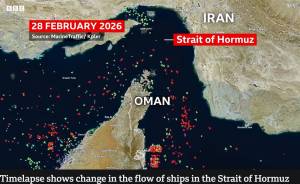
Chart Shows Shipping it Strait of Hormuz As of Feb. 28, 2026 before shipping was curtailed because of threats and attacks by Iran.
March 12, 2026. The ultrawealthy put Trump in power but other people will pay the price.U.S. Tariffs, Inflation, Economy, Jobs
U.S. Education, Religion, Culture, Media
Top Headlines
New York Times, Iran War Live Updates: New Supreme Leader Issues Defiant Statement Amid Growing Disruption to Global Oil Supplies, Aurelien Breeden, Rebecca Elliott, Erika Solomon and John Yoon, March 12, 2026. Iranian state media said Mojtaba Khamenei had released his first written statement as supreme leader, vowing that Iran would continue to block the Strait of Hormuz, a vital oil route. Global oil markets have been roiled by the war.
Here is the latest.
Mojtaba Khamenei, Iran’s new supreme leader, struck a defiant tone on Thursday in his first known public comments since succeeding his slain father, vowing to keep blocking the Strait of Hormuz, a vital oil route, and to avenge “the blood of the martyrs.”
In written statements carried by Iranian state media, Mr. Khamenei said Iran would pursue “an effective and regret-inducing defense” and “the lever of blocking the Strait of Hormuz must also continue to be used.”
The comments were likely to add further instability to oil markets. Iran has threatened attacks on shipments through the Strait of Hormuz, which is normally a conduit for one-fifth of the world’s oil. Iraq and Oman closed oil terminals on Thursday after two tankers were attacked and left burning off Iraq’s coast, as the International Energy Agency warned that the war in the Middle East had caused “the largest supply disruption in the history of the global oil market.”
Oil prices have surged despite a coordinated effort by the United States and other major economies to calm markets by pledging to release emergency reserves. The U.S. administration, too, has tried to soothe fears, with Chris Wright, the U.S. energy secretary, telling CNN on Thursday that “the world is very well supplied with oil right now.” In an earlier CNBC interview, Mr. Wright said that the U.S. Navy could begin escorting ships through the strait by the end of the month.
In his statement, Mr. Khamenei also threatened more strikes on U.S. military bases in the region. Countries in the Persian Gulf that host those bases “must have realized that America’s claim of establishing security and peace has been nothing more than a lie,” he said.
Mr. Khamenei has not appeared on video or in public since he was appointed on Monday to replace his father, Ayatollah Ali Khamenei, who was killed in Israeli airstrikes at the start of the U.S.-Israeli bombing campaign. Mr. Khamenei, 56, a hard-line cleric seen as close to Iran’s top military force, was injured in the initial strikes, according to Iranian and Israeli officials. The full circumstances and extent of his injuries is unclear. His mother, wife, and daughter were also killed in the U.S.-Israeli strikes.
Fighting has displaced up to 3.2 million people inside Iran, the United Nations refugee agency said on Thursday, as the human toll of the conflict rose. Almost 2,000 people have been killed since the start of the U.S.-Israeli assault, mostly in Iran.
The Israeli military said that it had launched a new wave of strikes in the country, targeting government infrastructure, as it also expanded its campaign against Hezbollah in Lebanon. Workers swept bloodstained sand off the sidewalk along the waterfront in Beirut, the Lebanese capital, after Israeli airstrikes killed at least seven people.
Here’s what else we are covering:
New York Times, Why Oil Prices Surged Even After the Release of Strategic Reserves, Aaron Krolik, March 12, 2026. Reserves or no reserves, the outlook remains bleak as long as a major oil and gas trade route remains virtually closed.
Reality is starting to set in for the world’s oil traders.
Oil futures have again topped $100 a barrel — the latest surge after days of wild price swings in the market since the United States and Israel first struck Iran. But this uptick came after the International Energy Agency on Wednesday announced that more than 30 countries would release a record amount of oil from their emergency reserves.
Instead of reassuring jittery markets, the news seemed to further spook traders by underscoring how far the world is from reopening trade in the Strait of Hormuz, the narrow waterway and vital trading route that separates Middle Eastern oil producers from their customers. This concern was further reinforced when three ships were attacked in the channel on Wednesday.
Before the war, the strait carried more than 20 million barrels a day, roughly one-fifth of the world’s supply. That traffic is virtually halted. While world leaders agreed to release a record 400 million barrels of oil from strategic reserves, that is only about 20 days worth of oil that would normally flow through the strait.
And the war began nearly two weeks ago — with no end in sight.
“No amount of storage can replace 20 million barrels per day of continuous flow,” said Edward C. Chow, a senior associate at the Center for Strategic and International Studies, a Washington think tank, and a former executive at Chevron.
Tapping those emergency stores of oil is easier said than done. Reserves are stored in massive facilities scattered around the world.
South Korea, for example, has storage sites positioned around the peninsula, according to the Korea National Oil Corporation. Some facilities, like one in Okinawa, Japan, are shared with commercial inventories owned by producers like Saudi Arabia’s Aramco.
Member countries of the International Energy Agency, a Paris-based organization, are required to maintain at least 90 days of their imports as emergency reserves.
Getting the oil flowing from reserves also takes time. There are physical limits on how quickly oil can be pulled from storage, but also more mundane hurdles, such as finding buyers, writing contracts and the basic logistics of moving supplies across the globe.
The maximum rate at which the United States can draw oil from its reserves is only 4.4 million barrels per day, according to the U.S. Department of Energy.
Even if shipments resume in the strait, it could be months before energy markets return to normal, according to June Goh, a Singapore-based oil market analyst at Sparta, a commodities data firm.
Refineries are complex, tightly sequenced operations and cannot be turned on and off like a light switch. If refineries are forced to shut down, it would take at least two months for them to return to normal operations, even after regular shipments return, she said.
Oil prices rose sharply after the war began on Feb. 28, briefly surpassing $110 a barrel this week before falling back.
Markets are starting to reflect the possibility that there will be no short-term resolution to the conflict and its consequences on oil supplies, and that even releasing the reserves is only a temporary solution.
Traders had been betting that the conflict would be brief and that President Trump would back down as he has in trade disputes, said Edward Fishman, a senior fellow at the Council on Foreign Relations. But unlike with tariffs, the strait is not something that Mr. Trump can unilaterally open or close.
Even if the United States were to declare an end to military operations, there is no guarantee that Iran would quickly reopen the strait, Mr. Fishman said. Iran’s leadership has publicly said its goal is to push the United States out of the Gulf entirely, and after two weeks of American strikes, it may have little reason to back down.
“There is only one party that can reopen the strait,” he said. “And that’s Iran.”
New York Times, Pentagon Memo: How Hegseth Came to See Moral Purpose in War as Weakness, Greg Jaffe, March 12, 2026. Defense Secretary Pete Hegseth’s bellicose and vengeful rhetoric describing the military’s war in Iran grew out of his experience in Iraq.
Long before President Trump chose him to lead the U.S. military, Pete Hegseth described the moral calling that had compelled him to volunteer to serve in Iraq.
He was working on Wall Street in the summer of 2005 and had read an article about an insurgent who blew himself up, killing 18 Iraqi children. “To me, that was the face of evil,” Mr. Hegseth told The Princeton Alumni Weekly, adding, “That sent to me a signal that I need to do my part not to let that ideology win in Iraq.”
He deployed to the war-torn city of Samarra a short time later.
Today, Mr. Hegseth describes the mission and moral purpose animating the war in Iran, now in its second week, in starkly different terms. The goal, he said recently, is to unleash “death and destruction from the sky all day long.” Instead of seeking justice, U.S. forces are pursuing vengeance against an implacable foe.
“Their war on Americans has become our retribution,” he vowed.
For decades, presidents and their secretaries of defense have framed American military interventions in altruistic terms. Even though the truth was often more complicated, they cast U.S. troops as liberators bringing democracy and freedom to those living under tyranny and oppression.
Mr. Hegseth has largely dispensed with that talk. His bellicose, at times vengeful, rhetoric reflects his belief that the United States’ lofty goals in Iraq and Afghanistan caused the military to lose focus on its main task, killing the enemy, and led to costly defeats in both wars.
In his view, the U.S. military’s strength is not rooted in its high ideals, humanity or moral purpose, but rather its ability to punish adversaries. Anything that distracts from that singular mission, he has said, is weakness.
“This is not 2003. This is not endless nation building,” Mr. Hegseth said on Tuesday at the Pentagon. “It’s not even close. Our generation of soldiers will not let that happen again.”
Instead, he said, the U.S. military was pursuing Mr. Trump’s war objectives with “brutal efficiency, total air dominance and an unbreakable will.”
A Pentagon spokeswoman said Mr. Hegseth’s remarks “project strength, resolve and confidence” to enemies and allies in “an increasingly dangerous world.”
In 2006, shortly after Mr. Hegseth arrived in Samarra, a powerful explosion shattered the golden dome of one of Iraq’s most revered Shiite shrines in the city. The blast set off months of sectarian fury, plunging the country into a state of civil war.
Mr. Hegseth was part of a small team focused on rebuilding Samarra, where the U.S. military had spent tens of millions of dollars. He pored over spreadsheets detailing the reconstruction contracts and visited many of the sites, some of which were half-finished or empty lots. He concluded that a major chunk of the military’s money was funding the insurgency.
He and his team redirected the remaining funds to the head of the Samarra City Council, who used them to build a security force. The Iraqi leader also provided valuable intelligence on the enemy. To show solidarity, Mr. Hegseth and other soldiers from his team spent the night at the embattled Iraqi leader’s home. The gesture was Mr. Hegseth’s idea, according to a former soldier from his unit.
Those who knew Mr. Hegseth from that period describe him as ambitious, passionate and dedicated to the mission.
“In Iraq, I often met these midlevel officers who were very competent and actually cared despite being thrust into an almost impossible situation not of their making,” recalled Philip Shishkin, a former Wall Street Journal reporter who embedded with Mr. Hegseth’s unit in 2006. “Hegseth fell into that category.”
New York Times, Pentagon Bars Photographers From Briefings on Iran War, Erik Wemple, March 12, 2026 (print ed.). The decision is the latest move by the Pentagon to restrict access inside the department for journalists.
In its first briefing after the United States attacked Iran, the Pentagon welcomed photographers from news outlets including Bloomberg, The Associated Press, Getty Images, Reuters and more.
But the Pentagon has since enacted strict limits that bar access to photographers from news organizations, the latest move by the Defense Department under Secretary Pete Hegseth to restrict press access.
The Pentagon said in a statement that it made the change for photographers to use the space in the Pentagon’s briefing room “effectively.”
“Photographs from the briefings are immediately released online for the public and press to use,” the department said.
Mr. Hegseth has taken an adversarial stance toward the news media since his first days of running the Pentagon. He proposed denying access to a reporter from NBC News from the Pentagon, then removed several news organizations from their on-site workstations. Months later, he curtailed the unescorted roaming privileges of journalists within the complex.
And last fall, Mr. Hegseth presided over the adoption of new media restrictions that allow the Pentagon to determine whether reporters pose “security risks” that justify revoking their press credentials. Rather than sign the document, dozens of reporters surrendered their credentials, and a new set of largely pro-Trump commentators and influencers took their places.
The Times in December sued the Defense Department over the policy, calling it a violation of the First Amendment. In a hearing on that suit last Friday, David Schulz, a lawyer representing the Pentagon Press Association, said that before a briefing early last week, Pentagon officials invited the new press corps to attend. “And then they realized none of those people could really get the information out to TV networks and others since they didn’t have a camera,” Mr. Schulz said.
The Pentagon then requested placement of a pool camera for the major TV networks, Mr. Schulz said. The network pool camera has been at all three Pentagon briefings on the Iran war.
The Times is among the outlets whose photographers have been excluded from the latest briefings.
“As The Times has long said: there is a clear importance and public service to allowing journalists to report fully on the U.S. military,” The Times said in a statement. “This includes photojournalists, who deserve access and credentialing to attend Pentagon briefings.”
Morning Shots via The Bulwark, Political Opinion: Sing, Goddess, of the Fury of Trump!, Bill Kristol, Andrew Egger and Jim Swift, March 12, 2026. The wartime president is focused on footwear.
Way back in June 2024, Andrew wrote that “one awkward thing about Trump discourse today is that all the vile things about him suck up so much oxygen that it can be hard to make space to talk about the ways in which he’s merely very stupid.”
We thought about that this morning—and about how it’s now become a government-wide phenomenon—when we encountered this Deadline headline: “Kash Patel Confirms UFC Fighters Will Train FBI Agents This Week, Calling It a ‘Historic Opportunity.’” What a time to be alive. Happy Thursday.
News Updates
The Parnas Perspective, News and Commentary: Iran Escalates War After Trump Declares Victory, Iranian Hackers Hit U.S. Company, Allies Admit They Don’t Know Trump’s Plan, Aaron Parnas, right, March 12, 2026. Despite Donald Trump claiming the United States “won” the war in Iran, the Iranian military spent the night bombing commercial oil tankers and oil ports across the Middle East.
America’s allies are publicly saying they have no idea what Trump’s goals are in a war that has already cost taxpayers more than $11 billion. An Iranian-linked hacker group has carried out its first known hack of an American company since the conflict began, and the FBI has reportedly begun training alongside UFC fighters.
Some of you have told me you’re having trouble seeing my reporting on other platforms like Meta. That’s exactly why I’m here, and why I’m asking for your help to keep building this space. If you can, please consider subscribing or gifting a subscription to support this work.
This is the only platform where I fully own my reporting, without an algorithm deciding what people are allowed to see. No matter how many people try to undermine what we’re building, I’m not stopping.
Here’s the news:
During a CNN appearance last night, I discussed the cost of the war with Iran, noting that while President Donald Trump described it as an “excursion,” I argued that sending billions of dollars overseas and putting American lives at risk constitutes war, and said the administration has not clearly made the case for why U.S. lives should be on the line.
Americans are worried about whether they can afford health care and groceries, and many see the U.S. spending billions of dollars overseas, which I said could hurt President Donald Trump politically in the November elections.
According to Axios, after a G7 video call, French President Emmanuel Macron said uncertainty remains about Washington’s strategy in the Iran conflict, stating, “No one can tell what U.S. President Donald J. Trump wants from this ongoing war with Iran.” Israeli officials believe Trump likely won’t end the war in the next two to three weeks, though they acknowledge he could shift course quickly; the initial strike that killed Iran’s Supreme Leader Ali Khamenei and dozens of senior officials has not yet destabilized the regime as hoped.
An Iran-linked hacker group called Handala Team claimed responsibility for a cyberattack on Stryker, a Michigan-based medical technology company, marking what appears to be the first significant Iranian cyberattack on a U.S. company since the war between the countries began. The attack reportedly disrupted Stryker’s Microsoft environment and may have involved hackers accessing the company’s Microsoft Intune management system to remotely wipe employee devices to factory settings, halting communications and work for some staff; the company said the disruption was contained and not caused by ransomware or malware.
The Iranian government issued new threats to service members in the region:
According to Reuters, U.S. intelligence assessments indicate Iran’s government is not at risk of collapse, even after nearly two weeks of U.S. and Israeli strikes that killed Supreme Leader Ali Khamenei and dozens of senior officials. Intelligence reports say the regime remains cohesive and retains control of the population, though the situation remains fluid, and analysts note that toppling the government would likely require a ground offensive, while Iranian Kurdish militias lack the manpower and weapons to effectively challenge Iranian security forces.
The Trump White House faced online backlash after posting an AI-generated video about the Iran war that used bowling imagery—showing pins representing Iranian officials being knocked down by an American-flag bowling ball and captioned “STRIKE”—with critics arguing the post trivialized an ongoing conflict in which U.S. service members have been killed and injured.
Military analysts say reopening the Strait of Hormuz could require a ground operation to seize Iran’s coastline along the strategic waterway, a move that would significantly escalate the conflict and could lead to higher casualties for U.S. and allied forces, according to the Wall Street Journal.
Suspected Iranian attacks set oil tankers ablaze near Iraq’s port of Basra, escalating strikes on shipping that have cut off Middle Eastern oil flows and pushed prices back above $100 a barrel, even as President Donald Trump claimed the war had effectively been won early on. The conflict has killed around 2,000 people and caused major disruptions to global energy supplies, while Iranian drones and regional attacks continue across the Gulf.
Suspected Iranian attacks also set off a fire at a port in Oman:
Escalating Iranian attacks on ships in the Strait of Hormuz are raising fears the crucial shipping lane could remain closed for an extended period, as the U.S. has so far held off on providing naval escorts for oil tankers and Iran warns it will target any vessels attempting to pass through the waterway. Trump says when oil goes up, the United States makes money:
FBI Director Kash Patel confirmed to Deadline that several UFC fighters will lead a training seminar for FBI agents at the FBI Academy in Quantico on March 15–16, where agents—including academy students and senior staff—will learn combat techniques, tactics, and training methods used by professional mixed martial artists. The initiative is part of the FBI’s broader effort to modernize and diversify agent training, and features fighters such as Justin Gaethje, Jorge Masvidal, Chris Weidman, Claudia Gadelha, Michael Chandler, Manel Kape, and Renzo Gracie.
Iran’s new supreme leader, Mojtaba Khamenei, is expected to deliver his first public message since being appointed after nearly four days of silence amid reports he was injured in an airstrike. The hard-line leader, who recently succeeded his father Ali Khamenei after he was killed in a U.S.-Israeli bombing campaign, is reportedly wounded but safe, according to a government adviser.
The International Energy Agency (IEA) says the Iran war is causing the largest supply disruption in the history of the global oil market, with oil flow through the Strait of Hormuz—normally carrying about one-fifth of the world’s supply—reduced to a trickle after Iranian threats against ships. The agency released a record 400 million barrels of oil to stabilize markets but warned it is only a temporary measure as prices continue to fluctuate.
Citibank temporarily closed several branches in the United Arab Emirates until Saturday as a precaution after Iran threatened Gulf financial institutions linked to the U.S. and Israel, with the bank planning to reopen most locations Monday while keeping one Dubai branch open.
Israeli Defense Minister Israel Katz said he has ordered the military to prepare to expand operations in Lebanon if the Lebanese government cannot stop Hezbollah attacks on northern Israel, warning that Israel may take control of the territory itself to restore security.
Lebanese officials say an Israeli airstrike on the Ramlet al-Baida public beach in Beirut killed at least eight people and injured 31, as Israel said it was carrying out wide-scale strikes targeting Hezbollah infrastructure across Lebanon; the country is also facing a growing humanitarian crisis with about 700,000 people displaced since the war began.
A new “Mass Deportation Coalition” made up of Trump allies and immigration hardliners is lobbying the White House to expand deportations to all undocumented migrants, not just violent criminals, citing a McLaughlin & Associates poll showing 66% of likely 2026 voters support deporting migrants who entered illegally. The push comes as the administration has recently shifted its messaging to prioritize deporting violent offenders, sparking tension within the president’s political base.
 A federal judge blocked ICE from building an immigration detention facility in Hagerstown, Maryland, siding with the state’s lawsuit arguing the project moved forward without the legally required environmental impact review.
The Trump administration launched a new trade investigation under Section 301 of the Trade Act of 1974 as it seeks to replace tariffs struck down by the Supreme Court, potentially paving the way for new import taxes aimed at protecting U.S. industries from foreign manufacturing practices and subsidies.
The Senate is expected to vote again today on a bill to fund the Department of Homeland Security, which has been partially shut down for 27 days due to a partisan dispute over funding and guardrails for ICE and CBP, though the measure is widely expected to fail to reach the 60 votes needed to advance. The standoff comes amid broader controversy over the administration’s immigration crackdown, including the fatal shootings of two U.S. citizens in Minneapolis during federal enforcement operations and the ouster of Homeland Security Secretary Kristi Noem after 13 months in the role.
A West Health–Gallup poll found that about one in three Americans have made financial trade-offs to afford health care, including rationing medications or borrowing money, while nearly one in ten have postponed retirement due to medical costs, underscoring growing financial strain as health care becomes a top voter concern ahead of the midterm elections.
According to NBC, South Africa summoned U.S. Ambassador Leo Brent Bozell III after he publicly criticized the country’s diplomatic ties with Iran and its affirmative action policies, deepening tensions between the two nations under the Trump administration. South African officials said the remarks were undiplomatic, and Bozell later apologized and expressed regret, while broader disputes persist over issues such as land expropriation laws, rural crime, and U.S. allegations about violence against white farmers—claims widely disputed in South Africa.
A Moscow court convicted 19 people for their roles in the March 22, 2024 terrorist attack at Crocus City Hall, where four gunmen killed 149 people and wounded more than 600 before setting the venue on fire during a concert. The attack was claimed by a faction of ISIS, and those convicted received lengthy sentences, including 15 life sentences, while others were given prison terms ranging from about 20 to 22½ years; Russian officials have alleged Ukrainian involvement without providing evidence, a claim Ukraine denies.
According to the Guardian, an Israeli airstrike hit a tent camp sheltering displaced Palestinians west of Gaza City, after residents were reportedly given five minutes to evacuate via phone warnings from the Israeli military; following warning strikes, a final strike ignited a large fire and heavy smoke at the displacement site.
Letters from an American, Historical Commentary: March 11, 2026 [Iran War Prospects, U.S. Policies], Heather Cox Richardson, right, March 12, 2026. In a brief call with Barak Ravid of Axios today, President Donald J. Trump said “The war is going great. We are way ahead of the timetable. We have done more damage than we thought possible, even in the original six-week period.” He added that the war against Iran will end “soon” because there’s “practically nothing left to target.” “Little this and that... Any time I want it to end, it will end,” he said.
In fact, according to Patrick Wintour of The Guardian, Iranian officials have rejected two messages from Trump’s Middle East envoy Steve Witkoff calling for a ceasefire. Wintour writes that Iran’s leaders “sense it is not losing the war and the US president is at the minimum feeling the political pressure.” Iranian officials intend to make the economic, political, and military costs of the war so high that Trump will not attack Iran again.
For his part, Trump appears to be panicking over yesterday’s news that Iran is laying mines in the Strait of Hormuz, through which tankers transport about 20% of the world’s oil through a two-mile-wide (3.2 km) shipping channel. (Twenty percent of the world’s oil is about 20 million barrels, and a barrel is a unit of measure equal to 42 U.S. gallons or 159 liters.) Threats from Iran have bottled up oil in the Persian Gulf, and suppliers are shutting down operations because their storage facilities are full. The average price of gasoline in the U.S. has jumped nearly 60 cents a gallon since Trump launched attacks against Iran.
As Morgan Phillips of Fox News notes, naval mines are cheap, as little as a few thousand dollars, and can incapacitate or sink a $2 billion U.S. destroyer. They can be deployed by small vessels like hard-to-spot fishing craft at night.
The U.S. destroyed sixteen inactive Iranian mine-laying ships yesterday; today three merchant ships sustained minor damage after being struck in or near the strait. Today Trump claimed the U.S. has hit “28 mine ships as of this moment,” prompting Chris Cameron of the New York Times to note that “[t]he president sometimes exaggerates or is imprecise when giving figures.”
A spokesperson for Iran’s military command, Ebrahim Zolfaqari, said: “Get ready for oil to be $200 a barrel, because the oil price depends on regional security, which you have destabilised.” Today Iran struck oil storage facilities in Oman and Bahrain.
While a few Iranian ships are traversing the strait, they are the only ones. Retired French vice admiral Pascal Ausseur told the Associated Press: “In today’s context, sending warships or civilian vessels into the Strait of Hormuz would be suicidal,” adding that a ceasefire with Iran “would move the situation from suicidal to dangerous.” At that point, escorts of oil vessels by military ships could begin.
Today Trump told Leonardo Feldman of Newsweek that the project of reopening the Hormuz Strait is “working out very well, and I think you are going to see that.” Trump has said prices will “drop very rapidly when this is over,” but oil industry analysts say reopening production could take at least a month even if Trump could declare the war over immediately, and there is no indication Iran would agree to an instant ceasefire.
Aarian Marshall of Wired reports that half of the ships that usually travel through the Strait of Hormuz carry oil, but the other half carry raw materials that are made into fertilizer, plastics, precision instruments, machinery, electrical parts, and electronic components, all of which could jump in price.
Jon Gambrell of the Associated Press suggested that the war with Iran boils down to a single question: “Who can take the pain the longest?” Iran is being hammered with air strikes by both Israel and the U.S. Those strikes now include Israeli strikes on targets in Lebanon Israel says are connected to Iran-backed Hezbollah militants, killing more than 600 people and turning as many as 800,000 into refugees. For the regime, Gambrell notes, victory means staying in power and outlasting the bombing.
It is unclear what victory looks like for the U.S. The administration has offered a range of justifications for its war without suggesting what an endgame looks like. David Brown of the Wall Street Journal reported today that the U.S. and Israel appear to disagree about how long the war should last, with Israeli officials wanting to continue the war by decimating Iran’s oil industry and targeting top Iranian officials.
The pain for the U.S. is already becoming clear. Yesterday, after Reuters reporter Phil Stewart reported that as many as 150 U.S. troops had been wounded so far in the Iran conflict, the Pentagon publicly revised its estimate of fewer than a dozen U.S. service members wounded upward to about 140. The wounds include brain trauma, shrapnel wounds, and burns. Seven service members have died.
Lawmakers and their aides expressed frustration that the Pentagon had not announced the casualty numbers without prodding. “Just own it and be transparent,” a congressional aide told Alex Horton of the Washington Post. “You owe it to the service members.”
Bora Erden and Leanne Abraham of the New York Times reported today that at least seventeen U.S. military sites and installations across the region, including air defense systems, have been struck since the war began. Iran has also struck diplomatic sites, including U.S. embassies in Kuwait City, Kuwait, and Riyadh, Saudi Arabia, and the U.S. consulate in Dubai.
The eye-watering cost of the conflict is also hitting home. Officials from the Pentagon told members of Congress this week that the military used up $5.6 billion worth of munitions in the first two days of the war, a much higher burn rate than the administration had previously disclosed. Lawmakers are concerned that Trump’s Iran attack, along with his strikes on Nigeria, Somalia, Iraq, Venezuela, the small boats in the Caribbean and eastern Pacific, and the Houthis in Yemen, is cutting into U.S. readiness for unexpected conflicts.
Lawmakers are also unhappy about the administration’s expected upcoming request for more money to fight the war. Catie Edmondson of the New York Times reported that Pentagon officials told lawmakers yesterday the first six days of the war had cost more than $11.3 billion, not including the buildup of personnel and military hardware for the initial strikes.
Today Julian E. Barnes, Eric Schmitt, Tyler Pager, Malachy Browne, and Helene Cooper of the New York Times reported that, according to a preliminary report by military investigators, the U.S. is responsible for the February 28 strike on the Shajarah Tayyebeh girls elementary school that Iranian officials say killed at least 175 people, most of them children. The school building had been part of an adjacent Iranian military base years ago, and it appears the U.S. used outdated information in their targeting of the building.
As the journalists wrote, “Striking a school full of children is sure to be recorded as one of the most devastating single military errors in recent decades.”
On Saturday, when asked about the possibility the U.S. was responsible for the strike, Trump answered: “No. In my opinion and based on what I’ve seen, that was done by Iran…. We think it was done by Iran. Because they’re very inaccurate, as you know, with their munitions. They have no accuracy whatsoever. It was done by Iran.”
On Monday, when a reporter noted that it was likely a Tomahawk missile that hit the school and asked if the U.S. would accept responsibility, Trump responded that “the Tomahawk…is sold and used by other countries,” and suggested that Iran “also has some Tomahawks.”
On Tuesday, a reporter asked why Trump said Iran had Tomahawks when only three other U.S. allies and the U.S. have them. White House press secretary Karoline Leavitt answered: “The president has a right to share his opinions with the American public, but he has said he’ll accept the conclusion of that investigation, and frankly, we’re not going to be harassed by the New York Times, who’s been putting out a lot of articles on this making claims that have just not been verified by the Department of War, to quickly wrap up this investigation because the New York Times is calling on us to do so.”
Today a reporter confronted Trump, saying: “A new report says that the military investigation has found that the United States struck the school in Iran. As commander-in-chief, do you take responsibility for that?”
Trump answered: “I don’t know about it.”
Tonight, Iranian boats full of explosives hit two tankers carrying Iraqi fuel oil and set them ablaze about 30 miles (48 kilometers) off the Iraqi coast. According to Iraqi state media, Iraqi oil ports have “completely stopped operations.” Jon Gambrell of the Associated Press reported that one of the key measures of oil prices, Brent crude, jumped above $100 a barrel.
More On Iran War
Morning Shots via The Bulwark, Political Opinion: Epic Failure, William Kristol, right, March 12, 2026. President Trump hasn’t been particularly coherent about what it is we’re trying to accomplish in Iran. He seems to have taken us to war without a clear plan or purpose. But he has given his war a striking moniker: Operation Epic Fury.
It’s an unusual one. Usually, in naming military operations, the Pentagon seeks to convey an attitude of strength or determination. Last June’s strike against Iran’s nuclear program was called Operation Midnight Hammer. January’s operation in Venezuela was dubbed Operation Absolute Resolve.¹
But such names no longer seem to satisfy Trump’s child-like grandiosity and dictator-like megalomania. As Trump explained yesterday at a rally in Hebron, Kentucky, it was “Epic Fury” that spoke to him.
In the midst of delivering a brief war update, Trump paused over the name. “Epic Fury!”, he shouted with relish. “Is that a great name?” he asked rhetorically. And then Trump explained: “They gave me, like, 20 names. And I’m like, falling asleep. I didn’t like any of them. Then I see Epic Fury. I said, ‘I like that name, I like that.’”
It’s a ridiculous and embarrassing name.
After all, this is a war that Trump has characterized as merely a “little excursion.” So by Trump’s own telling, it’s not very “epic.”
And “fury?” That’s not perhaps the term to choose if you want to reassure the American people and the world that this war you’ve started is based on sound strategic judgment, and that this military operation is well-considered.
But if you revel in tough-guy triumphalism and world-historical vanity, then I suppose “Epic Fury” hits the spot. Is it possible that Trump has some vague memory of Homer’s Iliad? It’s an epic account of great fury, and its sort-of hero, Achilles, became famous. Will Trump have his Homer? “Sing, Goddess, of the fury of Trump!”
Of course, Homer does seem to suggest over the course of his long epic poem that the rage of Achilles was kind of a mixed blessing for his fellow Greeks.
What about the epic fury of Donald Trump? How’s that working out for us?
Trump thinks, or claims to think, it’s been just great. As he said yesterday in Kentucky, “Let me say we’ve won . . . We won. We won. In the first hour it was over. But we won.”
And earlier in the day, Trump called Barak Ravid of Axios to tell him that “The war is going great. We are way ahead of the timetable.” Later, in Ohio, he said “For us, it’s turned out to be easier than we thought.”
Is he protesting just a bit too much?
Surely he knows that so far he’s failed to remove the reprehensible Iranian regime. He knows the Iranians still have plenty of short-range missiles, drones, and naval mines because they’re continuing to use them, some to damaging effect.
He knows that he’s been unable to prevent the closing of the Strait of Hormuz, the disruption of the global economy, and a dramatic rise of oil prices up to the neighborhood of $100 a barrel. He knows that seven American soldiers have been killed and many more seriously injured. He knows that the cost of all this is running at some $2 billion a day. And even he must know that U.S. forces were responsible for the killing of scores of school children in an accidental bombing—a tragedy that, as the New York Times put it, “is sure to be recorded as one of the most devastating single military errors in recent decades.”
You might think that Trump would therefore know—though he’d never admit it—that all is not going swimmingly well. After all, while he may not be re-reading his Homer, he’s probably aware of what our own bard, Joe Rogan, is saying. The podcaster who supported Trump in 2024 declared on his show Tuesday that the war was “crazy” and had left Americans feeling “betrayed.” “This one’s nuts,” Rogan concluded.
I suspect that Trump may realize deep down that his exercise in epic fury is nuts. Presumably that’s why he’s assuring us that “Any time I want it to end, it will end.” I expect him to declare victory and end it soon.
But it won’t be remembered as an epic victory for the United States. All we can hope is that Epic Fury doesn’t turn out to have been an epic disaster.
Chart Shows Shipping it Strait of Hormuz As of Feb. 28, 2026 before shipping was curtailed because of threats and attacks by Iran.
Paul Krugman via Substack, Political-Economy Commentary: The Billionaires’ War, Paul Krugman, right, March 12, 2026. The ultrawealthy put Trump in power but other people will pay the price.
A large fire with smoke and flames AI-generated content may be incorrect.
It becomes clearer with each passing day that the people who took us to war with Iran had and have no idea what they’re doing — that they’re adolescents who think they’re playing video games while thousands die and the world careens toward economic crisis. The New York Times reports that Trump officials dismissed warnings that attacking Iran could disrupt world oil supplies. Among other things, the Times reports that
Mr. Trump, both publicly and privately, has been arguing that Venezuelan oil could help solve any shocks coming from the Iran war.
In 2024 Venezuela produced 900,000 barrels of oil per day; normally 20 million barrels a day transit the Strait of Hormuz. But arithmetic has a well-known woke bias.
Meanwhile, the Washington Post reports that the Pentagon has barred press photographers from briefings about the war after they published photos of Pete Hegseth that his staff considered “unflattering.” Priorities!
Amid the bloody shambles, one big question is, who put The Gang That Couldn’t Think Straight in power? In an immediate sense, Trump was put over the top by low-information voters — defined by G. Elliott Morris as voters who don’t know which party controls Congress. But the groundwork for the MAGA takeover was laid well before by the Roberts Supreme Court and by right-wing billionaires that the court enabled.
A few weeks ago I wrote about Billionaires Gone Wild, the extraordinary influence acquired by a tiny group of ultra-wealthy men. I shared this chart on campaign contributions, based on estimates from Americans for Tax Fairness: A graph with numbers and lines AI-generated content may be incorrect.
On Monday the Times published a deeply reported story about billionaires’ influence that, among other things, found that the chart above somewhat underestimates their role in campaign finance: According to the Times, they accounted for 19 percent of contributions in 2024, not 16.5 percent.
The Times also pointed out that the big money swung hard right in the 2024 election. The magnitude of the largesse showered on Republicans is clear in OpenSecrets data on the top 100 donors in different cycles: A graph of blue squares AI-generated content may be incorrect.
Moreover, the Times presents numbers that are even more extreme than the Open Secrets data:
In past elections, as ultrawealthy donors became more active, both major parties reaped rewards. But there was a stark divergence in 2024, with less money flowing directly to Democrats and a sharp increase in the amount donated to Republicans.
For every dollar donated by billionaires and their immediate families to a candidate or committee associated with Democrats, five dollars went to Republicans.
Much of that was a result of ultrawealthy people in the tech industry, who aligned with Mr. Trump’s tax and deregulation policies. More than a dozen billionaires were awarded roles in his administration.
And these explicit money flows don’t capture the immense effect of other deployments of billionaires’ wealth, notably the subversion of both conventional and social media. Elon Musk purchased Twitter in 2022 and quickly began converting it into the Nazi-friendly cesspool it is today — and no, that’s not hyperbole. How much did this contribute to the degradation of public discourse? Paramount, controlled by Larry Ellison and run by his son, has taken over CBS News — which is rapidly going downhill — and is on the verge of taking over CNN too. And Jeff Bezos is gutting The Washington Post, although kudos to the remaining reporters who are still trying to do their jobs.
There is, however, something that is still puzzling me: To a large extent billionaires bought themselves a government friendly to their interests. Trump and company have granted many items on the tech broligarchy wish list, from tax breaks to deregulation to promotion of crypto and unregulated AI. But why the abject incompetence? Couldn’t billionaires find political allies who wouldn’t plunge the country into a potentially disastrous and historically unpopular war without considering the risks?
I have two tentative answers.
One is that no, competent allies weren’t available. Money buys a lot of influence, but to actually take over the U.S. government requires more than money — it requires politicians who are utterly corrupt. In his first administration, Trump learned that hiring people who were even modestly competent eventually presented barriers to his authoritarian instincts – for example, his former Vice President Mike Pence. Hence Trump learned that in choosing his political hires the more incompetent, the more venal, the more bigoted, and the more cruel, the better.
You might think that presidential pardons for scammers, money launderers and outright crooks are unrelated to the ill-advised war on Iran. But corruption is a key feature of a billionaire-installed regime, and corruption and incompetence go hand in hand.
My second answer is that the vast wealth of tech billionaires has made many of them unconcerned with the little people’s lives — and deeply unpatriotic. If Americans are being brutalized and murdered by rogue ICE agents…well, that’s not their problem. If the Justice Department and the FBI are totally subverted and operate as Trump’s enforcers, they know that vindictive, unlawful tactics will never touch their lives. If Republican budget cuts decimate rural hospitals and deprive hundreds of thousands of health insurance…well, they have their own private doctors and clinics. If Trump starts an ill-conceived war that doubles the price of oil…well, they can certainly afford the higher gasoline bills for their limousines and yachts. And it won’t be their kids hunkered down in a bunker in the Middle East.
So if you want to understand how this country has degenerated to such a state, how we can be spending nearly $2 billion a day attacking Iran without a clear endgame in sight, while children go without healthcare, nursing homes are understaffed because their workers have been deported, home electricity bills skyrocket due to data centers, consider who benefits and who isn’t hurt.
This is a billionaire’s war, waged at everyone else’s expense.
Morning Shots via The Bulwark, Political Opinion: Little Marco, Big Shoes, Andrew Egger, March 12, 2026. It’s clear by now that Donald Trump’s subordinates know the secret to thriving in his orbit is to butter him up shamelessly and mercilessly at every turn. And yet it remains genuinely repulsive to watch that dynamic play out in the sort of fealty displays usually associated with ludicrously totalitarian regimes.
On Monday, Trump delivered a speech at the Congressional Institute, where he was joined on stage by four members of House Republican leadership: Speaker Mike Johnson, Majority Leader Steve Scalise, Conference Chairman Lisa McClain, and Majority Whip Tom Emmer. As Trump took the stage, they immediately began to applaud—and then, bizarrely, they just didn’t stop. For nearly two minutes they stood there, clapping, as Lee Greenwood’s “God Bless the USA” played over the loudspeakers. Trump just stood there, pivoting slightly, occasionally firing off a dance move. At one point, Scalise briefly dropped his hands, then appeared to think better of it and got back to clapping again. It was a lesson straight from Solzhenitsyn’s Gulag Archipelago: “Don’t ever be the first to stop applauding.”
Still, House leaders might console themselves, there are worse humiliations. You could be in Trump’s cabinet, doomed to spend your life flapping around in clown shoes. The Wall Street Journal reported this week that Trump has recently fallen in love with the American shoe brand Florsheim, and he’s taken to having pairs ordered for all the men in his office. “It’s hysterical,” one female White House aide told the Journal, “because everybody’s afraid not to wear them.”
But there’s a problem: Trump’s just guessing everybody’s shoe size. And after the piece appeared, people began to notice: Oh, that’s why Marco Rubio and JD Vance keep getting photographed with their feet swimming in outrageously large Oxfords.(Chip Somodevilla/Getty Images. Saul Leob/AFP via Getty Images. Kay Nietfeld/picture alliance via Getty Images))
I invite you to consider the constant low-level physical and psychological drain of spending your entire professional life in way-too-big shoes.
These middle-aged men, some of the most powerful in the world, are not allowed even to stand or walk normally. The shoes are not very expensive—about $145—but apparently even to order a replacement pair in the correct size would risk an unacceptable breach of courtly etiquette. What if he noticed?? So they clomp around, their posture and gait arrested, their blisters and spinal alignments unimaginable, some non-trivial percentage of their neurons constantly devoted to keeping the damn things on. For them, slavishness to Donald Trump has gone beyond the merely mental; they feel it in their skin, their joints, their bones.
Against that backdrop, it’s hard even to get too worked up about the other White House aesthetic controversy of the week: Defense Secretary Pete Hegseth banning press photographers from the Pentagon briefing room for releasing pictures of him he considers insufficiently hot. Sure, it’s an outrage against ordinary norms of a free press, but at least it’s an outrage being carried out due to pure human vanity—Hegseth thinks he’s a smokeshow, and he demands to be presented as such. That urge is identifiably human. Worms don’t care how they look.
AROUND THE BULWARK
administration (including the Epstein files), and the rise of Israel-linked conspiracies. Plus: Bulwark fans are starting to show up in our focus groups?!Quick Hits
WHO KILLED THOSE GIRLS? As information has slowly trickled out about the mistaken American bombing of an Iranian girls’ school, many people have reasonably wondered: Was AI involved in the decision that led to the death of scores of Iranian schoolchildren?
As has been widely reported, the Defense Department used AI heavily during its target planning for its initial strikes on Iran, assembling target lists on systems from the defense contractor Palantir that are powered by AI technology from Anthropic. But reporting from multiple outlets suggests that the problem was likely one of outdated intelligence from the Defense Intelligence Agency: The site of the school was on a target list because the building, which was next door to a military compound, was part of the compound years ago.
If that’s true, then the Pentagon’s AI wasn’t at fault for the mistake—it simply passed along a piece of faulty data that had been fed into it. But it’s still reasonable to wonder if a Pentagon that wasn’t leaning on AI systems would have made the same mistake. The Washington Post reports on how the Pentagon’s AI use is “speeding the pace of the campaign,” turning “weeks-long battle planning into real-time operations.” The power of these tools allows the military to move at unprecedented speed and scale—but that in turn significantly raises the pressure on, for instance, the human analysts whose job it is to vet targets before they’re attacked. “Given the speed and scale of Operation Epic Fury,” WaPo reported, “those targets may not have received updated vetting.”
In other words, it’s plausible that the school strike was exactly the sort of mistake humans interacting with AI tend to make: Not being thorough enough in double-checking the machine’s extremely correct-looking outputs. And here’s a reminder: The Pentagon is currently fighting a major legal battle with Anthropic precisely because it thinks, over the strenuous objections of the company, that it should be able to take humans out of this loop altogether.
THE COALITION CRACKUP CONTINUES: Back in January, we wrote about Donald Trump’s growing problem with a demographic that helped get him re-elected: young men. A big part of their concern, according to Speaking with American Men pollster John Della Volpe, was that Trump was more focused on foreign policy than on domestic affordability. And you’re not gonna believe this, but this business in Iran seems to be making the issue worse. The New Republic’s Greg Sargent reports:
Della Volpe told me he just conducted over 50 interviews with men of ages 19 to 29 for a forthcoming release. They are registering “strong opposition” and dismay with Trump over the war, Della Volpe said, describing their message this way: “He assured them there would be no more wars, and it feels like betrayal.” . . .
In a sense, Trump’s economic failures and Iran invasion constitute a double whammy of broken promises. He gave young people hope for a brighter economic future rooted in populist nationalist renewal and also hope for a future of peace. “Neither of those things has been delivered,” Della Volpe said.
We won’t hold it against the kids that they believed those promises in the first place. Fool me once, etc.
THINGS THAT MAKE YOU SAY ‘HMMM’: Where is the money Trump extorts from companies—ABC, Meta, Paramount, X—actually going? Congressional Democrats are trying to find out. WaPo reports:
The four companies each committed millions of dollars to the project through legal settlements with Trump in the months after the 2024 presidential election, seeking to resolve claims they had harmed him by restricting his access to social media or defaming him in their coverage. The commitments totaled at least $63 million, according to company statements and media reports.
But the Donald J. Trump Presidential Library Fund, Inc., which was set to receive at least some of the settlement funding, was administratively dissolved in September by Florida officials after it did not submit a mandatory annual report. Three months later, Jacob Roth, the lawyer who originally incorporated the fund, filed articles of dissolution, OpenSecrets first reported last year.
“Now it is unclear where this money has gone, exacerbating concerns about corruption that were apparent at the time of the settlement,” the lawmakers wrote.
All totally above-board and corruption-free, we have every confidence. Read the whole thing.
U.S. Tariffs, Inflation, Economy, Jobs
Popular Information, Accountability Journalism: Consumers paid for Trump’s illegal tariffs. These companies may profit, Rebecca Crosby and Noel Sims, President Trump imposed sweeping global tariffs during his first year as president.
To justify many of the tariffs, Trump relied on a novel interpretation of a 1977 law, the International Emergency Economic Powers Act (IEEPA), which did not mention tariffs at all. But in February, the Supreme Court struck down the majority of Trump’s tariffs, ruling 6-3 that Trump had exceeded his authority. The court found that Trump’s tariffs were unconstitutional, as “taxation power clearly belongs to Congress.”
In recent months, thousands of companies have sued the Trump administration over its tariff policies, seeking refunds for tariff-related costs.
The Supreme Court did not discuss refunds in its ruling. But at the beginning of March, Judge Richard Eaton of the U.S. Court of International Trade ruled that companies that paid tariffs were “entitled to benefit” from the Supreme Court ruling. The order directed U.S. Customs and Border Protection (CBP) to begin the refund process and to stop collecting the tariffs that were struck down. (The judge later “temporarily suspended his order to give the government time to prepare” after CBP said in an affidavit that “immediate compliance was not logistically possible,” Bloomberg reported. CBP estimated that it could start offering refunds by late April.)
The federal government could now be responsible for issuing “refunds worth $175 billion,” according to the Penn Wharton Budget Model.
While it seems likely that companies will eventually get refunds from Trump’s tariffs, much of the cost was borne by consumers. Many companies publicly stated that they were raising prices due to the tariffs. But now that the tariffs are being refunded, only a few companies have pledged to refund customers or offer discounts.
Popular Information contacted 18 companies— including Lululemon, Dollar General, and Crocs— that said they hiked prices due to tariffs and are suing the Trump administration for tariff refunds. We asked whether they would offer customers refunds or discounts once the refunds are processed. None of the companies responded.Major companies offering refunds or discounts
Costco is one of the few companies that has promised to pass some of the refunded tariff money back to customers.
“As we’ve done in the past, when legal challenges have recovered charges passed on in some form to our members, our commitment will be to find the best way to return this value to our members,” Costco CEO Ron Vachris said during an earnings call last week. Vachris said that the company would return recovered tariff money to customers “through lower prices and better values,” but noted that “it is not yet clear what the process will be, what refunds, if any, will be received, and when this will happen.” Costco executives also said during the call that the company took steps to absorb some of the increased cost caused by tariffs instead of passing it on to customers.
In November, Costco sued the Trump administration over its tariff policies and sought refunds.
FedEx has also pledged to refund a portion of any tariff money it receives to customers. “Our intent is straightforward: if refunds are issued to FedEx, we will issue refunds to the shippers and consumers who originally bore those charges,” FedEx said in a statement on its website. “When that will happen and the exact process for requesting and issuing refunds will depend in part on future guidance from the government and the court.”
In February, FedEx also sued the federal government for a full refund of tariff-related costs.Companies that will not commit to refunding customers
Unlike Costco and FedEx, several companies that have sued the Trump administration for a tariff refund have not pledged to refund customers, despite publicly stating they were raising prices due to tariffs.
Abercrombie & Fitch, the clothing brand that also owns Hollister, raised prices late last year and announced that it would continue to do so for its spring inventory. Despite passing some of the cost of tariffs along to its consumers, Abercrombie & Fitch has not said that it will share any refund it might receive from the federal government if it wins its lawsuit. “We feel good about the [tariff] mitigation strategies that we put in place,” the company’s CFO said on a call with analysts last week.
Similarly, Columbia Sportswear is suing the government, but has not indicated that it will share any potential refunds with its customers. Columbia was among the companies that announced planned price hikes before Trump had even been elected to his second term in anticipation of his tariff plans. In October 2024, Columbia CEO Tim Boyle told the Washington Post, “We’re buying stuff today for delivery next fall. So we’re just going to deal with it and we’ll just raise the prices. … It’s going to be very, very difficult to keep products affordable for Americans.”
GoPro announced price increases on its cameras in August. In a report on its 2025 Q2 earnings call, GoPro said, “We expect to offset half of our expected tariff costs with modest price increases.” Although GoPro expected price increases to cover a significant portion of its tariff costs, the company has not publicly announced plans to pass any refunds from its lawsuit against the government back to consumers.
Japanese clothing brand Uniqlo announced price hikes in the U.S. during a July earnings call. One executive said during the meeting, “It will be difficult to absorb all costs. Our approach will be to raise prices where possible and not where it isn’t possible, while ultimately focusing on creating a sustainable business that securely generates profits.” Uniqlo has not said that it will reimburse customers who absorbed the cost increases for their products if it wins a refund from the Trump administration.
Other companies that raised their prices to account for tariff costs and are now suing the Trump administration for a refund, but have not announced plans to refund consumers include:
The customers strike back
At least two companies that have sued the federal government for tariff refunds are facing lawsuits of their own from consumers.
Although FedEx has promised refunds to customers, one consumer says that their promise is not enough. In a class action lawsuit filed one day after FedEx announced its refund plans, plaintiff Matthew Reiser claimed that FedEx’s pledge “creates no legally enforceable obligation and is expressly contingent on future government and court guidance that may never materialize.”
The lawsuit seeks a refund of the tariffs that FedEx customers paid — regardless of whether FedEx wins any money from its own lawsuit against the government — and a refund of the “ancillary brokerage and clearance fees for processing customs entries” that would not have been necessary if it were not for the tariffs.
Another consumer has filed a similar lawsuit against EssilorLuxottica, the parent company of Ray-Ban. Unlike FedEx, EssilorLuxottica has not promised consumers a refund if it wins its lawsuit against the Trump administration.
“Despite seeking an order entitling it to a refund of the duties collected as a result of the subject tariffs, EssilorLuxottica continues to collect and has not refunded the tariff surcharges it collected from consumers,” the lawsuit alleges. “EssilorLuxottica’s retention of those surcharges unjustly profits EssilorLuxottica at the expense of consumers.”
UPS is also facing a lawsuit from a customer seeking a refund for tariff costs that UPS passed on, although the company itself has not sued the government for a refund.
U.S. Education, Religion, Culture, Media
Lincoln Square Media, The Intellectualist Opinion: Trump Appoints Erika Kirk to Air Force Academy Oversight Board, Brian Daitzman, March 12, 2026. The Turning Point USA head joins the board that evaluates curriculum, discipline and campus culture at one of the military’s key officer-training institutions.
 President Donald Trump has appointed Erika Kirk, widow of the conservative activist Charlie Kirk, to the advisory board that oversees the United States Air Force Academy, extending the presence of a prominent conservative activist network inside a body that reviews the school’s curriculum, discipline and campus climate.
The appointment places Ms. Kirk in the same oversight body her husband served on before he was killed last year and keeps a leading figure from the conservative movement involved in debates over how the academy educates and trains future military officers.Subscribed
In a statement announcing the decision, the White House described the appointment as a continuation of his work.
“Charlie Kirk served proudly on the board, inspiring not only the next generation of service members, but millions around the world with his bold Christian faith, defense of the truth and deep love of country,” White House spokeswoman Olivia Wales said in a statement. “Erika Kirk will continue his legacy, and be a fearless advocate for the most elite airpower force in the history of the world whose warriors keep our nation safe, strong and free.”
The Board of Visitors is a statutory advisory body that reviews the academy’s operations and campus culture. According to the academy, the board examines cadet morale, discipline, curriculum, instruction and academic methods, as well as the school’s physical facilities and finances.
Board members have access to academy officials, faculty members and cadets as they evaluate conditions on campus. Their findings and recommendations are submitted through the secretary of the Air Force to the secretary of defense and to the congressional committees that oversee the military.
Although the panel does not run the academy, its inquiries can influence policy debates at one of the nation’s service academies.
The academy in Colorado Springs prepares thousands of cadets for leadership roles in the Air Force and Space Force, and questions about curriculum and campus culture have become a recurring subject of national political debate.
Charlie Kirk joined the board after Mr. Trump appointed him in 2025. During his tenure he pressed academy officials on several issues tied to broader cultural and political debates within the military.
Minutes from an August board meeting show that he asked academy officials how the school was ensuring compliance with presidential directives concerning diversity and curriculum. He questioned how faculty members were being prevented from promoting frameworks he described as “oppression, oppressor/oppressed dynamics, anti-western, anti-American, and gender ideology.”
The minutes also show him asking about the pace of renovations to the academy’s distinctive aluminum-and-glass chapel, a long-standing symbol of the campus that is undergoing extensive repairs.
The board includes presidential appointees as well as members designated by congressional leaders from both parties. Current members include Senator Tommy Tuberville of Alabama and Dina Powell, who served as deputy national security adviser during Mr. Trump’s first administration.
Since her husband’s death, Ms. Kirk has taken over leadership of Turning Point USA as chair and chief executive of the organization he founded. The group has become one of the most prominent youth-focused political organizations on the American right.
The appointment places a prominent figure from that movement on a board that reviews academic and institutional matters at the Air Force Academy, an institution that has increasingly been drawn into national debates over curriculum, diversity policy and military culture.
March 11
Top Headlines
New York Times, Live Updates: Japan and Germany to Release Oil as War in Iran Threatens Global Supply, John Ismay, Eric Schmitt, Qasim Nauman and Abdi Latif Dahir, March 11, 2026. The Strait of Hormuz, a conduit for a fifth of the world’s oil, is all but closed as war in the Middle East expands. A British agency said three ships were hit by unidentified projectiles in or near the strait. Here’s the latest.News Roundups
March 11, 2026. We’re covering major new Epstein revelations about who funded Jeffrey Epstein, California officials responding to possible Iranian drone threats, the rapidly rising cost of the Iran war as tankers are attacked in the Gulf, and Trump declaring the United States has won the war.March 11, 2026. Today, administration officials gave a classified briefing to the Senate Armed Services Committee about the war in Iran. Democrats who spoke to the press afterward appeared to be furious.More On Iran War
Accountability Journalism: Trump says Kushner helped convince him to go to war with Iran, Judd Legum, right, March 11, 2026. The disclosure highlights Kushner's massive financial conflicts.U.S. Governance, Politics, Elections, Energy
March 11, 2026. The Trump administration is in disarray.Trump's Deference To Russia, Putin
More On Epstein Files, Trump Coverup
More Global News
U.S. High Tech, Communications, Culture
Paul Krugman, right, March 11, 2026. Reverse DEI comes for Claude.U.S. Law, Rights, Crime, Justice
March 11
Top Stories
New York Times, U.S. at Fault in Strike on School in Iran, Preliminary Inquiry Says, Julian E. Barnes, Eric Schmitt, Tyler Pager, Malachy Browne and Helene Cooper, March 11, 2026. Outdated targeting data may have resulted in a mistaken missile strike, according to the ongoing military investigation, which undercuts President Trump’s assertion that Iran could be to blame.
An ongoing military investigation has determined that the United States is responsible for a deadly Tomahawk missile strike on an Iranian elementary school, according to U.S. officials and others familiar with the preliminary findings.
The Feb. 28 strike on the Shajarah Tayyebeh elementary school building was the result of a targeting mistake by the U.S. military, which was conducting strikes on an adjacent Iranian base of which the school building was formerly a part, the preliminary investigation found. Officers at U.S. Central Command created the target coordinates for the strike using outdated data provided by the Defense Intelligence Agency, people briefed on the investigation said.
Officials emphasized that the findings are preliminary and that there are important unanswered questions about why the outdated information had not been double checked.
Striking a school full of children is sure to be recorded as one of the most devastating single military errors in recent decades. Iranian officials have said the death toll was at least 175 people, most of them children.
While the overall finding was largely expected — the United States is the only country involved in the conflict that uses Tomahawk missiles — it has already cast a shadow on the U.S. military operation in Iran.
President Trump’s attempts to sidestep the blame for the strike have also already complicated the inquiry, leaving officials who have reviewed the findings showing U.S. culpability expressing unease. The people interviewed for this story spoke on the condition of anonymity, citing the sensitive nature of the ongoing investigation and Mr. Trump’s assertion at one point that Iran, not the United States, was responsible.
“As The New York Times acknowledges in its own reporting, the investigation is still ongoing,” Karoline Leavitt, the White House press secretary, said in a statement.
People briefed on the investigation said many questions were yet to be answered around why outdated information was used and who failed to verify the data.
Still, the error has not surprised current and former officials.
The school, in the town of Minab, is on the same block as buildings used by Iran’s Islamic Revolutionary Guards Navy, a top target of the U.S. military strikes. The site of the school was originally part of the base. Officials briefed on the inquiry said the building was not always used as a school, though it is not clear precisely when the school opened on the site.
A visual investigation by The Times showed the building housing the school had been fenced off from the military base between 2013 and 2016.
Satellite imagery reviewed by The Times showed that watchtowers that once stood near the building had been removed, three public entrances were opened to the school, ground was cleared and play areas including a sports field were painted on asphalt, and walls were painted blue and pink.
New York Times, Live Updates: Japan and Germany to Release Oil as War in Iran Threatens Global Supply, John Ismay, Eric Schmitt, Qasim Nauman and Abdi Latif Dahir, March 11, 2026. The Strait of Hormuz, a conduit for a fifth of the world’s oil, is all but closed as war in the Middle East expands. A British agency said three ships were hit by unidentified projectiles in or near the strait.
Here’s the latest.
The leaders of industrialized nations were racing on Wednesday to shore up the global oil supply, after three ships in the Persian Gulf and Strait of Hormuz came under attack, in a stark illustration of how the war in the Middle East is threatening to choke off one of the key conduits for international trade.
Japan, Germany and Austria will release oil from their strategic reserves in response to disruptions in the supply from the Middle East, officials in those countries said on Wednesday. They made the announcements hours before a meeting of leaders of the Group of 7 industrialized nations,  including the United States, to discuss jointly releasing oil in consultation with the International Energy Agency.
The attacks, which occurred within a few hours of each other, marked a sharp uptick in strikes on vessels in or near the Strait of Hormuz, through which a fifth of the world’s oil transits. On Tuesday, the U.S. military said that it had attacked 16 Iranian mine-laying vessels near the strait, where tanker traffic has been largely paused for days because of concerns that drones or missiles could hit merchant ships.
The expanding conflict has killed more than 1,800 people, mostly in Iran, and disrupted global energy markets. Soaring oil prices have driven up prices for global consumers, with gas prices in the United States rising for the 11th straight day on Wednesday, to a national average of $3.58 a gallon, according to the AAA motor club.
A total of 13 ships have come under attack since Feb. 28 in the strait, the Persian Gulf and the Gulf of Oman, according to the British agency, United Kingdom Maritime Trade Operations. Two cargo ships reported being hit by unknown projectiles in the region on Wednesday, the agency said. A third ship was hit about 50 miles northwest of Dubai, in the United Arab Emirates, the agency said.
The source of the projectiles was not known, although Iran has fired wide-ranging strikes across the region in retaliation for the U.S.-Israeli assault that killed its supreme leader on Feb. 28. Iran launched fresh strikes on Wednesday, with several Gulf countries reporting missiles and drones heading toward their airspace. The defense ministry in the United Arab Emirates said that its air defenses were responding to incoming missiles and drones from Iran. Saudi Arabia, Kuwait and Qatar said their forces had intercepted drones and missiles on Wednesday, without saying where they came from.
Israel said in the early hours of the morning that it had launched a wave of strikes on Tehran, targeting what it said was the Iranian regime’s infrastructure. The Israeli military also issued alerts after detecting what it said were missiles fired at Israel from Iran.
Here’s what else we are covering:
New leader: Mojtaba Khamenei, right, who has succeeded his slain father as Iran’s supreme leader, has not appeared on video or in public nor issued any written statements since his appointment was announced on Monday. One reason is concern that any communication could reveal his location and put him in danger, according to three Iranian officials. Another is that he was injured on the opening day of the U.S.-Israeli strikes, they said. Read more ›New York Times, Live Updates: Japan and Germany to Release Oil as War in Iran Threatens Global Supply, John Ismay, Eric Schmitt, Qasim Nauman and Abdi Latif Dahir, March 11, 2026. The Strait of Hormuz, a conduit for a fifth of the world’s oil, is all but closed as war in the Middle East expands. A British agency said three ships were hit by unidentified projectiles in or near the strait.
Here’s the latest.
The leaders of industrialized nations were racing on Wednesday to shore up the global oil supply, after three ships in the Persian Gulf and Strait of Hormuz came under attack, in a stark illustration of how the war in the Middle East is threatening to choke off one of the key conduits for international trade.
Japan, Germany and Austria will release oil from their strategic reserves in response to disruptions in the supply from the Middle East, officials in those countries said on Wednesday. They made the announcements hours before a meeting of leaders of the Group of 7 industrialized nations, including the United States, to discuss jointly releasing oil in consultation with the International Energy Agency.
The attacks, which occurred within a few hours of each other, marked a sharp uptick in strikes on vessels in or near the Strait of Hormuz, through which a fifth of the world’s oil transits. On Tuesday, the U.S. military said that it had attacked 16 Iranian mine-laying vessels near the strait, where tanker traffic has been largely paused for days because of concerns that drones or missiles could hit merchant ships.
The expanding conflict has killed more than 1,800 people, mostly in Iran, and disrupted global energy markets. Soaring oil prices have driven up prices for global consumers, with gas prices in the United States rising for the 11th straight day on Wednesday, to a national average of $3.58 a gallon, according to the AAA motor club.
A total of 13 ships have come under attack since Feb. 28 in the strait, the Persian Gulf and the Gulf of Oman, according to the British agency, United Kingdom Maritime Trade Operations. Two cargo ships reported being hit by unknown projectiles in the region on Wednesday, the agency said. A third ship was hit about 50 miles northwest of Dubai, in the United Arab Emirates, the agency said.
The source of the projectiles was not known, although Iran has fired wide-ranging strikes across the region in retaliation for the U.S.-Israeli assault that killed its supreme leader on Feb. 28. Iran launched fresh strikes on Wednesday, with several Gulf countries reporting missiles and drones heading toward their airspace. The defense ministry in the United Arab Emirates said that its air defenses were responding to incoming missiles and drones from Iran. Saudi Arabia, Kuwait and Qatar said their forces had intercepted drones and missiles on Wednesday, without saying where they came from.
Israel said in the early hours of the morning that it had launched a wave of strikes on Tehran, targeting what it said was the Iranian regime’s infrastructure. The Israeli military also issued alerts after detecting what it said were missiles fired at Israel from Iran.
New York Times, How Trump and His Advisers Miscalculated Iran’s Response to War, Mark Mazzetti, Tyler Pager and Edward Wong, March 11, 2026 (print ed.). In the lead-up to the U.S.-Israeli attack, President Trump downplayed the risks to the energy markets as a short-term concern that should not overshadow the mission to decapitate the Iranian regime.
On Feb. 18, as President Trump weighed whether to launch military attacks on Iran, Chris Wright, the energy secretary, told an interviewer he was not concerned that the looming war might disrupt oil supplies in the Middle East and wreak havoc in energy markets.
Even during the Israeli and U.S. strikes against Iran last June, Mr. Wright said, there had been little disruption in the markets. “Oil prices blipped up and then went back down,” he said. Some of Mr. Trump’s other advisers shared similar views in private, dismissing warnings that — the second time around — Iran might wage economic warfare by closing shipping lanes carrying roughly 20 percent of the world’s oil supply.
The extent of that miscalculation was laid bare in recent days, as Iran threatened to fire at commercial oil tankers transiting the Strait of Hormuz, the strategic choke point through which all ships must pass on their way out of the Persian Gulf. In response to the Iranian threats, commercial shipping has come to a standstill in the Gulf, oil prices have spiked, and the Trump administration has scrambled to find ways to tamp down an economic crisis that has triggered higher gasoline prices for Americans.
The episode is emblematic of how much Mr. Trump and his advisers misjudged how Iran would respond to a conflict that the government in Tehran sees as an existential threat. Iran has responded far more aggressively than it did during last June’s 12-day war, firing barrages of missiles and drones at U.S. military bases, cities in Arab nations across the Middle East, and on Israeli population centers.
U.S. officials have had to adjust plans on the fly, from hastily ordering the evacuation of embassies to developing policy proposals to reduce gas prices.
After Trump administration officials gave a closed-door briefing to lawmakers on Tuesday, Senator Christopher S. Murphy, Democrat of Connecticut, said on social media that the administration had no plan for the Strait of Hormuz and did “not know how to get it safely back open.”
Inside the administration, some officials are growing pessimistic about the lack of a clear strategy to finish the war. But they have been careful not to express that directly to the president, who has repeatedly declared that the military operation is a complete success.
 Mr. Trump has laid out maximalist goals like insisting that Iran name a leader who will submit to him, while Secretary of State Marco Rubio and Defense Secretary Pete Hegseth have described narrower and more tactical objectives that could provide an off-ramp in the near term.
Karoline Leavitt, right, the White House press secretary, said the administration “had a strong game plan” before the war broke out, and vowed that oil prices would drop after it ended.
“The purposeful disruption in the oil market by the Iranian regime is short term, and necessary for the long-term gain of wiping out these terrorists and the threat they pose to America and the world,” she said in a statement.
This article is based on interviews with a dozen U.S. officials, who asked for anonymity to discuss private conversations.
News Roundups
The Parnas Perspective, Evening News and Comment: California Aware of Possible Iran Drone Threats, Iran War Costs $11 Billion Taxpayer Dollars, Aaron Parnas, March 11, 2026. We’re covering major new Epstein revelations about who funded Jeffrey Epstein, California officials responding to possible Iranian drone threats, the rapidly rising cost of the Iran war as tankers are attacked in the Gulf, and Trump declaring the United States has won the war.
Here’s the news:
California Gov. Gavin Newsom said his administration is “aware of that information” after the FBI warned local law enforcement that Iran could potentially retaliate for U.S. military action by launching drone attacks against unspecified targets on the West Coast. State officials said they are coordinating with federal and local agencies through California’s emergency operations system to monitor the threat and share intelligence with local partners.
U.S. and state law enforcement officials told CBS News there is no credible intelligence supporting a bulletin that warned Iran might retaliate for U.S. strikes by launching drones at the West Coast. Officials said the alert from the FBI’s Los Angeles field office was based on an old, unverified tip that surfaced before the current conflict and was shared only to keep law enforcement informed, not because of an actionable threat.
Epstein’s accountant named several wealthy Epstein clients who allegedly paid millions in fees: Les Wexner, Glenn Dubin, Steven Sinofsky, the Rothschilds, and Leon Black.
This is what Congressman Subrmanyam posted during the deposition:
Former White House counsel Kathryn Ruemmler is scheduled to answer questions on April 21 about her connection to Jeffrey Epstein.
According to the New York Times, Pentagon officials told Congress in a closed-door briefing that the first six days of the U.S. war with Iran have already cost more than $11.3 billion, one of the first comprehensive estimates shared with lawmakers. The figure excludes several major expenses — including the military buildup before the strikes — meaning the total cost of the conflict is expected to rise significantly as more spending is accounted for.
Two oil tankers were reportedly attacked by Iranian boats using explosives, according to Reuters, raising new concerns about escalating threats to shipping in the Persian Gulf.
Donald Trump said the U.S. has effectively “won in many ways” in the war with Iran, portraying the conflict as largely successful and near completion. However, he also indicated the fighting is not fully over yet, saying the U.S. still intends to continue operations to achieve what he called “ultimate victory.”
The Pentagon barred press photographers from recent briefings after photos of Defense Secretary Pete Hegseth from a March 2 briefing were considered “unflattering” by his staff. In response, photographers from outlets such as the Associated Press, Reuters, and Getty were excluded from the following briefings, leaving only Defense Department photographers to document the events. The decision drew criticism from press freedom advocates, including the National Press Photographers Association, which warned it raises First Amendment concerns.
The White House believes it can withstand a short-term spike in oil prices caused by the Iran war and thinks it has about three to four weeks before higher fuel costs become a serious political problem. Officials say they expect prices to stabilize if the conflict ends quickly, though they are monitoring market volatility and potential disruptions to shipping through the Strait of Hormuz.
U.S. inflation held steady at 2.4% annually in February, but food and energy prices surged as markets anticipated conflict with Iran and potential disruptions to oil shipments through the Strait of Hormuz. Economists warn inflation could worsen in March as gasoline prices jumped sharply and supply disruptions tied to the war push up energy, transportation, and food costs.
Donald Trump said the U.S. will release crude oil from the Strategic Petroleum Reserve to try to bring down fuel prices that have surged following the U.S. war with Iran and disruptions to oil shipping in the Strait of Hormuz. He did not specify the size or timing of the release, but said the administration plans to replenish the reserve later and suggested the move could help stabilize markets as global oil supplies tighten.
Two foreign tankers carrying Iraqi fuel oil were attacked in Iraqi territorial waters in the Persian Gulf, according to an Iraqi port official. Both vessels caught fire, and Iraqi authorities evacuated all 25 crewmembers from the ships.
While first responders handled a medical emergency in the crowd during his event, Donald Trump asked staff to play “Ave Maria.” The moment occurred as the rally paused while emergency personnel assisted the individual.
Donald Trump said, “Wait until you see the numbers by the end of the year,” adding that the U.S. “did an excursion,” which he described as “a little trip to get rid of some evil, very evil people.” The comment appeared to reference recent U.S. military action, framing the operation as a mission to eliminate dangerous adversaries.
The war with Iran is rapidly consuming U.S. air defense missiles, including Patriot interceptors, raising concerns that future supplies for Volodymyr Zelenskyy and Ukraine could be reduced. Officials warn that the diversion of these weapons could weaken Kyiv’s ability to defend against Russian missile attacks and give Vladimir Putin an opportunity to escalate strikes while U.S. and allied resources are focused on the Middle East conflict.
The Trump administration asked the Supreme Court of the United States to allow it to end Temporary Protected Status (TPS) for roughly 350,000 Haitians living legally in the United States. The request comes after a federal judge blocked the move, ruling that the decision to terminate the protections may have been influenced by racial bias and lacked adequate review of conditions in Haiti.
The U.S. Department of Homeland Security is seeking access to a restricted federal database containing employment and child support information on millions of Americans, raising concerns it could be used for immigration enforcement. Current and former officials warn the request could violate federal law and expose sensitive data from systems like the National Directory of New Hires, which includes employment records for most U.S. workers.
According to Politico, Senate Republicans are planning marathon floor sessions to force extended debate on the SAVE America Act, an elections bill backed by Donald Trump, in an effort to put Democrats on the defensive. The bill is expected to fail to reach the 60 votes needed to pass, but GOP leaders, including John Thune, are preparing amendments tied to Trump’s priorities, such as limits on transgender participation in women’s sports and new restrictions related to mail voting.
The Parnas Perspective, News and Commentary, Trump Misjudged Iran's Response, Pam Bondi Moved to Military Housing, DOGE Engineer Steals Social Security Data of Millions, Aaron Parnas, right, March 11, 2026. New reporting shows that thousands of documents tied to the Epstein case are still missing or withheld, with many records yet to be released by the DOJ. This comes as Attorney General Pam Bondi has reportedly moved to military housing after receiving threats, including from cartels and critics over her handling of the Epstein files.
Meanwhile, Iran has launched its most intense strikes of the war so far, targeting commercial shipping as the conflict escalates after the Trump administration underestimated how Tehran would respond. At the same time, analysts warn that Russia could try to exploit the global instability created by the Iran conflict to pressure the Baltic states.
On a personal note, I want to share something really special. Today I’m on the cover of USA Today for the first time. If you happen to see it in stores, let me know. It’s an incredible moment and a real testament to what we are building together.
Let’s keep growing this community. We’re expanding the team so we can bring more accurate news to more people and help fill the gap where civics and media literacy haven’t been properly taught in schools across America. If you can, please subscribe to support this work. And to everyone who already has—thank you from the bottom of my heart. We’ll also be doing a subscriber-only live soon, so stay tuned.Subscribed
Here’s the news:
Documents released by the Justice Department related to the Jeffrey Epstein investigation still appear to be incomplete, with missing FBI notes and interview records involving allegations against prominent figures including former banker Jes Staley and billionaire Leon Black, according to reporting by MS NOW. The missing materials include dozens of pages documenting a woman’s claims that she was sexually abused by Epstein and assaulted by the two men, though both Staley and Black deny wrongdoing and the allegations have not been independently corroborated.
U.S. Attorney General Pam Bondi, left, has moved from her Washington apartment into military housing at a base in the D.C. area after facing increased threats, including from drug cartels and critics of her handling of the Jeffrey Epstein case, according to The New York Times. Bondi is one of 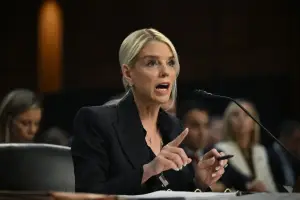 several Trump administration officials who have relocated to secure military accommodations due to security concerns following events such as the capture and prosecution of Venezuelan President Nicolás Maduro.
Several senior Trump administration officials are now living on military bases in or near Washington due to security concerns, including Attorney General Pam Bondi, White House adviser Stephen Miller, Secretary of State Marco Rubio, former Homeland Security Secretary Kristi Noem, Defense Secretary Pete Hegseth, Army Secretary Dan Driscoll, and Navy Secretary John Phelan.
Rep. James Comer said the Department of Justice asked New Mexico officials to halt a 2019 investigation into a ranch, telling Fox News host Jesse Watters that he believes the request came from the DOJ when asked which branch of the federal government intervened.
According to the New York Times, Trump administration officials misjudged how Iran would respond to the U.S.–Israeli military campaign, initially downplaying the risk that Tehran would retaliate by targeting global energy infrastructure or shipping lanes. Instead, Iran has responded far more aggressively than in previous clashes, launching missile and drone attacks across the Middle East and threatening commercial vessels in the Strait of Hormuz, causing shipping to slow dramatically and triggering sharp spikes in global oil prices.
The escalation has forced the administration to react quickly as economic and strategic risks grow, with officials scrambling to evacuate embassies, stabilize oil markets, and consider measures such as naval escorts for tankers and government-backed insurance for shipping companies. Behind the scenes, some officials are increasingly concerned about the lack of a clear strategy to end the conflict, while the war is already consuming large amounts of U.S. military resources and driving political anxiety in Washington over rising fuel prices and economic fallout.
According to the Washington Post, a whistleblower complaint has triggered an investigation by the Social Security Administration’s inspector general into a former U.S. DOGE Service software engineer who allegedly claimed to possess highly sensitive Social Security data and intended to use it at a private contractor job after leaving government service. According to the complaint, the engineer reportedly told colleagues he had copies of two restricted databases—Numident and the Master Death File—potentially stored on a thumb drive.
These databases contain records on more than 500 million Americans (living and deceased), including Social Security numbers, birth details, citizenship status, race and ethnicity, and parents’ names. The whistleblower says the engineer asked for help transferring the data from the thumb drive to a personal computer so he could “sanitize” it before uploading it to his employer’s systems.
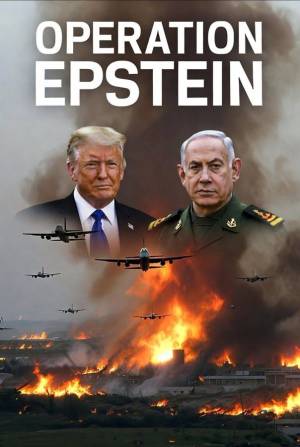 Operation “Epstein Fury” was trending on Twitter for 24 hours:
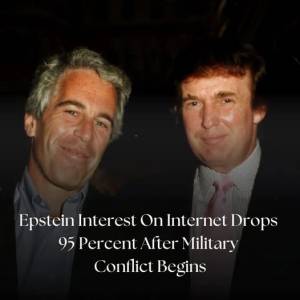
Russia’s legislative committee has approved amendments expanding President Vladimir Putin’s authority to deploy Russian troops abroad, allowing the military to operate extraterritorially to “protect Russian citizens” who are arrested, detained, or prosecuted outside the country, according to The Moscow Times. This has lead to fears from experts that Russia could be preparing to invade various Baltic states:
Iran launched what state media described as its “most intense operation” of the war, firing some of its most advanced ballistic missiles toward major Israeli cities including Tel Aviv and Haifa, marking a significant escalation in the conflict as Tehran continues retaliatory strikes against Israel following ongoing U.S.–Israeli attacks on Iranian targets.
Iran’s top national security official, Ali Larijani, warned that the Strait of Hormuz could become either a route of “peace and prosperity” or a place of “defeat and suffering for warmongers,” signaling that Tehran may escalate disruptions to global shipping if attacks against Iran continue. The statement underscores Iran’s leverage over the strategic waterway—through which roughly 20% of the world’s oil flows—and reflects growing tensions as the conflict threatens global energy markets and maritime traffic.
Senator Roger Marshall defended rising gas prices amid the Iran war, saying Americans should expect to make sacrifices during the conflict, arguing that “freedom is not free” and that higher costs are part of the price of confronting adversaries abroad.
Multiple Middle Eastern countries reported attacks as the war entered its 12th day, with Kuwait saying it shot down eight drones, the United Arab Emirates and Qatar intercepting Iranian missiles, and drones injuring four people near Dubai International Airport while flights continued operating normally.
Three commercial ships were struck in separate incidents near the Strait of Hormuz, including vessels hit by unknown projectiles that caused fires and damage, according to a British maritime monitoring agency, underscoring rising security risks in the key shipping corridor through which about 20% of the world’s oil passes. Crews were evacuated or rescued and no casualties have been reported so far.
Sen. Roger Marshall acknowledged he was wrong about earlier claims that U.S. strikes had set Iran’s nuclear program back for years, admitting during an interview that despite believing the facilities had been “obliterated,” Iran is now restarting nuclear efforts at other sites. Confronted with his previous comments, Marshall said the situation had changed and suggested Tehran was rebuilding parts of its program despite the earlier damage.
Iran has warned that facilities linked to major U.S. technology companies could become targets as the regional war expands, naming firms such as Amazon, Microsoft, Nvidia, IBM, Oracle, and Palantir and suggesting infrastructure connected to them in places like Israel, Dubai, and Abu Dhabi may be considered “legitimate targets.” The warning, reported by multiple outlets citing Iranian sources, reflects a widening of the conflict to include private tech and data-center infrastructure that Tehran claims supports military or intelligence operations tied to the U.S. and Israel.
Iran’s military warned that ships belonging to the United States, Israel, or their allies could be targeted in the Strait of Hormuz, declaring that any such vessel or oil cargo would be considered a “legitimate target” and vowing it will not allow oil shipments to pass through the critical waterway.
Iran’s new Supreme Leader, Ayatollah Mojtaba Khamenei, was wounded during the war but is reported to be safe, according to Iranian and Israeli officials who spoke with NBC News, with the son of Iran’s president saying he had been told Khamenei’s injuries are not serious; the leader has not appeared publicly since taking power after his father, Ayatollah Ali Khamenei, was killed at the start of the conflict.
 After 11 days of fighting, Israel has received 9,115 damage claims from missile strikes, including 6,586 for damaged buildings, 1,044 for contents or equipment, and 1,485 for vehicles, highlighting the extensive infrastructure and property damage caused by the ongoing conflict.
The International Energy Agency is preparing to call for the largest release of emergency oil reserves in its history, potentially releasing about 400 million barrels to stabilize global markets shaken by the Iran war and disruptions to shipping through the Strait of Hormuz. The proposed move, backed in principle by G7 countries, would dwarf previous releases such as the 182 million barrels deployed after Russia’s 2022 invasion of Ukraine and aims to counter supply shocks and volatile oil prices caused by the conflict.
At least 570 people have been killed and 1,444 wounded in Lebanon since the start of the Iran war, according to Prime Minister Nawaf Salam’s office, as renewed fighting between Israel and Hezbollah spreads across the country and nearly 800,000 people have registered as displaced in shelters.
According to The Guardian, the United States has reportedly begun redeploying parts of its THAAD missile defense system and other military assets from South Korea to the Middle East for the war with Iran, a move that has unsettled officials in Seoul and raised concerns about weakening defenses against North Korea. South Korean leaders have sought to reassure the public that the country can still deter threats from Pyongyang, but critics warn the shift could signal reduced U.S. focus on Northeast Asia and potentially embolden North Korea to test the allies’ security posture.
Democrats flipped a seat in the New Hampshire State House as Democrat Bobbi Boudman won a special election in a district Donald Trump carried by nine points, marking a roughly 13-point Democratic overperformance compared with the 2024 results, when Boudman lost the same seat by 14 points.
Republican Clay Fuller and Democrat Shawn Harris will face off in an April 7 runoff election to fill the House seat formerly held by Marjorie Taylor Greene in Georgia’s 14th district, after both candidates finished ahead in a crowded special election field. The race is being closely watched as a test of Donald Trump’s influence in the district, which heavily favors Republicans, while Democrats see a potential opening after Greene resigned earlier this year following a public break with Trump and political tensions within the GOP.
An activist group called Secret Handshake installed a statue in Washington, D.C., depicting Donald Trump and Jeffrey Epstein as Jack and Rose from the Titanic:
 Sen. Jon Husted said people living in poverty often lack experience navigating finances, arguing that some individuals who rely on programs like SNAP may not understand basic budgeting or how money works in everyday transactions, and that financial education is needed to address affordability challenges.
Jeremy Carl withdrew from consideration for assistant secretary of state for international organizations after backlash over past remarks about Jewish people, race, and immigration left him without enough Republican support in the Senate, marking a rare setback for Donald Trump in a GOP-controlled chamber. Carl faced unified Democratic opposition and lost key Republican backing on the Senate Foreign Relations Committee, with critics citing comments viewed as antisemitic, racist, and sympathetic to the “great replacement” conspiracy theory.
According to The Guardian, health experts and lawmakers are raising alarms about a controversial hepatitis B vaccine trial in Guinea-Bissau that would have vaccinated only half of newborns, warning it could serve as a model for future studies under U.S. Health Secretary Robert F. Kennedy Jr. Critics say the proposed research raises serious ethical concerns because it would withhold a widely recommended vaccine in a country with high hepatitis B prevalence and limited research oversight, prompting protests, congressional scrutiny, and intervention from global health officials before the study was ultimately paused for review.
Miami Heat star Bam Adebayo scored 83 points in a game against the Washington Wizards, recording the second-highest single-game scoring performance in NBA history behind Wilt Chamberlain’s 100-point game. Adebayo set multiple team records in the 150–129 win, including points in a quarter and half, finishing 20-of-43 from the field and 36-of-43 from the free-throw line as he surpassed Kobe Bryant’s 81-point performance and delivered one of the most prolific scoring nights ever recorded in the league.
Letters from an American, Historical Commentary: March 10, 2026 [Furious Democratic Responses To War], Heather Cox Richardson, right, March 11, 2026. Today, administration officials gave a classified briefing to the Senate Armed Services Committee about the war in Iran. Democrats who spoke to the press afterward appeared to be furious.
Senator Richard Blumenthal (D-CT) told reporters he was coming out of the briefing “as dissatisfied and angry, frankly, as I have from any past briefing in my 15 years in the Senate. I am left with more questions than answers, especially about the cost of the war. My questions have been unanswered. And I will demand answers because the American people deserve to know.”
“I am most concerned about the threat to American lives, of potentially deploying our sons and daughters on the ground in Iran. We seem to be on a path toward deploying American troops on the ground in Iran…and there is also, as disturbingly as anything else, the specter of active Russian aid to Iran, putting in danger American lives. Literally, Russia seems to be aiding our enemy, actively and intensively, with intelligence and perhaps with other means, and China, also, may be assisting Iran.”
“So, the American people deserve to know much more than this administration has told them about the cost of the war, the danger to our sons and daughters in uniform, and the potential for further escalation and widening of this war, a war of choice made by this president, not chosen by the American people, with potentially huge consequences to American lives.”
Senator Chris Murphy (D-CT) noted on social media that the administration appears to have no goals for the war except continued bombing, and no plan for reopening the Strait of Hormuz.
Senator Jacky Rosen (D-NV) was obviously frustrated that the administration is giving out information only under the cloak of classified briefings, making it hard for elected officials to communicate with their constituents about the war. “[W]e’ve been calling over and over again for them to come out of the classified briefings, to allow us to have these conversations, as much as we can, in an open setting, not just with the press, but with the American people, and with our constituents. With our men and women who serve in the military with their families, who are waiting home for them.”
While it is “solely the responsibility of the United States Congress to declare war,” she said, she called attention to Trump’s frequent use of the word “war” to suggest Republicans are hiding his seizing of that power by claiming Trump’s attacks on Iran do not fall under that constitutional provision. “Make no mistake,” she said, “this is Trump’s war. He says it every day…. And he wants to go any further, he needs to come out and have this discussion with Congress and the American people.
“[W]hat I heard is not just concerning,” Rosen said, “it is disturbing, and I’m not sure what the endgame is or what their plans are.” She said Trump “has not shown, to this Congress, to me, or, I believe, to us in our classified briefing…any plans for what he wants to do for the day after.” She warned that Trump could not simply stop the war and have everything go back to the way it was on February 27. The Middle East has sustained too much damage. “You see the bombs, you see the destruction. It’s not going to stop just because he wishes it to be so.”
A key reason the Framers of the Constitution put the power to declare war in the hands of Congress, rather than the executive, was that they were all too familiar with the history of European kings who had launched wars of choice that had reduced their subjects to poverty under crushing war taxes. They feared that the same thing could happen in their new country: that supporting an army would cost tax dollars, impoverishing the citizens of the new nation.
If the debate over war went to Congress, voters could hear the reasoning for the war hashed out and decide for themselves if the cost in lives and treasure was worth it to them. And, after they voted for a war, members of Congress would have to answer to their constituents for the money they spent and the lives lost.
That argument is potent again almost 250 years later. Democrats are calling out that Trump is spending $1 billion a day in his attacks on Iran but that he slashed through government programs that help Americans, claiming the need to address the country’s ballooning national debt. Just yesterday, Berkeley Lovelace Jr. of NBC News reported that Dr. Mehmet Oz, the administration official overseeing the Affordable Care Act, says that many of those enrolled in healthcare under the law should not be there. About 23 million people signed up for ACA coverage this year, down by more than 1.2 million from last year. Oz anticipates cutting another 4 million off the rolls as he targets “waste, fraud, and abuse.”
And yet, as Ellie Quinlan Houghtaling of The New Republic noted last night, according to a report from government watchdog Open the Books, the Pentagon under Defense Secretary Pete Hegseth blew through $93.4 billion in September 2025 alone, with more than $50 billion going out in the last five days of the month alone.
To spend the entirety of the defense budget, rather than lose it, Pentagon officials bought “a $98,329 Steinway & Sons grand piano for the Air Force chief of staff’s home, $5.3 million for Apple devices such as the new iPad, and an astronomical amount of shellfish, including $2 million for Alaskan king crab and $6.9 million worth of lobster tail. (Lobster tail is apparently a favorite of Hegseth’s Pentagon—the department spent more than $7.4 million total on the luxury item in March, May, June, and October.) In other pricey food purchases, the government decided to drop $15.1 million for ribeye steak (again, just in September), $124,000 for ice cream machines, and $139,224 on 272 orders of doughnuts.”
In October, Houghtaling noted, the administration said it could not fund the Supplemental Nutrition Assistance Program (SNAP), formerly known as food stamps, because the government had shut down. Millions of Americans lost food benefits.
Representative Melanie Stansbury (D-NM) reposted Houghtaling’s article and commented: “You better believe we’ll be investigating.”
Democratic Texas state representative James Talarico, who is running for the U.S. Senate, expressed his concerns about the Iran war on CBS Mornings yesterday. “As a millennial, I saw how military disasters like the Iraq War robbed this nation of young lives, of billions of dollars of our moral standing in the world, and I worry that our current leaders are repeating those same mistakes,” he said.
“I was in Sand Branch, Texas, which is a community south of Dallas that doesn’t have running water. It doesn’t have basic sewer infrastructure,” he continued. “So every dollar we spend bombing people in the Middle East is a dollar we’re not spending in Sand Branch, Texas, or in our communities here at home.”
“We’re always told that we don’t have enough money for schools, or for health care, or for our veterans. But there’s always enough money to bomb people on the other side of the world. And so we can support the democracy movement in Iran. We can prevent Iran from getting a nuclear weapon, all without bombing innocent schoolchildren, or sending our American troops off to die on the other side of the world.”
Talarico was channeling a Texas-born Republican from the post–World War II years: President Dwight D. Eisenhower. In early March 1953, soon after he took office, Soviet leader Josef Stalin died, and Eisenhower jumped at the chance to reset the militarization of the Cold War.
All people hunger for “peace and fellowship and justice,” he said in a speech to newspaper editors, and he deplored the growing arms race with the USSR. Even if the two superpowers managed to avoid an atomic war, pouring wealth and energy into armaments would limit their ability to raise up the rest of the world.
“Every gun that is made, every warship launched, every rocket fired signifies, in the final sense, a theft from those who hunger and are not fed, those who are cold and are not clothed.” The sweat of workers, the genius of scientists, and the hopes of children would be better spent on schools, hospitals, roads, and homes than on armaments. World peace could be achieved, Eisenhower said, “not by weapons of war but by wheat and by cotton, by milk and by wool, by meat and by timber and by rice.”
 Extremist Republicans sneered at what they called Eisenhower’s “stomach theory” of diplomacy, but Eisenhower’s approach to the world was forged by his horror at what he saw at Ohrdruf, the Nazi concentration camp that funneled prisoners to Buchenwald, when he commanded the Allies in World War II. “I never dreamed that such cruelty, bestiality, and savagery could really exist in this world!” he wrote. He was determined to do all he could to guarantee that such atrocities never happened again.
Eisenhower, left, recognized that economically dispossessed people were natural targets for political and religious extremists. They could easily be manipulated by a strong leader to back a cause—any cause—that promised to resurrect a world in which they had enjoyed prosperity and cultural significance.
Such extremism had been dangerous enough in the hands of the Nazis, but 1945 gave quite specific shape to Eisenhower’s fears. The atomic bomb, unleashed by the United States over Hiroshima and Nagasaki in summer 1945, changed the meaning of human conflict. If a charismatic political or religious extremist roused a dispossessed population behind another war, and if that leader got his hands on a nuclear weapon, he could destroy the world.
Promoting economic prosperity and better standards of living at home and around the world was not just about peace or justice, Eisenhower thought; it was about saving humankind.
More On Iran War
Popular Information, Accountability Journalism: Trump says Kushner helped convince him to go to war with Iran, Judd Legum, right, March 11, 2026. The disclosure highlights Kushner's massive financial conflicts.
At a press conference on Monday evening, President Trump said his son-in-law, Jared Kushner, was one of a handful of top advisers who convinced him to launch major combat operations in Iran. The disclosure raises additional questions about the role of Kushner, who is being paid tens of millions of dollars annually by Middle Eastern governments that were reportedly lobbying Trump to attack Iran.
Aaron Rupar @atrupar.comTrump: "Based on what Steve and Jared and Pete and others were telling me, Marco is so involved, I thought they were going to attack us"
“The situation was very quickly approaching the point of no return… based on what Steve and Jared and Pete and others were telling me, Marco is so involved, I thought they were going to attack us,” Trump said, referring to Middle East envoy Steve Witkoff, Secretary of War Pete Hegseth, Secretary of State Marco Rubio, and Kushner, who has no formal title.
“Within a week, [Iran was] going to attack us, 100 percent. They were ready,” Trump said at a different event Monday. “They had all these missiles, far more than anyone thought, and they were going to attack us.”
Witkoff and Kushner were dispatched by Trump to Geneva to participate in mediation with their Iranian counterparts, in what was described as a last-ditch effort to avoid war. Kushner’s participation violated his pledge not to be involved in foreign policy in a second Trump administration. Instead, Kushner had said he was focused on running his private equity fund, Affinity Partners, which has raised billions of dollars from foreign governments.
Kushner’s largest investor is the Saudi Arabian government, which provided Kushner with $2 billion in funding in 2021. Each year, Saudi Arabia pays Kushner 1.25% of its investment, $25 million, as a “management fee.” Meaning he has received in excess of $100 million from the Saudi government over the last few years.
Notably, “Saudi Crown Prince Mohammed bin Salman made multiple private phone calls to Trump” in February, advocating a U.S. attack,” according to reporting in the Washington Post. Trump’s comments reveal that Kushner used his role in Geneva to push Trump toward the outcome favored by his biggest client. Affinity Partners also received more than $200 million from the UAE. According to CNN, behind the scenes, the UAE was also lobbying Trump to strike Iran.
It is unclear precisely what Kushner told Trump about his mediation session with the Iranians. The Times of Israel, quoting an anonymous administration source, said that Kushner told Trump that Iran was “basically playing games.” According to the source, Kushner told Trump that it would only be possible for Trump to strike an “Obama kind of deal“ with Iran and even that “would take months.”
The claim that Iran was planning an imminent attack against the U.S. — the conclusion that Trump took away from his discussions with Kushner and others — is directly contradicted by U.S. intelligence agencies. Shortly after the war began, “Trump administration officials told congressional staff in private briefings on Sunday that U.S. intelligence did not suggest Iran was preparing to launch a preemptive strike against the United States interests,” according to ABC News. CNN reported that Trump administration officials “acknowledged to congressional staff that Iran was not planning to strike US forces or bases in the Middle East unless Israel attacked Iran first.” Senator Mark Warner (D-VA), the top Democrat on the intelligence committee who receives classified briefings, said, “I saw no evidence that Iran was on the verge of launching any kind of preemptive strike against the United States of America.”
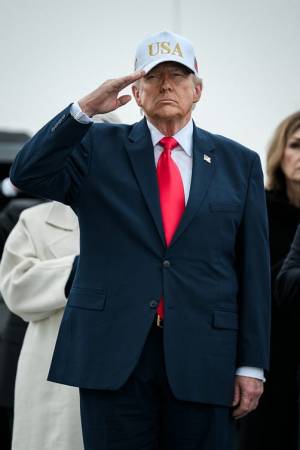
Trump attends the Dignified Transfer of remains of six U.S. soldiers killed in an Iranian drone strike while sporting a baseball cap that he is selling as merch. (Official White House Photo by Daniel Torok)
The Contrarian, Opinion: Trump’s Delusions Come at Americans’ Expense, Jennifer Rubin, right, March 11, 2026. “We don’t see anyone who can replace the regime,” an Israeli official told David Ignatius.
The New York Times reported, “A report by the National Intelligence Council completed before the United States and Israel launched attacks on Iran assessed that even a large-scale military assault on the country would be unlikely to topple its theocratic government.” So, when Donald Trump declares his end-goal is regime change, that he wants “unconditional surrender,” and/or wants to pick the next Supreme Leader, he is actually telling us he wants a war without end.
His delusions of grandeur and compulsion to dominate others inevitably overwhelm the Constitution, decency, political good sense, and Americans’ distress. His utter incoherence at a press conference on Monday suggests he is decomposing before our eyes.
Just days ago, he egged on Iranians to take up arms, but by Monday was expressing utter contempt for them (“Will I help them? I’d like to, if they can behave. But they’ve been very menacing.”) In his broken brain, evidently, the war can be both “complete” and “just the beginning.”
Trump is more than happy to inflict a host of harms on Americans: Seven servicemen killed, a billion per day in war costs, trillions in stock market capitalization wiped out, inflation risks heightened, and oil prices on the rise. Trump attends the Dignified Transfer of remains of six U.S. soldiers killed in an Iranian drone strike while sporting a baseball cap that he is selling as merch. (Official White House Photo by Daniel Torok)
To justify his foray into regional war, Trump tells Americans they should docilely accept their fate as hostages of his endless war fantasy. He declares that $100+ per barrel is a “very small price to pay” (for us to pay) for his war. He adds that “only fools” would think the war is not worth it.
He likewise shrugs off a massive drop in the financial markets, although we know that spiking oil prices increase the probability of a stock market crash. Stagflation fears are pushing the markets down at an alarming rate. Since the start of Trump’s war, the Dow Jones has plummeted and been extremely volatile, with no indication of stability in sight.
Chillingly, Trump is indifferent to war casualties. “Some people will die,” he shrugs, and “more will likely die.” He matter-of-factly tells Americans to get over it. “That’s the way it is.” He sports a baseball cap while overseeing the dignified transfer of slain servicemen, refusing to respect the occasion with the simple act of removing his hat. He says it is “more fun” to sink ships, which almost certainly kill those on board.Subscribed
Meanwhile, the childish and deeply unserious Secretary of Defense Pete Hegseth is downright gleeful about casualties and destruction, snarling at the press that reporting on dead soldiers is just a way to make Trump “look bad.” He obviously relishes spitting out TV lines and boasting about the people our troops will kill: “The only ones that need to be worried right now are Iranians that think they’re going to live,” he stated. He’s become a ghoulish caricature of a military leader.
Hegseth’s release of war clips interspersed with movie footage drew the condemnation of Blase Cupich, archbishop of Chicago. In a statement Saturday, Cupich deplored the White House for releasing a video as “more than 1,000 Iranian men, women, and children lay dead after days of bombardment from U.S. and Israeli missiles.” He warned:
A real war with real death and real suffering being treated like it’s a video game — it’s sickening. Hundreds of people are dead, mothers and fathers, daughters and sons, including scores of children who made the fatal mistake of going to school that day. Six U.S. soldiers have been killed. They are also dishonored by that social media post. Hundreds of thousands displaced, and many millions more are terrified across the Middle East. … Our government is treating the suffering of the Iranian people as a backdrop for our own entertainment, as if it’s just another piece of content to be swiped through while we’re waiting in line at the grocery store.
Trump and Hegseth are similarly triumphant when addressing the direct murders at sea (the count is now over 150), in violation of international and domestic law, without effort to interdict the boats or seek definitive proof that the victims are “narco-terrorists.”
But this is nothing new for Trump, who seems to relish inflicting harm on vulnerable Americans to achieve his whims. Trump and his spineless MAGA enablers chose (unlike every other administration) to cut off SNAP during the government shutdown, thereby depriving kids, seniors, the disabled, and the working poor of food. He celebrated slashing Medicaid as part of his “beautiful” bill. He and MAGA Republicans refused to extend Affordable Care Act subsidies, inflicting huge premium increases on Americans and pricing many out of the market. The MAGA crowd was delighted when DOGE minions cut vital government services, slashed jobs, and consigned children and adults overseas to death. Trump applauds when government workers lose their jobs.
Now, in the midst of a Department of Homeland Security shutdown, he and his MAGA toadies refused to separately fund TSA, FEMA, and the Coast Guard. They appear perfectly content to trigger more pain (which he thinks pressures Democrats, who actually care about people).
Meanwhile, he continually tries to cut vital social services in blue states, holding their residents hostage to his partisan power plays.
Moreover, Trump taxed imports (tariffs), then reimposed taxes (tariffs) after the initial tranche was struck down, forcing already strapped families and small businesses to pay more. The Trump regime tells Americans either they won’t pay for it, or if they do, it’s worth a recession.
For those who recognize Trump as a malignant narcissist, all this comes as no surprise. Those with narcissistic personality disorder are recognizable by their “[i]mpaired ability to recognize or identify with the feelings and needs of others; excessively attuned to reactions of others, but only if perceived as relevant to self; over- or underestimate of own effects on others.” (One can imagine how someone more concerned about how others view his hair than he is about showing respect for fallen soldiers might meet this definition.) Trump’s entire foreign policy is built around him — his wealth, his grievances, his need to impress other autocrats.
Regardless of whether Trump warrants a medical diagnosis, he inarguably cares nothing about (if not outright celebrates) deaths, illnesses, suffering, economic distress, and any other harm he inflicts on those who refuse to worship him. When the victims are foreigners, especially non-whites whom he dehumanizes, he revels in his secret police force’s brutality. When it comes to Americans, Trump defies critics and insists on maintaining counterproductive policies, without a care in the world about fallout.
Most presidents do their best to spare vulnerable Americans from harm; Trump seems thrilled each time he demonstrates his power over them. “It’s worth it” essentially means ‘I don’t care what suffering I cause because I just want to get my way.’ Americans appalled by his reckless indifference to human life and, frankly, by the blatant sadism of an unwell president and defense secretary should register their disapproval at the polls. The voters still have the power to stop the MAGA runaway train of death and destruction.
More Global News
Politico, Spain downgrades its diplomatic ties with Israel, Aitor Hernández-Morales, March 11, 2026. Madrid retires its ambassador to Tel Aviv and leaves its representation under the control of the chargé d’affaires.
In a sign of the bad state of relations between Spain and Israel, Madrid on Wednesday permanently withdrew its ambassador to Tel Aviv.
The diplomatic downgrade comes after years of tense exchanges between both governments. Spain has been a leading critic of Israeli Prime Minister Benjamin Netanyahu’s military operations in Gaza and, this month, Spanish Prime Minister Pedro Sánchez blasted Israel for joining the  U.S. in its “illegitimate” attack on Iran.
Madrid recalled its ambassador to Tel Aviv, veteran diplomat Ana María Salomón Pérez, last September, after Israeli Foreign Minister Gideon Sa’ar accused Sánchez’s government of inciting a “pro-Palestinian mob” and banned Deputy Prime Minister Yolanda Díaz and Minister of Youth Sira Rego from entering the country.
The decision to definitively retire the ambassador is a highly symbolic move that underscores the degradation of ties between the two countries. With the ambassador’s removal, Spain’s diplomatic representation will now be handled by its chargé d’affaires, a lower-ranking official whose status is meant to reflect the downgraded relations.
Politico, Meloni joins EU chorus criticizing Trump’s strikes on Iran, Hannah Roberts, March 11, 2026. Italy’s right-wing prime minister rebukes interventions “outside the scope of international law,” as European disapproval builds over Middle East war.
Italian Prime Minister Giorgia Meloni on Wednesday joined a growing European backlash against the U.S. and Israeli strikes on Iran.
The right-wing leader issued her strongest rebuke of the war so far in remarks to the parliament in Rome, describing the military campaign unfolding in the Middle East as part of a growing trend of interventions "outside the scope of international law,” while also acknowledging the threat Tehran poses to regional security.
Over the last week, Spanish Prime Minister Pedro Sánchez, French President Emmanuel Macron and Dutch Prime Minister Rob Jetten have all signaled varying degrees of opposition to the war being waged by the U.S. and Israel against Tehran's clerical regime.
 Meloni's shift in tone was striking from a leader who has built a reputation as one of Europe’s most reliable U.S. allies, and aligns her more closely with those heavyweight European counterparts (with the notable exception of German Chancellor Friedrich Merz). Her criticism comes while the war is driving up oil prices, with knock-on effects for European citizens filling up their cars with gas.
Sánchez is the only EU leader to directly challenge U.S. President Donald Trump over the war, calling it unjustified, dangerous and illegal.
In response Trump slammed the Spanish government as “terrible” and “unfriendly” and threatening to cut all trade with the EU’s fourth-biggest economy.
Dutch Prime Minister Rob Jetten on Friday said the U.S. and Israeli strikes on Iran were “outside the framework of international law,” while French President Emmanuel Macron said last week the strikes were conducted "outside of international law" and that Paris "cannot approve of them."Domestic pressure
Meloni’s more critical tone is also a reflection of pressures closer to home. Airstrikes on Iran have proved deeply unpopular in Italy, where public opinion is overwhelmingly hostile toward the prospect of being drawn into another Middle East conflict.
U.S. Law, Rights, Crime, Justice
Politico, DC Bar moves to sanction Ed Martin for DEI push, Gregory Svirnovskiy and Jacob Wendle, March 11, 2026. Deputy Attorney General Todd Blanche panned the DC Bar’s stand against Martin in a post on X Tuesday.Ed Martin speaks during a hearing.
A senior Trump administration official is facing the ire of the Washington, D.C., Bar for his role in President Donald Trump’s push to end diversity, equity and inclusion practices in U.S. universities.
The DC Bar filed disciplinary charges against Ed Martin, right, formerly the acting U.S. Attorney for Washington, stating that he threatened to withhold  funding from Georgetown University’s Law Center and barred his staff from hiring its students in a bid to punish the institution for its DEI practices — a violation of the First Amendment, the DC Bar said.
“Acting in his official capacity and speaking on behalf of the government, he used coercion to punish or suppress a disfavored viewpoint, the teaching and promotion of ‘DEI,’” Hamilton Fox, disciplinary counsel for the DC Bar, wrote in a filing made public on Tuesday.
Martin is now the pardon attorney for the Department of Justice, after failing to attain enough support from Senate Republicans to land a full-time appointment to the U.S. attorney post last year. He was replaced by former Fox News host Jeanine Pirro, who previously served as district attorney of Westchester County.
Trump appointed Martin in May to lead the DOJ’s “Weaponization Working Group” to look into officials who investigated Trump and Jan. 6 rioters, but the initiative failed to produce meaningful results. Martin has since lost sway in the Trump administration, which relocated his office from the DOJ headquarters to a government building in a different neighborhood of D.C. in recent months.
“Mr. Martin knew or should have known that, as a government official, his conduct violated the First and Fifth Amendments to the Constitution of the United States,” Fox wrote.
Deputy Attorney General Todd Blanche panned the DC Bar’s stand against Martin in a post on X Tuesday. “The DC Bar is such a blatantly Democrat-run political organization,” Blanche said. “Thank God I’m not a member, and trust me, I never will be.” Martin reposted Blanche’s post on his X account.
U.S. Governance, Politics, Elections
Morning Shots via The Bulwark, Political Opinion: End the War. End Mass Deportation. End the Tariff, End Republican control of Congress. William Kristol, March 11, 2026. The Trump administration is in disarray.
In this election year, the task of the opposition is to turn the administration’s disarray into Republican defeat—a defeat as dramatic, as complete, and as debilitating to the Trump administration as possible.
The disarray is in plain sight. Yesterday, for example, Secretary of Energy Chris Wright announced that the U.S. Navy had successfully escorted an oil tanker through the Strait of Hormuz. Markets rallied. Wright’s claim was quickly discovered to be false. He had to delete the post. Markets plunged.
It was yet another instance of an administration at war that doesn’t seem to know what it is doing. It’s also an administration that didn’t understand what it was getting into when it went to war. On February 18, ten days before Trump started the war, Wright had said he wasn’t concerned that a Middle East war might disrupt oil supplies and drive oil prices up.
Well, they’re up a lot. And probably heading higher. And it’s the Republicans in Congress that blocked efforts to force the administration to get congressional approval for this ill-considered war.
At about the same time yesterday that Secretary Wright was sharing fake war news, White House Deputy Chief of Staff James Blair was telling Republican members of Congress to spread fake domestic news. Stop talking about mass deportation until the midterms, was the order of the day from the White House.
Presumably left unsaid—because it didn’t need to be said, was:
Of course we’re still going to be doing mass deportation. We ran on mass deportation. We distributed signs at the 2024 Republican National Convention calling for “mass deportation now.” And the architect of mass deportation—indeed, of Trump immigration agenda writ large—Stephen Miller, is still in the White House. Yes, mass deportation was the reason for the enormous increase in funding for ICE and the Border Patrol you voted for in the 2025 reconciliation bill. Yes, those funds are paying for all the new personnel and equipment and warehouses needed for mass deportation. And yes, most of those removed from the country last year seem to have had no criminal conviction at all. But just pretend all of that isn’t true. Just ignore it. Talk about other things.
The trouble is that if mass deportation is no longer the goal, then the administration doesn’t need even more funding for ICE or the Border Patrol. If mass deportation is no longer the goal, congressional Republicans could simply accept the Democrats’ proposal not to give more money over the next few months to the agents of mass deportation and instead to fund the non-problematic parts of DHS like TSA. But they won’t. Because in fact mass deportation remains central to the administration’s agenda that congressional Republicans support.
Meanwhile, after the Supreme Court struck down Trump’s illegal tariffs, the administration insisted on imposing new tariffs under different legislative authorities. The administration had a chance to back off from imposing burdens on our slowing economy. It didn’t take it. And the Republican Congress has gone along with the administration on this, as on almost everything else.
Democrats have a tendency to overthink everything. They should resist the temptation and keep things simple: It’s Trump’s war. It’s Trump’s mass-deportation regime. These are Trump’s tariffs. Republicans have supported and enabled them all.
End the war. End mass deportation. End the tariffs. End Republican control of Congress.
New York Times, How Trump Turned a Republican Battle Over a Texas Senate Seat Into Leverage, Shane Goldmacher, March 11, 2026. The president has yet to make an endorsement in the contest between John Cornyn and Ken Paxton as he tries to push the Senate to pass a bill requiring voters to show identification at the polls.
President Trump had spent months getting squeezed by top Senate Republicans to endorse the embattled Senator John Cornyn of Texas in order to avert a costly and prolonged primary fight in Texas against Ken Paxton, the state’s hard-line attorney general.
Suddenly it’s Mr. Trump doing the squeezing.
Just a week ago, he had seemed on the verge of endorsing Mr. Cornyn after Republicans spent more than $70 million on pro-Cornyn ads in the first round of the Texas primary, which ended with him and Mr. Paxton heading to a May runoff. Mr. Trump said on social media that he would make an endorsement “soon” — and that the candidate who did not get his nod should drop out.
Then Mr. Paxton made a bold play.
In a post on X, he said he would consider dropping out — but only if Senate Republicans circumvented the filibuster to pass Mr. Trump’s top legislative priority, a bill that would impose strict voter ID requirements. The gambit quickly went viral, with some of the most influential voices on the right amplifying it, including the president’s son.
Mr. Paxton did not leave it to chance that Mr. Trump himself would see his message, according to two people with knowledge of the matter. He texted it to the president himself.
Now Mr. Trump is leveraging his potential endorsement — which Senate Republicans long for — to ratchet up the pressure on them to change the Senate’s rules and pass the bill. Mr. Cornyn, still pursuing the president’s blessing, reversed his long-held position that the filibuster should be protected in an opinion piece for The New York Post on Wednesday.
What began as a fight over a single seat in Texas has since spilled into halls of Congress, with potential implications for voting access nationwide.
The episode offers a window into how Mr. Trump is wielding power in his second term, as well as his relationship with congressional Republicans and his MAGA base. This account is based on interviews with a dozen Republican officials involved in the ongoing battle, many of whom were granted anonymity to describe private discussions.
Here’s how it unfolded:Why did Trump finally edge toward an endorsement?
National Republicans have warned for months that nominating the scandal-plagued Mr. Paxton — he has survived impeachment and his wife is divorcing him “on biblical grounds” — might put the seat, and ultimately their control of the Senate, in jeopardy.
Last week Mr. Cornyn edged ahead of Mr. Paxton in the primary with the help of a record-breaking $70 million rescue mission, and the two men advanced to a May runoff that promises to extend an expensive and often ugly intraparty battle. Democratic voters nominated James Talarico, a state legislator with an explicit message of reaching out to independent voters, which seemed to add urgency to the cause of uniting the G.O.P.Editors’ PicksMark Zuckerberg Is Said to Have Made a Record Florida Home PurchasePasta e Fagioli, Kimchi Ramen and More of Our Best 25-Minute SoupsDoes a Powerhouse London Indian Restaurant Work in Las Vegas?
It seemed that Mr. Trump had finally seen and heard enough.
He posted last Wednesday that the primary “cannot, for the good of the Party, and our Country, itself, be allowed to go on any longer.” Some news outlets, starting with The Atlantic, wrote that the president was expected to endorse Mr. Cornyn. One person familiar with the matter said that aides to Mr. Trump had prepared language for the president to consider for a potential Cornyn endorsement, which is standard procedure.
But Mr. Trump paused, igniting a fierce public and private lobbying blitz.
Republican senators have been asked by their leadership to call Mr. Trump to ask him to back Mr. Cornyn to put an end to an increasingly acrimonious primary, according to three Republican officials with knowledge of the requests. Mr. Paxton’s team has pushed its allies to be in touch with the president, as well.
The Paxton and Cornyn campaigns declined to comment.How did Paxton’s gambit rally the MAGA base?
After reports of a coming Cornyn endorsement, the Trump base — and MAGA-aligned news outlets — erupted to try to stop it.
“John Cornyn Chose Jack Smith, Joe Biden, Illegal Aliens Over Trump, Texas,” blared Breitbart. “The Top 6 Times Senator Cornyn Has Backstabbed Trump and MAGA,” read a headline in The National Pulse. Right-wing influencers revived old clips of Mr. Cornyn speaking ill of Mr. Trump.
Steve Bannon, the former chief strategist for Mr. Trump and the host of an influential streaming show, The War Room, called Mr. Cornyn “reptilian” for his shifting stances on Mr. Trump. He said that Mr. Paxton had been a true loyalist: showing up at Mr. Trump’s 2024 federal trial, his 2022 re-election kickoff and in the courts fighting to overturn the 2020 election.
Mr. Bannon argued that the base’s animus toward Mr. Cornyn actually made him less electable. Democrats generally see Mr. Paxton as the weaker candidate, but they circulated private polls this week showing Mr. Talarico competitive with both Republicans.
One of the surveys could have almost been designed to give pause to Mr. Trump, who relishes the power of his endorsements. It suggested that his endorsement wouldn’t give Mr. Cornyn a decisive lead.
But the biggest development was Mr. Paxton’s announcement that he “would consider dropping out of this race” if Senate Republicans bypassed the filibuster to pass the SAVE America Act, which would impose strict ID and proof-of-citizenship requirements on voting.
“Wow!!!!” Donald Trump Jr. responded. Elon Musk, the world’s richest man and the biggest donor in Republican politics, replied with an American flag emoji. The pro-Trump provocateur Laura Loomer called Mr. Paxton “the best man for the job” and wrote, “I hope President Trump sees his post.”
Cornyn allies strained to point out that Mr. Paxton had said only that he would “consider” leaving the race, but in private, they grudgingly gave him credit for a savvy maneuver.How did Trump turn the tables on Senate Republicans?
Mr. Trump issued a seeming ultimatum over the weekend: He wouldn’t sign any legislation until the SAVE America Act has passed, and now he is using the potential Cornyn endorsement as leverage over Senate Republicans, in a move first reported by Politico.
Senator John Thune of South Dakota, the majority leader, has said there are not enough votes in the Senate to circumvent the filibuster to push the measure through. “That is just a function of math, and there isn’t anything I can do about that,” Mr. Thune said on Tuesday.
Mr. Paxton’s move served to highlight the limits of the current Senate Republican majority — which have been a source of frustration to both the president and his base.
Mr. Cornyn’s flip — “I support whatever changes to Senate rules that may prove necessary,” he wrote in The Post — seemed to show that Mr. Trump’s pressure campaign was having an effect.
The president’s endorsement has loomed over the race from the start.
Mr. Cornyn and his allies installed two of Mr. Trump’s top 2024 advisers, Tony Fabrizio and Chris LaCivita, at his campaign and super PAC. And Mr. Cornyn, who had questioned Mr. Trump’s electability during the 2024 campaign, has gone out of his way to try to demonstrate his support, perhaps most memorably when he posted a photo of himself pensively reading Mr. Trump’s book “The Art of the Deal” a year ago with a one-word caption: “Recommended.”
Mr. Paxton seemed to relish the latest turn, taking a victory lap of his own on Wednesday. “In one week,” he wrote of his rival, “I’ve made him more conservative than in the past 24 years.”
Politico, US to release 172 million barrels of oil from strategic reserve to combat energy price hike, James Bikales and Carlos Anchondo, March 11, 2026. The Trump administration move is in conjunction with the International Energy Agency action and comes as shipments from the Persian Gulf remain constrained.A section of the Strategic Petroleum Reserve facility is shown in West Hackberry, Louisiana.
The Trump administration said Wednesday the U.S. will release 172 million barrels of crude oil from the Strategic Petroleum Reserve, its boldest attempt yet to bring down oil prices that have spiked since the U.S. launched its war against Iran.
“We’ll do that, and then we’ll fill it up,” President Donald Trump told Cincinnati news station Local 12 in an interview Wednesday afternoon. “I filled it up once, and I’ll fill it up again. But right now, we’ll reduce it a little bit, and that brings the prices down.”
Energy Secretary Chris Wright announced later Wednesday that the drawdowns would begin next week and take about 120 days.
The U.S. release is part of an effort by the 32 members of the International Energy Agency — which include the U.S., Japan, Germany, the U.K. and France — to release 400 million barrels of oil held in emergency reserves, the largest such effort in the body’s history.
Trump, who spent years attacking the Biden administration for tapping the SPR in 2022, touted the IEA effort at a rally in Kentucky on Wednesday, saying it will “substantially reduce the oil prices as we end this threat to America and this threat to the world.”
“We don’t want to leave early, do we?” Trump said. “We got to finish the job.”
Interior Secretary Doug Burgum had said earlier Wednesday afternoon that Trump had yet to decide whether to join the international effort.
The Trump administration has initially ruled out utilizing the reserve, a series of underground salt caverns in Texas and Louisiana. But Iranian attacks against oil tankers in the Strait of Hormuz have sent crude prices spiraling to four-year highs as vessels stop traversing the key waterway connecting Middle Eastern oil fields to the global market.
The DOE announcement had little impact on U.S. crude oil futures prices, which extended their gains in evening trading to sit near $94 a barrel. Iran attacked several more ships in the Gulf Wednesday and Iranian military officials warned the world to get ready for $200 oil, according to Reuters.
The U.S. oil stockpile currently holds 415 million barrels, according to the Energy Department, making it less than 59 percent full. The U.S. consumes around 20 million barrels of crude a day, similar to the amount that typically flows through the Strait of Hormuz each day.
The Trump administration only added modest amounts of oil back into the reserve after the Biden administration tapped it to calm markets after Russia invaded Ukraine.
A part of the storage caverns also suffered damage as a result of those Biden-era drawdowns, which has slowed the effort to refill it.
Wright said in his statement that the Biden administration had left the SPR “drained and damaged.” DOE has already arranged to replace its drawdown with 200 million barrels within the next year, 20 percent more than it plans to draw down, he said.
“President Trump promised to protect America’s energy security by managing the Strategic Petroleum Reserve responsibly and this action demonstrates his commitment to that promise,” Wright said.
Appearing on Fox News Wednesday night, Wright predicted that shipping through the Strait of Hormuz would resume “in the next few weeks,” well before the U.S. completed the planned SPR releases.
“I think we will have the Straits of Hormuz open well before then,” he said. “Exactly when? I can’t say, but we are working 24 hours of every day to get there.”
The reserve is designed to be able to release up to 4.4 million barrels of oil per day within 13 days of a presidential decision, according to the Energy Department. But analysts have said the actual flow rate may be far lower — perhaps 2 million barrels a day — due to physical constraints.
“The flak only gets heavy when you’re over the target,” he wrote on X later on Tuesday.
Politico, Trump’s energy ‘tiger team’ struggles to find its roar with Iran, Ben Lefebvre and James Bikales, March 11, 2026. Trump's vaunted “energy dominance” team is in danger of fumbling the biggest energy crisis of his second term, critics say.
President Donald Trump once pledged his incoming “energy dominance” team would bring about a golden age of American prosperity and global peace.
Now, 15 months later, the Trump administration’s self-described “Tiger Team” led by Interior Secretary Doug Burgum and Energy Secretary Chris Wright appears flummoxed by the surge in global oil prices in the wake of the U.S. attack on Iran and is scrambling to head off a bout of energy-driven inflation.
Burgum has hewed to the White House line that the energy pain would be temporary, even as White House aides say he’s caused eye-rolling among staff amid his media appearances and trips to events like Rupert Murdoch’s birthday party. Wright’s efforts to reassure markets that oil supplies remain ample have fallen flat, and the Energy Department quickly deleted a market-churning social media post that erroneously claimed U.S. warships had escorted an oil tanker through the Persian Gulf’s Strait of Hormuz.
Energy experts say the administration underestimated the oil impacts from launching the war, which, despite near-record U.S. crude production, has sent gasoline prices at the pump up 60 cents a gallon in less than two weeks. The early messaging that global energy markets would cool in time as Iran’s threat to Strait of Hormuz shipping waned has been replaced Wednesday by its agreement that dozens of countries should release up to 400 million barrels of oil from their strategic stockpiles.
Wright announced Wednesday that the Energy Department would release 172 million barrels of oil from the U.S. Strategic Petroleum Reserve over 120 days as part of the IEA’s move. The U.S. oil markets largely shrugged off the news and extended their gains from earlier in the day in Wednesday evening trading.
“We’ll do that and then we’ll fill it up,” Trump told Cincinnati news station Local 12 about the planned crude oil releases. “But right now, we’ll reduce it a little bit and that brings the prices down.”
Adding to the sense of confusion was the Tuesday post to Wright’s X.com account that the U.S. Navy had successfully escorted an oil tanker through the narrow Strait of Hormuz. The post, which the Energy Department attributed to a mistake by a staffer, was quickly deleted, but not before it sent oil markets whipsawing.
Democrats have been quick to pounce on the missteps by contending the Trump administration has failed to lay out U.S. goals in attacking Iran and failed to put in place a clear strategy to stabilize the Persian Gulf region that sends 20 percent of global oil and gas supplies through the strait.
Sen. Chris Murphy laid into the administration in a social media post after a briefing on the war on Tuesday for having “no plan” going into the war to keep the Hormuz open.
“Suffice it [to] say, right now, they don’t know how to get it safely back open,” Murphy wrote on X. “Which is unforgiveable, because this part of the disaster was 100% foreseeable.”
Trump and Wright have sought to stabilize the energy markets, offering a U.S. insurance backstop for tankers traversing the waterway, easing sanctions on Russian oil purchases for India and saying the U.S. warships would protect oil tankers from Iranian missiles and drones. But the Navy later said it couldn’t provide that security despite receiving requests for protection from shippers — and overnight hits on three cargo vessels and Iran’s attempts to lay mines in Hormuz are keeping the sector on edge.
Industry analysts are scratching their heads at the X.com gaffe and at the broader messaging strategy that has contributed to historic levels of market volatility, with oil prices swinging in a $40 per barrel range this week.
“The Department of Energy has really not been involved in this whole thing despite the fact that energy is a big part of the puzzle here,” Bob Yawger, commodity specialist at Mizuho Securities, said after Wright’s post. “And their first effort to kind of put up the big headline blew up on them.”
In the years following Epstein's death, the ranch had remained largely unused until it was sold to San Rafael Ranch LLC for an undisclosed sum rumored to be far lower than the asking price in 2023.[9] The ranch was purchased in 2023 by the family of Texas businessman and politician Don Huffines through an LLC with the owners' names kept secret.[25] A former GOP state senator from Dallas, Huffines in 2026 is running a high-profile campaign for Texas Comptroller of Public Accounts — a publicly elected position in Texas overseeing state financial matters.[26] The name of the ranch has been changed to Rancho de San Rafael,[27][28][29] and a spokesperson for Huffines relayed that it would be used as a Christian retreat.[30] Staggering Revelations in the Epstein Files!Glenn Kirschner1.17M subscribers
New York Times, V.A. Begins Drive to Put Homeless Veterans Into Guardianship, Ellen Barry and Jason DeParle, March 11, 2026. A joint effort with the Justice Department creates new authority to compel veterans into institutional or involuntary care.
The Trump administration on Wednesday announced a new effort to initiate legal guardianships for homeless veterans, which could be used to force more of them into involuntary or institutional care.
The new system, carried out in partnership with the Justice Department, will invest Veterans Affairs Department attorneys with expanded powers that would allow them to initiate and take part in guardianship proceedings for veterans who have no family and are “unable to make their own health care decisions.”
The initiative represents the Trump administration’s most concrete action to advance its goal of compelling more homeless people into involuntary treatment for mental illness and drug addiction.
President Trump identified the issue as a priority during the 2024 presidential campaign and promoted it last July in an executive order that called on agencies to use civil commitment to move homeless people into “long-term institutional settings.”
Critics say the policy shift raises significant civil liberties concerns, noting that in earlier generations, people with severe mental illness were routinely stripped of their legal rights and confined to state hospitals.
The V.A. says the guardianship initiative would affect “hundreds” of veterans who are currently in V.A. facilities but need “a legal decision maker” to transition to a new setting. Some are homeless, and others are “at risk of homelessness” upon discharge, the agency said in a press statement.
“Our new partnership with the Justice Department reflects our ongoing commitment to ensuring that every veteran receives timely, appropriate care,” said Doug Collins, the V.A. secretary.
Guardianship powers are broader and longer lasting than civil commitment, which is used to compel someone to accept medical treatment.
Guardianship proceedings are typically initiated by family members, friends or health care providers, and are argued before state or probate judges, with the subject entitled to legal representation. If a court finds that the person is not able to make basic decisions about health and safety, a guardian is appointed.Editors’ PicksWhy Is Everyone Saying the Word Tranche?Don’t Fence Ted McGinley InTomato Soup Is a Hug in a Bowl. Here Are Our Best Recipes.
Guardians can control a person’s assets, where the person lives and whom he or she sees. They can also require the person to accept medical treatment. Unlike civil commitment rulings, which expire after a specific time period, guardianships are intended to be durable, though they are revisited periodically and can be terminated or dissolved.
Michael Figlioli, the director of the National Veterans Service for the Veterans of Foreign Wars, commended the change, which he said recognizes “that some of our nation’s most vulnerable veterans must be approached through a public health and social services framework.”
If thoughtfully carried out, he said, guardianships could provide more “structured support” for vulnerable veterans, though he noted “important considerations regarding veterans’ privacy, potential implementation gaps and the need for sufficient resources.”
Rights advocates said they were alarmed by the proposal, which they saw as part of a drive by the administration to place homeless people in institutional settings against their will.
“My speculation is that they are seeking to have people placed under guardianship so they can have a person appointed who will force them into congregate or institutional settings when there isn’t anything else available,” said Jennifer Mathis, the deputy director of the Bazelon Center for Mental Health Law.
There are about 33,000 homeless veterans in the United States, about 14,000 of whom live on the streets. Veterans make up around 5 percent of the unsheltered homeless population.
Hopium Chronicles, Advocacy: Inflation Is Still Running Way Too Hot, Idiots And Fools Are Running Our Country, Thune Stuffs Trump On SAVE, Simon Rosenberg, right, March 11, 2026. A campaign to force Witkoff and Kushner from government must be waged now......
We got that third gauge of inflation this morning, the Consumer Price Index, and February came in hot, at 0.3%, 3.6%+ on annualized basis. Food increased 0.4%, or close to 5% annualized. Energy came in at 0.6%, over 7% annualized. We are still running almost two times above the Fed’s monthly target of 2% annualized - not good.
Here’s a chart I threw together with Claude this morning showing how in the months prior to the May Liberation Day tariffs inflation was at the Fed’s target rate. Since May CPI has increased by an average of 0.3%, or 3.6% on annualized basis - again, way above the Fed target. All the bad economic data we’ve been getting recently - slowing GDP, job losses, inflation coming into too hot - comes from before the war took a wrecking ball to the US and global economies. We cannot for one moment forget that Trump and his advisors looked at all this bad data and decided to 1) illegally reinstate global tariffs, ensuring prices stayed high; 2) launched a war that almost certainly would see gas and other commodity prices explode, fueling even more inflation, and slowing an economy that was already losing jobs.
Gas prices are now up 65 cents since the start of the war, and climbing: Idiocy, recklessness, Mad King arrogance, oligarchical not giving a shit about people - choose your description of what we are experiencing now. Every day is a reminder of why our Founders put the power to go to war in Congress, not the Presidency. For it is far less likely that thoughtful deliberation would allow mistakes of this magnitude to be made.
The NYT has some incredible reporting this morning on the impulsive idiocy and recklessness of Trump and his ridiculous quislings. Here’s the NYT’s home page right now: Let’s drill down on that lead story, How Trump and His Advisers Miscalculated Iran’s Response To War (gift link). Vainglorious idiots and fools are running our country:
On Feb. 18, as President Trump weighed whether to launch military attacks on Iran, Chris Wright, the energy secretary, told an interviewer he was not concerned that the looming war might disrupt oil supplies in the Middle East and wreak havoc in energy markets.
Even during the Israeli and U.S. strikes against Iran last June, Mr. Wright said, there had been little disruption in the markets. “Oil prices blipped up and then went back down,” he said. Some of Mr. Trump’s other advisers shared similar views in private, dismissing warnings that — the second time around — Iran might wage economic warfare by closing shipping lanes carrying roughly 20 percent of the world’s oil supply.
This titanic idiocy is weakening Trump at home and abroad. Yesterday Senate Leader Thune declared Trump’s SAVE Act dead in the Senate. Today, in the middle of this extraordinary mess, Trump is taking the time to campaign against a member of his own party, Rep. Tom Massie, who has lead the charge to get the Epstein files released. It looks petty and small, and also deeply corrupt and malevolent. But we are here, and it’s why we need to keep working hard everyone……
Trump's Deference To Russia, Putin
The Hartmann Report, Commentary, Does Trump Have a KGB Card? Thom Hartmann, right,  March 11, 2026. From campaigning to destroy NATO to selling out Ukraine to letting Russia help kill American soldiers in the Gulf region, Trump’s goal appears to be, to “Make America Russia”…
 Eight of our American service members are dead and over 140 wounded because Iran’s military has suddenly gotten really good at targeting our soldiers, Airmen, and Marines. News reports say they’ve been able to hit us with such precision because Russia is using their extraordinary spy satellite, spy plane, and advanced radar capabilities to help Iran’s military.
The Washington Post, which first reported on this, quoted a Russian military expert as saying that Iran is now “making very precise hits on early-warning radars or over-the-horizon radars,” seeming to validate the concern. The article added:
“Iran possesses only a handful of military-grade satellites, and no satellite constellation of its own, which would make imagery provided by Russia’s much more advanced space capabilities highly valuable — particularly as the Kremlin has honed its own targeting after years of war in Ukraine…”
 When asked about the reports, Trump — who’d just returned from the soldiers’ bodies’ dignified transfer — basically downplayed Russian efforts to hurt Americans, just like he did when he learned in 2020 that Putin was paying Afghan insurgents a bounty to kill our soldiers. He pointed out that the US had been sharing intelligence with Ukraine during the Biden administration, so apparently, according to him, Russia is justified in helping Iran kill American service members:
“They’d say we do it against them. Wouldn’t they say that we do it against them?”
His fellow real estate billionaire, Steve Witkoff (whose sons are making billions with Trump’s sons in the Middle East and has been regularly traveling to Moscow for private meetings with Putin) similarly shrugged off the report, telling CNBC:
“I can tell you that yesterday, on the call with [President Trump], the Russians said they have not been sharing. That’s what they said. So, we can take them at their word, but they did say that.” Witkoff later added, “Let’s hope that they’re not sharing.”
Putin himself, though, was nowhere near as circumspect, saying:
“On my part, I want to confirm our unwavering support of Tehran and our solidarity with our Iranian friends. Russia has been and will remain the Islamic Republic’s reliable partner.”
As if to confirm that Trump is Putin’s toady, just last week, in the wake of Iran shutting off the Strait of Hormuz and cutting oil supplies to Asia and the Subcontinent, our president signed a waiver to our Russia sanctions so Putin can now sell unlimited amounts of Russian oil directly to India.
Every time Putin says “Jump,” Trump asks, “How high?”
Which raises the question: “Why? Why does Trump always give Putin whatever he wants and why is he so terrified of speaking out against him?”
Is it possible that Trump is actively working for Putin? What if Putin somehow owns him? Or is blackmailing him? And has been running him as an Russian asset since at least 2017?
That sort of treason would be more important than Russian agents Robert Hanssen (life without parole), Aldrich Ames (life without parole), or Etheland Julius Rosenberg (death penalty).
And let’s not forget that right after Trump won re-election in November of 2024, Russian state TV published explicit nudie pictures of Melania Trump and their anchors were laughing about it and at Trump. Was this Putin’s first assertion this cycle that he still owns Donald?
Jack Smith’s case in Florida was limited to Trump stealing sensitive documents and sharing them on two publicly known occasions (and didn’t even reference other known acts like Kid Rock’s allegation that Trump showed him Top Secret maps in the White House: this was apparently a regular thing for Trump).
That said, you can bet your bottom dollar that the FBI and other agencies worked as hard as they could to contain the damage done by Trump’s leaving documents that could cause “grave damage” to America in public places where spies could simply waltz in and take cell-phone pictures of them by attending a wedding or paying $200,000 for essentially unlimited access Club membership.
But what if it goes beyond that? What if Putin has owned him for years?
From Russian oligarchs laundering money through Trump’s operations — real estate is the most common device used worldwide for money laundering — to keeping him alive in his most difficult times, like those multiple bankruptcies in the 1990s when he almost lost everything?
Or perhaps blackmailing him?
What if Putin got him the presidency, and he knows that if America found out for sure, it would destroy him? Or has Epstein’s videos of Trump with underage girls? Or his own pictures, taken when Trump was in Moscow for one of his beauty pageants?
Which begs the question: exactly how much damage might Trump have already done to our nation, and what does he have planned for the next three years of this second term?
And is he getting ongoing day-to-day instructions from Putin, which explains why he’s so reluctant to discuss their conversations, as Rachel Maddow recently documented?
In 2019 The Washington Post revealed that, throughout his last presidency, Donald Trump was having regular secret phone conversations with Russia’s President Putin (over 20 have been identified so far, including one just days before the 2020 election).
The Moscow Project from the American Progress Action Fund documents more than 270 known contacts between Russia-linked operatives and members of the Trump campaign and transition team, as well as at least 38 known meetings just leading up to the 2016 election.
The manager of his 2016 campaign, Paul Manafort — who was previously paid tens of millions by Vladimir Putin’s people to install a pro-Putin puppet as Ukraine’s president in 2010 — has admitted that he was regularly feeding secret inside-campaign strategy and polling information to Russian intelligence via the oligarch who typically paid him on their behalf.
Throughout the campaign, Manafort let Russian intelligence know where Trump needed help, and when, and it appears Russia jumped in to social media to provide the needed help.
Trump pardoned Manafort, which got him out of prison and ended any investigations. He’s still fabulously rich from his work for Russia.
As The New York Times noted in 2020:
“[I]nvestigators found enough there to declare that Mr. Manafort created ‘a grave counterintelligence threat’ by sharing inside information about the presidential race with Mr. Kilimnik and the Russian and [pro-Russian] Ukrainian oligarchs whom he served.”
There is no known parallel to this behavior by any president in American history — one could argue it easily exceeds Benedict Arnold’s audacity — and bringing documents to Mar-a-Lago was just the tip of the iceberg.
The Washington Post reported in 2022 that Trump had a habit of carrying top-secret information that could severely damage our national security, leaving it in hotel rooms in hostile nations.
Was he bringing these documents with him to sell? Or just to show to leaders or oligarchs in those countries to impress them? Or because Putin, who has agents in those countries, told him to?
Trump doesn’t put all that effort into hauling things around unless it’s extraordinarily important to his ego or he thinks he can makes money off them. Or he’s scared.
“Boxes of documents even came with Trump on foreign travel,” The Post noted, “following him to hotel rooms around the world — including countries considered foreign adversaries of the United States.”
When Robert Mueller’s FBI team tried to investigate Trump’s ties to Russia and his possibly sharing sensitive military information with them, they were stonewalled.
The Mueller Report identified ten specific instances of Trump himself trying to obstruct the investigation, including offering the bribe of a pardon to Paul Manafort, asking FBI Director Comey to “go easy” on General Flynn after his dinner with Putin, and directing Attorney General Jeff Sessions to limit Mueller’s ability to investigate Trump’s connections to Russia.
As the Mueller Report noted:
“The President launched public attacks on the investigation and individuals involved in it who could possess evidence adverse to the President, while in private the President engaged in a series of targeted efforts to control the investigation.
“For instance, the President attempted to remove the Attorney General; he sought to have Attorney General Sessions un-recuse himself and limit the investigation; he sought to prevent public disclosure of information about the June 9, 2016 meeting between Russians and campaign officials; and he used public forums to attack potential witnesses who might offer adverse information and to praise witnesses who declined to cooperate with the government.”
It adds, detailing Trump’s specific Obstruction of Justice crimes:
“These actions ranged from efforts to remove the Special Counsel and to reverse the effect of the Attorney General’s recusal; to the attempted use of official power to limit the scope of the investigation; to direct and indirect contacts with witnesses with the potential to influence their testimony.”
There are, after all, credible assertions from American intelligence that when Trump was elected, members of Russian intelligence and Putin’s inner circle were literally partying in Moscow, celebrating a victory they believed they made happen.
And apparently Putin and his intelligence operatives had good reason to be popping the champagne in November, 2016. They were quickly paid off in a big way.
In his first months in office, Trump outed an Israeli spy to the Russian Ambassador in what he thought was going to be a “secret Oval Office meeting” (the Russians released the photo to the press), resulting in MOSAD having to “burn” (relocate, change identity of) that spy.
The undercover agent was apparently working in Syria that year against the Russians, who were embroiled in the midst of Assad’s Civil War and indiscriminately bombing Aleppo into rubble.
That, in turn, prompted the CIA to worry that a longtime American spy buried deep in the Kremlin was similarly vulnerable to Trump handing him over to Putin.
As CNN noted (when the story leaked two years later):
“The source was considered the highest level source for the US inside the Kremlin, high up in the national security infrastructure, according to the source familiar with the matter and a former senior intelligence official.
“According to CNN’s sources, the spy had access to Putin and could even provide images of documents on the Russian leader’s desk.”
The CIA concluded that the risk Trump had burned or was about to burn our spy inside the Kremlin was so great that — at massive loss to US intelligence abilities that may even have otherwise helped forestall the invasion of Ukraine — they pulled our spy out of Russia in the first year of Trump’s presidency, 2017.
Similarly, when they met in Helsinki on July 16, 2018, Trump and Putin talked in private for several hours and Trump ordered his translators’ notes destroyed; there is also concern that much of their conversation was done out of the hearing of the US’s translator (Putin is fluent in English) who may have been relegated to a distant part of the rather large empty ballroom in which they met.
The Washington Post reported, after a leak six months later, that when Trump met privately for those two hours with Putin the CIA went into “panic mode.” A US intelligence official told the Post:
“There was this gasp’ at the CIA’s Langley, Virginia headquarters. You literally had people in panic mode watching it at Langley. On all floors. Just shock.”
Three weeks after Trump’s July 16, 2018 meeting with Putin in Helsinki, Senator Rand Paul made a solo trip to Moscow to personally hand-deliver a document or package of documents from Trump to Putin. Its contents are still unknown, although Paul told the press it was a “personal” letter of some sort.
Senator Paul has also consistently taken Trump’s and Putin’s side with regard to the Ukraine war: he single-handedly blocked a $40 billion military aid package in the Senate. When the FBI searched Mar-a-Lago, he responded with a call for the repeal of the Espionage Act. He further suggested the FBI may have “planted” Secret documents at Mar-a-Lago.
Ten days after Paul’s trip to Moscow, The New York Times reported that the CIA was freaked out because their sources inside Moscow had suddenly “gone silent”:
“The full reasons the sources have gone silent are not known,” the Times reported, but Trump having intentionally given a man working for the FBI to Putin — a man whose job at that time was to find and reveal Russian agents involved in or close to the Trump campaign — may also have had something to do with it:
“[C]urrent and former officials said the exposure of sources inside the United States has also complicated matters,” noted the Times. “This year, the identity of an F.B.I. informant, Stefan Halper, became public after [Trump-loyal MAGA Republican] House lawmakers sought information on him and the White House allowed the information to be shared. Mr. Halper, an American academic based in Britain, had been sent to talk to Trump campaign advisers who were under F.B.I. scrutiny for their ties to Russia.”
Things were picking up the following year, in 2019, as Putin was planning his invasion of Ukraine while Trump was preparing for the 2020 election.
In July 2019, Trump had conversations with five foreign leaders during and just before a presidential visit that month to Mar-a-Lago; they included Putin and the Emir of Qatar.
In one of those conversations, according to a high-level US Intelligence source, Trump “made promises” to a “world leader” that were so alarming it provoked a national security scramble across multiple agencies.
As The Washington Post noted in an article titled, “Trump’s communications with foreign leader are part of whistleblower complaint that spurred standoff between spy chief and Congress”:
“Intelligence Community Inspector General Michael Atkinson determined that the complaint [against Trump] was credible and troubling enough to be considered a matter of ‘urgent concern,’ a legal threshold that requires notification of congressional oversight committees.”
On the last day of that month, July 31, Trump had another private conversation with Putin.
The White House spokespeople told Congress and the press that Trump said that he and Putin discussed “wildfires” and “trade between the nations.” No droids in this car…
But the following week, on August 2nd, The Daily Beast’s Betsy Swan reported that Trump had that week asked the Office of the Director of National Intelligence for a list of all its employees (including all our “spies”) who had worked there more than 90 days, and the request had intelligence officials experiencing “disquiet.”
Perhaps just by coincidence, months after Trump left office with cases of classified documents, The New York Times ran a story with the headline Captured, Killed or Compromised: C.I.A. Admits to Losing Dozens of Informants:
“Top American counterintelligence officials warned every C.I.A. station and base around the world last week,” the Times’ story’s lede began, “about troubling numbers of informants recruited from other countries to spy for the United States being captured or killed, people familiar with the matter said.
“The message, in an unusual top secret cable, said that the C.I.A.’s counterintelligence mission center had looked at dozens of cases in the last several years involving foreign informants who had been killed, arrested or most likely compromised. Although brief, the cable laid out the specific number of agents executed by rival intelligence agencies — a closely held detail that counterintelligence officials typically do not share in such cables.”
And now, to complicate matters, it appears Elon Musk took with him access to the payroll records of all of our nation’s spies and other foreign intelligence agents. The Elon Musk who, himself, The Wall Street Journal reports has also reportedly been having his own secret conversations with Putin.
If it turns out the Trump has been acting as an agent for Russia, how long might this have been going on?
Czechoslovakia’s Státní bezpečnost (StB) first started paying attention to Trump back in 1977, as documented by the German newspaper Bild when the StB’s files were declassified, because Trump married Czech model Ivana Zelnickova, his first wife, recently buried on his golf course in New Jersey.
Czechoslovakia at that time was part of the Warsaw Pact with the Soviet Union, and Ivana and her family had been raised as good communists. Now that a Czech citizen was married into a wealthy and prominent American family, the StB saw an opportunity and started tracking Trump virtually from his engagement.
As 2016 and 2018 investigations by The Guardian found:
“Ivana’s father, Miloš Zelníček, gave regular information to the local StB office about his daughter’s visits from the US and on his celebrity son-in-law’s career in New York. Zelníček was classified as a ‘conspiratorial’ informer. His relationship with the StB lasted until the end of the communist regime.”
An investigative reporting breakthrough by Craig Unger for his book American Kompromat led Unger to Uri Shvets, a former KGB spy who’d been posted to Washington, DC for years as a correspondent for the Soviet news agency TASS.
Shvets told the story — from his own knowledge — of how Trump and Ivana visited Moscow in 1987 and were essentially recruited or seduced by the KGB, a trip corroborated by Luke Harding in his book Collusion: Secret Meetings, Dirty Money, and How Russia Helped Donald Trump Win.
Their trip was coordinated by Intourist, the Soviet travel agency that was a front for the KGB, and the Trumps’ handlers regaled Donald and Ivana with Soviet talking points, presumably about things like the horrors of NATO.
The KGB’s psychological profile of Trump had determined he was vulnerable to flattery and not much of a deep thinker, so they told him repeatedly how brilliant he was and that he should run for president in the US.
Much to the astonishment and jubilation of the KGB, Trump returned from Moscow to the US to give a Republican presidential campaign speech that fall in Portsmouth, New Hampshire.
He then purchased a large ad in The New York Times, The Washington Post, and The Boston Globe on September 1, 1987 that questioned America’s ongoing support of Japan and NATO, both thorns in the side of the USSR and their Chinese allies.
Trump’s ad laid it on the line:
“Why are these nations not paying the United States for the human lives and billions of dollars we are losing to protect their interests? ... The world is laughing at America’s politicians as we protect ships we don’t own, carrying oil we don’t need, destined for allies who won’t help.”
As The Guardian reported in 2021:
“The bizarre intervention was cause for astonishment and jubilation in Russia. A few days later Shvets, who had returned home by now, was at the headquarters of the KGB’s first chief directorate in Yasenevo when he received a cable celebrating the ad as a successful ‘active measure’ executed by a new KGB asset.
“’It was unprecedented,’ [Shvets said.] … It was hard to believe that somebody would publish it under his name and that it will impress real serious people in the west but it did and, finally, this guy became the president.’”
Meanwhile, Putin was making friends with powerful influence over American foreign policy.
Turkish President Recep Tayyip Erdoğan, who flipped his nation into a strongman neofascist state following an unsuccessful attempted coup in 2016 (he imprisoned and tortured numerous journalists and political opponents), has been deepening his relationship with Russian President Vladimir Putin ever since that US election year.
In 2017, Erdoğan apparently gained access to America’s deepest secrets by secretly paying off General Michael Flynn even as Flynn became Trump’s National Security Advisor, who also had at least one secret phone conversation with Russian Ambassador Sergey Kislyak after Flynn started working in the White House.
Flynn pleaded guilty in December of 2017 to “willfully and knowingly” making “false, fictitious and fraudulent statements” to the FBI about one of those conversations with Russian Ambassador Kislyak. Flynn was also an unregistered agent of a foreign government while working in the White House: he had taken about a half-million dollars from Erdoğan.
Around the time he was leaving office, Trump pardoned Flynn, essentially burying the entire story.
From campaigning to destroy NATO to selling out Ukraine to letting Russia help kill American soldiers in the Gulf region, Trump’s goal appears to be, to paraphrase Ron DeSantis, to “Make America Russia.”
The big question is, “Why?”
U.S. High Tech, Communications, Culture
Morning Shots via The Bulwark, Political Opinion: AI Apocalypse Looms. We’re Already Blowing It, Bill Kristol, Andrew Egger and Jim Swift, March 11, 2026. Surely there are more options than letting AI run wild or shutting it down, right? Right?
Several commercial ships are under fire near the Strait of Hormuz as Iran continues to try to block one of the world’s most important shipping lanes. The U.S. military is trying to prevent the Iranian Navy from laying mines in the key shipping channel. The chairman of the Joint Chiefs of Staff reported that the Iranians are already “adapting” as they target American air defenses and hotels frequented by U.S. service personnel.
And it seems like just last month Trump was boasting about low gas prices. Happy Wednesday.
Paul Krugman via Substack, Political-Economy Commentary: The Plot Against Intelligence, Human and Artificial, Paul Krugman, right, March 11, 2026. Reverse DEI comes for Claude.
So far I personally have made almost no use of AI. But I know people who use it all the time. Broadly speaking, they fall into two groups. Some use AI casually or for fun; they generally use OpenAI’s ChatGPT. Some use it to get serious work done; they generally use Anthropic’s Claude.
My impressionistic take is confirmed by data on market shares, which by the start of 2026 showed Anthropic rapidly overtaking OpenAI, the early leader, in adoptions by enterprises — businesses and other organizations trying to accomplish well-defined tasks.
Among the organizations that have found Anthropic’s AI models more useful than those of its rivals is the Department of Defense, which relied heavily on Claude until early this month — which is when Pete Hegseth, the secretary of defense who calls himself the secretary of war, suddenly banned the use of Claude. As I pointed out the other day, Hegseth seems determined to exalt ignorance and wage war on expertise and hard thinking; it turns out that his war on human intelligence is also a war on artificial intelligence he doesn’t like.
To justify the ban, the defense department declared that Anthropic is a supply chain risk, and it is trying not just to end its own use of Claude but to prevent any contractors doing business with the department from using Claude.
There’s no mystery about the motivation for banning Claude. Anthropic has said that it wants assurances that its products won’t be used for fully autonomous weapons or mass surveillance of Americans. This has enraged Trump officials: David Sacks, the administration’s AI and crypto czar, has accused the company of supporting “woke AI.” So an administration for which seeking vengeance against perceived enemies is a central motivation is naturally trying to punish Anthropic and damage its business.
But the fact that the Trumpist-Anthropic feud is understandable doesn’t make it normal or acceptable. In fact, the designation of Anthropic as a supply chain risk is a terrible omen for America’s future, in at least three ways.
First, it’s obviously illegal. Designating a potential contractor a supply-chain risk isn’t something the government is supposed to do casually. The legal basis for such a designation, embodied in the federal government’s acquisition guidelines, is very specific:
“Supply chain risk” means the risk that an adversary may sabotage, maliciously introduce unwanted function, or otherwise subvert the design, integrity, manufacturing, production, distribution, installation, operation, or maintenance of a covered system so as to surveil, deny, disrupt, or otherwise degrade the function, use, or operation of such system (see 10 U.S.C. 3252).
So supply chain risk is about sabotage or subversion. “This company is too woke” doesn’t meet that definition.
Second, denying government contracts to a company because the administration doesn’t like that company’s politics is a seriously corrupt practice. Think of it as the flip side of crony capitalism: while throwing taxpayer dollars at companies it considers friends — especially because they personally enrich members of the administration or the president’s family — the administration is freezing out companies it considers enemies. If this practice becomes the norm, as it surely will if these people remain in power, it will waste money because the government is denying contracts to vendors who offer the best value but aren’t sufficiently MAGA. It will also further corrupt our politics, as businesses feel the need to be demonstratively pro-Trump if they want federal contracts.
Finally, the Defense Department is now doing exactly what people like Hegseth have always accused supporters of DEI of doing — refusing to hire the best people for the job, refusing to give contracts to the best suppliers, in the name of political correctness. The Pentagon’s managers and tech experts clearly believe that Claude is the best tool for many purposes, but they have been ordered not to use it because their political masters don’t like the company’s politics.
Imagine the reaction if the roles of the parties were reversed — if a Democratic administration were denying the U.S. military the tools it wants to use because it considered the company supplying those tools too conservative. Republicans wouldn’t just be protesting; they’d be screaming “treason.”
Indeed, while I can’t judge how much damage telling the military to stop using Claude — just as a war was starting! — will do, it’s clearly a move that weakens national security. And what this move tells us is that the Trump administration cares more about fighting wokeness than it does about keeping America safe.
Morning Shots via The Bulwark, Political Opinion: Everybody Hates AI, Andrew Egger, March 11, 2026. In the few short years since generative AI arrived on the scene, the technical capabilities of large language models have quickly gone from cool to remarkable to astonishing.
As at any disruptive, revolutionary moment, the public-policy challenges are going to be massive. The laws governing AI use are non-existent; the political pressure to come up with some is massive and growing. After a decade-plus of general policy paralysis amid endless referendums on the person of Donald Trump, it’s not hard to imagine a world in which the 2028 election hinges instead on the future of American AI regulation.
It’s hard to overstate, too, just how wide open the political terrain is. An NBC News poll released this week asked voters which party they most trusted across a number of different policy issues. Most were basically unsurprising: By a wide margin, Republicans were more trusted to deal with border security, immigration, and crime, while Democrats were favored for dealing with health care, protecting democracy, and protecting Americans’ constitutional rights. But when it came to AI, practically nobody had any confidence that either party had the edge. Just look at this graph: The Trump administration is in disarray.
In this election year, the task of the opposition is to turn the administration’s disarray into Republican defeat—a defeat as dramatic, as complete, and as debilitating to the Trump administration as possible.
The disarray is in plain sight. Yesterday, for example, Secretary of Energy Chris Wright announced that the U.S. Navy had successfully escorted an oil tanker through the Strait of Hormuz. Markets rallied. Wright’s claim was quickly discovered to be false. He had to delete the post. Markets plunged.
It was yet another instance of an administration at war that doesn’t seem to know what it is doing. It’s also an administration that didn’t understand what it was getting into when it went to war. On February 18, ten days before Trump started the war, Wright had said he wasn’t concerned that a Middle East war might disrupt oil supplies and drive oil prices up.
Well, they’re up a lot. And probably heading higher. And it’s the Republicans in Congress that blocked efforts to force the administration to get congressional approval for this ill-considered war.
At about the same time yesterday that Secretary Wright was sharing fake war news, White House Deputy Chief of Staff James Blair was telling Republican members of Congress to spread fake domestic news. Stop talking about mass deportation until the midterms, was the order of the day from the White House.
Presumably left unsaid—because it didn’t need to be said, was:
Of course we’re still going to be doing mass deportation. We ran on mass deportation. We distributed signs at the 2024 Republican National Convention calling for “mass deportation now.” And the architect of mass deportation—indeed, of Trump immigration agenda writ large—Stephen Miller, is still in the White House. Yes, mass deportation was the reason for the enormous increase in funding for ICE and the Border Patrol you voted for in the 2025 reconciliation bill. Yes, those funds are paying for all the new personnel and equipment and warehouses needed for mass deportation. And yes, most of those removed from the country last year seem to have had no criminal conviction at all. But just pretend all of that isn’t true. Just ignore it. Talk about other things.
The trouble is that if mass deportation is no longer the goal, then the administration doesn’t need even more funding for ICE or the Border Patrol. If mass deportation is no longer the goal, congressional Republicans could simply accept the Democrats’ proposal not to give more money over the next few months to the agents of mass deportation and instead to fund the non-problematic parts of DHS like TSA. But they won’t. Because in fact mass deportation remains central to the administration’s agenda that congressional Republicans support.
Meanwhile, after the Supreme Court struck down Trump’s illegal tariffs, the administration insisted on imposing new tariffs under different legislative authorities. The administration had a chance to back off from imposing burdens on our slowing economy. It didn’t take it. And the Republican Congress has gone along with the administration on this, as on almost everything else.
Democrats have a tendency to overthink everything. They should resist the temptation and keep things simple: It’s Trump’s war. It’s Trump’s mass-deportation regime. These are Trump’s tariffs. Republicans have supported and enabled them all.
AROUND THE BULWARK
This is Why America’s Institutions Are Failing… On The Illegal News, SARAH LONGWELL talks with former federal prosecutor ANDREW WEISSMANN about his new book: Liar’s Kingdom.YOU’RE IN GOOD HANDS: The war goes on, and the planning and execution are going as well as you’d expect. Worries that America is blowing through its state-of-the-art weapons systems at a shocking rate are only growing. The Pentagon told Congress this week that it had burned through $5.6 billion in munitions in just the first two days of the conflict, and the Washington Post reported yesterday that the military has moved parts of THAAD missile-defense systems and Patriot interceptors to Iran from the Indo-Pacific—a worrisome drawdown of weapons that would be needed if China were to launch an attack on Taiwan.
Meanwhile, the White House gave us an unintentional object lesson in just how badly the conflict is rattling oil markets. As Bill mentioned above, the entire commodity market seemed to breathe a sigh of relief after Energy Secretary Chris Wright tweeted that the Navy had “successfully escorted an oil tanker through the Strait of Hormuz to ensure oil remains flowing to global markets.” Oil prices tumbled—until Wright deleted his post and it became clear that no such escort had taken place. (A Department of Energy spokesperson attributed the falsehood to a captioning error by DOE staff.) Oil prices surged upward again.
Apropos of nothing, the Trump administration’s official explanation of why previous wars went wrong is that we had stupid people in charge.
NO FILIBUSTER FOR YOU: Donald Trump is used to getting pretty much whatever he wants from congressional Republicans. But Sen. Majority Leader John Thune seems determined to withhold the one thing Trump wants most from him at the moment: his permission to kill the Senate’s legislative filibuster to pass Republicans’ SAVE America Act. Politico reports:
Thune is at the center of a relentless pile-on from prominent figures in the GOP’s MAGA wing who want Senate Republicans to force a “talking filibuster” to smoke out and ultimately defeat Democratic opposition to the bill known as the SAVE America Act — a tactic Thune believes doesn’t have enough support from his members.
President Donald Trump declared the bill his “No. 1 priority” going into the midterms Monday, and House Republicans are vowing to gum up their own chamber in a bid to squeeze the Senate GOP. An intense online campaign reached a crescendo this week with tech mogul Elon Musk joining online calls to remove Thune as leader.
Thune, confident of his support from fellow Republican senators, brushed off the criticism in an interview Tuesday.
“It just kind of comes with the territory,” he said. “You just roll with it, you know. It’s the times in which we live.”
Because we live in Hell, the one thing Thune has a spine about is the one possible dispute between the two men where we actually agree with Trump. Still, respect.
YOU’RE IN HIS POCKET: If “shocking but not surprising” was the standard cliche for stories during the first Trump term, it’s starting to look like “predictable but still infuriating” is the winner this time around. Last year, at the height of DOGE, Wired reported extensively on the way Elon Musk’s gang of boy hackers was making mincemeat of the government’s data-security systems, helping themselves to, for instance, Americans’ closely held personal data at the Social Security Administration. Now, the Washington Post reports a whistleblower complaint that one of the DOGEbros in question tried to carry a massive trove of that data along with him to his next private-sector job:
According to the disclosure, the former DOGE software engineer, who worked at the Social Security Administration last year before starting a job at a government contractor in October, allegedly told several co-workers that he possessed two tightly restricted databases of U.S. citizens’ information, and had at least one on a thumb drive. The databases, called “Numident” and the “Master Death File,” include records for more than 500 million living and dead Americans, including Social Security numbers, places and dates of birth, citizenship, race and ethnicity, and parents’ names. The complaint does not include specific dates of when he is said to have told colleagues this information, but at least one of the alleged events unfolded around early January, according to the complaint. While working at DOGE, the engineer had approved access to Social Security data.
According to the complaint, he allegedly told the whistleblower that he needed help transferring data from a thumb drive “to his personal computer so that he could ‘sanitize’ the data before using it at [the company.]” The engineer told colleagues that once he had removed personal details from the data, he wanted to upload it into the company’s systems. He told another colleague, who refused to help him upload the data because of legal concerns, that he expected to receive a presidential pardon if his actions were deemed to be illegal, according to the complaint.
Pretty much everybody involved—the government, the company, the onetime DOGEbro—denies that anything untoward happened. Read the story and make of it what you will.
Cheap Shots
That’s what opportunity looks like. The party that can win the argument over AI is set up for a political windfall—and then will be tasked with shepherding the country through massive disruption toward a prosperous rather than a dystopian AI-integrated future, if possible. No pressure.
But so far it seems like basically everybody is blowing it.
If the question politicians are asking themselves is merely “how can I reap a political benefit from AI policy,” there’s increasingly one answer that is unfortunately straightforward. At the moment, most people hate AI—which isn’t very surprising, since their exposure to its benefits has been much more muted than their exposure to its drawbacks. If you’re not an active AI user today, then AI isn’t much for you but a machine that spits out the deluge of scams and uncanny clickbait that clogs your social feeds, the slop that fills up online product reviews, and the glitchy chatbots you’re forced to dodge around if you want to speak to an actual customer service person—oh, and which you worry may be coming to take your job soon.
So for most populists—left and right—there’s an easy answer to the AI-policy debate: Just quit letting it happen. From Sen. Bernie Sanders to Florida Gov. Ron DeSantis, there’s a growing chorus of voices eager to strangle generative AI in the cradle, typically by banning the construction of the data centers that constitute its brains. “Why would we subsidize something,” DeSantis asked last year, “that could potentially cause problems for folks?” (For more establishment-ish types, there’s of course a different easy way to reap a political benefit: Just become an industry cheerleader and soak in the campaign cash.)
Many other legislative attempts to regulate AI are just as blinkered in their approach. Take just one state-level example. In New York, a bill that just sailed through a Senate committee would forbid AI chatbots from giving “any substantive response, information, or advice” about knowledge related to any field for which the state credentials practitioners—doctors, lawyers, engineers, therapists, social workers. A chatbot can’t replace a doctor or a lawyer, of course—but that doesn’t make it sensible for a legislature to try to wall off entire fields of knowledge out of fears that AI being able to inform you about them could theoretically harm existing professional groups. Ludicrously, the bill would also be enforced by a private right of action—meaning that if you could trick a chatbot into giving you medical or legal advice in New York, you’d be allowed to sue whoever made the chatbot.¹
But if some state attempts to regulate have been ham-handed, so too has been this White House’s approach. The Trump administration has attempted to prevent states from regulating AI altogether, and has in fact treated the very idea of doing anything to direct or restrain AI’s development and deployment as an unacceptable obstacle to winning the AI race against China. Under their accelerationist framework, even AI companies’ own internal controls are an intolerable barrier to speed. This month, Defense Secretary Pete Hegseth declared war on the AI company Anthropic over its refusal to allow its products to be used for mass surveillance of Americans or to control autonomous lethal weapons systems.
And we shouldn’t have much hope that it will be enough for the companies to regulate themselves. There’s too much of a race-to-the-bottom dynamic here, as the Pentagon dustup also demonstrates: Although Anthropic was willing to take an enormous financial hit to its business rather than bend on its redlines, other AI labs were waiting in the wings. Elon Musk’s xAI and Sam Altman’s OpenAI were all too happy to step up in Anthropic’s place on the terms Hegseth desired.²
I could go on and on, but you get the idea. At an existential moment that demands bold thinking and policy innovation, we’re stuck with the same old broken toolset: a paralyzed Congress in which even the simplest compromises, let alone groundbreaking policy work, seems impossible, a whipsawing White House that wants to encourage AI development until the moment it decides to burn an AI company down out of pique. Maybe they’ll surprise us all and rise to the moment. Maybe someone new will show up to fill the void they’re leaving. I’m not holding my breath.
March 10
Top Headlines
Neil MacFarquhar, March 10, 2026. His father, Ayatollah Ali Khamenei, had turned what was traditionally a religious affairs office into a shadowy national security juggernaut. March 10, 2026. Effects of war of choice is spinning out of control with a frightening potential end result.
Epstein Files, Trump Coverups

March 10, 2026. President Trump allegedly sexually assaulted a 13-year-old girl who was trafficked to him by Jeffrey Epstein, according to documents released by the Department of Justice (DOJ) last Thursday. The White House insists the allegations are “completely baseless“ and “backed by zero credible evidence.”March 10, 2026. The first ever search of Jeffrey Epstein’s New Mexico ranch is underway, a place where Epstein and Ghislaine Maxwell abused children.More On Iran War
 Iran’s Supreme Leader Ali Khamenei Killed in Strikes Feb. 28
March 10, 2026 (print ed.). In September 1996, I visited Tehran for the first time. I stayed at the Homa Hotel, formerly a Sheraton. I wrote at the time that fixed above the door in the lobby was a sign that read, in English, “Down with U.S.A.” As I pondered that sign, I remember thinking something like: Wow, that’s not graffiti! That’s firmly attached. That won’t come down easily.March 10, 2026. It has become clear that Trump had no plan in Iran other than to strike it, knock out the leaders he didn’t like, and hope the Iranian people would rise up and put in place new leaders he could deal with. March 10, 2026. Trump pushed for further escalation on his social media platform last night. Trump threatened that if Iran disrupts oil flow through the Strait of Hormuz, the United States will respond “twenty times harder” and destroy targets that would make it “virtually impossible for Iran to ever be built back as a nation again.” The post included a warning that “death, fire, and fury will reign upon them.”
News Updates
March 10, 2026. Donald Trump has threatened Iran with “death and fury,” Iranian officials have issued threats against Trump, and the United States says today will be the most intense day of strikes inside Iran so far. At the same time, U.S. officials are expressing regret that they did not accept Ukraine’s help earlier on countering Iranian drones.U.S. Governance, Politics, Elections
New York Times, Elections in Mississippi and Georgia Will Provide Clues to Both Parties’ Future, Kellen Browning, March 10, 2026, It’s Primary Day in Mississippi, where a younger Democrat is trying to oust a House veteran, and in Georgia, where Marjorie Taylor Greene’s former seat is up for grabs.U.S. Jobs, Inflation, Economy, Energy
U.S. Education, Religion, Culture, Media, High-Tech
Top Stories
New York Times, War in the Middle East: Live Updates: Nearly 700,000 Flee Israeli Strikes in Lebanon, Euan Ward, Paul Sonne, Erika Solomon and Eric Schmitt, March 10, 2026. Lebanese leaders and aid groups warned of a growing humanitarian crisis as Israel targets Hezbollah. Defense Secretary Pete Hegseth predicted Tuesday would bring the most intense day of strikes on Iran since the start of the war.
Nearly 700,000 people have been driven from their homes in Lebanon, the United Nations said on Tuesday, as Israel’s mass evacuation orders and bombing campaign transform the country into a major new front in the expanding Middle East war.
Israeli airstrikes pounded Lebanon anew, sending tens of thousands of residents fleeing for safety and prompting warnings of a growing humanitarian crisis. Bombing also continued in Iran, where a resident warned that “if they keep hitting Tehran like this for another 10 days, nothing will remain.” In Washington, Defense Secretary Pete Hegseth vowed those attacks would go on, and said that Tuesday would be the “most intense day” of American strikes since the start of the war.
In Beirut and its densely packed surrounding area, tens of thousands of people fleeing Israel’s attacks on the Iran-backed armed group Hezbollah were living in schools and government buildings, while others slept in cars and on sidewalks along the city’s seaside promenade.
 More than 667,000 people have registered on the Lebanese government’s online displacement platform, the U.N. migration agency said on Tuesday, citing government figures. That included more than 100,000 in the past 24 hours, the agency said.
The Trump administration has started to loosen restrictions on Russian oil exports in a bid to temper rising gas prices, in the latest signal that the consequences of the U.S.-Israeli war in Iran were cascading into other crises.
The easing of Russian oil sanctions, which were intended to help force an end to the war in Ukraine, includes a 30-day waiver for India to buy Russian oil already at sea without retaliation from Washington. Treasury Secretary Scott Bessent has said the United States was considering lifting more sanctions on Russian oil.
On Tuesday, Mr. Hegseth said that the U.S. military was giving President Trump “maximum options” to conduct the war. Mr. Hegseth, who said last week that the conflict could last three to eight weeks, argued that it was up to Mr. Trump to assess whether “it’s the beginning, the middle or the end.”
There was no talk of diplomatic efforts to end a conflict that has killed more than 1,800 people and seriously disrupted global energy markets.
After the president said on social media that the United States would hit Iran “twenty times harder” if it tried to stop the flow of oil, Ali Larijani, Iran’s top national security official, warned Mr. Trump to “take care of yourself, so that you are not eliminated.”
Israel’s military announced a new wave of strikes in Tehran, the Iranian capital, on Tuesday after Prime Minister Benjamin Netanyahu said that he hoped the Iranian people would oust the Islamic republic and that “ultimately, it is up to them” on when the war would end.
Retaliatory strikes from Iran continued to batter countries in the Persian Gulf as the conflict raged into its 11th day.
Here’s what else we’re covering:
 Russian leaders told President Trump on Monday that they were not sharing intelligence on the locations of U.S. military assets with Iran, according to Steve Witkoff, President Trump’s Middle East special envoy. “We can take them at their word,” Witkoff said of Russia in an interview on CNBC, adding, “Let’s hope that they’re not sharing.”
U.S. officials have said that Russia has long provided intelligence to Iran, including satellite imagery showing the locations of American warships and military personnel, and has done so since the start of the U.S.-Israeli strikes nearly two weeks ago.
President Volodymyr Zelensky on Tuesday provided more clarity on the support that Ukraine was giving to Middle Eastern nations facing Iranian attacks. Ukraine has sent “professional, fully equipped teams” to Qatar, the United Arab Emirates and Saudi Arabia, he told journalists in a WhatsApp chat. He previously said that 11 countries had requested Ukraine’s support and that experts had been sent to protect U.S. military bases in Jordan. When asked on Tuesday what Ukraine would get in return, Zelensky said, “We are raising the issue of missiles for air-defense systems that we currently lack.”
As the fighting intensifies, pressure is mounting on Lebanon’s new government, formed last year after the previous war left Hezbollah battered and politically sidelined, to prevent further devastation. Lebanon’s president, Joseph Aoun, signaled on Monday that his country was ready for direct peace talks with Israel as he stares down growing calls at home and abroad to disarm Hezbollah, which for decades has styled itself as Lebanon’s defender.
Lebanon’s cash-strapped military has been tasked with that fraught mission, though it is unclear whether there is enough political will to see it through amid growing fears of domestic instability.
Human Rights Watch warned last week that Israel’s evacuation order for everyone south of the Litani River — a line that effectively divides southern Lebanon from the rest of the country — raised “serious risks of violations of the laws of war.” Israel has defended the move as a means to prevent civilian harm.
Nearly 500 people have been killed in Lebanon since the fighting escalated a week ago, according to Lebanon’s health ministry.
Top Senate Democrats have criticized the Trump administration for loosening restrictions on Russia, accusing Mr. Trump of giving Mr. Putin a “huge financial boost. “Now is not the time to clear the way for sales for Russian oil majors and Russian-owned and shadow fleet vessels,” they said in a statement on Friday.
New York Times, Live Updates: Hegseth Says Tuesday Will Be ‘Most Intense’ For U.S. Strikes on Iran, Aurelien Breeden, Chris Cameron, Farnaz Fassihi and Yan Zhuang, March 10, 2026. Defense Secretary Pete Hegseth said that “the most fighters, the most bombers” would be deployed. A day earlier, President Trump sent mixed signals on when the war might end.
Defense Secretary Pete Hegseth, below left, vowed that Tuesday would be the “most intense day” of American strikes against Iran since the start of the war, after President Trump sent mixed signals about a possible end to the conflict.
“The most fighters, the most bombers, the most strikes,” Mr. Hegseth said at a news conference at the Pentagon alongside Gen. Dan Caine, the chairman of the Joint Chiefs of Staff.
Mr. Hegseth’s comments were among several indicating that the main parties in the war were sticking to their positions, with no talk of diplomatic efforts to end a conflict that has killed over 1,000 people and that has seriously disrupted global energy markets.
On Monday, Mr. Trump said the conflict could end “very soon” before warning of even more aggressive action if Iranian leaders continue to choke off oil tanker traffic.
Iranian officials responded by insisting they had no intention of ending the conflict, with Iran’s speaker of Parliament, Mohammad Bagher Ghalibaf, saying in a social media post on Tuesday that the country was “absolutely” not seeking a cease-fire.
Israel’s military announced a new wave of strikes in Tehran, the Iranian capital, on Tuesday after Prime Minister Benjamin Netanyahu said that he hoped the Iranian people would oust the Islamic Republic and that “ultimately, it is up to them” on when the war would end.
Fighting has slowed ship traffic in the Strait of Hormuz, the conduit for about one-fifth of the world’s oil. Warships from Pakistan, which heavily relies on energy imports from the Gulf, were escorting merchant vessels on Tuesday to ensure its access to energy supplies.
On Monday, Mr. Trump struck a belligerent tone. “We will hit them so hard that it will not be possible for them or anybody else helping them to ever recover that section of the world,” he said. Mr. Trump also told Fox News early Tuesday that he was “not happy” with Iran’s choice of Mojtaba Khamenei as supreme leader, adding: “I don’t believe he can live in peace.”
But Mr. Trump has been ambiguous about when the war might end.
In a phone interview with CBS on Monday, he said the war “is very complete, pretty much.” Oil prices dropped, and stocks rose after those comments.
But Mr. Trump struck a different tone after U.S. markets closed later in the day. “We have won in many ways, but not enough,” he told a gathering of Republican lawmakers in Florida. Asked later if the war would be over this week, Mr. Trump said, “No.” He said only: “soon, very soon.”
As the conflict raged into its 11th day on Tuesday, the United Arab Emirates said it was responding to Iranian strikes, while Saudi Arabia and Kuwait said they had intercepted drones, without specifying their origins. Bahrain’s Ministry of the Interior said that one person had been killed in an Iranian attack that hit a residential building in the capital, Manama.
In Lebanon, militants for Hezbollah, the Iranian-backed militia group, appeared to step up their attacks on Israeli forces on Tuesday, after heavy Israeli bombardment the day before.
The Israeli military responded with a new wave of airstrikes against Hezbollah in southern Lebanon and urged residents to flee. “I’m leaving the town with tears,” said Shadi Sayah, the mayor of Alma al-Shaab, a Lebanese village that was ordered to evacuate. “We are peaceful people.”
Here’s what else we’re covering:
New York Times, News Analysis: New Supreme Leader Inherits Sprawling, Secretive Office That Dominates Iran, Neil MacFarquhar, March 10, 2026. His father, Ayatollah Ali Khamenei, had turned what was traditionally a religious affairs office into a shadowy national security juggernaut.
In the political annals of the Islamic Republic of Iran, one of the first notorious public episodes involving Mojtaba Khamenei, right, the man just named as the country’s new supreme leader, occurred during the 2005 presidential election.
After a dark-horse candidate, Mahmoud Ahmadinejad, surged abruptly into a runoff and eventual victory, the reformist politician who unexpectedly lost wrote an open letter to the supreme leader accusing his son Mojtaba of manipulating the vote.
“You are well aware that the unwise intervention of the relatives and aides of some religious and political officials in the past has had a very negative consequence,” the opposition candidate, Mehdi Karroubi, wrote in the letter, published by two newspapers that were forced to suspend publication afterward.
Ever since, Mr. Khamenei has had the reputation of operating in the shadows, using the power of his father’s office to manipulate events in the Islamic republic in favor of the hard-line faction.
That headquarters of the supreme leader, which he is now inheriting from his father, Ayatolllah Ali Khamenei, has always played an outsize role in the country’s affairs.
In the 37 years that the elder Mr. Khamenei ruled before being killed in an American and Israeli attack, he transformed the office from a traditional religious affairs bureau with a political cast into a national security juggernaut with oversight of the military, intelligence, the economy, foreign affairs and, of course, the clergy.Want to stay updated on what’s happening in Iran and Israel? Sign up for Your Places: Global Update, and we’ll send our latest coverage to your inbox.
“Under Khamenei, it became a complete security, political and economic state within a state,” said Saeid Golkar, a political science professor at the University of Tennessee who coauthored a report last January about the transformation.
Mojtaba Khamenei, 56, the second of four sons, was already considered the “mini supreme leader” advising his father on the office’s web of operations, Mr. Golkar added. His three brothers also worked there in advisory roles.
President Trump has said that his assault on Iran should give him a role in picking the country’s next leader. Asked about the younger Mr. Khamenei at a news conference on Monday, Mr. Trump said, “We think it’s going to lead to more of the same problems for the country, so I was disappointed.” Analysts considered the choice a sign of the regime’s seeking continuity amid the tumult of the war.
The name of the office is Bayt-e Rahbari in Farsi, meaning the House of the Supreme Leader, often known simply as the Bayt.
In Shiite Islam, tradition dictates that an ayatollah should establish a bayt to interact with followers on religious questions and to organize matters like charity. A son is often delegated to run it.
Ayatollah Ruhollah Khomeini, the founder of the Islamic Revolution, added a political element to that model. When the ayatollah began fading before his death in 1989, his son Ahmad Khomeini became his gatekeeper. That prompted considerable grumbling about excessive interference by the Bayt, especially after Ahmad was accused of torpedoing as too liberal the main candidate expected to succeed Ayatollah Khomeini.The secretive Bayt that the next leader, Ayatollah Khamenei, established was on a different order of magnitude. While the previous Bayt had dozens of employees, said Mr. Golkar, 4,000 people now work there, and 40,000 more are affiliated throughout the government.
Ayatollah Khamenei created mirror offices for every government ministry, appointing powerful deputies for foreign affairs, education, cultural affairs and other departments who were all given a mandate to ensure that government policy conformed to his wishes. Other teams steer military and intelligence matters. Mr. Trump imposed sanctions on the supreme leader’s office in 2019.
Lacking venerable religious credentials or popular support when he became supreme leader in 1989, Ayatollah Khamenei set about consolidating his power through the security services and his Bayt.
Given his reliance on the security services to crack down on increasingly frequent waves of dissent, including fatally shooting thousands of street protesters months ago, Ayatollah Khamenei had surrounded himself with the military commanders of the Islamic Revolutionary Guards Corps.
The religious weight of the office declined further with the younger Mr. Khamenei’s appointment, said Behnam Ben Taleblu, a senior fellow at the Foundation for Defense of Democracies in Washington. The son is a mid-ranking cleric, even if official statements immediately started referring to him as an “ayatollah.”
“Neither Khamenei was religiously qualified for the position, and it is almost certain that the new supreme leader will emulate his father and cultivate security ties,” said Mr. Taleblu.
The son is considered even more entwined with the Guards, particularly since he vetted the appointments of the latest generation of commanders and his history with them goes back to his teenage years, when he served in a noncombat role toward the end of the Iran-Iraq war, said Mr. Golkar.
Mojtaba Khamenei, who was 22 when his father took over as supreme leader, matured within the Bayt. Throughout those years, the regime’s authoritarian bent has increasingly overshadowed the theocracy that first emerged from the 1979 Islamic Revolution.
“Iran has already moved from a theocratic regime to the theocratic security system under Khamenei, and now it is moving toward a more complete security state under Mojtaba,” said Mr. Golkar.

Wayne Madsen Report, Investigative Commentary: Trump and Netanyahu have set the world on fire, Wayne Madsen, left, March 10, 2026. Effects of  war of choice is spinning out of control with a frightening potential end result.
As can be seen at gas pumps around the world, Donald Trump’s and Binyamin Netanyahu’s war of choice against Iran is seeing consequences far beyond the Middle Easr.
Trump’s gambit in attacking Iran was to draw attention away from the Epstein Affair, one that has already exposed him as a violent pedophile who sodomized children. Netanyahu’s interest in lighting the match in the Middle East had little to do with symbolically attacking Iran on the Jewish holiday of Purim (which celebrates Persian Queen Esther saving the Jews from the evil Persian vizier Haman) and everything to do the kick his criminal trial for fraud further down the road.
Many Iranians continue to hold a belief in the pre-Islamic Zoroastrian tenets of Persia. One holds that demonic forces aligned with Angra Mainyu, the spirit of destruction, will bring about the end of the world. A pair of daevas (demons) are predicted to unleash chaos before Frashokereti, the final renovation of the world. Ask any Iranian who they believe are the pair of daevas currently raining down death and destruction on their country and the reply will be Trump and Netanyahu. Israel’s bombing of Tehran’s major oil refinery has cast black clouds raining down oil-laden rain on the city. For many Iranians, it might seem like it’s the end of the world. Amd, if the photos of Israeli cities looking much like Gaza are authentic, Armageddon is likely crossing the minds of a number of Israelis — Jews, Muslims, Christians, and Druze.
With 20 percent of the world’s oil transiting through the Strait of Hormuz, Iran’s closing of the strait, so vital to the world’s supply of liquefied natural gas, as well as oil, has triggered global financial calamity. Qatar has shut down the world’s largest LNG facility and Saudi Arabia’s largest refinery has closed. An Iranian missile, as well as drones, hit Bahrain’s BAPCO refinery, shutting down operations. An Iranian drone hit on the mega-refinery of the Abu Dhabi National Oil Company at Ruwais has shut down its operations. ADNOC Ruwais refinery fire
Israel’s war against Lebanon has displaced nearly 700,000 people, including 200,000 children. Israel’s war has equally affected Lebanese Shi’as, Sunnis, Christians, and Druze. Israeli attacks have destroyed or damaged homes, roads, and public infrastructure in almost every governate of the nation.
Around the world, stock and commodity exchanges are seeing downward spirals, gasoline prices are through the roof in countries already having experienced prewar economic downturns. Skyrocketing inflation is painfully apparent on market shelves as well as for services. On top of that, consumers around the world are on the cusp of experiencing shortages of goods resulting from supply chain disruption caused by paralyzed shipping. Political instability is increasing in the wake of financial bedlam and uncertainty. losangeles #california #gasprices ...
The secondary effects of the Iran war are also being felt worldwide. Airspace closures across the UAE, Qatar, Kuwait, and other Gulf states have grounded thousands of flights, hitting tourism and global aviation networks. Tighter financial conditions are making borrowing more expensive for governments, companies, and households. That increases recession risks. In some financial prognostication quarters, the word “depression” is being mooted.
Making matters worse, the world’s news media is facing a barrage of censorship not seen since World War II. Damage assessments, military KIAs and POWs, and civilian death counts are being censored by governments and compliant social media corporations.
The corporate media is not covering the effects of the Iran war around the world. Fuel shortages have drastically affected daily life across Pakistan, India, and several other countries. Transportation, work routines, household budgets, and political stability are being adversely affected. Pakistan, a nuclear weapons nation, is among the hardest‑hit countries because it relies heavily on both formal imports and informal smuggled fuel from Iran. Fuel prices jumped 20 percent in a single move, straining household budgets and raising transport fares. Gas stations across Baluchistan, Punjab, Sindh, and Khyber Pakhtunkhwa are running dry, forcing motorists to wait hours or return home without fuel. In some cities, motorists are limited to buying fuel worth only 300 rupees per vehicle. Pakistan's fuel crisis Long lines for gasoline in Pakistan
Hearkening back to the days of the Covid pandemic, the Pakistani government is considering mandatory work from home to reduce commuting and conserve fuel. Fuel allocations for government vehicles have been cut by 50 percent and 60% of official vehicles are off the road. Salaries for officials have been reduced to save energy costs. Currently, Pakistan has only 28 days of gasoline and diesel reserves.
In India, another nuclear-armed nation, trucking, shipping, and aviation costs have risen, raising prices of food, consumer goods, and intercity travel. For households, rising fuel and liquefied petroleum gas prices have pushed up cooking, commuting, and electricity costs. For Indian industries, manufacturing and transport-heavy sectors are facing higher input costs, reducing margins and slowing production.
In Bangladesh, nationwide fuel rationing has been imposed, with long lines at gas stations and restrictions on how much fuel drivers can buy. Public anger is rising against the nation’s new government as transport and industry struggle to operate.
Countries like Bosnia and Herzegovina have only two days of natural gas reserves left, prompting emergency measures. Malta, an EU member, has warned that fuel prices would be 45 percent higher without government subsidies. In Senegal, there has been panic buying after viral rumors of shortages began circulating. The national oil company had to intervene to calm the public fears.
Peru’s gas supply disruption has forced the government to prioritize public transport and compensate taxi drivers who rely on compressed natural gas.
The French shipping company CMA CGM has halted Suez Canal passage and rerouted ships around the Cape of Good Hope, adding weeks to transit times and imposing emergency surcharges of $2,000–$3,000 per container. The Italian MSC shipping firm has suspended all bookings to the Middle East until security improves. The Danish Maersk shipping company has paused sailings through the Bab el‑Mandeb Strait, forcing detours around Africa. Some 3,200 ships are currently stuck inside the Persian Gulf, with another 500 waiting outside UAE and Oman ports. This has had a domino effect on shipping around the world. Moreover, Middle Eastern exports of fertilizers and petrochemicals are stuck in port or being rerouted, raising global agricultural input costs.
Air cargo has also been severely impacted. Planes carrying freight from the Gulf region, particularly to and from the air cargo hubs of Dubai, Doha, and Abu Dhabi, are grounded due to airspace closures and security risks. This has affected high‑value, time‑sensitive goods such as pharmaceuticals from India and semiconductors from East Asia, industries that rely heavily on air transport.
Japan is one of the world’s largest importers of oil and LNG and much of it normally routed through the Strait of Hormuz. Higher energy prices have fed directly into electricity costs, industrial production, and household budgets. Shipping delays through the Indian Ocean and Suez region have slowed the movement of autos, electronics, and components.
In other parts of Asia, export‑oriented economies, such as Vietnam, Thailand, and Malaysia, are facing slower shipments of electronics, textiles, and machinery.
In Australia, inflationary pressure is rising as fuel, logistics, and import costs feed into consumer prices. In New Zealand, the 14 percent jump in Brent crude immediately raised domestic fuel prices. Across the board, New Zealand faces rising inflation, higher transport costs, and pressure on export‑driven sectors.
For their own personal reasons, Trump and Netanyahu stand to be just as disastrous for the world as Covid. It can be argued that all three are viruses, if left unchecked, could end civilization as we know it. That may be music to the ears of religious extremists who preach end-of-the-world claptrap in mega-churches, but for the sane elements of global society, Trump and Netanyahu should be treated as viruses. As the Israel-Iran war enters another ...
In any nuclear‑armed state, particularly Israel and Pakistan, if leaders believe their nuclear deterrent might be destroyed or crippled, pressure grows to act earlier and more aggressively. And that results in a nuclear-armed nation resorting to the unthinkable.
If Israel was to use its “Samson Option” — nuclear retaliation against Iran and/or another country if the Israeli state faces an existential threat — all reasonable bets are off. That could trigger a Russian nuclear option against Ukraine. The nuclear domino effect could then engulf the entire planet.
Epstein Files, Trump Coverups

New disclosures in the Epstein files echo Trump's words in "Hollywood Access" videotape, reported upon above, which arose during the 2016 presidential campaign. Shown Then: The front page of a 2016 New York Daily News edition contrasts with President Trump's claimed innocence in the Epstein Files revelations.

Donald Trump, actress Arianne Zucker and actor Billy Bush shown together after Trump exchanged his views with Bush about assaulting women, as shown on the notorius Access Hollywood outtake disclosed during the 2016 presidential campaign.
Popular Information, Accountability Journalism: Trump’s alleged sexual assault of a minor: what we know and what’s still being hidden, Judd Legum, right, March 10, 2026. President Trump allegedly sexually assaulted a 13-year-old girl who was trafficked to him by Jeffrey Epstein, according to documents released by the Department of Justice (DOJ) last Thursday. The White House insists the allegations are “completely baseless“ and “backed by zero credible evidence.”
For three decades, the victim only told her mother and one close friend about the alleged assault by Trump. The DOJ became aware of the allegation when that friend called a tipline that had been set up for Epstein victims. By that time, her mother was deceased.
 In 2019, the victim told the FBI that her mother advertised her babysitting services in Hilton Head, South Carolina, in the 1980s. She was 13 years old. Epstein, known to her as “Jeff,” responded.
She said that when she arrived at Epstein’s condo, he was alone, and offered her drugs and alcohol. As the room went blurry, the victim alleged, Epstein began to sexually assault her. She said the rapes and abuse continued for several years — both in South Carolina and in other states.
When she was between 13 and 15 years old, the victim said she was transported by Epstein “to either New York or New Jersey” and taken to a “very tall building with huge rooms.” At that point, according to her account, she was introduced to Trump.
The victim told the FBI that Trump cleared the room and said something like, “Let me teach you how little girls are supposed to be.” Trump then unzipped his pants and forced her head onto his penis, the victim alleged. In her FBI interview, the victim said that she “bit the shit out of it” in response, and Trump retaliated by hitting her on the side of the head.
Since the initial release of the documents, two important developments have bolstered the credibility of the alleged victim. This new information has received little national media attention.

Smaller details also checked out. For example, the victim told the DOJ that she once bumped into Epstein at a Rick James concert in Savannah. Archival newspaper databases show that James regularly played in the Savannah area at the time.
These new developments do not prove that the substance of the victim’s allegations is true. But, put into context with what we already knew about Trump and how the Epstein files have been handled, it suggests her claims should be taken seriously.
Three key documents about Trump’s alleged sexual assault of a minor were withheld
On January 30, the DOJ announced that it had completed the release of all Epstein documents it was required to disclose under the Epstein Files Transparency Act. That document dump, however, only included a brief description of the allegations against Trump and a summary of one interview where the victim did not discuss the alleged sexual assault by Trump.
Independent journalist Roger Sollenberger discovered the existence of three additional interview summaries with the victim in the files of a case involving Ghislaine Maxwell. Sollenberger’s reporting was later confirmed by numerous major media outlets. Only after a public outcry about the missing files were summaries of these interviews released.
On March 5, the Justice Department released the three additional interview summaries, claiming that they were incorrectly labeled as “duplicative.” The notion that three documents that contain detailed allegations about Trump sexually assaulting a minor were accidentally miscoded strains credulity, particularly since an interview with the same victim that does not mention Trump was previously released.Other key documents about Trump’s alleged sexual assault of a minor continue to be withheld
NPR reported that 53 pages of materials related to Trump’s alleged sexual assault of a minor were excluded from the DOJ’s January 30 release. So far, only 16 pages have been disclosed, meaning 37 pages are still being withheld by the Trump administration. The missing documents include “notes from the interviews, a law enforcement report and license records.” The DOJ has not explained why these materials are not being released.Trump has been accused of sexual assault by dozens of women
More than two dozen women have accused Trump of sexual assault. In 2023, a jury found Trump liable for sexually abusing writer E. Jean Carroll in the mid-90s and later defaming her. He was accused by multiple contestants of walking into a group dressing room “while teenagers were changing their clothes“ during the Miss Teen USA pageants in the 1990s. In 2005, he bragged about his ability to go into beauty pageant dressing rooms during an episode of Howard Stern.
Famously, Trump was recorded bragging about his ability to get away with sexual assault in 2005 on an Access Hollywood tape.

The Parnas Perspective, News and Commentary: Major Epstein Investigation Launched as Iran Threatens Trump's Life and USA Launches Most Intense Strikes to Date, Aaron Parnas, right, March 10, 2026. The first ever search of Jeffrey Epstein’s New Mexico ranch (above) is underway, a place where Epstein and Ghislaine Maxwell abused children.
The New Mexico Department of Justice and other law enforcement agencies searched Zorro Ranch, formerly owned by Jeffrey Epstein, as part of a criminal investigation into alleged illegal activities that occurred there before his death in 2019.
Authorities asked the public to stay away from the property and avoid flying drones in the area while the investigation is ongoing, and encouraged anyone with information about events at the ranch to contact the NMDOJ.
This is the first ever search of the New Mexico ranch where Epstein and Maxwell abused children, and authorities are searching the ranch for possible buried bodies.
Dark Sky Horizon, MSNOW reports that Epstein guard shouted "You killed this dude," Frank Vyan Walton, March 10, 2026. FBI interviews from the Epstein files reveals wild claims by prison guards. Details from The Sun:
Investigative reporter Julia K. Brown from the Miami Herald joined the program to explain the document’s significance and provide additional context on this new detail in the long-running Epstein case.
The segment ties into broader ongoing coverage of newly released or declassified Epstein-related files, fueling discussions and speculation about the circumstances of his death.
The inmate claims to have heard commotion inside the Special Housing Unit where he and Epstein were being held, according to a five-page handwritten FBI report.
He alleges that officers were frantically saying “Breathe” Breathe!” as they scrambled to resuscitate Epstein at 6:30am.
Moments later, the witness claimed one guard worried: “Dudes, you killed that dude.”
A woman’s voice then fired back: “If he’s dead, we’re going to cover it up and he’s going to have an alibi – my officers”, the inmate claimed, according to a report of the five-page interview.
The inmate believed the voice belonged to Tova Noel, according to the report , the prison guard who allegedly Googled Epstein in the hour before he was discovered hanged.
Noel, 37, and her colleague Michael Thomas were sacked after claims that they falsified records saying they checked on Epstein during the night of his death.
Prosecutors alleged the pair failed to conduct the mandatory checks on Epstein every 30 minutes during the overnight shift.
They were later charged over the claims, but the case was ultimately dropped.
This was also covered by Status Coup via the New York Post.
The inmate interviewed by the FBI stated “Miss Noel killed Jeffrey.” Records also indicate that Noel received many mysterious payments in the weeks leading up to Epstein’s death, including one payment of $5000.
More On Iran War
Iran’s Supreme Leader Ali Khamenei Killed in Strikes Feb. 28
New York Times, Opinion: Trump Has No Idea How to End the War With Iran, Thomas L. Friedman, right, March 10, 2026 (print ed.). In September 1996, I visited Tehran for the first time. I stayed at the Homa Hotel, formerly a Sheraton. I wrote at the time that fixed above the door in the lobby was a sign that read, in English, “Down with U.S.A.” As I pondered that sign, I remember thinking something like: Wow, that’s not graffiti! That’s firmly attached. That won’t come down easily.
The late 1990s were a fleeting moment of openness in Iran, which is how I got a visa. I was hopeful that the obvious quest then of many of Iran’s young people to join the world economy would eventually triumph over its leaders who had fixed those words into the wall. It didn’t happen. The words were too deeply embedded.
Now, we’re more than a week into the war with Iran launched by President Trump and Prime Minister Benjamin Netanyahu of Israel, and the biggest question I have is this: What if the necessary is impossible? What if the transformation of Iran is so much more important than the war’s critics admit, but so much more difficult than the war’s designers understand?
Yes, nothing would improve the prospects of the people of Iran, Lebanon, Iraq, Syria, Gaza, Yemen and Israel more than removing the Islamic regime in Tehran.
But what if that regime is also so embedded — in mayoralties, schools, police stations, government jobs, the banking system, the military, neighborhood paramilitaries — that, despite its unpopularity with a majority of Iranians, it can’t be removed without plunging the entire Iranian landmass, about a sixth the size of the United States and home to 90 million people, into chaos? What if the only quick alternative to Iran’s Islamic autocracy is not democracy but disorder on an epic scale?
Nothing underscores the embeddedness of this regime more than the fact that Iran just replaced its supreme leader, Ali Khamenei, killed early in the war, with his son Mojtaba Khamenei, said to be another hard-liner.
Letters from an American, Historical Commentary: March 9, 2026 [U.S. War Plan For Iran?], Heather Cox Richardson, right, March 10, 2026. It has become clear that Trump had no plan in Iran other than to strike it, knock out the leaders he didn’t like, and hope the Iranian people would rise up and put in place new leaders he could deal with.
It was supposed to look like what happened in Venezuela in January, when U.S. forces launched a surprise military strike that enabled them to capture Venezuelan President Nicolás Maduro and his wife, Cilia Flores, leaving in his place the vice president, Delcy Rodríguez, who promises to work with Trump and has given him access to the country’s oil resources.
Andrew Egger of The Bulwark explains that the Trump administration didn’t bother to have a theory for why the U.S. was going to war with Iran, or to explain to the American people why such a war would be a good thing, because they didn’t think there was going to be a war, just a fast, hard strike that would enable the U.S. to put a new Iranian leader in place.
But the initial Israeli strikes killed most of the people the administration hoped would replace 86-year-old hardline ayatollah Ali Khamenei as supreme leader, and yesterday Iran proclaimed as his successor Khamenei’s 56-year-old son Mojtaba Khamenei despite Trump’s statement that “Khamenei’s son is unacceptable to me.” Mojtaba Khamenei is thought to be even more extreme a hardliner than his father.
Wall Street Journal national security reporter Alex Ward reported today that according to current and former U.S. officials, “President Trump has told aides he would back the killing of new Iranian Supreme Leader Mojtaba Khamenei if he proves unwilling to cede to U.S. demands, such as ending Iran’s nuclear development.”
This morning, Joe Wallace, Summer Said, Rebecca Feng, and Georgi Kantchev of the Wall Street Journal wrote an article titled “The Long-Feared Persian Gulf Oil Squeeze Is Upon Us,” warning that the stoppage of traffic through the Strait of Hormuz has set off “the most severe energy crisis since the 1970s and [is] threatening the global economy.” Ships move not only oil but also fertilizer used for crops around the globe through that strait.
On March 3, Trump offered government insurance for shipping and floated the possibility of Navy escorts for ships in the strait, but that has not been enough to restore voyages. So this morning, on the Fox News Channel, Brian Kilmeade, who cheered on Trump’s attack on Iran from the television studio, told the captains of oil tankers they must simply conquer their fear and start up. “If you want to diminish the Iranian threat, if you want to make sure this ends up with complete Iran capitulation,” he said, “show some guts and go through that Strait, and do it.”
The spreading war in the Middle East threatens the ties between the region and the U.S. that Trump has pushed since taking office. As Eliot Brown, Georgi Kantchev, and Lauren Thomas of the Wall Street Journal reported on Friday, the richest countries in the Persian Gulf last year tried to strengthen ties with Trump by pledging billions of dollars of investment into the U.S. Now they are having second thoughts. A prominent Dubai businessman posted at Trump on social media: “Who gave you the authority to drag our region into a war?” Trump had placed the Gulf states “at the heart of a danger they did not choose,” he wrote.
On Saturday, Vivienne Walt of the New York Times warned that such investments have gone both ways, with U.S. tech giants like Nvidia, Microsoft, and Oracle investing in large-scale facilities across the Middle East with an eye to making the region a global center for AI. Now they are questioning the security of such investments.
Aaron Katersky and Josh Margolin of ABC News reported today that shortly after the death of Ayatollah Ali Khamenei on February 28, the U.S. intercepted encrypted messages suggesting that Iran has activated covert operatives, or “sleeper assets,” in other countries. When Eric Cortellessa of Time magazine asked Trump if Americans should worry about attacks at home, Trump answered: “I guess. But I think they’re worried about that all the time. We think about it all the time. We plan for it. But yeah, you know, we expect some things. Like I said, some people will die. When you go to war, some people will die.”
Under increasing pressure over the Epstein files, the Department of Justice (DOJ) today released some of the missing documents concerning an allegation from an Epstein survivor that Trump raped her when she was thirteen or fourteen. The so-called 302 report released today concerns four separate FBI interviews with the woman. (FD-302 is the form used by the Federal Bureau of Investigation to provide an official record of summarized interviews.) The DOJ’s initial document drop included only the interview in which she talked about her abuse at Epstein’s hands; the other interviews discuss Trump. Some of the files related to that accusation and those interviews are still missing.
The White House has responded to the pressure on Trump by posting an image of what appears to be a pilot in an aircraft under the caption “PATRIOTS ARE IN CONTROL.” The Steady State, a group made up of former national security officials, explains that in Q-Anon circles, that phrase “refers to the long-standing belief that Trump and a hidden network inside government were secretly running things the entire time.”
Trump has become so desperate to force Republicans in Congress to limit voting before the 2026 midterms that yesterday morning he took to social media to threaten them. He said that unless the Senate weakens the filibuster to pass the Safeguard American Voter Eligibility (SAVE) America Act over the objections of Democrats, “I, as President, will not sign other Bills until this is passed, AND NOT THE WATERED DOWN VERSION—GO FOR THE GOLD: MUST SHOW VOTER I.D. & PROOF OF CITIZENSHIP: NO MAIL-IN BALLOTS EXCEPT FOR MILITARY—ILLNESS, DISABILITY, TRAVEL: NO MEN IN WOMEN’S SPORTS: NO TRANSGENDER MUTILATION FOR CHILDREN! DO NOT FAIL!!!”
Senate minority leader Chuck Schumer (D-NY) responded: “The SAVE Act is Jim Crow 2.0. It would disenfranchise tens of millions of people. If Trump is saying he won’t sign any bills until the SAVE Act is passed, then so be it: there will be total gridlock in the Senate. Senate Democrats will not help pass the SAVE Act under any circumstances.”
Senate majority leader John Thune (R-SC) does not have the votes even to make up a majority in favor of the act, let alone the 60 he would need to overcome a filibuster, and has said he will not change the filibuster to try to pass the measure.
Brian Finucane noted today in Just Security that Congress, especially the Senate, could cause other problems for Trump. Although it has so far declined to reclaim its power to rein in his military adventures, it could still do so through the power of the purse. The administration appears to be planning to ask for more money to fund the war in Iran. Congress could refuse that money or could place restrictions on it by passing laws establishing such restrictions, although Trump could veto such measures and it would take a supermajority in each chamber of Congress to override his veto.
In the midst of Trump’s tanking numbers on all the issues that used to be Republicans’ strength—the economy, immigration, national security—Trump spoke today to Republican members of the House at their annual policy retreat at Trump’s property in Doral, Florida.
 The Republican majority is now so thin that Johnson can afford to lose just a single vote on the House floor, and as of this morning, that seat seemed to be in jeopardy with Representative Tony Gonzales (R-TX), left, facing calls to resign after admitting to an affair with a former staffer who later died by suicide.
This afternoon, Representative Kevin Kiley of California announced he was leaving the Republican Party to become an Independent. When California redistricted the state to counter Texas’s redistricting, Kiley’s district became much more competitive. Kiley says that going forward, he will “have to consider” every bill “on its own merits.”
This afternoon, Weijia Jiang of CBS reported: “NEW—In a phone interview, President Trump told me the war could be over soon: ‘I think the war is very complete, pretty much. They have no navy, no communications, they’ve got no Air Force.’ He added that the U.S. is ‘very far’ ahead of his initial 4–5 week estimated time frame. Asked about Iran’s new Supreme leader Mojtaba Khamenei, who Trump has openly criticized, he said, ‘I have no message for him. None, whatsoever.’ Trump said he has someone in mind to replace Khamenei, but he did not elaborate. As for the Strait of Hormuz, Trump noted that ships are moving through now, but he is ‘thinking about taking it over.’ Trump warned Iran, ‘They’ve shot everything they have to shoot, and they better not try anything cute or it’s going to be the end of that country.’”
The price of oil had spiked overnight up to its highest level since global trade surged in 2022 after the Covid-19 lockdowns, peaking briefly at over $100 a barrel. News that the Group of Seven advanced economies (G7) is willing to consider releasing strategic oil reserves if necessary brought it down from its highs. A dropping stock market reflected the spike in oil prices. Those drops moderated after news about the possible release of strategic oil reserves, and the news that Trump considers the war ending meant the market ended up higher by the end of the day than it had begun.
But once the market had closed, Trump changed his tune, telling House Republicans, “We have won in many ways, but not enough. We go forward more determined than ever to achieve ultimate victory that will end this long-running danger once and for all.” When asked at a later news conference if the war would be over this week, Mr. Trump said, “No.”
This evening, Trump’s account posted: “If Iran does anything that stops the flow of Oil within the Strait of Hormuz, they will be hit by the United States of America TWENTY TIMES HARDER than they have been hit thus far. Additionally, we will take out easily destroyable targets that will make it virtually impossible for Iran to ever be built back, as a Nation, again—Death, Fire, and Fury will reign [sic] upon them—But I hope, and pray, that it does not happen! This is a gift from the United States of America to China, and all of those Nations that heavily use the Hormuz Strait. Hopefully, it is a gesture that will be greatly appreciated.”
Aaron Rupar of Public Notice commented: “Trump is completely flailing. He didn’t anticipate the economic blowback and now he’s trying to undo the past 10 days and contain the damage.”
As part of its apparent war on what the administration calls “narco-terrorists” in Latin America, U.S. Southern Command announced yesterday that it has struck another small vessel in the eastern Pacific, killing another six men.
New York Times, Unlike in Past Conflicts, Most Americans Oppose Iran Attacks, Lily Boyce and Ruth Igielnik, March 10, 2026. Public support for U.S. military intervention in the first days of international conflicts.
In the days after President Trump launched U.S. forces in an attack against Iran, support for the strikes is far lower than what it has been at the beginnings of previous foreign conflicts.
So far, polls have found that most Americans oppose the Iran attacks. Support ranges from 27 percent in a Reuters/Ipsos poll to 50 percent in aFox News poll. The wide variation suggests that public opinion is still taking shape as more Americans learn details of the attacks and the aftermath.
But even the highest level of public support for this conflict falls far lower than that at the start of most other conflicts, including World War II, the Korean War and the Iraq War.
In the days after the United States was attacked at Pearl Harbor and subsequently declared war against Japan, 97 percent of the public supported the move, according to Gallup. And in the days after President George W. Bush put troops on the ground in Afghanistan, 92 percent of Americans were on board in a Gallup poll.
A part of this difference in support, said Sarah Maxey, an associate professor of international relations at Loyola University of Chicago, is the way previous presidents have taken the time to sell wars to the public.
“Before the Iraq War in 2003, we had a whole year of why this mattered, why we exhausted other operations, why we needed this,” said Ms. Maxey, who studies public opinion around war and foreign conflicts. “We have not had many foreign conflicts without a clear communication strategy beforehand.”Approval for taking military action after an attack on the U.S.
But there are also larger forces at play.
At the beginning of wars, presidents typically experience what researchers call the “rally around the flag effect,” where support swells, even among those who otherwise disapprove of the president.
As polarization has grown over the last 30 years and Americans have drifted further apart politically, that effect has diminished.
“People from the opposing party of the president have been the source of most of the rally, but Democrats are not going to rally behind Trump,” said Matthew Baum, a professor at Harvard University who studies public opinion on foreign policy.
“For this president, to the extent that he has any rally from his base, he has a base who thinks they hired him to get him out of wars,” he added.
Support for wars typically wanes over time, as casualties increase and Americans start to feel the costs of war. As unpopular as the Iraq War ultimately became, 76 percent of Americans approved of the decision to go to war in a poll taken the day after the conflict began.
Morning Shots via The Bulwark, Political Opinion: It’s TACO Time, William Kristol, right, March 10, 2026. To TACO or not to TACO, that is Donald Trump’s question.
I think we know how it’s likely to be resolved.
TACO, for those sane humans who haven’t been obsessively following all the commentary on our 47th president, is an acronym for Trump Always Chickens Out. The term originated on Wall Street last May, after Trump would threaten or even announce tariffs and then reverse himself after a negative market reaction. A TACO trade involved buying stocks after a tariff announcement pushed them lower, then selling them after the tariffs had been postponed or reduced and the market had rallied. In general, the Street has found betting on the TACO trade to be profitable.
Yesterday we saw the mother of all TACO trades. Oil prices were soaring and the market was falling. Then at 3:30 p.m., President Trump told Weijia Jiang of CBS that the war could be over soon: “I think the war is very complete, pretty much.” Oil prices promptly plunged and stocks shot up. You could have made a lot of money in that last half hour of trading. For all we know, some Trump insiders did.
But chickening out isn’t a matter of one phone call. It takes time and can be a bit complicated to pull off. And of course Trump won’t acknowledge he’s doing it.
So in his speech later that afternoon to House Republicans, Trump dutifully read the hawkish passages that had been written for him: “We have won in many ways, but not enough. We go forward more determined than ever to achieve ultimate victory that will end this long-running danger once and for all.”
In his more off-the cuff remarks, though, and in his answers to questions at the press conference that followed, Trump’s inclination to TACO was dominant: The war was a “short-term excursion,” its progress “was ahead of schedule,” and it could be over “very soon.”
Now Trump will continue to unleash violence and destruction for a while. And he’ll continue to threaten, as he did last night on Truth Social: “If Iran does anything that stops the flow of Oil within the Strait of Hormuz, they will be hit by the United States of America TWENTY TIMES HARDER than they have been hit thus far. Additionally, we will take out easily destroyable targets that will make it virtually impossible for Iran to ever be built back, as a Nation, again—Death, Fire, and Fury will reign [sic] upon them.” But this protesting-too-much bluster was followed by the TACO tipoff sentence: “But I hope, and pray, that it does not happen!”
I suggested late last week when I took a brief excursion into Trump’s mind that he was already thinking then that “it’s getting to be time to end this, to pull the plug. Because it could all go south.”
Over the last few days the markets started to go south. So did the optics and politics of the war. And so Trump’s now looking to end it.
This process will have plenty of zigs and zags. Pulling a TACO in war isn’t simple. Once you’ve decided to “Cry ‘Havoc,’ and let slip the dogs of war,” it’s not as easy to get the fierce dogs of war back in the kennel as it is the docile puppies of tariffs.
And it’s not at all easy to contain or manage the real-world consequences of the havoc the war has caused. But worrying about the real-world consequences of his actions is never what’s uppermost in Trump’s mind.
What will be top-of-mind for Trump is the need to look tough, even or especially while chickening out. He’ll want to pull off a face-saving TACO. You might call it a macho TACO.
After all, the macho stuff has been central to the war effort, as Mark Hertling details below. Indeed, it’s central to fascism, including in its Trumpist iteration. As Umberto Eco points out in his great 1995 article “Ur-Fascism,”
Since both permanent war and heroism are difficult games to play, the Ur-Fascist transfers his will to power to sexual matters. This is the origin of machismo . . . Since even sex is a difficult game to play, the Ur-Fascist hero tends to play with weapons—doing so becomes an ersatz phallic exercise.
So Trump will continue “to play with weapons” and to talk about playing with weapons. That is harmful, and dangerous, and can certainly get out of control. But at least for now the weapons-playing will primarily be in the service of obscuring the fact that he’s chickening out.
Hamlet says near the end of his great soliloquy, “Conscience doth make cowards of us all.” Markets and politics do make a coward of Donald Trump. For Trump’s war, I think it’s TACO time.
If Trump TACOs out of Iran, can he really avoid the repercussions? Or was Colin Powell right—you break it, you buy it?
Morning Shots via The Bulwark, Political Opinion: “War Porn,” Mark Hertling, shown at right in a 2011photo before hhis ertirement, March 10, 2026. In the first week of our war on Iran, Americans have been subjected to a series of highly produced videos released through the White House communication apparatus showing military strikes. At the same time, the political leaders most important in wartime have engaged more in swagger than explanation.
This “messaging”—circulated on social media and repeated during press briefings by President Donald Trump, Secretary of Defense Pete Hegseth, and others—is less the sober reporting of combat operations and more like something drawn from a video game highlight reel.¹
Those of us who have served have a term for this kind of imagery and rhetoric: “war porn.” That phrase captures a troubling trend in how war is increasingly presented to the American public—stylized, dramatic, titillating, and not at all like the real thing. Videos like these strip away the gravity that should accompany decisions involving sending men and women into harm’s way, potentially to their deaths.
I’m not the target audience for these clips: I’m a boomer and a combat veteran, so maybe I don’t understand how this kind of content appeals to younger audiences raised on digital media and immersive graphics. But generational preference doesn’t matter when you’re speaking about the seriousness of war.
War is not entertainment. It is not a meme. It is not a cinematic product designed to generate likes and shares. And it should not be influenced by partisan language or hyperbolic and unrealistic statements. War is the realm of the profession of arms, where young Americans—our sons and daughters—carry out missions that involve lethal force under strict legal and ethical obligations.
The way leaders communicate about those missions matters.
During recent press conferences, the secretary of defense has paired slick and meaningless videos with familiar talking points—phrases that repeat the mantras of “the most lethal fighting force the world has ever seen,” the “restrictive, minimalist rules of engagement,” or the need to avoid “politically correct wars of the past.” These phrases may be politically effective because they resonate with audiences already inclined to believe that the military has historically been constrained by timid civilian leadership.
But they are also misleading.
Yes, our military is first-rate and extremely lethal; it has been for years, and little has changed with this administration. Rules of engagement have never been bureaucratic obstacles imposed to handicap the military; they are tools developed by commanders and military lawyers to ensure that force is applied lawfully and strategically, in accordance with the laws of armed conflict, and to avoid war crimes and the misapplication of violence. Far from restricting effectiveness, they help ensure that tactical actions support strategic objectives. Showing “no mercy,” as a graphic posted by the Department of Defense yesterday proclaimed, may be a way to rack up a kill count, but it’s no way to isolate your enemies, multiply your allies, and win a war.
The same is true of the phrase “forever wars.” It’s a powerful political slogan, but it often obscures more than it explains. Wars become prolonged not because soldiers are overly cautious or politically correct, but because the political objectives behind them are unclear, shifting, or unrealistic.
Sound bites may work in campaign speeches. They are a poor substitute for explaining what the military is doing to our nation’s citizens, most of whom don’t understand the details of combat operations.
There is another problem with turning combat footage into social media content: credibility.
For generations, the American military has tried to maintain a professional distance from domestic political messaging. Updates on operations have traditionally come from commanders, Pentagon briefings, or reporting by journalists embedded with units in the field. The purpose was to inform the public and explain the strategic context—not to produce dramatic visuals for political consumption.
When the White House communications team becomes the primary producer of war imagery, that balance shifts. Especially when most of those producing the videos have never experienced combat. The line between informing the public and promoting a narrative becomes blurred. And that’s dangerous.
Behind every strike video is a chain of command, months or years of training, and the possibility that someone—on our side or the other—does not come home. Those realities rarely show up in slickly edited footage.
The profession of arms is built on discipline, responsibility, and a profound respect for the destructive power entrusted to those who serve. Military leaders understand that using force is sometimes necessary. But they also understand it should never be trivialized or packaged in slick messaging that does not represent what is really happening. Americans deserve to know what their military is doing. And the military, in order to maintain its edge over our adversaries, needs Americans to have an accurate, if not thorough, idea of what it is that those in uniform do and are doing. Transparency matters in a democracy because that candor should illuminate the reality of war, not turn it into a spectacle.
When the imagery of combat begins to look like a video game highlight reel, or when a press briefing uses partisan talking points in place of strategy, we risk forgetting what war is—and what it costs the young Americans of all political backgrounds whom we ask to fight it.
More book news: Mark Hertling’s new book is out today! "If I Don’t Return: A Father’s Wartime Journal" is a collection of letters he wrote to his sons from Saudi Arabia, Kuwait, and Iraq during the Gulf War—plus more recent reflections on friendship, leadership, courage, honestly, faith, and character.
AROUND THE BULWARK
What It Felt Like to Face Combat in the Middle East… Everyone experiences fear differently. MARK HERTLING writes about what it was like for him in an excerpt from his new book.Quick Hits
ANTHROPIC FILES SUIT: Anthropic is still trying to mend fences with the Pentagon—but now they’re fighting back, too. On Monday, the frontier AI lab sued the government, arguing that the Defense Department’s attempt to designate them a “supply chain risk” was meritless retaliation and that the government has no valid basis to forbid it from doing business with other government contractors.
“Anthropic was founded based on the belief that AI technologies should be developed and used in a way that maximizes positive outcomes for humanity,” the company said in its suit. “Anthropic brings this suit because the federal government has retaliated against it for expressing that principle. . . . The Constitution does not allow the government to wield its enormous power to punish a company for its protected speech.”
Until recently, Anthropic was the AI company the Pentagon relied on most. But Defense Secretary Pete Hegseth went nuclear on the company after it refused to withdraw redlines over the use of its AI for mass surveillance of Americans and autonomous weapons systems. He cancelled all the military’s contracts with the company and forbade all military contractors from doing business with them as well. The rest of the federal government quickly followed suit.
“President Trump will never allow a radical left, woke company to jeopardize our national security by dictating how the greatest and most powerful military in the world operates,” White House spokeswoman Liz Huston told The Bulwark in a statement yesterday. “Under the Trump Administration, our military will obey the United States Constitution—not any woke AI company’s terms of service.”Subscribed
RUBIO RISING?: The more Trump falls in love with war, the more he seems to fall in love with Secretary of State Marco Rubio. On the first evening of the conflict, February 28, Trump was schmoozing with donors at Mar-a-Lago when he asked them an interesting question: Who should he support to succeed him in 2028, Rubio or Vice President JD Vance?
The attendees, NBC News reported, “overwhelmingly indicated” Rubio. “It was almost unanimous for Marco,” one anonymous source said.
There’s little question Rubio has managed to distinguish himself over the past year, at least in Beltway circles, by a simple strategy of leaning in on polite professionalism when so many other prominent Trump cabinet members favor mawkish and vulgar pugnaciousness. His role as the adult in the room has been underscored by the increasingly tall pile of jobs and responsibilities the president has heaped on his shoulders.
That said, JD shouldn’t feel too badly: There is plenty of room for his isolationist star to rise again if and when the Iran conflict goes sideways.
Credit to Bulwark+ member AngieP, who said the administration was treating war like a video game the day before the White House posted a video combining footage of the war with actual video games. Here’s her insight:
I’ve commented before that the DoD decision-makers’ only model for armed conflict is a videogame. . . . Winning in a videogame is a matter of mashing buttons, perhaps coordinating with other players who are also mashing buttons, until the enemies and bosses die, and then you win. Having won, there’s also no need to rebuild a civilian government, administration, and infrastructure. . .
I think there are plenty of people in the Department of Defense who have a pretty good understanding of war and its difference from video games. But ultimately, they have to listen to their civilian bosses.
Emptywheel, Analysis: The Con Trump Used to Attempt to Hide How He’s Rewarding Russia for Helping Iran Target Americans, Emptywheel (Marcy Wheeler, right), March 10, 2026. At 2:40 ET yesterday (screen caps are Irish time, which this week is just four hours ahead), Reuters posted as news that Trump “is expected as early as Monday” — it was past noon on Monday — “to review a set of options to tame oil prices.”
It was a weird comment. Oil prices had been rising pretty steadily since the time Trump launched an illegal war on Iran, then spiked over the weekend as the Strait of Hormuz remained closed and it became clear — as it was clear from the start — that Trump’s promises of “FREE FLOW” through the Strait of Hormuz were empty, little more than an attempt to, by declaration, make a very difficult problem, one that should have been foreseen from the start, simply go away.
In the period leading up to the time on Monday when, per Reuters, Trump would be presented with proposals on what to do about spiking oil prices, Trump:
Hosted 50 people to talk about what to do about the commercialization of college sports (attendees included Secretary of State and National Security Adviser Marco Rubio and former Secretary of State and former National Security Adviser Condoleeza Rice, who knows a lot about disastrous wars in the Middle East, but did not include Tommy Tuberville, who might have expertise on college sports but is admittedly very stupid about all things but football) Created a new organization for Latin America’s authoritarians, at which Trump announced a plan to take over Cuba and laid out his plan to use the military to hunt drug traffickers in more countries, including (most recently) Ecuador Wore his golf hat to the dignified transfer ceremony for six of the eight service members he has gotten killed so far Wore his dignified transfer hat to golf on Sunday morning
But, some time on Monday, Reuters told us, after spending the weekend doing more interesting things, Trump would try to come up with a plan for what to do about the economic and energy crisis his illegal war had caused.
Less than an hour after Reuters told us that Trump would soon turn to solving the economic problem he had caused, at 3:16 ET, Weijia Jiang tweeted out the first details of a phone interview she did with Trump, declaring Mission Accomplished: “the war is very complete, pretty much.”
Now, Jiang is a perfectly good journalist and over the years, Trump has treated her just as terribly as he has treated every other real female journalist who dares to ask him questions. And she’s not alone in airing Trump’s bullshit claims about this war; Trump has spent much of his time since he started it — when he manages to take a break from golf, that is — speaking with any reporter who’ll listen and testing messages to see whether they’ll make his war look good. Jonathan Karl, just as one example, has floated some real bullshit himself.
But it matters that Jiang has covered the White House for CBS even as Bari Weiss has turned it into a propaganda rag. It matters that Jiang is the President of the White House Correspondents Association. Just days earlier, Jiang had controversially celebrated the fact that she had convinced Trump to grace the WHCA Dinner this year, an event with which Trump has always had a fraught relationship, one that celebrates the free press, with which Trump has had an even more fraught relationship.
Just days after providing Trump an opportunity to whitewash his assault on the press, then, Jiang had parroted out the most ridiculous bullshit Trump fed her.
Here’s how Jiang reported the effect that her bullshit report had (without quite acknowledging that her bullshit report had caused it) when she wrote up the interview later in the day.
The U.S. benchmark for crude oil dropped as much as 13.7%, or just around $13 per barrel, shortly after CBS News’ interview, before rebounding somewhat a few hours later. Oil prices are now down slightly since Friday, after surging by double-digit margins earlier Monday, though oil prices remain above pre-war levels. Major stock indices also closed in positive territory Monday after spending most of the day in the red.
And here’s what it looked like:
Now, to be fair to Jiang, she reported (as a third tweet of three, a tweet which got 417K views as compared the 4.9M views her first tweet got), the most ridiculous thing Trump said. Ships are moving through Hormuz, Trump “noted” (they’re not, unless they fly flags friendly to Iran), “but he is ‘thinking about taking it over.'”
That was an hour before American markets closed and he had already announced he’d address the press an hour after markets closed, and played a significant role in boosting markets at the end of the day.
Sometime in that period, Trump had an hour-long call with Vladimir Putin.
The call with Putin happened even as Ukraine, while it is fighting for its life in the face of a Russian invasion largely accomplished through drone and missile strikes, has offered up its expertise in countering Iran’s Shahed drone attacks. (Update: Axios reports this morning that Ukraine offered this assistance last August, but Trump’s team blew it off.)
The call with Putin came in the wake of the disclosure — first reported by WaPo — that Russia was helping Iran with targeting intelligence, which (WaPo implies) may be how Iran did so much damage to US facilities in Saudi Arabia, including at Prince Sultan Air Base, where the seventh combat-related fatality was injured in a strike on a communications facility on March 1 but for some reason never successfully evacuated to Germany for treatment before he passed away on Saturday.
Analysts said that the sharing of intelligence would fit the pattern of Iran’s strikes against U.S. forces, including command and control infrastructure, radars, and temporary structures, like the one in Kuwait where six service members were killed.
The CIA’s station at the U.S. Embassy in Riyadh, Saudi Arabia’s capital, also was struck and destroyed in recent days. Parts of the embassy building have been left “unrecoverable” and must be sealed off, according to an internal State Department assessment. The assessment, which was reviewed by The Post, said that other parts of the embassy would not be habitable for at least another month.
Iran is “making very precise hits on early-warning radars or over-the-horizon radars,” said Dara Massicot, an expert on the Russian military at the Carnegie Endowment for International Peace. “They’re doing this in a very targeted way. They’re going after command and control,” she added.
Iran possesses only a handful of military-grade satellites, and no satellite constellation of its own, which would make imagery provided by Russia’s much more advanced space capabilities highly valuable — particularly as the Kremlin has honed its own targeting after years of war in Ukraine, Massicot said.
Trump’s team has downplayed the import of Russia sharing satellite intelligence with Iran.
After WaPo’s report, Steve Witkoff said he had strongly communicated to Russia to stop.
Strongly.
In the same exchange on Air Force One, when asked if he thought Russia was doing that, Trump said simply it wasn’t doing Iran much good.
The Secretary of Make War Not Defense echoed that claim. “No one’s puttin’ us in danger,” Whiskey Pete said not long before a man died from a strike that Russia may have facilitated.
Major Garrett: The American people can therefore expect conversations with the Russians to stop this?
Pete Hegseth: Well, I– President Trump, as people have seen, has a unique relationship with a lot of world leaders where he can get things done that other presidents, certainly Joe Biden, never could have. And through direct conversations or indirect, through him one-to-one or through his cabinet, messages– definitely can be delivered.
Major Garrett: Does this put U.S. personnel in any more danger than they otherwise would be?
Pete Hegseth: Well, no one’s–
Major Garrett: The Russian involvement?
Pete Hegseth: No one’s puttin’ us– us in danger. We’re puttin’ the other guys in danger, and that’s our job. So we’re not concerned about that. We mitigate it as we need to. Our commanders factor all of this. But the only ones that need to be worried right now are– are Iranians that think they’re gonna live.
It didn’t reward Russia for helping to target American service members to make it easier to sell oil, Trump’s flunkies claimed. When Scott Bessent explained in an interview that was supposed to focus on reinsuring tankers transiting Hormuz, but instead offered dumb excuses for having lifted sanctions on India and might lift sanctions on others, even Larry Kudlow seemed to doubt Bessent’s spin about the Russia sanctions. Then Energy Secretary Chris Wright and UN Ambassador Mike Waltz, repeated that spin. That oil was just floating there. It didn’t reward Russia to be able to profit off it.
So even as Ukraine takes resources away from its own defense to — among other things — help protect America’s base in Jordan, Trump called up Vladimir Putin. I don’t believe that the White House has issued a read-out yet. The Russian read-out specifies:
Trump called Putin, not the other way around. They haven’t spoken since the end of December (implicitly, before Trump’s invasion of Russia’s ally Venezuela), even though Trump has said they should speak regularly. His comments about Iran reflected calls with Iran’s president and other unnamed leaders. Trump still wanted to broker a peace deal in Ukraine and Putin claimed he welcomed Trump’s efforts to serve up Ukraine for him. Putin lied and claimed Russia was making significant advances when, in reality, Ukraine has had some success recovering territory in recent weeks. Venezuela also came up.
Putin has been holding out on Trump since Trump started invading his client states, but now that his latest invasion has roiled oil markets, Trump picked up the phone and offered to reward Putin.
Trump was asked about this call at his presser — the one scheduled well after US markets had closed — at which he reiterated his claim he might take over Hormuz and repeatedly claimed the war roiling the world’s economy was a mere excursion, like a picnic.
Do you approve of Iran’s new supreme leader? And secondly, can you tell us more about your call with Russian President Vladimir Putin today? What did you discuss?
Yes. Yes, I had a very good call with President Putin. We had a lot of people on the line from our side, from his side. We were talking about Ukraine, which is just a never-ending fight. And when — look, there’s tremendous hatred between President Putin and President Zelenskyy. They can’t seem to get it together.
But I think it was a positive call on that subject and we obviously talked then about the Middle East, and he wants to be helpful. I said, you could be more helpful by getting the Ukraine-Russia war over with; that would be more helpful. But we had a very good talk and he wants to be very constructive. Yeah.
[snip]
Can I ask you, you mentioned you were going to waive certain additional oil waivers or sanctions; can you talk a little bit more about that and address in particular —
Well, we’re looking to keep the oil prices down. We went artificially up because of this excursion into a very positive thing. I mean, this was an excursion that a lot of people wouldn’t have done. I knew oil prices would go up if I did this and they’ve gone up probably less than I thought they’d go up, but I don’t think anybody thought we were going to be this quickly successful.
This was a military success, the likes of which people haven’t seen. We have the best military. We have the best equipment. We have, I believe, the best generals. We have the best. And this went very quickly. Uh, we talked about that with President Putin. He was very impressed with what he saw because nobody’s ever seen anything quite like it. You know, Iran was a very powerful military country with all of the missiles.
After the Trump presser, Reuters replaced and subsequently updated the earlier story, about plans Trump might consider once he’s done golfing and saving college sports, with another focused more on the possibility that Trump would lift sanctions on Russia.
U.S. President Donald Trump is considering easing oil sanctions on Russia and releasing emergency crude stockpiles as part of a package of options aimed at curbing spiking global oil prices amid the Iran conflict, according to multiple sources.
The deliberations reflect White House worries that the surge in oil prices following more than a week of U.S. and Israeli strikes on Iran will hurt U.S. businesses and consumers ahead of the November midterm elections, when Trump’s fellow Republicans hope to retain control of Congress.
[snip]
Easing sanctions on Russia would potentially boost world supplies of oil at a time of massive disruptions to Middle East shipments from the expanding Iran conflict. But it could also complicate U.S. efforts to deprive Russia of revenue for its war in Ukraine.
Trump added later in the press conference that he had a “very good call” with Russian President Vladimir Putin about the war in Ukraine.
Analysts and industry officials have said the White House has few meaningful tools to quickly curb rising oil prices unless authorities can restore the flow of tankers through the Strait of Hormuz, the narrow waterway between Iran and Oman that carries roughly a fifth of the world’s oil supply.
A previously announced White House plan to provide naval escorts and backstop insurance for tankers traveling the Strait of Hormuz so far has failed to significantly boost shipping traffic through the vital waterway.
“The problem is options range from marginal through symbolic to deeply unwise,” said one of the sources, who is engaged with the White House on the effort.
[snip]
The White House last week asked federal agencies to assemble proposals that could help ease pressure on crude and gasoline prices, Reuters previously reported.
The deliberations involve top White House officials, including White House Chief of Staff Susie Wiles and top adviser Stephen Miller, the sources said.
What had become vague options in Reuters’ earlier report has now become lifting sanctions on Russia, even as Russia helps Iran destabilize America’s presence in the Middle East.
If Russia’s help explains why Iran has so successfully targeted communications facilities, including what NYT reported earlier in the week included this facility on Prince Sultan Air Base:
On Saturday night, the Islamic Revolutionary Guards Corps announced that the Prince Sultan Air Base in Saudi Arabia had been targeted with missiles and drones. The following morning, satellite imagery captured a mile-long smoke plume rising from a building connected to the site.
Another satellite image captured on Tuesday showed the structure was largely destroyed.
The building that was hit is close to a radome and sits within a fenced-off area roughly six miles east of the main base, indicating Iranians may have been specifically targeting a communications section of the site.
… Then Russia helped kill Benjamin Pennington, the SpaceComm soldier who died after being wounded on March 1.
Army Sgt. Benjamin N. Pennington, 26, of Glendale, Kentucky, died Sunday after being wounded during a March 1 attack on the Prince Sultan Air Base, Saudi Arabia, a Pentagon statement said.
[snip]
Pennington was assigned to the 1st Space Battalion, 1st Space Brigade of the U.S. Army Space and Missile Defense Command based at Fort Carson, Colorado.
The unit’s mission focused on “missile warning, GPS, and long-haul satellite communications,” according to their website.
And Trump has responded to those precision attacks by Iran by considering lifting all oil-related sanctions on Russia.
Trump is engaged in a series of cons to try to distract from the reality about his illegal invasion of Iran, a con job that has, for the last day or so, succeeded in serially juicing markets to stave off a larger collapse.
But the most substantive thing he’s considering to address the crisis he created is to reward Vladimir Putin for potentially helping to kill Benjamin Pennington.
Which is emblematic of the larger strategic problem with what Trump has done. When he’s pitching this to reporters, he focuses on this big game of Battleship, the number of Iranian warships on the bottom of the sea. He jokes — as he did in that presser — about how much fun it is to kill Iranian sailors.
But because he didn’t think through the most basic realities of the Persian Gulf, one of the key bottlenecks in the global economy, he is inching closer and closer to a dramatic strategic loss.
Drop Site News, Analysis: Trump Might Want to End the War. Iran Won’t Do It on His Terms, Jeremy Scahill, right,  and Murtaza Hussain, March 10, 2026. Iran says the U.S. and Israel underestimated its military capacity and will to fight, as Trump careens toward a quagmire.
As the U.S.-Israeli war on Iran stretches into its second week, President Donald Trump has been floating the idea that he wants to declare Mission Accomplished. “We will. We’ve already won in many ways, but we haven’t won enough,” Trump declared on Monday afternoon in a speech before Republican lawmakers in Florida.
Iran, however, has shown no sign of ceasing its attacks. The Islamic Revolutionary Guard Corps is steadily launching missiles at cities across Israel and continues to strike U.S. military assets and outposts in the Persian Gulf. “The Armed Forces of the Islamic Republic of Iran are capable of continuing at least a six-month intense war at the current pace of operations,” IRGC spokesperson Ali Mohammad Naini said Sunday in video remarks broadcast on state media. “Iran will determine when the war ends.”
Iranian military officials have said that in the first days of the war, they overwhelmingly used missiles developed between 2010 and 2014, while holding some of Iran’s more sophisticated, modern missiles for future use as the war stretches on.
“In the last ten years, what’s been produced, we haven’t used at all,” Naini said. The IRGC announced Monday that it was going to begin deploying more of its advanced 1,000 kg ballistic missiles and, in the first series of retaliatory strikes launched since the naming of a new Supreme Leader, fired dozens of missiles at Tel Aviv and at the U.S. Navy’s 5th Fleet infrastructure in Bahrain.
Iran’s latest round of strikes began as Trump was addressing a press conference in Florida, assuring reporters that Iran’s drone and missile capacity had been “utterly demolished.”
“Their missile capability is down to about 10 percent, maybe less. We’re also hitting where they make missiles and where they deliver missiles,” Trump said. “We’re knocking them out. We know where they all are. We’re knocking them out very quickly. We’re ahead of our initial timeline by a lot.”Upgrade to paid
Despite these claims, Iranian forces have continued to conduct counterstrikes across the region and inside Israel, and Iranian leaders have asserted they have the ability to continue the war. “Let them continue lingering in these illusions,” said Foreign Ministry spokesperson Esmail Baghaei at a press briefing Monday in Tehran. “They started this war and now realize they are caught in a quagmire.”
While U.S. and Israeli leaders have loudly proclaimed that the use of overwhelming force is evidence that they are winning the war, political and military analysts say this rhetoric obscures the reality that in asymmetrical warfare, the less powerful force does not need to militarily defeat an adversary, but rather force it to a point where it determines the costs of continuing the war is too high.
“Iran’s goal is to impose such a great cost that the war ends and their ‘win condition’ is the war has ended and they are still the guys you have to talk to,” said Amir Husain, author of “Hyperwar: Conflict and Competition in the AI Century,” in an interview with Drop Site. Iranian ballistic missile and drone attacks in the region are not aimed at causing random widespread damage or defeating the U.S. and Israel militarily, he said, but rather at inflicting economic damage that forces Trump to cease the war and deters future attacks. “The U.S. is the biggest military machine in the world. Nothing that the U.S. has lost is irreplaceable in time. The question is economic costs and that is really the big driver.”
Iranian officials told Drop Site that after being attacked on February 28 they moved swiftly to implement a series of planned retaliatory strikes that had been war-gamed extensively in the months following the 12-Day War in June 2025. Iran, they said, anticipated that the U.S. and Israel would conduct a systematic assassination campaign against the country’s leaders so Tehran’s military planners preemptively constructed a “mosaic” system where command authority was delegated further down the chain. This allowed commanders from the Islamic Revolutionary Guard Corps aerospace division to launch ballistic missile and drone attacks within hours of the war beginning and to strike at predetermined targets even if communications were disabled or senior leaders killed or incapacitated.
“This is the war that Iran has been preparing for for a generation. And the question was always when this existential war was going to take place. And it seems that they believe that that time is now,” said Jon Elmer, an analyst on weapons and military tactics of Palestinian and regional resistance groups for Electronic Intifada. “The Trump administration was treating Iran as if you just come back every few months and destroy and attempt to overthrow the country, overthrow the regime. Iran’s preparation for this war is generational and there’s strategic depth, both within their hardware capacity, but also within their human capacity.” Smoke rises after Iran carried out a missile strike on the main headquarters of the U.S. Navy’s 5th Fleet in Manama, Bahrain in retaliation against U.S.-Israeli attacks, on February 28, 2026. Photo by Stringer/Anadolu via Getty Images.
Since the war began, Iran’s drone and ballistic missile attacks have hit major U.S. airbases, naval headquarters, logistics sites, and missile-defense radar systems across Bahrain, Kuwait, Qatar, the UAE, Jordan, and Saudi Arabia. Iran also struck a CIA station in Saudi Arabia. Perhaps the most significant strikes have been Iran’s attacks on U.S. advanced warning radar systems, the nerve center for the military’s defensive missile apparatus.
Satellite imagery has shown that Iranian attacks have damaged or destroyed advanced AN/TPY-2 and PAC-3 missile defense radars for the THAAD and Patriot systems as well as other radar domes at U.S. bases in the Gulf. In addition to reducing ballistic missile defense effectiveness for the entire region, the disabling of defensive facilities at airbases may force operations to be carried out farther from Iran, further reducing the number of sorties that the U.S. can carry out on a daily basis. On March 9 the satellite imagery provider Planet Labs announced that it would restrict access to its commercial imagery over the region for security reasons.
On Tuesday, the Washington Post reported that the U.S. had begun relocating components from its THAAD missile defense system in South Korea to the Middle East, as well as more Patriot interceptors that had been deployed to East Asia. South Korean President Lee Jae-myung said that Seoul had “expressed opposition,” to the decision, which would increase its own exposure to the threat of war. “The reality is that we cannot fully push through our position” and block the transfers, he added.
In addition to ballistic missile strikes, U.S. officials on Tuesday confirmed the downing of at least 11 MQ-9 Reaper drones over Iran, with another reportedly shot down on Wednesday. Iran claims to have shot down over 80 drones, and the officially confirmed U.S. losses come in addition to significant numbers of downed Israeli drones verified by OSINT researchers and independent monitors. The loss of drones over Iran further degrades the ability to stop Iran from firing by adding a limitation to the intelligence the U.S. can gather on ballistic missile launches.Unsubscribe
MeidasTouch Network, Trump GOES SILENT as IRAN WAR TRAPS HIM!!!. Ben Meiselas, right, March 10, 2026. Trump pushed for further escalation on his social media platform last night. Trump threatened that if Iran disrupts oil flow through the Strait of Hormuz, the United States will respond “twenty times harder” and destroy targets that would make it “virtually impossible for Iran to ever be built back as a nation again.” The post included a warning that “death, fire, and fury will reign upon them.”
 At the same time, reporting from the Wall Street Journal indicates that Trump’s own advisers are quietly urging him to find an exit ramp from the war. They’re increasingly worried about political backlash as the conflict drags on, particularly as the economic fallout grows more visible here at home.
Trump himself said yesterday he thinks the war could end “very soon.” But according to people familiar with his thinking, he has also been surprised and caught off guard that Iran hasn’t folded under the joint U.S.–Israeli military campaign.
And the reality on the ground right now is that Iran is showing absolutely no sign of surrender.
Iranian officials have said outright they are not seeking a ceasefire. Missiles and Shahed drones continue to launch across the region, and the war is spreading into critical energy infrastructure.
Another major oil facility was struck this morning. The massive refinery complex in Ruwais in the United Arab Emirates, one of the largest in the region, halted operations after a drone strike sparked a fire in the industrial area surrounding the plant. That refinery alone can process nearly 900,000 barrels of oil per day. Events like that are exactly why global markets are on edge.
And the war continues to escalate, the messaging from the White House is revealing the depths of their incompetence. Earlier today, U.S. Energy Secretary Chris Wright posted on social media that the U.S. Navy had escorted an oil tanker through the Strait of Hormuz to ensure the continued flow of global oil shipments. Shortly after posting it, Wright deleted the message. So you now have a situation where the president is threatening massive escalation around the Strait of Hormuz while the administration is deleting posts suggesting the U.S. military is already escorting tankers through it.
If you’re an oil market trader trying to interpret signals from Washington right now, good luck.
Meanwhile, the political reality of the war is becoming clearer as polling data comes in. A new analysis highlighted by the New York Times shows Trump’s war with Iran is the least popular American military conflict at its outset in modern history. Public support in the early days of World War II and the Persian Gulf War was overwhelming. Even the initial stages of the Afghanistan war saw strong backing. Trump’s war began with roughly 41 percent support.Subscribed
Meanwhile, Pakistan’s prime minister publicly congratulated Iran’s new supreme leader today following the death of Ayatollah Ali Khamenei. The message praised the new leadership and expressed confidence Iran would move toward stability and prosperity. For a U.S. administration that has been trying to build a coalition against Iran, that kind of public statement from a nuclear-armed country is not exactly encouraging.
Inside Iran itself, the dynamic appears to be moving in the opposite direction of what the administration predicted. Front-page images from Tehran show massive crowds gathering in support of the new Iranian leadership. Even Iranians who may have opposed the regime previously appear to be rallying behind the country as it faces foreign attacks. That’s a dynamic political scientists have warned about for decades, and one we have seen play out repeatedly. External military pressure often strengthens internal unity rather than weakening regimes.
Another deeply disturbing development continues to hang over the administration as well. New photos published by the New York Times from the February strike on a school in Minab, Iran show weapon debris consistent with a U.S.-made Tomahawk cruise missile. The debris includes visible Department of Defense codes and markings indicating the weapon was manufactured in the United States. That strike killed more than 150 children at the school and nearly 200 people in total.
Yet during a press conference this week, Defense Secretary Pete Hegseth accused Iran of targeting schools and hospitals as part of its military tactics. That statement came as the administration continues to refuse to acknowledge what independent investigations and U.S. officials have already suggested—that the missile involved in that strike was American. Yesterday, Trump said that it’s possible Iran has Tomahawk missiles, too. They don’t. The lies are absolutely appalling and depraved.
While the war intensifies, another story surfaced today that raises serious questions about how the war might have unfolded differently. According to Axios, Ukrainian President Volodymyr Zelenskyy presented Donald Trump with a detailed briefing last August warning that Iran was rapidly improving its Shahed drone technology. Zelensky even offered to partner with the United States to develop counter-drone systems and mass-produce advanced drone defenses in America. The presentation included a map of the Middle East and a warning that Iran’s drone program was evolving quickly. Zelenskyy did this even as the U.S. continuously derided Ukraine and pulled its aid.
The U.S. government declined the offer.
Fast forward to today and those same Iranian drone systems are now shaping the battlefield across the region. At the same time, the Trump family has been investing in drone technology companies hoping to sell equipment to the Pentagon as military demand for drones explodes. And now the United States is begging Ukraine for assistance.
Meanwhile, Trump’s diplomatic circle continues to lean heavily on one particular foreign leader: Vladimir Putin. Trump has repeatedly said that Putin wants to help end the war. And today Trump envoy Steve Witkoff revealed that he and Jared Kushner had a direct conversation with Putin adviser Yuri Ushakov independent of Trump himself. In other words, members of Trump’s inner circle are conducting direct communications with senior Russian officials about the war. The same Russia who is allied with Iran and is actively helping the Iranian regime target American troops, per reporting.
Earlier, Witkoff was asked a straightforward question: how does the war end?
Witkoff admitted he had no idea.
He followed that by arguing Americans should be grateful Trump is president, suggesting the alternative would be a world filled with dozens of nuclear weapons. It’s all so embarrassing and dangerous.
Back on Capitol Hill, House Speaker Mike Johnson gaslighted the public and told reporters that the military operation in Iran is limited in scope and has already been remarkably successful. Johnson said thousands of targets have been struck and suggested the situation could wrap up quickly, because that’s what Trump said.
But events on the ground tell a much different story.
Iran has launched new missile waves toward Israeli territory and continues to strike energy facilities across the region. Explosions were reported live on Iranian state television from Tehran’s Revolution Square today while crowds gathered in support of the new leadership. The images coming out of Iran show defiance, not surrender.
At the same time, reports indicate that American Patriot and THAAD missile defense systems may have been moved from South Korea to the Middle East. South Korean officials have already expressed concern about the redeployment, saying they opposed the withdrawal but had little ability to influence the decision.
And while all of this unfolds overseas, another story back home highlights how the Pentagon has been spending taxpayer money.
A new watchdog report revealed that the Defense Department spent $93 billion in September alone—the largest monthly outlay since 2008. Some of the purchases included $225 million in furniture, millions spent on luxury food items like lobster and ribeye steak, $124,000 for ice-cream machines, $140,000 on doughnuts, and nearly $100,000 for a grand piano installed at a senior official’s home. There were even $12,000 spent on fruit basket stands. Those expenditures came during the same period the Pentagon was rapidly burning through its annual budget before the fiscal year ended.
Taken together, it paints a picture of a government simultaneously waging a volatile war abroad while facing growing scrutiny at home.
Meanwhile, the American people refuse to let Epstein go from the headlines. A statue depicting Donald Trump and Jeffrey Epstein styled like Jack and Rose from Titanic appeared on the National Mall today, showing the two figures standing on a ship’s bow with their arms outstretched in the film’s famous “King of the World” pose. Here are some photos:
So that’s where things stand this Tuesday. We’ll keep following every development as it unfolds. Thanks to everyone for subscribing and sharing our reporting. You make this all possible.
Meidas Touch Network, Commentary: Trump Skips Dignified Transfer for 7th U.S. Troop Killed in Iran War, J.D. Wolf, March 10, 2026. Instead, Trump’s day included his golf club and a restaurant photo op.
Vice President JD Vance and Pete Hegseth traveled to Dover Air Force Base Monday night to attend the dignified transfer for Benjamin N. Pennington, a 26-year-old U.S. Army soldier from Glendale, Kentucky who died from injuries sustained in an attack linked to the escalating Iran conflict.
According to the military, Pennington was assigned to the 1st Space Battalion, 1st Space Brigade under the U.S. Army Space and Missile Defense Command and was wounded during a March 1 attack on Prince Sultan Air Base in Saudi Arabia. Pool reporters said Vance arrived at Joint Base Andrews shortly after 7 p.m., and waved to the press but declined questions before boarding Air Force Two for the trip to Delaware.
President Donald Trump did not attend the ceremony. This marks a contrast with the administration’s messaging after the first six service members killed in the conflict.
White House Uses Dignified Transfer Footage For TikTok Videos
The White House had previously posted TikTok videos highlighting Trump’s presence at Saturday’s dignified transfer ceremony, but on Monday the president instead spent time at his golf club resort and made a public stop at a nearby restaurant, El Arepazo in Doral, Florida, before returning to Washington. Pennington is the seventh U.S. service member confirmed killed in Trump’s unauthorized war in Iran.
News Updates
The Parnas Perspective, News and Commentary: Tensions with Iran are escalating, Aaron Parnas, right, March 10, 2026. Donald Trump has threatened Iran with “death and fury,” Iranian officials have issued threats against Trump, and the United States saystoday will be the most intense day of strikes inside Iran so far. At the same time, U.S. officials are expressing regret that they did not accept Ukraine’s help earlier on countering Iranian drones.
Meanwhile, our work was featured today in USA Today, which profiled my journey from lawyer to journalist and the work I’ve done over the past seven years to define myself independently while building this media platform. Read it here.
Here’s the news:
Donald Trump warned that if Iran disrupts oil shipments through the Strait of Hormuz, the United States will strike “twenty times harder” and target infrastructure in ways that could make it nearly impossible for Iran to rebuild as a nation. He framed protecting shipping through the strait as a benefit to countries that rely on the route for energy supplies, including China.
Ali Larijani, a senior Iranian security official, issued a thinly veiled threat toward Donald Trump after Trump warned Iran it would be hit “twenty times harder” if it continued blocking oil through the Strait of Hormuz. Larijani said Iranians do not fear Trump’s “hollow threats” and cautioned the U.S. government to “beware, lest you are the ones who are eliminated.”
U.S. Defense Secretary Pete Hegseth said that the current day would mark the most intense round of American strikes inside Iran since the military campaign began, involving the largest deployment of fighter jets and bombers so far. He made the statement during a Pentagon briefing as part of escalating operations aimed at degrading Iran’s missile systems, naval forces, and other military capabilities.
Defense Secretary Pete Hegseth, left, said the U.S. takes reports of a strike near an Iranian school very seriously and will thoroughly investigate the incident amid evidence suggesting an American missile may have hit the area and killed many children. He emphasized that investigations take time and cautioned that open-source information alone is not sufficient to determine exactly what happened.
Jennifer Griffin said during a discussion with Bret Baier that evidence strongly suggests a U.S. Tomahawk missile struck the area near the Iranian school, contradicting claims that Iran may have misfired a weapon. Griffin said there is no evidence Iran launched anything at the school and pointed to satellite imagery and analysis indicating the strike was likely carried out by the United States, adding that the president likely knows this.
John Kennedy, a Republican U.S. senator, expressed regret over the bombing of a girls’ primary school in Iran during the opening day of Operation Epic Fury that reportedly killed about 175 children. He spoke to NBC News and called the strike “a mistake,” said the U.S. would never intentionally target civilians, and added that the Department of Defense is investigating the incident while apologizing for the loss of life.
According to Axios, U.S. officials have acknowledged a significant tactical miscalculation in dismissing Ukraine’s offer last year to share its battle- tested technology for intercepting Iranian Shahed drones. The decision is now viewed with regret after Iranian drone attacks killed seven U.S. service members and forced the U.S. to reverse course and seek Ukrainian help, with officials conceding the technology likely would have helped if adopted earlier.
Lindsey Graham said he will return to South Carolina and ask residents to support sending their sons and daughters to serve in the Middle East, signaling support for continued U.S. military involvement in the conflict.
Defense Secretary Pete Hegseth said the U.S. military’s resolve in the conflict is “endless,” but emphasized that the war itself is not intended to be open-ended. He said Donald Trump has set clear objectives for the operation and that the administration aims to avoid a prolonged conflict or “mission creep,” with the president ultimately deciding when those goals have been achieved.
Amin Nasser, CEO of Saudi Aramco, warned the ongoing conflict could have “catastrophic consequences” for the global economy if disruptions in the Strait of Hormuz continue. With roughly 20% of the world’s oil supply normally passing through the strait, the fighting has effectively shut the route, creating what Nasser called the region’s biggest oil and gas crisis to date.
According to Politico, rising oil and gas prices linked to the war with Iran are fueling concern among Republicans that higher energy costs could hurt voters’ finances and overshadow the economic benefits of recent GOP tax cuts ahead of the midterms. Some lawmakers warned that gasoline prices, already up sharply, are politically sensitive and could erase gains for lower-income Americans if the disruption to global oil supplies continues.
Donald Trump told House Republicans that passing the SAVE America Act, a GOP-backed elections bill requiring stricter citizenship and photo ID rules for voting, should be their “No. 1 priority” ahead of the midterm elections. He urged lawmakers to expand the legislation with provisions restricting mail voting and addressing transgender issues, saying Republicans should prioritize the bill even if it means delaying other parts of their legislative agenda.
Reuters has confirmed that Kim Yo Jong, the sister of Kim Jong Un, criticized the United States and South Korea for continuing their joint Freedom  Shield military exercises and warned that any threat to North Korea would bring “terrible consequences.” She said the drills undermine regional stability during a period of escalating global conflicts and vowed that North Korea would continue strengthening its military and nuclear deterrence in response.
Friedrich Merz, left, faces growing political pressure in Germany after his coalition government suffered electoral setbacks and rising public anxiety over the economy and global conflicts, including the wars in Iran and Ukraine. Divisions within the coalition are deepening over economic policy and Germany’s support for U.S. and Israeli strikes on Iran, with some leaders arguing the conflict “is not our war.”
Morning Shots via The Bulwark, Political Opinion: TACOs With a Side of War Porn, Bill Kristol, Andrew Egger and Mark Hertling, March 10, 2026. Despite his callous bluster, Trump is seemingly retreating.
When we mentioned yesterday that Trump was blaming Iran for firing the Tomahawk missile that destroyed an Iranian girl’s school on February 28, we suggested he’d probably (or hopefully) have been briefed otherwise and was merely lying.
Now we’re not so sure. Asked at his presser yesterday why he was the only member of own administration accusing Iran of the strike, Trump replied: “Because I just don’t know enough about it.” Truest thing he’s ever said. Happy Tuesday.
New York Times, Unlike in Past Conflicts, Most Americans Oppose Iran Attacks, Lily Boyce and Ruth Igielnik, March 10, 2026. Public support for U.S. military intervention in the first days of international conflicts.
In the days after President Trump launched U.S. forces in an attack against Iran, support for the strikes is far lower than what it has been at the beginnings of previous foreign conflicts.
So far, polls have found that most Americans oppose the Iran attacks. Support ranges from 27 percent in a Reuters/Ipsos poll to 50 percent in a Fox News poll. The wide variation suggests that public opinion is still taking shape as more Americans learn details of the attacks and the aftermath.
But even the highest level of public support for this conflict falls far lower than that at the start of most other conflicts, including World War II, the Korean War and the Iraq War.
In the days after the United States was attacked at Pearl Harbor and subsequently declared war against Japan, 97 percent of the public supported the move, according to Gallup. And in the days after President George W. Bush put troops on the ground in Afghanistan, 92 percent of Americans were on board in a Gallup poll.
A part of this difference in support, said Sarah Maxey, an associate professor of international relations at Loyola University of Chicago, is the way previous presidents have taken the time to sell wars to the public.
“Before the Iraq War in 2003, we had a whole year of why this mattered, why we exhausted other operations, why we needed this,” said Ms. Maxey, who studies public opinion around war and foreign conflicts. “We have not had many foreign conflicts without a clear communication strategy beforehand.”Approval for taking military action after an attack on the U.S.
But there are also larger forces at play.
At the beginning of wars, presidents typically experience what researchers call the “rally around the flag effect,” where support swells, even among those who otherwise disapprove of the president.
As polarization has grown over the last 30 years and Americans have drifted further apart politically, that effect has diminished.
“People from the opposing party of the president have been the source of most of the rally, but Democrats are not going to rally behind Trump,” said Matthew Baum, a professor at Harvard University who studies public opinion on foreign policy.
“For this president, to the extent that he has any rally from his base, he has a base who thinks they hired him to get him out of wars,” he added.
Support for wars typically wanes over time, as casualties increase and Americans start to feel the costs of war. As unpopular as the Iraq War ultimately became, 76 percent of Americans approved of the decision to go to war in a poll taken the day after the conflict began.
U.S. Governance, Politics, Elections
New York Times, Trump’s War in Iran, and Rising Gas Prices, Collide With Midterm Agenda, Tyler Pager, March 10, 2026 (print ed.). The attack on Iran has led to a surge in energy prices at a moment when the cost of living is a major issue heading into the fall elections.
President Trump sought to dismiss concerns about rising gas prices from his war in Iran, contending that the price spike “doesn’t really affect us” even as some Republicans fear that soaring costs are undercutting their economic argument heading into the November elections.
Mr. Trump, speaking in Florida on Monday, said that prices were “artificially up” because of the war and vowed that they would drop again after it ended. But the president offered no clear timeline of when that would happen, even as he bragged that the United States was far ahead of its timeline.
Mr. Trump’s economic message on Iran so far boils down to the idea that any pain is short-term, worthwhile and not as bad as he initially thought it would be. But for Republicans in tight midterm races, the knock-on effects of the war — and Mr. Trump’s so-far vague assurances about the economy — are still open questions.
The conflict has sent the price of gasoline surging, and it reached $3.48 a gallon on Monday, nearly a 17 percent increase since the war began on Feb. 28. World leaders are preparing for far-reaching repercussions, and in private some Republicans lawmakers are growing resigned to the harsh political realities that confront the party in power when prices rise sharply.
Senator John Thune of South Dakota, the Republican majority leader, told reporters on Monday that “the price of gas is always kind of a benchmark.”
“I do think the fact that we’ve increased our supply here domestically will help ease it, but it’s something obviously we’ve got to pay attention to,” he said.
He later added that he was “always concerned about the price of oil, the price of gasoline.”
The White House hoped it would not be this way. Just before Mr. Trump’s State of the Union address last month, the president’s top White House aides, most of his cabinet and other political advisers met at the Capitol Hill Club for a midterm strategy session in which they insisted that efforts to reduce the cost of living must be central to the party’s pitch to voters.
In his State of the Union speech, Mr. Trump declared that “the roaring economy is roaring like never before.” As he listed a flurry of data points to make his case, Mr. Trump lingered on one of his favorites: gas prices.
“Gasoline, which reached a peak of over $6 a gallon in some states under my predecessor — it was quite honestly a disaster — is now below $2.30 a gallon in most states,” he said. “And in some places, $1.99 a gallon. And when I visited the great state of Iowa just a few weeks ago, I even saw $1.85 a gallon for gasoline.”
The landscape a few weeks later is vastly different. Now Mr. Trump, who has long used high gas prices as a cudgel against his political opponents, is arguing that Americans need to accept the short-term pain.
“Short term oil prices, which will drop rapidly when the destruction of the Iran nuclear threat is over, is a very small price to pay for U.S.A., and World, Safety and Peace,” he wrote on social media on Sunday. “ONLY FOOLS WOULD THINK DIFFERENTLY!”
Still, Mr. Trump is adapting his message. On Monday, while bragging about his economic accomplishments to a meeting of House Republicans in Doral, Fla., he made no mention of gas prices. Before the war, he almost always cited falling gas prices as evidence of his economic success. Instead, he focused on the stock market setting records under his watch.

Meidas Touch Network, Commentary: Husted Caught Attending Fundraiser in Ohio After Refusing to Return to Testify in Bribery Case, Troy Matthews, March 10, 2026. Husted's lawyers said he couldn't testify in-person because he needed to be in D.C. for the Iran war.
Republican U.S. Senator Jon Husted told a judge he was unable to return to Ohio to testify in-person about his role in the biggest bribery scheme in that state's history, with his lawyers citing his need to be in Washington, D.C. "due to the outbreak of war in Iran."
But then WEWS News 5 Cleveland caught Husted flying back to Ohio to attend a $1,000/ticket GOP fundraiser on Friday. Husted refused to comment to reporters as he was filmed in airports in both Washington, D.C. and Columbus.
 Husted, right, has been mentioned over 100 times in the trial related to the FirstEnergy bribery case, the largest case of public corruption in Ohio's history, including in phone calls, text messages and previously unreported secret meetings between Husted and the indicted FirstEnergy executives. Husted was even called FirstEnergy's "golden boy" by Neil Clark, a FirstEnergy lobbyist and co-defendant.
Though not accused of any crime, as Lt. Governor, Husted appeared to be the point person between executives at FirstEnergy and the Governor Mike DeWine administration in pushing a billion dollar taxpayer funded bailout of the failing energy company through the legislature. The bailout resulted in higher energy bills for Ohioans.
The bill, known as HB 6, turned out to be tied to a $61 million bribery scheme. Husted met with the state official accused of accepting bribes from FirstEnergy only two days before the bill was introduced in the state legislature.
Public records revealed that FirstEnergy executives spent $3.5 million through dark money groups to fund the 2024 reelection campaign of Husted and DeWine, who then appointed Husted to fill the U.S. Senate seat from Ohio vacated by JD Vance in 2025.
Agreeing to testify as a witness for the defense, Husted's lawyers convinced the judge to allow him to testify remotely over video conferencing due to his apparent need to stay in D.C. as the Iran war began. But despite the war, Husted found time to get out of D.C. to be the Keynote Speaker at the Greene County Republican Party's Lincoln Day fundraiser on Friday March 6th.
Husted is not exactly a key member of the Senate's national security group. Those tend to be senators on the Intelligence and Armed Services Committees. Husted's Senate committee assignments include: Health and Education, Labor and Pensions, Small Business and Entrepreneurship, Environment and Public Works, and the Special Committee on Aging.
Husted also voted against the War Powers Resolution which would have ended hostilities in Iran except where explicitly authorized by Congress; essentially voting to remove Congress from having a say in the execution of the war. That vote was held on Wednesday March 4th. Husted left for the Ohio fundraiser on Thursday the 5th.
"Jon Husted has been mentioned more than 100 times in the largest bribery scandal in Ohio history — and now that he’s finally being called to testify, he is refusing to show up in person to answer for his role in the scandal," Ohio Democratic Party Spokesperson Tony Wen said in a statement. "Ohioans deserve to know why Jon Husted sold them out to a big utility company and left families paying hundreds more each year on their energy bills."
Husted is running to be elected as a Senator in his own right in the November midterms.

New York Times, Elections in Mississippi and Georgia Will Provide Clues to Both Parties’ Future, Kellen Browning, March 10, 2026, It’s Primary Day in Mississippi, where a younger Democrat is trying to oust a House veteran, and in Georgia, where Marjorie Taylor Greene’s former seat is up for grabs.
Voters will weigh in on Tuesday in two elections in the South that could offer clues to both political parties about the sentiments driving this year’s midterm cycle: how strongly Democrats are seeking generational change, and how willing Republicans are to heed President Trump’s endorsement.
 Mississippi and Georgia will hold contests less consequential than those that took place this month in Texas and North Carolina, and many of the races on Tuesday are not expected to be particularly competitive.
For instance, Senator Cindy Hyde-Smith of Mississippi is expected to easily fend off her primary challenge from Sarah Adlakha, a businesswoman, in her safely Republican seat.
But two races stand out: the special election to fill the vacant seat of former Representative Marjorie Taylor Greene in rural northwest Georgia, and the re-election bid of Representative Bennie Thompson, 78, who is fighting to fend off a younger Democrat who is trying to make an issue of Thompson’s age.
Here’s what to look for in both states:
Will Democrats boot a senior House member?
After Democrats started suggesting more than a year ago that they were ready to oust the old guard of their party and usher in a wave of younger lawmakers, their first attempts to do so in Texas and North Carolina last week met with mixed results.
One older incumbent, Representative Valerie Foushee, defeated her young progressive challenger in North Carolina by an extremely narrow margin, while another, Representative Al Green, is headed to a runoff in Texas.ImageEvan Turnage, wearing a green T-shirt, listens as one of several people surrounding him speaks.Mr. Turnage, center, has made Mr. Thompson’s age an issue in his primary campaign.Credit...Rory Doyle for The New York Times
 Another young candidate will try his hand on Tuesday in Mississippi. Mr. Thompson, above, who became a cable-news fixture as a co-chair of the House committee that investigated the Jan. 6 attack on the U.S. Capitol, is fighting to fend off Evan Turnage, 34, an antitrust lawyer who has criticized Mr. Thompson’s effectiveness and has drawn contrasts between himself and his rival based on age. Among other jabs, Turnage likes to say that he was a year old when Mr. Thompson was first elected in 1993.
But Mr. Thompson, once a young activist in the segregated Mississippi of the 1960s, retains significant support, and Mr. Turnage’s bid could prove to be a long shot. Mr. Thompson is running on his record, arguing that he has been a steady and productive advocate for a district that is more than two-thirds Black and is also one of the poorest in the nation.Who will emerge from a crowded primary to replace M.T.G.?
 Ms. Greene, left, once a steadfast ally of Mr. Trump and his MAGA movement, had a bitter and public break with the president last year over a variety of disagreements, none larger than her support for forcing a vote to release the investigative files on Jeffrey Epstein, the convicted sex offender.
Her seat has been empty since she left Congress in January, a consequential vacancy at a time when the slim Republican majority can afford to lose only a single vote on legislation.
More than a dozen candidates are vying to replace Ms. Greene in a special election with Republicans and Democrats on the same ballot. Because it is unlikely that any candidate will garner more than 50 percent of the vote, the race is nearly guaranteed to head to a runoff. resident Trump.Credit...Nicole Craine for The New York Times
 In a deeply conservative district, the top Republican candidates are Clay Fuller, a former state prosecutor, and Colton Moore, a former state senator and conspiracy theorist whose approach to politics echoes Ms. Greene’s. Mr. Fuller earned Mr. Trump’s endorsement, but that does not guarantee his victory in a deeply conservative district that re-elected Ms. Greene in 2024 by nearly 29 points. Both men are staunch supporters of the president, and voters bucked Mr. Trump’s choice in a high-profile state legislative race in North Carolina last week.
Shawn Harris, an Army veteran and a moderate candidate, is expected to be the top-performing Democrat, most likely setting up a runoff between Mr. Harris and one of the Republican candidates.
The winner of the runoff, scheduled for April 7, will immediately begin serving to complete Ms. Greene’s unfinished term. Meanwhile, a separate race is underway — with many of the same candidates — to win the November election to serve a full two-year term in the same seat. The primaries for that race are scheduled for May 19.

Meidas Touch Network, Commentary: Small Business Owner Emily Gregory Running to Flip Mar-a-Lago Blue, Troy Matthews, March 9, 2026. Emily Gregory wants to make sure all of Donald Trump's Florida representatives are Democrats.
Emily Gregory is a Democrat running for Florida's 87th state house district in West Palm Beach. It is the district that contains Donald Trump's Mar-a-Lago estate, shown above, and it is primed to be flipped blue.
Gregory, right, is a small business owner who runs a fitness center for postpartum moms,  a military spouse, and a mother of three boys who has never before run for office, yet her common sense approach to politics has earned her wide endorsements and high poll numbers. She is even pulling support among some Republican voters.
Her campaign is centered on the affordability crisis; bringing prices down and easing the burden on families in the state. She has also championed greater healthcare access, including fighting Florida's six-week abortion ban, and increased public services for working families.
 "It's the Florida legislature," Gregory said in an interview with MeidasTouch when asked what motived her to run. "The supermajority is turning out horrible legislation, and the budget [doesn't] reflect the priorities of the average Florida family. And that is why I'm doing this."
Residents of the 87th district have gone without representation in the current legislative session because Governor Ron DeSantis delayed calling a special election for months to fill the seat vacated by Republican Mike Caruso, whom DeSantis appointed as Palm Beach County Clerk in August of last year.
Finally, the election has been set for Tuesday, March 24th.
Aside from her win getting Democrats that much closer to breaking a Republican supermajority in the state house, the messaging victory that would result from flipping Mar-a-Lago blue cannot be overstated.
"That is a really powerful message to send, you know, six months before the midterms." Gregory said. "The president's congressperson is a Democrat. His state senator is a Democrat. And in two weeks and four days, a state representative is about to be a Democrat."
"The power that the president wields in many ways. This particular president is fear and its perception. People are not okay with what's happening. And I think this really helps solidify that straw man. His numbers and his perceived following is much smaller than he would like to project." Florida House of Reps. District 87 encompasses much of West Palm Beach
Florida House of Reps. District 87 encompasses much of West Palm Beach
"Our biggest challenge is getting the word out that there is a special election," says Gregory. "I feel a hundred percent confident...that we win those votes, if people know there's a special election. A lot of games were played with the election dates."
Gregory easily won her primary, receiving 88% of the vote of Dems. The district has also moved into toss-up territory with Gregory polling two points ahead of her opponent, and with Trump sitting on a 7% net disapproval in his home district.
If only counting the undecided voters in this state house race, Trump's disapproval shoots up to 27%. Gregory is currently beating her opponent by 14 points among No Party Affiliation voters, and even has the support of 12% of Republicans.
Democrats have overperformed by an average of 17.3% in nine special elections held in Florida in 2025, with Trump winning this district by 10 points in 2024. Which means if Gregory can match the Florida Democrat average for special elections since Trump took office she will win the district. This follows a trend of Democratic overperformance in state special elections across the country, with a 90% win or overperform rate for Democrats since Trump won in 2024.
Her opponent, Jon Maples is endorsed by Donald Trump, who has mentioned him in social media posts; the highest honor for a MAGA candidate. But beyond that he has been somewhat of a no-show on the campaign trail. Except for a bizarre exchange at a candidate forum where he seemed to not understand the difference between state and federal taxes in a conversation about a constitutional amendment to abolish property tax in Florida, which has passed the house:
"The Republicans are all talking about abolishing property taxes, which is an insane proposal and really dangerous," said Gregory.
As a state that already has no income tax, eliminating property tax would have serious ramifications for public services. It would likely shift the burden for state revenue onto consumption taxes like sales tax, which more heavily burdens the middle and lower classes at a time when cost of living in Trump's economy is becoming untenable for many Americans.
Despite the race being incredibly close, Gregory believes Maples is operating as if his election is assured.
"He thinks this is a shoe in," Gregory said. "He doesn't even think he has to try. We are out canvassing, as you can imagine, at full strength. We try to have at least five volunteers every single day right now, and then of course, times on the weekends knocking thousands and thousands of doors."
"The advantage we have is we have all this momentum. We have this amazing, ground game. He thinks he's just gonna, you know, skate right into the state house."
"It’s clear voters are blaming Republicans for raising costs and leaving families behind, and now even Mar-a-Lago is vulnerable territory," Democratic Legislative Campaign Committee President Heather Williams said in a statement. "Emily is exactly the kind of candidate who can defy the odds and connect with voters as a small business owner and mom, and this is exactly the kind of race the DLCC is targeting to change who is in power in this country."
Emily Gregory is a political outsider who is standing up to the Florida Republican machine in Donald Trump's own neighborhood with a message of common sense solutions and a push back on extremism and inept MAGA leadership.
The Special Election for Florida HD 87 will take place on Tuesday, March 24th.
U.S. Jobs, Inflation, Economy, Energy
The Contrarian, Opinion: Words & Phrases, Jennifer Rubin, right, March 10, 2026. Let’s lose ‘lost jobs.’
“The U.S. Lost 92,000 jobs in February, an unexpected decline,” declared the New York Times. CBS intoned: “U.S. labor market lost 92,000 jobs in February, marking an unexpected setback for the economy.” And the Wall Street Journal echoed: “U.S. Loses 92,000 Jobs in Widespread and Unexpected Downturn.”
Really, did we “lose” jobs, as in “misplace” them, like car keys or reading glasses? And for whom was this unexpected?
Let’s get real. The jobs were not “lost,” and it is not as much of a shocker as legacy outlets made it out to be. Donald Trump is systematically sinking the economy and killing jobs with an array of dumb policies. Sen. Kirsten Gillibrand (D-NY) diagnosed it exactly right, arguing: “[Republicans’] failed policies have led to job losses, higher prices and a weaker economy.”
We knew the economy slowed down in 2025, as job creation ground to a halt. Steve Rattner, commenting on Trump’s State of the Union lies, explained the two key factors that account for this drop-off in jobs: immigration (i.e., mass deportations) and tariffs. Trump’s nonsensical policies hamper growth, which inevitably means fewer jobs will be created.
Rattner spelled out the rotten jobs’ picture:
Job growth during Trump’s first year fell markedly from the prior year, an average of just 15,000 jobs a month, compared to 122,000 jobs a month the prior year. The number of manufacturing jobs fell while healthcare employment accounted for more than 100% of the jobs that were created. Meanwhile, the unemployment rate rose to 4.3% from 4% when Trump took office. Lastly, long-term unemployment increased; a quarter of those unemployed have been out of work for more than 26 weeks.
Paul Krugman likewise mused that just a couple of weeks ago, Trump “[t]alked about a golden age, about fantastic job growth like nothing you’ve ever seen. Boasted about low gasoline prices, which he said were below $2.30 a gallon in most states.” Of course, there was not a “a single actually true number in the speech,” and the entire premise of the speech — Greatest economy ever! — was just more nonsense.
In fact, the job market turned out to be worse than it appeared to be just a couple of weeks ago. The March jobs report adjusted the December 2025 number downward by 65,000 jobs, from +48,000 to -17,000. That means rather than 181,000 jobs created in 2025, only 116,000 jobs were created for the entire year — less than the average number of jobs created per month under Joe Biden. Was February really such a shocker? (Perhaps folks were thrown off by the bizarrely out-of-whack January number, which was also reduced downward to 126,000.) And now, thanks to Trump’s war, oil prices soared over $100 per barrel over the weekend.
Trump is not the unfortunate victim of job “losses”; he is destroying jobs, especially manufacturing jobs. “Spending on manufacturing construction declined steadily during 2025 as Trump imposed tariffs (which increase uncertainty around input costs) and moved to halt Biden-era investment programs, like the poorly named Inflation Reduction Act,” Rattner reminded us. And in savaging medical and scientific grants and going to war with universities, Trump is further undercutting one of America’s greatest sources of long-term growth and productivity — our advantage in scientific prowess and innovation.Subscribed
In the near term, we can see that a major cause of the job downturn is Trump’s mass deportation scheme. “The latest numbers show that net migration into the United States fell by more than half, and that reality is now reflected in the latest employment report,” the Center for American Progress found. Moreover, “native-born workers haven’t seen their wages or employment prospects rise under this new immigration approach.” CAP explained: “Immigration is the driving force behind America’s labor supply growth, accounting for about half of labor force growth each year for the past three decades and an even larger share in recent years.” When you have declining birth rates and choke off immigrants, who have higher job participation, then “negative job growth could become the new normal, according to some estimates.”
No single factor can account for the rotten jobs performance, but a self-destructive immigration policy coupled with massive taxes (which are what tariffs are), undoubtedly dragged on job creation. It was not as if Trump had not been warned that he was sabotaging America’s economy.
Now, Trump has launched an unnecessary, open-ended war that threatens to shock the entire global economy. “Any event that extends the conflict or threatens sources of oil and gas is likely to lift energy prices to levels that would sow inflation. That could prompt central banks worldwide to raise interest rates, pushing up the costs of mortgages, car loans, and other borrowing,” the New York Times reported. “And that would choke off consumer spending and business investment — a classic pathway to a downturn.”
In a written statement, Rep. Don Beyer (D-VA) explained, “Already under strain from the President’s disastrous trade war and anti-immigrant crusade, our economy is extremely ill-prepared to deal with yet another wave of Trump-induced chaos, this time in the form of an illegal war of choice in the Middle East which is rapidly driving up energy prices across the globe.”
But Trump seems incapable of doing anything other than making matters worse. His ever-changing rationale for the war and lengthening timeline create more volatility. His inane comment that we would accept only “unconditional surrender” (are we planning a land invasion to take by force a country of over 90 million people?) spooked the oil markets. Perhaps when oil prices soar above $150 per barrel, his party will revolt.
The only question is how long Republicans will allow Trump’s shambolic economic policies to drive us into recession. After all, the MAGA congressional majorities could end his job-killing tariffs, reform and rein in ICE, and end this war. Unless they move quickly, however, they will have no excuses in November when they get clobbered at the ballot box.
In sum, we really should stop saying the economy “lost” jobs — or that anything is surprising or unexpected about Trump crashing the economy. His and his MAGA supplicants’ erratic, wrongheaded policies and destabilizing wars are killing employment and growth while fueling inflation. The only question is if and when they will decide to reverse course.
New York Times, U.S. Solar Installations Fell in 2025 as Trump Attacked Clean Energy, Ivan Penn, March 10, 2026. More solar energy was added to U.S. grids than any other technology, but the amount installed fell by 14 percent, according to a new report.
Solar power installations declined in the United States last year, as the Trump administration sought to impede the growth of renewable energy, according to an industry report released on Tuesday.
Solar energy maintained its position as the largest source of new electricity generation added to the electric grid, but the amount added was 14 percent lower than in 2024, according to the report and data published by the Solar Energy Industries Association and Wood Mackenzie, an energy research firm.
Last year was much better for battery storage installations, which increased to their highest annual level, the report said. Trump administration officials have not criticized batteries as much as they have criticized solar and wind power.
“The emphasis in federal energy policy that happened throughout 2025 on fossil fuels and a kind of a move away from renewables definitely made an impact on the solar industry, to be sure,” said Michelle Davis, head of global solar at Wood Mackenzie Power & Renewables. “It’s undeniable.”
It is too early to say how the war with Iran, which has sharply driven up the prices of oil and natural gas, will affect renewable energy. A sustained rise in those costs could push businesses and individuals worldwide to buy more solar panels and batteries. But some policymakers may respond by pulling back clean energy goals and increase subsidies for fossil fuels.
The U.S. government began making drastic changes to energy policies when President Trump returned to office. Last summer, the Energy Department announced plans to cut hundreds of millions of dollars from federal renewable energy and efficiency programs, largely targeting solar and wind power. Other government departments and agencies have stalled environmental and other reviews of wind and solar projects.
Mr. Trump’s energy secretary, Chris Wright, has frequently criticized renewable energy, describing it as inadequate and unreliable while praising and directing more federal funding to coal, natural gas and nuclear projects.
“Beyond the obvious scale and cost problems, there is simply no physical way wind, solar and batteries could replace the myriad uses of natural gas,” Mr. Wright, a former oil and gas executive, said last year at CERAWeek by S&P Global, an annual energy conference in Houston.
U.S. Education, Religion, Culture, Media, High-Tech

New York Times, Trump Antisemitism Inquiry Demanding List of Jews at Penn Heads to Court, Alan Blinder and Michael C. Bender, March 10, 2026. l The Trump administration, which said it is investigating harassment, sued the University of Pennsylvania after it refused a request to provide information about Jewish students and staff.
Jacob Naimark, a law student at the University of Pennsylvania, has worried ever since he learned that Trump administration investigators had demanded that his school turn over the names of many Jewish people on campus.
“It was disturbing,” said Mr. Naimark, a co-president of the school’s Jewish Law Students Association, adding: “We know very well the history of governments assembling lists of Jews does not end well.”
On Tuesday, a federal judge in Philadelphia will consider whether the government’s tactics went too far.
The government has argued it was investigating harassment and other potential episodes of antisemitism on campus, including some related to campus protests over the war in Gaza. But the request upset many Jewish faculty and students, and Penn has refused to comply, calling the Trump administration’s demands unconstitutional and “disconcerting.” Some say the campaign to force the university to give information about Jewish people makes them feel less safe, in part because it recalls the methods of Nazi-era Germany.
The two sides will meet in court after the Equal Employment Opportunity Commission asked a judge, Gerald J. Pappert, to enforce a subpoena requiring Penn to turn over the information. Mr. Naimark’s group is among those that have joined the case opposing the government.
The Trump administration has repeatedly adopted a hard line toward elite universities, which it regards as opposed to its ideology and as hot spots of discrimination. Last year, the government paused $175 million in federal funding to Penn amid a dispute about a transgender swimmer, before it reached a settlement with the university.
The antisemitism case is testing how far the government can go to investigate its suspicions about American universities. It could determine how aggressively the Trump administration pursues inquiries on other campuses.
The E.E.O.C. has argued to Judge Pappert that there is nothing out of the ordinary about its investigation. A commissioner, Andrea R. Lucas, a Penn alumna, launched the case in 2023, asserting that she believed Penn had “engaged in a pattern or practice of harassment based on national origin, religion and/or race against Jewish employees.” Ms. Lucas is now the chairwoman of the E.E.O.C.
She said the allegations were based on information published in news reports and congressional testimony, among other sources.
In March 2025, the commission asked for a range of records, including complaints about antisemitism. It also asked for a list of “all clubs, groups, organizations and recreation groups” that were “related to the Jewish religion, faith, ancestry/national origin,” as well as membership rosters of those groups, so it can speak with students and faculty members about discrimination on campus.
It also sought a list of employees in Penn’s Jewish Studies Program since November 2022. After Penn balked, the commission issued a subpoena for the records and added more demands, including notes taken during “listening sessions” of a campus antisemitism task force.
Instead, Penn, according to its court filings, told the commission it was willing to inform all employees about the inquiry and how to contact the commission directly.
The government refused the offer as unworkable and said it was not seeking to “imperil any individual.” In a court filing last month, Trump officials called the request routine and the criticism speculative.
March 9
Top Headlines
Top clerics selected Mojtaba Khamenei, right, as Iran’s supreme leader, despite President Trump’s warning that he was “unacceptable.”News Roundups
March 9, 2026. The United States appears to have underestimated Iran’s war readiness when launching its strikes. Iran now has a new Supreme Leader, Mojtaba Khamenei, who is considered even more hardline than his father and is openly hostile toward the United States and Israel after an Israeli strike killed both his father and his wife.March 9, 2026 Yesterday, President Donald J. Trump was among the dignitaries who attended the dignified transfer returning the remains of the six U.S. soldiers killed in the military action against Iran to the United States for burial. At the transfer, Trump wore a white USA baseball cap for sale in his campaign store. More Global News and Comment

 How to Survive the Broligarchy, Commentary: Is this the Broligarchy's first world war? Carole Cadwalladr, right, March 9, 2026. AI-guided weapons, two out-of-control authoritarians, no legal authority and a toxic mess of masculinity: welcome to the manosphere's first major conflict. March 9, 2026. The analogies that commentators are using to describe the crisis Donald Trump caused by launching an illegal attack on Iran jumble a lot together. And while smart economists say the world won’t suffer the kind of inflationary cycle it did in the 1970s, many people compare today’s disaster with the last time Iran’s radical clerics avenged US imperialism in epic fashion in 1979.
U.S. Governance, Politics, Elections
More On Iran Operations, Impacts
right, March 9, 2026. In just over a week, Trump and top administration officials have given at least 17 different responses about why the war began.March 9, 2026. Tens of thousands of civilians are stranded and at risk.U.S. Markets, Inflation, Energy Supplies, Jobs
March 9, 2026. Oil wells that end badly? U.S. Law, Crime, Civil Rights, Courts
 The Alexander Brothers convicted on all charges of trafficking, sexual assault: From left: Tal Alexander, Oren Alexander and Alon Alexander.
 New York Times, In Scathing Ruling, Judge Says 3 Trump Prosecutors Are in Unlawful Roles, Jonah E. Bromwich and Tracey Tully, March 9, 2026. The ruling found that the three-person leadership team in New Jersey’s federal prosecutor’s office was illegal, and sharply questioned President Trump’s priorities.
U.S. Media, Education
Top Stories
New York Times, Live Updates: Oil Price Surge Rattles Markets; Iran’s Choice of Leader Signals Defiance, Farnaz Fassihi, Yan Zhuang and Aaron Boxerman, March 9, 2026. Stocks in Asia and Europe fell, and U.S. futures were lower, as oil prices rose on fears of a prolonged U.S.-Israeli war with Iran. Top clerics selected Mojtaba Khamenei, right, as Iran’s supreme leader, despite President Trump’s warning that he was “unacceptable.”
Here’s the latest.
Markets in Asia and Europe tumbled on Monday, and U.S. futures were down, as a spike in oil prices reflected global fears of a prolonged U.S.-Israeli war with Iran. Meanwhile, Iran projected defiance by naming a son of its slain supreme leader as his successor.
Oil prices briefly surged early Monday to almost $120 per barrel, their highest level since the Covid pandemic, as President Trump’s plans for the next steps in the war, let alone its endgame, remained unclear, and Iran showed no sign of bowing to his demand for unconditional surrender.
Iran’s new supreme leader, Mojtaba Khamenei, was appointed by senior clerics on Monday, days after Mr. Trump declared that he was an “unacceptable choice” and amid Israeli threats to kill Ayatollah Ali Khamenei’s successor. Iran’s military and hard-line political forces trumpeted the selection, but in Tehran, opponents of the government were heard chanting “Death to Mojtaba” from their windows — reflecting widespread if muted dissent.
As the conflict raged into its 10th day, Iran continued to retaliate with attacks on Israel and U.S. allies across the Persian Gulf. Israel said it was bombing across Iran, including in the country’s far-flung south.
A ballistic missile launched from Iran targeted Turkey before being downed by NATO defenses, the Turkish defense ministry said. It was the second such announcement in six days, after officials said a previous Iranian attack had been aimed at Incirlik air base in southern Turkey.
Iranian strikes on Turkey are particularly incendiary because Turkey is a member of the NATO alliance, whose nations are bound to defend one another. Iran denied targeting Turkey and has yet to comment on Monday’s announcement.
At least one person was killed in Israel during an Iranian missile attack on Monday morning, according to Magen David Adom, the Israeli emergency service, raising the death toll in the country to at least 11. Saudi Arabia said Monday it had intercepted attacks headed toward the kingdom’s massive Shaybah oil field, drones over Riyadh, the capital, and ballistic missiles targeting a Saudi air base.
In Bahrain, the state-owned energy company declared that it could no longer fulfill its contracts, citing the ongoing conflict and a recent attack on its refinery complex.
Iran’s retaliation against the Gulf has infuriated Arab governments. Qatar’s prime minister described the Iranian attacks as a “betrayal” in a televised interview. On Monday, Saudi Arabia warned Iran “would be the greatest loser” in the event of “a widening of escalation.”
Here’s what else we’re covering:
New York Times, Trump’s War Becomes World’s Latest Economic Hazard, Tony Romm, Colby Smith and Alan Rappeport, March 9, 2026. The president insists conflict with Iran will be brief, but world leaders are preparing for severe economic blowback.
Fuel prices could soar, and stay elevated for months. That could make groceries and other shipped goods more expensive. And consumers and businesses, stung by the rising costs, could choose to spend less, constraining economic growth.
In the eyes of economists, that is the increasingly real and dire picture from the U.S.-led war with Iran, now in its second week. It may be a conflict of President Trump’s making, but it is becoming the world’s latest economic headache, one that has sent foreign leaders scrambling for ways to contain the possible fallout.
At the heart of the panic is a surge in the price of oil, which at one point rose above $100 a barrel on Monday. Because energy is central to the functioning of the global economy, the turbulence has prompted fears about a prolonged conflict that could exact a deep financial toll around the world, including on Americans.
In response, world leaders convened an emergency meeting of the Group of 7 countries on Monday, where finance ministers considered, yet decided against, tapping their national stores of oil to increase available supply. The gathering came as Mr. Trump continued to assert that the war he started with Iran would be short, rendering it unnecessary for the U.S. government to mount a major economic response. The president is set to appear at a news conference later Monday.
For days, Mr. Trump has dismissed or downplayed the risks posed by his strikes on Iran. He has even described the surge in gasoline prices as a “very small price to pay” for national security. The comments have offered a stark contrast with the president’s prior boasts about falling gas prices earlier in his second term, a development that he frequently portrayed as a strong gauge of the nation’s trajectory.
The impact seemed anything but small for Americans. The average price of a gallon of gasoline reached nearly $3.48 nationally on Monday, according to AAA, a 16 percent increase from a week earlier. The surge in energy costs spooked financial markets, leading the S&P 500 and other major stock indexes to drop.
In many ways, the fallout has been similar to the global panic that greeted the start of Mr. Trump’s trade war nearly a year ago. Then, too, economists warned about looming upheaval, while world leaders panicked over the consequences for their economies. Some of the dire predictions came to pass, jilting consumers and businesses in ways still being felt today.
Yet Mr. Trump remained undeterred. With Iran, Mr. Trump he has once again forged ahead in spite of warnings that a long military engagement could inflict lasting damage, perhaps even touching off a global recession.
“This is a very concerning shock to consumers, which have been a driving force in the economy,” said Tim Mahedy, chief economist at Access/Macro, a research firm, who formerly worked at the Federal Reserve Bank of San Francisco.
Morning Shots via The Bulwark, Political Opinion: Why Would There Be a War? Andrew Egger, March 9, 2026. What did the White House think it was getting into in Iran? A strike against Iran’s oppressive and fanatical regime, sure. A display of America’s awesome military might, definitely.
But it’s become increasingly, painfully clear: They didn’t think there was going to be a war.
The Trump administration developed no real theory of the objectives of the Iran war, because they didn’t think there was going to be a war. Instead, the administration has backfilled a dizzying array of post-hoc goals for the strikes against Iran. Judd Legum counts seventeen different rationales offered by many different officials, from the president’s “feeling, based on fact” that Iran was about to strike the United States to a desire to free the Iranian people to a need to destroy a nuclear program the White House had claimed was already “obliterated.”
The Trump administration made no effort to get the American people on board with war, because they didn’t think there was going to be a war. A majority of the public is already opposed to war with Iran, and what support the war does have seems to be based on the questionable assumption that the conflict will be shortly resolved: 44 percent of Americans support the strikes so far, but only 12 percent would be in favor of sending U.S. ground troops into the country. But the White House has made no broad effort to convince the public on a bipartisan basis that they should be prepared for a long-haul conflict.
They didn’t think there was going to be a war, and so the White House seemingly gave no thought to what the economic ramifications of war would be. After several days of strikes on Iran, President Trump seemed suddenly to realize last week that the ongoing conflict was going to be terrible for energy prices. He tried to slap a band-aid on the problem by announcing risk insurance and military escorts for all oil tankers through the Strait of Hormuz, but it wasn’t enough: Suddenly, oil prices went through the roof, and the White House was scrambling to contain the damage—rushing to reassure consumers that the price hikes would be temporary and even waiving some sanctions on Russian oil to try to ease pressures on global supply. “Short term oil prices, which will drop rapidly when the destruction of the Iran nuclear threat is over, is a very small price to pay for U.S.A, and World, Safety and Peace,” Trump posted on Truth Social yesterday. “ONLY FOOLS WOULD THINK DIFFERENTLY!”
They didn’t think there was going to be a war, and so the president assumed he’d be in charge of picking Iran’s next political leadership. This plan, admittedly, hit an unexpected snag early on: The initial round of strikes that took out Iran’s top leaders also killed a number of lower-ranking regime figures that the White House had identified as pragmatists who might be willing to negotiate. “The attack was so successful it knocked out most of the candidates,” Trump said a day after the strikes began. “It’s not going to be anybody that we were thinking of because they’re all dead. Second or third place is dead.” Still, Trump made it clear he expected to be involved in picking Iran’s next supreme leader, and absolutely ruled out Mojtaba Khamenei, the son of the slain ayatollah: “They are wasting their time . . . Khamenei’s son is unacceptable to me.” But this morning, Iran went ahead and proclaimed Mojtaba Khamenei their next supreme leader anyway.
Somehow, the president seems to remain so confident Iran will be buttoned up in no time that he’s already openly licking his chops over the next triumphant blitzkrieg. “Cuba is gonna fall pretty soon, by the way,” Trump told CNN Friday. “I’m going to put Marco over there and we’ll see how that works out. We’re really focused on this one right now.”
Others in the administration, however, are starting to wake up to the fact that they have plunged into a morass with no easy way out. The success of last year’s strikes on Iran’s nuclear program and the capture of Venezuela’s Nicolás Maduro had pumped them full to bursting with the purest hubris: The United States could simply impose its will on smaller countries, getting in and out with little cost. But this conflict couldn’t look more different: no end in sight, no end even conceptualized, no base of popular support, Americans suffering economically at home and militarily abroad, Iran bloodied but determined to keep on fighting.
They didn’t think there was going to be a war. But now they’ve got one, and they don’t have the faintest idea how to end it.
New York Times, Billionaires Are Swaying Elections in All Corners of America, Mike Baker and Steven Rich, March 9, 2026. Billionaires made 19 percent of all reported federal campaign contributions in 2024, a Times analysis shows, and even more in some local elections. Wealthy donors are reaping the rewards.
Several years ago, before he was elected as a U.S. senator from Montana, Tim Sheehy was running an aerial firefighting business that was struggling to secure clients and desperately hunting for cash to build out a fleet of aircraft.
Then he found a lifeline: As Mr. Sheehy has told the story over the years, Stephen Schwarzman, the billionaire chairman of the private equity group Blackstone Inc., helped steer a $150 million investment from his company into Mr. Sheehy’s.
Both Mr. Schwarzman and Mr. Sheehy came out winners. Blackstone nearly doubled its investment by cashing in many of its shares a few years later, even as the firefighting company continued to struggle. Mr. Sheehy collected multi-million-dollar bonuses that helped him seed his Republican Senate campaign in 2024.
It was an uphill race against a popular, three-term Democratic incumbent, Jon Tester. But with control of the Senate up for grabs and Mr. Sheehy one of the few who could help tip it in favor of Republicans, Mr. Schwarzman came to his aid once again, hosting a fund-raiser for him and also donating $8 million to a political action committee that supported his candidacy.
He was not the only financial heavyweight in Mr. Sheehy’s corner.
At least 64 billionaires and 37 of their immediate family members donated directly to his campaign, a New York Times analysis found. When also accounting for money that flowed through political committees that support Mr. Sheehy, an analysis shows that billionaires contributed about $47 million in the race that Mr. Sheehy went on to win.
The extraordinary spending in Montana is part of a new era of political power for the rapidly growing number of billionaires minted over the past eight years. The Times analysis found that 300 billionaires and their immediate family members donated more than $3 billion — 19 percent of all contributions — in federal elections in 2024, either directly or through political action committees.
Five presidential elections ago, before the Supreme Court’s 2010 ruling that lifted many remaining campaign finance restrictions, the share of billionaire spending was almost zero — 0.3 percent, to be precise.
The billionaire families gave an average total of $10 million each in 2024, an amount roughly equal to what 100,000 typical political donors gave, combined. Money at that scale can be game-changing in tight races. TV ads, targeted digital advertising, canvassing technology to aim door-knockers at the right voters — spending money wins elections.
Many of those billionaires are not only hoping to reshape the federal government, as Elon Musk did in the early months of President Trump’s second term, but to win influence in state legislatures, City Councils, school boards and courthouses.
Ultrawealthy donors on both the left and the right have helped overhaul political leadership and policy in states across the country, expanding private charter schools, restricting abortion rights, advancing artificial intelligence in government and blocking laws that would make it harder to evict tenants. And one issue behind many of these big contributions on both sides of the aisle is taxes.
In the Senate, Mr. Sheehy has become a key ally on tax policies that benefit the wealthy and cosponsored a proposal to eliminate the estate tax. This year, ultrawealthy donors are lining up to fight a California proposal to impose the nation’s first statewide tax on billionaires.
News Roundups
The Parnas Perspective, News and Commentary, U.S. Underestimated Iran’s War Readiness; Hardline Leader Takes Power; New Video Suggests U.S. Missile Strike Near Iranian Girls’ School, Aaron Parnas, March 9 2026. The United States appears to have underestimated Iran’s war readiness when launching its strikes. Iran now has a new Supreme Leader, Mojtaba Khamenei, who is considered even more hardline than his father and is openly hostile toward the United States and Israel after an Israeli strike killed both his father and his wife.
At the same time, newly surfaced video appears to show a U.S. missile striking near a girls’ school in southern Iran, raising serious questions about President Trump’s claim that Iran was responsible for the attack.
Meanwhile, the FBI has begun seizing voter records in Arizona as part of a widening election investigation, and additional revelations tied to the Epstein files continue to emerge.
On another note, there is a video circulating online that uses AI to make it look like I said that more than 100 U.S. soldiers were captured by Iran. I did not make that video. It is completely fake. Please do not share it. People who feel threatened by the work we are doing are now cloning my voice and creating AI videos to spread misinformation. If you do not hear it directly from me, it did not come from me.
Here’s the news:
U.S. officials say the first week of the war revealed Iran was more prepared than expected, continuing widespread and unpredictable strikes even after the killing of Ali Khamenei and other senior leaders in Israeli attacks aided by CIA intelligence, with the Donald Trump administration warning that additional American casualties are likely.
Mojtaba Khamenei, 56, has become Iran’s new Supreme Leader after the killing of his father, Ayatollah Ali Khamenei; considered more hardline and closely aligned with the Islamic Revolutionary Guard Corps (IRGC), he is a secretive cleric who rarely appears in public but has long been trusted by his father and senior clerics, previously served during the Iran-Iraq war, and reportedly lost his wife Zahra in the same Israeli airstrike that killed his father.
Video confirmed by the New York Times appears to show a U.S. Tomahawk missile striking near a girls’ primary school in Minab, southern Iran—an attack that reportedly killed around 170–180 people, mostly children; analysts say Israel does not possess Tomahawk missiles, while the U.S. does, contradicting Donald Trump’s claims that the United States is not responsible. Defense Secretary Pete Hegseth would not confirm the President’s claims.
Six Democratic senators said they are “horrified” by a strike on a school in southern Iran that reportedly killed many children, citing analysis suggesting a possible U.S. missile and calling for a full investigation and answers from the Defense Department.
Oil prices jumped more than 15% to around $100 per barrel as the Iran war disrupts shipments through the Strait of Hormuz and forces production cuts across the region, sending global stocks lower and prompting G-7 finance ministers to consider releasing strategic reserves to stabilize markets.
Residents of Tehran described “apocalyptic” conditions after U.S.-Israeli airstrikes hit multiple oil depots and fuel facilities around the capital, sending thick black smoke across the city, raising fears of toxic air and acid rain, and triggering health issues, fuel shortages, rising prices, and panic as some residents attempted to flee while authorities urged people to stay indoors.
Turkey says NATO intercepted a ballistic missile that entered its airspace from Iran, marking the second such incident since the Iran war began, while the U.S. has suspended consular services in southern Turkey and urged Americans in the region to leave due to security risks.
The U.S. has advised non-essential personnel to leave its consulate in Adana, near a major NATO base, and urged American citizens to depart southeastern Türkiye due to security concerns, the U.S. Embassy in Ankara said.
Sen. Lindsey Graham, above, a longtime ally of Donald Trump and known Iran hawk, urged Israel to be more “cautious” after it reportedly bombed about 30 Iranian fuel depots, signaling growing concern even among Trump’s hardline supporters about the widening war with Iran.
According to Politico, G7 finance ministers are considering releasing 300–400 million barrels from strategic oil reserves to stabilize markets after oil prices surged above $100 per barrel due to the U.S.-Israeli war on Iran, though Donald Trump has downplayed the price spike as a temporary cost of eliminating Iran’s nuclear threat.
With one of the smallest House majorities in nearly a century, Mike Johnson and GOP leaders must secure nearly every Republican vote to pass legislation, forcing members to rush back to Washington despite illness, family tragedies, or travel disruptions, as even a single absence could derail votes and threaten Republican control of the chamber.
The FBI has secretly seized large amounts of election data from Arizona’s Maricopa County through a grand jury subpoena as part of a widening criminal probe into potential election irregularities, expanding an investigation that previously involved a ballot raid in Fulton County, Georgia. Donald Trump celebrated this news today:
Hundreds of protesters gathered outside Jeffrey Epstein’s former Zorro Ranch in New Mexico on International Women’s Day to honor victims, rebuild a removed roadside memorial, and demand deeper investigations into alleged crimes at the property as state authorities reopen probes into Epstein’s criminal activities there. H/T Washington Eye:
An NPR investigation found that Jeffrey Epstein used his wealth and connections to gain access to the Interlochen Center for the Arts, where he allegedly targeted and preyed on teenage girls, according to documents in the recently released Epstein files.
Airports across the U.S. are experiencing hours-long security lines as a partial shutdown of the Department of Homeland Security leaves the Transportation Security Administration short-staffed, with some travelers waiting more than three hours and workers missing paychecks amid a political standoff over immigration funding.
Politico has confirmed that Live Nation has reached a settlement with the U.S. Department of Justice in a major antitrust case, agreeing to pay about $200 million to states, open parts of its Ticketmaster platform to rival ticket sellers like SeatGeek and Eventbrite, limit exclusive venue contracts to four years, divest more than 10 amphitheaters, and cap ticket service fees at 15%, ending a federal trial that alleged the company maintained an illegal monopoly over live events.
According to the Wall Street Journal, Donald Trump has reportedly become obsessed with a $145 pair of leather Oxford dress shoes and has begun giving them to friends, advisers, and cabinet members as a kind of insider MAGA status symbol, with aides joking that “all the boys have them.”
According to Reuters, Israeli airstrikes and tank shelling in Gaza killed six Palestinians—including two women, a girl, and a journalist—after a strike near crowded tent camps for displaced families and shelling in the Nuseirat camp, according to medics, while Israel said one strike targeted two Hamas members allegedly preparing an attack.
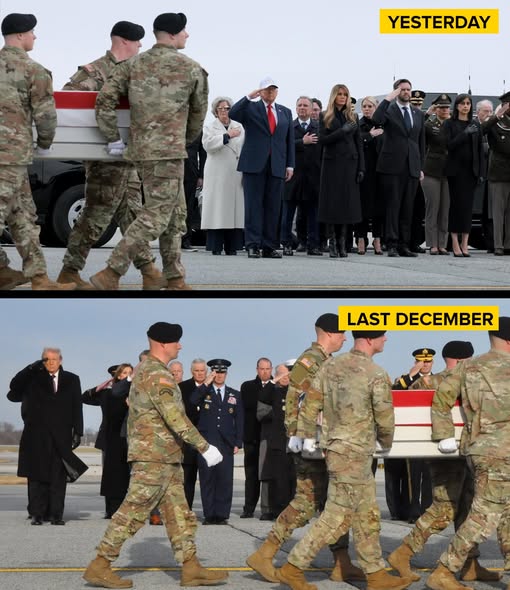 President Trump, wearing a baseball cap of the kind he promotes and sells, is shown in the top photo saluting (which is a formality normally reserved for uniformed military members) during the Dignified Transfer ceremony on March 7 for military members killed during the U.S.-Iran war. Yet Fox News broadcast to its audience a similar photo from last December, but without the baseball hat, as if it were the ceremony on March 7.
Letters from an American, Historical Commentary: March 8, 2026 [Taking Deaths Seriously], Heather Cox Richardson, right, March 9, 2026 Yesterday, President Donald J. Trump was among the dignitaries who attended the dignified transfer returning the remains of the six U.S. soldiers killed in the military action against Iran to the United States for burial. At the transfer, Trump wore a white USA baseball cap for sale in his campaign store.
Recognizing that Americans would recoil from seeing Trump wear a baseball cap at a dignified transfer, the Fox News Channel declined to show how he had looked yesterday and aired old footage of Trump from his first term without the hat. Caught in their lie, the Fox News Channel admitted they had shown the wrong footage but claimed it was inadvertent. They did not, however, show the real footage from yesterday, showing Trump wearing his merch.
The producers at the Fox News Channel seemed to recognize that Trump’s USA hat at a dignified transfer looked like deliberate disrespect for those whose lives had been taken in the service of our country. They seemed to understand the gulf between the administration’s cartoonish approach to the war in Iran and the reality of war for those participating in it.
The official social media account of the White House has portrayed its military adventures in Iran as a movie, or a game, splicing images from what appear to be footage of U.S. military strikes with clips from adventure movies and video games like Call of Duty and Grand Theft Auto.
Undeterred by criticism, White House communications director Steven Cheung called for supporters to show their enthusiasm for one of the videos in comments below it.
Last Thursday, March 5, Trump talked to ABC News chief Washington correspondent Jonathan Karl about the war. “I hope you are impressed,” he said. “How do you like the performance? I mean, Venezuela is obvious. This might be even better. How do you like the performance?” Karl answered that “nobody questions the success of the military operation, the concern is what happens next.”
“Forget about next,” Trump answered. “They are decimated for a 10-year period before they could build it back.”
“We’re marching through the world,” Senator Lindsay Graham (R-SC) told a laughing Maria Bartiromo of the Fox News Channel this morning. “We’re cleaning out the bad guys. We’re gonna have relationships with new people that will make us prosperous and safe. I have never seen anybody like it. This is Ronald Reagan Plus. Donald Trump is resetting the world in a way nobody could have dreamed of a year ago. He is the greatest commander in chief of all time. Our military is the best of all time. Iran is going down, and Cuba is next.”
The administration’s approach to foreign affairs appears to be the logical outcome of two generations of a peculiar U.S. cowboy individualism. Since the 1950s, right-wing ideologues in the United States have embraced a fantasy world in which a hero cuts through the red tape of laws and government bureaucracy to do what he thinks is right. That image was fed by TV westerns that rose after the 1954 Brown v. Board of Education decision to portray a world in which dominant white men delivered justice to their communities without the interference of government. By 1959, there were twenty-six westerns on TV. In one week in March 1959, eight of the top ten TV shows were westerns.
 The idea of white men acting for freedom and justice on their own, unhampered by a government that served Black Americans, people of color, and women, became a guiding image for the rising right wing beginning with Arizona senator Barry Goldwater in 1964. It found a home in the Republican Party with Ronald Reagan in 1980, as supporters took a stand against a federal government they insisted was redistributing the tax dollars of hardworking Americans to undeserving minorities and women.
That cowboy individualism spread into foreign affairs as well, until by 2003, right-wing talk radio host Rush Limbaugh could use it as shorthand to defend President George W. Bush’s military operation in Iraq. Just after the 2003 capture of Iraqi leader Saddam Hussein, Limbaugh gushed about presidents Ronald Reagan and George W. Bush, who had ignored the rules imposed by “liberals” and fixed what was wrong with the world. Limbaugh explained that Reagan was a cowboy: “He was brave, positive, and gave us hope. He wore a white hat…. Liberals hated Ronald Reagan.”
Limbaugh continued: “They also hate President Bush because he distinguishes between good and evil. He calls a spade a spade, and after 9-11 called evil ‘evil,’ without mincing any words, to the shock of the liberal establishment. That’s what cowboys do, you know…. In the old West, might did not make right. Right made might. Cowboys in white hats were always on the side of right, and that was their might. I am glad my President is a cowboy. He got his man! Cowboys do, you know.”
In Breaking the News today, James Fallows wrote that that way back in 2015, he concluded that “it had become far too easy for political leaders to strut and posture about ‘honoring the troops’—the Hegseth term ‘warfighters’ was not yet in common use—but then to commit them in half-thought-through “forever” wars, since so much of the public was so insulated from the consequences.”
But if Trump’s Iran adventure began with the strutting and posturing of a military performance, it is running hard into reality. It appears that Trump saw the strikes themselves as the culmination of his performance and did not have a plan for what would happen after them. He has said he was surprised that the conflict has included neighboring states.
Now the ships that carry about 20% of the world’s oil are not traveling through the Strait of Hormuz, and oil prices are surging. Rising oil prices are already hitting Americans at the gas pump—gasoline prices rose 14% last week—and will also hit the economy in general as jet fuel and diesel for trucks and tractors become more expensive. Trump tonight posted that high oil prices are “a very small price to pay for U.S.A., and World, Safety and Peace. ONLY FOOLS WOULD THINK DIFFERENTLY.”
The public support for the financing of this war is different from that of past adventures. While President George W. Bush could borrow to pay the cost of Operation Iraqi Freedom in 2003, 2026 is a different story. The national debt has ballooned in the two decades since the Iraq war, and Republicans last summer justified their dramatic cuts to government programs, including healthcare and supplemental nutrition assistance, by insisting that it must be addressed. Now Trump is spending an estimated $1 billion a day on Operation Epic Fury, highlighting that while there was no money for programs that helped the American people, there appears to be plenty for a war of choice in the Middle East.
Since the 1980s, Republican presidents have been able to sell their military adventures with the argument that, like cowboys, they were cutting through bureaucracy and laws in order to do what was right. As Limbaugh described it, they were never looking for trouble, but when trouble came they faced it with courage. They were always on the side of right, defending good people against bad people. They had high morals and spoke the truth. They were “a beacon of integrity in the wild, wild West.”
The fantasy of those who embraced cowboy individualism was that if only they could have full sway, they would solve the world’s problems and keep Americans safe. But the conduct of the war is starting to illustrate that any claims of a moral code disappear when a leader exercises military might on a whim. According to Defense Secretary Pete Hegseth, the U.S. will not be bound by any “stupid rules of engagement” and will rain down “[d]eath and destruction from the sky all day long. This was never meant to be a fair fight,” he said, “and it is not a fair fight. We are punching them when they’re down, which is exactly how it should be.”
On Wednesday, March 4, a U.S. submarine torpedoed an Iranian warship in international waters. The vessel was not participating in hostilities; it was off Sri Lanka returning from a naval exercise organized by India in the Bay of Bengal. In the past, the U.S. has participated in those exercises.
Andrew Roth, Cate Brown, and Hannah Ellis-Peterson of The Guardian noted that submarine attacks since World War II have been incredibly rare, as are attacks on vessels not taking part in hostilities. The ship was believed to have 180 people on board; Sri Lankan officials said they rescued 32 and recovered 87 bodies from the water. Hegseth boasted: “An American submarine sank an Iranian warship that thought it was safe in international waters.”
On Thursday, Phil Stewart and Idrees Ali of Reuters reported that the U.S. appears to bear responsibility for the February 28 strike on a girls’ school in Minab, in southern Iran, in the early waves of the Israeli-U.S. attack. The strike appears to have killed 168 people or more, many of them children. Since the Reuters report, others have noted that the U.S. was operating in the area and Israel was not. The strike remains under investigation.
After Saturday’s dignified transfer, Trump told reporters on Air Force One. “I hate to do it, but it’s a part of war,” he said. “It’s a sad part of war.”
“It’s the bad part of war.”
More Global News and Comment
Aaron Rupar (@atrupar.com) via BluSky, Lindsey Graham: 'Blow the hell out of those people,' Aaron Rupar, March 9, 2025. Quoting South Carolina Republican senator, above, on Fox News about Iran.
LINDSEY GRAHAM: Israel and the United States -- you just wait to see what comes the next two weeks
BARTIROMO: Meaning what?
GRAHAM: We're going to blow the hell out of these people.
U.S. Secretary of State Marco Rubio sits at a conference table with other officials in Doral, Florida under a backdrop that displays "Shield of the Americas Doral 2026" on March 7, 2026. Flags from participating countries are displayed behind the officials. (U.S. State Department photo).
Wayne Madsen Report, Investigative Commentary: Fooling his flock, Trump turns out to be just another Henry Kissinger globalist, Wayne Madsen, left,  March 9, 2026. Trump commences Operation Condor 2.0 in Western Hemisphere.
If one believes Trump White House propaganda, his Shield of the Americas is an emerging Western Hemispheric pact involving like-minded governments in advancing the use of military force to fight drug cartels, sharing intelligence, and countering Chinese influence. It is none of those things. It is nothing more than a return to the dark days of Operation Condor, a U.S.-backed campaign of state terror by South American dictatorships last lasted from 1975 to 1983. It was an era that witnessed several Latin American nations cooperating in political assassinations, torture, and the disappearances of between 60,000 and 80,000 leftists across the region. Operation Condor saw the incarceration of 400,000 political prisoners. Trump’s plans for ICE mass detention centers across the United States serves notice to the other Shield of the Americas countries that concentration centers like that of CECOT in El Salvador are now permissible across the Shield signatories.
Members of the Shield include, in addition to the United States, Argentina, Bolivia, Chile, Costa Rica, Dominican Republic, Ecuador, El Salvador, Guyana, Honduras, Panama, Paraguay, and Trinidad and Tobago. Leaders, other than Trump, who participated in the Shield summit were Kamla Persad‑Bissessar (Trinidad and Tobago), Santiago Peña (Paraguay), Luis Abinader (Dominican Republic), Nayib Bukele (El Salvador), Mohamed Irfaan Ali (Guyana), Rodrigo Chaves Robles (Costa Rica), Daniel Noboa (Ecuador), Rodrigo Paz Pereira (Bolivia), Javier Milei (Argentina), José Raúl Mulino (Panama), Nasry Asfura (Honduras), and José Antonio Kast (Chile, president‑elect). All face intense opposition to joining the pact from center-to-left parties in their legislatures.
After offering the Shield leaders U.S. missile strikes against their drug cartels, he also offended the delegates by criticizing their use of the Spanish language. Trump said, “I’m not learning your damn language. I don’t have time.”
One major difference between the Shield of the Americas, which Trump has appointed fired Department of Homeland Security Secretary Kristi Noem as U.S. Envoy, is that the United States is leading the way on disappearing immigrants and U.S. citizens by the thousands. In Operation Condor, U.S. Secretary of State Henry Kissinger sat back while Latin American dictatorships sought to stop the advance of “Communism” through disappearances and assassinations. Undoubtedly, Noem will bring her experiences with ICE to share with fascist-oriented Latin American governments eager to do crack down on progressive parties in their own nations.
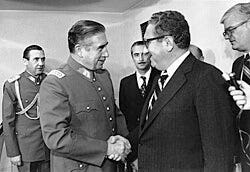
Henry Kissinger meeting with Condor supporter General Augusto Pinochet of Chile in 1976.
The Shield of the America’s is a culmination of the “Trump Corollary to the Monroe Doctrine,” a narrowing of U.S. cooperation to ideologically aligned governments and treating the hemisphere as the U.S.’s immediate sphere of influence. The corollary is jokingly called the “Donroe Doctrine.” It stands as a total repudiation of John F. Kennedy’s Alliance for Progress, which promoted U.S. support for all Western Hemispheric democratic nations. Shield of the Americas deliberately narrows participation to like‑minded right‑leaning governments, bypassing multilateral bodies like the Organization of American States and the annual Summit of the Americas and excluding governments seen as unfriendly to U.S. interests. Not invited to the Doral summit were Mexico, Brazil, Colombia, and Haiti. It is not known whether Nicaragua, Uruguay, Venezuela, or Guatemala were invited or, if so, why they skipped the summit. Aside from Guyana and Trinidad and Tobago (and Belize in the military meeting run concurrent to the summit), no Caribbean Community (CARICOM) member was represented at Doral.
On March 7, Trump and his version of the insane Don Quixote’s loyal servant Sancho Panza, Marco Rubio, played co-host, along with Trump, of the inaugural summit in Florida of the Shield of the Americas. The summit included a motley collection of fascist and proto-fascist leaders who were Trump’s guests at his bedbug-ridden Trump National Doral Golf Club in Miami. The club once sat next to one of Florida’s largest waste landfills. The piles of waste could be seen from Trump’s gold course, something that became a running joke. In February 2023, the Covanta Energy waste-to-energy plant caught fire and it continued to burn for weeks. The cause of the fire remains unknown, as do most crimes involving or adjacent to the mobster-in-chief.
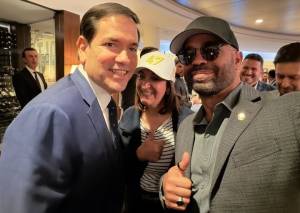 U.S. Secretary of State Marco Rubio, left, greets the Trump-pardoned Jan. 6 insurrectionist Enrique Tarrio at the Trump-sponsored "Shield of Americas Summit" convening ultra-right Latin American leaders at Trump National Doral Golf Club in Miami.
And who was among the fascists gathered at Doral? None other than Enrique Tarrio, the former national leader of the white nationalist Proud Boys and a leader of the January 6, 2021 insurrection at the U.S. Capitol. Tarrio, photographed with fellow Cuban-American Rubio, appeared ecstatic over Trump’s plan to take over Cuba from its present government. Tarrio, who had been sentenced in 2023 to 22 years in prison prior to being pardoned by Trump, was at the Doral summit for a reason. Rubio and Trump were sending a message to the Brazilian government of leftist president Luiz Inácio Lula da Silva that the “Shield,” which sounds more like a Marvel comics group than an international alliance.
Tarrio’s presence in Doral with anti-democratic leaders from the hemisphere was a signal that Trump and his far-right allies would fight for Brazil’s release from a 27-year prison sentence of former far-right president Jair Bolsonaro, convicted of launching in Brasilia a carbon copy of the U.S. insurrection after his 2022 defeat for reelection.
“War Secretary” Pete Hegseth hosted a conference at the U.S. Southern Command headquarters, also located in Doral. Titled the "Americas Counter Cartel Coalition" (ACCC), the gathering of military chiefs, the signatories of a counter-narcotics agreement pledged to adopt the Trump administration’s aggressive military action against drug cartels, eschewing past law enforcement actions by police, prosecutors, and the courts. Signatories of the Counter Cartel Pact included all 17 signatories of the Shield of the Americas charter plus the Bahamas, Belize, and Peru. Hegseth told the signatories that the U.S. and Latin American countries shared a Christian heritage that would be instrumental in combating cartels, restore deterrence, and "make the Americas great again."
Operation Condor served as a transnational intelligence and repression network, sharing data, conducting cross‑border operations, and targeting dissidents abroad. Shield of the Americas replicates Condor in the sharing of intelligence and data, conducting cross-border operations, such as the recent U.S. military action against “cartel” groups in Ecuador, and targeting leftists. In Trumpworld-speak, cartels and leftists are often one and the same.
Stephen Miller, the cosplaying Nazi chief adviser to Trump, told the Latin American military conference that there was a reason why it was military-led and not a conference of lawyers. Miller emphasized that cartels can only be defeated with military power, a policy carried out by U.S. military forces against boat traffic in the Caribbean and eastern Pacific will deadly results that included the murder of innocent civilian fishermen on the high seas.
Miller, addressing a military audience of delegates from Honduras, Argentina, Dominican Republic, Argentina, Paraguay, Panama, El Salvador, and other countries, said, “I see some heads nodding up front because they understand you’re dealing with a lot of lawyers in your own country, I’m sure. You have my permission not to listen to them.”
Operation Condor saw Chile, Argentina, Uruguay, Paraguay, Ecuador, and Bolivia, with sporadic assistance from Peru, coordinating repression of leftist opponents.
As can be seen from Hegseth’s address to the Shield summit, his idea of “Making the Americas Great Again” is to restore the fascist dictatorships of Kissinger’s Condor era. When individuals like Hegseth, Steve Bannon, and Elon Musk render “sieg hiel” salutes they are not waving to a crowd. They are sending a message that their intent is to bring about a Fourth Reich on the principles of Adolf Hitler, Benito Mussolini, and now, Vladimir Putin and Donald Trump.
Coupled with the U.S.-Israeli war against Iran and the illegal kidnapping of Venezuela’s president and first lady, the Shield of the Americas and the Counter-Cartel pact move the United States firmly into the category of a fascist aggressor nation and international pariah state.

In April 1980, President Jimmy Carter delivered a nationwide address describing Operation Eagle Claw, a was a failed U.S. Department of Defense attempt to rescue 53 U.S. embassy staff held captive by Revolutionary Iran on 24 April 1980. Carer ordered the mission after Iran refused to release the hostages. The operation, as described here, encountered so many obstacles -- includding failures of three of the eight helicopters and a blinding sandstorm in an Iranian desert where U.S. personnel assembled prior to the rescue attempt -- that Carter aborted the mission. As the U.S. forces prepared to withdraw in the blinding sandstorm, one of the remaining helicopters crashed into a transport aircraft that contained both servicemen and jet fuel. The resulting fire destroyed both aircraft (with wreckage of the Bluebird helicopter shown below) and killed eight servicemen.
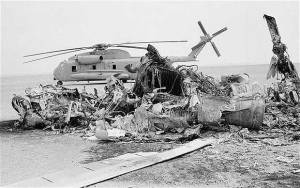
Emptywheel, Analysis: Trump Dreads Failing Like Jimmy Carter Did on Iran, Emptywheel, (Marcy Wheeler, right), March 9, 2026. The analogies that commentators are using to describe the crisis Donald Trump caused by launching an illegal attack on Iran jumble a lot together. And while smart economists say the world won’t suffer the kind of inflationary cycle it did in the 1970s, many people compare today’s disaster with the last time Iran’s radical clerics avenged US imperialism in epic fashion in 1979.
That’s why I keep coming back to the interview Trump did with the NYT, in the wake of his seeming successful kidnapping of Nicolás Maduro.
Three times, Donald Trump described his success in Venezuela in terms of the risk that it might have gone south like Operation Eagle Claw, Jimmy Carter’s failed attempt to rescue the American hostages in 1980.
Early in the interview, Trump offered up the comparison: “To think this could have turned out like Carter’s failed Special Forces operation!”
[T]o think that we could go in there and have nobody killed, not lose one aircraft, where we’re going 1,800 miles an hour over a small area with 152 different planes, different planes and helicopters, is pretty amazing to people, you know. You didn’t have a [President] Jimmy Carter crashing helicopters all over the place, that you didn’t have a Biden Afghanistan disaster where they couldn’t do the simplest maneuver. That was a simple maneuver — they should have never left from that airport. They should have used Bagram.
When Katie Rogers asked Trump what it felt like as he watched the operation in real time, Trump said he had been thinking primarily of the possibility of humiliating failure, like Carter.
 David E. Sanger,right,: Did you watch either by video —
Check please! Do you want to show off your shiny bunker-ballroom, Sir?
Curiously, DOD posted a review of the failed Eagle Claw operation last year. It turns out, Trump wasn’t the only one “studying” that operation. Here’s a snippet.
“This mission required a lot of things we had never done before. We were literally making it up as we went along,” said retired Air Force Col. Bob Brenci, the lead MC-130 pilot on the mission.
Flying using night-vision goggles was almost unheard of then, he said.
Operation Execution The mission began on April 24, 1980, with the arrival of the MC-130s at Desert One. The plan almost immediately began to unravel.
The piece describes (accurately) how the Eagle Claw failure led DOD to professionalize Special Operations and institutionalize a lot of other kinds of coordination, lessons learned that have served the US well since then.
Chief among the lessons, though, is that you don’t just make shit up as you go along.
Yet that is precisely what Trump has been doing.
Donald Trump has a pathological need to avoid being seen as he sees Jimmy Carter, a loser, someone who keeps leeching power over the course of an extended crisis.
And yet, as he keeps doing things that make that far more likely, just making shit up, everyone makes the obvious comparison with Carter’s failures. I think a lot of the commentary has not considered that Trump has caused himself a resounding blow to his own self-image, and every time they make the comparison with 1979, that wound is renewed.
At a very personal level, he will be seeking ways to not look like a loser. Which could make his decisions still more irrational.

New York Times, British Lawmaker Wants King Charles to Cancel His U.S. Trip Over Iran War, Michael D. Shear, March 9, 2026. Ed Davey, the leader of the Liberal Democrats in Britain, said President Trump does not deserve the “diplomatic coup” of hosting the king (shown above in a file photo) for a state visit.
Ed Davey, the leader of the Liberal Democrats party in Britain, called on King Charles III to cancel his state visit to the United States in protest of what Mr. Davey calls President Trump’s “illegal war” against Iran.
Mr. Davey urged Prime Minister Keir Starmer, right, to advise the king to call off the trip, which is expected to take place next month as part of  celebrations to mark the 250th anniversary of American independence. A specific date has not been announced.
“At a time when Trump has launched an illegal war that is devastating the Middle East and pushing up energy bills for British families, it’s clear this visit should not go ahead,” Mr. Davey said in a statement on Monday.
“A state visit from our King would be seen as yet another huge diplomatic coup for President Trump, so it should not be given to someone who repeatedly insults and damages our country.”
Buckingham Palace said that no state visit has been confirmed and that all state visits happen on the advice of the government. But government officials have previously indicated that planning was underway for the king to travel to the United States in late spring.
A spokesman for Mr. Starmer declined to comment. Steve Reed, a Labour Party lawmaker and a minister in the prime minister’s cabinet, told the BBC, “I don’t think it is for Ed Davey to decide what the King should or should not be doing.”
The centrist Liberal Democrats are the third largest party in the British Parliament, with 72 of its 650 seats.
Mr. Davey’s demand comes at a delicate moment for Mr. Starmer, whose relationship with Mr. Trump has gone from rosy to grim in the last several weeks. The president has repeatedly belittled the prime minister for not joining the initial attacks against Iran.
On Saturday, Mr. Trump lashed out again on his social media platform after Mr. Starmer announced that his government was sending more ships to the Gulf to help defend Cyprus and other allies.
“That’s OK, Prime Minister Starmer, we don’t need them any longer,” Mr. Trump wrote. “But we will remember. We don’t need people that join Wars after we’ve already won!”
Mr. Starmer had previously made it a priority to please Mr. Trump, saying that doing so would benefit Britain in its dealing with the United States. Last year, the prime minister was the first foreign leader to negotiate a trade deal with Mr. Trump to avoid even higher tariffs.
In September, the king hosted a lavish state visit for Mr. Trump at Windsor Castle after the invitation was delivered to the president by Mr. Starmer.
But the friendly relationship between the two leaders has frayed since then. Mr. Trump has angrily criticized Britain for refusing to allow America to use a joint U.S.-U.K. military base in Diego Garcia and another base in England to launch the initial attacks on Iran.
“He should be giving us, without question or hesitation, things like bases,” Mr. Trump said in an interview with the New York Post last week.
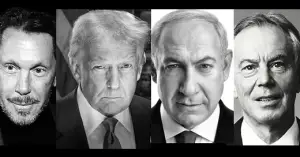 The allied oligarchs Larry Ellison, Donald J. Trump, Benjamin Netanyahu and Tony Blair, from left to right (File photos).
How to Survive the Broligarchy, Commentary: Is this the Broligarchy's first world war? Carole Cadwalladr, right, March 9, 2026. AI-guided weapons, two out-of-control authoritarians, no legal authority and a toxic mess of masculinity: welcome to the manosphere's first major conflict.
The brand is chaos. That’s the defining quality of everything that Donald Trump is doing. It’s also the state of our information system. They’re both marked by the same absence of rationality, order, logic, rules and signposts to the future. We are living in an eternal present, an unending scroll of news, videos, cats falling off logs, bombs blowing up apartment blocks and perfectly smooth foreheads speaking at the camera as they narrate the narrowest of world views.
There is no sense to be had in a media landscape that both mirrors and enables the political turbulence we’re living through. We’re trapped inside this never-ending algorithmic scroll where our dopamine-fuelled lust for the endless new is Trump’s literal foreign policy.
In three months, we’ve careered around the world in his wake from Venezuela to Greenland to Iran. Next stop Cuba.
I’m writing these words, after a gap of silence, because the last thing I wanted to do is to add to the noise. And I can’t presume to try and help make sense of what’s happening in the world for anyone else when I can’t understand it myself. And I don’t see how anybody can.
The chaos we are living through is the equivalent of cognitive assault. Our extra-sensory information landscape engages our frontal lobes in the busyness of mental processing from which no meaning comes. Three weeks ago, the news cycle stopped briefly on a subject that for a brief moment was shocking even in spite of this algorithmic numbing.
The dazzling glare of public exposure shone a light on a global network of rich and powerful men, many of them household names, who had participated in, or turned a blind eye to, an international trafficking operation involving hundreds of women and girls. For the briefest of moments, it felt like a sharp blast of daylight had been shone on one of the darkest corners of our world. There was no path to justice or accountability for the victims of Jeffrey Epstein, but there was some small comfort in that at least, finally, it couldn’t be ignored.
How wrong can you be? Of course, it could be.
The news cycle hasn’t just moved on, we are now deep into the testosterone zone, the fizzing, almost sexual excitement of war. This is what the early stages of all wars look like. Pumped up officials walking stiff-legged to podiums to tell the waiting press about the incredible potency of their firepower. Videos of fighter jets commanding the skies. Mesmerising footage of high-tech “intercepts” across the night sky. Spectacular explosions among dense tower blocks, all of it so familiar from any video game while a constant parade of interchangeable military men, analysts, commentators pontificate across our screens.
This was what was on the White House’s social media accounts three days ago. A hyper-masculine meme-ified fantasy of war.
But there’s another even more dangerous fantasy at play because this is a war that is being waged with a new generation of AI-guided missiles.
What’s happening in Iran is a step-change. Gaza was the laboratory, this is the next stage. Reporting from 972 magazine in 2024 revealed the Israeli military were using an AI programme, Lavender, to find and profile targets.
And last week, the WSJ and Washington Post revealed that the US deployed AI at scale. It reports the US military is using the “Maven Smart System” built by Peter Thiel’s Palantir and powered by Anthropic’s Claude to profile and select kill targets.
Or as this excellent piece by the Citizens sums it up:“The same logic that built recommendation engines and social media algorithms is now being applied to the industrial generation of kill lists.
Chatbot systems that entered public life writing emails, summarising documents and telling you what to have for dinner now help determine who lives and who dies.”
Three weeks ago, details of Peter Thiel’s relationship with Epstein came tumbling out. A social, intelIigence and business relationship that saw Epstein invest $40m in Thiel’s Valar Ventures and, with the former Israeli PM, Ehud Barak, co-invest in an Israeli surveillance firm, Carbyne.
This week, news of Palantir’s involvement in the US’s and Israel’s war of choice saw its stock price rise 15%. Was it AI that selected the Iranian school where at least 168 people were killed, mostly children?
Investigations by three major US news organisations - the New York Times, CNN and Reuters - have now concluded the school was hit by US bombs. Reuters identified a “double tap”, two strikes, 40 minutes apart. The open-source investigative site Bellingcat yesterday published a report that reviewed verified footage and identified the missile which hit the school to be a US Tomahawk. That report has now been independently replicated by the New York Times.
I grew up in Wales and felt the chill every time we passed a road sign to “Aberfan”. My dad would recount the story of the day a coal tip fell on the town’s school killing 144 children. The name of Aberfan is still burned into the nation’s collective memory more than half a century on. But the slaughter of an entire community’s children in the town of Minab in a single day? It’s an obscenity that’s caused barely a ripple of anguished outrage.
We now need to know: was AI involved in targeting this school? This is a crucial question. Were those children the collateral damage of an AI hallucination? We all know how unreliable these large language models are. We’ve all been served a bullshit answer based on a fabricated link. Now apply this to war.
We can’t let this moment pass. Minab, like Aberfan, is a place that should be burned onto our brains. AI, like war, is another hyper-masculine fantasy of God-like power. It’s nothing of the sort, it’s just a story, a myth, that’s being imposed on us by a self-interested cohort of unaccountable men succoured by a pliant and incurious press.
But not here. Not in this newsletter, not on the day after International Women’s Day, not in the midst of a new illegal war that the US and Israel have started and that Britain is being press ganged into joining by a right-wing media that’s using Trump’s words as if they were evidence of anything other than an out-of-control megalomaniac.
Forget Andrew Tate, this is the real manosphere. One whose edges we can’t even see because we’re living inside it. Our world is controlled by these men, their platforms, their alliances with nation states, technology-fuelled political power which is only accelerating and gathering strength.
When I coined the word “broligarchy” it wasn’t as a cutesy pun: I used it to describe the confluence of Silicon Valley technologies and US state authoritarianism, and a warped toxic pseudo-masculinity that’s at its heart.
Andrew Tate is simply a phenomenon that is downstream of this. He’s a visible excrescence that’s a byproduct of this phenomenon, nothing more than a boil on the backside of the broligarchs. Two weeks ago, in the midst of the Epstein revelations, I read Gisèle Pelicot’s autobiography ahead of what was going to be a last-minute interview with her. It’s an astonishing story of almost superhuman resilience but it also forced me to confront yet another bleak dystopian consequence of our brave new digital world.
The multiple rapes Gisèle Pelicot survived were only possible because a technology platform enabled her husband to connect with other rapists -- at least 72 of them -- in a 50km radius of their small French provincial town.
What do you do with that information? In the pre-internet age, would all those men be rapists? I don’t believe so. Their desires were normalised by algorithmic forces beyond their control and an opportunity was presented by a platform that offered anonymity and impunity. It fed them a fantasy of God-like power and control: possession of a woman who literally couldn’t fight back.
You don’t want to face this. None of us do. It’s too dark, too bleak. But to understand what is happening now, in Iran and Lebanon, and the forces behind it, we need to see that this is a continuum. Dominique Pelicot and Andrew Tate and Jeffrey Epstein are only symptoms. They are the doorway through which we can understand the forces behind not just another catastrophic Gulf War but a global power structure in which state violence, commercial profit and the control, domination and violation of women are inextricably entwined.
For those of us old enough to remember the despair and helplessness we felt at the outbreak of the last Gulf War, it’s impossible to avoid vivid flashbacks from that era and one figure in particular: Tony Blair. On Friday night, a story dropped in the Daily Mail that claimed Tony Blair had “rebuked” Keir Starmer for not backing Trump.
The comments, it was said, were made at a private event where Blair was quoted as saying. “The American relationship matters. It matters particularly today. It's not a question of whether it's this president or that president. If they are your ally and they are an indispensable cornerstone for your security... you had better show up.”
If the British people had a vote on who would be the very last person they’d like to hear from now, I suspect that there would be a landslide for Tony Blair. He led us into the disastrous war on Iraq and he’s never expressed guilt, contrition or doubt. But his rhetoric is exactly what the united ranks of the right-wing press have been saying since Trump and Netanyahu began this war. They’ve been making cheap political capital about the UK government’s reluctance to facilitate an illegal war they weren’t even warned about. (Bookmark this paragraph for when the war reaches Britain’s shores and Keir Starmer is also to blame.)
But Blair also throws a helpful light on what else is at stake here and who else is involved. Because Tony Blair is not a free agent or simply a mouthpiece simply for the opinions of Tony Blair. Tony Blair’s entire project -- the Tony Blair Institute for Global Change -- is bankrolled by Larry Ellison, the billionaire founder of Oracle, the technology company that’s front and centre, alongside OpenAI, in the great AI bubble boom.
In Britain, Blair has to be considered an unregistered lobbyist for Larry Ellison. He’s received in the order of half a billion dollars from him. Blair may very well believe everything he says with every fibre of his being -- it’s likely part of the reason Ellison hired him - but Tony Blair’s financial interests are also squarely Larry Ellison’s financial interests.
And Larry Ellison’s financial, commercial and now ideological interests are not Britain’s or even America’s. Larry Ellison mostly acts in the interests of Larry Ellison. But as I laid out in this investigation for the Nerve -- Ellison, a Trump donor and ally, is also tightly bound up with Netanyahu -- his good friend and sometime holiday companion.
And both Blair and Ellison are front and centre of the plans for Gaza, Blair as a member of the absurdly named “Board of Peace” and Ellison as one of the technology companies that stand to control and profit from the grotesque plans for redevelopment.
 Tony Blair, right, is a way to understand the forces at work in this latest war. A confluence of US and Israeli state, technological and commercial interests that stand to gain from this war. That Blair’s views are being channelled into the UK press as it cheerleads for Britain to join this war without this disclaimer is yet another point of failure. Though that’s as nothing compared to the power over the US press and media which Larry Ellison now wields -- through his son, David Ellison, a nepo baby in the mould of Succession’s Roman Roy.
Ellison’s purchase of CBS has turned it into a state propaganda outlet and with the proposed buyout of Warner Brothers, CNN and HBO Max are next in line. He’s also acquired a majority stake in the US company that now controls TikTok. This consolidation is being reported in the US as a business monopoly story. Hollywood Reporter and Deadline have carried quotes from Hollywood types saying they think it’ll be fine because David Ellison likes movies.
This isn’t about who controls the Harry Potter franchise or even the CBS newsroom. It goes beyond even the creation of a state-aligned propaganda machine with one central point of coordination across multiple news and media brands. There’s a far bigger strategic power play at work here, the Trump-Netanyahu alliance that’s behind this latest war. And Blair is the key that helps unlocks this.
The takeover of the US media is part of the same power players behind the “Board of Peace”, an organisation owned and run in perpetuity by Donald Trump, that’s been set up not just to rape Gaza but to replace the United Nations with a wholly illegitimate pseudo authority. Whatever else we do in this moment, it cannot include listening to Tony Blair.
I don’t know where we sit in that open space, but I do know this:
Trump and the Republican party talk openly about moving America to the right side of this scale. Trump has used chaos to create political opportunity for himself continually over the last decade. And as a society moves toward authoritarianism, the less important popular will becomes and the more important institutional control—of the police, the army, the media, the business community, the judicial system—becomes.
If I were confident that we were still basically on the left side of the scale, then I’d be sanguine about the political damage the Iran war is doing to Trump.
I worry that we don’t have a clear sense of where we are, as a society. And that we may have already drifted to a place where this war will present at least as many opportunities as dangers for our strongman.
A note on who I am: I’m an investigative journalist who’s spent a decade reporting on the collision of technology and democracy including exposing the Facebook/Cambridge Analytica scandal for the Guardian and the New York Times. Two years ago, I called the alliance of Trump, Silicon Valley and a global axis of autocracy: a tech bro oligarchy, aka the Broligarchy. Please help me continue to expose it.
More On Iran Operations, Impacts
Popular Information, Accountability Journalism: 9 days in, the most basic question about the Iran war remains unanswered, Judd Legum, right, March 9, 2026. In just over a week, Trump and top administration officials have given at least 17 different responses about why the war began.
9 days in, the most basic question about the Iran war remains unansweredIn just over a week, Trump and top administration officials have given at least 17 different responses about why the war beganJudd LegumMar 9 READ IN APP Defense Secretary Pete Hegseth speaks during a press conference in Washington, DC, on March 2, 2026. (Brendan SMIALOWSKI / AFP via Getty Images)
On February 28, President Trump announced that “the United States military began major combat operations in Iran.” The war has claimed the lives of more than 1500 people, including about 1300 Iranians, dozens in neighboring countries, and six U.S. troops. The Pentagon has estimated the conflict is costing U.S. taxpayers about $1 billion per day — and that figure may be too low.
And yet, nine days into the war, Trump and his administration have failed to clearly answer the most fundamental question: Why did the war begin?
Instead, the Trump administration has offered a bewildering series of shifting, contradictory, and factually incorrect answers. In just over a week, Trump and top administration officials have given at least 17 different responses about why the war began:
Iran’s nuclear program was “obliterated” last June, but the U.S. started the war because Iran refused to abandon its “nuclear ambitions.” In his February 28 announcement, Trump said that “in Operation Midnight Hammer last June, we obliterated the regime’s nuclear program.” The U.S. initiated this attack, Trump said, because Iran “rejected every opportunity to renounce their nuclear ambitions, and we can’t take it anymore.”
The U.S. attacked Iran to prevent a nuclear war. “If we didn’t do what we’re doing right now, you would have had a nuclear war, and they would have taken out many countries,” Trump said on March 3.
Absent an attack, Iran would have had a nuclear weapon within two weeks. “If we didn’t hit within two weeks, they would’ve had a nuclear weapon. When crazy people have nuclear weapons, bad things happen,” Trump said on March 4.
Iran is developing long-range missiles that “could soon reach the American homeland.” In his February 28 speech, Trump said that Iran was “developing the long-range missiles that can now threaten our very good friends and allies in Europe, our troops stationed overseas, and could soon reach the American homeland.” The idea that Iranian long-range missiles posed an imminent threat is not supported by public intelligence assessments. An assessment by the Defense Intelligence Agency published last May estimated that Iran would need ten years to develop a missile capable of reaching the United States — if it chose to pursue that capability.
The war is necessary because Iran has too much control over the global oil supply. On March 2, Secretary of State Marco Rubio said, “This terroristic regime, led by radical clerics, has the ability potentially to shut off 20 percent of global energy. That’s the kind of leverage they have because of their navy. We’re going to destroy their navy.”
The U.S. started the war because it knew Israel was going to attack Iran, endangering U.S. troops. “We knew that there was going to be an Israeli action, we knew that that would precipitate an attack against American forces, and we knew that if we didn’t preemptively go after them before they launched those attacks, we would suffer higher casualties,” Secretary of State Marco Rubio said on March 2.
The U.S. did not start the war because it knew Israel was going to attack Iran. The following was an exchange between Rubio and a reporter on March 3: “Q: Mr. Secretary, yesterday you told us that Israel was going to strike Iran and that that’s why we needed to get involved… SECRETARY RUBIO: Yeah, your statement’s false.”
Trump pushed Israel to join an attack on Iran because he believed Iran would otherwise attack first. “You see, we were having negotiations with these lunatics, and it was my opinion that they were going to attack first. …If we didn’t do it, they were going to attack first. I felt strongly about that. …So, if anything, I might have forced Israel’s hand,” Trump said in the Oval Office on March 3.
The U.S. attacked Iran to eliminate the threat posed by its short-range missiles and drones. “The United States is conducting an operation to eliminate the threat of Iran’s short-range ballistic missiles…,” Rubio said in his March 2 briefing. He also cited the need to destroy Iran’s “one-way attack drones.” According to Rubio, these missiles would act as a “shield” and allow them to later produce nuclear weapons. House Speaker Mike Johnson (R-LA) reiterated this claim after receiving a classified briefing the same day. “The objective was to take out those missiles, the short- and mid-range missiles, and their ability to produce them,” Johnson claimed.
The U.S. attacked Iran because “they’ve been killing Americans for 47 years.” This was cited by Trump in his February 28 announcement and by Secretary of War Pete Hegseth on March 4.
The U.S. attacked Iran because Iran is “the weakest they’ve ever been.” Hegseth made this claim as a justification for the War in his March 4 press briefing.
The war on Iran was started because of the “cumulative effect of various direct threats” and Trump’s “feeling, based on fact, that Iran does pose an imminent and direct threat” to the U.S. “This decision to launch this operation was based on a cumulative effect of various direct threats that Iran posed to the United States of America, and the president’s feeling, based on fact, that Iran does pose an imminent and direct threat to the United States of America,” White House Press Secretary Karoline Leavitt said during a press briefing on March 4.
The war is personal payback for Trump. “I got [Ayatollah Ali Khamenei] before he got me,” Trump told ABC News on March 1. “They tried twice. Well, I got him first.” Trump was referring to intelligence that Iran was plotting to assassinate Trump during the 2024 presidential campaign. This rationale was repeated by Hegseth during a March 4 press briefing. “The leader of the unit who attempted to assassinate President Trump has been hunted down and killed. Iran tried to kill President Trump, and President Trump got the last laugh,” Hegseth said.
The U.S. started the war because the Iranians were not negotiating in good faith. “Tehran was not negotiating. They were stalling, buying time to reload their missile stockpiles and restart their nuclear ambitions,” Hegseth said on March 2.
Trump started the war to secure freedom for the Iranian people. “All I want is freedom for the people,” Trump told the Washington Post on February 28.
The U.S. attacked Iran because it was the “last best chance” to do so. “This was our last best chance to strike…and eliminate the intolerable threats posed by this sick and sinister regime,” Trump said on March 1.
The war is a response to Iran’s efforts to interfere in U.S. elections. Trump posted this article on Truth Social on February 28: “Iran tried to interfere in 2020, 2024 elections to stop Trump, and now faces renewed war with United States.”
Nevertheless, Hegseth has described the war’s mission as “very very clear“ and “laser-focused.” Rubio said the war had “a very clear goal“ and he didn’t understand why there was any “confusion.” Leavitt said that Trump had laid out “achievable objectives.”
On Truth Social, meanwhile, Trump declared that the war would continue until he achieved his “objective of PEACE THROUGHOUT THE MIDDLE EAST AND, INDEED, THE WORLD!“
The Contrarian, Opinion: Inexcusable Incompetence, Jennifer Rubin, right, March 9, 2026. Tens of thousands of civilians are stranded and at risk.
“Everyone saw this coming except the President.” An “unmitigated disaster of epic proportions.” Were these the words from Democrats decrying Donald Trump for failing to plan to evacuate hundreds of thousands of civilians under a blizzard of retaliatory fire raining down on the Gulf States? No, those were Republicans excoriating former president Joe Biden for the botched 2021 exit from Afghanistan. Back then, Rep. Steve Scalise (R-LA) thundered, “It’s a very dire situation when you see the United States Embassy being evacuated.”
Fast forward to last week. The Trump regime closed down three of our embassies (Saudi Arabia, Lebanon, and Kuwait), abandoning U.S. citizens in those countries. Trump’s minions failed to consider advanced planning to evacuate Americans from the region, leaving them to fend for themselves in places where missiles are flying and buildings are ablaze.
Story after story has documented Americans scared, stranded, and left to find their own transportation out of countries made dangerous by his careless whims. Many have expressed their understandably fury that their government could be so derelict. The State Department has failed spectacularly in one of its essential missions — protecting Americans around the world.
The Trump regime’s level of recklessness and indifference to human life and international order should appall all Americans. Trump’s excuse for making no evacuation plans — “Well, because it happened all very quickly” — is ludicrous, considering the U.S. and Israel apparently spent months planning the military assault. His jaw-dropping admission that Iran’s bombardment of neighboring countries in retaliation was “probably the biggest surprise” reflects how little thought he put into a war with global ramifications.
Even in Afghanistan in 2021, after initial mayhem, the State Department scrambled, mounted a all-hands-on-deck rescue operation, enlisted personnel worldwide, and evacuated over 100,000 people in just a couple weeks. We see no comparable sense of urgency now.
Foreign policy professionals who have planned and executed mass evacuations of civilians in war zones over decades blasted Trump’s negligence. State Department veteran and Middle East expert Jeffrey Feltman recently argued, “It is a complete dereliction of duty for President Trump and his administration to have been planning this war for the past month, however long it’s been since they’ve been moving assets, without planning for an evacuation of American citizens.” He expounded on the cavalier and irresponsibly failure to protect Americans:
You know, Biden rightly got criticized for the shambolic withdrawal from Afghanistan. But we’re talking now about the potential of… American citizens being trapped in 14 different countries when they could have been planning all along for how they were going to deal with this. Right now, right now, the statements are, “Use commercial means to leave.” Well, there are no commercial means to leave. There’s been some hints they’re looking at this, but they could have put all this in place.
How could they not have expected a country with a stockpile of missiles would retaliate across the region, endangering tens of thousands of Americans? Secretary of State Marco Rubio and Trump’s pathetic excuses for neglecting elemental steps to protect Americans left Democrats, ordinary people, and foreign policy insiders flabbergasted.
Sen. Andy Kim (D-N.J.) reported his office was inundated with “panicked calls from Americans stuck in the Middle East, outraged that our government has provided zero evacuation support.” Combat veteran Sen. Tammy Duckworth (D-Ill.) was outraged by the absence of any “evacuation plan for Americans in the region when he launched his reckless, needless and unconstitutional war of choice against Iran.” Others joined in denouncing the institutional malpractice.Subscribed
This display of incompetence should not surprise us, given that the MAGA crew harbors such contempt for government. The massive cuts and loss of scores of foreign policy professionals (collectively representing centuries of experience) mean institutional knowledge is scarce. DOGE cuts conducted by know-nothing twenty year olds, partisan witch hunts, early retirements, and mass resignations have hollowed out the State Department, leaving it in the hands of a skeletal staff retained for their political loyalty — not expertise and experience. (Rubio also slashed staff at the National Security Council, which is supposed to oversee interagency planning.) In any other administration, the secretary of state/national security adviser would get canned or forced to resign in disgrace after such management malpractice.
As Columbia University Professor Elizabeth Saunders explained, Trump and Rubio’s “gutting of the State Department and blowtorching of US diplomatic capacity and credibility is an accelerant to this spiraling war and will seriously undercut US/allied efforts to pick up the pieces after.” If they bollixed up something as foreseeable as evacuations, imagine what chaos will ensure when the fighting stops.
For over a year, buffoonish Cabinet secretaries and their senior advisers have demonstrated the Trump regime is no “meritocracy.” As in all corrupt regimes that value sycophancy over competence, avoidable errors multiply over time. Americans trapped in a regional war zone (not to mention our armed service and regional allies) now pay the price for an unhinged and impulsive president enabled by careless, juvenile advisers who think war is a video game.
Meanwhile, no one at the White House has the temerity to contradict Trump’s “gut” impulses. Without aides to restrain Trump’s whims (e.g., Mr. President we need to get the Americans out first), he blunders forward.
To compound the problem, MAGA’s cult of personality that necessitates Republicans abdicate their legislative responsibilities, Congress would have voted for a war powers resolution, or at the very least, initiated aggressive oversight. Alas, the Republicans (who have time to quiz the Clintons behind closed doors about the pedophile scandal) show no interest in determining how this travesty unfolded and what is being done to remedy it. Instead, Hill staffers are left to field angry calls from constituents begging for help.
Congress must rouse itself to focus on a foreign policy disaster that makes the Iraq War look like a masterstroke. Rubio and other top officials under oath and in public should answer for their lapses, account for every dime spent, and give Congress some basic information. (What is the plan to extract Americans? When does the war end? Are we now targeting civilians?) The last thing Congress should do is agree to any request, as the Trump team is reportedly contemplating, to shovel more money into the coffers of this gang of bumblers.
Unfortunately, we know how this will play out. Trump and his arrogant yes-men will never admit error, let alone apologize; Republicans on the Hill will not stir themselves to do their jobs. It will be up to the voters to throw out every elected Republican and force removal of the architects of this catastrophe. Until that happens, Americans here and abroad will needlessly suffer and die.
New York Times, U.S. Tomahawk Hit Naval Base Beside Iranian School, Video Shows, Malachy Browne and John Ismay, Updated March 9, 2026. The evidence contradicts President Trump’s claim that Iran was responsible for a strike at the school that killed 175 people, most of them children (shown above).
A newly released video adds to the evidence that an American missile likely hit an Iranian elementary school where 175 people, many of them children, were reported killed.
The video, uploaded on Sunday by Iran’s semiofficial Mehr News Agency and verified by The New York Times, shows a Tomahawk cruise missile striking a naval base beside the school in the town of Minab on Feb. 28. The U.S. military is the only force involved in the conflict that uses Tomahawk missiles.
A body of evidence assembled by The Times — including satellite imagery, social media posts and other verified videos — indicates that the Shajarah Tayyebeh elementary school building was severely damaged by a precision strike that occurred at the same time as attacks on the naval base. The base is operated by the Islamic Revolutionary Guards Corps.
Asked by a reporter from The Times on Saturday if the United States had bombed the school, President Trump said: “No. In my opinion and based on what I’ve seen, that was done by Iran.” He said, “They’re very inaccurate, as you know, with their munitions.”Defense Secretary Pete Hegseth, who was standing beside Mr. Trump, said the Pentagon was investigating, “but the only side that targets civilians is Iran.”
President Trump said he believed that Iran was responsible for a strike on an elementary school that reportedly killed 175 people.
The video of the strike, which was first reported by the research collective Bellingcat, was independently verified by The Times. We compared features visible in the footage to new satellite imagery captured days after the strikes in Minab.
The video was filmed from a construction site opposite the base and shows a worn, dirt path across a grassy area and piles of debris also evident in recent satellite imagery, bolstering its credibility. The video also comports with other verified videos taken in the immediate aftermath of the strikes.
A Times analysis of the video shows the missile striking a building described as a medical clinic in the Islamic Revolutionary Guards Corps base. Plumes of smoke and debris shoot out of the building after it is hit as the distant screams of onlookers are heard.
As the camera pans to the right, large plumes of dust and smoke are already billowing from the area around the elementary school, suggesting that it had been struck shortly before the strike on the naval base. This is supported by a timeline of the strikes assembled by The Times that shows the school was hit around the time as the base.
Several other buildings inside the naval base were also hit by precision strikes in the attack, an analysis of satellite imagery showed. Determining precisely what happened has been impeded by the lack of visible weapons fragments and the inability of outside reporters to reach the scene.
PoliticusUSA, News and Commentary:Trump Is Looking For A Way Out Of His Iran War Disaster, Sarah Jones, March 9, 2026. It looks like Donald Trump and his administration are looking for a way out of their Iran war, as they have changed America's objectives, and are starting to panic as gas prices skyrocket,
The Iran war has backfired on Donald Trump and his party. Gas prices are rising exponentially. The world is concerned about a global economic meltdown, and Iran’s regime doesn’t seem to be going anywhere.
Now that the consequences for a war of choice are blowing back on them, the administration is changing its tune.
The Daily is outside the Beltway journalism for the people. Please support us by becoming a subscriber.Subscribed
First came Secretary of State Marco Rubio, who changed the objectives for the war:
This mission is clear, and it’s important to continue to remind the American people of why it is that the greatest military in the history of the world is engaged in this operation. It is to destroy the ability of this regime to launch missiles, both by destroying their missiles and their launchers, destroy the factories that make these missiles and destroy their navy.
I think we are all seeing right now the threat that this cler clerical regime poses to the region and to the world. They are trying to hold the world hostage. They are attacking their neighbor. They are attacking neighboring countries, their energy infrastructure, their civilian population. They’re attacking embassies.
This is a terrorist government. This is a terroristic regime, and we are seeing them conduct terrorism using nation state elements, using weapons like missiles, and one way attack drones. And the objective of this mission is to destroy their ability to continue to do that, and we are well on our way to achieving that objective every single day with overwhelming force, with overwhelming precision. The military, the United States military, the men and women in uniform are conducting an extraordinary operation. There are not a lot of cameras down there covering what they’re doing, as opposed to some of the other images that you may see from some of the cities and capitals nearby.
But I want everyone to know your military is getting the job done and every single day this regime in Iran has less missiles, has less launchers, their factories work less, and their Navy is being eviscerated. And the world is going to be a safer and a better place when this mission is accomplished.
What Rubio left out is that Iran has a stockpile of more deadly weapons that it hasn’t touched yet, so the Trump administration has gone from regime change to destroying the Iranian nuclear program to destroying Iran’s military.
The objective keeps getting smaller.
It seemed like the administration was looking for a way out, then Trump spoke and confirmed it.
Trump tried to stop the rising gas prices by proclaiming that the war with Iran, which he claimed would last weeks or months, was nearly over.
Trump told CBS News:
I think the war is very complete, pretty much. Iran has no navy, no communications, they’ve got no air force. Their missiles are down to a scatter. Their drones are being blown up all over the place, including their manufacturing of drones.
If you look, they have nothing left. There’s nothing left in a military sense.
That bit of Trumpian nonsense was enough to send the stock market up again and oil prices falling.
The problem is that it doesn’t matter if Trump thinks that the war is complete. If Iran decides to seek retribution on the United States by wrecking the global oil market, there isn’t much that Trump can do to stop them.
The war has been an unpopular fiasco from the beginning.
If the administration stops dropping bombs tomorrow, what did it accomplish, besides killing some of Iran’s leadership, blowing up military equipment, and murdering nearly 200 school girls?
There will be no regime change. Trump has, as of the publication of this article, gotten rid of the Iranian nuclear program. Iran will be able to reacquire and rebuild what was destroyed.
What was the point of this operation? The Trump administration has never been able to clearly tell the American people why this war began, and now that Trump is getting even more criticism at home, it seems like he is cutting and running.
The damage has been done, and the American people will make their voices heard loud and clear in November.
Lance’s Substack, Opinion: Once More With Feeling, Pete Hegseth’s Mental Condition Is Cause For His Immediate Removal, Lance F Rosen,  right, March 9, 2026. Last week I wrote about Hegseth’s mental illness, in the form of his homicidal racism, misogynistic brutality, Oedipal rage, and his pseudo-Christian apocalyptic fantasy vision. I drew the comparison with the movie character in Kubrick’s satirical World War III film “Dr. Stranglelove,” General Jack D. Ripper.
The Guardian article linked below, which details his various statements regarding the US-Israeli war with Iran, serves as an exclamation point, an addendum to that article. It includes commentary from military professionals who have a broad range of expertise on what constitutes the necessary outlook and qualifications for someone to provide effective leadership as is required of the Pentagon’s top official.
I’m posting it here because it underscores the cartoonish, infantile, hostile fantasy world which is Hegseth’s mental life. It is as if he is seven years old, and lives in the headspace of GI Joe action figures and “Call Of Duty” video games, in which he believes that if he gets enough “kills” and blows up enough buildings that his Mommy will recognize him for being a very grown-up and potent little man, even stronger than his Daddy.
Clearly he is in some sort of performance mode to live up to the standard of the fake orange Cowboy in clown’s greasepaint, by role-playing the Alpha-male testosterone junkie which he’s expected to be by his draft-evading gutless coward of a child-rapist boss. His use of the terms “warfighter” for soldiers, calling himself “Secretary Of War” who lives by a “warrior ethos” are hallmarks of a form of delusional psychosis reminiscent of mental patients claiming to be the authentic Napoleon Bonaparte. He is not simply a “Chickenhawk,” he is Warner Brothers character Foghorn Leghorn in a Rambo suit cosplaying as a Super-Chicken. But there is more to it.
It is worth re-stating that Hegseth is a blackout drunk, and according to his own Mother a domestic abuser. He is also in a cult run by a woman-hating Nazi evangelical church. In every sense of the expression Hegseth is a “clear and present danger” to both the United States and to global stability, because of his psychotic religious and personal beliefs.
The general news media narrative has misleadingly characterized him as just incompetent and having far-right beliefs. He is far worse than that. In fact he is more comparable to one of Adolf Hitler’s SS Generals in charge of the “Einzatzgruppen” units on the Eastern Front, one promoted from the Wehrmacht’s dregs, whose deployment was to carry out mass slaughter of Jews and Slavs in order to carve out new “Lebensraum” for the Nazi’s master race.
He is possessed of the cult belief that he is leading a “Holy War” and is acting as God’s instrument in following the orders of Trump, who he believes was ordained by Jesus to bring about “End Times.” All of us should be fully cognizant that between Hegseth’s destructive mental state, and Trump’s lifelong erotic obsession with unleashing violence and chaos, that the potential for a deployment of US tactical nuclear weapons against Iran is very much in play.
The reports last week that Hegseth ordered military commanders to indoctrinate their personnel to believe that this is what they are fighting for, should have been cause for him to have been put in restraints, dragged out by force, and institutionalized. Instead he is being celebrated on Fox News as a greater war hero than Generals U.S. Grant and Eisenhower by the despicable closeted hypocrite and accused pedophile Senator Lindsey Graham.
It is vital that Americans recognize the implications of this reality. We, the people, have absolutely no right to sit back passively and wait until November to vote out the Republicans who enabled Trump and Hegseth. The spectator mentality and those who indulge in it, those who lie to themselves so they can lie to others by saying, “there’s nothing else I can do because I’m powerless,” are, in my opinion, objectively our leading problem aside from the regime itself.
That said, the activity of the Democratic opposition has died down since Minnesota’s anti-ICE demonstrations. There are scattered local anti-war protests, local political campaigns, and such things. This “pulling back” factor is actually one of the reasons that Trump and others of history’s mad dictators launch wars to begin with. Opposing our government during wartime can get people into some serious trouble, and if there is anything that could be said about why Trump was elected President twice is that a majority of those Americans who are not stupid racist idiots have been, at the very least, risk averse.
Also people are nervous about opposing a war which was supposedly launched in defense of Israel. They are afraid of being labeled anti-semitic or as a “terrorist sympathizer.” And of course, we are nervous about appearances, meaning that opposing the war leaves us open to attack for “undermining our troops.”
You’ve all experienced this during the first Gulf War when the big fad was tying yellow ribbons everywhere, then similarly we “wagged the dog” during the post-9-11 conflict in Iraq. (Which remember had nothing to do with the 9-11 attacks) People who opposed the war slapped bumper stickers on their cars, “Support Our Troops,” so the neighbors wouldn’t think they were unpatriotic.
So, the larger issue is not Hegseth, or what he says publicly, or even our feelings about him. It is our global mindset that matters. We have to fight against these backward tendencies and fear reactions in ourselves. No one who opposes this war is undermining our troops. We are speaking out to undermine the monsters misdeploying and wasting our troops for an unjust cause, like the cristo-fascist racist garbage dumpster who calls himself “Secretary Of War.” Indeed, if people want to “support” Hegseth, they should say it with a noose.
On a personal note, since the war began my “numbers” on Facebook, ie: reactions, comments, and especially shares, have gone into the tank. My account is monetized (a long story, I was persuaded to do it) but I receive almost nothing from it, nor do I care about money, which is the reason my Substack is not paywalled. Likewise my Substack page has something like a net loss of 20 free subscribers in the last week in the form of disabled emails by people who were either opposed, offended, or simply afraid to be associated with me. To me this is an indication of something which has nothing to do with me, or the quality of our content, which has only improved. (That isn’t bragging on my part, since any improvement has mainly been a function of my learning a great deal from my readers and incorporating their feedback into our editorial process)
War propaganda, combined with the increased threat of Trump’s police state apparatus under wartime conditions, has had a chilling effect on our activity overall. Not just with us but with the Democratic Congress, with only a few outlier exceptions. What are they doing to stop it? Is any of it serious? Or, are they loathe to oppose a war fought in alliance with Netanyahu’s Israel because they fear losing AIPAC money and their re-elections? Of course they are!
So these issues need to be addressed and made social, in my view. Most of us want the same things. But we are lacking in a few areas, all of which are open for discussion.
The reality of Trump’s, Hegseth’s, and MAGA’s suicidal madness; the willingness to risk world war with Russia and China; to shut down world trade, to cause an energy shock, to waste the lives of soldiers and vast military resources, to spend one billion dollars a day in defending Israel from a wholly fabricated threat while Social Security, Medicare, Medicaid, and the entire US social safety net are being called “waste” and have been targeted for elimination; these are things we cannot hide from behind our device’s privacy settings, by deleting our accounts, or cancelling our subscriptions.
We need to do a number of things differently and more effectively, and frankly I think there should be more discussion of that here on Facebook, and less obsessive posting of the repetitious and gruesome details in the Epstein files. But the one thing we cannot afford, the most useless and empty cliche we could ever repeat, one that I never want to hear or read here on my page, is “remember in November.” Anyone foolish enough to think they have that luxury, to wait until eight months from now to act, is simply not in the real world, or just amoral. Many of us know this. Some of my friends are in fact fully engaged and acting on the reality, and they know who they are. They likely are as frustrated as am I that more are not responding and still remain uninvolved. We can’t let that frustration factor, however justified it feels, take us over.
We need more. There might not be a November if we keep thinking that way. Please, try not to not think about it.
“The greatest mistake we make is that we think we have time.”
PoliticusUSA, News and Commentary: Trump Holds Insane Press Conference As He Fails In Iran, Jason Easley, right, March 9, 2026. Trump held a press conference to claim that the American people aren't impacted by rising gas prices, that his bombing of Iran helps China, and that his reason for going to war was all in his head.
A sure sign that things are going very wrong for Donald Trump is when he decides to hold a press conference to try to sell his version of reality to the American people.
The Iran war is a war that is being conducted because Donald Trump chose that course of action.
PoliticusUSA’s news and opinions are 100% independent. Support us by becoming a subscriber.Subscribed
The big question has been why Trump chose to launch a war with Iran.
Trump had an answer, and it wasn’t good.
The president said:
The situation was very quickly approaching the point of no return, and the United States found it intolerable, in my opinion, based on what Steve and Jared and Pete and others were telling me. Marco was so involved that I thought that they were gonna attack us. I thought they would. If we didn’t do this at the time we did it, I think they had in mind to attack us.
Video:
Trump launched a war that has gotten Americans and Iranians killed while destabilizing the Middle East and harming the global economy because he had a feeling that Iran was going to attack the United States.
Notice that Trump has offered no evidence or proof that Iran was going to attack the United States.
Donald Trump’s reasoning is so flimsy that it makes George W. Bush’s weapons of mass destruction claims before the Iraq war look like airtight facts.
Trump has no evidence, only a feeling, and after a decade, the vast majority of Americans know that Trump’s feelings and instincts are always wrong.
The president, who thinks that we should trust his mind, was just getting warmed up, as next up, he told people that those surging gas prices aren’t really happening.
Trump also told the American people that they aren’t impacted by skyrocketing oil prices.
Donald Trump said:
Because you have to keep the straits flowing with all of that. It affects other countries much more than it does the United States. It doesn’t really affect us. We have so much oil. We have tremendous oil and gas, much more than we need. We have Venezuela now as our new partner. Great partner. They’ve worked out so wonderful.
We’re working with the administration, the president, and it’s a massive source of oil, gas, everything. But we’re in a very good position, but very unfair to other parts of the world, like China, as an example. I mean, we’re doing this for the other parts of the world, including countries like China. They get a lot of their oil through the straits.
So we’re doing this. We have a very good relationship with President Xi and China. I’m going there in a short period of time and we’re protecting the, the world. From what these lunatics are trying to do and very successfully. I might add, we’re also waiving certain oil-related sanctions to reduce prices.
So we have sanctions on some countries. We’re gonna take those sanctions off till this straightens out. Then who knows? Maybe we won’t have to put ‘em on. There’ll be so much peace.
The United States doesn’t control the oil even the oil that is extracted from our own country. The government has no national oil refineries, so the oil doesn’t belong to the government or the American people.
The oil belongs to the oil companies, and it is sold on the global market. Venezuelan oil is a bad product. The oil industry warned that it will take years, if not a decade, for Venezuela to have oil suitable for export and sale on the open market.
Gas prices are rising because the United States does not have its own oil supply and is impacted by the global market.
Donald Trump has no idea what he is talking about, and he is lying.
For good measure, Trump threw in that he is lifting oil sanctions on Russia, while never saying Russia’s name.
Trump also claimed in the same answer that the war is almost finished, but it could also last for weeks.
The press conference was all over the place. Trump tried to claim that Iran bombed their own school and killed nearly 200 school children, when evidence revealed it was the United States that blew up the school.
Trump also repeated the lie that Iran was 2-4 weeks away from getting a nuclear weapon.
New York Times, Dozens Wounded in Bahrain as Arab States Condemn Iranian Strikes, Raja Abdulrahim, March 9, 2026. Key U.S. allies in the Persian Gulf have stepped up their criticism of Iran after facing a barrage of missiles and drone attacks over the past week.
Iranian airstrikes on Bahrain wounded more than 30 people on Monday and sparked a fire near a petroleum refinery, according to the Bahraini authorities, prompting Arab countries to condemn the latest wave of Iran’s retaliatory strikes.
Iran has fired hundreds of missiles and drones at its neighbors in the Persian Gulf since Israel and the United States began their military campaign against Iran just over a week ago. The Iranian government says that it is targeting American military bases, but the strikes have killed civilians and damaged sites including airports, hotels and energy infrastructure.
Several countries in the Persian Gulf are key American allies, and Bahrain hosts the U.S. Navy’s Fifth Fleet and U.S. Naval Forces Central Command. Relations between several of the Persian Gulf countries and Iran were warming until the U.S.-Israeli military campaign set off a series of Iranian retaliatory strikes and engulfed the region in conflict.
Bahrain’s Ministry of Health said on Monday that an Iranian drone strike in Sitra, an island near the capital, Manama, had wounded 32 Bahrainis, four of them seriously. Among the wounded were four minors, including a 2-month-old baby, the ministry said.
Part of the refinery complex of Bapco Energies, Bahrain’s state-owned energy company, is on Sitra.
Separately, Bahrain’s Ministry of Interior reported that a fire at a “facility” in Ma’ameer, an area near Sitra where Bapco Energies also operates, was the result of “Iranian aggression.” The fire was brought under control with no injuries or casualties, the ministry said.
Hours after the drone attack, Bapco Energies invoked force majeure, a legal provision that freed it from legal liabilities because it was unable to meet its contractual obligations due to the war.
Bahrain’s Defense Force said on Monday that its air defense systems had destroyed 102 missiles and 171 drones since the start of what it described as an Iranian attack on Feb. 28.
Iran has hit regional U.S. allies every day since the start of the conflict, just over a week ago. Two civilians were killed on Sunday in Saudi Arabia when a “military projectile” fell on their residence in the Al Kharj region, which is home to a Saudi air base used by the U.S. military, according to Saudi Arabia’s civil defense.
In a statement, Saudi Arabia’s foreign ministry said that Iran’s attacks against “Arab, Islamic, and friendly countries” could not be “accepted or justified under any circumstances” and that Saudi Arabia “retains its full right to take all necessary measures to safeguard its security.”
U.S. Governance, Politics, Elections

The Triad via The Bulwark, Political Opinion: Warning: The Chaos President THRIVES on Chaos, Jonathan V. Last, March 9, 2026.
1. Idiocracy
The Trump regime’s planning and execution of its war in Iran has been almost laughably incompetent. The commander-in-chief and his team seem to not have understood how maritime insurance works, or taken into account the relative economics of drone attacks vs. missile defense, or understood Iran’s Mosaic Defense doctrine.
We are witnessing the military version of Trump’s COVID response: The president says crazy, demonstrably untrue things every day¹ while his administration fails at the basic blocking and tackling of government.²
A conventional wisdom is forming which believes that the Iran war and its resultant strategic and economic failures will significantly damage Trump.
This conventional wisdom should be true. I want it to be true. But I’m going to share a counter view: Throughout his political career, Donald Trump has created chaos at every turn. And for the most part, he has thrived on it.
He has not pulled it off every time he has reached a crisis point. But more often than not, he has figured out how to turn manufactured chaos to his advantage.
To believe that Trump will be damaged by high gas prices and an unpopular war, you’ve got to assume that we are still competing in a free and fair democratic system.
But what if we are partway through the transition to a post-democratic system? In that scenario, couldn’t the chaos of the Iran war be useful for Trump’s post-liberal project?
This one goes to four . . .
First, let’s pretend we still lived in the old world.
But we don’t live in that world. Let’s start with the most salient fact:
How many elected Republicans could you get to state, unequivocally and on the record, that Trump cannot and will not run for a third term?³
That’s the foundation and I don’t think anyone appreciates what a sea change it represents for our country. Trump and his confederates have kept a third term open as a live possibility. They keep floating it and countenance just enough denials (or non-denials) to prevent it from becoming a working assumption. Can you imagine if Obama had sold third-term merch on his private store?
Am I 100 percent certain Trump will attempt to run for a third term in 2028? No. Is he acting in such a way as to keep his options open? 100 percent yes. In Trump’s brain, 2028 is a long time from now. He’ll break those eggs when he gets to them. His immediate goal is avoiding accountability in the midterm elections.
If Trump were a “normal” president with high net negatives and a bad economy, he’d get a normal result this November. But he’s not. He looks, at every turn, to create chaos. Because that’s where he likes to operate. He understands that chaos creates opportunities for him—both political and legal.
The war in Iran can help him on both of those fronts.
Morning Shots via The Bulwark, Political Opinion:Why Would Ukraine Want to Help Us?, Benjamin Parker, March 9, 2026. Ukrainian President Volodymyr Zelensky announced this weekend that his country’s armed forces have sent interceptor drones and a team of specialists to U.S. military bases in Jordan to help protect American forces against Iranian drone attacks.
It’s probably not a coincidence that Jordan is reportedly the site of an American Terminal High Altitude Area Defense (THAAD) system that the Iranians reportedly damaged or destroyed.
It’s a remarkable reversal. We’re still (probably) the mightiest military in the world—but Ukraine has the one with all the recent experience.
For years, the American government has been telling Ukraine how to fight its war against Russia—what equipment it needs and doesn’t need, how to plan its operations, how to organize its forces, and on and on. Some of that advice was probably apt, but much of it appears to have been outdated.
Which shouldn’t be surprising. The United States hasn’t fought a conventional war against a serious competitor since Saddam Hussein’s Iraq in 1991. And if you don’t consider what was then the world’s fourth-largest military a serious competitor, then you have to go back to the Korean War 75 years ago. To put it shortly, our experience fighting the kind of war Ukraine is fighting is pretty close to nil.
We haven’t fought a war in the drone age. Ukraine has. Right now, the most modern military in the world, the one with the most experience with state-of-the-art technology, is not the United States, which still mostly relies on planes, ships, and ground vehicles from the Reagan-era defense buildup. It’s Ukraine.
Under the Biden administration, American officials claimed to know better than the Ukrainians how to fight Ukraine’s war. Under the Trump administration, the United States is now also trying (but so far failing) to dictate to Ukraine how it should end the war.
And yet, despite all this, Ukraine is still offering to teach us how to protect our sophisticated, expensive, high-demand-low-supply missile defense systems against Iranian drone and missile attacks. As their population has endured endless barrages of such attacks by Russia, using Iranian-designed and in many cases Iranian-manufactured drones, the Ukrainians have become the world’s leading experts in counter-drone warfare. We need their expertise. Maybe we should have been learning from them this whole time.
It’s hard to judge if the decision to lend us a hand is a smart one for the Ukrainians. It cements their reputation as military experts, which is good marketing for their domestic arms industry, which will be key to the country’s future security. And maybe it wins some good will among Americans. And maybe it subtly changes the power dynamic between Washington and Kyiv.
After withstanding more than a year of American diplomatic pressure to accede to Russia’s demands and essentially surrender, it’s not obvious that Ukraine would still want to help us. We’re grateful that they still do.
AROUND THE BULWARK
Quick Hits
WHO BOMBED THE SCHOOL? For days, White House officials had avoided taking a public stance on whether America was responsible for the February 28 strike that destroyed a girl’s school in southern Iran, killing more than a hundred civilians, many of them children. But on Saturday, Donald Trump weighed in with an unexpectedly strong claim: “In my opinion, based on what I’ve seen, that was done by Iran.”
Immediately, reporters asked Defense Secretary Pete Hegseth, who was standing behind Trump, whether he shared that assessment. Hegseth wasn’t willing to go as far, but also seemed unwilling to contradict the president to his face: The government, he said, was “investigating” the strike, but “the only side that targets civilians is Iran.”
Trump then repeated: “It was done by Iran.”
Iran’s government has flatly denied that it targeted its own civilians in the strike. And while the Iranian regime has a wretched human-rights record and has been perfectly happy to butcher their own citizens in even the extremely recent past, the idea that this particular tragedy was some sort of friendly-fire strike is contradicted by available evidence. This morning, the New York Times published video analysis confirming that the IRGC base adjacent to the school was hit by a Tomahawk missile—which no belligerent in the war uses except for the United States—and that the school was damaged at around the same time. Ergo: We bombed the school. It seems in all likelihood that this wasn’t a case of Iran intentionally targeting civilians, but of the United States accidentally killing civilians.
Trump, one imagines (or perhaps hopes?), has been briefed on all this. But he’s never been one to let uncomfortable facts get in the way of more comfortable ones he dreamed up himself. Thus: “It was done by Iran.”Subscribed
THE JUSTICE DEPARTMENT VS. THE PEOPLE: We’ve written for months about this White House’s habit of slandering protesters and other perceived “enemies” as violent agitators, rioters, and even domestic terrorists, but sometimes it’s difficult to get a sense of scale. The Wall Street Journal has a great new investigative report into the 279 people whom government officials accused over the past year of attacking federal officers—181 of whom were American citizens, only about half of whom were ever charged with a crime, and precisely zero of whom have been convicted at trial:
Names, mug shots and other identifying details posted by the government put a bulls-eye on them. They had to explain the accusations to family, friends and employers. In a few cases, their home and workplace addresses were leaked online, drawing death threats. Some shouldered the costs of posting bail, securing defense attorneys and taking days off from work to appear in court, including cases where videos debunked the assault claims. When citizens were exonerated, government accounts fell silent about the outcome of their cases, the Journal found. . . .
Federal prosecutors in cities with high-profile immigration operations said they have been pressured by Justice Department leaders to aggressively pursue assault charges, even in cases undermined by contradictory evidence or ones that fail to appear worthy of prosecution. Some have quit in response. . . .
So far, 15 Americans accused of assault by the U.S. government on social media have pleaded guilty—10 to lesser charges. . . Another 51 cases are pending.
FRIENDSHIP OVER EVERYTHING. The reports that Russia is giving Iran intelligence on the positions of American troops should be a pretty big deal, especially when Donald Trump evidently still hopes for some sort of partnership with Vladimir Putin. Yet administration officials have been hand-waving it. In his 60 Minutes interview, Secretary of Defense Pete Hegseth asserted that Russia’s assistance to Iran in targeting Americans doesn’t matter because it’s all factored in by U.S. forces; also, “the president has an incredible knack at knowing how to mitigate those risks.” So would there be conversations with Russia about stopping it? Well, Hegseth said, Trump has a “unique relationship with a lot of world leaders” that lets him resolve such problems in a way Joe Biden never could have done.
That’s comforting.
Meanwhile, aboard Air Force One, Steve Witkoff, Trump’s Putin-friendly envoy, assured reporters he had “strongly” asked the Russians to knock it off, and Trump himself, like Hegseth, dismissed the reported intelligence-sharing as unimportant: “If they’re getting information, it’s not helping them much.” Surely helping target American soldiers is very bad even if it’s not very effective. But Trump shrugs it off: “Wouldn’t they say that we do it against them?”
U.S. Markets, Inflation, Energy Supplies, Jobs
Paul Krugman via Substack, Political-Economy Commentary: Dire Strait, Paul Krugman, right, March 9, 2026. Oil wells that end badly?
The Strait of Hormuz has been effectively closed since the war on Iran began, with no obvious way to get it reopened quickly. As I showed in yesterday’s primer, continued closure of the Strait is a shock to world oil supplies bigger than the oil shocks of the 1970s. What changed?
Well, on Friday Trump called for UNCONDITIONAL SURRENDER, suggesting both intransigence and a tenuous grip on reality. Then the Iranians chose Khamenei’s son, reputedly a hard-liner, as the new Supreme Leader. These developments may have dashed the hopes of oil traders who still thought we might have cosplay regime change, Venezuela-style: The regime basically continues, but a new leader makes conciliatory noises and throws a bunch of money Trump’s way. That could still happen, but not for a while.
Time matters here. As the Strait remains closed, producers are shutting down, and this isn’t like turning off a tap that can be quickly restarted. There’s apparently a real nonlinearity here: a 2-week closure of the Strait has much more than twice the adverse impact on global oil supply as a 1-week closure. If this goes on for multiple weeks — and it’s easy to imagine that happening — oil prices, which retreated slightly off their highs early this morning, could go much higher.
Even so, premature to predict a global economic crisis. Prices now are roughly at Russia shock levels. That shock was ugly but didn’t cause recessions in either the US or Europe. As I emphasized in the primer, advanced economies are much less vulnerable to oil shocks than they were in the 1970s.
But the situation is scary. And what’s even scarier is that the “warrior ethos” gang in the Trump administration seem to have been caught completely off-guard by the fallout from their adventure, even though the military and the intelligence community tried to warn them about the risks.
Politico, Oil climbs down from precipice as US crude reserve release ‘on the table,’ Ben Lefebvre, March 9, 2025. The Trump administration hasn’t committed to joining allies in tapping oil stockpiles, and so far doesn’t consider oil supply to be a problem. Gasoline prices are expected to rise following a weeklong climb in oil prices amid the war with Iran.
Oil prices retreated from the four-year highs hit overnight, but the grim outlook in the energy markets has put the White House in a tough spot on whether to approve the release of U.S. strategic oil supplies.
News early Monday that the United States and other G7 countries were discussing a possible coordinated release of oil from their strategic petroleum reserves halted a panic-driven market spike that briefly pushed U.S. oil to nearly $120 a barrel overnight. The French governement later in the morning walked that back, saying the G7 was “not there yet” as far as tapping oil stockpiles, according to a report from Bloomberg.
Still, the dramatic run-up in crude prices since the U.S. and Israel started their attacks against Iran just over a week ago continues to threaten the global economy, analysts warn.
“The White House is in constant coordination with the relevant agencies on this important issue, as it is a top priority to the President,” White House spokesperson Taylor Rogers said. “President Trump and his entire energy team have had a strong game plan to keep the energy markets stable well before Operation Epic Fury began, and they will continue to review all credible options. As the President said last night, this is a short-term change in oil prices, which will drop dramatically once the objectives of Operation Epic Fury are achieved.”
The White House is mulling releasing oil from the Strategic Petroleum Reserve but so far has not made a formal decision, a person familiar with the administration’s discussion said Monday morning.
“It’s on the table,” said the person, granted anonymity to discuss private discussions, of an SPR release. “But there is pretty fierce opposition to tapping SPR — it’s a half measure at best. The focus of the messaging is to emphasize the current run-up in global oil prices is temporary.”
Administration officials who oppose tapping the reserve say a release wouldn’t solve what they consider the underlying problem: the fact that Iran’s retaliation against U.S. and Israeli military strikes against it have included attacking oil tankers in the Strait of Hormuz. That has nearly frozen traffic in the waterway traversed by ships carrying 20 percent of the world’s waterborne crude.
Energy Secretary Chris Wright has been making that argument, telling FOX News Sunday “It’s just fear and perception” causing the run-up in oil prices.
“The world is abundantly supplied with energy, thanks to President Trump’s energy dominance agenda,” Wright said. “The United States is a net exporter of oil, net exporter of natural gas. We’re in contact with our allies. This is a disruption on the way to a much better place to end a 47-year war against America.”
Some market analysts aren’t quite so sure, however. Besides the problems at Hormuz, energy traders are looking at oil production shutdowns in Iraq and Kuwait as well as Qatar’s halting of natural gas exports. Iranian attacks have also damaged refineries around the Persian Gulf, and China has ordered its fuel-makers to stop exporting gasoline and diesel to shore up its fuel supply.
“Markets are rapidly repricing the crisis as a real supply disruption rather than a temporary logistics issue,” analysts at Spartan Commodities said in a Monday morning note to clients.
The economic fallout from a surge in oil prices even at $100 a barrel is expected to begin showing up in everything from gasoline prices at the pump to groceries that require fertilizer, analysts said. U.S. airline and freight companies have seen their stock prices tumble over the past week as investors worry increased fuel bills will erode profits. Stock indices in the United States, Japan and South Korea all plunged Sunday as investors worry about a potential oil shock.
The jump in oil prices is also complicating the decision making at the Federal Reserve Board as it tries to decide its next move on interest rates next week. Rising energy prices could convince the Fed to keep rates up to fight inflation, while the weak February employment numbers would make a case for lowering borrowing costs.
In all, what the market wants is the one thing President Donald Trump hasn’t given: a clear end date for the administration’s war against Iran, analysts say.
Morning Shots via The Bulwark, Political Opinion: Trump Confounded by the War He Started, Bill Kristol, Andrew Egger and Jim Swift, March 9, 2026. It’s now clear: There was no plan.
Andrew [Egger] bought a Toyota hybrid a couple months ago, and at one point the thought occurred to him: You know, this gas mileage would be even sweeter if gas weren’t pretty cheap right now.
So he can’t help but feel like, at some cosmic level, he might be a little bit responsible for all this. If so, you know—he’s sorry. Happy Monday.
New York Times, News Analysis: Oil Remains Potent Geopolitical Tool, Decades After Energy Crisis, Rebecca F. Elliott, March 9, 2026. The war in the Middle East has sent prices soaring, showing how much the world continues to depend on reliable supplies of oil and gas.
From the capture of Venezuela’s Nicolás Maduro to the war in the Middle East, 2026 has served as a powerful reminder of oil’s enduring influence in geopolitics and the global economy.
Oil has been both a prize, as in Venezuela, and a potent tool of political coercion, as seen in the U.S. blockade that is starving Cuba of energy. And now, with oil trading above $100 a barrel for the first time in almost four years, the economic risks of going even a short time without full access to energy from the Persian Gulf are becoming clearer by the day.
With oil front and center, it feels almost like revisiting an earlier time, before countries began embracing renewable energy and before the United States became the world’s biggest producer of oil and natural gas.
There is little sign that the war with Iran will cause the kind of economic pain experienced about a half-century ago, when oil met almost half of the world’s energy needs and an embargo by members of an oil cartel caused prices to quadruple in a matter of months, tipping the U.S. economy into a period of high inflation and stagnant economic growth. But it is clear that going without as much oil and natural gas as the world is used to, even briefly, will strain economies around the world.
“The old game is back more than people thought it would ever be,” said Elliott Abrams, who served as a special representative for Iran and Venezuela during the first Trump administration.
The world remains dependent on reliable oil and gas supplies, even though two-thirds of global spending in the energy sector now go to cleaner alternatives such as solar power that are growing much more quickly.
U.S. Law, Crime, Civil Rights, Courts
The Alexander Brothers convicted on all charges of trafficking, sexual assault: From left: Tal Alexander, Oren Alexander and Alon Alexander.
New York Times, Alexander Brothers Found Guilty of All Counts in Sex-Trafficking Trial, Debra Kamin, Kate Christobek and Benjamin Weiser, March 9, 2026. The verdict comes more than a month after the trial began in Federal District Court in Manhattan where the jury heard weeks of emotional and often graphic testimony.
Three brothers, including two who were among the country’s most prominent real estate brokers, were convicted in Manhattan on Monday of engaging in a yearslong conspiracy to traffic women and girls for sex.
The brothers — Tal and Oren Alexander, who regularly closed multimillion-dollar real estate deals in New York and elsewhere, and Alon Alexander, a security executive — were found guilty on every count they each faced, and could now all face life in prison when they are sentenced on Aug. 6.
The verdict comes more than a month after the trial began in Federal District Court in Manhattan, where the jury heard weeks of emotional and often graphic testimony from 11 women who had accused the Alexander brothers of rape or sexual assault. Jurors deliberated for 21 hours.
In some cases, the brothers — Tal, 39, and Oren and Alon, twins who are 38 — used drugs to incapacitate their victims before raping them.
In one case, prosecutors showed the jury a video of Oren Alexander raping an incapacitated 17-year-old girl in 2009 in a Manhattan apartment he shared with his brothers. Although courtroom spectators were not able to see the video, Andrew Jones, one of the prosecutors, described it in his summation — how Oren Alexander set up the front-facing camera on his laptop, adjusted its angle and then got into bed with the drugged girl.
“When you saw him pick up her limp legs and climb on top of her lifeless body, you knew what you were seeing,” Mr. Jones said.
The victim, who testified under a pseudonym, said she had no memory of the events shown in the video or of ever meeting Oren Alexander.
In court, none of the three brothers testified at the trial.
Their lawyers, summing up their cases to the jury, argued that the brothers were “playboys” and “womanizers” but not criminals. They cast the dozens of accusers as a bloc of scorned women, all motivated by shame, regret and greed. Their incomplete recollections, the lawyers said, were due not to drugs slipped to them by the brothers, but to their own voluntary consumption of alcohol and narcotics. Their accounts of being assaulted, the lawyers argued, were influenced by media reports and cash-hungry civil lawyers, who had whipped up a conspiracy.
They were not successful in persuading the jury.
The verdict seals a spectacular fall from grace for the Alexander brothers, one that has been breathlessly chronicled by tabloids and real estate publications since allegations first surfaced against them nearly two years ago.
When the trial opened in January, the brothers were together facing 12 charges. But late in the trial, prosecutors dropped two counts, telling the judge they had been forced to do so after one accuser became so frightened by the defense team’s tactics that she refused to testify. Prosecutors said in a memo to the judge that a private investigator hired by the defense had pretended to be an insurance agent, visited the accuser’s neighborhood and asked questions about her children.
The conduct “crossed ethical lines,” prosecutors said. It also followed a pattern of shame and intimidation tactics employed by the brothers since the first accusations against them were made public in the summer of 2024.
In the end, they faced 10 counts, and were found guilty on every one of them.
Those accusations — two civil lawsuits first reported on by The Real Deal, a real estate trade publication — prompted an avalanche of litigation against the brothers. By the time federal charges were filed in December 2024, with all three men arrested in predawn raids in Miami, prosecutors would say they had interviewed 60 women while preparing their case.
Newsweek, Three People Die in ICE Detention Over 4 Days, Billal Rahman, March 9, 2026. Three people being held by Immigration and Customs Enforcement (ICE) died within four days in late February and early March, according to several agency press releases.
 At least 11 detainees have died in ICE custody so far in 2026, according to a Newsweek analysis of detainee death notifications.
Silky Shah, Executive Director of Detention Watch Network told Newsweek: "Decades of evidence illustrate that no one is safe in ICE custody."Why It Matters
The deaths have renewed concerns over medical care and oversight in ICE detention facilities under the Trump administration. Newsweek has revealed multiple allegations of abuse in ICE-run centers, including instances of medical neglect and mistreatment of detainees.
The number of deaths in ICE custody have increased in recent years, with seven in‑custody deaths occurring in 2023, 11 in 2024 and 32 in 2025.
At the same time, the number of people held in ICE detention has climbed to historically high levels. The Transactional Records Access Clearinghouse (TRAC) recorded 68,289 people in ICE custody on February 7, 2026. That compares with TRAC snapshots showing about 32,743 in late August 2023 and about 37,782 on January 13, 2024.
Alberto Gutiérrez‑Reyes, a 48‑year‑old Mexican national held by ICE, died in a California hospital on February 27 after being admitted for chest pain and shortness of breath, the agency announced March 4.
ICE said Gutiérrez‑Reyes reported feeling faint on February 25 and was transferred from the Adelanto ICE Processing Center to Victor Valley Global Medical Center in Victorville, where he was evaluated.
Early on February 27, medical staff at the hospital initiated life‑saving measures after he became unresponsive, and he was pronounced dead, ICE said.
The agency said Gutiérrez‑Reyes had a criminal history that included a conviction for inflicting corporal injury on a spouse and said the agency follows mandated procedures for detainee deaths.
Los Angeles City Council member Eunisses Hernandez said on Facebook that Gutiérrez‑Reyes had been "denied medical care."
Gutiérrez‑Reyes’s wife, Patricia Martínez Hernandez, told ABC7 that her husband had diabetes and high cholesterol, and she said the medical center failed to properly treat these conditions.
"He would say that he wasn’t feeling well. He wasn’t feeling well," Martínez Hernandez told the outlet. "When my son went to go see him Sunday, my son goes every Sunday, he would tell me, ‘Mom, dad’s skin is yellow. His face is yellow.’ Last week, the Sunday before, he told me, ‘Mom, his eyes are yellow."
Pejman Karshenas Najafabadi, a 59‑year‑old Iranian national, died on March 1 at Merit Health Hospital in Natchez, Mississippi, ICE said in a press release on March 6.
"ICE is required by policy to report detained deaths within 48 hours of their occurrence, yet this death does not appear to have been publicly reported until approximately five days after it took place, raising questions about compliance with the agency’s own reporting requirements," Austin Kocher, an immigration professor at Syracuse University, wrote in a blog post.
He had been transferred from a detention facility on February 20 for ongoing medical care and was receiving treatment at the hospital when he suffered a cardiac arrest.
ICE said that Karshenas had a medical history that included a prior cardiac arrest, inflammation of the heart, and methicillin-resistant Staphylococcus aureus.
He had previously been convicted of multiple crimes, including conspiracy to possess with intent to distribute cocaine, prostitution, aggravated assault with a deadly weapon, possession of fentanyl and theft, among other charges, the agency said.
Karshenas was originally admitted to the United States in 1991 as a lawful permanent resident, commonly known as a green card holder, according to ICE.
Emmanuel Damas, a 56-year-old Haitian man detained after an asylum claim, was transferred from a detention facility to a hospital in Scottsdale and died on March 2 after what family members described as a severe tooth infection and subsequent complications.
The Boston Police Department arrested Damas for assault and battery on September 14, 2025, and ICE Boston took him into custody without incident the following day at the Boston Police Department Nashua Street Jail in Boston, according to ICE.
He was ordered removed by an Immigration Judge on January 6, 2026, and on January 27, he filed an appeal with the Board of Immigration Appeals, but remained in ICE custody under the mandatory detention requirements of the Laken Riley Act while the appeal was pending, according to ICE.
Damas told detention medical personnel he was suffering from severe toothache, his family told several local news outlets. He was only given over‑the‑counter pain relievers instead of being seen by a dentist, and the untreated infection worsened, according to CBS Boston.
On February 19, Damas was taken to a local hospital for shortness of breath and later moved to an intensive care unit in Phoenix, where he remained intubated on a ventilator and underwent tests and surgeries; ICE’s timeline shows he was repeatedly in critical condition and in hospitals, with next‑of‑kin notified as care progressed.
Silky Shah, Executive Director of Detention Watch Network told Newsweek: "ICE’s immigration detention system deprives people of freedom, isolates people away from loved ones, and subjects people to abysmal conditions, including inadequate medical care and mental health services, inedible food, and racist abuse. The Trump administration’s massive detention expansion is exacerbating the inhumane conditions inherent to ICE’s detention system."
New York Times, Two Supreme Court Justices Debate Handling of Trump Emergency Cases, Abbie VanSickle, March 9, 2026. In a rare joint appearance, Justices Ketanji Brown Jackson and Brett M. Kavanaugh offered sharply different views on how the court should handle emergency requests.
Two Supreme Court justices publicly sparred on Monday evening over how the court is handling a barrage of emergency requests to clear the way for Trump administration policies.
The polite but forceful back-and-forth between Justices Ketanji Brown Jackson, one of the court’s three liberals, and Brett M. Kavanaugh, who is part of the court’s conservative supermajority, gave a rare glimpse into the justices’ sharply differing viewpoints about how to navigate repeated emergency requests by the Trump administration to greenlight its policies.
Supreme Court justices deliver only occasional public remarks and appear together even more rarely, particularly across the ideological divide.
The notable example of two justices debating one other in front of a crowd came during an annual lecture series at a federal courthouse in Washington, D.C., and in front of a courtroom packed with spectators, including prominent federal judges who have handled cases involving Trump administration policies.
Since President Trump began his second term, the administration has filed a flood of emergency applications with the justices, asking them to clear the way for a wide range of policies, including immigration, federal funding and firing of independent agency leaders.
The court’s conservative supermajority has shown a willingness to allow many of these policies to take effect, often agreeing that the Trump administration can move ahead, even as lower courts consider whether its actions are legal.
On the court’s traditional, or “merits” docket, the justices choose which cases to accept. They then receive extensive written briefs and hear oral arguments. Before ruling, they engage in lengthy deliberations and often take months to come to a decision. Published opinions include vote counts of the justices and lay out the majority’s reasoning.
Got a news tip about the courts? If you have information to share about the Supreme Court or other federal courts, please contact us.See how to send a secure message at nytimes.com/tips
The emergency docket, on the other hand, which is known by critics as the “shadow docket,” involves an entirely different process. There, cases are typically decided without oral argument or full briefing sometimes weeks or only days after the court has received the applications. Decisions often include little or no reasoning, and no vote count.
Justice Kavanaugh told those gathered that he thought the justices were being asked more frequently to weigh in on presidential actions because gridlock in Congress has led presidents to do more through executive orders, which have then been challenged in court. It is an argument he has made previously from the bench and in public appearances.
He added that such emergency requests are “not a new phenomenon” and had been on the rise during the Biden administration as well. He pointed to an emergency request by the Biden administration to keep in place access to a widely available abortion drug, mifepristone, as a lower court heard a challenge to the drug’s approval.Covering the CourtOur Supreme Court reporters discuss how they get inside the most secretive branch of government.Why The Times Is Expanding Its Supreme Court CoverageFeb. 2, 2026
Justice Jackson, however, pushed back and suggested the court’s actions under Mr. Trump represented a departure.
Previously, she argued, the court had used emergency orders largely to maintain the status quo. Yet in the Trump administration, she said the court was signing off on new policies. In the mifepristone example, she said, the drug had already been in use for decades, and the Biden administration wanted to maintain access, not seek a new policy or change.
By agreeing to take on such emergency applications, she said the justices had signaled a willingness to hear the cases before they had worked their way through the lower courts, creating “a warped” kind of proceeding and “a real unfortunate problem.”
“I think it is not serving the court or our country well at this point,” Justice Jackson said, to applause from many in the audience.
Justice Kavanaugh appeared to share Justice Jackson’s frustration with the emergency docket’s speed. And he said he too worries that emergency cases could involve short-circuiting the deliberations in lower courts.
“None of us enjoys this,” he said.
New York Times, In Scathing Ruling, Judge Says 3 Trump Prosecutors Are in Unlawful Roles, Jonah E. Bromwich and Tracey Tully, March 9, 2026. The ruling found that the three-person leadership team in New Jersey’s federal prosecutor’s office was illegal, and sharply questioned President Trump’s priorities.
A judge on Monday declared the three-person leadership team of the New Jersey federal prosecutor’s office to be unlawful and said President Trump’s insistence on handpicking U.S. attorneys showed that the White House cared more about personal control than public safety.
The judge, Matthew W. Brann, was ruling on whether the three prosecutors who have led the New Jersey office since December were doing so lawfully. He also addressed the national trend in which the Justice Department fires judicially appointed prosecutors as soon as they take office.
Using italics that demonstrated the heightened tenor of his ruling, he wrote that the Trump administration had shown through its statements and actions that it cared far more about who was running the New Jersey U.S. attorney’s office “than whether it is running at all.”
Judge Brann pointedly said that the president’s continued reliance on unlawful mechanisms to appoint top federal prosecutors meant that “scores of dangerous criminals could have their cases dismissed or convictions eventually reversed.”
He said that any additional attempts “to unlawfully” direct the leadership of the office would require judges to throw out pending cases, a grave threat underscoring his frustration. Judge Brann said he would pause his own decision to allow the government to appeal.
U.S. attorneys, who lead prosecutors’ offices in more than 90 districts, are typically nominated by the president and confirmed by the U.S. Senate. But a number of Mr. Trump’s favored nominees, including Alina Habba, his choice to lead the New Jersey office, have been blocked by senators in their states, in some cases leading judges to fill vacancies by selecting candidates for the position on their own, as permitted by law.
During Mr. Trump’s second term, when judges have installed a U.S. attorney, the Justice Department has fired them. After it did so with an interim U.S. attorney in upstate New York recently, the deputy attorney general, Todd Blanche, wrote on social media: “Judges don’t pick U.S. Attorneys, @POTUS does. See Article II of our Constitution.”
Judge Brann, a federal judge who typically sits in Pennsylvania but was designated to handle the matter in New Jersey, referred to that statement and others like it as “combative (and legally incomplete).” He said that such assertions clearly indicated that “the Department of Justice would not permit anyone to hold any United States attorney’s office if that person was not handpicked by the president.”
Ms. Habba, a former personal lawyer to Mr. Trump who now works at the Justice Department in Washington, responded on social media to Judge Brann on Monday, calling his ruling “ridiculous.
“Judges may continue to try and stop President Trump from carrying out what the American people voted for, but we will not be deterred,” she wrote. “The unconstitutionality of this complete overreach into the Executive Branch, time and time again, will not succeed.”
Judge Brann joins a growing collection of district court judges in New Jersey and around the country whose rulings are increasingly colored by their frustration with what they have consistently characterized as the lawless behavior of the Trump administration.
In several such rulings, judges appear to be seeking strategies to address frequent violations of the law. At least three in New Jersey have proposed new processes or tactics that they clearly hope will curb the administration’s conduct.
At the same time, the administration has grown more and more belligerent toward the judiciary. Top officials ridiculed the Supreme Court after it ruled against Mr. Trump’s tariffs, and Justice Department lawyers began an appeals court brief last week by saying: “Courts cannot tell the president what to say. Courts cannot tell the president what not to say.”
New York Times, Live Updates: N.Y. Police Commissioner Says Gracie Mansion Incident Inspired by Islamic State, Chelsia Rose Marcius and Yan Zhuang, Updated March 9, 2026. Police Commissioner Jessica Tisch said that three improvised explosive devices were found, including one that was found in a vehicle on Sunday. No one was injured in the incident on Saturday.
Here is the latest.
The New York police commissioner, Jessica S. Tisch, said on Monday that the two men arrested after a homemade bomb was thrown near Gracie Mansion was being investigated as an act of terrorism inspired by the Islamic State.
Ms. Tisch said that an analysis of one of the devices found on Saturday contained TATP, “a dangerous and highly volatile homemade explosive used IED attacks around the world.”
U.S. Media, Education, Entertainment

New York Times, Ticketmaster’s owner reaches settlement terms with Justice Dept. in antitrust case, Ben Sisario, David McCabe and Olivia Bensimon, March 9, 2026. The agreement, which requires a judicial sign-off, would avoid a breakup of the concert giant. But states who joined the suit object to the terms.
The Justice Department has reached a tentative settlement of its antitrust litigation against Live Nation, the concert giant that includes Ticketmaster, after a week of testimony in a high-profile trial that examined competition in the music industry.
Under the terms, which were confirmed by two people familiar with the agreement, Live Nation would agree to change how it makes ticketing deals with venues, allowing those businesses to use multiple vendors to sell tickets to fans, rather than work with Ticketmaster exclusively. In addition, the company would allow touring artists to use other promoters when performing in its amphitheaters.
Live Nation would also pay financial damages to the states that join the settlement, according to one of the people familiar with the agreement, who was not authorized to disclose the details publicly. Dozens of state attorneys general joined the Justice Department’s lawsuit that had been underway at Federal District Court in Manhattan.
The existence of the settlement was discussed in open court on Monday morning, and the judge overseeing the case who must approve the agreement, Arun Subramanian, appeared angry about how it was reported.
Outside the presence of the jury, lawyers told the judge that Live Nation and the Justice Department had signed a deal on Thursday. Judge Subramanian noted that at a meeting in his chambers on Friday morning, neither side told him it had executed an agreement.
“It shows absolute disrespect for the court, the jury and this entire process,” Judge Subramanian said in court on Monday. “It is absolutely unacceptable.”
In addition, lawyers representing some of the 39 states, along with the District of Columbia, who were involved in the litigation complained about the settlement and said they would seek a mistrial.
New York’s attorney general, Letitia James, said in a statement that New York would continue the case.
“We will keep fighting this case without the federal government,” Ms. James said, “so that we can secure justice for all those harmed by Live Nation’s monopoly.”Editors’ PicksAnd Givenchy Created WomanWhat Are the Charms of ‘Mystery Scoops’?Lemurs Love This Fruit That Is Choking Madagascar’s Forests
The news of a possible settlement came after a week of testimony in which witnesses from three venues across the country said that Live Nation employees — among them its longtime chief executive, Michael Rapino — had threatened to retaliate against the venues if they did not use Ticketmaster as their exclusive ticketing vendor.Live Nation Accused of Hurting Music Fans as Antitrust Trial BeginsFormer Barclays Center Executive Says Live Nation Threatened to Pull Tours
Judge Subramanian said that he expected Mr. Rapino and Omeed A. Assefi, the acting head of the Justice Department’s antitrust division, to be in court on Tuesday to discuss their settlement agreement.
The settlement, if it goes forward, would allow Live Nation to put the case behind it with an outcome that is far less severe than the breakup that the government had requested when it filed suit in May 2024. That divestment, if decided by the judge in the case, would have effectively undone Live Nation’s 2010 merger with Ticketmaster in a deal that smaller companies have long since complained about, saying it created a monopoly with no equal in the music industry.
Live Nation’s agreement with the Justice Department comes in a case that had bipartisan political support in Washington. At a Senate Judiciary hearing in 2023, weeks after a botched sale by Ticketmaster for tickets to Taylor Swift’s Eras Tour, senators from both parties scolded a Live Nation executive and called the company a monopoly.
To those who had sought a breakup of Ticketmaster and Live Nation, however, the settlement deal underscored how President Trump has tempered the aggressive antitrust enforcement of the Biden administration. Federal regulators have allowed big corporate mergers to go forward and settled cases brought by their predecessors. In one of those settlements, the Justice Department ended a case against a software company accused of facilitating collusion between landlords to raise rents after the company agreed to limit the nonpublic data used by its software.
In its suit, the Justice Department had accused Live Nation of operating an illegal monopoly that reaches into nearly every aspect of the multibillion-dollar concert business. The company, the government said, stifles competition, pressures artists and venues into using its services and drives up ticket prices for millions of fans.
Live Nation has consistently denied those accusations, saying that it faces a robust competitive market for its services, including ticketing, and that it does not threaten venues or artists.
Live Nation is by far the biggest power in the live entertainment business, with a global reach and a sprawling business model whose breadth is unmatched by any rival. Last year, Live Nation put on 55,000 events and sold 646 million tickets, and the company owns or controls 460 venues and manages more than 300 artists, according to its annual report. In 2025, Live Nation had $25 billion in revenue — more than Spotify or the Universal Music Group, two other companies with a significant influence on the music industry.
New York Times, Lawsuit Accuses Writer of Using Classmate’s Story in Best-Selling Memoir, Katherine Rosman and Elisabeth Egan, March 5, 2026. A woman contends that Amy Griffin’s story of being sexually abused, as described in “The Tell,” was based on assaults that she herself suffered.
Amy Griffin, a best-selling memoirist, was sued on Wednesday by a former classmate who contends that Ms. Griffin’s story of being sexually abused — as she described in her book, “The Tell” — was based on assaults the classmate herself suffered at their Texas middle school in the 1980s.
The classmate, identified in court papers as Jane Doe, filed the lawsuit in California, accusing Ms. Griffin of invasion of privacy, negligence and infliction of emotional distress, among other claims. The suit also names Sam Lansky, a ghostwriter who worked on “The Tell,” as well as Penguin Random House and The Dial Press, which published the book, as defendants.
“‘The Tell’ constitutes neither a genuine nor harmless memoir,” the lawsuit says.
The suit was filed in state court nearly one year after the publication of the book, which came out last March amid enormous social media support from Ms. Griffin’s network of famous friends. “The Tell” also was selected last year by Oprah Winfrey for her book club.
In the book, Ms. Griffin wrote that while under the influence of MDMA, an illegal psychedelic drug, she recovered memories from more than 30 years earlier of being assaulted at her middle school by one of her teachers.
Ms. Doe’s lawsuit specifically cites two incidents in the book — an assault at a middle-school dance and another in a school bathroom, in which Ms. Griffin said the teacher tied her hands behind her back with a bandanna — that were presented in “The Tell” as Ms. Griffin’s “own ‘recovered memories’ that she had recently become aware of after going through MDMA therapy.”
Ms. Doe asserts that both attacks actually happened to her. She contends in her lawsuit that she was sexually assaulted at the dance while wearing a dress she had borrowed from Ms. Griffin and that she returned the dress with a stain on it left by the teacher during the assault.
And, she says, she was attacked again approximately one month later, in a school bathroom.
“This assault was more violent,” the suit states. It describes the teacher putting his boot on her back and stuffing a bandanna in her mouth, which caught on her braces.
Thomas A. Clare, a lawyer for Ms. Griffin said, “We look forward to exposing these meritless claims in court, as well as the deeply flawed New York Times reporting that is at the center of it.”
Representatives for Penguin Random House and The Dial Press did not respond to requests for comment, nor did Mr. Lansky.
Parts of Ms. Doe’s story came to light in a New York Times article published in September that examined how Ms. Griffin’s celebrity connections catapulted a book by a first-time author, with the help of a ghostwriter, onto the best-seller list. It also revealed that Ms. Griffin’s husband, John A. Griffin, had financially supported research conducted as part of an effort to push the Food and Drug Administration to approve MDMA for therapeutic use, and that the couple had invested through their foundation in a company poised to sell MDMA.
Zach Rosenblatt, a lawyer for Ms. Doe, identified his client by name to The Times. She is the classmate mentioned in the article. The classmate spoke to The Times last year on the condition of anonymity.
In that article, The Times also reported that the book had not been fact-checked by the publisher, and that the teacher Ms. Griffin accused of sexual abuse — whom she had named in her proposal to publishing houses — was described in enough detail that he was identifiable to many in Amarillo, Texas, where she grew up.
The classmate told The Times that the teacher who assaulted her was not the teacher whom Ms. Griffin accuses in her book. The lawsuit makes the same distinction.
During his 30-year career, no complaints were filed against the teacher Ms. Griffin says raped her, state education and law enforcement officials said. The Times article reported that despite the publicity generated during the rollout of the book, no other accusers came forward, according to the Amarillo police.
In the lawsuit, Ms. Doe claims that she met with Ms. Griffin in 2019, at the author’s invitation, at a coffee shop in California and discussed growing up in Amarillo. The suit also says that in 2022, Ms. Doe was contacted by someone claiming to be a talent agent and producer who “expressed an interest in using her ‘life story’” for a film or television show. During several subsequent conversations, Ms. Doe revealed her middle school sexual abuse. When Ms. Doe asked for a contract, the purported agent cut off contact, according to the lawsuit.
Ms. Doe claims that the information she shared was then used in “The Tell.”
More On Epstein Files, Trump Coverup

On the Jeffrey Epstein-owned island Little Saint James in the Caribbean, the financier and sex trafficker built a temple, shown above. On an overview of the island as viewed from the north immediately below, the temple can be seen at top right.

Hebrew Horror, The Temple on Epstein Island: History, Secrets, and Factual Lore, Elie Lichtschein, May 21, 2025. Musings from under the golden dome.
The island of Little Saint James sits in the U.S. Virgin Islands off the southeast coast of St. Thomas. Made up of a jut of mountainous peak rising from the Caribbean ocean floor, Little Saint James, as its name suggests, is small, as far as private islands go. Visitors can see from any one peak to the other on a clear enough day.jeffrey epstein little saint james guide islandLittle Saint James, viewed from the north. This photo was taken sometime after 2021 — the temple can be seen in the top right.
Totaling 78 acres, the island was acquired in 1998 for $7.95 million by a company called L.S.J. LLC. The sole shareholder in L.S.J., according to documents, was Jeffrey Edward Epstein.
When Jeffrey Epstein bought the island in 1998, he wasn’t widely known. The New York Magazine profile that would elevate his social mythos by casting him as “a money manager exclusively for billionaires” was still two years away. Within a decade he’d plead guilty to soliciting a minor and serve thirteen months of an infamously lenient sentence, but in 1998, Epstein had not yet earned the supervillain notoriety that his suspicious death would cement in the worlds of true crime, conspiracy theory, and the feverish hallways in-between.
At 45, Epstein was a multi-millionaire of murky origin—fit, graying, and secretive, spending his fortune (on the surface, at least) on the more banal luxuries of the ultra-rich: a personal chef, monogrammed clothing, trophy homes across the globe, a fleet of cars and airplanes, and, maybe less common, his own private island.jeffrey epstein little saint james guide island
In 1998, when Epstein moved in, Little Saint James was modestly developed. It contained a main house, three guest cottages, a caretaker's cottage, a private desalination system, a helipad, and a dock.
In the decades that followed, Epstein would expand the original residence into a luxury estate, containing revamped bedrooms, offices, a telecom tower for high-speed internet access, and a library with enough shelf space for 9,000 books. He took care to clear away the native vegetation, which he deemed unsightly, replacing it with 40-foot palm trees that cost $20,000 a pop.A Look at Jeffrey Epstein’s Island: Little Saint James
There were cottages, beach houses, infinity pools, utility buildings, a cabana for guests, a lagoon with flamingoes, and lodging for the island’s 70 year-round staff members who maintained it between Epstein’s visits. On average, Epstein would visit his island once a month and stay three or four nights.
Guests drove golf carts from place to place, but Epstein preferred his ATV.jeffrey epstein little saint james guide island
There was a sundial in the center of the island big enough to walk on. Thirteen colorful benches were set around it in a circle.jeffrey epstein little saint james guide islandThe design of the face is said to have Masonic resonances.
There were fountains and gardens meant to evoke meditation and calm.jeffrey epstein little saint james guide islandEpstein victim Sarah Ransome in 2006 dressed in white beside a fountain.
Benches were placed at strategic points on the island, offering incredible views of the ocean, sky, and horizon.jeffrey epstein little saint james guide islandA bench on the island. In the distance, you can see the temple on its cliff.
A berm, or raised embankment, was erected on what was previously a tennis court. This was to protect the compound’s service vehicles during hurricane season. Among the vehicles was an ambulance with LSJ written on the back.jeffrey epstein little saint james guide islandConstruction and emergency vehicles in the berm.
There was even a “Smokestacks” style bathtub in a clearing to allow guests to bathe in the great outdoors.jeffrey epstein little saint james guide islandConcrete container that previously held a small bathtub.
This was in line with the island’s other outdoor tubs.jeffrey epstein little saint james guide islandDrone footage of one of the island’s villas, including an outdoor tub.
Of course, there were also massage rooms. In Epstein’s perverted world, a massage was code for sex. It was how he trapped many of his victims. On his island, he made sure to include massage tables right off the main beach.jeffrey epstein little saint james guide islandTwo massage tables on an elevated outdoor platform.
There were statues. Epstein was famous for his vast collection of erotic art, but these statues were animals. Sometimes, as a joke, Epstein would have his maintenance workers rotate the position of his large all-weather cow statue, to give the impression that it was grazing all over the island and who knew where it might show up next?jeffrey epstein little saint james guide islandEpstein’s cow statue “grazing” just off the beach.
There were sculptures of birds that appeared to be cockatoos, judging by their distincctive crests.jeffrey epstein little saint james guide islandStatues framing the staircase leading from the beach deeper into the island.
And then, of course, there was the temple.jeffrey epstein little saint james guide island
The temple was Epstein’s most controversial addition to the island. Built on a cliff at the southwest tip, it was, during its owner’s lifetime, a small building with blue and white stripes, set on a paved stone platform covered in red markings.
On the roof was a golden dome as well as two gold statues showing what appear to be more cockatoos, although one visitor who saw it in person claimed they were gargoyles. The gold dome is said to have blown off in 2019 during the hurricane season.
The entrance to the temple showed an arched wooden door equipped with a black metal bar lock, although this was later determined to be painted on.
The design incorporated optical illusions, making the windows and doors appear set within carved flanges, like the JE above, creating an impression of depth.
The purpose of the temple is unclear, as it deviates from the plans for a music pavilion that Epstein's architects submitted for approval in 2010.jeffrey epstein little saint james guide islandThe submitted plans versus the final (post-dome) product.
The original building in the plans was octagonal, rectangular in cross-section, with a pair of side rooms. The structure that was eventually built, sometime between 2010 and 2012, was much taller, box-shaped, and without any side rooms. It was also not constructed out of stone, the material listed in the plans.jeffrey epstein little saint james guide islandSome have whispered about the utility shed down the hill from the temple.
According to those who set foot inside the temple, the structure contained a grand piano and an elevated platform meant to be a small stage. It had wood floors covered with a large Oriental rug, a gray couch, a long desk, and floor-to-ceiling bookshelves.
The temple’s purpose remains unclear. But that hasn’t stopped people in recent years from sneaking onto the island to explore the temple and its mysteries.jeffrey epstein little saint james guide islandAn open street map version of Epstein’s Island. Some have noted the shape is similar to a bird with its wings spread.II. Two YouTubers: Filming Epstein’s Temple
Since Epstein’s death in August 2019, several independent filmmakers have crashed the island in order to record their findings.
Two videos are especially noteworthy for what they capture.
The first was uploaded on October 2019, two months after Epstein’s death. At some point earlier that month (they don’t give a date for their visit), YouTubers Luke Rudkowski and Jeff Berwick snuck onto the island.
Their video shows them in the immediate aftermath of breaching the island, once they’re safe back on St. Thomas. It cuts between shots of them rambling excitedly about their trip with the footage of them on the island.
The pair spent thirty minutes wandering around before spotting a security guard in a golf cart, at which point they sprinted back to their boat.
They walked around the temple and confirmed that the door is painted on.jeffrey epstein little saint james guide island
The second video flips between archival footage of Epstein and original footage captured by urban explorer Andy Bracco.
Bracco’s footage, which he filmed in August 2020, shows him and a friend visiting Little Saint James twice in twelve hours. They check out the temple and film through its large windows, which were boarded up during Rudkowski and Berwick’s visit almost a year earlier.
Bracco’s video is important because it provides the first-ever glimpse into the temple. (From the ground, at least—drone footage of the temple’s interior exists from January 2020.) He told Newsweek that "between my two visits to the island I did peer into the temple from the outside and noticed the staircase descending downwards,"but he didn’t provide footage to back up this explosive claim.
Interestingly, his video shows him entering a small shack near the temple, which some believe contains an entrance to
The temple was Epstein’s most controversial addition to the island. Built on a cliff at the southwest tip, it was, during its owner’s lifetime, a small building with blue and white stripes, set on a paved stone platform covered in red markings.
On the roof was a golden dome as well as two gold statues showing what appear to be more cockatoos, although one visitor who saw it in person claimed they were gargoyles. The gold dome is said to have blown off in 2019 during the hurricane season.
The entrance to the temple showed an arched wooden door equipped with a black metal bar lock, although this was later determined to be painted on.
The design incorporated optical illusions, making the windows and doors appear set within carved flanges, like the JE above, creating an impression of depth.
The purpose of the temple is unclear, as it deviates from the plans for a music pavilion that Epstein's architects submitted for approval in 2010.jeffrey epstein little saint james guide islandThe submitted plans versus the final (post-dome) product.
The original building in the plans was octagonal, rectangular in cross-section, with a pair of side rooms. The structure that was eventually built, sometime between 2010 and 2012, was much taller, box-shaped, and without any side rooms. It was also not constructed out of stone, the material listed in the plans.jeffrey epstein little saint james guide islandSome have whispered about the utility shed down the hill from the temple.
According to those who set foot inside the temple, the structure contained a grand piano and an elevated platform meant to be a small stage. It had wood floors covered with a large Oriental rug, a gray couch, a long desk, and floor-to-ceiling bookshelves.
The temple’s purpose remains unclear. But that hasn’t stopped people in recent years from sneaking onto the island to explore the temple and its mysteries.jeffrey epstein little saint james guide islandAn open street map version of Epstein’s Island. Some have noted the shape is similar to a bird with its wings spread.II. Two YouTubers: Filming Epstein’s Temple
Since Epstein’s death in August 2019, several independent filmmakers have crashed the island in order to record their findings.
Two videos are especially noteworthy for what they capture.
The first was uploaded on October 2019, two months after Epstein’s death. At some point earlier that month (they don’t give a date for their visit), YouTubers Luke Rudkowski and Jeff Berwick snuck onto the island.
March 8
March 8, 2026. Switzerland says the U.S. and Israel are violating international law, the U.S. is warning that strikes near civilian populations may occur, and the Middle East’s water supply is at risk as desalination plants have been targeted.More On U.S. Governance
More On Epstein Files, Trump Coverup

Clothing retailing tycoon Leslie H. Wexner, 88, shown above left in a photo collage with his longtime collaborator Jeffrey Epstein, testified under oath before five members of the House Oversight Committee on February 18, 2026. He described himself as naive, foolish, and gullible.
More On Iran War
Boxerman, March 8, 2026. Top clerics said in a statement published in state media that they had picked Mojtaba Khamenei, right, a son of the slain supreme leader Ayatollah Ali Khamenei, to succeed his father.March 8, 2026. At 8:50 yesterday morning, President Donald J. Trump posted on social media: “There will be no deal with Iran except UNCONDITIONAL SURRENDER! After that, and the selection of a GREAT & ACCEPTABLE Leader(s), we, and many of our wonderful and very brave allies and partners, will work tirelessly to bring Iran back from the brink of destruction, making it economically bigger, better, and stronger than ever before. IRAN WILL HAVE A GREAT FUTURE. ‘MAKE IRAN GREAT AGAIN (MIGA!).’ Thank you for your attention to this matter! President DONALD J. TRUMP”Top Stories
The Parnas Perspective, News and Commentary: Horrific Scenes as Iran Covered in Fire, Black Smoke, and Oily Rain as United States and Israel Accused of Violating International Law, Aaron Parnas, right, March 8, 2026. Switzerland says the U.S. and Israel are violating international law, the U.S. is warning that strikes near civilian populations may occur, and the Middle East’s water supply is at risk as desalination plants have been targeted.
Here’s the news:
Oil-laden rain fell across Tehran after major Israeli airstrikes hit oil facilities in the south and west of the capital, sending smoke and toxic hydrocarbons into the air.
Israeli airstrikes on Tehran’s oil depots and a refinery ignited massive fires, blanketing the city in thick black smoke and causing reports of oily “black rain” from polluted storm clouds.
Switzerland’s defense minister said US and Israeli airstrikes on Iran violated international law and called on all sides to stop the violence and protect civilians. He warned the war could spill into Europe through terrorist attacks and refugee flows, adding that Switzerland currently lacks defenses against long-range missile threats.
According to Axios, the U.S. and Israel have discussed a potential operation to send special forces into Iran to secure its roughly 450 kilograms of 60%-enriched uranium, which could be converted to weapons-grade material for multiple nuclear bombs within weeks. Officials said the mission could involve special operations troops and nuclear experts seizing, removing, or diluting the uranium at heavily fortified sites like Isfahan, Fordow and Natanz if Iran’s military is sufficiently weakened during the war.
Fox News admits to airing an old dignified transfer video on its program this morning, one that did not show Donald Trump wearing a white ball cap.
Fox’s dignified transfer footage now just completely excludes Trump.
Asked whether he was concerned about risks to Americans from the ongoing war with Iran, President Trump told ABC News reporter Mary Bruce that he was “not worried about anything,” dismissing concerns about potential threats inside the United States.
Video circulating online appears to show storm drains in Tehran erupting in flames after oil from the bombed Shahran Oil Depot and nearby infrastructure reportedly spilled into the city’s drainage system following Israeli airstrikes.
According to the New York Times, desalination plants in Iran and Bahrain were struck during the escalating conflict, with Iran accusing the U.S. of hitting a facility on Qeshm Island that supplies water to about 30 villages, while Bahrain blamed an Iranian drone for damaging a plant there. Analysts warned that attacking desalination infrastructure — a primary source of drinking water for millions in the Gulf — marks a serious escalation that could threaten civilian survival and broaden the war’s impact beyond military targets.
U.S. Central Command warned Iranian civilians to shelter in place, accusing the Iranian government of launching ballistic missiles and one-way attack drones from densely populated areas in cities such as Dezful, Esfahan, and Shiraz. The U.S. military said operating from civilian neighborhoods endangers residents and could make those locations potential military targets, though it says it is taking precautions to minimize civilian harm.
President Trump told ABC News that Iran’s new supreme leader “is not going to last long” without U.S. approval, suggesting Washington should have influence to prevent future conflicts. Iran’s foreign minister rejected the idea, saying the selection of a new leader is solely the business of the Iranian people through the Assembly of Experts.
House Democratic Leader Hakeem Jeffries said he would not support sending U.S. ground troops into Iran, noting that even candidate Trump previously argued American servicemen and women should not be put in harm’s way in “another endless war in the Middle East.”
Sen. Lindsey Graham warned that major military action could be coming soon, saying, “Israel and the United States — you just wait to see what comes the next two weeks,” adding: “We’re going to blow the hell out of these people.”
Norwegian police said an explosive device detonated around 1:00 a.m. outside the consular entrance of the U.S. Embassy in Oslo, causing minor injuries and damage to the building. Authorities confirmed the embassy was the target and are investigating the blast, according to a statement given to NRK by the Oslo police chief.
U.S. Senator Lindsey Graham said the United States should win any conflict quickly and suggested broader action beyond Iran, declaring that “the liberation of Cuba is upon us” and that the U.S. is “marching through the world” to “clear out the bad guys.”
President Trump said he will refuse to sign any new legislation until Congress passes the SAVE America Act banning vote-by-mail along with several bills related to transgender policies.
According to Reuters, Iran’s Assembly of Experts has reportedly reached a broad consensus on a successor to the late Supreme Leader Ali Khamenei, though final procedural issues remain before the decision is formally announced. Officials said the choice was guided by Khamenei’s view that Iran’s leader should be someone “hated by the enemy,” while the assembly may finalize the decision remotely due to security risks during the war.
A former detainee at the Camp East Montana ICE facility said he overheard guards allegedly placing bets on which detainee would die by suicide next, with one guard claiming to have put $500 into a betting pool. The allegation surfaced amid an AP investigation documenting repeated suicide attempts, medical emergencies and widespread mental distress among detainees at the overcrowded Texas detention center.
Iran’s foreign minister Abbas Araghchi said Tehran has a “strategic partnership” with Russia and acknowledged the relationship will continue, but declined to confirm whether Moscow is providing military assistance such as helping locate U.S. forces.
With Iran in chaos from the ongoing strikes by the United States and Israel, the fate of the uranium and the options for securing it have become critical issues for the Trump administration.
On Saturday, President Trump was asked by reporters on Air Force One if he would consider sending in ground forces to secure the highly enriched uranium.
“Right now we’re just decimating them, but we haven’t gone after it,” he said. “But something we could do later on. We wouldn’t do it now.”
Prime Minister Benjamin Netanyahu of Israel said on Saturday that the decision to go to war with Iran was motivated, in part, by the Iranian government’s decision to move its nuclear and missile projects so far underground that they would be “immune to any assault.”
The United States chose not to try to retrieve the uranium last year after the 12-day war in which Iran’s nuclear sites came under intense bombardment. Mr. Trump determined that doing so at that time would be too dangerous.
Any insertion of ground forces — presumably Special Operations commandos — would be highly risky. U.S. officials said that the air campaign against Iran would need to continue for days to further weaken Iranian defenses before any final decision on the viability of that type of raid.
The option to conduct a raid on nuclear sites was earlier reported by Semafor. The New York Times reported in January that Mr. Trump was considering inserting commando teams into Iran.
More On Iran War
New York Times, Iran Names Khamenei’s Son New Supreme Leader, Farnaz Fassihi, Edward Wong, Mark Mazzetti, Eric Schmitt and Aaron Boxerman, March 8, 2026. Top clerics said in a statement published in state media that they had picked Mojtaba Khamenei, a son of the slain supreme leader Ayatollah Ali Khamenei, to succeed his father.
Iran has named Mojtaba Khamenei, right, a son of the country’s slain supreme leader, as his father’s successor, according to a statement from top clerics published on state media. His ascension, announced early Monday morning, signals the government’s desire for continuity as Iran faces expanding attacks from the United States and Israel nine days into the war.
Mojtaba Khamenei, 56, was appointed by a committee of senior Shiite clerics after Ayatollah Ali Khamenei, the highest authority in the country for more than three decades, was killed in an airstrike during the opening blow of the U.S.-Israeli war on Iran. He is known for having close ties to Iran’s Islamic Revolutionary Guards Corps and takes the helm not just as Iran’s new religious and political authority but also as the commander in chief of its armed forces.
Israel’s military has been threatening to kill whoever succeeds Ayatollah Khamenei, and President Trump has called the younger Khamenei an “unacceptable” choice. Before the announcement, he warned in an ABC News interview on Sunday that the next supreme leader “is not going to last long” without the approval of the United States.
There was no sign of an offramp for the war, as fears mounted that the fighting would broaden across the Middle East. In a sign that American officials were aware of growing risks in the region, the State Department told American diplomats to leave Saudi Arabia, according to current and former U.S. officials.
And as markets opened Sunday evening, oil prices surged more than 10 percent, crossing $100 a barrel for the first time in almost four years.
The U.S. and Israeli militaries bombarded Iranian military targets and energy facilities over the weekend. Water desalination plants also came under attack in Iran and on the Persian Gulf island of Bahrain, as strikes on civilian infrastructure threatened to affect the lives of millions of people.
Dense, oily clouds from strikes on fuel depots had settled over Tehran on Sunday, according to residents and video. “With the fire it felt like night became day, and then with all the smoke the day turned back into night again,” said Aryan, 33, a resident who requested anonymity to avoid possible retribution by the Iranian authorities.
Israel’s military said it had targeted the fuel depots because they were being used by Iran’s military, and a senior U.S. military official said American forces were targeting sites affiliated with the Iran’s powerful Islamic Revolutionary Guards Corps, as well as missile sites and air defenses. Iran retaliated by firing barrages of missiles and drones across the Persian Gulf and Israel, some of which hit critical civilian infrastructure.
Iran’s foreign minister, Abbas Araghchi, said the strike on a facility in Bahrain came only after the United States had hit an Iranian desalination plant on Qeshm Island, affecting the water supply for 30 villages. “The U.S. set this precedent, not Iran,” he said on social media.
Here’s what else we’re covering:
Hopium Chronicles, Advocacy: Trump's Disastrous New War Spirals Out Of Control, Simon Rosenberg, March 8, 2026. Prices shocks from Trump's new war have begun battering an American economy and American consumers already battered by his reckless policies.
It’s become pretty clear that Trump believed the Iranian regime would yield, quickly. He has persistently talked about the Venezuelan model - decapitation, cooperative regime, steal the oil, immense self-enrichment, affirmation of him as God Emperor. Easy peasy. Chop-chop. For it’s clear very little planning or thought went into what would happen if the Iranian regime fought back, the war dragged on, and global oil, gas, fertilizer, and chemical products that come from the region just stopped coming. The arrogance of the God Emperor, and his Crusader Defense Secretary, to believe that if they bellowed, and bombed, all would be good comes despite our long failed history in the region, universal warnings from scholars and experts, and Trump’s own intelligence agency warning that a heavy bombing campaign would not be sufficient for the Iranian regime to fall.
Here’s new reporting from the Washington Post, Intel report warns large-scale war ‘unlikely’ to oust Iran’s regime (gift link):
A classified report by the National Intelligence Council found that even a large-scale assault on Iran launched by the United States would be unlikely to oust the Islamic republic’s entrenched military and clerical establishment, a sobering assessment as the Trump administration raises the specter of an extended military campaign that officials say has “only just begun.”
The findings, confirmed to The Washington Post by three people familiar with the report’s contents, raise doubts about President Donald Trump’s declared plan to “clean out” Iran’s leadership structure and install a ruler of his choosing.
The report, completed about a week before the United States and Israel initiated the war on Feb. 28, outlined succession scenarios stemming from either a narrowly tailored campaign against Iran’s leaders or a broader assault against its leadership and government institutions, the people familiar with its findings said. In both cases, the intelligence concluded that Iran’s clerical and military establishment would respond to the killing of Supreme Leader Ayatollah Ali Khamenei by following protocols designed to preserve continuity of power, these people said.
The prospect of Iran’s fragmented opposition taking control of the country was described as “unlikely,” said the people, who spoke on the condition of anonymity to discuss a classified report.
So here we are. And we now entering a very dangerous place.
First, the price shocks to the US and global economy are going to be significant. Here’s gas prices today -- up 50 cents in just the last few days.
Petroleum analyst Patrick De Haan wrote this on Twitter today:
National average price of gasoline creeping higher at $3.469/gal this morning, up 52.8c/gal from a week ago while diesel has hit $4.583/gal, up 84.3c/gal from a week ago. Americans today will spend nearly $200 million more on gasoline than just 7 days ago.
Perspective: The national average gas price from Jan 2021–Jan 2025 was $3.461/gal on average. Today it’s $3.469/gal. Not apples-to-apples (four years vs. one day), but helpful context beyond the peak seen in 2022.
Prices for food and goods transported domestically or internationally are going to rise now, everywhere in the world, due to this new Gulf War. Airline travel is going to get much more expensive too.
Here’s The Washington Post’s home page right now:
All of these prices shocks will come to an American economy where growth had already significantly slowed, where jobs were already being lost, where inflation was already rising again, and where our fiscal condition has already deteriorated due to Trump’s reckless tax cuts and the eventual ending of his illegal tariffs. These new prices shocks are going to make all these trends worse, dramatically weakening our country and wrecking havoc on the economic lives of the American people.
So, of course, given all this, there is tremendous pressure on Trump to end the war. Ending the war can come in two forms. Declaring victory, and heading home. Or dramatic escalation, further pain, to get the regime to yield. Trump has chosen the latter - dramatic escalation. In the last 24 hours the US-Israeli campaign has begun attacking the energy infrastructure in Iran - as Putin has done in Ukraine - endangering the health of tens of millions of Iranians.
New York Times, Live Updates: Iran Says It’s Close to Naming New Supreme Leader as Attacks on Infrastructure Grow, Aaron Boxerman, Erika Solomon, Vivian Nereim, Eric Schmitt and Farnaz Fassihi, March 8, 2026. Iranian state media reported that top clerics were finalizing their decision on a successor to Ayatollah Ali Khamenei. Israel and Iran appeared to be ramping up attacks on infrastructure targets.
Here is the latest.
Fuel depots near Iran’s capital, Tehran, were engulfed in flames early Sunday after U.S. and Israeli forces expanded their attacks, while Iran tried to project stability by announcing that top clerics were finalizing their decision for a new supreme leader.
More than a week into the war, there was no sign of an offramp for the fighting. Instead, both sides were intensifying attacks on critical infrastructure, potentially impacting millions of people across the Middle East. And Iran rejected out of hand President Trump’s demand for unconditional surrender, with a top leader vowing to avenge the ayatollah’s death.
Iranian state television announced on Sunday that the country’s top clerics were close to naming a successor to Ayatollah Ali Khamenei, the ruler killed in the opening blow of the U.S.-Israeli war with Iran last weekend. The channel did not say who the new leader might be — possibly a reflection of Iran’s vulnerability since Israel has threatened to kill whoever takes over.
The skies over Tehran turned orange overnight, oil fires blazing on the horizon, and by morning, dense, oily clouds had settled over the capital, according to residents and video. “With the fire it felt like night became day, and then with all the smoke the day turned back into night again,” said Aryan, 33, a Tehran resident who requested anonymity to avoid possible retribution by the Iranian authorities.
Israel’s military said it had targeted the fuel depots because they were being used by Iran’s military. In an address on Saturday night, Benjamin Netanyahu, the Israeli prime minister, said Israel had “many more targets” in Iran, part of an effort to destabilize the Islamic Republic’s rule. U.S. forces also intensified strikes against military targets, including Iran’s Revolutionary Guards Corps, air defenses and missiles, a senior U.S. military official said on Saturday.
Iran retaliated by firing barrages of missiles and drones across the Persian Gulf and Israel, some of which hit civilian infrastructure. In Bahrain, the authorities announced that a desalination plant had been damaged in an Iranian attack. The Gulf countries depend almost entirely on desalination for drinking water.
Kuwait’s defense ministry reported “a wave of drones” that damaged fuel storage tanks at Kuwait’s international airport. And two border guards were killed in the country, raising the death toll in the Gulf to at least 14.
Mr. Trump’s plans for the next phase of the war remained unclear as the administration shifted its position. On Saturday, Mr. Trump told reporters on Air Force One that he had ruled out involving Kurdish forces as it would make the conflict “more complex.” Two days ago, he said he was “all in” on a Kurdish offensive in Iran.
Mr. Trump also blamed Iran for an airstrike that hit an elementary school in Iran on Feb. 28, killing scores of children. A New York Times visual investigation indicates that the school was most likely hit by an American airstrike.
When asked whether he would consider sending ground troops into Iran to secure its nuclear facilities, Mr. Trump said that “at some point maybe we will.” He added: “It would be a great thing, but right now we’re just decimating them.”
Here’s what else we’re covering:
New York Times, Iran Could Retrieve Uranium at Site U.S. Bombed Last Year, Officials Say, Julian E. Barnes, Tyler Pager, Christiaan Triebert, Eric Schmitt and Ronen Bergman, March 8, 2026 (print ed.). The fate of the highly enriched uranium and the options for securing it have become critical issues for the Trump administration.
American intelligence agencies have determined that Iran or potentially another group could retrieve Iran’s primary store of highly enriched uranium even though it was entombed under the country’s nuclear site at Isfahan by U.S. strikes last year, according to multiple officials familiar with the classified reports.
Officials familiar with the intelligence said that Iran can now get to the uranium through a very narrow access point. It is unclear how quickly Iran could move the uranium, which is in gas form and stored in canisters.
U.S. officials have said that American spy agencies have constant surveillance of the Isfahan site and have a high degree of confidence they could detect — and react — to any attempt by the Iranian government or other groups to move it.
That stockpile of uranium would be a key building block if Iran decided to move toward making a nuclear weapon.
Letters from an American, Historical Commentary: March 2, 2026 ['Unconditional Surrender!'], Heather Cox Richardson, right, March 8, 2026. At 8:50 yesterday morning, President Donald J. Trump posted on social media:
“There will be no deal with Iran except UNCONDITIONAL SURRENDER! After that, and the selection of a GREAT & ACCEPTABLE Leader(s), we, and many of our wonderful and very brave allies and partners, will work tirelessly to bring Iran back from the brink of destruction, making it economically bigger, better, and stronger than ever before. IRAN WILL HAVE A GREAT FUTURE. ‘MAKE IRAN GREAT AGAIN (MIGA!).’ Thank you for your attention to this matter! President DONALD J. TRUMP”
As Alex Leary and Vera Bergengruen of the Wall Street Journal observed, the demand for unconditional surrender was quite a shift from Trump’s original promise to the people of Iran that the future is “yours to take,” or even his early claim that he was hoping to knock out Iran’s nuclear facilities. Trump’s shift highlighted that there appears to have been very little planning for what would happen after U.S. and Israeli bombs began to rain on Iran.
Leary and Bergengruen noted that Trump was bouncing ideas for the next stage of the assault off journalists even as ships stopped passing through the Strait of Hormuz, American citizens were stranded in the Middle East, the war spread to countries throughout the region, and U.S. military personnel died.
When reporters asked about what Trump meant by unconditional surrender, White House press secretary Karoline Leavitt seemed to say that unconditional surrender meant whatever Trump decides it does whenever he decides what the goals of Operation Epic Fury are. She said: “What the president means is that when he as commander in chief of the U.S. armed forces determines that Iran no longer poses a threat to the United States of America and the goals of Operation Epic Fury has [sic] been fully realized, then Iran will essentially be in a place of unconditional surrender whether they say it themselves or not.”
Like other administration figures, Leavitt suggested that the violence itself was the point, saying: “Frankly, they don’t have a lot of people to say that for them because the United States and the state of Israel have completely wiped out more than fifty leaders of the former terrorist regime including the supreme leader himself.”
President of Iran Masoud Pezeshkian said Iran’s enemies “must take their dream of the Iranian people’s unconditional surrender to their graves,” but he did apologize to neighboring countries for the strikes against U.S. military bases in their lands. He said Iran would suspend those strikes unless those states themselves launched attacks on Iran.
At 6:11 this morning, Trump posted on social media: “Iran, which is being beat to Hell, has apologized and surrendered to its Middle East neighbors, and promised that it will not shoot at them anymore. This promise was only made because of the relentless U.S. and Israeli attack. They were looking to take over and rule the Middle East. It is the first time that Iran has ever lost, in thousands of years, to surrounding Middle Eastern Countries. They have said, ‘Thank you President Trump.’ I have said, ‘You’re welcome!’ Iran is no longer the ‘Bully of the Middle East,’ they are, instead, ‘THE LOSER OF THE MIDDLE EAST,’ and will be for many decades until they surrender or, more likely, completely collapse! Today Iran will be hit very hard! Under serious consideration for complete destruction and certain death, because of Iran’s bad behavior, are areas and groups of people that were not considered for targeting up until this moment in time. Thank you for your attention to this matter! President DONALD J. TRUMP”
Zach Everson of Public Citizen recalled a quotation from William Shirer’s The Rise and Fall of the Third Reich, summing up Adolf Hitler’s view: “We must always demand so much that we can never be satisfied.”
Today, on Air Force One, when asked “what unconditional surrender looks like to you,” Trump answered: “Where they cry uncle or when they can’t fight any longer and there’s nobody around to cry uncle. That could happen too…. If they surrender or if there is nobody around to surrender but they’re rendered useless in terms of military.”
On Thursday, Defense Secretary Pete Hegseth warned representatives from sixteen Latin American and Caribbean countries that if they don’t adopt more aggressive strategies against drug cartels, the Trump administration will do it for them. Hegseth urged the countries to remain “Christian nations, under God, proud of our shared heritage with strong borders,” and not be led astray by “radical narco-communism, anarcho-tyranny…and uncontrolled mass migration.”
Tiago Rogero of The Guardian reported that Latin American countries resisted the framing of Hegseth’s speech. The title of his article used the word “dismay.”
In Miami today, Trump and his advisors convened a “Shield of the Americas” summit with twelve of Latin America’s Trump-aligned leaders. At the meeting, Trump called for an “anti-cartel coalition” that would use military might to crush drug cartels. Former homeland security secretary Kristi Noem told the group: “Now that America is secure, and our borders are secure, we want to focus on our neighbors and help our neighbors with their borders and the challenges they have.”
Trump suggested that Cuba was next on his list of countries to topple. “We’re looking forward to the great change that will soon be coming to Cuba,” Trump said. “They have no money, they have no oil, they have a bad philosophy and bad regime.” “Cuba is in its last moments of life as it was, but it will have a great new life,” he said.
In Need to Know, David Rothkopf today called out the madness of the fact world trade and global security is being shattered by a single man. “Not since Adolf Hitler blew his brains out in a bunker beneath the garden of the German Reich Chancellery on April 30, 1945, have the lives of so many people around the world been so buffeted by the psychosis of a single man.”
Why has Trump launched a war against Iran on a whim, attacked other countries, and upended world trade, Rothkopf asked. “Because he’s insane. Because he’s venal. Because he’s a malignant narcissist. Because he’s a sociopath. Because he has a fragile ego. Because those around him exacerbate and play to those traits to advance their own interests. Because CEOs and investors do likewise to fill their coffers. Because to some people, whether he is insane or malevolent or repugnant or not matters less than whether his actions will feather their nests, increase their power.
“Because they, the billionaires…play their games and the consequences for the little people down below, the consequences for us, hardly matter a whit.”
On Thursday, Senator Sheldon Whitehouse (D-RI) called attention to another factor in play. In a speech to the Senate, Whitehouse noted that throughout his second term, Trump has advanced policies that help Russia, pausing weapons shipments to Ukraine, easing sanctions on Russia, and pushing a peace deal favorable to Russia. Last summer, he welcomed Putin to American soil, and administration officials have parroted Russian propaganda. Russian state media gloated when Trump “installed Russia apologist Tulsi Gabbard as his director of national intelligence,” and Attorney General Pam Bondi upon taking office stopped the anti-kleptocracy work that had targeted Russian oligarchs.
Trump’s new national security policy threw traditional U.S. allies overboard and favored policies that Russian government officials praised as “largely consistent” with their own.
“If Trump were purposefully doing Russia’s bidding,” Whitehouse said, “it is hard to see what he would be doing differently. The United States is the most powerful nation in the world. Russia is a weak, corrupt regime. My old friend Senator John McCain used to say that Russia is a gas station, run by gangsters, with an army. It doesn’t make sense that the President of the United States, who insists—insists—on being dominant in essentially every relationship, is so submissive to one person and that one person is Russia’s dictator, Vladimir Putin.”
Whitehouse suggested that the answer “could…have something to do with Trump’s close friendship with the deceased pedophile Jeffrey Epstein.” He noted that the Epstein files, riddled as they are with references to Trump, are also riddled with references to Russian girls and women, Russian operatives, and Russian president Vladimir Putin.
Whitehouse spoke about how many of Epstein’s victims believed he was recording them, and how there were hidden cameras installed throughout his homes. He quoted Epstein victim Virginia Giuffre, who wrote: “He explicitly talked about using me and what I’d been forced to do with certain men as a form of blackmail, so these men would owe him favors.”
Whitehouse suggested the possibility that Epstein might have been working with Russian operatives, but emphasized that we don’t know. “Epstein was an inveterate liar and a criminal who often sought to exaggerate his power and influence, and the Epstein files need to be viewed through that lens,” he said. “What we do know is that a significant number of powerful men—our current President, some of his cabinet secretaries, tech billionaires like Elon Musk, Bill Gates, and others—were very mixed up with Epstein at different times. And Epstein seems to have been very mixed up with Russia.”
“We also know that there is a cover-up afoot at the Department of Justice,” he continued, where officials are “trying to shield Trump from something in the Epstein files.”
“One of the great forces that Washington runs on is normalcy bias,” he said, but he suggested looking past that bias to note that “we have links with Russia, girls from Russia, money from Russia, people from Russia, deals and transactions with Russia, contacts with people with Russian intelligence, news reports exploring contacts with Russia, and an official investigation from the government of Poland into an Epstein-Russia connection.”
Yesterday Noah Robertson, Ellen Nakashima, and Warren P. Strobel of the Washington Post reported that Russia is providing Iran with the information it needs to attack U.S. forces in the Middle East, including aircraft and ships.
During a roundtable on college sports, Peter Doocy of the Fox News Channel asked Trump about that report, saying: “It sounds like the Russians are helping Iran target and attack Americans now.” Trump responded: “I have a lot of respect for you. You’ve always been very nice to me. What a stupid question that is to be asking at this time. We’re talking about something else.”
More On U.S. Governance
New York Times, Judge Voids Mass Layoffs at Voice of America, Minho Kim, March 8, 2026 (print ed.). The ruling, which said that Kari Lake’s appointment to oversee V.O.A.’s parent agency was invalid, was a major rejection of President Trump’s attempts to dismantle the government-funded news group.
A federal judge on Saturday ruled that the appointment of Kari Lake, the head of Voice of America’s oversight agency, was invalid, voiding mass layoffs that she had carried out at the federally funded news group last year.
 The decision from Judge Royce C. Lamberth, left, of the U.S. District Court for the District of Columbia was a major rejection of President Trump’s attempts to dismantle the storied government-funded news group, which was founded to combat Nazi propaganda.
If upheld by higher courts, Judge Lamberth’s ruling would allow more than 1,000 journalists and support staff members at the  news group to return to their jobs. Ms. Lake, right, who had been leading the U.S. Agency for Global Media, V.O.A.’s parent agency, said that she would appeal the decision.
Before Mr. Trump pushed to close the agency and influence its editorial decisions, Voice of America broadcast in 49 languages and had more than 360 million weekly listeners around the world, providing news services to foreign countries with limited press freedoms, such as China, Russia and Iran.
In his ruling, Judge Lamberth called Mr. Trump’s decision to have Ms. Lake lead the global media agency without Senate confirmation or appropriate procedures required for an acting head “violence to the statutory and constitutional scheme.”
The judge found that Ms. Lake’s appointment violated the law that determines who can serve as an acting head of an agency whose permanent leader would require Senate confirmation. The law, the Vacancies Act, requires that an acting head must be the second senior officer of an agency, be appointed by the president with the Senate’s consent or be a senior officer who had been at the agency before a vacancy arose.
Judge Lamberth found that Ms. Lake did not satisfy those conditions.
Ms. Lake claimed that she had not assumed the official title of the acting chief executive of the media agency, but rather, that the authority of its chief executive position had been delegated to her. That allowed her to exercise sweeping power over layoffs, funding cuts and contract terminations at the news agency, she said.
But the judge rejected her argument, writing that “allowing the president to circumvent Congress’s carefully crafted limitations” through delegations would violate the spirit of the Constitution.
In a statement, Ms. Lake called Judge Lamberth, an 82-year-old appointee of President Ronald Reagan, “an activist judge” who had been “trying to stand in the way” of Mr. Trump’s push to “cut bloated bureaucracy, eliminate waste and restore accountability to government.”
The journalists and support staff members at Voice of America who sued the Trump administration expressed hope on Saturday that broadcasting at the news organization would return to levels seen before last March, when Mr. Trump and Ms. Lake moved to shutter it.
“We feel vindicated and deeply grateful,” Patsy Widakuswara, Jessica Jerreat and Kate Neeper, three of the plaintiffs, said in a statement, in which they vowed to continue fighting for “restoring V.O.A.’s global operations and ensuring we continue to produce journalism, not propaganda.”
Ms. Widakuswara and Ms. Jerreat are journalists on paid leave from Voice of America. Ms. Neeper is on paid leave from the U.S. Agency for Global Media.
More On Epstein Files, Trump Coverup

Former SEAL Team Six commander and Epstein collaborator Richard Marcinko.
Digital Holodomor, Investigation: Epstein’s Rogue Warrior: Richard Marcinko, Epstein, Earl Anthony Wayne, SEAL Team Six, and the Mexico nexus, Digital Holodomor, Feb. 1, 2026. In the deluge of files that are released through the Epstein Files Transparency Act, there are an untold number of plots that, while less salacious than others on the surface, offer us an in depth view into the Epstein network.
One such incident has been revealed through the latest files release, and sheds light on Epstein’s oft-under-discussed activity in Mexico. While Epstein’s Little St. James Island and the New Mexico Zorro Ranch have become famous; there has been almost no discussion or photos of his residencies in Cancun, Cozumel, or Playa del Carmen that we are aware of.
Nevertheless, Epstein’s activity in Mexico appears to be prolific, as he flew there hundreds of times, hosted ‘parties’ in Cancun, Tulum, and Playa del Carmen, and met with prominent officials, including the former President of Mexico, the ‘frontman of neoliberalism’ Carlos Salinas de Gortari. Emails show that, to the glee of the chorus of Epstein’s creepy and powerful friends, Epstein was importing ‘models’ from other countries to attend his raucous parties. These ‘parties’ must have generated an entire vault of compromising material that was in the possession of the Rogue Warrior himself, former SEAL Team Six Commander Richard Marcinko.
The new files give a look into a frantic US intelligence shadow war against Mexican Federal Police and an American private investigator that was waged in the weeks leading up to Epstein’s death.
While it is unclear what Kenneth Darrel Turner actually did for employment past his US Air Force service, he was clearly some sort of private investigator. It is possible he once served US intelligence and later started his own firm. A background check included in the files list these as his former employers.1 Perhaps “Turner Marketing Systems” was his firm.
Ken Turner had been deputized by the Mexican government to investigate “a child sex ring in and around Mexico City”.2 Turner had been investigating this ring from 2000-2017 and by 2018 returned to America and provided the FBI with all information he had, “...regarding sex trafficking with minors that involves ex-Navy SEAL commander, Richard Marcinko and ex-USA Ambassador in Mexico, Earl Wayne Anthony.”

Nefarious financier, power broker and child sex trafficker Jeffrey Epstein and his longtime partner in crime Ghislaine Maxwel, shown in an undated photo.
Apparently the FBI had no interest in pursuing these leads, as Turner contacted the FBI National Threat Operations Center (NTOC) from Mexico on July 19th, 2019, just thirteen days after Epstein was arrested. In the July 2019 contact, Turner fills the FBI in on a 2014 raid by Mexican Federal Police on the American Embassy. Obama appointed Ambassador Earl Anthony Wayne was present for the raid but fled the country immediately and promptly retired from government, going on to fulfill positions with the American University’s School of International Service, Board for the Mexico Institute at the Woodrow Wilson International Center for Scholars, the Atlantic Council, and the Center for Strategic and International Studies. More on his alleged crimes later.Ambassador Earl Anthony Wayne
During the July 19th contact Turner also informed the FBI NTOC that in June 2019 alongside Mexican Federal Police he found a vault, “...containing approximately 10,000 videos of minors from Guatemala, Honduras, Mexico and some white girls that later on was determined they had been brought into Mexico from South Africa by now convicted and in a Mexican prison, Mr. Nissan.”
 Turner claimed that some of the videos had Epstein in them, alongside “a very prominent figure from the United States”. Turner believed Marcinko sought to blackmail Epstein. Turner also said the findings had been shared with then Mexican President AMLO, and that he had given Turner permission to contact the FBI. Apparently, the US Embassy was not happy with any of this. The US’s displeasure is evidenced by Turner’s partner (Jorge) getting his arm amputated or ‘chopped off’ in an unspecified incident.
“Turner said the American Embassy in Mexico doesn't want to admit they have agents in charge of investigating him. Turner knows what he is doing is very dangerous that even one of his partners' arm was cut off.”3
It seems that Turner was handed off to the FBI-NYPD Child Exploitation and Human Trafficking Task Force, as he would later email with NYPD Detective Walter E. Harkins. In a July 19th email, presumably to Detective Harkins, Turner states, “We all are under threat from US Agents here so we try to be very careful about how we talk and where. When you talk to Jorge ask him who I was referring to when I said ‘high powered individual’ who has threatened him, me and maryna and who spoke to the President of Mexico last week and told him he would not back off on the threats towards us three.” The collaboration between FBI-NYPD and Turner confirms that the investigation by Mexican authorities on Marcinko and Ambassador Wayne was real. Therefore, adding veracity to every specific detail and claim Turner makes throughout his dialogue with the FBI-NYPD.4
One can only speculate who this “high powered individual” is, but considering the timing of this email and Trump’s extensive involvement with Epstein, it is plausible that Turner was referring to Trump himself. Especially if these threats against Turner and his team were being issued directly to AMLO, it’s hard to think of many other people that would have a direct line to the Mexican President. At this point Turner and his Mexican counterpart Jorge Gonzalez had Richard Marcinko in custody in a secret location- and Epstein was still alive.File EFTA00164990
Simultaneous to Turner’s investigation, Trump issued a new and unprecedented threat against the Mexican State and President Lopez Obrador. In June, seemingly out of nowhere, Trump threatened AMLO stating that, ‘because of illegal immigration’, he would be forced to impose an aggressive tariff regime on Mexico. It should be noted that this was before Trump’s current tariff craze. The Trump regime, up to June 2019, deployed two rounds of sweeping tariffs. First, a targeted tariff on aluminum imports from Canada and Mexico, and the other, an escalation in the ongoing trade and tariff war against China. These tariffs seemed different. They were not designed to protect specific industries or in the context of a broader trade war. The reason, “the invasion of immigrants in the United States of America,” is alarmingly vague. How could Mexico stop immigration? Was this actually an excuse for Trump to achieve a more ‘personal’ victory? An official White House statement,5 dated May 30, 2019, declares:
…starting on June 10, 2019, the United States will impose a 5 percent Tariff (erroneously capitalized throughout the document) on all goods imported from Mexico. If the illegal migration crisis is alleviated through effective actions taken by Mexico, to be determined in our sole discretion and judgment, the Tariffs will be removed. If the crisis persists, however, the Tariffs will be raised to 10 percent on July 1, 2019… if Mexico still has not taken action to dramatically reduce or eliminate the number of illegal aliens crossing its territory into the United States, Tariffs will be increased to 15 percent on August 1, 2019, to 20 percent on September 1, 2019, and to 25 percent on October 1, 2019. Tariffs will permanently remain at the 25 percent level unless and until Mexico substantially stops the illegal inflow of aliens coming through its territory.
We can assume that the ‘discretion and judgement’, indicated in the statement, referred to Mexico bailing out Trump’s pedophile buddies, who were operating a pedophile sex trafficking ring in Mexico, involving the US ambassador and founder of SEAL Team Six. Trump, in his second term, has learned that he can threaten nations with tariffs to garner specific personal favors.
Curiously, the tariff regime levied against Mexico in the summer of 2019, ended without Mexico signing an agreement regarding ‘illegal immigration’ (or any agreement, for that matter). Instead, Mexico promised to maintain the existing program requiring asylum seekers to wait in Mexico before approval of their asylum requests. In other words, Trump touted a false victory, which was no different from the status quo.6 Afterwards, a hoard of American racists cheered, ecstatic that America defeated its neighbours. However, all the while, American pedophiles (Trump’s buddies) that prayed upon poor Mexican children escaped justice.
Turner and his team were attacked even more vigorously following their July 19th contact with the FBI, as he would send this extreme weight bearing email to Detective Harkins on July 27.
Clothing retailing tycoon Leslie H. Wexner, 88, shown above left in a photo collage with his longtime collaborator Jeffrey Epstein, testified under oath before five members of the House Oversight Committee on February 18, 2026. He described himself as naive, foolish, and gullible.
The Fallout via Substack Investigation, The Conman Defense: The Ohio Node Part III, Troy Barile, March 7, 2026. He gave a billion dollars to a predator and now he wants to say he was the victim.
On February 18, 2026, Leslie H. Wexner sat for a five-hour deposition at his New Albany estate. Under oath, before five members of the House Oversight Committee, the 88-year-old billionaire offered the same account he has given for seven years: he was naive, foolish, and gullible. Jeffrey Epstein was a con man, and Wexner was the mark. The statement was polished, consistent, and it is contradicted at almost every significant point by the documentary record he spent decades building.
This is Part III of The Fallout’s Ohio Node series. Part I identified James Wade Atkins, the Weyerhaeuser regional manager named in FBI FD-302s as a participant in the abuse of a child at Hilton Head in 1984. Part II traced the Ohio network — the Columbus cluster of Wexner associates, the Maxwell bond portfolio, the intelligence background. This installment examines the specific claim at the center of Wexner’s legal defense: that he did not know. The documents suggest otherwise.
I. Before the Power of Attorney
The official account, as Wexner has given it consistently and as congressional investigators have largely accepted, places the formal beginning of his financial relationship with Epstein in 1987. That is when, by Wexner’s own telling, Epstein became his money manager. The power of attorney followed in July 1991, granting Epstein authority to sign checks, hire staff, borrow money, and buy or sell property on Wexner’s behalf. But the power of attorney was not the beginning of Epstein’s control over Wexner’s finances. It was the formalization of an arrangement that was already operating.
In March 1991 — four months before Wexner signed the power of attorney — Epstein was made trustee of a $250 million Wexner-funded entity called the Ohio Education Trust. Wexner also made Epstein trustee of three additional obscure trusts in the same period. According to reporting by Nina Burleigh for American Freakshow, the combined value of these trust instruments, starting in 1991, was over half a billion dollars — none of whose stated purposes or documented donations appear to be publicly known.
The Ohio Education Trust has never been reported to have donated to any educational institution, any cause, or any beneficiary. Its name suggests a charitable mission but its record suggests something else. Ohio charitable trusts are required to register with the Ohio Attorney General. The registration file for the Ohio Education Trust — including its stated purpose, its initial corpus, and the identities of all trustees — is a public record. No journalist covering this story appears to have requested it.
Mention of the Ohio Secretary of State filing, September 21, 1998: New Albany Company LLC, with Jeffrey Epstein and Leslie Wexner listed as authorized representatives. Epstein co-signed as president.
What the sequence means
A trustee of a $250 million trust does not require power of attorney from the trust’s grantor and they are already legally empowered to act on the trust’s behalf. What the March-to-July 1991 sequence shows is that Epstein was accumulating legal authority over Wexner’s assets in layers — trust instruments in the spring, general power of attorney in the summer — before Wexner has acknowledged their relationship had reached that level of formality.
The conventional framing of this period is that Wexner, trusting Epstein implicitly by 1991, handed him extraordinary authority in a single gesture. The actual sequence is more deliberate: multiple legal instruments, signed across several months, each extending Epstein’s reach into a different corner of Wexner’s financial life. Wexner had retained his own counsel throughout. He was not acting impulsively. He was doing paperwork.
II. The Manhattan Mansion and What Wexner Told Congress
In 1989, Wexner purchased 9 East 71st Street — a nine-story mansion on the Upper East Side, previously the Herbert N. Straus House — for approximately $13 million. He reportedly poured tens of millions more into renovation before transferring it to Epstein in the mid-1990s.
The transaction has been described in public record as a sale. Wexner testified to the House Oversight Committee that he believed he received a fair price — approximately $20 million. What he told Congress he had never heard was his own lawyers’ separate assessment: that Epstein had acquired the property at a “deeply discounted” price, an assessment Wexner’s legal team had already communicated to the Department of Justice. Wexner’s response to being told his own lawyers had described it as a discounted sale was, by contemporaneous congressional accounts, that he had “never heard that before.”
A man who received a fair price does not have lawyers quietly telling federal investigators the price was deeply discounted. A man who was conned does not have the luxury of never having heard his own attorneys’ description of the transaction. These two facts occupy the same case file and Wexner’s deposition put both on the public record in the same afternoon.
The DOJ production also includes the mechanics of the transfer. Al Jazeera’s review of those records found a 1998 purchase and sale agreement, a $10 million promissory note, and a personal guaranty signed by Epstein. The property became Epstein’s New York base — the address from which he ran his trafficking operation, hosted powerful men, and conducted surveillance of his victims. The renovation that made it possible was funded by Wexner.
Ohio Secretary of State filing, September 21, 1998: New Albany Company LLC, with Jeffrey Epstein and Leslie Wexner listed as authorized representatives. Epstein co-signed as president. Search Epstein-Data.com for EFTA00312972 to view the full report.
What has not been reported is the Kessler dimension of this story. Jack Kessler, Wexner’s co-founder of the New Albany Company and one of central Ohio’s most influential real estate developers, hit what one Columbus Monthly profile called a “tough financial patch” in the early 1990s — the precise period in which Epstein was being installed, layer by layer, as the financial manager of Wexner’s affairs. Kessler stepped back from New Albany during this period, while Epstein stepped forward. Kessler recovered and returned as chairman. The sequence has not been examined in the context of Epstein’s management of Wexner’s power of attorney.
It is worth noting what else Kessler was during this period: a board member of JPMorgan Chase. JPMorgan was Epstein’s primary bank from the early 1990s until 2013, when it closed his accounts after years of internal complaints that he was “not an honorable person.” The bank later paid $290 million to settle a lawsuit by Epstein victims. No one has asked, on the record, what Kessler knew about Epstein’s accounts at a bank where he sat on the board.
Easton Town Center
The design connection between Easton Town Center and Epstein’s island, Little St. James, has now been reported. Stephen Caplinger, a former VP of Design and Planning at Landmark Land Company — the Epstein island development contractor — included photographs of Easton’s trellises in design reference materials he sent to Epstein for the island’s development. The physical aesthetic of one of central Ohio’s most prominent commercial projects was used as inspiration for the infrastructure of a trafficking operation.
What has not been examined is whether Epstein had any financial interest in Easton itself. The mall opened in 1999 — squarely within the period when Epstein held power of attorney over Wexner’s finances. The Limited sold a 50 percent stake in the project to the Georgetown Company during development. Epstein was managing Wexner’s finances, his real estate transactions, and his corporate vehicles throughout. Ohio Secretary of State filings and Franklin County property records for the Easton development parcels are public. Whether Epstein’s name, or any entity associated with him, appears in those filings has not been reported.67 Little Saint James Stock Videos, Footage, & 4K Video Clips - Getty Images
Design reference materials submitted by Stephen Caplinger, VP of Design and Planning at Landmark Land Company, to Jeffrey Epstein for the development of Little St. James. Caplinger included photographs of Easton Town Center’s trellises as aesthetic reference.
IV. The 2008 Email
On the day Jeffrey Epstein pleaded guilty in Florida to charges of soliciting prostitution from a minor — the deal that would later be described as one of the most lenient prosecutorial agreements in the history of American sex crime — Wexner sent him an email.
“Abigail told me the result… all I can say is I feel sorry. You violated your own number 1 rule… always be careful.”
Email from Leslie Wexner to Jeffrey Epstein, sent the day Epstein pleaded guilty to soliciting prostitution from a minor, June 2008. Wexner wrote: “You violated your own number 1 rule… always be careful.”
Wexner has said he cut ties with Epstein in 2007, when he learned of the Florida investigation. His spokesperson has characterized the 2008 email as a one-time expression of disappointment. But the email does not read as the communication of a man who has cut ties. It reads as the communication of a man who is still inside the relationship, who still knows the operative rules, and whose primary reaction to his associate’s guilty plea for child sex abuse is sorrow — and a note that the associate violated his own protocols.
“Always be careful” is not the moral vocabulary of someone confronting the revelation that a trusted associate was a predator. It is the operational vocabulary of someone who already knew the risks and expected them to be managed.
Wexner’s deposition has been described by Democrats on the House Oversight Committee as the testimony of a man who provided Epstein with, by their estimate, approximately one billion dollars in financial support over the course of their relationship. Representative Robert Garcia said during a break:
“There is no single person that was more involved in providing Jeffrey Epstein with the financial support to commit his crimes than Les Wexner. There would be no Epstein island, there’d be no Epstein plane, there’d be no money to traffic women and girls.”
Wexner, in his written statement, described himself as naive, foolish, and gullible.
Wexner’s written statement to the House Oversight Committee, February 18, 2026. Rep. Robert Garcia (D-CA) said after the deposition: “There is no single person that was more involved in providing Jeffrey Epstein with the financial support to commit his crimes than Les Wexner.” The full statement can be found here: https://www.nbc4i.com/wp-content/uploads/sites/18/2026/02/Statement-of-Leslie-H.-Wexner.pdf
V. What the Record Requires
The conman defense requires a passive victim. It requires a man who did not notice the things that were done with his money, did not read the legal instruments he signed, did not wonder where half a billion dollars in trust assets were going, did not question a real estate transfer that his own lawyers would later describe to federal investigators as deeply discounted, and did not grasp — even in 2008, with a guilty plea in hand — that the man who violated his “number one rule” had done so by sexually abusing children. That portrait is available to anyone who chooses to accept it. The House Oversight Committee, in its current composition, appears likely to do so. The Republican members did not attend the deposition which alone speaks volumes.
What the documents require is something narrower and more precise: an accounting of each legal instrument, each trust, each property transfer, each corporate filing, and each wire instruction that moved through Epstein’s hands during the period he held power of attorney over Wexner’s affairs. That accounting does not yet exist in public form. The Ohio Attorney General maintains charitable trust registrations, The Franklin County Recorder maintains property records, and The Ohio Secretary of State maintains corporate filings. The OSU Board of Trustees archives meeting minutes back to 1870, including every finance committee report from the years Epstein was managing Wexner’s money and Wexner was chairing the board (and I have gone through all of them).
These are not classified documents. They are not sealed by court order. They are public records sitting in public archives, waiting for someone to read them.
March 7
Top Headlines
The Parnas Perspective, Evening News and Commentary: Iran Threatens Trump, Says he Will "Pay" as Trump Moves Closer to Deploying Troops and Denies USA Struck Elementary School, Aaron Parnas, right, March 7, 2026. The Iranian government is issuing threats against Donald Trump’s life following the death of its Supreme Leader.
New York Times, Recent U.S. Assessment Found an Attack on Iran Unlikely to Result in Regime Change, Julian E. Barnes, March 7, 2026. Intelligence officials have been skeptical that a popular uprising could dislodge the Islamic Revolutionary Guards Corps, which controls much of Iran’s security apparatus.
More On Epstein Files-Trump Scandals

 The FBI released in redacted form this week its 2019 reports recording claims by a woman stating that she had been sexually assaulted and then threatened by Donald Trump and his friend Jeffrey Epstein in the period 1983 to 1985 when she was in her early teens.
Yesterday, DOJ released the three interview reports from a woman who alleged she was abused by Donald Trump that it had previously withheld.Immigration, Oversight, DHS Secretary's Scandals, Ouster
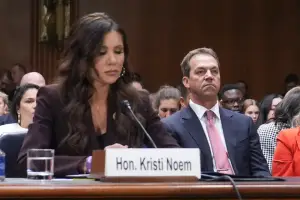
Then-Homeland Security Secretary Kristi Noem testifying before the House Oversight Committee as her husband, Byron Noem, right, looks on (Associated Press photo)
More On Iran War

President Masoud Pezeshkian of Iran at the United Nations General Assembly in New York, in September (New York Times photo by Dave Sanders).
News Updates
The White House is blocking an intelligence report warning of elevated terrorism threats inside the United States linked to the war with Iran. At the same time, Trump is escalating his rhetoric, saying additional groups in Iran are now under consideration for death and destruction as Tehran rejects demands to surrender while signaling it will step back from attacks on neighboring countries.March 7, 2026. The Reverend Jesse Jackson died on February 17, 2026, at age 84. Tying together the past and the future, this weekend’s annual commemorative crossing of the Edmund Pettus Bridge will honor his legacy.U.S. Crime, Law, Courts, Justice, Civil Rights
March 7, 2026. Before Donald Trump started an illegal war against Iran, DOJ superseded the indictment against Don Lemon and others, adding 30 new alleged co-conspirators. Pam Bondi did so at the opportunity cost of keeping Minnesotans safe.U.S. Politics, Governance, Elections
Top Stories
The Parnas Perspective, Evening News and Commentary: Iran Threatens Trump, Says he Will "Pay" as Trump Moves Closer to Deploying Troops and Denies USA Struck Elementary School, Aaron Parnas, right, March 7, 2026. The Iranian government is issuing threats against Donald Trump’s life following the death of its Supreme Leader.
At the same time, Trump says the United States was not responsible for the strike on an elementary school in Iran while signaling the U.S. is moving closer to deploying ground troops. Meanwhile, gas prices are expected to rise as a major bombing campaign targeting Iran’s oil infrastructure continues tonight.
Here’s the news:
NBC News has confirmed that President Donald Trump has privately discussed the possibility of deploying a limited number of U.S. ground troops into Iran for targeted strategic missions—such as special operations raids, securing nuclear materials, or influencing a post-war political transition—while not pursuing a large-scale invasion; the war is currently an air campaign, no decision has been made on ground deployment, and officials say the option remains on the table amid rising risks and casualties.
The Trump administration is considering several military options against Iran’s nuclear program, including a potential Special Operations raid by units such as Delta Force to seize or destroy nuclear materials at sites like Isfahan, though the plan would be extremely risky and complex. Officials tell Semafor that alternatives include continued airstrikes or bunker-busting bombs against underground facilities, while contingency plans for temporary ground operations at key nuclear sites have long existed within U.S. Central Command.
When asked about reports that a strike killed about 175 people at an Iranian elementary school, Donald Trump claimed Iran was responsible due to inaccurate munitions, while Defense Secretary Pete Hegseth said the incident is still under investigation. This, despite the fact that the Administration told Congress that it was bombing near the region and analysis conducted by CNN, the New York Times, and others suggested that it was the United States that struck the school in Minab, Iran.
Iranian national security official Ali Larijani warned that Iran will hold Donald Trump responsible for the conflict and vowed that Tehran will not let the issue go until it retaliates “in kind,” signaling that Iran intends to respond directly to U.S. actions rather than de-escalate.
U.S. and Israeli strikes reportedly targeted Tehran’s Shahran Oil Depot and other nearby oil facilities, sparking large fires as the campaign known as “Operation Epic Fury” expands to hit Iran’s broader industrial and energy infrastructure.
A Pakistani man was killed in Dubai’s Al Barsha neighborhood after debris from an intercepted missile fell onto his vehicle, according to the Dubai Media Office.
Donald Trump said the scale of U.S. strikes could leave Iran so devastated that “there will be nobody left” to formally say “we surrender,” suggesting the campaign could be extremely destructive.
President Donald Trump and First Lady Melania Trump attended a dignified transfer at Dover Air Force Base for six U.S. Army soldiers killed in an Iranian strike on their operations center.
During a parliamentary session, some Iraqi lawmakers reportedly chanted “Death to America” while expressing support for Iran amid escalating regional tensions.
Donald Trump criticized the United Kingdom and Prime Minister Keir Starmer, saying the U.S. no longer needs British aircraft carriers in the Middle East and accusing the U.K. of joining wars only after victory is assured.
Two people were taken into custody after police discovered suspicious homemade explosive devices outside New York City Mayor Zohran Mamdani’s official residence (Gracie Mansion) during an anti-Islam protest organized by right-wing influencer Jake Lang; no injuries were reported and the incident remains under investigation.
U.S. envoy Steve Witkoff said the United States has “strongly” warned Russia not to provide targeting intelligence or other assistance to Iran, adding that he hopes Moscow is not doing so.
Donald Trump signed a proclamation launching an “Americas Counter Cartel Coalition,” pledging to use U.S. military force against drug cartels across Latin America after already deploying troops and conducting strikes in Ecuador, with 17 countries supporting the initiative to combat cartels, reduce migration and drug trafficking, and counter growing foreign influence in the region.
During an exchange with Defense Secretary Pete Hegseth about Marco Rubio speaking Spanish, Trump asked if Rubio was better in Spanish, and Hegseth replied that he “only speak[s] American.”
A plaque honoring U.S. Capitol Police and other law enforcement who defended the Capitol during the Jan. 6, 2021 attack was installed on the Senate side of the Capitol after years of delay and a Senate resolution, with the location serving as a temporary placement until both chambers agree on a permanent display.
NBC News has confirmed that Democratic senators launched an investigation into companies that received a $220 million DHS advertising contract featuring former Homeland Security Secretary Kristi Noem, seeking to determine whether Noem, adviser Corey Lewandowski, or other DHS officials personally benefited from the no-bid agreements.
California Gov. Gavin Newsom criticized former Homeland Security Secretary Kristi Noem, nicknaming her “Kosplay Kristi,” and demanded the Department of Homeland Security release over $500 million in FEMA wildfire recovery funds for Los Angeles that he says were stalled under a policy requiring Noem’s approval for large contracts.
Rep. Kevin Kiley of California announced he will run for reelection as an independent after Democratic-led redistricting reshaped his district into a Democratic-leaning one, arguing both parties are responsible for partisan gerrymandering and positioning himself as a centrist candidate in a difficult race.
According to CNN, FDA drug chief Dr. Tracy Beth Hoeg is facing internal criticism and potential conflict-of-interest concerns for pushing to hire a researcher friend, Dr. Adam Urato, while accelerating review of his petition to add new warnings to antidepressants about unproven pregnancy risks, a proposal many experts say relies on weak evidence and could discourage necessary treatment for depression during pregnancy.
New York Times, Recent U.S. Assessment Found an Attack on Iran Unlikely to Result in Regime Change, Julian E. Barnes, March 7, 2026. Intelligence officials have been skeptical that a popular uprising could dislodge the Islamic Revolutionary Guards Corps, which controls much of Iran’s security apparatus.
A report by the National Intelligence Council completed before the United States and Israel launched attacks on Iran assessed that even a large-scale military assault on the country would be unlikely to topple its theocratic government, according to U.S. officials briefed on the work.
The N.I.C., which is part of Tulsi Gabbard’s Office of National Intelligence, is in charge of crafting intelligence assessments based on an array of views across the intelligence community. While some of their reports are joint products, others are produced independently, with less coordination.
The council’s document, drafted late last month, builds on work by the C.I.A. that assessed that a complete change of government was unlikely even if Ayatollah Ali Khamenei, the supreme leader, was killed in a U.S.-led military operation. But the actual report was an independent product of the council, the officials said.
Still, there seemed to be wide agreement that the theocratic government in Iran is deeply entrenched. Intelligence officials have been skeptical that a popular uprising could dislodge the Islamic Revolutionary Guards Corps, the organization that exerts control over much of the security apparatus in Iran as well as large sectors of its economy.
New York Times, Justice Department Denounces Federal Judges in Fight Against Law Firms, Chris Cameron and Jonah E. Bromwich, March 7, 2026 (print ed.). The Trump administration had signaled earlier this week that it was ready to abandon four executive orders seeking to punish law firms, but abruptly reversed course the next day.
The Department of Justice on Friday attacked the federal judiciary, accusing judges who ruled against the Trump administration of undermining President Trump’s authority while continuing to fight a case that it had signaled it was ready to abandon earlier this week.
Its attack came in a court filing in its appeal of four district court rulings that had struck down Mr. Trump’s executive orders attempting to bar prominent law firms from government business.
“Courts cannot tell the president what to say,” the 97-page legal brief began, adding that four federal judges had “bent over backwards” to rule against Mr. Trump and were “encroaching on the constitutional power of the president,” in what the document described as “a grave error for the district courts.”
The blistering court filing came as the Trump administration encounters heightened scrutiny from district courts across the country. Its officials have grown ever more bellicose, including in criticizing the Supreme Court after it ruled against Mr. Trump’s sweeping tariffs.
It was also the latest turn in the dizzying saga of the executive orders, which sought to punish law firms for their perceived connections with Mr. Trump’s political enemies. The orders targeting law firms are one of Mr. Trump’s most audacious — and, the district courts found, unconstitutional — attempts at subduing potentially powerful adversaries, and the new twists this week created uncertainty in a legal profession already roiled by the orders.
The tone and language of the brief were remarkable as Justice Department lawyers opened an argument to federal appeals court judges by attacking those judges’ lower court colleagues.
Its ferocity came as a surprise given that, earlier this week, the Justice Department indicated that it was ready to abandon the case entirely. On Monday, it filed a motion with the D.C. court, asking it to dismiss the case.
But the next day, after the department’s decision to leave the appeal behind had received extensive news coverage, it reversed course. The Justice Department then asked the judges for permission to withdraw the previous day’s motion, after some of the country’s biggest law firms thought they had put to rest a key part of the president’s sweeping retribution campaign.
It was not immediately clear what had prompted the about-face, but Mr. Trump and other top administration officials have often bristled at the perception that they have backed down from a public fight. In one high-profile example, the federal government initially acknowledged in court that it had made a mistake last year in deporting a Salvadoran man living in Maryland, only for high-level officials to mount an effort to keep him out of the country.
Four firms — Perkins Coie, WilmerHale, Jenner & Block and Susman Godfrey — fought the executive orders targeting them, quickly receiving favorable rulings from the district court judges. Nine others struck deals to avoid punishment from the government, most notably Paul Weiss, drawing criticism.
Though the government had initially signaled to the law firms that it would ask for a weeklong extension, it did not ultimately do so..
The brief’s bellicose language was most notable in its opening pages, and the Justice Department’s lawyers soon turned to more conventional legal arguments. But even those were notable, as when the department said that Mr. Trump’s language targeting the firms was “a textbook example of government speech.”
Immigration, Oversight, DHS Secretary's Scandals, Ouster
Then-Homeland Security Secretary Kristi Noem testifying before the House Oversight Committee as her husband, Byron Noem, right, looks on (Associated Press photo)
New York Post, The real reason why Kristi Noem's cuckold husband stayed married to her through Corey Lewandowski 'humiliation,' Caitlin Doornbos, March 7, 2026 (print ed.). The real reason why Kristi Noem's cuckold husband stayed married...GOP senator reveals why Kristi Noem was ‘dead as  fried chicken’ after disastrous congressional hearingGOP senator reveals why Kristi Noem was ‘dead as fried...
Biden says ‘I’m a hell of a lot smarter than most of you’ to crowd at Jesse Jackson's funeralBiden says ‘I’m a hell of a lot smarter than most of you’...Anti-Iranian regime protester pummeled at deluded NYC vigil for Ayatollah Ali KhameneiAnti-Iranian regime protester pummeled at deluded NYC vigil for...Bishop who allegedly made several trips to Mexican brothel arrested at San Diego airport trying to flee USBishop who allegedly made several trips to Mexican brothel...Mamdani makes far-fetched argument to downplay NYC first lady's 'likes' of graphic Oct. 7 massacre Instagram postMamdani makes far-fetched argument to downplay NYC first lady's...Trump claims Iran will be hit 'very hard' today, says some groups 'under serious consideration for complete destruction and certain death'
Bryon Noem‘s family members are hoping he finally leaves his wife, embattled Homeland Security Secretary Kristi Noem, after the ultimate “humiliation” from her alleged affair with a top adviser — but fear he’ll continue to stay in his marriage due to his Christian faith and commitment to his vows.
Members of the extended family of Bryon Noem told The Post on Friday that the South Dakota businessman has long felt it was his religious duty to stand behind his wife — even as the very public scandal rocks their marriage.Kristi Noem and Bryon Noem at a Senate Judiciary Committee oversight hearing. 5Bryon Noem (right) attended the Senate Judiciary Committee oversight hearing to support his wife, then-Homeland Security Secretary Kristi Noem (left). AP
“He said he decided about 20 years ago that it was his calling from God to support her in whatever she decided to do,” one family member said. “So he has put up with the humiliation. We will see if he sticks with her now.”
“I think it’s him honoring the calling from God,” the family member added. “But it seems like there would be some limit to that."
 The Noems’ more than three-decade-long marriage began in 1992, after having gone to high school together. They began dating when Kristi was a junior at Hamlin High School in Hayti, S.D., and Bryon was a freshman at Northern State University.
The couple (shown at right in a photo on Facebook) went on to have three children together, raising them in an ultra-strict church community, according to relatives.
They initially worked the family farm together, before Bryon moved into the insurance business in 2003 and Kristi entered politics in 2006, winning a seat in the South Dakota House of Representatives before securing the governorship in 2018.Kristi and Bryon Noem smiling at the beach with cliffs and sea stacks in the background. 5Bryon Noem is expected to stay by her side despite the “humiliation” of her affair with longtime political adviser Corey Lewandowski. Kristi Noem/Facebook
But family members say alleged tensions between the Homeland Security chief and her husband’s relatives have simmered for years — and many have long heard about her alleged romantic entanglement with Corey Lewandowski, which spilled out into the open this week.
“She despises the Noem family,” the relative said of the axed Cabinet official.
The relative said Bryon Noem appeared determined to show solidarity with his wife even as she faced a bruising public grilling from lawmakers — and hoped it opened his eyes.Kristi Noem and Corey Lewandowski smiling while standing at the bottom of a grand staircase, as shown below.
 Homeland Security Secretary Kristi Noem and her advisor and travelling companion Corey Lewandowski.
“I actually liked that he sat behind her while she was grilled on the ICE atrocities,” the person said. “I think he’s ignored the reality. Maybe he has to face it now.”
In a Wednesday House hearing, Rep. Sydney Kamlager-Dove (D-Calif.) grilled Noem over rumors of her affair with Lewandowski, her top adviser and “special government employee.”
 Kristi Noem reportedly has an affair with longtime political advisor Corey Lewandowski (right), the New York Post reported.
David Sands via Facebook shows Kristi Noem wearing a "Make America Great Again" hat, with Corey Lewandowski putting "devil horns" behind her head. A family relative alleged tensions between the Homeland Security chief and her husband’s relatives have simmered for years — and many have long known about her romantic entanglement with Lewandowski.
According to the New York Post:
The real reason why Kristi Noem’s cuckold husband stayed married to her through all of Kristi Noem’s scandalous moments before Trump finally fired her Noem’s answer on ‘sexual relations’ with Lewandowski was ‘final straw’ for Trump, sources say.
Bryon Noem had left the briefing shortly before the tense questioning came up — during which Kristi Noem refused to deny her rumored relationship with Lewandowski, a leading figure in President Trump’s 2016 campaign.
A second family member told The Post that the controversy unfolding publicly was shocking — and the relative hopes it will wake Bryon up to the reality of his marriage.Homeland Security Secretary Kristi Noem speaks during an oversight hearing. 5President Trump fired Noem as Homeland Security secretary Thursday following her oversight committee hearing on Wednesday, March 4, 2026. AP
“What gets me is she couldn’t say no,” the relative said. “When she’s getting grilled about it, she couldn’t say no.”
“The relative said they also believed Bryon Noem’s Christian faith — and devotion to his children — would keep the marriage intact even amid the fallout.
“Bryon is a Christian man, and he believes that marriage is forever,” the relative said. “He’s very close with his children. I’m sure this is really hard on them.” Bryon Noem did not immediately respond to requests for comment.
 Kristi Noem, shown above posing in a Coast Guard training video, is expected to leave her post at DHS at the end of the month, with sources telling The Post that her answers about her relationship with Lewandowski were the final straw for Trump.
More On Epstein Files-Trump Scandals
The FBI released in redacted form this week its 2019 reports recording claims by a woman stating that she had been sexually assaulted and then threatened by Donald Trump and his friend Jeffrey Epstein in the period 1983 to 1985 when she was in her early teens.
Emptywheel, Analysis: The Alleged Trump Victim’s Claims about Blackmail Are as Important as Her Claims about Rape, Emptywheel (Marcy Wheeler, right), March 6, 2026. Yesterday, DOJ released the three interview reports from a woman who alleged she was abused by Donald Trump that it had previously withheld.
As NPR notes, DOJ is still withholding a number of materials (notes from her interviews and, far more importantly, details about the handling of the interview) relating to the accusation. That matters because, it is now clear, DOJ withheld — and is still withholding — the originals of the interview reports.
And that matters given the timeline of the accusations and the fact that, just days before Epstein suicided, the victim claimed Epstein and Trump spoke about blackmail.
Here’s what the timeline looks like:
July 8, 2019: SDNY [Southern District of New York] announced arrest of Jeffrey Epstein and included a tip line for others who had been abused by Epstein.
July 8: The alleged victim’s friend called the tip line. She explained that the friend had recently told her about the Trump incident. And on the day of the Epstein arrest, the friend asked the victim if Epstein had also abused her, too, and the victim said yes.
July 24: 16 days later, the FBI interviewed the alleged victim for the first time. That interview (the one that did originally get released) focused almost entirely on Epstein. Trump only came up in the context of that conversation with the friend who called the tip line and one other friend. And she went to some (futile) length to crop Trump out of that picture.

August 7: On August 7, the FBI did a follow-up interview. The interview started with the alleged victim saying that she felt comfortable enough describing the other men who abused her, starting with a guy named Atkins (who also had a relationship with her mother). Nevertheless, more than half the interview focused on Epstein. At the bottom of page 7 of 10, the report begins to record her allegations about Trump: He didn’t like that she was a tomboy, he got her alone in a room and forced her down on him saying something to the effect of, “Let me teach you how little girls are supposed to be.” She bit him. He said, “get this little bitch the hell out of here,” but in the telling, others came back in the room and a beautiful blonde lady told her to wear a bra, which is to say a description of the claim later produced in a power point is inaccurate — she described that he called for her to be removed, but she was not.
Another paragraph describes the victim describing further conversations between Epstein and Trump. Then the interview focused back on Epstein for six paragraphs, including a claim that Epstein came to trust her, that he spoke another language occasionally.
The interview ended with these two paragraphs — one mixing details of Epstein blackmailing her mother and discussing blackmail with Trump, with additional random details suggesting more contact with Trump than any other document, and a final paragraph describing she was afraid Epstein’s people would come after her.

August 9: The first interview report was finalized on August 9, two days after the second interview in which the victim claimed that she had heard Epstein and Trump talk about blackmail.
August 10: And then, three days after this woman described Epstein and Trump discussing blackmail and the day after FBI entered the first interview with this woman, Epstein suicided. There’s no public evidence the timing was anything but a wild coincidence. But at the very least, it must have made the treatment of these documents even more politically fraught.
August 20: The third interview with the woman took place at a time when Epstein could no longer be held accountable because he was dead, on August 20. After a completely redacted administrative paragraph, that interview report started by focusing on Trump, whose alleged abuse of the woman might have taken place in SDNY, or New Jersey, either of which would have given those FBI agents jurisdiction to investigate.

The next paragraph described her claim that her mother’s embezzlement conviction had a tie to Epstein and the Atkins guy she claimed had also abused her. It was followed by a reference to Epstein’s brother (which is pertinent not least because Mark Epstein says Jeffrey never spent summers in South Carolina, where all this allegedly started).

And then the remainder of the interview, nine paragraphs over three pages, focused on threats she believed arose from harassment from Epstein. In just one of those paragraphs, in which she explained why she attributed these threats to Epstein even though no one ever said they came from him, is she recorded as mentioning Trump.
August 22: The second interview — the one where the alleged victim claimed that Epstein and Trump talked about blackmail just days before Epstein suicided in prison — was entered weeks later, on August 22, two days after describing that she had been harassed for years and she attributed that harassment, with no evidence, to Epstein.
August 30: The third interview was entered on August 30.
October 16: The final interview took place on October 16. The attorney who had represented her to date was not present and she had, in the interim, told the FBI that she was working with what must be Lisa Bloom on a civil suit, which would be filed in December. She refused the FBI request to record the interview. They explained that they wanted to focus the interview on Epstein’s associates who abused her (which makes sense given that Epstein himself was dead). and asked her if she would provide more details about what happened with Trump. She said nothing could be done about it, which is why she stopped cooperating.
October 22: That final interview was entered on October 22, well into the focus on impeachment.
December 27: On December 27, a Jane Doe 4 made an allegation in a lawsuit that had not been shared with the FBI: that after hitting her in the face, a prominent businessman (who is not described as Trump, though Trump is mentioned elsewhere) vaginally and anally raped her. The lawsuit also states with certainty this happened in New York when, in her interviews with the FBI, the victim was not sure whether it happened in New Jersey or New York.
46. Jane Doe 4 was brutally and forcibly battered, assaulted, and raped by these other men she met through Epstein. On one occasion, one of these prominent men forcibly slapped Jane Doe 4 in the face after she was forced to perform oral sex on him. This same man forcibly raped her, penetrating her both vaginally and anally. On information and belief, Epstein was aware of and, indeed encouraged, the assault of Jane Doe 4 by these other men.
These interviews reveal several things. First, the victim’s allegations were not focused primarily on Trump; she was focused on a man she claimed to be Epstein. Indeed, in the first interview, Trump came up primarily in the context of explaining the role of the photograph used to ID Epstein, not Trump. Her second interview did include the Trump allegation amidst a much greater focus on Epstein, but her claim that the two discussed blackmail in front of her is every bit as inflammatory as the rape claim.
Remember, when Pam Bondi and Kash Patel attempted to dismiss this whole issue last July, they claimed, “There was also no credible evidence found that Epstein blackmailed prominent individuals as part of his actions.” That’s factually false; there’s clear evidence Epstein was pressuring Bill Gates. But given that, weeks later, the FBI listed the allegation from this woman first in what appears to be prep for Todd Blanche’s interview with Ghislaine Maxwell, it is exceedingly likely they had this claim in mind when they dismissed the credibility of all blackmail claims. The Alleged Trump Victim’s Claims about Blackmail Are as Important as Her Claims about Rape
This woman told the FBI that Epstein and Trump discussed blackmail, and days later he suicided in prison.
And after that, the FBI wanted to focus on Trump because, well, Epstein wasn’t around to be prosecuted anymore.
Then, years later, DOJ attempted to withhold documents recording all that.
When faced with overwhelming evidence that they had withheld documents implicating Trump, DOJ released them. But the excuses it gave are as suspect as the withholding.
As NPR explained, when caught withholding these documents, DOJ claimed they had withheld them because they were duplicates, and now is effectively saying, oops, they weren’t duplicates.
The Justice Department has repeatedly told NPR that any documents withheld were “privileged, are duplicates or relate to an ongoing federal investigation.”
Last week, after NPR’s initial story, the Justice Department said it was determining if records had been mistakenly tagged as duplicates and if any were found, “the Department will of course publish it, consistent with the law.”
But in fact, these documents — every one of the documents released so far — are duplicates.
As NPR focused in their original story on the withholding, what got released was the discovery shared with Ghislaine. Both the original release and these includes three Bates stamps, including the series — 3501.045-003, here — tied to discovery to Ghislaine, along with stamps from that production.
The Ghislaine material is the definition of duplicate material, because everything that went to her should have an original copy in the FBI’s case file.
But we didn’t get any of those originals. We still haven’t gotten those originals. We can’t be sure if the originals still exist. DOJ certainly hasn’t given us the originals, they gave us duplicates after saying these were duplicates.
DOJ not only withheld documents documenting a claim that Trump raped a teenager, and with it, a claim that Trump and Epstein discussed blackmail, but they’re still withholding the originals of all that.
 Former New York prison guard Tova Noel, center in a yellow blouse and dark blue coat, surrounded by people, leaving federal court. Criminal charges against Noel and the other guard, Michael Thomas were dropped in December 2021 by a federal judge (Associated Press photo).
New York Post, Epstein prison guard googled him minutes before body found — and made mysterious deposit before pedo's suicide: DOJ, Gabrielle Fahmy, March 7, 2026. One of Jeffrey Epstein’s prison guards googled the sex predator minutes before he was found dead — and also made a mysterious $5,000 cash deposit 10 days before the predator’s jail-cell suicide, new Department of Justice documents reveal.
Tova Noel was one of the two Metropolitan Correctional Center workers accused of falsifying records to say they checked on Epstein throughout the night before his Aug. 10, 2019, suicide.
The guards were fired but criminal charges against both were later dropped.
Noel googled “latest on Epstein in jail” at 5:42 a.m. and then again at 5:52 a.m. — less than 40 minutes before her colleague, correctional officer Michael Thomas, above, shown in an AP photo,found the disgraced financier dead in his cell by hanging at 6:30 a.m., according to an FBI record of Noel’s internet search history that night.
Earlier that shift, Noel, 37, shopped for furniture online and snoozed on the job instead of making the mandated checks on Epstein every 30 minutes, while Thomas perused motorcycles, prosecutors said.
The FBI highlighted the eerie internet search in its 66-page forensic examination of the Bureau of Prisons desktop computers of Noel and Thomas. It was the only search highlighted.
When questioned during her sworn statement to the DOJ in 2021, Noel denied googling Epstein.
“I don’t remember doing that,” she claimed, according to a transcript. She said FBI records were not “accurate. I don’t recall looking him up.”
Noel, who has since been sued in Westchester County Supreme Court for alleged assault at her new job as a medical office assistant at Montefiore Einstein Advanced Care, also claimed to investigators that everyone at the Manhattan federal lockup failed to do rounds and falsified records about it.Medical personnel transporting a body in a black bag from a hospital side door. 5Epstein was found dead in his cell when Thomas and Noel brought him breakfast at 6:30 a.m. on Aug. 10, 2019. William Farrington
“I’ve never worked in the Special Housing Unit and actually done rounds every 30 minutes,” she told investigators.
Meanwhile, Chase Bank flagged cash deposits in Noel’s bank account in a “suspicious activity report” to the FBI in November 2019, another file from the DOJ revealed.
A total of 12 deposits began in April 2018, the bank said, and culminated in the largest deposit, for $5,000, on July 30, 2019, the records showed.Tova Noel, Epstein guard, pictured wearing a uniform. Noel began working in the MCC’s Special Housing Unit, where Epstein was housed, in 2019. DOJDocument showing an internet search history with "latest on epstein in jail" highlighted. 5The FBI highlighted the eerie early morning Google search in its files. DOJ
The files only contain Noel’s bank records beginning in December 2018. They show seven cash deposits totaling $11,880. Noel started working at the Special Housing Unit — where Epstein had been held — beginning on July 7, 2019, just weeks before his death.
Noel, who drove a $62,000 2019 Land Rover Range Rover, wasn’t asked about the cash during her DOJ interview, records showed.
An internal FBI briefing, also released in the DOJ files, reveals the agency thought Noel was likely the mysterious orange shape spotted in a blurry surveillance video near Epstein’s cell around 10:40 p.m. that night.Start your day with all you need to know
Morning Report delivers the latest news, videos, photos and more.Enter your email address
By clicking above you agree to the Terms of Use and Privacy Policy.
“At approximately 10:40 pm, a correctional officer, believed to be Tova Noel, carried linen or inmate clothing up to the L-Tier, last time any correctional officer approached the only entrance to the SHU tier,” the agency wrote. Epstein apparently hanged himself with strips of orange cloth.
In the sworn statement, Noel, who was working a double shift that day, told investigators she last saw Epstein alive “somewhere around after 10” and that she “never gave out linen — ever” or clothing to inmates because that’s done the shift before.
The identity of the pixelated orange blob in the video has been a source of debate and conspiracies since the FBI released the footage last summer.Mugshot of Jeffrey Epstein with short gray hair, a gray beard and mustache, wearing a gray t-shirt. 5Epstein was housed at the MCC after his July 6, 2019 arrest, until his death. AP
The original 2023 inspector general report said it was “unidentified correctional officers,” making the recently released FBI document the first time a name was publicly put to the mysterious shape.
She testified she didn’t know why Epstein had extra linen in his cell. The other guard on duty was sleeping between 10 p.m. and midnight, she said.
A prison employee entering the area of Epstein’s cell alone would be a policy violation, workers have said.
What do you think? Post a comment.
Lawyers for Noel declined to comment. Asked during her sworn statement if she had any part in Epstein’s death, Noel replied “no.”
Alisa Writes via Substack, Investigation: Jeffrey Epstein's Ranch Won $85 Million in the Oklahoma Lottery Two Days After He Went to Prison. The Company That Printed the Ticket Belonged to His Palm Beach Neighbor, Alisa Valdes-Rodriguez, March 6, 2026. The Store That Sold It Belonged to The Neighbor's Former Colleague. And The Ranch, Which Was Never Searched, Now Belongs to a Trump Insider's Family. Follow the Money, Part Two.
Yesterday, I published the first installment of a four-part series I’ve written in which I follow the money related to Jeffrey Epstein’s Zorro Ranch, from its purchase from the King family in 1993 to its new owners, Don and Mary Catherine Huffines. What follows here is part two. By following the money, a terrifying picture begins to emerge, an existential threat to the national security of the United States of America.
The Stripes convenience store in Altus, Oklahoma, that sold the winning Powerball ticket to Zorro Trust in 2008.
In yesterday’s part one of this series, I shared a bit about the financial relationships between dead child rapist and sex trafficker Jeffrey Epstein and former New Mexico Governor Bruce King and his son, former New Mexico Attorney General Gary King. To briefly summarize, Epstein’s Zorro Trust purchased nearly 7,500 acres outside Stanley, New Mexico, from the King family for $12.3 million in 1993, after the King family sold it off to help pay $21 million in debts on their various businesses. I recounted the evidence of child sex rape and trafficking that took place at Zorro Ranch for decades, and ended the piece with the vastly under-reported fact that Zorro Trust won the Oklahoma Powerball lottery in 2008, two days after Epstein began serving his first — and far too lenient — jail term, in the amount of $85 million.
Today we pick up there. With that lottery win. While I’ve seen a few stories online about it, no serious news outlet has covered it. I suspect this is because plausible deniability is built into the way Oklahoma law allows trusts to win the lottery while legally protecting the identity of the trust’s owners. This law exists in theory to protect large jackpot winners from being hounded or robbed. But it also creates fertile ground for fraud. Not even a freedom of information act records request from a reporter can unseal those records. The only way we could ever find out for certain, from lottery officials, that the Zorro Trust that won on July 2, 2008, was the same Zorro Trust that bought the ranch in Stanley, New Mexico — a six-hour drive from the convenience store where the ticket was purchased — would be if the courts demanded the record unsealed. So far, that hasn’t happened.
There are, however, other ways to put together a strong circumstantial case.
One way is to go to Stanley and other points in this state and ask around. Which I did. I live here. We’re a big state with a small population. Everyone knows everyone, and my family has been here for 13 generations. Lots of regular people worked on that ranch — as staff, as contractors. And while it’s clear in the Epstein files that Epstein and his wealthy associates didn’t think much of the working poor who cleaned their toilets and took out their trash, such disregard by the rich for those they exploit tends not to breed loyalty in the end, because the working poor are human. That said, people are still reluctant to give their names publicly, because many were forced to sign non-disclosure agreements, and others witnessed abuses so horrific they’re pretty sure that even with Epstein dead, there are still people who want this all to go away.
I want to pause here to say this: Former employees of Jeffrey Epstein’s Zorro Ranch who signed non-disclosure agreements may have more legal freedom to speak than they realize. The Speak Out Act, signed into federal law in 2022, significantly curtailed the enforceability of NDAs involving sexual assault and sexual harassment, gutting one of the primary legal mechanisms used to silence witnesses to abuse. Beyond that, courts have long held that no contract can compel someone to conceal criminal conduct — an NDA that functions as a cover-up is, by definition, unenforceable as against public policy. Whistleblower protections further shield anyone who comes forward to law enforcement or journalists investigating matters of legitimate public concern. And there is a practical reality worth noting: Epstein is dead, his ranch has changed hands, and any attempt by his estate to sue a former employee for speaking truthfully about crimes would open that estate to the very discovery process it would most want to avoid. The NDA, in other words, may have always been more threat than law.
Which is all to say: people here in New Mexico know that it was Epstein’s Zorro Trust that won the Oklahoma lottery two days after he began to serve his first prison sentence. They also know who bought the ticket. Brice Gordon, a former New Zealand soldier who managed the estate with his wife Karen, also a former New Zealand soldier. I’d ask them about it directly, but they seem to have disappeared off the face of the earth after inheriting $2 million when Epstein died.
Now that we have all that out of the way, let’s look at the people and entities involved behind the scenes in making that win possible — a win with 146 million to one odds for regular people, and likely far greater odds for a convicted pedophile in prison. It’s in those details that the picture begins to come into focus.
Fact No. 1: The Man at the Top
James Scroggins materialized in the world of American state lotteries the way certain figures do in industries built on government contracts and quiet relationships — fully formed and without much of a paper trail explaining how he got there. He ran the Pennsylvania lottery, then the Missouri lottery for thirteen years, then arrived in Oklahoma in 2005 to launch its lottery from scratch. He was the executive director of the Oklahoma Lottery Commission on July 2, 2008, when the Zorro Trust walked in and claimed $85 million — which the trust opted to take as a $29.3 million lump sum. He was the man legally required to receive the trust’s membership disclosure — the document naming the actual human beings behind that claim. He is one of a very small number of people alive who knows what that document said.
Scroggins is not a man the public knows much about. Search his name and you find almost nothing — no consulting website, no professional biography, no industry award profiles, no conference keynotes, no press releases announcing his next chapter after he left public service. His LinkedIn profile exists, but is set to private, a curious posture for a man who spent two decades as a government official administering a public trust. What we know about him comes almost entirely from contemporaneous news coverage of the lotteries he ran. And what that coverage reveals, once you read across all four states and all four decades, is a consistent pattern: wherever James Scroggins went, the rules bent.
It started in Pennsylvania.
In the late 1980s, while Scroggins was serving as Pennsylvania’s lottery director, a man named Nick Herbst walked into lottery offices to claim a nine-month-old $15.2 million Super 7 jackpot. The ticket was reviewed at the lottery offices and approved for payment by Scroggins personally — over the written objections of at least one lottery staff member who had flagged a serious problem with the ticket’s validity. The problem was this: while the lottery’s computer showed the ticket had been sold at the Neshaminy Mall in Bensalem, Bucks County, the paper the ticket was printed on carried a serial number assigned to a lot of paper sent to a Scranton lottery agent — a completely different location. The two records did not match. Scroggins ordered the claim honored anyway. Herbst was ushered to a press conference, given a check for the first installment, posed for photographers, and answered reporters’ questions. He claimed he had forgotten about the ticket and had been using it as a bookmark.
The ticket was a fraud. It had been fabricated by an employee of the company that provided computer systems to the lottery — a scheme that required inside access to the technical infrastructure of the game itself. Two men, Herbst and a computer repairman alleged to have masterminded the scheme, were arrested and charged with forgery, theft, conspiracy, tampering with public information, and unlawful use of a computer. When the arrests were made, Scroggins stood before reporters and said: “This situation proves beyond a shadow of a doubt the system works. Yes, there was a payment made to someone who in fact was not a winner, but those persons were apprehended.” That claim was disputed by at least one official privy to the details of the investigation.
It was not the last time Scroggins would find himself defending a suspicious claim he had personally approved.
He moved on to Missouri, where he ran the lottery for thirteen years without surfacing in major public scandals — though it bears noting that Missouri was a Scientific Games contract state throughout his tenure, cementing a long working relationship between Scroggins and the executives of the company that would later hold Oklahoma’s lottery contract.
Then came Oklahoma, where the pattern sharpened considerably.
Two years before the Zorro Trust claimed its $85 million, a different anonymous trust claimed a $101.8 million Powerball jackpot in Oklahoma. Scroggins told a reporter at the time that the commission did not even know who the winners were — that their identities were not stated in the trust agreement. Under the Oklahoma Lottery Act, the commission was required to withhold delinquent child support payments from lottery winnings. But Scroggins, backed by the state Attorney General’s office, declared that requirement inapplicable in this case. The winners’ identities were protected. No background search was conducted. No child support check was run. The precedent had been set: anonymous trust claims in Oklahoma were beyond scrutiny, with the executive director’s blessing and the state’s legal imprimatur.
That was 2006. In 2008, the Zorro Trust walked through the door Scroggins had built.
Scroggins himself, in a 2009 interview, drew attention to something remarkable about Oklahoma’s jackpot win rate. He noted that the state’s frequency of jackpot winners was, in his own word, “astounding” for a lottery only four years old. “Many participating states have played Powerball for 10 to 15 years and only had one winner,” he said. Oklahoma, between 2006 and 2008, had produced four unique jackpot winners — two of them on the same day. Scroggins flagged the anomaly. He did not investigate it.
There is something else worth noting about that July 2, 2008 drawing specifically. According to multiple accounts, a computer malfunction disrupted what was ordinarily a live, televised broadcast of the Powerball draw. The drawing went forward without the usual public broadcast, monitored instead by an auditing firm. Why was the night Oklahoma’s largest-ever jackpot was decided also the night the live television feed went dark? That question has never been publicly answered.
After Oklahoma, Scroggins moved to Illinois in 2012, to serve as Chief Financial Officer for the state’s lottery — arriving, characteristically, at a moment of institutional chaos. Illinois had just become the first state in the nation to privatize its lottery operations, hiring a company called Northstar Lottery Group to run its games. Northstar later came under withering scrutiny after a Chicago Tribune investigation found that the lottery had failed to award more than forty percent of the instant game grand prizes it had advertised between 2011 and 2015, with Northstar dramatically increasing the number of printed tickets while dangling ever-larger prizes in front of buyers. Scroggins walked into the middle of that scandal.
And then he vanished from public record entirely.
What we are left with, across Pennsylvania, Missouri, Oklahoma, and Illinois, is a man who repeatedly found himself at the exact intersection of questionable claims, convenient procedural interpretations, and lucrative vendor relationships — and who, when his public career ended, chose silence over the kind of professional visibility that is standard in his industry. We know almost nothing about who he is. That, too, is a kind of answer.
Fact No. 2: The Store
 The winning ticket was purchased at a Stripes convenience store in Altus, Oklahoma — a town of 18,000 near an Air Force base, and a six-hour drive from the Zorro Ranch outside Stanley, New Mexico — by Brice Gordon.
Stripes was a chain of convenience stores and gas stations operating primarily in Texas, Oklahoma, and New Mexico, owned in 2008 by Susser Holdings Corporation, a family-run company headquartered in Corpus Christi, Texas. The Altus location had only recently come under Susser Holdings’ control — the company had completed its acquisition of the Town & Country Food Stores chain in early 2008, absorbing the western Oklahoma locations into its corporate portfolio just months before the July 2 jackpot.
Unlike a franchise operation, where an independent owner might notice and report anomalies, Susser Holdings owned and operated its stores directly. The terminal, the staff, and the ticket inventory at the Altus location all fell under a single corporate chain of command. And at the top of that chain was the company’s Chairman, CEO, and President: Sam L. Susser.
Susser had come to the convenience store business by way of Wall Street. He worked at Salomon Brothers Inc. in the Corporate Finance and Mergers and Acquisitions division from 1985 to 1987. He was on the floor of that institution during the precise months when a man named Ronald Perelman — funded by junk bond king Michael Milken of Drexel Burnham Lambert — made a hostile move to acquire a controlling stake in Salomon Brothers worth $800 million. It was widely described as a junk bond raid. Warren Buffett intervened as a white knight, investing $700 million in convertible preferred stock, which allowed Salomon to buy back the targeted shares. With that, Perelman was dispatched. Susser left Salomon the same year and returned to Texas to build his family’s business.
Fact No. 3: The Lottery Contract
The company that held the Oklahoma lottery contract in 2008 — printing the state’s Powerball tickets and operating the central gaming system that determined the winners — was Scientific Games Corporation. Its largest shareholder, holding nearly forty percent of its stock, was Ronald Perelman.
Let that land for a moment. The man who had tried to seize the firm where the future owner of the winning ticket’s store once worked — Perelman — controlled the company that printed the tickets and ran the system.
Fact No. 4: The Network
Ronald Perelman was not a peripheral figure in Jeffrey Epstein’s world. He appears in Epstein’s personal black book. He hosted the 1995 Palm Beach dinner at which Epstein and President Bill Clinton were first documented in the same room together. And in 2004, Perelman sold his Palm Beach estate, Casa Apava, for $70 million — then a record for Palm Beach real estate — on the same small island where, that same year, Epstein and Donald Trump famously went head to head at a bankruptcy auction for a 62,000 square foot oceanfront mansion called Maison de l’Amitié, the House of Friendship. Trump outbid Epstein, paying $41.35 million. The trustee overseeing the auction described it at the time as “two very large Palm Beach egos going at it.” It was the beginning of the end of their friendship. Within weeks of losing that auction, Epstein found himself under investigation by Palm Beach police.
These three men — Epstein, Trump, and Perelman — did not merely know each other. They occupied the same tightly drawn circle on one of the wealthiest strips of land in America. And Ronald Perelman, alone among them, had the industrial infrastructure to print lottery tickets and run the systems that determined who won.
And it just so happens that his associate, Jeffrey Epstein, was the winner.
Fact No. 5: The New Owners
Eleven years passed between the lottery win and Epstein’s death in a Manhattan federal detention facility on August 10, 2019 — years during which Zorro Ranch was never searched, even as federal investigators examined his other properties. Two days before he died, Epstein changed his will, leaving $100 million and all of his properties to a woman often identified as his last girlfriend, Karyna Shuliak, whom I wrote about in detail a couple of weeks ago. Zorro Ranch was among those properties. Shortly after Epstein’s death, federal investigators instructed then-New Mexico Attorney General Hector Balderas to pull the plug on any efforts to investigate or search the ranch.
On August 16, 2023, a company called San Rafael Ranch LLC purchased Zorro Ranch from Epstein’s estate for an undisclosed price — the asking price had been reduced from $27.5 million to $18 million before the sale closed. San Rafael Ranch LLC was formed just 19 days before the purchase closed, with a Santa Fe real estate attorney, Charles V. Henry IV, listed as its registered agent. There was no public disclosure of beneficial ownership, until last month, when Clara Bates, a reporter with the Santa Fe New Mexican, was able to find mention of the LLC’s owners in court documents pertaining to the owners’ attempts to force the state of New Mexico to place the value of the ranch at just $9 million for tax purposes — the same tactic Trump has used throughout his career to avoid paying real estate taxes.
The new owners are Don and Mary Catherine Huffines. Court documents list Mary Catherine as trustee and their son Colin as manager of a related entity, San Rafael One LLC.
Don Huffines is a Dallas real estate developer and hard-right Republican politician who, along with his identical twin brother Phillip, co-founded Huffines Communities in 1985, now one of the largest residential real estate development firms in the Dallas-Fort Worth area. A fifth-generation Texan whose family has operated car dealerships in the Dallas metroplex since 1924, Huffines served one term in the Texas State Senate representing North Dallas from 2015 to 2019, ran unsuccessfully against Governor Greg Abbott from the right in 2022, and on March 3, 2026 — three days before this article was published — won the Republican primary for Texas Comptroller, the state’s chief financial officer. A self-described MAGA Republican, he has endorsements from Ted Cruz, the late Charlie Kirk, and just last week, Donald J. Trump. Don and Mary Catherine spent Valentine’s Day in 2025 at Mar-a-Lago.
Another son, Russell Huffines, serves as Associate Director of Agency Outreach in the White House Office of Cabinet Affairs under President Donald J. Trump, and co-runs HEST Investments — a Dallas-based venture capital family office — alongside his father.
And here’s where the dot-connecting comes full circle. Remember Sam L. Susser? Yeah. Hold on to your hats, friends. It’s about to get bumpy.
In 2014, Sam L. Susser sold Susser Holdings Corporation — the parent company of the Stripes convenience store chain — to Energy Transfer Partners for approximately $1.8 billion. He then relocated to Dallas, where he founded Susser Bank, a private financial institution, taking on the role of Chairman. To help govern it, he assembled a board that included James R. Huffines — Don Huffines’ older brother.
James Huffines is a veteran Texas banker who had served as President and Chief Operating Officer of PlainsCapital Corporation before becoming COO of Hilltop Holdings, the financial empire built by Dallas billionaire Gerald J. Ford.
Ford, it happens, had built a significant portion of that empire in partnership with Ronald Perelman — the same Ronald Perelman whose company printed Oklahoma’s Powerball tickets in 2008, and whose name appears in Jeffrey Epstein’s personal black book.
In March 2026, the newly-created Epstein Survivor’s Truth Commission ordered Don and Mary Catherine Huffines to immediately halt all construction at the now-renamed San Rafael Ranch, finding the new front gate was being built without proper permitting. Aerial shots taken by the New York Times showed that the Huffines had also excavated a large portion of the ranch’s helipad and labyrinth gardens, leaving a deep, massive hole in a property where witnesses said two “foreign girls” had been buried on orders from Epstein and Maxwell after being murdered during “rough fetish sex.”
In tomorrow’s Part 3 of this series, I will take a closer look at the businesses Don and Russell Huffines run together through HEST Investments, and how at least one of their portfolio companies — which works with neonatal cardiac tissue harvested within 30 days of live birth — occupies a field of science that was of well-documented special interest to Jeffrey Epstein.
New York Times, Epstein Doctor Steps Away From Elite Health Clinics, Maggie Astor and David A. Fahrenthold, March 7, 2026. Dr. Bernard Kruger once gave a private E.R. membership to Jeffrey Epstein and unnamed “girls.”
Dr. Bernard Kruger, a doctor in Manhattan, has stepped away from roles at two concierge medicine practices after the public disclosure of his relationship with Jeffrey Epstein, the wealthy sex offender who died in a jail cell in 2019.
The head of one practice, the Atria Health and Research Institute, sent an email to employees on Monday saying that Dr. Kruger had “recently retired and is no longer involved with Atria.” He had been a part-time, nonpracticing physician there, the email said.
A spokeswoman for the other practice, Sollis Health, a private emergency room, said on Friday that Dr. Kruger was on leave from the company’s board of directors “pending a review launched by management in consultation with external legal counsel when it became aware of Dr. Kruger’s past interactions with Jeffrey Epstein.”
The doctor had been part of a small circle of specialists catering to Mr. Epstein in the last decade of his life, The New York Times reported last week. As revealed in the tranche of Epstein files released by the federal government, the doctors gave V.I.P. treatment to the financier, his friends and many of the young women in his orbit — and were handsomely rewarded. Some of Mr. Epstein’s doctors worked at Mount Sinai, which has formed a committee to investigate those ties.Elite Doctors Served Jeffrey Epstein While Treating His ‘Girls’Feb. 28, 2026
Dr. Kruger was a longtime physician to Mr. Epstein. In 2016, a private emergency room in Manhattan that he co-founded charged Mr. Epstein $15,000 for an annual membership that covered him and five “girls,” emails show. An accountant told Mr. Epstein that the practice — called Priority Private Care at the time, but now Sollis Health — did not require naming the patients, which would give him “more flexibility.” (A spokeswoman for Sollis said names were added later, and also said Dr. Kruger had never been a practicing physician there.)
Dr. Kruger’s medical office in Manhattan also appears to have allowed Mr. Epstein to book appointments without using names. In one case in 2018, the office sought to reschedule an appointment for “Jeffrey’s assistant” but didn’t know which assistant. (It turned out to be a lawyer close with Mr. Epstein, and Dr. Kruger’s spokesman said the doctor never saw patients without knowing their identities.)
The spokesman, Mark Botnick, said last week that the doctor believed that incident had been a clerical error. “The fact that Mr. Epstein was later revealed to be a serial predator does not implicate the physicians who cared for him,” he said.
On Friday, Mr. Botnick said that Dr. Kruger had “made the decision to retire from his role as a clinical consultant at Atria,” but declined to say whether he had been pushed to do so. He said of the Sollis review, “Dr. Kruger looks forward to the outcome of the inquiry and expects the results to be shared publicly.”
Atria, an elite practice that operates in New York, Florida and California, was founded after Mr. Epstein died in what was ruled a suicide. An Atria spokesman told The Times that Dr. Kruger had worked there since 2023.
The email announcing his departure from Atria said he had provided colleagues with support and thanked him for his contributions.
More On Iran War
New York Times, Live Updates: Trump Vows to Hit Iran Harder, Aaron Boxerman, Leily Nikounazar, Abdi Latif Dahir and Shawn McCreesh, March 7, 2026. President Trump claimed that Iran had surrendered. He made the statement after the country’s president said earlier that Iran would end strikes in Gulf states, with caveats. Qatar and Bahrain reported incoming fire.
President Trump vowed Iran would be “hit very hard” on Saturday — including “areas and groups of people” yet to be targeted since the Israeli-American joint assault began — as the spiraling war entered its second week.
Mr. Trump also said Iran had “apologized and surrendered to its Middle East neighbors.” His remarks came after a televised speech earlier on Saturday by Masoud Pezeshkian, the Iranian president who is also a member of the interim three-person council running the country.
While the Iranian president apologized to Gulf states for shooting scores of missiles and drones at them in retaliatory strikes, Mr. Pezeshkian appeared to reject Mr. Trump’s demand on Friday for unconditional surrender.
“The idea that we would surrender unconditionally is a dream that our enemies will take to the grave,” Mr. Pezeshkian said.
And Mr. Pezeshkian cautioned that Iran reserved the right to respond against countries from whose territory Iran was attacked. That matches Iran’s current justification for targeting the Gulf states — that the countries host U.S. military bases.
The mixed remarks by American and Iranian leaders left it far from clear whether an off ramp to end the war was emerging. Shortly after Mr. Pezeshkian’s televised apology, air-raid sirens rang out in Bahrain and Qatar, suggesting that attacks were still ongoing.
The Israeli military said on Saturday it had launched “a broad-scale wave of strikes” overnight across the Iranian capital of Tehran and central Iran. Israeli attacks hit Mehrabad airport in Tehran overnight on Saturday, according to Iranian state media.
Just over a week into the fighting, the U.S.-Israeli war with Iran has killed hundreds and displaced hundreds of thousands; drawn in states from Oman to Turkey; snarled international travel and shipping; and sent oil and gas prices surging.
And President Trump’s plan for the war remained very much unclear. His administration has zigzagged between outlining specific military goals for the war versus a broader attempt to oust the Iranian government.
Israel also intensified its attacks in Lebanon against Iran-backed Hezbollah militants there. Overnight, Israeli warplanes repeatedly bombarded the southern outskirts of Beirut, where the military had ordered hundreds of thousands of residents to flee or face imminent danger.
The Israeli military said its special forces had also launched a rare raid deep in eastern Lebanon to search — unsuccessfully — for the remains of Ron Arad, an Israeli soldier deemed missing in action since the 1980s. The raid prompted clashes in which at least 41 people were killed amid Israeli airstrikes, according to Lebanese officials and state media.
Here’s what else we’re covering:
President Masoud Pezeshkian of Iran at the United Nations General Assembly in New York, in September (New York Times photo by Dave Sanders).
New York Times, Iranian President’s Apology Showcases Leadership Rifts, Leily Nikounazar and Aaron Boxerman, March 7, 2026. Masoud Pezeshkian, the Iranian president, apologized for the waves of strikes hitting Gulf states, then hours later claimed Iran had not attacked its “friendly and neighboring countries” in this war.
Masoud Pezeshkian, the Iranian president, had just apologized on state television on Saturday morning for waves of Iranian missile strikes that hit Gulf states since last week, when air-raid sirens blared in Qatar and Bahrain — warning of further attacks.
Hours later, following criticism from Iranian hard-liners, Mr. Pezeshkian issued another statement in which he asserted that Iran had not attacked its “friendly and neighboring countries” in this war — this time omitting any apology.
This back-and-forth occurred even as attacks on Gulf countries continued, revealing divides inside Iran’s leadership as the country struggled to respond to the American-Israeli attacks, now entering their second week.
Iran has fired hundreds of missiles and drones at its Arab neighbors in the Persian Gulf since the war began last Saturday, arguing that it was targeting the American military bases located there. Iranian strikes, however, have also damaged civilian sites across the Middle East, including airports and hotels.
In an apparent attempt to mollify the outrage among Gulf states, Mr. Pezeshkian apologized on Saturday morning “on behalf of Iran to the neighboring countries affected” and pledged to stop. But the promise was conditioned on an end to attacks against Iran that originate from their territory, which still hosts U.S. bases, appearing to render the point moot.
Mr. Pezeshkian also suggested that the Iranian military and Islamic Revolutionary Guards Corps had acted independently during the crisis, which began with Israeli attacks that assassinated the country’s supreme leader, Ayatollah Ali Khamenei, and other senior Iranian leaders.
“Because our commanders and our leader lost their lives due to the brutal aggression, our armed forces, when there were no commanders present, acted on their own authority,” Mr. Pezeshkian said.
Those comments raised questions about who exactly was overseeing Iran’s military response. Before his death, Ayatollah Khamenei had begun increasingly handing responsibility to Ali Larijani, one of Iran’s top security officials.
As Iran’s president, Mr. Pezeshkian wielded some authority, but Ayatollah Khamenei held ultimate power. A successor for Ayatollah Khamenei has yet to be chosen.
Mr. Pezeshkian is now a member of a three-member council charged with administering the country until a new supreme leader is selected, but analysts say Iran’s entrenched and powerful security state is likely far more influential.
“Pezeshkian’s comments, which were followed by further strikes on the Gulf, will only reinforce perceptions of his powerlessness within a military dominated system,” said Sanam Vakil, director of the Middle East and North Africa Program at Chatham House, the London-based research institute.
New York Times, Ideas: How Good Intentions Helped Pave Trump’s Road to Iran, Amanda Taub, March 7, 2026. Humanitarians proposed a loophole in international law. Decades later, Trump is jumping through it.
If Iran “violently kills peaceful protesters, which is their custom, the United States of America will come to their rescue,” President Trump wrote on Truth Social in January as protesters flooded the streets of Iran in the largest anti-government demonstrations in the country’s history. “We are locked and loaded and ready to go.”
As it turned out, Iran did kill thousands of protesters. But the United States was not as ready as it claimed. It was not until Feb. 28 that the U.S. and Israel launched an attack on Iran’s government.
Since the bombing began, Mr. Trump has offered a series of shifting justifications for the war. He’s mentioned Americans taken hostage in 1979; he’s criticized Iran’s use of proxy forces in the Middle East; most of all, he has blamed Iran for its failure to abandon its nuclear program.
Yet a certain appeal to humanitarianism still echoes through the discussion of the war. You can find it in the words of Mr. Trump’s supporters, like Senator Lindsey Graham. “The ayatollah and his henchmen slaughter people for protesting, they beat young women to death for wearing their head scarves improperly, and they have overseen the largest state sponsor of terrorism for decades. Who wants that to continue?” Senator Graham, a South Carolina Republican, wrote in an op-ed days before the attack began.
Such sentiments can even be heard among the war’s reluctant critics. President Emmanuel Macron of France said that the Israeli-U.S. strikes are “outside of international law, which we cannot approve.” But, he added, “History never weeps for those who butcher their own people, and none will be missed.”
Few believe that Mr. Trump is driven by a concern for human rights. He has also made clear his lack of interest in international law. And the war has already been catastrophic for many Iranian civilians, including dozens killed at an elementary school in an apparent U.S. missile strike on a nearby naval base. Yet the invocation of humanitarianism to help justify the war taps into — whether the president intends it or not — a powerful argument that has reshaped the global order since the end of the Cold War.
Under international law, force is permitted only in self-defense against an armed attack, or with authorization from the U.N. Security Council. There is no right to invade another country to protect civilians, even if their own government is the one harming them. That can often lead to governments or armed militias getting away with massacring protesters, torturing prisoners, committing ethnic cleansing or other atrocities. These rules of international law and the institutions that apply them have long been a source of anger.
The doctrine known as the “Responsibility to Protect,” often abbreviated as R2P by foreign-policy wonks, sought to change that. It emerged out of an era of liberal triumphalism, when the United States, its allies and some international institutions started to believe that sometimes, might could be a force for right — perhaps even if that meant violating international law.But the effort to carve out a humanitarian exception, experts say, has left a weak spot in legal norms around the use of force — one that can now be exploited by leaders seeking to justify invasions of other sovereign states.
“I think Trump is pretty masterful at seeing these points of discomfort that people have with supporting the international order,” said Oona Hathaway, a professor at Yale Law School and a co-author of “The Internationalists and Their Plan to Outlaw War.”
The American president is not the only leader who has recently invoked humanitarian logic to justify a war that is, as Mr. Macron put it, “outside of international law.” President Vladimir V. Putin of Russia claimed in 2014 that his country’s invasion of Crimea was necessary to protect the Russian-speaking population there from deadly threats. In 2022, he claimed that his invasion of the rest of Ukraine was needed to stop the “genocide of millions of people.”
“It’s more effective to pick up a tool that already exists than to create a new one,” said Kate Cronin-Furman, a professor at University College London and the author of “Hypocrisy and Human Rights: Resisting Accountability for Mass Atrocities.”
“There’s an academic conception of zombie norms, which are norms of international law that get sort of hollowed out, but still hang around with rhetorical relevance, even though they don’t seem to really constrain anyone’s behavior,” Professor Cronin-Furman said.
The fact that Responsibility to Protect once had considerable legitimacy, she said, means that Mr. Trump, or Mr. Putin, can still draw on it now.Morality Trumps Legality
In 1999, during the Kosovo crisis, the Secretary General of the United Nations, Kofi Annan, wrote an op-ed in The Economist in which he asked the international community to think about the Rwandan genocide that had occurred a few years earlier. “Imagine for one moment, in those dark days and hours leading up to the genocide, there had been a coalition of states ready and willing to act in defense of the Tutsi populations, but the council had refused or delayed giving the green light. Should such a coalition then have stood idly by while the horror unfolded?”
The implication was clear: Even though there was no U.N. Security Council authorization for the use of force in Kosovo, the NATO countries ready to intervene there had morality on their side. After they did so, an international commission concluded that their airstrikes on Kosovo had been “illegal but legitimate.” Morality trumped legality.ImageA color photograph shows people crying.In 1999, around the birth of the Responsibility to Protect doctrine, NATO took military action against Serbia after repeated mass killings in Kosovo.Credit...Joel Robine/Agence France-Presse — Getty Images
This was not isolated to Kosovo. With the Cold War recently over, and the United States the sole superpower, wars between governments seemed like a relic of the past — an argument explicitly made in “New and Old Wars,” an influential 1999 book by the political scientist Mary Kaldor. Instead, the most urgent threats to peace came from the rebellions, civil wars and ethnic conflicts that were boiling over around the world.
Genocides in Rwanda and the former Yugoslavia, predatory rebel groups in West Africa and Congo, and warlords in Somalia and Haiti seemed like indications that there was a terrible blind spot in international law and the institutions that were supposed to implement it. The system put in place after World War II was devised to prevent countries from invading and conquering each other, but those same rules also made it difficult for outside powers to aid civilians whose own governments were persecuting them, or had failed to protect them from harm.
That’s how R2P was born. In September 2000, the Canadian government announced that it would form an international commission to consider when it was appropriate for one state to take military action against another for the purpose of protecting civilians. The following year, the commission published a report arguing for the “Responsibility to Protect” doctrine. In 2005, it was unanimously adopted at the U.N. World Summit, a gathering of over 170 heads of state.
The principles were designed to complement the international system, not undermine it. The first two pillars of the doctrine emphasized that states had a responsibility to protect their own citizens, that other nations had a duty to “encourage and support” them in doing so. But the third pillar proclaimed that if a state failed to meet those protection obligations, the international community should act.
Meidas Touch Network, Trump Attacks Iran War Critics Tucker Carlson, Megyn Kelly, Nick Fuentes, J.D. Wolf, March 5, 2026. Donald Trump escalated his attacks on former allies late last night by promoting an article from the pro-Trump outlet Just the News accusing several prominent conservative voices of losing their influence after breaking with him.
The piece targets a group of once-loyal MAGA figures who have sharply criticized Trump’s decision to start a war in Iran, including media personalities Tucker Carlson and Megyn Kelly, the conservative commentators Keith Hodge and Kevin Hodge of the Hodgetwins, and far-right activist Nick Fuentes.Tucker Carlson
The article dismisses these figures by focusing on Tuesday’s GOP primary results in relation to Trump’s endorsements. However, Trump makes safe endorsements, and, logically, his so-called endorsement record in the GOP primary and criticism for his decision to go to war in Iran are largely unrelated. Megyn Kelly and Tucker Carlson
By amplifying the article on social media, Trump signaled he is willing to publicly brand right wing critics as “ex-MAGA” as his Iran war divides his base over his broken campaign promises. Nick Fuentes
The post could provoe a response from the same high-profile figures Trump is now targeting. Carlson and Kelly both command massive online audiences, while the Hodgetwins have millions of followers across social media. Fuentes also has a loyal following and has expressed his disillusionment with Trump to his audience.
However, this isn’t the first time Trump has attacking some of these so-called “ex-MAGA influencers.” In January, Trump shared a video from the Dilley Meme Team criticizing Tucker Carlson, Alex Jones and other former criticisms and telling them to “shut the fuck up and let him cook.”
These voices have criticized the Iran strikes, arguing the policy contradicts the “America First” agenda that helped propel Trump to power. The dispute highlights a growing rift within Trump’s political movement between voices wary of foreign wars and the Trump establishment starting what is shaping up to be another forever war in the Middle East.
New York Times, News Analysis: Europe Didn’t Want War With Iran. But So Far, It Can’t Stay Out of It, Mark Landler, March 7, 2026. From London to Rome and beyond, leaders are facing diplomatic headwinds and criticism at home as they take part in a conflict they did not seek.
A week into the American-Israeli military campaign against Iran, Europe’s leaders remain united in their misgivings about an operation they never asked for. But the reality is, they are being dragged into it more by the day, and that is causing political and diplomatic headaches from London to Berlin.
The tensions are visible in the growing gap between the words of European leaders and the orders they are giving their military commanders to send warships, planes and other combat equipment into the Middle East.
“We are not at war,” President Emmanuel Macron of France said on social media Thursday. “We don’t want to go to war,” Prime Minister Giorgia Meloni of Italy told broadcasters the same day. “We are not joining the U.S. and Israeli offensive strikes,” Prime Minister Keir Starmer of Britain said in Parliament on Monday.
Europe is caught in a deepening dilemma. On the one hand, its leaders need to protect their citizens stranded in the region, honor defense pacts with Arab states and, in some cases, allow the United States to use their military bases to avoid antagonizing President Trump.
On the other, they need to avoid too overt a show of support for American actions, to avert a military backlash from Iran as well as electoral consequences from their restive publics, which are anxious to avoid the quagmire of another Middle East war.
Mr. Macron, for example, was responding to a young woman on Instagram, who pleaded with him to steer clear of the war so she could live in peace. “I understand your concern,” he said, “but I want to be very clear, you are not going to war at all.”Want to stay updated on what’s happening in the Middle East, Northern Europe and Western Europe? Sign up for Your Places: Global Update, and we’ll send our latest coverage to your inbox.
Yet France scrambled Rafale fighter jets over the United Arab Emirates after a drone attack hit a French naval base in Abu Dhabi. And Mr. Macron has ordered the aircraft carrier Charles de Gaulle to the eastern Mediterranean Sea, where it could take part in a French-led effort to keep open strategic shipping lanes.
In Italy, Ms. Meloni agreed to deploy air-defense forces to Persian Gulf countries to defend them from Iranian missiles and drones. Italy has also allowed American planes to use its bases, though Ms. Meloni emphasized that it was for logistical support, not offensive operations.
Even that limited support has put Ms. Meloni in a tricky position with Italian voters. Mr. Trump, with whom she had carefully cultivated a relationship, is deeply unpopular in Italy. Her solicitous approach could now threaten her government, which faces a referendum on judicial reform later this month that it could lose.
The episode has also sowed doubts about how good the relationship between Ms. Meloni and Mr. Trump really is. He did not give Italy a heads-up about the attack, and there is little evidence Ms. Meloni has had any influence over him since then.
New York Times, What the U.S. and Israel Have Targeted in Their Iran Blitz, Adam Goldman, Samuel Granados, Ronen Bergman and Eric Schmitt, March 7, 2026. The waves of bombings reveal a broad effort to ravage the country’s leadership and security services.
A week into their war on Iran, the United States and Israel have attacked a vast array of targets — about 4,000 in all — from the land, air and sea.
The bombing campaign, one of the most intense periods of strikes involving U.S. forces in decades, reveals a broad strategy. The United States and Israel are seeking to loosen the grip of Iran’s repressive security and intelligence services and possibly topple its authoritarian government. They are also trying to eliminate Iran’s ability to produce and launch missiles, to seriously degrade its navy and to prevent the country from being able to produce nuclear weapons.
President Trump said on Friday that the conflict would continue until Iran’s “unconditional surrender,” indicating that the war may just be getting started. But so far Iran has not folded.
The bombing has killed the country’s supreme leader and other top officials, but the Islamic government that has ruled the country since 1979 remains in place. Though it has been weakened, Iran’s military is still firing missiles and drones at Israel and at countries in the region where U.S. troops are deployed. The vast Iranian security forces also appear to be intact. And while the United States and Israel have struck at least one site at the heart of Iran’s nuclear program, the extent of the damage is unclear.

New York Times, Gas Prices Continue to Surge in U.S., Rising 14% in a Week, Emmett Lindner, March 7, 2026. Soaring oil prices suggest that more increases could be in store for American drivers. Diesel, jet fuel, and other refined products are also becoming much more expensive.
The price of gas in the United States reached an average of $3.41 per gallon on Saturday, a day after crude oil prices soared to levels not seen since 2023 as the spillover from the U.S.-Israeli attacks on Iran continued.
That gain means gasoline has jumped 14 percent in the past week, according to data from the AAA motor club. The prices recorded Saturday were the highest for gasoline since 2024.
The suddenly rising energy costs — everything from jet fuel to diesel for trucks and tractors is more expensive — are rooted in supplies of crude oil coming from the Persian Gulf. The tankers that normally carry oil out of the region are not sailing, cutting the world off from about one-fifth of its oil supply.
That’s led to a surge in oil prices globally. By Friday, the U.S. crude benchmark, called West Texas Intermediate, had climbed more than 35 percent for the week, to settle at $90.90 a barrel, with much of that gain coming on Friday alone. The last time crude was trading at those levels, gasoline in the United States was above $3.80 a gallon, the data from AAA shows.
There are already big variations in how much drivers pay. Though oil prices make up the largest share of the cost of gasoline — about 60 percent — taxes, refining margins, and distribution costs can raise prices further. Drivers in California, for example, paid an average of $5.08 a gallon on Saturday, the highest in the country, while those in Kansas paid $2.90, the lowest.
Prices at the pump could steady once oil channels reopen, but the impact on American wallets could extend beyond that time.
“Even if it’s a short-term increase in prices and in two to three months we go back to where we were, you still significantly squeeze people’s budgets, and you significantly impacted the economy,” said Wayne Winegarden, an economist at Pacific Research Institute, a think tank. “That will have long-term implications.”
In an interview on Thursday with Reuters, President Trump suggested that the military operation in Iran was his priority and that he was willing to tolerate a rise in prices. “They’ll drop very rapidly when this is over, and if they rise, they rise, but this is far more important than having gasoline prices go up a little bit,” he said.
Energy experts generally say presidents have little control over the price of oil, but the United States does have its Strategic Petroleum Reserve, which has a storage capacity of 714 million barrels, to turn to in case of shortages. In 2022, as gas prices spiked after Russia’s invasion of Ukraine, President Joseph R. Biden Jr. released millions of barrels from the stockpile to level out commodity prices.
News Updates
The Parnas Perspective, News and Commentary, White House Blocks Intel Report Warning of Elevated Terror Threats Due to War as Trump Escalates and Air Fare Set to Surge, Aaron Parnas, right, March 7, 2026. The White House is blocking an intelligence report warning of elevated terrorism threats inside the United States linked to the war with Iran. At the same time, Trump is escalating his rhetoric, saying additional groups in Iran are now under consideration for death and destruction as Tehran rejects demands to surrender while signaling it will step back from attacks on neighboring countries.
The United States has also launched strikes in Ecuador alongside the Ecuadorian military, and gas prices are climbing rapidly across the country. In short, it is shaping up to be an extremely busy and consequential weekend.
A new Daily Mail report confirmed that the White House blocked a planned joint intelligence bulletin from the FBI, Department of Homeland Security, and National Counterterrorism Center that warned of elevated terrorism threats in the United States linked to the war with Iran. Officials said Iranian actors, proxy groups, and radicalized individuals could target U.S. personnel but the bulletin was put on hold for White House review, raising concerns that delaying the warning could hinder law enforcement awareness as tensions escalate following the U.S. and Israel’s Operation Epic Fury against Iranian leadership.
Iranian President Masoud Pezeshkian said Iran will stop attacking neighboring countries or launching missiles unless those countries initiate attacks on Iran, while rejecting Donald Trump’s demand for Iran’s unconditional surrender. Trump responded by warning that Iran would be hit very hard and said multiple areas and groups inside the country are under consideration for complete destruction in future strikes. When asked about Russia providing intelligence to the Iranians, Defense Secretary Pete Hegseth said the only people who should be worried right now are Iranians who think they will survive.
Senator Lindsey Graham was a key voice pushing Donald Trump to strike Iran, repeatedly lobbying the president and framingmilitary action as historic leadership while using rhetorical appeals in private conversations. According to the Wall Street Journal, to strengthen his case, Graham traveled to Israel multiple times in recent weeks to meet with intelligence officials, saying they would “tell me things our own government won’t tell me,” and he spoke with Israeli Prime Minister Benjamin Netanyahu while advising him on how to lobby Trump directly for military action.
A classified report by the National Intelligence Council representing all 18 U.S. intelligence agencies concluded that even a large-scale U.S. military assault on Iran would be unlikely to topple the country’s entrenched clerical and military leadership. The analysis said that even after Ayatollah Ali Khamenei’s killing the regime would likely follow established succession protocols to preserve continuity of power, and it judged the chance of Iran’s fragmented opposition taking control as unlikely, casting doubt on plans to remove Iran’s leadership. From the Washington Post:
A U.S. munition is increasingly believed to have struck an elementary school in Minab, Iran during the opening phase of the U.S. and Israeli bombing campaign, killing more than 170 people. U.S. officials told Congress the area was being targeted by American forces and an investigation is underway into whether the strike resulted from faulty intelligence or poor targeting, while witnesses said the school was built on a former Islamic Revolutionary Guard Corps base that had been closed for about 15 years.
Overnight, the U.S. military carried out a targeted strike in Ecuador alongside Ecuadorian forces against a narco-terrorist supply complex, part of a broader campaign to dismantle drug trafficking networks in the region. U.S. Southern Command said the operation involved lethal action against designated terrorist organizations at Ecuador’s request, while Defense Secretary Pete Hegseth confirmed the strike and said more operations were likely as the U.S. expands efforts with regional partners to disrupt narco-terrorism across the Western Hemisphere.
Six U.S. Army Reservists were killed in an Iranian drone attack on Port Shuaiba, Kuwait, and a dignified transfer ceremony for their remains is scheduled at Dover Air Force Base with President Donald Trump expected to attend. The soldiers were part of the 103rd Sustainment Command, and the ceremony reflects the military’s longstanding process of honoring service members killed in action before their remains are returned to their families.
U.S. gasoline prices have surged sharply, with the national average rising from about $2.80 per gallon in mid-January to roughly $3.41 now, marking a significant increase in a short period of time.
The New York Post is reporting that newly released Justice Department documents show that a guard responsible for monitoring Jeffrey Epstein searched Google for updates about Epstein in jail minutes before he was found dead in his cell in 2019. The same guard also made a $5,000 cash deposit days before the death, raising new questions about the circumstances surrounding the suicide, though earlier criminal charges against the guards for falsifying records were ultimately dropped.
Donald Trump joked about the value of his political endorsements, saying candidates often ask for his support and go on to win by large margins, and quipped that if it were legal he might try to get paid for giving endorsements.
According to MS Now, the Obama Presidential Center is set to open on June 19 with celebrations planned throughout the week. Valerie Jarrett said former President George W. Bush is invited due to his close working relationship with the Obamas, but President Donald Trump has not been invited to the opening.
ICE deported a mother and her two young children from San Francisco to Colombia after detaining them during a routine immigration check-in, including a six-year-old boy who is deaf and was not given his assistive communication devices. California’s state superintendent and educators are calling for the child to be returned to the U.S., arguing the deportation deprived him of necessary support services and the ability to communicate because he primarily uses American Sign Language.
U.S. Olympic figure skater Amber Glenn said she will not accept an invitation to visit the White House after winning gold at the 2026 Winter Olympics, saying athletes have the right to choose what they endorse. Glenn, who is openly pansexual and outspoken on LGBTQ+ rights, expressed support for other athletes who have also declined to meet with President Donald Trump.
An analysis of FDA records found that more than 100 substances used in common U.S. foods, supplements, and beverages were never reviewed for safety by the Food and Drug Administration. Investigators say companies are exploiting the “generally recognized as safe” rule to introduce new chemicals into the food supply without mandatory oversight, raising concerns that potentially harmful ingredients are entering products without proper health scrutiny.
The Florida Bar said it mistakenly stated that it was investigating Lindsey Halligan, a Trump-appointed former interim U.S. attorney who oversaw controversial prosecutions of Trump’s political opponents. The bar later clarified that no ethics investigation is currently underway and that it is only monitoring legal proceedings related to a complaint alleging Halligan violated professional rules during her tenure.
A tornado struck the Union City area in southern Michigan, killing three people and injuring at least a dozen as powerful storms tore roofs off buildings, downed trees, and caused widespread damage. Authorities warned residents to expect power outages and road closures as severe weather swept across parts of the Midwest, with millions of Americans placed under risk alerts.
Letters from an American, Historical Commentary: March 6, 2026 [], Heather Cox Richardson, right, March 7, 2026. The Reverend Jesse Jackson died on February 17, 2026, at age 84. Tying together the past and the future, this weekend’s annual commemorative crossing of the Edmund Pettus Bridge will honor his legacy.
The past that his legacy will honor is rooted in March 7, 1965, when marchers set out across the Edmund Pettus Bridge in Selma, Alabama, headed for the state capital at Montgomery.
The trigger for their march was the shooting death of an unarmed 26-year-old, Jimmy Lee Jackson, but their journey had begun a full three years before, in 1963, when Black organizers in the Dallas County Voters League launched a drive to get Black voters in Selma registered. They had chosen Selma because while there were more Black people than white people among the 29,500 people who lived in Selma, the city’s voting rolls were 99% white.
In 1964, Congress passed the Civil Rights Act, but the measure did not adequately address the problem of voter suppression. In Selma a judge had stopped protests over voter registration by issuing an injunction prohibiting public gatherings of more than two people.
To call attention to the crisis in her city, Amelia Boynton, a member of the Dallas County Voters League acting with a group of local activists, traveled to Birmingham to invite the Reverend Martin Luther King Jr. to the city. King had become a household name after delivering his “I Have a Dream” speech at the 1963 March on Washington, and his presence would bring national attention to Selma’s struggle.
King and other prominent members of the Southern Christian Leadership Conference (SCLC) arrived in January to push the voter registration drive. For seven weeks, Black residents tried to register to vote. County Sheriff James Clark arrested almost 2,000 of them on a variety of charges, including contempt of court and parading without a permit. A federal court ordered Clark not to interfere with orderly registration, so he forced Black applicants to stand in line for hours before taking a “literacy” test. Not a single person passed.
Then on February 18, white police officers, including local police, sheriff’s deputies, and Alabama state troopers, beat and shot an unarmed 26-year-old, Jimmie Lee Jackson, who was marching for voting rights at a demonstration in his hometown of Marion, Alabama, about 25 miles northwest of Selma. Jackson had run into a restaurant for shelter along with his mother when the police started rioting, but they chased him and shot him in the restaurant’s kitchen.
Jackson died eight days later, on February 26.
The leaders of the Southern Christian Leadership Conference in Selma decided to defuse the community’s anger by planning a long march—54 miles—from Selma to the state capitol to draw attention to the murder and voter suppression.
On March 7, 1965, the marchers set out. As they crossed the Edmund Pettus Bridge, named for a Confederate brigadier general, Grand Dragon of the Alabama Ku Klux Klan, and U.S. senator who stood against Black rights, state troopers and other law enforcement officers met the unarmed marchers with billy clubs, bullwhips, and tear gas. They fractured future U.S. representative John Lewis’s skull and beat Amelia Boynton unconscious. A newspaper photograph of the 54-year-old Boynton, seemingly dead in the arms of another marcher, illustrated the depravity of those determined to stop Black voting.
Images of “Bloody Sunday” on the national news mesmerized the nation, and supporters began to converge on Selma. King, who had been in Atlanta when the marchers first set off, returned to the fray and asked faith leaders to join him.
A young seminary student from Chicago named Jesse Jackson organized a group of students to answer King’s call. Born in South Carolina in 1941, Jackson was president of his high school class and at Greensboro’s North Carolina A&T College became active in the civil rights movement. After graduating from college in 1964, Jackson began his studies at Chicago Theological Seminary.
The marchers set out again on March 9. Once again, the troopers and police met them at the end of the Edmund Pettus Bridge, but this time, King led the people in prayer and then took them back to Selma. That night, a white mob beat to death a Unitarian Universalist minister, James Reeb, who had come from Massachusetts to join the marchers.
On March 15, President Lyndon B. Johnson addressed a nationally televised joint session of Congress to ask for the passage of a national voting rights act. “Their cause must be our cause too,” he said. “[A]ll of us…must overcome the crippling legacy of bigotry and injustice. And we shall overcome.” Two days later, he submitted to Congress proposed voting rights legislation.
The marchers remained determined to complete their trip to Montgomery, but Alabama’s governor, George Wallace, refused to protect them. So President Johnson stepped in. When the marchers set off for a third time on March 21, they had the protection of 1,900 members of the nationalized Alabama National Guard, FBI agents, and federal marshals. Covering about ten miles a day, they camped in the yards of well-wishers, their ranks growing as they walked. When they arrived at the Alabama State Capitol on March 25, they numbered about 25,000 people.
On the steps of the capitol, speaking under a Confederate flag, Dr. King said: “The end we seek is a society at peace with itself, a society that can live with its conscience. And that will be a day not of the white man, not of the black man. That will be the day of man as man.”
That night, Viola Liuzzo, a 39-year-old mother of five who had arrived from Michigan to help after Bloody Sunday, was murdered by four Ku Klux Klan members who tailed her as she ferried demonstrators out of the city.
On August 6, Dr. King and Mrs. Boynton were guests of honor as President Johnson signed the Voting Rights Act of 1965. Recalling “the outrage of Selma,” Johnson said: “This right to vote is the basic right without which all others are meaningless. It gives people, people as individuals, control over their own destinies.”
But many of the marchers recognized that civil rights needed economic justice. Before he left Selma to go back to Chicago, Jesse Jackson asked Ralph Abernathy, a pastor and civil rights activist who was King’s closest friend and advisor, for a job with SCLC to prepare to spread the civil rights movement from the South into northern cities. King hired Jackson to lead Chicago’s Operation Breadbasket, a campaign that created economic opportunities in Black communities by boycotting businesses that would not hire Black employees. In 1967, Jackson became the national director of Operation Breadbasket.
After clashes with Abernathy, who took over SCLC after King’s assassination, in 1971 Jackson launched his own organization for economic empowerment: Operation PUSH (People United to Save Humanity). In 1984, Jackson left the organization to run for president. In a speech at the 1984 Democratic National Convention, after Republican president Ronald Reagan had turned the country sharply away from the liberal programs of the past thirty years, Jackson reminded Americans: “Our flag is red, white, and blue, but our nation is a rainbow—red, yellow, brown, black, and white—and we’re all precious in God’s sight.”
“America is not like a blanket—one piece of unbroken cloth, the same color, the same texture, the same size,” he said. “America is more like a quilt: many patches, many pieces, many colors, many sizes, all woven and held together by a common thread. The white, the Hispanic, the black, the Arab, the Jew, the woman, the Native American, the small farmer, the businessperson, the environmentalist, the peace activist, the young, the old, the lesbian, the gay, and the disabled make up the American quilt…. [W]e have experienced pain but progress, as we ended American apartheid laws. We got public accommodations. We secured voting rights. We obtained open housing, as young people got the right to vote.” But he noted the losses, too, including “Martin…and Viola.” Jackson pulled together a “Rainbow Coalition” to build a base of those hurt by the new direction of the country. In 1996, his organizations merged.
Jackson’s funeral services today in Chicago were packed with mourners, including former presidents Bill Clinton, Barack Obama, and Joe Biden. Obama recalled how Jackson paved the way for people like him by promising everyone “that they mattered, that their voices and their votes counted. He invited them to believe. He invited us to believe in our own power to change America for the better.”
Obama continued: “He was talking about everyone who was left out, everyone who was forgotten, everyone who was unseen, everyone who was unheard. And in that sense, he was expressing the very essence of what our democracy should be, the ideals at the very heart of the American experiment, the belief that regardless of what we look like or how we worship, regardless of where our ancestors come from or how much money we got, we’re all part of the American family. We’re all endowed with the same inalienable rights to life and liberty and the pursuit of happiness. We’re all obligated to answer the call and step forward and take responsibility for making wrongs right and for caring for our neighbors, and bringing the reality of America a step closer to its glorious ideals.”
“We are living in a time when it can be hard to hope,” Obama said. “Each day we wake up to some new assault on our democratic institutions, another setback to the idea of the rule of law, an offense to common decency. Every day you wake up to things you just didn’t think were possible. Each day, we’re told by those in high office to fear each other and to turn on each other, and that some Americans count more than others, and that some don’t even count at all. Everywhere we see greed and bigotry being celebrated and bullying and mockery masquerading as strength, we see science and expertise denigrated while ignorance and dishonesty and cruelty and corruption are reaping untold rewards. Every single day we see that, and it’s hard to hope in those moments. So it may be tempting to get discouraged, to give into cynicism. It may be tempting for some to compromise with power, and grab what you can, or even for good people to maybe just put your head down and wait for the storm to pass.”
But, Obama said, Jackson’s life “inspires us to take a harder path. His voice calls on each of us to be heralds of change, to be messengers of hope…. Wherever we have a chance to make an impact, whether it’s in our school or our workplaces or our neighborhoods or our cities, not for fame, not for glory, or because success is guaranteed, but because it gives our life purpose, because it aligns with what our faith tells us God demands, and because if we don’t step up, no one else will.”'
U.S. Politics, Governance, Elections
Associated Press via Politico, Former Democratic presidents remember the late Rev. Jesse Jackson during final public tribute, Staff Report, March 7, 2026. “He paved the road for so many others to follow,” former President Barack Obama said of the civil rights legend.
 From former presidents to an NBA Hall of Famer to prominent church pastors, stories of the Rev. Jesse Jackson Sr.’s influence on politics, corporate boardrooms and picket lines loomed large Friday at a celebration honoring the late civil rights leader.
Thousands of people gathered at a church on Chicago’s South Side to pay a final public tribute to Jackson.
Barack Obama said Jackson’s presidential runs in the 1980s set the stage for other Black leaders, including his own successful 2009 presidency and re-election.
“The message he sent to a 22-year-old child of a single mother with a funny name, an outsider, was that maybe there wasn’t any place or any room where we didn’t belong,” Obama said. “He paved the road for so many others to follow.”
Obama, joined by two other former Democratic presidents, Joe Biden and Bill Clinton, at a celebration of life for Jackson, received the loudest round of applause as the three entered the chamber.
“We are living in a time when it can be hard to hope,” Obama said. “Each day we wake up to some new assault to our democratic institutions. Another setback to the idea of the rule of law, an offense to common decency. Every day you wake up to things you just didn’t think were possible.”
“Each day we are told by folks in high office to fear each other,” said Obama, referring to the current Republican leadership in Washington.
Clinton said Jackson made him a better president. “He knew change came from the inside out,” Clinton said.
Former Democratic Vice President Kamala Harris also spoke Friday.
President Donald Trump, who praised Jackson on social media after he died and also shared photos of the two of them together, was not attending the service, according to his public schedule issued by the White House.Thousands attend Jackson memorial service
The event honors the protege of the Rev. Martin Luther King Jr. and two-time presidential candidate and follows memorial services that drew large crowds in Chicago and South Carolina, where Jackson was born. Friday’s celebration — at an influential Black church with a 10,000-seat arena — is expected to be the largest.
Crowds of attendees waited in long lines outside the church on the city’s South Side as television screens played excerpts of some of Jackson’s most famous speeches. Inside, vendors sold pins with his 1984 presidential slogan and hoodies with his “I Am Somebody” mantra.
New York Times, Across America, congressional candidates are finding creative — and critics say cynical — ways to signal support for two deep-pocketed industries: A.I. and crypto, Shane Goldmacher, Produced by Leo Dominguez, March 7, 2026.
The A.I. and crypto industries entered this year with nearly $250 million combined to spend on politics, and a battle plan to shape the regulatory landscape in their favor. And candidates know it.
They are filling out industry questionnaires and writing social media posts or peppering their websites with telling phrases that echo corporate talking points — the kind of buzzwords that industry insiders can instantly recognize as signs of support.
Talk up innovation. Praise the blockchain. Hail the need for “clear” rules and regulation.
In some ways, it is an old Washington story of power, money and influence, unfolding in new ways, with new players and on new platforms.
The language can be quite niche.
Good-government advocates are aghast at what they denounce as a public prostration for cash.
“It used to be that campaign websites would tell voters what candidates believe,” said Tiffany Muller, the president of End Citizens United, a liberal group that aims to limit the influence of money in politics. “Now they are a signaling apparatus to the wealthy special interests.”
She called it a distortion of democracy.
“These industry-aligned super PACs are now having a huge role in deciding who can run, who can compete and who can win,” Ms. Muller said, “and what they’re expecting on the back side is a return on investment.”
The candidates say they are simply communicating to voters about the crucial technologies of tomorrow.
In Illinois, Jesse Jackson Jr., a Democratic former congressman attempting a political comeback, wrote an opinion piece about how A.I. could ease the caregiving burden.“AI has the potential to be a lifeline for unpaid caregivers.”
Ill. 2nd, Dem. primaryTwo weeks later, the A.I. industry’s biggest super PAC announced plans to spend $1.1 million to send him to Congress.
In Texas, Jessica Steinmann, a Republican House candidate, has carved out sections on her website hailing the benefits of both A.I. and crypto.“America must lead the world in artificial intelligence … keep crypto entrepreneurs here at home.”
Texas 8th, Rep. primaryThe crypto and A.I. industries spent more than $1.2 million to help her win her primary race on Tuesday.
And back in Illinois, Melissa Bean, another Democratic House candidate, wrote a post on X that volunteered her belief in A.I.’s importance. “We can lead in AI innovation and set smart guardrails.”
The main A.I.-funded super PAC began spending another $1.1 million to help her in this month’s primary.
Mr. Jackson, who went to prison after pleading guilty more than a decade ago to spending $750,000 in campaign money on personal items, said in a statement that he supported A.I. because “underserved communities must not miss another major economic shift. We’ve been left behind too many times.” Ms. Bean declined to comment.
A spokesman for Ms. Steinmann, Mike Thom, defended the prominence of A.I. and crypto on her site, calling them “two of the most consequential industries for the future.” He added, “Any campaign that IS NOT talking about these issues is not attuned with voters and the future American economy.”
The A.I. and crypto industries are locked in pivotal fights over regulation in Washington and beyond, with billions of dollars at stake.
And they have not been shy about their intent to use their enormous political war chests to elect more allies.
New York Times, A Schools Chief So Charming That Los Angeles Overlooked His Red Flags,Dana Goldstein and Shawn Hubler, March 7, 2026. Alberto Carvalho was seen as a catch for the nation’s second-largest school district. Then his home and office were raided by the F.B.I.
The Los Angeles school district thought it had found the ideal leader.
During Alberto M. Carvalho’s 14-year tenure as superintendent in Miami, he boosted student test scores and built a reputation for tech innovation and lifting poor students. He wore impeccable suits and spoke fluent Spanish. His polished public appearances seemed tailor-made for the high-wattage limelight of Los Angeles.
But some red flags — tech meltdowns, romantic scandals — were set aside when Mr. Carvalho was hired to lead the Los Angeles Unified School District in 2021, as the district emerged from the pandemic.
Now, Mr. Carvalho’s past troubles are under intense scrutiny, a week after the F.B.I. raided his Los Angeles home and his office at district headquarters. The federal government has not said exactly who or what is under investigation. So far, Mr. Carvalho, who was placed on paid leave, has not commented.
The inquiry appears to stem from a prior investigation into an education technology start-up that won a contract from Los Angeles Unified under Mr. Carvalho. The company, AllHere, tried to build an A.I. chatbot for students, but quickly collapsed into bankruptcy. Its founder was charged with fraud. The deal between the school district and AllHere had been brokered with Mr. Carvalho by a longtime associate and friend from his years in Miami.
The investigation has upended Los Angeles Unified, the nation’s second-largest school district, and raised fresh questions about the tech world’s pursuit of public education dollars and about how well school districts vet their leaders. Some in Los Angeles wonder if it’s also about politics.ImageNews cameras are set up outside a two-story white home on a residential street.News crews outside Mr. Carvalho’s Los Angeles home last month. The F.B.I. raided the home and his office at district headquarters.Credit...William Liang/Associated Press
Mr. Carvalho’s supporters are pointing to the contentious relationship between the Trump administration and deep-blue California as one reason he may have been targeted. Mr. Carvalho, an outspoken advocate for immigrant children, declared in 2017, for example, that the Trump administration could remove children from classrooms “over my dead body.”
But the investigation into the troubled ed-tech company began under the Biden administration, and others in the city are not so sure Mr. Carvalho is a political target, including some of his fans.
Ana Teresa Dahan, a nonprofit leader who has worked with the superintendent, said Mr. Carvalho’s leadership had been good, overall, for the district. But she and others are also wondering if Mr. Carvalho’s confidence, charisma and left-leaning politics could have blinded the city to problems.
“Everyone’s initial reaction was, Oh my God, this is a Trump retaliation,” Ms. Dahan said. “For 24 hours, we were all waiting for Trump to tweet something. And he didn’t. And now it’s so scary that Trump going after him might be the best-case scenario.”An Immigrant Story
Mr. Carvalho, 61, often told a classic up-by-his-bootstraps back story. He grew up impoverished in Portugal with parents who had only a third-grade education. Two of his siblings died young, because, he said, they lacked access to good health care.
He said that after graduating high school, he moved to New York City and worked as a dishwasher, overstaying a visitor visa. He moved to Miami where, for a brief period, he was homeless and slept in a U-Haul truck. But with help from E. Clay Shaw Jr., a Republican congressman, he eventually obtained a student visa. Later, he became a citizen, he said.
He graduated from Barry University and became a high school physics teacher, rising to serve as an assistant principal and then in various jobs at district headquarters.
He was known as a suave dresser, earning the nickname “Armani,” and a fast learner. He was also adept at drawing close to political power players and business leaders in South Florida.ImageMr. Carvalho, wearing a white button-down shirt and tie, gestures as he speaks into a microphone. Behind him a crowd of people hold up signs.Mr. Carvalho, then superintendent of Miami-Dade County Public Schools, at a 2009 rally in Tallahassee, Fla.Credit...Phil Coale/Associated Press
In 2008, the Miami-Dade County school board appointed Mr. Carvalho superintendent. He embraced a reform agenda closely in line with the bipartisan priorities of the Obama era.
He took over underperforming schools, forcing out their principals and tightly controlling their curriculums. He also supported school choice and started a new magnet school — iPrep Academy — where a mix of online and traditional courses was intended to “personalize learning,” a popular buzzword at the time. Unusually, he appointed himself the school’s principal while simultaneously working as superintendent. He won a stack of “superintendent of the year” awards.
“It was the golden years,” said Marta Perez, a Miami-Dade school board member from 1998 to 2022.
Politico, Steyer questions Swalwell’s eligibility to run for California governor, Blake Jones, The billionaire climate activist’s campaign also asked the state to enforce a dormant five-year residency requirement for candidates.Eric Swalwell stands.
Tom Steyer’s campaign petitioned the California secretary of state to enforce a dormant residency requirement in the governor’s race, arguing rival Eric Swalwell “appears to live in California on paper only.”
The request, first reported here, elevates a charge that was previously limited to conservative critics into a full-blown campaign attack by one of Swalwell’s top-polling Democratic opponents.
The secretary of state’s office has for years considered a requirement that candidates reside in the state for five years immediately prior to the election to be unconstitutional and unenforceable. But Steyer’s campaign argued a hostile Trump administration — which has lobbed mortgage fraud allegations against Swalwell after the House member helped lead impeachment proceedings against the president — could exploit legal ambiguity to embroil California in a “constitutional crisis” if Swalwell wins.
“If elected, questions of legitimacy would hang over Swalwell, allowing the Trump Administration to sow doubt, exploit the ambiguity, and advance its perverse agendas,” Steyer’s general counsel Ryan Hughes wrote in a letter to Secretary of State Shirley Weber on Thursday. “The Trump Administration could question Swalwell’s legitimacy as Governor and, therefore, imperil California’s receipt of federal funds, the state’s ability to deploy the California National Guard, and act in emergencies.”
Conservative filmmaker Joel Gilbert previously filed a lawsuit against Swalwell over the issue, arguing that because the East Bay representative listed on his candidate intention statement a business address belonging to his attorneys, there is no proof that Swalwell still resides in California after 13 years in Congress. The case is ongoing.
“Tom Steyer has sunk to a new low, peddling far-right MAGA conspiracy theorist Joel Gilbert’s tired talking points. Gilbert is a quack who has published that Bruce Lee is alive and Paul McCartney is dead,” a spokesperson for Swalwell’s campaign said in a statement. “Billionaire Steyer is personally going after a public servant who has long rented in his East Bay Congressional district. California’s renters don’t need to be shamed by an out-of-touch billionaire.”
Steyer’s campaign in its letter pointed to Swalwell’s disclosure that, on several occasions, he spent campaign funds to stay in a San Francisco hotel while posting on social media from the Bay Area. Swalwell is also registered to vote at an address belonging to in-laws of a longtime political associate, and in 2022 listed a property in Washington D.C. as his “primary residence” on a deed of trust.
His campaign has repeatedly dismissed questions about his California residency, saying it’s common for candidates to list their treasurer or lawyer’s address on paperwork due to safety concerns. Swalwell has reported receiving violent threats dating back to at least 2019, when he and Steyer both unsuccessfully ran for president.
It’s unclear whether hitting Swalwell, who grew up partly in Dublin, California and served on the city’s council before ascending to the House, will be politically salient. Nevertheless, the residency hit underscores the pressure to create separation in the most wide-open California governor’s race in decades. Swalwell, Steyer and Porter have been stuck in a statistical tie in recent polls, each drawing low double digits of support.
“Steyer’s sinking campaign has already spent $64 million on ads that have flopped, so his team has resorted to a petty letter to the CA Secretary of State to try to slow down Eric Swalwell’s momentum,” the Swalwell spokesperson continued. “Run up those legal bills, Tom. But if you want to know why people don’t like billionaires, it’s because of stupid shit like this.”
Politico, Darrell Issa announces retirement from the House, Melanie Mason and Ben Fox, March 7, 2026. His California district had been redrawn to favor Democrats as part of the state’s gerrymandering last year. Republican Rep. Darrell Issa is calling it quits — again.
Issa, right,  a polarizing fixture of Southern California politics for more than two decades and an ally of President Donald Trump, announced he will retire at the end of his term – a decision that could help Democrats win his district in the midterms.
Issa made the announcement Friday, soon after the deadline passed to register as a candidate in a district that was redrawn last year and transformed from one that heavily favored Republicans to one that now gives Democrats the edge.
Issa’s unexpected decision is an about-face from less than three months ago, when the veteran lawmaker declared “I’m not quitting on California” after briefly considering running for a Texas congressional seat instead.
 “This decision has been on my mind for a while and I didn’t make it lightly,” Issa said in a statement on Friday. “First, we built the right campaign infrastructure, support has been overwhelming — including from President Trump — and our polling was unmistakable: We would win this race. But after a quarter-century in Congress — and before that, a quarter-century in business — it’s the right time for a new chapter and new challenges.”
Issa said he was giving San Diego Supervisor Jim Desmond his “enthusiastic endorsement” in the race to succeed him. Desmond had previously planned to run in a neighboring district, but filed for Issa’s seat Friday morning, amid speculation that Issa would drop out.
Issa, a former Army officer and CEO of a manufacturer of anti-theft devices, has been active in politics since the 1990s. He leveraged his personal wealth to run for Senate in 1998, losing to Barbara Boxer, before running successfully for a San Diego-area House seat in 2000.
He climbed to the top tier of Republican power players when he zealously investigated the Obama administration during his stint as chair of the House Oversight Committee.
The probes made him a top target for Democrats as his once-reliably GOP district spanning San Diego and Orange counties morphed into a purple seat. After eking out a surprisingly tough win in 2016, Issa decided to retire in 2018 instead of facing the blue wave that swept the midterms that year.
U.S. Crime, Law, Courts, Justice, Civil Rights
Emptywheel, Analysis:, While DOJ was hunting Don Lemon, it dropped four drug prosecutions, Emptywheel (Marcy Wheeler), right, March 7, 2026. Before Donald Trump started an illegal war against Iran, DOJ superseded the indictment against Don Lemon and others, adding 30 new alleged co-conspirators. Pam Bondi did so at the opportunity cost of keeping Minnesotans safe.
In the 37 days between when she originally charged Nekima Levy Armstrong and two other people on January 20 and the February 26 indictment, Bondi’s DOJ dropped a number of cases against allegedly serious criminals and kept hundreds of HSI agents in Minnesota, effectively choosing to pursue Lemon (as Harmeet Dhillon rashly boasted to Megyn Kelly), “to the end of the earth” rather than those serious crimes. But, based on the new indictment, Bondi has still not found much evidence that the Cities Church protesters intended to deprive members of the Cities Church of their right to worship, which would be needed to convict on a Conspiracy against Rights case.
Start with the opportunity cost of rounding up all 39 protestors.
Pam Bondi’s DOJ has been letting allegedly dangerous defendants, including drug dealers, go free. Both the Star Tribune and the AP have covered the number of criminal cases that Minnesota’s US Attorney’s office has dropped in the face of staffing shortages and the flood of immigration habeas cases created by Stephen Miller’s invasion of Minnesota.
During the period Bondi was pursuing the Cities Church case, the following cases were dismissed for what appear to be staffing collapses:
On January 23, MN USAO moved to dismiss a case, charged a year ago, of intent to distribute 500 grams of meth (a judge had just granted a Franks hearing challenging the warrant used in the investigation). On January 23, MN USAO moved to dismiss a case, charged last September, of intent to distribute cocaine and possessing a firearm in furtherance of trafficking. On January 27, MN USAO moved to dismiss a case, charged in December, of intent to distribute 500 grams of meth (the defendant still faces state charges). On January 29, MN USAO moved to dismiss a case, charged last May, of intent to distribute 500 grams of meth. A successful bid for detention last January described his criminal history extended 30 years, with the possibility the defendant would face a mandatory sentence of 25 years in prison. On February 23, Judge David Doty dismissed a felon in possession of a gun case because MN USAO had basically forgotten to take the defendant, who had been detained for months, to trial.
These are in addition to a number of cases charging undocumented immigrants for returning after previous deportations that were dismissed, which were dismissed when the person was deported (in these cases, the charges make deportation quicker).DOJ’s surge of HSI investigators outlasted its surge of immigration goons
During the same period, ICE sustained its surge of Homeland Security investigators well past the time it started drawing down its Enforcement and Removal Operations surge.
4. During Operation Metro Surge, approximately 3,000 additional ERO officers and HSI agents were detailed to the St. Paul Field Office. These details have come at different times and for varying lengths of time. Typically, the ERO St. Paul Office is staffed with approximately 190 officers covering the five states of Minnesota, North Dakota, South Dakota, Nebraska, and Iowa. In the Twin Cities of St. Paul and Minneapolis, ERO has approximately 80 officers.
5. As of February 23, 2026, there are approximately 270 ERO officers and 700 HSI agents on detail to the St. Paul Field Office.
6. After February 25, 2026, approximately 107 ERO officers will remain on detail to the St. Paul Field Office. HSI anticipates that there will be approximately 300 agents on detail to the St. Paul Field Office by March 2026.
It’s unclear what these HSI officers have been doing. In testimony last week that led to her firing, Kristi Noem claimed they were chasing the Somali fraud that Joe Biden’s DOJ started uncovering years ago.
But with few exceptions (the shooting of Marimar Martinez is one), most investigations of surge-related defendants, including in Minnesota, have been led by HSI officers.
This case is no exception. The affiant in the original complaint was attested by Timothy Gerber, a guy who just started at ICE last year (after working as an IRS investigator before that), who has focused largely on the kinds of crimes associated with Stephen Miller’s invasions — things called “assaults on federal officers” (which often get dismissed), things called human rights violations (which often reflect an attempt to champion white nationalism), and immigration violations.
I am a Special Agent (SA) with the Department of Homeland Security (DHS), Immigration and Customs Enforcement (ICE) Homeland Security Investigations (HSI), and have been so employed since March of 2025. In my capacity as a Special Agent, I am responsible for conducting investigations into the federal laws enforced by HSI. Since March of 2025, I have investigated various criminal violations relating to child exploitation, assaults on federal officers, human rights violations, and immigration violations.
At its height, DHS had one in ten of HSI’s 7,100 officers nationwide deployed to Minnesota. When you pull that many people into immigration surges, you pull them off their day jobs investigating things like child sex trafficking and other kinds of transnational trafficking.
And to the extent that the Administration used these surged HSI officers to track down the 30 defendants they had not originally charged, it means other crimes, crimes like child sex trafficking, are not getting investigated.The superseding indictment presents little evidence of intent to deprive congregants of their right to worship
Based on the things and people added to the indictment, superseding the indictment did not add much of substance to the indictment. Just two of the new defendants, Satara Strong-Allen and Monique Cullars-Doty, are described to have participated in the planning of the protest. One more woman, Tiffany Lynn Dunlap, chanted “ICE Out.” Otherwise, most of the new defendants simply showed up (and given that the superseding indictment dropped a claim that all co-conspirators attended, some apparently did not attend the planning meeting or drive with others to the church).
Overt Act #3: On January 17, 2026, defendants [Chauntyll Louisa] ALLEN and [Satara Diann STRONG Allen] conducted reconnaissance around the Cities Church in preparation for the next day’s takeover operation at the Church and made a video documenting their observations, including the location of parking areas, where they could “pull up,” and ALLEN noting that “my thoughts are to be able to clog up this whole alleyway right here.”
Overt Act # 4: On January 17, 2026, defendant ALLEN sent her reconnaissance video via text message to defendant [Nekima Levy] ARMSTRONG for her use in preparing for the takeover operation against the Church.
Overt Act #5: On January 17, 2026, defendants ARMSTRONG, ALLEN, and [Monique Cassandra Cullars-DOTY] exchanged text messages regarding the contemplated operation against the Church and whether members of the Church would be able to see their approach to the building.
[snip]
Overt Act # 12: On January 17, 2026, defendant ARMSTRONG exchanged text messages with a person who advised her of defendant LEMON’s plan to travel to Minneapolis for the Operation PullUp action.
[snip]
Overt Act #22: While in his vehicle, defendant LEMON mentioned to defendants RICHARDSON and BEUTE, “I don’t think we can go ahead. I don’t think we can go inside, right?” and then answered his own question “No, no, no” but defendants LEMON, RICHARDSON, and BEUTE nonetheless entered the Church shortly thereafter and joined his co-conspirators in the operation against the Church.
[snip]
Overt Act #31: While inside the Church, defendant [Tiffany Lynn] DUNLAP personally participated in the disruptive takeover operation with other defendants by holding up an anti-ICE sign and chanting “ICE Out!” and “We have nothing to lose but our chains!”
More importantly, this new information, which appears to rely on the exploitation of Nekima Levy Armstrong’s and Chauntyll Allen’s texts (and so possibly their phones), does nothing to prove that whatever conspiracy there might have been had, as its purpose, the deprivation of Cities Church members’ right to worship.Co-conspirators must intend to deprive victims of their rights
To understand the challenge here, consider the jury instructions from Douglass Mackey’s trial on the same conspiracy charge.
In order to establish that the defendant entered into a conspiracy against rights, as charged in the indictment, the government must prove each of the following elements beyond a reasonable doubt:
First, that two or more persons entered into the particular unlawful agreement charged; and Second, that the defendant knowingly and intentionally became a member of the conspiracy.
[snip]
The indictment alleges that the objective of the charged conspiracy was to injure, oppress, threaten or intimidate one or more persons in the free exercise and enjoyment of their right to vote. The government must therefore prove beyond a reasonable doubt that the defendant knowingly and intentionally joined the conspiracy with the intent to further that objective. In this case, the government has alleged that the object of the conspiracy was specifically to “injure” one or more persons in the free exercise and enjoyment of their right to vote. I instruct you that the statute covers conduct intended to “obstruct,” “hinder,” “prevent,” “frustrate,” “make difficult or impossible,” “or indirectly rather than directly assault” free exercise of the right. For example, “hinder” is defined as “to make slow or difficult the progress of, to hamper, to hold back, to prevent, to check.”
It does not require the possibility of physical force or physical harm. Thus, conduct that makes the right to vote more difficult, or in some way prevents voters from exercising their right to vote can constitute an “injury” within the meaning of the law.
[snip]
The key inquiry is whether the defendant joined the conspiracy charged in the Indictment with knowledge of the basic aim and purpose of the unlawful agreement and with the intent to help it succeed. [my emphasis]
The case against Mackey was backed by exhibits like this, explicitly discussing suppressing pro-Hillary voting turnout with a hoax.
Remember that Mackey’s case was overturned not because he did not attempt to cheat Hillary voters out of their vote, but because he was not present in chatrooms when this planning went on (and DOJ may face a similar problem with many of the defendants charged here, including Lemon). Remember, too, that Don Jr has confessed to participating in these chat rooms and this figure, P0TUSTrump, was pushing Podesta emails in the same way Don Jr was known to in other places.
Jury instructions in this case, if it goes to trial, would be similar (though the Cities Church superseding indictment removed the “injury” language that had been in the original indictment), swapping out the language about right to vote for right to worship.
Prosecutors have to prove that the protestors had the intent of depriving members of Cities Church of their right to worship. It may not be enough to prove that their protest had the effect of disrupting their service. They likely will need to prove that a protest focused entirely on ICE was instead about religion.
Notably, while the indictment lists every alleged co-conspirator who posted the advertisement for the protest to social media (including several of the new defendants), it never posts the ad itself, which focuses on MLK Jr and ICE.
Not only is there no hint of depriving people of their rights (indeed, most participants wouldn’t know that a church was involved until quite late in the event, and the ad was a tribute to a Christian faith leader), but what overt acts gets billed as describing intent in the indictment focuses on immigration, not faith.
Overt Act #31: While inside the Church, defendant DUNLAP personally participated in the disruptive takeover operation with other defendants by holding up an anti-ICE sign and chanting “ICE Out!” and “We have nothing to lose but our chains!”
One exception may be William Kelly, described to have told kids in the church their parents were Nazis who would go to hell.
Overt Act # 30: While inside the Church, defendant KELLY (a) disrupted the service by chanting, “This ain’t God’s house. This is the house of the devil”; (b) approached one female congregant, who was with two young children, and demanded to know in a hostile manner why she was not involved in and supportive of the takeover operation; and (c) screamed “Nazi” in congregants’ faces and asked child congregants. “Do you know your parents are Nazis? They’re going to burn in hell.”
More tellingly, the indictment rewrote this passage of the complaint, in which Don Lemon explains that he is a Christian:
31. [Lemon] then approached the pastor and began asking him questions. In response to a question from [Lemon], the pastor (Victim #7) said, “We were interrupted by this group of protesters. We asked them to leave and they, um, obviously have not left. This is unacceptable. This is shameful. It’s shameful to interrupt a public gathering of Christians in worship. [Lemon] advised the pastor that, “We live in a, there’s a constitution and the First Amendment to freedom of speech and freedom to assemble and protest.” The pastor replied, “We’re here to worship Jesus because that’s the hope of these cities. That’s the hope of the world is Jesus Christ.” [Lemon] interrupted and then told the pastor, “I want to be very respectful, please don’t push me, though.”
32. In the video, [Lemon] is standing very close to the pastor. In the livestream, the pastor appears to be worried and distraught about his parishioners, whom he keeps looking at. [Lemon] continues to distract the pastor with questions. The pastor then stated, “I have to take care of my church and my family. So, I ask that you actually also leave this building. [Lemon] asked, “You don’t want us to worship?” The pastor replied, “unless you’re here to worship.” [Lemon] replied, “I’m always worship[ing]; I’m a Christian.” Approximately thirteen minutes later, [Lemon] exited the Cities Church.
The indictment relayed no specifics of the conversation between Lemon and the pastor.
Overt Act # 35: With other co-conspirators standing nearby, defendants LEMON, RICHARDSON, FORT, and BEUTE approached the pastor and largely surrounded him (to his front and both sides). stood in close proximity to the pastor in an attempt to oppress and intimidate him, and physically obstructed his freedom of movement while LEMON peppered him with questions to promote the operation’s message.
Overt Act # 36: While talking with the pastor, defendant LEMON stood s0 close to the pastor that LEMON caused the pastor’s right hand to graze LEMON, who then admonished the pastor, “Please don’t push me.”
Overt Act #37: Although the pastor told defendant LEMON and other defendants to leave the Church, the defendants ignored the pastor’s request and did not immediately leave the Church.
In taking out quotations of Lemon speaking of his faith, of excluding the advertisement that paid tribute to a Christian leader, DOJ has suppressed exculpatory evidence that this was not about faith.The superseding indictment is a tactic
So let me repeat, again. Between the first and the second indictment, DOJ seems to have exploited the texts of Nekima Levy Armstrong and Chauntyll Allen, whom they credibly treat as the organizers of this alleged conspiracy. And yet none of those new details include anything about faith. On the contrary, a good many people charged in this conspiracy speak openly of faith and God.
The new indictment doesn’t add evidence. It adds defendants.
That’s likely a tactic (and Don Lemon and Georgia Fort’s legal teams appear to agree).
As I noted, days before obtaining this superseding indictment, DOJ asked to stall the case, either via designating it a complex case or just giving the government more time, after rushing this to charges at the start. DOJ was, Lemon and Fort’s lawyers revealed in their response, struggling with the cell phones in this case.
In their papers and at Mr. Lemon’s arraignment, the Government raised particular concern about the ability to timely produce the “data found in seized cellphones” because of the use of a filter team, id. at 4-5, and because technical issues with accessing the data itself. This case involves, at most, the cell phones seized incident to the arrests of the nine defendants, and data from conduct that allegedly occurred over a single day.
We now know, based on the thin gruel that got added to the superseding indictment, that some of the most important electronic accounts to this prosecution included no evidence to support a claim of an intent to deprive Christians of their right to worship (I suspect the phones instead included affirmative evidence that some of the defendants themselves are devout Christians).
On February 23, three days before this superseding indictment, Magistrate Judge Douglas Micko responded to DOJ’s request for complex case designation by granting just a 30-day extension, with the possibility of reconsidering the request for complex designation.
According to Lemon and Fort’s renewed request to get the grand jury transcripts, the government intends to use the superseding indictment not just to renew its bid for a complex case designation (which is unsurprising and likely to work), but also intends to draw out the request to get grand jury transcripts.
Under the briefing schedule proposed by Mr. Lemon and Ms. Fort, the government’s opposition would be filed within 14 days—over four weeks after the Grand Jury Motion was filed. On February 24, 2026, defense counsel emailed government counsel requesting to meet and confer about the briefing schedule for the Grand Jury Motion and proposing a briefing schedule. On March 2, 2026, government counsel indicated via e-mail that “the Government will not be stipulating to any expedited briefing schedules” and “will be filing our response to all motions by the Court’s deadline pursuant to the arraignment order.”
But the government’s current April 23, 2026 response date (ECF 140) threatens potential and unnecessary delay. Expedited briefing is necessary to allow Mr. Lemon and Ms. Fort to raise—if their Motion is granted—any challenge to the Grand Jury presentations by the dispositive motions deadline. Additionally, in their March 2 e-mail to defense counsel, the government advised that they “will be renewing [their] motion for complex case designation later this week in light of the superseding indictment.” Such a motion, considering the 39 defendants now embroiled in this prosecution, threatens to further draw out the government’s deadline to respond to any pretrial motions, and prejudices the ability of the journalists charged in this case to have the motion heard quickly.
Pam Bondi and Harmeet Dhillon, in their race to do the bidding of the President and one of their far right allies, charged this case without first looking for evidence to sustain their theory of conspiracy. In the weeks since, they appear to have discovered a distinct lack of evidence of the sort they’ll need to sustain a conviction.
And their response to that has been to stall for time by charging 30 more people, all but a handful of whom there’s even less evidence against than the original defendants.
Compare that to the way prosecutors proceeded in the January 6 investigation, where prosecutors waited almost a year before charging both Enrique Tarrio and Stewart Rhodes to give investigators time to carry out difficult phone extractions for both. And Bondi claims that was abusive.
But there is a cost to all this. While Bondi and Harmeet have been pursuing their jihad, at a time when Minnesota’s judges and AUSAs are already buckling under the strain created by abusive ICE arrests, DOJ has been letting drug dealers go free, at least partly because of resource constraints. And some hidden number of child sex trafficking cases get left neglected because the Administration is using significant numbers of HSI agents to criminalize opposition to ICE.
Pam Bondi’s DOJ has been letting accused drug dealers go free while she has added more and more resources to chase this case. And thus far, all she has discovered once she actually investigated was a lack of evidence to prove her case.
More Global News
Politico, Allies fear Iran war will leave them without US weapons they bought, Jack Detsch, John Sakellariadis and Phelim Kine, March 7, 2026. European and Asian countries worry the Pentagon is burning through munitions so fast that it won’t have enough to send the weapons they have purchased.
American allies are watching in disbelief as the Pentagon reroutes weapon shipments to aid the Iran war, angry and scared that arms the U.S. demanded they buy will never reach them.
European nations that have struggled to rebuild arsenals after sending weapons to Ukraine fear they won’t be able to ward off a Russian attack. Asian allies, startled by America’s rate of fire, question whether it could embolden China and North Korea. And even in the Middle East, countries aren’t clear if they will get air defenses from the U.S. for future priorities.
Nearly a dozen officials in allied nations in Asia and Europe say they can’t win. The Trump administration has put them under extreme political pressure to raise defense budgets and buy American weapons — from air defense interceptors to guided bombs — only to quickly burn through those munitions in a war of its own.
“It shouldn’t be a secret to anyone that the munitions that have been and will be fired are the ones that everybody needs to acquire in large numbers,” said one northern European official.
Weapons production is a complex process that takes years of planning and runs through a supply chain riddled with bottlenecks. Trump’s reassurances that the U.S. has a “virtually unlimited supply” of munitions to fight Iran has done little to soothe allies’ fears.
“It is very frustrating, the words are not matching the deeds,” said an Eastern European official, who like others interviewed, was granted anonymity to speak candidly. “It is pretty clear to everyone that the U.S. will put their own, Taiwan’s, Israel’s, and hemisphere priorities before Europe.”
The joint U.S.-Israel war, officials warn, could accelerate the distancing between America and its allies when it comes to defense. The European Union already has approved rules to favor its own arms-makers over American contractors — risking tens, if not hundreds of billions in future U.S. sales. Even major companies, such as the German drone-maker Helsing are touting “European sovereignty.” Poland, a longtime American ally, has bought tanks and artillery from South Korea instead of U.S. contractors such as General Dynamics.
Media, Research

William E. (Bill) Kelly: 1951 – 2026 (above)
“I am a freelance writer, journalist and historian whose major interests are music and history, with a special emphasis on the assassination of President Kennedy.”
Assassination Archives and Research Center (AARC), In Memoriam: Bill Kelly, AARC President Dan Alcorn, March 7, 2026. Bill Kelly was a hero of the research movement.
He grew up in Camden, New Jersey where his Dad was kept busy as a homicide detective. Bill educated me from his father’s library as to how to investigate a homicide. Suffice it to say that JFK’s murder has never been properly investigated.
Bill met John Judge at the University of Dayton, which they both attended. The rest is history as they say. Bill and John started the Committee for an Open Archive which was their vehicle for years of productive research and writing. One day at the National Archives they were looking through a file on General Curtis LeMay and came across a news report that General LeMay died in a plane crash on November 22, 1963. This appeared to be part of a cover story for the assassination.
Bill and John were looking for another document and did not make a copy of the LeMay report, but the memory of it was in their minds and they passed the information on to us.
In 1993, researchers organized the Midwest Conference on Assassinations in Chicago. Bill and John were active participants. Among the oddities of the event was that Oliver Stone was filming a movie next door and was persuaded to drop into the conference and wave. Another was that Roger Feinman bumped into Dan Rather in the hallway of the Drake Hotel. Rather said he was on other business in Chicago. They talked briefly of CBS’s firing of Roger when he would not drop the JFK investigation. Roger was very knowledgeable of internal matters at CBS.
John and Bill saw the need for a new national organization and John issued a call at the conference for such an organization. After a couple of false starts, COPA emerged with John as Executive Secretary and Dr. Wecht as Chairman.. I represented AARC on the COPA board. During the ARRB lifespan, COPA did great work getting the story out. Bill and John were key movers. It is likely that the truth of the assassination is in Bill’s writings.
John’s health ultimately failed, and Bill spoke eloquently at the funeral. I will never forget one thing he said about his friend John: “The doctors said John died of an enlarged heart. Everyone who knew John knew he had a big heart.”
Now they are both gone, but not forgotten. Their work will live on in the annals of assassination research.
March 6
Top Headlines
U.S. Immigration, Security, Civil Rights, Justice

As part of her government-funded public relations campaign to show tough treatment for migrants tothe United States alleged to lack proper documentation, Homeland Security Secretary Kristi Noem posed last year in front of a notorious Central American torture/prison camp where her department had shipped migrants from the United States.
U.S. Governance, Politics, Elections
March 5, 2026. President Donald J. Trump is behaving more and more erratically these days, seeming to think he can dictate to other countries.U.S. Energy, Inflation, Jobs, Markets, Economy
Chart Shows Shipping it Strait of Hormuz As of Feb. 28, 2026 before shipping was curtailed because of threats and attacks by Iran.
March 6, 2026. The wind and the sun don’t need to transit the Strait of Hormuz.More On Iran War
Top Headlines
New York Times, Live Updates: Trump Says There Will Be ‘No Deal’ as Israel Unleashes Wave of Attacks on Iran, Adam Rasgon, Euan Ward and Shawn McCreesh, March 6, 2026. President Trump repeated his call for the “unconditional surrender” of the Islamic Republic. Israel said it had struck a leadership bunker in Tehran, and sent thousands fleeing a bombardment in Lebanon.
President Trump on Friday demanded “unconditional surrender” by Iran, saying there would be no negotiated end to the war, while Israeli officials said their forces had destroyed a Tehran bunker used by Iran’s supreme leader, in a fresh wave of heavy strikes on Tehran.
The Israeli military also pounded Beirut and issued more evacuation warnings in Lebanon as it intensified its campaign there against Iran-backed Hezbollah militants.
Mr. Trump wrote on Truth Social that there “will be no deal with Iran except UNCONDITIONAL SURRENDER!” He made the post after Masoud Pezeshkian, the Iranian president, said that some countries had begun what he called “mediation efforts,” without elaborating on who was involved.
The comments highlighted the shifting U.S. stances in the war that began with U.S.-Israeli strikes on Iran six days ago. Mr. Trump told The Atlantic on Sunday, “They want to talk, and I have agreed to talk, so I will be talking to them.” And Iran’s intelligence ministry has reached out to the C.I.A. through intermediaries to discuss terms for ending the war, according to officials briefed on the outreach.
Iran’s Islamic Revolutionary Guards Corps launched a wave of drones and missiles at Israel, according to a statement from the force reported by IRNA, the country’s state news agency. Air-raid sirens went off in Tel Aviv, and the Israeli military said that it had detected missile launches from Iran, though there were no immediate reports of major damage.
Iranian state television reported attacks on a compound where the supreme leader, Ayatollah Ali Khamenei, lived until he was killed in the initial bombing on Saturday. Hours later, Israel published video showing a series of airstrikes in roughly the same area as the compound, saying that the military had destroyed an underground bunker that had been used by Ayatollah Khamenei and other senior officials, and also released graphics that it said showed the layout of the facility.
Two Israeli officials, speaking on condition of anonymity to discuss sensitive details, said the bunker was beneath Ayatollah Khamenei’s residence, which had already been bombed. It was unclear whether anyone was killed in the attack.
Israel’s air forces shifted their focus back to Iran late Friday after a day of heavy bombardment of Lebanon, which was fast becoming one of the hottest fronts in the spreading regional conflict. With smoke plumes rising from new strikes in and around Beirut, the capital, the Israeli military told more villagers in the Bekaa Valley, a Hezbollah bastion, to move north, indicating airstrikes were imminent.
Hezbollah claimed a string of attacks on Friday against Israeli forces in Lebanon, and the Israeli military said that five soldiers had been severely wounded by projectile fire.
Iran’s foreign minister, Abbas Araghchi, warned on Thursday that the conflict could become a “quagmire for whomever chooses to pursue it.” U.S. and Israeli officials offered a different assessment, saying their ongoing campaign had greatly degraded Tehran’s military capabilities.
Here’s what else we’re covering:
Signaling imminent airstrikes, the warning urged civilians to “immediately leave” a small cluster of buildings marked in red on a map posted to the Israeli military’s Persian-language social media account.
“Your presence in this area endangers your lives,” the statement said.
It was not immediately clear why Israel was targeting the area.
The Fordo site itself was attacked in June during the 12-day war involving Israel, Iran and the United States. At the time, American B-2 bombers dropped bunker-busting bombs in an attempt to penetrate the facility, which is built deep inside a mountain to withstand attacks.
The Qom region has been largely spared compared with Tehran and other parts of western Iran since the United States and Israel launched a sweeping military offensive against Iran last week.
The evacuation area is just north of the city of Qom, one of the most important cities in Shiite Islam and a center of religious learning for Shiite clerics. The city is home to the shrine of Fatima Masoumeh, a revered figure in Shiite tradition whose tomb draws pilgrims, and it hosts Iran’s most influential religious seminaries.
There has been no confirmed strike on the Fordo nuclear site since the current round of fighting erupted. An Iranian nuclear facility in Isfahan, south of Tehran, that is suspected of storing a cache of enriched uranium, has also appeared to have avoided direct strikes.
Israeli leaders have long said that Iran’s nuclear program posed an existential threat. The Trump administration has offered varying explanations for the decision to attack Iran last week, but it has said that preventing Tehran from obtaining a nuclear weapon was a major objective.
New York Times, Live Updates: U.S. Employers Cut Jobs in Sign of a Shakier Economy, Sydney Ember, March 6, 2026. A weaker-than-expected report for February showed a decline of 92,000 jobs, and a rise in the unemployment rate to 4.4 percent.
Job growth fizzled in February, a sign of unexpected weakness in the labor market.
Employers cut 92,000 jobs in February, the Labor Department reported on Friday, and the unemployment rate rose to 4.4 percent. The job losses cut across nearly all major sectors, including health care, which was weighed down by a nurses strike in California.
The report dimmed the picture of the labor market and all but shut down the prospect of a swift resurgence in growth after an anemic year of hiring that was weighed down by economic uncertainty. Many economists had forecast that employers would shake off their reluctance to hire this year.
Revisions to previous months bolstered the case that the job losses in February were consistent with a broader trend rather than a blip. Employers shed 17,000 in December, and hiring figures for January were also revised downward slightly. Taken together, job growth for the last three months effectively slowed to zero.
“This is a rough report,” said Cory Stahle, an economist at the Indeed Hiring Lab. “You might even say this is a bad report.”
Here’s what else to know:
The Parnas Perspective, News and Commentary, Trump Acknowledges Americans May Die From Iranian Attacks at Home as Economy Sheds Nearly 100k Jobs in Terrible Jobs Report, Aaron Parnas, right, March 6, 2026. Job numbers came in far worse than expected for the Trump administration’s economy, as employers cut 92,000 jobs, a sharp miss compared with economists’ forecasts and a clear warning sign for the labor market. At the same time, Trump acknowledged that Iran could launch retaliatory attacks on the American homeland and said that some people will die as a result of the war.
The conflict is also widening. U.S. officials say Russia is now providing Iran with intelligence that could help target American forces, raising the risk of a broader confrontation. Trump is also turning his attention to Cuba, predicting the country could “fall pretty soon,” signaling that tensions may expand beyond the current war.
Job Numbers:
The February jobs report showed that U.S. employers cut 92,000 jobs, which was significantly weaker than economists had expected. This decline pushed the unemployment rate up to 4.4%, suggesting that the labor market may be losing momentum after a period of relatively stable employment. The job losses occurred across many industries, indicating that the slowdown was broad rather than limited to a single sector.
Several major industries reported job cuts, including manufacturing, construction, and mining, which together lost tens of thousands of jobs. Even health care, a sector that has historically driven job growth due to an aging population, reported a drop of about 19,000 jobs, partly because of a nurses’ strike in California that temporarily sidelined thousands of workers. The widespread nature of these losses raised concerns that the overall labor market may be more fragile than headline employment numbers previously suggested.
The share of prime-age workers who are either working or actively looking for work slipped slightly to 83.9%, indicating a small decline in labor force participation. At the same time, the number of job openings has fallen to its lowest level since 2020, reflecting a cautious approach by employers who are hesitant to hire amid economic uncertainty. This “low hiring, low firing” environment suggests businesses are holding steady rather than aggressively expanding their workforces.
Iran News:
Trump acknowledged the risk of possible retaliation against the U.S. during the conflict. When asked whether Americans should be concerned about retaliatory attacks at home, President Trump told Time it was possible and emphasized the inherent risks of war. He stated that casualties are inevitable in wartime, remarking that “some people will die,” underscoring the potential domestic security concerns tied to the escalating conflict.
May be a meme of text that says 'says. Asked whether Americans should be worried about retaliatory attacks at home, Trump acknowledges the possibility. "I guess," he "But I think they're worried about that all the time. We think about it all the time. We plan for it. But yeah, you know, we some things. Like I said, some people will die. When you go to war, some people will die."'
According to the Washington Post, Russia is reportedly providing intelligence support to Iran to target U.S. forces in the Middle East. U.S. officials say Russia has been sharing targeting information with Iran, including the locations of American warships and aircraft, marking the first indication that another major U.S. adversary is indirectly assisting Iran in the conflict. The intelligence may be helping Iran conduct more precise attacks on U.S. military assets and infrastructure, including radars and command systems.
Trump says military action will continue unless Iran agrees to “unconditional surrender.” President Trump stated that the United States will not reach a deal with Iran unless its government fully surrenders, signaling a hardline stance on the conflict. He also suggested the U.S. could influence the selection of Iran’s next leader after the death of Supreme Leader Ali Khamenei and said the goal would be to rebuild Iran’s economy afterward.
U.S. officials have increased domestic security amid fears of Iranian retaliation. According to The Guardian, federal and local authorities have heightened security measures across the United States, including increased patrols and counterterrorism monitoring, due to concerns that Iran or its supporters could attempt retaliatory attacks on U.S. targets following the U.S.–Israeli strikes on Iran. Experts warn that potential threats could include cyberattacks, lone-actor violence, or operations carried out by Iranian-linked groups.
Gas prices are rising sharply due to disruptions from the Middle East conflict. The average U.S. gasoline price increased to $3.32 per gallon, rising 11% in one week as fighting involving the United States, Israel, and Iran disrupted oil shipments through the Persian Gulf. The conflict has pushed crude oil prices up more than 20%, increasing fuel, transportation, and shipping costs and potentially putting economic and political pressure on the U.S. administration.
Trump dismissed concerns about rising gas prices during an exchange with a reporter. When asked about increasing fuel costs, Trump said the rise would be temporary and predicted prices would fall quickly. He also disputed the premise that gas prices are currently high.
NBC has confirmed that Trump administration officials told lawmakers that U.S. forces were operating in the area where an Iranian elementary school was hit, killing at least 168 people, many of them children. While officials say the U.S. does not deliberately target civilians and that the strike was not carried out by Israel, an investigation is ongoing to determine what caused the attack.
Internet monitoring group NetBlocks reported that Iran has been in “digital darkness” for six days, with connectivity at only about 1%, indicating a near-total nationwide internet blackout. The shutdown has effectively cut the country off from global communication, similar to past internet restrictions used by Iranian authorities during major protests.
NATO has strengthened its ballistic missile defense posture as tensions escalate. The alliance increased its missile defense readiness in response to ongoing Iranian attacks across the region, aiming to better protect member states from potential threats. NATO officials said the adjustment ensures commanders have the resources needed to defend the alliance, as concerns grow that the Middle East conflict could spill over into Europe.
Israel and the U.S. signaled a major escalation in their campaign against Iran. The Israeli military announced a “new stage” in the conflict, saying it has additional “surprising moves” planned, while U.S. Defense Secretary Pete Hegseth said American strikes on Iran will increase dramatically. Israel also claimed it destroyed an underground bunker linked to the late Iranian Supreme Leader Ayatollah Ali Khamenei after about 50 fighter jets dropped roughly 100 bombs on the site in Tehran.
The conflict is causing regional instability and humanitarian concerns. Nearly 100,000 people have been displaced in Lebanon following Israeli evacuation orders and strikes on Hezbollah targets in Beirut’s southern suburbs, while tens of thousands of Syrian refugees have fled back to Syria. International concerns are also rising over civilian casualties and legality of evacuations, and several countries—including Azerbaijan—have begun pulling diplomatic staff from Iran as security risks grow.
Non-Iran News:
The Justice Department released FBI interview summaries containing sexual assault allegations against Donald Trump linked to Jeffrey Epstein. The documents detail a woman’s claim that Trump assaulted her when she was a teenager after being introduced to him by Epstein, though the allegations remain unproven and Trump denies wrongdoing. The release has sparked political controversy and prompted congressional scrutiny over whether related records were previously withheld.
Trump predicted that Cuba’s government could collapse soon. In a conversation with Dana Bash, Trump shifted the discussion to Cuba and stated that he believes the country is likely to “fall pretty soon,” suggesting potential political instability in the region.
Texas Republican Rep. Tony Gonzales will not seek re-election after admitting to an affair with a former staffer. Gonzales announced he will finish his current term but drop his re-election bid following revelations that he had a relationship with an aide who later died by suicide. The decision came after pressure from party leadership and an ongoing House ethics investigation into potential misconduct and violations of rules prohibiting relationships with staff under a lawmaker’s supervision.
A migrant detainee died after falling ill in ICE custody, prompting calls for an investigation. The Guardian has confirmed Alberto Gutiérrez Reyes, a 48-year-old Mexican national, died in a California hospital after reporting chest pain and other symptoms while detained by Immigration and Customs Enforcement. Family members and officials allege he was denied adequate medical care before his death, which is the ninth reported death in ICE custody this year, and Mexico’s government has requested a full investigation into the circumstances.
A new study finds global warming is accelerating faster than previously recorded. Researchers found the planet is now warming at about 0.35°C per decade, nearly double the rate observed between 1970 and 2015, after accounting for natural climate variations. Scientists warn that if this pace continues, global temperatures could exceed the Paris Agreement’s 1.5°C threshold before 2030, increasing the risk of severe climate impacts.
More On U.S. Immigration, Security, Civil Rights, Justice
As part of her government-funded public relations campaign to show tough treatment for migrants tothe United States alleged to lack proper documentation, Homeland Security Secretary Kristi Noem posed last year in front of a notorious Central American torture/prison camp where her department had shipped migrants from the United States.
New York Times, Bulletproof Vests and Rolex Watches: The Rise and Fall of Kristi Noem, Zolan Kanno-Youngs and Hamed Aleaziz, Updated March 6, 2026. The homeland security secretary, who was fired by President Trump Thursday, helped fulfill his border pledges, but also drew negative attention to his administration.
The display of a Rolex at a notorious prison in El Salvador. A self-promotional advertising campaign for mass deportations. The lingering story of the killing of her dog.
Kristi Noem never appeared able — or particularly keen — to step out of the spotlight during her time leading the Department of Homeland Security. But even for a White House familiar with political crises, Ms. Noem’s streak of controversies, handling of government funding and flair for theatrics might have proved too much for President Trump.
On Thursday, Mr. Trump announced on social media that he was firing Ms. Noem, and that he had selected Senator Markwayne Mullin, Republican of Oklahoma, to replace her. The decision capped an embattled two-year arc for the former governor of South Dakota, in which she went from a contender for vice president to the first cabinet member to be ousted from Mr. Trump’s second stint in the White House.
Under Ms. Noem’s leadership, the Department of Homeland Security made progress on some of Mr. Trump’s core campaign promises, including his effort to bring illegal crossings at the southern border to historic lows.
“The American people and our posterity are better off today, tomorrow, and for generations to come because of Secretary Noem’s dedication to public service,” the department posted on social media Thursday.
Ms. Noem wrote on X on Thursday that “we have made historic accomplishments at the Department of Homeland Security to make America safe again.”
But a number of episodes over the course of her tenure also prompted frustration among Mr. Trump’s allies and some White House officials.
Ms. Noem appeared on the cusp of a major transformation.
After Republicans suffered losses in the 2022 midterm elections, she told The New York Times that she did not believe Mr. Trump offered “the best chance” for the party in 2024.
But she then worked to gain favor with him, deploying the National Guard to the border and endorsing him before many other Republican governors. She was front and center in an ad promoting her cosmetic dental work that some saw as a move to catch Mr. Trump’s attention, even as it drew legal scrutiny. She was widely seen as a potential pick for vice president.
But she drew criticism from a number of political figures when she defended a story in her autobiography in which she killed a family dog on her farm, to her daughter’s distress. Ms. Noem wrote that she had hoped to train the dog, Cricket, to hunt pheasant, but that she proved “untrainable” and “less than worthless” as a hunting dog. “I hated that dog,” Ms. Noem wrote.
The story, which she highlighted to demonstrate her leadership skills and ability to make tough decisions, struck some people as unnecessarily cruel, and shadowed her tenure.
New York Times, Senate Democrat Pushes to Investigate Noem for Perjury, Carl Hulse and Michael Gold, March 6, 2026 (print ed.). Senator Richard Blumenthal of Connecticut said Democrats had evidence to suggest Kristi Noem lied under oath during a Senate hearing on Tuesday.
Senator Richard Blumenthal, Democrat of Connecticut, said on Thursday evening that he would press for a perjury investigation into Kristi Noem, the homeland security secretary whom President Trump fired hours earlier.
Mr. Blumenthal said that he would call for the Senate’s Permanent Subcommittee on Investigations to investigate whether Ms. Noem had lied under oath during a Senate hearing on Tuesday, when she said that Corey Lewandowski, one of her top advisers, did not approve contracts for the Department of Homeland Security.
Mr. Blumenthal said that Democrats had evidence to suggest that Mr. Lewandowski had done so, and that Ms. Noem’s removal did not protect her from an investigation.
“Her firing doesn’t absolve her or relieve her of potential liability for perjury, and we are going to pursue an investigation of the evidence that she lied, because it relates to corruption in the administration,” said Mr. Blumenthal, the top Democrat on the panel.
With Republicans in control of the Senate, Democrats cannot launch a full investigation without their support. Senator Ron Johnson, Republican of Wisconsin and the subcommittee’s chairman, would need to agree to issue any subpoenas.
But Mr. Blumenthal can still hold public forums on the topic, send letters requesting information and solicit whistle-blowers.
Ms. Noem was fired two days after she faced tough bipartisan grilling at congressional hearings on various topics, including her relationship with Mr. Lewandowski and his role at the Homeland Security Department.
Mr. Lewandowski, long an ally of Mr. Trump, was serving as a “special government employee” but had become Ms. Noem’s senior adviser and a significant figure inside the department.
During a Senate hearing on Tuesday, Mr. Blumenthal directly asked Ms. Noem about Mr. Lewandowski’s position. “Does Corey Lewandowski have a role in approving contracts, and if so, what is that role?” he asked.“His role is as a special government employee, and special government employees work for the White House and the administration,” Ms. Noem said.
“So, he does have a role,” Mr. Blumenthal replied. “No,” Ms. Noem said.
U.S. Governance, Politics, Elections
Letters from an American, Historical Commentary: March 5, 2026 [The Stable Genius?], Heather Cox Richardson, right, March 5, 2026. President Donald J. Trump is behaving more and more erratically these days, seeming to think he can dictate to other countries.
This morning, Trump told Barak Ravid and Zachary Basu of Axios that he needs to be involved personally in choosing the next leader of Iran. Speaking of Iranian politicians who are preparing to announce a new leader, Trump told the reporters: “They are wasting their time. Khamenei’s son is a lightweight. I have to be involved in the appointment, like with Delcy [Rodríguez] in Venezuela.”
Foreign affairs journalist Olga Nesterova of ONEST reported that in a call with Israel’s Channel 12 this morning, Trump called Israel’s president Isaac Herzog “a disgrace” and demanded Herzog pardon Prime Minister Benjamin Netanyahu “today” because Trump doesn’t want Netanyahu distracted from the war with Iran. Trump said Herzog had “promised” him “five times” to pardon the prime minister, and he appeared to threaten Herzog when he added: “Tell him I’m exposing him.”
In a statement, Herzog noted that “Israel is a sovereign state governed by the rule of law” and said the pardon is being dealt with by the Justice Ministry, as the law requires. After its ruling, Hertzog’s office said, he will examine the issue according to the law and “without any influence from external or internal pressures of any kind.”
In a conversation today with Dasha Burns of Politico, Trump insisted that “[p]eople are loving what’s happening” and said: “Cuba’s going to fall, too.”
The most astonishing example of Trump’s international aggression came from White House press secretary Karoline Leavitt. Although Trump initially said he attacked Iran to keep it from acquiring nuclear weapons, Leavitt yesterday explained that Trump joined Israel in a military attack on Iran because Trump had “a feeling based on fact” that Iran was going to attack the United States.
Trump’s assertion of power globally contrasts with increasing setbacks at home.
Since the Supreme Court struck down the tariffs Trump imposed under the International Emergency Economic Powers Act (IEEPA) as unconstitutional, the administration has tried to slow walk repaying the $130 billion the government collected under those tariffs. But yesterday, Judge Richard Eaton of the U.S. Court of International Trade ruled that companies that paid the tariffs are entitled to a refund.
After the Supreme Court’s decision, Trump immediately imposed new tariffs of 15% on all global trade, using as justification Section 122 of the Trade Act of 1974. As Lindsay Whitehurst and Paul Wiseman of the Associated Press noted, this is awkward because the Department of Justice under Trump argued in court last year that Trump had to use the IEEPA because Section 122 did “not have any obvious application” in fighting trade deficits.
Today the Democratic attorneys general of more than twenty states filed a lawsuit to stop the new tariffs imposed under Section 122. “Once again, President Trump is ignoring the law and the Constitution to effectively raise taxes on consumers and small businesses,” New York Attorney General Letitia James said in a statement Thursday.
The Department of Justice has also quietly backed away from Trump’s demand that it investigate whether former president Joe Biden broke the law by using an autopen to sign presidential documents. Yesterday, Michael S. Schmidt, Devlin Barrett, and Alan Feuer reported in the New York Times that prosecutors in the U.S. attorney’s office in Washington, D.C., “were never quite clear what crime, if any, had been committed by the Biden administration’s use of the autopen.”
They concluded there was no credible case to make against Biden. The journalists noted that “the failed inquiry has only added to the sense among many federal investigators that Mr. Trump has become increasingly erratic in his desire to use the criminal justice system to punish his political adversaries for behavior that comes nowhere close to being criminal.”
Trump had been so invested in his attacks on Biden over his quite ordinary use of an autopen that he replaced a White House picture of Biden with one of an autopen, so the prosecutors’ shelving that investigation has to sting. Likely even more painful, though, is today’s news that Trump’s hand-picked National Capital Planning Commission has put off a vote to approve the ballroom Trump is proposing to replace the East Wing of the White House that he suddenly tore down last October.
At a Medal of Honor ceremony on Monday, Trump called attention to his ballroom and boasted: “I built many a ballroom. I believe it’s going to be the most beautiful ballroom anywhere in the world.” But the American people do not share Trump’s vision. The chair of the commission said “significant public input” has caused him to delay the vote until April 2. Jonathan Edwards and Dan Diamond of the Washington Post say that of the more than 35,000 comments the commission received, more than 97% were opposed to Trump’s plans for the ballroom.
But perhaps the biggest setback for the Trump administration showed in the testimony of now-former secretary of homeland security Kristi Noem before Congress this week. There, days after Trump launched a major military operation in the Middle East without consulting Congress, angry lawmakers of both parties exposed the lawlessness and corruption taking place in the department under Noem’s direction. But their stance was about more than Noem: her lawlessness and corruption represented the larger lawlessness and corruption of the Trump administration.
Noem testified before the Senate Judiciary Committee on Tuesday and the House Judiciary Committee on Wednesday. In both chambers, Democrats jumped right to a central feature of the way in which Noem and the administration are setting up the idea that anyone who opposes the actions of the Trump administration is participating in “domestic terrorism.”
They tried to get Noem to walk back her statements that Renee Good and Alex Pretti, both shot and killed by federal agents acting under her authority in Minnesota, were “domestic terrorists.” Noem refused to do so. She has not actually called them “domestic terrorists” but has said they were engaged in “domestic terrorism,” a distinction that reveals the administration’s attempt to criminalize political opposition. Rachel Levinson-Waldman of the Brennan Center explained that “[t]o actually be called a ‘domestic terrorist, an individual must commit one or more of 51 underlying ‘federal crimes of terrorism,’” which involve nuclear or chemical weapons, plastic explosives, air piracy, and so on. Good and Pretti, and the many others administration officials have accused, do not fit that description. But on September 25, 2025, Trump’s NSPM-7 memo claimed that those opposing administration policies are part of “criminal and terroristic conspiracies” and that those who participate in them are engaging in “domestic terrorism.”
Noem refused to back away from the idea that Trump’s opponents are engaging in “criminal and terroristic conspiracies” by, for example, opposing the behavior of federal agents from Immigration and Customs Enforcement (ICE) and Border Patrol. Leaving that definition behind would undermine the administration’s entire domestic stance.
Democrats slammed Noem for her handling of detentions and deportations, ignoring court orders, and detaining U.S. citizens. In the House, Jamie Raskin of Maryland, the top Democrat on the committee, said she “turned our government against our people, and…turned our people against our government.”
Republicans also called Noem out. Noem’s poor handling of the Federal Emergency Management Agency (FEMA) has left North Carolina still suffering after terrible storms in 2024, and Senator Thom Tillis (R-NC) went after her.
He highlighted a letter from the inspector general for the Department of Homeland Security (DHS), who said the department’s leaders have “systematically obstructed” the work of him and his staff. He identified eleven instances in which the department had refused to provide records and information. In a criminal investigation with national security implications, the department would permit him to access a database only if he revealed details of the investigation of individuals who might be related to the investigation.
Tillis said: “Does anybody have any idea how bad it has to be for the [Office of Inspector General] in this agency to come out and do this publicly? That is stonewalling, that’s a failure of leadership, and that is why I’ve called for your resignation.”
Lawmakers also focused on the corruption in DHS, which now commands more than $150 billion thanks to the Republicans’ One Big Beautiful Bill Act. Lawmakers referred to a November 2025 ProPublica story in which reporters traced a $220 million contract for an ad campaign featuring Noem. The contract went first to a brand new small company organized by a Republican operative just days before winning the contract, and then to a subcontractor, Strategy Group, owned by Noem’s former spokesperson’s husband and closely associated with Noem’s advisor and reputed affair partner Corey Lewandowski.
Noem insisted she had nothing to do with the contract award and claimed Trump had signed off on the ad campaign. About the contract, Representative Joe Neguse (D-CO) commented in apparent disbelief: “You want the American people to believe that this is all above board, that $143 million of taxpayer money just happened to go to this one company that doesn’t have a headquarters, doesn’t have a website, has never done work for the federal government before, and is registered apparently or attached to a residence from a political operative, and of course one of the subcontractors of that contract, as you know, is a political firm that’s tied to, to you back when you were governor of South Dakota?”
Since Noem’s testimony, the Strategy Group released a statement saying it received only $226,137.17 for its work on the ad campaign.
Also under scrutiny was Noem’s purchase of a private plane with a luxurious bedroom in it, which brought up questions about whether, as is widely reported, she is having a sexual relationship with a subordinate. She refused to answer, and insisted Lewandowski had had no role in approving contracts. Joshua Kaplan and Justin Elliott of ProPublica promptly fact-checked her: in fact, Lewandowski has signed off on a number of contracts.
Lawmakers’ indictment of Noem for her extreme partisanship, disregard of the law, corruption, and lying condemned similar behavior from the administration in general. Today Trump told Steve Holland and Ted Hesson of Reuters that he “never knew anything about” Noem’s $220 million ad campaign, suggesting she lied to Congress under oath. This afternoon, just before she went on stage to speak, Trump announced by social media post that he was replacing Noem with Senator Markwayne Mullin of Oklahoma.
This is an assertion of power the president does not have: he can nominate Mullin, but the Senate must confirm or reject his appointment.
Apparently unaware she was fired, Noem proceeded to give a speech in which she recited a false quotation from George Orwell, the writer who devoted much of his work to the importance of manipulating language to facilitate authoritarianism, a fitting end to Noem’s career in the Trump administration.
But Noem is not likely to disappear from the news. Illinois governor J.B. Pritzker recorded a video saying: “Hey, Kristi Noem, don’t let the door hit you on the way out. Here’s your legacy: corruption and chaos. Parents and children tear-gassed. Moms and nurses, U.S. citizens getting shot in the face. Now that you’re gone, don’t think you get to just walk away. I guarantee you, you will still be held accountable.”
Senator Ron Wyden (D-OR) was more direct: “Turns out lawlessness is not a winning strategy,” he posted. “See you at Nuremberg 2.0.”
PoliticusUSA, News and Comment:Trump Is Leading Republicans To Midterm Doom As Job Growth Plummets, Jason Easley, March 6, 2026. Trump has been selling his party on the idea of a miracle economic turnaround before the midterm election, but the economy is sinking to new lows as Republicans look increasingly doomed.
The White House has been telling House and Senate Republicans who are nervous about the economy and the midterm election to hang in there because prosperity was just around the corner, and the better economy would carry them to victory in November.
PoliticusUSA is non-partisan and not beholden to any political party or special interest. Support us by becoming a subscriber.Subscribed
The idea that the economy would get better before the midterm was floated before this president had his reciprocal tariffs tossed out by the Supreme Court, and responded by replacing with a new tariff that is also likely to be deemed illegal.
Trump followed up his continuation of tariffs with a new Middle Eastern war with Iran, which has already caused gasoline prices to rise and supply chain disruptions, and the war will soon impact grocery prices.
Then came the new jobs report, which was dire.
CNBC reported:
Nonfarm payrolls fell by 92,000 for the month, compared to the estimate for 50,000 and below the downwardly revised January total of 126,000. February marked the third time in the past five months that payrolls declined, following a sharp revision showing a drop of 17,000 in December.
At the same time, the unemployment rate edged higher to 4.4% as jobs declined across key areas. A broader measure of unemployment that includes discouraged workers and those holding part-time positions for economic reasons moved lower, to 7.9% or 0.2 percentage point below the January level.
The situation is bad and only deteriorating more by the day, which is awful news for Republicans.
U.S. Energy, Inflation, Jobs, Markets, Economy
Chart Shows Shipping it Strait of Hormuz As of Feb. 28, 2026 before shipping was curtailed because of threats and attacks by Iran.
Paul Krugman via Substack, Political-Economy Commentary: Renewable Energy and National Security, Paul Krugman, right, March 6, 2026. The wind and the sun don’t need to transit the Strait of Hormuz.
Donald Trump’s attack on Iran will have many unintended and unforeseen consequences. One consequence even I wasn’t thinking about, but which is already clear after less than a week, is that Trump has made a strong new case for renewable energy.
The usual argument for promoting solar and wind power is that relying on renewable energy avoids the environmental damage caused by burning fossil fuels. This environmental damage includes, but isn’t limited to, climate change. In addition, air pollution imposes shockingly large direct and immediate costs by harming our health and reducing our life expectancy.
But now we know that there is another reason for nations to reduce their dependence on fossil fuels: security. In a dangerous world, it’s infinitely safer to rely on the sun and the wind than to depend on fossil fuels that must be transported long distances, from nations that are untrustworthy, often exploitative and located in regions that frequently devolve into war zones.
The current situation in the Middle East is essentially the worst-case scenario for world energy supplies. Normally around 20 percent of the world’s oil supply transits through the Strait of Hormuz. It’s also a crucial route for shipment of liquefied natural gas and fertilizer. That passage is now effectively closed and there are no good alternatives.
Donald Trump may say that he will reopen the strait. But short of regime change in Iran, it’s very hard to see how he can.Oil tankers are extremely vulnerable targets while drones, anti-ship missiles and mines are cheap. Moreover, the Iranian regime surely still has thousands of them in stock, in readiness for an attack just like this.
Ironically, the U.S. military, which has been using extremely expensive Patriot missiles — which are in limited supply — to shoot down Iranian drones, is now reportedly in negotiations to buy much cheaper drone interceptors and receive training in their use from … Ukraine, which has four years of experience in meeting such threats. But Ukrainian hardware and expertise will take time to arrive. In the meantime oil industry experts predict that the squeeze on oil supplies will become much more severe if the Strait isn’t opened within a few days.
While we are in the midst of a worsening crisis, many – including myself – are surprised that oil prices haven’t risen even more than they have, although they took another leg up yesterday. I guess speculators still expect the disruption to end quickly. Why is anyone’s guess. However, consumers across the world are already feeling the effects. While it is surprising that crude oil prices haven’t increased more, it’s also surprising how quickly retail gasoline prices have surged: Europe is especially vulnerable. Europe is far ahead of the US in renewable energy capacity, but it still depends on imported LNG for much of its heating and electricity generation needs. While it imports only a small fraction from the Persian Gulf (the US is its biggest LNG supplier), the war is nonetheless delivering a severe blow to European economies: Asian nations, scrambling to replace their LNG imports from the Middle East, are driving up prices worldwide.
Now, Trump hates renewable energy, especially wind power. He has tried to destroy hundreds of millions of dollars’ worth of investment in offshore wind turbines and sought to block land-based projects as well, although in some cases he has been stopped by the courts. He has also put pressure on other countries to go back to fossil fuels. On Tuesday he lashed out at the UK, calling the British “very uncooperative” and attacking them for having “windmills all over the place that are ruining the country.” But Britain would be in much worse shape right now if wind power weren’t supplying about 30 percent of its electricity. A graph showing the growth of electricity AI-generated content may be incorrect.
In fact, the British and other Europeans must be wishing that they were getting an even larger share of their energy from renewables rather than natural gas, freeing themselves from both the shackles of Trump’s delusions and Middle East war.
Writing in the Financial Times, Alan Beattie puts energy policy in the context of geopolitical rivalry:
The competing economic superpower offers are now as follows. From the US you get forced into trade deals promising a future of burning fossil fuels whose price is subject to wildly destructive US adventurism. From China you get reliably cheap EVs and green tech to generate renewables.
That may be a bit hyperbolic, but he has a point. I’d add that the problem with U.S. demands that nations burn, baby, burn isn’t just American adventurism. It’s also the fact that relying on the United States for LNG, which is what doing things Trump’s way would amount to, is itself unsafe. Are you sure that Trump or a Trump-like future president won’t cut off energy supplies to nations that annoy him? I’m not.
So the U.S. war against Iran is making a strong case for nations around the world to seek energy independence. And for those nations that don’t have large fossil fuel reserves, that means wind and solar (and, yes, nuclear.)
Donald Trump, hero of renewable energy? Who knew?
New York Times, U.S. Gas Prices, Up 11% in a Week, Pile Pressure on Trump, Emmett Lindner, March 6, 2026. The average price of a gallon of gasoline jumped again on Friday, to $3.32 per gallon, hitting its highest level in a year and a half.
Gasoline prices in the United States jumped again on Friday, the latest in a series of increases that has pushed up the price of a gallon by 34 cents, or about 11 percent, since the start of the war led by the United States and Israel against Iran.
The average price of unleaded gas hit $3.32 per gallon on Friday, the highest since September 2024, according to the AAA motor club. The rise in costs could become a political problem for President Trump, who has frequently boasted about how gasoline prices have fallen during his second term, and exaggerated the extent of the decline. After the recent gains, prices are now higher than when this term began.
Energy prices have jumped as oil and gas shipments out of the Persian Gulf were choked off by the fighting, as well as Iranian threats to oil tankers looking to traverse the narrow waterway that serves as the gulf’s exit.
In an interview on Thursday with Reuters, Mr. Trump suggested that the military operation in Iran was his priority and he was willing to tolerate a rise in prices. “They’ll drop very rapidly when this is over, and if they rise, they rise, but this is far more important than having gasoline prices go up a little bit,” he said.
By Friday, domestic crude oil futures had gained around 30 percent since the conflict began on Feb. 28, an increase that oil refiners have passed on to consumers at the pump, or to businesses in the form of increased diesel costs. Rising energy prices could also affect everything from the cost of an airline ticket to home heating.Price of OilMarch 2March 3March 4March 5March 6 707580$85 per barrel
New York Times, Big Revisions Are a Reason to Question Jobs Numbers, Not Dismiss Them, Ben Casselman, March 6, 2026. Economists say estimates from the Bureau of Labor Statistics and other agencies are reliable, but they worry the quality of data is eroding.
When the Bureau of Labor Statistics released its monthly jobs report last July, the news looked good. U.S. employers had added 147,000 jobs in June, a steady pace that analysts said showed the economy’s resilience in the face of tariffs and uncertainty.
A month later, the story changed. The agency said employers had in fact added just 14,000 jobs in June, a sharp downward revision that, along with other evidence, led to renewed fears of an economic slowdown.
Last month, the story changed again. The government said employment actually declined by 20,000 in June, and that job growth over the past two years was overstated by nearly one million. In the latest jobs report, released on Friday, the government said employment fell by 17,000 in December, rather than rising by 48,000 as previously estimated.
Data revisions are a fact of life for the forecasters, investors and policymakers who follow the monthly twists and turns of the U.S. economy. But the scale of recent adjustments have given some of them pause. What, exactly, is the point of a monthly jobs report that can’t reliably distinguish a solid gain from an outright loss?Job growth revisions
The Bureau of Labor Statistics often revises its estimate by many thousands. Recent adjustments have been consistently downward.
It isn’t just the jobs numbers. Measures of inflation, consumer spending, home building and other aspects of the economy have seen large revisions, wild swings or other distortions and quirks. Officials at the Federal Reserve have pointed to data issues as an added source of uncertainty in their policy decisions. And a few economists have come to question the longstanding consensus that U.S. government data is the “gold standard” globally.
“I think that referring to it as the ‘gold standard’ is giving it way too much credibility,” said Steven Englander, an economist at Standard Chartered.
Most economists say data from the Bureau of Labor Statistics and other federal agencies remains among the best in the world. But they say it is important to understand its limitations.
The monthly jobs numbers, which are based on a survey of employers, are subject to significant margins of error and are regularly updated as more complete information becomes available. Sophisticated data users know to read the numbers in context — taking into account not just the latest estimate but also the recent trend, as well as evidence from other sources.Editors’ PicksTheir Favorite Projects? Inventing Cocktails and Card Games.These Men Want to Know Their ‘Sexual Market Value’Seeking a House in Seattle for About $600,000
“Any one number can shift your understanding a bit, but always in the context of lots of underlying detail and lots of neighboring economic data that are all part of the overall picture,” said Jed Kolko, a senior fellow at the Peterson Institute for International Economics who helped oversee economic data at the Commerce Department during the Biden administration.
Mr. Kolko likened the monthly jobs numbers to a blood test. Few doctors would recommend radical changes based on one high cholesterol reading. Rather, they would interpret it alongside a patient’s history, fitness and other metrics, and perhaps order follow-up tests.
“That doesn’t mean you ignore the data point,” Mr. Kolko said. “It doesn’t mean that doctors shouldn’t tell you what your cholesterol number is. But it does mean that the interpretation requires other data and context.”
The monthly data last year, Mr. Kolko and others noted, mostly depicted the labor market as stuck in a “low-hire, low-fire” stasis, where employers were adding few jobs but also not laying off many workers. That basic narrative remained unchanged after the revisions.No Signs of Political Bias
The most prominent critic of the statistical agencies has been President Trump himself. After the big downward revisions last summer, he fired the head of the Bureau of Labor Statistics, Erika McEntarfer, accusing her, without evidence, of rigging the numbers against him for political reasons.
Economists almost universally rejected those accusations, noting that there was no political pattern to the agency’s numbers and that there had been similar negative revisions under President Joseph R. Biden Jr.
Ms. McEntarfer’s firing added to fears among Democrats that Mr. Trump would try to pressure the agency into producing more favorable estimates. But there is no evidence of that happening, either. Current and former staffers say that the agency is using the same procedures as under past administrations, and that it would be impossible for the White House to interfere in its operations without detection.
More On Iran War
New York Times, News Analysis: Lebanon at ‘Tipping Point’ as It Seeks to Curb Hezbollah’s Influence, Christina Goldbaum, March 6, 2026. The country is waiting to see if the government seizes on this moment to disarm the Iranian-backed armed group and how the militants will respond.
For much of the past year, Lebanon’s government has walked a tightrope in its dealings with the Iranian-backed armed group Hezbollah as it has moved to disarm the militants and curb their influence in Lebanese politics.
Now, as Lebanon faces a rapidly escalating conflict between Hezbollah and Israel, the country is waiting to see if the government seizes on this moment to take decisive action against Hezbollah — and how the group will respond.
Overnight, the Israeli military pounded Hezbollah in the southern edge of the Lebanese capital with explosions that could be heard across the city. The bombardment displaced thousands of people from the densely packed area who spent the night on the streets of downtown Beirut.
“This is the tipping point,” said Sami Nader, the director of the Institute of Political Science at Saint Joseph University of Beirut. “Either we have the dark scenario where the army clashes with Hezbollah and there is civil strife, or Hezbollah abides by the government decision and they disarm.”
When it comes to Hezbollah, Lebanese officials have had to strike a delicate balance over the past year: appeasing demands from the United States and other allies to act quickly and decisively against the group while proceeding cautiously to avoid clashes between Lebanese soldiers and Hezbollah militants, a scenario that many fear could unleash civil conflict in Lebanon.
But when Hezbollah began firing at Israel this week in retaliation for the killing of Iran’s supreme leader, Ayatollah Ali Khamenei, setting off more deadly fighting with Israel, that calculation appeared to unravel.
March 5
Top Headlines

 New York Times, News Analysis: Trump Wants a Quick Victory in Iran. But the War May Be Costly, Luke Broadwater, March 5, 2026. Theopening days of the conflict are challenging the idea that President Trump can project force abroad while safeguarding American lives and the economy.Morning Shots via The Bulwark, Political Opinion: What Trump REALLY Thinks About His Iran War, Bill Kristol, Andrew Egger and Jim Swift, March 5, 2026. If Homeland Security Secretary Kristi Noem’s appearance before the Senate Judiciary Committee went badly this week, her encore performance before the House Judiciary Committee yesterday was even worse. Noem repeatedly declined to deny her widely-reported sexual relationship with her shadow chief of staff Corey Lewandowski, twisting into all sorts of remarkable rhetorical shapes to avoid uttering the word “no” while under oath.
News Roundups
March 5, 2026. Buried in the cascade of news this week, Sadie Gurman and Caitlin Ostroff of the Wall Street Journal reported yesterday that 47,635 files are missing from the Epstein files documents that the Justice Department has made public. A spokesperson for the Justice Department told the reporters that the files were “offline for further review and should be ready for reproduction by the end of the week.”se conspiracy theories caused widespread panic, confusion and disenfranchisement.”U.S. Law, Courts, Crime, Justice, Rights
More On Iran War
March 5, 2026. On February 28, the United States and Israel launched major combat operations in Iran. Iran has retaliated by striking multiple U.S. military facilities and embassies across the Middle East, including in Iraq, Kuwait, and the United Arab Emirates (UAE). As of Wednesday, the war had claimed the lives of six U.S. service members, 10 people in Israel, and over 1,000 civilians in Iran, according to the Human Rights Activists News Agency.More On U.S. Crime, Courts
U.S. Economy, Markets, Jobs, Inflation
Global News
U.S. Foreign Policy, Military
More On U.S. Elections, Politics, Governance
March 5, 2026. Whither Texas politics?Top Stories
New York Times, Trump Administration Live Updates: President Ousts Noem as Homeland Security Secretary, Michael C. Bender, Michael Gold, Hamed Aleaziz and Maggie Haberman, March 5, 2026. Trump announces he is replacing Noem with Markwayne Mullin. Noem, the homeland security secretary, testifying before lawmakers this week on Capitol Hill. What We’re Covering Today
to replace her. Mr. Trump said Ms. Noem, whose tenure had been marred by a string of controversies, would move into a previously nonexistent security role. Read more ›President Trump fired his embattled homeland security secretary, Kristi Noem, on Thursday and announced plans to replace her with Senator Markwayne Mullin of Oklahoma, after she was grilled by Republican lawmakers this week at congressional hearings on a variety of topics, including her knowledge of a contract with a politically connected firm.
Mr. Trump announced the change on social media, along with a new, and previously nonexistent, role for Ms. Noem: special envoy for the Shield of the Americas, which he said would be a new security initiative for the Western Hemisphere.
Mr. Trump is close with Mr. Mullin, a Republican, and speaks with him regularly. Mr. Mullin said that Ms. Noem had “done the best that she could do under the circumstances,” but that he hoped to learn from her tenure and “build off things that didn’t quite go as planned.”
Ms. Noem — the first cabinet member to be ousted in Mr. Trump’s second term — had been among the key figures in the administration fulfilling his mass deportation effort, which he campaigned on aggressively and which was heavily influenced by Stephen Miller, a top White House adviser.
But her tenure had been marked by a string of controversies, and her fate had been the focus of speculation among Mr. Trump’s allies for several weeks. On Thursday, the president contradicted remarks that Ms. Noem made under penalty of perjury in her hearing before a Senate panel on Tuesday: that Mr. Trump had signed off on a border security advertising campaign featuring Ms. Noem.
“I never knew anything about it,” Mr. Trump told Reuters. A White House spokeswoman declined to comment, and referred a reporter to Mr. Trump’s comments to Reuters.
Ms. Noem has faced scrutiny from lawmakers about the campaign, on which the government spent $220 million.
The ads prominently featured Ms. Noem, including in a scene filmed on horseback at Mount Rushmore in the former South Dakota governor’s home state.
Pressed at a separate hearing on Tuesday about the process for awarding the contracts behind the ad campaign, Ms. Noem said that it all went through “a competitive process,” and that no political appointees were involved. On Wednesday, she said the contract was “all done correctly, all done legally.”
Senator John Kennedy, a Louisiana Republican who forcefully questioned Ms. Noem over ad contracts, told reporters on Thursday that he received a call from the president about her testimony. “Put it this way,” he said. “His recollection and her recollection are different.”
Mr. Kennedy told reporters on Tuesday that he had spoken with White House officials ahead of Tuesday’s hearing to warn them that he would be asking Ms. Noem some tough questions.
During the hearing, Mr. Kennedy repeatedly pressed Ms. Noem over a ProPublica report that found that the Strategy Group, a firm based in Ohio, had been paid in connection with the campaign. The firm is led by Ben Yoho, who is married to Tricia McLaughlin, Ms. Noem’s former spokeswoman, who recently left the department.
The firm posted on social media on Wednesday that it had a subcontract with a firm that had a contract with the department, and that it was a different entity that held the larger contract.
Ms. Noem defended the campaign as important to Mr. Trump’s immigration agenda. “The president tasked me with getting the message out to the country,” she told Mr. Kennedy.
Skeptical, Mr. Kennedy repeatedly asked Ms. Noem whether Mr. Trump signed off before the ad campaign. She replied, “We had that conversation, yes, before I was put in this position and sworn in and confirmed. And since then as well.” She then reiterated that the advertisements had been “extremely effective.”
Mr. Kennedy, who has not been among Ms. Noem’s most vocal critics, shot back, “Well, they were effective in your name recognition.” Then he added that she had put Mr. Trump “in a terribly awkward spot.”
At another point, Mr. Kennedy asked her about her unfounded claims that Alex Pretti and Renee Good — the two U.S. citizens killed by federal immigration agents in Minneapolis — had committed acts of domestic terrorism.
Citing an Axios report, Mr. Kennedy accused Ms. Noem of blaming those comments on Mr. Miller. “Do you think it was fair to blame Mr. Miller for your words?” he asked. Ms. Noem dismissed the report as false. (Mr. Miller, in posts on X, called Mr. Pretti “an assassin” and “a domestic terrorist.”)
Ms. Noem’s tenure was filled with controversy. From the very beginning, she was aggressive in becoming the public messenger of the president’s mass deportation campaign. She starred in ads urging immigrants to leave the country, appeared on television regularly and even did a video inside of a Salvadoran prison holding Venezuelan migrants who had been shipped out under wartime powers. Some inside her department felt Ms. Noem was using her perch as secretary to advance her political ambitions.
Ms. Noem’s response to the shooting of Mr. Pretti in January, perhaps more than any other moment during her tenure, invited questions about whether she was up to the task of running the department. After the shooting, Ms. Noem immediately called Mr. Pretti a domestic terrorist, and even alleged that he was brandishing a gun, a charge that was later undermined by an initial review of the incident.
 Ms. Noem, left, met with Mr. Trump in the Oval Office after the incident, and he continued to support her.
But, crucially, Mr. Trump empowered Tom Homan, right, to head up the operations in Minneapolis and calm the situation.
 Ms. Noem’s decision to empower Gregory Bovino, a Border Patrol official, further roiled the department.
Mr. Bovino was seen by some inside the administration as inflaming an already volatile situation in cities where Ms. Noem empowered him to do intensive immigration operations. Mr. Bovino seemed to revel in aggressive tactics and shows of force not normally associated with Customs and Border Protection.
Tapping Mr. Bovino to lead immigration operations was unusual, since border agents are typically stationed at the southern and northern borders.
His operations, while yielding many arrests, often led to lawsuits and images of agents chasing immigrants in Home Depot parking lots. Those images alarmed online influencers popular with Mr. Trump’s political base, including the popular podcast host Joe Rogan.
Soon after Mr. Homan arrived in Minneapolis, Mr. Bovino was sent back to his position in California.
Some of Ms. Noem’s other moves faced resistance inside the department — in particular, her empowering of Corey Lewandowski, a senior adviser who has become a powerful figure in the agency. A decision to polygraph people suspected of leaking information also caused consternation throughout the department.
Senator Chuck Schumer, Democrat of New York and the minority leader, said in a social media post that he would not support Senator Markwayne Mullin as Kristi Noem’s replacement.
“The Senate should not consider any DHS Secretary nominee until DHS and ICE are reined in,” he said.J
Democratic leaders, government watchdog groups and immigration advocacy organizations on Thursday welcomed Trump’ decision to fire Noem but continued to call for a full overhaul of the Homeland Security Department’s agencies, saying the overreach of the president’s mass deportation efforts would not stop with her ouster.
“It’s about time,” Senator Alex Padilla of California, the top Democrat on the Senate Judiciary Committee’s immigration panel, said in a statement. “But make no mistake: a new secretary doesn’t change the need for serious reforms at D.H.S. and doesn’t undo the cruelty and terror the agency has unleashed on our communities at the direction of Donald Trump.”
For months, Kristi Noem’s handling of disaster assistance as the leader of the Department of Homeland Security had been raising concern across the country. A rule she imposed requiring that her office review all contracts and grants of $100,000 or more had stalled Federal Emergency Management Agency aid that state and local governments were counting on, waiting to be reimbursed for relief and recovery efforts they had paid for months or years earlier.
This week, frustration over those delays fueled criticism of Ms. Noem even from some Republicans — adding to the storm of controversy that on Thursday cost Ms. Noem her job.
New York Times, House Turns Back Bid to Restrict Trump’s War Powers in Iran, Robert Jimison, March 5, 2026. A handful of Democrats joined Republicans to defeat an effort to force President Trump to go to Congress for approval to continue using force against Iran, while two G.O.P. lawmakers backed it.
The House voted down an effort on Thursday to halt the war against Iran and force President Trump to go to Congress for authorization, as a small bloc of Democrats joined nearly all Republicans in delivering an early sign of support for the war in the Middle East.
The vote was 219 to 212 to block consideration of a bipartisan resolution that would end offensive military operations in Iran that had not been approved by Congress.
The vote fell almost entirely along party lines, but it also highlighted splinters in both parties. Four Democrats crossed party lines to oppose the resolution, while two Republicans broke from their party to support it, citing concerns of executive overreach and disregard for the legislative branch.
“The Constitution is clear: Our Constitution provides Congress initiatory powers of war,” Representative Thomas Massie, Republican of Kentucky and the lead sponsor of the resolution, said during debate on the House floor, directly challenging members of his own party.
Mr. Massie, who cosponsored the measure with Representative Ro Khanna, Democrat of California, noted that the War Powers Resolution of 1973 allows the president to go around Congress and exercise unilateral authority to use force only if there has been a declaration of war, specific statutory authorization or a national emergency created by an attack on the United States.
“None of those conditions exist today,” Mr. Massie said.
After a series of classified briefings led by senior Trump administration officials, Democrats said the case had not been made that the president had needed to act unilaterally.
“The question is, was there any imminent threat requiring the use of force? The administration has not presented one,” Representative Gregory W. Meeks of New York, the top Democrat on the Foreign Affairs Committee, said on Thursday. “In fact, the word ‘imminent’ does not appear even once in the administration’s own war powers notification.”
But Republicans opposing the resolution argued that Mr. Trump was well within his legal authority to use force.
“We have seen Iran as an imminent threat against America not just for the last four days, not just for the last four months or four years, but for the last 40 years,” said Representative Brian Mast of Florida, the Republican chairman of the Foreign Affairs Committee.
“Iran’s terror, which has caused the death of thousands of Americans — it has to stop,” he added. “They don’t warn us when they’re going to kill our Americans. They are an imminent threat.”
The vote came the day after the Senate also voted mostly along party lines to block a similar measure that would have forced Mr. Trump to win approval from Congress to continue the military operation against Iran.
Congress and presidents have clashed for generations over war powers, and administrations have long sought to expand the bounds of executive authority on military matters, often with little pushback from the legislative branch. The current conflict in Iran has resurfaced the debate.
Along with Mr. Massie, just one Republican, Representative Warren Davidson of Ohio, backed taking up the measure. Four Democrats — Representatives Henry Cuellar of Texas, Jared Golden of Maine, Greg Landsman of Ohio and Juan C. Vargas of California — broke with their party to oppose doing so.
Positions on presidential war powers have shifted sharply in Washington, with many Republicans who once criticized Democratic presidents for bypassing Congress now arguing that Mr. Trump has broad authority to wage war against Iran without lawmakers’ approval.
When President Barack Obama launched strikes against Libya in 2011, Republicans were among his fiercest critics. Back then, the G.O.P. forced through a resolution calling for the removal of forces in the region and Democrats were split on the issue, with some supporting the president and others publicly criticizing his decision to bypass Congress.
“Oversight Democrats can confirm that the DOJ appears to have illegally withheld FBI interviews with this survivor who accused President Trump of heinous crimes,” he added.
Politico, Justice Department publishes documents with sexual assault allegations against Trump, Erica Orden, March 5, 2026. The department shared FBI documents outlining allegations involving Trump.
The Justice Department posted a trio of FBI interviews with a woman who alleged President Donald Trump sexually assaulted her when she was a young teenager after she was introduced to him by Jeffrey Epstein (shown above at left with Trump in a file photo)..
The woman’s central allegation, according to FBI summaries of her interviews with investigators, known as FBI 302s, is that Trump hit her after she bit his penis when he attempted to force her to perform oral sex.
The three files come as Democrats are investigating whether the department purposefully withheld materials that included sexual assault allegations against Trump.
Trump has denied wrongdoing in relation to the Epstein allegations and he hasn’t been charged with a crime in connection with them. There’s no evidence to suggest Trump took part in Epstein’s sex trafficking operation. Many of the materials released by the Justice Department lack substantiation or context.
White House press secretary Karoline Leavitt called the allegations “completely baseless accusations, backed by zero credible evidence, from a sadly disturbed woman who has an extensive criminal history.”
“The total baselessness of these accusations is also supported by the obvious fact that Joe Biden’s department of justice knew about them for four years and did nothing with them — because they knew President Trump did absolutely nothing wrong. As we have said countless times, President Trump has been totally exonerated by the release of the Epstein Files.”
In the files, dated between August and October 2019, the woman, whose name is redacted, alleges that when she was between 13 and 15 years old, Epstein took her to either New York or New Jersey, where, “in a very tall building with huge rooms,” he introduced her to Trump. Trump, she said, “didn’t like that I was a boy-girl,” which the interview notes interpreted to mean tomboy.
The woman said other people were present, but she couldn’t recall who. Trump asked them to leave the room, then said “something to the effect of, ‘Let me teach you how little girls are supposed to be,’” according to the interview notes. Trump then unzipped his pants and put her head “down to his penis,” she recalled in the interview. She said she “bit the shit out of it.” In response, she said he pulled her hair and punched her on the side of her head.
“Get this little bitch the hell out of here,” the woman recalled him saying. At that point, she said, people reentered the room. The FBI interviews don’t contain information about how the incident ended or how the woman exited the encounter.
In one of the interviews, the woman disclosed that she had begun working with attorneys and “wanted to be upfront” about “her pending civil case in the event the agents determined a conflict of interest could occur.”
The woman said she or people close to her received a series of threatening phone calls, one of which included a message left on the phone of a co-worker but intended for her. She told the FBI she believed the calls were related to Epstein, and “stated under her breath that if it was not Epstein, maybe it was the ‘other one.’” When agents pressed her on who she meant, she said Trump, according to the interview notes.
In the final interview, agents asked her again about her allegations concerning Trump, noting in the document he was the “current U.S. president.” The woman, according to the interview summary, asked “what the point would be of providing the information at this point in her life when there was a strong possibility nothing could be done about it.”
Trump has faced allegations of sexual assault and sexual misconduct before, including accusations from multiple women who came forward during the 2016 presidential campaign.
In 2023, he was found liable by a federal jury for having sexually abused and defamed the writer E. Jean Carroll after Carroll claimed Trump raped her in a Manhattan department store in the 1990s and then denied her account of rape, calling her a liar. Trump has asked the Supreme Court to overturn the $5 million judgment the jury awarded Carroll.
Carroll also won a $83.3 million judgment in 2024 after a separate jury found Trump defamed her with an additional set of remarks about the same claims.
The House Oversight and Government Reform Committee has been investigating whether the Epstein-related documents were improperly withheld from public view.
The House Oversight and Government Reform Committee has been investigating whether the documents were improperly withheld from public view.
“For the last few weeks, Oversight Democrats have been investigating the FBI’s handling of allegations from 2019 of sexual assault on a minor made against President Donald Trump by a survivor,” Rep. Robert Garcia (D-Calif.), the ranking member of the committee, said in a statement last week.
New York Times, Live Updates: Trump Says He Should Have Role in Picking Iran’s Leader, David E. Sanger, Aurelien Breeden, Euan Ward and Erika Solomon, March 5, 2026. Israel threatened more strikes in Lebanon as the Middle East crisis spilled beyond Iran. Italy pledged air defense weapons to help Gulf nations defend against attacks, and Iranian drones landed in Azerbaijan.
Here is the latest.
President Trump on Thursday said he should have a role in choosing Iran’s new leader, and that Mojtaba Khamenei, a son of the former leader Ayatollah Ali Khamenei who appeared to be the leading candidate to succeed his father, was an “unacceptable” choice.
Mr. Trump’s comments, in interviews with Reuters and Axios, were the most explicit he has been yet about his vision of an American role in creating a new government in Tehran. They came as the war in Iran widened further on Thursday, with Israeli evacuation orders for parts of Lebanon sparking panic in and around Beirut, European countries accelerating their deployment of military assets in the Middle East, and world leaders bracing for the war’s impact on the global economy.
The threat of a major Israeli attack on the suburbs of Beirut was another sign that Lebanon, home to an Iranian proxy force, Hezbollah, was fast becoming a new front in the conflict between the United States, Israel and Iran. The possibility of new Israeli attacks is exposing rifts inside Lebanon, where Hezbollah’s weakness after two years of fighting with Israel has emboldened a civilian government long overshadowed by the Iranian-backed militia.
Prime Minister Keir Starmer of Britain said four fighter jets were being sent to Qatar to strengthen “defensive operations” across the region, and military helicopters with counter-drone capabilities were scheduled to arrive in Cyprus on Friday. Italy said that it was sending air defense support to Gulf countries, which have taken much of the brunt of Iran’s retaliatory strikes.
Azerbaijan’s foreign ministry said that two Iranian drones had landed in Nakhchivan, an Azerbaijani exclave on Iran’s northern border. Iran’s armed forces denied firing drones at Azerbaijan and blamed the action on Israel. Iran also denied Turkey’s claim that it had fired a missile toward Turkish airspace a day earlier.
European leaders, several of whom disapproved of the initial U.S.-Israeli assault, emphasized that the deployments were to protect their citizens and their interests, as well as crucial shipping routes, and not to participate in the bombing of Iran.
U.S.-Israeli attacks on Iran continued unabated. The U.S. military said that it was “finding and destroying” Iran’s mobile missile launchers. Iran for days has targeted Kurdish forces in the region, which it views as terrorist groups, as Iraqi officials and senior members of the forces say Iranian Kurdish armed units based in Iraq are preparing to possibly enter Iran. Mr. Trump told Reuters he is “all for” Kurdish forces waging an offensive against Tehran’s government.
Iran has said its strikes, begun in retaliation to the U.S.-Israeli bombing campaign that killed Supreme Leader Ayatollah Ali Khamenei on Saturday, are in self-defense. But the targets Iran has hit in the Persian Gulf in recent days have included American embassies, energy installations, airports and hotels. Iran’s foreign minister, Abbas Araghchi, told “NBC Nightly News" on Thursday that Iran sees “no reason” to come to the negotiating table and is prepared to confront a U.S. ground invasion should the conflict escalate.
Here’s what else we’re covering:
New York Times, Visual Investigations Analysis Suggests School Was Hit Amid U.S. Strikes on Iranian Naval Base, Malachy Browne and Aaron Boxerman, March 5, 2026. The Feb. 28 school strike in Minab, which killed dozens, including children, appears to have been part of an attack on an adjacent naval base in southern Iran, where officials said U.S. forces were operating.
The Feb. 28 strike that hit an elementary school in the southern Iranian town of Minab is the deadliest known episode of civilian casualties since the United States and Israel attacked Iran — and no side has yet taken responsibility.
But a body of evidence assembled by The New York Times — including newly released satellite imagery, social media posts and verified videos — indicates the school building was severely damaged by a precision strike that occurred at the same time as attacks on an adjacent naval base operated by the Islamic Revolutionary Guards Corps.
And official statements that U.S. forces were attacking naval targets near the Strait of Hormuz, where the I.R.G.C. base is located, suggest they were most likely to have carried out the strike.
The White House referred The Times to remarks by the press secretary, Karoline Leavitt, at a news conference on Wednesday. When asked if the United States had conducted the airstrike on the school, she responded, “Not that we know of,” adding that “the Department of War is investigating this matter.”
Determining precisely what happened has been impeded by the lack of visible weapons fragments and the inability of outside reporters to reach the scene. The total death toll has yet to be independently confirmed, but Iranian health officials and state media said the strike had killed at least 175 people, many of them children, at the Shajarah Tayyebeh elementary school.
Satellite images show the extent of the damage wrought by a strike on Shajarah Tayyebeh elementary school in Minab, southern Iran, on Feb. 28. Source: Satellite images by Planet Labs. The New York Times
In the several days since the attack, U.S. officials have neither confirmed nor denied responsibility. Defense Secretary Pete Hegseth said on Wednesday that an investigation was underway. Nadav Shoshani, an Israeli military spokesman, told reporters on Sunday that “as of now,” he was not aware of any Israeli military operation “in that area” at the time.
U.S. officials in public statements have indicated that on the day in question, U.S. planes were conducting operations in the region where the school was located.ImageAerial photo shows rows of small graves being dug by yellow excavators and workmen inside the graves at a cemeteryExcavators and workmen dug close to 100 graves at a cemetery in Minab, Iran, before the funeral for children and teachers killed in an airstrike on a school on Feb. 28.Credit...Iran's Foreign Media Department, via Associated Press
The elementary school is in the small southern town of Minab, more than 600 miles from Tehran but near the critical waterway of the Strait of Hormuz. Since Saturday is the start of the Iranian workweek, children and teachers were in class at the time of the strike, health officials and Iranian state media said.
The strikes were first reported on social media shortly after 11:30 a.m. local time. An analysis of those posts — as well as bystander photos and videos captured within an hour of the strikes — help corroborate that the school was hit at the same time as the naval base. One video, pinpointed by geolocation experts, showed several large plumes of smoke billowing from the area of the base and the school.
President Trump at State of the Union address, flanked by Vice President J.D. Vance, at left, and House Speaker Mike Johnson.
New York Times, News Analysis: Trump Wants a Quick Victory in Iran. But the War May Be Costly, Luke Broadwater, March 5, 2026. The opening days of the conflict are challenging the idea that President Trump can project force abroad while safeguarding American lives and the economy.
As President Trump uses U.S. military force overseas, his calculation has been that he can launch military operations with the loss of few American lives and minimal disruption to the economy.
The opening days of the war in Iran are challenging that assumption.
Already, six Americans have been killed. Gulf allies are under attack. The stock market wobbled. Gas prices are rising. The U.S. military is spending, by some estimates, hundreds of millions of dollars per day. In Iran, an airstrike on a girls’ elementary school killed 175 people, according to local health officials and Iranian state media, and the Trump administration says it is investigating who was responsible.
While no American ground troops have yet been sent to Iranian soil, the administration has not ruled out deploying soldiers. Defense Secretary Pete Hegseth, left, on Wednesday suggested the conflict might not be short.
“We are accelerating, not decelerating,” Mr. Hegseth told reporters, adding: “More bombers and more fighters are arriving just today.”
Before deciding to launch a new round of missile strikes against Iran that began on Saturday, Mr. Trump had been emboldened by what his administration views as a string of swift military achievements.
Under Mr. Trump’s leadership, the U.S. military captured Venezuela’s president, Nicolás Maduro, in a quickly executed operation; struck Iran’s nuclear facilities in a surprise attack; targeted Houthi militants in Yemen; blew up a succession of suspected drug boats in the Caribbean; and bombed targets in Iraq, Nigeria and Somalia as part of counterterrorism operations.
All of these operations were carried out quickly, and, in the administration’s view, successfully, with little cost to American lives or treasure.
But the war the United States and Israel have launched against Iran runs the risk of spiraling beyond those quick-strike operations, particularly if the administration further involves itself in regime change.
New York Times, Live Updates: Iranian Drones Fall in Azerbaijan as Crisis Spills Beyond Mideast, Yan Zhuang, Leily Nikounazar and Aurelien Breeden, March 5, 2026. Iran said its strikes were in self-defense and denied firing at Turkey, a day after NATO forces shot down a ballistic missile headed to Turkish airspace.
Here is the latest.
Two Iranian drones fell into Azerbaijan on Thursday, and more Iranian strikes were reported in Israel and Iraq, the latest signs of a broadening regional conflict that began with U.S.-Israeli strikes on Iran last week.
Azerbaijan’s foreign ministry said that the two drones had landed in Nakhchivan, an Azerbaijani exclave on Iran’s northern border, injuring two civilians. Iran’s armed forces denied firing drones at Azerbaijan and blamed the action on Israel.
The United States and Israel pressed ahead with strikes on Iran in a conflict that has killed hundreds so far, mainly in Iran. The U.S. military’s Central Command said that it was “finding and destroying” Iran’s mobile missile launchers, and the Israeli military announced another wave of strikes on Tehran and on Iran’s ballistic missile infrastructure, as well as on Hezbollah, the Iran-backed armed group in Lebanon.
Iran launched a new salvo of ballistic missiles at Israel on Thursday morning, the military said. And it struck again at pro-American Kurdish forces in neighboring Iraq, hitting a base belonging to one of the groups, the Komala Party, according to an official from the group who requested anonymity because he was not authorized to speak to the media.
Iran for days has targeted the Kurdish forces, which it views as terrorist groups, as Iraqi officials and senior members of the forces say they are preparing armed units that could enter Iran. Iran’s intelligence ministry said in a statement on Thursday that Iranian forces had destroyed facilities belonging to “separatist terrorist groups” on Iran’s western border.
Iran has said its strikes, begun in retaliation to the U.S.-Israeli bombing campaign that killed Supreme Leader Ayatollah Ali Khamenei on Saturday, are in self-defense. But the targets Iran has hit in the Persian Gulf in recent days have included American embassies, energy installations, airports and resort hotels.
Iran on Thursday denied Turkey’s claim that it had fired a missile toward Turkish airspace a day earlier. Turkey said on Wednesday that NATO had shot down the missile. Mark Rutte, NATO’s secretary-general, told Reuters on Thursday that the alliance did not need to activate its mutual defense clause over the episode but added that NATO supported the U.S. military campaign, saying that Iran was “close to becoming a threat to Europe as well.”
European nations accelerated plans to deploy military assets in the region to protect their citizens and interests, with Italy saying that it was sending air defense support to Gulf countries to protect against Iranian strikes. Some European leaders have backed President Trump’s decision to go to war with Iran, while others have been more cautious or critical.
Here’s what else we’re covering:
Wayne Madsen Report, Investigative Commentary: Iran and Saudi Arabia agree on one thing: Israel and U.S. are conducting false flag attacks in the Gulf to draw other nations into war, Wayne Madsen, left,  author of 28 books and former Navy intelligence officer, March 5, 2026. It’s a rare day when the Iranian foreign ministry and a major Saudi media figure agree on something. That is exactly what occurred when Adhwan al-Ahmari, the editor-in-chief of Independent Arabia told the Riyadh-based Asharq News that there is a growing belief in Saudi circles that Israeli and U.S. forces have attacked targets in the Gulf region in order to draw other nations into their war against Iran.
Ahmari said, “Some believe this war is an American-Israeli trap to implicate the Gulf countries and draw them into a confrontation with Iran,” adding, “This hypothesis, I think, increases every day.” Ahmari pointed to a growing rift between the Gulf Cooperation Council states and the U.S. Abdulaziz Altuwaijri, the secretary general of the Islamic World Educational, Scientific and Cultural Organization, said, “The repeated targeting of sites in Saudi Arabia and other Gulf countries with drones raises many suspicions that go beyond Iran.”
Thanks for reading Wayne Madsen Report! Subscribe for free to receive new posts and support my work.Subscribed
Former Qatari prime minister Hamad bin Jassim bin Jaber al-Thani echoed the Saudi sentiment, saying, “There are forces that want the [GCC] council's states to become directly embroiled with Iran.” Billionaire Khalaf Ahmad Al Habtoor, the UAE chairman of the Al Habtoor Group, has also expressed skepticism about the reasons behind the war with Iran. Posting on X, Al Habtoor asked Donald Trump, “Who gave you the authority to drag our region into a war with Iran? And on what basis did you make this dangerous decision?” Al Habtoor added, “The peoples of this region have the right to ask as well: Was this your decision alone? Or did it come as a result of pressures from #Netanyahu and his government? For before the ink has dried on the #BoardOfPeace initiative that you announced in the name of peace and stability, we find ourselves facing a military escalation that endangers the entire region. So where did those initiatives go? And what is the fate of the commitments made in the name of peace?”
The notion that Israel has attacked strategic targets in the GCC countries was also conveyed by the Iranian foreign ministry. It stated that Israel launched several of the drone strikes against Saudi Arabia and at least one against Oman. A foreign ministry spokesman said that it was Israel that used drones to attack the Prince Sultan Air Base, the Ras Tanura oil refinery, and the U.S. embassy in Riyadh. Iran also claimed Israeli drones twice hit the Duqm Port in Oman. Iran said it had conveyed to Saudi Arabia a clear message that it was not behind the strikes on Saudi Aramco's Ras Tanura, the largest refinery and export installation in Saudi Arabia.
There are multiple reports out of the Middle East claiming that Saudi Arabia and Qatar foiled Mossad plots aimed at turning Gulf nations against Iran.
Mossad’s guiding principle, derived from Proverbs 24:6, is “By way of deception thou shalt do war.” Israel’s malign tactics are fueling speculation throughout the Middle East and beyond that the Israelis are behind attacks in Azerbaijan, the UK Sovereign Base Areas of Akrotiri and Dhekelia in Cyprus, and Iraqi Kurdistan designed to coax other nations into the war against Iran.
A drone of unknown origin hit an American U-2 hangar at the British base at Akrotiri, causing an explosion. Adding to suspicions involving Israel, the UK has not been able to state the origin of the drone launch and what party was responsible. The drone was launched prior to the UK permitting U.S. forces to use British bases for attacking Iran. The government of Cyprus revealed that two other drones of unknown origin were intercepted while on trajectories toward the British base. France and Greece have deployed F-16 fighters to Cyprus, while Britain has dispatched a Royal Navy destroyer to Cypriot waters. The drone attack on Cyprus has alarmed the Cypriot government and forced it to evacuate Cypriot citizens living near the British bases.
A chorus of political groups and leaders are singing in tandem throughout the Middle East about Israeli false flag deception operations. The Iraqi Resistance Coordination Committee (umbrella group for Iran‑aligned militias) denies involvement in drone strikes in Kurdistan and frames them as being carried out by external actors—implicitly Israel. Members of the normally pro-Israeli Kurdistan Regional Government in Erbil, Iraq have suggested that Israel could be involved in drone attacks on the region that have been blamed on Iran.
Without referencing Israeli false flag drone attacks, Turkish Foreign Minister Hakan Fidan has stated that Israel is engaged in covert or destabilizing operations.
If Israel is engaging in the same false flag attacks that has marked its history, including the infamous 1954 Operation Susannah — the planned planting of bombs in Western-owned targets in Cairo and Alexandria to be blamed on Egyptian nationalists to prevent the British from withdrawing from the Suez Canal zone; the 1967 Israeli attack on the U.S. Navy intelligence ship USS Liberty, which was to be blamed on Egypt during the Five Day War; and other attacks involving Mossad and Arab dupes that were allowed to take place on purpose without Israel informing beforehand the targeted nations of the United States, Norway, Lebanon, the Emirate of Fujairah (2019), Syria, Türkiye, Iraq, Indonesia, and others — the United States, the UK, France, Italy, and other nations are being led into a trap. The West has been fooled one too may times by Israel for it to be drawn into a regional and, perhaps, world war by the duplicitous Israelis..
Morning Shots via The Bulwark, Political Opinion: What Trump REALLY Thinks About His Iran War, Bill Kristol, Andrew Egger and Jim Swift, March 5, 2026. If Homeland Security Secretary Kristi Noem’s appearance before the Senate Judiciary Committee went badly this week, her encore performance before the House Judiciary Committee yesterday was even worse. Noem repeatedly declined to deny her widely-reported sexual relationship with her shadow chief of staff Corey Lewandowski, twisting into all sorts of remarkable rhetorical shapes to avoid uttering the word “no” while under oath.
“I am shocked that we’re going down and peddling tabloid garbage in this committee today,” Noem told Rep. Sydney Kamlager-Dove (D-Calif.), who pushed back: “You should be able to answer if someone asks if you or any federal official is sleeping with their subordinate. It’s the easiest—you should be wanting to answer that question.”
“I think the ridiculousness of this and the tabloids that you are quoting and referencing are insane,” Noem said later. “You say conservative women are stupid or sluts. I am neither.”
This morning, Punchbowl News reported that Trump has started asking congressional Republicans whether he ought to fire Noem. Happy Thursday.
News Updates
Letters from an American, Historical Commentary: March 4, 2026 [More On Epstein Files], Heather Cox Richardson, right, March 5, 2026. Buried in the cascade of news this week, Sadie Gurman and Caitlin Ostroff of the Wall Street Journal reported yesterday that 47,635 files are missing from the Epstein files documents that the Justice Department has made public. A spokesperson for the Justice Department told the reporters that the files were “offline for further review and should be ready for reproduction by the end of the week.”
The news that even the documents that have been released have extensive gaps suggests the department is covering up for individuals involved in Epstein’s crimes, including President Donald J. Trump, whose name appears frequently in the files. We know at least one of the missing files contains allegations that Trump sexually assaulted a thirteen-year-old girl.
Today, in a bipartisan vote, the House Oversight Committee agreed to subpoena Attorney General Pam Bondi to testify about the release of the Epstein files. By law, the Justice Department was required to release the Epstein files in full by December 19, 2025, with redactions only to protect Epstein’s victims. So far, it appears about half the files have been released, and many are heavily redacted.
The House Oversight Committee subpoenaed Bondi against the wishes of committee chair James Comer (R-KY). Bondi will have to testify under oath.
The Trump administration has been able to articulate neither a clear reason for what Trump calls a “war” against Iran nor a goal to be accomplished by the war that is costing $1 billion a day. On February 19, less than ten days before Trump started bombing Iran, Trump told his “Board of Peace” that “[w]e’ve done the biggest thing of all. We have peace in the Middle East right now.” Today Trump told reporters that if he hadn’t struck Iran, it would have had a nuclear weapon within two weeks, a conclusion U.S. intelligence agencies reject.
Trump told reporters today that “we’re doing very well on the war front, to put it mildly,” rating it 15 on a scale of 1 to 10. But Americans stranded in Middle Eastern countries are desperate to get out, and the government has not been able to help them. When asked today why not, Trump answered:
“Well, because it happened all very quickly, we thought, and I thought maybe more so than most, I could ask Marco, but I thought we were going to have a situation where we were going to be attacked. They were getting ready to attack Israel. They were getting ready to attack others. You’re seeing that right now. And a lot of those missiles that are hitting in those are stationary. Those were aimed there for a long period of time at these other countries. So I think I was right about that. We attacked first, and if we didn’t, it could have been, you know, look, we’re really decimating them. They’re being decimated. And if we didn’t. If we didn’t, and by the way, we have massive amounts of ammunition. We have the high end. A lot of it was given away stupidly by Biden, very stupidly, for free. And I’m all for Ukraine, but they gave away a lot. As you know, when I give away ammunition, everybody pays for it. The European Union is paying for it, then they can do what they want with it, but they are giving it, let’s say, to Ukraine, and it’s okay, but we gave away a lot of high end but we have plenty. But we have unlimited middle and upper ammunition, which is really what we’re using in this war. And we have an, really an unlimited supply. We also have a lot of the very high end stored in different countries throughout the world. With this, we’re literally storing it there, which is actually something that I insisted on in my first term. I rebuilt the military. In my first term, the military is great. A lot of, not unbelievable, amount of of ammunition, or munitions, as they say, were given away to you know, the Wall Street Journal incorrectly covered the story when they said that it was given away to the Middle East, not to the Middle East was given away to Ukraine. Very little was given to the Middle East. Middle East would buy a lot. And some of the nations, because they’re rich, they have a lot, but it was given away to Ukraine and it just should have been done. Look, it’s a war that should have never happened. If I were president, that war would have never happened. But we have a tremendous amount of munitions, ammunition at the upper upper level, middle and upper level, all of which is really powerful stuff.”
Notably, Trump had no answer for why there was no plan to evacuate Americans. Instead, he made it clear he is worried about experts’ assessment that the U.S. is low on high-end munitions and interceptors. According to Ellen Mitchell of The Hill, the U.S. is low on those weapons not because it has helped to supply Ukraine, but because it “blew through 25 percent of its stockpile over just a few days of operations against Iran in June 2025.” And before that operation, the U.S. military used $200 million worth of munitions in three weeks of attacks on the Houthis in Yemen, a bombing campaign that did little to change the Houthis’ behavior.
Despite the administration’s apparent lack of either planning or goals in its attack on Iran, Senate Republicans today refused to rein in Trump’s attack on Iran with a war powers resolution to bring the war to a stop. While some said they were nervous about the apparent lack of a plan for the conflict, others said it was imperative to demonstrate support for the troops by supporting the war, regardless of how we got into it.
Senator Susan Collins (R-ME), who is facing a difficult election in the fall, said: “Passing this resolution now would send the wrong message to Iran and to our troops. At this juncture, providing unequivocal support to our service members is critically important, as is ongoing consultation by the Administration with Congress.”
But the American people are not on board. The war was unpopular with Americans before Trump started bombing Iran, and support for it has dropped since it began. According to G. Elliott Morris at Strength in Numbers, only 34% of Americans support the attack on Iran.
Primary elections that took place across the country yesterday continued the trend of the past year: Democratic enthusiasm is off the charts. In Texas, where Democratic primary voters picked James Talarico over Representative Jasmine Crockett, Democrats turned out in huge numbers, swamping the Republican vote. And Democrats continued the trend of the past year, flipping an Arkansas state house seat from Republican to Democratic. David Nir of The Downballot notes that in more than 90 special elections since Trump took office, Democrats have beaten the results of the 2024 presidential election by an average of 13 points.
But the Texas election also revealed Republicans’ attempts to suppress Democratic voting. Jen Rice of Democracy Docket explains that Texas voters used to be able to vote at any polling place in their county, but in Dallas and Williamson counties, the Republican Party chairs abandoned that system, making it harder for people to vote. Williamson County Republican Party chair Michelle Evans told KUT News in Austin that she could explain why they had made the change, “but at the end of the day, it’s because we can. It’s legal. It’s something we’re entitled to do, and it’s something that our party would like us to do.”
The Texas secretary of state’s office didn’t provide voters in those counties with accurate information of where they should vote, creating chaos. Democratic Party chair Kardal Coleman in Dallas County and the Texas Civil Rights Project in Williamson County filed emergency petitions to give people more time to vote. A district court judge in Dallas ordered Democratic primary polls to stay open two additional hours, saying that “there has been mass confusion as to where…voters were entitled to cast their ballots on election day, and voter confusion was so severe that the Dallas County Election Department website crashed.” A Williamson County judge ordered two polling places to stay open until 10:00 PM.
Texas attorney general Ken Paxton, a Republican who is himself running for the same Senate seat Talarico is, challenged the order, and the Republican-dominated Texas Supreme Court blocked the lower court’s orders. It allowed people who were not in line by 7:00 PM—the original time for the polls to close—to cast ballots, but those ballots were separated from the rest and it is not clear they will be counted.
Emily Eby French of Common Cause Texas told Jen Rice: “We can’t let a small group of conspiracy theorists set the rules for Texas voters anymore. Two individuals controlled the way millions of Texas voters were able to cast a ballot yesterday. The opinions of those two [Republican Party] chairs about countywide voting were based in conspiracy theory, not based in fact, and those conspiracy theories caused widespread panic, confusion and disenfranchisement.”
U.S. Law, Courts, Crime, Justice, Rights
 The New Republic, Opinion: The Supreme Court Has Abandoned All Pretense, Matt Ford, March 5, 2026. For the court’s conservatives, the only consistency is their inconsistency. Still, things rather conspicuously keep going the GOP’s way.
 In the old days, it used to require actual work to show that the Supreme Court justices were driven by their personal beliefs instead of straightforwardly applying law, precedent, and procedure. You’d have to connect dots across multiple rulings and explain intricate legal doctrines. Even then, it might be too speculative to be truly persuasive.
These days, I could probably convince my 2-year-old son of the high court’s shenanigans just based on a single day’s rulings. Such a day arose on Tuesday this week when the court handed down two major shadow-docket rulings. The two decisions are completely unrelated, save for the common flaws that they expose among the conservative justices’ approach to their jobs.
The first case, Malliotakis v. Williams, is a challenge to the recently redrawn borders of New York’s 11th congressional district. The state redrew its boundaries to, among other reasons, make it harder for New York Representative Nicole Malliotakis, a Republican, to win reelection this fall. She is one of many incumbents who will likely lose their seats amid the nation’s gerrymandering wars over the last eight months.
Malliotakis and a coalition of other litigants filed a lawsuit after the redrawn maps were issued, arguing that the Independent Redistricting Commission had impermissibly relied on race when it redrew her district’s boundaries. The state trial court in New York agreed, concluding that the commission had illegally moved groups of Black and Hispanic voters into her district, which would ultimately dilute their votes. It ordered the state to draw the district as a “crossover district,” meaning one where minority voters would have a decent chance of electing their own member of Congress.
Racial gerrymandering is back in vogue these days after the Supreme Court signaled last year that it would strike down part of the Voting Rights Act of 1965 to allow states to engage in it more freely. According to the offending states, when legislative maps are redrawn to remedy racial gerrymandering, that action itself amounts to racial gerrymandering and is constitutionally impermissible. If the court accepts that argument in Louisiana v. Callais this term, it will destroy minority political representation in Congress in the long term.
The court’s decision in Callais has yet to come out, however, which means that any interim case where the justices discuss the matter is destined to merit heightened attention. While the trial court sided with Malliotakis and her allies, it also effectively forbade the state from using its existing map by ordering the state’s redistricting commission to draw a completely new one. Malliotakis et al. opposed that move, arguing that the trial court had invented a new race-based standard while ruling in her favor.
Their next step was to ask both New York’s intermediate appeals court and its highest appeals court at the same time to overturn the injunction. (I won’t use their actual names because the good people of the state of New York, for reasons known only to them, use confusingly different names for their state courts than the rest of the nation.) The state’s highest court transferred the case to the intermediate court on jurisdictional grounds, while the intermediate court is still considering its options. From there, the plaintiffs asked the Supreme Court to intervene.
That sequence of events may seem normal at first glance, but it is actually highly unusual. The Supreme Court occasionally hears cases directly from the federal district courts without waiting for the federal circuit courts of appeal to weigh in. This process is known as certiorari before review, which uses the Latin term for the court’s usual petition process. One such case this term is Trump v. Barbara, the highly consequential case on Trump’s executive order on birthright citizenship.
When it comes to state court proceedings, however, the justices are supposed to wait until the state’s highest appellate court weighs in before reviewing the case. There are good practical reasons for this—many more state-level cases are filed and adjudicated each day than federal cases. There are good and principled reasons, as well: States are separate sovereigns in our constitutional order, and the Supreme Court typically defers to their internal court processes on federalism grounds before getting involved.
That didn’t happen here. Instead, the conservative justices bypassed the other New York courts and issued a stay of the trial court’s injunction. They didn’t bother to explain their reasoning; their order simply uses the bare-bones formula for staying a lower court’s order. In other words, the court’s conservative members went out of their way to change their normal procedures in shadow-docket cases to benefit a Republican member of Congress as she tries to fend off a less favorable legislative map.
Chief Justice John Roberts famously compared his job to that of an umpire who “only calls balls and strikes,” during his confirmation hearing more than two decades ago. Tuesday’s ruling is akin to allowing a batter who hits a single into deep center field to touch first base and then go straight back to home plate. “Why not?” the umpire might tell himself. “After all, he was probably going to reach home anyway, and we didn’t want to waste the crowd’s time with the rest of the base paths.”
Justice Samuel Alito, who is a baseball fan himself, offered the only scintilla of explanation for the high court’s intervention. He argued that the trial court’s order “blatantly discriminates on the basis of race” because it ordered a new map to be drawn that would allow minority voters to elect their preferred candidate. “That is unadorned racial discrimination, an inherently ‘odious’ activity that violates the Fourteenth Amendment’s Equal Protection Clause except in the most extraordinary cases,” he claimed.
That all may well be good and true, but the procedural questions remain. Under federal law, the Supreme Court only has jurisdiction over “final judgment and decrees” from a state’s highest court. Alito argued that the current case fit that bill. New York’s intermediate appeals court “refused to issue a stay,” he claimed, “and by order issued on February 11, the [highest New York court] sent the appeal filed in that court to the [intermediate court] and dismissed applicants’ motions for a stay.”
New York Times, News Analysis: An Assertive Supreme Court Turns to Curbing State Courts, Ann E. Marimow, March 5, 2026, Liberal justices accused their colleagues of expanding use of the emergency docket again in two orders issued this week.
When the Supreme Court issued an emergency order this week that protected the congressional district of a New York Republican, it intervened in a voting rights dispute, pre-empting the state’s highest court before it had a chance to act.
Since President Trump returned to the White House, the Supreme Court’s conservative majority has shown a willingness to short-circuit lower-court proceedings with a slew of emergency rulings in federal cases. But this was a rare instance in which the justices leapfrogged the state courts, too — a sign, legal experts said, that despite intense scrutiny of how the Supreme Court has been using its emergency docket, the conservative justices appear to be expanding its use rather than constraining it.
Unlike the court’s traditional “merits” cases, which arrive after months or years of lower-court consideration, emergency requests are fast-tracked with limited briefing and almost always without oral argument. The emergency docket has exploded in recent years, particularly in the second Trump administration, with the filings accounting for a significant part of the justices’ workload. While the quick-turn orders are technically place holders, they can effectively settle significant issues while litigation plays out in the lower courts.
The order in the New York case was unsigned and included no reasoning, as is typical. The three liberal justices joined in a 13-page dissent to assert that the majority had interfered with New York court proceedings in an inappropriate and unorthodox manner that could have far-reaching consequences for expanding the justices’ power.
The majority was grabbing “newfound authority,” wrote Justice Sonia Sotomayor, warning that the action could put the Supreme Court at the center of deciding every election-law dispute, even as states seek to redraw voting maps before midterm elections in November. The move also usurped state power, she observed, a violation of principles of federalism that conservatives promote in other instances.
“If this court’s grasping reach extends even to a nonfinal decision of a state trial court,” Justice Sotomayor wrote, “then every decision from any court is now fair game.”
New York Times, A Judge’s ‘Battle Royale’ With Trump and the Supreme Court, Adam Liptak, March 5, 2026. After repeated but cryptic rebukes from the justices, Judge Brian Murphy last week again ruled against one of the administration’s signature immigration programs.
Justice Elena Kagan described the many shortcomings of such orders in a dissent this week, stressing how they differ from the elaborate decisions that follow many months of briefs, arguments and deliberations in more traditional cases.
“The court receives scant and, frankly, inadequate briefing about the legal issues in dispute,” she wrote of the emergency docket. “It does not hold oral argument or deliberate in conference, as regular procedures dictate. It considers the request on a short fuse — a matter of weeks.”
“And then,” she added, “the court grants relief by means of a terse, tonally dismissive ruling.”
Enter Judge Brian Murphy, who has been on the federal bench in Boston for a little more than a year. He has already distinguished himself in at least two ways. His forceful rulings have illuminated and tried to thwart the Trump administration’s efforts to send immigrants to some of the most remote places on the planet.
And he has repeatedly been rebuked in emergency orders from the Supreme Court.
Undeterred, Judge Murphy issued another decision last week holding that the administration’s approach to shipping immigrants to countries they have no connection to was unlawful. If the government tries to do that, he said, the Constitution and immigration laws require giving the migrants a chance to object.
There is a war going on in the federal courts over almost every aspect of the administration’s immigration policy. But this dispute may take pride of place.
“This is a battle royale, both on the merits and on the relationship between lower courts and the Supreme Court,” said Stephen Yale-Loehr, a retired immigration law professor at Cornell.
In a statement, the Department of Homeland Security pointed to its earlier victories. “We are confident we will be vindicated again,” the statement said, adding: “D.H.S. must be allowed to execute its lawful authority and remove illegal aliens to a country willing to accept them.”
Judge Murphy, for his part, wrote that he had been “forced to wrestle with the fact” that the Supreme Court had blocked an earlier ruling in the case, and said he “could be missing something in the final analysis.” But he concluded that his latest decision was meaningfully different from the earlier one, addressing a broader array of claims and resulting in a final judgment for the challengers rather than preliminary relief.
Unclear Commands
What are judges to do? They are, of course, required to follow clear commands from the Supreme Court. But the justices’ orders and statements in Judge Murphy’s case all arose on what critics call the shadow docket, which is not characterized by clarity.

New York Times, Lindsey Halligan Is Under Investigation by the Florida Bar, Devlin Barrett and Jonah E. Bromwich, March 5, 2026. The actions of Ms. Halligan, above, who as a U.S. attorney brought criminal cases against President Trump’s enemies, are under review by the organization that licensed her to practice law.
Lindsey Halligan, the former U.S. attorney in the Eastern District of Virginia who brought criminal cases against President Trump’s enemies over the objections of career prosecutors, is under investigation by Florida’s bar association, according to a letter the organization sent last month.
The letter was addressed to the executive director of the nonprofit organization Campaign for Accountability, which had filed complaints in Florida and Virginia about Ms. Halligan’s actions. It noted that it had been closely monitoring reprimands Ms. Halligan had received from judges.
“We already have an investigation pending,” the bar association said in its letter to the group. Ms. Halligan, who left the U.S. attorney’s office in January, was included on the letter, indicating that she was aware of the investigation.
Reached by phone, Ms. Halligan asked to see a copy of the letter, but did not offer any additional comment. A Justice Department spokeswoman declined to comment.
An investigation by Florida’s bar association could lead to disbarment, but the process is rigorous and often takes years. Though the bar can open investigations and act as a fact-finder, its recommendations go to an organization called a grievance committee, which has to determine whether there is probable cause to believe an attorney is guilty of misconduct. That recommendation then goes to the state’s courts, which have the power to disbar lawyers.
Still, the prospect of Ms. Halligan losing her license could serve as a check on administration lawyers who have been accused by judges of pushing the boundaries of the law or intentionally misleading the courts, which has happened frequently in recent months. It could also deter attorneys considering working for the Justice Department, which is eagerly looking to hire to replace the many employees who quit or were fired last year.
On Wednesday, the administration posted a notice in the Federal Register that suggested it was seeking to intervene in state bar associations’ disciplinary proceedings.
The Justice Department has no apparent legal authority over state bar disciplinary organizations, and its proposal suggested that it would request that a state bar association “suspend any parallel investigations” until the department completes its own review. But legal experts said that even a request like that by the administration could be interpreted by bar associations as a threat.
In at least one other instance, the Justice Department has taken the opposite tack. Court papers show that it has sought the disbarment of a former Justice Department lawyer, Roger Alford, who had served as a senior attorney in the antitrust division. Mr. Alford publicly criticized some senior Justice Department officials last year as corrupt after he was fired over his opposition to a corporate merger settlement involving Hewlett-Packard Enterprise and a rival, Juniper Networks.
The Florida bar’s investigation into Ms. Halligan centers on her conduct as the interim U.S. attorney for the Eastern District of Virginia, when she went before grand juries to seek indictments against two of Mr. Trump’s longtime targets. Her predecessor was forced out after he determined that there was not enough evidence to bring criminal charges against those targets, the former F.B.I. director James B. Comey and New York’s attorney general, Letitia James.
Upon her appointment last September, Ms. Halligan, who had never worked as a prosecutor, quickly obtained two grand jury indictments against Mr. Comey and Ms. James. But a judge later dismissed those cases after concluding that she had not been lawfully appointed as U.S. attorney.Federal judges in the district raised concerns about Ms. Halligan’s actions with the grand jury, and those concerns are now the basis of the bar investigation.
One First Legal Analysis, Emergency Relief from State Courts, Steve Vladeck, right, March 5, 2026.  At a moment in which the Supreme Court's emergency docket is *already* busier than ever, Monday's stay grant in the Malliotakis case wrongly expands it to encompass countless state-court rulings, too.
Welcome back to the weekly bonus content for “One First.” Although Monday’s regular newsletter (and unscheduled issues like the one I dropped Monday night) will remain free for as long as I’m able to do this, I put much of the weekly “bonus” issue behind a paywall as an added incentive for those who are willing and able to support the work that goes into putting this newsletter together every week. I’m grateful to those of you who are already paid subscribers, and I hope that those of you who aren’t will consider a paid subscription—both to have full access to the bonus content and to more broadly support these efforts—if and when your circumstances permit:Subscribed
I wanted to follow up on the Court’s grants of emergency relief Monday night in the Malliotakis redistricting cases (and on my Monday night post about the decision) by taking a deeper dive into the jurisdictional issue the applications presented.¹ I’ve written before about how the Supreme Court’s formal jurisdictional relationship with state courts differs in some pretty significant respects from its relationship with the lower federal courts. Here, those differences should have meant—as Justice Sotomayor’s dissent argued—that the Court lacked the power to intervene. By nevertheless granting the stays, the Malliotakis majority has necessarily set a precedent for litigants in state courts to seek emergency relief from the justices in circumstances in which it shouldn’t be (and has never previously been) available.
The majority, of course, did nothing to explain why it had jurisdiction; it didn’t say anything at all. But perhaps the most galling aspect of Monday night’s ruling is Justice Alito’s concurrence—which rests the Court’s jurisdiction on a remarkably deceptive (if not deliberately misleading) sleight-of-hand about the timing and sequencing of the state courts’ rulings. With the record properly clarified, the Court’s exercise of jurisdiction in Malliotakis notwithstanding the availability of further review from New York’s highest court is in direct conflict with a 2022 ruling; and, more fundamentally, risks throwing open the emergency docket floodgates to encompass a potentially limitless number of state-court rulings, as well. The New York Court of Appeals during a 2009 oral argument.
Let me start with the basics. Unlike its power to review lower federal courts (which kicks in as soon as a case is “in” a court of appeals, i.e., as soon as the appeal is docketed), the Supreme Court’s power to review state courts is—and always has been—far more narrowly circumscribed.
Without going back over what I wrote two years ago, there are two key points here: The Supreme Court has jurisdiction to review state courts only when there has been a (1) “final” decision on a question of federal law from (2) the highest state court from which a decision could be had. To be sure, the justices have long taken a functional, not formal, approach to “finality” (so that what matters is whether the federal issue being appealed has been fully resolved below, not whether the underlying litigation has fully concluded). But the requirement that litigants “exhaust” their state court appeals (by going all the way to the highest possible court within the state court system) is one that has jurisdictional implications under 28 U.S.C. § 1257—meaning, it can’t be waived or bypassed no matter how strong the arguments for doing so might be. That constraint, which dates all the way back to the Judiciary Act of 1789, was meant to protect state courts from undue federal interference.
Against that backdrop, let’s turn to the (remarkably similar) sequencing and timing of the litigation in Malliotakis—to illustrate the jurisdictional problem with the applications, and with the Court’s granting of them.
The trial-court decision at the heart of the dispute—a preliminary injunction holding that the current map for New York’s 11th Congressional District violates the New York state constitution by diluting the votes of Black and Latino voters—was issued on January 21, 2026. The defendants, including Rep. Nicole Malliotakis (who intervened in the trial court), appealed that ruling to the Appellate Division. While that appeal was pending, Malliotakis herself and other defendants separately sought stays from both the Appellate Division and the Court of Appeals, even though the latter move was procedurally improper under New York law.
On February 11, the Court of Appeals transferred the stay applications to the Appellate Division—explaining that it was inappropriate to seek emergency relief from the highest court before doing so from the Appellate Divison. Eight days later (on February 19), the Appellate Division denied the stay applications. At that point, Malliotakis and the other defendants were free to seek further review within the New York state courts—by seeking permission from the Appellate Division to appeal its denial of emergency relief in the Court of Appeals. They never asked for that.
Instead, on February 12 (the day after the Court of Appeals transferred the applications for emergency relief to the Appellate Division), Malliotakis and the other defendants went directly to the U.S. Supreme Court—asking for stays of the trial-court injunction. In other words, at the time the defendants applied for relief from the Supreme Court, no state appellate court had even ruled on their applications for stays. And when the Appellate Division subsequently denied those applications on February 18, the defendants didn’t pursue any further relief in the state courts—even though they absolutely could (and, thus, should) have.
More On Iran War
Popular Information, Accountability Journalism: Hundreds of thousands of Americans stranded in a war zone, Rebecca Crosby and Noel Sims, March 5, 2026. On February 28, the United States and Israel launched major combat operations in Iran. Iran has retaliated by striking multiple U.S. military facilities and embassies across the Middle East, including in Iraq, Kuwait, and the United Arab Emirates (UAE). As of Wednesday, the war had claimed the lives of six U.S. service members, 10 people in Israel, and over 1,000 civilians in Iran, according to the Human Rights Activists News Agency.
Due to the intensity of combat in the Middle East, other countries not directly involved in the conflict quickly began evacuating their citizens from the region. The Italian government has facilitated the evacuation of 2,500 Italians on commercial flights. The Czech Republic sent multiple flights to evacuate people stranded in the area. Several other countries, including the United Kingdom, France, and Greece, had organized flights scheduled for Wednesday, Reuters reported.
Americans in the area are in danger of being targeted, but the State Department did not advise citizens to leave the region before the strikes began. Before the 2003 Iraq War, in contrast, the State Department advised citizens to prepare to evacuate weeks in advance and ordered a final evacuation days before fighting began.
This year, Americans in 14 countries were not advised to evacuate until three days after the Trump administration began major combat operations in Iran. By that time, much of the region’s airspace and most airports had closed.
According to the BBC, between “500,000 and one million US nationals are estimated to be living in the Middle East.”
The State Department told Americans to use “available commercial transportation“ to evacuate. On Tuesday, when Americans called a phone number publicized by the State Department, they received an automated message: “Please do not rely on the U.S. government for assisted departure or evacuation. At this time, there are currently no United States evacuation points.” (When Popular Information called the hotline on Wednesday afternoon, the recorded message said that the U.S. is “committed to helping U.S. citizens who want to leave the region to do so.”)
An American businessman who has been stranded in the UAE told NOTUS that when he reached a live operator, he was told to sign up online for State Department security alerts but was not offered any other help. Several news outlets spoke to stranded Americans who described feeling “trapped” and “helpless.”
“I’m just very shocked and upset that I see other nations getting their citizens out and we’re just stranded here,” one U.S. citizen stuck in Abu Dhabi told NPR.
Meanwhile, U.S. embassies throughout the Middle East announced that they were shutting down or unable to help stranded Americans. On Tuesday, the U.S. embassy in Jerusalem posted on X that it was not able “at this time to evacuate or directly assist Americans in departing Israel.” The embassy noted that Americans in Israel may be able to take ground transportation to Egypt and depart from Cairo’s airport, where flights have not been interrupted. However, the embassy’s post said that “the U.S. government cannot guarantee your safety” if Americans took this option.
Similarly, the U.S. embassy in Qatar told Americans they “should not rely on the US government for assisted departure or evacuation” and should “take advantage of commercial transportation options.”
Other U.S. embassies, including those in Saudi Arabia, Jordan, and Lebanon, told Americans they could not offer assistance. Some also closed and cancelled appointments. Several countries in the region — including the UAE, Saudi Arabia, Kuwait, Iraq, and Egypt — currently lack Senate-confirmed U.S. ambassadors.
When asked on Tuesday why there was no evacuation plan for Americans in the area, President Trump argued that it was “because it happened all very quickly,” adding, “I thought we were going to have a situation where we were gonna be attacked.”Damage control
On Tuesday, after coming under intense scrutiny, the Trump administration began scrambling to shift the narrative that it had abandoned U.S. citizens in the Middle East.
A State Department spokesperson posted on X that the department was “actively securing military aircraft and charter flights for American citizens who wish to leave the Middle East,” and White House Press Secretary Karoline Leavitt posted a very similar statement. Later in the day, Trump joined the chorus, posting on Truth Social: “We are already chartering flights, free of charge, and booking commercial options, which we expect will become increasingly available as time goes on.”
But several major airports remain closed, and the airspace over much of the region was still nearly empty as of Wednesday.
A statement released Wednesday by the State Department said that “over 17,500 American citizens have safely returned to the United States from the Middle East,” although most did so without any assistance. The State Department said “nearly 6,500 Americans abroad” received what they described as “security guidance and travel assistance.” But this is a small fraction of the estimated number of Americans in the region.
On Wednesday evening, the State Department announced in a post on X that a “charter flight of American citizens departed the Middle East in route [sic] to the United States.”
Members of Congress from both sides of the aisle have questioned the Trump administration’s approach to evacuating citizens. Senator Chris Coons (D-DE) called on Secretary of Defense Pete Hegseth and Secretary of State Marco Rubio to “promptly appear before Congress and explain to the American people how they so poorly planned for the protection and evacuation of Americans.” When asked by Roll Call about the lack of Marines trained in evacuations in the armada around Iran, Republican Senator Roger Wicker (R-MS) said, “We may be asking about that soon.”
New York Times, Republicans Toil to Avoid Saying ‘War’ as Iran Conflict Widens, Annie Karni, lMarch 5, 2026. Mission? Hostilities? Don’t call it a war, say G.O.P. lawmakers grappling with the political and legal challenges of the operation in the Middle East.
When President Trump gave reporters a brief update this week on the accelerating bombing campaign against Iran, he said, “We’re doing very well on the war front.”
That complicated matters for Republicans on Capitol Hill, who have spent the days since the U.S.-Israeli attacks began engaging in semantic gymnastics to describe the widening conflict as a “major combat operation,” a “mission,” “hostilities” or really just anything other than “war.”
“They declared war on us,” Speaker Mike Johnson said of Iran as he repeated the administration’s justification for the offensive. Still, he quickly added, there was, in fact, no war.
“We’re not at war right now,” he said on Wednesday. “We’re four days into a very specific, clear mission — an operation.”
The verbal gyrations reflect the tricky politics of an unpopular war, especially for a party that has long condemned “forever wars” on foreign soil. They also underscore the legal and constitutional questions raised by Mr. Trump’s decision to begin an offensive against Iran without congressional approval.
Under the Constitution, only Congress can declare war. But most Republicans on Capitol Hill have taken the position that it is up to the president alone — not, heaven forbid, the legislative branch — whether to commit U.S. forces to a military mission whose objectives, scope and duration remain a big question mark.
“It’s not a war,” Representative Randy Fine, Republican of Florida, snapped as he made his way to the House floor on Wednesday, employing some tautological reasoning. “The way you are officially at war is Congress declares war, and we haven’t declared war.”
As the Senate prepared to vote on whether Mr. Trump needed to win approval from Congress for the mission, many Republicans employed an exceedingly narrow definition of what would constitute war. They argued that so far, at least, what was happening in the Middle East was not it.
“Listen,” said Senator Josh Hawley, Republican of Missouri, “if I’m going to commit ground troops into combat, that constitutes war in the constitutional sense and will require some sort of authorization.”
New York Times, Man Accused of Plotting to Kill Trump Blames Iran for Scheme, Santul Nerkar, Updated March 5, 2026. Asif Merchant testified in his own defense, saying he participated in the plot to protect his family in Iran. Prosecutors reject his account of his motives.
A Pakistani man accused of plotting to murder American politicians, including President Trump, testified on Wednesday that he had worked with Iran’s Islamic Revolutionary Guard Corps to devise his scheme, which included hiring hit men.
Asif Merchant, who is on trial on terrorism and murder-for-hire charges in Federal District Court in Brooklyn, said that he had been forced to go along with the plot to protect his family in Tehran from the Revolutionary Guards Corps.
Taking the unusual step of testifying in his own defense, Mr. Merchant said he had known the scheme, which involved hiring hit men, stealing documents and staging a protest, had little chance of succeeding. The hit men he ended up meeting were undercover F.B.I. agents.Hegseth Says U.S. Strike Killed an Iranian Who Plotted to Assassinate TrumpMarch 4, 2026
“I was not wanting to do this so willingly,” Mr. Merchant, wearing a gray sweater over a light-blue shirt, said in clear, enunciated Urdu, with a translator by his side.
Mr. Merchant said he had never been ordered to kill a specific person. But over the course of many conversations in Tehran, Mr. Merchant said, his Iranian handler did name three people: Mr. Trump, former President Joseph R. Biden Jr. and Nikki Haley, the former governor of South Carolina.
The trial comes during a tense geopolitical moment, as the United States and Israel continue their bombardment of Iran that began early Saturday. The bombing campaign has killed Iran’s top leaders, including those the United States says have orchestrated assassinations and terror attacks.
On Wednesday, Defense Secretary Pete Hegseth said an American strike had killed the leader of the Iranian covert unit that schemed to assassinate Mr. Trump in 2024. The Trump administration has said that Iran’s efforts to kill Mr. Trump were one reason behind the bombing campaign.
Prosecutors have said that Mr. Merchant tried to orchestrate the murder plot under the direction of the Revolutionary Guards Corps, who have repeatedly sought to avenge Maj. Gen. Qassim Suleimani, the spymaster behind Iran’s security machinery, who was killed by an American drone on Jan. 3, 2020
On Tuesday, prosecutors showed jurors images they said they had retrieved from Mr. Merchant’s Facebook account showing Mr. Trump’s decapitated head and Mr. Trump next to a pig.
Mr. Merchant’s testimony offered a lens into some of those efforts, though it also suggested that he had never been close to realizing the vision of his Iranian handler.
Morning Shots via The Bulwark, Political Opinion: What's Going Through Trump's Mind, William Kristol, March 5, 2026.
I did it. Goddamn it, only I could have done it. I killed that Ayatollah! We’ve hated that guy forever. And I was the one who took him out.
Oh, and I also destroyed Iran’s navy (who knew they even had one?). And I turned their nuclear program into rubble. And I’m wiping out their missiles. Yesterday I said that on a scale of 10, I rate this war a 15. Let’s be honest: I rate myself a 15. If only Melania felt the same way.
You know, I think I got that expression about a scale of 10 from Jeff. He But sometimes he would say, ‘That one was a 15.’ Man, those were the days . . .
Anyway, speaking of Jeff, our mutual friend Bill Clinton once said something I remember: To go down in history as a great president, you need to win a war. And, folks, I’m winning a war. Bigly.
But to win the war you’ve also got to end the war. And it’s getting to be time to end this, to pull the plug. Because it could all go south.
Lots of warning signs out there. Publicly, I pretend not to see them. But I see ‘em. American casualties. Gas prices going up. Scott’s worried about the economy if that Strait of Whatever stays closed.
And the whole thing could get out of control. Those lunatics at the CIA are messing around with the Kurds. Tulsi! Tulsi should have gotten the spooks under control. Anyway, I’m not listening to them.
And I’m not listening to Pete, either. He loves the war because it lets him talk tough. I saw him saying yesterday that “we’re just getting started” and that there’s gonna be a lot more death and destruction. I’m OK with the death and destruction part. But “we’re just getting started”? Jesus. He’s an idiot.
You gotta quit while you’re ahead!
It’s like those casinos I used to own. We made the most money off the people who thought they were on a hot streak and kept on betting. Eventually they lost it all. They didn’t get up from the table and cash their winnings.
Eventually I lost it all, too—those casinos went belly-up. But I learned that you gotta leave the table before you lose your money. So I’m cashing out.
I saw Comer, that guy from Kentucky, on TV. They asked him about boots on the ground. And he said, “Sometimes that’s unavoidable in a situation like this.” Well, you know what? I’m avoiding getting into “a situation like this.” I’m not getting sucked in like Bush.
Or LBJ.
It’s funny, I remember when I first met Roy (God, I miss him!). It was 1973. Vietnam had just ended. I asked him what he’d thought about the whole thing. I figured he’d be right-wing and pro-war, that he’d go on about hating the hippies and draft dodgers.
He did hate the hippies. But he surprised me. He said he would have taken the advice of some senator—I don’t remember his name—a Republican from Vermont of all places. This guy said, way back in 1966 or something, that LBJ should declare victory and get out. Roy told me he thought that was right, that’s what Johnson should have done.
So I’m declaring victory. I’ll get Caine to tell me that our mission’s been accomplished. “Mission Accomplished.” Ha, maybe we’ll try a different bit of branding than that dummy Bush. Then again, Bush’s mistake wasn’t saying that. It was saying it and then letting us get stuck there. He should have said “Mission Accomplished!” and gotten out. The place would have been a mess, but who cares? Not Americans. They have short attention spans.
Iran is going to be a mess, too. It would be easier if there were someone to just put in charge like in Venezuela. But I guess we killed all of them. So we just say it’s their mess, let them deal with it. No endless wars!
Gotta talk to Susie and Karoline about how to roll this out. Maybe a speech from the Oval Office Sunday night. Or maybe at a military base, with troops cheering behind me. A few more days of death and destruction. Then the surprise announcement. Prime time! The media will be impressed.
And the follow-up message for Fox and everyone else we control is simple: “This president knows how to fight wars. He knows how to win wars. And he knows how to end wars.” JD can come out of hiding and go on the shows and say this nonstop.
You know that lefty historian the libs all like? Dan showed me her latest newsletter. She quoted me saying to that ridiculous “Board of Peace” we invented, “We’ve done the biggest thing of all. We have peace in the Middle East right now.” She thought she was showing me up since we’re at war. But it’ll be the opposite. I’ll say I did what I had to do. I fought and won the war. And now we’re back at peace.
It will be the best of both worlds! And only I could have done it!
U.S. Economy, Markets, Jobs, Inflation
New York Times, How War in the Persian Gulf Could Spill Into the U.S. Economy, Lydia DePillis, March 5, 2026. Rising energy prices, snarled supply chains and higher government debt could all hurt American consumers.
Three kinds of events have historically pushed the United States into recessions: financial crises, oil price shocks and pandemics.
The U.S. and Israeli attacks on Iran have already brought about the second circumstance on that list and, if things go badly, potentially the first.
Much will depend on how long the conflict lasts and how severe it remains. The impact has grown as strikes have expanded beyond Iran, paralyzing airports and damaging industrial facilities across the Middle East. If there is a cease-fire in the next week, trade flows could get back to normal fairly quickly.
But if the bombs keep falling for more weeks or months — as President Trump has foreshadowed — the economic drag could become much heavier and the cost to U.S. taxpayers much greater. Here are the main channels through which Americans may feel the effects.
In the days after the war began, tankers stopped entering the Strait of Hormuz, which Iran controls and through which 20 percent of the world’s oil is channeled. About 200 ships are stranded in the Persian Gulf region, according to Lloyd’s List, and oil shipping rates have shot up. Saudi Arabia’s largest oil refinery and Qatar’s largest liquefied natural gas export facility shut down after drone attacks.
Oil prices surged and are up about 10 percent since the fighting started, at about $80 a barrel. Diesel prices rose to over $4 a gallon on average, their highest level since April 2024, according to AAA. The average gasoline price has jumped to $3.21 a gallon, from $2.99 last week, according to GasBuddy. Even if the fighting stops, oil prices will remain elevated through the rest of the year, Goldman Sachs estimates, and if the strait remains closed for weeks, they could reach $100 a barrel.
Of course, this isn’t the 1970s, when turmoil in the Middle East led to fuel shortages that sent inflation skyrocketing and created lines at gas stations. The U.S. economy has become less dependent on oil because of the rise of wind- and solar-generated electricity as well as the shale boom, which has made the United States a net energy exporter. Some American gas companies have already sought to capitalize on higher prices.
Inflation is expected to rise, decreasing the likelihood that the Federal Reserve will cut interest rates in the coming months. As usual, smaller businesses are more exposed to volatile prices, because they can’t afford long-term contracts or financial instruments that protect them against fluctuations.
“Any sort of industrial business is going to hedge out all their energy exposure,” said Chris Hodge, chief U.S. economist for Natixis Corporate & Investment Banking. “That cost of hedging is going to go up a little bit, but it’s probably not going to impede any sort of capital expenditure plans.”
The same goes for consumers: Those with low incomes tend to spend a higher share of their earnings on gasoline. As prices per gallon rise, people cut back on other priorities. With the personal savings rate at its lowest point in more than three years and delinquency rates on credit cards and auto loans rising to levels not seen since the Great Recession, there is not a lot of cushion left.
Retailers and restaurants that serve low-income customers, and consumers in suburbs that require driving everywhere, are most exposed, said Michael Gunther, the senior vice president of research at Consumer Edge, a credit card data company. He expects the wedge in spending between low and high earners to widen, as it did in 2022 when inflation topped 9 percent.
Global News
New York Times, China Sets Economy’s Growth Target Below 5% for First Time in Decades, Aaron Krolik, Updated March 5, 2026. The goal, announced at a gathering of Communist Party leaders, was the lowest since 1991 and can offer clues about China’s policymaking plans.
Every March, China’s leaders gather in Beijing’s Great Hall of the People to announce how much the world’s second-largest economy is expected to grow that year.
It doesn’t change much from year to year.
On Thursday, the target for 2026 was set at between 4.5 percent and 5 percent. It was the first time in more than three decades that the benchmark was placed below the 5 percent mark, and represents an official acknowledgment that China is on a slower growth path.
The announcement came at the start of the National People’s Congress, the meeting of China’s Communist Party-controlled legislature, when leaders reveal the government’s main economic and policy priorities for the year.
The unveiling of the growth target is followed closely by financial markets because it lays out the expectations of the country’s officials, including the China’s leader, Xi Jinping. In a political system heavily directed from top levels, the number can offer clues about plans for economic policymaking.
Speculation over whether the target would be below 5 percent, where it has been for the past three years, was a parlor game among China watchers.
Dan Wang, a director on Eurasia Group’s China team, said the government is aware of the domestic economic problems and the lower target signals that it is willing to tolerate slower near-term growth while it focuses on longer-term structural fixes.
U.S. Foreign Policy, Military
New York Times, The Long March of Presidential Power That Led to War on Iran, Charlie Savage, March 5, 2026. Presidents have sidestepped Congress to launch limited military strikes for decades. President Trump’s decision to attack Iran is an aggressive escalation.
Since World War II, presidents of both parties have found ways to hollow out the Constitution’s constraints on their power to order military attacks. President Trump’s unilateral decision to launch a war against Iran threatens to gut nearly all of what little remains.
It is supposed to be a foundational principle of American democracy that unless the United States is under attack, the power to declare war is vested in Congress. But especially since the start of the Cold War, presidents of both parties have chipped away at that by claiming a right to order the military into various limited hostile situations.
Some lawmakers complained. But as an institution, Congress acquiesced. Consistently paralyzed by competing impulses — party loyalty, support for the policy goals of various deployments or fear of being accused of undercutting troops already in harm’s way — lawmakers let presidents get away with serial power grabs.
Successive administrations built on their predecessors’ innovations, a one-way ratchet expanding the circumstances in which presidents had claimed and demonstrated that they could by themselves deploy troops into combat. As precedents accumulated, the split between how the founders clearly intended decisions about initiating war to be made and how the country was governed in practice kept widening.
Even so, the prospect of attacking Iran, absent a literally imminent threat of attack by the country, had stood apart as a textbook example of what would seemingly still require congressional authorization. The potential for rapid spiraling — of retaliatory strikes on U.S. citizens, troops and allies in neighboring countries, of escalation into a bloody regional conflagration with global economic consequences — seemed too extreme a risk for any one person to decide to take on.
Emptywheel, Analysis: Trump’s Gut and Promises of “FREE FLOW,” Emptywheel (Marcy Wheeler, right), March 5, 2026. More than ten years in, the press has never figured out how to effectively cover Donald Trump, with his tenuous relationship with empirical reality.
With obvious exceptions like Daniel Dale, Trump has simply outlasted their attempts to fact check his firehose of lies. Virtually all political journalists happily serve as data mules for his carefully packaged tweets. And the premium that political journalism places on access ensures that streams of journalists will happily report that Trump is vigorous, without mentioning that he vigorously vomits up unhinged rants.
The result is that, as Trump oversees a war of choice that will disrupt the entire globe, the press struggles to explain that Trump doesn’t know, hasn’t accounted for, really basic risks in his war. The press is largely incapable of holding Trump accountable for what he just did because they have come to internalize his delusions of grandeur.
For some reason, NYT has decided that the protégé of MoDo (she of the “Donald The Dove, Hillary the Hawk” wisdom), Shawn McCreesh, is a serious journalist rather than just a color commentator. So when McCreesh reported on the confessions of ignorance Trump made the other day, he focused on Trump’s statement that he and Israel kept killing potential negotiating partners, while making sure to note that Trump was “unflinching.”
One of the first questions he got was this: What does he imagine the worst-case scenario in Iran to be?
“I guess the worst case would be we do this and somebody takes over who’s as bad as the previous person,” he said. “Right, that could happen? We don’t want that to happen. It would probably be the worst, you go through this, and then in five years you realize you put somebody in who’s no better.”
Right, that could happen.
He was unflinching on Tuesday about the new war he has kicked off in the Middle East. He insisted it was necessary, and he talked about all the people he said have been thanking him ever since it started. But he also acknowledged, in more ways than one, that he’s not so sure how any of this might wind up.
He could give his “worst case” scenario but he didn’t seem able to give his best case scenario. When asked who he would like to rule Iran, Mr. Trump responded bluntly: “Most of the people we had in mind are dead.” [my emphasis]
But in the process of claiming that “unflinching” Donald the Dove had offered a “worst case” scenario, McCreesh took Trump’s response, “somebody takes over who’s as bad as the previous person,” as if that were a remotely reasonable assessment of how badly things could go wrong. The proper way to gloss this statement, it seems to me, is, “Holy shit! The batshit President hasn’t thought of — can’t even conceive of — the many terrible (oil crisis and economic crash) or catastrophic (nuclear annihilation) outcomes he may have just set off!”
That was Wednesday. On Thursday, David Sanger used the same Oval Office appearance with Friedrich Merz to reflect on what, Sanger claimed, the downsides of Trump “relying on his gut” were: primarily, message discipline.
I don’t doubt that Sanger has heard directly from “many foreign ministers, defense officials and world leaders” who are struggling to understand where this goes. And while Sanger eventually gets around to mentioning, in ¶14, that a functioning NSC would “make sure there was plenty of warning to U.S. citizens to leave the Middle East” (he doesn’t mention that most other rich countries are several days into setting up evacuation flights), he never considers what it means that Trump has purged his inner circle of people who’ll give him candid warnings, even while the President himself increasingly suffers from physical and mental breakdowns of undisclosed nature.
Meanwhile, Sanger makes no mention that his own list of advisors Trump purportedly consulted on this invasion does not include the Defense Secretary or the Director of National Intelligence, though it appears there was a mention of Whiskey Pete that got removed from this story, because the one reference to him does not include his first name, as all first mentions should.
Today’s front page NYT normalcy fiction, from Luke Broadwater, sees the potential downside to this sycophancy only in terms of dollars.
As President Trump uses U.S. military force overseas, his calculation has been that he can launch military operations with the loss of few American lives and minimal disruption to the economy.
The opening days of the war in Iran are challenging that assumption.
Already, six Americans have been killed. Gulf allies are under attack. The stock market wobbled. Gas prices are rising. The U.S. military is spending, by some estimates, hundreds of millions of dollars per day. In Iran, an airstrike on a girls’ elementary school killed 175 people, according to local health officials and Iranian state media, and the Trump administration says it is investigating who was responsible.
If you find Nancy Youssef more reliable than Broadwater, and I do, he has underestimated the billion dollar a day cost in a piece on cost.
But of the obvious complications Trump didn’t foresee that Broadwater mentioned — the attacks on the Arab states (Broadwater doesn’t mention State’s failure to evacuate hundreds of thousands of Americans before those attacks started), and the “wobble” in stock and gas prices — Broadwater doesn’t convey the underlying scandal that Trump failed to consider these problems. Worse still, he doesn’t explain the source of these wobbles, even though NYT’s superb visual journalists were among the first to start tracking the traffic jam at the Strait of Hormuz and continues to monitor that bottleneck ship by ship.
For decades, the possibility that Iran would close Hormuz has been the first of many cautions against launching a war against Iran. It reflects insane incompetence that Trump didn’t have a plan for this.
And yet Broadwater treats that as an inconvenient cost that taxpayers and stock holders and everyone who relies on fossil fuels, everyone, will bear.
The most irksome reporting, however, is the response to Trump’s promise, on the fourth day of this war, that he will jerry-rig a program to ensure the “FREE FLOW of ENERGY to the WORLD” …
… “as soon as possible.”
This announcement was classic Trump: Issue a unilateral declaration announcing plans of a poorly conceived program that legally requires at least funding from Congress, sign it “Thank you for your attention,” and reporters scurry off to treat the mere declaration as execution of a viable plan.
At best, the reporting in response has pointed out you can’t start this plan on Day Four of the war and expect to succeed.
At worst, the reporting describes discussions of a plan, without noting that if you’re only beginning to discuss this it’s not going to work.
Donald Trump is batshit. He, along with several of his advisors, are under the delirious belief he is all powerful and can effect his will simply by issuing a tweet.
Until that becomes the story, Trump will dodge accountability for the most reckless decision in recent history.
New York Times, Trump’s Lopsided Vision for the White House, Junho Lee, Ashley Wu and Jon Huang, March 5, 2026 (print ed.). The president’s East Wing plan upends the symmetry that was once fundamental to the People’s House, our analysis shows. See the design in 3-D.
The New York Times built a 3-D model of Mr. Trump’s proposed East Wing ballroom using plans released to the National Capital Planning Commission in February. On Thursday, the panel, whose board is controlled by Trump allies, is expected to approve the design.
A Times analysis of the plans shows that in both scale and design, the new ballroom would upset the architectural harmony that has been essential to the White House and its surroundings.
Mr. Trump has designated classical architecture to be the “the preferred and default architecture for federal public buildings” in Washington. But the East Wing design breaks one of that style’s principles — symmetry.
The neighborhood around the White House had long followed a symmetrical pattern, with the main roads and structures converging at the Executive Residence. Take a look at this aerial map from June 2025, four months before the old East Wing was demolished.
More On U.S. Elections, Politics, Governance
Paul Krugman via Substack, Political-Economy Commentary: Dreaming of a Blue Texas, Paul Krugman, right, March 5, 2026. Whither Texas politics?
For several decades now, Texas has been a graveyard for Democratic dreams. The state that was the home of LBJ, Senator Lloyd Bentsen and Governor Ann Richards hasn’t elected a Democrat for state-wide office for over 30 years.
So Democrats around the country are understandably excited by the promise of the cherub-faced James Talarico, who won Tuesday’s Democratic primary for November’s Texas Senatorial race. Talarico, a virtual political nobody six months ago, appears to have a good chance of winning that contest.
But why has Texas been such a Democratic disappointment for all these years? And what do those disappointments portend for Talarico?
Let’s begin by understanding that a state’s politics often follow economics. And whatever else you may say about Texas, its economic growth over time has been impressive. Its share of national GDP has trended strongly up: A graph with blue line AI-generated content may be incorrect.
Texas’s economic growth is a major reason Democrats perennially hope that they will someday turn the state blue. For in modern America rich states tend to vote Democratic, while poor states vote Republican: Think Massachusetts versus Mississippi. So as Texas grows richer and more sophisticated, won’t it eventually free itself of rabid, backward-looking Republicanism?
These speculations are especially topical given Talarico’s primary win. G. Elliott Morris runs through the reasons Texas could quite possibly elect a Democratic senator in November. They include the fact that Ken Paxton, the attorney general, may become the GOP nominee, and he has “been dogged by scandal after scandal for over a decade.” They also include the fact that Texas has a large Latino population — and Latinos have swung hard against Donald Trump and his party since 2024.
But these may be factors special to this year’s election. What about the long-term political impact of the “Texas economic miracle?” Is Texas shifting permanently towards the blue zone due to its outsize growth? My initial thought was that economic success might indeed cause Texas to flip politically. But the more I look at it, the less convincing I find that case. Why? Because Texas’s economic story isn’t what many people — including Republicans who boast about it — think it is. And that’s an important point even aside from politics.
Why has the economy of Texas grown more rapidly than the US economy as a whole? Conservatives like to attribute growth to low taxes. But the claim that low taxes lead to rapid economic growth has been more thoroughly tested in practice than any other proposition in economics, and has failed every time.
What Texas does do right, however, is let businesses build stuff, especially housing, in stark contrast with the regulations and multiple veto points that strangle construction in many blue states. A new house in Greater New York costs about 85 percent more than a house in Dallas. A house in the San Francisco Bay area costs around 150 percent more.
The same openness to building that has held the cost of Texas housing down has also helped the state become by far the nation’s largest producer of wind energy (don’t tell Trump.)
Now, there’s nothing wrong with a state having economic growth driven by relatively inexpensive housing and energy. On the contrary, growth through affordability is great!
However, the fact that affordability is driving Texas’s growth has an important implication for the character of that growth, which in turn has important political implications.
Texas, you see, has not been outpacing growth in the rest of the nation by achieving exceptionally rapid growth in productivity, or by drawing in industries with exceptionally high value-added per worker. Instead, it has been growing by attracting workers, drawn by its relative affordability. The availability of a growing work force, in turn, pulls in businesses. But the result is what economists would call “extensive” growth: More people, more jobs, but not higher income or output per person.
In fact, per capita income in Texas has if anything slipped a bit compared with per capita income in big blue states. Here’s the ratio of per capita income in Texas to per capita income in California: A graph with blue line AI-generated content may be incorrect.
Again, there’s nothing wrong with this, and if you take the cost of living into account, Texas may well be offering most workers a higher standard of living than they could have achieved in California. (Texas treats the poor and vulnerable terribly, but that’s another story.) But if we’re asking about the political effects of Texan growth, Texas’s economy is getting bigger relative to the rest of the country, but not relatively richer on a per capita basis. That is, economically Texas isn’t looking more like rich blue states such as Massachusetts or even California.
Now, per capita income probably isn’t the big driver of differences in political orientation across states. Education levels are almost surely far more important. In fact, there’s a startlingly strong relationship between the percentage of a state’s population over the age of 25 with a bachelor’s degree or more and the way it voted in 2024: A graph with blue dots and red circle AI-generated content may be incorrect.
If you look at the chart above, you see, first, that Texas does not have an especially highly educated population. Why not? Mainly because the state hasn’t been especially attractive to industries that employ large numbers of highly educated workers. A few years ago there was a lot of hype about Austin rivaling Silicon Valley as a technology hub, but that move has largely fizzled.
The second thing you see from the chart is that Texas’s political orientation isn’t dramatically different from what you would expect if all you knew about the state was its education level. The share of highly educated adults in Texas is intermediate between that in deep blue states and deep red states; its Republican lean is also somewhere in between.
Now, I don’t mean to say that Democrats have no chance of turning Texas blue. While Texas has mainly had extensive growth rather than rapid growth in productivity or per capita income, it has been transformed in one important respect: It’s now home to not one but two world-class metropolitan hubs in Houston and Dallas. Indeed, the maturing of those metropolises is certainly the main reason that Texas has become more culturally and professionally sophisticated.
The only other red state with comparable metropolitan depth is Georgia, which I’ve circled along with Texas in the chart. Georgia has Atlanta — and Georgia, which has a similar education level to Texas, has become a genuine swing state. The rise of Texas urbanism hasn’t yet altered the outcomes of state-level races, in which Republicans have had a lock on power. But, as in Georgia, that could change.
Also, in Texas a significant share of eligible voters are Latino, and they are a real wild card. According to exit polls, in the 2024 election 55% of Latino Texas voters voted for Trump – a 13-percentage-point increase from 2020. Many (mostly Republican) pundits quickly proclaimed that there had been a fundamental realignment of Latinos toward the GOP. But that was simply wishful thinking. Recent elections and polling have shown a sharp swing in Latino voters back to the Democratic party. In fact, the Trump administration’s hostility and brutality toward anyone with brown skin are likely to undo many years of Republican cultivation of Latino voters in states like Texas.
So the point here is that while Texas could be shifting towards the blue zone, it won’t come easily. It won’t be a simple matter of a state becoming more progressive as a result of economic progress. In other words, Texas is not about to become New Jersey, or even Colorado. But with the right Democratic candidates, who can straddle the divide between urban Democrats and non-urban Republicans, it could become Georgia. And maybe, just maybe, Texas could blaze the trail for Democrats in other deep red states.
New York Times, If You Liked the Texas Primaries, You’ll Love the Sequel, Kellen Browning, March 5, 2026. Texas voters will revisit the Republican Senate primary — and House races where no candidate captured more than 50 percent of the vote — in May.
The primary elections on Tuesday offered an early warning to incumbents about the serious risks of losing to upstart challengers this year, as a host of state and federal lawmakers encountered headwinds across the political landscape.
With an anti-establishment sentiment coursing through both parties, some were forced into runoffs, while others fell to insurgent opponents. Although several showed resilience in the face of tough challenges, and each race had its own distinct contours, it was, on the whole, far from a banner night for officeholders in both parties:
Senator John Cornyn, a 23-year lawmaker who helped shape the modern Republican Party in Texas, was forced into a runoff by Ken Paxton, the scandal-plagued attorney general. While Mr. Cornyn outperformed some early expectations, a majority of G.O.P. primary voters still opted for another candidate.
Representative Dan Crenshaw of Texas, a four-term incumbent, a Navy SEAL veteran and a former rising star, was ousted by a hard-line conservative in a test of MAGA loyalty.
Representative Tony Gonzales of Texas, facing allegations that he coerced a staff member, who later killed herself, into having an affair, trailed a gun rights activist and YouTuber heading into a Republican runoff.
Phil Berger, the Republican leader of the State Senate in North Carolina, trailed Sam Page, a small-town sheriff challenger, by two votes, despite having President Trump’s endorsement and the backing of conservative allies who spent millions to re-elect him. (Mr. Page declared victory on Tuesday night, proclaiming that “we’re going to beat Goliath.” The Associated Press has not declared a winner.)
Landon Wall, a Republican pollster, said the results demonstrated that alignment with the MAGA base and Mr. Trump’s brand was paramount in the party, even more so than incumbency.
“The candidates who struggled were almost exclusively the ones without his support,” Mr. Wall said, suggesting that even the perception that Mr. Cornyn was “insufficiently close to the president” had hurt him.
Even as some top targets held on, lawmakers in both parties were pushed into runoffs by challengers in Texas, while some in the North Carolina state legislature lost.
Morning Shots via The Bulwark, Political Opinion:The Negative-Space War, Andrew Egger, March 5, 2026. Owning the libs, crushing wokeness, tearing down “elites”—the MAGA movement has always been defined more by what it’s against than by what it is for. But until the current war against Iran, we’d never really seen what it looked like to run a war strategically defined by what it is not.
What the Iran war isn’t, according to prominent Trump officials, is two things: It isn’t neoconservative, and it isn’t woke.
In yesterday’s White House briefing, Press Secretary Karoline Leavitt laid out a remarkable laundry list of objectives for the conflict, amounting to little less than total, permanent victory over the Iranian regime and its regional proxies: America would “completely raze” Iran’s missile-production capacity, “annihilate” its navy, ensure its terrorist proxies “can no longer destabilize the region or the free world,” and “guarantee that Iran can never obtain a nuclear weapon.”
“After years of endless appeasement and empty statements from politicians on both sides,” Leavitt said, “President Trump is finally the man of action. . . . Future generations of Americans will look to this moment as the moment where the specter of a nuclear-armed Iran ended.”
Up until now, Leavitt suggests, everyone was simply too lily-livered to do what everyone knew must be done.
But to this they hasten to add: Don’t worry! This isn’t going to be like America’s last extended period of Middle East conflict, against which Trump and MAGA have defined themselves for years. Why? Because the White House is pledging to care very little about what happens after the bombs stop falling. “No nation-building quagmire,” Defense Secretary Pete Hegseth said Monday. “No democracy-building exercise.” No neocons here!
The combined result of this strategy hammered out through anti-incentives is a ludicrous war plan that could never be produced by a positive vision for what the conflict is meant to achieve. They had to go in, because not going in would be woke. But they can’t stay, because sticking around to shape what comes next is forever-war Liz Cheney behavior.
But pounding Iran into submission, creating the largest power vacuum in decades in one of the least stable parts of the world, and then simply pulling up stakes and heading home is, to put it mildly, a recipe for chaos—the same sort of chaos that birthed ISIS in a similar regional vacuum just over a decade ago. The White House has given us no reason to believe that this vacuum will result in a more pro-America Iran. They’ve merely pointed to the current regime, talked a lot about how bad they are, and implied: Hey, how much worse could it get?
For now, some of the isolationists in the coalition are at least pretending to be content with all this. Heritage Foundation President Kevin Roberts, echoing Hegseth, told Real Clear Politics yesterday that Trump and Vance won’t have run afoul of their campaign promises as long as they avoid “drawn-out conflict” and “rule out nation-building entirely.” Middle East wars, it turns out, are fine by them—just so long as nobody can make the “neocon” charge stick.
It’s Iran the White House is pulverizing—but when it comes to strategy, it’s still their domestic critics they’ve got foremost in mind.
Quick Hits
AFFORDABILITY AND WAR: Last year’s strike on Iran’s nuclear weapons program was the beau ideal of what Trump wants a U.S. military intervention to look like: sudden, overwhelming, targeted, and above all limited. Against all expectations, the operation targeting Venezuela’s Nicolás Maduro seems to be turning out to be much the same: The regime plods on under Delcy Rodríguez, the United States sells some Venezuelan oil now, and things proceed much as they had before.
This war on Iran is different. By joining with Israel in decapitating and destabilizing the Islamic Republic, the Trump administration didn’t just invite Middle Eastern chaos in the future—it destabilized major portions of global commerce now, even as the administration was already facing widespread voter disenchantment about the sluggish economy and the cost of living at home. Low gas prices have been a bright spot for consumers, but prices had been ticking up even before the Iran attack—according to GasBuddy data, a gallon of gas is up more than 30 cents from a month ago—and disruptions to regional energy production threaten to push them still higher. Other energy costs are on the rise, too: Global natural gas prices soared this week after Qatar’s state-owned energy company announced it would temporarily halt production of liquid natural gas following Iranian attacks on its facilities. Reporting from Reuters suggests Qatar won’t be back to full production capacity for at least a month.
Maybe that’s what Trump meant when he said “affordability” is a hoax.Subscribed
GONZALES FESSES UP: Rep. Tony Gonzales is finally coming clean—sort of. We’ve written before about the shocking story that has hung over the Texas Republican for months, a story so horrible it almost feels callous to summarize it: He’d seemingly pressured a staffer, Regina Santos-Aviles, into an affair, then broken things off when her husband found out. She subsequently killed herself by lighting herself on fire. Gonzales had flatly denied it all, accusing various people, including Santos-Aviles’s widower, of various elaborate schemes to blackmail him.
Now, in the wake of a House Ethics Committee announcing an investigation into the affair, Gonzales has finally admitted to a “mistake,” a “lack of faith,” and a “lapse in judgment.”
“I take full responsibility for those actions,” Gonzales said of an affair he’s been lying about for months. “Since then, I’ve reconciled with my wife, Angel. I’ve asked God to forgive me, which he has, and my faith is as strong as ever.” Wow! Don’t you love it when a sad story has a happy ending?
Gonzales faces a primary runoff against gun-nut MAGA challenger Brandon Herrera in May.
AUTOPEN DOWN: Oh, look: Another attempt by Trump to retaliate against a political foe over absurd conspiracy theories spawned an investigation at the Justice Department that then blew up on the launchpad. The New York Times reported yesterday that the Justice Department looked into former President Joe Biden’s use of an autopen to sign presidential documents, which Trump has repeatedly invoked to claim without evidence that Biden was unaware of documents being signed in his name. But they were unable to assemble a criminal case, the Times reports:
The department’s failure to build a criminal case against Mr. Biden and his aides is the latest example of its increasing inability to follow through on Mr. Trump’s demands and bring indictments against those he wants to be criminally targeted. Some of those cases were rejected by grand juries, some were rejected by judges and some, like the autopen case, were abandoned by prosecutors.
But the fact that prosecutors even pursued the matter to begin with reflects the degree to which Mr. Trump has sought to use the levers of government to undermine Mr. Biden’s presidency by seizing on an unsubstantiated theory: that the pardons Mr. Biden issued in his final months in office were invalid because he did not have the mental capacity to consent to them.
BIG NEWS ON SMALL REACTORS: Here’s one from the pile of not-big-now-but-possibly-big-later stories: For the first time yesterday, the Nuclear Regulatory Commission approved construction plans for a commercial-scale small modular nuclear reactor, an innovation in nuclear-plant technology that advocates hope may be the path to reestablishing nuclear power as a significant U.S. energy source in the future. The New York Times has more on the planned reactor, from the Bill Gates-funded startup TerraPower:
One of the big obstacles facing nuclear power . . . has been the time and enormous expense it takes to build new plants. The only two U.S. reactors built from scratch in the past three decades, at the Vogtle nuclear power plant in Georgia, cost $35 billion, double the initial estimates, and arrived seven years behind schedule.
TerraPower is one of more than a dozen start-ups across the United States betting that new technology and designs can make it easier and cheaper to build reactors. . . . While the initial plant built in Wyoming is expected to be expensive—$4 billion or more—the company hopes to drive down the cost in the future by building more plants and learning from experience. (The Energy Department has agreed to pick up part of the cost of TerraPower’s first reactor.)
This administration may be absurdly hostile to most forms of renewable power, but we guess it’s good they’re not trying to squash nuclear energy too? Read the whole thing.
New York Times, A Political Earthquake Rattles the North Carolina Legislature, Eduardo Medina and David W. Chen, March 5, 2026. Voters across this politically purple state made it clear on Tuesday that they wanted to punish the powerful on both sides of the aisle. It may be a warning to incumbents elsewhere.
The American flag cake was about half eaten by the time Phil Berger, North Carolina’s most powerful legislator, stepped to the podium on Tuesday at his election night party.
The leader of the State Senate did not appear in a good mood. He and his allies had pumped a staggering $10 million into his surprisingly tight primary race against Sam Page, a popular small-town sheriff. He had enlisted allies from Raleigh to campaign for him. He had even secured a coveted endorsement from President Trump, who is beloved in this rural stretch of northern North Carolina.
But as of Wednesday, his opponent was clinging to a two-vote lead, with provisional, military and overseas ballots still waiting to be counted. The extremely tight margin underscored the main takeaway for state legislative races across politically purple North Carolina on Tuesday night: This was a primary season about punishing incumbents on both sides of the aisle.
Three veteran Democrats in safe seats who tended to vote with the G.O.P. all lost their primaries by as much as 48 points, as their challengers promised to push back harder against Republicans’ steamrolling approach to legislating.
New York Times, F.D.A. Faces Concerns Over Denials of New Drugs, Christina Jewett, March 5, 2026. Agency officials have promised fast reviews of new treatments, but recent decisions have dashed the hopes of patients with rare diseases.
Megan Selser has been savoring the antics of her toddler son, who laughs as he leaps from a household ottoman each night before bed and points to Minion characters on TV while shouting, “Eyeballs!”
She has also been anxiously awaiting the Food and Drug Administration’s decision on a promising gene therapy for children like her son, who has Hunter syndrome. The disease floods children with cell fragments that their brains and bodies can’t break down, robbing them of the ability to walk and talk by age 8.
The agency rejected the therapy last month, one in a series of denials over the last eight months that have dashed the hopes of desperate families. Though Ms. Selser’s son wasn’t a candidate for this particular gene therapy, she has been worried about other options awaiting an F.D.A. decision.
She fears that her son’s first steps and words will soon be followed by his last.
“I don’t want to see anything that makes my son disappear, slip away,” she said.
In the Trump administration, the F.D.A.’s drug review process has undergone a considerable shift, brought into stark relief in recent weeks by the agency’s refusal to consider Moderna’s flu vaccine, and then its reversal of that decision.
Many attributed the initial Moderna action to the anti-vaccine leanings of Health Secretary Robert F. Kennedy Jr. and his opposition to mRNA technology, which the company successfully used in Covid vaccines and was testing in the flu shot.
But the agency has increasingly issued drug rejections or refusals — about 20 in the last eight months — that underscore a break from decades of general stability in the F.D.A.’s top ranks across several presidential administrations. It has advised companies to launch costly and complex studies that could add years to finding treatments for rare diseases with no cure.
New York Times, Senator Helps Officers Forcibly Remove Protesting Veteran From Hearing, Michael Levenson, March 5, 2026Updated 1:44 p.m. ET The physical struggle, involving Senator Tim Sheehy of Montana, was captured on video. The protester, Brian McGinnis, said on social media that his arm was broken.
Senator Tim Sheehy, Republican of Montana, helped Capitol Police officers forcibly remove an antiwar protester from a Senate hearing on Wednesday in a physical struggle that was captured on video.
The protester, Brian McGinnis, a Marine Corps veteran and a Green Party candidate for Senate in North Carolina, said on social media that his arm was broken during the struggle. The Capitol Police said three officers were also treated for injuries.
Video footage of the episode shows Mr. McGinnis, dressed in a Marine uniform with his arm hooked around a door in the Hart Senate Office Building during a subcommittee hearing on military readiness. Three Capitol Police officers struggle to grab Mr. McGinnis and pull him from the door when Senator Sheehy, a former Navy SEAL, dives into the fracas and pulls Mr. McGinnis by the leg.
“No one wants to fight for Israel,” Mr. McGinnis shouts before an audible cracking noise is heard. Mr. Sheehy then hooks his arm around Mr. McGinnis’s arm, which is still bent around the door, and yanks.
The officers eventually removed Mr. McGinnis, 44, from the hearing room, and he was charged with three counts of assault on a police officer as well as resisting arrest, and crowding, obstructing and incommoding, the Capitol Police said in a statement.ImageA man in a Marine uniform is seen with his arm around a wooden door while several officers and a man in a suit push him out the doorway.Mr. McGinnis, a Green Party candidate for Senate in North Carolina, said on social media that his arm was broken during the struggle.Credit...Andrew Harnik/Getty Images
“An unruly man who started to illegally protest during a hearing put everyone in a dangerous position by violently resisting and fighting our officers’ attempts to remove him from the room,” the statement said. It did not describe the officers’ injuries but said they had been treated by the District of Columbia Fire and Emergency Medical Service Department.
Mr. McGinnis, “who got his own arm stuck in a door to resist our officers and force his way back into the hearing room, was also treated,” the Capitol Police said in their statement. Protests are not allowed inside congressional buildings, the statement said, adding, “There are plenty of other spots on Capitol Grounds, outside, where demonstrations are allowed.”
Senator Sheehy’s office did not immediately respond to a request for an interview. But Senator Sheehy shared video of the struggle on social media and defended his actions.
“Capitol Police were attempting to remove an unhinged protestor from the Armed Services hearing,” Senator Sheehy wrote on social media. “He was fighting back. I decided to help out and deescalate the situation. This gentleman came to the Capitol looking for a confrontation, and he got one.”
More On U.S. Crime, Courts
New York Times, A Killing Spree in Utah Rattles a Region and Baffles Officials,Jack Healy, Zak Podmore and Isabella Kwai, March 5, 2026. Three women were slain in two locations, officials said on Thursday. A frantic manhunt involving four states led to an arrest, but a motive was still unclear.
When two friends failed to return from a hike through the red-rock desert of central Utah on Wednesday, their husbands headed to the trailhead to investigate. They came upon a scene of baffling horror: The two women were dead, and one of their cars was missing, the authorities said.
Investigators racing to unravel the killings soon discovered a third body, of a woman in her 80s who had been slain earlier in the day at her home in the tiny farm town of Lyman, about 10 miles from the trailhead.
The apparently random murders of three women in a quiet, remote corner of rural Utah at the doorstep of Capitol Reef National Park touched off a frantic manhunt that sprawled across four states and prompted frightened residents to grab guns and stay up all night as lookouts for their families.
The hunt for the suspect ended early on Thursday morning, when police in the tourist town of Pagosa Springs, Colo., arrested a 22-year-old Iowa man in connection with the killings that had happened more than 300 miles away.
Lt. Cameron Roden of the Utah Department of Public Safety said the suspect, Ivan Miller, had no previous ties to the victims and did not appear to have any connection to Utah. Authorities said it appeared the victims had been targeted for their vehicles. It was unclear on Thursday if the suspect had a lawyer.
“The community has been nervous, has been scared,” Lieutenant Roden said in an interview on Thursday. “When this happens to your community members, it hits really close to home.”
The killing spree began in Lyman, an alfalfa-farming town, population 200. According to Utah authorities, the suspect killed the woman in her 80s just outside her home, and then stole her car and drove to the trailhead where he killed the two hikers.
He ditched the first victim’s car at the trailhead, and then fled the scene of the second killing in a vehicle that belonged to one of the hikers, Lieutenant Roden said.
Local and federal investigators used license-plate cameras and other tracking programs to trace the suspect’s flight from Utah to Arizona to New Mexico and, finally, into Colorado, where they said he abandoned the vehicle in a park in Pagosa Springs. He was arrested at 2:40 a.m. Thursday as officers searched the area with drones and dogs.
New York Times, L.A. Broker and Reality TV Star Accuses Oren Alexander of Sexual Assault, Debra Kamin, March 5, 2026. Tracy Tutor said Mr. Alexander, a former top real estate agent in New York, drugged and assaulted her in 2014. Mr. Alexander and his two brothers are on trial for sex trafficking.
A top real estate agent and reality television star has sued Oren Alexander, accusing him of sexual assault and sex trafficking, just days before a verdict is expected in his Manhattan criminal trial on similar charges.
Tracy Tutor, a Beverly Hills broker who appeared on six seasons of Bravo’s “Million Dollar Listing Los Angeles,” sued Mr. Alexander in New York federal court on Thursday, accusing him of luring her from Los Angeles to New York City in 2014 before drugging and assaulting her.
Mr. Alexander, 38, and his older brother, Tal Alexander, 39, were among America’s top-earning real estate agents before women accused them of sexual assault in 2024. A third brother, Alon Alexander, who is Oren Alexander’s twin and did not work in real estate, was also accused.
March 4
Top Headlines
Senior military leaders look on at Marine Corps Base Quantico on September 30, 2025 in Quantico, Virginia.
March 4, 2026. The worst case scenario unfolded for Republicans in both Texas US Senate primaries and Sen. John Cornyn and Ken Paxton are heading for a runoff and James Talarico won the Democratic nomination.News Roundups
House Republicans joined Democrats to subpoena Attorney General Pam Bondi in the Epstein investigation, a stunning rebuke of the Justice Department. At the same time, the Justice Department’s effort to prosecute Joe Biden and others over the use of the autopen collapsed after prosecutors failed to build a case. Meanwhile, the war with Iran is now costing U.S. taxpayers more than $1 billion per day, and Iraqi Kurdish forces have launched a ground offensive inside Iran this afternoon. There are a lot of moving parts, and I have the latest.March 4, 2026. The Pentagon is complaining about media coverage of the war in Iran, saying reporting about incidents like U.S. casualties is meant to make Donald Trump look bad. Meanwhile, tens of thousands of Americans remain stranded across the Middle East. Countries like France are already organizing evacuation flights, but Americans calling the State Department hotline were told the U.S. government cannot currently assist them in leaving.U.S. Law, Courts, Crime, Civil Rights
More On Iran War
March 4, 2026. About a week before Trump launched Operation Epic Fury, attacking Iran alongside Israel, Chairman of the Joint Chiefs of Staff General Dan Caine warned that the lack of support from allies and depleted reserves of interceptors and Patriot missiles would make an attack on Iran risky.right, March 4, 2026. Surprise! War in the middle of the world’s most important oil fields has consequences.More On U.S. Governance, Politics, Elections
March 4, 2026. “You MUST be aligned politically with President Trump… GPA is not a strong factor.”Jennifer Rubin, right, March 4, 2026. Democrats now have their election message.More On Epstein Files, Trump Team Cover-up
Top Stories
Senior military leaders look on at Marine Corps Base Quantico on September 30, 2025 in Quantico, Virginia.
New York Times, Live Updates: Hegseth Says There Will Be No Letup in U.S. Attacks on Iran, Aaron Boxerman, Farnaz Fassihi, Eric Schmitt and Helene Cooper, March 4, 2026. Defense Secretary Pete Hegseth said the U.S. military campaign against Iran was accelerating, with more warplanes arriving in the region. Earlier, Turkey said NATO had shot down an Iranian missile heading to Turkish airspace.
Defense Secretary Pete Hegseth said Wednesday that the U.S. military campaign against Iran was accelerating, with more warplanes arriving in the region, as he warned Iranian leaders that American forces would deliver “death and destruction all day long.”
Just before Mr. Hegseth briefed reporters on the fifth day of the U.S.-Israeli assault on Iran, Turkey’s defense ministry announced that NATO air defenses had shot down a ballistic missile fired from Iran that had been heading toward Turkish airspace. The ministry did not say what the missile’s intended target was, and Iran did not comment on the claim, but an attack on Turkey, a NATO ally, would mark a dangerous escalation in Iran’s retaliatory targeting of neighboring countries.
Hundreds of people in Iran have been killed in the U.S-Israeli strikes, and Mr. Hegseth said there would be no letup in the attacks. He and Gen. Dan Caine, the chairman of the Joint Chiefs of Staff, said that the United States and Israel would soon establish total control of Iranian airspace and that the strikes were devastating Iran’s ballistic missile program and its naval fleet.
But Iran’s leaders have vowed not to bow to the bombing campaign, and Saudi Arabia, the United Arab Emirates, Qatar and Kuwait all announced new Iranian attacks on Wednesday.
Top Iranian officials were deliberating over the replacement for Ayatollah Ali Khamenei, the supreme leader assassinated by Israel on Saturday. Iran’s leaders are leaning toward anointing his son, Mojtaba Khamenei, a hard-liner who would likely carry on his father’s legacy, according to three Iranian officials familiar with the deliberations. Israel’s defense minister vowed that if the next supreme leader followed Mr. Khamenei’s ideology, he would become “an unequivocal target for elimination.”
Israeli forces took aim at command centers of the powerful state Basij paramilitary on Wednesday, after striking Iran’s police stations, detention centers and intelligence offices alongside U.S. forces. Analysts say the goal may be to weaken the Iranian government’s ability to crack down on any future protest wave and encourage Iranians to rise against their leaders, one of Mr. Trump’s avowed goals.
In Lebanon, Israel ramped up its attacks against Hezbollah, ordering a mass evacuation in the country’s south. The Israeli military ordered Lebanese to flee north of the Litani, a river long seen as a front line in the conflict.
Here’s what else we’re covering:
Politico, Senate rejects bid to scale back Iran war, Connor O'Brien, March 4, 2026. A similar measure is also expected to fail in the House, giving the president near carte blanche to proceed with the conflict. The Senate rejected an attempt to rein in the war in Iran, handing President Donald Trump what amounts to an endorsement of his five-day military campaign.
The 47-53 vote split largely along party lines, with Republican senators united to defeat a measure that would have required congressional approval to continue the operation.
Sen. Rand Paul of Kentucky, a cosponsor, was the only Republican who supported the resolution. Democratic Sen. John Fetterman of Pennsylvania broke with his party in support of the strikes, which gave GOP leaders additional room to defeat it.
House lawmakers will weigh in on Thursday, although their similar war powers resolution is also expected to fail. Republicans’ decision to coalesce against the measure — despite questions about the administration’s shifting message and concerns from his base that it will distract from domestic issues — underscores Trump’s continued hold on the party.
The result is the same as last June, when the Senate, in an identical vote, rejected an effort to box in Trump after U.S. airstrikes against Iran’s nuclear facilities.
Democrats, ahead of the vote, said they’ve seen in little classified briefings this week to suggest the country won’t be drawn into another drawn-out Middle East war akin to the 2003 U.S-led invasion of Iraq.
“It is amazing to me that my Republican colleagues refuse to learn lessons,” said Sen. Chris Murphy (D-Conn.). “Six Americans have already died for an illegal war that nobody wants. The region is in chaos. American consumers are paying the price. And for what? We still don’t even know the reason for this war.”
Top Republicans have downplayed concerns the massive operation will drag on, even as Defense Secretary Pete Hegseth said Wednesday that the conflict with Tehran has “only just begun.”
Sen. Lindsey Graham (R-S.C.), a particularly vocal supporter of the campaign, cast the operation as worth the cost.
“Every day Iran grows weaker, and we grow stronger,” he said. “Their ability to generate missile attacks is going down, not up. There will be pain before this is over. The likelihood of casualties is real. But the reason our men and women are over there is to protect us over here.”
But Trump may not be able to count on robust GOP support if the U.S.-Israel war drags out. Some Republicans, despite their opposition to the resolution, have voiced concerns about how long the conflict could last and the lack of public debate.
Sen. Todd Young (R-Ind.), who has broken with Trump over his conduct of foreign policy, said he opposed the measure over concerns that limiting U.S. military options could heighten risks to Americans at a tense moment in the Middle East. But he said the American public deserves to know the plan and that Congress should conduct oversight.
“The American people have questions pertaining to the nature of threats and the risks to our troops and homeland,” Young said in a statement. “Congress must take a more active role in ensuring answers to those questions are clear and timely.”
Top officials from the Trump administration have spent the past few days trying to sell lawmakers on the operation. Secretary of State Marco Rubio, Defense Secretary Pete Hegseth and other national security leaders briefed lawmakers Tuesday behind closed doors. The operations, they contend, are narrowly targeted at Iran’s missiles and other military capabilities, rather than open-ended regime change.
But the administration has struggled to offer a coherent message around the war, and comes as MAGA Republicans urge Trump to focus on the economy.
Officials also haven’t outlined the duration and what an end to the conflict might look like. While administration officials contend it’s not an “endless war,” Hegseth and Joint Chiefs Chair Gen. Dan Caine said Wednesday that the campaign will soon intensify.
New York Times, Iran’s Secret Outreach Highlights Trump’s Challenge, Michael Crowley, Julian E. Barnes and Ronen Bergman, March 4, 2026. President Trump is beginning to consider what sort of Iranian government might come next, as the U.S.-Israeli assault continues.
In public, Iran’s surviving leaders have defiantly refused to negotiate with President Trump to end the American and Israeli assault on their country. But a day after the attacks began, operatives from Iran’s Ministry of Intelligence reached out indirectly to the C.I.A. with an offer to discuss terms for ending the conflict, according to officials briefed on the outreach.
U.S. officials are skeptical — at least in the short term — that either the Trump administration or Iran is really ready for an offramp, the officials briefed on the outreach said.
Still, the offer, which was made through another country’s spy agency, raises critical questions about whether any Iranian officials could put into place a cease-fire agreement with the Tehran government in chaos as its leaders are methodically picked off by Israeli strikes.
The offer was described on the condition of anonymity to The New York Times by Middle Eastern officials and officials from a Western country.
White House and Iranian officials did not respond to requests for comment. The C.I.A. declined to comment.
Israeli officials, who want a weekslong campaign to inflict maximum damage on Iran’s military capabilities, and perhaps cause Iran’s government to collapse, have urged the United States to ignore the approach. For now, the offer is not considered serious in Washington.
And after saying for days that he was open to discussing a deal with Iran, Mr. Trump posted on social media on Tuesday morning that it was now “too late” for talks.
Speaking with reporters later in the day, Mr. Trump lamented that the Iranian officials the United States knew and had considered as potential leaders were being killed.
“Most of the people we had in mind are dead,” Mr. Trump said. “Pretty soon we are not going to know anybody.”
The Iranian outreach, and the chaos in Iran’s leadership ranks as the assault continues, highlights the key issue Mr. Trump faces as he decides what sort of Iranian government he might hope to shape, or at least settle for. He already seems to have stopped promoting his initial scenario of a popular uprising against the government yielding a new set of leaders and instead seems to view the best outcome as more pragmatic figures emerging atop the existing political structure.

Texas State Rep. James Talarico, left, prevailed over U.S. Rep. Jasmine Crockett in the Texas prrimary for the Democratic Party's U.S. Senate nomination in an election on March 3, 2026.
New York Times, Election Live Updates: Crockett Concedes Democratic Primary in Texas; Republicans Head to Runoff, Staff Reports, March 3-4, 2026. James Talarico’s race against Jasmine Crockett was called early Wednesday after confusion over legal challenges. Senator John Cornyn, a four-term Republican, was forced into a runoff with Ken Paxton. Here’s the latest.
Representative Jasmine Crockett issued a statement Wednesday conceding the Democratic Senate nomination in Texas to James Talarico, a state lawmaker and seminarian, in a contest that served as an early test of the party’s direction heading into the November midterm elections.
Earlier Wednesday, it had not been clear whether Ms. Crockett would concede immediately after The Associated Press called the race for Mr. Talarico, or whether a last-minute legal fight over Dallas County’s voting procedures would slow Democrats’ pivot to the general election. Ms. Crockett had told supporters at her election party Tuesday night that people had “been disenfranchised” in Dallas County. But in her statement Wednesday morning, Ms. Crockett said she had called Mr. Talarico and congratulated him on his victory.
“Texas is primed to turn blue, and we must remain united because this is bigger than any one person,” she said in her statement. “This is about the future of all 30 million Texans and getting America back on track.”
Mr. Talarico had not declared victory, but he said in a speech early Wednesday that his campaign was “shocking the nation.”
“The people of our state gave this country a little bit of hope,” he told supporters. “And a little bit of hope is a dangerous thing.”
In the Republican race, Senator John Cornyn, the embattled incumbent, was headed for a May runoff against Ken Paxton, the state’s scandal-plagued attorney general, after neither candidate won the outright majority needed to advance under the state’s electoral system. Representative Wesley Hunt finished a distant third. President Trump has declined to endorse a candidate, but hinted that he might in the runoff.
A twist in the Democratic race came Tuesday evening when a state district judge ordered Dallas County to keep its polls open for two extra hours after changes to rules involving polling locations caused confusion about where some voters could cast their ballots.
The issue was further complicated hours later when the Texas Supreme Court temporarily blocked the lower court’s ruling and ordered that ballots be separated if they were cast by voters who were not in line by 7 p.m. local time, the time polls initially were to close.
The Democratic contest between Mr. Talarico, who has called for a more compassionate politics, and Ms. Crockett, a partisan brawler, has in part offered a test of Democratic voters’ appetite for a less combative form of resistance to the Trump administration.
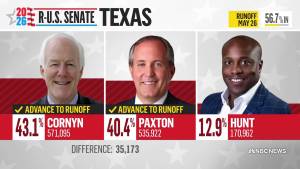
U.S. Sen. John Cornyn, left, and Texas Attorney Gen. Ken Paxton, center, advanced to a runoff election in the Texas Republican Party primary election on March 3, with rival U.S. Rep. Wesley Hunt, right, failing to qualify.
PoliticusUSA, News and Commentary: Republican Nightmares Come True In Texas, Jason Easley, right, March 4, 2026. The worst case scenario unfolded for Republicans in both Texas US Senate primaries and Sen. John Cornyn and Ken Paxton are heading for a runoff and James Talarico won the Democratic nomination.
For a Republican Party that is already facing a difficult midterm election environment, the outcome of the two Texas US Senate primaries could not have gone worse.
Republicans needed incumbent Sen. John Cornyn to defeat Texas Attorney General Ken Paxton and Rep. Wesley Hunt with a majority of the vote to avoid a runoff. The Texas primary has already set the record for being the most expensive primary in US history. Spending has crossed $110 million, with $90 million being spent on the Republican race.
Watch my thoughts on the Texas primaries:
At minimum, Republicans were hoping for Talarico and Crockett to be forced into a runoff, so that while Cornyn and Paxton were political knifefighting, Democrats would also have to use resources instead of building a general election campaign.
However, Talarico won the primary outright, even if the slow counting and court fight over Dallas County delayed the race for being called. Republicans really don’t want to face Talarico, and they did not want to be stuck in a runoff election while Talarico is building momentum around the state for November.
The Texas Tribune reported that Republicans were meddling in the Democratic primary because they wanted to face Crockett:
Republicans have signaled in some cases that they clearly see a more compelling foil in Crockett, who has been aggressive in her criticism of President Donald Trump — who won the state by 14 percentage points in 2024 — and has criticized the increasingly crucial voting bloc of Hispanic voters who have drifted toward Trump. Crockett previously downplayed the need to convert Trump’s supporters, saying that was “not our goal,” though she has since voiced confidence in her ability to win over independents and moderate Republicans.
Playing in the other side’s competitive primary is a well-worn campaign tactic, and one some Republicans have undertaken to boost Crockett, whom many believe would be the easier matchup in a general election.
Texas looks like it will be in play, which for Democrats is already a victory, because Republicans will have to use resources that could have gone to Senate races in Michigan, Iowa, Maine, North Carolina, Georgia, or Alaska in Texas.
Democrats have been chasing a statewide win in Texas for decades, and the 2026 Senate election represents their best chance in years. The right combination of candidates and political headwinds could cause a political earthquake with its epicenter located in the Lone Star State.
New York Times, Trump says his endorsement in the Texas G.O.P. Senate fight is imminent, Neil Vigdor, March 4, 2026. President Trump signaled on Wednesday that he would soon endorse one of the two candidates (above) in the Republican Senate runoff in Texas, appearing to heed calls within the G.O.P. to defuse what is expected to be a bruising and expensive race.
In a Truth Social post, Mr. Trump said that he would call for the candidate who does not receive his endorsement to “immediately DROP OUT” of the contest, which is headed to a May 26 runoff.
“Is that fair?” Mr. Trump wrote. “We must win in November!!!”
Neither Senator John Cornyn, who is seeking a fifth term, nor Ken Paxton, the scandal-ridden Texas attorney general challenging Mr. Cornyn from the right, received a majority of the vote in the Republican primary on Tuesday. Less than 2 percentage points separated the rivals in a pivotal contest that could ultimately determine whether Republicans maintain their narrow majority in the Senate in November.
James Talarico, a Democratic state legislator, emerged from on the Democratic with decisive victory over his rival, Representative Jasmine Crockett, giving him a clear path to the November election.
Democrats are hoping that Mr. Talarico can win a Texas Senate race for the party for the first time since 1988.
It was not immediately clear if Mr. Trump, as a condition of choosing sides, would require Mr. Cornyn or Mr. Paxton to pledge that they would leave the race should they not receive his endorsement. The White House did not immediately respond to a request for comment on Wednesday.
“Both John and Ken ran great races, but not good enough,” Mr. Trump wrote in his post. “Now, this one, must be PERFECT!”
Mr. Trump also boasted that his endorsements have been “virtually insurmountable!” He added: “Almost everyone I Endorse WINS, and wins by a lot, especially in Texas!”
Morning Shots via The Bulwark, Political Opinion: Knives Out for the ICE Queen, Bill Kristol, Benjamin Parker and Jim Swift, March 4, 2026. Senate Republicans might be ready to dump the DHS secretary.
One big primary day down! Last night, Texas state Rep. James Talarico overcame U.S. Rep. Jasmine Crockett in Texas’s Democratic Senate primary, bringing an end to a primary fight that had become a bit of a circus. On the Republican side, Sen. John Cornyn made a stronger-than-expected showing against state Attorney General Ken Paxton, a rising MAGA star—but since neither candidate broke 50 percent of the vote, the two will face off again in a runoff election on May 26.
For Democrats who see Texas as key to their moonshot bid to retake the Senate, it was about the best possible outcome. Republicans had pretty nakedly hoped to see Crockett, a liberal firebrand with a rinky-dink campaign operation and a habit of picking bizarre fights, take the Democratic nomination. They didn’t get that, and they didn’t get what they wanted on the Republican side either: a runoff means two more months of Paxton and Cornyn, shown at right, throwing haymakers at each other before the victor can turn to focus fire on Talarico. Happy Wednesday.
News Roundups
The Parnas Perspective, Evening News and Commentary: Republicans Break and Subpoena Bondi in Epstein Investigation, Trump Tried to Prosecute Biden, Kurds Launch Ground Invasion in Iran, Aaron Parnas, right, March 4, 2026. House Republicans joined Democrats to subpoena Attorney General Pam Bondi (shown above in a New York Times photo of previous testimony) in the Epstein investigation, a stunning rebuke of the Justice Department. At the same time, the Justice Department’s effort to prosecute Joe Biden and others over the use of the autopen collapsed after prosecutors failed to build a case. Meanwhile, the war with Iran is now costing U.S. taxpayers more than $1 billion per day, and Iraqi Kurdish forces have launched a ground offensive inside Iran this afternoon. There are a lot of moving parts, and I have the latest.
Here’s the news
:• Today, the Republican-led House Oversight Committee voted 24–19 to subpoena U.S. Attorney General Pam Bondi to testify about the Justice Department’s handling of records related to Jeffrey Epstein, the convicted sex offender tied to a large international sex-trafficking network.
• The motion was introduced by Rep. Nancy Mace (R-S.C.) and received bipartisan support, with five Republicans — Mace, Tim Burchett (TN), Lauren Boebert (CO), Michael Cloud (TX), and Scott Perry (PA) — joining Democrats in favor of compelling Bondi’s testimony.
• According to the New York Times, the U.S. Justice Department investigated whether former President Joe Biden or his aides broke the law by using an autopen device to sign presidential documents such as pardons, after pressure from President Donald Trump and his allies who claimed Biden lacked the mental capacity to authorize those actions. Prosecutors ultimately abandoned the inquiry after determining there was no credible criminal case or clear law violated, despite the investigation being led by Trump ally U.S. Attorney Jeanine Pirro and part of broader efforts by the administration to pursue cases against political opponents.
• Kurdish-Iranian militias have reportedly launched a ground offensive in northwestern Iran, according to multiple confirmations cited by Axios reporter Barak Ravid and a senior U.S. official. The development suggests the conflict may be expanding beyond airstrikes into active ground fighting inside Iranian territory.
• The war in Iran is costing taxpayers more than $1 billion everyday:
• Spain has denied a claim by White House press secretary Karoline Leavitt that it agreed to cooperate with U.S. military operations, after previously refusing to allow U.S. forces to use joint bases in Spain for strikes on Iran. Foreign Minister José Manuel Albares said “I categorically deny it,” emphasizing that Spain’s position opposing the war and restricting base use “has not changed at all.”
• Speaking to reporters at the White House, President Donald Trump said the situation on the “warfront” with Iran is going very well, saying that on a scale of 1 to 10 he would rate it “about a 15.” He added, “I think if we didn't do it first, they [Iran] would have done it to Israel, and give us a shot if that was possible.”• Trump further confirmed it is a war:
• Americans and other foreigners are evacuating Israel by taking five-hour buses to the Egyptian border and flying home from Egypt to avoid Iranian missile attacks. The U.S. State Department says more than 17,500 Americans have already returned to the United States since the conflict escalated, as evacuation efforts expand.
• Oil tanker traffic through the Strait of Hormuz has dropped about 90% compared with last week, with ships clustering outside the key waterway as Iranian threats deter vessels from entering. Because roughly 20% of the world’s daily oil supply normally passes through the strait, the disruption has contributed to rising global oil and gas prices. This is from NBC today:
• U.S. Central Command said it has “struck or sunk” more than 20 Iranian ships, releasing video of damaged vessels and claiming they were sent “to the bottom of the ocean.” The statement follows Defense Secretary Pete Hegseth’s announcement that a U.S. torpedo attack hit an Iranian ship in international waters, after which Sri Lankan authorities reported 87 bodies recovered and 32 survivors rescued from the Iranian vessel IRIS Dena.
• According to Reuters, Iran has postponed ceremonies to mourn Ayatollah Ali Khamenei that were scheduled to begin Wednesday, with an official telling state TV the events are delayed until further notice while preparations continue.
• Iran has sent messages to the United States in recent days but received no response, according to an Axios report citing a U.S. official and another source
• Iraq’s Islamic Resistance militia warned that any foreign entities intervening in Iraq or the region — including NATO, France, Germany, and Britain — would be considered “legitimate targets.”
• During a congressional hearing, Rep. Sydney Kamlager-Dove asked DHS Secretary Kristi Noem whether she had ever had sexual relations with Corey Lewandowski, raising concerns about potential conflicts of interest. Noem dismissed the question, saying “I’m surprised we’re peddling tabloid garbage in this hearing” and calling the allegation “garbage,” while Kamlager-Dove argued it related to judgment and ethics.
• Elon Musk testified in federal court in San Francisco in a civil trial brought by Twitter investors, who accuse him of securities fraud by publicly criticizing the company in 2022 to drive down its stock price while negotiating to buy it. Musk denies wrongdoing, and the lawsuit argues his actions helped lower the share price before he ultimately completed the $44 billion purchase of Twitter.
• The House Ethics Committee has opened an investigation into GOP Rep. Tony Gonzales over allegations that he engaged in sexual misconduct with a former staff member and gave her special favors or privileges while she worked in his congressional office. The probe follows reports that the former staffer later died after setting herself on fire, prompting the creation of an investigative subcommittee to examine the claims.
The Parnas Perspective, News and Commentary: Pentagon Lashes Out at Media for Iran War Coverage as State Department Warns Stranded Americans It Cannot Guarantee Help, Aaron Parnas, right, March 4, 2026. The Pentagon is complaining about media coverage of the war in Iran, saying reporting about incidents like U.S. casualties is meant to make Donald Trump look bad. Meanwhile, tens of thousands of Americans remain stranded across the Middle East. Countries like France are already organizing evacuation flights, but Americans calling the State Department hotline were told the U.S. government cannot currently assist them in leaving.
At the same time, U.S. Ambassador to Israel Mike Huckabee is facing criticism after joking that Americans sheltering during Iranian attacks who become pregnant could name their child after him.
Also, both Meta and TikTok are having issues this morning in case you are looking for my content there. I am grateful we still have Substack.
Here’s the news:
Defense Secretary Pete Hegseth, above, criticized media coverage of the Iran war, saying news outlets highlight incidents like U.S. service member deaths or drones getting through air defenses to make President Donald Trump look bad, and urged journalists to “report the reality” of the broader military campaign.
As the war with Iran escalates, the Trump administration urged Americans to leave 16 Middle Eastern countries but told stranded citizens they cannot rely on U.S. evacuation assistance, with a State Department hotline warning there are currently no evacuation points and no guaranteed government help for departures.
CNN has confirmed that U.S. officials told lawmakers that Iran’s Shahed one-way attack drones are harder to stop than expected and U.S. air defenses likely cannot intercept them all, raising concerns about defense capacity as the war escalates and Iran continues launching large numbers of drones and missiles across the region.
Defense Secretary Pete Hegseth said a U.S. submarine torpedoed and sank an Iranian warship in the Indian Ocean, claiming Iran’s navy has been largely “decimated” and calling it the first enemy ship sunk by torpedo since World War II.
U.S. Defense Secretary Pete Hegseth warned that the military campaign is escalating, saying “more and larger waves are coming” and the U.S. is accelerating operations rather than slowing them down.
An airstrike on Shajareh Tayyebeh elementary school in Minab, southern Iran, killed at least 168 people, many of them children, becoming the deadliest reported civilian incident of the war so far, with responsibility still unclear as the U.S. and Israel investigate and Iran vows retaliation.
When asked about a reported strike on a girls’ school in southern Iran, Defense Secretary Pete Hegseth said the U.S. is investigating the incident and emphasized that U.S. forces do not target civilian sites, but provided no further details on who was responsible. Reports say the strike killed dozens to more than 100 students, though responsibility remains disputed and under investigation.
Defense Secretary Pete Hegseth said a militant leader involved in an alleged Iranian plot to assassinate Donald Trump was included on a U.S. target list and later killed in an airstrike, though he said the operation primarily focused on destroying Iran’s missiles and launch systems.
The U.S. national average price of diesel reached $4.00 per gallon, the first time since April 24, 2024, according to GasBuddy, amid rising energy prices during the escalating Middle East conflict.
According to the Washington Post, U.S. Ambassador to Israel Mike Huckabee drew criticism after sending an “awkward” memo joking that embassy staff sheltering during Iranian attacks might name a future child after him, as U.S. diplomats and families were ordered to shelter in place and multiple embassies shut amid the escalating conflict.
France evacuated citizens from the Middle East on a charter flight to Paris, while the U.S. faces criticism for slower assistance to Americans, with officials urging citizens in the region to leave using commercial flights as Washington works to arrange limited charter evacuations.
Spanish Prime Minister Pedro Sánchez rebuked President Donald Trump, saying Spain will not support the war effort against Iran or act out of fear of reprisals, arguing the conflict is “bad for the world” and contrary to Spain’s values and interests.
A container ship in the Strait of Hormuz was struck by an unknown projectile, causing an engine-room fire and forcing the crew to abandon the vessel, though all crew members were accounted for with no injuries, according to the U.K.’s Maritime Trade Operations agency.
Rep. James Comer said sending U.S. “boots on the ground” in Iran could be unavoidable depending on how the conflict develops, signaling some Republicans are open to the possibility of deploying American troops if the war escalates.
During a heated U.N. Security Council exchange, U.S. Ambassador Mike Waltz warned Iran’s envoy to “be careful with his words sitting on American soil,” adding “not my first firefight,” as the diplomats clashed over the legality and consequences of U.S.–Israel military strikes on Iran.
Texas state Rep. James Talarico won the 2026 Texas Democratic primary for U.S. Senate, defeating Rep. Jasmine Crockett with a unity-focused campaign aimed at moderates and disaffected Republicans, and will face the Republican nominee in the general election. Jasmine Crockett issued the following statement this morning to her supporters:
After winning the Democratic Senate primary in Texas, James Talarico told supporters the result showed “something happening in Texas tonight,” saying voters had given the country “a little bit of hope.”
Democrats flipped a state house seat in Arkansas:
'VoteHub @VoteHub X.com Arkansas State House District sDistrict70Special 70 Special Election >95% Reported: Alex Holladay - 2,394 (63.7%) Bryan Renshaw 1,365 (36.3%) This district was Harris+1 in 2024, so this is a 26 point overperformance for Democrats.'
Don Huffines, who’s family is the owner of Jeffrey Epstein’s Zorro ranch in New Mexico will be the Republican nominee for Texas Comptroller.
California Gov. Gavin Newsom called Israel an “apartheid state” and said its leadership may force the United States to reconsider future military support, while criticizing the Trump administration’s backing of Israeli strikes in Iran.
NBC News reported that the U.K. police arrested three men (ages 39, 43, and 68) in London and Wales on suspicion of spying for China and assisting a foreign intelligence service under the National Security Act 2023, amid growing concerns from British officials and MI5 about increasing covert Chinese efforts to influence U.K. politics and recruit sources.
CNN has confirmed that the Justice Department reversed its plan to drop legal fights with four major law firms targeted by Trump after backlash from Trump and top aide Stephen Miller, reviving appeals tied to executive orders that attempted to restrict the firms’ access to federal buildings, classified information, and government agencies because of their connections to Democrats and past work opposing Trump.
TikTok is currently fighting a major court case in Ireland over a €530 million privacy fine and whether it can transfer European user data to China, a decision that could force the company to cut off data flows to China and reshape how Chinese tech firms operate under Europe’s GDPR rules. Learn more here.
U.S. Law, Courts, Crime, Civil Rights
New York Times, Colorado Governor Signals He’ll Commute Sentence of Election Denier, Jack Healy, Nick Corasaniti and Alan Feuer, March 4, 2026. Pressured by President Trump, Gov. Jared Polis said he is considering the release of Tina Peters, the last high-profile 2020 election meddler still imprisoned. His fellow Democrats are outraged.Listen to this article · 7:14 min Learn more
Gov. Jared Polis of Colorado offered the clearest signal yet late on Tuesday that he might commute the nine-year sentence of Tina Peters, the last high-profile Trump ally still in prison for crimes stemming from President Trump’s 2020 election loss.
Mr. Trump has waged an all-out assault on Colorado while pressuring Mr. Polis, a Democrat, to free Ms. Peters. He has blocked hundreds of millions of dollars in federal money from the Democratic-led state, moved the headquarters of U.S. Space Command from Colorado Springs to Alabama, promised to shutter a federal atmospheric research center in Boulder and vetoed an urgently needed water pipeline for rural Colorado.
Commuting Ms. Peters’s sentence now might appease Mr. Trump and stop those attacks, but it would set off a furious backlash among Democrats and imperil Mr. Polis’s political future. Democrats and some moderate Republicans in Colorado have spent months urging the governor to resist the pressure from Mr. Trump.
But on Tuesday night Mr. Polis wrote a social-media post that suggested he believed that Ms. Peters, a Republican former county clerk, had received too harsh a sentence when she was convicted of tampering with voting machines in a failed effort to show that the 2020 vote had been rigged against Mr. Trump.
The governor compared Ms. Peters’s case to that of a Democratic state senator, who, like Ms. Peters, was convicted of four felonies, including attempting to influence a public servant.
In that case, the authorities said, the former state senator, Sonya Jaquez Lewis, forged letters of support to try to rebut allegations that she was mistreating her staff. Ms. Lewis was sentenced this week to two years of probation and community service.
Mr. Polis said the disparity between the two women’s sentences “is not lost on me.”
“Justice in Colorado and America needs to be applied evenly, you never know when you might need to depend on the rule of law,” the governor wrote. “This is the context I am using as I consider cases like this that have sentencing disparities.”
He called Ms. Lewis, 68, a friend and said he was glad she did not have to endure prison. He then called Ms. Peters, 70, a “nonviolent, first-time offender.”
The response to Mr. Polis’s post on Tuesday from many was swift and full of outrage. The Denver district attorney, John Walsh, who prosecuted Ms. Lewis, rejected the governor’s comparison, saying in an interview that the cases against the two women “were not even in the same solar system in terms of the severity of their conduct.”
Colorado’s secretary of state, the Democrat Jena Griswold, said, “Peters organized the breach of the election equipment, broke the public trust and attacked the very foundations of our democratic process,” adding, “She should get no special treatment by the governor, and his statement is shocking.”
On Wednesday, Mr. Polis’s office said he was not considering a full pardon for Ms. Peters, and was “reviewing her application like anyone else applying for clemency.” The governor also extended the deadline for clemency applications until April 3. It is unclear when he might act on Ms. Peters’s case.
Peter Ticktin, a Florida-based lawyer for Ms. Peters who is also a close friend of Mr. Trump’s, hailed Mr. Polis’s move and said he believed that he could commute Ms. Peters’s sentence as soon as this week.
“It will be a victory as soon as the eggs are hatched,” Mr. Ticktin said. “If it ends up happening, her regaining her freedom will be a step toward righting a wrong.”
Editor's Note: Colorado Law On Recall Petitions For State Officials
In order to recall a state officeholder (Governor, Attorney General, Secretary of State, State Treasurer, members of the General Assembly, members of the State Board of Education, members of the CU Board of Regents, members of the RTD Board of Directors, and District Attorney), a recall petition must be created and approved by the Secretary of State’s office prior to obtaining signatures. Recall petitions for county offices must be approved by the county clerk & recorder prior to circulation. Members of Congress and US Senators may not be recalled.
An elected official must hold office for 6 months before a recall can be attempted (this rule does not apply to members of the General Assembly, who can be recalled 5 days after the start of the legislative session). No recall petition may be circulated or filed against any elected officer whose office is up for election within six months.
The signature threshold to place a recall question on the ballot for a state or county elected official is 25% of the total votes cast at the last preceding general election for that office.
If a recall petition is found to have a sufficient number of valid signatures, the question of whether to recall the officeholder is placed on the ballot. Below the recall question on the ballot, recall successor candidates will be listed as choices for voters—the officeholder being recalled cannot be a successor candidate. Recall successor candidates access the ballot via the petition rules in 1-4-801 and 1-4-802 of Colorado Revised Statutes.
New York Times Trump Administration Live Updates: Trump Justice Dept. Seeks to Stall State Bar Discipline of Its Lawyers, Devlin Barrett and Jonah E. Bromwich, March 4, 2026. The administration has no control over the disciplinary authorities of state bar associations, but a new proposal would let the attorney general ask them to suspend proceedings involving department lawyers.
The Justice Department is seeking to intervene in state bar associations’ disciplinary proceedings against its lawyers, reflecting a growing fear among administration officials that attorneys who do their bidding could be punished by legal ethics organizations and lose their ability to practice law.
The department, in a notice posted online in the Federal Register, said it wanted priority in investigating any allegations of wrongdoing by its own lawyers in an effort to rein in the power of state bar authorities to investigate or discipline its lawyers.
But the department has no control over state bar disciplinary authorities, and the proposal envisions merely requesting that a state bar association “suspend any parallel investigations until the completion of the department’s review.”
Stephen Gillers, a professor of legal ethics at New York University’s law school, said that the move amounted to a power grab. He noted the department’s promise to go to court if a state committee did not accept its proposal outlining its pre-eminence in investigating attorneys.
“This is a threat,” Mr. Gillers said.
The move comes as career lawyers in the department have repeatedly balked at carrying out orders they view as unethical or which could cause them to lose their licenses, according to multiple people familiar with those discussions who spoke on the condition of anonymity to discuss internal ethics disputes.
Melanie Lawrence, who served as the interim chief trial counsel for the California State Bar from 2018 to 2021, said that state bars played a critical role in the legal profession by enforcing ethics rules, even for senior Justice Department officials.
“None of these Department of Justice attorneys, from Pam Bondi to the lowliest line attorney, would have a job were it not for the license they have in a particular state,” Ms. Lawrence said. “The state bar holds the key to these people’s ability to wield their sword.”
A Justice Department spokesman did not immediately respond to a request for comment. Bloomberg earlier reported the notice in the Federal Register.
The Justice Department’s push to try to delay disciplinary actions against its lawyers also comes as the department is seeking disbarment of one of its former senior antitrust lawyers, Roger Alford.
Mr. Alford was forced out of the department last year in a battle over a merger settlement. He gave a speech decrying what he called corruption by other senior Justice Department officials, and the department is now seeking to have him disbarred, according to court filings.
A federal judge has begun an inquiry into the circumstances of the merger settlement that led to Mr. Alford’s ouster. His boss, Gail Slater, left the department last month.
More On Epstein Files, Trump Team Cover-up
New York Times, Trump Administration Live Updates: Bondi is Subpoenaed to Testify About Handling of Epstein Case, Staff reports, March 4, 2026. What We’re Covering Today,
Epstein Files: The House Oversight Committee voted to subpoena the attorney general, Pam Bondi, to testify about the Justice Department’s handling of the case against Jeffrey Epstein and the release of its files on the matter. The 24 to 19 vote by the Republican-led panel to force a cabinet member to testify was a rebuke to the Trump administration. Read more ›
Noem Testimony: Democrats on the House Judiciary Committee are pressing Homeland Security Secretary Kristi Noem about immigration enforcement and new restrictions they want to put on federal agents in exchange for funding her department. At a heated hearing in the Senate on Tuesday, she was grilled about her handling of the shootings of U.S. citizens by immigration agents in Minneapolis and the effects of a partial shutdown of her department over immigration policy. Read more ›
Autopen: The Justice Department examined whether former President Joseph R. Biden Jr. or his aides broke the law by using an autopen to sign documents, but prosecutors ultimately abandoned the case, according to three people briefed on the matter. President Trump seized on the unsubstantiated theory, and the inquiry is a window into how he has used government in his efforts to punish his political foes.
In a striking rebuke, the House Oversight Committee just voted to subpoena Attorney General Pam Bondi to testify about the Justice Department’s handling of its case against Jeffrey Epstein and its release of its files.
The vote, 24 to 19 with five Republicans joining all Democrats, marked a rare case of a Republican-led panel compelling a member of the president’s cabinet to testify. The motion was pushed by Representative Nancy Mace, Republican of South Carolina.
Noem said she was not aware of instances in which Immigration and Customs Enforcement officials had lied to federal judges or violated court orders, even though the chief federal judge in Minnesota said the agency had violated nearly 100 court orders.
Noem defended Todd Lyons, the agency’s acting director, and said “it is common knowledge that we have activist judges out there throwing opinions around.” That response drew some looks of disbelief among Democrats on the committee.
More On Iran War
Letters from an American, Commentary: March 3, 2026 [Miiltary Warned Trump On U.S. Capabilities], Heather Cox Richardson, right, March 4, 2026. About a week before Trump launched Operation Epic Fury, attacking Iran alongside Israel, Chairman of the Joint Chiefs of Staff General Dan Caine warned that the lack of support from allies and depleted reserves of interceptors and Patriot missiles would make an attack on Iran risky.
Patty Nieberg of Task & Purpose reported that on February 28, the day the offensive began, Admiral Brad Cooper, the head of U.S. Central Command, wrote to the troops deployed around the Middle East that they were “embarking on a mission of profound consequence,” moving “from deterrence into active combat.” Central Command has reported six American service members killed and eighteen wounded in the operation.
According to U.S. Central Command, which manages U.S. military operations in the Middle East, there are about 50,000 military personnel involved in Operation Epic Fury, 200 fighter jets, two aircraft carriers and bombers, and they are moving more support to the region. Yesterday Defense Secretary Pete Hegseth refused to rule out sending ground troops to Iran.
In his message to Congress yesterday announcing he had taken “military action…against the Government of the Islamic Republic of Iran,” Trump wrote: “It is not possible at this time to know the full scope and direction of military operations that may be necessary.”
Today the war continued to widen, leaving hundreds of thousands of foreign nationals in the Middle East desperate to leave. France alone has 400,000 people there. The U.S. has between 500,000 and a million people in the Middle East. The U.S. State Department has urged them to leave but said it could not help, and with airports and airspaces closed, just how they are supposed to do that is unclear. After pressure, the government is now saying it will work on chartering aircraft and using military planes to transport people who want to leave.
Alison Durkee of Forbes reported today that Trump’s military strikes in Iran have already cost U.S. taxpayers more than $1 billion. The three F-15E Eagle jets lost to friendly fire on Sunday cost $90 million each. Transporting troops, ships, and aircraft to the Middle East cost about $630 million. Missiles and weapons systems are also expensive—a drone is about $35,000, and a Tomahawk missile costs millions—and the two aircraft carriers in the region together cost at least $13 million a day. And then there are the costs of operating aircraft, and so on.
Jennifer Scholtes and Katherine Tully-McManus of Politico reported that lawmakers anticipate the administration will ask for supplemental funding for this operation, over and above the more than $150 billion the Republicans provided the Pentagon in their One Big Beautiful Bill Act and the nearly $839 billion in regular funding Congress appropriated in February.
Trump made little effort to present his case for military strikes against Iran to the American people. In his letter to Congress notifying them of his attack, Trump said he had acted under the 1973 War Powers Act, which permits a president to attack another country if there is an urgent threat. But the letter itself doesn’t identify any such urgent threat. It simply said Iran is one of the world’s largest sponsors of state terrorism and that it “continues to seek the means to possess and employ nuclear weapons.”
The Framers of the Constitution placed the power to declare war in the hands of Congress and not in the president above all because they did not trust that much power in the hands of one man. But they also wanted to make sure the American people would have robust debates about the value of the money and lives lost in combat. So determined were they for the American people to have those debates that they put into the Constitution that Congress had the power “[t]o declare War…and…[t]o raise and support Armies, but no Appropriation of Money to that Use shall be for a longer Term than two Years.”
In Federalist #26, one of the newspaper essays Alexander Hamilton wrote to encourage the ratification of the Constitution, Hamilton explained that people shouldn’t fear the strength of the new government outlined in the Constitution, because the necessity of debating war, alongside the two-year limit on government funding for the military, would force Congress to debate military actions. He expected members of the opposition to attack those in power over military appropriations, so that if those in power were “disposed to exceed the proper limits, the community will be warned of the danger, and will have an opportunity of taking measures to guard against it.”
But Trump has now taken that power away from the people and their representatives. He has launched a military action that by his own admission is not an emergency situation like those anticipated by the War Powers Act, and thus he should have asked Congress for authorization to send troops and money to Iran. Members of Congress, in turn, would then have had to answer to their constituents.
Tonight the U.S. Southern Command, which operates in Central and South America and the Caribbean, posted: “On March 3, Ecuadorian and U.S. military forces launched operations against Designated Terrorist Organizations in Ecuador. The operations are a powerful example of the commitment of partners in Latin America and the Caribbean to combat the scourge of narco-terrorism. Together, we are taking decisive action to confront narco-terrorists who have long inflicted terror, violence, and corruption on citizens throughout the hemisphere.”
Eric Schmitt and Luis Ferré-Sadurní of the New York Times reported that U.S. Special Forces soldiers are advising and supporting Ecuadorian commandos as they conduct raids against drug-related sites run by “designated terrorist organizations.”
Morning Shots via The Bulwark, Political Opinion:The Danger of Hormuz, Benjamin Parker, March 4, 2026. Everyone who’s ever studied the possibility of a war between the United States and Iran has agreed that Iran had one significant, inalterable, asymmetric advantage: its geography—specifically, the Strait of Hormuz (shown above).
The twisty maritime corridor, just 24 miles wide in places, connects the Persian Gulf to the Arabian Sea and is a key transit route for oil. If the Iranians can block the shipping channel, not just the United States but most of the world will suffer.
Since Donald Trump’s attack on Iran, tanker traffic in the strait has dropped to just about zero. In response, Trump announced, “If necessary, the United States Navy will begin escorting tankers through the Strait of Hormuz, as soon as possible.”
Big, and potentially very dangerous, if true.
Escorting ships through the Strait of Hormuz means putting American surface ships—destroyers and cruisers—in harm’s way and hoping that their defenses are sufficient to protect both themselves and the tankers. The major threats they’d be defending against can be divided into three categories:
Iran has some decent anti-ship ballistic and cruise missiles, including some reverse-engineered Chinese models. Arguably more important than the quality, though, are the numbers. Based on how often the Iranian-backed Houthis were shooting them off last year, Iran seems to have a deep arsenal—or at least they did, before last weekend. Numbers matter a lot. For example, if a ship has a 90 percent chance of intercepting one missile, it only has about a 73 percent chance of intercepting three missiles, a 59 percent chance of intercepting five missiles, and so on.
On the other end of the technology spectrum are small, fast boats laden with explosives. Think the USS Cole bombing multiplied many times over. Using that tactic (among others), Lt. Gen. Paul Van Riper “sank” a huge number of Navy ships in a mock exercise about the Strait of Hormuz called Millennium Challenge 2002. His success was so unexpected and overwhelming that he almost ruined a multi-hundred-million-dollar military exercise and caused a scandal.
Then there’s always the possibility of something the Navy doesn’t expect. The Iranians know how important the Strait is, and they’ve thought about it a lot. Their whole navy, small though it is, basically exists for this one mission. Maybe they have some kind of clever, low-tech naval mine. Maybe they have a kind of weapon we’re not even considering.
The logistical implications of such an operation are astounding. The amount of fuel consumption alone required to get ships to and from the Strait of Hormuz and to traverse it back and forth is enormous. And the ships ferrying all that fuel require protection. Which means more escorts. And so on.
If Iran manages to sink a tanker, or even just hit one, oil transport companies—and, more importantly, their insurers—will be out of the Strait for good.
If Iran manages to hit an American ship and kills dozens of Americans—or even to sink an American ship—the effects on our international reputation, our economy, and our domestic politics will be severe. Trump’s reaction will be unpredictable.
At the same time, the ships escorting tankers through the Strait have to come from somewhere. The Navy only has so many destroyers and cruisers, and there’s a lot of ocean out there. Is Trump suggesting we pull ships from the South and East China Seas? From the Sea of Japan? From the coast of Somalia? From the Strait of Malacca—arguably the only strait more important to the global economy than Hormuz?
Trump’s offhand announcement of a major, risky military operation shares the same flaws as all of his other foreign policy endeavors since his return to office. One is a lack of strategy: He seems intellectually incapable of organizing the country’s capabilities and strengths into a plan to achieve realistic goals. The second is, for lack of a better term, grand strategy: He has no sense of priorities, of which problems are big (China and Russia) and which are much smaller (Venezuela and Iran).
That inability has already cost the lives of American service members, and it could be about to cost more. Secretary of Defense Pete Hegseth said this morning, “More and larger waves are coming. We are just getting started. We are accelerating, not decelerating.”
Drop Site News, Mass Expulsion in Lebanon as Israel Expands War: “We Don’t Know Where to Go,” Lylla Younes, March 4, 2026. Israel issued a sweeping displacement order for the entire region south of Litani River as it escalated its bombing campaign across Lebanon.
Mustafa Arout was forced to flee his home in Mais al-Jabal, a town in southern Lebanon, before dawn on Tuesday as the Israeli military issued mass displacement orders to dozens of communities in the area and launched a wave of heavy airstrikes.
The 78-year-old mukhtar—an Arabic term for a local leader—had hoped for the roads to clear before evacuating with his family, but instead they found themselves inching through traffic in the darkness as thousands of others fled the area in a mass exodus. Arout and his family headed north with no clear destination, the sounds of bombing echoing from the hills in the near distance.
“We don’t know where to go,” Arout told Drop Site in a phone interview while still on the road. His voice shook as he spoke. They reached Saida after a gruelling 12-hour drive for a trip that would normally take two hours.
Friends had offered refuge in Deir al-Zahrani, a town northeast of Saada, but that prospect offered little safety. Like his hometown, Deir al-Zahrani was among the more than 80 villages Israel had ordered to evacuate.
On Wednesday, the Israeli military escalated and issued a sweeping displacement order for all residents in Lebanon south of the Litani River. The order was accompanied by a map showing the entire southern part of Lebanon shaded in red with two large arrows pointing north.
 The Steady State, The Iran War: A Thumb-Nail Strategy Analysis, Robert Bruce Adolph, March 4, 2026. National-level warfighting strategies are defined by the objectives established by the commander-in-chief, in this case, Donald Trump.
The end state desired, assuming the chief executive of the nation did not misspeak, appears to number three: (1) to ensure that Iran can never construct an atomic device, (2) “raze” Iran’s ability to build missiles, while destroying its navy; and (3) regime change. The ends, ways, and means of a strategy to accomplish these goals are all subject to examination under three analytical criteria. These are suitability, feasibility, and acceptability.
The Iranian Atomic Bomb
At the outset, I will remove the first objective from later discussion. This president recently told Americans on live TV that the Iranian capability to build an atomic bomb had been “obliterated.” The word obliterated cannot be easily misunderstood. One other related matter, the Obama Administration previously solved this problem successfully, securing an inspectable agreement with European Union assistance. Mr. Trump blew up that agreement in his first term. Nobody seems to know why. By some estimates, he created the problem that he now seeks to solve using
America’s sons and daughters as cannon fodder. Bottom line, the Iranian regime, no doubt deserving of the label heinous after killing thousands of their own, is also no existential threat to the American people. That leaves only two objectives for further examination.
Raze Missiles and Destroy Navy
Assuming good intelligence, and the Israelis are very good at this sort of thing concerning Iran, it is within the realm of the possible that missile production facilities and a navy can indeed be destroyed from the air using a combination of missiles, drones, and manned aircraft. It is therefore feasible. However, as the US Army saying goes, “The enemy always gets a vote.” The Iranian military had plenty of time to move or camouflage some of their most effective offensive combat systems that, to date, have been challenging to locate. There are historical antecedents. It was no easy task to find, fix, and destroy SCUD rockets during the first Gulf War. US and NATO pilots destroyed hundreds of dummy mock-ups of Serbian tanks following the breakup of the former Yugoslavia. Also, air wars consume ammunition rapidly. It has been suggested that current expenditure rates are unsustainable. Finally, acceptability is a critical yet thorny political issue, which involves not only the US but all those who are impacted, including thousands of American citizens, now stranded, who were not evacuated during the weeks leading up to this decision.
Regime Change
In my student readings on Military History, a required course at the US Army’s Command and General Staff College, I cannot recall even one instance where a country compelled regime change in another utilizing only air power. If accurate, then it would be the wildest stroke of luck if the Iranian people rose up and threw off the shackles of the ayatollahs. We might all hope for a better future for the people of that sad country, but as one of my generals once told me, “Hope is not a course of action.” It is critically important to know that Mr. Trump’s uniformed military advisors would have informed him well before attacking Iran again that the chances of sparking a regime change in Tehran had no historical precedent, utilizing the ways and means chosen (air power). However, it was previously reported in credible media that the advice of the president’s son-in-law, Jared Kushner, and Middle East envoy, Steve Witkoff, would be given great weight in Oval Office decision-making. Both are billionaire property developers. What could possibly go wrong?
Acceptability
Acceptability is an extraordinarily important consideration in the strategy development process, especially for America. Presidents are not royalty. They do not rule by divine right. Congress is the direct representative of the people in our republic and must be consulted. Moreover, only Congress may fund a war. The Framers of our Constitution knew better than to leave such a profound decision as risking our citizens in uniform in war to one person. It is not acceptable that
this president took America into sustained armed conflict by choice. Other stakeholders are our traditional NATO allies, who are not universally supportive. More naysayers might include those nations that are now cut off from their usual oil shipments that formerly passed through the Strait of Hormuz, now shut. Those nations that have suffered missile and drone attacks, including Kuwait, UAE, Qatar, Bahrain, Saudi Arabia, Jordan, and Iraq, may also have serious doubts regarding the acceptability of Mr. Trump’s decisions.
An expanded conflict in the Middle East, which is in nobody’s interest apart from the Netanyahu government in Jerusalem, is where we are now.
Possibilities and Conclusions
The possible permutations are multiple. Nobody knows what comes next. This White House occupant has opened Pandora’s box. All sorts of potential maladies are now loose. Iran’s proxies in Lebanon, Syria, Iraq, and Yemen might attack those who are associated with the Trump Administration’s actions. Israel has already struck Hezbollah targets in Lebanon. Iran can easily mount assaults on oil and gas infrastructure. Saudi Arabia, UAE, Qatar, and Kuwait are all equally vulnerable. Unattributable asymmetrical acts of terror are once again a very real prospect. The Strait of Hormuz will remain closed for the foreseeable future. The list goes on.
Unsurprisingly, all these events were perfectly predictable prior to the first US missile being launched. The US Secretary of State stated that America had to preemptively strike Iran because Israel was planning to do so. Has our national warfighting decision-making been outsourced? Based on this thumbnail analysis, I am compelled to call Mr. Trump’s Iranian strategy patently absurd and uncorrectable by even the world’s most powerful military.
Clearly, there is also a major domestic issue at hand that can be found in the question: will the US Congress bring this Oval Office to heel? Thus far, Republicans in the Senate and House of Representatives have repeatedly demonstrated cowardice in the face of this president. It is well beyond time to find their courage and act in the interests of the nation by complying with the intent of the Framers and their oaths of office to “support and defend” our Constitution. Their failure to do so to date is in large measure responsible for the ongoing death and destruction currently unleashed across the Middle East.
Paul Krugman via Substack, Political-Economy Commentary: Reality Sets In on Trump’s New War, Paul Krugman, right, March 4, 2026. Surprise! War in the middle of the world’s most important oil fields has consequences.
On Monday, the market reaction to the Trump/Netanyahu war with Iran was surprisingly muted. Stocks were roughly flat. Prices of oil and gas futures were up, but only moderately.
Yesterday reality apparently began to set in, although stocks made up most of their initial losses.
This will be a brief post, with some bad news and some good news.
The bad news comes in two parts.
First, any hopes that this war might be extremely brief are fading. The Trump administration may have imagined that decapitating the Iranian government would bring swift regime change, but the Islamic State isn’t a government of mere thugs — yes, they’re evil thugs, but they’re also serious religious fanatics facing what for them is an existential threat, and their grip on power isn’t that easy to break. Furthermore, it’s painfully obvious that Trump and co. had no plan beyond bombing Iran, killing its current leaders, and hoping that something good would happen.
Second, war in the middle of the world’s most important oil-producing region — which is also a key source of liquefied natural gas — inevitably has major consequences for energy prices. Once upon a time US and Israeli air superiority might have contained Iran’s ability to harm its neighbors. But in an age in which even third-rate powers have the ability to launch missiles and drones, Iran has a huge stockpile of drones and also has ballistic missiles that are destructive, hard to intercept, and have a 1200 mile range.
The U.S. embassy in Saudi Arabia has been hit by two drone strikes. Airports in Dubai, Abu Dhabi and Doha and the U.S. consulate in Dubai have also been hit.
U.S. officials have urged all Americans in the region to leave, but they did so after almost all flights had been canceled. Only now are they saying that they’re going to arrange flights on military aircraft and charter flights — an airlift that will have to be immense given that there are surely tens of thousands of Americans currently stranded. Did I mention that Trump and co. clearly went to war without a plan?
The potential targets at risk include key parts of the region’s energy infrastructure. Above all, the war threatens tanker traffic through the Strait of Hormuz, which is how the bulk of Middle Eastern oil and gas normally reaches world markets. And the risk of Iranian attacks has effectively closed the Strait. Yesterday Trump, obviously scrambling to limit the damage, declared that he is ordering the U.S. International Development Finance Corporation to provide “guarantees for the Financial Security of ALL Maritime Trade, especially Energy, traveling through the Gulf,” as well as telling the Navy to provide security. Do we have the resources to do all of that?
Oil prices are up around $15 per barrel since mid-February: In case you’re wondering, there are 42 gallons in a barrel.
Indeed, it’s hard to understand why oil prices haven’t risen even more. “Why has oil not hit $100 a barrel?”, asks the Financial Times. The best answer seems to be that even now traders are betting that the Strait of Hormuz won’t stay closed for more than a few days. I hope I’m wrong, but I expect the strait to remain closed for weeks despite Trump’s assurances.
Now the good news: Even if oil prices go much higher, to $100 a barrel and beyond, it won’t necessarily trigger an economic crisis. I explained why on Monday: The United States and other advanced nations are far less oil-dependent than they were in the 1970s, when oil shocks did cause major economic disruption.
It’s true that Europe, which depends heavily on imported LNG from both the Middle East and the United States, will be hit harder than we will. However, even with a sustained closure of the Strait of Hormuz Europe will face a smaller shock than it did following the Russian invasion of Ukraine in 2022.
My back of the envelope calculations say that a $15 a barrel rise in oil prices, which is what has happened so far, will raise overall U.S. consumer prices by about 0.3 percent. A $50 a barrel rise from the pre-bombing level, which would take the price to more than $120, would raise consumer prices by about 1 percent. For perspective, that’s roughly what Trump’s tariffs have done. Yet those tariffs, while they have hurt, have caused neither runaway inflation nor a recession. Neither will rising oil prices on their own even if they go well above $100 a barrel.
However, the key point is that this latest economic shock isn’t happening on its own. The tariffs — and the huge uncertainty they create for the future — haven’t gone away. Neither have draconian anti-immigrant policies and their growing economic drag. There are widespread concerns about AI — both as a bubble that might burst and as a force driving job losses. And many people, myself included, are worried about financial stability: In many ways we have recreated the “shadow banking” risks that made the 2008 crisis possible.
Now we’ve added a fresh level of massive uncertainty. Bear in mind that this isn’t even a war of choice; it’s a war of whim, marked by a near-total lack of planning.
One shouldn’t exaggerate the economic fallout from this war. But it isn’t occurring in isolation: There are many stresses on our economy, and this could be the straw that breaks the camel’s back — a straw that becomes heavier the longer the war goes on. Furthermore, if Trump is this erratic now, what will he do as the midterms get even closer?
New York Times, U.S. Struck Iranian Warship Off Sri Lanka, With Dozens Missing, Pamodi Waravita and Lynsey Chutel, March 4, 2026. Defense Secretary Pete Hegseth said a U.S. submarine torpedoed the ship on Wednesday. The Sri Lankan authorities said they had rescued 32 sailors from the crew of 180.
Pete Hegseth, the U.S. defense secretary, said on Wednesday that a U.S. submarine torpedoed an Iranian warship in the Indian Ocean as part of a widening military campaign against Iran.
Although Mr. Hegseth did not name the ship, an Iranian vessel with a crew of 180 sank in the Indian Ocean on Wednesday off the southern coast of Sri Lanka, officials in the country said. About 30 people were rescued and a search was underway for any other survivors.
The Iranian ship “thought it was safe in international waters,” but “instead, it was sunk by a torpedo,” Mr. Hegseth said at a Pentagon briefing.
“America is winning, decisively, devastatingly and without mercy,” Mr. Hegseth said.
Iran’s naval fleet has been under attack since the United States and Israel launched a war on Iran last weekend, targeting the country’s military and security apparatus.
The Iris Dena, described as a destroyer, was sailing outside Sri Lanka’s territorial waters when it sent a distress signal at 5:08 a.m. local time, the Sri Lankan foreign minister, Vijitha Herath, told Sri Lanka’s Parliament. Sri Lanka responded, sending naval ships and the air force to the endangered vessel.
Sri Lankan officers rescued 32 critically injured sailors, who were taken to the Karapitiya Hospital, in the southern coastal city of Galle, Mr. Herath said.
PoliticusUSA, News and Commentary: Pete Hegseth Holds Briefing To Whine That The Media Is Making Trump Look Bad In Iran, Jason Easley, right, March 4, 2026. Secretary of Defense Pete Hegseth held another Iran war press conference where he complained that the media is making Trump look bad on the war.
When a president has a cabinet that is full of loyalists, many of whom formerly worked at a cable news network that critics refer to as state television, the administration is likely to struggle to speak to and rally a large and diverse nation like the United States.Before Trump plucked him to run the Pentagon, Pete Hegseth was a C-level talent on Fox News who spent his time with other C-level talents on Fox and Friends Weekend. Hegseth has never possessed the biography or gravitas to sound like a serious leader who can rally the country around a war if necessary.
After his first attempt at an Iran briefing was a mess that reflected the contradictory excuses for this administration’s war of choice, Hegseth tried again on Wednesday morning.
The Secretary of Defense promised to deliver America more of the least popular war in US history.
Hegseth said:
Thus far, operation Epic Fury has delivered twice the air power of shock and awe of Iraq in 2003 minus Paul Bremmer and the nation building. The campaign has seven times the intensity of Israel’s previous operations against Iran during the 12 day war, seven times. And as President Trump said, more and larger waves are coming.We are just getting started. We are accelerating not decelerating. Iran’s capabilities are evaporating by the hour, while American strength grows fiercer, smarter and utterly dominant, more bombers and more fighters are arriving just today and now with complete control of the skies, we will be using 500 pound thousand pound. And 2,000-pound GPS and laser-guided precision gravity bombs, of which we have a nearly unlimited stockpile.
The Trump administration responded to the American people saying that they don’t want this war by promising more war.
Hegseth also had a reason for why the American people are opposed to this war.
It is all the media’s fault.
Hegseth said: This is what the fake news misses. We’ve taken control of Iran’s airspace and waterways without boots on the ground. We control their fate, but when a few drones get through or tragic things happen, it’s front page news. I get it. The press only wants to make the president look bad, but try for once to report the reality.
The terms of this war will be set by us at every step. The media shouldn’t be focused on US troops dying and getting injured, the rising cost of gasoline, or Iranian school girls being blown up.
Why can’t the country focus on the positives? For example, the fact that we are spending hundreds of millions of taxpayer dollars at a time when this president and his party said that Obamacare subsidies were too expensive to drop bombs on Iran?
The Trump administration can’t decide whether this is a war for regime change in Iran or not. It is not the media’s fault that the war has an approval rating of 27%. Those who are reporting the facts should not be blamed for Trump’s own base fragmenting over his actions in Iran.The administration still hasn’t made a case for why this war is happening right now.No one is trying to make Trump look bad on Iran. He is doing that all on his own.
Drop Site News, Death toll in Iran tops 1,000; Trump weighs arming Kurdish forces to attack Iran; Israel orders mass displacement of all of southern Lebanon, Staff Reports, March 4, 2026. The U.S. and Israel have now killed more than 1,000 Iranian people.
CENTCOM reports hitting 2,000 targets, and War Secretary Pete Hegseth announces sinking an Iranian submarine.
Israel says it struck the Assembly of Experts, though Iran says the building was not being used at the time.
Iranian drones hit central Israel, Gulf countries, and U.S. targets, including the consulate and CIA station in Saudi Arabia and a THAAD missile interception radar system. NATO shoots down missile headed toward Turkey.
UAE and Qatar deny role in attacks on Iran. The U.S. will cover shipping losses in the Gulf, President Donald Trump says. U.S. weighing plan to arm Kurdish forces against Iran.
Israel orders mass displacement of all of southern Lebanon. Hezbollah declares “open war.” Raids across the occupied West Bank.
James Talarico wins Texas Democratic Senate primary against Rep. Jasmine Crocket. Roy Cooper and Michael Whatley win primaries in pivotal North Carolina Senate race. Nida Allam seeks recount in North Carolina Democratic primary.
Homeland Security Secretary Kristi Noem defends immigration crackdown at Senate hearing. U.S. reportedly prepares draft indictment against Venezuelan President Delcy Rodríguez. U.S. launches military operations against “narco-trafficking” with Ecuador. Cuban tanker cleared to load LPG in Venezuela. Pakistan-Afghanistan war continues as civilian deaths rise.
West African bloc plans activation of regional standby force to fight armed groups.Leqaa Kordia, a 33-year-old Palestinian woman from Paterson, New Jersey, has spent nearly a year in ICE detention in Texas after speaking out against Israel’s war in Gaza, despite an immigration judge twice ruling that she is eligible for release. Drop Site joins the IMEU Policy Project, MPower Action, Jewish Voice for Peace ACT, and the US Campaign for Palestinian Rights Action in calling for her immediate release.
More On U.S. Governance, Politics, Elections
Homeland Security Secretary Kristi Noem and her advisor and travelling companion Corey Lewandowski.
Politico, Noem slams question about her relationship with Lewandowski as ‘tabloid garbage,’ Eric Bazail-Eimil, March 4, 2026. Lewandowski currently works as a special adviser at the Department of Homeland Security.Kristi Noem testifies during a hearing.
Homeland Security Secretary Kristi Noem refused to answer questions Wednesday from two House Democrats about her relationship with a Trump ally who works as an unpaid adviser at her department.
During a House Judiciary Committee hearing, Rep. Sydney Kamlager-Dove (D-Calif.) asked Noem if she has had “sexual relations” with Corey Lewandowski during her tenure as DHS chief.
Lewandowski, an ally of President Donald Trump who ran his 2016 presidential campaign, currently works as a special adviser at the Department of Homeland Security.
Noem, whose husband, Bryon, attended the hearing, reacted with noticeable anger in her voice. “I am shocked we’re peddling tabloid garbage in this committee,” she responded.
Noem also said Lewandowski is a “special government employee who works for the White House. There are thousands of them in the federal government,” adding that he has no influence over decisions at DHS.
Kamlager-Dove pressed for an answer, saying “it is okay for you to be offended by the question. But it is also a real question and you should be able to answer the question clearly and without hesitation … you should be wanting to answer that question.”
In earlier appearances before the Senate, no lawmakers have asked Noem directly about her relationship with Lewandowski.
The next Democrat to ask questions after Kamlager-Dove, Jared Moskowitz of Florida, pressed her further.
“I really think you need to say the word ‘no’ into the record so that you can clear that up,” Moskowitz said.
Noem, even more incensed, lashed Moskowitz as a part of the “liberal media.”
“You say conservative women are stupid or sluts. I am neither,” she fired back.
Previous news reports alleged that the two have engaged in a romantic relationship, though both denied the claims.
Before her exchange with Kamlager-Dove and Moskowitz, Noem had largely avoided fireworks in the House Judiciary hearing, as Republicans offered her political cover and Democrats pressed her about her leadership of DHS, including the killings of two U.S. citizens in Minneapolis by federal agents.
New York Times, Allies of Gov. Sarah Huckabee Sanders suffer primary defeats in Arkansas, David W. Chen, March 4, 2026. Gov. Sarah Huckabee Sanders of Arkansas suffered a string of defeats in Tuesday’s state primaries, when two longtime Republican state senators who had blocked her plan to build the state’s biggest prison scored resounding wins against her handpicked challengers and the State Senate majority leader was swept from power by another prison skeptic.
In still another blow to the governor, a Democrat won a special election for the State House in a district north of Little Rock. Alex Holladay, a recruiter for the University of Arkansas for Medical Sciences, easily defeated Bryan Renshaw, a physical therapist, to flip the seat.
Ms. Sanders has made a proposed 3,000-bed prison on 815 rural acres in central western Arkansas a key piece of her criminal justice agenda. In a state that is behind only Mississippi and Louisiana in incarcerations per capita, the governor, who is favored to win a second term in November, has argued that the state needs more prison beds, especially since she has already reduced parole eligibility and mandated longer prison sentences.
But State Senators Bryan King and Ronald Caldwell have been among the handful of Republicans who have repeatedly refused to finance the $825 million project because of concerns about the cost and the strain of additional prisoners and staff members on the rural area’s gravel roads and water supply.
Mr. King, a poultry farmer who has represented a northwestern district for almost 20 years, easily defeated Bobby Ballinger Jr., a businessman. And Mr. Caldwell, a retired businessman who has represented a rural area east of Little Rock for more than a decade, trounced Trey “BoDirt” Bohannan, the owner of a landscaping business.
In recent weeks, Mr. King’s and Mr. Caldwell’s constituents had been bombarded by mailers and texts attributed to opaque groups criticizing the senators as “weak on Communist China” who have allowed “woke liberals to indoctrinate our children.”
The crushing end to State Senator Blake Johnson’s time as Senate majority leader added to Ms. Sanders’s rough night. Mr. Johnson, a staunch Sanders ally, was routed by an ambitious state representative, Jeremy Wooldridge, who has also expressed reservations about the feasibility of the prison.
Popular Information, Accountability Journalism: The "meritocracy" exposed: Internal emails reveal how the Trump administration hires legal interns, Judd Legum, right, March 4, 2026. “You MUST be aligned politically with President Trump… GPA is not a strong factor.”
On Friday afternoon, Liberty University Law School emailed its first and second-year students about an “exciting opportunity to intern with the Department of Labor in DC.” The available positions covered the full breadth of the DOL’s activities — “litigation, appeals, regulations, policy, etc.” The email, sent by Derek Green, an associate director at the law school, stressed that those accepted into the program “will make incredible connections that will payoff [sic] later.” For second-year students, the internship “could lead to a full-time job offer for after your 2027 graduation.”
One important caveat: only passionate devotees of President Trump would be considered. Students who “aligned politically with President Trump” and were “willing to work hard” were strongly encouraged to apply, even if they had poor grades.
The email was provided by a source on the condition of anonymity, fearing retribution from the school. Contacted by phone, Green told Popular Information he could not speak without approval from Edie Swann, Liberty University Law School’s Director of Public Affairs. Swann did not respond to an email request for an interview.
Excerpts from Green’s email were reported earlier by the legal blog Above the Law.
 Liberty University, founded by Jerry Falwell Sr., is a conservative Christian institution based in Lynchburg, Virginia. Falwell Jr., who took over the university after his father died in 2007, was an advisor to Trump. Falwell Jr. resigned after a sexual scandal in 2020, but Liberty University has maintained a key role in connecting the Trump administration to the evangelical community.
Green stressed that anyone interested in the DOL legal internship should “ABSOLUTELY apply” because “the person conducting the interviews is Vittoria D’Addesi, a 2025 graduate of Liberty Law, along with a representative of the White House Liaison Office.”
According to Green, D’Addesi will ask applicants a variety of political questions, including “[D]id you vote for President Trump?” and “Do you disagree with the President on anything?”
Green concluded that his goal was “to get double digit Liberty Law students in this program this summer.”
Appended to the Green email was a more staid message from D’Addesi. In her description, D’Addesi writes that “[o]nly students who are interested in advancing the President’s initiatives and delivering wins for the American Worker should apply.”
D’Addesi did not respond to an email requesting comment.
The Contrarian, Opinion: Trump’s War Underscores his Massive Betrayal, Jennifer Rubin, right, March 4, 2026. Democrats now have their election message.
A critical problem — aside from constitutional, political, and moral considerations — with a president taking the country to war with overwhelming public opposition, without congressional authorization, and even without public debate is that we do not know its purpose. From all appearances, neither Donald Trump nor any adviser knows the purpose of his strikes against Iran. (If one were being totally honest, the “purpose” likely is to soothe the narcissistic rage of a president headed for a massive defeat.)
Susan Glasser took a stab at listing the ever-fluctuating reasons for sending men and women to die, while spending billions of dollars:
[O]utright regime change, assistance to the oppressed peoples of the Islamic Republic, stripping Iran of “the ability to project power outside its borders,” stopping future Iranian-sponsored terrorist attacks while exacting revenge for past ones, preemptive action against an imminent Iranian threat to attack U.S. forces, preemptive action to block Iran from building ballistic missiles that could hit the U.S. mainland, and preemptive action to stop the Iranian nuclear program that Trump had, as recently as last week, claimed was “obliterated.” Many of these explanations are based on false premises; some already seem to have been abandoned.
Never have we launched a war for yet-to-be-decided reasons without preparation for civilians in the region. We can already draw four conclusions from Trump’s blunder.
Democrats will need to remind voters that any sensible president could have avoided a calamitous war simply by continuing negotiations. Moreover, if Trump had not torn up the Iran nuclear deal, inspectors would have been on the ground to tell us what Iran was doing, thereby eliminating the need for wars based on suspicion of progress toward a bomb. But clearly, Trump wanted this war — the facts, the casualties, the law, and the public be damned.
Trump has committed a grievous constitutional violation. Only Congress has the power to declare war under Article I. If the president drags us into in war in violation of the Constitution and the United Nations Charter (which is the law of the land), Congress has the power of the purse (i.e. pull the plug on funding) and/or the power to impeach and remove. But MAGA Republicans refuse to uphold their oaths and will do none of that. So, what next?Subscribed
Democrats have the facts, public opinion, and the Constitution on their side. (They also know TACO Trump often reverses himself when pressure mounts so an irate public or Gulf allies’ ire could trigger retreat.) Democrats do, however, need a clear, unified strategy.
That starts with reminding voters (especially reachable Republicans) constantly that Trump ran twice on no more open-ended wars of choice. He has betrayed every voter who believed him. Democrats should encourage voters to express (peacefully) their outrage and tell their elected leaders that acquiescence in an illegal, immoral war is a deal-breaker for any candidate on the ballot.
Democrats will not win sufficient votes to implement the War Powers Act or cut off funding, but they must force every Republican to go on the record. No one should be able to duck responsibility for an unconstitutional, reckless war that voters overwhelmingly reject.
Beyond that, Democrats would be wise to connect this betrayal to Trump’s serial domestic failures (e.g., not bringing down costs). Minority Senate Leader Chuck Schumer (D-N.Y.) had it right when he declared on the floor on Monday:
Donald Trump ran for office on the promise to wind down America’s endless wars. What he is doing is exactly the opposite. He is picking military fights all over the world and not taking care of business here at home. One year into office Donald Trump has broken his promise to end forever wars again and again and again—from Venezuela to threats against Greenland to now a new war with Iran.
In sum, Democrats have a succinct, overarching message that is more than a list of complaints. The election is about Trump’s stunning betrayal of voters, all enabled by spineless Republicans. If Trump betrayed your trust and did the opposite of what you wanted (e.g., forever wars, rising prices, terrorized cities), then vote for the only party that will stop him.
It’s that simple.
Morning Shots via The Bulwark, Political Opinion: Everybody Hates Kristi, Andrew Egger, March 4, 2026. Knives Out for the ICE Queen.
Homeland Security Secretary Kristi Noem has been feeling the heat. After one year running point for Donald Trump’s mass-deportation regime—a year marked by personal scandal, inexplicable management decisions, baroque internal feuds, and a management philosophy of theatrical cruelty that titillated the MAGA base while horrifying the rest of the country, culminating in the disastrous occupation of Minneapolis and the deaths of two U.S. citizens—Noem suddenly seemed to realize weeks ago that Republicans might be looking for a scapegoat for their immigration failures, and that she was a strong candidate. Suddenly, she was fleeing the spotlight she’d sought so aggressively all year and looking for others to take the blame.
It’s hard to imagine Noem’s appearance yesterday before the Senate Judiciary Committee reassured her.
Unsurprisingly, the secretary had no good answers for a barrage of withering questions from Democrats about her indefensible conduct in recent months. A few of these soundbites may leave her still more battered than before, particularly her stony refusal to apologize for accusing Renee Good and Alex Pretti of domestic terrorism. Sen. Amy Klobuchar (D-Minn.) quoted Pretti’s parents. “One of the most hurtful things they could ever imagine was said by you about their son,” Klobuchar said, asking if Noem had anything to say to them.
“I did not call him a domestic terrorist,” Noem said. “I said it appeared to be an incident of . . .” she trailed off rather than finish the sentence with domestic terrorism.
But it was the questioning from a pair of Republican senators that really broke through yesterday. North Carolina Sen. Thom Tillis—who is retiring next year—uncorked a whole Festivus’s worth of grievances on Noem, berating her on everything from her failures in Minneapolis to the fact that she infamously once shot her own dog. “What we’ve seen is a disaster under your leadership, Ms. Noem,” Tillis said.
Meanwhile, Sen. John Kennedy (R-La.) took what seemed to be a more calculated line of attack. His pointed questioning seemed designed to exacerbate tensions between Noem and the White House, as he accused her of sending department funds to political allies, using her perch to burnish her personal brand, and—most hilariously—trying to throw Trump adviser Stephen Miller under the bus for the failures in Minnesota.
“To me,” he said at one point, “it puts the president in a terribly awkward spot.”
It’s plain the, ahem, ice under Noem is getting thinner. And yet it doesn’t matter much how fed up congressional Republicans get with Noem’s leadership, so long as she can retain the backing of the only Republican who matters: Donald Trump, who has continued to give Noem regular votes of confidence.
But there’s something else going on here, too. Democrats actually have a bit of leverage over Noem at the moment: DHS remains unfunded, and they are so far holding firm to demand real reforms to ICE and Border Patrol before they’ll consent to release the money. And as we noted yesterday, there is chatter in Democratic circles of a Republican-floated deal: What if, instead of these reforms the White House doesn’t want to agree to, we just made a deal to get rid of Noem?
If those rumors are true, they cast Kennedy’s remarks in an interesting new light. Maybe there is a coalition of Republican senators who have an interest in driving as hard a wedge between Noem and Trump as they can.
Still, Democrats would be crazy to entertain any such possibility. And, indeed, two Democrats we talked to said there is little chance the party would agree to this.
The reforms they’re seeking from DHS—that immigration-enforcement officials wear badges and uniforms and body cameras, that they lose their masks, that they be transparently investigated for misconduct, and so on—are utterly reasonable asks with broad public appeal. They point to the fact that, for all Noem’s horrible leadership, the problems with the people under her supervision don’t stem from her. They’re systemic, and systemic changes are needed.
Americans don’t like what DHS has been up to, full stop. Democrats should aim a lot higher than just getting a scalp from Noem.
AROUND THE BULWARK
Quick Hits
THE AYATOLLAH WHITEWASH THAT WASN’T: Are mainstream media obits giving Ayatollah Ali Khamenei a “glow-up”? That’s the outrage du jour on the right, from “EndWokeness” and “LibsofTikTok” on X to Montana Sen. Tim Sheehy. The Free Press also has a column on Khamenei’s “posthumous makeover.” But the charge rests on out-of-context cherry-picking, including the supposedly too-positive New York Times headline calling Khamenei a “hardline cleric who made Iran a regional power.” (The subhead said he “brutally crushed dissent.”)
The critics are especially triggered by references to the ayatollah’s “avuncular” public persona: “A strange way to describe a man who personally oversaw the massacres of many thousands of his countrymen,” huffs the Free Press’s Maya Sulkin. But in fact, the Times obituary immediately goes on to say that despite this benign “façade,” Khamenei repeatedly endorsed “violent crackdowns” on protests.
Sulkin also zings the Washington Post for “assuring its readers that under Khamenei ‘Iran did not seek to destroy the Jewish state militarily’—he merely sought its ‘dissolution’ through ‘popular referendum.’” Nope: The Post obit presents these as Khamenei’s declarations—and counters them with the fact that “under his leadership, Iran stepped up support” for Hezbollah and Hamas with the apparent goal of precipitating Israel’s violent collapse. Sulkin points out that the ayatollah routinely denounced the Jewish state as a “cancerous tumor.” Guess what: The obit notes that too.
Hypersensitive offense-taking or deliberate smears? Who knows. Either way, it’s media criticism by sleight of hand.
—Cathy Young
FORGET WE SAID ANYTHING: You know who didn’t like all that talk on Monday of Israel pulling Donald Trump along for the bomb-Iran ride? Donald Trump. The president denied yesterday that Israel had “forced his hand,” telling reporters that “based on the way negotiation was going, I think [Iran] was going to attack first, and I didn’t want that to happen.”
“If anything,” he said, “I might’ve forced Israel’s hand.” Defense Secretary Pete Hegseth immediately chimed in: “This is 100% correct.” This, of course, set the president and the secretary of defense 100 percent against the attack rationale laid out a day earlier by both Secretary of State Marco Rubio and House Speaker Mike Johnson, as we noted in yesterday’s newsletter. (After Trump’s comments, Rubio himself walked back that statement.)
What caused the contradiction? Seemingly the need to make different arguments to different audiences. Rubio and Johnson had been making the case that the attack was preemptive, or even—in Johnson’s words—“defensive,” so they could argue that the White House had not overstepped its authorities by attacking Iran without Congress’s approval.
But as we noted yesterday, that argument opened up the White House to a much more politically salient critique: Wait, so you’re just saying America is getting yanked around by Israel? The number of people deeply aggrieved by the executive branch vacuuming up the legislature’s constitutional powers is (unfortunately) small; while on the right, the number inclined to react with hostility to the suggestion that the Israeli tail wags the U.S. dog is large and growing. Thus, a walkback.
WAR IS HELL: America’s and Israel’s weekend attacks on Iran were ruthlessly effective, almost entirely decapitating the country’s regime. But they also seemingly resulted in hundreds of civilian casualties. The Guardian has the best reporting we’ve seen on what we can know about the strike on a girl’s school in southern Iran—next door to a cluster of Islamic Revolutionary Guard Corps buildings—that killed as many as 168 civilians, including many young children¹:
Photographs and verified videos from the site, which the Guardian has not published due to their graphic nature, show children’s bodies lying partly buried under the debris. In one video, a very small child’s severed arm is pulled from the rubble. Colourful backpacks covered with blood and concrete dust sit among the ruins. One girl wears a green dress with gingham patches on her pockets and the collar, her form partly obscured by a black body bag. Screams can be heard in the background.
One distraught man stands in the ruins of the school, waving textbooks and worksheets as rescuers dig by hand through the debris. “These are the schoolbooks of the children who are under these ruins, under this rubble here,” he shouts. “You can see the blood of these children on these books. These are civilians, who are not in the military. This was a school and they came to study.”
The Guardian also remarks on the weird, refracted way horrific events like this are processed on social media. “Shortly after the attack, misinformation began to proliferate online,” they write. “Some social media accounts claimed the footage of the school was old footage shot in Pakistan, a claim that has been debunked. Several X accounts also made viral claims that the school had been struck by a misfired IRGC missile, but the photographs of the misfire that they present as evidence were taken about 1,600km (994 miles) away from Minab, in the city of Zanjan.” Read the whole thing.
March 3
Top Headlines
New York Times, Ayatollah Ali Khamenei’s Son Emerges as Leading Choice to Be His Successor, Farnaz Fassihi, March 3, 2026. If Mojtaba Khamenei, right, is chosen by Iran’s senior clerics, it may signal a victory for hard-liners, an analyst said.News Roundups
March 3, 2026. Major developments are unfolding around the Iran conflict. Senators leaving classified briefings say they are increasingly worried about the possibility of American boots on the ground. Reports also indicate the CIA is arming Iranian opposition forces in an effort to spark an uprising.More On Iran War Causes, Consequences
Iran’s Supreme Leader Killed in Strikes
Heather Cox Richardson, right, March 3, 2026. The Economist’s Middle East correspondent Gregg Carlstrom noted that Trump appears to be workshopping the causes for his attacks on Iran and his goals for the war by talking to journalists.right, March 3, 2026. Operation Epic Fury will cost billions that could have been put to much better use.Rebecca Crosby and Noel Sims, March 3, 2026. On February 28, the United States and Israel began major combat operations in Iran. For some, the consequences of this action were fatal. By Monday, the war had claimed the lives of at least six U.S. soldiers, hundreds of people in Iran, and dozens more in neighboring Gulf states.March 3, 2026. ‘Plummeting’? No, war makes inflation worse.March 3, 2026. Marco Rubio confessed yesterday that the reason Trump started a war with Iran is because Israel was determined to strike Iran (using intelligence obtained from the CIA), the US assumed Iran would attack US forces in response, and so they just joined the attack in an attempt to preempt the attacks on US targets.That is a positively insane statement, equivalent to admitting that the US is renting out half its military and gobs of American taxpayer cash to Israel rather than simply telling Israel, no. And it happened largely through the gatekeeping of Jared Kushner and Steve Witkoff, pretending to seek peace while at the same time monetizing their role.
The explanation is going to cause havoc among some of Trump’s base, especially proudly antisemitic activists like Nick Fuentes. But given that “thought” process — Israel was going to attack Iran, which would mean Iran would attack US targets, so the US had to attack Iran first — consider an equally astonishing confession that Trump made: “We were surprised,” Trump admitted, apparently without understanding how fucking stupid this makes his entire team look, that Iran would attack Arab states sitting like ducks in close range from Iran.
More On Epstein Files
U.S. Elections, Politics, Governance
U.S. Law, Crime, Justice, Rights
U.S. Media, Culture, Propaganda, Health, High Tech

Larry Ellison, hard-right owner of major media properties with his son, David (New York Times photo).
Top Stories
New York Times, Live Updates: U.S. Closes 2 Gulf Embassies; Israel Seizes Sites in Lebanon, Aaron Boxerman, Helene Cooper and Yan Zhuang, March 3, 2026 (print ed.). The U.S. urged Americans to leave 14 countries, and closed its embassies in Saudi Arabia and Kuwait after drones hit them. Israel’s military intensified operations against Iran-backed Hezbollah, which fired rockets into Israel.
The Israeli military said it had seized areas of southern Lebanon on Tuesday in its escalating conflict with the Iran-backed Hezbollah militia, as the State Department closed its embassies in Saudi Arabia and Kuwait after drone attacks and urged Americans to depart immediately from 14 Middle East countries.
As Iran expanded its retaliatory strikes and the regional conflict widened, the Trump administration signaled that the assault on Iran could go on for weeks. The Israeli military said that it was carrying out additional strikes in Iran, and had targeted weapons storage facilities in Beirut, the Lebanese capital, as Hezbollah said it had fired attack drones at Israel.
Israel’s advance in Lebanon prompted fears that it could be weighing a wider ground assault similar to the one it launched during its yearlong war with Hezbollah that ended in late 2024.
The U.S. Embassy in Riyadh, Saudi Arabia’s capital, sustained minor damage after an attack by what appeared to be two drones, the Saudi Defense Ministry said on Tuesday. A day earlier, a drone attack caused a fire at the American Embassy compound in Kuwait, according to two U.S. officials who spoke on condition of anonymity because they were not authorized to discuss the matter publicly. The sources of the drones in both incidents were not immediately clear.
In another sign of the widening conflict, Qatar’s Defense Ministry said its air force had shot down two Su-24 bombers coming from Iran. It was the first report that, in addition to missiles and drones, Iran has also sent warplanes toward its Gulf neighbors.
A senior Islamic Revolutionary Guards Corps official vowed that “not a single drop of oil” would pass through the Strait of Hormuz, the waterway that carries about one-fifth of the world’s oil supply. Traffic has already slowed to a trickle after the Revolutionary Guards warned ships away over the weekend, though Iran had not directly threatened them.
Here’s what we’re covering:
New York Times, News Analysis: In Plunging Into a Mideast Conflict, Trump Gambles His Presidency, Tyler Pager, March 3, 2026 (print ed.). The risks for President Trump from the assault on Iran are escalating as casualties mount, oil prices rise and the war expands across the region.
Six American service members were killed, and U.S. military jets were shot out of the sky. Investors are bracing for market turmoil, fearing prolonged disruption to oil supplies. President Trump says the military campaign against Iran could extend for weeks, and Secretary of State Marco Rubio said Monday that “the hardest hits are yet to come from the U.S. military.”
With his decision Friday to authorize war against Iran, Mr. Trump is taking the biggest gamble of his presidency, risking the lives of American troops, more deaths and instability in the world’s most volatile region, and his own political standing.
Mr. Trump, facing declining approval ratings and staring down the possibility that Republicans will lose control of Congress in the midterms, plunged the United States into what is shaping up to be its most expansive military conflict since the 2003 invasion of Iraq.
In just over a year since taking office, Mr. Trump has authorized military action in seven nations, even after he repeatedly promised American voters that he would end, not start, wars. During his inaugural address, he said his “proudest legacy will be that of a peacemaker.”
Even as he has struggled to provide a clear endgame for the military campaign, Mr. Trump has portrayed the operation as a resounding success. He has acknowledged the U.S. casualties as a cost of war but has spent more effort on boasting about the killing of Ayatollah Ali Khamenei, Iran’s supreme leader, the destruction of military targets across the country, and his commitment to keeping Iran from ever being able to produce a nuclear weapon.
But interventions in the Middle East have bedeviled generations of American presidents. Conflicts there scarred the legacies of Presidents George W. Bush, who led the country into lengthy wars in Iraq and Afghanistan that came to be deeply unpopular, and Jimmy Carter, whose failed operation in 1980 to rescue American hostages in Iran has been top of mind for Mr. Trump.
Now it is Mr. Trump who is orchestrating a rapidly expanding military effort in a region whose history and religious and factional politics make it an especially complex battleground.
“Presidents are reluctant to engage in these situations unless we are provoked, attacked directly,” said Barbara Perry, a presidential historian at the University of Virginia’s Miller Center. “Then there is usually a rally around the flag effect. You’re not going to have that now.”
While a handful of prominent voices in his movement have publicly denounced the decision to go to war, Mr. Trump’s base appears to be standing by him, for now. Still, some of the president’s allies privately worry that there is little political upside to the attacks on Iran and huge downsides, particularly the loss of U.S. troops and rising cost of oil.
Democrats have seized on the strikes to paint Mr. Trump as more focused in foreign intervention than addressing Americans’ economic worries at home.
“Trump sold voters on a ‘pro-peace’ vision of himself as an America First candidate, yet in under 13 months, he has ordered strikes on seven foreign nations and plunged our country into more open-ended conflict using taxpayer dollars,” Ken Martin, the chair of the Democratic National Committee, said in a statement. “While he’s distracted by foreign conflicts and shiny ballrooms, Trump has failed to deliver on his promise to bring costs down for working families, who are paying more every day because of Trump’s actions.”
Early polling after the attacks show most voters are not in favor of them. A CNN poll found 59 percent of Americans disapprove of Mr. Trump’s decision to launch strikes against Iran, and Reuters-Ipsos poll found that only 27 percent of Americans approve of the military campaign.
Should the conflict go badly or Iran descend into turmoil, it could leave Republican candidates in the midterm elections faced with difficult choices about whether to distance themselves from Mr. Trump on the issue.
And the war poses challenging questions for those looking to lead the party in the future, complicating the “America First” ideology at the core of the movement.
“This is not what we thought MAGA was supposed to be,” wrote former Representative Marjorie Taylor Greene, the Georgia Republican who broke with Mr. Trump last year and then resigned from Congress, in a social media post. “Shame!”
In a subsequent post, Ms. Greene called the Trump administration a “bunch of sick liars,” punctuating it with an expletive. “We voted for America First and ZERO wars,” she wrote.
Still, Matthew Boyle, the Washington bureau chief of Breitbart News, said he received almost no questions or comments from listeners during his weekly three-hour radio program on Saturday, hours after the strikes. The program, he said, provides a good window into the issues animating Mr. Trump’s base.
New York Times, Global Economy Is Facing the Prospect of Another Profound Shock, Peter S. Goodman, March 3, 2026. A protracted conflict in the Middle East risks a spike in energy prices and broader inflation.
In the most hopeful scenario for the global economy, the latest war in the Middle East ends within a few weeks. The region continues to produce oil and gas. Shipping resumes in the Strait of Hormuz, preventing a shock to the world’s energy supplies. Fear of inflation subsides.
But experts cautioned against any hasty sense of reassurance. The American and Israeli bombing of Iran, and Iranian reprisals throughout the region, set dangers in motion that pose a substantial threat to global economic fortunes.
The most alarming fears centered on the possibility that the Iranian government — pushed to the brink of elimination — might unleash more aggressive retaliation, accepting the near-certainty of the intensified bombing of its own territory as the cost of fighting another day. The Iranians would presumably seek to damage the capacity to produce oil and gas in regional powers like Qatar and Saudi Arabia.
Any event that extends the conflict or threatens sources of oil and gas is likely to lift energy prices to levels that would sow inflation. That could prompt central banks worldwide to raise interest rates, pushing up the costs of mortgages, car loans and other borrowing. And that would choke off consumer spending and business investment — a classic pathway to a downturn.
“We’re in a very precarious period,” said Kenneth S. Rogoff, a former chief economist at the International Monetary Fund and a professor at Harvard.
A chess grandmaster and a student of history, Mr. Rogoff was skeptical of the consensus that the conflict will be short-lived. He cited the assassination of the presumptive heir to the throne of the Austro-Hungarian Empire more than a century ago — an episode that set off a global conflagration.
“It’s a little bit like asking, when the Archduke Ferdinand got killed, what the macroeconomic consequences would be, and having no idea what was next,” Mr. Rogoff said. “When World War I started, everyone thought it would end in a month.”
PoliticusUSA, News and Commentary: Trump's Iran War Is Already Less Popular Than Vietnam, Jason Easley, March 3, 2026. The Vietnam War is the standard for unpopular wars in US history. Public opinion turned negative on the Vietnam War in July 1967 when 46% of Americans told Gallup that the war was a mistake compared to 44% who said that it was not.
The idea that Vietnam was a mistake did not become the majority opinion in the United States until August 1968. It took a year of opposition to the war to reach a majority.
By 1971-1973, only 28%-29% of the American people thought Vietnam wasn’t a mistake. The current public opinion approval of Trump’s Iran war is 27%.
Polling, like everything else, took much more time in the Vietnam era than it does today. The fast spread of information and the equally rapid ability to collect public feedback on policy decisions mean that the shifts in public opinion cycle and occur more rapidly.
The perception of all subsequent wars has been viewed through the lens of Vietnam and Iraq.
Let’s examine how popular coalitions for war are built and the mistakes that the Trump administration is making below.
New York Times, Election Live Updates: Crockett Concedes Democratic Primary in Texas; Republicans Head to Runoff, Staff Reports, March 3-4, 2026. James Talarico’s race against Jasmine Crockett was called early Wednesday after confusion over legal challenges. Senator John Cornyn, a four-term Republican, was forced into a runoff with Ken Paxton. Here’s the latest.
Representative Jasmine Crockett issued a statement Wednesday conceding the Democratic Senate nomination in Texas to James Talarico, a state lawmaker and seminarian, in a contest that served as an early test of the party’s direction heading into the November midterm elections.
Earlier Wednesday, it had not been clear whether Ms. Crockett would concede immediately after The Associated Press called the race for Mr. Talarico, or whether a last-minute legal fight over Dallas County’s voting procedures would slow Democrats’ pivot to the general election. Ms. Crockett had told supporters at her election party Tuesday night that people had “been disenfranchised” in Dallas County. But in her statement Wednesday morning, Ms. Crockett said she had called Mr. Talarico and congratulated him on his victory.
“Texas is primed to turn blue, and we must remain united because this is bigger than any one person,” she said in her statement. “This is about the future of all 30 million Texans and getting America back on track.”
Mr. Talarico had not declared victory, but he said in a speech early Wednesday that his campaign was “shocking the nation.”
“The people of our state gave this country a little bit of hope,” he told supporters. “And a little bit of hope is a dangerous thing.”
In the Republican race, Senator John Cornyn, the embattled incumbent, was headed for a May runoff against Ken Paxton, the state’s scandal-plagued attorney general, after neither candidate won the outright majority needed to advance under the state’s electoral system. Representative Wesley Hunt finished a distant third. President Trump has declined to endorse a candidate, but hinted that he might in the runoff.
A twist in the Democratic race came Tuesday evening when a state district judge ordered Dallas County to keep its polls open for two extra hours after changes to rules involving polling locations caused confusion about where some voters could cast their ballots.
The issue was further complicated hours later when the Texas Supreme Court temporarily blocked the lower court’s ruling and ordered that ballots be separated if they were cast by voters who were not in line by 7 p.m. local time, the time polls initially were to close.
The Democratic contest between Mr. Talarico, who has called for a more compassionate politics, and Ms. Crockett, a partisan brawler, has in part offered a test of Democratic voters’ appetite for a less combative form of resistance to the Trump administration.
News Roundups
The Parnas Perspective, Evening News Updates: Senators Sound the Alarm as Trump Moves Closer to Boots on the Ground While CIA Arms Iran Opposition to Cause Uprising, Aaron Parnas, right, March 3, 2026. Major developments are unfolding around the Iran conflict. Senators leaving classified briefings say they are increasingly worried about the possibility of American boots on the ground. Reports also indicate the CIA is arming Iranian opposition forces in an effort to spark an uprising.
Secretary of State Marco Rubio denied he said the U.S. had to strike Iran because Israel was about to attack, despite comments the previous day stating the U.S. acted preemptively because it knew Israel planned to strike Iran and expected Tehran would retaliate against American forces if the U.S. didn’t act first.
The MAHA movement has broken with President Trump over the Iran conflict and is now lobbying Congress to pass a War Powers Resolution to limit U.S. military action without congressional approval.
The CIA is working with Iraqi Kurdish groups to arm Iranian Kurdish opposition forces and help trigger an uprising inside Iran, with plans for Kurdish fighters to launch operations in western Iran to tie down Iranian forces and potentially open space for broader unrest against the regime.
Canadian Prime Minister Mark Carney said the U.S.–Israel war with Iran reflects a “failure of the international order,” criticizing the strikes for being carried out without United Nations engagement or consultation with allies such as Canada, while urging de-escalation and respect for international law.
Senators Tim Kaine, Chuck Schumer, and Adam Schiff announced a Senate vote tomorrow on a War Powers Resolution to force congressional authorization for any U.S. war with Iran, arguing Trump launched strikes without approval, lacks a clear strategy, and that Congress must decide whether to send Americans into another conflict.
The New York Times reports that about 50,000 U.S. troops in the Middle East have been assigned to the Iran war, reflecting a major American military deployment across bases and assets in the region as the conflict escalates.
A suspected Iranian drone struck the CIA station at the U.S. Embassy in Riyadh, Saudi Arabia, causing a small fire and material damage. U.S. officials said the station may not have been the intended target, and Americans were warned to avoid the embassy as regional attacks escalate following U.S. and Israeli strikes on Iran.
Senator Richard Blumenthal came out of a briefing today with Trump officials and said: "I am more fearful than ever after this briefing that we may be putting boots on the ground."
Sen. Chris Murphy said a closed-door briefing warned more Americans will likely die in the Iran conflict and argued the Senate must debate and vote on an Authorization for Use of Military Force before continuing the war.
Sen. Elizabeth Warren said she is “more worried now” after a classified briefing with the Trump administration about the war in Iran, signaling deeper concerns about the conflict after hearing the administration’s internal assessment.
Sen. Markwayne Mullin initially called the situation “war,” then walked it back and claimed he misspoke while insisting the U.S. has not formally declared war and that the enemy “declared war on us.”
Sen. Lindsey Graham urged President Trump to join Israel in military action against Hezbollah and called for the U.S. to “fly with Israel” in the attack.
A Kuwaiti F/A-18 fighter jet mistakenly shot down three U.S. F-15 aircraft on Sunday in a friendly-fire incident, according to the Wall Street Journal:
On March 3, U.S. and Ecuadorian military forces launched joint operations targeting designated terrorist organizations in Ecuador, with U.S. Southern Command praising Ecuador’s armed forces and calling the mission part of a broader effort to combat narco-terrorism across the hemisphere.
Democrat Roy Cooper and Republican Michael Whatley won their primaries and will face off in a high-stakes 2026 U.S. Senate race in North Carolina to replace retiring Sen. Thom Tillis, a contest that could help determine control of the Senate.
OpenAI updated its Pentagon contract to state its AI systems cannot be intentionally used for domestic surveillance of Americans and will not be used by defense intelligence agencies like the NSA, but critics warn the full contract has not been released and vague language or legal loopholes could still allow broad surveillance uses.
DHS Secretary Kristi Noem refused to retract statements calling two U.S. citizens killed by immigration agents “domestic terrorists,” defending the agency’s actions during a tense Senate hearing while facing bipartisan criticism over mistaken detentions and aggressive immigration enforcement.
The House Oversight Committee is expanding its investigation into Jeffrey Epstein and has requested voluntary interviews with: Ted Waitt (April 16), Kathryn Ruemmler (April 21), Doug Band (May 5), Leon Black (May 13), Bill Gates (May 19), Sarah Kellen (June 3), and Lesley Groff (June 9).
A study in Nature Medicine found ChatGPT Health under-triaged 51.6% of medical emergencies, sometimes telling patients with life-threatening conditions like respiratory failure or diabetic ketoacidosis to wait 24–48 hours instead of going to the ER, raising concerns about relying on AI chatbots for urgent medical decisions.
The Parnas Perspective, News and Commentary: Gas Prices Soar, Stocks Plunge, Trump Attacks MAGA Influencers as Rupture Emerges, Aaron Parnas, right, March 3, 2026. Donald Trump is openly clashing with top MAGA influencers as deep fractures inside the party explode over the war in Iran. Gas prices are spiking with one of the largest single-day increases in years as oil surges and the stock market slides.
Trump is now preparing the country for a prolonged conflict, warning that America’s stockpile of high-end munitions is not where it needs to be. At the same time, Hillary Clinton told Oversight members that deposing Trump is critical. I will be speaking with a Senior Senator on the Intelligence Committee this afternoon.
Apologies for the delayed post this morning. TikTok censored my video discussing the war, and I have been working nonstop to make sure people across platforms still have access to accurate, critical information.
We are not backing down. To everyone who has subscribed, shared this reporting, or sent supportive messages over the past 24 hours, thank you. Our work is reaching a massive audience, and I could not be more proud of what we are building. If you can, please subscribe and help us keep growing this movement together.
Here’s the news:
Iran News:
In a late-night Truth Social post, President Donald Trump claimed U.S. munitions stockpiles are “never been higher or better” and “virtually unlimited,” suggesting wars could be fought “forever,” as he signaled the U.S.-Israel conflict with Iran may last longer than initially predicted and declined to rule out American boots on the ground.
In a phone call with Racheal Bade, President Donald Trump pushed back on criticism from prominent MAGA voices like Megyn Kelly and Tucker Carlson over his Iran campaign, saying Kelly should “study her history book” and that Carlson’s comments have “no impact” on him. He insisted that “MAGA is Trump” and claimed the movement supports his actions, describing the Iran operation as a necessary “detour” to keep the U.S. and its allies safe.
His remarks come as the White House mounts an aggressive public relations campaign to defend the strikes, with Vice President JD Vance, Steve Witkoff, Michael Waltz, and frequent Pentagon briefings reinforcing the message that the conflict is not “Iraq or Afghanistan 2.0,” even as early polling shows public skepticism.
The response follows criticism from some Trump allies who argue the war does not align with “America First” priorities, exposing potential fractures within the GOP, with some Republicans warning that even a sizable minority of dissenters could complicate party unity heading into the midterm elections.
Global markets slumped and energy prices spiked amid fears the Iran war will cause prolonged disruption, with U.S. crude jumping more than 13% to its highest since January 2025, international benchmarks surging, U.S. gas prices rising to $3.077 per gallon and expected to climb further, natural gas soaring (including a 40% surge in Europe after QatarEnergy halted LNG production), and stock indexes plunging across the U.S., Europe, and Asia as Iran’s retaliatory strikes, embassy attacks, and the near standstill of shipping through the Strait of Hormuz rattled investors.
The average price of gasoline in the U.S. rose 11 cents overnight to about $3.11 per gallon, according to AAA.
An IRGC spokesman warned that the “gates of hell” would open increasingly against the U.S. and Israel, vowing sustained attacks and saying Iran’s Revolutionary Guards remain fully operational and committed to their strategy despite President Donald Trump’s claims that much of Iran’s leadership had been wiped out.
Israel reportedly struck a meeting of Iran’s Supreme Council as officials were gathering and counting votes to select a new Supreme Leader, according to a senior Israeli official speaking to Fox News.
President Donald Trump said it is “too late” for talks with Iran as U.S. and Israeli forces continue striking targets and Tehran retaliates, claiming Iran’s military leadership and defenses are “gone,” while Iran’s top security official Ali Larijani has publicly rejected negotiations following the killing of Supreme Leader Ayatollah Ali Khamenei.
According to MS Now, FBI Director Kash Patel fired members of the elite CI-12 counterespionage unit—agents with specialized expertise in Iran and foreign intelligence threats—just days before President Trump launched Operation Epic Fury against Iran, drawing concern inside the bureau given the unit’s role in handling classified leaks, counterintelligence investigations, and past cases involving Iranian espionage.
The IAEA’s director general said the agency has found no evidence of a systematic Iranian nuclear weapons program, but warned that Iran’s enrichment of uranium to 60%—a level typically associated with nuclear-armed states—has continued unchecked, theoretically producing enough material for more than 10 warheads, raising concerns despite no proof Tehran is currently building a bomb.
The U.S. Embassy in Jerusalem says it cannot help Americans evacuate Israel:
In the weeks before launching strikes on Iran, the U.S. military quietly reduced personnel at Middle East bases by reassigning thousands to alternate duty locations inside and outside the region—not a full evacuation—so that by the time bombing began only mission-critical staff remained at bases considered likely Iranian targets, with contingency sites set up for work and housing, a source told NBC News.
A commercial airplane was seen taking off from Beirut as Israeli airstrikes struck the Lebanese capital, underscoring the intensity of the fighting and the risks to civilian air travel.
The U.S. Embassy warned of an imminent missile and UAV attack over Dhahran, Saudi Arabia—home to a U.S. consulate and Saudi Aramco—urging Americans to shelter in place and avoid the consulate following overnight drone attacks in Riyadh.
The U.N. human rights office has called for an investigation into a deadly strike on a school in Minab, southern Iran, that reportedly killed 168 people—mostly children—urging the responsible forces to make findings public and ensure accountability, while neither Israel nor the U.S. has claimed responsibility and CENTCOM says it is reviewing reports of civilian deaths.
President Donald Trump criticized U.K. Prime Minister Keir Starmer for refusing to support U.S.-Israeli offensive strikes on Iran, saying the bilateral relationship is “not what it was” and accusing Starmer of being unhelpful, while the U.K. maintained it would only permit defensive use of British bases and not participate in broader military action
According to the Washington Post, a multi-drone attack collapsed part of the roof at the U.S. Embassy in Saudi Arabia and filled the interior with smoke, according to a State Department alert obtained by The Post, with U.S. personnel continuing to shelter in place.
Non-Iran News:
Watch Hillary Clinton explain why the House Oversight Committee should call Donald Trump in for a deposition:
Homeland Security Secretary Kristi Noem is testifying before the Senate Judiciary Committee, where she is expected to face tough questioning from both Republicans and Democrats over her handling of immigration enforcement and oversight of the department, particularly in light of recent controversial federal agent actions in Minneapolis.
Hennepin County, Minnesota, has launched an online Transparency and Accountability Project to collect public evidence of alleged misconduct by federal agents during Operation Metro Surge, including an incident in which former Border Patrol Commander Greg Bovino deployed chemical irritants at protesters, as county prosecutors investigate 17 cases despite pushback from the Department of Homeland Security, which argues federal agents are immune from state liability.
The Supreme Court ruled that New York City’s lone Republican-held congressional district will remain in place for this year’s midterm elections, siding with Rep. Nicole Malliotakis and blocking a state judge’s order that had found the Staten Island-based 11th District unconstitutional for diluting Black and Latino voting power and requiring it to be redrawn.
According to the New York Post, two top aides to Labor Secretary Lori Chavez-DeRemer, Chief of Staff Jihun Han and Deputy Chief of Staff Rebecca Wright, resigned after being given the option to step down or be fired amid an inspector general investigation into alleged staff mistreatment, creation of a toxic workplace, and misuse of taxpayer funds for personal travel, as broader probes into the secretary’s conduct continue.
More On Iran War Causes, Consequences
Senior military leaders look on at Marine Corps Base Quantico on September 30, 2025 in Quantico, Virginia.
The New Republic, Military Leaders Say Iran War Is So Trump Can Bring About “Armageddon,” Ellie Quinlan Houghtaling, March 3, 2026. Troops have logged more than 110 complaints about such comments with the Military Religious Freedom Foundation.
Without any clear message coming from the White House with regard to the purpose of the Iran war, U.S. military commanders have turned to Jesus, apparently telling American troops that the war is “biblically sanctioned.”
The U.S. joined Israel in striking Iran early Saturday morning. By Monday evening, the Military Religious Freedom Foundation, or MRFF, was “inundated” with complaints, receiving more than 110 grievances from U.S. military personnel stationed at dozens of sites across the Middle East, reported independent journalist Jonathan Larsen.
One such note included an anecdote from a noncommissioned officer, who reported that their commander had “urged us to tell our troops that this was ‘all part of God’s divine plan’ and he specifically referenced numerous citations out of the Book of Revelation referring to Armageddon and the imminent return of Jesus Christ.”
The NCO’s complaint was lodged on behalf of 15 troops, including 11 Christians, one Muslim, and one Jew, according to Larsen. The officer stated that such remarks “destroy morale and unit cohesion and are in violation of the oaths we swore to support the [C]onstitution.”
“This morning our commander opened up the combat readiness status briefing by urging us to not be ‘afraid’ as to what is happening with our combat operations in Iran right now,” the NCO wrote.
“He said that ‘President Trump has been anointed by Jesus to light the signal fire in Iran to cause Armageddon and mark his return to Earth,’” the NCO continued. “He had a big grin on his face when he said all of this which made his message seem even more crazy.”
It wouldn’t be a stretch to blame some of the blatant constitutional violations on Defense Secretary Pete Hegseth, who has repeatedly evoked God and Christian nationalism in his time fronting the Pentagon.
Hegseth has parroted the views of Douglas Wilson, a conservative theologian who advocated for Christian dominance over government and society. He has followed through in practice, instating regular prayer services at America’s military headquarters. He also entered office with several Christian symbols already emblazoned on his skin—a Jerusalem cross and the phrase “Deus vult”—in what Hegseth has described as emblems of the “modern-day American Christian crusade.”
U.S. service members are afforded the religious liberty protections in the First Amendment. They also have a legal right to seek religious accommodations—and the MRFF told Larsen that it has been overwhelmed with complaints about commanders who are apparently tapping into the same sort of Christian nationalism espoused by the Pentagon chief.
“These calls have one damn thing in freaking common; our MRFF clients [service members who seek MRFF aid] report the unrestricted euphoria of their commanders and command chains as to how this new ‘biblically-sanctioned’ war is clearly the undeniable sign of the expeditious approach of the fundamentalist Christian ‘End Times’ as vividly described in the New Testament Book of Revelation,” MRFF president and founder Mikey Weinstein, a veteran of the Air Force and the Reagan White House, told Larsen.
“Many of their commanders are especially delighted with how graphic this battle will be zeroing in on how bloody all of this must become in order to fulfill and be in 100 percent accordance with fundamentalist Christian end of the world eschatology.”
The New Republic, Opportunity Knocks, Greg Sargent, March 3, 2026. Pete Hegseth’s Crazed, Angry Tirades on Iran Give Dems a Big Opening.
It’s not enough for Democrats to say Trump’s war rationales haven’t been fully explained. The problem is that they are patently false.Defense Secretary Pete Hegseth frowns and gestures with both hands while speaking at a podiumAlex Wong/Getty ImagesDefense Secretary Pete Hegseth in Arlington, Virginia, on March 2
Defense Secretary Pete Hegseth knows that playing a decisive tough guy on television is the way to keep Donald Trump happy, so he did just that while addressing reporters Monday about the U.S. bombing of Iran. He hailed Trump’s supposed decisiveness. He strutted and preened about the bombing death of Iranian Supreme Leader Ayatollah Khamenei. He angrily ridiculed his questioners. He barked out hard-sounding phrases like “War is hell.”
But what came out of Hegseth’s mouth was substantively about as clear as Trump’s Truth Social word vomit. He wouldn’t say whether American troops will face combat. He offered confusing depictions of our objectives, seemingly suggesting they’re about depriving Iran of “offensive capabilities” that remain hazily defined. He declared that “this is not a so-called regime-change war” while hailing Trump’s success thus far at ... regime change. Which echoes Trump himself: In one weekend interview, Trump offered at least two competing versions of the changed Iranian regime he hopes to see.
All this gives Democrats an opening to take on this debate more forcefully. While some Democrats have gotten this right, more of them need to say forthrightly that this war is patently illegal and that Trump’s chief stated rationale for it—that Iran posed “imminent threats” to the United States—is utter nonsense.
“Democrats need to strongly make the point that there was no imminent threat and that this war is a violation of the Constitution—and illegal,” Representative Adam Smith, the ranking Democrat on the House Armed Services Committee, told me. “Absent congressional approval, this is an illegal war.”
As Smith noted, there’s an important distinction between saying Iran poses a serious problem to the region and the world and claiming it was so on the verge of attacking the United States that it required urgent defensive action. “It is made up to say that they were going to attack us—that they posed an imminent threat,” Smith said.
Some Democrats are stopping short of speaking this forcefully. Senate leader Chuck Schumer, for instance, has leaned hard on the suggestion that Trump officials merely have to be more forthcoming. They must “be straight with the American people about these strikes and what comes next,” Schumer said, demanding that officials divulge “critical details about the scope and immediacy of the threat.” Other Democrats have used similar language.
But this posture implies that there’s potentially a legitimate case to be made that Iran actually does pose a threat urgent enough to justify our attack—and that the administration merely hasn’t been sufficiently transparent about that justification. There is no reason whatsoever to grant even that much.
The evidence is strong that Trump’s central claims about Iran are false, not merely that they haven’t been sufficiently explained to lawmakers. As The New York Times reports painstakingly, American officials with access to relevant intelligence say he’s “exaggerated the immediacy” of the threat Iran poses. Trump has claimed that Iran is on track to develop missiles that can hit the United States, but as the Times reports, that’s contradicted by the administration’s own assessments. Top Trump advisers have said Iran is “a week” away from having the materials for a nuke, but the Times notes that American officials say that’s not so.
“Democrats don’t need the Trump administration to explain their reasoning,” Matt Duss, executive vice president at the Center for International Policy, told me. “This isn’t a mystery to be solved. We already know all their reasons for war are bullshit. We already know everything we need to know to conclude: Iran does not pose an imminent threat to the United States.”
Similarly, the evidence is also strong that Trump simply doesn’t care about accomplishing precise objectives—if he’s even articulated them at all. That’s the problem. It isn’t that officials haven’t been clear or forthcoming enough about those objectives.
All this is overwhelmingly clear. Trump named at least two competing objectives in that aforementioned weekend interview. He also insisted protracted conflict “won’t be difficult,” but that notion has been privately undermined by his own top general, again illustrating his lack of serious deliberation. Trump has piously said he hopes the Iranian people take control of the country after the regime is (or isn’t?) deposed. Yet as Anne Applebaum shows, there is no sign anywhere of any plan to make this happen.
Hegseth’s barking at reporters leaves little doubt about the lack of meaningfully clear objectives here. His suggestion that Iran’s “offensive capabilities” are unacceptable is absurdly vague. It seems designed to function as a bar that Trump can arbitrarily say Iran has failed to clear, thus justifying more aggression, dictated only by Trump’s passing whims.
“By Hegseth’s standard, any country having any advanced defensive weaponry of any kind can be labeled an imminent threat,” Duss says. “Trump seems to be workshopping different objectives with reporters on the phone. Democrats don’t need a briefing to understand what’s going on.”
New York Times, Ayatollah Ali Khamenei’s Son Emerges as Leading Choice to Be His Successor, Farnaz Fassihi, March 3, 2026. If Mojtaba Khamenei is chosen by Iran’s senior clerics, it may signal a victory for hard-liners, an analyst said.
The senior clerics responsible for selecting Iran’s next supreme leader met on Tuesday to deliberate, and the son of the slain former leader, Ayatollah Ali Khamenei, emerged as the clear front-runner, according to three Iranian officials familiar with the deliberations.
The officials said that the clerics were considering announcing that the son, Mojtaba Khamenei, would be his father’s successor as early as Wednesday morning but that some had expressed reservations, fearing that it could expose him as a target for the United States and Israel. They spoke on the condition of anonymity to discuss sensitive internal deliberations.
The clerics, known as the Assembly of Experts, held two virtual meetings one in the morning and one in the evening, according to the officials. Israel struck a building in Qum, one of Shia Islam’s main seats of power, where the assembly was scheduled to meet and elect the new supreme leader, but the building was empty, according to the Fars News agency, which is affiliated with the Islamic Revolutionary Guards Corps.
Vali Nasr, an expert of Iran and Shia Islam at Johns Hopkins University, said that Mr. Khamenei would be a surprising choice — and a potentially telling one.
“He was slated to become the successor for a long time,” Mr. Nasr said, “but for the past two years, it seemed to have dropped off from the radar. If he is elected, it suggests it is a much more hard-line Revolutionary Guard side of the regime that is now in charge.”Want to stay updated on what’s happening in Iran and Israel? Sign up for Your Places: Global Update, and we’ll send our latest coverage to your inbox.
Mojtaba Khamenei, 56, is an influential if reclusive figure who has operated in the shadows of the empire of his father, who was killed on Saturday in the U.S.-Israeli strikes on Iran.
Mr. Khamenei is known for having close ties to the Revolutionary Guards. The Guards, according to the three officials, pushed for his appointment, arguing that he had the qualifications needed to steer Iran in this time of crisis.
New York Times, Opinion: The Iran War Is Trump’s War, Ross Douthat, March 3, 2026. Let’s think about the Iran war in the light of Donald Trump’s career to date.
What has made him so historically significant, so effective as a politician in spite of all his sins and faults, so enduring and dominant in the American political landscape? One thing especially: an incredible instinct for the weaknesses of enemies and rivals, a willingness to tear away what looks like strength to reveal the rot beneath, an eye for the main chance and an appetite for conquest.
The Republican establishment in 2016 offered a case study in the vulnerabilities that he exploits: a party elite that had been discredited by the Iraq war and the financial crisis but didn’t fully realize it, a cadre of politicians who were easily unmanned by insults and braggadocio, a long list of names who staked out high-minded opposition and then inexorably bent the knee.
The same pattern prevailed in his defeat of Hillary Clinton’s complacent campaign and then his post-2020 comeback against a political establishment that constrained him for a while but allowed itself to be hollowed out by radicalism. And the scene at his second inaugural, where lords of industry who once participated eagerly in the resistance lined up to pay him homage, was the perfect capstone: He had taken their measure all along.
Which left only the world to conquer.
It was obvious enough in Trump’s first term that he was not really a dove or an isolationist. But the second term has made it clear that the recurring Trumpian arguments for foreign policy restraint should be understood primarily as rhetorical bludgeons against his neoconservative and liberal opponents that, having served their purpose, can be discarded when new opportunities appear. Likewise his impulse for deal making should be understood as just one means of power projection, whose pleasures are milder than the thrill of seeing geopolitical rivals humiliated or captive or simply dead.
So what does his eye for weakness see in Iran? First, a regime that has seen its networks of regional power ruthlessly dismantled over the past few years, primarily by Israeli operations, and that has the same government as in the 1980s but a drastically different domestic situation — with far less religious zeal and far less legitimacy for the clerical regime. (Note that this sense of Iranian weakness is a very different rationale for war from the argument about imminent military danger that Trump’s subordinates feel obliged to offer to Congress and the press.)
Second, Trump senses a larger weakness in the quasi-axis arrayed against the American imperium. During Joe Biden’s administration it felt as if Russia, Iran and China were all acting in a kind of loose concert, probing and testing and attacking. But these powers are not actually allied with one another, and when one is imperiled, the others do not necessarily rush to its defense. Still less are they loyal to their client states, whether in Latin America or the Middle East. So the Russian quagmire in Ukraine becomes an opportunity to knock off the Assad regime in Syria. The Chinese and Russians do not bestir themselves in defense of Venezuela (or, tomorrow, Cuba). And Iran in its weakness doesn’t have a powerful authoritarian alliance to back it up. It’s just a wobbly dictatorship that, if toppled, leaves the anti-American world order weaker than before.
Finally, Trump senses a window of opportunity created by advances in military technology, with the earlier strikes on Iran and the raid in Venezuela as proofs of concept, which make it possible to conduct a kind of fatal surgery on an adversary’s leadership class: It’s not shock and awe; it’s drone strike and assassinate. The hope is that this new combination can produce a more tractable elite without the necessity of Iraq-style occupation and counterinsurgency.
Obviously there is more to the story here than just Trump’s instincts. But I think it makes sense to put them at the center of the story, rather than Israeli influence or Saudi pressure (real as those are), the residual power of a baby boomer conservatism that took shape during the Iran hostage crisis or the supposed tendency of right-wing nationalists to look abroad for splendid little wars when domestic politics aren’t going their way.
Put another way, the reason that some of these forces matter is that they dovetail with Trump’s instincts: Trump himself identifies with the Israelis and Saudis and is himself a baby boomer for whom the idea of settling unfinished Cold War business, from Tehran to Havana, has a special historical appeal. He is the key agent here, the central historical character, and the right-wing nationalism he leads and shapes is clearly just being brought along for the ride, voicing much less enthusiasm and more obvious dissension than George W. Bush’s conservative movement ever showed during his Middle East wars.Editors’ Picks40 Years and 10,000 Broadcasts In, They’re Still Live on AirWhy Does Drinking Mess With My Emotions?Why You Shouldn’t Panic About GLP-1 Muscle Loss
Take away Trump’s raw instinct, his belief that he has taken the measure of the world in the same way he once took the measure of the Republican establishment, and the pro-war coalition — already a minority of the country in most polls — would unravel tomorrow.
And therein lies one obvious potential future, in which the Iran war is the moment when the Trumpian instinct for weakness finally and fatefully misjudges. This is the pattern of many historical conquerors: The long run of success yields the inevitable hubris, and the grand career ends with a grand debacle and would-be successors reaching for the knife.
I imagine that Trump thinks (or intuits, if you prefer) that he can avoid that fate as long as he never fully invades a country, that the high-tech air-war strategy inherently limits the downside risks of hubris.
But the dark path here — a half-collapsed Iran fighting a decentralized war against its neighbors, a suppurating crisis that will be blamed on Israel by the further right and left alike — seems bad enough to pin Trump down in George W. Bush territory for the remainder of his term. “We destroyed their nuclear program” will not be enough of a justification in his own coalition, let alone the country as a whole.
No: Success now requires some version, however unique to the Iranian situation, of the Venezuelan endgame, in which a somewhat friendlier regime holds power and conducts negotiations and keeps the lid on chaos.
I think Trump believes that’s what this war will achieve. Soon we’ll know if his instincts have one more victory in them or if nemesis is finally here.
Emptywheel, Analysis: “Squirter:” The Catastrophic Stupidity that May [Have] Set Off a Larger Religious Conflict, Emptywheel (Marcy Wheeler), right, March 3, 2026.
Marco Rubio confessed yesterday that the reason Trump started a war with Iran is because Israel was determined to strike Iran (using intelligence obtained from the CIA), the US assumed Iran would attack US forces in response, and so they just joined the attack in an attempt to preempt the attacks on US targets.
Rubio; the CIA director, John Ratcliffe; and joint chiefs of staff, chair Dan Caine; spoke to the lawmakers behind closed doors in the Capitol ahead of a vote expected later this week in the House of Representatives on a war powers resolution that presents an unlikely opportunity to force Trump to end hostilities against Iran.
That is a positively insane statement, equivalent to admitting that the US is renting out half its military and gobs of American taxpayer cash to Israel rather than simply telling Israel, no. And it happened largely through the gatekeeping of Jared Kushner and Steve Witkoff, pretending to seek peace while at the same time monetizing their role.
The explanation is going to cause havoc among some of Trump’s base, especially proudly antisemitic activists like Nick Fuentes.
But given that “thought” process — Israel was going to attack Iran, which would mean Iran would attack US targets, so the US had to attack Iran first — consider an equally astonishing confession that Trump made: “We were surprised,” Trump admitted, apparently without understanding how fucking stupid this makes his entire team look, that Iran would attack Arab states sitting like ducks in close range from Iran.
So far, the president said, “the biggest surprise” has been Iran’s attacks against Arab countries in the region: Bahrain, Jordan, Kuwait, Qatar and the United Arab Emirates
“We were surprised,” Trump said. “We told them, ‘We’ve got this,’ and now they want to fight. And they’re aggressively fighting. They were going to be very little involved and now they insist on being involved.”
Who knew that putting a guy with a Crusades tattoo in charge of the military would lead to an attempt to turn the largest military in the world into an instrument of his own jihad?
Besides everybody, I mean?
All of this — save perhaps the numerical realities of the drone war, which is a recent development — should have been obvious to anyone who paid the least bit of attention to the last half century of history.
Apparently, there are almost no people in Trump’s inner circle who have been paying attention. Instead, he’s got sycophants, Crusaders, and venal developers advising him, deliberately trying to purge anyone who has been paying attention.
Donald Trump started an illegal war of choice to prevent US forces from being targeted. And yet, no one considered the possibility that the Arab states hosting those US forces would themselves become an easy target.
Hopium Chronicles, Trump's New War, Day 4: We Are Learning Why Our Founders Gave Congress -- Not The President -- The Power To Commit Us To War, Simon Rosenberg, right, March 3, 2026. It’s pretty clear now Trump just winged this war.
They’ve struggled to articulate a strategy or objective these past few days for they can’t admit the real reason why America just launched a major war in the Middle East - because the big blubbery baby man wanted to. That’s it. That’s the reason. Yeah Bibi and MBS pushed him, perhaps Vance too, but our addled, ailing, Mad Leader made the call. He wanted a war and so now we have one. A big one.
He wanted the war because things are not going well for him here at home. His economic program has failed; the Epstein scandal has become an existential threat; the country has turned on ICE and Millerism; his poll numbers suck and Rs keep losing elections all over the country, even in red states and districts; the Supreme Court has now ruled against his deployment of the National Guard and his tariffs; lower courts keep delivering brutal blows to manic overreach, causing embarrassing retreats of all kinds; with his health declining it’s possible he knows he’s nearing his final lap and wants to make sure he leaves his mark; and he just likes feeling STRONG and MIGHTY, and his military is BIGGER and BADDER than everyone one else’s, and can do all these cool things. Yes, finally, after all these years, his is really BIG.
And so here we are, and it just isn’t clear that Trump is aware of what’s happening now, or ever understood what was likely to happen once he launched his new war. In interviews yesterday he repeatedly referred to the Maduro raid as a template. Really? Starting a regional war in the Middle East is like snatching a foreign leader of a nearby failed state who had been sold out by his own regime? In and out, easy peasy? That’s what he thought was going to happen?
The US is now telling hundreds of thousands of Americans to leave a region where all the airports are closed. Embassies are being attacked and shuttered. Gulf Arab oil infrastructure is being destroyed. In a huge embarrassment for Trump regional leaders are now calling Zelenskyy and Ukraine for help in fighting the Russian-Iranian Shahed drones.
Did Trump really not know this was all not just possible, but likely?
New York Times, Iran Live Updates: U.S. Releases Names of 4 Troops Killed at Base in Kuwait, Jim Tankersley, Shawn McCreesh, Anton Troianovski and Joe Rennison, March 3, 2026. Here’s the latest. President Trump said airstrikes had killed potential new leaders of Iran, leaving it unclear who would run the country.
With the Middle East war widening and no sign of when it will end, nations outside the region were struggling on Tuesday to get hundreds of thousands of their people out of countries that are now in the line of fire.
The Israeli and U.S. bombardment of Iran continued, Iran’s retaliatory missile and drone barrage at Gulf nations intensified, and Israeli forces pushed into Lebanon to halt Hezbollah rocket fire, while global financial markets slumped on fears of inflation as the price of oil soared.
President Trump said that officials the United States had eyed as potential new leaders of Iran had been killed in the U.S.-Israeli bombing campaign, and that the worst outcome would be that whoever takes over Iran could be “as bad” as their predecessors — striking admissions of the uncertainty shrouding how the war will unfold and what will follow it.
Iranian clerics were expected on Wednesday to announce a successor to Ayatollah Ali Khamenei, Iran’s supreme leader, who was killed on Saturday by a targeted Israeli airstrike.
European countries and India were rushing to establish escape routes for their nationals in the region, including organizing emergency flights. France said some 400,000 of its people were in the Middle East.
The United States had said on Monday that Americans should leave more than a dozen countries, spanning from Egypt to Iraq, on their own. After President Trump was asked on Tuesday why the government was not helping them evacuate, the State Department announced that it was “facilitating charter flights from the United Arab Emirates, Saudi Arabia and Jordan,” and that 9,000 Americans had left the region on their own.
Millions of foreign nationals live in the Persian Gulf states, most of them low-wage workers from South Asia and the Philippines.
In a legally mandated notification to Congress, Mr. Trump said the strikes on Iran were carried out because of “the threat to the United States” and U.S. forces in the region, to advance U.S. national interests and “in collective self-defense of our regional allies, including Israel.” He also said “it is not possible at this time to know the full scope and duration of military operations that may be necessary.”
Speaking to reporters at the start of a White House meeting with Chancellor Friedrich Merz of Germany, Mr. Trump claimed that Iran had been about to attack its neighbors and Israel, and he made the decision to go to war on Saturday to pre-empt that action. He had previously said Iran was on the verge of having missiles that could reach the United States, though officials with access to U.S. intelligence have said that Mr. Trump exaggerated the immediacy of any threat Iran posed to the United States.
More than 800 people have been killed in the conflict across the Middle East since Saturday.
Here’s what we’re covering:
New York Times, How Anonymous Bettors Cashed In on the Iran Strike, Just Hours Before It Happened, Amy Fan, March 3, 2026. Polymarket users placed hundreds of bets of at least $1,000 predicting an imminent American strike, raising concerns about insider trading.
One day before the United States and Israel launched an attack on Iran, a surge in big bets placed on Polymarket on Friday suggested that some bettors may have seen the strike coming.
Polymarket, one of the world’s largest prediction markets, allows its users to wager anonymously on just about any future event, including elections and sports. It has also allowed betting on war, and since the end of last year more than $529 million has been traded on predictions of when the United States would attack Iran next, after it struck Iranian nuclear facilities last June.
A New York Times analysis of Polymarket data over that period found that it was relatively uncommon for someone to bet a significant sum of money that a U.S. strike would happen by the next day.
But over the course of Friday, more than 150 accounts placed hundreds of bets of at least $1,000, correctly predicting an American strike on Iran by Saturday.Bets of $1,000 or more that the U.S. would strike Iran by the next dayJan. 18Jan. 28Feb. 7Feb. 17Feb. 27 100200300 betsSurge in betson Friday
The 11th-hour betting, which totaled about $855,000, “makes you think it was someone who knew something about the timing,” said Eric Zitzewitz, a professor of economics at Dartmouth, who has studied prediction markets.
At least 16 accounts that placed bets Friday predicting a strike by Saturday each ultimately profited by over $100,000, according to the Times analysis. At least 109 accounts made over $10,000. One anonymous wallet that spent over $60,000 on “yes” shares, mostly in the days before the attack, made nearly half a million dollars.
Those betting that the strike would happen by Saturday were in the minority. Polymarket users bet against one another, so there was also a spike Friday in money wagered that the United States would not strike Iran by Saturday.
Based on the prices of the contracts, Polymarket’s overall forecast viewed a strike by Saturday as unlikely: The odds of a U.S. attack ranged on Friday from 7 percent to 26 percent throughout the day. That meant those who wagered “yes” on Friday won their money back many times over when the strike did happen.
Polymarket wagers have previously raised suspicions of insider trading. Earlier in February, Israeli authorities arrested several people after accusing them of using insider information from their roles in the army to place bets on military operations.
Senator Chris Murphy, Democrat of Connecticut, who has criticized such markets as “insane” and unethical, said the unusual betting on the Iran strike suggested that even decision makers might have had a stake in the outcome, though he acknowledged there was no public evidence of misconduct by any officials.
“I think it’s likely there were people making the decision on war with Iran that had a financial interest in doing so because they had placed a bet on one of these markets,” Mr. Murphy said in an interview. “It’s worse than insider trading.”
There may be benign explanations for at least some of the trades on Friday. President Trump was known to have been considering military action against Iran, and the two countries held talks on Thursday to try to avert a war. Casual bettors might have been basing their trades on such public information, and investors might have wanted to hedge against conflict in the region. Traders may have also based their bets on social media chatter or other rumors.
But betting on world events has raised concerns about insider manipulation and risks to military planning. In the hours before U.S. troops captured the Venezuelan leader Nicolás Maduro on Jan. 3 — an operation that was perhaps more surprising to the world than the Iran strike — a Polymarket user placed a $32,000 bet that Mr. Maduro would be out of power by the end of January, and profited by more than $400,000.
The Commodity Futures Trading Commission, which is charged with regulating U.S.-based prediction markets, prohibits them from listing markets related to war. But Polymarket, which has allowed only a limited number of customers in the United States, listed its Iran market on its main platform, which still bars U.S.-based customers.
Kalshi, another prediction market and Polymarket’s primary competitor, did not list a market on an American strike on Iran.
The New Republic, No Siren to Evacuate: How U.S. Troops Were Killed in Iran Strikes, Malcolm Ferguson, March 3, 2026. Six U.S. service members have been killed so far in Trump’s war on Iran.Black smoke seen rising from the U.S. embassy in Kuwait City.AFP/Getty ImagesSmoke rises from a reported Iranian strike in the area where the U.S. Embassy is located in Kuwait City, on March 2.
The six American service members killed in an Iranian drone attack in Kuwait reportedly received no counter-rocket, artillery, and mortar defense; didn’t get the drone defense systems they asked for; didn’t hear the warning sirens in time; and were in a makeshift office based out of a trailer that there were concerns about using.
Defense Secretary Pete Hegseth initially claimed that the soldiers were killed when a “squirter” missile made it through the defenses of a fortified base.
“You have air defenses, and a lot’s coming in, and you hit most of it,” Hegseth said Monday at the Pentagon. “Every once in a while, you might have one, unfortunately, we call it a squirter, that makes its way through. And in that particular case, it happened to hit a tactical operations center that was fortified, but these are powerful weapons.”
But three anonymous military officials told CBS News that the base at the Shuaiba port in Kuwait, where the troops were killed, wasn’t just unfortified, it wasn’t a base at all—it was a triple-wide trailer surrounded by four concrete walls. They claimed that the trailer was struck directly from above and engulfed in flames. Two of the three officials also said they didn’t hear any of the warning sirens that were supposed to go off, even though the siren had been functioning properly for days prior. There was also no rocket defense system that could prevent the attack.
It becomes clearer with each passing day that this war is being waged on the fly by individuals whose lust for militancy supersedes any kind of measured, planned action. And if these officials’ reports are true, Americans are getting killed because of it.Share This StoryEditor’s Pick:
The New Republic, U.S. Embassies Tell Americans in the Middle East They’re on Their Own, March 3, 2026. Kash Patel Fired Entire Team of Iran Experts Right Before Trump’s War. They were let go during a purge of people who investigated Donald Trump for allegedly mishandling classified documents.
Kash Patel baselessly fired an elite team of agents specializing in foreign threats from the Middle East just days before Donald Trump launched an illegal military campaign in Iran.
Patel terminated a dozen employees and staff after accusing them—without providing evidence—of improperly investigating Trump’s alleged mishandling of classified documents at his Mar-a-Lago residence. The FBI director specifically gutted a group known as CI-12, a counterintelligence unit tasked with monitoring threats from Iran and its proxies. Days later, Trump toppled Iran’s regime and sparked a sprawling regional conflict in the Middle East.
The targeting of this global espionage team was first reported on by The New York Sun.
It’s not surprising that the members of CI-12 were involved in investigating Trump for holding onto classified documents after he left the White House in 2020. CI-12 is charged with media leaks and the mishandling of classified documents, and the documents found at Trump’s estate reportedly included U.S. military plans for Iran.
These latest firings have raised concerns that the U.S. will be unable to respond to threats as the United States and Israel engage in major combat operations in Iran. Nearly half of all working FBI agents have been reassigned to immigration enforcement, including those working in counterterrorism.
The terminations also occurred amid wider reductions in force and waves of resignations at the Department of Justice. The DOJ’s National Security Division—including the counterterrorism office—has already lost at least half of its workforce, people familiar with the matter told CNN.
Patel’s decision to terminate his elite experts on Iran is just one of many elements of Trump’s decision to take the U.S. into war that feels unplanned, and leaves Americans exposed.
CNN, The US and Iran are at war three months before the World Cup kicks off, Ben Church, March 3, 2026. It’s unclear if the Iranian team will play.
It’s now 100 days until the FIFA World Cup is set to begin in North America, and the intensifying war in the Middle East has raised further questions around what is already a controversial tournament.
Chief among those questions right now: Will Iran participate in the tournament now that it’s essentially at war with one of the hosts?
And while sports will be a secondary concern to those in the Middle East this week, the conflict has triggered fresh doubts over Iran’s participation in the competition, with the country involved in escalating violence following strikes by the United States and Israel.
With the Islamic Republic’s leadership decimated and the country under attack, here is everything we know about the nation’s soccer team, just over three months before its first group stage game on June 15 against New Zealand in Los Angeles.Iran has cast doubt on participation
Given the rate at which events are unfolding across the Middle East, it’s very early to predict how the Iranian soccer team will be affected by the conflict.
Already, though, the president of the nation’s soccer federation has cast doubt on its involvement in the World Cup.
“What is certain is that after this attack, we cannot be expected to look forward to the World Cup with hope,” Mehdi Taj told sports portal Varzesh3, according to the Associated Press.
The killing of Iran’s supreme leader, Ayatollah Ali Khamenei, has created a power vacuum in the regime, sparking a complex process of finding a successor. That makes it unclear who would be in charge of any decision about possibly boycotting the tournament, or what the next leader’s relationship with the US will be like.
When asked for comment on the situation, soccer’s world governing body FIFA referred CNN Sports to remarks by its general secretary, Mattias Grafström, on Sunday.
“It’s a bit premature to comment on that in detail, but of course we’ll monitor the developments around all issues around the world,” Grafström said after a meeting of the International Football Association Board in Wales.
“We had the final draw in Washington, where all teams participated. Our focus is to have a safe Word Cup with everyone participating.”Prior tension between US and Iran around the tournament
Even before the most recent conflict broke out in the Middle East, there was already uncertainty about Iran’s participation in the tournament.
Fans from Iran are not able to enter the US after President Donald Trump’s administration imposed travel bans last year. It means many Iran supporters won’t be able to watch their team’s group games in California and Seattle.Iran supporters cheer for their team during a match in Tehran in June.Iran supporters cheer for their team during a match in Tehran in June.Atta Kenare/AFP/Getty Images
And while athletes and coaches are exempt from the ban, Iran threatened to boycott the World Cup draw in Washington, DC, in December after members of its delegation were denied US visas.
In the end, a small delegation — including the team’s head coach — attended the ceremony, but the conflict gave a tangible example of the tension that was already simmering.
Iran was subsequently drawn into Group G and is set to play New Zealand, Egypt and Belgium at the World Cup.
The World Cup is set to be the biggest ever, with 48 teams playing in a tournament spanning the United States, Canada and Mexico from June 11 to July 19.Sports have already been impacted
The conflict in the Middle East has already caused chaos on the sporting calendar. Notably, the Qatar soccer federation (QFA) has postponed all tournaments and matches until further notice.
Doha has been the target of multiple Iranian airstrikes in recent days, and residents have been advised to shelter in place.
The QFA didn’t refer to the ongoing strikes directly but said Sunday that “new dates for the resumption of competitions will be announced in due course.”
In addition, restrictions on air travel have caused problems for teams traveling to Australia for the opening weekend of the new Formula 1 season.
The first race will be hosted in Melbourne on March 8, but many involved would usually use Doha and Dubai airports as travel hubs.
Letters from an American, Historical Commentary: March 2, 2026 [Why War?], Heather Cox Richardson, right, March 3, 2026. The Economist’s Middle East correspondent Gregg Carlstrom noted that Trump appears to be workshopping the causes for his attacks on Iran and his goals for the war by talking to journalists.
As Meidas Touch summarized Carlstrom’s argument, he said: “[Trump] doesn’t sound convinced by any of it. He’s throwing spaghetti at the wall. Ultimately I suspect he just wants to say he ‘solved’ a problem that has vexed every American president since Jimmy Carter. But there’s no clear idea what that looks like and no plan for how to get there. And there are plenty of possible scenarios in which Trump declares victory and leaves the region with an absolute mess.”
Matt Gertz of Media Matters noted today that Trump, who watches the Fox News Channel consistently, appears to have shaped his attack on Iran in response to encouragement from FNC hosts. Gertz recalled that for decades, the FNC hosts Trump trusts the most have called for military strikes on Iran.
Last June, FNC personalities Sean Hannity, Mark Levin, and Brian Kilmeade urged Trump to bomb Iran and then lavished praise on him when he did. Hannity said the bombing would “go down in history as one of the great military victories.”
In the past weeks, Gertz wrote, the same figures have been urging Trump to attack. But their goal appeared to be the bombing itself. They expected an easy victory, without defining what that might look like. According to Kilmeade, the U.S. would “lose credibility forever” if it didn’t hit Iran. On Friday morning, Kilmeade said: “I hope the president chooses to go at it. We have been looking at these headlines for 47 years, and we have an opportunity to end it. And this president likes to make history.”
On Friday night, Levin told Hannity: “This president knows right from wrong. He knows good from evil. He knows that this regime is a death cult. And he knows that there’s only really two countries that are prepared and willing to put an end to this. We don’t need to put up with their crap. It’s time to put it to an end.”
On Saturday, after Trump had started the bombing, Levin said: “Donald Trump did what nobody else could do for half a century. How do you like that? And you know why he did it? Because he loves his country.”
Trump’s strikes on Iran could have had something to do with the increasing heat over the Epstein files or his fury that the Supreme Court struck down his tariff walls, which were central not only to his economic program but also to his pressure on foreign governments and companies to do his bidding. Possibly he was responding to pressure from Israel’s prime minister Benjamin Netanyahu or Saudi crown prince Mohammed bin Salman, or both.
Whatever their immediate trigger, the strikes fall in line with the ideology of cowboy individualism that began to take over the Republican Party in the 1980s and which, under Trump, has turned into brutal displays of dominance. The old idea of a cowboy from rural America who cuts through the government bureaucracy that threatens his livelihood by coddling racial minorities and women has curdled into the notion that a leader can do whatever it takes, including violence, to force opponents to submit to his will.
In foreign affairs, that means smashing the international alliances built after World War II. One of the crowning achievements of that international order is the United Nations, constructed to maintain international peace and security by creating organizations that could provide a forum for diplomacy and stop countries from attacking each other. The U.S. currently owes the U.N. nearly $4 billion in unpaid dues as Trump seeks to replace the organization with his own “Board of Peace” that he alone controls. This month, the U.S. holds the presidency of the U.N. Security Council, enabling it to set the agenda. Today, Trump sent First Lady Melania Trump to chair the meeting, the first time a presidential spouse has done so.
Another of the crowning achievements of the post–World War II international order is the Geneva Conventions, which define the legal treatment of noncombatants in war. In his confirmation hearings, Defense Secretary Pete Hegseth refused to tell Senator Angus King (I-ME), who pressed him on the issue, that he would uphold the Geneva Conventions.
In the ideology that honors violent domination, Trump’s bombing Iran without regard for the Constitution or international law, when no president before him had done so, proves his strength. Hegseth illustrated that idea this morning when he said: “For forty-seven long years, the expansionist and Islamist regime in Tehran has waged a savage, one-sided war against America.” Hegseth, who was a Fox News Channel weekend host before becoming secretary of defense, tried to turn the administration’s military operation into a heroic stand in a silent war that had lasted for two generations.
Claiming the U.S. attacks on Iran that started this conflagration were defensive, rather than offensive, Hegseth claimed: “We didn’t start this war, but under President Trump we are finishing it…. It took the 47th president, a fighter who always puts America first, to finally draw the line after 47 years of Iranian belligerence. He reminded the world, as he has time and time again…[i]f you kill Americans, if you threaten Americans anywhere on Earth, we will hunt you down, without apology and without hesitation, and we will kill you.”
Hegseth celebrated Israel and its strikes alongside the U.S., while he condemned “so many of our traditional allies who wring their hands and clutch their pearls, hemming and hawing about the use of force. America, regardless of what so-called international institutions say, is unleashing the most lethal and precise air power campaign in history…. No stupid rules of engagement, no nation-building quagmire, no democracy-building exercise, no politically correct wars. We fight to win, and we don’t waste time or lives.”
In this ideology, the dominance itself is the point: there is no other endgame.
But this ideology was always based on a myth that played well on television. Three days into the attack on Iran, there is increasing scrutiny of the assertions from government officials. According to Dustin Volz, Alexander Ward, and Lara Seligman of the Wall Street Journal, lawmakers and experts say those assertions are “incomplete, unsubstantiated, or flat-out wrong.”
And as the conflagration spreads, taking the lives of now six of our military personnel, the administration is now discovering that the American people would like to know why we are engaged in what appears to be a war of choice, and why this approach to the world is better than the one that kept us safe for 80 years.
Today the State Department told U.S. citizens to leave Gulf states immediately because of “serious safety risks,” “using available commercial transportation.” But many of the airports in the region are closed, some because they have been hit in the fighting. Representative Ted Lieu (D-CA) posted on social media: “Dear [Secretary of State Marco Rubio]: You told Americans to depart now via commercial means when you know many airports/airspace are closed. YOU MUST IMMEDIATELY SCHEDULE U.S. GOVERNMENT EVACUATION FLIGHTS FOR THE STRANDED AMERICANS IN DANGER. Maybe you should have thought of a frickin’ plan first.”
Retired Major General Randy Manner, who is currently stranded in the United Arab Emirates, told CNN: “It seems to me that the purpose and mission have been shifting over the past few days and the past few weeks. Initially, it was to ensure that they could not continue to develop nuclear weapons. Now it’s about regime change, and then there’s so many things that are being piled onto the mission list, it almost seems like someone googled it before the brief, to throw everything…in the kitchen sink into it. So it’s a little bit disconcerting.
“And, in fact, one of the small things that does matter to tens of thousands of people here, as well as to their families: It’s a little bit disheartening and a little bit envious to hear that the BBC has announced that the U.K. government is actually arranging transport for the British citizens to be able to extract them, whereas here, for us as Americans, we feel abandoned. The State Departments have talked to two embassy personnel, two different embassies. They are in survival mode, quite frankly, because as we know, the administration reduced their budgets by almost one half over the past year. So this is a difficult situation for people who are not used to being in a combat situation. And that, of course, is, quite frankly, probably 99% of the travelers that are here.”
Former paratrooper and Army Ranger Representative Jason Crow (D-CO) also had something to say about the reality of war. “I learned, years ago, that when elites like Donald Trump bang the war drums and pound their chests in Washington, D.C., and talk about sending troops into the ground or into combat, he’s not talking about his kids. He’s not talking about all of his minions’ kids. He is talking about kids like me and the people that I grew up [with] in working-class areas, rural places around the country that have to pick up rifles, jump in the tanks or helicopters, and…do the tough work. Well, America is over it. America is over the three trillion dollars we’ve spent. The quagmires of failed nation building. The sending of our sons and daughters and brothers and sisters to enrich oil executives. America is over endless adventurism using our military. Because they want their infrastructure rebuilt. They want quality affordable healthcare. They want to be able to afford groceries. They want to be able to afford a home. They want to be able to send their kids to school.”
Paul Krugman via Substack, Political-Economy Commentary: War Is Expensive for the Little People, Paul Krugman, right, March 3, 2026. Operation Epic Fury will cost billions that could have been put to much better use.
On Sunday, according to the U.S. military, Kuwaiti forces shot down three U.S. F-15s in a “friendly fire” incident. Fortunately, the crews were able to safely eject and survived. The sad truth is that such incidents are common in modern war. One of the highest-ranking U.S. officers to die in World War II, General Lesley McNair, was killed in Normandy by U.S. bombs, not the Germans.
The shocking aspect of the story is the value of the equipment destroyed: A new F-15 costs U.S. taxpayers $97 million. So that’s almost $300 million lost in seconds. And we should think about what could have been done with that money other than launch a war without a clear plan or an exit strategy.
There are many reasons to be disturbed by Operation Epic Fury. Donald Trump has taken America to war, not only without Congressional authorization, but without even trying to make a case to the American people. Other than the hope that Iranians will rise up and overthrow the Ayatollahs’ regime, the war has no clear plan for either victory or exit. This strongly suggests that the rush to war was a Trump ego tantrum rather than a carefully planned campaign. And although it would be a great boon to the world if the Iranian people were able to liberate themselves from this evil regime, as with any war there are huge risks of unforeseen consequences, including to the world economy.
One of the reasons to be disturbed by this war is the extraordinary amount of money the U.S. government is either laying out now or will have to lay out in the future to replace the spent munitions.
The modern American way of war is extremely capital-intensive, deploying massive amounts of equipment while putting relatively few people in harm’s way. This has been true ever since World War II, when FDR rejected calls to recruit an immense army and chose instead to fight what Phillips O’Brien calls a “machine-intensive, infantry light war.” That’s a rational approach, given how rich our nation is and how averse it is to casualties. It’s certainly a lot more rational than Pete Hegseth’s talk about “warrior ethos” — are soldiers supposed to flex their biceps at attacking drones?
But the U.S. military’s reliance on munitions rather than manpower can create two problems.
The first problem is that modern munitions, which are highly sophisticated and complex, can’t be produced on short notice, and Trump has already used up many missiles and other weapons in his various military ventures. Yesterday he told reporters that the Iran campaign might go on for four to five weeks or even longer. But many reports suggest that the United States doesn’t have enough left in its weapons stockpiles to continue the current pace of action for more than a few days without dangerously weakening the military’s ability to counter other threats, such as a potential Chinese attack on Taiwan.
In a Truth Social post last night Trump insisted that the U.S. has a “virtually unlimited supply” of “medium and upper medium grade” weapons, which is in effect confirmation that stocks of high-grade weapons are on the verge of of exhaustion.
The other problem is that U.S.-style war is incredibly expensive — so much so that the cost becomes a serious concern even for a nation as wealthy as America.
Linda Bilmes of Harvard’s Kennedy School estimates that Trump’s largely unsuccessful bombing campaign last year against the Iran-backed Islamist Houthis in Yemen — a far softer target than Iran itself — cost between $2.76 billion and $4.95 billion. Operation Midnight Hammer, Trump’s one-day strike against suspected Iranian nuclear facilities, cost between $2.04 billion and $2.26 billion.
The current war is being waged not only with massive bombing but also with the use of large numbers of expensive interceptors to defend U.S. bases and U.S. allies against Iranian drones and missiles. So in just a few days we have surely incurred billions of dollars in cost. And if this war continues for an extended period, the costs could easily rise to the twenty to thirty billion dollar range.
How should we think about these costs? On one side, the federal budget is immense, and almost any individual category of spending is only a small fraction of the total. If we spend $20 billion, $30 billion, or even more on Trump’s war, it will still look almost like rounding error in the overall federal budget.
However, on the other side, consider what else could have been done with that money.
Conservatives complain constantly about the level of federal spending, claiming that we are spending more than we can afford on social programs. Trump’s One Big Beautiful Bill Act imposes harsh cuts in nutritional and healthcare assistance, supposedly because the cost of food stamps and Medicaid is excessive. This, despite the fact that study after study has shown that the long run costs of not providing food stamps and Medicaid are far higher than the cost of providing them.
And if we compare the cost of this war to what we spend to help needy Americans, then it’s clear that this war is extremely expensive compared with other ways we could have spent the funds. Put it this way: SNAP — the Supplemental Nutritional Food Assistance Program, formerly food stamps — spends an average of about $2,400 a year per recipient. CHIP, the Children’s Health Insurance Program administered under Medicaid, provides comprehensive health care for about $3,000 per child.
So just replacing those three jets shot down over Kuwait — each of them, remember, with a price tag of $97 million — will cost about as much as providing 125,000 Americans with crucial food aid or providing healthcare to 100,000 American children. And the war might very well end up costing 100 times as much as the price of those jets.
Now, I support the U.S. government spending whatever it must to keep the nation secure. But the Trump administration, which hasn’t provided any coherent rationale for the war, is hardly bothering to pretend that it has anything to do with national security.
Public opinion on this war is extremely negative, As G. Elliott Morris says, “every modern American president who started a war had the public behind him at the outset” — until Trump. And there is no hint of a rally-around-the-flag effect.
Why are Americans so negative about this war? First, they believe it has been foisted upon them: Trump hasn’t bothered to give them a reason for it. Second, Americans – already disillusioned by false promises about DOGE (remember those) and tariffs – sense, correctly, that there is no strategy here. Third, the public senses, also correctly, that the little people will bear this war’s cost. There has, of course, been not even a whisper from Trump about shared sacrifice, about, for example, taxing billionaires to pay for the money being spent on missiles and bombs.
Ordinary Americans feel that Trump is setting billions of dollars on fire with no idea how that is supposed to work out, and that they will end up paying the price. And they’re right.
Popular Information, Accountability Journalism: The casino-fication of war, Judd Legum, right, Rebecca Crosby and Noel Sims, March 3, 2026. On February 28, the United States and Israel began major combat operations in Iran. For some, the consequences of this action were fatal. By Monday, the war had claimed the lives of at least six U.S. soldiers, hundreds of people in Iran, and dozens more in neighboring Gulf states.
The bombardment of Iran reportedly destroyed a girls’ primary school, killing about 150 people, the vast majority of them students. A spokesman for the U.S. military said CENTCOM takes the reports seriously and is “looking into“ the allegation.
For others, the beginning of the war was simply a money-making opportunity. In the hours before the strike, six newly-created accounts on the prediction market Polymarket raked in nearly $1 million by betting that the U.S. would strike Iran by February 28.
Many observers, including the analytics site that first flagged the suspicious trades, suspect that the accounts benefited from insider knowledge. But it’s impossible to say for sure. The international version of Polymarket, where the bets were made, does not require users to identify themselves and accepts bets in crypto.
One such account, “dicedicedice,” made a single wager of nearly $30,000 that the U.S. would strike Iran by February 28. Hours later, the account recorded a profit of about $120,000.
Overall, “$529 million was traded on contracts tied to the timing of the strikes” on Polymarket, Bloomberg reported.
The White House “denied anyone in Trump’s orbit was behind the lucrative trades.” It’s unclear which members of the administration would be considered “in Trump’s orbit.” Donald Trump Jr. serves as an advisor to both Polymarket and its chief rival, Kalshi.
Moving forward, Polymarket is offering dozens of markets on war-related developments.
On its website, Polymarket describes allowing wagers on acts of war as a public service, claiming it provides vital information to “those directly affected by the attacks.”
The promise of prediction markets is to harness the wisdom of the crowd to create accurate, unbiased forecasts for the most important events to society. That ability is particularly invaluable in gut-wrenching times like today. After discussing with those directly affected by the attacks, who had dozens of questions, we realized that prediction markets could give them the answers they needed in ways TV news and 𝕏 could not.
Popular Information contacted Polymarket and asked which people directly affected by the attacks had spoken with the company and why prediction markets could provide them with “the answers they needed.” The inquiry was not returned.
Prediction markets that serve U.S. customers are formally prohibited by the Commodity Futures Trading Commission (CFTC) from offering any market “that involves, relates to, or references terrorism, assassination, [or] war.” Polymarket offers its war-related markets on an offshore trading platform that technically does not accept customers from the United States. Nevertheless, many people in the U.S. use Polymarket and shield their true location with a Virtual Private Network (VPN). Polymarket is also rolling out a separate prediction market for people in the U.S. that will comply with CFTC rules.
But even for Kalshi, which operates a single prediction market that is regulated by the CFTC, the restriction on war-related markets has little practical impact. Kalshi offered a market on “Ali Khamenei out as Supreme Leader?” by various dates.
The CFTC allows prediction markets to self-certify each market, and Kalshi certified that this market was not related to war.
Controversially, after Khamenei was killed on February 28, Kalshi CEO Tarek Mansour said the market would not resolve to “YES” because the company has a rule not to resolve a market based on someone’s death. Instead, everyone who bought a position in the market will receive the value of that position just before Khamenei died. This means traders who expected to receive $1 per share will instead receive about nine cents.
Mansour said he “learned a lot” from the Khamenei market and will handle things differently in the future with markets “where a death might be a likely scenario.”
War-related prediction markets are not just an opportunity for insider trading — they create a national security risk. A letter from six Democratic Senators sent to the CFTC last month argued that these markets create “incentives to incite violence, foment geopolitical conflicts, and disclose classified information.”
In mid-February, two Israelis — a military reservist and a civilian — were charged with “serious security offenses” for placing bets on Polymarket based on classified military intelligence. Several others were arrested, but have not been charged.
The Israeli military called the bets a “serious ethical lapse,” but said that they had caused “no operational harm.”
Prosecutors did not release the names of those arrested or information on the nature of the bets. However, Israeli public broadcaster Kan reported last month that the government was investigating an anonymous Polymarket account that placed a series of bets related to Israeli military operations during Israel’s 12-day war with Iran in June 2025. The user walked away with over $150,000, raising suspicions that the bets had been based on insider information.A familiar playbook
Issues with war-related markets did not begin with the new war in Iran. On January 2, just hours before Trump announced that the U.S. had captured Venezuelan President Nicolás Maduro, an anonymous account on Polymarket bet over $30,000 that Maduro would soon be ousted. When the bet was made, Polymarket showed just an 8% chance that it would prove correct. However, by the next morning, the account was cashing out over $400,000 in winnings.
This bet, and the rest of the account’s betting history, raised suspicions of insider trading. The account appears to have been created in December 2025, placing its first bet on December 27 — $96 saying that the U.S. would invade Venezuela. The account placed several more bets related to U.S. operations in Venezuela in the following days, leading up to the final bet of over $30,000.
Experts on prediction markets and insider trading told several news outlets that the bets had the hallmarks of insider trading. One expert told CBS News that the most suspicious factors were that the bet was placed late at night just before the event occurred, a large amount of money was bet, and the bet was placed in a relatively unregulated and opaque market.
There have also been issues with markets related to the war in Ukraine. In November, a live map tracking the war was falsely manipulated to show an advance of Russian troops shortly before a Polymarket bet on the conflict resolved, 404 Media reported. Users had placed bets on if Russia would capture the city of Myrnohrad by various dates, generating “more than $1 million in trading volume.” Shortly before one of the bets was set to resolve on November 15, the map that Polymarket relied on for the market was edited to show that Russian troops had taken control of an intersection in Myrnohrad. But after the market resolved, the Russian advance was removed from the map. According to Responsible Statecraft, the edit “triggered payouts as high as 33,000%” for those who bet that Russia would gain control over the city by November 15.
Polymarket uses a map tracking the Russia and Ukraine war from the Institute for the Study of War (ISW). A statement by ISW said that “an unauthorized and unapproved edit” to the map was “made on the night of November 15-16” and “was removed before the day’s normal workflow began on November 16.”
In a statement to 404 Media, ISW condemned the use of its map for prediction markets. “ISW has become aware that some organizations and individuals are promoting betting on the course of the war in Ukraine and that ISW’s maps are being used to adjudicate that betting,” ISW said. “ISW strongly disapproves of such activities and strenuously objects to the use of our maps for such purposes, for which we emphatically do not give consent.”
The Contrarian, Opinion: Words & Phrases, Jennifer Rubin, right, March 3, 2026. ‘Plummeting’? No, war makes inflation worse.
Donald Trump’s illegal, immoral, and unjustified war will cost taxpayers billions and put upward pressure on energy prices and inflation more generally. Purely from an economic standpoint, the war is a disaster. And the inflation picture even before Trump’s war was ominous.
In short, inflation is back, despite Trump’s preposterous assertions in his rant last Tuesday night. He insisted inflation is “plummeting.” Well, if that is “plummeting,” then the word has lost all meaning. (Plummeting things do include Trump’s approval numbers and MAGA Republicans’ prospect for holding both houses.)
Maybe it was just a coincidence, but the day before Trump and Israel ignited a regional war, a horrible inflation report dropped. With little to no oil going through the Straits of Hormuz, oil went to $80 per barrel (perhaps heading for $100). When that price hike turns up at the pump, Americans will be paying Trump’s war tax. Trump’s unnecessary, costly, and immoral war certainly will not help any family’s budget. The opposite is more likely, which may explain why — even before the full energy price spike is felt — less than 30 percent of Americans support the Iran war.
Let’s remember: Trump inherited declining inflation. Trump did not inherit “the worst inflation in the history of our country,” as he insisted amid his falsehoods in his state of the union tirade. Inflation reached 9 percent under Joe Biden, but dropped to 3 percent by the time he left office. That would be plummeting! (Even 9 percent was nowhere near the worst inflation in United States history. Between March 1979 and March 1980, inflation peaked at nearly 15 percent.)
But Trump’s most egregious lie concerned the current inflationary threat. On Friday, as CNBC reported:
The core producer price index, which excludes volatile food and energy prices, increased a seasonally adjusted 0.8%, more than the 0.6% gain in December and well ahead of the Dow Jones consensus estimate for 0.3%.
On an all-items basis, the headline PPI rose 0.5%, also above the forecast for 0.3% and 0.1 percentage point more than the prior month.
For the full year, core wholesale prices accelerated 3.6%, while the headline index posted a 2.9% gain. Both figures are well ahead of the Federal Reserve’s 2% inflation goal and suggest that rising prices are still a factor for the U.S. economy.
These numbers confirm the position of Fed officials who have been warning about inflation. Chicago Federal Reserve President Austan Goolsbee said Tuesday at the National Association for Business Economics’ annual meeting “I feel that front-loading too many rate cuts is not prudent in that circumstance.” He added, “People express that prices are one of their most pressing concerns. Let’s pay attention.”
In a similar vein, Federal Reserve Bank of Kansas City President Jeffrey Schmid said on Wednesday at the Economic Club of Colorado, “I think we have work to do on the inflation side of things.” Well, he got that right.Subscribed
Trump may think that his nominee to replace the Federal Reserve Chairman Jerome Powell, Ken Warsh, is the answer to his dreams of a Fed that will ignore inflation, lower rates, and turn a blind eye toward tariffs and energy prices. His math, as usual, is faulty.
For starters, Warsh still has to get confirmed, and at least a couple of Republicans have signaled they are not going to confirm anyone until the regime backs off its phony, partisan investigation of Powell.
Moreover, even if Warsh makes it through the Senate, he is only one vote on the Federal Open Market Committee (FOMC), which sets monetary policy. The FOMC has 19 total members, 12 of whom vote. That includes the 7 governors, the president of the Federal Reserve Bank of New York, and 4 of the other 11 regional bank presidents who rotate onto the FOMC.
“The regional Fed presidents who rotated onto the committee in January have been hawkish when it comes to inflation, which suggests they’re likely to favor higher interest rates,” Politico reported. Roger Ferguson, a former Fed vice chair told Politico that the new Fed chairman always finds it hard to convince FOMC members that “whatever decision they make is independent of political influence.” With Trump proclaiming Warsh is under his thumb, that will not be easy.
Furthermore, Warsh’s record of opportunistic flip-flopping on inflation will add to doubts about his independence. “He has twice made an abrupt about-face on his usual demands for tighter money, and both occurred when Mr. Trump was in office,” Catherine Rampall wrote for the New York Times. “The first time was in 2018; the second was after the 2024 election. As recently as September 2024, Mr. Warsh was admonishing the Fed for cutting interest rates, only to reverse himself not long after Mr. Trump took office.”
Democrats would be wise to interpose themselves between voters/consumers and Trump’s inflation-creating regime. First, they need to call out Trump for perpetually paying attention to the wrong things (e.g., Middle East and Venezuela wars, terrorizing immigrants, and lying about inflation). They should repeat: Trump is making things much worse with tariffs and an unnecessary war in the Middle East. Trump is cutting your healthcare to pay for his war of choice and tax cuts for billionaires. The country is at grave risk the longer a president this out of touch and/or dishonest has a docile Congress. (A savvy lawmaker might introduce a bill to deduct the cost of war from future tax cuts for billionaires.)
Second, Democrats need to keep up the tariff drumbeat: Trump stole your money. He must give it back. Using the bully pulpit, amendments to legislation, elongated debate in the Senate, oversight and confirmation hearings, and campaign appearances for the midterms, they must remind voters that since the Supreme Court ruled the tariffs illegal, Americans are owed roughly $1700 per family. Democrats’ message: Cowardly Republicans chose to defend Trump rather than help American families recoup their money.
Finally, the Senate should not move forward on Warsh’s confirmation until Trump ends his domestic war on the Fed’s independence. That means closing investigations of Powell and Fed Governor Lisa Cook and withdrawing sweeping subpoenas. As the Wall Street Journal reports, “The Federal Reserve is waging a behind-closed-doors legal challenge to a pair of subpoenas issued as part of U.S. Attorney Jeanine Pirro’s criminal investigation into Chair Jerome Powell, according to people familiar with the matter.”
In sum, inflation isn’t “plummeting,” and Trump’s fixation with tariffs and war (which spikes oil prices) will only deepen the affordability crisis. It’s up to Democrats to force spineless Republicans to own the disasters that they allowed to unfold.
More On Epstein Files
New York Times, Seven Takeaways From the Clintons’ Epstein Depositions, Annie Karni and Michael Gold, March 3, 2026 (print ed.). Former Secretary of State Hillary Clinton was defiant. Former President Bill Clinton spoke of President Trump’s ties to Epstein. A Republican raised a conspiracy theory.
The House Oversight Committee on Monday released full videos of the depositions it took of former President Bill Clinton and former Secretary of State Hillary Clinton in the Jeffrey Epstein investigation.
In a combined roughly nine hours of questioning last week — about four and a half for each — Republicans and Democrats grilled the Clintons about their relationships with the disgraced financier and convicted sex offender who died in prison in 2019, and Ghislaine Maxwell, his longtime associate.
Both said repeatedly that they had no knowledge of any sex trafficking or sexual abuse by Mr. Epstein or Ms. Maxwell, who is serving a 20-year prison sentence for sex trafficking.
Here are seven takeaways from the depositions.Hillary Clinton did not want to be there.
Mrs. Clinton fought for months to avoid testifying before Congress on the Epstein matter, and she remained defiant throughout the deposition about being forced to appear. Her answers and body language dripped with disdain for what she at one point called an “institutional failure.”
She appeared to struggle at times to keep her cool amid questioning that she considered useless.
“How can I answer questions about a person that I don’t believe I ever even met,” she said at one point.
Later, she declared: “I don’t know how many times you have to say the same thing over, and over, and over again. And I just am struggling with the relevance of all of this.”Video
“You have said that youhave never been to Mr.CreditCredit...GOP Oversight, via YouTubeBill Clinton described a businesslike relationship with Epstein.
Mr. Clinton, who presented a more relaxed demeanor under questioning, minimized his ties to Mr. Epstein, portraying their relationship as “cordial” and businesslike rather than a true friendship.
He said he had not engaged in any sexual conduct with women or girls that Mr. Epstein introduced him to, that he never visited Mr. Epstein’s private island in the U.S. Virgin Islands and that he did not witness any sexual acts while traveling on Mr. Epstein’s plane.
As for the now infamous image of Mr. Clinton reclining in a hot tub with a woman whose face is blacked out, he said: “I don’t know who that is,” but added that he never had sex with her.
The former president told the committee that he was first connected with Mr. Epstein in 2001 or 2002 by Larry Summers, his former Treasury secretary.
Mr. Clinton said that Mr. Summers had described Mr. Epstein as “an information-hungry person” who wanted to talk to the former president about politics and economics. In exchange, Mr. Epstein would let Mr. Clinton fly on his private plane for humanitarian trips.
“I thought we had an understanding about the airplane,” Mr. Clinton said. “That he would let me use the airplane to set up my AIDS programs around the world if I agreed to talk to him for an hour about economics and politics on every long leg. I kept my word, and he seemed to honor his.”Editors’ PicksAre ‘Bossware’ Tools Tracking You?For Actually Good Chicken Breast, Try One of Our Top-Rated RecipesAfter ‘Love Island,’ Rob Rausch Was Wary of ‘The Traitors’Video
“Mr. President, were youever in the position toCreditCredit...GOP Oversight, via YouTube
After several trips, Mr. Clinton said that he felt that Mr. Epstein did not share his humanitarian aims, and so he began working instead with donors who were better aligned with his mission.ImageRep. Nancy Mace and other House Republicans speak during a news conference ahead of the closed-door deposition.Credit...Kenny Holston/The New York TimesNancy Mace got a rise out of Hillary Clinton.
Representative Nancy Mace, Republican of South Carolina, took a lead role in questioning Mrs. Clinton, pressing her repeatedly about her “feelings” about images from the Epstein files in which Mr. Clinton appears with young women.
“When you saw your husband in these photos with young women, being massaged, what went through your mind?” Ms. Mace asked her.
“I am not going to speculate,” Mrs. Clinton, who has had plenty of practice over the years in fielding questions about her husband’s relationships with other women, responded coolly.Video
and you knew that JeffreyEpstein was involved in someCreditCredit...GOP Oversight, via YouTube
But Ms. Mace got the confrontation she was seeking when she asked about Mrs. Clinton’s relationship with Commerce Secretary Howard Lutnick, who served as chief executive of Cantor Fitzgerald on Sept. 11 2001, when Mrs. Clinton was a senator from New York.
When Ms. Mace reminded Mrs. Clinton that she was a sexual abuse survivor who was “trying to look out for others survivors,” Mrs. Clinton lost her cool.
“Well, and I was taking care of the people who lost 3,000 lives at the World Trade Center,” she said, banging her hand on the table.
“And now you’re being defiant and indignant today,” Ms. Mace shot back.
U.S. Law, Crime, Justice, Rights
New York Times, Man Who Gave His Teen a Rifle Is Guilty of Murder After School Shooting, Rick Rojas and Johnny Kauffman, March 3, 2026. A jury found that Colin Gray, the father of the suspect, bore criminal responsibility for the attack at a Georgia school by failing to heed warnings of his son’s struggles.
The father of a teenage boy who is accused of a deadly mass shooting at his Georgia high school was found guilty on Tuesday of failing to heed warnings about his son and allowing him unfettered access to the powerful assault-style rifle used in the attack.
The jury deliberated only about two hours before concluding that the father, Colin Gray, 54, was guilty of more than two dozen charges, including second-degree murder and involuntary manslaughter, stemming from the attack on Sept. 4, 2024, at Apalachee High School in Winder, Ga. Two students and two teachers were killed.
Prosecutors said that the father had given his son Colt Gray the AR-15-style rifle as a Christmas gift and then let him keep it in his bedroom. Mr. Gray did not take it away from him even as his behavior became more volatile and he showed signs of an obsession with school shooters, creating what was described as a shrine to one that hung on his wall.
Colt Gray was 14 at the time of the shooting and now faces 55 counts related to the attack, with prosecutors charging him as an adult. He pleaded not guilty and is awaiting trial.
The prosecution of the elder Mr. Gray was the first in Georgia against a parent whose child was accused of a mass shooting. The trial was closely watched as an early test of the approach, which has gained traction across the country in recent years.
The elder Mr. Gray looked ahead blankly, pursing his lips, as the verdict was read. Some in the courtroom quietly cried and held hands. If he receives the maximum penalty, Mr. Gray could spend the rest of his life in prison.
Talking Feds Substack, It Was Nice While It Lasted, Harry Litman,  right, March 3, 2026. Bondi and company have torched the DOJ’s reputation for integrity.
Federal judges have begun writing about the Department of Justice in terms that would have been unimaginable a few years ago. I do not mean pointed criticism of a filing or a sharp exchange with a line prosecutor. Courts are now taking aim at the Department as an institution—questioning the credibility of entire offices and describing misconduct as widespread, top-driven, and intentional.
Talking Feds Substack is a reader-supported publication. To receive new posts and support my work, consider becoming a free or paid subscriber.Subscribed
It’s common for certain courts to respond harshly to certain government positions or legal arguments. What makes this moment different is the register. Judges now describe the conduct as knowing, not mistaken; systemic, not episodic; and grave enough to warrant sanctions once reserved for extreme defiance.
For generations, whatever one thought of DOJ’s arguments, the baseline assumption held: the Department acted in good faith and would follow the courts’ rulings.
That assumption has given way, displaced by a sustained pattern of noncompliance and escalating confrontation with the courts.
There are two cases in point from the last few days. And they have lots of company around the country.
Cartagena Hueso v. Soto was a habeas petition filed by Diana Elizabeth Cartagena Hueso, a woman ICE had released in 2016 after she established credible fear of returning to El Salvador. Hueso thereafter lived openly in the United States, including marrying and having a child, for nearly a decade. Then in 2026, ICE arrested her again. It tried to impose mandatory detention and process her for deportation without any opportunity to challenge her deportability.
ICE tried to base the detention on a newly issued “interpretation” of a statute that court after court has rejected. The argument is that people residing in the U.S., even for years, remain “applicants for admission,” subject to mandatory detention without bond, as if they had just arrived at the border. It’s well-established that people who present themselves at the border can be turned away without any legal or judicial process, but it’s likewise always been uncontroversial–though the Administration is trying to change it–that once they enter the country, due process rights attach.
Joining scores of courts and hundreds of cases rejecting the same maneuver, Judge Zahid Quraishi rejected ICE’s theory outright. At the outset, he attempted to preserve a lawful path forward. He ordered that Hueso receive a prompt bond hearing under § 1226 and directed the government not to transfer her out of New Jersey while that process unfolded.
ICE had already moved her once. The day before the order issued, officials transferred her to Oklahoma. Then, on the very day the court prohibited transfer, they moved her again—this time to Texas—and shortly thereafter back to Oklahoma. The government neither alerted the court nor offered a coherent explanation for the multiple transfers in violation of the order.
That’s when Quraishi, provoked by a string of literally hundreds of violations of similar orders by him and colleagues in New Jersey, blew his stack.
In earlier cases, Quraishi had tried to salvage defective detentions by reclassifying them under a different statute and ordering bond hearings rather than release. This time he wrote, simply, “No more.”
Quraishi then characterized the government’s conduct as intentional, a fairly breathtaking charge from a federal court. “On the merits,” Quraishi wrote, “[the] detentions are illegal. The Government knows this.”
Ouch.
New York Times, ICE Officials Must Acknowledge Court Orders in Writing, Judge Says, Tracey Tully, March 3, 2026. Judge Michael E. Farbiarz warned in an order on Monday that he may have to hold the Immigration and Customs Enforcement agency in criminal contempt.
A federal judge in New Jersey will now require immigration officials to formally declare that they are aware of court orders that bar migrants from being transferred out of state, after the government repeatedly flouted those directives.
The judge, Michael E. Farbiarz, introduced the new process in an order on Monday. It is the second time in a week that U.S. District Court judges in New Jersey have suggested that federal officials were intentionally violating the law and proposed new checks aimed at preventing more violations.
Judge Farbiarz, who was appointed by President Joseph R. Biden Jr., warned that he might move to hold the Immigration and Customs Enforcement agency or its leaders in criminal contempt if they continued to sidestep his orders.
“Local ICE leaders must square up to the serious problem in their midst of noncompliance with judicial orders,” he wrote. “And they must get the problem solved.”
A spokeswoman for the Department of Homeland Security, which oversees ICE, did not immediately respond to requests for comment.
At least 17 detainees have been moved out of New Jersey in violation of a judge’s order since Dec. 5, Judge Farbiarz said last month in a separate court filing. In his order on Monday, the judge wrote that he would encourage compliance with the law by requiring ICE officials to sign affidavits relating to each individual case.
“Ordinary workplace processes are not getting the job done,” he wrote. “Officials are said to be losing track of judicial injunctions in the course of the day’s work. Routine database entries are not being made.”
Judge Farbiarz instructed leaders in the U.S. attorney’s office in New Jersey to sign similar declarations. But he stressed that prosecutors in the office appeared to be conscientiously trying to comply with judicial orders, despite confronting an overwhelming number of immigration cases.
Judge Farbiarz is one of several federal judges grappling with how to address a pattern of government noncompliance in immigration cases.lOn Thursday, Judge Zahid N. Quraishi, whose courtroom is in Trenton, N.J., said that the U.S. attorney’s office was intentionally violating immigration-related orders. He said that if the Trump administration were to continue to justify its immigration arrests under a rationale that judges have said is legally unacceptable, it would lead to hearings in which he would plan to call top administration officials to testify.
“Efforts by the court in this district to protect detainees’ rights have been largely frustrated by the government,” Judge Quraishi wrote, adding that officials from the U.S. attorney’s office in New Jersey had said they violated more than 70 orders from judges in the state.
U.S. Elections, Politics, Governance
New York Times, Democratic Primary Challengers Begin Their Push for Generational Change, Shane Goldmacher, March 3, 2026. Starting in North Carolina on Tuesday, older House Democrats face a test of their staying power and the appetite of voters to replace them.
Representative Al Green, Democrat of Texas, had a moment in the national spotlight last week when he unfurled a sign during President Trump’s State of the Union address. “Black people aren’t apes!” the sign read, referring to a racist video that Mr. Trump had recently posted on social media. Mr. Green was promptly escorted off the House floor for making what he later described as the kind of “good trouble” championed by the late civil rights icon John Lewis.
Mr. Green, 78, will confront a very different kind of trouble on Tuesday.
The veteran congressman faces his first competitive primary in years, and perhaps the stiffest challenge of his career, from a Democrat who is less than half his age.
The race in Houston represents the opening bell to a primary season that will test just how restive the Democratic base is with the party’s old guard — and how eager voters are to replace it with a new generation of leaders. Mr. Green is one of an unusually large number of House Democrats in such peril this year — including three on Tuesday alone, and more than a dozen others across the country facing similar jeopardy in coming months.
Some of the contests pit older incumbents against newcomers. Some feature moderates competing against liberals. Some result from the nationwide redistricting wars that redrew incumbent seats. Most share this common ingredient: challengers seeking to move past the party’s losses in 2024, and to bring more energy to the fight against Mr. Trump.
“Folks are ready to shake cages, to rattle tables and to really bring a new energy to the fight in the Democratic Party,” said Representative Christian Menefee, 37, who is running against Mr. Green. Mr. Menefee won a special congressional election just one month ago, but because of the Republican redistricting gambit last year in Texas, he must now run for re-election in the same district as Mr. Green.
By some counts, more Democratic incumbents may be at risk of losing to fellow Democrats in this year’s primaries than to Republicans in the fall. Factors include Mr. Trump’s declining popularity and the reduced number of competitive general election seats.
The question is whether this new moment of Democratic frustration will lead to the toppling of powerful incumbents much as the Tea Party did 15 years ago, or will fizzle as voters focus instead on defeating Republicans.
Among those who are vulnerable on Tuesday is Representative Valerie P. Foushee of North Carolina, 69, who is trying to hold off a challenge from a progressive, Nida Allam, 32, in a rematch. Ms. Foushee has been texting other House Democrats in recent weeks, asking for money and raising the alarm about the money being spent against her, according to someone who received a message and shared it on the condition of anonymity.
“This is the cycle to change who we are as a party,” said David Hogg, 25, who was pushed out as vice chair of the Democratic National Committee last year after he announced plans to try to unseat some older Democrats in 2026. “These incumbents have become increasingly lazy and self-absorbed narcissists.”
More On Epstein Files
New York Times, Seven Takeaways From the Clintons’ Epstein Depositions, Annie Karni and Michael Gold, March 3, 2026 (print ed.). Former Secretary of State Hillary Clinton was defiant. Former President Bill Clinton spoke of President Trump’s ties to Epstein. A Republican raised a conspiracy theory.
The House Oversight Committee on Monday released full videos of the depositions it took of former President Bill Clinton and former Secretary of State Hillary Clinton in the Jeffrey Epstein investigation.
In a combined roughly nine hours of questioning last week — about four and a half for each — Republicans and Democrats grilled the Clintons about their relationships with the disgraced financier and convicted sex offender who died in prison in 2019, and Ghislaine Maxwell, his longtime associate.
Both said repeatedly that they had no knowledge of any sex trafficking or sexual abuse by Mr. Epstein or Ms. Maxwell, who is serving a 20-year prison sentence for sex trafficking.
Here are seven takeaways from the depositions.Hillary Clinton did not want to be there.
Mrs. Clinton fought for months to avoid testifying before Congress on the Epstein matter, and she remained defiant throughout the deposition about being forced to appear. Her answers and body language dripped with disdain for what she at one point called an “institutional failure.”
She appeared to struggle at times to keep her cool amid questioning that she considered useless.
“How can I answer questions about a person that I don’t believe I ever even met,” she said at one point.
Later, she declared: “I don’t know how many times you have to say the same thing over, and over, and over again. And I just am struggling with the relevance of all of this.”Video
“You have said that youhave never been to Mr.CreditCredit...GOP Oversight, via YouTubeBill Clinton described a businesslike relationship with Epstein.
Mr. Clinton, who presented a more relaxed demeanor under questioning, minimized his ties to Mr. Epstein, portraying their relationship as “cordial” and businesslike rather than a true friendship.
He said he had not engaged in any sexual conduct with women or girls that Mr. Epstein introduced him to, that he never visited Mr. Epstein’s private island in the U.S. Virgin Islands and that he did not witness any sexual acts while traveling on Mr. Epstein’s plane.
As for the now infamous image of Mr. Clinton reclining in a hot tub with a woman whose face is blacked out, he said: “I don’t know who that is,” but added that he never had sex with her.
The former president told the committee that he was first connected with Mr. Epstein in 2001 or 2002 by Larry Summers, his former Treasury secretary.
Mr. Clinton said that Mr. Summers had described Mr. Epstein as “an information-hungry person” who wanted to talk to the former president about politics and economics. In exchange, Mr. Epstein would let Mr. Clinton fly on his private plane for humanitarian trips.
“I thought we had an understanding about the airplane,” Mr. Clinton said. “That he would let me use the airplane to set up my AIDS programs around the world if I agreed to talk to him for an hour about economics and politics on every long leg. I kept my word, and he seemed to honor his.”Editors’ PicksAre ‘Bossware’ Tools Tracking You?For Actually Good Chicken Breast, Try One of Our Top-Rated RecipesAfter ‘Love Island,’ Rob Rausch Was Wary of ‘The Traitors’Video
“Mr. President, were youever in the position toCreditCredit...GOP Oversight, via YouTube
After several trips, Mr. Clinton said that he felt that Mr. Epstein did not share his humanitarian aims, and so he began working instead with donors who were better aligned with his mission.ImageRep. Nancy Mace and other House Republicans speak during a news conference ahead of the closed-door deposition.Credit...Kenny Holston/The New York TimesNancy Mace got a rise out of Hillary Clinton.
Representative Nancy Mace, Republican of South Carolina, took a lead role in questioning Mrs. Clinton, pressing her repeatedly about her “feelings” about images from the Epstein files in which Mr. Clinton appears with young women.
“When you saw your husband in these photos with young women, being massaged, what went through your mind?” Ms. Mace asked her.
“I am not going to speculate,” Mrs. Clinton, who has had plenty of practice over the years in fielding questions about her husband’s relationships with other women, responded coolly.Video
and you knew that JeffreyEpstein was involved in someCreditCredit...GOP Oversight, via YouTube
But Ms. Mace got the confrontation she was seeking when she asked about Mrs. Clinton’s relationship with Commerce Secretary Howard Lutnick, who served as chief executive of Cantor Fitzgerald on Sept. 11 2001, when Mrs. Clinton was a senator from New York.
When Ms. Mace reminded Mrs. Clinton that she was a sexual abuse survivor who was “trying to look out for others survivors,” Mrs. Clinton lost her cool.
“Well, and I was taking care of the people who lost 3,000 lives at the World Trade Center,” she said, banging her hand on the table.
“And now you’re being defiant and indignant today,” Ms. Mace shot back.
U.S. Law, Crime, Justice, Rights
New York Times, Man Who Gave His Teen a Rifle Is Guilty of Murder After School Shooting, Rick Rojas and Johnny Kauffman, March 3, 2026. A jury found that Colin Gray, the father of the suspect, bore criminal responsibility for the attack at a Georgia school by failing to heed warnings of his son’s struggles.
The father of a teenage boy who is accused of a deadly mass shooting at his Georgia high school was found guilty on Tuesday of failing to heed warnings about his son and allowing him unfettered access to the powerful assault-style rifle used in the attack.
The jury deliberated only about two hours before concluding that the father, Colin Gray, 54, was guilty of more than two dozen charges, including second-degree murder and involuntary manslaughter, stemming from the attack on Sept. 4, 2024, at Apalachee High School in Winder, Ga. Two students and two teachers were killed.
Prosecutors said that the father had given his son Colt Gray the AR-15-style rifle as a Christmas gift and then let him keep it in his bedroom. Mr. Gray did not take it away from him even as his behavior became more volatile and he showed signs of an obsession with school shooters, creating what was described as a shrine to one that hung on his wall.
Colt Gray was 14 at the time of the shooting and now faces 55 counts related to the attack, with prosecutors charging him as an adult. He pleaded not guilty and is awaiting trial.
The prosecution of the elder Mr. Gray was the first in Georgia against a parent whose child was accused of a mass shooting. The trial was closely watched as an early test of the approach, which has gained traction across the country in recent years.
The elder Mr. Gray looked ahead blankly, pursing his lips, as the verdict was read. Some in the courtroom quietly cried and held hands. If he receives the maximum penalty, Mr. Gray could spend the rest of his life in prison.
The New Republic, DOJ Resurrects War With Law Firms Despite Major Legal Blows, Hafiz Rashid/, March 3, 2026. The Justice Department is once again going after law firms that refuse to cave to President Trump.
The Trump administration is going to defend the president’s executive orders targeting law firms one day after apparently deciding to stop the fight in court.
Administration lawyers asked an appeals court Monday if it could pull back from appealing its losses to the law firms. But the next morning, The New York Times reports, the Department of Justice suddenly flip-flopped, emailing the four law firms fighting the orders that it would file a motion to withdraw its dismissal.
President Trump’s executive orders sought to prevent law firms that went against him from doing business with the government, and threatened their clients with the loss of government contracts. While some firms capitulated, such as Skadden and Paul Weiss, Perkins Coie, WilmerHale, Jenner & Block, and Susman Godfrey decided to challenge the orders in court.
The firms notched several victories, with judges ruling in favor of WilmerHale, Perkins Coie, Susman Godfrey, and Jenner & Block in multiple rulings. Until Tuesday, the administration was going to back down in the face of these losses, but then changed its mind. It’s not clear why the Trump administration decided to reverse course, or if the court will let the DOJ undo its dismissal.
An unnamed administration official told the Times that the White House Counsel’s Office was discussing the next course of action. Did Trump himself personally intervene, or is the DOJ and White House not on the same page?
The New Republic, Noem Has Insane Defense for Calling Alex Pretti a Domestic Terrorist, Malcolm Ferguson, March 3, 2026. Kristi Noem insisted she never actually said Pretti was a terrorist—just that he committed terrorism.
Homeland Security Secretary Kristi Noem crumbled Tuesday when confronted about smearing Alex Pretti, the 37-year-old ICU nurse who was shot and killed by federal immigration agents earlier this year.
During a Senate Judiciary Committee hearing, Minnesota Senator Amy Klobuchar said that Noem calling Pretti a “domestic terrorist” was “one of the most hurtful things” his parents said they could ever imagine.
“Do you have anything you want to say to Alex Pretti’s parents about their son?” Klobuchar asked.
Rather than apologize, a wide-eyed Noem launched into a typical public relations response, claiming she’d relied on information from agents and couldn’t “even imagine” what Pretti’s parents had gone through.
Klobuchar continued to press Noem to give a real answer.
“Sir, I di—ma’am, I did not call him a domestic terrorist,” Noem replied. “I said it appeared to be an incident of.”
Klobuchar scoffed. “I think the parents saw it for what it was,” she replied.
Just hours after Pretti was shot and killed, Noem gave a press conference where she claimed he had committed an “act of domestic terrorism.” She also falsely claimed that Pretti had brandished a weapon, intending “to do maximum damage and massacre law enforcement.” A surplus of video evidence and a review by U.S. Customs and Border Protection found that Pretti had done no such thing.
A number of Trump administration officials quickly attempted to walk back the secretary’s baseless claims, but the damage was already done.
Klobuchar wasn’t the only lawmaker to confront Noem with her false claims about Pretti: Louisiana Senator John Kennedy called out the secretary for trying to push the blame onto White House deputy chief of staff Stephen Miller.
Kennedy read aloud from a January report by Axios that quoted Noem’s comments to a person familiar with her remarks. “Everything I’ve done, I’ve done at the direction of the president and Stephen,” the Republican recounted Noem saying.
“Sir, I did not do that,” Noem claimed, and dismissed the comment because it came from an article that relied on anonymous sources. Little over a month after Pretti’s killing, and Noem still appears unwilling to take accountability for spreading dangerous misinformation.Share This Story
/March 3, 2026/10:52 a.m. ETShare This Story
Talking Feds Substack, It Was Nice While It Lasted, Harry Litman, right, March 3, 2026. Bondi and company have torched the DOJ’s reputation for integrity.
Federal judges have begun writing about the Department of Justice in terms that would have been unimaginable a few years ago. I do not mean pointed criticism of a filing or a sharp exchange with a line prosecutor. Courts are now taking aim at the Department as an institution—questioning the credibility of entire offices and describing misconduct as widespread, top-driven, and intentional.
Talking Feds Substack is a reader-supported publication. To receive new posts and support my work, consider becoming a free or paid subscriber.Subscribed
It’s common for certain courts to respond harshly to certain government positions or legal arguments. What makes this moment different is the register. Judges now describe the conduct as knowing, not mistaken; systemic, not episodic; and grave enough to warrant sanctions once reserved for extreme defiance.
For generations, whatever one thought of DOJ’s arguments, the baseline assumption held: the Department acted in good faith and would follow the courts’ rulings.
That assumption has given way, displaced by a sustained pattern of noncompliance and escalating confrontation with the courts.
There are two cases in point from the last few days. And they have lots of company around the country.
Cartagena Hueso v. Soto was a habeas petition filed by Diana Elizabeth Cartagena Hueso, a woman ICE had released in 2016 after she established credible fear of returning to El Salvador. Hueso thereafter lived openly in the United States, including marrying and having a child, for nearly a decade. Then in 2026, ICE arrested her again. It tried to impose mandatory detention and process her for deportation without any opportunity to challenge her deportability.
ICE tried to base the detention on a newly issued “interpretation” of a statute that court after court has rejected. The argument is that people residing in the U.S., even for years, remain “applicants for admission,” subject to mandatory detention without bond, as if they had just arrived at the border. It’s well-established that people who present themselves at the border can be turned away without any legal or judicial process, but it’s likewise always been uncontroversial–though the Administration is trying to change it–that once they enter the country, due process rights attach.
Joining scores of courts and hundreds of cases rejecting the same maneuver, Judge Zahid Quraishi rejected ICE’s theory outright. At the outset, he attempted to preserve a lawful path forward. He ordered that Hueso receive a prompt bond hearing under § 1226 and directed the government not to transfer her out of New Jersey while that process unfolded.
ICE had already moved her once. The day before the order issued, officials transferred her to Oklahoma. Then, on the very day the court prohibited transfer, they moved her again—this time to Texas—and shortly thereafter back to Oklahoma. The government neither alerted the court nor offered a coherent explanation for the multiple transfers in violation of the order.
That’s when Quraishi, provoked by a string of literally hundreds of violations of similar orders by him and colleagues in New Jersey, blew his stack.
In earlier cases, Quraishi had tried to salvage defective detentions by reclassifying them under a different statute and ordering bond hearings rather than release. This time he wrote, simply, “No more.”
Quraishi then characterized the government’s conduct as intentional, a fairly breathtaking charge from a federal court. “On the merits,” Quraishi wrote, “[the] detentions are illegal. The Government knows this.”
Ouch.
That was not the end of it. Quraishi placed the case in a broader pattern. He cited roughly 300 federal decisions rejecting the same statutory maneuver. He noted that the U.S. Attorney’s Office had conceded, in a court filing, to violating 72 immigration habeas orders in that district alone. He observed that a colleague recently had required sworn testimony from office higher-ups and took the somewhat unusual step of requiring Department attorneys with personal knowledge to testify under oath about the government’s factual and legal contentions.
Then came the broader damnation. Quoting a different judge from the New Jersey bench, Quraishi rendered this judgment, which extended not to a couple bad actors but the entire U.S. Attorney’s Office. “Sadly, the well-deserved credibility once attached to that distinguished Office is now a presumption that has been undeniably eroded.”
That “distinguished Office” is one of the largest and historically most respected of the Department’s 94 U.S. Attorney’s Offices. Quraishi was declaring that the office itself could no longer claim the court’s trust.
That’s a stunning and devastating indictment.
A depressingly similar story played out in Minnesota last week.
As with Judge Quraishi, Patrick Schiltz, Chief Judge of the district court, began with a backdrop of head-spinning numbers of violations of orders. He noted nearly 100 in district cases overall. Schiltz wrote that the pattern would “give pause to anyone…who cares about the rule of law,” and observed that ICE had likely violated more orders in a single month than some agencies have in their entire existence.Subscribed
As has so often been the instinct of Bondi and Department leadership, the U.S. Attorney’s Office challenged and rebuked the court. The tally, it said, ran “far beyond the pale of accuracy.”
So Schiltz ordered a fresh review. The numbers increased. 113 additional violations in seventy-seven more cases came to light in the review. Many occurred after his first warning.
And that’s where Schiltz lowered the boom. He wrote that he was unaware of another moment “in the history of the United States,” in which a federal court had to threaten contempt “again and again and again” to force “the United States government” to comply with court orders.” He warned that civil contempt had proven insufficient and that criminal contempt remained available. And he closed with a firm resolve: “One way or another, ICE will comply.”
Schiltz clerked for Justice Scalia. President George W. Bush appointed him. He is not a grandstander. When he writes that he cannot recall another moment in American history when a federal court had to repeatedly threaten contempt to force the United States government to comply, he is sounding an institutional alarm about a Department of Justice that has profoundly lost its way.
Judges from around the country have been sounding a similar refrain.
Courts in Illinois have ordered bond hearings after concluding the government stretched statutory language beyond recognition. District judges in California have blocked transfers that appeared designed to outrun judicial review. Courts in Texas have reminded the Department that expedited removal authority does not suspend habeas corpus. The New York Times has reported that in 35 cases in the last six months, judges from seven states and Puerto Rico have called on the government to “show cause” why it shouldn’t be penalized for violating orders in immigration cases.
Across these jurisdictions, judges have issued show-cause orders. They have imposed contempt sanctions. They have required sworn explanations from officials with personal knowledge rather than accepting representations at face value.
It takes a great deal to move federal judges to this register. Most judges write, well, judiciously. In particular, for generations, they have assumed—with good reason—that the Department of Justice is always on the square: its legal arguments intellectually honest, its factual representations scrupulous, and its dedication to the rule of law beyond question.
The erosion of institutional trust in the Department imposes costs that go well beyond the bruised egos of DOJ attorneys.
Reputations are fragile. Even in the best of times, the Department of Justice has had to overcome the skepticism that attaches to any institution wielding immense power—the power to indict, to imprison, to seize assets, to reshape lives.
The only durable answer to that skepticism is to show up daily and do the right thing. That had been the governing ethos of the Department for generations.
Judges recognized that, as for the most part did the whole criminal justice system. That understanding served as a sort of tailwind that enabled the Department to carry out its mission of protecting public safety and vindicating constitutional rights.
At the same time, that credibility reassured the public that the system operates fairly—that charges reflect evidence, not allegiance; that the innocent walk free; that constitutional guarantees apply to everyone.
It’s far easier to lose institutional trust than to rebuild it. Once courts and the public begin to suspect selective enforcement or strategic defiance, credibility does not snap back with a few corrected briefs. It returns only through consistent, disciplined adherence to the law—shown case after case, year after year. It’s unclear if the Department will ever be able to rebound fully from the damage Bondi and company have inflicted in barely over a year.
Before Trump 1.0, the previous crisis of credibility for the Department was Watergate. That era involved setbacks to the Department’s institutional standings that do not remotely approach the chainsaw demolition perpetrated by the mob gang currently in charge. After Watergate, the legendary Attorney General Edward Levi rebuilt the Department’s credibility by drawing firm boundaries between the White House and prosecutors and by restoring internal guardrails that leadership had bent. Those remained essentially unimpaired until Trump 1.0, when they bent. Now they are being dismantled.
So long as the current leadership remains, and likely for a long time thereafter, courts will approach the government’s representations with skepticism rather than confidence. The Department can no longer count on a presumption of regularity, once its most valuable asset in federal court. The adverse consequences cascade–for the Department, for public safety, and for the rule of law itself.
For decades, DOJ lawyers entered court with the benefit of the doubt.
To quote Judge Quraishi, no more.
U.S. Media, Culture, Propaganda, High Tech
Larry Ellison, hard-right owner of major media properties with his son, David (New York Times photo).
The Contrarian, Opinion: The Paramount/Warner Bros. Merger Is Not What a Free Press Looks Like, Neera Tanden, right, Center for American Progress president and CEO, March 3, 2026. The takeover is a threat to our economy and our democracy. State Attorneys General can stop it.
Americans should be alarmed by the nearly $111 billion merger between Paramount and Warner Bros. Discovery that allies of the Trump administration are currently rushing to the finish line. If the merger goes through, Americans will pay more for less, thousands of workers will likely lose their jobs, and two of the country’s most important newsrooms will fall under the control of a billionaire who has already begun censoring journalists on behalf of the Trump White House. State attorneys general have the power to stop it—and they should.
Consider just the economic case against the deal. Three months after the Ellisons officially took over Paramount, the company announced it would hike subscription prices by as much as 50% on Paramount+, its flagship streaming service. If Paramount is allowed to acquire Warner Bros., too—the owner of HBO Max, CNN, and a massive content library—the resulting mega-corporation will likely have the market power to increase prices even further, lay off workers at these services, and force streamers everywhere to accept fewer options and worse programming.
And it’s not just streaming. This deal would cut the number of major film studios from five to four and bring two of America’s major news properties, CNN and Paramount subsidiary CBS News, under the same roof. Under 2023 federal guidelines, mergers that significantly increase concentration in already concentrated markets are presumed illegal. This one would do just that—twice over.
 The antitrust concerns with the Paramount/Warner Bros. deal also have grave implications for our democracy. Paramount’s CEO, David Ellison, and his billionaire father, Larry Ellison, are close to the Trump White House and to President Trump personally. David Ellison attended the State of the Union as a guest of Trump stalwart Lindsey Graham. Trump has indicated that he backed Paramount’s acquisition bid (without mentioning the company by name) and that he wants CNN sold and its leadership changed. And the Ellisons
 have already demonstrated exactly what they are willing to do with the media properties they control.
After acquiring CBS News, David Ellison installed conservative pundit Bari Weiss as the editor-in-chief, where she promptly began gutting stories critical of the administration. Weiss forced 60 Minutes, one of the most trusted investigative programs in the country, to delay a segment investigating the administration’s deportation regime. As the Ellisons prepared to take operational control over Paramount, the Trump administration approved the sale after the company paid $16 million to settle a legally dubious lawsuit brought by Trump himself. And, during the same period, the company canceled The Late Show with Stephen Colbert—one of Trump’s most prominent critics—just two days after Ellison met with FCC Chair Brendan Carr, who has openly weaponized his agency’s power to target Colbert specifically.

David Ellison, billionaire controller of media properties (Lincoln Square graphic)
The Trump administration, and President Trump individually, are bent on exercising more control over CNN. The Wall Street Journal reported last December that David Ellison promised administration officials he would make “sweeping changes” to CNN if his takeover bid succeeded—and Larry Ellison even talked to the White House about firing CNN hosts Erin Burnett and Brianna Keilar, “whom Donald Trump is said to loathe”. Trump met privately with Ellison twice in February; days after one of those meetings, the Department of Justice began an investigation into Netflix, Paramount’s chief rival for the Warner Bros. acquisition, for alleged anticompetitive practices. And, in December, Bloomberg reported that Ellison’s bid is being financed with billions from investment funds in Saudi Arabia, Qatar, and Abu Dhabi—all countries that would happily use their leverage over an American news organization to gain favor with the Trump administration.
If the deal goes through, two pillars of American journalism will be controlled by a hard-right billionaire who already has a track record of suppressing credible reporting, silencing dissent, and slanting the news at media properties he owns. That’s not a free press; that’s a media working in service of the state. Nor can we count on federal regulators to scrutinize the deal for either its effects on competition or on freedom of speech. Under this administration, independent agencies and antitrust enforcers work to protect Trump, not consumers.
When, in another country, the leader’s closest political allies buy up media properties that then became less critical of the leader, we recognize that for what it is: crony capitalism and corruption.
 Thankfully, the Paramount/Warner Bros. deal isn’t just a federal question. The states, via state attorneys general, have the authority to challenge anti-competitive mergers like this one. This state-level approach has real precedent: In 2024, Washington State sued to block the Kroger-Albertsons merger, winning an injunction from a state court. If state AGs can stand up to two of the country’s largest grocery chains to protect consumers, they can certainly do the same for two of the country’s largest media and entertainment corporations.
This is a precarious moment for American democracy and the free press it relies on. The Trump administration and its allies are willing to use the heavy hand of government to further their political, economic, and cultural goals, and the usual checks-and-balances of our federal system have proven unable to stop them. That’s why state attorneys general need to step up, use every legal tool they have, and scrutinize this deal. Both a free market—one without monopolies—and our democracy depend on it.
Neera Tanden is the president and CEO of the Center for American Progress and the CEO of the Center for American Progress Action Fund. She was previously the Domestic Policy Advisor to President Joe Biden and director of the Domestic Policy Council, overseeing some of the administration’s signature achievements, including efforts to lower the cost of prescription drugs and expand health insurance coverage
The Hartmann Report, Commentary: Is Deporting a Journalist the Ultimate Form of Cancel Culture? Thom Hartmann, right, March 3, 2026. A top conservative podcast calls for deporting a Muslim critic, so who’s really trying to silence dissent?
It probably shouldn’t surprise us. After all, intolerance and hate have always been the fuel that drives and sustains rightwing movements around the world and throughout history.
Now the hosts of one of the largest-circulation “conservative” podcasts in the country are calling for a Muslim commentator to be stripped of his citizenship and deported from America.
His sin? He called for the next president to take down the Hitler-style massive banners on the Justice and Labor Department buildings that feature Trump’s face, and the new one on the Education Department with Charlie Kirk’s face. And, of course, he’s a brown-skinned Muslim. As Raw Story is reporting:
“Yeah, he’s just a repulsive creature,” said one of the guys filling in for the late hard-right crusader. “We gave him citizenship for some stupid reason, and he rewards us by dumping on an American icon and an American hero. Yeah, you know what? I’ll give my primary support to whoever says, we’re going to try to find a way to strip this person’s citizenship and send him back to some dump.”
“Yeah, we should, actually, we should,” his buddy agreed. “He’s a foreigner that, to Blake’s point, for some reason, in our stupid immigration system, he was allowed in. Then he’s allowed to come in here and smear the memory of Charlie Kirk, the legacy of Charlie Kirk.”
“And listen, those are the freedoms that have been bestowed upon him by a superior country and culture than his own,” he added. “And yeah, whatever, he’s British or whatever his, you know. But he’s a Muslim.”
“And so, yeah, we have a superior culture than Mehdi Hasan’s, and yet he’s come in here, and he’s been bestowed with the same freedoms that American citizens have long enjoyed.”
Dear Leaders and their Banners
Mehdi Hasan’s one of the smartest people I’ve ever met, and he’d absolute destroy these two snowflakes in a debate. Which is why, of course, they’re not debating him but simply trash-talking him.
This neofascist call to use the power of government to punish a person for their speech is about as un-American as it gets. And it’s also right in line with the reactionary conservative impulse that goes back more than two centuries.
In the Adams/Jefferson election contest of 1800, as Dan Sisson and I point out in our book The American Revolution of 1800: How Jefferson Rescued Democracy from Tyranny and Faction and What This Means Today, partisan newspapers were absolutely relentless in their personal attacks against Thomas Jefferson.
Adams fared better because, during the previous two years of his presidency, our second president had shut down around 30 anti-Federalist/anti-Adams newspapers and thrown their publishers, editors, and writers in prison for speaking ill of him. One died in jail, another fled the country, and others were financially destroyed. Adams even jailed the town drunk in Newark, New Jersey, for a comment he made to the bartender, making Luther Baldwin one of the most famous alcoholics in American history.
Then-Vice President Jefferson responded to a friend who asked, during Adams’ initial crackdown, how he felt about it all and he responded with a pithy expression of what has been, for most of America’s history, the true American credo:
“I am persuaded myself that the good sense of the people will always be found to be the best army. They may be led astray for a moment, but will soon correct themselves. The people are the only censors of their governors: and even their errors will tend to keep these to the true principles of their institution. To punish these errors too severely would be to suppress the only safeguard of the public liberty.
“The way to prevent these irregular interpositions of the people is to give them full information of their affairs thro’ the channel of the public papers, and to contrive that those papers should penetrate the whole mass of the people.
“The basis of our governments being the opinion of the people, the very first object should be to keep that right; and were it left to me to decide whether we should have a government without newspapers, or newspapers without a government, I should not hesitate a moment to prefer the latter.”
When I was 16 years old, I published a little anti-war newspaper called The Jurist that a friend of mine and I distributed in our high school. My father — a fervent Republican activist — printed it on his mimeo machine, even though he totally disagreed with pretty much everything I wrote about the Vietnam War. In one issue I went too far, attacking the school’s principal for “suppressing our free speech”; he kicked me out of school.
It turned out well for me as I’d been on an advanced-track since Sputnik went up when I was in second grade, so I transitioned straight to community college that year, and my Republican father defended me all the way. As he would have defended anybody whose opinions differed from his.
Barry Goldwater would have agreed with my father (we went door-to-door for him in 1964 when I was 13) as would have most Republicans of that era. William F. Buckley welcomed lefties on his Firing Line show that Dad and I watched together every weekend.
But don’t try to tell today’s Republicans about pluralistic democracy or the importance of dissent in a free society. There’s nothing conservative about these rightwingers who embrace hate, violence, and the use of government force to shut up those with whom they disagree; that’s pure neofascist reactionaryism.
They and their Epstein-class billionaire backers will apparently be much happier if Trump can succeed in flipping America into a Putin-style autocracy and use the force of government to crush all the remaining anti-Trump voices.
 New York Times, Parents Tried to Shield Their Children From Vaccines. Instead They Got Measles, Anemona Hartocollis, Photographs by Kaoly Gutierrez, March 3, 2026. Spartanburg County in South Carolina is ground zero for the largest measles outbreak since 2000. One school has a vaccination rate of 21 percent.
The Global Academy of South Carolina, a public charter school, is housed in a glittering modern building on a sprawling campus, a 10-minute drive from the spunky downtown Spartanburg. It has Ukrainian- and Russian-language teachers on staff, reflecting that many of its roughly 600 students belong to a thriving Slavic community, whose lives revolve around the evangelical churches in surrounding Spartanburg County.
But on Oct. 8, South Carolina’s public health department made an ominous announcement: Global Academy was one of two schools in Spartanburg County where measles had been detected. Only 21 percent of its students were vaccinated, one of the worst rates for a public school in the state.
By Feb. 27, the outbreak centered in Spartanburg County had grown to 985 cases, mostly in unvaccinated children, accounting for the vast majority of current cases in the United States. Two children have developed a serious complication, measles encephalitis, an inflammation and swelling of the brain.
Spartanburg, on the border of North Carolina, is now ground zero for the largest measles outbreak since 2000, when the virus was declared eliminated in the United States.
People have been exposed not just in niche communities, but also where the public goes every day — Costco, Best Buy, Publix, Food Lion, Goodwill, Burger King, Walmart, Target, the library, a museum and the post office.
“This is not normal,” said Dr. Linda Bell, the state epidemiologist, at a news conference in February. “This is unprecedented.”ImageWorkers offering vaccines sit at a table outside.A mobile clinic in Spartanburg, S.C. Over four hours, one parent showed up.
Measles was vanquished more than 25 years ago because of high rates of vaccinated schoolchildren. But in Spartanburg, those mandates have been weakened by vaccine skepticism and the state’s religious exemption, which has driven vaccination rates perilously low.
Many parents want the right to decide medical treatments for their children. But the recent contagion shows what happens when that safety net — meant to keep children safe — is clipped.
“We have allowed measles to have a foothold in this country again, which is very unfortunate,” said Dr. Tom Frieden, a former director of the Centers for Disease Control and Prevention who now leads a global health nonprofit, Resolve to Save Lives.
March 2
Top Headlines
March 2, 2026. The War Is Expanding and So Are the Consequences — 3/2/26and MeidasTouch Network.right, March 2, 2026. Right now, the White House is being pressured on two fronts. The first is a war in Iran that Americans are already souring on, a conflict that has taken the lives of six Americans and sent oil prices soaring. The second is the release of the Clinton depositions in the Epstein files investigation, raising new questions about Trump’s relationship with Jeffrey Epstein.Who Benefits? How Does It End?

March 2, 2026. In private calls over the last several weeks, Saudi Crown Prince Mohammed bin Salman (MBS) reportedly urged President Trump to attack Iran. Iran is a top regional rival of Saudi Arabia, and MBS had become concerned about Iran’s growing military capabilities. deputy national security adviser when President Barack Obama entered the Iran nuclear deal in 2015), March 2, 2026. Authoritarian politics and military aggression are a dangerous mix.
More News Roundups
The Parnas Perspective, News and Commentary: Pentagon Admits Iran was Not Planning to Strike United States as Narrative Justifying War Begins to Fall Apart, Aaron Parnas, right,March 2, 2026. The Administration’s narrative justifying the strikes in Iran has been undercut after Pentagon officials acknowledged that Iran was not planning to strike the United States.U.S. Central Command posted on social media that three service members have been killed in action in Operation Epic Fury and five more are seriously wounded. It continued:“Several others sustained minor shrapnel injuries and concussions—and are in the process of being returned to duty. Major combat operations continue and our response effort is ongoing.” U.S. Governance, Elections, Politics
March 2, 2026. Over the past year, the Trump administration has done great damage both to our free government at home and to the cause of freedom abroad. Now it has sadly—even tragically—put the admirable cause of freedom for the people of Iran at odds with upholding the Constitution of the United States.U.S. Media, Culture, Religion, High Tech
right, March 2, 2026. We need diverse, critical news coverage more than ever.Global Economy, Inflation, Markets
March 2, 2026. Are we less vulnerable to an oil price shock than we were in 1979? Do you remember the 1979 energy crisis? I hope not — or at least I hope many of you don’t. Because I’d like to believe that my readers aren’t all old codgers like me.Impacts Of War
March 2, 2026. The president finally addressed the nation about his Iran war, and after spending several minutes lifelessly reading from his teleprompter, his excitement level grew as he talked about his ballroom.New York Times, More Lebanese Flee Their Homes as Israel Strikes Back at Hezbollah, Abdi Latif Dahir and Hwaida Saad, March 2, 2026. The three-day U.S.-Israeli war with Iran and its allies brought a new wave of displacement to war-weary Lebanon, after Israel retaliated for Hezbollah rocket attacks.Top Stories
New York Times, Trump Foresees Extended War on Iran as U.S. Adds to Forces, Shawn McCreesh, Tyler Pager, Eric Schmitt, Helene Cooper and Richard Pérez-Peña, March 2, 2026. President Trump said on Monday that the United States would continue attacking Iran for as long as it takes to leave it incapable of posing a threat, indicating that an expanding war in the Middle East could continue for weeks or more.
“Whatever the time is, it’s OK, whatever it takes,” Mr. Trump said at his first public event since U.S.-Israeli airstrikes on Iran began on Saturday. “Right from the beginning we projected four to five weeks, but we have the capability to go far longer than that. We’ll do it.”
Listing his objectives, Mr. Trump said, “We’re destroying Iran’s missile capability, and we’re doing that hourly.” He added that the strikes were “annihilating their navy,” and ensuring that “this sick and sinister regime” in Tehran “can never obtain a nuclear weapon” or continue to sponsor militant groups across the Middle East.
But his latest comments underscored the administration’s murky messaging about its ongoing military attacks. Mr. Trump, who had said on Saturday that toppling Iran’s theocratic regime was a goal, did not cite it on Monday as one of his aims. Experts inside and outside the government have said that his claims that Iran was close to having missiles that could reach the United States were false, and they also have disputed his contention that Iran would have had nuclear weapons by now if he had not abrogated a 2015 deal to restrict its nuclear program.
And hours before the president said the United States would keep striking Iran for as long as it takes, his defense secretary, Pete Hegseth, said at the Pentagon that the widening attacks would not become another protracted Middle East war, adding, “This is not Iraq.”
Mr. Trump took no questions at the event at the White House, a Medal of Honor ceremony.
In another sign of an expansion of attacks in the Middle East, Qatar’s ministry of defense said its air force had shot down two Su-24 bombers coming from Iran, the first report that Iran, which has fired missiles and drones at its Gulf neighbors and Israel in retaliation for the Israeli-U.S. assault, had also sent warplanes into their airspace.
As U.S. and Israeli planes pounded targets in Iran for the third day, the fighting expanded into Lebanon, where the Iran-allied militia Hezbollah fired rockets into Israel, prompting Israel to bombard the militia’s strongholds outside Beirut.
New York Times, Live Updates: U.S. Sending More Forces as Mideast Conflict Widens, Aaron Boxerman, Christina Goldbaum and Eric Schmitt, March 2, 2026. Iran and allied militias, including Hezbollah, attacked Israel and U.S. targets in retaliation for Ayatollah Khamenei’s death, and Israel struck in Lebanon. Top American officials suggested an extended campaign.
Here’s the latest.
U.S. military officials said on Monday that their operation against Iran was in its early stages, with more forces headed to the Middle East, as widening attacks claimed more lives, rattled global markets and risked spiraling into a full-blown regional war.
Israeli fighter jets streaked through the skies over the Iranian capital, Tehran. Iran fired explosive drones across the Persian Gulf. Iran-backed Hezbollah militants launched rockets from Lebanon into Israel, prompting Israel to bombard the militia’s strongholds outside Beirut. U.S. warplanes continued to batter Iran. And three U.S. jets were shot down by Kuwaiti air defenses in what the U.S. military called an “apparent friendly fire incident,” with the crew members brought to safety.
At a Pentagon news conference, Gen. Dan Caine, the chairman of the Joint Chiefs of Staff, did not give a time frame for how long the operation against Iran would go on. President Trump told The New York Times on Sunday that the United States and Israel could keep striking Iran for “four to five weeks.”
The president has offered conflicting visions of how the war could end and who should take over in Iran after Ayatollah Ali Khamenei, the country’s autocratic supreme leader, was killed in a U.S.-Israeli attack on Saturday. Critics say the Trump administration has no clear endgame and casualties are already mounting, including four U.S. soldiers whose deaths the Pentagon has announced since Sunday. “We expect to take additional losses,” General Caine said.
More than 550 people have been killed in Iran since the beginning of the war, the Iranian Red Crescent emergency service said on Monday. The Lebanese health ministry said that at least 31 people had been killed in Israeli airstrikes. At least 10 people have been killed in Israel and six, including civilians, across the Gulf since Saturday, according to the authorities.
Iran’s leaders remained defiant. The country’s top security official, Ali Larijani, denied news reports that Iran’s new leaders were seeking to negotiate with Washington, denouncing Mr. Trump for “delusional fantasies” and for plunging the Middle East “into chaos.” In a string of fiery social media posts, he wrote: “Iran, unlike the United States, has prepared itself for a long war.”
At the Pentagon news conference, Defense Secretary Pete Hegseth said that the U.S. military was attacking Iran’s nuclear and ballistic missile program and its navy because Iran had spent decades arming and funding groups that attacked the United States. “We didn’t start this war,” Mr. Hegseth said. “But under President Trump we are finishing it.”
Here’s what we’re covering:
The Parnas Perspective, Evening News: White House Scrambles as Americans Sour on Iran War, Trump Increases Strikes, and Clinton Epstein Depositions Released, Aaron Parnas, right, March 2, 2026. Right now, the White House is being pressured on two fronts. The first is a war in Iran that Americans are already souring on, a conflict that has taken the lives of six Americans and sent oil prices soaring. The second is the release of the Clinton depositions in the Epstein files investigation, raising new questions about Trump’s relationship with Jeffrey Epstein.
Taken together, the White House is scrambling this evening to keep public perception on its side as we head into a critical election season. This evening I also sat down with SEIU’s President April Verrett to talk about the labor union’s efforts this year.
Meanwhile, attacks against our work are coming in full force, both over our coverage of the war in Iran and our continued focus on the Epstein files. I will not stop. If you are wondering why the attacks are happening, the answer is simple. Over the past 30 days alone, we have reached more people than every other major media company except the Daily Mail and Fox News. And with your help, we are going to surpass them too.
If you are able, please consider subscribing to support this work. Sustained, high level scrutiny requires significant time, resources, and endurance. I cannot do this alone, and your support directly makes this reporting possible.Subscribed
Here’s the news:
 Former President Bill Clinton and former First Lady and Secretary of State Hillary Clinton, shown in a file photo by Karen Smith via Flickr.
The House Oversight Committee released roughly four-and-a-half hours of video each from last week’s closed-door, under-oath depositions of Bill and Hillary Clinton in its Jeffrey Epstein probe; Bill Clinton acknowledged flying on Epstein’s plane for Clinton Foundation travel in the early 2000s but denied knowledge of any crimes, Hillary Clinton said she did not recall meeting Epstein and described Ghislaine Maxwell as an “acquaintance,” and neither has been charged, with transcripts to be released later after review.
During questioning, Rep. Lauren Boebert asked whether any released Epstein files referenced 2016 claims about Podesta emails and “Comet Ping Pong” being used as code, prompting a lawyer to characterize the question as relating to the “wacky Pizzagate scam,” and Clinton to respond that Pizzagate was “totally made up,” calling it an outrageous allegation that led to a gunman firing inside a local pizzeria and saying she couldn’t believe it was being referenced.
This was the moment Hillary Clinton threatened to end the deposition after Lauren Boebert admitted to posting unauthorized images of Clinton:
This was the moment former President Bill Clinton noted that President Donald Trump told him that he had a falling out with Jeffrey Epstein due to the fact that they had a bad land deal, contradicting Trump’s prior claims that he fell out with Epstein because of the way Epstein treated masseuses at Mar a Lago:
Bill Clinton said that, as he recalls, Donald Trump described the end of their friendship as being solely due to a real estate bidding dispute, adding, later in the deposition (not below), that Trump never said anything to make Clinton think he was involved in anything improper regarding Epstein.
New questions have emerged this afternoon concerning Donald Trump’s health as a new rash has appeared on his neck:
The number of U.S. service members killed since the start of Operation Epic Fury has risen to six, according to U.S. Central Command, which said two previously unaccounted-for troops were recovered from a facility struck during Iran’s initial regional attacks, with major combat operations ongoing and the fallen’s identities being withheld pending family notification.
According to CNN, the six US service members were killed when a direct Iranian strike—believed to be a drone or projectile that penetrated air defenses—hit the center of a fortified but makeshift tactical operations center (a triple-wide trailer used as office space) at Kuwait’s Shuaiba port just after 9 a.m. local time, with no warning sirens or evacuation alert, causing an explosion that blew out the walls, left parts of the structure burning for hours, and initially left some troops unaccounted for until their remains were later recovered.
Republican Senator Marco Rubio said the United States military’s “hardest hits are yet to come” in the conflict with Iran and that the next phase of military operations will be even more punishing on Iran than current actions, signaling an escalation in U.S. military efforts against Iranian targets amid the ongoing conflict.
Today, Melania Trump presided over the United Nations Security Council, becoming the first First Lady to do so.
In a tense exchange, Martha MacCallum said the president has authority to take military action for 60 days, while Rep. Jason Crow countered that such action requires an imminent threat, stating that as a member of the Armed Services and Intelligence Committees he has seen no evidence of an imminent threat and that Congress would be obligated to be informed if one existed.
Sen. Marco Rubio said the U.S. struck Iran preemptively because it was “abundantly clear” Tehran would retaliate against American forces if attacked by Israel or anyone else, arguing waiting would have led to higher U.S. casualties, and adding that Washington knew Israeli action was coming and expected it would trigger attacks on U.S. troops — remarks critics say suggest Israel’s move drew the U.S. into the conflict.
The U.S. Embassy in Amman temporarily evacuated personnel due to an unspecified threat, as the first 48 hours of Operation Epic Fury saw U.S. Central Command strike more than 1,250 targets across Iran — including IRGC headquarters, missile sites and naval assets — while the UAE reported intercepting ballistic missiles, cruise missiles and hundreds of drones, resulting in three deaths and dozens of minor injuries.
Americans are being told to immediately depart 15 countries in the Middle East due to what officials describe as “serious safety risks.”
Iran’s Islamic Revolutionary Guard Corps said the Strait of Hormuz is closed and warned it would fire on or set fire to any ship attempting to transit the waterway, a critical route for about 20% of global oil exports, effectively threatening to choke global energy flows amid the broader Middle East conflict.
Energy prices surged as tanker disruptions in the Strait of Hormuz and attacks on regional production facilities rattled global supply, with European natural gas jumping more than 40% after QatarEnergy halted LNG output, U.S. crude rising over 6% to $71.23 per barrel, Brent climbing to $77.74, and concerns mounting that prolonged conflict could push oil above $80 or even $90 per barrel while driving higher gasoline prices and inflation worldwide.
French President Emmanuel Macron announced the most significant shift in France’s nuclear doctrine since the Cold War by pledging to increase the country’s roughly 300 warheads and expand nuclear cooperation with European allies through joint drills and potential deployments, citing threats from Russia and China and uncertainty about US security guarantees while maintaining that France will retain sole control over its nuclear arsenal.
The conflict expanded regionally as the IDF said it struck over 70 Hezbollah weapons storage facilities in Lebanon amid deadly Israeli counterstrikes, and U.N. agencies warned against attacks on schools after Iranian state media reported a strike on a girls school in southern Iran that killed more than 160 people.
The Office of Congressional Conduct said there is “substantial reason to believe” that Rep. Mace may have engaged in improper reimbursement practices by seeking payments that exceeded her actual reimbursable expenses under the House reimbursement program.
A federal judge temporarily blocked the Trump administration’s reinstated policy requiring members of Congress to give seven days’ notice before visiting ICE detention facilities, ruling that Democratic lawmakers are likely to succeed in arguing the requirement is illegal and exceeds statutory authority, and finding the administration failed to cite concrete safety concerns while likely using restricted funds to enforce the policy.
According to Politico, the Democratic National Committee canceled its planned midterm convention due to a major fundraising shortfall, including trailing the Republican National Committee by $100 million and recently taking out a $15 million loan, and instead will focus resources on state campaign efforts, while scheduling its 2028 presidential nominating convention for August 7 to 10, 2028, with Atlanta, Boston, Chicago, Denver, and Philadelphia under consideration as host cities.
California Republicans have begun submitting more than 1.3 million signatures to place a 2026 ballot initiative before voters that would amend the state constitution to require ID for in person and mail voting and mandate proof of citizenship verification, drawing millions in national GOP funding and showing competitive polling support, while Democrats and labor groups prepare opposition campaigns arguing the measure could disenfranchise voters.
Rep. Ryan Zinke of Montana announced he will not seek reelection, citing the need for multiple surgeries related to prior Navy SEAL injuries and extended recovery time with his family, a retirement that could ease pressure on House GOP leadership’s slim majority but make Montana’s 1st District more competitive for Democrats in the midterms.
New York Times, U.S. Military Death Toll Rises to 6, March 2, 2026. The number of U.S. service members killed in the first three days of the war grew as officials said the remains of two more troops had been recovered.
Two more American service members have been killed in the war in Iran, U.S. military officials said Monday afternoon. That brings the number of dead troops so far to six.
The U.S. Central Command had reported three service members were killed and five were seriously wounded on Sunday; military officials said those troops were killed after an Iranian strike on a base housing American troops in Kuwait.
On Monday morning, the Central Command said that one of the injured service members had died of his wounds. Then, on Monday afternoon, the Central Command said that officials had recovered the remains of two previously unaccounted troops “from a facility that was struck during Iran’s initial attacks in the region.” With that, the number of Americans killed in the first three days of the war rose to six.
The Defense Department does not release the names of troops killed until at least 24 hours after their families are notified.
Administration officials have recently taken to repeating that they expect more U.S. casualties. Earlier Monday, Defense Secretary Pete Hegseth picked up that mantra.
“War is hell and always will be,” Mr. Hegseth said during a Pentagon news conference. “A grateful nation honors the four Americans we have lost thus far.”
Who Benefits?
Special Representative Steve Witkoff (C) and Jared Kushner (L) meet with Omani Foreign Minister Badr bin Hamad Al Busaidi (R), who is mediating between the parties in Iran-U.S. negotiations held in Geneva, Switzerland, on February 26, 2026. (Umman Foreign Ministry/Handout/Anadolu via Getty Images).
Popular Information, Accountability Journalism: The money behind the new Iran War, Judd Legum, right, March 2, 2026. In private calls over the last several weeks, Saudi Crown Prince Mohammed bin Salman (MBS) reportedly urged President Trump to attack Iran. Iran is a top regional rival of Saudi Arabia, and MBS had become concerned about Iran’s growing military capabilities.
The lobbying campaign achieved success on Saturday, when Trump announced he had begun “major combat operations in Iran.” Trump launched a war even though U.S. intelligence assessed that Iran posed no imminent threat to the United States. In June 2025, Trump publicly declared that more limited strikes “completely obliterated Iran’s nuclear capability.”
MBS’s influence with Trump has grown as the Saudi government has invested billions in projects that personally enrich Trump and his son-in-law, Jared Kushner.
Despite the glaring conflicts-of-interest, Trump installed Kushner as a top negotiator with Iranian officials. Kushner and Middle East envoy Steve Witkoff participated in a mediation session with their Iranian counterparts in Geneva on Thursday, billed as a last-ditch effort to avoid war.
The Saudi Arabian Public Investment Fund (PIF) is the largest investor in Jared Kushner’s private equity fund, Affinity Partners. PIF invested $2 billion in Affinity Partners in 2021, even though the PIF committee that screens investments recommended rejecting Kushner’s proposal, citing “inexperience” and “excessive” fees. The committee’s recommendation was overruled by MBS, who heads PIF’s Board of Directors.
PIF pays Kushner 1.25% of its investment, or $25 million, annually. The Senate Finance Committee estimates that Kushner will be paid $137 million in management fees from PIF by August 2026. Further, in September 2025, PIF, Affinity Partners, and others jointly acquired Electronic Arts, the publisher of iconic video games like The Sims and Madden NFL, for $55 billion. The deal, which is the largest leveraged buyout in history, will likely be very lucrative for Kushner.
After raising billions for the Saudis and other foreign governments, Kushner dismissed concerns about conflicts of interest, pledging he would not be involved in Trump’s second term. In February 2024, Axios’ Dan Primack asked Kushner whether his business relationship with foreign governments would make it “very difficult… to do any sort of foreign policy work” moving forward. “I’m an investor now,” Kushner replied. “I served in government, and I think my track record is pretty impeccable. Now I’m a private investor.”
Yet, after Trump took office, Kushner resumed his central role in shaping U.S. foreign policy. In an October 2025 interview on 60 Minutes, Kushner argued that financial conflicts made him and Witkoff more effective. “What people call conflicts of interests, Steve and I call experience and trusted relationships that we have throughout the world,” Kushner said.
CNN reported that both Saudi Arabia and the UAE lobbied Trump to strike Iran. Like Saudi Arabia, the UAE has significant financial ties to Kushner and Trump.
The UAE is another major backer of Affinity Partners, directly investing about $200 million with Kushner’s firm. Additional money came via Lunate, a supposedly private Abu Dhabi investment firm that is financed by government money and tied to the UAE’s sovereign wealth funds.
Witkoff is the co-founder of the crypto firm World Liberty Financial (WLF) and retains an 8-figure stake in the company. Trump and his family also own significant pieces of the company. Sheikh Tahnoon bin Zayed Al Nahyan, the UAE’s national security advisor and head of the country’s largest sovereign wealth fund, purchased 49% of WLF days before Trump’s inauguration. Of the $250 million paid up front by the UAE, $187 million was directed to Trump family entities and $31 million to the Witkoff family. In May 2025, MGX, a company controlled by Tahnoon, purchased $2 billion of crypto tokens from WLF.
Following the conclusion of the mediation on Thursday, Kushner and Witkoff “ominously issued no statement,” and the pair was reportedly “disappointed“ by the Iranian negotiating position. After presumably being debriefed by Kushner, Trump said, “we’re not thrilled with the way they’re negotiating.” According to Trump, it would be “wonderful” if the Iranians “negotiated in … good faith and conscience but they are not getting there so far.”
The new Iran War comes weeks after PIF financed a $7 billion development deal in Saudi Arabia with the Trump Organization. Under the agreement, Dar Global, a developer with close ties to the Saudi government, will build a “Trump-branded hotel and golf course,” along with “500 mansions, priced between $6.7 million and $24 million.” The project is part of Diriyah, a $63 billion development funded entirely by PIF.
 When Trump visited Saudi Arabia in May 2025, MBS, right, took him on a tour of Diriyah and showed him a model of the development. According to Jerry Inzerillo, who heads the Diriyah Company, a PIF subsidiary, Trump was “amazed“ with the quality and scale of the project.
Trump maintains full ownership of the Trump Organization and will profit from the deal. Typically, these deals involve the developer paying millions in fees simply to license the Trump name. About 80% of the money will flow directly to Trump, according to Forbes’ reporting on similar deals. (The Trump Organization has been nominally transferred to a trust controlled by his son, Donald Trump Jr. — an arrangement ethics experts have dismissed as meaningless.)
While Trump discussed a potential war with Iran in multiple calls with MBS, he has spent little time justifying the war to the American people. In lieu of a traditional live address from the Oval Office, Trump announced the war in a short, edited video, delivered in a baseball cap and posted on his social network, Truth Social. The video was recorded at his Florida home and private club, Mar-a-Lago. On Saturday night, Trump attended a $1 million-per-plate fundraiser there for the primary pro-Trump Super PAC, MAGA Inc.
After the beginning of hostilities on Saturday, Iran launched attacks on the Saudi capital of Riyadh and numerous targets in the UAE. In response, the Saudi Ministry of Foreign Affairs released a statement saying it would “mobilize all its capabilities“ against Iranian aggression, and the UAE warned Iran of “grave consequences.”
By Sunday, the war claimed the lives of three U.S. service members and hundreds of Iranians.
New York Times, Trump Foresees Extended War on Iran as U.S. Adds to Forces, Shawn McCreesh, Tyler Pager, Eric Schmitt, Helene Cooper and Richard Pérez-Peña, March 2, 2026. President Trump said on Monday that the United States would continue attacking Iran for as long as it takes to leave it incapable of posing a threat, indicating that an expanding war in the Middle East could continue for weeks or more.
“Whatever the time is, it’s OK, whatever it takes,” Mr. Trump said at his first public event since U.S.-Israeli airstrikes on Iran began on Saturday. “Right from the beginning we projected four to five weeks, but we have the capability to go far longer than that. We’ll do it.”
Listing his objectives, Mr. Trump said, “We’re destroying Iran’s missile capability, and we’re doing that hourly.” He added that the strikes were “annihilating their navy,” and ensuring that “this sick and sinister regime” in Tehran “can never obtain a nuclear weapon” or continue to sponsor militant groups across the Middle East.
But his latest comments underscored the administration’s murky messaging about its ongoing military attacks. Mr. Trump, who had said on Saturday that toppling Iran’s theocratic regime was a goal, did not cite it on Monday as one of his aims. Experts inside and outside the government have said that his claims that Iran was close to having missiles that could reach the United States were false, and they also have disputed his contention that Iran would have had nuclear weapons by now if he had not abrogated a 2015 deal to restrict its nuclear program.
And hours before the president said the United States would keep striking Iran for as long as it takes, his defense secretary, Pete Hegseth, said at the Pentagon that the widening attacks would not become another protracted Middle East war, adding, “This is not Iraq.”
Mr. Trump took no questions at the event at the White House, a Medal of Honor ceremony.
In another sign of an expansion of attacks in the Middle East, Qatar’s ministry of defense said its air force had shot down two Su-24 bombers coming from Iran, the first report that Iran, which has fired missiles and drones at its Gulf neighbors and Israel in retaliation for the Israeli-U.S. assault, had also sent warplanes into their airspace.
As U.S. and Israeli planes pounded targets in Iran for the third day, the fighting expanded into Lebanon, where the Iran-allied militia Hezbollah fired rockets into Israel, prompting Israel to bombard the militia’s strongholds outside Beirut.Opinion
New York Times, Guest Essay: Trump May Come to Regret This, Ben Rhodes (right, deputy national security adviser when President Barack Obama entered the Iran nuclear deal in 2015), March 2, 2026. Authoritarian politics and military aggression are a dangerous mix.
As Donald Trump announced his war on Iran wearing a baseball cap in a video released in the early hours Saturday morning while he was at Mar-a-Lago, that lesson hung heavily over the proceedings. This was a decision made by one man with no legal basis, little public support and no coherent explanation of an endgame.
Within a few months, Mr. Trump has ordered the military to blow up boats in the Caribbean, abduct the leader of Venezuela and decapitate the government of Iran. The absence of any congressional authorization or campaign to prepare the American people feels intentional. We are not meant to think too much about the basis for action, how much it costs or what happens after the spectacle of bombs falling. Before we digest the last operation, there is the threat of a new one. The dizzying nature of these actions makes them seem routine.
But something has shifted. Mr. Trump now regularly uses the military as an extension of his personal instincts. He may try to keep the operation short. That won’t stave off the consequences. Whatever happens in the coming weeks, the United States has extended its post-9/11 forever war into Iran, an act that will reverberate across the Middle East for years to come.
The immediate questions concern the course of the war. Iran’s Supreme Leader Ayatollah Ali Khamenei was a brutal and repressive force in the lives of Iranians for decades. His demise hardly resolves the matter of who will control a country of more than 90 million people, particularly as the most heavily armed factions tend to be the most hard-line and are faced with a direct threat to their power and wealth.
The Iranian regime is weakened but still capable of inflicting damage. Strikes at U.S. military facilities and civilian targets from the Gulf States to Israel suggest an initial strategy of trying to redistribute the violence and disruption wrought upon Iran to its neighbors. Attacks on energy infrastructure and shipping could bring those costs to the global economy. (Energy prices have already jumped.) Retaliatory cyberoperations, terrorism and proxy strikes could also come in waves.Sign up for the Opinion Today newsletter Get expert analysis of the news and a guide to the big ideas shaping the world every weekday morning. Get it sent to your inbox.
Mr. Trump’s only stated plan for regime change was a call for the Iranian people to rise up. Then what? Those who do may be massacred. Some version of the regime could still cling to power. Iran could devolve into civil conflict, as Afghanistan, Iraq and Libya did after the initially triumphant toppling of their leaders. Separatist movements among ethnic minorities could fracture the country and draw in neighboring states. Protracted violence or extreme poverty could lead to a surge of refugees into Afghanistan, Pakistan, Turkey and ultimately Europe.
There are, of course, better scenarios. A chastened regime could pursue some form of accommodation with America and evolution at home. Or perhaps Iran could buck the trend of nearly every other country from North Africa to South Asia that has undergone regime change this century and transition peacefully to a democratic form of government.
Mr. Trump will surely declare victory in Iran, just as he did last summer. But wars play out in the lives of people and nations, not news cycles. The 1953 U.S. and British-backed coup that enabled the shah to consolidate power in Iran appeared to be a victory, but it became part of the DNA of the Iranian Revolution of 1979 and the Islamic Republic that has bedeviled the United States ever since.
Even those who welcome the decapitation of the Iranian regime may feel deep unease about America’s behavior. The United States, like Israel, now seems to follow no rules, consult few allies and pay little regard to the destruction it leaves behind, including in the prosperous Arab Gulf States. Like an empire of old, it demands tribute — be it Venezuelan oil or payments to the amorphous Board of Peace. Mr. Trump’s tariff policies, maximum pressure sanctions, episodic threats on Greenland and military action are experienced as a strategy of calculated chaos.Editors’ Picks‘The Pitt’ Is Showing Us the Complicated Reality of PsychosisAre We in a ‘Smut Renaissance’?How a Parks Worker Lives on $37,500 in Tompkinsville, Staten Island
What lessons will nations draw from this new reality? For would-be nuclear powers, it is that North Korea’s arsenal brought security that Iran’s negotiations could not. For Russia and China, it is that might makes right. For our European allies, it is that the United States is an unpredictable force that could again threaten Greenland or meddle in their internal politics at any moment. The old U.S.-led order is dead; the new one feels unstable and ominous, as if a storm could descend at any moment.
Mr. Trump likely would not have become president without his stated opposition to forever wars — it is a feature, not a bug, of MAGA. Yet in his return to the presidency, he has proved to be far more interested in power itself. Setting aside the risks outlined above, this dynamic alone should compel stronger and sustained Democratic opposition to this war.
Rather than representing a break from America’s imperial instincts, Mr. Trump has personalized them. There is no reason to believe he won’t lash out militarily again. (How many Americans even know we bombed Nigeria on Christmas Day?) Cuba is currently being starved by a blockade, despite posing no danger to U.S. national security.
After 25 years of constant war, there is little appetite for this kind of adventurism among the American people. The operations around Venezuela and in Iran are both estimated to cost at least several billion dollars, with more to come. That is not how American taxpayers want their money spent amid a cost-of-living crisis, deep cuts to the social safety net and exploding deficits.
More profoundly, the way Mr. Trump has deployed the newly minted Department of War abroad should raise concerns about what he might do with the military at home. Already he has tried to send troops into American cities, but faced judicial pushback. He has mused about invoking the Insurrection Act, which would grant him emergency powers to deploy the military to enforce laws within the United States. Whether in response to peaceful protests or an election loss, this would put American democracy into dangerous territory.
If these scenarios seem fanciful, consider what has already happened. Mr. Trump addressed general officers and suggested that U.S. cities become military training grounds. He called for the imprisonment of a handful of Democratic members of Congress for suggesting that service members should not follow illegal orders. And last week he ordered the government to stop using the services of the artificial intelligence company Anthropic because it refused to allow the Pentagon to have unfettered access to its technology for the mass surveillance of Americans.
We must not be numbed to the repeated, illegal use of the United States military. Nor should we discount what Mr. Trump’s extension of the forever war is doing to us.
Foundational questions are at stake for Americans. Do we want to continue forever wars financed with borrowed money and fought by service members whose sacrifices stand in stark contrast to the cowardice of our billionaire class? Do we want to regularly bomb other countries while endangering the lives of millions of human beings by dismantling the U.S. Agency for International Development? Do we want to remain in a permanent state of war that migrates from one place to another while rampant inequality and revolutionary technologies remake our communities with little resistance?
Mr. Trump’s authoritarianism is not abstract. There is nothing stopping him from wielding the awesome power of the United States to serve his own interests, not the public’s. War should never be normal. We don’t know where this one will lead, but we do know that it has already killed untold civilians — including dozens of girls who did nothing but go to school. The desensitization of Americans to this kind of violence is part of what is broken in our society.
By aligning themselves with public opinion, the Constitution and a sense of shared humanity at home and abroad, Democrats can offer an alternative vision to the forever war. The just and lasting peace that most Americans seek is one in which government responds to their problems, rather than constantly looking for regimes to change or enemies, whether foreign or domestic, to crush.
New York Times, Opinion: How to Think About Trump’s War With Iran, Thomas L. Friedman, right, March 2, 2026. To think clearly about Middle East wars, you need to hold multiple thoughts in your head at the same time. It’s a complicated, kaleidoscopic region where religion, oil, tribal politics and great power politics interweave in every major story. If you are looking for a black-and-white narrative, you might want to take up checkers. So, here are my four thoughts on Iran — at least for today.
First, I hope this effort to topple the clerical regime in Tehran succeeds. It is a regime that murders its people, destabilizes its neighbors and has destroyed a great civilization. There is no single event that would do more to put the whole Middle East on a more decent, inclusive trajectory than the replacement of Tehran’s Islamic regime with a leadership focused exclusively on enabling the people of Iran to realize their full potential with a real voice in their own future.
Second, this will not be easy, because this regime is deeply entrenched and is hardly going to be toppled from the air alone. Israel has not been able to eliminate Hamas in Gaza after over two years of a merciless air and ground war — and Hamas is right next door. That said, even if this U.S.-Israeli attack on Iran does not lead to the uprising by the Iranian people that President Trump has urged, it could have other, unanticipated, beneficial effects, like producing an Islamic Republic 2.0 that is much less threatening to its people and neighbors. But it just as easily could result in unanticipated dangers, like the disintegration of Iran as a single geographic entity.
Third, we must remember that the timing of the end of this war will be determined as much by the oil markets and the financial markets as by the military state of play inside Iran. Iran is on the edge of economic collapse, with a currency worth little more than wallpaper. Europe has become much more dependent on liquefied natural gas from the Persian Gulf to run its economies, since phasing out purchases of natural gas from Russia. A sustained burst of inflation caused by higher energy prices would anger Trump’s base, many of whom already don’t like being dragged into another Middle East war. There are a lot of people who will want this war to be short, and that will affect how and when Trump and Tehran negotiate.
Fourth, we must not let this war to bring democracy and the rule of law to Iran distract us from the threats to democracy and the rule of law posed by Trump in America and by Prime Minister Benjamin Netanyahu in Israel. Trump wants to promote those ideals in Tehran, even as his ICE agents operated for two months with limited regard for legal restraints in my home state of Minnesota and as he floats ideas about restricting who can vote in our next election. If the war in Iran enables Netanyahu to win the Israeli elections planned for this year, it will be a major propellant to his efforts to annex the West Bank, cripple the Israeli Supreme Court and make Israel an apartheid state, which would be a major blow to American interests in the region beyond Iran.
Life as an opinion columnist would be easy if every war you had to take a stand on were the American Civil War and every leader were Abraham Lincoln. But they are not, so let’s dig a little deeper into these four thoughts on Iran.
The Triad via The Bulwark, Commentary: Everything You Need to Know About the Future of Iran, Jonathan V. Last, above, March 2, 2026. Time to look around some corners.
No one knows what the end state in Iran will be. Today we’re going to talk about the universe of “likely” outcomes, but let’s stipulate that none of them is >50 percent.¹
Keep your mind open to all the glorious possibilities.
A. The Happy Place. President Trump said that the Iranian people should rise up and overthrow the government. This is not going to happen; the Iranian people have no means to overthrow the government. The Iranian regime controls both the military and the police. Full stop.
Even if the Iranian people did overthrow the government, there is no process by which to establish a new government. There are no pre-existing governing structures to be co-opted. There is no endoskeleton of civil society to prop up the country while new governing structures emerge.
That said, there are a few of scenarios in which Iran becomes a less repressive place.
(1) A leader emerges who manages to hold the country together in the short term while positioning Iran to become more stable and less despotic in the long term. Maybe this looks similar to the nascent democracy in Iraq; maybe it looks more like the modern, “benign” autocracy of Saudi Arabia.²
(2) The United States and/or some coalition steps in to provide internal security while the Iranian people organize a new regime.
(3) The United States and Saudi Arabia remove economic sanctions on Iran and help the Iranian economy strengthen. This economic expansion creates enough prosperity to buy internal stability while the next regime emerges.
These are overlapping scenarios, all of which seem quite unlikely. But you never know.
B. Life in Iran Sucks, But There’s Greater Regional Stability. From the perspective of America, Israel, and the Gulf Arab states, liberalization in Iran is great, but unnecessary. Stability in the Middle East can be increased through the elimination of the Islamic Republic of Iran even if what replaces it isn’t very nice.
 Iran is the primary regional antagonist. It undergirds the Houthis, Hamas, and Hezbollah; it antagonizes Saudi Arabia; it seeks to destabilize Iraq and destroy Israel. The removal of this cancer could bring down the temperature everywhere, even if life for Iranians remains more or less crappy. I suspect this outcome is what Israel and Saudi Arabia are hoping for.
In fact, from Israel and Saudi Arabia’s perspectives, having Iran become a chaotic, failed state might be the most desirable outcome.⁴ If Iran’s conventional military is “totally obliterated,” its stores of missiles and rockets are emptied, and its capacity to develop and manufacture complex munitions and delivery systems is destroyed, then having the region’s preeminent expansionist power reduced to a failed state might be an attractive outcome.
C. Instability Everywhere. Or maybe instability in Iran spills over to the rest of the region. You may have noticed that none of the governments in the Middle East has an abundance of popular legitimacy.
Saudi Arabia and Qatar are gangster states. Iraq’s democracy is fledgling. Afghanistan and Pakistan are taking pot shots at each other. Turkey’s dictator is only a decade removed from a serious attempted coup. Israel’s government has been the subject of mass internal protests. The Syrian regime is in its infancy.
What if a butterfly flaps its wings in Tehran and you get a coup in Pakistan, which is a nuclear power?
D. The Iranian Regime Survives. Maybe the Islamic Republic is still run by the mullahs. Maybe it’s run by the IRGC or some sort of military junta. Either way, there is continuity of government.
What then?Maybe the new rulers of Iran seek out a partnership with the United States, like the new ruler of Venezuela did. Or maybe the new rulers are crafty enough to find a way to allow Trump to declare victory while preserving their own future optionality. Or maybe Iran’s new rulers are more aggressively anti-American than the clerics and this posture finds popular support among Iranians.
Maybe Iran’s military capabilities are not as seriously degraded as Israel and the United States hope and, after a time, Iran’s expansionist project resumes.
E. Iran Wins. “Winning” here means that Iran is able to inflict enough damage on the region to create serious economic or political instability for America and our allies. This instability makes it necessary for America and Israel to declare victory and end hostilities while the Iranian regime retains the capacity to perpetuate itself and be a regional military power.
It’s weird to talk about this war as if the range of possible outcomes runs from good, to mixed, to bad. It’s even weirder to say that we can have outcomes that look good in some ways, but bad in other ways, and that this balance might shift over time.
But that’s life. The world is complex and we don’t do easy answers here. It’s not enough to say Orange Man Bad. We have to understand the shape of things to come.
U.S. Law, Courts, Crime
Civil Discourse, Legal Commentary: Another Big Loss for the Little Bully, Joyce Vance, right,  March 2, 2026. Today, the Trump administration delivered a loss in court to itself. It abandoned its defense of Trump’s executive orders sanctioning several law firms.
You likely remember these executive orders, which we discussed in March of 2025, in “Big Law Fights Back.”
At the time, I introduced the issue like this:
“Unless you’ve practiced in Big Law, they’re probably just names: Perkins Coie, Covington & Burling, Paul Weiss. They are the law firms Donald Trump has attacked, using the power of the presidency in a venal form of personal revenge, by way of Executive Orders (EOs) that are so harsh clients have left firms, and some are rumored to be in dire straits.
Yesterday it was WilmerHale, targeted explicitly because they hired two lawyers—the EO called it “welcomed” them—who had worked on the Mueller Investigation, which concluded Trump had engaged in behavior that could be prosecuted, but declined to do so because of a DOJ policy prohibition of indicting a sitting president.”
 It was one of the earliest incarnations of Trump’s revenge agenda in action, Trump, deploying the power of the presidency against entire firms based on imaginary grievances against a few people there—or in some cases, long since departed.Some firms caved. But not all. WilmerHale put out a statement saying, “Our firm has a long-standing tradition of representing a wide range of clients, including in matters against administrations of both parties.” It applauded Bob Mueller’s “long, distinguished career in public service, from his time as a Marine Corps officer in Vietnam to his leadership of the FBI in the aftermath of the September 11th terrorist attacks.”
Perkins Coie filed a lawsuit against Trump in mid-March despite reports that it had some initial difficulty finding a firm willing to take it on as a client—that’s how much of a shock Trump’s orders delivered. But the firms recovered.
Jenner & Block filed a lawsuit and issued a statement: “The order threatens not only Jenner, but also its clients and the legal system itself. Our Constitution, top to bottom, forbids attempts by the government to punish citizens and lawyers based on the clients they represent, the positions they advocate, the opinions they voice and the people with whom they associate.”
WilmerHale and Susman Godfrey filed lawsuits as well.But nine large firms bent the knee, agreeing to the administration’s extortionate demand that they provide free legal services for some of the president’s favored causes. Included among the nine were firms that had litigated on behalf of democracy during the first Trump administration. Now, they sidelined themselves.
Why go after Big Law? We can see it more clearly now, as District Judges and the rest of the federal court system increasingly fulfill the checks and balances role the Constitution assigns to them. Courts can’t act on their own, they need lawyers to bring them cases. During the first Trump administration, that happened regularly.
The new administration wanted to put a stop to it. Jenner & Block, asking for a temporary restraining order against enforcement of the EO against them, made the point that “These orders send a clear message to the legal profession: Cease certain representations adverse to the government and renounce the Administration’s critics—or suffer the consequences.” T
he courts can only be effective at preventing Trump from usurping power that does not belong in the hands of the presidency if the law firms bring them cases. Trump could simultaneously indulge petty grievances and try to hamstring the courts. The EOs signified that someone in Trump’s orbit understood this vulnerability: The rule of law can hold him accountable.
That’s exactly what we’ve seen in the months since in many ways. In this particular regard, every law firm that challenged an executive order scored early wins in court.
This morning, the Erin Mulvaney and C. Ryan Barber at the Wall Street Journal reported that the Justice Department plans to “abandon its defense of the president’s executive orders sanctioning several law firms.”
Until now, the administration had been pursuing the cases it suffered early losses in.Perhaps someone in the Solicitor General’s office pointed out that the cases were inevitably doomed to failure, and suggested dropping them while the news cycle is focused on Iran. After the administration’s loss in the tariffs case, the president may have a newfound concern over the sting of losses like this.
So far, four different federal judges have held the orders are unconstitutional. While one of those judges was appointed by Barack Obama and another by Joe Biden, two of them were appointed by George W. Bush— bad math for the administration. As for the firms that capitulated early on, they too appear to have miscalculated. Neera Tanden, who served in the White House during the Biden administration, explained the cost on Twitter:
Former Associate Attorney General Vanita Gupta, who is now the Director of the Center for Law and Public Trust at NYU Law School, explained it like this: “The law firms that capitulated to blatantly unconstitutional orders out of fear and for increased profit undermined the rule of law and the legal profession in this country. This episode will be remembered as demonstrating the difference between institutions that had the courage to uphold the Constitution and fight bullying, and those that didn’t and gained nothing. Let’s hope that media companies, universities, and other organizations pay heed.”
Standing up to the bully is the right response. Yes, it requires some initial courage. But the bully ultimately backs down. And every time he does, we win. Today, we won again, thanks to some lawyers who were willing to take the risk and be brave.
PoliticusUSA, News and Comment: Trump Shows He's Mentally Gone By Ranting About His Ballroom As US Troops Die, Jason Easley, right, March 2, 2026. The president finally addressed the nation about his Iran war, and after spending several minutes lifelessly reading from his teleprompter, his excitement level grew as he talked about his ballroom.
To people who did not vote for Donald Trump, the fact that this president doesn’t seem to care about other human beings is obvious.
Whether it is people getting sick from RFK Jr.’s decisions at HHS, the suffering and death being caused by his immigration policies, the lack of concern about the increasing economic struggles of the American people, or the casual way that he and his administration dismiss the deaths of US troops, the message constantly being sent is that Trump doesn’t care.
The American people have been waiting for days for the president to address the nation live and explain why he launched a war of choice against Iran at this moment. What the people got was a bored and nearly comatose-sounding president claiming that he wouldn’t get bored with war:
And we have from right from the beginning. We projected four to five weeks, but uh, we have capability to go far longer than that. We’ll do it. Whatever. Somebody said, uh, today, they said, oh, well, president wants to do it really quickly after that. He’ll get bored. I don’t get bored. There’s nothing boring about this.
Do you agree with that, Peter? I don’t think there’s anything, Mr. General. I think there’s nothing boring about it. Somebody actually said. From the media. I think he’ll get bored after about a week or two. No, we don’t get bored. I never get bored. If I got bored, I wouldn’t be standing here right now. I guarantee you that to go through what I had to go through.
Video: As you will see below, Trump showed how far gone he is later in his remarks.
Trump Forgets About Troops He Killed To Rant About His Ballroom
It didn’t take long for Trump to prove that he did seem bored by talking about the war that he began, by getting very excited while discussing his ballroom.
Trump said: We’re improving the building. See that nice drape when that comes down, right now you see a very, very deep hole. But in about a year and a half from now, you’re gonna see a very, very beautiful building. And there’s your entrance to it right there. In fact, it looks so nice. I don’t think I’ll even, I think I’ll save money on the doors ‘cause you can’t get more beautiful than that.I picked those drapes in my first term. I always like gold, but I think we can save a lot of money. I just saved. I just saved curtains. But, uh, and it will be, it’ll be spectacular. It’ll be the most beautiful ballroom. I believe it’s ‘cause I built many a ballroom. I believe it’s gonna be the most beautiful ballroom anywhere in the world.
And when you hear all that hammering out there, you know why the first lady is not thrilled. Exactly. She said, well, the pile drivers ever stop. You know, they go from six in the morning till 11:30 in the evening. Can you imagine? Here. You know what? To me, that’s a beautiful sound. She doesn’t like it. I love it.You know what? To me, other than here, because we’re donating it, not a penny to the taxpayer, it’ll be under budget ahead of schedule. It’ll be 400 million or less. Most people say 400 million or more. Now it’ll be less, but uh. When I hear that sound, that beautiful sound behind me, it means money. So I like it.
But my wife isn’t thrilled. She said, this is getting crazy. It’ll, I said, don’t worry about it. We’ll be all finished up in a few months.
Video: Trump then moved on to honoring the Medal of Honor, which was the point of the event, but the war heroes had to come after the president talked about the ballroom first, because priorities.
The story keeps changing. The timeline keeps changing, and the American people have no idea why we are at war with Iran.Trump is clearly not mentally strong enough to be making these war and peace, life and death decisions. It is clear now why the White House released pre-taped and heavily edited Trump videos after the war began.
There is something wrong with this president, and he has started a war while still not giving the American people an adequate justification.If the media won’t demand answers, the American people must.
More News Roundups
The Parnas Perspective, News and Commentary: Pentagon Admits Iran was Not Planning to Strike United States as Narrative Justifying War Begins to Fall Apart, Aaron Parnas, right, March 2, 2026. The Administration’s narrative justifying the strikes in Iran has been undercut after Pentagon officials acknowledged that Iran was not planning to strike the United States.
At the same time, Iran’s political future remains unclear, as President Trump conceded that individuals he had considered as potential new leaders were killed in the initial attacks, while concerns grow inside the Pentagon about depleting U.S. military stockpiles. American jets were also shot down in Kuwait, and the death toll continues to rise.
It is the beginning of what will be a very busy week as members of Congress return to Washington to debate a War Powers resolution aimed at limiting the Administration’s authority to conduct military action. I will be speaking with members of Congress throughout the week to bring you the latest developments.
Here’s the news:
Iran update:
The war between the United States, Israel, and Iran has escalated dramatically following the killing of Iran’s Supreme Leader Ayatollah Ali Khamenei, with U.S. and Israeli forces striking thousands of targets across Iran and causing over 550 reported deaths. Iran retaliated with attacks across the Middle East, killing four U.S. service members and civilians in Israel and Gulf countries, while Hezbollah joined the conflict from Lebanon. Iran’s leadership has refused negotiations with the U.S., oil prices have surged, global evacuations are underway, and Iran’s interim leadership council is working to appoint a successor amid growing regional instability.
Trump told the New York Times that Pentagon projections suggest U.S. casualties in the war with Iran could rise significantly beyond the three service members confirmed killed so far, describing even that number as “three too many.” He emphasized that military forecasts indicate losses “could be quite a bit higher,” preparing the public for the possibility of mounting fatalities as the conflict continues.
Trump told ABC News that the U.S. had identified possible candidates to lead Iran after Supreme Leader Ayatollah Ali Khamenei’s death, but he said the initial strikes were so effective they “knocked out most of the candidates” and left no clear replacement, noting even the second- and third-place options were dead.
Trump further compared the situation in Iran to the earlier U.S.-backed removal of Venezuela’s leader, calling it a “perfect scenario” for leadership change, while acknowledging that dozens of Iranian leaders have been killed in current strikes. He said he has “three very good choices” in mind for Iran’s leadership but declined to name them, and also suggested that ultimately it may be up to the Iranian people to decide their government’s future, highlighting uncertainty about the administration’s endgame.
Meanwhile, Pentagon officials told congressional staff that Iran was not planning to strike U.S. forces unless Israel attacked first, contradicting the administration’s public claim that Tehran posed an imminent, preemptive threat. While briefers cited Iran’s longstanding ballistic missile program and proxy forces as ongoing risks, attendees said this did not substantiate the urgency used to justify U.S. strikes.
Trump told ABC News that after Iran’s Supreme Leader Ayatollah Ali Khamenei was killed in U.S.–Israeli strikes, he boasted, “I got him before he got me,” referring to what U.S. intelligence believes were two previous plots by Iranian-linked actors to assassinate him in 2024 — and framed the strike as preempting those attempts.
The Washington Post reports that the mood inside the Pentagon is described as intense and paranoid, with leaders concerned that the United States could deplete its air defense stockpiles and that the conflict may spiral out of control. Those fears echo warnings from Joint Chiefs Chair Gen. Dan Caine last week about the risks of escalation and mounting strain on military resources.
Defense Secretary Pete Hegseth stated that the U.S. strikes on Iran are not officially intended as a “regime change” operation, though he acknowledged that Iran’s leadership has in fact changed and argued that the outcome benefits the world. His remarks contrast with President Donald Trump’s more explicit encouragement of regime change, as Trump directly urged the Iranian people to “seize control” of their future with American backing.
General Dan Caine warned Americans to expect additional U.S. casualties, emphasizing that Operation Epic Fury will be prolonged and difficult rather than a short campaign. Defense Secretary Pete Hegseth framed the war as the culmination of decades of Iranian hostility toward the United States, asserting that while the U.S. did not start the conflict, it intends to “finish it.” Although he denied that the campaign is officially about regime change, his remarks suggested a transformative objective in Iran’s leadership structure.
A fourth U.S. service member has died from injuries sustained during the operation, adding to earlier fatalities among troops stationed in Kuwait. In a major complication, three U.S. F-15 fighter jets were mistakenly shot down by Kuwaiti air defenses during active combat operations, though all aircrew survived. These incidents underscore the chaos and risks of multi-front warfare in densely militarized airspace.
Oil prices surged between 8% and 9% as the conflict disrupted shipping through the Strait of Hormuz and triggered fears over Middle Eastern supply routes. Natural gas prices also spiked after Qatar halted LNG production following attacks on its facilities, while Saudi Arabia partially shut down its Ras Tanura refinery after drone interceptions. Global stock markets fell sharply, gold prices rose as investors sought safe-haven assets, and analysts warned of inflationary pressures and higher gasoline prices.
An oil tanker was attacked in the Gulf of Oman, killing one crew member and raising alarms about commercial shipping security near the Strait of Hormuz. Iranian strikes targeted civilian infrastructure in Qatar, including near its international airport, and smoke was reported near the U.S. Embassy in Kuwait. Drone and missile strikes have hit Jerusalem and other populated areas, widening fears of a prolonged regional war.
Iran’s Red Crescent reports at least 555 deaths from U.S.-Israeli strikes across more than 130 cities, while missile and drone attacks continue against Israel and U.S. regional bases. A former Revolutionary Guard commander indicated some IRGC units may be operating autonomously after losing contact with leadership, increasing fears of uncontrolled escalation. Meanwhile, Iran’s top national security official declared that negotiations with the United States are off the table.
Hezbollah launched missile attacks on Israel in retaliation for Khamenei’s killing, prompting Israel to begin offensive operations in Lebanon and target senior Hezbollah leadership. Lebanese Prime Minister Nawaf Salam banned Hezbollah’s military activities and demanded that it surrender weapons to the state, signaling internal political strain. Civilians in southern Lebanon fled en masse toward Beirut as Israeli strikes intensified.
Massive flight cancellations and airport closures in Dubai and Doha have stranded thousands of travelers as airspace across the Gulf becomes increasingly unsafe. Reports indicate tens of thousands of foreign nationals, including German tourists, are unable to leave the region. Civilians across Lebanon and Gulf states are evacuating conflict zones, while humanitarian organizations, including the WHO, are urging protection of civilians and healthcare facilities.
Non-Iran update:
The Supreme Court is considering whether a federal law that bars frequent illegal drug users from owning firearms violates the Second Amendment, in a case involving a Texas man whose indictment was dismissed after an appeals court ruled the government failed to prove he was under the influence at the time he possessed a gun. The outcome could clarify whether habitual drug users can be temporarily disarmed as “dangerous persons” under the Constitution.
As South Carolina faces a measles outbreak infecting nearly 1,000 people, anti-vaccine groups tied to Health Secretary Robert F. Kennedy Jr. are pushing to eliminate school immunization mandates in more than 20 states, including several with active outbreaks, arguing such laws violate personal freedom. Public health experts warn that weakening mandates would lower vaccination rates, increase outbreaks, and lead to more hospitalizations, long-term complications and deaths, with federal data showing measles cases at their highest levels in decades.
According to Reuters, Venezuelan opposition leader and Nobel Peace Prize winner María Corina Machado said she plans to return to Venezuela in the coming weeks to prepare for what she called a new and decisive electoral victory, though she did not provide a specific date. Her announcement comes after the U.S. military operation that removed Nicolás Maduro from power, with Venezuela’s acting president warning Machado would have to “answer” upon her return, underscoring continued political uncertainty as questions remain about when or how elections might take place.
NBC News has confirmed that India and Canada agreed to strengthen their economic partnership and aim to finalize a comprehensive trade deal expected to boost bilateral trade to $50 billion by 2030, signaling a reset after two years of strained relations. Ties had deteriorated following Canadian allegations that India was involved in the 2023 killing of a Sikh activist near Vancouver, which India denied, but the two countries are now expanding cooperation in areas including nuclear energy, defense, critical minerals and cultural exchange as Canada seeks to diversify trade beyond the United States.
According to The Guardian, a Florida man who had been missing since Valentine’s Day was found more than a week later trapped shoulder-deep in mud near a sand plant in Putnam County, where he had survived freezing temperatures without food or water for days . Rescue crews carried out a three-hour operation to free Andrew Giddens, 36, who was airlifted to a hospital in critical condition and is expected to recover physically, with authorities declining to pursue trespassing charges due to his mental health situation.
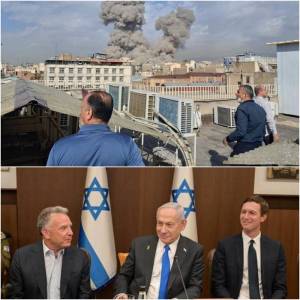
Trump-appointed so-called U.S. peace negotiators Steve Witkoff, left, and Jared Kushner, flank Israeli Prime Minisere Benjamin Netanyahu (collage, with bomb site in Iran as background).
Letters from an American, Historical Commentary: March 1, 2026 [Focus On Iran], Heather Cox Richardson, right, March 2, 2026. This morning, U.S. Central Command posted on social media that three service members have been killed in action in Operation Epic Fury and five more are seriously wounded. It continued: “Several others sustained minor shrapnel injuries and concussions—and are in the process of being returned to duty. Major combat operations continue and our response effort is ongoing.”
Democratic leaders reacted to the news with comments like this one by Senator Adam Schiff (D-CA): “My thoughts are with the families of these servicemembers, and their loved ones. And I continue to pray for the safety of every servicemember and the recovery of those wounded in these operations. May God protect our troops.” Trump’s ambassador to the United Nations, Mike Waltz—the same man who invited Atlantic editor Jeffrey Goldberg to the Signal chat about striking Yemen—suggested the soldiers’ sacrifice for the country was worthwhile, writing: “Freedom is never free.”
In a phone call with Peter Nicholas and Alexandra Marquez of NBC News, Trump said: “We expect casualties with something like this.” He added: “We have three, but we expect casualties, but in the end it’s going to be a great deal for the world.”
Later today, Trump told the American people: “As one nation we grieve for the true American patriots who have made the ultimate sacrifice for our nation. Even as we continue the righteous mission for which they gave their lives, we pray for the full recovery of the wounded and send our immense love and eternal gratitude to the families of the fallen. And sadly, there will likely be more before it ends. That’s the way it is. Likely be more. But we’ll do everything possible where that won’t be the case. But America will avenge their deaths and deliver the most punishing blow to the terrorists who have waged war against, basically, civilization. They have waged war against civilization itself.”
Trump was hosting a fund raiser at Mar-a-Lago on Friday, as the U.S. offensive began. The New York Times reported last November that tickets for the dinner dance were $1 million apiece. The optics of Trump partying with his rich cronies while American soldiers died is at least partly what is behind the fact that today, “#SendBarron” trended on social media.
Strikes continued today in the Middle East as Israel and the U.S. hit Iran and Iran retaliated against Israel and U.S. bases in the region. Iran-backed Hezbollah militants in Lebanon joined the fight by sending missiles into Israel. Israel responded with an attack on the suburbs of Beirut. Oil prices jumped sharply as traffic through the Strait of Hormuz at the outlet of the Persian Gulf, through which about 20% of the world’s oil passes, dropped almost to a halt.
After yesterday’s euphoria coming from the administration following the first strikes against Iran, today revealed that the administration had not given much thought to whether the strikes were legitimate or what would happen after them. Administration officials did not appear on the Sunday talk shows, relying instead on congressional surrogates. Brian Stelter and Kit Maher reported that journalists have been working around the White House press office, calling Trump directly, and he has been willing to talk.
Trump told NBC News reporters Nicholas and Marquez that he launched the strikes because “They weren’t willing to stop their nuclear research. They weren’t willing to say they will not have a nuclear weapon.” When asked if he would stop the strikes and negotiate, he said: “I don’t know,” but said he would consider it “if they can satisfy us,” adding that “they haven’t been able to.”
Natasha Bertrand, Zachary Cohen, and Jennifer Hansler of CNN reported this evening that briefers from the Pentagon today told congressional staff that Iran had not been planning to attack U.S. forces or bases in the Middle East unless Israel attacked first. Trump administration officials said on Saturday that Iran was planning to strike the U.S. preemptively and thus posed an imminent threat. The briefers said there was no intelligence to support that claim.
Trump seems unclear about the end game of the conflict he has started.
When NBC News reporters Nicholas and Marquez asked him what he hoped to accomplish through the military operation, he said: “There are many outcomes that are good. Number one is decapitating them, getting rid of their whole group of killers and thugs. And there are many, many outcomes. We could do the short version or the longer version.”
He told Michael Scherer of The Atlantic that Iran’s new leadership wants to talk with him and that he will do so, suggesting that he was not, in fact, interested in regime change. “They should have done it sooner, Michael. They could have made a deal. They should’ve done it sooner. They played too cute,” Trump said. But then Trump told Scherer he had confidence that the Iranian people would launch an uprising against the Iranian government.
Kristen Welker of Meet the Press this morning quoted Trump’s statement of yesterday saying “Hopefully, [Iranian troops] and Police will peacefully merge with the Iranian Patriots, and work together as a unit to bring back the Country to the Greatness it deserves.”
Then Welker asked her guest, Senator Lindsey Graham (R-SC), “Is ‘hope’ the plan for the future of Iran?” Graham said: “No, the future of Iran is going to be determined by the Iranian people. The new Iran, whatever it is…our goal is to make sure it cannot become again the largest state sponsor of terrorism.” Welker responded: “But is there a plan to make sure that happens…does the president have a plan to guarantee that that happens?” Graham responded with some heat: “No. It’s not his job or my job to do this.”
Apparently, U.S. officials simply hoped the Iranian people would seize the government if their leaders were killed in airstrikes. But there was a line of succession, and the country’s police state remains in place. Erin Banco of Reuters reported yesterday that before the attacks, analysts for the Central Intelligence Agency assessed that if Iran’s 86-year-old Supreme Leader Ayatollah Ali Khamenei were killed, younger hard-line men could replace him.
Trump told Zolan Kanno-Youngs, David E. Sanger, and Tyler Pager of the New York Times that he intends to keep bombing Iran for “four to five weeks” if necessary. He spoke repeatedly of an outcome like that of Venezuela, in which the U.S. removed the top leader but left the rest of the government intact. Trump told the reporters he hoped Iran’s military forces would turn over their weapons to the Iranian people. “They would really surrender to the people, if you think about it,” he said.
The New York Times reporters note that the security forces he says should surrender to the people were the ones that killed thousands of protesters in January. Trump refused to say that the administration would defend the Iranian people if they did rise up.
ABC News chief Washington correspondent Jonathan Karl spoke to Trump tonight and posted: “Pres Trump told me tonight the US had identified possible candidates to take over Iran, but they were killed in the initial attack. ‘The attack was so successful it knocked out most of the candidates,’ Trump told me. ‘It’s not going to be anybody that we were thinking of because they are all dead. Second or third place is dead.’”
In the midst of today’s military operation and all his calls with reporters, Trump took to social media to repost more than 40 social media posts with over-the-top praise for his State of the Union address. The posts appeared to be curated, suggesting that someone is feeding him praise.
National security scholar Tom Nichols posted on social media: “People predicting disaster: The odds are in your favor, but you cannot be sure, and you should not hope to be right. People celebrating: Maybe wanna wait a bit. The odds, historically, are definitely not on your side. Anyone certain they know what happens next is making it up.”
U.S. Governance, Politics, Elections
New York Times, Can Mountains of Money Save Cornyn and Lift Talarico in Texas? Theodore Schleifer, March 2, 2026. The primary race for Senate in Texas has become the most expensive on record, with John Cornyn and James Talarico heavily outspending their rivals. But Mr. Cornyn seems to be in trouble.
The competitive and contentious Senate primary race in Texas has become the most expensive on record anywhere in the country, according to the media tracking firm AdImpact, with more than $125 million spent on advertising.
Major Republican donors have poured cash into an effort to save Senator John Cornyn from an embarrassing defeat to Ken Paxton, the MAGA-wing state attorney general, who national G.O.P. leaders fear could jeopardize the party’s hold on the seat. Mr. Cornyn and his allies have outspent Mr. Paxton and his supporters by roughly $69 million to $4 million on advertising.
And in the photo-finish Democratic primary contest, supporters of State Representative James Talarico have helped him heavily outspend Representative Jasmine Crockett and her allies by about $24.5 million to $5 million on ads.
National Republicans have long known that Mr. Cornyn was in trouble. For about a year, his closest allies have warned his deep-pocketed supporters that he could lose — and that if Mr. Paxton beat him, he would be a more polarizing general-election candidate. The doomsday message got through to Republican donors, who have unleashed an extraordinary amount of money to shore up the sitting senator.
Their effort is on the cusp of failing — if not on Tuesday, then in a May runoff election.
Mr. Cornyn has trailed in public polls to Mr. Paxton, as President Trump withholds his all-important endorsement from the race. Because of the late entry of a third candidate, Representative Wesley Hunt, the contest is likely to head to a second round in late May, much to the chagrin of Mr. Cornyn’s big spenders.
New York Times, Labor Secretary Is a Rare Presence at Department in Turmoil, Rebecca Davis O’Brien and Evan Gorelick, March 2, 2026. Lori Chavez-DeRemer is under investigation internally after allegations of misconduct and misuse of department funds.
In the weeks after President Trump nominated Lori Chavez-DeRemer to be his labor secretary, she told potential deputies, Labor Department veterans and administration officials that her vision for the role was that of a figurehead.
Since she took office last March, that has meant traveling the country meeting with workers and employers, while back in Washington the Labor Department has descended into crisis.
The agency’s inspector general has opened an inquiry into allegations of professional misconduct by Ms. Chavez-DeRemer and her closest aides. Investigators have spoken with several dozen witnesses and reviewed evidence and allegations that the secretary used department resources for personal trips, that she was having an affair with a member of her security team and that her aides tried to steer grants to favored political operatives.
Ms. Chavez-DeRemer’s husband has been barred from the department’s headquarters, after female staff members accused him of making unwanted sexual advances. His lawyer has said the accusers were working with department employees, whom he did not name, to force Ms. Chavez-DeRemer out of office. Police and prosecutors have said they would not bring a case against her husband.
In interviews, more than two dozen current and former department employees from across the political spectrum described a toxic workplace characterized by an absentee secretary, hostile aides and a deeply demoralized staff. Most of them spoke on the condition of anonymity because they were not authorized to discuss department business or because they feared retribution.
“The crisis at the Department of Labor is a crisis of leadership,” said Helen Luryi, who until April worked in the department’s Women’s Bureau. “Over the past few weeks we’ve learned that not only is she not doing her job, she’s embroiling the department in scandal and possible criminal activity. It’s frankly embarrassing.”
The department’s troubles spilled into the open in January, after an internal complaint was filed with the inspector general. Senator Charles E. Grassley of Iowa, the Republican chair of the Judiciary Committee, has called the allegations troubling and sought internal records and statements from the department.
A spokeswoman for the Labor Department, Courtney Parella, said, “The secretary remains focused on advancing the president’s America First agenda and carrying out the department’s mission to support American workers.”
Ms. Chavez-DeRemer’s chief of staff, Jihun Han, and deputy chief of staff, Rebecca Wright, have been placed on leave during the internal investigation, people familiar with the inquiry said. They have been accused of concocting official trips for the secretary so that she could spend time with friends and family, bullying staff members and trying to silence critics within the department.Editors’ Picks‘The Pitt’ Is Showing Us the Complicated Reality of PsychosisAre We in a ‘Smut Renaissance’?How a Parks Worker Lives on $37,500 in Tompkinsville, Staten Island
The investigation has in some ways improved morale, some department employees said, by exiling some of the secretary’s closest and most problematic allies, even as it threatens to unravel the executive office.
New York Times, States Move to Limit Access to H.I.V. Treatment, Apoorva Mandavilli, March 2, 2026. Citing rising costs and shortfalls in federal support, about 20 states are toughening eligibility requirements for patients in drug assistance programs.
Tens of thousands of Americans are losing access to treatment for H.I.V. as nearly 20 states impose restrictions on assistance programs and several others weigh such changes.
The states, led by both Democrats and Republicans, are tightening requirements for people benefiting from Ryan White AIDS Drug Assistance Programs, or ADAPs, according to an analysis released on Monday by the health research group KFF.
The programs help pay for H.I.V. medications or provide them free to some people, and pay insurance premiums for others.
H.I.V. medications suppress the virus to undetectable levels, eliminating the chance of spreading it to others. Interrupting treatment may lead to an increase in new infections and in AIDS cases.
Moreover, some people may try to extend their supplies by alternating days or sharing their pills with others. If the virus replicates in people with only partial protection, it can become resistant to the medications. People living with the virus may then pass the resistant virus on to others.
The biggest change took effect in Florida on Sunday, when officials cut off benefits for at least 16,000 residents living with H.I.V. The state also will no longer cover Biktarvy, the most widely prescribed H.I.V. medication.
On Friday, the Centers for Medicare & Medicaid Services opened a special enrollment period allowing Floridians who lose financial support for insurance premiums to choose a new plan. The period ends April 30.
ADAPs support roughly 25 percent of the 1.2 million people living with H.I.V. in the United States. The programs had a 30 percent surge in enrollment from 2022 to 2024, in part because states were removing people from Medicaid after keeping them on during the pandemic.
ADAPs are funded by Congress through the Ryan White federal H.I.V. program. The programs are contending with rising costs as H.I.V. drugs become more expensive even as health care subsidies have expired, sending premiums soaring.
At the same time, funding for the programs has remained flat for more than a decade.
New York Times, Scientists Decry ‘Political Attack’ on Reference Manual for Judges, Karen Zraick, March 2, 2026. More than two dozen contributors to the manual criticized the deletion of a chapter on climate science by the Federal Judicial Center.
More than two dozen contributors to a widely used reference manual for judges are raising alarm bells about political interference after the deletion of a chapter on climate science.
The uproar is over the latest edition of the Reference Manual on Scientific Evidence, which has been published since 1994 by the Federal Judicial Center, an agency that provides resources to judges. A group of Republican state attorneys general sent a letter to the center on Jan. 29, claiming that the climate chapter was biased and demanding its retraction. About a week later, the center deleted the chapter from its online edition of the nearly 1,700-page manual.
A new letter posted on Monday, signed by 28 experts in science, technology and law who had written other chapters of the manual, strongly criticized the move. The topics they had written about included engineering, neuroscience and toxicology. Their letter was posted online by Science Politics, a publication of Georgetown University’s School of Foreign Service.
“The coordinated effort by 27 state attorneys general to remove that peer-reviewed content is a direct challenge to the independence of the federal judiciary and an attack on a thoroughly vetted exposition of climate science that those attorneys general do not like,” the letter said.
The two most recent editions of the manual were developed with the National Academies of Sciences, Engineering and Medicine, a private organization chartered by Congress in 1863 to advise the nation on technical matters. The National Academies said previously that it stood by the chapter and did not plan to remove it from its website, where it remains accessible.
That resulted in another letter by Republican state attorneys general, led by Austin Knudsen of Montana. On Feb. 19, Mr. Knudsen and 20 of his counterparts wrote to the leadership of the National Academies, calling it “unacceptable” that the organization had allowed the chapter to remain in circulation.
The letter pointed to taxpayer support for the organization and requested a response by March 2. A spokesperson for the National Academies said it had received the letter and would respond in a timely manner.
The letter from the contributors to the manual warned that political interference could potentially affect every scientific discipline relevant to complex litigation. “The political attack by the attorneys general on a carefully and rigorously prepared scientific publication should concern us all,” the letter said.
New York Times, As Kennedy Turns From Vaccines, MAHA Allies See a ‘Betrayal,’ Benjamin Mueller, March 2, 2026. As the midterm elections approach, the health secretary is focusing on “real food.” Anger is rising among some of his supporters.
To all appearances, it was the next stage in the dismantling of the American vaccine program. Federal regulators refused last month to review a new mRNA flu shot from Moderna, the latest consequence of Health Secretary Robert F. Kennedy Jr.’s campaign to give skeptics control of the bureaucracy overseeing inoculations.
 But then, curiously, regulators had a change of heart. Within weeks, the review of the mRNA shot was back on.
The reversal strengthened a belief that has gained traction lately among Mr. Kennedy’s most zealous anti-vaccine followers. In their view, the health secretary has erred not by taking a sledgehammer to the country’s vaccine apparatus, but rather by leaving too much of the edifice standing.
On Mr. Kennedy’s watch, millions of children in recent months still received Covid shots, “the deadliest vaccine ever made,” as he has falsely described it. The manufacturers remain protected from liability claims, despite Mr. Kennedy’s blaming that system three years ago for enabling “mass murder.”
 Influential vaccine skeptics are starting to depart even from the Centers for Disease Control and Prevention, the engine of anti-vaccine policy changes this past year.
Some of Mr. Kennedy’s supporters have responded by accusing pro-vaccine factions of staging a “coup” at the health department, and are vowing to retaliate by deserting the Republican Party in this year’s midterm elections.
But Mr. Kennedy, left, has largely stopped talking about vaccines at all: On a national tour and in recent social media videos promoting the Make American Healthy Again agenda, he scarcely mentions steps he has taken to scrap recommended childhood shots, tie autism to vaccines and call off critical research.
Those measures have alienated many Americans and outraged public health experts, who fear that they will drive down the use of safe and effective vaccines amid a resurgence of diseases like measles and whooping cough.
Instead, with the help of the boxer Mike Tyson, Mr. Kennedy has pivoted toward more politically palatable messages about “real food.”Editors’ Picks‘He Opened the Safe and Took Out All the Cash That Was There’The Very Real Benefits of Tai Chi WalkingDon’t Call It a Wedding. It’s a Domestic Partnership Party.
Now rank-and-file vaccine opponents are suffering a crisis of faith in their longtime standard-bearer, compounding the fallout within the MAHA movement over Mr. Kennedy’s decision to endorse a federal order promoting the weedkiller glyphosate.
Derrick Wynne, 35, who lives near Houston, said he had once seen the health secretary as a fellow traveler in “our fight for accountability within the medical industry.”
A former Army soldier, Mr. Wynne lost his military benefits and moved in with his girlfriend’s parents after being discharged in 2022 for refusing a Covid shot. When Mr. Kennedy campaigned for president two years later, he cited Mr. Wynne’s case in a post online, promising “accountability.”
The ex-soldier took heart, believing that he had finally found a politician committed to ending the power of pharmaceutical companies in Washington. He is no longer so sure.
“They think if they just pacify us and, you know, dangle a couple illusions in front of us, like ‘We got red dyes out of Froot Loops’ or whatever, that’ll keep us quiet,” Mr. Wynne said.
But for an anti-vaccine movement still brimming with rage at the federal government’s response to the pandemic, the demand that Covid shots be shelved would not abate, he said, despite whatever else Mr. Kennedy does to appease his backers.
“People are basically kind of seeing through the facade,” Mr. Wynne said. “It’s all just been words.”
Activists with ties to senior health officials are warning that the MAHA movement, having punished the Democratic Party in 2024 for shunning Mr. Kennedy, will take its anger out on Republicans this year.
“If the Moderna mRNA flu shot is approved, the medical freedom movement will abandon the Republican Party in the midterm elections,” Toby Rogers, a vaccine opponent recently named to a federal autism advisory committee, wrote online. “That’s not a threat, that’s a promise.”
New York Times, Austin Shooting Stokes Anti-Islam Speech Among Texas Conservatives, Lauren McGaughy, March 2, 2026. With primaries on Tuesday, politicians quickly cited the attack in their campaign messaging. Some Republicans called for stopping immigration, while Democrats called for gun control.
Texas Republicans are calling for more scrutiny of the state’s Muslim community after federal authorities said this weekend’s fatal bar attack in Austin had a “potential nexus to terrorism,” with some calling for an immigration ban.
Their demands came amid rising anti-Muslim sentiment in Texas in recent years, which is cresting ahead of Tuesday’s primary. Democrats countered with calls for stricter gun laws.
The shooter, who opened fire at a downtown bar popular with college students, was wearing a sweatshirt that said “Property of Allah” and had a Quran in his vehicle, according to a law enforcement official with direct knowledge who was not authorized to speak publicly about the investigation. He was later identified as Ndiaga Diagne, 53, an naturalized American citizen originally from Senegal.
Three people died at the scene, including Mr. Diagne, who was shot by police officers. More than a dozen were injured.
Representative Chip Roy seized the moment to call on Congress to pass legislation he wrote that would halt nearly all legal immigration. Mr. Roy, a conservative Republican, is running in a crowded primary field to become Texas attorney general.
What you should know about anonymous sources. The Times makes a careful decision any time it shields the identity of a source. The information the source supplies must be newsworthy, credible and give readers genuine insight.Learn more about our process.
“Muslim immigrant violence — naturalized or not — is preventable,” Mr. Roy posted on the social media site X. “Until Democrats (& Republicans) find the courage to say no to the mass migration of Islamists, our country will be plagued with more tragedies…”
Ken Paxton, the attorney general of Texas, who is leaving that role to challenge U.S. Senator John Cornyn in the Republican primary, endorsed a post on X that called for “no more Islamic immigration.”
Mr. Cornyn stopped short of calling for a halt to all immigration but said “Radical Islam has no place in Texas and our country.”
Morning Shots via The Bulwark, Political Opinion: It’s Not Too Late for Congress to Act, William Kristol, right, March 2, 2026. Over the past year, the Trump administration has done great damage both to our free government at home and to the cause of freedom abroad. Now it has sadly—even tragically—put the admirable cause of freedom for the people of Iran at odds with upholding the Constitution of the United States.
In June of last year, when the United States acted to help Israel damage Iran’s nuclear program, President Trump drew the line short of seeking regime change. But at some point since then, the Trump administration seems to have decided that in fact regime change was the only real solution to the dangers posed by the Iranian regime, and that now was the time to finally help the people of Iran liberate themselves from their dictatorship.
I don’t quarrel with this judgment. Indeed, there were many occasions over the last two decades that we could have done more to help the people of Iran move towards freedom. Now, two days into the war, one can’t help but be moved by the scenes of citizens of Iran taking to the streets to welcome the prospect of liberation from their cruel and despotic regime.
Could their belated liberation be at hand? One hopes so.
There were indications—most obviously the massive deployment of military forces to the region in recent months—that the administration was planning on a major war aimed at regime change in Iran. Given the lack of evidence of serious reconstruction of Iran’s nuclear program, and given that there was no reason to fear any kind of imminent danger from Iran’s missiles, the aims of that war were clearly going to go beyond simply further degrading those programs. And it’s now obvious that the administration has been working with Israel for quite a while on an attack whose scope and scale is consistent with the goal of regime change.
So, in announcing the attack early Saturday morning, President Trump said,
Finally, to the great, proud people of Iran, I say tonight that the hour of your freedom is at hand. . . . When we are finished, take over your government. . . . For many years, you have asked for America’s help, but you never got it. No president was willing to do what I am willing to do tonight.
But the president’s action was his alone. He had plenty of time over the last couple of months to make the argument to the American people for regime change in Iran. He didn’t. Even more important, he had plenty of time to go to Congress for authorization for such a war. He didn’t. He probably would have prevailed in such a vote. If he hadn’t, then he could and should have held off on going to war.
But Trump didn’t go to Congress. So now we are in both a major war and a constitutional crisis.
Congress may now have a limited ability to affect the course of the war. But it can respond to the constitutional crisis. Congress will have a chance this week to assert its role, even if belatedly, with some form of War Powers resolution. It can show it is unwilling to leave crucial questions of war and peace to the full and unlimited discretion of the executive. It can refuse to acquiesce in the shredding of our Constitution.
Meanwhile, Trump is unfortunately spreading confusion about rather than clarifying our war aims. Over the last two days, President Trump made such contradictory remarks that one can have no confidence that he really knows what he’s doing. The Economist’s Gregg Carlstrom summarized the situation well early this morning:
I very much hope that this war doesn’t end with the region in “an absolute mess.” I very much hope it results in a better Middle East, and in freedom for the people of Iran. Congress may not be able to do much to get the president to focus seriously and consistently on this objective. But Congress can at least uphold and strengthen our constitutional order. Congress can act to prevent Donald Trump from leaving our own Constitution “an absolute mess.”
In Case You Missed It. . .
If you decided to enjoy your weekend and wait to catch up on the news until this morning, we have everything you need. Here’s what we published on Iran over the past two days:
Mark Hertling cautions that launching air strikes is easy; translating violence into political change is much, much harder. The administration has lofty goals, but it’s not clear they have a plan to achieve them. Simply put: You can’t bomb someone into democracy.AROUND THE BULWARK
China Is Ready For War. We Aren’t… On Shield of the Republic, ERIC EDELMAN and ELIOT COHEN recap the State of the Union, debate rising global tensions and U.S. military strategy, and talk with CSIS’s SETH JONES about China’s defense production, U.S. procurement woes, and lessons from Ukraine.Quick Hits
GRUBBING FOR ANTHROPIC’S BUSINESS: In its standoff with the AI company Anthropic, the Defense Department has been as bad as its word. On Friday, after it became clear that Anthropic would not drop its redlines forbidding use of its AI for mass domestic surveillance or autonomous weapons systems, Defense Secretary Pete Hegseth went nuclear—not just canceling the Pentagon’s $200 million Anthropic contract, but also banning all defense contractors from working with Anthropic in any way. It was a ridiculous, utterly disproportionate retaliation: The Pentagon now officially trusts Anthropic, the American AI lab that until now has been the most enthusiastic about supporting U.S. national-security aims, less than it does Chinese AI firms like DeepSeek.
Watching this situation unfold, America’s other leading AI labs could have decided to stand in solidarity with Anthropic’s modest redlines. Instead, they mostly just leapt at the opportunity to pick up Anthropic’s vacated market share. It wasn’t particularly shocking, for instance, to see Elon Musk using the fight to further ingratiate himself with the right-wing government, denouncing Anthropic as an enemy of Western Civilization and inking a deal for his Grok AI to be used in classified military settings.
What was perhaps surprising was how OpenAI responded. The company behind ChatGPT didn’t stand in solidarity with Anthropic—but they didn’t twist the knife like Musk either. Instead, plainly realizing that much of their customer base was sympathetic with Anthropic’s stand, they did perhaps the least defensible thing of all: They signed a new deal agreeing to Hegseth’s no-guardrails terms while publicly lying that their contract enforced the same red lines Anthropic wanted. In reality, as was soon reported, OpenAI’s contract contained language that made it sound like the company shared Anthropic’s concerns about domestic surveillance and killer robots—while actually leaving all the relevant decisionmaking in the hands of the Pentagon. The effect was to knife Anthropic while also giving political cover to Hegseth by suggesting Anthropic’s stance wasn’t really about its redlines at all, but some other thing. Not great!
LET SLIP THE DOVES OF WAR: Look, it’s far from the most important thing right now. But amid all the fear and anxiety sparked by America plunging headfirst back into military adventurism in the Middle East, we admit to feeling a little schadenfreude about the isolationists Donald Trump has brought along for the ride.
Vice President JD Vance and Director of National Intelligence Tulsi Gabbard both built their political brands through years of accusing other members of their own parties of being bloodthirsty warmongers lusting after “regime change” around the world. Now they’re experiencing a harsh reminder that today’s Republican party doesn’t really hate war—it only hates people Trump decides to call warmongers when it suits him. When it’s Trump himself out here mongering¹ the wars, it’s a whole other story.
“I certainly empathize with Americans who are exhausted after 25 years of foreign entanglements in the Middle East,” a pained-looking Vance said on Meet the Press yesterday. “But the difference is that back then we had dumb presidents, and now we have a president who actually knows how to accomplish America’s national security objectives.” Easy as that, huh?
U.S. Media, Culture, Religion, High Tech
The Contrarian, Opinion: An Illegal, Unjustified War Underscores Danger of Media Consolidation, Jennifer Rubin, right, March 2, 2026. We need diverse, critical news coverage more than ever.
Donald Trump launched another illegal war over the weekend, throwing out patently false justifications for a war of choice. Fortunately, CNN was among those with swift, accurate, and aggressive coverage. But what if CNN were reduced to a captive of Trump’s billionaire buddy, David Ellison? That’s what lies ahead, unless Ellison’s proposed takeover of Warner Bros. is stopped. And it can be.
Media industry coverage at the end of last week by and large treated the announced Paramount/CBS takeover of Warner Bros. as a done deal. Reports too often seemed to skip past the significant legal barriers to the merger, preferring to go straight to the panic. Certainly, if the merger goes through, the new mega-conglomerate will further consolidate an industry already overly consolidated. Even more ominous for democracy, the merger would put another news outlet known for exacting coverage of breaking foreign events, CNN, in the hands of a Trump-friendly billionaire.
However, the deal is not done. Defenders of democracy and advocates of competitive markets are already digging in, and they deserve public support from Americans rightly concerned about the growing power of unaccountable oligarchs who control an increasing slice of our economy and dominate our politics.
No doubt, the fix is likely already in with Trump’s corrupt Justice Department to rubber stamp the merger, but DOJ is not the only hurdle. Most importantly, our federal system provides another avenue to contest the deal. (UK and EU regulators will also get to weigh in.)
Fortunately, within hours of Ellison’s announcement, California Attorney General Rob Bonta, in a statement released on a platform ingested by another Trump billionaire pal (Elon Musk), wrote: “Paramount/Warner Bros. is not a done deal.” He added, “These two Hollywood titans have not cleared regulatory scrutiny — the California Department of Justice has an open investigation, and we intend to be vigorous in our review.”
State antitrust litigation has become a robust, viable alternative to the feds. George Mason Law Review in 2022 explained: “State antitrust regulators have brought dozens of large cases over the last twenty years in areas from telecom mergers to complex pharmaceutical cases.” The article continued that while individual cases used to be the norm, “many cases are now brought as multistate actions incorporating large groups of attorneys general joined into one litigation that is filed in federal court under the Sherman or Clayton Act.”
Bonta, as he has in a host of other cases brought against the Trump regime, may well find partners among other active Democratic attorneys general.
Bonta was hardly alone in expressing concern. Former FTC commissioner Alvaro Bedoya added, “One family is about to control CBS, CNN, HBO, and TikTok. They’ll buy WBD with $24 billion in money from the Saudis, Qatar, and Abu Dhabi. To win over Trump, they canceled Colbert, blocked a CECOT investigation, and blocked [James] Talarico. Much more will follow. Block this rotten deal.” Consider how an outlet with heavy investment from Middle East countries might be less than independent in its coverage of nuanced wars involving those very countries.
Democrats on Capitol Hill also have a role to play. Sen. Chris Murphy (D-Conn.) was exactly right to lay down a marker and elevate the merger to a critical election issue. “Paramount should enjoy its growing news monopoly while they have it because when Democrats win back power we are going to break up these anti-democratic information conglomerates,” Murphy said. “All of them.”
Antitrust is not usually a sexy subject, but given public animosity against big business and big tech specifically, this issue’s time may have come. Sens. Elizabeth Warren (D-Mass.), Adam Schiff (D-Cal.), and Cory Booker (D-N.J.) all blasted the proposed deal.
Warren, a longtime antitrust warrior, questioned whether the bidding for Warner Bros. was rigged:
A Paramount Skydance-Warner Bros. merger is an antitrust disaster threatening higher prices and fewer choices for American families. What did Trump officials tell the Netflix CEO today at the White House? A handful of Trump-aligned billionaires are trying to seize control of what you watch and charge you whatever price they want. With the cloud of corruption looming over Trump’s Department of Justice, it’ll be up to the American people to speak up and state attorneys general to enforce the law.
If Democrats win control of one or both house, they will be able to subpoena records, conduct hearings, and propose legislation to slow down or block merger mania.Subscribed
The head-snapping consolidation of entertainment and news, coupled with billionaire Trump-suck ups’ acquisition of news properties, has transformed the media landscape. This did not begin with Trump, but the added ingredient of oligarch capture now poses an existential threat to entertainment diversity and news independence — while introducing the potential for foreign interference and manipulation of our news and entertainment.
As disturbing as entertainment monopolies may be (fewer outlets will pay lower wages, charge higher prices, and neglect markets deemed “too niche”), the gravest danger to democracy is allowing corporations and oligarchs beholden to the president (i.e., friendly or compromised by fear of regulation or retaliation) to have a stranglehold on news coverage. (Strongmen in Italy and Hungary took precisely this path.)
CNN soon may be cheerleading every regime-change war, putting MAGA toady Scott Jennings in the anchor chair, and canning legitimate news people (e.g., Anderson Cooper, Wolf Blitzer, Dana Bash). You don’t even have to use your imagination. CBS head Bari Weiss’s blocking 60 Minutes’ CECOT report and her cringeworthy tweet sneering at New York Mayor Zohran Mamdani and his critique of the illegal war tells you how far CBS has fallen — and likely where CNN is headed.
How long before tenacious Kaitlan Collins gets yanked from the White House beat or every guest and panelist is an inveterate MAGA liar? If CNN recently has been too accommodating to Trump (e.g., the ridiculed town hall, a presidential debate without factchecking), that coverage many soon seem like aggressive journalism by comparison to oligarch news.
Of course, Ellison could decide to shutter either CNN or CBS entirely. But even if CNN survives in some form, Ellison/Weiss control would quickly destroy its credibility, leaving viewers outside the MAGA cult with few choices. Creating a national news desert may be autocrats’ goal.
 False Flag via The Bulwark: Commentary: MAGA Already Hates Trump’s Iran War, Will Sommer, March 2, 2026. Less than seventy-two hours into Donald Trump’s new war with Iran, the pundits and podcast hosts who make up his base of support are revolting. That’s a problem for Trump, since these disaffected pro-Trump personalities can sway his most dedicated fans, many of whom are already wary of another military quagmire in the Middle East.
DESPITE HIS PRESIDENTIAL campaign promises to put America first, Donald Trump didn’t seem to upset his media allies too much when he bombed Iran last June, or when he sent Delta Force to abduct Venezuelan President Nicolás Maduro in January.
But those engagements were limited, free of American fatalities, and didn’t appear to produce much in the way of immediate consequences for Trump or the country. Even white nationalist Nick Fuentes became an old-school Monroe Doctrine imperialist.
Trump’s latest attacks on Iran this weekend, however, have given rise to a much more negative reaction in right-wing media.
After a quick flurry of support for the initial strikes (with even some self-professed America-firsters reversing themselves and supporting the attacks), the mood became much more dour.
Megyn Kelly, on her Monday show, said she had “serious doubts” about what the White House was doing in Iran. Appearing on Kelly’s show, former Rep. Marjorie Taylor Greene suggested Trump has gone insane—adding that Trump’s oft-repeated statement about not knowing if he’ll get into heaven raises questions about his state of mind and competency.
“We need to have a serious conversation about what the fuck is happening to this country, and who in the hell are these decisions being made for, and who is making these decisions,” Greene said.
Recent White House visitor Tucker Carlson, arguably the most outspoken war opponent still in Trump circles, announced on his show Monday that Trump had been duped into the war by Israel.
“This happened because Israel wanted it to happen,” Carlson said in a video Monday slamming the attacks. “This is Israel’s war.”
Curiously, Carlson barely mentioned Trump by name in his video, perhaps hoping to preserve his relationship with the administration. After Trump alluded to reported Iranian attempts to kill him, Carlson wondered whether Israel had faked that intelligence to draw Trump into an attack.
“Maybe it doesn’t show that, because this country has certainly been manipulated a lot by Israeli intelligence—and other foreign countries’ intelligence, but certainly by Israeli intelligence,” Carlson said.
Carlson wasn’t alone on the right in speculating about—or outright leveling accusations about—whether Trump went to war for Israel. And amid the recriminations, Secretary of State Marco Rubio decided to confirm exactly that, saying on Monday afternoon that the United States attacked because an impending Israeli strike on Iran would have precipitated Iranian attacks on American bases. This was met with groans by right-wing pundits.
“So we are at war for Israel,” wrote the Hodge Twins, a pair of twin brothers who are popular MAGA influencers. “Thanks for confirming.”
Support our coverage of the right, the far-right, and the far-out right—sign up for a Bulwark+ membership today:Subscribed
FOR SOME RIGHT-WING CRITICS of the operation in Iran, such as Carlson, their skepticism is in keeping with longstanding opposition to military adventurism abroad. But it also could have been informed by news events. By Sunday, it had become clear that the administration was expecting the Iran bombing to continue for weeks, and that at least three U.S. service members had already died (today, that count rose to six). After a New York Times poll found just 21 percent of Americans supported the attack, Steve Bannon declared the results “brutal.”
That left even reliable Trump boosters to try and find innovative ways to continue to support the president while signaling concerns about his Iran policy. The Daily Wire’s Michael Knowles limply declared that Trump would be like George W. Bush, but somehow better.
“Initially it was, ‘Bush had the wrong idea,’” Knowles said on his show. “Now the argument would be, ‘Well, Bush might have had the right idea, but he did it poorly.’”
This idea that the Trump administration, not generally known for its competence, will succeed in a domain where past American administrations have failed has caught on. Pundit Will Chamberlain said conservatives worried about a forever war in Iran should just realize Trump won’t fall into that trap, somehow:
At this point, the best-case scenario for Trump is that his supporters aren’t really concerned about Iran and want Trump to go back to focusing on economic issues. Breitbart’s Matt Boyle, perhaps the most diehard Trump sycophant in the entirety of MAGA media, posted on X that callers to his radio show didn’t care about Iran. Boyle even noted that he was trying really hard to highlight the Iranian strikes for his audience. And yet, nothing.
“Just no energy on the Iran issue at all,” Boyle wrote.
That’s not to say the war doesn’t have its backers. Conservative pundits who have closely aligned themselves with American support for Israel, like Laura Loomer and Fox News host Mark Levin, have been supportive.Subscribed
But other Trump allies find their energy for the war already starting to flag. One challenge is that the administration isn’t giving them much to work with.
Boosters of the 2003 Iraq invasion had months of talking points to draw on. By comparison, this administration hasn’t explained—at least coherently—exactly why the war is necessary or what its goals are. Charlie Kirk lieutenant Andrew Kolvet, for example, said he had heard Iran was working on dirty bombs—but, he wondered, why hadn’t the Trump administration bothered to say that?
Federalist cofounder Sean Davis, typically a doctrinaire Trump supporter, similarly griped on X that the White House hadn’t done anything to explain the war.
“The lack of any coherent message seems to suggest the lack of any coherent objective,” Davis wrote.
Daily Wire host Matt Walsh has been one of the right’s most outspoken critics of the war, saying Trump’s allies who are still backing the attacks are blindly placing their faith in the man.
“They [the administration] could have reasons for doing what they’re doing that I don’t know about or understand. But that is also the exact argument we heard during COVID,” Walsh wrote on X, putting it in terms that must sting for the Trump team.
Status, Media News: CNN’s Cosplaying Correspondent, Oliver Darcy, March 2, 2026. Scott Jennings pushed a dubious White House talking point on Iran to millions, only for CNN’s actual reporters to knock it down—an episode that drew blowback inside the network, Status has learned.
On Sunday evening, CNN published a report pouring cold water on a claim anonymously peddled by the Trump administration that had ricocheted across MAGA Media.
 The story revealed that, in closed-door briefings with congressional staff, Pentagon officials acknowledged that Iran was not planning to launch an unprovoked strike on U.S. forces in the Middle East. The reporting must have made for uncomfortable reading for CNN’s resident MAGA pundit, Scott Jennings (shown at right in a Gage Skidmore photo).
Earlier in the weekend, Jennings blasted the claim out to his nearly one million followers on X, asserting that senior Trump administration officials had told him “that credible intelligence indicated Iran planned preemptive missile strikes against US military targets in the region, and against civilian targets as well.” In Jennings’ own telling, “Failure to act would’ve resulted in mass US casualties.” His post was shared more than 13,000 times and racked up over five million views, according to the platform’s analytics.
Behind the scenes, Status has learned that the episode did not sit well with many of CNN’s actual journalists. Jennings, who often cosplays as a reporter while wrapping himself in the CNN banner, is a paid talking head, not a reporter. According to multiple people familiar with the matter…
Celebrating the Censor: The White House Correspondents’ Association is facing criticism after Donald Trump said he would attend this year's annual dinner where the organization offered to welcome him as an "honoree."
In a Truth Social post, Trump stunned many when he announced, "In honor of our Nation’s 250th Birthday, and the fact that these 'Correspondents' now admit that I am truly one of the Greatest Presidents in the History of our Country, the G.O.A.T., according to many, it will be my Honor to accept their invitation, and work to make it the GREATEST, HOTTEST, and MOST SPECTACULAR DINNER, OF ANY KIND, EVER!"
In a statement of her own, WHCA President Weijia Jiang said, "We're happy the president has accepted our invitation and look forward to hosting him." Suffice to say, coaxing the president into attending by designating him as some sort of "honoree" is sure not to sit well with many members
Media News
Futurism, Ars Technica Fires Reporter After AI Controversy Involving Fabricated Quotes, Maggie Harrison Dupré, March 2, 2026. Benj Edwards is no longer working at Ars Technica following an AI controversy that angered readers.
The Condé Nast-owned Ars Technica has terminated senior AI reporter Benj Edwards following a controversy over his role in the publication and retraction of an article that included AI-fabricated quotes, Futurism has confirmed.
Earlier this month, Ars retracted the story after it was found to include fake quotes attributed to a real person. The article — a write-up of a viral incident in which an AI agent seemingly published a hit piece about a human engineer named Scott Shambaugh — was initially published on February 13. After Shambaugh pointed out that he’d never said the quotes attributed to him, Ars‘ editor-in-chief Ken Fisher apologized in an editor’s note, in which he confirmed that the piece included “fabricated quotations generated by an AI tool and attributed to a source who did not say them” and characterized the error as a “serious failure of our standards.” He added that, upon further review, the error appeared to be an “isolated incident.” (404 Media first reported on the retraction.)
Shortly after Fisher’s editor’s note was published, Edwards, one of the report’s two bylined authors, took to Bluesky to take “full responsibility” for the inclusion of the fabricated quotes.
In the post, Edwards said that he was sick at the time, and “while working from bed with a fever and very little sleep,” he “unintentionally made a serious journalistic error” as he attempted to use an “experimental Claude Code-based AI tool” to help him “extract relevant verbatim source material.” He said the tool wasn’t being used to generate the article, but was instead designed to “help list structured references” to put in an outline. When the tool failed to work, said Edwards, he decided to try and use ChatGPT to help him understand why.
“I should have taken a sick day because in the course of that interaction, I inadvertently ended up with a paraphrased version of Shambaugh’s words rather than his actual words,” Edwards continued. He emphasized that the “text of the article was human-written by us, and this incident was isolated and is not representative of Ars‘ editorial standards. None of our articles are AI-generated, it is against company policy and we have always respected that.”
Edwards also stressed that his colleague Kyle Orland, the site’s senior gaming editor who co-bylined the retracted story, had “no role in this error.”
The controversy was met with a wave of pushback and speculation from Ars readers, many of whom expressed deep frustration and disappointment in a lengthy comment thread on the website. On February 27, Ars creative director Aurich Lawson, while closing the comment thread, said that “Ars has completed its review of this matter” and that “the appropriate internal steps have been taken.”
“In the coming weeks, we’ll publish a reader-facing guide explaining how we use and do not use AI in our work,” Lawson wrote. “We do not comment on personnel decisions.”
As of February 28, Edwards’ bio on Ars was changed to past tense, according to an archived version of the webpage. It now reads that Edwards “was a reporter at Ars, where he covered artificial intelligence and technology history.”
Futurism reached out to Ars, Condé Nast, and Edwards to inquire about the reporter’s employment status. Neither the publication nor its owner replied. Edwards said he was unable to comment at this time.
Ars‘ retraction isn’t the first AI controversy to rock a newsroom, nor to anger a publication’s readers. It also comes at a moment in which many media bosses are pushing staff to find uses for AI — as are executives across most industries — even while clear guidelines around use of the technology that uphold editorial ethics remain elusive.
These edicts to integrate AI, meanwhile, are backdropped by a complicated, ever-shifting landscape: contentious copyright battles between news giants and AI companies; simultaneous deal-striking by news giants and AI companies; an internet increasingly full of AI-generated slop news and misinformation; and a traffic cliff tied to Google’s “AI Overviews,” which now paraphrase news instead of pointing readers to a list of blue links.
It’s a combustive, disorienting moment in the history of media and technology, when lines in the sand are being drawn by both journalists and their audiences. And the Ars fallout underlines a phenomenon we’ve seen again and again, as even people who are deeply familiar with AI and its shortcomings can end up relying on it at a critical moment — and in the process, fall victim to something much older than generative AI: human error.
“The irony of an AI reporter being tripped up by AI hallucination is not lost on me,” Edwards said in his February 15 Bluesky post. “I take accuracy in my work very seriously and this is a painful failure on my part.”
Status, The Sunday Spotlight: The Trouble Covering Tehran, Natalie Korach, March 1, 2026. As U.S. and Israeli forces launch deadly strikes on Iran, the inherent challenges of covering the country are exacerbated by recent newsroom cuts, social media distortion, and a White House prone to telling lies.
When the U.S. invaded Iraq in 2003, Americans watched the war unfold through footage captured by journalists embedded with troops across the region. Two decades later, when Russia invaded Ukraine, foreign correspondents from U.S.-based networks raced to Kyiv and other areas of conflict, broadcasting live as missiles struck Ukrainian territory. But when the United States and Israel launched strikes on Iran over the weekend, there were few, if any, Western journalists in the country to document the damage firsthand.
In a nation largely closed to Western media and with broadly limited internet access, the conflict is unfolding as something of an information black box, forcing news organizations to cover one of the most consequential military escalations in years largely from the outside. Adding to the challenge: Whether they can trust pronouncements coming from a Trump administration that has exhibited few compunctions about lying, from the president on down; and the degradation of social media, especially X, which is no longer a reliable source of information in breaking news situations.
Major television news networks and newspapers tasked with covering the war are having to piece together events from government statements, grainy videos circulating online, and reports from Iranian state media. In an era where many news organizations have been forced to scale back foreign bureaus and reporting resources—most notably the recent and devastating cuts at The Washington Post—the conflict is quickly becoming a test for media, exacerbated by the fact that Iran remains one of the most difficult places on earth for journalists to operate safely.
The geographic spread of the reporting team at CNN, the U.S. network with arguably the most foreign reporting resources, illustrates the challenge. The network has reporters fanned out across the region—Erin Burnett, Nick Paton Walsh, and Jeremy Diamond in Tel Aviv, Nic Robertson in Riyadh, Becky Anderson in Abu Dhabi, Paula Hancocks in Dubai, and Clarissa Ward reporting from Erbil in northern Iraq. Elsewhere across cable news, Fox News had Trey Yingst reporting live from Tel Aviv, Nate Foy on the ground in Cyprus, and Lucas Tomlinson in Istanbul. But none appeared to be inside Iran as of Sunday afternoon.
The New York Times is similarly mobilizing its global newsroom to cover the unfolding conflict. A spokesperson for the paper told Status that “hundreds of journalists from across The Times' global newsroom–in New York, Washington, London, Seoul and a large and growing reporting team on the ground in the region–have been coming together to produce comprehensive coverage of every aspect of this military action.”
But few news organizations still possess the global infrastructure to support half a dozen or more reporters monitoring the situation on the ground in neighboring countries. Years of budget cuts have thinned the ranks of foreign correspondents in the region across the industry. At The Post, recent layoffs hit international coverage particularly hard, with the paper’s entire Middle East desk laid off. In January, Post reporter Yeganeh Torbati, who had been covering Iran, publicly appealed to owner Jeff Bezos on social media alongside colleagues, noting that she had spent months covering developments inside the country and wanted to continue the work. The appeals to Bezos to save the foreign reporting staff went unheeded.
“If I were The Washington Post right now, I’d still want international journalists,” Ian Bremmer wrote on social media, where many experts called attention to the terrible timing of The Post’s retrenchment during this moment of crisis abroad. Spokespersons for The Post did not respond to requests for comment, but the paper’s rolling coverage of the conflict dominated its homepage all weekend.
Morning Shots via The Bulwark, Political Opinion: A Directionless War Meets a Constitutional Crisis, Bill Kristol, Andrew Egger and Jim Swift, March 2, 2026. Welcome to the new era of Trumpism.
As we were putting this newsletter to bed this morning, Secretary of Defense Pete Hegseth took to a Pentagon podium to brief the media on the ongoing state of the conflict in Iran. TL;DR: Mission Accomplished.
Iran’s regime, he said, has waged a “savage, one-sided war against America” for decades. “We didn’t start this war, but under President Trump, we are finishing it.” Apparently, this war will go better than Iraq and Afghanistan because we have no long-term objectives: Trump “called the last twenty years of nation-building wars dumb, and he’s right. This is the opposite,” Hegseth said. “No stupid rules of engagement. No nation-building quagmire. No democracy-building exercise. No politically correct wars.”
Guess we’ll see. Happy Monday.
Meidas Touch Network, Commentary: Trump LOSES CONTROL as WAR SPREADS!!! Ben Meiselas, right, March 2, 2026. The War Is Expanding and So Are the Consequences — 3/2/26and MeidasTouch Network.
We’re starting the week with sobering news: the number of American troops killed in this conflict has risen to four after a servicemember who had been critically wounded succumbed to their injuries, per CENTCOM. In total, 18 U.S. service members are now listed as seriously wounded.Subscribed
At the same time this update came in, Donald Trump was signaling that escalation, not restraint, is the plan. Over the weekend and into this morning, he made clear he is not ruling out sending U.S. ground forces into Iran.
Meanwhile, the situation on the battlefield and across the region is deteriorating. Fast.
Iranian forces struck a U.S.-flagged oil tanker in Bahrain, setting it on fire in port. Satellite imagery also shows extensive damage at Naval Support Activity Bahrain, the headquarters of the U.S. Navy’s Fifth Fleet, after recent attacks.
U.S. installations across the Middle East are now operating under Threat Condition Bravo, indicating a high risk of further hostile activity.
Iran’s leadership is also making clear they are preparing for a long fight. A top Iranian national security official announced that Tehran will not negotiate with the United States and is ready for a sustained conflict. The message coming from Iran is not one of retreat, despite Trump’s threats.
At the same time, tensions are spilling beyond direct combat.
Russia has confirmed it is in continuous contact with Iranian leadership and has condemned the U.S. campaign as aggression. China is signaling support as well. What began as a regional conflict is increasingly drawing in global powers.
Inside the Pentagon this morning, the tone was equally stark. The Trump regime’s incompetence was also on full display.
Defense Secretary Pete Hegseth and Joint Chiefs Chairman Dan Kaine warned that this operation could stretch on for weeks or months. Kaine acknowledged that additional losses are expected as the mission unfolds.
When pressed on how long the war may last, Hegseth exploded at an NBC reporter, calling it a “gotcha” question, and randomly started talking about Joe Biden.
Here’s the full quote:
“Typical NBC sort of gotcha type question. President Trump has all the latitude in the world to talk about how long it may or may not take—four weeks, two weeks, six weeks. It could move up. It could move back. We’re going to execute at his command the objectives we’ve set out to achieve. What he has shown an ability to do that other presidents can’t quite seem to have the aperture to do—Joe Biden didn’t even know what he was doing—is to look for opportunities and off ramps and escalations for the United States that creates new opportunities to execute what we need on our own timeline. So you can play games about four weeks, five weeks. He has all the latitude, and I’m glad he does because there’s no better communicator than our president expressing those things.”
A dangerous friendly-fire incident also underscored how volatile the environment has become. Kuwaiti air defenses mistakenly shot down three U.S. F-15 teams. All aircrew were able to eject safely.
On the diplomatic front, allies are beginning to distance themselves from the U.S. campaign.
Spain’s prime minister has barred the United States from using Spanish bases to conduct strikes on Iran. France, meanwhile, announced it will expand its nuclear arsenal and stop publicly disclosing its stockpile size, a significant shift in policy amid rising global tensions.
The international landscape is shifting in real time.
Back in Washington, the Trump regime’s messaging is all over the place.
Some officials are framing the mission as supporting freedom for the Iranian people. Others insist regime change is not the objective. At the same time, Trump has floated using Venezuela as a model, suggesting the U.S. could identify a new leadership figure in Iran from within the Iranian regime, and build support around them.
The Trump regime’s timelines are also all over the place. Trump has reportedly discussed a range of potential durations with different outlets — from a matter of days to several weeks — without a clearly defined strategic endpoint.
Here’s a damning recap from The Economist’s Middle East correspondent, Gregg Carlstrom:
Global Economy, Inflation, Markets
Paul Krugman via Substack, Political-Economy Commentary: War, Oil and the World Economy, Paul Krugman, right, March 2, 2026. Are we less vulnerable to an oil price shock than we were in 1979? Do you remember the 1979 energy crisis? I hope not — or at least I hope many of you don’t. Because I’d like to believe that my readers aren’t all old codgers like me.
I, however, remember the gas lines and the panic they instilled. I remember the Iranian hostage crisis and the sense that we were all at risk from political instability on the other side of the world. I remember how soaring energy prices were followed by soaring inflation across the board.
Now Donald Trump has taken us to war with the nation that was at the epicenter of that crisis. Obligatory disclaimer: The Iranian regime is evil, and it would be a good thing if this war leads to its demise. But my topic today is the side consequences of the US attack.
Almost everyone assumes that the economic fallout from Operation Masculine Insecurity Epic Fury will be much less severe than the fallout from the rise of the mullahs nearly fifty years ago. And they’re probably — probably — right.
But it’s worth asking why the world economy looks less vulnerable to instability in Iran now than it did in 1979. The main explanation isn’t what you may think. And it’s also worth asking what new vulnerabilities have emerged over the last 47 years.
The following table shows some indicators that help explain how the world economy’s vulnerability to Middle East turmoil has changed since the eve of the Iranian Revolution.
As the first line of the table shows, Iran, while a significant oil producer, accounts for only a modest share of total world oil production. On that basis alone one would not expect a shutdown of Iranian exports, which is presumably happening as you read this, to cause a huge spike in world oil prices.
However, in 1978 Iran didn’t account for a large share of world oil production either. So why did world oil prices rise 165 percent after the Iranian Revolution? Fears of disruption in other Middle Eastern nations led to speculative hoarding, followed by Saudi production cuts that kept prices high. The lesson for today is that when assessing the impact of events in Iran on world oil markets, we need to consider the impact on exports from Iran’s neighbors.
And that’s somewhat worrying. In 1979 radical forces in Iran, whatever they did to oil production and exports from their own nation, couldn’t disrupt exports from Saudi Arabia, Kuwait and so on. Today the Iranian regime possesses large numbers of missiles and drones, which it has already used to strike Dubai, Bahrain, and other states in the region. Shipments of oil through the Strait of Hormuz, which is how most Middle Eastern oil reaches world markets, appear to have come to a more or less complete halt.
And the world still relies heavily on Middle Eastern oil. As the second line in the table shows, the Middle Eastern share of world production is only slightly lower now than it was in 1978. This share has remained high despite the fracking-based rise in U.S. production, shown in the third line of the table, which has made America self-sufficient in oil but hasn’t changed the fact that Middle Eastern oil remains crucial for the world economy as a whole.
As of this morning, oil prices were about $10 a barrel higher than they were in mid-February. That will add approximately 25 cents to the price of a gallon of gasoline. So far markets are in effect betting on a short, not-too-disruptive war, although that could change.
Yet the economic effect of an oil price shock should be less than it was in the 1970s, for two reasons.
First, major economies are much less dependent on oil than they were in the 1970s. The “oil intensity of GDP” is the ratio of oil consumption (measured in terawatt-hours of energy) to real GDP, measured in 2017 dollars. This indicator has declined more than 70 percent since the 1970s, which basically tells us that today’s economy uses much less oil to produce a given amount of output than the economy of the 1970s. One way to see this is to compare growth in US real GDP to the change in US oil consumption since 1978.
The U.S. economy has tripled in size, but oil consumption now is about the same as it was in the late 1970s.
How did we manage that? Among other things, the gas mileage of the average car has roughly doubled. Also, cheap natural gas has replaced oil in many uses, for example in home heating, and renewable energy is also starting to make a dent.
The reduced oil intensity of U.S. GDP means that even if the current war causes a large, sustained increase in oil prices, there will be less economic damage inflicted as a comparable increase would have done a few decades ago.
The next line of the table shows another reason to be less worried about an oil shock than in the past: Reduced risk of stagflation. The 1979 oil shock hit an economy that was already suffering from persistently high inflation. Furthermore, it was an economy in which, to use Federal Reserve jargon, expectations of future inflation had become “unanchored”: Companies reacted to sudden price increases by raising their own prices in the belief that there would be more to come, workers demanded wage hikes to offset the rising cost of living, and so on. As a result, the 1979 oil price shock set off a wage-price spiral.
Today, inflation — while still running above the Fed’s target of 2 percent — is much lower. Moreover, surveys show that most people expect inflation to return to normal levels in the future. So any effect of the new war on inflation will probably be transitory.
So far, so reassuring. Yet there are, as I see it, at least two reasons — in addition to the threat to shipping — to be moreworried about a war in the Middle East than we would have been decades ago.
First is financial fragility. In 1979 the U.S. financial system was still highly regulated, so that there was little room for serious bank runs and other disruptions. Today many observers have been warning about potential risks to financial stability, most urgently from private credit. Could the Iran war trigger a broader financial crisis? I don’t know, but it doesn’t seem alarmist to be worried.
Also, might the war burst a market bubble? The next to last line in the table shows the price-earnings ratio for the S&P 500, which was low in 1978 but is very high now. Will those high valuations be sustainable if the fallout from the war causes significant economic damage?
Finally, one point I haven’t seen many observers emphasize is that the modern Middle East now plays an important role in the world economy that goes beyond its status as a major source of oil. Dubai in particular is an important node in the global financial system, as well as playing host to many extremely rich people who thought they had found a safe haven. One indicator of that changing status is the transformation of Dubai International Airport into one of the world’s most important travel hubs.
To the extent that the war disrupts this new role for the region, that will be another risk to the world economy.
I don’t want to engage in doomsaying. But I do worry that people are too complacent about the economic risks this war creates.
Impacts Of War
New York Times, 3 U.S. Planes Are Shot Down in ‘Friendly Fire’ in Kuwait, U.S. Military Says, Aaron Boxerman, Natan Odenheimer, Adam Rasgon, Malachy Browne and Amelia Nierenberg, March 2, 2026. Separately, a drone attack hit the U.S. Embassy compound in the Persian Gulf state, as Iran continues to target American assets across the Middle East.
Three American jets were shot down over Kuwait during “an apparent friendly fire incident” while they were taking part in the campaign against Iran, the U.S. military’s Central Command said in a statement on Monday.
“During active combat — that included attacks from Iranian aircraft, ballistic missiles, and drones — the U.S. Air Force fighter jets were mistakenly shot down by Kuwaiti air defenses,” the statement said.
All six crew members “ejected safely, have been safely recovered and are in stable condition,” Central Command added, extending its gratitude to Kuwait for participating in the operation against Iran.
The incident took place as Iran has targeted American assets throughout the Persian Gulf in retaliation for the U.S.-Israeli military campaign that killed Supreme Leader Ayatollah Ali Khamenei on Saturday. Several U.S. bases and facilities in the region have been attacked, prompting the militaries of Gulf States to mobilize air defenses in an effort to deter strikes.
In a separate statement, Kuwait’s defense ministry said that a number of U.S. military aircraft had crashed early Monday and that rescue teams had evacuated the crew members to a hospital. The Kuwaiti authorities said they were coordinating with U.S. forces to investigate the incident.
Footage posted to social media, and verified by its location in Al Jahra in Kuwait, appeared to show the crash of a fighter jet. In multiple videos, the plane is seen spiraling down as smoke billows from its back end.
Also on Monday, a drone attack struck the American embassy compound in Kuwait, according to two U.S. officials who spoke anonymously because they were not authorized to discuss the matter publicly. The source of the drone was not immediately clear.
In video from the scene in Kuwait verified by The New York Times, smoke is seen in an area surrounding the U.S. embassy complex. The State Department did not immediately respond to a request for comment. There were no immediate reports of casualties.
New York Times, ‘We Are Orphans’: Shiite Muslims Protest the Killing of Khamenei, Nader Ibrahim and Malachy Browne, March 2, 2026 (print ed., with video). Shiite Muslims around the world protested the killing of Ayatollah Ali Khamenei, Iran’s supreme leader and a senior Shiite Muslim cleric. He died on Saturday during U.S. and Israeli attacks on his country.
New York Times, News Analysis: As Trump Bombs Iran, America’s Allies Watch Fitfully From Sidelines, Mark Landler, March 2, 2026. Disregarded by President Trump over Iran, Europe’s leaders are adapting to a world in which they are little more than bystanders.
As American and Israeli warplanes continue to bombard Iranian cities, European allies have been left in a familiar place: on the sidelines. President Trump cut them out of planning for a conflict that has direct implications for their security.
The awkward patchwork of responses from European leaders — a mix of guarded approval and plaintive calls for a return to diplomacy — attest to the complexities of dealing with a United States increasingly untethered to post-World War II rules and norms.
Chancellor Friedrich Merz of Germany suggested on Sunday that Mr. Trump was doing a job that Europe could not do itself. Spain’s prime minister, Pedro Sánchez, flatly rejected the strikes as destabilizing. President Emmanuel Macron of France tried to keep the focus on Europe’s campaign to defend Ukraine.
“For Europeans, the dilemma is that they were always defenders of the liberal world order,” said Vali R. Nasr, a professor of international affairs at the Johns Hopkins School of Advanced International Studies. “But their response to the war in Gaza, and now their response to the bombing of Iran, underscores the incoherence of their position.”
Europe’s inability to control its message is not altogether surprising. From the president’s capricious tariffs to his open-ended military campaigns, America’s allies are discovering, to their chagrin, that it’s Mr. Trump’s world and they’re just living in it.
Whether it was the targeted killing on Saturday of Iran’s supreme leader, Ayatollah Ali Khamenei, or the nighttime capture in January of Venezuela’s president, Nicolás Maduro, Mr. Trump has acted without any pretense of enlisting international support, a stamp of approval from the United Nations, or legal legitimacy.
“I don’t suppose it ever crossed his mind that he should consult the Europeans,” said Kim Darroch, who served as Britain’s ambassador to Washington during Mr. Trump’s first term. “It shows that America First mainly means America Alone.”
New York Times, More Lebanese Flee Their Homes as Israel Strikes Back at Hezbollah, Abdi Latif Dahir and Hwaida Saad, March 2, 2026. The three-day U.S.-Israeli war with Iran and its allies brought a new wave of displacement to war-weary Lebanon, after Israel retaliated for Hezbollah rocket attacks.
A heavy barrage of Israeli retaliatory strikes against the Iran-backed Hezbollah militia early Monday brought a fresh wave of displacement in war-weary Lebanon.
In villages across the country’s southern region near the Israeli border, parents bundled sleepy children into cars and crawled through miles of traffic toward the capital, Beirut, many clutching little more than a change of clothes. In Dahiya, the densely populated Hezbollah stronghold on the southern outskirts of Beirut, residents fled with barely a suitcase between them as explosions echoed nearby.
With no proper shelters to house them, the newly uprooted spilled into parking garages, schools and mosques. By midmorning, some had drifted to Beirut’s promenade along the Mediterranean. They settled beneath palm trees, wrapping themselves in blankets and sheets and waiting — for food, for safety, for whatever would come next.
“This country is beautiful, but we need peace,” said Musa Hashem, 50, a municipal worker who had fled Dahiya. He was sitting by the roadside with his twin brother and their eight children. “We just want this war to stop,” he said.
Lebanon’s disaster management agency said it had opened more than 40 schools as makeshift shelters. More than 3,000 displaced people had so far registered — a figure aid workers and government officials warned was certain to climb.
As concerns about a wider war grew on Monday, many people — both Lebanese and Syrian — began flocking to the border with Syria, hoping to leave the country.
March 1
Top Headlines
Iran’s Supreme Leader Killed in Strikes
New York Times, Iran Says Supreme Leader Killed in U.S.-Israeli Strikes, Staff Reports, Updated March 1, 2026. The death of Ayatollah Ali Khamenei (above) raised questions about leadership succession as attacks on Iran, and its responses, continued.News Roundups
U.S. Politics, Elections, Governance
 Representative Jasmine Crockett claimed I wasn’t kicked out of her rally. Here’s the audio.
More On Iran War
Trump-appointed so-called U.S. peace negotiators Steve Witkoff, left, and Jared Kushner, flank Israeli Prime Minister Benjamin Netanyahu (collage, with bomb site in Iran as background).
Feb. 28 -March 1, 2026. Yesterday’s news coverage included reports on statements leaked by Iranians close to the negotiations expressing optimism that there would be an agreement. He has brought us to the doorstep of a major war with Iran.
More On Epstein Files

Books, Celebrity, Heath Battles, Childhood Abuse, Culture

Though she has retired from acting, Christina Applegate (here in front of her home) appeared onstage at the Emmy Awards in 2024 (Photo by John Shearer via Getty Images).

Top Stories
Iran’s Supreme Leader Ali Khamenei Killed in Strikes
New York Times, Live Updates: Iran Vows to Avenge Leader’s Death as Strikes Continue; Iran Names Interim Leaders After Killing of Khamenei, Aaron Boxerman, Farnaz Fassihi, Zolan Kanno-Youngs and Ronen Bergman, March 1, 2026. U.S. and Israeli attacks entered a second day as Iran’s surviving leadership said the old guard would remain in control.
Iran targeted Israel and American allies in the Gulf on Sunday in retaliatory strikes over the killing of Supreme Leader Ayatollah Ali Khamenei, as the United States and Israel pressed on with a high-risk military campaign that analysts say could lead to a lengthy war with no clear off-ramp.
Across the region, many were still trying to understand the extent of the fallout from the stunning events since early Saturday, which began with a surprise U.S.-Israeli attack on Iran and ended with President Trump’s announcement that Ayatollah Ali Khamenei was dead. Iran’s top national security official said that an interim council would be formed on Sunday to rule the country.
While some ordinary Iranians celebrated the end of Mr. Khamenei’s authoritarian rule, his death also created deep uncertainty about Iran’s future. Israeli and American officials are hoping the attacks on Iran’s leadership, military, and missile program will degrade the country’s ability to fight back, but a more vulnerable Iran could also be more unpredictable.
Iran’s leaders vowed on Sunday that Mr. Khamenei’s death would not deter them. The country’s top national security official, Ali Larijani, said Iran would hit Israeli and American targets “with a force they have never experienced before.” Speaking to state media, he said an interim committee would run the country until a new leader was chosen.
Iranian missile barrages repeatedly targeted Israel on Sunday, forcing much of the country into fortified shelters. The Israeli ambulance service said nine people were killed in Beit Shemesh, a city about 18 miles west of Jerusalem, making it the worst casualty event in Israel since the conflict started.
Explosions again resounded in Qatar, Bahrain, and the United Arab Emirates as local air defenses sought to repel Iranian drones. One person was killed and more than 30 were injured in the Iranian attacks in Kuwait, the country’s health ministry said on Sunday.
The Israeli military said on Sunday that its air force was again bombarding “the heart of Tehran.” Videos verified by The New York Times showed two massive plumes of gray and white smoke rising over Tehran as airstrikes resumed.
HRANA, a Washington-based Iranian rights group, said late Saturday that at least 133 civilians had been killed in the strikes and that 200 others had been injured. Iranian state media reported that dozens of children had been killed at a girls’ elementary school near a naval base. The U.S. and Israeli militaries did not comment. The casualties from the conflict could not be independently confirmed.
The fighting has shut down shipping through the Strait of Hormuz, the conduit for one-fifth of the world’s oil supply, according to shipping companies and Tasnim, Iran’s semiofficial state media. Major airports, including Dubai International in the United Arab Emirates, and a wide corridor of airspace were closed.
Here’s what else to know:
New York Times, Iran Says Supreme Leader Killed in U.S.-Israeli Strikes, Staff Reports, Updated March 1, 2026. The death of Ayatollah Ali Khamenei (above) raised questions about leadership succession as attacks on Iran, and its responses, continued.
The Iranian government said on Sunday that U.S.-Israeli attacks on Iran had killed Ayatollah Ali Khamenei, the nation’s supreme leader for decades and an implacable enemy of Israel and the United States.
President Trump had announced the supreme leader’s death hours earlier, and called on Iranians to take control of the government. The Iranian state news agency confirmed the death on Sunday morning, as the war entered a second day with another wave of attacks on the country.
He died in his office at home in an attack early Saturday, according to Tasnim, a semiofficial Iranian news agency. The strikes killed several other senior Iranian figures, Iranian state media said. The United States and Israel had spent months developing deep intelligence on the Iranian leadership, according to people familiar with the operation.
Large crowds of Iranians poured into the streets of Tehran and other cities across Iran to celebrate Ayatollah Khamenei’s death. Others mourned his death. The Islamic Revolutionary Guard Corps — a powerful institution that answers to the supreme leader — vowed to punish U.S. and Israeli aggression.
Iran’s president, the head of the judiciary and a jurist of the Guardian Council will be in charge during the transition period following the death, the Iranian state news agency said on Sunday, citing Mohammed Mokhbher, a senior politician. But the supreme leader’s death raises questions about who would ultimately run the country.
It is not clear whether removing Ayatollah Khamenei, who was 86, will result in significant changes to the system he led. Many people in authority owed their positions to him, and the Islamic Revolutionary Guard Corps recently demonstrated its grip on the country by brutally crushing mass protests, killing thousands of people.
Mr. Trump and Prime Minister Benjamin Netanyahu of Israel had both made clear that regime change was a goal of the initial waves of strikes on Iran that began around 1 a.m. local time on Saturday. “When we are finished, take over your government,” Mr. Trump told the Iranian people in a video statement. “It will be yours to take.”
The Iranian leader’s death is a seismic political shift that raises the prospect of chaos and a power vacuum in an already turbulent region.
In retaliation for the attacks, Iran fired waves of ballistic missiles at Israel, where the authorities reported one death. The United Arab Emirates, Qatar, Bahrain and Kuwait — all of which host U.S. military bases — said they had come under attack, as did Jordan. Falling debris from an Iranian ballistic missile attack killed at least one person in the Emirates, according to its government.
The fighting effectively shut down shipping through the Strait of Hormuz, the conduit for one-fifth of the world’s oil supply, according to shipping companies and Tasnim. Major airports, including Dubai International in the United Arab Emirates, and a wide corridor of airspace were closed.
Analysts have warned that the fighting could potentially draw the United States into a protracted conflict with no clear exit. Iran’s leadership oversees extensive military abilities and a network of regional proxy forces that could help sustain a resistance.
Many world leaders urged restraint after the strike on Saturday. But the bombing continued early Sunday, according to Iranians reporting new rounds of explosions on social media. Mr. Trump warned that U.S. strikes “will continue, uninterrupted throughout the week or, as long as necessary to achieve our objective of PEACE THROUGHOUT THE MIDDLE EAST AND, INDEED, THE WORLD!”
The effects of the attacks on Iranian civilians were not immediately clear. HRANA, a Washington-based Iranian rights group, said late Saturday that at least 133 civilians had been killed and that 200 others were injured — figures that could not be independently confirmed. The Iranian state media reported dozens of children were killed at a girl’s elementary school near a naval base. The U.S. and Israeli militaries did not immediately comment.
Here’s what else to know:
New York Times, News Analysis: Trump, the Self-Declared Peace President, Goes to War Seeking Regime Change, Peter Baker, March 1, 2026 (print ed.). President Trump has become increasingly willing to assert American power overseas, a decade after propelling himself to the highest office by promising to focus on “America first.”
When he first ran for president in 2016, Donald J. Trump disavowed the military adventurism of recent years, declaring that “regime change is a proven, absolute failure.” He promised to “stop racing to topple foreign regimes.”
When Mr. Trump ran for president in 2024, he boasted of starting “no new wars,” and asserted that if Kamala Harris won, “she would get us into a World War III guaranteed,” and send the “sons and daughters” of Americans “to go fight for a war in a country that you’ve never heard of.”
Barely a year later, Mr. Trump is racing to topple foreign regimes, and is sending American sons and daughters to wage another war in the Middle East. The self-declared “president of PEACE” has chosen to become the president of war after all, unleashing the full power of the U.S. military on Iran with the explicit goal of toppling its government.
What the Donald Trump of 2016 would think of the Donald Trump of 2026 will never be known. But they are starkly different figures when it comes to overseas intervention. A decade after propelling himself to the highest office by promising to focus on “America first,” Mr. Trump has become increasingly willing to assert power overseas. The bombardment of Iran on Saturday was the eighth time he had ordered the military into action in his second term, even as he has decapitated the government of Venezuela and threatened to overthrow Cuba’s dictator.
In his middle-of-the-night social media video announcing the opening of this new war, Mr. Trump laid out a bill of particulars against Iran going back nearly half a century, including its pursuit of nuclear weapons and ballistic missiles, its support for terrorist groups that attacked Americans and allies, the 1979 seizure of the U.S. Embassy in Tehran and the recent massacre of Iranian protesters. But he never explained why those aggressions required action now rather than earlier, or why his thinking evidently changed.
Nor did he reconcile his conflicting statements on the status of the Iranian threat. After joining Israel in attacking Iran last summer, he said that he had “obliterated” the country’s nuclear program. He repeated that claim in last Tuesday’s State of the Union address, and again in his early Saturday morning video. But he did not clarify why it was necessary to strike a program that had already been obliterated.
He did, however, go further than ever in making regime change the goal, calling on Iranians to overthrow their leaders. “When we are finished, take over your government,” Mr. Trump said. “It will be yours to take.” He repeated that in a social media post Saturday afternoon announcing that the strike had killed Ayatollah Ali Khamenei, the supreme leader — “one of the most evil people in History,” as he put it.
But how Iranians should go about taking over was left unclear. Mr. Trump wrote that police and revolutionary guard forces should “peacefully merge with the Iranian Patriots, and work together as a unit to bring back the Country to the Greatness it deserves” — a remarkable notion suggesting that Iranian security officials would somehow team up with the same people they were gunning down in the streets just weeks ago.
News Roundups
The Parnas Perspective, News and Commentary, Americans Do not Approve of Iran Strikes, Trump Administration Reasoning for Strikes Questioned by Senators, Aaron Parnas, right, March 1, 2026. Mass Shootings Strike America.
Iran news:
A Reuters/Ipsos poll of 1,282 U.S. adults, with a margin of error of plus or minus three percentage points, conducted online after Saturday’s U.S. strikes that killed Iran’s leader, found that only 27% of Americans approve of the action, 43% disapprove, and 29% are unsure, even though about 90% had heard at least something about the strikes, and 56% believe Donald Trump is too willing to use military force to advance U.S. interests, a view held by 87% of Democrats, 60% of independents, and 23% of Republicans, amid recent U.S. strikes in Venezuela, Syria, and Nigeria.
No senior Trump administration officials appeared on the Sunday political talk shows, an unusual absence that stood out as the administration faces the challenge of explaining the reasoning behind and overall objectives of the U.S. strikes on Iran to the American public.
Republican Senator Ted Cruz: “I have no indication they were anywhere close to getting nuclear weapons”
Trump told The Atlantic in a Sunday morning interview that Iran’s new leadership wants to speak with him and that he has agreed to do so, following the reported elimination of Iranian Supreme Leader Ayatollah Ali Khamenei and other senior officials in Israeli strikes on Tehran. Speaking by phone from his Mar-a-Lago resort, Trump said, “They want to talk, and I have agreed to talk, so I will be talking to them,” adding that Iranian leaders “should have done it sooner” and “waited too long” to accept what he described as a practical and easy solution.
Donald Trump told NBC News that U.S. strikes against Iran are “ahead of schedule” and suggested one possible outcome could be the “decapitation” of Iran’s leadership, saying there are “many outcomes that are good,” including “getting rid of their whole group of killers and thugs,” while acknowledging the deaths of three U.S. soldiers in Kuwait and saying casualties were expected.
Senate Intelligence Committee vice chair Mark Warner said on CNN that, based on his review of the intelligence, he has seen no evidence that Iran was on the verge of launching a preemptive strike against the United States, casting doubt on claims used to justify recent U.S. military action and emphasizing that the threat was not imminent.
U.S. Senator Lindsey Graham said the goal of current U.S. policy toward Iran is to make sure that Iran cannot once again become the world’s largest state sponsor of terrorism, but when asked by NBC’s Kristen Welker whether President Donald Trump has a concrete plan to guarantee that outcome, Graham replied no, asserting that developing such a plan “is not his job” or “my job” as lawmakers and that the future of Iran should be determined by the Iranian people themselves rather than by the U.S. government.
President Donald Trump said he has been informed that U.S. forces have “destroyed and sunk nine Iranian naval ships, some of them relatively large and important,” and that “we are going after the rest,” indicating further planned attacks on Iranian naval assets as part of the ongoing military operations against Iran.
Donald Trump appeared to link his decision to launch major strikes on Iran to his longstanding claims about election interference, posting on Truth Social that Iran tried to interfere in the 2020 and 2024 elections “to stop Trump” and now “faces renewed war with United States,” echoing allegations about Iranian election meddling while there is no evidence Iran played a decisive role in his 2020 loss.
The Israeli Air Force announced air superiority over Tehran, the capital of Ian.
Iran’s Islamic Revolutionary Guard Corps said the seventh and eighth waves of Operation True Promise 4 are underway, targeting several U.S. bases across the region. The IRGC claimed that Ali Al Salem Air Base in Kuwait has been completely disabled. It also asserted that 560 Americans have been killed or wounded, while U.S. Central Command said the total number of U.S. casualties is under 10.
Search and recovery operations have concluded following a reported strike on the Shajareh Tayyebeh girls primary school in Minab, southern Iran, with the county governor saying 165 bodies were recovered from the rubble, according to the semiofficial Fars news agency; NBC News said it could not independently verify the casualty figures, and additional details about the strike and the victims were not immediately available.
Three U.S. service members were killed and at least five others injured in an attack in Kuwait as part of Operation Epic Fury, according to two U.S. officials; the troops were assigned to an Army sustainment unit based in Kuwait, and U.S. Central Command announced the casualties but did not release the names of those killed.
May be a Twitter screenshot of text that says 'U.S. Central Command CENTCOM Update @CENTCOM 5m ·· TAMPA, Fla. As of 9:30 am ET, March 1, three U.S. service members have been killed in action and five are seriously wounded as part of Operation Epic Fury. Several others sustained minor shrapnel injuries and concussions and are in the process of being returned to duty. Major combat operations continue and our response effort is ongoing. The situation is fluid, so out of respect for the families, we will withhold additional information, including the identities of our fallen warriors, until 24 hours after next of kin have been notified.'
The Wall Street Journal confirmed that the U.S. military reportedly used Anthropic’s AI model Claude to assist with intelligence analysis, target selection and battlefield simulations during the joint U.S.–Israel strikes on Iran, despite President Donald Trump ordering federal agencies hours earlier to sever ties with the company over objections to its use in military operations, highlighting tensions between the Pentagon and Anthropic as the Defense Department transitions to alternative AI providers.
According to Reuters, veteran Iranian politician Ali Larijani has emerged as a central power broker following the reported death of Supreme Leader Ayatollah Ali Khamenei in airstrikes, announcing that a temporary leadership council would be formed while he oversees key portfolios including nuclear negotiations and regional security as secretary of the Supreme National Security Council; a longtime Khamenei loyalist and former nuclear negotiator and parliament speaker, Larijani has pursued pragmatic engagement with Russia and Oman on diplomacy while also being sanctioned by the United States.
A wave of cyber operations targeted Iranian apps and websites alongside the joint U.S.–Israeli strikes, including the hacking of the popular BadeSaba religious calendar app to display anti-government messages urging armed forces to disarm, while internet connectivity across Iran dropped sharply and cybersecurity experts warned of likely Iranian retaliation through proxy groups, hacktivists, DDoS attacks, data leaks, and potentially destructive “wiper” attacks, though some reported strikes on Iranian government and military systems could not be independently verified.
Cyberattacks hit Iranian apps and websites alongside the joint U.S.–Israeli strikes, including the hacking of the BadeSaba app to display anti-government messages, while internet connectivity dropped and experts warned of potential Iranian retaliatory cyber operations such as DDoS and “wiper” attacks.
This is currently trending on Twitter:
Non-Iran news:
Three people were killed and 14 others injured in a mass shooting early March 1, 2026, outside Buford’s bar on West Sixth Street in downtown Austin; the suspected gunman, who police say used both a pistol and an assault rifle after circling the area in a large SUV, was shot and killed by officers, and the FBI’s Joint Terrorism Task Force joined the investigation after preliminary evidence indicated a potential nexus to terrorism, though officials cautioned it was too early to determine motive
Nine people were injured, including one in critical condition, in a mass shooting around 1 a.m. at Riverfront Live in Cincinnati’s East End during a DJ Fresh Birthday Celebration; police said the shooting appeared targeted after a man allegedly pulled a weapon and fired at another patron inside the venue, with UC Medical Center confirming eight patients received treatment, and the Cincinnati Police Department, along with the ATF, continuing to investigate the incident.s
The Department of Education has hung up a giant poster of Charlie Kirk on the side of its building in Washington, D.C. The image was taken by Dave Weigel:
West Virginia Attorney General JB McCuskey filed a lawsuit accusing Apple of allowing its iCloud platform to be used to store and distribute child sexual abuse material, seeking damages and court-ordered reforms to strengthen detection and reporting systems; the suit cites internal messages from an Apple executive and highlights the company’s relatively low number of reports to the National Center for Missing & Exploited Children compared with Google and Meta, while Apple said protecting children is central to its mission and pointed to existing safety features on its devices.
PoliticusUSA, News and Commentary: Trump's Iran Big Lie Gets Completely Obliterated, arah Jones and Jason Easley, right, March 1, 2026. The top Democrat on the Senate Intelligence Committee, Sen. Mark Warner (D-VA), debunked Trump's big lie justification for attacking Iran
Republicans and the Trump administration have struggled to provide a justification for their war in Iran.
The justification that Trump provided for the attack in his video was:Iran refused, just as it has for decades and decades, they rejected every opportunity to renounce their nuclear ambitions, and we can’t take it anymore.Instead, they attempted to rebuild their nuclear program and to continue developing long range missiles that can now threaten our very good friends and allies in Europe, our troops stationed overseas, and could soon reach the American homeland. Just imagine how emboldened this regime would be if they ever had, and actually were armed with, nuclear weapons as a means to deliver their message.
For these reasons, the United States military is undertaking a massive and ongoing operation to prevent this very wicked, radical dictatorship from threatening America and our core national security interests.The idea that Iran had weapons that could soon reach the United States was Trump’s justification for the attack, but the administration has provided zero evidence that Iran posed any sort of immediate threat to the US. The reason why the administration hasn’t made a case to the American people to justify their actions is because they apparently don’t have one.Even worse, a leader who has seen the intel debunked Trump’s big lie.Senate Intelligence Committee Vice Chair Sen. Mark Warner (D-VA) said on CNN’s State Of The Union:I think the president has started a war of choice.There was no imminent threat to the United States. So, the decision to put our service members in harm’s way and bases around the region in harm’s way was entirely based upon the president’s decision, not an imminent threat to America.
I think it is incumbent that the president of the United States comes before the American people and the Congress and makes the case of why he has chosen to go to war at this point.Warner went on to shatter Trump’s lie.Ironically, Dana, if the president had chosen to take one of these actions back in early January, when the Iranian people were on the streets in the millions, you could make a case because that might have nudged the regime into a dramatic change.
He couldn't make that choice because the aircraft carrier that would have assisted that operation was off the coast of Venezuela at that point, and our allies in the region, in Europe in particular, who would have been helping us make that choice in January were very focused on the president's crazy folly around Greenland.
So the fact that he has chosen now, why now, as opposed to a few weeks from now to have given the negotiations a bit more time to see if they play out?
Now, listen, I will be the first to acknowledge having the supreme leader and other major leaders of the Iranian regime eliminated is good for the region, good for the world. But for anyone to pretend or to assume that this is over at this point, that Iran is not going to continue to strike back -- and thank God so far it appears we have not lost any of our service members.
But the president himself said on Friday night when he launched this war that he expected casualties. So I think there's still got to be made a case to the American people. And, again, this was the guy that was going to keep us out of endless wars in the Middle East.Video: Bash asked Warner, “You have access to intelligence that few other people have. The president said in the video he put out that there was a possibility that the Iranians could use missiles that could strike the American homeland. Senior administration officials said that the timing was chosen because they saw intelligence that the Iranians were going to launch preeminent strikes. Did you see any of that information?”Warner answered, “The Iranians had been working on increasing their military capabilities. And, remember, this was supposed to be military capabilities, at least on the nuclear front, that the president himself said were obliterated based upon the strike of seven months ago. I saw no intelligence that Iran was on the verge of launching any kind of preemptive strike against the United States of America.
Bash asked a follow-up, “None?”Warner confirmed, “None.”
This is a critical time not only for the military operation, but also for the domestic politics surrounding the president’s decision.Presidents who have enjoyed popular support during wars have spent time persuading the public to support their decision. In contrast, Trump announced his decision at 2 AM and has done nothing to gain the support of the American people.
Just like the invasion of Iraq, the bombing of Iran appears to be based on a lie, but unlike nearly a quarter-century ago, Trump’s lie has been
U.S. Politics, Elections, Governance
New York Times, Pentagon to Curb Ties With Top Universities and Think Tanks, Chris Cameron, March 1, .2026 (print ed.). Defense Secretary Pete Hegseth accused Yale, Princeton, Brown and other elite colleges and think tanks of indoctrinating service members with liberal ideologies.
The Defense Department has decided to curb academic ties with nearly two dozen top universities and think tanks as part of Defense Secretary Pete Hegseth’s campaign against what he calls anti-American values and “wokeness.”
In a video published to social media on Friday hours before the United States and Israel attacked Iran, Mr. Hegseth denounced the institutions in blistering language, calling them politically liberal institutions with “wicked ideologies” that were indoctrinating U.S. service members. Beginning in the new school year in September, a Defense Department memo shows, the military will ban service members from attending certain graduate-level programs and fellowships at those universities.
In addition to Harvard, which was banned earlier this month, the Defense Department said the banned institutions would include the Massachusetts Institute of Technology, Princeton, Yale, Brown, Georgetown, Johns Hopkins, Columbia, George Washington, Tufts, St. Louis and Carnegie Mellon, as well as the College of William & Mary, Middlebury College and Queen’s University in Ontario.
When Mr. Hegseth curbed ties with Harvard, it was seen as part of a wider pressure campaign by the Trump administration to force the university to cut a deal with the government. But some of the universities that were banned on Friday have already agreed to a laundry list of demands from the Trump administration as part of an effort to remake the culture of higher education.
The Defense Department said it would also limit ties with seven high-profile think tanks in Washington known for their defense and national security analysis: the Center for Strategic and International Studies, New America, the Brookings Institution, the Atlantic Council, the Center for a New American Security, the Council on Foreign Relations and the Henry L. Stimson Center.
In total, 93 military students are currently enrolled in graduate-level programs and fellowships at these institutions. Many of the programs offer mid- and senior-level officer’s courses on national and international security. The largest cohort goes to Harvard, with 21 enrolled in programs at the Ivy League school. Mr. Hegseth, who served as an infantry officer with the National Guard, graduated from Harvard’s Kennedy School in 2013 with a master’s degree in public policy.
In the memo detailing the cuts, the Defense Department said it was considering replacing the programs with those at institutions including state universities and conservative Christian schools like Liberty University and Hillsdale College.
“This decisive change will ensure our leaders receive a more rigorous and relevant education,” the memo said.
New York Times, As the Midterms Begin, Texas Offers a Test Case for Both Parties, Lisa Lerer and J. David Goodman, March 1, 2026. Should Democrats concentrate on swing voters or their base? Can more traditional Republicans win in the MAGA era? Tuesday’s Senate primary in Texas will show the direction the parties are taking.
As the midterm elections that will decide who controls Congress get fully underway this week with the first primary contests, both parties are grappling with one of the central questions of American politics in the Trump era. Do voters want partisan rage or a political reset?
In the midst of one of the most volatile political moments in decades, Democrats are trying to figure out whether their path back to power is to re-energize their base with fiery appeals or to court swing voters. Republicans are testing the continuing power of the MAGA brand over traditional conservatism.
Those dynamics are being tested in Texas, where voters will go to the polls on Tuesday to cast their ballots in primaries for the U.S. Senate that have already broken records for early voting turnout and political spending.
Senator John Cornyn, a four-term Senator once seen as the courtly, conservative embodiment of the Texas Republican brand, is fighting for his political life against Ken Paxton, the state’s scandal-scarred attorney general who is beloved by the MAGA base.
On the Democratic side, James Talarico, a state representative, has made a point of campaigning in counties that President Trump won and of speaking about his vision of progressive Christianity. He faces Representative Jasmine Crockett, a firebrand lawmaker with a national profile who argues that Democrats can win by making bold appeals to inspire their base to vote.
The results could offer an early indication of the direction the parties and voters are heading as they look toward the midterm contests and beyond to the 2028 presidential primary races. This year Democrats are fighting an uphill battle to reclaim the Senate by flipping seats in swing states including Alaska, Maine, North Carolina and Ohio while defending the states they hold.
Snapshots of the candidates as they traveled across the state — to the worship halls of Black churches in Dallas and San Antonio, border town swap meets, and East Texas barbecue joints — capture the contours of a vicious and expensive primary race where the divides are more stylistic than ideological. It has been the most expensive primary on record, according to AdImpact, a media tracking firm, with more than $110 million spent so far.
The majority of the money has gone toward buttressing Mr. Cornyn, who remains in a tight race with Mr. Paxton after running attack ads for months. A third candidate, Representative Wesley Hunt, a two-term congressman from Houston, is also running, which makes it likely that the Republican race ends up in a runoff in late May.
On the Democratic side, the matchup between Mr. Talarico and Ms. Crockett, both staunch opponents of the president on nearly every issue, has fueled a surge in early voting turnout far beyond what the party has seen in recent primaries.
“We should all feel really good about this,” said Emmy Ruiz, the former White House political director for the Biden administration and Texas political consultant, who is uncommitted in the race.
Still, strategists from both parties agree that regardless of the nominees, Democrats will face a steep climb in November: No Democrat has won a statewide race in Texas since 1994. Karl Rove, a top White House adviser to former President George W. Bush who got his start in Texas politics, put it simply: “Texas is not New Jersey in waiting,” he said.
The Atlantic, ‘Elaine From Atlantic … She Needs to Leave,’ Elaine Godfrey, Feb. 27, 2026. Representative Jasmine Crockett, right, claimed I wasn’t kicked out of her rally. Here’s the audio.
I was not expecting Representative Jasmine Crockett’s team to call me a “top-notch hater”; kick me out of her rally in Lubbock, Texas; and march me to the side of a county road to wait for a ride. But I was much more surprised by what the congresswoman said later.
 A CBS reporter on Wednesday asked Crockett about a report that I had been ejected from her rally and that her campaign had called the Capitol Police on a CNN journalist, alleging that he had trespassed by attempting to visit a campaign office. “It’s silly season,” Crockett said. “There is a specific journalist who is, she has a history of being less than truthful, and frankly there’s no evidence of anything that she’s talking about.” The Democrat from Texas continued to riff: The journalist in question had been previously and successfully sued for defamation, she claimed. “It is sad that there is any news outlet that actually would haveher on staff when,” Crockett said, “the one thing that matters most is truth.”
I agree with the congresswoman on the latter half of that statement. So let’s get a few things straight. I’ve never been sued for defamation, let alone successfully. I did write a profile of the representative last year that she didn’t like. Most important, I was thrown out of her rally. There is evidence, because I recorded it.
But before we get to the audio, let me quickly set the scene. On Monday morning, I showed up early to Crockett’s “Community Conversation” in Lubbock and interviewed a handful of people in line. At the entrance, I showed my Atlantic press credential to a woman wearing a badge, who waved me into the building. Because I was having a bad hair day, and because I am trying to become more of a hat person, I was wearing my favorite Menards baseball cap.
After Crockett finished speaking, I attempted to join a closed-door press scrum with the congresswoman that was open to the other reporters at the rally. But I was turned away, so I walked over to interview people in the crowd. That’s when I heard my name from the same woman with the badge at the entrance—and hit “Record” on my iPhone. She asked me to leave, and armed security guards escorted me from the property.
Here is the unedited transcript of what transpired—you can also listen to the audio for yourself.Your browser does not support audio playback.
Woman: Are you Elaine?
Elaine Godfrey: Yeah.
Woman: Okay, her team has asked you to leave.
Godfrey: Me to leave?
Woman: Can you get your stuff? (Speaking to someone else.) Her team wants her to leave, and they’re asking her to leave.
Godfrey: Why are you asking me to leave?
Woman: They just said, ‘Elaine from Atlantic, white girl with a hat and notepad. She’s interviewing people in the crowd. She’s a top-notch hater and will spin. She needs to leave.’ (Speaking to someone else.) I just told her to get her bag and go [unintelligible] that’s from her team.
Security guard 1 (to Godfrey): Can we get up and leave now?
Godfrey: Sure. That’s crazy. What are they afraid of?
Security guard 1: [Unintelligible.]
Godfrey: You’re doing your job—that’s all right. [Unintelligible.] Thank you.
[Wind blowing]
Godfrey: I have to get an Uber so I’m gonna probably just wait outside for that.
Security guard 1: That’s fine.
Godfrey: I’m going to stand here because I don’t want to stand—
[Multiple security guards talking at once]
Security guard 2: You have to leave the property.
Security guard 1: You can wait outside the gate. That’d be great.
Security guard 3: You gotta get out.
Godfrey: Okay. All right.
After getting picked up by the Uber, I went straight to Lubbock’s famous Prairie Dog Town, where I received a warmer welcome. I called Crockett directly today to ask about all of this. When she answered, and I told her who was calling, she said, “Oh!,” sounding surprised, and hung up. She did not respond to my follow-up texts.
Austin Smith, a former state legislator and senior director at Turning Point Action, has been sentenced for election-related fraud after years of publicly questioning election integrity and alleging that Democrats manipulated the voting process. Court documents reveal that the case focused on fraudulent activity involving ballot petition signatures, directly contradicting Smith’s prior claims of safeguarding elections. His sentencing has drawn national attention, given his high-profile history of promoting concerns about election security and casting doubt on democratic processes. The outcome underscores the contrast between Smith’s public statements and his unlawful actions, fueling further discussion about accountability and credibility in election oversight debates. This case has become a notable chapter in the broader conversation about election integrity in the United States, highlighting the complexities and controversies surrounding claims of fraud versus actual criminal activity tied to the electoral system.
More On Iran War
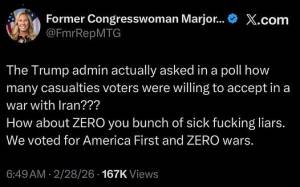
Politico, 3 US troops killed in Iran attack, Paul McLeary and Ben Johansen, March 1, 2026. Several more troops were wounded as part of the U.S. and Israel effort against Tehran.A plume of smoke rises above Erbil International Airport.
Three U.S. troops were killed and five more “seriously wounded” as part of the joint U.S.-Israel operation targeting Iranian military sites and government officials, according to U.S. Central Command, marking the first American deaths in the conflict.
Several other troops “sustained minor shrapnel injuries and concussions,” the command said Sunday, without giving a location. Iranian missiles have targeted some American bases in Bahrain, Iraq and Kuwait as part of the conflict, which the Pentagon has dubbed Operation Epic Fury.
These are the first confirmed U.S. fatalities since President Donald Trump announced Saturday that the U.S. had begun “major combat operations” in Iran. And they dramatically raise the stakes. The fatalities are likely to intensify pressure on the White House and the Pentagon to respond forcefully, potentially widening the conflict beyond limited strikes into a more sustained military campaign.
Confirmed American deaths also represent a significant break from the recent pattern of calibrated, contained escalation.
The operation — described by Trump as a necessary blow against Iran’s military and nuclear infrastructure — had already pushed the longtime adversaries into their most direct confrontation in years.
Iran has launched “hundreds” of ballistic missiles and drones at American forces in the region since the American and Israeli strikes began, according to a U.S. official, most of which were intercepted by air defenses. The person was granted anonymity to discuss a sensitive topic.
Iran said it has retaliated against U.S. military facilities in several countries in the Persian Gulf, as well as launched barrages of missiles toward Israel. These include Al Udeid Air Base in Qatar, Ali Al Salem Air Base in Kuwait, Al Dhafra Air Base in the United Arab Emirates and the U.S. naval base in Bahrain.
Muwaffaq Salti Air Base in Jordan was also targeted, according to Iranian state media, as well as a U.S. base in northern Iraq.
Democrats quickly put the onus on the president.
“He tries to pass it off as if it’s like ‘oh, we’re at war, and it’s terrible that servicemembers might be killed,’” said Sen. Andy Kim (D-N.J.). “He is choosing this. He put [U.S. troops] in harm’s way. They didn’t have to die.”

Politico, Q&A: John Bolton Sounds the Alarm on Trump’s Iran Gamble, Scott Waldman, March 1, 2026. In an exclusive, Trump’s onetime national security adviser warns the strike on Iran may deepen conflict, create a dangerous power vacuum — and plunge the region into turmoil.
President Donald Trump has long been interested in regime change in Iran, but his appetite for risk means he may not have fully prepared for what’s coming next, according to John Bolton, above left, Trump’s onetime national security adviser.
While Bolton praised Trump’s strikes on Iran as the “most consequential decision” of his presidency, he warned that Trump and his administration could have acted impulsively without any appreciation for the complex aftermath of what is now a power vacuum.
“There could be a lot of turmoil, a lot of bloodshed,” Bolton said.
Notably, he added, there could be chaos in the Straits of Hormuz, which Iran has threatened to shut down in order to block the twenty percent of global oil supply that flows through it every day.
And while Trump frequently talks about taking the oil of countries that clash with the U.S., Bolton said he is less worried about that happening now. Bringing Iranian oil back online is in the interest of U.S. allies in the region, who will be less worried about market competition and more relieved that Ayatollah Khamenei is dead since many of them saw Iran as an “existential” threat.
For now, Bolton said, it would be wrong to assume that Trump will take any long-term consistent position on the future of Iran: The full consequences of Saturday’s strikes are still unknown and the risk of increased bloodshed is high. Bolton said it remains to be seen if voters will credit Trump for the results in Iran — or if it will be seen as another foreign policy distraction that compromises his ability to deliver for Americans.
“He can swing wildly on a given issue in the course of a day and he’s obviously swung all the way from where he was in the first term to regime change,” Bolton said. “He could swing back.”
This interview has been edited for length and clarity.
You’ve been in White House conversations before around Iran with Trump. Do you think he and his team have fully considered all the consequences here?
It would be different from his normal behavior, to say the least, because he doesn’t particularly think strategically. But obviously, something persuaded him that he didn’t have any alternative. Some might say he saw the consequences of the negotiations with [Steve] Witkoff and [Jared] Kushner, which were going nowhere.
I came to this conclusion 25 years ago [during the George W. Bush administration]. I’m glad he finally got around to it. But if you conclude that you can’t change regime behavior, then you don’t have any other logical alternative except acquiescence in Iran getting a nuclear weapon, besides changing the regime. He may not have thought beyond that. I am very worried that they have not done adequate consultation with the opposition on the ground in Iran, and I’m perfectly prepared to acknowledge that coordination is difficult, because while the opposition is very widespread, it doesn’t really have a leadership structure. It really is spontaneous. This is what the people actually believe.
So, in any regime change situation, you have to have an opposition that can work on figures in the regime to defect, basically, to bring colonels, generals in the regular conventional military, not the Revolutionary Guard, but the conventional military, over to the side of the opposition, and maybe even some figures in the [Islamic Revolutionary Guard Corps] itself.
Because when people see the regime’s days are numbered, all kinds of ideologies flow out the window and they begin thinking about looking out for number one and making sure they’re on the winning side. So they don’t need to convert to being anti supreme leader or anything like that. They just have to figure their odds are better with the other side. That’s how a regime like this fractures at the top. And people thought for some time that, before the January demonstrations, the optimum time for regime change comes when Ayatollah Khamenei dies.
How worried are you about the Strait of Hormuz? Do you think Iran could meaningfully shut them down and stop 20 percent of the global oil supply?
I think in an existential case, the answer would be yes. [Trump] talked about sinking the Iranian Navy, and I’ve been making that same point, because the Iranian Navy, obviously, in the tight confines of the Persian Gulf, would be a threat to our bases and Bahrain and Qatar and everywhere up and down the Arabian Peninsula. They can’t mine the Strait of Hormuz, if they don’t have the Navy, right? Obviously they went after the air defenses, and I’m sure they’ve gone after the ballistic missile launch sites, radars, production facilities, but I got to believe the Navy’s high up on that target.
But all Iran needs to do is hit one tanker with a couple drones and all ships would have to start avoiding the Strait, right?
All the ships have gone to port, so they’ve got nothing to hit at this stage, and that’s why the mining is critical. If you put the mines into the water, it is a dangerous, time-consuming operation to de-mine even though the Strait is very confined geographically. Nobody wants to lose a destroyer sweeping up Iranian mines.
There will be a temporary pause of oil going through the Strait of Hormuz while people wait to see. They’re just not going to risk it.Watch: The Conversation 25:44Senator Slotkin on why Dems need their own 'Project 2029' | The Conversation
It’s not like no oil will be coming out, but for at least a short period of time to avoid the insurance costs if nothing else, the insurance companies are saying, “Get those tankers in port somewhere.”
It’s likely to cause spikes potentially in domestic gas prices right during election season in the midterms.
If the price goes up, American oil production picks up too. People immediately turn the taps back on.
For Trump’s affordability message, which is key for Republicans in midterm races right now, gas prices are one of the biggest metrics of success that he constantly references. How do you think today’s actions could impact the midterms?
By definition, a spike is temporary and he must have been aware of it. It makes one reason why it’s still hard to understand why he did it, because there’s a risk there. I don’t think there’s any denying that. And I think he’s already at risk of further fragmenting his base. By the way, for the isolationist in particular, can you imagine what JD Vance is thinking now? He can’t be happy.
And did Trump ever tell you he wanted to take Iran’s oil? You know, do you think that’s part of his motivation here?
Well, oil is always on his mind. Iran has perhaps the second largest reserves of oil, maybe the third largest, after Venezuela and Saudi Arabia. It has, I think, the world’s largest reserves of natural gas.
If Iran under some new government is released from the sanctions, it’s going to take a certain amount of investment to attempt to upgrade the system. It’s pretty dilapidated, not as bad as Venezuela, but there’s not been a lot of capital investment in it in recent years. But in the long-term energy supply situation, if Iran becomes a normal country, the price of oil and gas will go through the floor.
That means it’s easier to sanction Russia by just saying, “Nobody can buy Russian oil.” If you have that much additional oil from both Iran and Venezuela at some point, then you don’t need Russian oil at all.
Trump-appointed so-called U.S. peace negotiators Steve Witkoff, left, and Jared Kushner, flank Israeli Prime Minisere Benjamin Netanyahu (collage, with bomb site in Iran as background).
Emptywheel, Analysis: Iran Things that Got Memory Holed, Including the So-Called Negotiators, Steve and Jared, Emptywheel (Marcy Wheeler), right, March 1, 2026. There are a number of facts about Iran that are being memory holed by significant swaths of the public.
There’s the fact that Iran’s conflict with the west doesn’t just go back 47 years, to 1979, when it seized Americans as hostages, but to 1953, when the US and UK launched a coup against Iran, in significant part to protect the oil industry.
There’s the fact that JPCOA, if it had been sustained, might have reintegrated Iran into the world community, and in such a way that would have led to a gradual moderation of the state. To the extent that Trump has offered any coherent excuse for this war, he is responding to conditions he created by ripping up JPCOA in 2018.
There’s the fact that this is an illegal war. It’s not just an illegal war. It is a war designed to obliterate rule of law, both internally for the two criminals who launched it, and internationally.
There’s the fact that, to the extent Iran interfered in the 2020 election — and they did — the voter suppression involved targeted voters of color, and so had the effect of helping Trump. And hell, if we’re using election interference as an excuse, let’s not forget that Trump got help from Russia in 2016, 2020, and 2024. Trump has never run for office without help from Putin. Along with Viktor Orbán, Trump may be the last strongman who believes, after the hard lesson Assad, Maduro, and now Khameni have learned, that Putin would deliver on his vows of support.
But the thing that most puzzles me is how broadly the public has memory holed that Trump has two people — one a wildly unqualified developer buddy, another an equally unqualified developer son-in-law who is an agent of the Saudis — who purport to be negotiating for something called “peace,” not just in Gaza, and Iran, but also in Ukraine.
Laura Rozen has not forgotten. She describes how, over and over, Trump’s advisors took actions from Iran that every knowledgeable person would understand but Trump’s advisors misread those actions as an unwillingness to make a deal.
Trump negotiators did not seem to understand Iranian proposal
Two other senior Trump administration officials made assertions about the recent negotiations with Iran that suggested they did not have the expertise or experience to understand the Iranian proposal, or why Iran would not have accepted elements of the US proposal. They therefore claimed Iran was not serious about the negotiations, which seems to be a misunderstanding.
The Trump administration officials, for instance, described an Iranian refusal to accept an offer of free nuclear fuel from the United States for their civil nuclear program as a “big tell” that Iran had nefarious motives, when Iran has historical reasons to not trust western supplies as reliable.
It’s “inconceivable” that the Iranians “would trust the United States, over a long term, to continue supplying enriched uranium for their energy needs,” former US nuclear negotiator Robert Einhorn said on a panel hosted by the Center for the National Interest last week.
But it’s not just that Jared Kushner and Steve Witkoff proved as painfully ignorant as they have over and over.
It’s that Israel and the US and — the beleaguered WaPo reports, Saudi Arabia — planned this attack around an intelligence discovery of an opportunity. They were going to attack no matter what Iran did, because they could. NYT describes (in a piece that doesn’t mention Jared or Steve) that Israel used intelligence CIA gathered to determine the time of an attack it had been planning for months.
The C.I.A. had been tracking Ayatollah Khamenei for months, gaining more confidence about his locations and his patterns, according to people familiar with the operation. Then the agency learned that a meeting of top Iranian officials would take place on Saturday morning at a leadership compound in the heart of Tehran. Most critically, the C.I.A. learned that the supreme leader would be at the site.
The United States and Israel decided to adjust the timing of their attack, in part to take advantage of the new intelligence, according to officials with knowledge of the decisions.
The information provided a window of opportunity for the two countries to achieve a critical and early victory: the elimination of top Iranian officials and the killing of Ayatollah Khamenei.
[snip]
Israel, using U.S. intelligence and its own, would execute an operation it had been planning for months: the targeted killing of Iran’s senior leaders.
WaPo does mention that Jared and Steve were purportedly “pursu[ing] negotiations” in a piece that describes Mohammed bin Salman — who pays Jared a shit-ton of money for his “expertise” — was pushing for an attack even while publicly claiming to support diplomacy.
Saudi Crown Prince Mohammed bin Salman made multiple private phone calls to Trump over the past month advocating a U.S. attack, despite his public support for a diplomatic solution, the four people said. Israeli Prime Minister Benjamin Netanyahu, meanwhile, continued his long-running public campaign for U.S. strikes against what he views as an existential enemy of his country.
[snip]
The Saudi push for an attack came as presidential envoy Steve Witkoff and Trump’s son-in-law Jared Kushner pursued negotiations with Iranian leaders over the country’s nuclear and missile programs.
As those talks proceeded, Riyadh issued a statement, following a phone call between the crown prince and Iranian President Masoud Pezeshkian, that Muhammed would not allow Saudi airspace or territory to be used in an attack on Iran.
In his discussions with U.S. officials, however, the Saudi leader warned that Iran would come away stronger and more dangerous if the United States did not strike now, after amassing the largest military presence in the Middle East since the 2003 invasion of Iraq, said the people, who, like others, spoke on the condition of anonymity to discuss the sensitive situation.
Mohammed’s position was reinforced by his brother, Saudi Defense Minister Khalid bin Salman, who held closed-door meetings with U.S. officials in Washington in January and warned about the downsides of not attacking, the people said.
To be clear: I’m not suggesting that people have treated Steve and Jared as competent negotiators. Nor am I saying that, in Ukraine or Gaza, we’ve forgotten that the two are nakedly seeking financial rewards as if that’ll ensure peace.
Rather, I’m saying that the shock and awe of Day One has largely buried under rubble the pretense of a negotiation by Steve and Jared, a negotiation that was either so incompetent as to be worse than useless or — probably more likely — a negotiation that was so incompetent by design, to serve its paymasters.
Steve and Jared are both so venal it’s hard to pinpoint their agency.
But the way their claims of negotiation actually works is no secret and should be central to discussions of what just happened.
Lance's Substack, Opinion: The Stark Raving Strategic Madness Of Trump And Netanyahu, Lance F. Rosen, right, Feb. 28 -March 1, 2026. Yesterday’s news coverage included reports on statements leaked by Iranians close to the negotiations expressing optimism that there would be an agreement.
It is not clear whether such a report was knowingly false information, the product of someone’s delusion, or whether it was a last ditch “hail Mary” effort by certain intelligence factions to get Trump to extend his deadline, in order to avert a potentially catastrophic war.
What should be clear, that is to those who choose to see, is that the negotiations were intended to fail in any event so Trump and Netanyahu could have their war.
The proof of this is found in the two who were chosen as negotiators, Kushner and Witkoff. Both are corrupt billionaires with financial ties to the most obscenely oppressive Gulf State regimes. Both are wildly incompetent and unqualified. And both of them have as their leading strategic priority, aside from their grifting operations, to strengthen the Netanyahu regime’s grip on Israeli policy, which as we should know is the key to their Gaza real estate plans.
They are the ones who you send to negotiate when you want to blow up a deal before it happens, given their use historically of the “my way or the highway” strategy as their bargaining approach.
The conflict is rapidly spreading throughout the region, with Iranian counterattacks already commenced against Israel, US bases, and Arab Gulf states allied with the Trump regime.
The lying fraud of the administration’s position should be obvious. But the stupidity is even more glaring. By attacking Iran, it won’t trigger a bigger and better rebellion, rather the opposite. It will serve to unite their people against Israel, and its leading backer the US.
So, instead of accelerating an uprising against the current government, it will backfire and rally them to defend their homeland against its common foreign enemies. It also gives the government greater pretext and justification to just murder and persecute more of the opposition’s leaders.
Trump, by attacking on the side of Israel, just pulled the rug out from under the mass opposition which has been growing rapidly out in the streets.
Likewise, they are claiming that the US strategic interest here is the threat of Iranian nuclear weapons, which Trump says they’ll never be allowed to have.
This only months after Trump lyingly asserted that he had already destroyed the Iranian nuclear program “100 %.” Like every lie Trump tells, it is a failed attempt to cover up a previous lie.
Also, more to the point, the idea that this Muslim-hating racialist monster Trump cares even remotely about the well being and freedom of the Iranian people, whom he sees as genetically sub-human, is so bizarre as to defy credulity, yet he claims to be unilaterally taking the US to war, risking American lives and expending resources in order to liberate them.
This itself is a galatic absurdity. Where has he been in regard to the massive human rights violations of the murderous Saudi Monarchy and its butcher head of state, Muhammed Bonesaw?” O
h of course, they get a pass because they are Trump’s business partners who have bailed him out financially time and again.
Additionally Trump is a vile anti-semite himself, all of his declarations of 100% support for Israel notwithstanding. The nations involved in the regional conflict are to him merely movie props and extras in his stage-managed attempt to expand his power, as he descends deeper into his dementia-driven state of desperation and homicidal rage.
There are many things that will be said about this, but in my view what is primary now is the question of “what does this mean for you and me, personally, how does this affect our lives and what can we as individuals do about it?”
Not the monotonous social media droning about “oh, just another distraction from Epstein.” Not obsessing about the endless string of “connecto conspiracy theories” linking whomever to whatever, and floating scenarios about who is doing what to whom.
This war will be awful. But more than anything it redefines our mission. The crisis at hand could well be a tinderbox for World War III. One rooted in centuries of geopolitical maneuvering, cultural warfare and populations being driven to madness in reaction to the various genocides of the 20th Century up until today.
We should not trivialize this war as a “distraction.” It is an attack on civilization itself. They are tearing apart the world order and trying to remake it in their own image, to create a world empire, not just to cover up their crimes.
Everyone reading this has already formed strong opinions on what war with Iran means, why it was started, and by whom. Some of that narrative will sound like slogans on a bumper sticker (like “No blood for oil”) or read like a conspiracy theory, (Netanyahu blackmailed Trump) and others will be grounded in reality.
There will be a few people who fully support the goals of this war despite their stated opposition to the Trump administration on every other area of policy. (They’ll say, a stopped clock is right twice a day) Those folks are fully entitled to live a life of lies, hypocrisy and contradiction, but I have little energy to engage with them.
However, I think the vast majority of our readers are both sane, and good humans who wish to avoid war, as opposed to hoping for one as supposedly the quickest and easiest means to get rid of a problem which they have no idea how to solve otherwise.
My opinion is that just having an opinion about it is not good enough. We, that is, those of us here, need to take urgent and useful actions with the intent to end it. It is an act of strategic insanity, one which most informed and thoughtful people either knew or should have known would happen in the event Trump came back to power.
It is concerning that the Pentagon is on board with this, and that some military brass pushed for it because they thought it would divert Trump from invading Greenland, (thus destroying NATO) which has been another plot line running through all of this.
I also think it’s important to be aware that the Trump regime might have just dragged us into a worse than Afghanistan quagmire, one which will produce US casualties, cause an energy price shock, a global trade disruption, and handed Trump’s domestic opposition a huge advantage going into the midterms from a voting population which is sick of war, tired of lies and propaganda, and starting to shed its passivity in the face of all of it.
Trump’s base of MAGA Christian nationalists are going to revel in this war of course, because they are Armageddonists who believe Trump and Netanyahu are fulfilling Bible prophecy. They should be treated as escaped mental patients, not susceptible to reason.
Otherwise, among rational persons this can and will backfire because the war is being waged by incompetents like Hegseth, and everything that can go wrong likely will. Y
ou can’t effectively fight or win a war with “smart weapons” if the people deploying them are either demented like Trump, or drunken morons and testosterone junkies who are busy writing their own PR.
So, rather than open the door for an avalanche of “hot takes” coming from people who have a “theory of everything” which they think answers all the important questions, my focus will be the following.
1. Removing Trump from power. “Regime Change In Washington First” might be a good sign for demo marches.
2. Mobilizing support for the prosecution of every member of the Cabinet, removing the Vice-President from office, along with each White House and administration official who is a participant in Trump’s global killing spree . The list of crimes for which they must be tried and imprisoned is too long and varied to make a case in this limited space for each one, or which tactics are the best for accomplishing these things. We will address that part as we go, but that has to be our mindset, and it should come out of a process of serious dialogue.
3. Retaking both Houses of Congress, state Governors and legislatures for the Democrats. Making sure elections are free and fair. Insuring they are not canceled or the results overturned.
4. A public education campaign intended to overcome wartime brainwashing and propaganda.
5. Task-oriented discussion of strategic, economic, and social policies which are needed to create a dynamic of institutional change in the US, and a paradigm shift in our national politics.
6. Holding every Democratic office holder accountable for what they are doing or not doing in service of the above stated objectives. This will be an onerous task, simply due to the fact that so many are funded by AIPAC and are terrified that coming out against Israel in an election year will finish their careers. They need to know that WE will finish their careers if they do nothing serious in opposition.
7. Preparing ourselves and our fellow anti-war collaborators for what is in store for us. We are going to be branded and denounced as anti-semites for opposing Israel. We will be mischaracterized as “pro-Iran.” There will be threats of job losses, blacklisting, expulsions from schools and universities, lawsuits, ostracization within our communities, (especially for those of us who are Jewish) added financial pressures, targeting by federal law enforcement when we speak out publicly on social media, and of course threats of violence against those who do. To expect anything otherwise is naive. Therefore we need to exercise good judgment in what we say and do publicly to avoid self-inflicted legal or personal security issues, without us having to go into hiding.
8. The war itself is illegal. Expect a new array of Hitler-style executive orders as “emergency decrees,” intended to nullify or suspend the US Constitution. This will include wartime censorship of media, and ending first amendment protections. Trump believes himself to be untouchable legally and has always wanted to use a big war to expand his executive powers. To actually begin revoking people’s citizenship and deporting or jailing his domestic opposition. Now we have a better idea of what those ICE warehouses are for, certainly not just for “illegals.” This is his crossing of the Rubicon.
9. Europe is almost united in their opposition to this action, irrespective of their public statements. From the beginning, the Trump regime has acted to destroy the US traditional strategic alliances which have operated since the post-World War II era, and has instead aligned with the fascist dictatorships of Russia, Israel, and Hungary. Our relationships to Europe in particular are now officially dead, if they weren’t already. The world as a whole is now inalterably changed, and there is no going back to the old system. Therefore something new, something sane, must replace it.
10. Everything I present here going forward regarding the State Of Israel, its government, and people, will have no other purpose than to strengthen and publicize the efforts of Netanyahu’s opposition, with the goal being to topple his rogue coalition government, remove him from power, put him and his cabinet on trial and imprison them all.
I am not an Israeli citizen therefore I have no direct means to effect that change, other than to use my voice. Likewise, I will work to support the Iranian opposition and their fundamental human rights, included in which is the right of their people to change their own government without a foreign military intervention.
The best hope we have for achieving a durable peace in the region is not bombing Iran back into the Stone Age. It is the interventions we make in support of regime change in the United States and Israel which can build the foundation for it. That’s what we are working on, without distraction.
Thinking About... Commentary: The Iran War's Purpose, Timothy Snyder, right, Feb. 28, 2026. To complete the fascist transition, Trump has to give the country a war it does not want, and win it, and transform the society. He has brought us to the doorstep of a major war with Iran.
That is the only escalation that could possibly work to advance the fascist transition. But it would not work. Trump is incompetent and so are his advisors. And war is hard. And Americans will not be patient. Perhaps they would change their minds if Trump had an explanation of what he is doing, but he doesn't.
More On Epstein Files
Sex Traffickers and financial moguls Jeffrey Epstein and Ghislaine Maxwell, with a timeline shown below of some of his now-best-known life events.
New York Times, Why the Epstein Investigations Took So Long and Did So Little, Benjamin Weiser, Matthew Goldstein and Mike Baker, March 1, 2026. Decades of tips and investigations yielded charges against only two people. A combination of missed chances, narrow laws and prosecutors’ limited focus helps explain why.
It was early evening on Saturday, July 6, 2019, when Jeffrey Epstein disembarked from a private plane for the final time. Federal agents were waiting at Teterboro Airport in New Jersey to arrest him.
“Is this about sex trafficking?” Mr. Epstein asked as he was being driven to the Federal Bureau of Investigation’s offices in Lower Manhattan, according to notes taken by an agent. “Is this about underage?”
Nobody replied, but the answer was yes. Later, as he was being booked into jail, Mr. Epstein remarked: “Oh, this is bad. This is really bad.”
That was certainly true for Mr. Epstein, who would die in a jail cell five weeks later. But for the vast majority of the men and women who had either enabled Mr. Epstein or may have committed sexual assault, it turned out that there was little to fear.
Aside from Mr. Epstein’s longtime conspirator Ghislaine Maxwell, none of his friends or associates have been criminally charged in the United States. In the six-plus years since his death, the lack of prosecutions has given rise to outrage and conspiracy theories about why powerful people have gone unpunished.
The millions of pages of recently released Justice Department emails, prosecutorial memos, interview transcripts and other records help explain why more people weren’t charged and why Mr. Epstein was able to act with impunity for so long.ImageA man and a woman sitting on a plane.Mr. Epstein with Ghislaine Maxwell, who was sentenced to 20 years for her role in his sex-trafficking operation.Credit...U.S. Justice Department, via Reuters
Part of the reason was a series of missed opportunities, in both Democratic and Republican administrations, to bring him and others to justice: A tip that went unaddressed in the 1990s. A controversial plea deal in Florida that left F.B.I. agents and prosecutors unsatisfied. A yearslong investigation by federal drug agents that went nowhere. And a miscommunication among federal officials in 2016 that scuttled a potential investigation in New York.
The records also show that in their initial zeal to quickly build a case against Mr. Epstein, federal prosecutors focused primarily on sex crimes against teenage girls in the early 2000s. Within months of Mr. Epstein’s death, prosecutors believed that they did not have enough evidence to charge anyone besides him and Ms. Maxwell with the trafficking of minors or other federal crimes.
They lacked proof, for example, that other men participated with Mr. Epstein in a child-sex-abuse ring. They did have evidence of possible crimes against women, but they believed those were state offenses, not federal ones. Yet the records also show that prosecutors did not aggressively pursue other potential avenues, such as how Mr. Epstein moved his money through banks around the world. They did not interview any of the men who were Mr. Epstein’s main financial sponsors.
Outside the United States, law enforcement is moving swiftly to build cases based on revelations in the new records. In Britain, for example, police last month arrested Andrew Mountbatten-Windsor, the former Prince Andrew, and Peter Mandelson, a recent ambassador to the United States, as part of their investigations of corruption-related crimes. Authorities in France and Norway also have opened investigations.
In the United States, top Justice Department officials have said they do not plan to file additional charges related to Mr. Epstein based on materials in the latest disclosures, leading lawmakers from both parties to clamor for more action.
“Over two dozen people have resigned — C.E.O.s, members of government — worldwide,” Representative Thomas Massie, a Kentucky Republican who sponsored the legislation requiring the Justice Department to release its Epstein files, said on the House floor this past week. “But I haven’t seen any arrests or investigations here in the United States from this Department of Justice.”

Prince Andrew, before being stripped of his British royal titles, at the funeral of his father, Prince Philip, on April 17, 2021 (Pool photo by Chris Jackson of Reuters).
New York Times, The U.S. Released the Epstein Files. The Arrests Are Overseas, Michael D. Shear, March 1, 2026. While the latest tranche of documents about the sex offender Jeffrey Epstein has exposed a deeply American scandal, it is Europe where the aggressive enforcement is taking place.
The police in Britain have arrested a former ambassador and a member of the royal family. French prosecutors are investigating the country’s culture minister. The former prime minister of Norway has been charged with “gross corruption.” And authorities in Latvia and Lithuania are looking into possible human trafficking.
The Epstein files, released by the United States Department of Justice, have yielded legal action in several countries as the police and prosecutors examine whether the files reveal that criminal laws have been broken.
Since the biggest tranche of files was made public less than a month ago, the search for criminal accountability is going on just about everywhere overseas that Jeffrey Epstein, the convicted sex offender, is known to have befriended the world’s wealthy and elite.
The Epstein scandal is genuinely American in origin, the story of a rich New Yorker accused of trafficking young women for sex. Ghislaine Maxwell, Mr. Epstein’s longtime associate, was a British socialite. But many of the people caught up in his web are Americans, including the current president, a past president and boldfaced names from Wall Street, Hollywood and Silicon Valley. And it is Congress, under pressure from Mr. Epstein’s victims, that demanded the files be released.
Yet it is Europe where police and prosecutors seem particularly eager to examine the American documents as part of criminal investigations into potential wrongdoing.ImageNewspapers feature Prince Andrew, grimacing, on their front pages. Headlines include 'NOW HE'S SWEATING' and 'DOWNFALL'.Newspapers featuring coverage of the arrest of Andrew Mountbatten-Windsor, at a news stand near Windsor, Britain last week.Credit...Jaimi Joy/Reuters
In Britain, two arrests have taken place, of Andrew Mountbatten-Windsor, the former prince, and of Peter Mandelson, a former ambassador to Washington. Both were arrested on suspicion of the same offense: misconduct in public office. It’s a broad, centuries-old common law offense that makes it a crime to act with “wilfull abuse or neglect of the power or responsibilities of the public office.”
“We don’t have those sort of generic, open-ended kinds of crimes in the United States,” said Paul G. Cassell, a professor of law at the University of Utah. For a decade, he represented Virginia Giuffre, who accused Mr. Epstein of trafficking her to his friends, including Mr. Mountbatten-Windsor, in the early 2000s.
As in the United States, the Epstein files have forced some firings or resignations outside of the criminal justice system.
In Britain, the prime minister’s chief of staff, Morgan McSweeney, and his communications director, Tim Allan, stepped down amid ongoing questions about how much they were aware of connections between Mr. Epstein and Mr. Mandelson, the man they pushed to be Britain’s ambassador to the United States. Neither Mr. McSweeney nor Mr. Allan has any known ties to Mr. Epstein.
Despite the flurry of legal activity across Europe, few people are yet being held to account for crimes related to the longstanding accusations of sexual abuse and human trafficking leveled against Mr. Epstein.
Instead, the focus of investigations has been on documents from the Epstein files that appear to show corruption, misconduct in office or misuse of public funds. And while European authorities have moved quickly to open investigations, they are based on the U.S. documents, not on the strength of their own, independent casework.
Mr. Mandelson was arrested and released on bail after documents appeared to show that he forwarded confidential government information to Mr. Epstein. Mr. Mountbatten-Windsor, formerly known as Prince Andrew, was arrested on suspicion of the same offense. Both men deny any criminal wrongdoing and neither has been charged.
Thorbjørn Jagland, the former prime minister of Norway, has been charged with “gross corruption” in connection with his ties to Mr. Epstein. Investigators have said they are looking into “whether gifts, travel and loans were received in connection with his position.” Mr. Jagland has denied criminal liability and is cooperating with authorities.ImageA man with gray hair accompanied by a man with glasses stands outside amid people taking photographs of him.Thorbjørn Jagland, former prime minister of Norway, center, in Oslo, Norway, in February. Mr. Jagland, has been charged with “gross corruption” in connection with his ties to Mr. Epstein.Credit...Stian Lysberg Solum/NTB Scanpix, via Associated Press
In France, authorities announced they were investigating reports that Jack Lang, who once served as France’s culture minister, had financial links to Mr. Epstein. Mr. Lang later resigned as head of the Arab World Institute, a prestigious cultural institution in Paris. In a post on social media, Mr. Lang wrote: “The accusations against me are unfounded, and I will prove this, despite the noise and fury of the media and digital courts.”
Latvia is one place where officials are now actively looking into the possibility of sex crimes committed by Mr. Epstein.
In February, the authorities there launched a criminal investigation into whether young women from that country were trafficked by Mr. Epstein. The police said the nation’s organized crime bureau would focus their inquiry on “the possible recruitment of Latvian nationals for sexual exploitation in the United States.”
Legal experts say it is not clear whether the cases in Europe will make their way to trial.
Mr. Cassell, the lawyer who represented Ms. Giuffre, said that despite the more aggressive actions of British police in recent days, the country’s criminal justice system proved to be a roadblock when he presented his client’s accusations against Mr. Mountbatten-Windsor to police in 2016.
“We were told essentially that it was an American problem, not a U.K. problem,” he recalled, adding that the case could have turned out differently if the police in Britain had acted when Ms. Guiffre asked them to.
At the time, the Metropolitan Police explained their decision not to investigate Ms. Giuffre’s accusations by saying that the case was being handled in the United States.
“It just seemed,” Mr. Cassell said, “like a convenient excuse to to avoid pursuing someone that had power and influence.”
Brian Tyler Cohen: The Trump administration has just deleted this photo of Trump Cabinet Secretary Howard Lutnick with Jeffrey Epstein on what appears to be an island.
Thought Catalog, Document #EFTA02731361 And Jeffrey Epstein’s Alleged Eugenic Breeding Program, January Nelson, Feb. 21, 2026. One of the most disturbing documents in the Epstein files is titled EFTA02731361. You can view it here. The document contains graphic descriptions of abuse, forced pregnancy, and the removal of newborns. It is extremely disturbing.
The document has received coverage from The New York Post, OK Magazine, various Reddit threads, and a podcast. But it hasn’t taken over the web like some other claims. While we can’t verify whether it’s true, it aligns with broader reporting around Epstein’s interest in eugenics, and it has more grounding than fringe internet rumors, like claims he was a cannibal or used sulfuric acid to dissolve bodies. Why? Because it’s an actual real document with real claims.
What follows is a summary of its contents, quoted directly where possible. This is an extremely graphic and disturbing document. Proceed with caution.
What Is EFTA02731361?
EFTA02731361 is a 32-page scanned journal and scrapbook released as part of the DOJ’s Epstein Files Transparency Act document tranche in January 2026. Every page is watermarked “CONFIDENTIAL – FOR ATTORNEY’S EYES ONLY,” indicating it was originally produced under legal privilege, likely in connection with civil litigation or a criminal investigation.A page from the scanned journal.
The journal was first reported on by the New York Post, which identified the writer as a teen accuser of Epstein who was approximately 16 or 17 at the time of the events described, around 2002. According to the UK Times, copies of the diary were turned over to prosecutors by the woman’s lawyer during the investigation of Epstein and Maxwell. It has not been confirmed whether the specific claims in the journal have been independently verified.
The journal combines typed entries, handwritten pages in red ink, collaged magazine clippings, an ultrasound image, and original artwork. Two pages are covered entirely in red paint.
What Does EFTA02731361 say?
Again, before reading, please note this is an extremely disturbing document of horrific abuse.
Books, Celebrity, Heath Battles, Childhood Abuse, Culture
Though she has retired from acting, Christina Applegate (here in front of her home) appeared onstage at the Emmy Awards in 2024 (Photo by John Shearer via Getty Images).
New York Times, Christina Applegate Planned to Burn Her Journals. She Made a Memoir From Them Instead, Elisabeth Egan, March 1, 2026. Christina Applegate was not going to meet in person, no matter how many times I promised to be flexible if she had to cancel because of a flare-up of her multiple sclerosis.
It was Zoom or bust, which was fine because Applegate, 54, the Emmy-winning star of “Married … with Children” and “Dead to Me,” among many other series and movies dating back to her 1972 debut on “Days of Our Lives,” turned out to be an impeccable virtual host.
Before we started talking about her memoir, You With the Sad Eyes, Applegate set the scene in her bedroom in Laurel Canyon, where she reclined against a tall headboard wearing a black T-shirt, a crescent moon necklace and a floppy topknot.
“I’m scared,” Applegate said as conversation turned to her book, coming out from Little, Brown on March 3. “I’m probably going to cry.”
 Applegate has long been known as a fast-talking funny girl but, as her Cyndi Lauper-inspired title indicates, “You With the Sad Eyes” is unlikely to be accompanied by a laugh track.
Funny, furious and profane, “You With the Sad Eyes” finds the TV star facing childhood trauma and reflecting on the limits imposed by illness.
The book focuses primarily on Applegate’s first three decades and includes multiple accounts of abuse beginning when she was 5 years old.
There was the neighborhood “caregiver” who forced Applegate to perform oral sex on her. (“This is where the story darkens almost to black,” Applegate writes.) Her mother’s boyfriend, who picked up Applegate by her hair and threw her against a wall. (He also facilitated her mother’s drug addiction, she writes.) And finally Applegate’s own boyfriend, who slammed her head against the floor with such force that the hairdresser on “Married … with Children” had to get creative to mask the swelling.
As Applegate said, “I went to work and it was funny. But I went home and — not funny.”
New York Times, DealBook: Lloyd Blankfein on Trump, Epstein and Life After Goldman Sachs, Andrew Ross Sorkin, Feb. 28, 2026. In a wide-ranging interview with Andrew Ross Sorkin, Goldman’s former C.E.O. discussed his life and new memoir.
If there’s one thing to say about Lloyd Blankfein, it’s that he rarely holds back — and when he lets loose, he has a wicked sense of humor (which sometimes gets him in trouble).
As C.E.O. of Goldman Sachs from 2006 to 2018, Blankfein shepherded the firm through a brutal public reckoning after the financial crisis, often serving as the primary lightning rod for the world’s critics. In his new memoir, “Streetwise: Getting to and Through Goldman Sachs,” Blankfein finally shares the raw reality of that climb, and of surviving cancer while steering the world’s most influential — and scrutinized — investment bank.
New York Times, Justice Thomas Bemoans Incivility as Security Prompts Cancellation of In-Person Speech, Ann E. Marimow, Feb. 28, 2026 (print ed.). The justice participated remotely in a closed-door session of a legal conference, a reminder of the heightened threats facing jurists in recent years.
 During a closed-door session of a legal conference this week, Justice Clarence Thomas expressed concerns that the Supreme Court faced increasing polarization, incivility and security threats, including one that apparently led the justice to appear at the event remotely instead of in-person as planned.
In rare remarks, Justice Thomas told a crowd of lawyers and students gathered at American University’s law school that he had hoped to attend the event but that a security risk had forced him to alter his plans, according to a recording of the event obtained by The New York Times.
“I apologize for having to change things, but I wanted to make sure I didn’t endanger anyone by my mere presence,” he said, appearing from the Capitol Hill office of Senator Mike Lee, Republican of Utah, without specifying the security concern.
“At the same time, I encourage you not to follow the example of the things that have happened that prevent us from being together,” the justice added.
The unusual episode offered a reminder of the heightened threats facing judges — including the justices — in recent years, as well as of the wall the Supreme Court has often erected around the justices, who do few interviews and make only periodic public appearances.
All nine justices have received increased security since the leak in 2022 of the court’s draft decision to eliminate the nationwide right to abortion. Since then, threats against judges of all kinds have risen, particularly as President Trump, his advisers and his allies have harshly attacked the legitimacy of the jurists who rule against the administration.
Justice Thomas’s remarks to the conference this week were closed to the news media “due to an agreement between our organization and Justice Thomas’s team,” according to an official with the J. Reuben Clark Law Society, the event’s sponsor, a legal organization named for an early 20th-century Mormon leader and prominent lawyer.
In addition to Justice Thomas, the group’s two-day conference drew academics, high-profile lawyers, Mormon Church leaders and Trump administration officials, including Jamieson Greer, the U.S. trade representative.
Before the event, student groups had expressed opposition on social media to the justice’s planned appearance, circulating messages asking, “Why is Clarence Thomas Speaking at AU?”People who attended the conference on Thursday afternoon said a group of about a dozen who appeared to be students had gathered outside the venue to protest the justice’s appearance and the Trump administration. They carried placards with the message “No Kings.”
It was not clear whether the protest was the security concern that prompted Justice Thomas to cancel his in-person appearance. A spokeswoman for the Supreme Court did not respond to a request for comment. In general, the court does not comment on the justices’ security.
From the university’s perspective, there was a plan and a team in place to deal with any potential demonstrations.
Camp Mystic, a nearly century-old Christian summer camp for girls in Texas devastated by floods that swept away dozens of campers at night with scant warning. Some said the Trump Administration's firing of some 600 employees of the National Weather Service this year may have contributed to the lack of warning (New York Times photo-graphic).
New York Times, After the Tragedy of Camp Mystic, a Rift Among Families That Won’t Heal, Ruth Graham, Updated Feb. 25, 2026. The camp has been the foundation of an invisible network of status and power in Texas. Now, following the flood, that social web is beginning to fray.
Like many Texas women who spent their girlhood summers along a certain stretch of the Guadalupe River, Carla Smyrl cries these days when she talks about Camp Mystic.Listen to this article with reporter commentary
“My whole life has been influenced by this place,” Ms. Smyrl said over a cup of tea in Dallas. “Once a Mystic girl, always a Mystic girl.”
Starting in 1976, she spent nine years as a camper and five as a counselor at the all-girls retreat, sent her three daughters to camp, and then worked for more than a decade as Mystic’s liaison to families in Austin, where she lives.
On July 4, 27 campers and counselors died in heavy flooding, along with the camp’s longtime executive director.
The disaster was shattering to Mystic’s thousands of alumnae, even if they hadn’t set foot there for decades.
For many, the flood was a moment to draw on a tight network of lifelong relationships that has long been a core part of the Mystic mystique. Within the first hours and days, there were text chains, prayer services, old photos shared on private Facebook pages, and teary alumnae gatherings, including one at the George W. Bush Presidential Center in Dallas. (Laura Bush is a former Mystic counselor.)
It was a reminder that in Texas, camp is not just a way to while away the sticky hours of a Southern summer, but the foundation of an invisible network of status and power.
Going to Mystic places you in a “social web,” as one former counselor, Laura Beth Calvert, put it, that leads to the right college, the right sorority, the right husband, the right private preschool for your children, and then right back to Mystic.
But more than seven months after the flood, that social web is beginning to fray. In September, the camp’s longtime owners, the Eastland family, announced they would partly reopen this summer, a move vocally opposed by most of the parents of the victims, who have united under the name Heaven’s 27. Soon after, multiple Heaven’s 27 families filed lawsuits against the Eastlands, claiming gross negligence in both long-term emergency planning and in their actions on July 4.
Mystic is now facing mounting pressure from elsewhere in the state. On Monday, Lt. Gov. Dan Patrick sent a blistering letter asking the Texas Department of State Health Services not to issue a new license to the camp, noting that he would not be comfortable sending his grandchildren there. (A lawyer for the camp said that it was in compliance with all safety laws, and that Mr. Patrick had rendered a political verdict before a state investigation had begun its work.)

Page 15 of 37

Click below to watch, share and like the latest interview at these sites or others (via audio or video), and sign up for future shows!
District Insiders on YouTube @districtinsiders, Amazon, Apple Podcast, PodBean, Spotify

Andrew Kreig
JIP Editor
The Justice Integrity Project (JIP) researches official misconduct

Broadcast and lecture audiences can count on the Project's director to deliver blunt, entertaining and cutting-edge commentary about public affairs, with practical tips for the millions of Americans caught up in unfair litigation or regulation.
Based in Washington, DC, Andrew Kreig is an accomplished fighter for the public interest. Learn from his decades of reporting, analysis and advocacy:
• Shocking tales of recent corruption, deception and cover-up by both parties in communities ranging from small towns to world capitals; and
• Practical how-to tips for reformers on action that brings real-world results.
To book guest broadcast appearances on your station, write:
Advertisements
(adsbygoogle = window.adsbygoogle || []).push({});
© Justice-Integrity Project LLC. All rights reserved.

