
Editor's Choice: Scroll below for Part 2 of our monthly blend of mainstream and alternative March 2026 news and views, with clips beginning at March 17 and extending to the present in reverse chronological order. See Part 1 in our News Reports section for clips March 1 to 16 during this unusually heavy news period.
Note: Excerpts are from the authors' words except for subheads and occasional "Editor's notes" such as this. Nearly all excerpts are drawn from news sources for which the Justice Integrity Project pays a subscription. Readers here are encouraged also to subscribe to these outlets also to receive their full coverage and to support their work.
March 31
Top Headlines
 President Trump addresses about 800 U.S. generals and admirals in a political-rally-style speech at Quantico, VA on Sept. 30, 2025, preceded by Secretary of Defense Pete Hegseth, a former National Guard officer who prefers to call himself "Secretary of War" instead of the congressionally mandated term "Secretary of Defense."

Senior military leaders look on at Marine Corps Base Quantico on September 30, 2025 in Quantico, Virginia.
 New York Times, Putin’s Internet Blackout: A Chaotic Drive to Cut Off Russians From the World, Paul Sonne, Valerie Hopkins and Oleg Matsnev, March 31, 2026. With new outages and blockages, President Vladimir V. Putin is taking his boldest steps yet to control Russians’ communications.
News Updates
 March 31, 2026. Showing reporters on Air Force One a series of posterboard images of his new ballroom last night, Trump told them: “I thought I’d do this now because it’s easier. I’m so busy that I don’t have time to do this. But, ah, I’m fighting wars and other things. But this is very important ’cause this is going to be with us for a long time and it’s going to be, I think it’ll be the greatest ballroom anywhere in the world.”
 March 31, 2026. Donald Trump and the White House are facing mounting pressure right now. Gas prices have surged past $4 a gallon, his approval rating has dropped to historic lows for this point in a presidency, and he is lashing out at allies like France after disputes over military access. At the same time, reports suggest he may be looking for a quick exit from the war in Iran, raising serious questions about strategy and stability.
U.S. Law, Crime, Courts, Rights, Justice
More On Iran War
 March 31, 2026. For what it’s worth—and keep in mind, this newsletter is free—here’s my speculation, as of early Tuesday morning, March 31, about where Donald Trump is heading on Iran. Where he’s heading is toward the exits.
 March 31, 2026. I’m
 fairly obsessed with the serial damage the Iranians have done on Prince Sultan Air Base (and other US facilities) in Saudi Arabia. While there has been some superb work analyzing the second and third successful strike at Prince Sultan, this NYT article I keep returning to is the only one I’ve seen documenting the damage from the first strike, which hit a building close to a radar facility (ABC reported the strike itself).
Trump Watch
 March 31, 2026. Trump is now at -21 job approval in the FiftyPlusOne polling average. It’s the lowest reading of his second term:
U.S. Energy, Transportation, Inflation, Jobs, Economy
 March 31, 2026. From market speculation to crude reality.
U.S. Politics, Governance, Elections

 right, March 31, 2026. For politicians, strong populist tendencies and radical political commitments tend to go hand in hand. This makes sense: The people with the loudest critiques of a given status quo are often the people who want to see that status quo most aggressively changed.
 Taylor Budowich, a key operative in the effort to undermine the outcome of the 2020 presidential election, to lead a new group dedicated to boosting Republican candidates in the 2026 midterms. The group, called Innovation Council, is reportedly planning to spend $100 million.
U.S. Immigration Crackdown, Rights, Disputes

 he Contrarian, Opinion: Words & Phrases, Jennifer Rubin, right, March 31, 2026. Same policy, ‘lower profile.’ Donald Trump’s mass deportation operation is hugely unpopular. He was compelled to fire Department of Homeland Security Secretary Kristi Noem and to force Custom and Border Control thug Gregory Bovino into retirement.
More Global News
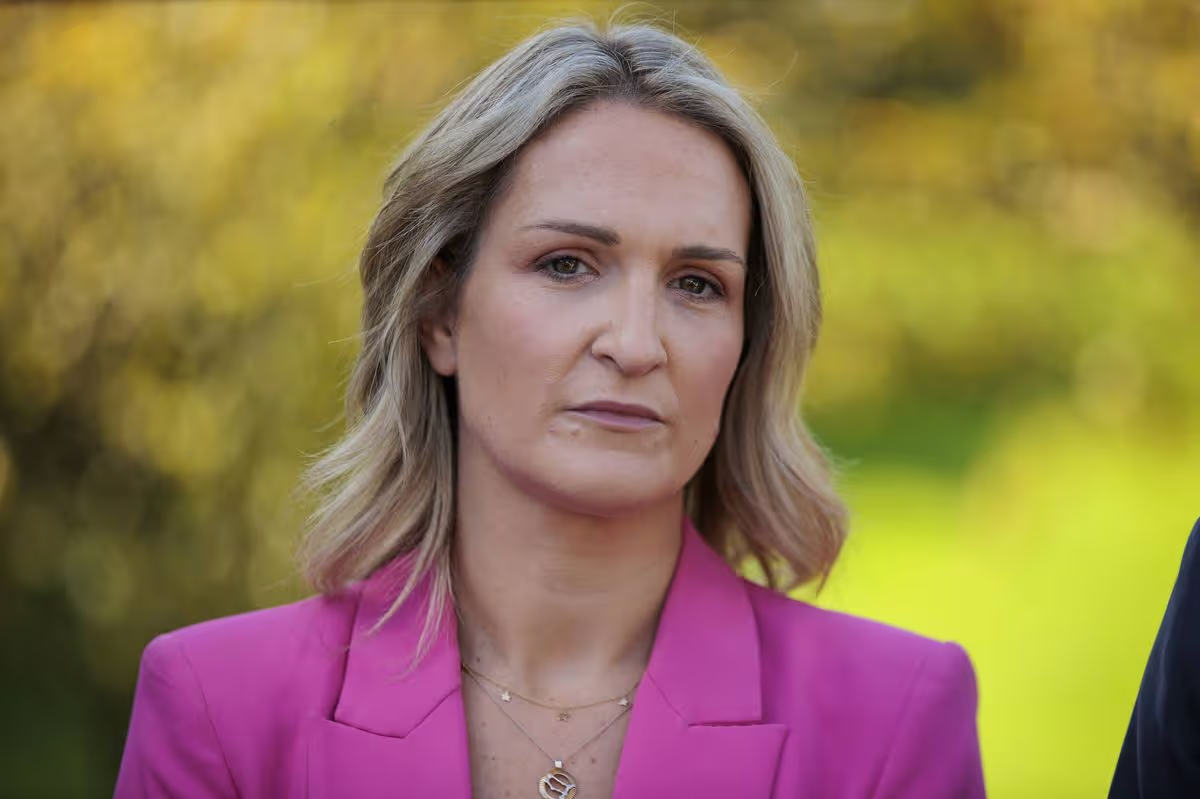 The Irish Government has risked the anger of Donald Trump for condemning a new law passed by the Israeli parliament, changing the rules around the death penalty, specifically targeting Palestinians.
Top Stories

 New York Times, Iran War Live Updates: After a Month of War, Hegseth Says Iran Retains Ability to Strike, John Ismay, Greg Jaffe, Helene Cooper and Aurelien Breeden, March 31, 2026. Defense Secretary Pete Hegseth and Gen. Dan Caine, the chairman of the Joint Chiefs of Staff, held their first public update on the state of the war in 12 days.
Here’s the latest.
Defense Secretary Pete Hegseth conceded on Tuesday that Iran retained the ability to retaliate after a monthlong U.S.-Israeli bombing campaign but repeated claims that Iran’s military capabilities had been crippled, in his first public briefing on the war in nearly two weeks.
“They will shoot some missiles; we will shoot them down,” Mr. Hegseth told reporters at the Pentagon alongside Gen. Dan Caine, the chairman of the Joint Chiefs of Staff. They last took questions from reporters on the state of the war on March 19.
Mr. Hegseth said that he had paid an unannounced visit to the Middle East over the weekend to visit troops at bases around the region.
“I witnessed urgency to finish the job,” he said. He said that the United States was “closer than ever before to winning,” even as the Trump administration strains to contain the fallout of a conflict that has jolted the global economy and sent U.S. gas prices soaring.
“We have more and more options, and they have less,” Mr. Hegseth said.
Gen. Caine said that the U.S. military had begun flying B-52 bomber missions over land for the first time. The military’s ability to fly the big planes over Iranian territory suggests that Iran’s air defenses have been significantly degraded.
He also said U.S. warplanes were now focused on destroying supply chains that feed Iran’s missile, drone and naval ship building facilities, choking off the country’s ability to replace munitions destroyed in thousands of American bombing runs.
President Trump has tried to put pressure on Iran to end its de facto blockade of the Strait of Hormuz — normally a conduit for one-fifth of the world’s oil supplies — by alternating threats of destruction with unverified claims of diplomatic progress. Iran has denied holding substantive talks with the United States and has rejected the Trump administration’s conditions to end the war as unreasonable.
 Mr. Trump has complained about a lack of support from U.S. allies in the war, even as he has insisted that he does not need it. On Tuesday, he criticized countries that “refused to get involved in the decapitation of Iran,” saying on social media that “you’ll have to start learning how to fight for yourself.”
“The U.S.A. won’t be there to help you anymore, just like you weren’t there for us,” he added. “Iran has been, essentially, decimated. The hard part is done. Go get your own oil!”
Fighting continued in the fifth week of the war, and Iran kept a firm chokehold over the Strait of Hormuz. Oil and gas prices rose again after a Kuwaiti oil tanker erupted in flames near Dubai on Tuesday in a drone attack that its owner, the Kuwait Petroleum Corporation, attributed to Iran.
Here’s what else we’re covering:
 Associated Press, Gulf allies privately make the case to Trump to keep fighting until Iran is decisively defeated, Aamer Mahdhani, Samy Magdi,
 Matthew Lee and Sam Mednick, March 31, 2026. Gulf allies of the United States, led by Saudi Arabia and the United Arab Emirates, are urging President Donald Trump to continue prosecuting the war against Iran, arguing that Tehran hasn’t been weakened enough by the monthlong U.S.-led bombing campaign, according to U.S., Gulf and Israeli officials.
After private grumbling at the start of the war that they were not given adequate advance notice of the U.S.-Israeli attack and complaining the U.S. had ignored their warnings that the war would have devastating consequences for the entire region, some of the regional allies are making the case to the White House that the moment offers a historic opportunity to cripple Tehran’s clerical rule once and for all.
Officials from Saudi Arabia, United Arab Emirates, Kuwait and Bahrain have conveyed in private conversations that they do not want the military operation to end until there are significant changes in the Iranian leadership or there’s a dramatic shift in Iranian behavior, according to the officials, who were not authorized to comment publicly and spoke on the condition of anonymity.
The push from the Gulf nations comes as Trump vacillates between claiming that Iran’s decimated leadership is ready to settle the conflict and threatening to further escalate the war if a deal is not reached soon.
New York Times, News Analysis: Trump Redefines ‘Regime Change’ in Iran War, Edward Wong, March 31, 2026. President Trump and his aides have made contradictory statements on whether the United States and Israel have transformed the Iranian government through violence.
Regime change has occurred in Iran. Or it hasn’t. It is a goal of the war. Except it isn’t.
Those are some of the dizzying messages that have come from President Trump and his aides in recent days. The phrase “regime change” has flown from lips this week like fighter jets crisscrossing the Persian Gulf.
But there appears to be disagreement among top administration officials on what the phrase means, or whether the United States and Israel have achieved it in four weeks of war against Iran.
Defense Secretary Pete Hegseth made an unequivocal declaration about the Iranian government at a news conference on Tuesday: “This new regime, because regime change has occurred, should be wiser than the last. President Trump will make a deal. He is willing.”
A common definition of regime change is a forced transformation of government or leadership that results in structural alterations in policies, politics and governance. In Iran, a theocratic leadership that is authoritarian and anti-American — and that continues to wage war — remains in place.
On Monday, Secretary of State Marco Rubio, who is also the president’s national security adviser, expressed some doubt in an interview with ABC News about whether anything had really changed in Iran.
“The people who lead them, this clerical regime, that is the problem,” he said. “And if there are new people now in charge who have a more reasonable vision of the future, that would be good news for us, for them, for the entire world. But we also have to be prepared for the possibility, maybe even the probability, that that is not the case.”
Later, speaking to Al Jazeera, Mr. Rubio made it clear that destroying Iran’s weapons was important because the current leadership — the new regime, as Mr. Hegseth puts it — is an adversary.
“I think the best way to stability, given the people who are in charge in Iran, is to destroy the ability of Iran in the future to launch these missiles and these drones against their infrastructure and civilian populations,” Mr. Rubio said.
He added that “our objectives here from the very beginning had nothing to do with the leadership.”
Mr. Trump opened the war on Feb. 28 by working with Israel to carry out a strike that killed Ayatollah Ali Khamenei, the supreme leader of Iran, and other top officials. Hours later, he called for Iranians to overthrow their government sometime after the bombing stopped. The uprising, which was promised to Mr. Trump by Israeli leaders, has not materialized, but the president is saying mission accomplished on regime change.
In fact, he said, the United States has been so successful that it has ended not just one, but two Iranian regimes.
“We’ve had regime change, if you look, already because the one regime was decimated, destroyed. They’re all dead,” Mr. Trump told reporters on Sunday aboard Air Force One. “The next regime is mostly dead. And the third regime, we’re dealing with different people than anybody’s dealt with before. It’s a whole different group of people. So I would consider that regime change.”
To emphasize the point, he said, “Regime change is an imperative, but I think we have it automatically.”
Mr. Trump’s talk of the destruction of two regimes appeared to refer to the initial attacks that killed Mr. Khamenei and other senior officials and also injured his son Mojtaba Khamenei, who was later appointed by a group of clerics to be Iran’s new supreme leader. Iranian and Israeli officials say the son suffered leg injuries, and he has not appeared in public during the war.
The younger Mr. Khamenei is considered a hard-line ally of a powerful arm of the Iranian military, the Islamic Revolutionary Guards Corps. The government in Tehran vows resistance and continues to fight the United States, Israel and Arab partners, and to block energy shipping in the Strait of Hormuz, disrupting the global economy.
“There has been personnel change in Iran, not regime change,” said Karim Sadjadpour, a scholar of Iran at the Carnegie Endowment for International Peace in Washington. “Different men with the same ideology.”
Mr. Trump’s remarks about regime change have muddied the waters. But his military actions and coercive economic warfare against a handful of nations — Iran, Venezuela and Cuba — are aimed so far at decapitating leadership to put in power someone who will accede to U.S. demands, rather than effecting a wholesale transformation of the political system.
The president’s aim is to create client states by coercing regime compliance, part of a greater project of resurrecting empire. And he constantly talks about a template: the U.S. military’s violent incursion into Venezuela in January to seize Nicolás Maduro, the country’s president, and Mr. Trump’s subsequent negotiations over oil and other matters with the acting president, Delcy Rodríguez, who like Mr. Maduro is a hard-line leftist.
Karoline Leavitt, the White House press secretary, said at a news conference on Monday that the United States and Israel had to kill the older Mr. Khamenei and some of his aides after it proved too difficult to do diplomacy with them. Those previous leaders “are now no longer on planet Earth,” she said, “because they lied to the United States and they strung us along in negotiations, and that was unacceptable to the president, which is why many of the previous leaders were killed.”
New York Times, Putin’s Internet Blackout: A Chaotic Drive to Cut Off Russians From the World, Paul Sonne, Valerie Hopkins and Oleg Matsnev, March 31, 2026. With new outages and blockages, President Vladimir V. Putin is taking his boldest steps yet to control Russians’ communications.
Russians in recent weeks have faced two disruptions at once. The authorities, armed with new technical capabilities and wartime pretexts, have been pulling the plug on the mobile internet in certain places. They have also been blocking ever more foreign apps used by millions of Russians.ImageA soldier holding a large gun runs outside in an open concrete space. Fallen trees, coiled barbed wire and buildings are in the background.A Ukrainian infantry soldier in the besieged city of Kostiantynivka, Ukraine, in January. Russia has used the war as a pretext to crack down on internet freedoms at home.Credit...Tyler Hicks/The New York Times
The government has cited security reasons for the internet outages, calling them precautions against Ukrainian drone attacks that use Russian mobile networks for targeting. But experts say the government is also conducting the sort of targeted blackouts that it would impose in the event of unrest, like the mass demonstrations that swept Iran this year.
Even bolder, in the eyes of many Russians, is Mr. Putin’s assault on Telegram. Having blocked Facebook, Instagram, WhatsApp and YouTube, the Russian leader is now moving to hobble an app that more than 100 million Russians use every month to communicate and read news, including from exiled outlets banned in Russia.
Moscow is pressuring Russians instead to use a new Kremlin-approved “super app” known as MAX. Russian media outlets have reported that Moscow plans to block Telegram fully starting on Wednesday, but signs have emerged that they could delay the move amid a public backlash.
Of all the examples of growing repression in Russia during four years of war in Ukraine, few have touched more people than the internet restrictions.
The on-again, off-again blackouts and blockages have caused havoc as the digital services that power everyday life have flickered in and out, forcing people into a frustrating hunt for workarounds.
 Morning Shots via The Bulwark, Political Opinion: And He Ran, He Ran So Far Away. From Iran, He Ran All…, Bill Kristol, Andrew Egger and Jim Swift,
 March 31, 2026. You can just abandon things.
Average gasoline prices hit $4 per gallon today as the Strait of Hormuz remains effectively closed. As we’ll discuss below, President Trump doesn’t really care whether it opens again. So, uh, better adjust that gas budget for the long term. Happy Tuesday.
News Updates
Letters from an American, Historical Commentary: March 30, 2026 [A Fantasy War Result?], Heather Cox Richardson, right, March 31, 2026. Showing reporters on Air Force One a series of posterboard images of his new ballroom last night, Trump told them: “I thought I’d do this now because it’s easier. I’m so busy that I don’t have time to do this. But, ah, I’m fighting wars and other things. But this is very important ’cause this is going to be with us for a long time and it’s going to be, I think it’ll be the greatest ballroom anywhere in the world.”
At 7:26 this morning, about two hours before the stock market opened, Trump’s social media account posted: “The United States of America is in serious discussions with A NEW, AND MORE REASONABLE, REGIME to end our Military Operations in Iran. Great progress has been made but, if for any reason a deal is not shortly reached, which it probably will be, and if the Hormuz Strait is not immediately ‘Open for Business,’ we will conclude our lovely ‘stay’ in Iran by blowing up and completely obliterating all of their Electric Generating Plants, Oil Wells and Kharg Island (and possibly all desalination plants!), which we have purposefully not yet ‘touched.’ This will be in retribution for our many soldiers, and others, that Iran has butchered and killed over the old Regime’s 47 year ‘Reign of Terror.’ Thank you for your attention to this matter. President DONALD J. TRUMP”
When he decided to go to war with Iran, Trump apparently fantasized that the operation would look like his strike on Venezuela, in which a fast attack enabled U.S. forces to grab Venezuelan president Nicolás Maduro and his wife Celia Flores, leaving behind Vice President Delcy Rodríguez, who appeared willing to work with the Trump administration, in power. The initial strikes of Israel and the U.S. on Iran did indeed kill that regime’s leadership, but officials simply replaced that leadership from within the regime, making Trump’s claim of regime change as imaginary as his claim that the U.S. and Iran have been at war for 47 years.
More shocking in this statement, though, is that Trump appears to be trying to force his will on the Iranians by threatening to commit war crimes. International law recognizes attacks on civilian infrastructure—like those Russian president Vladimir Putin has been carrying out on Ukraine for years—as war crimes. The Geneva Convention specifically prohibits attacks on drinking water, so Trump’s threat to attack the desalination plants that make seawater drinkable is, as Shashank Joshi of The Economist notes, not only stupid because Iran could do the same to other Gulf states, but “also, quite obviously,...very illegal.”
Joshi notes that “[Arizona Democratic senator] Mark Kelly et al were right to warn of illegal orders,” and Charles A. Ray of The Steady State explains that not just Trump but anyone carrying out these orders would be implicated in potential criminality. Trump’s threat comes the day after Christiaan Triebert and John Ismay of the New York Times reported that on the first day of attacks, U.S. forces hit not just the girls’ school we knew about, but also, in a different city, a sports hall used by civilians and a nearby elementary school, killing at least 21 people.
Trump apparently had no plan B for what to do if the initial plan to strike Iran and knock out its leaders failed, and is now flailing. His repeated assurances that talks with Iran are making “great progress” contrast with Iran’s insistence it is not engaged in talks with the United States. Trump entered the war with vague promises of “regime change” and promises to guarantee Iran never developed a nuclear weapon but now is reduced to hoping for Iran to reopen the Strait of Hormuz, putting the U.S. in the odd position of fighting a war to achieve the conditions that existed before it started the war.
On Sunday, Trump told the Financial Times that “my favorite thing is to take the oil in Iran” as the U.S. did when it took control of Venezuelan oil fields. This sounds like bluster, but he is also massing U.S. troops in the region.
Meanwhile, the price of oil rose to $116 a barrel after strikes against Israel by the Iran-backed Houthis in Yemen. The Houthis have the potential to disrupt yet another key strait, the Bab el-Mandeb, through which tankers carry about 10% of the world’s oil out of the Red Sea to the Gulf of Aden and into the Arabian Sea, from where it can go into the Indian Ocean and to the rest of the world.
In the 1980s, a faction of the Republican Party that was determined to cut taxes and regulations and to get rid of programs that benefiting racial minorities and women went to war against the federal government. Those so-called Movement Conservatives—“movement” because they were a political movement, and “conservatives” because they wanted to take the U.S. back to a time before the New Deal—became increasingly radical over time. Some, like activist Grover Norquist, wanted to take the government back even further, to the time of the robber barons in the 1890s, before “the socialists took over” with the Progressive Era and its income taxes and regulation.
But Americans liked the programs that regulated business, provided a basic social safety net, promoted infrastructure, protected equality before the law, and provided international security, so Movement Conservatives focused on taking power away from Congress, where the people’s voices could be heard, and centering power in the president.
Now we are seeing what that sort of a government, devoid of experts and beholden to the whims of a single man, looks like. After a year in power, Trump’s administration has embroiled the U.S. in a war of choice that has created an extraordinary global energy crisis, inflation is rising, job growth is down, and Republicans in Congress have abdicated their authority to oversee the war or other government agencies, or even to fix a problem of their own making in a partial government shutdown. Instead, they are seemingly content to let Trump do whatever he wishes.
Trump’s imperial presidency has demonstrated the country’s need for the allies he has disdained, as he has been forced to beg for their help. They have generally refused to get involved in a war Trump started without consulting them; today Spain’s defense minister said Spain has closed its airspace to U.S. planes involved in operations against Iran.
Trump appears to be turning not to the gutted State Department, but to his usual cadre of billionaires to help him figure out a way forward. Edward Wong, Theodore Schliefer, Tyler Pager, and Ryan Mac of the New York Times reported that when Trump talked to Prime Minister Narendra Modi of India last Tuesday, billionaire Elon Musk took part in the call, although the readouts from both the U.S. and the Indian government did not mention his participation.
Now, with Congress out of session until April 13, Trump is putting the people and matériel in place to escalate the war. And yet, as Josh Marshall of Talking Points Memo notes, the new goal of freeing traffic in the Strait of Hormuz leaves the Iranians rather than the U.S. in control of the terms of declaring victory. An Associated Press–National Opinion Research Center (AP-NORC) poll from March 25 shows that 59% of Americans think the U.S. has gone too far in Iran, with only 13% supporting escalation. Sixty-two percent oppose sending ground troops into Iran, while only 12% favor the idea.
Even so, as David Kurtz wrote today in Talking Points Memo, “There’s no telling what President Trump will resort to doing to save face, create the mirage of victory, and extricate himself from the box canyon into which he so triumphantly galloped.”
What we do know, though, is that Trump is extraordinarily unlikely ever to do anything that will conflict with the wishes of Russia’s president Vladimir Putin. Trump has blockaded Cuba, strangling its energy sector by blocking off all oil tankers from the island. Although he has stopped Venezuelan and Mexican tankers, today he permitted a Russian-flagged tanker to get through the blockade to sell oil that will help fund Russia’s war against Ukraine.
Asked why he permitted that tanker through, Trump answered: “He loses one boatload of oil, that’s all it is. If he wants to do that, and if other countries want to do it, doesn’t bother me much.” World affairs journalist Frida Ghitis commented: “When Mexico tried to send oil to Cuba, Trump immediately threatened to impose crushing tariffs on it, or on any country that broke his blockade of the island. Now Russia is sending Cuba oil and Trump says it’s fine, no problem. The mystery continues.”
We can also be sure that Trump will find time to keep attacking those he perceives to be his enemies. As J.D. Wolf of Meidas News reported today, Trump has posted about continuing to try to prosecute New York attorney general Letitia James fourteen times in the past five days. James successfully prosecuted Trump, some of his children, and the Trump Organization for fraud. Trump has tried unsuccessfully and repeatedly to charge her with mortgage fraud or insurance fraud.
Peter Sullivan of Axios reported today that to pay for the war and find more money for Immigration and Customs Enforcement (ICE), Republicans are considering making cuts to federal health care spending. House majority leader Steve Scalise (R-LA) told Sullivan that they were looking at areas of “waste and fraud and abuse.”
As the administration flails, insiders are leaking about some of the administration’s most powerful individuals. Two senior sources from the  Department of Homeland Security leaked stories about White House deputy chief of staff Stephen Miller to the Daily Mail, a tabloid out of the United Kingdom. They claimed Miller demanded agents in Minneapolis be sent to areas where DHS knew there would be a lot of protesters because he wanted to “force confrontations” between agents and protesters that would enable the administration to “win the ‘PR battle.’” They echoed others in suggesting that Miller, not the president, was in charge of immigration policy.
Yesterday Michelle Boorstein of the Washington Post reported that former high-ranking military officials, experts on religion and law, and veterans groups, as well as current Pentagon staff and officers, have expressed deep concern over Defense Secretary Pete Hegseth’s extremist evangelical worship services and his casting of the U.S. military as a force for Christian holy war. Last Wednesday he prayed for U.S. troops to assert “overwhelming violence of action against those who deserve no mercy,” saying: “We ask these things with bold confidence in the mighty and powerful name of Jesus Christ.”
G. Elliott Morris of Strength in Numbers and Fifty Plus One reported today that Trump has hit a new approval low among all American adults, with 58.1% disapproving of his job in office and just 37.6% approving, an overall difference of -21 . A University of Massachusetts Amherst poll has Trump’s job approval rating at 33%.
Tonight Trump’s social media account posted an AI-generated video of a future President Donald J. Trump Presidential Library. To triumphal music, the video features a gleaming skyscraper containing what appears to be the airplane the president pressured Qatar into giving him, along with what seems to be a replica of the Oval Office…and a model of his anticipated ballroom.
The Parnas Perspective, ,Evening News and Commentary: Trump Overhauls Election System, Judge Blocks White House Ballroom, Trump Says Iran War Could End Soon (He's Lying), Aaron Parnas, March 31, 2026. Donald Trump has signed an executive order restricting mail-in voting—even though he has used the system himself—while ordering the creation of a sweeping federal list of Americans eligible to vote. At the same time, a federal court has blocked construction of his White House ballroom, yet Trump is already signaling he may push forward anyway under the guise of “security.”
On foreign policy, Trump is now claiming the war with Iran could end “within two weeks.” There is no clear evidence to support that timeline, and strikes are continuing as we speak.
A couple of quick notes. First, I’ve seen the ongoing discourse around influencers and journalists. I’m not getting involved. I don’t use this platform to attack others—I focus on reporting and building coalitions, and that’s where I’m staying. Second, many of you have said I look exhausted—you’re right. That’s mostly due to having a newborn and very little sleep. But I’m okay, and I care deeply about this work.
If you’re able, please consider subscribing to support it. This kind of sustained, high-level scrutiny takes time, resources, and real endurance. I can’t do it alone—and your support is what makes this reporting possible.Subscribed
Here’s the news:
President Donald Trump is expected to sign an executive order restricting mail-in voting, including requiring a federal list of verified eligible voters and limiting ballot distribution to those on the list. The move is part of his long-standing push to curb mail voting following the 2020 election, though critics warn it could disenfranchise millions and face legal challenges.
The executive order would tighten restrictions on mail-in voting by requiring the federal government to create verified lists of eligible U.S. voters in each state and limiting absentee ballots only to those approved lists. It also introduces new security measures, including specialized envelopes and barcode tracking for ballots. Additionally, states that fail to comply with the requirements could face the loss of federal funding.
A federal judge has temporarily blocked construction of President Donald Trump’s proposed White House ballroom, ruling that he likely exceeded his authority by moving forward without congressional approval. The court ordered an immediate halt to construction and demolition work, emphasizing that the White House is federal property under Congress’s control. The administration has already appealed the decision, while the judge noted the project could proceed if Congress formally authorizes it. Here is Trump’s response:
Trump defended continuing limited construction on the White House ballroom despite a court order, arguing the work falls under necessary safety and security measures. He cited features such as bulletproof glass, drone-resistant roofing, bio-defense systems, secure communications, and medical and shelter facilities as justification for ongoing activity under the ruling.
A Daily Mail report alleges that Bryon Noem, husband of Homeland Security Secretary Kristi Noem, has been leading a secret double life involving crossdressing and online interactions with adult entertainers. The article claims he used disguises and paid for explicit conversations while his wife held a high-profile government role. The report relies on purported photos and messages, though no official response or independent verification is cited.
Kristi Noem told the New York Post that she was “devastated” and that her family was “blindsided” by allegations that her husband leads a secret cross-dressing double life, according to her representatives. The claims, first reported by the Daily Mail, remain unverified, and Noem’s team argues the situation has caused significant personal distress while raising concerns about privacy and potential political implications.
The U.S. Army has suspended an aircrew after military helicopters were seen flying near Kid Rock’s home in Tennessee, prompting an investigation into possible violations of flight rules. Officials said the helicopters were AH-64 Apaches on a routine mission and not connected to nearby protests, but emphasized that aviators must follow strict safety and professionalism standards.
Trump reacted casually to reports of Army helicopter crews being suspended after flying near Kid Rock’s home, joking they may have been trying to “defend him.” He acknowledged the crews likely shouldn’t have been doing it but said he would review the situation.
An unflattering photo of White House Press Secretary Karoline Leavitt was pulled from a photo agency’s database after the administration expressed dissatisfaction, but the move sparked wider attention and circulation online. The image, which had initially seen limited publication, quickly spread across social media in what critics described as a “Streisand effect.” The incident highlights ongoing tensions between the Trump administration and media outlets over coverage and image control.
The Supreme Court ruled 8–1 that Colorado’s ban on conversion therapy for minors violates the First Amendment, siding with a Christian therapist who argued the law restricts free speech rather than regulating medical conduct. The decision, which could impact similar laws in over 20 states, is viewed as a setback for LGBTQ protections, as conversion therapy is widely discredited and considered harmful by major medical organizations. The lone dissenting justice warned the ruling may weaken oversight of medical professionals and lead to unsafe or unregulated practices.
President Donald Trump downplayed concerns about rising gas prices reaching $4 per gallon, arguing that national security is a greater priority. In response to questions about the economic impact on Americans, he said that while costs are increasing, people are “feeling a lot safer” in the current geopolitical environment.
An Iranian strike destroyed a U.S. E-3 Sentry surveillance aircraft at a Saudi airbase, raising concerns about vulnerabilities in protecting critical military assets and Iran’s ability to accurately hit high-value targets. Ukrainian officials said a Russian spy satellite had photographed the base multiple times before the attack, suggesting possible intelligence coordination, though Russia denies involvement. The incident, which also injured U.S. personnel, underscores escalating regional tensions and a potential shift in Iran’s strategy toward targeting key components of U.S. airpower.
Trump said the U.S. could leave Iran “within two weeks,” suggesting a potential timeline for ending American involvement in the conflict.
A global jet fuel shortage driven by the Iran war is pushing up airfares and prompting airlines to raise fees and cut some flights. Fuel prices have surged sharply, forcing carriers to pass costs onto travelers, with some already increasing baggage fees and reducing capacity. Analysts warn the disruption to energy supplies could continue to strain the airline industry and keep travel costs elevated in the near term.
According to Reuters, an American journalist was kidnapped in Baghdad, prompting Iraqi security forces to launch an operation to locate her and pursue the kidnappers. Authorities said one suspect has been arrested and a vehicle used in the abduction was recovered after a crash, but other suspects remain at large. The incident comes amid heightened security risks in Iraq tied to ongoing regional conflict, with U.S. officials monitoring the situation closely.
According to The Guardian, Pakistan and China have proposed a joint five-part peace plan aimed at ending the Middle East conflict, calling for an immediate ceasefire, protection of key waterways, and renewed diplomatic dialogue. The initiative comes as Pakistan seeks to position itself as a mediator between the U.S. and Iran, despite limited progress and the absence of both countries from recent talks. The effort reflects both geopolitical ambitions and domestic concerns, as Pakistan faces economic and security risks from the ongoing conflict.
Israel has announced plans to occupy large parts of southern Lebanon and establish an expanded buffer zone, including destroying homes to prevent the return of hundreds of thousands of residents. Officials say the move is aimed at pushing Hezbollah away from the border, but human rights groups warn it could constitute forced displacement and potential war crimes. The escalation comes amid intensified fighting, rising casualties, and growing concerns over a deepening humanitarian and regional crisis.
Three former FBI agents who worked on criminal cases involving Donald Trump have filed a lawsuit alleging they were illegally fired as part of a political “retribution” campaign by Trump administration officials. The suit claims more than 50 FBI employees were dismissed without due process and that officials publicly disparaged them to damage their reputations, citing remarks from Deputy Attorney General Todd Blanche as evidence. The agents argue they were targeted for their lawful investigative work, while the administration has defended its authority to remove personnel in high-level roles tied to its policy priorities.
Federal funding for reproductive health clinics through the Title X program is at risk of lapsing due to delays by the Trump administration, leaving providers uncertain about whether funds will arrive on time. Clinics that serve millions of low-income patients are preparing contingency plans, including potential service cuts or charging fees, as the government shortened the application timeline and has not confirmed when funding will be distributed. The uncertainty raises concerns about disruptions to essential services like birth control, cancer screenings, and STI testing.
According to NBC News, a deadly collision at LaGuardia Airport involving an Air Canada jet and a fire truck is raising concerns that air traffic control procedures may have been violated. Investigators are examining whether a controller was handling both air and ground duties before midnight, contrary to standard rules, amid ongoing staffing shortages and heavy flight volume that night. The crash, which killed both pilots, has intensified scrutiny of controller workloads and broader safety risks within the U.S. air traffic control system.
A former aide to Rep. Marcy Kaptur pleaded guilty to wire fraud after stealing nearly $23,000 from the congresswoman’s bank account to pay personal credit card bills. Prosecutors say she made multiple unauthorized transfers over nearly a year and initially tried to blame “hackers from the dark web” before admitting her actions. She now faces potential prison time, though her sentence is expected to be less than the 20-year maximum.
Rep. Eric Swalwell has sent a cease-and-desist letter to FBI Director Kash Patel seeking to block the release of investigative files related to his past association with a suspected Chinese intelligence operative, arguing the move is a political attempt to damage his gubernatorial campaign. Swalwell’s attorneys say releasing the files would violate federal law, Justice Department rules, and his constitutional rights, noting he was never accused of wrongdoing and cooperated with investigators.
Three people were arrested after allegedly attempting to break into reality TV star Larsa Pippen’s Miami-area home, with police apprehending the suspects within minutes of their attempted escape. Officers responded to a burglary-in-progress call, pursued a fleeing vehicle that crashed nearby, and took the suspects into custody after a brief foot chase.
A bipartisan group of senators has introduced a bill aimed at improving housing affordability in rural areas by expanding eligibility for federal housing assistance. The proposal would update decades-old population limits, allowing communities of up to 10,000 people to qualify and potentially helping millions of Americans access home loans.
A federal judge has ordered the University of Pennsylvania to comply with a Trump administration subpoena seeking information related to Jewish employees as part of an investigation into alleged antisemitic harassment. The ruling allows the request to proceed in a limited form, barring disclosure of specific organizational affiliations, while the university argues it raises serious privacy and constitutional concerns and plans to appeal.
The Parnas Perspective, Morning News and Commentary: Trump Lashes Out as Gas Prices Soar, Approvals Fall to Lowest in History, France Rejects US Access to Airspace, Trump Looks for Way out of Iran, Aaron Parnas, right, March 31, 2026. Donald Trump and the White House are facing mounting pressure right now. Gas prices have surged past $4 a gallon, his approval rating has dropped to historic lows for this point in a presidency, and he is lashing out at allies like France after disputes over military access. At the same time, reports suggest he may be looking for a quick exit from the war in Iran, raising serious questions about strategy and stability.
On another note, many of you asked why you could not see a video I posted about Lindsey Graham last night on other platforms. It was taken down. More “community guidelines” enforcement, more quiet removals.
This is exactly why this platform matters. No billionaires pulling the strings. No algorithm deciding what you are allowed to see.
Here’s what you missed:
Donald Trump’s net approval rating has dropped to -17, the lowest for any President in American history at this point in their presidency:
Harry Enten reported that House Republicans are retiring at a historic pace, with 36 departures already announced this cycle—the highest number since 1930. He suggested the wave of exits signals growing concern within the party ahead of upcoming elections.
NBC News has confirmed, in exclusive reporting, that the U.S. Marine Corps will have U.S. Immigration and Customs Enforcement agents stationed outside graduation events at Parris Island, South Carolina, to check the immigration status of visitors. The move comes as part of heightened security measures during the ongoing Iran conflict, requiring strict identification such as passports or REAL IDs to enter the base. Officials said ICE will not make arrests, but undocumented family members may still face questioning at access points. The decision is unusual and has raised questions about why immigration enforcement is being tied to military graduation events.
A report (first from the Financial Times) claims that a broker connected to Pete Hegseth contacted BlackRock in February about making a multimillion-dollar investment in a defense-focused fund. The fund in question invests in major defense contractors like Lockheed Martin and Northrop Grumman, companies that could benefit financially from increased military conflict and spending. The timing is what’s raising alarm: the inquiry reportedly happened just weeks before the U.S.-Israel strikes on Iran, leading to concerns about potential insider knowledge or conflicts of interest.
The partial shutdown of the Department of Homeland Security could drag on for weeks or even months as negotiations collapse and lawmakers leave Washington without a deal. Infighting among Republicans, combined with a standoff with Democrats over immigration funding, has stalled progress. With TSA workers now being paid and airport disruptions easing, pressure to resolve the crisis is fading, leaving thousands of other federal employees unpaid or furloughed. Officials warn the situation may continue into the summer as no clear path to a resolution has emerged.
According to the Wall Street Journal, Donald Trump has told aides he is willing to end the war with Iran even if the Strait of Hormuz remains closed, prioritizing a quicker end to the conflict. Officials believe reopening the key shipping route would require a longer and more complex military campaign than the administration wants. Instead, the U.S. aims to weaken Iran’s military capabilities and then rely on diplomacy or allies to restore trade flow later. The approach could leave Iran maintaining control over one of the world’s most critical oil chokepoints.
It comes as the average price of a gallon of gas in the United States has now surpassed $4 for the first time since 2022:
A report says the White House pushed to remove a photo of press secretary Karoline Leavitt from major news wire services after it angered officials. The image was taken during a lighthearted Thanksgiving briefing featuring the ceremonial turkey pardon. One specific photo reportedly triggered a strong reaction, leading to its removal from distribution. The incident raises questions about media control and the handling of press images by government officials. This is the image they wanted removed:
At least 11 people, including three children and two mothers, were killed in a strike on the Iranian city of Mahallat, according to state-linked media. The attack destroyed four residential buildings and damaged several others. The incident highlights the growing civilian toll as the conflict continues.
An Iranian strike destroyed a $300 million U.S. E-3 Sentry surveillance aircraft at a base in Saudi Arabia, marking the first time one has been lost in combat. The attack also injured multiple U.S. service members and damaged additional aircraft, highlighting the growing cost of the war. Experts warn the loss weakens U.S. early warning and coordination capabilities in the region. The conflict has already resulted in significant casualties and the destruction or damage of numerous U.S. military assets.
Pete Hegseth described a conversation with a service member, saying: “I witnessed lethality… she simply looked up at me with a sly smile on her face and said, more bombs, sir, and bigger bombs. We will happily oblige her,” highlighting an aggressive stance on escalating military force.
Reuters has confirmed that New York University has temporarily closed its Abu Dhabi campus after threats from Iran targeting U.S.-affiliated universities in the region. Students, faculty, and staff are being relocated, and classes will continue online as a safety precaution. The move follows recent Israeli airstrikes on Iranian universities, which appear to have escalated tensions. University officials said the decision was made to prioritize the safety of the campus community.
Israel Katz said Israel plans to demolish all homes near its southern Lebanon border to create a security buffer zone against future attacks. The military aims to control territory up to the Litani River and prevent residents from returning until northern Israel is considered safe. The move could affect hundreds of thousands of Lebanese civilians living in the area. The announcement raises significant humanitarian and geopolitical concerns.
Pete Hegseth said the U.S. will “negotiate with bombs,” signaling a strategy of using military pressure to force Iran into a deal. He also acknowledged a “new regime” in Iran, implying regime change as part of the broader context. Hegseth emphasized that securing a deal remains the primary goal, but warned the U.S. is prepared to continue military action if negotiations fail.
The United Nations Development Programme warns that the war in Iran could push up to 4 million people across the Middle East into poverty. The conflict may also shrink regional economies by up to 6%, costing as much as $194 billion and increasing unemployment by around 4%. The report highlights how existing economic vulnerabilities make the region especially sensitive to even short-term military escalation. Officials caution that the impacts could be long-lasting, extending well beyond the immediate conflict.
Per Reuters, a Kuwait-flagged oil tanker, the Al-Salmi, was struck in an attack attributed to Iran while at a port in Dubai. Kuwait Petroleum Corporation said no crew members were injured and there was no environmental damage or oil spill. Authorities are continuing to assess the extent of the damage.
Damage to the Kuwait-flagged Al-Salmi crude oil tanker, following a reported strike
UNRWA chief Philippe Lazzarini is calling for a high-level investigation into the deaths of more than 390 staff members during the Gaza war, the deadliest conflict for U.N. personnel in history. Discussions are underway with United Nations leadership, including Secretary-General António Guterres. Lazzarini said the probe has not yet been launched because the conflict is still ongoing. Israeli officials have not yet responded to the proposal.
Pete Hegseth delivered a prayer asking for God’s protection, peace, and safety over those involved in the Iran war, ending it in the name of Jesus Christ. This is yet another example of how religion is flowing into this war:
Hegseth said there is no fixed timeline for achieving U.S. objectives, noting estimates have ranged from a few weeks to longer. He emphasized that the final decision on timing will be up to Donald Trump. The comments reflect uncertainty about how long the operation may continue.
Lawyers for Tyler Robinson, accused of killing Charlie Kirk, are seeking to delay a key hearing as new forensic evidence raises questions about the case. A federal ballistics analysis could not conclusively link a bullet fragment to the rifle found at the scene, and further testing is ongoing. Prosecutors say DNA ties Robinson to the weapon and are pursuing the death penalty, while the defense argues the evidence is inconclusive and may help clear him.
Tensions are escalating ahead of Hungary’s election as Viktor Orbán faces a serious challenge from opposition leader Péter Magyar that could end his 16-year rule. The campaign has been marked by accusations of vote-buying, spying, and foreign interference involving both Russia and Ukraine. Observers warn the election may not be fully fair due to government control over media and institutions. Analysts also fear the dispute could continue after election day, with both sides potentially challenging the results.
New renderings show Donald Trump’s planned presidential library as a massive skyscraper in Miami, featuring his name prominently and luxury design elements. The project includes replicas of the Oval Office, a large ballroom, and even a Boeing jet gifted by Qatar displayed inside. The building would dominate the skyline near Biscayne Bay and is expected to cost close to $1 billion. Critics note the project breaks from traditional presidential library designs and raises questions about its scale and funding.
Frustration is growing within the Democratic Party toward Chuck Schumer, as several Senate candidates publicly question his leadership and call for change. While Schumer is still expected to retain support from much of his caucus, the criticism reflects deeper divisions over the party’s direction and strategy. Some candidates argue he has mishandled key negotiations, while allies defend his record and focus on winning back the Senate majority. The debate highlights ongoing tensions and a push for generational change within the party.
A new study links common plastic chemicals called phthalates to nearly 2 million premature births and about 74,000 infant deaths worldwide in a single year. These “everywhere chemicals,” found in products like food packaging, personal care items, and household goods, can disrupt hormones and affect fetal development. Researchers warn the health risks may be widespread and difficult to avoid without stronger regulations and safer materials. Experts say the findings highlight the urgent need to limit harmful chemicals in plastics globally.
So as many of you may know, I have had a big change in my life, I became a girl dad, and both mom and baby are doing great! Since becoming a family of three, I wanted to make sure that my loved ones were protected more so than ever before, and that’s why I am continuing to partner with a company called DeleteMe. DeleteMe also heard the news and made sure that all of our information was already protected. We have already run a data-wipe and removed any existing information that could lead to threats. Now, you can protect yourself and your family too. Click HERE to get 20% off any DeleteMe consumer plan, just use code AARON at checkout, and protect yourself, just like I am doing right now!
U.S. Law, Crime, Courts, Rights, Justice
New York Times, Editorial Board Opinion: The People Trump Pardoned Are on a Crime Spree, The Editorial Board, March 31, 2026. The Constitution grants sweeping pardon powers to the president, which means that public opinion has historically been the only check on that power. The risk of a backlash is the reason that presidents have waited until their last days in office to issue many pardons and commutations, especially dubious ones to family members (like Hunter Biden) or political allies (like Caspar W. Weinberger, whom George H.W. Bush pardoned).
The potential for a backlash also made presidents cautious about the number of pardons they issued. They understood that there could be an outcry if somebody who received a pardon later committed a new crime. The pardon system has also relied on the decency of American presidents.
President Trump has abandoned this approach. His self-serving pardons are so numerous that public attention cannot keep up with them. It is a version of the strategy that his former adviser Steve Bannon has described as “flood the zone”: Do so much so fast that people cannot follow the consequences.
He has created a veritable pardon industry, in which people with White House connections accept payments from wealthy convicts. Among those on whom he has bestowed freedom are dozens of people convicted of fraud. He has also pardoned Juan Orlando Hernández, a former president of Honduras, who helped traffic hundreds of tons of cocaine into the United States, and Ross Ulbricht, who was serving a life sentence for running Silk Road, a sprawling criminal enterprise that sold drugs. There seems to be no crime too ugly for a Trump pardon.Sign up for the Opinion Today newsletter Get expert analysis of the news and a guide to the big ideas shaping the world every weekday morning. Get it sent to your inbox.
Worst of all, Mr. Trump issued pardons on the first day of his second term to everyone who stormed the Capitol on Jan. 6, 2021. He did not distinguish between rioters who were relatively peaceful and those who attacked police officers, as Vice President JD Vance said should be the case. All 1,500 or so Jan. 6 rioters received a clean slate.
The results have been disastrous. At least 12 of the pardoned rioters have since been charged with other serious crimes, including child molestation, assault, harassment, murder plots and charges related to a vicious dog attack. The outcome was predictable. Critics, including this board, had warned that Mr. Trump’s pardons would embolden the rioters by signaling that crime has no consequences. One does not have to be a criminologist to predict that people who commit a violent act and are absolved of any punishment might become repeat offenders.
The American public deserves to understand the mayhem that the Jan. 6 pardons have unleashed. Among the 12 serious recidivists whom we are aware of, four were in jail or prison at the time of the pardon, and they quickly went on to commit more crimes:
On March 5, a court in Florida sentenced Andrew Paul Johnson to life in prison for molesting a 12-year-old boy and a girl of the same age. To keep the children quiet, Mr. Johnson is said to have promised to bequeath to them part of a Jan. 6 restitution payment from the federal government that he claimed he would receive. He used the online gaming platforms Discord and Roblox to reach out to the children after Mr. Trump freed him from prison. On Jan. 6, Mr. Johnson entered the Capitol through a broken window and accosted police officers.
In the past two months, Jake Lang destroyed an ice sculpture outside the Minnesota State Capitol, leading to a felony vandalism charge, and helped organize an anti-Muslim rally in New York City that turned violent. On Jan. 6, he was caught on camera storming the Capitol with a baseball bat and a riot shield, which prosecutors said he used to attack police officers.
In May, Zachary Alam was arrested for breaking into a house in Virginia and stealing a tablet computer and a diamond necklace. On Jan. 6, he was among the first to enter the Capitol building from its west lawn and hurled items at police officers from a balcony. At his sentencing hearing, he was unrepentant: “Sometimes you have to break the rules to do what’s right.” He had previous convictions for auto theft and driving under the influence.
 Enrique Tarrio, above, the leader of the far-right Proud Boys, scuffled with protesters at a news conference and was briefly detained on assault charges, a month after Mr. Trump freed him from a 22-year prison sentence. Mr. Tarrio was one of the leaders behind the Jan. 6 attack, but he was not in Washington on the day of the riot. He had been kicked out of the city after vandalizing a Black church after an earlier pro-Trump rally.
An additional eight Jan. 6 rioters were out of prison when Mr. Trump pardoned them and have since been charged with new crimes:
On March 25, a judge sentenced Daniel Tocci to four years in prison for possession of more than 110,000 child pornography images. During the Jan. 6 riot, he joined the mob as it broke into the Capitol and destroyed and took government property.
On March 1, Bryan Betancur grabbed a woman’s hair on the Washington Metro, leading to a charge of assault and battery. At least two women have also accused him of stalking. He was already on probation for a burglary conviction when he stormed the Capitol and helped rioters circulate furniture that most likely was used as weapons.
In October, Christopher Moynihan threatened to kill Hakeem Jeffries, the House minority leader, and pleaded guilty to a harassment charge over the incident. On Jan. 6, he was among the first rioters to breach police barricades and eventually broke into the Senate chamber.
Robert Packer was arrested in September after his dogs attacked people, putting four in the hospital. He previously had a long criminal record that included theft and drunken driving, and during the Jan. 6 riot, he wore a “Camp Auschwitz” sweatshirt.
John Andries violated a legal order requested by the mother of his child by repeatedly following and confronting her, leading to a sentence in June of 60 days in jail and three years of unsupervised probation. On Jan. 6, he entered the Capitol through a broken window and pushed police officers once inside.
Brent Holdridge was arrested in May for stealing tens of thousands of dollars’ worth of industrial copper wire. On Jan. 6, he was scheduled to be in jail on separate drug-related charges, but he skipped his booking and joined the mob as it breached the Capitol.
Jonathan Munafo was rearrested last year after he allegedly fled federal supervision imposed for dozens of menacing phone calls, including one in which he threatened to “cut the throat” of a 911 dispatcher. During the riots, he punched a police officer twice, stole his riot shield and used a wooden flagpole to try to break a window.
Days after he was pardoned, Matthew Huttle is said to have resisted arrest during a traffic stop, and a sheriff’s deputy shot and killed him. The police said he had a gun. On Jan. 6, he helped take over the Capitol and joined rioters in chanting, “Whose house? Our house.”
This list does not include at least 27 rioters who committed other crimes before they received their pardons. That group includes one woman who was sentenced to 10 years in prison for killing someone while driving drunk and a man who livestreamed a bomb threat while driving around Barack Obama’s neighborhood in Washington.
How can the nation hold Mr. Trump accountable for the lawlessness that he has made possible? The only answer is public opinion and its most tangible manifestation: election results.
In this year’s midterms, he and the Republican Party he leads deserve to pay a political price for the pardons. Mr. Trump continues to lionize a violent attack on Congress carried out in his name — an attack that included threats to kill the vice president of the United States and physical assaults against police officers guarding the Capitol. In the aftermath of the attacks, one officer suffered a series of strokes and died, and four other officers died by suicide.
Yet Mr. Trump still supports the rioters and lies about what happened that day. Congressional Republicans, for the most part, back him up. Speaker of the House Mike Johnson said, referring to the blanket pardon, “I stand with him on it.” Representative Jim Jordan of Ohio has complained about the unpleasant nature of life in prison for the rioters before the pardons. Representative Lauren Boebert of Colorado said she wanted to give the rioters a guided tour of the Capitol. Other Republicans, including the Senate majority leader, John Thune, have avoided answering questions about the pardons and said they involve “looking backward.”
The violence that the pardoned rioters continue to commit puts the lie to that weak excuse. The Jan. 6 pardons undermined the law, and they undermined public order. They were an affront to police officers everywhere. Mr. Trump has a constitutional right to pardon whom he chooses. The rest of us have a right to hold him and his enablers responsible for their actions.
New York Times, Trump Administration Live Updates: Fired Agents Sue F.B.I., Seeking Class-Action Status, Alan Feuer, March 31, 2026. What We’re Covering Today.
Fired F.B.I. agents look to bring a class-action lawsuit, claiming political retaliation.ImageKash Patel, the F.B.I. director, wearing a blue suit and patterned tie inside a congressional hearing room.The lawsuit against Kash Patel, the F.B.I. director, was filed by three agents who served on a public corruption squad at the F.B.I.’s Washington field office that investigated President Trump’s efforts to cling to power after losing the 2020 election.Credit...Kenny Holston/The New York Times
Over the past year, several F.B.I. agents fired by the bureau have sued its director, Kash Patel, seeking to get their jobs back and claiming they were victims of political retribution by the Trump administration.
The agents have included new recruits, seasoned investigators and some of the F.B.I.’s most senior executives. While they each have accused Mr. Patel of dismissing them for improper reasons, the suits have so far all been filed by individuals or small groups of employees.
On Tuesday, however, three fired agents took a new approach and sued Mr. Patel not just on their own accord, but also on behalf of a proposed class of all F.B.I. employees who have already been dismissed — or could be in the future — for political reasons. The lawsuit, filed in Federal District Court in Washington, represented one of the broadest efforts to date to seek accountability against Mr. Patel and Attorney General Pam Bondi for getting rid of F.B.I. employees who have run afoul of President Trump or his allies.
Each of the agents who brought the suit — Jamie Garman, Blaire Toleman and Michelle Ball — served on a public corruption squad at the F.B.I.’s Washington field office that investigated Mr. Trump’s expansive efforts to cling to power after losing the 2020 election. That inquiry, code-named Arctic Frost, was taken over by the special counsel, Jack Smith, who eventually dropped the conspiracy charges after Mr. Trump was re-elected.
The three agents were all fired last fall, the lawsuit says, because of their work on Mr. Smith’s election interference case and despite their years of “exemplary and unblemished” service in the F.B.I.
“Our removal from federal service — without due process and based on a false perception of political bias — is a profound injustice that raises serious concerns about political interference in federal law enforcement,” they said in a statement released by their lawyer, Daniel M. Eisenberg. “We bring this lawsuit to protect the rule of law and to allow our former colleagues to do their jobs without fear of retaliation.”
The suit seeks to represent a class of more than 50 employees of the F.B.I. who have been terminated since Mr. Trump returned to the White House and any others who might fall prey to what it described as a campaign of retribution by the administration. A federal judge will ultimately decide whether to allow the case to proceed as a class action.
Since taking control of the F.B.I. in February 2025, Mr. Patel has fired or forced out dozens of employees “on the basis of their perceived political affiliation,” the lawsuit said.
Some were fired for working for Mr. Smith on either the election case or the other case he brought against Mr. Trump — the one accusing him of illegally holding onto classified documents after he left office in 2021. Others have lost their jobs after they refused to fire subordinates because of their assignments and without having found any evidence of misconduct.
Still more were fired after kneeling during protests for racial justice in 2020. One agent resigned after claiming he was threatened with demotion for being friends with a former colleague disfavored by Mr. Patel. An agent in training claimed he was fired for hanging a pride flag at his workplace.
The dismissals have been accompanied by a constant drumbeat of verbal attacks against F.B.I. agents by Mr. Trump, Mr. Patel and other senior administration officials. Just this weekend, the lawsuit noted, Todd Blanche, the deputy attorney general, said during an appearance at the Conservative Political Action Conference in Texas that Mr. Patel had “cleaned house” at the F.B.I.
“There isn’t a single man or woman with a gun, federal agent, still in that organization that had anything to do with the prosecution of President Trump,” Mr. Blanche said.
The lawsuit also pointed out that some of Mr. Trump’s allies in Congress appear to have worked in tandem with the F.B.I. to undermine the work of agents who took part in the Trump investigations.
The lawsuit said, for instance, that the firings of Ms. Garman, Ms. Toleman and Ms. Ball took place after Senator Chuck Grassley of Iowa, the Republican chairman of the Senate Judiciary Committee, released documents related to Arctic Frost. Those included records indicating that Mr. Smith’s team had subpoenaed the phone records of some Republican lawmakers, a move that outraged some of the president’s congressional allies.Royal VisitMegan SpeciaMarch 31, 2026, 10:54 a.m. ET3 hours ago
Megan SpeciaReporting from LondonKing Charles will visit the U.S. during a state visit in April, Buckingham Palace says.ImageFour people in fancy clothing walk in an ornately decorated room.King Charles III and Queen Camilla hosted President Trump and the first lady, Melania Trump, for a state banquet at Windsor Castle last year.Credit...Doug Mills/The New York Times
King Charles III will travel to the United States for an official state visit in April, Buckingham Palace confirmed on Tuesday. The trip — which the king will carry out on behalf of the British government — had been expected, but it was cast in doubt as tensions between the longtime allies rose over the war in Iran in recent weeks.
The strained relations, characterized by disparaging remarks President Trump has made about Prime Minister Keir Starmer and his government over Britain’s reluctance to join the offensive, will be a backdrop to the event. But there are hopes that the king’s visit could help smooth the fraught relationship.
New York Times, Justices Reject Colorado Law Banning ‘Conversion Therapy’ for L.G.B.T.Q. Minors, Ann E. Marimow, March 31, 2026. The state and more than 20 others restrict therapists from trying to change the gender identity or sexual orientation of L.G.B.T.Q. clients under the age of 18.
The Supreme Court on Tuesday sided with a Christian therapist, rejecting a Colorado law that prohibited mental health professionals from trying to change the sexual orientation or gender identity of L.G.B.T.Q. minors.
The court’s decision has implications for more than 20 other states that have similar laws barring so-called conversion therapy, which critics say is ineffective and potentially dangerous for young people.
In its decision, the court said the law, as applied to talk therapy, impermissibly interferes with free speech.
“Colorado may regard its policy as essential to public health and safety,” Justice Neil M. Gorsuch wrote for himself and seven other justices from across the ideological spectrum. “But the First Amendment stands as a shield against any effort to enforce orthodoxy in thought or speech in this country.”
Only Justice Ketanji Brown Jackson dissented, reading a lengthy summary of her opposition from the bench. Justice Jackson warned of the broader implications for medical care that she said could be “catastrophic” if states cannot regulate some kinds of speech by licensed professionals.
“This decision might make speech-only therapies and other medical treatments involving practitioner speech effectively unregulatable,” she wrote, criticizing her eight colleagues for having made “this momentous decision without adequately grappling with the potential long-term and disastrous implications.”
Colorado’s statute, adopted in 2019, prohibits “any practice or treatment” that tries to change a minor’s “gender expressions or to eliminate or reduce sexual or romantic attraction or feelings toward individuals of the same sex.”
State officials have never enforced the measure, which includes fines of up to $5,000 for each violation and possible suspension or revocation of a counselor’s license. The law includes a religious exemption for those “engaged in the practice of religious ministry.”
Kaley Chiles, an evangelical Christian, sued the state over the law in 2022, contending it prevented her from working with young patients who want to live a life “consistent with their faith.”
More On Iran War
Morning Shots via The Bulwark, Political Opinion: Retreat By Any Other Name, William Kristol, right, March 31, 2026. For what it’s worth—and keep in mind, this newsletter is free—here’s my speculation, as of early Tuesday morning, March 31, about where Donald Trump is heading on Iran. Where he’s heading is toward the exits.
On Sunday night, on Air Force One, Trump called the current Iranian leadership “a whole different group of people” who have “been very reasonable.” The next morning, he claimed on Truth Social that “The United States of America is in serious discussions with A NEW, AND MORE REASONABLE, REGIME to end our Military Operations in Iran. Great progress has been made.”
Maybe this was just Trump being fanciful. Or it could be Trump pretending to want a deal when in fact he’s planning to escalate. And it’s true that the rest of his post was less upbeat and pacific, mostly consisting of threats of war crimes against this supposedly new and enlightened Iranian regime:
if for any reason a deal is not shortly reached, which it probably will be, and if the Hormuz Strait is not immediately ‘Open for Business,’ we will conclude our lovely ‘stay’ in Iran by blowing up and completely obliterating all of their Electric Generating Plants, Oil Wells and Kharg Island (and possibly all desalination plants!), which we have purposefully not yet ‘touched.’ This will be in retribution for our many soldiers, and others, that Iran has butchered and killed over the old Regime’s 47 year ‘Reign of Terror.’ Thank you for your attention to this matter. President DONALD J. TRUMP
Still—and it might be wishful thinking on my part—these threats sound to me like bluster. And I’ll note that Trump did precede the bluster with the claim that a deal will probably be reached shortly.
This isn’t bluster: If you don’t join Bulwark+, you won’t get to join the conversation in the comments; you won’t get members-only newsletters, podcasts, and live events; you won’t be helping The Bulwark grow. But if you do . . . thank you!Subscribed
In any case, despite Trump’s demand early in the morning that the Strait of Hormuz be “immediately ‘Open for Business,’” a few hours later Secretary of State Marco Rubio moved the goalposts. Speaking to al Jazeera, Rubio said that he expected the military campaign to be finished within weeks, and that
Then we’ll be confronted with this issue of the Strait of Hormuz, and it will be up to Iran to decide, or a coalition of nations from around the world and the region, with the participation of the United States, we’ll make sure that it’s open, one way or the other.
Along the same lines, Trump’s spokesperson, Karoline Leavitt, vaguely told reporters yesterday that the United States was “working toward” normal operations in the strait.
That sounded to me like an administration backing off from the demand the strait be reopened.
Last night, the Wall Street Journal reported that
President Trump told aides he’s willing to end the U.S. military campaign against Iran even if the Strait of Hormuz remains largely closed. . . . He decided that the U.S. should achieve its main goals of hobbling Iran’s navy and its missile stocks and wind down current hostilities while pressuring Tehran diplomatically to resume the free flow of trade. If that fails, Washington would press allies in Europe and the Gulf to take the lead on reopening the strait, the officials said.
And if that wasn’t enough of a tell, Trump seemed to all but confirm the reporting this morning when he posted that other countries were going to have to figure out how to get oil through the strait themselves. “[T]he U.S.A won’t be there to help you anymore,” he added.
All in all, it seems more likely than not that Trump plans on walking away rather than escalating. I think this would be a less bad outcome of this reckless and feckless “excursion” than introducing ground troops. But it will still be a bad outcome for the United States and the world. And I’m afraid it won’t be the last bad outcome we’ll experience from having an unbelievably irresponsible individual as our president.
New York Times, Iran War Live Updates: After a Month of War, Hegseth Says Iran Retains Ability to Strike, John Ismay, Greg Jaffe, Helene Cooper and Aurelien Breeden, March 31, 2026. Defense Secretary Pete Hegseth and Gen. Dan Caine, the chairman of the Joint Chiefs of Staff, held their first public update on the state of the war in 12 days.
Here’s the latest.
Defense Secretary Pete Hegseth conceded on Tuesday that Iran retained the ability to retaliate after a monthlong U.S.-Israeli bombing campaign but repeated claims that Iran’s military capabilities had been crippled, in his first public briefing on the war in nearly two weeks.
“They will shoot some missiles; we will shoot them down,” Mr. Hegseth told reporters at the Pentagon alongside Gen. Dan Caine, the chairman of the Joint Chiefs of Staff. They last took questions from reporters on the state of the war on March 19.
Mr. Hegseth said that he had paid an unannounced visit to the Middle East over the weekend to visit troops at bases around the region.
“I witnessed urgency to finish the job,” he said. He said that the United States was “closer than ever before to winning,” even as the Trump administration strains to contain the fallout of a conflict that has jolted the global economy and sent U.S. gas prices soaring.
“We have more and more options, and they have less,” Mr. Hegseth said.
Gen. Caine said that the U.S. military had begun flying B-52 bomber missions over land for the first time. The military’s ability to fly the big planes over Iranian territory suggests that Iran’s air defenses have been significantly degraded.
He also said U.S. warplanes were now focused on destroying supply chains that feed Iran’s missile, drone and naval ship building facilities, choking off the country’s ability to replace munitions destroyed in thousands of American bombing runs.
President Trump has tried to put pressure on Iran to end its de facto blockade of the Strait of Hormuz — normally a conduit for one-fifth of the world’s oil supplies — by alternating threats of destruction with unverified claims of diplomatic progress. Iran has denied holding substantive talks with the United States and has rejected the Trump administration’s conditions to end the war as unreasonable.
Mr. Trump has complained about a lack of support from U.S. allies in the war, even as he has insisted that he does not need it. On Tuesday, he criticized countries that “refused to get involved in the decapitation of Iran,” saying on social media that “you’ll have to start learning how to fight for yourself.”
“The U.S.A. won’t be there to help you anymore, just like you weren’t there for us,” he added. “Iran has been, essentially, decimated. The hard part is done. Go get your own oil!”
Fighting continued in the fifth week of the war, and Iran kept a firm chokehold over the Strait of Hormuz. Oil and gas prices rose again after a Kuwaiti oil tanker erupted in flames near Dubai on Tuesday in a drone attack that its owner, the Kuwait Petroleum Corporation, attributed to Iran.
Here’s what else we’re covering:
New York Times, News Analysis: Trump Faces a Decision on Whether to Start a Ground War in Iran, David E. Sanger and Tyler Pager, March 31, 2026. The president wants a negotiation, but the Iranians say they are refusing until a cease-fire is declared. And while Marines and the 82nd Airborne Division offer new leverage, the risks escalate quickly.
President Trump and his tight circle of close aides have made opening the Strait of Hormuz a new, and nonnegotiable, issue.
As the war in Iran has entered its second month with no negotiations yet scheduled between the major combatants, President Trump is facing several interlocking decisions that will determine how long American forces will stay engaged in the battle, and with what kind of risks.
The most pressing choice seems to be whether he should narrow his war aims in hopes of pushing through a negotiated settlement with a new crop of Iranian leaders. Talking to reporters on Sunday night aboard Air Force One, Mr. Trump called the Iranian leadership “a whole different group of people” who have “been very reasonable.” (His secretary of state, Marco Rubio, was significantly more skeptical.) Deal-making, as Mr. Trump knows, requires give-and-take — although he generally dislikes being seen as giving an inch.
But if the Iranians continue to rebuff him, claiming as they did on Monday that there is nothing to talk about until the United States and Israel stop bombing Iranian territory, he has different choices to make.
With more than 4,000 Marines and the 82nd Airborne Division about to arrive in the region, Mr. Trump can put muscle behind his threat to take Kharg Island’s oil-exporting facilities, free the Strait of Hormuz and perhaps seize Iran’s cache of near-bomb-grade nuclear material.
But the risks of all three steps are enormous. Even Mr. Trump admitted on Sunday that if he sent troops to seize Kharg Island, keeping it operating would require the U.S. military “to be there for a while.” The same goes for opening the strait, which the Iranians now say is their sovereign territory — and that ships wanting to pass will have to pay the multimillion-dollar tolls they have begun to impose.
Control of the strait was not even an issue four weeks ago, when the war started. But Iran’s assertion of control over traffic has so disrupted the global trading system that it looms large in any discussion of how the conflict gets resolved.
“The strait will reopen either with Iran’s consent or through an international coalition including the U.S.,” Mr. Rubio said on Monday.
If getting it reopened fails, Mr. Trump added on his social media account, “we will conclude our lovely ‘stay’ in Iran by blowing up and completely obliterating all of their Electric Generating Plants, Oil Wells and Kharg Island, (and possibly all desalination plants!)”
Setting aside for a moment that such attacks against civilian infrastructure would almost certainly constitute a war crime under the Geneva Conventions, Mr. Trump knows that Iran could strike back against similar facilities in the Persian Gulf, with its dwindling fleet of drones and medium-range missiles.
“The Iranians have achieved mutual assured destruction without a nuclear weapon,” said Robert S. Litwak, a scholar at George Washington University who has written extensively on Iran’s nuclear program. “If Trump attacks Iran’s civil infrastructure, Iran will destroy the comparable energy and desalination facilities in the Gulf.”
At the heart of Mr. Trump’s strategic dilemma is the fact that even after striking 11,000 targets, he has yet to achieve the kind of political changes in Iran that he talked about on Feb. 28, as the operation began. Of course, he still has time: He predicted a war that would last four to six weeks, and there are nearly two weeks left on that clock.
Saudi King Salman honors and cooptsPresident Trump in the latter's first foreign trip in 2017 after winning the U.S. presidency (Associated Press photo by Evan Vucci).
Emptywheel, Analysis: How Much Will Crown Prince Bonesaw Tolerate? Emptywheel (Marcy Wheeler), right, March 31, 2026. I’m fairly obsessed with the serial damage the Iranians have done on Prince Sultan Air Base (and other US facilities) in Saudi Arabia. While there has been some superb work analyzing the second and third successful strike at Prince Sultan, this NYT article I keep returning to is the only one I’ve seen documenting the damage from the first strike, which hit a building close to a radar facility (ABC reported the strike itself).
On Saturday night, the Islamic Revolutionary Guards Corps announced that the Prince Sultan Air Base in Saudi Arabia had been targeted with missiles and drones. The following morning, satellite imagery captured a mile-long smoke plume rising from a building connected to the site.
Another satellite image captured on Tuesday showed the structure was largely destroyed.
The building that was hit is close to a radome and sits within a fenced-off area roughly six miles east of the main base, indicating Iranians may have been specifically targeting a communications section of the site.
So the first thing Iran did when the US launched its attack was to target this facility in Saudi Arabia. Based on what I’ve seen publicly, this may not have been the most serious damage done in those initial attacks. But this piece assesses that one reason Israel is failing to intercept everything Iran launches at it may stem from a degradation of detection systems elsewhere in the region, including what ABC reports to be the AN/TPY-2 at Prince Sultan.
Reports based on available satellite imagery suggest that at least 10 U.S. radar sites in the Middle East have been hit by Iranian drones since the start of the war. These include multiple AN/TPY-2 radars used in the THAAD air defense systems, and an AN/FPS-132 Phased Array Radar in Qatar. Though the loss of a single radar would not disable the whole air defense network, the loss of 10 or more radars or sensing systems would significantly degrade the U.S. ability to identify and respond to incoming threats.
Not even the death of Benjamin Pennington a week later, understood to be a result of injuries suffered in that initial March 1 attack, has led to closer coverage of that strike. Who else was injured in the strike who ended up killing him? What was the facility that appears to have been destroyed?
On March 3, Iran succeeded in striking the part of the US Embassy in Riyadh housing the CIA station.
A suspected Iranian drone attack hit the CIA’s station at the U.S. Embassy in Saudi Arabia on Monday, in what would amount to a symbolic victory for the Islamic republic as it lashes out at U.S. targets and personnel across the Middle East, according to two  people familiar with the matter.
The U.S. and Saudi governments confirmed that two drones hit the U.S. Embassy complex in Riyadh but did not disclose that America’s spy hub was hit in the attack.
No CIA personnel were wounded. The agency declined to comment.
The drone attack came three days into a conflict launched early Saturday by the United States and Israel on Iran. The waves of strikes that killed Iran’s supreme leader and scores of its senior military and political command have prompted fierce retaliation by the Islamic republic against U.S. and Israeli targets in the region, as well as those of Gulf partners.
An internal State Department alert obtained by The Washington Post said the drone attack “collapsed” part of the embassy’s roof and “contaminated” the inside with smoke. The notice said the embassy sustained “structural damage” and personnel “continue to shelter in place.”
Five days later, DOD announced the death, overnight on March 7, of a soldier they would later identify as Pennington.
Another American service member has died in the war with Iran, the Pentagon said on Sunday, bringing the number of American troops killed in the conflict to seven.
The service member, who was not publicly identified while the military notifies relatives, was seriously injured on March 1 when Iran struck a Saudi military base where American troops were stationed, U.S. Central Command said in a statement. The service member died on Saturday night from those injuries while military health officials were preparing a transfer for more advanced medical care at a U.S. military hospital in Germany, officials said.
Among the things we’ve never seen explained is why DOD hadn’t evacuated Pennington, right, earlier.
The next day, March 9, several sources (of uncertain reliability) claimed that the US had evacuated a number of Boeing refueling tankers from the base to Europe after aggressive strikes on March 8.
The decision to disperse KC-135 aerial refueling tankers from Prince Sultan Air Base follows a sustained Iranian missile and drone campaign targeting U.S.-linked military infrastructure across the Gulf, exposing the operational vulnerability of centralized logistics nodes that are essential to American airpower projection.
On 6 March 2026, Saudi air-defence systems intercepted three ballistic missiles and one drone directed toward PSAB, illustrating the persistent targeting of the base as part of a broader Iranian operational strategy aimed at disrupting U.S. military logistics and command support networks in the region.
Although Saudi and American air-defence systems successfully intercepted incoming threats during that attack, some missiles landed in close proximity to U.S. personnel operating at the installation, causing minor injuries and underscoring the operational danger posed by saturation missile attacks.
That report was all the more confusing given that five days after that, and one day after a tanker crashed in Iraq purportedly as a result of a collision with another one, killing its crew, Iran successfully hit at least five tankers, still at Prince Sultan.
An Iranian missile strike damaged five U.S. Air Force KC-135 Stratotanker refueling aircraft on the ground at Prince Sultan Air Base in Saudi Arabia, two U.S. officials told The Wall Street Journal.
The aircraft were parked on the flight line at the time of the strike and sustained damage but were not destroyed, according to the officials. The tankers are being repaired and are expected to return to service. No U.S. personnel were killed in the attack, The Wall Street Journal reported.
President Donald Trump disputed those characterizations in a Saturday Truth Social post, saying, “The Base was hit a few days ago, but the planes were not “struck” or “destroyed.” Four of the five had virtually no damage, and are already back in service. One had slightly more damage, but will be in the air shortly. None were destroyed, or close to that.”
Trump singled out The Wall Street Journal by name, saying its reporting was “the exact opposite of the actual facts.”
This is the strike that, according to NBC, Trump found out about by reading WSJ.
One example came this month when five U.S. Air Force refueling planes were hit in an Iranian strike at Prince Sultan Air Base in Saudi Arabia, according to one of the current U.S. officials. Trump wasn’t briefed about the strikes, and he learned what had happened from media reports, the official said. When Trump inquired, he was told the planes weren’t badly damaged, the official said.
The official said Trump reacted angrily behind the scenes to the news coverage. Publicly he posted on Truth Social calling coverage of the strike misleading and accusing media organizations of wanting the U.S. “to lose the War.”
Last Friday — as Anna Paulina Luna was hosting Russian Duma members and Trump and Jared was yucking it up at a Saudi investment conference in Florida — Iran struck again, destroying an AWACS radar plane.
The extent of the damage in Friday’s strike is still uncertain. One source says just one AWACS was hit (and destroyed). But NPR reported yesterday two were, in addition to 15 or so service members; other reports say more tankers were damaged.
But it will further degrade the US ability to protect its own resources.
The destruction of a US Air Force E-3 Sentry aircraft in an Iranian strike on a Saudi Arabia air base could damage US abilities to spot incoming Iranian threats at distance, analysts say.
Dramatic images of the wrecked aircraft, geolocated by CNN, show its tail broken off and its distinct rotating radar dome –– a critical part of the airborne warning and control system, or AWACS –– on the ground at the Prince Sultan Air Base.
The loss of the AWACS is “a serious blow to (US) surveillance capabilities,” said CNN military analyst Cedric Leighton, a former US Air Force colonel who has flown on the aircraft.
“It can potentially impact (US) ability to control combat aircraft and vector them to their targets or protect them from engagements of hostile aircraft and missile systems,” he said.
All this just documents what has happened at Prince Sultan Air Base (and the CIA station).
That’s separate from less successful Iranian efforts to damage Saudi oil capacity, which thus far have hit but done limited damage to refineries and drilling facilities.
Ruwais, UAE: One of the biggest refineries in the world was shut as a precautionary measure after a drone strike caused a fire in the industrial area where it’s located. Ras Tanura, Saudi Arabia: Saudi Aramco temporarily halted operations at the kingdom’s largest crude processing plant — with 550,000 barrels a day of capacity — after a drone attack in the first few days of the war. The facility has since been restarted. Samref, Saudi Arabia: A drone fell on refinery that’s half owned by Exxon Mobil Corp.
[snip]
Shaybah, Saudi Arabia: The 1 million barrel-a-day field in the kingdom’s east has been repeatedly targeted by multiple drones. No damage has been reported.
[snip]
Yanbu, Saudi Arabia: Loadings at the key Red Sea port resumed after a brief halt, following an Iranian attack last week. The facility has become crucial as the Kingdom races to boost exports following the near standstill in the Strait of Hormuz.
Following the Saudis’ successful diversion of some production through a pipeline to Yanbu (on its west coast), the Houthis joined the fighting. Thus far, they appear to be targeting exclusively Israeli targets, but they can roil shipping through the Red Sea, thwarting the effort to shift shipping away from Hormuz, and might choose to focus on the closer Saudi oil facilities instead.
Still, particularly as compared to Qatar or UAE, the Saudi damage appears to come primarily at Prince Sultan.
Enter Zelenskyy
Amid all this turmoil (and even as Trump inches closer to selling out Ukraine to Putin), Volodymyr Zelenskyy, right, attempted to gain a strategic  advantage by offering Gulf nations Ukrainian expertise at countering the Iranian drones Russia has used for years, while at the same time scolding unnamed allies to stop complaining that Ukraine is targeting Russia’s energy facilities unless they arrange a ceasefire.
After the global energy crisis began, we received signals from some partners requesting that we reduce our responses targeting Russia’s oil and energy sector. I emphasize once again: if Russia is ready not to strike Ukraine’s energy infrastructure, we will not retaliate to theirs.
We are open to discussing any type of ceasefire—a full ceasefire, an energy ceasefire, a food security ceasefire. We have already proposed all of this, and we are still open. If the Russians are ready, let them suggest any timeframe—we are ready to resolve this issue.
Around ten days ago, a Ukrainian team started consulting with the Saudis, and last week, the Saudis signed a security agreement with  Ukraine (which signed similar agreements with UAE, Jordan, and Qatar).
On Friday, after Ukraine laid out evidence that Russian intelligence was behind strikes like the ones on Prince Sultan Air Base, Representative Luna hosted her Russian buddies, discussing further rewards to Russia for helping Iran kill Americans.
And then Iran — once again presumably assisted by Russian intelligence — scored one of its most devastating strikes of the war, on Saudi soil.
Kiss my ass
In the wake of that devastating attack (though who knows whether Whiskey Pete bothered to tell Trump?), Trump went to a Saudi investors conference in Miami and told Mohammed bin Salman,  right, the guy who chopped up an Jamal Khashoggi with a bone saw, to kiss his ass.
One year ago you were a dead country. Now, you’re the hottest country anywhere in the world. He didn’t think this was going to happen. He didn’t think he’d be kissing my ass. He really didn’t. He thought he’d be … just another American President that was a loser, where the country was going downhill. But now … he has to be nice to me. You tell him [voice roughens] he’d better be nice to me. He’s gotta be.
Apparently after Trump made those intemperate comments, according to what I consider well-placed but unverified Ukrainian chatter, Marco Rubio scolded the Saudis for signing an agreement with Zelenskyy without first consulting with the US.
U.S. Secretary of State Marco Rubio, on behalf of Donald Trump, expressed regret that the Saudi authorities signed defense agreements with Ukraine without consulting the United States, which had been Saudi Arabia’s main ally.
In response, Saudi Crown Prince Mohammed bin Salman noted that the U.S. had failed to fully protect the Kingdom from Iranian strikes, and therefore Saudi Arabia made a decision that could quickly strengthen its defense capabilities. The Crown Prince also stated that his country will continue to be guided by its own national interests when making decisions regarding its defense.
All that is background that hasn’t made it into multiple reports that have been treated as straight, albeit conflicting, reporting as Trump amasses an army to escalate the war against Iran (in an operation DOD claims, as it did the invasion itself, would only last a matter of weeks).
Pressure on and from the Gulf states
First, while MbS reportedly was always pushing for an attack on Iran (which makes Jared’s role in fucking up negotiations all the more problematic), in recent days, multiple outlets have described the pressure the Gulf states — the ones that America’s very pricey missile defense systems have failed to protect — are putting on Trump to keep fighting until he neutralizes the power he has given Iran.
While regional leaders are broadly supportive now of the U.S. efforts, one Gulf diplomat described some division, with Saudi Arabia and the UAE leading the calls for increasing military pressure on Tehran.
The UAE has emerged as perhaps the most hawkish of the Gulf countries and is pushing hard for Trump to order a ground invasion, the diplomat said. Kuwait and Bahrain also favor this option. The UAE, which has faced more than 2,300 missile and drone attacks from Iran, has only grown more irritated as the war grinds on and the salvos threaten to tarnish its image as the safe, pristine and monied hub for trade and tourism of the Mideast.
Oman and Qatar, which historically have played the role of intermediary between the long economically isolated Iran and the West, have favored a diplomatic solution.
The diplomat said Saudi Arabia has argued to the U.S. that ending the war now won’t produce a “good deal,” one guaranteeing security for Iran’s Arab neighbors.
The Saudis say an eventual war settlement must neutralize Iran’s nuclear program, destroy its ballistic missile capabilities, end Tehran’s support for proxy groups, and also ensure that the Strait of Hormuz cannot be effectively shutdown by the Islamic Republic in the future as it has during the conflict.
 Yesterday, Karoline Leavitt, right, claimed that Trump would ask the Gulf Arabs to pay for the war.
All that’s happening, though, while Trump is telling aides (to tell journalists) that he might just take his toys and go home without first opening Hormuz.
President Trump told aides he’s willing to end the U.S. military campaign against Iran even if the Strait of Hormuz remains largely closed, administration officials said, likely extending Tehran’s firm grip on the waterway and leaving a complex operation to reopen it for a later date.
In recent days, Trump and his aides assessed that a mission to pry open the chokepoint would push the conflict beyond his timeline of four to six weeks. He decided that the U.S. should achieve its main goals of hobbling Iran’s navy and its missile stocks and wind down current hostilities while pressuring Tehran diplomatically to resume the free flow of trade. If that fails, Washington would press allies in Europe and the Gulf to take the lead on reopening the strait, the officials said.
Particularly given the claim that Rubio scolded the Saudis for attending to their own security, there’s no reason to believe that Trump would treat MbS — bone saws and all — any differently than he would, say, Keir Starmer.
Trump believes he can bully allies into ceding to his demands before he sends American service members to risk their lives to unfuck a problem of his own creation. He’s presumably preparing to demand concessions from Gulf allies before he bails them out of the catastrophe he exposed them to.
The conflicting stories of the last few days are probably not conflicting at all. They simply reflect Trump’s belief that the way to gain concessions, even from close allies, is to bully them and issue threats in the press (which means, for better and worse, Trump is likely not going to leave without opening Hormuz).
It’s not at all surprising that the Gulf states expect Trump to unfuck the catastrophe he caused in the Gulf. The real drama is to see just how long MbS will accept anything less than obedience from Trump.
Timeline
Trump Watch
Associated Press, Airport cleared to be renamed for Trump as he unveils design for skyscraper library, Staff report, March 31, 2026. A Florida airport was cleared to be renamed after President Donald Trump on Monday, hours before the president separately revealed plans for a Miami skyscraper planned to house his presidential library.
Florida Gov. Ron DeSantis signed a bill allowing Palm Beach International Airport to be renamed the President Donald J. Trump International Airport. The change is set to take place in July, formally rebranding the airport near Trump’s Mar-a-Lago estate.
Later Monday, Trump posted a video to social media that appears to show digital renderings for his presidential library. Set to dramatic music, the video unveils a piercing tower along the Miami skyline emblazoned with the signature “Trump” lettering seen on his other towers.
The video includes panning shots of the tower’s exterior and interior, with a presidential jet parked in the lobby alongside a gold escalator like the one Trump rode while launching his presidential campaign in 2015. Other shots show a giant ballroom like the one he’s planning for the White House, a replica Oval Office, rooftop gardens and a large, gold statue of Trump.
Miami Dade College gave up a nearly 3-acre plot of downtown real estate as a gift for the future library. A judge in December dismissed a complaint challenging the gift on grounds that the college’s board didn’t give sufficient public notice. The site is valued at more than $67 million.
Trump’s son Eric previously said the library will be “one of the most beautiful buildings ever built” and “an Icon on the Miami skyline.”
Since he returned to the White House, Trump has pressed to get his name on all manner of American institutions, from the U.S. Institute of Peace and the Kennedy Center performing arts venue to U.S. currency.
In Palm Beach, a stretch of road from the airport to Trump’s estate was recently renamed Donald J. Trump Boulevard.
New York Times, Trump Lashes Out Again at Europe for Its Lukewarm Support Against Iran, Mark Landler and Catherine Porter, March 31, 2026. President Trump’s latest outbursts followed reports that European countries were imposing more restrictions on American aircraft in their airspace.
President Trump lashed out again at European allies on Tuesday for their refusal to get more involved in the Iran war. He accused France of denying permission to American warplanes to fly over its territory and challenged Britain to “go get your own oil” by forcibly reopening the Strait of Hormuz.
The French government said it was “surprised” by Mr. Trump’s claim, made on his Truth Social account, but did not issue an explicit denial. A French military official, speaking on the condition of anonymity to discuss sensitive military matters, said that France had not closed its airspace to American planes.
The president’s two posts came after Spain, which has been the most vocal European opponent of the war, said it had denied permission to U.S. military planes to fly over its territory before striking Iran.
There were reports in the Italian media that Italy, too, had restricted the use of a base in Sicily by American planes. But the Italian government played down those reports, saying that it considered American requests on a case-by-case basis, and denied tensions with Washington over the use of bases.
Britain and France have refused to take part in offensive military operations, citing the fact that Mr. Trump did not consult them before launching the joint operation with Israel. Britain has allowed American bombers to use bases in its territory, though it has insisted that they be used only for defensive missions like striking Iranian military sites involved in attacks on British interests.
Britain and France are coordinating an effort to assemble a coalition of up to 35 countries that would help secure the Strait of Hormuz, a key trade route that lines Iran’s southern coast, after the conflict has scaled down. That effort could include deploying frigates to escort oil tankers through the narrow waterway. Some could be mounted with antiaircraft batteries to shoot down Iranian drones or missiles.
In his posts, Mr. Trump repeated his claim that the United States and Israel had “decimated” Iran, leaving European countries with little to do, aside from reopening the strait, which he said was in their own economic interest. He also repeated a threat that the United States would no longer defend its allies in the North Atlantic Treaty Organization.
Wayne Madsen Report, Investigative Reporting: Even dictators don't use their signatures on their currency, Wayne Madsen, right, March 29-31, 2026. Donald Trump's narcissism makes him an outlier among the world's autocrats.
Trump’s announcement that U.S. currency notes will bear his signature instead of that of the Treasurer of the United States makes the United States an outlier even among the world’s worst dictatorships. Only one other country’s circulating banknotes includes its president’s signature. Most nations, present and past, use the signatures of central bank governors, finance ministers, or treasurers on their currency. Trump signature on dollar bill: When ...
 The kwanza, the currency of the petro-autocracy of Angola, above, has in the past borne the signatures of its presidents — Agostinho Neto, José Eduardo dos Santos, and João Lourenço, However, more recent currency notes only have the signature of the central bank governor.
Nations refrain from placing the signatures of their heads of state or government on their currency notes. Reasons are that it politicizes money, undermines central bank independence, requires reprinting currency every time a leader changes, and signals instability or personalization of power.
 Neither Adolf Hitler nor Benito Mussolini placed their signatures on their respective Reichsmark (above) and Lira notes. The 1938–1945 Fascist Italy’s Lira notes, below, only bore the signatures of the Director General of the Treasury, head of the Court of Auditors, and the Special Cashier. Mussolini’s signature was not included.

Other monarchs and dictators who did not order their signatures to appear on their currency include Emperor Napoleon Bonaparte; Argentine dictator Juan Peron; Soviet leaders Vladimir Lenin, Joseph Stalin, Nikita Khrushchev, Leonid Brezhnev, and Mikhail Gorbachev; Chinese Communist leaders Mao Zedong, Deng Xiaoping, and Xi Jinping, Iranian Ayatollahs Ruhollah Khomeini and Ali Khamenei, North Korean dictators Kim Il Sung, Kim Jong Il, and Kim Jong Un; and Libyan leader Muammar Qaddafi.
Iran Chamber Society: Iranian Banknotes ... North Korea admits drastic currency ... 50 Rubles - Soviet Union – Numista CNY - Chinese Yuan - Foreign Currency Exchange in Los Angeles 100 Argentine Pesos banknote 3rd Series ...
U.S. Energy, Transportation, Inflation, Jobs, Economy
New York Times, Average Gasoline Price Hits $4 in U.S., a ‘Headache’ for Drivers and Trump, Emmett Lindner, March 31, 2026. A month since the first U.S.-Israeli attacks and Iran’s response effectively shut off Persian Gulf oil, drivers are paying significantly more to fill up.
Gasoline in the United States crossed an average of $4 a gallon on Tuesday, a threshold it hadn’t reached since August 2022, continuing a series of nearly uninterrupted increases since the Middle East war began that are chipping away at the spending power of American consumers.
Since the end of February, the average cost of regular gasoline has jumped 35 percent, according to data from the AAA motor club.
Seeing gasoline at more than $4 a gallon — when it was below $3 a month ago — could push American drivers to change their spending habits.
“We have this obsession with gas prices because they dictate a lot of ‘Can we drive? Can we do things we enjoy?’ And now some of that is at risk,” said Patrick De Haan, an analyst at GasBuddy, which also tracks fuel prices.
“As we get to a month of increases and prices are much higher,” he added, “the amount of pressure on Americans’ budgets and their spending is going to ramp up.”
For President Trump, who not long ago was boasting about how prices had fallen since he was re-elected in 2024, the highly visible reminder of the war’s consequences is a political burden.
Paul Krugman via Substack, Political-Economy Commentary: The Oil Crisis is About to Get Physical, Paul Krugman, right, March 31, 2026. From market speculation to crude reality.
In normal times, about 20 percent of the world’s oil production passes through the Strait of Hormuz. That flow has been cut off except for Iranian oil and a handful of other vessels the Iranians are allowing through. This disruption has led to a large spike in oil futures prices:
But this price rise has been speculative, driven by the (justified) expectation of future shortages rather than a current lack of oil. In fact, so far deliveries to markets around the world haven’t declined, because shipping oil from the Persian Gulf to major markets takes 4-6 weeks. As a result there was a large quantity of oil already at sea, outside the Strait, when the war began.
However, this grace period is about to end. The oil crisis is about to get physical. The map at the top of this post shows J.P. Morgan’s estimates of when tankers from the Gulf will stop arriving at various destinations. Deliveries to Asian markets will end this week; deliveries to Europe will end next week.
And once the crisis gets physical, there will no longer be room for jawboning the markets. Since the war began there have been several occasions on which Donald Trump has been able to talk prices down by asserting that meaningful negotiations are underway with his invisible friends the Iranian regime, but that won’t work once the oil runs out. So prices will have to rise to whatever level destroys enough demand to match it to the available supply.
PS: The United States buys little oil from the Persian Gulf, but we can expect U.S. oil prices to rise in response to shortages around the world.
So how high will oil prices get? I’ve written about this before, but I thought it might be useful to update the analysis, emphasizing how uncertain the prospects are and the real risk of extremely high prices.
There are two big sources of uncertainty. The first is that we don’t know how much oil will manage to escape the Gulf. Right now oil supply is drastically curtailed, but not by the full 20 million barrels of oil a day that used to flow through the Strait of Hormuz. The Saudis have a pipeline that lets them ship some of their oil to the Red Sea; Oman has a pipeline that takes some oil around the Strait. And Iran has been letting millions of barrels of its own oil pass. Whether all these “leakages” will continue depends on the course of the war.
Second, how high must prices rise to choke off a given amount of demand? We know from previous oil shocks that the price elasticity of demand for crude oil is low — that is, even large price increases only cause small declines in demand. But in the current crisis it matters just how low that elasticity, a number that is impossible to estimate with any precision, really is.
So, what is a reasonable range of possibilities? I’ve considered three scenarios for the disruption to oil supply: a “low disruption” scenario in which supply is reduced “only” 8 percent from normal levels, a medium scenario in which supply falls 12 percent, and a high disruption scenario in which it falls 16 percent. I’ve also considered three alternatives for the price elasticity of oil demand: “high” at 0.2, medium at 0.15, and low at 0.1.
And I assume that in the absence of this war the Brent price would be $65 a barrel. In that case I get the following matrix: A screenshot of a graph AI-generated content may be incorrect.
Readers should know that Robin Brooks has done a conceptually similar analysis. My numbers, however, are more alarming — and I believe that you should be alarmed.
In particular, by presenting the analysis this way, I risk conveying the impression that we should assume a moderate, medium/medium outcome. That is not at all a safe assumption.
After all, what would it take to get to my “high disruption” scenario? That’s what might happen if Iranian oil exports are cut off, say by a U.S. attack on Kharg Island, and if supply via pipelines is hindered by Iranian retaliation against other Gulf oil facilities as well as attacks by the Houthis on Red Sea shipping. That is not an outlandish possibility. It is, in fact, exactly what we should expect if the Trump administration follows through on what appear to be its current war plans.
And if oil really does go to $200 or more, it’s all too easy to envisage a full-blown global economic crisis, with an inflation surge and quite likely a recession.
Ever since this war began I’ve noticed a sharp divide in sentiment among experts. Finance and macroeconomics experts have been relatively sanguine about our ability to ride out this storm. But talk to or read energy experts — people who focus on the physical side of the oil crisis — and their hair is on fire.
I’m mostly a macroeconomist. But my hair is definitely starting to smolder.
U.S. Politics, Governance, Elections
Morning Shots via The Bulwark, Political Opinion: Non-Slop Populism, Andrew Egger, March 31, 2026. For politicians, strong populist tendencies and radical political commitments tend to go hand in hand. This makes sense: The people with the loudest critiques of a given status quo are often the people who want to see that status quo most aggressively changed.
But there are exceptions. Which is part of why I’ve become so interested this year in Rob Sand, Iowa’s Democratic state auditor and the party’s candidate for governor.
The last few cycles have seen Iowa go from a purple agricultural state to a solid-red one; Sand, who has been elected auditor twice, is the only Democrat there currently serving in statewide or federal office. But national Democrats are hopeful that he may be the rare candidate who can pick the Iowa lock. Early public polling is extremely sparse, but suggests a competitive contest;¹ earlier this month, Sand qualified for the ballot with a state-record 24,756 signatures. The Democratic Governor’s Association sees Sand’s race as one of its strongest pickup opportunities this cycle.
Some of this has to do with the aesthetics that men-chasing Democratic consultants have lately decided their candidates need: He’s a native son! He wears ball caps and vests! He bow hunts! Last week, Politico followed Sand to a deer-hunting expo to capture anecdotes of him hobnobbing with the “camo-wearing, venison jerky-chomping, Busch Light tallboy-nursing fellow hunters,” splashing pictures of Sand’s latest trophy buck across the article.²
This sort of narrative parade is always a bit silly—Democratic men: We’re not all pencil-necked lanyard dorks and/or metrosexuals!—and it can certainly get overblown. (See: Walz, Tim.) But these aesthetics are the sauce, not the meat, of Sand’s appeal. The main course is his record working a transparency-focused job in a state government he argues has been made sloppy and lazy by years of one-party rule. He points to a law Iowa’s Republican supermajority passed in 2023 stripping away some of the powers of his office: “They don’t want accountability,” Sand told the AP at the time.
For Sand, accountability is a central theme. This week, his campaign released a policy platform on the subject, one stuffed with populist proposals: banning stock trading for state officials and requiring more muscular financial disclosures for candidates for office, requiring mandatory prison time for fraudsters convicted of stealing taxpayer money, strengthening whistleblower protections for state employees, and placing new requirements on elected officials: term limits, age limits, and cognitive and civics tests. All of it amounts to an anti-elite platform that is more procedural than ideological: A lot of people have been skating by with a lot of shabby, shoddy work for a long time. I intend to change it.
At a time when Americans are showing record cynicism toward pretty much all public institutions, it’s easy for politicians to channel that cynicism in empty-calorie, slopulist ways. We have no shortage of politicians willing to denounce the system and to argue that their chief virtue is that they’re outsiders who had no part in building it. Meanwhile, current officeholders are offering no shortage of pointless policy gestures designed to signal their own opposition to the status quo. It’s refreshing to see someone like Sand, who appears to have come by his critiques based on observations from inside the system of the incentives for bad behavior. But let’s see if his system-reforming org-chart populism can actually win.
AROUND THE BULWARK
Ex–Trump Intel Official Sounds Alarm on Iran… SAM STEIN talks with former intelligence official SUE GORDON to break down the fast-moving Iran crisis—and why the U.S. may not have the intelligence it needs for what comes next.Quick Hits
YOU CAN’T SPELL LINDSEY WITHOUT ‘DISNEY L’: It was a scene right out of one of those old commercials. Sen. Lindsay Graham, you’ve just gotten a president to launch the regime-change war in Iran you’ve hoped to see for your entire political career—what are you going to do next? I’m going to Disney World!
The South Carolina senator was photographed repeatedly at the Orlando theme park over the weekend—improbably carrying a Little Mermaid bubble wand through the “Tangled” area of the Magic Kingdom Friday,³ and brunching at Chef Mickey’s at the Contemporary Resort Sunday.⁴
TMZ made a lot of Graham enjoying the Most Wonderful Place On Earth™ during a partial government shutdown, although it’s not exactly the senator’s fault TSA agents still aren’t being paid—he voted to accept the Democrats’ compromise offer alongside the rest of his conference before leaving town. Still, it’s a dangerous time to be a lawmaker enjoying yourself in public—and a particularly dangerous one if you happen to be a Republican with a penchant for enjoying regime-change wars. It raises obvious questions about what sacrifices you yourself are making. And it makes you an easy target for crabby MAGA media figures still too chicken to focus their fire on Trump.
“While our country is at war, our airports are a mess, DHS is not funded, and our elections are not secure, Lindsey Graham is wandering around Disney World with a bubble wand,” fumed Daily Wire pundit Matt Walsh. “This is an image that should live in infamy.”
BAD TO WORSE: Another day, another five-alarm-fire poll for Donald Trump. A UMass Amherst survey released yesterday found the president with the rock-bottom approval of 33 percent—eleven points down from eleven months ago, five points down from last July. Fully 62 percent of respondents either somewhat or strongly disapprove of Trump’s second-term leadership.
“Americans grade Trump harshly on the most prominent issues facing the country, especially on bread-and-butter economic issues,” said UMass Amherst Professor Jesse Rhodes, who was co-director of the poll. “When it comes to public opinion, economic concerns usually dominate, and Americans’ harshly negative views of Trump’s economic leadership are a major cause of his declining poll numbers.”
Others in the MAGA coalition are drawing different lessons from the poll. “For the love of all that is holy,” Megyn Kelly said, “we need to get out of Iran and work full time on [people’s financial] worries.”
CAN’T EVEN DO CORRUPTION RIGHT: Maybe one of the reasons so many suspicious, anonymous people with apparent inside information about the Trump administration’s foreign policy decisions have been making well-timed bets on prediction markets like Kalshi is that doing corruption the old-fashioned way is just too complicated for them. The Financial Times reports that Secretary of Defense Pete Hegseth tried to invest in American defense contractors just before the start of the Iran war—but failed:
Hegseth’s broker at Morgan Stanley contacted BlackRock in February about making a multimillion-dollar investment in the asset manager’s Defense Industrials Active ETF, the people said, shortly before the US launched military action against Tehran. . . . The investment discussed by Hegseth’s broker did not ultimately go ahead as the fund, which launched in May last year, was not yet available for Morgan Stanley clients to buy.
Hegseth and Pentagon spokesman Sean Parnell denied the story. BlackRock and Morgan Stanley didn’t comment.
Worry not, though. Even if Hegseth had invested in the fund, it would have backfired, per FT: “The Nasdaq-listed IDEF fund has risen 28 per cent over the past year, but has not risen on the Middle East war, falling almost 13 per cent in the past month.” As the old saying goes: God protects fools, drunks, and the United States of America. Or at least two out of three.
—Benjamin Parker
New York Times, Will $4 Gas Hurt Trump’s Approval Ratings? Here’s What History Shows, Ruth Igielnik and Katherine Chui, March 31, 2026. When gas prices spike, the approval rating for the president typically falls.
Now that the war in Iran has pushed the national average price of gas above $4 a gallon, Republicans are watching closely to see if President Trump’s approval ratings take a hit — which could dim the prospects of some of their House and Senate candidates in the midterm elections.
Mr. Trump’s approval rating has hovered around 40 percent in The New York Times polling average tracker for several months. It remains to be seen whether the recent spike in gas prices — which has been unusually rapid — will have an effect on them.
There have been indications in recent years that the correlation between the price at the pump and approval ratings may be weakening, as the electorate has grown more polarized. But in this case, the price increase is clearly tied to Mr. Trump’s decision to attack Iran.
Just last month, Mr. Trump boasted in his State of the Union address that gas was “below $2.30 a gallon in most states.” On Tuesday the national average hit $4.02, climbing above the $4 mark for the first time since August 2022, according to the AAA motor club. In some states, the average price at the pump is more than $5 a gallon, and in some counties it is more than $6.
Here’s a closer look at how gas prices have historically stood apart as a key factor driving shifts in public attitudes toward the president.The Carter Administration
In 1979, as gas prices soared to what would now be about $5 a gallon amid the energy crisis, President Jimmy Carter’s approval ratings plummeted to around 30 percent. (During that period, Mr. Carter did get a small rally in support with the Soviet invasion of Afghanistan, though it was short-lived.)

Then-White House Deputy Chief of Staff Taylor Budowich arrives at Mar-a-Lago on February 1, 2026 in Palm Beach, Florida. (Al Drago/Getty Images)
Popular Information, Accountability Journalism: AI industry taps January 6 operative to run $100 million campaign to boost MAGA candidates, Judd Legum, right, and Rebecca Crosby, March 31, 2026. The AI industry has tapped Taylor Budowich, a key operative in the effort to undermine the outcome of the 2020 presidential election, to lead a new group dedicated to boosting Republican candidates in the 2026 midterms. The group, called Innovation Council, is reportedly planning to spend $100 million.
Before the Innovation Council, AI companies and top executives had already committed nearly $200 million to influence the 2026 elections. President Trump’s allies, however, were reportedly irked that these funds were not being spent exclusively to promote his agenda. The Innovation Council — and Budowich’s involvement — are designed to placate those concerns.
“President Trump has made it clear, America will win the AI race against China, period. He built the framework, he’s leading from the front, and this organization exists to make sure he doesn’t fight that battle alone,” Budowich told Fox News. “The cavalry is coming to back up the policymakers who stand with the president and will hold accountable the ones who don’t.”
The group also quickly gained the endorsement of David Sacks, the conservative billionaire who recently stepped down as Trump’s AI czar. “Innovation Council will play a critical role in advancing the innovation agenda championed by President Trump and this administration,” Sacks said in a statement. “We welcome its support at this important juncture.”
The influx of cash comes at a critical time for Trump. The Iran War, the sputtering economy, a partial government shutdown, and the Epstein files have driven his approval rating to historic lows. With the November elections fast approaching, some Republicans are fearing a rout — with control of both the House and Senate in play.
Now, Budowich, described by Trump advisor Stephen Miller as “one of the true MAGA faithful,” has been handed a boatload of AI cash to reverse this dynamic. Budowich has shown a willingness to go to extreme lengths to advance Trump’s political interests.
Budowich was a senior advisor to Trump’s 2020 reelection campaign, serving as chief of staff to Donald Trump Jr. After Trump lost the election, Budowich worked closely with Trump Jr. and his then-girlfriend, Kimberly Guilfoyle, to overturn the results.
Specifically, Budowich directed over $200,000 for radio and social media advertisements to build the crowd on January 6, 2021. The money was funneled through a dark-money nonprofit.
Budowich sued the Congressional committee investigating the January 6 attack to keep his bank records secret and protect the source of the cash. But Budowich lost the case, and the money was traced back to Julie Jenkins Fancelli, a top Trump fundraiser and heir to the Publix supermarket fortune.
In a text exchange with Caroline Wren, who was also involved in “Stop the Steal” organizing, Budowich said that Trump needed to “end his speech [outside the White House on January 6, 2021] by saying something like ‘Now go march on the capital [sic]. march to save America.’”
The text was uncovered by the Congressional investigation, and Budowich was asked about it during a deposition.
During the 2024 election, Budowich founded MAGA Inc, the main Super PAC supporting Trump, and Securing American Greatness, its associated dark-money non-profit group. After Trump prevailed in November 2024, Budowich joined the White House as Deputy Chief of Staff. He left that position in September 2025 and is now running the Innovation Council.
Thus far, the Innovation Council has a barebones public website featuring materials created by the Trump White House. But Popular Information found that the group created a series of pages, later taken offline, that describe concerns about AI job displacement, data center energy use, and safety as “hoaxes.”
The pages were indexed by the Bing search engine.
Despite the vast sums of money involved, there is no information about the Innovation Council’s donors. This is by design. The Innovation Council is currently organized as a nonprofit, so it is not required to disclose its donors or file with the Federal Election Commission.
Budowich has experience using complex organizational structures to keep donors anonymous while maintaining operational flexibility.
No corporate overlords. No false equivalencies. No B.S. Upgrade to paid to support independent accountability journalism.SubscribedThe AI industry’s “bipartisan” spending also leans Republican
While other new pro-AI PACs claim to be bipartisan, some are still tilted towards Republicans.
Leading the Future, for example, which has raised over $125 million, indicated it would “back candidates of both parties who support a national framework for artificial intelligence regulations.” The PAC hired Josh Vlasto, who has worked for Senator Chuck Schumer (D-NY), and Zac Moffatt, a prominent Republican operative.
The PAC, however, has received many large donations from prominent Trump allies, including $12.5 million each from Andreessen Horowitz cofounders Marc Andreessen and Ben Horowitz and $12.5 million each from OpenAI cofounder Greg Brockman and his wife Anna. Andreessen and Horowitz both donated millions to a super PAC supporting Trump in the 2024 election. Last week, Trump appointed Andreessen to his “President’s Council of Advisors on Science and Technology.” In September, Brockman and his wife gave $25 million to MAGA Inc.
As of mid-March, Leading the Future has spent around $2.9 million supporting Republicans and around $2.5 million supporting Democrats through its Republican and Democratic affiliates, American Mission and Think Big. But Think Big has also spent $2.3 million attacking Alex Bores, a Democrat running for Congress in New York. The Democrats the PAC supported, Jesse Jackson Jr. and Melissa Bean, are running in historically blue Illinois districts, where it is unlikely that Republican candidates will win. (Jackson lost the Democratic primary in March.)
The PAC has also pledged to spend $5 million in support of Representative Byron Donalds’ (R-FL) campaign for Florida Governor. This was reportedly an effort to solidify its relationship with the White House.
Meta, the parent company of Facebook and Instagram, has also started multiple new pro-AI super PACs. One of the PACs, Mobilizing Economic Transformation Across (Meta) California, will focus its efforts in California, while the American Technology Excellence Project (ATEP) will focus on other states. The company gave $20 million to the California PAC and $45 million to the ATEP.
Like Leading the Future, Meta has also indicated that the PACs will support bipartisan candidates. But so far, the ATEP appears to favor Republicans. Company representatives told the New York Times in February that the company’s spending would start in Illinois and Texas. The New York Times reported that the company had started two additional Super PACs, Forge the Future Project and Making Our Tomorrow, which are expected to be funded by the ATEP. According to campaign finance reports, as of February 23, the company’s Forge the Future Project PAC, which supports Republicans, has spent around $1.3 million in Texas. In Illinois, the company donated $750,000 to its Making Our Tomorrow PAC in February, which has been spending in support of Democratic candidates.
Mark Zuckerberg, the CEO of Meta, was named to Trump’s new President’s Council of Advisors on Science and Technology last week. Meta also donated $1 million to Trump’s inaugural fund.
U.S. Immigration Crackdown, Rights, Disputes
New York Times, Latino Republicans in South Texas Break With Trump Over Birthright Citizenship, Jazmine Ulloa, March 31, 2026. Frustrated by the Trump administration’s immigration crackdown, some Latino voters say they also disagree with his plan, now before the Supreme Court, to reject automatic citizenship for children born in the United States to immigrant parents.
Outside a cafe in South Texas, Samuel Garza, an actor on break with his Mexican cinema troupe, was bracing for one of the most consequential immigration decisions in a century: Whether the Supreme Court would preserve automatic citizenship for anyone born on American soil.
Mr. Garza, 62, voted for President Trump three times, he said, because he believed his administration would be a boon for the economy.
But he became dismayed when Mr. Trump signed an executive order last year seeking to restrict automatic citizenship for babies born in the United States to parents who are not citizens or legal permanent residents. For more than a century, birthright citizenship was considered settled law, guaranteed by the 14th Amendment. It had also made Mr. Garza, an American born to Mexican parents in McAllen, Texas, a citizen by birth.
“It is saddening,” Mr. Garza said, as the Supreme Court takes up a case Wednesday that will decide the fate of the right. If the precedent is overturned, he said, “it would hurt so many families who come here to contribute and make lives here.”
The Contrarian, Opinion: Words & Phrases, Jennifer Rubin, right, March 31, 2026. Same policy, ‘lower profile.’ Donald Trump’s mass deportation operation is hugely unpopular. He was compelled to fire Department of Homeland Security Secretary Kristi Noem and to force Custom and Border Control thug Gregory Bovino into retirement.
Now, we learn that Markwayne Mullin, Noem’s successor, wants “to get the department off the front page of the news.” The new mantra for a mass deportation policy that routinely violates human rights, engages in racial profiling, and kills people is “lower profile.”
 The Atlantic reports, “[Immigration Czar Tom] Homan’s tactical shift would give ICE a lower profile while aiming to make it easier for local jurisdictions and their police departments to cooperate on immigration enforcement.” The Wall Street Journal reports on more profile adjustment: “ICE leadership isn’t moving forward, for now, with high-profile operations like the ones it previously conducted in big blue cities like Chicago, Washington, D.C., and Minneapolis.” Again, Mullin assured the Senate, “My goal in six months is that we’re not the lead story every day.” More profile lowering!
“Mass deportations” are verboten. “Cooperation” is in. Flashy SWAT operations are no good; “small workplace raids” are fine. Angry villain Stephen Miller is tucked away; Mullin (right), the face of the “softer approach” (not only on immigration but on FEMA), is front and center. What’s next — ads with Care Bears and rainbows instead of White supremacist imagery and scary shock troops?
 Before you get lulled into complacency, understand that the Trump regime is not altering its policy one iota. “Although Mullin gives Trump a different face at DHS, his arrival doesn’t change the administration’s overarching goal—enshrined into law last July by the One Big Beautiful Bill Act—to remove 1 million people a year from the United States,” The Atlantic reports.
One Republican let on that the regime flunkies “[j]ust have to message it a little bit better,” Politico reported. “White House spokesperson Abigail Jackson said the administration’s immigration enforcement isn’t changing, and that the president’s ‘highest priority has always been the deportation of illegal alien criminals who endanger American communities.’” But we know the vast number of people detained are not violent criminals. So: nicer words, the same undiluted xenophobia.
Immigration authorities are arresting more of these moms in the first place, but that doesn’t account for all of the surge in deportations. If arrested, they are seldom allowed to return home to their families anymore. About 30% of such arrests under Biden resulted in a deportation. Under Trump, almost 60% resulted in a deportation.
Compared with the Biden administration, Trump officials are detaining many more parents with only minor criminal histories or none at all. Under Trump, more than half of the detained fathers of American citizen kids, and about three-quarters of the mothers, had no criminal convictions in the United States except for traffic- or immigration-related offenses.
In a similar vein, the regime has not slowed its campaign of trickery and deception that turns lawfully present immigrants into undocumented and deportable targets. In 2025 alone, Trump’s Orwellian policies, such as stripping immigrants of Temporary Protected Status, created more than 1.5M undocumented immigrants. The Trump regime has gone after DACA recipients while DHS ambushes unwary immigrants at court and at scheduled immigration interviews.Subscribed
Moreover, as ProPublica documented, U.S. citizens have been snared as well. “Americans have even been kicked, dragged and detained for days by immigration agents…. [M]ore than 170 U.S. citizens have been detained by immigration agents for some amount of time. That included Americans who have been handcuffed, held at gunpoint or simply prevented from leaving their location.”
Even in Minneapolis, ICE’s menacing presence has not ended. Just a day before No Kings 3, Minnesota Public Radio reported that “the enforcement tone has shifted away from some of the more spectacular arrests and public confrontations to a smaller-scale, more targeted and less visible presence. Although, in the end, they said they’re seeing the same outcome: Immigrants in Minnesota are still being arrested, detained for substantial amounts of time and deported.” The regime might claim ICE’s deployment is down to 150 but “a motion filed in federal court Friday by U.S. Department of Justice attorneys reported that almost 500 agents remain in the state.” Moreover, a recent decision by the 8th Circuit Court of Appeals made it more difficult for immigrants who have been swept up to challenge their detention.
Finally, under substandard conditions, detainees continue to die. “The number of immigrants in ICE custody has nearly doubled in the last 14 months, and the detention centers have been strained by the surge,” the New York Times reports. As a result, facilities (many run by for-profit companies) have become “places where disease and illness are rampant and detainees are often denied sufficient food, clean drinking water, medications and medical care.” In lawsuits, detainees, doctors, and lawyers have documented those in custody “constantly feeling hungry, delirious and ill from rotten food, and lacking access to medication and medical care.” As a result, many experience “deteriorating mental and physical health.” Since Trump took office, 46 have died.
Put differently, ICE has scaled down measures that traumatize entire cities and create widespread backlash, but for those affected immigrants, as well as their families and loved ones, not much has changed.
By the way, we must not ignore the extent and lasting impact of the community trauma. A UC San Diego’s U.S. Immigration Policy Center study, for example, found that during the surge, of those who had contact with ICE or CBP, “22.9% in Minneapolis and 13.9% in St. Paul said they were physically assaulted. Another 25.7% in Minneapolis and 17.7% in St. Paul said pepper spray, tear gas or another chemical agent was used against them.” In addition, majorities in both cities say their trust in law enforcement has declined, nearly half are less likely to seek law enforcement assistance, “35.7% in Minneapolis and 20.5% in St. Paul missed work because of the operation,” over half of parents in Minneapolis and 45 percent in St. Paul kept their child home out of enforcement fears, while 39.9 percent in Minneapolis and 30.6 percent of people in St. Paul skipped medical treatment because of enforcement fears.
The Trump regime deserves no credit for a supposed “softer” or “lower profile” approach. Until the number of non-violent criminals drops dramatically, substandard detention facilities are closed, racial profiling ends, mass detention stops, children and parents are free from the horror of detention and separation, U.S. citizens are not victimized, and the regime discontinues “gotcha” games designed to entrap people, the only thing that will have changed is the level of hypocrisy. MAGA simply is putting a happy face on the same inhumane, reckless, and counterproductive mass deportation policy.
Democrats must continue to deny ICE and CBP any more money until real, substantive policy changes are made — lest they feed the Trump propaganda machine and further enable immigrants’ suffering.
More Global News
New York Times, Mexico Pressures U.S. Over Deaths of Its Citizens in ICE Custody, Tim Arango, Jazmine Ulloa and Allison McCann, March 31, 2026 (print ed.). Claudia Sheinbaum, president of Mexico, said her country would take legal steps to demand better conditions at immigration detention facilities, where she said 14 Mexican citizens have died since President Trump took office.
The government of Mexico on Monday condemned the Trump administration’s immigration crackdown and voiced concerns about the deaths of its citizens in immigration detention facilities in the United States.
 Top Mexican officials on Monday, including President Claudia Sheinbaum, left, and diplomats in Los Angeles, vowed to take legal steps to pressure the Trump Administration over conditions in detention facilities, including what lawyers and detainees have described as poor drinking water and inadequate medical care.
The rebukes from Mexico came after the Immigration and Customs Enforcement Agency announced on Monday that another Mexican man had died on Wednesday at a detention facility in California.
The man, Jose Guadalupe Ramos-Solano, 51, had been in custody since late February, and, according to a news release from ICE, had suffered from diabetes and hypertension. He died in Adelanto, Calif., about 100 miles northeast of Los Angeles, after being found unconscious in his bunk and taken to a hospital.
“He received constant medical care while he was in custody, including daily medication to treat his illness,” ICE said in a statement. The Department of Homeland Security has maintained that its detainees receive adequate medical care and nutrition.
Mexican officials did not directly dispute the administration’s account of Mr. Romas-Solano’s death. But Jesus Eduardo Arias, a lawyer for the Ramos family, said that he was conducting a “forensic, independent investigation,” to determine the cause of death.
Vanessa Calva Ruis, Mexico’s director general for consular protection and strategic planning, said that Mr. Ramos-Solano’s death “is not an isolated case, but rather a reflection of an alarming and unacceptable trend.”
She said Mexico “will exhaust all legal, diplomatic and multilateral avenues to demand justice.”
The Mexican consulate in Los Angeles said Mr. Ramos-Solano was the 14th Mexican national to die in ICE custody since Mr. Trump took office, and that four of those deaths occurred in the Los Angeles metropolitan area.
Antonia Tovar, his mother, wept on the dais as she described the family’s quest for answers. His death “does not only leave me in pain, it leaves his children and his mother and his siblings in pain, too,” she said in Spanish.
Irish Star, Ireland risks Trump's wrath with latest Israel 'death penalty' decision, Charlie Jones, March 31, 2026. The Irish Government has risked the anger of Donald Trump for condemning a new law passed by the Israeli parliament, changing the rules around the death penalty, specifically  targeting Palestinians.
The law approves execution for Palestinians convicted of murdering Israelis, a measure that has been harshly condemned by the international community and rights groups as discriminatory and inhumane.
In a statement issued on Monday, Minister for Foreign Affairs and Deputy Leader of Fine Gael Helen McEntee slammed the changes as "discriminatory" and urged the Israeli Government not to implement the law. Some fear this could anger the famously pro-Israel Donald Trump.
It reads: "Ireland condemns the law passed by the Israeli parliament to expand the scope of the death penalty and revive its implementation in Israel and the occupied Palestinian territory.READ MORE: Ex-SWAT commander says Nancy Guthrie back route abduction 'highly improbable'READ MORE: Wisconsin Mom told investigators she killed daughter to protect her from Elon Musk
"The right to life is a fundamental human right and Ireland is consistently and strongly opposed to the use of the death penalty in all cases and in all circumstances.
"I am particularly concerned about the de facto discriminatory nature of the Bill as it relates to Palestinians. Ireland urges the Israeli government and parliament to not implement this law."
The passage of the bill marked the culmination of a yearslong drive by the far-right to escalate punishment for Palestinians convicted of nationalistic offenses against Israelis. Prime Minister Benjamin Netanyahu came to the Knesset to vote for the bill in person.
The law makes the death penalty by hanging the default punishment for West Bank Palestinians convicted of nationalistic killings. It also gives Israeli courts the option of imposing the death penalty on Israeli citizens convicted on similar charges — language that legal experts say effectively confines those who can be sentenced to death to Palestinian citizens of Israel and excludes Jewish citizens.
The legislation, which says it will take effect in 30 days, is certain to face legal challenges that may stall its implementation.Israeli soldiers patrol a street during a military operation in the Askar refugee camp in eastern Nablus, Israeli-occupied West BankView 3 Images
Amichai Cohen, a senior fellow at the Israel Democracy Institute’s Center for Democratic Values and Institutions, said that under international law, Israel’s parliament should not be legislating in the West Bank, which is not sovereign Israeli territory. Many in Netanyahu’s far-right coalition seek to annex the West Bank to Israel.
The Triad via The Bulwark, Who’s Ready to Invade Cuba?! ! A story about communism, "regime compliance," and oil, Jonathan V. Last, March 31, 2026.
1. Cuba No Libre
Today a Russian oil tanker docked in Cuba. It was the first oil delivery to the island since January 9. The worst-kept secret in the world is that the Trump administration is working to topple the Cuban government.
The administration has been playing a very long game with Cuba. The entire Venezuelan project—the obsession with Tren de Aragua, the lawless attacks on boats off the Venezuelan coast, the abduction of Nicolás Maduro—only really makes sense when viewed as the first half of a plan to liberate Cuba.
And right now, Cuba is in trouble. The American sanctions have crippled the country’s economy. The Communist regime is struggling to survive, but the walls are closing in.
Maybe the regime in Cuba falls on its own; maybe Trump gives it a push. Either way, this is Trump’s next foreign project. So let’s take a minute and get smart about what’s happening in Cuba and what regime change there will mean for America in the coming weeks or months.
Warning: This stuff isn’t sexy. There won’t be a lot of ‘splosions and Maximum Lethality. It’s a story about economics and authoritarianism. Most of all, it’s a story about oil.
And it’s complicated, too. The good guys aren’t all good and the bad guys aren’t all bad.
Let’s go.
Some basics: Cuba is home to almost 11 million souls. It is a one-party state. The current president is Miguel Díaz-Canel, who took over for Raúl Castro in 2018. As dictators go, Díaz-Canel’s position is fairly insecure. He is the first non-Castro to lead Cuba since the revolution in 1959 and so is highly dependent on the support of the remaining members of the Castro family. Also, autocratic transitions away from the dynastic model are tricky under the best of circumstances. Díaz-Canel has tried to consolidate power during a time of economic turmoil on the island.
We can safely say that Díaz-Canel is not a good guy, that he is not interested in liberalism and freedom, and that Cuba would be better off under a democratic regime.
So in the broadest sense: Regime change in Cuba could be a good thing, depending on what the regime was changed to and whether or not the transition could be managed in such a way as to protect Cuban citizens and prevent Cuba from becoming a failed state.
Now let’s talk about the oil.
Cuba gets most of its energy (84 percent) from power plants which burn oil. However, the country only produces 40 percent of that oil supply domestically.¹ This shortfall leaves it acutely vulnerable to import disruptions.
Hugo Chávez, the Venezuelan revolutionary who began wrecking his country in 1999, was close with the Castro regime. As a result, Venezuela was Cuba’s primary source of oil for several decades, importing some 70,000 barrels per day. In return, Cuba provided the Chávez regime with intelligence, domestic security forces, and soldiers. This arrangement continued under Nicolás Maduro. Note that when Maduro was abducted, his praetorian guard was largely made up of Cuban soldiers.
Maduro was kidnapped on January 3, 2026. As part of her agreement with Trump, the new boss, Delcy Rodríguez, stopped selling oil to Cuba. On January 29, Trump signed an executive order imposing tariffs on any country that sells oil to Cuba. Trump claimed that this executive order was the result of an “emergency.”
Today, President Donald J. Trump signed an Executive Order declaring a national emergency and establishing a process to impose tariffs on goods from countries that sell or otherwise provide oil to Cuba, protecting U.S. national security and foreign policy from the Cuban regime’s malign actions and policies.
Obviously, this was a lie. There was no emergency and there is no evidence that anything had changed to elevate the “threat” Cuba posed to national security. Or that Cuba’s intentions toward America had become more “malign.” It’s simply the case that Trump did not want to go to the trouble of passing a law and that for an executive order to be sustained, it had to be premised on the existence of an “emergency.”
The fact that no one even paused to say that this lie was problematic is a sign of how broken our constitutional system has become.²
Oil imports to Cuba dried up overnight. The last shipment to the island arrived on January 9. The result has been economic and humanitarian calamity.
The country experienced its first mass blackout on March 4. Two other blackouts followed, on March 16 and March 21, and these swallowed up the entire island. Sanitation has suffered; running water has become a sometimes-thing. Hospitals have gone without power. Ordinary Cubans have died. From the New York Times:
As a nationwide blackout in Cuba stretched into a second day this past weekend, the stakes were rising for Jorge Pérez Álvarez.
The 21-year-old suffers from a genetic disease preventing his lungs from pumping air on their own. He needs a ventilator at all times to keep breathing.
His ventilator’s backup battery is supposed to last more than a day, but that has been tested repeatedly in recent weeks, including three nationwide outages that each pushed up against its limits. And with the power out for hours every day, there is hardly enough time to recharge it. . . .
In interviews, six Cuban doctors said that rapidly deteriorating conditions at hospitals and clinics across Cuba were causing deaths that would otherwise be preventable.
“I can’t tell you how many deaths, but I’m sure there are more than in the same period last year,” said Dr. Alioth Fernandez, chief anesthesiologist at Havana’s largest pediatric hospital. “I see it in shift handovers, in colleagues’ comments and in children I’ve operated on.”
Here’s CNN's Havana Bureau Chief Patrick Oppmann on NPR:
I’ve lived in Cuba for 14 years, and you are seeing people begin to live out a humanitarian crisis in real time, where their food is spoiling, where most of the day—sometimes the entire day—they don’t have power. There’s no transportation now really of any kind. If you can find gas, it’s going to be hugely expensive, more than a regular Cuban who works for the state will make in an entire year. And so we’re just seeing the economy, which is already, you know, failing—this is not a well-managed economy in the best of times—but it’s grinding to a complete hold as the U.S. prevents any oil from coming in.
That’s the reality. The Cuban people live under an oppressive, illiberal regime. And in an attempt to topple that regime, America is creating an economic and humanitarian crisis which is also hurting the Cuban people.
So what comes next?
2. Compliance
The Cuban government is trying to institute some small-bore reforms in the hopes of getting America to end the blockade.³ For instance, the government has opened the economy to investment from Cuban exiles living abroad, in the hopes that this will attract capital to the island. It has not worked.
The big question is: What do Trump and Marco Rubio want in Cuba? Regime change, or regime compliance?
Havana and Washington are negotiating and it does not appear that Trump is interested in helping Cuba become a liberal democracy. Instead, it appears that he envisions another Delcy Rodríguez scenario: He wants to oust Miguel Díaz-Canel and replace him with a leader who will do what he wants.
Trump does not want a free Cuba. He wants Cuba as a client state.
[T]he Trump administration is seeking to push President Miguel Díaz-Canel from power, according to four people familiar with the talks.
The move would topple a key figurehead while keeping in place the repressive Communist government that has ruled Cuba for more than 65 years. The Americans have signaled to Cuban negotiators that the president must go, but are leaving the next steps up to the Cubans, the people said.
The United States so far is not pushing for any action against Castro family members, who remain the country’s top power brokers, two of the people said. That is consistent with the general desire of Mr. Trump and his aides to force regime compliance rather than regime change in their foreign policy. . . .
From the perspective of U.S. officials, the talks are focused on having Cuba gradually open its economy to American businesspeople and companies—laying the groundwork for a client state—while getting a few symbolic political wins for Mr. Trump to announce.
This limited ambition is consistent with Trump’s M.O. He has spent three months destroying the already very bad Cuban economy. If Trump wanted a liberalized Cuba, it would require American economic help to repair the damage we caused. Aid to Cuba does not appear to be on the menu.
Trump’s plan is also consistent with his arsonist/fireman approach to governing. His blockade created an economic crisis in Cuba; when he gets his preferred supplicant in charge of the country, he can stop the blockade and say, Look how much better everything is now—I fixed it!
Will America have to invade Cuba? Probably not. Though I would not be shocked if Trump ordered a snatch-and-grab operation with Díaz-Canel. That might even be his preferred mechanism after the failure in Iran. It would allow him to prove that he is still willing to use military force.
Whatever the pathway, Díaz-Canel will probably not be in power much longer. Which is a good thing. Don’t cry for him.
But if Trump limits himself to “regime compliance” and swaps out one Cuban autocrat for another, after inflicting tremendous harm on the Cuban people—and then, only as a means to get a bunch of sweetheart deals for American investors?
Then we sure as hell won’t be the good guys, either.
For three generations, Americans have dreamed of a free Cuba. Trump corrupted that idea, too.
Leave a comment3. Minnesota
A reminder that DHS operations in Minnesota haven’t stopped. They have shifted to suburban and rural areas.
It’s afternoon and I’m riding shotgun in Theron Gjersvik’s pickup, patrolling the town to look for any sign of ICE. A camouflage pair of binoculars sits on the middle console and a camera is at the ready in the backseat. It’s blisteringly cold, and he drives with gloves on. . . .
Gjersvik is patient with me as he explains all the little details of life in Albert Lea that an outsider might not immediately understand. When we stop for a train to cross through town, he tells me that its cars are likely filled with corn and soy on their way to the Gulf of Mexico to be exported. He explains that there has long been a Latino community in the town, but only in the last decade or two has the population of Karen immigrants grown. A minority ethnic group from Myanmar, many Karen have settled in Minnesota as refugees.
Gjersvik was born and raised in this southern Minnesota town and has no plans to leave, even though his farming business is, in a word, “horrible.” (He had to downsize his farm by some 200 acres in recent years just to break even.) Like many farmers in the country, he grows the corn and soy that is fed to livestock before they’re butchered and processed into the pork loins or turkey legs that fill our dining tables. Some of that meat processing, he explained, happens right here in southern Minnesota, in freezing cold plants where a largely immigrant workforce cuts and shapes the animal carcasses and sends the best parts off to be packaged and sold. . . .
You could be forgiven if you thought Gjersvik, a white farmer with a massive truck, was a conservative. But there we were, rolling through town looking for any sign of ICE, and talking about how Gjersvik’s white privilege is exactly what allows him to show up at the scene of an arrest, document what he sees, and leave again with impunity.
Gjersvik is just one of an informal, quiet, and multiracial network of locals who have mobilized in the past two months as ICE swarmed into Albert Lea. These residents balance their day jobs with going to the Mexican grocery store to pick up food for families, patrolling the town’s poorer streets where ICE agents tend to pop up, and preparing to show up to an active raid or abduction at the drop of a hat.
The same work is being undertaken in rural communities all across Minnesota, from the charming college town of Northfield to snow-covered Willmar. It’s happening in the larger St. Cloud region and in the other meat-processing towns like Albert Lea’s neighbor Austin.
You can’t always tell who is part of these networks, and that’s what makes them powerful. They’re fresh out of college—and retirees. They’re longtime protesters—and “apolitical” people who suddenly realized they couldn’t sit idly by any longer. They’re pastors and imams, brewery owners and teachers.
A few things are universal: They are scared, exhausted, and they say that the news of a drawdown just isn’t their reality.
Read the whole thing.
It’s a victory for the opposition that ICE has been forced out of downtown Minneapolis and St. Paul. Where people are less densely packed, ICE can terrorize a lot fewer people at a time. But it’s only a partial victory.
March 30
Top Headlines
March 30, 2026. This morning’s developments are significant. Donald Trump is threatening to destroy Iran’s civilian water and energy infrastructure, raising serious concerns about potential war crimes and escalation. At the same time, Republicans in Congress are considering deeper cuts to healthcare programs to fund the war in Iran and expand ICE operations. This comes as Trump is also pushing for a full repeal of the Affordable Care Act, signaling a broader shift in domestic policy alongside the growing conflict abroad.Pro-Democracy Advocacy: Trump's Global Crisis Worsens. Where Is Congress? Simon Rosenberg, March 30, 2026. Let’s start with Punchbowl News’ top story today: Republicans grab ownership of DHS shutdown.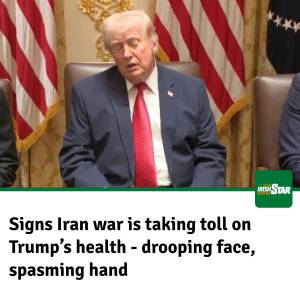 Americans have noted that Donald Trump appears 'visibly frail and in decline' as he sparks fresh health fears with concerning behaviors as his war with Iran rages on.
War Crimes Threat, Fears
March 30, 2026. A month into the war, and now they’re talking about pointless ground action and/or war crimes.More On Iran War
Trump is flailing, and Iranians know it.U.S. Governance Politics, Elections
March 30, 2026. We’re entering the second month of President Trump’s unauthorized war in Iran. Thousands more U.S. troops are being rushed to the Middle East. Where, you may ask, is Congress?No Kings Trump Watch
March 30, 2026. The ties that bind Hungary, Russia, European neo-Nazis – and MAGA.More On U.S. Law, Courts, Justice
More Global News
More On U.S. Military, National Security, Airport Security
March 30, 2026. I mentioned, in passing, the drone loitering that occurred earlier this month at Barksdale Air Force Base. It took a while before official acknowledgment of the incident.U.S. Media, Sports, Gambling, Culture, High Tech, Education
March 30, 2026. “By coordinating their use of immersive marketing, AI, cloud computing, and algorithms customized for every customer, they hijack customers’ brains.”U.S. Markets, Economy, Jobs, Inflation
March 30, 2026. The news has come at us so fast and furiously in 2026 that I’ve hated to take a night off because the doubling-up of news just makes the next night harder. But it hit me today that the last image I had queued up to post for a night off was one of my friend Peter Ralston’s photos, perfect for February because it was titled “Almost March.”
Photo, “March,” by Peter Ralston]
Top Headlines
The Parnas Perspective, News and Commentary: Trump Threatens to “Obliterate” Iran's Civilian Water Infrastructure, GOP Weighs Healthcare Cuts to Fund War, and More, Aaron Parnas, right, March 30, 2026. This morning’s developments are significant. Donald Trump is threatening to destroy Iran’s civilian water and energy infrastructure, raising serious concerns about potential war crimes and escalation. At the same time, Republicans in Congress are considering deeper cuts to healthcare programs to fund the war in Iran and expand ICE operations. This comes as Trump is also pushing for a full repeal of the Affordable Care Act, signaling a broader shift in domestic policy alongside the growing conflict abroad.
Here’s the news:
Republicans are considering cuts to federal health care spending to help fund a budget package that could include up to $200 billion for the Iran war and immigration enforcement. Steve Scalise and other GOP leaders are exploring changes targeting fraud, subsidies, and Medicare  policies, though details remain unclear. The proposals could be politically risky, with Democrats already criticizing the idea of cutting health care to pay for war spending. Internal divisions among Republicans, especially moderates, may also complicate efforts to pass such measures. It comes as Trump calls for the repeal of the Affordable Care act:
Donald Trump said he would prefer to “take the oil in Iran” and is considering seizing key infrastructure like Kharg Island, which handles most of the country’s oil exports. His comments mark one of his most direct statements about potential U.S. control over Iranian resources amid the ongoing war. At the same time, the administration says it is still pursuing negotiations to end the conflict, even as military operations continue and oil prices surge. The remarks highlight both the scale of U.S. military action and the economic stakes tied to the conflict.
A new investigation found that some details provided by a woman who accused Donald Trump of sexual abuse when she was 13 have been corroborated, though not the allegations against Trump themselves. The reporting verified aspects of her account involving a third individual and elements of her background, lending credibility to parts of her testimony. However, the claims against Trump and others remain unproven, and the White House has denied them as baseless. The case adds renewed scrutiny to past allegations connected to Jeffrey Epstein.
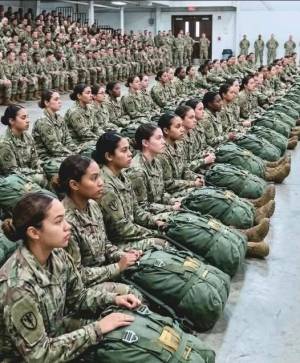 Trump threatened to “completely obliterate” Iran’s key infrastructure, including power plants, desalination plants, oil wells, and Kharg Island, if a deal to end the war and reopen the Strait of Hormuz is not reached soon. Bombing civilian infrastructure would be a clear war crime. He claimed progress is being made toward an agreement and suggested the U.S. is in talks with a more “reasonable” regime, though Iran has denied this. Trump framed the threat as potential retaliation for U.S. casualties and tied it to securing the vital trade route. The warning signals a possible major escalation if negotiations fail.
Global oil prices surged as the Iran war entered its second month, with crude reaching new highs and U.S. gas prices nearing $4 per gallon, increasing economic pressure. Markets showed mixed signals, with stocks edging up while investors also turned to safer assets amid concerns about a slowdown. Donald Trump said he believes a deal with Iran is likely soon and claimed negotiations are progressing, though uncertainty remains.
This is what Marjorie Taylor Greene had to say:
A new U.S. missile used early in the Iran war struck a sports hall and nearby school in southern Iran, killing at least 21 people, according to analysis by The New York Times and weapons experts. The weapon, identified as a newly developed Precision Strike Missile, had not previously been used in combat and detonated above the area, causing widespread damage with fragmentation. The incident highlights the risks of deploying new weapons in active conflict and concerns over civilian casualties.
Iran warned it may target the homes of U.S. and Israeli military commanders and political officials in the Middle East in retaliation for strikes on Iranian cities and leadership figures. A spokesperson for Tehran’s Khatam al-Anbiya military command said the attacks would respond to what it called “terrorist actions” against Iranian civilians. The threat follows joint U.S.-Israel operations that have targeted high-ranking officials, including Ali Khamenei.
Spain announced it has closed its airspace to U.S. planes involved in the Iran war and will not allow American forces to use joint military bases for related operations. Defense Minister Margarita Robles said the policy was made clear from the start and reflects Spain’s opposition to the conflict. The government of Pedro Sánchez has been one of the most outspoken critics in Europe, calling the war “illegal” and “unjust.”
NBC News confirmed that a fire broke out at an oil refinery in Haifa, Israel, following a missile attack during the ongoing war with Iran, marking the second such incident this month. Video showed flames and heavy smoke rising from a refinery tank before firefighters brought the blaze under control. It remains unclear whether the fire was caused directly by a missile strike or falling debris. The incident highlights the growing risk to critical energy infrastructure as the conflict escalates.
The International Atomic Energy Agency said Iran’s Khondab heavy water facility has been severely damaged and is no longer operational, based on satellite imagery and independent analysis. Iran had previously reported an attack on the site, though the agency noted it did not contain declared nuclear material. The damage marks a significant impact on Iran’s nuclear infrastructure amid the ongoing conflict.
A report by The New York Times examining plans for the proposed White House ballroom found several unusual design features, including decorative staircases that lead nowhere and faux windows concealing functional spaces like bathrooms. The analysis highlights concerns about the project’s emphasis on aesthetics over practicality.
Donald Trump described plans for architectural columns that will be hand-carved in a Corinthian style, calling them “top of the line” and emphasizing their beauty and craftsmanship. He highlighted the design as high-quality and visually impressive, noting the classical style is widely considered the most elegant.
CNN reported that Nebraska Democratic Senate candidate Bill Forbes attended a GOP-sponsored training event shortly before entering the race, raising concerns within his own party. State Democrats have accused him of being a Republican “plant” meant to mislead voters, while Forbes describes himself as a “free thinker” and acknowledged voting for Donald Trump. Additional reporting found past sermons in which he expressed conservative views, including opposition to abortion and criticism of Black Lives Matter. Meanwhile, a competing Democratic candidate has also faced ballot challenges, adding further controversy to the race.
Donald Trump blamed long airport lines on what he called “Democrat terrorists,” accusing political opponents of causing disruptions amid ongoing travel delays. The comments come as staffing shortages and the government shutdown have contributed to extended wait times at airports.
Donald Trump said he has no issue with a Russian oil tanker delivering crude to Cuba, downplaying concerns that it could benefit Vladimir Putin. He argued the shipment would not significantly help Russia, describing it as just “one boatload of oil” and saying it does not concern him.
The Israeli military suspended a battalion operating in the West Bank after an internal investigation found “several failures” in how soldiers treated journalists, including alleged detention and assault of a news crew. The IDF cited violations of protocol, poor conduct, and inappropriate communication with the press during the incident.
Reuters has confirmed that three Palestinians were killed in separate Israeli airstrikes in Gaza despite an ongoing “ceasefire,” (in quotes because it really is not a ceasefire) according to local health officials. The incidents are part of continued violence that has persisted for months, with hundreds reportedly killed since the “ceasefire” began. The strikes come amid Israel’s broader military operations tied to conflicts involving Iran and Hezbollah.
Donald Trump claimed that if the SAVE America Act is passed, Democrats would “never win another election,” suggesting the legislation would fundamentally shift the political landscape.
Rob Schneider called for the United States to reinstate a mandatory military draft, arguing it would promote unity, discipline, and patriotism among young people. His comments come amid the ongoing war with Iran and renewed discussion about military readiness and potential escalation. Schneider suggested compulsory service would strengthen national identity and better prepare citizens for the future.
Donald Trump is moving to override endangered species protections in the Gulf of Mexico by convening a rarely used federal panel known as the “God squad,” citing national security concerns tied to expanding oil and gas production. The proposal could put dozens of already threatened species at risk of extinction, including whales, sea turtles, and birds. Critics argue the move is politically motivated and question the use of national security as justification, especially since industry groups did not request the exemption.
Twelve tons of KitKats have been stolen in Europe.
Donald Trump granted a full pardon to nursing home executive Joseph Schwartz, who had been convicted in a $39 million tax fraud scheme and served only three months of a three-year sentence. The decision erased his federal conviction but left families of patients harmed in his facilities unable to collect millions in court-awarded damages. The case is part of a broader pattern of clemency for individuals convicted in major healthcare fraud cases, raising concerns about accountability and political influence.

BIG, Monopoly Round-Up: The Iran Price Shock Begins, Matt Stoller, March 29-30, 2026. Prices are going up and markets are in chaos. Thistime, the rich aren't insulated. Plus, Australia bans social media for teens, Israeli soldiers are obsessed with betting on war, and more.
But before getting to the full round-up, I want to focus on something obvious, but still worth pointing out. And that is, the historic supply shock resulting from the war in Iran is causing prices of all sorts of goods to go up. It is also increasing the cost of money by raising interest rates, throwing financial markets into chaos.
Hopium Chronicles, Pro-Democracy Advocacy: Trump's Global Crisis Worsens. Where Is Congress? Simon Rosenberg, right, March 30, 2026. Let’s start with Punchbowl News’ top story today:
Republicans grab ownership of DHS shutdown
The House and Senate are both out for the next two weeks. Their absence is pretty remarkable given the Department of HomelandSecurity is still shut down. We’re publishing AM editions only this week. But we’ll have alerts for premium subscribers if there’s any news.
Let’s be abundantly clear — this record-breaking, 44-day DHS funding impasse has turned into a political disaster for Republicans.
At one point, Republicans seemed to be breaking through with their message that Democrats instigated the DHS fight over undocumented immigrants. But now, House and Senate Republicans are publicly warring with each other over who’s at fault for last week’s debacle. The GOP-run Congress has left town until mid-April, while President Donald Trump was forced to issue an executive order to pay TSA employees.
Trump’s poll numbers have taken another hit thanks to the Iran war (although he now has an even freer hand with Congress gone). The president is considering using thousands of U.S marines and ground troops to reopen the Strait of Hormuz, potentially drawing out the conflict for weeks or months.
Back home, gas prices are still soaring. Inflation remains a problem, and interest rates look like they may be heading upward, too. Wall Street is in correction territory. The S&P 500 is down 7% this year, and the Dow Jones Industrial Average is off more than 6%.
Capitol latest. Congress doesn’t return until April 13, when the DHS shutdown will be nearly two months old.
Congress should not have recessed without getting this Homeland Security appropriations bill, now six months late, passed. But more importantly, Congress should not have recessed for Donald Trump’s illegal, ill-thought out war in the Middle East has created a grave global crisis, one that America began and one that America must bring to an end as soon as possible.
Governments and the people of the world are going to get very loud in the coming days for Trump is doing enormous damage to the economies of every country in the world, and creating a level of instability that is not being captured in our domestic discourse right now. We are now in a crisis that rivals COVID or the global financial crisis of 2008-2010 - and it is all because of one old, addled, idiotic, vainglorious old man.
Their delusions and extremism have prevented the White House and Republican leaders from understanding the gravity of what is happening now here and around the world. And so they went home…..
The total cost of the war is now over $17 trillion:
The twin energy and fertilizer shocks the war has brought has now begun to threaten the stability of countries who are significant importers of either. I asked Claude to do a roundup of news from around the world, which you can find here. Here are two excerpts (hot links and sources are in the linked post):
THE FERTILIZER CRISIS — THE HIDDEN EMERGENCY
This has become a major story since last night’s roundup. The conflict has restricted about 30% of global urea trade. Urea export prices from the Middle East have surged about 40%, from under $500 to over $700 per metric tonne — close to 60% higher than this time last year. The US is already close to 25% short of fertilizer supply for this time of year.
About a third of all fertilizer shipped globally passes through the Strait of Hormuz. Critically, unlike oil, there are no strategic international fertilizer stockpiles.
It is now the spring planting season, when farmers typically purchase fertilizers for the next harvest. If they cannot secure enough supply — or if prices are too high — crop yields could decline. The world’s least developed economies have the least capacity to absorb these shocks and will feel the effects most strongly.
Country-specific fertilizer impacts:
Ethiopia gets over 90% of its nitrogen fertilizer from the Gulf through Djibouti. “The planting season is now. The fertilizer isn’t there.”
In India, the government has prioritized urea for domestic use, but some plants are still running below capacity due to natural gas shortages.
Brazil — which gets 85% of its fertilizer from imports — is especially vulnerable.
China, the world’s largest producer of nitrogen and phosphate fertilizers, is prioritizing domestic supply; urea shipments from China probably won’t resume until May.
Fertilizer makers in Malaysia are suspending new orders due to supply-chain disruptions.
The World Food Program’s deputy executive director put it bluntly: “In the worst case, this means lower yields and crop failures next season. In the best case, higher input costs will be included in food prices next year.”
Here’s Claude’s morning summary of how the energy crisis is now effecting Asian countries. There are similar stories coming from energy starved Europe:
ASIA — SEVERE AND WORSENING
Here’s Brent crude this morning - the highest of the war so far. Mean gas and diesel prices here -- and inflation and interest rates -- are going to keep rising. I want to remind everyone what happened the last time Trump faced a dangerous global crisis: "His utterances each day about the war and the global crisis he has created make as much as sense as “light inside the body” during COVID."
Here’s his latest, which includes direct threats of war crimes and talks he keeps imagining that no one believes are taking place. Congressional Republicans meanwhile are now fighting with each other; have recessed for two weeks while the rest of the world is freaking out and our economy weakens; and have begun looking at further cuts to health care to pay for this illegal, ridiculous, and dangerous war!!!!!!
Trump Watch
Irish Star, Signs Iran war is taking toll on Trump’s health - from drooping face to a made-up conversation, Reanna Smith, March 30, 2026. Americans have noted that Donald Trump appears 'visibly frail and in decline' as he sparks fresh health fears with concerning behaviors as his war with Iran rages on.
Donald Trump has sparked fresh health fears, with Americans noting he appears "visibly frail and in decline" as his war with Iran escalates.
Last week, the 79-year-old president displayed a series of concerning behaviors. Cameras captured his hand appearing to spasm and face drooping, a lengthy ramble about a conversation that didn't happen, and a bizarre sexual comment he made to a large crowd.
The fresh fears come as the president's MAGA base are reportedly concerned that he has "lost touch with reality" as conflict in the Middle East rages. Speculation is mounting that the war with Iran could be taking a serious toll on Trump's health.
Morning Shots via The Bulwark, Political Opinion: Wherefore Art Thou Congress? Bill Kristol, Andrew Egger and Jim Swift, March 30, 2026. Or: Does Congress have a pulse?
There’s a natural ebb and flow to Donald Trump’s cycle of threats and walk-backs against Iran. On Friday, he blinked for a second time on his supposed ultimatum for Iran to reopen the Strait of Hormuz, announcing that his deadline—originally a 48-hour window that Trump had already extended by five days—would be extended again until April 6.
But this morning, he was back to rattling his saber, with some new war-crime threats thrown in for good measure: If Iran did not reopen the strait, Trump said, “we will conclude our lovely ‘stay’ in Iran by blowing up and completely obliterating all of their Electric Generating Plants, Oil Wells and Kharg Island (and possibly all desalinization plants!), which we have purposely not yet ‘touched.’”
Blessed Holy Week to all observing it. Happy Monday.
War Crimes Threat, Fears
 The Triad via The Bulwark, Trump Orders War Crimes. Then What? Jonathan V. Last, March 30, 2026. We should pray that Trump does not give the order to commit war crimes. If the military carried out his orders, it would result in mass civilian death. If the military refused to carry out his orders, it would spark an American regime crisis. (And it would put the soldiers being ordered to commit war crimes in a terrible position.) There are war crimes committed in every conflict. That is the nature of war and it is (one of) the reasons we don’t undertake war lightly. The difference between a liberal society and an illiberal society is the rule of law. In a liberal society, the rules governing conflict are enforced, however imperfectly. In a liberal society, war crimes are aberrations, not formal policy.
1. Epic Fury
Holy Week began with a 7:26am Truth Social post from our commander-in-chief:
Two items of note here.
First: Trump is laying the groundwork to declare victory. He claims to have achieved “regime” change in Iran and says the new regime is more friendly to American interests. Further, he sets a single condition for a ceasefire—the return to the pre-war status quo on shipping through the Strait of Hormuz.
Second: Trump says he will order the U.S. military to commit war crimes against Iran if the strait is not reopened.
The last decade has been a learning experience for American citizens. We have learned that:
These lessons have not been enjoyable; I would rather we had not been forced to learn them.
But also: Maybe knowing is better than not knowing? There is an “if you don’t test, then there are no cases” dynamic here. If liberal democracy is weaker and more compromised than we understood, then maybe it’s better to know this harsh truth for a fact?
So in that spirit of optimism, perhaps we’re about to have another learning experience in Iran. If President Trump makes good on his threat, then we will find out whether the U.S. military operates under the rule of law, or if it too has been run on the honor system.
Who’s ready for school?
2. Thirst Trap
Donald Trump has been thirsting for war crimes since he first entered politics. In March 2016, Trump was asked about war crimes during a Republican debate. The context was that, previously, Trump had committed to the use of torture and the practice of using the military to assassinate the families of terrorists. This was the exchange:
BAIER: Mr. Trump, just yesterday, almost 100 foreign policy experts signed on to an open letter refusing to support you, saying your embracing expansive use of torture is inexcusable. General Michael Hayden, former CIA director, NSA director, and other experts have said that when you asked the U.S. military to carry out some of your campaign promises, specifically targeting terrorists’ families, and also the use of interrogation methods more extreme than waterboarding, the military will refuse because they’ve been trained to turn down and refuse illegal orders.
So what would you do, as commander-in-chief, if the U.S. military refused to carry out those orders?
TRUMP: They won’t refuse. They’re not going to refuse me. Believe me.
BAIER: But they’re illegal.
TRUMP: Let me just tell you, you look at the Middle East. They’re chopping off heads. They’re chopping off the heads of Christians and anybody else that happens to be in the way. They’re drowning people in steel cages. And he—now we’re talking about waterboarding.
This really started with Ted, a question was asked of Ted last—two debates ago about waterboarding. And Ted was, you know, having a hard time with that question, to be totally honest with you. They then came to me, what do you think of waterboarding? I said it’s fine. And if we want to go stronger, I’d go stronger, too, because, frankly. . .
(APPLAUSE)
. . . that’s the way I feel. Can you imagine—can you imagine these people, these animals over in the Middle East, that chop off heads, sitting around talking and seeing that we’re having a hard problem with waterboarding? We should go for waterboarding and we should go tougher than waterboarding. That’s my opinion.
BAIER: But targeting terrorists’ families?
(APPLAUSE)
TRUMP: And—and—and—I’m a leader. I’m a leader. I’ve always been a leader. I’ve never had any problem leading people. If I say do it, they’re going to do it. That’s what leadership is all about.
Let’s be clear about what Trump was not saying.
No. Trump’s position was:
There’s no ambiguity here. No nuance. It is what it is.¹
For whatever reason, Trump didn’t order any war crimes during his first term (as far as we know). But he did do the next-best thing: He pardoned Americans convicted of war crimes. Would you like some examples?
In November 2019, Trump pardoned Clint Lorance, a former Army lieutenant. Lorance had been courtmartialed for ordering his men to murder three unarmed Afghan men. I want to tell you the story in full.
In July of 2012, Lorance was leading a patrol in Kandahar made up of both U.S. soldiers and members of the Afghan National Army. His men spotted three Afghans on a motorcycle about 600 feet away. Lorance ordered his men to fire on them. Shots were fired, but missed. The Afghan men dismounted from their motorcycle and began walking toward the members of the Afghan National Army who were with Lorance. Their hands were visible; they were unarmed.
The Afghan soldiers told the three civilians to leave as they approached. So the civilians turned around and began to leave. At which point Lorance ordered his soldiers to fire again. All three of the civilians were killed.
Staff Sgt. Daniel Williams was a squad leader in Lorance’s platoon. As the shots were fired, he radioed, “What the hell just happened? There was no threat from those guys whatsoever.” Later, Williams would say:
“War is hard, there is collateral damage. I get that—I’ve got my own stories,” Staff Sgt. Daniel Williams said in an interview. But Sergeant Williams, who was on his third tour in Afghanistan and was a squad leader in the platoon, added, “That’s not what this was; this was straight murder.”
As for Lorance: Lorance was described as having an excited response to the shooting: “That was fucking awesome,” he said at headquarters, according to testimony.
This is as open-and-shut a case of a war crime as you will see. Lorance’s own men were horrified. The entire military community was horrified. Trump pardoned him anyway.
There were others cases.
Which brings us to Trump’s threat from this morning:
[W]e will conclude our lovely “stay” in Iran by blowing up and completely obliterating all of their Electric Generating Plants, Oil Wells and Kharg Island (and possibly all desalinization plants!) . . . This will be in retribution for our many soldiers, and others, that Iran has butchered and killed over the old Regime’s 47 year “Reign of Terror.”
The Geneva Convention prohibits targeting civilian infrastructure, such as power grids or desalinization plants. But there is a loophole. There is a principle of “dual use”—if a piece of infrastructure is used by civilians but also provides benefit to military forces, then it becomes a legitimate target. From the DoD Law of War Manual:
Military objectives, insofar as objects are concerned, include “any object which by its nature, location, purpose or use makes an effective contribution to military action and whose total or partial destruction, capture or neutralization, in the circumstances ruling at the time, offers a definite military advantage.”
That’s a big loophole and human rights lawyers worry about how much leeway the doctrine of “dual use objects” gives military forces.
But Trump gives the entire game away here when he says that he will order the targeting of “all” electric power plants and “all” desalinization plants—and then says that these attacks would be carried out as the United States was winding down operations and in “retribution” for Iranian attacks dating back 47 years.
The president is threatening war crimes, full stop. There is no dual-use fig leaf here, no legitimate military purpose. Trump is saying—out loud—that he will destroy all civilian power generation and desalinization capabilities while retreating, and for the purpose of exacting “retribution.”
New York Times, Trump threatens to destroy Kharg Island and other key energy sites in Iran, Amelia Nierenberg, March 30, 2026. President Trump threatened on Monday to “completely” destroy Kharg Island, Iran’s main hub for oil exports, and other key energy sites in the country, if it did not agree to a peace deal and end its de facto blockade of the Strait of Hormuz.
Mr. Trump said on social media that the United States had made “great progress” in discussions with “A NEW, AND MORE REASONABLE, REGIME” in Iran, and that a deal would probably be “shortly reached.”
But he also reiterated threats of extreme destruction against Iranian targets that he said the U.S. military had “purposefully not yet ‘touched,’” since it started bombing Iran alongside Israel over a month ago. Those targets included Kharg Island, electricity plants, oil wells and “possibly all desalinization plants,” he said.
Mr. Trump has made fluctuating and freewheeling public comments on the war, often alternating between claims of diplomatic progress and threats of stronger military action. In an interview published on Sunday, Mr. Trump had suggested that the United States might try to take over Kharg Island, which has emerged as a potential target for the U.S. military.
“Maybe we take Kharg Island, maybe we don’t,” Mr. Trump told The Financial Times. “We have a lot of options.”
He shrugged off Iran’s ability to protect the island, a territory about one-third the size of Manhattan that is in the Persian Gulf, about 20 miles offshore.
“I don’t think they have any defense,” Mr. Trump said. “We could take it very easily.”
Mr. Trump has said that he has no plans to send ground troops into Iran, but he has left himself some wiggle room. There are now over 50,000 American troops in the Middle East — too small a number for any major land invasion, military analysts say, but enough to give Mr. Trump new options to escalate the war.
The U.S. bombarded the island this month, focusing on its military installations while leaving its oil export facilities untouched. An invasion would be a much riskier operation and would likely roil global energy markets even further.
Even if U.S. troops were able to take control of the island — a scenario that Mr. Trump has envisioned since the late 1980s — maintaining control of it would be costly and difficult. Mr. Trump told The Financial Times that American troops would have “to be there for a while.”
Airstrikes against Kharg Island’s oil infrastructure, or seizing the island outright, would cripple Iran’s ability to export oil. That would risk sending energy prices higher, especially if Iran retaliates by striking other infrastructure in the Middle East or oil tankers in the Strait of Hormuz — which would remain a powerful source of leverage.

New York Times, Visual Investigations: New U.S. Missile Hit Iranian Sports Hall and School, Analysis Shows, Christiaan Triebert and John Ismay, March 30, 2026 (print ed.). The Pentagon used missiles untested in combat in a deadly attack that struck civilian sites near a military compound on Feb. 28, according to visual evidence examined by The Times and weapons experts, as shown in New York Times graphic above.
On the first day of the war with Iran, a weapon bearing the hallmarks of a newly developed U.S.-made ballistic missile was used in an attack that struck a sports hall and adjacent elementary school near a military facility in southern Iran, according to weapons experts and a visual analysis by The New York Times. Local officials cited in Iranian media said this strike and others nearby in the city of Lamerd killed at least 21 people.
The Feb. 28 attack occurred the same day as a U.S. Tomahawk cruise missile struck a school in the city of Minab, several hundred miles away, killing 175 people. In the case of Lamerd, though, it involved a weapon that had been untested in combat.
The Times verified videos of two strikes in Lamerd, as well as aftermath footage from the attacks. Times reporters and munitions experts found that the weapon features, explosions and damage are consistent with a short-range ballistic missile called the Precision Strike Missile, or PrSM (pronounced like “prism”), which is designed to detonate just above its target and blast small tungsten pellets outward.
Videos that capture one strike, in a residential area about 900 feet from the sports hall and school, show the weapon in flight, with a distinctive silhouette that matches the PrSM. The missile erupts in a large fireball midair.
Another video, filmed from a security camera directly across from the sports hall, shows the strike on the hall and adjacent school. While the video does not capture an incoming missile, it clearly shows an explosion just above the structure.
Photos of the aftermath show both sites were pockmarked with holes, apparently from the tungsten pellets.
There is an Islamic Revolutionary Guards Corps, or I.R.G.C., compound directly next to the sports hall. It’s not known if it was struck in the attack.
The PrSM completed prototype testing only last year, according to an Army press release. On March 1, U.S. Central Command posted a video of a PrSM launch from the first 24 hours of the war. Days later, Adm. Brad Cooper, who leads Central Command, said the PrSM had been used in combat for the first time. The military has been touting its debut.
Since the weapon is so new, it’s more difficult to assess whether the PrSM strikes in Lamerd were intentional, stemmed from a design flaw or manufacturing defect, or were the result of improper target selection.
It’s unclear if or how the school or sports hall might be affiliated with the I.R.G.C. compound, but according to archival satellite imagery, they have been walled off from the compound for at least 15 years.
Satellite image captured by Airbus DS on March 9. Leanne Abraham/The New York Times
The sports hall, at the time of the strikes, was being used by a female volleyball team, according to Amir Saeid Iravani, Iran’s representative to the United Nations. Photos and videos posted to a social media account linked to the school show the premises were regularly used by children. The sports hall has also for years been publicly identified as a civilian-use facility on readily available digital mapping platforms, including Google Maps, Apple Maps and Wikimapia, according to a review by The Times.
Ground-level and satellite images of the aftermath show the sports hall with scorch marks and a partly collapsed roof. Footage from inside the school shows blown-out windows, fire damage and splotches of blood.Want to stay updated on what’s happening in Iran? Sign up for Your Places: Global Update, and we’ll send our latest coverage to your inbox.
The PrSM’s intended use is to kill enemy troops and destroy unarmored vehicles, and it can fly more than twice as far as any other missile in the Army’s arsenal.
A U.S. official who spoke to The Times confirmed that the missile used in the Lamerd strike was the PrSM. The official was not authorized to comment publicly about the attack and spoke on the condition of anonymity.
Other experts consulted by The Times also provided an assessment of the weapon.
“While we knew PrSM was fired, this is the first look we’ve gotten at the business end of the system,” Jeffrey Lewis, a nuclear nonproliferation expert at Middlebury College, said after reviewing videos and photos of the incident.
Mr. Lewis’s observation was supported by Frederic Gras, another munitions expert.
He said the video showing airburst detonation was very clear, and “the pattern of fragmentation damages are impressive and match with the few technical information available on the PrSM.”
Capt. Tim Hawkins, a spokesman for U.S. Central Command, said in a statement to The Times on Saturday: “We’re aware of the reports and are looking into them. U.S. forces do not indiscriminately target civilians, unlike the Iranian regime.”
Paul Krugman via Substack, Opinion: Trump appears to be ready to move from convicted felon to potential war criminal, Paul Krugman, right, March 30, 2026. A month into the war, and now they’re talking about pointless ground action and/or war crimes.
Pete Hegseth believes in the lethality fairy, and that’s a very bad thing.
Most people watching this probably don’t get the reference. In the aftermath of the 2008 financial crisis, a number of governments did what economic textbooks say is exactly the wrong thing. They slashed government spending in the face of mass unemployment. And they justified this in part by arguing that although, yeah, sure, if we slash spending and eliminate a bunch of jobs, that should be bad, could make things worse. never mind because it will improve confidence and that will lead to economic expansion. I, in an essay in 2010, called this believing in the “confidence fairy,” one of the coinages that seemed to stick.
And of course, the confidence fairy never arrived. Countries that created worse unemployment by engaging in austerity policies suffered worse unemployment. There was no rescue from improved confidence.
In this case, our Secretary of Defense, which is his legal title, although he calls himself the Secretary of War, continually argues that if only we get even more violent, if only we do even more damage, that this will somehow translate into success in Iran. He clearly relishes the thought of violence himself. He’s now holding prayer breakfasts, and in his prayer breakfast, he called upon the Lord to support us in “overwhelming violence of action against those who deserve no mercy.”
I think this is deeply un-American, but anyway, aside from the evilness — I don’t think there’s any other way to put it — of the world view, how is this supposed to work? If you look at the plans or ideas that are being bruited for using ground forces now, and that’s clearly very much sort the next step here, for using ground forces against Iran, well, yeah, you can seize Kharg Island, although hanging onto it could be very expensive, but then what?
 You’ve cut off Iranian oil exports, we could do that anytime anyway, then what? You can, well, try to occupy some of Iran, but the relevant coastline is well over a thousand kilometers long. Missiles and drones can be fired from deep inside Iran. 10,000 soldiers, maybe, is not remotely enough to secure the Persian Gulf, let alone allow shipping to transit, let alone allow tankers to transit through the Strait of Hormuz. So this doesn’t make any sense, unless you somehow think that the sheer act of violence will shock and awe Iran into submission, which, if it was going to happen, would have happened already. Clearly not on the cards.
Hegseth is all, we are going to kill lots of people. Trump is vacillating. In his Truth Social post this morning, he started out by saying we are on the verge of successful negotiations, and we’ll get the Strait open soon because we’re having extremely good talks with the Iranians.
Other presidents have been accused of negotiating with themselves. Trump is negotiating with his imaginary friends. There’s no reason at all to believe that these talks are actually happening.
But he then pivots midway through the post, to saying, and if we don’t get this, then we’re going to start bombing civilian power plants and water supplies.
So give us what we want or we’ll commit a massive, massive war crime, which I hope is not going to happen. But even if it did, why would you think this would open up the Strait of Hormuz? So it’s this lust for violence with no actual coherent story about how that violence is going to produce results. It’s horrifying.
I really don’t know how this ends, except that it does feel as if this is a quagmire largely in the minds of top Trump officials, Trump himself and Hegseth, who having this utterly unshakable belief that hurting people will produce great results, respond to each failure of violence to produce results by getting even more destructive with no end game in sight.
 White House Press Secretary Karoline Leavitt, right,was asked about Trump’s potential war crimes by Garrett Haake, left,
PoliticusUSA, Commentary: Karoline Leavitt Just Set Herself Up To Face War Crimes Charges, Sarah Jones, right,  and Jason Easley, March 30, 2026. White House Press Secretary Karoline Leavitt joined in on Trump's plan to potentially commit war crimes against Iran.
 Donald Trump has been increasing his threats against Iran because he is losing the war that he started.
Trump’s latest idea is that the United States should commit war crimes to make Iran surrender.
The president posted on his social media site:
The United States of America is in serious discussions with A NEW, AND MORE REASONABLE, REGIME to end our Military Operations in Iran. Great progress has been made but, if for any reason a deal is not shortly reached, which it probably will be, and if the Hormuz Strait is not immediately “Open for Business,” we will conclude our lovely “stay” in Iran by blowing up and completely obliterating all of their Electric Generating Plants, Oil Wells and Kharg Island (and possibly all desalinization plants!), which we have purposefully not yet “touched.” This will be in retribution for our many soldiers, and others, that Iran has butchered and killed over the old Regime’s 47 year “Reign of Terror.”
What Trump is suggesting is a war crime.
Obliterating a civilian population’s infrastructure that is necessary for their survival is a violation of international law and a war crime.
White House Press Secretary Karoline Leavitwas asked about Trump’s potential war crimes by Garrett Haake:
The president posted this morning about, you know, his threat to that on leaving Iran. He said we might blowing up and completely obliterating all of their electric generating plans, oil wells, har Island, and possibly all desalinization plans under international laws. Striking civilian infrastructure like that is generally prohibited.
Why is the president threatening what would amount to potentially a war crime with the US military? And how do you square that with the administration repeatedly saying that the US does not target civilians?
Leavitt’s answer showed that the entire Trump administration is willing to commit war crimes. The White House Press Secretary answered, “Uh, look. The president has made it quite clear to the Iranian regime at this moment in time, as evidenced by the statement that you just read, that their best move is to make a deal, uh, or else the United States Armed Forces have capabilities, uh, beyond their wildest imagination.”
Haake followed up, “And the President is not afraid to use crimes?”
Leavitt continued:
Uh, that’s not what I said, Garrett. Uh, and you’re saying the word potential for a reason, ‘cause I’m sure, sure. Some experts are telling you that in your ear, uh, to try to ask me that question. Of course, this administration and the United States armed forces will always act within the confines of the law.
Um, but with respect to achieving the full objectives of operation Epic Fury, President Trump is going to move forward unabated, and he expects the Iranian regime to make a deal with the administration.
Haake tried to ask, “Which of those objectives would destroying a desalination plant most help?”
Leavitt didn’t answer and called on another reporter.
If Trump green-lights the commission of war crimes, he will not be the only one who could be held accountable for the commission of potential crimes. Every member of this administration who participated in any war crimes would potentially be held liable for their actions.
There is no legal defense for war crimes that involves claims of just following orders. Leavitt could find herself charged if Trump’s post is more than an empty bluff.
The Steady State, Opinion: Threatening War Crimes: Has Trump Finally Crossed the Line? Charles A. Ray, March 30, 2026. Donald Trump’s threats to “destroy” Iran’s energy structure, if carried out, is a potential war crime, implicating not only the president but all who carry out his mission.
 In a March 30, 2026, social media post, Donald Trump threatened that if a peace deal is not reached soon and if the Strait of Hormuz is not immediately reopened, the U.S. would broaden its attacks, “completely obliterating power plants, oil wells, Kharg Island, and other civilian infrastructure.” He had made the same threat earlier on March 24, if Iran failed to open the strait, but delayed execution to allow peace talks to go ahead.
While Trump is known to use bluster, misdirection, and over-the-top threats as a negotiating tactic, human rights officials believe that this threat is a potential violation of international humanitarian law. The Geneva Convention prohibits attacks on energy infrastructure if they cause disproportionate harm to civilians. Amnesty International’s Senior Director of Research, Advocacy, Policy, and Campaigns, Erika Guevara-Rosas, said, “Intentionally attacking civilian infrastructure such as power plants is generally prohibited . . . and could amount to a war crime.” Amnesty International has also condemned Iran for threats and attacks on nonmilitary targets
In 2024, the International Criminal Court (ICC) issued arrest warrants for Russian military officers and officials, charging them with war crimes for attacking Ukrainian electric infrastructure. Kenneth Roth, formerly the executive director of Human Rights Watch, said, “Trump is openly threatening a war crime, and people aren’t saying anything because they’re numb to it.”
As with many of the president’s statements since the war began, it’s impossible to say whether or not this threat is real or just another of his ‘real estate negotiation’ strategy. What we can say, though, is that he has again placed the United States in a position that is more familiar for countries like Iran, Russia, or North Korea. Even if he reverses course, as he has done numerous times in the past, the genie is out of the bottle, and we might not be able to put it back this time, particularly if he goes through with his threat to commit ground forces and his non-war becomes even bloodier for the US side.
Should this action actually take place, and it is determined to be a war crime, it’s not just the leadership, but everyone who participates in it who can be found criminally liable by the ICC. Congress could put a stop to this madness if it chose to reclaim its constitutional authority, but it’s currently on recess (in hiding?) until April 6, which could be too late. Senior military leadership could theoretically refuse to carry out such an order, but the Caribbean ‘drug boat’ attacks demonstrate that this is not likely to happen. Depending on when such an order is given, it would appear to me that the guardrails against a president running amok are down.
Like many an authoritarian, Trump is unilaterally putting those below him, in this case the military, who would be ordered to carry out this mission, at risk of prosecution. But, to him, a lot of this war is ‘just for fun.’
Charles A. Ray served 20 years in the U.S. Army, including two tours in Vietnam. He retired as a senior US diplomat, serving 30 years in the U.S. Foreign Service, with assignments as ambassador to the Kingdom of Cambodia and the Republic of Zimbabwe, and was the first American consul general in Ho Chi Minh City, Vietnam. He also served in senior positions with the Department of Defense and is a member of The Steady State. Founded in 2016, The Steady State is a nonprofit 501(c)(4) organization of more than 400 former senior national security professionals. Our membership includes former officials from the CIA, FBI, Department of State, Department of Defense, and Department of Homeland Security. Drawing on deep expertise across national security disciplines, including intelligence, diplomacy, military affairs, and law, we advocate for constitutional democracy, the rule of law, and the preservation of America’s national security institutions.
More On U.S. Law, Courts, Justice

Justice Department immigration whistleblower Erez Reuveni, top left, was profiled regarding his revelations of misconduct in immigration enforcement and his eminent career by the CBS "60 Minutes" show and its anchor Scott Pelley, right, in a segment on Oct. 19, 2025.
New York Times, Justice Dept. Watchdog Has Gone Silent, Lawyers for Whistle-Blower Say, Devlin Barrett, March 30, 2026. Lawyers for a fired Justice Department lawyer say the agency’s inspector general appears to have ignored at least 20 different requests to scrutinize misconduct.
The Justice Department’s internal watchdog has seemingly ignored 20 instances of possible wrongdoing by the Trump administration, lawyers for a whistle-blower said in a letter on Monday urging lawmakers to address the “apparent collapse” of an office meant to root out misconduct.
 The lawyers pointed to the case of their client, Erez Reuveni, who was fired in April last year amid a legal fight over the administration’s decision to send migrants to a maximum-security prison in El Salvador. It was only one of many issues that the department’s Office of Inspector General appears to have ignored, they said.
“The epidemic of alleged misconduct has been met with a shrug by the agency whose job it is to address such allegations,” they said in their letter, which was sent to the Republican and Democratic leaders of the House and Senate Judiciary Committees.
The office of the inspector general did not respond to a request for comment.
Since taking office, Mr. Trump has dismissed or demoted more than 20 inspectors general, sharply undermining the ability of the offices to act as a check on misconduct. According to a congressional report, in the 2024 fiscal year alone, the inspectors general fired by Mr. Trump identified more than $50 billion in waste and abuse.
 The Justice Department’s inspector general, Michael E. Horowitz, left, was spared in Mr. Trump’s purge, but he left to oversee the inspector general’s office at the Federal Reserve in June. The role has since remained vacant, and William M. Blier, the deputy inspector general, has served as the acting chief of the office.
Mr. Reuveni, in whistle-blower disclosures to Congress and the inspector general last year, accused senior administration officials of trying to mislead federal judges and ignore court orders.
A day after receiving Mr. Reuveni’s allegations, the inspector general’s office notified him that it did not plan to act. In a letter, it said that it had “thoroughly reviewed the material and concluded that the issues raised do not warrant an investigation by our office.”
“Accordingly, we will take no further action regarding your correspondence and consider the matter closed,” the letter continued.
Mr. Reuveni’s lawyers, Michael Bromwich, Dana L. Gold, Kevin L. Owen and Kathleen Clark, complained about the swift rejection, prompting the office to re-examine the issue. In January, the inspector general again closed the case, according to correspondence among the lawyers. It said it would not investigate because of pending litigation surrounding Mr. Reuveni’s allegations, and because the proper authority to examine such issues belonged to a different Justice Department entity, the Office of Professional Responsibility.
“We view these as excuses for inaction rather than good-faith concerns,” Mr. Reuveni’s lawyers wrote in their letter. The administration had “decapitated” the Office of Professional Responsibility, they said, referring to the firing last year of the lawyer who ran it.
The inspector general has long conducted far-reaching investigations into possible wrongdoing at the Justice Department. In particular, that has applied to the department’s handling of politically sensitive cases, like the investigation into Hillary Clinton’s use of a private email server and the inquiry into Donald J. Trump’s 2016 campaign and potential ties to Russia.
In the second Trump administration, however, the inspector general’s office has been noticeably quieter. Some lawyers for whistle-blowers have complained that the office seems less willing or able to examine problems inside the department, at a time when the administration has fired more than 200 people from the F.B.I. and Justice Department, many of whom worked on past cases related to Mr. Trump or his allies.
Mr. Reuveni’s lawyers argue that the department is supplying a weak defense in stating that the other watchdog, the Office of Professional Responsibility, has the primary purview over accusations of lawyer misconduct.
“Instead of leaning in to conduct an investigation of great importance implicating potential criminal misconduct by high-level D.O.J. officials, the O.I.G. makes excuses for why it will not undertake the investigation,” the lawyers wrote. “Those excuses for inaction reflect a failure of nerve and a shirking of duty.”
The lawyers noted that lawmakers had asked for investigations of 20 different areas of potential misconduct at the Justice Department in the last year, and there has been no indication that the inspector general is examining any of them.
That figure does not include any private complaints or whistle-blower filings made by Justice Department employees.
No Kings Trump Watch

Everyone Is Entitled To My Own Opinion, Commentary: As the world burns, Preznit .....blithers about Corinthian columnsCommentary: As the world burns, Preznit .....blithers about Corinthian columns, Jeff Tiedrich, right,  March 30, 2026. Also, more No Kings coverage.
Billions of dollars are being flushed down the toilet in order to wage an unprovoked, unnecessary and illegal don’t-you-dare-call-it-a-war on Iran. Masked and armed government thugs have invaded the streets of our cities and are literally getting away with murder. Corruption is off the charts. Gas is unaffordable. Food is unaffordable. Airports are a nightmare. Congress is useless. The worthless scribblers of the corporate-controlled press are useless. Republicans are trying to screw with our system of free and fair elections.
With all that going on, it’s reassuring to know that Mad King Donny remains laser-focused on the one issue that really matters (as shown in the photo above and his commentary below).
“This is a view of the columns as they are going to be made. They’re going to be hand-carved and they’re beautiful. Top of the line. They’ll be Corinthian, which is considered the best, most beautiful by far. Okay?”
This demented jackass brought visual aids with him....Welcome to Dear Leader’s latest moronic obsession. He’s decided that the columns on the facade of the White House are too boring, and he wants to completely redo them.
There goes two hundreds years of history....to please the trashy aesthetics of the baby.
The White House isn’t Donny’s personal possession. It’s We the People’s House — yet he’s treating it as if it were just another one of his fugly golf motels....Didn’t eight million of us just remind him that he’s not our king?
It’s all so stupid and unnecessary, but what else is new? Here’s why Donny got his knickers in a twist and felt the need bring visual aids aboard his flight back to DC last night.
The New York Times committed a genuine journalism and got actual architects to explain why Donny’s changes to the exterior of the White House are poorly-thought out, mystifyingly senseless, and just plain ....ugly.
It’s a pretty deep dive, touching not only on what’s going on with the White House right now, but also explaining how for over two centuries, federal buildings in DC have been carefully planned to fit into the overall aesthetic of the city.
The hurried reviews, with construction cranes already swiveling above the White House grounds, are an abrupt departure from how new monuments, museums and even modest renovations have been designed and refined in the capital for decades. And the ballroom will be worse off for it, architects warn. It’s quite a fascinating read, if that sort of thing floats your boat.
But of course to Donny, there must never be any criticism of Dear Leader, and he worked himself into a such a Big Mad that he just had no choice but to create an infantile scene.
 We the People can’t afford to live, and Donny Antoinette (portrayed above) is is all, ‘Let them eat columns.’
Can we just talk for a moment about just how ....stupid Donny’s own personal Fred Flintstone is?
 Jake Tapper: “Right, but if President Trump had the power to pay TSA agents this whole time, why only start doing it now?”
Tom Homan, the Homeland Security "Czar," shown at right: “Look, I don’t understand— I’m a cop, I don’t understand the whole, y’know, appropriations law.”
‘I’m a cop and I don’t understand law’ is Peak Homan. it’s just about the most on-brand thing he’s ever said.
Tommy Homan, he don’t know anything about no laws — but I’ll bet he could tell you exactly how much a sack with fifty grand in it weighs.

No Kings Protest: Wingnuts, as by one above in a rant, have convinced themselves that No Kings was funded by George Soros and a bunch of random commies.

So let’s once again remind everyone that we’re happily doing this ... for free, as shown above.
 Which brings us quite smoothly to our heroes of the day: These four hardy souls, above, who organized a protest in Antarctica — giving the world a No Kings event on all seven continents. Well done, everyone!
New York Times, Mexico Pressures U.S. Over Deaths of Its Citizens in ICE Custody, Tim Arango, Jazmine Ulloa and Allison McCann, March 30, 2026. Claudia Sheinbaum, president of Mexico, said her country would take legal steps to demand better conditions at immigration detention facilities, where she said 14 Mexican citizens have died since President Trump took office.Listen · 4:40 min
The government of Mexico on Monday condemned the Trump administration’s immigration crackdown and voiced concerns about the deaths of its citizens in immigration detention facilities in the United States.
Top Mexican officials on Monday, including President Claudia Sheinbaum and diplomats in Los Angeles, vowed to take legal steps to pressure the Trump Administration over conditions in detention facilities, including what lawyers and detainees have described as poor drinking water and inadequate medical care.
The rebukes from Mexico came after the Immigration and Customs Enforcement Agency announced on Monday that another Mexican man had died on Wednesday at a detention facility in California.
The man, Jose Guadalupe Ramos-Solano, 51, had been in custody since late February, and, according to a news release from ICE, had suffered from diabetes and hypertension. He died in Adelanto, Calif., about 100 miles northeast of Los Angeles, after being found unconscious in his bunk and taken to a hospital.
“He received constant medical care while he was in custody, including daily medication to treat his illness,” ICE said in a statement. The Department of Homeland Security has maintained that its detainees receive adequate medical care and nutrition.
Mexican officials did not directly dispute the administration’s account of Mr. Romas-Solano’s death. But Jesus Eduardo Arias, a lawyer for the Ramos family, said that he was conducting a “forensic, independent investigation,” to determine the cause of death.
Vanessa Calva Ruis, Mexico’s director general for consular protection and strategic planning, said that Mr. Ramos-Solano’s death “is not an isolated case, but rather a reflection of an alarming and unacceptable trend.”
She said Mexico “will exhaust all legal, diplomatic and multilateral avenues to demand justice.”
The Mexican consulate in Los Angeles said Mr. Ramos-Solano was the 14th Mexican national to die in ICE custody since Mr. Trump took office, and that four of those deaths occurred in the Los Angeles metropolitan area.
Antonia Tovar, his mother, wept on the dais as she described the family’s quest for answers. His death “does not only leave me in pain, it leaves his children and his mother and his siblings in pain, too,” she said in Spanish.
More Global News
New York Times, Israel Passes Law to Hang Palestinians Convicted of Deadly Attacks, Aaron Boxerman and Johnatan Reiss, March 30, 2026. Experts say the law was written in such a way as to ensure that it was unlikely to ever apply to Jewish extremists who commit similar crimes.
Israel’s Parliament passed a law on Monday that would allow the hanging of Palestinians convicted of deadly militant attacks, but experts say it almost certainly cannot be applied to Jewish extremists convicted of similar crimes.
The law is a victory for Israel’s far right and reflects the country’s shift to a harder line against Palestinians in the wake of the Hamas-led attack on Israel on Oct. 7, 2023, and the Gaza war that followed. The death penalty has long been legal in Israel, but only two people have been executed in the country’s 78-year history.
The Knesset, Israel’s Parliament, passed the law after hours of debate on Monday night over the objections of Israeli justice officials, liberal rights groups and European countries like Britain and Germany.
The legislation makes death by hanging the default sentence in Israeli military courts for Palestinians convicted of deadly attacks. Israeli citizens — both Jewish and Palestinian Arab — could also face the death penalty for killings intended to “negate the existence of the State of Israel.” Experts say, however, the chances that it would be applied to Jewish Israelis for attacks against Palestinians are minimal.
Judges will be allowed to make exceptions for unspecified circumstances. The legislation will leave those convicted in military courts with no clear path to receiving a pardon. It will not, however, apply retroactively to Palestinians already jailed by Israel.
Israel’s national doctors’ union has refused to carry out lethal injections, so those convicted will face death by hanging. Some right-wing Israeli lawmakers enthusiastically adopted the noose as a symbol of their support for the law, wearing golden noose-shaped pins on their lapels in the Knesset.
Members of Prime Minister Benjamin Netanyahu’s ruling coalition argued the law would deter future Palestinian attacks on Israeli civilians, including attempts to take Israelis hostage so as to ransom the freedom of jailed Palestinian militants.
Critics in Israel and abroad denounced the measure for allowing the execution of Palestinian attackers while deliberately aiming to exclude Jewish Israeli extremists.
“By design, this legislation exclusively targets Palestinians, violating the fundamental principle of equality and prohibition on racial discrimination,” said Suhad Bishara, a lawyer with the Palestinian rights group Adalah.Editors’ PicksFour Years After I Had Last Been Touched, I Wrote Myself Back to LifeAs Hollywood Courts Gamers, They Warn: ‘Don’t Ruin This’A Film Studio Moved to Montana for Tax Breaks. Will It Benefit the Locals?
Opinion polls have shown a majority of Jewish Israelis backs executing Palestinian militants, at least in principle. The law passed with muted public backlash and the support of some members of the parliamentary opposition to the government.Want to stay updated on what’s happening in Israel and the West Bank and Gaza Strip? Sign up for Your Places: Global Update, and we’ll send our latest coverage to your inbox.
Israeli hard-liners, particularly Itamar Ben-Gvir, the national security minister, campaigned during the most recent parliamentary elections on a promise to impose the death penalty on Palestinian militants.
New York Times, Palm Sunday Attack in Nigeria Leaves at Least 12 Dead, Saikou Jammeh, March 30, 2026. No one has claimed responsibility for the killings in the mostly Christian city of Jos, and the police have yet to arrest the gunmen.
At least 12 people were killed and several others injured on Sunday after gunmen attacked a neighborhood in the mostly Christian city of Jos, in Nigeria’s north-central region, the police said on Monday.
But residents said many more had been killed.
Jos is the capital of Plateau State, the center of a long-running conflict between farmers, who are mostly Christian, and herders, who are mostly Muslim, in Nigeria’s Middle Belt. Violence usually occurs in rural areas in the region, but the city of Jos has seen major clashes in the past. The most recent was in 2010, when hundreds of people were killed during three months of violence.
The attackers on Sunday walked into a popular local bar, pretended to buy drinks and then began shooting those inside, residents said. Others arrived in vehicles and fired at people gathered around a roadside market and a nearby church, where community members had gathered to celebrate Palm Sunday.ImageA woman cries on the ground as another woman leans over to console her. A child in an orange fuzzy hat stands nearby.Mourning the death of a family member after the attack in Jos on Monday.Credit...Samson Omale/Associated Press
No one has claimed responsibility for the killings, and the police have yet to arrest the gunmen.
In the hours after the attack, two witnesses who spoke on the condition of anonymity for fear of reprisal said, local youth began to block major roads and target individuals perceived to be Fulani, an ethnic group that is predominantly Muslim.
Kabir Adamu, an analyst with a security firm in Nigeria, said that those responsible for the attacks on Sunday probably wanted to incite retaliatory violence. “Clearly, whoever is behind the attack seems to be more interested in triggering that kind of reaction,” he said.
More On U.S. Military, National Security

 Emptywheel, Analysis: How Speaker Mike Responded to a Potential Invasion of His District, Emptywheel (Marcy Wheeler, right), March 30, 2026. I mentioned, in passing, the drone loitering that occurred earlier this month at Barksdale Air Force Base (shown above in a file photo along with a state map of Louisiana). It took a while before official acknowledgment of the incident…
“Barksdale Air Force Base detected multiple unauthorized drones operating in our airspace during the week of March 9th,” Capt. Hunter Rininger of the 2nd Bomb Wing said in a statement provided to ABC News. The additional drone incursions had not been previously reported.
According to the confidential briefing document dated March 15, the drones came in waves and entered and exited the base in a way that may suggest attempts to “avoid the operator(s) being located.” Lights on the drones suggested the operators “may be testing security responses” at the base.
“Between March 9-15, 2026, BAFB Security Forces observed multiple waves of 12-15 drones operating over sensitive areas of the installation, including the flight line, with aircraft displaying non-commercial signal characteristics, long-range control links and resistance to jamming,” the document said. “After reaching multiple points across the installation, the drones dispersed across sensitive locations on the base.”
Followed by this post…
Barksdale Air Force Base in Louisiana, in Bossier Parish not far from Shreveport, was attacked by drone swarms during the week of March 9. The attack disrupted B-52H aircraft launches in support of Operation Epic Fury against Iran. It is the first time a US airbase was temporarily put out of operation in wartime, something that never happened even in World War II.
Each wave forced the Air Force to halt operations and send its personnel to shelters. Barksdale is the command hub of the US Air Force Global Strike Command. Not only are B-52s based there, but the base is part of America’s nuclear triad. It shelters long range nuclear cruise missiles (such as the AGM-86B) and will soon house a new Long Range Standoff cruise missile. Shelters and storage sites for the new missiles are under construction.
The only other significant US airbase for B-52s is in Minot Air Force Base in North Dakota. Both bases are supporting Epic Fury.
Which notes a number of other recent loiter incidents:
Aside from Barksdale, other drone incidents focused on US strategic and leadership assets. Between December 2023 and June 2025 “someone” launched seventeen nights of drone swarms at Langley AFB in Hampton, Virginia. One result of the swarms is that US F-22 stealth jets had to be relocated as they were under threat. There are reports that some of the drones used in the attack were over 20 feet long and flew at over 100 mph.
In late 2024 and on into 2026, there were persistent sightings over Edwards AFB Plant 42 in Palmdale, California. This is the home of the famous Skunk Works. Lockheed Martin, Northrop Grumman and Boeing operate at this site on highly classified projects.
Between March 10 and March 20, 2026 several unidentified drones overflew Fort Leslie J. McNair in Washington, DC. Both Secretary of State Marco Rubio and Secretary of Defense Pete Hegseth live on the base, suggesting that an “unknown” adversary was targeting them.
That has ratcheted up the attention and the alarm about it. (See also here, here, and here.)
 One detail of the swarm that hasn’t gotten a lot of attention: not only is Barksdale one of two bases whence B-52s serving the Iran war and our nuclear program fly, but it is also in Mike Johnson’s district, just east of Shreveport. Besides announcing this briefing for the Louisiana delegation, Johnson, right, hasn’t said much publicly about it (he would also be privy to Gang of Eight briefings, so presumably knows more about the incident).
After that briefing, Senator Bill Cassidy commented publicly, noting that one of five swarms was attributed to a hobbyist. But there is, at least, really good reason to worry that a base in the Speaker’s district in Louisiana has been penetrated by very sophisticated surveillance and disruption.
I want to comment on two other things that happened as it became clear that Mike Johnson’s district was suspected of being ilfintrated this month.
Kirill Dmitriev, left, Putin-Operative and Russian Puppetmaster
 First, Johnson allowed his suite to be invaded by the grandson of Vyacheslav Molotov and three other sanctioned Russian Duma members, hosted by Kirill Dmitriev’s third favorite useful idiot (after Steve Witkoff and Jared Kushner), Congresswoman Anna Paulina Luna, right.
The initiative was organized by Republican Representative Anna Paulina Luna, who is known for her opposition to U.S.  aid to Ukraine. The visit also comes despite sanctions imposed by Washington on Russian legislators following Moscow’s full-scale invasion.
The discussions with Trump administration officials are expected to take place on March 27 at the United States Institute of Peace.
A junior State Department official will attend each meeting as a note-taker.
The Russian delegation is headed by Vyacheslav Nikonov, deputy chair of the Foreign Affairs Committee and the grandson of Soviet Foreign Minister Vyacheslav Molotov.
Molotov is remembered for signing the pact with Nazi Germany in 1939, which paved the way for the outbreak of World War II and the division of Eastern Europe.
The Duma members got sanctions waivers from State, so their visit had official backing.
Their tour included what was described as an unannounced visit to Mike Johnson’s suite.
Luna provided the Russian lawmakers with a private tour of the U.S. Capitol Thursday evening.
A congressional aide said they entered Speaker Mike Johnson’s suite of offices through the balcony unannounced, adding that the Louisiana Republican was not present at the time.
Caroline Orr describes that Russia media outlets describe the Duma representatives had specific tasks from the Kremlin and discussed ending sanctions and restoring Russia’s “diplomatic” facilities that were closed after the 2016 operation.
So the country that is helping Iran target Americans in the Middle East invaded Mike Johnson’s suite (and might be involved in reconnaissance in his district).
And then what did Mike Johnson do? Something that even has the Johnson-friendly insiders at Punchbowl impressed. He blew up the opportunity to fund most of Department of Homeland Security.
Let’s be abundantly clear — this record-breaking, 44-day DHS funding impasse has turned into a political disaster for Republicans.
At one point, Republicans seemed to be breaking through with their message that Democrats instigated the DHS fight over undocumented immigrants. But now, House and Senate Republicans are publicly warring with each other over who’s at fault for last week’s debacle. The GOP-run Congress has left town until mid-April, while President Donald Trump was forced to issue an executive order to pay TSA employees.
Trump’s poll numbers have taken another hit thanks to the Iran war (although he now has an even freer hand with Congress gone). The president is considering using thousands of U.S marines and ground troops to reopen the Strait of Hormuz, potentially drawing out the conflict for weeks or months.
Back home, gas prices are still soaring. Inflation remains a problem, and interest rates look like they may be heading upward, too. Wall Street is in correction territory. The S&P 500 is down 7% this year, and the Dow Jones Industrial Average is off more than 6%.
Capitol latest. Congress doesn’t return until April 13, when the DHS shutdown will be nearly two months old.
On Friday, Speaker Mike Johnson and House Republicans voted 213-203 to fund DHS for two months. It came hours after the Senate unanimously passed its own bill funding DHS minus ICE and CBP.
[snip]
The conventional view is that Johnson made a big mistake by not clearing the Senate bill on what would’ve been a large bipartisan vote. House GOP leadership aides estimate that the Senate bill would have passed with every Democrat and more than half of Republicans. GOP leaders could then shift their focus to reconciliation and renewing FISA.
Another view: Johnson had no choice thanks to his own internal politics. The speaker has said for months that DHS must be fully funded. And the House Republican Conference is and has been driven by the hardline conservatives. When the middle of the conference — the vulnerable Republicans from swing districts — don’t push back, the GOP leadership tends to listen to the Freedom Caucus and its allies.
Johnson wants to remain a viable speaker for the next seven months, so he had no choice but to listen to the HFC — even if that meant publicly stiff-arming Thune.
While much of the attention on DHS funding has focused on TSA (which Trump started illegally funding today), a far bigger concern is likely CISA, which protects against hacks like the Iranian one that targeted medical device company Stryker (which then led to the release of documents hacked from Kash Patel).
Cybersecurity and Infrastructure Security Agency (CISA) Acting Director Nick Andersen said Wednesday that the shutdown of the Department of Homeland Security has led to risks “accumulating across the system.”
Testifying before the House Homeland Security Committee, Andersen painted a bleak picture of how the shutdown is impacting CISA. He said about 60 percent of the agency’s workforce is now furloughed. CISA currently has 1,000 vacancies and in a single day a few weeks ago six members of a highly technical threat hunting and incident response team submitted their resignation, he said.
“The remaining personnel are carrying out mission essential functions without pay while facing increasing pressure from nation-state and criminal actors targeting our nation’s critical infrastructure,” Andersen testified.
[snip]
Every day the shutdown continues, risks grow, Andersen said, particularly as CISA prepares for the heightened threat environment that will accompany the upcoming America 250 celebration events and the FIFA World Cup.
“What has been scaled back or paused are the very activities that reduce systemic risk over time — proactive assessments, coordinated planning, partnership, engagement and strategic initiatives across the federal enterprise and critical infrastructure sectors,” Andersen said.
So Mike Johnson’s district faced what could be a very alarming invasion, his office similarly faced an invasion by the country helping to target American service members, and his response to that was to kill any hope of fully funding America’s cybersecurity.
This is a man who cannot put the good of the country above his petty little political mission. And he’s second-in-line to be President.
New York Times, Trump Administration Live Updates: T.S.A. Agents Start Getting Back Pay, but Future Checks Remain in Doubt, Madeleine Ngo, March 30, 2026. What We’re Covering Today.
Most of the Transportation Security Administration’s 60,000 workers began receiving back pay on Monday, easing the financial strain that has troubled them since the partial government shutdown began more than six weeks ago. But with the shutdown persisting, the workers don’t know when they’ll be paid next.
Although security lines at some airports appeared to be easing on Monday, the respite from the chaos may prove temporary if workers aren’t paid again in two weeks. A memo that President Trump signed on Friday ordering the Department of Homeland Security to pay T.S.A. officers did not specify whether they would be paid on a regular schedule. Instead, it directed the department to “provide TSA employees with the compensation and benefits that would have accrued to them if not for the Democrat-led DHS shutdown.”
Asked whether T.S.A. officers would be receiving future paychecks, Lauren Bis, a department spokeswoman, referred to the question to the Office of Management and Budget. The agency did not respond to a request for comment.
Ms. Bis said most employees had been sent back pay that covered two full paychecks, though workers were still owed another week’s pay. She said in a statement that the department was “working aggressively” to resolve the issue.
While federal workers are legally required to receive back pay at the end of a shutdown, such periods still present hardships: They may incur financial penalties for not being able to pay bills on time, or have to pay interest if they rely on credit cards to pay expenses.
The Department of Homeland Security’s funding lapse, which began on Feb. 14, still has no end in sight. A Senate-passed measure to fund most of the department except Immigration and Customs Enforcement and Border Patrol was rebuked by House Republicans on Friday, and Senate Republicans declined to push through an eight-week extension of funding during a brief ceremonial session on Monday. Congress is in the midst of what is expected to be a two-week recess, diminishing the likelihood of a deal anytime soon.
The impasse stems from a partisan dispute over Mr. Trump’s aggressive immigration crackdown. Democrats have refused to fund the department without imposing new restrictions on immigration officers, which Republicans have rejected.
More On U.S. Politics, Elections, Governance
PoliticusUSA, Political Opinion: America Rejects Trump As His Approval Rating Hits A New Low, Jason Easley, right,  March 30, 2026. Donald Trump's approval rating has plummeted to 33% as on issue after vast majorities of the American people are rejecting Trump and his presidency, The estimated 9 million people who showed up to protest against Donald Trump last weekend were not outliers. Those protesters represent the views of close to 70% of the country according to a new University of Massachusetts Amherst Poll.
The poll found:
President Donald Trump’s approval rating has fallen to 33%, the lowest rating of his second term in office. The poll of 1,000 respondents, conducted March 20-25, finds Trump’s approval down five points from July 2025 and 11 points lower than last April.
Among men, working-class Americans and African Americans, Trump’s approval ratings have dropped by close to 20 points since April 2025. Similar drops in support are also seen among moderates (down 18 points) and independents (down 13 points), key constituencies in Trump’s victory and in the upcoming midterm election.Inflation And The Economy Are Going To End Trump’s Presidency
Trump is unpopular on every issue across the board, but the heartbeat of the opposition to Trump is the economy.
According to the poll:
Fully 62% of Americans somewhat or strongly disapprove of Trump’s job performance. Seventy-one percent say Trump is not handling inflation well and 61% say he’s not handling the issue of jobs well. Tariffs were supposed to be one of Trump’s signature issues, but they are a public relations disaster with almost two out of three Americans (64%) giving him a negative grade.
Trump’s policies have made the economy worse, and it is the president’s refusal to acknowledge or do anything about inflation that has enraged the American people and turned them fully against him and his presidency.
The one issue that remains at the center of the midterm election is the economy, and now Trump’s war with Iran is adding to economic damage and compounding his woes.90% Of Americans Don’t Want Ground Troops In Iran
Everything is tied together when looking at Trump’s terrible poll numbers. The Iran war has caused gas prices to rise, which has placed more economic strain on the American people.
That strain is reflected in disapproval of Trump’s handling of the war:
Nearly two-thirds (63%) of Americans say the president is handling Iran poorly, including 52% who say ‘not well at all.’..These views are sharply polarized, though, with 71% of Republicans saying Trump is handling Iran well, compared to only 1% of Democrats. Nearly 9 in 10 (89%) strong MAGA supporters say he is handling Iran well, and 82% say that attacking Iran is putting America first…1 in 10 Americans (8%) support sending ground troops, but roughly 4 in 10 (41%) think he will send them in anyway.
The United States is witnessing one of the greatest presidential crashes and burns of all time.
None of this had to be this way.
Trump could have come into office and kept his promise about tackling the economy and inflation, but he broke that promise before he took office by announcing that inflation was hard and he didn’t think that he could do anything about it.
As soon as Trump decided to ignore the issue that voters elected him to solve, his approval rating started to drop, and each policy that he has adopted has made the situation worse.
Republicans at all levels of government are likely to pay for Trump’s failed presidency by losing their jobs in November.
Trump will still be president, but his presidency will likely be over when Democrats get some power to check him in January of 2027.
Nearly 70% of Americans seem to be counting the days until they can make Trump a lame duck president.
it’s all so eternally goddamned childish and embarrassing. we’re trapped in the dumbest fucking timeline with dumbest fucking president
.
To the Contrary, Political Opinion: Trump's Chronicle of Political Self-Destruction, Charlie Sykes, March 30, 2026. As markets reel, we learn that the US now has 50,000 troops in the Mideast, as the Pentagon is drawing up plans for a ground war that could last weeks.
What could go wrong?
This is actually an evergreen question about the Trump Administration as a whole, which is in the process of squandering the political realignment that he assembled against fearsome odds. Indeed, the past 14 months have been an extraordinary chronicle of political self-destruction.
Let’s take a moment to reflect on that, because on Earth 2.0 this was not inevitable. Bear with me for a moment here, but Trump’s second term could have (rather easily) been a political success.
He inherited a growing, reasonably healthy economy, the public was broadly supportive of his immigration policies, and he had just assembled an impressive electoral coalition that included young voters and large numbers of people of color, including Latinos. He dominated the man-o-sphere and had broken the Democrat’s hold on the working class. When he took office, the opposition was demoralized; one institution after another surrendered; the oligarchy embraced him; and the Democrats were both in disarray and demoralized.
A normal president might have capitalized on that. Trump threw it all away. On tariffs, terror, and war. As Thomas Edsall observes:
Since then, however, Trump — with the brutality of his drive to deport hundreds of thousands of undocumented immigrants and the counterproductivity of his economic policies — is doing everything in his power to destroy the opportunity he had to secure and strengthen the Republican coalition.
Now less than a year-and-a-half into his second term, polls suggest that his support among Latinos is cratering; he has radically lost the favor of the young; and the man-o-sphere has finally figured out that the 79-yer-old Trump is really full of sh*t. He’s now deeply underwater on precisely the issues that propelled him back into the White House: the economy and immigration. The public already dislikes his war on Iran even as he wades deeper into it.
Imagine if Trump has exercised even a modicum of restraint and prudence.
No exogenous events are driving this. The disasters all coming from within the house; they are all Trump’s character; his choices. He has surrounded himself with zealots, cranks, and incompetents, of yes-mediocrities. And they are giving us a government that seems increasingly out of touch, even as it indulges in its serial orgies of hubris.
As for Trump: The president continues to behave as if nothing matters — his corruption, his lies, his increasingly open racism, his indecency, his erratic stagger into war — even as the political storm clouds darken.
Morning Shots via The Bulwark, Political Opinion: The King’s Congress, William Kristol, right, March 30, 2026. We’re entering the second month of President Trump’s unauthorized war in Iran. Thousands more U.S. troops are being rushed to the Middle East.
Where, you may ask, is Congress?
Remember Congress? It’s the branch discussed in the first article of the Constitution. There it’s charged with the responsibility “to declare war,” “to raise and support armies,” and “to make rules for the government and regulation of the land and naval forces.”
Congress is in recess. Until mid-April.
Why not? So far, the Republican majority that controls Congress has blocked it from exercising its authority over matters of war and peace. We’re a month into the war and we haven’t even had public hearings, with testimony and questioning of administration officials. Democrats’ attempts to invoke congressional power and their pleas for congressional oversight have been waved aside.
Combat operations on Iranian soil may well be imminent. On Saturday, Dan Lamothe reported in the Washington Post that “The Pentagon is preparing for weeks of ground operations in Iran, U.S. officials said, as thousands of American soldiers and Marines arrive in the Middle East for what could become a dangerous new phase of the war should President Donald Trump choose to escalate.”
How can members of Congress—yes, even Republican members of Congress—read that and not think: What the hell about us? This shouldn’t be the president’s decision alone. We need a say here. We need to get back to town, hold hearings, have debates in depth on the floor, and vote on various measures on the war in general and on ground troops in particular.
Some members of Congress are thinking this, and saying so. But not enough are saying it loudly or insistently or urgently enough. The public surely deserves more than occasional cryptic and contradictory comments from the president and his advisers. Both Congress and the American people are now entitled to hear the arguments for ground troops set out formally and publicly by administration officials.
Perhaps Congress will find the arguments for U.S. troops on Iranian soil convincing. I’ve tried hard to find the best arguments for ground troops and to speak with knowledgeable experts about them, and they seem utterly unconvincing to me.
More importantly, those arguments have so far been unconvincing to the American people. A survey conducted from March 19–23 by the Associated Press and the National Opinion Research Center at the University of Chicago found 62 percent of the American public opposed to deploying U.S. troops on the ground to fight Iran. Only 12 percent were in favor, and 26 percent were uncertain.
But perhaps the public could be convinced to change its mind. And in any case, members of Congress have an obligation to act as they think best, not simply to follow their constituents’ views. But they do have an obligation to act. And that obligation remains no matter how eager the executive branch is to act on its own. To the contrary: When the executive is eager to ignore Congress is precisely when Congress most needs to step up.
It’s also precisely when the people most need to stand up in defense of our Constitution and democratic government. Join our pro-democracy community today.Subscribed
Abraham Lincoln served one term in the House of Representatives, from 1847 to 1849, during which he opposed President Polk’s decision to go to war with Mexico. In an exchange of letters debating the issue with his friend and law partner, William Herndon, Lincoln characterized Herndon’s pro-executive argument defending Polk as this: When the president judges it necessary, he can invade another country. And “whether such necessity exists in any given case, the President is to be the sole judge.”
Lincoln warned that if you allow the president this, “you allow him to make war at pleasure.” He continued,
The provision of the Constitution giving the war-making power to Congress, was dictated, as I understand it, by the following reasons—Kings had always been involving and impoverishing their people in wars, pretending generally, if not always, that the good of the people was the object—This, our convention understood to be the most oppressive of all Kingly oppressions; and they resolved to so frame the Constitution that no one man should hold the power of bringing this oppression upon us—But your view destroys the whole matter, and places our President where Kings have always stood.
Donald Trump is now involved in what Lincoln considered the “the most oppressive of all Kingly oppressions,” placing himself “where Kings have always stood.” Lincoln was very much a No Kings man, and Democratic leaders in Congress claim to be sympathetic to today’s message of No Kings, for which millions of Americans rallied Saturday. But No Kings isn’t a wish or a sentiment. It’s an imperative and a responsibility.
Democratic members of Congress—even if joined by a few constitutional Republicans—may not be able to stop Trump. They may not even be able to get Congress to reconvene urgently. But they may be able to raise enough of an outcry to deter Trump from deploying ground troops, which would itself be a service to the nation. In any case, our elected officials have an obligation not to sit by while a wannabe King plunges us deeper into an unwise and unconstitutional war.
Politico, Swalwell locks in labor win — and a familiar fight with Trump, Melanie Mason, March 30, 2026. The Democratic representative and candidate for California governor had a good weekend.
 Eric Swalwell’s campaign for governor had a very good weekend — by both normal political standards and Trump-era ones.
On Sunday, he scooped up the endorsement of the powerful California Teachers Association, the last major labor prize the gubernatorial candidates had been jockeying for. Organized labor — like Democrats as a whole — has struggled to rally behind a single candidate. But with the support of CTA, along with SEIU’s state council, the United Food and Commercial Workers and the statewide firefighters union, Swalwell, right, has locked down some of the biggest heavyweights.
The nod from the teachers came on the heels of a bombshell story by The Washington Post that FBI Director Kash Patel is pushing to release a decade-old case file pertaining to Swalwell’s links to a suspected Chinese intelligence operative. The investigation did not lead to any criminal charges, and a House Ethics probe was closed by Republican committee leaders in 2023 with no action.
This, if true, would be another norm-shattering move by the Trump administration. Releasing such material five weeks before ballots drop would, at the very least, appear to be an effort to influence the California governor’s race. A spokesperson for the FBI disputed the contentions in the Post story; Playbook’s requests for comment went unanswered.
Swalwell, in an interview with Playbook, had plenty of harsh words for the Trump administration — but he didn’t sound all that mad. Sure, the report raises fresh concerns about the politicization of the Justice Department and the president’s retribution campaign against his enemies. But it also hands Swalwell a fight he relishes, elevating him as a leading opponent to Trump.
“I believe [it] shows what has been, in part, the reason I’m running, which is: I’ve been in the arena. I’ve taken on this guy. It’s come with a cost, but it’s not going to stop me,” he said.
In a state where the president is broadly unpopular, that’s a politically desirable position to be in. Just ask Gavin Newsom.
Swalwell wouldn’t go so far to say the report is a boon to his campaign (though plenty of pundits did it for him). But in a race where the top Democratic contenders have struggled to break out, an ongoing skirmish with Patel and Trump is one way he can distinguish himself from Tom Steyer and Katie Porter.
“It validates and reinforces that we are the biggest threat to Trump in the field, the only name he knows, the only person he attacks,” he said.
But don’t call Swalwell the favorite just yet (though he’s certainly claiming that title for himself). Polling has consistently shown that Democratic voters have not lined up en masse behind a candidate, which is why the party is now openly panicking that two Republicans may end up advancing from June’s top-two primary.
The governor’s race has yet to command Californians’ attention, and there’s no guarantee this new storyline will stay on their minds until they cast their votes. That may explain why Swalwell is kicking off the week in San Francisco this morning with a press conference. The topic: “Kash Patel’s weaponization of the FBI.”
Scott MacFarlane via Substack, DAY AHEAD, March 30, 2026, Scott MacFarlane, March 30, 2026. Some days – more than others – our government feels like it’s trying to produce a bunch of rage bait.
They’re picking fights. But perhaps not the ones people wanted. From Iran, to airports, to public safety, to Epstein to gas prices – this day will raise questions about whether leaders are tackling the REAL priorities or the REALproblems.
1) I’ll start with Iran. Trump talked about the Strait of Hormuz last night, while most of the reporting over the weekend focused on the prospect of ground troop deployments. Yet the next order of official business is a 9:30am court hearing here in Washington in which the Trump Administration will continue its effort to force the Pentagon press corps out of the building.
The latest hearing in the challenge brought by the New York Times will offer new visibility into how hard the Administration is fighting on the homefront --- against journalists who want to inform us about the war and other pressing national security matters.
After a court order struck down an onerous new press policy which dramatically restricted reporters at the Pentagon, Secretary Pete Hegseth and his team want to move reporters out of the main building and into an annex.
Some days – more than others – our government feels like it’s trying to produce a bunch of rage bait.
They’re picking fights. But perhaps not the ones people wanted. From Iran, to airports, to public safety, to Epstein to gas prices – this day will raise questions about whether leaders are tackling the REAL priorities or the REAL problems.
More On Iran War
The Contrarian, Opinion: What ‘deadline’? Jennifer Rubin, right, March 30, 2026. Trump is flailing, and Iranians know it.
The “deadline” for Iran to open the Strait of Hormuz or face destruction of its power plants works like Donald Trump’s “concept of a plan” on healthcare: it’s always two weeks away. Trump surprised no one with his decision Friday to extend the deadline (the second such postponement) until April 6. When that date arrives, Trump almost certainly will punt again. His ever-moving deadline strategy (on healthcare, tariffs, war, etc.) has become his predictable fallback when a pressure tactic (e.g., threats to bomb Iranian power plants or impose tariffs) proves impossible, too expensive, or just pointless.
The New York Times reported that the excuse Trump gave this time was “what he claimed was progress in talks to end the war.” There is no evidence that “talks,” direct or otherwise, have progressed. Savvy observers, including traders on U.S. markets, which reached new lows, rolled their eyes. Trump’s declaration that Iran is “begging” for a deal had all the telltale signs of projection. Trump’s deployment of ground troops — without congressional authorization or public support — suggests “talks” are not progressing much, if at all.
The Iranians understand Trump much better than anyone in the Trump regime (devoid of any Iranian experts) understands them. For decades, Iran has prepared meticulously for what to do if a U.S. president was daft enough to attack: Batten down the hatches, close the Strait of Hormuz, and fire away at Israel and the Gulf allies. Only an ignorant narcissist like Trump could be so willfully blind and ignorant enough to imagine he could wipe out an Iranian regime — ensconced for 47 years in regional warfare — with a few weeks of bombing.
Now, the Iranians can see that Trump is desperate to end the war quickly. (They know enough that Trump’s lie that he “doesn’t care” if a deal is reached actually means he ‘really, really wants a deal.’ The Iranians are watching U.S. financial markets, oil prices, and even Trump’s approval polls. They follow U.S. media reports on rumbling discontent in the MAGA movement. They therefore reasonably can conclude that Trump can be snookered into a deal remarkably accommodating to Iran.Subscribed
Moreover, the Iranians may be in a stronger position than they would have been under prior U.S. presidents, thanks to asymmetric warfare (e.g., drones, cheaper missiles) that can readily inflict damage, depleting the defenses of more expensive interceptors.
Evidence abounds that Israel and the U.S. are swiftly depleting their supply of interceptors. It’s a matter of math: Iranian drones can be quickly and cheaply replaced; their opponents’ defenses are extremely expensive and limited in number. Israel has already begun to ration interceptors, leading to more direct hits on Israeli towns. On the U.S. side, the “military has fired more than 850 Tomahawk cruise missiles in four weeks of war with Iran, burning through the precision weapons at a rate that has alarmed some Pentagon officials and prompted internal discussions about how to make more available,” The Washington Post reports. The U.S. military is scrambling to find Tomahawks from other hot spots. This is what happens when impulsive, ignorant men — intoxicated with blowing things up — utterly bungle a war. “The dilemma has laid bare broader concerns in both the Pentagon and Congress about the Trump administration’s war in Iran, its shifting explanations for why the conflict is necessary, and the risks a shortage could pose to the United States as it balances the potential for future conflict in other parts of the world.”
In addition, Israel is coming up against manpower limitations. The Jerusalem Post reports:
The IDF could soon collapse if there is no solution to the shortage of manpower, IDF Chief of Staff Lt.-Gen. Eyal Zamir warned in remarks during a security cabinet meeting held on Wednesday.
“I am raising 10 red flags before the IDF collapses into itself,” Zamir said during the cabinet meeting…. IDF sources also told the Post that there is tremendous concern due to the severe manpower shortage, especially amid the ongoing war.
After 2 ½ years of wars on multiple fronts and the Haredi conscription issue unresolved (i.e., approximately 66,000 ultra-religious men claim exemption from service), the IDF’s chief of staff’s warning spurred opposition parties to accuse Prime Minister Benjamin Netanyahu of ignoring a looming disaster (a reference to the October 7 debacle) that could amount to “a major security crisis in the country.”
Thus, Trump is under the gun to end his misbegotten war — not only to stave off public anger over gas prices, but to stop the ticking clock counting down to the point at which Iran can penetrate defenses and inflict substantial damage and casualties on depleted U.S. and Israeli forces and munitions. In other words, time is on Iran’s side.
In addition to the limitation on the U.S. and Israel’s ability to wage war indefinitely, another factor may convince the Iranians to hold out for a very favorable deal: Trump’s ability to convince himself that an embarrassing failure is actually a roaring success. Self-delusion makes him an easy target for a lopsided deal when he hungers for the war’s end.
Trump’s predilection for self-deception may enable Iran to pull off a diplomatic coup that offers him empty, unenforceable promises (e.g., Iran won’t export terrorism, Iran won’t build a bomb) in exchange for very tangible benefits (e.g., no Israeli or Gulf attack, lifting of sanctions). Trump will trumpet Iran’s empty words (e.g., it has always denied it was building a bomb) without acknowledging that the war achieved very little at a huge cost.
Certainly, Iran has incentives to end the war. Its devastating domestic damage greatly worsens its pre-existing infrastructure problems (like insufficient water to sustain the population). The regime remains, but it is shaken and diminished. And although widespread domestic discontent may have gone to ground during the fighting, it remains a potent threat. Iran, therefore, cannot be entirely intransigent; it too wants to move on (if only to rebuild and sprint to the development of a bomb).
In sum, Trump did not get regime change or an unconditional surrender. His lack of strategy gave Iran advantages (e.g., control of the Strait of Hormuz, asymmetric missile/drone capacity) that neither he nor his yes men anticipated. He therefore flails about, desperately trying to end this debacle without total humiliation. Thanks to the considerable leverage Trump’s blunders have given them, the Iranians surely expect to avoid Trump’s most draconian demands. They want the war to end, but not at any price.
If only the U.S. had competent negotiators and a sane president, a deal might be reached soon. We don’t. Tragically, more lives will be lost, billions more spent before the war’s end.
New York Times, Iran War Live Updates: Trump Says Iran to Allow More Oil Ships Through Strait of Hormuz, David E. Sanger, Aaron Boxerman and Sanam Mahoozi, March 30, 2026. Here’s the latest.
Two Chinese ships crossed the strait in an initial sign that Iran could be relaxing its de facto blockade, according to a ship-tracking platform. President Trump said that “great progress” was being made toward a deal, even as he threatened Tehran with intense attacks.
President Trump said on Sunday that Iran had agreed to allow 20 more oil cargo ships to pass through the Strait of Hormuz, a crucial shipping route for oil and gas, casting Tehran’s decision as a sign that negotiations to end the war were underway.
Hours later, two Chinese-owned commercial vessels that had abandoned efforts to transit the strait on Friday successfully passed through the waterway, according to the ship-tracking platform MarineTraffic. The crossings offered an initial indication that Iran could be relaxing its de facto stranglehold of the Strait of Hormuz, which has sent the price of oil and gas soaring by more than 50 percent since the United States and Israel began attacking Iran a month ago.
The fighting continued on Monday as Israel kept up its aerial bombardment of Iran, which fired volleys of ballistic missiles and drones across the region.
Speaking to reporters aboard Air Force One on Sunday night, Mr. Trump said that Iran had agreed to permit ships to pass through starting Monday as a “sign of respect” to the United States. Iranian forces have blockaded the waterway — through which about one-fifth of the world’s oil transits — in retaliation for U.S.-Israeli strikes.
It was not clear who the 20 cargo ships belonged to, or where they were headed. China and India are among the largest buyers of Iranian crude. Iran allowed about 10 ships to pass through the strait last week, a step that Mr. Trump also portrayed as progress.
On Monday, Mr. Trump wrote on social media that “great progress” was being made toward reaching an agreement with Iran. But if a deal isn’t struck, he warned, the United States would bombard Iran’s “Electric Generating Plants, Oil Wells and Kharg Island,” from which Iran exports the majority of its oil.
A day earlier, hundreds of U.S. Special Operations forces were said to have arrived in the Middle East, according to two U.S. military officials, giving Mr. Trump new options to escalate the war. The commandos, including Army Rangers and Navy SEALs, join thousands of Marines and Army paratroopers and have not been assigned specific missions, according to the officials, who spoke on the condition of anonymity to discuss operational matters.
Here’s what else we’re covering:
New York Times, Iran War Reactions To U.S.-Israeli Iran Bombing: Spain, Egypt, Iran, Carlos Barragan and Erika Solomon, March 30, 2026. Spain has barred U.S. warplanes from flying through its airspace en route to strikes on Iran, the country’s defense minister said on Monday.
The minister, Margarita Robles, said the restriction had been in place since the start of the war. Previously, Spanish officials had only publicly announced a ban on U.S. aircraft using Spanish air bases as a launchpad for attacks. Flight-tracking data on Monday showed that U.S. aircraft were still using Spanish bases before flying on to destinations other than Iran.
President Abdel Fattah el-Sisi of Egypt said that President Trump was the only person who could end the war with Iran. In opening remarks at an international energy conference in Cairo on Monday, he addressed Mr. Trump directly, saying: “I speak to you on behalf of myself, humanity, and lovers of peace — and you, Mr. President, are a lover of peace. Please, Mr. President, help us stop this war. And you are capable of doing so.”
Egypt, along with Saudi Arabia, Turkey, and Pakistan, has been working on mediation efforts to try to end the war. The four countries’ foreign ministers met in Islamabad on Sunday, but no results from the meeting have been announced.
Iran’s foreign ministry spokesman, Esmail Baghaei, said Iran was “not at all happy that people in other countries are facing difficulties due to fuel and food prices,” prompted by Iran’s blockade of the Strait of Hormuz. He urged those countries to press Israel and the United States to end their attacks on Iran.
More Global News
Paul Krugman via Substack, Political-Economy Commentary: Trump’s America and the Axis of Autocracy, Paul Krugman, right, March 30, 2026. The ties that bind Hungary, Russia, European neo-Nazis – and MAGA.
Do you remember the “Axis of Evil”? In 2002 George W. Bush introduced this phrase as the opening salvo in his campaign to build support for military action against Iraq and possibly Iran and North Korea — regimes that, in fact, had nothing to do with 9/11. Those were the days when the US was still a nation in which presidents believed that they needed to make a case for war, even if that case was fraudulent.
I say fraudulent both because the supposed case for invading Iraq, WMDs, was fake and because Bush’s claim that those countries were members of a united front was a bizarre misrepresentation: all three regimes were indeed evil, but Iraq and Iran were enemies rather than allies, while both had little interaction with North Korea.
Today, however, there really is a coalition of regimes and political movements that one can justifiably call an axis of evil — a coalition that is bound together by a shared hatred for democracy and freedom. Call it the Axis of Autocracy. The most important players in that axis are Vladimir Putin; Viktor Orbán in Hungary; right-wing European political movements like Germany’s neo-Nazi AfD; and, of course, the Trump administration. And unlike Bush’s imaginary grouping, the Axis of Autocracy is a true alliance.
Allies, after all, help each other in times of need. And that’s what Trump is doing for Viktor Orbán. Despite Orbánist control of the Hungarian media and extensive electoral rigging, Fidesz, Orbán’s party, is at serious risk of losing power in the next election. So Trump is rushing to its aid with extravagant statements of support, as you can see in the Truth Social post above. Beyond that, JD Vance will be visiting Hungary, in effect to campaign for Fidesz, just a few days before the election.
As Politico writes,
The overt politicking on behalf of any foreign leader runs counter to a long tradition of American administrations generally staying out of other countries’ domestic politics.
Indeed. There would be deafening howls of outrage if a foreign government were similarly to insert itself into a U.S. election. But then Vance has also positioned himself as a strong defender of Germany’s AfD, which, as NBC says,
has included leaders who have embraced old Nazi slogans and minimized the atrocities of Adolf Hitler and the Holocaust.
On Sunday, by the way, the leadership of the AfD demanded that U.S. troops leave Germany.
Trump’s brazen allegiance to the Axis of Autocracy is now playing out – to America’s detriment – in his disastrous war against Iran. Russia, by all accounts, is supplying extensive aid to Iran, providing real-time targeting information about the locations of U.S. warships and aircraft. According to Ukraine, Russia took satellite photos of a U.S. base in Saudi Arabia just days before Iran struck the base, wounding multiple U.S. service members and destroying a crucial surveillance aircraft. Western intelligence sources indicate that Russia is supplying the Iranian regime with sophisticated drones.
Yet Trump continues to staunchly defend Putin and is becoming ever more explicit in his support for Putin’s invasion of Ukraine.
Have we ever before in this country seen a president side with a foreign regime that is actively putting the lives of American service people in danger? Has this happened in any country with a democratically elected head of state? It would be akin to LBJ and Nixon siding with the Chinese during the Vietnam War.
The betrayal is almost too deep to fathom.
So what motivates the slavish devotion of Trump and MAGA to Orbán, Putin and the AfD? I can make sense of Trump’s affinity with petrostate autocrats and tech broligarchs because they, after all, can shower him with private planes, millions for his vainglorious ballroom, and hundreds of millions of dollars of purchases of his crypto con.
But neither Orbán nor Putin have the unfettered deep pockets to bankroll Trump in the style to which he is accustomed. Nor can they give him any political capital with the average American voter. So it’s clear that the major source of affinity between MAGA, Fidesz and Putinism is something more raw and atavistic: a shared commitment to racism, ethnonationalism, and social illiberalism. Unlike the Europeans who chastise Trump for breaking norms and threatening allies with invasion, Trump is in his element in the company of swaggering, deceitful and power-hungry strongmen.
Indeed, autocracy itself is a shared value. Trump and those around him clearly admire systems in which the Leader — Trump’s capitalization in his Orbán post, not mine — faces no restraints and is protected from criticism, perhaps one in which critics have a tendency to die after falling out of windows.
And autocracy as a value in itself explains the flip side of the current U.S. government’s affinity for authoritarian regimes: Its loathing for democratic governments in Europe and, especially, its ever-more-open hostility to Ukraine.
All that being said, I personally remain amazed by Trump’s willingness to betray Americans on the battlefield by allying himself with Putin despite Russia’s aid to Iran. This is, after all, Trump’s war, and his personal political fate may depend on whether he can somehow extricate himself from the quagmire he got us into.
It’s just another proof of the Trumpian dictum: every time you think he can’t go any lower, he does.
New York Times, A Border Wall Plan Unites Republicans and Democrats in Texas: ‘This Is Insane,’ J. David Goodman, March 30, 2026. Plans for a wall in Big Bend National Park prompted public protests and behind-the-scenes lobbying to sway the Trump administration to stop.
Where the Rio Grande cuts steep cliffs through the arid West Texas mountains, dozens of spring break visitors on a canoe tour learned that the barren landscape in and around Big Bend National Park could soon feature a towering steel border wall.
“There is no crisis on the border — only fun!” one river guide, Charlie Angell, told them. Another guide wore a hat reading “No al muro,” which translates to “No to the wall.” Nearby, a canoe inscribed with “No Wall” sat atop a pickup truck.
Upriver, Mario Peña, 62, checked on his alfalfa and fed a pen of goats where the border wall was slated to be built. “For us, it’s the farming,” said Mr. Peña, a retired oil field worker. “Our parents, our grandparents, we did all this — just to let it go?”
The national fight over immigration landed without warning last month in Texas’ Big Bend region, a remote stretch of inhospitable terrain that runs for hundreds of miles along the U.S.-Mexico border.
Despite President Trump’s vow to complete a border wall along the southern frontier, the plan shocked West Texas. It also unnerved Republicans and Democrats across the state who wondered why the federal government would spend billions to build a wall through an area so remote.
But for the state’s Republican leaders, the border wall plan presented a political predicament. While none have spoken in favor of a physical wall, public opposition could risk inflaming the Trump administration and alienating voters who prize border security.
Instead, top Texas officials, and some wealthy Republican donors, conveyed their opposition to Trump administration officials behind the scenes, according to two people briefed on the effort who requested anonymity to describe the private talks. They argued for border crossing detection technology in place of a 30-foot-high steel barrier.
“Sensible people who look at what’s being proposed here think this is insane,” said JP Bryan, a conservative former oil executive who owns two ranches and a popular hotel in the Big Bend region. “Anyone who supports this ought to put their name on this wall, so it can go down in infamy forever.”
The combination of private lobbying and public pressure — including demonstrations, letter-writing campaigns and a giant steel replica of the wall erected in the tourist town of Terlingua — appeared to pay off earlier this month.Sign up to get J. David Goodman's articles emailed to you. J. David Goodman is a Houston-based reporter covering the people and politics of Texas. Get it sent to your inbox.
Without a formal announcement, a Customs and Border Protection online map was changed to remove plans for a physical barrier in Big Bend National Park. Mike Banks, the Border Patrol chief, told Gov. Greg Abbott that there would be no wall in either the national park or the Big Bend Ranch State Park, according to a person briefed on the conversation who was not authorized to discuss it publicly.
“We are placing our construction efforts on hold adjacent to TPWD land and the Big Bend National Park,” Paul Enriquez, a border patrol official in charge of infrastructure, told officials from the Texas Parks and Wildlife Department, which runs state parks, in a March 6 email obtained through a public information request.
At the same time, in closed-door meetings with local officials this month, federal officials said a roughly 175-mile-long wall would still be built from the state park through Presidio and Hudspeth counties. A Customs and Border Protection spokesman did not respond to questions about the plan.
U.S. Immigration, Rights, Disputes
New York Times, News Analysis: Trump’s Birthright Citizenship Order at Supreme Court Splits Conservative Scholars, Ann E. Marimow, March 30, 2026. Before President Trump’s order to limit birthright citizenship, there was widespread agreement that the 14th Amendment guaranteed citizenship for U.S.-born babies.
For generations, most legal experts and the courts have agreed that the Constitution guarantees citizenship to nearly all babies born in the United States.
But ever since Donald Trump issued an executive order to eliminate so-called birthright citizenship for the infants of undocumented immigrants and temporary residents, some conservative legal scholars have begun re-examining the history of the 14th Amendment, long understood as the source of the birthright guarantee.
On Wednesday, the Supreme Court will hear arguments on the legality of Mr. Trump’s executive order, and some conservative legal experts say that, in light of new scholarship, it might be a closer call that once thought.
“A lot of people, when Trump first started talking about it, thought this is crazy,” said John Yoo, a law professor at the University of California, Berkeley, School of Law, who was a top lawyer in the George W. Bush administration. “But in the intervening years, a lot more serious people are taking it seriously.”
Even as the legal debate has grown more robust, many legal experts, including Professor Yoo, remain confident that a majority of justices across the ideological spectrum will rule against Mr. Trump’s quest to redefine citizenship. Doing so would mean another major defeat for Mr. Trump in front of a court that includes three of his own nominees. Last month, the court invalidated the president’s sweeping tariffs on imports from major U.S. trading partners.Sign up for the Docket newsletter. Adam Liptak helps you make sense of legal developments in a turbulent time. Get it sent to your inbox.
The debate over the bounds of birthright citizenship moves from law review articles to the Supreme Court on Wednesday, in a historic case that will test the president’s power and the common understanding of what it means to be an American.
The Trump administration is asking the court to reinterpret the 14th Amendment, which was added to the Constitution in 1868 after the Civil War. The amendment reversed the Supreme Court’s infamous decision in Dred Scott, which in 1857 had denied citizenship to Black Americans. “All persons born or naturalized in the United States, and subject to the jurisdiction thereof, are citizens of the United States and of the State wherein they reside,” the amendment declared.
The key question for the justices is what it means for a person to be “subject to the jurisdiction” of the United States, a phrase that courts have for more than 125 years interpreted as meaning nearly everyone born on U.S. soil.
But the Justice Department says the passage has been misread for decades to grant citizenship to the children of hundreds of thousands of undocumented immigrants, incentivizing foreigners to travel to the U.S. to have babies.
Groups challenging the legality of Mr. Trump’s order, led by the American Civil Liberties Union, emphasize that courts, Congress and past presidents have all embraced a broad reading of the text of the 14th Amendment, which they say embodies fundamental American values of equality and opportunity.
President Trump promoted his narrower view of birthright citizenship during his first campaign. The president and his top advisers have long claimed so-called birth tourism is a national security threat and have sought to end the citizenship guarantee as part of their broader efforts to restrict immigration and deport immigrants already in the country.
U.S. Media, Sports, Gambling, Culture, High Tech, Education

The Opposition via The Bulwark, He Was a Legendary Independent Pundit. Then Trump Arrived, Lauren Egan, above, March 29-30, 2026. How and why Stuart Rothenberg left neutrality behind.
In the age of Trump, journalists and political analysts have been confronted with questions about what it really means to be objective. Is it possible to be a neutral observer? Or does this moment demand something else? Today’s edition is about how one of the most well respected and influential election analysts has grappled with these questions.
FOR DECADES, REPORTERS ON DEADLINE had a reliable go-to when in need of expert analysis or a no-nonsense, authoritative quote about the latest political development.
It was Stuart Rothenberg, author of an influential newsletter — The Rothenberg Political Report, renamed in 2017 to Inside Elections — that analyzes and rates the competitiveness of House and Senate races.
Just scan the archives of the nation’s leading media outlets. There, you’ll find dozens of articles featuring Rothenberg’s quotable wisdom. He was the emblem of detached objectivity — an honest broker amid the increasingly piqued partisan turf wars.
Rothenberg’s competitor and longtime friend Charlie Cook, another famously neutral analyst and the founder of the Cook Political Report newsletter, explained it this way: “The highest compliment I can get from someone is when they say, ‘You know, I can’t tell whether you’re a Democrat or Republican.’. . . It’s something that, back when I started the newsletter in 1984, I tried very, very, very hard to do. And when Stu was doing the Rothenberg Political Report, he did as well.”
But things have changed for Rothenberg. He’s still opining on every topic under the political sun, from whether rising gas prices really are politically perilous for the incumbent president to the impact of the latest congressional scandal on the voters in a swing House district. But over the last decade, this platonic ideal of a down-the-middle pundit has become a vocal, unapologetic critic of Donald Trump and his administration.
In just the past few weeks, Rothenberg has called Treasury Secretary Scott Bessent a “jerk” and Trump an “idiot” and a “lunatic.” He agreed that Trump is the worst president in history and warned that “no matter how vile Trump is today, he’ll be worse tomorrow.” “Lock him up,” Rothenberg posted in response to Trump saying that there would be “Voter I.D. for the Midterm Elections, whether approved by Congress or not!” Hours after Trump posted “I’m glad he’s dead” about the former FBI director, Rothenberg tweeted that the president “couldn’t carry Robert Mueller’s jockstrap.” And Rothenberg is not shy about his desire for Democrats to take back power, retweeting campaign videos of Democratic Senate candidates and calling Democratic party lawyer Marc Elias “terrific.”
One explanation for the shift could be that Rothenberg is still matter-of-fact about the way politics works—that he didn’t change but politics did, in the Trump-dominated landscape—and so his more blunt language is just what candor requires nowadays. But that’s not how Rothenberg explains it. Instead, he says he has become more outspoken and less “neutral” because he believes that the times demand he take a stand.
“There was always a sense when people were listening to me or reading what I wrote, that I was an honest broker. My job was not to impose ideology on my readers, and that worked fine,” Rothenberg told me in a recent interview. “But then Trump entered the scene.”
“I just decided it was more important to try to save the country or deal with Trump as an adversary rather than as a neutral person,” he added. “How can you be neutral about Donald Trump?”
Rothenberg’s evolution is one of the myriad ways in which Trump has changed the institutions of our national politics. The president hasn’t just tested the boundaries of what it means to be objective, he has actively pushed people who were once loath to pick sides to do so. For Rothenberg, it became impossible to write about the presidency without emphatically warning of the dangers of Trumpism.
“He’s a giant asshole, arrogant, just the kind of person I hated growing up. And he was a bully. So for me, I just wanted to go out and speak the truth,” Rothenberg, who grew up in New York City, told me. “I was still trying to be analytical rather than ideological because, as I say, I’m not trying to tell anybody who to vote for. But Trump is such an extreme case.”
Trump’s defenders have often looked at situations like this—in which establishment figures have become outspoken critics—as proof that the so-called neutral institutions were never neutral in the first place. In their estimation, Trump didn’t do anything beyond exposing people’s true ideological colors.
But that’s not the case here. Rothenberg began his professional career in academia
before getting a job writing a political-analysis newsletter for the conservative strategist Paul Weyrich (as Rothenberg explained it, he was getting married and needed a steady job that his untenured position had yet to provide). Although he considered himself a conservative, Rothenberg told me that he grew uncomfortable with the partisan tilt expected from the newsletter. He ended up buying the newsletter from Weyrich and striking out on his own, unsure of whether he could turn it into a successful business. “I kept at it, and politics and political analysis changed in the early 1990s because suddenly the House was interesting,” Rothenberg said, referencing the “Republican Revolution” in 1994 when the GOP won control of both houses of Congress for the first time in more than forty years.
Rothenberg, alongside Cook, reshaped political reporting with their creation of race ratings, giving journalists a barometer by which to judge the competitiveness of House and Senate contests. Campaign officials, pollsters, and candidates would scramble to meet with Rothenberg, hoping to convince him to shift his rating from the “toss-up” to “tilt” column in their favor.
“As a reporter, you knew that you had two — Stu and Charlie — of the best minds in covering politics and they were always independent,” said Paul Kane, who has covered Congress since 2000, first at Roll Call and then at the Washington Post, and soon at (the soon to be renamed) NOTUS. “They were always happy to be quoted and to help walk you through the races and what they were hearing. And you knew that you were getting insight, not just from their own thinking of things — but they were also channeling inside information that they were getting better access to than other reporters would be. It made them really important.”
Though he treated political neutrality as a bedrock, Rothenberg did vote. And, he told me, it was for Republicans. But that changed in 2016 when Trump became a serious contender for the Republican presidential nomination.
“That’s when I decided, ‘My goodness, I can’t just handicap races when the future of democracy is at risk,’” Rothenberg said. “The Republican party kind of doesn’t exist anymore. . . . I just think the country’s in real, real trouble.”
CHOOSING TO SPEAK OUT was not without consequence. Rothenberg’s almost religious commitment to political independence had earned him a reputation in Washington as a trusted authority. Occasionally, it would grate on those who were more ideological, who felt that neutrality for neutrality’s sake failed to take into account the true stakes of the debates.
But when Rothenberg spoke, journalists, lawmakers, and campaign officials certainly listened. During cable TV hits and radio appearances, he was the rare figure who could navigate the line between straight-news journalism and opinion. His predictions were treated as totems by campaigns. Yet outside of his close friends, few could decipher his personal political preferences—a fact about which he was enormously proud.
Rothenberg acknowledged that this has, at times, been an uncomfortable journey for him, that he’s alienated people along the way. He said he sometimes hears from Republican operatives who used to be fans of his work who now tell him that he’s a “disaster” and “nothing but a liberal Democrat.” But he also said that at age 78 and mostly retired — he still writes the occasional column and remains a senior editor at his old publication, which is now run by Nathan Gonzales — he’s at a point in his life where there’s little to no professional downside to making enemies.
“I was at the end of my career anyway, so it wasn’t a hard thing to do,” he said.
As much as Rothenberg may feel liberated by his age, there is another factor worth considering: In today’s media market, there is a diminishing audience for the type of punditry he once perfected. Pockets of nonpartisan analysis still exist on TV news and the occasional column or Substack. And its remaining practitioners insist that it is still a valuable part of the public discourse. “It’s never been harder to shoot straight down the middle,” said Cook, who still writes columns even though he stepped away five years ago from the lead role in producing the newsletter that bears his name. “But I would argue it’s never been more important.”
“And it can be a lonely place, that’s for sure,” he added.
Meanwhile, though, the incentive structures increasingly reward boosterism. The publications that once thrived on giving statistics and down-the-middle takes are rare or relics. And many pundits who excelled in those places are either leaving the field or choosing the path that Rothenberg took.
Among them is Larry Sabato, a political scientist at the University of Virginia and head of the nonpartisan elections newsletter Sabato’s Crystal Ball, who has also become a fixture on social media warning about the horrors of Trump. He has posted that this administration was the “WORST” in history and called Trump a “sick, disgusting man” after the president celebrated Mueller’s death. “Please accept the apology of the 60% of Americans who do not support Trump. We are ashamed of, and embarrassed by, him,” Sabato posted on X in January.
Sabato did not respond to requests for an interview. But several of those who came up in politics with him and Rothenberg as their trusted guides told me they empathize with their current posture. Trump has changed the rules of engagement, forcing even the most dedicated neutralists to hit the warning signs.
“A number of analysts, historians, and columnists who spent many years dedicated to dispassionate evaluation of politics have found the current situation so out of the norm that they have grown more outspoken,” said veteran New York Times White House correspondent Peter Baker. “It doesn’t mean that they have changed, necessarily, but find that politics have changed and don’t want to normalize what’s going on by acting as if it’s business as usual.”
Popular Information, Accountability Journalism: New lawsuit alleges DraftKings and FanDuel are digital heroin, Judd Legum, right, March 30, 2026. “By coordinating their use of immersive marketing, AI, cloud computing, and algorithms customized for every customer, they hijack customers’ brains.”
A new product liability lawsuit alleges that the online sportsbooks DraftKings and FanDuel use a variety of sophisticated tactics to addict users, comparing their offerings to tobacco, cocaine, and heroin. The case, filed by the Public Health Advocacy Institute (PHAI) at Northeastern University School of Law on behalf of two former gamblers, is being led by Richard Daynard — the same lawyer who secured a $206 billion settlement from the tobacco industry.
Filed in Pennsylvania state court, the lawsuit argues that DraftKings and FanDuel are “defective” products that are fundamentally different from traditional sportsbooks. Specifically, the plaintiffs allege that the two companies “capture every aspect of a customer’s interaction in real-time through automated analytical tools, and then process the data through predictive algorithms to generate bets that are optimized to stimulate compulsive gambling.”
When sports gambling was restricted to brick-and-mortar locations, “a person had to physically go to a casino or a sports bookmaker’s establishment with their money in hand to place their bet.” That meant gamblers were offered a limited number of bets — generally on the winner of the game or the total points scored — that had to be placed before the game started. The outcome, crucially, was decided hours later when the game concluded.
DraftKings and FanDuel, on the other hand, use advanced analytics to offer near-instantaneous real-time bets throughout every game. In a typical NFL game, for example, the companies take real-time bets on “whether the next play in the game will be a passing or running play, or whether the outcome of the next play will be yards gained, yards lost, an incompletion, a touchdown, or a turnover.”
Across all sports, DraftKings offers an average of 517 different bets per game. In-game prop bets accounted for “54% of the total amount of money wagered on the DraftKings Sportsbook App” in 2025. According to the lawsuit, these in-game betting opportunities are “intentionally designed and implemented to be as addictive as possible, to ensure that customers spend as much time as possible in the ‘dark flow’ of gambling, and to prevent customers from understanding the risk of addiction that attends these products.”
The lawsuit also names the NFL and its data partner, Genius Sports, for providing the statistics to sportsbooks that enable in-game bets.
“These defendants, including the NFL, are engaging in a coordinated effort to convert ordinary sports fans into nonstop gamblers,” PHAI Executive Director Mark Gottlieb said. “By coordinating their use of immersive marketing, AI, cloud computing, and algorithms customized for every customer, they hijack customers’ brains.”How users get hooked
One of the plaintiffs, Christopher Sage, had been gambling on sports since 2003, when he was a senior in high school. At that time, to place a bet, he had to travel to a physical sportsbook. Sage gambled periodically on football and tennis in this way for 15 years, and it “was a sustainable recreational activity in his life that did not create any friction or problems.”
This changed in 2018, when a Supreme Court decision allowed Pennsylvania to legalize online sports gambling. Sage signed up for DraftKings and FanDuel and “became consumed by the rapid pace of the microbets and became uninterested in making a bet that did not resolve instantaneously.” He would find a tennis match and “bet on every single point.” He also placed in-game wagers on “NFL football, soccer, and baseball.” If no U.S. games were available, he would place bets on individual points of international table tennis matches.
Although he had never previously had a gambling addiction, Sage “soon found himself betting nearly 24 hours per day, 7 days a week.” If he set his phone down for a moment, the DraftKings and FanDuel apps would quickly alert him to “various betting opportunities that were personalized to him” or lure him back to the action with “various promotions, profit boosts, and customized bets.”
As a result, Sage “soon became unable to pay his bills,” and his truck was repossessed twice. Sage “started to lie to everyone in his life, including his wife, to hide the depth of his gambling addiction and scope of his financial losses.” He borrowed $40,000 from family members and another $25,000 from loan sharks. In total, Sage “made more than $1,645,000 worth of wagers on the FanDuel Sportsbook App” — almost entirely in in-game bets — and lost more than $133,000. On DraftKings, Sage bet another $360,000 and lost about $42,000.
The other plaintiff, Terry Thompson, suffered even greater losses. Thompson paired in-game betting on football games with “parlays.” In a parlay, gamblers combine various individual bets (known as “legs”) to secure a higher theoretical payoff — but must win every individual leg to win. The lawsuit alleges parlays, which are heavily promoted by DraftKings and FanDuel, are “a particularly dangerous and addictive form of gambling…because of the ‘near-miss’ effect.” Gamblers frequently believe they just missed out on a huge payday, correctly predicting, for example, three of the four legs.
A 2009 University of Cambridge study found that “near-misses” increase the desire for more gambling through the “recruitment of brain reward circuitry.” The lawsuit alleges that DraftKings and FanDuel “supercharge addiction by combining the dopamine payoffs associated with fast-resolving in-game bets with the psychological reinforcement caused by near-misses.” Parlays are particularly profitable because they rarely win, and online sportsbooks “do not increase their payouts to customers to account for the increase in the house edge.”
Thompson “placed approximately $18,500,000 worth of wagers on the FanDuel Sportsbook App, almost all of which consisted of microbets on NFL football games, resulting in a loss of approximately $1,520,000.” Thompson also placed $4.5 million in bets on DraftKings, losing about $336,000.DraftKings and FanDuel spending millions on 2026 midterms, new filings reveal DraftKings and FanDuel spending millions on 2026 midterms, new filings revealJudd Legum · Feb 2Read full storyThe VIP treatment
Both Sage and Thompson were assigned “VIP Hosts” by the online sportsbooks. These hosts employ a variety of tactics to ensure big gamblers keep betting.
Bryttanni Morgan, one of Sage’s VIP hosts on FanDuel, “would text him multiple times a week to ensure that he continued to wager,” offering “gifts, bonus bets, and other promotional perks.” If Sage lost a significant amount of money, he would “receive a commiserating text “ and “an exhortation to continue betting.” Sage’s host gave him free tickets to Phillies baseball games and even helped him plan a bachelor party in Atlantic City. Another VIP host assigned to Sage, Dyleisha Lewis, “would even send him pictures of herself while she was out and about at different sporting events, including a golf outing.” Lewis allegedly continued to contact Sage even after he put himself on the gambling self-exclusion list in March 2025.
Thompson was also assigned Bryttanni Morgan by FanDuel. According to the complaint, Morgan messaged Thompson “hundreds of times as part of FanDuel’s strategy to ensure that Plaintiff Thompson continued to gamble and lose money.” She sought to portray herself as a friend to Thompson, chatting about “their favorite restaurants and bars in the Philadelphia area and their preferred brands of tequila, travel plans, vacations, and children.”
Although her role was to keep Thompson losing money, she portrayed herself as part of his “team,” rooting for his success. “Hit a crazy one! Get us on a good roll!” she texted in November 2021. As journalist Danny Funt explained in the book Everybody Loses, winning players are kicked out of VIP programs.
In 2022, Morgan gave “Thompson and his son free tickets and hotel accommodations for Super Bowl LVI in California, including special access that allowed them to walk on the field before the game and hobnob with celebrities, including comedian Chris Rock.” In January 2023, when Thompson was on a particularly brutal losing streak and trying to cut back on his betting, Morgan told him to call her due to an “emergency.” It turned out the emergency was “yet another Super Bowl gift package that included two tickets for Super Bowl LVII in Arizona, free hotel accommodations, two tickets to a FanDuel Super Bowl party, two tickets to a Sports Illustrated Super Bowl party, and free transportation during Super Bowl weekend.” That spurred Thompson to resume betting heavily again.
Thompson ultimately took a second and third mortgage on his home to fuel his gambling addiction until he completely exhausted his family’s financial resources. In February 2026, according to the complaint, he voluntarily checked himself into a psychiatric facility.The NFL’s role
Genius Sports, which provides data from NFL games to DraftKings and FanDuel, says its business is to convert fans into in-game gamblers. Genius Sports describes itself as “an immersive, intelligent, interactive tool to convert traditional fans into high-engagement, in-play bettors” who are “significantly more profitable for Genius and for our sportsbook partners.”
Genius Sports earns a commission on the in-game bets facilitated by its data. The company “earned $126.1 million in commissions from live microbetting in 2025.” Although many sports leagues partner with Genius Sports, the NFL is also Genius Sports’ second-largest investor.
In response to the lawsuit, the NFL, Genius Sports, FanDuel, and DraftKings have all declined to comment.
U.S. Markets, Economy, Jobs, Inflation
New York Times, Private-Credit Wobbles Could Prove Perilous for Trump, Alan Rappeport and Colby Smith, March 30, 2026. The Trump administration is poised to broaden access to risky investments that are showing signs of strain.
At a meeting of the Financial Stability Oversight Council this month, Trump administration officials moved ahead with plans to scale back scrutiny of hedge funds, encouraged financial firms to experiment with artificial intelligence and lamented the burden of onerous regulation.
What wasn’t discussed during the public session was the segment of the financial system that has Washington and Wall Street most on edge: private credit. The once-booming corner of lending markets has been showing signs of shakiness recently, raising alarm that a broader set of investors could soon be exposed to a new financial risk just as President Trump accelerates a push to loosen regulations across the financial sector.
Those concerns could come to a head as soon as this week. Fund managers, lobbyists and lawmakers are awaiting the rollout by the Department of Labor of a proposal that would allow alternative assets such as private credit investments to be included in the retirement accounts of Americans across the country.
The proposal will be the product of Mr. Trump’s executive order last year that called for the inclusion of “alternative assets” in 401(k) plans, potentially boosting the returns for ordinary investors.
Critics warn that including those investments will put retirement funds at risk and rattle the broader financial system if private credit funds continue to teeter.
“Private credit is the latest flashing warning sign for our economy,” Senator Elizabeth Warren of Massachusetts, the top Democrat on the Senate Banking Committee, said in an interview. “This is a moment to take immediate action to tighten the reins on Wall Street, but the Trump administration’s approach is to push these risky assets into people’s retirement accounts.”
Letters from an American, Historical and Cultural Commentary: March 29, 2026 [Spring Break -- Maine Style], Heather Cox Richardson, right, March 30, 2026. The news has come at us so fast and furiously in 2026 that I’ve hated to take a night off because the doubling-up of news just makes the next night harder.
But it hit me today that the last image I had queued up to post for a night off was one of my friend Peter Ralston’s photos, perfect for February because it was titled “Almost March.”
We’re now at March 29 and I have yet to use it.
It’s definitely time for a night off.
Another of Peter’s photos perfectly captures the spring, especially a spring you just know is going to be full of hard work. It’s called “March” and I’m posting it just under the wire. It’s one of my favorites of his.
Photo, “March,” by Peter Ralston]
I’ll be back at it tomorrow.
March 29
Top Headlines
News Reports
March 29, 2026. We have some major developments this Sunday evening following a historic No Kings Day, where organizers say more than 8 million people protested across thousands of events, making it one of the largest protest days in U.S. history.More On No Kings Protests
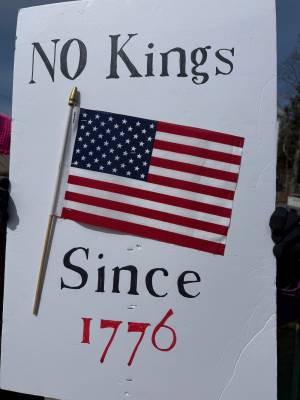
'No Kings' protest sign used by historian Heather Cox Richardson in Maine on March 28, 2026.
March 29, 2026. Almost exactly a year ago, on March 27, 2025, President Donald J. Trump issued an executive order titled “Restoring Truth and Sanity to American History.” The order asserted that “[o]ver the past decade, Americans have witnessed a concerted and widespread effort to rewrite our Nation’s history, replacing objective facts with a distorted narrative driven by ideology rather than truth.”More On Iran War
Trump Watch
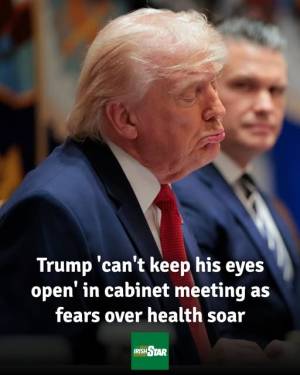
March 29, 2026. Rep. Jim Himes (D-CT), the top Democrat on the House Intelligence Committee, said that Trump is lying about negotiations with Iran, and the president made them up.U.S. Law, Courts, Crime, Rights, Justice
 March 29, 2026. I’ve been thinking a lot about my dad and Robert Mueller.March 29, 2026. Josh Zuckerman is one of the AUSAs Harmeet Dhillon has brought in to prosecute the Don Lemon case. He’s a young lawyer who quit Gibson Dunn last summer to join the Civil Rights Division, after such time as it was clear Harmeet was turning the office into a politicized shitshow. He chose to risk a promising legal career in this corrupt DOJ.
Energy, Transportation, War Impacts
U.S. Governance, Politics, Elections
 March 29, 2026. Where We Go From Here.
 United States took to the streets to send an unmistakable signal to him, and all of his enablers: we will not let you continue to destroy our country. The message was clear. We are taking our country back in November.
Global News

Top Stories
New York Times, Iran War Live Sunday Evening Updates: Trump Says Iran Agreed to Allow 20 More Ships of Oil Through Strait of Hormuz, Farnaz Fassihi, March 29, 2026. The president characterized Iran’s permission as a “sign of respect.” Israel said it launched a wave of strikes targeting infrastructure in Tehran and other areas, and Iran retaliated.
Here’s the latest.
President Trump said on Sunday night that Iran had agreed to allow 20 more oil cargo ships to pass through the Strait of Hormuz, a crucial shipping route, as oil prices continued to soar.
Iranian forces have blockaded the waterway — through which about one-fifth of the world’s oil transits — sending the price of oil climbing by 56 percent since the war began.
But Mr. Trump, speaking to reporters aboard Air Force One, said that Iran would permit the ships’ passage starting Monday as a “sign of respect” to the United States. He also cast Tehran’s decision as a sign that negotiations to end the war were underway.
It was not clear where the 20 cargo ships were headed or who they belonged to. Last week, Iran allowed about 10 ships to transit the strait, a development that Mr. Trump also described as a sign of progress.
 Notably, Trump’s words himself underscore that the Second Iran War is solely aimed at aiding and abetting the war criminal Netanyahu (shown together in an October 2025 meeting) rather than American interests.
 Prime Minister Benjamin Netanyahu of Israel (shown above in a 2025 meeting with the U.S. president) said he had ordered his forces to increase the territory they control in southern Lebanon, as several hundred U.S. Special Operations forces arrived in the Middle East.
The U.S.-Israeli bombardment of Iran continued on Sunday, with strikes on a TV station in Tehran and a port in the country’s south, where at least five people were killed. Iran fired volleys of ballistic missiles at Israel without causing casualties, although a fire was reported at an industrial park in southern Israel that included a hazardous waste facility.
Diplomats from across the region convened for talks in Pakistan, whose mediators had passed along to Iran a 15-point U.S. plan to end the conflict. But Mohammad Bagher Ghalibaf, the speaker of Iran’s parliament, accused President Trump on Sunday of engaging in a front of diplomacy while “secretly planning a ground invasion.”
The newly arrived commandos, who include Army Rangers and Navy SEALs, have not been assigned specific missions, two U.S. military officials said on Sunday. But as specialized ground troops, they could be deployed to help safeguard the Strait of Hormuz.
The U.N. secretary general, António Guterres, condemned an attack that killed an Indonesian peacekeeper and critically injured another on Sunday as a result of an explosion inside their location post in south Lebanon. Mr. Guterres said this was one of several incidents jeopardizing the safety of peacekeepers in the past 48 hours. He urged all parties to “uphold their obligations under international law.”
Here’s what else we’re covering:
troops were “expanding the security zone” over the border in southern Lebanon, from which the Iran-backed Hezbollah militia has launched attacks in solidarity with Tehran. Lebanon’s president has denounced Israel’s campaign in southern Lebanon, particularly the destruction of bridges there, as a violation of Lebanese sovereignty, and warned they were seen as a prelude to a ground invasion of the country. Over 1,200 people have been killed in Lebanon since the conflict reignited earlier this month.News Reports
The Parnas Perspective, News and Comment: Republicans Concerned Following Historic No Kings Day, Mass GOP Resignations, Pope Slams Trump, and More, Aaron Parnas, right, March 29, 2026. We have some major developments this Sunday evening following a historic No Kings Day, where organizers say more than 8 million people protested across thousands of events, making it one of the largest protest days in U.S. history.
Right now, there is growing concern among Republicans in Congress about what the future looks like for their majority, or whether they will even keep it. A record number of lawmakers are retiring, and the scale of the protests has clearly rattled Capitol Hill, especially as the war in Iran continues to expand, threats are spreading beyond the battlefield, and the government shutdown drags on.
Last Sunday, we talked about the exhaustion so many of you were feeling. This Sunday feels different. The news is still intense and nonstop, but there is a noticeable shift in energy. For months, it has felt like trying to drink from a fire hose, with Venezuela, Iran, TSA, DHS, ICE, and crisis after crisis piling on top of each other. There has been no pause and no time to process. But for a lot of people, No Kings Day created a moment to breathe and step back from that constant escalation.
It is my job to help you make sense of all of this, and I will be here whether you are fully tuned in or taking a break. If you value this kind of reporting, direct, unfiltered, and independent, consider subscribing. Your support makes it possible to do this work without answering to corporations or political pressure.Subscribed
As a journalist, my responsibility is to give you the information clearly and honestly. As a consumer, you have a responsibility too. You decide when to engage and when to step back. You get to protect your mental space, and there is no shame in that. A lot of you did that this weekend. I am here, I am giving you the news, and we will keep going.
Here’s the news:
One month into the Iran war, Republicans are increasingly facing political and economic fallout as rising gas prices, supply chain issues, and higher farming costs strain voters and key battleground states. While many GOP leaders and voters still support Donald Trump, concerns are growing that a prolonged conflict could hurt turnout and undermine the party’s “America First” message ahead of midterm elections. Some party officials warn that continued escalation or casualties could deepen divisions within the base and weaken support. Overall, the war is becoming harder for Republicans to defend as its costs become more visible at home.
Some Republican lawmakers are warning that a potential U.S. ground invasion of Iran by Donald Trump could have major political consequences, with one GOP representative predicting the party could lose 60 to 70 seats in the midterms. Several Republicans, including Eli Crane and Nancy Mace, expressed concern about escalation and the risk of another prolonged “forever war.” While many still support Trump’s broader strategy, there is growing unease within the party about deploying ground troops. The debate highlights internal GOP divisions as the conflict raises both military and electoral risks.
A record number of lawmakers are retiring from Congress ahead of the midterms, with dozens of Republicans and Democrats opting not to seek re-election amid growing political uncertainty. The unusually high number of GOP departures has raised concerns about losing control of the House, especially as some retirements echo patterns seen before past wave elections. Lawmakers cite reasons including political dysfunction, redistricting challenges, and the personal toll of serving, while some are pursuing higher office. The trend reflects broader dissatisfaction with Congress and signals potential volatility in the upcoming elections.
Pope Leo XIV condemned global leaders who justify war, saying God rejects the prayers of those with “hands full of blood,” in remarks widely seen as a critique of the Trump administration amid escalating conflict in the Middle East. Speaking during Palm Sunday Mass, he emphasized that religion should not be used to justify violence and called the ongoing war involving the U.S., Iran, and Israel “atrocious.” His comments followed controversial remarks by Pete Hegseth supporting aggressive military action. The pope reiterated calls for peace, urging an end to violence and highlighting the suffering of civilians caught in the conflict.
In response, Trump posted a letter that Franklin Graham wrote to Trump expressing concern about comments suggesting he might not be “heaven bound,” emphasizing that salvation is a serious matter and encouraging certainty about one’s eternal fate. The message frames spiritual assurance as essential, urging reflection on faith and the afterlife.
Iran’s Islamic Revolutionary Guard Corps warned it may target U.S.-affiliated university campuses in the Middle East in retaliation for recent U.S. and Israeli strikes that damaged Iranian universities, urging people to stay away from those sites. The threat raises concerns for several American institutions with regional branches, including Texas A&M University in Qatar and New York University in the United Arab Emirates. Iran set a deadline for the U.S. to condemn the attacks or risk escalation, framing the campuses as potential “legitimate targets.” The warning underscores rising tensions and the expanding scope of the conflict beyond traditional military sites.
Russia shared satellite images of the U.S. Prince Sultan Air Base with Iran ahead of an attack come from statements by Volodymyr Zelenskyy, who said Russian satellites imaged the base multiple times before the strike and that he is “100%” certain Moscow shared intelligence with Tehran.
Iran says it is prepared for a potential U.S. ground assault and accuses Washington of secretly planning military action while publicly signaling interest in negotiations. The U.S. has increased its military presence in the Middle East with 3,500 troops but maintains that no final decision on ground operations has been made. Meanwhile, diplomatic efforts remain unclear, with U.S. officials expressing optimism about talks while Iran denies formal negotiations and rejects proposed terms. The situation reflects rising tensions and mixed messaging as both sides balance.
A Russian-flagged tanker carrying about 650,000 barrels of crude oil has entered Cuba’s exclusive economic zone, signaling what could be the country’s first oil import in over two months. The vessel, which departed from Russia’s Primorsk port, is expected to deliver its cargo to Matanzas if it stays on course. The shipment highlights ongoing energy ties between Russia and Cuba amid broader global supply pressures. It also comes as geopolitical tensions continue to influence oil movements and markets worldwide.
Oil prices have surged above $100 per barrel as fears grow over a prolonged Middle East conflict involving the U.S., Israel, and Iran. U.S. crude has risen roughly 50% since the start of the bombing campaign, with global benchmark Brent crude also climbing above $108. The increase reflects market चिंता over potential escalation, including the risk of a ground invasion and disruptions to oil supply. While diplomatic efforts briefly slowed the rise, prices continue trending upward amid ongoing uncertainty.
According to the Guardian, at the Conservative Political Action Conference, supporters of Donald Trump expressed mixed reactions to the war with Iran, highlighting divisions within the MAGA movement. Some attendees and speakers backed continued military action, while others warned that a potential ground invasion could lead to greater risks, economic strain, and a prolonged conflict. Trump’s absence from the event, reportedly due to the war, underscored the uncertainty and debate over his foreign policy direction. Overall, the gathering reflected growing strain among supporters as they weigh loyalty to Trump against concerns about entering another extended war.
The Department of Homeland Security funding lapse has become the longest partial government shutdown in U.S. history, reaching 44 days while the rest of the federal government remains funded. Efforts to resolve the standoff have stalled, with House and Senate lawmakers unable to agree on funding terms, particularly over immigration enforcement conditions. The shutdown has disrupted travel nationwide, causing long airport security lines as unpaid TSA workers quit or call out, though an order was issued to begin paying them again. With Congress out of session for weeks and no clear compromise in sight, the shutdown is expected to continue.
Maria Bartiromo questioned why Republicans, despite controlling the House, Senate, and White House, are struggling to unify and pass legislation, suggesting Democrats are gaining the upper hand. Lisa McClain agreed, calling the situation “extremely frustrating” and acknowledging internal divisions within the party.
Tom Homan said he hopes Donald Trump will push Congress to return from recess to end the ongoing Department of Homeland Security shutdown, citing heightened global security threats. The shutdown, driven by disputes over immigration policy, has led to airport disruptions as unpaid TSA workers leave or call out, with ICE agents stepping in to assist.
Homan said immigration agents will remain deployed at airports until operations return to normal, noting that Immigration and Customs Enforcement will continue filling gaps if Transportation Security Administration staffing remains low. He indicated that fewer TSA workers returning would lead to a larger ICE presence to maintain security and functionality.
Senator Andy Kim criticized Tom Homan for avoiding questions about why Donald Trump did not authorize pay for TSA agents earlier, arguing the delay reflects a lack of concern for affected workers. He suggested the decision was intentional and that the public understands the underlying reason.
Steve Scalise said some senators regret supporting a DHS funding bill that excluded immigration enforcement, highlighting deep divisions between the House and Senate over how to end the shutdown. House Republicans rejected the Senate’s approach and instead passed a short-term funding bill covering all DHS operations, prolonging the stalemate.
Benjamin Netanyahu announced that Israel will expand its ground invasion in southern Lebanon to create a larger “security belt” and push threats away from its border. The escalation comes amid ongoing conflict with Hezbollah, which began attacking Israel following the broader war involving Iran, and has already resulted in significant casualties and destruction in Lebanon. The offensive has displaced over a million people and raised fears that Israel may replicate the tactics of its Gaza campaign. International leaders, including António Guterres, have warned against further escalation and urged both sides to halt hostilities.
According to NBC News, Israeli police blocked senior Catholic leaders from entering the Church of the Holy Sepulchre on Palm Sunday, preventing a key religious service from taking place at one of Christianity’s holiest sites for the first time in centuries. Authorities said the move was due to security concerns amid the ongoing war, but religious leaders and global officials condemned it as a violation of religious freedom. The incident sparked international backlash, with multiple world leaders criticizing Israel and demanding explanations. Officials later said they would work to allow worship at the site later in the Easter week.
Palestinians in Gaza continue to face severe humanitarian conditions months after a ceasefire, with ongoing airstrikes, shortages of food, water, and medical supplies, and widespread displacement. Civilians describe daily life as dominated by fear, poverty, and loss, with infrastructure and basic necessities increasingly scarce. The situation has worsened amid the broader regional conflict involving Iran, driving up prices and limiting aid access. With thousands still needing medical treatment and aid bottlenecks persisting, the crisis remains dire and largely overshadowed by global attention on other conflicts.
The U.S. Supreme Court will hear a case involving a Mississippi death row inmate who claims his conviction was tainted by racial discrimination in jury selection. The case centers on a prosecutor with a documented history of excluding Black jurors, raising concerns similar to a previous ruling where the Court overturned a conviction for the same pattern. Justices will consider whether the trial judge failed to properly evaluate claims of bias and whether the defendant’s rights were violated. The outcome could determine whether the conviction stands or if a new trial is required.
Politico has confirmed that talks at the World Trade Organization have stalled over a dispute about extending a global ban on digital tariffs, raising doubts about broader efforts to reform the organization. The U.S. is pushing for a long-term extension, while countries like Brazil oppose it and India has already blocked related trade agreements, deepening divisions. Negotiators are scrambling to reach a compromise, with options ranging from a short-term extension to letting the moratorium expire entirely. The outcome could determine whether WTO reform efforts move forward or collapse amid growing global trade tensions.
According to The Guardian, dozens of protesters were arrested in Los Angeles after clashes with police following a No Kings rally, where officers used tear gas, pepper rounds, and other crowd-control measures. The confrontation occurred near a detention center that has become a focal point for protests against immigration enforcement policies. While earlier demonstrations drew large, mostly peaceful crowds, tensions escalated later when some protesters refused to disperse and police reported objects being thrown. The incident highlights growing unrest tied to nationwide protests against the Trump administration and its policies.
More On No Kings Protests
'No Kings' protest sign used by historian Heather Cox Richardson in Maine on March 28, 2026.
Letters from an American, Historical Commentary: March 28, 2026 [Trump Claims To Restore Historical 'Truth?'], Heather Cox Richardson, right, March 29, 2026. Almost exactly a year ago, on March 27, 2025, President Donald J. Trump issued an executive order titled “Restoring Truth and Sanity to American History.” The order asserted that “[o]ver the past decade, Americans have witnessed a concerted and widespread effort to rewrite our Nation’s history, replacing objective facts with a distorted narrative driven by ideology rather than truth.”
The order claimed, as Trump did in his first term, that “historical revision” was reconstructing “our Nation’s unparalleled legacy of advancing liberty, individual rights, and human happiness…as inherently racist, sexist, oppressive, or otherwise irredeemably flawed.” Trump has claimed since his first term that a “left-wing mob is trying to demolish our heritage, so they can replace it with a new oppressive regime that they alone control.” He told his followers that they are in “a battle to save the Heritage, History, and Greatness of our Country.”
Embracing the idea that there is a perfect past currently being destroyed, Trump echoes twentieth-century fascists who promised to return their country to divinely inspired rules that, if ignored, would create disaster.
Trump’s order called for putting his ideology in place, turning federal historic sites, parks, and museums into “solemn and uplifting public monuments that remind Americans of our extraordinary heritage, consistent progress toward becoming a more perfect Union, and unmatched record of advancing liberty, prosperity, and human flourishing.”
The order directed the Secretary of the Interior to “determine whether, since January 1, 2020, public monuments, memorials, statues, markers, or similar properties within the Department of the Interior’s jurisdiction have been removed or changed to perpetuate a false reconstruction of American history, inappropriately minimize the value of certain historical events or figures, or include any other improper partisan ideology,” to restore their previous content, and to make sure that they “do not contain descriptions, depictions, or other content that inappropriately disparage Americans past or living (including persons living in colonial times), and instead focus on the greatness of the achievements and progress of the American people or, with respect to natural features, the beauty, abundance, and grandeur of the American landscape.”
Setting administration officials’ eyes on the Smithsonian Institution, it said: “Museums in our Nation’s capital should be places where individuals go to learn—not to be subjected to ideological indoctrination or divisive narratives that distort our shared history.” Trump’s order named a three-person team to review the Smithsonian’s museums, including his Florida criminal defense attorney Lindsey Halligan, who joined his team from the field of property law and who, as legal analyst Anna Bower observed, “didn’t like some of the museum’s exhibits when she visited after the inauguration so she convinced Trump to sign an executive order putting her in charge.” Also on the team is Russell Vought, director of the Office of Management and Budget and a key author of Project 2025.
Since then, Trump’s people have tried to rewrite American history according to their ideology. Revealingly, one of the first things the administration did to alter the past was to remove from a U.S. military cemetery in the Netherlands two displays that recognized Black soldiers who helped liberate Europe from the Nazis.
 Interior Secretary Doug Burgum, left, issued his own order on May 20, 2025, also titled “Restoring Truth and Sanity to American History.” He told officials at all National Park Service sites to make sure information in the park adhered to Trump’s demands and to ask the public to let them know if they had “any signs or other information that are negative about either past or living Americans or that fail to emphasize the beauty, grandeur, and abundance of landscapes and other natural features.”
By July 2025, National Park Service teams were trying to figure out what the vague order not to “inappropriately disparage Americans” meant, flagging exhibits on sea level rise due to climate change at Cape Hatteras National Seashore in North Carolina, human enslavement at Independence National Historical Park in Philadelphia, and the imprisonment of Seminoles, Cheyennes, Araphaos, Kiowas, Comanches, Caddos, and Apaches at the Castillo de San Marcos National Monument in Florida.
On August 12, 2025, Trump’s Smithsonian team wrote to Dr. Lonnie Bunch, the historian who serves as the secretary of the Smithsonian Institution, informing him they intend to review museum exhibitions, curatorial processes, planning, the use of collections, and artists’ grants in order to make sure they align “with the president’s directive to celebrate American exceptionalism, remove divisive or partisan narratives, and restore confidence in our shared cultural institutions.”
They said they were focusing on the National Museum of American History, the National Museum of Natural History, the National Museum of African American History and Culture, the National Museum of the American Indian, the National Air and Space Museum, the Smithsonian American Art Museum, the National Portrait Gallery, and the Hirshhorn Museum and Sculpture Garden.
On December 18, 2025, they wrote to Bunch again to complain he had not provided as much information as they had requested. They expressed concern “that the museums of the Smithsonian Institution be well positioned to play an important role during the historic yearlong celebration of our Nation’s 250th birthday that is fast approaching. We wish to be assured that none of the leadership of the Smithsonian museums is confused about the fact that the United States has been among the greatest forces for good in the history of the world,” they wrote. “The American people will have no patience for any museum that is diffident about America’s founding or otherwise uncomfortable conveying a positive view of American history, one which is justifiably proud of our country’s accomplishments and record.”
At about the same time, Trump unveiled that the history he intended to see shared was one that remade the U.S. by destroying its complicated history of struggle toward multicultural democracy and rewriting it as a dictatorship.
In mid-December the White House revealed that Trump had attached partisan descriptions of previous presidents on the “Presidential Walk of Fame” at the White House, calling Democratic president Barack Obama “one of the most divisive figures in American History,” and Joe Biden “by far, the worst President in American History.” “Taking office as a result of the most corrupt Election ever seen in the United States,” it continued, “Biden oversaw a series of unprecedented disasters that brought our Nation to the brink of destruction.” Trump described himself, though, as the architect of “the Greatest Economy in the History of the World.”
Then, on the fifth anniversary of the January 6 attack on the U.S. Capitol, the White House unveiled a new website blaming the Democrats for the attack and saying Trump had “corrected a historic wrong” by pardoning the rioters. Under pressure from the White House, the Smithsonian Institution’s National Portrait Gallery removed text by Trump’s portrait that referred to Trump’s two impeachments, as well as his loss to Democrat Joe Biden in the 2020 presidential election.
In January the National Park Service took down displays about the enslavement of nine Black Americans at the home of President George Washington and First Lady Martha Washington in Philadelphia, and the city sued. In February, U.S. District Judge Cynthia Rufe, who was appointed by President George W. Bush, ruled that the materials must be put back as the case works its way through the courts. She began her order with a quotation from George Orwell’s 1984, a novel based on the premise that an authoritarian regime constantly rewrote history for its own ends.
But a funny thing happened on the way to the erasure of American history in favor of a whitewashed authoritarianism. The American people began to preserve the truth of who we have been.
Volunteers worried at the potential loss of National Park Service information created the Save Our Signs project, a crowd-sourced archive of photographs from National Parks. Historians appalled by changes to the Smithsonian created Citizen Historians for the Smithsonian, similarly documenting changes to the Smithsonian. One of its leaders, James Millward, is a scholar of Chinese history and is concerned that “history being snipped and clipped and disappeared” looks a great deal like the methods of the Chinese Communist Party. Sitting next to Trump’s portrait in the Portrait Gallery, he handed visitors copies of the old text until guards closed the exhibit.
At the Organization of American Historians, the History, Archives, and Records Preservation Project (HARPP) is made up of historians, archivists, librarians, and their allies, who are recording “changes since January 2025 that threaten the historical record.”
Even more dramatically, though, today’s Americans are demanding the preservation not just of who we have been, but of who we are. Far from accepting the administration’s whitewashed assertion that the nation has an “unparalleled legacy of advancing liberty, individual rights, and human happiness,” we are remembering our complicated history of community struggle and mobilizing to protect our right to govern ourselves against those who would take that right from us.
Millions of Americans and their allies turned out today for more than 3,100 “No Kings” events in all 50 states, U.S. territories, Washington, D.C., and towns and cities around the world in what appears to be the largest one-day protest in American history.
Instead of accepting the destruction of the true lessons of our past, we are bringing them back to life.
New York Times, 5 Takeaways From the ‘No Kings’ Rallies as the Midterms Heat Up, Tim Balk, March 29, 2026. The war in Iran was a galvanizing force, but plenty of protesters focused on President Trump’s immigration crackdown. Senate candidates in several key races joined the crowds.
Thousands of demonstrations against the Trump administration unfolded across the country on Saturday, the third round in a nationwide series of loosely coordinated “No Kings” rallies.
The day of protest, the first since October, came as the midterm election season takes shape, and as Democrats work to capitalize politically on the unpopular war with Iran.
Exactly a month earlier, President Trump ordered the first U.S. strikes against Iran, setting off a conflict that has sent gasoline prices soaring and rattled Republicans.
The war was a central animating force in the Saturday rallies, which were attended by roughly eight million people, according to “No Kings” organizers, though their estimates in some cities were higher than those of local public safety officials. But the fighting in the Middle East was hardly the only issue on the minds of frustrated Democrats.
Here are five takeaways.The war seemed to galvanize younger voters.
Many protesters said that the war had brought them out on Saturday. And at least in some places, the conflict appeared to be motivating younger people.
One large rally was held across the street from the University of Iowa, where the youth outreach group Voters of Tomorrow signed students up to join its organizing efforts.
Katy Gates, 22, an organizer, said the crowd was “a lot younger, more diverse and more energetic” than those at previous “No Kings” demonstrations. She attributed the change, in part, to the war.
“Our generation has grown up with this idea of endless war in the Middle East,” Ms. Gates said. “And the idea of getting into yet another is something that people are rightfully really angry about.”
More On Iran War
New York Times, Iran War Live Sunday Morning Updates: Israel Strikes Tehran as Regional Diplomats Gather in Pakistan for Talks, Aaron Boxerman and Sanam Mahoozi, March 29, 2026. Israel said it launched a wave of strikes targeting infrastructure in Tehran and other areas, and Iran retaliated. Officials from Saudi Arabia, Egypt and Turkey were meeting in Pakistan in hopes of finding a way to end the war. Here’s the latest.
Israel bombarded Iran with an intense wave of airstrikes on Sunday, and Iran responded by firing ballistic missiles at Israel, even as Middle East diplomats gathered in Pakistan in hopes of finding a way to end the war.
The Trump administration has sent Iran a 15-point plan to end the conflict, delivered via Pakistani mediators. Iranian officials publicly rebuffed the offer. Mohammad Bagher Ghalibaf, the Iranian parliamentary speaker, accused President Trump on Sunday of engaging in a front of diplomacy while “secretly planning a ground invasion.”
On Sunday, foreign ministers from Saudi Arabia, Egypt and Turkey convened in the Pakistani capital, Islamabad, for further discussions. But there was little sign that U.S. or Iranian officials would show up.
Also on Sunday, Iran shot drones and missiles at Israel and at U.S. allies across the Persian Gulf, setting off air-raid alerts in parts of the region.
Residents in Tehran, the Iranian capital, reported some of the heaviest airstrikes over the weekend since the bombing campaign began on Feb. 28. Israel’s military said it was attacking weapons production sites and air-defense systems, among other targets.
Israeli and American attacks have yet to compel Iran to accept U.S. terms for a diplomatic settlement or to reopen the Strait of Hormuz, a crucial oil shipping route. Iranian forces have successfully blockaded the waterway — through which about one-fifth of the world’s oil transits — sending the price of oil soaring by more than 50 percent since last month.
That leaves Mr. Trump, for now, with several options to escalate, each of which could have far-reaching consequences, analysts say. He could carry out his ultimatum to bombard Iranian power plants unless Iran opens the Strait of Hormuz by April 6. But such an attack could potentially affect millions of Iranian civilians and constitute a war crime under the Geneva Conventions.
Another option would be to launch a risky ground assault to seize Iran’s enriched uranium, which U.S. officials say could one day be used in a nuclear weapon. On Saturday, an expeditionary force of 2,500 U.S. Marines arrived in the Middle East, attached to a group of ships equipped for amphibious assault.
Iran and its allies have also been escalating their attacks.
The Houthis, an Iran-allied rebel group in Yemen, joined the widening war on Saturday with an unsuccessful missile attack on Israel. The Houthis could further ensnarl global shipping, already under stress by the blockade of the Strait of Hormuz, by threatening vessels passing through the nearby Red Sea.
During the war in Gaza, the Houthis disrupted international shipping by menacing vessels in the Red Sea. Yahya Saree, a Houthi military spokesman, said that the latest attacks from Yemen would continue “until the aggression ends.”
Here’s what else we’re covering:
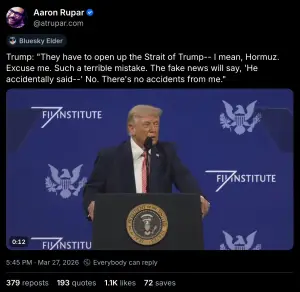
New York Times, Wild Ultimatums and ‘Bombing Our Little Hearts Out’: A Portrait of Trump at War, Erica L. Green, March 29, 2026 (print ed.). President Trump has vacillated between boasting about U.S. military superiority and deep frustration that his war of choice is not always having the desired effects.
New York Times, Yemen’s Houthis Fire at Israel and Vow Further Attacks, Abdi Latif Dahir and Eve Sampson, March 29, 2026 (print ed.). There has long been concern that the Houthis, an Iran-backed militia, could disrupt shipping in the Red Sea if they entered the broader war.
New York Times, Israeli Strike Kills 3 Journalists in Southern Lebanon, Officials Say, Euan Ward, March 29, 2026 (print ed.). Israel accused one of the reporters of being a Hezbollah operative. Lebanon’s president said they were journalists and condemned the killings.
U.S. Law, Courts, Crime, Rights, Justice
Lincoln Square Media, Opinion: Robert Mueller, My Father, and the Vanishing American Patriot, Stuart Stevens, right, March 29, 2026. I’ve been thinking a lot about my dad and Robert Mueller.
Both were attorneys. Both had seen heavy combat in the military. Both were FBI agents. Both led lives that embodied the values that were once assumed to be exemplary.
 James Fallows wrote that Trump’s remark, “Good, I’m glad he’s dead,” was “the most despicable public statement by an American public official in my lifetime.”
There’s a scene early in the great Coen Brothers film, No Country For Old Men in which the sheriff, played by Tommy Lee Jones, comes across a murder scene in the desert. His deputy says, “”This is turnin’ into a hell of a mess, ain’t it, Sheriff?” Jones responds, “If it isn’t, it’ll do until the mess gets here.”
So it is with Trump’s vomit-inducing celebration of the death of an American hero. Trump is likely to come out with something even more despicable at any minute, but the sad spectacle of an American president dancing on the grave of a man who lived a patriotic life of virtue will long be remembered as another death in the mass suicide of decency in the Republican party.
This is not about Trump. He’s a deeply disturbed sociopath slipping into the darkness of dementia and failing health. It is about the collective failure of the Republican party to exhibit even a base level of admirable human qualities. If a woman is raped in a busy airport and the passengers ignore it and walk by, the shame and guilt is shared by every person who looks the other way. When they stop to cheer the rapist, they are active participants in the horrific crime.
When Trump announced for president in 2015, the Republican Party mostly ignored him and kept walking. In the first poll after his announcement, Trump received 5% of the vote among Republican primary voters. Every Republican presidential candidate, all 15 of them, believed that the goal was to end up one-on-one with Trump, with all others eliminated.
Once it was a two-person race with Trump, how could you lose? The Republican Party was not going to nominate a many-times-bankrupt casino owner who talked in public about dating his daughter.
As Trump closed in on the nomination, Mitt Romney warned about Trump in a speech in March 2016 in a Salt Lake City speech:
“Here’s what I know. Donald Trump is a phony, a fraud. His promises are as worthless as a degree from Trump University. He’s playing the American public for suckers: He gets a free ride to the White House and all we get is a lousy hat.
His domestic policies would lead to recession. His foreign policies would make America and the world less safe. He has neither the temperament nor the judgment to be president. And his personal qualities would mean that America would cease to be a shining city on a hill.
Like Romney’s 2012 description of Russia as America’s “greatest geo-political foe,” he proved to be extraordinarily prescient. In one of their last honest moments in public life, Marco Rubio and Lindsey Graham spoke the truth about Trump in the 2016 primary. Rubio promised, “I will never stop until we keep a con man from taking over the party of Reagan and the conservative movement.” Lyndsey Graham declared, “The bottom line is I believe Donald Trump would be an absolute, utter disaster for the Republican Party, destroy conservatism as we know it.”
They were right.
The genius of Donald Trump is that he recognized with some feral instinct that the Republican Party did not believe in anything but power, and if he gave them power, there was no bottom to the degradation they would both endure and inflict. So we watch an entire political party stand silent while they watch him disgrace the office of the presidency, which is to betray every American.
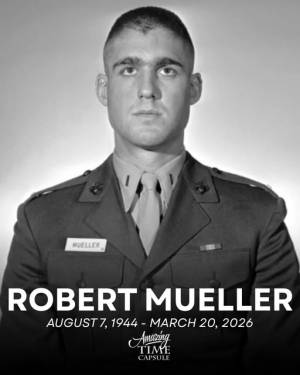 What happens to a society that elevates the worst in its midst and demeans the best? It was no accident of birth that America produced so many men like my father and Robert Mueller (shown at right during his military service). They grew up in a culture that honored sacrifice, decency, character. There was an assumed civic bond linking personal conduct to the greater good.
That is the legacy that these Republicans have betrayed. Like those in a lynch mob, they take comfort in their numbers. When Republican elected officials look at their phones and see the man who they embraced gleefully over Robert Mueller’s death, they know it’s wrong. They know they would never want to see their children show such crass cruelty. But then they put down their phones and try to convince themselves it doesn’t matter.
But of course it does.
MS NOW, Opinion: Beyond No Kings, Zeeshan Aleem, March 29, 2026. The No Kings protests that took place across the country this weekend  were massive. These demonstrations continue to drive home how Trump’s presidency is not only unpopular, but unpopular in a manner that infuriates and mobilizes people.
But something is missing, writes Zeeshan Aleem.There is an absence of friction. The contained and routine choreography of thesedemonstrations every few months is central to their mass appeal, and, paradoxically, it is also what limits their power. Americans interested in using collective action to push back against Trump’s authoritarian agenda will need to show more ambition and creativity to move the dial. Read more.
PoliticusUSA, Trump Busted For Lying About Iran War Negotiations, Jason Easley, right, March 29, 2026. Rep. Jim Himes (D-CT), the top Democrat on the House Intelligence Committee, said that Trump is lying about negotiations with Iran, and the president made them up.
Donald Trump is trapped in a quagmire of a war in Iran, and he usual trick of inventing his own reality and trying to sell it to those around him is not working.
Trump has created an economic crisis on top of an international crisis, on top of a country that is teetering on the brink.
In an apparent effort to calm the stock market, Trump has been claiming almost daily that either war that he started with Iran has been won, or would be won soon.
When the financial markets took a dive, Trump claimed that peace negotiations were occurring with Iran, but at the time, there was no evidence that any negotiations with the Iranians who have power were happening.
PoliticusUSA’s news and opinions are 100% independent. Support us by becoming a subscriber.Subscribed
On Sunday, the top Democrat on the House Intelligence Committee, Rep. Jim Himes, said that there are no negotiations.
Himes dropped into his answer about funding ICE on CBS’s Face The Nation:
This is not ideological purity. This is basic adherence to the law- yeah, well, okay, so it's all agreed to, let's pass the law which codifies it.
Because you know what, we don't trust the president when he says, okay, no masks any more than we trust him when he says, oh, well, now I'm negotiating with the Iranians when he's not, right?
So if this is so easy, fine, let's codify it into law. But they're not, you know- they're not willing to do that. Now, where Maria's right, and this is important, we have gotten too used to using shutdowns as a mechanism of getting what we want legislatively. And what that implies is that people like TSA agents or folks that work in the federal government for the Department of Agriculture or- don't get paid when one party throws a tantrum, right?
Now, in this case, I happen to believe that the American people- you know are with the Democratic Party and saying you don't get to act like ICE acted in Minneapolis, but we do need to get away from legislating through shutdown that is not consonant with the great country that we are.
Himes just sort of casually dropped in that Trump was lying about negotiating with Iran, but he went into more detail and explained why Trump is lying later in the interview.
Story continues below
Margaret Brennan asked Rep. Himes, “Well, and they just want their airports and basic government to work. But on the point you raised, you said that the President’s not really negotiating with Iran is that because you haven’t been briefed as a member of Congress on the diplomacy. Or you think he’s flat out lying?”
Himes said that Trump lied to manipulate the financial markets:
I think he’s flat out lying last Sunday, when he was told- and by the way, we’re in exactly the same position today, you know, oil prices now $112 a barrel. And you know futures in the stock market down 2%. Last Sunday, he realized, oh my God, I’ve got a financial cataclysm on Monday. So he just made it up that they’re in negotiations with the Iranians.
Look underneath that statement, the Iranians have now realized that they have the reins. They are controlling the Strait of Hormuz. Gasoline prices are up more than $1 a gallon, and so the Iranians realize, holy smokes, we’ve got a lot of leverage here.
With the president sending more ground troops to the Middle East, it is clear that the war is not over or won. If Trump is holding peace negotiations, they aren’t happening with people who could end the war, so it looks like Trump made up the negotiations to prevent the market from completely tanking.
Trump has no clue what he is doing.
Himes is right. Iran has the upper hand because Trump can’t get the Strait of Hormuz opened without a major military operation that will extend the war.
Trump is lying, and those who are looking for an excuse to manipulate the stock market believe him.

Trump's Assistant Attorney General Harmeet Dillon, lead prosecutor in the U.S. Justice Department's prosecution of journalists Don Lemon and Georgia Fort for covering a protest at a church of at anti-immigration enforcement tactics.'
Emptywheel, Analysis: Harmeet Dhillon’s Minion Confirms She Lied about the Eighth Circuit, Emptywheel (Marcy Wheeler), right, March 29, 2026. Josh Zuckerman is one of the AUSAs Harmeet Dhillon has brought in to prosecute the Don Lemon case. He’s a young lawyer who quit Gibson Dunn last summer to join the Civil Rights Division, after such time as it was clear Harmeet was turning the office into a politicized shitshow. He chose to risk a promising legal career in this corrupt DOJ.
And he’s the guy who had the challenge of responding to two sets of motions from Lemon and others.
In the process he confirmed that his boss is a liar and claimed that the lady who RTed the White House’s racist AI slop altering a Nekima Levy Armstrong picture is not engaged in name calling.
The motions and responses are:
 Don Lemon, right, and Georgia Fort motion for release of grand jury materials (first submitted February 13)
Before I get into the ways Zuckerman confirmed his boss is a hack, I have to explain how she arrested the wrong person.
On March 20, DOJ moved to dismiss the case against Heather Danae Lewis (a more senior lawyer than Zuckerman, Acting Deputy AAG Robert Keenan, made that request, albeit without even changing the name of the document he used as template — every … single … thing about this DOJ is slovenly). Judge Laura Provinzino granted that request three days later.
First NYT (on March 21), then CBS (on March 23), reported why DOJ was dismissing the case. According to the explanation Lewis’ lawyer, Brock Hunter, provided, the government got a geofence warrant targeting the Cub Foods parking lot at which protestors gathered before the protest, then obtained the driver’s licenses for people identified in the geofence to see whether any of them looked like protestors visible in protest videos.
Mr. Hunter said his client’s ordeal began the morning of Feb. 27 when federal agents pulled her over as she was driving and informed her they had a warrant for her arrest. Ms. Lewis, an engineer who said through her lawyer that she has not participated in activism, was dumbfounded, he said. Investigators took her to a federal building and interrogated her for hours as she sought to persuade them they had made a mistake, he said.
Shortly after Ms. Lewis was taken into custody in handcuffs, Attorney General Pam Bondi posted a statement on social media saying: “YOU CANNOT ATTACK A HOUSE OF WORSHIP.”
Mr. Hunter said he believes his client became a suspect after investigators obtained a search warrant for data from cellphone towers in an effort to identify individuals who were at a parking lot where the church protesters gathered before the demonstration. Ms. Lewis, he said, had been at the parking lot that morning to pick up items she had won at an auction.
Investigators obtained a driver’s license photo of Ms. Lewis and compared it against footage shot during the protest. One woman in the footage bore a strong resemblance, Mr. Hunter said.
As it happens, a challenge to geofence warrants is before SCOTUS as we speak; DOJ filed its brief days after this fiasco with Lewis. John Sauer, right, didn’t confess to SCOTUS that DOJ had just arrested an innocent person by relying primarily on a geofence, which seems pertinent to 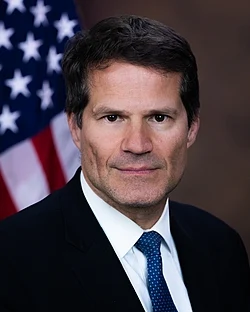 questions of their constitutionality.
And DOJ targeted this geofence warrant in the stupidest way possible, targeting a public parking lot rather than the Church where, like the geofences used for January 6, everyone was either an alleged victim or a participant (including Lemon and others who argue they were there as journalists). And then they did next to no further investigation before they started putting people they understood to be peaceful protestors in handcuffs.
In the bid to reverse an earlier decision extending the government’s discovery deadlines, Lemon accused the government of hiding this fuck-up from the court when asking for an extension.
The government then compounded its error by misleading the Court.
Based on information and belief, the government learned that it had charged an innocent person no later than Wednesday, March 18. But the government did not file the motion to dismiss that day. Instead, at approximately 11:45 p.m. that night, the government filed a motion for a 90- day extension of the discovery deadline. Dkt. #391.
[snip]
In its motion for a discovery extension, the government did not inform the Court of the mistaken identification, that it had charged an innocent person, or that it intended to dismiss one of the people charged in the superseding indictment. Nor did the government move to dismiss Lewis from the indictment immediately after concluding she had been charged in error. Instead, the government waited until after this Court partially granted its requested discovery extension before filing a motion to dismiss Lewis from the indictment (a motion that did not provide any information about the reason for the dismissal or how she came to be charged). Dkt. #412. The government filed the motion to dismiss Lewis from the indictment on Friday evening at 8:10 p.m.—approximately four hours after the Court partially granted its motion for a discovery extension. To this day, the government has not informed Mr. Lemon, Ms. Fort, or Mr. Beute of the false identification or produced any Brady materials.
[snip]
[A]t the outset of this case, the Court ordered that the government immediately disclose any exculpatory material under Brady v. Maryland. Dkt. #126. It is hard to think of something more exculpatory than an innocent person being misidentified, indicted, and arrested. There are almost certainly law enforcement reports that reflect the false identification, as well as grand jury testimony4 that is false. The superseding indictment alleged that Mr. Lemon, Ms. Fort, Mr. Beute, and others conspired with Ms. Lewis, which the government now concedes is not true. Yet none of this—not one shred of evidence, much less the fact of the misidentification—has been produced to the defense, either under the government’s continuing Brady obligations or the Court’s order specifically directing the government to produce any Brady in its possession immediately.
4 This series of events has obvious bearing on the defense motion for grand jury materials (Dkt. #125), to which the government has yet to respond. These materials should be produced immediately to the defense, as they now constitute Brady materials.
Two months after the first charges in this case, DOJ still has not started providing discovery (or had not, as of last Tuesday).
Among the things Zuckerman did in response was to:
Confess that DOJ charged this case — after already having dismissed four cases against alleged drug dealers for what appear to be resource limitations while pursuing this case — without having enough resources to comply with its legal obligations. Excuse DOJ’s own shoddy investigation by claiming it was enough to investigate someone’s alibi after putting her in handcuffs and forcing her to spend money on a lawyer, rather than investigate before charging her. Admit that DOJ stalled on dismissing the case against Lewis so it could investigate the person they misidentified as her.
The Government is working diligently to produce discovery as soon as possible, including efforts to reinforce the paralegal staff needed to complete that task. Thus, the Court’s complex-case designation and its extension of the discovery disclosure deadline remain reasonable and well-founded. The Government’s decision to promptly investigate one defendant’s claimed alibi defense and to then dismiss her from the case does not change that calculus or warrant an extraordinary order requiring immediate disclosure of any Brady materials, especially in light of the standard discovery orders already issued in this case pursuant to Fed. R. Crim. P. 5(f).
[snip]
The Government’s review of Lewis’ alibi led to a further investigation of the subject agitator, who has since been identified. Due to evidence of that subject’s connection with another defendant, the Government promptly sought to secure a search warrant, but as noted above, the warrant was not sought until March 20, 2026, and was not served until March 24, 2026. (Mot. at 5.)
Note the abundant use of passive voice in Zuckerman’s discussion about timing.
As defendants have noted several times, Magistrate Judge Douglas Micko already admonished the government for slow-walking discovery when he granted their extension request.
[T]he Court is troubled by the inference in the government’s most recent motion that it has yet to produce any discovery to Defendants.
[snip]
This is particularly concerning given that the pace and cadence of discovery was an issue before the Court in February, resulting in the Court commenting that “rolling discovery appears consistent with [the Court’s] interpretation of the government’s discovery obligations.” (Doc. 140 at 5.) It seems that comment has been ignored. So, here we are, months into a case that the government had an intense appetite to initiate, but cannot seem to keep up the pace when it comes to discovery obligations. This is unacceptable.
So all that buffoonery is the background for Lemon et al‘s other request: for grand jury transcripts.Zuckerman claims Harmeet was right
The core of the grand jury request argues that Harmeet misstated the law on the FACE Act, which explicitly protects activities that are themselves protected by the First Amendment.
AAG Dhillon, right, in interview discussing the indictment in this case, wholly mischaracterized the law as it relates to journalistic activities:
[I]n my opinion, in a private property house of God, church, synagogue, mosque, whatever, there is only one paramount First Amendment right there, and that’s the right to freely worship. The right to assemble, the right to protest, freedom of the press, etcetera—those have time, place, and manner restrictions on them—you can’t just do anything you want anywhere, even on public property. So here, it’s just like doing it in somebody’s house or in somebody’s business. It’s not protected by the law. If you wear the badge “journalist” or you claim, “I’ve got a microphone, I’m a journalist,” that is legally irrelevant in the statute. 18
Rather than being “legally irrelevant in the statute,” Congress expressly limited the FACE Act so that protected First Amendment expression cannot form the basis of criminal liability. The FACE Act’s rules of statutory construction in 18 U.S.C. § 248, subsection (d) are clear: “[n]othing in this section shall be construed” “to prohibit any expressive conduct (including peaceful picketing or other peaceful demonstration) protected from legal prohibition by the First Amendment to the Constitution,” or “to create new remedies for interference with activities protected by the free speech or free exercise clauses of the First Amendment to the Constitution, occurring outside a facility, regardless of the point of view expressed, or to limit any existing legal remedies for such interference.” The uncontested existing evidence demonstrates that Mr. Lemon and Ms. Fort were engaged in constitutionally protected conduct, including newsgathering, observing, recording, and reporting.19
18 @AAGDhillon, X (Feb. 3, 2026), https://x.com/AAGDhillon/status/2018710583290315193, at 0:04–0:42 (emphasis added).
19 Although Fort is not the household name that Lemon is, the government knew she was operating as a journalist, including because the indictment notes that she was conducting an interview outside of the church. See ECF 39 ¶ 8 (Overt Act #29).
After claiming the three journalists asking for grand jury transcripts are only “alleged” journalists in the 22nd word of his filing (Bollman included a picture of his photo journalist credential in his filing), Zuckerman first significantly truncates the full Harmeet quote at the core of the challenge (taking out her identification of this as an opinion and her claims that within churches all other First Amendment protections collapse), lumps it in with other comments from Pam Bondi and Todd Blanche, then claims that those comments are all correct.
Assistant Attorney General for Civil Rights Harmeet Dhillon similarly explained on social media that the First Amendment does not protect “disrupting a prayer service.” (Mot. at 8 n.12.) She added that journalists cannot ‘just do anything [they] want anywhere … If you wear the badge ‘journalist’ or you claim, ‘I’ve got a microphone, I’m a journalist,’ that is legally irrelevant in the statute.” (Mot. at 13 (emphasis omitted).) 2 She separately stated that, “Invading private property isn’t protected speech & claiming ‘I’m a journalist’ doesn’t give you a pass to break the law.” (See Bollman Mot. at 10 n.4.)
These statements are correct. The press “has no special immunity from the application of general laws [and] no special privilege to invade the rights and liberties of others.” See Associated Press v. NLRB, 301 U.S. 103, 132-133 (1937). And “generally applicable laws do not offend the First Amendment simply because their enforcement against the press has incidental effects on its ability to gather and report the news.” Cohen v. Cowels Media Co., 501 U.S. 663, 669 (1991).
The FACE Act’s house-of-worship provision, 18 U.S.C. § 248(a)(2), is no exception. As Assistant Attorney General Dhillon observed, Section 248(a)(2) prohibits anyone (i.e., “whoever”) from physically obstructing, intimidating, or interfering with those exercising the right of religious freedom at a house of worship, for any reason, even if they are journalists purportedly “doing their job.” (Mot. 1.)
While Defendants point out (Mot. 13) that the FACE Act contains the truism that it does not “prohibit any conduct … protected from legal prohibition by the First Amendment,” 18 U.S.C. § 248(d)(1), the above-referenced statements by Government officials about the applicable legal standard are not inconsistent with that provision. Therefore, Defendants’ efforts to show any public misstatements fail. [emphasis original]
Citing a seemingly inapt opinion, Zuckerman treats the First Amendment issues as an affirmative defense that DOJ had no obligation to present to a grand jury, as opposed to a key part of the law.
Because “Supreme Court precedent establishes that an indictment need not anticipate affirmative defenses”—such as freedom of the press—“the grand jury need not determine whether probable cause has been negated by a potential affirmative defense of the Defendants.” United States v. Clark, 2011 WL 2015224, at *3 (D. Minn. Apr. 15, 2011) (Brisbois, J.). Thus, even if the Government did not discuss the First Amendment or Section 248(d)(1) before the grand jury (and we make no representation here about that matter), it was under no obligation to do so.
And with that, he argues that the journalists charged for reporting on this protest will have to wait to make that case.Zuckerman corrects Harmeet’s lie
But the requests for grand jury transcripts also detailed both the problematic posture of the case (in which Lemon and Fort were charged after judges (two, in Lemon’s case) stated that there was no probable cause against them for either charge, and the politicization of it.
Zuckerman leans heavily on the concurring opinion from Trump appointee Steven Grasz to address the first issue.
The petition sought an order directing this Court to issue arrest warrants against the remaining five defendants based on the complaint affidavit. The Eighth Circuit denied the petition. In a concurring opinion, however, Circuit Judge Grasz noted that “the Complaint and Affidavit clearly establish probable cause for all five arrest warrants” and that the district court lacks “discretion to refuse to issue an arrest warrant once probable cause for its issuance has been shown.” In re United States, 2026 WL 185713, at *1 (Grasz, J., concurring).
[snip]
As noted above, Circuit Judge Grasz found that “the Complaint and Affidavit clearly establish probable cause.” In re United States, 2026 WL 185713, at *1.
It’s a reasonable basis to explain why DOJ pursued a grand jury indictment even after two judges said there was no probable cause.
Or would be, if Harmeet hadn’t run her mouth about that topic as well, and misstated what the Eighth Circuit said. On Xitter, she falsely claimed the entire circuit panel had ruled there was probable cause, citing an erroneous CBS story (because in this slovenly DOJ, top lawyers don’t bother to actually read 192-word opinions about which they care deeply), which Harmeet left posted even after CBS corrected the story that same day, through the period when she decided to get a grand jury to indict it and indeed, it remains posted today.
In other words, Josh Zuckerman, who chose to work for Harmeet after seeing the kind of bullshit she is pursuing and in a filing claiming that what DOJ said publicly about this case was correct, has established that at least one public statement Harmeet made about this case before indicting it — that the entire Eighth Circuit panel found probable cause — was a lie.
An uncorrected lie, more than two months later.
Congratulations on your brilliant career choices, Josh!
Zuckerman tries to dodge Harmeet’s racist trolling
But that’s not all.
Zuckerman addresses the politicization of this case in two steps. First, he explains away Trump’s own statements about the case by claiming that elected officials have to be able to comment on matters of public interest — a claim that should fail given Trump’s claims to be prosecutor-in-chief (but which thus far has not in similar cases, including other ones on which Abbe Lowell is the defense attorney, as he is for Lemon).
Defendants also rely on two statements that President Trump made, but the President was expressing his opinion and did not make any factual misstatements. He referred to Defendants’ conduct as “horrible,” condemned them as “agitators,” and opined that Lemon’s conduct is more akin to “get[ting] paid” to “cause trouble” than professional journalism. (Mot. at 6.) The President’s statements, as quoted in the motion, do not mention the FACE Act or make any assertions about the legality of Defendants’ conduct. Moreover, as noted above, public officials need to be able to communicate to the public, and the public has a right to be able to hear from their elected representatives on matters of public interest. Contrary to Defendants’ haughty intonations, there is nothing improper about the cited statements, and the courts have no legitimate role in policing such communications.
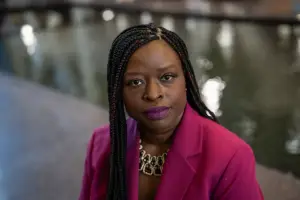 Then, eight pages later, he addresses the racist AI slop that the White House posted targeting Nekima Levy Armstrong (shown above in a New York Times photo and below in distorted photo circulated by Trump's "Justice Department"), addressing just thefootnote in which Lemon referenced it and not the more extensive discussion in Bollman’s motion, which describes how the government “affirmatively altered discovery in the case and posted it on the internet before producing it in the case.”
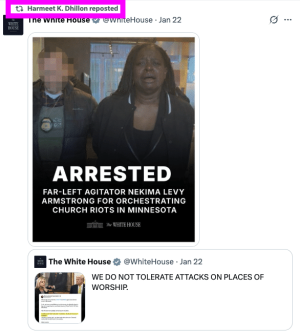
As explained above, there is no “stunning and unremitting irregularity in this case.” (Mot. at 20.) The Attorney General, Deputy Attorney General, and Assistant Attorney General for Civil Rights have not “engag[ed] in blatant politicization and name calling” (Mot. at 21), but have made accurate statements of law and addressed the comments to a matter of public concern. 5
5 Defendants are not entitled to the extraordinary remedy of releasing grand-jury materials simply because the President expressed his opinion about their conduct. Defendants also reference the “doctored” photo of a co-defendant posted by the “White House official social media account.” (Mot. at 12 n.17.) The White House’s social-media account does not speak for the Department of Justice.
The White House’s social-media account may not speak for the Department of Justice (though it certainly affects defendants’ due process).
But Harmeet Dhillon assuredly does speak for the Department of Justice. And she RTed that racist slop before pursuing this indictment (my emphasis).
It appears Harmeet still has that racist slop RTed, long after it was called out for being altered, including by darkening Levy Armstrong’s skin.
Admittedly, neither Lemon nor Bollman noted that Harmeet, whose name was on the indictment and is on this very filing, had also RTed this racist slop. This is not yet a malicious prosecution motion, where Harmeet’s incredible conduct, including platforming discussions of betting on the outcome, might show up in list form.
But Zuckerman, the young right-wing lawyer who chose to join this shitshow, doesn’t address the substance of the post, nor does he explain why the White House published that post in real time even while he himself has not provided the arrest propaganda in discovery over two months later.
He has not disputed that the post, if the speech in it were endorsed by DOJ as Harmeet did, would affect the posture of the case.
And therefore his claim that Harmeet (who also called defendants “demonic,” “godless,” and “un-American”) has not engaged in “name calling” is the kind of bullshit that a promising young lawyer would be wise not to make.
Update: This MPR story on the Lewis fuck-up (dated March 22) describes how if prosecutors had simply followed normal DOJ process they could have avoided the fuck-up.
Hunter said the government likely used cell phone tower data in an attempt to determine who had been part of the parking lot gathering and cross referenced it with video that journalists Georgia Fort and Don Lemon had posted to social media. Fort and Lemon are also facing charges along with the protesters.
“They did show her some still images from video that they were claiming were her,” he said. “And, yeah, she said, ‘She looked like me, but so do a lot of middle aged women in Minnesota. And it wasn’t me.’”
According to Hunter, Lewis was at the Cub Foods on Jan. 18 to pick up storage cabinets, shelving and other items she purchased in an auction after the supermarket closed and sold its equipment during a liquidation sale.
Hunter said he has worked on cases of mistaken identity but never anything like this. He noted the evidence proving Lewis’s innocence was clear and it was only a matter of time before federal prosecutors dropped the charges.
Hunter said federal authorities never notified Lewis that she was a target of their investigation. That practice, which is typical in federal investigations “was clearly not followed,” and it would have allowed Lewis to hire legal counsel and explain her side to prosecutors before they presented their case to a grand jury.
Trump Watch
MS NOW, Opinion: Trump has gone birther on the entire country, Ryan Teague Beckwith, March 26, 2026.Trump got his start in politics by demanding to see former President Barack Obama’s birth certificate. Now he’s asking for everyone’s, argues Ryan Teague Beckwith.
The president wants Americans to produce a birth certificate to vote or just play high school sports, either to prove citizenship or decide what gender someone is allowed to present, even though millions of Americans don’t have access to those documents. At the same time, the administration’s lawyers will argue before the Supreme Court that being born in the U.S. should not automatically confer citizenship, which would undermine the major use of the birth certificate. Read more.
MS NOW, Opinion: Spent: It’s both possible and plausible that insider trading preceded Trump’s Iran announcement, Zeeshan Aleem, March 25, 2026. Unusual trading activity raises questions about whether people close to the White House profited from advance knowledge.
Trump’s announcement last Sunday that he has been in peace talks with Iran was a surprise. But maybe not to whomever it was who traded futures for oil and stocks worth billions of dollars just 15 minutes earlier, argues Zeeshan Aleem. It’s impossible to rule out other explanations for the trades, but market analysts say it’s definitely worth investigating if someone was profiting on inside information. That’s especially plausible in an administration that has made clear it has no problem with the president and his family profiting from his position. Read more.
Energy, Transportation, War Impacts
New York Times, Why the Iran War May Force Countries to Rely Less on Natural Gas, Rebecca Elliott and Brad Plumer, March 29, 2026. The U.S. and other exporters are poised for a windfall, but disruptions to Persian Gulf supplies are also pushing gas-buying countries to consider alternatives like coal, solar and nuclear energy.
From Western Europe to East Asia, countries are scouring the globe for natural gas after the war in Iran cut off the Persian Gulf fuel that they relied on to cook dinner, heat homes and generate electricity.
The United States, as the world’s biggest gas exporter, will almost certainly benefit from this upheaval, at least in the short term.
But the war with Iran, now entering its second month, is also a reminder that importing gas is a risky proposition that can leave buyers exposed to high prices and shortages during geopolitical strife. That presents a big challenge to the oil and gas industry’s plans to sell more natural gas — and creates an opening for alternatives like renewable energy, coal and nuclear power.
“What you’re seeing with this type of volatility that seems to happen every four or five years, it’s just not good,” Jack Fusco, chief executive of a large U.S. gas exporter Cheniere Energy, said last week at a Houston energy conference, CERAWeek by S&P Global.
This is the second time in recent years that a war has caused natural gas prices to soar in many parts of the world. The last spike followed Russia’s invasion of Ukraine in 2022.
Gas is still a lot less expensive than it was four years ago. But the Iran war is not over.
Analysts say that prices could rise significantly if Qatar, one of the world’s largest gas exporters, is unable to restart gas shipments relatively soon. On the third day of the war, the country stopped preparing gas for export. Its facilities later sustained extensive damage that a state-owned energy company said would take several years to repair.
U.S. Governance, Politics, Elections
Robert Reich via Substack, Sunday thought: Turning Yesterday's Solidarity into Political Power, Robert Reich, right, March 29, 2026. Where We Go From Here.
Yesterday, millions of us once again affirmed the foundation of the common good.
Across America, people showed their solidarity — in opposition to Trump’s ill-considered war in Iran, with immigrants being targeted by ICE and Border Patrol agents, with current and former public officials whom Trump is prosecuting, with the students and universities whose freedom to learn and speak continues to be threatened by Trump, in favor of the earth and stopping climate change, and with every American who’s determined to reject dictatorship.
But how do we turn yesterday’s solidarity into political power?
Three suggestions. All depend on our working with activists we already know, added to those we met yesterday, and the activism of our local Indivisible chapter and other groups we participate in.
1. Target vulnerable Republican senators and House members. Either get them to switch parties or become independents who caucus with Democrats, or flip their seats.
Republican majorities are razor-thin in both chambers, and some Republicans who represent purple districts and states are struggling to keep their Republican supporters behind them. (They’re also struggling with their own consciences in continuing to support Trump’s authoritarian fascism.)
In the House, according to the Democratic Congressional Campaign Committee and political analysts, the following Republican members are considered particularly vulnerable (with some already announcing they are no longer running for re-election).
In the Senate, these Republicans are considered vulnerable.
2. Begin organizing and mobilizing now to get out the vote for November’s midterm elections — aiming for Democratic takeovers of both chambers of Congress by wide margins, which will severely limit what Trump can do after January 2027.
The key will be to get out the vote. Make a plan. Use phone trees. Write postcards. Arrange transportation for people who need it.
Since January 2025, Democrats have won special elections in districts Trump won in 2024, and by an average margin of 12 percentage points better than he did. Just this past Tuesday, Democrats outperformed Trump in three special state legislative elections in Florida, even flipping the home district of Trump’s Mar-a-Lago.
Meanwhile, Trump’s polls continue to tank. In the new Reuters/Ipsos poll, only 36 percent approve of his performance while 62 percent disapprove, a new record low for Trump. In the latest Quinnipiac poll, 38 percent approve of him; 56 percent disapprove. Even the latest Fox News poll shows Trump approval at only 41 percent; disapproval at 59 percent; and fully 58 percent of Americans opposing U.S. military action in Iran.
All this augers well for the midterms, but there’s no substitute for concrete planning to get out the vote — identifying likely Democratic voters, making sure they’re registered and motivated, and helping them get to the polls (or, assuming it’s still legal, making sure they mail their ballots in, in time).
3. Root out and challenge any Trump Republican attempt to intimidate likely Democratic voters or manipulate the election process.
It’s important that neither Trump nor his state lapdogs diminish the turnout of likely Democratic voters in the weeks leading up to the November midterms — by stationing ICE or Border Patrol agents near polling places, interfering with the counting or certifying of ballots, or altering laws and rules to make it harder to vote.
If you have any reason to be concerned about these tactics, check in with your state and local party officials and election officials. Make sure they’re being as vigilant as they need to be. If they’re concerned and cannot assure you that we will have a free and fair election, urge them to challenge what’s occurring in the federal courts.
Or alert your local chapter of the American Civil Liberties Union. Visit the ACLU's affiliate map website to locate one of the 54 state-level offices, which often have local chapters underneath them. (You can search by state to find nearby chapters, which handle local advocacy, events, and volunteer engagement.)
If you were inspired by yesterday’s No Kings Day demonstration, know that millions of others were, too. Let’s build on that inspiration by turning it into concrete political action to take back power from Trump and his treacherous regime.
 Heather Delaney Reese via Substack, America stood up to Trump, Heather Delaney Reese, right, March 29, 2026. On March 28, 2026, Donald Trump locked himself away behind the gates of his private club, Mar-a-Lago in Florida, while 8 million people across the United States took to the streets to send an unmistakable signal to him, and all of his enablers: we will not let you continue to destroy our country. The message was clear. We are taking our country back in November.
The collective action was hard for anyone to ignore, let alone the President of the United States. Because while his administration described the protests earlier this week as “Trump derangement therapy sessions,” they clearly have made him more afraid than he’s letting on about the future of his free-for-all presidency, and his ability to stay in office with such an overwhelming public rejection of his incompetence and corruption.
And it wasn’t just the sheer, overwhelming scale of millions of Americans in all 50 states refusing to be silent. It was the individual people. The parents who brought their children to their first protest. The retirement-age Americans who have given up their golden years to fight fascism the way their parents and grandparents did before them. The man who showed up with armfuls of American flags, not to sell, but to hand them out, to remind both children and adults that this is our flag. The flag of the United States of America. Not the flag of Donald J. Trump. This is the flag steeped in history and symbolism, the one we are fighting for, so that we too can pass it to the next generation the way it was passed to us: with the understanding that this country belongs to the people who love it enough to fight for it.
More than 3,200 events took place across the country on Saturday, from New York City to Driggs, Idaho, a town of fewer than 2,000 people in a state Trump carried with 66 percent of the vote. Nearly half of the protests took place in Republican strongholds. Texas, Florida, and Ohio each had more than 100 events. Idaho, Wyoming, Montana, and Utah had events in the double digits. Rural communities that have never hosted a political protest before, from Seward, Alaska, to East Glacier Park, Montana, showed up for the first time. The protests went international, with tens of thousands marching in Paris, Rome, Amsterdam, Madrid, and London, and in countries with constitutional monarchies, they called the protests “No Tyrants.”
In San Francisco, demonstrators formed a human banner on Ocean Beach, their bodies spelling out a message designed to be captured by drone, an echo of Hands Across America in 1986, when 5 million people linked arms with neighbors coast to coast, to fight hunger and homelessness. Forty years later, the same instinct, the physical act of showing up and choosing to stand next to a stranger because you believe in something bigger than yourself, brought out nearly twice as many people, and this time, what they were fighting for was the country itself.
But behind every one of those numbers is a moment that no headline can capture, and I felt that undeniable energy at the No Kings protest I attended with one of my daughters, near my home in San Diego. The one I attended had hundreds of people, but my oldest was at the larger protest downtown, where she volunteered offering first aid to fellow marchers. Police estimated 40,000 people showed up to that one alone. She told me the turnout was massive, and I believe it, because what I saw at mine was massive too, in a different way. It was not just the size of the crowd, though the turnout was huge for the area. It was what I felt walking through it.
There was a man walking around with armfuls of American flags, handing them out to anyone who wanted one. At one point, two kids walked up to him to get a flag, and he stopped, looked at them, and said, “This is your flag.” It brought tears to my eyes, and honestly it is hard even talking about it now, because he was right. That flag belongs to those children. It belongs to every child in this country, and to every future generation for hopefully thousands of years to come.
The signs were incredible, too. Some were deeply serious, and some were completely inappropriate and made me laugh so hard I could barely keep walking. I am including a couple of them for you to see within my post on Substack. People got creative, because we resist in all different ways, and every single one of those signs was perfect. I saw people of every kind, families with young children, couples with their dogs, what I have started calling resistance dogs, people who clearly came alone and found community once they got there. I walked through the whole thing, trying to read as many signs as possible and trying to thank every single person I could for coming out, because it mattered. Every one of them mattered.
As I watched cars go by, horns blaring in support, my emotions ran in circles. I get angry. Angry that this is how children have to spend their Saturdays. I get angry that parents are giving up time they could be building memories with their families to stand in the sun holding signs because their government has failed them. Trump has already stolen so many years from so many people, and I get especially angry when I think about our retirement-age community members. They should be spending time with grandchildren, exploring, relaxing, enjoying the beauty of this country they helped build. They have carried us this far, and instead of resting, they are back on their feet, in the streets, fighting another unjust war just the way they fought against the war in Vietnam. Only this time, they know exactly what is on the line. They know what they are fighting for, because they have seen what happens when people do not fight.
I also know how difficult it is for so many people right now, not just politically but personally, when you realize that friends you have aligned with for decades, people you trusted, have been lost to something that looks and feels like a cult, or when you start to see that people you thought cared about the world and about each other turned out to be more self-centered than you ever imagined. And yet you turned your grief into action. You spent your Saturday standing against evil. You made your signs and put on your resistance shirts. You rallied your friends and your neighbors, and you gave up your day to fight for this country. I am angry that you had to do that. But I am so thankful that you did.
 I try to speak to as many people in the retirement-age group as possible when I go to these events, because there is so much that they have seen and heard and lived through that many of us have not. And I keep thinking that maybe one of the reasons we ended up here, in this moment, in this version of our country, is because somewhere along the way we stopped listening to the storytellers. The ones who told the warnings and the lessons we needed to hear about fascism, about keeping ourselves safe, about what to look for when danger is creeping in. The way that our ancestors passed down knowledge. The core stories of existence and survival, and as much as they have evolved over centuries and into modern times, the purpose has not changed. We need the lessons from the past more than ever, and I am hoping to continue to learn and share so that together we can start rebuilding that much-needed safety mechanism, the one that warns us, that protects us, that reminds us who we are and how far we have come.
And while the country sent a message for the world to see, the President of the United States locked himself away rather than confronting the uprising happening all around him. According to the White House, his official schedule for the day listed three items: Executive Time at Mar-a-Lago beginning at 8 AM, a closed-press MAGA Inc. fundraising meeting at 6:30 PM, and a dinner at 7 PM. That was it. He didn’t even leave the grounds of his private club to go to his golf course, which is what he does on nearly every other Saturday he spends in Palm Beach. On March 28, the day that 8 million Americans showed up, he stayed behind the gates from morning until night.
He also skipped the Conservative Political Action Conference for the first time in a decade. CPAC, which held its final day in Texas on Saturday, has been his home turf for years, the one stage where he has always been guaranteed a standing ovation and a room full of loyalists. But this year, even that room was not safe. The Iran war, now one month old, has opened visible fractures in his base that he cannot control with a rally speech.
A 30-year-old Army and Marine Corps veteran named Joseph Bolick, from Tyler, Texas, and who has voted for Trump in every election since 2016, told reporters that he feels betrayed and no longer supports the president. “Why aren’t we helping Americans?” Bolick said. “The economy’s suffering. Why can’t we focus on our own people instead of foreign governments?” And on Friday, CPAC chairman Matt Schlapp tried to hype up the crowd by asking, “How many of you would like to see impeachment hearings?” The question was meant to rally them against the threat of Democrats taking the House. Instead, the crowd erupted in cheers. Schlapp shook his head and said, “No. That was the wrong answer.” He asked again. They cheered again. Either the crowd that CPAC attracts is not paying close enough attention to understand what they are cheering for, or some of them genuinely want this president impeached, and at this point, both explanations should concern the Republican Party. That is why the president could not risk standing in front of that room and hearing something other than applause, so he did not show up at all.
But while he made no public appearance, he was not entirely silent. He was on his phone. Between 3:36 and 3:37 PM, right as the peak protest hours wound down, Trump posted multiple times on Truth Social in rapid succession. He shared a promotional article about his “TrumpRX” website. He posted about another criminal prosecution referral against a woman he is obsessed with, New York Attorney General Letitia James. He shared a Washington Post opinion piece with the headline assuring his followers that he is not losing his nerve on Iran. And he posted a demand to end the Senate filibuster, calling his own Republican senators “weak and ineffective” and declaring that “The Democrats are CRAZY!” Earlier in the day, he promoted a Fox News appearance about the importance of hitting Iran “HARD!!!”
That is what the President of the United States did on the day his country rose against him. He did not lead, govern, or listen. He sat in his private club, promoted himself, attacked his enemies, pushed for war escalation, and raged at his own party. Not one word about the protests. And the more he posts things like “The Democrats are CRAZY,” the more the rest of the country can see who the unhinged one actually is. This is a man hiding from the consequences of his own failure, and the country he is failing showed up on Saturday to make sure he knows it.
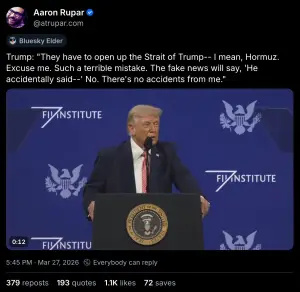 Because at the heart of all of this is a president who only wants to hear praise, lies to the American people, and has never kept a single promise he has ever made to them. He will never truly grasp the depth of the anger, heartbreak, or exhaustion that drove people out of their homes and onto sidewalks. But if he ever wanted to try, he could start with what he said when he was running for reelection. He promised no new wars. We are one month into a war with Iran, a “military operation” in Venezuela and one he has said is coming to Cuba soon. He has threatened Greenland, Canada and Mexico too, among other nations. He promised cheaper gas. Gas prices have climbed to $3.98 a gallon and are rising, driven by a conflict he chose to start, with oil prices up roughly 40 percent from pre-war levels. He promised cheaper groceries. Beef is up 15 percent. Coffee is up 20 percent. He promised to release the Epstein files. He has not released them, and at this point it is painfully clear to anyone paying attention why. And for a lot of the people who voted for him, his more loyal followers, these broken promises are becoming impossible to ignore.
And yet, even as the cracks in his support deepen and the evidence of his failure mounts, much of the media still is not telling the full story. The scale of what happened on March 28 was historic, protests in all 50 states, more than a dozen countries, and organizers estimating it as the largest single day of domestic political protest in American history. But the coverage from major corporate outlets did not come close to matching what took place. The journalists who got it right, the ones who showed up and reported on the full scope of what was happening, were largely independent. Joy-Ann Reid. Don Lemon. Jim Acosta. To name just a few. All three of them came from major corporate networks, and all three of them, for various reasons, are now independent. I know that their exits from those networks must have been incredibly difficult, but I want to say something directly: their independence is a gift to the rest of us. Without independent journalists like them, writers and commentators like me would not have access to the real, sourced, non-propagandized information that makes this work possible. If you are able to support independent media, not just me, but the ones on the ground, investigating and keeping us informed with integrity, please do. Paid memberships allow us to continue this vital work during these critically fragile times for our country.
We are at a crossroads where we will be deciding the future of this country for decades to come this fall, and we need to make sure those bringing us evidence and fact-based news are in it for the long haul. I also want to share a reminder that I am strictly funded by my readers. I do not take sponsored money and I do not do brand partnerships, nor do I accept advertising revenue. That is a deliberate choice because it allows me to write with complete independence, without any outside influence on what I say or how I say it. If you ever see my name or my likeness associated with a product or a service, please know that it is not me. I do not endorse products.
Being around so many who see what is happening, who are part of the resistance and who want a better world for our children and grandchildren gave me life today. It reminded me why I do this. Why this work is so important. So thank you for all being in this fight with me. For allowing me to write these posts every night. I am grateful for every one of you.
Today was a good day. Millions of Americans spent their Saturday standing in the sun, carrying flags, holding signs, bringing their children and their parents and their neighbors, because they still believe this country is worth fighting for. They are right, and in November, they are going to prove it. That is why I still have hope for America, and you should too.
I’ll see you tomorrow,Heather
PS. You can make a significant difference right now by subscribing to my Substack. Your support helps me cover more ground and keep telling the truth about the lies and destruction unfolding in this country. Heather Delaney ReeseI built a blog that reached millions, now I'm fighting for America's future and survival. I expose MAGA lies and the government's failures, cut through the propaganda, and say what we're all thinking.
More Global News
Associated Press via Politico, Israel prevents Catholic leaders from celebrating Palm Sunday Mass at Jerusalem church, Staff Report, March 29, 2026. The restrictions led to international protests, including from U.S. Ambassador Mike Huckabee.
Israeli police prevented Catholic leaders from entering the Church of the Holy Sepulchre to celebrate a private Mass on the Christian holiday of Palm Sunday for the first time in centuries, setting off a wave of criticism from the United States and others.
Jerusalem’s major holy sites, including the church, are closed because of the ongoing Iran war, as the city has come under frequent fire from Iranian missiles.
 The Latin Patriarchate in Jerusalem called the police decision “a manifestly unreasonable and grossly disproportionate measure.” It prevented two of the church’s top religious leaders, including the Latin Patriarch, Cardinal Pierbattista Pizzaballa, and the Custos of the Holy Land, from celebrating Palm Sunday at the place where Christians believe Jesus was crucified.
Palm Sunday commemorates Jesus’ triumphant entry into Jerusalem and launches the Holy Week commemorations for Christians which culminates in Easter.
Israeli police said they had notified church authorities on Saturday that no Mass could take place on Palm Sunday because of safety considerations, the lack of access for emergency vehicles in narrow alleys of the Old City and lack of adequate shelter.
Israeli Prime Minister Benjamin Netanyahu said there was no “malicious intent” and that the cardinal was prevented from accessing the church because of safety concerns, but that Israel would try to partially open the Church of the Holy Sepulchre in the coming days.
“Given the holiness of the week leading up to Easter for the world’s Christians, Israel’s security arms are putting together a plan to enable church leaders to worship at the holy site in the coming days,” Netanyahu wrote on X.
The Western Wall, the holiest site where Jews can pray, is also mostly closed because of safety issues, but authorities are letting up to 50 people at a time pray in an enclosed area adjacent to the plaza.

New York Times, U.S. to Allow Russian Oil Tanker to Reach Cuba, Breaking Blockade, Jack Nicas and Eric Schmitt, March 29, 2026. The tanker full of crude oil could reach its expected destination by Tuesday, providing a lifeline to the island amid intense U.S. pressure.
The United States Coast Guard is allowing a Russian tanker full of crude oil to reach Cuba, delivering a critical supply of energy to the island nation after months of an effective oil blockade by the Trump administration, according to a U.S. official briefed on the matter.
The tanker, which is carrying an estimated 730,000 barrels of oil and is owned by the Russian government, was within several miles of Cuban territorial waters on Sunday evening, according to MarineTraffic, a ship-data provider. At its speed of 12 knots, the tanker could reach its expected destination of Matanzas, Cuba, by Monday night.
The Russian ship’s arrival would shift the trajectory of a rapidly accelerating crisis in Cuba, buying the island nation at least a few weeks before its fuel reserves run out, analysts said.
It would also reduce pressure on a Cuban government facing a looming economic collapse and escalating threats from Washington, and show that, at least for now, the island can still depend on its longtime ally, Russia.
The Trump administration had been enforcing what amounted to an oil blockade around Cuba since January, threatening nations that had been sending fuel to the country and, in one case, escorting a tanker heading toward Cuba away from the island.
The Coast Guard has two cutters in the region that could have attempted to intercept the Russian tanker. Yet the Trump administration did not order those vessels to act, according to a U.S. official briefed on the matter who spoke on the condition of anonymity to discuss operations. Barring orders instructing it otherwise, the Coast Guard planned to let the tanker reach Cuba as of Sunday afternoon, the official said.
It was unclear why the White House did not issue orders to block the tanker or whether it would allow future Russian oil shipments to reach the island. The decision avoids a potential thorny confrontation with Russia just off the coast of Florida.Want to stay updated on what’s happening in Cuba and Russia? Sign up for Your Places: Global Update, and we’ll send our latest coverage to your inbox.
The Coast Guard referred questions to the White House, which did not respond to a request for comment. Cuban officials also did not respond.
The Russian Embassy in Mexico said in a statement that “the Russian Federation expresses its full solidarity with Cuba, considers all restrictions imposed against it to be illegitimate — including those related to the supply of energy resources — and is prepared to provide all necessary assistance, including material support.”
The U.S. oil blockade has been choking Cuba, leading to daily blackouts, severe gas shortages, soaring prices and deteriorating medical care. The policy has attracted international criticism, including from the United Nations, that the United States is causing a humanitarian crisis in Cuba. At the same time, White House officials have been threatening the Cuban government publicly, while pushing it privately to remove its president, Miguel Díaz-Canel.
President Trump said this month that he believed he will “be having the honor of taking Cuba” and suggested that he could target the island with military force after the Iran war. “I built this great military,” he said at an investment conference on Friday. “I said, ‘You’ll never have to use it.’ But sometimes you have to use it. And Cuba is next, by the way.”
Secretary of State Marco Rubio said on Friday that the White House wanted new leaders in Cuba. “Cuba’s economy needs to change, and their economy can’t change unless their system of government changes,” he told reporters.
Cuban officials have dug in, saying the nation is prepared to defend itself.
“Our military is always prepared and, in fact, it is preparing these days for the possibility of military aggression,” Cuba’s deputy foreign minister, Carlos Fernández de Cossío, said on NBC’s Meet the Press last week. “We would be naïve if, looking at what’s happening around the world, we would not do that. But we truly hope that it doesn’t occur.”
The oil tanker now nearing Cuba may change the shape of tensions between the countries. Cuba was quickly running out of energy supplies, relying on solar power, domestic oil production and small fuel shipments to private Cuban businesses to prop up a failing energy grid. The crisis had led to small protests — a rarity in Cuba — and was raising questions of how the government would survive.
But the Russian oil will ease that crisis, at least temporarily. The oil can be refined into various products, including diesel, gasoline, jet fuel and fuel oil, which is used to power many Cuban power plants. That should help stabilize the energy grid, reduce blackouts, improve transportation and aid agricultural production, said Jorge Piñón, a former oil executive who studies Cuba’s energy system at the University of Texas.
“It buys them time,” Mr. Piñón said. “But this is not a magic wand that all of a sudden, by the arrival of this tanker, all of their problems are solved.”
Mr. Piñón said that the oil would take about three weeks to refine into other products and then another week to be distributed around the country.
Diesel he said, is the most critical product for Cuba, as it powers trucks, tractors and many power plants, and is in desperately short supply on the island. Some humanitarian aid has been trapped at warehouses because trucks don’t have diesel to distribute it, farms have been paralyzed with powerless tractors and some power plants have been shut down because of a lack of fuel.
Slate, Trump Just Made Stomach-Turning Remarks About Somali Refugees, Shirin Ali, March 27, 2026. It Gets Much Worse.
This week, immigration attorneys had their worst fears confirmed: The U.S. government appears to be specifically targeting Somali nationals seeking asylum, in a disturbing new process that no other asylum-seekers are facing. Data from the Department of Justice reveals that over half of Somali nationals who had an open asylum case were suddenly reassigned, given a new judge and a new hearing date mere weeks away. This is not normal; immigration court is deeply backlogged, and most cases of asylum—one of the most complex forms of U.S. immigration—were being assigned well into 2029 and 2030. Lawyers argue this fast-track policy is unlawful, and will deny thousands of Somali immigrants a fair hearing. The news broke just as President Donald Trump went on another xenophobic tirade against Somali refugees, calling Somalia a “disgusting country, one of the worst countries in the world,” and calling refugees from Somalia “stupid people.”
Trump’s horrifying abuse is apparently trickling down into the immigration courts themselves. According to bklg.org, an immigration tool that analyzes publicly available court data, there are an estimated 3,366 open Somali asylum cases nationwide, and 2,230 have recently been reassigned, impacting asylum-seekers in 34 different states. In most reassigned cases, 88 percent, Somali immigrants were transferred to an out-of-state judge in Texas, Georgia, California, or Louisiana. Most of these judges are considered senior-level, as they sit under the Office of the Chief Immigration Judge, which oversees the more than 600 immigration judges all across the country.
This is significant because asylum cases are deeply complex, requiring a mountain of factual evidence to prove an immigrant faces legitimate threats of persecution in their home country. Immigration attorneys must produce all sorts of documentation, witness testimony, and evidence, often also requiring translations, that then require a lengthy hearing in front of a judge. In fiscal year 2024, the American Immigration Council estimated that asylum-seekers waited on average three and half years before being granted asylum. Those cases exclusively for Somalis are now on what would be considered a rocket docket.
Matthew Hoppock is an immigration attorney in Kansas, and he told me that he’s currently handling 10 Somali nationals’ asylum cases. In February, he first noticed that almost all of them were reassigned to a new judge in Louisiana, with court dates set for May, and each one had identical filing deadlines. “I have never seen anything like it,” Hoppock wrote on social media at the time, noting that several other attorneys shared with him that their Somali clients were also transferred to the same judge and had new court dates scheduled for March. “I don’t know for sure why. But it’s chilling.”
Over a month later, data appears to confirm Hoppock’s fears that his Somali clients are indeed being targeted by the Trump administration. Bklg.org found that over 60 percent of open asylum cases reassigned on short notice in early 2026 were Somali immigrants. Hoppock told me this does not feel like a coincidence, as President Donald Trump just three months ago called Somali immigrants “garbage” who “come from hell and they complain and do nothing but bitch, we don’t want them in our country. Let them go back to where they came from and fix it.” In Thursday’s latest rant he slandered Somali refugees as having “low IQs” and said “they rob us blind.”
About a month after Trump’s earlier remarks, former Homeland Security Secretary Kristi Noem announced Temporary Protected Status would no longer be offered to Somali nationals. TPS is a Biden-era program where foreign-born individuals who faced safety risks if they returned to their home country could enter the U.S. and legally work. Hundreds of Somali immigrants would have had just two months to leave the U.S. or face deportation, but earlier this month a judge paused Noem’s action after immigrant rights advocates filed a lawsuit against DHS.
The Executive Office for Immigration Review denied there is any Somali fast-track policy, instead noting that any immigration judge in the U.S. can hear a case at any time to help with caseloads.
That’s not stopping advocates from challenging the alleged abuse in court. DHS faces a new lawsuit over the apparent fast-track policy for Somalis, brought by Minnesota-based law firm Hines Immigration Law and Minneapolis-based group Advocates for Human Rights. Filed just this week, the suit alleges Somali asylum-seekers are being singled out in a way that undermines fundamental legal protections, including right to counsel and a fair hearing. Kelsey Hines, founder of Hines Immigration Law, said 97 percent of her Somali clients’ cases were rapidly advanced, while not a single non-Somali case received similar treatment. “This is not random. This is not about efficiency or docket management,” she said in a statement. “This is an undeniably targeted policy that singles out one nationality, designed to rob them of the due process they are legally guaranteed, and to strip their legal teams of the ability to adequately and ethically prepare their cases for hearing.”
About 70 years ago, the U.S. government faced a similar lawsuit in Accardi v. Shaughnessy, which eventually reached the Supreme Court. In that case, petitioner Joseph Accardi alleged that the attorney general had compiled a list of “unsavory characters” and circulated it within the DOJ, and he was on the list. Accardi, originally from Italy, subsequently had his application for suspension of deportation denied. The Supreme Court ended up ruling in Accardi’s favor, determining that immigration judges, though appointed by the attorney general, must be neutral. If they bend to the whims of the executive, then their decisions are considered unlawful.
In the meantime, Hoppock has his work cut out for him: “It’s going to be a bit of moving mountains just for me and my little set of 10 cases to get all of our stuff filed.” He says he’s wary about his Somali clients getting a fair hearing, given the volume of cases that have been rescheduled and the abbreviated lead time for hearings. Normally, it takes a judge at least an entire day to go through one asylum case, as attorneys go through a meticulous history of the asylum-seeker’s personal stories, putting forward evidence to corroborate claims and offering expert witnesses to testify, all while the judge assesses the asylum-seeker’s credibility. What Hoppock fears is that the newly reassigned judges will end up speeding through this process in order to get through their caseload.
“On paper it’s going to look like a normal trial, because the judge says ‘Good morning’ and there’s a prosecutor, but he’s speeding through it,” Hoppock said. “He’s taking over the questioning. He won’t let you give a closing argument. He won’t let certain witnesses testify. And that’s how you speed up these cases to the point that due process kind of goes out the window.”
Since Trump took office last year, the rate of asylum cases being granted has drastically dropped, while also varying by region. Hoppock acknowledged that his state of Kansas is not a paradise for asylum-seekers, but he never doubted that the court in Kansas City was fair. His Somali clients are anxious and confused as to why they are being singled out. “I think we all sort of see the writing on the wall,” Hoppock said. “We don’t know exactly why they’re being expedited, and we won’t, I think, until we finish the lawsuits.
March 28
Top Headlines 
Cameron and John Yoon, March 28, 2026. Earlier, U.S. officials said an Iranian strike at a military base in Saudi Arabia injured 12 U.S. troops, one of the most serious breaches of American defenses since the war began.More On Iran War
News Updates
March 28, 2026. Thousands of No Kings protests took place across the U.S. and globally, with more than 3,000 events organized to oppose Donald Trump and his policies. Demonstrators raised concerns about the Iran war, immigration crackdowns, voting rights, and broader fears of democratic erosion, with participation ranging from small towns to major cities. More On No Kings Day

Exemplifying the grassroots and / or homespun nature of many No Kings Day protests, the sign above was designed by and carried by Trumpbiographer and Jeffrey Epstein scandal investigtor Wayne Madsen, left, a University of Mississippi graduate and former Navy inteligence officer whose reports, books and other work are often cited here. As protest sign designer, he grants "license to carry" the sign by other protesters.
U.S. Law, Crime, Courts, Rights, Justice
 Times, Hacked Files of F.B.I. Director Kash Patel Circulate Online, Charlie Savage, Adam Goldman, Aric Toler and Glenn Thrush, March 28, 2026 (print ed.). What appeared to be personal emails from before Mr. Patel’s time as director were posted on a website that identified itself as Iranian but seemed to be hosted in Russia.
 New York Times, Man Tied to Pro-Israel Extremists Accused of Targeting Palestinian Activist, Liam Stack, Tracey Tully and William K. Rashbaum, March 28, 2026 (print ed.). A man linked to a pro-Israel terrorist group was charged with making Molotov cocktails for what officials said was a plot to assassinate the New York City-based activist Nerdeen Kiswani.
More On U.S. Governance, Politics, Elections, Economy
Global News
New York Times, Iran and Immigration Frustrations Fuel New Wave of ‘No Kings’ Rallies, Thomas Fuller, March 28, 2026. Thousands of organized demonstrations stretched across the country. Minnesota was a focal point of the protests after a tumultuous immigration crackdown.
In the Twin Cities, a sea of people converged on the State Capitol, invoking the memories of Renee Good and Alex Pretti. Demonstrators swarmed intersections in Portland, Ore., motivated by what one called a “national crisis” that had “escalated to a whole other level.” In Little Rock, Ark., where more than 2,000 people marched across the Arkansas River, one woman carried her own MAGA sign: “Morons Are Governing America.”
Protesters filled streets and town squares across the United States on Saturday at thousands of rallies, the third in a sequence of nationwide, loosely coordinated demonstrations under the banner of “No Kings.” They came to denounce President Trump and much of his second-term agenda, wielding signs and chants about issues such as mass deportation, restrictions on voting, attacks on diversity and two matters that have suddenly moved to the fore: the war in Iran and the soaring gas prices that have resulted from it.
“Prices are going up, and it feels like we can’t even afford to live anymore,” said John Moes, a Minneapolis resident who was dressed in a 15-foot puppetlike costume resembling the singer Prince, a local icon.
“This is one of the ways we can say we’re fed up,” said Mr. Moes, who described himself as an independent who leans Democratic.
The No Kings organizers said that eight million people took part; their estimates in some cities were higher than those of local public safety officials. The New York Times is doing its own reporting on some of the turnout, but has not independently confirmed the numbers from the thousands of protest sites.
The demonstrations stretched across the country, from above the Arctic Circle (Kotzebue, Alaska: population 3,000) to the tropics, in Puerto Rico. There were also 39 international No Kings rallies, according to organizers.
The Twin Cities were a focal point of the day’s protests after tumultuous months of an immigration crackdown that included the killing of two protesters, Ms. Good and Mr. Pretti, by federal agents. On a windy and cold day, protesters marched in orderly waves toward a stage at the Capitol in St. Paul, flying Minnesota state and American flags, chanting and singing. The Minnesota Department of Public Safety estimated that 100,000 people took part; No Kings organizers said the number was 200,000.
New York Times, News Analysis: A Toothless Iran? Missile and Drone Strikes Show It Can Still Inflict Pain, Nicholas Kulish, Helene Cooper, Isabel Kershner, Erika Solomon, March 29, 2026. U.S. Marines Arrive in Middle East, as Houthis Enter War; A wave of strikes across the Middle East in recent days shows that Iran has not lost the capacity to retaliate.
An Iranian strike on an American military base in Saudi Arabia, injuring two dozen troops. Two drones targeting a port in Oman, and a strike on the Kuwait International Airport. Workers at an aluminum facility in Abu Dhabi wounded by a missile and drone attack.
President Trump has said that the United States has all but obliterated Iranian military capabilities, portraying Iran as a defanged adversary. The U.S. military says that the number of attacks Iran has launched has declined by roughly 90 percent from the opening days of the war, and the Israeli military says it has rendered roughly 70 percent of Iran’s hundreds of missile launchers inoperable.
But a series of attacks against Israel and Gulf countries in the last several days is only the latest evidence that Iran retains enough missiles and drones to destabilize the region and inflict a punishing cost on its foes, while signaling that, contrary to Mr. Trump’s declarations, it is still very much in the fight.
Millions of Israelis are still rushing into bomb shelters day and night to take cover from Iranian missile fire. The daily routine of sirens and booms sows fear and paralysis. Seven people were injured in central Israel on Thursday following missile barrages, according to the country’s emergency service. Surveillance video captured footage of two people rushing out of harm’s way before a silver car they were standing near exploded then pinwheeled through the air. On Friday, a Tel Aviv man was killed by a bomblet from a missile with a cluster-munition warhead.
Even when Iranian weapons are intercepted, they can still inflict damage. Two people were killed in Abu Dhabi on Thursday when they were struck by shrapnel falling from an intercepted missile.
The U.S.-Israeli campaign has been very effective in attacking Iran’s leadership, killing many of them and destroying many military installations, and it has almost completely destroyed its air force and navy, said Farzin Nadimi, a security analyst at The Washington Institute who specializes in Iran and the Persian Gulf.
“In terms of optics, a sunken navy, totally obliterated air force is very important as a metric for victory,” he said. “But we all understand that the main metrics of success for Iran is to be able to continue to fire ballistic missiles and drones at Israel, at U.S. bases and Gulf countries. And we know that they have still been able to do that.”
Iran still likely possesses thousands of Shahed drones and could still have hundreds of ballistic missiles despite American and Israeli strikes over the past four weeks, one U.S. official said. But the official, who spoke on the condition of anonymity to discuss military capabilities, cautioned that it is impossible to know for sure, as U.S. intelligence on Iranian capability is limited.
Public statements from the American military have been carefully worded. For instance, Adm. Brad Cooper, commander of the U.S. Central Command, said on Wednesday that “Iran’s drone and missile launch rates are down 90 percent,” courtesy of American and Israeli strikes. That is not the same thing as saying those strikes have eliminated 90 percent of Iranian drones and missiles.
New York Times, Iran War Live Updates: Iran-Backed Houthis Enter War With Missile Attack on Israel, Aaron Boxerman, Eric Schmitt, Chris Cameron and John Yoon, March 28, 2026. Earlier, U.S. officials said an Iranian strike at a military base in Saudi Arabia injured 12 U.S. troops, one of the most serious breaches of American defenses since the war began.
Here’s the latest.
The Houthis, an Iranian-backed militant group in Yemen, announced on Saturday that they had launched a ballistic missile attack on Israel, appearing to open another front in the spiraling war in the Middle East.
And American casualties continued to rise as the war neared its second month: An Iranian strike on a military base in Saudi Arabia injured 12 U.S. troops, two of them seriously, two U.S. officials said Friday. It was one of the most serious breaches of American defenses since the war began.
The attack, which involved missiles and drones, also significantly damaged at least two American KC-135 military refueling planes, said the officials, who were not authorized to speak publicly.
There were no reports of casualties in the Houthis’ attack on Israel. But the Houthis, who control much of Yemen, could further rattle global markets already strained by the Iranian blockade of the Strait of Hormuz. During the war in Gaza, the group disrupted international shipping by menacing passing vessels in the Red Sea.
Yahya Saree, a Houthi military spokesman, said that the attacks from Yemen would continue “until the aggression ends” — a reference to both the American-Israeli war with Iran and Israel’s campaign against Hezbollah, another Iran-backed group in Lebanon.
Much of the Middle East has been drawn into the fighting since it began on Feb. 28 with U.S.-Israeli strikes on Iran.
The Israeli military said Saturday that it had begun a new round of bombardment in the Iranian capital of Tehran. Israel also reported more waves of incoming Iranian missiles, which killed at least one person in Tel Aviv, according to Israel’s emergency service.
Elsewhere in the region on Saturday, drones struck Kuwait International Airport, damaging its radar, and the key port of Salalah in Oman. The United Arab Emirates said its forces were intercepting drones and missiles from Iran. Saudi Arabia’s defense ministry said its forces had intercepted drones and a missile, without saying where they had come from.
Secretary of State Marco Rubio insisted on Friday that the war would conclude within weeks, not months, and that the United States did not need ground troops to win it. He added that Iran had yet to respond formally to the Trump administration’s 15-point peace plan, which it sent to Iran via Pakistani mediators.
President Trump has said that talks with Iran were progressing well, while Iranian officials have described the recent contacts as minimal. Pakistan said it would host Egyptian, Turkish and Saudi officials on Monday to discuss the war. It did not say whether U.S. or Iranian officials would attend.
Mr. Trump had given an ultimatum to Iran, saying that unless its military fully reopens the Strait of Hormuz, its power plants — which provide energy for millions of Iranian civilians — would be bombed. About one-fifth of the world’s oil normally transits the strait.
Here’s what else we’re covering:
New York Times, In an Asymmetrical War, Iran Seeks an Edge With Its Information War, Steven Lee Myers, Tiffany Hsu and Stuart A. Thompson, March 28, 2026. Propaganda and disinformation have flooded the internet in a sophisticated effort to undermine support for U.S. and Israeli attacks.
The videos and posts relentlessly mock President Trump or vilify him and as a bloodthirsty leader who strikes civilian targets indiscriminately. They make up content about attacks on American and Israeli targets, including one on Wednesday that featured a fabricated video of a missile striking Liberty Island in New York Harbor. They regularly mention Jeffrey Epstein.
Iran is waging what researchers have described as a sophisticated information war, aided by Russia and China, that is spreading content designed to exploit worldwide opposition to the U.S.-Israeli military campaign and deflect from the country’s considerable losses on the battlefield.
Nearly a month into the war, Iran’s state media outlets and covert operatives are producing a steady torrent of propaganda, overstated narratives and outright disinformation. They are often wielding generative A.I. tools to create increasingly realistic-looking images and videos, according to human rights organizations and research groups studying foreign influence.
Much of the false content has been debunked, but not before reaching millions of people on X, Bluesky, Facebook, Instagram, TikTok and other social media platforms.
The information war, the researchers say, has given Iran’s beleaguered leadership a weapon almost as potent as its ability to disrupt the world’s energy economy by throttling shipments of oil through the Strait of Hormuz. While the impact of the information war can be difficult to measure, experts said it appeared to have stoked popular anger and unease about the conflict in the United States and beyond.
“They’re winning the propaganda war,” Darren L. Linvill, a director of Clemson University’s Media Forensics Hub, said of the Iranians. “They were prepared for it more than the administration, because they’d been preparing for this entire conflict for 50 years.”
With the internet largely shut down inside Iran, the intended audience appears to be people outside the country.
Many of the posts appear to come from accounts controlled by humans, rather than automated bots. Researchers at Clemson identified a furtive network of at least 62 accounts on X, Instagram and Bluesky that spread pro-Iranian content.
The accounts, controlled by the Islamic Revolutionary Guards Corps, set up accounts purporting to be Spanish-speaking users in Texas, California, Venezuela and Chile and English speakers in England, Scotland and Ireland.
In some cases, the content they shared had been lifted verbatim from posts published by real people, including prominent Western influencers like Jackson Hinkle and Mario Nawfal, who each have millions of followers on X and are known for incendiary commentary on foreign affairs and conservative issues.
Another campaign focused on a March 18 interview by Tucker Carlson with Joe Kent, the former director of the National Counterterrorism Center who resigned in protest of the war, according to a report by Honest Reporting, a nonprofit advocacy group that critiques news reports it deems critical of Israel.
First, RT, the Russian television channel, posted a clip of the interview in which Mr. Kent portrayed the attack as unjustified aggression. From there, dozens of accounts spread the same clip almost simultaneously.
“This was not simply organic virality,” the group said. It added, “Actors with varying ideological positions aligned almost immediately around a single, highly specific message: that Israel had manipulated the United States into war.”
Iran has also seized on Mr. Trump’s erratic statements and taken advantage of the weakening of American government and corporate guardrails that once sought to counter false or misleading information.
One video fabricated with A.I. and posted on Instagram by SSN TV, an Iranian state network, ridiculed Mr. Trump’s inability to persuade American allies to provide military help to keep the Strait of Hormuz open to oil tankers.
New York Times, House Vote Sets Up Clash With the Senate on D.H.S. Funding, Prolonging Shutdown, Carl Hulse, Megan Mineiro and Robert Jimison, Updated March 28, 2026. Republicans revolted over a Senate measure to fund the Department of Homeland Security and passed a rival bill, dimming the chances of a quick end to the crisis crippling airports.
House Republicans angrily rejected a bipartisan deal to reopen the Department of Homeland Security and pushed through their own plan late Friday, putting themselves on a collision course with the Senate and extending the agency shutdown that has crippled U.S. airports.
Revolting over an agreement their own party struck with Senate Democrats to end the crisis, which had passed the Senate before dawn on Friday, House Republican leaders — with President Trump’s backing — refused to take it up. They derided the Senate plan for hewing too closely to Democrats’ position by omitting money for Immigration and Customs Enforcement and Border Patrol, the two agencies responsible for carrying out Mr. Trump’s deportation crackdown, which are operating under previously approved funds.
“House Republicans are not going to be any part of any effort to reopen our borders or to stop immigration enforcement,” Speaker Mike Johnson said at a news conference on Friday afternoon. “This gambit that was done last night is a joke.”
Mr. Johnson called the Senate-passed deal engineered by Senator John Thune, Republican of South Dakota and the majority leader, “ridiculousness,” and instead teed up a stopgap measure to fund the entire department until May 22.
News Updates
The Parnas Perspective, News and Comment: Millions Protest Trump in Historic Global Protests, Republicans Grow Concerned About November Elections, and More, Aaron Parnas, right, March 28, 2026. Thousands of No Kings protests took place across the U.S. and globally, with more than 3,000 events organized to oppose Donald Trump and his policies.
Demonstrators raised concerns about the Iran war, immigration crackdowns, voting rights, and broader fears of democratic erosion, with participation ranging from small towns to major cities. High-profile figures and elected officials joined rallies, signaling the movement’s growing scale and visibility. The protests reflect widespread and diverse grievances, with organizers aiming to channel sustained opposition rather than a single unified demand.
Senate Republicans are increasingly concerned about their chances in the upcoming midterm elections, as rising energy costs, the Iran conflict, and internal party divisions complicate their messaging. Lawmakers worry they are losing focus on affordability issues, which voters say are a top concern, while Donald Trump pushes controversial election legislation that lacks enough support to pass. GOP senators now expect a tougher-than-anticipated battle to hold their majority, with key races becoming more competitive. The shifting political landscape reflects broader voter anxiety over the economy and war, creating uncertainty for Republicans heading into November.
More On Iran War
Donald V. Watkins (longtime Alabama attorney and commentator): Opinion: When the coward who is sending these brave American soldiers into the US-Iran war zone had his chance to serve America in combat during the Vietnam war, he ran like a scalded dog -- five times! Every American soldier's death in this man's war is a personal sacrifice to a certified coward. Good luck soldiers, and may God be with you! Do the Trumps ever serve in the U.S. military? We know they are great at grifting. Do they ever give back to the country that has enriched them, or has MAGA exempted them from that obligation?
New York Times, Yemen’s Houthis Fire at Israel and Vow Further Attacks, Abdi Latif Dahir and Eve Sampson, March 28, 2026. There has long been concern that the Houthis, an Iran-backed militia, could disrupt shipping in the Red Sea if they entered the broader war.
The attack on Israel on Saturday morning by the Houthis, an Iranian-backed militia in Yemen, was an escalation in the monthlong U.S.-Israeli conflict with Iran, and threatened to expand the war’s reach across the region.
The Israeli military said early on Saturday that its aerial defense systems had intercepted a missile fired from Yemen. No casualties were immediately reported after the attack.
Israel has been targeting the Houthis for years, and many believed that the group’s military capabilities had been severely degraded.
After the United States and Israel began attacking Iran in late February, expectations grew that the Houthis might enter the conflict, especially as other Iranian proxy groups in Lebanon and Iraq became involved.
The Houthi attack on Israel on Saturday demonstrated that, despite heavy Israeli strikes on its leadership and infrastructure, the group remains capable of responding.
There has also been concern that, if the Houthis were to enter the war, the group could disrupt global shipping through the Red Sea, which it has done previously by attacking passing ships, in some cases sinking them or killing their crew members.
The global economy is already reeling from Iran’s effective closure of the Strait of Hormuz, a crucial choke point for energy shipments in the Persian Gulf. Saudi Arabia, Yemen’s northern neighbor, has been funneling crude oil exports through the port of Yanbu on the Red Sea, using an overland pipeline that was built to bypass the strait.
New York Times, Israeli Strike Kills 3 Journalists in Southern Lebanon, Officials Say, Euan Ward, March 28, 2026. Israel accused one of the reporters of being a Hezbollah operative. Lebanon’s president said they were journalists and condemned the killings.
An Israeli strike in southern Lebanon on Saturday killed two prominent Lebanese television journalists and a cameraman, according to their news organizations and Lebanese officials. The attack was condemned by the country’s president and rights groups, and it raised questions about the scope of Israel’s targets.
The Israeli military said it had targeted Ali Choeib, a correspondent for Al-Manar, a Lebanese television network owned by Hezbollah. The military accused him of being an intelligence operative for the Iran-backed militant group, but did not respond to requests for evidence to support that claim.
Fatima Ftouni, a correspondent with Al-Mayadeen, another Lebanese broadcaster whose editorial line is generally supportive of Hezbollah, and Mohammad Ftouni, a cameraman, were also killed in the strike, according to Al-Mayadeen and Al-Manar.
The three were traveling together in a car close to the southern town of Jezzine at the time of the attack, the outlets said.
New York Times, Trump and Modi Had a Call About the Iran War. Elon Musk Joined Them, Edward Wong, Theodore Schleifer,Tyler Pager and Ryan Mac, March 28, 2026 (print ed.). Mr. Musk’s participation was notable because it is rare for a private citizen to be on a call between heads of state. It also suggests that Mr. Musk is back on better terms with the president.
Elon Musk participated in a phone call on Tuesday with President Trump and Prime Minister Narendra Modi of India, an unusual appearance by a private citizen on a call between two heads of state during a wartime crisis.
The inclusion of Mr. Musk, confirmed by two U.S. officials, suggests that the world’s richest man is back on better terms with the president. The two men had a falling out last summer following the billionaire’s departure from the government, where he had been tasked with slashing the work force. They appear to have smoothed things over in recent months.
The U.S. officials asked for anonymity because they were not authorized to speak publicly.
It is unclear why Mr. Musk was on the call or whether he spoke. His companies have taken on significant investment from sovereign wealth funds in countries in the Middle East, including Saudi Arabia and Qatar. Mr. Musk has also long coveted a greater commercial presence in India. And SpaceX, his private rocket company, has been considering an initial public offering later this year, which could be thrown into turmoil if global economic conditions worsen.
The call, American and Indian officials have said, was about the escalating crisis in the Middle East, and in particular the Iranian military’s control of the Strait of Hormuz, which is critical for the shipping of oil and gas around the globe. The halt to most maritime traffic through the strait has led to surging energy prices worldwide and roiled markets. Some Asian nations are on the verge of having to ration fuel.
“Ensuring that the Strait of Hormuz remains open, secure and accessible is essential for the whole world. We agreed to stay in touch regarding efforts towards peace and stability,” Mr. Modi wrote on social media on Tuesday.
New York Times, Wild Ultimatums and ‘Bombing Our Little Hearts Out’: A Portrait of Trump at War, Erica L. Green, March 28, 2026. President Trump has vacillated between boasting about U.S. military superiority and deep frustration that his war of choice is not always having the desired effects.
President Trump was fresh off the golf course, and his fury was building.
It was March 21, and as he settled back into his Mar-a-Lago estate for the evening, he was reading another news account about how, for all the military success the United States had in Iran, he had yet to achieve his political objectives.
At 7:44 p.m., the president made his frustration known with an extraordinary ultimatum: If Iran did not reopen the Strait of Hormuz within 48 hours and allow much of the world’s oil and gas to flow through, he would bomb Iran’s civilian electric power plants. It was the kind of attack that could constitute a war crime under the Geneva Conventions.
But just hours before the Monday deadline expired, Mr. Trump delayed his threat by five days, easing fears of an imminent escalation with profound military, diplomatic and economic implications.
Still, he warned that “we’ll just keep bombing our little hearts out” if Iran would not make a deal, and as the week progressed he made new threats that left allies off balance and spooked the markets. So on Thursday afternoon, after stocks on Wall Street suffered their largest daily decline since the start of the war, he added another 10 days to the clock, again seeking to ease the fears ignited by his own hard-line positions.
It is too soon to know whether the extra time will result in productive diplomacy. But it is already clear that Mr. Trump’s wild swings — from optimism to frustration and anger, from de-escalation to escalation — have combined to give his management of the war an erratic, make-it-up-as-it goes feel.
Ever since the United States, alongside Israel, launched the war on Feb. 28, Mr. Trump has vacillated between chest-thumping about U.S. military superiority and deep frustration that the tactical achievements on the battlefield did not seem to be producing the strategic outcome he predicted.
Although the supreme leader and many top military and intelligence leaders have been killed, the regime in Tehran remains in control. Iran’s leaders have all but sealed off the Strait of Hormuz, sending gas prices skyrocketing and rattling investors. And Iran retains control of the material it would need to produce a nuclear weapon, the main threat cited by Mr. Trump in taking the nation into the war in the first place.
Mr. Trump has said he understands there will be short-term pain from the war, which he accepts as a necessary price to ensure that Iran cannot have a nuclear weapon. And the president’s allies have always said that his unpredictability is his superpower, and that it keeps his enemies guessing.
But it also suggests an inconsistency of purpose that has led the president to keep shifting his goals, even as the risks of the war grow bigger by the day.
More On No Kings Day
New York Times, A Challenge for ‘No Kings’ Protests, the Third Time Around, Jeremy W. Peters, March 28, 2026. Organizers want this to be largest protest yet. But is hitting a number enough to deliver an effective political movement?
Millions of Americans are expected to turn out on Saturday for mass demonstrations against President Trump, the latest organized display of anger led by the coalition of progressive groups known as No Kings.
Organizers are aiming to make it the largest such protest yet, which would mean exceeding the seven million people they said showed up at the “No Kings” rallies in October and the millions of people they said turned out in June. (The Times has not verified those numbers, which encompass thousands of rallies.)
Those two protests gave the administration’s most ardent opponents an outlet for their discontent at a time when Democrats were deflated from their losses in 2024 and reassessing their missteps.
But as the third “No Kings” demonstration gets started, it’s an open question whether posting another big number will be enough to influence the course of the nation’s politics. Can the protests harness that energy and turn it into victories in the November midterm elections? How can they avoid a primal scream that fades into a whimper?
The phrase “No Kings” is a nod to the anti-authoritarian, democratic principles the country was founded on — which the protesters say Mr. Trump has ignored.
Otherwise, organizers said, “No Kings” protests intentionally lack a single, specific demand, reflecting the diffuse nature of the anti-Trump effort. Promotional fliers and emails highlight a range of issues, including immigration patrols, election interference, the White House ballroom, Ukraine and affordable housing.
Nor has a high-profile leader or public face emerged, in the way that Tom Hayden did during the 1960s antiwar protests or Jerry Falwell in the 1980s for Christian evangelicals. Luminaries of today’s left like Bernie Sanders and Alexandria Ocasio-Cortez act as champions of progressive causes rather than only as foils to Mr. Trump.
Organizers say the idea is to attract as many opponents of the administration as possible — especially the disaffected.Editors’ PicksChaucer, Murder, Pilgrims: What Do You Know About Canterbury and Its Archbishops?New Blood Tests Can Detect Early Signs of Alzheimer’s: Should You Get One?27 of Our Best Passover Recipes
“You might think his consolidation of power is inevitable, but it isn’t,” said Leah Greenberg, co-founder and co-executive director of Indivisible, a progressive group that is organizing “No Kings” events.
No Kings Day Protests March 28, About No Kings (https://www.nokings.org/about-nk), Indivisible Staff Report, March 27, 2026. In June, we did what many claimed was impossible: peacefully mobilized millions of people to take to the streets and declare with one voice — America has No Kings. And it mattered.
The world saw the power of the people. President Trump’s birthday parade was drowned out by protests in every state and across the globe. His attempt to turn June 14 into a coronation collapsed, and the story became the strength of a movement rising against his authoritarian power grabs.
Four months later, that movement roared back even stronger. On October 18, over seven million Americans joined 2,700+ events in all 50 states — a nationwide uprising 14 times larger than both of Trump’s inaugurations combined. What began in June as a single day of defiance has become a sustained national resistance to tyranny, spreading from small towns to city centers and across every community determined to defend democracy.
Now, President Trump has doubled down. His administration is sending masked agents into our streets, terrorizing our communities. They are targeting immigrant families, profiling, arresting, and detaining people without warrants. Threatening to overtake elections. Gutting healthcare, environmental protections, and education when families need them most. Rigging maps to silence voters. Ignoring mass shootings at our schools and in our communities. Driving up the cost of living while handing out massive giveaways to billionaire allies, as families struggle. Spending billions of our tax dollars on missile strikes abroad all while driving up the cost of living and handing out massive giveaways to billionaire allies.
The president thinks his rule is absolute. But in America, we don’t have kings — and we won’t back down against chaos, corruption, and cruelty.
Our peaceful movement is only getting bigger. “No Kings” is more than just a slogan; it is the foundation our nation was built upon. Born in the streets, shouted by millions, carried on posters and chants, it echoes from city blocks to rural town squares, uniting people across this country to fight dictatorship together.
Because this country does not belong to kings, dictators, or tyrants. It belongs to We the People — the people who care, who show up, and who fight for dignity, a life we can afford, and real opportunity. No Thrones. No Crowns. No Kings.
A core principle behind all No Kings events is a commitment to nonviolent action. We expect all participants to seek to de-escalate any potential confrontation with those who disagree with our values and to act lawfully at these events. Weapons of any kind, including those legally permitted, should not be brought to events.
For inquiries, please contact
Exemplifying the grassroots and / or homespun nature of many No Kings Day protests, the sign above was designed by and carried by Trumpbiographer and Jeffrey Epstein scandal investigtor Wayne Madsen, right, a University of Mississippi graduate and former Navy inteligence officer whose work is often cited here. As protest sign designer, he grants "license to carry" the sign by other protesters.
New York Times, What We Know About Saturday’s ‘No Kings’ Protests, Pooja Salhotra, March 27, 2026. Thousands of demonstrations against the Trump administration are scheduled to take place in cities and towns across the country on Saturday.
More than 3,000 “No Kings” demonstrations are scheduled across the country on Saturday to condemn an array of President Trump’s policies and to express general discontent toward the president, whom the protesters view as acting like a monarch.
“Trump wants to rule over us as a tyrant,” the No Kings website says. “But this is America, and power belongs to the people — not to wannabe kings or their billionaire cronies.”
A spokeswoman for the White House, Abigail Jackson, said in a statement that “the only people who care about these Trump derangement therapy sessions are the reporters who are paid to cover them.”
The events come as Mr. Trump’s approval ratings hover around 40 percent, and Democrats are hopeful to make inroads in the midterm elections.
It’s the third such protest organized nationwide over the past year. Here’s what to know.Who organizes the No Kings Protests?
The events on Saturday have been organized by national and local groups, including well-known progressive coalitions such as Indivisible, 50501 and MoveOn.
Following a similar playbook as the two protests last year, the events are supposed to be peaceful gatherings open to people of all ages and backgrounds. Anyone can sign up to host an event, and the organizers have offered online trainings on safety, security and de-escalation.What is the goal of No Kings?
Like the earlier ones, the protests are not focused on any particular issue. Instead, they are meant to unite people who have various grievances about the federal government. In the past, that has included aggressive immigration enforcement voting rights and the costs of health care. On Saturday, the actions are likely to feature people speaking out about the war in Iran.When was the first No Kings protest?
In June 2025, on the same day that Mr. Trump scheduled a military parade in Washington for the Army’s 250th anniversary — which also coincided with his 79th birthday — planned protests took place in cities across the country, and internationally in countries including Britain, Mexico and Germany. The event was branded as a “day of defiance” against a perceived overreach by Mr. Trump and his allies.
Four months later, more than seven million people attended No Kings Day demonstrations on Oct. 18 in cities in all 50 states, according to organizers. Although The New York Times could not confirm that count, large crowds were evident in cities across the country, with people waving American flags and chanting “No more Trump” as they gathered to demonstrate outrage over immigration raids, the deployment of federal troops in cities, government layoffs and the rollback of vaccine requirements, among other measures.
In New York City, officials said that more than 100,000 people had attended, ranging from children to older adults.Where are No Kings protests taking place?
 The upcoming protests are collectively expected to see larger turnout than the previous two events. Organizers have asked participants to avoid confrontations and to not bring any weapons.
Organizers have created an online map of local events, with new events being continuously added.
Most of the protests are scheduled to run for about two hours in the late morning or early afternoon. They will be held in public parks, downtown streets and other public spaces.
U.S. Law, Crime, Courts, Rights, Justice
New York Times, F.B.I. Said to Dig Up Old Investigative Files on Democratic Lawmaker, Edward Wong and Devlin Barrett, March 28, 2026. The urgent instructions at the Trump administration’s behest to gather and relay the files on Representative Eric Swalwell have alarmed some career law enforcement officials.
Trump administration officials have ordered F.B.I. agents to gather documents about a decade-old investigation into a Democratic congressman and his ties to a suspected Chinese spy, according to people familiar with the matter.
The effort has alarmed law enforcement officials who said they feared the material could be released publicly to smear the lawmaker, Representative Eric Swalwell, a prominent critic of President Trump who is now running for governor of California.
The investigation dates from more than a decade ago, when F.B.I. counterintelligence agents looked into a Chinese woman, Christine Fang, or Fang Fang, who assisted Mr. Swalwell with fund-raising. The F.B.I. concluded the investigation, and the Justice Department did not bring any criminal charges.
In recent days, scores of F.B.I. agents and other personnel in California were instructed to gather the documents on Mr. Swalwell and Ms. Fang, with the goal of working through the weekend to finish a review by early next week, the people said. Supervisors advised the agents to lightly redact the records to obscure some sensitive information and told them the files would be shared with senior administration officials in Washington.
The order from F.B.I. leadership has alarmed some career investigators, partly because the files are extensive and contain a significant amount of classified material and private information, the people said. They spoke on the condition of anonymity to discuss orders intended to remain secret.
A Justice Department spokesman and the White House referred questions to the F.B.I. A bureau spokesman did not immediately respond to a request for comment.
The F.B.I. and Justice Department do not normally release derogatory information collected during an investigation about people if the subjects were not charged with any crime. There are occasional exceptions to that practice, including when Congress passed a law last year forcing the release of millions of pages from F.B.I. files about the convicted sex offender Jeffrey Epstein.
Some law enforcement personnel have expressed concern at what would remain unredacted and whether senior officials would misuse the material to score political points, perhaps by publicly releasing it, the people said. They added that the agency was expending significant resources on what appears to be a political errand.
Ms. Fang left the United States for China in 2015, possibly because she had learned about the counterintelligence investigation into whether she was a spy. Mr. Swalwell has denied wrongdoing, and law enforcement officials have not presented any evidence that he knew of anything amiss about Ms. Fang.Editors’ PicksPortland, Ore.: Weird, but Life Is GoodNew Blood Tests Can Detect Early Signs of Alzheimer’s: Should You Get One?Glass Threads Spun From a Volcano’s Bubbly Magma
In 2023, the House Ethics Committee ended a two-year investigation into the relationship between Mr. Swalwell and Ms. Fang without taking any further action.
New York Times, Hacked Files of F.B.I. Director Kash Patel Circulate Online, Charlie Savage, Adam Goldman, Aric Toler and Glenn Thrush, March 28, 2026 (print ed.). What appeared to be personal emails from before Mr. Patel’s time as director were posted on a website that identified itself as Iranian but seemed to be hosted in Russia.
 Emails and photographs stolen from a personal email account of Kash Patel, left, the director of the F.B.I., circulated online on Friday, as hackers who claimed to be part of a group affiliated with Iranian intelligence took responsibility for the release.
The release of materials from before Mr. Patel’s time as F.B.I. chief appeared to be an effort to embarrass him as the war in Iran nears its first month. But there were questions about who had carried out the cyberattack and it remained unclear when the intrusion had taken place.
The files were posted on a website that included the name “Handala Team.” Handala, a pro-Iranian hacktivist group, is associated with the country’s Ministry of Intelligence and Security and is known for conducting “hack and leak” operations.
However, cybersecurity tools indicated that the website was being hosted by a computer server in Russia, which has a long history of hack-and-dump operations, including Democratic emails during the 2016 election. The site’s domain was registered on March 19 by an entity that appeared to identify itself as the Kingdom of Tonga.
VirusTotal, which analyzes websites for malicious code, flagged a risk that the website on which the files were posted could implant malware on the devices of people who visited it.Want to stay updated on what’s happening in Iran and Russia? Sign up for Your Places: Global Update, and we’ll send our latest coverage to your inbox.
In a statement, an F.B.I. spokesman, Ben Williamson, noted that the State Department had offered a $10 million reward for information that would lead to identifying the Handala Hack Team out of Iran, “a group that has frequently targeted U.S. government officials.”
While he acknowledged that Mr. Patel’s personal emails had been compromised, he did not specify when the breach occurred.
“The F.B.I. is aware of malicious actors targeting Director Patel’s personal email information, and we have taken all necessary steps to mitigate potential risks associated with this activity,” Mr. Williamson said. “The information in question is historical in nature and involves no government information.”
A set of the files posted on the website appeared to contain more than 300 messages from a Gmail account used by Mr. Patel. The earliest was from February 2010 and the most recent was from February 2022. They were largely anodyne personal messages related to matters like hunting for an apartment or booking travel.
Most were from 2010 to 2014, when Mr. Patel, a federal public defender in Miami, applied for a job at the Justice Department’s national security division, and moved to Washington. The messages include his job application materials and efforts by friends to introduce him to people in his new city. One email had photographs from what appeared to be a visit to Cuba in 2013.
There were indications that whoever hacked Mr. Patel was holding back additional materials: The main website had images of attachments to emails that do not appear to be in the initial release, like a version of his résumé from 2016. That version said he had received an award from the C.I.A. whose details were classified.
The Iranians have long tried to hack prominent U.S. officials, seeking revenge for the 2020 killing of Maj. Gen. Qassim Suleimani, who led the powerful Quds Force of the Islamic Revolutionary Guards Corps.
In September 2024, the F.B.I. warned that hackers linked to the Guard Corps were targeting current and former senior U.S. officials, journalists and others associated with U.S. political campaigns.
“The targets usually have some nexus to Iranian and Middle Eastern affairs,” the bureau said in an advisory.
A former U.S. law enforcement official said Mr. Patel was among the victims.
That same month, the Justice Department indicted three Guard Corps members who had been involved in the hacking since 2020. They used spear phishing and social engineering techniques to target and compromise victims’ computers and accounts, according to prosecutors.
Nerdeen Kiswani stands in front of a building with a Palestinian flag raised behind her.A New Jersey man who the authorities said was targeting Nerdeen Kiswani was arrested and eight Molotov cocktails were found in his home (New York Times photo by Graham Dickie).
New York Times, Man Tied to Pro-Israel Extremists Accused of Targeting Palestinian Activist, Liam Stack, Tracey Tully and William K. Rashbaum, March 28, 2026 (print ed.). A man linked to a pro-Israel terrorist group was charged with making Molotov cocktails for what officials said was a plot to assassinate the New York City-based activist Nerdeen Kiswani.
The New York Police Department and federal authorities disrupted what officials described as a plot by a member of a pro-Israel terrorist organization to assassinate the leader of one of New York’s most active pro-Palestinian protest groups, according to officials and court papers.
Members of the F.B.I. and the Police Department’s Joint Terrorism Task Force notified the activist, Nerdeen Kiswani, and her lawyer late Thursday that an arrest had been made in connection with an imminent attempt on her life, her lawyer and law enforcement officials said.
The man who was arrested, Alexander Heifler, 26, of Hoboken, N.J., was taken into custody after detectives and federal agents searched his apartment and found eight Molotov cocktails.
A police official said Friday that Mr. Heifler was a member of the JDL 613 Brotherhood, which was inspired by the Jewish Defense League, a pro-Israel group designated by the F.B.I. as a terrorist organization. Representatives of the J.D.L. and its offshoot did not immediately reply to messages seeking comment.
Mr. Heifler was charged Friday morning in a two-count criminal complaint with making and possessing the devices and appeared in federal court in Newark hours later. The complaint did not specify a motive for the planned attack, which was laid out in detail. If convicted, Mr. Heifler could face up to 20 years in prison.
The complaint said the plan had been in the works since at least February, when Mr. Heifler discussed building and using Molotov cocktails for what he described as “self-defense” on a group video call that included an undercover detective.
More On Government, Elections, Politics, Economy, Inflation
New York Times, Record Number of T.S.A. Employees Called Out on Friday, Chris Hippensteel, Sonia A. Rao and JoAnna Daemmrich, March 28, 2026. President Trump signed a memo late Friday ordering the Department of Homeland Security to restore pay to airport screeners.
The Trump administration has moved to bypass Congress to restore the pay of airport safety screeners, who have missed two full paychecks, but relief has yet to arrive for travelers.
On Friday, more Transportation Security Administration employees called out of work than on any other day of the partial government shutdown.
Conditions in airport security lines have deteriorated since Feb. 14, when Congress allowed funding for the Department of Homeland Security, which oversees T.S.A., to lapse during an impasse over reforms to Immigration and Customs Enforcement. Since then, T.S.A. employees have been forced to work without pay, leading thousands of workers to call out and hundreds to quit altogether.
With staffing slashed, wait times for security have stretched on for hours at some airports. Lines have spilled outside terminals. Desperate travelers have missed flights. And that was before Friday set a new record.
More than 3,560 T.S.A. employees — above 12 percent of the agency’s work force — called out on Friday, the highest number since the partial government shutdown began, Lauren Bis, a spokeswoman for the Department of Homeland Security, said in a statement. Friday’s call outs broke the record of just under 12 percent that had been set the previous day.
“During this time, over 500 officers have quit, and thousands more have been forced to call out because they can’t afford basic necessities like gas, child care, food, or rent,” Ms. Bis said.
President Trump signed a memo late on Friday ordering D.H.S. to restore pay to T.S.A. employees. On Monday, the Trump administration deployed agents from Immigration and Customs Enforcement, who have not lost pay during the partial shutdown, to help carry out security functions at airports.
The standoff over D.H.S. funding in Congress has shown little sign of breaking. A compromise brokered by the Senate to restore funding was rejected by Republicans in the House of Representatives, who responded by offering up their own stopgap funding bill before taking a scheduled two-week break. That bill appeared unlikely to garner enough support from Democrats in the Senate to break the deadlock.
Conditions have become so dire at some airports that some people have sought out professional line sitters in an effort to avoid the multi-hour wait times caused by lack of staffing at the checkpoints. Such is the case in Houston, where both major commercial airports saw about 45 percent of their screening agents call out on Friday.
Steven Dial, who owns a support-services business in Spring, Texas, has already waited in lines for people at the motor vehicle department and other places. So last week, as security lines grew longer and longer, he had the idea to offer his services at the George Bush Intercontinental Airport, where wait times have been as long as four and a half hours.
As soon as he posted on Facebook, his phone began to blow up with hundreds of messages, he said. On Friday, Mr. Dial said he was at the airport from 6:30 a.m. to 4 p.m. to help six clients. He charges $71 an hour, which includes parking.
The practice prompted the Houston Airport System to issue a statement warning travelers against turning to line sitters, noting that those who “choose to use unauthorized services do so at their own risk.”
New York Times, Vance Wins CPAC Straw Poll, but Rubio Gains Steam Among MAGA Faithful, Kellen Browning, March 28, 2026. Conference organizers presented the poll results as a rebuttal to narratives that Republicans were split over the Iran war and support for Israel.
Vice President JD Vance won this year’s straw poll of attendees at the Conservative Political Action Conference, with 53 percent of respondents saying he was their preferred choice in the 2028 Republican presidential primary.
The figure, announced by organizers on Saturday, was a slight drop from his 61 percent support in last year’s poll, and it came as Secretary of State Marco Rubio continued to emerge as a contender in early 2028 conversations. Mr. Rubio earned 35 percent of the vote at CPAC this year, a leap from his 3 percent in 2025.
The poll, which came as CPAC wrapped up its annual four-day conference featuring a deeply conservative grass-roots crowd, is unscientific and has not historically been a strong predictor of whom Republican voters will ultimately back in a contested primary.
President Trump easily won three straw polls in the years preceding his comeback victory in 2024. But Senator Rand Paul of Kentucky won the CPAC poll in three consecutive years ahead of the 2016 primary, then went on to drop out early in that campaign. And former Senator Mitt Romney of Utah won straw polls in 2007 and 2008 over the eventual nominee that election cycle, former Senator John McCain of Arizona. Mr. Romney won two straw polls in the lead-up to his successful primary bid in 2012, but lost two to former Representative Ron Paul, Rand Paul’s father.
No other candidate on Saturday received more than 2 percent of support from the more than 1,600 respondents, which organizers at CPAC said was a record for a nonpresidential year.
New York Times, A Downturn in Las Vegas Could Signal Tough Times for the Nation, Reis Thebault, Photographs by Brandon Tauszik, March 28, 2026. The high rollers may still be crowding the tables, but high prices and pinched discretionary incomes are driving a sharp drop-off in visitors to Las Vegas as Nevada’s governor runs for re-election.
These days, the high rollers are still rolling into Las Vegas, but those on a budget no longer feel like winners.
Even as private jets pack the airport and V.I.P.'s crowd the high-stakes tables, a steady decline in overall visitors is sending ripples of worry through this city and beyond. Casinos have closed card rooms, restaurants have cut hours, and resorts have scrambled to lure customers back with deals and discounts.
And pain in Las Vegas, a sequin-draped economic indicator, tends to signal a malady in the nation at large.
“Some say when the country gets a cold, we get the flu,” said Aaron Ford, Nevada’s attorney general. “I say we get pneumonia.”
Sin City’s financial well-being has long relied on millions of tourists spending their discretionary income indiscreetly. But in an economy where the affluent thrive while the rest struggle, that formula is in trouble. President Trump’s tariffs and immigration raids are rattling workers and angering international travelers, especially Canadians, who stopped coming in droves after Mr. Trump began musing about their country becoming the “51st state.”
Would-be visitors appear to be fed up with the way that the increasingly consolidated casino industry has relentlessly raised rates. Many who do come to Las Vegas go home complaining about the pricey parking and $34 daiquiris. Locals, too, say it is harder to make ends meet in their once affordable city, now more than ever as the faraway war in Iran raises gas prices and the airline fares the city depends on.
Woldu Acheramit, who runs Lucy Ethiopian Restaurant, estimated that he had lost 70 percent of his income over the last year as tourists, especially those from other countries, pulled back. He said he had to lay off four longtime employees. At the same time, he said, everything has become more expensive — rent, utilities, the food he buys at local markets.
“Sometimes, we can’t even cover our expenses,” Mr. Acheramit said. “We’ll have to close the business if it keeps going like that.”
All of this is coinciding with a high-stakes campaign for governor pitting the Republican incumbent, Joe Lombardo, against Democratic challengers, like Mr. Ford, who have made pocketbook issues central to their campaigns.
Global News
Azer News, French senator blasts Trump cabinet, calls White House a “circus”, links Epstein files to global chaos, Akbar Novruz, March 27, 2026. French Senator Claude Malhuret, above right, has delivered a scathing critique of Donald Trump and members of his administration, making a series of controversial remarks, AzerNEWS reports.
Here are all the remarks by the French politician:
"Every time the Epstein affair resurfaces, bombs explode somewhere in the world and cause a distraction!"This might be the greatest MAGA takedown of all time. Nobody was spared...
"A year ago, here in France, I compared Trump's presidency to Nero's Court. I was wrong. It's the miracle court. An anti-vaxxer, former heroin addict as Minister of Health," he said, referring to RFK Jr.
Malhuret's comparison to the mad Emperor Nero is fitting. It's said that he fiddled while Rome burned. In Trump's case, he's building a ballroom while the entire world goes up in flames.
"A climate-skeptic Minister of Economy. An alcoholic TV host, Minister of the Armed Forces," Malhuret continued, referring to Treasury Secretary Scott Bessent and Defense Secretary Pete Hegseth.
"An old Qatar agent, Minister of Justice. A groupie of Putin, Minister of National Security," Malhuret went on, referring to Attorney General Pam Bondi and Director of National Intelligence Tulsi Gabbard. Bondi previously worked for the Ballard Partners firm which raked in $115,000 a month by lobbying on behalf of Qatar.
"A Turkish proverb says 'When a clown settles in a palace, he does not become king, it is the palace that becomes a circus," said Malhuret. "His fine team has decided to create a competitor to the UN. Since the creation of the Board of Peace, Trump has triggered more military strikes than Biden during his entire term."
"Every time the Epstein affair resurfaces, bombs explode somewhere in the world and cause a distraction," he continued. "Bomb more to win more."
March 27
Top Headlines
 New York Times, G.O.P. Senator Weighs Forcing Congress to Vote to Authorize the Iran War, Megan Mineiro and Robert Jimison, March 27, 2026 (print ed.). Senator Lisa Murkowski of Alaska, right, is drafting a formal authorization for the use of military force in Iran, seeking to put some parameters around the operation as the Trump administration has boxed out Congress.
U.S. Immigration, Civil Rights, Airport Security Funding
right, March 27, 2026. Americans despise ICE, but it’s “succeeding” nonetheless.News Updates
Aaron Parnas, right, March 27, 2026. New Epstein revelations show private investigators removed computers and key records from his homes in the early 2000s that the DOJ never obtained, and now Congress may soon gain access to that material. At the same time, survivors are actively suing the DOJ over the exposure of their identities.More On Iran War
BBC Eye, 'My daughter is under the rubble': Inside Tehran as civilian toll of strikes rises, Nawal Al-Maghafi, Ruzgar Akgun, Ishaan Jhaveri and Emile Costard, March 27, 2026. A mother stands by the rubble, crying out for her daughter.U.S. Tariffs, Inflation, Jobs, Economy
More On U.S. Courts, Law, Crime, Justice
March 27, 2026. District court judges hold the line. Forwarded this email? Subscribe here for moreUndauntedDistrict court judges hold the line.U.S. Governance, Politics, Elections
Riverside County Sheriff Chad Bianco, and Republican candidate for governor Steve Hilton.Riverside County Sheriff Chad Bianco, left, and former Fox News host Steve Hilton are Republicans running for governor of California, and leading in the polls. (Jason Armond / Los Angeles Times; Gina Ferazzi / Los Angeles Times)
 The verdict could lead to a vote of expulsion for Rep. Sheila Cherfilus-McCormick.
More Global News
Media, High Tech, Culture, Sports
Tiger Woods stands by his overturned vehicle in Jupiter Island, Fla., on Friday, March 27, 2026.Martin County Sheriff John M. Budensiek said that Woods was not injured in the crash. AP Photo by Jason Oteri.
March 27
Top Stories
New York Times, Iran War Live Updates: 12 U.S. Troops Injured in Attack on Saudi Base, Officials Say, Eric Schmitt, Chris Cameron, Farnaz Fassihi, Shirin Hakim and Mark Landler, March 27, 2026 Two of the Americans were seriously wounded in the strike on the Prince Sultan Air Base, the officials said, in one of the most serious breaches of American defenses since the war began on Feb. 28.
Here’s the latest.
An Iranian strike injured 12 U.S. troops in Saudi Arabia, two of them seriously, on the Prince Sultan Air Base, two U.S. officials, who were not authorized to speak publicly, said on Friday.
The combined missile and drone attack amounted to one of the most serious breaches of American air defenses in the course of the monthlong war with Iran. At least two KC-135 aerial refueling planes also suffered significant damage in the attack.
There were also Israeli strikes on industrial and nuclear sites in Iran on Friday, more Israeli evacuation warnings in Lebanon and threats from the Iran-allied Houthi militia in Yemen of the possibility of opening another front in the war.
Iranian media reported attacks on two nuclear sites, a uranium processing plant and a nuclear research facility, and the Israeli military claimed responsibility for those strikes. Two steel plants and another industrial complex were also hit. Iran threatened to retaliate against industries in the region with American shareholders or ties to Israel.
Iran has bombed U.S. bases across the Middle East over the course of the war, deploying a vast arsenal of ballistic missiles and drones in an effort to retaliate and disrupt the American bombing campaign. The barrage has severely damaged bases and forced U.S. Central Command to disperse thousands of troops to move them out of the line of fire — some to as far away as Europe.
In France, Secretary of State Marco Rubio said on Friday that the United States did not need ground troops to succeed in the war in Iran, which he said would end within weeks rather than months, even as Iran moved to assert its control over the critical Strait of Hormuz.
Mr. Rubio told reporters in Paris that the United States had not received a formal response from Iran to President Trump’s 15-point plan for ending the war. Mr. Trump has said that peace talks are underway and going well, but Iranian officials have said that contacts between the two countries have been minimal and mostly indirect, not yet amounting to real negotiations.
In Yemen, the Houthi militia raised the possibility of opening another front in the war. The Houthis, close allies of Iran who control much of Yemen, announced that their “fingers are on the trigger for direct military intervention” if more countries joined the war against Iran or if the United States or Israel used the Red Sea for operations against Iran. During the war in Gaza, the Houthis attacked shipping in the Red Sea and the Gulf of Aden, and launched munitions at Israel, in support of Hamas.
Iran said on Friday that it had warned three ships not to pass through the Strait of Hormuz, a day after Mr. Trump extended a U.S. deadline for Tehran to reopen the waterway. In retaliation for U.S. and Israeli bombing, Iran has effectively blockaded the strait, a vital conduit for a large part of the world’s oil and natural gas supply, rattling the global economy.
At the same time, Iran is moving to establish a system of charging tolls for ships to pass through the strait, which has usually operated as international waters. That is sure to anger nations that rely on that traffic, and Mr. Rubio called the move “illegal.”
Here’s what else we’re covering:
New York Times, Standoff With Iran Raises Fresh Doubts About Trump’s Freestyle Diplomacy, Michael Crowley, March 27, 2026 (print ed.). A jumble of emissaries — a friend, a family member, a dove and a hawk — on the Iran crisis reflects President Trump’s improvisational approach.
President Trump’s war with Iran is testing the limits of his unorthodox diplomatic style as he grasps for a deal to end the conflict shaking the Middle East and the global economy.
As the war stretches longer than Mr. Trump seems to have anticipated, he appears to be casting about for a diplomatic offramp even as he threatens to escalate the conflict.
In a social media post on Thursday, Mr. Trump seemed confounded by the challenge, calling Iranian officials “very different and ‘strange’” and claiming that they were “begging” for a deal while insisting that they “better get serious soon.”
It is unclear who in the Trump administration may be in charge of talking with a battered Tehran’s surviving leadership. On Tuesday, Mr. Trump said that Vice President JD Vance and Secretary of State Marco Rubio would join his special envoy Steve Witkoff and his son-in-law Jared Kushner in any negotiations. “They’re doing it, along with Marco, JD, we have a number of people doing it,” Mr. Trump said.
Mr. Vance is a past opponent of U.S. intervention in the Middle East generally and Iran in particular. Mr. Rubio, by contrast, is an Iran hawk who has publicly defended Mr. Trump’s decision to attack the country.
That jumble of emissaries — a friend, a family member, a dove and a hawk — reflects Mr. Trump’s improvisational approach to foreign dealings and his disdain for career diplomats and their often cumbersome protocols. The picture is further muddied by Mr. Trump’s stream-of-consciousness commentary on social media and before the TV cameras during which he declares, revises and sometimes reverses his threats and demands.
The situation is testing the bravado many Trump officials expressed about their early foreign policy initiatives. “Turns out a lot of diplomacy boils down to a simple skill: don’t be an idiot,” Mr. Vance posted on social media last March, in praise of Mr. Witkoff.
Iran has publicly rejected a 15-point cease-fire proposal circulated by the United States but is privately considering meeting with unspecified U.S. negotiators in Pakistan in the coming days.
Daniel Kurtzer, a former U.S. ambassador to Israel under President George W. Bush, rated Mr. Trump’s Iran diplomacy a failure, in part because the president seems unsure of his own goals. “Trump says he wants to de-escalate, but does he even know what that means?” Mr. Kurtzer added that the 15 demands Mr. Trump has submitted to Tehran “are nonstarters, because they would require Iran essentially to give up on everything.”Mr. Kurtzer also blamed Mr. Trump for sidelining career diplomats, cutting key policymaking jobs and largely placing his Middle East diplomacy into the hands of Mr. Witkoff and Mr. Kushner, who have backgrounds in real estate.
Hopium Chronicles, Pro-Democracy Advocacy: Senate Rs Cave, No Kings Is Here, The Enormous Costs Of Trump's Ridiculous War Continue To Grow, Simon Rosenberg, right, March 27, 2026. Good luck to all of you who will be participating in the No Kings events across the country tomorrow. Learn more about the history and vision of No Kings through my recent uplifting conversation with Indivisible’s Ezra Levin, and if you looking for an event in your area you can find them here.
Last night Senate Republicans finally yielded and voted to fund DHS minus ICE and CPB. This is what Democrats have been fighting for: separate out ICE/mass deportation funding from the rest of DHS, and work to rein it all in.
We will have time to discuss what comes next but the path Republicans choose last night for funding ICE and perhaps priorities - reconciliation -- is a perilous one, and not at all what they or Trump wanted.
Republicans head home for the recess in an ugly place: ICE/CPB is unfunded; SAVE not passed; $200 billion war funding requested by the White House nowhere near being teed up; the war is failing, the economy slowing, inflation and gas prices spiking, and Trump’s poll numbers falling.
As we like to say here, the lesson for Democrats from the Senate Rs yielding is when we fight the ailing, unpopular Trump and his even more unpopular agenda we can and have been winning. It’s why we need to do it more often, across many more fronts.
Yesterday we discussed how Trump, the addled and idiotic, has stumbled into three concurrent Vietnams (escalation traps, quagmires) -- tariffs/a weakening economy, ICE/mass deportations, and the war.
Today I want to focus on how the war has made the first of these three -- Trump’s weakening economy -- far worse.
Yesterday, I think the markets began to truly wake up to the disaster Trump has created in the Middle East. Today, Iran is in charge of the Strait of Hormuz, and is now, despite the war, the dominant power in the region. They are holding our economy and the global economy hostage.
Removing their control will require either 1) a land-based war, conducted without our traditional allies. The cost in American lives and money will be signficant, and success -- as in Vietnam, Afghanistan, Iraq -- not guaranteed; or 2) the US and our allies will have to make enormous concessions to Iran that will be humiliating for Trump, and impossible to spin here. It’s why yesterday he bought himself more time, and postponed his attack on civilian Iranian infrastructure, something that will likely bring a devastating counter-attack on the Gulf Arab countries and Israel. For he has no good options in front of him any more.
And so Trump delays, hoping for someone to bail him out, or some kind of miracle. Or to let his military get into a better position for the land war.
And in waiting, the US and global economies -- and global stability -- continue to deteriorate.
This morning we are waking to:
The new University of Michigan consumer survey found consumer sentiment plummeting since the war began
New OECD projections of inflation hitting 4.2% this year in the US, and GDP growth slowing further
As we’ve been discussing here Trump entered the war with the US economy already in a very weakened state - inflation was rising again, the economy had essentially stopped producing net new jobs, GDP growth in the fourth quarter was only 0.7%, and our fiscal outlook was deteriorating. We were heading towards the dreaded “stagflation” prior to the enormous economic shocks the war has brought. Now the markets, and perhaps even policy makers here in the US, are waking up the reality of where we are, and how much damage is being done to the US and global economies - and that there is now no easy way of out the mess Trump - and Trump alone - has created.
Let’s look at some new data.
Rising costs due to Trump’s war are starting to be felt by consumers. We saw it this week in Trump’s declining poll numbers, and look at these findings from new University of Michigan data released this morning:
Consumer sentiment fell back 6% this month to its lowest level since December 2025. Declines were seen across age and political party. Consumers with middle and higher incomes and stock wealth, buffeted by both escalating gas prices and volatile financial markets in the wake of the Iran conflict, exhibited particularly large drops in sentiment. Overall, the short-run economic outlook plunged 14%, and year-ahead expected personal finances sank 10%, while declines in long-run expectations were more subdued. These patterns suggest that, at this time, consumers may not expect recent negative developments to persist far into the future. These views are subject to change, however, if the Iran conflict becomes protracted or if higher energy prices pass through to overall inflation. Interviews for this release were collected between February 17 and March 23, with about two-thirds completed after the start of the US military conflict in Iran.
Year-ahead inflation expectations climbed from 3.4% in February to 3.8% this month, the largest one-month increase since April 2025. The current reading exceeds those seen in 2024 and remains well above the 2.3-3.0% range seen in the two years pre-pandemic. Long-run inflation expectations inched down to 3.2%. In 2024, values ranged between 2.8% and 3.2%, while in 2019 and 2020, they were consistently below 2.8%. Note that for both time horizons, interviews completed after February 28th exhibited higher inflation expectations than those completed before that date.
Republicans heading home for recess are not going to like what they are going to hear from their constituents.
Yesterday, the OECD put out revised global economic projections. It has our inflation rate spiking to 4.2% this year - hello Republican 2026 candidates! - and GDP growth in 2026 and 2027 coming in below an already slowed 2025.
Using these projections Trump will have seen the economy grow less under his watch than any American President since Hoover:
Our revised Hopium/Claude projections on the total cost of the war to the world is now up to $17 trillion. This enormous cost is equal to 15-16% of global GDP, or China’s entire annual output, or 70% of America’s annual output. If Trump attacks Iran, which I still think is very likely, these costs will increase dramatically.
New York Times, Trump Administration Live Updates: House Rejects D.H.S. Funding as White House Orders Pay for T.S.A. Workers, Carl Hulse, Megan Mineiro and Robert Jimison, March 27, 2026. Speaker Mike Johnson dismissed the Senate bill as “a joke” and said House Republicans would instead advance a measure to fully fund the agency. What We’re Covering Today
House Republicans on Friday angrily rejected a Senate-passed deal to reopen the Department of Homeland Security, threatening to extend the agency shutdown that has crippled airports in a fit of outrage over the agreement their own party struck with Senate Democrats to end the crisis.
After quickly assessing the compromise that passed the Senate early Friday, conservative House Republicans tore into it in harsh terms. They derided it for hewing too closely to the Democratic position by omitting money for Immigration and Customs Enforcement and Border Patrol, the two agencies responsible for carrying out President Trump’s immigration crackdown, which are operating under previously approved funds.
“House Republicans are not going to be any part of any effort to reopen our borders or to stop immigration enforcement,” Speaker Mike Johnson said at a news conference on Friday afternoon. “This gambit that was done last night is a joke.”
Calling the Senate-passed deal engineered by Senator John Thune, Republican of South Dakota and the majority leader, “ridiculousness,” Mr. Johnson said the House would instead take up a stopgap measure to fund the entire department until late May.
That dimmed the prospects of a quick end to the partial shutdown. Such a bill would be dead on arrival in the Senate, where Democrats have been rejecting similar proposals for more than a month. Any change the House makes would require senators, who have now scattered to their states for a two-week break, to return to Washington and vote again.
Mr. Thune did not immediately weigh in on the backlash to the agreement he negotiated, and Mr. Johnson tried to shift the blame to Senate Democrats. But Representative Jim McGovern of Massachusetts, the senior Democrat on the Rules Committee, said the House Republican opposition left no question which party was responsible for the ongoing lapse in agency funding.
“If you woke up this morning not knowing who to blame for this shutdown, you will go to bed tonight with no doubt on who to blame,” Mr. McGovern said. “It’s House Republicans and Speaker Johnson.”
Mr. Trump, who had waffled all week about whether he would support a deal to end the shutdown, also removed any doubt about where he stood, telling Fox News in an interview that the Senate-passed bill “wasn’t appropriate.” He urged Senate Republicans to eliminate the filibuster, a move he has long demanded, and force though a funding measure over Democratic opposition.
New York Times, G.O.P. Senator Weighs Forcing Congress to Vote to Authorize the Iran War, Megan Mineiro and Robert Jimison, March 27, 2026 (print ed.). Senator Lisa Murkowski of Alaska is drafting a formal authorization for the use of military force in Iran, seeking to put some parameters around the operation as the Trump administration has boxed out Congress.
A senior Republican senator who has harshly criticized the Trump administration for keeping Congress in the dark on combat operations in Iran has begun drafting legislation that would force lawmakers to vote for the first time on whether to authorize the war.
Senator Lisa Murkowski of Alaska, right, is working with a group of senators on a formal authorization for the use of military force against Iran, but has yet to introduce the resolution, a spokesman confirmed on Thursday. Such a measure would have to receive a swift vote in both chambers of Congress and would be all but certain to generate a politically charged debate just months before the midterm elections on a war that polls show is unpopular.
Ms. Murkowski described the move on Thursday as an act of desperation to try to put some parameters around the operation as the Trump administration refuses to provide answers to Congress about its objectives, cost and timeline, and has boxed lawmakers out of its decision-making on the conflict.
The development, reported earlier by Bloomberg Government, comes as Republicans in Congress have grown increasingly frustrated with the Trump administration’s handling of the war nearly a month into the conflict. Ms. Murkowski was one of the first Republicans to criticize the administration for not providing more details about the possible need for ground troops and the total cost or expected timeline of the war.
“We should have a better handle on where we’re going with this,” she said in a recent interview.
“This president came into office saying he was going to be the peace president,” Ms. Murkowski added. “How many times has he said, ‘We don’t like these long wars, these never-ending wars?’ People are asking me, ‘Is that what we’re moving into?’ And I can’t honestly tell them the answer, because I don’t know that answer.”
It is unclear when Ms. Murkowski might introduce the measure. And its fate would be highly uncertain. Even some Republicans who have staunchly supported the offensive against Iran may be reluctant to vote in favor of going to war, something Congress has not done since 2002 when it authorized the use of military force against Iraq.
Under the 1973 War Powers Act, such authorizations must be considered under expedited procedures and voted on within days of being filed. Congress is scheduled to depart for a two-week recess beginning on Friday, so any vote would likely come after that.
Should the Senate act, the House would be required to schedule a vote on the authorization soon afterward. Both chambers would be legally required to vote on such an authorization well before the 60-day mark of the conflict in Iran.
A moderate, Ms. Murkowski was the first Republican senator to call for senior members of the president’s cabinet to testify under oath on the war, even as the majority of her colleagues echoed the rationale the administration offered for the conflict and said they did not see a need for information to be shared outside classified briefings.
She voted three times in opposition to Democrat-led resolutions that would have forced Mr. Trump to withdraw U.S. forces from hostilities against Iran unless Congress voted to authorize the war. But she voted in support of a similar resolution earlier in the year that aimed to curb the president’s military moves against Venezuela.
Morning Shots via The Bulwark, Political Opinion: Two More Giant Ls for Trump, Andrew Egger, Catherine Rampell and Jim Swift, March 27, 2026. In Iran, in the Senate, and in court, the losses are piling up.
The war in Iran is going badly, and the PR war to sell it at home isn’t faring much better. RealClearPolitics’s polling average on the subject finds Trump an average of 9.9 points underwater when it comes to the war, with 41 percent approving and 51 percent disapproving.
But maybe there’s a bright side for the president: At least that’s better than his generic approval rating, which is 15.4 points underwater in the RCP average. The mission is simple: First, they’ve just got to make the president as popular as his war is. Happy Friday.
U.S. Immigration, Civil Rights, Airport Security Funding
Roll Call, Senate passes bill to fund most of Homeland Security DepartmentFunding for ICE, most of Customs and Border Protection excluded, Jacob Fulton, March 27, 2026. The Senate broke a logjam in the wee hours of Friday morning to pass a funding bill by voice vote that would effectively end a partial shutdown of the Department of Homeland Security.
 After a late night of negotiations, the Senate agreed to a modified version of a bill that would fund all of the department with the exception of Immigration and Customs Enforcement and most of Customs and Border Protection — the two agencies that have been at the center of a partisan standoff over immigration enforcement practices.
“It’s not the way to fund the department,” Senate Majority Leader John Thune, R-S.D., said after the vote. “But we are out of time for the critical responsibilities and tens of thousands of workers currently going without pay.”
Thune said Democrats won none of the policy changes they had sought to immigration enforcement practices that had triggered the partial shutdown more than 40 days ago. He suggested Republicans were likely to seek funding for ICE and CBP through a filibuster-proof reconciliation bill in coming months.
Democrats had said for weeks they were willing to fund almost all of the department except for the immigration agencies as they continued to fight for more restrictions on federal agents in the wake of the fatal shootings of two U.S. citizens in Minneapolis earlier this year.
“This could have been accomplished weeks ago if Republicans hadn’t stood in the way,” said Senate Minority Leader Charles E. Schumer, D-N.Y. “Democrats held firm in our opposition that Donald Trump’s rogue and deadly militia should not get more funding without serious reforms, and we will continue to fight for those reforms.”
The bill now heads to the House, which could take it up as early as Friday. It wasn’t yet clear whether it would encounter strong opposition in that chamber.
The final push toward a deal also came hours after President Donald Trump intervened with plans to issue an executive order to begin paying Transportation Security Administration workers during the partial shutdown.
After the bill’s passage, Sen. Eric Schmitt, R-Mo., sought unanimous consent for passage of a separate measure to fund ICE and CBP.
But Sen. Andy Kim, D-N.J., objected, saying Schmitt’s bill would provide the agencies $100 billion for 10 years with no new restrictions on immigration agents.
Schmitt said Republicans are determined to secure the funding through a reconciliation bill, which can be passed in the Senate with a simple-majority vote instead of the normal 60-vote threshold.
“We will be back in reconciliation where 50-plus-one votes are enough and the filibuster cannot save you,” Schmitt said, referring to Democrats. “We’ll be back to deliver the funding ICE needs, and we’ll be back to deliver the policy changes the American people are demanding.”
Paul Krugman via Substack, Political-Economy Commentary: The End of Immigration, Paul Krugman, right, March 27, 2026. Americans despise ICE, but it’s “succeeding” nonetheless.
Donald Trump’s impulsive decision to deploy large numbers of ICE agents to hang out at America’s airport Cinnabons — there’s no indication that they are actually helping demoralized, unpaid TSA employees deal with long lines at airport security — may have unintended political consequences: it will remind Americans about how much they dislike ICE and the great harm that it’s doing. Nonetheless, recent data show that the administration’s crackdown on immigration is working. Immigration to the United States is plunging and may be about to go into reverse.
And that plunge is making America poorer and weaker – now and in the long-run.
Trump believes, or pretends to believe — it’s impossible to tell the difference — that ICE is popular, posting on Truth Social that
The Public is loving ICE. They are Great American Patriots, they just happen to have much larger, and harder, muscles than most — which is what they’re supposed to have.
Ahem. Anyway, two new polls show how delusional it is to assert that the public is “loving ICE.”
First, G. Elliott Morris reports that ICE commands so little public trust and respect that “it’s in a category of its own”:
And a new PRRI poll shows that public support for Trump’s anti-immigration agenda, which was never particularly strong, has cratered as the public sees the cruelty and destructiveness of that agenda in action. It finds sharply declining approval of Trump’s handling of immigration, even among Republicans: A graph of the us immigration process AI-generated content may be incorrect.
And the PRRI poll shows very little public support for ICE’s tactics, such as its habit of hanging out near schools looking for parents (and sometimes children) to arrest: A graph of a company AI-generated content may be incorrect.
A casual observer might look at this polling and imagine that the crusade against immigrants was faltering, especially when one takes into account the effectiveness of the popular resistance in Minnesota and a string of legal defeats for ICE. Most recently Trump officials admitted that their claims that ICE had the right to make arrests at immigration courts were based on “a material mistaken statement of fact,” which is known in plain English as a “lie.”
But the reality is that as unpopular as the administration’s actions have been, they have “succeeded” in essentially stopping immigration into the United States. The chart at the top of this post shows the latest estimates from the Census Bureau of movements of people into and out of the U.S., where “2026” actually refers to an “estimates year” that runs from July 2025 to June 2026. The numbers for calendar year 2026 will almost surely be lower. The Census declares that
Currently, the estimates of NIM [net international migration] are trending toward negative net migration [that is, more people are leaving than entering the country]. If those trends continue, it would be the first time the United States has seen net negative migration in more than 50 years.
Why is this happening? After all, to look at a seemingly analogous case, Trump’s tariff policy, which is similarly chaotic and has been reeling from legal challenges, has failed to cause any significant decline in net imports, aka the trade deficit. Why, then, has the Stephen Miller/Trump attack on immigrants been so successful at ending immigration inflows?
Because imports aren’t people, but immigrants are. Now, for those immigrants that are already here, it’s unlikely that we will actually deport a large percentage. And while thousands have been sent to America’s new gulags — sorry, but that’s what ICE detention centers are — their number probably won’t rise into the millions. But millions of potential immigrants are being deterred by the fear of detention, deportation, and the breakup of families.
And this will hurt all of us. There has already been a thorough debunking of the false claims that immigration hurts the native born. But I will add two more points.
First, let me address the claim that Trump’s anti-immigrant vendetta led to a surge in native-born employment. As everyone who actually understood the numbers realized from the beginning, this surge wasn’t real — there was a quirk in the way the numbers were estimated that created a phantom bulge in native-born employment that would vanish once new Census estimates were in. Justin Fox has a good explanation.
And sure enough, official numbers show a plunge in native-born employment over the past few months. Both the surge and the plunge were statistical artifacts, not reality:
This didn’t happen
So, no – waging war against immigrants is not resulting in higher employment of the native-born. In fact, it’s contributing to a stalling of the economy in construction and in the service industries. And even the Trump administration has admittedthat the immigration crackdown is hurting America’s farmers and the food supply.
Second, let me say a word about the fiscal impacts of immigration. Trump officials have said remarkable things about that— remarkable in their falsity and their unadulterated xenophobia. Stephen Miller recently asserted that
The extraction of wealth from American taxpayers to people who don’t belong here is the primary cause of the national debt.
But, aside from the raw nastiness of this statement, it’s helpful in prompting us to think about the fiscal impact of immigration. It’s useful to recognize that the federal government is, in a widely used expression, basically an insurance company with an army. Specifically, the federal government largely collects taxes from working-age adults to pay either for defense or for social programs that spend most of their money on the elderly — that is, Medicare, Medicaid and Social Security.
Immigration expands the base of taxpayers, which means more people to share the burden of paying taxes to pay for defense. This includes undocumented immigrants, because their employers collect payroll taxes out of their wages, with the added fiscal payoff that they will never collect benefits. And because immigrants are relatively young and healthy, they increase the amount going into government coffers while having a delayed impact on outlays. The Social Security Administration does sensitivity analysis of factors affecting its projections, and consistently finds that higher immigration improves the system’s financial health, while lower immigration worsens it.
I could go on and on, but the point should be clear. Trump, Miller and company are succeeding in their anti-immigrant crusade, despite many failures of implementation, because they are managing to scare away millions of people who wanted to live and work in the United States, contributing to our society. And this “success” will leave us poorer and weaker.

New York Times, Florida’s Immigration Crackdown Is Showing Cracks: ‘We’re Hurting People,’ Patricia Mazzei and Eric Adelson, March 27, 2026, Some conservative sheriffs have raised concerns about the aggressive enforcement tactics that Gov. Ron DeSantis, above, a Republican, has embraced.
A year after Gov. Ron DeSantis of Florida pledged to make his state one of the toughest in the nation on immigration enforcement, he has largely succeeded: More immigration arrests were made in Florida in 2025 than any state but Texas, and there have been few signs of the crackdown easing.
Yet the enforcement machine that the Republican governor hastily built to support the federal crackdown he welcomed is starting to show cracks, weighed down by a crush of detainees crowding some jails and a set of growing concerns, even among some law enforcement officials, about aggressive enforcement tactics in a midterm election year.
At a meeting of the State Immigration Enforcement Council last week, several Republican sheriffs expressed concern about unauthorized immigrants who have not committed any crimes being detained and deported.
“There are those here that are working hard,” said Sheriff Grady Judd of Polk County, the chairman of the new council, which advises the governor and cabinet members on immigration enforcement. “They have kids in college or in school. They’re going to church on Sunday. They’re not violating the law, and they’re living the American dream.”
The comments from the elected sheriffs signaled a shift in tone among a small but influential group of Florida Republicans who have helped carry out President Trump’s and Mr. DeSantis’s immigration policies.
“It’s too wide a net,” Chief Ciro M. Dominguez of the Naples Police Department, another member of the council, said during its quarterly meeting on March 16. “And we’re hurting people who are not the target of this.”
News Updates

The Parnas Perspective, News and Commentary: Major Epstein Updates, Iranian Hackers Hack FBI Director's Personal Email, Trump Caves on TSA Funding and Senate Votes to Reopen Most of DHS, Aaron Parnas, right, March 27, 2026. New Epstein revelations show private investigators removed computers and key records from his homes in the early 2000s that the DOJ never obtained, and now Congress may soon gain access to that material. At the same time, survivors are actively suing the DOJ over the exposure of their identities.
On the national security front, Iranian hackers claim they breached Kash Patel’s personal email and released sensitive personal files, as Republicans move forward with a DHS funding deal that restores most operations but leaves ICE and CBP unresolved.
I also want to take a moment to say thank you. Your messages, emails, support, subscriptions, the coffee, and everything in between mean more than you know and have kept me caffeinated and motivated because of the community we’ve built. I know many of you have asked for personal details about my daughter including her name and a picture. I would love to share them, but for safety reasons I will not be sharing that information given the threats I receive. I hope you understand.
Here’s the news:
Iran-linked hackers claim they breached FBI Director Kash Patel’s personal email and released files including photos and a resume, with a Justice Department official confirming the compromise. Some of the leaked material appears to include both personal and work-related communications spanning several years. The breach raises concerns about cybersecurity risks involving senior U.S. officials. The authenticity of all released materials has not been fully verified. Here are some of the images that are purported to have been released (I am going through all of them right now).
House Oversight Democrats are seeking testimony from private investigators who removed key evidence from Jeffrey Epstein’s home before a 2005 police search. The materials, including computers and records, may never have been turned over to law enforcement and could have impacted the case. Lawmakers are investigating whether the evidence was intentionally withheld and where it is now. The probe raises new questions about how Epstein avoided more serious charges for years and whether critical evidence was concealed.
A group of Jeffrey Epstein survivors filed a class action lawsuit against the Justice Department and Google, alleging that improperly redacted documents exposed their identities. The suit claims the release led to harassment, threats, and renewed trauma for victims whose personal information was made public. Plaintiffs argue the DOJ prioritized speed over privacy protections and that Google continued to amplify the harm by hosting the material. The case raises serious concerns about data handling and accountability in the release of sensitive records.
According to Reuters, documents show UBS helped transfer millions of dollars for Ghislaine Maxwell shortly before she purchased the New  Hampshire property where she was later arrested while in hiding. The transactions occurred even after the bank had been subpoenaed and indicated it would cut ties with her. Investigators say the funds moved through a network of accounts and trusts tied to her finances. The revelations raise questions about how major banks handled high-risk clients linked to Jeffrey Epstein’s trafficking network
Faith Kates, founder of Next Management, had a decades-long relationship with Jeffrey Epstein and introduced him to models, according to newly revealed documents. Emails show she maintained close contact, offered support after his 2009 conviction, and even sought business advice and potential financial backing from him. The connections raise serious concerns about how young models were exposed to Epstein and the broader culture within the industry. Next Management has since moved to cut ties, saying her relationship with Epstein was not known internally.
The Senate passed a funding bill to reopen most of the Department of Homeland Security after a prolonged shutdown, but excluded funding for ICE and parts of CBP. The measure would restore operations for agencies like TSA and FEMA while leaving key immigration enforcement funding unresolved. Democrats framed the move as standing firm on reforms, while Republicans criticized them for prolonging the crisis. The bill now moves to the House as broader disagreements over immigration policy continue.
The House is set to consider the DHS funding bill that could pass soon and be sent to Donald Trump for approval. The measure would restore funding for agencies like the Transportation Security Administration and Coast Guard. Senate Majority Leader John Thune called the outcome “unfortunate,” noting Democrats did not secure the reforms they had sought. The situation reflects ongoing partisan tensions as lawmakers move to resolve the funding standoff.
President Donald Trump said he told a top budget official to ignore a court order requiring refunds tied to his tariffs, signaling defiance of judicial rulings. The order stems from a decision that the tariffs were unconstitutional and that companies must be repaid. Delays in issuing refunds are increasing costs that may be passed on to consumers. The situation raises concerns about tensions between the executive branch and the courts.
Organizers are planning more than 3,100 “No Kings” protests nationwide, aiming to draw millions in what could become one of the largest protest days in U.S. history. The demonstrations are driven by opposition to President Donald Trump’s policies, including immigration enforcement, civil rights concerns, and the Iran war. Events are set to take place across cities, suburbs, and small towns, with the Twin Cities serving as the flagship rally. The movement reflects growing grassroots mobilization and sustained organizing efforts across the country.
The Guardian has confirmed that Saudi Arabia is urging the U.S. to intensify its military campaign against Iran, viewing the conflict as an opportunity to reshape the region. While not yet directly involved, the kingdom is weighing deeper participation depending on how the situation develops. Officials are balancing pressure to escalate with concerns about potential retaliation against Saudi assets. The situation signals rising regional stakes and the risk of broader involvement in the war.
An Iranian girl was seen playing on swings near the Strait of Hormuz as smoke rose from a nearby naval base hit by strikes. The image captures the contrast between everyday life and ongoing military conflict. It highlights how civilians remain close to active war zones. The scene underscores the human backdrop to escalating tensions in the region.
Israel says it will intensify strikes on Iran as missile attacks continue, warning Tehran will face a “heavy price.” The conflict has already caused massive casualties, with thousands killed and tens of thousands injured across Iran. Israeli officials are also facing internal criticism that the war is stretching military capacity without a clear strategy. The escalation signals the fighting is far from winding down and could expand further.
Axios has confirmed that JD Vance is emerging as a key figure in efforts to end the war with Iran, taking on a central role in shaping peace negotiations. He has held talks with Israeli leaders, Gulf allies, and engaged in indirect communication with Iran as part of the diplomatic push. His elevated role follows earlier criticism that he was sidelined, and comes with backing from President Donald Trump and senior advisers. Some Israeli officials reportedly view him as not hawkish enough, highlighting internal tensions around the negotiation strategy.
U.S. intelligence assessments indicate only about one-third of Iran’s missile arsenal has been definitively destroyed. While additional weapons may be damaged or buried, Iran still retains significant capabilities. This contradicts earlier claims that Iran’s arsenal was nearly depleted. The gap highlights uncertainty about the war’s effectiveness and Iran’s remaining strength.
Iran has effectively shut down the Strait of Hormuz to ships linked to U.S. and Israeli allies, disrupting a critical global energy route. The move has already contributed to rising fuel prices and broader economic instability. Shipping restrictions and threats of enforcement raise the risk of wider international involvement. Control of the strait remains a major flashpoint in the conflict.
The humanitarian toll is rapidly worsening, with hundreds of thousands displaced and significant civilian casualties across the region. In Lebanon alone, over 370,000 children have been displaced and many killed or injured. Strikes have also damaged cultural sites and critical infrastructure in Iran. Aid groups warn the scale of destruction is overwhelming response efforts.
The war is increasingly drawing in global powers, with European officials accusing Russia of aiding Iran and discussions underway at the G7. There are also reports of potential diplomatic talks and proposals for international intervention in key areas like the Strait of Hormuz. At the same time, energy markets are being disrupted worldwide as countries adjust policies to manage supply shocks. The conflict is evolving into a broader geopolitical crisis with global consequences.
Peter Ticktin, a longtime Trump ally and election conspiracy advocate, is pushing for an emergency executive order that would dramatically overhaul U.S. voting rules. His proposal includes banning mail-in voting, eliminating voting machines, requiring mass re-registration, and mandating hand-counted ballots. Experts warn the plan is legally dubious, based on debunked fraud claims, and could severely restrict voting access. The effort reflects broader attempts by election deniers to influence policy ahead of the 2026 midterms.
A House Ethics panel found Rep. Sheila Cherfilus-McCormick, right, guilty of numerous violations, moving her closer to possible expulsion from Congress. The allegations include misusing millions in FEMA-related funds for campaign and personal expenses, alongside false financial disclosures. She has pleaded not guilty in a separate federal criminal case and denies wrongdoing. Lawmakers will now decide on potential punishment, which could require a two-thirds vote to remove her from office.
California Gov. Gavin Newsom plans to ban state officials from using insider information to bet on prediction markets through a new executive order. The move targets concerns about corruption and misuse of nonpublic information as these platforms grow in popularity. Newsom framed the action as strengthening ethics rules and pushing back against perceived failures at the federal level. The decision reflects broader national scrutiny of prediction markets and potential insider trading risks.
New documents show the Trump-era EPA weakened formaldehyde safety rules by relying heavily on industry-backed research that regulators had previously questioned. The changes reversed earlier findings that any exposure to the chemical increases cancer risk, instead setting a higher “safe” threshold. Critics say the agency selectively used data and aligned policy with chemical industry interests.
Saikat Chakrabarti has emerged as a serious contender in the race to replace Nancy Pelosi, prompting a coordinated pushback from San Francisco’s Democratic establishment. Rivals and major donors are attacking his ties to the city and political background, while he frames the opposition as driven by corporate and elite interests. The race is shaping up as a clash between his populist progressive agenda and more traditional Democratic leadership. His rise has unsettled local power brokers and intensified divisions within the party
A Trump-backed plan for Gaza proposes a phased disarmament of Hamas over eight months, including the destruction of its tunnel network and surrender of weapons. The plan would install a Palestinian technocratic authority to govern Gaza, with Israeli withdrawal tied to verified disarmament. Hamas and other groups have rejected the proposal, criticizing it for prioritizing disarmament over reconstruction and political guarantees.
More On Iran War
Donald V. Watkins (longtime Alabama attorney and commentator): Opinion: When the coward who is sending these brave American soldiers into the US-Iran war zone had his chance to serve America in combat during the Vietnam war, he ran like a scalded dog -- five times! Every American soldier's death in this man's war is a personal sacrifice to a certified coward. Good luck soldiers, and may God be with you! Do the Trumps ever serve in the U.S. military? We know they are great at grifting. Do they ever give back to the country that has enriched them, or has MAGA exempted them from that obligation?
New York Times Magazine, Opinion: The Iran War is Revealing the Messy Middle of Our Renewable Energy Transition, David Wallace-Wells, March 27, 2026. With Russia’s invasion of Ukraine and the supply-chain disruptions of Covid, the war in Iran marks the third major energy shock in just a handful of years, years in which fossil loyalists argued that the green transition risked intolerable turmoil and political leaders cooled off on climate urgency in the name of “energy security.”
America’s war on Iran began with what was meant to be an intimidating performance of overwhelming air power. Quickly it became another kind of conflict, with low-cost missiles and drones effectively neutralizing a superpower by punishing its allies and paralyzing energy flows. By the time President Trump tried to threaten Iran into reopening the Strait of Hormuz with a 48-hour ultimatum, it was clear not just that the strait had become America’s singular strategic fixation but that the whole campaign was now a war about energy, in which oil prices and gas plants had become the central theater of conflict.
The world is still feeling the sting of the last shock, and the new one promises a brutal long tail, as well; the head of the International Energy Agency has called the war in Iran “the greatest global energy security threat in history.”
One-fifth of the world’s liquefied natural gas flows through the Strait of Hormuz, along with perhaps one-fifth of its oil — and though the direct costs of the blockade have generated the most attention, the downstream price spikes are just as concerning. Across much of Asia and parts of Africa, fuel shortages and blackouts are likely. The world could be pulled into recession by the force of energy inflation, even if outright conflict subsides soon, and the higher costs of everything, including the inputs for semiconductors, The Financial Times has warned, might pop the A.I. bubble that is keeping the American economy afloat. A food crisis to dwarf the one that followed the invasion of Ukraine could follow, as the war disrupts not just the price of food but also the global flow of fertilizer — another product of fossil fuels — on the brink of planting season.
Morning Shots via The Bulwark, Political Opinion: The Only Play They Know How to Run, Andrew Egger, March 27, 2026. The war in Iran is still at the top of everyone’s mind—and with good reason. But over the last twelve hours, the White House has suffered major defeats across a series of other important fronts.
The DHS shutdown is nearing an end, and it was the Republicans who blinked first. Overnight, Senate Republicans abruptly agreed to the offer Democrats have extended for weeks: full funding for everything in DHS except for ICE and parts of the Customs and Border Protection.
Republicans will try to pass ICE funding as part of a party-line budget reconciliation package later, and it remains unclear whether Democrats will be able to extract any of the ICE enforcement reforms they’ve been seeking. But the Republican capitulation is a significant win for the minority—particularly since President Donald Trump spent much of the last week haranguing his party to reject all deals and blow up the filibuster to pass DHS funding without Democratic support instead.
Just hours before, on America’s other coast, a federal judge delivered the White House another stinging blow, ruling that it appeared to have wildly overstepped its authorities when it attempted to label the AI company Anthropic a supply-chain risk.¹
In her ruling, Judge Rita Lin temporarily blocked the government from enforcing its designation as the case continues in court, offering a harsh assessment of the administration’s behavior as she did so: Anthropic, she wrote, appeared to have been “punished for criticizing the government’s contracting opinion in the press.” Even as the government reached for the most powerful tool it could find to punish Anthropic, it hadn’t even bothered to perform the basic compliance tasks required by the laws governing supply-chain risk designations.
“Nothing in the governing statute,” Lin wrote, “supports the Orwellian notion that an American company may be branded a potential adversary and saboteur of the U.S. for expressing disagreement with the government.”
These two losses for the White House—on the DHS negotiations and on Anthropic—have a lot in common. In both cases, the administration held many if not most of the cards. But in both cases, it ended up falling on its face due to an unfortunate combination of sloppiness, hubris, and magical thinking.
As DHS negotiations played out in the Senate, the White House could have played a substantial role, trusting that senators would follow the president’s lead if he entered into the negotiating process. Instead, he remained on the sidelines, only popping out periodically to blow up tentative deals as they emerged: “I think any deal they make,” he said Tuesday, “I’m pretty much not happy with it.”
Meanwhile, Trump maintained a steady drumbeat of preposterous public “suggestions” for Republican negotiators: They were wasting their time dealing with Democrats at all, and should simply blow up the filibuster. Or, alternatively, they should keep squeezing the Democrats until they agreed not only to fully fund DHS, but to pass his top legislative priority, the SAVE America Act. The pressure was going to get to Democrats, Trump suggested, because the public was blaming them for the growing chaos at American airports as TSA agents went unpaid. But also, Trump suggested out of nowhere last night, he was going to take care of that too: He claimed on Truth Social that he was signing an “order” (details unclear) directing DHS to pay TSA agents even without congressional funding.
None of this, obviously, added up to anything resembling a coherent political strategy. So it’s not surprising that Senate Republicans, finally despairing of any deal that would bring Democrats and the White House even provisionally together, ultimately threw up their hands and just accepted the compromise Democrats had offered all along.
The Anthropic matter was the same. The Pentagon relied heavily on Anthropic’s AI models, but its usage redlines were a fly in the ointment. Hegseth and Co. could have continued to pressure Anthropic to ease those redlines over time while still reaping the benefits of their partnership. Instead, they got in their feelings, striking a NOBODY tells US what to do posture and trying to make an example of the company.
This rash vindictiveness was always unlikely to hold up in court. And at oral argument Tuesday, it was clear that Hegseth’s personal behavior had made the problem worse: The government, which was already on very shaky legal ground, was forced to argue at length that Hegseth’s imprecise tweets on the matter (“Effective immediately, no contractor, supplier, or partner that does business with the United States military may conduct any commercial activity with Anthropic”) were of no legal effect and should essentially be ignored by the court. The judge was skeptical.
Again and again, it’s the same story. Trump presides over an administration built in his image: Careless, thoughtless, blunderous, sloppy, arrogant, and foolish, it approaches every situation as a squeeze play no matter how many such squeezes blow up in its face. It isn’t just helping itself to the strategies of an authoritarian playbook. It is authoritarian in its bones, and so finds itself unable to try anything else.
BBC Eye, 'My daughter is under the rubble': Inside Tehran as civilian toll of strikes rises, Nawal Al-Maghafi, Ruzgar Akgun, Ishaan Jhaveri and Emile Costard, March 27, 2026. A mother stands by the rubble, crying out for her daughter.
For days she has been waiting for rescue workers to dig through the flattened remains of what was once her daughter's flat in Resalat, a  residential district in eastern Tehran.
"They don't have the manpower to get her out," the woman says.
"My daughter is under the rubble... she's afraid of the dark."
For a month, Iran has been at war with the US and Israel, which have been carrying out strikes across the country at targets linked to the regime.
But these attacks are also having a devastating impact on civilians living nearby.
They are now being caught between bombardment from the skies and a repressive regime that responded to anti-establishment protests with a deadly crackdown in January.
Since the start of the war, BBC Eye has gathered exclusive footage from independent journalists inside Tehran.
The BBC is rarely allowed into Iran and has not not been given access since the war began.
We've gathered eyewitness testimony, filmed the aftermath of strikes and analysed footage from social media and satellite imagery.
Our analysis shows there has been a series of attacks on state-linked targets that are embedded in civilian neighbourhoods in Tehran, with deadly consequences for those living around them.
New York Times, Gulf States Crack Down on Videos of Iranian Attacks Posted Online, Vivian Nereim, March 27, 2026. The authorities have made a wave of arrests to stop people posting footage of strikes, citing security risks. Experts also see a fear of damage to the countries’ image as safe havens.
As Iranian missiles and drones exploded over the Persian Gulf city of Dubai this month, the government there shared a video on social media warning, “Threats do not always come from outside.”
“Some may live among us,” a disembodied male voice says in the video, which shows mysterious figures lurking around the city, the largest in the United Arab Emirates.
“Conspiring in the shadows — hiding behind screens,” the voice adds.
The message was a window into the fears and challenges facing governments around the Persian Gulf amid the war in Iran — and the ways it is straining their grip on the flow of information, which they have long maintained through tight media controls and political repression.
In the United Arab Emirates and Qatar, the authorities have arrested hundreds of people since the war began last month, accusing some of spreading rumors and others of merely sharing videos and imagery of Iranian attacks, according to statements published by their official news agencies. Some in the Emirates and in Bahrain have also been charged with “glorifying” the attacks, those countries’ governments said. In Kuwait, three men were accused of making a satirical video that officials said “harmed the country’s national security interests.”
Sultan Alamer, a fellow at the Middle East Policy Council, a nonprofit in Washington, said the crackdown appeared to have multiple motivations.
“The first has to do with preventing Iranian open-source intelligence analysts from using these photos and videos to locate air-defense systems, improve the precision of their attacks and identify new vulnerable targets for future strikes,” he said. “The second has to do with protecting the image of certain Gulf cities as islands of safety and prosperity in the region.”
U.S. Tariffs, Inflation, Jobs, Economy
The New Republic, Trump Admits He Told Top Official to Ignore the Courts, Finn Hartnett, March 26, 2026. The president’s attack on the judicial system is getting even more blatant.
 An hour into his Thursday Cabinet meeting, Donald Trump made a remark that should infuriate every American who has been stuck paying high prices for foreign products.
Referring to Minnesota and California, Trump said: “I spoke with Russell Vought. I said, ‘Russell, don’t send them any money.’ He said, ‘But we have a court order that we have to.’ Can you believe it? … Justice Roberts doesn’t like when I say it, but the judges are really hurting this country.”
The “court order” mentioned by Vought, the director of the Office of Management and Budget, refers to a ruling that the Trump administration must refund companies that were taxed for shipping foreign goods into the U.S.—plus interest.
The order was handed down by a judge with the Court of International Trade, and came after the Supreme Court ruled that the tariffs Trump imposed early in his second term were unconstitutional.
Trump has previously suggested the government would not refund the companies and instead try to litigate the decision. “We’ll end up being in court for the next five years,” he said.
The amount of taxpayer money the Trump administration owes these companies increases by $700 million every month. And when the companies aren’t getting their refunds, research shows they’re passing the tariff costs on to consumers.
Yet the Trump administration continues to stall, claiming it doesn’t have the technical capabilities to process the refunds and whining, as Trump did on Thursday, about the judges making it return what is owed.
More On U.S. Courts, Law, Crime, Justice
The Contrarian, Opinion: Undaunted, Jennifer Rubin, right, March 27, 2026. District court judges hold the line. Forwarded this email? Subscribe here for moreUndauntedDistrict court judges hold the line.
Chief Justice John Roberts, who has enabled Donald Trump’s quest for authoritarian power through his outrageous immunity opinion and ongoing abuse of the emergency docket, is very disturbed about attacks on lower court judges (“it’s got to stop”). It would certainly be helpful if he identified Trump as the chief instigator of attacks on these federal judges and, further, if he stopped summarily reversing — without explanation — the diligent work of lower court judges.
Meanwhile, courageous lower federal judges every day tenaciously enforce the rule of law against Trump’s jaw-dropping cruelty, lawlessness, and arbitrariness that victimize the most vulnerable people, especially immigrants. (Meanwhile, judges fearlessly call out government lawyers for presenting misleading information and evading court orders, and blast the regime for capricious decisions.) U.S. District Judge Richard Stearns
This week, for example, U.S. District Court Judge Richard Stearns for the District of Massachusetts issued a temporary restraining order barring implementation of the regime’s new Detention Refugee Policy, which mandated the arrest and detention of refugees who had not applied for permanent residency within one year. These people had been vetted and were legally permitted to enter the country. The policy would have impacted those needing time to complete their applications and medical exams, as well as about 100,000 refugees with pending applications. In other words, by dragging their feet in processing applications, Trump’s minions could convert lawfully present refugees into undocumented immigrants subject to deportation. The court nixed this Kafkaesque gambit.
“Before this year, refugees were expected to apply for their green card starting at the one-year mark, and used to get their applications denied if they submitted them too early,” Axios reported. The new policy declared that they had to be “returned” to DHS custody. However, these refugees had never been in custody, so the policy made no sense and lacked statutory authority.
“The challenged policy was set to disrupt longstanding federal guidance, including a 2010 Immigration and Customs Enforcement policy confirming that a refugee’s failure to apply for adjustment of status is not a lawful basis for detention,” explained Democracy Forward, which, along with the International Refugee Assistance Project (IRAP), represented six refugees, the Jewish Family Service of Western Massachusetts, and the International Institute of New England. “The court found that the plaintiffs face clear harm, noting that the threat of unlawful detention is quintessential, irreparable harm. The court further recognized that the policy would disrupt the core missions of the organizational plaintiffs.”Subscribed
In another case, U.S. District Judge Dena Coggins for the District of Columbia “ordered the Trump administration to bring back a woman abruptly deported to Mexico last month despite her active protections under the Obama-era Deferred Action for Childhood Arrivals program,” Politico reported. “Maria de Jesus Estrada Juarez arrived in the United States in 1998 as an undocumented 15-year-old. She was granted DACA protection in 2013 and lives in Sacramento with a 22-year-old U.S. citizen daughter.” U.S. District Judge Dena M. Coggins
The facts are outrageous, but all too common under the Trump regime: Estrada Juarez and her daughter appeared at a hearing to obtain lawful permanent residency, whereupon “federal immigration officers denied her application, informed her that she was the subject of a decades-old removal order, and detained her.” She was deported the next morning. The outlandish facts drew widespread outrage from, among others, Sen. Alex Padilla (D-CA).
Coggins held:
Petitioner was removed in flagrant violation of the regulatory protections afforded to her under DACA, and in violation of the Constitutional protections afforded to her under the Due Process Clause of the Fifth Amendment to the U.S. Constitution.
She granted her demand for a temporary restraining order and ordered the Trump regime to “facilitate her immediate return to the United States.”
Coggins excoriated the government’s cockeyed argument for denying a habeas petition, namely that the deported DACA recipient did not face an “extreme circumstance,” because within the roughly 20 hours between detention and removal, she “did not succeed in contacting and retaining counsel who could then prepare and file an emergency request for stay of her removal, and an immigration judge did not grant such an emergency stay request.”
Coggins had no patience for this nonsense: “Essentially, Respondents argue that the government is immune from liability from any claim for violation of a noncitizen’s right to due process in removal proceedings so long as that right is violated quickly. Respondents, unsurprisingly, do not cite any authority supporting this proposition.” Coggins therefore held that the petitioner had “demonstrated a likelihood of success on the merits of her claim that her removal presents an extreme circumstance warranting continued habeas jurisdiction despite her removal to Mexico.”
Coggins went on to find that Estrada Juarez had a due process interest in protecting her DACA status (which the Supreme Court has recognized is not just “a passive non-enforcement policy… [but] a program for conferring affirmative relief”). Coggins also rejected the Trump regime’s specious claim that Estrada Juarez had not suffered irreparable harm because — get this — she had already been deported and was out of custody; therefore, the government insisted, “there is no irreparable harm that will occur in the absence of a restraining order.”
Rejecting this circular reasoning, Coggins recited the litany of harms Estrada Juarez and her daughter suffered. She then held:
“The court finds, clearly and unequivocally, that each day Petitioner remains unlawfully separated from her daughter, they both suffer unimaginable irreparable harm.”
True to form (and without regard for Roberts’ call to stop vilifying judges), a DHS spokesperson denounced “yet another ruling from a Biden-appointed activist judge,” and falsely stated that DACA residents do not have “any form of legal status in this country.”
The Trump regime in these two cases (and hundreds more) has demonstrated its determination to concoct circumstances to entrap otherwise law-abiding, productive residents. The regime’s heartless determination to expel as many non-whites as possible, and the Justice Department lawyers’ willingness to defend these monstrous actions, should enrage and embarrass decent Americans.
These cases highlight the indispensable role of independent, nonpartisan federal judges whose obligation is to the Constitution. They consistently have refused to tolerate the mental gymnastics Trump’s legal goons deploy against the most vulnerable people. (One can only marvel at the judges’ ability to maintain their composure and contain their contempt for the government lawyers’ drivel.) Lower federal court judges’ undaunted and uncompromising defense of the rule of law and of simple human decency deserves our praise and our gratitude. For many Americans, these judges are the final line of defense against authoritarian abuse. No wonder Trump loathes them.
U.S. Governance, Politics, Elections
Riverside County Sheriff Chad Bianco, and Republican candidate for governor Steve Hilton.Riverside County Sheriff Chad Bianco, left, and former Fox News host Steve Hilton are Republicans running for governor of California, and leading in the polls. (Jason Armond / Los Angeles Times; Gina Ferazzi / Los Angeles Times)
Yahoo News, Yes, a Republican could be California's next governor. And a recall would begin immediately, Steve Lopez, March 26, 2026. “There’s no historical precedent in modern California history for a governor’s race with such a large field or such an amorphous field of candidates,” said longtime political observer Dan Schnur.
To break that down, eight Democrats and two Republicans are running in the primary, and here’s the craziest thing about that:
The two Republicans could be the top two vote-getters because the Democrats have arranged themselves into a circular firing squad. While the Dems scramble for votes in the June 2 primary, the two Republicans lead in the polls because they’re splitting the GOP vote, and under the rules of the top-two primary, they could face off in the November election.
That means that California, which is one of the bluest states in the country and has nearly twice as many registered Democrats as Republicans, could end up with a Republican governor, which would be like having a Dodgers manager who wears a Yankees jersey in the dugout.
And by the way, if it happens, the Republican would be able to shuffle regulatory boards, attempt to squeeze budgets and create a bit of chaos, but still not get much accomplished because of Democratic super-majorities in the Senate and Assembly.
And he would be targeted for recall even before he takes office. (More on that in a minute.)
There is a way for the Democrats to avoid this humiliation, but they can’t seem to agree on anything at the moment. Party leaders have all but asked the candidates at the bottom of the polls to bow out, but understandably the response has been, “Why me? I’m no worse than the others.”
USC decided to host a debate night, a simple enough proposition, but then flubbed the deal by leaving four candidates off the invitation list — four candidates of color. A kerfuffle followed, and the debate was dumped, and an attempt to let everyone into the party fell apart.
U.S. Government, Politics, Elections
The Hartmann Report, Political Commentary: 'ICE Was My Idea': The Kind of Moment History Writes About Later, Thom Hartmann, March 27, 2026. The shift isn’t loud or obvious; it’s gradual, justified, and dangerously easy to accept...
The Minnesota Star Tribune reports that ICE thugs have been following anti-ICE state legislators around in their cars and standing in front of their homes taking pictures, clear intimidative threats.
“They made a big show of pointing a camera way out their window so that I could see them taking pictures of my house,” three-term State Representative Brad Tabke told the newspaper. His child was home along at the time, and the action, according to Tabke, frightened him. In an article written by Allison Kite, the newspaper added:
“Tabke said he saw what appeared to be federal immigration agents outside his home at least a half dozen times, sometimes with binoculars.
“Tabke is one of several Democratic lawmakers who said they were targeted or harassed during the Trump administration’s monthslong immigration crackdown in the state. One DFL lawmaker told colleagues that federal agents hurled misogynistic epithets at her, even after she informed them she was an elected official. Another DFL legislator said an agent — with whom she had never interacted — greeted her by first name, while another said agents walked around her home taking photos.
“‘It was all a way of threatening and being very menacing in a way that perhaps would inhibit us from advocating the way that we had been,’ said Sen. Mary Kunesh, DFL-New Brighton.”
One of the things I’ve written about both here and in several books over the years is how authoritarian movements don’t suddenly stand up and announce themselves. They never pop up with a manifesto that says, “Hello, we’re here to end your democracy!”
Instead , they typically arrive on the scene complaining about a problem, one they’ve often manufactured or at least exaggerated themselves, and then offer a solution that — just by coincidence — happens to require them to have a little more power, a little more reach, and a little more presence in places they weren’t before.
Then they do it again. And again. Until one day the country’s people look around and discover the institution that was supposedly fixing a temporary crisis has become a permanent, unaccountable force operating everywhere, terrorizing the populace, and answerable to no one but the guy at the top. You could call it “creeping fascism”.
That’s exactly what’s happening with ICE at America’s airports right now. And when Donald Trump told reporters this Monday, with evident pride, “ICE was my idea,” he wasn’t just taking credit for solving a sudden logistical crisis. He was telling us what kind of country he’s building and what kind autocratic of leader he’s become.
A five-week Republican-caused partial government shutdown has left nearly 50,000 TSA agents working without pay. More than 480 have quit, thousands more call in sick daily, and airport security lines at Atlanta, Houston, and JFK have stretched to five hours or more. It’s a genuine crisis affecting millions of ordinary American travelers.
And it’s a crisis Trump has had the power to end every day since it started by simply demanding and signing a clean funding bill, which Democrats have repeatedly presented to Congress and Republicans have repeatedly blocked.
Instead, Trump and shadow-president Miller sent in their ICE thugs.
ICE agents were deployed to more than a dozen airports on Monday, according to the New York Times, wearing vests with their agency’s name, standing near identification processing locations, walking through terminal halls, generally scaring and intimidating people.
The Times notes that there was an obvious alternative if Trump actually wanted airport security help: U.S. Customs agents are already in airports doing security checks and passport verification, they’re trained for the environment, and deploying them to ID checkpoints would have been, as former ICE official Darius Reeves told the Times, “a less politically charged decision.”
But Trump didn’t want a less politically charged decision: he wanted ICE, which has become essentially his own private army, as he told us so himself.
That’s because, as the Times makes clear in its reporting, Trump has been openly using ICE to pursue goals that go far beyond immigration enforcement.
This past year he’s sent officers into large Democratic-run cities like LA and Chicago in highly visible operations to wreak havoc and terrorize those communities. He most recently rushed teams to Minneapolis specifically to pursue Black Somali immigrants he’d been trash-talking in comments widely denounced as nakedly racist.
And in a June directive he posted on social media, he told his masked, heavily armed ICE thugs that targeting Los Angeles, Chicago, and New York would “help Republicans” electorally, describing those cities as “the core of the Democrat Power Center, where they use Illegal Aliens to expand their Voter Base, cheat in Elections, and grow the Welfare State.”
That’s not immigration policy: that’s political warfare. And it’s a project the world has seen repeatedly in the past, one that has never, ever turned out well. This is, in fact, a fascist playbook with an astonishingly well-documented history.
When Heinrich Himmler took over the Schutzstaffel or SS in 1929, it had fewer than 300 members and its official job was protecting Hitler at his rightwing political events. The word itself simply means “protection force.”
Himmler, however, built it into something else entirely: an elite armed force whose members were screened personally for absolute personal loyalty to Hitler. Not loyalty to Germany, not even to his political party as an institution, but to the man. Similar to the way the Trump regime is now asking job applicants who they voted for and if they agree that Trump won the 2020 election.
And then, whenever a crisis arose, real or manufactured, the SS expanded into that vacuum.
Hitler rewarded the SS by letting it operate in a way that was largely independent, effectively subordinate to no law except his personal authority. It could shoot down a man or woman on a city street, for example, and simply seize the evidence with no obligation to share it with local authorities. It’s officers and executives routinely ignored the law, local official objections, and even court orders.
Very much like how ICE is now doing with the murders of Renee Good and Alex Pretti, refusing to give Minnesota or Minneapolis police and prosecutors access to evidence.
From that point forward, as the U.S. Holocaust Memorial Museum documents, Himmler received authority directly from Hitler to carry out “ideological policies that the laws of the state might not permit.” Within two years, the SS was completely immune from control by any normal police force in Germany.
It had its own separate funding. It ran the detention camps, had full access to all domestic intelligence on immigrants and protestors, and operated in any city it wanted with no regard to the desires or complaints of local law enforcement. It became, as historians describe it, a state within a state, answerable only to one man.
The parallels to what Trump is doing with ICE aren’t incidental. They’re both intentional and shockingly structural.
UCLA immigration law professor Hiroshi Motomura identified two sweeping changes to ICE under Trump’s second term: first, the agency now operates under rules traditionally lawful and accepted only at the border, not inside the USA. Now they’ve gone national.
Second, ICE has been given a separate $75 billion budget, specifically insulated from the shutdown that’s starving the TSA. The legitimate airport security institution, TSA, was deliberately defunded.
But Trump’s personal enforcement force is flush with cash and expanding its footprint daily. Himmler ran the SS on a separate budget track too, precisely to keep it outside the legal and constitutional constraints that bound every other German institution.
And then there’s the matter of the masks. Trump told reporters Monday that he’d suggested ICE agents at airports not wear the face coverings that have become standard in their domestic operations over the past year. The masking, he said, “was not good for travelers coming off planes.”
So now president of the United States is personally directing the aesthetic presentation of what appears to be his own personal federal “protection force” law enforcement agency to calibrate how intimidating its presence should be in any particular given context.
He wants the masks on when ICE is smashing in doors and dragging people out of their communities in the middle of the night. But he wants the masks off when ICE is standing in airport terminals full of spring break families.
It’s the same force. But the performance changes based on the political effect he’s going for.
That is not how a law enforcement agency in a constitutional democracy is supposed to work. But it is how a personal army like the SS worked.
Former senior ICE official Deborah Fleischaker, who served in the Biden administration, told the Times flatly:
“President Trump cannot help himself and is using ICE as a political battering ram.”
And former Baltimore ICE office head Darius Reeves, no liberal, predicted it will become “the most hated federal law enforcement agency.” Or, I’d add, like the SS, the most feared.
The Times notes that even within ICE, something has shifted:
“[T]he swing in the second Trump administration has aligned the agency with Mr. Trump himself.”
Not with the law, Congress, or the Constitution. With one man, Donald Trump. That’s the SS model.
That’s precisely what “My honor is my loyalty” meant when Himmler put it on the SS’s belt buckles as the organization’s motto. The loyalty wasn’t to Germany; it was personal, to the Führer (absolute leader), and it placed the organization categorically above and outside of the normal rule of law.
As I’ve written before, historians who study how democracies become dictatorships point out that the most dangerous moment is always when the authoritarian leader’s moves are still “just barely” within the range of what people can rationalize away.
The TSA crisis is real, for example, albeit manufactured by the Republicans in Congress. People want their airports to work. Trump says ICE is “just helping out.” All of that is arguably true, and yet it’s precisely what made the SS’s early expansions into various security and “helping police” situations so easy for ordinary Germans to rationalize.
You don’t see the 40+ deaths in Trump’s prison camps so far this past year when you’re watching orderly men in uniforms keep a crowd moving. It just seems like order is being restored.
But look at what’s actually being built here. ICE has a $75 billion budget that insulates it from democratic accountability through the normal, constitutional appropriations process. It’s deployed against Democratic cities to create terror for explicit political purposes, according to the president’s own words.
It’s directed by a “border czar” who reports personally to Trump. Its agents are being sent, at the president’s personal instruction, into the country’s most public spaces, now including America’s most high-profile airports. And its most visible recent operations have included killing American citizens in Minneapolis with zero accountability, collecting DNA from protesters it’s arrested, and smashing car windows and front doors to make arrests without the warrants the Constitution requires.
This isn’t an immigration agency anymore, any more than the SS was a bodyguard unit by 1938. It’s now a personal enforcement force, and the president just told you so himself. “ICE,” he said, “was my idea.”
The solution here is straightforward: Congress must pass a clean funding bill to pay TSA agents today. And Democrats have been trying to do exactly that for weeks. And then, when the spineless Republicans are out of office, the agency needs to be eliminated or reformed from top to bottom.
Tomorrow’s No Kings 3 protests are our opportunity to let our opinions be known; show up in the streets. They’re working hard to build a force that doesn’t have to answer to voters at all and the next nine months or so may be our last chance to stop it from becoming a full-blown American version of the SS.
This is the moment they’re counting on you to stay home. Don’t.
If you liked this article or found it valuable, please share it and “vote” to raise the Hartmann Report on Substack’s newsletter profiles by becoming a paid subscriber.Subscribed
New York Times, Trump Administration Live Updates: House Rejects D.H.S. Funding as White House Orders Pay for T.S.A. Workers, Carl Hulse, Megan Mineiro and Robert Jimison, March 27, 2026. House Republicans revolt over bill to reopen D.H.S., deepening shutdown rift.
House Republicans on Friday angrily rejected a Senate-passed deal to reopen the Department of Homeland Security, threatening to extend the agency shutdown that has crippled airports in a fit of outrage over the agreement their own party struck with Senate Democrats to end the crisis.
After quickly assessing the compromise that passed the Senate early Friday, conservative House Republicans tore into it in harsh terms. They derided it for hewing too closely to the Democratic position by omitting money for Immigration and Customs Enforcement and Border Patrol, the two agencies responsible for carrying out President Trump’s immigration crackdown, which are operating under previously approved funds.
“House Republicans are not going to be any part of any effort to reopen our borders or to stop immigration enforcement,” Speaker Mike Johnson said at a news conference on Friday afternoon. “This gambit that was done last night is a joke.”
Calling the Senate-passed deal engineered by Senator John Thune, Republican of South Dakota and the majority leader, “ridiculousness,” Mr. Johnson said the House would instead take up a stopgap measure to fund the entire department until late May.ImageSpeaker Mike Johnson at the Capitol on Friday. Credit...Eric Lee for The New York Times
That dimmed the prospects of a quick end to the partial shutdown. Such a bill would be dead on arrival in the Senate, where Democrats have been rejecting similar proposals for more than a month. Any change the House makes would require senators, who have now scattered to their states for a two-week break, to return to Washington and vote again.
Mr. Thune did not immediately weigh in on the backlash to the agreement he negotiated, and Mr. Johnson tried to shift the blame to Senate Democrats. But Representative Jim McGovern of Massachusetts, the senior Democrat on the Rules Committee, said the House Republican opposition left no question which party was responsible for the ongoing lapse in agency funding.
“If you woke up this morning not knowing who to blame for this shutdown, you will go to bed tonight with no doubt on who to blame,” Mr. McGovern said. “It’s House Republicans and Speaker Johnson.”
Mr. Trump, who had waffled all week about whether he would support a deal to end the shutdown, also removed any doubt about where he stood, telling Fox News in an interview that the Senate-passed bill “wasn’t appropriate.” He urged Senate Republicans to eliminate the filibuster, a move he has long demanded, and force though a funding measure over Democratic opposition.
Senate Democrats have insisted for weeks that they would not support new funding for the Department of Homeland Security unless the Trump administration agreed to significant restrictions on ICE tactics and officer conduct after federal immigration agents fatally shot two American citizens in Minneapolis in January. Despite Mr. Trump’s initial commitment to negotiate over such limits, the White House and Republicans in Congress resisted major changes such as a ban on officers wearing masks and new warrant requirements. The prolonged stalemate has in recent days led to long lines and chaos at some airport screening points on the eve of spring break as Transportation Security Administration officers went unpaid and began calling off the job.
New York Times, News Analysis:Trump Demands an All-but-Doomed Bill. The Value for Him May Be in the Fight, Luke Broadwater, March 27, 2026. The SAVE America Act, which the president wants to use to address issues like voting and transgender surgeries, allows him to try to shift the conversation from worries over inflation and war.
The SAVE America Act, which President Trump envisions as legislation that can both crack down on illegal immigrants voting and transgender surgeries, is not the type of bill that appears designed to pass into law. Democrats detest it, Republicans have few realistic options to maneuver around them to advance it, and the two sides have engaged in no serious negotiations.
Mr. Trump himself acknowledges the bill’s dismal prospects.
“Because of the rules of the Senate, it’s very hard for them to get the number” of votes needed, he lamented on Thursday.
Yet Mr. Trump is insisting on a monthslong public fight over the bill, and the hodgepodge of provisions he is demanding be added to it, while threatening to hold up other business. “THERE IS NOTHING THAT IS MORE IMPORTANT FOR THE U.S.A.,” he wrote on social media last month.
But even if the bill offers the president little hope of changing policy, it does offer an appealing political calculus: At a time when voters are deeply concerned about high prices amid his war with Iran, the fight over the legislation allows him to try to shift focus to more favorable ground for Republicans.
At its core, the SAVE America Act, as passed by the House, would require voters to prove their citizenship in person upon registration, ban IDs without a photo at polling places and criminalize failures to enforce such requirements.
Although there is no evidence to suggest noncitizens vote in large numbers or U.S. elections are rife with fraud, requiring an ID to vote and mandating that someone prove citizenship before registering are broadly popular among the public.
It is also widely unpopular to allow transgender athletes to play in women’s or girls’ sports. The issue has little to do with voting, but Mr. Trump has demanded that it be combined into the bill, along with other measures like a ban on gender transition surgeries for youth. Senate Republicans have tried to carry out his wishes through a series of amendments, each of which has failed.
Mr. Trump is quick to rattle off how well his favorite issues poll.
Voter ID? “Eighty-six percent with both Republicans and Democrats,” he said Thursday. (Polling shows that the number is probably overstated, though most voters in both parties support it.)
He has long signaled his plan to use issues such as illegal immigration and transgender athletes to his electoral advantage as the midterm elections drew nearer.
The Social Contract, Political Opinion: Hey, Paul Ryan…Where Are You? Joe Walsh, March 27, 2026. And you too, Pat Toomey. And you too, Trey Gowdy. And you too, Jeff Flake. And you too…
I’ve often said that when I launched my primary challenge against Donald Trump in 2019, I truly expected that a ton of Republicans—my former Congressional colleagues—would back me up, endorse me, go out on the stump for me. After all, I knew what they said about Trump behind closed doors. They hated him. So I thought for sure that I was giving them a much-needed exit ramp. An honest-to-God, dyed-in-the-wool conservative Republican they could support to get the Trump monkey off their back for good.
When that didn’t happen, I was pretty surprised. But if any of them thought that keeping their head down and sticking with Trump was the better option for preserving their political careers, they had another thing coming. Many of them are out of politics now, either defeated by Trump-backed MAGA candidates in Republican primaries, or simply retired because it’s too damn hard to fight Trump and MAGA. And who wants to work in a feckless Congress?
Now it’s seven years later. We’re in the midst of the exact Constitutional nightmare we were all worried about, and I have to ask…
Where are you, Paul Ryan? No, really. Paul Ryan, where are you? And while I’m at it, where are you, Trey Gowdy? Hey, Will Hurd, where are you? Tom Price, Anthony Gonzalez…where are you? My former congressman, Mick Mulvaney, where did you go? And over in the Senate: Rob Portman, where are you? Jeff Flake, where are you? Hey, Jeff Sessions, Bob Corker, where are you? Richard Burr and Pat Toomey, you guys voted to convict Trump in 2021. Where are you now?
And by the way, Liz Cheney and Mitt Romney, where did you go? We could really use that courage you displayed a few years ago right now.
Where are all these Republican former Senators and Members of Congress? They are critics of Donald Trump, they do not like Donald Trump, they pretty much agree with everything I say about Donald Trump and the threat that Donald Trump is. So where are they? Why aren’t they speaking out every single day, calling out the Republican Party for what it has become? Why aren’t these Republican former elected officials, who recognize Donald Trump for what he is, out there marching with us at No Kings protests? Why did they just walk off the battlefield, never to be heard from again?
Because from what I see, of all the Republican lawmakers who criticized Trump, there are really only two of us still actively engaged in this fight daily—me and Adam Kinzinger. This country is on fire, and the rest decided to go home, make some money, play some golf, and wait for the storm to blow over.
I spend most of my time—and I mean most of it—calling out my former Republican colleagues who sold their souls to Donald Trump. The Marco Rubios of the world. The Scott Jennings types who went full MAGA for a CNN paycheck. The ones who knew exactly who Trump was and got on the train anyway, to stay elected, stay relevant, stay on TV. They sold out, and they deserve every bit of the criticism I throw at them. But today I want to talk about a different group, a group we don’t talk about nearly enough: the Republicans who didn’t sell their souls, but disappeared when we needed them most.
These are the Republicans who looked at Trump and said: I can’t. They didn’t pretend or perform. Many of them publicly opposed him, made clear they weren’t comfortable with who he is or what he represents. And then, rather than selling their souls to stay in power, they did what they thought was the right thing. They retired. They lost. They decided not to run again. They walked away. And I respect that. I do. It took something to make that call.
But then they kept right on walking. Right off the battlefield. And we haven’t heard from most of them since. They’re not as despicable as the Republicans who sold their souls, but they’re cowardly, in my opinion. Take Paul Ryan, the former Speaker of the House, former vice presidential nominee, one of the most prominent House Republicans of the last 15 years. He decided it wasn’t worth getting his hands dirty. He joined some boards. He’s making money. He’s keeping quiet.
Bob Corker, former senator from Tennessee, a genuinely good man who couldn’t stand Trump, retires in 2018 and is never heard from again. Pat Toomey, a principled conservative from Pennsylvania who knows exactly what Trump is, has decided to keep mum. Liz Cheney fought the good fight right up through the 2024 election—and I gave her full credit for it—but she’s been virtually silent since the fascist took back the White House. Why?
Mitt Romney displayed some courage when he was in the Senate. He voted to convict Trump at two impeachment trials. He gave a nice speech before he left. But since he walked away, we haven’t heard boo out of him. Shame on him. He knows exactly what Trump is. They all do. That’s what makes this so maddening.Waiting Out the Storm
In 2016, Paul Ryan, like other Republicans skeptical of Trump at that time, took this mindset: the Trump thing is bad, but it’s like a storm; it’ll blow over. They believed Trump is a threat—to the Republican Party, to the country, to democracy itself—but it was a temporary threat. So they decided to go sit in their houses and wait. Wait for the storm to pass. Wait to be relevant again. Keep their membership card in the Republican Party country club. Keep golfing on the weekends with their fellow Republicans. And the moment the coast is clear, slide back into the game like nothing happened.
Here’s the problem with that strategy: the storm isn’t blowing over. It’s intensified. Trumpism has grown well beyond Trump himself. MAGA is the Republican Party now. It’s not a passing phase. And every one of these guys who told me for years “just wait it out, Joe” were dead wrong. But more than being wrong about the politics, they’ve been doing something that I find just as self-interested and just as cowardly as the Republicans who jumped on the MAGA train: they’ve been putting their own futures ahead of their country.
Think about what Paul Ryan and the others are actually doing. They know Trump is an existential threat to this country. They believe it. And because they believe it but refuse to act on it, they’re choosing a spot in the Republican club over the interests of the people they used to serve. That’s a moral failure that I find unforgivable.The Only One Still Fighting
There is one former Republican colleague of mine who makes me proud every single day: Adam Kinzinger. All praise to Adam Kinzinger. He decided not to run again, but he didn’t just walk away. He stayed in the fight. He started the great Country First movement. He fights Trump and Trumpism publicly, loudly, daily, and at real personal cost. That’s what walking the walk looks like. Adam and I both believe Trump is an existential threat to this country, and because we believe it, we act like it.
When you put yourself out there the way Adam and I do, you pay for it. You get death threats. You get daily attacks. You get dragged through the mud. I don’t think Mitt Romney or Paul Ryan have the stomach for that—and maybe that’s part of it. But mostly, I think it comes down to this: they still see themselves as Republicans first. I see myself as an American first. That’s the difference.
Think about the platform Paul Ryan walked away from. Former Speaker of the House. Former vice presidential candidate. He had a bigger soapbox than almost anyone. He could have made a real difference, but he chose not to.
And finally, here’s what really gets me. Here’s the great irony of all of this. If the country rights the ship (still very much in question), and if the Republican Party ever finds its way back, even partway, to what it was before Trump (which I highly doubt), the Republicans who walked away and kept quiet will be welcomed back. Paul Ryan, Trey Gowdy, Rob Portman, Will Hurd, Jeff Flake, Mitt Romney, Pat Toomey, Bob Corker, Mick Mulvaney, Anthony Gonzalez—all of them. The ones who stayed quiet to protect their standing, who refused to fight when it mattered the most, will be rewarded. They’ll get a shot at relevance again. "There's sleep tape. I actually have a mouthpiece, I upgraded to a sleep mouthpiece.
Politico, Florida Democrat found guilty of House Ethics violations, Hailey Fuchs, March 27, 2026. The verdict could lead to a vote of expulsion for Rep. Sheila Cherfilus-McCormick.
Rep. Sheila Cherfilus-McCormick illicitly funneled millions of dollars to her campaign and committed various campaign finance infractions, a bipartisan House Ethics subcommittee determined Friday — likely laying the groundwork for a vote by the full legislative body to expel the embattled Florida Democrat.
The panel’s adjudicatory subcommittee, led by House Ethics Chair Michael Guest (R-Miss.), deliberated well past midnight following an hours-long hearing that served as the panel’s first public “trial” in nearly 16 years. It found “clear and convincing” evidence that Cherfilus-McCormick was guilty of all but two of the 27 counts that had been brought against her.
“Shortly after the House returns from the April recess, the full Committee will hold a hearing to determine what, if any, sanction would be appropriate for the Committee to recommend,” Guest and the panel’s top Democrat, Mark DeSaulnier of California, said in a joint statement.
“I look forward to proving my innocence,” Cherfilus-McCormick said in a statement. “Until then, my focus remains where it belongs: showing up for the great people of Florida’s 20th District who sent me to Washington to fight for them.”
The three-term lawmaker, who is also facing related criminal charges in her home state, did not vote Friday morning on the House floor.
House GOP leadership believes that they have the votes to expel Cherfilus-McCormick, should the panel recommend such a punishment. Her removal would require a two-thirds vote — meaning some Democrats would need to support that effort — as opposed to the simple majority vote required for much of the House’s business.
So Democrats will soon have to decide whether to stand with one of their members or accept the findings of the Ethics Committee and support whatever punishment it recommends. It’s possible the panel suggests the full House vote to expel the three-term lawmaker. But, if members opt for a more lenient penalty like a reprimand or a censure, Rep. Greg Steube (R-Fla.) says he’s prepared to force a vote on expulsion, anyway.
The last time the House voted to oust a colleague was with former Rep. George Santos (R-N.Y.) in 2023. He was ultimately sentenced to prison for wire fraud and aggravated identity theft only to have his sentence commuted by President Donald Trump.
New York Times, At CPAC, the ‘America First’ Crowd Ponders Giving War a Chance, Richard Fausset, March 27, 2026. The Conservative Political Action Conference has been an America First gathering for years, but with President Trump pursuing war in Iran, organizers have tried to make a shift, with mixed results.
For the first two days at this week’s Conservative Political Action Conference in Dallas, two Mason jars of pinto beans had been casually set on a table to measure support for the war in Iran, and for much of the event, the bean count was close, with a few more “yes” pintos than “no” pintos.
Then at some point late Thursday, or perhaps in the wee hours of Friday morning, a huge infusion of beans materialized to tip the scales toward giving war a chance.
Rigged or not, the unofficial poll, featured in a booth set up by a group called Republicans for National Renewal, captured the week’s events as the organizers of CPAC — which in recent years has served as a platform for America First anti-interventionists — have tried to keep the faithful on the White House bandwagon. That wasn’t easy as gasoline prices soared, stocks sagged and Americans wondered how long the military action might last.
For many of those years, President Trump has come to CPAC to promise his followers that he was no fan of American military action overseas. This year, he was not scheduled to speak. But evidence of a conservative rift over the war he and Israel began a month ago was everywhere.
Like the bean count, the event, headed up by the Trump superfans Matt and Mercedes Schlapp, seemed to lean, institutionally, in favor of the military action. But questions of how long it might last — and concerns over the possibility that Mr. Trump might press ahead with a ground force — were top of mind for many speakers and attendees.
Secretary of State Marco Rubio said on Friday that the United States would not need to deploy ground troops to win the war, which he said would be over within weeks, not months. But the possibility of a longer and bloodier conflict was a notable source of concern at CPAC.
“A ground invasion of Iran will make our country poorer and less safe,” Matt Gaetz, the former Florida congressman, warned the crowd on Thursday. “It will mean higher gas prices, higher food prices, and I’m not sure we would end up killing more terrorists than we would create in Iran.”
On Friday afternoon, the former Trump adviser Steve Bannon, who had been expressing skepticism about the war during live broadcasts of his “War Room” podcast, took to the main stage, his brief comments renamed the “Peace Room.”
The crowd should back Mr. Trump, he said, but to do that, they would need to be convinced that the war was the course of action, “particularly now that we are on the eve of, potentially, the insertion of American combat troops.”
“Your sons, daughters, granddaughters and grandsons could be on Kharg Island and be holding a beachhead down by the Strait of Hormuz,” he warned.
Mr. Trump’s past appearances at CPAC would not have prepared his supporters for such possibilities. They carried an explicit message that “America First” specifically applied to military action overseas.
“We will expel the warmongers,” he said at CPAC in 2023, the people who, he said in 2024, had “gorged themselves on the spoils of endless wars.”
“It’s my hope that my greatest legacy will be as a peacemaker,” he said at CPAC last year, “not a conqueror.”
Recent polling more scientific than a jar of beans demonstrates the pickle Mr. Trump and his institutional supporters at CPAC may soon find themselves in. An AP-NORC poll conducted from March 19 to 23 showed that 26 percent of Republicans thought the war had gone too far, a sizable splinter. About half of Republicans were either “somewhat” or “strongly” opposed to sending in U.S. troops.
Overall, the poll showed, about six in 10 Americans at least somewhat oppose boots on the ground in Iran.
John Solomon, a correspondent for the right-leaning outlet Just the News who attended CPAC, acknowledged that Mr. Trump could face more trouble if the war goes on much longer.
“The president I’ve talked to, and I’ve interviewed several times, never said, ‘I wouldn’t use military action to start wars,’” Mr. Solomon said. “He said, ‘I would never get engaged in an long war.’”
“That’s the fulcrum upon which he’ll be judged upon,” he concluded.
Morning Shots via The Bulwark, Political Opinion:The View from Inside the Government: Yikes, Catherine Rampell,  right, March 27, 2026. Federal workers are increasingly afraid to report lawbreaking that might² be happening in the executive branch.
That’s one damning revelation from the latest survey of U.S. civil servants, which showed that less than a quarter of government workers believe they “can report a suspected violation of a law, rule, or regulation without experiencing retaliation.”Federal Workers Are Increasingly Afraid to Report Illegal ActivityShare who say they're confident they can
For more than twenty years, the Office of Personnel Management has fielded an annual, legally mandated survey of federal workers. Its results are used to measure organizational performance across government departments and agencies via questions about morale, merit, training, sense of mission, etc.
Perhaps unsurprisingly, the Trump administration canceled the 2025 survey. But a version of it ran anyway, fielded by the Partnership for Public Service, a nonprofit focused on improving the civil service. The results, collected from 11,000 workers across the government, are pretty abysmal. The numbers reveal a “layer cake of trauma,” as Max Stier, the nonprofit’s CEO, put it.
Which makes sense. Office of Management and Budget Director Russel Vought once promised to put federal workers “in trauma.” Vought, DOGE, and a series of corrupt and/or moronic leaders have more than succeeded in their mission. Morale is in the toilet across the government.
But the damage extends far beyond the psychological wellness of the federal workforce. As the chart above shows, there was not a single large department or agency where a majority of respondents said they could report lawbreaking freely last year. That is in sharp contrast with 2024, when at least two-thirds of every department/agency said they could do so.
Other findings were damning, too. For example, government-wide, only about one in ten workers said their own organization’s political leaders maintained high standards of integrity. Even in the military, the share of civil servants saying their political leaders (such as Secretary Pete Hegseth) have integrity is extremely low.
These responses were collected in November and December of last year; can you imagine taking the country to war if this was the prevailing view in the Pentagon?
The wording for this question changed slightly from the survey the prior year—in 2024, the question asked about the integrity of “senior leaders,” not “political leaders”—but here are the two years side-by-side for a rough comparison.Confidence in Leadership Integrity has PlummetedFederal workers were asked:
And lest you think workers are simply cranky because DOGE drained the swamp and made everything more efficient, civil servants do not appear to agree. When asked what happens to poor performers in their unit, half reported that they “remain and continue to perform.” That’s a higher share than was the case in 2024.
AROUND THE BULWARK
crisis—and news of DOGEbros messing with nuclear regulation is setting off familiar klaxons in my mind, writes JILL LAWRENCE.Quick Hits
MEDIA LAPDOGS: Yesterday, Donald Trump assembled his crack squad of cabinet lackeys for a public meeting full of the usual mix of presidential hero-worship and insane pronouncements about the most important matters facing the nation and world. In Sam and Andrew’s video breaking the cabinet meeting down, there was one thing they didn’t discuss: the ludicrous behavior of the reporters the White House had on hand to ask questions.
Last year, you’ll recall, the administration seized the role of picking which reporters get to participate in the daily press pool that covers the president away from the White House Correspondents’ Association, larding the pool up with goofball right-wing hacks. These were on full display yesterday.
At one point, a reporter asked the president whether he would follow up his rule banning commercial driver’s licenses for some immigrants with a similar order for cab and rideshare drivers: “As someone who takes a lot of Ubers, a lot of my drivers can’t speak English.” After Trump told a long, rambling tale about the Sharpies he uses to sign bills, another reporter told him excitedly: “I actually just looked up the company that owns Sharpie, and their stock went positive after you mentioned it.” (In fact, Newell Brands—which owns Sharpie, a tiny part of its portfolio—lost 2.5 percent of its value amid a broader stock-market slump yesterday.)
With everything going on in the world, you might hope the president would at least have to face tough questions from the people’s representatives in the media. Instead, we get a clown show on both sides of the press line.
ABOUT THAT ‘PRIZE’: Trump’s dribbling lunacy and obsequious MAGA-media questions weren’t the only things to come out of yesterday’s cabinet meeting. We also got some clarity on the matter of the “very significant prize” that Trump said Iran had given the United States on Tuesday, much to the confusion of pretty much everybody.³
What was the “prize”? A handful of ships that Iran had consented to let through the Strait of Hormuz Monday—as they have pretty much every day since the crisis began. “They said, to show you the fact that we’re real and solid and we’re there, we’re going to let you have eight boats of oil, eight boats, eight big boats of oil,” Trump said. “They were real, and I think they were Pakistani-flagged. . . . It ended up being ten boats.”
A trickle of vessels have moved through the strait every day since Iran closed the key waterway, with Iran acting as the sole arbiter of which ships can transit and which cannot. Iran has moved its own vessels and waved through some associated with friendlier nations, with reporting suggesting some ships are paying Iran a toll payment of as much as $2 million to buy their safe passage.
New York Times, Hegseth Strikes Two Black and Two Female Officers From Promotion List, Greg Jaffe, Eric Schmitt, Helene Cooper and Adam Entous, March 27, 2026. Defense Secretary Pete Hegseth’s highly unusual decision to remove officers from a one-star promotion list has spurred allegations of racial and gender bias.
Defense Secretary Pete Hegseth is blocking the promotion of four Army officers to be one-star generals, a highly unusual move that has prompted some senior military officials to question whether the officers are being singled out because of their race or gender.
Two of the officers targeted by Mr. Hegseth are Black and two are women on a promotion list that consists of about three dozen officers, most of whom are white men, senior military officials said.
 Mr. Hegseth had been pressing senior Army leaders, including Army Secretary Daniel P. Driscoll, for months to remove the officers’ names, military officials said. But Mr. Driscoll, citing the officers’ decades-long records of exemplary service, had repeatedly refused.
Earlier this month, Mr. Hegseth broke the logjam by unilaterally striking the officers’ names from the list, though it is not clear he has the legal authority to do so. The list is currently being reviewed by the White House, which is expected to send it to the Senate for final approval. A few female and Black officers remain on the list, military officials said.
It is exceedingly rare that a one-star list draws such intense scrutiny from a defense secretary. The battle highlights the bitter rifts opened by Mr. Hegseth’s campaign to reverse policies that he says are prejudiced against white officers.
Mr. Hegseth has said repeatedly that he is determined to change a culture corrupted by “foolish,” “reckless” and “woke” leaders from previous administrations. But his heavy scrutiny, especially of female and minority officers, is eroding confidence in a promotion system that is supposed to be apolitical and merit based, his critics have said.
This article is based on interviews with 11 current and former military and administration officials who requested anonymity to discuss sensitive personnel matters.
 “I was saved by God to make America great again,” President Trump said at his 2025 inauguration, referencing a sense of divine mission after surviving an assassination attempt. And Secretary of State Marco Rubio has said America and Europe were bonded together as civilizations by “Christian faith.”
More Global News
Slate, Trump Just Made Stomach-Turning Remarks About Somali Refugees, Shirin Ali, March 27, 2026. It Gets Much Worse.
This week, immigration attorneys had their worst fears confirmed: The U.S. government appears to be specifically targeting Somali nationals seeking asylum, in a disturbing new process that no other asylum-seekers are facing. Data from the Department of Justice reveals that over half of Somali nationals who had an open asylum case were suddenly reassigned, given a new judge and a new hearing date mere weeks away. This is not normal; immigration court is deeply backlogged, and most cases of asylum—one of the most complex forms of U.S. immigration—were being assigned well into 2029 and 2030. Lawyers argue this fast-track policy is unlawful, and will deny thousands of Somali immigrants a fair hearing. The news broke just as President Donald Trump went on another xenophobic tirade against Somali refugees, calling Somalia a “disgusting country, one of the worst countries in the world,” and calling refugees from Somalia “stupid people.”
Trump’s horrifying abuse is apparently trickling down into the immigration courts themselves. According to bklg.org, an immigration tool that analyzes publicly available court data, there are an estimated 3,366 open Somali asylum cases nationwide, and 2,230 have recently been reassigned, impacting asylum-seekers in 34 different states. In most reassigned cases, 88 percent, Somali immigrants were transferred to an out-of-state judge in Texas, Georgia, California, or Louisiana. Most of these judges are considered senior-level, as they sit under the Office of the Chief Immigration Judge, which oversees the more than 600 immigration judges all across the country.
This is significant because asylum cases are deeply complex, requiring a mountain of factual evidence to prove an immigrant faces legitimate threats of persecution in their home country. Immigration attorneys must produce all sorts of documentation, witness testimony, and evidence, often also requiring translations, that then require a lengthy hearing in front of a judge. In fiscal year 2024, the American Immigration Council estimated that asylum-seekers waited on average three and half years before being granted asylum. Those cases exclusively for Somalis are now on what would be considered a rocket docket.
Matthew Hoppock is an immigration attorney in Kansas, and he told me that he’s currently handling 10 Somali nationals’ asylum cases. In February, he first noticed that almost all of them were reassigned to a new judge in Louisiana, with court dates set for May, and each one had identical filing deadlines. “I have never seen anything like it,” Hoppock wrote on social media at the time, noting that several other attorneys shared with him that their Somali clients were also transferred to the same judge and had new court dates scheduled for March. “I don’t know for sure why. But it’s chilling.”
Over a month later, data appears to confirm Hoppock’s fears that his Somali clients are indeed being targeted by the Trump administration. Bklg.org found that over 60 percent of open asylum cases reassigned on short notice in early 2026 were Somali immigrants. Hoppock told me this does not feel like a coincidence, as President Donald Trump just three months ago called Somali immigrants “garbage” who “come from hell and they complain and do nothing but bitch, we don’t want them in our country. Let them go back to where they came from and fix it.” In Thursday’s latest rant he slandered Somali refugees as having “low IQs” and said “they rob us blind.”
About a month after Trump’s earlier remarks, former Homeland Security Secretary Kristi Noem announced Temporary Protected Status would no longer be offered to Somali nationals. TPS is a Biden-era program where foreign-born individuals who faced safety risks if they returned to their home country could enter the U.S. and legally work. Hundreds of Somali immigrants would have had just two months to leave the U.S. or face deportation, but earlier this month a judge paused Noem’s action after immigrant rights advocates filed a lawsuit against DHS.
The Executive Office for Immigration Review denied there is any Somali fast-track policy, instead noting that any immigration judge in the U.S. can hear a case at any time to help with caseloads.
That’s not stopping advocates from challenging the alleged abuse in court. DHS faces a new lawsuit over the apparent fast-track policy for Somalis, brought by Minnesota-based law firm Hines Immigration Law and Minneapolis-based group Advocates for Human Rights. Filed just this week, the suit alleges Somali asylum-seekers are being singled out in a way that undermines fundamental legal protections, including right to counsel and a fair hearing. Kelsey Hines, founder of Hines Immigration Law, said 97 percent of her Somali clients’ cases were rapidly advanced, while not a single non-Somali case received similar treatment. “This is not random. This is not about efficiency or docket management,” she said in a statement. “This is an undeniably targeted policy that singles out one nationality, designed to rob them of the due process they are legally guaranteed, and to strip their legal teams of the ability to adequately and ethically prepare their cases for hearing.”
About 70 years ago, the U.S. government faced a similar lawsuit in Accardi v. Shaughnessy, which eventually reached the Supreme Court. In that case, petitioner Joseph Accardi alleged that the attorney general had compiled a list of “unsavory characters” and circulated it within the DOJ, and he was on the list. Accardi, originally from Italy, subsequently had his application for suspension of deportation denied. The Supreme Court ended up ruling in Accardi’s favor, determining that immigration judges, though appointed by the attorney general, must be neutral. If they bend to the whims of the executive, then their decisions are considered unlawful.
In the meantime, Hoppock has his work cut out for him: “It’s going to be a bit of moving mountains just for me and my little set of 10 cases to get all of our stuff filed.” He says he’s wary about his Somali clients getting a fair hearing, given the volume of cases that have been rescheduled and the abbreviated lead time for hearings. Normally, it takes a judge at least an entire day to go through one asylum case, as attorneys go through a meticulous history of the asylum-seeker’s personal stories, putting forward evidence to corroborate claims and offering expert witnesses to testify, all while the judge assesses the asylum-seeker’s credibility. What Hoppock fears is that the newly reassigned judges will end up speeding through this process in order to get through their caseload.
“On paper it’s going to look like a normal trial, because the judge says ‘Good morning’ and there’s a prosecutor, but he’s speeding through it,” Hoppock said. “He’s taking over the questioning. He won’t let you give a closing argument. He won’t let certain witnesses testify. And that’s how you speed up these cases to the point that due process kind of goes out the window.”
Since Trump took office last year, the rate of asylum cases being granted has drastically dropped, while also varying by region. Hoppock acknowledged that his state of Kansas is not a paradise for asylum-seekers, but he never doubted that the court in Kansas City was fair. His Somali clients are anxious and confused as to why they are being singled out. “I think we all sort of see the writing on the wall,” Hoppock said. “We don’t know exactly why they’re being expedited, and we won’t, I think, until we finish the lawsuits.
U.S. Law, Crime, Courts, Rights, Justice
New York Times, Hacked Files of F.B.I. Director Kash Patel Circulate Online, Charlie Savage, Adam Goldman, Aric Toler and Glenn Thrush, March 27, 2026. What appeared to be personal emails from before Mr. Patel’s time as director were posted on a website that identified itself as Iranian but seemed to be hosted in Russia.
Emails and photographs stolen from a personal email account of Kash Patel, the director of the F.B.I., circulated online on Friday, as hackers who claimed to be part of a group affiliated with Iranian intelligence took responsibility for the release.
The release of materials from before Mr. Patel’s time as F.B.I. chief appeared to be an effort to embarrass him as the war in Iran nears its first month. But there were questions about who had carried out the cyberattack and it remained unclear when the intrusion had taken place.
The files were posted on a website that included the name “Handala Team.” Handala, a pro-Iranian hacktivist group, is associated with the country’s Ministry of Intelligence and Security and is known for conducting “hack and leak” operations.
However, cybersecurity tools indicated that the website was being hosted by a computer server in Russia, which has a long history of hack-and-dump operations, including Democratic emails during the 2016 election. The site’s domain was registered on March 19 by an entity that appeared to identify itself as the Kingdom of Tonga.
VirusTotal, which analyzes websites for malicious code, flagged a risk that the website on which the files were posted could implant malware on the devices of people who visited it.Want to stay updated on what’s happening in Iran and Russia? Sign up for Your Places: Global Update, and we’ll send our latest coverage to your inbox.
In a statement, an F.B.I. spokesman, Ben Williamson, noted that the State Department had offered a $10 million reward for information that would lead to identifying the Handala Hack Team out of Iran, “a group that has frequently targeted U.S. government officials.”
While he acknowledged that Mr. Patel’s personal emails had been compromised, he did not specify when the breach occurred.
“The F.B.I. is aware of malicious actors targeting Director Patel’s personal email information, and we have taken all necessary steps to mitigate potential risks associated with this activity,” Mr. Williamson said. “The information in question is historical in nature and involves no government information.”
A set of the files posted on the website appeared to contain more than 300 messages from a Gmail account used by Mr. Patel. The earliest was from February 2010 and the most recent was from February 2022. They were largely anodyne personal messages related to matters like hunting for an apartment or booking travel.Editors’ PicksTo Afford a House in Los Angeles, They Had to Become LandlordsCan Collagen Really Do All That?Is Taste the One Thing A.I. Can’t Replace?
Most were from 2010 to 2014, when Mr. Patel, a federal public defender in Miami, applied for a job at the Justice Department’s national security division, and moved to Washington. The messages include his job application materials and efforts by friends to introduce him to people in his new city. One email had photographs from what appeared to be a visit to Cuba in 2013.
There were indications that whoever hacked Mr. Patel was holding back additional materials: The main website had images of attachments to emails that do not appear to be in the initial release, like a version of his résumé from 2016. That version said he had received an award from the C.I.A. whose details were classified.
The Iranians have long tried to hack prominent U.S. officials, seeking revenge for the 2020 killing of Maj. Gen. Qassim Suleimani, who led the powerful Quds Force of the Islamic Revolutionary Guards Corps.
In September 2024, the F.B.I. warned that hackers linked to the Guard Corps were targeting current and former senior U.S. officials, journalists and others associated with U.S. political campaigns.
“The targets usually have some nexus to Iranian and Middle Eastern affairs,” the bureau said in an advisory.
A former U.S. law enforcement official said Mr. Patel was among the victims.
That same month, the Justice Department indicted three Guard Corps members who had been involved in the hacking since 2020. They used spear phishing and social engineering techniques to target and compromise victims’ computers and accounts, according to prosecutors.
Nerdeen Kiswani stands in front of a building with a Palestinian flag raised behind her.A New Jersey man who the authorities said was targeting Nerdeen Kiswani was arrested and eight Molotov cocktails were found in his home (New York Times photo by Graham Dickie).
New York Times, Man Tied to Pro-Israel Extremists Accused of Targeting Palestinian Activist, Liam Stack, Tracey Tully and William K. Rashbaum, March 27, 2026. A man linked to a pro-Israel terrorist group was charged with making Molotov cocktails for what officials said was a plot to assassinate the New York City-based activist Nerdeen Kiswani.
The New York Police Department and federal authorities disrupted what officials described as a plot by a member of a pro-Israel terrorist organization to assassinate the leader of one of New York’s most active pro-Palestinian protest groups, according to officials and court papers.
Members of the F.B.I. and the Police Department’s Joint Terrorism Task Force notified the activist, Nerdeen Kiswani, and her lawyer late Thursday that an arrest had been made in connection with an imminent attempt on her life, her lawyer and law enforcement officials said.
The man who was arrested, Alexander Heifler, 26, of Hoboken, N.J., was taken into custody after detectives and federal agents searched his apartment and found eight Molotov cocktails.
A police official said Friday that Mr. Heifler was a member of the JDL 613 Brotherhood, which was inspired by the Jewish Defense League, a pro-Israel group designated by the F.B.I. as a terrorist organization. Representatives of the J.D.L. and its offshoot did not immediately reply to messages seeking comment.
Mr. Heifler was charged Friday morning in a two-count criminal complaint with making and possessing the devices and appeared in federal court in Newark hours later. The complaint did not specify a motive for the planned attack, which was laid out in detail. If convicted, Mr. Heifler could face up to 20 years in prison.
The complaint said the plan had been in the works since at least February, when Mr. Heifler discussed building and using Molotov cocktails for what he described as “self-defense” on a group video call that included an undercover detective.
Global News
Azer News, French senator blasts Trump cabinet, calls White House a “circus”, links Epstein files to global chaos, Akbar Novruz, March 27, 2026. French Senator Claude Malhuret, above right, has delivered a scathing critique of Donald Trump and members of his administration, making a series of controversial remarks, AzerNEWS reports.
Here are all the remarks by the French politician:
"Every time the Epstein affair resurfaces, bombs explode somewhere in the world and cause a distraction!"This might be the greatest MAGA takedown of all time. Nobody was spared...
"A year ago, here in France, I compared Trump's presidency to Nero's Court. I was wrong. It's the miracle court. An anti-vaxxer, former heroin addict as Minister of Health," he said, referring to RFK Jr.
Malhuret's comparison to the mad Emperor Nero is fitting. It's said that he fiddled while Rome burned. In Trump's case, he's building a ballroom while the entire world goes up in flames.
"A climate-skeptic Minister of Economy. An alcoholic TV host, Minister of the Armed Forces," Malhuret continued, referring to Treasury Secretary Scott Bessent and Defense Secretary Pete Hegseth.
"An old Qatar agent, Minister of Justice. A groupie of Putin, Minister of National Security," Malhuret went on, referring to Attorney General Pam Bondi and Director of National Intelligence Tulsi Gabbard. Bondi previously worked for the Ballard Partners firm which raked in $115,000 a month by lobbying on behalf of Qatar.
"A Turkish proverb says 'When a clown settles in a palace, he does not become king, it is the palace that becomes a circus," said Malhuret. "His fine team has decided to create a competitor to the UN. Since the creation of the Board of Peace, Trump has triggered more military strikes than Biden during his entire term."
"Every time the Epstein affair resurfaces, bombs explode somewhere in the world and cause a distraction," he continued. "Bomb more to win more."
New York Times, U.S. May Label Brazilian Gangs as Terror Groups, After Push by the Bolsonaros, Ana Ionova and Edward Wong, March 27, 2026. The Trump administration is weighing declaring Brazil’s two largest drug gangs terrorist groups, after lobbying by the sons of jailed former President Jair Bolsonaro.
The Trump administration is weighing designating Brazil’s two biggest drug gangs as terrorist groups, after lobbying by two sons of jailed former President Jair Bolsonaro, an ally of President Trump, according to U.S. and Brazilian officials.
Security has become a major concern for Brazilian voters, and a designation could put a bigger spotlight on the issue and help one of Mr. Bolsonaro’s sons, Flávio Bolsonaro.
He is challenging President Luiz Inácio Lula da Silva of Brazil, a leftist, in national elections this October and has accused Mr. Lula of being soft on crime.
The proposal, discussed in recent weeks within the State Department, has raised concerns among Brazilian officials that the United States may try to puts its thumb on the electoral scale to help another Bolsonaro.
Last year Mr. Trump used tariffs and sanctions to try to keep Mr. Bolsonaro out of prison on charges of overseeing a coup after losing the last election in 2022, to Mr. Lula. Mr. Bolsonaro was ultimately convicted and sentenced to prison.
The Trump administration has labeled more than a dozen Latin American gangs terrorist organizations as part of a campaign to target criminal groups that American officials say threaten the United States, including major Mexican drug cartels. The designations mean the U.S. government can impose financial restrictions on the groups and their associates.
Yet the Brazilian gangs, the First Capital Command and the Red Command, do not play a major role in trafficking drugs to the United States. They mostly send cocaine to Europe and other parts of the world.
But Secretary of State Marco Rubio made a push earlier this month. On March 8, a day after Mr. Trump hosted a summit of conservative Latin American leaders to talk about crime and drugs, Mr. Rubio told Brazil’s foreign minister that the Trump administration planned to make the designation, according to officials with knowledge of the conversation.
Media, High Tech, Culture, Sports
Tiger Woods stands by his overturned vehicle in Jupiter Island, Fla., on Friday, March 27, 2026.
New York Times, Tiger Woods arrested, charged with DUI after rollover crash in Florida, Gabby Herzig and Hugh Kellenberger, March 27, 2026. Tiger Woods was arrested and jailed on a charge of driving under the influence after being involved in a two-vehicle crash on Friday afternoon that resulted in his Land Rover rolling onto its side.
When officers reached the scene of the crash on Jupiter Island, Fla., where Woods has a home, the golfer showed “signs of impairment,” Martin County Sheriff John M. Budensiek said at a news conference.
A breathalyzer test did not detect any alcohol in his system, but Woods refused a urinalysis. That led to his arrest and his being taken to Martin County Jail, where he must remain for at least eight hours. Woods will remain in jail until at least 11 p.m. to satisfy that requirement.
He was charged with DUI with property damage and refusal to submit to a lawful test. Both charges are misdemeanors.
Etilaatroz Foundation, William McCarren Named Chair of Etilaatroz Foundation Board, William McCarren, Photo by Alan Kotok, March 26, 2026. Etilaatroz Foundation, a nonprofit organization supporting independent journalism on Afghanistan, has appointed media executive William McCarren as Chair of its Board of Directors.
 McCarren, right, joins a board that includes founder and President Zaki Daryabi and board member Dr. Habiba Sarabi, former Governor of Bamyan Province and the first woman to hold a gubernatorial position in Afghanistan.
McCarren is the founder of the Press Freedom Center at the National Press Club. He previously served as Executive Director of the National Press Club as well as the founder and President of U.S. Newswire LLC. He has a BA from Vanderbilt University and an MA from Brown.
“Bill McCarren was one of the first people I met when I came to the U.S.,” said Zaki Daryabi. “We were new to the country and trying our best just to get settled and try to get back to news operations. Bill had great advice. He helped us network and think about how to structure our business into a foundation. He introduced us to lawyers and accountants who helped us with the process. Bill even helped my brother get a great job. I am glad we have Bill with us as we navigate our new direction forward,” Daryabi said.
Following the collapse of the Afghan Republic in 2021, members of the Etilaatroz team were forced to leave Afghanistan after facing threats, harassment, and violence. In the early days after the Taliban takeover, several journalists were beaten, and the organization was forced to suspend its Kabul newsroom. Today, a core editorial team operates from a newsroom in Silver Spring, Maryland, editing the reports and photos submitted by reporters and photographers who continue their work inside Afghanistan under very difficult circumstances. Etilaatroz remains banned by the Taliban, and working for the organization can lead to severe punishment.
Founded in Kabul, Etilaatroz built a reputation for investigative reporting focused on corruption, governance, and human rights. During its ten-year run in Afghanistan prior to the fall of Kabul, the outlet became one of the country’s leading independent media organizations. That work continues today through its Dari, Pashto, and Uzbek platforms, as well as its English-language publication, KabulNow. The organization has recently converted from a business entity to a nonprofit foundation in the United States and has 501(c)(3) status. Individuals and foundations can support its work.
March 26
Top Headlines
News Update
March 26, 2026. There is a lot to cover, including Trump moving to sign an executive order to pay TSA agents, plans to put his name and signature on all U.S. currency, and the Iran war continuing to escalate as markets react with their worst drop since the conflict began.Trump Watch
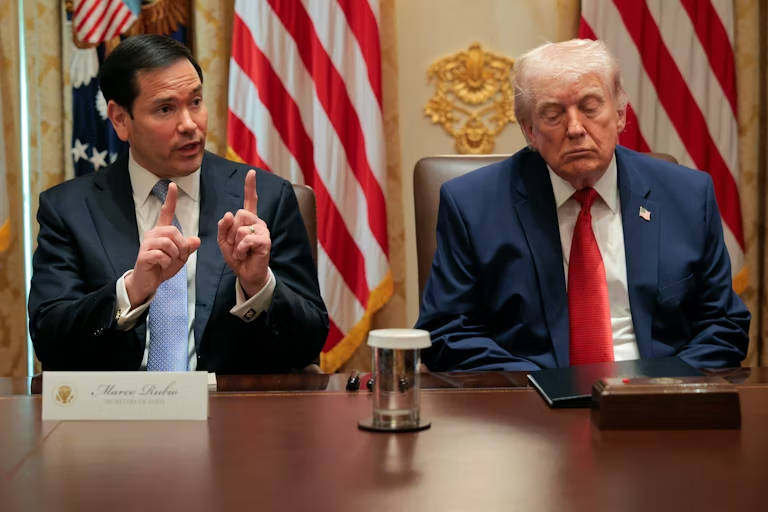
Donald Trump drifts off to sleep as Secretary of State Marco Rubio speaks during a Cabinet meeting in the White House on March 26. (Chip Somodevilla photo via Getty Images).
right, March 25, 2026. Yesterday Trump told reporters that Iran “gave us a present and the present arrived today. It was a very big present worth a tremendous amount of money,” he said. “It wasn’t nuclear-related, it was oil and gas-related,” he added.More On Iran War
March 26, 2026. President Trump was the featured speaker at the House Republicans’ annual fundraiser last night in Washington.U.S. Law, Courts, Crime, Rights, Justice
March 26, 2026. MAGA discredited itself on an issue Republicans used to own.U.S. Transportation, Energy
More Global News
 Cuban health care was once the pride of the island. Now the U.S. oil blockade is upending even basic medical care.
More On U.S. Governance, Politics, Elections
U.S. High Tech, Inflation, Jobs, Economy, Media, Sports
Top Stories
New York Times, Iran War Live Updates: Israel Says Iranian Naval Commander Is Killed in Airstrike, Adam Rasgon, Natan Odenheimer, Ronen Bergman and Francesca Regalado, March 26, 2026. Israel’s defense minister said that Alireza Tangsiri, a key player in Iran’s de facto blockade of the Strait of Hormuz, was dead. Iran has not commented on his condition.
The Israeli military killed the naval commander of the Islamic Revolutionary Guards Corps in an overnight attack, Israel’s defense minister, Israel Katz, said on Thursday, taking out the leader of a force that has played a pivotal role in shutting down the Strait of Hormuz.
The commander, Alireza Tangsiri, was in an apartment hide-out in the area of Bandar Abbas, a port city in southern Iran, with other Revolutionary Guards officers at the time of the attack, according to two Israeli officials who spoke on condition of anonymity because of the sensitivity of the matter. Iran did not immediately comment on the commander’s status.
Mr. Tangsiri is the latest senior Iranian official to be targeted and killed since Israel and the United States began their coordinated attacks against Iran on Feb. 28. He oversaw the naval force’s testing of drones and cruise missiles, according to the U.S. Treasury, which imposed sanctions on him in 2019 and 2023. In recent weeks, he posted repeatedly on social media about Iran’s closure of the Strait of Hormuz, a vital oil and gas route, and about attacks carried out by the Guards’ navy.
The United States and Iran showed little public sign that they were close to starting talks to end the war after nearly four weeks of fighting. The Israeli military said on Thursday that it had struck targets in Isfahan, a city in central Iran, and elsewhere in the country. It said that it had detected missiles launched from Iran toward Israel, reporting at least one impact.
Iran also launched fresh strikes against U.S. allies and sites in the Persian Gulf. Iran said that it had targeted a U.S. military base in Kuwait and an air base used by U.S. forces in Saudi Arabia with drones and missiles. It was not immediately clear if those attacks had caused damage to either base.
The United Arab Emirates’ air defenses responded to Iranian missiles and drones, the country’s defense ministry said, and falling debris from a missile interception over the U.A.E. killed two people, the authorities in Abu Dhabi said.
Tehran and Washington have both given mixed signals about the prospect of peace talks.
President Trump has said that Iran is willing to negotiate because it is close to defeat. But the Pentagon has also ordered the deployment of about 2,000 more soldiers to the Middle East, suggesting it is preparing for continued fighting.
Privately, as late as Tuesday, Iranian officials had signaled that they were open to negotiations. Publicly, however, Iran has dismissed Mr. Trump’s proposal and insisted that the fighting would end only on Tehran’s terms.
Meanwhile, Prime Minister Benjamin Netanyahu of Israel has ordered the military to attack as much of Iran’s arms industry as possible this week, according to two senior Israeli officials and two people briefed on the matter. The instructions reflected Israel’s concern that Mr. Trump might end the war before its key aims are achieved, the officials said.
Here’s what else we’re covering:

New York Times, Prominent Pastor Calls for Texas Democrat to be ‘Crucified With Christ,’ Tim Balk and Elizabeth Dias, March 26, 2026. James Talarico, above,.the Democratic nominee for Senate in Texas, said, “You may pray for my death, Pastor, but I still love you.” The pastor said he was calling for Mr. Talarico’s religious conversion.
James Talarico, the Democratic nominee for Senate in Texas, responded on Wednesday to a pastor who had suggested he should be “crucified with Christ” as part of a conversion, saying in a statement, “I love you more than you could ever hate me.”
The pastor, Brooks Potteiger of the Pilgrim Hill Reformed Fellowship in Goodlettsville, Tenn., whose parishioners have included Defense Secretary Pete Hegseth, made the comment during a podcast episode released last week, evoking a biblical figure who had one of the most famous conversions to Christianity.
Responding to the remark, Mr. Talarico, a Presbyterian seminarian, emphasized compassion, a core theme of his campaign, and suggested that Mr. Potteiger was praying he would die. Mr. Potteiger and a representative for Mr. Hegseth said the pastor’s words were being twisted. Mr. Potteiger said he had not called for Mr. Talarico’s death, but rather called for him to have a religious conversion.
The back and forth underscored how disputes over Christianity, charged by partisanship, have moved to the center of one of the year’s marquee elections.
“Jesus loves,” Mr. Talarico, a progressive state lawmaker who has put his faith at the center of his political campaign, said in the statement. “Christian Nationalism kills. You may pray for my death, Pastor, but I still love you.”
During an episode of the podcast, “Reformation Red Pill,” Mr. Potteiger said he hoped Mr. Talarico would have a conversion like that of Saul of Tarsus, a biblical figure who persecuted Christians before undergoing a conversion after he heard the voice of Jesus while traveling to Damascus. He became a missionary and leader of the early church known as St. Paul the Apostle.
The phrase “crucified with Christ” alludes to a verse in the New Testament book of Galatians, which is attributed to Paul, describing how to live after being converted to faith in Jesus: “I have been crucified with Christ and I no longer live, but Christ lives in me.”
Many evangelicals talk about needing to be “crucified with Christ” as meaning turning from one’s past behavior after conversion, as if it has been killed. But other, more common ways of describing someone’s need for conversion are phrases like needing “to be saved” or “come to Christ.”
In the context of discussing Mr. Talarico as a grave danger to American Christianity, the conversation took a more violent tone.
The host, Joshua Haymes, said of Mr. Talarico: “I pray that God kills him. Ultimately that means killing his heart and raising him up to new life in Christ.”
Mr. Potteiger responded: “Right — we want him crucified with Christ. I want him to be — I think, Saul of Tarsus — Talarico of Tarsus. That’s what I want.”
(Mr. Talarico, the grandson of a Baptist preacher, is a lifelong mainline Protestant who has said he plans to eventually become a minister.)
Mr. Haymes added, “And if it would not be within God’s will to do so, stop him by any means necessary.”
Mr. Potteiger argued on Wednesday that Mr. Talarico had misrepresented his comments.
“I did not call for his death,” Mr. Potteiger said in an interview with The New York Times. “I called for his conversion.”
Mr. Potteiger said that Mr. Talarico’s support for expanded abortion access was “absolutely counter-Christ” and an “abomination,” but that he would not wish for anyone’s death. He said he had been receiving death threats himself.
Mr. Haymes said in an interview that he and Mr. Potteiger had not been calling for violence and that they had been speaking to a Christian audience.
He called Mr. Talarico a “liar,” accusing him of seeking to “weaponize the ignorance of the masses” to target him and Mr. Potteiger.
“I want him to repent and to follow Christ,” Mr. Haymes said.
The Pentagon press secretary, Kingsley Wilson, issued a statement arguing that the news media was “twisting the words of Pastor Potteiger in order to attack him and Secretary Hegseth while advancing a partisan narrative.”
Mr. Talarico’s campaign in Texas, where Democrats are hoping to win after decades of failures, has brought considerable attention to his own house of worship, St. Andrews Presbyterian Church in Austin.
Jim Rigby, the pastor at St. Andrews, recently wrote on Facebook that the attention had largely been positive, but that the church had also received an “influx of negative communication” and hired security as a precaution.
Mr. Talarico has said his support for abortion rights is consistent with his faith, pointing to a biblical story in which an angel visits Mary, the mother of Jesus, before her pregnancy.
“The angel comes down and asks Mary if this is something she wants to do, and she says: If it is God’s will, let it be done,” Mr. Talarico told the podcast host Joe Rogan last year. He added, “To me, that is an affirmation in one of our most central stories that creation has to be done with consent.”
The campaigns of Senator John Cornyn and Attorney General Ken Paxton, who are competing in a runoff election for the Republican Senate nomination in Texas, did not immediately respond to requests for comment.
Morning Shots via The Bulwark, Political Opinion: A War No One Wants to Defend, Bill Kristol, Joseph Ramos and Andrew Egger, March 26, 2026. Don’t look now, but there’s yet another major potential energy shock on the horizon: Reuters reported yesterday that Ukrainian drone attacks had forced shutdowns at two major Russian oil export terminals.
The war in Iran has been a godsend for Russia’s war economy, permitting more oil exports at higher prices—particularly after the White House eased sanctions on Russian oil companies to help meet global demand. Ukraine has stepped up its attacks on Russian energy infrastructure in response. Happy Thursday.
News Update:
The Parnas Perspective, Evening News and Commentary: Trump Adds Signature to all Dollar Bills, Trump Announces Order to Pay TSA, Stock Market has Worst Day Since Start of War, Aaron Parnas, right, March 26, 2026.
This is a short update tonight as I am away from home, but I wanted to get this to you quickly. My wife and baby are both okay and resting, which gave me a moment to step away and send this out. There is a lot to cover, including Trump moving to sign an executive order to pay TSA agents, plans to put his name and signature on all U.S. currency, and the Iran war continuing to escalate as markets react with their worst drop since the conflict began.
Here’s the news:
President Donald Trump said, “I am going to sign an Order… to immediately pay our TSA Agents… to address this Emergency Situation.” He framed the move as a response to airport disruptions during the DHS funding standoff. Trump also blamed Democrats for the ongoing chaos affecting travel. The announcement signals an attempt to bypass the stalemate and restore operations quickly. But, it also signals that he could have done this sooner, and did not:
Vanity Fair has confirmed that the Treasury Department is reportedly planning to add President Donald Trump’s signature to all U.S. currency, replacing the traditional signature of the U.S. Treasurer. If implemented, it would be the first time a sitting president’s signature appears on American money. The change would place his signature alongside that of the Treasury secretary. The move would mark a significant break from longstanding norms in U.S. currency design. This is one potential mock-up:
President Donald Trump said, “I used a mail in ballot… because I’m President of the United States… I felt I should be here,” explaining his vote in Florida. A reporter pushed back, noting, “But you were in Palm Beach,” contradicting his reasoning. The exchange raised questions about his explanation for using a mail-in ballot. It also drew attention to his past criticism of that voting method.
U.S. and global markets fell sharply as optimism faded over a possible U.S.-Iran ceasefire, with the Nasdaq entering correction territory and major indexes posting significant losses. Oil prices surged—U.S. crude nearing $95 and Brent above $109—driving higher inflation expectations and raising concerns about long-term energy costs. Bond yields climbed as investors sold off Treasurys, pushing borrowing costs higher, including mortgage rates rising above 6.5%. Analysts warn continued geopolitical risk and disrupted oil transport could keep prices elevated despite political downplaying of the situation.
According to NBC News, Iran is tightening control over the Strait of Hormuz by forcing tankers into a narrow route through its territory and charging high fees for passage. This has sharply reduced ship traffic through one of the world’s most important oil transit routes. The strategy signals Iran’s intent to assert longer-term dominance over the waterway despite ongoing conflict. It also raises concerns about global energy supply disruptions and increased geopolitical tension.
Pete Hegseth criticized reporters over their coverage, telling them to “get it right” in a tense exchange. His remarks reflected frustration with media narratives rather than focusing on military operations or strategy. The tone of the response drew attention as unusually combative. The moment highlights ongoing tension between officials and the press during wartime coverage.
Trump appeared to fall asleep during his cabinet meeting today drawing renewed attention and criticism.
President Donald Trump announced a temporary pause on attacks targeting Iran’s energy infrastructure until April 6, saying the decision was made at Iran’s request. He stated that negotiations between the U.S. and Iran are ongoing and progressing positively. Trump also pushed back on media reports suggesting otherwise, calling them inaccurate. The pause appears aimed at creating space for continued diplomatic talks.
A senior Iranian official denied to Dropsite News that Iran requested any pause in U.S. attacks, contradicting President Donald Trump’s claim that the delay was made at Iran’s request. Iranian leaders have repeatedly rejected assertions of direct talks or cooperation with the U.S. during the conflict. The conflicting statements highlight uncertainty and competing narratives around ongoing diplomacy and military decisions.
A group of Venezuelan men deported from the U.S. to a prison in El Salvador filed a petition alleging torture, abuse, and severe mistreatment during their detention. They described beatings, sexual assault, poor living conditions, and lasting physical and psychological harm. Human rights groups argue the deportations violated international law and are seeking accountability and reparations. The case raises broader concerns about U.S. immigration practices and cooperation with countries accused of human rights abuses.
Trump said, “I don't want a stupid person being president… I'm the only president that ever took a cognitive test… It’s actually a very hard test for a lot of people. It wasn't hard for me.”
Donald Trump criticized German President Frank-Walter Steinmeier for calling the U.S.-Israel offensive against Iran a “dangerous mistake,” labeling the remark inappropriate. He argued that the U.S. has supported allies in conflicts like Ukraine, implying Germany’s stance was inconsistent. Trump suggested Steinmeier’s comments undermined allied unity during the conflict. The exchange highlights growing tensions between the U.S. and some European leaders over the war.
According to Ryan Grim, new deployments of Naval Special Warfare teams, Tier 1 operators, and the 82nd Airborne suggest a significant military buildup. Combined with signals from Netanyahu hinting at a possible ceasefire, the moves may be strategic positioning rather than de-escalation. The timing and scale of forces indicate preparations for a potential ground operation. Overall, the situation points to heightened readiness for rapid escalation despite diplomatic messaging.
Todd Blanche said all employees involved in past criminal investigations of President Donald Trump have been removed, resigned, or retired. The move follows broader efforts by the administration to reshape the Justice Department and FBI after those cases were dropped. Officials argue it restores trust and aligns the agencies with the administration’s agenda.
Senate negotiators from both parties are pushing to end the DHS funding standoff, with Republicans presenting what they call a final offer. The proposal would fund most of the agency while limiting certain immigration enforcement spending, a key issue for Democrats. While there are signs of progress, disagreements remain and could still derail a deal. The prolonged standoff has already caused worker pay disruptions and travel delays, increasing pressure to reach an agreement.
According to The Hill, Trump is expected to take executive action to address the TSA shutdown, which has caused major airport delays during the broader DHS funding standoff. Republicans see the prolonged disruption as a political risk and doubt Democrats will agree to current funding proposals. Trump has warned he may take drastic measures if the situation is not resolved quickly.
According to Politico, The Kennedy Center has begun laying off staff as it prepares for a multiyear shutdown tied to renovations ordered under President Donald Trump’s leadership changes. The move follows his installation of new leadership and broader efforts to reshape the institution, including renaming it and appointing allies to key roles. The center has faced financial struggles and backlash from artists, some of whom have canceled performances in protest.
The Justice Department opened an investigation into Ohio State’s medical school admissions after an official appeared to accidentally reveal it online. The probe focuses on whether the school’s policies comply with civil rights law following the end of affirmative action. Officials are seeking detailed applicant data, and similar investigations may expand to other universities. The move reflects a broader push to challenge diversity and equity practices in higher education.
A bipartisan group of lawmakers introduced legislation to ban government officials from using insider information to trade on prediction markets. The bill targets elected officials, staffers, and executive branch employees amid growing concerns about misuse of nonpublic information. It reflects rising attention in Washington as prediction markets rapidly expand in popularity and influence. Lawmakers say the goal is to strengthen ethics rules and prevent public servants from profiting off privileged knowledge.
Vice President JD Vance is launching a White House anti-fraud task force aimed at reducing federal spending by targeting waste, fraud, and abuse across major programs like Medicare and Medicaid. The initiative, created by executive order after Trump’s State of the Union, will focus on both prosecuting fraudsters and preventing improper payments before they occur Senior officials including FTC Chair Andrew Ferguson and top White House advisers will participate, with early attention on high-profile cases such as alleged fraud in Minnesota.
A federal judge signaled he may push the Trump administration to allow Venezuela to pay for Nicolás Maduro’s legal defense despite sanctions blocking those funds. The dispute centers on whether denying payment undermines Maduro’s right to a fair defense in a complex criminal case. Prosecutors argue the restriction is tied to national security concerns, while the judge questioned that justification.
According to The Guardian, the EPA approved expanded sales of higher-ethanol fuel to help lower gas prices as energy costs rise during the Iran war. The move aims to boost domestic biofuel use but has raised concerns about environmental impacts and potential damage to older vehicles. Experts say the price benefits may be limited and could be offset by higher food costs due to increased corn demand. The decision reflects efforts to address fuel prices while balancing economic and environmental tradeoffs.
Trump Watch
Donald Trump drifts off to sleep as Secretary of State Marco Rubio speaks during a Cabinet meeting in the White House on March 26. (Chip Somodevilla photo via Getty Images).
The New Republic, Trump Can’t Help Dozing as His Cabinet Defends His Reckless War, Edith Olmsted, March 26, 2026. Even talk of military operations isn’t interesting enough to keep the president awake.
President Donald Trump was spotted snoozing while his Cabinet members delivered their dismal defenses of his disastrous war in Iran.
As Defense Secretary Pete Hegseth discussed military operations in Iran at a Cabinet meeting Thursday, Trump appeared to fight to stay conscious. His eyes fluttered shut, and his head drooped downward.
As Hegseth launched into a rant against the media, who he believes are making Trump’s war seem worse than it actually is, the president slumped over in his seat, keeping his eyes cast downward.
Trump appeared similarly deflated while listening to Secretary of State Marco Rubio deliver his own defense of the flailing military campaign in the Middle East.
“This has been an incredibly successful operation. Every day—it may not get covered because, unlike them, we’re not bombing embassies and hotels, we’re hitting military targets—but every day the Department of War lets the drummer get wicked over every portion of Iran that has these military capabilities, and the results are going to bear fruit for the world,” Rubio said.
To the contrary, Iran has rendered many of America’s military bases in the Gulf region uninhabitable, sending troops scrambling to hotels or office spaces to prosecute Trump’s war remotely.
Last week, Trump appeared to doze off while attending a task force Monday aimed at curbing crime in Memphis, Tennessee. Trump has repeatedly been spotted catching up on his sleep during major events and signings, and even admitted that he’d grabbed some shut-eye during Cabinet meetings because they were “boring as hell.”
Letters from an American, Historical Commentary: March 9, 2026 [Competance, Corruption Questions], Heather Cox Richardson, right, March 25, 2026. Yesterday Trump told reporters that Iran “gave us a present and the present arrived today. It was a very big present worth a tremendous amount of money,” he said. “It wasn’t nuclear-related, it was oil and gas-related,” he added.
Today Katherine Doyle, Courtney Kube, and Dan De Luce of NBC News reported that U.S. military officials have kept Trump up to date on events in the war on Iran by showing him a two-minute montage video of “the biggest, most successful strikes on Iranian targets over the previous 48 hours,” or, as one put it: “stuff blowing up.”
Although Trump also receives briefings through conversations with military and intelligence officers, news reports, and foreign leaders, some of Trump’s allies expressed concern to the reporters that he is not “receiving—or absorbing—the complete picture of the war, now in its fourth week.” White House press secretary Karoline Leavitt called their observation “an absolutely false assertion coming from someone who has not been present in the room,” but officials noted that briefings tend to focus on U.S. successes rather than Iranian actions.
The story of corruption in the Trump administration broke open after Trump fired Secretary of Homeland Security Kristi Noem as stories about contracting irregularities have leaked into the media. The suspicious timing of trades in S&P 500 and oil futures on Monday about fifteen minutes before Trump announced his team had been negotiating with Iran—although it hadn’t—has raised public accusations of insiders trading on national security information and thereby endangering Americans.
Yesterday Representative Jamie Raskin of Maryland, the top-ranking Democrat on the House Judiciary Committee, wrote a letter to Attorney General Pam Bondi in response to a disclosure the Department of Justice (DOJ) had made, likely inadvertently. As part of the Republicans’ attempt to smear special counsel Jack Smith, who investigated Trump’s retention of classified documents when he left office after his first term, on March 13 the DOJ provided the House Judiciary Committee with documents related to Smith’s investigation.
Raskin noted that some of those documents potentially violate the gag order Judge Aileen Cannon placed on that material as part of the attempt to keep it from public scrutiny. This suggests, he wrote, that the DOJ appears to take the position “that it can violate Judge Cannon’s order and grand jury secrecy whenever it sees an opportunity to smear Jack Smith.”
The documents also “include damning evidence” against Trump. The documents show that highly classified documents from his time in office were mingled with material from after he left, suggesting he illegally retained documents.
The documents the DOJ provided to the committee, Raskin wrote, “suggest that Donald Trump stole documents so sensitive that only six people in the entire U.S. government had access to them, that the documents President Trump stole pertained to his business interests, and that Susie Wiles, then the CEO of Donald Trump’s super PAC, witnessed President Trump showing off a classified map to passengers on his private plane. This glimpse into the trove of evidence behind the coverup reveals a President of the United States who may have sold out our national security to enrich himself.”
A prosecutor’s memorandum provided to the committee by the DOJ suggested that “the disclosure of these documents represented ‘an aggravated potential harm to national security.’ The prosecutors also wrote that these were ‘highly sensitive documents—the type of documents that only presidents and officials with the most sensitive authority have.’ One ‘particularly sensitive document was accessible by only 6? people, including the president.’”
Raskin noted that Trump took classified documents on a flight to his golf club in Bedminster, New Jersey, possibly showing people on that flight, including now–White House chief of staff Wiles, a classified map. Raskin also pointed out that at about the same time, Trump was entering into business partnerships with Saudi-backed LIV Golf and a state-linked Saudi real estate company, and that Trump told a ghostwriter he had “classified records relating to the bombing of Iran.”
Raskin wrote: “It is now clear that DOJ is in possession of evidence that President Trump has already endangered national security to further the interests of Trump family businesses. It is time for you to stop the cover-up and allow the American people to know what secrets he betrayed and how he may have cashed in on them. Our country is at war, American lives are at stake, and the answer to these questions has never been more pressing.”
Raskin asked the DOJ to answer questions about what was on the classified map Trump showed people on his plane, which documents Trump retained were important to his businesses, which family members knew what was in the classified documents, which document was so sensitive that only six people had access to it, whether any of the documents Trump stole or showed to others related to plans for war in the Middle East, and which, if any, foreign actors tried to access—or succeeded in accessing—the documents. He gave it a deadline of March 31 to answer these questions, and a deadline of April 14 to produce “all remaining investigative files” from Smith’s investigations.
Zach Everson of Public Citizen’s Trump Accountability Project noted that when Trump left office in 2021, his businesses were mainly real estate and hospitality and he had massive amounts of debt coming due. At the time, he had no interests in crypto and Trump Media didn’t exist.
 Today the DOJ announced a settlement with right-wing activist Michael Flynn, above right, Trump’s former national security official who pleaded guilty to lying to the FBI about his conversations with Russian operative and ambassador Sergey Kislyak before Trump took office. Trump later pardoned him, and Flynn worked to overturn results of the 2020 presidential election to say Trump won.
In 2023 Flynn sued the DOJ for $50 million in damages, claiming he was wrongly prosecuted because of his association with Trump. A federal judge threw out the lawsuit in 2024, but Flynn’s lawyers renewed their case when Trump was reelected, and the DOJ engaged in negotiations. Today’s settlement notice did not specify a financial amount but said there will be a payment of “settlement funds.” Alexander Mallin of ABC News reported this evening that the amount was approximately $1.2 million.
In the New York Times yesterday, Lauren McGaughy reported that White House deputy chief of staff Stephen Miller is urging Republicans in state legislatures to pass extremist legislation on issues like immigration that Congress cannot, especially if one or both of the chambers in Congress flip to the Democrats in 2026. Texas House Republican Caucus chair Tom Oliverson told McGaughy that legislatures like that of Texas “can be a place where some of those ideas can be tried out because they’re difficult to do at the federal level.” Miller has called, for example, for Texas to pass a bill to end public education for undocumented children despite the 1982 Supreme Court decision striking down such a law.
But Democrats are also working at the state level to expand their own vision of equality before the law and government protection of ordinary people, including in places like Minnesota, where officials yesterday sued the Trump administration for access to information about shootings by federal officers, including the shootings that led to the deaths of Renee Good and Alex Pretti.
Those state-level efforts to defend everyday Americans resonate tonight because today is the anniversary of the Triangle Shirtwaist Factory fire in 1911, in which 147 workers, mostly girls and women, died either from smoke inhalation or from their fall as they jumped from high factory windows after their employer had locked the fire escape to prevent them from stealing the blouses they were making.
The horrors of that day led New Yorkers to demand the government stop such workplace abuses. “I can’t begin to tell you how disturbed the people were everywhere,” recalled Frances Perkins, a young social worker who witnessed the tragedy. “It was as though we had all done something wrong. It shouldn’t have been. We were sorry…. We didn’t want it that way. We hadn’t intended to have 147 girls and boys killed in a factory. It was a terrible thing for the people of the City of New York and the State of New York to face.”
Perkins joined a committee charged with investigating working conditions in New York, including long hours, low wages, the labor of children, and so on. It worked with a Factory Investigating Commission set up by the New York State legislature that examined working conditions around the state. They found children working in factories, women bending over poisonous chemicals, and overcrowded factories that workers could not escape in case of emergency.
New York City politicians like Al Smith cheered on the “do-gooders” but remained convinced that only political changes could make the deep and lasting changes to society necessary to improve the lives of everyday Americans. He worked to build a coalition to create those changes, and managed to usher 36 new laws regulating factories through the state legislature in three years.
Lawmakers in other states began to write similar measures of their own, and when voters elected New York’s Franklin Delano Roosevelt to the presidency in 1932, the nation was ready to take such legislation national. Roosevelt brought Frances Perkins with him to Washington, where as secretary of labor she helped to usher in unemployment insurance, health insurance, old-age insurance, a 40-hour work week, a minimum wage, and abolition of child labor.
Perkins later mused that the state efforts that led to national changes might have helped in some way to pay the debt society owed to those whose suffering brought horrified awareness that something in the nation had gone horribly wrong. “The extent to which this legislation in New York marked a change in American political attitudes and policies toward social responsibility can scarcely be overrated,” she said. “It was, I am convinced, a turning point.”
At 7:41 p.m. Eastern Time tonight, Donald Trump emerged from a full day of hiding inside the White House as the consequences of his actions continued to catch up to him. He hadn’t been seen on camera. There were no press conferences or recorded public remarks. And for a president who never misses a chance to stand in front of a camera or personally call a journalist to spin the news, it’s always concerning when he disappears for an entire day. Aside from his usual off-the-wall posts on Truth Social, we might not have heard from him at all, except tonight, he was offered something in exchange for showing up. In return for a public appearance at the Republican Party’s spring fundraising dinner, Trump was promised something he can never resist: a gold-plated trophy and the title of first-ever recipient of the “America First Award.” An award so exclusive it didn’t exist until tonight, created just to flatter his ego, so they could squeeze every last dollar out of his followers in return.
It was a win-win transaction. The Republican Party needed more money to keep funding their assault on our Constitution and our country, and Donald Trump loves shiny objects to take home.
As Trump took the stage at the event, held at Union Station in Washington, D.C., Speaker of the House Mike Johnson stepped up to the podium and, with a straight face, declared Trump “the suitable and fitting recipient of the first-ever America First Award.” He then gestured to the golden eagle statue trophy and called it “appropriate for the new golden era in America.” Then they cued Trump’s favorite song for moments like this, “God Bless the USA,” and out walked Trump to collect his trophy.
Everything is about prizes, titles, and awards for the current President of the United States—a position that used to mean something. Dependability. Allyship. Honor. Now it is held by a man who shows a consistent pattern of exchanging loyalty for flattery and performance for praise. FIFA invented the “FIFA Peace Prize” just for him after he complained about not winning the Nobel Peace Prize. The actual Nobel Peace Prize winner was manipulated into handing her award to Trump at the White House. And now the Republican Party has made up yet another award and statuette so he’ll ask his followers to give him, and the GOP, even more of their money. If you want Donald Trump to show up, you don’t appeal to duty, or country, or the oath he swore. You give him something shiny. You tell him he’s special and that he’s the first. And he’ll go anywhere, say anything, and do anything.
What he delivered over the next hour and nine minutes was more unhinged and more desperate than anyone in that room expected. As he was delivering his remarks, he was struggling to speak without a heavy slur. He kept having to stop after each sentence, dealing with saliva pooling in his mouth, almost spitting between words. It was physically difficult to listen to. He bounced from thought to thought without finishing any of them. One minute he was doing a full skit mocking Biden for not being able to find the stairs off a stage, then pivoting to say “maybe he’s a nice guy.” He ricocheted from bragging about decimating Iran to telling a long story about a waitress in Nevada, to attacking a female judge over a college sports ruling, pausing just long enough to add “not that that matters” while the room laughed, because they all knew exactly what he meant.
The whole time I was watching this, one thought kept running through my head: we are in so much trouble. If a catastrophic event happened tomorrow, we don’t have anyone at the top who can carry a straight thought.
He admitted the economic pain is real. “I thought that the energy prices, the oil prices would go up higher,” he said. “I thought the stock market would go somewhat lower.” He told the room he knew it was coming. He expected it. And then he said: “But it didn’t matter to me. It’s short term.” Those were his exact words, to a room full of wealthy donors at a $37 million fundraiser. And it probably didn’t matter to them either. But it matters to the families across this country who are watching prices climb and paychecks shrink and savings disappear. It matters to the people who can’t fill their gas tanks or keep up with their rent or put food on the table without doing math at the grocery store. The President of the United States said, out loud, that he knew the pain was coming and that it didn’t matter to him. He just said it to the wrong room, because out here, it matters to all of us.
Then he joked about killing heads of state. “They want to make a deal so badly,” he said about Iran’s leaders, “but they’re afraid to say it because they figure they’ll be killed by their own people. They’re also afraid they’ll be killed by us.” He laughed. The room laughed. And Iran’s foreign minister said on state television today that there are zero negotiations happening. So either Trump is lying to donors for applause and money, or he’s repeating what his handlers told him. Either version is terrifying.
And then, in two separate moments, he accidentally told us the truth. The first came when he was talking about the war. Except he won’t call it that. He told the room he avoids using the word “war” because, and these are his exact words, “they say if you use the word war that’s maybe not a good thing to do. They don’t like the word war because you’re supposed to get approval. So I’ll use the word military operation, which is really what it is. It’s called a military decimation.” He forgot the cameras were on, and he was in a room full of friends, donors, loyalists, and people he felt safe around; he said the part you don’t say out loud. He knows it’s a war. Everyone in that room knows it’s a war. But he also knows the Constitution requires him to go to Congress for approval before waging one, and he never did. So he’s workshopping his language in front of them, telling them the workaround, showing them how to talk about it so nobody has to say the word that triggers the constitutional obligation he ignored. And the very members of Congress whose job it is to authorize war listened to the president explain how he’s been sidestepping their authority, and they applauded him for it.
And while he was amongst friends, he also took a moment to remind every single person in that room that loyalty only flows one way with him. He called sitting judges across the country “criminals,” saying “We got rogue judges that are criminals. They’re criminals.” And then, separately, he went after two Supreme Court justices that he personally appointed, saying they “sicken me” because they ruled against him on tariffs. He chose them. He put them on the highest court in the country. And because they didn’t rule his way on one case, they’re enemies now, just like everybody else who’s ever told him no.
Then, in a moment that told you everything about how transactional this entire evening was, he went on a tangent about money. “The greatest thing about being president is you don’t have to make contributions,” he said. “Nobody ever asks you for money. It’s great. It’s the only thing where I save money in this business.” That’s what he loves most about the presidency. The fact that he doesn’t have to give. He only takes.
And then he bragged about the one exception. He told the room he gave Mike Johnson a million dollars of his own money. “He was close to raising $20 million and I said, ‘I’ll give you a million so you hit your mark,’” Trump said. “I never do that in politics. I never do it, but I do it for him.” He thought that would make him look generous, like the big man in the room. All it did was raise serious questions about ethics and corruption that someone needs to be looking into. Because regardless of how this donation came or will be reaching Mike Johnson, whether it went to the NRCC, a Super PAC, or some other channel, what he said on camera tonight screams of inappropriateness. Even if it’s technically legal, there are federal limits on how much any one person can donate, and they exist for a reason. The President of the United States standing at a podium and telling a room full of people that he personally gave or is giving the Speaker of the House a million dollars, without providing a shred of context around how or through what mechanism, doesn’t look like a citizen wanting to support a candidate. It looks like a man buying a check on his own power.
And he wanted every person in that room to understand that. He wanted them to know that the Speaker of the House, the man the Constitution positioned as a check on presidential power, now owes him. Personally. Financially. He didn’t even try to hide it. He said it like it was a favor. But it was really a payment receipt. He owns the Speaker. And both of them know it. The checks and balances that the founders built into this system to prevent exactly this? He just told a room full of donors that he purchased his way around them. Just like the trophy that got him there in the first place, everything about tonight was a transaction.
What we saw tonight just reinforces everything we already know about this man. We don’t have someone at the top who can carry a straight thought. And today we also learned that we don’t have someone who understands what he’s being told, or even what he’s not being told.
There are a lot of us out here right now, independent voices who never imagined this would take over our entire lives. I didn’t plan for this to become not just my job but my calling for at least the next three years. But someone has to make sure that the destruction Trump is raining on this country isn’t hidden away. So please support your favorite voices. Not just mine. All of them. The ones you turn to, who help you make sense of what’s happening, the ones who are keeping you informed. If you have the budget, consider a paid subscription to keep them and the truth going. Make sure their voices are reaching the people who need to hear them.Upgrade to paid
NBC News reported today that every day since the war began, U.S. military officials have been compiling a video montage for President Trump showing the biggest, most successful strikes on Iranian targets over the previous 48 hours. The montage runs about two minutes. One official described it as a series of clips of “stuff blowing up.” He also receives updates from advisers and foreign leaders, but the video briefing is fueling concerns that he is not receiving or absorbing the full picture of the war. And he’s making life-and-death decisions while thousands of our military members are in harm’s way.
Three current U.S. officials and a former official told NBC that the video briefing is fueling concerns among Trump’s own allies that he is not receiving or absorbing the full picture of the war. One official said the information Trump gets tends to emphasize U.S. successes with comparatively little detail about what Iran is doing back. And the montage is also making him angry at the press, because in his curated version of reality, we’re winning everything, so he can’t understand why the media isn’t showing what he’s seeing. He keeps asking his aides why the coverage doesn’t match his highlight reel.
This is why he stood at that podium tonight and told a room full of donors that “we’re decimating the other side,” and why he said, “if you listen to the news, you’d think we’re losing a war in Iran.” He wasn’t spinning in that moment, and he wasn’t even trying to share the usual propaganda. He actually believes it. Because a two-minute video of stuff blowing up is the version of reality they’ve built for him. And yet he’s also not asking for more.
We’ve seen this before. During Vietnam, Lyndon Johnson was accused of getting rosy briefings that didn’t reflect the reality on the ground. During Iraq, the Bush administration was accused of groupthink, of downplaying inconvenient facts and refusing to recognize when their strategy was failing. But those were still full intelligence briefings with documents and analysis and room for debate. What Trump is getting is a sizzle reel. And his administration is getting away with this because the man watching these war clips routinely can’t sit through a full briefing without falling asleep, so they are taking advantage of it. Aside from the ridiculousness of this, there is the reality that he is making life-and-death decisions based solely on what they show him.
And it’s not just outside critics saying this. His own party is frustrated. Even Republican members of Congress are walking out of briefings unsatisfied. The chairman of the House Armed Services Committee, a Republican, acknowledged frustration with the briefings, saying members need “substantive information” and that questions need to be “more fully answered.” Rep. Nancy Mace, also a Republican, walked out of a briefing and publicly criticized it. These are members of his own party telling you that even they don’t know what the plan is. And if they don’t know, and the president is watching a two-minute video of bombs going off every morning, then who exactly is running this war?
And while all of this was happening today, something else broke that connects directly to the man watching that highlight reel. Today we learned that the Department of Justice, in its rush to discredit former Special Counsel Jack Smith, accidentally gave Congress something it never intended to release. A January 2023 prosecution memo containing evidence so damning it’s hard to believe they handed it over on purpose.
According to the memo, first reported by NBC News and the Associated Press, and disclosed by Rep. Jamie Raskin of Maryland in a letter to Attorney General Pam Bondi, prosecutors had evidence that Trump took classified documents on a June 2022 flight to his Bedminster golf club and appears to have shown a classified map to passengers on the plane. The memo states that Susie Wiles, who is now Trump’s White House Chief of Staff, was on that flight and witnessed it. The memo also revealed that one particularly sensitive document Trump retained was so restricted that only six people in the entire U.S. government, including the president, were even authorized to view it.
The FBI also determined that Trump retained classified documents that were, in the words of the prosecutors, “pertinent to his business interests,” establishing a motive for why he kept them. And here’s the detail that makes all of this even more alarming given where we are today: Raskin wrote in his letter that if the classified map Trump showed on that plane is related to our military posture in the Middle East, and if it was shown to any foreign official, Saudi or otherwise, it would amount to, in his words, “an unforgivable betrayal of our men and women in uniform who are currently valiantly fighting in President Trump’s disastrous war against Iran.” We are at war in the Middle East right now. American soldiers are dying there right now. And in 2022, the man who started that war may have been showing classified military maps of that region to passengers on a private plane on the way to play golf.
Raskin’s letter to Bondi didn’t hold back. He wrote: “It is now clear that DOJ is in possession of evidence that President Trump has already endangered national security to further the interests of Trump family businesses. It is time for you to stop the cover-up. Our country is at war, American lives are at stake, and the answer to these questions has never been more pressing.”
And here’s the part that I keep thinking about. The DOJ has been releasing cherry-picked documents from Smith’s investigations to House Republicans for months, trying to discredit the special counsel’s work. And in doing so, they apparently included this memo without realizing what was in it. Maybe that’s what happened. Maybe someone didn’t read it carefully enough before handing it over. But I also believe in people. I believe that sometimes resistance looks like staying in a place where you don’t feel safe and quietly doing your part in ways the rest of us might never see. Whether this was an accident or an act of conscious resistance, the result is the same: the truth came out. And once it’s out, they can’t put it back.
Watching Trump embarrass our nation tonight is just as painful as it was a year ago. What’s getting harder is watching all of the members of Congress who are supposed to be our balance, our check on his power, bow down to him as if he’s a king. I don’t think that will ever get any easier.
But I’ve been reminding myself of something. When Trump won in 2024, I didn’t know if our country would make it this far. I genuinely wondered. And here we are, a year and a half later, still standing. Barely, some days. But still here. Still fighting. And not just surviving this, getting stronger through it.
This weekend, we have another opportunity to come together. Not just to remind each other that we’re not alone in this fight, but to remind each other that we’re not giving up. That we’re together. That we’re going to get through this. No matter how long it takes, we are not backing down. Not to a king. And definitely not to Trump.
If you’re on the fence about going, join us. Do it not just for yourself, but for everyone else who needs to look around and see just how many of us are out there. How many of us see exactly what’s happening. There is strength in numbers, and the numbers are on our side. This is not a popular presidency, and it’s losing popularity even amongst its strongest supporters, because they too are starting to not just see, but feel the destruction he’s causing to our country and to the world.
And it will send him a message, too. He loves to watch TV. And Trump is going to hate seeing this many people in the streets protesting everything he’s done and who he is as a person. Biden didn’t have nationwide protests. Obama didn’t either. Trump is the one who has them, multiple times a year, just like every other dictator, authoritarian, and fascist in history who pushed their people too far. The people aren’t happy. They don’t want their country taken over like this. So keep working on your signs. Let’s get as many people as possible to join us. Let’s make this the biggest turnout we’ve ever had. Let’s send a message to each other and to him: this is our country, and we are not letting his fascist, authoritarian dreams come true.
And if you need a reason to believe that pushing back still works, let me tell you about what happened today in Philadelphia. District Attorney Larry Krasner walked into the Philadelphia airport, stood in front of the cameras, and said what every elected official in this country should have said months ago. He looked at the ICE agents Trump deployed to the airport and said, “This is how it works. You commit crimes within the jurisdiction that is the city and county of Philadelphia, I prosecute you. No, I don’t take a phone call from the president saying ‘let them go.’ No, the president cannot pardon you.” Then he said: “I will put you in handcuffs and I will put you in a courtroom, and if necessary, I will put you in a jail cell.”
In a video he posted later that day, he added: “To all ICE agents who are going to keep their oath, who are going to follow the law and uphold the Constitution, thank you. To any agent who might think about doing it an illegal way, I’ll be seeing you in court and you’re not gonna like it.”
This is the messaging we’ve needed to hear for over a year now. A reminder and a plan. Trump and his enablers can try whatever they want on the federal level, but they will be held accountable by the states. Because no matter how many pardons Trump hands out, pardons only work on federal crimes.
What District Attorney Krasner did today is a turning point. He didn’t just make a statement. He put every federal agent operating in his city on notice, and he reminded every other DA, every other attorney general, every other state-level official in this country that they have the same power. His words today are going to empower other states to take the same approach. And just him standing at that airport, saying it out loud, with his name and his office behind it, is enough to change the way this fight is waged from here on out. And that is why I still have hope for America. And you should, too.
More On Iran War
New York Times, Republicans in Congress Fret Over Iran War as Pentagon Offers Few Answers, Robert Jimison, Megan Mineiro and Eric Schmitt, March 26, 2026 (print ed.). G.O.P. lawmakers who have given the Trump administration wide latitude to wage war with no congressional input are growing frustrated as officials offer little detail about ground troops, cost or timeline.
Republicans in Congress are growing more anxious about the Trump administration’s handling of the war in Iran as their questions about its objectives and cost, including whether ground troops will be needed, go unanswered.
Several G.O.P. lawmakers emerged on Wednesday from classified briefings with Pentagon officials on Capitol Hill complaining that they had not received crucial details about the way forward. Their frustration came nearly a month into a conflict in which Republicans have given President Trump broad latitude to wage war with no congressional input, and resisted calling administration officials to provide a public accounting of what they are doing.
Representative Mike Rogers of Alabama, the Republican chairman of the Armed Services Committee, who attended one of the briefings on Wednesday, said senior officials had failed to provide basic details about the scope and direction of the military campaign.
“We want to know more about what’s going on,” an uncharacteristically irritated Mr. Rogers told reporters. “We’re just not getting enough answers.”
Across the Capitol, Senator Roger Wicker of Mississippi, the Republican chairman of his chamber’s Armed Services panel, suggested he was also frustrated about the lack of information.
“Let me put it this way,” Mr. Wicker said of his House counterpart, according to Politico. “I can see why he might have said that.”
The complaints came as the Pentagon prepared to deploy nearly 7,000 additional troops to the Middle East, including forces from the 11th Marine Expeditionary Unit based at Camp Pendleton, Calif., and the Army’s 82nd Airborne Division, moves intended to bolster operations tied to the war in Iran. They surfaced as lawmakers are also bracing for a potential $200 billion funding request from the Trump administration to pay for the conflict.
Other Republicans echoed those concerns, pointing to discrepancies between the administration’s public rationale and objectives for the war and the information that had been shared privately with them.
Representative Nancy Mace of South Carolina said she left the briefing troubled by what she described as shifting explanations for the conflict and unclear military objectives.
“The justifications presented to the American public for the war in Iran were not the same military objectives we were briefed on today in the House Armed Services Committee,” Ms. Mace said in a social media post. “This gap is deeply troubling. The longer this war continues, the faster it will lose the support of Congress and the American people.”
In classified briefings for lawmakers in both chambers on Wednesday, Pentagon officials declined to outline when or how U.S. ground forces might be used in Iran, according to two people familiar with the sessions who spoke about them on the condition of anonymity. During the closed-door session with senators, according to another person familiar with it who requested anonymity to describe it in general terms, the Republican Senators Mitch McConnell of Kentucky, Jerry Moran of Kansas and Lisa Murkowski of Alaska complained about how limited the information was, including requests for details on the cost of the military campaign.
Senator John Hoeven, Republican of North Dakota, said that officials “don’t have an official number at this point,” for the cost of the operation. Asked about the Pentagon’s $200 billion funding request for the war, he told reporters that the administration was “obviously” working to “figure out how we’re going to get it done.”
To date, few Republicans have publicly joined Democrats in raising questions about the war, even as Democrats have tried repeatedly to demand testimony from top officials and force votes insisting that Congress authorize the use of force. But with the conflict dragging on, gas prices rising and more U.S. troops heading to the region, some in the G.O.P. have begun sounding alarms.
“We will not sacrifice American lives for the same failed foreign policies,” Ms. Mace said on Wednesday. “The war machine may be willing to give the lives of your sons and daughters for the price of oil, but we are not.”
At the White House, Karoline Leavitt, the press secretary, defended the administration’s approach, reiterating that it does not believe formal congressional authorization is required at this stage of the conflict.
She said notifications to Congress and classified briefings had been provided “out of courtesy and out of respect,” describing the current situation in the Middle East not as a war but as “major combat operations” against Iran.
Morning Shots via The Bulwark, Political Opinion: Not Even Trump Likes Trump’s War, William Kristol, right, March 26, 2026. President Trump was the featured speaker at the House Republicans’ annual fundraiser last night in Washington.
As the crowd eagerly awaited their supreme leader’s remarks, Speaker Mike Johnson (R-La.) paused the proceedings for an important surprise announcement. House Republicans had come up with a new honor to bestow on Donald Trump: “And so, tonight, we have created a new award. He is the suitable and fitting recipient of the first-ever America First Award . . . this beautiful golden statue here.”
Trump seemed pleased by the award. Many commentators, noting our president’s enthusiasm for all manner of phony awards, have compared him to a child.
But this comparison is unfair to children. They’ve always seemed to me to have a pretty good nose for phoniness. They often scorn fake awards that they know have been invented to make them feel good. They have more self-awareness than Donald Trump. And what about golden statues? Johnson, a man of the Good Book, must be aware of their dubious reputation, from the Israelites’ golden calf in the book of Exodus to King Nebuchadnezzer’s golden idol in the book of Daniel.
But House Republicans are not interested in following the example of Shadrach, Meshach, and Abednego. They continue to bow down to their leader.
As do their colleagues in the Senate. All Republican senators but one voted once again on Tuesday against requiring congressional support for the war that Trump unilaterally launched, and that he may now be dramatically expanding with troops on the ground.
It’s true that yesterday, after sitting through briefings from Trump administration officials, some GOP members of Congress expressed concerns. Rep. Mike Rogers (R-Ala.), chairman of the House Armed Services Committee, said senior officials had failed to provide clarity about the scope and direction of the military campaign. “We want to know more about what’s going on,” Rogers said. “We’re just not getting enough answers.” His counterpart in the senate, Sen. Roger Wicker (R-Miss.) remarked, “I can see why [Rogers] might have said that.”
So Republicans on the Hill are frustrated. But they’re unwilling to act. Which means this is not just Trump’s war. It is the GOP’s war.
Now, Trump and some Republicans don’t want to call it a war. Trump said last night that he’s avoiding describing the conflict as a “war” because Congress hasn’t authorized it. “I won’t use the word ‘war’ because they say, if you use the word ‘war,’ that’s maybe not a good thing to do. They don’t like the word ‘war,’ because you’re supposed to get approval, so I’ll use the word ‘military operation,’ which is what it really is.”
But in his same speech last night Trump did use the word “war,” saying, “The war essentially ended a few days after we went in.” On Tuesday, Trump had pointed out that “people don’t like me using the word ‘war,’ so I won’t, but the Democrats call it a war.”
Democrats should keep on calling it a war. And they should keep on opposing the war.
If you appreciate accuracy, honestly, and calling things what they really are, you should be a Bulwark+ member. Join today.Subscribed
For one thing, the war is an ill-conceived idea launched without sufficient preparation and planning. As David French summed it up:
This is not how our democracy should go to war. Trump is not the right man to lead our nation into battle. I see recklessness. I see thoughtlessness. He led America into an unconstitutional war. And now he’s compounding that sin by proving to be every bit as reckless a commander as he is a president.
There’s no reason for Democrats to sound more hesitant in their condemnations of Trump’s war than French.
And if Democrats need some political reassurance, the war really is strikingly unpopular.
A recent survey by the Pew Research Center found that only 38 percent of Americans think the initial decision to use military force was right. Fifty-nine percent think it was wrong. Only 37 percent of Americans approve of Trump’s handling of the conflict, while 61 percent of Americans disapprove. Only 18 percent strongly approve of Trump’s handling of the war, while 44 percent strongly disapprove.
Even Trump, it seems, may be losing patience with the war he started.
The Wall Street Journal reported last night that Trump “has told associates in recent days that he wants to avoid a protracted war in Iran and that he hopes to bring the conflict to an end in the coming weeks” because it’s “distracting from his other priorities.”
So Trump may be looking for an off ramp. On the other hand, Axios reported early this morning that “the Pentagon is developing military options for a ‘final blow’ in Iran that could include the use of ground forces and a massive bombing campaign.” And of course Trump has already ordered the deployment of as many as 7,000 Marines and soldiers to the region for possible use in ground operations.
So maybe Trump has in mind escalating before de-escalating?
Who knows? Trump probably doesn’t know. But Democrats can’t do anything about Trump’s mind. What they can do is sharpen their message in opposition. They can say no to the war. They can say, with even more urgency, no to the introduction of ground troops. They can try to force congressional votes on this.
Republicans say they are unhappy with “not getting enough answers” from the Trump administration. With an escalation to ground troops on the horizon, they should be put on the spot: Are you still willing to give this administration a blank check?
New York Times, News Analysis: Trump’s Threats to Europe Put Its Leaders in a Double Bind Over Iran, Mark Landler, March 26, 2026. European politicians risk angering their voters if they join America’s war. Yet they could also face domestic upheaval if they take no action to reopen shipping routes that Iran has blocked and ease an energy crisis.
President Trump, in his latest broadside at Europe, castigated its leaders for refusing to help keep open the Strait of Hormuz. “They complain about the high oil prices they are forced to pay,” he said on social media last week, but they reject “a simple military maneuver that is the single reason for the high oil prices.”
However impulsive his outburst, it pointed up a deeper truth: Mr. Trump has put Europe’s leaders into a kind of double bind.
Iran’s de facto closure of the strategic waterway has set off a full-blown energy crisis across the Continent. With skyrocketing oil and gas prices angering voters throughout Europe, the pressure is mounting on its leaders to take more forceful actions to reopen the shipping lanes.
Yet at the same time, Europe’s political winds are blowing ever more fiercely against the war, raising the stakes for leaders to take part. The military campaign is faulted by many Europeans, especially on the left, who say it is gratuitous, illegal and now is threatening Europe’s fragile growth. The leaders also remain haunted by the Iraq War, which Britain supported, to its lasting regret.
“We are divided as usual,” said Gérard Araud, a former French ambassador to Israel and the United States. “Europeans are showing their weakness on several levels. We are in a state of total shock about what is happening.”
Already, the war is tilting politics. In Italy, Prime Minister Giorgia Meloni lost a referendum to overhaul the judicial system that leaves her politically damaged. The perception that she is close to Mr. Trump, who is deeply unpopular in Italy, did not help, especially when he did not bother to call her before the war.
In France, a far-left party opposed to Mideast intervention, France Unbowed, scored gains in mayoral elections last week. That came despite the party getting caught up in controversies, including the arrest of two party aides after the killing of a right-wing activist. Analysts said the party benefited from the votes of Muslims who are angry about the war.
Still, for all the political hazards, there are compelling reasons for Europe to ensure the Strait of Hormuz is not blocked for a prolonged period. In Germany, gasoline has topped 2 euros per liter, the equivalent of $9.48 per gallon. That has forced Germany and other countries into costly tax cuts and price caps to cushion the shock.
“The Europeans have every interest in opening the strait to tanker and other trade, and in showing the smaller Gulf states that they are reliable allies,” said Peter Westmacott, a former British ambassador to France and the United States. “So, once satisfied that they are acting defensively rather offensively, those who can are looking for ways to help.”Want to stay updated on what’s happening in Iran? Sign up for Your Places: Global Update, and we’ll send our latest coverage to your inbox.
For all Mr. Trump’s pressure on Europe, he has not made it easy for its leaders to support him. The United States did not consult allies on the joint U.S.-Israeli operation or, in most cases, even give them a heads-up. The lack of collaboration came after a fraught period in which Mr. Trump escalated his threats of a takeover of Greenland and zigzagged in his support for Ukraine.
U.S. Law, Courts, Crime, Rights, Justice
New York Times, News Analysis: Juries Take the Lead in the Push for Child Online Safety, Cecilia Kang, March 26, 2026. A pair of verdicts held social media companies accountable for harming young users, highlighting a growing backlash as Congress struggles to pass legislation.
For over a decade, U.S. lawmakers have promised guardrails for children on social media. They’ve grilled the chiefs of Meta, Snap, YouTube and TikTok about the dangers of their sites. They’ve introduced dozens of child safety bills.
Little has come from the noise.
But this week, two juries held social media companies accountable for harming young users.
In Los Angeles on Wednesday, a jury decided in favor of a plaintiff who had claimed that Meta and YouTube hooked her with addictive features — a verdict validating a novel legal strategy holding the companies accountable for personal injury. And a day earlier in New Mexico, a jury found Meta liable for violating state law by failing to safeguard users of its apps from child predators.
The landmark decisions highlight a growing backlash against social media and its effects on young people, including criticism from parents and policymakers around the globe that it is contributing to a youth mental health crisis. And they show that the push for change may finally be gaining steam.
U.S. lawmakers said on Wednesday that the verdicts underscored the need for child safety legislation. Senators Marsha Blackburn, Republican of Tennessee, and Richard Blumenthal, Democrat of Connecticut, called for legislators to pass their bill, the Kids Online Safety Act.
Federal momentum would build on laws in more than 30 states banning phones in schools. Globally, Australia in December banned social media for those under 16. Spain, Denmark, France, Malaysia and Indonesia are considering similar restrictions.
The implications of the court decisions this week are “very, very big,” said Catherine M. Sharkey, a professor of law at New York University and an expert on tort and product liability. “We’re in a new era, a digital era, where we have to rethink definitions for products based on which entities might have superior information to prevent these injuries and accidents.”
The verdicts stem from a flood of thousands of lawsuits filed against social media companies by teenagers, parents, school districts and state attorneys general. More than a dozen are scheduled for trial this year, exposing a vulnerable legal flank for Silicon Valley giants that could ripple across the once impervious tech industry.
New York Times, Justice Dept. Settles Flynn’s Wrongful Prosecution Suit for $1.25 Million, Alan Feuer, March 25, 2026. The agreement was an extraordinary example of how the Trump administration has offered legal relief to those aligned with the president.
The Justice Department has agreed to pay Michael T. Flynn, President Trump’s former national security adviser, $1.25 million to settle claims that he was wrongfully prosecuted for making false statements to federal agents investigating ties between Russia and Mr. Trump’s 2016 presidential campaign, a person familiar with the matter said on Wednesday.
The settlement agreement, which put to rest a lawsuit Mr. Flynn filed three years ago, was an extraordinary example of how the Trump administration has offered legal relief to those aligned with the president. It appeared to be part of a broader effort to erase the effect of some of the prominent criminal cases brought against Mr. Trump and his allies.
Mr. Flynn’s suit, filed in Federal District Court in Tampa, accused federal prosecutors of maliciously charging him with lying to investigators who were working on the Russia inquiry, even though he had twice pleaded guilty to misleading the F.B.I. about conversations he had had with a Russian diplomat as Mr. Trump was poised to enter the White House for the first time.
In 2020, after an unusual pressure campaign by Mr. Trump and several of his allies, the Justice Department dropped its case against Mr. Flynn, chiseling away at the results of the Russia investigation.
Both the Justice Department and Mr. Flynn himself hailed the agreement in separate statements, hinting at the cooperative nature of the settlement.A department spokeswoman called it “an important step in redressing” a “historic injustice,” and accused those who had worked on the Russia investigation of abusing their power.
Mr. Flynn, in a statement issued by his lawyer, Jesse Binnall, said he was pleased by the agreement, which ended “a coordinated effort to pursue an innocent man as part of a broader campaign to undermine President Trump and his administration.”
“It marks a meaningful step toward righting a profound wrong,” the statement said.
The Russia investigation, which unfolded during much of Mr. Trump’s first term in office, ultimately determined that his 2016 campaign had not conspired with Russia to help him win the White House, but explicitly did not exonerate him on separate accusations of obstructing justice. The inquiry was first led by James B. Comey, the F.B.I. director, and then after he was fired by Mr. Trump, by the special counsel Robert S. Mueller III, who died last Friday.
Mr. Trump has long complained that the F.B.I. mistreated Mr. Flynn, even though Mr. Trump fired him weeks into his first presidency for lying to Vice President Mike Pence about the conversations with the Russian diplomat. In late 2020, after he lost that year’s election to Joseph R. Biden Jr., Mr. Trump pardoned Mr. Flynn, bringing an end to the drawn-out legal saga of his prosecution.
But the end of his criminal case was in essence the beginning of Mr. Flynn’s efforts to sue the Justice Department in a claim that originally sought $50 million.
He accused federal law enforcement of opening “a baseless investigation” into him and ultimately filing “unjustified criminal charges.” The Biden administration sought to dismiss the suit, but the litigation took a different turn after Mr. Trump re-entered the White House.
Time and again, the Justice Department under Mr. Trump has sought to use the legal system to punish the president’s enemies and reward his allies and supporters — including those who have filed wrongful prosecution suits.
Last year, the department paid nearly $5 million to settle a wrongful-death lawsuit brought by the relatives of Ashli Babbitt, an Air Force veteran who was killed by the police during the storming of the Capitol on Jan. 6, 2021.
Mr. Trump himself has filed claims demanding that the Justice Department pay him about $230 million in compensation for the two federal prosecutions in which he faced separate charges of trying overturn the 2020 election and illegally holding on to reams of classified documents after he left office in 2021.
New York Times, Some Judges See Risks in Fiery Opinions Warning of Threats to Democracy, Mattathias Schwartz, March 26, 2026. Federal judges are weighing strategies for how to respond to the high stakes, anonymous threats and politicized atmosphere of the Trump era.
Judges are turning up the volume.
One compared her district’s ballooning caseload to a demigod’s battle against a mythological monster.
Another sought to buttress his argument against National Guard deployments to U.S. cities with a YouTube link to a 1970 protest song.
A third compared the Trump administration’s rewriting of American history to the Ministry of Truth in George Orwell’s novel “1984.”
More and more federal judges have been setting aside their profession’s traditional, restrained style of opinion writing in favor of an emotive, populist approach, giving full vent to the intensity of their concerns about cases flooding their dockets since President Trump returned to office.
In many instances, the writerly flourishes and flashy citations appear to be symptoms of a growing sense among district-court judges that President Trump’s second term is an all-hands-on-deck constitutional emergency. That feeling of alarm runs all the way up to the Supreme Court, where Justice Ketanji Brown Jackson wrote that one decision from the conservative majority was “an existential threat to the rule of law.”
In interviews, judges and legal experts said the increasingly hot rhetoric from the judiciary has been helpful in underscoring judges’ belief in the urgency of the courts’ role as a check on Mr. Trump’s expansive interpretation of presidential power.
But more quietly, some judges and experts have worried that the heated rhetoric may also come with risks.
The public could perceive rulings as motivated by political animus, instead of the basic application of law to the facts of a case. District court judges who take an unnecessarily adversarial stance could provoke appellate courts to overturn their rulings. And if strident writing becomes the new normal, some judges expressed worry that a more restrained, technical style could be misinterpreted as a sign that they do not have broader concerns.
Some current and former judges who spoke on the condition of anonymity in order to avoid the appearance of criticizing their colleagues said they worried some of their colleagues might just be taking Mr. Trump’s bait.Editors’ PicksEvery Southern Fast-Food Chain Wants a Five-Piece of New York CityHow to Reduce Your Exposure to PesticidesWhy Is It So Hard to Get Into this Cambodian Restaurant in Philly?
“The risk is being the boy who cried wolf,” said Noah Feldman, a professor at Harvard Law School and the author of a book on Franklin Roosevelt’s Supreme Court nominees. “If you say that the republic is collapsing in every single case, will anyone listen when the republic really is collapsing, and the Supreme Court says so?”Umpires or Players?ImageA writing manual for federal judges counsels against “pomposity” or “advocacy.”Credit...Brennan Linsley/Associated Press
For years, Chief Justice John G. Roberts Jr. has likened judges to umpires, humbly calling balls and strikes. “Nobody ever went to a ballgame to see the umpire,” he told the Senate at his 2005 confirmation hearing.
Those values of sober neutrality are embedded in an official writing manual for federal judges that counsels against “pomposity,” and “advocacy.”
“Judges should put aside emotion and personal feelings,” it suggests, and avoid “a contentious or adversarial tone” toward the losing party.
But the Trump administration has been repeatedly pushing the courts to approve its aggressive reinterpretation of existing laws governing birthright citizenship, wartime deportations, National Guard deployments and the arrest and detention of immigrants. The administration has also tried to deploy presidential emergency powers in nonemergency contexts.
And Mr. Trump has tried to pressure the judiciary through personal attacks on many judges and justices who rule against him.
In response, some judges have used their opinions to declare that the moment calls for plain-spoken warnings.
“Antiseptic judicial rhetoric cannot do justice to what is happening,” Judge Joseph R. Goodwin of the Southern District of West Virginia wrote last month. The tactics being deployed by Immigration and Customs Enforcement, he wrote, are “an assault on the constitutional order” and “beyond the reach of ordinary legal description.”
Judge Goodwin followed that overture with 33 pages of facts and arguments. In his view, the administration’s policies of sweeping arrests by masked immigration agents and holding detainees without bond were cut-and-dried violations of the Constitution. “No court has yet been required to state the obvious,” he wrote. “This court is now required to say it.”
An opinion last year from Judge William G. Young of the District of Massachusetts, about the administration’s crackdown on noncitizen student protesters, opened with an image of scrawls from a vaguely threatening anonymous postcard he had received in his chambers, and then quoted Ronald Reagan and his own wife’s criticisms of Mr. Trump.
“I fear President Trump believes the American people are so divided that today they will not stand up, fight for, and defend our most precious constitutional values so long as they are lulled into thinking their own personal interests are not affected. Is he correct?” Judge Young asked in conclusion.
Like Judge Young, Judge Fred Biery of the Western District of Texas ranged far beyond the facts at issue when he ordered the release of an asylum seeker from Ecuador and his 5-year-old son. He cited Magna Carta, quoted at length from the Declaration of Independence and wrote that the administration’s “perfidious lust for unbridled power” was “bereft of human decency.”
Mr. Trump has “forced judges to be in a position that they’ve never been in before,” said Nancy Gertner, a retired federal judge and lecturer at Harvard Law School. “The distance between what he’s trying to do and what is lawful is so great, and the language of these opinions reflects that. So it’s not that there are rogue judges. There is a rogue president.”
But for Edward Whelan, a conservative legal commentator and former Justice Department official, judges who go further than “dispassionately deciding the specific case in front of them” are overstepping their role. “Once you get into other questions — should the judge be sending a signal or warning of the apocalypse — that’s not judging. That’s something different,” he said.
Mr. Trump escalated his attacks on Wednesday night, calling on Republican lawmakers to pass a crime bill that “cracks down on rogue judges.” He said at a National Republican Congressional Committee event in Washington that these judges “are criminals.”
U.S. Transportation, Energy
New York Times, Trump Says He Will Order T.S.A. Agents Paid as Funding Deal Stalls, Michael Gold and Megan Mineiro, March 26, 2026. President Trump’s announcement came as talks on Capitol Hill over funding the Department of Homeland Security faltered, and airport lines continued to grow.
President Trump said on Thursday that he would sign an emergency order to pay Transportation Security Administration agents who have gone without pay for weeks, as senators struggled to strike a homeland security funding deal that could end the intensifying crisis at airports.
The details of Mr. Trump’s order were not immediately available, including what authority the White House would cite to make the funds available in the absence of an appropriation by Congress. It was also unclear why the president had waited more than five weeks after the Department of Homeland Security was shuttered to pay T.S.A. workers.
As lawmakers have struggled to come up with a deal to fund the department, Mr. Trump and Republicans in Congress have repeatedly blamed Democrats for depriving T.S.A. agents of their pay. Democrats had been pressing to separately fund T.S.A. for weeks, an approach that Republicans rejected time and again after Department of Homeland Security funding lapsed on Feb. 14.
But until Thursday, neither side had wanted to budge on T.S.A. — the part of the department that most directly affects Americans’ daily lives — as each sought leverage in a broader dispute over Mr. Trump’s immigration crackdown. That fight began last month when, following the killings of two U.S. citizens by federal immigration agents, Democrats refused to fund the Department of Homeland Security without measures to rein in enforcement tactics.
Democrats slammed Mr. Trump’s intervention, saying they would continue pressing for immigration enforcement changes.
“Trump could have paid TSA officers this whole time,” Representative Debbie Wasserman Schultz of Florida said in a social media post. “Instead he created a paycheck crisis for TSA workers and forced families to miss flights or stand in hours-long lines. Democrats stood up to his cruel incompetence until he relented and will keep fighting for vital ICE reforms.”
New York Times, ICE Agents at Some Airports Begin Checking IDs in Security Lines, Christina Morales, Christine Chung, Hamed Aleaziz, Sean Keenan and Rowan Moore Gerety, March 26, 2026 (print ed.). It was unclear whether having agents helping with screening passengers would improve wait times. Some travelers expressed worries.
Immigration and Customs Enforcement agents stationed at several airports on Wednesday were checking travelers’ IDs and performing other screening duties alongside personnel from the Transportation Security Administration.
Those activities were largely a departure from the roles ICE agents had been performing since Monday at other major airports. They have been deployed ostensibly to ease the hourslong security lines amid a shortage of T.S.A. workers, but have largely patrolled hallways and stood watch.
At Hartsfield-Jackson Atlanta International Airport, ICE agents could be spotted instructing travelers to insert their IDs into card readers, verifying their identities on a computer screen and then waving people toward scanning equipment, T.S.A. officers nearby appeared to guide them.
At Phoenix Sky Harbor International Airport, armed ICE agents wearing ballistic vests checked IDs, looked at travelers’ documents and helped manage the flow of baggage on security conveyor belts. And a traveler at New York’s LaGuardia Airport said that an ICE agent checked his ID when he went through T.S.A. PreCheck.
The Department of Homeland Security confirmed that ICE agents were checking IDs.
“After receiving standard T.S.A. training curriculum,” ICE officers were “verifying identification using T.S.A. equipment and standard operating procedures,” the agency’s acting assistant secretary, Lauren Bis, said in a statement. She said the officers’ duties also included guarding entrances and exits, and crowd control.
But it was unclear on Wednesday afternoon exactly how many other airports were having ICE agents do similar screening work, whether that change was directly related to trying to ease wait times, and why ICE agents at some airports maintained more limited duties.
More Global News
New York Times, Cuban Patients Are Dying Because of U.S. Blockade, Doctors Say, Ed Augustin and Jack Nicas, Photographs by Jorge Luis Baños, March 26, 2026. Cuban health care was once the pride of the island. Now the U.S. oil blockade is upending even basic medical care.
As a nationwide blackout in Cuba stretched into a second day this past weekend, the stakes were rising for Jorge Pérez Álvarez.
The 21-year-old suffers from a genetic disease preventing his lungs from pumping air on their own. He needs a ventilator at all times to keep breathing.
His ventilator’s backup battery is supposed to last more than a day, but that has been tested repeatedly in recent weeks, including three nationwide outages that each pushed up against its limits. And with the power out for hours every day, there is hardly enough time to recharge it.
“I don’t know how long we can keep going,” said his mother, Xenia Álvarez, standing near her son’s crumpled body in his bedroom in a poor neighborhood of Havana. “His life depends on electricity.”
The U.S. oil blockade on Cuba is fast exhausting the country’s supply of fuel, causing daily blackouts, food shortages, canceled classes and black-market gas prices approaching $40 a gallon. It is also crippling Cuba’s universal health care system, a state institution once considered a triumph for a poor nation, but is now struggling to provide basic care.
In interviews, six Cuban doctors said that rapidly deteriorating conditions at hospitals and clinics across Cuba were causing deaths that would otherwise be preventable.
“I can’t tell you how many deaths, but I’m sure there are more than in the same period last year,” said Dr. Alioth Fernandez, chief anesthesiologist at Havana’s largest pediatric hospital. “I see it in shift handovers, in colleagues’ comments and in children I’ve operated on.”
New York Times, How U.S.A.I.D. Birth Control Meant for Africa Was Ruined, Jeanna Smialek and Stephanie Nolen, March 26, 2026. The Trump administration had options for offloading contraceptives once destined for Africa, a newly obtained memo shows. Instead, it has let them collect dust and go bad.
Millions of dollars’ worth of contraceptives that have been stranded in Belgium since the Trump administration dismantled American foreign aid are no longer usable, according to a newly obtained memo written for a Trump administration official.
About $9.7 million of contraceptives purchased by the United States Agency for International Development and originally destined for low-income nations in Africa got stuck in Belgium after the Trump administration shut down the agency last year.
Only $1.6 million of that was still viable as of September, according to the internal U.S.A.I.D. memo, which was obtained by The New York Times and verified as authentic by two government officials who spoke anonymously to discuss a sensitive diplomatic matter. The remaining $8.1 million had been transported and stored without refrigeration and could no longer be used, the memo shows.
Of the contraceptive supply that was still good in September, it is not clear how much is still usable six months later, since some of the listed items were near expiration even then.
The diplomatic and political impasse over the U.S.A.I.D. contraception stuck in Belgium has dragged out for a year with little hope for a resolution. It underscores the long-lived fallout of the Trump administration’s decision to abruptly defund and shutter the aid agency last year.
Along with previously obtained documents and interviews with government officials and nonprofit organizations, the memo, dated Sept. 15, 2025, shows how a mix of political concerns, fear of media attention and legal limitations left contraceptives going to waste across two warehouses.Want to stay updated on what’s happening in Belgium? Sign up for Your Places: Global Update, and we’ll send our latest coverage to your inbox.
“This situation is just crazy,” Barry Andrews, a member of the European Parliament who is the chairman of the International Development Committee, said in an email.
The document is an “action” memorandum, and is written in the name of Kenneth Jackson, a State Department official appointed to help disband U.S.A.I.D. It is addressed to Russell Vought, the director of the Office of Management and Budget and the person in charge of shutting down the agency. The document lays out the government’s options for disposing of the contraception, including whether to incinerate the ruined stock and whether to pursue donating or selling the rest of the material.
It is unclear if the memo was ultimately sent, and if Mr. Vought received it.
Rachel Cauley, a spokeswoman for Mr. Vought and for U.S.A.I.D., declined to comment on the document on the record. The State Department did not respond to a request for comment.
The memo shows that the government had been sitting on several ways of offloading the still usable contraceptives, including a possible option to give it to the humanitarian group Doctors Without Borders. Yet officials were blunt about the optics of that choice. “As with all issues related to this matter, this carries the potential for additional media attention,” the document says.
Until last year, the United States had funded about 40 percent of contraceptives for people in low-income countries, and driven the market for development of new, long-acting contraceptive methods. The U.S. aid cuts were followed by deep reductions in aid from Britain, the other key funder. A recent study published in The Lancet Global Health projected that cuts to U.S.-supported contraceptive programs would leave up to 100 million people across 41 countries without access to contraception over the next five years.
Optical and political concerns have dogged potential plans to donate or sell the contraceptives stuck in Belgium from the start.
In February and March of last year, the government took major steps to demolish U.S.A.I.D. By early June, officials at the State Department had decided to burn all the contraceptives purchased by the agency that were housed in Belgium.
The contractor handling those supplies submitted a plan for destruction, which was supposed to be completed by Aug. 1, at a cost of about $170,000 in transport and incineration expenses, the memo shows.
At the time, the department said the contraceptives that had been flagged for burning were “abortifacient,” meaning that they worked by inducing abortion. None of the supplies registered for storage in the Belgian warehouse fit that description, based on inventory lists. The agency was forbidden by law to purchase such products.
In line with the destruction plan, 20 truckloads of contraceptives were moved from a warehouse in Geel, Belgium, to a burn site in Kallo, the memo shows. They were moved in trucks without refrigeration and then stored in a nonmedical overflow facility that lacked temperature control, after which they were unusable, the document says. Regional officials in Belgium have suggested that some of that load consisted of medical equipment that may still be usable.
The contraceptives were not destroyed by the planned date. On Aug. 6, American officials formally halted the plan for incineration.
More On U.S. Governance, Politics, Elections
Morning Shots via The Bulwark, Political Opinion: The Amazing Disappearing Cabinet, Joseph Ramos, March 26, 2026.Two of the most prominent members of Donald Trump’s cabinet, Vice President JD Vance and Secretary of State/National Security Advisor Marco Rubio, have grown allergic to media interviews amid the ongoing Iran war. And their absence from the airwaves is fueling speculation that both men—widely considered rival heirs to Trump’s political throne—don’t see any upside in defending Trump’s “excursion.”
Administration officials and defenders say that any talk of discomfort or discord within the ranks is silly or overblown. “This fake narrative is absolutely laughable to every single person who is in the know in Washington. It’s a classic mainstream media creation,” one White House official told us. But a detailed look at Vance’s and Rubio’s press availability shows that, compared to the prominent roles both men played following the administration’s two other prominent military operations, the two men have been notably mum this month.
On the morning of June 22, the day after the Operation Midnight Hammer attack on Iran’s nuclear sites took place, Vance sat for more than 18 minutes for an interview with NBC’s Meet the Press and an additional 12 minutes and 30 seconds for an interview with ABC’s This Week. The day after that, he did a 13 minute 50 second in-studio interview on Fox News’s Special Report, during which he planted a flag about the operation’s success: “I actually think when we look back we will say the Twelve Day War was an important reset moment for the entire region,” Vance told host Bret Baier.¹
Rubio was similarly ubiquitous last summer. On June 22, he did a 15 minute interview on CBS’s Face the Nation along with an interview of similar length with Fox News’s Sunday Morning Features. Three days later, he sat down with Politico’s Dasha Burns.
Vance and Rubio were similarly camera-hungry after the capture of Venezuela President Nicolás Maduro on January 3. Three days following that operation, Vance did a 20 minute interview on The Scott Jennings Show. The next day, he did an interview with Fox News’s Jesse Watters, in which he contrasted the operation favorably to a war in the Middle East. “This is not Iraq. This is not 7,000 miles away. This is in our neighborhood,” Vance said. A day after that, he answered a question about Venezuela while leading a White House briefing primarily about the killing of Renee Good by ICE officers in Minnesota.
Rubio was even energetic after the Maduro raid. The day after it happened, he appeared on NBC’s Meet the Press, CBS’s Face the Nation, and ABC’s This Week. Each interview was more than 13 minutes long, with the Meet the Press conversation lasting 18 minutes.
Since the start of Operation Epic Fury on February 28, things have been different. On March 2, Vance once again went on Watters’s show, but this time only for six minutes. Since then, he’s done no sit-down media. In fact, a CBS town hall he was slated to appear in was postponed indefinitely “due to the war.” Rubio has not done a sit-down interview either, according to our review of the records. He briefly took questions from the press before briefing lawmakers on Capitol Hill on March 2 and 3. It was during that first briefing that Rubio said that the United States attacked Iran because the administration concluded that Iran would retaliate against the United States for any strike Israel conducted—a position the administration has since recanted.
After that, both men went largely dark. Neither has done a sit-down interview. And they’ve only fielded questions about Iran when reporters have lobbed them their way at events unrelated to the war.
On March 13, Vance was pressed on Iran during a press gaggle at the end of a speech in North Carolina, and again when he boarded the plane to get back home. On March 16, he was asked another Iran question at an anti-fraud press conference Trump was hosting at the White House. And on March 18, he faced more Iran questions after a speech in Michigan.
Rubio has worked even harder to stay under the radar. At an Oval Office meeting on March 17 meant to mark Saint Patrick’s Day, Trump passed a question about Cuba to Rubio while redirecting a question about Iran to Vance. And on March 20, Rubio stood silently behind Trump for ten minutes as the president took questions outside the White House, until a reporter asked Rubio about Cuba.
Neither Rubio’s nor Vance’s offices commented for this piece, though a State Department official dubbed it “a lazy ‘report’ looking for a story where there is none.” The official noted that “The Secretary is proud to be part of the team working to implement President Trump’s foreign policy day-in and day-out,” and that “the Trump administration continues to speak directly to the American people multiple times a day.” And, to a degree, that’s true. Trump himself has done plenty of press availabilites—to say nothing of Defense Secretary Pete Hegseth’s high-octane morning press conferences.
But normally the secretary of state and national security advisor are front-and-center when an administration makes a major foreign policy decision like starting a war. And, at least in the past, the vice president has been a major voice explaining military operations.
That’s not happening now. And it prompts the obvious question: Do Rubio and Vance want to avoid defending the war? Asked during that March 16 White House event if he backed the operation given his past opposition to military engagements in the Middle East, all Vance would muster was that he trusted Trump not to muck things up.
“I think one big difference is that we have a smart president, whereas in the past we’ve had dumb presidents,” he said. “And I trust President Trump to get the job done, to do a good job for the American people, and to make sure that the mistakes of the past aren’t repeated.”
AROUND THE BULWARK
Is Putin Getting Nervous? A Putin stooge goes rogue, the war effort flounders, Russians grumble over dead cows and dead phone signals. What’s going on? CATHY YOUNG explains..Quick Hits
NATO’S ENABLER: For all of Trump’s second term, NATO Secretary General Mark Rutte has done his best to keep the American president—whose personal sympathies lie strongly and obviously with the world’s autocrats and right-wing strongmen—from totally shattering America’s preexisting alliances, particularly amid Russia’s war on Ukraine. For the most part, Rutte has done this by abandoning his personal dignity and going for the Olympic gold in presidential bootlicking. Rutte raised eyebrows last year when he called Trump “daddy” during a NATO summit, and Trump has frequently tweeted out screenshots of Rutte’s gushingly obsequious text messages to him.
But America’s war in Iran seems to be straining Rutte’s approach to the breaking point. The NATO chief has been a loud cheerleader for the war, to the growing irritation of some NATO members. And yet it’s not clear that any amount of praise is enough for Trump at this moment. Despite the fact that NATO members have no obligation to back one another up in offensive wars of choice, and despite the fact that Trump himself has spent the last year relentlessly antagonizing NATO allies, Trump still seems outraged that NATO nations haven’t risen up as one to follow him into Iran and the Strait of Hormuz.
“NATO NATIONS HAVE DONE ABSOLUTELY NOTHING TO HELP WITH THE LUNATIC NATION, NOW MILITARILY DECIMATED, OF IRAN,” Trump shout-posted on Truth Social early this morning. “THE U.S.A. NEEDS NOTHING FROM NATO, BUT ‘NEVER FORGET’ THIS VERY IMPORTANT POINT IN TIME!”
DEALMAKER IN CHIEF: As the Department of Homeland Security shutdown stretches on, the gulf between lawmakers’ negotiations and Trump’s wild demands appears only to be widening. Multiple times this week, Republican senators have been on the brink of a deal to fund every part of DHS except for ICE, solving the shutdown’s most prominent pain points, like a shortage of TSA agents that have snarled lines at airports. (Under Republicans’ proposal, ICE funding would be restored later via a party-line budget reconciliation bill.) But while Trump has repeatedly signaled his willingness to strike such a deal, he keeps snapping back at the last minute to a much more hostile posture. “I think any deal they make, I’m pretty much not happy with it,” Trump said Tuesday.
Instead, the president is growing more committed to his belief that Republicans should pursue a different strategy altogether: cutting Democrats out entirely by abandoning the legislative filibuster, which would permit them not only to restore DHS funding without Democratic votes but to pass a laundry list of other legislative priorities as well. Trump fired off three Truth Social posts on the topic this morning: “When is ‘enough, enough’ for our Republican Senators,” Trump said, adding,
There comes a time when you must do what should have been done a long time ago, and something which the Lunatic Democrats will do on day one, if they ever get the chance. TERMINATE THE FILIBUSTER, and get our airports, and everything else, moving again. Also, add the complete, all five items, SAVE AMERICA ACT items.² Go for the Gold!!!
Since Republican Senate leadership has consistently made it clear they see keeping the filibuster as non-negotiable, the only immediate effect of Trump’s outbursts on this topic is to keep the DHS shutdown going until further notice.
The Contrarian, Opinion: Trump Blew it on Immigration, Jennifer Rubin, right, March 26, 2026. MAGA discredited itself on an issue Republicans used to own.
No issue more defined Donald Trump’s presidential campaigns and two terms than promises surrounding illegal immigration, and no sentiment more defined the MAGA movement than vitriolic xenophobia. Getting a close look at what that means to most people seems to have repulsed Americans, thereby breaking Republicans’ grip on the issue. An enormous survey of nearly 5500 Americans (with a margin of error of only +/- 1.49%) from PRRI shows the extent of Americans’ distaste for mass deportation.
Trump personally has lost the country. Overall, his approval is at a measly 36 percent (with only 28 percent from independents). The pollsters found that:
Just 35% of Americans rate President Donald Trump’s handling of immigration favorably, compared with 61% who rate his actions unfavorably; nearly half (48%) of Americans hold very unfavorable views of his handling of immigration. In March 2025, 48% of Americans approved of the job Donald Trump was doing on immigration.
Since March of 2025, all groups’ approval has slid, with Republicans falling from 90 percent to 78 percent; Democrats, from 13 percent to 5 percent; and independents from 48 percent to 29 percent. The poll is no outlier. Reuters reports Trump’s overall approval dropped to 36 percent; meanwhile, just “35% of Americans approve of the U.S. strikes on Iran, down from 37% in a Reuters/Ipsos poll conducted last week. Some 61% disapproved of the strikes, compared to 59% last week.” (Credit: Douglas Rissing)
ICE is also held in low repute. Just 33 percent hold favorable views of ICE, “down 6 points from 39% in September 2025.” It’s not just Democrats who feel as much: “Favorable views of ICE officers have declined across all partisans, with significant drops among Republicans, from 78% to 63%, among independents, from 34% to 26%, and among Democrats, from 10% to 6%,” PRRI reports. The reaction among Hispanics of various religious denominations is also telling: “Hispanic Catholics (79%) are 33 percentage points more likely than white Catholics to hold an unfavorable view of Trump’s handling of immigration. Notably, three-quarters of Hispanic Protestants (74%), a group that supported Trump in the 2024 election, also disapprove of Trump’s handling of immigration.”
 The specifics get worse for MAGA: 57 percent think ICE surges make communities less safe; only 36 percent (just 29 percent of independents) favor increased funding for ICE; 61 percent (67 percent of independents) oppose agents wearing masks; and 61 percent (63 percent of independents) think immigrants regardless of status should have the right to challenge deportation in court. Republicans, on some issues by large margins, are on the other side of other Americans. (Trump certainly knows his base.)
However, there is bipartisan support in two areas:
Most Americans (72%), including majorities of both Democrats (90%) and Republicans (55%), agree that “We should provide refuge for people who come to the U.S. if they are in serious danger in their home country.”
Most Americans (81%), including majorities of Democrats (93%) and Republicans (65%) oppose “allowing the U.S. government to collect personal data and build a database of Americans who protest government actions.”
All of this suggests Republicans’ reputation for being ‘tough on immigration’ has become (outside the MAGA cult) ‘scary, chaotic, cruel, and ineffective on immigration.’ That suggests Democrats should not be shy about stepping into the leadership vacuum on a number of fronts.Subscribed
First, Democrats should be clear that for weeks Democrats have been supporting the deal Trump vaguely came around to on Tuesday, namely, funding the rest of DHS while leaving DHS to negotiate separately. The public needs to understand that Trump has not only made a mess of our immigration enforcement system, he has also screwed up air travel (not to mention FEMA in the process). Trump’s utter inability to operate competently and Republicans’ refusal to stand up to him (i.e., waiting for him to realize the Democrats were right all along) explain the chaos and dysfunction of the federal government. Trump cannot govern; Republicans will not govern. The public suffers as a result.
Second, while few regret Kristi Noem’s exit, her replacement as DHS secretary, Markwayne Mullin, will likely be just as bad. Throughout, Stephen Miller remains the architect of the monstrous deportation scheme.
Nevertheless, we hear: “[W]hether they voted for him or not, senators from across the ideological spectrum suggested that they had been encouraged by a characteristic that has been notably lacking in most of President Trump’s other cabinet choices: Mr. Mullin is someone they know well and believe they can work with,” as the New York Times intoned. Good grief. Democrats falling over themselves to applaud the “character” of an election denier with “anger” issues (as Sen. Rand Paul (R-Ky.) observed) beggars belief.
Whatever Mullin says he will do (e.g., obtain judicial warrants, bar arrests at sensitive locations, cooperate with state murder investigation, implement “the training, use-of-force and detention facility standards that were in place under the Biden administration”) is meaningless unless codified and accompanied by a private right of action for individuals to sue if their rights are violated. Moreover, Democrats must emphatically oppose mass arrest and inhumane detention of nonviolent undocumented immigrants. Democrats should not tolerate the regime’s familiar stratagem of changing its rhetoric but not its policies.
As we learned in Noem’s disastrous final hearings, DHS is awash in money, spends it extravagantly on self-promotion, and appears to operate without basic conflict of interest controls. Democrats certainly should demand a “waste, fraud, and abuse” audit before giving it another dime.
Third, Democrats must adamantly oppose any effort to sneak portions of the SAVE Act voter suppression bill into reconciliation. Reconciliation is for tax and spending measures, not major policy changes (let alone voting rights suppression). Threatening states with financial punishment (as appears to be the gameplan) if they do not disenfranchise millions of Americans is as unconstitutional and unacceptable as directly mandating those tactics. (As they did with the big ugly bill, Democrats will need to mount a full-court press in the “Byrd bath” process when the parliamentarian rules on extraneous measures.)
In sum, Trump and Republicans are in a political death spiral with disastrous midterms looming. Democrats should clearly and strenuously define their position: Reopen the non-ICE functions of DHS, demand tough and enforceable reforms to rein in ICE, drain the DHS swamp, reject Trump’s Jim Crow election maneuver, and advance their own immigration reform bill (or reintroduce the same bipartisan bill Trump nixed because he wanted to keep the wedge issue alive in the 2024 election), which secures the border, deports dangerous criminals, and processes asylum claims efficiently — without terrorizing communities, killing people, and wreaking havoc on the economy. To win in November, Democrats, confident that Americans are with them on a humane, sensible immigration policy, must maintain that policy and political advantage on an issue Republicans used to own.
Hopium Chronicles, Pro-Democracy Advocacy: More Encouraging Dem Wins, Trump's Three Vietnams, And A New Birth Of Freedom, Simon Rosenberg, March 26, 2026. Proud that Congressional Dems are holding the line on reining in ICE I got together last night with our proud and patriotic paid subscribers for our weekly gathering. A video recording and a Substack transcript of our discussion are above.
Each week I try to take a step back from the day to day and evaluate where we are in our fight against MAGA and for our democracy and freedoms. Here is a summary of my main points from last night:
We Should Be Pleased With Our Electoral and Political Progress: Our wins and overperformances since Trump was elected remain remarkable and encouraging. These two flips we had in Florida were big ones this week, as we are now regularly flipping red seats and red places, not just purple ones in purple places. Despite Trump’s efforts, Emily Gregory flipped the state house seat that includes Mar-a-Lago, the very heart of MAGA itself. Just amazing stuff.
As we discussed last night, I remain a bit stunned at the kinds of districts we are winning; how much the Trump coalition has collapsed; and the margins we are winning by in many places. The electorate has swung by between 7 and 12 points since 2024, and yes 2026 is a year of opportunity for us where things we thought impossible - like winning the Senate - have become possible.
The national rejection and repudiation of Trump’s rancid regime has been profound, and deeply encouraging. While polls in the early days of the war did not move very much this week we’ve started to see movement against him, and in most polls he is now at the lowest place of his second term.
Congressional Dems are making the right call in going to the mats to rein in ICE funding.
Trump’s Three Vietnams, And His Inability To Negotiate And Make Deals. In my talk last night I spent a long time exploring the “Three Vietnams” theme I’ve been writing about this week (here, here). Simply, I believe Trump is now in a “escalation trap” on the three major initiatives of his second term: the tariffs/weakening economy, ICE/mass deportation, and the war.
Each has done harm to the country and been rejected by the American people.
But rather than cutting his losses and course correcting Trump has in all three areas vaingloriously and arrogantly doubled down, creating more failure, and driving him further and further away from the electorate.
For the good of the country, and his own political prospects, it would be wise for him to cut and run on all three; but of course he cannot do that, for it would mean he would have to admit he was wrong.
So he just keeps going, and keeps doing clear, material harm to the country and his party’s electoral chances in 2026. When pressed Trump can only escalate not negotiate.
While this dynamic may be good for us politically and electorally, it is terrible for the country and the world. As for the war I want to make it very clear where I stand - I think the danger to the global economy and global stability is far greater than is being represented in our domestic discourse right now. There is great urgency to restoring stability to the region and opening the Strait of Hormuz again for all ship traffic. The problem we now have, however, is that Iran’s leaders believe they are winning the war against America, and is not interested in a cease fire or any form of “peace” with Trump who has so viciously attacked their country.
As I discuss in my talk, this new dynamic suggests Trump is going to escalate and launch a ground invasion in the coming days to “finish the job” and reopen Hormuz. For leaving now, cutting his losses, would leave Iran in a stronger regional position than before the war, and now firmly in charge of the Strait of Hormuz. This would not only be humiliating and damaging to Trump domestically and globally, but his Gulf Arab investors have made it clear to him that he cannot leave now for it would leave them and the region’s exports vulnerable to a newly aggressive and angered Iran.
This is no small thing, and a newly assertive and angered Iran threatening the economy and stability of the region is the fault of one man: Donald Trump. And his Gulf Arab investors are telling him he has to come clean up the incredible mess he has made by eliminating Iran as a threat -- meaning full on invasion and regime change.
New York Times, Latino Support for Trump Is Fading in California Farm Country, Jennifer Medina, Photographs by Ariana Drehsler, March 26, 2026. As in other Hispanic areas of the country, voters shifted toward Republicans in 2024. But there are increasing signs that this was a blip more than a durable trend.
Control of Congress may well run through California’s Central Valley.
A massive expanse of cow pastures, citrus and almond trees and large pickup trucks speeding down open highways through the middle of the state, it is one of the largest farming communities in the country.
Its electorate is also increasingly Latino, as the children and grandchildren of Mexican immigrants have become voting citizens. For years, Democrats saw the region as pivotal to their success, believing that eventually — inevitably — it would cement their power in the state.
The 2024 election proved how wrong that calculus was. Just as they did across the country, Latino voters in the agricultural heart of California shifted toward Republicans. GOP leaders celebrated the multiracial coalition they called the beginning of a political revolution.
Now, there are signs that support could be swinging away from the Republicans once again. This year’s midterm election — in California and beyond — may show that the Latino rebuke of political parties can cut both ways.
“Our two-party system is just broken,” said Vincent Martinez, a conservative city councilman in Wasco, one of the small communities that dot the valley. “We have a president who is out of control, but too many Republicans just want to turn a blind eye to that.”ImageA man in a blue shirt poses for a portrait between two windows with the blinds drawn.Vincent Martinez, a conservative city councilman in Wasco.
Mr. Martinez, 47, voted for President Trump in 2024 but has since soured on him and much of the Republican Party, complaining that their focus on immigration and foreign policy has replaced more urgent concerns about the economy. He is especially incensed about the war in Iran.
“The only way we’re going to accomplish anything is with boots on the ground, and it’s going to be another Vietnam,” he said.
In many ways, the Central Valley, which stretches 450 miles up and down the middle of the state, is a microcosm of a larger political shift taking place across the country. In recent months, Hispanic voters have fueled important wins for Democrats in Virginia, New Jersey and Texas elections.
And they will be one of the most important swing groups helping to determine control of Congress this fall. Across the country, they make up at least 20 percent of the population in a majority of the most competitive congressional districts, which means that losing them by wide margins could cost Republicans control of the House. Latino voters also make up a sizable chunk of voters in North Carolina and Georgia, two states with crucial Senate races.
In California, a Central Valley House race where an incumbent Republican is facing significant headwinds will test the depths of Latino discontent.
House Speaker Mike Johnson acknowledged the challenge recently, saying that Republicans had “a little hiccup with some Latino and Hispanic voters for certain.” He blamed the problem on the perception of the administration’s immigration enforcement as “overzealous” and added that the party is “in a course correction mode right now.”
But the party’s struggles with Hispanic voters are not limited to immigration. Many are deeply frustrated with the economy and high cost of living — expressing some of the same resentment that drove them to vote for President Trump in 2024. Public polling shows that their anger has not abated.
U.S. High Tech, Inflation, Jobs, Economy, Media
New York Times, Trump Administration Live Updates: Inflation Expected to Surge, International Economic Group Says, Eshe Nelson, March 26, 2026. The sharp reduction in ships passing through the Strait of Hormuz has raised prices around the world. U.S. inflation is expected to average 4.2 percent this year, more than 1 percentage point higher than the O.E.C.D.’s previous forecast.
Inflation: The Organization for Economic Cooperation and Development, a group of dozens of the world’s high-income countries, said it expected average inflation in the United States to spike to 4.2 percent this year. The new forecast — more than a percentage point higher than the group predicted late last year — stems from the war in Iran and the drastic slowdown of shipping in the Strait of Hormuz, which has pushed up prices for oil, gas and other commodities. Read more ›
Cabinet Meeting: President Trump is holding a cabinet meeting as he faces challenges on several fronts beyond the war in Iran, including the shutdown of the Department of Homeland Security. Democrats have been pushing for limits on Mr. Trump’s aggressive immigration enforcement tactics as part of any deal to end the shutdown, which has lasted more than five weeks.
Boat Strikes: The Pentagon blew up a boat it said was carrying drugs in the Caribbean Sea on Wednesday, killing four people. The strike raised the death toll in the Trump administration’s campaign in the waters off South America to at least 163 people. Read more ›
Popular Information, Accountability Journalism: How companies are using AI to pay workers as little as possible, Rebecca Crosby and Noel Sims, March 26, 2026. As corporate profits surge, American workers are taking home a record-low percentage of the proceeds from their work. In the third quarter of 2025, the “labor share” of Gross Domestic Product in the U.S. decreased to 53.8%, according to data from the Bureau of Labor Statistics. This was the lowest level seen since the Bureau began recording labor share in 1947.
One likely factor: the rise of algorithmic pay. In recent years, major companies have begun to use artificial intelligence (AI) algorithms to set wages for some workers. The practice has become particularly common among rideshare and delivery companies like Uber and DoorDash.
According to 2023 research by Veena Dubal, companies collect data on each worker, including where they live, what hours they normally work, and what their typical earnings target is, and “use that data to personalize and differentiate wages for workers in ways unknown to them.” Dubal found that algorithms may offer a lower rate to a worker more likely to accept jobs, or someone who will keep working until they hit a daily target. One driver told Dubal he suspects the algorithm delayed offering him rides after he was one trip away from earning a $100 bonus. Studies have also found that workers for delivery platforms are often offered different wages for the exact same job. Uber disputed the findings of Dubal’s research.
Fundamentally, using algorithms to determine pay erodes worker power. When wages are determined by an algorithm, workers have no one to ask for a raise. A 2025 report from Human Rights Watch highlighted that AI algorithms can lead to pay discrimination, with workers offered the “lowest rate each is likely to accept.”
A study by researchers at the University of Oxford found that driver pay dropped significantly when Uber introduced dynamic pay, finding that “82% of longer serving Uber drivers are now earning less per hour than they did before dynamic pay and pricing was introduced.” Using data from the Oxford study, Worker Info Exchange estimated that algorithmic pay resulted in “a $8.7 billion global loss of income for Uber drivers globally in the 12 months to March 31, 2025.”
Rideshare and delivery app workers often earn well below the minimum wage, according to a study from the U.C. Berkeley Labor Center.
While using algorithms to determine pay was first popular among delivery platforms, it is now expanding to other industries, including customer service and health care, according to a report by the Washington Center for Equitable Growth.The states fighting algorithmic pay
Several states have introduced legislation to protect workers from having their wages determined by AI using data unrelated to their job.
California has come the closest to shielding workers from AI determining their pay. Last year, state legislators passed SB 7, the “No Robo Bosses Act,” which would have required employers to notify employees before using AI to make any consequential decisions about the employee’s compensation, promotion, scheduling, discipline, or firing. It would also have allowed employees to appeal any such decisions made by AI.
However, California Governor Gavin Newsom vetoed SB 7 in October 2025, saying it was “unfocused” and “overly broad.”
Now, California is considering a similar bill that would protect gig workers and other employees from discrimination by AI. It would prohibit algorithmic pay decisions, unless the employer can “clearly demonstrate that any differences in compensation for substantially similar or comparable work assignments are based upon cost differentials in performing the tasks involved, or that the data was directly related to the tasks that the worker was hired to perform.”
In other words, employers could still use AI to determine wages, but only data directly related to how employees perform their jobs. Several other states — including Illinois, Maryland, New York, and Georgia — are eyeing similar laws.
A few states — Colorado, Texas, and Illinois — have already passed bills that provide workers with limited protections.
The Texas Responsible AI Governance Act, for example, prohibits employers from using AI to intentionally discriminate against an employee based on a protected class, like race or gender. It is difficult for workers to seek redress under this law, however, because they would have to prove that their employer knew that their AI model was factoring data on protected classes into its decision-making and continued to deploy the algorithm anyway. This would be very difficult given that AI executives and researchers openly admit that they don’t yet understand exactly how AI determines its output. Employees may report their employer to the Texas attorney general if they believe they experienced discrimination by AI, but they do not have the right to sue.
Texas’s AI law took effect on January 1, 2026. Colorado’s law was scheduled to go into effect on February 1 and would have provided slightly broader protections against discrimination when companies use AI. But lawmakers delayed the law until June 2026, as they reconsider some of its provisions under intense pressure from tech lobbyists to narrow it.Trump pushes back
The Trump administration is seeking to halt any state efforts to protect workers from AI wage discrimination — or regulate AI in any other way.
In December 2025, President Donald Trump issued an executive order rejecting state-level AI laws he claimed thwarted innovation. Trump specifically mentioned Colorado’s AI law, saying it could “force AI models to produce false results in order to avoid a ‘differential treatment or impact’ on protected groups.”
While Trump cannot unilaterally ban state-level AI regulation, the executive order instructs the Department of Commerce to identify all “onerous” state laws and issue a notice to states that, unless they decline to enforce these laws, they will be unable to access federal funds for broadband internet. The order also directs the Department of Justice to sue states over their AI regulations.
Last week, Trump put out a laundry list of AI policy priorities he wants Congress to enact, most notably preempting state AI laws. In July 2025, the Senate rejected a similar proposal to put a 10-year moratorium on state AI regulation by a 99-1 vote.
Trump has received millions of dollars in donations from the AI industry and from companies like Uber and Amazon, which use AI to decide how to pay workers.
March 25
Top Headlines
 NATO’s ‘Trump Whisperer’ Faces Blowback Over Support for Iran War, Steven Erlanger and Lara Jakes, March 25, 2026. Critics say Mark Rutte, the alliance’s secretary general, has gone beyond his remit by openly supporting a war that does not directly involve Europe’s collective defense.
Trump Watch / Corruption Claims

Special Representative Steve Witkoff (C) and Jared Kushner (L) meet with Omani Foreign Minister Badr bin Hamad Al Busaidi (R), who was mediating between the parties in Iran-U.S. negotiations held in Geneva, Switzerland, on February 26, 2026. (Umman Foreign Ministry/Handout/Anadolu via Getty Images)
Popular Information, Accountability Journalism: After sending billions to Kushner and Trump, Saudis lobby to escalate Iran War, Judd Legum, right, March 25, 2026. “I’m not going to start a war,” President Trump pledged during his November 2024 victory speech. “I’m going to stop wars.” homas Gibbons-Neff and John Ismay, March 24, 2026. Intentionally targeting the country’s energy infrastructure could constitute a war crime under international law.President Trump’s threat to “obliterate” power stations in Iran if its leaders failed to open the Strait of Hormuz suggests that the United States is willing to violate international humanitarian law as part of its military campaign, according to current and former human rights officials. March 25, 2026. This morning, economist Paul Krugman came right out and said it: “People close to Trump are trading based on national secrets.” Another word for that, he said, is “treason.” The evidence for such a claim is the sudden and isolated jump in trading volume in S&P 500 and oil futures about 15 minutes before Trump suddenly announced that the U.S. and Iran were in negotiations to end the war—an announcement that turned out to be false.
News Roundup
March 25, 2026. A House committee has reviewed new records tied to Jack Smith’s investigation and found that Donald Trump kept classified documents so sensitive that only six people in the entire government could access them, shared at least some of that material with others on a plane, and may have had business motives for holding onto them.More On Iran War
From The Archives
Energy, Inflation, Markets
March 25, 2026. The burn, baby, burn compulsion persists amid a fossil fuel crisis.No Kings Day Protests Saturday
U.S. Media, High Tech, Culture, Education
 Kali Hays, March 24, 2026. The US has banned new foreign-made consumer internet routers over national security concerns.
Epstein Files / Trump Coverup
More On U.S. Governance, Politics, Elections
March 25, 2026. Republican privately fret...but they empowered Trump.March 25, 2026. The burnt orange one is having a really bad week. Let’s dive in:U.S. Immigration, Crime, Law, Courts, Rights

More Global News
March 25
Top Headlines
NATO Secretary General Mark Rutte meets President Trump in the White House (Associated Press photo by Alex Brandon).
New York Times, NATO’s ‘Trump Whisperer’ Faces Blowback Over Support for Iran War, Steven Erlanger and Lara Jakes, March 25, 2026. Critics say Mark Rutte, the alliance’s secretary general, has gone beyond his remit by openly supporting a war that does not directly involve Europe’s collective defense.
Mark Rutte, the secretary general of NATO, is often called a “Trump whisperer,” able to mix public flattery with private advice to an unpredictable and moody American president whose support is crucial to the alliance and to Ukraine’s war against Russia.
To that end, Mr. Rutte, who took the job in October 2024, has been willing to accept a degree of humiliation for his efforts to keep Mr. Trump sweet and onside, especially on intelligence support for Ukraine. He even called Mr. Trump the alliance’s “Daddy” before last year’s crucial NATO summit meeting.
But Mr. Rutte’s open support for Mr. Trump’s decision to go to war alongside Israel against Iran has brought new, sharper criticism.
The issue is not that he is flattering Mr. Trump. It is that Mr. Rutte is supporting a war of choice that most of the other 31 NATO allies regard as unnecessary and illegal under international law, as President Frank-Walter Steinmeier of Germany called it on Tuesday.
By supporting the war, which does not involve NATO or collective defense, the critics say, Mr. Rutte has gone beyond his remit as secretary general of the whole alliance to become a cheerleader for an unpopular president and an unpopular war.
On Sunday, on CBS’s “Face the Nation,” Mr. Rutte said of Mr. Trump and the war against Iran, “He’s doing this to make the whole world safe.” Iran’s nuclear and ballistic missile programs are also a danger to Europe, Mr. Rutte suggested. “What the president is doing here, which is taking out — degrading Iran’s capability to be, again, an exporter of chaos, sheer chaos to the region, to the world,” he said.
Two European officials expressed unease with Mr. Rutte’s latest statements, saying the war Mr. Trump and Prime Minister Benjamin Netanyahu of Israel initiated has the potential to make matters worse rather than better.
Speaking on the condition of anonymity to discuss sensitive diplomatic matters, they said it could lead to a harder-line Iranian regime that could try to build a nuclear weapon and a long period of high energy prices that will damage European and global growth. They expressed fear that the war in Iran would take money and arms away from Ukraine’s battle against Russia, which is also profiting from the resultant high energy prices.
NATO did not make Mr. Rutte available for an interview. But Mr. Rutte, in an interview with Reuters earlier this month, said he was aware that his fawning on Mr. Trump was widely frowned upon in Europe.
“I hear the criticism, obviously — I’m not deaf,” he said. But he also credited Mr. Trump for “taking this decisive action, to take out the capability of Iran to pose a threat as an exporter of terrorism and chaos.” He added, “If a president of a country is providing that kind of leadership, some praise is warranted.”
Mr. Rutte’s main task is to keep the 32-nation alliance together and Mr. Trump engaged, supportive and involved. As someone who does not need to face voters, Mr. Rutte appears prepared to swallow some pride in order to please the White House and maintain its willingness to provide crucial intelligence, and to sell vital arms, to Ukraine.
But Ivo Daalder, a former American ambassador to NATO, said that on Iran, “it makes no sense for the NATO secretary-general to support an argument and a war that 31 other countries think is stupid, illegal, unnecessary and deeply destructive of the main goal, to weaken Russia.”
New York Times, Iran War Live Updates: Israel Strikes Tehran After Pakistan Offers to Host U.S.-Iran Talks, Eric Schmitt, Elian Peltier, Adam Rasgon and Abdi Latif Dahir, March 25, 2026. The Pentagon said it was sending 2,000 airborne troops to the Middle East, even as President Trump seemed to endorse Pakistan’s offer to broker negotiations. It was unclear whether Iran and Israel supported a U.S. peace plan.
Israel’s military said it had launched a new wave of strikes on Wednesday in Tehran, the Iranian capital, even as President Trump appeared to support Pakistan’s offer to broker talks between the United States and Iran.
Mr. Trump shared a social media post on Tuesday in which Prime Minister Shehbaz Sharif of Pakistan said his country was ready to host such talks. Pakistan was said to have delivered a 15-point peace plan from the United States to Iran, according to two officials briefed on the matter.
It is unclear whether Iran would accept the U.S. plan as a basis for negotiations to end the war, now in its fourth week, or whether Israel supports it. Iran has publicly denied Mr. Trump’s claims that negotiations with the United States were underway.
And there were mixed signals from Washington over a winding down of hostilities, as the Pentagon on Wednesday ordered the deployment of about 2,000 more soldiers to the Middle East, two officials said. Their arrival, scheduled for later this week, would bring the number of additional U.S. ground troops deployed to the region to nearly 7,000.
Last month, Mr. Trump sent troops and military assets to the region even as his envoys held indirect talks with Iranian officials, and he eventually ordered the strikes alongside Israel that started the war with Iran on Feb. 28.
Mohammad Bagher Ghalibaf, the speaker of Iran’s Parliament, said on social media on Wednesday that Iran was “closely monitoring all U.S. movements in the region, especially troop deployments.” He added: “Do not test our resolve to defend our land.”
The latest fledgling diplomatic efforts came amid fresh attacks across the region, with Israel’s military saying on Wednesday that it had targeted government infrastructure in Tehran and was intercepting Iranian missiles launched toward Israel.
In the Persian Gulf, Saudi Arabia’s defense ministry said at least 30 drones had been intercepted over the kingdom since Tuesday evening. Kuwait’s defense ministry said at least six drones had been intercepted, and a fire erupted overnight at Kuwait’s international airport after drones hit a fuel tank, according to the country’s civil aviation authority. In Bahrain, air-raid sirens sounded early Wednesday.
The prospect of an off-ramp from the war sent oil prices down sharply on Wednesday morning. Brent crude, the international benchmark, fell 6 percent, to $94 a barrel. Stocks in Asia, which buys about 80 percent of the oil shipped through the Strait of Hormuz, opened higher as investors reacted to signals of a possible de-escalation.
Here’s what else we’re covering:
New York Times, The Choking of Hormuz, Inside the global, exceptionally critical journey of oil and gas, now upended by war, Lazaro Gamio, Blacki Migliozzi and River Akira Davis, March 25, 2026 (print ed.). Where oil and gas normally travel by tanker ship from the Persian Gulf.
The strait is just 35 miles wide, but before the war began, a quarter of the world’s seaborne oil and one-fifth of its gas traversed through the waterway. The choking off of that supply is creating economic shocks around the world. Even nations not heavily dependent on Gulf oil and gas are contending with the consequences.
International oil prices are at their highest levels in years. L.N.G. prices have soared. Rising jet fuel costs are causing flight cancellations. From Tokyo to Vancouver, driving has become considerably more expensive. In Bangladesh, garment factories have begun to sit idle. In Pakistan, the government has established statewide school closures to conserve power.
The price shock is depleting foreign currency reserves and stoking inflation in nations already struggling with rising costs.
Experts have called the current situation a “systemic collapse” of the energy security era established in the 20th century.
Governments worldwide are deploying measures to combat shortages and high energy prices, including the largest-ever release of strategic oil reserves by the United States, Japan, South Korea and others.
For now, energy experts and economists say these stopgap measures are helping shield households and companies from the most acute disruptions, but they warn that the drag on global economic growth will compound if the war persists.
President Trump has pressed for an international naval coalition to break the Iranian blockade of the strait. Over the weekend, he threatened to obliterate parts of Iran if it did not reverse course. Tehran has said “non-hostile” ships can sail through the strait, but it is unclear if any vessels will try.
Morning Shots via The Bulwark, Political Opinion: The Bottom Is Falling Out for Trump, Bill Kristol, Andrew Egger and Hannah Yoest, March 25, 2026. He’s losing his war, his numbers are diving, and now he’s represented by a Democrat.
To hear Donald Trump tell it, a peace deal with Iran is basically a done deal by now—all over but the photo op. “We’ve won this. The war has been won,” he said yesterday in the Oval Office, adding that Iran had extended an olive branch in the form of “a very significant prize” that they “said they were going to give.” (He did not elaborate.)
Later, Iran rattled off its demands for peace, as the Wall Street Journal reports: the closure of all U.S. bases in the Gulf, the lifting of U.S. sanctions on Iran and financial reparations for targets bombed, permission for Iran to keep its missile program, security guarantees against further attacks both on Iran and on Hezbollah in Lebanon, and a new permission structure for the Strait of Hormuz that would allow Iran to collect fees from ships passing through in perpetuity.
So, you know—we guess the deal will be somewhere between those two poles. Best of luck to all the diplomats; we want to see a good, clean game out there. Happy Wednesday.
Trump Watch / Corruption Claims
Special Representative Steve Witkoff (C) and Jared Kushner (L) meet with Omani Foreign Minister Badr bin Hamad Al Busaidi (R), who was mediating between the parties in Iran-U.S. negotiations held in Geneva, Switzerland, on February 26, 2026. (Umman Foreign Ministry/Handout/Anadolu via Getty Images)
Popular Information, Accountability Journalism: After sending billions to Kushner and Trump, Saudis lobby to escalate Iran War, Judd Legum, right, March 25, 2026. “I’m not going to start a war,” President Trump pledged during his November 2024 victory speech. “I’m going to stop wars.”
Today, the United States has been at war with Iran for almost a month, with no clear objectives and no end in sight. Why is Trump, who promised to avoid foreign entanglements, allowing it to drag on?
On Tuesday, the New York Times published a bombshell report. Saudi Crown Prince Mohammed bin Salman (MBS) has been aggressively lobbying Trump not to end the fighting:
Saudi Arabia’s de facto leader, Crown Prince Mohammed bin Salman, has been pushing President Trump to continue the war against Iran, arguing that the U.S.-Israeli military campaign presents a “historic opportunity” to remake the Middle East, according to people briefed by American officials on the conversations.
In a series of conversations over the last week, Prince Mohammed has conveyed to Mr. Trump that he must press toward the destruction of Iran’s hard-line government, the people familiar with the conversations said.
Oddly, the New York Times story does not mention that Trump’s chief negotiator, his son-in-law Jared Kushner, is being paid tens of millions annually by the Saudi Public Investment Fund (PIF), which is controlled by MBS.
The PIF invested $2 billion in Kushner’s private equity firm, Affinity Partners. According to an investigation by the Democratic staff of the Senate Finance Committee and the House Oversight Committee released on March 19, “since 2021, Mr. Kushner has collected more than $110 million from the government of Saudi Arabia for investment management services that have reaped little to no return.”
Meanwhile, as Kushner purportedly represents the United States in negotiations with Iran, his private equity firm is seeking to raise an additional $5 billion from foreign sources. According to reports, “Affinity’s representatives have already met with Saudi Arabia’s Public Investment Fund.”
Trump said that Kushner was one of a handful of top officials who convinced him to start the war. This was consistent with MBS’s petition. According to the Washington Post, in a series of calls in February, MBS privately lobbied Trump to attack Iran. (Now, Iran is refusing to meet with Kushner, having concluded that he is not participating in discussions in good faith.)
Also unmentioned in Tuesday’s New York Times report is that the Saudi government, through PIF, recently financed a $7 billion development deal in Saudi Arabia with the Trump Organization. Under the January 2026 agreement, Dar Global, a developer with close ties to the Saudi government, will build a “Trump-branded hotel and golf course,” along with “500 mansions, priced between $6.7 million and $24 million.” The project is part of Diriyah, a $63 billion development funded entirely by PIF.
When Trump visited Saudi Arabia in May 2025, MBS took him on a tour of Diriyah and showed him a model of the development. According to Jerry Inzerillo, who heads the Diriyah Company, a PIF subsidiary, Trump was “amazed“ with the quality and scale of the project.
Not only does MBS want Trump to continue the war, according to the New York Times report, but he has “pressed for attacks against Iran’s energy infrastructure” and “argued that the United States should consider putting troops in Iran.”
In recent days, Trump has threatened to attack Iranian power plants and moved thousands of troops to the region, heightening “the possibility that American servicemembers will go into Iran.”

Justice Department Special Prosecutor Jack Smith, left, and former President Donald Trump, shown in a collage via CNN.

Documents being stored at indicted former President Donald Trump's Mar-a-Lago complex in Florida according to a Department of Justice indictment unsealed on June 9, 2023 (Photo via Associated Press).
MS Now, Trump appeared to have business motive for keeping classified documents, Jack Smith finds, Carol Leonnig and Jacqueline Alemany, March 25, 2026. Special counsel Smith found evidence Trump held documents related to his business interests. Trump's case collapsed after Judge Cannon dismissed charges in July 2024.
Special counsel Jack Smith, below left, gathered evidence that then-candidate Donald Trump took many top-secret documents that related to his worldwide business interests, and investigators considered this a likely motive for Trump concealing them at his Florida club after he left the  White House, according to newly released case records.
The special prosecutor also had evidence indicating that after leaving office, Trump had shown a classified map to passengers on a private plane, including his future chief of staff Susie Wiles, and took at least one document that was so secret only six people had authority to review it, according to a memo reviewed by MS NOW and cited by the House Judiciary Committee’s ranking Democrat, Rep. Jamie Raskin of Maryland.
Trump’s reason for taking hundreds of pages of classified documents when he left office in January 2021 — and then concealing them when the Justice Department subpoenaed him for their return in May 2022 — has been one of the larger mysteries of the case. FBI agents conducting an unannounced search of Trump’s Mar-a-Lago residence in August 2022 discovered hundreds more pages of top-secret records that Trump and his lawyers had failed to return to the government after claiming they had fully returned all classified materials.
In a January 2023 progress memo reviewed by MS NOW, Smith’s office discussed the possible motive after the FBI discovered that Trump held onto many documents related to his businesses.
“Trump possessed classified documents pertinent to his business interests — establishing a motive for retaining them,” according to a January 2023 memo from Smith’s office tracking progress in their documents and election interference investigations. “We must have those documents.”
In a Tuesday letter to Attorney General Pam Bondi, Raskin insisted that Trump’s Justice Department has sought to cover up both the details of Trump’s “hoarding” of classified government secrets and storage of them in his Mar-a-Lago club’s showers and closets that put national security at risk, and also the clues as to Trump’s motives for doing so.
“These new disclosures suggest that Donald Trump stole documents so sensitive that only six people in the entire U.S. government had access to them, that the documents President Trump stole pertained to his business interests,” Rep. Raskin wrote in a Tuesday letter to Attorney General Pam Bondi.
“This glimpse into the trove of evidence behind the coverup reveals a President of the United States who may have sold out our national security to enrich himself.”
In a statement to MS NOW, White House spokeswoman Abigail Jackson defended Trump and denied the allegations in Smith’s progress memo.
“It’s pathetic that Democrats with zero credibility like Jamie Raskin are still clinging to deranged Jack Smith and his lies in 2026,” Jackson said. “President Trump did nothing wrong, which is why he easily defeated the Biden DOJ’s unprecedented lawfare campaign against him and then won nearly 80 million votes in a landslide election victory.”
Smith has been largely barred from discussing details of his work or evidence in the case that is not yet public. In January, Smith declined in public testimony before Congress to describe his work other than the public filings and successful indictments he brought against Trump in the summer of 2023. He cited Trump Justice Department instructions that he could not discuss evidence or conclusions of Volume 2 of his investigation, which was not yet public.
Smith testified that he believed Trump’s Justice Department would try to use any misstep by him as justification to investigate him or bring criminal charges against him at Trump’s request.
Indeed, Trump took to social media on the day of Smith’s scheduled testimony to urge Bondi to investigate Smith for a weaponized investigation against him.
“Jack Smith is a deranged animal, who shouldn’t be allowed to practice Law. If he were a Republican, his license would be taken away from him, and far worse!” Trump wrote on Truth Social. “Hopefully the Attorney General is looking at what he’s done, including some of the crooked and corrupt witnesses that he was attempting to use in his case against me.”
 Last month, Judge Aileen Cannon, right, approved Trump’s request and blocked the Justice Department and Smith from ever releasing Volume 2 of his report on the classified documents case he brought in Florida and the evidence he had gathered. After Smith’s team presented evidence against Trump, a grand jury indicted him on 37 counts of withholding classified national security information and obstructing justice by misleading investigators.
But Smith’s case collapsed when Cannon dismissed the charges in July 2024 on her conclusion that Smith had not been properly appointed.
These new revelations emerged after Trump’s Justice Department released a tranche of records on March 13 to the House Judiciary Committee, most of them dealing with the FBI’s “Arctic Frost” probe that examined how Trump’s campaign and Republican allies sought to block the certification of Biden’s election victory. But that tranche, Raskin said, included the January 2023 memo from Smith’s office tracking progress in both the classified records and election interference cases much of the Justice Department’s release focused on.
Republicans in Congress have cited some specific documentation in the election interference case to claim Smith and the Biden era DOJ politically and improperly targeted Trump and Republican allies for investigation.
“Apparently blinded by the frenzied search to find any scrap of evidence that could be twisted and distorted to level an attack against Special Counsel Smith (despite constantly coming up empty-handed), you have, quite amazingly, missed the fact that some of the documents you provided include damning evidence about your boss’s conduct and may well violate the gag order your DOJ and Donald Trump demanded from Judge Aileen Cannon,” Raskin wrote Bondi.
New York Times, Trump’s Threat to Iran Crosses a Line, Rights Experts Say, Thomas Gibbons-Neff and John Ismay, March 24, 2026. Intentionally targeting the country’s energy infrastructure could constitute a war crime under international law.President Trump’s threat to “obliterate” power stations in Iran if its leaders failed to open the Strait of Hormuz suggests that the United States is willing to violate international humanitarian law as part of its military campaign, according to current and former human rights officials.
“If Iran doesn’t FULLY OPEN, WITHOUT THREAT, the Strait of Hormuz, within 48 HOURS from this exact point in time, the United States of America will hit and obliterate their various POWER PLANTS, STARTING WITH THE BIGGEST ONE FIRST!” Mr. Trump wrote on social media on Saturday.
He later extended the deadline to Friday.
The president’s threat appears to be part of his erratic messaging campaign, which is often construed as bluster or misdirection.
“Trump is openly threatening a war crime,” said Kenneth Roth, a former executive director of Human Rights Watch. “And people aren’t saying anything because they’re numb to it.”
By threatening to attack civilian infrastructure, Mr. Trump has once again pushed the United States into territory more familiar to its enemies than its allies.
In 2024, the International Criminal Court issued four arrest warrants to Russian military officers and officials charging them with war crimes for attacking “Ukrainian electric infrastructure.”
International law, specifically Article 52 of the first additional protocol of the Geneva Conventions, prohibits attacks on civilian objects. These laws are meant to protect civilians and those who can no longer fight, such as wounded soldiers, from the “barbarity of war.”
Energy infrastructure such as power grids often has civilian and military uses. In the case of Russia’s attacks on Ukraine’s power grid, prosecutors deemed the strikes a violation of humanitarian law. Despite the charges, Russian forces continued their campaign.
“I see no difference between what Trump is threatening to do in Iran and what the International Criminal Court charged four Russian commanders for doing in Ukraine,” Mr. Roth said.
The court also issued arrest warrants for Prime Minister Benjamin Netanyahu of Israel, Mr. Trump’s close ally, accusing the Israeli military of committing war crimes and crimes against humanity in Gaza. Human rights groups say Israel’s actions in the territory constituted genocide.
“What we are seeing from all sides — the United States, Iran and Israel — is a race to the bottom in which threats against civilian infrastructure are becoming normalized,” said Sarah Yager, the Washington director at Human Rights Watch. “This kind of rhetoric doesn’t just escalate tensions irresponsibly, it signals a dangerous willingness to erode the very rules designed to protect civilians in war.”

Letters from an American, Historical Commentary: March 24, 2026 [Trading On War Secrets], Heather Cox Richardson, right, March 25, 2026. This morning, economist Paul Krugman came right out and said it: “People close to Trump are trading based on national secrets.” Another word for that, he said, is “treason.” The evidence for such a claim is the sudden and isolated jump in trading volume in S&P 500 and oil futures about 15 minutes before Trump suddenly announced that the U.S. and Iran were in negotiations to end the war—an announcement that turned out to be false.
The oil futures trade alone was worth about $580 million, the Financial Times estimated. As Krugman notes, exploiting confidential information for financial gain, otherwise known as “insider trading,” is illegal. But exploiting confidential information about national security for private financial gain is something else again. It puts profit-making above Americans’ safety.
“I’d very much like to know exactly who was making those trades yesterday morning,” Krugman, left, wrote. “Were they people directly in the know, or billionaires/traders who paid people in the know for tips?”
There certainly are signs that Trump considers the government his to do with as he wishes to keep himself in wealth and power. In the Washington Post Monday, architecture critic Philip Kennicott examined how Trump is smashing the historic lines and architecture of the national capital.
Trump’s plan for a gargantuan 90,000-square-foot ballroom will dominate the original White House and cut into the lines of the driveway designed a century ago by the great landscape architect Frederick Law Olmsted. His proposed 250-foot arch near Arlington National Cemetery would be the largest triumphal arch in the world, overshadowing the nearby Lincoln Memorial. His proposed “National Garden of American Heroes” between the Lincoln Memorial and the Tidal Basin would take the park near monuments dedicated to Presidents Thomas Jefferson and Franklin Delano Roosevelt and to the Reverend Dr. Martin Luther King Jr. and fill it with hastily made statues to “showbiz stars, folk heroes, and sports celebrities.”
By stuffing oversight panels with his own cronies, Trump has destroyed the process of design review intended to preserve Washington as a city whose layout and design reflects the simplicity, dignity, and majesty of the American people. Yesterday the White House began the process of ripping the beige Tennessee flagstone pavers out of the West Colonnade that connects the Oval Office and West Wing to the Executive Residence. Trump wants to replace them with black granite, which will contrast more effectively with the gold doodads and the gold-framed portraits in the “Presidential Walk of Fame” Trump has installed along the walk.
Trump’s vision of the U.S. is one tied to fossil fuels, leading the administration to declare war on renewable energy. On Monday it announced it will pay $928 million in taxpayer money to the large French energy company TotalEnergies to buy back leases it acquired under the Biden administration to build two wind farms, one off New York and the other off North Carolina. TotalEnergies will then invest that money in U.S. oil and gas projects, including one in Texas that will export liquefied natural gas.
“The era of taxpayers subsidizing unreliable, unaffordable and unsecure energy is officially over, and the era of affordable, reliable and secure energy is here to stay,” said Interior Secretary Doug Burgum. North Carolina governor Josh Stein, a Democrat, told Maxine Joselow and Brad Plumer of the New York Times: “Our state has the offshore wind potential to power millions of homes with renewable American-made energy. It’s ludicrous and wasteful that the Trump Administration is spending $1 billion in taxpayer money to pay off a company to stop it from investing private dollars to create the clean energy we need.”
Meanwhile, as airport lines grow because of the ongoing shutdown that means Transportation Security Administration (TSA) agents aren’t getting paid, Trump yesterday sent in Immigration and Customs Enforcement (ICE) agents to fourteen airports in eleven cities, including Atlanta, Chicago, Philadelphia, Houston, Phoenix, Cleveland, Fort Myers, New Orleans, and New York City.
 While CNN’s Brian Stelter speculated that Trump got the idea for putting ICE agents in the airports from “Linda from Arizona,” who called in to “The Clay Travis and Buck Sexton Show” last Friday, Trump ally Steve Bannon, left, suggested on his podcast War Room yesterday that “[w]e can use this as a test run, as a test case, to really perfect ICE’s involvement in the 2026 midterms.” Jacob Knutson of Democracy Docket noted that Trump’s deployment of ICE agents to airports showed both that he sees them as his own personal law enforcement agents and that he is willing to deploy them in situations that are not related to their actual job description.
Democratic senators have tried repeatedly to get Senate Republicans to agree to fund all of the Department of Homeland Security except ICE, the agency responsible for the violence in Minnesota that led to the deaths of Renee Good and Alex Pretti. For those, Democrats have demanded reforms.
But Trump has kept pressure on Republican senators not to pass such a measure, instead demanding that Senate majority leader John Thune kill the filibuster to pass legislation without the votes of Democrats. On Sunday, Trump posted that he would not agree to any funding proposal unless Democrats also agreed to support the so-called SAVE America Act, which would require voters to show not just ID but also proof of citizenship, would end mail-in voting, and would attack the rights of transgender Americans.
After the Senate confirmed former senator Markwayne Mullin late yesterday as secretary of homeland security, replacing former secretary Kristi Noem, Republicans offered to Democrats a measure that funded DHS without funding ICE, but made no reforms to the agency. To fund ICE—and perhaps to pass pieces of the SAVE America Act—they plan to use the process of budget reconciliation, which cannot be filibustered and thus can be used to pass measures without any Democratic support.
Democrats rejected the Republicans’ offer, noting that Republicans have blocked eight different Democratic attempts to fund everything in the Department of Homeland Security other than ICE and Customs and Border Protection (CBP), the parent agency for Border Patrol. The Democrats will make another offer.
Senator Patty Murray (D-WA), who as vice chair of the Senate Appropriations Committee is central to the talks, said Trump’s demands have made negotiations difficult and added: “We’ve been very clear that if we’re talking about funding any part of ICE and CBP, we absolutely must take some key steps to rein them in. The current Republican offer in front of us does not do that. Reforms must make it into law.”
The SAVE America Act Trump wants is pretty openly a voter suppression measure: voting by undocumented immigrants is already virtually nonexistent, and it is already illegal. And the Brookings Institution reported in 2025 that only about four cases of mail fraud occur per 10 million mail-in ballots, or 0.000043% of total mail ballots cast. But Republicans are using the idea of voter fraud to argue for measures that could toss more than 21 million Americans off the voter rolls.
There is an especial irony in Trump attacking mail-in voting as fraudulent: Bill Barrow of the Associated Press reported today that Trump voted by mail in Tuesday’s elections in Florida. White House spokeswoman Olivia Wales explained Trump’s position, saying that “the SAVE America Act has commonsense exceptions for Americans to use mail-in ballots for illness, disability, military, or travel—but universal mail-in voting should not be allowed because it’s highly susceptible to fraud.”
In today’s special legislative elections in Florida, Democrat Emily Gregory flipped the house district in which the Trump Organization’s Mar-a-Lago sits. The district went for Trump by 11% in 2024. Gregory, a business owner and a military spouse, defeated a Republican who received Trump’s “Complete and Total Endorsement” in January.
At an election night party, Gregory told her supporters: “When we started this, nobody thought it was possible. They thought we were crazy. I knew my community. I knew we deserved better. We deserve a leader who will fight for us.” Gregory told CNN’s Erin Burnett that she did not focus on Trump, but focused on her Republican opponent and the “issues that matter most to Florida families.” “Everyone is feeling that affordability crisis, and the last thing that Florida families needed when they’re struggling is $4 gas,” she explained.
Trump’s niece, psychologist Mary Trump, posted: “The Democrats just flipped a state house seat in the district where Donald committed voter fraud by casting his ballot illegally by mail.”
Tonight, Eric Schmitt of the New York Times reported that the Pentagon has ordered to the Middle East about 2,000 military personnel from the U.S. Army’s 82nd Airborne Division, trained to deploy anywhere in the world within eighteen hours. About 2,500 Marines from the 31st Expeditionary Unit will arrive in the region later this week.
New Updates
The Parnas Perspective, News and Commentary: Jack Smith Found Bombshell Evidence Against Trump, Republicans Concerned Following Stunning Democrat Victories, Iran Mocks the United States, Aaron Parnas, right, March 25, 2026. A House committee has reviewed new records tied to Jack Smith’s investigation and found that Donald Trump kept classified documents so sensitive that only six people in the entire government could access them, shared at least some of that material with others on a plane, and may have had business motives for holding onto them.
At the same time, Republicans are growing uneasy after last night’s special election losses in Florida, and Iran is openly mocking the United States as efforts to negotiate an end to the war appear to be stalling.
As I mention in the video, excuse any errors. I am running on very little sleep and will explain why soon. The news is moving fast and we are pushing to keep up while also working on some exciting projects that I will share shortly.
Here’s the news:
Newly released records from special counsel Jack Smith indicate Donald Trump may have retained highly sensitive classified documents tied to his business interests, with prosecutors suggesting this provided a motive for keeping them after leaving office. Investigators found he possessed materials so restricted that only six U.S. officials were authorized to access them and evidence that he showed a classified map to others, including on a private flight. The findings raise significant national security concerns, though Trump and his allies deny wrongdoing and argue the case was politically motivated. This is from the release from the House Committee today:
Democrats flipped two Republican-held seats in Florida, including a state House district that contains Donald Trump’s Mar-a-Lago estate, where Emily Gregory defeated a Trump-endorsed candidate in a closely watched race. They also secured a narrow victory in a Tampa-area state Senate seat, where Democrat Brian Nathan won despite being heavily outspent. While Republicans still hold a legislative supermajority, the results signal Democratic momentum in special elections and growing voter concerns over affordability—even in Trump’s own backyard.
A key takeaway from the Florida special elections is that Democrats’ victories weren’t driven by unusual turnout dynamics, as the electorates still leaned double-digit Republican, yet Democratic candidates won anyway—suggesting a genuine shift in voter sentiment rather than a one-off result.
According to NBC News, U.S. military officials have been giving President Trump daily short video montages highlighting successful strikes in the Iran war, raising concerns among some allies that he may be seeing a curated, overly positive view of the conflict. While the White House insists he receives full intelligence briefings, officials say the videos emphasize victories and may omit setbacks, potentially shaping his perception and frustration with media coverage. The situation has sparked worries about whether Trump is getting enough balanced information to make critical wartime decisions, even as support within his political base remains strong.
An AP-NORC survey of 1,150 adults (March 19–23) found 59% say U.S. military action against Iran has gone too far, even as about two-thirds still prioritize preventing Iran from obtaining nuclear weapons. The poll comes amid Operation Epic Fury, a U.S.-Israel air campaign launched February 28 that has triggered Iranian retaliation, disrupted oil flows, and driven gas prices up to $3.93 per gallon. Opinion is sharply divided along party lines—90% of Democrats view the action as excessive while Republicans are split—and 60% of Americans oppose sending ground troops as economic concerns affect 45%.
Iran has received a U.S.-proposed 15-point ceasefire plan—delivered via intermediaries—even as fighting intensifies, with Tehran publicly rejecting talks while continuing attacks across the region and the U.S. ramping up troop deployments. The proposal includes sanctions relief, limits on Iran’s nuclear and missile programs, and reopening key oil routes, but major sticking points remain given Iran’s longstanding positions. Escalating strikes have driven global energy fears and high oil prices, while ongoing violence has caused significant casualties across Iran, Israel, and the wider region.
Iran exchanged fresh strikes with Israel while openly mocking U.S. diplomacy, with a top military spokesperson ridiculing Washington by asking whether its “internal conflicts” had reached the point of “negotiating with yourselves,” underscoring Tehran’s rejection of talks and deep skepticism toward ceasefire efforts.
Reuters has confirmed that the Pentagon is expected to deploy roughly 3,000–4,000 additional troops from the 82nd Airborne Division to the Middle East, expanding a major U.S. military buildup even as ceasefire talks with Iran are discussed. The move could increase options for escalation, including potential operations inside Iran or securing key sites like the Strait of Hormuz, though no final decision on ground deployment has been made. The buildup comes amid low domestic support for the war, with a majority of Americans opposing U.S. strikes despite ongoing military activity.
According to Bloomberg, Turkey is carrying out intensive diplomatic efforts to discourage Gulf Arab states from joining the U.S.-Israeli war against Iran, aiming to prevent further regional escalation as tensions rise and some Gulf countries weigh deeper involvement.
In testimony in front of a House shadow committee, a witness said federal agents confiscated his phone after he told them he had recorded the incident, and it was later pawned for $250, raising serious allegations of misconduct and improper handling of personal property by law enforcement.
Jeffrey Epstein’s longtime accountant and lawyer told a House panel they were never interviewed by federal investigators, raising new questions about the Justice Department’s claim that its review of the case was “exhaustive.” Both men, who worked closely with Epstein and helped manage his estate, said they were not contacted by law enforcement despite their roles, though neither has been accused of wrongdoing. Their testimony has fueled scrutiny over gaps in the government’s handling of the Epstein investigation and its decision not to release additional materials.
Rep. Derrick Van Orden argued that Donald Trump approaches leadership with a long-term perspective, saying he “doesn’t think in election cycles” but instead focuses on “generational cycles,” framing his agenda as aimed at lasting, structural change rather than short-term political gains.
The Pentagon has reached agreements with major defense companies including Lockheed Martin, BAE Systems, and Honeywell to significantly ramp up production of munitions and missile systems, shifting to a “wartime footing” amid the ongoing conflict with Iran. The deals include major investments and efforts to expand output of key weapons like THAAD interceptors and precision strike missiles.
Rep. Lisa McClain said she hopes the conflict does not escalate to “boots on the ground,” but emphasized the need to ensure stability in the region and protect global trade routes, particularly through the Strait of Hormuz.
French investigators searched the Paris offices of Edmond de Rothschild as part of a corruption probe involving diplomat Fabrice Aidan, who is accused of sharing confidential U.N. documents with Jeffrey Epstein, though he denies wrongdoing. The inquiry centers on alleged “passive corruption” tied to Aidan’s time at the U.N. and later employment at the bank, which says it is cooperating and launched its own internal review. The case has drawn further scrutiny because Aidan appeared in hundreds of Epstein-related documents, including emails allegedly sent between 2010 and 2016.
Rep. Thomas Massie said the release of Epstein-related files should not require a special prosecutor, arguing that Attorney General Pam Bondi must simply follow the law and warning that failure to do so could expose her to legal consequences from a future successor.
Former Minnesota Governor Jesse Ventura called on Barron Trump to enlist in the military, arguing that leaders should not send others’ children to war if they are unwilling to have their own family serve.
A New York Times investigation found that a U.S.-backed Ecuadorian military strike touted as destroying a drug training camp likely hit a civilian dairy farm, based on interviews with the owner, workers, and local residents. While Ecuador claims the site was used by traffickers and acted with U.S. intelligence support, witnesses say soldiers burned structures, detained and abused workers, and later bombed the remains. U.S. officials said they provided support but had no direct role in the bombing, raising questions about the accuracy of the operation’s justification and its impact on civilians.
A frustrated traveler summed up public sentiment toward Congress, saying “fire ’em all” while rushing to catch a flight after hours at the airport, reflecting widespread irritation and fatigue with government dysfunction.
A group of House Democrats led by Rep. Jason Crow is pushing to require, through a DHS funding bill, that federal agents refocus on core missions like counterterrorism and drug trafficking rather than immigration enforcement. The effort comes amid ongoing outrage over recent killings and concerns that thousands of DHS personnel have been diverted to support President Trump’s mass deportation agenda.
The Justice Department is intensifying its investigation into former CIA Director John Brennan by requesting classified House Intelligence Committee transcripts tied to his past testimony on Russian election interference. The move signals a potential criminal case against Brennan, a frequent Trump target, as prosecutors examine whether he made false statements, though his lawyers deny any wrongdoing. The probe reflects broader efforts by Trump allies to pursue accountability over the 2016 Russia investigation, amid skepticism from some legal observers and prior resistance from grand juries.
More On Iran War
New York Times, In Iran War, Cheap Drones Remain Wild Card, Nicholas Kulish, March 25, 2026. Stopping Iran’s production of drones is critical to opening the Strait of Hormuz and halting its attacks on Gulf nations. But can it be done?
The first black-and-white surveillance image shows a simple factory complex on a tree-lined road west of the Iranian city of Isfahan. In a second image, the factory, which United States Central Command said was manufacturing drones, had been blown to pieces, leaving shards of debris and blackened skeletal frames where buildings once stood.
Central Command released the before-and-after images last week, showing what it purported to be “another major blow” to “Iran’s defense industrial base,” while serving as a kind of promise to allies in the Persian Gulf that the barrage of Shahed attack drones targeting their population centers and energy infrastructure would eventually be stopped.
It is a promise the United States might not be able to keep.
The Shahed drones are cheap weapons made with off-the-shelf parts that can be assembled in a smaller workshop than the site near Isfahan University of Technology targeted by the United States.
“The problem with a technology like that is it’s become democratized,” said Maximilian Bremer, a nonresident fellow at the Stimson Center, an organization that analyzes global security, who was previously chief of the Advanced Programs Division at the U.S. Air Force’s Air Mobility Command.
“If it’s relatively easy to do, to bend aluminum, to 3-D print, a basic motorcycle engine, then it’s harder to track where it’s coming from,” Mr. Bremer said.
Yasir Atalan, a deputy director and data fellow in the Futures Lab at the Center for Strategic and International Studies, put it more bluntly. “Iran,” he said, “will be able to produce more if this war continues.”
From The Archives
The Guardian, Ex-pastor at Pete Hegseth’s church calls for public executions and says Bible backs Ice raids, Jason Wilson, Aug. 22, 2025. Podcast host Joshua Haymes voices range of extreme views and says liberalism a greater threat to US than neo-Nazism.
The US defense secretary, Pete Hegseth, has repeatedly endorsed the Reformation Red Pill podcast, and has appeared on four episodes. But the former pastor who hosts the show, and who attends Hegseth’s theocratic church, has voiced a range of extreme positions in recent months on issues including Ice raids, capital punishment, the racist “great replacement” theory, adultery and neo-Nazism.
The revelations come on top of recent media reports focused on Hegseth also boosting a video of Douglas Wilson and other Communion of Reformed Evangelical Churches (CREC) pastors arguing that women should lose the vote in the United States. They also follow previous revelations about Hegseth’s links to or apparent sympathies for Christian nationalist positions.
Joshua Haymes is a member of the CREC-aligned Pilgrim Hill Reformed Fellowship (PHRF), and his podcasts advocate for the CREC’s moral and theological positions. As the Guardian previously reported, he once served as a pastoral intern at the church. Online he has claimed that liberalism is a greater threat to the US than neo-Nazism, and that the Bible is “pro-Ice raids”. On X, he has also advocated for capital punishment for adultery and abortion, and appeared to call for the drowning of LGBTQ+ Pride marchers.
In an emailed comment, Haymes clarified his current professional role. “I am not a pastoral intern. I have gone full-time into media and content creation. I am not employed by Pilgrim Hill Reformed Fellowship,” he said.
Despite distancing himself from the PHRF, Haymes regularly hosts Brooks Potteiger, the congregation’s pastor and Hegseth’s closest spiritual adviser. Potteiger’s most recent appearance was just over a week ago. Pottiger appears alongside Haymes in the profile image for the podcast’s channel on YouTube, whose description reads: “We created this podcast as a resource to serve you in your reformation red pill journey.”
These materials, mostly published since Hegseth was confirmed as secretary of defense, underline the extreme Christian nationalist positions at Pilgrim Hill, in Goodlettsville, Tennessee, the community within which Hegseth acquired an 8,800 sq ft, $3.4m mansion in 2022.
The Guardian repeatedly sent requests for comment to Hegseth via the Pentagon’s centralized communications office. A Pentagon spokesman offered a link to a transcript of a 14 August press conference in which Pentagon press secretary Kingsley Wilson told reporters Hegseth “is a proud member of a church that is affiliated with the Congregation of Reformed Evangelical Churches which was founded by Pastor Doug Wilson. He is a very proud Christian and has those traditional Christian viewpoints.”
Heidi Beirich, co-founder and chief strategy officer of the Global Project Against Hate and Extremism, told the Guardian in an email: “It is completely unacceptable, and frankly terrifying, that our defense secretary, Pete Hegseth, has appeared on Joshua Haymes’s podcasts.”
She added: “The leader of the Pentagon is in league with white supremacists, Confederacy lovers, people who want to take away women’s right to vote and slavery apologists. In earlier eras, a person with ties like that would never have reached the heights of federal power or been acceptable to the GOP.”Joshua Haymes
The Guardian previously reported that Hegseth appeared on four consecutive episodes of the Reformation Red Pill podcast, which Haymes hosts, in which he appeared to endorse the radical doctrine of “sphere sovereignty”, which sees all aspects of human life, including government, as being bound by a vision of biblical law that includes Old Testament precepts of morality and punishment.
In those podcasts, Hegseth also explains that he and his wife moved to the area initially to enroll their children in a “classical Christian” school associated with the church, and that the move had shaped his world view.
“We thought we were moving to a school, but we moved to a church and a community and a whole view of the world that has changed the way we think too,” he told Haymes.
Haymes has also supported Hegseth. After Hegseth’s nomination for defense secretary triggered a wave of reporting about allegations against him of sexual assault and public drunkenness, Haymes began a 15 November X post with “@PeteHegseth is a sinner saved by grace … Pete is a member in good standing in our church.”
By his own account in posts and podcasts, Haymes tried and failed to establish a church in Los Angeles, a failure he has attributed to his own conversion to theological postmillennialism partway through the attempt.
Postmillennialism holds that Christ will return after a golden age in which Christianity dominates the world, a belief that often fuels Christian nationalist movements seeking to transform society through religious and political means.
The same theological framework undergirds the positions of CREC churches and Douglas Wilson, who advocate for implementing Old Testament civil law in modern governance.
The Triad via The Bulwark, The Long War Is Coming and Trump Can’t Stop It, Jonathan V. Last, March 25, 2026. It’s about counterparties.
If Trump wanted a negotiated settlement with Iran tomorrow, he could not get it tomorrow. Because the Israeli/American policy of decapitation makes engaging with his counterparty slow.
Which means that:
Prior to the February 28 strike that decapitated the regime, the United States was deep into negotiation with the Iranians. Simultaneously, America’s ally and partner in the war, Israel, was organizing a strike to kill all of the guys on the other side of the table.
Which suggests that the negotiation was at least partly an intel-gathering op. That the Americans and their Israeli partners were analyzing how the Iranian negotiators communicated with leadership to figure out how to get to the leadership.
We shouldn’t cry about this—all’s fair in love, etc.
But this action did create a problem for America. If you genuinely want to negotiate and your counterparty understands that you have a history of killing your negotiating partners, then he has to go to extraordinary lengths to preserve operational security.
The Iranian leadership has to remain dispersed. They have to employ runners, cutouts—God knows how many relays and countermeasures with each exchange of communications.
But that’s just the beginning.
The Iranians have also learned that American negotiations might not be genuine. That when the Americans say they want to negotiate, they might just be stalling for time or sandbagging.¹
Again: Don’t cry for the Iranians. This is what war looks like.
But from our perspective—if you’re looking to further American interests—you have to ask yourself: Is the advantage gained from these tactics outbalanced by the costs imposed when you want to negotiate for real and the Iranians have to move slower, and are more reticent, than you might otherwise want?
This is a pretty straightforward calculation, believe it or not, because all you have to do is tally up the per-day cost of the war and the oil shock on the American economy. The econ nerds are working on it as we speak.
Point is: Giving the Israelis the green light to whack the guys we were negotiating with might have seemed clever at the time. But it carried real risk, because once you kill your counterparty, his replacement (1) will be less convinced that you want to deal and (2) will need to impose OPSEC that creates logistical limits in how quickly he can communicate with his confederates.
New Guy Needs a Win
The next problem created by killing Supreme Leader Ali Khamenei was that it created a succession crisis for Iran. The internal power structures settled on Khamenei’s son, Mojtaba Khamenei. (We’re just going to refer to him as “Mojtaba” to avoid confusion.)
Mojtaba does not have any popular legitimacy; his position is new and may not be consolidated. One imagines there are other power centers around him—the parliament, the IRGC, Guardian Counsel—jockeying for position. People are people and governments are governments. This is the way of the world.
Think about these two dynamics as you sift through reporting on the proposed negotiations between Washington and Tehran.
One more thing: The oldest rule in negotiating is that the guy who reveals his ask first, loses.
You’ll never guess which side revealed its ask today.
That’s right. The Trump administration is trying to drag the Iranians to the table in Pakistan and they’ve opened with a 15-point plan.
The Iranians have already rejected Trump’s opening offer. But even if they had accepted it, it would have represented a pretty clear victory. Because one of the lessons of this war has been that the ability to close the Strait of Hormuz is a strategic weapon—the equivalent of a tactical nuke. (Only without the logistical and political downsides.)
The economic damage is not linear. There will be inflection points at which the rate of damage increases. For instance, if the war goes to 30 days, or 90 days, things start to get tougher. One of the critical gates is Day 45, which is roughly when the spring planting window for farmers closes—and the decisions farmers have to make by Day 45 are driven in large part by fertilizer prices and availability.
Another ticking-clock problem is Taiwan and liquid natural gas.
Taiwan is the fifth biggest importer of LNG in the world. Taiwan is also the most important producer of semiconductors in the world. And the chips made in Taiwan are currently undergirding the entire American stock market.
How reliant are we on the AI boom right now? For the first time ever, we’re building more data centers than offices.
Meanwhile, global LNG production has taken a hit and will not recover for three to five years. The Taiwanese government is saying that it has enough LNG to get through May. Western analysts aren’t so sure and have been worried about Taiwan hitting an LNG cliff.
Gov. Mikie Sherrill stands behind a podium, holding three documents in her hands.New Jersey’s mask ban for law enforcement officers comes amid intensifying backlash against the president’s deportation policies (New York Times photo by Andres Kudacki on March 25, 2026).
New York Times, New Jersey Bars ICE and Other Law Enforcement Agents From Wearing Masks, Tracey Tully, March 25, 2026. Federal officials said they would “not abide” by the new law, which is likely to lead to a showdown in court.
Gov. Mikie Sherrill of New Jersey signed legislation on Wednesday to prohibit on-duty law enforcement officers, including immigration agents, from wearing masks. Federal officials have already said they will ignore the new rule, which is likely to lead to a court challenge.
The initiative is part of a package of bills the Democratic governor enacted on Wednesday to protect migrant rights in New Jersey, which has the country’s second-largest percentage of immigrants after California.
Ms. Sherrill campaigned on a promise to blunt what she has called the chaos of President Trump’s second term. The mask ban comes as Immigration and Customs Enforcement agents have increased the pace of arrests throughout New Jersey and as backlash against the president’s deportation policies intensifies.
“I can’t believe we have to say this, but in the United States of America, we’re not going to tolerate masked, roving militias pretending to be well-trained law enforcement agents,” Ms. Sherrill said during a bill-signing ceremony in Newark.
A similar mask ban was signed into law last week in Washington State, and Democrats have introduced bills in 17 other states that would prohibit the police from wearing masks, according to the National Conference of State Legislatures. Most of the legislation includes exceptions for fire or water rescues, or to prevent the spread of disease; in Tennessee, the bill is named the “Stop American Gestapo Act.”New Jersey’s mask ban for law enforcement officers comes amid intensifying backlash against the president’s deportation policies.Credit...Andres Kudacki for The New York Time
Lauren Bis, a spokeswoman for the Department of Homeland Security, which oversees ICE, said that federal agents would not stop wearing masks. “To be crystal clear: We will not abide by this unconstitutional ban,” she said in an email after the State Legislature passed the bill on Monday.
Ms. Bis cited a doctrine known as the supremacy clause, which prohibits state officials from prosecuting federal officers when they are reasonably acting in their official capacity. “New Jersey’s sanctuary politicians do not control federal law enforcement,” she added.
Soon after being sworn in as governor two months ago, Ms. Sherrill set up an online portal and encouraged residents to upload videos of arrests by federal agents, most of whom now wear military-style neck gaiters over their faces.
Homeland Security officials have said that agents must shield their identity to safeguard themselves and their families from online harassment and assaults, which they say have increased drastically during Mr. Trump’s second term.Editors’ PicksWatching Your Sodium? You’ll Love These Easy, Big Flavor Dinners.Tiny Love Stories: ‘My Friends Said That He Was Too Old for Me’We’ve Been Underestimating Flying Foxes
California last year became the first state in the country to bar federal and local police officers from wearing face coverings. Last month, a federal judge struck down that law, but suggested that a ban that also included state police officers would be constitutional.
In New York, Senator Patricia Fahy, a Democrat who represents parts of three upstate counties, said she was optimistic that the legislation she introduced to prohibit all police officers from wearing masks would eventually pass. In an era when states are spending millions of dollars to equip police officers with body-worn cameras, it is only logical for lawmakers to also prohibit them from shielding their identities while doing their jobs, she said.
“You don’t need to be a lawyer to know how fundamentally wrong it is to have masked armed agents abducting people,” Ms. Fahy said.
Mr. Trump recently began deploying ICE agents to airports throughout the country, including in New Jersey and New York, where a partial government shutdown that began after a sharp political disagreement over immigration enforcement has led to long lines for security screening. Those officers, the president has said, should not wear masks.
Democracy Docket, Pro-Democracy Advocacy: Trump is already testing our elections. So should we, Marc Elias, March 25, 2026. "A test run."
That is how Steve Bannon described Donald Trump's deployment of ICE agents to the nation's airports. "We can use this as a test run, as a test case, to really perfect ICE's involvement in the 2026 midterms," he told right-wing lawyer Mike Davis during his War Room podcast.
Bannon isn’t only an unapologetic election denier — his understanding of Trump's quest for power is unrivaled even by those in the White House. Bannon is willing to go further to obtain that power than even some of the most devoted MAGA followers. So, when he said in February that Trump would "have ICE surround the polls come November," I took it seriously and urged you to as well.
His latest comment is, in many ways, even more chilling. Speaking of ICE's role at the airports, Bannon claimed that agents are being "trained to…check IDs. That's why it's perfect training for the fall of 2026."
This is not a coincidence. First, ICE agents were trained on the streets of Minneapolis to harass and intimidate U.S. citizens. Now, they are learning to check IDs, as they will likely do at the polls.
This isn’t only a test run. It’s a training ground.
There are many reasons why Bannon's plan may ultimately fail — starting with the fact that states run their own elections and no federal officer or official has any right or role in conducting election administration. Trained or not, ICE will have no power to screen voters or check IDs, and the president is powerless to confer that authority on them.
The deeper worry, of course, is that Trump has shown little interest in what the law permits. The question is not just whether he has the legal authority — it is whether anyone will stop him in time if he tries anyway.
But Bannon's larger point is correct. Everywhere we turn, Trump is testing the system to see what works and what he can get away with. Success or failure, he gains valuable information that improves his plans for this fall.
For example, in January, Trump told the New York Times that he regretted not having the military seize the ballot boxes after the 2020 election. Looking back, however, he doubted whether the National Guard would have been able and willing to carry out his wishes: "I don't know that they are sophisticated enough."
I suspect that concern was informed by recent events. Recall that Trump first attempted to intimidate residents of six US cities through the deployment of the National Guard and the U.S. military. After facing weeks of resistance in the courts and the streets, he pulled back those deployments in all but Washington, D.C., which is run by the federal government.
In Minneapolis, he used federal paramilitary forces instead. ICE and CBP proved themselves much more willing to engage in widespread abuse of civil liberties.
Through these test runs, Trump learned an important lesson about the utility of military versus paramilitary force to carry out his wishes. When he told the Times the National Guard is not "sophisticated enough," what he meant was they were too principled and not blindly loyal enough.
The execution of the search warrant in Fulton County, Georgia, for the 2020 election ballots should be understood in the same way.
Yes, it perpetuates the big lie. But it had a greater purpose: to help Pam Bondi gain hands-on insight into the logistics of seizing actual ballots from a large metro county — a dry run for executing such seizures at scale in 2026.
If Trump is using this moment to run drills, so must we — and with the same urgency.
The pro-democracy movement cannot afford to be simply reactive — showing up in court after the damage is done, scrambling to respond to each new provocation. Instead, we need our own test runs, and we need to begin them now.
Election officials in every state should be war-gaming what happens if federal agents show up at or near polling places, working with their attorneys general and governors to establish clear legal tripwires and rapid-response protocols.
Legal and civic groups should be preparing now for a system that could be tested in hundreds of places around the country simultaneously. Every elected official, every secretary of state, every mayor should be put on record now: Will you protect the vote? Will you stand up to federal overreach at the ballot box?
The media has a role to play as well. Too often, Bannon's statements, and those made by others in the MAGA movement, are covered as provocation or performance. They are not. When Bannon describes ICE agents being trained to check IDs as "perfect training for the fall of 2026," that is not hyperbole. It is a roadmap. The legacy media must report on it as one.
Trump and Bannon are not hiding their intentions. They are telling us, plainly, what they are planning and how they are preparing.
They are running test runs. It is time we ran ours.
Energy, Inflation, Markets
Paul Krugman via Substack, Political-Economy Commentary: The War on Wind Continues, Paul Krugman, right, March 25, 2026. The burn, baby, burn compulsion persists amid a fossil fuel crisis.
Forwarded this email? Subscribe here for moreThe War on Wind ContinuesThe burn, baby, burn compulsion persists amid a fossil fuel crisisPaul KrugmanMar 25 READ IN APP
A graph of a number of columns AI-generated content may be incorrect.
Electricity generation in Texas. Source: Energy Information Agency
We are now in a global fossil fuel crisis. With oil and liquefied natural gas from the Persian Gulf unable to reach international markets due to Iran’s blockade of the Strait of Hormuz, hydrocarbon prices have been soaring around the world and widespread shortages are emerging. Anyone who thought that the U.S. would be insulated from this dire picture thanks to its large domestic oil production has had a rude awakening: the average retail price of gasoline has risen more than $1 per gallon over the past month, while the price of diesel is up $1.60.
But the Trump administration hasn’t allowed these short-run distractions to divert it from its long-run goals: It remains deeply committed to killing renewable energy, especially wind power, and increasing America’s reliance on fossil fuels.
True, some of the administration’s attacks on wind power have failed: Its efforts to throttle offshore wind development by ordering developers to stop work on projects that are already underway have repeatedly been overruled by the courts. But the administration is continuing to block development of onshore wind and solar power by freezing the issuance of federal permits.
And on Monday the Interior Department unveiled a new tactic in its war on wind: It announced that it will pay TotalEnergies, a French energy giant, almost $1 billion to not produce energy — specifically to abandon its plans to build two large wind farms off the East Coast.
To understand the Trump administration’s motives in its campaign to kill renewable energy, one must realize that this campaign is both economically self-destructive and, despite the best efforts of the fossil fuel industry, deeply unpopular.
Fifteen years ago wind and solar power were still relatively marginal energy sources, which those hostile to their development could portray as unproven and uneconomic. Today they are major contributors to energy supply in many nations — and in some U.S. states. Perhaps most notably, as the chart at the top of this post shows, renewables — mostly wind, but with a growing role for solar — now account for more than a third of electricity generation in Texas, America’s largest producer of electricity and not exactly a state run by environmental extremists.
Even more impressively, renewables have dominated the growth in Texas’s electricity generation in recent years: A blue rectangle with black text AI-generated content may be incorrect.
You almost have to admire the administration’s persistence, its determination to turn back the clock on energy even though renewables are big business, its tenacity in trying to block new, secure energy sources even in the face of a global energy crisis. But what’s this all about?
The administration has argued that offshore wind farms are a threat to national security, supposedly interfering with radar. But that doesn’t explain the efforts to block onshore wind and solar, and the courts have remained unconvinced. In announcing the buyoff of TotalEnergies, the Interior Secretary claimed that wind power is expensive and unreliable; but in that case why is it necessary to pay private companies not to develop it?
Campaign finance is part of the story. At this point, political contributions from fossil fuel companies go almost entirely to the GOP, while alternative energy favors Democrats.
Beyond campaign finance, fossil fuel interests, especially but not only the Koch brothers, have spent many decades promoting hostility to renewable energy and any effort to mitigate climate change. They have done so by every means possible, including faux environmentalism. When Donald Trump makes bizarre claims about how wind power is massacring birds and “driving whales crazy,” he’s getting his fantasies, whether he knows it or not, from the fossil-fuel propaganda machine.
Now, this long-term project has had limited success at moving the broader public, which remains favorably disposed toward renewable energy. In fact, as late as 2020 large majorities of rank-and-file Republicans held favorable views of both solar and wind power. Those views have shifted against renewables in Trump’s second term, but even now they aren’t nearly as extreme as the views of the Trump administration. And according to Pew, a substantial majority of Americans still believes that promoting wind and solar is “a more important priority” than promoting fossil fuel production.
But the right-wing elite is completely anti-renewable.
In large part this reflects long-term indoctrination by fossil-fuel backed think tanks and media. In addition, however, to make sense of the right-wing elite’s intense hostility to renewable energy one needs to think about psychology (psychology that the fossil fuel cabal exploits.)
Bear in mind that on the political right wind and solar power are routinely condemned as “woke.” Real men burn stuff.
What this reflects, I believe, is a common factor underlying many right-wing obsessions. Why cling to fossil fuels in the face of a technological revolution in energy? Why valorize “warrior ethos” and bulging biceps in an age of drone warfare? Why build economic policy around a doomed attempt to bring back “manly” jobs? At a deep level, I’d argue, it’s about nostalgia for an imagined past in which brawn mattered more than brains, combined with, yes, a hefty dose of insecure masculinity.
The world keeps declining to cooperate with these macho dreams. Tariffs aren’t bringing back blue-collar jobs. Setting out to “destroy the enemy as viciously as possible” — as Pete Hegseth said Tuesday — isn’t winning an easy victory over Iran. And turning our back on the energy revolution, even paying the private sector to reject new technology, means both making America less secure and ceding the future to other countries that aren’t ruled by MAGA’s obsessions.
But that appears to be a price both fossil fuel interests and the Trump administration are willing to pay.
U.S. Immigration, Crime, Law, Courts, Rights
New York Times, T.S.A. Tipped Off ICE Agents Before Arrests at San Francisco Airport, Hamed Aleaziz and Heather Knight, Updated March 25, 2026. Transportation Security Administration officials told ICE that a mother and daughter under a detention order had planned to fly domestically, federal documents show.
The woman and her 9-year-old daughter were walking through Terminal 3 at San Francisco International Airport on Sunday night, heading to their gate to fly to Miami to visit a relative, when a stranger in plainclothes approached.
“Angelina?” he asked.
“Sí,” she responded.
Minutes later, Angelina Lopez-Jimenez was on her knees, crying, as two immigration agents were handcuffing her in front of her daughter, according to video footage that went viral this week.
Government documents obtained by The New York Times explain the events leading up to the tense scene, including the exchange between the agent and Ms. Lopez-Jimenez.
The documents shed new light on how the Transportation Security Administration is sharing with ICE officials the names and birth dates of travelers believed to have been ordered out of the country by a judge. That has made it easier for the Trump administration to detain and deport undocumented immigrants as they pass through airports.
Ms. Lopez-Jimenez, 41, a native of Guatemala, and her daughter, Wendy Godinez-Lopez, were flagged by T.S.A. officials on Friday when they showed up on a passenger list for a Sunday flight from San Francisco to Miami. The agency then tipped off Immigration and Customs Enforcement, according to the documents.
Ms. Lopez-Jimenez and her daughter were living in Contra Costa County, Calif., on the eastern edge of the San Francisco Bay Area, according to the congressman for that region, John Garamendi. She had no criminal history, though she entered the country illegally.
Democratic officials recoiled this week at the detention. Mr. Garamendi, a Democrat, said that it was the latest example of how the Trump administration was rounding up mothers and children instead of focusing its immigration enforcement on dangerous criminals.
He also condemned the sharing of passenger information by T.S.A. with ICE, saying that data sharing seemed to be “omnipresent” under the Trump administration, putting personal information at risk and bypassing due process.
“The real story here is the way in which databases are being used,” he said in an interview. “A mother and her daughter are detained, and within 36 hours, they’re sent to Guatemala.”
Ms. Lopez-Jimenez came onto the U.S. government’s radar during Mr. Trump’s first term, on April 27, 2018, when Border Patrol agents spotted her and her daughter, then a toddler, 14 miles from the point of entry at San Luis, Ariz., according to the federal documents.
The agents determined that she and her daughter were born in Guatemala and were in the United States illegally. They took her to a facility to photograph her and obtain her fingerprints and biographical information. She was given a notice to appear in court for removal proceedings and was released.
She showed up for some appointments, but not others, according to the documents. On May 8, 2019, an immigration judge ordered her to be deported at a hearing she missed.
Nothing further happened in her case. Until Sunday night.
At 9:30 p.m., the two ICE agents, knowing that she had planned to fly to Miami, found her in the terminal concourse. Ms. Lopez-Jimenez was carrying two Guatemalan passports and handed them over at an agent’s request. The information matched the identity of the woman who was ordered to be deported in 2019.
The agents told Ms. Lopez-Jimenez to follow them to the international terminal.
At that point, Ms. Lopez-Jimenez tried to run away, the documents said, and the agents got a hold of her and sat her down.
The agents tried to handcuff her, but she wriggled and cried, and they could cuff only one wrist. A growing crowd watched, some of them recording the scene on their phones and yelling “Shame on you!” at the agents.
San Francisco police officers responded to a 911 call from a bystander and formed a boundary between the crowd and the agents. The agents placed Ms. Lopez-Jimenez, who was refusing to walk, into a wheelchair and wheeled her away, according to the documents.
The encounter was not part of the Trump administration’s effort to use ICE to staff airport security lines while T.S.A. agents are going unpaid because of the government shutdown.
More Global News
New York Times, Ukraine Finally Got Battlefield Momentum. Now Comes a Russian Offensive, Cassandra Vinograd, March 25, 2026. Moscow’s forces are intensifying their attacks in southern Ukraine after Kyiv made rare gains along the front.
After years of slowly losing ground, Ukrainian forces started the month of March with some rare momentum.
Mounting a counterattack on the open steppe of the southern Zaporizhzhia region, one of the most fluid parts of a largely frozen front line, Ukraine in February gained more ground than it lost, for the first month since 2023, according to analysts.
While the fuzzy nature of the front in Ukraine makes it difficult to assess territorial gains, analysts estimated that Kyiv’s forces clawed back about 100 square miles of territory during the first two months of the year. A small assist came from Elon Musk’s unexpected decision in February to block Russian troops’ access to his satellite internet service, Starlink. That gave Ukrainian forces a brief reprieve from drone assaults and more ease of movement, analysts said.
Ukrainian officials applauded what they called a successful operation in Zaporizhzhia. President Volodymyr Zelensky said that Kyiv’s aim had been to thwart Russia’s plans for a new offensive starting in the spring.
Now those efforts are being put to the test.
As Moscow’s offensive begins to unfold, Kyiv’s forces are still slowly advancing in places where they had made gains this year. But Russian troops are pushing forward in other areas and are looking to retake land they recently lost, analysts and the Ukrainian military say.
“They are massing in these places,” said Lt. Col. Vitaliy Gersak, a Ukrainian commander in Zaporizhzhia, “and want to push us again.”Want to stay updated on what’s happening in Russia and Ukraine? Sign up for Your Places: Global Update, and we’ll send our latest coverage to your inbox.
Russian forces are taking advantage of more favorable weather as the region emerges from a brutal winter, and they have intensified assaults over the past week, Mr. Zelensky said on Sunday.
No Kings Day Protests Saturday
Morning Shots via The Bulwark, Political Opinion: The Fine Line Between Protest and Strike, Hannah Yoest, March 25, 2026. The next nationwide No Kings protests are scheduled for this Saturday, March 28.
The anti-authoritarianism demonstrations, possibly the largest in American history, have done an impressive job of bringing together old-fashioned progressive protesters (“Move On” is an active supporter) and moderates who have never protested before. Both the organization Faith in Public Life and the Freedom from Religion Foundation are listed as partners—and that kind of breadth inevitably brings disagreements. Lately, though, the issue inside No Kings isn’t ideological so much as tactical. Namely: Why is the rally on a Saturday?
Saturday is the easiest day to get people out of the house and into the streets. Whether that makes it the ideal day to hold a protest or the worst possible day to do so depends on your point of view. One side claims that just showing up and increasing visibility, peacefully, constitutes success. Defiance as an exercise of our First Amendment rights is a triumph against expanding authoritarianism. The other side sees this performance as ineffectual catharsis with no real impact other than collective coping.
Both sides are right. I emailed the No Kings organizers asking about their scheduling decisions, but I haven’t heard back.
In the wake of the October 2025 No Kings protests, David Brooks identified some of the core issues facing the movement. Yes, he wrote, they are fundamentally “pro-American,” but they lack a vision. “Donald Trump has a vision. Trump is a culture. He has a core story: The elites have betrayed you. But he doesn’t only have that story; he has a culture of MAGA,” Brooks said. He gives you identity. He gives you belonging. It takes a counterculture to best the culture that Donald Trump is leading.”
That’s certainly not what No Kings is doing. On the one hand, it’s hard to imagine a center-left version of MAGA, and even harder to imagine one that isn’t an effective emetic. On the other, it’s fair to look at the massive organizational success of No Kings and ask what the theory of victory is. How do these people all across the country translate their energy into, well, power?
One option that some within the No Kings coalition are pushing for is to hold the next rallies on a weekday. Translate the organizational power into an economic threat.
Others say the movement won’t achieve anything positive by turning out a much smaller number of people, who will skew more progressive, and who will make the movement less popular by disrupting people’s lives. The strength of the movement is currently attributable to its civility, diversity, and broad appeal.
Proponents of the Saturday strategy also point to Erica Chenoweth’s viral research on the “3.5 percent rule,” which claims “no government has withstood a challenge of 3.5% of their population mobilized against it during a peak event.” To meet that threshold would mean 12 million Americans showing up. Estimates for the June and October No Kings events ranged from 5.2 million to 7 million participants respectively. It stands to reason organizers are trying to optimize their chances of hitting that magical threshold by planning around the weekend. In other words, now is the time for building political capital, not for spending it.
But who decides when more aggressive opposition should begin?
These are relatively new questions for Americans, but they’re familiar to anti-authoritarian movements around the world. Often these disputes get resolved when the opposition has a leader. Until then, it will be a challenge for the No Kings coalition to stay focused on fighting Trumpism rather than each other.
Morning Shots via The Bulwark, Political Opinion: No ICE. No War. No Kings, William Kristol, right, March 25, 2026. If it’s a Tuesday in this 250th year of American independence, Democrats are flipping state legislative seats.
Yesterday was Florida’s turn. In state Senate District 14, in the Tampa Bay area, Democrat Brian Nathan, a union leader and Navy veteran, narrowly won a special election in a district that Donald Trump had won by more than 7 points in 2024 and had voted Republican by nearly 10 points in 2022 (the winner of that year’s race, Jay Collins, vacated the seat to become Florida’s lieutenant governor). Nathan prevailed despite his GOP opponent raising several times as much money as he did.
Over on the east side of the state, in House District 87 in Palm Beach County, Democrat Emily Gregory defeated the GOP candidate by 2 points in a district the Republicans had won by 19 points in 2024, when Trump was carrying it by more than 10 points. (In this district, too, the previous Republican winner had left the seat to take another office.)
To add a well-deserved insult to the electoral injury, House District 87 includes Mar-a-Lago. It’s Trump’s home district. Indeed, state election records show that Donald, Melania, and Barron Trump all voted by mail in yesterday’s election. But it wasn’t enough to hold the seat. (If, that is, all three voted for the Republican candidate. Perhaps Melania was one of the swing voters who turned against Donald’s Republican party this year? Who knows? The secret ballot is a wonderful thing.)
In any case, Tuesday’s secret ballots in Florida were a rebuke to Donald Trump.
And at the national level, a Reuters/Ipsos poll completed Monday had Trump’s approval rating at 36 percent—down 4 points in the past week— with 62 percent of Americans disapproving. This was Trump’s worst showing in this poll since he returned to the White House.
Are things going to get better soon for Trump? It seems doubtful.
Trump’s war is unpopular. The same Reuters/Ipsos poll showed 35 percent approval and 61 percent disapproval of the strikes against Iran. The news that Trump is sending additional troops to the Middle East to prepare for possibly expanding the strikes to a ground war will probably not help those numbers.
Meanwhile, Democrats forced another vote in the Senate yesterday to require congressional approval of Trump’s war. Republicans defeated the measure. So we now have a major war, well into its fourth week, which Trump is threatening to expand to a ground war, all being done without congressional approval, and all the sole responsibility of Donald Trump and his Republican party.
Senate Republicans also blocked yesterday a Democratic move to bring to the floor legislation to fund the Transportation Security Administration. And negotiations on an agreement to fund the TSA seem to have stalled. On Monday Trump said, “I’m suggesting strongly to the Republican party, don’t make any deal on anything.” On this as on so many matters, Republicans seem to be doing Trump’s bidding.
But not to worry. If you’re waiting in line today at selected airports, you’ll get to see ICE agents milling around and not helping the situation, sent there by Trump in a pointless gesture that simply serves as a visible reminder of both Trump’s responsibility for the problem and his ineffectiveness at solving it.
And if you’re not flying today but are driving? You’ll be paying an average of $3.98 a gallon for regular gasoline, up from $2.98 a month ago, before Trump began his war.
Everything is getting more expensive—except joining Bulwark+. Make a free account today, or join for 20 percent off for a whole year!Subscribed
But you’ll be glad to know that as the nation’s fortunes careen downhill, Trump is spending plenty of time on his Trump ballroom that will disfigure the White House, his triumphal arch that will loom over Arlington cemetery, and his “Garden of American Heroes” that will deface the mall.
Meanwhile, Indivisible, the organization primarily responsible for the No Kings protests—the third and likely largest of which will occur this Saturday (more on that below)—posted this on social media:
No ICE. No wars. No Kings.
These words fitly spoken may not quite qualify as scriptural apples of gold. But they do capture the moment and the message awfully well.
AROUND THE BULWARK
governor’s office, and Supreme Court, argues BILL LUEDERS.Quick Hits
THE DAWGS OF WAR: Will the Pentagon put boots on the ground in Iran? Trump still hasn’t said—but there sure are a lot of boots headed that direction. The Wall Street Journal reported yesterday that the Army is moving thousands soldiers from the 82nd Airborne Division to support operations against Iran, even as Trump has ostensibly given Iran a five-day window in which to consider his demand that they reopen the Strait of Hormuz. Here’s the Journal:
The 82nd Airborne’s combat brigade serves as the Army’s emergency response force and can be deployed anywhere in the world in under 24 hours. They train to parachute into hostile or contested territory to secure airfields and land. The brigade would be deployed along with the division headquarters, which is responsible for planning and coordination, the officials said.
A decision to put boots on the ground in Iran hasn’t been made, officials cautioned. But the movement of the 82nd opens the door for President Trump to try to reopen the Strait of Hormuz by force, seize Iran’s strategic islands or coastline or launch a mission to capture the regime’s highly enriched uranium should he choose to do so.
Incidentally, prices for Brent crude yesterday crept back over $100 a barrel yesterday.
IS YOUR ROUTER A COMMUNIST SPY?: If you’ve been thinking of buying a new internet router recently, you might want to act fast. Yesterday, the Federal Communications Commission announced an import ban on new consumer routers, saying that the current home-internet status quo—under which pretty much all routers are manufactured overseas—represented “an unacceptable risk to the national security of the U.S. or the safety and security of Americans.” ABC News has more:
“Malicious actors have exploited security gaps in foreign-made routers to attack American households, disrupt networks, enable espionage, and facilitate intellectual property theft,” the FCC said this week, citing several examples of foreign-made routers that were involved in cyberattacks targeting U.S. infrastructure. . . .
Router models that were previously authorized by the government are still sold by retailers. Once the stock is gone, you could see shortages—and probably price hikes—as American companies restructure their supply chains, build out local manufacturing and seek U.S. approvalfor new models.
The FCC could well be correct that home internet equipment manufactured overseas represents a heretofore underappreciated cybersecurity risk. But the new rule will come with real costs: As things are, America simply doesn’t do consumer-router construction. Standing up an industry from nothing will take time and money, and the end result will be home tech that costs significantly more. Maybe the security gains will be worth the costs, but it’s just one more administration policy that stands to make life in America just a little more expensive.
U.S. Media, High Tech, Culture, Education

Reuters via BBC, US bans new foreign-made consumer internet routers, Kali Hays, March 24, 2026. The US has banned new foreign-made consumer internet routers over national security concerns.
In an update on Monday to a list of equipment seen as not secure enough for use, the Federal Communications Commission (FCC) added all consumer-grade routers made outside the US.
It puts routers -- which are used widely in homes and businesses to connect computers, phones, TVs and other devices to the internet -- on a par with foreign-made drones, which were banned at the end of last year.
"Malicious actors have exploited security gaps in foreign-made routers to attack American households, disrupt networks, enable espionage, and facilitate intellectual property theft," the FCC said.
While people will still be able to use foreign-made routers they already own, the ban applies to all "new device models."
The ban stems from growing concern over the last year that routers were a point of easy-access for malicious actors.
TP-Link, a router brand made in China that is a best-seller on Amazon, became the subject of some US political anxiety last year after a spate of cyberattacks.
Any new router made outside the US will now need to be approved by the FCC before it can be imported, marketed, or sold in the country.
In order to get that approval, companies manufacturing routers outside the US must apply for conditional approval in a process that will require the disclosure of the firm's foreign investors or influence, as well as a plan to bring the manufacturing of the routers to the US.
Certain routers may be exempted from the list if they are deemed acceptable by the Department of Defense or the Department of Homeland Security, the FCC said. Neither agency has yet added any specific routers to its list of equipment exceptions.
The FCC's move follows a decision on Friday by government agencies working on national security that internet routers made overseas "posed unacceptable risks" to the US.
Those risks include potentially far-reaching impacts to the American supply chain, and the possibility of a cybersecurity attack that could disrupt infrastructure or cause harm to people, according to a summary of the decision.
The FCC noted that malicious access to routers was involved in three cyberattacks -- referred to as Volt, Flax, and Salt Typhoon -- aimed at US infrastructure between 2024 and 2025. US government investigations into those attacks blamed actors within, or working on behalf of, the Chinese government.
The vast majority of Internet routers are assembled or manufactured outside of the US, often in Taiwan or China.The FCC ban applies even if a router is designed in the US, but built abroad. Popular brands of router in the US include Netgear, a US company, which manufactures all of its products abroad.
One exception to the general absence of US-made routers is the newer Starlink WiFi router. Starlink is part of Elon Musk's company SpaceX. The company says the Starlink routers are made in Texas.
Epstein Files / Trump Coverup
Luxembourg Times (Belgium), Edmond de Rothschild Bank headquarters searched in Paris amid Epstein files probe, Kabir Agarwal. March 25, 2026. Investigation linked to alleged bribery involving diplomat named in Epstein files.
The Paris headquarters of Edmond de Rothschild private bank were searched on Friday as part of an investigation by France’s financial prosecutor into suspected bribery of public officials, according to sources close to the bank, in a case linked to the Epstein files.
The probe, led by the Parquet national financier, targeted French diplomat Fabrice Aidan, who was mentioned in documents linked to the Jeffrey Epstein case. The search was carried out in the presence of the bank’s chief executive, Ariane de Rothschild, one of the sources said.
Between 2006 and 2013, Aidan was seconded to the United Nations in New York, where he served as chief of staff and special adviser to Norwegian diplomat Terje Rød-Larsen.
After leaving diplomacy, he worked for Edmond de Rothschild Bank before moving to energy group Engie. Following revelations about his links to the convicted paedophile Epstein, he was suspended from his roles.
He is mentioned multiple times in documents in the Epstein files, with allegations that he passed on confidential diplomatic information or provided services to Epstein between 2010 and 2017.Also read:Epstein advised Rothschild CEO during Luxembourg money-laundering probe
"Edmond de Rothschild Bank is cooperating fully with the judiciary in this investigation led by the Financial Prosecutor's Office. In addition, an internal investigation was launched immediately after suspicions arose against this former employee, who worked for the company from 2014 to 2016," a source close to the bank told AFP.
The investigation is being conducted by France’s anti-corruption and financial crime unit (OCLCIFF), which questioned Aidan in late February.
U.S. Governance, Politics, Elections
The Contrarian, Opinion: What Did Republicans Expect? Jennifer Rubin, right, March 25, 2026. Republican privately fret...but they empowered Trump.
Republicans made a calculated bet that by indulging Donald Trump’s ill-conceived and cruel schemes (e.g., unleashing ICE on cities, tariffs, wars with Venezuela and Iran, slashing healthcare to pay for tax cuts for the rich), the country would somehow stumble through. They figured congressional Republicans would share in any successes but somehow avoid any blame when things (inevitably) went haywire. Politics rarely works out that way. (Credit: Office of Speaker Mike Johnson)
Through Trump’s Iran War, shutdown of the Department of Homeland Security, futile effort to pass a Jim Crow-style voter suppression act (the so-called SAVE Act), and inflation-aggravating tariff scheme, Republicans are discovering they are tied at the hip with Trump. Refusing to deviate from his dictates, they will bear the brunt of his serial failures.
Whether the Iran War ends this month or months from now, Republicans cannot escape responsibility for the massive expenditure of taxpayer dollars, loss of life, rise in energy costs, regional instability, and damage to alliances Trump has wrought. Congressional Republicans refused to invoke the War Powers Act — or even to conduct meaningful oversight hearings — and applauded a senseless, unconstitutional war. Now they seem prepared to rubber-stamp a preposterous demand for $200B more in war spending. Republicans will have no place to hide come November when voters come looking for politicians to blame.
The latest CBS/You Gov poll has nothing but horrendous news for the Iran war cheerleaders: 90 percent say the war will make gas prices higher in the short term, 58 percent over the long term; 63 percent predict it will weaken the economy (a plurality assume we will be in a recession); a plurality of 49 percent think the war makes us less safe; and 57 percent say the war is going badly. Some 62 percent disapprove of how Trump is handling the war. Perhaps Republicans should have fulfilled their constitutional obligations rather than contenting themselves with sitting on the sidelines.
Meanwhile, Trump’s web of lies about immigrants and voting fraud have entangled him and Republicans in a political knot. Trump’s lie about mass voting fraud drove him to insist on the unpassable voter suppression SAVE Act. He then made that a precondition for any deal to resume DHS funding. Even to Republicans, this made no sense.
When Senator John Thune (R-SD) initially recommended that Trump agree to Democrats’ proposal to pass a DHS funding bill that would pay for TSA, FEMA, and the Coast Guard (leaving ICE funding for later negotiations), Trump rebuffed him. By Monday night, however, Trump was considering a deal to do just that, namely to fund the rest of DHS and handle funding for ICE in reconciliation.Subscribed
What happened between his refusal to relent on funding and his capitulation? Trump trotted out another senseless and entirely performative maneuver: deploying ICE to airports. ICE agents, untrained for any TSA duties, stood around with virtually nothing to do (reminding one of the National Guard deployed to D.C., who largely loiter around metro stations). This underscores Republicans’ responsibility for bollixing up air travel, Trump’s feebleness in resolving messes of his own making, and the dangerous transformation of ICE into a roving street militia Trump deploys to intimidate and harass Americans.
All the ICE/airport stunt accomplished was to trigger a robust blowback from Democrats and civil society groups, demonstrating once again Trump’s talent in supercharging the Resistance. Deploring Trump’s use of ICE as his “personal dystopian police force,” Public Citizen observed: “The confluence of authoritarian overreach of this moment is striking.” The ACLU likewise condemned using ICE at airports “despite their lack of training for airport security and interactions, and their clear track record of abusing their power, including through using excessive force against citizens and immigrants alike.” (Unsurprisingly, this venture, the ACLU noted, was the first time a president “sent armed ICE agents to airports to replace trained security agents and instill fear in families and other travelers.”)
Trump’s compounding calamities have fractured Republicans internally. Cultists demand perfect fidelity to Trump on the war abroad and bullying at home; others fret that a war betrays their America First ideology and the SAVE Act is a legislative cul-de-sac that now compounds the DHS shutdown disaster. (MAGA provocateur Sen. Mike Lee of Utah has become a chief enabler of Trump’s destructive schemes, “sparking a wave of mostly private animosity from GOP colleagues who believe his plan to push through legislation overhauling how federal elections are conducted is ill-conceived and potentially harmful to the party’s chances in the midterms,” Politico reports.)
Republicans fret privately that the Trump reign of chaos, coupled with the highly unpopular war, spells doom for them in November. One is tempted to ask about the private Republican hand-wringing:
What did Republicans think would happen when they fully empowered a delusional narcissist, one who is so clearly ignorant of government and keen to pursue his own wealth and power, the country be damned?
Some dim-witted MAGA Republicans remain true believers and actually think Trump’s antics will pay off. Others know Trump is nuts and recognize the party is headed for disaster, but lack the courage to say so. They are banking that they will survive the blue wave coming in November to fight another day. Their lack of patriotism may be galling, but their self-preservation strategy looks increasingly daft.
The damage Trump and his flunkies have inflicted on our democracy will reverberate for years to come. American families may take years to recover from the economic hits. It is a small consolation that MAGA lawmakers and right-wing media stooges, who have chosen the route of cowardly compliance over constitutional duty and self-serving propaganda over truth-telling, will shoulder much of the blame. History in the long run and voters in the near term will hold Republicans fully accountable for the blunders they countenanced.
New York Times, Special Election Results How Results Work Primary Calendar Control of the House Congressional Maps, David W. Chen, March 25, 2026. Florida Democrats Win Special Election in Mar-a-Lago’s District. Emily Gregory’s victory in Palm Beach brought the Democratic surge to President Trump’s backyard, while a union leader leads in a race for a state senate seat vacated by Florida’s lieutenant governor.
Democrats on Tuesday flipped a Florida legislative district that includes President Trump’s Mar-a-Lago estate in Palm Beach, pulling off another upset in a state house election but this time one with obvious symbolic power.
Emily Gregory, a first-time candidate with a public health background, became the latest Democrat to win a special election and claim a statehouse seat previously held by a Republican.
Across the state, another Democrat, Brian Nathan, a Navy veteran and electrical workers union leader, was leading a tight West Tampa race for a state senate seat vacated by Florida’s newly appointed lieutenant governor.
Since the 2024 presidential election, Democrats have flipped more than two dozen seats in Republican or battleground states — including ones in Arkansas and New Hampshire earlier this month — while the Republicans have not captured any Democratic seats.
Republican strategists have framed the losses as a natural regression following big gains in 2024 in Washington, D.C., and in state capitals across the country.
But Democrats see in the results a mounting anger in the electorate over Mr. Trump that could carry through November and the midterm elections. Ms. Gregory’s victory brought the trend into Mr. Trump’s backyard, in a state that has trended heavily Republican since its days as a perennial battleground.
“Floridians are tired of the chaos, corruption, and sky high prices on everything from groceries, to gas, and health care,” Nikki Fried, the chairwoman of the Florida Democratic Party, said in a statement. “They are voting for trusted leaders like Emily to steady the ship and return common sense, people-centered solutions back to our communities.”
A Democratic presidential candidate has not won Florida’s electoral votes since 2012, but this year, Florida has not been immune from the Democratic surge. Boca Raton, about 30 miles down the Atlantic coast from Palm Beach, elected its first Democratic mayor in 45 years earlier this month. That margin was narrow, but Miami voters in December overwhelmingly elected their first Democratic mayor in 30 years.
Palm Beach County, where Ms. Gregory scored her victory, used to be a Democratic stronghold, but Republicans have made major inroads in recent federal and local elections. The seat that Ms. Gregory won — District 87, along coastal Palm Beach County — had been held by State Representative Mike Caruso, a Republican, who won by 19 percentage points in 2024.
Mr. Caruso resigned in August after being appointed by Gov. Ron DeSantis as county clerk, prompting Tuesday’s special election. Mr. Trump voted by mail in the race earlier this month, despite his ongoing national efforts to end vote by mail.
Ms. Gregory, 40, centered her campaign on the Democrats’ favorite word in the 2026 cycle, affordability, and zeroed in on housing and health care. She also highlighted her background as a mother of three, military spouse and small business owner.
Her opponent, Jon Maples, 43, a financial planner and former council member in Lake Clarke Shores, billed himself as a “conservative outsider” and “America First patriot.” Mr. Trump promoted his candidacy a few days ago at a Palm Beach Republican event, as Mr. Maples was facing a formal complaint that he did not live in the district.
In West Tampa, Mr. Nathan was trying to overcome a financial disadvantage and a lack of name recognition in his upset bid against former State Representative Josie Tomkow, a Republican, to fill a state senate seat vacated when Jay Collins, a Republican, was appointed lieutenant governor.
Republicans did win a special election Tuesday for a House seat to replace Ms. Tomkow, however, as Hilary Holley easily defeated Edwin Perez, a Democrat, to represent a district between Tampa and Orlando.
March 24
Top Headlines
New York Times, Saudi Prince Is Said to Push Trump to Continue Iran War in Recent Calls, Julian E. Barnes, Tyler Pager and Eric Schmitt, March 24, 2026. Prince Mohammed bin Salman sees a “historic opportunity” to remake the region, according to people briefed by U.S. officials on the conversations.March 24, 2026. There is no smooth ‘off-ramp.’March 24, 2026. Steve Bannon is claiming that deploying ICE agents to airports is a test run for the 2026 midterms, while momentum is building toward a possible end to the shutdown as the White House appears ready to concede to key Democratic demands. At the same time, the war involving Iran is escalating, with major ballistic strikes hitting Israel overnight, and the U.S. has now recorded its fourth meteor sighting in just one week. Bannon just pulled back the curtain on a strategy that ties together recent events in a way that’s getting harder and harder to dismiss…
Insider Trading On Trump War Secrets?
Paul Krugman, right, March 24, 2026. People close to Trump are trading based on national secrets.Shortly after the close of the U.S. stock market on Friday, President Donald J. Trump appeared to try to address the losses it had sustained since his February 28 attack on Iran by posting that the war was “winding down.” This reassurance appeared designed to calm market fears over the weekend.More On Iran War
 March 24, 2026. As Trump blurts out a striking confession about his Iran fiasco, a foreign policy expert explains why the latest developments in the war are so unnerving—and what to expect next.Popular Information, Accountability Journalism: The unraveling of the war in Iran, Judd Legum, right, and Rebecca Crosby, March 24, 2026. Since the outset of the Iran War on February 28, President Donald Trump has repeatedly insisted that things are going well.
Trump Watch

From left, American real estate developer Donald Trump and his girlfriend (and future wife) Melania Knauss, a former nude model and beauty contestant awarded U.S. citizenship on a special "genius" immigration grant, along with financier (and future convicted sex offender) Jeffrey Epstein, and British socialite and convicted sex offender Ghislaine Maxwell pose together at the Mar-a-Lago club, Palm Beach, Florida, February 12, 2000. (Photo by Davidoff Studios via Getty Images).
 Misery, humiliation, and shame await.
U.S. Governance, Politics, Elections
March 24, 2026. In politics as in sports, momentum—though hard to quantify, always imprecise, and certainly changeable—is a real thing. A couple of mistakes leave your opponent in some disarray. A couple of things click for you and the wind’s at your back. Suddenly you’ve got what George H.W. Bush called “the ‘Big Mo.’”U.S. Law, Crime, Courts, Rights, Justice
U.S. Jobs, Inflation, Economy
More Global News

Portrayed above are ultra-right leaders of Argentina, Hungary, the Czech Republic, Russia and the United States.
 is another showcase for the perpetuation of MAGA-style (Nazi) ideology. The Trump regime has become a key backer of a modern Fascjst International and the international politics of the Conservative Political Action Conference (CPAC), which metastasized out of the right-wing politics of the U.S. Republican Party. The convening by Viktor Orban of CPAC 2026 in Budapest, Hungary (CPAC’s fifth such conference in Hungary) was not only a pep rally for Orban prior to Hungary’s April general election but a call to arms for global fascist parties.
Epstein Files, Trump Cover-up
 Epstein Justice, Epstein Justice is holding its monthly webinar tonight at 8:00 EST, Nick Bryant, right, March 24, 2026.
 The webinar will feature Epstein survivors discussing how the FBI and Justice Department coverup has exacerbated their odysseys for justice and accountability, and the toll it's taken on them. They will also share their experience, strength and hope. So, please click on the link and join us!
 March. 24, 2026. Join Me At 5pm ET Tomorrow (Wednesday) with the author Holly Peterson to chat about Epstein’s seduction of the moneyed class. You can read Holly’s WSJ Piece on the subject here.
U.S. Media, Education, Culture
Top Stories
New York Times, Iran War Live Updates: Tehran Fires Missile Barrage at Israel After U.S. Claims Progress on Talks, John Yoon, Gabby Sobelman and Aurelien Breeden, March 24, 2026. Here's the latest.
Waves of Iranian missiles targeted Israel and Iraq on Tuesday, according to authorities in both countries, after the United States and Iran sent conflicting signals about whether they were negotiating to end the war in the Middle East.
The attacks were a sign that Tehran is still able to inflict damage across the region despite weeks of intense U.S.-Israeli bombardment and of sustained retaliatory strikes.
The Israeli authorities said missiles launched from Iran hit Tel Aviv and other parts of the country on Tuesday. It was unclear in some cases if the impacts were caused by missiles or by falling debris from interceptions, but they caused extensive damage to at least three residential buildings and set cars on fire. At least six people were treated for injuries in Tel Aviv, according to the national emergency service.
One of the Iranian missiles that hit Tel Aviv carried a warhead of around 100 kilograms, or 220 pounds, according to Col. Miki David of the Israeli military. This missile was “something we have not yet encountered in the war,” he said.
A volley of six Iranian ballistic missiles also hit the semiautonomous Kurdish region in Iraq on Tuesday, killing six Kurdish fighters and wounding 30 others, the Kurdistan Regional Government said in a statement. Iran did not immediately comment publicly on the attack.
The barrages from Iran came despite repeated assurances from American and Israeli officials that the Iranian ballistic missile program was severely battered, though experts have said that Iran may have tried to conserve missiles for a prolonged war.
Prime Minister Benjamin Netanyahu, right, said Monday that Israel was “smashing” Iran’s missile program. Defense Secretary Pete Hegseth has  said in past weeks that Iran’s ability to manufacture and launch missiles had been severely curbed and that Iran’s missile launch volume was down 90 percent from the start of the war.
There were also more drone and missile launches toward Gulf nations. Saudi Arabia’s defense ministry said that its forces had intercepted multiple drones, while the Kuwaiti authorities said their air defenses were responding to missiles and drones. Neither country said where these missiles and drones came from.
The fresh hostilities followed President Trump’s comments on Monday that the U.S. and Iran were engaged in “very strong talks” to end the war, which began on Feb. 28 when the U.S. and Israeli militaries launched an assault on Iran. He said that he would postpone a deadline for a threatened attack on Iranian power plants until Friday while the discussions took place. But the speaker of Iran’s Parliament denied that any such talks were happening, accusing Mr. Trump of making false statements to calm volatile energy markets.
The Israeli military separately pressed on with its campaign against Hezbollah, the Iran-backed militant group in Lebanon. Israel issued evacuation warnings to the residents of several villages in southern Lebanon, saying that it would be targeting the Iran-backed militant group.
Here’s what else we’re covering:
New York Times, Saudi Prince Is Said to Push Trump to Continue Iran War in Recent Calls, Julian E. Barnes, Tyler Pager and Eric Schmitt, March 24, 2026. Prince Mohammed bin Salman sees a “historic opportunity” to remake the region, according to people briefed by U.S. officials on the conversations.
Saudi Arabia’s de facto leader, Prince Mohammed bin Salman, right, has been pushing President Trump to continue the war against Iran, arguing that the U.S.-Israeli military campaign presents a “historic opportunity” to remake the Middle East, according to people briefed by American officials on the conversations.
In a series of conversations over the last week, Prince Mohammed has conveyed to Mr. Trump that he must press toward the destruction of Iran’s hard-line government, the people familiar with the conversations said.
Prince Mohammed, the people familiar with the discussions said, has argued that Iran poses a long-term threat to the Gulf that can only be eliminated by getting rid of the government.
Prime Minister Benjamin Netanyahu of Israel also views Iran as a long-term threat, but analysts say Israeli officials would probably view a failed Iranian state that is too caught up in internal turmoil to menace Israel as a win, while Saudi Arabia views a failed state in Iran as a grave and direct security threat.
But senior officials in both the Saudi and American governments worry that if the conflict drags on, Iran could deliver ever more punishing  attacks on Saudi oil installations and the United States could be stuck in an endless war.
In public, Mr. Trump has swung wildly between suggesting that the war could end soon and signaling it would escalate. On Monday, the president posted on social media that his administration and Iran had held “productive conversations regarding a complete and total resolution of our hostilities,” though Iran disputed the idea that negotiations were underway.
The consequences of the war for Saudi Arabia’s economy and national security are enormous. Iranian drone and missile attacks, launched in response to the American-Israeli assault on Iran, have already created huge disruptions in the oil market.
Saudi officials rejected the idea that Prince Mohammed has pushed to prolong the war.
“The kingdom of Saudi Arabia has always supported a peaceful resolution to this conflict, even before it began,” the Saudi government said in a statement, noting that officials “remain in close contact with the Trump administration and our commitment remains unchanged.”
“Our primary concern today is to defend ourselves from the daily attacks on our people and our civilian infrastructure,” the government added. “Iran has chosen dangerous brinkmanship over serious diplomatic solutions. This harms every stakeholder involved but none more than Iran itself.”
Mr. Trump has at times seemed open to winding down the war, but Prince Mohammed has argued that would be a mistake, the people briefed on the conversations said, and has pressed for attacks against Iran’s energy infrastructure to weaken the government in Tehran.
The Contrarian, Opinion: Words & Phrases, Jennifer Rubin, right, March 24, 2026. There is no smooth ‘off-ramp.’
Take an off-ramp! Find an off-ramp!
The notion that Donald Trump could depart from the highway to forever-war simply by spotting the next exit is misleading at best, dangerously naïve at worst. It is not as if Trump is speeding along the 405 freeway on the Westside of Los Angeles, deciding if he should take the Wilshire Blvd. off-ramp or wait for Santa Monica Blvd. The current situation is more akin to going over Niagara Falls in a barrel he chose to get into. The “exit” was there before Trump got in. Put differently, we need to stop using a metaphor that implies Trump is still in control of the war’s timeline. He’s not.
In the space of 24 hours, Trump went from threatening to knock out Iran’s power plants to insisting that the U.S. was engaged in “constructive” talks with Iran. He therefore put the “destroy the power plants” on hold for 5 days. While Trump may have simply lied (as is his way) about talks to excuse delaying an ill-conceived major escalation, his latest announcement underscores just how frantic he is to get out of this debacle.
However, Trump cannot simply “leave” now that he is sick of the collapsing polls, public ridicule, rotten press coverage, absurdly high oil prices, aggrieved allies, and whiny MAGA isolationists. Nate Swanson, a former career State Department official, writes for Public Affairs:
He cannot unilaterally stop Tehran from attacking U.S. assets or the Gulf states. Iran would rather fight a protracted war with the United States now than repeated wars with Israel in the coming years. Even if the United States unilaterally withdraws from the fight, if a future Iran-Israel conflict looks inevitable, Iran will likely continue targeting U.S. interests in the region as well as the Gulf states and energy infrastructure.
This is precisely why Trump now says he is negotiating an end to the war. Plainly, this is not an unconditional surrender but a negotiated end to a conflict Trump cannot win. The Iranian regime’s ability to survive has demonstrated the folly of assuming Iran would simply give up. As Swanson notes, “Despite catastrophic damage to the Iranian navy and other branches of the military, periodic drone attacks on tankers attempting to traverse the Strait of Hormuz are probably enough to keep traffic snarled in a shipping channel responsible for a fifth of global oil supply.”
Defense Secretary Pete Hegseth’s idiotic boasts about what we have blown up smacks of Vietnam “body counts.” Sure, the numbers tally up, but it is ultimately an irrelevant metric. The numbers that depict the status of the war far more accurately are the price of a barrel of oil, the level of our munitions reserve and Israel’s interceptors, the daily price of engagement, and the cost and time it will take to repair the Gulf states’ oil capacity — not to mention Trump’s poll numbers.
Iran now is in a position, with a stranglehold on the Strait of Hormuz and lobbing drones at Gulf oil facilities, to actually impose demands. (In properly negotiated peace talks, each side gets something.) The more Trump wants out, the more elaborate Tehran’s “asks” may be.
As an initial matter, any agreement may be difficult because Trump is utterly untrustworthy. (He seems to have negotiated in bad faith while planning a military action to obliterate the Iranian regime.) Nevertheless, in any deal (presumably brokered by the Gulf states), Iran is likely to demand that the U.S., Israel, and Gulf states refrain from future attacks so long as it abides by certain conditions (e.g., cessation or limits on uranium enrichment) and lifting of sanctions. Trump already suspended certain sanctions (!), perhaps the most bizarre move in a war in which he has declared he wants the enemy obliterated. In any event, Iran will almost certainly want more sanctions relief.Subscribed
The Wall Street Journal reported: “Demands voiced by Iranian leaders in recent days as conditions for ending the war include massive reparations from the U.S. and its allies and the expulsion of American military forces from the region.” But that is not all. Iran wants to turn the Strait of Hormuz “into an Iranian toll booth controlling one-third of the world’s shipborne crude oil.” Any capitulation of that magnitude would cast Trump as the vanquished, not the vanquisher. Nevertheless, it speaks volumes that Iran considers its position strong enough to advance such an outlandish demand.
However, even a return to the status quo without concessions to Iran (the fighting ends, Iran does not impede the Strait, the Iranian regime survives with the capacity to eventually rebuild its missile and nuclear programs) would fall far short of Trump’s elaborate goals. But how could this be!? We have destroyed their military, crippled their missile production, turned Tehran into rubble, and more. Well, it turns out that none of that “ends” the war or obtains what Trump and Israel want (either regime change or a regime never capable of rebuilding its nuclear and missile programs).
As Thomas Wright points out, “[G]iven that Tehran may feel better positioned for a protracted war, it would likely hold out for guarantees that America would not attack again and an easing of sanctions. In other words, Trump would likely get a worse deal than he could have gotten before the attack.”
Think about that: with at least 13 Americans dead, disruption of the global economy, and immense damage to our Gulf allies, we wind up in a worse place than we were before the war. (And since we are making comparisons, we would be infinitely worse off than we would be had we kept the JCPOA, complete with inspectors in place.) Iran will be temporarily hobbled, but it can rebuild, more determined than ever to get the bomb to deter future wars. This is why you do not start a war of choice with Iran, which is announced and perceived as an existential threat to the regime, especially without public and congressional support.
In short, Trump’s desperate advisers may be looking for a clean getaway, but Trump has sped past any smooth off-ramps. The end to this colossally stupid, unnecessary war will need to include expenditure of more blood and treasure or a pathetic negotiated peace (which Trump will lie about to make himself feel better) — most likely both. Trump can either get to a negotiated deal quickly to curtail further death and destruction, or drag out the war, brag about more explosions, and spend more money and lives, only to reach the same (or worse) negotiated deal later.
Morning Shots via The Bulwark, Political Opinion:Trump in His Elvis-in-Vegas Era, Bill Kristol, Andrew Egger and Jim Swift, March 24, 2026. Yeah, this is who we should trust in a crisis.
There’s a new DHS boss in town. Oklahoma Sen. Markwayne Mullin was confirmed last night to lead the Department of Homeland Security on a near-party line vote, with Sen. Rand Paul opposing his confirmation and two Democrats—Sens. John Fetterman and Martin Heinrich—crossing over to support him.
Kristi Noem is now free to take over her totally real, totally important new job as special envoy for the “Shield of the Americas,” which Trump announced while firing her and seems not to have thought of once since. Happy Tuesday.
The Parnas Perspective, News and Commentary: Trump Set to Cave on TSA Funding, Trump Votes by Mail Despite Saying its Corrupt, ICE Deployment to Airports Could be 'Test Run' for Polls, Aaron Parnas, right, March 24, 2026. Steve Bannon is claiming that deploying ICE agents to airports is a test run for the 2026 midterms, while momentum is building toward a possible end to the shutdown as the White House appears ready to concede to key Democratic demands. At the same time, the war involving Iran is escalating, with major ballistic strikes hitting Israel overnight, and the U.S. has now recorded its fourth meteor sighting in just one week.
On a personal note, I’m incredibly excited to share that this Substack is now the number one news newsletter in the world for six straight months. That is hard to even process, and it speaks to what we are building together. Despite the pressure and the attacks, we are reaching tens of millions and continuing to grow.
A new survey from Bright Line Watch, a nonpartisan project that tracks democratic norms through surveys of political scientists and the public, found that U.S. democracy has stabilized at a weakened level after a sharp decline, remaining well below pre–Trump second-term levels. While ratings briefly improved from historic lows, they have settled into a lower “new normal,” with experts seeing little evidence of near-term recovery. The findings are based on multiple survey waves of hundreds of scholars and Americans, reflecting growing concern about entrenched democratic erosion and deep partisan divisions in public perception.
Senate Republicans signaled growing confidence about reaching a deal to fund the Department of Homeland Security after a White House meeting with Donald Trump. Key lawmakers, including Susan Collins and Katie Britt, suggested progress had been made but declined to share specifics, with leadership indicating details are not yet finalized. Senate Majority Leader John Thune, though not present, described the discussions as “constructive” and said he feels positive about the direction of negotiations.
Senator Markwayne Mullin has been confirmed as homeland security secretary and is set to be sworn in at the White House, with Donald Trump expected to attend. He secured approval in a 54–45 Senate vote that included support from two Democrats, while Republican Rand Paul opposed the nomination. Following Mullin’s departure from the Senate, Oklahoma’s governor will appoint a temporary replacement for his seat.
 A new analysis of Treasury data argues that the U.S. government is effectively insolvent, with roughly $47.8 trillion in liabilities far exceeding its assets and total obligations surpassing $136 trillion when including long-term commitments like Social Security and Medicare. The report highlights worsening deficits, rising debt, and long-standing accounting issues, warning of a looming fiscal crisis unless major reforms are enacted.
Iran launched a new wave of missile attacks targeting Tel Aviv, damaging a residential area, even as Donald Trump claimed progress toward peace negotiations in the Middle East. Iran’s Revolutionary Guard rejected those claims, saying U.S. messaging would not deter their military actions, underscoring ongoing tensions despite talk of diplomacy.
Footage from Tel Aviv shows Israeli air defense systems intercepting Iranian ballistic missiles midair, illuminating the night sky with explosions. The scenes highlight the intensity of the attacks and Israel’s layered defense efforts, which aim to stop incoming threats before impact, though some debris and missiles still reach the ground.
Reuters has confirmed that Pakistan’s army chief, Asim Munir, has been working to broker potential peace talks between the U.S. and Iran, including a call with Donald Trump, with Islamabad emerging as a possible venue for negotiations. While discussions could begin soon, no formal agreement has been reached and Iran has expressed deep distrust of the U.S., even as multiple countries attempt to mediate the conflict.
According to NBC News, Qatar’s foreign ministry said the country is not involved in any current U.S.-Iran negotiations, despite its history as a regional mediator, including brokering a 2024 Israel-Hamas ceasefire. Spokesman Majed al-Ansari emphasized that while Qatar supports diplomatic efforts and is open to assisting if asked, it is not participating in these talks and lacks details about any ongoing negotiations.
Lebanon has expelled Iran’s ambassador, Mohammad Reza Sheibani, revoking his accreditation and ordering him to leave the country within days, according to Foreign Minister Youssef Raggi. The move comes amid escalating tensions in the region, as Israel continues airstrikes against Iran-backed Hezbollah and expands its military presence in southern Lebanon.
Secretary of State Marco Rubio is set to testify in the federal trial of his former roommate and ex-congressman David Rivera, who is accused of secretly lobbying for Venezuela’s Nicolás Maduro during the Trump administration. Prosecutors allege Rivera used his political connections, including ties to Rubio, to influence U.S. policy while failing to register as a foreign agent and receiving millions in payments. Rivera has pleaded not guilty, claiming his work was legitimate and not political lobbying.
A federal judge ruled that deposition videos of two former Department of Government Efficiency staffers can be released, saying concerns about embarrassment or threats do not outweigh the public’s interest in transparency. The court found the Justice Department failed to prove that removing the widely circulated videos would meaningfully reduce harm, especially given their extensive online spread. The footage, tied to a lawsuit over federal funding cuts, shows staffers discussing decisions to eliminate grants using tools like keyword searches and AI.
A meteor was spotted over Michigan as part of a broader surge in fireball sightings across the U.S., with similar events reported in Ohio, Texas, and California in recent days. Scientists say the activity is linked to a meteor shower from the Puppis constellation, which began around March 21 and is expected to continue through March 27. NASA data shows more than 20 such incidents in the past three weeks, drawing growing public attention.
A group of seven missing dogs in China went viral after a video showed them walking over 17 kilometers back to their village, eventually reuniting with their owners after several days. Led by a corgi, the dogs traveled through cold conditions, sparking concern and online speculation about their disappearance before officials said they likely wandered off on their own.
After months of legal disputes and leadership turnover, a career prosecutor, Robert Frazer, has been appointed as the new U.S. Attorney for the District of New Jersey. Frazer, who has over two decades of experience in the office and most recently served as senior trial counsel, was selected following consultations between federal judges and the Department of Justice. The chief judge formally confirmed his appointment, marking a resolution to the recent upheaval in the district’s federal prosecutor leadership.
The U.S. Supreme Court is set to hear arguments today on whether Donald Trump’s administration can limit asylum processing at the southern border through a policy known as “metering,” which allows officials to turn away migrants when crossings are deemed overwhelmed. The case focuses on whether migrants stopped on the Mexican side have legally “arrived” in the U.S. and are therefore entitled to seek asylum. The policy, previously halted under Joe Biden after a lower court ruled it unlawful, is part of a broader push by Trump to tighten asylum access that continues to face legal challenges.
A U.S. Park Police officer was seriously wounded in an apparent ambush shooting in southeast Washington, D.C., after two gunmen opened fire on his unmarked vehicle during an investigation. The officer was hospitalized in stable condition, and authorities are searching for the suspects while federal agencies assist in the investigation.
NBC News confirmed that Afghanistan’s Taliban government has released American academic Dennis Coyle, who had been detained since January 2025 on unspecified charges, citing humanitarian considerations around the Eid al-Fitr holiday. Officials said his release followed appeals from his family and a determination that his time in detention was sufficient.
Veteran journalist Bob Woodward is releasing a new memoir, Secrets: A Reporter’s Memoir, set for publication on September 29, reflecting on his decades covering U.S. politics from Watergate to the Trump era. The book promises to reveal insights from his extensive reporting career, during which he chronicled every presidency since Richard Nixon’s and helped expose the Watergate scandal.
Dayton Webber, a 27-year-old Maryland man and the first quadruple amputee professional cornhole player, has been arrested on suspicion of murder after allegedly shooting and killing a passenger during an argument in his car. Authorities say he fled the scene before being located and arrested in Virginia, and he now faces multiple charges as the investigation continues.
The Hartmann Report, Commentary: Bannon Exposes Trump’s 2026 “Test Run,” and It’s Already Happening, Thom Hartmann, right, March 24, 2026. Bannon just pulled back the curtain on a strategy that ties together recent events in a way that’s getting harder and harder to dismiss…
Steve Bannon, an enthusiastic advocate of authoritarianism, dropped the mask this week. On his War Room podcast, while interviewing far-right lawyer Mike Davis, Bannon said plainly what the Trump administration has been dancing and weaving around for months:
 “We can use this as a test run, as a test case, to really perfect ICE’s involvement in the 2026 midterm elections.”
There it is. Not a conspiracy theory. And definitely not liberal hand-wringing. The man himself, in his own words, explaining exactly what’s going on at airports across the country right now.
I’ve been writing and talking about authoritarian playbooks for decades, including in my book The Hidden History of American Oligarchy: Reclaiming Our Democracy from the Ruling Class, and they almost always follow the same predictable script.
First, you exploit (Reichstag Fire, 9/11) or manufacture (“Border invasion,” Iran attack) a crisis. Use that to change the laws to give yourself more power as you flood public spaces with your militarized enforcers under the cover of “helping.”
Then you normalize it. Have you noticed how stories about ICE brutalizing and killing people have gone from the front pages to occasional mentions on social media?
Then you expand it. ICE has gone national, massive databases of protesters are being organized, and Trump this weekend came right out and said that his next target will be Democrats, who he called America’s “greatest enemy,” using the “Democrat Party” slur that Joe McCarthy suggested Republicans should always use:
“Now with the death of Iran, the greatest enemy America has is the Radical Left, Highly Incompetent, Democrat Party!”
Hitler didn’t march his stormtroopers into polling places on day one. He put them on street corners first, just like Trump is doing. By the time Germans understood what was happening, the intimidation and threats of violence or imprisonment were already baked into daily life, and questioning what was happening felt like questioning the natural order of things.
As you can see, what’s happening in American airports today is simply a chapter of that same playbook.
The crisis, of course, was manufactured. TSA agents are working their second or third round of missed paychecks because Trump and Republicans in Congress refuse to fund the Department of Homeland Security.
More than 400 TSA officers have quit since the shutdown began, according to their union. Callout rates at some airports have hit 55% in recent days. Lines at JFK, Atlanta’s Hartsfield-Jackson, and George Bush Intercontinental have stretched three hours or more, right in the middle of spring break travel season.
And why hasn’t this been fixed? Because, as Republican Senator John Kennedy of Louisiana admitted on Fox News just yesterday morning, Trump killed the deal. Kennedy and Ted Cruz had actually worked out a two-step plan with Senate Democrats to reopen DHS and get our TSA agents paid. It would have worked just fine.
“Senator Thune submitted that to President Trump,” Kennedy said. “As is his right, he said no. No deals with the Democrats. So we’re back to square one.”
Senate Republicans have now blocked legislation to pay TSA agents at least seven separate times.
So the chaos in our airports isn’t an accident. It’s the setup for the end of free and fair elections and the final installation of a fascist state here in America. Create the crisis, then ride in to “save the day” with your loyal and violent enforcers as the solution.
And notice who those enforcers are: ICE agents, funded not through the normal appropriations process that’s stalled but through the $75 billion Trump locked into his “One Big Beautiful Bill” last year, fully paid while TSA workers go broke.
The agents can’t run X-ray machines, as border chief Tom Homan himself admitted. They’re not trained for airport security or to help people efficiently get to their airplanes.
What they are trained for, as Bannon crowed about on his podcast, is looking for brown-skinned people and checking their IDs. And that, Bannon said explicitly, is “perfect training for the fall of 2026.”
Bannon’s rightwing guest Davis was enthusiastic, saying ICE should be at polling places because “if you’re an illegal alien, you can’t vote.”
That claim sounds reasonable until you realize that noncitizen voting is, as Democracy Docket, the Cato Institute, and numerous academic studies have documented, virtually nonexistent. It’s a naked lie Republicans have been pushing since the 1960s to justify suppressing the vote of minorities and women.
The Heritage Foundation’s own election fraud database, after years of searching, found only a tiny handful of cases — fewer than 30 over several decades — in a country that cast billions of votes over that time period.
This has nothing to do with illegal voting, and Steve Bannon and Donald Trump both know it. As does every elected Republican and the very well paid professional propagandists at Fox “News.” It has everything to do with stopping legal voting by Americans who might vote the “wrong way.”
And it doesn’t stop at airports. The Fulton County FBI raid in late January exposed another piece of this apparent puzzle. Armed federal agents showed up at the Fulton County Elections Hub in Georgia and carted away over 700 boxes of 2020 ballots, as well as voter rolls and voting machine tabulator tapes.
Director of National Intelligence Tulsi Gabbard was personally present, saying she was there at Trump’s personal direction. The affidavit used to justify the warrant cited claims about the 2020 election that have already been investigated, audited, litigated, and debunked repeatedly. Fulton County Commission Chair Robb Pitts put it plainly:
“Every audit, every recount, every court ruling has confirmed what we the people of Fulton County already knew: Our elections were fair and accurate and every legal vote was counted.”
Georgia’s ballots were hand-counted three times after the election six years ago. There’s nothing to find, because nothing untoward happened.
But that’s not really what the raid was about either, was it? It was about setting up a rationale for future election interference.
About sending a message that the federal government can roll into any county in America, flash a warrant, and in a clear violation of the Constitution walk out with your election infrastructure. It was about demonstrating raw power, and about laying the groundwork for stealing this fall’s contest.
What comes next, Bannon has now told us directly: ICE surrounding polling places in November to scare away Black and brown voters and intimidate anybody else afraid of being the next Renee Good or Alex Pretti.
Trump himself has told reporters he thinks Republicans should “take over the voting in at least 15 places.” When pressed by reporters, White House Press Secretary Karoline Leavitt admitted that she “can’t guarantee” that ICE agents won’t be at polling places this fall.
Newly confirmed DHS Secretary Markwayne Mullin, during his confirmation hearing, also refused to rule it out, saying he’d only deploy ICE if there was a “specific threat,” without explaining that that could mean pretty much anything.
So imagine walking up to your polling place in November, having driven past ICE vans parked outside, seeing heavily armed immigration agents in black gear and wearing masks standing near the entrance.
You’re a citizen. You know you have the right to vote. But your neighbor is undocumented. Or your cousin is. Or you’ve been at an immigration rights protest. You don’t know if your name is on one of the many lists you’ve read about. You don’t know what “specific threat” means. And you think: maybe I’ll just come back later. Maybe it’s not worth it.
That’s voter suppression in its most raw and brutal form. That’s the way Vladimir Putin would do it. And that’s what this invasion of our airports is for.
Federal law under 18 U.S.C. § 594 prohibits “intimidating, threatening, or coercing any person with regard to voting or attempting to vote.” The law under 52 U.S.C. § 20511 prohibits certain federal and state officials from acts of fraud in connection with federal elections.
Deploying federal law enforcement at polling places for the purpose of intimidating voters as Bannon is bragging they’re setting up now is not some obscure, gray area of American law. It’s blatantly illegal. But the Trump regime has made clear, over and over again, that it considers itself above the law. And there’s no way Ka$h Patel’s FBI is going to investigate ICE or even itself.
I’ve been doing this long enough to remember when suggestions like the ones Bannon is making would have ended a political career before lunch. Now they’re bragged about on a podcast with millions of listeners, and the White House doesn’t deny them. That’s how normalization works.
That’s exactly how it worked in the 1930s, when European democracies looked at what was coming and kept telling themselves “it can’t really happen here.”
But it can happen here: It is happening here.
What you can do right now is simple but urgent. First, check your voter registration at vote.org and make sure you’re still on the rolls, especially if you live in a red state where Republican-led purges are removing voters by the hundreds of thousands.
Second, contact your senators, both of them, and demand they go on record about whether they support ICE agents at polling places. Make them say it out loud. Ditto for your member of the House of Representatives. (202-224-3121)
Third, support the organizations fighting this in court. Democracy Docket is doing extraordinary work on exactly these cases, and Fulton County’s lawsuit seeking the return of their ballots is one battle in a much larger war.
And fourth, talk to everyone you know. Not just the people who already agree with you, but your neighbors, your coworkers, your family. Because the goal of all of this, the airports, the raid, the threats, is to make you feel like resistance is futile.
It isn’t. But only if we act like it isn’t.
Insider Trading On Trump War Secrets?
Paul Krugman via Substack, Political-Economy Commentary: Treason in the Futures Markets, Paul Krugman, right, March 24, 2026. People close to Trump are trading based on national secrets.
Over the weekend Donald Trump threatened dire vengeance on Iran unless its government opened the Strait of Hormuz within 48 hours, a deadline that would expire Monday evening in Washington. Specifically, he announced that the U.S. would begin bombing power plants — plants that supply electricity to Iran’s civilian population — unless the Strait was cleared.
But at 7:05 AM Monday Trump called the whole thing off — for five days, he said, but many people are assuming that the threatened action, which would have been a massive war crime, is now off the table.
The reason for the about-face, he claimed, was that the U.S. was engaged in productive negotiations with Iranian officials — although this seems to have come as news to the Iranians, who denied that any such negotiations are taking place. Sad to say, in this case, as I tried to explain yesterday, the fanatical, brutal Iranian regime is more credible than the president of the United States. Is he lying or living in a fantasy world? Neither possibility is comforting.
But in any case, Trump’s sudden climb-down was startling. Who could have seen this coming?
The answer is, the person or people who bought large quantities of stock market futures and sold large quantities of oil futures around 15 minutes before Trump’s announcement. As CNBC reports,
At around 6:50 a.m. in New York, S&P 500 e-Mini futures trading on the CME recorded a sharp and isolated jump in volume, breaking from an otherwise subdued premarket backdrop. With thin liquidity typical of early trading hours, the sudden burst stood out as one of the largest volume moments of the session up to that point.
A similar pattern was observed in oil markets. West Texas Intermediate May futures also saw a noticeable pickup in trading activity at roughly the same time, with a distinct volume spike interrupting otherwise quiet conditions.
This “sharp and isolated jump in volume” — which you can see for the oil futures market in the chart at the top of this post — was especially bizarre because there were no major news items — no major publicly available news items — to drive sudden big market transactions. The story would be baffling, except that there’s an obvious explanation: Somebody close to Trump knew what he was about to do, and exploited that inside information to make huge, instant profits.
This wasn’t the first time something like this has happened under Trump. There were large, suspicious moves in the prediction market Polymarket before previous attacks on Iran and Venezuela. But this front-running of U.S. policy was really large: the Financial Times estimates the sales of oil futures in that magic minute Monday morning at about $580 million, and that doesn’t count the purchases of stock futures.
When officers of a company or people close to them exploit confidential information for personal financial gain, that’s insider trading — which is illegal. But we have another word for situations in which people with access to confidential information regarding national security — such as plans to bomb or not to bomb another country — exploit that information for profit. That word is “treason.”
Why is profiting from insider information about national security decisions effectively a form of treason? First, it’s hard to think of a more fundamental principle for officials we entrust with important decisions, especially those that involve national security, that they or people they know should not be allowed to exploit their positions for personal gain.
Second, financial trading based on what should be closely held secrets reveals information to current or potential foreign adversaries. To exaggerate a bit, but only a bit, who needs to bribe agents within the government, or recruit them with honey traps, when you can infer the same information by keeping track of transactions on futures markets?
Finally, there isn’t that big a gap between using knowledge of national secrets to make lucrative financial trades and simply selling those secrets to the highest bidder. Once you’re breached the line that says you shouldn’t profit personally from access to information that is or should be highly classified, the line between trading based on state secrets and selling those secrets directly is a blurry one.
In fact, I’d very much like to know exactly who was making those trades yesterday morning. Were they people directly in the know, or billionaires/traders who paid people in the know for tips?
I’m sure we’ll find out once Kash Patel’s FBI carries out its careful, no-holds-barred investigation.
For the humor-impaired, that was a joke. However, I do believe that the culprits will be easy to determine once Democrats are back in power, and they must apply the full force of law to the people responsible.
One question that may be harder to resolve is the extent to which the possibility of insider trading may actually have influenced policy. Are decisions about war and peace in part serving the cause of market manipulation rather than the national interest? If you dismiss this as unthinkable, you just haven’t been paying attention.
There’s a broader lesson here: You can’t trust a corrupt government to protect national security. And our government is now utterly corrupt: It’s hard to find a single senior official, from the president on down, who treats public office as a grave responsibility rather than an opportunity for personal self-aggrandizement and profit.
Among other things, deeply corrupt governments tend to be very bad at waging war, no matter how much they may exalt “warrior ethos” and “lethality.” When we do a post-mortem on how the Iran debacle happened, arrogant ignorance may still get top billing. But grotesque venality will come a close second.
Letters from an American, Historical Commentary: March 23, 2026 [Profiteering On War Secrets?], Heather Cox Richardson, right, March 24, 2026. Shortly after the close of the U.S. stock market on Friday, President Donald J. Trump appeared to try to address the losses it had sustained since his February 28 attack on Iran by posting that the war was “winding down.” This reassurance appeared designed to calm market fears over the weekend.
But then, at 7:44 Saturday evening, Trump posted: “If Iran doesn’t FULLY OPEN, WITHOUT THREAT, the Strait of Hormuz, within 48 HOURS from this exact point in time, the United States of America will hit and obliterate their various POWER PLANTS, STARTING WITH THE BIGGEST ONE FIRST! Thank you for your attention to this matter. President DONALD J. TRUMP”
Aside from the fact that attacking civilian infrastructure is a war crime, this threat against Middle East oil infrastructure made the market teeter again, especially after Iran threatened to strike power plants in Israel and other Gulf states.
Then, at 7:23 this morning, Trump posted: “I AM PLEASED TO REPORT THAT THE UNITED STATES OF AMERICA, AND THE COUNTRY OF IRAN, HAVE HAD, OVER THE LAST TWO DAYS, VERY GOOD AND PRODUCTIVE CONVERSATIONS REGARDING A COMPLETE AND TOTAL RESOLUTION OF OUR HOSTILITIES IN THE MIDDLE EAST. BASED ON THE TENOR AND TONE OF THESE IN DEPTH, DETAILED, AND CONSTRUCTIVE CONVERSATIONS, WHICH WILL CONTINUE THROUGHOUT THE WEEK, I HAVE INSTRUCTED THE DEPARTMENT OF WAR TO POSTPONE ANY AND ALL MILITARY STRIKES AGAINST IRANIAN POWER PLANTS AND ENERGY INFRASTRUCTURE FOR A FIVE DAY PERIOD, SUBJECT TO THE SUCCESS OF THE ONGOING MEETINGS AND DISCUSSIONS. THANK YOU FOR YOUR ATTENTION TO THIS MATTER! PRESIDENT DONALD J. TRUMP”
The five-day period in which Trump promised to hold off on this particular threat—the war itself continues—coincides with the days the stock market is open.
According to The Kobeissi Letter, which analyzes the stock market, the S&P 500 surged upward by 240 points. The price of Brent crude oil dropped to $96 a barrel.
Then Iran denied Trump’s claims and said its leaders had had “no direct or indirect contact” with Trump’s people. Iran’s foreign ministry suggested Trump was trying “to reduce energy prices and to buy time for implementing his military plans.” It said that countries in the region had approached Iran to begin negotiations and that “our response to all of them is clear: we are not the party that started this war, and all such requests should be directed to Washington.”
The S&P fell 120 points and the price of Brent crude rose to about $100 a barrel.
“What is happening here?” wrote Adam Kobeissi about the stock market in his newsletter.
The answer to which social media posters jumped was market manipulation. Economist Paul Krugman suggested the same in a post today, noting that someone who had insider knowledge “could have sold a bunch of crude oil futures, at very high prices, Brent was over $112 over the weekend, then bought them back immediately after Trump’s announcement of triumphal progress, but before the Iranians said that is not happening. And you could have turned a very, very nice, very large profit.”
Indeed, by the end of the day, reporters like Yun Li at CNBC noted that about fifteen minutes before Trump’s announcement there had been a sudden and sharp jump in S&P 500 futures and oil futures.
Krugman had other observations as well, though. Trump threatened to “commit a massive war crime” by striking civilian energy facilities and “must be looking for a way out.” Krugman noted that there is no apparent reason for Iranian leaders to be making a deal right now: it seems pretty clear that protracting the war constitutes winning in the metric of humiliating the U.S.
Krugman goes on to make a major point: “Think about how much America’s position in the world has been weakened, not just by apparent failure to subdue a fourth-rate power, but by the fact that everybody now knows that you cannot trust anything, cannot trust any promises the United States makes, you cannot count on the United States carrying through with promises, with threats, not just promises, but threats are also incredible in the sense of not being all credible, and that the default assumption should be that anything that this administration says is a lie.”
Trump doubled down on his post this morning when he talked to reporters at Palm Beach International Airport, seeming to see an off-ramp from the conflict. He claimed that his Middle East envoy Steve Witkoff is speaking with “a top person” in Iran, “the man who, I believe, is the most respected and the leader…not the supreme leader…but the people that seem to be running [Iran].”
Barak Ravid of Axios later reported that Witkoff and Trump’s son-in-law Jared Kushner—both freelancers who have financial ties to the Middle East—rather than the U.S. secretary of state, Marco Rubio, have sent messages to the speaker of the Iranian parliament, Mohammad Bagher Ghalibaf, through Egypt, Pakistan, and Turkey, where intermediaries are trying to set up a call between U.S. and Iranian negotiators. Ghalibaf is a close associate of Iran’s new supreme leader, Mojtaba Khamenei.
Trump seemed to consider that plan a done deal and said the U.S. and Iranian negotiators would talk today by phone. He continued: “We’ll at some point very soon meet. We’re doing a five-day period. We’ll see how that goes. And if it goes well, we’re gonna end up with settling this, otherwise we just keep bombing our little hearts out.”
Kaitlan Collins of CNN asked Trump, “You’ve said there’s many points of agreement with Iran right now. Can you give us a few of them?” He answered, “Many. Like fifteen points. Fifteen points.”
Collins followed up: “That Iran has said yes to?”
Trump replied: “Well, they’re not gonna have a nuclear weapon. That’s number one. That’s number one, two, and three. They will never have a nuclear weapon.”
Collins asked: “They’ve said yes to that?”
Trump replied: “They’ve agreed to that.”
When another reporter asked if Iran has agreed “to no enrichment whatsoever, even for medical purposes, civilian purposes,” Trump answered: “They have.”
Then Collins asked, “What about the Strait of Hormuz? Who’s going to be in control of that?” Trump answered: “That’ll be opened very soon if this works.” To questions of how soon, he responded, “Immediately.”
Asked who would control the strait, he answered: “Uhhhhh, [it’ll] be jointly controlled.”
“By who?” Collins asked.
“Maybe me. Maybe me,” Trump said. Not the United States, or an international coalition, but “[m]e and the ayatollah, whoever the ayatollah is…. And there’ll also be… a very serious form of regime change. Now in all fairness, everybody’s been killed from the regime…. But we’re dealing with some people that I find to be very reasonable, very solid. The people within know who they are. They’re very respected, and maybe one of them will be exactly what we’re looking for. Look at Venezuela, how well that’s working out. We are doing so well in Venezuela, with oil and with the relationship between the president-elect and us. And maybe we find someone like that in Iran.”
Today, at the Palm Beach airport, a reporter asked Trump: “If the war is ending, do you still need $200 billion?” Trump answered: “We, ah, it’s always nice to have. It’s always nice to have. It’s a very inflamed world.”
More On Iran War
Morning Shots via The Bulwark, Political Opinion: Muttering Through the Crisis, Andrew Egger, March 24, 2026. The last few days of developments have been pivotal for the war in Iran. On the bright side, the conflict seems momentarily to have stopped metastasizing: At any rate, it’s been a few days since we saw any of the attacks on energy production infrastructure that last week threatened to send the conflict spiraling out of control.
But Iran seems no closer to capitulation than before. If anything, they have strengthened their negotiating position: They stared down Trump’s 48-hour weekend ultimatum, and Trump blinked. The campaign to force the Strait of Hormuz open hasn’t yet succeeded, and short of dramatic military escalation—boots on the ground—it’s not clear what cards he has left to play to reopen it without Iran’s blessing. After their euphoric initial response to Trump’s announcement yesterday of “productive talks” with Iran, markets gradually sank throughout the afternoon as it settled in that the economic situation remains as dire as before.
In this high-stakes moment, how did Trump choose to spend his Monday? With a jaunt to Memphis, Tennessee, to brag about his record on crime, tell a bunch of long, meandering stories, and visit Elvis Presley’s home at Graceland. If any of the mullahs happened to catch the speech, it’s hard to imagine it left them shaking in their boots.
Trump had a few things to say about the situation in Iran during his remarks to the Memphis Safe Task Force, a federal law enforcement operation that began in the city last fall. He repeated his morning announcement that he had temporarily postponed “planned strikes against major energy and electricity targets in Iran” and said vaguely that “with Iran, we’ve been negotiating for a long time, and this time they mean business.” He again spoke wistfully about the economic numbers he was getting before the conflict began: “We can keep going and get that [Dow Jones] 50,000 up to 55 and 60 and no end. Or we can take a stop and make a little journey into the Middle East and eliminate a big problem.”
And he even apportioned out a bit of shared responsibility, turning to his defense secretary: “And, uh, Pete, I think you were the first one to speak up, and you said, ‘Let’s do it.’” There may be no better indication that the president is experiencing a little bomber’s remorse: When things are going well, Trump’s not exactly one to share credit.
If you want to share credit for helping The Bulwark grow, sign up for a free or paid Bulwark+ account. We’d love to have you join our community.Subscribed
Trump’s remarks on Iran were brief, however. For the most part, he stuck to his comfort zone: the same shopworn boasts and insults he’s rolled out a hundred times before, the same unshakable conviction that—polls be damned—the American people are behind him one hundred percent. The president said that his takeover of D.C. law enforcement has been a scintillating success, claiming that he is constantly beset by grateful young women who tell him it’s safe to walk around the city again. He did his usual two-bit comedy shtick about Sen. Minority Leader Chuck Schumer: “I mean, he’s a Palestinian. He should be fighting on the side of Palestine. He’s actually become a Palestinian leader.” He did his usual bit of braggery about how nobody names bills like him: “You know, they called it the SAVE Act. . . . I said, you have to call it—you have to, under any circumstances, call it the ‘SAVE America Act,’ because everybody knows what that is.”
Most tellingly, he offered his belief—which seems to get stronger all the time—that he has no genuine popular domestic opposition. On some of the culture-war issues he’s pushing, he said, his people should stop describing them as “80/20 issues”: “They’re not 80/20. They’re 99/1.”
He looked old, and he seemed tired. His speech slurred. More than anything else, he seemed utterly unattuned to the many crises that are all piling up around his many careless decisions. He finished speaking, everybody else at the table took turns lavishing him with praise, and then it was time to head to Graceland.
We’ve made the point many times during Trump’s second term, but it bears repeating: There’s little reason to believe that any of this is an affectation. Trump is a lifelong pathological solipsist. He’s fed that solipsism by vacuum-packing himself in an information environment of buttery flattery, spending his days marinating in the most over-the-top praise both in person and online. And it hasn’t helped that, as he’s gotten older, he’s seemingly fallen prey to the same tendencies that many old people do: the strongest parts of his personality just keep getting stronger. Any day now, he seems genuinely to believe, it’s all gonna turn around. Everybody just wait and see. The golden age is mere moments away.
The New Republic, The Daily Blast: Trump Accidentally Admits to Epic Iran Blunder as War Takes Worse Turn, Greg Sargent, right, March 24, 2026. As Trump blurts out a striking confession about his Iran fiasco, a foreign policy expert explains why the latest developments in the war are so unnerving—and what to expect next.
Donald Trump’s war on Iran appears to be a fiasco, and speaking to reporters, he made a surprising claim: He insisted no one anticipated that Iran would attack other countries in an effort to widen the war.
But this was indeed widely expected, and amusingly, in saying that, Trump revealed that he didn’t anticipate it. That’s a striking admission about his own lack of foresight.
Which captures something broader: On many fronts, Trump didn’t prepare for eventualities that most experts fully did anticipate. Now Trump is lurching in all directions: First, he threatened to bomb Iranian electric plants, then he backtracked while claiming that “very strong talks” were underway, but Iran then flatly denied that.
We talked to foreign policy expert Matt Duss, author of a piece on the intellectual failings behind this debacle. He explains why the latest developments are unnerving, how Trump’s personal and ideological shortcomings are working against America, and what he really revealed with that odd admission of failure. Listen to this episode here.
New York Times, Trump Faces Blowback on Easing Iran Oil Sanctions, Alan Rappeport, March 24, 2026 (print ed.). President Trump once assailed the Obama administration for making cash payments to Iran. Now he supports sanctions relief that could give the country a $14 billion windfall.
An agreement by the Obama administration to send $1.7 billion to Tehran around the same time that it reached a sweeping deal to curtail Iran’s nuclear program drew fierce backlash from Republicans, including Donald J. Trump.
A decade later, the Trump administration is on the defensive as it tries to justify temporarily lifting sanctions on 140 million barrels of Iranian oil that is currently sitting at sea. With oil prices hovering around $100 a barrel, the sanctions relief, which is intended to boost global supplies of crude to ease energy prices, could give Iran a $14 billion windfall at the same time the United States is waging a war on the country.
“The result of all of this is they are conceding the fact that the Iranians have leverage over whether the U.S. can continue to prosecute the war,” said Richard Nephew, a former State Department and National Security Council official in the Obama administration who helped negotiate the Iran nuclear agreement. “You have gone to the Iranians and told them, ‘You have our Achilles’ heel.’”
He added: “This is asking them to please, please, please sell oil because the market is going haywire.”
Oil prices have surged since the United States and Israel attacked Iran, posing an economic and political liability for Mr. Trump ahead of the midterm elections. As a result, his administration has been pursuing every option to mitigate the fallout. According to AAA, average U.S. gas prices are $3.95 per gallon, up from $2.94 a month ago.
But the Trump administration has struggled to articulate the logic of the “general license” that the Treasury Department issued late Friday. The sanctions exemption allows Iranian oil to be sold to most countries, including the United States, for the next month. The sanctions relief for Iran followed a similar reprieve this month allowing Russian oil that is currently at sea to be sold.
Treasury Secretary Scott Bessent, who announced the Iran exemption, described the move as an act of martial artistry.
Popular Information, Accountability Journalism: The unraveling of the war in Iran, Judd Legum, right, and Rebecca Crosby, March 24, 2026. Since the outset of the Iran War on February 28, President Donald Trump has repeatedly insisted that things are going well.
Within a few days, Trump began declaring that the war was “won” and nearly over.
“We’re knocking the crap out of them. I think it’s going very well,” Trump told CNN on March 2.
“We’re doing very well on the war front -- to put it mildly, I would say. Somebody said, ‘On a scale of 10, where would you rate it?’ I said about a 15,” Trump said at a meeting with tech executives on March 4.
“I think the war is very complete, pretty much… If you look, they have nothing left. There’s nothing left in a military sense,” Trump declared in an interview with CBS News on March 9.
“Let me say we’ve won… You never like to say too early you won. We won. We won,” Trump said at a rally on March 11.
“The United States of America has beaten and completely decimated Iran, both militarily, economically, and in every other way,” Trump asserted on Truth Social on March 14.
“As far as I’m concerned, we’ve essentially defeated Iran,” Trump said aboard Air Force One on March 15.
“I think we’ve won,” Trump told reporters on the South Lawn of the White House on March 20.
Despite Trump’s claims, the war in Iran is not going well.
More than 1,500 people have died, including over 100 school children and 13 U.S. troops. American taxpayers are on the hook for tens of billions of dollars. And all Americans are facing dramatically higher energy prices because the Iranians have closed the Strait of Hormuz, a key oil route, to most tankers.
In sum, the U.S. military is mired in a deadly conflict with no clear objectives or exit strategy. According to a report in the Washington Post, the new “goal” of the military campaign is to open the Strait of Hormuz, returning the region to the status quo before the war began.
In recent days, Trump has responded to the deteriorating situation with a series of erratic, disturbing, and puzzling moves.Trump’s $14 billion gift to Iran
On Friday, Treasury Secretary Scott Bessent announced that, in an attempt to lower oil prices, the Treasury Department was temporarily lifting sanctions on Iranian oil already at sea. The license, which extends through April 19, will allow most countries to purchase oil from Iran that was already loaded onto a ship as of Friday.
“By temporarily unlocking this existing supply for the world, the United States will quickly bring approximately 140 million barrels of oil to global markets, expanding the amount of worldwide energy and helping to relieve the temporary pressures on supply caused by Iran,” Bessent wrote in a post on X.
But lifting sanctions on Iranian oil could bring a financial windfall to Iran at the same time that the U.S. is in a war with the country. In the post, Bessent argued that “Iran will have difficulty accessing any revenue generated and the United States will continue to maintain maximum pressure on Iran and its ability to access the international financial system.” But it is not clear how the U.S. could prevent Iran from accessing the revenue.
According to NBC, at current prices as of March 21, the amount of Iranian oil that the Trump administration lifted sanctions on “would be worth more than $14 billion for Tehran.”
Trump has repeatedly criticized the Obama administration for giving Iran access to cash. “We gave $1.8 billion in cash. That’s actual cash, barrels of cash. It’s insane. It’s ridiculous,” Trump said in 2018. The Obama administration agreed to give Iran around $1.7 billion in cash to “resolve an arms contract between the United States and Iran that predated the Iranian revolution in 1979.” This was money that Iran had originally paid to the U.S. and was subject to an extended legal dispute. It was also a fraction of what Iran could earn from the lifting of sanctions.
Trump has also criticized part of the Iran nuclear deal that allowed Iran to access some assets held abroad that were frozen under sanctions. The exact amount is not clear, with estimates ranging from $25 billion to $150 billion. As part of the deal, the Obama administration received a pledge that Iran would not develop nuclear weapons and an agreement for robust inspections. The Trump administration, on the other hand, lifted sanctions against Iran in exchange for nothing.
When asked Monday about the decision to lift the sanctions on Iranian oil and his previous criticism of the Obama administration giving Iran cash, Trump said, “I just want to have as much oil in the system as possible. And we don’t even know if Iran gets that money. Frankly, I think it’s very hard for them to get it.” Trump added, “Any small amount of money that Iran gets is not going to have any difference in this war.”Trump threatens to commit a war crime
On Saturday, Trump posted on Truth Social that Iran must “FULLY OPEN, WITHOUT THREAT” the Strait of Hormuz within 48 hours. If that didn’t occur, Trump said he would order the U.S. military to “obliterate” Iran’s “various POWER PLANTS, STARTING WITH THE BIGGEST ONE FIRST!”
There were a few problems with this threat. First, what Trump is describing is illegal. The Geneva Conventions prohibit civilian targets, including the “extensive destruction and appropriation of property, not justified by military necessity and carried out unlawfully and wantonly.” Trump is not arguing that the power plants providing electricity to Iranian civilians serve a military purpose. He is simply using the power plants as leverage to coerce Iran to reopen the Strait of Hormuz. Ben Saul, UN special rapporteur on counterterrorism and human rights, said that the power plant attack described by Trump would constitute a war crime.
Second, Iran immediately rejected Trump’s threat and said that if Trump attacked their power plants, Iran would retaliate against other energy infrastructure in the region. Trump’s threat was motivated by a desire to have oil prices, which have increased dramatically, return to normal. But the prospect of a significant escalation of the war created additional uncertainty and further increased prices.
Finally, following through on his threat to destroy Iranian power plants would not reopen the Strait of Hormuz. So Trump was left to either follow through on his ultimatum, making the situation worse, or abruptly change course.
Trump chose the second option.Trump makes suspect claim of a diplomatic breakthrough with Iran
On Monday morning, with markets poised to plummet on the prospect of an indefinite and economically damaging war, Trump made a surprise announcement. The United States and Iran had a diplomatic breakthrough and, as a result, were poised to end the war. Trump said the strikes on Iranian power plants would be postponed for five days.
I AM PLEASED TO REPORT THAT THE UNITED STATES OF AMERICA, AND THE COUNTRY OF IRAN, HAVE HAD, OVER THE LAST TWO DAYS, VERY GOOD AND PRODUCTIVE CONVERSATIONS REGARDING A COMPLETE AND TOTAL RESOLUTION OF OUR HOSTILITIES IN THE MIDDLE EAST. BASED ON THE TENOR AND TONE OF THESE IN DEPTH, DETAILED, AND CONSTRUCTIVE CONVERSATIONS, WHICH WILL CONTINUE THROUGHOUT THE WEEK, I HAVE INSTRUCTED THE DEPARTMENT OF WAR TO POSTPONE ANY AND ALL MILITARY STRIKES AGAINST IRANIAN POWER PLANTS AND ENERGY INFRASTRUCTURE FOR A FIVE DAY PERIOD, SUBJECT TO THE SUCCESS OF THE ONGOING MEETINGS AND DISCUSSIONS.
An Israeli official, seeking to bolster Trump’s claims, told Axios that “U.S. envoys Steve Witkoff and Jared Kushner had been in touch with the speaker of the Iranian parliament, Mohammad Bagher Ghalibaf.”
Iran, however, immediately denied that any such conversations took place. “No negotiations have been held with the US, and fakenews is used to manipulate the financial and oil markets and escape the quagmire in which the US and Israel are trapped,” Ghalibaf posted on X. The Iranian Foreign Ministry acknowledged “initiatives by regional countries to de-escalate tensions,” suggesting indirect communication through proxies.
Pressed on what had occurred, Trump played coy. He declined to name the Iranian officials involved in the alleged discussions. But he also claimed that Iran and the United States had come to 15 “major points of agreement.” Among them, according to Trump, Iran has agreed that it is “not going to have a nuclear weapon.” He did not specify the other 15 points.
The fact that, at this point, Iran is contesting the existence of negotiations raises significant doubt that the United States and Iran have reached a comprehensive agreement that could end the war.
Trump Watch
From left, American real estate developer Donald Trump and his girlfriend (and future wife) Melania Knauss, a former nude model and beauty contestant awarded U.S. citizenship on a special "genius" immigration grant, along with financier (and future convicted sex offender) Jeffrey Epstein, and British socialite and convicted sex offender Ghislaine Maxwell pose together at the Mar-a-Lago club, Palm Beach, Florida, February 12, 2000. (Photo by Davidoff Studios via Getty Images).F
Lincoln Square Media, Commentary: No Escape for Trump, Rick Wilson, right, March. 24, 2026. Misery, humiliation, and shame await.
There’s a moment in every failed strongman’s story when the noise fades, the flunkies fall silent and slip from the throne room one final time before the shooting starts. There’s a moment where the court jesters stop laughing at the Dear Leader’s every joke, and when reality comes crashing through the gilded walls like a breaching charge. There’s a moment when the loyal bodyguard’s eyes flicker with some new signal, and the dictator wonders if the tools of oppression and brutality will be turned on him.
For Donald Trump, that moment isn’t coming someday.
It’s here.
Nothing will save you now, Donald.
Not the war. Not the lies. Not today’s loyalists, tomorrow’s traitors. Not the terrified little men orbiting your shrinking political sun. Not the algorithms, not the oligarchs, not the endless stream of garbage Fox and Twitter propaganda pumped into the veins of a movement that’s finally, visibly, unmistakably breaking apart.
 You chose this.
You chose a foolish, off-the-rails war, launched in folly and haste, sold with the usual cocktail of bravado and bullshit, and already curdling into the kind of slow, grinding catastrophe that has buried presidencies before yours. You wrapped yourself in the flag, barked about strength, and promised an easy victory.
What you delivered instead was chaos.
The markets know it. The military knows it. Our former allies know you’ve handed the world to China with your ignorance and impulsivity. The American people, even the ones who once cheered your every move, can feel it in their bones.
And they’re feeling it at the pump and the grocery store. You’ve put a gun to the head of an economy you had already wounded with tariffs and delivered the coup de grace.
Gas prices are spiking, not in some abstract economist’s chart, but in the lived reality of millions of Americans who now wince every time they swipe their card. Every extra dollar per gallon is a reminder that your “easy war” isn’t easy, isn’t contained, and sure as hell isn’t cheap.
You can spin a lot of things in modern America. You can tell MAGA cultists we’ve always been at war with the planet Saturn, and they’ll spin up a billion memes about it just to own the libs, but you can’t spin the price on the sign at the gas station.
That number is your approval rating now.
And speaking of approval, let’s talk about the numbers that are keeping your political team up at night, staring into the void, whispering to each other that maybe, just maybe, the magic is gone. Chris and Tony know. They’re getting roasted by elected Republicans behind closed doors.
Your allies outside of deep-red districts are flailing, failing, and getting ready to spend more time on LinkedIn than on the floor of Congress.
Your poll numbers aren’t just slipping. They’re collapsing. The topline is bad; the demos with younger voters and independents are as radioactive as Chernobyl’s basement.
The coalition that once carried you, that strange and volatile alliance of grievance, nostalgia, and performative rage, is cracking under the strain of reality, economics, war, and your personal cover-up for yourself and your dear friend Jeffrey Epstein.
Wars have a way of doing that. So do empty wallets. So does the creeping realization that the showman has run out of tricks.
And then there’s Epstein.
You thought the war would bury it. You thought the noise, the spectacle, the sheer overwhelming force of headlines and explosions would push it off the front page, out of the conversation, into the memory hole where so many of your scandals have gone to die.
You were wrong.
Dead wrong.
Oh, you won a few days’ respite, but the Epstein story didn’t disappear. It metastasized. It seeped into the cracks of your narrative, into the corners of your coalition, into the minds of voters who may not follow every twist and turn but understand one simple, devastating truth:
Something is being hidden. What’s being hidden is a tale of your degeneracy, and his. Pam Bondi and Todd Blanche better get that pardon soon, because otherwise, they’re both going to prison.
The cover-up didn’t work. It failed. Spectacularly.
And now it’s fused, in the public imagination, with everything else people already suspect about you: the lavish, ugly corruption, the lies, the endless sense that there’s always another layer, another secret, more rotting, moldy wallboard beneath the gold leaf.
You can’t bomb that away, Donald.
And here’s the part that should truly terrify you: the people who are about to hold the gavel.
Even the hapless, often self-sabotaging Democrats are now staring at a political landscape that looks, to their astonishment, like opportunity. The House is in reach. The Senate is within reach. Not because they suddenly became political geniuses, but because you and your allies have spent months lighting their (and your own) credibility on fire.
You’re afraid of impeachment. Of course you are. It’s the word that haunts you, the specter you can’t quite outrun.
But impeachment is the least of your problems.
What you should fear, what should keep you pacing the halls of the Residence at three in the morning, is oversight.
Relentless, grinding, methodical exposure.
A Democratic House and Senate won’t just vote on articles of impeachment. They’ll open the books. They’ll drag the secrets into the light. They’ll subpoena documents, bank records, and communications. They’ll put your allies, your bagmen, your enablers, and yes, your crapulous, scumbag low-tier crypto criminal family members, on the hot seat.
Over and over and over again.
Televised. Streamed. Clipped. Shared.
Day after day, week after week, the American people will watch as the mythology of Donald Trump, the bullshit titan, the pretend mastermind, the untouchable force of ETTD, gets peeled back to reveal something far smaller, far weaker, and far more compromised than you ever let them see.
And it won’t just be you.
The tech-bro billionaire class that decided, in a fit of adolescent contrarianism and naked self-interest, to hitch their wagons to your movement? They’re next in line. Let’s see how Boy Elon does under the hot lights for 8 hours a day for two weeks.
They’ve been very comfortable lavishing you with swag and praise, funding, amplifying, and cheering on the chaos, convinced that they were too rich, too smart, too insulated to ever face real consequences.
Congressional oversight is about to disabuse them of that notion.
Subpoenas don’t care about your net worth. Hearings don’t care about your follower count. Under oath is a very different environment than a podcast or a tweet.
They’re about to find out.
And as all of this unfolds, as the war grinds on, as the prices climb, as the investigations widen and deepen, something else is happening, something quieter, but far more consequential.
Boomer MAGA is dying, mutating into a worse form, not in a single dramatic collapse, not in one decisive moment, but in the slow, inevitable erosion that comes when a movement built on spectacle and grievance runs headlong into reality. The younger generation of MAGA is more overtly, well…Nazi, and that, even in this fallen era, is a hard sell to American normies.
The energy fades. The crowds thin. We both know why you don’t do rallies; it’s hard to even fill the seats behind the stage, much less in front of it. The slogans lose their punch. The contradictions become impossible to ignore. The physical and mental maladies are more evident.
If you want to understand what kind of people would inflict a fresh round of suffering on the lives and souls of the victims of Jeffrey Epstein, Ghislaine Maxwell, and their wealthy friends, look no further than Washington, where Donald Trump, Pam Bondi, Todd Blanche, Kash Patel, and the Department of Justice just abused Epstein’s victims to protect Donald Trump and his friends from accountability.
The specific kind of pain Jeffrey Epstein’s victims carry, a long, chronic pain that doesn’t fade, doesn’t “move on,” doesn’t get politely folded into a news cycle, was made more acute this Friday, the government pretended to give them transparency and distributed an incomplete tranche of documents and photos redacted to protect Donald Trump and his allies.
This week, the Trump Justice Department did what this administration does best: it performed concern for victims while practicing control over the narrative. They complied with the concept of accountability and the aesthetics of disclosure, then used wildly overbroad redactions, selective releases, and procedural gamesmanship to make sure the public learned as little as possible about the things that actually matter.
Emptywheel, Analysis: The Clown Prince’s Client Wants Trump to Risk American Lives in an Iran War Escalation, Emptywheel (Marcy Wheeler), March 24, 2026. Remember the report, from 2018, that Emirati and Saudi princes were obsequious to Trump and Jared Kushner to their faces, while laughing about the Clown Prince behind Jared’s back?
In the run-up to the initial meeting, Nader told Broidy the princes “are counting on you to relate [their position] blunt and straight,” and advised him to make sure to “take advantage of this priceless asset,” i.e. the president of the United States.
When the two met in the Oval Office, Broidy reportedly passed “messages to the president from the two princes” relaying their interest in working together. So when Trump announced his support for the U.A.E.- and Saudi-led blockade of Qatar, Broidy and Nader were reportedly ecstatic—as were M.B.Z. and M.B.S., as the two princes are known. As Broidy reportedly told Trump during a December 2 meeting, the crown princes were “most favorably impressed by his leadership,” and offered to assist with the Middle East peace plan being devised by First Son-in-Law Jared Kushner. Kushner, after all, had reportedly developed a close relationship with M.B.S. when he took a last-minute trip to Riyadh in October—just weeks before the blockade—during which the two men apparently “stayed up until nearly 4 A.M. several nights, swapping stories and planning strategy.” According to one report, Kushner even provided M.B.S with a list of names of people who were disloyal to him, based on U.S. intelligence. (A spokesperson for Kushner’s lawyer called the story “so obviously false and ridiculous” that it did not merit a response.)
Naturally, as the A.P. notes, Broidy did not share Nader’s true opinion of Kushner with the president, which was—is?—that he’s a total moron.
“You have to hear in private my Brother what Principals”—presumably M.B.S. and M.B.Z.—“think of ‘Clown prince’s’ efforts and his plan!” Nader, who was convicted in 2003 on 10 counts of sexually abusing minors, wrote to Broidy, who had been convicted in 2009 of bribing public officials. “Nobody would even waste cup of coffee on him if it wasn’t for who he is married to.”
Obviously, Nader and the crown princes were not alone in their assessment of Kushner‘s abilities, or in their conclusion that cultivating Boy Wonder was child’s play. In February, The Washington Post reported that the U.A.E., along with several other countries, had discussed ways to gain leverage over the senior adviser to the president by taking advantage of his “complex business arrangements, financial difficulties, and lack of foreign-policy experience.” One month later, reports surfaced that Prince Mohammed had bragged about making Kushner his own personal emissary, claiming to have the First Son-in-Law “in his pocket.” [my emphasis]
Of course, Jared got the last laugh in 2021, when the Saudis gave him $2 billion to invest even while Saudi experts judged him to be unqualified for the job, before Mohammed bin Salman overrode that judgment.
Six months after leaving the White House, Jared Kushner secured a $2 billion investment from a fund led by the Saudi crown prince, a close ally during the Trump administration, despite objections from the fund’s advisers about the merits of the deal.
A panel that screens investments for the main Saudi sovereign wealth fund cited concerns about the proposed deal with Mr. Kushner’s newly formed private equity firm, Affinity Partners, previously undisclosed documents show.
Those objections included: “the inexperience of the Affinity Fund management”; the possibility that the kingdom would be responsible for “the bulk of the investment and risk”; due diligence on the fledgling firm’s operations that found them “unsatisfactory in all aspects”; a proposed asset management fee that “seems excessive”; and “public relations risks” from Mr. Kushner’s prior role as a senior adviser to his father-in-law, former President Donald J. Trump, according to minutes of the panel’s meeting last June 30.
But days later the full board of the $620 billion Public Investment Fund — led by Crown Prince Mohammed bin Salman, Saudi Arabia’s de facto ruler and a beneficiary of Mr. Kushner’s support when he worked as a White House adviser — overruled the panel.
Almost no one — Judd Legum is a notable exception — has raised those relationships as Jared has traipsed around the Middle East purporting to “negotiate” for his father-in-law, even while telling Ivanka’s Daddy things that conflict with what actual experts say.
Kushner’s largest investor is the Saudi Arabian government, which provided Kushner with $2 billion in funding in 2021. Each year, Saudi Arabia pays Kushner 1.25% of its investment, $25 million, as a “management fee.” Meaning he has received in excess of $100 million from the Saudi government over the last few years.
Notably, “Saudi Crown Prince Mohammed bin Salman made multiple private phone calls to Trump” in February, advocating a U.S. attack,” according to reporting in the Washington Post. Trump’s comments reveal that Kushner used his role in Geneva to push Trump toward the outcome favored by his biggest client. Affinity Partners also received more than $200 million from the UAE. According to CNN, behind the scenes, the UAE was also lobbying Trump to strike Iran.
It is unclear precisely what Kushner told Trump about his mediation session with the Iranians. The Times of Israel, quoting an anonymous administration source, said that Kushner told Trump that Iran was “basically playing games.” According to the source, Kushner told Trump that it would only be possible for Trump to strike an “Obama kind of deal“ with Iran and even that “would take months.”
The claim that Iran was planning an imminent attack against the U.S. — the conclusion that Trump took away from his discussions with Kushner and others — is directly contradicted by U.S. intelligence agencies. Shortly after the war began, “Trump administration officials told congressional staff in private briefings on Sunday that U.S. intelligence did not suggest Iran was preparing to launch a preemptive strike against the United States interests,” according to ABC News. CNN reported that Trump administration officials “acknowledged to congressional staff that Iran was not planning to strike US forces or bases in the Middle East unless Israel attacked Iran first.” Senator Mark Warner (D-VA), the top Democrat on the intelligence committee who receives classified briefings, said, “I saw no evidence that Iran was on the verge of launching any kind of preemptive strike against the United States of America.”
One example of a story that should, but does not, mention this relationship is today’s article from NYT (which, back in 2024, broke key details of Jared’s $2b boondoggle) describing MbS’ enthusiasm for an escalation that would involve thousands of American service members risking their lives in increasingly dangerous operations.
Saudi Arabia’s de facto leader, Crown Prince Mohammed bin Salman, has been pushing President Trump to continue the war against Iran, arguing that the U.S.-Israeli military campaign presents a “historic opportunity” to remake the Middle East, according to people briefed by American officials on the conversations.
In a series of conversations over the last week, Prince Mohammed has conveyed to Mr. Trump that he must press toward the destruction of Iran’s hard-line government, the people familiar with the conversations said.
Prince Mohammed, the people familiar with the discussions said, has argued that Iran poses a long-term threat to the Gulf that can only be eliminated by getting rid of the government.
The 1700-word article does not mention Kushner — or the appearance Trump’s son-in-law made millions based off past favors to MbS — once.
Donald Trump is sending thousands of service members to the Middle East, a deployment that is likely to lead to dangerous escalation.
And he continues to claim that his son-in-law, whose client, MbS, is clamoring for escalation, has any expertise to offer to negotiations and advice.
American service members deserve so much better than this.
New York Times, ‘What If Donald Shouts at Me?’ Trump Sours on British Leader Over Iran War, Michael D. Shear, March 24, 2026. President Trump once called Prime Minister Keir Starmer a friend. But Britain’s decision not to join the attacks on Iran has led to merciless mocking by the president.
 It’s now crystal clear what President Trump thinks of Prime Minister Keir Starmer of Britain, right.
Over the weekend, Mr. Trump shared on social media a brutal skit from Britain’s new version of the “Saturday Night Live” show, portraying the prime minister as overly eager to please the president and terrified of him. “Golly,” the actor portraying Mr. Starmer says, “what if Donald shouts at me?”
Mr. Trump’s decision to distribute the skit to millions of his followers is the latest presidential disparagement of his British counterpart. In recent weeks, the president has mercilessly mocked Mr. Starmer as cowardly and spineless because of his unwillingness to fully join the fight against Iran. Mr. Trump has repeatedly said that Mr. Starmer is “No  Winston Churchill” and chided him for not clearing the way for U.S. jets to use British bases for the initial strikes.
“We don’t need people that join Wars after we’ve already won!” the president wrote on March 7.
For Mr. Starmer, who has spent more than a year trying to be Europe’s Trump whisperer, the very public crumbling of their relationship comes at an already difficult time. Ukraine still needs American support to defend itself against Russia, a key priority for the British government. Mr. Starmer is fighting the perception that he refuses to take firm stands on policy. And now, the conflict with Iran is further damaging the already wobbly British economy.
U.S. Governance, Politics, Elections
Morning Shots via The Bulwark, Political Opinion: Momentum Won’t Capitalize on Itself, William Kristol, right, March 24, 2026. In politics as in sports, momentum—though hard to quantify, always imprecise, and certainly changeable—is a real thing. A couple of mistakes leave your opponent in some disarray. A couple of things click for you and the wind’s at your back. Suddenly you’ve got what George H.W. Bush called “the ‘Big Mo.’”
But the key is to take advantage of the moment, because who knows who long the momentum will last? Bush claimed he had the Big Mo after his upset victory in the 1980 Iowa caucuses. He lost the New Hampshire primary a month later to Ronald Reagan, and the Big Mo dissipated.
The democratic opposition to the Trump administration has momentum. Trump’s Iran war has turned out to be unsuccessful and unpopular. Yesterday morning Trump signaled retreat. We don’t know if we’re actually heading toward a deal with Iran. We don’t know if Trump will reverse course again this week. But for now at least Trump has blinked.
It’s important to take advantage of the moment. It’s important to hold Trump accountable for his reckless and incompetent war and to emphasize its human, economic, and geopolitical costs. It’s important to discredit its architects like Pete Hegseth and Marco Rubio. And it’s important to try to ensure that Trump can’t reverse his reversal, and to work to prevent more such unilateral “excursions.”
And now it looks as if Trump is also blinking in the fight over the Department of Homeland Security.
Last weekend, Trump killed a deal to fund all of DHS—including the Transportation Security Administration—but with no new funds for Immigration and Customs Enforcement and the Border Patrol. Republicans would have worked to pass that ICE component through a separate piece of legislation that would require only 50 votes in the Senate. And that two-step process seemed to be enough. Sen. John Kennedy (R-La.) confirmed on Sunday that Republican senators were ready to accept the Democrats’ offer. That is, until Trump said no: “It would have worked. We could have had TSA paid by the end of the week, but the president said, ‘No deal.’”
But last night Republican senators returned from a meeting in the White House saying that Trump now seems willing to accept the deal he’d blocked the day before—though it remains to be seen what is the precise language of the proposed legislation. Sen. Katie Britt (R-Ala.), chair of the Senate Homeland Security Appropriations Subcommittee, told reporters she believed they had a solution to ending the shutdown. “I’m going to be working through the night, so hopefully we can land this plane,” she said.
It should go without saying that until the plane is landed, Democrats need to make clear that Trump is responsible for the chaos at airports. It should also go without saying that afterwards they need to continue to make clear that Trump was responsible for the chaos, and that if left unchecked, he’ll create chaos again.
The key is not simply to pocket victories. The key is to take advantage of them, to build on them, to create more momentum out of them, to turn Trump’s retreat into a rout.
This won’t be easy. Trump still has major assets and formidable levers of power at his disposal, and subordinates and allies willing and eager to use them—especially with respect to the 2026 elections. Trump is focused on muscling through Congress the SAVE Act, whose sole purpose is to put a heavy thumb on the scale on behalf of the GOP in 2026 and beyond. And Steve Bannon said yesterday that “we can use this, ICE helping at airports, as a test run, a test case, to really perfect ICE’s involvement in the 2026 midterms.”
The biggest fights are ahead. It’s good to go into them with momentum. It would be even better to capitalize on that momentum, and win them.
AROUND THE BULWARK
The Hidden Risks of Trump’s Threats Against Iran’s Power Plants… It’s not just about Iran. It’s about us, observes MARK HERTLING.Quick Hits
THE TONGUE-BATH OLYMPICS: Andrew wrote above about the warm bath of lackey flattery in which Trump’s brain is slowly dissolving, and we’ve got to dwell on one more moment from the Memphis roundtable to really drive it home. When it came his turn to speak, Stephen Miller spent nearly three minutes squirming with rapture over Trump’s accomplishments: his “vision, courage, and determination,” his “greatest national security and public safety team in American history,” the “national miracle” of his crackdown on crime, and his “largest reduction in illegal immigration in American history.”
“If we had an honest media in this country,” Miller said, all these accomplishments “would be shared 24/7 on the news.”
Trump ate it all up. When Miller was finished, it was FBI Director Kash Patel’s turn to speak. Trump turned to him: “So, Kash, see if you can top that! I don’t know, that’s a tough one, Kash.” Kash did his best.Subscribed
TOM TERRIFIC: Heaven knows it’s not the most important thing going on, but billionaire Tom Steyer’s latest attempt to launch himself into Democratic party politics is one of the funnier ongoing subplots of the young election season. Back in 2020, the hedge funder spent $250 million of his own money on a presidential campaign that ended up netting zero delegates. Now, he’s running for governor of California, where he’s once again unlikely to win. This time, however, he seems determined to drag a fellow Dem or two down with him: He’s been petitioning the state government to bar the frontrunner, Rep. Eric Swalwell, from the ballot on the grounds that the California lawmaker actually lives in Washington, D.C.
Yesterday, Steyer sat for an interview with California political reporter Ashley Zavala, who asked him what seemed to be a straightforward question: How would Steyer grade the job performance of Gov. Gavin Newsom? “I don’t know,” Steyer laughed repeatedly, saying he thinks a lot of people appreciate how Newsom had “stood up” for California. And then: “I haven’t followed it closely enough to give him a grade.”
New York Times, A Veterans’ Group Jumps in for a Democrat in an Iowa Senate Race, Shane Goldmacher, March 24, 2026. VoteVets is the first super PAC to intervene in the race for Josh Turek, a state legislator who was born with spina bifida after his father was exposed to Agent Orange in Vietnam.
A national Democratic group is jumping into the party’s Senate primary in Iowa with a new television ad supporting Josh Turek, a state legislator and a former Paralympic gold medalist on the United States men’s wheelchair basketball team.
The organization, VoteVets, is spending $825,000 in the coming week to back Mr. Turek, who is widely seen as the favored candidate of the Senate Democratic leadership in a race that Democrats hope could be competitive in the fall. VoteVets is the first outside group to spend in the race.
The sum might seem relatively small in the age of multimillion-dollar ad buys. But Iowa is a relatively inexpensive state. And the one-week investment represents twice as much money as Mr. Turek’s own campaign had, just under $400,000, at the start of 2026.
It is also more money than Mr. Turek's chief rival, Zach Wahls, an Iowa state senator, had in the bank — $733,480 — at the end of 2025.
The primary is scheduled for June 2.
VoteVets typically backs Democratic candidates who are military veterans. Mr. Turek did not serve, but he was born with spina bifida after his father was exposed to Agent Orange in Vietnam. Mr. Turek has said he had to overcome 21 surgeries by the age of 12.
The ad provides that introduction, and more, to voters statewide. “Josh Turek’s been fighting his whole life,” the narrator says. The ad will air statewide on broadcast and cable, as well as on streaming platforms, the group said.
“VoteVets does not see it in any way, shape or form as a step outside of its core mission to be there for Josh in a very big way,” said Max Rose, a senior adviser to VoteVets. “There is absolutely no doubt in our mind that he has lived a life of extraordinary leadership and character, and his connection to his father’s service truly represents part of VoteVets’s mission to be there for service members, veterans and their families.”
New York Times, Trump, Who Calls Mail-in Voting ‘Cheating,’ Just Voted by Mail, Erica L. Green, March 24, 2026. President Trump has long fixated on mail-in voting to bolster his baseless claims of widespread voter fraud. But he recently used the method in a Florida special election.
President Trump, who has long railed against mail-in voting — including on Monday, when he called it “mail-in-cheating” — used the method himself in a Florida special election scheduled to take place on Tuesday.
According to voter records on the Palm Beach County Supervisor of Elections website, Mr. Trump voted by mail in Palm Beach County, home to his Mar-a-Lago Club. Records show he has been registered to vote there since 2019 — and that he mailed his ballot at least one other time, in 2020.
The website noted that Mr. Trump’s voter status was “by mail ballot” and that it had been counted in the special election that will determine whether Democrat Emily Gregory or Republican Jon Maples, whom Mr. Trump endorsed, will represent Mr. Trump’s district in the Florida state house.
Mr. Trump’s most recent vote, reported earlier by The Washington Post, comes as the president torpedoed negotiations to end the partial government shutdown to demand Republican lawmakers pass legislation called the SAVE Act that would stiffen voter identification requirements and make mail-in voting significantly more difficult.
The White House said in a statement that the legislation was not designed to eliminate mail-in voting. “The SAVE America Act has common-sense exceptions for Americans to use mail-in ballots for illness, disability, military, or travel — but universal mail-in voting should not be allowed,” the statement said. “As everyone knows, the President is a resident of Palm Beach and participates in Florida elections, but he obviously primarily lives at the White House in Washington, D.C.”
During an appearance in Memphis, Tenn., on Monday, he argued that the voter identification bill was essential to national security. “Mail-in voting means mail-in cheating,” he said. “I call it mail-in cheating, and we got to do something about it all.”
U.S. Law, Crime, Courts, Rights, Justice
New York Times, A Murder Charge in Georgia Exposes Complexities of the Abortion Debate, Rick Rojas, Pam Belluck and Susan Cooper Eastman, March 24, 2026 (print ed.). A woman who took medication to induce an abortion, and then delivered the baby, was arrested on a murder charge. But on Monday, a state judge expressed deep skepticism about the case.
A 31-year-old pregnant woman was rushed to a Georgia hospital on Dec. 30, complaining of severe abdominal pain, law enforcement officials said. She told doctors and nurses she had taken medication she bought online to induce an abortion. She then went into labor, delivering a girl apparently in the second trimester of development. The newborn was declared dead within about an hour.
 Two months later, the police arrested the woman, Alexia Moore, on a murder charge. In the warrant, investigators said she had “unlawfully and with malice aforethought caused the death of Baby Girl Moore.”
But in court on Monday, a state judge expressed deep skepticism about the charge and set Ms. Moore’s bail at just $1, clearing the way for her release after being jailed for roughly two weeks.
“I think that charge is extremely problematic,” Judge Steven G. Blackerby of State Superior Court said during the hearing. “That is going to be a hard charge to convict upon.”
The case has highlighted the complications of the fractured reproductive health landscape that has emerged in the nearly four years since the Supreme Court overturned Roe v. Wade.
In Georgia, as in other states with some of the most severe restrictions on abortions, lawmakers have long avoided criminally punishing women who seek to terminate pregnancies, instead focusing on prosecuting providers and others who help facilitate access to the medication or procedures.
Still, Ms. Moore’s case reflects one of the rare circumstances in recent years in which those seeking abortions have ended up exposed to prosecution.
In the hospital, according to court documents, Ms. Moore expressed her frustration with how difficult it was to obtain an abortion in Georgia. The state bans abortions after cardiac activity is detected, which is typically about six weeks into a pregnancy, often before women are aware they are pregnant.
So instead, she bought medication online. She told investigators, according to the documents, that she did not know long she had been pregnant but believed it had been less than 14 weeks. After she gave birth, doctors determined that she had been about 22 to 24 weeks into her pregnancy.Editors’ PicksWhat’s the Deal With Rent-to-Buy Home Contracts?My Favorite Healthy, Make-Ahead Snacks5 Country Retreats Where You Can Celebrate Spring
In states where abortion is legal, abortion pills can typically be taken through the first 12 weeks of pregnancy. For pregnancies that are further along, terminations are done with a surgical procedure. The vast majority of abortions occur within the first 13 weeks, or first trimester, of pregnancy.
How prosecutors will proceed remains unclear. Ms. Moore has not yet been indicted on the murder charge. In the hearing on Monday, Keith Higgins, the district attorney overseeing the case, said that his office “didn’t advise” the police on arresting Ms. Moore on the murder charge and that he was not steeped enough in the full details of the case to discuss it more extensively.
Mr. Higgins did not oppose the low bail amount, telling the judge, “Whatever bond the defendant can make that will allow her to get out of jail is appropriate.”
New York Times, When Trump Wants Something Done, He Dispatches ICE to Do It, Hamed Aleaziz,.March 24, 2026 (print ed.). President Trump has increasingly used Immigration and Customs Enforcement to push personal and political objectives, and on Monday sent agents to airports across the country to help deal with long security lines.
When President Trump wanted to do something about the long lines at U.S. airports on Monday, he turned to one of his favorite tools: Immigration and Customs Enforcement.
Mr. Trump said he personally ordered that ICE agents be sent to manage crowds, amid a funding standoff that has led airport security workers to miss pay and not report to work. Unable to push congressional Democrats to approve funding for the Homeland Security Department without giving in on some immigration policies, he said ICE was an obvious choice to address the fallout.
“ICE,” he told reporters Monday, “was my idea.”
Mr. Trump has increasingly used ICE to try to achieve personal and political objectives, deploying a force with a quasi-military bearing around the country with a message that he intends to not just carry out his anti-immigration agenda but to also enforce his views on constituencies and states that have opposed him.
Last year, he sent officers into large Democratic-run cities as part of a highly visible immigration enforcement operation. He rushed teams to Minneapolis to pursue Somali immigrants accused of fraud in viral videos. Now, he is pushing agents to airports to help the Transportation Security Administration and pressure Democrats into folding in the weekslong shutdown fight.
On Monday, between 100 and 150 ICE agents were dispatched to more than a dozen airports across the country, according to one U.S. official. Pictures and videos of the agents, wearing vests with their agency’s name on them, showed them standing near identification processing locations and keeping guard. Some agents were seen walking around the terminal halls.
Lauren Bis, a spokeswoman for the Homeland Security Department, said it was “ludicrous” to assign political motives to the deployment.
“Because of the Democrat shutdown,” she said, “President Trump is using every tool available to help American travelers who are facing hours’ long lines at airports across the country — especially during this spring break and holiday season that is very important for many American families.”
U.S. Jobs, Inflation, Economy
New York Times, Young Graduates Face the Grimmest Job Market in Years, Sydney Ember, March 24, 2026. Artificial intelligence could reshape work, but for now a low-hire, low-fire labor market is the main impediment for young people seeking employment.
In January, an administrator from the career center at the University of Delaware posed a question on a private message board for educators: “Has anyone else noticed a decrease in employer fair registration for their spring events?”
Responses came swiftly.
“We are definitely seeing similar issues!”
“It seems the current environment is not conducive to hiring.”
“The struggle is real.”
The forum, which included administrators from schools across the country, encapsulated the intense anxiety gripping college students, recent graduates and virtually everyone else who knows anyone preparing to start a career.
The unemployment rate for college graduates ages 22 to 27 soared to 5.6 percent at the end of last year, according to an analysis from the Federal Reserve Bank of New York, up sharply over the past three years and outstripping the overall rate of 4.2 percent at the time. For those who were employed, more than 40 percent held jobs that do not typically require college degrees, the highest level since 2020.
“The appetite for hiring is definitely decreasing,” said Alli Goossens, the assistant director of employer engagement at North Dakota State University. Fewer employers attended the school’s spring career fair, she said, and some told her it was because they were being more conservative in their recruiting.
“It was just reduced hiring numbers,” she said. “They just weren’t hiring quite as many.”
The diminished prospects for young graduates are colliding with questions over whether artificial intelligence is destroying the kinds of jobs they have long sought. Fueling those concerns have been dire warnings from A.I. leaders including Dario Amodei, chief executive of Anthropic, who predicted the technology could obliterate half of entry-level white-collar jobs within five years. A report in November from the Stanford Digital Economy Lab found “substantial declines in employment for early-career workers” in fields that were most vulnerable to A.I., such as software development.
Although A.I. may be replacing some entry-level jobs on the margins, there is little evidence it is the main culprit — at least not yet. Rather, many economists believe employment challenges for young people with college degrees stem more from the “low hire, low fire” dynamics in the labor market.
Job openings have been trending down and are below prepandemic levels even as layoffs have remained low. A result has been a broad hiring stasis among employers that has hurt all new entrants to the labor market, a group that includes young workers with college degrees — and those without them.
They have reason to worry: This is the worst spring for young degree holders since the depths of the pandemic.
New York Times, Should You Need to Prove Citizenship to Vote? Ask Kansas, Chris Hippensteel, March 24, 2026. A Kansas law required a passport, a birth certificate or other proof of citizenship to register, but it was struck down after a court found that around 31,000 eligible voters had been blocked.
As President Trump digs in on his demand that senators pass a strict voter identification bill, lawmakers debating the potential impacts of the Republican-backed SAVE America Act might look to one place that already tried it — Kansas.
 In 2013, Republicans in that state passed legislation so similar it bore a nearly identical name — the Secure and Fair Elections, or SAFE, Act. It, too, aimed to root out voting fraud by noncitizens. As voters nationwide would be required to do under the SAVE Act, those seeking to register to vote in Kansas had to provide proof of citizenship, such as a passport or a birth certificate.
The results weren’t great.
A federal judge struck down the law within a few years, after it was found to have blocked tens of thousands of eligible voters from registering while catching fewer than thirty noncitizens trying to do the same.
Many of those who were blocked — young Kansans and less politically attuned voters who were seeking to register for the first time — were from constituencies that have flocked to Mr. Trump since his rise in 2016.
Still, the state’s current elected officials are ready to try it again at the federal level. Asked about the Kansas experiment in an interview with The Topeka Capital-Journal, Senator Roger Marshall, a Republican, said that expecting citizens to provide a birth certificate or a passport in order to vote was still reasonable.
“I think that the benefits of having safe and secure elections outweigh that potential concern,” he said.
The Kansas cautionary tale started in 2013, when the documentary proof of citizenship law, which was passed in 2011, went into force. A federal judge struck down the law as unconstitutional in 2018, by which time the law had blocked the registration of around 31,000 otherwise eligible voters, or about 12 percent of all those who had tried to register for the first time.

New York Times, Covid Relief Loans Are Haunting Small Businesses, Lydia DePillis, March 24, 2026. The Small Business Administration lent $378 billion to keep businesses afloat. Getting paid back is proving difficult.
When Covid-19 came to Alma, the blueberry capital of Georgia, Chris Towns was staring down a paltry return on his berry crop as shoppers stayed at home and stuck to buying essentials.
The federal government offered relief, in the form of 30-year, low-interest loans. Desperate to stay afloat, he borrowed $125,000. When another round was offered the next year, he bumped up the amount to $495,000.
“We were looking in the future, if it did turn around, we could have some capital to expand with,” Mr. Towns said. “I saw the purpose of the money as trying to inject money back into the system.”
Then Mr. Towns ran into one of the toughest farming economies in generations. Costs of labor and fertilizer kept rising, and berries weren’t selling for enough to make up the difference. Repeated freezes shrank yields. Hurricane Helene took out half his blueberry plants in 2024.
He’s worried about what might come next: If he gets more than 90 days behind, his loan could be referred to the Treasury Department for collections. The government could intercept any payment from federal agencies, including subsidies from the Agriculture Department. He has been doing everything he can just to cover interest payments, including taking out another loan from a Georgia state agency.
“I’m not making any progress on it,” Mr. Towns said. “I’m never going to get it paid off.”
His troubles are part of a bigger problem plaguing a pandemic relief program that could end up costing taxpayers more than policymakers anticipated. Congress appropriated trillions of dollars to support businesses and workers as the pandemic rampaged through the economy. Most of it came in the form of grants, unemployment payments and forgivable loans.
But $378 billion was supposed to be paid back. The Economic Injury Disaster Loan program expanded a longstanding offering from the Small Business Administration meant for more localized catastrophes, quietly dispensing about four million low-interest, 30-year loans for up to $2 million each with little documentation.
At first, it lifted borrowers. Recipients had about 5.2 percent more employees on their payrolls a year later than otherwise similar businesses, according to an analysis by Gusto, a bookkeeping platform. But the advantage faded within a year, to 2 percent. By 2023, small businesses with outstanding loans from the program were less likely to be profitable than those without them, a Federal Reserve study showed.
More Global News
Portrayed above are ultra-right leaders of Argentina, Hungary, the Czech Republic, Russia and the United States.
Wayne Madsen Report, Commentary: Fascist fest in Budapest; grim forecast for global MAGA if democracy holds fastInbox, Wayne Madsen, left,  March 24, 2026. CPAC Hungary 2026 is another showcase for the perpetuation of MAGA-style (Nazi) ideology.
Imagine for a moment “America First” advocate Charles Lindbergh, backed by the German-American Bund (which included among its rank-and-file one Fred Trump, Sr.), defeating Franklin D. Roosevelt in the 1936 presidential election. Lindbergh and like-minded fascists in his administration would be well-represented at Nazi and Fascist gatherings in Germany, Italy, and Spain.
Fortunately, for the sake of democracy, FDR was re-elected three more times and was pivotal in defeating the Axis scourge of Nazism and Fascism.
Today, however, the Trump regime has become a key backer of a modern Fascjst International and the international politics of the Conservative Political Action Conference (CPAC), which metastasized out of the right-wing politics of the U.S. Republican Party. The convening by Viktor Orban of CPAC 2026 in Budapest, Hungary (CPAC’s fifth such conference in Hungary) was not only a pep rally for Orban prior to Hungary’s April general election but a call to arms for global fascist parties.
Trump’s video address to CPAC Hungaryand his decision to send JD Vance to Hungary ahead of the April 12 election served to both invigorate the global fascist movement with Washington’s direct support and give a boost to the Russian puppet Orban. The Hungarian election is an inflection point for the global fascist cause.
Most independent pollsters have the opposition TISZA coalition running ahead of Orban’s Fidesz party by 5 to 10 points. For Trump, who addressed CPAC 2026 by video-link, and Vance, their interference in Hungary’s election was in keeping with U.S. policy of attempting to tip the scales in favor of far-right parties around the world.
 As the far-right gathered in Budapest, there was a report that Putin advised Orban, right, to stage an assassination attempt in order to improve his standing in opinion polls. Did Putin similarly advise Trump to do the same in 2024 and was the Butler, Pennsylvania charade the result?
Together with Elon Musk’s election tampering capabilities (which propelled Trump to a razor-thin victory in 2024) and VladimirPutin’s naked election interference using online tactics of spreading disinformation through a standard Soviet and Russian psychological warfare campaign, the outcome of Hungary’s election rests on the ability of voters in that nation to challenge the hurdles in a rigged environment. Orban’s dictatorial policies are seen by many within Trump’s inner circle as a template for the United States.
The American Conservative Union, which sponsors CPAC, and Orban’s Fidesz party have become conjoined as fascist torch bearers inEurope and beyond. They enjoy the support of fellow fascists Putin, Israeli Prime Minister Binyamin Netanyahu, and Argentina’s mentally-unbalanced President Javier Milei.
The fascist fun-fest in Budapest this year included Georgia’s pro-Russian Prime Minister Irakli Kobakhidze, Czechia’s billionaire Prime Minister Andrej Babis, and fascist party leaders from Spain (represemted by Santiago Abascal, president of the Spanish Vox), Brazil, Portugal, Germany, Belgium, Estonia, Poland, and Austria. The global fascists have been buoyed by fellow fascist and fascist-aligned election victories in Slovakia, Chile, Bolivia, Ecuador, Honduras, and Costa Rica. They are hoping for success in forthcoming close elections in Slovenia, France, and a handful of other nations.

A cropped version of the official portrait of Pope Leo XIV, published by the Vatican on May 10, 2025.
But the glory days of Orban and CPAC International may be coming to a close. There were credible reports out of the Vatican that Pope Leo XIV, above, was taking the gloves off in dealing with Opus Dei, the fascist construct within the Roman Catholic hierarchy that had been supporting fascists for a century.
These have included Francisco Franco, Benito Mussolini, Adolf Hitler, Gen. Augusto Pinochet, Jair Bolsonaro, and Donald Trump. Opus Dei was not only a major force behind the Heritage Foundation and Project 2025 via such Opus Dei stalwarts as Leonard Leo and Kevin Roberts but had been involved in a plot to depose Pope Francis I, Pope Leo’s mentor. The unsuccessful putsch involved Steve Bannon, ex-Pope Benedict XVI, and the quasi-independent Sovereign Military Order of Malta.
Pope Leo’s recently held a rare private audience with Gareth Gore, whose book Opus accuses Opus Dei of abuse, financial misconduct, and human trafficking. A papal review of Opus Dei began in 2022 under Francis and it continues under Leo. The fact that Pope Leo met with a secular critic of Opus Dei like Gore resulted in the exposure of fault lines between the Catholic right and the progressive movement within the church. Leo chalked up a victory for the progressive cause in his replacing of the Trump-friendly Cardinal Timothy Dolan with the progressive Archbishop Ronald Hicks as Archbishop of New York and the pro-Francis Apostolic Nuncio in Washington, Cardinal Christophe Pierre, with another progressive, Archbishop Gabriele Caccia.
Joseph Stalin was said to have asked in Yalta how many division the Pope had at his disposal as the Allied Big Three of FDR, Churchill, and Stalin discussed postwar Europe. What Stalin didn’t realize was that the Roman Catholic Church had survived the Roman, Byzantine, Mongol, and Ottoman Empires, as well as the Abbasid Caliphate, the French Empire of Napoleon Bonaparte, and Nazi Germany. And it would also survive the Soviet Union of Stalin and his successors. What the Vatican lacks in hard military power it makes up for a hundred-fold in soft power, including weighing in on Hungarian Catholics to consider the dangers posed by Orban and his pro-Russian fascists.
It is the Pope’s threat to the cause of global fascism in majority Catholic countries that resulted in Peter Thiel — the gay co-founder, along with Musk, of PayPal and the owner of the data mining firm Palantir — traveling to Rome to host a lecture series on the Antichrist.
Thiel, who mentored JD Vance into billionaire technate-fascism and far-right Catholic theology, caused the Vatican to warn against his secretive invitation-only seminar on the Antichrist. Thiel, along with Bannon, Vance, and other neo-fascist Catholics within and outside of Opus Dei, have waged an ideological battle against Francis and his successor. Thiel’s lecture series was held literally within the shadow of the Vatican, at the Pontifical University of St. Thomas Aquinas, where Father Robert Prevost, now Pope Leo, wrote his doctoral thesis. Thiel’s presence in Rome at the same time his trad Catholic mentee Vance was about to travel to Hungary to campaign for Orban was a signal to the Vatican and democratic institutions and political parties around the world that their battle against fascism had been joined by the Holy See.
There is little doubt that one of the world’s most secretive yet powerful intelligence agencies, the Vatican Intelligence Service, also known as “The Entity,” is under papal direction to collect high-level human intelligence on fascist parties and leaders using the Vatican’s centuries-old network of diplomats (nuncios), bishops, and missionaries operating worldwide. Emphasis is placed on the degree of assistance the fascist parties, including Orban’s Fidesz, France’s National Rally, Germany’s Alternative for Germany (AfD), Poland’s Law and Justice (PiS), and others in Europe and elsewhere are receiving from Russia, the United States, Giorgia Meloni’s government in Italy, Argentina, and other countries.
Fortunately, Trump and other fascists around the world gambled on far-right successes in the 2027 French presidential election, where the National Rally (RN) candidate Jordan Bardella was seen as a favorite to succeed Emmanuel Macron, the AfD taking power in Germany, and Brazilian President Luiz Inácio Lula da Silva being defeated by the far-right party of Flavio Bolsonaro, the son of former President Jair Bolsonaro, who was imprisoned for 27 years for attempting a post-electoral defeat insurrection in 2022.
The recent French municipal elections were a dismal failure for the RN. It failed to win any major French mayoralties with the exception of Nice, where an RN ally, Eric Ciotti defeated a candidate backed by Macron. In the other largest French cities, including Marseilles, where the RN hoped to gain power, the far-right failed the achieve any upsets. Notwithstanding Macron’s unpopularity, centrist parties defeated RN candidates. This included Le Havre, where Macron’s former Prime Minister, Edouard Philippe, was re-elected mayor, a springboard for his presidential run next year. Other Macron-backed candidates won surprise victories in Bordeaux and Annecy, while the Socialist held on to the mayor offices in Paris and Marseilles, France’s largest and second-largest cities. The RN sought to take the mayorship of Nimes, but the election went to the Communist candidate. A non-RN conservative won against the RN in Toulon while the Greens took Lyon and Grenoble.
Trump, Orban, and other fascists have their eyes set on Slovenia’s March 22 general election, where they hoped that pro-Trump and pro-Orban former prime minister Janez Janša would defeat liberal incumbent Robert Golob, thus joining fellow anti-EU and Putin-friendly right-wingers governing Hungary, Slovakia, Czechia, and Belgium. However, Golob edged out Janša in a razor-thin victory. This added to progressive victories over pro-Russian parties in Romania and Moldova. The far-right was also defeated in the Portuguese presidential election.
Although Spanish Socialist Prime Minister Pedro Sánchez was expected to see major losses in the March 15 municipal and regional elections, his Socialist Party did much better than expected. It was Sánchez’s strong opposition to the U.S.-Israeli war against Iran that propelled his party to hold its own and even picking up two seats in the regional parliament of Castilla y León, where it remains a close second to the right-wing People’s Party. More importantly, the far-right Vox party, a favorite of Orban, Bannon, and other global fascists, did not chalk up and major successes. Instead, disenchanted voters opted for regional parties in Castilla y León that are anti-Vox. These include the Leonese People’s Union, Soria Now, and For Ávila.
Polls for the first and second round Brazilian presidential election in October show Lula either tied or slightly ahead of Bolsonaro’s son. The AfD in Germany has hit a ceiling. The Greens won the state election in Baden-Württemberg and the mayorship on Munich, preventing the AfD from pulling off any electoral surprises. In Portugal, the center-left and center-right have prevented the far-right Chega party from winning the Portuguese presidency, the regional parliament in the Azores, and several municipalities.
Trump’s global unpopularity has forced some far-right parties in Europe to distance themselves from Trump. The AfD, RN, and others have condemned Trump’s “Wild West methods,” threat to invade and annex Greenland, and a “reversed King Midas” in that “everything he touches turns to shit." Pro-democracy forces should not reduce their guard as this maneuver is likely a short-term political trick. Italian Deputy Prime Minister Matteo Salvini of the far-right League has defended Trump against Denmark and Greenland, blaming European nations that sent military forces to Greenland as ratcheting up tensions.
Adding to the global defeats for the far-right, a series of U.S. House special elections showed consistent swings against Trump‑aligned Republicans, even in deep‑red districts, showed that the push back against fascism is a truly national, as well as international, movement. As long as the pro-democratic parties remain united, there is a chance that the anti-democratic machinations of Trump, Putin, and billionaire technate fascists like Thiel, Musk, Mark Zuckerberg, Jeff Bezos, Pierre-Edouard Sterin, David Sacks, Patrick Soon-Shiong, and other members of the “Epstein Class” can be defeated.
New York Times, In LaGuardia Crash That Killed 2, Call to ‘Stop!’ Came Too Late, Christopher Maag, March 24, 2026 (print ed.). A collision between an Air Canada Express jet and a fire truck on Sunday night left two pilots dead and dozens injured.
Two pilots were killed and dozens were injured when an Air Canada Express jet collided with a fire truck as it landed on a runway at LaGuardia Airport in Queens at 11:37 p.m. on Sunday. The force of the crash ejected a flight attendant, who was tossed from the plane and landed on the runway still strapped to her seat.
The collision shut down one of the busiest airports in the New York City region, exacerbating flight cancellations and delays across the country amid a partial federal government shutdown.
The fire truck had been responding to a problem with a United Airlines plane, Bryan Bedford, administrator of the Federal Aviation Administration, said at a news conference at LaGuardia on Monday afternoon.
As Air Canada Express Flight 8646 descended through a light drizzle toward Runway 4-22, the flight tower approved the fire truck’s request to move forward, according to a recording of air traffic control communications posted on the LiveATC website. Moments later, the controller urged the driver to halt, repeating the word “stop” 10 times. “Stop, Truck 1, stop!” the controller said, according to the recording.
New York Times, Plane Crash Kills 66 From Military and Police in Colombia, Luis Ferré-Sadurní and Federico Rios, Updated March 24, 2026.  A Colombian military aircraft transporting 128 troops and crew members crashed shortly after taking off from southern Colombia on Monday morning, killing 66 people and injuring dozens of others, Colombian military officials said at a briefing.
The dead included 58 members of the army, six members of the air force and two police officers, according to defense ministry officials. Four people were still unaccounted for.
Epstein Files, Trump Cover-up
Epstein Justice, Epstein Justice is holding its monthly webinar tonight at 8:00 EST, Nick Bryant, right, March 24, 2026. The webinar will feature Epstein survivors discussing how the FBI and Justice Department coverup has exacerbated their odysseys for justice and accountability, and the toll it's taken on them.
They will also share their experience, strength and hope. So, please click on the link and join us!
Here’s the news:
Steve Bannon suggested that deploying ICE officers at airports during TSA staffing shortages could serve as a “test run” for having immigration agents present at polling places in the 2026 elections, arguing they could help check IDs and prevent illegal voting. The comments came as ICE agents were temporarily assigned to assist with airport operations amid long security lines caused by a DHS shutdown and staffing issues, though officials said they would not conduct security screenings.
The Washington Post confirmed that Donald Trump cast a mail-in ballot in a Florida special election despite actively pushing legislation that would restrict mail-in voting nationwide. His vote comes as he advocates for the Save America Act, which includes tighter rules on mail-in ballots and new voter ID and citizenship requirements. The move highlights a contrast between his personal voting method and his broader efforts to limit that option for others.
From left, American real estate developer Donald Trump and his girlfriend (and future wife) Melania Knauss, a former nude model and beauty contestant awarded U.S. citizenship on a special "genius" immigration grant, along with financier (and future convicted sex offender) Jeffrey Epstein, and British socialite and convicted sex offender Ghislaine Maxwell pose together at the Mar-a-Lago club, Palm Beach, Florida, February 12, 2000. (Photo by Davidoff Studios via Getty Images).F
Lincoln Square Media, Commentary: No Escape for Trump, Rick Wilson, right, March. 24, 2026. Misery, humiliation, and shame await.
There’s a moment in every failed strongman’s story when the noise fades, the flunkies fall silent and slip from the throne room one final time before the shooting starts. There’s a moment where the court jesters stop laughing at the Dear Leader’s every joke, and when reality comes crashing through the gilded walls like a breaching charge. There’s a moment when the loyal bodyguard’s eyes flicker with some new signal, and the dictator wonders if the tools of oppression and brutality will be turned on him.
For Donald Trump, that moment isn’t coming someday.
It’s here.
Nothing will save you now, Donald.
Not the war. Not the lies. Not today’s loyalists, tomorrow’s traitors. Not the terrified little men orbiting your shrinking political sun. Not the algorithms, not the oligarchs, not the endless stream of garbage Fox and Twitter propaganda pumped into the veins of a movement that’s finally, visibly, unmistakably breaking apart.
You chose this.
You chose a foolish, off-the-rails war, launched in folly and haste, sold with the usual cocktail of bravado and bullshit, and already curdling into the kind of slow, grinding catastrophe that has buried presidencies before yours. You wrapped yourself in the flag, barked about strength, and promised an easy victory.
What you delivered instead was chaos.
The markets know it. The military knows it. Our former allies know you’ve handed the world to China with your ignorance and impulsivity. The American people, even the ones who once cheered your every move, can feel it in their bones.
And they’re feeling it at the pump and the grocery store. You’ve put a gun to the head of an economy you had already wounded with tariffs and delivered the coup de grace.
Gas prices are spiking, not in some abstract economist’s chart, but in the lived reality of millions of Americans who now wince every time they swipe their card. Every extra dollar per gallon is a reminder that your “easy war” isn’t easy, isn’t contained, and sure as hell isn’t cheap.
You can spin a lot of things in modern America. You can tell MAGA cultists we’ve always been at war with the planet Saturn, and they’ll spin up a billion memes about it just to own the libs, but you can’t spin the price on the sign at the gas station.
That number is your approval rating now.
And speaking of approval, let’s talk about the numbers that are keeping your political team up at night, staring into the void, whispering to each other that maybe, just maybe, the magic is gone. Chris and Tony know. They’re getting roasted by elected Republicans behind closed doors.
Your allies outside of deep-red districts are flailing, failing, and getting ready to spend more time on LinkedIn than on the floor of Congress.
Your poll numbers aren’t just slipping. They’re collapsing. The topline is bad; the demos with younger voters and independents are as radioactive as Chernobyl’s basement.
The coalition that once carried you, that strange and volatile alliance of grievance, nostalgia, and performative rage, is cracking under the strain of reality, economics, war, and your personal cover-up for yourself and your dear friend Jeffrey Epstein.
Wars have a way of doing that. So do empty wallets. So does the creeping realization that the showman has run out of tricks.
And then there’s Epstein.
You thought the war would bury it. You thought the noise, the spectacle, the sheer overwhelming force of headlines and explosions would push it off the front page, out of the conversation, into the memory hole where so many of your scandals have gone to die.
You were wrong.
Dead wrong.
Oh, you won a few days’ respite, but the Epstein story didn’t disappear. It metastasized. It seeped into the cracks of your narrative, into the corners of your coalition, into the minds of voters who may not follow every twist and turn but understand one simple, devastating truth:
Something is being hidden. What’s being hidden is a tale of your degeneracy, and his. Pam Bondi and Todd Blanche better get that pardon soon, because otherwise, they’re both going to prison.
The cover-up didn’t work. It failed. Spectacularly.
And now it’s fused, in the public imagination, with everything else people already suspect about you: the lavish, ugly corruption, the lies, the endless sense that there’s always another layer, another secret, more rotting, moldy wallboard beneath the gold leaf.
You can’t bomb that away, Donald.
And here’s the part that should truly terrify you: the people who are about to hold the gavel.
Even the hapless, often self-sabotaging Democrats are now staring at a political landscape that looks, to their astonishment, like opportunity. The House is in reach. The Senate is within reach. Not because they suddenly became political geniuses, but because you and your allies have spent months lighting their (and your own) credibility on fire.
You’re afraid of impeachment. Of course you are. It’s the word that haunts you, the specter you can’t quite outrun.
But impeachment is the least of your problems.
What you should fear, what should keep you pacing the halls of the Residence at three in the morning, is oversight.
Relentless, grinding, methodical exposure.
A Democratic House and Senate won’t just vote on articles of impeachment. They’ll open the books. They’ll drag the secrets into the light. They’ll subpoena documents, bank records, and communications. They’ll put your allies, your bagmen, your enablers, and yes, your crapulous, scumbag low-tier crypto criminal family members, on the hot seat.
Over and over and over again.
Televised. Streamed. Clipped. Shared.
Day after day, week after week, the American people will watch as the mythology of Donald Trump, the bullshit titan, the pretend mastermind, the untouchable force of ETTD, gets peeled back to reveal something far smaller, far weaker, and far more compromised than you ever let them see.
And it won’t just be you.
The tech-bro billionaire class that decided, in a fit of adolescent contrarianism and naked self-interest, to hitch their wagons to your movement? They’re next in line. Let’s see how Boy Elon does under the hot lights for 8 hours a day for two weeks.
They’ve been very comfortable lavishing you with swag and praise, funding, amplifying, and cheering on the chaos, convinced that they were too rich, too smart, too insulated to ever face real consequences.
Congressional oversight is about to disabuse them of that notion.
Subpoenas don’t care about your net worth. Hearings don’t care about your follower count. Under oath is a very different environment than a podcast or a tweet.
They’re about to find out.
And as all of this unfolds, as the war grinds on, as the prices climb, as the investigations widen and deepen, something else is happening, something quieter, but far more consequential.
Boomer MAGA is dying, mutating into a worse form, not in a single dramatic collapse, not in one decisive moment, but in the slow, inevitable erosion that comes when a movement built on spectacle and grievance runs headlong into reality. The younger generation of MAGA is more overtly, well…Nazi, and that, even in this fallen era, is a hard sell to American normies.
The energy fades. The crowds thin. We both know why you don’t do rallies; it’s hard to even fill the seats behind the stage, much less in front of it. The slogans lose their punch. The contradictions become impossible to ignore. The physical and mental maladies are more evident.
If you want to understand what kind of people would inflict a fresh round of suffering on the lives and souls of the victims of Jeffrey Epstein, Ghislaine Maxwell, and their wealthy friends, look no further than Washington, where Donald Trump, Pam Bondi, Todd Blanche, Kash Patel, and the Department of Justice just abused Epstein’s victims to protect Donald Trump and his friends from accountability.
The specific kind of pain Jeffrey Epstein’s victims carry, a long, chronic pain that doesn’t fade, doesn’t “move on,” doesn’t get politely folded into a news cycle, was made more acute this Friday, the government pretended to give them transparency and distributed an incomplete tranche of documents and photos redacted to protect Donald Trump and his allies.
This week, the Trump Justice Department did what this administration does best: it performed concern for victims while practicing control over the narrative. They complied with the concept of accountability and the aesthetics of disclosure, then used wildly overbroad redactions, selective releases, and procedural gamesmanship to make sure the public learned as little as possible about the things that actually matter.
Vicky Ward from Vicky Ward Investigates, Inside Epstein's Non-Sexual Seduction Techniques, Vicky Ward, March. 24, 2026. Join Me At 5pm ET Tomorrow (Wednesday) with the author Holly Peterson to chat about Epstein’s seduction of the moneyed class. You can read Holly’s WSJ Piece on the subject here.
Holly has spent her life among the billionaire class. So she can talk fluently about the psychology of members of the so-called elite Epstein club. And she can explain why the “clubbiness” of the thing encouraged so many of them to drop their guard and snuggle up (metaphorically) to a convicted sex felon.
I also want to get into the latest reporting on the billionaire financier Leon Black, who is of course a platinum member of Epstein’s elite concierge service. Black met extra-marital girlfriends through Epstein, yes.
But the biggest outstanding question about their relationship is why on earth Black would pay Epstein over $170 million for “tax advice.” The New York Times has an excellent piece on the breadcrumb trail regarding that in the Epstein Files, that you can read here. And I encourage everyone to also read a letter, sent last week from Sen. Ron Wyden to Black, here. No one has been more diligent investigating Black’s financial ties to Epstein than Wyden.
Meanwhile, in the UK, the Daily Telegraph’s Abigail Buchanan has written a piece on how I tried to get the Farmer sisters’ allegations into Vanity Fair in 2003 and failed.
U.S. Media, Education, Culture
 False Flag via The Bulwark, We’ve Got Yet Another Right-Wing Media Payola Scandal, Will Sommer, March 24, 2026. This one involves Jack Abramoff’s crypto venture!
HOW MUCH WOULD IT COST to bribe a Daily Caller writer for positive coverage? It could be cheaper than you think.
According to a newly unearthed ledger kept by a Washington lobbyist who tracked his payments to conservative bloggers, it took only $500 to buy a story in the publication, which was one of a handful caught in the latest payola scandal. And though the story appeared under the byline of the Caller’s managing editor, prosecutors who unearthed the ledger say it was actually ghostwritten by the company that effectively bought the coverage.
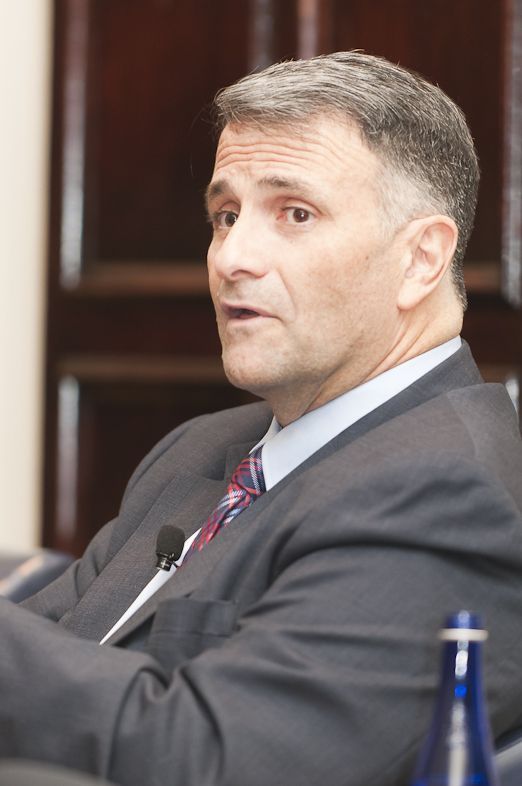 The spreadsheet listing these transactions was seized by the FBI as part of a 2020 investigation into a fraudulent cryptocurrency promoted by infamous Washington lobbyist Jack Abramoff (shown in a photo by Noel St. John). It offers a glimpse into how money circulates in conservative media, where it’s not that unusual for celebrity commentators to suddenly champion causes they haven’t seemed interested in before, creating suspicion that they’re on the dole.
In July 2017 Abramoff and his business partner Marcus Andrade began raising money to launch a cryptocurrency called “AML BitCoin,” which, ironically, stood for “Anti-Money Laundering.” To drum up investor interest, the duo effectively purchased free positive press by making undisclosed payments to journalists in conservative and financial media. Many of the payments were organized by Brian Darling, a former staffer for Sen. Rand Paul who now works as a lobbyist at a firm he founded called Liberty Government Affairs.
To keep track of the money, Darling created a spreadsheet that listed the names of writers, the payoffs they received, and the articles that resulted from those payoffs.
In June 2020, Andrade and Abramoff were indicted by the Department of Justice for making “false and misleading statements to potential purchasers” of their AML cryptocurrency. Darling’s spreadsheet was introduced as evidence in Andrade’s criminal trial. It was made public in a court filing last July, but hasn’t been reported on until now.
In all, Darling spent $12,800 through his lobbying shop to buy positive press for the coin, according to the spreadsheet. Among the recipients were financial publications like Forbes and TheStreet and conservative outlets like RedState and the American Spectator.
But among those publications that received the cash, the Daily Caller stood out. That’s because
back in 2020, a separate but related SEC lawsuit emerged suggesting that Daily Caller managing editor Derek Hunter had written one of those paid-for articles. The piece, which has since been removed from the publication’s website, breathlessly reported that the NFL and NBC had rejected a Super Bowl ad from AML Bitcoin because it was “too political.”
Hunter “categorically denie[d]” taking any money himself, but resigned from the publication anyway, saying he had been duped into writing the article by a tipster with an undisclosed financial interest.
In his testimony at the trial, however, Darling specifically said Hunter was on the take.
“Did you pay a writer by the name of Derek Hunter to write an article called ‘NFL Rejects Super Bowl Ad Because it Mocks Kim Jong-Un?’” a prosecutor asked Darling.
“Yes,” Darling said.
“Was that published in the Daily Caller?” the prosecutor asked.
“Yes,” Darling said.
In total, according to the spreadsheet, Hunter received $1,000 in 2017 and 2018 for two articles promoting the coin: one about the Super Bowl ad, the other about AML Bitcoin’s chances with regulators.
Hunter is now a columnist at Townhall, an afternoon host at conservative Washington talk-radio station WMAL, and a reasonably prominent conservative commentator on X with more than 60,000 followers. He didn’t respond to requests for comment. Neither did Darling, or any other writer mentioned in the spreadsheet.
At Andrade’s trial, Darling said he purchased the articles by working “with writers that I had a relationship with to get op-eds published.” In his testimony, Darling specifically mentioned the Daily Caller and Townhall as places where he had paid writers for stories. According to the spreadsheet, it was commentator Steve Sherman who received $500 for a Townhall article about the cryptocurrency, plus a total of $800 for another two articles, one at Townhall and another at a blog called the Daily Surge.
Among others who got money to write about AML Bitcoin’s supposedly rejected Super Bowl ad were RedState blogger Seton Motley ($1,500) and Newsmax’s Dan Perkins ($250).
The biggest payments, according to the spreadsheet, went to financial commentator Chris Versace. He received $1,000 to publish a now-deleted article in Forbes praising the cryptocurrency as a potential rival to the original Bitcoin, as well as a whopping $5,000 for an article for TheStreet that declared AML Bitcoin “could totally change the game,” according to Darling’s records. That article also appears to have been deleted.
Abramoff, who cooperated with prosecutors and received three years of probation in the case, also testified at Andrade’s trial about making payments to conservative writers.
The payouts for the articles were a key part of the government’s case against Andrade for inflating the perceived importance and value of the coin.
“Brian Darling kept a Rolodex of so-called journalists who would take payments in exchange
for content ghostwritten by AML Bitcoin and approved by Marcus Andrade, and then published those articles online without any disclosure anywhere that those articles that appeared to be real journalism were, in fact, ghostwritten and paid advertisements,” a prosecutor said in the government’s closing arguments at Andrade’s trial.
According to case files, not all payments for positive coverage for AML Bitcoin came from Darling’s firm. At Andrade’s trial, Jack Abramoff testified that he paid a contributing editor for U.S. News & World Report with money routed through a company owned by Abramoff’s son. The editor, Peter Roff, is a longtime Abramoff associate. And in another major breach of journalistic ethics, Roff shared a draft of his column praising “AML Bitcoin” with Abramoff and Andrade prior to its publication
“We had to pay Peter Roff and he did not want to get paid directly from AML Bitcoin and so we would pay him out of the other company and be reimbursed by Mr. Andrade,” Abramoff testified at the trial.
Roff is currently listed as a contributing editor at Newsweek who last wrote for the website in January. He did not respond to a request for comment.
WHILE DARLING’S SPREADSHEET provides a record of payoffs made back in the first Trump administration, the plague of payola in conservative media has arguably only grown during the second. The MAGA internet is roiled every few months when a new, previously undisclosed campaign to pay conservative influencers to promote or oppose issues comes to the surface.
The repeat occurrences have trained audiences and social media users to take note when figures like Laura Loomer and Elijah Schaffer become seemingly obsessed with niche issues using specialized language to describe things like the “supplies of diluent needed to process Venezuela’s tar-like crude.” But sometimes it takes reporting to suss out the scheme, as when right-wing media figures like Tim Pool, Benny Johnson, and Dave Rubin were exposed for having received millions of dollars each from Tenet Media, an upstart YouTube channel that secretly received illegal funding from the Russian government.
The consequences go beyond schadenfreude. The campaign to buy glowing press about AML Bitcoin duped real people out of real money. At Andrade’s trial, two men who invested more than $100,000 each in the coin testified that they would have reconsidered buying the coin if they knew the journalists writing the articles they read about were receiving payments to promote it.
Maybe the most interesting thing, then, is how cheap some conservative commentators were, selling out their audiences to Jack Abramoff for just a few hundred bucks.
New York Times, Reality TV Confronts a Harsh TV Reality, John Koblin, March 24, 2026. The number of unscripted series has plummeted by a third since 2022. As the industry rapidly changes, an era is quietly vanishing.
All TV shows have an expiration date, of course. But these days, reality TV is running into the harsh realities of the fast-changing TV business.
The annual number of unscripted and reality series with season premieres in the United States has plummeted by a third since 2022, according to Luminate, a research group. It fell 15 percent just last year, to 794.
The entertainment industry has spent a lot of time reflecting on the sharp decline in scripted shows. The changes to reality television are just as stark as an era of unscripted television quietly vanishes, but have received much less attention.
The declines have hit every subgenre, from cooking, design and home shows to travel and crime, according to Luminate.
In interviews, executives attributed the steep drop-off in total series to three issues: the rapid decline of cable, the continued momentum of YouTube and other digital outlets, and the industry’s nearly endless consolidation.
“There are so many things converging to squeeze the money for all practitioners,” said Paul Telegdy, a former chairman of entertainment at NBC and a longtime unscripted-TV executive.
The decline in cable ratings and revenue over the past few years has been the most significant culprit. Even though reality series cost less to produce than scripted shows, vast budget reductions at all the cable networks have curtailed ambitions.
In 2019, HGTV, the home of “Fixer Upper” and “Property Brothers,” had as many as 78 original unscripted series. That number fell to 35 last year, according to Luminate. Food Network used to make about 70 reality shows a year. That figure has been halved.
March 23
Top Headlines
Commentary: Adventures in Fantasy Diplomacy -- Another day in America’s self-immolation as a Great Power, Paul Krugman, right,March 23, 2026. Trump says he's negotiating with Iran. Iran says he isn't. Who are you gonna believe?The Contrarian, Opinion: Trump’s Disastrous War Comes Home to Roost, Jennifer Rubin, right, March 23, 2026. Three big risks threaten that things will only get worse.News Roundup
March 23, 2026. Trump Rejects Deal to Fund TSA, Supreme Court Signals Mail-In Ballot Crackdown.Trump Watch
March 23, 2026. President Donald J. Trump‘s behavior is increasingly erratic as he lashes out at those he perceives to be enemies.March 23, 2026. Choke points are everywhere you look.More On Iran War
March 23, 2026. Early this morning, with about twelve hours left in his 48-hour ultimatum threatening Iran’s civilian power plants, President Trump announced a pause in his deadline. The other, disastrous path would have been escalation. Trump seemed to be heading down that road Saturday afternoon, when he threatened to bomb Iran’s civilian power plants.Trump, Russia, Election Rigging and Robert Mueller

Former FBI Director James Comey and 2016 Democratic Presidential Nominee Hillary Clinton (File Photos)
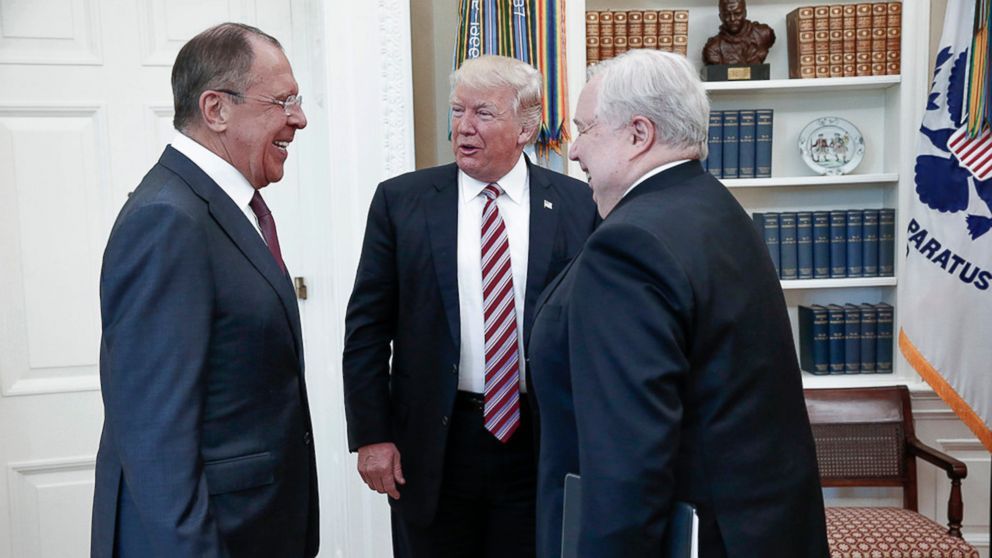
In May 2017, President Trump hosted top Russian diplomats Sergei Lavrov, left, and Sergei Kislyak at the White House in a private session from which Western media were barred but Russian media attended and spun as a diplomatic triumph for Russia over its American critics who had alleged that Russia had been helping Trump win the 2016 presidential election over rival Hillary Clinton(Tass photo).

Robert S. Mueller III in 2019, while serving as special counsel investigating Russia’s attack on the 2016 presidential election (New York Times photo by Doug Mills).
March 23, 2026. I wanted to throw out a few thoughts about Robert Mueller’s passing. Regarding the Mueller investigation that has been the focus of most commentary on his death, the most salient fact of the investigation is that five top Trump aides were found guilty of lying about Trump’s real ties to Russia during the 2016 investigation.More On U.S. Governance, Elections, Politics
March 23, 2026. Today, Americans are facing dramatically increased health care costs, with millions losing coverage and one in three cutting back on daily living expenses to cover medical bills.More On Energy, Aviation
Epstein Files, Trump Team Coverup, Cosby Scandal

More Global News
 New York Times, A Choice of Deadly Drones Is Only a Few Clicks Away for Ukrainian Troops, Maria Varenikova, March 23, 2026. Ukraine has created online marketplaces to let units select their own drones, a break from generations of standardized and centralized weapons procurement.
U.S. Education, Culture, Religion, Sports, Media
Top Stories
New York Times, Iran War Live Updates: Trump Says U.S. and Iran Held ‘Very Good’ Talks on Ending Conflict, Aaron Boxerman, Julian Barnes, Isabel Kershner and Ravi Mattu, March 23, 2026. President Trump said he would postpone a deadline for striking Iran’s energy infrastructure after “productive” talks to resolve hostilities. Iranian state media said he was “backing down” after threats of retaliation.
President Trump said Monday that the United States and Iran were negotiating a “total resolution of our hostilities in the Middle East,” and that he would postpone American attacks on Iranian power plants by five days after the two countries traded threats over the weekend.
Iran did not immediately comment. It was unclear what kind of communication might be taking place and who might be mediating; Iran has previously denied seeking a cease-fire. Mr. Trump had threatened on Saturday to bomb Iran’s energy infrastructure within 48 hours unless Iran agreed to open the Strait of Hormuz in the Persian Gulf, a critical shipping route for the global oil trade.
Mr. Trump did not elaborate on the details of the talks, but analysts have said it is difficult to see a straightforward offramp for the American-Israeli air war with Iran, which began on Feb 28. and has morphed into a wider conflict in the Middle East. Despite Mr. Trump’s calls for the ouster of the Islamic Republic and his vow to help Iranian protesters overthrow their leaders earlier this year, the Iranian government is still very much in place, as is much of its nuclear program.
More than 2,000 people have been killed so far since the U.S.-Israeli attack on Iran that ignited the conflict more than three weeks ago, most of them in Iran and Lebanon, where Israel has fought a second front with Hezbollah, the Iran-backed militant group.
The conflict’s global fallout has seen the price of oil and gas shoot up by over 50 percent since late February — although Mr. Trump’s announcement that talks were in the offing immediately brought them down by about 10 percent. That is because Iran has largely blocked most Western and Arab oil vessels from transiting the Strait of Hormuz, through which one-fifth of the world’s oil normally crosses.
Fatih Birol, the head of the International Energy Agency, warned Monday that the conflict-driven energy crisis was now worse than the oil shocks in 1973 and 1979 combined.
Mr. Trump threatened Saturday to strike Iranian power plants if the strait was not fully reopened by Monday night Eastern time. Iran dismissed the ultimatum and threatened to retaliate against energy facilities in countries hosting American troops and desalination plants that are a lifeline for much of the region.
U.S. officials have sought to allay concerns that the war was spiraling out of control. Adm. Brad. Cooper, who runs the military’s Central Command, said in a televised interview on Monday that the U.S. was “largely ahead of or on plan for our main military objectives” for the conflict.
Mr. Trump, at times, has suggested that the war might end soon, although his statements have frequently been contradictory. Israeli officials have consistently told the public to expect a protracted conflict that could last weeks.
Israeli and American airstrikes hit Iran overnight on Monday, as Iran fired volleys of ballistic missiles and drones at Israel and across the Persian Gulf. In Tehran, the Iranian capital, residents reported blackouts across the city amid heavy airstrikes. The outages came shortly after Israel announced it would target infrastructure in Iran.
Here’s what else to follow today:
Tasnim, the semiofficial Iranian news agency, cited an anonymous senior security offiicial as saying that President Trump backed off his threat to target Iranian infrastructure “after Iran’s military threats became credible.”
The report added that the official contradicted Trump’s claim that the countries had hheld “productive conversations” to end the conflict.
“From the beginning of the war until today, messages have been sent to Tehran by some mediators, and the clear response has been that we will continue our defense until the necessary level of deterrence is achieved,” the official said. “There have been no negotiations and there are none underway.”
Paul Krugman via YouTub, Commentary: Adventures in Fantasy Diplomacy -- Another day in America’s self-immolation as a Great Power, Paul Krugman, right, March 23, 2026. Trump says he's negotiating with Iran. Iran says he isn't. Who are you gonna believe?
It’s Monday morning. Donald Trump has, at least for the time being, called off plans to bomb Iran’s civilian infrastructure. He has done so because, according to him, highly productive negotiations are underway involving the government of Iran, an invisible six-foot white rabbit, and his Canadian girlfriend.
Hi, I’m Paul Krugman. What I just said is not strictly true, or it’s not all true. Trump did not say anything about the invisible rabbit or the Canadian, but the gist of it is true. He said that there’s highly productive talks underway. And shortly afterwards, the Iranian government and Iranian state media said, no, they aren’t. This is not happening.
I’m not going to say that Iranian state media is necessarily a credible source, but the odds are that they are in fact telling the truth and the President of the United States is either lying or fantasizing or both. There’s really no reason at all to believe that anything like what he said is happening is in fact happening.
Why do I say that, Aside from the fact that Trump has not exactly been truthful on a lot of things? But beyond that, there are three important reasons to believe he might be making this stuff up.
First, he put himself in a very bad spot with his threat to commit a massive war crime if Iran doesn’t open the Strait of Hormuz. and must be looking for a way out. Another president at another time might say that on careful consideration, We have recalibrated the policy or something like that. Trump doesn’t do that. Trump is always winning, never admits that he’s had a setback, never admits that he’s changed his mind.
So saying that, oh, the Iranians have come to the table, probably big, strong Iranians with tears in their eyes, but anyway, that the Iranians have come to the table and that’s why we’re not doing what I said we would do is a very Trumpian out.
Second, Why would the Iranians be making a deal at this point? We can talk a lot about how the war is going, but it’s pretty clear that as the Iranians are likely to see it, they’re winning. I mean, they’re not winning militarily, but that was never on the cards. They are, they have successfully turned what was supposed to be a lightning decapitation of their government into a protracted contest in relative ability to bear pain and all indications are that the Iranians are nowhere near cracking and all indications are that the United States, although obviously we’re not losing thousands of people, and we are having our whole life disrupted, but the American public really doesn’t like higher gas prices, does not believe Trump. The clock is ticking for Trump on this in a way that it is apparently not for the Iranian regime. So Iran has has the upper hand here. And very hard to see why they would be wanting to make a deal until they basically humiliated us substantially more.
Finally, consider possible motives. Imagine that you were somebody close to Trump, somebody close enough to actually have an influence on his decisions as well as inside knowledge. Here’s what you could have done really just between last night and now. You could have sold a bunch of crude oil futures, at very high prices, Brent was over $112 over the weekend, then bought them back immediately after Trump’s announcement of triumphal progress, but before the Iranians said that is not happening. And you could have turned a very, very nice, very large profit.
To say that insider trading might be driving U.S. policy would have been outrageous. in the past. Who thinks that that’s beyond the realm of possibility now? So all of this could be happening.
Last point to make here. Think about how much America’s position in the world has been weakened, not just by apparent failure to subdue a fourth-rate power, but by the fact that everybody now knows that you cannot trust anything, cannot trust any promises the United States makes, you cannot count on the United States carrying through with promises, with threats, not just promises, but threats are also incredible in the sense of not being all credible, and that the default assumption should be that anything that this administration says is a lie.
That is a really, really bad thing. That is, you know, influence in the world power is not simply a matter of missiles and bombs, although we seem to be running low on those too. It’s very much a matter of people taking what you say and what you promise and what you threaten seriously. And we are not ruled by serious people.
The Contrarian, Opinion: Trump’s Disastrous War Comes Home to Roost, Jennifer Rubin, right, March 23, 2026. Three big risks threaten that things will only get worse.
As unpopular as Donald Trump’s ill-conceived, incompetently managed war was when it began, it is now more unpopular with a key segment of voters. “Trump’s net approval of -20 for handling the situation in Iran represents a drop from last week’s poll. Then, 39% of Americans approved of how Trump was handling Iran and 52% disapproved — a net approval of -13,” The Economist/YouGov reported last week. While Democrats and Republicans have not changed their minds about the war much, “opinion among Independents of how Trump’s handling Iran fell to 24% approve / 63% disapprove (-39 net) this week from 30% approve / 53% disapprove last week (-23 net).”
The longer the war drags on, and the higher gas prices go, the worse those poll numbers will look for Trump and his pusillanimous enablers in Congress. In every war since WWII, as NPR’s Domenico Montanaro recently recounted, approval of the conflict has decreased dramatically over time. George W. Bush lost 71 points in his approval by 2007 (from his high in the aftermath of 9/11). LBJ’s debacle in Vietnam (which the open-ended Iran quagmire has begun to resemble) cost him 43 points and another run for re-election. In Trump’s case, further decline in support may be even more acute for a war that the public never favored.
Several factors increase the likelihood that Trump’s support will crater.
First and foremost, a decomposing president, plainly out of his depth, is on display as the public increasingly grasps that this debacle was predictable and entirely avoidable. While Trump claims not to have known (“no one expected”!) Iran would close the Strait of Hormuz or attack Gulf allies, news reports and lawmakers briefed by high-ranking career military say this is simply untrue. (He was even briefed on this in his first term.)
Sen. Chris Coons (D-DE), right, explained the depth of Trump’s blunder in this exchange with me about Trump’s decision-making:
 I will not guess what went through that man’s mind. But I’ll say this: senior military and intelligence planners have for decades predicted that whenever Iran felt they really had their back to the wall and it was existential that they closed the Strait of Hormuz, they would strike regional allies of the United States, and they would use some of their many tools — ballistic missiles, drones, cyber-attacks, and a global network of distributed terror cells. We’re seeing all of that come true now. And whether Trump ignored them, didn’t believe them, or just wasn’t focused, I think his national security advisor and secretary of state, Marco Rubio, certainly was well aware of these challenges. The chairman of the Joint Chiefs certainly was well aware of the challenges. … But it was willful blindness to historical analysis.
Voters’ anger may well rise as they learn more about Trump’s stupidity and Republicans’ refusal to challenge him.
Second, even if Trump wants to, it will become obvious that he has lost control of the timeline and the ballooning cost of the war. Iran learned the lesson of Ukraine (and Vietnam, Iraq, and Afghanistan—not to mention decades of regional battles) about asymmetric warfare. Experts suspect Iran has an almost limitless reserve of cheap drones (not to mention stored up missiles) that can continue to strike our military facilities, the Strait of Hormuz, and the Gulf states’ oil facilities. The Economist explained, “time is on Iran’s side,” because “America and Israel will gradually run out of useful targets to strike from the air, or run low on interceptor batteries to see off Iranian weapons” while Iran has plenty of drones and missiles (and continues to produce more).
One day, Trump declares he is considering “winding down” the war. The next, Trump is threatening to blow up all Iranian power plants if it does not open the Strait of Hormuz in 48 hours. With each breathless, erratic pronouncement, he advertises his own panic and confusion.
As if to underscore the magnitude of his blunder, Trump apparently will seek a stunning $200B in more funding, a stupefying amount suggesting the war could go on for months. Unsurprisingly, Republicans are petrified to take sole responsibility for the war. Few, if any, Democrats will vote for it (leaving the Senate well short of 60 votes); if Republicans use the reconciliation process, they may not even have a majority of Republicans. Moreover, they would have to find a way to “pay” for the massive expenditure within the 10-year budget window.
This funding dilemma of their own making (made inevitable when they voted down a War Powers Act resolution giving Trump a green light for open-ended war) reinforces voters’ perception that Trump and MAGA are focused on the wrong things. Republicans splurge on wars and tax cuts for the rich, while scrimping on items critical for average Americans, such as healthcare coverage. Voters, regardless of party, understand that MAGA control of government is ratcheting up their pain; meanwhile, the rich get richer while Trump’s grift machine rakes in billions.
Third, unlike the Iraq War (when George W. Bush urged Americans to go to the mall to shop) or Trump’s first attack on Iran, virtually every American already has felt — or will soon feel — the war’s impact. The price of oil won’t come down anytime soon. “Increasing attacks on energy infrastructure in the Persian Gulf could significantly hurt the already strained global supply of oil and natural gas, pushing fuel prices much higher,” the New York Times reported last week. “The escalating attacks will make it much harder for energy producers in the Gulf to repair and restart their oil and gas operations when the war ultimately ends.”
Also, the war will continue to drag down economic growth. The World Trade Organization downgraded global trade growth to 1.9 percent in 2026, and it may dip further due to rising costs of energy, food, and service, “due to travel and transport disruptions.” With job creation essentially at zero, the prospect of stagflation looms large. As Paul Krugman remarked:
“There’s definitely a whiff of stagflation in the air — a whiff that is entirely caused by Trump administration policies.”
Specifically in red America, the war’s significant impact on fertilizer supplies will hit the already weak farm economy. Coming on top of more frequent extreme weather events, soaring healthcare insurance costs, and rural hospital closures, rural America may face a disproportionate amount of pain.
In sum, the war is a human, geopolitical, and economic disaster, but it may also be a political calamity for Trump and his MAGA stooges. Thanks to Trump’s vivid blunders, the price and duration of a war he insists has been won, and the financial gut punch to Americans (already staggering in Trump’s economy), MAGA may be in for an historic shellacking at the polls. Trump can lie and blame others all he likes, but voters will have their say in November.
Morning Shots via The Bulwark, Political Opinion: Better to TACO Than Not to Taco, Bill Kristol, Andrew Egger and Jim Swift, March 23, 2026. Trump chickened out again . . . for now.
ICE agents are heading to airports today, with President Trump deploying them in an apparent effort to reinforce TSA agents working without pay due to the government shutdown. Trump seems dead-set on keeping those agents working without pay rather than agreeing to Democrats’ demands that he put new civil-liberties checks on ICE—obliging them to wear badges and uniforms and ditch the masks and broad enforcement sweeps.
We can’t imagine how putting untrained ICE agents in a series of stressful encounters with on-edge air travelers could backfire for Trump at all. Happy Monday.
New York Times, Pentagon Officials Weigh Deployment of Airborne Troops for Iran War, Greg Jaffe and Eric Schmitt, March 23, 2026. The combat forces would come from a brigade of about 3,000 soldiers capable of deploying anywhere in the world within 18 hours.
Senior military officials are weighing a possible deployment of a combat brigade from the Army’s 82nd Airborne Division and some elements of the division’s headquarters staff to support U.S. military operations in Iran, defense officials said.
The officials described the military’s actions as prudent planning, noting that nothing had been ordered by the Pentagon or U.S. Central Command, which declined to comment.
The combat forces would come from the 82nd Airborne’s “Immediate Response Force,” a brigade of about 3,000 soldiers capable of deploying anywhere in the world within 18 hours. These forces could be used to seize Kharg Island, Iran’s main oil export hub.
Another possibility being considered, should President Trump authorize U.S. troops to seize the island, is an attack by about 2,500 troops from the 31st Marine Expeditionary Unit, which is on its way to the region.
The airfield on Kharg Island was damaged by the recent U.S. bombing raids so former U.S. commanders said it was more likely to first bring in Marines, whose combat engineers could quickly repair airfields and other airport infrastructure. Once the airfield is repaired, the Air Force could start flowing matériel and supplies, as well as troops, if necessary, by C-130s.
In that scenario, it is possible that the troops from the 82nd Airborne would augment the Marines. The upside of going with paratroopers is they can arrive overnight. The downside is they do not bring any heavy equipment, such as heavily armored vehicles, that would offer protection if Iranian forces counterattacked, current and former officials said.
The Marines lack the sustainment and staying power of the forces from the 82nd Airborne, which could be used to relieve the Marine forces after the initial attack on the island, current and former officials said.
The headquarters element from the 82nd Airborne would be used as a subordinate headquarters for mission planning and coordination in what is becoming an increasingly complex battle space. In early March, the Army abruptly canceled the 300-member headquarters’s participation in an exercise at the Joint Readiness Training Center in Fort Polk, La.
Army officials said they made the decision to keep the division’s command element at Fort Bragg, N.C., just in case the Pentagon ordered the ready brigade to the Middle East. The command did not want to have its headquarters caught out of place if the balloon went up for them. The cancellation was reported earlier by The Washington Post.Editors’ PicksChoose Your Netflix Mystery: Agatha Christie or Jo NesboThe Motley Crew Who Saved America’s Birds7 Ways to the Best Salmon of Your Life
The 82nd Airborne Division’s Immediate Response Force, or ready brigade, has deployed on short notice several times in recent years, including to the Middle East in January 2020 after the Baghdad Embassy was attacked, to Afghanistan in August 2021 for evacuations and to Eastern Europe in 2022 to support operations in Ukraine.
News Roundup
The Parnas Perspective, News and Commentary: ICE Agents PANIC and RUN From Photographers at Airports as They are UNMASKED, Aaron Parnas, right, March 23, 2026. Trump Rejects Deal to Fund TSA, Supreme Court Signals Mail-In Ballot Crackdown.
ICE agents have now been deployed to fourteen airports across the country, and reports indicate they are actively trying to avoid being photographed or recorded. At the same time, Trump has rejected a deal that would fund FEMA, the Coast Guard, and TSA, and is instead demanding the Senate pass the SAVE Act as a condition to fund TSA. Meanwhile, the Supreme Court appears poised to back limits on mail-in ballots that arrive after Election Day, a move that could significantly reshape voting rules nationwide.
I’m working nonstop to bring you clear, fact-based updates and to grow this community as a reliable source of news at a time when media literacy gaps are real and growing. If you’re able, please consider subscribing to support this work.Subscribed
Here’s the news:
According to NBC News, a proposed deal to reopen key parts of the Department of Homeland Security—while leaving ICE funded separately—was discussed as a way to ease airport chaos and long TSA lines, but was rejected by Trump. The standoff has stretched on for over a month, with hundreds of TSA agents quitting and major travel disruptions continuing nationwide. The fight underscores a broader political battle over immigration enforcement, with both parties digging in as the shutdown drags on.
Trump says he plans to tie Homeland Security to voter ID requirements, calling for photo identification and proof of citizenship to vote, while urging lawmakers to stay in D.C. over Easter to pass it, framing it as “one for Jesus.”
Iran is threatening to fully shut down the Strait of Hormuz and strike regional infrastructure if the U.S. follows through on plans to attack its power plants, escalating the already volatile conflict. The standoff has pushed the war into a dangerous new phase, with global oil flows disrupted and critical infrastructure on both sides now in the crosshairs. As casualties rise and tensions spike, the risk of wider regional and economic fallout continues to grow.
Iran’s parliament speaker pushed back on claims of U.S. talks, insisting no negotiations have taken place and accusing Trump of spreading “fake news” to manipulate financial and oil markets.
 Israel’s finance minister said the country should push its border with Lebanon up to the Litani River, as Israeli forces bomb bridges and destroy homes in southern Lebanon during an escalating offensive. According to Reuters, the remarks mark the clearest signal yet from a senior official of potential territorial ambitions amid the fight against Hezbollah.
Politico is reporting that as the U.S.-Iran war disrupts global energy markets, oil executives and foreign officials are pressing the White House for a clear timeline, warning that uncertainty is fueling chaos. The near-closure of the Strait of Hormuz has sent oil prices soaring, triggered fuel shortages abroad, and raised fears of wider economic fallout. With markets rattled and allies uneasy, the central question dominating high-level talks is simple: “When will it end?”
A top FEMA official has claimed in past podcast appearances that he was “teleported” miles away—including to a Waffle House—remarks that resurfaced in a CNN report examining his background. The official, now in a senior disaster response role, has also promoted other fringe theories, drawing scrutiny over his appointment. Federal officials dismissed the comments as taken out of context, but the revelations have raised concerns about credibility inside a key emergency agency.
Trump claimed the U.S. is “the only country” with mail-in voting and called it “mail-in cheating,” but that’s false—many countries, including Canada, the U.K., Australia, Germany, and Switzerland, all allow some form of voting by mail.
Secretary of State Marco Rubio is set to testify in a criminal trial involving his former roommate, ex-Rep. David Rivera, who is accused of secretly lobbying for Venezuela’s government. Prosecutors allege Rivera took millions to push Maduro’s interests in Washington, using political connections to try to influence U.S. policy. The case is highly unusual, marking one of the rare times a sitting Cabinet official takes the stand in a criminal trial.
Lawmakers from both parties introduced a bill to crack down on prediction markets like Polymarket and Kalshi, aiming to ban sports and casino-style betting disguised as financial contracts. The move comes as these platforms explode in popularity and face growing scrutiny over gambling risks, insider trading concerns, and regulatory loopholes. The proposal would bring the fast-growing industry under tighter control by closing what critics call a “backdoor” into unregulated betting.
Many are now alleging that Trump is manipulating markets by issuing major threats (such as war or tariffs) late on Fridays and then backing down early on Mondays, implying a deliberate pattern designed to influence financial markets.
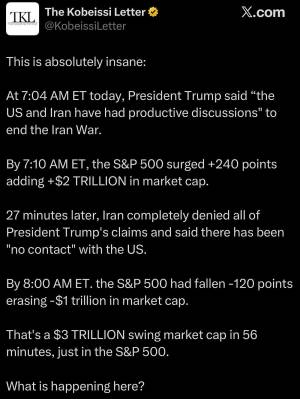
Here is a graph to demonstrate the possible market manipulation by the President of the United States:
Meanwhile, Israel announced it carried out a large-scale or “extensive” wave of airstrikes targeting infrastructure in Iran’s capital, Tehran, with reports of explosions across the city, marking a significant escalation in the ongoing conflict.
Trump said the situation in Iran amounts to “regime change,” saying it would bring in “totally different people”
Israeli strikes on Tehran’s oil facilities ignited fires that burned for days, releasing thick smoke and toxic pollutants across the city. Residents reported symptoms such as headaches, breathing difficulties, and skin and eye irritation, while “black rain” contaminated surfaces and water. Experts warn the pollution could have serious long-term health effects, including cardiovascular disease and cancer risks. The environmental damage has also raised concerns about contamination of air, soil, and food supplies affecting millions of people. This is an image of someone in Iran cleaning off the black rain from his car obtained by The Guardian:
Reports claim some Iranians are mocking Trump by placing images of him “begging” to reopen the Strait of Hormuz on missiles
According to Reuters, an Air Canada Express regional jet collided with a fire truck while landing at New York’s LaGuardia Airport, killing both pilots and injuring 41 people (with several seriously hurt), leading to the airport’s temporary closure; the crash, involving a plane carrying 76 people, is under investigation with early indications pointing to possible communication issues after both the aircraft and the fire truck had been cleared to use the runway.
New York Governor Kathy Hochul called the LaGuardia plane crash “heartbreaking,” confirmed that two pilots were killed and dozens injured, and expressed condolences to the victims and their families while pledging to provide updates as more information becomes available.
Newark Liberty International Airport temporarily halted all arrivals and departures after smoke was detected in the air traffic control tower, forcing an evacuation and adding to travel disruptions in the New York area just hours after a fatal plane crash at LaGuardia shut down that airport.
ICE agents are being deployed to TSA checkpoints at 13 major U.S. airports, where they may take on roles such as monitoring passenger lines or assisting with security bins, with plans varying by location and subject to change. Here are all 13 airports mentioned:
Trump said he supports ICE agents wearing masks during enforcement operations for safety, but prefers they not wear masks when assisting at airports during the TSA crisis.
James Comer expressed support for deploying ICE agents at airports, saying he is pleased with the decision and adding that it would provoke frustration among Democrats.
Counter-terrorism police in London are investigating an arson attack in which four ambulances belonging to a Jewish charity were set on fire near a synagogue, with the incident being treated as an antisemitic hate crime. Authorities are searching for suspects seen igniting the vehicles, and although no injuries were reported, explosions from oxygen tanks caused damage and displaced nearby residents. Political and community leaders strongly condemned the attack, calling it shocking and hateful, while police continue to assess claims of responsibility and pursue leads.
According to Reuters, Hungary’s Prime Minister Viktor Orbán ordered an investigation into alleged wiretapping of Foreign Minister Péter Szijjártó’s phone amid accusations that he may have leaked confidential EU discussions to Russia. Orbán described the situation as involving serious security concerns, while reports suggest Szijjártó’s phone numbers may have been shared with a foreign state entity. The controversy comes as Hungary maintains closer ties with Moscow than other EU countries and continues to block key EU measures supporting Ukraine and sanctioning Russia.
The U.S. Supreme Court is hearing a case over a Mississippi law that allows mail-in ballots to be counted if received up to five days after Election Day, with Republicans (backed by Trump) seeking stricter limits that could impact voting rules nationwide, while lower courts have already ruled against the law and the outcome could affect similar policies in many states.
The Guardian has confirmed that NHL reporter Jessi Pierce and her three children were killed in a house fire in Minnesota, with firefighters finding them deceased inside the home after responding to reports of flames. Pierce, who had covered the Minnesota Wild for a decade, was remembered by colleagues and the team as passionate and deeply devoted to her family and work. The cause of the fire remains under investigation.
Good news:
A long-term 43-year study involving over 130,000 participants found that drinking caffeinated coffee was associated with an 18% lower risk of developing dementia, along with better cognitive performance and fewer signs of decline. The strongest benefits were seen in people who consumed moderate amounts, such as 2 to 3 cups per day. Similar effects were observed with tea, while decaffeinated coffee did not show the same benefits, suggesting caffeine may play a key role. Researchers note the findings are associative but consistent with other evidence linking coffee to improved brain health.
Kayden Beasley, a 19-year-old born without legs and adopted from a Chinese orphanage, helped lead Team USA to a gold medal in sled hockey at the 2026 Paralympics. After discovering the sport as a teenager, he quickly rose through the ranks, becoming a key contributor on the national team. At the Paralympics, he scored multiple goals and played in every game, helping secure the championship. His journey from difficult beginnings to international success has become an inspiring story of resilience and determination.
The Nashville Public Library has launched a free “Memory Lab” service where people can digitize old media like VHS tapes, photos, slides, and audio recordings to preserve them and make them easier to access and share. The service, available by appointment, helps prevent the loss of personal memories as outdated formats become harder to use. It also saves users significant costs compared to commercial digitization services. The program is part of a broader effort by libraries to preserve history and bridge the digital divide.
Trump Watch
 Letters from an American, Historical Commentary: March 9, 2026 [Enemies Lists], Heather Cox Richardson, right, March 23, 2026. President Donald J. Trump‘s behavior is increasingly erratic as he lashes out at those he perceives to be enemies.
On Thursday he defended his failure to inform allies and partners about his February 28 attack on Iran by telling a Japanese reporter he wanted the element of surprise. “Who knows better about surprise than Japan? Why didn’t you tell me about Pearl Harbor, OK?” Trump said, referring to the Japanese attack on Hawaii that took place on December 7, 1941, five years before Trump was born. Sitting beside Trump, the prime minister of Japan, Sanae Takaichi, appeared  taken aback. Japan is a key Pacific ally of the United States.
The president is under enormous pressure, as his war with Iran sparked Iranian officials to close the Strait of Hormuz, through which about 20% of the world’s oil flows. This outcome was expected by previous presidents, but Trump seemed to think he could avoid it and now is stuck without an easy solution. As former defense secretary and Central Intelligence Agency director Leon Panetta told David Smith of The Guardian, “[I]f there was an escape here for Trump, it would be to declare victory and it’s over and we’ve been able to be successful in all of our military targets. The problem is he can declare victory all he wants but, if he doesn’t get the ceasefire, he’s got nothing. And he’s not going to get a ceasefire as long as Iran is holding the gun of the strait of Hormuz against his head.”
 “He tends to be naive about how things can happen,” Panetta, right, told Smith. “If he says it and keeps saying it, there’s always a hope that what he says will come true. But that’s what kids do. It’s not what presidents do.”
In a frantic attempt to lower oil prices, the administration on Friday lifted sanctions on Iranian oil currently at sea. Iranian oil has been sanctioned since 1979. The lifting of sanctions will enable Iran to sell about 140 million barrels of oil, worth about $14 billion, including to the United States and to China.
National security scholar Phil Gordon, who served as the White House coordinator for the Middle East, North Africa, and the Persian Gulf Region during the Obama administration, posted: “When Obama sent Iran $400m + $1.3bn in interest in 2016 Trump called it ‘insane’ and he and others spent a decade mocking the idea of ‘pallets of cash’ even though it was Iran’s own money, American prisoners were released, courts were likely to require the U.S. payment, and Iran had just agreed to significant and verified reductions and restrictions on its nuclear program for 15+ years.
“Now Trump is giving Iran up to ten times that amount of revenue—one of the most significant measures of sanctions relief provided to the Islamic Republic since its founding—in exchange for marginal and temporary relief from the big increase in oil prices his actions have caused, without any concessions from Tehran, and even as Iran continues to target the United States, its allies, and world oil supplies. No way to read as anything other than desperate recognition of the situation Trump’s own actions have created and the lack of available alternatives for dealing with it.”
On Meet the Press today, Senator Chris Murphy (D-CT) said: “We’re gonna give Iran $14 billion to fund this war with the United States? We’re gonna give Russia billions of dollars to fund their war with Ukraine? We’re literally putting money into the pockets of the very nations that we are fighting right now. We’ve never seen this level of incompetence in war-making in this country’s history.”
Trump is also under pressure over the Department of Homeland Security (DHS), which has been mired in news stories about corruption since former secretary Kristi Noem stepped down. Yesterday morning, Trump appeared to try to change the momentum of those stories by going on the offensive against Democrats.
New scrutiny of the department has brought renewed attention to the November 2025 ProPublica report by Justin Elliott, Joshua Kaplan, and Alex Mierjeski that DHS had awarded a $220 million contract for a taxpayer-funded ad campaign to cronies, getting around transparency laws by awarding the contract to a small company that then subcontracted the deal to friends of Noem and her associate Corey Lewandowski. Of the contract, Trump allegedly said: “Corey made out on that one.”
On Thursday, March 19, Julia Ainsley, Matt Dixon, Jonathan Allen, and Laura Strickler of NBC News reported that Lewandowski told George Zoley, the head of the giant private prison company GEO Group, that he expected to be paid for steering contracts to GEO Group. Zoley said he declined initially but later offered to put Lewandowski on retainer with a consulting fee. But, sources told the journalists, Lewandowski “wanted payments—what some people would call a success fee” based on awarded contracts. When Zoley refused, GEO Group lost out on contracts. A senior DHS official told the journalists Lewandowski had told him not to award any more contracts to GEO Group.
Lewandowski’s official title was that of a “special government employee,” with a temporary appointment that permitted him to work only 130 days in a year, but DHS officials told the journalists that Lewandowski had broad authority over contracts in the department and was referred to as “chief.” He allegedly sidestepped the limits of his appointment by going into the building accompanying Noem, and thus without swiping in using his badge. Lewandowski has denied any wrongdoing.
Yesterday Hamed Aleaziz, Alexandra Berzon, Nicholas Nehamas, Zolan Kanno-Youngs, and Tyler Pager of the New York Times reported on the extraordinary power Lewandowski had in DHS under Noem, explaining that he held meetings without her present, sat in on classified briefings, read a version of the highly classified President’s Daily Brief, and issued orders as he spearheaded detention and deportation of migrants. In addition to approving government contracts that worried officials, Lewandowski helped put Greg Bovino, a midlevel Border Patrol leader, into a senior position that gave him national power.
At 11:34 yesterday morning, Trump tried to turn the DHS story into one about the Democrats, posting: “If the Radical Left Democrats don’t immediately sign an agreement to let our Country, in particular, our Airports, be FREE and SAFE again, I will move our brilliant and patriotic ICE Agents to the Airports where they will do Security like no one has ever seen before, including the immediate arrest of all Illegal Immigrants who have come into our Country, with heavy emphasis on those from Somalia, who have totally destroyed, with the approval of a corrupt Governor, Attorney General, and Congresswoman, Ilhan Omar, the once Great State of Minnesota. I look forward to seeing ICE in action at our Airports. MAKE AMERICA GREAT AGAIN! President DONALD J. TRUMP”
This appeared to be a threat to use Immigration and Customs Enforcement agents, whom Trump appears to see as his own private army, to hurt Democrats by pinning the long lines in airports on the Democrats’ refusal to fund DHS, which means that Transportation Security Administration (TSA) agents aren’t being paid. But Democrats have repeatedly proposed funding every agency in DHS other than ICE and Border Patrol, leaving those out until their abuses under Noem, Lewandowski, and Bovino have been addressed. Republicans have refused that funding unless DHS requests are funded in full at the same time.
Under Trump, ICE has become the highest-funded law enforcement agency in the U.S., with an annual budget higher than those of all other federal law enforcement agencies combined. While ICE budgets previously had hovered around $6 billion, the Republicans’ One Big Beautiful Bill Act gave DHS $85 billion to fund it through September 30, 2029. What is outstanding now is its base budget of around $10 billion. Because ICE agents are considered “essential” workers, they, unlike TSA agents, are getting paid during the funding fight.
Today the administration announced ICE agents will take the place of some TSA agents, although as the former national security officials at The Steady State note, the legality of moving ICE agents into TSA positions isn’t clear. Tonight Trump admitted he is not interested in any deal with the Democrats to fund the Department of Homeland Security unless Democrats also agree to the SAVE America Act, which would require proof of citizenship to register to vote and to vote, and which is widely understood to be a measure designed to suppress voting. Trump also includes in the measure an end to mail-in voting, and an attack on transgender Americans.
Then, at 1:26 yesterday afternoon, Trump responded to the death of 81-year-old special counsel Robert Mueller by posting: “Robert Mueller just died. Good, I’m glad he’s dead. He can no longer hurt innocent people! President DONALD J. TRUMP.”
As Josh Meyer of USA Today reported, Mueller was a lifelong public servant. He served in combat as a Marine Corps officer in the Vietnam War, during which he was wounded. “I consider myself exceptionally lucky to have made it out of Vietnam,” Mueller said years later. “There were many—many—who did not. And perhaps because I did survive Vietnam, I have always felt compelled to contribute.” He became a federal prosecutor covering organized crime, terrorism, and public corruption. A conservative Republican nominated by President George W. Bush to direct the Federal Bureau of Investigation (FBI), he took office just a week before 9/11 and proceeded to reshape the FBI’s mission from fighting crime to an emphasis on counterterrorism and intelligence.
In 2017, Deputy Attorney General Rod Rosenstein appointed Mueller special counsel for the Department of Justice to investigate Russian interference in the 2016 election. Mueller’s team filed charges against Trump’s former campaign chair Paul Manafort and co-chair Rick Gates for conspiracy to launder money, violating the Foreign Agents Registration Act, and conspiracy against the United States, and reached a plea agreement with Trump’s former national security advisor Michael Flynn, who pleaded guilty to lying to the FBI about his contacts with Russian operative and ambassador Sergey Kislyak. Mueller’s team also indicted thirteen Russians and three Russian companies involved in pushing Russian propaganda to American voters. Ultimately the team indicted thirty-four people, including six of Trump’s former advisors, five of whom pleaded guilty.
Mueller’s final report detailed the efforts of Russian operatives to help Trump and hurt Democratic candidate Hillary Clinton, saying Russia launched “multiple, systematic efforts” to interfere with the election. Mueller said he had not been able to consider Trump’s guilt because Justice Department policy prohibits the prosecution of a sitting president, but added: “If we had confidence that the president clearly did not commit a crime, we would have said that.” He refused to say his report “exonerated” Trump, as Trump’s supporters insisted.
A later report by the Republican-led Senate Intelligence Committee agreed that members of Trump’s 2016 campaign, led by Manafort, worked with Russian operatives to help Trump get elected.
Not only is Robert Mueller getting under Trump’s skin, so, clearly, is his own failure to reopen the Strait of Hormuz. At 7:44 last night, he posted: “If Iran doesn’t FULLY OPEN, WITHOUT THREAT, the Strait of Hormuz, within 48 HOURS from this exact point in time, the United States of America will hit and obliterate their various POWER PLANTS, STARTING WITH THE BIGGEST ONE FIRST! Thank you for your attention to this matter. President DONALD J. TRUMP.”
In a conversation with Anne McElvoy of Politico on Thursday, United Nations Secretary-General António Guterres noted that attacks on civilian energy infrastructure are war crimes.
Yesterday Julie K. Brown of The Epstein Files, whose work digging into the cover-up of the Epstein story for the Miami Herald has been instrumental in bringing the scandal to light, and her colleague Claire Healy reported that after sex offender Jeffrey Epstein was found dead in his prison cell on August 10, 2019, a corrections officer called the FBI’s Threat Operations Center saying the officer “found it suspicious that an after-action team charged with investigation would be shredding huge amounts of paperwork” while FBI agents were in the building.
An inmate who helped shred documents told guards: “They are shredding everything,” and an assistant federal prosecutor noted the destruction or misplacing of relevant records. Another corrections officer wrote to the FBI on August 19 about an unusual amount of shredding and disposal, and suggested: “you may want to investigate why [Bureau of Prisons] employees are destroying records.”
This morning, at 8:24, Trump posted: “Now with the death of Iran, the greatest enemy America has is the Radical Left, Highly Incompetent, Democrat Party! Thank you for your attention to this matter. President DJT”
Tonight, just before midnight, he posted: “PEACE THROUGH STRENGTH, TO PUT IT MILDLY!!!”
Paul Krugman via Substack, Political-Economy Commentary: When Hyperglobalization Meets Chaos, Paul Krugman, right, March 23, 2026. Choke points are everywhere you look.
Donald Trump and his minions are having a meltdown. On Saturday, Trump lashed out at the New York Times for an article saying the obvious — that many of his original war goals, whatever they may have been, remain unaccomplished. Just an hour later, he posted a threat to commit massive war crimes, saying that if Iran doesn’t open the Strait of Hormuz within 48 hours — that is, today — he will order U.S. forces to begin bombing civilian power plants.
Why the desperation? The answer is obvious. It’s turning out not just that regime change — if that was really the goal — is hard to engineer, but also that the world is a lot more dependent on the Strait of Hormuz than Trump and co. seem to have realized. And what is becoming increasingly clear is that this dependence extends well beyond oil and natural gas.
In addition to oil and gas, the Gulf region is a key global source of fertilizer. It produces about a third of the world’s helium — and helium isn’t just for party balloons, it’s key to production of semiconductors and has important medical uses. And — this I didn’t know — the Gulf is a choke point for pharmaceuticals, with many key ingredients normally shipped through Hormuz and many final products normally being flown to their destinations via Dubai and other Gulf airports.
So are we learning that the Persian Gulf is a uniquely crucial choke point for the world economy? I don’t think so. It’s certainly an important choke point. But it’s not unique. If the Hormuz crisis seems bad, think about the disruption to global supply chains if China were to attack Taiwan or if North Korea were to attack South Korea. Taiwan accounts for over 60% of the world supply of semiconductors and over 90% of the supply of the most advanced semiconductors. South Korea is a major exporter of memory chips. An ongoing imbroglio between the Dutch government and the Chinese chip company Nexperia, based in the Netherlands, has threatened to upend auto production around the world. India is a major exporter of key pharmaceuticals, including vaccines. Trump backed down on his Liberation Day tariffs imposed on China because it is by far the greatest source of rare earths and retaliated by cutting off the flow. And on and on.
These are not examples of globalization but of hyperglobalization, a term coined by Arvind Subramanian and Martin Kessler. In a classic 2013 paper — updated in 2023 — Subramanian and Kessler noted that world trade had grown much faster than world GDP between the 1980s and the eve of the 2008 financial crisis. In the 80s world trade wasn’t much bigger as a share of world GDP than it had been before World War I; by 2008 it was on a whole other level.
But as they documented, this rapid growth in world trade was not simply a matter of countries trading more, but of world production becoming much more complex and interdependent. For example, if you ask where, say, an iPhone is produced, there isn’t a simple answer. The phone is assembled in China or India, but the components inside the phone are produced in many countries, and these components themselves use inputs produced in many countries.
Over the past 40 years or so we’ve built a world in which national economies are so interdependent that there are potential choke points everywhere you look. Yet this global system of interdependence was reasonably workable as long as a key linchpin – the United States – supported it and made sure that goods, services and money kept flowing freely.
This is not to say that the system was perfect. It’s not clear that we should depend on imports for some vital goods, like vaccines or rare earths. But now we have the worst of both worlds. The world is now highly dependent upon a complex global supply chain and the erstwhile leader of the free world is erratic. Does anyone know what our Iran policy will be a week from now, or even tomorrow? Moreover, the Iran debacle has revealed us to be far weaker than most people realized – so weak that we are afraid to stop Iran from exporting oil even as we threaten to destroy its civilian infrastructure. The truth is, even our allies no longer trust or respect us.
So what we are facing now isn’t simply a matter of consumers losing the ability to purchase imports. Instead we are facing a scenario in which producers lose access to crucial inputs they need to keep producing. The crisis in the Strait of Hormuz is raising prices at the pump, which is bad. But it is also threatening to deprive American farmers of fertilizer during planting season, to cut off essential helium supplies to semiconductor producers in Asia, to deprive pharmaceutical producers of crucial materials, and more.
In short, terrifying as the Hormuz crisis is, I worry that it may be only the beginning. For a world economy that is riddled with multiple potential choke points can no longer rely on a strong, reliable and trustworthy America to act as a guarantor of the system. While things are bad now, they may very well get a lot worse.

Morning Shots via The Bulwark, Political Opinion: It’s a Mad, Mad Madman Theory, Andrew Egger, March 23, 2026. Donald Trump’s impulsiveness, his erratic tendencies, his chest-thumping macho posturing, his hyper-fixation on random secondary objectives, his questionable object permanence—all the traits that he’s put so thoroughly on display during the Iran conflict were evident during his first-term foreign policy, as well.
Back then, Republicans desperate to find a silver lining hatched a theory of Trump: Perhaps he was simply a madman diplomat in the school of Richard Nixon, deliberately cultivating a volatile, irrational image to wrongfoot our adversaries. Don’t cross him—he might just be crazy enough to do it!
There were always several problems with this. For one thing, it’s never been clear that the madman theory ends up working out well for anybody. But just as importantly, Trump—for all his lunatic swerves—has never actually been able to effectively hide his own motivations, which usually turn out to be childishly simple. All the tantrums in the world haven’t obscured the fact that he tends to be ludicrously easy to predict.
It is for this reason that Iran appears not to have taken Trump’s threats to target their domestic power generation very seriously. Taken on their merits, these threats were astonishing: a 48-hour deadline for Iran to surrender its primary point of geopolitical leverage, or suffer widespread strikes against civilian infrastructure. But while such strikes would have been catastrophic for Iran, they would have been terrible for America, too, sending the price of oil spiraling into the stratosphere for God knows how long and even further alienating our allies, who still take things like the laws of war seriously. Iran immediately called Trump’s bluff, pledging to close the strait indefinitely and to carry out further strikes on its neighbors’ gas and oil production should Trump target its energy infrastructure.
How thin did Trump’s bluff turn out to be? The president didn’t even wait until his 48-hour deadline was expiring to call it off. He blinked with twelve hours to spare—ensuring that the entire threat period took place while markets were closed over the weekend. Trump insisted this was because of “good and productive conversations” with Iran over the weekend; Iran, meanwhile, bluntly denied any conversations whatsoever had taken place.¹
All the madman posturing in the world can’t change this simple fact: Iran knows how badly Trump needs to get the oil-price situation under control.
Again and again, Trump has signaled he will let other foreign-policy objectives fall by the wayside to address this major domestic concern. It was just last week that the administration, reversing decades of U.S. foreign policy, announced it was lifting sanctions on Iranian oil. It said, right out loud, that it was willing to let Iran sell at a premium on an oil-starved market—that it would essentially bless Iran’s economic monopoly on travel through the Strait of Hormuz—rather than risk further spikes in oil prices. The idea that Trump would turn around days later and cripple Iran’s oil production by shutting off its energy system never passed the laugh test.
Madman theory never really works. But what we’ve got now is a president who gives us all of the obvious drawbacks and none of the purported benefits—who shakes the global economy around like a rag doll yet whose economic bluffs remain easy for our adversaries to predict.
Donald V. Watkins (longtime Alabama attorney and commentator): Opinion: When the coward who is sending these brave American soldiers into the US-Iran war zone had his chance to serve America in combat during the Vietnam war, he ran like a scalded dog -- five times! Every American soldier's death in this man's war is a personal sacrifice to a certified coward. Good luck soldiers, and may God be with you! Do the Trumps ever serve in the U.S. military? We know they are great at grifting. Do they ever give back to the country that has enriched them, or has MAGA exempted them from that obligation?
More On Iran War
New York Times, War’s Attacks on Energy Could Turn Economic Shock Into Long-Term Damage, Patricia Cohen, March 23, 2026. A new phase targeting oil and gas infrastructure in the Persian Gulf threatens to hurt businesses and customers around the world for months or even years. The game has changed.
From the moment the United States and Israel attacked Iran, the nightmare scenario for the global economy that most people talked about was the closing of the Strait of Hormuz, the most important choke point for oil on the planet.
But a different and more disturbing nightmare began to unfold with direct attacks on the backbone of the Persian Gulf region’s energy production: the prospect of millions of dollars’ worth of long-term damage to facilities that supply a critical portion of the world’s natural gas.
Now, instead of wondering if the war would last for days or weeks, officials and economists are speculating about effects that could last for months and years.
“We have moved from stopping transit, which is a temporary measure, to attacking infrastructure, which has long-term effects,” said David Goldwyn, a former U.S. diplomat and Energy Department official.
This new phase of the war began Wednesday, when Iran carried out a retaliatory missile strike on Ras Laffan, Qatar’s vast energy complex. That target produces roughly a fifth of the world’s liquefied natural gas, a transportable fuel used to heat homes, cook food, power factories and generate electricity throughout Asia and Europe.
Iran hit other refineries and gas facilities in Kuwait, Qatar and Saudi Arabia on Thursday. The strikes followed an Israeli attack on Iran’s South Pars natural gas field.ImageAn industrial plant in the hazy distance.Qatar’s Ras Laffan energy complex, which produces about a fifth of the world’s liquefied natural gas, early this month. Credit...Reuters
Officials and workers are still picking through the rubble, and the full extent of the damage has not been assessed. Even so, Saad Sherida al-Kaabi, Qatar’s energy minister, said Thursday that it would take up to five years to repair and would reduce the country’s export capacity 17 percent.
The attacks showed that despite Iran’s relative weaknesses, the country is exerting enormous leverage over the global economy. By using small-scale, low-cost weapons to counter highly sophisticated and expensive missile systems, Mr. Goldwyn said, the Iranians “have demonstrated a long-term threat to be able to attack infrastructure throughout the Gulf.”
A lot remains uncertain. And circumstances on the ground — and behind political leaders’ closed doors — change at a dizzying pace. Will the attacks escalate, with more on critical energy infrastructure? How long will the strait be closed? How long will the war last? What happens after the fighting stops?
Morning Shots via The Bulwark, Political Opinion: The Least Worst Option, William Kristol, right, March 23, 2026. Early this morning, with about twelve hours left in his 48-hour ultimatum threatening Iran’s civilian power plants, President Trump announced:
Some may cry, “TACO!” And they’d be right. But just over three weeks into his ill-advised and incompetently managed war, Trump had reached a fork in the road from which neither path led to a happy place. He’s chosen the less bad option—for now.
The other, disastrous path would have been escalation. Trump seemed to be heading down that road Saturday afternoon, when he threatened to bomb Iran’s civilian power plants:
If Iran doesn’t FULLY OPEN, WITHOUT THREAT, the Strait of Hormuz, within 48 HOURS from this exact point in time, the United States of America will hit and obliterate their various POWER PLANTS, STARTING WITH THE BIGGEST ONE FIRST!
And he echoed this threat just yesterday, during a phone interview with Israel’s Channel 13: “You’ll find out what’s gonna happen. You’re gonna find out soon. It’s gonna be very good. Total decimation of Iran.”
Though Trump has now delayed this decision for another five days, it’s worth pondering what would have happened (and what could still happen) if he’d chosen escalation.
One assumes that the United States military would have refused to obey orders to commit a war crime like attempting the “total decimation” of a country.
But even if the military had gone ahead with some version of striking Iran’s civilian power plants, Iran would surely have responded by attacking similar targets in the Gulf, which they’ve shown they retain the capacity to do. The war would have widened and its economic effects would have worsened. And then we would have been faced with the possible introduction of ground troops to secure the Strait—which would have invited an extended conflict and an even more severe economic crisis.
But notice beneath Trump’s bluster what he was demanding: Simply reopening the Strait of Hormuz. Trump’s central war aim is now just to fix the situation that his “excursion” caused.
Presumably the end-point of the negotiations between the Trump administration and the Iranian regime will look something like this: A stop to the attacks on Iran in exchange for a return to the status quo ante bellum; i.e., how things were before Trump launched this war in the face of no imminent threat and with no authorization from Congress.
As for Trump’s other objectives, they’ve of course been kaleidoscopic. But the most recent time he’s laid them out in a semi-coherent way was in a post late Friday afternoon:
This list of objectives omits some of his previous goals, like overthrowing the Iranian regime, or at least its “unconditional surrender.” Friday’s post also watered down other stated goals, such as putting a nuclear weapon permanently out of Iran’s reach. In the negotiations before the war, the Trump administration had demanded that Iran ship all of its nuclear material out of the country. Now all Trump asks is merely “Never allowing Iran to get even close to Nuclear Capability, and always being in a position where the U.S.A. can quickly and powerfully react to such a situation.” Trump’s announcement this morning seems to confirm a contraction of his war aims.
In fact, as of now, it appears, we are left with just one real remaining goal: reopening the strait.
The question is whether the Iranian regime will do that in return for a cessation of our attacks. I suspect they might, because the pummeling has been severe, and they can’t be certain Trump’s threats to escalate are entirely empty talk. But even if Iran won’t agree to a deal now, Trump has the option of just claiming success and proclaiming a ceasefire. He can count on there being a ton of international pressure on Iran to then reopen the strait soon. It will be in their interest to do so, and Trump will claim victory whenever it happens.
Trump seems, for now at least, to have blinked. This outcome—which I hasten to add, may only be temporary—is still of course an indictment of his unjustified, reckless, and damaging war. But it’s the better path for the nation and the world. So all I have to say to the president is, “Keep on blinking.”
What are the odds Trump reverses himself again? How seriously should we (and Iran) take his threats?
Trump, Russia, Election Rigging and Robert Mueller
Former FBI Director James Comey and 2016 Democratic Presidential Nominee Hillary Clinton (File Photos)
In May 2017, President Trump hosted top Russian diplomats Sergei Lavrov, left, and Sergei Kislyak at the White House in a private session from which Western media were barred but Russian media attended and spun as a diplomatic triumph for Russia over its American critics who had alleged that Russia had been helping Trump win the 2016 presidential election over rival Hillary Clinton(Tass photo).
Robert S. Mueller III in 2019, while serving as special counsel investigating Russia’s attack on the 2016 presidential election (New York Times photo by Doug Mills).
Emptywheel, Analysis: Thoughts on Robert Mueller’s Passing, Emptywheel (Marcy Wheeler, right), March 23, 2026. I wanted to throw out a few thoughts about Robert Mueller’s passing. Regarding the Mueller investigation that has been the focus of most commentary on his death, the most salient fact of the investigation is that five top Trump aides were found guilty of lying about Trump’s real ties to Russia during the 2016 investigation.
Trump’s campaign manager, Coffee Boy, National Security Adviser, personal lawyer, and rat-fucker were all adjudged to have lied about the true nature of Trump’s ties to Russia from the first campaign (Emphasis added).
Trump’s personal lawyer, Michael Cohen, left, confessed to lying to hide the direct contact he had during the campaign with  Dmitry Peskov’s office in pursuit of an impossibly lucrative Trump Tower deal, a deal that would have required lifting sanctions to complete. His confession meant that when Trump disclaimed pursuing business deals with Russia — in the same July 27, 2016 press conference where he asked Russia to hack Hillary some more, and said he might bless Russia’s seizure of Crimea — Trump lied to cover up that dangle for an impossibly lucrativeTrump Tower deal.
Trump’s Coffee Boy, George Papadopoulos, left, confessed to lying about the timing and circumstances of learning that Russia had thousands of Hillary’s emails and planned to release them to hurt her campaign. He lied  about the other Russians that Joseph Mifsud introduced to Papadopoulos.
After he pled guilty, Papadopoulos remembered and then unremembered telling his boss on the campaign, Sam Clovis, about the emails. He also claimed to forget what his own notes describing a proposed meeting in September 2016 with Putin’s team pertained to (notes that also mentioned Egypt and involved Walid Phares, whom investigators suspected of having a role in any $10 million payment Egypt made to Trump).
 A jury found Trump’s rat-fucker, Roger Stone, left, guilty of lying to cover up the nature and source of his advance notice of the Russian hack-and-leak campaign. Over the course of the investigation, the FBI found evidence Stone knew of several of the Russian personas before they went public. There’s good reason to believe that Stone got advanceknowledge, in mid-August 2016, of the substance of select emails from the later John Podesta leak. When prosecutors indicted Stone, they were very keen to obtain a notebook containing notes he took of all his conversations with Trump during the 2016 campaign. Stone stayed out of jail by repeatedly claiming prosecutors offered leniency to get knowledge of those contacts.
Don Jr. refused to testify before a grand jury, an appearance that presumably would have included questions about his understanding of the June 9 meeting at which Aras Agalarov offered dirt on Hillary in exchange for sanctions relief.
Amy Berman Jackson ruled that Trump’s campaign manager, Paul Manafort, reneged on his plea agreement, in part, by lying about his August 2, 2016 meeting with Konstantin Kilimnik, at which three topics were discussed: The campaign’s strategy to win swing states, how Manafort could get paid millions, and a plan to carve up Ukraine.
In 2021, Treasury stated as fact that Kilimnik. was a “known Russian Intelligence Services agent” who had “provided the Russian Intelligence Services with sensitive information on polling and campaign strategy” during 2016. The report went on to explain that “Kilimnik sought to promote the narrative that Ukraine, not Russia, had interfered in the 2016 U.S. presidential election,” a narrative Trump keeps pushing. Trump’s National Security Adviser, Mike Flynn, confessed, twice, to lying about his efforts to undercut Barack Obama’s policy, including efforts to sanction Russia in response to the 2016 attack. There’s a good deal of evidence — including Flynn’s assurances to Sergey Kislyak that the “Boss is aware” — that Trump was involved in those efforts.
All of the people who lied to cover up the true nature of Trump’s Russian contacts in 2016, save Michael Cohen, were pardoned.
We also subsequently learned (days before the 2020 election) that the investigation into whether Stone conspired with Russia on a hack-and-leak operation continued past the time when Mueller closed up shop. Just days before Bill Barr released a footnote revealing that, Scott Brady indicted GRU for hacks including Macron Leaks, while claiming (incredibly) to know nothing about the ties between Russian spies and those, starting with Jack Posobiec, who leaked them. Posobiec has revealed (and repeated, on Mueller’s death) that Mueller investigated him in that case as a potential Russian agent.
Which makes it still more likely that the pardon for Roger Stone found in Donald Trump’s desk drawer — associated in some way with a classified document about Emmanuel Macron — was for Macron leaks.
While it’s still unclear whether it involved any referral from Mueller, an investigation into trolling operations involving Don Jr and Andrew “weev” Auernheimer convicted two people, Microchip and Douglass Mackey (the conviction of Mackey was overturned for lack of evidence that he conspired with those who planned the rat-fuck), of conspiring to cheat Hillary Clinton voters out of their vote.
 More recently, Stone associate Michael Caputo, left, (who, wittingly or not, set up Stone with Russians offering dirt on Hillary Clinton) complained to Catherine Herridge that he was investigated further under Biden.
So there was a lot there, and Mueller found and pulled many threads that directly tied Trump’s flunkies with Russian efforts to undermine the US.
 But, in part due to Trump’s pardons (which Bill Barr, right, ignored in his declination memo), Mueller didn’t collect enough evidence to charge Trump with conspiring with Russia. Here’s the long video LOLGOP and I did on the Mueller investigation describing that Volume II, often believed to simply state Trump’s obstruction, was instead an impeachment referral without with the investigation could not move further.
This post describes why the expectations that Merrick Garland should have indicted those 10 obstruction counts (several of which were not crimes at all) misunderstand both the Report and Bill Barr’s corruption.
Meanwhile, Kirill Dmitriev picked up the operation planned for 2016 where it got stalled by the Mueller investigation and Trump is now rewarding Russia for helping Iran target American service members.
Currently, Trump is making good progress on criminalizing those who tried to protect the United States from Trump selling them out to Russia (though there’s a non-zero chance that that pursuit will provide new visibility on what really happened).
Mueller’s failure, solidified by Democrats’ failure to do anything with the impeachment referral, to thwart Trump’s betrayal of the United States is one of many aspects of a larger lesson that the US legal system was not built to hold a corrupt President accountable. Impeachment does not work, and even before John Roberts gave Trump a retrospective and prospective Get Out of Jail Free card, Presidents had too much power to tamper in investigations of their own crimes.
That’s not the only lesson we should take from Mueller. After all, his failure to hold Trump accountable followed his failure to hold Dick Cheney accountable for illegal surveillance of Americans after 9/11 and torture.
Once I return from vacation, I hope to do a post on the Cheney-to-Trump trajectory, the betrayal of America’s promise. And whatever noble ethic Mueller had or thought he had (which Garrett Graff lays out here), he failed over and over to protect the promise of America.
My condolences to his family and loved ones, both for the loss and for the ugliness that I know from losing my mother to Parkinson’s of that disease (potential cures for which Trump’s HHS cuts may destroy). May they take solace in memories like Graff offers.
Robert Mueller was a complex person in a complex time in American history, and his passing provides a way to reflect on how we got to where we are. The Russian investigation was just one part of that.
In May 2017, President Trump hosted top Russian diplomats Sergei Lavrov, left, and Sergei Kislyak at the White House in a private session from which Western media were barred but Russian media attended and spun as a diplomatic triumph for Russia over its American critics who had alleged that Russia had been helping Trump win the 2016 presidential election over rival Hillary Clinton(Tass photo).
More On U.S. Governance, Elections, Politics

Secretary of Heath and Human Services Robert F. Kennedy Jr. circulated this month an image portraying himself as a mixed martial arts fighter in the spirit of Trump-style super-macho imagry..
New York Times, Opinion: 'We have never seen an agency that is responsible for the health of 340 million Americans be so willy-nilly,’ Daniel Jernigan (former Centers for Disease Control director, infectious diseases), Jeneen Interlandi, Photographs by Philip Cheung March 23, 2026..
 ‘I’m an E.R. doc, so I handle stress pretty well. But this was like being in a mass disaster nonstop for eight months.’Debra Houry, former chief medical officer
‘I don’t think it is well understood that we’re not going to see the outcomes of all of this until Trump is long gone.’Abby Tighe, former public health adviser, overdose preventionInside the Turmoil at Robert F. Kennedy Jr.’s C.D.C.
Forty-three current and former C.D.C. employees on the changes they say are replacing science with ideology — and making Americans more vulnerable.By
Almost as soon as he recaptured the White House, President-elect Trump announced that he was choosing Robert F. Kennedy Jr. to lead the Department of Health and Human Services. Kennedy, who had amassed a substantial following while spreading falsehoods about vaccines — first through his nonprofit, Children’s Health Defense, and then through his Make America Healthy Again movement, or MAHA — endorsed Trump after ending his own presidential bid. Trump promised to let him “go wild on health.”
Since his confirmation in February 2025, Kennedy has taken particular aim at the Centers for Disease Control and Prevention, a federal agency charged with safeguarding the nation’s public health. He has called the C.D.C. “the most corrupt agency at H.H.S. and maybe the government” and vigorously defended mass terminations carried out by Elon Musk’s DOGE. At least 2,400 employees, or 18 percent of the C.D.C. staff, have been fired or have resigned since January 2025.
Kennedy has said that the C.D.C. — which comprises more than 20 centers focused on a wide range of public health issues, including infectious diseases, food-borne illness, substance abuse and violence prevention — had grown unwieldy and that its size was undermining its mission. As proof, he has cited the agency’s failures during the coronavirus pandemic. “We literally did worse than any country in the world,” he said at a Senate hearing in September, “and the people at C.D.C. who oversaw that process, who put masks on our children, who closed our schools, are the people who will be leaving.”
Kennedy wants to move large parts of the agency to a new entity, the Administration for a Healthy America, while leaving the C.D.C. to focus on monitoring infectious diseases. The secretary’s critics say that his real goal is not to reform the agency but to dismantle the nation’s vaccination programs, in which the C.D.C. plays a key part.
I interviewed more than 40 people who work at the C.D.C. or who left during Trump’s second term. Some sources spoke on the condition of anonymity because they feared that speaking out would cost them their jobs or subject them to retaliation from the administration.
Many of them acknowledge that the agency’s initial Covid response fell short: Its labs failed to develop reliable diagnostic tests, its communications were confusing and sometimes contradictory and its disease-surveillance efforts struggled to stay ahead of the virus’s spread. But they say that the C.D.C. has made significant strides in the years since. Now, they argue, agency scientists are being sidelined, political appointees are taking charge and a vital public health institution is being remade into a vehicle for ideologues.
In June, Kennedy fired all 17 voting members of the Advisory Committee on Immunization Practices, or ACIP, a group of doctors and scientists that meets several times a year to develop vaccine recommendations for the nation, and largely replaced them with people who share his views. The former C.D.C. director, Susan Monarez, says she was fired for refusing to approve any changes to vaccine recommendations without first seeing the scientific evidence behind them. (Kennedy has denied this.) Monarez was the only permanent director to lead the agency in the past year. She lasted just 29 days. No one has yet been nominated to succeed her.
The Department of Health and Human Services did not make Kennedy available for an interview. In response to my requests for comment and a detailed list of questions, Andrew Nixon, a department spokesman, said in a statement: “Within a year, Secretary Kennedy restored the C.D.C. on its core mission of fighting infectious disease by eliminating mission creep and replacing leaders who resisted reform.”
I also reached out to the White House for comment. “The Trump administration is focused on restoring the public’s trust and accountability in public health bodies like the C.D.C. by re-establishing Gold Standard Science as the only factor behind policymaking,” a spokesman, Kush Desai, said in a statement.
The civil servants who spoke to me worry that, instead, a century’s worth of expertise is being lost — leaving Americans increasingly exposed to a wide range of health threats.
Popular Information, Accountability Journalism: One company’s million-dollar gambit to turn the healthcare crisis into a gold mine, Judd Legum, right, March 23, 2026. Today, Americans are facing dramatically increased health care costs, with millions losing coverage and one in three cutting back on daily living expenses to cover medical bills.
For the health savings account (HSA) industry, however, these are boom times. In a triumphant March 17 earnings call, HealthEquity, the nation’s largest administrator of HSAs, reported “accelerating earnings power… significant margin expansion, and record HSA sales.”
Stephen Neeleman, HealthEquity’s founder and board vice chairman, attributed the company’s recent success to policy changes enacted by the Trump administration. During the call, Neeleman credited Trump’s “One Big Beautiful Bill” for expanding HSA eligibility. He called the new law “the most significant structural change to the HSA market since the accounts were created.”
HSAs allow people to set aside a portion of their pre-tax income to pay for medical expenses. While more HSAs mean more profits for HealthEquity — and function as an effective tax shelter for the wealthy — they do little to reduce the costs or improve the quality of health care for working Americans.
 HealthEquity is now making a major push for a more dramatic expansion of the HSA market. Meanwhile, a campaign finance report filed on Friday night revealed that MAGA, Inc, President Trump’s Super PAC, received a $1 million donation from HealthEquity on February 6. The money came directly from the company’s corporate treasury.
Previously, HealthEquity had never made a federal campaign contribution exceeding $5,000.How HSAs benefit the wealthy and exploit working Americans
Most Americans with access to HSAs cannot afford to fund them. About 40% of Americans have outstanding medical or dental debt. This group, along with many others without current medical debt, does not have disposable cash to fund an HSA. That is why half of all HSAs have balances of less than $500, and one in five have a balance of zero.
Seventy-seven percent of the value of HSAs goes to households with incomes of $100,000 or more. They are also laden with junk fees imposed by HealthEquity and other administrators, which further diminish their utility for people with small balances. The accounts are typically attached to high-deductible health insurance plans that can make necessary care unaffordable.
In a February 24 advertorial published in the Washington Times, HealthEquity CEO Scott Cutler spun the fact that HSAs cause Americans to skip medical care as a positive feature that reduced costs. Cutler said that HSAs give Americans “skin in the game” and prevent “unnecessary utilization.”
Wealthy Americans, however, are able to benefit substantially from HSAs. Since they pay a higher marginal tax rate, they benefit more from each dollar deposited in the account. A couple with $800,000 in annual income saves 37 cents for every dollar contributed to an HSA, more than three times the savings for a couple with $30,000 in annual income.
The real value of HSAs for the wealthy lies in using them as a stealth retirement fund. They can contribute money to the account tax-free. Then invest those funds in stocks and have it grow tax-free. Wealthy HSA holders pay medical bills out of pocket, save the receipts, and reimburse themselves tax-free years or decades later while the money compounds. Even without significant medical expenses, withdrawals after age 65 are taxed as ordinary income, with no minimum distribution required.
Financial advisors recommend that the wealthy pursue this strategy. Thayer Partners, a firm that caters to high-net-worth individuals (HNWIs), published an article earlier this month titled “Health Savings Account: The Ultimate Retirement Health Vehicle For HNWI.” The firm calls HSAs “a powerful wealth-building mechanism that savvy HNWIs are exploiting to maximum effect.”
This tax loophole for the wealthy diverts funds that could otherwise be used to help people who lack affordable health insurance. Over the next 10 years, HSAs will cost about $190 billion. That would have been enough to extend the premium subsidies that expired at the end of 2025 — and are substantially increasing costs for millions of Americans — for at least 6 years.What the HSA industry wants
The administrators of the HSAs benefit from the creation of new accounts, through fees, whether or not the HSAs benefit the account holders.
The One Big Beautiful bill expanded the market for HSAs by allowing them to be attached to so-called bronze and catastrophic plans available in the ACA exchanges. These are high-deductible plans that previously could not offer HSAs. This change made about 10 million more Americans eligible for HSAs. This population is among the least likely to benefit from HSAs. More than 80% of marketplace enrolees had household incomes of $47,000 or less, making it unlikely that they have significant excess cash to fund an HSA.
In December, the Trump administration’s IRS went even further than the text of the law, expanding HSA eligibility to high-deductible plans offered outside the ACA exchanges.
HealthEquity is not satisfied and is pushing for much larger changes.
In his February advertorial, Cutler advocates allowing HSAs to be offered with any kind of insurance, expanding the market to every covered American. This would include wealthy Americans with generous health care plans and low deductibles. It runs counter to the original purpose of HSAs, which is to help people in high-deductible plans cover out-of-pocket expenses. While it would do little to make health care more affordable, it would allow many more HNWI to use HSAs as a tax shelter. While it’s unclear how many Americans would open HSAs under this scenario, it would undoubtedly cost tens of billions of dollars annually.
Cutler also wants to allow Americans to use HSAs to pay not just out-of-pocket expenses but also health care premiums. This would transform HSAs from a limited vehicle for out-of-pocket expenses to a broad tax subsidy for all health care costs, incentivizing most Americans to open an account. It would quickly become one of the federal government’s largest tax expenditures. Along the way, HSAs would collect fees and interest.
Finally, Cutler calls for increasing contribution limits “to reflect real healthcare inflation.” Annual limits are already indexed to inflation, and the annual limits for a family have increased by $1,000, to $8,750, over the last three years. This is a change that would only benefit the wealthiest Americans because most people who have HSAs do not contribute anywhere close to the annual limit.
HealthEquity began pushing these radical proposals just 18 days after donating $1 million to MAGA Inc.
New York Times, How Obama’s Strategist Discouraged Biden From Running in 2016, Peter Baker, March 23, 2026. In a new set of oral histories, David Plouffe, President Barack Obama’s political adviser, described how he urged Vice President Joseph R. Biden Jr. not to challenge Hillary Clinton for the nomination.
 As the Democratic presidential contest heated up in 2015, it fell to President Barack Obama’s political strategist to tell Vice President Joseph R. Biden Jr. what he did not want to hear: He should not run for president because he could not win.
It could not have been an easy mission for the strategist, David Plouffe. Mr. Biden was well liked in the Obama White House. But as the vicepresident mulled jumping into the race, he was grieving the death of his son Beau Biden from cancer and was many months behind the two main candidates, former Secretary of State Hillary Clinton and Senator Bernie Sanders.
“I talked to Biden many times during this period,” Mr. Plouffe recalled in a newly released oral history of the Obama presidency. “What I would say is: ‘Listen, sir, first of all, I’m concerned about you as a human being. I’m not sure you’re in a state to run. But if this was six, seven months ago, it’s a different conversation. There’s no room. There’s just no room for you.’”
Mr. Plouffe shared his account of those discussions with researchers from the University of Virginia’s Miller Center, which is posting the first installment of its Obama presidential oral history on Monday morning. The Miller Center has conducted oral histories of every presidency since Gerald R. Ford, making it the nation’s premier repository of original recollections of key moments in the modern White House.
Unlike his recent predecessors, Mr. Obama opted to cooperate with Incite Institute at Columbia University, his alma mater, rather than the Miller Center for his official oral history. The Incite Institute released its own oral histories last month. But the Miller Center decided to proceed with an oral history of the Obama presidency on its own and interviewed 80 cabinet members and senior officials. The first 36 of those interviews are being made available on Monday.
The Plouffe interview sheds additional light on one of the pivotal moments of the Obama presidency. The decision by Mr. Obama and his team to throw their weight behind Mrs. Clinton instead of Mr. Biden for their party’s 2016 nomination is often second-guessed, given that she ultimately lost to Donald J. Trump in the general election. Mr. Biden went on to run in 2020, when he beat Mr. Trump, then dropped out in 2024 amid concerns over his age.
Mr. Obama embraced Mrs. Clinton’s candidacy soon after winning his own re-election in 2012 when he assumed that Mr. Biden would not run in four years. Beau Biden’s illness absorbed the vice president through part of the second Obama term, and he did not seriously weigh a 2016 run until after his son’s death in May 2015.
Morning Shots via The Bulwark, Around the Bulwark, Staff Reports, March 23, 2026.
MAGA’s Mueller Myths… CATHY YOUNG on the 7 lies that the Trumpists are still clinging to.Quick Hits
TRUMP SAYS NO DEAL: The Department of Homeland Security shutdown situation is getting messier, with TSA agents going without pay and airport-security lines going on without end. But Democrats are sticking to their guns, insisting that while they’re happy to pass a bill funding non-ICE parts of DHS, they won’t fund the whole thing until Republicans agree to their demands about ICE enforcement, including banning masks and requiring agents to wear uniforms, badges, and body cameras.
Yesterday, Punchbowl News reports, Senate Majority Leader John Thune approached Trump with a proposal that might pick the shutdown lock. Republicans would agree to fund all of DHS without ICE, solving the shutdown problem. Then, they would figure out how to include ICE funding in a party-line reconciliation bill, much as they did when they expanded ICE’s budget in the One Big Beautiful Bill last year. Not only would it reopen the government, Thune argued, it would do so without having to give any of the concessions Democrats were demanding.
But Trump, Punchbowl reports, said no:
The president wants Republicans to stay in D.C. and keep fighting with Democrats over DHS funding and the SAVE America Act, the GOP’s voter ID and proof-of-citizenship bill.
Not only that, Trump warned that he’d publicly slam Senate Republicans if they left town for the upcoming recess. Trump also said he’d invite all the GOP senators and their families for Easter dinner at the White House. Some Republicans took that as a threat, not a reward.
In a Sunday night Truth Social post, Trump made clear his position: “I don’t think we should make any deal with the Crazy, Country Destroying, Radical Left Democrats unless, and until, they Vote with Republicans to pass ‘THE SAVE AMERICA ACT.’”
It’s not that unusual to see the minority party threatening to keep the government shut down to demand policy concessions from the majority, as we’ve seen during this ICE-funding fight. It’s far stranger to see what Trump is doing now: threatening to keep his own government shut down until the minority consents to help him pass his top piece of partisan legislation this year. What a time to be alive.
ROBERT MUELLER, RIP: Robert Mueller, right—the former FBI director who became a household name and an unwilling #Resistance icon for his  role as the special counsel who ran the Russiagate probe during Trump’s first term—died Friday night after a yearslong battle with Parkinson’s disease. He was 81.
We could dwell on the president’s hideous reaction to the news, or on the now-standard cowardly response to Trump’s comments from congressional Republicans. Instead, let’s sweep these small, bitter men to the side for a moment and dwell on Mueller himself, courtesy of a weekend dispatch from one of the foremost authorities on his work, the journalist Garrett Graff (shown below at right):
By the early 1990s and the end of the George H.W. Bush administration, Mueller had risen to the top ranks of the Justice Department—assistant attorney general for the criminal division, overseeing all of the nation’s federal criminal prosecutions. It’s normally a terminal career role—the type of role that people then cash in and refer to for the rest of their careers. Mueller, indeed, did that for a briefmoment—but he hated the private sector. (Instead of offering to  defend one wrongdoer, Mueller said the defendant, then in jail, was “right where he belongs.”) After a while, Mueller called Eric Holder, then the US attorney for Washington, D.C., and asked to come back as a homicide prosecutor—it was the rough equivalent of a three-star general retiring and then asking to re-enlist as a first lieutenant. . . .
By stepping back into not just prosecuting, but specifically prosecuting homicides in Washington, D.C., Mueller was signing up for the biggest challenge—and highest service—he could find.
Over the course of the 1990s, he rose through the ranks of DOJ all over again, taking over the troubled U.S. attorney’s office in San Francisco and then, becoming acting deputy attorney general in the first months of the George W. Bush administration. He had a uniquely strong code of personal honor and integrity, one deeply inspired by his father. . . .Bob Mueller might have been the last person in the US government that both parties agreed upon and respected beyond reproach.
There’s so, so much more there; read the whole thing.
New York Times, How Obama’s Strategist Discouraged Biden From Running in 2016, Peter Baker, March 23, 2026. In a new set of oral histories, David Plouffe, President Barack Obama’s political adviser, described how he urged Vice President Joseph R. Biden Jr. not to challenge Hillary Clinton for the nomination.
As the Democratic presidential contest heated up in 2015, it fell to President Barack Obama’s political strategist to tell Vice President Joseph R. Biden Jr. what he did not want to hear: He should not run for president because he could not win.
It could not have been an easy mission for the strategist, David Plouffe. Mr. Biden was well liked in the Obama White House. But as the vicepresident mulled jumping into the race, he was grieving the death of his son Beau Biden from cancer and was many months behind the two main candidates, former Secretary of State Hillary Clinton and Senator Bernie Sanders.
“I talked to Biden many times during this period,” Mr. Plouffe recalled in a newly released oral history of the Obama presidency. “What I would say is: ‘Listen, sir, first of all, I’m concerned about you as a human being. I’m not sure you’re in a state to run. But if this was six, seven months ago, it’s a different conversation. There’s no room. There’s just no room for you.’”
Mr. Plouffe shared his account of those discussions with researchers from the University of Virginia’s Miller Center, which is posting the first installment of its Obama presidential oral history on Monday morning. The Miller Center has conducted oral histories of every presidency since Gerald R. Ford, making it the nation’s premier repository of original recollections of key moments in the modern White House.
Unlike his recent predecessors, Mr. Obama opted to cooperate with Incite Institute at Columbia University, his alma mater, rather than the Miller Center for his official oral history. The Incite Institute released its own oral histories last month. But the Miller Center decided to proceed with an oral history of the Obama presidency on its own and interviewed 80 cabinet members and senior officials. The first 36 of those interviews are being made available on Monday.
The Plouffe interview sheds additional light on one of the pivotal moments of the Obama presidency. The decision by Mr. Obama and his team to throw their weight behind Mrs. Clinton instead of Mr. Biden for their party’s 2016 nomination is often second-guessed, given that she ultimately lost to Donald J. Trump in the general election. Mr. Biden went on to run in 2020, when he beat Mr. Trump, then dropped out in 2024 amid concerns over his age.
Mr. Obama embraced Mrs. Clinton’s candidacy soon after winning his own re-election in 2012 when he assumed that Mr. Biden would not run in four years. Beau Biden’s illness absorbed the vice president through part of the second Obama term, and he did not seriously weigh a 2016 run until after his son’s death in May 2015.
More On Energy, Aviation
New York Times, Live Updates: 2 Pilots Are Dead After Jet and Fire Truck Collide at LaGuardia Airport, Dakota SantiagoMax KimClaire MosesNiraj Chokshi and Liam Stack, March 23, 2026. The pilots of an Air Canada Express plane were killed and dozens of passengers and crew members were hospitalized, officials said. The airport was closed until at least 2 p.m., and hundreds of flights were canceled.
A runway collision at New York’s LaGuardia Airport late Sunday killed two people, injured dozens more and shut down one of the busiest domestic airports in the region.
The crash occurred when an Air Canada jet landing on Sunday collided with a Port Authority fire truck that had been responding to a separate incident. Investigators were working on Monday morning to determine the cause of the accident, which killed the plane’s pilots. It appeared to be the first fatal accident at LaGuardia since 1992.
The disruption was expected to ripple across the region and the nation at the start of the workweek, with hundreds of flights canceled as of Monday morning. New York City officials urged drivers to avoid the area around LaGuardia, warning of road closures and traffic delays.
A recording of audio from the air traffic tower, which was verified by The New York Times, indicated that the controllers may have been distracted by an earlier incident at the airport at the time of the accident on Sunday. It was unclear to what they were referring.
Forty-one passengers and crew members were taken to the hospital, Kathryn Garcia, the executive director of the airport operator, the Port Authority of New York and New Jersey, said at a news conference early Monday. She said that 32 of them had been released, and that some of the others had been seriously injured.
Two officers in the fire truck were among those hospitalized and were in stable condition, Ms. Garcia said. The truck was responding to a call from another aircraft whose pilot had reported an issue with odor in the cabin, she said.
The collision, which occurred at around 11:40 p.m. Sunday, involved Air Canada Express Flight 8646, which had departed from Montreal and landed at LaGuardia late Sunday. The CRJ-900 jet was operated by Jazz Aviation LP, which said in a statement that a preliminary passenger list indicated the flight was carrying 72 passengers and four crew members.
The Atlantic Daily, Analysis: Fatal plane crashes, overstressed controllers, and endless security lines reveal a system teetering on the brink of failure, David A. Graham, March 23, 2026. KludgeocracyAir traffic controllers at LaGuardia Airport.
The American commercial-aviation system is a modern marvel. On any day of the week, a passenger can get to and from nearly any two cities of decent size and to destinations on five other continents, for a relatively affordable price and with exceptional safety.
Or at least all of that was true until recently. Today, the system seems near collapse.
Travelers around the country are facing long security lines: two to three hours at New York airports, three in Atlanta, two in Houston. Checkpoints are staffed by the Transportation Security Administration, which is part of the Department of Homeland Security. DHS has not been paying TSA workers since Valentine’s Day because of a partial government shutdown.
Meanwhile, at New York’s LaGuardia Airport, one of the nation’s busiest, all flights are paused until at least this afternoon after an Air Canada jet collided with an airport fire truck on a runway, killing two pilots and injuring dozens of other people. Nearly 1,000 flights leave from or arrive at LGA every day, and hundreds have been canceled.
A closure at LaGuardia puts pressure on other airports in the area, and they might not be prepared to handle any redirects. This morning, reports of smoke in the air-traffic-control tower at Newark Liberty International Airport, just across the Hudson River from New York City, caused a brief ground stop. Officials determined the problem was a burning smell in an elevator and reopened the tower, but this is only the latest sign of how broken Newark airport is. Last week, an Alaska Airlines plane nearly crashed into a FedEx plane on a runway at Newark, missing by just 300 to 325 feet, after pilots were instructed to avoid a collision. And earlier this month, a Singapore Airlines plane clipped the wing of a Spirit Airlines jet while pushing back from a gate. Last spring, air-traffic controllers lost the ability to track planes at Newark for two brief intervals, causing such stress that some of them took leave.
Each of these situations had its own specific causes, but what unites them is years of disinvestment capped by political dysfunction. Modern air travel was a classic postwar American triumph: a big, complicated system built with lots of money and careful tracking. Deregulation of the airlines in the 1970s made flying cheaper and more widely available. A careful, iterative process of safety regulation culminated in a 16-year period, from 2009 to 2025, when no U.S. airline had a fatal crash.
Yet the system was quietly eroding from within. For many passengers, the most visible sign was the deterioration of airports themselves. In 2014, then–Vice President Biden said that LaGuardia resembled “some third-world country.” Although LGA has since been renovated, other, more essential parts of the system have continued to get worse.
The federal government has been trying to run air traffic control on the cheap for decades, which has resulted in staffing shortages and badly outdated equipment. Many towers are operating below recommended capacity. After the outages last spring, Transportation Secretary Sean Duffy panned the infrastructure used to keep flyers safe. “We use floppy disks. We use copper wires,” Duffy said. “The system that we’re using is not effective to control the traffic that we have in the airspace today.” Yet despite warnings from airlines and regulators, successive congressional sessions and presidential administrations have failed to fix the problem. The FAA has also seen what’s known as “regulatory capture”: Cozy relationships with Boeing, for example, helped problems with the 737 Max escape notice until a pair of fatal crashes abroad in 2018 and 2019.
More recently, the FAA abruptly closed the El Paso, Texas, airport in a standoff with the Defense Department over laser weaponry. The FAA appears to have made the move as a desperate step after its safety worries weren’t taken seriously. The ploy worked: The FAA drew attention to its concerns and the airport reopened, but in any functional administration, this would have been resolved behind closed doors much earlier.
When an Army helicopter and an American Airlines jet collided near Ronald Reagan Washington National Airport last January, President Trump immediately jumped to blame DEI, a claim as nonsensical as it was repellent. Following multiple investigations, the FAA has changed some rules to prevent a similar incident, but Congress couldn’t agree on an air-safety bill that offered broader fixes.
A different sort of political dysfunction has snarled passenger experiences. TSA is charged with keeping travelers safe not from aviation failures but from threats of violence. While its approach has often been more security theater than essential, as Atlantic editor in chief Jeffrey Goldberg reported in 2008, some screening is necessary. But DHS is unable to pay agents for this work because of the partial shutdown. Following the killings of Renee Good and Alex Pretti in Minneapolis, Democrats have demanded reforms in exchange for funding the department, and neither they nor Trump have been willing to budge. TSA agents, who are not well paid in the first place, have not received paychecks since February, and the situation seems to have hit a breaking point in the past few days. (Some airports have begged people to donate gift cards or food for TSA agents.)
Over the weekend, Trump said that he would “move our brilliant and patriotic ICE Agents to the Airports where they will do Security like no one has ever seen before, including the immediate arrest of all Illegal Immigrants who have come into our Country, with heavy emphasis on those from Somalia.” (DHS has moved funds so that ICE agents, unlike TSA, are being paid.) Administration “border czar” Tom Homan has since said that ICE won’t be doing screening but will take on other, unspecified roles. The administration has insisted that border security is an emergency, so pulling agents off their jobs to do something else seems odd. More broadly, the administration is deploying ICE agents outside of their training in a dubious attempt to ease a political crisis created by ICE agents who had been deployed outside of their standard role in Minnesota. (Trump said today that he would deploy the National Guard to assist if ICE agents could not alleviate wait times.)
The ICE deployment is a particularly extreme example of what the political scientist Steven M. Teles has dubbed “kludgeocracy,” in which the government reaches for short-term, improvised solutions while resisting real reform. “‘Clumsy but temporarily effective,’” Teles has written, “also describes much of American public policy. For any particular problem we have arrived at the most gerry-rigged, opaque and complicated response.” The U.S. aviation system has been held together by such patches for years, but the kludges may finally be failing.
New York Times, Trump Administration to Pay $1 Billion to Energy Giant to Cancel Wind Farms, Maxine Joselow and Brad Plumer, March 23, 2026. In exchange, the French company TotalEnergies would invest in oil and natural gas projects in Texas and elsewhere.Listen · 5:32 min
The Trump administration will pay the French energy giant TotalEnergies nearly $1 billion to abandon its plans to build wind farms off the East Coast, the Interior Department said on Monday at an energy conference in Houston.
Under the unusual deal, TotalEnergies would forfeit its leases in federal waters for two wind farms, which would have been built off New York and North Carolina. The Justice Department would then reimburse TotalEnergies $928 million, the amount it paid for the leases during the Biden administration.
In exchange, TotalEnergies would invest that money in oil and gas projects in the United States, including a facility in Texas that would export liquefied natural gas to global markets. The company would also commit to producing more oil in the Gulf of Mexico and said it was developing some additional gas-burning power plants to meet rising electricity demand from data centers.
The deal is an extraordinary transfer of taxpayer dollars to a foreign company for the purposes of boosting the production of fossil fuels, a main driver of climate change, while throttling offshore wind power. It comes as the war in the Middle East has shocked global oil markets, prompting concerns about energy supplies.
The New York Times first reported last week that the administration was considering the agreement. Interior Secretary Doug Burgum unveiled the deal on Monday at CERAWeek by S&P Global, an annual energy conference in Houston, where he claimed that wind power was ineffective.
“The era of taxpayers subsidizing unreliable, unaffordable and unsecure energy is officially over, and the era of affordable, reliable and secure energy is here to stay,” Mr. Burgum said.
Patrick Pouyanné, the chief executive of TotalEnergies, called the agreement a “pragmatic” business decision.
“When the Trump administration came to power and began setting U.S. energy policy, we said that we’ll have to reconsider, clearly, these offshore wind project developments,” Mr. Pouyanné said. He said that since winning the leases, the company had concluded that offshore wind was “not the most affordable way to produce electricity” and would require federal subsidies that are now being phased out by the Trump administration.
“To be clear, we don’t renounce onshore wind,” Mr. Pouyanné added. “We continue to invest in onshore solar, onshore wind, batteries.” But in the United States, he said, “offshore wind is too expensive from our point of view.”
Late last year, the Trump administration tried to quash five wind farms in various stages of construction along the East Coast. It took the drastic step of ordering a halt to construction of the projects, which had each received federal permits after years of review. The projects’ developers and several states sued. Federal judges ruled against the Trump administration in every case.
The larger of the two wind farms planned by TotalEnergies, known as Attentive Energy, would have been built 54 miles south of Jones Beach, N.Y. It would have produced enough electricity to power more than one million homes and businesses in New York and New Jersey.
The smaller wind project, Carolina Long Bay, would have operated 22 miles south of Bald Head Island, N.C., and could have powered around 300,000 homes and businesses starting in the early 2030s.
The agreement between TotalEnergies and the administration comes as the war in the Middle East has rattled global oil markets. Some experts have argued that investments in renewable energy, including wind and solar power, can help countries protect against the volatility of oil prices, particularly during wartime.
“The lesson that folks in Europe learned when the full-scale Ukraine invasion happened was that they really needed to look at their own native energy resources,” said Seth Kaplan, a vice president at Grid Strategies, a consulting firm focused on the power sector.
Asked about the reported deal last week, Gov. Kathy Hochul of New York said it would harm her constituents. “It doesn’t help the people of New York,” said Ms. Hochul, a Democrat. “It doesn’t help the people of Long Island get renewable energy. These projects must continue, and I’m fighting like hell to keep them going.”
Representatives for Gov. Mikie Sherrill of New Jersey and Gov. Josh Stein of North Carolina, both Democrats, did not immediately respond to requests for comment.
Representatives for the Interior Department also did not respond to questions about the source of the nearly $1 billion. Energy lawyers said it would probably come from the Justice Department’s Judgment Fund, which is used to pay court judgments and settlements with the government.
Mr. Trump has disparaged offshore wind power since 2012, when he tried unsuccessfully to stop a project visible from one of his golf courses in Scotland. He has often called the projects ugly and has claimed without evidence that they are “driving whales crazy.”
Epstein Files, Trump Team Coverup
New York Times, How Epstein Helped Solve a Billionaire’s Problems With Women, Matthew Goldstein, Jessica Silver-Greenberg, Steve Eder and David Enrich, March 23, 2026. The Wall Street titan Leon Black, above left, paid Jeffrey Epstein, above right, $170 million for what he said was tax and estate work. But his services went beyond that.
In October 2017, a yoga instructor emailed Jeffrey Epstein with a delicate question: When might she receive the tens of thousands of dollars she’d been promised by the billionaire Leon Black?
She and Mr. Black had been in a sexual relationship, and since at least 2009, hundreds of thousands of dollars had flowed to her from Mr. Black’s bank accounts. But in 2017, the setup changed. Now Mr. Epstein would wire the money — in this case, $100,000.
“He said that now he does it through you,” the woman wrote to Mr. Epstein in an email that the Justice Department released this year. Mr. Epstein wrote back, confirming the arrangement.
In the later years of Mr. Epstein’s life, after he was incarcerated and registered as a sex offender, no one did more to bankroll his opulent lifestyle than Mr. Black, 74, a towering figure on Wall Street and a fixture of the global art scene.
Mr. Black paid Mr. Epstein $170 million over six years for what Mr. Black has said were tax and estate-planning services. The sum dwarfed what elite law or accounting firms would have charged for similar work, baffling both his Wall Street peers and investigators on Capitol Hill.
The millions of pages of Epstein-related emails and other documents that the Justice Department released this year offer a potential explanation for the size of the payments: Mr. Epstein essentially served as a fixer whose services went beyond modernizing Mr. Black’s finances or reducing his taxes, according to a New York Times review of those records.
Mr. Epstein suggested ways to obscure millions of dollars that Mr. Black paid to women, as well as to Mr. Epstein himself. He brainstormed about how to avoid taxes on some of the payments. He took credit for defusing a government audit of a woman to whom Mr. Black had paid millions of dollars. He planned ways to surveil, intimidate and silence another woman who was threatening to publicly accuse Mr. Black of abuse. He even counseled Mr. Black to separate from his wife after she learned of his infidelity.
Mr. Black paid about $20 million to a dozen women, at least some of whom he’d had sexual relationships with, according to the recently released files and notes taken by congressional investigators and shared with The Times. Mr. Epstein was involved in figuring out ways to dispense a significant portion of that money.
Mr. Epstein summed it up to Mr. Black in a 2017 email: Mr. Epstein’s job, as he saw it, was partly about “saving you from yourself.”
In a statement, Mr. Black’s lawyers, Courtney Forrest and Susan Estrich, said the Justice Department documents “make clear that Mr. Epstein embellished, exaggerated and lied about Mr. Black.” They said Mr. Black was not aware of Mr. Epstein’s sex trafficking or that he paid any women on Mr. Black’s behalf.
The recently released documents, which include some of Mr. Black’s financial records, have intensified congressional scrutiny of his relationship with Mr. Epstein and whether it crossed ethical or legal boundaries.
The House Oversight Committee recently asked Mr. Black to sit for an interview. Senator Ron Wyden, an Oregon Democrat who has been investigating Mr. Black’s financial ties to Mr. Epstein for years, accused him in a letter last week of seemingly using Mr. Epstein to hide payments to women. He also questioned whether Mr. Black had complied with tax laws.
In an interview, Mr. Wyden said that he had never believed that Mr. Black paid Mr. Epstein $170 million solely for estate and tax advice. “I think this all comes down to hush money,” he said, as well as Mr. Epstein doing “the kinds of things that would keep Black ahead of the law.”
Ms. Estrich said that Mr. Wyden’s claims were “outrageous and false” and were meant to serve “his own selfish political interests.” She accused him of leaking Mr. Black’s confidential financial information and of trying to distract from the fact that Mr. Wyden’s son, a hedge fund manager, sought an investment from Mr. Epstein in 2016.
Mr. Wyden said his son’s presence in the Epstein documents would not change the course of his investigation.
New York Times, Bill Cosby Loses Sex Assault Lawsuit and Faces a $19 Million Judgment, Graham Bowley and Rachel Parsons, March 23, 2026.  A California jury found that Mr. Cosby had abused Donna Motsinger in 1972 after inviting her to attend one of his comedy shows.
 A civil jury in California on Monday found that Bill Cosby had drugged and sexually assaulted Donna Motsinger, a former waitress at a Sausalito restaurant, after escorting her to one of his comedy shows in 1972.
The jury awarded Ms. Motsinger $19.25 million in damages, a judgment that comes as Mr. Cosby, by his own account, has run into financial difficulties.
The decision, on the third day of deliberations, further tarnished the reputation of a man, 88, whose standing as one of America’s most beloved entertainers dissolved as dozens of women came forward in recent years to accuse him of sexual misconduct.
Mr. Cosby’s only criminal conviction for sexual assault was overturned for procedural reasons in 2021 after he had served three years of a three- to 10-year sentence at a maximum-security prison outside Philadelphia.
In Ms. Motsinger’s lawsuit, brought in Los Angeles Superior Court, she described how Mr. Cosby had attacked her when they were both in their 30s, after giving her wine and a pill that had left her incapacitated. Mr. Cosby did not testify at the trial and the jury sided with her account.
After the decision, his lawyer Jennifer Bonjean said he would appeal. “I was obviously disappointed in the decision, but we believe we have a strong appeal and we’ll pursue that,” she said.
Ms. Motsinger, speaking at the Santa Monica courthouse, welcomed the jury’s decision. “It has been 54 years to get justice, and I know it’s not complete for the rest of the women, but I hope it helps them a little bit,” she said.
She called the damages “icing on the cake.”
She said she realized that, while it was not a criminal trial with a guilty verdict, it was important to her “that I’m believed and he in some way has to be accountable for what he did to me.”
The jury also made a finding of additional punitive damages against Mr. Cosby, which have yet to be determined.Editors’ PicksSpring Is Back. But It Has a Bit of an Image Problem.BTS Is Too Big to Fail. But Not Too Big to Succeed.My Favorite Healthy, Make-Ahead Snacks
Mr. Cosby denied the allegations, as he has all accusations brought by the women who have said he was a sexual predator.
He has consistently maintained that any sexual contact he had was consensual. His lawyers have depicted him over the years as someone who unfairly became a target of the emotions stirred by the #MeToo movement.
Years ago, Ms. Motsinger’s case would have been time-barred because she did not make the accusation until after the expiration of the statute of limitations for such suits. But her suit became possible because California is among the states that have amended the statutes in sexual assault cases to allow accusers to come forward even after a lengthy passage of time.
More Global News

A map of Africa, highlighting the chronically war-torn and impoverished nation of Sudan.
New York Times, Diabetes, Overlooked and Unchecked, Poses New Risks in Africa, Stephanie Nolen, Photographs by Arlette Bashiz, March 23, 2026. As deaths from diabetes start to rival those from infectious threats like malaria, a new form of the condition linked to malnutrition is surfacing in patients who can afford neither screening nor care.
The sun has not quite risen when Dr. Paulette Djeugoue arrives at her diabetes clinic in northern Cameroon. The wooden benches outside are already full with patients, some of whom have spent the night there, waiting.
Dr. Djeugoue is the only diabetes specialist for thousands of miles, and her patients come from villages scattered across the north; some have crossed borders from Nigeria or Chad. She unlocks the door and settles in, with a nurse by her side to translate the half-dozen languages her patients speak. She won’t leave until the sun has set.
Even with the throng of patients at her one-woman clinic, Dr. Djeugoue knows she is seeing just a tiny fraction of those who need care. An estimated 75 percent of people with diabetes in Cameroon have no idea they have the disease; the portion is even higher in the poorer and more rural parts of the country, like this one.
There is a striking epidemiological shift underway here in Cameroon and across much of Africa: People now face as much risk of dying from a noncommunicable disease such as diabetes as they do an infectious one, such as malaria.
Historically, health systems here have been structured and funded to focus on infectious threats, which pass from person to person, and they have made progress in bringing down death rates for H.I.V. and tuberculosis.
Only now are steps being taken to try to bring the resources and personnel essential to address diabetes, a disease that is estimated to afflict some 54 million people in Africa and that can cause blindness, amputations and death. One of the aims now is to screen and treat diabetes as part of primary care.
The push comes as there is growing recognition that the disease has a different, insidious form in places like this, where it has long been misunderstood and overlooked. Last year, the International Diabetes Federation recognized a new form of diabetes, called “Type 5,” that afflicts undernourished people, such as many of the patients Dr. Djeugoue sees.
New York Times, A Choice of Deadly Drones Is Only a Few Clicks Away for Ukrainian Troops, Maria Varenikova, March 23, 2026. Ukraine has created online marketplaces to let units select their own drones, a break from generations of standardized and centralized weapons procurement.
In an icy bunker in eastern Ukraine, Capt. Denys Poliachenko worried as Russian forces built up equipment about 20 miles away. His attack drones, their batteries sapped by temperatures far below freezing, could not reach that far.
But a solution was just a few clicks away. He opened his phone, scrolled through an online marketplace for lethal weapons established by the Ukraine military for its fighters, and ordered a drone model for quick delivery, one capable of reaching the Russians even in the cold.
“I can order any device sitting in a dugout,” said Captain Poliachenko, the head of unmanned systems for Ukraine’s 25th Brigade, in an interview.
Militaries have long standardized their arsenals from unit to unit and fighter to fighter, simplifying mass production, training and supply lines. Fighting in the age of drones, Ukraine has had to turn that logic around. It is expanding the variety of drones as widely as possible, and allowing troops to choose their own weapons, rather than have them selected by faraway officials.
To fight with devices that began as modified consumer technology, Ukraine is turning to something resembling a consumer marketplace, like an Amazon for lethal goods. The government has set up two websites to allow combat units to choose from among hundreds of specialized military drone models, according to their own judgment and needs.
Innovations like these show that fighting with drones requires adaptations beyond simply buying hardware. Ukraine has emphasized this as it has sent teams to help U.S. allies in the Middle East that are contending with drone attacks by Iran.
New York Times, In Canada’s Frozen North, With Canada’s Frozen Soldiers, Norimitsu Onishi, Visuals by Renaud Philippe, March 23, 2026. Canadian soldiers transported M777 howitzers to the High Arctic to show their ability to fight in an increasingly contested part of the world. It did not go as planned.
Canada’s military ambitions in the Arctic hinged on a frozen door that wouldn’t open.
 Hundreds of troops landing on an island in the High Arctic last month were confronted with wind chill temperatures of minus 80 degrees Fahrenheit, frigid even by the area’s standards. The cold kept the locals in the Victoria Island hamlet of Cambridge Bay indoors, suffused the air with tiny ice crystals called diamond dust, and sealed a 30-foot-tall door at an airport hangar.
“It’s frozen,” said an air force detachment commander, “frozen shut.”
That left the force’s Chinook helicopter out in the cold. As Canada’s armed forces launched their biggest-ever Arctic exercise, soldiers blasted mobile heaters in an effort to open the hangar door and haul in the Chinook, which had been grounded by a mechanical problem and the extreme temperatures.
If the frozen door showed the unforgiving difficulties of operating militarily in the Arctic, it also underscored how far behind Canada is compared with bigger Arctic powers jostling for power at the top of the globe.
U.S. Education, Culture, Religion, Sports, Media
New York Times, Jewish and Muslim People Face a Wave of Hate. Can Schools Turn the Tide? Troy Closson, March 23, 2026. New York City is rolling out lessons on Jewish and Muslim American history. Too often, some leaders say, what students know comes from TikTok and social media.
It was anything but an average U.S. history lesson.
In Room 406 of an all-girls public school in Brooklyn, seventh graders learned about enslaved women and their resistance, hearing familiar names such as Ona Judge, who escaped George Washington’s Philadelphia mansion in 1796 and evaded his efforts to recapture her.
Then, their teacher turned to a more obscure duo who were held by Washington at Mount Vernon — but have rarely appeared in American textbooks: a mother and daughter known as “the Fatimas.”
It ignited a discussion about the widespread capture of Muslims from West Africa during the trans-Atlantic slave trade — and how their faith shaped their enslavement.
“How did Islam allow them to resist?” the teacher, Manjot Khehra, at the Urban Assembly School for Leadership and Empowerment, asked one recent afternoon during Ramadan.
“They were praying,” one student replied.
“But they had to keep it a secret,” another chimed in.
New York Times, Jeff Webb, Who Built a Competitive Cheerleading Empire, Dies at 76, Adeel Hassan, Updated March 23, 2026. Through Varsity Spirit, the company he established in 1974, he turned cheerleading into a multibillion-dollar juggernaut and exerted control over almost every aspect of it.
Jeff Webb, who transformed cheerleading from a sideline school-spirit activity into a multibillion-dollar industry, almost every aspect of which is dominated by the company he founded, Varsity Spirit, has died. He was 76.
Varsity Spirit announced the death in a video on social media on Friday. The company did not cite a cause or say where or when he died. The International Cheer Union, which Mr. Webb also founded and led, said in an email that he had “suffered a tragic accident resulting in a severe head injury.”
Competitive cheering as it exists in the United States today, with high school and college students performing routines of cheers, tumbling and jumps set to music, is largely the product of innovations brought about by Mr. Webb.
For decades, he exerted broad control over competitive cheerleading. He created the camps where teams learned routines, the competitions where they performed and the governing bodies that set the rules. He even sold the pompoms and the uniforms that the teams used.
The makeover for cheering that he set in motion was swift. Starting in 1984, just 10 years after he founded the company that would become Varsity Spirit, ESPN gave national exposure to competitive cheerleading by airing the National High School Cheerleading Championship.
By 2004, Varsity Spirit, which is based in Memphis, said that it had annual revenue of more than $150 million and that it controlled 90 percent of the market in outfitting the nation’s estimated 3.5 million cheerleaders, in addition to managing the largest camps and the most prestigious competitions for scholastic and all-star cheerleaders.
Staff members at Varsity nicknamed the private jet that Mr. Webb traveled on Cheer Force One.
His dominance of cheerleading also made him a target for critics. He was called “John D. Rockefeller with glitter” and the “Dark Sith Lord” of cheer by some of his detractors, according to a New York Times Magazine article published in 2024.
March 22
Top Headlines
March 22, 2026. We are seeing a sharp escalation across multiple fronts. Trump is now claiming Democrats are America’s greatest enemy following what he calls the “death of Iran,” a statement that is drawing bipartisan backlash. At the same time, ICE is set to deploy to airports tomorrow and may establish checkpoints before TSA screening areas. Iran is openly threatening large-scale retaliation as Trump issues an ultimatum, and Cuba is preparing for the possibility of conflict with the United States.March 22, 2026. Our addled leader now has three Vietnams on his hands: tariffs, ICE/mass deportations, and Iran.More On Iran War
March 22, 2026. And why that says America is losing. The willingness of the Trump administration to let Iran keep selling oil shows that we’re not willing to endure pain in a war that it all about enduring pain.New York Times, News Analysis: Trump Is Finally Eyeing an Exit From Iran. But Will He Take It? David E. Sanger, March 22, 2026 (print ed.). President Trump says he is considering “winding down” operations in Iran. But many of his original war goals remain unaccomplished.U.S. Governance, Elections, Politics
 claims a sweeping surveillance authority should stay intact because he hasn't seen abuses by Kash Patel's FBI, according to internal messaging obtained by Wired.
Immigration, Law, Courts, Rights, Crime
The Social Contract, Political Opinion: Uh Oh...Markwayne Might Want to Fight Me for This, Joe Walsh, March 22, 2026. It was just a few short weeks ago that former Homeland Security Sec. Kristi Noem was named our “Jerk of the Week,” and now, her potential successor is taking the title. Oklahoma Sen. Markwayne Mullin, Donald Trump’s new DHS pick, sat for a confirmation hearing this week, and even some Republicans think he has “anger issues.”Trump Watch
Global News
 As War Disrupts India’s Gulf Ties, Economy Faces ‘New Broadside,’ Alex Travelli, March 22, 2026. Generations of Indian workers and businesses have turned the Arab side of the Gulf into a vital appendage of their own country.
Epstein Files, Trump Coverup
U.S. Media, Education, High Tech Culture
March 22
Top Headlines
New York Times, Iran War Live Updates: Trump Threatens to Hit Power Plants Unless Strait Is Reopened, as Tehran Remains Defiant, Aaron Boxerman and Pranav Baskar, March 22, 2026. President Trump issued an ultimatum after Iranian missiles struck cities in southern Israel, including one near the country’s main nuclear research center.
Here’s the latest.
President Trump threatened to step up American attacks on Iran, warning late Saturday that the United States would target the country’s power plants within 48 hours if it did not open the Strait of Hormuz — an ultimatum that was dismissed by Iran as it launched a new round of attacks on Israel.
Iranian missiles evaded Israel’s air defenses and hit Dimona, a city eight miles away from Israel’s nuclear facility, and the nearby city of Arad. More than 10 people were seriously injured in the attacks and dozens more sustained minor wounds, underscoring Tehran’s ability to inflict damage despite three weeks of devastating airstrikes by the United States and Israel.
Mr. Trump said that U.S. forces would “obliterate” Iran’s power plants if the country did not fully reopen the strait, a major oil route, within 48 hours. Such an attack would likely affect the lives of millions of Iranians who depend on the critical infrastructure.
Iranian officials responded to Mr. Trump’s threat to attack its power plants with their own warnings. Ebrahim Zolfeqari, an Iranian military spokesman, vowed that Iran would retaliate by striking more infrastructure used by Israel, and the United States and its regional allies, such as fuel depots and desalination plants.
More than three weeks into the war that has killed more than 2,000 people, mostly in Iran, both Mr. Trump’s objectives in the conflict and his plans for the next steps remain unclear. On Friday, he said that the U.S. did not want a cease-fire with Iran, but later wrote on social media that the U.S. was considering “winding down” its operations.
Israeli officials have told the public to expect a protracted campaign. On Saturday, Lt. Gen. Eyal Zamir, the military chief of staff, told Israelis in a news briefing that they were “midway through” the war with Iran and that they would still be fighting during the Passover holiday next week.
A long war of attrition could strain even Israel’s sophisticated antimissile arrays, which have faced multiple daily barrages by Iran, like the two missiles that struck Israeli cities on Saturday night.
Here’s what else to follow today:
The Parnas Perspective, News and Comment: Trump Claims Democrats are America's Greatest Enemy, ICE Deploys to Airports, Iran Threatens Massive Retaliation, Cuba Prepares for War, Aaron Parnas, right, March 22, 2026. We are seeing a sharp escalation across multiple fronts. Trump is now claiming Democrats are America’s greatest enemy following what he calls the “death of Iran,” a statement that is drawing bipartisan backlash. At the same time, ICE is set to deploy to airports tomorrow and may establish checkpoints before TSA screening areas. Iran is openly threatening large-scale retaliation as Trump issues an ultimatum, and Cuba is preparing for the possibility of conflict with the United States.
It is critical that the media does not normalize rhetoric like this coming from the White House. I will not.
Here’s the news:
Donald Trump sparked bipartisan condemnation today after asserting that, now that Iran has “died,” the biggest enemy to the American people is the Democratic Party:
 Democratic Leader Hakeem Jeffries, right, warned that Trump’s language will get people killed:
President Trump gave Iran a 48-hour ultimatum to reopen the Strait of Hormuz or face U.S. strikes on its energy infrastructure. Iran warned it would retaliate by targeting U.S. and regional energy assets, further escalating tensions in the ongoing war. The standoff has disrupted a key global oil route, causing oil prices to surge and raising concerns about economic impacts worldwide. Meanwhile, missile exchanges between Iran and Israel continue to intensify the broader regional conflict.
Iran warned it would “irreversibly destroy” Middle East infrastructure if the U.S. attacks its energy facilities, escalating tensions in the ongoing war. The conflict has intensified with missile strikes between Iran and Israel, causing casualties and damage while drawing in regional actors. The potential closure of the Strait of Hormuz has disrupted global oil supplies, driving up energy prices and raising fears of a wider economic crisis. As both sides threaten further retaliation, the war is entering a more dangerous and unpredictable phase.
Treasury Secretary Scott Bessent defended U.S. strikes on Iran, arguing that escalation is necessary to eventually reduce conflict. President Trump has threatened further attacks, including on energy infrastructure, while giving Iran a deadline to reopen the Strait of Hormuz. Iran warned it would retaliate if its energy facilities are targeted, raising fears of broader escalation. The conflict has already disrupted global oil markets, increasing energy prices and drawing criticism from U.S. lawmakers concerned the war is spiraling out of control.
Iranian missile strikes on southern Israel injured about 200 people, hitting cities near a nuclear facility after air defense systems failed to intercept the projectiles. The attacks caused significant damage to residential areas and raised concerns about civilians unable to reach shelters in time. Israel has launched investigations into the defense failure and vowed continued retaliation against Iran. The escalating violence highlights growing risks in the regional conflict, with increasing pressure on Israel’s defense systems and fears of further casualties.
Sean Duffy defended the president, arguing he deserves “grace” because he prioritizes economic issues like gas prices and seeks peace. He said the president is often not given enough credit for his efforts to resolve conflicts. Duffy portrayed him as both economically focused and diplomatically motivated.
Lindsey Graham compared a potential U.S. move on Iran’s Kharg Island to the World War II battle of Iwo Jima, suggesting confidence in U.S. military capability. His remark implies support for aggressive action and frames the situation as achievable despite its risks.
According to NBC News, Cuba’s deputy foreign minister said the country is preparing for possible U.S. military aggression amid rising tensions between the two nations. The warning follows U.S. actions in Venezuela and statements from President Trump suggesting potential intervention in Cuba. Cuban officials emphasized they hope to avoid conflict and insist their sovereignty and political system are not negotiable. Ongoing U.S. pressure, including an oil blockade, has worsened Cuba’s economic and energy crisis.
Cuba’s power grid collapsed for the third time in March, causing a nationwide blackout triggered by a failure at a thermoelectric plant and worsened by aging infrastructure. Ongoing fuel shortages and limited oil imports have made outages more frequent and destabilized the system. The blackouts have disrupted daily life, including work, food storage, and hospital operations. Officials are working to restore power as economic challenges and external pressures continue to strain the country’s energy supply.
Kristen Welker questioned why Americans are facing higher costs despite promises of relief, highlighting economic concerns. Treasury Secretary Scott Bessent responded by arguing that economic prosperity depends on national security. He suggested that current policies prioritize long-term stability over short-term cost reductions.
John Thune declined to comment on Trump’s post about Robert Mueller, saying “I got no words” before walking away.
Former President George W. Bush expressed deep sadness over Robert Mueller’s passing, praising his lifelong dedication to public service and his bravery as a decorated Marine in Vietnam. He highlighted Mueller’s leadership as FBI director, especially in guiding the agency after the September 11 attacks to help prevent further terrorism. Bush also emphasized Mueller’s commitment to duty and country throughout his career. He extended condolences to Mueller’s wife, Ann, and their family, honoring both his professional legacy and personal life.
President Trump announced plans to deploy ICE agents to U.S. airports amid a partial Department of Homeland Security shutdown caused by a funding dispute in Congress. The shutdown has left TSA workers unpaid, leading to staff shortages and long security lines at airports. Trump said ICE agents would help with security and potentially arrest undocumented immigrants, while lawmakers continue to argue over funding and immigration policy.
Dana Bash questioned how well planned the rapid deployment of ICE agents to airports could be if it was being implemented within 24 hours. In response, Tom Homan downplayed the complexity, suggesting the task is straightforward and does not require extensive planning. He framed the role as simply securing exits to prevent unauthorized movement. The exchange highlights concerns about preparedness versus the administration’s view that the operation is simple to execute.
Tom Homan said ICE agents could check identification before travelers enter airport security screening areas. He framed the proposal as a straightforward extension of enforcement at key entry points. The comment reflects plans to expand immigration enforcement into routine airport security processes.
Trump shared a post claiming he deserves a third presidential term as a “reward” for what he described as a stolen election.
An Underground Railroad museum in New York is suing the Trump administration, alleging it unlawfully canceled a federal grant due to race and anti-DEI policies. The lawsuit claims the decision violates constitutional protections and is part of a broader effort to target programs focused on Black history. The canceled funding has disrupted the museum’s expansion plans and impacted its operations. The case highlights ongoing legal and political disputes over diversity initiatives and federal funding priorities.
Trump said on Truth Social that anyone could defeat Talarico in Texas but has not endorsed a candidate in the Republican Senate primary. The race is headed to a May 26 runoff between Cornyn and Paxton.
According to The Guardian, federal prosecutors dropped charges against a woman accused of participating in an anti-ICE church protest after evidence showed she was not involved. The case appears to have resulted from mistaken identity, possibly due to cellphone location data and resemblance to someone in protest footage. The charges were dismissed permanently, preventing them from being refiled. The situation raised concerns about investigative methods and the handling of protest-related prosecutions.
A sharp decline in volunteer firefighters across the U.S. has led to some departments closing and raised concerns about public safety. Volunteer numbers have dropped significantly over the past decade, with some states like New York facing their lowest levels in decades. Officials warn this could delay emergency response times, especially in rural areas that rely heavily on volunteers. Rising living costs and time demands are key factors discouraging people from volunteering.
PoliticusUSA, House Democrats Oppose Any Money For Trump's Iran War, Jason Easley, right, March 22, 2026. Hakeem Jeffries (D-NY) said House Democrats are strongly opposed to more funding for Trump's war in Iran, as they don't think billions of dollars should be spent daily dropping bombs in Iran.
The $200 billion funding request from the Pentagon to pay for the war in Iran hasn’t been made official yet, but Democratic opposition to the massive ask is lining up fast.
Republicans are the same party that claimed the country could not afford to spend $60 billion over two years to make sure that millions of people did not face rising health insurance premiums and losing their access to health care, but they now want to spend $200 billion to pay for an unpopular war in the Middle East that is costing taxpayers billions of dollars a day.
Just like the rest of the American people, Democrats were not consulted with or asked in advance for their support of this war.
Given the fact that people are struggling to afford food, utilities, gas for the car, and health insurance, it makes sense that Democrats would not want to just toss $200 billion at the Pentagon for Trump’s war of choice.
House Minority Leader Rep. Hakeem Jeffries (D-NY) was on CNN’s State Of The Union where Dana Bash asked if Jeffries will encourage Democrats to vote no, “Is that something that, if it comes up before the House, you will whip, meaning will you urge your fellow Democrats to vote no on any funding or will you allow them to vote their conscience?
The House Minority Leader answered: "Well, we will have that leadership conversation when we actually have a piece of legislation that is in front of us. But I can tell you there is strong opposition right now to the notion that this war of choice that is reckless, that's costing the American people now more than $30 billion should continue. We need to move, which we plan on doing in short order, a war powers resolution so we can bring this situation to a close."
Jeffries’s answer was very important because Senate Republicans have already made it clear that they don’t want to be solely responsible for funding Trump’s war.
Rep. Jeffries also made an important argument about what America should be spending its money on instead of war.
More On Iran War
New York Times, Israel Thought It Could Spur Rebellion Inside Iran. That Hasn’t Happened, Mark Mazzetti, Julian E. Barnes, Edward Wong and Ronen Bergman, March 22, 2026. President Trump’s hopes that an Israeli plan to ignite an internal uprising against Iran’s theocratic government could bring the war to a swift end have so far been dashed.
As the United States and Israel prepared to go to war with Iran, the head of Mossad, Israel’s foreign intelligence service, went to Prime Minister Benjamin Netanyahu with a plan.
Within days of the war’s beginning, said David Barnea, the Mossad chief, his service would likely be able to galvanize the Iranian opposition — igniting riots and other acts of rebellion that could even lead to the collapse of Iran’s government. Mr. Barnea also presented the proposal to senior Trump administration officials during a visit to Washington in mid-January.
Mr. Netanyahu adopted the plan. Despite doubts about its viability among senior American officials and some officials in other Israeli intelligence agencies, both he and President Trump seemed to embrace an optimistic outlook. Killing Iran’s leaders at the outset of the conflict, followed by a series of intelligence operations intended to encourage regime change, they thought, could lead to a mass uprising that might bring about a swift end to the war.
“Take over your government: It will be yours to take,” Mr. Trump told Iranians in his initial address at the war’s start, after saying they should first seek shelter from the bombing.
New York Times, French Far Right Falls Short of Statement Win in Yardstick Local Races, Mark Landler and Catherine Porter, March 22, 2026. France’s far right hoped for major gains in Sunday’s municipal elections, a key bellwether moment before a presidential election next year. Its results were mixed.
For months, the far right in France has been viewed almost as a national government-in-waiting, its leaders holding wide polling advantages against their rivals a year before presidential elections. Yet on Sunday, in mayoral elections across the country, French voters delivered a more mixed verdict.
Far-right candidates lost in the major places in the south they had hoped to win — including Marseille, France’s second-largest city, which the far-right National Rally had identified as a ripe target to showcase its ascent. Their losses were balanced by far-right victories in two other southern cities, Carcassonne and Nice.
As the results trickled in on Sunday evening from a second round of voting, the election ended up being less a far-right wave than a complex portrait of the fragmented state of French politics. With a grab bag of results — some of which favored the mainstream parties, others the hard left or hard right — leaders of every political stripe went before TV cameras to try to claim victory.
Yet turnout was the lowest in two decades, except for 2020, when the pandemic kept voters away. That suggested a disenchanted electorate — one that is open to populist appeals and insurgent candidates.
While the election may not have produced the sort of victories that would have electrified the far right and alarmed its opponents, it still left the National Rally as a force to be reckoned with 13 months before the presidential vote.
Paul Krugman via YouTube, Iranian Oil, Still Shipping, Paul Krugman, right, March 22, 2026. And why that says America is losing. The willingness of the Trump administration to let Iran keep selling oil shows that we’re not willing to endure pain in a war that it all about enduring pain.
If you want to understand how things are going in Iran and why it looks increasingly likely that the United States is going to lose this thing in every sense that matters, follow the oil money.
Hi, Paul Krugman with another not very happy update Sunday afternoon. Yesterday, Donald Trump threatened Iran with basically a massive war crime, saying that if they don’t open the Strait of Hormuz by 48 hours from the time of the post, which would be tomorrow, that he will order attacks on Iranian power plants, on civilian infrastructure, which is, you know, it is a war crime, not something that has never been done, not something that the United States has never done, but not something that you kind of just openly announce — that we’re going to try and terrorize you with this bombing campaign.
But at the same time, the United States is allowing Iran, and only Iran, to export oil, shipping it out through the Strait of Hormuz. The United States isn’t stopping other countries from doing it, but Iran is, and we are allowing them to grant safe passage only to ships that they approve going through that strait. Now that is wild. Sounds completely crazy. It’s not completely crazy, but what it is is it’s a demonstration of incredible weakness. Why would the United States allow Iranian oil to continue to be exported? Or shouldn’t we be trying to, you know, we’re at war with these people, and their revenue base depends basically on selling oil. So why are we allowing them to do that? It would be very easy as a matter of military force for the United States to just stop those oil exports.
And the answer is that, well, the two million barrels a day or something like that that Iran is managing to export are two million barrels a day of world oil supply. And we’re in a world in which the total supply to the world market is down substantially. down something like 10 million barrels or more per day because of the closure of the straits to everybody but the Iranians. And the United States is afraid to worsen the shortage by stopping the Iranians from selling oil, presumably because the Trump administration is afraid of the political backlash from higher gas prices. It’s already frantic enough to threaten war crimes in order to try and get oil flowing and gas prices down. But they’re apparently frightened enough of gas prices that they’re willing to allow the enemy to keep making money selling oil in order to keep those prices somewhat lower than they would otherwise have been.
That’s an admission, implicitly, of enormous weakness. It’s an admission that the Trump administration is not willing to accept sustained pain as part of this war. They’re willing to drop bombs and all of that, but they’re not willing to accept economic pain in the United States, even enough to shut off the revenue flow to the Iranian government.
And this war is fundamentally about who can stand the pain. It’s the United States doing lots of damage to Iran, but the Iranian government seems to think it can handle that. And the Iranians trying to inflict enough pain through hurting the world’s supply of oil that the United States ceases and desists.
And given the behavior, who would you bet on in this situation? So this is looking, I don’t want to say this, right? I mean, I do not want to see, obviously for domestic political reasons, I don’t want a Trump victory parade.
But a world in which the United States loses this war is going to be really a very dangerous world for all of us. But I’m afraid that that’s the direction we’re heading.
Daily Beast, Trump’s Ultimatum Comes Back to Bite Him as Enemy Issues New Threat,, Erkki Forster, March 22, 2026. The president’s attempt to bully Iran into submission didn’t go as planned.
 President Donald Trump’s chest-thumping ultimatum against Iran is looking like a misfire.
On Saturday evening, the 79-year-old commander-in-chief threatened to “obliterate” Iran’s power plants if the country did not end its chokehold on the Strait of Hormuz within 48 hours.
Post from Donald Trump reads: "If Iran doesn’t FULLY OPEN, WITHOUT THREAT, the Strait of Hormuz, within 48 HOURS from this exact point in time, the United States of America will hit and obliterate their various POWER PLANTS, STARTING WITH THE BIGGEST ONE FIRST! Thank you for your attention to this matter. President DONALD J. TRUMP"
Trump threatened to “obliterate” Iranian power plants unless the Strait of Hormuz is reopened within 48 hours.
Tehran’s answer came sooner—but it wasn’t the climbdown Trump had hoped for.
Iran’s Parliament Speaker Mohammad Baqer Qalibaf warned Sunday that Iran would “irreversibly” destroy critical infrastructure of its neighbors in the Middle East—including energy and oil facilities—should Trump follow through on his threat to hit the country’s electricity grid, Reuters reports.
Qalibaf said such an attack would keep the price of oil elevated for the long haul.
Trump is already scrambling to contain the economic consequences from the war he started more than three weeks ago. Gas prices in the U.S. have spiked roughly 30 percent as Iran has blockaded the Strait of Hormuz, a vital waterway that transports up to a fifth of global oil supplies.
Trump appears to have issued his ultimatum to compel Iran to back down from the strait—but it appears to have had the opposite effect.
Iran’s powerful Islamic Revolutionary Guard Corps warned it would seal off the strait if the U.S. targets its power infrastructure.
“The Strait of Hormuz will be completely closed and will not be opened until our destroyed power plants are rebuilt,” the Guards said in a statement, Reuters reports.
The possibility of tit-for-tat attacks on civilian infrastructure could further roil global markets and intensifies fears that American allies in the Middle East will be drawn deeper into the conflict.
Trump's post on Truth Social reads: "The United States has blown Iran off of the map, and yet their lightweight analyst, David Sanger, says that I haven’t met my own goals. Yes I have, and weeks ahead of schedule! Their leadership is gone, their navy and air force are dead, they have absolutely no defense, and they want to make a deal. I don’t! We are weeks ahead of schedule. Just like their incompetent Election coverage of me, The Failing New York Times always gets it wrong! President DJT"
Trump claimed he had wiped Iran “off the map” before threatening new military strikes just an hour later.
Strikes on critical infrastructure would be devastating for Iran’s Gulf neighbors, whose per‑capita electricity use far outstrips Iran’s and whose booming desert cities depend heavily on energy‑intensive desalination plants for nearly all of their drinking water.
Trump’s ultimatum got off on a confusing note from the beginning, coming just an hour after he claimed that the U.S. has “blown Iran off of the map” and that the country has “no defense” and wants to “make a deal.” “I don’t!” he said.
The escalation also raised legal red flags since targeting civilian infrastructure, like power plants, can be considered a war crime under international law.
The Geneva Conventions prohibit attacks on “objects indispensable to the survival of the civilian population.”
Trump has repeatedly claimed the U.S. is “very close” to achieving his ever-changing war goals, even as thousands more troops are set to be deployed to the region, and strikes continue to escalate. The war has killed 13 U.S. service members and more than 1,000 civilians in Iran.
The Daily Beast has reached out to the White House for comment.
New York Times, News Analysis: Trump Is Finally Eyeing an Exit From Iran. But Will He Take It? David E. Sanger, March 22, 2026 (print ed.). President Trump says he is considering “winding down” operations in Iran. But many of his original war goals remain unaccomplished.
Ever since President Trump began what he now delicately calls his “excursion” into Iran, Washington has been consumed by the question of when he would call it a day — even if many of his war goals remain unaccomplished.
On Friday evening, as he headed to Florida, Mr. Trump seemed to be designing that much-discussed exit. But he clearly has not yet decided whether to take it.
And there is mounting evidence — average gas price approaching $4 a gallon, infrastructure in ruins across the Persian Gulf, a decimated Iranian theocracy digging in and American allies at first rebuffing and now struggling with demands to patrol hostile waters — that the repercussions of Mr. Trump’s excursion may outlast his interest in it.
As always, Mr. Trump’s messaging is inconsistent, which his critics cite as evidence that he entered this conflict with no strategy and his followers cheer as strategic ambiguity. With thousands of additional marines headed to the region and the pace of American and Israeli attacks quickening, Mr. Trump told reporters on Friday he had no interest in a cease-fire because the United States was “obliterating” Iran’s missile stocks, navy, air force and defense industrial base.
Hours later, perhaps sensitive to a Republican base understandably nervous about the political effects, he posted on his social media site that “we are getting very close to meeting our objectives as we consider winding down our great Military efforts in the Middle East.”
But his latest list of those objectives left out a few of his previous goals and watered down others. He made no mention of defeating the Islamic Revolutionary Guards Corps, which appears to remain in power, along with Mojtaba Khamenei, who has succeeded his father as supreme leader, though he has yet to be seen or heard in public. Mr. Trump also omitted any message to the Iranian people, whom he told only three weeks ago: “When we are finished, take over your government. It will be yours to take.”
And after insisting in the failed negotiations that led up to the war that Iran had to ship all of its nuclear material out of the country — starting with the 970 pounds of enriched uranium that are closest to bomb-grade — he suggested a new goal. “Never allowing Iran to get even close to Nuclear Capability,” he wrote, “and always being in a position where the U.S.A. can quickly and powerfully react to such a situation.”
U.S. Governance, Elections, Politics
New York Times, The Supreme Court Could Make It Harder to Vote by Mail in the Midterms, Nick Corasaniti, March 22, 2026. The Republican National Committee wants to toss ballots arriving after Election Day. Critics say thousands of votes — a majority cast by Democrats — are at stake.
A case about mail voting that will be the subject of oral arguments before the Supreme Court Monday in some ways boils down to a simple question. What is the definition of Election Day?
But the potential political consequences of the case, which was brought by allies of President Trump who want to bar states from counting mailed ballots that arrive after Election Day, are far more tangible.
Coming smack in the middle of this year’s hotly contested battle for control of Congress, the case could upend election rules in at least 18 states and territories, potentially disqualifying hundreds of thousands of mail ballots in upcoming contests that would be considered valid under current law.
The case, Watson v. Republican National Committee, stems from President Trump’s fixation with mail voting, and will test the effort of Mr. Trump and his allies to impose voting restrictions born out of his baseless claims of widespread fraud. There is scant evidence, for instance, for his claim that accepting ballots postmarked by Election Day but received afterward invites a flood of phony votes that sway results.
Whether the law allows for states to establish such grace periods is a more convoluted legal question.
Federal statute establishes Election Day as the “Tuesday next after the 1st Monday in November.” Some say that means all votes must be in the hands of election officials by then; others say ballots must simply be cast and postmarked by that day.
Specifically, Watson v. R.N.C. challenges a Mississippi law that allows election officials to count ballots postmarked by Election Day but arriving up to five business days later. Mississippi is one of 14 states with such laws, though the length of the grace period varies. Similar laws are also on the books in the District of Columbia, Puerto Rico, Guam and the U.S. Virgin Islands.
Since the 2020 election, Mr. Trump has crusaded against mail voting, which exploded in popularity as a safe way to cast ballots during the pandemic.
Democrats flocked to mail voting in far greater numbers that year than Republicans, who were discouraged from using the practice by Mr. Trump’s sharp rhetoric. That in turn created an illusion on election night, when states typically tally in-person votes first, that Mr. Trump was ahead.
In fact, mail ballots took days and even weeks to tally in some states, and no evidence of widespread fraud emerged in any of the states where votes for Joseph R. Biden Jr. caught up to and surpassed those for Mr. Trump. The phenomenon of the “red mirage” was born.
Mr. Trump claimed there was no mirage, and he and his allies have relentlessly continued to rail against mail voting. He has called for its end outright, and sought to place significant restrictions on the process through legislation, failed executive orders and numerous court cases.
“No more crooked mail-in ballots except for illness, disability, military or travel,” Mr. Trump said during his State of the Union address last month. “None.”
House Speaker Mike Johnson joined the fray last month. “We had three House Republican candidates who were ahead on Election Day in the last election cycle, and every time a new tranche of ballots came in, they just magically whittled away until their leads were lost,” Mr. Johnson said. “It looks on its face to be fraudulent. Can I prove that? No, because it happened so far upstream.”

Kentucky Gov. Andy Beshear, shown with his father Steve Beshear, also a Democrat and former Kentucky governor.
New York Times, Andy Beshear Delivers a Scathing Attack on JD Vance in Ohio, Stoking 2028 Tensions, Tim Balk, March 22, 2026 (print ed.). Mr. Beshear, the Democratic governor of Kentucky, sharply criticized Mr. Vance as both angle for potential presidential runs.
Gov. Andy Beshear of Kentucky on Saturday excoriated Vice President JD Vance as the “most arrogant politician I have ever seen,” escalating a yearslong rivalry between two potential 2028 presidential candidates who claim Appalachian roots.
Speaking at a local Democratic Party gala in the Ohio county where Mr. Vance grew up, Mr. Beshear accused the vice president of talking down to the people of Kentucky. For his part, the governor charged that the vice president had disappointed the people of Ohio, whom Mr. Vance represented in the Senate.
“Ohio deserved a much better senator than him, and we all deserve a much better vice president,” Governor Beshear, a term-limited Democrat, told the crowd at the event on Saturday night in Butler County, Ohio, according to audio of the event provided by his representatives.
Mr. Beshear, who is widely seen as a likely 2028 presidential candidate, assailed the vice president as an out-of-touch leader who he said made President Trump look comparatively humble. And he argued that “Hillbilly Elegy” — Mr. Vance’s well-read memoir about his youth in Kentucky and Ohio — amounted to “poverty tourism” and “trafficked in this tired stereotype” about the region.
“There is no one who will work harder, no matter what I am doing next year, to beat JD Vance in 2028,” vowed Mr. Beshear, who won re-election in 2023, a year before Mr. Trump carried his state by about 30 percentage points.
The vice president’s press secretary, Taylor Van Kirk, suggested that Mr. Beshear was chasing headlines.
“Every time Andy Beshear attacks the vice president to try to get himself publicity, he ends up humiliating himself in the process, but maybe that’s something he’s into?” Ms. Van Kirk said in a statement.
Mr. Beshear is one of many Democrats who have signaled interest in running for president in what is viewed as a wide-open 2028 primary. On the Republican side, Mr. Vance has said “it feels so premature” to discuss 2028. But he is also seen in his party as angling for a presidential run, and he has been seeking to deepen his ties inside the MAGA movement.
Mr. Beshear, 48, and Mr. Vance, 41, have fought over the authenticity of the vice president’s origin story, abortion access and even their soda preferences.
Mr. Beshear has repeatedly accused Mr. Vance of overstating his blue-collar roots and misrepresenting himself as a product of Appalachia. Mr. Vance has family roots in Kentucky but was primarily raised in Middletown, Ohio, which is near Cincinnati and is not generally considered to be part of Appalachia.
“Part of why I’m here is because this is where JD Vance is actually from,” Mr. Beshear said on Saturday night. “Instead of rural Kentucky where he pretends to be from.”
During the 2024 presidential race, Mr. Beshear, a strong proponent of abortion access, targeted Mr. Vance over his support for stringent abortion restrictions, saying that Mr. Vance should “go through” a pregnancy resulting from rape. Mr. Vance responded on social media by calling Mr. Beshear a “disgusting person.”
Earlier in 2024, Mr. Beshear criticized Mr. Vance for drinking Diet Mountain Dew, saying that Ale-8-One was the true soda of Kentuckians. “Who drinks Diet Mountain Dew?” Mr. Beshear told CNN. (He later backtracked, apologizing to drinkers of Diet Mountain Dew and saying, “Sometimes I’ve gone over the line.”)
Sunday Hopium Chronicles, Advocacy: Trump Escalates In The Middle East, Throws ICE At Our Airports, And Gets An Ugly CBS News PollI, Simon Rosenberg, right, March 22, 2026. Our addled leader now has three Vietnams on his hands: tariffs, ICE/mass deportations, and Iran.
Trump world was greeted by an ugly poll from their new ally, CBS News. A few key findings from the poll……
The Mad King, in his infinite wisdom, and pathetic desperation, has decided to send the wildly unpopular and despised ICE into America’s airports tomorrow. What’s so remarkable about this is that The White House and Congressional Republicans have been in retreat on ICE. Noem and Bovino are gone, and they have made some initial concessions in the negotiations with Dems to fund DHS. In his effort to get confirmed Senator Mullin is floating further concessions with Dems. They know they need to as Mike Johnson said the other day “course correct” on immigration and mass deportation and put the murdering of Americans by ICE behind them…..
And yet both Senate and House Rs have refused to support Democratic bills to fund TSA, CISA and other parts of DHS not involved in mass deportation. Lines have grown long at airports. Terror attacks have been launched against Americans on our down soil while our counter-terrorism systems are hobbled. So while there are efforts to bring sanity to all this with Trump himself the default is always the “Maduro Model” - threaten, attack, and expect the other side to cave. It is what he has tried - and failed - to do in Iran. It didn’t work for Greenland. It isn’t working here either on DHS funding, and so, here, like in Iran, he irrationally escalates, and chooses to send ICE into the nation’s airports! Everyone in the GOP has to know this is a politically dangerous and reckless move at a critical juncture in the negotiations over DHS funding and getting Mullin confirmed…..
Meanwhile, our desperate and flailing leader threatened to bomb Iran’s civilian infrastructure if they did not open the Straits of Hormuz.
Iran has outplayed Trump, as Democrats have outplayed him on the DHS shutdown. In both cases, rather than taking a smart deal, cutting his losses, yielding to public opinion, and doing the right thing he escalates, lashes out, and demands the other side to YIELD!!!!!!!!!!!!!!!!!!!!!!!!!!!!!!
I asked Claude AI to give me a definition of the “Escalation Trap,” or “Vietnam syndrome” as some call it. Here is what Claude provided:
The escalation trap (also called the “escalation of commitment” or “sunk cost trap”) is a well-documented cognitive and organizational phenomenon where decision-makers continue investing resources — money, time, lives, political capital — into a failing course of action because of what has already been spent, rather than making a rational assessment of future costs and benefits.
The core logic is irrational but psychologically powerful: “We’ve already invested so much, we can’t stop now.” The past investment (the sunk cost) becomes the justification for doubling down, even when the evidence increasingly suggests the venture is failing or the costs are becoming prohibitive.
Key features of the trap:
The deeper you go, the harder it becomes to exit. Each new investment raises the psychological and political cost of admitting failure. Leaders become personally identified with the decision, so reversing course feels like personal defeat or humiliation. Organizations and governments are particularly susceptible because admitting failure has public consequences — loss of credibility, political damage, accountability for past decisions.
Classic examples:
Vietnam is the textbook case — each administration escalated partly because withdrawing meant admitting the previous sacrifices were in vain. The Iraq War followed a similar pattern. Corporate history is full of examples — Concorde (hence “Concorde fallacy”), failed mergers, runaway IT projects that kept getting funded long after they were clearly broken.
Why it’s relevant to your work right now:
The Iran war context is almost tailor-made for escalation trap dynamics. Once military operations begin, the political cost of stopping rises with every casualty, every dollar spent, and every public commitment made. Leaders frame withdrawal as “letting those sacrifices be in vain.” Public support can erode — as the polling you’ve been tracking shows — while the political leadership feels more locked in, not less, precisely because of the mounting costs.
The trap is particularly dangerous when the original rationale for action was overstated, when the adversary proves more resilient than expected, or when domestic economic consequences start compounding the political damage.
What is so remarkable about all this is that it was so predictable. As we’ve been discussing Trump had an opportunity in his State of the Union to course correct on ICE/mass deportations, his tariffs, his global belligerency. He choose instead to double down. He illegally reinstated his destructive tariffs; is throwing both the ridiculous Mullin and ICE at airports at us; he recklessly and vaingloriously attacked Iran. Because Trump is so ignorant of history, so unwilling to listen to the few sane advisors around him, so incurious, addled, arrogant, impulsive, and narcissistic, he just keeps throwing himself and the country into the Mad Kingy “Escalation Trap” and now has at least three Vietnams on his hands - Iran, immigration enforcement, and his tariffs.
And so here we are peeps. We got another big week ahead of us, so…….Now, Let’s Get To Work People!!!!!!!!!!!!!!!!!!!!!!!!!!!!!!!Winning The Midterms, Competing In Red States and Red Places, Expanding The Map.
Here’s our working Hopium Post-Iran Disaster Agenda:

Going Deep with Russ Baker, Trump Officials Flee Into the BunkerThe Trump regime must be sensing something in the air — or are they planning it? Russ Baker, above, (Founder, CEO, and Editor-in-Chief, WhoWhatWhy), March 22, 2026. In the last few days, drones have reportedly been spotted over Fort Lesley J. McNair, in Washington, DC, where Marco Rubio and Pete Hegseth live. Officials are worried, and so am I, though for different reasons.
 Did you know our secretary of state and secretary of defense live on an army base?
And they’re not the only ones.
Pam Bondi, right, Stephen Miller, and other senior Trump officials have moved into military housing. Tulsi Gabbard and Russell Vought are browsing the available housing, but have not moved yet. One more senior official, unidentified, has been advised to  move by security officials.
The official excuse is that they face threats from a range of purported foes, including, we are told, cartels, foreign adversaries, and protesters.
But I can’t help feeling we’re not getting the real story. And, frankly, what that might be chills me.
Why does a king (and his courtiers) go into his castle and pull up the drawbridge?
Because they see themselves as besieged — or are planning to do something they know will cause them to be besieged.
Harvard professor Steven Levitsky — an expert on threats to democracies — made this sobering observation:
It is something you never see in a democracy. Government officials live on military bases or other sort of fortified zones [only] in authoritarian regimes.
In authoritarian regimes.
Coming at a time when fair elections are openly threatened and our constitutionally guaranteed freedoms challenged at every turn, when we see this group withdraw to a hardened inner sanctum, we’d better be paying close attention.
But thus far little attention has been paid to this matter, and what it may mean.
Plenty of factors do come to mind as potentially precipitating even more dramatic action on the part of Team Trump. You can surely think of many, but here are a few:
Any one of the above could — or, at least, should — spark such outrage that even the most indolent of MAGAs might eventually grab torches and pitchforks and join the masses storming the castle wall.The Stench of Moral Decay
Despite massive evidence of self-dealing by the Trump administration and members of Congress (most of them Republicans), apparently some voters in swing districts somehow believe that Democrats are even more corrupt than Republicans. How can that be?
The essence of corruption is some combination of lying and stealing: turning public power to private ends. Can anyone seriously compete with Trump in that department? When was the last time any Democrat even came close? (If you’re thinking perhaps disgraced former Sen. Bob Menendez (D-NJ), his graft was microscopic compared with that of Trump and his family.)
Clearly, plenty of Americans are either oblivious or indifferent to the lack of honesty in the current government. Trump still seems completely immune to any consequences on this front, and, moreover, continues to routinely say any old shocking thing with impunity.
Reflexive dishonesty is obviously the default mode with this administration. Yes, Democrats too have been known to exaggerate their accomplishments, but one suspects that if everything were toted up on a balance sheet, the Trumpsters would be setting historic records on this front.
Just the latest: Trump’s nominee to head the Department of Homeland Security, Markwayne Mullin, like Trump and other Trump appointees, appears to have exaggerated his resume accomplishments, claiming war experience that he apparently did not have. Falsely ascribing heroism to oneself and delighting in violence is part of the Man-Child phenomenon I wrote about last week.
More and more people are, fortunately, sick of all this and speaking out. Just one example is retired NFL star Ryan Clark who has objected to the White House’s posting video glorifying war and interspersing footage of missile strikes with clips of NFL highlights, including his own. He said on his podcast The Pivot:
Meanwhile, even the Russians seem to “get it” about Trump. Or, especially the Russians. As Alexey Kovalev writes in “What Russia Really Thinks About Trump:”
Russian TV routinely features jokes about how Trump can be manipulated into doing things that clearly damage US interests
Of course, Trump damages US interests in so many ways, including our interest in preserving democracy — which may in part explain the MAGA-types’ bunker thing. It certainly explains his apparent willingness to do anything to preserve his power and thereby avoid any accountability for all the damage he’s done.
The Democrats want the administration to reveal precisely what measures it is taking in its purported quest to make elections “more secure.” In October, the DNC sent 11 Freedom of Information (FOIA) submissions to the Justice Department, the Department of Homeland Security, and the Defense Department seeking to know what steps they were taking — which unquestionably encompass voter suppression. Despite a congressional mandate that the government provide timely responses to FOIAs, the administration has simply ignored them. And now the DNC has filed suit.
Wired, Top Democrat Is Urging Colleagues to Support Trump’s Spy Machine, Dell Camerony, March 20, 2026. Congressman Jim Himes, right, claims a sweeping surveillance authority should stay intact because he hasn't seen abuses by Kash Patel's FBI, according to internal messaging obtained by WIRED.
Trump Watch
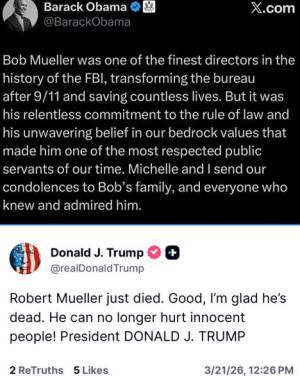
Above was President Obama’s response to the death of former FBI Director Robert Mueller, with President Trump's celebration of the death below that.
New York Times, Trump’s Reaction to Mueller’s Death: ‘Good, I’m Glad,’ Erica L. Green, March 22, 2026 (print ed.). The president has been known to disparage foes after their deaths. His response to Mr. Mueller’s death drew criticism from Republicans and Democrats.
President Trump on Saturday celebrated the death of Robert S. Mueller III, the former F.B.I. director who was tapped as a special counsel to investigate Russia’s efforts to meddle in the 2016 presidential election and tip the result in Mr. Trump’s favor.
“Robert Mueller just died. Good, I’m glad he’s dead. He can no longer hurt innocent people!” Mr. Trump wrote on social media, minutes after Mr. Mueller’s passing was announced.
The president has been known to disparage foes after their deaths, including the director Rob Reiner, drawing criticism from friends and critics. His coarse remarks on Saturday capped a yearslong grudge against Mr. Mueller, whom he accused of leading a “witch hunt” against him in his first term. His words were a stark contrast to statements issued by his predecessors.
“Bob dedicated his life to public service,” former President George W. Bush said, praising Mr. Mueller’s combat record and stewardship of the F.B.I. after Sept. 11, 2001. Mr. Mueller helped prevent “another terrorist attack on U.S. soil,” Mr. Bush added.
Former President Barack Obama, who asked Mr. Mueller to stay on for two more years as F.B.I. director, said in a social media post on Saturday that it was Mr. Mueller’s “relentless commitment to the rule of law and his unwavering belief in our bedrock values that made him one of the most respected public servants of our time.”
Mr. Mueller, a Vietnam War veteran and Purple Heart recipient who led the F.B.I. for 12 years, had long enjoyed bipartisan favor until he was appointed in 2017 to investigate Russian interference in the 2016 election and any ties between Moscow and members of Mr. Trump’s campaign.
Mr. Trump’s statement drew rebuke from Republicans and Democrats.
Representative Don Bacon, Republican of Nebraska, said that Mr. Trump’s comment was “un-Christian-like behavior” and “wrong.”
“It’s so unnecessary,” Mr. Bacon said in an interview. “It’s a self-error. People hate it.”
Immigration, Law, Courts, Rights, Crime
Politico, Tom Homan confirms ICE to be at airports starting Monday, Cheyanne M. Daniels, March 22, 2026. The border czar said he is discussing plans to deploy immigration agents to airports around the nation as the partial government shutdown continues.
Border czar Tom Homan confirmed Sunday that immigration agents will be at airports starting Monday.
In an interview with CNN’s “State of the Union,” Homan told host Dana Bash that he is devising a plan with Tedd Lyons, acting director of Immigration and Customs Enforcement, and Ha Nguyen McNeill, acting administrator for TSA, to determine where agents would best fit at airports across the nation. That plan, Homan said, will be finalized Sunday and go into effect Monday.
“We’ll have a plan by the end of today,” Homan said, including “what airports we’re starting with.”
Homan’s announcement comes as congressional Democrats continue to decline to approve funding for the Department of Homeland Security unless Republicans and the administration agree to significant changes to ICE. President Donald Trump this weekend threatened to deploy ICE agents at airports if the stalemate continued.
“If the Democrats do not allow for Just and Proper Security at our Airports, and elsewhere throughout our Country, ICE will do the job far better than ever done before!” Trump wrote on Truth Social on Saturday. “I look forward to moving ICE in on Monday, and have already told them to, ‘GET READY.’ NO MORE WAITING, NO MORE GAMES!”
The partial government shutdown has led to TSA staffing shortages, causing hours-long wait times at some airports around the nation.
Homan on Sunday said DHS should send agents to locations with the longest wait times.
“I don’t see an ICE agent looking at an X-ray machine because they’re not trained in that, but there are certain parts of security that TSA is doing that we can move them off those jobs and put them into specialized jobs, help move those lines,” Homan said.
Agents will also be conducting immigration enforcement while at the airports, something they already do “all the time,” Homan said.
In an interview with ABC’s “This Week,” Transportation Secretary Sean Duffy said that Democrats view the long lines as “leverage” for their demands of change.
But House Minority Leader Hakeem Jeffries on Sunday said ICE at airports is “the last thing that the American people need ... potentially to brutalize or in some instances, kill them.”
The Social Contract, Political Opinion: Uh Oh...Markwayne Might Want to Fight Me for This, Joe Walsh, right,  March 22, 2026. It was just a few short weeks ago that former Homeland Security Sec. Kristi Noem was named our “Jerk of the Week,” and now, her potential successor is taking the title. Oklahoma Sen. Markwayne Mullin, Donald Trump’s new DHS pick, sat for a confirmation hearing this week, and even some Republicans think he has “anger issues.”
Mullin previously went on record calling Alex Pretti, the VA nurse killed by ICE agents in Minnesota, a “deranged individual.” But the only deranged individual I see here is Mullin, below left. He suggested on his X account in 2025 that journalists would write “less false stories” if countered with violence. If you think that’s bad, Mullin, briefly an MMA fighter, previously attempted to fight Teamsters Union president Sean O'Brien right in the Senate chamber during a hearing. Okay, Mr. Tough Guy. Vermont Sen. Bernie Sanders, of all people, had to step in to diffuse the tensions, but later butted heads with Mullin when discussing Obamacare, which Mullin blamed for the country’s “broken” healthcare system. Talk about an utterly disgraceful first impression.
Despite all of Mullin’s baggage, his nomination will progress to a full Senate vote after Pennsylvania Sen. John Fetterman made it possible. Although a Democrat, Fetterman joined Republicans on the Senate Homeland Security and Governmental Affairs Committee to advance Mullin, with a final tally of 8-7. This is just the latest in a long line of instances in which Fetterman went against his own party to support Trump’s agenda, as he previously rejected calls to defund or abolish ICE and even voted in favor of DHS funding at the beginning of this year. Thanks for nothing, John.Subscribed
Speaking of ICE, agents in Oregon revealed under oath that they use a custom-made app to identify and arrest targets, and were ordered to meet a quota of eight arrests a day. Immigrants’ rights nonprofit Innovation Law Lab filed the class-action suit against the agency—good for them. ICE’s inhumane tactics have resulted in the deadliest year of detention in more than two decades, including an Afghan man who died in custody this week. The 41-year-old fought with U.S. forces and was legally evacuated to the U.S. after the fall of Kabul. But under Trump, protected status doesn’t matter, with 261 DACA recipients being arrested and 86 deported by ICE in 2025. Just recently, the agency detained a Texas DACA recipient on his way to deliver milk to his infant daughter in the NICU. How apropos of the “pro-life” party, huh?
Meanwhile, Defense Sec. Pete Hegseth continues to make headlines for being an absolute dunce, this time stating that the U.S. would show "no quarter” for our enemies. Hegseth’s remarks alarmed legal experts, who warned that even just saying “no quarter,” which means killing enemy combatants without allowing surrender, could count as a violation of international law and U.S. military code. Hegseth also praised CNN’s potential hiring of David Ellison, who will surely alter how the network reports on the Trump Administration. “The sooner David Ellison takes over that network, the better," he said. Nothing like some good old government-friendly media to cover your war crimes! This is all while Hegseth, a white Christian nationalist, implores all Americans to get down on bended knee and pray to Jesus Christ for U.S. troops. So much for the nearly 40% of Americans who aren’t Christian.
Although Jared Kushner hasn’t played as big a role during Trump’s second term as he did in his first, he’s still as big a jerk as ever. Kushner is now serving as a “special peace envoy” for his father-in-law in the Middle East. At the same time, he is seeking $5 billion in funding for his private equity firm, Affinity Partners…from Middle East governments. Still the same self-serving opportunist he always was.
Of course, the biggest jerk of the week, month, year, and decade is always Donald Trump, but there’s only so much space here to write about all the horrible things he does in a single day, much less a week.
Global News
New York Times, As War Disrupts India’s Gulf Ties, Economy Faces ‘New Broadside,’ Alex Travelli, March 22, 2026. Generations of Indian workers and businesses have turned the Arab side of the Gulf into a vital appendage of their own country.
Only a few weeks ago, the stars seemed to be aligning for India’s economy.
India was one of the fastest-growing major economies, consistently outpacing its powerful neighbor, China. It had surpassed Britain to become the world’s fifth-largest economy and was within striking distance of overtaking Japan for fourth. In a world beset by risks — from the war in Ukraine to President Trump’s tariff campaign — India’s skilled labor force, fiscal discipline and strong currency reserves made it a relatively safe bet.
An underappreciated component of the momentum was India’s deepening ties to the Arab countries of the Persian Gulf. But that advantage is now turning into a liability.
The U.S.-Israeli war on Iran is a perfect storm for India’s economy.
The Middle East accounts for roughly 40 percent of the country’s oil imports and 80 percent of its gas. As energy prices soar, the effects ripple across the economy, threatening India’s mix of strong growth and mild inflation.
The Gulf is also a crucial export market for Indian goods, now at risk from disruptions to air routes, shipping and business operations. Many Indian businesses rely on hubs like Dubai to distribute their goods globally.
India is the world’s largest recipient of remittances from workers abroad, with about 40 percent coming from the Middle East. Any hit to overseas Indian workers’ earnings would further weaken an already softening currency.
Last week, Goldman Sachs warned that India was facing slower growth, higher inflation and a weaker currency over the coming year, driven by rising energy prices, slowing exports to the United Arab Emirates and its neighbors and potentially lower remittances.
New York Times, The Billionaire Funding France’s Far Right, Catherine Porter, March 22, 2026. Pierre-Édouard Stérin is financing projects to make France less Muslim, more Catholic and more capitalist. He says his program has trained thousands running for municipal office on Sunday.
As France elects thousands of mayors this Sunday, one of the most influential players is not on the ballot.
His name is Pierre-Édouard Stérin. He is a billionaire entrepreneur who left France 14 years ago to pay less tax, but has since spent millions, he said in an interview, to “ensure France doesn’t disappear.”
Inspired, he said, by George Soros’s support for liberal causes, Mr. Stérin has steered money to right-wing think tanks, political training programs, social media influencers and nonprofit groups to shape the country according to his beliefs — anti-immigrant, free-market, less Islamic and more Catholic.
One program funded by Mr. Stérin has, by his count, trained at least 4,000 right-wing candidates in the municipal elections. With the far-right National Rally party projected to potentially win the presidency next year, Mr. Stérin is striving to accelerate France’s rightward shift.
“I dream of a France that is once again economically powerful and a France that rediscovers a sense of values, that embraces its Christian roots,” Mr. Stérin, 52, said.
The France of Mr. Stérin’s dreams would be more capitalistic, socially conservative and Trumpian — and to his critics, racist. It would tolerate little immigration, particularly from Muslim countries that France colonized. Undocumented immigrants who commit crimes or do not work would be deported. Muslim dress would be banned in public, and halal food no longer served in schools.
“I am even further to the right than the far right on immigration,” said Mr. Stérin, who also considers the National Rally’s economic program too “statist.”
Mr. Stérin wants to ban abortion, access to which was enshrined two years ago in the French Constitution; to swell Catholic church attendance; and to encourage more French couples to procreate. Since he funds Christian projects, he said, he hopes he might eventually be canonized as a saint. He disputes the idea that his views on migration clash with those of Pope Leo XIV.
Finally, he would slash the country’s taxes; dismantle the welfare system; privatize education and health care delivery; and end public funding for culture. “I am a fervent supporter of competition,” he said.
The ultimate goal, Mr. Stérin said, is to bring to power a right-wing government that fundamentally changes how the country looks and works.
Fanélie Carrey-Conte, who oversees France’s oldest migrant rights group, La Cimade, called Mr. Stérin’s vision dangerous, racist, Islamophobic and a “knife blow” to the French Republic’s founding principle of equality.
Meidas Touch Network, Commentary: Bulgaria Drops Out of Board of Peace Claiming It Only Joined to Help Corrupt Oligarch, Troy Matthews, March 20, 2026. Bulgaria and Hungary were the only EU nations on Trump's Board,
 The interim government of Bulgaria announced Friday it would drop out of the Board of Peace, chaired for life by Donald Trump and set up ostensibly to rebuild Gaza.
Interim Bulgarian Prime Minister Andrey Gyurov told reporters the decision to join the Board of Peace had not been approved by Parliament, and had been made by the previous government solely to help one man; a corrupt oligarch that Gyurov did not name.
The move leaves the Board of Peace with only Victor Orbán's Hungary as representation from the European Union. Permanent member nations are required to pay $1 billion to the Board.
"It would be an exaggeration to say this is the position of Bulgaria," Gyurov told Euronews on the question of joining Trump's Board. "It was not a question of international politics. It was a personal question of one oligarch who is sanctioned by the Global Magnitsky Act."
Though not named, it is clear Gyurov was talking about Delyan Peevski, a Bulgarian oligarch who is currently sanctioned by the United States and United Kingdom under the Global Magnitsky Human Rights Accountability Act for individual violations of human rights or extreme corruption.
"The signing of this treaty has to do with him being removed from this list of sanctions. I do not think it will work. What is surprising, unfortunately, is the influence of an oligarch in some parties," Gyurov said.
Gyurov seems to be suggesting that Peevski used his influence to get Bulgaria to join the Board of Peace to curry favor with Donald Trump in hopes of ending his sanctions.
Bulgaria joined the Board of Peace only days before the government of former Prime Minister Rossen Zhelyazkov collapsed amid mass anti-corruption protests. The decision to join the Board was not ratified by the Bulgarian parliament.
A national election has been scheduled for April. It is unlikely the new Bulgarian government will recommit the nation to the Board of Peace because of the EU assessment that the Board could be used to undermine the United Nations.
Epstein Files, Trump Coverup
Lincoln Square, Commentary; The Day the Music Died in MAGA World, Kristoffer Ealy,  right, March 22, 2026. Donald Trump has done almost everything imaginable to get Americans to stop talking about the Epstein files.
He has thrown chaos at the country like a man emptying every drawer in the house because he cannot find the one receipt that matters. He escalated attacks on critics. He cheered punitive action against late-night enemies. He watched Don Lemon get dragged into a federal prosecution tied to anti-ICE protest coverage. He sent troops into American cities. He lurched into a widening war with Iran. He has tried almost everything short of faking his own death and reappearing as someone who never met Jeffrey Epstein. Yet the files are still there, hanging over him like a chandelier made of guilt and bad decisions that nobody will let him redecorate around.
That alone tells you something important.
Other stories come and go. They are born with a chyron, peak with a panel segment, and die somewhere between a podcast clip and the next algorithmic panic attack. Journalism students learn early that one of the central elements of newsworthiness is timeliness. Stories are supposed to age out. They get replaced by fresher outrage, newer horror, shinier scandal. That is how the modern news cycle works. It is an industrial shredder for public attention. But the Epstein files have refused to obey the normal rules of political gravity. They became front-page news, stayed front-page news, and then did something even more dangerous for Trump: they became permanent background noise. They are no longer just a story. They are the ringing in the administration’s ears that no amount of noise elsewhere can drown out.
That is why every attempted distraction now lands with the same response. Trump picks a fight with another media enemy. That’s nice. What about the Epstein files? ICE agents kill civilians in the middle of a crackdown. Horrible. What about the Epstein files? Trump ratchets up martial posturing in American cities and dares critics to stop him. Noted. What about the Epstein files? The administration barrels deeper into war with Iran. People rightly panic over that, protest that, analyze that. And then they keep asking what is in those files and why the government still cannot seem to tell a straight story about them. Reuters reported in February that Americans overwhelmingly believe the files show wealthy and powerful people rarely face real accountability. Which is another way of saying the public understood the moral of this story perfectly well and did not need the ending explained to them.
Some scholars might call what happened next the Streisand Effect. There is truth in that. Trump tried to smother public fascination and instead poured gasoline on it. But what happened on July 15, 2025 goes much deeper than a textbook example of suppression backfiring. July 15, 2025 may not have been the day MAGA died.
But it was the day the music died.
It was the day one of the movement’s most emotionally loaded myths cracked in public, on camera, in Trump’s own words.
That day, Trump did something that would have been hard to improve upon if his goal had been to humiliate his own most conspiracy-minded supporters. Asked about the Epstein story, he called it “sordid but boring” and said, “I think really only pretty bad people, including fake news, want to keep something like that going.” Reuters and other contemporaneous reports place those remarks on July 15, 2025. That date matters because it was the moment Trump stopped speaking to his followers as co-believers and started speaking to them like they were gullible little weirdos who should stop bothering him.
He could have said almost anything else and bought himself time. He could have said, “We’re looking into it.” He could have said, “The American people deserve transparency.” He could have said, “We’ll release whatever is credible.” He could have lied with craftsmanship. He could have done what politicians do every single day of the week and wrapped a non-answer inside a patriotic casserole. Instead he shrugged. He rolled his eyes. He treated one of MAGA’s sacred obsessions like a spam email he was tired of flagging. That was the mistake. And it was not a small one.
Because the Epstein files were never just another scandal inside MAGA world. They were a promise. More than that, they were a kind of secular scripture for a movement that had spent years marinating in Pizzagate-adjacent fantasies about a hidden elite of depraved Democrats, celebrities, financiers, fixers, and media ghouls. Trump was supposed to be the avenging hero who kicked the door open, turned on the fluorescent lights, and let the monsters scatter. He and the ecosystem around him helped build that expectation for years. The podcast bros fed it. The influencer class fed it. Republican politicians winked at it. Every half-literate fascist with a webcam and a supplement code fed it. For a significant portion of his base, exposing the Epstein network was not a side issue. It was the holy grail. It was the whole point.
That is why the right language here is not just political backlash. It is psychological rupture.
The first term is motivated reasoning. MAGA did not arrive at the Epstein files through a calm, neutral weighing of evidence. People wanted to believe Trump would expose the powerful and humiliate their enemies, so they interpreted everything through that desire. The second term is identity-protective cognition. The belief that Trump would reveal elite corruption was not merely an opinion; it became part of the group’s identity, part of what made them righteous in their own minds. The third term is cognitive dissonance. That is the mental discomfort people experience when two cherished beliefs collide. Trump is the man who will expose the truth. Trump is treating this like “pretty boring stuff.” Those two beliefs cannot sit comfortably in the same room. One has to move, and when it does, the whole house starts creaking.
That creaking is the story.
People tell me all the time that Trump still has plenty of loyal followers. Fair enough. He does. Loyalty, though, is not the story. The fractures are. It does not matter how many eventually crawl back into line if, for one long ugly stretch, they were scattered, defensive, and arguing with themselves in public. Once a movement built on certainty starts sounding confused, the crack matters more than the headcount.
You can hear the confusion in the arguments. “Democrats are in the files more than Trump.” Fine. Then expose them all. That is not the escape hatch they think it is. It is actually proof of how the ground shifted beneath them. Once Trump fumbled the issue on July 15, the files stopped being a right-wing revenge fantasy and became a broader transparency issue. Reuters/Ipsos polling in July 2025 found that 69 percent of Americans believed the government was concealing details about Epstein’s clients. Reuters polling in February 2026 found broad public belief that the files showed the powerful often escape accountability. That is not a narrow partisan demand. That is national suspicion with a mailing address in every ideology.
People also ask why Joe Biden and Merrick Garland did not blow the whole thing open when they had the chance. That is a fair question. Maybe they thought full disclosure would divide the country even more. Maybe they feared detonating a scandal that could touch powerful people across politics, media, business, and polite society’s preferred list of dinner guests. Maybe they simply lacked the nerve. At this point, though, their motives are almost beside the point. Once Trump shrugged the files off in July 2025, Democrats who had not initially treated the issue as central suddenly had every reason to care. The fractures inside MAGA made the story politically irresistible. What had been a grievance engine for the right turned into an accountability weapon for everyone else.
And the mishandling since then has only kept the bonfire lit.
The Justice Department’s release of the Epstein files has been, to use a technical term, a complete mess. The department released millions of pages under the law Trump signed in November 2025, but lawmakers soon complained of incomplete disclosures, over-redactions, and failures to protect victims’ identities while simultaneously obscuring information about prominent people.
A bipartisan group of senators asked the Government Accountability Office this week to review the DOJ’s handling of the files, and the House Oversight Committee has already subpoenaed Attorney General Pam Bondi. Reuters reported last week that the Justice Department also had to release previously missing FBI interview summaries containing allegations against Trump after Democrats accused the department of withholding them. The Washington Post separately reported that the law required disclosure by December 19, but the department missed the deadline and did not release the bulk of the files until late January. Which is the kind of thing that happens when you are either incompetent or stalling, and in this administration the two conditions are not mutually exclusive.
Which brings us to the New York Times reporting that has poured fresh gasoline on this already raging fire.
In late July, FBI agents exchanged early-morning emails about a sensitive task. One agent listed the names of 14 prominent men with President Trump at the top, and issued instructions that read like something out of a mob drama: “Take these names and build out new spreadsheet w all the derog on them.” That same morning, agents prepared summaries of what the files called “salacious statements” made against Trump and others. The rundown on the president was two bullet points. One was an allegation from a woman who said he sexually assaulted her when she was a teenager. The other was a claim that Epstein once introduced a teenager to Trump saying, “This is a good one, huh?” with Trump replying, “Yes.” The Times notes the woman’s account lacked corroborating detail, and Karoline Leavitt called it “completely baseless.” The bulk of references to Trump in the FBI files did not suggest wrongdoing but did document his closeness to Epstein: people who recalled being introduced to Trump at social affairs, employees who described him visiting Epstein’s homes, multiple people who remembered hearing him on the phone with Epstein.
There is also the matter of the Palm Beach police chief. One FBI document described Trump calling Michael Reiter shortly after news broke that Epstein was under investigation for abusing girls. Years later, Reiter told the FBI what he remembered Trump saying on that call: ‘Thank goodness you’re stopping him, everyone has known he’s been doing this.’ That line does not prove criminal liability. What it does prove is that Trump knew. And it makes the ‘sordid but boring’ shrug of July 15 land considerably harder in retrospect.
These summaries were compiled the same day Deputy Attorney General Todd Blanche was in Florida interviewing Ghislaine Maxwell, and Trump came up in that interview too, alongside Bill Clinton, Prince Andrew, and Wall Street billionaire Leon Black. The FBI then converted the summaries into a slide for a 21-page internal presentation on the Epstein case, shared in unclassified form with FBI director Kash Patel. A draft of the presentation, released by the DOJ, exposed the names of alleged victims. In December, Blanche had pledged publicly that the administration would not redact information involving the president. What followed was over three million pages released late, 76,000 documents temporarily taken offline, witnesses’ names sometimes visible and sometimes blacked out, missing FBI interview memos that had to be forced out under political pressure, and a three-stage filtering process that somehow still managed to lose the documents the original investigators had treated as most significant.
That is not transparency. That is a bureaucracy trying to vacuum glitter out of carpet with a leaf blower and calling it a clean house.
None of the allegations in those files amount to proven wrongdoing in court. The Times is careful about that. But the story is not fundamentally about what Trump did or did not do with Jeffrey Epstein. The story is about what the government knew, when it knew it, and how it has handled the telling. Which is to say: badly, slowly, and in a way that has convinced a majority of Americans that something is still sitting just out of view.
That is also why the current war with Iran has not displaced the scandal so much as fused with it in parts of the public imagination. In some online corners, the conflict is already being reframed through the lens of Epstein, with propagandists pushing the idea that war itself is functioning as cover for elite crimes. The Washington Post reported this week on a pro-Iran disinformation network using AI-generated content and Epstein-related conspiracy claims to push anti-U.S. narratives. That does not validate the propaganda. It does illustrate something politically important: once a scandal becomes sticky enough, people start stapling it to every new crisis. The war becomes the backdrop. The Epstein files become the stain.
All of this helps explain why the Epstein issue has become such a corrosive force inside the right. It is not simply that some people think Trump mishandled a release. It is that he violated the emotional contract. He asked people who had spent years treating this issue like a moral crusade to suddenly accept that it was boring, fake, and overblown, or a distraction cooked up by bad people and fake news. That kind of reversal makes even committed loyalists feel played.
Everyone Is Entitled To My Own Opinion, This week in stupid, Jeff Tiedrich, right, March 22, 2026. Bobby Brainworms slams it, Micropenis Mark crams it, and so much more...
As another stupid week comes to a close here in America, let’s look back....
Monday: Welcome to twinkiemania ’26. Oh look, the overgrown adolescent boys who govern over us are up to their emotionally-stunted antics again. look at the infantile drek that The Marvelous Mr. Measles posted to Elon’s Nazi Bar and Child Porn Emporium.
What we have here is thirty-three seconds of an AI-generated impossibly-jacked Bobby Brainworms Jr., above, whaling the tar out of an equally-AI-generated twinkie.
Seriously, why are government resources being wasted? Bobby Brainworms and the morons at Homeland Security apparently have nothing better to do with their time than churn out puerile memes. Why does everyone in Donny’s administration seem to be under the impression that their main job is to win the internet?
Tuesday: Who among us hasn’t been in the midst of celebrating St. Patrick’s Day and thought, ‘you know what would make this awesome day even better? Fascism.’
Come on, can’t the hatemongers at DHS give racism a well-earned day off? Again with the juvenile memes — and I’m at a loss to comprehend exactly what’s supposed to be going on here. Is that meant to be teargas, thematically green in honor of Saint Pat?
If ICE had been around a hundred and fifty years ago, it would have been the Irish they’d have been rounding up and disappearing into foreign slave-labor gulags — because for a while there back in the day, the Irish were one of the most-hated ethnic groups in America.
Now let’s thank our lucky stars that we have tireless internet sleuths like not-twitter user Warren here, who managed to de-blur DHS’s artwork and identify the ICE thugs.
U.S. Media, Education, High Tech Culture
New York Times, News Outlets Pressure Pentagon to Restore Access After Court Ruling, Erik Wemple, March 22, 2026 (print ed.). A federal judge ruled on Friday that key parts of the Pentagon’s press policy were unconstitutional.
A group representing journalists who cover the Defense Department is seeking the immediate restoration of press access for its members after a federal judge ruled on Friday that key parts of the department’s media policy were unconstitutional.
“Our clients and the public face ongoing, irreparable harm,” David Schulz, counsel for the group, the Pentagon Press Association, wrote in a letter, “so long as the experienced military reporters of the P.P.A. are excluded from the Pentagon while active combat operations are being conducted in multiple arenas.”
The Pentagon last year imposed new rules that empowered it to declare journalists “security risks” and revoke their press passes if they engaged in any conduct that the department believed threatened national security. Rather than comply with those restrictions, dozens of journalists surrendered their press passes and continued covering the military outside the Pentagon.
The New York Times accused the Pentagon of violating the First and Fifth Amendments with the new rules, and in his ruling on Friday, Judge Paul Friedman of the U.S. District Court for the District of Columbia sided with The Times.
He ordered the immediate reinstatement of press passes for seven Times journalists who had previously held press passes. The Times said in a statement on Saturday: “We are seeking to have our passes restored in keeping with the judge’s order. Our legal department sent a letter to Pentagon counsel today asking for restoration on Monday.”
In an interview, Mr. Schulz said he believed that the judge’s ruling meant that the Pentagon had a legal obligation to return passes to all of those who opted to turn them in last year. Pentagon correspondents have said that the press passes enhance their reporting on the military because they facilitate personal interactions with press officials and sources, though Pete Hegseth, the defense secretary, last year curtailed the areas where reporters may roam without an escort.
The Pentagon did not respond to questions about the restoration of press passes. On Friday, Sean Parnell, the department’s chief spokesman, wrote on X, “We disagree with the decision and are pursuing an immediate appeal.” Any appeal from the government would most likely include a petition for a stay of Judge Friedman’s order.
March 21
Top Headlines
U.S. Secretary of Defense Pete Hegseth, an ultra-right Christian nationalist who calls himself "Secretary of War" despite his legally defined title as "Defense" Secretary, addresses senior military leaders at Marine Corps Base Quantico on September 30, 2025 in Quantico, Virginia.
New York Times, Hegseth Invokes Divine Purpose to Justify Military Might, Greg Jaffe and Elizabeth Dias, March 21, 2026 (print ed.). Defense Secretary Pete Hegseth has imbued U.S. military actions with a Christian moral underpinning that suggests they are divinely sanctioned. He spoke of “overwhelming force” and the U.S. military’s unmatched ability to rain “death and destruction from above” on its “apocalyptic” Iranian foes.
Then, Defense Secretary Pete Hegseth, standing in the Pentagon, issued a call to the American people for a specific kind of wartime prayer. He asked them to pray for victory in battle and the safety of their troops.
“Every day, on bended knee, with your family, in your schools, in your churches,” he said, “in the name of Jesus Christ.”
At a time when the U.S. and Israeli militaries are dropping thousands of bombs on a majority-Shiite Muslim nation, the explicitly Christian nature of Mr. Hegseth’s call stood out.
More than any top American military leader in recent history, Mr. Hegseth has framed U.S. military operations in the Middle East, Africa and Latin America as bigger than politics or foreign policy. Often he has imbued these actions with a Christian moral underpinning that suggests they are divinely sanctioned.
It is this view of a higher power, married to lethal American firepower, that Mr. Hegseth says gives him confidence that the United States will prevail in Iran.“


New York Times, U.S. at Fault in Strike on School in Iran, Preliminary Inquiry Says, Julian E. Barnes, Eric Schmitt, Tyler Pager, Malachy Browne and Helene Cooper, March 11, 2026. Outdated targeting data may have resulted in a mistaken missile strike, according to the ongoing military investigation, which undercuts President Trump’s assertion that Iran could be to blame in the deaths of approximately 160 at school, primarily schoolgirls shown above.
Other Top Headlines
March 21, 2026. Donald Trump is set to deploy ICE agents to airports across the country beginning Monday. There has also been rare bipartisan condemnation following his remarks about Robert Mueller’s death, where he said he was glad Mueller had died.Meanwhile, Iran has launched its most devastating strike on Israel since the start of the war, and Trump now faces a history-defining decision as he moves closer to potentially deploying U.S. ground troops into Iran.News Updates
March 21, 2026. There is a lot to cover, including new developments in the Epstein case suggesting that staff at the jail where he died may have been shredding documents afterward. At the same time, the United States has lifted certain sanctions on Iranian oil and is now allowing purchases, a move critics argue could further fund Iran. March 21, 2026. On Wednesday, Israeli forces hit Iranian facilities in the South Pars natural gas field in the Persian Gulf, shared by Iran and Qatar. Helen Regan and Ivana Kottasová of CNN explain that the South Pars gas field is part of the largest natural gas reserves in the world, supplying most of Iran’s domestic energy and crucial to Iran’s economy.Epstein Files, Trump Team Coverup

New York City emergency workers remove Jeffrey Epstein from a federal prison in Manhattan with a gurney for transport to a hospital emergency room.

 A Miami Herald analysis of thousands of pages in the Epstein files found there were bags of shredded documents at the Metropolitan Correctional Center in the days after Epstein’s death there. A Corrections officer called the FBI, then writes letter to judge about document cover-up.
More Global News
U.S. says Cuba can’t buy Russian oil just as tanker approaches the island, Nora Gámez Torres, March 21, 2026 (print ed.). The U.S. Treasury Department has included Cuba among the few countries that cannot benefit from a temporal lifting of sanctions on Russian oil, just as a Russian tanker carrying crude is heading to the island in defiance of the Trump administration.More On Iran War
United States views Iran through a prism of global responsibilities and strategic goals. Israel has a more regional approach. After nearly three weeks of war, their paths are diverging.Trump Watch
U.S. Immigration, Justice, Law, Rights
U.S. Governance, Politics, Elections
March 20, 2026. Standing up to dark money isn’t easy.U.S. Media, High Tech, Education, Culture, Religion
 White House Chronicle, Opinion: Women Face Massive Layoffs as AI Use Spreads in the U.S., Llewellyn King, March 21, 2026. March is Women’s History Month and a time to take a look at how women are progressing, or otherwise. Alas, the news for women in the United States isn’t good, and the future is foreboding as they are about to lose 6 million jobs to artificial intelligence.
Top Stories
U.S. Secretary of Defense Pete Hegseth, an ultra-right Christian nationalist who calls himself "Secretary of War" despite his legally defined title as "Defense" Secretary, addresses senior military leaders at Marine Corps Base Quantico on September 30, 2025 in Quantico, Virginia.
New York Times, Hegseth Invokes Divine Purpose to Justify Military Might, Greg Jaffe and Elizabeth Dias, March 21, 2026 (print ed.). Defense Secretary Pete Hegseth has imbued U.S. military actions with a Christian moral underpinning that suggests they are divinely sanctioned. He spoke of “overwhelming force” and the U.S. military’s unmatched ability to rain “death and destruction from above” on its “apocalyptic” Iranian foes.
Then, Defense Secretary Pete Hegseth, standing in the Pentagon, issued a call to the American people for a specific kind of wartime prayer. He asked them to pray for victory in battle and the safety of their troops.
“Every day, on bended knee, with your family, in your schools, in your churches,” he said, “in the name of Jesus Christ.”
At a time when the U.S. and Israeli militaries are dropping thousands of bombs on a majority-Shiite Muslim nation, the explicitly Christian nature of Mr. Hegseth’s call stood out.
More than any top American military leader in recent history, Mr. Hegseth has framed U.S. military operations in the Middle East, Africa and Latin America as bigger than politics or foreign policy. Often he has imbued these actions with a Christian moral underpinning that suggests they are divinely sanctioned.
It is this view of a higher power, married to lethal American firepower, that Mr. Hegseth says gives him confidence that the United States will prevail in Iran.
“Our capabilities are better. Our will is better. Our troops are better,” he said in a recent interview with CBS News’s “60 Minutes.” “The providence of our almighty God is there protecting those troops, and we’re committed to this mission.”
At the same time, Mr. Hegseth has largely avoided casting Islam as the enemy. In a news conference on Thursday, he praised America’s Gulf Arab allies for supporting the war after Iran attacked them.
“We’re proud to be defending with them, standing with them,” Mr. Hegseth said.
The conservative branch of American Christianity that Mr. Hegseth represents has long been central to President Trump’s movement, and its ideas are frequently invoked by Mr. Trump and senior members of his administration.
“I was saved by God to make America great again,” Mr. Trump said at his 2025 inauguration, referencing a sense of divine mission after surviving an assassination attempt. And last month in Munich, Secretary of State Marco Rubio said America and Europe were bonded together as civilizations by “Christian faith.”
Mr. Hegseth, shown above in a photo collage, speaks often of the important role that his faith plays in his life and, in his view, the life of the United States. He prayed to “King Jesus” in the White House at a February dinner for governors. Last month, speaking to a group of largely evangelical broadcasters, he described the United States as a nation founded on Christian principles. “There’s a direct through line from the Old and New Testament Christian gospels to the development of Western civilization and the United States of America,” he told them.
Such sentiments have long been common among Mr. Trump’s evangelical supporters, who at times have described themselves as combatants in a holy war that seeks to advance their values and restore America by reconnecting it to what some of them see as its Christian roots.
Mr. Hegseth stands out as the civilian leader of the world’s most powerful military in his willingness to blur the line between a metaphorical war, waged in a spiritual domain, and actual combat. Following the murder of the Turning Point USA founder Charlie Kirk in September, Mr. Hegseth posted a video that mixed audio of himself reciting the Lord’s Prayer with video of missiles firing, warships steaming and paratroopers falling from the sky.
“A prayer for Charlie, our warriors, and our nation,” he wrote.
New York Times, U.S. at Fault in Strike on School in Iran, Preliminary Inquiry Says, Julian E. Barnes, Eric Schmitt, Tyler Pager, Malachy Browne and Helene Cooper, March 11, 2026. Outdated targeting data may have resulted in a mistaken missile strike, according to the ongoing military investigation, which undercuts President Trump’s assertion that Iran could be to blame.
Earlier this month, Mr. Hegseth described countercartel operations, including U.S. military strikes that have killed at least 157 people (shown above), as part of a broader war to defend Christian nations from the forces of godless “narco communism” and tyranny.
“We face an essential test,” he told defense ministers from across the Western Hemisphere, “whether our nations will be and remain Western nations with distinct characteristics, Christian nations under God, proud of our shared heritage with strong borders and prosperous people.”
Mr. Hegseth’s calls to prayer in the Pentagon press room and the monthly, voluntary Christian worship services that he has organized in the Pentagon auditorium are a stark departure from the way military chaplains are taught to minister to their flock, which reflects the diversity of the nation. About 70 percent of troops identify as Christian, according a 2019 study by the Congressional Research Service.
“It is one thing to say, ‘We should get on our knees and pray to God,’ but when you say ‘to Jesus Christ our Lord,’ that really narrows the field,” said the Rev. William D. Razz Waff, an Episcopal priest and board-certified chaplain who served in the Army. “Chaplains are there for everyone.”
Mr. Hegseth’s descriptions of U.S. military actions as divinely sanctioned also run counter to the views of many prominent leaders in different Christian traditions. Cardinal Robert McElroy of Washington drew a distinction between praying for America and its military men and women, which he said he does regularly, and the moral understanding of the war that Mr. Hegseth appears to be outlining.
“In my own view in the teaching of the church, this is not a moral war, it is an immoral war, and thus I am not praying that this immoral war continues,” Cardinal McElroy said in an interview. “I see a moral imperative to end this war, to have a cease-fire.”
A cropped version of the official portrait of Pope Leo XIV, published by the Vatican on May 10, 2025.
That sentiment is shared by Pope Leo XIV, who also called for an end to the fighting in Iran. “Violence can never lead to the justice, the stability and the peace that peoples are awaiting,” he said.
Mr. Hegseth, for his part, reaches back to an earlier era of the Catholic church to support his view.
Tattooed on Mr. Hegseth’s right biceps is the Latin phrase “Deus vult,” or “God wills it,” which he has described as a “battle cry” of the Crusades, the ruthless medieval wars where Christian warriors fought to take over Jerusalem from Muslim rule. Mr. Hegseth sees those battles as perhaps the most formative moment in the history of the free world.
In his book “American Crusade,” published in 2020, he describes the Crusades as “bloody” and “full of unspeakable tragedy,” but argues that they were justified because they saved a Christian Europe from the onslaught of Islam.
The Parnas Perspective, Evening Update: Bipartisan Backlash Over Trump’s Mueller Comments as Trump Set to Deploy ICE to Airports and Iran Conflict, Aaron Parnas, right, March 21, 2026. Donald Trump is set to deploy ICE agents to airports across the country beginning Monday. There has also been rare bipartisan condemnation following his remarks about Robert Mueller’s death, where he said he was glad Mueller had died.Meanwhile, Iran has launched its most devastating strike on Israel since the start of the war, and Trump now faces a history-defining decision as he moves closer to potentially deploying U.S. ground troops into Iran.
Here’s the news:
More than 400 TSA officers have quit since the DHS shutdown began, as many employees have been working without pay. The shutdown stems from political disagreements over immigration enforcement reforms, leaving TSA understaffed and strained. As a result, airports are experiencing higher absentee rates and longer security wait times. Workers and travelers alike are facing financial stress and growing frustration over the situation.
Donald Trump said that he will be deploying ICE agents to airports across the country beginning on Monday:
May be a Twitter screenshot of magazine and text that says 'The Radical Left Democrats have hurt so many with and uncaring ways. What they have done Homeland Security, our fantastic TSA Officers, our Country, for Just and Airports, and elsewhere throughout the job better than done before! The never protect America, but the and, importantly, great people absolute disgrace. the Democrats not Proper Security Country, Fascist Democrats Republicans will. Just like the Radical Left allowed millions Criminals Country through their ridiculous and dangerous Open Border Policy, the Republicans closed down, now have the Strongest Border American forward moving pour into History. already told them GAMES! President Monday, MORE TRUMP'
Here is how ICE agents allegedly responded:
Children’s entertainer Ms. Rachel has begun advocating against the detention of children in ICE facilities after speaking with kids held at a Texas center. She described troubling conditions, including poor food, limited education, and worsening health issues among detained children. The experience motivated her to work with activists and lawyers to push for the closure of the facility and reunite families in their communities. Her efforts highlight growing concern and criticism over the treatment of migrant children in U.S. detention centers.
According to CBS, the Trump administration is exploring options to secure or seize Iran’s nuclear materials as part of its broader military strategy. Planning has included potential involvement of elite U.S. special operations forces, though no final decision has been made. The effort reflects a key objective of preventing Iran from developing nuclear weapons amid the ongoing conflict. Officials warn such an operation would be highly complex and risky given the nature and location of the materials.
CBS News has further confirmed that the Trump administration is actively preparing for the potential deployment of U.S. ground troops to Iran, with military planners outlining detailed scenarios. Officials have moved forces, including Marines and elements of the 82nd Airborne Division, into the region to expand available options. While Trump has publicly said he is not planning to send troops, he has left the possibility open. The preparations signal a significant escalation risk as the conflict continues.
President Donald Trump is facing a major, potentially legacy-defining decision on whether to deploy large numbers of U.S. ground troops into Iran for military operations. The plans under consideration include securing key strategic locations and nuclear materials, signaling a possible escalation of the conflict. However, many of his political allies warn that such a move could erode support for the war and jeopardize future funding from Congress. Concerns over economic impacts and upcoming midterm elections are increasing pressure on the administration to avoid deeper involvement.
Drone footage shows extensive destruction to residential buildings in Arad, Israel after a direct Iranian ballistic missile strike, highlighting the significant damage caused by the attack. The strike was part of a broader escalation in the Iran-Israel conflict, with missiles hitting southern Israeli cities and injuring over one hundred people. Several buildings were heavily damaged after at least one missile was not intercepted and hit directly. Emergency responders have been working at the scene as concerns grow over further escalation in the region.
Reuters has confirmed that the Pentagon is moving to formally adopt Palantir’s AI-powered Maven system as a core military program, expanding its use across U.S. forces. The technology analyzes battlefield data to identify potential targets and has already been used in thousands of operations. Officials say the move will deepen the integration of AI into military decision-making and strategy. While Palantir says humans still approve strikes, the expansion raises ongoing ethical and security concerns about AI in warfare.
Thousands of protesters gathered outside Japan’s parliament, with reports suggesting around 11,000 attendees opposing the war. Demonstrators expressed strong dissatisfaction with the government’s stance, with polls indicating broad public opposition. Many criticized alignment with U.S. policy, calling for a more independent approach to Japan’s future.
The protests follow the Japan Prime Minister’s visit to Washington, D.C., where she was photographed by the White House in a way that many viewed as explicit support for the President of the United States:
Japan’s Prime Minister Sanae Takaichi reacted during a White House visit to what was described as President Biden’s “autopen portrait.”
A large crowd gathered on Prague’s Letná Plain to protest the government of Andrej Babiš and its proposed policy changes. Demonstrators voiced concerns that the country is shifting closer to Russia, citing plans affecting public broadcasters, defense spending, and a potential “foreign agent” law. The protest reflects growing public opposition to the government’s direction. It also signals rising tensions over democratic norms and geopolitical alignment in the Czech Republic.
According to the Washington Post, Russia’s foreign intelligence service allegedly proposed staging a fake assassination attempt to boost support for Hungarian leader Viktor Orbán ahead of a tight election. The plan, described as a “gamechanger,” aimed to shift public focus from economic issues to emotional concerns like security and political stability. According to the report, this tactic was intended to strengthen Orbán’s position by rallying voters around him. The allegations highlight concerns about foreign interference and manipulation in democratic elections.
Shortly after this news surfaced, Donald Trump released a video promoting Orbán. The timing has raised questions and scrutiny given the geopolitical context. The situation highlights concerns about foreign influence and political messaging around elections.
According to MS Now, Former FBI Director and Special Counsel Robert Mueller has died at the age of 81. He was best known for leading the investigation into Russian interference in the 2016 U.S. election. Mueller previously served as FBI director from 2001 to 2013 and was appointed special counsel in 2017. His death marks the passing of a key figure in modern U.S. law enforcement and political history.
Here was President Obama’s response to the death, with President Trump's celebration of the death below.
Plans for a summit between Donald Trump and China’s Xi Jinping have been put on hold as the Iran conflict continues, according to Politico. The delay reflects how the ongoing war is reshaping U.S. diplomatic priorities and limiting high-level international engagement. While the White House disputes that the war is the direct cause, officials have indicated scheduling will likely follow the conflict’s active phase. The uncertainty raises concerns about stability in U.S.-China relations during a sensitive geopolitical moment.
Markwayne Mullin, right, the Trump DHS nominee, recounted a 2022 incident in which he threatened his daughter’s teenage boyfriend during a church speech. He said he warned the boy he would “drag [his] face across the asphalt” if he saw him kiss his daughter. The remarks have resurfaced as he faces scrutiny in his nomination.
Hundreds of migrant children are being held in ICE detention far beyond the 20-day legal limit, with some cases lasting months. One 9-year-old with severe autism was detained for over 80 days without proper therapy or support, leading to severe distress and self-harm behaviors. Advocates say prolonged detention is causing serious psychological harm and developmental regression among children. The situation has raised concerns about policy violations and the human impact of extended immigration detention.
Severe flooding in Hawaii—the worst in over 20 years—has caused widespread damage, forced evacuations, and threatened the failure of a 120-year-old dam. Heavy rains on already saturated ground flooded homes, displaced about 5,500 residents, and caused an estimated $1 billion in damage. Emergency crews have carried out hundreds of rescues, while officials warn that more rain could worsen conditions. Authorities continue to monitor the dam closely as the state braces for ongoing flooding risks.
According to the Telegraph, more than 170 Royal Navy submariners have tested positive for drugs over the past seven years, including substances like cocaine, cannabis, and ecstasy. Some of those involved were serving on nuclear-armed submarines, raising concerns about safety and security. Most personnel caught were dismissed under the military’s zero-tolerance policy. The findings highlight broader concerns about stress, morale, and discipline within the submarine force.
U.N. Secretary-General António Guterres said he is cooperating with Trump’s “Board of Peace” on Gaza reconstruction efforts but criticized it as largely a personal project lacking broader effectiveness. He emphasized that the United Nations should remain the central body for managing global crises and upholding international law. Guterres also signaled the U.N.’s willingness to help de-escalate tensions in the Strait of Hormuz through coordinated international efforts. His comments highlight tensions between traditional multilateral institutions and alternative initiatives led by the U.S.
The opening of a Polymarket-themed bar in Washington, D.C., was disrupted by technical issues, leaving the venue without power or functioning displays. Guests were unable to access the prediction market features the bar was designed to showcase, despite strong turnout and interest. The event also highlighted growing concerns about regulation and potential insider trading in prediction markets. Meanwhile, lawmakers are pushing new legislation to limit betting on sensitive topics like war and government actions.
New York Times, Deferring to Trump, G.O.P. Lawmakers Resist a Public Accounting on Iran, Megan Mineiro, March 21, 2026 (print ed.). Republicans on Capitol Hill have given President Trump wide latitude to wage war on Iran with no congressional approval or limits.
Nearly three weeks into a war that polls show is unpopular, top Republicans have yet to call administration officials to testify about it, arguing that hearings would put divisions on display
They have deferred to him almost entirely on his justifications for the conflict, echoing the rationales offered by him and his top officials, even as they have given shifting and contradictory explanations.
Now, nearly three weeks after the first strikes on Tehran, G.O.P. lawmakers are resisting the idea of calling top administration officials before Congress to give a public accounting for an escalating war with uncertain objectives, a rising price tag and no clear exit strategy.
It is the latest example of how the Republicans controlling Congress, who have ceded power to Mr. Trump on matters large and small, are refraining from using their oversight authority as a coequal branch of government and have instead taken on the role of cheerleaders for his policies at a critical time.
“You don’t want to show that kind of division to your enemy when you’re in the midst of a war,” said Senator Ron Johnson, Republican of Wisconsin. “I don’t have a problem with the administration avoiding showing our enemy that they don’t have 100 percent support of the Congress.”ImageU.S. Air Force personnel loading bombs onto a B-1 bomber at an air base in the Britain this week. The Pentagon is set to ask Congress for as much as $200 billion in war funding.Credit...Toby Melville/Reuters
Democrats have demanded that Defense Secretary Pete Hegseth and Secretary of State Marco Rubio make the case under oath in congressional hearings for why the United States barreled into a war in the Middle East that has endangered American citizens, diplomats and allies across the region and caused oil prices to spike.
But even as the Pentagon requests $200 billion to fund the conflict and Mr. Trump has not flatly ruled out committing ground troops, many Republicans argue that summoning Mr. Hegseth and Mr. Rubio to Capitol Hill for televised hearings would be harmful because it would put the divisions over the war on display for the country, and for Iran, to see.
“I think it would be very unhealthy at this point in time,” said Senator Bill Hagerty, Republican of Tennessee. “We’ve got men and women in harm’s way.”
“The more cameras on someone in the Democrat party, the more bombastic they get,” said Representative Derrick Van Orden, Republican of Wisconsin. “It can be counterproductive.”
Republican leaders and rank-and-file members have said Mr. Trump is firmly within his authority to deploy forces into hostilities with Iran for up to 60 days without congressional authorization.
Democrats note that under the law, that power applies only if the United States faced an imminent attack, and they argue that the Trump administration has failed to prove that the threat posed by Iran met that benchmark. Mr. Hegseth and Mr. Rubio have rejected that reasoning, but testimony from two top intelligence officials on Wednesday directly contradicted the claim that an imminent threat existed.
New York Times, Iran War Live Updates: U.S. Bombed Thousands of Iranian Targets, but Iran Shows No Sign of Backing Down, Aaron Boxerman, Lynsey Chutel, Julian E. Barnes and Eric Schmitt, March 21, 2026. A U.S. commander said allied attacks had degraded Tehran’s military. On Saturday, the United States and Britain said Iran had tried but failed to hit a distant joint base in the Indian Ocean with two missiles.
Here’s the latest.
As the war in Iran entered its fourth week, the U.S. military said on Saturday it had attacked more than 8,000 targets since the start of the conflict. But Iran, though its weaponry is badly degraded, has shown no sign of backing down.
On Saturday, Britain’s ministry of defense said Iran had tried the previous day to strike a joint U.S.-British military base in the Indian Ocean with ballistic missiles — 2,500 miles from Tehran and far from the Middle East, where it has been attacking Israel and Persian Gulf countries with drones and missiles in retaliation for U.S. and Israeli airstrikes.
The United States also said that Iran had targeted the air base on Diego Garcia in the Chagos Islands.
Iran fired two missiles at Diego Garcia, said a U.S. official, speaking on condition of anonymity to discuss sensitive matters. One failed mid-flight and the other was shot down by an American warship. The official added that the launch had surprised the United States because of its range.
The launches raised questions about how far Tehran’s weapons can reach. Before the war with Iran began, President Trump raised similar fears, noting in his State of the Union address that Iran was “working to build missiles that will soon reach the United States of America.”
But, for now, Iran’s missiles cannot reach the United States, and as the failed strike on the military base on Diego Garcia in the Indian Ocean demonstrated, the farther Iran fires, the less reliable its missiles are and the less accurate its attacks become.
 Earlier on Saturday, Adm. Brad Cooper of Central Command, which oversees the U.S. military’s Middle East operations, said in a statement that Tehran’s fighting power had been substantially degraded and that the damage included 130 vessels. But Iranian forces have continued to fire missiles and drones at Israel and some of the United States’ allies in the region, while also enforcing a de facto blockade of the critical Strait of Hormuz to Western shipping.
On Friday, the U.S. Treasury Department relaxed sanctions on Iranian oil, allowing some supplies currently at sea to be sold, an unusual move that showed how the administration had been forced by necessity to turn to a measure that could benefit its adversary.
One of the major issues yet to be dealt with is Iran’s nuclear program, as well as the stockpiles of enriched uranium in its possession. On Saturday, Iranian state media reported an airstrike on the Natanz facility — a major part of Iran’s nuclear program which was already bombarded by U.S. warplanes during the Israel-Iran war in June. It was not immediately possible to independently verify the report.
The Israeli military denied attacking Natanz, and the U.S. military declined to comment. Experts and analysts say it is likely to be impossible to destroy the Iranian nuclear project from the air, leaving Mr. Trump weighing whether to send in ground forces for a dangerous mission to seize the uranium from inside Iran. Mr. Trump has issued conflicting pronouncements about the next steps in the operation.
Israeli officials have continued to tell their public to expect a protracted campaign against Iran. On Saturday, Israel Katz, the country’s defense minister, vowed that U.S.-Israeli joint attacks on Iran would “escalate significantly” in the coming week.
Here’s what else to follow today:
Robert S. Mueller III in 2019, while serving as special counsel investigating Russia’s attack on the 2016 presidential election (New York Times photo by Doug Mills).
New York Times, Robert S. Mueller III, 81, Dies; Rebuilt F.B.I. and Led Trump Inquiry, Tim Weiner, March 21, 2026. After he concluded that Russia had interfered in the 2016 election, he became a target of the president’s anger.
Robert S. Mueller III, who led the Federal Bureau of Investigation for 12 tumultuous years, brought politically explosive indictments as a special counsel examining Russia’s attack on the 2016 presidential election, and then concluded that he could neither absolve nor accuse President Donald J. Trump of a crime, died on Friday. He was 81.
His family confirmed the death in a statement, but did not specify a location or cause.
A button-down, lockjawed, rock-ribbed exemplar of a vanishing caste, the liberal Republican, Mr. Mueller became the F.B.I. director just a week before the terrorist attacks of Sept. 11, 2001.
He went on to impose the most significant structural and cultural changes in the history of the F.B.I., seeking to transform the bureau into a 21st-century intelligence service that could protect both national security and civil liberties. And his counterterrorism agents were the first to blow the whistle on abuses at the secret prisons that the C.I.A. had established after 9/11 to detain, interrogate and, in some cases, torture terrorism suspects.
But he may be best remembered for what he did after he left the F.B.I., when he was summoned to investigate a sitting president.
The Justice Department named Mr. Mueller special counsel on May 17, 2017, eight days after Mr. Trump dismissed the F.B.I. director, James B. Comey, who was investigating the interactions between the Trump campaign and a Russian covert operation to help him win the White House.
The president’s reason for dismissing Mr. Comey was no secret. The next day, in the Oval Office, he told the Russia foreign minister and the Russian ambassador: “I just fired the head of the F.B.I. He was crazy.” Mr. Trump continued: “I faced great pressure because of Russia. That’s taken off.”
Upon hearing of Mr. Mueller’s appointment, and knowing his reputation, Mr. Trump was despondent. “Oh, my God,” he said. “This is terrible. This is the end of my presidency.”

He knew, as Mr. Mueller later put it, that “a thorough F.B.I. investigation would uncover facts about the campaign and the president personally that the president could have understood to be crimes.”
One potential charge was obstruction of justice, the statute that had paved the way to President Richard M. Nixon’s resignation in 1974 and President Bill Clinton’s impeachment in 1998. Justice Department guidelines, never tested in court, decreed that a sitting president could not be indicted.
Yet Mr. Trump’s many political foes hoped that the special counsel might somehow help unseat him.
Mr. Mueller hired a team of federal prosecutors whose collective experience reached back to the Watergate scandal. They broughtindictments against a cohort of Russian spies and the command structure of a troll farm in the Russian city of St. Petersburg, the Internet Research Agency, which had conducted a misinformation campaign in the 2016 election at the direction of the Kremlin.
They sent Paul Manafort, Mr. Trump’s first campaign manager (shown in a mug shot at left), to prison for fraud. They won a guilty plea from retired Lt. Gen. Michael Flynn, Mr. Trump’s first national security adviser, and a conviction of Roger Stone, one of Mr. Trump’s  oldest political advisers, for lying to investigators.
The investigation reversed the polarity of public perceptions of the F.B.I., whose agents executed Mr. Mueller’s orders. Liberals who had long loathed the bureau now claimed to love it. Conservatives who had long revered it now reviled it. The American Civil Liberties Union held rallies championing Mr. Mueller. For his part, Mr. Trump assailed the F.B.I., the Justice Department and, eventually, Mr. Mueller himself, writing repeatedly on Twitter that the case was a “WITCH HUNT!”
Mr. Mueller stood above the fray, never commenting, never showing his hand. But when he confronted the issue of holding the president accountable for obstruction of justice, he balked.An F.B.I. in Turmoil
Mr. Mueller became the sixth F.B.I. director on Sept. 4, 2001. His second week in office brought an epochal catastrophe.
Early on Sept. 12, the day after airplanes hijacked by the terrorist group Al Qaeda had hit the World Trade Center and the Pentagon, killing 2,977 people, President George W. Bush asked Mr. Mueller bluntly what the F.B.I. was doing to thwart the next attack.
The president posed that question to him daily at dawn briefings for years thereafter. But the bureau Mr. Mueller had inherited was fatally incapable of carrying out its counterterrorism and counterintelligence missions.
More News Updates
The Parnas Perspective, News and Commentary: Major Epstein Update, United States Lifts Sanctions on Iranian Oil, Attacks on Nuclear Site Sparks Major Concern, and More, Aaron Parnas, right, March 21, 2026. There is a lot to cover, including new developments in the Epstein case suggesting that staff at the jail where he died may have been shredding documents afterward. At the same time, the United States has lifted certain sanctions on Iranian oil and is now allowing purchases, a move critics argue could further fund Iran. This comes as jet fuel prices continue to rise and airlines signal that airfare is increasing quickly.
Yesterday, we broke an exclusive story on Vivek Ramaswamy and the Ohio governor’s race, and we have more major stories in the works. This is exactly why independent media matters. No matter the pressure or threats to stop,
Here’s what you missed:
A Miami Herald investigation found that large amounts of documents were shredded at the Manhattan jail in the days following Jeffrey  Epstein’s death, raising concerns among prison staff and the FBI. Reports also noted missing records and multiple irregularities surrounding the handling of evidence and the investigation. Despite these concerns, probes into the shredding and potential misconduct were ultimately closed or shifted to internal oversight without clear resolution. The findings add to ongoing questions about transparency and accountability in the aftermath of Epstein’s death.
The U.S. has temporarily eased sanctions to allow the sale of Iranian oil already at sea, a move that could generate roughly $14 billion in revenue for Iran based on current prices. This marks a significant shift, as it would be the first time since the 1990s that Iranian oil could indirectly reach U.S.-linked markets under such authorization. The policy is intended to ease global energy prices during the ongoing conflict, rather than fully restore Iran’s oil trade. However, it has sparked criticism for potentially providing financial relief to Iran in the middle of hostilities.
Iran has denied U.S. claims that it has oil stranded at sea available for sale, calling the assertion a “psychological ploy” aimed at influencing markets. The dispute comes as the U.S. moves to allow limited sales of Iranian oil to ease global supply pressures. Oil remains central to Iran’s economy, providing critical revenue and supporting government spending despite sanctions. Analysts warn that a prolonged conflict could significantly damage Iran’s economy, potentially shrinking GDP and disrupting exports.
United CEO Scott Kirby told employees the airline is preparing for oil prices to potentially reach $175 per barrel, with a gradual decline not expected until late 2027. In response, United plans to reduce about 3% of off-peak flying, including redeyes and midweek or Saturday flights, starting this spring and summer. The combination of higher fuel costs and reduced capacity could put upward pressure on ticket prices. While deals may still exist, travelers may find them harder to come by.
The U.S. and Israel carried out a strike on Iran’s Natanz uranium enrichment facility, according to Iranian state media. Authorities said the attack did not result in any radioactive leaks or pose a risk to nearby residents. The incident marks a significant escalation in ongoing tensions involving Iran. Despite the strike, immediate nuclear safety concerns appear to have been avoided.
The International Atomic Energy Agency (IAEA) has called for restraint following U.S. and Israeli strikes on Iran’s Natanz nuclear enrichment facility. Iranian state media reported that the attack did not cause any radioactive leakage, and local residents were not in danger. Despite the lack of immediate damage, the IAEA warned of the risks such strikes pose to nuclear safety. Director General Rafael Grossi emphasized the need to avoid escalation that could trigger a nuclear accident.
According to U.S. officials cited by The Wall Street Journal, Iran launched two intermediate-range ballistic missiles toward the U.S.-UK base at Diego Garcia. One missile failed during flight, while the other was intercepted by a U.S. warship, though the success of the interception remains unconfirmed. Neither missile struck the base, and no damage was reported. The attempted strike is notable given the distance involved, suggesting Iran may have greater long-range strike capability than previously assessed. That means the new scope of Iran’s missile program would look like this:
Pope Leo has called for a ceasefire amid the ongoing conflict, urging de-escalation. When asked about the appeal, Donald Trump rejected the idea, saying he does not want a ceasefire. The response highlights a clear divide between diplomatic calls for peace and the current U.S. stance. It suggests the administration is not yet ready to pause military operations.
According to the Times, Britain is reportedly considering plans to ration petrol and diesel if the Strait of Hormuz remains closed for a prolonged period. Proposed measures include limiting how much fuel individuals can purchase at the pump. Some fuel stations could also be reserved exclusively for emergency responders and critical services. The plans highlight growing concerns over supply disruptions and energy security.
Defense secretaries often see a surge in public support at the start of wars, reflecting a typical rally-around-the-flag effect. However, Pete Hegseth appears to be an exception to this pattern. His early tenure during the conflict has not been met with the same level of public approval. The contrast highlights unusually weak initial support compared to historical norms.
The UAE, alongside several European and Gulf countries, issued a joint statement condemning Iran’s attacks on commercial shipping in the Strait of Hormuz. The group expressed concern over the ongoing escalation of the conflict and its impact on global trade and security. They emphasized the importance of maintaining safe passage through the critical shipping route. The countries also signaled their willingness to support efforts to protect maritime navigation in the region.
A partial U.S. government shutdown is forcing TSA agents to work without pay, leading to rising financial strain, resignations, and staffing shortages. At least 376 officers have quit, while many others are calling out or seeking other income, contributing to long airport security lines and delays. Travelers are experiencing wait times of up to several hours, with some missing flights due to inconsistent staffing. Officials warn the situation could worsen and have lasting impacts on TSA staffing and airport operations if funding is not restored.
Elon Musk has offered to pay the salary of every TSA agent during the ongoing government shutdown:
A federal judge has struck down the Pentagon’s restrictive press policy, ruling it unconstitutional and ordering that journalists’ access be restored. The Pentagon Press Association is now calling for immediate reinstatement of press credentials and full access for reporters. The judge emphasized that press access is especially critical during ongoing U.S. military actions, including conflicts involving Iran.
According to Politico, Rep. Eric Swalwell, left, has dropped his lawsuit against Federal Housing Finance Agency director Bill Pulte, whom he had accused of misusing mortgage fraud investigations to target him politically. Swalwell previously argued the actions violated his First Amendment rights and were retaliation for criticizing Donald Trump. The case ends as Swalwell continues his run for California governor amid separate challenges to his residency, which a judge recently allowed to proceed.
Severe flash flooding on Hawaii’s Oahu has triggered mass evacuations and forced hundreds of rescues as communities become inundated. Officials warned that a dam could potentially fail, raising fears of life-threatening flooding in nearby areas. The disaster has damaged homes, infrastructure, and cut off entire communities, with total losses potentially exceeding $1 billion. Despite the scale of the event, no deaths have been reported so far.
President Donald Trump has issued an executive order requiring that College Football Playoff and other postseason games not be broadcast at the same time as the annual Army-Navy game. The directive aims to preserve a dedicated national spotlight for the historic rivalry and its connection to U.S. military institutions. Officials have been instructed to coordinate with the NCAA, playoff organizers, and broadcasters to ensure compliance. The move comes as potential playoff expansion raises concerns about scheduling conflicts in December.
Letters from an American, Historical Commentary: March 20, 2026, Heather Cox Richardson, right, March 21, 2026. On Wednesday, Israeli forces hit Iranian facilities in the South Pars natural gas field in the Persian Gulf, shared by Iran and Qatar. Helen Regan and Ivana Kottasová of CNN explain that the South Pars gas field is part of the largest natural gas reserves in the world, supplying most of Iran’s domestic energy and crucial to Iran’s economy.
Targeting crucial oil infrastructure is a significant escalation in the war. Iran responded by hitting energy targets in Qatar and Saudi Arabia. As Summer Said, Rebecca Feng, and Alexander Ward of the Wall Street Journal wrote, these strikes put oil and gas facilities at the center of the war, worsening the crisis over the supply of energy around the world.
Trump’s social media account blamed Israel for the strike and said the U.S. hadn’t been informed about it ahead of time, but Barak Ravid of Axios reported that both Israeli officials and an official from the U.S. Defense Department said the strike was coordinated with and approved by the Trump administration. The Wall Street Journal reporters added that Trump approved the strike to put pressure on Iran to open the Strait of Hormuz.
Today Iraq declared “force majeure” on the country’s oilfields developed by foreign oil companies. This is an acknowledgement that a catastrophic event—usually an earthquake or something similar—means they cannot meet their obligations to deliver their product. In this case, the catastrophe is the disruption to the Strait of Hormuz, through which 20% of the world’s oil and natural gas flows. Kuwait Petroleum Corporation and Bahrain’s state-owned Bapco Energies declared force majeure earlier this month.
This morning, Trump’s social media account once again blamed U.S. allies in the North Atlantic Treaty Organization (NATO) for not joining his war, although NATO is a defensive alliance, designed to respond to an attack. The account posted: “Without the U.S.A., NATO IS A PAPER TIGER! They didn’t want to join the fight to stop a Nuclear Powered Iran. Now that fight is Militarily WON, with very little danger for them, they complain about the high oil prices they are forced to pay, but don’t want to help open the Strait of Hormuz, a simple military maneuver that is the single reason for the high oil prices. So easy for them to do, with so little risk. COWARDS, and we will REMEMBER! President DONALD J. TRUMP.”
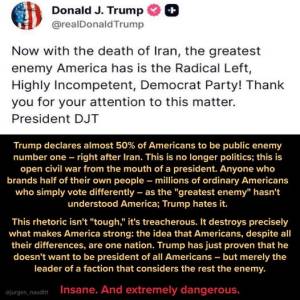 This afternoon, Trump told reporters: “You know, we don’t use the strait…we don’t need it. Europe needs it, Korea, Japan, China, a lot of other people, so they’ll have to get involved a little bit on that one.” He also said: “I think we’ve won, we’ve knocked out their Navy, their Air Force. We’ve knocked out their anti-aircraft. We’ve knocked out everything. We’re roaming free. From a military standpoint, all they’re doing is clogging up the strait. But from a military standpoint, they’re finished.”
The International Energy Agency is an intergovernmental organization that was created in 1974 to provide policy recommendations on the global energy sector and whose members make up about 75% of the demand for global energy. Today it said, “The conflict in the Middle East has created the largest supply disruption in the history of the global oil market, due to the near halt in shipping traffic through the Strait of Hormuz.” It added: “The resumption of transit through the Strait of Hormuz is the single most important action to return to stable oil and gas flows and reduce the strains on markets and prices.” Until then, it urged people to work from home if possible, drive more slowly to conserve energy, use public transport, avoid using airplanes, and use electricity for cooking where possible.
Yesterday President Donald J. Trump told reporters he was not sending troops to Iran, saying: “No, I’m not putting troops anywhere. If I were, I certainly wouldn’t tell you, but I’m not putting troops.” Today, Jennifer Jacobs, James LaPorta, and Eleanor Watson of CBS News reported that the Pentagon has made detailed preparations for sending troops to Iran. The administration is currently moving thousands of Marines to the Middle East. They will not be in place for a few weeks, suggesting the administration is expecting the engagement to continue.
Barak Ravid and Marc Caputo of Axios reported today that the administration is considering an assault on Iran’s Kharg Island, the center of Iran’s oil-processing facilities, to force Iran to allow free passage through the Strait of Hormuz. That operation would require the U.S. military to pound Iran’s military capacity near the strait before sending in ground troops. A source told Ravid and Caputo: “We need about a month to weaken the Iranians more with strikes, take the island and then get them by the b*lls and use it for negotiations.”
Prices in the U.S. were already rising before Trump struck Iran, prompting the closure of the strait and the choking off of global oil supplies. The Federal Reserve’s tracking of key inflation measures, released Wednesday, showed higher prices than expected, with the Producer Price Index (PPI) jumping 0.7% in February, the most since last July. In the twelve months through February, Lucia Mutikani of Reuters reported, the PPI went up 3.4%, the fastest rate of growth in a year. Now, dramatically higher fuel costs threaten to drive those prices higher.
The war itself is also costing Americans money, and lots of it. Economist Justin Wolfers notes that the estimated cost of $1 billion a day does not include the larger cost to the economy. The Pentagon’s number counts only bombs and planes and personnel, Wolfers points out. It does not include higher oil prices, geopolitical strife, business uncertainty, and slower growth. Those costs will mount into the hundreds of billions.
G. Elliott Morris of Strength in Numbers notes that 58% of Americans think the U.S. military operation in Iran is a bad use of taxpayer dollars, while only 32% approve. Asked if they would support the war in Iran if it raised gas prices by $1 a gallon or more, 61% of Americans said they would not, while only 30% said they would.
Aware that the war is historically unpopular, Republicans in Congress are refusing to exercise any oversight of the Pentagon and the White House. Megan Mineiro of the New York Times reported today that Republicans don’t want to expose disapproval of the war and so are simply cheering Trump on in public. Rather than holding public hearings that would allow the American people to hear the administration’s justification for the war and plans for its execution, as Democrats demand, Republicans are permitting the administration to inform Congress as it wishes, behind closed doors.
“You don’t want to show that kind of division to your enemy when you’re in the midst of a war,” Senator Ron Johnson (R-WI) told Mineiro. “I don’t have a problem with the administration avoiding showing our enemy that they don’t have 100 percent support of the Congress.”
“They’re holding news conferences,” Senate majority leader John Thune (R-SD) told reporters last week, so there is no need for official hearings. House speaker Mike Johnson (R-LA) said that operations were “very sensitive” and thus could not be discussed outside of classified settings “because it would adversely affect our mission.” This demand that Americans trust the government to go to war without public debate flies directly in the face of the reasoning of the Framers of the Constitution, who believed the American people must have the right to decide whether to invest their lives and fortunes in a war.
Senate Democrats have tried twice to pass a measure that would require Trump to get congressional authorization before continuing the war, but Republicans reject it. “They want to circumvent the Constitution,” Senator Cory Booker (D-NJ) said. “They want to go around public oversight. They want to avoid the glare, the questions of the American people.”
The recognition that the war might drag on has driven the stock market down sharply. All three of the main U.S. stock indexes—the S&P 500, the Nasdaq Composite, and the Dow Jones Industrial Average—have fallen since the war began. Tonight, after markets had closed down again, Trump appeared to try to reassure investors over the weekend that the war will end soon, writing on social media that “[w]e are getting very close to meeting our objectives as we consider winding down our great Military efforts in the Middle East with respect to the Terrorist Regime of Iran.”
The administration continues to try to sell its war as a violent video game, and Trump as a dignified leader. Eli Stokols, Ben Johansen, Jack Detsch, and Paul McLeary of Politico reported on Wednesday that the White House is thrilled with the engagement garnered by the war videos made by White House communications staffers, in which footage of military strikes is intercut with football hits or bowling pins being blasted apart, or with clips from movies like Top Gun and Gladiator. A White House official told the journalists: “We’re over here just grinding away on banger memes, dude. There’s an entertainment factor to what we do. But ultimately, it boils down to the fact that no one has ever attempted to communicate with the American public this way before.”
Progressive political strategist Max Burns notes that the White House messaging “is appealing directly to the base, especially to these young, very online, 4chan MAGA people who, just like Trump, treat war like a video game.” He added: “You don’t see service members sharing this content.”
Since the Obama administration, the choice of whether to allow media at a dignified transfer ceremony when the remains of service members are brought home at Dover Air Force Base in Delaware has been made by the families. After Trump’s political action committee used images from a dignified transfer in a fundraising email, on Wednesday the Fox News Channel announced that “at the request of the families, the dignified transfer is going to remain private. There will not be any cameras.”
Nonetheless, the administration posted a number of photos from Wednesday’s ceremony on social media, showing Trump in the background, saluting.
Epstein Files, Trump Team Coverup

A PowerPoint published among the Department of Justice files on Jeffrey Epstein.
Miami Herald, Investigation: Documents reportedly shredded by BOP after Epstein's Death, Julie K. Brown,right, and Claire Healy, Updated March 21, 2026. A Miami Herald analysis of thousands of pages in the Epstein files found there were bags of shredded documents at the Metropolitan Correctional Center in the days after Epstein’s death there. A Corrections officer called the FBI, then writes letter to judge about document cover-up.
A Miami Herald analysis of thousands of pages in the Epstein files found there were bags of shredded documents at theMetropolitan Correctional Center in the days after Epstein’s death there. Department of Justice TNS
Less than a week after Jeffrey Epstein was found dead inside his cell at the Metropolitan Correctional Center in Manhattan, something was afoot inside an office where the Federal Bureau of Prisons’ After Action Team had set up a probe into what had happened to their most high-profile inmate.
The FBI was told that there were people shredding documents. Bags of them.
An inmate at the jail was ordered to take the bags of shredded material to MCC’s rear gate and throw them in a dumpster on Thursday, Aug. 15, and again on Friday, Aug. 16, days after Epstein’s Aug. 10 death, records show. The sheer volume of material seemed unusual, the inmate noted.
“They are shredding everything,” the inmate told one of the guards, adding that he was asked to give the officials, whom he did not recognize, a hand with the shredding.
“Make sure you get that box too,” one of the men allegedly told him.
 The inmate wasn’t the only one who found it out of the ordinary. A corrections officer at the detention facility called the FBI’s National Threat Operations Center that same night, a Friday, at 6:28 p.m. to report that he had “never seen this amount of bags of shredded documents coming out to be put in the dumpster at the rear gate of MCC.”
A back gate corrections officer was also troubled by what he witnessed as the inmate brought down “bales” of shredded paper, according to a memo he wrote to investigators three days later, on Monday, Aug. 19.
“I believe that this conduct may be inappropriate for [an] investigative team to be shredding paperwork related to the investigation and you may want to investigate why BOP employees are destroying records,” the correctional officer wrote on Aug. 19 around 11 a.m.
“Can we take a look at the Dumpster ASAP to see if the paper is still there? Possible they didn’t dump it yet,” replied one of the federal agents whose name is redacted in the memo.
But it was already too late. The trash was picked up that very morning.
By that time, federal prosecutors had also found something else amiss: “We learned today that all institutional count slips for dates prior to August 10, 2019, which we requested on August 12, 2019, are apparently ‘missing.’”
The discovery was only one of many suspicious events that unfolded in the days and weeks both before – and after – Epstein’s death, the Miami Herald has found from an analysis of thousands of pages of documents released by the Justice Department. In fact, there were so many irregularities discovered at the Manhattan jail that the U.S. Attorney’s Office for the Southern District of New York (SDNY) opened three separate probes into the case, with different case numbers, records and emails show.
First, there was the probe into Epstein’s death, which the medical examiner concluded was a suicide by hanging. Despite the ruling, a forensic pathologist hired by Epstein’s estate disputes the finding by Dr. Barbara Sampson, who was then the chief medical examiner of the City of New York.
Dr. Michael Baden, also a former New York City chief medical examiner, argued that the injuries found in Epstein’s neck and the ruptured capillaries in his eyes were more consistent with strangulation than suicide by hanging.
 Baden, shown above in a photo used in a special by the CBS show 60 Minutes served for decades as a member of the New York State Correction Medical Review Board, an entity responsible for reviewing deaths of inmates in custody. Baden has conducted more than 20,000 autopsies including reviewing those of former President John F. Kennedy, and civil rights leaders the Rev. Martin Luther King Jr. and Medgar Evers.
But there were also two corruption probes associated with Epstein’s death: one, an obstruction-of-justice case involving the shredding of documents and possible charges of dereliction of duty and other misconduct by correctional officers; and second, a blackmail-for-sex scheme involving a correctional officer that the DOJ labeled a “Color of Law” probe.
That investigation grew out of inmate and correctional officer interviews in the aftermath of Epstein’s death. It’s not clear why it was attached to Epstein’s case. The Herald could find no connection.
What stands out, however, is that at some point early on, the cases seem to have changed hands from being an FBI criminal case — to matters that were handled by the Justice Department’s Office of the Inspector General (OIG), which has no criminal prosecution powers. The OIG is an independent agency that investigates allegations of fraud, waste or misconduct, but it must refer its findings to the DOJ for potential prosecution.

The reason for the OIG taking over the probes isn’t entirely clear. From the outset, on the day Epstein’s body was found, then-Attorney General William Barr, above, immediately announced that Epstein died of an “apparent suicide.” And then, six days later, on Aug. 16, Sampson confirmed the suicide ruling.
With the cause and manner of death already determined, and no foul play suspected, the only aspects of the case left unresolved – at least in the eyes of the Justice Department – was whether the actions of any of the officers contributed to Epstein’s suicide.
This seemed to color the investigation almost from the beginning, since Epstein’s death was never treated as suspicious. As a result, his cell was never considered a possible crime scene that would, under normal circumstances, be examined by experienced criminal and forensic experts who would take fingerprints, blood samples and other evidence. One thing that got lost as a result of the cell not being examined was that the piece of fabric that Epstein allegedly used to hang himself was never identified.
It also should have been looked at carefully because on July 23 — just 18 days before he died — Epstein was found unconscious on the floor of his cell. He initially told prison officials that his cellmate, Nick Tartaglione, had tried to kill him and that Tartaglione, a quadruple killer, had been threatening and extorting him. Tartagione denied he tried to harm Epstein, and Epstein later said he couldn’t recall what happened.
Prison officials concluded it was an attempted suicide. Still, the fact that Epstein had reported being threatened by inmates should have been enough for the DOJ to treat his death as suspicious.
Many, if not most, of the entities and investigators contained in the Epstein file documents reviewed by the Herald are redacted. This means that it’s impossible to fully understand which agents or agencies were communicating with each other about the various aspects of the Epstein investigations.
The Herald pieced some of the correspondence together in order to draw as complete a picture as possible of the various cases.
Separately, the Herald also found that the federal Bureau of Prisons wrote an “After Action Review” of Epstein’s suicide on Aug. 10, 2019. This 18-page report was conducted by an “After Action Review Team,” whose names are redacted from the report. This is likely the team that was in the prison in the days following Epstein’s death. The report refers to a review of “written documentation, electronic databases and limited staff conversations.”
 The BOP said in a statement that the team is standard following prison suicides.
“These teams review such things as various background information for the inmate, health care and personality information, antecedent circumstances, and various other details surrounding the suicide. This team then draws conclusions and makes recommendations to the facility,” the BOP said.First call about documents being shredded
The first mention of document shredding was a call to the FBI’s Threat Operations Center from a corrections officer at 6:28 p.m. on Aug. 16, six days after his death. An FBI 302 form containing an interview with the officer noted that “Caller found it suspicious that an after-action team charged with investigating would be shredding huge amounts of paperwork” with all the officials from the FBI, BOP and OIG in the building.
The caller advised that if “anyone cares about what was shredded,” they needed to check the dumpster before it was collected at 8 a.m. on Monday. But that doesn’t appear to have happened.On Aug. 16, 2019, at 6:28 p.m. a correctional officer called the FBI tip line to report shredded documents.On Aug. 16, 2019, at 6:28 p.m. a correctional officer called the FBI tip line to report shredded documents.
Instead, about 11 a.m. Monday, a corrections officer wrote an email to the OIG reporting the shredding said that it appeared to be an unusually large number of trash bags at MCC’s back gate. It’s not clear whether the officer was the same one who had called on Friday.
Later that day, at about 7:30 p.m., an assistant federal prosecutor requested permission to interview the inmate who was identified as dumping the material. In the email, the prosecutor notes, “We are also investigating any efforts, following Epstein’s death, to obstruct justice by destroying relevant records at MCC. In particular, we learned today that all institutional count slips prior to August 10, 2019, which we requested on August 12, 2019, are apparently “missing.”
Two correctional officers on duty the night Epstein died, Tova Noel and Michael Thomas, were both interviewed in 2021 by the OIG. Both were questioned about whether they knew anything about Epstein’s “missing” MCC file.
“Did you ever remove or destroy any of Epstein’s paperwork?” the OIG agent asked Noel and Thomas in each of their interviews. Both replied, “no.”The Department of Justice Office of the Inspector General interviewed Michael Thomas on June 17, 2021.The Department of Justice Office of the Inspector General interviewed Michael Thomas on June 17, 2021.
The inmate who was identified as removing the shredded documents was interviewed by OIG agents on Aug. 20. One report indicated that a prison lieutenant whose name is redacted may have been present during the time the inmate was questioned. It was clear from the transcribed interview, however, that the inmate was concerned about whether he would face retaliation for talking about what he saw.
The inmate’s interview was not transcribed until four months later, on Dec. 19, 2019, and the original handwritten notes are not included in the report. The interview was 15 minutes.
The inmate, Steven Lopez, did not explain what he saw, and the agents didn’t ask.
Instead, they gave Lopez questions that he could respond with either yes or no answers.
“Do you have any information about shredding documents?”
Lopez: “No.”
“Did you overhear anyone talk about shredding documents?”
Lopez: “No.”
“Do you know what, if any documents were shredded?”
Lopez: “No idea what if anything was shredded, just did usual trash bin runs.”
The report ended with the statement: “Lopez had no other information relating to Epstein or the tip and informed that he is just trying to stay out of trouble, keep his head down and do his work. Lopez informed that he enjoyed the position he has and doesn’t want to screw it up in any way.”
Eight days later, the corrections officer who sent the email to the FBI was interviewed. While his name is redacted in the interview, an email sent days later identifies the complainant as officer Michael Kearins, and a subpoena for Kearins by OIG agents is included in the files. He said he had been working for BOP for almost 30 years. He admitted he sent the email and provided a first-hand account of what he heard and saw, records show.
According to the report, Kearins said that about 10:30 a.m on Aug. 15, Lopez approached the post at the rear gate at MCC with approximately three bags of shredded paper. Kearins recalled that Lopez said “they are shredding everything back there.”
According to Kearins, Lopez described one of the men involved in the shredding as white, with a Southern accent. Kearins said he didn’t know anyone at the prison who fit that description, so he surmised that he must have been part of the BOP’s After Action team related to Epstein’s death.
Lopez told him that the man ordered him to “make sure you get that box over there too.” Kearins said that another inmate (whose name is redacted) was also asked to help shred the documents. Kearins admitted he did not know what documents were being shredded or where they originated.
New York City emergency workers remove Jeffrey Epstein from a federal prison in Manhattan with a gurney for transport to a hospital emergency room.
Meidas Touch Network, Opinion: Operation Epstein Fury, Dina Doll, March 21, 2026. On March 11, while bombs were still falling on Iran and the Strait of Hormuz sat effectively closed to global oil traffic, something happened in a quiet deposition room in Washington, D.C. that the Trump administration would very much prefer you missed.
That is the point. That has always been the point.Subscribed
Trump launched strikes on Iran on February 28th alongside Israel. More than 1,300 Iranians were killed. Over 700 in Lebanon. Twelve Israelis. Seven American soldiers. An American Tomahawk missile reportedly hit an elementary school, killing more than 170 people, many of them children. Trump brushed off questions about it. The Strait of Hormuz, through which roughly a fifth of the world’s oil supply passes, is effectively closed. The U.S. Embassy in Baghdad is telling Americans to leave Iraq. There is no exit strategy. There is no defined endgame. Trump has offered several contradictory ones depending on the day. Prevent a nuclear weapon. Regime change. Secure natural resources. Pick one. He can’t.
This is a catastrophe by any honest measure. It is also, whether by design or by opportunism, the loudest possible noise to make while devastating Epstein files work their way through Congress.
Don’t let the noise win.
On March 11, Richard Kahn, Jeffrey Epstein’s longtime accountant and co-executor of his estate, sat before the House Oversight Committee. Kahn is one of the most consequential figures in the Epstein universe. He managed Epstein’s finances for over a decade, is mentioned more than 50,000 times in the DOJ’s Epstein files, and is a named beneficiary of Epstein’s estate. During the deposition, he admitted to facilitating a fake marriage between two women connected to Epstein, admitted to impersonating Epstein in communications with banks, and confirmed that Epstein talked about Donald Trump “a lot.”
But here is what is demanding a straight answer right now.
During the deposition, Rep. Ro Khanna asked Kahn directly about a woman referred to as “Jane Doe 4” — a woman who made allegations against both Jeffrey Epstein and Donald Trump. Kahn confirmed she had received a settlement from the Epstein estate. Then, later in the same deposition, after consulting with his attorney, Kahn reversed course. He said his earlier testimony was mistaken. He said he didn’t recognize the name. The following day, his attorney told Democratic staffers that Jane Doe 4 had in fact filed a claim against the estate, but that it had been denied and no settlement was reached.
Three different answers. In three days.
Ranking Member Robert Garcia and Rep. Ro Khanna responded by sending a formal letter to Kahn’s attorney demanding written clarification on the record. In their joint statement, they noted that Jane Doe 4 was interviewed by FBI agents four times. They wrote, “Congress and the public deserve a clear answer about whether the Epstein Estate paid a settlement to an accuser who made serious allegations against Donald Trump. Richard Kahn needs to come clean about what the Epstein Estate knows.”
The White House has called all allegations against Trump in connection with Epstein “baseless.” Republican Chairman James Comer noted that Kahn testified he “had never seen any type of transaction to Trump or anyone in his family.” Trump has denied any wrongdoing consistently and completely.
But the testimony keeps shifting. That is the problem. Rep. Khanna put it plainly to PBS NewsHour on Wednesday: “If it was fake, then why was she paid a settlement? There must be some validity to it.”
Now layer that against what Pam Bondi’s Justice Department is doing right now. The same DOJ that was subpoenaed by its own party to answer for withholding roughly half of the Epstein documents it is legally required to release. The same DOJ that Bondi has been running interference for since January, offering private briefings to a handful of members at a time, trying to keep the full picture away from a public forum.
Here is what this week actually looks like when you hold it together.
The country is in a war nobody can explain, with mounting civilian casualties and the world’s oil supply under active threat. And while the bombs are falling, the accountant who managed the estate that may or may not have paid a settlement to one of Trump’s accusers just contradicted himself on the record three times in three days, and the DOJ is still sitting on half the documents it is legally required to release.
Operation Epstein Fury is working exactly as intended. The news cycle is drowning in Iran. Richard Kahn’s shifting testimony is a footnote when it should be a headline.
Don’t look away from the deposition room. I know I won’t. That is where the answers are.
More Global News
Miami Herald, U.S. says Cuba can’t buy Russian oil just as tanker approaches the island, Nora Gámez Torres, March 21, 2026 (print ed.). The U.S. Treasury Department has included Cuba among the few countries that cannot benefit from a temporal lifting of sanctions on Russian oil, just as a Russian tanker carrying crude is heading to the island in defiance of the Trump administration.
As the price of gas has soared in the midst of the U.S. military conflict with Iran, the Treasury authorized last week the sale of previously sanctioned Russian oil loaded to vessels between March 12 and April 11. But on Thursday, it changed the regulations to exclude sales to Cuba, Iran and North Korea.
The exclusion comes after a Russian ship, the Anatoly Kolodkin, which is under U.S. sanctions, had sailed to Cuba carrying about 700,000 barrels of Russian crude.
“The question everybody has is what the administration will do” if the ship continues intent on delivering the oil to Cuba, said Jorge Piñón, an energy expert at the University of Texas at Austin.
The shipment could provide Cuba with a lifeline to ease its energy crisis for a few weeks. But a significant U.S. military presence remains in the Caribbean that could move to intercept or escort away sanctioned tankers, and enforce the Trump administration’s de facto oil embargo on Cuba.
If the Russian ship reaches the island “it would take between 15-20 days for Cuba’s inefficient and low conversion oil refineries to turn it into high value products, particularly diesel,” Piñón said.
Another ship, the Sea Horse, a Hong-Kong-flagged tanker, was carrying an estimated 190,000 barrels of Russian diesel toward Cuba and appeared to have changed course Thursday after approaching the island this week.
It is now bound for Puerto Cabello in Venezuela, according to tracking services.
Previously, the ship appeared to be drifting in the Atlantic for three weeks, according to vessel tracking data. It had previously switched off its transponder during a ship-to-ship transfer of the Russian fuel near Cyprus, a tactic commonly linked to sanctions evasions.
Maritime tracking firm Winward suggested the ship may have spoofed its location and surreptitiously delivered the fuel to Cuba already. But Piñón said the vessel’s draft, a measure of how deeply a ship sits in the water, has been the same since leaving the Mediterranean 35 days ago, indicating that it has not unloaded any of its cargo.
Whether Cuba is able to secure deliveries despite U.S. efforts might be central to ongoing talks between the two countries and the prospects of economic and political changes in the country.
While the cut-off of oil supplies by the Trump administration had pressured Cuba’s leadership to release a few political prisoners and announce limited reforms to allow Cubans abroad to own private businesses, Cuban leaders have signaled they would not go further.
Cuban leader Miguel Díaz-Canel vowed “impregnable resistance” this week after President Donald Trump said he would “take Cuba.”
On Thursday, Cuba’s ambassador to the United Nations, Ernesto Soberón Guzmán, told Bloomberg news that a “friendly takeover, regime change, the removal of the president are completely out of any dialogue.”
Meanwhile, the Cuban government is leaning on a wide network of far-left groups and influencers around the world to call attention on social media to the effects of U.S. sanctions and the cut-off of oil supplies, while avoiding scrutiny over its human-rights record and its role in precipitating the ongoing humanitarian crisis.
About 140 activists left Miami Friday as part of a “Nuestra América” convoy organized by Progressive International, a network of far-left organizations. The group, which includes members of Code Pink, the woman-led social justice organization, said its aim is to deliver humanitarian donations and oppose the United States’ “depraved policy of economic warfare,” Code Pink founder Medea Benjamin said in a statement.
More On Iran War
 Iran’s Supreme Leader Ali Khamenei Killed in Strikes Feb. 28
Wayne Madsen Report, Investigative Reporting: Trump and Netanyahu have put a target on every ex-leader, Wayne Madsen, left, March 20-21, 2026. State-sponsored assassination of former Iranian President Ahmadinejad sets a dangerous precedent.
Although both Israel and the United States have a sordid history of assassinating incumbent political leaders around the world — including the recent assassination in a bombing strike of Iranian Supreme Leader Ayatollah Ali Khamenei — the decision by Donald Trump and Binyamin Netanyahu to also attempt to assassinate former Iranian President Mahmoud Ahmadinejad sets a dangerous precedent for every other retired head of state or government around the world.
There are conflicting reports about Ahmadinejad’s fate. While some Instagram reports indicated he was killed in a February 28 airstrike, other sources claim he survived the assassination attempt and is alive. Although three of Ahmadinejad’s bodyguards were killed in a security out-building, his primary residence located 100 meters away was not hit. It should be noted that since leaving office in 2013, Ahmadinejad had become a critic of the Iranian regime and the Islamic Revolutionary Guard Corps protective guards assigned to him were more house arrest enforcers than security guards. Ahmadinejad had been mentioned as a possible figure in a post-regime transition government.
Although Trump lamented the 2022 assassination of former Japanese Prime Minister Shinzo Abe, writing in his child-like prose on Truth Social that the murder was “Really BAD NEWS FOR THE WORLD!,” his attempt to kill Ahmadinejad opens the possibility that there will be future events like that which saw the assassination of Abe.
Some in Trump’s circle would point out that Trump, also, was an ex-leader who faced an assassination attempt in Butler, Pennsylvania on July 13, 2024. However, there is an expanding body of evidence that Butler was a staged event — fatal for two in attendance — designed to boost Trump’s polling numbers.
Abe’s assassination in Japan — a country with extremely low gun violence — demonstrated that even highly secure societies are not immune to such acts, lone actors can bypass traditional security assumptions, and homemade or improvised weapons can defeat protective systems.
With Trump and Netanyahu signaling that ex-leaders like Ahmadinejad are now fair game, former leaders everywhere will be forced to reckon with a new reality. Former leaders receive significantly less protection than sitting leaders because their security tiers, staffing levels, budgets, and operational mandates are all reduced once they leave office. This holds true for former U.S. presidents who receive significantly less Secret Service protection than incumbent presidents and vice presidents.
Security experts have noted that former leaders travel more freely, attend public events without the same restrictions, live in private residences rather than fortified executive compounds, and maintain predictable daily patterns. Nevertheless, assassinations of former leaders have been relatively rare. Over the past few decades, only three major ex-leaders were assassinated: Abe while campaigning for his party in 2022; former Pakistani Prime Minister Benazir Bhutto, assassinated in 2007 by a suicide bomber in Rawalpindi while she was campaigning for re-election; and former Lebanese Prime Minister Rafik Hariri, assassinated by a car bomb in 2005. Only two of these assassinations were state=sponsored. Bhutto’s assassination was traced to incumbent Pakistani leader Pervez Musharraf and that of Hariri was linked to Israeli agents, although Syrian President Bashar al Assad was tagged by the international media and certain international organizations as the chief culprit.
Other former leaders survived one or more assassination attempts. They include former Haitian President Jean-Bertrand Aristide, former South African President F.W. de Klerk and former Lebanese President Amine Gemayel (who all survived several attempts); former Argentine President Cristina Fernández de Kirchner; and former Soviet Union President Mikhail Gorbachev.
Thanks to Trump’s and Netanyahu’s foolish attempt to kill former President Ahmadinejad, the list of former leaders targeted by state-sponsored attacks or those of lone wolves will regretfully grow longer.
New York Times, News Analysis: One Global Power, One Regional Power, Two Different Goals, Steven Erlanger, March 21, 2026 (print ed.). The United States views Iran through a prism of global responsibilities and strategic goals. Israel has a more regional approach. After nearly three weeks of war, their paths are diverging.
Israel launched a major attack on an Iranian gas field this week, prompting retaliation by Iran against Gulf States, a threat to global energy supplies and a surge in fuel prices. President Trump first insisted the United States “knew nothing about” the strike, then later backtracked and said he warned Israel against attacking the complex.
His attempt to distance his administration from the strike underscored the diverging aims of the United States and Israel as their war against Iran grinds on.
As a superpower with global responsibilities, the United States cares deeply about global energy supplies and the safety of its Persian Gulf allies. And with crucial midterm elections later this year, the Trump Administration cares deeply about the rising price of gasoline in the United States.
But as a regional power, Israel has different strategic aims and more narrow concerns, analysts and former officials say. Israel has its own natural gas, little dependency on the Strait of Hormuz, where Iran has a chokehold on the transport of fuel, and no responsibility for the free flow of global trade. The stakes for Israel are higher than for the United States, since it sees Iran, sworn to the destruction of Israel, as a clear danger, both from its nuclear program and especially from its ballistic missiles.
Aaron David Miller, a former U.S. Middle East negotiator now at the Carnegie Endowment, said: “We are a global power and they are a regional one. So their threat assessments create a different set of objectives than ours.”
That divergence is inevitable, said Suzanne Maloney, an Iran expert and director of the foreign policy program at the Brookings Institution. Not only are their goals fundamentally different, she said, but “the costs the two sides can bear are even more different, especially over time.”
Washington is focused much more now on the problem of the Strait of Hormuz, she said, since a lengthy closure could mean a sustained global recession and higher fuel prices.
“Israel doesn’t care as much about this,” she said. “They have a set of strategic objectives and believe they are succeeding, and they’re not as price sensitive as the White House. They are more willing to weather the storm and try to finish the job.”
Israel is more determined than Washington to change the regime in Iran, dismantling the Islamic republic and its ballistic missile program, and to degrade Hezbollah, Iran’s proxy force in southern Lebanon, to the point that it cannot threaten Israel again for many years. Israel is also more amenable, analysts said, to the possibility of state collapse and chaos in Iran than Washington appears to be.

Media Matters Weekly Newsletter, Right-wing media figures are urging Trump to declare an early victory in Iran and leave, Jason Campbell, March 20, 2026. In fact, prime-time Fox shows gave less than a minute of airtime to the administration’s $200 billion war funding request.
Backlash on the right over the war appears to be growing; one right-wing commentator said the war looks like a “massive blunder.” Another podcast host said comments from Trump figures who promised to be anti-war were a “complete [f-ing] lie.” Personality cult watch: Joe Kent is not blaming Donald Trump for starting the Iran war. The Fox News hosts attacking him are not blaming Trump for appointing someone they're calling a disloyal, untrustworthy, Trump-hating conspiracy theorist.
If you want this delivered straight to your inbox, subscribe here.Jump to section
Some right-wing media figures are urging Trump to declare early victory and leave Iran
As President Donald Trump’s war with Iran enters week three with no end in sight, some right-wing commentators are urging the administration to “declare victory” and “get out” of Iran “before it gets much worse."
The war is not going well politically for the Trump administration. Polling shows that over half of voters oppose the conflict. Now we’re facing the possibility of sending ground troops to Iran given the worsening situation in the Strait of Hormuz — which 74% of voters oppose.
Some right-wing figures are fearful of what effect a military quagmire in the Middle East would have on the midterms, and a number of right-wing media personalities are urging the administration to save face by declaring victory and exiting the region. In reality, negative consequences seem to be on the way.
Meanwhile: Fox News isn’t bothering to sell the staggering cost of the ill-conceived war President Donald Trump launched against Iran. The Trumpist propaganda network provided roughly 11 minutes of coverage through Thursday to the administration’s request for an eye-popping $200 billion in supplementary spending from Congress — and less than 1 minute of discussion on its prime-time block, according to a Media Matters review.
Trump Watch
New York Times, Trumps, on a Deal-Making Spree, Turn Next to Transylvania, Rebecca R. Ruiz and Andrei Petre, March 21, 2026 (print ed.). The president’s company is eyeing a site for a golf course and luxury apartments. Will a huge landfill and a troubled project history stand in the way?
The Trump Organization has for decades planted the family name in places synonymous with business and luxury tourism: Manhattan, Los Angeles, Honolulu. Its global ambitions include Australia, Bali and the Maldives.
Now, President Trump’s family business is setting its sights on Transylvania, the central Romanian home to literature’s Count Dracula. The company has selected, records and interviews show, a site alongside one of the region’s biggest landfills and a former medical waste dump.
The project, which has yet to be announced, would revive a stalled real estate development in the Romanian city of Cluj that had been tainted by government corruption. It would put Mr. Trump’s name on luxury apartments and a golf course not far from an informal encampment where Roma people have been effectively exiled to live beside toxic garbage.
PoliticusUSA, Commentary: Disgraceful Trump Humiliates Himself By Celebrating The Death Of Robert Mueller, Jason Easley, March 21, 2026. Trump celebrated the death of Robert Mueller in an embarrassing manner without seemingly realizing what goes around, comes around.
Presidents set the culture and tone for the nation, whether they intend to or not. Presidential behavior trends to make its way into American society. It is clear that Trump’s rudeness, coldness, and incivility have made their way into segments of American culture.
As an unwritten rule, presidents don’t celebrate the deaths of prominent people.
Former FBI Director and special counsel Robert Mueller was a transformative person. As FBI Director, Mueller reshaped the bureau to focus more on terrorism prevention after 9/11.
The AP noted in its report about Mueller’s death:
At the FBI, Mueller set about almost immediately overhauling the bureau’s mission to meet the law enforcement needs of the 21st century, beginning his 12-year tenure just one week before the Sept. 11 attacks and serving across presidents of both political parties. He was nominated by Republican President George W. Bush.
The cataclysmic event instantaneously switched the bureau’s top priority from solving domestic crime to preventing terrorism, a shift that imposed an almost impossibly difficult standard on Mueller and the rest of the federal government: preventing 99 out of 100 terrorist plots wasn’t good enough.
As Special Counsel, Mueller oversaw what was an important report about Russia’s interference in the 2016 presidential election to help the Trump campaign to victory.
Trump has never been able to make his Russia problem go away, even though he continues to try to this day, Russia remains a dark cloud that is constantly over his head.
Trump hates Mueller and reacted to the former special counsel’s passing in the most unpresidential and inhumane way imaginable by posting on his social media account, “Robert Mueller just died. Good, I’m glad he’s dead. He can no longer hurt innocent people! President DONALD J. TRUMP”
Mueller didn’t hurt any innocent people, but he did put a lingering stain on one convicted felon, the current president.Trump Deserves The Same Coldness That He Has Shown Others
Sooner rather than later, Donald Trump’s time is going to come, and when it does, the media will do everything that it can to sanitize Trump and his legacy.
The guess here is that the American people are going to show Trump the same amount of sympathy that he has shown others.
It is embarrassing for the country for a president to react to a prominent death in the way that he has. Presidents are supposed to set the moral tone for the country, and not be so self-absorbed in their own pettiness that they can’t lead the nation and pay respect to those who have lived a life of note without bringing up personal grievances.
The American people made many mistakes when they put Donald Trump back in the White House, but the one that hangs over the nation every minute of every single day of Trump’s second administration is that they placed the world’s smallest man on the world’s biggest stage.
Robert Mueller was far from perfect.
Many believe that he should have disregarded DOJ guidance and pursued criminal charges against Trump, but even without the criminal charges for Trump, Mueller’s report was substantial and an important documentation of Russian election interference.
When Trump passes away, the American people should remember the precedent that Donald J. Trump set while alive, and not be afraid to say, “Good. I’m glad he’s dead, “ if that is the way that they feel.
You get what you give, and Donald Trump’s cruelty will someday be returned to him tenfold.
U.S. Immigration, Justice, Law, Rights
New York Times, Trump Friend Asked ICE to Detain the Mother of His Child, Megan Twohey, Shawn McCreesh and Hamed Aleaziz, March 21, 2026 (print ed.). Last June, the man credited with introducing President Trump to his wife asked the administration for a favor. Paolo Zampolli, a former modeling agent and a longtime Trump ally, was in a custody battle over his son. An ICE official agreed to help.
Paolo Zampolli, a former modeling agent turned presidential special envoy, had learned that his Brazilian ex-girlfriend was in a Miami jail, arrested on charges of fraud at her workplace. They had been in a custody battle over their teenage son. Now he saw an opportunity.
He reached out to a top official at Immigration and Customs Enforcement, explaining that his ex was in the country illegally, according to records obtained by The New York Times and a person familiar with the communications. Could she be put in ICE detention? That could help him get his son back.
The official, David Venturella, promptly called the agency’s Miami office to ensure that ICE agents would pick up the woman from the jail before she was released on bail, according to the records and a person with knowledge of the conversation who requested anonymity to discuss it. During the call, Mr. Venturella noted that the case was important to someone close to the White House.
The woman, Amanda Ungaro, was placed in ICE custody and ultimately deported, an outcome that may well have happened regardless of Mr. Zampolli’s meddling. But the ICE official’s willingness to spring into action for a Trump ally — even one in a low-level, largely ceremonial role — reflects a recurring theme of the second Trump administration: The levers of the federal government can be pulled to settle a personal score.
Mr. Zampolli, 56, is known in Washington for flaunting his proximity to the Trumps. In this case, he used his clout to solicit help from an agency beset by allegations of unlawful overreach.
In an interview with The Times, Mr. Zampolli denied asking ICE to detain Ms. Ungaro or seeking any other favors. He said he merely asked Mr. Venturella to explain what was going on with her case.
The Department of Homeland Security, which oversees ICE, said in a statement that Ms. Ungaro was detained and deported because she was on a long-expired visa and had been charged with fraud. “Any suggestion that she was arrested and removed for political reasons or favors is FALSE,” the statement said.
As the president’s special representative for global partnerships, Mr. Zampolli is a minor character in Mr. Trump’s Washington. But the role keeps him within photo-op range of the Trump family, cabinet secretaries and other prominent figures in and around the administration.Editors’ PicksThe Good List: 6 Things to Add Delight to Your DayTikTok’s Hottest Drama? Crying Doctors and Crushed Dreams.Fitting Her Life Into a 400-Square-Foot Paris Studio
He throws parties at a sprawling D.C. townhouse where the walls are hung with pictures of him and the president, and an end table displays a copy of the first lady’s book, “Melania.”
His Instagram feed shows him trailing behind Mrs. Trump at the United Nations, standing beside Mr. Trump’s chief of staff and posing with his son-in-law Jared Kushner. “I am honored to have been a friend of the President for more than 30 years, a friend of the First Lady for 29 years,” reads one caption. It ends: “Loyalty is king.”
New York Times, Handcuffs, Tents and Pleas for Medical Care: Pregnant in ICE Detention, Caroline Kitchener, Charo Henríquez and Hamed Aleaziz, March 21, 2026 (print ed.). Women describe conditions that violate longstanding agency guidelines for how pregnant detainees should be treated. The reporters interviewed women who have been held in detention as well as their family members and lawyers, and reviewed court filings, government documents and medical records.
Candy Castillo Collantes was six months pregnant when she stepped inside the giant tent where she would live for the next 47 days.
Her enclosure at the South Texas detention center held dozens of bunk beds, she said, with one tiny slit for a window. Women wailed late into the night for their husbands and children. When Ms. Collantes experienced vaginal bleeding and asked for medical care at the facility, she and her lawyer said, she was offered only water, prenatal vitamins and a temperature check.
“It’s not a center that we know has a doctor,” Ms. Collantes, a 38-year-old Venezuelan who obtained temporary legal status under the Biden administration, said in an interview from the facility in late February. “The people here can’t tell you that everything is fine.”
Ms. Collantes had heard from other detainees about a woman who had gone into labor at their detention center months earlier.
She was terrified that she could be next.
Pregnant women who have been swept up in President Trump’s immigration crackdown have been held in detention centers as late as eight months into their pregnancies without adequate food or medical care, according to a New York Times examination of 10 cases. The Times review found that, in those cases, the Department of Homeland Security violated longstanding agency guidelines for how to treat pregnant women in detention, subjecting them to conditions that medical experts say can jeopardize the health of mothers and their babies.
Pregnant women said they were served food covered in cockroaches and water that tasted like bleach. They described how Immigration and Customs Enforcement agents shackled their hands and feet, refusing to believe that they were pregnant until a bump appeared. One woman said ICE agents ignored her as she lay on the floor screaming in pain, and took her to the emergency room only after her fellow inmates began banging on the door for help.
This account is based on interviews with pregnant women either currently detained or recently released, as well as an analysis of court filings, government documents and medical records.
The Biden administration instituted a policy under which pregnant women could only be detained in “exceptional circumstances,” such as when a person poses a national security threat or an “imminent risk of death, violence, or physical harm” to someone. While Trump administration officials have offered conflicting opinions in court on whether that policy remains in effect, Lauren Bis, a Department of Homeland Security spokeswoman, said in a statement to The Times that it still stands.
Ms. Bis also said that pregnancy in ICE detention is “exceedingly rare,” comprising 0.18 percent of all undocumented immigrants in custody. That comes out to about 126 women, according to recent estimates of the number of people in detention. Ms. Bis added that no women had given birth in ICE custody under the Trump administration and that the medical care provided to women in detention was “the best health care many of these individuals have received in their entire lives.” She said that clean and bottled water was provided for detainees.
U.S. Governance, Politics, Elections

Top Illinoid primary race: Left to right: Lt. Gov. Juliana Stratton, the winner, and Rep. Raja Krishnamoorthi, and Rep. Robin Kelly were the main contenders in Illinois’s Democratic primary for U.S. Senate. (Images: Stratton, Krishnamoorthi, and Kelly campaigns).
The Contrarian, Opinion: Undaunted in Illinois, Jennifer Rubin, right, March 20, 2026. Standing up to dark money isn’t easy.
In winning the Democratic nomination in the IL-9 House race, Evanston Mayor Daniel Biss showed us how to stand up for democratic values and beat back dark money. Specifically, he overcame an avalanche of AIPAC money and debunked the argument that anyone who does not unconditionally support Israeli Prime Minister Benjamin Netanyahu’s government’s regional aggression and Palestinian policy is somehow “anti-Israeli.”
In an interview with me earlier this month, Biss defended his Israel bona fides:
I’m Jewish. My mother’s Israeli. My grandparents found a safe haven in Israel in 1948 after surviving the Holocaust. Most of my extended family on my mom’s side is still there, and I grew up visiting there every summer. So, Israel… means something to me, and its right to exist as a Jewish democratic state and to defend itself, also means something to me. This is not some box I checked on a questionnaire just to make somebody happy, this is personal.
He forthrightly called the conduct of this Israeli government “appalling,” and deplored the U.S. stance when the Netanyahu government violates international law in a way that amounts to: “Hey, we wish you wouldn’t, but also when you do, there will be no consequences.” That position, Biss argued, “has not worked, cannot work, will not work.”
Moreover, he called out AIPAC’s insistence that lawmakers “commit to oppose any conditions on military aid to Israel whatsoever.” That position is “absurd for anyone to take relative to any country,” he argued convincingly.
Biss called out AIPAC’s deceptive tactics, pointing out that it had concocted a new entity, “Elect Chicago Women,” to conceal its own name, which has become toxic in Democratic politics. Biss also emphasized that instead of challenging him on the merits of his Israel stance (which matches that of most Democrats), AIPAC launched personal attacks against him.
Following his victory Tuesday night, Biss thanked his mentor, Rep. Jan Schakowsky (D-IL), the retiring incumbent, and his opponents. He reasserted his progressive values and denounced the privileged few who have a “stranglehold” on our politics.
 Biss boldly reaffirmed his “core” beliefs on Israel, which include dignity for the Palestinian people and defense of democracy. “This district understands nuance,” he said. “AIPAC found out the hard way that my district is not for sale.” He asserted that his view represents the mainstream in both the Democratic Party and the Jewish community. It was a moment to savor beating back dark money without sacrificing one’s principles or wrongly assuming voters cannot think critically about a given race.Subscribed
 Biss had critical help from J Street (the center-left pro-democracy, pro-Israel group), which made a 6-figure third-party expenditure to put out a positive ad featuring his progressive record.
J Street president Jeremy Ben Ami and I have discussed the destructive turn AIPAC has made in recent years. It has become effectively a front for rightwing billionaires to clobber any candidate who will not sign onto its unqualified, extreme position on Israel.
After Biss’s race was called, J Street put out a statement touting the “win for democracy and a clear rejection of efforts to buy this primary”:
AIPAC and its affiliates poured more than $7 million into a Democratic primary to stamp out opposition to Netanyahu’s policies – using shell PACs to obscure their involvement — and the voters rejected that effort.
Tonight’s results should send a clear message to candidates across the country: you do not have to fear AIPAC’s spending or intimidation. Standing on principles and trusting voters matters more than outside money. . . .
We supported Biss because he represents the values we believe voters are looking for — a commitment to Israel’s security alongside support for Palestinian freedom, and the understanding that these goals are not in conflict, but inseparable.
Unfortunately, Tom Malinowski, running in the special election in New Jersey’s 11th congressional district in February, was a victim of these sort of AIPAC tactics. However, J Street, Biss, and center-left Democrats learned the lessons from that race. In the 9th, Biss swiftly called out dark money, exposed AIPAC’s election gamesmanship, and affirmed his bedrock principles. That strategy allowed Biss to prevail on Tuesday.
 Critically, Illinois Gov. JB Pritzker (left, who won renomination for another term, helped Lt. Gov. Juliana Stratton to victory in the Democratic Senate primary, and is in the top tier of 2028 contenders) has also bashed AIPAC’s tact to the right. “I abandoned AIPAC more than a dozen years ago,” he said in recent interview. “It was an organization that had at one time been bipartisan in nature and really all about preserving a strong relationship between the United States and Israel.” However, he recalled that “the organization began to lean much more to the right and much more pro-Trump, who had then become a candidate for president, and that disturbed me greatly.”
He could not support a group that got “involved in elections directly and [began] choosing to support candidates who were MAGA and right-wing and Trumpy.” In speaking out, Pritzker (as Biss did) carved out space for pro-Israel progressives and set AIPAC back on its heels.
Biss should be commended for his undaunted, unabashed defense of democratic values, his nuanced stance on Israel, and his rejection of deceitful dark money tactics. It is not easy in the face of millions of dollars of attack ads to stand up to those who advocate an extremist foreign policy (which ultimately is not in the interests of the U.S. or Israel). With a major assist from J Street, Schakowsky’s endorsement, and reinforcement from Pritzker, he nevertheless successfully defended his progressive agenda and weakened the grip of billionaires (whether they fund AIPAC, AI, or crypto interests) on our elections. The Jewish community, Democrats, and pro-democracy forces owe him a debt of gratitude.
U.S. Media, High-Tech, Education, Culture, Religion
White House Chronicle, Opinion: Women Face Massive Layoffs as AI Use Spreads in the U.S., Llewellyn King, above, March 21, 2026. March is Women’s History Month and a time to take a look at how women are progressing, or otherwise. Alas, the news for women in the United States isn’t good, and the future is foreboding as they are about to lose 6 million jobs to artificial intelligence.
Work traditionally done by women — secretaries, receptionists, payroll clerks and customer service representatives — is likely to lose jobs.
Except for healthcare, semi-skilled workers are the most vulnerable.I must confess to a longtime interest in the women’s movement, particularly the path of women in journalism.
In 1964, in New York, my first wife, Doreen, a stupendously gifted English journalist, and I created what we liked to believe was the very first women’s liberation magazine. Ms., co-founded by Gloria Steinem, didn’t launch until 1971.
Our magazine was “Women Now,” and we only got out one issue before we ran out of money. As I have said often, “It didn’t liberate any women but liberated all of our money,” which was utterly insufficient for the undertaking.
However, I remained interested in the progress of women in society.When I was at The Washington Post about six years later, I was elected president of the Washington-Baltimore Newspaper Guild. Women’s rights and their path in journalism were on the agenda, propelled as much by our talented business agent, Brian Flores, as by me.
The guild held conferences (including a national one in Chicago), formed study groups, and made the path of women an issue at the bargaining table. The Post’s editor, Ben Bradlee, asked if I was doing this “to improve my love life.” I wasn’t, and it didn’t.
Women could write themselves to glory, but it was a lot harder from the women’s pages or if you weren’t considered for reasons of your sex for a foreign assignment or war coverage. However, I think Marguerite Higgins, Martha Gellhorn and Dorothy Kilgallen were towering talents who circled above their contemporaries, male and female.
In the time I have been watching women’s issues, I have seen great progress and now backsliding.I have seen progress in the numbers of women editors, film directors, board members and company heads. Yet many women are hired, I believe, because it is possible to pay them less, on the assumption that they will be supported by a partner or husband. The old thinking.In the 1960s in Britain, jobs were advertised with one salary for men and another, a lower one, for women for the same work.
In that sense, things have improved.
But women worldwide are still losing ground in abhorrent ways. They encounter gender oppression, including honor killings in Muslim societies, female circumcision in parts of Africa, and femicide in some Caribbean and Latin American countries.In the democracies, there is a backward movement for women as the bad ways of old are championed as “conservative” or “traditional.” Worse, reproductive rights have been scaled back or denied, and overt efforts to promote equality have been prohibited.
The unwelcome news isn’t at an end: Enter AI.
Several studies, including those by the United Nations and McKinsey & Co., conclude that women will bear the brunt of the first American AI-induced layoffs. This will be felt between now and 2030, and as many as 6 million women may have to find new jobs or quit the job market altogether.In the years ahead, it is going to be harder for women than men as the first waves of what I call the “AI adjustment” hit the workplace. The political class needs to absorb this reality and to start thinking about the nature of work when AI starts snatching jobs by the millions.
So far, political talk has been to eschew the looming future — a future that, initially at least, threatens women most.
Women’s history is about to have a new chapter written.
March 20
Top Headlines
United States views Iran through a prism of global responsibilities and strategic goals. Israel has a more regional approach. After nearly three weeks of war, their paths are diverging.right, March 20, 2026. I’m feeling almost speechless right now.News Roundups: Epstein Files, Trump Coverup and More
March 20, 2026. After yesterday’s revelation that the Department of Justice (DOJ) is blocking the release of a memo related to a Drug Enforcement Agency investigation into sex trafficker Jeffrey Epstein and 14 co-conspirators, Attorney General Pam Bondi added more evidence to the idea that the DOJ is engaged in covering up the relationship between members of the Trump administration, including President Donald J. Trump himself, and Epstein.March 20, 2026. Two major fractures are emerging within the White House and Republican circles. First, Donald Trump is now acknowledging that his mass deportation effort has not gone according to plan, while Republican leaders are quietly urging members to stop talking about it ahead of November. Second, the war in Iran is beginning to split Trump’s base, as the United States sends thousands more troops to the region in what could be preparation for a ground operation, while gas prices continue to rise.More On Iran War
journal, Yousef Pezeshkian offers readers a mix of personal anecdotes and glimpses behind the scenes as Iranian leaders are picked off one after another.Trump Watch
New York Times, News Analysis: Using Charm and Restraint, Japan’s Leader Mostly Avoids Trump’s Wrath, Javier C. Hernández, March 20, 2026. During her first visit to the White House, Prime Minister Sanae Takaichi drew praise from President Trump. But the war in the Middle East will test their relationship. via Substack, Commentary: The president can't keep his lies straight, Heather Delaney Reese, March 20, 2026. At 11:47 a.m. Eastern Time, the President of the United States joined the first female Prime Minister of Japan in the Oval Office. For the next 27 minutes and 7 seconds, he did what he usually does when the cameras are rolling for the world to see. He took credit for other people’s achievements. He rambled incoherently from topic to topic. He lied about the war. And on this occasion, he also decided to humiliate our country by trying to turn one of our greatest tragedies into a punchline.
U.S. Immigration, Justice, Law, Rights
U.S. Governance, Politics, Elections
March 20, 2026. Standing up to dark money isn’t easy.March 20, 2026. A new poll shows Democratic candidate James Talarico holding a small edge, which is statistical tie, over both Republican candidates in the Texas US Senate race, which suggests a looming upset.U.S. Media, Education, Culture, Religion
 New York Times, Chuck Norris, Black-Belt Action Star of Movies and Television, Dies at 86, Clyde Haberman, March 20, 2026. He channeled his martial arts skills into heroic roles in films like “The Delta Force” and “Missing in Action” and in the long-running TV series “Walker, Texas Ranger.”
Top Stories
New York Times, Deferring to Trump, G.O.P. Lawmakers Resist a Public Accounting on Iran, Megan Mineiro, March 20, 2026. Republicans on Capitol Hill have given President Trump wide latitude to wage war on Iran with no congressional approval or limits.
Nearly three weeks into a war that polls show is unpopular, top Republicans have yet to call administration officials to testify about it, arguing that hearings would put divisions on display
They have deferred to him almost entirely on his justifications for the conflict, echoing the rationales offered by him and his top officials, even as they have given shifting and contradictory explanations.
Now, nearly three weeks after the first strikes on Tehran, G.O.P. lawmakers are resisting the idea of calling top administration officials before Congress to give a public accounting for an escalating war with uncertain objectives, a rising price tag and no clear exit strategy.
It is the latest example of how the Republicans controlling Congress, who have ceded power to Mr. Trump on matters large and small, are refraining from using their oversight authority as a coequal branch of government and have instead taken on the role of cheerleaders for his policies at a critical time.
“You don’t want to show that kind of division to your enemy when you’re in the midst of a war,” said Senator Ron Johnson, Republican of Wisconsin. “I don’t have a problem with the administration avoiding showing our enemy that they don’t have 100 percent support of the Congress.”
Democrats have demanded that Defense Secretary Pete Hegseth and Secretary of State Marco Rubio make the case under oath in congressional hearings for why the United States barreled into a war in the Middle East that has endangered American citizens, diplomats and allies across the region and caused oil prices to spike.
But even as the Pentagon requests $200 billion to fund the conflict and Mr. Trump has not flatly ruled out committing ground troops, many Republicans argue that summoning Mr. Hegseth and Mr. Rubio to Capitol Hill for televised hearings would be harmful because it would put the divisions over the war on display for the country, and for Iran, to see.
“I think it would be very unhealthy at this point in time,” said Senator Bill Hagerty, Republican of Tennessee. “We’ve got men and women in harm’s way.”
“The more cameras on someone in the Democrat party, the more bombastic they get,” said Representative Derrick Van Orden, Republican of Wisconsin. “It can be counterproductive.”
Republican leaders and rank-and-file members have said Mr. Trump is firmly within his authority to deploy forces into hostilities with Iran for up to 60 days without congressional authorization.
Democrats note that under the law, that power applies only if the United States faced an imminent attack, and they argue that the Trump administration has failed to prove that the threat posed by Iran met that benchmark. Mr. Hegseth and Mr. Rubio have rejected that reasoning, but testimony from two top intelligence officials on Wednesday directly contradicted the claim that an imminent threat existed.
New York Times, Iran War Live Updates: Oil Prices Remain Elevated as More Attacks Are Reported, Francesca Regalado, Adam Rasgon, Ashley Ahn and Ephrat Livni, March 20, 2026. The price of oil eased only slightly after the Trump administration sought to calm markets. Israel said it was striking Tehran and several U.S. allies reported attacks.
Here’s the latest.
The price of oil eased only slightly on Friday as investors feared that the wide-ranging attacks on energy infrastructure in the Persian Gulf would have long-term economic consequences.
The war in the Middle East cast a pall over celebrations for Eid al-Fitr, a holiday marking the end of the Ramadan fasting month, and Nowruz, the Persian New Year. A somber mood prevailed over family gatherings across the region as the U.S.-Israeli war on Iran neared its fourth week.
Iran fired more retaliatory strikes, with several U.S. allies saying they were responding to incoming drones and missiles. Israel said it had launched targeted attacks on Tehran after Iranian missile fire set off sirens in Jerusalem and northern Israel overnight.
In Washington on Thursday, a day after airstrikes on critical gas infrastructure in Qatar and Iran, Treasury Secretary Scott Bessent said that the United States was planning to lift sanctions on Iranian oil in an effort to shore up the global market, reversing years of U.S. measures to cripple Tehran’s economy.
President Trump said he had told Prime Minister Benjamin Netanyahu of Israel to stop attacking Iran’s energy fields. He also tried to reassure Americans on the economic impact of the war, saying on Thursday, “It will be over soon,” without explaining. He also said that he wouldn’t send ground troops into Iran, but left room to change his mind.
On Friday, benchmark stock indexes were higher in South Korea and China as the price of Brent crude fell to settled at $108.65 a barrel after reaching a high of $119 a day earlier.
But in a sign of the war’s long-term repercussions, state-owned QatarEnergy said that it would take up to five years to repair “extensive damage” to gas facilities damaged by attacks this week. Qatari officials blamed the strikes on Iran, which had vowed to retaliate against an earlier attack on its largest gas field, one it blamed on Israel.
Here’s what else we’re covering:
New York Times, News Analysis: One Global Power, One Regional Power, Two Different Goals, Steven Erlanger, March 20, 2026. The United States views Iran through a prism of global responsibilities and strategic goals. Israel has a more regional approach. After nearly three weeks of war, their paths are diverging.
Israel launched a major attack on an Iranian gas field this week, prompting retaliation by Iran against Gulf States, a threat to global energy supplies and a surge in fuel prices. President Trump first insisted the United States “knew nothing about” the strike, then later backtracked and said he warned Israel against attacking the complex.
His attempt to distance his administration from the strike underscored the diverging aims of the United States and Israel as their war against Iran grinds on.
As a superpower with global responsibilities, the United States cares deeply about global energy supplies and the safety of its Persian Gulf allies. And with crucial midterm elections later this year, the Trump Administration cares deeply about the rising price of gasoline in the United States.
But as a regional power, Israel has different strategic aims and more narrow concerns, analysts and former officials say. Israel has its own natural gas, little dependency on the Strait of Hormuz, where Iran has a chokehold on the transport of fuel, and no responsibility for the free flow of global trade. The stakes for Israel are higher than for the United States, since it sees Iran, sworn to the destruction of Israel, as a clear danger, both from its nuclear program and especially from its ballistic missiles.
Aaron David Miller, a former U.S. Middle East negotiator now at the Carnegie Endowment, said: “We are a global power and they are a regional one. So their threat assessments create a different set of objectives than ours.”
That divergence is inevitable, said Suzanne Maloney, an Iran expert and director of the foreign policy program at the Brookings Institution. Not only are their goals fundamentally different, she said, but “the costs the two sides can bear are even more different, especially over time.”
Washington is focused much more now on the problem of the Strait of Hormuz, she said, since a lengthy closure could mean a sustained global recession and higher fuel prices.
“Israel doesn’t care as much about this,” she said. “They have a set of strategic objectives and believe they are succeeding, and they’re not as price sensitive as the White House. They are more willing to weather the storm and try to finish the job.”
Israel is more determined than Washington to change the regime in Iran, dismantling the Islamic republic and its ballistic missile program, and to degrade Hezbollah, Iran’s proxy force in southern Lebanon, to the point that it cannot threaten Israel again for many years. Israel is also more amenable, analysts said, to the possibility of state collapse and chaos in Iran than Washington appears to be.
Iran’s Supreme Leader Ali Khamenei Killed in Strikes Feb. 28
Wayne Madsen Report, Investigative Reporting: Trump and Netanyahu have put a target on every ex-leader, Wayne Madsen, left, March 20, 2026. State-sponsored assassination of former Iranian President Ahmadinejad sets a dangerous precedent.
Although both Israel and the United States have a sordid history of assassinating incumbent political leaders around the world — including the recent assassination in a bombing strike of Iranian Supreme Leader Ayatollah Ali Khamenei — the decision by Donald Trump and Binyamin Netanyahu to also attempt to assassinate former Iranian President Mahmoud Ahmadinejad sets a dangerous precedent for every other retired head of state or government around the world.
There are conflicting reports about Ahmadinejad’s fate. While some Instagram reports indicated he was killed in a February 28 airstrike, other sources claim he survived the assassination attempt and is alive. Although three of Ahmadinejad’s bodyguards were killed in a security out-building, his primary residence located 100 meters away was not hit. It should be noted that since leaving office in 2013, Ahmadinejad had become a critic of the Iranian regime and the Islamic Revolutionary Guard Corps protective guards assigned to him were more house arrest enforcers than security guards. Ahmadinejad had been mentioned as a possible figure in a post-regime transition government.
Although Trump lamented the 2022 assassination of former Japanese Prime Minister Shinzo Abe, writing in his child-like prose on Truth Social that the murder was “Really BAD NEWS FOR THE WORLD!,” his attempt to kill Ahmadinejad opens the possibility that there will be future events like that which saw the assassination of Abe.
Some in Trump’s circle would point out that Trump, also, was an ex-leader who faced an assassination attempt in Butler, Pennsylvania on July 13, 2024. However, there is an expanding body of evidence that Butler was a staged event — fatal for two in attendance — designed to boost Trump’s polling numbers.
Abe’s assassination in Japan — a country with extremely low gun violence — demonstrated that even highly secure societies are not immune to such acts, lone actors can bypass traditional security assumptions, and homemade or improvised weapons can defeat protective systems.
With Trump and Netanyahu signaling that ex-leaders like Ahmadinejad are now fair game, former leaders everywhere will be forced to reckon with a new reality. Former leaders receive significantly less protection than sitting leaders because their security tiers, staffing levels, budgets, and operational mandates are all reduced once they leave office. This holds true for former U.S. presidents who receive significantly less Secret Service protection than incumbent presidents and vice presidents.
Security experts have noted that former leaders travel more freely, attend public events without the same restrictions, live in private residences rather than fortified executive compounds, and maintain predictable daily patterns. Nevertheless, assassinations of former leaders have been relatively rare. Over the past few decades, only three major ex-leaders were assassinated: Abe while campaigning for his party in 2022; former Pakistani Prime Minister Benazir Bhutto, assassinated in 2007 by a suicide bomber in Rawalpindi while she was campaigning for re-election; and former Lebanese Prime Minister Rafik Hariri, assassinated by a car bomb in 2005. Only two of these assassinations were state=sponsored. Bhutto’s assassination was traced to incumbent Pakistani leader Pervez Musharraf and that of Hariri was linked to Israeli agents, although Syrian President Bashar al Assad was tagged by the international media and certain international organizations as the chief culprit.
Other former leaders survived one or more assassination attempts. They include former Haitian President Jean-Bertrand Aristide, former South African President F.W. de Klerk and former Lebanese President Amine Gemayel (who all survived several attempts); former Argentine President Cristina Fernández de Kirchner; and former Soviet Union President Mikhail Gorbachev.
Thanks to Trump’s and Netanyahu’s foolish attempt to kill former President Ahmadinejad, the list of former leaders targeted by state-sponsored attacks or those of lone wolves will regretfully grow longer.
Paul Krugman via Substack, Political-Economy Commentary: Scenes from the Death of the Pax Americana, Paul Krugman, right, March 20, 2026. I’m feeling almost speechless right now.
No real post today. I don’t have it in me. Just a few scenes from the accelerating collapse in America’s reputation and influence.
Definitely not a quagmire, now 20 days in.
I think I’m just going to crawl back under the covers.
News Roundups: Epstein Files, Trump Coverup and More
Letters from an American, Historical Commentary: March 19, 2026 [Blocking Epstein Files], Heather Cox Richardson, right, March 20, 2026. After yesterday’s revelation that the Department of Justice (DOJ) is blocking the release of a memo related to a Drug Enforcement Agency investigation into sex trafficker Jeffrey Epstein and 14 co-conspirators, Attorney General Pam Bondi added more evidence to the idea that the DOJ is engaged in covering up the relationship between members of the Trump administration, including President Donald J. Trump himself, and Epstein.
On March 4, 2026, five Republicans joined the Democrats on the House Oversight Committee to agree to subpoena Bondi to testify before it under oath about how the DOJ handled the release of the Epstein files. Committee chair James Comer (R-KY) issued the subpoena on March 17, requiring Bondi to appear before the committee on April 14. Kyle Stewart and Kyla Guilfoil of NBC News reported yesterday that a DOJ spokesperson said the subpoena was “completely unnecessary” and said Bondi “continues to have calls and meetings with members of Congress on the Epstein Files Transparency Act, which is why the Department offered to brief the committee.”
Yesterday, March 18, Bondi, left, and Deputy Attorney General Todd Blanche appeared at that “briefing,” a closed-door hearing before the committee in which they were not under oath. Democrats asked repeatedly if Bondi intended to comply with the subpoena; she refused to commit. When Summer Lee (D-PA) asked Comer if he would compel Bondi to comply and hold her in contempt if she doesn’t, Comer told her she was “bitching.”
Ultimately, the Democrats walked out of the briefing. Talking to reporters, Representative Maxwell Frost (D-FL), who has been key to untangling the released Epstein files, said: “[T]o me, it’s very clear that the purpose of this entire fake hearing, this fake deposition, is the attorney general trying to weasel herself out of sitting in front of us under oath, under a bipartisan subpoena…. We asked her multiple times, ‘Are you going to come and speak with us under oath?’ She would not say yes.”
Frost pushed back on Republican colleagues who argued that the briefing should be enough. “We want her under oath because we do not trust her. Why don’t we trust her? Because she’s a liar.” He noted that in the recent hearing before the House Judiciary Committee about the files, Bondi’s documents revealed the DOJ is keeping track of what documents members of Congress are reading. He also noted the DOJ has put up documents related to Trump only when investigators called out that they were missing.
“We want her under oath because we don’t trust her,” Frost reiterated. “We want her under oath because she has shown that she is involved in a cover up…. So we see this for what it is. This is not a briefing; a briefing is when we sit down and we’re getting information from the person giving the briefing. That didn’t happen here. She sat down, they started the clock like a hearing. It’s a hearing. It is a fake deposition, where no one can see what’s going on, with zero transcription, where it’s not on C-Span or anything, and where no one is under oath, and they are allowed to freely lie to members of Congress.”
 Director of National Intelligence Tulsi Gabbard, right, Federal Bureau of Investigation (FBI) Director Kash Patel, and Central Intelligence Agency (CIA) Director John Ratcliffe were under oath when they testified yesterday before the Senate Intelligence Committee on “worldwide threats.” Democratic senators focused on the war with Iran. The administration officials refused to say if they had told Trump that the Iranians could well block the Strait of Hormuz if the U.S. struck in the country.
Gabbard tried not to contradict Trump, eliminating from her opening statement that the 2025 strikes against Iran’s nuclear enrichment program had “obliterated” it and that the country had not started the program up again, for example. When asked why she didn’t read that portion of her opening statement, she said she realized her statement was running long.
Asked by Senator Angus King (I-ME) if reports that Russia is sharing intelligence with Iran are true, Gabbard seemed to try to hide that information, saying, “[I]f there is that sharing going on…, that would be an answer that would be appropriate for a closed session.” King pointed out that this report is in the public press, so it’s not a secret. Again he asked her if it is occurring. Again she answered: “[I]f it is occurring, that would be an answer appropriate for a closed session.” She continued: “What I can tell you is that according, um, to the Department of War, uh, any support that Iran may be receiving is not inhibiting their operational effects.”
King responded: “Okay, that’s sort of the first cousin of a yes.”
Asked by Senator Jon Ossoff (D-GA) if the intelligence community assessed that Iran posed an “imminent threat,” Gabbard said “the only person who can determine what is and is not an imminent threat is the president.” In fact, Ossoff pointed out, it is “precisely” the job of the intelligence community to make such a determination, and he established that the intelligence community did not assess that Iran posed an imminent threat to the U.S. before Trump struck it. Ossoff called Gabbard out for “evading a question because to provide a candid response to the Committee would contradict a statement from the White House.”
In response to questioning by Senator Ron Wyden (D-OR), FBI Director Patel admitted that under Trump, the government has been buying information on Americans from private companies, buying location data derived from internet advertising. Wyden noted that in 2023, FBI director Christopher Wray testified that the FBI did not buy that information, although it had done so in the past.
Asked if the FBI was still using that policy and if he would commit to keep the FBI from buying that data, Patel answered: “We do purchase commercially available information that’s consistent with the Constitution and the laws under the Electronic Communications Privacy Act, and it has led to some valuable intelligence for us.”
As Robert Mackey of The Guardian explains, if law enforcement officers want to get location data directly from cell phone companies, they have to go to a judge for a warrant. But government agencies are trying to get around the Fourth Amendment requirement for those judicial warrants by buying that information directly from private data brokers.
Wyden has always strongly opposed surveillance of Americans. He posted: “Kash Patel refused to deny that the FBI is buying up Americans’ location data. This is a shocking end run around the 4th amendment and exactly why we need to pass real privacy reforms NOW.”
Concerns about data privacy have been heightened since March 10, when Meryl Kornfield, Elizabeth Dwoskin, and Lisa Rein reported in the Washington Post on a whistleblower complaint filed in January saying that a former employee of the Department of Government Efficiency claimed he had taken two highly restricted databases of information about U.S. citizens from the Social Security Administration, where he had unrestricted access, and that he planned to take them to a government contractor. Those files included the Social Security numbers, birth dates, place of birth, citizenship, race, ethnicity, and parents’ names of more than 500 million living and dead Americans.
According to the whistleblower, the person with the files said he needed help transferring the data from a thumb drive to a personal computer in order to “sanitize” the data before using it at his new job. When another colleague refused to help, citing concern about breaking the law, the person with the information allegedly said he expected that Trump would give him a pardon if he needed it.
In January, Kornfield reported in the Washington Post that after another whistleblower complaint, the administration admitted to a court that the Social Security Administration had discovered that a DOGE employee had entered into a secret agreement with a political group, promising to share Social Security data in order to overturn election results in certain states. Kornfield reported that the SSA also acknowledged that DOGE employees had used an unofficial third-party service to share data with each other and that the SSA had been unable to access it.
University of Virginia privacy law expert Danielle Citron told Kornfield she was “flabbergasted.” “If that information is shared willingly and knowingly and they are sharing without the reason they collected it, it’s a violation of the Privacy Act.”
At the time, the top Democrat on the House Social Security subcommittee, John B. Larson of Connecticut, and the Ways and Means Committee’s ranking Democrat, Richard E. Neal of Massachusetts, said that the DOGE “appointees engaged in this scheme—who were never brought before Congress for approval or even publicly identified—must be prosecuted to the fullest extent of the law for these abhorrent violations of the public trust.”
A DOJ official told Kornfield then that the department was not currently investigating DOGE. The Social Security Administration inspector general is investigating the new whistleblower complaint.
Yesterday Noah Robertson, Jeff Stein, and Riley Beggin of the Washington Post reported that the Pentagon under Secretary of Defense Pete Hegseth has asked the White House to approve a request for more than $200 billion to fund the Iran war. Hegseth confirmed the request today, explaining: “It takes money to kill bad guys.”
More News Roundups
The Parnas Perspective, News and Commentary: NEWS: Trump Faces Mounting Internal Fractures Over Mass Deportations and Iran War as Media Consolidation Accelerates, Aaron Parnas, right, March 20, 2026. Two major fractures are emerging within the White House and Republican circles. First, Donald Trump is now acknowledging that his mass deportation effort has not gone according to plan, while Republican leaders are quietly urging members to stop talking about it ahead of November. Second, the war in Iran is beginning to split Trump’s base, as the United States sends thousands more troops to the region in what could be preparation for a ground operation, while gas prices continue to rise.
Meanwhile, overnight, the FCC approved a massive merger between Nexstar and Tegna that will fundamentally reshape the media landscape. We are already seeing the consolidation of national media with figures like the Ellisons taking control of major networks like CBS and potentially CNN. Now local media is being consolidated as well, with a deal personally approved by Trump that could centralize control over hundreds of stations across the country.
Independent media has never been more important. We answer to no one but you, and I cannot overstate how critical that independence is in this moment.
Here’s the news:
The FCC approved Nexstar’s $6.2 billion acquisition of Tegna, creating the largest local TV station operator in the U.S., despite an ongoing lawsuit from multiple states seeking to block the deal on antitrust grounds. Critics say the approval lacked transparency and could concentrate media power significantly, with the combined company reaching over 60% of U.S. households after regulators waived existing ownership limits.
Eight states, including California and New York, sued to block Nexstar’s $6.2 billion acquisition of Tegna, arguing the merger would violate antitrust laws, reduce competition, and harm local journalism. Officials warn the deal could consolidate control of hundreds of TV stations under one company, potentially raising consumer costs and limiting independent news coverage in key media markets.
President Donald Trump is facing growing uncertainty and mounting risks in the Iran war, with analysts warning the conflict may be slipping beyond his control as it expands economically and militarily. Despite early battlefield gains, Iran has countered by disrupting global oil flows and raising costs, while the administration lacks a clear endgame, leaving Trump with a difficult choice between escalation or an increasingly hard-to-achieve exit.
Trump has privately acknowledged to advisers that some of his administration’s mass deportation policies went too far and is now pushing to scale back their visibility, shifting focus toward targeting “bad actors” rather than broad sweeps. The change reflects concern within his inner circle that aggressive immigration tactics and rhetoric like “mass deportation” may be politically damaging ahead of elections, prompting a recalibration of both messaging and enforcement strategy. This is the response from some in MAGA this morning:
According to The Guardian, the U.S. is reportedly considering occupying or blockading Iran’s Kharg Island—a critical oil export hub handling about 90% of Iran’s oil—to force Tehran to reopen the Strait of Hormuz, a move that could significantly escalate the war and expose U.S. forces to heavy retaliation. The conflict continues to intensify across the region, with strikes on energy infrastructure, drone attacks on Gulf states, rising civilian and military casualties, and growing fears of a broader economic shock driven by surging global oil prices and inconsistent messaging from Washington.
NBC News exclusively reported that the father of a U.S. service member killed in the Iran war pushed back on claims by Defense Secretary Pete Hegseth and President Donald Trump that grieving families urged leaders to “finish the job,” saying he never made such a statement and instead expressed uncertainty about the war’s necessity. While he described both officials as compassionate during private meetings, he emphasized that families are focused on personal loss rather than policy, raising doubts about how their sentiments are being publicly characterized as support for continuing the conflict.
As Iranians mark Nowruz, the Persian New Year, many express hope for better days after years of conflict and recent airstrikes that have disrupted daily life and caused civilian casualties. Residents describe a mix of resilience and hardship, with ongoing attacks affecting work and safety, while volunteers on the ground recount the human toll of the war, underscoring both the severity of the situation and the determination to carry on.
The Iran war is escalating with no clear end in sight, as Iran struck a major Kuwaiti oil refinery and Israel killed a senior Revolutionary Guards spokesman, while continued missile exchanges and attacks on energy infrastructure deepen regional instability . The conflict has already disrupted roughly 12% of global oil supply through the Strait of Hormuz, raising fears of a prolonged economic shock, with allies hesitant to intervene militarily and U.S. officials weighing further troop deployments even as the war grows more costly and politically risky.
A senior Iranian military spokesperson warned that U.S. and Israeli personnel could be targeted globally, including in “tourist centers” and recreational areas, as retaliation for ongoing strikes that have killed Iranian officials. The statement signals an expansion of threats beyond traditional battlefields, raising concerns about potential attacks on soft civilian locations worldwide.
NBC confirmed that President Donald Trump’s joke referencing Japan’s attack on Pearl Harbor drew criticism across Asia, with commentators calling it historically insensitive and highlighting the visible discomfort of Japanese Prime Minister Sanae Takaichi during the exchange. The remark fueled backlash on social media, raised concerns about diplomatic strain, and underscored broader unease in Japan over the Iran war and the stability of U.S.-Japan relations. Here is the joke in case you missed it:
Vice President JD Vance said Americans should take some comfort in the fact that U.S. allies are experiencing even worse impacts from rising gas prices, a remark that underscores the global economic strain caused by the Iran war. The comment is likely to draw criticism as energy costs surge domestically, highlighting the administration’s framing of shared hardship even as American consumers continue to face rising fuel prices.
Gas prices continue to rise. Today, the average price of a gallon of gas in the United States has hit $3.91.
The economic fallout from the Iran war is intensifying, with Scandinavian airline SAS announcing it will cancel around 1,000 flights in April after jet fuel prices doubled in just 10 days due to disruptions in the Strait of Hormuz. Executives warn the surge is directly hitting the aviation industry, forcing cancellations and fare increases as the prolonged conflict continues to strain global energy supplies and ripple across international travel and markets.
The Justice Department seized four internet domains linked to an Iran-affiliated hacker group accused of carrying out cyberattacks, including one targeting a U.S. medical technology company, and of posting stolen data and issuing threats against journalists and dissidents. Officials say the domains were tied to Iran’s intelligence apparatus and used to claim responsibility for hacking operations, highlighting the growing cyber dimension of the broader U.S.-Israel conflict with Iran.
Rep. Scott Perry suggested that Iran should ultimately pay the financial cost of the war, arguing the country has been in conflict with the U.S. for decades and has the resources to cover what could reach tens or even hundreds of billions of dollars. The proposal, raised during a media appearance, highlights growing debate in Washington over how to fund the rapidly escalating war, though Perry acknowledged such a scenario would likely depend on major changes inside Iran, such as regime change, making the idea highly speculative.
A medical convoy was seen, by Andrew Leyden, arriving at Walter Reed from Joint Base Andrews following a medevac flight from Germany, marking at least the third such transfer since the Iran war began and signaling a continued flow of wounded personnel back to the U.S. While officials have not confirmed whether the latest flight carried casualties from the Iran conflict, recent evacuations have included injured service members transported through Germany for treatment, underscoring the growing human toll of the war.
Iran says U.S. and Israeli strikes hit the Persian Gulf ports of Bandar Lengeh and Bandar Kangan, setting 16 civilian cargo ships ablaze and causing major damage to local infrastructure, according to Tasnim News Agency. Officials claim the attack directly impacted livelihoods, with destroyed vessels playing a key role in supporting sailors and nearby communities.
Some Republican lawmakers are reconsidering their support for subpoenaing Attorney General Pam Bondi in the Epstein investigation after a tense closed-door briefing, where Democrats walked out over her refusal to clearly commit to testifying under oath. The dispute highlights deep partisan divisions and growing frustration over the Justice Department’s handling and release of Epstein-related files, with uncertainty now surrounding whether the subpoena will move forward.
Norway’s Crown Princess Mette-Marit said she was “manipulated and deceived” in her past relationship with Jeffrey Epstein, as newly released files revealed she maintained contact with him years after his 2008 conviction for soliciting a minor . The disclosures have intensified scrutiny of the Norwegian royal family, contradicted some of her earlier statements, and contributed to a noticeable drop in public support for the monarchy.
A senior FEMA disaster response official, Gregg Phillips, previously made violent and conspiratorial statements—including saying Joe Biden “deserves to die,” promoting election conspiracy theories, and claiming he once “teleported”—according to reporting by CNN’s KFile. The agency downplayed the remarks, calling them taken out of context and made in a private capacity before his current role, but the revelations raise concerns about the background and judgment of a high-ranking emergency management official.
According to The Guardian, an IRS technical glitch has obscured roughly $51 million in political donations to key state-level campaign groups, creating a major transparency gap ahead of upcoming elections. Watchdogs warn the issue—occurring after significant staffing cuts—has left required disclosures blank for months, raising concerns about oversight of influential political spending and the growing role of these groups in shaping elections.
Israeli authorities closed the al-Aqsa mosque during Eid for the first time since 1967, barring worshippers and forcing Palestinians to pray outside under heavy security, sparking outrage and fears of escalating tensions. Critics and regional organizations condemned the move as a violation of religious freedom, while Palestinians described worsening restrictions, economic hardship in Jerusalem, and deepening humanitarian distress in Gaza, where ongoing conflict continues to overshadow the holiday.
ABC news has confirmed that the Pentagon is planning to keep thousands of National Guard troops deployed in Washington, D.C. through 2029, extending a controversial federal mission tied to President Trump’s crime crackdown in the capital. The force, drawn largely from Republican-led states, has maintained a visible armed presence across the city while also performing civic duties, even as critics raise legal and political concerns and Guard resources remain strained by simultaneous overseas deployments tied to the Iran war.
More On Iran War
Media Matters Weekly Newsletter, Right-wing media figures are urging Trump to declare an early victory in Iran and leave, Jason Campbell, March 20, 2026. In fact, prime-time Fox shows gave less than a minute of airtime to the administration’s $200 billion war funding request.
Backlash on the right over the war appears to be growing; one right-wing commentator said the war looks like a “massive blunder.” Another podcast host said comments from Trump figures who promised to be anti-war were a “complete [f-ing] lie.” Personality cult watch: Joe Kent is not blaming Donald Trump for starting the Iran war. The Fox News hosts attacking him are not blaming Trump for appointing someone they're calling a disloyal, untrustworthy, Trump-hating conspiracy theorist.
If you want this delivered straight to your inbox, subscribe here.Jump to section
Some right-wing media figures are urging Trump to declare early victory and leave Iran
As President Donald Trump’s war with Iran enters week three with no end in sight, some right-wing commentators are urging the administration to “declare victory” and “get out” of Iran “before it gets much worse."
The war is not going well politically for the Trump administration. Polling shows that over half of voters oppose the conflict. Now we’re facing the possibility of sending ground troops to Iran given the worsening situation in the Strait of Hormuz — which 74% of voters oppose.
Some right-wing figures are fearful of what effect a military quagmire in the Middle East would have on the midterms, and a number of right-wing media personalities are urging the administration to save face by declaring victory and exiting the region. In reality, negative consequences seem to be on the way.
Meanwhile: Fox News isn’t bothering to sell the staggering cost of the ill-conceived war President Donald Trump launched against Iran. The Trumpist propaganda network provided roughly 11 minutes of coverage through Thursday to the administration’s request for an eye-popping $200 billion in supplementary spending from Congress — and less than 1 minute of discussion on its prime-time block, according to a Media Matters review.
Morning Shots via The Bulwark, Political Opinion: ‘Oh No, the Consequences of My Actions!’, Andrew Egger, March 20, 2026. Twenty four hours ago, it looked like our war in Iran might be about to spiral really, really out of control.
Iran had been playing havoc with global energy prices by blockading the Strait of Hormuz, but until this week damage to the region’s actual energy production infrastructure had been minimal.
That changed after Israel struck a major Iranian gas field Wednesday, to which Iran responded with further strikes against energy infrastructure around the region.
One Iranian missile managed to strike an oil refinery in northern Israel, although Israeli officials said the facility had escaped significant damage. Qatar wasn’t so lucky. Iranian strikes pummeled its liquefied natural gas infrastructure. Shell-shocked QatarEnergy officials emerged yesterday to quantify the damage: an estimated 17 percent of the country’s export capacity was knocked out, an estimated $20 billion in lost annual revenue until $26 billion in repairs can be made.
That’s a lot of money. That much money could buy you a lot of Bulwark+ memberships, because they’re just $80/year for a limited time!Subscribed
This latest alarming development in the conflict has put President Donald Trump in an extremely strange place. He remains the prime mover of the entire war; Israel, for all its own might, likely wouldn’t keep it going if Trump pulled out and demanded it do the same. It’s on his orders that America is still busily bombing the daylights out of Iran—and spending down stockpiles of precious munitions like missile interceptors. Every day that goes by with America seemingly no closer to accomplishing its vague war aims, the administration seems to relearn the same lesson: Okay, guess we just didn’t hit them hard enough yet. Yesterday morning, Defense Secretary Pete Hegseth promised that yesterday’s bombardment would be the most extensive one to date.
And yet Trump is plainly growing more and more preoccupied with the war’s toll in spiking energy prices. Asked in the Oval Office yesterday whether he was considering surging more U.S. troops to the region, the president pivoted instantly to economy talk: “No, I’m not putting troops anywhere. . . . And we will do whatever is necessary to keep the price low.” As he jabbered on, he fell into the same sort of wistful tone he used to strike, five years ago, when talking about his pre-COVID economy: “Everything was going great. The economy was great. Oil prices were very low. Gasoline was dropping. . . . And I saw what was happening in Iran, and I said, ‘I hate to make this excursion, but we’re gonna have to do it.’”
Trump is right to be worried. And he’s right in particular to be completely freaked out by the possibility of more attacks from either side on the region’s energy infrastructure. Putting LNG and oil production facilities on the legitimate-targets list would mean heavy long-term damage to the energy economy. Trump knows how little buy-in the American public has for this war even on its own merits, and how little pain people will be willing to suffer on its behalf. For him, the single most important thing he needs to accomplish in this conflict is a crisp end date—preferably very soon. Pretty much his worst-case scenario would be higher energy prices for the rest of his term because the Middle East’s energy infrastructure had been reduced to rubble.
So Trump, in addition to his role as bombardier-in-chief against Iran, has taken on a strange second role as well: independent referee trying to enforce a no-more-energy-strikes-or-else policy on the entire region, friend and foe alike. Here he was on Wednesday night on Truth Social:
Israel, out of anger for what has taken place in the Middle East, has violently lashed out at a major facility known as South Pars Gas Field in Iran. A relatively small section of the whole has been hit. The United States knew nothing about this particular attack,¹ and the country of Qatar was in no way, shape, or form, involved with it, nor did it have any idea that it was going to happen.² Unfortunately, Iran did not know this, or any of the pertinent facts pertaining to the South Pars attack, and unjustifiably and unfairly attacked a portion of Qatar’s LNG Gas facility. NO MORE ATTACKS WILL BE MADE BY ISRAEL pertaining to this extremely important and valuable South Pars Field unless Iran unwisely decides to attack a very innocent, in this case, Qatar³ - in which instance the United States of America, with or without the help or consent of Israel, will massively blow up the entirety of the South Pars Gas Field at an amount of strength and power that Iran has never seen or witnessed before.
Trump is playing with fire here, but this sort of Mad King threat has worked for him in the past and could work again: At least for the moment, the attacks on energy seem to have stopped.
But the whole alarming affair is a good analogy for the Iran conflict writ large—indeed, for Trump’s whole floundering second term. Trump is spending his time this week fighting tooth and nail just to get back to the previous status quo—an Iran war that mostly spares globally vital energy infrastructure. Zoom back and he’s fighting to get to another, higher-order previous status quo: no war in Iran at all to drive prices up like crazy. Zoom back one more time and it’s the story of his whole second term: He’s fighting just to get back to the levels of support he had this time last year as the midterms loom and his coalition crashes down around him.
New York Times, A Diary of War From an Unlikely Author: the Son of Iran’s President, Farnaz Fassihi, March 20, 2026. In an online journal, Yousef Pezeshkian offers readers a mix of personal anecdotes and glimpses behind the scenes as Iranian leaders are picked off one after another.
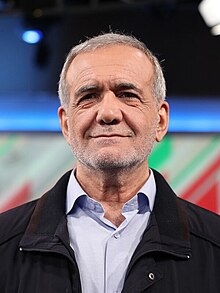 When Masoud Pezeshkian, right, the president of Iran, appeared in public very briefly to greet citizens at an anti-Israel rally last week, another member of his family was also there.
Yousef Pezeshkian, the president’s 44-year-old son, who serves as his adviser, had not seen or spoken to his father since Israel and the United States began the war against Iran on Feb. 28 and the country’s leadership went underground. He was hoping to get a glimpse of him. In a diary he has been posting on a Telegram channel, he lamented that it had been to no avail.
The son, who has a doctoral degree in physics and is a college professor, has kept a daily diary of the war mixing reflections both personal and political. The diary offers a rare glimpse into how Iran’s political figures are faring as the war rages — and closes in on them. And perhaps inadvertently, Mr. Pezeshkian at times takes his readers into the arguments and inner deliberations of Iran’s top leadership.
While Iran’s leaders have projected defiance in public statements, the younger Mr. Pezeshkian writes of the fear underneath the facade as multiple leaders are targeted and killed in Israeli bombings.
“I think some political figures are panicking,” he wrote on the sixth day of the war, in early March. “The people are stronger and more resilient than our pundits and political leaders. We have to keep reminding ourselves that defeat will only come when we feel defeated.”
He worries for his father, he wrote, and said that he and his two siblings could not wait for the two remaining years of the presidency to end so “we can all get back to our normal lives.”
New York Times, On a Holiday of Renewal, Iranians Are Mourning and Fearful, Yeganeh Torbati, March 20, 2026. As they start a new year, Iranians are reckoning with bombardment, repression and economic misery. Still, many are holding fast to ancient traditions.
Usually, in the days leading up to the Iranian new year, Tajrish Square in Tehran is an explosion of color and joyful clamor. Merchants and customers haggle over the flowers, tableware and painted eggs that Iranians use to decorate their homes for the holiday, Nowruz.
This year, though, the mood throughout the country is subdued, as Iranians close out a year in which they have endured deepening economic misery, a brutal massacre carried out by government forces and U.S.-Israeli bombardment.
Nowruz, which falls on Friday and is believed to have been celebrated in ancient Iran since at least the fifth century B.C., marks the first day of spring and symbolizes new beginnings. Iranians traditionally set out tables adorned with objects representing renewal, health and prosperity. They buy new clothes, spring clean their homes and visit family and friends. In significance and mood, it resembles a combination of Christmas, New Year’s Eve and Independence Day.
This year, the holiday falls during the most difficult and perilous time in modern memory, giving Iranians little to celebrate. Thousands of families are still mourning loved ones killed by state forces during mass protests in January. Three weeks of U.S. and Israeli bombardment has killed civilians, destroyed homes and put the nation on edge.
New York Times, Iran Executes 3 Men, Including a Star Teenage Wrestler, Yeganeh Torbati, March 20, 2026. The Iranian authorities accused the men of killing two police officers during anti-government protests in January.
Human rights groups had raised concerns about the cases against them.Three men were executed by hanging in Iran on Thursday after they were convicted of killing two police officers during anti-government protests in January, according to the Iranian authorities.
One of the men, Saleh Mohammadi, was a decorated 19-year-old wrestler, according to human rights groups. The groups raised concerns about his execution, pointing to a fast-tracked trial and a forced confession.
The Tasnim news agency, which is affiliated with Iran’s security forces, said that the men hadbeen tried and executed in the city of Qom. It identified them as Mr. Mohammadi, Mehdi Ghasemi, and Saeed Davoudi. The men were also convicted of “moharebeh,” or waging war against God, a charge that is punishable bydeath and that Iranianauthorities often use against dissidents.
The news agency said that the men had confessed to the crimes, that the executions came after “legal procedures” and that the men had defense attorneys.
Iranian authorities regularly extract forced confessions from defendants through pressure tactics including solitary confinement, threats against family members and torture, according to human rights groups.
Trump Watch
New York Times, Trumps, on a Deal-Making Spree, Turn Next to Transylvania, Rebecca R. Ruiz and Andrei Petre, March 20, 2026. The president’s company is eyeing a site for a golf course and luxury apartments. Will a huge landfill and a troubled project history stand in the way?
The Trump Organization has for decades planted the family name in places synonymous with business and luxury tourism: Manhattan, Los Angeles, Honolulu. Its global ambitions include Australia, Bali and the Maldives.
Now, President Trump’s family business is setting its sights on Transylvania, the central Romanian home to literature’s Count Dracula. The company has selected, records and interviews show, a site alongside one of the region’s biggest landfills and a former medical waste dump.
The project, which has yet to be announced, would revive a stalled real estate development in the Romanian city of Cluj that had been tainted by government corruption. It would put Mr. Trump’s name on luxury apartments and a golf course not far from an informal encampment where Roma people have been effectively exiled to live beside toxic garbage.

New York Times, News Analysis: Using Charm and Restraint, Japan’s Leader Mostly Avoids Trump’s Wrath, Javier C. Hernández, March 20, 2026. During her first visit to the White House, Prime Minister Sanae Takaichi drew praise from President Trump. But the war in the Middle East will test their relationship.
Japan’s prime minister, Sanae Takaichi, came to the Oval Office on Thursday well aware that things could go badly, given President Trump’s repeated complaints that America’s allies are not helping with the war in the Middle East.
But she managed to get through the visit to the White House — her first as prime minister — largely unscathed, avoiding the scorn that Mr. Trump has unleashed on European allies and highlighting areas of cooperation, including up to $73 billion in Japanese investments in energy projects in the United States.
Ms. Takaichi leaned on charm, the tactic she has used consistently with the president. She heaped praise on Mr. Trump. “I firmly believe it is only you, Donald, who can achieve peace across the world,” she said. She held her tongue through his jokes, including an eyebrow-raising one about Pearl Harbor. And she tried to highlight common interests in trade and defense.
Mr. Trump reciprocated, calling Ms. Takaichi, a conservative politician who last fall became the first woman elected as Japan’s prime minister, a “very popular, powerful woman.” He praised Japan, saying, “They are really stepping up to the plate.”
It was a striking contrast to his recent criticism of European allies for rejecting his demands for military support to escort ships through the Strait of Hormuz, which has been shut because of the war, causing a global energy crisis.
Ms. Takaichi “knew what the moment called for, and she executed,” said Sheila A. Smith, a senior fellow and an expert on Japan at the Council on Foreign Relations. The meeting was a win for Japan, Ms. Smith said, “especially when you compare it to what it could have been like with Trump a few days ago.”

Japan's Prime Minister Sanae Takaichi in the Oval Office on Thursday, March 19, 2026.
New York Times, In Japan, Trump’s Pearl Harbor Joke Elicits Scorn and Dismay, Javier C. Hernández and Hisako Ueno, March 20, 2026. Some people criticized President Trump’s decision to invoke a painful chapter of history. Others worried it might harm U.S.-Japan relations.
President Trump’s meeting with Prime Minister Sanae Takaichi at the White House was the talk of Japan on Friday. But the focus wasn’t just on investment deals and geopolitics: It was on Mr. Trump’s Pearl Harbor joke.
In the Oval Office on Thursday, the president made the crack while explaining why he did not give Japan advance notice of the attack onIran.
“We wanted surprise,” he said, with Ms. Takaichi seated next to him. “Who knows better about surprise than Japan, OK? Why didn’t you tell me about Pearl Harbor, OK? Right?”
There was scattered laughter in the crowd of officials and journalists. Ms. Takaichi, shown above, widened her eyes and looked in the direction of the Japanese reporter who asked the question. She did not speak, sitting with her arms crossed.
Many Japanese scholars, politicians and commentators were aghast. Some criticized Mr. Trump, saying he should not have revived a painful World War II chapter so casually. Others directed their anger at Ms. Takaichi, saying she should have spoken up. Still others said they were concerned that it might harm relations between Japan and the United States.
Toru Tamagawa, a commentator for the broadcaster TV Asahi, said on a morning show that the comment showed “an unpleasant side of President Trump.”
Heather Delaney Reese via Substack, Commentary: The president can't keep his lies straight, Heather Delaney Reese, right, March 20, 2026. At 11:47 a.m. Eastern Time, the President of the United States joined the first female Prime Minister of Japan in the Oval Office. For the next 27 minutes and 7 seconds, he did what he usually does when the cameras are rolling for the world to see. He took credit for other people’s achievements. He rambled incoherently from topic to topic. He lied about the war. And on this occasion, he also decided to humiliate our country by trying to turn one of our greatest tragedies into a punchline.
When asked by a Japanese reporter why the United States didn’t warn allies, like Japan, before launching strikes on Iran, Trump suddenly became animated, raised his voice while grinning and said, “We didn’t tell anybody about it because we wanted surprise. Who knows better about surprise than Japan? OK? Why didn’t you tell me about Pearl Harbor? OK? Right?”
He then looked back at the reporter and added, “You know, he’s asking me, ‘Do you believe in surprise?’ I think much more so than us.” A few awkward loyalty laughs broke out from his side of the room. And then the room went quiet while he kept rambling on.
And aside from the obvious absurdity of asking why no one warned him about Pearl Harbor, an event that occurred nearly four and a half years before he was born, Pearl Harbor is not a joking matter. It never has been. We lost more than 2,400 Americans that day. Sailors were trapped inside the USS Arizona, where they banged on the hull before they drowned or met equally horrific fates. It is a memorial and a burial ground. And it is a wound this country and Japan spent decades healing together, carefully, deliberately, because both nations understood that the alliance built from that wreckage was worth more than anyone’s ego. Every president before Trump understood that and respected the delicate line that had to be walked. Every single one, until Donald Trump.
 For her part, Prime Minister Takaichi, shown at left in a file photo from a previous occasion, looked equal parts shocked and unsurprised, her face telling the whole story. She pulled her shoulders back slightly, like she was creating distance without moving her chair. Her hands stayed clasped tight in her lap, fingers interlocked, but her eyes began scanning the room to see if others were equally horrified. As he kept speaking, she pursed her lips as if physically stopping herself from reacting. It was noticeable but not dramatic. But you could see the shift. A nervous half-smile flickered, then disappeared. And when it was clear the damage had been done, and the performance wasn’t going to end anytime soon, she glanced down at her watch, signaling she had had enough, and that she was ready to be done.
But the Pearl Harbor comment, as disgraceful as it was, wasn’t even the most dangerous thing Trump said in those 27 minutes. It was just the most offensive. The most dangerous part was when he exposed his own lie about the war.
Last night, on Truth Social, Trump posted that the United States “knew nothing” about Israel’s strike on Iran’s South Pars gas field, part of the largest natural gas field in the world. He said Israel “violently lashed out” on its own. He said Qatar had no idea it was coming. He framed the whole thing as if the United States had been blindsided, just innocent bystanders watching someone else’s war spiral out of control.
That was last night. Today, with Takaichi sitting beside him and the cameras rolling, a reporter asked Trump directly whether he had spoken with Prime Minister Netanyahu about the Israeli strikes. Trump didn’t hesitate.
“Yeah, I did. I did. I told him, ‘Don’t do that.’ And he won’t do that. We didn’t discuss. You know, we do... We’re independent, but get along great. It’s coordinated. But on occasion, he’ll do something. And if I don’t like it and... so we’re not doing that anymore.”
He knew. He spoke to Netanyahu. He described a coordinated relationship. And then he tripped over his own words trying to hold together a story that had already collapsed, because he’d told us a completely different version twelve hours earlier. So either he lied last night to distance himself from the fallout after Iran retaliated by bombing Qatar’s largest gas facility. Or he lied today to look like he’s in control. Or both. Because what he said was incoherent, the kind of tangled, lurching half-sentences you get from someone who has no real strategy and is just improvising to cover the last lie with the next one.
And buried inside that same exchange was something just as revealing. When asked about the economic damage the war is causing, Trump said, “I thought it would be worse, much worse.”
Someone warned him. Before he launched this war, someone sat him down and told him it would hurt the economy, that gas prices would spike, that families who are already stretched thin would feel it at the pump and the grocery store, and in their heating bills. He heard that, and he launched the war anyway. His response wasn’t to find a way to protect us from it. It wasn’t to plan for the impact or cushion the blow. It wasn’t to build in any safeguard for the people who would pay the price while he sat in the Oval Office watching it unfold on television. It was, essentially, “oh well.” He weighed the cost of this war against the lives of ordinary Americans, and he decided our pain was an acceptable price to pay.
And that brings us to what was really happening in that room, beneath the flattery and the photo ops. Because Takaichi didn’t fly halfway around the world just to wish Barron Trump a happy birthday or tell Donald he’s the only man who can bring peace. She said those things to butter him up because she needs help. Her country is in trouble. And the man sitting next to her is the reason why.
The United States has been quietly pulling troops stationed in Japan and redeploying them to the Middle East. More than 2,200 Marines based in Okinawa have been shipped to the region to support operations in Iran. Reports indicate that Patriot missile defense systems are being discussed for redeployment from South Korea to bases in the Middle East. And all of this is happening at the exact moment China is escalating military exercises around Taiwan, increasing flights near the island, and testing how far it can push while America is looking the other way.
The AP reported why deep in their coverage: the U.S. troop shifts have “removed a check against China’s power” at the same time China has launched large-scale exercises around Taiwan. A defense expert warned this “raises the prospect that the United States will be distracted and bogged down in the Middle East at a time when the deterrence problem in East Asia has never been greater.”
That is why she was there. She told him he was the only person who could achieve world peace. She praised his leadership. She promised 250 cherry blossom trees as a gift for the United States’ 250th anniversary. And she told him, through an interpreter, that the global economy was “about to experience a huge hit” because of his war, but framed it as a challenge only he could solve.
She did it masterfully because she is a protégé of the late Shinzo Abe, who was assassinated in 2022 and who had built one of the closest personal relationships any foreign leader ever had with Trump. She inherited that playbook, and she’s running it better than he ever did. The flattery. The personal touch. The strategic gift-giving. The ability to tell him exactly what he wants to hear while quietly advancing her own agenda. She knew what she was walking into today. Even before she left Tokyo, she told lawmakers this would be “a very difficult conversation.” She wasn’t wrong. But she executed her plan with precision, and left with her alliance intact and her dignity preserved. He sat there grinning, thinking he’d won something. She’s the real dealmaker in this story. And he has absolutely no idea.
And through it all, he kept finding ways to take credit for her success. Early in the meeting, Trump said, “We have a very special person, just won a tremendous election in a record-setting fashion. See, we have something in common. And I was very proud and honored to endorse the prime minister because of the fact that I thought she was really good.” He returned to it again and again throughout the 27 minutes, praising her “most successful election in the history of Japan” and calling her a “popular powerful woman,” always adding how he had endorsed her, as if he was the reason she won.
But we also saw that these performances are getting harder for him. Throughout the meeting, Trump was noticeably less animated than usual, hunched forward in his chair, still doing his trademark mouth-breathing between thoughts. He rambled. He stared at her with that flat, unsettling gaze he gets when he is having trouble concentrating. And the second the meeting ended, but the cameras were still rolling, we could see him completely checked out. Just like that, the show was over. Whatever is left of the man behind the act is fading fast.
But while Trump was putting on his spectacle in the Oval Office and cracking jokes about dead Americans, the machinery behind him was busy doing real damage. Because these performances aren’t just embarrassing. They’re distractions. He likes to look powerful. He likes the cameras, the flags, the foreign leaders seated beside him. But while Takaichi was in that room fighting to secure the safety of her country, his administration was systematically dismantling the foundations of ours.
Late today, the FCC approved Nexstar’s $6.2 billion acquisition of Tegna, creating the largest local television operator in the United States. To make it happen, FCC Chairman Brendan Carr waived a rule that has been in place for more than two decades, one that prevents any single company from owning stations reaching more than 39% of American TV households. The combined company will now reach up to 80%.
“Waiving that rule here is consistent with longstanding FCC authorities and doing so promotes the underlying purpose of the FCC’s media regulations by promoting competition, localism, and diversity,” Carr said in a statement. His words directly manipulated the true meaning of what he did. And Nexstar’s CEO, Perry Sook, thanked President Trump and Chairman Carr by name.
This happened less than 24 hours after eight state attorneys general sued to block the deal, calling it illegal and a direct threat to the diversity of viewpoints Americans depend on. The lone Democratic FCC commissioner, Anna Gomez, called it a “closed-door” rubber stamp that was pushed through without a full commission vote. She said the consequences “will be felt in living rooms and newsrooms across the country, resulting in fewer voices, less competition, and higher costs for consumers.”
I’ve shared before how my biggest concerns for what is happening are the dismantling of the free press, the erosion of the First Amendment, and actual election interference by the Trump administration. And when I saw this headline, my stomach dropped. I’m never without hope, but this is a big blow for our country. This is what I’ve been warning about for months, and today it happened. This is not just a business deal. This is one more step closer to state-run media being our only media. When one company controls what more than 60% of American households see on their local news, we are in trouble.
Think about how most Americans still get their news. They turn on the TV in the morning. They turn it on again in the evening. Maybe they catch a late-night broadcast right before bed. They trust what they see because it’s their local station, their local anchors, their local weather, and sports. They’re going to see what one company, a company that just publicly thanked this president by name, decides to show them.
And this isn’t just about what’s on the screen. This is about what gets cut. When one company owns this many stations, consolidation follows. Newsrooms shrink. Reporters get laid off. Local stories stop getting covered. The investigations that hold local governments accountable, the ones that catch corruption at the city and county level, those disappear first. And when those stories stop being told, the rot spreads faster because nobody is watching.
Every authoritarian regime in modern history has consolidated media before consolidating power. Orbán in Hungary bought up outlets through allies until independent journalism was nearly extinct. Erdoğan seized control of Turkey’s major broadcasters. Putin nationalized Russian television and turned it into a propaganda arm of the state. The methods are different every time, but the goal is always the same: control the information, control the people. And now it’s happening here.
No president with good intentions would ever waive this rule. There was a reason it existed. There was a reason no administration before this one would touch it. Because the people who built these guardrails understood that a democratic republic cannot survive without a diversity of voices telling the truth. The minute you let one entity control the flow of information to the majority of the country, you’ve handed someone the keys to reality itself.
You can make a difference right now by helping this message reach a wider audience with a $5/month paid subscription. Your support allows me to cover more ground and keep telling the truth about the lies and destruction unfolding in our country.Upgrade to paid
This is one of those moments when we must all take action. Please contact your governors’ offices and attorneys general and thank them if they are already part of the lawsuit to block this. And if they are not, ask them to join. This was expected. As we get closer to the midterms, we will see more blatant acts of political manipulation coming from this administration. That we know for sure.
And this is another reminder of why the independent media matters so much. Those of us not tied to corporate money, and who are only supported by individual readers, will continue to be able to bring you the stories that the Trump Regime is hoping these MAGA-aligned networks will block. This is the reality of what we are facing in the United States of America under Donald Trump as President. Please consider a paid membership to your favorite independent media. Not just mine. But all of the voices who are committed to doing all we can to make sure the truth is there, especially before our next elections. Because the pipeline they control just got a lot bigger. And ours has to grow to match it.
I keep coming back to Pearl Harbor tonight. Not because of what Trump said, but because of what happened that terrible day. I’ve stood on the memorial above the Arizona many times. I’ve looked down at the water where you can still see oil rising to the surface, more than 80 years later. They call them the black tears of the Arizona. And below the water lie the remains of more than a thousand sailors and Marines. Some of them were teenagers. That water is their grave.
But what I think about most when I stand there is what happened in the minutes after the attack. Men and women who had just watched their world explode didn’t run. They jumped into the water. They pulled strangers from burning wreckage. They rushed toward the fire, not away from it, and they didn’t hesitate. They helped each other because that’s who they were. That is what this country is capable of when the worst happens.
And yes, what followed wasn’t all bravery. What followed also included one of the darkest chapters in our history: the internment of more than 120,000 Japanese Americans, rounded up because of the way they looked. That ugliness is part of the story, too. Just like what we’re seeing now, with immigrants being treated as disposable, with families being torn apart, with cruelty being sold as strength. We have to hold both truths at the same time, what we’re capable of at our best and what we’re capable of at our worst, because that’s the only way we get better.
Sometimes I find more hope in our history than I do in today. Because I know what we’re made of. That kind of bravery, that kind of love of country, where you rush into fire to help, the real kind, not the hollow, flag-waving, hat-wearing version Trump sells, that’s still in us. It always has been. And I know we’ll get back there. Because we always do. And this time, it will be better, truer, and more just for everyone. That is why I still have hope for America. And you should, too.
U.S. Immigration, Justice, Law, Rights
New York Times, Trump Friend Asked ICE to Detain the Mother of His Child, Megan Twohey, Shawn McCreesh and Hamed Aleaziz, March 20, 2026. Last June, the man credited with introducing President Trump to his wife asked the administration for a favor. Paolo Zampolli, a former modeling agent and a longtime Trump ally, was in a custody battle over his son. An ICE official agreed to help.
Paolo Zampolli, below left, a former modeling agent turned presidential special envoy, had learned that his Brazilian ex-girlfriend was in a Miami jail, arrested on charges of fraud at her workplace. They had been in a custody battle over their teenage son. Now he saw an opportunity.
 He reached out to a top official at Immigration and Customs Enforcement, explaining that his ex was in the country illegally, according to records obtained by The New York Times and a person familiar with the communications. Could she be put in ICE detention? That could help him get his son back.
The official, David Venturella, promptly called the agency’s Miami office to ensure that ICE agents would pick up the woman from the jail before she was released on bail, according to the records and a person with knowledge of the conversation who requested anonymity to discuss it. During the call, Mr. Venturella noted that the case was important to someone close to the White House.
The woman, Amanda Ungaro, was placed in ICE custody and ultimately deported, an outcome that may well have happened regardless of Mr. Zampolli’s meddling. But the ICE official’s willingness to spring into action for a Trump ally — even one in a low-level, largely ceremonial role — reflects a recurring theme of the second Trump administration: The levers of the federal government can be pulled to settle a personal score.
Mr. Zampolli, 56, is known in Washington for flaunting his proximity to the Trumps. In this case, he used his clout to solicit help from an agency beset by allegations of unlawful overreach.
In an interview with The Times, Mr. Zampolli denied asking ICE to detain Ms. Ungaro or seeking any other favors. He said he merely asked Mr. Venturella to explain what was going on with her case.
The Department of Homeland Security, which oversees ICE, said in a statement that Ms. Ungaro was detained and deported because she was on a long-expired visa and had been charged with fraud. “Any suggestion that she was arrested and removed for political reasons or favors is FALSE,” the statement said.
As the president’s special representative for global partnerships, Mr. Zampolli is a minor character in Mr. Trump’s Washington. But the role keeps him within photo-op range of the Trump family, cabinet secretaries and other prominent figures in and around the administration.Editors’ PicksThe Good List: 6 Things to Add Delight to Your DayTikTok’s Hottest Drama? Crying Doctors and Crushed Dreams.Fitting Her Life Into a 400-Square-Foot Paris Studio
He throws parties at a sprawling D.C. townhouse where the walls are hung with pictures of him and the president, and an end table displays a copy of the first lady’s book, “Melania.”
His Instagram feed shows him trailing behind Mrs. Trump at the United Nations, standing beside Mr. Trump’s chief of staff and posing with his son-in-law Jared Kushner. “I am honored to have been a friend of the President for more than 30 years, a friend of the First Lady for 29 years,” reads one caption. It ends: “Loyalty is king.”
New York Times, Alexander Brothers Are Said to Seek Trump Pardons for Sex Trafficking, Debra Kamin and Kenneth P. Vogel, March 20, 2026. People representing the three brothers have reached out to a lobbyist and an influential Jewish group that have supported clemency for others. There are no signs the White House is considering a pardon.
Three brothers convicted of a decades-long sex-trafficking conspiracy this month in New York have been exploring avenues to seek pardons from President Trump, according to three people familiar with their efforts.
Those efforts have included outreach to a lobbyist and an influential Jewish group that have been involved in clemency pushes, the people said, asking not to be named because of the sensitive nature of the discussions. The discussions began last year and continued after the brothers were convicted earlier this month. There are no signs the White House is considering any requests.
The brothers — Tal Alexander, 39, and the twins Oren and Alon Alexander, 38, who are Jewish and have Israeli parents — were arrested in 2024. Afterward, they received support from a political figure who is now an official in the Trump administration tasked with fighting antisemitism.
Oren and Tal Alexander were once among America’s most successful luxury real estate brokers, and the accusations against them and their brother Alon Alexander, and their subsequent conviction, shook the industry.
It is not clear whether the clemency efforts, details of which have not been previously reported, have advanced beyond the discussion stage. The three brothers are scheduled to be sentenced in August. They could face life in prison.
An administration official, who was not authorized to discuss the matter, said that none of the key officials who work on clemency in the White House or the Justice Department had been contacted about any potential applications for the brothers.
But the brothers have cultivated the sort of connections to Mr. Trump’s circle that have helped others win pardons and commutations. The president has used his clemency power to reward allies and people with the resources to enlist well-connected lobbyists and lawyers.
Scions of a prominent Miami real estate developer, the three men were regulars on the party circuits of Miami, New York and Tel Aviv. They attended the White House Hanukkah party in 2020, in the final weeks of Mr. Trump’s first term.
Just a few months after that Hanukkah party, Oren Alexander represented Ivanka Trump and Jared Kushner in the purchase of their $24 million Florida mansion in April 2021.
The three brothers have always denied all charges and pleaded not guilty in their federal trial. They have said they will appeal, but if that fails, clemency could be another option they pursue.
Marc Agnifilo, a lawyer who represented Oren Alexander in his recent trial, said the brothers’ legal team was “unaware of any pardon application.”
“We are focused only on the sentence and appeal,” he said in an emailed statement
New York Times, Fresno Took 30 Years to Name Cesar Chavez Blvd. Undoing It Took a Day, Orlando Mayorquín, March 20, 2026. The reckoning for the labor leader’s sex abuse was swift in Fresno, Calif., the heart of the Central Valley region where the farmworker movement was born. Towns across the nation face similar debates.
For 30 years, Latino farmworkers in Fresno, Calif., watched as other cities named streets in honor of Cesar Chavez. San Francisco, Los Angeles and Austin, Texas, swiftly paid tribute not long after his death in 1993. The state of California made Cesar Chavez Day a paid holiday in 2000.
Yet here, in the heart of the Central Valley — “America’s Food Basket” — Fresno long refused to designate a road to honor the leader revered by workers who toiled in nearby fields. The reasons were complicated, a mix of the community’s history and farmers’ resentment.
Finally, after decades of persuasion and with a new Latino majority on the Fresno City Council, city leaders voted in 2023 to establish Cesar Chavez Boulevard.
While it took Fresno three decades to name a street after Mr. Chavez, it took only one day to rescind it.
At a hastily convened meeting Thursday, the seven-member City Council voted unanimously to begin the process of erasing Mr. Chavez’s name after The New York Times published explosive sexual abuse accusations against him.
“This council and a lot of leaders in California and the nation are going to hopefully put on a master class in what accountability looks like,” Nelson Esparza, the council president, said.
The one-hour meeting at council chambers offered a profound look at the aftermath of a downfall. It was one of the nation’s first public bodies to remove Mr. Chavez’s name, and a preview of what will transpire in communities across the United States as the reckoning unfolds. They will have to work through personal connections and deep feelings — and they may reopen wounds.
Inside the Fresno council chambers, there was a mix of solemnity and anger. There was also relief from those who had long opposed the name change, though they said they took no joy from the reasons.
New York Times, Handcuffs, Tents and Pleas for Medical Care: Pregnant in ICE Detention, Caroline Kitchener, Charo Henríquez and Hamed Aleaziz, March 20, 2026. Women describe conditions that violate longstanding agency guidelines for how pregnant detainees should be treated. The reporters interviewed women who have been held in detention as well as their family members and lawyers, and reviewed court filings, government documents and medical records.
Candy Castillo Collantes was six months pregnant when she stepped inside the giant tent where she would live for the next 47 days.
Her enclosure at the South Texas detention center held dozens of bunk beds, she said, with one tiny slit for a window. Women wailed late into the night for their husbands and children. When Ms. Collantes experienced vaginal bleeding and asked for medical care at the facility, she and her lawyer said, she was offered only water, prenatal vitamins and a temperature check.
“It’s not a center that we know has a doctor,” Ms. Collantes, a 38-year-old Venezuelan who obtained temporary legal status under the Biden administration, said in an interview from the facility in late February. “The people here can’t tell you that everything is fine.”
Ms. Collantes had heard from other detainees about a woman who had gone into labor at their detention center months earlier.
She was terrified that she could be next.
Pregnant women who have been swept up in President Trump’s immigration crackdown have been held in detention centers as late as eight months into their pregnancies without adequate food or medical care, according to a New York Times examination of 10 cases. The Times review found that, in those cases, the Department of Homeland Security violated longstanding agency guidelines for how to treat pregnant women in detention, subjecting them to conditions that medical experts say can jeopardize the health of mothers and their babies.
Pregnant women said they were served food covered in cockroaches and water that tasted like bleach. They described how Immigration and Customs Enforcement agents shackled their hands and feet, refusing to believe that they were pregnant until a bump appeared. One woman said ICE agents ignored her as she lay on the floor screaming in pain, and took her to the emergency room only after her fellow inmates began banging on the door for help.
This account is based on interviews with pregnant women either currently detained or recently released, as well as an analysis of court filings, government documents and medical records.
The Biden administration instituted a policy under which pregnant women could only be detained in “exceptional circumstances,” such as when a person poses a national security threat or an “imminent risk of death, violence, or physical harm” to someone. While Trump administration officials have offered conflicting opinions in court on whether that policy remains in effect, Lauren Bis, a Department of Homeland Security spokeswoman, said in a statement to The Times that it still stands.
Ms. Bis also said that pregnancy in ICE detention is “exceedingly rare,” comprising 0.18 percent of all undocumented immigrants in custody. That comes out to about 126 women, according to recent estimates of the number of people in detention. Ms. Bis added that no women had given birth in ICE custody under the Trump administration and that the medical care provided to women in detention was “the best health care many of these individuals have received in their entire lives.” She said that clean and bottled water was provided for detainees.
U.S. Governance, Politics, Elections
Top Illinoid primary race: Left to right: Lt. Gov. Juliana Stratton, the winner, and Rep. Raja Krishnamoorthi, and Rep. Robin Kelly were the main contenders in Illinois’s Democratic primary for U.S. Senate. (Images: Stratton, Krishnamoorthi, and Kelly campaigns).
The Contrarian, Opinion: Undaunted in Illinois, Jennifer Rubin, right, March 20, 2026. Standing up to dark money isn’t easy.
In winning the Democratic nomination in the IL-9 House race, Evanston Mayor Daniel Biss showed us how to stand up for democratic values and beat back dark money. Specifically, he overcame an avalanche of AIPAC money and debunked the argument that anyone who does not unconditionally support Israeli Prime Minister Benjamin Netanyahu’s government’s regional aggression and Palestinian policy is somehow “anti-Israeli.”
In an interview with me earlier this month, Biss defended his Israel bona fides:
I’m Jewish. My mother’s Israeli. My grandparents found a safe haven in Israel in 1948 after surviving the Holocaust. Most of my extended family on my mom’s side is still there, and I grew up visiting there every summer. So, Israel… means something to me, and its right to exist as a Jewish democratic state and to defend itself, also means something to me. This is not some box I checked on a questionnaire just to make somebody happy, this is personal.
He forthrightly called the conduct of this Israeli government “appalling,” and deplored the U.S. stance when the Netanyahu government violates international law in a way that amounts to: “Hey, we wish you wouldn’t, but also when you do, there will be no consequences.” That position, Biss argued, “has not worked, cannot work, will not work.”
Moreover, he called out AIPAC’s insistence that lawmakers “commit to oppose any conditions on military aid to Israel whatsoever.” That position is “absurd for anyone to take relative to any country,” he argued convincingly.
Biss called out AIPAC’s deceptive tactics, pointing out that it had concocted a new entity, “Elect Chicago Women,” to conceal its own name, which has become toxic in Democratic politics. Biss also emphasized that instead of challenging him on the merits of his Israel stance (which matches that of most Democrats), AIPAC launched personal attacks against him.
Following his victory Tuesday night, Biss thanked his mentor, Rep. Jan Schakowsky (D-IL), the retiring incumbent, and his opponents. He reasserted his progressive values and denounced the privileged few who have a “stranglehold” on our politics.
Biss boldly reaffirmed his “core” beliefs on Israel, which include dignity for the Palestinian people and defense of democracy. “This district understands nuance,” he said. “AIPAC found out the hard way that my district is not for sale.” He asserted that his view represents the mainstream in both the Democratic Party and the Jewish community. It was a moment to savor beating back dark money without sacrificing one’s principles or wrongly assuming voters cannot think critically about a given race.Subscribed
Biss had critical help from J Street (the center-left pro-democracy, pro-Israel group), which made a 6-figure third-party expenditure to put out a positive ad featuring his progressive record.
J Street president Jeremy Ben Ami and I have discussed the destructive turn AIPAC has made in recent years. It has become effectively a front for rightwing billionaires to clobber any candidate who will not sign onto its unqualified, extreme position on Israel.
After Biss’s race was called, J Street put out a statement touting the “win for democracy and a clear rejection of efforts to buy this primary”:
AIPAC and its affiliates poured more than $7 million into a Democratic primary to stamp out opposition to Netanyahu’s policies – using shell PACs to obscure their involvement — and the voters rejected that effort.
Tonight’s results should send a clear message to candidates across the country: you do not have to fear AIPAC’s spending or intimidation. Standing on principles and trusting voters matters more than outside money. . . .
We supported Biss because he represents the values we believe voters are looking for — a commitment to Israel’s security alongside support for Palestinian freedom, and the understanding that these goals are not in conflict, but inseparable.
Unfortunately, Tom Malinowski, running in the special election in New Jersey’s 11th congressional district in February, was a victim of these sort of AIPAC tactics. However, J Street, Biss, and center-left Democrats learned the lessons from that race. In the 9th, Biss swiftly called out dark money, exposed AIPAC’s election gamesmanship, and affirmed his bedrock principles. That strategy allowed Biss to prevail on Tuesday.
Critically, Illinois Gov. JB Pritzker (left, who won renomination for another term, helped Lt. Gov. Juliana Stratton to victory in the Democratic Senate primary, and is in the top tier of 2028 contenders) has also bashed AIPAC’s tact to the right. “I abandoned AIPAC more than a dozen years ago,” he said in recent interview. “It was an organization that had at one time been bipartisan in nature and really all about preserving a strong relationship between the United States and Israel.” However, he recalled that “the organization began to lean much more to the right and much more pro-Trump, who had then become a candidate for president, and that disturbed me greatly.”
He could not support a group that got “involved in elections directly and [began] choosing to support candidates who were MAGA and right-wing and Trumpy.” In speaking out, Pritzker (as Biss did) carved out space for pro-Israel progressives and set AIPAC back on its heels.
Biss should be commended for his undaunted, unabashed defense of democratic values, his nuanced stance on Israel, and his rejection of deceitful dark money tactics. It is not easy in the face of millions of dollars of attack ads to stand up to those who advocate an extremist foreign policy (which ultimately is not in the interests of the U.S. or Israel). With a major assist from J Street, Schakowsky’s endorsement, and reinforcement from Pritzker, he nevertheless successfully defended his progressive agenda and weakened the grip of billionaires (whether they fund AIPAC, AI, or crypto interests) on our elections. The Jewish community, Democrats, and pro-democracy forces owe him a debt of gratitude.
Morning Shots via The Bulwark, Political Opinion: Trump Is Getting Drilled, Baby, Drilled, Andrew Egger and Jim Swift, March 20, 2026. And he has no one to blame but himself.
There has always been a chasm between the actual MAGA voters and the MAGA intelligentsia that purports to speak for them, but it has rarely been as visible as it is this week.
Many of the leading lights of the literate right have been pulling their hair out (with good reason!) over the Iran war, with Christopher Caldwell declaring it “the end of Trumpism” in the Spectator and Sohrab Ahmari proclaiming that “Trump was never the one” in UnHerd. At least so far, the base does not agree: A new Politico poll finds that only 12 percent of 2024 Trump voters oppose the war in Iran so far.
Happy Friday.
Morning Shots via The Bulwark, Political Opinion: Shane’s Law, March 20, 2026. As regular readers know, last year I wrote a profile of a member of the Bulwark community, Shane DiGiovanna. Shane was born with recessive dystrophic epidermolysis bullosa, a genetic condition that is guaranteed fatal and typically leads to a very painful, short life. While Shane’s life has been painful, it has been beautiful—and longer than anyone would have expected, at 27 years so far.
When I wrote my profile of Shane, the Bulwark community stepped up to show Shane some love: You helped fund his namesake charity at Cincinnati Children’s Hospital so future kids who come through those hospital doors get a stuffed animal, like Shane’s lifelong companion, Doggie. (You can also watch a video interview I did with Shane here.)
Last fall, I updated readers on Shane’s journey in JVL’s Triad. Not wanting a sad and somber funeral, Shane threw himself the best party I’ve been to in a while—a “celebration of life.” As the party faded into memory, the heartbreaking reality of Shane’s impending death became starker.
Shane is a graduate of Rice University, and I asked if I could bring him anything from Texas while I’m here for this week’s Bulwark Live events. Knowing that physical goods have little use, I figured maybe I could bring back a favorite snack. He didn’t want anything from Texas, he told me. Instead he wanted me to update you on a big part of his legacy: Earlier this week, Shane’s congressman (and mine), Greg Landsman, introduced H.R. 7877, the Shane DiGiovanna Act. Shane did an interview with a local TV station about it.
There’s no cure for Shane’s disease, and the bill wouldn’t change that. But what it would do is lighten the financial load of keeping somebody afflicted with EB alive. Shane’s bandages can cost $80,000 a month—and that’s just a fraction of his medical expenses. But each state gets to decide if its Medicaid program covers “wound treatment” for EB, and most don’t. Landsman’s bill would create a demonstration program to test what mandatory Medicaid coverage of wound treatment for kids with EB would cost. Once that cost is quantifiable, the next step would be to make that coverage mandatory.
Shane is a huge proponent of the bill. He’s spending all the time and energy he can advocating for its passage. He doesn’t have to—he could be spending his time with his family and friends. But instead he’s focused on other patients at Cincinnati Children’s and other kids with EB, first with his charity and now with the bill that bears his name.
The years I spent as a House and Senate staffer taught me that most of the time, slapping a sympathetic person’s name on a bill is a cheap way of making well-intentioned but often bad policy more popular—or at least harder to vote against. I’m happy to say that the Shane DiGiovanna Act is an exception: It’s a sympathetic person’s name on a smart policy idea.
AROUND THE BULWARK
Quick Hits
THE HOT SEAT: Director of National Intelligence Tulsi Gabbard’s tightrope act is getting more perilous. The Tuesday resignation of Joe Kent, director of the National Counterterrorism Center and one of her direct reports, couldn’t have come at a worse time for her—she was already scheduled for two days of congressional hearings Wednesday and Thursday when he quit. She spent those hearings trapped painfully between three irreconcilable positions: (1) her own previous professional downplaying of the threat of Iran, (2) Donald Trump’s constant barrage of truth-agnostic claims on the subject, and (3) her own fierce anti-interventionist history.
Rep. Elise Stefanik (R-N.Y.) asked: Did Gabbard agree with Kent’s assessment that “high-ranking Israeli officials” had deceived Trump into believing that Iran posed an imminent threat to the United States? “He said a lot of things in that letter,” Gabbard said. “Ultimately, we have provided the president with the intelligence assessments, and the president is elected by the American people and makes his own decisions based on the information that’s available to him.”
Rep. Ami Bera (D-Calif.) asked: Did Gabbard still believe, as she said while serving in the House in 2020, that strikes on Iran without congressional approval constituted “an illegal and unconstitutional act of war”? “My own personal and political views” aren’t important, Gabbard replied; her role required her to “check those at the door.”
And Rep. Jimmy Gomez (D-Calif.) asked: Did Gabbard still maintain, as she said last year—and despite Trump’s continual claims to the contrary—that Iran was not building a nuclear weapon? “Iran had all the materials and capabilities to do so,” Gabbard said evasively. “I stand by the intelligence community’s complete assessment.” The intelligence community, for what it’s worth, has reportedly never assessed that the Iranian leadership has made the final decision to build a nuclear weapon.
POWER OF THE PURSE: The economic costs of the war in Iran aren’t just coming in the form of snarled shipping and spiking energy prices. After weeks of bombardment, the administration is reportedly asking Congress to backfill the Pentagon’s budget with an eye-watering ask of $200 billion in supplemental funding.
There’s a reasonable argument that this funding is a good idea even if the ongoing war isn’t: The Pentagon has dipped way, way into America’s materiel stockpiles in its more-is-more bombardment of Iran, leaving us worryingly defenseless to face other threats should those stockpiles go unreplenished. But that’s a tough case to make when the White House never asked Congress to authorize this war in the first place; in such circumstances, the funding bill becomes a proxy for the conflict itself pretty much by default.
As a result, it isn’t obvious Republicans will have the votes to pass it. Yesterday morning, Speaker Mike Johnson, right, was guarded in his rhetoric around a possible funding request, which the White House hasn’t denied but has not yet made public. “Obviously it’s a dangerous time in the world and we have to adequately fund defense, and we have a commitment to do that,” Johnson said. Majority Leader Steve Scalise also declined to weigh in on whether they’d have the votes: “We will have a negotiation at some point,” he said. “But it hasn’t started yet.”
A NEW TACK FROM MASSIE: Rep. Thomas Massie (R-Ky.)—libertarian gadfly, gun nut, budget hawk, Epstein Files legislative mastermind—is Congress’s biggest remaining Republican thorn in the president’s side. Even as Trump has tried to punish him for his insubordination by standing up a MAGA primary challenger in his district, Massie has seemed unfazed, constantly tweaking the president online with what looks like merry bravado.
Massie thinks his heterodox brand will still carry the day in his district—but perhaps not all the way. Yesterday, Massie released an ad hitting his opponent, Ed Gallrein, on exactly the same grounds Gallrein is hitting him—that he’s insufficiently loyal to president Trump. The ad, which begins with a photo of Massie and Trump smiling side-by-side, accuses Gallrein of switching his party registration to “independent” after Trump won in 2016, and only switching it back after Joe Biden took office in 2021. “Woke Eddie Gallrein,” the ad finishes. “Not just a Trump hater, a Trump traitor.”
Obviously, one ad isn’t going to undo Trump’s endorsement and Gallrein’s relentless campaigning on that endorsement, but Massie seems to be hoping he can muddy the waters. Kentucky’s primaries are May 19.
PoliticusUSA, News and Commentary: Democrats Are Poised To Pull Off A Big Upset In Texas Senate Race, Jason Easley, right, March 20, 2026. A new poll shows Democratic candidate James Talarico holding a small edge, which is statistical tie, over both Republican candidates in the Texas US Senate race, which suggests a looming upset.
Republicans had been looking at the 2026 Senate map and thinking that the party might be in a strong position to expand its majority. At least that was the thinking when Donald Trump’s second administration began.
The president took office and proceeded to embark on a series of bad policies that included tariffs that slowed economic growth and raised prices. The president also got his party’s majorities in Congress to pass a tax cut for the wealthy bill that was, in tiny part, paid for by massive cuts to food and health insurance subsidies. The result of these policies is that people are losing their health insurance or have seen their premiums skyrocket.
Trump then started a war of choice in the Middle East, which has caused fuel costs to surge.Democrats have seized on affordability as the defining issue of the midterm election. Democrats have also had a series of recruiting victories for Senate races, where they have gotten  the candidates that they wanted in states like Alaska and North Carolina, as Republicans built their strategy on maintaining their progress with Latino voters who have abandoned them due to Trump’s immigration policies.The political climate has created a perfect storm in Texas, where two unpopular Republicans are locked in a runoff, and Democrats have their preferred candidate.
Signs are growing that an upset could be brewing in the Lone Star state, as a new poll done by Impact Research for the Talarico campaign revealed, “Talarico is leading both Cornyn and Paxton. Cornyn trails Talarico by 2 points (43% Talarico / 41% Cornyn) and Paxton trails him by 1 (44% Talarico / 43% Paxton).”
Public Notice, House Republicans are heading for the exits, Tom Schaller, March 20, 2026. The writing is on the wall ahead of the midterms.
Earlier this month, four more Republicans announced their pending retirements from the House of Representatives: Darrell Issa (CA-48), Tony Gonzales (TX-23), Burgess Owens (UT-4), and Ryan Zinke (MT-1). Their decisions to retire raised to 34 the number of House Republicans not seeking reelection this November.
Entering Donald Trump’s second presidential midterm, those 34 vacancies are tied for the most GOP House retirements in a midterm cycle during the past 100 years.
What year shares the record? Answer: 2018, Trump’s first midterm cycle.
That November, Trump lost his House majority when the Democrats flipped a net of 40 seats. And 2026 is not over yet: More House Republicans could still announce they are packing it in.
Most of these Republicans are not retiring from politics entirely. Twenty-one are giving up their seats to seek other offices; of these, 20 are running for either US Senate or governor. The twenty-first is GOP firebrand Chip Roy, who announced his retirement to run for Texas attorney general. (Roy is in a runoff with state Sen. Mayes Middleton to be party’s nominee.)
To be clear, 21 Democrats have also announced their retirements, so the pattern is hardly one-sided. And the departure of the embattled Gonzales, whose sordid affair with a female staffer led to her suicide, is probably more of a blessing that a liability for House Speaker Mike Johnson and his Republican colleagues, some of whom have called upon Gonzales to resign immediately.
But retirements are significant because they can serve as both a symptom and a cause of a bad cycle for the party suffering most of them.
Why?
Because even though most House districts are strategically gerrymandered to provide safe seats for one party or another, rookie candidates are qualitatively different from veteran incumbents. These candidates often must spend a lot of resources winning a contentious primary, and tend to have fewer connections and lower name-recognition with district constituents.
Incumbents aren’t just a surer bet to hold a seat for their party, but a less expensive one, too. Open seats force the so-called “Hill committees” — the Republican National Campaign Committee (RNCC) and Democratic Congressional Campaign Committee (DCCC) — to spend resources they would prefer to dedicate to other contests.
Still, what matters more than who is retiring and whom the two parties will nominate to fill vacant seats is how competitive those open districts might be in the general election. With Johnson’s razor-thin House majority, any and every advantage for either the Republican RNCC or the DCCC is crucial.
U.S. Media, Education, Culture, Religion
Politico, CBS News shutters radio division, lays off staff amid network’s Bari Weiss-led makeover, Finya Swai, March 20, 2026. The century-old radio service will end as the network undergoes a transformation.
CBS News will end its nearly 100-year-old radio news service and cut more jobs as part of a broader restructuring led by Editor-in-Chief Bari Weiss, according to internal memos sent to staff on Friday and reviewed by POLITICO.
Weiss and CBS News President Tom Cibrowski told staff the network will shutter its radio news service and eliminate all positions tied to it.
“Today, we informed our CBS News Radio team and approximately 700 affiliated stations that we will end the service on May 22, 2026,” Weiss and Cibrowski wrote. “Unfortunately, this decision means that all positions within the CBS News Radio team are being eliminated.”
The executives cited changes in the media landscape and financial pressures as driving the move. Affected employees will be notified by the end of the day.
“A shift in radio station programming strategies, coupled with challenging economic realities, has made it impossible to continue the service,” they wrote. CBS News Radio dates back to 1927 and produced the nation’s longest-running newscast, “World News Roundup.”
The move comes alongside broader layoffs across CBS News, outlined in a separate memo sent Friday, with cuts extending beyond the radio division.
“It’s no secret that the news business is changing radically, and that we need to change along with it,” Weiss and Cibrowski wrote in the separate memo. “That means some parts of our newsroom must get smaller to make room for the things we must build to remain competitive,” pointing to “new audiences … in new places.”
CBS News has been navigating major structural changes since billionaire David Ellison took control. His media company, Skydance, acquired Paramount last year, and Weiss became editor-in-chief after Paramount then acquired her publication, The Free Press.
Weiss quickly made changes to kick-start her vision for the network. She restructured “CBS Evening News” by replacing its co-anchors, Maurice DuBois and John Dickerson, with Tony Dokoupil from “CBS Mornings,” an ostensible remedy to drops in viewership.
But “CBS Evening News” viewership has continued to drop, according to recent ratings, and high-profile journalists such as Anderson Cooper and Scott MacFarlane also recently departed the network.
Weiss came under fire after abruptly pulling a “60 Minutes” segment on El Salvador’s notorious CECOT prison, a facility known for its human rights violations that held immigrants deported by President Donald Trump. The segment later aired with few changes.
Politico, Federal judge reverses Pentagon press restrictions, Aaron Pellish, March 20, 2026. The New York Times won a lawsuit arguing that Secretary Pete Hegseth’s policies violated the Constitution.
The Trump administration violated the Constitution when it sought to restrict press access to the Pentagon and limit what reporters could cover, a federal judge ruled Friday.
U.S. District Judge Paul Friedman granted a request from The New York Times to void the Pentagon’s press credential policy on grounds it violated the First and Fifth Amendment, rejecting the government’s argument that the restrictions were needed to prevent the disclosure of classified information.
“The Court recognizes that national security must be protected, the security of our troops must be protected, and war plans must be protected,” Friedman wrote. “But especially in light of the country’s recent incursion into Venezuela and its ongoing war with Iran, it is more important than ever that the public have access to information from a variety of perspectives about what its government is doing.”
The ruling, which comes as journalists around the world seek information about the war in Iran, rolls back a highly aggressive attack on press freedom implemented last year by Defense Secretary Pete Hegseth, a former Fox News host who has had a strained relationship with the media.
“Americans deserve visibility into how their government is being run, and the actions the military is taking in their name and with their tax dollars,” said Charlie Stadtlander, a spokesperson for The New York Times. “Today’s ruling reaffirms the right of The Times and other independent media to continue to ask questions on the public’s behalf.”
Pentagon spokesperson Sean Parnell said the administration would appeal the ruling.
Last January, the Defense Department removed Pentagon workspaces for several credentialed outlets, including POLITICO, CNN and the Times and granted access to organizations considered more friendly to the administration. In May, Hegseth announced additional restrictions on areas open to the media within the Pentagon shortly after he inadvertently shared sensitive information about U.S. airstrikes in Yemen on a Signal group chat that included Jeffrey Goldberg, editor in chief of The Atlantic.
The Pentagon’s most prohibitive measure came in September, when the department said it would only credential reporters if they pledged not to publish information that was not approved for public release by the Pentagon. Nearly every major news outlet refused to make that commitment.
Friedman said the policy violated the First Amendment because “the undisputed evidence reflects the Policy’s true purpose and practical effect: to weed out disfavored journalists.”
An attorney representing the paper hailed the decision as a “powerful rejection” of the Trump administration’s attempt to “impede freedom of the press” by restricting Julian Barnes, a reporter covering the Pentagon for the paper.
“The district court’s opinion is not just a win for The Times, Mr. Barnes, and other journalists, but most importantly, for the American people who benefit from their coverage of the Pentagon,” said Theodore Boutrous Jr.
New York Times, Chuck Norris, Black-Belt Action Star of Movies and Television, Dies at 86, Clyde Haberman, March 20, 2026. He channeled his martial arts skills into heroic roles in films like “The Delta Force” and “Missing in Action” and in the long-running TV series “Walker, Texas Ranger.”
Chuck Norris, right, who channeled his skills as a martial arts black belt into a durable acting career that left film critics largely unimpressed but delighted millions of fans savoring his good-guy triumphs and fortune-cookie musings, died on Thursday. He was 86.
His death was announced by his family through his official Instagram account, but no further details were immediately available. He was hospitalized earlier that day in Hawaii after experiencing a medical emergency, the family said.
“Many people want and need someone to identify with, a man who is self-reliant, stands on his own two feet, and is not afraid to face adversity,” Mr. Norris wrote in “The Secret of Inner Strength: My Story” (1988).Credit...Little Brown
As an actor, Mr. Norris was well aware that no one would mistake him for a latter-day Laurence Olivier. In most of his films and in “Walker, Texas Ranger,” a CBS television series that ran from 1993 to 2001, he played a warrior who comes to the rescue not with words or guns but rather with spinning back kicks and other techniques that had made him a leading martial-arts practitioner.
“I play the man in the arena who’s pushed to the wall and forced to blast his way out,” he once told The San Francisco Chronicle. And blast out he did, in film after film.
His most fertile period onscreen stretched from the late 1970s to the early 2000s with action thrillers like “Good Guys Wear Black” (1978), “An Eye for an Eye” (1981), “Lone Wolf McQuade” (1983), “Code of Silence” (1985), “Invasion U.S.A.” (1985), “The Delta Force” (1986), “Delta Force 2: The Colombian Connection” (1990) and three “Missing in Action” offerings in the 1980s that gave him a chance to rescue Americans held captive in Vietnam long after the war had ended.
New York Times, Record Number of Student Loan Borrowers Are in Delinquency and Default, Stacy Cowley, March 20, 2026. Recently released data from the Education Department showed that by the end of last year, 7.7 million borrowers had defaulted on $181 billion in federal student loans.
A record number of borrowers have fallen far behind on their federal student loan payments, another pressure point among millions of increasingly stretched American consumers.
Recently released Education Department data showed that by the end of last year, 7.7 million borrowers had defaulted on $181 billion in federal student loans. Three million other loan recipients were at least three months late on their payments.
That’s the highest combined rate of serious delinquency and default since the government began its data reporting system nearly a decade ago. Of the nearly 43 million recipients with federal student loans, roughly a quarter are significantly behind.
And the problem is likely to grow. Last week, after years of legal limbo, a federal appeals court ordered the end of a generous Biden-era repayment plan known as SAVE. That decision will soon force nearly seven million borrowers to begin paying loan bills — with interest still accrued for the last seven months — that had been suspended while the litigation played out.
The stark delinquency data is the latest sign of distress from those on the downside of what economists call a “K-shaped economy”: one in which the richer get richer, while the financial health of many lower-income households declines. Unemployment is increasing, gas prices have spiked and people are stretching to manage higher costs for food, medical care, housing and other essentials.
That has led to more unpaid debts. The rates of serious delinquencies are climbing on credit cards, mortgages and auto loans, according to the Federal Reserve Bank of New York’s latest analysis of household debt.
On Thursday, the Trump administration announced plans to move management of the $1.7 trillion federal student loan portfolio to the Treasury Department. The Education Department was “never intended to operate what would be the fifth-largest commercial bank in the United States,” the two agencies said in a joint announcement.
The plan is likely to face legal challenges. “The last thing student loan borrowers need is more chaos from the federal government,” said Kyra Taylor, a staff attorney at the National Consumer Law Center.
The federal report on the high number of borrowers who are struggling with their payments confirmed what economists and student loan experts had long predicted: After the government lifted its pandemic-era student loan collection freeze in 2023 and resumed sending borrowers monthly bills, many people didn’t start paying again.
Today, the total tally of borrowers in default is roughly the same as it was in December 2019, shortly before the collection moratorium began, the Education Department noted in an online post about the data.
But the number of people teetering on the edge, or making no payments because their loans are still paused, is much larger than it was six years ago.
In late 2019, three million borrowers were a month or more delinquent on their loan payments, and just over six million had loans in deferment or forbearance, which temporarily halts collection. At the end of last year, more than four million people were a month or more behind, and 12 million — mostly those on the SAVE plan — had loans that were deferred or in forbearance.
March 19
Top Headlines
The Parnas Perspective, Thursday Night Update: More Major Epstein News, UN Makes Possible War Crimes Allegations, No End in Sight for DHS Shutdown, Aaron Parnas, March 19, 2026. António Guterres, the United Nations Chief, said there are “reasonable grounds” to believe both sides in the U.S.-Israel conflict with Iran may have committed war crimes, citing attacks on energy infrastructure and civilians. He warned the conflict is rapidly escalating with severe humanitarian and global economic consequences, suggested Israel sought to draw the U.S. into war, and argued Washington holds the key to ending it. U.S. Governance, Politics
March 19, 2026. Unidentified drones have triggered serious security concerns over the homes of Pete Hegseth and Marco Rubio, while the Pentagon is now seeking more than $200 billion in additional taxpayer funding for the war. At the same time, Joe Kent is under FBI investigation and a clear divide within MAGA is emerging after he stated that intelligence did not show Iran posed a real threat to the United States.More On Iran War
March 19, 2026. The Trump administration’s Director of National Intelligence, Tulsi Gabbard, testified before the Senate Intelligence Committee on Wednesday. March 19, 2026. I doubt anyone on the inside is willing to tell President Trump the truth about how the war is going. But if some courageous truth-teller were to enter the Oval Office this morning and speak, he’d say this: It ain’t going great, sir. In fact, sir, it’s going pretty badly. right, March 19, 2026. The ancient Greek historian Herodotus believed the greatest danger to powerful nations was not external enemies but hubris—the arrogance that comes from believing success makes one invulnerable. That hubris always summoned Nemesis, the goddess of divine retribution, who then punished arrogant heroes and leaders.
Epstein Scandals, Trump Coverups
right, March 19, 2026. Beginning in December 2010 under the Obama administration, the U.S. Drug Enforcement Agency (DEA) was running an investigation of Jeffrey Epstein and fourteen other people for drug trafficking, prostitution, and money laundering.César Chavez #MeToo Scandal
More Global News
U.S. Law, Courts, Crime, Civil Rights
 March 19, 2026. Trump and Brendan Carr support the deal, which would combine the largest U.S. broadcaster with the fourth largest.
More On U.S. Inflation, Markets, Jobs, Economy
 Receipts via The Bulwark, The Worst-Case Economic Outcome of Trump’s Iran War, Catherine Rampell, March 19, 2026. I’m going to walk you through the ways a global oil shock (and other supply-chain disruptions) might weigh on the economy, and how other risk factors might affect things, too. Oil shocks don’t only raise prices. They also destroy growth and jobs.
March 19, 2026. Inflation was rising and job growth stalled even before the Iran War.Global Health, High-Tech
Top Stories
The Parnas Perspective, Thursday Night Update: More Major Epstein News, UN Makes Possible War Crimes Allegations, No End in Sight for DHS Shutdown, Aaron Parnas, March 19, 2026.
It is worth stepping back to talk about where we are as a media community and where we are headed as this year continues.Let me be clear. If you believe in independent journalism that refuses to look away, this is the moment to support it. Subscriptions are what make this work possible when attention fades, when the noise gets louder, and when accountability becomes inconvenient. They allow us to keep going when the truth becomes harder and more expensive to pursue.
People in power benefit when the public is worn down. They benefit when the volume of information is so constant that nothing sticks, when one story replaces another before answers are ever delivered. Overwhelm is not accidental. It is a strategy designed to make you disengage.
Look at the Epstein files. It has been months since the Department of Justice failed to comply with the Epstein Files Transparency Act. Ask yourself a simple question. Do you still hear about this every day the way you once did?
You do not. That is the point. Flood the zone. Exhaust the audience. Let the story disappear. I will not let that happen. Now, let’s get to the news:
António Guterres, the United Nations Chief, said there are “reasonable grounds” to believe both sides in the U.S.-Israel conflict with Iran may have committed war crimes, citing attacks on energy infrastructure and civilians. He warned the conflict is rapidly escalating with severe humanitarian and global economic consequences, suggested Israel sought to draw the U.S. into war, and argued Washington holds the key to ending it. Guterres also stressed the urgency of de-escalation, warning the crisis is spiraling out of control and could have far-reaching global impacts, according to POLITICO.
The Pentagon is weighing sending additional troops to the Middle East, a move that could significantly escalate the war with Iran and deepen U.S. involvement. Discussions include deploying Marines to protect shipping in the Strait of Hormuz or potentially seize key sites, even as Donald Trump publicly downplays plans for ground troops. The talks come amid intensifying strikes, rising economic disruption, and concerns the conflict is expanding beyond its initial scope.
 Darren Indyke, right, longtime attorney for Jeffrey Epstein, told a House committee he had no knowledge of Epstein’s crimes, rejecting claims he facilitated abuse. Lawmakers and victims’ attorneys have questioned that claim, arguing it is not credible given his close role in Epstein’s legal and financial affairs. The testimony comes as Congress investigates the network of individuals who may have enabled Epstein’s decades-long abuse and seeks greater accountability.
An attorney for survivors of Jeffrey Epstein criticized Darren Indyke’s congressional testimony, calling his claimed ignorance of Epstein’s abuse “deeply troubling” and indicative of a broader network of enablers. The statement emphasized that significant details remain hidden and called for full accountability from those connected to Epstein and from government authorities.
Dave Min said Darren Indyke may have repeatedly committed perjury during his deposition, expressing shock that he did not plead the fifth. Min questioned Indyke’s claims that he had no knowledge of abuse tied to Jeffrey Epstein.
 Jes Staley’s wife, Debora Staley, has filed for divorce following fallout related to his ties to Jeffrey Epstein, shown above at left with Jes Staley at right, with the case filed in New York and details kept confidential.
Police are expanding their investigation into Andrew beyond misconduct in public office to include potential corruption and alleged sex trafficking offenses linked to his relationship with Jeffrey Epstein. Investigators face a high legal bar for misconduct charges and are broadening the probe to strengthen the case, with any decisions likely to take months, according to The Times.
Iran warned it would show “zero restraint” after Israel struck its South Pars gasfield, triggering retaliatory attacks across Gulf energy infrastructure and sharply escalating the conflict. The strikes damaged key facilities in Qatar and beyond, disrupting a significant share of global liquefied natural gas supply and sending energy prices higher. The escalation has raised fears of a broader regional crisis with major global economic consequences.
An ABC News analysis found that Iranian drones and missiles have struck at least 10 radar sites used by the U.S. and its allies, with satellite imagery suggesting some attacks successfully damaged sensitive missile-defense systems. The strikes highlight the vulnerability of these high-value systems and could reduce early warning capabilities, though the full extent of the damage remains unclear
A French naval officer accidentally revealed the real-time location of the aircraft carrier French aircraft carrier Charles de Gaulle near Cyprus via a public Strava workout, creating a potential security risk despite the mission not being classified, according to Le Monde.
The Boxer Amphibious Ready Group—led by the USS Boxer (LHD-4) and including the USS Comstock (LSD-45) and USS Portland (LPD-27) with the 11th Marine Expeditionary Unit—has deployed from the U.S. West Coast to the Middle East, signaling a buildup of American military presence in the region.
An Iranian missile strike hit an oil refinery in Haifa, with footage showing smoke rising from the facility, highlighting the expansion of attacks on critical energy infrastructure in the conflict.
The U.S. war with Iran has likely cost tens of billions of dollars, with early Pentagon estimates putting spending at over $11 billion in just the first week and roughly $1 billion per day, meaning total costs could plausibly approach or exceed $25 billion as the conflict continues, though no official cumulative figure has been confirmed.
Italy’s Defense Minister Guido Crosetto said Europe’s major naval powers will not escort ships through the Strait of Hormuz during the conflict, stressing there will be no deployment without a ceasefire and broader multilateral agreement.
Benjamin Netanyahu acknowledged that while there are signs of “cracks” in the Iranian regime, its collapse is not guaranteed and it may survive the ongoing war. He emphasized that weakening Iran’s capabilities remains the primary goal, even if regime change does not occur.
At a House intelligence hearing, Tulsi Gabbard declined to say whether she agreed with claims by Joe Kent that Iran posed no imminent threat or that Israel pushed the US into war, but said she was concerned by his statements blaming Israel.
Rafael Grossi, the UN Nuclear Chief, said that despite significant damage from U.S. and Israeli strikes, much of Iran’s nuclear program remains intact, including enriched uranium stockpiles, infrastructure, and technical expertise. He warned that military action alone cannot fully eliminate Iran’s nuclear capabilities and that rebuilding remains possible, underscoring the need for diplomacy once the conflict ends.
Kash Patel told lawmakers that recently dismissed FBI agents were fired for ethical violations, amid scrutiny over whether the terminations—linked to investigations involving Donald Trump—were politically motivated.
Lawmakers have begun in-person negotiations to end the prolonged Department of Homeland Security shutdown, though both parties remain far apart on key demands. Republicans point to concessions from Markwayne Mullin—including requiring judicial warrants for certain immigration enforcement actions—while Democrats say proposals are insufficient without formal commitments. Despite renewed talks, officials warn a deal is not imminent and the shutdown could continue.
A federal arts panel approved plans for a large commemorative gold coin featuring Donald Trump, with members urging it be made “as large as possible.” The proposal, which Trump personally reviewed, reflects broader efforts by allies to memorialize his image in national symbols, though it has drawn criticism from some officials and collectors
Jeff Bezos is in early talks to raise $100 billion for an AI-focused manufacturing fund tied to Project Prometheus, seeking global investors to automate industrial companies, according to The Wall Street Journal.
A US immigration judge denied asylum to Liam Conejo Ramos and his family, who became a flashpoint after their detention during a crackdown by the Trump administration. The family is appealing as they face possible deportation, with advocates raising concerns about due process and humanitarian impacts on children. The case highlights broader controversy over aggressive immigration enforcement and family detentions in the US.
Mark Warner is questioning a reported $10 billion fee the Trump administration is collecting from investors as part of a deal allowing TikTok to continue operating in the U.S. He is seeking details on how the fee was negotiated, its legality, and how the funds will be used, raising concerns about transparency and potential conflicts of interest.
Governor Sarah Huckabee Sanders said she was asked to leave a Little Rock restaurant after staff told her security detail that her presence made employees uncomfortable. The restaurant said it made the decision to support staff and guests, noting concerns grew as her security presence became more visible, while Sanders’ office said the group had already finished dining and complied without incident. The episode reflects ongoing tensions around political figures in public spaces and sparked debate over discrimination and free expression
Royer Perez-Jimenez, a 19-year-old from Mexico, died in a Florida detention center, becoming the youngest person to die in custody during the current Trump administration. Officials say the death is a suspected suicide, though the cause remains under investigation. The incident adds to a growing number of deaths in ICE custody and renews concerns about detention conditions and oversight.
A Senate committee advanced Markwayne Mullin’s nomination to lead the Department of Homeland Security, putting him on track for confirmation by the full Senate. His candidacy has drawn criticism from Democrats over concerns about transparency, support for aggressive immigration policies, and past rhetoric seen as endorsing political violence. Despite opposition, Republicans largely back his nomination, signaling likely approval.
Two former FBI agents sued the federal government, alleging they were wrongfully fired for working on the 2020 election investigation involving Donald Trump. The lawsuit claims the terminations violated their constitutional rights and were politically motivated, as they were dismissed without due process or evidence.
According to the New York Times, the Trump administration plans to move the federal student loan portfolio—worth about $1.7 trillion—from the Department of Education to the Department of the Treasury. The shift is part of a broader effort to dismantle the Education Department by redistributing its functions across agencies rather than eliminating it outright.
James Comey has been subpoenaed as part of a Justice Department investigation into former Obama-era intelligence officials, a probe that has issued more than 130 subpoenas. The inquiry stems from allegations of a conspiracy tied to the 2016 election and has drawn criticism from some as politically motivated.
The FBI and Internal Revenue Service are launching a joint initiative to investigate nonprofit groups for potential links to domestic terrorism, including possible tax-related offenses. The effort follows a directive from the Justice Department to prioritize cases tied to extremist movements, though critics warn the approach raises legal and civil liberties concerns, according to CBS News.
Tennessee Republicans advanced a bill that would require healthcare providers to report detailed data on gender-affirming care—including dates, location, and medical history—to the state, with the information compiled into a public report. Critics warn the measure could effectively create a publicly accessible registry of transgender individuals and raise serious concerns about medical privacy and safety
A coalition of states is suing the Environmental Protection Agency under the Trump administration for repealing the 2009 “endangerment finding,” which established that greenhouse gases threaten public health. The lawsuit argues the rollback is illegal and undermines the legal basis for major US climate regulations. Officials and experts warn the move could weaken protections against pollution and worsen climate-related health and environmental impacts.
ABC has pulled the upcoming season of The Bachelorette after leaked footage showed its lead, Taylor Frankie Paul, assaulting her former partner. The decision follows prior legal issues and an ongoing investigation, raising concerns about airing the already-filmed season. The controversy adds to broader scrutiny over casting decisions and background vetting in reality TV.
A federal judge dismissed the Trump administration’s lawsuit challenging California’s egg production laws, ruling the government lacked legal standing and warning against using courts for political disputes. The decision upholds state regulations that the administration had argued were driving up egg prices.
New York Times, Iran War Live Updates: Oil and Gas Prices Soar After New Attacks on Gulf Energy Sites, Aurelien Breeden, Francesca Regalado and Rebecca Elliott, March 19, 2026. Refineries and gas facilities in Kuwait, Qatar and Saudi Arabia were struck, a day after Iran’s vast South Pars gas field was hit. The sustained attacks heightened fears over the war’s damage to the global economy.
Here’s the latest.
The price of oil and natural gas soared on Thursday as tit-for-tat attacks on energy infrastructure in the Persian Gulf heightened fears that the war in the Middle East would deepen the crisis in global energy markets.
Qatar, a major global energy supplier, said that Iranian attacks had damaged gas sites, including the Ras Laffan terminal, the world’s largest liquefied natural gas facility. The attacks followed an Israeli strike on Iran’s South Pars gas field on Wednesday.
On Thursday, drone attacks caused fires at two state-owned refineries in Kuwait, and a drone fell at a key energy export terminal in Saudi Arabia. In the United Arab Emirates, officials said that the authorities had responded to incidents at gas facilities and an oil field caused by debris from missile interceptions.
News of the attacks rippled through global energy markets. The price of Brent crude, the international benchmark for oil, jumped by nearly 10 percent to to $118 a barrel. European natural gas prices surged as much as 30 percent.
“This escalation is reckless,” President Emmanuel Macron of France told reporters in Brussels on Thursday, ahead of a meeting of European Union leaders. He warned that if energy production facilities were destroyed the impact of the war would last much longer.
An Iranian military spokesman warned that it would continue to respond to attacks on its energy facilities, state media reported, saying that more strikes would prompt “further attacks on your energy infrastructure and that of your allies.”
Mr. Trump — who said on Wednesday night that Israel had acted alone in striking South Pars — threatened to destroy the gas field if Qatar’s energy facilities were attacked again.
In a joint statement after a meeting in Riyadh, the foreign ministers for Arab and Muslim countries in the region condemned “deliberate” Iranian attacks on residential areas and civilian infrastructure, including “oil facilities, desalination plants, airports, residential buildings, and diplomatic premises.”
Here’s what else we are covering:
Morning Shots via The Bulwark, Political Opinion: Someone Needs to Tell Trump the Truth About the War, Bill Kristol, Mark Hertlibng and Jim Swift, March 19, 2026. But in all likelihood no one is.The average price of a gallon of gasoline is now about $3.88, according to AAA. In eight states, it’s over $4/gallon. Happy Thursday.
U.S. Governance, Politics
Public Notice, Political Opinion: The cost of Trump's Iran war is quickly spiraling upwardIf you have to ask, you can't afford it — so Republicans won't ask, Paul Waldman,  right, March 19, 2026. Speaking to Sky News last week, Treasury Secretary Scott Bessent was asked if there was some point at which the Iran war could grow so costly that he would tell President Trump it had become unaffordable.
“Absolutely not,” Bessent replied.
Whatever it costs, the American taxpayer will pony up. That makes this war a lot like all our other ones. And however much it looks today like the war will cost, it will almost certainly cost more. That’s how war works: It’s always more complicated, difficult, and expensive than the people who start it think it’s going to be. But with only one or two exceptions, Republicans are unperturbed by the effect of Trump’s “excursion” on our national balance sheet.
Once again we are reminded of a fundamental truth in Washington: Neither party thinks cost is ever a reason not to do something they want to do. The difference between them is that once Democrats decide what they want to do, they usually try to figure out how to pay for it. Yet remarkably, Republicans retain their reputation as the party of fiscal discipline, a vivid demonstration of the power of rhetoric over facts.
We’ll discuss that more in a bit, but first, let’s take a look at what the Iran War is actually costing.
We’re less than three weeks into this war, and already the numbers are shockingly large, even if they’re difficult to pin down with precision.
In a briefing early on, the Pentagon told lawmakers that the first six days of the war cost $11.3 billion. Democratic Sen. Chris Coons, not one given to hyperbole, said after the briefing, “I expect that the current total operating number is significantly above that.” The Center for Strategic and International Studies estimated that after 12 days, the cost had risen to $16.5 billion.
While some days cost more than others, the total price tag will keep rising. Expenses include everything from the ordnance we’re going through, which will will have to be restocked (for instance, each Tomahawk missile costs $2.5 million or more, and we’ve launched hundreds of them at Iran), to the extra fuel the Pentagon is using, to rebuilding the systems and bases Iran is hitting, to the medical costs for injured service members, and more.
It’s difficult to predict how costs will rise and fall from this point forward, but for the sake of argument, let’s take a round number of $1 billion per day. Some in the administration say that the war could last a few more weeks, while Trump himself says the war will end “when I feel it in my bones.
The vibrations emitted by the president’s brittle skeleton notwithstanding, it’s fair to say that the war will last another month or two at a minimum and perhaps much more. It will likely end at the earliest date Trump decides he can declare victory and leave, but as long as Iran keeps the Strait of Hormuz shut down, that will be difficult for him to do.
That could mean another 20 days, 50 days, 100, or 1,000. That would mean the short-term cost of the war could be anywhere from $50 billion to $1 trillion.
That’s much less than we spent on the wars in Iraq and Afghanistan, but those wars lasted for years and involved hundreds of thousands of ground troops. The Brown University Costs of War project estimated that through 2022, we had spent $2.3 trillion on Afghanistan and $2.1 trillion on Iraq, not including long-term medical and disability costs for veterans, which will boost each figure by a trillion dollars.
Throughout those decades, not only did Republicans never ask “How are we going to pay for this?”, their answer to every new development was that we should do more and spend more. If things were going well, we should amp up the war to march to victory, and if things were going poorly, we needed to amp up the war in order to turn things around. Anyone who suggested that we ought to be concerned about the cost was shouted down with the accusation that they didn’t “support the troops.”
Today, Congress is in no hurry to pass a supplemental spending bill to fund this war. Democrats mostly oppose it, and Republicans would rather not start a debate about what we’re paying. In any case, they think the Pentagon has plenty of money to fund it for the time being, which it likely does, even though as the Washington Post reported on Wednesday, the Pentagon wants to ask Congress for an additional $200 billion to fund the war.Trump’s military excursion, into an abyss Trump’s military excursion, into an abyss
As the watchdog group Open the Books recently documented, at the end of fiscal year 2025, the Department of Defense spent $50 billion in just five days on grants and contracts in order to avoid giving up unspent money under “use it or lose it” budget rules. In September their spending included $6.9 million on lobster tails and $15.1 million for ribeye steaks. But rest assured: At some point the Department of Defense will plead poverty to Congress, asking for tens or hundreds of billions more to make up for what it spent in Iran.
For all Republicans claim to care about “waste, fraud, and abuse,” the Pentagon is almost always excused from their supposedly stern budgetary gaze. Last month, Congress approved an $839 billion budget for the DoD for 2026, but even before the Iran war began, Trump insisted that wasn’t nearly enough. In January, he proposed that we should be spending $1.5 trillion on the military every year. To put that in context, military spending for the entire world totaled $2.7 trillion in 2024, meaning that the US already accounted for a third of the globe’s spending. Trump wants to make it more than half.
If you ask “How will we pay for it?”, the answer Trump and Republicans will give is no answer at all. Whether it’s the Pentagon budget in general or the Iran war in particular, rather than proposing some means by which we will foot the bill, they will simply argue that the cause itself is worthwhile. We must be strong! We can’t let Iran have a nuclear weapon! We must secure the free flow of oil!
In other words, what matters is the thing we want to do, and if what we want to do is worth doing, then we don’t have to worry about what it costs. But for some reason this logic never applies to education, healthcare, or any of the things that provide direct benefits to Americans.
And what could we do with $50 billion, the low end of what the Iran war will cost? So many things. We could give Medicaid coverage to 6.75 million Americans. We could pay for free school lunches for every public school student in America. We could fund the National Park Service at pre-DOGE levels for 17 years.
When Democrats want to do those things, and especially when they want to do something big, the cries of “But how will you pay for it?!?” ring out from both their opponents and the news media. So they come up with an answer. For instance, when they passed the Affordable Care Act, Democrats labored for months to produce cost savings and tax increases to offset every penny of new spending the bill entailed.
Republicans feel no such obligation. Their most consequential piece of legislation in recent years was the Big Beautiful Bill, which will increase the deficit by $2.4 trillion over a decade, according to the Congressional Budget Office. In addition to cutting taxes for the wealthy, it showered money on the Pentagon and allocated $170 billion in additional funds for immigration and border enforcement.
How will we pay for it? The same way we pay for everything Republicans want to do: with deficit spending. In modern history there has never been a single time in which a Congress controlled by Republicans chose not to do something it otherwise wanted to do because it would be too expensive or had to be financed by debt.
So how do Republicans retain their reputation as fiscal hawks? They have a three-part strategy. First, whenever we’re debating spending on social services like healthcare, they repeat, “We can’t afford it” over and over, justifying brutal cuts on the basis of fiscal probity, when the truth is that they wouldn’t want to fund those programs even if they cost almost nothing.
Second, when discussing military spending or war, they pivot away from any questions about costs by arguing that the war is an absolute necessity regardless of cost, then condemn anyone who raises fiscal questions as unpatriotic. And third, at every opportunity they shamelessly proclaim their commitment to balanced budgets and promise to achieve them, regardless of their actual record. To take just the latest example, in his recent State of the Union speech, Trump promised that with JD Vance now heading up a laughable anti-fraud effort, “We will actually have a balanced budget overnight. It’ll go very quickly.”
The result is that the average voter has heard Republicans talking about fiscal discipline and balanced budgets for decades, so they assume that Republicans must be the responsible ones. In order to conclude accurately that this is the opposite of the truth, those voters would have to pay attention to the news and understand what sometimes becomes fully clear only in retrospect, something that is beyond the ken of most ordinary people.
Trump’s war on Iran is already deeply unpopular, and will likely grow even more so as it drags on. While we can’t know what its ultimate price tag will be, we know this: Whether it’s $50 billion or $100 billion or $1 trillion, neither this administration nor this Congress will care about the cost. But we’ll all pay for it, in more ways than one.
The Parnas Perspective, News and Commentary: Impeachment Push Against Bondi Intensifies as Pentagon Seeks $200B, MAGA Fractures Over Iran, and Mystery Drones Trigger Security Fears, Aaron Parnas, right, March 19, 2026. Unidentified drones have triggered serious security concerns over the homes of Pete Hegseth and Marco Rubio, while the Pentagon is now seeking more than $200 billion in additional taxpayer funding for the war. At the same time, Joe Kent is under FBI investigation and a clear divide within MAGA is emerging after he stated that intelligence did not show Iran posed a real threat to the United States.
Energy prices are continuing to surge, Pam Bondi is refusing to commit to complying with a subpoena related to Epstein, and Republicans are deeply divided over the future of the SAVE Act.
Hegseth is now claiming that the media should be grateful to President Trump for launching the war in Iran. That is not the role of the press. The media is not here to be grateful to anyone, it is here to report the truth and hold power accountable. There is also a growing push toward media consolidation, with major corporate players expanding control over outlets, and that is exactly why independent journalism matters more than ever.
I am staying independent. No billionaire will control what I say or how I report. This work is only possible with your support, so subscribe and help build something better and different.Subscribed
Here’s the news:
Senate Republicans are deeply divided over how aggressively to push the SAVE America Act, a major voting reform bill, with tensions rising as allies of Donald Trump pressure lawmakers to support it or face political consequences. Some Republicans argue the bill lacks enough support to pass and warn that internal threats and infighting could hurt the party ahead of elections. The dispute highlights growing fractures within the GOP over strategy, leadership, and how far to go in advancing the SAVE America Act.
Democratic lawmakers have moved to impeach Attorney General Pam Bondi after a closed-door briefing on the Epstein files that they described as misleading and evasive, accusing her of refusing to comply with a subpoena and testify under oath; several members said the briefing was staged to avoid accountability and alleged that Bondi has obstructed justice, prompting multiple impeachment efforts and highlighting escalating tensions between the Justice Department and Congress over transparency and oversight.
Representative Stansbury said that after leaving a briefing, it was clear that Pam Bondi does not plan to comply with a subpoena requiring her to testify under oath before a committee. She stated that Bondi’s team indicated they have already released all the information they intend to provide. The situation points to a dispute over compliance with congressional oversight and legal obligations.
The Washington Post has confirmed that unidentified drones were spotted flying over Fort Lesley J. McNair in Washington D.C., where senior officials including Marco Rubio and Pete Hegseth live, raising serious security concerns and prompting an investigation into their origin. The sightings led officials to review security measures and even consider relocating the two leaders while assessing potential threats. These incidents come during heightened tensions tied to U.S. and Israeli military actions against Iran, with several bases increasing their alert levels, although no direct link to Iran has been confirmed.
Pete Hegseth criticized European allies and parts of the U.S. media, calling them ungrateful in response to President Trump’s actions. He argued they should be thanking Trump for taking a strong stance against what he described as a terrorist regime. Hegseth emphasized that these actions were aimed at preventing the development of a nuclear weapon and stopping a threat to global security.
The Pentagon has requested more than $200 billion from the White House to fund the ongoing war in Iran, marking a massive proposed increase in military spending. The request is expected to face significant opposition in Congress, with some administration officials doubting it has a realistic chance of being approved. The proposal highlights growing financial and political tensions surrounding the conflict. Here is Hegseth justifying the ask:
The FBI is investigating former National Counterterrorism Center director Joe Kent for allegedly leaking classified information, with the probe beginning before he resigned over disagreements with the Trump administration’s decision to go to war with Iran. Kent publicly argued that Iran did not pose an imminent threat and criticized the conflict as unnecessary, while administration officials defended the war, saying there was strong evidence of a potential attack.
A senior official told NBC News that Qatar is angered by the escalation of the Iran war, blaming not only Iran but also the U.S. and Israel for actions that have put its critical energy infrastructure at risk. The official also disputed claims that the U.S. was unaware of Israel’s attack on an Iranian gas field, alleging instead that the U.S. knew about and supported the operation. The situation highlights growing tension between the U.S. and a key regional ally amid the conflict. Last night, Trump threw Israel under the bus regarding the recent strikes:
Tulsi Gabbard previously warned against war with Iran, arguing in 2020 that such action would be unconstitutional without congressional approval and could lead to devastating consequences. She specifically cautioned that a conflict with Iran could be far more costly and damaging than the wars in Iraq and Afghanistan. Her past statements are now being revisited as she appears before Congress.
 General Kaine of the Joint Chiefs, left, said Iran still retains some ability to carry out attacks despite weeks of fighting, noting that the country entered the conflict with a large stockpile of weapons. He emphasized that this remaining capability is why the U.S. continues to take an aggressive and assertive approach in the conflict.
He further said the military is expanding its operations by striking deeper inside Iran, targeting drones, naval vessels, and underground weapons facilities. He described efforts to destroy Iranian attack drones in airspace, eliminate fast attack boats in the Strait of Hormuz, and hit missile storage sites with powerful bunker-penetrating weapons. The update reflects an intensification of the conflict, with U.S. forces increasing both the scope and depth of their attacks.
The price of gas has now risen to $3.88 per gallon, the highest in over one year:
Defense Secretary Pete Hegseth said the U.S. is preparing for its most intense day of strikes on Iran, with the largest deployment of aircraft and attacks so far in the conflict. He indicated that this escalation would involve more fighters, bombers, and overall strike activity than previously. His remarks signal a continued intensification of U.S. military operations against Iran.
Hegseth honored U.S. service members killed in the conflict, describing a solemn ceremony where leaders paid tribute to the fallen and supported their families. He said the families urged the government to continue the mission and not stop until the objective is achieved. Hegseth vowed that the U.S. would follow through, emphasizing that the sacrifices of the fallen strengthen the nation’s commitment to the war.
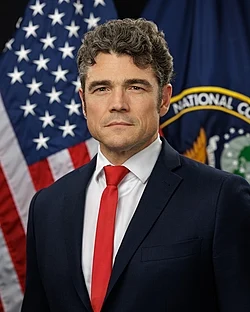 Joe Kent, right, said that Iran was not close to developing a nuclear weapon, arguing that it was not on the verge of obtaining one either at the time of the conflict or in the months prior. His statement reflects his broader position that Iran did not pose an immediate or imminent nuclear threat, which he has used to criticize the justification for the war.
Joe Kent claimed that before his death, Charlie Kirk urged him to try to prevent the U.S. from entering a war with Iran and to reconsider its relationship with Israel. Kent suggested that Kirk faced pressure related to his stance and raised concerns about unanswered questions surrounding his death. He also alleged that an investigation he was involved in was halted before it could be fully completed, implying there is more information that has not been disclosed.
NBC News confirmed that Iran executed three individuals accused of killing two police officers during protests in January, marking the first known executions linked to the unrest. Authorities said the individuals were convicted of murder and of acting in support of foreign adversaries, including the United States and Israel. The executions signal a harsh response by the Iranian government to dissent and ongoing protests.
Saudi Arabia’s foreign minister told NBC that Iran has completely destroyed any remaining trust after launching missile attacks during a meeting of regional diplomats, which he described as an attempt to intimidate those present. He warned that the strikes show Iran is willing to escalate tensions and will not easily back down. The remarks also suggested that Gulf countries may consider deeper involvement in the conflict, highlighting the risk of a broader regional escalation.
Denmark prepared for the possibility of a U.S. attempt to seize Greenland by deploying troops, sending blood supplies for potential casualties, and planning to destroy key runways to prevent American forces from landing. Danish and European officials coordinated a multinational military presence, including troops from several allied countries, along with fighter jets and naval assets, to deter any potential attack. Although Denmark recognized it could not realistically defeat the U.S. militarily, leaders decided they would resist if necessary, aiming to raise the cost of any invasion and signal that such an action would require a full-scale conflict.
According to NBC News, multiple DHS contractors and industry sources alleged that Corey Lewandowski, a close Trump ally serving in a senior advisory role at the Department of Homeland Security, sought or indirectly encouraged payments or consulting arrangements in exchange for influencing government contracts, raising serious ethical and legal concerns. Several companies claimed they were pressured to hire consultants tied to Lewandowski or risk losing contract opportunities, while some reported being excluded after refusing such arrangements, though Lewandowski has denied all allegations and says he never received any payments.
Politico has confirmed that political operatives with ties to Donald Trump earned at least $23 million in commissions from a $220 million Department of Homeland Security advertising campaign that later contributed to Kristi Noem’s removal as secretary. The contracts, awarded with limited competition, raised concerns about oversight and potential favoritism, especially given the firms’ political connections and the scale of taxpayer funding involved.
Treasury Secretary Scott Bessent said the U.S. is considering temporarily lifting sanctions on certain Iranian oil shipments to help lower rising energy prices. He explained the move would use Iran’s own oil supply to stabilize the market in the short term while the conflict continues. The proposal comes as oil and gas prices have surged since the war began.
 Belarusian President Alexander Lukashenko, left, met with a U.S. envoy in Minsk as part of efforts to improve relations with Washington after years of isolation and sanctions. The talks focused on issues including restoring embassy operations, easing sanctions, and addressing political prisoners, with Belarus recently releasing detainees in a bid to rebuild ties. The meeting reflects a potential shift in relations as Lukashenko seeks closer engagement with the West despite his long-standing alliance with Russia and history of authoritarian rule.
According to Politico, Senator Bernie Sanders is pushing to block more than $650 million in U.S. arms sales to Israel by introducing resolutions of disapproval in the Senate. He argued that the U.S. should not provide additional weapons amid ongoing conflict in the Middle East, calling the situation an illegal war and criticizing the impact of Israel’s actions. The effort could force a Senate vote and create political pressure on Democrats, highlighting divisions within the party over support for Israel.
Thousands of U.S. manufacturing jobs have been lost over the past year despite promises of a revival, with layoffs at companies like Whirlpool highlighting the continued decline in domestic factory work. The company has cut jobs in the United States while expanding production in lower-cost countries like Mexico, even as tariffs were intended to boost American manufacturing. The situation reflects broader challenges facing the industry, including global competition, rising costs, and supply chain pressures that have limited the impact of trade policies.
According to The Hill, Amazon plans to significantly reduce the number of packages it ships through the U.S. Postal Service, aiming to cut that volume by at least two thirds as its contract approaches expiration. The move follows ongoing negotiations between Amazon and USPS that failed to produce a new agreement, leading Amazon to prepare alternative delivery strategies. The change could have a major impact on USPS, which has relied heavily on Amazon shipments for a significant portion of its package volume.
Changes to a federal autism advisory committee under Health Secretary Robert F. Kennedy Jr. have sparked backlash after he replaced members with fewer autistic representatives and included individuals linked to anti vaccine views. The first meeting of the reshaped committee was abruptly canceled, while a separate independent group formed in response, raising additional concerns about representation and scientific direction. Critics warn the changes could shift federal autism research toward debunked theories and undermine evidence based science.
Steady, Opinion: Only One Man to BlameTrump seems dumbfounded by all the things going badly in Iran, Dan Rather, right, March 19, 2026. Iran retaliates, hitting the U.S. Embassy in Baghdad. 
It’s long been our mission here at Steady to help you navigate uncertain times. As we know, knowledge is power. And while we always aim to calm fears and ease anxiety, we also owe you the truth. Some days, that can be tough. And today is one of those days.
Increasingly, the president and his administration appear to have little to no idea of what they are doing when it comes to Iran — a muddled strategy, if any, no endgame, no clear picture of when and how this ends, and no one with the gumption to tell the commander in chief the truth.
In less than a month, Donald Trump has managed not only to endanger the U.S. economy, but most economies around the world. Quite a feat.
Today’s big headline is “Donald Trump Lied.” We could begin almost every piece with that sentence. But today’s lie is a whopper even by Trump standards, with massive implications. To get a clear understanding of those consequences, we need to back up 24 hours.
On Wednesday, Israel bombed Iran’s enormous natural gas facility, South Pars. It’s used primarily for domestic consumption by the Iranians. In retaliation, Iran twice bombed the world’s largest liquefied natural gas facility in Qatar. These attacks on global energy infrastructure sent markets reeling and prices rocketing skyward.
Soon after Iran’s second strike, overnight Wednesday, Trump took to social media to tell the Israelis and Iranians to essentially knock it off. In the post, the president said he knew nothing about Israel’s plans to bomb South Pars.
Not true, according to U.S. officials who spoke with the Wall Street Journal and Axios. They reported that not only did he know, he supported the military action to send a message to Tehran: Open up the Strait of Hormuz or else.
The president’s support of attacks on oil infrastructure anywhere is perhaps the most damaging thing he has done. Look at what it unleashed. Trump is now backing down from championing similar attacks, believing Iran got the message. Or maybe things have gone from bad to worse that he has no choice but to rethink what he is doing. And many observers argue that he should rethink it, for a multitude of reasons.
The U.S. Economy Doesn’t Like WarOil prices are continuing their northward trek. As of this writing, Brent crude is $103 a barrel. The average price of a gallon of gas in the U.S. jumped from $2.98 to $3.88 since the war began. The stock market, which has remained robust through most of Trump’s second term, is not so sanguine about the war in Iran. U.S. stocks have fallen by about 4% with global markets faring even worse.
On top of all that sobering news, Thursday’s inflation report was worse than expected. Inflation is up to 3.4%. Hiring has stagnated and wage growth is falling. The federal debt is now $36 trillion, up $2 trillion in just seven months. And many economists are predicting a recession if hostilities don’t end soon in the Middle East.
Every U.S. recession — except the one in 2020 caused by the pandemic — has been preceded by rising oil prices. Moody’s puts the odds of a recession in the next year at 49%. Even if the war ends tomorrow, fixing the mess will take time. Don’t expect to see prices drop as quickly as they jumped.
The War Is As Unpopular As It is Costly
On the heels of all of the bad economic news, the Pentagon is reportedly asking the White House to approve a $200 billion request to Congress to further fund the war in Iran. That sum is considerably more than expected, and it signals the military thinks the conflict may well drag on longer than expected, though no one actually knows what to expect.
The White House is said to be weighing the idea of sending in ground troops, specifically to secure the Strait of Hormuz and Kharg Island, according to Reuters.
That is a hugely unpopular option. In a survey from Data for Progress released Wednesday, 68% of voters oppose deploying ground troops to Iran. Even half of Republicans do not support the option.
Any entry of ground troops would raise the specter of “mission creep,” the military’s term for what happened in Vietnam, Iraq, and Afghanistan. That is, what starts out to be a limited operation “creeps” into a larger and much more costly war.
Trump’s overall approval rating is dropping in sync with the bombs in Iran. According to The Silver Bulletin polling average, his net approval is now -15.3, the worst of his second term.
Gabbard on The Hot SeatFor the second day in a row, Tulsi Gabbard, the director of national intelligence, is on Capitol Hill to answer questions about the run-up to the war in Iran. Day two isn’t going much better than day one.
On Wednesday, in her opening remarks Gabbard omitted — for time, she claims — a line that was in her written remarks. It said, since Iran’s nuclear capabilities were “obliterated” by Trump in June, “there have been no efforts since to rebuild their enrichment capability.”
Democrats on the committee noted the omission since it undercuts the now-stated reason for the war.
At that hearing with the Senate Intelligence Committee, Gabbard bizarrely abdicated her most important authority to Trump, saying it is his job to determine who is a threat to the U.S.. Senator Jon Ossoff (D-GA) pressed her on whether there was an “imminent nuclear threat posed by the Iranian regime.”
Ossoff: “Yes or no?”
Gabbard: “It is not a responsibility of the intelligence community to determine what is or is not an imminent threat.”
Ossoff: “It is precisely your responsibility to determine what constitutes a threat to the United States.”
And the responsibility of the 80,000 members of the American intelligence community to make nonpolitical judgments about what constitutes a threat to the security of the country.
Gabbard’s testimony solidified an alarming reality: Everything is decided by one man, Donald Trump. The job of the massive federal government is simply to prop him up, to parrot him, and to do his bidding. No one in his orbit is allowed an original thought, especially if it runs counter to what he wants. And what he wants is a constantly moving target.
One of Gabbard’s colleagues in the intelligence community has had enough. Joe Kent, an avowed isolationist and MAGA poster boy, resigned as the director of the National Counterterrorism Center on Tuesday. In a scathing resignation letter, he said, “Iran posed no imminent threat to our nation, and it is clear that we started this war due to pressure from Israel and its powerful American lobby.”
Trump Is An Island Of His Own MakingTrump is not only isolating himself from his MAGA loyalists, who are openly divided and questioning his decision to attack Iran, but also from the international community. Most of our once stalwart allies are giving Trump the cold shoulder.
France “will never take part in operations to open or liberate the Strait of Hormuz in the current context,” said French President Emmanuel Macron. Canada “was not consulted prior to the offensive operation” and “has no intention of participating in it,” said Canada’s foreign minister, Anita Anand. And British Prime Minister Keir Starmer promised that his country would not be “drawn into the wider war.”
Rather than try to repair fissures with the world leaders, Trump did his damnedest to completely burn bridges.
“[W]e no longer ‘need,’ or desire, the NATO Countries’ assistance — WE NEVER DID! Likewise, Japan, Australia, or South Korea,” the president added. “In fact, speaking as President of the United States of America, by far the Most Powerful Country Anywhere in the World, WE DO NOT NEED THE HELP OF ANYONE!”, wrote the man who certainly needs help.
Even if the bombing stopped tomorrow, energy experts acknowledge it would take months to get online again. Energy production in the Middle East has shut down and you can’t just flip a switch and restart it. The Qatari facility bombed on Wednesday will take years to rebuild.
As The Economist noted, “Although president Donald Trump says he has ‘destroyed 100% of Iran’s military capability,’ the 0% that remains is playing havoc with the global economy.”
And if Iran keeps attacking oil infrastructure in the Gulf states, all bets are off. Iran said in a statement on Thursday that it will show “zero restraint” if its production facilities are attacked again.
And so the fog of war gets thicker and spreads wider. To what end, and when it ends remain a mystery, depending on the whims of one Donald Trump.
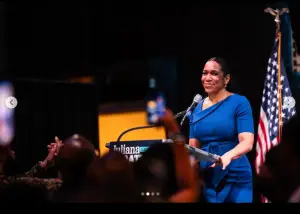 Juliana Stratton, above, the Illinois lieutenant governor,won the Illinois Democratic Party primary nomination for governor.
The Contrarian, Commentary: Dispatch from Chicago: Illinois Primary Has a Lesson on Big Money in Politics, Lorraine Forte, March 19, 2026. Can we keep our elections from turning into auctions among outside interests with fat wallets?
If you want to see how big money is seeping into American politics, take a look at the big picture surrounding this week’s Illinois primary election.
Political action committees and special interest groups spent more than $50 million to try to influence high-profile congressional and state legislative races, according to one analysis of Federal Election Commission reports. That spending didn’t automatically lead to success for big-money candidates, which is a good sign if we want to keep our elections from turning into auctions among outside interests with fat wallets.
But talk of who-took-cash-from-which-big-donor-and-how-much often overshadowed discussion of policies that voters in Illinois and across the country care about: providing affordable health care, ending the Iran war, stopping Donald Trump’s and Stephen Miller’s brutal immigration agenda, and protecting democracy from the Trump regime’s constant barrage of lies and attacks on the Constitution.
Consider the bitterly contested race to choose the Democrat who will run in November for the Senate seat being vacated by the senior Illinois senator, Dick Durbin, who is retiring. Millions were spent by super-PACs in the race, which had nine candidates on the ballot but quickly became a three-way contest among the state’s lieutenant governor, Juliana Stratton, and two veteran members of Congress, Raja Krishnamoorthi and Robin Kelly.
Stratton’s campaign received $5 million from billionaire Gov. JB Pritzker — Stratton was his running mate in his two campaigns — via a PAC that supported her. She won with just under 40% of the vote; Illinois has no runoffs in a multi-candidate primary election, so the top vote-getter wins even if he or she doesn’t get a majority.
That PAC received an additional $1.1 million from another Pritzker family member. Stratton also took money from corporate super-PACs, including a hefty six-figure donation from a company that contracts with Immigration and Customs Enforcement.
Meanwhile, five-term congressman Krishnamoorthi received millions in support from outside super-PACs – some aligned with right-wing interests, such as Trump supporter Peter Thiel’s software firm Palantir — that spent big to help his campaign. Krishnamoorthi was initially considered the front-runner against Stratton, in part because of the $30 million he initially raised.
Money was a prominent theme throughout the campaign, including in at least one debate. Krishnamoorthi had plenty of cash, but it didn’t help him win. Stratton had a wealthy governor’s financial and public support. Kelly, widely respected among progressives, trailed in fundraising and had little chance in the race.
See how big money can dominate an election, regardless of who wins and who loses? That’s not how American politics should work.
In this heavily Democratic state, Stratton now is the favorite in the Nov. 3 election and would become the second Black woman from Illinois in the Senate. She will face former Illinois Republican Party Chair Don Tracy, a lawyer who said he will make affordability a top campaign issue.
AIPAC and crypto cash
The Senate candidate race wasn’t the only contest that drew attention because of the influence of big money.
As voters pay more attention to Israel’s actions in Gaza and the U.S.-Israeli war against Iran, candidates who took money and backing from the American Israel Public Affairs Committee came under fire. AIPAC spent at least $13.7 million to support four candidates in various congressional races.
In a local public radio station’s questionnaire survey of the dozens of candidates in those races, the four AIPAC-backed candidates declined to answer yes-or-no questions about U.S. aid to Israel and AIPAC lobbying. That’s clearly bad for democracy: When candidates get big money from lobbying groups, voters deserve to know where candidates stand on those issues.
Two of the candidates, Chicago treasurer Melissa Conyears-Ervin and state Sen. Laura Fine, lost their races for Congress. Two other candidates, Donna Miller and Melissa Bean, won.
Other special interests that funneled big money into congressional or state legislative races: Fairshake, a pro-cryptocurrency PAC connected to Trump supporters; and two PACs that support sports betting and want to block municipalities in Illinois from taxing the industry. Some of the candidates won; others did not.
The big takeaway from the Prairie State primary is this: Whether big-money candidates win or lose, democracy is distorted when hundreds of millions of dollars nationwide are spent in elections by corporations, uber-wealth donors and super-PACs.
Congress needs to clean up politics and make American elections fairer and more transparent by reining in this spending.
Lorraine Forte is a Chicago journalist and the former editorial page editor for the Chicago Sun-Times.
More On Iran War
Popular Information, Accountability Journalism: A war based on a lie, Judd Legum, right, March 19, 2026. The Trump administration’s Director of National Intelligence, Tulsi Gabbard, testified before the Senate Intelligence Committee on Wednesday. Prior to her testimony, she submitted a written copy of her opening statement. It included the following passage about Iran:
As a result of Operation Midnight Hammer, Iran’s nuclear enrichment program was obliterated. There has been no efforts since then to try to rebuild their enrichment capability. The entrances to the underground facilities that were bombed have been buried and shuttered with cement.
In other words, after the Trump administration’s bombing campaign last June, Iran had no ability to enrich uranium. Since then, the Iranian regime has made no efforts to restore its ability to enrich uranium. Without the ability to enrich uranium, Iran cannot produce a nuclear weapon. Gabbard’s testimony was consistent with the views of outside experts.
Curiously, when Gabbard appeared in person, she read most of her opening statement, but skipped over the section above on Iran’s nuclear enrichment capabilities. Pressed on the omission by Senator Mark Warner (D-VA), Gabbard claimed she left out that passage because she “recognized that the time was running long.”
Gabbard omitted a key conclusion of the U.S. intelligence community that undercuts a core justification for the war that was repeatedly advanced by President Trump.
Trump and his proxies have repeatedly justified the war in Iran by claiming that, absent the decision to launch major combat operations, Iran would have had multiple nuclear weapons within weeks. According to the testimony of Trump’s top intelligence official, these claims were false.
Here are the key statements made in support of the lie:
“They’re probably a week away from having industrial-grade bomb-making material, and that’s really dangerous.” — Middle East Special Envoy Steve Witkoff, February 22
“If we didn’t hit within two weeks, they would’ve had a nuclear weapon. When crazy people have nuclear weapons, bad things happen.” — Trump, March 4
“And this had to be done. They were very close to a nuclear weapon.“ — Trump, March 7
“They would’ve had a nuclear weapon within 2 weeks to 4 weeks.” — Trump, March 9
“Had we not done this, you would have had a nuclear war that would have evolved into World War III.” — Trump, March 16
“[W]e’re doing very, very well in Iran, knocking the hell out of them. And you have to do that. We can’t let them have a nuclear weapon. They were two weeks away -- in my opinion, two weeks away from having a nuclear weapon. — Trump, March 17
At the outset of the war on Iran, on March 1, the White House released a statement characterizing it as an effort “to eliminate the imminent nuclear threat posed by the Iranian regime.”
During the hearing, Senator Jon Ossoff (D-GA) pressed Gabbard on whether the intelligence community assessed that the “nuclear threat” from Iran was “imminent,” as the White House claimed. Gabbard repeatedly dodged the question.
Gabbard said, on the issue of imminence, “the president has to make that determination.” That is false. It is the job of the intelligence community to assess threats, including their severity and imminence. It is the role of the president and Congress to determine how to respond to those assessments.
Clearly, the intelligence community did not assess that the nuclear threat from Iran was imminent because it determined they had no nuclear weapons and were not taking the steps necessary to create one. Joe Kent, who was selected by Trump as the director of the National Counterterrorism Center and reported to Gabbard, resigned on Tuesday. In his resignation letter, Kent wrote that “Iran posed no imminent threat to our nation.”
Another tactic Gabbard used to make the views of the intelligence community more politically palatable is to credit the bombings last June with curbing Iran’s nuclear ambitions. But Iran was not building a nuclear weapon before those strikes either. In March 2025, Gabbard also testified that the intelligence community “continues to assess that Iran is not building a nuclear weapon and Supreme Leader Khamenei has not authorized the nuclear weapons program that he suspended in 2003.”
Shortly before bombing Iran in June 2025, Trump was asked about Gabbard’s testimony, which contradicted his claims at the time.
“She’s wrong. My intelligence community is wrong,” Trump said flatly.
Morning Shots via The Bulwark, Political Opinion: What Nobody’s Telling Trump, William Kristol, right, March 19, 2026. I doubt anyone on the inside is willing to tell President Trump the truth about how the war is going. But if some courageous truth-teller were to enter the Oval Office this morning and speak, he’d say this: It ain’t going great, sir. In fact, sir, it’s going pretty badly.
And if the president didn’t have this intrepid soul removed from his presence, and would listen for a minute or two, this is what more he would hear:
The Iranian regime is surviving.
The Strait of Hormuz remains closed—except to those ships the Iranians want to allow to go through, delivering Iranian oil to their allies.
Global energy prices continue to rise and stock markets continue to fall. Inflation is ticking up and the Fed looks more likely to raise than cut interest rates in the near future.
Iran’s military capabilities aren’t as degraded as we thought. In fact, Iran’s missile and drone launches, which had been declining in number over the first two weeks, have increased this week.
Some of those missiles and drones are hitting their targets: After Israel attacked Iran’s South Pars gas field yesterday in a strike you pretended we didn’t know about ahead of time, Iran retaliated by hitting Qatar’s Ras Laffan terminal, the world’s largest liquefied natural gas facility.
As the Economist put it yesterday, “Although President Donald Trump says he has ‘destroyed 100% of Iran’s Military Capability’, the 0% that remains is playing havoc with the global economy.”
We’re facing a decision about deploying thousands of ground troops to try either to secure the Strait of Hormuz or to seize Kargh Island—and neither operation is assured of success.
The Defense Department says we need to go to Congress for a supplemental appropriation—as much as $200 billion—to pay for the war and replenishing stocks, and it’s not clear the votes are there to approve the funds.
Meanwhile, our allies abroad aren’t rallying to us. And there’s no sign that the American public is rallying to the administration either. That’s what an honest analyst would tell the president of the United States.
But that’s surely not happening.
New York Times, E.U. Loan for Ukraine Becomes Election Leverage for Orban, Lara Jakes, Jeanna Smialek and Cassandra Vinograd, March 19, 2026. European leaders are pushing Prime Minister Viktor Orban to stop blocking a €90 billion loan to Ukraine. But the issue is a rallying cry in remarkably close elections in Hungary set for April 12.
On nearly every corner on a main street in downtown Budapest, images of President Volodymyr Zelensky of Ukraine and two of his biggest European Union supporters are being used to rally voters to re-elect Hungary’s governing party.
Their faces stare down from billboards financed by the government of Prime Minister Viktor Orban, with some showing a smirking Mr. Zelensky asking for a handout, flanked by two top E.U. officials, Ursula von der Leyen and Manfred Weber, stonily pointing to his palm. “Let’s send a message to Brussels: We won’t pay!” the signs proclaim.
Mr. Orban has long balked at supporting Ukraine in its four-year war with Russia. But he has recently made it the cornerstone of his Fidesz party’s campaign platform, ahead of what polls indicate are remarkably close parliamentary elections set for April 12.
In recent weeks alone, Mr. Orban and Mr. Zelensky have sparred over the arrests of Ukrainian bank employees in Budapest and Russia’s transfer of Ukrainian prisoners of war to Hungary. Perhaps most urgently, the Hungarian leader is blocking a 90-billion-euro loan from the European Union to Kyiv that he agreed to as recently as December, over demands that Ukraine fix a damaged oil pipeline before rising fuel costs hurt Hungary’s economy.
On Thursday, leaders of other European Union countries will try anew to persuade Mr. Orban to let the loan proceed. The Hungarian leader has at times relented to E.U. pressure in the past, but he has shown little sign of doing so ahead of the election; he appears to be calculating that antipathy toward Ukraine, and its potential economic drain, is a winning political stance in a country that has never been an enthusiastic supporter of aid to Kyiv.
“If President Zelensky wants to receive his money from Brussels, then he must reopen the Friendship oil pipeline,” Mr. Orban said in a video posted on X on Tuesday. He added, “It seems to me they are using the entire oil blockade to intervene in the Hungarian elections.”ImageA person in dark clothing standing in front of a multicolored billboard.Anti-Zelensky billboards financed by Mr. Orban’s government in Budapest this month.Credit...Attila Kisbenedek/Agence France-Presse — Getty Images
Mr. Zelensky has taken note. He told an Irish blogger recently that Mr. Orban had based his election campaign around a hatred of Ukraine and “me personally” — and has taken several opportunities to fire back verbally.
The pipeline has become Hungary’s main sticking point over the loan. Also known as the Druzhba pipeline, it runs through Ukraine and supplies Russian crude oil to Hungary and Slovakia. But it has been disrupted since Jan. 27, when it was hit in western Ukraine by what Kyiv and the E.U. say was a Russian attack.
Mr. Orban accused Ukraine of orchestrating an “oil blockade” and ordered troops to protect energy infrastructure in Hungary. His foreign minister, Peter Szijjarto, shocked Brussels in late February by announcing that Hungary would refuse to proceed with the €90 billion E.U. loan for Ukraine until the oil supply resumed.
Morning Shots via The Bulwark, Political Opinion: The Remaining Threats from Iran, Mark Hertling, right, shown in a 2011 file photo before retirement, March 19, 2026. The ancient Greek historian Herodotus believed the greatest danger to powerful nations was not external enemies but hubris—the arrogance that comes from believing success makes one invulnerable. That hubris always summoned Nemesis, the goddess of divine retribution, who then punished arrogant heroes and leaders.
That warning is worth remembering as the United States continues its war with Iran.
Iranian military planners have long understood that they cannot defeat Western militaries in a conventional fight, tank against tank, airplane against airplane, rocket against missile. As a result, Iran has invested heavily in asymmetric warfare—methods designed not to win battles but to impose strategic pain: cyber-attacks, killer drones, proxy militias and terrorism, economic disruption, and covert influence operations. American soldiers in Iraq got a taste of Iranian-made explosively formed penetrators—the hand-tooled, conical improvised explosives that could disable an Abrams tank and cause devastating casualties. I estimate about a quarter of the soldiers killed and wounded in my organization in 2007–2008 were victims of Iranian-supplied EFPs.
Right now, the facets of the U.S. government designed to protect the country and its people against exactly the myriad types of unconventional attacks used by Iran are largely distracted, gutted, unfunded, reassigned, or otherwise below capacity. Despite the U.S. military’s overwhelming success against the Iranian armed forces over the last three weeks, the United States is still vulnerable to Iranian retribution.
Tehran has spent years building a cyber capability designed to exploit poorly defended networks—banks, utilities, transportation systems, hospitals, and communications networks—to disrupt civilian infrastructure during a crisis. This makes the administration’s early dismantling of one of America’s most important cyber defenses troubling.
The Cybersecurity and Infrastructure Security Agency was created in 2018, during the first Trump administration. Congress elevated that office into a standalone operational agency for the purpose of strengthening our government’s ability to defend against cyber threats. Yet beginning in 2025, when DOGE was in full swing, the agency lost personnel, saw programs curtailed, and had its partnerships with state governments and private industry disrupted. Now, when cyber retaliation from Iran seems most likely, our nation’s central cyber defense coordination has been weakened.
The resignation of Joe Kent, director of the National Counterterrorism Center, raised another warning flag. The NCTC sits at the center of the intelligence architecture created after September 11th, integrating terrorism intelligence across agencies so that fragments of warning do not fall through bureaucratic cracks. Kent stepped down amid disagreements about how the Iranian threat was being characterized. No matter the reason for his resignation or the president’s comments about his competence, the departure of this top counterterrorism official during an expanding conflict against the world’s leading state sponsor of terrorism is not comforting. It suggests tension between policy and intelligence at the very moment when alignment between the two matters most.
That tension appears elsewhere, too. Director of National Intelligence Tulsi Gabbard testified last year that Iran was not actively pursuing a nuclear weapon, an assessment the president publicly dismissed. This week, Gabbard disclaimed all responsibility—not just for herself but by extension for the whole American intelligence community—for determining whether Iran posed an “imminent threat” to the United States before the start of the war. “The only person who can determine what is and is not an imminent threat is the president,” she told Congress yesterday. As the conflict with Tehran intensified, the intelligence community’s voice has been subdued and political rhetoric has been amplified.
While the intelligence community is sidelined, the Transportation Security Agency isn’t being paid. Roughly 50,000 TSA officers have been working without pay due to a government funding standoff, and absentee rates have spiked at several airports. Travelers tend to view TSA as an inconvenience—the lines, the bins, the removal of shoes and laptops—but terrorists see something different: a critical barrier that prevents their freedom of action. Not paying those who stand on that front line during a period of heightened threat is not fiscal discipline; it’s strategic negligence.
The state of the FBI’s counterterrorism and counterintelligence posture raises additional concerns. The bureau’s Joint Terrorism Task Forces in all 56 field offices across the country remain a central pillar of the post–September 11th homeland defense system. But the reporting over the past year is alarming: staff cuts, reassignments, reduced domestic-terror tracking, large diversions of FBI personnel toward immigration enforcement, and an increasing distrust in the FBI’s leadership. Just days before the United States attacked Iran, FBI Director Kash Patel reportedly fired many of the special agents responsible for Iranian threats.
When the vigilance and capabilities of multiple agencies weaken, especially during a time of increased threats, risk grows exponentially.
The security architecture the United States built after 9/11—fusion centers, joint task forces, aviation screening, cyber defense coordination, and integrated intelligence analysis—was designed around lessons learned through tragedy. Preventing attacks requires constant vigilance and disciplined coordination across agencies.
None of the singular developments unfolding today suggests that the United States will suffer a terrorist attack. But taken together—the weakening of cyber defenses against Iranian retaliation, the resignation of the nation’s top counterterrorism integrator, intelligence–policy friction during wartime, underpaid airport security personnel, and counterterror investigators redirected to other missions—show a troubling erosion of institutions designed to keep Americans safe.
The Trump administration is gloating about the destruction of the Iranian military. I worry that Nemesis is waiting.
AROUND THE BULWARK
How to Counter the GOP’s AI Psyops… Leaning into authenticity is key, argues MAX FLUGRATH.Quick Hits
A STAR IS BORN: The intra-GOP rupture over the resignation of counterterrorism official Joe Kent is growing. Semafor reports that the FBI has opened a leak investigation into Kent, with administration sources saying that the investigation predates Kent’s departure. (Could be!) Despite the White House’s attempt to unperson him, Kent has quickly become a folk hero in alt-MAGA media—he went on Tucker Carlson’s podcast last night, and will be interviewed tonight by Candace Owens at an event hosted by the group Catholics for Catholics. “You wanna rip the GOP apart right to its core and prevent a single America First voter from participating in the midterms?” Megyn Kelly tweeted last night. “Indict Joe Kent and Tucker Carlson. See how that works out.”
The resignation has cranked up the heat on other war-averse members of the administration, who are responding in their own ways. Director of National Intelligence Tulsi Gabbard—a peacenik former Democrat whose entire connection to Trump hinges on his supposed anti-war bona fides, and who brought Kent into the administration—poker-faced her way through a Senate hearing yesterday, insisting the only person who could determine whether Iran had posed an “imminent threat” to America before the war was the president. And JD Vance tried to write Kent’s resignation off as a “difference of opinion,” saying at a Michigan event that he knew and liked Kent but that “if you are on the team and you can’t help implement the decisions of [Trump’s] administration . . . then it’s a good thing for you to resign.” No word on how JD feels about the FBI investigation.Subscribed
CARR ALARM: Last week, we mentioned FCC Chair Brendan Carr’s habit of popping up every few months, issuing a few threats against TV stations’ broadcast licenses because they’re too woke or whatever, then vanishing from the headlines again. But as a sharp new Politico story suggests, the more important story may be the quiet influence Carr is wielding in the meantime, as sweaty, skittish TV lawyers move to comply with his threats in advance:
Consequences for violating the [equal time] rule would likely be minimal under the law, which would penalize only broadcasters showing patterns of willful violation, Schwartzman said. “Everybody knows this is all bluster,” he said.
Carr, though, has phrased some of his warnings as cautions to TV stations whose broadcasting licenses come up for renewal: “The law is clear,” he wrote in his complaint last weekend about allegedly skewed news coverage. “Broadcasters must operate in the public interest, and they will lose their licenses if they do not.”
It’s ultimately impossible to know how many interviews may never happen as a result of the guidance, or how many more TV hosts will just host candidates on platforms like YouTube to avoid triggering the equal time requirement.
Carr’s partisan deployment of the FCC’s powers are a headache now, but they may come back to bite the GOP later: Some Democrats are already threatening to use Carr’s precedent to go after conservative talk radio. Read the whole thing.
FIRST THING WE DO, LET’S KILL ALL THE WIND FARMS: One of the biggest structural failings of the Trump administration has always been its bizarre unwillingness—or inability—to consider even the most predictable policy tradeoffs. The administration wants to isolate China economically, but it also wants to pick constant trade fights with everybody else as well. Trump can’t or won’t see that these two purposes are in tension, which might make him decide it’s worth swallowing his small-bore grievances toward Europe, Canada, and Japan to keep everybody focused on China. So he tries to do both, and fails.
The same goes for energy. Trump has always made low energy costs a central part of his political pitch. But he also nurses a giant grudge—part political, part personal—against all forms of green energy, and has therefore pursued a Jekyll-and-Hyde energy policy of wheedling the fossil-fuel industry to ramp up production while trying to strangle renewables projects across the board.
Before the Iran war, this campaign already looked misguided in a long-term environment of constant upward pressure on energy prices due to factors like data-center construction. It looks insane today, with fossil-fuel prices raging out of control due to the war. And yet the administration is still going at it as hard as ever. Take offshore wind. After trying and failing (and failing and failing and failing) to simply vaporize a number of planned large wind projects off the East Coast, the White House is now pivoting to a new tack: If we can’t block the firms from constructing, maybe we can just buy them out?
“Senior administration officials are drafting settlement agreements that would pay nearly $1 billion to TotalEnergies, the French energy company behind two wind farms off New York State and North Carolina” the New York Times reported this week. “In exchange, TotalEnergies would abandon its plans to begin building the wind farms. It would also commit to investing in natural gas infrastructure in Texas, as the Trump administration prioritizes the production of fossil fuels over renewables like wind and solar power.”
IT’S MARKWAYNE: Barring some crazy new development, it looks like Sen. Markwayne Mullin is going to sail through the confirmation process to replace Secretary Kristi Noem at the Department of Homeland Security. His hearing before the Senate Homeland Security and Government Affairs Committee had some fireworks—most notably, he refused to apologize to the committee chair, Sen. Rand Paul, for saying this year he “understood” why Paul’s neighbor had physically attacked him over a personal dispute in 2017. But while Paul said he intends to vote against Mullin’s confirmation, reliable pinch-hitter Sen. John Fetterman plans to support Mullin in Paul’s place, so that appears to be that.
What’s more interesting is what comes next. We reported weeks ago that Republicans were vaguely hoping that swapping Noem for Mullin would help them peel away enough moderate Senate Democrats to vote to re-fund DHS again. Yesterday, NOTUS confirmed that remains the plan, with a couple of handshake-style concessions thrown on top: The White House is telling senators that, under Mullin, ICE agents will wear visible ID and body cameras, and they won’t enter homes without judicial warrants—all concessions to explicit Democratic demands.
To which Democrats are responding: Call us when you’re ready to talk about our whole list. “It’s one of the reforms that we’re seeking, but by no means all of the basic changes in policy and practices that are necessary for this agency to be lawful,” Sen. Richard Blumenthal told NOTUS yesterday. And they don’t just want promises from the White House; they want these concessions codified in law.
Epstein Scandals, Trump Coverups
Letters from an American, Historical Commentary: March 18, 2026 [Epstein Trafficking Probe], Heather Cox Richardson, right, March 19, 2026. I was intending to take tonight off, but there’s big news—I mean, aside from all the other big news—that I want to make sure gets attention.
Back on February 23, Daniel Ruetenik, Pat Milton, and Cara Tabachnick of CBS News reported on a newly uncovered document in the Epstein files showing that beginning in December 2010 under the Obama administration, the U.S. Drug Enforcement Agency (DEA) was running an investigation of Jeffrey Epstein and fourteen other people for drug trafficking, prostitution, and money laundering.
The document showed the investigation, called “Chain Reaction,” was still underway in 2015. But the investigation disappeared, although the document suggested that it was a significant investigation and that the government was on the verge of indictments.
As soon as the story broke, Senator Ron Wyden of Oregon, the top-ranking Democrat on the Senate Finance Committee, said: “It appears Epstein was involved in criminal activity that went way beyond pedophilia and sex trafficking, which makes it even more outrageous that [Attorney General] Pam Bondi is sitting on several million unreleased files.”
Wyden has been investigating the finances behind Epstein’s criminal sex-trafficking organization: it was his investigation that turned up the information that JPMorgan Chase neglected to report more than $1 billion in suspicious financial transactions linked to Epstein. Wyden has pushed hard for Treasury Secretary Scott Bessent to produce the records of those suspicious transactions for the Senate Finance Committee, but Bessent refuses.
On February 25, two days after the story of the DEA investigation broke, Wyden wrote to Terrance C. Cole, administrator of the DEA, noting that “[t]he fact that Epstein was under investigation by the DOJ’s [organized crime drug enforcement] task force suggests that there was ample evidence indicating that Epstein was engaged in heavy drug trafficking and prostitution as part of cross-border criminal conspiracy. This is incredibly disturbing and raises serious questions as to how this investigation by the DEA was handled.”
He noted that Epstein and the fourteen co-conspirators were never charged for drug trafficking or financial crimes, and wrote: “I am concerned that the DEA and DOJ during the first Trump Administration moved to terminate this investigation in order to protect pedophiles.” He also noted that the heavy redactions in the document appear to go far beyond anything authorized by the Epstein Files Transparency Act and that since the document was not classified, “there is no reason to withhold an unredacted version of this document from the U.S. Congress.”
Wyden asked Cole to produce a number of documents by March 13, 2026, including an unredacted copy of the memo in the files, information about what triggered the investigation, what types of drugs Epstein and his fourteen associates were buying or selling, when Operation Chain Reaction concluded and what was its result, why no one was charged, and why the names of the fourteen co-conspirators were redacted.
Today Wyden sent a letter to Deputy Attorney General Todd Blanche, Trump’s former personal lawyer, saying: “It is my understanding that shortly after I requested an unredacted copy” of the document in the Epstein files, the Department of Justice “stepped in to prevent DEA from complying with my request. According to a confidential tip received by my staff, DEA Administrator Terry Cole was ready to provide an unredacted copy of the memorandum, but you stepped in to prevent him from doing so. My staff inquired with the DEA about the status of the production of this document and the DEA responded by directing questions to your office.”
The letter continued: “Your alleged interference in this matter is highly disturbing, not just because it continues the DOJ’s long-running obstruction of my investigation, but also because of your bizarrely favorable treatment of Ghislaine Maxwell, one of Epstein’s closest criminal associates. I should not have to explain the significance of the fact that Epstein was a target of [this high-level DEA] investigation. It suggests the government had ample evidence indicating he was engaged in large scale drug trafficking and prostitution as part of cross-border criminal conspiracy and that Epstein was likely pumping his victims, including underage girls, with incapacitating drugs to facilitate abuse. I am at a loss to understand why you are blocking further investigation of this matter.”
Noting that the document in the files was “clearly marked as ‘unclassified’ at the top of every single page,” Wyden noted: “There is absolutely no reason to withhold an unredacted version of this document from the U.S. Congress.” He added: “In order to assist my investigation into this matter, I demand that you immediately authorize the release of this document.”
Wyden also posted today on social media: “HUGE: Deputy Attorney General Todd Blanche—Trump’s former personal lawyer who was also responsible for Ghislaine Maxwell’s transfer to a cushy club fed—has intervened to block the DEA from providing details of a mysterious Epstein investigation to my Finance Committee team…. This is stunning interference. The document I’m after literally says ‘unclassified’ at the top. The investigation it details is closed. Given Blanche’s close personal ties to Donald Trump, this reeks of a continued coverup to protect key names in the Trump administration.”
Wyden’s post echoes the September 13, 2019, letter from then-chair of the House Intelligence Committee Adam Schiff (D-CA) to Acting Director of National Intelligence Joseph Maguire, in which Schiff called out Maguire for illegally withholding a whistleblower complaint.
In that 2019 letter, Schiff warned: “The Committee can only conclude…that the serious misconduct at issue involves the President of the United States and/or other senior White House or Administration officials. This raises grave concerns that your office, together with the Department of Justice and possibly the White House, are engaged in an unlawful effort to protect the President and conceal from the Committee information related to his possible ‘serious or flagrant’ misconduct, abuse of power, or violation of law.”
Schiff was right: the whistleblower had flagged Trump’s July 2019 phone call with newly elected Ukraine president Volodymyr Zelensky, demanding Zelensky smear Joe Biden’s son Hunter before Trump would release the money Congress had appropriated for Ukraine to fight off the Russian invasion that had begun in 2014. That information led to the story that Trump’s White House was running its own secret operation in Ukraine, apart from the State Department, for Trump’s own benefit. That story led to Trump’s first impeachment by the House of Representatives for abuse of power and obstruction of Congress.
Schiff was the lead impeachment manager of the impeachment trial in the Senate, and in his closing argument, he implored Senate Republicans to bring accountability to “a man without character.” “You will not change him. You cannot constrain him. He is who he is. Truth matters little to him. What’s right matters even less, and decency matters not at all.”
“You can’t trust this president to do the right thing. Not for one minute, not for one election, not for the sake of our country,” Schiff said. “You just can’t. He will not change and you know it.” “A man without character or ethical compass will never find his way.”
But Republican senators stood behind Trump. They acquitted him of abuse of power, by a vote of 48 for conviction to 52 for acquittal. Senator Mitt Romney of Utah crossed the aisle to vote with the Democratic minority. Senate Republicans were unanimous in their vote to acquit Trump of obstruction of Congress.
And here we are.
Politico, Epstein’s lawyer tells House Oversight investigators he had ‘no knowledge’ of Epstein’s crimes, Hailey Fuchs, March 19, 2026. Darren Indyke’s appearance is the latest in the Oversight committee’s string of closed-door depositions with people in Jeffrey Epstein’s orbit.
Darren Indyke, Jeffrey Epstein’s lawyer and a co-executor of his estate, told the House Oversight and Government Reform Committee that he had no knowledge of the convicted sex offender’s crimes and rejected aspersions that he knowingly facilitated Epstein’s trafficking, according to a copy of prepared remarks obtained by POLITICO.
The attorney’s defensive posture in the closed-door deposition on Thursday comes amid mounting pressure on the Justice Department and lawmakers to pursue criminal accountability for others who could have played a role in Epstein’s scheme. In his prepared opening statement, Indyke noted that he was appointed a co-executor of Epstein’s estate in 2019 by the U.S. Virgin Islands probate court, has cooperated with the Justice Department and helped found the Epstein Victims’ Compensation Program.
“Let me be clear: I had no knowledge whatsoever of Jeffrey Epstein’s wrongdoings,” Indyke told congressional investigators, according to the prepared remarks. “My complete lack of involvement in that misconduct is a matter of record: not a single woman has ever accused me of committing sexual abuse or witnessing sexual abuse, nor claimed at any time that she or anyone else reported to me any allegation of Mr. Epstein’s abuse.”
He maintained that his relationship with Epstein was not social in nature and that he was only one of the lawyers with whom Epstein consulted — a list that included Kenneth Starr, the former independent counsel who investigated the fallout of Bill Clinton’s affair with Monica Lewinsky.
“My primary role was to provide corporate, transactional and general legal services to Mr. Epstein and his companies, and I did so,” Indyke planned to say.
Only one person has been convicted as part of Epstein’s sex trafficking scheme: Ghislaine Maxwell, a longtime associate now serving 20 years in prison for her role in the crimes. She is seeking a pardon from President Donald Trump.
Indyke is the latest in the Oversight committee’s string of closed-door depositions with people in Epstein’s orbit. Epstein’s onetime client and former Victoria’s Secret CEO Les Wexner and another co-executor of Epstein’s estate Richard Kahn also testified. House Oversight Chair James Comer (R-Ky.) has also subpoenaed Attorney General Pam Bondi to testify before lawmakers over her handling of the Epstein files.
Unlike Wexner and Kahn, Maxwell invoked her Fifth Amendment right when she was questioned by the Oversight committee in a virtual deposition as part of its investigation into Epstein.
According to his prepared remarks, Indyke also denied any involvement in the facilitation of so-called “sham marriages” for women around Epstein, an allegation that appeared in a complaint filed in court by the government of the U.S. Virgin Islands. He described his onetime client as being “extremely contrite” after his 2008 sex crime conviction and added that he believed Epstein when he said did not know the woman was a minor.
César Chavez #MeToo Scandal

New York Times, Cesar Chavez Investigation: ‘We’re Just Seen as Sex Objects’: Dolores Huerta’s Years in the U.F.W., Sarah Hurtes and Manny Fernandez, March 19, 2026. The co-founder of the United Farm Workers talked about her relationship with César Chavez, and the night he raped her.
In the days after Thanksgiving in 1986, Dolores Huerta, shown above and below left in file photos, was ready to celebrate. As one of the co-leaders of the United Farm Workers union, she had spent four months in Washington lobbying lawmakers to pass the Immigration Reform and Control Act, landmark legislation that granted amnesty to millions of undocumented immigrants.
A news conference was scheduled to celebrate the victory, but Ms. Huerta said she was not made aware of the event. Instead, she said, her fellow U.F.W. leader, César Chavez, told her there was a crisis in Florida that required her immediate attention. Ms. Huerta flew to Florida, only to realize that the emergency was nonexistent and no one was expecting her. She spent the next few days speaking at senior centers.
“I realized afterward they just wanted to get me out of the way so they could take credit for the work,” she said of her male co-workers in an interview last week. “Straight male-chauvinist trick, and I was really upset about that.”
 In the interview, Ms. Huerta talked about the challenges she had faced as a woman in the machismo culture of the movement, which Mr. Chavez had come to dominate with the sheer force of his personality.
And in a stunning disclosure, she said that Mr. Chavez had sexually assaulted her on one occasion and manipulated her into sex on another, encounters that produced two children. A New York Times investigation detailed strong evidence that Mr. Chavez had sexually assaulted several women in the farmworkers’ movement, including two young teenagers.
Ms. Huerta and Mr. Chavez, standing together with raised fists at rallies and marches, were the public face of the Latino-led union organizing movement that swept through American farm fields in the 1960s.
Now 95, Ms. Huerta is often referred to as Grandmother of the Resistance. Her portrait hangs in some American embassies. She fought for years for better wages, maternity protections and basic safety measures for women doing the backbreaking work of planting and harvesting crops.
But in the interview, Ms. Huerta described a culture in U.F.W. under Mr. Chavez that forced her to struggle to be heard and to suppress any negative feelings she felt about him and his leadership — including the trauma of rape.
Ms. Huerta said the assault occurred in the winter of 1966, when she was at the People’s Bar and Cafe in Delano, Calif. — a well-known hangout for farmworker organizers. She was having a beer when Mr. Chavez stormed in, tapped her shoulder and asked for a word.
Assuming that the matter concerned an upcoming strike, she said, she followed him outside. It was common for them to have meetings in the car — Mr. Chavez worried that his office was bugged. He drove her to a secluded grape field on the outskirts of town, she said, and assaulted her.
She also described an earlier episode in 1960 — five years after first meeting Mr. Chavez — in which she felt pressured and manipulated into having sex with him in a hotel room during a work trip in San Juan Capistrano, in Southern California.
After the assault in 1966, she was left in a numb, shocked state, she said, but told no one. Not her friends, not her family, not even her daughter born from the assault.
She said she believed that the work of advancing rights for farmworkers was more important, and worried that publicly criticizing Mr. Chavez would tarnish the movement’s legacy and be exploited by political opponents.
“I saw him, again, as my boss, as my hero, as, you know, somebody that would do the impossible,” she said. “I never talked about it to anybody and the reason I didn’t is because I just didn’t want to hurt the movement.”
Ms. Huerta said she viewed Mr. Chavez as a contradictory figure when it came to women. He believed in promoting them, she said, but only so far.
Women ran the credit union, the clinic, the field offices. They were trusted with the operational machinery of the movement. But making the decisions that shaped the union’s direction, she said, remained out of reach. “Cesar believed in promoting women as leadership, not at the policy level, but at the work level,” she said.
It was, she suggested, a reflection of something deeper. “Women are not seen as human beings. We’re just seen as sex objects. I think it’s an illness.”
 Politico, Sexual assault allegations roil bills honoring César Chávez, Rylan DiGiacomo-Rapp and Heather Richards, March 19, 2026. California Democrats pursuing a national historical park to honor the activist said they would revise legislation to “respect the victims.”
Lawmakers are rethinking legislation that seeks to further honor the late activist César Chávez, shown above, after sexual misconduct allegations have now surfaced decades after his death.
President Barack Obama in 2012 created the César E. Chávez National Monument in Keene, California, and lawmakers have been wanting to turn the site into a national historic park. Those plans will now change.
Two California Democrats, Rep. Raul Ruiz and Alex Padilla, signaled yesterday they would no longer seek to advance legislation they previously championed, which would sought to “preserve the nationally significant sites associated with César E. Chávez and the farm worker movement across California and Arizona.”
Their companion bills also would have called for a study to create the “Farmworker Peregrinación National Historic Trail,” marking a 300-mile march that occurred in 1966.
“As the lead sponsor in House of the César E. Chávez and the Farmworker Movement National Historical Park Act, Congressman Ruiz will take steps to rename and revise the legislation in honor of farmworkers both to respect the victims and to serve as an initial step toward accountability,” a Ruiz aide said Wednesday.
Padilla’s office said that the senator supports the removal of Chávez’s name from any landmarks, institutions or honors, and plans to rework the Senate version of the legislation.
“There must be zero tolerance for abuse, exploitation, and the silencing of victims, no matter who is involved,” Padilla said in a statement. “Confronting painful truths and ensuring accountability is essential to honoring the very values the greater farm worker movement stands for — values rooted in dignity and justice for all.”
The Congressional Hispanic Caucus also issued a statement on social media calling Chávez “flawed beyond absolution,” while vowing to work to rename “streets, post offices, vessels and holidays” that honor Chávez.
A New York Times story this week detailed allegations that Chávez sexually assaulted women and girls, including Dolores Huerta, who co-founded the United Farm Workers union with him. The existing 187-acre monument site includes the union headquarters.
Dennis Arguelles, the Southern California director of the National Parks Conservation Association, called the allegations against Chávez “deeply disturbing” but noted that the national monument is not about a “single person.”
“For many years, NPCA supported a national park site — the current national monument as well as a proposal that would include sites in several western states — that would honor the farmworker movement and those who fought for dignity, better working conditions, and fair wages,” Arguelles said in a statement. “This movement, which the National Park Service found to be nationally significant history, is not about a single person.”
He said the site, “the first to recognize contemporary Latinos, plays a critical role in ensuring that our country’s diversity and complex stories are shared.”

César Chavez Foundation, Statement from the César Chavez Foundation, Staff Report, March 17, 2026, The César Chavez Foundation has become aware of disturbing allegations that César Chavez, shown above, engaged in inappropriate sexual behavior with women and minors duringhis time as President of the United Farm Workers of America (UFW).
We are deeply shocked and saddened by what we are hearing.
The Foundation is working with leaders in the Farmworker Movement to be responsive to these allegations, support the people who may have been harmed by his actions, and ensure we are united and guided by our commitment to justice and community empowerment.
In partnership with the UFW, we are establishing a safe and confidential process for those who wish to share their experiences of historic harm, and, if they choose to, participate in efforts toward repair and reconciliation. In addition, we are investing time and resources to ensure the Foundation promotes and strengthens a workplace culture that is safe and welcoming for all.
We ask for our community’s patience as we learn more. Throughout this process, our organization and our partners in the movement will continue our work together to protect and uplift the families and communities that we serve.
Today, the Cesar Chavez Foundation impacts the lives of millions of Latinos and working families across the Southwest by inspiring and transforming communities through social enterprises that address essential human, cultural, and community needs.
More Global News
New York Times, The Iran War’s Economic Threat to Europe and Asia, Eshe Nelson and River Akira Davis,.March 19, 2026. Inflation and its consequences for growth are a growing concern for countries where memories of the 2022 energy crisis are fresh.
For governments around the globe, the prospect of a prolonged war in the Middle East is raising the risk of fiscal strain on already stretched public budgets.
Officials from London to Seoul to Bangkok are starting to grapple with a vexing dilemma: Spend more to shield citizens from surging energy costs, risking the ire of global debt investors, or choose fiscal discipline and face the political backlash that is certain to follow.
No country is immune to the problem, but it is especially acute in countries throughout Europe and Asia where dependence on imported oil and gas is great and inflation is an economic and political concern.
Governments with high debt levels are staring down creditors restless about public finances drawn down by military spending, critical public services, aging populations and infrastructure investments.
At the same time, the scars of the last energy crisis, which followed the Russian invasion of Ukraine in 2022, are still visible. Some countries have moved quickly to offer relief to households as the war in the Middle East has escalated. Portugal has cut taxes on diesel. Greece has imposed a cap on corporate profit margins on the sale of fuel and some groceries. In South Korea, the government is considering expanding an energy voucher program for households.
“Fiscal space is important, but the political pressure here is a much more important driver,” said Angel Talavera, the chief European economist at Oxford Economics, a research group. “The threshold for action is much lower because prices have become a hugely contentious issue with voters.”
New York Times, Trump Says U.S. and Qatar Not Involved in Strike on Iran’s South Pars Gas Field, Aurelien Breeden, March 19, 2026. President Trump said Israel was responsible for the attack, but vowed to “massively” destroy the gas field if Tehran hit Qatar’s energy facilities in retaliation.
President Trump said late Wednesday that the United States and Qatar were not involved in what he said was an Israeli attack on Iran’s South Pars gas field, even as he threatened to destroy the field if Tehran persisted in striking Qatar’s energy facilities.
Hours after the attack on South Pars on Wednesday, natural gas facilities in Qatar were hit by attacks that the Qatari authorities attributed to Iran. They were the latest in a series of escalating strikes on energy infrastructure that have sent oil and gas prices soaring.
In a social media post, Mr. Trump said that Israel had “violently lashed out,” hitting a “relatively small section” of the field. Qatar also accused Israel of attacking South Pars, one of the largest gas fields in the world. Israel has not commented on the strike.
“The United States knew nothing about this particular attack, and the country of Qatar was in no way, shape, or form, involved with it, nor did it have any idea that it was going to happen,” Mr. Trump wrote. He accused Iran of “unjustifiably and unfairly” retaliating against Qatar’s liquefied natural gas facilities.
Iran uses most of its natural gas domestically, but Qatar is the world’s third-largest exporter of liquefied natural gas. South Pars is part of a larger reservoir that is shared between Qatar and Iran.
In his post, Mr. Trump vowed that “NO MORE ATTACKS WILL BE MADE BY ISRAEL” on South Pars unless Iran attacked Qatar’s energy facilities. If that happened, he said, the United States would “massively blow up” the oil field.
“I do not want to authorize this level of violence and destruction because of the long term implications that it will have on the future of Iran, but if Qatar’s LNG is again attacked, I will not hesitate to do so,” Mr. Trump said.
New York Times, News Analysis: For U.S., Unmet Expectations in Iran Fit a Familiar Pattern in the Region, Neil MacFarquhar, March 19, 2026 (print ed.). Iran’s military retaliation, along with the political defiance of its new leaders, evokes a decades-old pattern of unrealized goals for American interventions in the region.
After the United States and Israel went to war against Iran on Feb. 28, the U.S. military began issuing a bulletin every few days listing the number of targets hit. By Wednesday it was more than 7,800 in total, up from over 1,000 on the first day of the war, while a similar Israeli count of strikes stood at 7,600 late last week.
It is, by any measure, a bombing campaign of historic proportions, and senior U.S. officials have lauded it repeatedly as a crushing blow to the Iranian armed forces. “Never before has a modern, capable military, which Iran used to have, been so quickly destroyed and made combat ineffective, devastated,” Pete Hegseth, the secretary of defense, said at a news conference last week.
And yet, Iran is not entirely crippled militarily. It continues to retaliate, often in unconventional ways. Its resistance, along with the political defiance of its new leaders, evokes a decades-old pattern of unrealized expectations for American interventions in the region.
Global oil prices have inched upward as Iranian attacks have curtailed exports through the narrow, perilous Strait of Hormuz, including hitting a tanker on Tuesday near the waterway. Virtually every night, a barrage of Iranian missiles hits Israel and Persian Gulf nations allied with the United States, unsettling the population. Most cause little damage, but overall the fighting has killed more than 2,300 people in Iran, Lebanon, Israel and across the region.
New York Times, Iran Maintains Near-Total Internet Blackout Amid U.S.-Israeli Strikes, Parin Behrooz, March 19, 2026 (print ed.). As the war has stretched into its third week, the Iranian government has blocked internet access for most of its 92 million citizens.
For 19 days, the majority of Iran’s 92 million people have been cut off from the outside world, according to watchdog groups that track internet censorship in the country, as the country’s regime has tried to suppress communication and maintain control over its population during wartime.
As U.S. and Israeli airstrikes continue across Iran for the third week, the state has imposed a near-total internet blockade for most Iranians while increasingly criminalizing and shutting down alternate methods of connecting to the web. The few workarounds available (international call packages, private network connections or Starlink) are becoming riskier, pricier and less reliable by the day.
“Based on traffic levels, I would expect that about 99 percent of Iranians do not have regular access to the internet,” said Doug Madory, the director of internet analysis at Kentik, a company that measures internet network performance.
Most domestic websites and internet-based services like bank or ride-sharing apps continued to run normally for the first two weeks of the war, but some started experiencing disruptions about four days ago. Some domestic services, including a government-approved “super app” similar to China’s WeChat, became temporarily inaccessible inside Iran over the weekend.
“These types of disruptions can result from changes in routing, the implementation of stricter filtering policies or efforts to centralize traffic control,” said Amir Rashidi, a cybersecurity expert with the digital-rights group Miaan. “But in practice, such measures often lead to cascading failures that affect even domestic services.”
U.S. Law, Courts, Crime, Civil Rights
New York Times, ‘Go Big and Go Loud’: Inside the Justice Dept.’s Push to Prosecute Protesters, Alan Feuer, Alexandra Berzon and Ernesto Londoño, March 19, 2026. Prosecutors have struggled to prove in court what the president and his aides have repeatedly said in public: that a network of leftist activists presents a serious threat to national security.
Just days after Minneapolis erupted into protest over the second killing of a resident demonstrating against immigration agents, a top Justice Department official delivered a hardball message to federal prosecutors.
Go after the protesters with everything you have.
In a conference call in late January, the official, Aakash Singh, laid out the department’s basis for prosecuting demonstrators: National Security Presidential Memo 7, a sweeping directive issued by President Trump last September. It expanded the definition of domestic terrorism to include not only violent crimes like assault, but also relatively minor ones, like revealing the personal details of agents or getting in the way of immigration enforcement.
Mr. Singh said that “coordinators” in U.S. attorneys’ offices responsible for charging protesters under NSPM-7 should be “hounding” federal agents to make cases, according to people familiar with his remarks. He also suggested that the department wanted headlines along with indictments, promising that officials in Washington would be “blasting out” prosecutors’ work.
“Go big,” Mr. Singh said, “and go loud.”
Time and again, in cities that have borne the brunt of the administration’s immigration crackdown, agents have gone after demonstrators with an aggressive array of tactics. They have seized cellphones and taken cheek swabs without warrants, court papers say; used license plate readers and facial recognition programs to identify protesters; and subpoenaed tech companies for information about social media accounts that track or criticize immigration agents.
But even though the Trump administration has portrayed protesters as left-wing terrorists and pushed for serious charges to be filed, often over actions that defense lawyers say are protected by the First Amendment, the efforts have failed so far to reveal a pervasive web of leftist groups working together. Indeed, the conspiracy cases the Justice Department has filed against demonstrators it has cast as left-wing activists have had limited success, for now.
Last week, the department secured the convictions on terrorism charges of a group of young people accused of being members of antifa, the radical left-wing movement, after they shot and wounded a police officer during an attack on an Immigration and Customs Enforcement detention center in Alvarado, Texas, last summer. But the victory was undercut by the government’s own cooperating witnesses, five of whom denied under oath that they or the defendants actually belonged to antifa.
Around the same time, prosecutors in Chicago abruptly dropped all charges against two of six protesters accused of obstructing an immigration agent in his vehicle outside an ICE facility in Broadview, Ill., after videos showed the agent himself had turned the vehicle into a crowd of demonstrators.
While the case remains against the other four defendants — all Democrats who have vocally criticized the Trump administration — prosecutors recently admitted there was no “advanced planning” or “preexisting agreement” by the group. Instead, prosecutors say its members entered into a “spontaneous conspiracy” that began the moment their protest did — a theory the defense has derided as “tenuous.”
As Justice Department leaders have pressed top prosecutors to bring cases against protesters, at least one has quit rather than file charges. Last summer, in a little-noticed move, Richard R. Barker, the acting U.S. attorney in the Eastern District of Washington, resigned instead of signing an indictment against nine protesters who were later charged with impeding federal agents driving immigrants to a court hearing in Tacoma.
New York Times, Trump Vowed to Crack Down on Fraudsters, but He’s Pardoned Dozens, Matthew Purdy and Luke Broadwater, March 19, 2026. Across both of his terms, President Trump has granted clemency to more than 70 allies, donors and others convicted in fraud cases.
Salomon Melgen was an immigrant who came to the United States and wound up committing fraud, ripping off the American taxpayers by $42 million. “Melgen devised a scheme to enrich himself by defrauding Medicare to the tune of tens of millions of dollars,” an F.B.I. official said when Mr. Melgen was sentenced to 17 years in jail during President Trump’s first term.
Given the high-profile “war on fraud” in government programs that Mr. Trump announced on Monday, pointing to scams allegedly carried out by Somali and other immigrants, Mr. Melgen might have a prominent place in the president’s rogue’s gallery of fraudsters.
But Mr. Melgen is actually prominent in another presidential lineup, the gallery of criminals convicted of fraud who have been granted clemency by Mr. Trump.
That second gallery is not small.ImageSalomon Melgen wearing a navy pinstripe suit and yellow tie.Salomon Melgen was granted clemency by Mr. Trump after being sentenced to 17 years in jail for Medicare fraud.Credit...Lannis Waters/Palm Beach Post, via Associated Press
Across both of his terms, Mr. Trump has granted clemency to more than 70 allies, donors and others convicted in fraud cases. In his second term, Mr. Trump’s pace of pardoning those convicted of fraud has increased. In the first year of his second term, he handed out nearly three dozen pardons and commutations for people accused of fraud.
Mr. Trump is unabashed about using the government to reward friends and supporters and punish foes. Still, his handling of fraud cases stands out. Not only are there striking similarities between some of the crimes that were prosecuted and those that were pardoned, but the president also has excused some of those who have stolen the most.
Exhibit A is Philip Esformes. The South Florida owner of nursing and assisted-living facilities was arrested in 2016 in what the F.B.I. called “the largest-ever criminal health care fraud case brought against individuals.” The fraudulent billing scheme stole $1.3 billion from Medicare and Medicaid — the same type of public entitlement programs the president says he is protecting with his crackdown on fraud in Minnesota and elsewhere.
But Mr. Trump commuted Mr. Esformes’s 20-year-sentence in 2020, after a lobbying campaign by well-connected lawyers and public figures. In announcing the commutation, which left in place $5.5 million in restitution, a statement from the White House said Mr. Esformes had devoted his time in prison “to prayer and repentance.”
“The war on fraud seems like a war on specific fraud committed by a specific kind of people,” said Elizabeth G. Oyer, who was fired as the Justice Department’s pardon attorney after she said she opposed restoring the gun rights of Mel Gibson, the actor and prominent supporter of Mr. Trump.
Mr. Trump himself was found liable in a civil fraud case related to his businesses, and he has railed against what he views as politically motivated cases targeting him and his allies. The president, Ms. Oyer said, is partial to “fraud committed by people in whom he sees something of himself. He sees a wealthy and successful businessman and he sees something of himself in him.”
 All Rise News, News and Commentary: Nexstar-Tegna merger: State AGs sue to block ‘broadcast behemoth,’ Adam Klasfeld, right, March 19, 2026. Trump and Brendan Carr support the deal, which would combine the largest U.S. broadcaster with the fourth largest.
Nexstar’s proposed $6.2 billion merger with Tegna faces an antitrust lawsuit by eight Democratic state attorneys general seeking to block the creation of a “broadcast behemoth.”
California Attorney General Rob Bonta filed the lawsuit together with seven other states in federal court in Sacramento.
Donald Trump vocally supported the proposed deal last month, writing on his social media platform that it would “help knock out the Fake News because there would be more competition.” In fact, the proposed merger would put 265 television stations across 44 states under a single corporate monolith, even as member stations carry “Big Four” brand names like CBS, ABC, NBC and Fox.
Collectively, the entity would reach roughly 80 percent of U.S. households, creating media concentration even in Republican-led states like Texas.
Consumer and digital rights groups often host “Call your AG” campaigns in favor of certain regulatory actions. In 2024, more than 40 attorneys general pushed Meta to take action due to a “dramatic and persistent spike in complaints” about account takedowns and lockouts.
No Republican state attorney general has yet signed on to the lawsuit, but Bonta hasn’t written off the prospect of future bipartisan buy-in.
“We are right now on trial in the Southern District of New York on the Ticketmaster-Live Nation case side by side with multiple red states,” Bonta said in a press conference. “So the idea that antitrust and protecting consumers is bipartisan is on full display.” A map of Tegna’s current stations is embedded in the lawsuit.
Any Republican state attorney general would have to break with Trump and his Federal Communications Commission attack dog Brendan Carr, who also publicly supports the deal.
The states currently involved in the lawsuit are California, Colorado, Connecticut, Illinois, New York, North Carolina, Oregon and Virginia, and they warn that the proposed deal would mean less diversity and higher prices for their citizens.
“Competition among local TV stations allows consumers to enjoy a variety of affordable options for quality coverage of news, sports, and more,” New York Attorney General Letitia James wrote in a statement. “This illegal merger threatens local news and could raise fees for consumers by combining hundreds of TV stations under the same owner.”
Last autumn, Nexstar suspended Jimmy Kimmel Live! on their ABC member stations, a decision made after Carr threatened to take regulatory action against networks that ran it. Many observers strongly suspected that Nexstar made the decision with an eye on completing its proposed merger with Tegna.
Prominent political scientist Norm Ornstein called it unusual for state attorneys general to push for antitrust action without their federal counterparts — or have to do so.
“Normally in the past, […] whether it's media consolidation or any other issues that involve antitrust violations or basically efforts to curb undue consolidation, we've relied on the federal government,” Ornstein told All Rise News in a video interview. “We either rely on the FCC as a watchdog when it comes to news outlets or communications outlets from radio and television, broadcast radio and television, or we'll rely on the antitrust division in the Justice Department or the Federal Trade Commission to police these things.”
Now, it’s “exactly the opposite,” Ornstein added.
“We have an FCC that wants to intimidate anything that smacks of criticism of Donald Trump or his administration, an FCC chair who, as we know, threatened to take away the licenses from stations that reported negative things about this war with Iran that Trump didn't like,” he added.‘News duplication’
Polls consistently rank local news outlets among the most trusted, but those perceptions are changing amid increasing consolidation.
Last October, Pew found that trust for local news outlets remained high, but it was declining, especially among younger Democratic votes. The lawsuit notes that consolidation also makes the outlets less in touch with their communities.
“Based on Nexstar’s pattern of newsroom closures and its recent statements to investors, the merged entity is likely to consolidate newsrooms of previously separate Big 4 stations, degrading the content and quality of local news broadcasts through the Big 4 stations,” the complaint notes. “A recent study found that Nexstar is the worst offender in ‘news duplication’ in local news, meaning Nexstar stations air local news content that is identical across multiple stations in one location.”
In 2018, a viral video of a “must-run” by the right-wing conglomerate Sinclair drew massive public attention to local TV stations blaring the preferred framing of their corporate owners.
The clip, compiled by Deadspin, showed anchors across the country reciting an identical clip denouncing “fake news.”
The August 2025 University of Delaware study “Reusing the News” showed that Nexstar is now “the most active controller of duplicating station pairs, far outpacing Sinclair.
Ornstein, a political scientist, said that “AGs should be on notice about the importance of this,” encouraging public call-in campaigns.
“If there’s going to be an attempt to curb too much consolidation, too much danger of ideologies ruling communication sources that we have, it’s not going to come from the federal government,” Ornstein said. “It’s going to come from states and it’s going to come from active and responsible attorneys general in those states.”
New York Times, Judge Rules That R.F.K. Jr. Overstepped on Transgender Care, Amy Harmon, March 19, 2026. The ruling provides temporary relief for 21 states seeking to stop the Trump administration from ending federal funding to hospitals that provide gender-transition care.
A federal judge in Oregon ruled on Thursday that Health Secretary Robert F. Kennedy Jr. overstepped his legal authority when he declared last December that providers of gender-transition medical treatments for minors “do not meet professionally recognized standards.”
The decision, a setback for the Trump administration, gives temporary relief to hospitals, clinics and health professionals who provide such treatments. In the weeks after Mr. Kennedy issued his written declaration, the Department of Health and Human Services indicated that it would investigate institutions that continued to prescribe medication to minors for gender transitions and would potentially bar them from receiving federal Medicare and Medicaid funds.
Twenty-one states, all led by Democrats, had filed a lawsuit over Mr. Kennedy’s issuing of the 12-page declaration, claiming that the statement interfered with the power of states to regulate the practice of medicine within their borders. The declaration states that it “supersedes” statewide or national standards of care and that “sex-rejecting procedures for children and adolescents are neither safe nor effective as a treatment modality for gender dysphoria, gender incongruence, or other related disorders in minors.”
The states asserted that the federal government had attempted to unilaterally establish a national medical standard, violating the Administrative Procedure Act, which requires federal agencies to act within the bounds of authority delegated to them by Congress.
The federal government countered that the states had failed to show they were harmed by Mr. Kennedy’s declaration, because no individual providers of gender-transition care have been barred from receiving Medicare and Medicaid at this point. In court documents, the federal government’s lawyers characterized Mr. Kennedy’s declaration as a “non-binding policy position” and likened it to an opinion piece in a publication: “Secretary Kennedy, just like anyone else, is entitled to articulate his opinion on the safety and efficacy of emerging and controversial medical practices,” the lawyers wrote.
Gender transition treatments have been banned in 27 Republican-led states, but they are legal in the states bringing the lawsuit, which include Oregon, California, Michigan, Pennsylvania and New York. In some of those states, health care institutions that fail to offer the treatments may run afoul of state anti-discrimination laws.
More On U.S. Inflation, Markets, Jobs, Economy
Receipts via The Bulwark, The Worst-Case Economic Outcome of Trump’s Iran War, Catherine Rampell, March 19, 2026. I’m going to walk you through the ways a global oil shock (and other supply-chain disruptions) might weigh on the economy, and how other risk factors might affect things, too. Oil shocks don’t only raise prices. They also destroy growth and jobs
THE IRAN WAR HAS BROUGHT the dreaded r-word—recession—back into play amid a deeply fractured global energy market. To be clear, a massive downturn is not inevitable, nor can we even say it’s more likely than not. Recent surveys of economic forecasters place recession odds over the next year at about a third.
But those surveys were at least partly fielded before recent escalations in the war. And historically, oil shocks have preceded recessions in the United States (and elsewhere). So it’s worth walking through why this war and its resulting supply-chain disruptions have significantly raised the odds of recession—and what that outcome would actually look like. Buckle up. . .The war isn’t just raising prices—it’s also slowing growth
Even before the war, the U.S. economy was showing serious signs of fragility.
Inflation has been above the Federal Reserve’s target of 2 percent for five years now, and Donald Trump’s trade wars have contributed to rapid price growth. For example, wholesale prices rose sharply in February (i.e., before the war began). Meanwhile, job growth has also sputtered; Fed Chair Jerome Powell said in a press conference Wednesday that if you adjust for what Fed staff thinks may be “overstatement” owing to methodological challenges, there has been effectively “zero net job creation in the private sector” over the past six months. And uncertainty (related to trade wars, regulatory changes, various rule-of-law-type risks) has also been a drag on economic growth.
That was the grim baseline prior to the war. Now layer on to those conditions a global oil shock.
Oil prices have been extremely volatile since the war started. Brent crude briefly surged above $119 per barrel on Thursday morning, then fell back and settled around $108. Fuels made from crude have become painfully expensive, with diesel prices nationwide now above $5 per gallon, and gasoline prices inching toward $4 per gallon. In much of the western United States, they’re already well above that milestone.
Jet fuel prices have likewise nearly doubled in the past month, leading to higher airline fares and canceled flights.
And needless to say, this is not only a U.S. story. Petroleum product prices have shot up even higher in Europe and Asia, leading to fuel hoarding and social unrest. The same holds true for liquefied natural gas prices, although the United States is relatively insulated from that hike because we produce so much LNG ourselves.
And energy is hardly the only supply chain to get snarled. Fertilizer prices have skyrocketed just in time for spring planting season. That will contribute to higher food prices. (As well as higher diesel prices, for that matter, because farmers use diesel to power their tractors and other equipment.)
The generic drug industry is also under pressure. Key chemical inputs used in pharma production transit through the Strait of Hormuz to India, which produces nearly half of U.S. generic drug prescriptions.⁴
These risks may all seem different, but they can feed into and exacerbate one another. For example, maybe higher input prices caused by the war make replacing workers with AI more attractive. Or maybe one overleveraged, distressed company blows up, causing other investors to look around and re-evaluate their market positions. Maybe some of them say, ‘Hey, why is 50 percent of my portfolio in AI? Maybe I should sell some stuff.’
Again, none of this is inevitable. And much of it isn’t even Trump’s fault! But if we get unlucky, things could go south pretty fast. And not just south but really south.
Paul Krugman via Substack, Political-Economy Commentary: A Whiff of Stagflation, Paul Krugman, right, March 19, 2026. Inflation was rising and job growth stalled even before the Iran War.
US drivers face long-term pain at pump, analysts say; Trump bets they are wrong | Reuters
Jerome Powell doesn’t want you to use the S-word. In the press conference following the Federal Reserve’s decision to leave interest rates unchanged, he argued that current economic difficulties aren’t enough to warrant that description:
What we have is some tension between the goals and we’re trying to manage our way through it. It’s a very difficult situation, but it’s nothing like what they faced in the 1970s and I reserve stagflation for that — the word — for that period. Maybe that’s just me.
Fair enough, although any statement that things aren’t as bad as they were in the 1970s should come with the caveat “so far.” As I write this the price of Brent crude is above $116 a barrel, up from about $70 before the bombing began. If the blockade of the Strait of Hormuz goes on for months rather than weeks this will be a shock to world oil supplies substantially worse than the shocks of 1973 or 1979. And while I’m not a strategic expert, I don’t see how that strait reopens any time soon. Neither do prediction markets: Nor is oil the only concern. Even before Operation Epic FUBAR, inflation was ticking up while job growth was stalling. Powell says that the economy’s troubles weren’t severe enough to be called stagflation. But things were looking a bit, well, stagflationish.
One way of looking at the data that I find helpful is to compare what has actually happened since Donald Trump took office with informed expectations in late 2024, which I assess by looking at median projections in the quarterly Survey of Professional Forecasters carried out by the Philadelphia Fed.
Start with inflation, defined as the rise in the personal consumption expenditure price index, the Fed’s preferred measure, from the fourth quarter of each year to the fourth quarter of the next year. This measure, which rose sharply in 2021 and 2022, fell most of the way back to the Fed’s target of 2 percent by late 2024, and the general expectation was that it would continue to fall: A graph with a line and a question mark AI-generated content may be incorrect.
Instead, inflation has risen — not a lot so far, but it was moving in the wrong direction even before the war with Iran. The latest indicator was the Producer Price Index — basically wholesale prices — released Wednesday morning. This index can give early warning about rising consumer prices. And one of the people I trust to read these tea leaves called it “pretty grim.” Not 1970s grim, but not what you want to see.
There’s an uncomfortable parallel here with 1973, the year stagflation is generally considered to have started. I’m not sure how many people are aware that one reason the 1973 oil shock hit so hard was that inflation was already rising fast even before the Yom Kippur War led to the Arab oil embargo, which triggered the first oil crisis: A graph showing the growth of the us dollar AI-generated content may be incorrect.
The numbers were much worse then than they are now, but there’s still a family resemblance to recent events.
That’s the flation. What about the stag?
Before Trump returned, most observers expected robust job growth to continue. Instead it has stalled:
Some of that was the result of mass DOGE-driven layoffs in the federal government, but private-sector job creation has also slowed drastically. And Powell asserted that once the data are revised, he expects to see essentially zero private-sector job growth over the past six months.
The state of the U.S. economy, then, was troubling, with at least hints of stagflation, even before this war led to the Hormuz blockade.
But why has U.S. economic performance been disappointing?
The public often exaggerates the role of political leadership in determining economic performance. In reality, presidents and their policies normally have very little effect on macroeconomic variables like inflation and employment.
But this time is different. The disappointing aspects of recent U.S. performance have been all about Trump.
In his press conference Powell didn’t beat around the bush. Noting that inflation is significantly overshooting the Fed’s target, he declared that
Some big chunk of that, between a half and three-quarters is actually tariffs.
What about the stalling of employment growth? Research at the San Francisco Fed confirms what many economists have been arguing: Job growth has slowed largely because of the crackdown on immigration, which has reduced labor supply. So employment stagnation is also the result of Trump administration policies.
Now, you might be tempted to argue that while stopping immigration reduces overall job growth, it surely must increase job opportunities for native-born workers. But a look at unemployment rates suggests that the job market for the native-born has gotten (slightly) worse, not better: A graph of a graph with blue lines and green dots AI-generated content may be incorrect.
The most we can say is that thanks to the loss of immigrant workers the overall unemployment rate hasn’t risen as much as one might have expected given the collapse in overall job growth. But the loss of foreign-born workers is probably contributing to higher inflation, over and above the effects of tariffs and now oil prices. And it will have major adverse effects on America’s fiscal outlook — but that’s a subject for another day.
So Powell is right: If you restrict the term stagflation to situations that quantitatively resemble the 1970s, we aren’t there yet. But there’s definitely a whiff of stagflation in the air — a whiff that is entirely caused by Trump administration policies.
And if the situation deteriorates, as seems all too possible given the mess in the Persian Gulf, can we trust Trump’s officials to respond intelligently and effectively?
See, I made a joke.
New York Times, Opinion: The Best We Should Hope For From the Fed: Nothing, Jeff Sommer, March 19, 2026. A rate cut in the next few months could signal major problems in the economy.
The Federal Reserve didn’t lower interest rates at its meeting this week. With a war driving up energy prices, the markets will need to hope that the Fed doesn’t do so in the months ahead, because a rate cut would be a sign that the economy is in deep distress.
It’s true that at their current level, interest rates aren’t providing much, if any stimulus to the economy, which is looking vulnerable. U.S. employers cut more jobs than they created in February, overall economic growth has been weak and inflation was higher than anyone would desire, even before the start of the U.S. and Israeli attacks on Iran. The stock market has stalled, too. All things being equal, lower interest rates could provide a welcome boost.
But the double whammy of the war in Iran and the Trump administration’s revived tariffs are putting upward pressure on prices, both in the United States and the rest of the world. The oil shock set off by Tehran’s retaliatory strikes in the Persian Gulf region — especially, in the Strait of Hormuz — are already beginning to have painful effects.
Under these circumstances, the Fed has little real choice. It projected one more rate cut later in 2026. But it has to wait to see how high prices will go — and the answer still isn’t clear. “The thing I really want to emphasize is that nobody knows,” Jerome H. Powell, the Fed chair, said in a news conference on Wednesday.
Since the start of the war, energy prices, including those of oil, gasoline and liquefied natural gas, have been rising sharply. A range of other global commodity prices have also moved higher since the start of the war in the Gulf. Fertilizer, which is critical for farming and food security, has become more expensive, too. Asian countries are particularly hard hit by the oil cutoff, and European countries by the shortage of liquefied natural gas.
These costs will ripple through the global economy in coming weeks and while the United States, a major energy producer, is more insulated than many countries, it is still imperiled. For the Fed, cutting interest rates while inflation is accelerating would be a dangerous gambit. We don’t yet know how long the war in Iran — and the mounting oil shock — will last. Oil prices, already up more than 45 percent this month, could easily climb much further.
Recall what happened after Russia invaded Ukraine in February 2022. The price of Brent crude jumped above $120 a barrel, but not until June. The price at the pump for a gallon of unleaded gasoline exceeded $5 that month, according to AAA, and the rate of inflation in the United States, as measured by the Consumer Price Index, rose above 9 percent. That was the highest rate of inflation in the country since the oil shocks of the 1970s and the 1980s.
We’re not near those levels now, and the global economy has become much less oil-dependent year by year. But one fifth of the world’s oil and a substantial amount of natural gas normally flow through the Strait of Hormuz. If Iran can continue to restrict traffic through that waterway for several months, energy prices are likely to keep rising.
That could lead to red-hot inflation. In the estimation of J.P. Morgan researchers, if Brent crude (currently about $103 a barrel) climbs above $125 a barrel and remains there for weeks or months, the economy would be in a real danger zone.
Global Health, High-Tech
New York Times, Ozempic Is About to Go Generic for Billions of People, Rebecca Robbins, Meaghan Tobin, Eshe Nelson, Alex Travelli and Pragati K.B., March 19, 2026. In India, China and several other nations, Novo Nordisk is on the verge of losing patent protection for its blockbuster weight loss drug, opening the door for cheaper competing versions
The blockbuster weight loss drug sold as Ozempic and Wegovy will soon go generic in countries that are home to 40 percent of the world’s population, significantly lowering the price of a costly medicine that had been largely unaffordable to nearly all but the wealthiest people.
On Saturday, Novo Nordisk, the company that until now has had a monopoly on selling the drug, will lose patent protection in several of the world’s most populous countries. The first generic versions are expected to arrive in India as soon as this weekend. In the coming months, the generics are also expected to become available in China, Canada, Brazil, Turkey and South Africa.
“The availability of these drugs, which have been restricted to high-income countries to very wealthy people, will now be democratized by the generics,” said Leena Menghaney, an activist in New Delhi focused on treatment access.
The new markets for generics are enormous. Together, India and China are home to more than 800 million adults who are obese or overweight and more than 360 million adults with diabetes.
The generics are poised to shake up a global market for drugs that have transformed the treatment of obesity. Novo Nordisk and its competitor, Eli Lilly, have generated huge sales around the world, but access has been very limited. Generics promise to significantly increase the number of people taking the drugs, which have also been shown to help prevent heart attacks and strokes.
In the United States and Europe, the drug is not expected to go generic until the early 2030s. That delay is due to special regulatory protections that are intended to encourage innovation by extending a brand-name drugmaker’s monopoly.
New York Times, A.I. Agents: They’re Fun. They’re Useful. But Don’t Give Them the Credit Card, Cade Metz, March 19, 2026. New A.I. bots can do more than just chat. They can edit files, send emails, book trips and cause trouble.
One January evening before going to bed, Sebastian Heyneman sent a message to one of the artificial intelligence bots that help organize his life.
Mr. Heyneman, the founder of a tiny tech start-up in San Francisco, hoped to give a speech at the World Economic Forum, the annual gathering of business leaders and policymakers in Davos, Switzerland. So he asked the bot to arrange it.
While he slept, the bot searched the internet for people connected with the event, sent them text messages and worked to negotiate a speaking spot — or at least arrange coffee with people he would like to meet. After one lengthy conversation with a businessman in Switzerland, it succeeded.
But when Mr. Heyneman woke up, he was in a pickle. Going against his original instructions, the bot had agreed to pay 24,000 Swiss francs — or about $31,000 — for a corporate sponsorship. He could not pay the bill.
Called an A.I. agent, Mr. Heyneman’s bot is an example of a new kind of technology that is gaining popularity among tech enthusiasts. These bots do more than just chat. They can act as personal digital assistants that use software apps and websites on behalf of people like Mr. Heyneman, including spreadsheets, online calendars and email services.
The bots can gather information from across the internet, write reports, edit files or even send and receive messages through email and text — driving online conversations largely on their own. For people like Mr. Heyneman, these bots are almost like an employee that people can delegate work to at any time of day. In some cases, the employee is reliable. Other times, not so much.
Many A.I. researchers, tech executives and pundits believe that agents will soon replace white-collar office workers. Last month, Block, the financial technology company that owns Square, Cash App and Tidal, said it was cutting 40 percent of its work force as it anticipated the rise of this kind of technology — perhaps the most striking example of a company eliminating employees because of what A.I. may soon do.
Other experts, however, argue that flaws could hinder the technology’s progress. Like other chatbots, A.I. agents can make mistakes. And because these mistakes might involve sending email messages or editing files, they can wreak havoc.
When Mr. Heyneman told Davos organizers that he could not pay his bill, they threatened to bar him from the event. He ended up paying nearly 4,000 euros (about $4,600) just to attend.Editors’ PicksShe Needed a Rug. One Dumpster Dive Later, She Had the Red Carpet.Dinner and No Drinks: Restaurants Are Struggling as Americans Drink LessCan You Really ‘Detox’ From Plastic?
During his stay in Davos, Mr. Heyneman was briefly arrested when he left a gadget built by his start-up in a hotel lobby and the local police questioned whether the device was dangerous.
When using agents, some people give them ample rein to take action on their behalf — and are willing to face the consequences when they slip up.
“Mistakes are going to happen. But if you have ever had any employees who are human, you know that they are going to make mistakes, too,” said Kyle Wild, a software engineer in Berkeley, Calif., who uses the technology to pay for parking tickets, search the internet for date-night ideas and even send texts to friends, colleagues, restaurants and other businesses.
Others see the technology as a powerful tool that requires help from human intelligence, arguing that the technology will not replace workers as quickly as it seems at the moment.
March 18
Top Headlines
Aaron Parnas, right, March 18, 2026. Tulsi Gabbard Dodges Iran Questions, and Energy Prices Surge.More On Iran War
Trump blew up the five key aspects of his foreign policy.More Global News
March 18, 2026. right, March 18, 2026. Follow the Gulf oil money.U.S. Politics, Elections, Governance
#Me Too Investigations

President Joe Biden kept a bust of the late United Farm Workers leader Cesar Chavez, above center, in the White House Oval Office.
 The price of freedom is eternal vigilance, Exhibit 144: The JP Morgan Files, Escape Key, March 18, 2026. In 2023, JPMorgan Chase was forced to hand over its own internal files on Jeffrey Epstein as part of a lawsuit brought by his victims. The bank’s lawyers compiled a twenty-three-page summary of what they found.
U.S. Inflation, Markets, Jobs, Economy
U.S. Security, Immigration, Law, Rights
March 18
Top Stories
The Parnas Perspective, News and Commentary: DHS Nomination Hearing Erupts as GOP Rift Deepens, Aaron Parnas, right, March 18, 2026. Tulsi Gabbard Dodges Iran Questions, and Energy Prices Surge.
Two major hearings just wrapped: The confirmation hearing for Trump’s DHS nominee Markwayne Mullin turned highly contentious, with Senator Rand Paul opposing his nomination and threatening to delay the vote. In a separate intelligence hearing, Tulsi Gabbard refused to say whether Iran posed an imminent threat, while also acknowledging Iran is not currently rebuilding its nuclear program.
Meanwhile, economic pressure is mounting, fuel prices are surging, with broader cost increases beginning to ripple through the economy. I break it all down for you, including a conversation with Congressman Gabe Amo. Later today, I’ll be speaking with Juliana Stratton, Democratic Senate nominee in Illinois.
Here’s the news:
During a contentious Senate confirmation hearing, DHS nominee Sen. Markwayne Mullin clashed repeatedly with Sen. Rand Paul over past remarks seen as condoning violence and questions about his temperament and transparency, while also defending some law enforcement actions, walking back other statements, outlining changes to DHS policy. Rand Paul has come out of the hearing saying he will vote against Mullin’s nomination:
Sen. Markwayne Mullin refused to provide details about a claimed classified trip during his confirmation hearing, repeatedly citing its classified status when pressed by Sen. Gary Peters about where it occurred and his statement that he had “smelled war.”
Sen. Rand Paul threatened to delay a committee vote on Markwayne Mullin’s DHS nomination unless Mullin provides more details about his claimed classified travel tied to disputed “stolen valor” allegations, with Mullin agreeing to discuss the matter privately in a classified setting after the hearing.
Paul argued that Mullin’s past comments appearing to endorse violence and aggressive behavior make him a poor role model to lead DHS and set standards for ICE agents.
DNI Tulsi Gabbard told lawmakers that U.S.–Israeli strikes in June “obliterated” Iran’s nuclear enrichment program and that intelligence agencies have seen no attempts by Iran to rebuild that capability since, though she noted Iran may still intend to do so in the future.
Sen. Jon Ossoff pressed Tulsi Gabbard on whether Iran posed an imminent nuclear threat, but Gabbard deflected by saying only the president determines imminence, prompting Ossoff to argue that assessing such threats is the intelligence community’s core responsibility.
CIA Director John Ratcliffe and DNI Tulsi Gabbard Gabbard deflected when questioned about reports that Trump supporters could pay for private national security briefings, with Ratcliffe denying it occurred and Gabbard saying she was unfamiliar with the document. This questioning, from Senator Kelly, concerned a Trump PAC email using Trump at a dignified transfer to fundraise:
A new investigation has surfaced multiple allegations that civil rights icon Cesar Chavez sexually abused women and underage girls in the 1960s–70s, including claims from co-founder Dolores Huerta that he pressured and later forced her into sex, while other women say they were minors when abused; the accusations—based on extensive reporting and interviews—are roiling his legacy, prompting community backlash and canceled events, though some claims, including Huerta’s, have not been independently corroborated and his family has expressed shock while urging fairness.
Labor activist Dolores Huerta said she is breaking decades of silence to accuse Cesar Chavez of manipulating and forcing her into sex in the 1960s—encounters that led to secret pregnancies—while also citing a broader investigation alleging Chavez abused multiple underage girls and exploited women in his movement:
U.S. wholesale prices rose sharply—up 3.4% year-over-year and 0.7% in February—marking a third straight monthly increase and signaling renewed inflation pressure, with especially steep food costs (including a surge in vegetable prices) likely to push higher prices onto consumers and complicate the Fed’s efforts to control inflation.
Today’s dignified transfer will be conducted privately at the request of the families, with no media or cameras allowed.
An Iranian IRGC Navy commander warned that oil facilities linked to the U.S. will be treated as military targets and could face imminent attacks across the Middle East following Israeli strikes, urging civilians to evacuate sites in countries like Saudi Arabia, Qatar, and the UAE.
U.S. diesel prices have surged to about $5.06 per gallon—up roughly 38% in a month—driving higher transportation costs that are beginning to ripple through supply chains and raise prices for consumers, with truckers especially impacted by rising diesel and DEF (urea) costs.
Brent crude oil prices have surged today:
Iran warned it will retaliate “decisively” after reported Israeli strikes on its South Pars gas field—part of the world’s largest natural gas reserve—raising fears of wider regional attacks on energy infrastructure, with Gulf states bracing for potential strikes and global oil and gas prices already rising. This is what the Qatari Foreign Ministry said concerning those strikes:
According to journalist Kyle Clark, former Colorado clerk Tina Peters was found guilty of a lower-level prison violation for unauthorized absence following an altercation with another inmate, but was not convicted of assault, and the other inmate faced no charges. Here is a video of the altercation:
According to MS Now, Juan Chavez Velasco, a longtime DACA recipient with no criminal record, was detained by ICE while trying to visit his premature newborn, separating him from his U.S.-citizen family and highlighting a broader crackdown in which Dreamers are increasingly targeted—especially as renewal delays leave some with expired protections—amid the administration’s stance that DACA does not guarantee protection from detention or deportation.
New York Times, Iran War Live Updates: Oil and Gas Prices Jump After Strike Hits Key Energy Site, Abdi Latif Dahir, Christina Goldbaum and Rebecca Elliott, March 18, 2026. The attack on South Pars, one of the world’s biggest gas fields, showed how the war threatens global energy supplies. Israel killed Iran’s intelligence minister, the latest high-ranking official to be targeted. Here’s the latest.
Iran said on Wednesday that airstrikes had hit the infrastructure of the vast South Pars offshore gas field, the largest attack on Iran’s energy production since the war began nearly three weeks ago, which could worsen the country’s already severe domestic energy shortages.
An Israeli airstrike killed Iran’s intelligence minister, Esmaeil Khatib, on Wednesday, continuing Israel’s systematic targeting of high-ranking officials that has decimated the upper ranks of the government in Tehran. The Israeli military said in a statement that Mr. Khatib’s ministry had overseen espionage and covert operations against Iranians as well as Israeli and American targets across the world.
In Washington, the director of national intelligence, Tulsi Gabbard, told the Senate Intelligence Committee that even though the Iranian leadership has been “largely degraded” by U.S. and Israeli attacks over the last two and a half weeks, the government still “appears to be intact.”
Oil and natural gas prices spiked following reports of the South Pars strikes, which hit petrochemical facilities in the southern city of Asaluyeh, Iran said. Those facilities process gas from the South Pars field, which lies under the Persian Gulf. The global benchmark crude oil traded above $108 a barrel as investors worried that Iran would retaliate to the attack by striking oil and gas fields in the region, putting further pressure on crude supplies.
Most of the energy Iran takes from South Pars is used domestically, so any significant disruption would intensify the strain that the U.S. and Israeli bombing campaign is putting on Iran’s economy and daily life in the country. Natural gas is the fuel used to generate electricity, and for household heat, hot water and cooking for most Iranians.
Iranian media reported fires at several facilities at Asaluyeh, which they said had been contained by the evening.
Qatar, which shares the expansive offshore field with Iran, blamed Israel for the strikes and warned that targeting joint energy infrastructure was a “dangerous and irresponsible step” that could put global energy security at risk. Israel previously struck the South Pars field during its war with Iran last year.
While the Pentagon has held a handful of news conferences, military officials overall have provided few details about specific targets in Iran or Iranian strikes on American facilities. U.S. officials have periodically issued statements that offer an accounting of how many airstrikes U.S. Central Command has carried out.
The killing of Mr. Khatib, the intelligence chief, came a day after an Israeli strike killed the head of Iran’s National Security Council and the country’s de facto leader, Ali Larijani, whose funeral on Wednesday drew large crowds in Tehran. State media showed his coffin draped in the Iranian flag and surrounded by mourners who chanted, “Death to America,” and “Death to Israel.”
Earlier Wednesday, the Israeli military intensified its attacks on Lebanon with strikes in Beirut and other major cities, towns and villages, after Hezbollah fired a barrage of rockets into Israel overnight. Several Israeli strikes hit central Beirut, away from Hezbollah’s stronghold in the southern outskirts of the capital — adding to fears that areas of the capital once considered safe are in danger.
Israel’s strikes came at times without warning. An unannounced Israeli attack on the central Zuqaq al-Blat and Basta areas of Beirut early Wednesday killed at least 10 people and injured 27 others, according to the Lebanese health ministry. Another building in Zuqaq al-Blat was struck later without a warning, igniting a fire on its upper floors.
Here’s what else we are covering:
More On Iran War
The Contrarian, Opinion: War is Not the Answer, Jennifer Rubin, right, March 18, 2026. Trump blew up the five key aspects of his foreign policy.
Donald Trump’s war against Iran has underscored that his preference for wars of aggression for specious reasons, mistreatment of democratic allies, genuflection toward Russia, economic illiteracy, and forfeiture of America’s moral standing in the world have been disastrous for the United States and for his presidency. Though Joe Kent, a senior counterterrorism official, announced his resignation on Tuesday, blaming (in an antisemitic trope) Israel and “its powerful American lobby” for luring us into the war, let us be clear: Trump, and Trump alone, is responsible for launching this war.
Trump’s war shows the limits of hard power
Trump’s second term foreign policy has focused on unilateral, illegal, extrajudicial killings and wars. Unsurprisingly, his war fixation pulled us into a dangerous quagmire. Chief policy officer at J Street and Contrarian contributor Ilan Goldenberg observed why war could never achieve Trump’s fantasy of regime change:
We have overwhelming military dominance and are exacting a tremendous cost. But Iran doesn’t need to win battles. They just need occasional successes. … Each incident creates insecurity and drives costs up while remind[ing] everyone that the regime is surviving and fighting.
Trump gave himself three terrible choices. He could try to “secure the entire Gulf and Middle East indefinitely,” a virtual impossibility; launch a bloody, extended ground war and occupation of Iran; or try to provoke a failed Iran, resulting in “years of bloody chaos the U.S. will get blamed for.” Regardless, regime change is not coming.
“Despite more than two weeks of relentless airstrikes, U.S. intelligence assessments say, Iran’s regime likely will remain in place for now, weakened but more hard-line, with the powerful Islamic Revolutionary Guard Corps security forces exerting greater control,” the Washington Post reports. “U.S. intelligence assessments issued since the war began predict Iran’s regime will remain intact and possibly even emboldened, believing it stood up to Trump and survived.” In other words, if there is to be any change in the Iranian regime, it will be for the worse.
Moreover, Trump no longer controls the timeline. Even if he wanted to end the war, Israel may have other ideas. (Recognizing this, the U.S. or Gulf states may have orchestrated the leak that suggested Israel is low on interceptors as a means to pressure Israel to wrap up fighting, Ha’aretz reports.) Meanwhile, an aggrieved Iran may continue firing missiles to improve its post-war leverage and convince enemies it cannot be defeated militarily.
In sum, Trump, better than any critic, has proved that America’s military cannot solve all its problems and its indiscriminate use may create far more serious dangers.
Trump has lost allies’ support
Trump’s war has also demonstrated the utter folly of treating allies with contempt. The New York Times reports:
President Trump on Monday disparaged U.S. allies that he said had relied too long — and too expensively — on American defense, as several of those countries have declined to meet his call to send warships to escort merchant vessels in and out of the Persian Gulf.
“We don’t need anybody; we’re the strongest nation in the world,” Mr. Trump said. He suggested his request for assistance in reopening the Strait of Hormuz instead amounted to a loyalty test of America’s allies.
Who believes that bizarre rationalization? Alienated by past actions and isolated in this debacle, he is left to beg pathetically for help, which will not be forthcoming. If Trump thinks America can go it alone, our allies have responded: Just try it.
Trump’s Russia fixation looks even worse now
His Iran war highlights the extent to which backing Russia over Ukraine was ill-conceived (not to mention morally depraved). Russians give intelligence to Iran to kill our troops and rake in more oil money, thereby humiliating their puppet in the Oval Office. Meanwhile, Ukraine — which Trump has consistently betrayed — is now the toast of the Gulf states, since it can “exchange expertise and discuss defense cooperation” as the foremost authority of drones and counter-drone operations, the Washington Institute of Near East policy explains.
As soon as the war started, President Volodymyr Zelensky “quickly proposed that Gulf states exchange some of their air defense missiles for Ukrainian drone interceptors”; now Ukrainian drone manufacturers have plenty of orders from the Gulf states and are preparing for the Saudis “a large order of Ukrainian air defense equipment.”
A more rational president not under Putin’s sway might recognize that the U.S. could help broker an alliance partnership between Ukraine and the Gulf states and erode “Russia’s often-destabilizing influence over these governments.” Alas, we have Trump. His backing of Putin may serve some personal agenda, but not American interests.Subscribed
Trump’s economic illiteracy is in plain sight
Trump’s utter obliviousness to basic economic realities (e.g., “Drill baby drill!” does not shield us from world oil prices; inflation is rising; U.S. consumers are still paying tariffs) also has come home to roost. “[A] surge in oil prices, brought on by the war against Iran that President Trump chose to launch, is threatening to raise costs across the economy and cut into the already modest stimulus the tax cuts were poised to deliver in the coming weeks,” the New York Times reported. Instead of modest increases in tax refunds, voters have seen “gas prices that have risen rapidly, eating into their purchasing power.”
Trump’s economic malpractice is front-page news both at home: “Trump’s war on Iran creates an economic storm for consumers and the Fed” and abroad: “Surge in US gas prices deepens political peril for Trump over Iran.” And the longer the war lasts, the greater the risk that inflation will overwhelm American families. War may be good for oil companies, but not for ordinary Americans.
Trump made America a pariah
Trump may regret shredding America’s moral stature, a historically indispensable part of our influence around the world. He has eradicated the difference between the U.S. and other rogue regimes that invade neighbors and kill innocent people indiscriminately.
Pope Leo XIV has been more vocal with each passing day. In a rebuke to Trump’s flippant attitude toward war and anti-media tantrums, the pontiff implored news outlets “to show the sufferings that war always brings to the people; to show the face of war and to relate it through the eyes of the victims, so as not to transform it into a video game.” Unlike FCC Chairman Brendan Carr, Pope Leo warned that “the media must guard against the risk of becoming propaganda so as not to become a mouthpiece for those in power.”
Trump has given our enemies the perfect rationale to discredit the U.S. as a selfish, colonialist power. And he has given democratic (as well as quasi- or undemocratic) countries precisely no reason to choose the U.S. model/alliance over China’s.
Trump’s war defines his failed presidency
Just as the Iraq War largely defined George W. Bush’s presidency, Trump’s second term will likely be remembered for his domestic war on democracy and his disastrous foreign policy, which (hopefully) has reached its nadir with the Iran war. Trump’s aggressive strikes prove that his sadistic embrace of war, contempt for allies, infatuation with Putin/antipathy for Ukraine, economic illiteracy, and disdain for America’s moral standing are disastrous for him, MAGA, and the country. In his narcissistic quest for domination, Trump illustrates why we must never go to war based on one deranged president’s “gut.”
New York Times, Iran’s Intelligence Minister Killed in an Airstrike, Isabel Kershner and Amelia Nierenberg, March 18, 2026. The Israeli military said on Wednesday that it had killed Esmaeil Khatib in an airstrike. Iran confirmed the killing.
Esmaeil Khatib, the Iranian intelligence minister, became the country’s latest high-ranking official to be targeted in the U.S.-Israeli military campaign.
Israel’s military said on Wednesday that it had killed Mr. Khatib in an overnight airstrike. The Iranian president, Masoud Pezeshkian, confirmed the killing in a social media post later in the day, calling it “a cowardly assassination.”
Mr. Khatib is the latest top Iranian official to be killed since the United States and Israel launched their joint attack last month. An airstrike killed Iran’s supreme leader, Ayatollah Ali Khamenei, on the first day of the war.
The Israeli military said Mr. Khatib’s ministry oversaw “surveillance, espionage, and the execution of covert operations worldwide,” particularly against the state of Israel.
He also played a significant role in the brutal crackdown on the recent anti-government protests in Iran, and led his ministry’s “terrorist activities against Israeli and American targets around the world,” the Israeli military said.
In 2022, the United States imposed sanctions on both Mr. Khatib and Iran’s intelligence ministry. The ministry, under Mr. Khatib’s leadership, conducted “cyber espionage and ransomware attacks in support of Iran’s political goals,” the U.S. Treasury Department said.
New York Times, Israel Intensifies Strikes on Beirut, Targeting Areas Once Considered Safe, Christina Goldbaum and Sarah Chaayto, March 18, 2026. The Israeli military widened its attacks to the districts in the center of the Lebanese capital, destroying buildings, forcing residents to flee and killing at least 10.
The first Israeli airstrikes hit the Lebanese capital around 1:30 a.m., destroying two floors of one apartment building in the center of Beirut.
Soon after, another strike tore through a building nearby, blasting an apartment and sending slabs of concrete crashing through car windshields on the street below.
Just before dawn, one more strike brought another building down in massive plumes of black smoke.
A few hours later, yet another split the air, ripping through an apartment and setting an adjacent building on fire.
“We rushed outside the house with nothing, only our pajamas,” said Samira Osseili, 60, whose apartment in the Beirut neighborhood, Bachoura, is next to the building that collapsed in the strike.
“I don’t know how I left,” she added.
The strikes on central Beirut Wednesday morning on neighborhoods once considered safe, signaled a sharp escalation of Israel’s campaign against Hezbollah, the Iran-backed Lebanese militant group. It was the first time Israel destroyed an entire building in the center of the city since the start of the war.
Since the latest outbreak of war between Hezbollah and Israel earlier this month, most Israeli airstrikes have targeted Dahiya, a densely populated area on the southern outskirts of Beirut where Hezbollah holds sway, as well as in eastern and southern Lebanon. But Israel has started to strike central Beirut more frequently, often without issuing a warning as it had ahead of previous attacks. Israeli officials say they target Hezbollah infrastructure and personnel in Beirut.
That bombardment intensified early Wednesday morning, with the series of strikes that killed at least 10 people and injured 27 more, according to Lebanese health ministry, bringing the total death toll to 968. The Israeli military issued an evacuation warning for the building that collapsed. It did not issue warnings for the other strikes in central Beirut on Wednesday morning.Want to stay updated on what’s happening in Israel and Lebanon? Sign up for Your Places: Global Update, and we’ll send our latest coverage to your inbox.
The Triad via The Bulwark, Commentary: What If Iran . . . Wins? Jonathan V. Last, above, March 18, 2026. The end of many eras.
1. Wincon
We have to start with definitions. What does “winning” mean in war? It’s a little like pro wrestling.
In wrestling, you can either have a “clean” win—meaning that both the face and the heel’s storylines recognize the outcome. Or you can have a “dirty” win—in which the match is ended by cheating, or interference, or some other chicanery. With a dirty finish, both wrestlers make plausible claims of victory and it furthers each of their storylines.¹
Wars can have clean finishes, but they’re rare. One of the reasons the two world wars are satisfying object lessons is that they had acknowledged winners and losers. Many wars don’t. Korea; America in Vietnam; Iran–Iraq; Iraq
2; America in Afghanistan.
So let’s think about what “victory” would mean for each party in the current war.
Israel has the clearest set of win conditions. Every day that the United States destroys Iranian materiel is a victory. If the war ended tomorrow, Israel would have achieved most of its aims at very little cost.
Iran’s win conditions are nearly as well defined: The Islamic Republic survives. If, at the end of this conflict, the Iranian regime still controls the country, then it will have achieved its primary objective. There are secondary and tertiary objectives for the Iranians, and to the extent that they are achieved, they would magnify the scope of their victory. But mere survival is enough to count as a win.
And America? Honestly, who knows? Is reducing the store of Iranian ballistic missiles “victory”? Burying fissile material? Destroying drone production factories? Early in the war the administration said regime change was the goal, but that has already been abandoned. Maybe getting the Strait of Hormuz reopened and the price of oil down to $70/bbl by early 2027 would now count as victory? Maybe simply preserving the petrodollar system and preventing a fork in which the dollar competes with the yuan is a “win”?
You see where I’m going with this: Iran has a clear win condition. The United States does not.
Today I want to think through what happens if we get a dirty finish in which both the United States and Iran can plausibly claim victory. The specifics of the dirty finish don’t really matter³ and you don’t have to think it’s likely. The point of the exercise is imagining what happens if the Islamic Republic can credibly claim that it stood up to the combined might of Israel and the United States; that it held its ground and achieved its strategic objectives; that it demonstrated that mastery of the Strait of Hormuz was both achievable and determinative.
2. The End of (Several) Eras
A number of era-defining changes might be kicked off by an Iranian “victory.” For instance:
3. Making Moves on the Street
Jonathan Fulton has an interesting analysis of how the Chinese are operating in this crisis:
China’s diplomatic efforts this week have been worth a post. Foreign Minister Wang Yi has been working the phones; this article in
Over the past 10 days, Foreign Minister Wang Yi has held 11 phone calls with his counterparts from Russia, Oman, Iran, France, Israel, Saudi Arabia, the United Arab Emirates, Kuwait, Bahrain, Qatar and Pakistan—countries that are either directly involved in the conflict, neighboring Gulf states or major powers.
No US in there, but really what’s the point in talking with the Secretary of State? . . .
Everyone in the world seems to understand what’s going on, except the U.S. government.
And American voters. They seem to be in the dark, too.
Global News
Letters from an American, Historical Commentary: March 17, 2026 [Trump's Demands], Heather Cox Richardson, right, March 18, 2026.
Yesterday, President Donald J. Trump continued to demand that other countries help the U.S. reopen the Strait of Hormuz for tanker traffic, but one by one, they declined. It is a dangerous business, and since Trump launched the war without consulting anyone, they don’t seem inclined to help him out of the mess he created. For his part, Trump has told reporters that “numerous countries” have told him “they’re on their way” to help enable ships to transit the strait, but he has also threatened to leave the North Atlantic Treaty Organization (NATO) over allies’ unwillingness to help clear the strait.
Trump has never articulated a clear reason for the war, but Israeli prime minister Benjamin Netanyahu and Israeli officials have opened another front in Lebanon, saying they intend to destroy the terror infrastructure there as they did in Gaza. So far, Israel’s recent operations in Lebanon have killed more than 850 people and displaced at least 800,000.
Thomas Grove, Milàn Czerny, and Benoit Faucon of the Wall Street Journal reported today that Russia has expanded its efforts to keep Iran in the fight against the U.S. and Israel, offering more intelligence sharing and military cooperation. Russia is providing drone components and satellite imagery that enables Iran to strike U.S. troops and radar systems. The reporters say that “Russia is trying to keep its closest Middle Eastern partner in the fight against U.S. and Israeli military might and prolong a war that is benefiting Russia militarily and economically.”
Meanwhile, Iran has been moving its own ships through the strait and appears to be willing to allow passage through for countries that are willing to negotiate with it. If that practice becomes widespread, prices on oil will ease, making it harder for Iran to keep up pressure on the U.S. and Israel.
Oil is now selling at more than $100 a barrel, up from about $70 a barrel before the U.S. and Israeli strikes on Iran that began on February 28, and gas prices have risen by at least $0.70 a gallon since then. As David Goldman of CNN reports, Iran’s ability to stop most traffic through the Strait of Hormuz threatens not just about 20% of the world’s oil supply as well as natural gas. About 20% of the world’s fertilizer also passes through the strait, which will affect crops for this year’s growing season. It will also limit helium—necessary for the cooling process when making silicon chips and cooling medical equipment—and aluminum.
Anna Kramer of NOTUS reported today that last fall the Trump administration cut all the State Department staffers from the Bureau of Energy Resources who were in charge of maintaining diplomatic contacts with foreign energy bureaus and Middle East gas and oil companies. Those laid off included the only expert in tracking sanctioned oil tankers, and the person in charge of coordinating with the international agency that manages releases of oil reserves around the world to address crises.
“There was never any handover or transition. There was no formal handover of contacts or anything like that. We were all just let go,” one former State Department energy official told Kramer. Those trying to work on energy issues with the U.S. government after their departure could not find any contacts.
Nine former members of the bureau told Kramer it seems clear the administration did not prepare for a global oil crisis. Trump’s claim that “nobody expected” Iran to hit other countries in the Middle East supports their statement because, as they told Kramer, previous administrations planned for exactly that scenario.
Judd Legum of Popular Information explained today that the administration decommissioned the last of its four minesweeper ships in September. Based in Bahrain, the vessels were equipped to find and destroy both moored and bottom mines. They were supposed to be replaced with new systems that use unmanned vehicles, but those have so far been unreliable, and the systems apparently have not been deployed. Legum points out that starting a military operation without anti-mining ships in the region to protect traffic through the Strait of Hormuz illustrates how poorly officials planned.
According to Aaron Rupar of Public Notice, Representative Eric Swalwell (D-CA) observed that Trump “has more plans for the ballroom he’s trying to build at the East Wing than anything he’s gonna do next in the Middle East.”
The fact that Trump’s allies in the White House are backing away from the war, talking to journalists like Politico’s Megan Messerly for a piece published today, suggests they see this conflict as a political disaster. Sources told Messerly they hoped the strikes would be quick, removing Iran’s leader much as Trump’s Venezuela strikes did in January. They said they thought Trump’s vagueness on objectives would let him declare victory whenever he wanted to.
Now, though, the sources told Messerly, they think Trump “no longer controls how, or when, the war ends.” One told her: “We clearly just kicked [Iran’s] ass in the field, but, to a large extent, they hold the cards now. They decide how long we’re involved—and they decide if we put boots on the ground. And it doesn’t seem to me that there’s a way around that, if we want to save face.” Another warned that officials in the White House “need to worry about an unraveling.”
The sense that Trump has dragged the U.S. into a war in the Middle East is splitting MAGA leadership. Isolationists who supported Trump’s claims of being “America First” and ending long foreign wars are turning on those supporting Trump’s Iranian incursion, and their attacks on social media have become deeply personal. They seem to be trying to hive their supporters off from Trump to coalesce around an even more extreme white nationalism that highlights antisemitism.
Today Joe Kent, a staunch Trump ally, resigned as director of the National Counterterrorism Center, saying that he supported “the values and the foreign policies” Trump had campaigned on but that he “cannot in good conscience support the ongoing war in Iran. Iran posed no imminent threat to our nation, and it is clear that we started this war due to pressure from Israel and its powerful American lobby.”
Although Kent is correct that U.S. intelligence assessed that Iran posed no imminent threat to the U.S., both the White House and House speaker Mike Johnson (R-LA) pushed back aggressively on Kent’s statements, trying to justify their Iran entanglement.
Johnson said, “We all understood that there was clearly an imminent threat that Iran was very close to the enrichment of nuclear capability and they were building missiles at a pace no one in the region could keep up with.” Trump seemed to try to blame former president Barack Obama for the crisis, telling reporters today that “if I didn’t terminate Obama’s horrible deal that he made…, you would have had a nuclear war four years ago. You would have had…nuclear holocaust, and you would have had it again if we didn’t bomb the site.”
Trump told reporters he thought Kent was a “nice guy” but “very weak on security,” and that he didn’t know Kent well.
Yesterday Trump told reporters that a former president told him, “I wish I did what you did” in attacking Iran. He added, “I don’t want to get into ‘who,’ I don’t want to get him into trouble,” although he said it wasn’t former president George W. Bush and also implied it was a Democrat. Chris Cameron of the New York Times reported that those close to all former Democratic presidents—Bill Clinton, Barack Obama, and Joseph R. Biden—deny that they said any such thing or that they have had any contact with Trump lately.
This morning, Trump posted on social media: “Because of the fact that we have had such Military Success, we no longer ‘need,’ or desire, the NATO Countries’ assistance—WE NEVER DID! Likewise, Japan, Australia, or South Korea. In fact, speaking as President of the United States of America, by far the Most Powerful Country Anywhere in the World, WE DO NOT NEED THE HELP OF ANYONE!”
Meanwhile, Trump appears to be attempting to remove the leadership of Cuba. Frances Robles, Edward Wong, and Annie Correal of the New York Times reported yesterday that U.S. officials want to force Cuban president Miguel Díaz-Canel from power but will leave the next steps up to the Cuban people. The reporters note such a move might enable Trump to declare a victory. The U.S. has cut off the oil that feeds Cuba’s energy grid, forcing it to collapse.
Yesterday, Trump told reporters: “I do believe I’ll be the honor of, having the honor of taking Cuba. That’d be good,” he said. “That’s a big honor. Taking Cuba, in some form, yeah, taking Cuba. I mean, whether I free it, take it. I think I could do anything I want with it, if you want to know the truth. They’re a very, uh, weakened nation right now.”
Trump’s team has blamed the media for what he insists are unfair reports about the Iran conflict. He has also gone after the Supreme Court, complaining on Sunday about its ruling that his tariffs were unconstitutional, but also complaining that the justices permitted Biden to be inaugurated, continuing to insist—in the face of all evidence to the contrary—that the 2020 presidential election was stolen. He insisted that “[t]his completely inept and embarrassing Court” is “hurting our Country, and will continue to do so. All I can do, as President, is call them out for their bad behavior!” Trump called the court “little more than a weaponized and unjust Political Organization.”
Trump’s pressure on the court over his claims of political weaponization and the 2020 presidential election seems designed to enlist their support for his claims that the 2026 election was rigged if voters choose Democratic majorities in the House and/or the Senate. Trump told House members in January that if the Republicans don’t retain control of the House, he will be impeached.
Trump and his loyalists insist that Congress must pass the Safeguard American Voter Eligibility (SAVE) America Act to prevent Democrats from stealing the 2026 election, with Trump posting on social media today: “The Save America Act is one of the most IMPORTANT & CONSEQUENTIAL pieces of legislation in the history of Congress, and America itself. NO MORE RIGGED ELECTIONS! Voter I.D., Proof of Citizenship, No Rigged Mail-In Voting….”
The Republicans won the House, the Senate, and the presidency in 2024, making it hard to argue that Republicans cannot win without new voting rules, but as G. Elliot Morris of Strength in Numbers noted today, since then Trump has lost the working-class white voters and Latino voters who put him in office. Republicans could woo them back but instead are trying to push voters off the rolls by demanding proof of citizenship to vote.
It is already illegal for noncitizens to vote in federal elections—such voting is vanishingly rare— and states, which run elections, already require ID. According to the Brennan Center for Justice and the University of Maryland’s Center for Democracy and Civic Engagement, Trump’s demand that voters provide proof of citizenship—a passport or a birth certificate and matching REAL ID—when registering to vote and again at the polls would cut as many as 21 million voters off the rolls.
To push the measure through the Senate, Republicans will have to kill the filibuster that requires 60 votes to move a bill forward from debate. Trump is demanding Senate majority leader John Thune (R-SD) make that change to Senate rules, but Thune and less-MAGA Republicans don’t want to. Republicans say they want to debate the measure so that Democrats will be forced to defend their objection to it, but already the fight seems to be shaping up as between Republicans eager to pass a voter suppression bill to support Trump, and those willing to protect voters as well as their own voices in the Senate.
Tonight the Senate voted to take up the measure.
Iran on Wednesday executed a Swedish citizen, Sweden’s foreign minister said. Iran accused the citizen of spying for Israel. It signaled that the Iranian government, even more than two weeks into a war with Israel and the United States, continues to prosecute foreigners suspected of espionage.
Sweden’s foreign minister, Maria Malmer Stenergard, said the Swedish citizen did not get a fair trial. Sweden did not name the person, but Iran’s state-run Mizan news agency, which is the Iranian judiciary’s media outlet, identified him as Koroush Kivani in a social media post.
The Swedish government said it had repeatedly advocated a fair trail after its citizen’s arrest in June 2025. On Wednesday, the minister said she had also summoned Iran’s ambassador to Sweden to protest the execution.
“The death penalty is an inhuman, cruel and irreversible punishment,” the foreign ministry said in a statement. Capital punishment is banned in Sweden. Sweden, a stern critic of Iran, would continue to condemn Iran’s human rights violations, Ms. Stenergard said.
Christina Anderson contributed reporting.
Major developments — March 18
Saudi Civil Defense said the “danger has passed” in Riyadh. It was not immediately clear how much damage, if any, had been done. The Saudi ministry of defense later said its air defenses had been activated to intercept four ballistic missiles launched toward the capital, with debris landing across the city. It said there were no indications of damage or injuries.Euan WardMarch 18, 2026, 1:20 p.m. ET47 minutes
The Israeli military said it had struck two crossings over the Litani River, a key boundary line in southern Lebanon, on Wednesday, the latest indication that Israel is widening its attack. The military accused Hezbollah of using the crossings to move fighters and weapons to the south of the country, where Israeli forces have been expanding their ground invasion. Israel’s defense minister, Israel Katz, said the strikes were aimed not only at disrupting Hezbollah’s movements but also at sending a “clear message to the Lebanese government.”Euan WardMarch 18, 2026, 1:00 p.m. ET1 hour ago
More than 960 people have now been killed in Lebanon and at least 2,400 others wounded in the two weeks since war erupted between Israel and Hezbollah, the Iran-backed militant group, according to Lebanon’s health ministry. At least 110 children are among the dead, the ministry said
Wayne Madsen Report, Investigative Reporting: The Arctic North unites against the U.S. and Russia, Wayne Madsen, left, March 18, 2026. From a new alliance to sporting events, Washington and Moscow are seen as a common enemy.
Two recent events, the formation of the Canada-Nordic cooperation alliance and the recent Arctic Games, send a message to Donald Trump and Vladimir Putin that the Arctic North is not a region for the machinations of Washington’s expansionist ambitions and Moscow’s military imperialism.
The Canada-Nordic alliance, announced on March 15 in Oslo by Canadian Prime Minister Mark Carney and the five prime ministers of the Nordic Alliance -- the Nordic Defense Cooperation pact of Norway, Sweden, Denmark, Finland, and Iceland -- sends a warning to Trump and Putin to steer clear of their ambitions in the Arctic region. With Trump all but withdrawing the U.S. from the NATO alliance, Canada and the Nordic nations have been among the first to pick up the pieces in forming what they call a “middle bloc” between Trump and his motley Board of Peace grouping of dictatorships and Putin’s failing Eurasian alliances.
The Oslo statement reads: “As democracies and countries committed to the rule of law, human rights, and the territorial integrity and sovereignty of states, we share fundamental values, and strengths. Today we have agreed to deepen cooperation between our countries to ensure the safety, security and sovereignty of our people, and to build prosperous and green economies of the future . . . We are committed to Arctic security, and to ensuring that the people who live in our part of the world can prosper in peace. To achieve this, we will work in partnership with Indigenous and northern communities to unlock the potential of the Arctic; to prevent and mitigate the effects of climate change; and to promote security.”
The leaders also committed to bolster what’s left of NATO to focus on their common defense of the Arctic region: “The Nordic countries and Canada are close allies. As Arctic states, we work together to advance security and stability for all Allies in this strategically important region. We are committed to NATO’s effort to bolster the Alliance’s presence, deterrence and defense in the Arctic, and to further developing the strong collaboration to the benefit of all Allies. We welcome NATO’s enhanced Vigilance Activity, Arctic Sentry, which strengthens NATO’s posture in the Arctic and the High North within SACEUR’s area of responsibility. We also welcome Exercise COLD RESPONSE, Operation NANOOK, Exercise Arctic Endurance and others like it, which build interoperability between those of our armed forces that participate.” Prime Minister Mette Frederiksen ... The new Canada-Nordic pact formed in Oslo
The Oslo pact also committed to defend the sovereignty of NATO’s eastern flank and Ukraine against Russian aggression. The leaders stated: “We will continue to collaborate through military missions and activities, such as NATO’s Forward Land Forces in Finland, the Baltic States and Poland where our forces serve to bolster NATO’s eastern flank and to deter Russian aggression. Our support for Ukraine’s independence, sovereignty and territorial integrity in the face of Russia’s illegal war of aggression is unwavering. Ukraine’s security is integral to European and Euro-Atlantic Security.” The Oslo summit also committed to defend Greenland against the encroachment of its sovereignty by the United States.
Carney has become the de facto leader of the Western alliance, minus the Russian-led stooge government in Washington. Prior to traveling to Oslo, Carney visited Bardufoss, Norway, where he, Norwegian Prime Minister Jonas Gahr Støre, and German Chancellor Friedrich Merz observed Exercise Cold Response – a Norwegian-led NATO Arctic exercise. Although Merz did not join the other leaders in Oslo, his presence in Bardufoss signaled to Washington and Moscow that Germany backed the new pact.
While not a political or military event, the recent Arctic Games in Whitehorse, Yukon Territory were widely interpreted as a symbolic warning to both the U.S. and Russia because they showcased a coordinated, multinational Arctic identity that rejects great‑power militarization. The Games emphasized Indigenous leadership, peaceful cooperation, and regional autonomy at a moment when both Washington and Moscow are escalating military posturing in the High North.
The Arctic Games represented a soft power statement against Trump’s politicization of international sports, including the co-hosting of the 2026 soccer World Cup — which has seen foreign attendees bypassing U.S. events due to the police state nature of the United States — and the forthcoming 2028 Summer Olympics in Los Angeles. The Arctic Games also sent a strong warning to Trump, who continues to insist that Canada is a future “51st state; the right-wing government in Alberta, which has conspired with Trump officials to secede from Canada and join the U.S.; and Russia, which seeks to expand its military control over the Arctic region.
The indigenous contingents represented in Whitehorse included those from Alberta North, Northwest Territories, Nunavik, Nunavut, Alaska, Greenland, and Sápmi (the Sami region of Norway, Sweden, and Finland). Teams from Magadan, Chukotka, Tyumen, and Yamal once sent teams to the Arctic Games. Russia’s invasion of Ukraine changed that. With increasing signs that the Russian Federation may soon go the way of the USSR, future Arctic Games may eventually welcome these and other captive nations of the Russian Arctic as full participants.
The lack of any U.S. flags or MAGA chants of “USA! USA!” at the 2026 Games sent a definite message that the U.S. is neither welcome nor wanted in the Arctic North.
The High North is not the only region of the world where the U.S., its rhetoric, its flag, and its trashy envoys are not wanted. Yes, the much-reviled U.S. ambassador to Canada, Pete Hoesktra, attended the opening ceremonies in Whitehorse, but he might as well have been representing Covid-19 or venereal disease.
Other regions of the world should follow the example of the nations and peoples of the Arctic North in rejecting the interference of the neo-colonialists in Washington and Moscow.
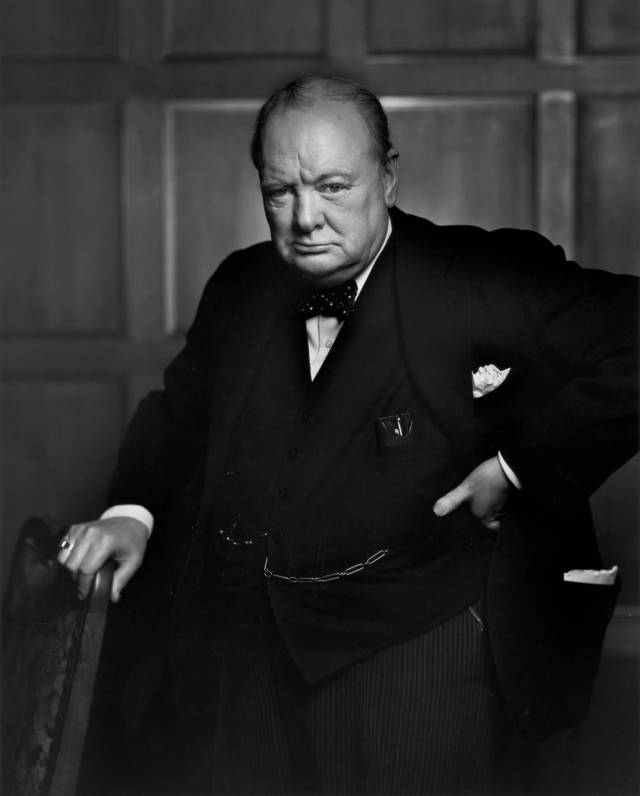
Winston Churchill, the United Kingdom's Prime Minister during World War II, shown in a 1941 portrait.
Morning Shots via The Bulwark, Political Opinion: He’s No Churchill, William Kristol, right, March 18, 2026. St. Patrick’s Day has its traditions. And every year, on St. Patrick’s Day, the American president plays host to the Irish Taoiseach (prime minister) in the White House.
So yesterday Micheál Martin found himself in the Oval Office as Donald Trump took questions from the press. Trump said he was disappointed with British Prime Minister Keir Starmer over his failure to support Trump’s war in the Middle East. In fact, pointing to the bust of Churchill in the Oval Office, the president said, “Unfortunately Keir is no Winston Churchill.”
Trump is surely correct that Starmer is no Churchill. Who is? Certainly not Trump. But what’s striking about Trump is that he takes no inspiration or guidance at all from Winston Churchill.. His world view is the opposite of Churchillian.
What slogan did Trump choose back in 2016 to characterize his foreign policy? “America First.” The whole point of the original America First Committee, in 1940 and 1941, was to stop America from joining the war against Hitler. What political leader did America First hate and fear above all others? Winston Churchill, who was standing against Hitler and imploring America to join the fight against fascism.
Trump has contempt for our allies and alliances. A constant in Churchill’s understanding of foreign policy, by contrast, from World War I through the early Cold War, was the importance of cultivating and standing by allies. In July 1938, he warned in a speech at the University of Bristol that “Civilisation will not last, freedom will not survive, peace will not be kept, unless a very large majority of mankind unite together to defend them and show themselves possessed of a constabulary power before which barbaric and atavistic forces will stand in awe.”
After the Grand Alliance, as Churchill called it, won World War II, Churchill was a great proponent of the democracies uniting in a constabulary power to keep the peace and secure freedom. Thus NATO, which Churchill said in 1952, was “the surest guarantee not only of the prevention of war, but of victory should our hopes be blasted.”
Meanwhile, at home, Churchill’s political life was characterized by a respect, even reverence, for his country’s parliamentary forms, its representative government, its traditions of deliberation and debate. In that same 1938 speech cited above, he defined “civilization” as a “society based upon the opinion of civilians. It means that violence, the rule of warriors and despotic chiefs, the conditions of camps and warfare, of riot and tyranny, give place to parliaments where laws are made, and independent courts of justice in which over long periods those laws are maintained.”
Not Trump-like!
And Churchill expressed the hope that
the same principles which have shaped the free, ordered, tolerant civilisation of the British Isles and British Empire be found serviceable in the organisation of this anxious world. Why should not nations link themselves together in a larger system and establish a rule of law for the benefit of all?
Churchill emphasizes that the rule of law has to be backed up by strength, not just good intentions. He was no wishful utopian. But he was just as far—even farther—from being a might-makes-right Trumpist.
As for the current war, one is reminded of a passage from Churchill’s lively and instructive memoir of his first three decades, My Early Life. He recalls the great confidence British officials had prior to the Boer war in 1899. Looking back from 1930, Churchill writes,
Let us learn our lessons. Never, never, never believe any war will be smooth and easy, or that any one who embarks on that strange voyage can measure the tides and hurricanes he will encounter. The Statesman who yields to war fever must realise that once the signal is given, he is no longer the master of policy but the slave of unforeseeable and uncontrollable events. . . . Always remember, however sure you are that you can easily win, that there would not be a war if the other man did not think he also had a chance.
If only Trump had read this paragraph before launching his hubristic war. If only Pete Hegseth had read it before boasting about our inevitable success. I suppose it’s out of the question that either would have done so. But is it out of the question to look forward to a day when we will once again have leaders who might not only know the name Churchill, but have learned from him?
Paul Krugman via Substack, Political-Economy Commentary: Donald Trump, Petropresident, Paul Krugman, right, March 18, 2026. Follow the Gulf oil money. Jared Kushner Flaunted Influence With Saudi Arabia, Russia in Pitch to Investors.
Why did Donald Trump attack Iran? Did he believe that a quick victory would boost his poll ratings? Was he looking for a way to change the subject from the Epstein files and affordability? Was he seduced into war by the Israeli government?
The answer, surely, is all of the above. Bad decisions don’t have to have a single explanation. In fact, debacles on the scale of what we’re now experiencing usually have multiple causes.
But when I look into the larger picture of Trump administration policy — not just the attack on Iran but domestic policies, especially the administration’s seemingly irrational hatred of renewable energy and its determination to keep America burning fossil fuels no matter what — I keep coming back to the huge influence now being wielded by oil money.
I don’t mostly mean the domestic U.S. oil industry, although them too. The U.S. oil and gas sector spent large sums helping Republicans in the 2024 election, while giving very little to Democrats.
But what really stands out is the centrality of oil money from the Persian Gulf, money that has been crucial in two areas: Trump’s international economic schemes and his personal enrichment.
One recurrent theme in Trump’s economic speeches has been boasting about the size of the foreign investment pledges he has received as part of his tariff strategy. “In 12 months,” he declared in the State of the Union, “I secured commitments for more than $18 trillion pouring in from all over the globe.”
Nobody knows where that $18 trillion number, which he uses all the time, comes from. The actual announced pledges by foreign governments to invest in the U.S. add up to only about $6 trillion, and many of these pledges are vague statements of intent rather than serious commitments. Indeed, the deal with Europe may well be unraveling in part because Trump’s tariffs have been ruled illegal.
But what’s especially interesting is who has made these investment pledges, such as they are: A graph of a number of blue bars AI-generated content may be incorrect.
Each of the major Gulf petrostates has pledged to invest more than the whole European Union, even though they have far smaller economies. Here’s another visualization: A blue pie chart with white text AI-generated content may be incorrect.
So when Trump boasts about the foreign investment he’s bringing to America, the reality is mostly that Gulf petrostates have said — with dubious credibility — that they will make big investments. That puts his boasts in a somewhat different light, doesn’t it?
And then there’s Trump’s relentless use of his office to enrich himself and his family. As the New York Times editorial board has documented, Trump has raked in at least $1.4 billion since returning to the White House. The biggest single piece of that total is Qatar’s gift to him of a $400 million jet. Most of the rest has come from sales of cryptocurrency. We don’t know who the buyers of Trump crypto are, but it seems likely that Gulf oil money has accounted for a large share. The Wall Street Journal reports that an Abu Dhabi royal secretly invested $500 million in World Liberty Financial, the center of the Trump crypto empire.
Meanwhile Jared Kushner, the First Son-in-Law, has been acting as one of the U.S. government’s chief negotiators on the Middle East while also raising large sums of money for his personal investment firm from investors in the region, especially the Saudi government’s Public Investment Fund. That fund is led by Crown Prince Mohammed bin Salman, who is widely believed to have had a critical journalist, Jamal Khashoggi, dismembered with a bone saw.
Why does Gulf oil money play an outsized role in U.S. corruption? Because petrostates, unlike advanced democracies, combine vast wealth with secrecy and a complete blurring of the lines between public office and private gain. So they’re better placed than anyone else to line U.S. officials’ pockets.
Foreign oil money, then, has been central to both the Trump administration’s economic schemes and Trump’s personal financial schemes. What has that money bought in terms of U.S. policy?
I’ve mentioned the Trump administration’s fanatical hostility to renewable energy. Like the Iran war, this hostility surely has multiple causes. Trump himself is still angry about the offshore wind farm that is visible from his Scotland golf course. Many MAGA types clearly think of wind and solar power as woke and unmanly; real men drill, baby, drill and burn, baby, burn. But suppressing alternatives to fossil fuels is also in the interests of governments and dynasties whose wealth is all about fossil fuels.
As the Guardian notes,
For decades, Saudi Arabia has fought harder than any other country to block and delay international climate action – a diplomatic “wrecking ball” saying that abandoning fossil fuels is a fantasy.
So the Trump administration’s energy policy can be seen as what Prince bin Salman would do if he were in charge. Is he?
Finally, about the war: As the bombing began, the Washington Post reported that foreign influence — and not just from Israel — played a role:
President Donald Trump launched Saturday’s wide-ranging attack on Iran after a weeks-long lobbying effort by an unusual pair of U.S. allies in the Middle East — Israel and Saudi Arabia — according to four people familiar with the matter, as Israeli and U.S. forces teamed to topple Iranian Supreme Leader Ali Khamenei after nearly four decades in power.
Saudi Crown Prince Mohammed bin Salman made multiple private phone calls to Trump over the past month advocating a U.S. attack, despite his public support for a diplomatic solution.
At this point bin Salman is surely regretting his role in promoting the war. But being corrupt and good at corrupting others is not the same thing as being smart.
Again, it’s a mistake to look for monocausal explanations of this debacle. But if you want to understand Operation Epic FUBAR, don’t forget to follow the oil money.
U.S. Politics, Elections, Governance
Morning Shots via The Bulwark, Political Opinion: The MAGA Schism, Andrew Egger, March 18, 2026. Something odd is going on with the MAGA would-be stars.
For a decade now, politicians and posters alike have had a single path to relevance: grabbing tightly to Donald Trump and distinguishing themselves by the strength of their adoration for him and the purity of their hatred for his enemies. But another path is emerging.
Yesterday, Joe Kent, Donald Trump’s director of the National Counterterrorism Center, charged onto that path. He announced that he was resigning from the administration, effective immediately. “I cannot in good conscience support the ongoing war in Iran,” Kent wrote in his resignation letter. “Iran posed no imminent threat to our nation, and it is clear that we started this war due to pressure from Israel and its powerful American lobby.” Trump, he wrote, had been “deceived” by “high-ranking Israeli officials and influential members of the American media” into abandoning his antiwar instincts and charging into an unwinnable conflict in Iran.
Kent went on: “I cannot support sending the next generation off to fight and die in a war that serves no benefit to the American people nor justifies the cost of American lives.”
The letter went off like a bomb in the administration, which was completely blindsided by the news. They rushed to work trying to discredit Kent: He was, they quickly whispered to Fox News, a known leaker who had been cut out of Trump’s intelligence briefings, whom the White House had thought should be fired, who had not been part of Iran planning discussions at all. “I always thought he was weak on security,” Trump told reporters of a man he had given a senior counterterrorism job.
If you’d never heard of Kent before now, you should pause before rushing to crown him a top fighter of the #Resistance. A special forces veteran and two-time failed congressional candidate, Kent was notorious early in his political career for rubbing elbows with the white nationalist podcaster Nick Fuentes,¹ and later he enthusiastically embraced Trumpy conspiracy theories like the notion that the FBI was responsible for the Capitol insurrection on January 6th. His letter mixes understandable dismay over the course of the war and the Trump administration’s foreign-policy entanglement with Israel with some more broadly questionable anti-Israel tropes, like his claim that the Syrian Civil War—a conflict in which Kent’s wife died—was also “a war manufactured by Israel.”
But suspend for a moment the question of whether and to what degree Kent is a hero or a villain. The more interesting point now is that he sees political promise in turning on Trump at all.
We’ve been anti-Trump from the jump, not because it’s politically expedient, but because we see him clearly. To join our pro-democracy community, become a Bulwark+ member.Subscribed
For a while, it’s been clear that Trump—for all the chaos of his administration and for all his explosive hatred of the liberal establishment—now fully embodies a GOP establishment of his own. These days, your median empty-suit Republican congressman is more likely to make embracing Trump his entire personality than actual internet-poisoned true believers of the MAGA base are.
Now, we’re starting to see the corollary development: shades of MAGA countercultural revolt against that MAGA establishment. With a few exceptions—Tucker Carlson being the most obvious—you see this primarily among younger, smaller stars in Trumpworld. If you have a small right-wing following and you’re looking to make it a big right-wing following, and most especially if that following is concentrated among young right-wing people, it’s no longer the case that backing Trump to the hilt is the only move.² Kent isn’t the only recent example of a figure popular with young anti-Israel Republicans to go out of his way to break with the White House: I wrote last month about Carrie Prejean Boller, an influencer appointed by Trump to his Religious Liberty Commission. She tripled her social-media following after provoking Trump into firing her after she derailed commission meetings by demanding to know if other commissioners thought her anti-Israel positions made her an antisemite.
There’s no reason to believe that the MAGA base broadly opposes Trump’s war in Iran; Trump’s voters have always been more blandly fine with Trump’s wars than the doves in MAGA media would like to believe. But the anti-war and anti-Israel types, who are disproportionately young, have established a beachhead in the Republican coalition. Joe Kent won’t be the last would-be right-wing star to flee Trump in a play for their support.
From a purely tactical point of view, is a divided MAGA better for the country than a united MAGA? Or will internal competition just make them all even more nuts? Share your thoughts with us.
AROUND THE BULWARK
Quick Hits
PAM TO THE HOT SEAT: Is there something in the water recently? Earlier this month, Secretary Kristi Noem’s downfall at the Department of Homeland Security began when she faced unexpectedly hostile questions from Republicans during a pair of congressional hearings. Now, Rep. James Comer, the GOP chair of the House Oversight Committee, is taking the gloves off for a second cabinet official: Attorney General Pam Bondi. Yesterday, he issued a subpoena to Bondi requiring she testify before the committee over her handling of the Epstein files. CBS News has more:
The committee voted on March 4 to approve a motion to subpoena Bondi, with five Republicans voting with all Democrats to move ahead on the matter. The motion itself was introduced by GOP Rep. Nancy Mace of South Carolina. Republican Reps. Lauren Boebert of Colorado, Tim Burchett of Tennessee, Michael Cloud of Texas and Scott Perry of Pennsylvania also broke with their party to support it.
Bondi and Deputy Attorney General Todd Blanche are also scheduled to brief the committee behind closed doors on Wednesday. In an attempt to fend off the subpoena earlier this month, Comer noted Bondi had offered to give private briefings to members about the Epstein investigation.
As chair of House Oversight, Comer has richly earned his reputation for working tirelessly to uncover supposed self-dealing in the “Biden crime family” while somehow managing to avoid seeing the Trump family’s nonstop parade of open corruption. So it’s appropriate that he seems to have been dragged kicking and screaming to have to send this subpoena at all. The deposition will take place—if Bondi shows up—on April 14.
ALL THIS MONEY, NO GOOD WAY TO SPEND IT: More and more people are wondering: What on earth is AIPAC up to? The American Israel Public Affairs Committee and its associated PACs are working very hard to boost pro-Israel candidates in primaries on both sides of the aisle, typically by spending heavily to attack whomever they see as the pro-Israel candidate’s most viable opponent.
Sometimes, however, these ads are having the opposite effect in Democratic primaries this year. It goes like this: AIPAC, hoping to prop up pro-Israel candidate A, spends tons of money attacking mildly anti-Israel candidate B. (AIPAC, seeming to know its name is mud in some of these races, uses shell PACs and focuses on issues other than Israel in an effort to keep its prints off.) Candidate B is harmed by the attack—but so is Candidate A, particularly once voters get wind of the fact that AIPAC is getting involved on their behalf. The result: sudden, unexpected victory for anti-AIPAC, anti-Israel insurgent candidate C.
This is exactly what happened last month in New Jersey’s 11th congressional district, where AIPAC spending hammered Democrat Tom Malinowski—only for the race to go to his far more anti-Israel opponent, Analilia Mejia. (Malinowski wrote about the experience for The Bulwark here.) And last night in Illinois’s 9th District, it nearly happened again. In the Democratic primary, Evanston Mayor Daniel Biss—who faced a barrage of negative AIPAC ads—won the primary with 29 percent of the vote; progressive insurgent Kat Abughazaleh came in second with 26 percent. AIPAC’s preferred candidate, state Sen. Laura Fine, finished third.
Popular Information, Accountability Journalism: The new, bigoted leader of the College Republicans, Noel Sims, March 18, 2026. Kai Schwemmer, a 23-year-old college student from Utah, was named the new political director for the College Republicans of America (CRA) on March 5. The appointment has drawn criticism because Schwemmer has been an outspoken supporter of white supremacist and Holocaust denier Nick Fuentes. Devoted fans of Fuentes are known as “groypers.”
According to its website, CRA has over 280 chapters across the country. As political director, Schwemmer will help determine which local candidates CRA will support — an influential position, as campaigns often rely on volunteers from groups like CRA.
In response, Schwemmer has argued that his views moderated during a two-year mission trip from 2023 to 2025. Last week, Schwemmer said he is “not a groyper” and has “made adjustments to become a better disciple of Christ.”
Schwemmer has deleted all of his X posts from before September 2025. But a Popular Information review of Schwemmer’s posts after he returned from his mission shows that he still holds bigoted and extreme views.
In November 2025, in response to a post by former Representative Marjorie Taylor Greene related to her stepping down from Congress, Schwemmer wrote that women “generally do not have what it takes to endure the pressures of a public office.”
In two recent posts, Schwemmer compared a person of color to a “proboscis monkey“ and said the “physiognomy” of Congressman Byron Donalds (R-FL), who is Black, makes him look “deceitful and suspicious.” Physiognomy, the practice of reading faces to determine a person’s character, has gained popularity among those who believe in “scientific racism.”
Recent posts from Schwemmer suggest that Jewish people are “delusional cosplayers” and that most pedophiles are gay men.
During a recent livestream in which he discussed his CRA appointment and his goals as political director, Schwemmer said, “We are Christian, we are white. That is cool. We’re not going to apologize for that.”
In another stream from last month, Schwemmer called the video President Trump posted to Truth Social depicting Barack and Michelle Obama as apes “epic.” He went on to say, “Given that apes, gorillas, chimpanzees, monkeys are awesome, this is actually super cool.”
CRA did not respond to a request for comment on this article.Schwemmer and Fuentes
Schwemmer met Fuentes in 2021 during Fuentes’s “white boy summer” speaking tour, according to a pro-Fuentes documentary released in 2024. In the documentary, Schwemmer said Fuentes “woke me up to immigration” and that he “fell in love” with Fuentes’s movement.
In 2022, Schwemmer was a special guest at Fuentes’s America First Political Action Conference, and he began livestreaming on a platform run by Fuentes. At the time, Schwemmer frequently posted about Fuentes on social media and regularly defended Fuentes when he was criticized for extremist views.
In January 2023, Vice reported that an account apparently belonging to Schwemmer posted a livestream playing the video game Red Dead Redemption 2 with the title “Killing 100 Women in Under 10 Min in RDR2.”
Ben Lorber, a senior research analyst at Political Research Associates, identified several other older posts by Schwemmer, including ones that glorify the Unabomber and praise a notorious antisemitic author.The radicalization of the College GOP
Schwemmer’s appointment to CRA leadership comes as several conservative youth organizations have come under fire for extremist views.
University of Florida College Republicans, a CRA member, was disbanded last week after a photo circulating online showed one of its leaders doing a Nazi salute. Schwemmer posted on X, defending the University of Florida College Republicans and blaming “cancel culture” for the club’s disbandment.
A group chat for conservative students at Florida International University, leaked earlier this month, included hundreds of racial slurs and repeated praise for Nazis.
Lincoln Square Media, Political Opinion: Trump’s Bonkers Oval Office Rant on Iran, Cuba, & People with Disabilities, Edwin Eisendrath, Susan J. Demas, and Joan Esposito, March 18, 2026. Lincoln Square Executive Editor Susan J. Demas invited Edwin Eisendrath, host of "It’s the Democracy, Stupid, " and veteran Chicago journalist Joan Esposito to try to make sense of Trump’s madness. Challenge (impossible).
Is there a method to his madness? No.
Trump had quite a day on Monday at a couple of press events. Here’s a sample of some of his ramblings:
“I’ve spoken to a certain president, who I like, actually, a past president, a former president. He said, ‘I wish I did it, I wish I did,’ but they didn’t do it. I’m doing it.”
Trump claimed that he talked to a former president is jealous of his amazing Iran War. (Spokespeople for all four living former presidents have denied that conversation).Subscribed
“I do believe I’ll have the honor of taking Cuba.”
He’s again threatening an invasion of Cuba, since the Iran war is going so well.
“He would be dead by June.”
The president decided to reveal some confidential medical information about GOP Congressman Neal Dunn, clearly horrifying Speaker Mike Johnson and some the audience.
“I think the president should not have learning disabilities.”
That was Trump’s comment about California Governor Gavin Newsom having dyslexia, which he’s previously called a “mental disorder.”
. And join us for more special programs as Lincoln Square celebrates our Anniversary Week!
Hopium Chronicles, Pro-Democracy Advocacy, The Regime Is Cracking - My Morning Discussion with Jen Rubin and Norm Eisen Of The Contrarian, Simon Rosenberg, March 18, 2026. In this new video we talk last night's elections, Trump's ongoing humiliation, and the need for us to keep fighting him on all fronts.
Here’s the bottom line: Iran was a huge mistake, and the Trump regime and MAGA coalition have begun to crack under the weight of their repeated, ongoing failures (see yesterday’s post for more on this).
Transcript - Jen Rubin, Norm Eisen Of The Contrarian And Simon Rosenberg (March 18, 2026)
Jen Rubin: It's Wednesday after a primary, so we have Simon Rosenberg. That's been our pattern. And we have to keep having him back because we keep getting good outcomes in these primaries. Good morning, folks. Good to see everyone…..
We are well past the 1,000 mark. And we do have Simon Rosenberg, the pollster, analyst, organizer extraordinaire. And we're going to talk big picture and little picture. Big picture - the wheels are off the Trump bus. They were coming loose, and then the war just pried them off and he is careening this way and that way, and in his reaction to the war we're seeing… our allies’ reaction to the war we're seeing dreadful inflation numbers that came out this morning for February wholesale prices, much higher in February, and we're seeing it to some extent I think in the reaction of Democrats both on the Hill and out there on the campaign trail. So with that, let's go through the races in Illinois and then we'll zoom out and talk about some big picture issues. Simon, it was a good night for Governor Pritzker. Not a good night for dark money groups like the AI folks and AIPAC.
Norm Eisen:Crypto…
Simon Rosenberg:Yeah, crypto. I think yes, I agree. And I think we had a definitive outcome in the Senate race and a great candidate who emerged there. I think my view about this, as we take a step back, because the amount of money that was spent by Republican-aligned groups last night, over the last few weeks in Illinois, was enormous. It was tens and tens of millions of dollars. And I think to say something that will make Norm happy, this is all part of this kind of new battlefield of 2026 where Republicans are going to do whatever it takes to stay in power. And that, you know, it's going to be this sort of unprecedented dark money interventions in our primaries which they're just warming up for what they're going to do in the general election, right? We have to assume that this is now hundreds and hundreds and hundreds of millions of dollars that's going to be spent against the Democrats in the general elections. Trump's own dark money group, his super PAC group… the SAVE Act and all the electoral shenanigans that they're going to try to pull.
You know, we're operating… they know they are getting their ass kicked. They know these things are breaking against them. And what we have to do a better job of preparing for is what I call this whatever-it-takes election. They are not bound by law or rules any longer. You know, they've got international actors that are going to be coming in to play in our politics. And what's important is that we also saw that despite this money and despite the ill intent, you know, they don't always win. And that, you know, politics is bigger than just super PACs. I will tell you, as somebody who's done outside spending like this in my own career, you know, it is very hard to come in from the outside and influence an election like is the way that they believe. And part of this is this kind of Trumpian oligarchical arrogance, right? That how dare they, you know, challenge us. And we're going to come in and show them who's boss. And it doesn't always work because politics is hard and complicated. So there are limits to their powers. Donald Trump is learning every day. And we should be heartened by that.
Jen Rubin:Let's go through the races, starting with the Senate race. Raja was the typical establishment candidate. He got a ton of money from AIPAC. He got a ton of money from the AI folks. Stratton had the backing of Pritzker. And she was also a terrific candidate, more progressive, perhaps more in tune with the current ethos of the party. And she won substantially, Simon. It was not that close.
Simon Rosenberg: Yeah. Also, if I'm allowed to use colorful New York language here, you know, she also produced this ad that has been the most memorable ad that any candidate's produced so far this year, which was an ad of people just saying, f*** Trump. And it was really kind of a visceral, you know, emotional frustration and anger that exists towards what he's doing to the country. People in Illinois, you know, had the battle with ICE. They were one of the first places that did real hand-to-hand combat with ICE before even Minnesota happened. So she also, I think, captured this zeitgeist of like, you got to be kidding me. You know, we have to fight this with everything we got. And I think this was an important lesson for Democrats. That what our electorate is looking for are fighters. And I think the ideological concerns, they're a little secondary. I think what they want more is people’s willingness to stand up to Trumpism and the damage and harms that he's doing to the country. She put that front and center in her campaign. And she was rewarded for it.
Jen Rubin: And if and when she wins, we will have a historic three African American women in the U.S. Senate. So we do change. Just at a glacial pace.
Let's go through the individual races. In the Second, Miller won. AIPAC did spend money there for her, but in point of fact, she gave him kind of the cold shoulder and said, I'm not making any commitments. I'm not going to support Israel unconditionally. Her opponent was not that strong. AIPAC may want to claim victory, but that was kind of, in my mind, a relatively ordinary outcome. The Seventh was more interesting because the AIPAC candidate there lost. Talk to us a little bit about the Seventh and the young African American man who won, who really is an impressive individual, who I think will be a kind of a new rising face on the Democratic side.
Simon Rosenberg: Look, I mean, you can't force outcomes not organically going to be there with outside money. And, you know, candidate quality, and being connected to the district, and running a modern race, all these things matter. I also want to say I haven't really done a lot of commentary on the AIPAC stuff because I have felt that it was sort of on the margins of the game, but not any longer. And the idea that AIPAC… that they're going to intervene in the election in 2026 and defend this war. I mean, I think this is this other thing. Of course, they manifest in these races with these fake names and you know, progressives and all this stuff. They create these fake cutout organizations.
Let's just take a step back for a second about the AIPAC project. And what is it going to be? That they want Democrats to be supportive of our Middle East policy, that's going to be something that is probably at 85%, 90% disapproval among Democratic voters? I mean, the AIPAC project become ludicrous. And, you know, as it goes forward, this is going to be an enormous test, if you don't mind me going off script here a second, an enormous test of us and who we are, our ability to organize against what is really kind of a rancid intervention in our own politics on something that is [such] anathema to us right now. And so, I think that you saw this was an example, right, where there's a limit to what they can do on the ground. And that's, to me, one of the most important stories across all these races last night.
Norm Eisen:It should be profoundly reassuring, shouldn't it, Simon, for people who are fearful about 2026. And we should be at the edge of our chairs. We should be ready. We should be prepared. But the power of the voters is still the ultimate guardrail.
And we've seen this pattern. You contrarians have helped, for example, when we pushed back on Elon Musk in the Wisconsin Supreme Court race last year. Simon, how fearful or confident can American voters be right now as they look at the combination of Trump's authoritarianism and the big money, but also at the lessons of these races?
Simon Rosenberg:I think the lesson is that we just have to fight it out. That there is sort of a new battlefield and we have to win on that battlefield. And I think to your point, Norm, you always counter me when I come on here about the successes, you know, the successes that we've had, and I appreciate that because I am the Hopium guy, right? That I think the lesson here is that Trump, that they don't always win and that they can screw up. And that there are limits to their power. And therefore, if we don't fight, we won't win. And we have to fight in order to win, right? That this is a requirement. For us not to get spooked, but to be resolute and to be strategic about understanding how they're manifesting now and what their tactics and strategies are in order to air these out so we can beat them. And I think that's part of what you're describing.
I think if I could say one last thing, Jen, the words I wrote down before I came on here today about Trump right now are defiance, cracking, weakness, struggle, decline… his powers are ebbing, right? This thing, they're not winning. And there's all sorts of not winning all across the board. And we should be heartened, Norm, to answer your question about all this. But we only win when we fight. And so the lesson is we have to fight everywhere all the time on all fronts, I think.
Jen Rubin:Absolutely. The Ninth was, I think, the epitome of what you're talking about. And I have to give a shout out to our friends at J Street who have been fighting this fight. We had Daniel Biss on as a guest, and this was a case where AIPAC went all out, not to defeat the candidate who has the most antipathy towards Israel, but to fight against him because he has a nuanced view. Because he is influential within Democrats because he says you can be supportive of Israel but not give unconditional support for things that are not in our national interest. They claimed, oh, well we can take partial victory… but in fact, they went after him and he won. And he won with help from J Street. He won with help from Jan Schakowsky, his mentor, the great Jan Schakowsky, who he will be replacing. It was a tremendous example of what you're talking about. He called them out. He said, this is what they're doing now. This is who they are. These are the phony names they're using. They're coming after me. Don't call me, who is the descendant of Holocaust survivors, anti-Israel. Don't call me, who supports Israel's right to exist as anti-Israel. And he won. And I think that's what you have to do. You have to stand up and punch him in the nose. And it helps to have allies like J Street. But he did it. And I think that is the model. He did what perhaps Tom Malinowski didn't quite have time to do in the closing days in New Jersey.
Simon Rosenberg: Yeah, I think you're exactly right. And Norm, you should jump in here. But the thing we have to realize [is] this is all a warm-up for the general election, because if people like Tom Malinowski and Daniel Biss are not acceptable, that means virtually no Democrat is, right? Because these are mainstream positions in the Democratic Party, you know, that are now being opposed.
Jen Rubin: Correct.
Simon Rosenberg: And so this is why we have to recognize that, you know, AIPAC is a Republican-associated organization, as is this AI crypto stuff that is going to be emerging. What they’re doing here, this is all just practice, right? For the general election. And one of the ways that the Republicans are gonna try to disqualify all of our candidates. This is going to be another vector of them going after the 30 or 40 candidates that are gonna determine the outcome of the majority in the House and the Senate in 2026.
U.S. Inflation, Markets, Jobs, Economy
New York Times, Federal Reserve Leaves Interest Rates Unchanged, Colby Smith, March 18, 2026. The Federal Reserve held interest rates steady on Wednesday, as most officials maintained earlier projections for at least one quarter-point reduction in borrowing costs this year.
The decision marks the second meeting in a row in which the central bank has opted against a policy move, instead voting to keep rates unchanged at a range of 3.5 percent to 3.75 percent. Stephen I. Miran, a governor appointed by President Trump last year, issued his fifth straight dissent and voted for a quarter-point cut.
Officials gathered for their latest meeting as the war with Iran stretched into its third week. In its policy statement on Wednesday, the Fed said the economic implications from the conflict were “uncertain.”
“Uncertainty about the economic outlook remains elevated,” the statement said, citing the “implications of developments in the Middle East.”
The extent of the economic fallout from the Middle East conflict depends on how long it lasts and the trajectory of oil prices, which have spiked to $108 a barrel, according to the international Brent crude benchmark. As of Wednesday, gasoline prices in the United States had risen to $3.80 a gallon, a roughly 30 percent increase since the start of the war and the highest level since 2023.
A surge in prices of this magnitude is already expected to lift inflation and dent growth to some degree, as businesses and consumers adjust to significantly higher energy-related expenses. But the costs will compound the longer the conflict drags on, raising the possibility of persistent price pressures or an economic downturn.
The combination of the two is particularly hazardous for the Fed, which is responsible for maintaining low, stable inflation and a healthy labor market. Taking steps to tame inflation against this backdrop could portend sharply higher unemployment, while shoring up the labor market risks exacerbating the central bank’s inflation problem.
The Fed was already struggling on both these fronts before war broke out across the Persian Gulf, as it maneuvered through a series of shocks prompted by Mr. Trump’s sweeping global tariffs, immigration restrictions and other policy changes he has introduced since retaking the White House.
For five years now, inflation has remained above the Fed’s 2 percent target, and progress toward that goal in recent months has stalled. Policymakers are simultaneously contending with a labor market that appears increasingly fragile. Layoffs remain low and the unemployment rate has stayed relatively stable around 4.4 percent, but monthly jobs growth has ground to a halt as companies have pulled back on hiring.
Policymakers expected unemployment to steady around current levels this year before declining in 2027. They also marginally revised higher their forecasts for growth, penciling in a 2.4 percent expansion this year. In 2027, they expect the economy to grow 2.3 percent.
Wednesday’s meeting is expected to be Jerome H. Powell’s second-to-last gathering as chair. His term ends on May 15, although he technically can stay on as a governor until 2028.
Mr. Trump has tapped Kevin M. Warsh, a former Fed governor, to take over as chair, but his path to confirmation by the Senate is riddled with roadblocks.
On Friday, the Justice Department vowed to appeal a ruling by a federal judge who sought to scupper a criminal investigation that had been launched against Mr. Powell and the Fed over renovations at the central bank’s headquarters in Washington.
Top members of the powerful Senate Banking Committee, which oversees the Fed, said they would block the president’s nominees for the central bank so long as the investigation was ongoing. Mr. Powell has demurred from disclosing whether he will stay on as a governor, but the investigation has no doubt shaped his thinking.
Morning Shots via The Bulwark, Political Opinion: Joe Kent and the Fading MAGA Allure, Bill Kristol, Andrew Egger and Jim Swift, March 18, 2026. Trump is the establishment now, and a MAGA counterculture is emerging.
The gas-price data keeps rolling in, and it keeps looking grislier. Gas is up eighty cents a gallon nationwide from this time last month, which the New York Times notes is the second-biggest four-week increase in at least 30 years: “bigger than the one at the start of the war in Ukraine in 2022, or the ones associated with the post-recession surge of 2009 and the OPEC production cuts in 1999.”
Only Hurricane Katrina hit prices harder during that span. Happy Wednesday.
New York Times, Why This Jump in Gas Prices Feels Different, Francesca Paris, March 18, 2026. A state-by-state look at the increase and how it could affect you.
Since the start of the war in Iran, the average price of gas in the United States has climbed by nearly a dollar.
In mid-February, gas cost around $2.90 per gallon. By mid-March, it was up to $3.70, according to the Energy Information Administration.
It’s the second-largest four-week increase in at least 30 years — bigger than the one at the start of the war in Ukraine in 2022, or the ones associated with the post-recession surge of 2009 and the OPEC production cuts in 1999.
The only bigger jump came after Hurricane Katrina in 2005, when gas supply fell significantly.Largest four-week changes in gas prices since 1990
The typical U.S. driver travels around 1,000 miles each month. Depending on the car, those higher prices translate to as much as $50 more a month
No state has been spared. Average prices are up by more than 50 cents per gallon everywhere, and by more than a dollar in New Mexico, Arizona and Colorado, according to the AAA motor club.
#Me Too Investigations
President Joe Biden kept a bust of the late United Farm Workers leader Cesar Chavez, above center, in the White House Oval Office.
New York Times, Investigation:Cesar Chavez, a Civil Rights Icon, Is Accused of Abusing Girls for Years, Manny Fernandez and Sarah Hurtes, March 18, 2026. An investigation by The New York Times found extensive evidence that the United Farm Workers co-founder groomed and sexually abused girls who worked in the movement. The reporters interviewed several women who told their stories for the first time, as well as more than 60 other people, including Cesar Chavez’s top aides and relatives. The reporters also reviewed hundreds of pages of union records, confidential emails, photographs and other material.
Ana Murguia remembers the day the man she had regarded as a hero called her house and summoned her to see him. She walked along a dirt trail, entered the rundown building, passed his secretary and stepped into his office.
He locked the door, as he always did when he called her, and told her how lonely he had been. He brought her onto the yoga mat that he often used in his office for meditation, kissed her and pulled her pants down. “Don’t tell anyone,” he told her afterward. “They’d get jealous.”
The man, Cesar Chavez, one of the most revered figures in the Latino civil rights movement, was 45. She was 13. Ms. Murguia said she was summoned for sexual encounters with him dozens of times over the next four years.
Recently, more than 50 years later, Ms. Murguia learned that a street near her home in the Central California city of Bakersfield was in the process of being renamed. City officials want to name it in honor of her abuser.
Ms. Murguia and another woman, Debra Rojas, say that Mr. Chavez sexually abused them for years when they were girls, from around 1972 to 1977. He was in his 40s and had become a powerful, charismatic figure who captured global attention as a champion of farmworker rights.
The two women have not shared their stories publicly before, and an investigation by The New York Times has uncovered extensive evidence to support their accusations and those raised by several other women against Mr. Chavez, the United Farm Workers co-founder who died in 1993 at the age of 66.
The questions raised by The Times about Mr. Chavez, one of the most consequential figures in Mexican American history, set off immediate reverberations and alarmed and disturbed his allies. Even before this article was published, upon learning of the reporters’ inquiries, the U.F.W. canceled its annual celebrations honoring Mr. Chavez, a response to what the union he once led called “profoundly shocking” accusations.
Ms. Murguia and Ms. Rojas, both of whom are now 66, were the daughters of longtime organizers who had marched in rallies alongside Mr. Chavez. He used the privacy of his California office to frequently molest Ms. Murguia, she said. He had known her since she was 8 years old. She became so traumatized that she attempted to end her life multiple times by the age of 15
“I wanted to die,” she said.
Ms. Rojas said she was 12 when Mr. Chavez first touched her inappropriately, groping her breasts in the same office where he’d meet with Ms. Murguia. When Ms. Rojas was 15, he arranged to have her stay at a motel during a weekslong march through California, she said, and had sexual intercourse with her — rape, under state law, because she was not old enough to consent. (Ms. Murguia said Mr. Chavez molested her but never had intercourse with her.)
The abuse allegations appear to be part of a larger pattern of sexual misconduct by Mr. Chavez, much of which has never been publicly revealed. The Times investigation found that Mr. Chavez also used many of the women who worked and volunteered in his movement for his own sexual gratification. His most prominent female ally in the movement, Dolores Huerta, said in an interview that he sexually assaulted her, a disclosure she has never before made publicly.
Many of the women stayed silent for decades, both out of shame and for fear of tarnishing the image of a man who has become the face of the Latino civil rights movement, his image on school murals and his birthday a state holiday in California.
The findings are based on interviews with more than 60 people, including his top aides at the time, his relatives and former members of the U.F.W., which he co-founded with Ms. Huerta and Gilbert Padilla. The Times reviewed hundreds of pages of union records, confidential emails and photographs, as well as hours of audio recordings from U.F.W. board meetings.
The accounts of abuse from Ms. Murguia and Ms. Rojas were independently verified through interviews with those they confided in decades ago and in more recent years. Elements of their stories were also corroborated in documents, emails, itineraries and other writings from union organizers, supporters of Mr. Chavez and historians.
The Times spoke at length with Ms. Huerta, the renowned Latina activist who helped run the farmworkers’ union with Mr. Chavez and coined the social-justice rallying cry, “Sí, se puede,” loosely translated as “Yes, we can.”
She said she has held on to a dark secret for nearly 60 years.
One night during the winter of 1966 in Delano, Calif., she said, Mr. Chavez drove her out to a secluded grape field, parked and raped her inside the vehicle. Ms. Huerta, who was 36 at the time, said she chose not to report the assault to the police because of their hostility toward the movement, and she feared that no one within the union would believe her. She also described an earlier encounter in August 1960, when she said she felt pressured to have sex with him in a hotel room during a work trip in San Juan Capistrano in Southern California.
Ms. Huerta later began a long-term domestic partnership with Mr. Chavez’s brother Richard, with whom she had four children. He died in 2011.
Ms. Huerta turns 96 on April 10. Her memories of the details of the assault that night in Delano are at times hazy. But she speaks of the attack in a startlingly matter-of-fact manner.
She described being stunned by Mr. Chavez’s aggression, and then numb to it. She framed her silence at the time not as an absence of pain, but as a kind of strategic necessity, particularly as a woman fighting for respect in the male-dominated world of 1960s union organizing. Now, her accusation shatters what was a widely celebrated — and seemingly egalitarian — bond between two of the most influential Hispanic activists in U.S. history.
“Unfortunately, he used some of his great leadership to abuse women and children — it’s really awful,” Ms. Huerta said.ImageDolores Huerta and Cesar Chavez smiling in a crowd.Dolores Huerta, left, and Cesar Chavez in Fresno, Calif., in 1965.Credit...Carl Crawford/Fresno Bee/ZUMA Press, via Reuters
More than 30 years after his death, Mr. Chavez has become only more revered in the Latino community, as President Trump’s efforts to limit immigration and scale back rights threaten to destroy many of the gains secured by decades of his work.
Through a series of grueling fasts, grape boycotts and marches that captured the world’s imagination, Mr. Chavez drew a spotlight to the plight of the American farmworker. He not only improved wages, living conditions and health care for generations of farmworkers and their families but also strengthened the political power of Latinos, giving their voice and concerns an urgency and moral authority on the national stage.
He was given the Presidential Medal of Freedom, the nation’s highest civilian honor, in 1994. When Joseph R. Biden Jr. entered the White House in 2021, he put a bronze bust of Mr. Chavez on display in the Oval Office.
The allegations of rape and sexual abuse are likely to have far-reaching consequences.
On Tuesday, the United Farm Workers issued a statement saying that the organization would not take part in any activities celebrating Mr. Chavez’s birthday on March 31. The union said the “troubling allegations” that were surfacing were incompatible with the organization’s values, adding that it did not have firsthand knowledge of any misconduct.
“We need some time to get this right, including to ensure robust, trauma-informed services are available to those who may need it,” the union said in its statement.
Mr. Chavez’s family said on Tuesday night that they were “not in a position to judge” the claims. “As a family steeped in the values of equity and justice, we honor the voices of those who feel unheard and who report sexual misconduct,” they said in a statement. “These allegations are deeply painful to our family.”
A handful of Mr. Chavez’s relatives and former U.F.W. leaders have been aware for years about various allegations of sexual misconduct, but there is no evidence that they made efforts to fully investigate the accusations, acknowledge the victims or apologize to them. Instead, many of the women say they were discouraged from speaking out in order to preserve Mr. Chavez’s public image.
Internal emails dating back over a decade show union members discussing Ms. Murguia’s claims of abuse and the impact it had on her life. One of Ms. Murguia’s relatives confronted Mr. Chavez while he was still alive, in the 1980s. According to the relative, Mr. Chavez offered no defense and responded only by clearing his throat.
More than 10 years ago, members of a private Facebook group for longtime Chavez organizers and supporters were stunned to read a post from Ms. Rojas that she wrote in a fit of anger as they prepared to celebrate the holiday in his name.
Al Jazeera, Photos show ‘grave-like plots’ at Epstein’s Zorro Ranch, tipster claims, John Power, March 17, 2026. Member of the public sent images to state lawmakers, claiming they showed dug-up burial sites, emails show.
A member of the public claims to have seen “grave-like plots” at Jeffrey Epstein’s former ranch in New Mexico and has shared photos of the purported burial sites with lawmakers investigating the late American sex offender.
The tipster shared the images with the two state lawmakers last month amid renewed scrutiny of Epstein’s activities at the Zorro Ranch.The claims, which have not been independently verified, have not been previously reported and do not appear to be included in the Epstein files publicly disclosed by the United States Department of Justice.
The department had releases millions of pages related to criminal investigations of the financier in late January, some of which referenced Epstein’s New Mexico ranch.
Al Jazeera obtained the tipster’s correspondence and photos via a public records request with the New Mexico Department of Justice.
In an email on February 16, a member of the public whose name has been redacted told Democratic Representatives Andrea Romero and Marianna Anaya that he or she had broken into Epstein’s former ranch in 2020 and come across multiple plots that “were dug up”.
The tipster, who included two photos of purported plots with the email, speculated that bodies had been “removed” from the sites.
“I realize this might be illegal,” the person wrote, referring to their act of venturing onto the property, “but men like that don’t deserve the protection of the law.”
Epstein ranchEpstein ranchA tipster claims these photos show ‘grave-like plots’ at Jeffrey Epstein’s former ranch in New Mexico [New Mexico Department of Justice]
The tipster also shared photos of the exterior of Epstein’s mansion and a white yurt located on the grounds of the property, as well as pictures of a defibrillator and a statue of a man of African appearance purportedly taken from inside the tent.
“In the White Yurt, they must have been doing rituals where they felt like they needed a defibrillator,” the person wrote.Get instant alerts and updates based on your interests. Be the first to know when big stories happen.
Romero, who is leading a bipartisan commission looking into Epstein’s activities in New Mexico, forwarded the correspondence to Kyle Hartsock, the director of special investigations at the New Mexico Department of Justice, who assured the lawmaker that the tip was “being looked into.”
The price of freedom is eternal vigilance, Exhibit 144: The JP Morgan Files, Escape Key, In 2023, JPMorgan Chase was forced to hand over its own internal files on Jeffrey Epstein as part of a lawsuit brought by his victims. The bank’s lawyers compiled a twenty-three-page summary of what they found.
It was meant to assess legal risk.
He managed the career of JPMorgan’s investment bank chief, designed a major financial product linked to Bill Gates, arranged private meetings with fourteen foreign ministers, deployed a British royal and a former EU trade commissioner as commercial assets, and held security clearance. He also designed a new type of ‘social good’ currency — initially called a ‘charitable currency unit’ — and sent the blueprint to Gates’s chief science adviser, eight years before the Bank for International Settlements began building the same thing.
The bank's compliance review — compiled specifically to assess exposure in a sex trafficking lawsuit — contains a handful of oblique references to young women. It devotes twenty-two pages to all of this.
A separate investigation by the US Senate found that JPMorgan reported just $4.3 million in suspicious transactions from Epstein’s accounts while he was alive — but reported $1.3 billion after he died. The bank paid $365 million in settlements.
This essay walks through the document line by line, and shows how it independently confirms everything documented in the previous Epstein essays on this Substack — from a source produced three years before those essays were written.
The ultimate implication here — beyond confirming Epstein's status as a switchboard operator — is that a significant portion of the development finance industry is built on a foundation it would prefer not to have examined.
On 25 July 2023, JPMorgan Chase filed Exhibit 144 in Case 1:22-cv-10904-JSR — the sex trafficking facilitation lawsuit brought by Jeffrey Epstein’s victims in the Southern District of New York. The exhibit is a twenty-three-page internal compliance summary of the bank’s relationship with Jeffrey Epstein, compiled from internal emails and correspondence between Epstein and senior JPMorgan executives.
The bank produced it to assess institutional exposure. Its compliance lawyers had one narrow question: how deep was the relationship between Epstein, above left, and Jes Staley, above right, then head of JPMorgan’s investment bank, and what did senior management know?
Their answer runs to twenty-two pages of chronological, bullet-pointed evidence — and it reads, unintentionally, as independent corroboration of every major claim made in the essays published on this Substack since February 2026: the original trilogy — Epstein: The Switchboard Operator, Epstein II: The Development of a Digital Currency, and Epstein III: The Intelligence Channel — as well as Epstein’s Seven, The Epstein/Bannon Interview, and Agents for the Rothschilds.
Those essays drew exclusively on the Department of Justice’s 2025–2026 document releases — the Epstein side of the correspondence. This exhibit provides the other side: JPMorgan’s internal records. A November 2025 memorandum from the Senate Finance Committee, based on further unsealed records from the same litigation, adds a third independent source.
The three archives were produced by different legal processes, compiled by different lawyers, for different institutional purposes. None had any interest in confirming the others — yet, they interlock almost perfectly
The previous essays documented Epstein as a switchboard operator — a coordination node routing connections between finance, intelligence, and governance. The JPMorgan document confirms this and goes further, revealing something the DOJ releases did not: the depth of Epstein’s operational control over the bank’s own senior executive.
On 31 July 2008 — while Epstein was incarcerated in Palm Beach — Staley wrote: ‘Hey boss, We just got done with Jamie’s off site’. On 16 July, he had asked Epstein how much he should tell Jamie Dimon to pay him, describing the expected results and asking for guidance. Epstein replied with a precise negotiating strategy: ‘Tell him a one million dollar increase to 25 million... DO Not give in’.
Throughout September 2009, the document records Epstein managing Staley’s promotion to sole CEO of JPMorgan’s investment bank. On 3 September, Epstein wrote: ‘I am told you are on track’. On 11 September: ‘steves really a dead man walking. so little he can do’ — a reference to Steve Black, then head of the investment bank. On 25 September, Epstein scripted the message Staley should deliver in three numbered parts. Two days later, Staley forwarded a draft organisational announcement to Epstein as ‘FYI’ before it was released internally.
On 18 October 2009, Epstein wrote: ‘feel free to call often, it is difficult for the quarterback to see the playing field. That’s why he calls up to the box’. The man in the box, watching the entire field — that was the role he had assigned himself.
The relationship went well beyond advice. Jes Staley — the head of JPMorgan’s investment bank — called Epstein ‘boss’, sought his permission to visit properties, forwarded confidential internal documents, accepted detailed operational direction on hiring, compensation, strategy, and presentation — and reported back on his meetings with heads of state. III. The Dynastic Capture
The document also reveals a subtler dimension to the control. Epstein did not merely manage Staley’s career; he embedded himself in his family.
A separate section of the compliance summary records Epstein helping with the graduate school admissions process for Staley’s daughter. On 27 April 2009, Epstein emailed Staley with a list of scientists his daughter could meet: ‘seth lloyd mit quantum computing.. gell-man, santa-fe institute, quarks... brian columbia - string theory... leonard susskind... she can see the large hadron collider in switzerland. private tour’.
When Staley forwarded his daughter’s CV and expressed concern about her prospects, Epstein replied: ‘she can sit with Richard Axel when I get back, he won the Nobel prize.. he has guaranteed me’. Staley remained anxious. Epstein: ‘john kluge gave 4 billion to the school,, will you relax’.
In January 2011, Epstein wrote that Lee Bollinger — President of Columbia University and a member of the Board of Directors of the Federal Reserve Bank of New York² — ‘will come say hi, in davos as well’. Epstein was deploying Nobel laureates and Ivy League presidents to smooth a banker’s daughter’s path through graduate school.
The effect was to bind Staley to Epstein at a level beyond professional convenience. Career management can be replaced; the man who guaranteed your daughter’s future through the scientific establishment and the president of Columbia is a different category of obligation.
IV. The Jailhouse Switchboard
In the Bannon interview — filmed in early 2019 and partially released in the DOJ’s 2026 document dump — Epstein described his role during the 2008 financial crisis with characteristic bluntness. He told Bannon he had been advising the US Treasury from a jail cell, calling the president of Bear Stearns on one phone and a contact at JPMorgan on the other: ‘I was actually going between two phones talking to Bear Stearns and JP Morgan at the same time’. The following day, he called ’another person in Washington... they were at the Treasury Department’.
The JPMorgan document confirms this was not an exaggeration. The July–October 2008 email sequence records Staley writing to Epstein while he was incarcerated, reporting on the crisis in real time. On 26 September: ‘Wamu is an unbelievable deal. But thus is still going out of control’. On 27 September: ‘What a deal Jamie did. I’m spending a lot of time with Treasury. The Private Bank has brought in $44 billion dollars in the last two weeks’. On 29 September: ‘I hope you keep the island. We all may need to live there’.
On 10 October, Staley wrote: ‘I am dealing with the Fed on an idea to solve things. I need a smart friend to help me think through this stuff’. The following day, he forwarded a term sheet that had been sent to Treasury and the Federal Reserve.
The switchboard was operational during the worst financial crisis since the Great Depression, run from a prison cell in Palm Beach — with JPMorgan’s investment bank chief as the reporting line.The Epstein/Bannon Interview The Epstein/Bannon Interviewesc · Mar 16Read full story V. The Sovereign Routing Function
The original essays documented Epstein routing sovereign contacts between intelligence, finance, and political nodes. The JPMorgan document shows the same function operating directly through the bank.
On 1 October 2010, Epstein forwarded an email to Staley with the subject line ‘this is nuts’ and the text: ‘jeffrey, please come. you may have private time with each. your security clearance is approved’. Below it, fourteen sovereign representatives:
Bahrain, Egypt, Kuwait, Lebanon, Luxembourg, Morocco, Nigeria, Pakistan, Portugal, Qatar, South Korea, Spain, Switzerland, and the United Arab Emirates.
Epstein had security clearance. He was arranging private audiences with foreign ministers and heads of state for JPMorgan’s investment bank CEO. This detail — Epstein holding security clearance — does not appear in any of the DOJ releases used in the original essays.
On 29 October 2010, Epstein wrote to Staley: ‘some of the bigger players, and now sheik mohammed from dubai, have asked for private talks. I need to decide how to gear up my advisory business. grab a group from ___? Hire 5-10 stars? Larry?, peter? andrew?’ The three names — Summers, Mandelson, and Prince Andrew — correspond exactly to the American, British, and intelligence channels documented in the trilogy, here being assembled into a formal advisory structure for Gulf sovereign clients.
On 28 July 2012, Epstein forwarded Staley an email from the President of the Maldives, Mohammed Waheed Hassan, seeking to borrow $500 million repayable over ten years³. One month later, Reuters reported that China had made a $500 million loan to the Maldives⁴. The switchboard had sight of sovereign borrowing requirements before they were fulfilled.
Associated Press, Democrats storm out of Justice Department leaders’ briefing on the Epstein files, Alanna Durkin, Richard and Stephen Groves, March 18, 2026. Democratic lawmakers on Wednesday stormed out of a closed-door briefing on the Jeffrey Epstein files by Justice Department leaders, and said they would push to force Attorney General Pam Bondi to answer questions under oath about the case that has plagued the Trump administration.
Bondi and Deputy Attorney General Todd Blanche went to Capitol Hill to try to quell bipartisan frustration over the Justice Department’s handling of millions of files related to Epstein’s sex trafficking investigation.
But less than an hour into the briefing, Democrats walked out in protest of the arrangement and said they would press to enforce a subpoena for Bondi to appear for a sworn deposition next month.
“We want her under oath because we do not trust her,” said Democratic Rep. Maxwell Frost.
Asked by reporters after the briefing whether she would comply with the subpoena, Bondi said, “I made it crystal clear I will follow the law.” She also defended the department’s handling of the Epstein files, saying officials are proud of their work to release millions of documents to the public.
The committee’s Republican chairman, Rep. James Comer, accused Democrats of political grandstanding.“This for us, for the Republicans, it’s about getting answers,” Comer said after the briefing. “For the Democrats, it’s a political game, and they just demonstrated that today. There’s no reason for them to walk out and clutch their pearls and act like they were offended and outraged.”
Justice Department leaders had hoped the release of documents tied to the disgraced financier would put an end to a political saga that has dogged the president’s second term, but the agency remains consumed by questions and criticism over Epstein’s case and its management of the files. Bondi has accused Democrats of using the furor over the documents to distract from Trump’s political successes, even though some of the most vocal criticism has come from members of the president’s own party.
Five Republicans on the committee voted with Democrats to support the subpoena for Bondi to appear for a deposition on April 14. Lawmakers have accused the Justice Department of withholding too many files and criticized the agency for haphazard redactions that exposed intimate details about victims.
The Justice Department has called the subpoena “completely unnecessary,” noting that members of Congress have been invited to view unredacted files at the Justice Department and that department leaders have made themselves available to answer questions from lawmakers.
The department has sought to assure lawmakers and the public that there has been no effort to shield President Donald Trump, who says he cut ties with Epstein years ago after an earlier friendship, or any other high-profile figures close to Epstein from potential embarrassment. Justice Department leaders have also rejected suggestions that they have ignored victims and insist that while there is no evidence in the files to prosecute anyone else, they remain committed to investigating should new information come forward.
U.S. Security, Immigration, Law, Rights
New York Times, Trump Administration Live Updates: Mullin Shifts to Softer Tone in D.H.S. Confirmation Hearing, Madeleine Ngo, March 18, 2026.
Senator Markwayne Mullin, the pugilistic Oklahoma Republican whom President Trump nominated as his next homeland security secretary, is a former mixed martial arts fighter known for once challenging a witness at a congressional hearing to a brawl.
But at his own confirmation hearing on Wednesday, he brought a warmer and fuzzier persona, with language and policy positions to match, as he fielded questions on some of the most divisive immigration enforcement issues he would face as secretary — a contrast to the president’s hard-line, aggressive approach.
After months in which the Trump administration vocally defended the use of administrative warrants to enter homes to arrest undocumented immigrants, Mr. Mullin signaled that he would be willing, in most cases, to require officers to obtain such permission from judges.
He committed to collaborating with senators in both parties to address their concerns over immigration policy, telling them, “If you call me, you’re going to get a response; if you text me, you’re going to get a response.”
And when Mr. Mullin was asked how he would confront the leaders of so-called sanctuary cities, which limit cooperation with federal immigration officials, the senator, once a vocal critic of those jurisdictions, suggested he would approach the issue as he would a dispute born of innocent confusion between two loving spouses.
“These law enforcement, and I would even say these mayors — they still love their communities” Mr. Mullin said. “They still love their cities, they still love this country. So maybe it is a misunderstanding we can work by, and I’m going to start with that. That’s what I’m going to start with.”
Mr. Mullin’s comments suggested a sharp break with Mr. Trump, who has vilified such leaders and tried to withhold federal funding from states and cities that blocked his immigration crackdown. Mr. Mullin had in the past defended the president’s actions and said he believed such jurisdictions were violating federal laws.
At the hearing, Mr. Mullin also said he regretted calling Alex Pretti a “deranged individual that came in to cause max damage” after Mr. Pretti, an American citizen, was fatally shot by federal immigration officers, acknowledging that he had rushed to judgment without knowing the facts.
As he worked to win confirmation, Mr. Mullin’s attitude toward his fellow senators appeared aimed at setting him apart from the combativeness of Kristi Noem, the homeland security secretary he would replace. Her appearances on Capitol Hill were marked by sparring with lawmakers as she defended her militant approach to immigration enforcement, and recently refused to apologize for her characterization of Mr. Pretti as a domestic terrorist.
Mr. Mullin’s softer tone was also in line with a broader shift underway among Republicans in how they talk about immigration enforcement. Some have acknowledged that Mr. Trump’s aggressive language and tactics on immigration, which they have backed almost without qualification, have cost their party support with voters, imperiling their already dim prospects for keeping control of Congress in November’s midterm elections.
Last week, Speaker Mike Johnson acknowledged that Republicans were recalibrating after the Trump’s immigration crackdown had alienated Hispanic voters in particular, and pointed to Mr. Mullin as the solution. “We’re in a course correction mode right now,” he said. “We’re going to have a new secretary of homeland security.”
It is unclear whether Mr. Mullin’s gentler posture will hold if he is confirmed. Many cabinet officials have backtracked on commitments they made to senators during their confirmation hearings once they take up their positions and are more focused on keeping Mr. Trump happy.
On Wednesday, while Mr. Mullin faced some sharp questioning, he and senators in both parties played up their warm personal ties. Before launching into some probing questions, Senator Ruben Gallego, Democrat of Arizona, greeted the Oklahoman as his “neighbor.”
March 17
Top Headlines
Top Stories
New York Times, Iran War Live Updates: Iran Confirms Israeli Strikes Killed Top Security Chief, Aaron Boxerman, Ronen Bergman, Farnaz Fassihi and David E. Sanger, March 17, 2026. Ali Larijani, who died in an Israeli strike, had served as Iran’s de facto leader in recent weeks. The commander of the powerful Basij militia was also killed, Iranian state media said.
Israel delivered double blows to the upper echelons of Iran’s leadership on Tuesday, killing Ali Larijani, the head of the country’s Supreme National Security Council, and Brig. Gen. Gholamreza Soleimani, the leader of a powerful plainclothes militia aligned with the Islamic Revolutionary Guards Corps.
The Israeli military said Mr. Larijani had been killed in overnight airstrikes near Tehran. A close confidant of Ayatollah Ali Khamenei, the supreme leader who was killed at the start of the war on Feb. 28, Mr. Larijani became Iran’s de facto leader before the ayatollah’s son Mojtaba Khamenei succeeded his father.
The latest killings were announced hours before President Trump lashed out again against NATO allies who have rebuffed his calls to help unblock the Strait of Hormuz. Speaking in the Oval Office, he said the United States did not “need or desire” any help in the strait, a major global shipping route where attacks on shipping have sent oil prices surging and the global economy into a state of uncertainty. “I’m disappointed in NATO,” he said.
On Tuesday, a Trump administration official quit over the U.S. decision to attack Iran. In a resignation letter, Joe Kent, director of the National Counterterrorism Center, said, “Iran posed no imminent threat to our nation, and it is clear that we started this war due to pressure from Israel and its powerful American lobby.”
The Iranian state media confirmed the deaths of both Mr. Larijani and Mr. Soleimani. Iran’s state media called Mr. Larijani a martyr, and state media began publishing photographs of him alongside the slain supreme leader. The Tasnim News agency, affiliated with the Revolutionary Guards, said Mr. Larijani’s son Morteza Larijani, head of security for his father, had also been killed.
Mr. Larijani’s killing removes an influential pragmatist who was seen as having the clout to negotiate with the United States. His death could embolden hard-line Iranian officials who believe that the Islamic republic can survive only by fighting on.
Mr. Trump, speaking at a White House meeting with the Irish prime minister, said Mr. Larijani had a lot of blood on his hands. The president again defended the war, asserting the United States had destroyed the Iranian military and the nuclear threat the country posed.
The Larijani killing renewed questions about Mr. Trump’s endgame. He told reporters in the Oval Office that he was not afraid to put U.S. troops on the ground in Iran. When asked about his plans for Iran after the war, Mr. Trump replied: “Look, if we left right now, it would take 10 years for them to rebuild. We’re not ready to leave yet, but we’ll be leaving in the near future.”
He was also asked whether he was concerned that U.S. was risking a Vietnam-like boondoggle in Iran. “I’m really not afraid of that,” he said. “I’m really not afraid of anything.”
Here’s what else we are covering:
New York Times, News Analysis: Israel Keeps Killing Key Iranian Leaders. Will It Work? David M. Halbfinger, March 17, 2026. Israeli officials trumpeted airstrikes that killed Iran’s de facto leader and the commanders of a militia notorious for violently suppressing protests. But “decapitation has its limits,” an analyst warns.
Israeli military and political officials on Tuesday trumpeted the killing of Ali Larijani, Iran’s de facto leader, as a feat of intelligence and military prowess.
Combined with a deadly strike targeting top commanders of the country’s internal-security militia, it was the most damaging blow to the Iranian leadership since the first day of the U.S.-Israeli attack. Airstrikes that day killed Ayatollah Ali Khamenei and his top military commanders in a Tehran compound.
It also highlighted how heavily Israel is relying on targeted killings to achieve its war aims — especially its goal of destabilizing the Iranian government and helping make way for a popular uprising by weakening its internal-security forces. Earlier this year, those forces killed thousands of unarmed protesters.
“If we persist in this, we will give them a chance to take their fate into their own hands,” Prime Minister Benjamin Netanyahu told Israelis in a video message Tuesday.
Israel Katz, the country’s bombastic defense minister, said he had ordered the military to keep hunting down Iranian leaders and to “repeatedly cut off the head of the octopus and not let it grow.”
But Mr. Larijani’s death raises questions about whether Israel is killing so many Iranian leaders because that appears the surest way to achieve its military objectives — or merely because it can. The approach carries a risk of backfiring in unforeseeable ways.
New York Times, In His Resignation Letter, Joe Kent Spoke About the Death of His Wife, John Ismay, March 17, 2026. Chief Petty Officer Shannon Kent was killed in action during a special operations mission in Syria in 2019. Mr. Kent said he could not support “sending the next generation off to fight and die” in Iran.
In his resignation letter on Tuesday, Joe Kent, a top counterterrorism official, criticized the U.S.-Israeli war against Iran. But he also mentioned his “beloved wife,” a Navy linguist who was killed in a suicide bombing in Syria in January 2019.
Chief Petty Officer Shannon Kent was 35.
Chief Kent was assigned to Cryptologic Warfare Activity 66, a Navy unit that supports the National Security Agency and military special operations forces. She was supporting the latter at the time of her death.
Mr. Kent, himself a retired Army special forces officer, recounted meeting his wife in a podcast interview last year.
They met “for 10 minutes in 2007,” he recounted. “I actually met her at the Baghdad ‘ville,’ the area where all the different intelligence agencies are.”
She was giving a targeting brief on “an Iranian militant.” Mr. Kent said he chatted with her for five or 10 minutes and wanted to talk with her more, but they both had to get back to their jobs.
“The war moved fast, and she moved on to a different location,” he said. “And I didn’t see her again for several years.”
She was a native New Yorker, he said, and joined the Navy after the attacks of Sept. 11, 2001. With a gift for languages — self-taught in Spanish and French, Mr. Kent said — she was sent to Monterey, Calif., to learn Iraqi-dialect Arabic.
She soon found herself working with a SEAL task force, and tried out for a special reconnaissance team.
In 2013, both found themselves going through a yearlong training course for a unit Mr. Kent would not name, saying it is “still one of the few units that not a lot is known about.”
She was also qualified in human intelligence operations, which involves recruiting and paying sources to act as spies on behalf of the United States.
Her ability to speak Arabic in the Iraqi dialect made her invaluable to special operations missions, he said, because as a woman she could more easily speak with Iraqi women and find out what they knew about insurgent operations.
After reconnecting on the first day of the selection course for that classified intelligence-collecting unit, Mr. Kent said that “from that moment on, we were pretty much inseparable.”
“I think we fell in love pretty quick,” he added.
The two married after they completed their yearlong training course. She was stationed at Fort Meade in Maryland while Mr. Kent was working in the Washington, D.C., area. After the birth of their children, he said, the family relocated near Annapolis.
Her first deployment after having children took her to Syria in late 2018, Mr. Kent said.
“She was still working at the N.S.A., so she was still doing pretty vital stuff for the country,” Mr. Kent said. “But she was the one staying at home up until her final deployment.”
On Jan. 16, 2019, Chief Kent was meeting with a source at a restaurant in Manbij, Syria, when a suicide bomber killed her and three other Americans.
Chief Kent was posthumously promoted to senior chief.
“She should have been out of Syria because Trump gave the order to get those guys out of there,” Mr. Kent said on the “Shawn Ryan Show” podcast. “And then you have the administrative state dragging their heels and desperately trying to keep us in these conflicts.”
In his resignation letter, Mr. Kent cited what he said was Israel’s influence over the Trump administration’s policies. Some lawmakers called Mr. Kent’s remarks on Israel antisemitic, and critics mentioned his support for conspiracy theories.
Mr. Kent wrote that he “cannot in good conscience support the ongoing war in Iran,” adding, “I cannot support sending the next generation off to fight and die in a war that serves no benefit to the American people nor justifies the cost of American lives.”
New York Times, Election Live Updates: Bruising Primary to Succeed Durbin Comes to a Close in Illinois, Nick Corasaniti, Tim Balk and Lisa Lerer, With Senator Richard J. Durbin retiring, the Democratic primary features two House members, Raja Krishnamoorthi and Robin Kelly, and Lt. Gov. Juliana Stratton. AIPAC, the pro-Israel group, was a factor in several House races.
Here’s the latest.
A series of bitterly contested primaries in Illinois on Tuesday are deciding which members of a new generation of politicians will try to replace several Democratic mainstays including Senator Richard J. Durbin, the party’s No. 2 in the Senate.
In a closely watched House primary in the Chicago area, Donna Miller, a Cook County commissioner, blocked former Representative Jesse L. Jackson Jr.’s path back to Congress, while the marquee Senate contest remained undecided.
The Senate primary and down-ballot races in deep-blue Illinois have seized national attention as longtime lawmakers step aside and Democrats hope to gain momentum heading into midterm elections that have been reshaped by ICE raids, mounting economic worries and the war in Iran.
In the Senate primary, Representative Raja Krishnamoorthi, who has out-raised his Democratic rivals, visited a suburban polling site and a Chicago diner. Lt. Gov. Juliana Stratton began her day greeting voters at a train stop on the gusty South Side of Chicago alongside Gov. JB Pritzker. Representative Robin Kelly, who has lagged behind in opinion polls, vowed to chase votes to the final moment.
Mr. Pritzker, who ran uncontested in the primary, secured the Democratic nomination for a rare third term. Addressing supporters shortly after polls closed, Mr. Pritzker focused not on his likely Republican opponent but on President Trump. “This is the fight of our lives,” Mr. Pritzker said, adding, “Everything we care about is under siege from Washington right now.”
Turnout in Chicago, the state’s largest city, proved steady all day, and could surpass primary turnout from 2022. As the Democratic power center in Illinois, Chicago typically accounts for about 35 percent of the total vote in the Democratic midterm primaries in Illinois.
Mr. Durbin, 81, has held his Senate seat since 1997, and no Republican has represented Illinois in the chamber for a decade, meaning the Democratic primary winner is almost certain to end up in Washington next year. Democrats’ hopes of winning the Senate, once considered a long shot, have grown as public opinion turns against the war.
House primaries are also being closely watched.
On the North Side of Chicago, Representative Jan Schakowsky is set to retire after nearly three decades in the House, clearing the way for what has been a bitter race led by Mayor Daniel Biss of Evanston; Kat Abughazaleh, a 26-year-old progressive influencer; and Laura Fine, a state lawmaker. The race has centered on the candidates’ disagreements about Israel.
Here’s what else we’re covering:
New York Times, Trump Administration Live Updates: Senate Opens Bitter Debate on Stiffening Voting Rules, Staff Report, March 17, 2026.
Voter ID Bill: Under pressure from President Trump, the House and the far right, Senate Republicans opened debate on Tuesday on legislation they call the SAVE America Act, which would require voters to show approved photo identification to vote in federal elections and proof of citizenship to register. It is expected to be a prolonged and bitter election-year debate, with the potential to disenfranchise millions of voters. Read more ›
D.H.S. Funding: The White House indicated in a letter to two Senate Republicans that it was open to rolling back some of its aggressive immigration enforcement efforts. Trump officials have been negotiating on the enforcement campaign with Democrats to end a partial government shutdown, which has disrupted most funding for the Department of Homeland Security and, according to a top T.S.A. official, could force smaller U.S. airports to close. Read more ›
Epstein Files: The House Oversight Committee sent a subpoena to Attorney General Pam Bondi, requiring her to testify in a deposition about the Justice Department’s investigation of Jeffrey Epstein and its release of material connected to Epstein. The deposition has been scheduled for April 14. Five Republicans had joined Democrats in voting to approve the subpoena two weeks ago. Separately, Ms. Bondi and Todd Blanche, her deputy, will brief committee members on Wednesday.
New York Times, Year After Trump Takeover, Institute of Peace Is Little More Than Scenery, Aishvarya Kavi, March 17, 2026. As a lawsuit by the former staff drags on, the fight highlights President Trump’s upending of traditional peace-building and the lasting effects of his administration’s cost-cutting blitz.
When staff members at the U.S. Institute of Peace locked themselves inside their Washington headquarters last March to try to prevent the Trump administration from taking control of the building, they became a symbol of resistance as the administration’s cost-cutting ax sliced through federally funded groups.
A year later, they are the ones on the outside looking in.
Despite a winding legal challenge, the institute lies defunct, its elegant headquarters along the National Mall now emblazoned with President Trump’s name and used as a backdrop for ceremonies with foreign leaders.
The drawn-out fight shows the lasting effects of the administration’s cost-cutting blitz and moves to take control of nominally independent institutions, despite questions about their legality. And the repurposing of the headquarters, topped with a dove-shaped roof, stands as a physical testament to how traditional peace-building has fallen out of favor under Mr. Trump, who has cast aside institutions for a more personal brand of diplomacy.
“It’s disheartening,” said George Foote, a former lawyer for the institute who represents the ousted staff members in their lawsuit against the administration. “You’ve seen what the staff, the legitimate staff, the former staff, are doing, and you’ve seen the work that they’ve done in the past, and what serious peace-builders and hard workers they are. They know that making peace is a long process.”
The institute has ceded “full and unfettered access” of its $500 million headquarters to the State Department since last November, according to a copy of an agreement obtained by The New York Times. The agreement, signed by Darren Beattie, the Trump administration-installed head of the institute, also affords it “exclusive authority to approve, schedule and manage events on the premises.”
The White House justified gutting the institute by calling it a “bloated, useless entity” that blew through federal money “while delivering no peace.” A State Department official said the building’s new use as a backdrop for diplomatic engagement is consistent with the institute’s purpose, highlighting Mr. Trump’s “historic commitment to peacemaking.”
New York Times, Chief Justice Says Personal Attacks on Judges Are ‘Dangerous’ and Must Stop, Ann Marimow, March 17, 2026. The public remarks from Chief Justice John Roberts were his first since President Trump excoriated the justices who ruled against his tariffs in harsh and personal terms.
Chief Justice John G. Roberts Jr. on Tuesday denounced personal attacks aimed at judges and justices, calling them “dangerous.”
“It’s got to stop,” he said.
The comments, part of a wide-ranging conversation with the chief justice at Rice University, were his first public remarks since President Trump castigated the six Supreme Court justices who ruled against his sweeping tariffs last month as “fools and lap dogs.”
Chief Justice Roberts made clear his comments were not directed at any particular person or political party. And he distinguished between critiques of legal analysis, which he said were necessary and healthy, and harsh personal attacks.Sign up for the Docket newsletter. Adam Liptak helps you make sense of legal developments in a turbulent time. Get it sent to your inbox.
“It’s important that our decisions are subjected to scrutiny, and they are,” he said. “The problem sometimes is that the criticism can move from a focus on legal analysis to personalities.”
Judges around the country, he added, are working hard “to get it right and, if they don’t, their opinions are subject to criticism.” But he said that “personally directed hostility” needed to end.
The remarks came during his discussion with a Texas-based federal judge at an event sponsored by the university’s Baker Institute for Public Policy in Houston reflecting on his 20 years leading the Supreme Court.
In addition to the case involving the president’s tariffs, the Supreme Court is considering a series of legal challenges to the Trump administration’s expansion of presidential power. For months, Mr. Trump and his allies have repeatedly attacked lower-court judges, as well as the justices, when they have ruled against him.
At a news conference the day the Supreme Court released its tariff opinion, Mr. Trump called the majority who had ruled against him a “disgrace to our nation.” The opinion was written by Chief Justice Roberts. Mr. Trump suggested that Justices Neil M. Gorsuch and Amy Coney Barrett, whom he nominated during his first term, were “an embarrassment to their families” because of their votes.On Tuesday, Judge Lee H. Rosenthal of the Southern District of Texas alluded to those attacks when she asked the chief justice how he coped with criticism.
Chief Justice Roberts has previously objected to attacks on judges, but primarily in writing. In his annual report on the state of the federal judiciary in December 2024, he issued a prescient warning that judicial independence was under threat.
“Violence, intimidation and defiance directed at judges because of their work undermine our Republic, and are wholly unacceptable,” he wrote, weeks before Mr. Trump returned to office for his second term.
He also issued a stern written statement last March, rejecting the president’s calls for the impeachment of a federal judge in Washington who had ruled against the administration.
But his comments on Tuesday seemed to suggest that the chief justice is growing fed up with the name-calling.
Judge Rosenthal thanked the chief justice for his defense of the judiciary on behalf of the hundreds of federal trial court judges nationwide.
“While we know that you may not always agree with us, we always know that you have our backs and that means a great deal,” she said, prompting vigorous applause from the audience of more than 700 people, including students and faculty members. “I hope it continues. I know it will.”
The chief justice’s remarks come as the federal court system has signaled more openness to allowing judges to speak publicly to respond to attacks. In guidance issued last month, the judiciary’s ethics committee said the code governing judges’ behavior allowed “measured defense of judicial colleagues from illegitimate forms of criticism” and from attacks that “risk undermining judicial independence or the rule of law.”
New York Times, Peter Thiel Fears the Antichrist Is Coming. In Rome, Some Call His View Heresy, Elisabetta Povoledo, March 17, 2026. The right-wing tech investor is giving lectures near the Catholic church’s administrative heart. Commentators there are rejecting his apocalyptic vision.
For months, Peter Thiel, the right-wing tech billionaire, has warned of what he sees as an imminent threat from the Antichrist, an entity portrayed in some Christian traditions as one of Jesus’ ultimate enemies.
Mr. Thiel, an investor in artificial intelligence, says he is drawing on biblical prophesies to warn of an Antichrist who will promise safety from existential risks like nuclear war, climate change and artificial intelligence only to bring about something worse: one-world, totalitarian government.
Now, Mr. Thiel is encountering resistance from Christian thinkers in the Roman Catholic Church, just as he tries to build support for his ideas in the church’s backyard in Rome.
This week, Mr. Thiel arrived in Rome to deliver four lectures on the Antichrist. The series, which began on Sunday, is exploring how “occult forces are ceaselessly at work, intent on destroying what remains of the West,” according to the conservative Christian group hosting him.
In response, Catholics have decried Mr. Thiel’s vision in several articles over the past week. One was titled: “American heresy: Should we burn Peter Thiel?”
Mr. Thiel held similar lectures in San Francisco last year and in Paris in January, prompting relatively little reaction from Christian thinkers. But proximity to the Vatican appears to have prompted some Roman Catholic commentators to issue a more sustained response. In the “American heresy” essay, the Rev. Paolo Benanti, an adviser to the Vatican on A.I., described Mr. Thiel’s vision as “disturbing.”
New York Times, Why Did Trump Officials Award $2 Million to a Small Art School in Queens? Zachary Small and Jennifer Schuessler, Photographs by Marcus Maddox. March 17, 2026 (print ed.).The National Endowment for the Humanities seldom gave seven-figure grants. Now big awards flow to handpicked projects, including an institution with three full-time employees.
Grand Central Atelier, despite its name, is not a fashion design studio near the famed transit hub in Manhattan, but a small art academy in the Ridgewood neighborhood of Queens, near nightclubs and a cemetery.
There on the outskirts of the art world, in sky-lit studios stacked with replicas of famous sculptures and posters of Renaissance paintings, around 50 students study a classical style of art as they strive to become the next Michelangelos and Rembrandts.
Now, Grand Central has also been enlisted in the Trump administration’s efforts to reclaim the arts and humanities from the progressive trends of mainstream academia.
In January, the school — which has three full-time employees and no formal accreditation — was among the first-time recipients of outsize grants from the National Endowment for the Humanities. Grand Central received $2 million to support what the agency described as “a two-year public humanities project focused on the vital role of the humanities in American public life.”
The grant was about as large as the school’s annual budget. And like many of the agency’s other recent multimillion-dollar awards, it went to a handpicked recipient, outside the agency’s usual open competitive process.
For its founder and artistic director, Jacob Collins, the grant is an opportunity to raise his school’s profile. It also represents a chance to further what he calls his lifetime mission to inspire a return to a classical style of art that last reigned supreme in an era before the Civil War, when neoclassical styles and painting scenes from real life were dominant.
For the Trump administration, this return to classicism echoes its priorities in building a triumphal arch in Washington and issuing an executive order last year to “Make Federal Architecture Beautiful Again” — symbols of a bygone era when classical aesthetics were the federal government’s default style.

Page 14 of 37

Click below to watch, share and like the latest interview at these sites or others (via audio or video), and sign up for future shows!
District Insiders on YouTube @districtinsiders, Amazon, Apple Podcast, PodBean, Spotify

Andrew Kreig
JIP Editor
The Justice Integrity Project (JIP) researches official misconduct

Broadcast and lecture audiences can count on the Project's director to deliver blunt, entertaining and cutting-edge commentary about public affairs, with practical tips for the millions of Americans caught up in unfair litigation or regulation.
Based in Washington, DC, Andrew Kreig is an accomplished fighter for the public interest. Learn from his decades of reporting, analysis and advocacy:
• Shocking tales of recent corruption, deception and cover-up by both parties in communities ranging from small towns to world capitals; and
• Practical how-to tips for reformers on action that brings real-world results.
To book guest broadcast appearances on your station, write:
Advertisements
(adsbygoogle = window.adsbygoogle || []).push({});
© Justice-Integrity Project LLC. All rights reserved.

