
Editor's Choice: Scroll below for Part 2 of our monthly blend of mainstream and alternative April 2026 news and views, with clips beginning at April 22 and extending to the present in reverse chronological order. See Part 1 in our News Reports section for clips April 1 to 21 during this unusually heavy news period.
Note: Excerpts are from the authors' words except for subheads and occasional "Editor's notes" such as this. Nearly all excerpts are drawn from news sources for which the Justice Integrity Project pays a subscription. Readers here are encouraged also to subscribe to these outlets also to receive their full coverage and to support their work.
April 30
Top Headlines
News Updates
 April 30, 2026. Tonight’s update covers a wide range of major stories, from new developments in the Epstein case to Donald Trump calling for cognitive tests for presidential and vice presidential candidates, to declining support for the Iran war, the growing May Day boycott, and more.
More On U.S. Politics, Elections, Race, Governance
More On U.S. Courts, Law, Rights
 April 30, 2026. As Trump’s efforts to jail his enemies start looking truly buffoonish, a former federal prosecutor explains why the case targeting James Comey is already looking like a spectacular flop.
More On Iran War
King Charles Visit To United States
More Global News
Top Stories
 New York Times, Oil Hits Wartime High Above $120 a Barrel as Standoff Shows No End in Sight, Gregory Schmidt, April 30, 2026. The longer the disruption to Middle East fuel supplies lasts, the risk grows that higher energy costs will feed into broader inflation that could dent economic growth.
Oil prices hit a fresh wartime high on Thursday, surging above $120 a barrel before pulling back in volatile trading on concerns that the war in Iran could escalate, leading to a longer disruption of fuel supplies from the Middle East.
President Trump maintained his stance that the naval blockade of Iran’s ports would persist until Tehran gives up its nuclear program. His remarks to Axios on Wednesday suggested that the standoff over the Strait of Hormuz, the vital trading route for oil and natural gas supplies, was not nearing a resolution.
The average price of regular gasoline in the United States has followed oil higher, hitting $4.30 a gallon on Thursday, up 27 cents in a week, according to data from the AAA motor club.
After the Federal Reserve held interest rates steady on Wednesday, Jerome H. Powell, the central bank’s chair, said that policymakers needed to be “very cautious” about their next steps, given the significant uncertainty about the economic outlook.
“We’re very well aware that people are experiencing higher gas prices all over the country now,” Mr. Powell said. “And that hurts.” He added that if energy costs remained high, the effects could filter through to airfares and other products and services dependent on oil. “People are going to start to feel that,” he said.
Higher energy prices and the lingering effects of Mr. Trump’s tariffs are expected to keep inflation elevated through the rest of the year, according to Bernard Yaros, the lead U.S. economist at Oxford Economics. “Inflation will get worse before it improves,” he wrote in a research report.
He added that it can take several months for the effects of energy shocks to hit the economy by weighing on job growth. “The labor market remains in a fragile ‘low-hire, low-fire’ equilibrium that risks being upset as the uncertain impacts of the war play out further,” he noted.
New York Times, Hegseth Says Iran Cease-Fire Stops Clock for Congressional Approval, Megan Mineiro, April 30, 2026. The defense secretary testified on the eve of the 60-day mark of the war, a major statutory deadline for the president to withdraw forces or seek approval from Congress to continue the fight.
Defense Secretary Pete Hegseth told Congress on Thursday that President Trump does not have to comply with a law requiring presidents to seek congressional authorization to continue a war beyond 60 days because the cease-fire agreement reached with Iran has paused the clock on any such obligation.
His assertion came on the eve of the 60-day mark of Mr. Trump’s official notice to Congress that he had begun the war, a critical deadline under the War Powers Resolution for a president to begin to withdraw forces, seek congressional authorization to continue a military campaign or request a 30-day extension. Some Republicans have pointed to the milestone as a potential pivot point in their so far unconditional support of the war, beyond which they would demand a vote on whether to continue it.
“We are in a cease-fire right now, which our understanding means the 60-day clock pauses, or stops, in a cease-fire,” Mr. Hegseth said in testimony before the Senate Armed Services Committee, when asked whether the White House would seek an authorization. He declined to answer if it would.
Mr. Hegseth’s novel reading of the statute, which some legal experts disputed, came on his second consecutive day of testimony on Capitol Hill, as the defense secretary presented a defiant and combative front to lawmakers who raised concerns about the war in Iran and his leadership.
“The biggest adversary we face at this point are the reckless naysayers and defeatist words of congressional Democrats and some Republicans,” he said at the opening of the hearing, echoing remarks he made before a House committee on Wednesday.
He repeated the broadside as he went before lawmakers to appeal for congressional support for the Pentagon’s nearly $1.45 trillion budget request for the coming year. But while the hearing was called to review the historically large request — a 40 percent increase in the military budget — it was also the first time that senators had the opportunity to publicly question Mr. Hegseth since the war began over eight weeks ago.
Democrats and Republicans have said for weeks that they viewed Friday as the key statutory deadline for Mr. Trump to come to Congress if he wanted to continue the war.
“It’s going to pose a really important legal question for the administration,” said Senator Tim Kaine of Virginia, a Democrat who has led on repeated failed attempts to curb Mr. Trump’s ability to wage war without congressional approval.
“We have serious constitutional concerns,” Mr. Kaine added.
Some Republicans, including Senators John Curtis of Utah and Thom Tillis of North Carolina, have signaled that they would not support a continued military campaign against Iran after the 60-day mark without congressional approval.
But others have made the case for giving Mr. Trump more time.
Representative Brian Fitzpatrick, Republican of Pennsylvania, introduced a resolution this month that would exempt from the 60-day timeline any day that is part of a cease-fire or includes negotiations to reach one.
Legal scholars from both sides of the ideological spectrum rejected Mr. Hegseth’s assertion that a cease-fire pushes off a deadline for a president to win authorization for hostilities.
“It’s a legal stretch to say that hostilities are not ongoing when U.S. warships are blockading the Strait of Hormuz and firing on Iranian vessels,” said John B. Bellinger III, a former national security legal adviser during the George W. Bush administration. “There continues to be a clear and present danger of armed conflict for U.S. forces.”
Harold Hongju Koh, a Yale Law School professor and former State Department legal adviser during the Obama administration, rejected the idea of a “stoppable clock” in a law enacted expressly to limit the executive’s power to go around Congress.
“There is no pause button in the War Power Resolution,” he said.
News Updates
The Parnas Perspective, Evening News and Commentary, Epstein, Trump Cognitive Test, DOJ Admits Selective Prosecution, and More, Aaron Parnas, right, April 30, 2026. Tonight’s update covers a wide range of major stories, from new developments in the Epstein case to Donald Trump calling for cognitive tests for presidential and vice presidential candidates, to declining support for the Iran war, the growing May Day boycott, and more.
I also want to take a moment to thank you. We are approaching one full year at the top of the Substack charts as the largest news publication on the platform. That only happens because of you. Many people have tried to buy into what we are building, and I have turned them down every time. Independence is not just a word, it is a principle, and it matters.
Here’s the news:
A purported suicide note written by Jeffrey Epstein in 2019 has been kept sealed in a New York courthouse and was never reviewed as part of official investigations into his death. According to his former cellmate, Nicholas Tartaglione, the note was found after Epstein was discovered injured in his jail cell weeks before he died, and included statements suggesting resignation, such as “time to say goodbye.” The note was turned over to Tartaglione’s lawyers, authenticated, and later sealed by a judge as part of a separate legal dispute, leaving federal investigators without access to it. The Justice Department says it never saw the document, and it was not included in the massive release of Epstein-related records, prompting The New York Times to petition for it to be unsealed.
A 25-year-old Norwegian man, Edward Juul Rod-Larsen, took his own life shortly after authorities launched an investigation into his parents’ alleged connections to Jeffrey Epstein. The probe followed reports that Epstein left millions of dollars to him and his twin sister in his will, though neither sibling was accused of wrongdoing. His parents, both prominent diplomats, have denied any misconduct and said the intense public scrutiny had taken a heavy toll on their family. The case is part of broader investigations into Epstein’s ties to high-profile figures in Norway and beyond.
Acting Attorney General Todd Blanche said the indictment of former FBI Director James Comey over his “86 47” social media post does not mean everyone using that phrase will be prosecuted. He emphasized that each case depends on specific facts, evidence, and whether a statement is deemed a true threat against the president. Prosecutors argue the phrase implies harm toward President Trump, while Comey’s defense is expected to challenge that interpretation and raise First Amendment concerns.
Donald Trump called for mandatory mental competency evaluations for anyone running for President of the United States:
The White House is growing increasingly concerned about tomorrow’s mass economic boycott:
The House approved a Senate-passed bill to fund most of the Department of Homeland Security, ending a record 75-day shutdown and sending the measure to President Trump for signature. The deal excludes new funding for Immigration and Customs Enforcement and Border Patrol, reflecting ongoing disputes over immigration policy, though Republicans plan to address funding for those agencies separately. The vote came just before a critical deadline to prevent workers from missing pay and ahead of a congressional recess. Lawmakers must still act on other urgent issues, including renewing a key foreign surveillance program before it expires.
According to Politico, President Trump’s suggestion that he may withdraw U.S. troops from Germany surprised Pentagon officials, who said no such drawdown had been planned. The proposal contrasts with a recent military review that supported maintaining troop levels and has raised concerns among U.S. and European officials about weakening NATO and deterrence against Russia. Germany currently hosts tens of thousands of U.S. troops and key military infrastructure, making any withdrawal logistically difficult and strategically significant. Lawmakers and defense experts are urging more clarity, noting the potential costs and risks to U.S. and allied security.
The Senate unanimously approved a ban preventing senators and their staff from trading on prediction markets, citing ethical concerns about speculative activity while in public office. The measure, led by Sen. Bernie Moreno, takes effect immediately and has bipartisan support, with calls for the House and executive branch to adopt similar rules. Separately, a criminal case against a staffer for Sen. Cory Booker was dropped after officials confirmed he had a valid carry permit despite being arrested for bringing a gun into the Capitol. Meanwhile, the House passed a major farm bill after months of negotiation, though it faces an uncertain path in the Senate due to policy disagreements.
Defense Secretary Pete Hegseth said a ceasefire in the conflict with Iran effectively pauses the 60-day deadline for congressional authorization under the War Powers Resolution, though he deferred final legal interpretation to the White House. Sen. Tim Kaine disagreed, arguing the law does not allow the clock to stop and that the deadline may be imminent.
Alina Habba faced a tense exchange during an appearance on The View, where she defended the Justice Department by saying it brings “real cases,” contrasting it with figures like Jack Smith and Letitia James. Her remarks were met with audience laughter and skepticism. Co-host Sunny Hostin pushed back, noting Habba had previously been sanctioned nearly $1 million for filing a frivolous lawsuit against James Comey.
House Minority Leader Hakeem Jeffries said Democrats are ready to redraw congressional maps in states like New York, Illinois, Maryland, and Colorado following the recent Voting Rights Act decision. He framed the move as a response to Republican-led redistricting efforts and court rulings affecting map legality. The changes would be aimed at influencing future elections, particularly the 2028 cycle. His comments signal an escalating redistricting battle between the parties over control of the House.
During an exchange, Rep. Steve Scalise claimed gas prices were nearly $6 per gallon about two and a half years ago and credited Republicans with lowering inflation. CNBC’s Joe Kernen pushed back, noting that $6 was not the national average and that average gas prices were around $3.65 at that time. Kernen also argued prices are currently higher than they were then, challenging Scalise’s framing.
The Senate passed a 45-day extension of the Foreign Intelligence Surveillance Act’s Section 702 surveillance powers, rejecting a longer House proposal and preventing the program from expiring. The short-term extension gives lawmakers more time to negotiate reforms, particularly over whether to require warrants before accessing Americans’ communications. The House must still approve the Senate measure for the extension to take effect. The move reflects ongoing disagreements in Congress about balancing national security needs with privacy protections.
Donald Trump criticized House Minority Leader Hakeem Jeffries after Jeffries reportedly called the Supreme Court “illegitimate,” demanding he retract the statement. Trump defended the Court as a key institution, despite having previously attacked it himself over rulings that went against his policies, including tariff decisions.
House Energy & Commerce Committee Democrats have launched an investigation into FCC Chair Brendan Carr over his actions involving ABC. Lawmakers are questioning his decision to order an early license renewal for Disney-owned ABC stations and whether it was appropriate. They have requested documents and an explanation of the move, setting a deadline of May 14. The probe signals heightened scrutiny of potential political influence in FCC decision-making. Here is their letter.
Donald Trump said he spoke with Tennessee Gov. Bill Lee, who pledged to revise the state’s congressional map after a court ruling found it unconstitutional. Trump claimed the changes could give Republicans one additional House seat and praised state leaders for moving to “correct” the map. He framed the effort as part of a broader political fight against Democrats and their policies.
Louisiana Gov. Jeff Landry plans to delay the state’s May 16 House primaries after the Supreme Court struck down its congressional map as unconstitutional. The ruling forces lawmakers to redraw district lines, likely benefiting Republicans by potentially eliminating at least one Democratic-held seat. The decision could have broader national implications by weakening protections for majority-minority districts and reshaping future elections. While the immediate impact in Louisiana is uncertain, the ruling may significantly influence congressional power dynamics in 2026 and beyond.
Trump’s war in Iran is now more unpopular than the Vietnam War:
President Trump withdrew Dr. Casey Means’ nomination for surgeon general after her confirmation stalled in the Senate and instead nominated Dr. Nicole Saphier, a radiologist and Fox News contributor. Saphier, if confirmed, would become the nation’s top doctor and is known for advocating cancer prevention and communicating public health issues. Means faced bipartisan scrutiny over controversial views on vaccines, birth control, and her lack of an active medical license, which contributed to her stalled nomination. The switch reflects political tensions over health policy and disagreements within the Senate over Trump’s original pick.
FIFA President Gianni Infantino confirmed that Iran will participate in the 2026 World Cup, including matches held in the United States, despite earlier concerns about security and potential withdrawal. Iranian officials had previously questioned participation following U.S. and Israeli strikes and the killing of Iran’s supreme leader, which raised safety concerns for players. The tournament will be hosted across the U.S., Canada, and Mexico, with Iran scheduled to play multiple matches in U.S. cities. While U.S. officials say players are welcome, some restrictions may apply to individuals with ties to Iran’s military.
The Trump administration is appealing a federal judge’s ruling that blocked Health Secretary Robert F. Kennedy Jr.’s overhaul of the U.S. childhood vaccine schedule. The court had found that changes to the CDC’s vaccine advisory committee were made unlawfully and paused both the new schedule and committee appointments. The overhaul reduced the number of recommended vaccinations, prompting a lawsuit from major medical organizations like the American Academy of Pediatrics. The case is expected to continue for months and could ultimately reach the Supreme Court, while the advisory panel’s future remains uncertain.
A federal appeals court declined to rehear Donald Trump’s appeal of the $83 million defamation judgment in favor of E. Jean Carroll, leaving the verdict intact. The court rejected a rare full-panel review, with a majority of judges voting against reconsidering the case. The ruling follows earlier findings that Trump sexually abused Carroll in the 1990s and repeatedly defamed her afterward, causing significant harm. Trump may still seek review from the Supreme Court, but the decision marks another setback in his legal efforts to overturn the judgment.
Israel intercepted dozens of aid boats bound for Gaza in international waters, detaining hundreds of activists and drawing widespread international condemnation. Countries including Italy, Spain, Germany, and Türkiye criticized the move as a violation of international law, with some calling it piracy and demanding the release of detained citizens. Human rights groups and journalists’ organizations also raised concerns about the treatment and safety of those aboard.
Camp Mystic in Texas has withdrawn its application to reopen for the summer of 2026 following intense scrutiny and emotional legislative hearings after a deadly 2025 flood that killed 27 people. The decision came after pressure from victims’ families and ongoing investigations into the camp’s safety measures and emergency response. Camp officials said stepping back was necessary out of respect for grieving families and to avoid causing further harm. The camp had faced criticism for attempting to reopen while investigations and community recovery efforts were still ongoing.
The suspect in the White House Correspondents’ Association dinner shooting, Cole Tomas Allen, will remain in custody after his defense team conceded detention for now. Allen, a 31-year-old from California, is charged with attempting to assassinate the president and other serious offenses after allegedly opening fire outside the event. Prosecutors say he arrived in Washington with multiple weapons, while his attorneys argued he had no prior criminal record and strong community support. A Secret Service officer was injured in the incident, and Allen could face life in prison if convicted.
The Parnas Perspective, Afternoon News and Commentary: Republicans Will Cancel Election to Eliminate Black-Majority Districts, DOGE Shares Information With Election Denying Group, Trump Undermines Comey Prosecution, Aaron Parnas, right, April 30, 2026. There is a lot to cover today, from Republicans in Louisiana moving to cancel an ongoing election to eliminate Black-majority districts, to Donald Trump undermining the prosecution of James Comey, to a massive economic boycott planned for tomorrow, and much more.
Some of you have reached out to say other platforms are removing my videos and content. That is true, and it seems to happen every couple of months. That is exactly why this Substack matters. No one controls what I publish here or the reporting I do. Others have noticed the attacks against me ramping up across the internet. That is not surprising. It is happening because we keep showing up every day and reporting the facts, clearly and directly.
Here’s the news:
According to the Washington Post, Louisiana Governor Jeff Landry is preparing to cancel Louisiana’s House primary elections—even though the process has already begun, with ballots sent to overseas voters and early voting about to start. The move would allow Republican lawmakers to redraw the congressional map after a favorable Supreme Court ruling. Critics argue the plan is highly partisan, aimed at helping Republicans gain seats in Congress. One election law expert described the strategy as “naked partisanship,” noting it pushes the limits of typical election practices. The timing is highly unusual, as redistricting is normally done once per decade, not in the middle of an ongoing election.
Democrats, meanwhile, say that its time to completely eliminate Republican-held seats in states like Illinois and California:
Photo by Aaron Parnas on April 29, 2026. May be a meme of text that says 'David Weigel @daveweigel Alabama Rep. Terri Sewell, asked if blue state Dems should nix some safe VRA seats if it would help Dems win more seats overall: וי can't speak for my chairwoman, but I'd take 52 seats from California and 17 seats from Illinois." 3:01 PM Apr 29, 2026 416.4K Views'.
Newly obtained records by Democracy Forward show officials tied to the Trump administration, specifically within the Department of Government Efficiency (DOGE), planned to share highly sensitive voter data with an outside political group seeking to challenge election results on behalf of Trump’s interests. The documents indicate the potential transfer of personal information drawn from Social Security systems, including Social Security numbers, financial records, and possibly medical data on millions of Americans.
Internal communications describe a formal data-sharing agreement and coordination with a group focused on finding evidence of voter fraud to overturn elections. The arrangement has raised serious concerns about privacy violations and possible breaches of laws like the Hatch Act, which limits partisan use of government resources. Ongoing litigation is expected to uncover more details about how extensively this data-sharing effort was carried out.
According to the New Republic, CBS News edited out significant portions of a Donald Trump interview following the White House Correspondents’ Dinner shooting, removing several rambling and controversial remarks. The unaired footage reportedly included tangents about unrelated topics and false claims, as well as extreme comparisons involving political groups. Analysts say the cuts made the broadcast version appear more coherent than the full interview.
Labor unions and activist groups across the U.S. are organizing a nationwide May Day “economic blackout,” urging people to avoid work, school, and shopping in protest of government policies. Organizers say the number of planned actions has surged to more than 3,000, more than double last year’s total. The movement was partly inspired by protests following immigration enforcement actions and reflects growing opposition to policies tied to ICE and broader economic concerns. Supporters say the goal is to demonstrate collective worker power and build momentum for larger-scale disruptions and political change.
During an exchange with Kaitlan Collins, Donald Trump suggested that James Comey’s seashell post could be interpreted as a threat. Trump argued that the term “86” is commonly understood—especially in crime contexts—as meaning “kill,” referencing its use in movies.
He then made this post overnight. It will 100% be used in Comey’s motion to dismiss the prosecution for vindictive prosecution:
Overnight, Donald Trump amplified a social media post from an account promoting QAnon, highlighting slogans and imagery tied to the conspiracy group. The post included phrases and visuals associated with QAnon’s claims about a coming reckoning against elites. The article notes that Trump has repeatedly boosted similar accounts despite criticism over a lack of action against alleged wrongdoing by powerful figures. This activity further links his online presence to QAnon-related messaging.
Gas prices in the U.S. have risen sharply—up more than 30%—following the war involving the U.S., Israel, and Iran, which has constrained global oil supply. The national average has climbed above $4 per gallon, with some states nearing or exceeding $5. Higher fuel costs are also driving up airline ticket prices due to increased jet fuel expenses. Although prices briefly declined, they have surged again to new highs, putting added pressure on household budgets.
Iran warned that the U.S. naval blockade is “doomed to fail” as tensions over the Strait of Hormuz drive global energy prices sharply higher. Benchmark oil prices surged above $126 per barrel at one point, while U.S. gas prices hit their highest levels in nearly four years. The standoff has disrupted a key global oil route, raising concerns about prolonged economic impact. Meanwhile, Donald Trump signaled the blockade could continue until Iran agrees to a nuclear deal.
March PCE inflation, the Federal Reserve’s preferred measure, has been reported at 3.5%, with core PCE at 3.2%, both marking their highest levels in several months. The increase is directly linked to the first month of the Iran war.
New polling shows Donald Trump trailing Pope Leo XIV by a massive 46-point favorability gap. His support among Latino Catholics has dropped sharply since 2024, and he’s also losing ground on key issues like the Iran war. The numbers reflect growing backlash from Catholic leaders and voters amid ongoing tensions with the pope. If this trend continues, it could spell serious trouble for Republicans heading into the midterms.
Donald Trump discussed relocating NASA headquarters after its Washington, D.C., lease expires, naming states like Texas, Ohio, and Florida as possible options. During the discussion, he commented on NASA Administrator Jared Isaacman’s ears, calling them “beautiful” and joking that Isaacman may have “super hearing.” The clip circulated online and drew widespread reaction.
Kevin Lunday, the Coast Guard commandant, told CBS News’ Nicole Sganga that multiple Coast Guard stations recently lost power, water, or gas. While services have been restored, he warned more outages could occur as the Department of Homeland Security shutdown continues.
According to the Wall Street Journal, Amazon is internally discussing a potential reboot of The Apprentice, with Donald Trump Jr. floated as a possible host. The talks are still in early stages and no formal outreach has been made to the Trump family. The move would build on the show’s original success with Donald Trump and reflects Amazon’s broader push to develop content appealing to his political base. The reboot, if it moves forward, would likely stream on Prime Video as part of the company’s expanding entertainment strategy.
Janet Mills has dropped out of the Maine Senate race, citing a lack of campaign funding despite initially being a top Democratic contender. Her exit follows strong polling and fundraising by progressive challenger Graham Platner, who is now set up for a likely general election against incumbent Susan Collins. The shake-up significantly reshapes one of the most closely watched Senate races of the year.
Susan Hutson, the New Orleans sheriff, has been indicted on 30 felony charges related to a 2025 jailbreak in which 10 inmates escaped. Prosecutors allege her failure to follow basic procedures and take precautions contributed to the escape. The inmates, who broke out through faulty locks and a hole in the wall, were all later recaptured. The case also includes charges against her chief financial officer, and both are awaiting a court hearing.
The Trump administration has moved to partially reclassify cannabis, shifting some medical and future FDA-approved products from the strictest drug category to a less restrictive one. However, experts say the limited change has created confusion rather than clarity, since most cannabis products remain unaffected. Industry figures and policy analysts argue the move complicates an already complex system and leaves key questions about enforcement unanswered. Critics also warn the policy could deepen inequities, disproportionately benefiting medical operators while excluding many minority entrepreneurs in the broader cannabis market.
Israeli forces intercepted and detained crews from more than 20 boats in a humanitarian flotilla attempting to reach Gaza, stopping them near Crete in international waters. The flotilla, organized by the Global Sumud group, included dozens of vessels and activists from around the world aiming to deliver aid. Organizers called the operation a “violent raid” and accused Israel of endangering civilians, while Israeli officials said activists should use approved channels to deliver aid.
Everlee Wihongi, a U.S. green card holder, was detained by ICE upon returning to Los Angeles due to a past marijuana possession conviction. Her family says she is being held in crowded conditions for most of the day and is facing weeks more in detention while her case proceeds. They are urging the New Zealand government to intervene, though officials say they cannot override U.S. immigration decisions. The case highlights broader concerns about increasing detentions and deportations at the U.S. border under current policies.
More On U.S. Politics, Elections, Race, Governance
New York Times, News Analysis: In Narrowing Voting Rights Act, Conservative Justices See Progress on Racism, Adam Liptak, April 30, 2026. The majority said the law was a victim of its own success and no longer needed. Dissenters responded that Congress should make the call.
To hear Justice Samuel A. Alito Jr. tell it, the Voting Rights Act of 1965 has served its laudable purpose of eliminating racial discrimination in elections and has now passed its sell-by date.
“Vast social change has occurred throughout the country and particularly in the South,” Justice Alito wrote for the six conservative justices in the majority in Wednesday’s decision that appeared to deal a coup de grâce to a towering achievement of the civil rights movement.
A stunningly effective piece of legislation secured at the cost of blood and lives in the South in the Jim Crow era, the act helped Black voters match and sometimes exceed registration rates of those of white people.
Justice Alito denied none of that, acknowledging, though mostly through quotations from earlier opinions, that the law was a response to “nearly a century of entrenched racial discrimination in voting, an insidious and pervasive evil which had been perpetuated in certain parts of our country through unremitting and ingenious defiance of the Constitution.”
As a result of the Voting Rights Act, he wrote, Black Americans, once barred from the polls, now vote at similar rates as the rest of the electorate.
That theme — that the aims of the law have now been satisfied — has run through the three rulings issued by the court’s conservative majority over the past 13 years that collectively robbed the act of its power. That was of a piece with other efforts by the court’s conservative majority to ensure that race-conscious policies do not continue indefinitely, as in its decision to put an end to affirmative action in higher education. It also reflected divisions in the wider society about how much progress America has made at eliminating the racism of its past.Sign up for the Race/Related Newsletter Join a deep and provocative exploration of race, identity and society with New York Times journalists. Get it sent to your inbox.
On Wednesday, the court ruled that lawmakers in Louisiana had violated the Constitution by taking account of race in drawing up a new majority-Black district. Justice Alito said the Voting Rights Act, as updated by the court, did not allow that.
Chief Justice John G. Roberts Jr. made a similar point about race in America in 2013 in the first of those cases, Shelby County v. Holder, which cut the heart out of the act by effectively eliminating its requirement that jurisdictions with a history of discrimination get federal permission before changing voting procedures.
“Our country has changed,” the chief justice wrote. The act was “strong medicine,” he said, but it was initially the right response to “entrenched racial discrimination.” When it was first enacted, he wrote, the voter registration rate of Black people stood at 6.4 percent in Mississippi. The gap between Black and white registration rates was more than 60 percentage points.
Forty years later, in the last election before Congress reauthorized the act in 2006, Chief Justice Roberts wrote, the Black registration rate in Mississippi was 76 percent, almost four percentage points higher than the rate of white people.
Got a news tip about the courts? If you have information to share about the Supreme Court or other federal courts, please contact us.See how to send a secure message at nytimes.com/tips
Justice Ruth Bader Ginsburg was unimpressed by that logic. Getting rid of a law that was working, she wrote in dissent in the Shelby County case, “is like throwing away your umbrella in a rainstorm because you are not getting wet.” Essentially, she argued that the success of the Voting Rights Act only proved its necessity.
The second case in the court’s Voting Rights Act trilogy was Brnovich v. Democratic National Committee in 2021, in which the court gave states new latitude to impose restrictions on voting notwithstanding the Voting Rights Act.
New York Times, Some Black Southerners Say Voting Rights Ruling ‘Missed the Mark,’ Audra D. S. Burch and Emily Cochrane, April 30, 2026. Veterans of the civil rights movement and others said the Supreme Court decision felt like a bleak end to decades of gains in Black representation in the region.
Dr. Leslie B. McLemore remembers the fear that simmered in the air as he went door to door as a young college student working to register Black voters in rural Mississippi in the early 1960s. The threats. The gun brandished in his face by a patrol officer along a highway.
It made the celebration even more joyful as he joined other students crowding around a television when the Voting Rights Act became law in 1965. On Wednesday, he grappled with different emotions after the Supreme Court dealt it its latest blow.ImageIn a black-and-white image, President Lyndon B. Johnson addresses Congress while two men sit behind him.The Voting Rights Act passed into law in 1965.Credit...Associated Press
“I just never in my wildest imagination ever dreamed that we would be, in 2026, where we are now, based on what happened in 1965,” said Dr. McLemore, 85, one of the few surviving veterans of the civil rights movement. “It’s a historic, sad day.”
Given the Supreme Court’s conservative majority and other rulings that had chipped away at the Voting Rights Act over the years, Wednesday’s decision did not entirely surprise voting rights groups or Black leaders across the South, where the landmark law has led states to create several majority-Black voting districts.
But Justice Samuel A. Alito Jr., in writing for the majority, took some aback with his assertion that the nation had undergone “vast social change” since the law’s passage. He pointed in part to increased voter registration and turnout by minorities.Sign up for the Race/Related Newsletter Join a deep and provocative exploration of race, identity and society with New York Times journalists. Get it sent to your inbox.
“Discrimination that occurred some time ago, as well as present-day disparities that are characterized as the ongoing ‘effects of societal discrimination,’ are entitled to much less weight,” he wrote.
The ruling was cheered by conservatives across the country, many of whom had objected to the law’s focus on race. The path forward, said Amir Hassan, a Black Republican running for Congress in Michigan, is for people to align themselves ideologically, rather than by “who has melanin and who doesn’t have melanin.”
“It’s upsetting, the fact that people think I want the same thing as another person just because of our skin tone,” said Mr. Hassan, who is running in a district where most voters are white.
Black Americans, especially in the South, have historically backed Democrats. So if the ruling leads G.O.P.-led state legislatures to eliminate majority-minority congressional districts, dividing those voters among Republican-safe districts, the political ripples will be significant.
New York Times, Analysis: What Peak Gerrymandering Could Look Like Now, Nate Cohn, April 30, 2026. The redrawing of America’s congressional districts is sure to escalate after the Supreme Court’s decision, with some maps that would have seemed laughable a year ago.
With the Supreme Court’s decision striking down Louisiana’s congressional map on Wednesday, a new era of gerrymandering may be about to begin.
Across much of the country, Section 2 of the Voting Rights Act was the only legal limitation on partisan gerrymandering. As previously interpreted, it prevented states from dismantling House districts where a specific minority group was a majority of the voting population, limiting how far each party could go toward redrawing maps in its favor.
That limitation is gone. The court held that Section 2 “does not intrude on states’ prerogative to draw districts based on nonracial factors, including to achieve partisan advantage.” Put simply: Republicans and Democrats are now allowed to eliminate majority-minority districts if it helps their party, and so they will.
Between now and the next presidential election, more states will enact more gerrymanders — and those gerrymanders could go much further than ever before.
Adding to the redraws they’ve already made since 2024, Republican-led states could eliminate most Democratic districts across the South.
Democrats have promised to retaliate, and they have every incentive to do so. If they do not, Republicans will obtain a meaningful structural advantage in the House of Representatives, which could allow the party to win the chamber in 2028 or 2030 even while losing the combined national House popular vote by a wide margin. And if Democrats redraw maps in blue states, Republicans could attempt to regain an advantage by going further in their own states, setting off a tit-for-tat cycle of retaliation.
With the incentives pointing toward escalation, it’s easy to imagine extreme gerrymanders that would have seemed laughable a year ago. By the end of the decade, nearly every solidly red or blue state could adopt a vigorous gerrymander, leaving only a handful of competitive districts in a handful of competitive states across the country.What it means for November …
The big question for 2026 is whether it’s too late for Southern states to redraw their maps to be more favorable to Republicans ahead of the midterms. Filing deadlines have passed, and primaries have been held in many states; in other states, early voting is underway. States could try to redraw maps after the voting, but these are significant obstacles.
Only a few Southern states — including Louisiana, South Carolina and Tennessee — have a clear path to redistrict before primary voting and without materially endangering Republican incumbents. Those states could yield up to four Republican seats in this year’s midterms.Editors’ PicksWhy Are Novels About Failure and Resentment So Thrilling?Scientists Unveil ‘Long Lost’ Map for Smell16 Salads That Feel Like a Real Meal
These potential seats come on top of gains Republicans have already made in the South, including a new map passed by Florida’s Legislature this week. While Republicans could have targeted many of these seats even before the court’s ruling, these new maps were often drawn with a weakened Voting Rights Act in mind.
Together, these additional seats should give the Republicans a modest structural advantage in the contest for control of the House. In a different year, this advantage could be pivotal. But so far, the 2026 midterm election is not shaping up to be close enough for a handful of districts to prove decisive.
In an environment where President Trump is at sub-40-percent job approval, Democrats would be expected to win by more than a mere handful of seats. As I wrote last week, Democrats have enough wind at their backs that they even have a shot at winning the Senate, despite having to win some solidly red states to prevail. To win the House, Democrats won’t have to flip such Republican-leaning areas.… and beyond
The stakes will be very different when 2027 rolls around and the incentives point toward escalation. With a close election much likelier in 2028, neither side will be able to presume it will win by a wide enough margin to overcome a modest structural disadvantage. Democrats will have every incentive to retaliate if the remaining Southern states redistrict as expected.
In some states, Democratic retaliation may look much like recent redistricting efforts in California and Virginia. New York and Colorado, for instance, could mostly cancel out Republican gains by following that gerrymandering formula. But if Republicans attempt to reclaim their advantage with gerrymanders in Texas or elsewhere beyond the Deep South, tit-for-tat retaliation in the absence of any legal limitation could soon lead both parties to consider more extreme gerrymanders than ever before.
On Wednesday, one Democratic House member posited a 52-0 Democratic map in California and a 17-0 map in Illinois. In theory, these extreme gerrymanders would give Democrats a path to canceling out Republican efforts, even beyond the South. They could even allow Democrats to win the redistricting wars, as they control — or could control — more Republican-held districts in solid blue states where they could plausibly draw unanimous congressional delegations.
New York Times, News Analysis: In Narrowing Voting Rights Act, Conservative Justices See Progress on Racism, Adam Liptak, April 30, 2026. The majority said the law was a victim of its own success and no longer needed. Dissenters responded that Congress should make the call.
To hear Justice Samuel A. Alito Jr. tell it, the Voting Rights Act of 1965 has served its laudable purpose of eliminating racial discrimination in elections and has now passed its sell-by date.
“Vast social change has occurred throughout the country and particularly in the South,” Justice Alito wrote for the six conservative justices in the majority in Wednesday’s decision that appeared to deal a coup de grâce to a towering achievement of the civil rights movement.
A stunningly effective piece of legislation secured at the cost of blood and lives in the South in the Jim Crow era, the act helped Black voters match and sometimes exceed registration rates of those of white people.
Justice Alito denied none of that, acknowledging, though mostly through quotations from earlier opinions, that the law was a response to “nearly a century of entrenched racial discrimination in voting, an insidious and pervasive evil which had been perpetuated in certain parts of our country through unremitting and ingenious defiance of the Constitution.”
As a result of the Voting Rights Act, he wrote, Black Americans, once barred from the polls, now vote at similar rates as the rest of the electorate.
That theme — that the aims of the law have now been satisfied — has run through the three rulings issued by the court’s conservative majority over the past 13 years that collectively robbed the act of its power. That was of a piece with other efforts by the court’s conservative majority to ensure that race-conscious policies do not continue indefinitely, as in its decision to put an end to affirmative action in higher education. It also reflected divisions in the wider society about how much progress America has made at eliminating the racism of its past.Sign up for the Race/Related Newsletter Join a deep and provocative exploration of race, identity and society with New York Times journalists. Get it sent to your inbox.
On Wednesday, the court ruled that lawmakers in Louisiana had violated the Constitution by taking account of race in drawing up a new majority-Black district. Justice Alito said the Voting Rights Act, as updated by the court, did not allow that.
Chief Justice John G. Roberts Jr. made a similar point about race in America in 2013 in the first of those cases, Shelby County v. Holder, which cut the heart out of the act by effectively eliminating its requirement that jurisdictions with a history of discrimination get federal permission before changing voting procedures.
“Our country has changed,” the chief justice wrote. The act was “strong medicine,” he said, but it was initially the right response to “entrenched racial discrimination.” When it was first enacted, he wrote, the voter registration rate of Black people stood at 6.4 percent in Mississippi. The gap between Black and white registration rates was more than 60 percentage points.
Justice Ruth Bader Ginsburg was unimpressed by that logic. Getting rid of a law that was working, she wrote in dissent in the Shelby County case, “is like throwing away your umbrella in a rainstorm because you are not getting wet.” Essentially, she argued that the success of the Voting Rights Act only proved its necessity.
The second case in the court’s Voting Rights Act trilogy was Brnovich v. Democratic National Committee in 2021, in which the court gave states new latitude to impose restrictions on voting notwithstanding the Voting Rights Act.
New York Times, Some Black Southerners Say Voting Rights Ruling ‘Missed the Mark,’ Audra D. S. Burch and Emily Cochrane, April 30, 2026. Veterans of the civil rights movement and others said the Supreme Court decision felt like a bleak end to decades of gains in Black representation in the region.
Dr. Leslie B. McLemore remembers the fear that simmered in the air as he went door to door as a young college student working to register Black voters in rural Mississippi in the early 1960s. The threats. The gun brandished in his face by a patrol officer along a highway.
It made the celebration even more joyful as he joined other students crowding around a television when the Voting Rights Act became law in 1965. On Wednesday, he grappled with different emotions after the Supreme Court dealt it its latest blow.ImageIn a black-and-white image, President Lyndon B. Johnson addresses Congress while two men sit behind him.The Voting Rights Act passed into law in 1965.Credit...Associated Press
“I just never in my wildest imagination ever dreamed that we would be, in 2026, where we are now, based on what happened in 1965,” said Dr. McLemore, 85, one of the few surviving veterans of the civil rights movement. “It’s a historic, sad day.”
Given the Supreme Court’s conservative majority and other rulings that had chipped away at the Voting Rights Act over the years, Wednesday’s decision did not entirely surprise voting rights groups or Black leaders across the South, where the landmark law has led states to create several majority-Black voting districts.
But Justice Samuel A. Alito Jr., in writing for the majority, took some aback with his assertion that the nation had undergone “vast social change” since the law’s passage. He pointed in part to increased voter registration and turnout by minorities.Sign up for the Race/Related Newsletter Join a deep and provocative exploration of race, identity and society with New York Times journalists. Get it sent to your inbox.
“Discrimination that occurred some time ago, as well as present-day disparities that are characterized as the ongoing ‘effects of societal discrimination,’ are entitled to much less weight,” he wrote.
The ruling was cheered by conservatives across the country, many of whom had objected to the law’s focus on race. The path forward, said Amir Hassan, a Black Republican running for Congress in Michigan, is for people to align themselves ideologically, rather than by “who has melanin and who doesn’t have melanin.”
Black Americans, especially in the South, have historically backed Democrats. So if the ruling leads G.O.P.-led state legislatures to eliminate majority-minority congressional districts, dividing those voters among Republican-safe districts, the political ripples will be significant.
For some Black Southerners, the Supreme Court’s reasoning amounted to a debatable assessment of racial progress.What matters to you in the South?Emily Cochrane covers the South for The Times. She is eager to learn about what makes life in this changing region distinct, and to talk to people whose lives have been directly affected by laws passed in Washington. Share your thoughts
“He can write those words,” said Dr. McLemore, who pledged to keep talking about the struggles that civil rights veterans had endured to secure passage of the Voting Rights Act. “But he has no idea and no appreciation for what Black people and what people of color have gone through in this country.”
The gains in Black representation across the country since the act passed have been particularly meaningful in the South.ImageCleo Fields speaking while joined by other elected officials.Representative Cleo Fields, Democrat of Louisiana, joined by members of the Congressional Black Caucus, spoke after the ruling, which jeopardized his seat by invalidating the state’s district map.Credit...J. Scott Applewhite/Associated Press
More On U.S. Courts, Law, Rights
The New Republic Daily Blast, Trump’s Rage at Jim Comey Backfires as Case Goes Off Rails, Greg Sargent, right, April 30, 2026. As Trump’s efforts to jail his enemies start looking truly buffoonish, a former federal prosecutor explains why the case targeting James Comey is already looking like a spectacular flop.
 Greg Sargent: This is The Daily Blast from The New Republic, produced and presented by the DSR Network. I’m your host, Greg Sargent.
Donald Trump’s corrupt use of state power to persecute his enemies is dramatically ramping up. The Justice Department just indicted former FBI Director James Comey on laughably thin charges. And the Federal Communications Commission chief is escalating his war against ABC due to Trump’s rage at Jimmy Kimmel. These are heinous abuses of power, but we also think they’re likely to backfire on Trump in a major way. If and when they fizzle, the result will be that they don’t even energize the MAGA base for the midterms, and if anything, will likely drive votes against the GOP.
We’re digging through all this today with former federal prosecutor Barbara McQuade, author of a new book, The Fix: Saving America from the Corruption of a Mob-Style Government, which is certainly an apt title given these latest developments. Barb, good to have you on.
Barbara McQuade: Thanks, Greg. Great to be here. You know, when I first came up with that title, like a year and a half ago, it felt very novel and now it feels very obvious.
Sargent: It’s perfect. You were prescient there. Well done. So let’s start with James Comey. Trump’s effort to prosecute him the first time failed. Now they’re starting again. James Comey has been indicted for an image he put on Instagram last spring showing seashells arranged to depict the numbers 86-47. Barb, can you walk us through what prosecutors are trying to do here and why it’s such a joke?
McQuade: Yeah, it’s hard to get into the head of what’s happening at DOJ right now because it’s so far afield from what I saw in my 20 years as a federal prosecutor. We saw the effort to convict James Comey of a crime in the fall fizzle. And so now here we are with this charge based on events that occurred almost a year ago. If this were really such a serious charge, you know, what on earth could explain an almost year-long delay?
I know Todd Blanche and Kash Patel said that they’ve been investigating the case, but my gosh, they had the post in May and they interviewed Comey the next day. I don’t know what more is necessary. Go out to sea and find the actual seashells? I don’t think so.
And so, this statute is something I’ve charged. Threatening to kill a president is a serious crime and people do get charged with it from time to time. The essence of the charge is it has to be what’s called a true threat. It’s not enough to say, I don’t like the president or even to say the president should die. You have to express a true threat.
And what the court has said, as recently as 2023 in a case called Countermann v. Colorado, is that a true threat is—I’m reading here from the case—”a serious expression that the speaker means to convey an intent to commit an act of unlawful violence.” That’s a high standard. And the reason it’s such a high standard is to separate what is a true threat from mere political speech.
Of course, in this country, we give a lot of protection under our First Amendment to free speech. And so to make sure that it isn’t just, you said something mean about the president, you said something about your wishes about the president—those are not enough. It has to be a threat to commit an unlawful act of violence against a target. And I just don’t think we have that here.
Sargent: So we’ve got the number 86 here, which seems to be at issue. It seems to be getting construed as a threat itself. Let’s listen to Trump talk about that for a sec. Here, a reporter asks Trump if he really thinks Comey’s shell image threatened his life. Listen.
More Global News
New York Times, Attacks on Jewish Targets in Europe Suggest Hybrid Warfare, Megan Specia and Koba Ryckewaert, April 30, 2026. Officials are investigating similar attacks across Europe, all claimed by a shadowy Islamist group that may be using low-cost, unsophisticated methods to sow fear in Jewish communities.
April 29
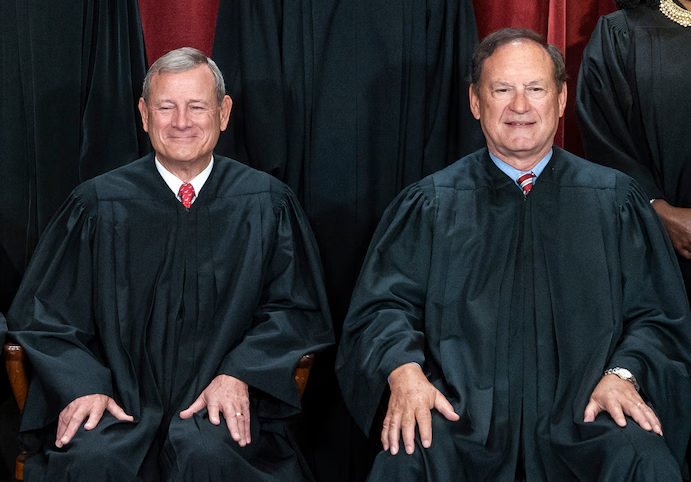
Chief Justice John G. Roberts Jr., left, and Associate Justice Samuel A. Alito Jr. sit for a group photo at the Supreme Court in 2022 (Washington Post photo by Jabin Botsford).
 April 29, 2026. “Seashellgate” is Going Exactly Nowhere.
Other Top Headlines
King Charles III speaking at the Capitol on Tuesday, April 28, 2026 (New York Times photo by Salwan Georges).
News Roundup
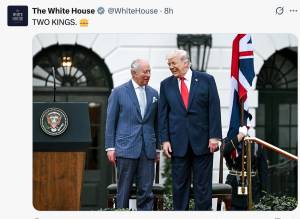
As shown above in the White House photo entitled, "Two Kings," the White House is describing President Trump as King of America.
April 29, 2026. Donald Trump is now claiming he is the most powerful person to ever live while continuing efforts to consolidate power, even as he faces historically low approval ratings. Democrats are weighing aggressive redistricting strategies targeting GOP-held seats. Pete Hegseth had a notably rough hearing on Capitol Hill. And that is just the start.More On Supreme Court
More On U.S. Law, Courts, Crime, Rights, Justice
 April 29, 2026. The legal theory behind this indictment is flimsy, at best. But a jury may never actually hear the case anyway.
 April 29, 2026. Who wore it worse: DOJ in the ballroom case, or DOJ with the new Comey indictment?
More On U.S. Politics, Governance, Elections
 , Accountability Journalism: How Trump turned the presidency into an infomercial, Judd Legum, right,April 29, 2026. A Popular Information investigation into how Trump is systematically using the presidency to promote his own businesses.
 White House these days.
 The Contrarian, Opinion: Trump Made Progressivism Great Again, Jennifer Rubin, right, April 29, 2026. Americans like active, humane government.
 right, April 29, 2026. Christ. It’s four in the morning, and I can’t get back to sleep. I dunno why. I mean, that state dinner for King Charles went fine. And I still look good in white tie!
More On U.S. Military, Iran War
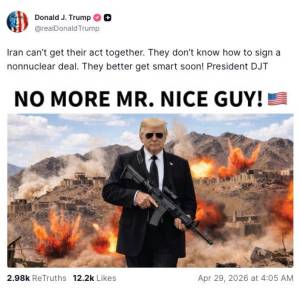
President Trump posted his pro-war photo "No More Mr. Nice Guy" on his website Truth Social during the early morning hours of April 29, 2026.
 right, author, commentator and retired general, April 29, 2026. The Pentagon’s recent decision to remove the Stars and Stripes ombudsman, Jacqueline Smith, may look like a minor personnel move, but it isn’t. It’s more of a signal about how the Department of Defense views independent information within the force, and how it may be attempting to erase the line between journalism and messaging.
More On Royalty, Democracy
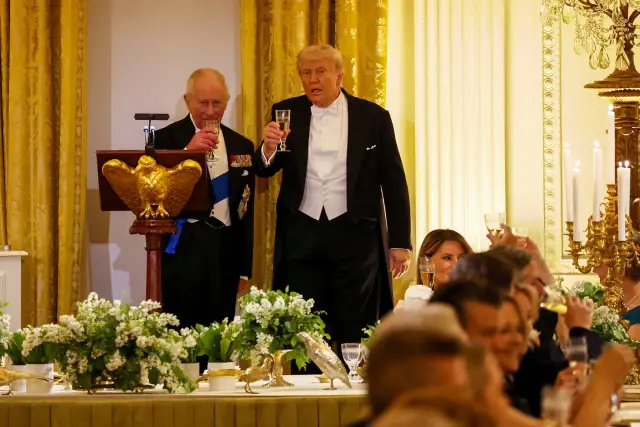
King Charles III and President Donald Trump give a toast in the East Room during an official state dinner at the White House yesterday (Photo by Chris Jackson via Getty Images).
U.S. Federal Reserve, Inflation, Markets, Economy, Jobs
Global Media, High-Tech, Privacy
Major Breaking News:
Chief Justice John G. Roberts Jr., left, and Associate Justice Samuel A. Alito Jr. sit for a group photo at the Supreme Court in 2022 (Washington Post photo by Jabin Botsford).
New York Times, Live Updates: Supreme Court Deals Further Blow to Voting Rights Act, Abbie VanSickle, April 29, 2026. The court’s conservative majority said they had upheld the landmark law, but the liberals in their dissent accused them of gutting it. In the case, the justices ruled that a Louisiana voting map was an unconstitutional racial gerrymander.
Here’s the latest.
The Supreme Court on Wednesday struck down Louisiana’s voting map, finding that lawmakers had illegally used race when drawing up a new majority-minority district.
The decision was 6-to-3, split along ideological lines. The conservative majority asserted that the opinion was a limited ruling that preserved a central tenet of the Voting Rights Act, but the court’s liberal wing, in dissent, argued that the justices had taken the final step to dismantle the landmark civil rights law.
In the majority opinion, Justice Samuel A. Alito Jr. wrote that the court had kept intact the Voting Rights Act but that Louisiana lawmakers had violated the Constitution with “an unconstitutional gerrymander” by aiming to create a new district with a majority of Black voters.
Justice Elena Kagan, in dissent, countered that the practical effect of the decision would be to make it nearly impossible to use race when drawing up voting maps, writing that “the court’s decision will set back the foundational right Congress granted of racial equality in electoral opportunity.”
Justice Kagan read her dissent from the bench, a rare move that often signals a justice’s strong displeasure with a decision.
 It is unclear how the decision will impact the midterm elections amid the nationwide redistricting battle that has spiraled already into multiple states.
Coming in the middle of the primary calendar, there are still multiple states, including Florida and possibly Tennessee, that could draw new maps, citing today’s decision. Louisiana will likely lose one Democratic district.
Any map that eliminated majority-minority districts and was drawn in the wake of the ruling would likely be challenged in court — potentially prompting a new wave of litigation.
It marks the latest in a series of rulings by the justices to weaken the Voting Rights Act of 1965, often considered the crown jewel of the civil rights-era laws.
For decades, lawmakers crafted congressional districts with a focus on ensuring that minority voters had the opportunity to elect candidates of their choice, often laboring under scrutiny from federal courts that aimed to protect the rights of minorities. The court has now ruled such efforts are unconstitutional, amounting to reverse discrimination. The decision could allow Republican state legislatures to eliminate around a dozen majority-minority House seats that are held by Democrats across the South, according to a New York Times analysis.
The case, Louisiana v. Callais, arose from a dispute over a new voting map drafted by Louisiana lawmakers after the 2020 census. Before then, only one of the state’s six congressional districts was majority Black, even though Black Louisianans made up about a third of the state’s population.
Two groups of Black voters sued in 2022, after state lawmakers adopted a new map that still included only one majority-Black district. They argued Louisiana had violated the Voting Rights Act by packing Black voters into one district, which had the effect of diluting the power of their votes. A federal judge agreed.
In 2024, state lawmakers tried again, this time adopting a map that included a second majority-Black district. A group of white Louisiana voters then challenged that map, claiming it was an illegal racial gerrymander. They pointed to the new district, which snakes diagonally across the state from the southeast to the northwest.
Lawmakers initially defended the map, arguing that the odd shape was the result of politics, not race. They said that lawmakers created the second district’s area to protect high-profile politicians, including House Speaker Mike Johnson, a Republican. The court has said it is acceptable to draw maps motivated by partisan advantage.
The Supreme Court first heard the challenge to the Louisiana map in spring 2025, considering whether state lawmakers had properly balanced race and political considerations. But in June, rather than announce a decision, the justices said they would rehear it in the fall. In August, the justices announced they were expanding the case, asking the lawyers to prepare for an argument on a much broader question than they had originally considered: Whether the state’s creation of a second majority-minority district violated the Constitution.
That announcement raised alarms among proponents of the Voting Rights Act, who feared that the court’s conservative majority — long skeptical of the legislation — would use the case to deal a fatal blow to the law and rule its provision requiring lawmakers to consider race was unconstitutional.
Just two years ago, the justices heard a similar dispute over Alabama’s congressional map and cited the Voting Rights Act without finding it unconstitutional. In that case, Allen v. Milligan, the Supreme Court ruled that the state’s Republican supermajority illegally diluted the power of  Black voters in violation of the Voting Rights Act.
But in that case, Justice Brett M. Kavanaugh, shown at right during his contentious Senate confirmation hearing, wrote in a concurring opinion that he wondered whether there should be a time limit on the ability of states to “conduct race-based redistricting,” writing that it could not “extend indefinitely into the future.”
During the oral arguments in the Louisiana case, Justice Kavanaugh and several other conservative justices appeared to question whether there should be a sunset to taking race into account in drawing voting maps.
“What exactly do you think the end point should be, or how would we know, for the intentional use of race to create districts?” Justice Kavanaugh had asked a lawyer for the NAACP Legal Defense and Educational Fund, who argued to uphold the Voting Rights Act.
Congressman Troy Carter, a Democrat who represents Louisiana’s other majority-Black district, has condemned the ruling. “It sends a dangerous signal that the progress we have made can be undone under the guise of legal theory,” he said in a statement. “The Voting Rights Act is not a relic. It is a living promise, a commitment that our democracy belongs to everyone. It was enacted to correct nearly 200 years of exclusion and injustice, and its protections remain just as necessary today as they were 60 years ago.
Related GOP House Gerrymandering News
The Florida House has passed the state’s new voting map, which could give Republicans up to four new congressional districts, on an 83-28 vote. After limited debate, lawmakers raced to vote as State Representative Angie Nixon, a Jacksonville Democrat, protested on the House floor using bullhorn. “It is out of order!” she yelled. “You are violating the Constitution!” The map now goes to the State Senate for final passage.

New York Times, How the Supreme Court’s Voting Rights Ruling Could Be Felt in the Midterms, Nick Corasaniti, April 29, 2026. Democrats will lose at least one blue-leaning district in Louisiana, and Florida is drawing a redder map. South Carolina, Tennessee and Missouri could try to draw new maps before voting begins.
The Supreme Court’s ruling on the Voting Rights Act in the middle of primary season could create a potentially chaotic scramble among states that may consider drawing new maps.
At least one outcome is clear: The decision will improve Republicans’ fortunes ahead of the midterm elections. How big of an advantage that becomes remains to be seen.
The case directly affected one state, Louisiana, striking down its congressional map and most likely causing Democrats to lose at least one blue-leaning district there. It was not immediately clear how the ruling might play out in the other states that have yet to hold their primary elections this year.
In Florida, where Gov. Ron DeSantis and Republicans introduced a new map this week that added four G.O.P.-leaning seats, they cited in their reasoning the looming decision before the Supreme Court. The decision on Wednesday is likely to fuel those arguments.
Beyond those two states, the picture becomes significantly less clear.
The conservative majority asserted that Louisiana’s map, which included two majority-Black districts, had amounted to an unconstitutional racial gerrymander. The majority opinion described a limited ruling that preserved a central tenet of the Voting Rights Act. But the court’s liberal wing, in dissent, argued that the justices had effectively dismantled the landmark civil rights law.
South Carolina, Tennessee, and Missouri have not begun early voting, and theoretically could still draw new maps before the midterms. They all host primaries later in the year, but would also have to contend with filing deadlines for candidates to qualify for the ballot.
It is extremely unlikely that any state that has already started its early-voting process would begin to try to draw new maps before the midterms. That would amount to throwing out legally cast votes, and could create chaos and confusion among voters and candidates.
It is also unlikely, though still possible, that states where the filing deadline for candidates has passed will try to redraw their maps. Such a move would require states to pass new laws and move deadlines.
Filing deadlines have already passed in many states. Others have started the process of early voting. That leaves just a handful of states that could try to redraw their maps to gain a partisan advantage in November.
Not all states are likely to try. Some states’ congressional maps are already heavily gerrymandered, and it would be difficult or impossible to carve out a further partisan advantage.

Former FBI Director James Comey, a Republican and career law enforcement officer indicted this week by the Trump Administration for the second time on bogus charges as part of its political retribution against officials who failed to break the law to serve President Trump's personal agendas.
Talking Feds via Substack, Legal Opinion: “Seashellgate” is Going Exactly Nowhere, Harry Litman, right, April 29, 2026. “Seashellgate” is Going Exactly Nowhere.
I devoted an entire week of Substacks to the first indictment of former FBI Director James Comey.
The second is less a break-glass moment only because the shards are already spread around the DOJ. But the indictment represents in some ways a new low of viciousness and ridiculousness, as well as a firm stamp on the DOJ by acting Attorney General Todd Blanche. This essay breaks down the legal and institutional failures in two parts. Part I walks through the legal wreckage of the indictment: the missing intent, the Watts barrier, the three-page charging document built on a single beach photograph. Part II explores the broader lessons about Trump, Blanche, and the DOJ that the indictment makes manifest.
When the first James Comey indictment dropped last September, I called it the single most shameful act in the Department of Justice’s history. My singular outrage led me to devote five consecutive Substacks that week to cataloguing the wreckage: the legal infirmities, the procedural malpractice, and the naked political origins.
That case duly crashed and burned, dismissed as a legal nullity after a series of courtroom debacles that would have been farcical if the stakes hadn’t been so grave. Rather than accept the rebuke, the DOJ has doubled down with a bespoke indictment, custom-built for one defendant and one audience.
Even as that failed indictment remains technically on appeal, the DOJ now has brought a second indictment of the former FBI director in a different district on an entirely different theory. The charge, if anything, is even more bankrupt and tawdry than the first.
 Of course, the filing does not come as the same sort of surprise this time. In his less than 4 weeks as Acting Attorney General, Todd Blanche, right, has quickly reached new lows of lawlessness and shameless servility to the president. It was entirely predictable that he was out front at the press conference preening about the latest charges against one of Trump’s most avowed enemies.
But the charge, if less stunning, is no less appalling. And the press conference included a series of lies and half-truths that not long ago would have been stunning to hear from the lips of the nation’s highest federal law enforcement officer.
Contrary to the multiple whoppers Blanche told at his press conference Tuesday afternoon, this is decidedly not a normal case nor one the Justice Department would bring against any other defendant. Moreover, like last week’s indictment of the Southern Poverty Law Center, it offers literally no evidence of the core alleged conduct, and the theory embedded in the charging document actually contradicts what Trump and his circle of sycophants have been publicly claiming for nearly a year.
The facts are almost too silly to state with a straight face, but here they are. Last May, James Comey was on vacation on the North Carolina coast. He came upon—did not arrange, did not commission, did not construct—a collection of seashells that someone else had assembled on the beach in the pattern “86 47.” He photographed it and posted it on Instagram with the caption, “Cool shell formation on my beach walk.”The second Comey indictment slips through your fingers like sand.
Former US Attorney and Deputy Assistant Attorney General Harry Litman, shown above at right, delivers the Talking Feds podcast and is a regular commentator on MSNBC, CNN, CBS and other platforms with the view that current legal crises are "an absolute pivot point for democracy, and we all have to fight."
Other Top Stories
King Charles III speaking at the Capitol on Tuesday, April 28, 2026 (New York Times photo by Salwan Georges).
New York Times, Beneath King Charles’s Jokes and Decorum, Some Subtle Rebuttals to Trump, Michael D. Shear and Zolan Kanno-Youngs, April 29, 2026. King Charles III gently pushed back against President Trump’s attacks on Britain and NATO, and he spoke of the importance of checks and balances.
King Charles III quoted Oscar Wilde, joking that the British have everything in common with America “except, of course, language.” President Trump said the morning’s gloomy rain reminded him of a “beautiful British day” and noted that his mother thought young Prince Charles was “so cute.” Both men waxed poetic about the bonds between their countries.
And yet, on the first full day of a state visit focused on the shared history between the United States and Britain, the king sprinkled in some ever-so-subtle rebuttals to Mr. Trump. Charles spoke on Tuesday of the value of the trans-Atlantic alliance, the importance of checks and balances and his passion for the environment. He even spoke of his time in the Royal Navy, after Mr. Trump belittled British naval capabilities in recent weeks.
The king tucked his rejoinders into a mostly lighthearted speech to Congress on Tuesday afternoon and during evening remarks at a formal banquet at the White House.
 “Please rest assured I am not here as part of some cunning rear-guard action!” the king told lawmakers in the afternoon, only the second time a British monarch had addressed Congress.
The mostly disciplined and careful public appearances by both Charles and Mr. Trump came at a dire moment in American-British relations, arguably at their lowest point in decades over the war in Iran and Mr. Trump’s scathing attacks on NATO.
But for a day (and maybe just a day), the special relationship that has developed over the past 250 years seemed — on the surface at least — special.
In a rarity for the Trump era, the president stuck mostly to his script during the day’s ceremonial events. He did not invite a horde of reporters into the Oval Office just before their meeting to field questions on Iran, the ballroom or Greenland in the presence of his visiting foreign dignitary. He did not lash out at another global ally.
In one apparently unscripted remark during the state dinner, Mr. Trump referred to the war in Iran and insisted that “Charles agrees with me.” It was an awkward moment because Charles studiously stays out of such matters of war and politics.
For the most part, though, Mr. Trump lavished the king with praise throughout the day.
King Charles III and President Donald Trump give a toast in the East Room during an official state dinner at the White House yesterday (Photo by Chris Jackson via Getty Images).
New York Times, Pentagon Puts Iran War Cost at $25 Billion as Hegseth Berates Skeptics, Robert Jimison, April 29, 2026. During his first public appearance on Capitol Hill since the war began, the defense secretary lashed out at lawmakers in both parties who have questioned the conflict.
Defense Secretary Pete Hegseth on Wednesday castigated members of Congress in both parties for questioning the war in Iran, during a contentious Capitol Hill hearing dominated by a conflict that the Pentagon said had cost $25 billion and 14 American lives so far.
Appearing at what had been scheduled as a routine hearing to review the Defense Department’s nearly $1.45 trillion budget request for the coming year, Mr. Hegseth spent much of his time lashing out at lawmakers whose approval would be needed to provide that funding.
“The biggest challenge, the biggest adversary we face at this point are the reckless, feckless and defeatist words of congressional Democrats and some Republicans,” the defense secretary declared in his prepared remarks to the House Armed Services Committee, before members had asked a single question.
The statement set a hostile tenor for the secretary’s first public testimony on Capitol Hill since the war began, coming after Republicans had for weeks refrained from exercising any public oversight of an operation undertaken without congressional authorization, and which polls indicate is unpopular.
At multiple points during the nearly five-hour hearing, Mr. Hegseth became so belligerent toward Democrats who questioned him that the Republican chairman of the committee halted the proceedings to urge the secretary to show respect to the lawmakers.
“Once I recognize a member, they have control of that five minutes,” the chairman, Representative Mike D. Rogers of Alabama, told Mr. Hegseth. “The witness has to recognize it’s their time.”
The tense session unfolded just before a 60-day milestone in the conflict that some in the G.O.P. have said could become a pivot point for their so far unconditional backing for President Trump’s conduct of the war, beyond which they may begin demanding more answers about objectives and a plan for extricating American troops.
“Here we are in a full-scale Mideast war, and we’ve seen the costs of that,” Representative Adam Smith of Washington, the senior Democrat on the panel, said, noting military and civilian casualties and asserting that “over a dozen countries now have been dragged into this war in one way or another.”
“Where is this going?” Mr. Smith asked.
Mr. Hegseth and Gen. Dan Caine, the chairman of the Joint Chiefs of Staff, provided few answers about an endgame, though their appearance did yield some new information about the costs and results of the military campaign.Editors’ PicksRejected by a Co-op Board: Do They Have to Tell You Why?She Gave Her Second Tiny Home a Wee UpgradeShould My Bag Really Match My Shoes?
The Pentagon comptroller, Jay Hurst, said the war had so far cost $25 billion, mostly because of the tens of thousands of bombs and missiles used, providing the first such official estimate since Mr. Trump began the operation. He did not elaborate on the figure, which was strikingly smaller than the $200 billion the Pentagon had initially requested for the conflict and suggested a major slowdown in expenditures since the start of the war, when officials estimated it had cost more than $11 billion in its first six days.
General Caine put the number of U.S. service members that had died during the war with Iran at 14, slightly above the Pentagon’s own tally of war casualties, which reflects 13 deaths.
After two months of war, General Caine testified, the Iranians “are weaker and less capable than they have been in decades.”
Still, when asked for a timetable or projected cost for finishing a mission that Mr. Trump initially said would be completed in “four to five weeks,” Mr. Hegseth demurred.
“As you know and as the president has stated, you would never tell your adversary, especially once you’ve decimated their military and you control their strait,” that information, he told Representative Chrissy Houlahan, Democrat of Pennsylvania.
Democrats sharply questioned the objectives for the mission and what had been gained from it. In one particularly heated exchange, Representative John Garamendi, Democrat of California, offered a tally of U.S. losses so far and asked what the United States had achieved, noting that Iran had retained significant military capabilities and closed the Strait of Hormuz, the strategic waterway for oil shipping.
“You have been lying to the American people since Day 1” of the war, Mr. Garamendi told Mr. Hegseth, accusing him of “incompetence.”
Mr. Hegseth responded by suggesting that the congressman was rooting for the enemy.
“I know the American people support that mission, despite your loose talk,” said Mr. Hegseth, who just a year ago put the flight sequencing of American fighter jets in a group chat on a commercial messaging app. Later, he asked Mr. Garamendi: “Who you cheering for here? Who you pulling for?”
In the hallway outside, protesters had gathered to register their opposition to the war, shouting “war criminal” and “arrest Hegseth” as he arrived to testify.
Many Republicans praised the war in Iran and Mr. Hegseth’s leadership, and focused their questions on issues such as quality of life improvements for service members, the use of artificial intelligence at the Pentagon and combating adversaries such as China.
But some in the G.O.P. made it clear they did not approve of Mr. Hegseth’s personnel decisions, including the recent firings of Navy Secretary John Phelan and of Gen. Randy George, the Army chief of staff.
“You have the constitutional right to do these things, but it doesn’t make it right or wise,” Representative Don Bacon, Republican of Nebraska, told Mr. Hegseth.
Later, Representative Austin Scott, Republican of Georgia, also criticized General George’s firing and appeared to beseech Mr. Hegseth not to alienate Democrats whose votes would be needed to secure military resources that some in the G.O.P. oppose.
“It takes 218 votes to get something across the floor of the House,” Mr. Scott said. “I just would encourage everybody to keep that in mind, because we’re going to lose some Republican votes.”
One point of agreement on the committee was the concern expressed over the nation’s dwindling weapons stockpile. Mr. Rogers warned that U.S. munitions stockpiles were dangerously low and that the nation’s industrial capacity to replenish them was weak. The war in Iran has sharply depleted U.S. arsenals, with the Pentagon diverting bombs, missiles and other hardware from commands in Asia and Europe to the Middle East.
But ultimately, Mr. Rogers said, the military campaign in Iran has given Mr. Trump “the opening he needs to negotiate a true and lasting peace that will ensure Iran never acquires a nuclear weapon.”
Still, even as the hearing unfolded, the conflict’s outcome was uncertain, with a fragile cease-fire and dueling blockades muddying the situation and no binding agreement yet on Iran’s nuclear program or significant change to the country’s leadership.
In a predawn social media post before the session began, Mr. Trump urged Iranian leaders to “get smart soon,” alongside an image of himself holding an automatic rifle in front of a hilly desert landscape dotted with explosions. He later told Axios that he was rejecting an Iranian proposal that sought to lift the naval blockade, saying he believed it was “somewhat more effective than the bombing.”

New York Times, Live Updates: Supreme Court Will Consider Trump’s Bid to End Deportation Protections, Ann E. Marimow, April 29, 2026. The justices will hear two cases covering hundreds of thousands of people from Haiti and Syria with Temporary Protected Status who could be forced out of the country.
The Supreme Court will hear arguments Wednesday in the Trump administration’s bid to immediately end humanitarian protections for hundreds of thousands of Haitians and Syrians, potentially forcing them to return to dangerous conditions in their home countries.
President Trump’s attempt to terminate the program known as Temporary Protected Status is a pillar of his aggressive anti-immigration agenda, and the court’s ruling will most likely have implications for migrants from more than a dozen troubled nations who have been allowed to live and work legally in the United States.
The justices fast-tracked two cases, one involving more than 350,000 Haitians and another covering about 6,000 Syrians. The administration argues that it has followed proper procedures for the review and termination of protections for the two nations, but lower courts have found that the decisions had been preordained and not based on meaningful analysis.
The class-action lawsuits were filed by T.P.S. holders, including engineers, students, doctors and caregivers, who want to continue to work and live in the United States because their lawyers say they could be killed if they are forced to return to Syria or Haiti.
Mr. Trump has taken particular aim at Haitians in his criticism of immigration policies, and his disparagement of them is likely to be highlighted during oral arguments. Lawyers in that matter have said the administration was motivated by prejudice, citing the president’s false accusations during the 2024 campaign about Haitians in Springfield, Ohio, eating their neighbors’ pets.
Here’s what else we’re covering:
 Morning Shots via The Bulwark, Political Opinion: Donald Trump Can’t Sleep, Bill Kristol, Andrew Egger and Mark Hertling, April 29, 2026. Wanna guess the reason why?
 Since the firing of his boss, Pam Bondi, acting Attorney General Todd Blanche has been hustling like crazy to get the top job permanently. His latest caper: Yet another federal indictment of FBI Director James Comey, this time on the ludicrous grounds that an Instagram picture he posted last year—of seashells on the beach spelling out “86 47”—represented “a serious expression of an intent to do harm to the President of the United States.” Happy Wednesday.
News Roundup
The Parnas Perspective, Evening News and Comment: Trump Claims He is the Most Powerful Person to Ever Live, Historically Bad Approvals, Democrats Discuss Redistricting Every GOP Seat, Aaron Parnas, right, April 29, 2026. Donald Trump is now claiming he is the most powerful person to ever live while continuing efforts to consolidate power, even as he faces historically low approval ratings. Democrats are weighing aggressive redistricting strategies targeting GOP-held seats. Pete Hegseth had a notably rough hearing on Capitol Hill. And that is just the start.
I may be running on fumes with a newborn, but I have still been reading almost every message you send. I hear you. Many of you are not just busy. You are exhausted. Some of you have stepped away entirely, and that makes sense. I talk to people online and in real life every day about what this nonstop news cycle is doing to them, and for a lot of people, it is not sustainable.
My role is to cut through the noise and give you what matters. I will be here whether you stay plugged in or decide to step back for a while. If you value reporting that is direct, independent, and not shaped by corporate or political pressure, consider subscribing. Your support is what keeps this work going.Subscribed
Here’s the news:
Behind the scenes, Trump has started claiming he is “the most powerful person to ever live.” A new Atlantic report suggests that Donald Trump has increasingly framed himself as a historic, world-changing figure, reportedly comparing himself in private to leaders like Alexander the Great, Julius Caesar, and Napoleon Bonaparte. According to aides and confidants, his focus in a potential second term has shifted away from short-term political concerns toward building a lasting legacy, even as allies worry about political fallout from policies like the Iran conflict and rising costs.
The report also notes internal concern among Republicans about electoral risks, while some Democrats criticize what they see as misplaced priorities; however, Trump is portrayed as relatively unconcerned with midterm outcomes and more focused on long-term influence, including shaping his successor. Overall, the piece characterizes a presidency increasingly driven by legacy ambitions and a more defiant, less politically constrained mindset.
Donald Trump is facing historically poor public opinion on inflation, with ratings worse than those seen under Joe Biden or even Jimmy Carter before the 1980 election. It highlights particularly low confidence among independents and notes that even within the Republican Party, fewer than half believe the country is on the right track regarding cost of living.
Pete Hegseth faced sharp questioning early in today’s hearing after claiming Iran’s nuclear facilities had been “obliterated,” a point he has repeatedly emphasized to defend the war. Adam Smith challenged that claim, highlighting a contradiction with earlier justifications that the war was needed due to an imminent nuclear threat. Smith argued that if the threat was truly imminent, it’s inconsistent to now say it has been completely eliminated, suggesting flaws in the administration’s reasoning. Hegseth responded by maintaining that Iran still has nuclear ambitions, underscoring ongoing disagreement over the effectiveness and rationale of the conflict.
The U.S. war with Iran has cost about $25 billion in its first two months, according to Pentagon official Jules Hurst III, with most expenses going toward munitions and military operations. Lawmakers, including Adam Smith, raised concerns about the lack of updated cost reports and the need for additional funding from Congress. The conflict has also contributed to rising global gas prices due to disruptions in the Strait of Hormuz, while Donald Trump’s administration weighs next steps and warns Iran amid stalled negotiations. As the war approaches the 60-day mark, Congress may soon have to decide whether to formally authorize continued military action under the War Powers Resolution.
LIV Golf is reportedly facing a major crisis, as its primary Saudi backers—through the Public Investment Fund—are expected to withdraw funding after the current season, potentially threatening the league’s future. While the tour has tried to compete with the PGA Tour by offering massive prize money and attracting top talent, financial pressures tied to broader economic issues in Saudi Arabia have raised doubts about its sustainability, even as league officials insist revenues and growth remain strong.
Pete Hegseth suggested that U.S. service members may have lied when their accounts contradicted his statements about defenses during a drone attack on a military base. During a tense exchange, he pushed back against criticism, accusing his interviewer of spreading falsehoods. Rep. Pat Ryan responded by calling for Hegseth to resign, escalating the dispute into a broader political confrontation.
Pete Hegseth downplayed concerns about the Strait of Hormuz by arguing that U.S. actions effectively countered Iran’s blockade, framing the situation as under control despite disruptions to global shipping. The crisis itself involves a “dual blockade,” where Iran restricted the strait and the U.S. responded by blockading Iranian ports, intensifying tensions and economic risks. Rep. Seth Moulton criticized that logic during a hearing, comparing it to a self-defeating response—like retaliating after the British burned Washington during the War of 1812—arguing it doesn’t meaningfully resolve the problem.
Donald Trump appeared to mix up countries, making false claims about Ukraine’s military, saying: “I think Ukraine—militarily, they’re defeated. They had 159 ships. Every ship is underwater. Every one of their planes has been shot down.”
Vladimir Putin warned in a call with Donald Trump that renewed U.S. and Israeli attacks on Iran could lead to “extremely harmful” or unpredictable consequences, reflecting Russia’s broader concern about escalation in the Middle East. Similar statements from Russian officials have emphasized that further military action against Iran risks destabilizing the region and triggering wider conflict.
The Supreme Court of the United States narrowed a key provision of the Voting Rights Act, limiting protections against racial gerrymandering and making it easier for states to defend maps based on partisan goals. The ruling in Louisiana v. Callais could significantly reshape elections, potentially boosting Republican chances of retaining control of the House. Supporters argue the decision aligns with constitutional limits on race-based redistricting, while critics, including dissenting Justice Elena Kagan, warn it could weaken decades of protections and reduce minority voting power.
Democrats in response are calling for the elimination of all Republican Congressional seats where possible, including a 52-0 California map and a 17-0 Illinois map:
Marsha Blackburn is calling for a special legislative session in Tennessee to redraw the state’s congressional map in a way that could result in an all-Republican House delegation.
Republican lawmakers in Alabama are proposing a new congressional map that critics argue would remove or significantly reduce Black representation in the state’s districts, raising concerns about voting rights and fair political representation.
U.S. gas prices have climbed to $4.23 per gallon—the highest this year—as the Iran conflict and a dual blockade in the Strait of Hormuz drive up global oil prices, with crude rising sharply in recent weeks. The increase has pushed fuel costs up more than 40% since before the war, straining consumers and forcing gas stations to cut margins, while disproportionately impacting lower-income households. Although many consumers are still managing the higher prices, analysts warn that prolonged energy costs could spill over into essentials like food and utilities, worsening overall inflation pressures.
According to NBC News, the man accused of attempting to assassinate Donald Trump allegedly shot a Secret Service officer during the White House Correspondents’ Dinner at the Washington Hilton; the officer, protected by a ballistic vest, was struck but not seriously injured and later released from the hospital. The suspect, 31-year-old Cole Tomas Allen, reportedly charged a security checkpoint with weapons and opened fire before being stopped, and he now faces multiple federal charges—including attempted assassination and firearms offenses—while investigators continue examining his devices and evidence to determine motive and details of the attack.
The Federal Reserve kept interest rates unchanged at what may be Jerome Powell’s final meeting as chair, as Kevin Warsh advances toward potentially replacing him. Donald Trump’s nominee is nearing confirmation, though Powell could remain on the Fed board after his chair term ends.
The decision comes amid economic uncertainty driven by geopolitical conflict, rising oil prices, higher inflation, and mixed labor market signals. Policymakers face difficult choices as the economic outlook remains unclear. Powell’s future may also hinge on an ongoing investigation into the Fed, which has not been fully resolved. Overall, leadership changes and economic instability are expected to shape upcoming policy discussions.
The Parnas Perspective, Morning News and Commentary: Congress Files Contempt Resolution for Pam Bondi, ICE Agent Who Killed Renee Good Quietly Back to Work, Large Economic Boycott Grows, Aaron Parnas, right, April 29, 2026. I told you there would be major movement on Epstein this week, and here it is first: Congress has officially begun the process of holding former Attorney General Pam Bondi in civil contempt. This is not symbolic. A resolution has now been filed, marking the first concrete step toward forcing accountability. The process will take time, but there is expected to be bipartisan support, and today represents a real escalation.
At the same time, the Trump administration has quietly moved ICE agent Jonathan Ross, the officer who shot and killed Renee Good in Minneapolis, and returned him to active duty despite ongoing scrutiny and investigations. This comes as outrage over the case continues to build.
And on Friday, a nationwide May Day economic boycott is set to unfold, with thousands of coordinated actions planned across the country. I have the latest on how widespread this could become.
I am working around the clock to bring you real-time reporting, and this morning’s development is a big one. There is more coming, so stay with me.
The false content circulated tying me to the White House Correspondents’ Dinner shooting has now led to several MAGA accounts amplifying it and questioning what I knew. Even after getting that content taken down, the harassment has continued.
They want this to stop. They want me to stop. I will not. If you want this reporting to continue and grow, the most effective way is to subscribe, gift a subscription, or upgrade your plan. Thank you for backing this work.
Here’s the news:
This morning, Congressman Robert Garcia has announced a civil contempt resolution for former Attorney General Pam Bondi. The resolution, which will likely have bipartisan support in the House of Representatives, is a direct response to Bondi’s failure to comply with the bipartisan subpoena previously issued by the House Oversight Committee. In a new statement, Garcia says:
“Pam Bondi has illegally defied our committee, skipped her deposition, and has refused to cooperate. We have introduced a contempt resolution, to hold her accountable. Bondi has extensive personal knowledge about the Trump Administration’s handling of the Epstein files, and regardless of her job title, her testimony and cooperation are crucial. The survivors of Jeffrey Epstein’s abuse deserve answers and the American people deserve the truth. Oversight Democrats are taking the lead on holding Bondi in contempt because Chairman Comer is trying to run out the clock, and we refuse to let this Administration stop our investigation.”
Civil contempt of Congress is a process used by either chamber of Congress to enforce subpoenas by asking a federal court to compel compliance. It is intended to force individuals to provide testimony or documents rather than punish them. Unlike criminal contempt, which penalizes past refusal, civil contempt uses pressure—such as fines or jail—to ensure future cooperation. The sanctions typically remain in place until the person complies with the subpoena. Civil contempt can lead to Bondi receiving significant financial penalties and/ or jail time if she refuses to comply. The full House of Representatives will have to vote to pass this resolution, but given the likely bipartisan support, it is likely to pass at some point, whether in this Congress or next.
In response, Bondi says she will testify in front of Congress:
President Donald Trump warned Iran to “get smart soon” as he considers military options amid a prolonged standoff over the Strait of Hormuz, where a U.S. naval blockade has effectively halted a key global trade route. The disruption, following failed negotiations, has driven oil and gas prices sharply higher and strained Iran’s economy, with its currency hitting record lows. U.S. officials are weighing whether to increase or adjust military activity, though no decision has been made. The crisis remains tied to broader tensions over Iran’s nuclear program, with the U.S. insisting Iran must not develop nuclear weapons.
Meanwhile, Reuters has confirmed that U.S. intelligence agencies are analyzing how Iran might respond if President Donald Trump declares victory in the ongoing conflict, as officials weigh potential de-escalation. While scaling back military involvement could ease domestic political pressure, it may also embolden Iran to rebuild its capabilities and threaten regional stability. The war remains unpopular with Americans, adding urgency for the administration to find a resolution. Although military options are still available, large-scale escalation is now seen as less likely than earlier in the conflict.
 Defense Secretary Pete Hegseth, right, is set to face intense questioning from Congress for the first time since the Iran war began. Lawmakers—especially Democrats—are expected to press him on the war’s costs, its lack of congressional approval, civilian casualties, and the strain on U.S. military resources. The hearing, officially focused on the administration’s proposed $1.5 trillion defense budget, is likely to become a broader examination of the war’s strategy, effectiveness, and leadership decisions amid ongoing political and public scrutiny.
According to The Daily Beast, the ICE agent (Jonathan Ross) who murdered Minnesota protester Renee Good in January has been reassigned to another state and allowed to continue working, according to reports. The shooting, captured on video, sparked widespread protests, while Trump officials claimed the agent acted in self-defense as Good attempted to flee. Investigations into the incident have stalled or been dropped, raising concerns about accountability within federal agencies. The case remains under review as federal authorities say they are still gathering evidence.
Activists, labor unions, and community groups across the U.S. are organizing a large-scale May Day “economic blackout,” urging people to avoid work, school, and shopping in protest of government policies. The movement, inspired in part by protests over ICE actions in Minnesota, is expected to include more than 3,000 events nationwide. Organizers say the goal is to demonstrate workers’ collective power and push for issues like immigration rights, labor protections, and broader democratic reforms. Major cities such as Chicago and Los Angeles are preparing for large-scale participation, reflecting growing momentum behind the movement.
A 15-foot gold statue of President Donald Trump has been installed at his Trump National Doral Miami golf course, drawing comparisons to monuments of North Korean leaders. Nicknamed “Don Colossus,” the statue has sparked criticism and mixed reactions, including reluctance from some golfers to pose with it. The artwork, created by an Ohio-based artist, was also involved in a payment dispute with the group that commissioned it. The White House said it had no involvement in the statue or related cryptocurrency project tied to its promotion.
Vice President JD Vance canceled a planned appearance at a Turning Point USA event at Iowa State University, with organizers citing scheduling conflicts. The decision follows a previous event where he was heckled over the war in Iran and another where co-speaker Erika Kirk withdrew over security concerns. The cancellation also comes amid heightened tensions after an attempted assassination targeting Donald Trump and others at the White House Correspondents’ Dinner. Overall, the incidents highlight growing security concerns and political tensions surrounding recent public appearances.
Jimmy Kimmel criticized Donald Trump for what he framed as hypocrisy over jokes about age. He pointed out that Trump previously demanded consequences for similar jokes, only to later make one himself. Kimmel highlighted the contradiction to underscore his broader criticism of Trump’s behavior. “Wait a minute, did he just make a joke about his death? Only Donald Trump would demand I be fired for making a joke that his old age, and then a day later go out and make a joke about his old age!”
King Charles III joked about ongoing construction at the White House during a state dinner with President Trump, playfully linking it to past British actions. He referenced Trump’s earlier visit to Windsor Castle and quipped about the East Wing renovations. He then humorously alluded to the British burning of the White House during the War of 1812 as a “real estate redevelopment.” “And if I may say so, it is a particular pleasure to be back in this wonderful building, the heart of your democracy. On this occasion, I cannot help noticing the readjustments to the East Wing, Mr. President, following your visit to Windsor Castle last year. And I’m sorry to say that we British, of course, made our own small attempt at real estate redevelopment of the White House in 1814.”
King Charles III continued his lighthearted remarks at the White House state dinner, joking about historical alliances and rivalries in Europe. He referenced President Trump’s comment about the U.S. role in World War II and playfully countered with Britain’s own historical influence. The remark drew humor from long-standing ties between the U.S., U.K., and France. “This said, our French friends can feel equally at home with a glance at a map. Indeed, you recently commented, Mr. President, that if it were not for the United States, European countries would be speaking German. Dare I say that if it wasn’t for us, you’d be speaking French.”
Russia’s 2026 Victory Day parade will be held without tanks, missiles, or other heavy military equipment for the first time in nearly two decades. Officials cited the current security situation, with the Kremlin blaming Ukrainian strikes and “terrorist activity” for the scaled-down display. The event will still include troops, military students, and an aircraft flyover, but omits the usual showcase of military hardware. The parade, a key symbol of national pride tied to World War II, has been used by President Vladimir Putin to project strength and justify the war in Ukraine.
Current and former federal prosecutors told ABC journalist Jonathan Karl that the indictment of James Comey is unusually weak, with some calling it “the flimsiest federal indictment they’ve ever seen.” Even allies of Donald Trump have reportedly criticized it in private, describing it as “embarrassing.” One prominent former Trump Justice Department official went further, calling the case “depressing,” underscoring concerns about its credibility.
Country singer Kacey Musgraves has invited the Gámez-Cuéllar brothers—three young mariachi musicians previously detained by ICE—to open several of her Texas shows. The brothers, who were arrested with their family during a court check-in after seeking asylum, were released following public outcry. Musgraves said the decision reflects her desire to highlight and celebrate Mexican culture and its influence on her music. The performances will take place in early May as part of her upcoming tour in Texas.
New polling shows that Americans believe Republicans are a greater threat to free speech than Democrats:
The Supreme Court is considering whether the Trump administration can revoke temporary protected status (TPS) for hundreds of thousands of Haitian and Syrian immigrants. The administration argues the decision is within its authority, while challengers say proper procedures weren’t followed and the move may be discriminatory. TPS currently allows people from unstable countries to live and work legally in the U.S., and removing it could expose many to deportation. The case could have broader implications for similar protections affecting immigrants from multiple countries.
A new Gallup poll finds a record 55% of Americans say their financial situation is getting worse, the highest level since tracking began in 2001. Rising costs for essentials like gas, housing, healthcare, and education are driving widespread anxiety, with inflation and energy prices hitting households particularly hard. Many Americans are also increasingly worried about long-term financial stability, including retirement savings and college costs. The data reflects growing economic strain and pessimism about financial security across the country.
A South Korean appeals court sentenced former President Yoon Suk Yeol to seven years in prison for charges including resisting arrest and obstructing justice, adding to a separate life sentence tied to rebellion charges. His actions, including imposing martial law without proper Cabinet approval and using security forces to block his arrest, triggered a major political crisis in 2024. The court found he violated the rights of multiple Cabinet members by staging an illegitimate meeting and falsifying documents. Yoon plans to appeal, while other legal cases against him and his wife are still ongoing.
I’m often asked where I go to do research for my reporting. One of the main research tools I use is called Ground News. Ground News shows me how stories are being covered from different political perspectives, and it highlights “blindspots” where only left-wing or right-wing media is covering a story. I worked out a deal with them: if you go to ground.news/AARONP, you can get 40% off Ground News’ top-tier Vantage plan, which gives you unlimited access to all the research tools I use. Ground News is subscriber-funded, so they don’t rely on ads that could introduce bias. By subscribing, you support both our channel and their independent team working to keep the media transparent.
The United Arab Emirates will leave the OPEC+ alliance starting May 1, a major move that could weaken the group’s ability to influence global oil prices. As one of the few members with significant spare production capacity, its departure removes a key pillar of the cartel’s power. The decision comes amid ongoing disruptions in global energy markets caused by the Iran conflict and reduced oil flows through the Strait of Hormuz. By exiting, the UAE gains full control over its production strategy, potentially prioritizing market share over coordinated supply limits.
Good news:
During the Boston Marathon, two runners—Aaron Beggs and Robson Oliveira—stopped to help fellow competitor Ajay Haridasse after he collapsed from severe leg cramps near the finish line. Instead of continuing for personal records, they supported him on both sides and helped him cross the finish. Their selfless act cost them their own race goals and left them needing medical attention, but all recovered. The moment was widely praised as a powerful example of sportsmanship and compassion in competition.
At the London Marathon, Kenya’s Sabastian Sawe became the first runner to officially complete a marathon in under two hours, finishing in 1:59:30 and breaking the previous world record by over a minute. Ethiopia’s Yomif Kejelcha also achieved a sub-2-hour time, while Uganda’s Jacob Kiplimo placed third with a time still faster than the old record. The milestone marks a historic breakthrough long pursued in athletics, previously only achieved under unofficial conditions. Ideal weather, strong fan support, and advanced running gear all contributed to this landmark moment.
The Parnas Perspective, Evening News and Commentary: New Mexico Epstein Investigation Rapidly Expands, White House Calls Trump 'King,' Comey Indictment Likely to Fail, Aaron Parnas, right, April 28, 2026. Trump’s DOJ has charged James Comey with threatening the life of the president, an indictment many legal experts expect could fall apart quickly.
As shown abovein the White House photo entitled "Two Kings," The White House is portraying Trump in king-like terms at the same time King Charles III addressed a joint session of Congress, while major Jeffrey Epstein developments continue as the New Mexico investigation rapidly expands and the GAO opens a separate probe into the DOJ. There is likely to be significant news Wednesday that I’m actively working on, so stay tuned.
Here’s what you missed:
The Trump White House called Donald Trump a “King” in official communications:
The Justice Department indicted former FBI director James Comey for allegedly threatening President Donald Trump through an Instagram photo of seashells arranged as “8647,” which prosecutors say could be interpreted as intent to harm. Comey said he did not realize the numbers could be seen as violent, describing them instead as a “political message” and stating he opposes violence. Acting Attorney General Todd Blanche said intent would be proven through evidence like witnesses and documents but declined to discuss specifics. The case follows prior legal actions against Comey, including an earlier indictment that was dismissed over issues with the prosecutor’s appointment. Read the indictment here. Here is Comey’s response:
Blanche said Comey could face “10 years in prison” and emphasized that “threatening the life of the president will never be tolerated by the DOJ,” underscoring the seriousness with which such cases are treated.
Blanche argues that intent can be proven the same way it is in any legal case—through evidence such as witness testimony, documents, and the defendant’s own statements or actions. He implies that Comey’s claim about not associating “86” with harm and removing it quickly doesn’t automatically negate intent. Instead, prosecutors would look at the full body of evidence to determine what Comey actually meant. In short, intent isn’t based on a single explanation but on the broader context established in court.
“Q: Should we expect more indictments of this sort? … Would you pursue that?” Blanche was asked but did not address the specific example. “BLANCHE: As far as other instances of threats against the president — those will be investigated.” He signaled a general willingness to investigate similar cases without committing to specific prosecutions.
There was a standing ovation after King Charles III praised NATO and said “that same unyielding resolve is needed for the defense of Ukraine.” His remarks highlighted continued support for NATO and emphasized the importance of unity in backing Ukraine.
According to the Financial Times, Christian Turner, the Ambassador from the U.K, said in leaked remarks that the U.S.’s only true “special relationship” is “probably Israel,” not the U.K., calling the term outdated and “backwards-looking.” The comments, made privately, risk overshadowing King Charles III’s U.S. visit and caused embarrassment for the British government, which stressed they don’t reflect official policy. Turner still described U.S.-U.K. ties as strong but said the relationship must evolve, particularly on defense.
Kash Patel said the investigation into James Comey’s seashell post took months, noting it “has been investigated over the past 9, 10, 11 months.” He emphasized that such cases “take time” and that investigators “work methodically,” pushing back on the idea that the probe was rushed.
Authorities in New Mexico are investigating new allegations that multiple young men were drugged and raped at Zorro Ranch owned by Jeffrey Epstein. A survivor claimed he witnessed “multiple young men… raped at the ranch” after being drugged, according to accounts shared publicly. Lawmakers and investigators say more local victims have recently come forward, expanding the scope of the case. The probe is part of a reopened effort to examine abuse tied to Epstein’s operations at the remote property.
Officials and advocates describe Epstein and Ghislaine Maxwell as serial abusers, with testimony highlighting patterns of exploitation and coercion. A state-backed Truth Commission is now working with authorities to identify victims and potentially bring charges against co-conspirators. Investigators are also reviewing past claims, including previously unexamined tips and records related to the ranch. The effort marks a renewed push for accountability after earlier investigations were halted.
Survivors have described the ranch as isolated and controlled, with accounts of abuse occurring in secrecy and fear. One victim said the property felt like a trap, where victims were summoned and assaulted without the possibility of escape or help. Others reported disturbing experiences, including waking up disoriented or overhearing conversations about exploitation. These testimonies underscore the psychological and physical trauma linked to the site.
The renewed investigation was partly prompted by newly released Justice Department files, including allegations of extreme abuse and possible buried victims near the ranch. Authorities are now assessing how many individuals may have been harmed, including previously unidentified local victims. Support organizations report dozens of people have sought help related to alleged abuse connected to the property. The case continues to evolve as officials gather evidence and evaluate potential criminal charges.
Authorities are investigating Ann Rodriquez, a former employee on Little St. James Island, over incidents where alleged trespassers were detained and threatened. Prosecutors say she pointed a gun-like weapon, restrained one man, and destroyed drone footage, leading to potential charges including kidnapping and assault. A separate incident involved additional confrontations with visitors and the detention of another individual by workers on the island. The case adds to ongoing scrutiny of activities and personnel connected to properties once owned by Jeffrey Epstein.
According to Politico, Todd Blanche is facing pushback from members of the Metropolitan Club as he seeks to join, with several arguing he is too polarizing and has politicized the Justice Department. Critics within the club say his actions targeting institutions and individuals make him an unwelcome presence in a space meant for collegial interaction. Some members have formally urged the club’s leadership to reject his application, highlighting concerns about standards and reputation. The dispute underscores tensions between Blanche’s public role and elite social circles in Washington.
Robert F. Kennedy Jr. is withholding about $600 million in U.S. funding for global vaccines to pressure Gavi over concerns about vaccine ingredients and transparency. Gavi and public health experts warn the delay could cost tens of thousands of lives, as the group provides immunizations to millions of children in low-income countries. Lawmakers, including Susan Collins, are pushing to release the funds, emphasizing Gavi’s role in vaccinating over a billion children. The dispute highlights ongoing tensions over vaccine policy and the potential global impact of U.S. decisions.
The Federal Communications Commission, led by Brendan Carr, moved to force early license reviews of ABC stations, escalating pressure tied to criticism of Donald Trump and controversy involving Jimmy Kimmel. The action is widely seen as potential retaliation, though the FCC says it relates to an investigation into diversity initiatives. Disney, ABC’s parent, pushed back, saying it complies with regulations and will defend itself legally. Critics argue the move is unprecedented and could violate First Amendment protections, with a lengthy legal battle likely ahead.
According to Punchbowl, the White House is urging Congress to “immediately fund DHS,” warning that the Department of Homeland Security could soon be unable to pay tens of thousands of employees. The message signals growing urgency around funding gaps under the Trump administration.
The trial between Elon Musk and Sam Altman began with sharply opposing narratives about the founding of OpenAI. Musk accused Altman and others of betraying the company’s original mission, saying they “stole a charity” by shifting toward a for-profit model, while OpenAI argued the lawsuit is driven by rivalry and resentment. Both sides claim the other distorted the company’s history, with Musk portraying himself as a key founder concerned about AI risks. The case highlights a long-running feud with major financial and structural stakes for OpenAI’s future.
A U.S. Army soldier, Gannon Ken Van Dyke, pleaded not guilty to charges that he used confidential government information to bet on the capture of Nicolás Maduro through the platform Polymarket. Prosecutors say he placed about $33,000 in bets tied to the operation and made over $400,000 in profit. He faces multiple charges including fraud and theft of nonpublic information, and was released on a $250,000 bond. The case is notable as a first-of-its-kind insider trading prosecution involving prediction markets and raises broader concerns about regulation and misuse of sensitive information.
An Israeli military battalion that assaulted and detained a CNN team in the West Bank has been redeployed after a one-month suspension and additional training. The unit, part of the Netzah Yehuda battalion, had been disciplined after a soldier used force against a journalist during coverage of settler violence. Israel Defense Forces officials called the incident a serious failure and launched an investigation, though no further disciplinary actions have been publicly confirmed. A separate police investigation is also ongoing into another incident in which a CNN producer was injured by an officer, raising broader concerns about press safety.
BP reported $3.2 billion in first-quarter profits, its highest in three years, driven by rising oil prices linked to tensions in the Middle East. The company rebounded from a prior loss and benefited from trading strategies and stronger production, particularly in the U.S. Gulf of Mexico. CEO Meg O’Neill said the company is strengthening its position while aiming for growth and higher returns. Despite the gains, BP’s net debt increased, and ongoing geopolitical uncertainty continues to influence market conditions.
More On U.S. Supreme Court
New York Times, Editorial: The Justices Acted as Partisans in the Voting Rights Ruling, Editorial Board, April 29, 2026. The Supreme Court’s decision on Wednesday on the Voting Rights Act is a mind-boggling piece of judicial overreach.
Six conservative justices voted to weaken the act, in that way substituting their own judgment for that of Congress, which reauthorized the law 20 years ago with overwhelming bipartisan support, including a unanimous vote in the Senate. With this ruling, the court has acted more like partisan legislators than like impartial judges.
Justice Elena Kagan, voting in the minority, struck the right tone: “I dissent because Congress elected otherwise,” she wrote. “I dissent because the court betrays its duty to faithfully implement the great statute Congress wrote.”
The effects will be significant. The ruling, in Louisiana v. Callais, makes it easier for states to draw districts for Congress, state legislatures and local councils that elect the candidates favored by white voting blocs. The officials who make the maps no longer need to worry much about whether they are sprinkling Black voters across many districts and eliminating majority Black districts.
The reality is that in the name of disentangling race from politics, the Supreme Court has given white voters more power at the expense of racial minorities.
We recognize that people of different races now vote more similarly than they once did. That is promising. But racially polarized voting remains common in much of Alabama, Arkansas, Georgia, Louisiana, Mississippi and South Carolina, where Black voters lean heavily Democratic and white voters heavily Republican. Because the Supreme Court has previously allowed partisan gerrymandering, those states will be free to draw districts that elect candidates whom only a small percentage of Black voters support. Those politicians are also likely to be white.Sign up for the Opinion Today newsletter Get expert analysis of the news and a guide to the big ideas shaping the world every weekday morning. Get it sent to your inbox.
It is impossible not to notice the partisan nature of the ruling. The six justices in the majority are the six nominated by Republican presidents, and they have likely made it easier for the party that chose them to hold power in Congress. Wednesday’s decision may shift nine seats in Southern states from Democratic to Republican hands, some in the 2026 cycle and more in years to come. State legislatures and local bodies will surely tilt in the same direction.
Justice Samuel Alito’s majority opinion claims merely to “update” the redistricting test courts have used in Voting Rights Act cases for 40 years. It does so, he argues, by requiring that plaintiffs show a strong likelihood that the state was intentionally disempowering Black votes. In reality, the decision has eviscerated the old standard because proving intent is extremely difficult. As a result, states will now be able to slice minority voters into small and powerless slivers, as long as they can claim to do so for partisan rather than racial reasons.
Consider the effect in Louisiana. That state had no Black representation in Congress for more than a century after the end of Reconstruction, and finally elected one Black member in 1990. A second Black member served from 1993 to 1997. In 2001 Louisiana redrew its map to revert to only one majority-Black congressional district out of six, in a state where the Black population is now about one-third of the total.
This case began in 2022, when the state had only one Black member of Congress and a group of Black voters sued over the state’s map. The plaintiffs won in the lower courts, based on extensive evidence of racially polarized voting, and Louisiana then redrew its map in 2024 to include two majority-Black congressional districts.A group of white voters sued over the new map. Now that the Supreme Court has sided with them, Louisiana is free to go back to its 2022 map — or to attempt a map with no realistic opportunity at all for Black voters to elect candidates of their choice. As long as the state says it is trying to take power from Democrats, not Black people, it will be on safe legal ground.
Wednesday’s result is not what Congress intended. When Congress amended the Voting Rights Act in 1982, it rejected requiring plaintiffs to prove intentional discrimination. The amended law instead required plaintiffs to prove that the political process, including redistricting, was “not equally open to participation” by a minority group in the sense that “its members have less opportunity than other members of the electorate to participate in the political process and to elect representatives of their choice.” A 1986 Supreme Court ruling fleshed out the standard. If Black voters were sufficiently numerous and compact, and if they also supported one party far more than white voters did, then the protections of the Voting Rights Act kicked in. That test was reasonable, and Wednesday’s ruling has effectively replaced it.
So much about the ruling is upside down. In 2019, in a different case, Rucho v. Common Cause, the Supreme Court recognized an obvious truth: Partisan gerrymandering is a problem for American democracy. But the majority then said that federal courts could not find a map unconstitutional because it was drawn for partisan reasons. As a result, restrictions on racial gerrymandering remained one of the biggest constraints on unfair redistricting, at least until Wednesday.
The Supreme Court has used dubious reasoning to issue a ruling that will likely help the Republican Party and increase the number of white members of Congress and state legislatures. That ruling will lead to even more suspicion that the court prioritizes partisanship over principle.
Politico, Republicans push to redraw maps after Supreme Court deals blow to VRA, Andrew Howard, Erin Doherty and Alec Hernandez, April 29, 2026. GOP candidates and elected officials in southern states are calling for special sessions to dismantle majority-minority districts ahead of the midterms.Voting rights activists gather outside the Supreme Court.
The Supreme Court just triggered a second wave of the redistricting wars — and Republicans are on the march.
The court blew a hole in the Voting Rights Act on Wednesday, triggering immediate calls from Republicans to redraw a slew of southern congressional maps as soon as possible to improve their chances of holding the House this fall and boost their power for years to come.
Top GOP candidates, elected officials and party chairs across Alabama, Georgia, Mississippi, Tennessee and South Carolina — as well as rafts of Republican lawyers and MAGA allies — called for special sessions in their states to dismantle minority-majority districts and create more aggressive gerrymanders benefitting their party.
“There is no time to waste,” billionaire Rick Jackson, a leading GOP candidate for Georgia governor, said in a statement.
“LET’S GO!” said Republican Sen. Tommy Tuberville, who is also running for governor in Alabama.
“I’ll do everything I can to make this map a reality,” said Sen. Marsha Blackburn, Republicans’ frontrunner for governor in Tennessee, while sharing a suggested map of her state with no Democratic-held districts.
The decision injects new life into the gerrymandering tug-of-war that President Donald Trump kicked off last year in Texas. Republicans on Wednesday passed a new map in Florida that gives them a potential narrow edge over Democrats nationally, but many are now hoping they can significantly widen the gap following the court’s ruling.
Still, it remains unclear how much success the GOP will have in ramming through more maps before the midterms. Many filing deadlines have already passed, and primaries are rapidly approaching in other states, like Louisiana. And even redistricting wins across all of these states may not be enough to save Republicans from a treacherous midterm cycle.
But GOP operatives argue there is still time to redraw some states this year.
Jason Torchinsky, a top Republican election lawyer, wrote in a text message that “there are opportunities for states that want to adjust some maps, but lots depends on timing and where the state election machinery in each state stands.”
“I think there’s a path for a lot of [states], but these things always come down to a political question. They need the votes,” said Adam Kincaid, who leads the National Republican Redistricting Trust and was a key player in the White House’s push to redistrict. “They have to get the votes in these chambers to get it done.”
But he hedged when asked about a maximalist approach to 2026 redraws.
“I’m not going to say everyone should redraw,” he said. “What I am gonna say is that if you’re a state that has districts that were drawn intentionally on the basis of race, you really need to evaluate, one, whether you’re on any kind of strong footing to defend those maps, and two, at what point are you going to remedy those issues?”
Alabama Gov. Kay Ivey, a Republican, rejected calls from within her party to call a special session on Wednesday, citing a separate court ruling that prevents the state from redrawing its maps until 2030.
“While we are not in position to have a special session at this time, I hope in light of this new decision, the court is favorable to Alabama,” Ivey said in a statement.
But the outside pressure on state lawmakers in these GOP states will be immense.
Trump, speaking in the Oval Office Wednesday afternoon, said that he would encourage states like Louisiana, where early voting begins this weekend, to redraw their maps if they have the time to do so. He added that he hadn’t had time to review the Supreme Court’s ruling.
“I would say generally I would think that they would want to do it,” he said.
The powerful GOP-aligned super PAC Club for Growth Action, a close Trump ally which has poured millions into pressure campaigns related to redistricting, wants states “to be as aggressive as possible as soon as possible,” said one person familiar with the Club’s thinking who was granted anonymity to speak candidly.
“Any Republican Governor in any Southern state that isn’t huddling with their staff now to call a special session to redraw their maps should be primaried,” CJ Pearson, a co-chair of the Republican National Committee’s Youth Advisory Council, said on X.
Will Chamberlain, a senior counsel for the GOP-aligned Article III Project, urged GOP governors across the South to immediately call their Legislatures into a special session to redraw maps.
The decision to push forward with any redistricting effort relies heavily on the governors’ and state lawmakers’ ability and interest to return to session, as many — like Georgia — have already adjourned for the year. Candidate filing deadlines have already closed in many of these states and voting has already begun in states like Georgia, making it too late to change the maps in many cases. But those temporary roadblocks have not stopped several Republican candidates from swiftly calling for action.
New York Times, All Six Conservative Justices Attended Trump’s State Dinner, Adam Liptak, April 29, 2026. Their appearance seemed at odds with the chief justice’s oft-stated message that the court he leads avoids even the appearance of political splits.
All six conservative members of the Supreme Court attended President Trump’s state dinner Tuesday honoring King Charles, the night before they heard an important case about Mr. Trump’s immigration policies. None of the three liberal justices were present.
It was not clear whether the missing justices had been invited. But the picture created by the partisan split, with every Republican appointee in attendance and every Democratic one missing, seemed at odds with Chief Justice John G. Roberts Jr.’s oft-stated message that the court he leads avoids even the appearance of political splits.
“We do not sit on opposite sides of an aisle,” Chief Justice Roberts said in 2018, during the first Trump administration. “We do not caucus in separate rooms. We do not serve one party or one interest. We serve one nation. And I want to assure all of you that we will continue to do that to the best of our abilities, whether times are calm or contentious.”
In addition to the chief justice, Justices Clarence Thomas, Samuel A. Alito Jr., Neil M. Gorsuch, Brett M. Kavanaugh and Amy Coney Barrett attended the dinner. Justices Sonia Sotomayor, Elena Kagan and Ketanji Brown Jackson did not.
Anna Kelly, a White House spokeswoman, did not respond to questions about the justices’ invitations, instead saying only that “the guests in attendance contributed to the overwhelming success of the event.”
The court released a decision on Wednesday striking down Louisiana’s congressional districts, saying that a second majority-minority district constituted a racial gerrymander. The six justices who attended the dinner were in the majority, while the three who did not dissented.
The court also heard arguments on Wednesday in a case testing whether Mr. Trump can revoke humanitarian protections from deportation for Haitians and Syrians.
Mr. Trump has recently had harsh words for some of the justices, lashing out at the three conservative members of the court who joined the three liberals in February to reject much of his tariffs program. In a news conference on the day the court released its ruling, Mr. Trump called the group a “disgrace to our nation” and “lap dogs.”
Mr. Trump said he was particularly disappointed in Justices Gorsuch and Barrett, both of whom he had appointed. They were, he said, “an embarrassment to their families.”
More On U.S. Law, Courts, Crime, Rights, Justice

The Trump Administration is charging former FBI Director James Comey with conspiracy to assassinate President Trump -- charges widely regarded as revenge by Trump for Comey's investigation of documented Russian interference in the 2016 U.S. presidential election to help Trump win -- based on Comey's posting on social media seashells he saw arranged on a North Carolina beach, as shown above, displaying the numbers "86 47," which the Justice Department alleges to have been a serious threat against Trump. The term "86" reputedly stems from a coded expression by restaurant and bar personnel to oust undesirable patrons. Comey, a Republican, is not alleged to have arranged the seashells and promptly removed the image from his social media site when MAGA supporters denounced it.
MS Now, Opinion: The second James Comey indictment is another DOJ embarrassment, Barbara McQuade, right, April 29, 2026. The legal theory behind this indictment is flimsy, at best. But a jury may never actually hear the case anyway.
There is nothing threatening about Jim Comey’s alleged threat — at least not literally.
 The Justice Department filed charges on Tuesday against the former FBI director, shown above during his term, for a picture he posted on Instagram last May. The photo depicted seashells on a beach, arranged to spell out the numbers “86 47.” Comey included his own caption:“Cool shell formation on my beach walk.”
In restaurant parlance, to “86” an order is to cancel it. The phrase “86 47” can be found on T-shirts, suggesting political opposition to Donald Trump, the 47th president of the United States, and his policies. According to the indictment, however, the photo depicts something more sinister: a threat to assassinate Trump.
 The day after the incident in 2025, Comey was interviewed by Secret Service agents. Comey immediately took down the post and denied any intent to convey a threat. “I didn’t realize some folks associate those numbers with violence,” he said. “It never occurred to me, but I oppose violence of any kind, so I took the post down.”
I didn’t realize some folks associate those numbers with violence. It never occurred to me, but I oppose violence of any kind, so I took the post down. Former FBI Director James Comey
 Nevertheless, the president and his allies pounced. Trump called the former director “a dirty cop.” He ridiculed Comey’s denial, stating, “He knew exactly what that meant. A child knows what that meant. If you’re the FBI director and you don’t know what that meant, that meant assassination. And it says it loud and clear.” Tulsi Gabbard, Trump’s director of national intelligence, said Comey should be jailed for the post.
This new indictment, filed in North Carolina where the post occurred, is suspect for several reasons. First, Trump has already publicly demanded criminal charges against Comey for perceived grievances. Trump apparently still harbors a grudge over Comey’s refusal to pledge his loyalty to him in 2017, when Comey declined to halt the investigation into Russia’s efforts to influence the 2016 presidential elections.
As recently as September, Trump posted on Truth Social, possibly by accident, a demand that then-Attorney General Pam Bondi indict Comey and other political enemies for unspecified crimes. In response, Bondi replaced the interim U.S. attorney in the Eastern District of Virginia with Lindsey Halligan, who proceeded to almost immediately indict Comey on baseless charges of making false statements to Congress. The charges were later dismissed when a court found Halligan’s appointment legally invalid, and are now barred by the statute of limitations.
The timing is also suspect. The conduct described in this new indictment occurred almost a year ago. If this were a serious crime, the Justice Department would not have waited so long to indict. Only after the false statements charges fell apart did the DOJ treat this incident as a crime.

Former FBI Director James Comey and 2016 Democratic Presidential Nominee Hillary Clinton (File Photos)
MSNow, The case against Comey will almost certainly fail. For Trump, that’s not the point, Steve Benen,  right, April 29, 2026. The new indictment against the former FBI director checks a set of boxes for the president, none of which has anything to do with securing a conviction.
It might seem like ancient history, but nine years ago, Donald Trump saw James Comey as a political ally. In fact, in January 2017, just two days into his first term, the president appeared to literally blow a kiss at the then-FBI director at a White House event, thanks in part to Comey’s rolein undermining Hillary Clinton’s 2016 candidacy.
The affection did not endure. Days later, Trump told Comey he expected “loyalty,” and after Comey instead did his job, the president fired him in the hopes of derailing the FBI’s investigation into the Russia scandal.
When Comey, a lifelong Republican, went public with his concerns and criticisms about Trump, the president came to see the ousted FBI chief as one of his most important enemies, and in April 2018 he started demanding that Comey be prosecuted for crimes that Trump struggled to identify.
It took several years, but the president is seeing the results he’s long sought.
Months after Trump’s Justice Department brought absurd criminal charges against the former FBI director, in a case that ultimately collapsed, prosecutors secured a second indictment against Comey this week, claiming that he used Instagram to call for violence against Trump by way ofa seashell-related code.
Though the case is rooted in an indictment of Comey, it’s actually more of an indictment of a weaponized DOJ. Legal experts are reportedly “shell-shocked” over how preposterous the case is, and for good reason: No fair-minded observer could defend or take seriously such spurious charges.
What’s more, the idea that prosecutors might eventually secure a conviction in this case is ludicrous on its face, though that’s almost certainly the point of this corrupt exercise. In her latest column, Barbara McQuade, a former U.S. attorney for Michigan and an MS NOW legal analyst, explained:
NOW legal analyst, explained:
Even if the Justice Department cannot convict Comey, prosecutors can make his life miserable for several months by forcing him to pay for a lawyer, occupy his time and attention, emotionally exhaust his family and disparage his reputation.
I don’t doubt that the president and those who are doing his bidding would be delighted to see Comey found guilty, but given how pitiful the case is, that’s unrealistic.
Emptywheel, Analysis and Opinion: Todd Blanche Confessed to Using This Shoddy Prosecution to Spy on Jim Comey, Emptywheel (Marcy Wheeler, right,)  April 29, 2026. There are a number of hot takes on the Jim Comey indictment that describe how it’ll intimidate Trump’s enemies even if, as everyone agrees, it will fail.
Here’s just one example from Steve Benen ( The case against Comey will almost certainly fail. For Trump, that’s not the point,):
First, Trump appears eager to make it clear that he can orchestrate federal prosecutions based entirely on his whims and petty desires, without regard for merit or evidence. There is, for all intents and purposes, a White House enemies list, and the president seems eager to intimidate and instill fear on those whose names appear on it.
Second, Trump is sending an unsubtle signal to other federal prosecutors who might be inclined to prioritize the rule of law over the White House’s wishes. Indeed, when it comes to the pursuit of the former FBI director, prosecutors who chose not to bring charges against Comey were replaced with those who would follow political instructions. As a second set of charges moves forward, the message to other prosecutors couldn’t be clearer: Play along with the revenge campaign, or face unemployment.
And third, the Comey conviction allows the president to effectively argue that he can force his perceived enemies to endure legal, personal and financial hardships as a direct consequence of their defiance of him, even if the indictments are a joke, and even if the defendants are ultimately acquitted.
It’s true this malicious prosecution is an effort to cow others (though Comey has more resources than many of the people Trump’s DOJ has targeted, especially among ICE protestors charged after ICE assaulted them).
But there’s something they’re missing, one Todd Blanche, right, confessed to yesterday. Trump’s DOJ has been spying on Jim Comey, probably unlawfully, for months.
At the press conference, Blanche attributed the delay to the need to dig through Jim Comey’s privileged communications.
Well, I’m not going to get into the details of the investigation itself, but a lot of these cases, you can look at when the threats were made and when charges are brought. They are not easy cases, and so we have to, there’s a communication that is sent allegedly in this case, so that means we have to look at devices. Mr. Comey is a lawyer. He has lawyers. To the extent we are looking at materials that are potentially privileged, we have to get a wall and set up a wall and let totally independent lawyers look at them. That does not happen overnight or quickly. The Statute of Limitations is five years. We brought it under one year. That is where we are.
 Blanche is full of shit: You don’t need to obtain devices to determine whether an Instagram post is a threat. The way they convinced a grand jury to indict this was to provide what they claimed were “the circumstances” that made this a threat.
But they did seize Comey’s accounts.
And they used a filter protocol that they were told was improper last year when two loaner AUSAs from EDNC — the district in which this threat case was charged — described it in Comey’s failed EDVA case.
The United States of America, by and through its assigned Filter Team,1 respectfully files this motion to request authorization and entry of a protocol (Attachment 1, referred to as the “Proposed Protocol”) to govern its handling and disclosure of Potentially Privileged Material (“PPM”). 2
[snip]
As detailed in the Proposed Protocol, the Protocol initially segregates any PPM from the Prosecution Team unless the potential privilege holder(s) or the Court authorizes disclosure of that PPM. Identification of PPM is based on search terms4 as well as further review and sampling by the Filter Team.
The Proposed Protocol then outlines how the Filter Team gives the potential privilege holder(s) access to the PPM and an opportunity to assert any alleged protections or privileges with specificity, as applicable case law requires. Once the potential privilege holders have asserted their claims, the Protocol provides a procedure to (1) disclose non-privileged materials to the Prosecution Team and/or (2) narrow areas of disagreement for the Court’s adjudication.
1 Two Assistant United States Attorneys, and their support staff, from a federal district separate from the Eastern District of Virginia and the Eastern District of North Carolina are assigned to the Filter Team in this case. The Filter Team has a separate reporting and supervisory chain from the Prosecution Team and are not part of the Prosecution Team.
2 “Potentially Protected Material” is defined as material that could potentially garner the protections of the attorney client privilege, work product doctrine, or other legally recognized privileges.
 As Judge Michael Nachmanoff, right, noted in one of his opinions governing this dispute, there’s a binding Fourth Circuit opinion about how searches involving lawyers should work.
This Court assesses the appropriate contours of a privilege filter protocol according to the guidelines set forth in In re Search Warrant Issued June 13, 2019, 942 F.3d 159 (4th Cir. 2019), as amended (Oct. 31, 2019). In In re Search Warrant, a Baltimore law firm challenged the government’s use of a Department of Justice filter team to inspect attorney-client privileged materials seized from that firm. Id. at 164. The Fourth Circuit reversed the district court’s denial of the law firm’s motion to enjoin the filter team’s review of the seized material. Relevant to this case, the Fourth Circuit held that “a court is not entitled to delegate its judicial power and related functions to the executive branch, especially when the executive branch is an interested party in the pending dispute.” Id. at 176. The Fourth Circuit observed that, “[i]n addition to the separation of powers issues” that might arise, allowing members of the executive to conduct the filter, even if those members were trained lawyers, raised the possibility that “errors in privilege determinations” would result in “transmitting seized material to an investigation or prosecution team.” Id. at 177. It thus determined that the filter protocol “improperly delegated judicial functions to the Filter Team,” and that instead, “the magistrate judge (or an appointed special master) — rather than the Filter Team — must perform the privilege review of the seized materials[.]” Id. at 178, 181 (collecting cases). The Fourth Circuit further concluded that adversarial proceedings before the magistrate judge were needed prior to the authorization of a filter team and protocol. Id. at 179.
The government shouldn’t be making privilege determinations.
What Todd Blanche confessed last night is that he authorized potentially illegal spying on Jim Comey, the original sin that Donald Trump falsely claimed happened with the Carter Page warrants.
The threat indictment is just the pretext to rummage through all of Jim Comey’s communications. And one reason they rolled this out yesterday probably pertains to Judge Jesse Furman’s opinion yesterday green lighting Maurene Comey’s lawsuit against the government
Civil Discourse, Opinion: Big Tuesday, Joyce Vance, right, April 29, 2026. Who wore it worse: DOJ in the ballroom case, or DOJ with the new Comey indictment?
Tell me who you think wrote this:
“‘The National Trust for Historic Preservation’ is a beautiful name, but even their name is FAKE because when they add the words ‘in the United States’ to the National Trust for Historic Preservation, it makes it sound like a Governmental Agency, which it is not. In fact, the United States refused to continue funding it in 2005 because they strongly disagreed with their mission and objectives. They are very bad for our Country.”
I know who it sounds like in my head. I can hear Donald Trump’s voice.
But in fact, it’s the lead paragraph in a motion filed by the Justice Department Tuesday morning, in the lawsuit over Trump’s unauthorized demolition of the White House’s East Wing so he could build his ballroom. The lawsuit alleges violations of environmental and historic preservation laws, seeking to stop construction. We’ve been discussing it as it progresses.
But in the wake of Saturday night’s incident at the White House Correspondents’ Dinner, DOJ filed a remarkable statement of position in the case this morning, without a request from the judge. It was filed over the acting Attorney General’s name and signed by the Associate Attorney General (who, while the acting AG is seeking the nomination for the permanent position, is reportedly fighting for his job).
The pleading, which is titled “DEFENDANTS’ RULE 62.1 MOTION FOR AN INDICATIVE RULING DISSOLVING THE COURT’SINJUNCTION”—a request that the court tip its hand on how it will rule in the future—goes on to explain that despite being asked by the military not to sue because of the “Top Secret nature of the important facility being built,” the plaintiffs went ahead.
Why would they do such a thing? The motion explains: “This did not deter them because they suffer from Trump Derangement Syndrome, commonly referred to as TDS, as noted by Democrat Senator John Fetterman, of Pennsylvania, and are represented by the lawyer for Barack Hussein Obama, Gregory Craig,” right.
The upper echelons of the Justice Department have truly become the president’s law firm.
You know what’s coming next. The motion delivers it: “With such a facility, it would have been impossible for an attack like that which took place last Saturday evening in D.C.” It continues, “The Secret Service fortunately neutralized the assassin before he could reach the ballroom. However, Saturday’s narrow miss—which marks the third assassination attempt on President Trump since 2024—confirms what should have already been obvious: Presidents need a secure space for large events, that currently does not exist in Washington, D.C., and this Court’s injunction stalling this Project cannot defensibly continue, for the sake of the safety of President Trump, future Presidents, and their families, Cabinets, and staff.” That might work—if presidents never traveled out of the ballroom. The motion maintains that “This Project will ensure that events like the horrific attack on Saturday night do not happen again.” Perhaps the president should consider reforming gun laws if he hopes for that outcome, because building a ballroom isn’t going to get him there.
The motion continues, replete with excessive capitalization, and tells the court that “this weekend makes clear why this Court’s injunction must be dissolved ‘immediately.’”
The injunction that partially stops work on the project is on appeal, which halts the court’s jurisdiction, which is why the White House is asking for an “indicative” ruling. But instead of making legal arguments, they resort to insulting the court’s prior ruling, writing, “This Court should never have enjoined this Project, but now, after the Saturday night attempted assassination, which could have never taken place in the new facility, reasonable minds can no longer differ — The injunction must be dissolved. This Court should immediately issue an indicative ruling that it will dissolve the injunction, and put an end to this frivolous lawsuit, which greatly endangers the lives of all Presidents, current and future.” This president, who seeks the power of a unitary executive, a king in everything but name, wants to simply tell a federal judge what to do and make it so, using Saturday night as a convenient hook. And tellingly, no one at the Justice Department told him no. No one stood up for principle or the rule of law.
I had expected to devote the entirety of this post to the motion, but it was not to be due to other developments. You can read the motion in full here, but read on first, because there is other news.
 In what has to be the ultimate small world story, former FBI Director Jim Comey’s daughter, Maurene, (shown above left in a file photo) was the federal prosecutor who handled the Epstein case and obtained the conviction of Ghislaine Maxwell, above right. Her performance as a prosecutor was “exemplary” until she was fired, according to the judge who is handling her lawsuit challenging her removal. Maurene Comey sued, arguing that she was improperly removed “solely or substantially because her father is former FBI Director James B. Comey, or because of her perceived political affiliation and beliefs, or both.”
The Trump administration wanted the case dismissed, maintaining she couldn’t bring suit in federal court, but today, federal District Judge Jesse M. Furman in the Southern District of New York held that she could proceed. That decision may spill over and encourage other fired federal employees, because her case will be heard by a federal judge, not an administrative agency, the Merit Systems Protection Board, which itself has been impacted by Trump firings.
But, of course, Maurene wasn’t the only Comey in the news today, because her father was indicted—for the second time—by the Justice Department, this time in a case that skates on even thinner ice than the one that was dismissed late last year.
The indictment is about this now-deleted Instagram post. That’s alleged to be a criminal act, a threat of physical violence to the president of the United States. It sure looks like First Amendment-protected political speech, though. This now-deleted Instagram post from James Comey shows seashells spelling out the numbers “86 47.” The number 86 can often refer to getting rid of or tossing something out, while 47 corresponds to Trump’s current term in office as the 47th president. Republicans claimed that it was a threat against President Donald Trump, while Comey said he “didn’t realize some folks associate those numbers with violence.”
This case against Comey is precisely the sort of political weaponization of the criminal justice system that this administration baselessly accuses the Biden administration of. The indictment alleges that the post is a threat against the president, and charges Comey with two crimes:
18 USC 871(a), which makes it a crime to knowingly and willfully make any threat to take the life of, kidnap, or inflict bodily harm upon the President of the United States; and
18 USC 875(c), which makes it a crime to make a threat to injure a person.
The charges make about as much sense as the theory that because the Southern Poverty Law Center was paying informants to provide information about hate groups, it was somehow supporting those groups. Here, the government will have to prove, beyond a reasonable doubt, that “86 47” conveys a physical threat against Trump, when anyone who has ever worked in a restaurant will tell you it means remove, as in to remove a sold-out item from the menu, or in this case, remove Donald Trump from office.
Comey promptly apologized and removed his post when it was suggested that it might be construed as encouraging violence. Was it a smart post? I’ll leave that up to you. Was it criminal? That’s up to the courts, and perhaps ultimately, to a jury.
In 2022, in Counterman v. Colorado, a 7-2 Supreme Court explained the “true threat” doctrine, which is the dividing line between pure political speech, an expression of dissatisfaction or even dislike of the current president that is protected by the First Amendment, and a true threat that is not, and can give rise to prosecution. Justice Kagan wrote the majority opinion. She was joined by the Chief Justice, as well as Justices Alito, Kavanaugh, and Jackson. Justice Sotomayor concurred in the judgment and was joined in parts by Justice Gorsuch. Justices Thomas and Barrett dissented. Without parsing the details of the decision, which is interesting enough for us to take up on a quieter news day, suffice it to say that the majority behind the decision cuts across ideological lines in a decisive fashion and sets up the contours of what the government will have to prove to convict Jim Comey.
Under Counterman, the government must show that a defendant had some subjective understanding that his statement was a threat. “The State must show that the defendant consciously disregarded a substantial risk that his communications would be viewed as threatening violence.” True threats are “‘serious expression[s]’” conveying that a speaker means to ‘commit an act of unlawful violence.’” Comey’s post is at most ambiguous, and ambiguity doesn’t lend itself to proof of guilt beyond a reasonable doubt.
Comey is a polarizing figure. Nonetheless, good luck convincing a jury—every single member of it—that seashells are a physical threat against the president, made by a man who devoted his entire life to enforcing the rule of law. Federal prosecutors aren’t supposed to indict a case unless they believe they have sufficient evidence to convict and to be affirmed on appeal. Given the shaky ground prosecutors are on here, it’s difficult to believe they met that standard. Nonetheless, the U.S. Attorney in the Eastern District of North Carolina took the case to a grand jury, and they returned an indictment.
Trump has encouraged violence far more directly than Comey’s Instagram post could be perceived as doing, as far back as his 2016 campaign, where he encouraged his crowds to be rough with reporters and mused about punching a protester in the face. “Knock the crap out of them,” he told the crowd at one of his rallies, referring to protesters. There was little criticism from his own party, let alone an indictment. Trump famously told the Proud Boys to “stand back and stand by” at a 2020 presidential debate ahead of their involvement in January 6. Ahead of his indictment in Manhattan, Trump posted an image of himself holding a baseball bat, threatening Manhattan DA Alvin Bragg, who was in a hands-up position, and spent the day attacking Bragg on Truth Social for pursuing an investigation into Trump’s payments to porn star Stormy Daniels.
Then, in September of 2024, Trump attacked General Mark Milley on Truth Social. He called the General a “Woke train wreck” and concluded that Milley’s call with Chinese counterparts, trying to reassure them the U.S. wasn’t going to attack them, was “an act so egregious that, in times gone by, the punishment would have been DEATH!” In November of 2024, Trump said Liz Cheney should face gunfire. She called it a death threat. And of course, there was the March 2024 incident where Trump posted a video depicting Joe Biden kidnapped, zip-tied, and in the back of a pickup truck driving down the road. All of those comments were made in a volatile environment where some of Trump’s most unpredictable followers showed signs of looking to his social media posts as suggestions, if not orders.
Prosecuting Comey over seashells feels both selective and vindictive in light of all of that conduct, which Trump has never been so much as officially reprimanded for. Today, at DOJ’s press conference announcing the Comey indictment, Todd Blanche said that what Comey did “is the kind of conduct we will NEVER tolerate and we will ALWAYS investigate and prosecute.” But that doesn’t seem to be the case, even if one viewed Comey’s seashells as on par with the president’s more directly threatening language.
Comey will be arraigned and the case will proceed. Blanche seemed to waffle today on the issue of whether Comey would be arrested or permitted to appear with his attorney, as he did in his first case, suggesting the grand jury had decided to arrest him. Typically, those calls are made by the U.S. Attorney’s office.
In a video released Tuesday night, Comey said he was innocent and unafraid. “Let’s go,” he concluded.
Another long and troubling day. Make sure you stay informed.
More On Royalty, Democracy
New York Times, At State Dinner, King Charles Charms the Court of Trump, Shawn McCreesh, April 29, 2026. King Charles III presented President Trump with a golden bell. “Should you ever need to get hold of us,” the king said, “well, just give us a ring!”
King Charles III demonstrated what seemed to be a master class in Trump II diplomacy at a state dinner in the East Room of the White House Tuesday night, delivering a speech with all the right ingredients in just the right amounts.
There was dry British understatement; jokes tailored to President Trump’s proclivities (a Coca-Cola toast and crack about “readjustments” to the East Wing); a little obsequiousness balanced with a little prodding about NATO; and the shiniest, Trumpiest of gifts.
“Mr. President,” the king said, “I am delighted to present to you, as a personal gift, the original bell which hung on the conning tower of your valiant namesake.” He gestured to an object that had been sitting under a golden cloth on a white pedestal beside him. The red-coated arm of an equerry shot forth to unveil a highly polished bell.
Etched quite clearly onto the bell’s surface were the words TRUMP 1944. Evidently there had been a submarine called HMS Trump, launched from a U.K. shipyard in 1944, that played a role in the Pacific during World War II.
At this, the president stood up from his chair and looked in awe at his new bell. He glanced over at his wife and raised his eyebrows, as if to say: You see that, honey?
“Should you ever need to get hold of us,” the king said, “well, just give us a ring!” The room burst into applause and the president, looking positively beatific, flashed the king a thumbs-up.
Michael Cohen, Opinion: A Kingdom Shamed America, Michael Cohen,  right, April 29, 2026. A monarch exposes America’s unity vacuum as Washington implodes over war, secrecy, and dysfunction, proving outrage unites faster than leadership ever could in today’s fractured democracy.
There I was, watching King Charles III stroll into the chamber like a man who does not need to scream to be heard, and something hit me harder than the applause echoing off the marble. Unity. Not the fake, duct taped, focus group tested nonsense we get spoon fed in Washington. Real unity. The kind where both sides of the aisle rise without checking their polling numbers first. The kind where clapping is not a political calculation, it is a reflex.
And I could not help but think, where the hell is that when Donald Trump takes the podium?
Do not kid yourself. You know exactly where it goes. It gets buried somewhere between the red meat lines crafted by Stephen Miller and the standing ovations that are less about respect and more about tribal loyalty. Trump does not give speeches. He throws rhetorical Molotov cocktails and waits to see who cheers as the building burns.
So yes, watching a foreign monarch remind Congress what basic decorum looks like was equal parts inspiring and humiliating. It should not take a guy with a crown to demonstrate that Americans can sit in the same room without acting like contestants in a reality show titled “Who Can Hate the Other Side More.”
And here is the part that really sticks in my throat. We have now had a third assassination attempt against Trump. Third. In any functioning democracy, that would be a moment. A real one. A pause. A collective exhale where leaders from both parties say enough. Enough insanity. Enough escalation. Enough turning politics into blood sport.
But that is not what happened, is it?
Because outrage in this country has become selective. Weaponized. Monetized. If it does not fit your narrative, it does not exist. If it cannot be twisted into a fundraising email or a cable news hit, it is just background noise. The result is that even political violence, the kind that should unite us in horror, gets sorted into partisan buckets like everything else.
That is not just dangerous. It is unsustainable.
Now, I would love to tell you that today’s focus is on fixing that. On reclaiming some shred of national sanity. But Washington does not work like that anymore. There is always another fire, another scandal, another hearing where the masks slip just enough for us to see what is really going on behind the curtain.
Enter Secretary of War, Pete Hegseth.
If you are looking for unity, oddly enough, you might actually find it this week. Not the feel good, hand holding kind we saw during King Charles’ address. No, this is the darker, more familiar version. The kind forged in frustration, incompetence, and political self preservation.
Hegseth is about to walk into back to back buzzsaws on Capitol Hill, facing both the House and Senate Armed Services Committees. And let me tell you something I never thought I would say. Republicans are just as pissed off as Democrats.
That is right. Unity, Washington style.
The complaints are not subtle. They are not whispered behind closed doors. They are out in the open, and they are brutal. You have got GOP senators openly questioning his leadership after the firing of respected military figures like Army Chief of Staff Randy George and Navy Secretary John Phelan. These are not minor personnel changes. These are the kinds of moves that make people start asking whether the Pentagon is being run like a war room or a loyalty test.
When senators like Lisa Murkowski say not good, that is political code for what the hell is going on. And when Thom Tillis admits he does not quite know what is going on, that is not confusion. That is alarm.
Because here is the reality. We are in the middle of a war with Iran. A real one. Not a cable news chyron. Not a Twitter spat. And Congress, the body constitutionally responsible for oversight, is being kept in the dark about strategy, costs, and endgame.
Let that sink in.
Lawmakers are coming out of classified briefings saying they still do not understand the plan. Billions in damages from Iranian strikes are being quietly acknowledged behind the scenes while the public gets a sanitized version of events. And the administration is staring down the 60 day deadline under the War Powers Resolution with no clear resolution in sight.
This is not just bad optics. It is a breakdown of accountability.
It took King Charles III to show Congress what unity looks like. And it is going to take a potential political meltdown at the Pentagon to remind them how to act like adults.
If that does not alarm you, it should.
The Atlantic, Opinion: Donald Trump’s Disturbing Welcome for King Charles, Jonathan Chait, April 29, 2026. At the White House, the president embraced the idea that the nation is an Anglo-Saxon one.
 President Trump welcomed the British monarch King Charles III to the White House yesterday and gave a speech that, on its surface, expressed warmth between the two countries. But its true purpose was darker. Trump’s speech stamped his imprimatur on an ascendant view of American history and politics—one that is controversial even on the American right, and that walks up to the edge of white nationalism.
The analysis Trump endorsed is that America is defined not by its founding values but by its Anglo-Saxon cultural and genetic heritage. This idea has radical consequences, some of which have already manifested under the administration.
Trump’s sentiment was unmistakable. “Long before Americans had a nation or a constitution, we first had a culture, a character, and a creed,” he said, proceeding to depict the Founders not as rebels against the English crown but instead its loyal heirs: “Their veins ran with Anglo-Saxon courage. Their hearts beat with an English faith in standing firm for what is right, good, and true.”
More On U.S. Military, Iran War
President Trump posted his pro-war photo "No More Mr. Nice Guy" on his website Truth Social during the early morning hours of April 29, 2026.
PoliticusUSA, Opinion: Pete Hegseth Was A Complete Train Wreck At Iran War Hearing, Jason Easley, April 29, 2026. Secretary of Defense Pete Hegseth participated in a House hearing on the Iran war, and the military budget and his incompetence is on full display.
One word has been coming up to describe Secretary of Defense Pete Hegseth’s performance running the Pentagon. The word is incompetent.
Hegseth did little to inspire confidence during a House hearing when he sounded more like a cult member than a government official by repeating hopes and talking points as he failed to provide answers to basic questions about the war in Iran.
PoliticusUSA is news and analysis direct to you with no special interests and no BS. Support us by becoming a subscriber.Subscribed
Consider this exchange from Hegseth and Rep. Adam Smith (D-WA) early on in the hearing.
Hegseth talking about Iran being “hell-bent on getting a nuclear weapon and getting them to a point where they're at the table giving it up, in a way that they haven't, should never have it."
Smith asked, “So they haven't broken yet?”
Hegseth continued, “We haven't gotten there yet, well, their nuclear facilities have been obliterated. Underground, they're buried and we’re watching. 24 7. So we know where any nuclear material.
Smith cut him off, “Quick second here. We had to start this war you just said 60 days ago. Because the nuclear weapon was an imminent threat. Now you're saying that it was completely obliterated.”
Hegseth went into talking points, “They had not given up their nuclear ambitions and they had a conventional shield of thousands of.”
Smith replied, “So Operation Midnight Hammer accomplished nothing of substance. It left us in exactly the same place we were before.”
Hegseth claimed that Iran is using the North Korea strategy, and “President Trump saw Iran at its weakest moment. Took an action to ensure in a way that only the United States of America could do with our Israeli partners.”
New York Times, Trump Administration Live Updates: Pentagon Puts Iran War Cost at $25 Billion as Hegseth Derides Critics, Zolan Kanno-Youngs, April 29, 2026. Defense Secretary Pete Hegseth has grown increasingly agitated and less willing to tolerate lines of questioning from Democrats on the committee.
When Representative Jill Tokuda, Democrat of Hawaii, asked how Hegseth would react if the president directed the U.S. military to become involved in upcoming elections, he did little to shield his disdain. He laughed at Tokuda, lobbed familiar attacks at former President Joseph R. Biden Jr. and did not engage with her question
While the defense secretary has been testifying, President Trump referred to the war with Iran while speaking to reporters and did not sound optimistic about sending top aides to engage in talks again in the near term. Trump said he likes face-to-face talks but said it was “ridiculous” for negotiators to fly 18 hours just to get “a piece of paper that you don’t like before you even leave.”
Trump added: “They’ve come a long way. The question is whether or not they’re going to go far enough. So at this moment, there will never be a deal, unless they agree that there will be no nuclear weapons.”
While the defense secretary has been testifying, President Trump referred to the war with Iran while speaking to reporters and did not sound optimistic about sending top aides to engage in talks again in the near term. Trump said he likes face-to-face talks but said it was “ridiculous” for negotiators to fly 18 hours just to get “a piece of paper that you don’t like before you even leave.”
Trump added: “They’ve come a long way. The question is whether or not they’re going to go far enough. So at this moment, there will never be a deal, unless they agree that there will be no nuclear weapons.”I
Seymour Hersh, Will Trump Cut a Deal With Iran? Seymour Hersh, April 29, 2026. Despite reports to the contrary, some in the Israeli leadership believe the president is considering paying off the Iranian government to open the Strait of Hormuz.
America’s love affair with Israel has hit an astonishing bump because President Donald Trump, in a political panic over the economic fallout from the Iranian blockade of the Strait of Hormuz, is now “talking to Iran,” as an Israeli insider put it, about ending the current impasse in return for a payment from the United States of at least $25 billion, and possibly much more, to the government in Tehran. In return, Iran would end its blockade and open the strait to all traffic, ending a crisis for Trump, the US, and much of the world.
One motive for Trump’s extraordinary step—I was not told how or by whom Trump’s offer was communicated—may be personal. The president, I was told, “no longer trusts Israel. He now believes he was misled” by Israeli Prime Minister Benjamin Netanyahu about the potential for success of the recent joint US-Israeli bombing attack, a goal of which was to trigger an overthrow of the religious leadership in Iran. The president is said not to share Israel’s existential concern about the need to destroy or neutralize the large depot of partially enriched uranium that is allegedly stored in at least three deep tunnels in Iran. Iran as a member of the world’s nuclear club may be an existential threat for the Israeli leadership, but not for the president of the United States.
“He wants out,” the Israeli insider told me, and the Israeli leadership “is very upset because Trump”—in his fear of the political cost to him of a continuing blockade of the strait “has shown a willingness to ignore Israeli interests and desires.” People in the Israeli leadership “say he’s lost it. He doesn’t think of the consequences. You cannot do negotiations with Iran because every step we make he immediately broadcasts it on his social media posts. He is so obtuse.”
One clear sign of Trump’s indecision came this morning when the Wall Street Journal and Bloomberg published similar stories quoting Trump telling “his aides” to prepare for a lengthy US Navy blockade of the strait in an effort to compel cash-strapped Iraq to agree to giving up the nation’s stockpile of partially enriched uranium. The Journal depicted the offer as demonstrating that Trump, “who always seeks a quick and salable victory, is devoid of a silver bullet.”
The Israeli insider told me that the reports accurately reflected the conflicting opinions inside the administration about how to resolve the crisis, given the widespread belief that the Iranian leadership, facing steep losses of income, will eventually have to give in to economic pressure.
Morning Shots via The Bulwark, Political Opinion: The Scandal at ‘Stars and Stripes,’ Mark Hertling, right, author, commentator and retired general, April 29, 2026. The Pentagon’s recent decision to remove the Stars and Stripes ombudsman, Jacqueline Smith, may look like a minor personnel move, but it isn’t. It’s more of a signal about how the Department of Defense views independent information within the force, and how it may be attempting to erase the line between journalism and messaging.
Stars and Stripes is a newspaper that occupies a unique place in American military life. It’s funded by the Pentagon but protected by Congress, and it operates as an independent news organization for U.S. troops overseas. That independence was hard-earned over decades, and the ombudsman is charged to protect that independence—serving as a watchdog for readers and ensuring the paper remains free from any command influence.
Smith’s firing, reportedly after she voiced concerns about editorial pressure, raises a basic question: Was the problem performance, or was it independence itself?
During my years in uniform, particularly when serving overseas, Stars and Stripes was more than just a newspaper. It was often the only American paper consistently available at our bases. Soldiers read it, shared it, folded it into rucksacks, debated its stories, chuckled at their favorite comics, and reviewed the baseball box scores from the games that ended outside their time zones. In combat zones, its value was even more pronounced. Sometimes the paper arrived three or four days late, coming in with supply convoys or carried by a senior sergeant as a way to boost morale. Troops would grab it as soon as it showed up, passing it around. It was a connection to the military and the country they served—and importantly, it was a source they trusted.
 Stars and Stripes has long employed and published stories from a mix of its own experienced reporters—many embedded with units or deeply familiar with military life or local activities and actions of various units—and it has carefully intermingled those stories with selected content from respected independent organizations like the Associated Press. The outside stories were never chosen for political effect, but for relevance and newsworthiness—providing troops abroad a credible world view without the filter of official messaging. That mix mattered. It reinforced the idea that what soldiers were reading was journalism, not institutional narratives.
Most soldiers understand that Stars and Stripes is not linked to their chain of command. The paper reports on problems, questions, and decisions, presents the soldier’s view, and offers a fuller picture of events than might appear in official briefings. That distinction matters in a profession where information is often tightly controlled and where clarity can mean the difference between success and failure.
The U.S. military is built on the principle that its own forces—and the citizens they serve—deserve access to accurate, unvarnished information. That’s not just a democratic value protected by our Constitution; it’s a warfighting advantage. Leaders make better decisions when information flows honestly, and units perform better when they understand the reality around them.
Influence operations—what the military used to call psychological operations—have a very different purpose. They are directed outward, toward adversaries, to shape perceptions, degrade morale, and influence behavior. They are tools of competition and conflict, used against an enemy.
The difference is important, because those two concepts are not interchangeable. One is about informing your own people. The other is about influencing a foe.
When the lines between the two begin to blur—when internal information channels start to look more like messaging platforms than independent sources—it results in skepticism. Troops are not naïve. They know the difference between being informed and being misled. And once they begin to question the credibility of what they’re reading, they start looking elsewhere for the news. Alternative sources—accurate or not—are always available. If trusted outlets lose credibility, they are quickly replaced by less reliable ones. That creates a vulnerability not just in morale, but in operational understanding.
Recent reporting suggests the Pentagon has been moving to reshape Stars and Stripes—reducing reliance on independent wire services in favor of internal reporting, emphasizing themes aligned with the Defense Department’s priorities, and now removing the ombudsman. None of those steps, taken individually, is inherently problematic. But taken together, they point toward a shift from independent journalism toward controlled messaging. That changes the nature of the publication. And soldiers, as smart as they are, will be able to tell the difference.
The United States military has long demonstrated that it is strong enough to tolerate—and benefit from—independent reporting within its ranks. That’s part of what distinguishes it from the forces of authoritarian regimes, where information is tightly controlled and dissenting views are suppressed. There is confidence in our force, in our leaders, and in our system. Undermining that independence sends a different message.
It suggests a preference for narrative over reporting, for control over transparency. It risks weakening one of the quiet but essential connections between the military and the nation it serves.
Stars and Stripes has never been perfect. But it has been a reliable, independent voice for American troops—a source of information, a connection to home, and occasionally, a mirror held up to the institution. That’s what Jacqueline Smith was there to protect. This may seem like a small story, buried in the chaos of daily news. But inside the force, it touches something fundamental: how information is delivered, and whether it is trusted.
In any military, that distinction matters more than most people realize.
More On U.S. Politics, Governance, Elections

Democracy Docket, Trump's "Proof of Citizenship" Lie Actually Targets US Citizens, Marc Elias, right,  April 29,
 2026. Donald Trump claims that proof of citizenship is required to secure our elections. In reality, it's a tactic to disenfranchise married women, minorities, and young voters. In this video, Marc Elias breaks down why Republicans are using this framework to hide their true intentions.
Occupy Democrats, Advocacy and Opinion: And here is a picture of Cory Mills with a Russian prostitute!" Staff Reports, April 29, 2026. Nancy Mace publicly OBLITERATES fellow Republican and domestic abuser Cory Mills in brutal House hearing, exposing his shocking lies about his military record and his crimes against women!It’s so much worse than it sounds.
 Republican-on-Republican violence exploded in the House this morning as Rep. Nancy Mace, a sexual assault survivor, went for the jugular on notorious abuser and all-around scumbag Florida Congressman Cory Mills.
She entered into the House record a series of documents that exposed how Cory Mills not only stole valor by pretending to have been wounded in war but also earned a restraining order for viciously assaulting his girlfriend. “I request unanimous consent to enter a number of documents into the record. The first of which is a statement from Cory Mills, First Sergeant, stating his forms and accounts of his military service are falsified,” began Mace.That’s just the beginning.“
 The second document is a picture of Cory Mills wearing a Bronze Star from 2019 before he ever got a Bronze Star.”“The third document is a document that conveys a Bronze Star medal and his life-saving care to the wounded, and according to the soldiers who were there, they said it never happened, according to the men who were there.”Surely there couldn’t be more? “I would like to enter to record a picture of Corey Mills, who says this is the second time he got blown up but what he wouldn't tell people that the blood on the pant leg in this photo is the blood of Sergeant Ray. It is not Corey Mills’ blood.”“In the same series of photos he shares when he said he was quote ‘blown up,’ are images of a Humvee that exploded with severe damage that is not his Humvee.”What else has he lied about?“This is a picture of Corey Mills with a purported Russian hooker in Afghanistan, which he of course denies.”OOF.“I would like to request unanimous consent to enter into the record of a restraining order against Cory Mills for dating violence.” Nancy, stop! He’s already down!She completely obliterated him with these damning documents, entering them into the Congressional record for the end of time. And why did she do that?“I just buried my father on Thursday, Mr. Chairman. My father died of shrapnel in his body. He had three tours of combat, two in Vietnam, one in 1965 during the coup d'etat of the Dominican Republic.”“And I take stolen valor seriously because we have men and women in uniform that have given their lives. And an individual that steals the stories of dead soldiers or injured soldiers have no right to serve in this body, let alone on this committee.”There are a lot of reasons for Cory Mills to not serve in Congress, least of which is his stolen valor and most important of which is his abuse of women and his support for Trump’s MAGA agenda. But Republicans won’t kick him out – so that job falls to us. Democratic candidate Bale Dalton is a veteran who DIDN’T lie about his service to get a medal, and he’s going to be the man to kick Cory Mills out of Congress for good.Like and share to spread Mills’ shame for all to see!
Salon.com, Mormons will regret suing an ex-member, Amanda Marcotte, April 29, 2026. Attacking a beloved host of "Mormon Stories" is a bad look for the Church of Jesus Christ of Latter-day Saints.
 The Church of Jesus Christ of Latter-day Saints can’t seem to leave John Dehlin alone. Church leadership excommunicated this former graduate of Brigham Young University in 2015, charging him with apostasy for allegedly claiming the Book of Mormon is“fraudulent” and a work “of fiction.” Dehlin believes his support of same-sex marriage and women’s equality in the church was also a major factor in the decision, a position the church disputes. In 2017, a major leak of internal church documents showed that LDS leadership shared a PowerPoint presentation accusing multiple people and organizations of “leading people away from the gospel.” Dehlin, who also has a doctorate in psychology from Utah State University, was on the list.
Now the LDS church is suing Dehlin and his popular “Mormon Stories” podcast using a surprising legal argument: that the show, which he launched during the early days of podcasting in 2005 and is openly critical of the church, is violating the church’s trademark rights. The podcast’s name and marketing materials, the plaintiffs argue, will “cause individuals to be confused” and believe the podcast “comes from or is affiliated with or endorsed by the Church.” The lawsuit takes special issue with the use of the word “Mormon,” though it also includes complaints that the font and colors used in the show’s logo, as well as images of Jesus and holy light, will cause audiences to mistake the podcast for an official LDS production.
The church denies that the aim of the lawsuit is to silence a popular maverick whose content is widely disseminated by critics of Mormonism. They claim their goal is only to prevent “ongoing confusion about whether ‘Mormon Stories’ is official Church content.” But they can’t be surprised by the widespread public scoffing at the denial, especially in light of the institution’s longstanding hostility to Dehlin.
Whatever the truth of their motivations, church leadership may come to regret this lawsuit. One surefire way to be cast as the villain in American culture is to be seen as censorious. That’s true in cases where the silencing effort is real, such as Donald Trump‘s attacks on late-night host Jimmy Kimmel, which he revived on Monday after the president and Melania Trump criticized a joke the comedian delivered two days before the White House Correspondents’ Dinner in which he said the first lady had “a glow like an expectant widow.” (Following the apparent assassination attempt that took place on Saturday at the dinner, the joke “became awkward in hindsight,” in the words of the New York Times.)
Politico, Barney Frank, entering hospice care, embarks on a final act: Taking on the left, Jasper Goodman, April 29, 2026 (print ed.).The former Massachusetts lawmaker says progressives in his party have “embraced an agenda that goes beyond what’s politically acceptable.”
Former Rep. Barney Frank, a liberal icon who was a key architect of the landmark Wall Street regulations Democrats enacted in the wake of the 2008 financial crisis, has entered hospice care at his home in Maine. And as one of his last acts, he is preparing to release a book repudiating his party’s left flank.
A champion of liberal causes during his 32 years representing Massachusetts in the House, Frank says progressive Democrats have “embraced an agenda that goes beyond what’s politically acceptable.”
“Until we separate ourselves from that agenda, we don’t win,” he said in an interview Tuesday.
Frank, who served in the House from 1981 to 2013, said he feels “very good — no pain, no discomfort,” but has entered hospice care as he deals with congestive heart failure. He is remaining in his home in Ogunquit, Maine, where he moved with his husband after retiring from Congress.
“At 86, I’ve made it longer than I thought,” Frank said. “At some point, my heart’s just going to give out, and it’s reaching that stage. So I’m taking it easy at home and dealing with it by relaxing.”
Known for his acerbic wit and sometimes combative style, Frank chaired the House Financial Services Committee through the heart of the 2008 financial crisis, from 2007 to 2011. His name is synonymous with Democrats’ last signature achievement in the financial policy space — a sweeping 2010 rewrite of Wall Street oversight known as the Dodd-Frank Act that put new scrutiny on U.S. banks.
Asked about his legacy, Frank said Tuesday he is “very proud of Dodd-Frank.”
“I think we have been vindicated against our critics from both the left and the right,” he said, noting that the only successful legislative effort to roll the law back was narrow in scope.
He also points to the country’s evolution on gay rights. Frank was the first member of Congress to come out voluntarily as gay and the first to enter a same-sex marriage while in office.
“When I decided, finally, to come out in ’87, it just struck me when I did that … the American people are a lot less homophobic than they thought they were supposed to be,” he said. “More racist, unfortunately, but less homophobic.”
His latest book is set to be released later this year (“I face a literal deadline, so I don’t know how we’ll adjust to that,” he said of the timing). He’s hoping “to use my reputation and my record of being on the left to give courage to many of my colleagues who I know agree with me but are inhibited from saying so.”
“For a lot of my colleagues, the argument has been, ‘well, we don’t support defund the police or open borders, and we don’t say we do,’” Frank said. “But my point is, no, it’s not enough … to be silent. We have to explicitly repudiate it.”
He says he’s “not arguing that anybody should stop his or her advocacy.”
“But it’s one thing to advocate something knowing that you’re going beyond the current viewpoints, and another to make it a litmus test,” he said.
In the progressive-moderate clash roiling his new home state, Frank supports Gov. Janet Mills for Senate over Graham Platner.
“I worry a little bit about the tendency on the Democratic side to fall for the flavor of the month,” he said, though he credited Platner for focusing his attacks on incumbent GOP Sen. Susan Collins, not Mills. “There is this flirtation or this attraction of people who are new and who are very good at articulating a response to the anger, but without talking about what you do about it.”
Overall, though, he thinks the GOP is in poor shape entering the midterms.
“One of my regrets,” he said, “is that I won’t see the continued implosion of [President] Donald Trump.”
 The Opposition via The Bulwark, Political Opinion: Don’t Eyeroll: Dems Have Mississippi in Their Sights, Lauren Egan, April 29, 2026. As I’ve mentioned in previous editions, one of my goals for this newsletter is to bring you on-the-ground reporting from states and House districts that could be the majority-makers in the next Congress. Today’s newsletter takes us to a part of the country that is rarely thought of as competitive: the Deep South. I’ve been hearing for weeks from Democratic strategists that this year’s Mississippi Senate race could be surprisingly close. So last week I drove down to the Magnolia State to see what the hype was all about.
Places like Mississippi often don’t get a ton of media coverage. It’s a poor, rural state that for years has been dominated by a single party. But at The Bulwark, we think showing up in-person and talking to voters and candidates is important. Thanks for being a Bulwark+ member—your support makes stories like this one possible.
THE MERE SUGGESTION that Democrats could win the Mississippi Senate race this cycle can produce dismissive eyerolls. (Trust me, I’ve seen it often enough from my editor.)
But as I’ve been talking with party officials and operatives over the past few months, no race is as regularly mentioned, or elicits as much excitement, as this one. They argue that circumstances are converging to flip a state that Donald Trump won by a 23-point margin: There is a charismatic Democrat at the top of the ticket, the state’s large black population is being mobilized, and there is a generationally weak Republican incumbent. As longtime Democratic strategist James Carville, who lives part-time along Mississippi’s Gulf Coast, put it to me: “It would take a unique set of circumstances, but we just might be operating under a unique set of circumstances.”
Eventually, enough quotes like this piled up in my notebook from enough influential Democrats that I was able to turn my editor’s eyerolls into a signoff to check out how real the hype is. So last weekend I made the trek down I-55—a stretch of highway that runs parallel to the Mississippi River, passing over bayous dotted with cypress trees—to spend a day on the campaign trail with Scott Colom, the Democratic candidate for Senate.
Colom is a 43-year-old district attorney, a devout Mississippi State sports fan, and father of two young girls. He was raised in a political household: His mom was an elected judge and his father ran for office as a Republican in the 1980s before eventually becoming a Democrat. In 2022, President Joe Biden nominated him to be a federal judge. But after getting approval from the state’s senior senator, Roger Wicker, Colom’s nomination was blocked by Sen. Cindy Hyde-Smith—the very Republican whom Colom is now trying to unseat.
Colom and I chatted in the back seats of his pickup truck on a recent Saturday morning with pickleball equipment and footballs strewn about our feet as his staff drove us to the first campaign event of the day. With a giant to-go cup of hot coffee in his hand (something that he seemed to have perpetually refilled throughout the day), Colom stressed that his campaign wasn’t about getting revenge on Hyde-Smith.
“As a Christian, I really had to forgive people,” he said.
And yet, there is something about Hyde-Smith that drove him to run. Democrats involved in the race believe she is a uniquely vulnerable candidate and that Colom would not have run if Wicker were the one up for re-election. Hyde-Smith, who was appointed to the Senate in 2018 to replace Thad Cochran, rarely if ever holds town halls or attends community events. And in a state that regularly ranks as the poorest in the nation, Colom argued that Mississippians are yearning for a senator who delivers.
That’s a common refrain for any challenger trying to unseat an incumbent. But in Colom’s case, there is fodder to work with. Whereas Cochran ended his four decades in the Senate as the chairman of the powerful Appropriations Committee—a post that helped him secure federal goodies for Mississippi—Hyde-Smith doesn’t have a comparable record of delivering for the state. She has taken votes that have placed rural hospitals at risk of closing. She has backed Donald Trump’s tariff agenda, even though it has hurt the state’s soybean farmers. And she voted against the 2021 infrastructure bill—which brought billions of federal dollars to the state—while even her fellow Republican Wicker supported it.
 Trump Administration appointees Paul Ingrassia and Julia Varvaro.
Daily Beast, 'Sugar baby' DHS official accused Trump aide of sexual harassment; she got pushed out, he got a promotion, Laura Esposito, April 29, 2026. Before a top Trump-appointed counterterrorism official was ousted for allegedly appearing on a sugar daddy website, she had filed a sexual harassment complaint against her superior—and all he got was a promotion.
 Before a top Trump-appointed counterterrorism official was ousted for allegedly appearing on a sugar daddy website, she had filed a sexual harassment complaint against her superior—and all he got was a promotion.
Julia Varvaro, the former Department of Homeland Security deputy assistant secretary for counterterrorism, was placed on administrative leave on April 22 after the Daily Mail reported that she had a profile on Seeking.com—a site often used by young singles seeking older, wealthier partners to fund their lifestyles.
The agency’s swift action against the 29-year-old stands in stark contrast to its response months earlier when she accused her then-superior, Paul Ingrassia, of sexual harassment.
Varvaro filed a human resources complaint against Ingrassia—then the White House liaison for the Department of Homeland Security—last year. Days later, she rescinded it out of fear.
In October, after Donald Trump nominated the 30-year-old to lead the Office of Special Counsel—which handles workplace harassment and discrimination claims—her allegations were leaked. Sources have now revealed to the Daily Beast that this woman was, in fact, the embattled Varvaro.
According to the complaint obtained by Politico, Ingrassia allegedly canceled a reservation for Varvaro’s hotel room during a work trip to Florida—forcing her to share one with him instead.
According to multiple administration officials who spoke to Politico, Varvaro protested but ultimately agreed to sharing a hotel room, as she didn’t want to make a scene in front of colleagues.
“The sleazy smears in this fake news story are false clickbait dangled by a failing outlet desperate to concoct a phony scandal from a nothingburger story,” Ingrassia’s attorney, Edward Andrew Paltzik, said in a statement provided to the Beast. “These fabrications are already the subject of Mr. Ingrassia’s powerhouse lawsuit against Politico.”’
What exactly transpired that night at the Ritz-Carlton Orlando—where a two-bedroom suite can run north of $2,000—is unclear. Varvaro later told multiple people that Ingrassia’s conduct was interfering with her ability to do her job, Politico reported.
When allegations about Ingrassia resurfaced months later, he clung to his nomination—at first. He ultimately withdrew when leaked group chat messages surfaced in which he allegedly used racial slurs and said he had a “Nazi streak.”
“I do have a Nazi streak in me from time to time, I will admit it,” Ingrassia wrote to a group chat of Republicans. In other messages, he allegedly wrote: “MLK Jr. was the 1960s George Floyd and his ‘holiday’ should be ended and tossed into the seventh circle of hell where it belongs.”
And, during a discussion on why some Republicans believe Democrats portray Black Americans as victims, he allegedly wrote: “Blacks behave that way because that’s their natural state … You can’t change them.”
Despite his damning language, Ingrassia later secured a post as deputy general counsel at the General Services Administration. In a statement to Politico, a White House official said he is “a very helpful addition to GSA and will successfully execute President Trump’s America First policies.” Legal representatives for Ingrassia have claimed the texts were either AI-generated or written in jest.
Unlike Ingrassia, Varvaro was not given second and third chances—or even a proper investigation. In fact, sources told the Daily Beast that Varvaro’s suspension was merely for show and that she will not be returning to DHS.
A DHS official pushed back on claims that Varvaro was fired in a statement to the Daily Beast on Wednesday. “Julia Varvaro is on administrative leave as a result of the investigation and she is no longer serving in her capacity as a Deputy Assistant Secretary at DHS,” they wrote.
Varvaro, who earned her Doctor of Professional Studies in Homeland Security in 2024, denied having a profile on Seeking.com to the Mail—chalking up the allegations to a disgruntled ex.
“We were together in an exclusive relationship. We went on vacations. I don’t know what’s the problem with that,” Varvaro told the Daily Mail. “I did nothing wrong. This is just a mad ex-boyfriend putting crap together. And it’s just really weird.”
The disgruntled man who exposed Varvaro was her former paramour, who accused her of “posing a security risk” in a complaint filed with DHS’s Inspector General.
The New York Post later identified the man as Robert Bianchi, a defense contractor with millions in federal contracts. At least 57, he would have had a similar age gap with Varvaro as White House Press Secretary Karoline Leavitt does with her husband.
Bianchi alleged he spent $40,000 on Varvaro over three months, including first-class trips to Aruba and Italy, though he was also present on both trips. Varvaro did not respond to requests for comment.
Varvaro is far from the only woman to be removed from the Trump administration, or the most senior. In just two months, Trump has ousted three Cabinet members—all women.
 Popular Information, Accountability Journalism: How Trump turned the presidency into an infomercial, Judd Legum, right, April 29, 2026. A Popular Information investigation into how Trump is systematically using the presidency to promote his own businesses.
Before his presidential campaign, George W. Bush sold his stake in the Texas Rangers.
President Jimmy Carter placed his peanut farm in a blind trust.
And President Barack Obama limited his assets to index funds, treasury bonds, and cash to avoid financial conflicts.
President Trump, on the other hand, has used the nation’s highest office to promote businesses that he and his family own 110 times in the last 16 months, a Popular Information investigation reveals.
Popular Information comprehensively analyzed Trump’s Truth Social posts, public remarks, and event locations during his second term. The investigation found that since taking office for a second term on January 20, 2025, Trump has promoted his family’s business interests 59 times on Truth Social and 30 times while speaking on camera. Further, since January 2025, Trump has held 21 events at properties he owns.
As president, Trump has promoted a diverse array of business interests, including Trump-branded golf courses, crypto tokens, and consumer products.
For example, Trump has publicly promoted his memecoin, $TRUMP, six times as president — including five posts on Truth Social and one event for the top memecoin holders held at his golf course in Virginia.
Trump also uses Truth Social to make official announcements, such as his decision to extend his blockade of Iranian ports. Trump’s use of Truth Social as president promotes his business interests. Truth Social is owned by Trump Media and Technology Group (TMTG), and Trump is the largest shareholder, owning 53% of the company. Trump has posted 8,452 times on Truth Social since his inauguration on January 20, 2025. That’s an average of more than 18 posts per day. On December 1, 2025, Trump posted 166 times on Truth Social.
Trump also frequently promotes Trump-owned properties at official events, using the prestige of the presidency to burnish the reputation of his hotels and golf courses. During a White House press conference with the Irish head of government, Micheál Martin, last month, Trump spoke extensively about the quality of the golf course he owns in Ireland:
We have a great -- a great golf complex in Ireland, one of the best in the world, called Doonbeg. It’s in Doonbeg. And it’s been amazing. And Rory McIlroy loves it. They all love it… And it was chosen for the Irish Open, which is a big deal. That’s a big event… [I]t was a great honor to be chosen. They only choose the best courses in the world for the -- you know, for the big opens. That’s one of the big ones, the Irish Open. It’s really become one of the most important tournaments in the world… I think it’s going to be a fantastic success… Very hard course, though.
Trump has also continued to promote his branded consumer products as president, for example, using Truth Social to promote a line of Trump-branded fragrances, Victory 45-47. One bottle of cologne or perfume costs $249. During his second term, Trump has repeatedly held official events at properties he owns. Even on the rare occasions that he does not explicitly praise the properties, these events are valuable promotional opportunities.
Last month, Trump launched the “Shield of the Americas,” a new organization of Western Hemisphere countries that Trump says will fight drug cartels. The event was held at Trump’s resort and golf course in the Miami area, Trump National Doral.
The Trump administration has aggressively defended Trump’s conduct, denying that he is attempting to profit from the presidency. “The president is abiding by all conflict-of-interest laws that are applicable to the president,” White House Press Secretary Karoline Leavitt said in May 2025. “And I think everybody, the American public, believe it’s absurd for anyone to insinuate that this president is profiting off of the presidency. This president was incredibly successful before giving it all up to serve our country publicly.”
Ethics experts do not believe this is true.
“Every other president since the Civil War has divested from business interests that would conflict with official duties. President Trump has done the opposite,” Richard Painter, the chief White House ethics lawyer in the George W. Bush administration, said on December 22, 2025.
Since December 22, Popular Information’s investigation reveals, Trump has promoted his business interests another 43 times.
Letters from an American, Historical Commentary: April 28, 2026 [White House Bedlam], Heather Cox Richardson, right, April 29, 2026. There is a frenzied feeling to the news coming from the White House these days.April 29, 2026. There is a frenzied feeling to the news coming from the White House these days.
Yesterday, the administration tried to blame Democrats and the media for the incident at the White House Correspondents’ Dinner on Saturday night, when Secret Service agents apprehended a man carrying a shotgun, a handgun, and multiple knives on the floor above the room where the dinner was taking place. White House press secretary Karoline Leavitt called opponents of Trump a “left-wing cult of hatred against POTUS and all of those who support him” and blamed the “entire Democrat party” for the event.
Shots were fired during that incident, although not in the room where Trump, cabinet members, or the press were seated, but there is a good chance it was actually not Cole Tomas Allen, the intruder, who fired them. Yesterday the Department of Justice charged Allen with attempting to assassinate the president.
At his press conference hours after the event, Trump insisted the trouble proved the need for his proposed ballroom. On Sunday morning, the Department of Justice (DOJ) demanded that the National Trust for Historic Preservation drop its lawsuit against Trump’s plans, saying the “lawsuit puts the lives of the President, his family, and his staff at grave risk.” The National Trust for Historic Preservation rejected the demand yesterday, saying that while the event was “awful,” it did not change the fact that Trump must follow the law and get congressional approval for the ballroom.
Yesterday Senator Lindsey Graham (R-SC) and others jumped in front of the cameras to present a bill to appropriate $400 million of taxpayer money to build the ballroom. Republican loyalists in the House have also called for public funding of a ballroom.
Late last night, Acting Attorney General Todd Blanche filed a motion to dissolve the court’s preliminary injunction stopping the construction of the ballroom (although the court did not stop the construction of the bunker underneath the proposed addition). The motion begins: “‘The National Trust for Historic Preservation’ is a beautiful name, but even their name is FAKE because when they add the words ‘in the United States’ to the National Trust for Historic Preservation, it makes it sound like a Governmental Agency, which it is not.” It goes on from there, insisting for seven pages that the lack of a ballroom endangers Trump. Chris Geidner of LawDork called the motion “deranged.”
The administration’s focus on the ballroom seems to echo Trump’s insistence after his first inauguration that the crowd at that inauguration was bigger than that at President Barack Obama’s. Anyone could see that was a lie, but Trump and his administration officials clung to it. Forcing supporters to accept a lie as reality is a key tool of authoritarians, making it harder for them to reject the next lie, and so on. The claim that Democrats are calling for violence, when in fact it has been Trump calling for executing those he believes are his enemies, follows that pattern exactly.
But there is at least one other story behind the administration’s insistence on building Trump’s ballroom: the man desperately needs a win.
His war in Iran has settled into a humiliating stalemate in which Iranian leaders appear to be calling the shots. Speaking to German students on Monday, German chancellor Frederich Merz said that the U.S. clearly has no strategic plan and that the “entire nation is being humiliated by the Iranian leadership.”
Gas prices are at their highest level in four years, with the average U.S. price for a gallon of regular at $4.18. Economist Paul Krugman noted in his Substack today that the world is currently using oil that it had in storage, but when that runs out, prices will rise enough to get rid of the demand for about 11 or more million barrels of oil a day. Krugman illustrated his article with a picture of an egg in a vise.
On Saturday, April 25, Gordon Lubold, Courtney Kube, Mosheh Gains, and Natasha Lebedeva of NBC News reported that the damage Iran inflicted on American military bases, radar systems, aircraft, warehouses, and infrastructure in the Gulf region was far worse than the administration has told the public and will cost up to $5 billion to repair.
On Sunday, Democratic senators Richard Blumenthal of Connecticut, Kirsten Gillibrand of New York, Mark Kelly of Arizona, and Elizabeth Warren of Massachusetts responded to reports from survivors that the U.S. military post in Kuwait where six service members died and at least 20 more were injured was unprotected.
One of the injured soldiers told CBS News that Defense Secretary Pete Hegseth’s statement that a drone “squeaked through” was false. “I want people to know the unit…was unprepared to provide any defense for itself,” the service member said. “It was not a fortified position.” The senators asked Hegseth to explain by May 11 why the post did not have protection against drones and who was responsible for that lack.
Yesterday Missy Ryan, Vivian Salama, Michael Scherer, and Nancy A. Youssef of The Atlantic published a piece that echoed others by indicating that Vice President J.D. Vance is distancing himself from the Iran debacle, in this case by questioning whether Hegseth is providing Trump accurate information about the war. An article in The Hill by Alexander Bolton said Republican senators are losing confidence in Hegseth as he hollows out the ranks of senior military officers.
The Republican-dominated Congress is not helping Trump look competent. The short-term extension of the Foreign Intelligence Surveillance Act (FISA) expires on April 30. The House of Representatives was also scheduled to address the farm bill, a multiyear bill addressing farm and nutrition policies. Finally, the House is long overdue in funding the Department of Homeland Security, which has now been operating without appropriations for more than 70 days. The Senate unanimously passed a measure to fund most of DHS on March 27, but Speaker Mike Johnson (R-LA) has yet to take it up.
Republican infighting kept a rules package that would advance the measures bottled up in committee yesterday, but this evening the Rules Committee advanced the three measures out of committee. As Emily Brooks of The Hill noted, it’s not clear the necessary rule will pass the House, which has to happen before the measures themselves can come to a vote. Johnson can afford to lose only two Republican votes on the rule, and already members are expressing reservations about voting yes.
And so, Trump and his loyalists are trying desperately to demonstrate their dominance. Just today, Benjamin Parker of The Bulwark reported that the State Department is finalizing plans to put an image of Trump’s face in U.S. passports that are issued from the Washington, D.C., Passport Agency. They are already minting a $1 coin with his face on it, issuing a gold commemorative coin with his face on it, and putting Trump’s face on national park passes.
Also today, the Pentagon asked Congress to change the name of the Defense Department to the “Department of War,” making formal the change administration officials informally made last year. This change, accentuating Trump and Hegseth’s focus on a “warrior ethos” instead of the defensive alliances the U.S. has enjoyed since World War II, will cost taxpayers $52 million.
Trump has also ramped up his attacks on those he perceives to be enemies. Today the Federal Communications Commission (FCC) announced it is reviewing ABC’s licenses after late-night comedian Jimmy Kimmel made a joke about First Lady Melania Trump last Thursday. Trump loyalist Brendan Carr, who, as Daniel Arkin of NBC News notes, frequently attacks media organizations, chairs the FCC.
The administration has also gone after former FBI director James Comey again. A federal grand jury in North Carolina has indicted him for making a threat “to take the life of, and to inflict bodily harm upon, the President of the United States, in that he publicly posted a photograph on the internet social media site Instagram which depicted seashells arranged in a pattern making out ‘86 47’, which a reasonable recipient who is familiar with the circumstances would interpret as a serious expression of an intent to do harm to the President of the United States.” That is, Comey’s posting a picture of seashells on a beach arranged in the pattern of 86 47—in slang, 86 means to get rid of something, and Trump is the 47th president—was a threat against Trump’s life.
The grand jury also issued a warrant for Comey’s arrest.
Comey has been a thorn in Trump’s side since the beginning of his first term, when Comey refused to drop the FBI investigation into the ties between Trump’s 2016 campaign and Russian operatives. Trump fired him. Then, in September 2025 under then–attorney general Pam Bondi, the Department of Justice charged Comey with lying to Congress, but a judge dismissed the case, saying that Lindsey Halligan, the prosecutor who brought it, had been appointed illegally. Now, Acting Attorney General Blanche appears to be currying favor with Trump by going after Comey again.
In July 2025, Trump also fired Comey’s daughter, Maurene Comey, from her job as assistant U.S. attorney for the Southern District of New York. Maurene Comey specializes in prosecuting white-collar crime and corruption. She led cases against sex offender Jeffrey Epstein and his associate Ghislaine Maxwell.
Comey moved to private practice but sued over her firing. The Department of Justice tried to get the case moved from court to the Merit Systems Protection Board, which has come under the sway of the Department of Justice itself, but today a judge kept the case in court, saying it was not a routine firing. “Maurene Comey was, by all accounts, an exemplary Assistant United States Attorney. In her nearly ten years working at the United States Attorney’s Office for the Southern District of New York, she was assigned some of the country’s highest profile cases, and she consistently received the highest accolades from supervisors and peers alike,” the judge said.
Flailing on multiple fronts, Trump is so desperate to demonstrate dominance that this afternoon, at about 3:30, the official social media account of the White House posted a picture of Trump and King Charles, who is in the U.S. on a state visit, with the caption “TWO KINGS.”
James Comey had his own answer to Trump’s aspirations to authoritarianism: “Well, they’re back,” he said in a video today. “This time about a picture of seashells on a North Carolina beach a year ago. And this won’t be the end of it. But nothing has changed with me. I’m still innocent. I’m still not afraid. And I still believe in the independent federal judiciary, so let’s go.
“But,” he added, “it’s really important that all of us remember this is not who we are as a country. This is not how the Department of Justice is supposed to be. And the good news is we get closer every day to restoring those values. Keep the faith.”
The Contrarian, Opinion: Trump Made Progressivism Great Again, Jennifer Rubin, right, April 29, 2026. Americans like active, humane government.
Donald Trump and his MAGA lackeys have done a bang-up job making progressive positions and policies more popular than ever. It’s human nature to take well-entrenched conditions for granted (e.g., the Department of Justice’s commitment to justice, access to cutting-edge medical research, an available supply of dependable farm and construction workers, predictable foreign policy). It is only when those things are dramatically snuffed out by a hyper-extreme and entirely inept regime that people come to appreciate what they once assumed were permanent features of American society and politics. Trump’s evisceration of popular programs and eradication of freedoms we used to enjoy have made Americans cling ever more tightly to those programs and freedoms.
 Consider abortion rights. “Six in ten Americans (61 percent) say abortion should be legal in most or all cases, according to a new survey report from PRRI.” Only 36 percent say abortion should be illegal in all or most cases, while “the share of Americans who say abortion should be illegal in all cases has dropped by half since 2010, from 15% to 8% in 2025.” There is nothing like forced birth laws that lead to maternal deaths, anti-scientific dictates to cut off medical abortions, and defunding of Planned Parenthood to remind Americans that doctors and women, not politicians, should make healthcare decisions.
Likewise, public approval of the Affordable Care Act and Medicaid has gone up, as Americans learned last year the MAGA president and Congress were cutting access to pay for tax cuts for the rich. Last June, KFF pollsters found: “Two in three Americans — an all-time high — view the Affordable Care Act favorably.” That happened just as Trump and MAGA Republicans adamantly rejected pleas to extend ACA subsidies, “which would lead to millions losing their health insurance coverage.”
The impact on Medicaid was even more dramatic last year: “Overall favorability of Medicaid, the health care program for low-income adults and children is now at 83%, including majorities of Democrats (93%), independents (83%), and Republicans (74%).” That was a 6-point increase from the previous year and an 11-point increase among Republicans.
If you remind the public who benefits from Medicaid (e.g. children, seniors in nursing homes, addicts in treatment, people with disabilities, the working poor, pregnant women) and show the harm resulting from enormous cuts, Americans become very protective of a program that people like Russ Vought insist only fraudsters and illegal immigrants use. The KFF pollsters reported last year:
More than half say it would be “very difficult” to afford their prescription medications (68%), afford to see a health care provider (59%) or get and pay for another form of coverage insurance coverage (56%) if they lost Medicaid. In addition, most Medicaid enrollees say losing Medicaid coverage would have a “major impact” on their financial well-being (75%), overall quality of life (69%), their mental health (66%), and their physical health (60%).
We see the same phenomenon on the immigration front. As Trump mounted his mass deportation scheme, the public recoiled in horror. Gallup last year found record highs in support for immigration (79% said it is good for America). Meanwhile, the pollsters found “support for allowing undocumented immigrants to become U.S. citizens has risen to 78%, up from 70% last year ….Approval is higher still, albeit statistically unchanged, for offering individuals brought to the U.S. illegally as children a pathway to citizenship, with support holding above 80%.”
In the wake of the disastrous, violent surges in Los Angeles, Chicago, and Minnesota and the CECOT ordeal, Americans have become even more critical of Trump’s mass deportation scheme. Poll after poll shows Americans think Trump has gone too far and that ICE has been abusive. As E.J. Dionne wrote:
The almost perfect symmetry of the findings of The Economist/YouGov poll is striking. In March 2025, 51% approved of Trump’s handling of immigration while 44% disapproved. In March 2026, 43% approved and 52% disapproved. Polling averages showed similar declines. Especially damaging to Trump and his party was the sharp decline in support for the president among Latinos, with whom he made major inroads in the 2024 election. In The Economist/YouGov survey, his approval rating among Hispanics stood at 48% approve, 47% disapprove in March 2025; by March 2026, his ratings among Latinos had fallen to 31% approve, 60% disapprove.
(Polls uniformly document this backlash.)
Most recently, Reuters/Ipsos pollsters found, “Americans also support giving many migrants living in the U.S. illegally a way to stay in the country. Some 76% of respondents in the poll said unauthorized migrants who have jobs and no criminal record should have a way to gain legal status.” Even more frightening for Republicans, Americans by a ten-point margin (25 among independents) are less likely to support a candidate who backs Trump on immigration.
If you deploy indiscriminate violence, bust into people’s homes, kill Americans, terrorize cities, deport neighbors and workers, and depress business activity, Americans suddenly want to be much more selective about who gets deported.
Many Trump critics are puzzled as to why so many people voted for Trump if they did not like the policies he promised to pursue. Well, some did not believe him (or pretended he didn’t mean what he said), and others weren’t paying attention. Some likely thought it wouldn’t be all that bad or that Congress [hah!] would restrain him). Now that they see what MAGA policies mean in practice, they have embraced progressive policies and programs (e.g., access to safe abortions, Medicaid, ACA, humane immigration).
In advance of the midterms, Democrats should remember voters did not embrace the policies Trump implemented. It is one thing to warn voters about the potential implementation of Project 2025; it is another for them to learn for themselves what those noxious ideas mean in practice. Democrats should not be shy about articulating their views; the public agrees with them on social safety net programs, abortion and immigration (not to mention reasonable gun control and climate change).
The midterms are a referendum on cruel, chaotic MAGA rule, but beyond the midterms, Democrats must paint a vivid picture of the choice voters face: MAGA nihilism, corruption, cruelty, and oligarchic rule vs. Democrats’ actual objective (not Republican caricature, e.g., “socialism” or “open borders”), namely, functional government, improvement of safety net programs, humane immigration policy with border protection, personal freedoms to define one’s life, and fairness for the little guy and gal. After Trump 2.0, voters seem more than ready to embrace the latter.
Morning Shots via The Bulwark, Political Opinion: Reading Trump’s Mind, William Kristol, right, April 29, 2026. Christ. It’s four in the morning, and I can’t get back to sleep. I dunno why. I mean, that state dinner for King Charles went fine. And I still look good in white tie!
So why can’t I get back to sleep? I’m getting like that goddamn Macbeth in that play Ivanka made me see. Macbeth was a tough guy. I liked him. But I guess it didn’t end well.
I gotta be honest. I do know why I can’t sleep.
For one thing, the dinner was okay, but I knew all along what the King was thinking: “Really? This is the best they can do?” A “state dinner”? The King doesn’t have state dinners. He throws state banquets. And he doesn’t live in some run-down White House with 132 rooms. He lives in Buckingham Palace. A palace. With 775 goddamn rooms.
And I can’t even get a ballroom added to this dump.
We tried pushing for the ballroom after that assassination attempt over the weekend. But maybe we laid it on too thick? It doesn’t seem to be convincing anyone. And some of the idiot Republicans in Congress are making it worse. They decided to try to suck up to me by saying the government should pay for it. Dunces. I’ve said over and over the ballroom wouldn’t cost the taxpayers anything!!! So now it’s gonna be, “First Trump raised your gas prices, and now he wants you to pay for his ballroom.” That’s just great!
Nobody covers Trump like we do. Join our community and get the most of what we have to offer by becoming a Bulwark+ member.Subscribed
Congress is such a pain in the ass. I was trolling when I told the guys to post that picture this afternoon of me and Charles together, with the caption “TWO KINGS.” But goddamn it—it would be good to be a king.
If you’re king you can ignore Congress. And you can ignore the polls. And now they tell me there’s a new poll that shows 17 percent of my voters say they regret their vote. And they say the war with Iran was the number-one reason, followed by the economy.
Well, shit. Those are connected! Look at the goddamn gas prices. And that goddamn strait they didn’t warn me about.
The Iran thing, that’s the real reason I can’t sleep. What the hell am I going to do?
I gotta get out of there. They keep telling me I have to stay the course and raise the pressure and get the nuclear dust out and not let Iran have any control over the strait. But two months ago they told me it would all be easy. I don’t believe a thing they tell me anymore.
Am I becoming Jimmy Carter? Am I becoming Jimmy Fuckin’ Peanut Farming Carter? That’s like the opposite of being a king.
I gotta get out. But I can’t look weak. Gotta look tough. Especially if you’ve gotta back down, you gotta declare victory. Can’t look like I’m a loser or a sucker. Can’t let people listen to the goddamn German chancellor saying I’m being humiliated by the Iranians!
But Merz was right when he said, “I hope that this ends as quickly as possible.” So do I. Maybe I can get lucky to get out of there without too much damage to my brand.
But it’s tricky. Get out too quickly and things go to hell. Stay too long and . . . things go to hell. So I’ll keep on blustering for a while, like I did with that Truth Social post I just put up:
That’ll help. For a while.
And I’ve got to tell Karoline to get the word out that I’m preparing for an “extended blockade” of Iran. I gotta look determined for a while.
But in reality I’ve got the intel guys looking at what would happen if I just declare victory and call it a day. I can’t believe they leaked that one. Gotta get rid of Tulsi.
Venezuela was so great. But then this thing! I can’t believe I let Hegseth talk me into it. Gonna get rid of him, too. JD’s a slippery character, but I gotta admit, he was right about Iran. And I’m not putting his guy Driscoll in to replace Hegseth—can’t trust him. But who can I trust?
Because trust is what matters. Especially as the election nears. No. Not the midterms. I’m thinking about 2028.
You see, the best thing about being a king is you don’t leave office. And I’m not gonna. Gotta focus on that. This year’s gonna be rough. But 2028 is the prize. After that the White House becomes a Palace. Trump Palace.
[A smile spreads across Trump’s face as, at 4:30 a.m., he drifts off to sleep.]
AROUND THE BULWARK
State Dept. Finalizing Plan to Put Trump Picture on U.S. Passports… The new design would mark yet another U.S. government property upon which the president has plastered his likeness, BENJAMIN PARKER reports.Quick Hits
WELCOME TO HELL: Now that Donald Trump has agreed to drop his government’s buffoonish criminal investigation of Fed Chair Jerome Powell, Trump’s nominee to replace him, Kevin Warsh, finally has a clear path to confirmation.
Warsh may live to regret it. As Politico notes, he’s inheriting a monster pile of economic difficulties to slog through:
[Walsh will] take over a central bank that has been beset by political battles with President Donald Trump, who has relentlessly pressed for lower interest rates and threatened to fire Powell and another Fed governor for cause—a power that the Supreme Court will soon weigh in on.
Against that backdrop, the Fed faces crucial dilemmas on everything from the war’s economic fallout to the potential tectonic effect that artificial intelligence will have on jobs. And Warsh—a Trump nominee who faces a close confirmation vote Wednesday by the Senate Banking Committee—is poised to be the one who will have to see them through.
“Right now, you’ve got different signposts pointing in 18 different directions, and you have to decide how they will interact with each other,” said Martha Gimbel, the executive director of Yale’s Budget Lab. “Thoughts and prayers to them all.”
Read the whole thing before the Senate Banking Committee votes to advance Walsh’s nomination today.
PETE OFF THE LEASH: For the most part, Defense Secretary Pete Hegseth has managed to avoid tough questions about the conduct of the Iran war, giving his frequent military press briefings in front of a new-look Pentagon “press” corps entirely constituted of MAGA-influencer suckups. That will change today when Hegseth heads to the Hill for a hearing before the House Armed Services Committee on the Pentagon’s annual budget request. The administration is seeking a 50 percent jump in defense spending, to $1.5 trillion. Here’s ABC News:
The appearance—the first before Congress for Hegseth since the war in Iran began in February —lands just two days before a 60-day deadline to wind down hostilities.
It also comes amid intensifying questions on the Hill about how quickly the Pentagon is depleting weapons stockpiles, and as lawmakers continue to scrutinize Hegseth’s unusual spate of firings of senior defense officials without a public explanation.
Questions over civilian casualties in the Iran war, as well as whether the U.S. was properly prepared for retaliatory strikes, and broader questions over the strategic rationale for the conflict, are likely to be a key part of committee members on both sides of the aisle questioning of Hegseth, multiple congressional aides explained.
Hegseth is an easily irritated loudmouth with a career’s worth of TV jabbering experience—safe to say we can expect plenty of fireworks.
New York Times, All Six Conservative Justices Attended Trump’s State Dinner, Adam Liptak, April 29, 2026. Their appearance seemed at odds with the chief justice’s oft-stated message that the court he leads avoids even the appearance of political splits.
All six conservative members of the Supreme Court attended President Trump’s state dinner Tuesday honoring King Charles, the night before they heard an important case about Mr. Trump’s immigration policies. None of the three liberal justices were present.
It was not clear whether the missing justices had been invited. But the picture created by the partisan split, with every Republican appointee in attendance and every Democratic one missing, seemed at odds with Chief Justice John G. Roberts Jr.’s oft-stated message that the court he leads avoids even the appearance of political splits.
“We do not sit on opposite sides of an aisle,” Chief Justice Roberts said in 2018, during the first Trump administration. “We do not caucus in separate rooms. We do not serve one party or one interest. We serve one nation. And I want to assure all of you that we will continue to do that to the best of our abilities, whether times are calm or contentious.”
In addition to the chief justice, Justices Clarence Thomas, Samuel A. Alito Jr., Neil M. Gorsuch, Brett M. Kavanaugh and Amy Coney Barrett attended the dinner. Justices Sonia Sotomayor, Elena Kagan and Ketanji Brown Jackson did not.
Anna Kelly, a White House spokeswoman, did not respond to questions about the justices’ invitations, instead saying only that “the guests in attendance contributed to the overwhelming success of the event.”
The court released a decision on Wednesday striking down Louisiana’s congressional districts, saying that a second majority-minority district constituted a racial gerrymander. The six justices who attended the dinner were in the majority, while the three who did not dissented.
The court also heard arguments on Wednesday in a case testing whether Mr. Trump can revoke humanitarian protections from deportation for Haitians and Syrians.
Mr. Trump has recently had harsh words for some of the justices, lashing out at the three conservative members of the court who joined the three liberals in February to reject much of his tariffs program. In a news conference on the day the court released its ruling, Mr. Trump called the group a “disgrace to our nation” and “lap dogs.”
Mr. Trump said he was particularly disappointed in Justices Gorsuch and Barrett, both of whom he had appointed. They were, he said, “an embarrassment to their families.”
New York Times, Investigators Offer More Details of Gunman of Gala Dinner Attack, Devlin Barrett, April 29, 2026. The details, combined with video, seem to suggest that the gunman was not the person who shot an officer in his protective vest.
Prosecutors offered new details on Wednesday about the chaotic events outside a gala dinner for White House officials, where a gunman raced through a security checkpoint and was tackled by the police.
The suspect, Cole Tomas Allen, 31, was charged on Monday with trying to assassinate President Trump when he sprinted with a shotgun, a handgun and multiple knives toward the White House Correspondents’ Association dinner at the Washington Hilton on Saturday.
Video of the episode showed him running through a magnetometer before Secret Service agents fired in his direction and tackled him. He was brought down and disarmed at the top of a staircase leading down to the floor where the event was being held.
In a court filing submitted before a detention hearing scheduled for Thursday, Justice Department officials argued that the defendant should remain behind bars while he awaited trial. They said he had fired a shotgun toward the staircase while a Secret Service agent fired at him.
A Secret Service officer “observed the defendant fire the shotgun in the direction of the stairs leading down to the ballroom,” the court filing said.
The officer, as well as others at the checkpoint, “heard the gunshot,” prosecutors said, noting that the officer “drew his service weapon and fired five times at the defendant.”
“The defendant fell to the ground, was restrained by law enforcement and was placed under arrest,” the court filing said. “The defendant suffered a minor injury to his knee but was not shot.”
Officials have said the officer who fired his weapon was struck by a bullet in his protective vest. The chain of events is still not entirely clear, but the new details, combined with video, seem to suggest that the gunman was not the person who fired the round that struck the officer’s vest.
Robert Reich, Opinion: The Supreme Court Republicans Make America Safe for White Republicans, Robert Reich, April 29, 2026. Their decision today is dishonest and shameful.
Today, with all six Republican appointees in favor and all three Democratic appointees opposed, the Supreme Court in Louisiana v. Callais significantly weakened the Voting Rights Act.
In striking down a Louisiana voting map as a racial gerrymander, the court opened the door for other states to redraw their maps in ways that dilute the votes of minority voters.
But Justice Alito — writing for himself and the five other Republican appointees on the Court — did this by sleight of hand. Rather than directly strike down Section 2 of the Voting Rights Act, which prohibits voting practices that discriminate on the basis of race, Alito weakened Section 2 so much he renders it almost toothless.
Until today’s decision, an assessment of whether a state violated Section 2 of the Voting Rights Act would begin with a simple question: Is a minority group sufficiently large and compact to form a single member district where they would have a fair chance of electing their candidate of choice?
Now, according to the test announced by Alito, plaintiffs get that chance only if a random computer model would give them that opportunity.
This is totally contrary to the history of Section 2 of the Voting Rights Act, which Congress amended in 1982 specifically to respond to an earlier Supreme Court decision (City of Mobile v. Bolden) in which the Court said plaintiffs had to prove discriminatory intent. Congress responded by saying that if a redistricting plan results in vote dilution—that is, has that effect — plaintiffs have proven their case.
Today Alito says that the Court must reject that 1982 law to avoid a clash with the 14th and 15th amendments. Rubbish. The ratifiers of those amendments engaged in race conscious legislation to protect former slaves. Everyone understood that those amendments permitted race consciousness in order to reverse America’s horrible history of slavery — which still has repercussions today.
Rather than be faithful to Congress’s effects test, Alito revives the intentional discrimination test:
In short, §2 imposes liability only when the evidence supports a strong inference that the State intentionally drew its districts to afford minority voters less opportunity because of their race.
This effectively guts Section 2 of the Voting Rights Act. It will end what has been the most successful way Black and other minority voters have gotten fair representation in Congress, state legislatures, and in local bodies. It will make all our legislative bodies whiter. It will significantly diminish protection for minority voters.
A Supreme Court so fundamentally hostile to the rights of minority voters places the Court at odds with democracy itself.
From now on, favoring a party is viewed as a venerable tradition in districting. And when a state favors a party in a way that significantly dilutes the votes of minorities, it’s not a section 2 violation unless minority voters would have been hurt without a redistricting plan that favors one party.
What does this means for the 2026 elections? In many states, primaries are over, or nearly so. But the decision could affect places still redistricting for 2026, including most importantly Florida. It could also affect state and local elections, from school boards and city councils to state legislatures.
Its major effect will be in 2028.
Justice Kagan’s dissent is correct. She notes that the Court is now bringing back the requirement that minority voters prove discriminatory intent — while denying it is doing so.
Alito knew precisely what he was doing today — make it seem as if he’s not gutting the Voting Rights Act through legal and technical gibberish, while turning it on its head.
Alito’s mission has long been to favor the white Republicans he seems to think he represents, rather than all Americans. His five Republican-appointed colleagues on the Court appear to believe the same thing.
U.S. Federal Reserve, Inflation, Markets, Economy, Jobs
New York Times, Powell Says He Will Stay on as Fed Governor After Term as Chair Ends, Colby Smith, April 29, 2026. Jerome H. Powell cited lingering legal threats against him and the Federal Reserve in explaining his decision to remain at the central bank.
Jerome H. Powell said on Wednesday that he would stay on as a governor at the Federal Reserve after his term as chair ends May 15, citing lingering legal threats against him and the central bank as part of a pressure campaign by President Trump for lower borrowing costs.
“After my term as chair ends on May 15, I will continue to serve as a governor for a period of time to be determined,” Mr. Powell said at a news conference on Wednesday.”
Mr. Powell pointed to the legal attacks on the Fed as the reason for his decision.
“I worry that these attacks are battering the institution and putting at risk the thing that really matters to the public, which is the ability to conduct monetary policy without taking into consideration political factors,” Mr. Powell said. He added: “I plan to keep a low profile as a governor.”
His announcement marks the end of months of speculation about whether Mr. Powell would choose to continue on as a member of the Board of Governors, a position he can hold until January 2028.
Fed chairs typically step down after their four-year terms, unless reappointed by the White House, in an effort to ensure as smooth a leadership transition as possible. The last time a chair stayed on past the end of their term was in 1948, when Marriner Eccles continued to serve as a governor for three years. But for Mr. Powell, the current moment called for him to break with tradition.
Mr. Powell’s decision reflects his mounting concerns about the Fed’s ability to operate independently amid increasingly aggressive efforts by the administration to test the guardrails that have long protected that autonomy.
Most recently, the Justice Department began a criminal investigation into the Fed’s renovations of its headquarters in Washington and whether Mr. Powell lied to Congress about the plans. It followed on the heels of the president trying to oust Lisa D. Cook, a governor, over unsubstantiated allegations in August of mortgage fraud. The Supreme Court is currently weighing her lawsuit against Mr. Trump.
For Mr. Powell, the Justice Department’s investigation was just another attempt to browbeat the Fed into lowering interest rates, which Mr. Trump has long demanded the central bank deliver. Weeks ago, Mr. Powell stipulated that he would not leave the Fed until the investigation was “well and truly over, with transparency and finality.” He said his decision would ultimately rest on what he thought was “best for the institution and for the people we serve.”
On Wednesday, Mr. Powell made clear those conditions had not been met despite the Justice Department’s announcement on Friday that it would drop its investigation.
Mr. Powell said that he would only leave the Fed once the investigation was “well and truly over with finality and transparency.”
“I’m waiting for that. And I will leave when I think it’s appropriate to do so.”
Just two days before dropping the case, Jeanine Pirro, the U.S. attorney for the District of Columbia, vowed to continue the inquiry despite a legal setback. But her investigation had essentially stalled Mr. Warsh’s nomination, denying Mr. Trump the chance to get his handpicked chair confirmed. North Carolina Senator Thom Tillis, a Republican on the powerful Senate Banking Committee, which overseas the Fed, had vowed to block any of the president’s nominees so long as the inquiry continued.
New York Times, Live Updates: A Divided Fed Holds Rates Steady, Colby Smith, April 29, 2026. What to know about the Fed’s rate decision.
Federal Reserve officials disagreed over rate policy in a highly divisive meeting. Jerome Powell, whose term as chair expires next month, said he would stay on as a governor “for a period of time.”
The Federal Reserve held interest rates steady on Wednesday but the decision was the most highly divisive in decades.
The central bank opted to keep rates unchanged at a range of 3.5 to 3.75 percent for the third meeting in a row. But officials splintered over how to talk about the policy path going forward.
tephen I. Miran, who was appointed to the Fed last year by President Trump, issued his sixth straight dissent and voted for a quarter-point cut. Presidents from three of the regional reserve banks supported Wednesday’s decision to hold rates steady. But they wanted the Fed to signal more explicitly in its policy statement that the next move from the central bank was not necessarily another rate cut.
New York Times, ‘Excruciating and Agonizing’: A New Reality for Jewish Democrats, Jennifer Medina, April 29, 2026. With Israel increasingly unpopular and antisemitism on the rise, Jewish politicians find themselves more and more under attack.
It had been less than a month since Noah Arbit’s childhood synagogue in West Bloomfield, Mich., was attacked by a man who rammed a truck through the entrance, forcing dozens of staff members and preschool children to flee the burning building. A letter he received left him outraged, and horrified.
“Let’s remember Jews brought this all upon themselves,” it read.
The letter, which was anonymous, denounced Israel’s treatment of Palestinians in Gaza and in the Israeli-occupied West Bank and then criticized a long list of well-known Jewish people.
Mr. Arbit, a Michigan state legislator who represents heavily Jewish suburbs of Detroit, had made fighting antisemitism a core to his platform since his first campaign in 2022. Critics had dismissed his concerns as overblown, he said, but now “there is a proof point I never wanted to be there.”
Across the country, at all levels of government, Jewish officeholders and candidates for public office — a majority of whom are Democrats — are facing a singular moment in recent history. At a time when incidents of antisemitism in the United States have risen sharply, Jewish politicians say they frequently find themselves personally targeted, according to interviews with nearly two dozen elected officials. They have faced antisemitic slurs and menacing voice mail messages, including threats of assassination. Protesters have called members of Congress “dirty Jews” during town hall events and thrown red liquid — meant to look like blood — on their front lawns.
The heightened antagonism has grown since Israel began its military campaign in Gaza in response to the Hamas-led attack on Israel, killing more than 70,000 people, according to the Gaza health ministry, and leveling entire cities and towns. As elements of the American left and right have grown increasingly critical of the Israeli government, Jewish politicians say they have been accused by some voters of being insufficiently supportive of Israel, while others say they’re insufficiently critical. They have been accused of having dual loyalties that pit their American identity against their support for Israel.
“It is excruciating and agonizing,” said Mr. Arbit, who has spent hours on phone calls and text chains with Jewish officeholders from across the country, as they trade their frustrations and feelings of isolation and despair.
“Across the board, we have never seen anything like this in my lifetime in public office,” said Representative Brad Sherman, who has represented Los Angeles for nearly three decades. “It’s like you turned the volume up from two to 10.”
All of this comes as the Democratic Party’s longstanding support for Israel has shattered. In a recent Pew Research Center survey, six in 10 Americans said they had a negative view of Israel; among Democrats, that number was eight in 10. This month, the majority of Democrats in the Senate voted to block further arms sales to Israel. Many Democratic leaders have fiercely criticized Israel’s conduct in the war in Gaza and violence in the West Bank. They have also blamed Prime Minister Benjamin Netanyahu for leading the United States into the war in Iran.Editors’ Picks16 Salads That Feel Like a Real Meal‘Michael’ Fans Danced in the Aisles, Critics Be DamnedWe’ve Got Stars for Pangat, Lucky Charlie and More
The policy debates have repeatedly spilled into intraparty politics. At a Michigan state convention this month, many Democrats booed and jeered at politicians who supported Israel.
Global Media, High-Tech, Privacy
Public Notice, Opinion: They were careless people, Elon and Sam, Liz Dye, April 29, 2026. Elon Musk and Sam Altman are currently kicking the shit out of each other in a federal courthouse in Oakland. Two of the most destructive men on earth are each claiming to be principled humanitarians, and Musk’s customary chaos monkey litigation strategy is on full display.
 The short version: Musk funded OpenAI in 2015 as a nonprofit dedicated to developing artificial intelligence safely, for humanity's benefit. Then Altman turned it into an $850 billion juggernaut for his own enrichment. Musk is suing to get “his” share of OpenAI back, or, as of three weeks before trial, to return the money to the charity — a share which he now values at $134 billion. And he’d also like to unwind the conversion of OpenAI to a for-profit company, for the good of humanity.
By sheer coincidence, this would massively benefit Musk’s own company xAI, whose chatbot Grok is prone to calling itself MechaHitler and will helpfully answer questions like “what are the good races?”
It’s only a shame they can’t both lose.For the good of all mankind
In 2015, tech leaders sounded the alarm about the societal impacts and potential misuse of artificial general intelligence. Musk was one of the signatories to an open letter advocating thoughtful research “to reap its benefits while avoiding potential pitfalls” before unleashing this powerfully technology.
Altman, who was running the tech incubator Y Combinator (later rebranded YC), wrote that “development of superhuman machine intelligence is probably the greatest threat to the continued existence of humanity.”
Altman pitched Musk on a nonprofit research lab which would develop AI responsibly and deliberately, serving as a counterweight to Google, which had just acquired the British company Deepmind. They conceived of OpenAI as a charitable foundation which would nurture AI as an open-source, safety-focused project, with no pressure to maximize shareholder returns. Tech elites are turning AI into ChatGPTrump
On December 8, 2015, OpenAI filed a certificate of incorporation in Delaware stating the organization’s charitable function: “The resulting technology will benefit the public and the corporation will seek to open source technology for the public benefit when applicable. The corporation is not organized for the private gain of any person.”
Musk lent his name, his connections, his recruiting power, and approximately $44 million to the project. In a 2016 email to Altman and OpenAI’s CEO Greg Brockman, he wrote, “whatever it takes to bring on ace talent is fine by me. Deepmind is causing me extreme mental stress. If they win, it will be really bad news with their one mind to rule the world philosophy.”
By 2017 the parties were locked in conflict. In part, this is because Musk was pushing to take control of the project, assume the title of CEO, and bring OpenAI into Tesla’s ambit. But Musk also suspected that Altman and Brockman were secretly plotting to convert OpenAI to a for-profit company with a major assist from Microsoft. And he was right.Apr 29
April 28
Top Headlines
King Charles III speaking at the Capitol on Tuesday, April 28, 2026 (New York Times photo by Salwan Georges).
Exclusives

News Roundups
April 28, 2026. A lot to cover today, including one of the most unhinged motions ever filed by the Department of Justice, a court document that reads less like legal writing and more like something dictated by Donald Trump himself. Meanwhile, Jimmy Kimmel is firing back at the Trumps, telling Melania Trump to have her husband tone down his rhetoric. Abroad, the United Arab Emirates is leaving OPEC in a major shift with global implications, and more.Trump Team's Attack On American Opponents, Helping Russia
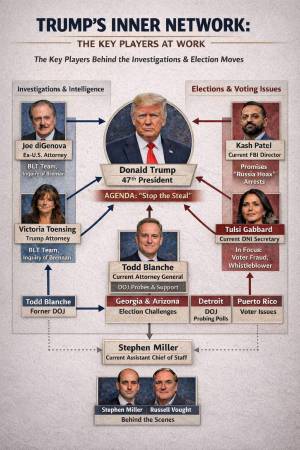 Emptywheel, Analysis and Opinion: Pam Bondi Refused to Appoint Joe DiGenova, Emptywheel (Marcy Wheeler), right, April 28, 2026. The other day, I wrote a post explaining why appointing Joe DiGenova to lead the Grand Conspiracy investigation was wildly inappropriate: in short, because he and Victoria Toensing were investigated for making false claims at a time when they either were, or were hoping to be, paid by foreigners whose ties they did not disclose. They were lying about Russia and Ukraine for the benefit of corrupt Ukrainians.
More On U.S. Politics, Governance, Elections
 Thom Hartmann, right, April 28, 2026. Because when you look at what’s been stopped, delayed, or killed, a clear pattern emerges…The Triad via The Bulwark, Opinion: The $1 Trillion Threat to Democracy on the Horizon, Jonathan V. Last, April 28, 2026. Yay capitalism! Remember Elon Musk? He’s the visionary tech alchemist who managed to create the most valuable automobile company in the world without selling many automobiles and, on the strength of this accomplishment, was allowed to spend several unsupervised months destroying large swaths of the federal government.
More On Royal Visit To DC
More On Epstein Scandals, Coverups
 Then-Attorney Gen. Pam Bondi, center right, joins other Trump administration officials in falsely boasting in February 2025 outside the White House that they had the Epstein Files in their hands and were about to release them.
More On Iran War

April 28, 2026. We haven’t “taken out” anything except free navigation.More On Courts, Crime, Justice, Hurman Rights
U.S. Assassination Attempt Fallout, Politics
President Trump, right, prompts smiles among his cabinet leadership team array to his left along with Vice President Vance and First Lady Melania Trump at a White House press conference following capture of an attacker one floor above the site of the annual White House Correspondents Dinner (Reuters photo by Kylie Cooper April 25, 2026).
U.S. Media, Culture, Religion
 CBS News has ousted London bureau chief Claire Day, right, after she clashed with editor-in-chief Bari Weiss over the network’s coverage of Iran and Gaza, The Post has learned.
Global Markets, Energy, Inflation, Jobs
 April 28, 2026. Time is not on the world economy’s side.
More Global News
Top Stories
King Charles III speaking at the Capitol on Tuesday, April 28, 2026 (New York Times photo by Salwan Georges).
New York Times, Live Updates: King Charles Stresses Cooperation in Speech to Congress, Michael D. Shear, Zolan Kanno-Youngs and Max Bearak, April 28, 2026. The British monarch’s trip is intended in part to repair strained U.S.-British ties. President Trump will host him and Queen Camilla for a state dinner at the White House.
King Charles III on Tuesday delivered an optimistic assessment of American-British relations at what is arguably their lowest point in decades, telling a joint meeting of Congress that the two countries had always found a way to come together.
“The very principle on which your Congress was founded — no taxation without representation — was at once a fundamental disagreement between us, and at the same time a shared democratic value which you inherited from us,” the king said. “Ours is a partnership born out of dispute.”
Charles did not directly reference the current tensions between Prime Minister Keir Starmer and President Trump over the U.S.-Israeli war in Iran. Mr. Trump has repeatedly belittled Mr. Starmer as a coward and mocked British aircraft carriers as nothing more than “toys” compared to America’s military armada.
But the king offered a genteel response of sorts. He noted his own service in the Royal Navy more than a half-century ago and repeated Mr. Starmer’s assertion that Britain had “committed to the biggest sustained increase in defense spending since the Cold War.”
He also pushed back, ever so gently, against Mr. Trump’s angry attacks on Britain and on the NATO alliance for not joining in the Iran war. After the Sept. 11, 2001, attacks, the king told lawmakers, “We answered the call together — as our people have done so for more than a century.”
“Our defense, intelligence and security ties are hard-wired together through relationships measured not in years, but in decades,” he said.
The king’s message to Congress is intended to advance his government’s priorities without ensnaring himself in the ongoing disputes between Mr. Trump and Mr. Starmer.
The king met privately with Mr. Trump earlier in the day, following a formal White House welcome. There was a 21-gun salute at the White House, and the president and the king took part in a ceremony known as reviewing the troops, the highest diplomatic honor that can be extended by the United States to a visiting head of state.
In remarks to officials from both countries, as well as hundreds of spectators, Mr. Trump largely stuck to his prepared remarks. He praised the Anglo-American relationship in lofty terms, describing it as having birthed a “revolution in human freedom” that was “never, ever extinguished, but carried forward across centuries, across oceans and across history, until it became a fire that lit the entire world.”
On Tuesday evening, King Charles and Queen Camilla will attend a banquet in the White House’s State Dining Room. The king hosted a similar dinner for Mr. Trump at Windsor Castle in September.
On Wednesday, the royal couple will leave for events in New York City, including a morning visit to the Sept. 11 memorial and a celebrity-filled gala in the evening. They will conclude their trip to the United States on Thursday with a visit to Arlington National Cemetery and several stops elsewhere in Virginia.
Here’s what else to know:
 The Guardian, Justice department files new criminal charges against ex-FBI director Comey, Sam Levine, April 28, 2026. The justice department filed new criminal charges against James Comey, the former FBI director, on Tuesday, according to a person familiar with the matter.
Comey, shown above in a file photo from his time as FBI director, was charged in federal court in the eastern district of North Carolina over a picture he posted on Instagram while on vacation last year in which sea shells were arranged to say “86 47”.
The post was taken as a threat to Donald Trump. The number 86 can be used as shorthand for getting rid of something, and Trump is the 47th president. Comey subsequently deleted the post and apologized, saying he didn’t realize the numbers were associated with violence. “It never occurred to me, but I oppose violence of any kind so I took the post down,” he wrote on Instagram.
The indictment, made public on Tuesday, says that a reasonable person “would interpret as a serious expression of an intent to do harm to the President of the United States”.
Comey was charged with two felonies – making a threat against the president and transmitting that threat, via social media, across state lines. Both counts are punishable with a fine and a prison sentence of up to five years.
The justice department previously indicted Comey last year and charged him with lying to Congress. That case was dismissed when a judge in the eastern district of Virginia ruled that the prosecutor overseeing the case had been wrongfully appointed.
Comey has long been the subject of Trump’s wrath over his investigation into Trump’s ties to Russia, and Trump allies had called for the former FBI director to be punished. Even though the post was widely seen as a non-violent anti-Trump expression, federal law enforcement officials investigated the matter and interviewed Comey.
The new indictment marks the latest instance in which Trump’s justice department has used its power to target the US president’s political enemies. The justice department also criminally charged Letitia James, the New York attorney general, last year on thin allegations of mortgage fraud. The case was dismissed for the same reason Comey’s earlier case was tossed.
Todd Blanche, the acting attorney general, is said to want the job permanently. He has moved quickly to push forward on investigations and charges related to Trump rivals after the president fired Pam Bondi for not moving aggressively enough.skip past newsletter promotion
The justice department is also accelerating an inquiry into John Brennan, the former CIA director, and last week filed flimsy criminal charges against the Southern Poverty Law Center. A former top aide to Anthony Fauci was also criminally charged on Tuesday over allegations he concealed federal records related to research into the coronavirus in bats.
 Reuters, FCC orders early reviews of Disney-owned ABC stations, Staff Report, April 28, 2026. The Federal Communications Commission on Tuesday ordered early license reviews of eight Disney-owned ABC stations in a major escalation of the Trump administration's battles with U.S.
 media outlets.
The FCC said the reviews, which were not supposed to begin until October 2028, were prompted by a year-long probe on the FCC's ban on unlawful discrimination. The FCC ordered Disney to file its applications for renewals by May 28. The stations are located in Fresno, Los Angeles, Chicago, San Francisco, New York, Philadelphia, Houston and Durham, North Carolina.
 CNBC, ABC faces renewed Trump backlash as Kimmel says comments ‘not, by any stretch’ call for violence, Lillian Rizzo, April 28, 2026. Late night host Jimmy Kimmel, above left, referred to First Lady Melania Trump, above right, as an “expectant widow” during a comedy sketch last week, days before an alleged assassination attempt at the White House Correspondents’ Dinner.
 Kimmel’s show was briefly suspended in September after broadcast station owners threatened to disrupt the program following comments about the killing of conservative activist Charlie Kirk. The renewed challenges fall under freshly installed Disney CEO Josh D’Amaro, who took the helm last month.
President Donald Trump is reviving calls this week for Disney-owned ABC to pull comedian Jimmy Kimmel off the air in yet another test for late night TV during the Republican president’s second term.
While it’s not the first time Kimmel has faced backlash over a show monologue — his show was briefly suspended in September after broadcast station owners threatened to disrupt the program following comments about the killing of conservative activist Charlie Kirk — the renewed challenges now fall under freshly installed Disney CEO Josh D’Amaro, who took the helm last month.
Trump and First Lady Melania Trump called on ABC to fire the late night host after he referred to the First Lady as an “expectant widow” during a comedy sketch last week, days before an alleged assassination attempt at the White House Correspondents’ Dinner.
Melania Trump said in a post on X that Kimmel’s comments were “hateful and violent rhetoric” and “intended to divide our country.” Shortly after, Trump posted on his Truth Social platform that Kimmel’s comments amounted to a “call to violence” and were “far beyond the pale.”
Exclusives
Doomsday Scenario, National Security and Geopolitics Analysis: Is the Justice Department lying about Saturday's "shooting"? Garrett M. Graff, above, April 28, 2026. A central point of the government's case doesn't add up.
There’s a lot to say about Saturday’s “security incident.”
Conspiracies have flown fast and wide since Saturday night’s incident at the White House Correspondents Dinner — there are a lot of online rumors and theories that this was a “false flag” operation. As I wrote Monday, I don’t believe that for a whole variety of reasons, but the more we learn, it does appear that something important isn’t adding up in the government’s story about Saturday.
If you read my quick analysis Sunday morning, you might have seen that I had immediate questions about the number of gunshots — six — we heard on the ballroom audio. It was way more gunshots than had been explained at that point.
Now we might have some answers: A close reading of the Justice Department’s charges Monday afternoon against 31-year-old Cole Allen hint that he didn’t fire any weapon at all.
In fact, it’s not clear from what we know that this was a “shooting” at all.
* * *
Let’s back up a bit first and start with a quick note on terminology: Under normal circumstances, the magnetometers at a presidential event are manned by officers of what’s known as the Secret Service Uniformed Division.
These are not “agents” in common parlance — if you’re a regular reader of this newsletter, these are so-called “1801s,” the government’s street cops. Their primary job is guarding fixed posts at places like the White House and Naval Observatory, patrolling embassies, and acting more as the “police” to support and supplement the Secret Service special agents, the so-called “1811s,” the government’s detectives, who provide the close-in protective details and, more broadly, investigate threats against protectees and financial crimes from counterfeiting to cybercrime. (I wrote a big explainer of 1801s vs. 1811s here.)
At Saturday’s event, attendees have reported that TSA officers were helping run the magnetometers, which is a fairly common supplement, but also probably an indication of how much the Secret Service is overstretched. It’s a very small agency for what it does, with about 3,500 special agents and about 1,500 officers in the uniformed division. (It’s a topic for another column someday, but I think we’re going to learn that a big part of the “laxness” of Saturday’s security is simply how overstretched and overworked the Secret Service is, even before you get into that we’re months into a partial shutdown of DHS. The Secret Service today has around 40 full-time protectees, details that can range from a handful of agents up to the hundreds that protect the sitting president and vice-president. The number of protectees has roughly doubled since the Obama years, while the Secret Service has only added about 300 total agents to its corps. It is desperate for its own hiring surge.)
As of now, we believe the sole person injured by gunfire Saturday night was a uniformed Secret Service officer, who according to an FBI affidavit backing up the criminal charges Monday, also drew his service weapon and returned fire.
In a press conference Monday afternoon, acting attorney general Todd Blanche reported that the Justice Department was charging Cole Allen with three crimes: (1) attempt to assassinate the President of the United States, (2) transportation of a firearm & ammunition in interstate commerce with intent to commit a felony, and (3) discharge of a firearm during a crime of violence:
According to the Justice Department documents, Allen was carrying two firearms at the time: A 12-gauge pump action shotgun and a Rock Island Armory 1911 .38 caliber pistol. There’s no indication he fired or drew the pistol, but the Justice Department is basing that third criminal charge on its theory he fired the shotgun.
The shotgun the FBI says Cole Allen was carrying on Saturday. (FBI photo)
But they don’t appear to have meaningful evidence to back that up — and there’s a lot of public circumstantial evidence to the contrary.
As the New York Times wrote, “Mr. Blanche said investigators believed the suspect fired his weapon because a spent shotgun shell was found inside its chamber, but he noted that more forensic examination would be done to determine exactly what happened.”
Really? After more than 24 hours, the forensic teams of the FBI and Secret Service can’t figure out whether the suspect fired off a shotgun inside the Washington Hilton?
That’s very hard to believe.
We don’t know exactly what kind of ammunition the shotgun was loaded with, but unless he was using some strange custom shell, there would normally be two standard types of shells — a “slug,” a large solid shot primarily used for hunting big game, or buckshot, a shell loaded with somewhere between eight and twenty smaller rounds.Support the Newsletter
Buckshot would be most common and expected.
For those of you who aren’t familiar with the differences between say a handgun, a rifle, and a shotgun, here’s a quote from a “tactical” shooting website reviewing the power of a 12-gauge shotgun like the one Cole Allen was allegedly carrying Saturday: “The 12 gauge shotgun is widely regarded by many to be the top performer with regards to terminal effectiveness in the armed citizen’s arsenal. The go-to anti-personnel load is buckshot, which consists of a shot shell loaded multiple smaller projectiles known as shot. The most common buckshot size used for defensive or tactical applications is 00 (pronounced ‘double-aught’). 00 shot shells generally contain eight or nine .330 caliber projectiles. To put that in context, one pull of the trigger is essentially the same as shooting eight or nine 9mm ball rounds all simultaneously. Buckshot produces some serious wound channels, and there is a reason why many folks regard the ‘stopping power’ of the shotgun as second to none.”
So far, audio analysis by the Wall Street Journal and others seem to indicate there were six shots and Blanche now says the Secret Service officer fired five of those. According to Blanche, the Secret Service officer who was shot was hit in the vest by a single shot — authorities had previously used the word “bullet” to describe what shot him, which is what one would call something fired by a handgun or rifle, not a shotgun.
If Allen fired off a shotgun inside an enclosed space like the single-story terrace lobby of the Washington Hilton, one would expect plenty of evidence of that happening. Buckshot would have peppered a fairly significant area.
In one of the weird comments Blanche made, he said, “When you fire a bullet, the bullet ends up somewhere. Sometimes you find it, sometimes you don’t.” Huh? That might be true if you’re looking for a bullet fired outdoors, but inside a fully enclosed hotel lobby?
Similarly, if the officer was hit by a shotgun burst and taken, say, eight .33-caliber rounds in his vest as opposed to a single bullet, the officer would clearly know the difference and there would be clear evidence on his vest of that impact pattern. And if the suspect had fired a solid shotgun slug, the officer and authorities would clearly — and immediately — know the difference from a typical bullet. Solid slugs come with enormous stopping power and would be what you’d expect to use to try to take down a feral hog or a black bear; if it hit a human at close range, one would expect some serious blunt force injuries, perhaps even fatal blunt force trauma, even if the officer was hit in a bullet-resistant (they’re never really bullet-“proof”!) vest.
FBI Director Kash Patel speaks, alongside Acting Attorney General Todd Blanche and D.C. U.S. Attorney Jeanine Pirro, and Acting FBI Assistant Director Darren Cox, at the Monday’s press conference. (Photo by Tasos Katopodis/Getty Images)
Then there’s the suspicious wording of the charging documents that were released yesterday, which seem to dance carefully around the question of whether the suspect opened fire. It uses a strange passive voice to indicate the gunfire:
“At approximately 8:40 p.m., ALLEN approached a security checkpoint on theTerrace Level of the hotel leading to the location of the dinner. ALLEN approached and ran through the magnetometer holding a long gun. As he did so, U.S. Secret Service personnel assigned to the checkpoint heard a loud gunshot. U.S. Secret Service Officer V.G. was shot once in the chest; Officer V.G. was wearing a ballistic vest at the time. Officer V.G. drew his service weapon and fired multiple times at ALLEN, who fell to the ground and suffered minor injuries but was not shot. ALLEN was subsequently arrested.”
“Personnel assigned to the checkpoint heard a loud gunshot”? Who fired it? Unclear from the charging documents.
That language to me strongly suggests that the Secret Service officer was hit by friendly fire from another officer or agent — presumably the single other unaccounted for shot. Share this Newsletter
There are two more circumstantial things that lead me to doubt that Allen fired any weapons Saturday night.
First, we have the lobby surveillance video posted by the president himself; in the video, Allen runs past the Secret Service magnetometer checkpoint at full sprint. The gunshot by Allen doesn’t take place on the video, nor does he appear to have the shotgun at the ready to fire, which means that if he did fire he would have had — in the presumably mere seconds that follow offscreen before he’s stopped and tackled — to both ready and bring the shotgun to bear and then fire, presumably at close range, at the officer as he approaches, which would have been challenging to do for someone even far more experienced with firearms than Allen appears to be.
Second, there’s also something suspicious in the “dog that didn’t bark” department. While it’s always possible that the Justice Department is moving ahead with a formal indictment that will add more and different charges, in this initial batch of three criminal charges there’s no “assaulting a federal officer” charge like one would expect to see in a case where, you know, someone fired a shotgun into the chest of a Secret Service officer.
It’s not like this administration is shy about what are known as 18 U.S.C. § 111 charges: That’s been the table-stakes charge that every overhyped ICE agent has spent the last six months shouting at anyone who dares to stand in their way — it’s even what Jeanine Pirro, who is prosecuting Allen, used to charge a guy who threw a sandwich at a federal agent. And yet here they’re NOT using it?
Put all of that together and here is what to me is a more likely scenario than what the government is telling us so far:
An agent or officer close to the checkpoint that Allen blows past — perhaps even the one onscreen in the video who turns and draws his weapon at the fast receding Allen — fires once, hits the other officer in the vest, who then “returns” fire at Allen, firing five shots and missing them all.
This scenario also squares more closely with the audio we have of the shooting, which appears to my unofficial ear to have one shot by one gun, followed by five shots in quick succession from a second gun. (And for what it’s worth, none of them sound to me like a shotgun. I’ve heard shotguns fired inside — they’re loud!)
I want to be clear that none of this is informed by any special inside knowledge or leaks from the investigation. However, I would speculate that the FBI and Secret Service have quickly figured out that (a) the suspect never fired at all, (b) that all of the rounds were fired by Secret Service, and (c) that all six of the government’s shots actually missed the running suspect and (d) instead one actually hit the officer who primarily engaged Cole as he ran.
I would guess, too, that Todd Blanche and Kash Patel, both desperate to keep their jobs and please Trump, aren’t ready to say all of that publicly, because it would make the event seem less scary or threatening than it was in reality — and hence the weird dancing around and obfuscations of Monday’s press conference.
If so, that means that the government charged the suspect with a crime — “discharge of a firearm during a crime of violence” — they don’t have meaningful evidence (yet) to back up and perhaps even have direct evidence to refute, which would be an astounding violation of Justice Department standards and norms.
I might be entirely wrong about this, but the total number of shots, lack of other injuries, and strange comments make the story the government is telling — or not telling, as it were — incredibly hard to trust. We will clearly learn more in the days and weeks ahead, but I wouldn’t be surprised to see these charges revised and the third “discharge” charge dropped.
News Roundups
The Parnas Perspective, Morning News and Commentary: Trump DOJ Cites "Trump Derangement Syndrome"in Unhinged Motion, Kimmel Fires Back, Telling Melania to Curb Trump's Rhetoric, and More, Aaron Parnas, right, April 28, 2026. A lot to cover today, including one of the most unhinged motions ever filed by the Department of Justice, a court document that reads less like legal writing and more like something dictated by Donald Trump himself. Meanwhile, Jimmy Kimmel is firing back at the Trumps, telling Melania Trump to have her husband tone down his rhetoric. Abroad, the United Arab Emirates is leaving OPEC in a major shift with global implications, and more.
Meanwhile, I want to provide an update on the AI content that could put my family in danger. Facebook is still refusing to remove the profiles and posts, and this morning even more popped up. I’m going to have to start taking legal action against the people posting this, because fake, AI-generated content about me could endanger me and my family. If it doesn’t come from my account, it’s not from me.
And to everyone who has subscribed to support this work, it truly means the world. Your support isn’t just sustaining this, it’s helping me fight back and build independent media at a time when trust in the press is at an all-time low.
Here’s the news:
Overnight, the Trump DOJ filed one of the most unhinged motions I have ever seen from a government agency in federal court. The filing includes direct personal attacks on the National Trust for Historic Preservation and invokes Barack Obama in a partisan manner, while also praising Donald Trump in unusually personal and self-promotional terms. It further uses the dispute to advocate for a ballroom project, citing questionable claims of bipartisan backing. Several assertions in the motion, including statements about funding, have been disputed or contradicted by available information. The filing has intensified concerns among observers about the erosion of professional norms and the independence of the Department of Justice. Here is part of the filing:
Here is another section of the filing concerning the Trump Derangement Syndrome argument.
Jimmy Kimmel responded to calls for his firing from Donald Trump with a mix of humor and criticism during his monologue. Addressing the controversy, Kimmel said, “You know how sometimes you wake up and the First Lady demands you be fired? We’ve all been there, right? — I agree hateful, violent rhetoric is something we should reject… a great place to start to dial that back would be to talk to your husband.”
The White House Communications Director issued the following response.
Defense Secretary Pete Hegseth and musician Kid Rock took a ride with U.S. Army Apache helicopter pilots as part of a military community relations event. The outing comes weeks after a controversial incident in which Apaches flew over Kid Rock’s home, prompting an investigation that Hegseth later shut down. Pentagon officials said the latest flight was tied to outreach efforts and included interactions with service members and promotional filming. The episode has renewed scrutiny over the military’s involvement in high-profile celebrity-related events.
House Speaker Mike Johnson is facing mounting challenges as internal Republican divisions disrupt the legislative agenda, forcing delays on key votes. Disputes within the GOP over surveillance law reauthorization, immigration funding, and the farm bill have left leadership struggling to secure enough support. Hard-line conservatives are resisting proposed compromises, particularly on surveillance protections and other policy demands. Additional conflicts over farm policy, including pesticide regulations and ethanol provisions, are further complicating efforts to move legislation forward. The infighting has raised concerns about the party’s ability to govern effectively and pass major priorities. Despite the turmoil, Johnson struck a political tone, saying, “I hope voters remember this in the fall. You've gotta keep the grownups in charge, and that's the Republicans.”
A struggling veteran at a food distribution line in New York City describes ongoing financial hardship despite prior military service and access to public assistance. The individual says basic needs like food, childcare, and support for disabilities remain difficult to meet, highlighting gaps in the social safety net. “I’m a veteran. I put my time and my service for my country…Even if you do get public assistance and food stamps, you’re still scraping and heaven help if you’ve got mouths to feed, heaven help if you need childcare, heaven help if you…are disabled,” the person said. The veteran adds that economic inequality has worsened, stating, “There’s only two classes of people now—the poor and the rich…Seems like for every two steps we take forward, we take five steps backwards.”
Federal law enforcement agencies carried out a series of court-authorized raids in Minnesota as part of an ongoing fraud investigation involving Somali-linked cases. Authorities said the operation includes coordination between the Federal Bureau of Investigation and other federal, state, and local partners. Officials emphasized that the raids are unrelated to immigration enforcement. Details about the number of locations targeted and any arrests have not yet been disclosed. The activity represents a significant step in the broader investigation into alleged financial fraud.
Energy experts warn that another spike in oil and gas prices is likely, driven by tightening global supply and ongoing disruptions tied to the Iran conflict. Analysts say messaging from Donald Trump suggesting the war will end soon has temporarily suppressed prices but discouraged producers from increasing output. As a result, markets may face a sharper and more painful price surge when supply shortages become unavoidable. Rising fuel costs are already contributing to higher inflation and could have broader economic and political consequences. While the White House maintains that prices will fall once the conflict ends, many experts caution that the worst impacts may still lie ahead.
 The United Arab Emirates announced it will leave OPEC effective May 1, ending decades of membership in the oil-producing alliance. The move reflects the country’s push to expand its own energy production and pursue a more independent economic and foreign policy. Tensions with Saudi Arabia, particularly over regional influence and competition for investment, have contributed to the decision. The UAE said it plans to increase output gradually while maintaining stability in global energy markets. The departure marks a significant shift in dynamics within OPEC and the broader oil market.
Trump, this morning, claimed that Iran told him it is in a “state of collapse.”
Labor unions and activist groups across the United States are organizing a nationwide “economic blackout” for May Day, urging participants to avoid work, school, and shopping in protest of government policies. Organizers say the movement has expanded significantly, with more than 3,000 actions planned, inspired in part by recent immigration enforcement operations in Minneapolis. The protests aim to highlight concerns over workers’ rights, immigration policies, and economic inequality, while building momentum for broader collective action. Major cities including Los Angeles and Chicago are preparing large-scale participation. Supporters say the effort reflects growing public willingness to use coordinated economic disruption to push for policy changes.
 Wendy Sherman, right, who served under Joe Biden in a senior State Department role, said she believes Benjamin Netanyahu has led the United States into a path that has contributed to a genocide in Gaza. She added that U.S. involvement in this trajectory has played a role in destabilizing the broader Middle East.
Wounded Palestinian children have been evacuated from Gaza to receive medical treatment, arriving at the King Hussein Bridge in Jordan. Images show injured children, including a young girl transported by ambulance, as part of ongoing efforts to move critically wounded civilians out of the conflict zone. The evacuations highlight the severe humanitarian toll of the war and the need for specialized care unavailable in Gaza. The transfer underscores the role of neighboring countries in providing emergency medical assistance amid the crisis.
Elon Musk is set to testify in a high-stakes lawsuit against OpenAI and its leadership, including Sam Altman. Musk alleges the company abandoned its original nonprofit mission and improperly shifted to a for-profit structure, seeking major governance changes and billions in damages. OpenAI and its allies, including Microsoft, reject the claims, arguing the lawsuit is driven by personal grievances and competition. The case could have significant implications for the future of the AI industry, particularly as OpenAI pursues a potential public offering.
Morning Shots via The Bulwark, Political Opinion: Stephen Miller, Where Art Thou? Bill Kristol, Andrew Egger and Jim Swift, April 28, 2026. The president’s gray cardinal recedes into the shadows.
Don’t look now, but there’s still no solution to the crisis in the Strait of Hormuz—and oil prices are once again over $110 a barrel, nearly as high as they’ve been since the war in Iran began. Happy Tuesday.
Trump Team's Attack On American Opponents, Helping Russia

Former Trump attorney Joseph diGenova, center, who has been newly appointed by the Trump Administration to investigate those who showed that his 2016 election victory was assisted by Russians and their American assets, his shown in a Fox News during the first Trump term with diGenova's wife and law partner Victoria Toensnig, right, (who represented a number of accused Russian and Russian-American assets and operatives), and the couple's pro-Trump ally, operative and news commentator John Solomon, at left.
Emptywheel, Analysis and Opinion: Pam Bondi Refused to Appoint Joe DiGenova, Emptywheel (Marcy Wheeler), shown at left, April 28, 2026. The other day, I wrote a post explaining why appointing Joe DiGenova to lead the Grand Conspiracy investigation was wildly inappropriate: in short, because he and Victoria Toensing were investigated for making false claims at a time when they either were, or were hoping to be, paid by foreigners whose ties they did not disclose. They were lying about Russia and Ukraine for the benefit of corrupt Ukrainians.
Since then, Anna Bower, right,and Molly Robertshave done the very tedious work of reviewing to DiGenova’s public statements.
 They describe [at the Lawfare outlet] a number of key confessions from DiGenova:
DiGenova has also been willing to pull back the curtain on the palace intrigue surrounding his recent hiring: Just this month, in an interview with Rudy Giuliani, diGenova claimed that former Attorney General Pam Bondi was “singularly responsible for the delay and investigations into the lawfare against Donald Trump that’s being run out of the…U.S. attorney’s office in Miami and Ft. Pierce.” Saying she had previously nixed his appointment to run the probe, diGenova insisted, “If she had not done that, we would have had indictments brought in the last two months.”
DiGenova further suggested that Bondi had been fired over the president’s frustration with the slow pace of the Miami probe. ”The president’s conversation with her yesterday coming back from the Supreme Court was not pleasant,” he said, referring to the conversation in which Trump reportedly fired Bondi. “The president was ripping mad about the fact that there was no progress on the lawfare investigation in Miami.”
On April 20, the same day he was sworn in, diGenova appeared on WBAL Radio and said the president “personally asked” him to accept the role running what he called “the Russia hoax investigation.” Later—sketching out the Grand Conspiracy in full—he noted “the historical significance of what happened in 2016, 2020 and 2024, where it’s very evident…that there was a very brazen plot against a private citizen, and then a president, and then a post-president, and then a sitting president again, Donald Trump, to deny him his civil rights.”
DiGenova at least claims that:
Trump personally asked him to lead the probe Pam Bondi nixed his appointment Bondi was fired because of perceptions that the investigation was not moving quickly enough
Whether or not those are true (I suspect the precipitating incident that led to Bondi’s firing was the failure to tamp down on the Epstein scandal in her testimony, but it is convenient for the blustery DiGenova to claim it was about him), they are his statements which, as Bower and Roberts lay out, will cause problems for any investigation going forward.
DiGenova’s claim that Bondi nixed the appointment, though, is rather curious. During the attempt to indict Comey on the fly last year, there were reports of Blanche acting like a normal prosecutor, and Bondi getting stuck taking rash steps (like installing Lindsey Halligan) and having to invent justification after the fact.
For the reasons Lawfare lays out, any person hoping to run a successful prosecution, of any of Trump’s adversaries, would object to DiGenova’s appointment, because he’ll open up all sorts of discovery onto vindictive prosecution, leading right into the White House.
And aside from the different positions from which Bondi and Blanche, right, responded to Trump’s apparent request to install DiGenova (Bondi had the job and was trying to keep it, Blanche is in a non-stop audition to get the job permanently), they have different relationships to the reasons why DiGenova is so wildly inappropriate. Bondi defended Trump in impeachment, the risk of which was mitigated when Bill Barr arrested Lev Parnas and Igor Fruman, thereby shutting down incorporation of the Dmitry Firtash scandal. And while Lawfare does not include this detail in their otherwise comprehensive post, Blanche represented Fruman, quietly shepherding Fruman to a guilty verdict in which he only served two months of a one-year sentence.
The Government respectfully writes in response to questions posed by the Court during the sentencing proceeding for Lev Parnas, with respect to whether Igor Fruman had been released from prison. The Government has conferred with the Bureau of Prisons, and understands that Mr. Fruman reported to the Bureau of Prisons for service of his 366-day sentence on March 13, 2022, was transferred to crisis furlough on May 3, 2022, and then transferred to home incarceration beginning May 25, 2022. The latter two assignments were pursuant to the CARES Act.
Blanche, Paul Manafort’s former attorney picking up a client from Manafort’s other attorneys, Thomas Zehnle and Kevin Downing, who bailed Fruman out of jail in EDVA, stuck to the plan of making Fruman a quiet scapegoat.
That should make Blanche’s false claim that he doesn’t know of any conflict all the more alarming.
Asked about diGenova’s past comments at a recent press conference, Acting Attorney General Todd Blanche pushed back. “I’m not sure what the conflict of interest would be,” he said. “Because somebody has said something in the past about a particular matter, that doesn’t create a conflict, necessarily.”
To some extent, Blanche may be right, given that a disqualifying conflict of interest typically involves conflicting loyalties between clients or financial conflicts of interest.
Sure, Blanche may just be quickly granting Trump everything he wants, from dismissing the sedition cases against adjudged terrorists, to paying Mike Flynn millions, to this.
Sure, it’s possible Bondi nixed DiGenova’s appointment because she had to pay the reputational price for the Halligan catastrophe.
But it’s also possible that Bondi recognized how unsuited DiGenova is, and Blanche, because he was on the inside of that defense team, doesn’t care.
Lawfare, The Grand Conspiracy’s New Prosecutor May Be the Case’s Biggest Liability, Anna Bower, right, and Molly Roberts, left, April 27, 2026. Former Trump lawyer Joseph diGenova is one of the most vocal proponents of a conspiracy theory that he
 is now in charge of investigating.Statue depicting the blind scales of justice.
Who better to lead the Grand Conspiracy investigation than one of the country’s grandest conspiracy theorists—or, really, who worse?
The 81-year-old lawyer who represented President Trump’s campaign in challenging the results of the 2020 election was recently dispatched to Southern Florida as counselor to the attorney general. He is entrusted with helming an inquiry into a supposed deep-state plot that encompasses many of his onetime client’s longtime woes: from impeachments to prosecutions to the lost 2020 election, all purportedly a unified effort on the part of Trump’s enemies to violate his constitutional rights and the rights of legions of voters to elect him.
The Grand Conspiracy probe has ramped up in recent days, following the departure of Assistant U.S. Attorney Maria Medetis Long, a respected career prosecutor who, CNN reports, “resisted pressure to quickly bring charges against” former CIA Director John Brennan for lying to Congress. This perjury probe—initially regarded as part of the broader Grand Conspiracy investigation—now appears to have moved to Washington, D.C., presumably because of the lack of jurisdictional hook in Southern Florida. Meanwhile, the rest of the case continues to develop down the coast, including in Ft. Pierce, Florida, where a special grand jury has been empaneled and where the eminently administration-friendly Judge Aileen Cannon presides.
Joseph DiGenova will work on all of the above. The Reagan-era U.S. attorney has become a MAGA media fixture in this century. As part of the gig, he has trumpeted the very narrative he is tasked with turning into a criminal case—and demonized the very people at the center of the investigation in the process.
DiGenova has also been willing to pull back the curtain on the palace intrigue surrounding his recent hiring: Just this month, in an interview with Rudy Giuliani, diGenova claimed that former Attorney General Pam Bondi was “singularly responsible for the delay and investigations into the lawfare against Donald Trump that’s being run out of the…U.S. attorney’s office in Miami and Ft. Pierce.” Saying she had previously nixed his appointment to run the probe, diGenova insisted, “If she had not done that, we would have had indictments brought in the last two months.”
DiGenova further suggested that Bondi had been fired over the president’s frustration with the slow pace of the Miami probe. ”The president’s conversation with her yesterday coming back from the Supreme Court was not pleasant,” he said, referring to the conversation in which Trump reportedly fired Bondi. “The president was ripping mad about the fact that there was no progress on the lawfare investigation in Miami.”
On April 20, the same day he was sworn in, diGenova appeared on WBAL Radio and said the president “personally asked” him to accept the role running what he called “the Russia hoax investigation.” Later—sketching out the Grand Conspiracy in full—he noted “the historical significance of what happened in 2016, 2020 and 2024, where it’s very evident…that there was a very brazen plot against a private citizen, and then a president, and then a post-president, and then a sitting  president again, Donald Trump, to deny him his civil rights.”
These statements are only the latest in a litany of accusations diGenova has lodged against the president’s perceived enemies over the years. The volume and, indeed, the vitriol of his grievances cast real doubt on his ability to act as an independent or impartial prosecutor in the Grand Conspiracy case or any related matter.
The Grand Conspiracy Gospel According to Joseph diGenova
Former FBI Director James Comey and 2016 Democratic Presidential Nominee Hillary Clinton (File Photos)
For the better part of a decade, diGenova has been among the most vocal proponents of the conspiracy theory that he is now in charge of investigating. A review of dozens of hours of audio and video footage of his media appearances reveals how he has spent years constructing a detailed narrative of criminality around a specific group of individuals—repeatedly accusing them of crimes, attacking their character and even demanding their imprisonment.
The precise contours of the Grand Conspiracy can be difficult to distinguish, as one of us recently explained. Exactly who conducted what malign activity and which law it ostensibly violated depends on whom you ask. If you ask diGenova, however, the theory goes something like this: Senior Obama-era officials, led by then-FBI Director James Comey, deliberately bungled the Clinton email investigation out of a desire to clear her path to the presidency. As an “insurance policy” in the event that plan failed, the officials also concocted the tale of Trump-Russia collusion—laundering the salacious Steele Dossier through the U.S. intelligence community to give their story credibility, then using it as a predicate to spy on the Trump campaign and later launch a special counsel investigation by Robert Mueller “unfettered by rules or law.”
DiGenova laid out this view in a 2018 speech at Hillsdale College that reads as a veritable Sermon on the Mount for the MAGA faithful. Over the following years, he has added new chapters to his gospel: insisting, for instance, that the Ukraine impeachment was the real “Big Lie” designed to “nullify” the 2016 election; that the 2020 election was stolen and former cybersecurity chief Chris Krebs should be “drawn and quartered, taken out at dawn and shot” (these words, diGenova later insisted, were “in jest”); that Jack Smith’s indictment over the Mar-a-Lago search was a sham representing “unleashed retributive justice by a Democratic administration that is…on fentanyl with power.”
These allegations line up almost perfectly with the Grand Conspiracy that prosecutors are now understood to be pursuing in Southern Florida as a criminal case. Indeed, diGenova explicitly called for the empanelment of a grand jury in that division last summer on Real America’s Voice, saying, “John Brennan, James Clapper, James Comey, everybody. Lisa Monaco. They'll all be going to Florida. That's where this grand jury is going to be…This conspiracy against President Trump deserves punishment, not just a lecture. People need to go to prison.” On the WBAL Radio episode on which he appeared on the day of his swearing-in, he even cited the Substack of a retired DEA agent that lays out the fantasy in footnoted detail—supplemented by the specific statutes under which the purported perpetrators of the plan could be prosecuted.
Lawyers frequently express opinions and legal analysis in public forums, and doing so is not, in itself, disqualifying from later representing the government in related matters. What sets diGenova apart is not that he commented publicly—it is the nature, specificity, and sustained period of time during which he made those comments. Rather than the careful, conditional language of a legal analyst who understands that facts remain uncertain and that investigation might reveal something other than criminal conduct, diGenova's statements consistently treat the guilt of his now-subjects as already established.
That pattern is troubling enough. But diGenova’s comments have also frequently crossed the line from legal argument into personal attacks on the people he is now tasked with investigating. He has, for example, called former FBI Director James Comey a “dirty cop” who is “committed to himself above all else,” mockingly dubbing him “James ‘Cardinal’ Comey.” Brennan has fared no better, cast variously as an “evil man,” a “very troubled man,” a “traitor,” or simply “nuts.” In one memorable clip, diGenova attributed Brennan's composure in a 2018 media appearance to his having been put “on meds”—his baseline, diGenova explained, being that of a man "flailing away, looking like a madman."
DiGenova’s history of public statements have already raised questions about his ability to seek justice in a fair and disinterested manner. Asked about diGenova’s past comments at a recent press conference, Acting Attorney General Todd Blanche pushed back. “I’m not sure what the conflict of interest would be,” he said. “Because somebody has said something in the past about a particular matter, that doesn’t create a conflict, necessarily.”
To some extent, Blanche, right, may be right, given that a disqualifying conflict of interest typically involves conflicting loyalties between clients or financial conflicts of interest. But if the grand conspiracy case ultimately results in criminal charges, diGenova’s appointment is bound to be a boon for the defense. That’s because diGenova’s statements are useful evidence of unconstitutional prosecutorial animus in the context of a motion to dismiss for selective or vindictive prosecution. Rooted in the Equal Protection Clause and the Due Process Clause, both claims require some showing that the prosecution was motivated by an impermissible purpose—and both are notoriously difficult to prove, given that courts tend to afford a presumption of regularity to prosecutorial decision-making.
DiGenova’s public record goes a long way to helping the defense meet that burden. Not only has he spent years calling for the now-subjects of his investigation to be jailed, but he has suggested that his animus is rooted in those individuals' exercise of First Amendment-protected conduct—namely, their public criticism of Trump, their participation in investigations and impeachment proceedings, and their performance of official duties diGenova that has characterized as “partisan.” That is precisely the kind of impermissible purpose that the selective or vindictive prosecution doctrines are designed to prevent. That his appointment came at Trump's personal request—from a president who has spent years publicly demanding retribution against the very individuals now under investigation—and that diGenova himself complained that the previous attorney general had wrongly delayed indictments he was champing to bring, strips away any pretense that the relevant question was ever whether the evidence supported charges.
DiGenova's public statements may also create problems well before any charges are ever filed. Under the Federal Rules of Criminal Procedure, a court may quash or modify a subpoena “if compliance would be unreasonable or oppressive.” Courts have shown willingness to exercise that power when a subpoena appears to serve an improper purpose, such as harassment or retribution, rather than legitimate investigative ends. Judge James Boasberg made exactly that point in quashing a recent subpoena to the Board of Governors of the Federal Reserve, writing that it would not be “kosher” for a prosecutor to “single[] out an opponent of the President ‘out of malice’ or ‘to harass’ him, including by fishing around for some crime to pin on him.” Any target who receives a subpoena need only point to the record diGenova spent years building—in which he calls for the investigation and imprisonment of specific individuals as vindication for a president who then personally handed him the job following the departure of a career prosecutor and the attorney general—to make exactly that argument.
The Ukrainian Connection
There’s another reason diGenova is uniquely ill-suited to lead this case—or, perhaps in the president’s eyes, uniquely well-suited. The snarled web of the Grand Conspiracy includes the impeachment inquiry over Trump’s incriminating phone call with Ukrainian President Volodymyr Zelensky.
 On this call, remember, Trump asked Zelensky to “do us a favor” and commit to investigating Hunter and Joe Biden in a possible quid pro quo for military aid from the United States. The conversation was the culmination of a monthslong endeavor engineered by Rudy Giuliani to precipitate the Biden-Bursima investigation that Trump ultimately took it upon himself to request directly from Zelensky (as well as to discredit the Mueller probe as a “Witch Hunt”).
DiGenova was part of that operation. Indeed, at one point, amid the Southern District of New York’s investigation of Giuliani for ties to Ukraine, the FBI seized some of diGenova’s wife Victoria Toensing’s data and devices—a move for which diGenova, perhaps providing more fodder for a vindictiveness motion, insisted Christopher Wray would “find himself in front of a federal grand jury.”
 The details of these events boggle the brain similarly to how the Grand Conspiracy itself does—except this time, the events actually took place: A company co-founded by Ukrainian-American businessman Lev Parnas, right, hired Giuliani Partners for $500,000 “to consult on…technologies and provide legal advice on regulatory issues.” (The name of the firm, by the way? “Fraud Guarantee.”) This brief, in practice, meant pushing for the ouster of U.S. ambassador to Ukraine Marie Yovanovich—whom Parnas and his partner, the Belarusian-American Igor Fruman, painted as “unfriendly to the president and his interests.”
Eventually, in spring 2019, these efforts came to encompass regular meetings at the BLT Prime restaurant at the Trump International Hotel, attended by Giuliani, Parnas, Fruman, the conservative reporter John Solomon, and—crucially—diGenova and Toensing. Discussions revolved around how to advance the dirt-digging operation in Ukraine. DiGenova and Toensing were already regulars on the MAGA media circuit at the time; concurrent with these conversations, diGenova made appearances on Fox News smearing Yovanovich.
“This woman needs to be called home to the United States for consultation to answer a slew of questions about her conduct and her assault on the president of the United States,” he said to Sean Hannity on March 20. Two days later, on March 22, he told Laura Ingraham that “the president of the United States deserves an ambassador in Kiev who supports his policies, not someone who bad-mouths him.”
“This has all the markings of bribery and extortion,” he continued, launching into the fabricated narrative in full. “It’s something that deserves a full-blown investigation into the conduct of the Biden family in Ukraine.” DiGenova also mentioned the generation of “false information about [Paul] Manafort, other information that went into the so-called black, black binders.” (The reference to Manafort ties into an involved attempt by Giuliani and his allies to suggest the Mueller report was a frame-up.)
Precisely what diGenova was getting out of this arrangement is unclear. But, as Marcy Wheeler has reported, Toensing was at least discussing the possibility of related payment with Parnas. “I love you and your husband you are the best,” warrants from an eventual Southern District of New York investigation indicate that Parnas texted Toensing after the interview. “We can be really great if we have a retainer signed,” she replied, apparently referencing her attempts to convince Ukrainian prosecutor general Yuriy Lutsenko—whom Giulini et al were diligently working—to agree to compensate the husband and wife duo for advancing his interests with the administration. Such a document appears to have been drafted, but never signed.
What is certain is that diGenova and Toensing did represent the fugitive Ukrainian oligarch Dmitry Firtash, after Parnas and Fruman suggested that they could aid him in the case brought against him by the Justice Department. Firtash told the New York Times he paid diGenova and Toensing $1.2 million for their services, with a finders fee also awarded to Parnas.
Somewhere along the way, another Ukrainian prosecutor for whom diGenova and Toensing also prepared a draft retainer—this time, Lutsenko’s predecessor, Viktor Shokin——produced at the duo’s request an affidavit in support for Firtash for an Austrian court in which he swore he was “forced out because I was leading a wide-ranging corruption probe into Burisma Holdings, a natural gas firm active in Ukraine and Joe Biden’s son, Hunter Biden, was a member of the Board of Directors.” This document mysteriously made it, as so much other privileged information from diGenova and Toensing had a tendency to do, into a column by John Solomon for “The Hill.”
DiGenova and Toensing delivered for Firtash in another essential way: Parnas testified to Congress in 2024 that the two met with then-Attorney General Bill Barr urging him to drop the charges “because Dmitry Firtash was going to help us getting dirt on the Bidens.”
“Someone from the Trump campaign is talking to the Attorney General to drop the charges because this foreign national is helping get dirt on a political candidate?” asked Rep. Ro Khanna (D-Calif.). “Absolutely,” Parnas replied.
Weeks later, when the existence of the whistleblower complaint about the Trump-Zelensky phone call became public, diGenova and Toensing appeared on Sean Hannity’s Fox News show touting the Shokin affidavit without any mention that it was she and her husband who had obtained it. DiGenova also spoke of the whistleblower: “This whistleblower needs to go to prison. He doesn’t need to be feted, he needs to go to prison.”
Director of National Intelligence Tulsi Gabbard just this month issued a criminal referral—apparently unaccompanied by evidence of any crime—for that very whistleblower that, along with the rest of drama surrounding Russia, Ukraine and the president, may well make its way down to Southern Florida as part of the Grand Conspiracy investigation.
All of which is to say: DiGenova has been appointed to investigate a made-up deep-state plot that supposedly involves the wrongful impeachment of President Trump over a phone call with Volodymyr Zelensky in which Trump demanded an investigation into the Bidens and Burisma. This was the very investigation that diGenova not only repeatedly clamored for on conservative television programs—but was paid to help bring about. Now, charged with prosecuting the case, the Grand Conspiracy’s most enthusiastic promoter may turn out to be its most consequential liability.
More On U.S. Politics, Governance, Elections
New York Times, Republicans Brace for Brutal Midterms as Trump’s Popularity Slips, Shane Goldmacher, April 28, 2026. The elections are still six months off, and some within the G.O.P. say there is still time to right the ship.
President Trump’s approval ratings are down. Gas prices are up. Congressional Republicans are heading to the exits in record numbers. And Democratic enthusiasm is cresting.
With a little more than six months until the midterm elections, anxious Republicans are confronting a foreboding political climate that party leaders fear could lead to a wipeout in the fall if it does not improve.
The House is now favored to fall into Democratic hands while control of the Senate — not so long ago seen as a G.O.P. bulwark — is increasingly up for grabs as Democratic candidates up and down the ballot build substantial war chests.
In private, Republican political strategists are grimly trading synonyms to describe the darkening environment: sour, ugly, bad, bleak. They note that much can change before November, holding out hope that the days of $4 gas and the war in Iran pass before the election.
“If the election were in May, Republicans would lose,” said Newt Gingrich, the Republican former House speaker, who urged his party’s leaders to “get reality a little better — and get communications a hell of a lot better” to salvage their majorities this fall.
“The war, the sense of affordability and gasoline — some of that has to be cleared up in order to win,” Mr. Gingrich said. “If it doesn’t change, I’ll start tearing my hair out.”
 Billionaire, Trump-supporting high-tech 'Bros' from left: Jeff Bezo of Amazon.com, the Washington Post and Blue Origin; Elon Musk of SpaceX, Tesla and other companies; Microsoft's Bill Gates; and Mark Zuckerberg of META and Facebook.
The Hartmann Report, Opinion: Why Haven’t Republicans Done Anything to Help Working People in Over 40 Years? Thom Hartmann, right, April 28, 2026. Because when you look at what’s been stopped, delayed, or killed, a clear pattern emerges…
Gallup just found that only 10% of Americans approve of the job Republicans in Congress are doing, with 86% actively disapproving of the GOP’s behavior.
Turns out, there’s a reason.
Yesterday on my nationally syndicated radio/TV/SiriusXM/YouTube program a fellow called to ask how long I’d been running my contest. It started more than 20 years ago, around the time I helped start Air America Radio. Here’s the question:
“Name one piece of major legislation that was created by Republicans since Reagan’s presidency, passed the House and Senate with majority Republican votes, and signed into law by a Republican president, whose major beneficiary is the average working person.”
To this day, nobody’s identified a single piece of major legislation and thus won the autographed book that’s the prize.
Meanwhile, since 1981 Democrats have passed the Family and Medical Leave Act; Earned Income Tax Credit expansions; Children’s Health Insurance Program; Affordable Care Act; Dodd–Frank Wall Street Reform and Consumer Protection Act; American Recovery and Reinvestment Act; Every Student Succeeds Act; American Rescue Plan Act; Infrastructure Investment and Jobs Act; Inflation Reduction Act; PACT Act, and dozens of others.
Which raises the question: Why have Republicans avoided doing anything at all to help average working people for over 40 years?Subscribed
As I lay out in The Hidden History of the Supreme Court and the Betrayal of America, the genesis of the situation goes back to 1974, when William F. Buckley’s millionaire brother and Senator James Buckley joined a lawsuit with former Senator Eugene McCarthy to challenge the Federal Election Campaign Act (FECA, passed in the wake of the Nixon and Agnew bribery scandals) limiting campaign contributions to $1000 from an individual and $50,000 for a candidate self-financing their campaign (as Buckley had done).
Buckley’s suit claimed the money he might want to put into a future campaign was his own and he should be able to use it however he wanted.
Just two years earlier, Nixon had put Lewis Powell (author of the infamous 1971 Powell Memo, which was that era’s Project 2025) on the Supreme Court, and Powell got to working on his colleagues, resulting in the 1976 Buckley v Valeo decision. It echoed Powell’s Memo, saying that money spent on politics was the same thing as “free speech” and thus protected by the First Amendment, blowing up those nasty donation limits.
Two years later, Powell himself authored the 1978 First National Bank v Bellotti decision that doubled-down on the “money is free speech” argument and extended it from humans to corporations as well.
The result was that the 1980 Reagan campaign was suddenly awash in oil industry money, because he’d promised to sabotage Jimmy Carter’s Solar Bank program that would have had America producing 20% of our electricity from solar by the year 2000.
When Clarence Thomas — then himself on the take from rightwing billionaires — became the Court’s deciding vote in Citizens United in 2010, the doors to functionally unlimited campaign and dark money contributions from both billionaires and corporations were blown open.
Which explains the answers to other questions that often come up on my program:
Q. Why do Republicans fight free college and ending student debt when our experience with the GI Bill after WWII found that for every $1 we invest in educating people our nation got $7 in return, as well as making America the science leader of the late 20th century?
A. Because the GOP is on the take from the banking industry, which makes billions in profits from student loans that are almost entirely risk-free because — thanks to legislation signed by George W. Bush — they can’t be discharged by bankruptcy.
Q. Why do Republicans fight every effort to have a national healthcare system like every other democracy in the world has, even though it would save tens of thousands of lives a year, lengthen the average American lifespan, and cost us around half of what we pay for healthcare today?
A. Because the GOP is on the take from the health insurance industry, which makes billions in profits from denying coverage to people, even though 78 million Americans have inadequate or no insurance and a national system would save the country an estimated half-billion dollars a year. As Wendell Potter notes, “In 2024, seven big insurers posted $71.3 billion in profits and paid their [seven] CEOs more than $146 million.”
 The Triad via The Bulwark, Opinion: The $1 Trillion Threat to Democracy on the Horizon, Jonathan V. Last, above, April 28, 2026. Yay capitalism!
1. Elon, Again
Remember Elon Musk? He’s the visionary tech alchemist who managed to create the most valuable automobile company in the world without selling many automobiles and, on the strength of this accomplishment, was allowed to spend several unsupervised months destroying large swaths of the federal government.
This was before he accused the president of the United States of being a pedophile. Then claimed he was leaving the Republican party and starting a new party. Then went back to being friends with the president he said was a pedophile, and supporting Republican candidates and legislation.
And all of this was before auto sales in Musk’s car business fell off a cliff.
Anyway: You might have thought that we had the luxury of forgetting about Elon Musk. That he had shat the bed, blown up his company, and pissed off his political patrons, forever. That he would remain part of the national furniture, but safely removed from the realm of social consequence.
Wrong.
Today we’re going to talk about how Elon Musk fucked up Tesla, how the market has rewarded him for the mistake, and how we are a few weeks away from Musk becoming even wealthier—and more dangerous—than anyone could have feared.
All as we are about to roll into the midterm elections.
America is about to find out what happens when it is home to an illiberal trillionaire.
Get your pitchforks ready.
Tesla has been the most valuable automaker on the planet since 2020. Here is a graph that is very funny:
The punchline, of course, is this graph of sales volume for Tesla (in green) and Toyota (in red): (Courtesy of Bradford Cornell)
Point is: Tesla sells a small fraction of the number of vehicles Toyota sells, yet the market judges Tesla to be many times more valuable than Toyota—and has for six years.
I know what you’re thinking—stock prices are about expected future earnings! But Tesla sales have been crashing. Here are Tesla’s global units sold—line go down?
You might expect that once Tesla sales started trending down the market would have punished the stock. You’d be wrong. Tesla’s sales peaked in 2023 and then started a multi-year decline. Tesla’s stock on the other hand?
For the stock price, 2023 was a trough and it’s grown almost 4x since then! While sales have declined!
Yay capitalism!
Last week Tesla had its quarterly earnings call where it dropped something of a bombshell. For a couple of years Musk has been justifying Tesla’s share price by saying it was no longer in the business of selling automobiles to consumers—it was a nascent robotaxi company that would make money with fully autonomous vehicles. Which were coming soon. Probably tomorrow. Definitely by early next year. Whatever year that might be.
On the earnings call Tesla admitted that it still does not have unsupervised, fully autonomous vehicles in operation—even though its competitors in the robotaxi space do. And also: Exactly none of the vehicles it has sold to this point have hardware capable of unsupervised, fully autonomous operation. Despite what it had previously assured consumers.
Seems bad?¹
Meanwhile, about those consumer sales: From the fourth quarter of 2024 to the first quarter of this year, Tesla was surpassed as an EV automaker by Chinese manufacturer BYD—and Tesla only retook the lead in the first quarter this year because of a drop in BYD’s sales, not because Tesla’s sales rebounded. (The decline in Tesla’s sales last year came even as most brands saw EV sales growth, and its sales in the first quarter this year are up only 6 percent over a year before.) And Tesla is far behind the leader (Waymo) of what it says will be its future core business.
Good thing the Tesla board decided to award Musk a $1 trillion pay package last November before all of this stuff became public.
2. SpaceX
Billionairre Elon Musk accompanies President Trump at the now-notorious Trump presidential campaign rally in Butler, Pennsylvania on Oct. 4, 2024 (New York Times photo by Doug Mills).
The good news for Elon is that he’s already on to the next caper. We are a few weeks away from the IPO for SpaceX, which will be one of the biggest IPOs in the history of stocks.
Let me give you a sense of scale. The record for largest IPO in history is currently held by Saudi Aramco. In 2019 the Kingdom took its state-owned oil and gas business public. It raised $29.4 billion, with an implied valuation of $2 trillion.
SpaceX is shopping around its IPO portfolio and estimates for SpaceX’s implied valuation are between $1.25 trillion and $1.75 trillion.
Here is Matt Levine explaining the SpaceX IPO:
 SpaceX, Elon Musk’s satellite internet, rocket launch, space data center, Mars colonization, frontier AI model and social media company, plans to do an IPO sometime soon, possibly in June. On the one hand, this seems like a complicated job: As I hinted in the previous sentence, it is not easy to describe what SpaceX does, what its guiding philosophy is, how it makes money, what risks it faces, or what businesses it competes in. What are the EBITDA margins on the space data centers? What sorts of contingent liabilities does the Mars colony face? The prospectus — essentially conservative and backward-looking — will not capture the true meaning of SpaceX; presumably it will barely mention the Mars colonies or space data centers, which are at this point entirely hypothetical. The roadshow will mention those, but in a fairly abstract way. It’s not like there are meaningful projections of 2029 space data center revenue.
On the other hand, this is stupid, I’m kidding, and none of this stuff matters for SpaceX. The SpaceX IPO is not really about a private company introducing and explaining itself to the general public. The SpaceX IPO is about Elon Musk Elon Musking the Elon Muskiest of Elon Musk. . . .
Part of what you are getting, when you invest in Elon Musk’s Whole Thing, is exposure to his restlessness. SpaceX was a company founded on the principle that it would be cool to shoot rockets into space.
Musk still believes that, but in the years since SpaceX’s founding he has added many more visions — brain implants, tunnels, artificial superintelligence, data centers, exposing millions of people to his online comedy stylings and political opinions — to his portfolio. (Also he runs a car company.) SpaceX combines many (not all!) of those visions, but today’s portfolio of SpaceX businesses is to some extent accidental. Today I can describe SpaceX as a “satellite internet, rocket launch, space data center, Mars colonization, frontier AI model and social media company,” but it will be somewhat shocking if I can use the same list in April 2027. In 2027 most of those things will still be on the list, but something else, something that would never have occurred to me, will be occupying much of Musk’s and SpaceX’s time and attention. “Humanity’s survival depends on ______,” Musk will say, about this surprising new thing, “and SpaceX is pivoting all of the computing power in its space data centers to solve it.” Space data centers!
Musk’s restlessness fits right in to a vibes-based, dream-selling IPO: He can show up at the roadshow in June and be like “by this time next year the space data centers will be made out of a previously undiscovered element that we will acquire from aliens,” and investors will be like “oh man is he ever selling the dream.” If you’re investing in Musk you want novelty; if the roadshow was just like “satellite internet is a good steady business” you would be disappointed and would not pay 100 times revenue for the stock. . . .
The SpaceX IPO prospectus will be a historical document, capturing Elon Musk’s Whole Thing at a specific moment in time, but everyone understands that, moments later, things will change.
Elon Musk is the living manifestation of late-stage capitalism.
3. Market Failures; Political Failures
Here is another funny thing: Elon Musk is supposedly worth something between $645 billion and $839 billion, depending on whom you ask and how they do the math.
Late last year he managed to get the very serious fiduciaries on the Tesla board to give him a salary package that, with incentives, could pay him up to $1 trillion by 2035.²
But according the prospectus floating around, Musk will own roughly 42 percent of SpaceX. So if the SpaceX IPO gets to $1.75 trillion, then Musk’s share of the company will be about $735 billion—which, added to his existing wealth, will make him the world’s first trillionaire and put him well on his way to minting his second trillion.³
More On Royal Visit To DC

Britain's King Charles III and Queen Camilla wave to the crowds from the balcony of Buckingham Palace after the coronation ceremony in London, Saturday, May 6, 2023 (Associated Press photo by Frank Augstein).
New York Times, White HOUSE Memo: At a Moment of Chaos in Trump’s Washington, the Royals Come to Town, Katie Rogers and Michael D. Shear, April 28, 2026 (print ed.). Presidents use state visits to show off all that is appealing about American culture. But the shooting at the White House correspondents’ dinner has cast a shadow over the visit.
When King Charles III and Queen Camilla of Britain arrived at the White House for a state visit on Monday afternoon, President Trump pointed to a large hole where the East Wing used to be before taking his guests inside for tea and a private audience with the White House beehive.
Presidents use state visits as an occasion to showcase the best of American culture — and, in this case, perhaps, subtly highlight the resilience of a people who, 250 years ago, rose up and wrested themselves from a king’s control.
The shooting over the weekend at the White House correspondents’ dinner has featured the darker side of the United States at a time when Mr. Trump is supposed to be showcasing America’s 250th birthday for the British royalty. For a moment over the weekend, it was unclear if King Charles would travel to Washington at all, before he reassessed and ultimately committed to his plans for a four-day visit to Washington, New York and Virginia.
Threats of violence against public figures in the United States have accelerated so much that administration officials have moved to live in military installations out of fear for their safety. The visit has also highlighted the nature of a president who has opted, time and time again, to show aggression rather than diplomacy when on the world stage.
Shortly before the arrival of the king and queen, Karoline Leavitt, the White House press secretary, took the podium inside the briefing room to admonish Mr. Trump’s enemies for creating “left-wing cult of hatred against the president,” as she fielded questions and assigned blame for the conditions that caused a gunman to rush toward a ballroom where Mr. Trump was scheduled to address members of the Washington news media on Saturday night.
New York Times, King Charles Will Speak of ‘Reconciliation and Renewal’ During Address to Congress, Michael D. Shear, April 28, 2026 (print ed.). The state visit of King Charles III comes at a moment of tension over the war in Iran between President Trump and Prime Minister Keir Starmer.
King Charles III of Britain will acknowledge on Tuesday that his country has had its differences with the United States, but he plans to tell a joint session of Congress that the “two countries have always found ways to come together,” according to a preview of his remarks by Buckingham Palace.
The king’s speech is a centerpiece of his first visit to the former colonies as Britain’s monarch. It comes at a fraught time for the relationship between the two governments, with President Trump mocking Prime Minister Keir Starmer for refusing to join the war in Iran.
But in his speech, the king plans to say that the story of the two countries over the past 250 years has been marked by “reconciliation and renewal,” and has produced what he will call “one of the greatest alliances in human history.”
The king and Queen Camilla began planning for their American trip months before the tensions emerged between Mr. Trump and Mr. Starmer. And British officials and representatives of Buckingham Palace have repeatedly said the king does not get involved in day-to-day politics or foreign policy.
But privately, officials have said they are hopeful that the core message in the king’s speech might help to soothe tensions between the president and the prime minister. The palace said he will argue that shared democratic values are woven deeply into the fabric of both countries.
Palace officials said the king will briefly reference the shooting at the White House correspondents’ dinner on Saturday, offering sympathy to Mr. Trump and those who attended.
More On Epstein Scandals, Coverups

New York Times, Epstein Scandal Looms Over King Charles’s U.S. Visit, Amelia Nierenberg, April 28, 2026. The king is not planning to meet with victims of Jeffrey Epstein during his state visit because of “ongoing police inquiries” in Britain. The king’s brother was close to Mr. Epstein, a convicted sex offender.
The Jeffrey Epstein scandal has ripped through the highest levels of Britain, prompting the firings of two top officials and a rupture in the royal family. Now it looms over the state visit of King Charles III and Queen Camilla.
Mr. Epstein, the convicted sex offender, cultivated ties with political and business elites on multiple continents, including with Andrew Mountbatten-Windsor, the king’s brother. Mr. Mountbatten-Windsor was stripped of his titles over his connections to Mr. Epstein and was arrested this year over accusations of misconduct in public office, after reports that he may have shared confidential information with Mr. Epstein while serving as a British trade envoy. He has denied wrongdoing and has not been charged.
After his brother’s arrest, the king made a rare and direct public statement expressing support for an investigation. Since then, he has limited his public comments on the issue.
The king and queen will not meet with Mr. Epstein’s victims while in the United States, despite a request from Representative Ro Khanna, Democrat of California. Lawyers representing Charles and Camilla said that they were unable to do so because of “ongoing police inquiries” in Britain.
Family members of Virginia Giuffre, a woman who said that Mr. Epstein had trafficked her to Britain and forced her to have sex with Mr. Mountbatten-Windsor in 2001, expressed their frustration. “This is a missed opportunity,” Sky Roberts, Ms. Giuffre’s brother, told Britain’s Sky News.
Ms. Giuffre died by suicide last year before her memoir was published. Over the weekend, her family held a vigil in Washington to observe a year since her death.
“It means something to look into a survivor’s eyes and say: ‘I promise to give you a fair and thorough investigation in  this, and that does not matter if it’s my brother or if it’s other perpetrators out there. I, the King of England, stand with survivors,’” Mr. Roberts added.
The Epstein scandal has also unraveled the career of Peter Mandelson, right, who was fired from his post as Britain’s ambassador to the United States last year after a batch of files showed the depth of his friendship with Mr. Epstein.
Mr. Mandelson was arrested this year over accusations that he had passed on confidential government information to Mr. Epstein in the late 2000s.
 Mr. Mandelson is not accused of sexual misconduct. He remains under investigation but has not been charged with a crime and has denied any criminal wrongdoing.
Prime Minister Keir Starmer of Britain, right, also fired Olly Robbins, the top civil servant in the Foreign Office, after it emerged that the department did not tell ministers that Mr. Mandelson had failed top-level vetting checks before he became ambassador. On Tuesday, during the royal visit, British lawmakers back in London heard testimony from other officials over the Mandelson case.
More On Iran War
New York Times, Trump Is Dissatisfied With Iran’s Plan to Reopen Strait of Hormuz, Tyler Pager and Julian E. Barnes, April 28, 2026 (print ed.). The proposal would have set aside questions about what to do with Iran’s nuclear program.
President Trump has told advisers he is not satisfied with Iran’s latest proposal to reopen the Strait of Hormuz and end the war, according to multiple people briefed on discussions in the White House Situation Room on Monday.
The proposal also called on the United States to end its naval blockade but would have set aside questions about what to do with Iran’s nuclear program, according to U.S. and Iranian officials familiar with details of the negotiations.
Iran has repeatedly rejected American proposals to suspend its nuclear program and hand over its stockpile of highly enriched uranium.
It is not clear precisely why Mr. Trump is not satisfied with the proposal, but he has repeatedly insisted that Iran cannot have nuclear weapons. A U.S. official also said that accepting it could appear to deny Mr. Trump a victory.
The White House declined to comment on Mr. Trump’s thinking, but officials noted that discussions would continue over the war and Tehran’s enrichment efforts.
“The United States will not negotiate through the press — we have been clear about our red lines and the president will only make a deal that’s good for the American people and the world,” Olivia Wales, a White House spokeswoman, said in a statement.
Iran’s proposal to open the strait has been subject to a vigorous debate inside the administration over whether the United States or Iran has more leverage, and which country is better positioned to endure the economic hardship the closure of the waterway has created.
Mr. Trump reviewed the proposal with advisers on Monday after Iran’s foreign minister, Abbas Araghchi, delivered it to Pakistan on Sunday. Mr. Trump rejected another proposal from Iran last week and called off a round of peace talks in Islamabad over the weekend.
U.S. officials say Iran’s leadership has not authorized its negotiators to make concessions on the nuclear deal, frustrating any attempts to forge a compromise or peace agreement.
Mr. Trump has expressed his frustration with Iran and its inability to negotiate with his administration.
“Iran is having a very hard time figuring out who their leader is! They just don’t know!” Mr. Trump wrote on Truth Social on Thursday. “The infighting is between the ‘Hardliners,’ who have been losing BADLY on the battlefield, and the ‘Moderates,’ who are not very moderate at all (but gaining respect!), is CRAZY!”
Delaying nuclear talks could have been a way to reach a quick agreement to ease pressure on global energy and financial markets. But any decision to halt nuclear talks, even temporarily, would be a sign that the war had failed to achieve one major goal: increasing pressure on Tehran to make a deal over its enrichment program.
Talks focused on reopening the strait would be fraught as well. The U.S. blockade has sought to cut off Iran’s ability to export its oil. But Iranian threats to attack ships that fail to pay a toll have drastically reduced other oil traffic.
Iranian officials have insisted that any deal to open the strait should allow them to continue to impose a tax or fee on ships that transit it. Historically, the United States has opposed any such restrictions on freedom of navigation in international waterways or straits, but the Trump administration has sent mixed messages.
At the heart of the debate over whether to accept the Iranian proposal were discussions in the Trump administration about the issue of economic leverage and what further American military operations would be needed to get Tehran to make significant concessions in negotiations, according to U.S. officials.
Some administration officials believe that continuing the blockade for two more months would cause significant long-term damage to Tehran’s energy industry. Oil wells cannot be turned on and off, and they would be damaged if they are forced to shut down, incurring costly repairs. Iran, these officials argue, will make a deal to avoid such long-term problems.
But others in the administration have said the assessment is flawed, noting that Iran’s positions have hardened, and that the Islamic Revolutionary Guards Corps has only solidified its hold on power.
The U.S. government has assessed that Iranian negotiators have not been authorized — either by the supreme leader or by senior Revolutionary Guards officials — to make concessions on the nuclear program. Without a resumption of military action, there is little reason to think the Iranian position will shift.
Even if bombing resumed, there is little evidence that would alter Iran’s decision-making process.
Some administration officials have been skeptical that Iran is ready to make concessions and say making a deal to open the strait is the best way forward.
The Contrarian, Opinion: Words & Phrases, Jennifer Rubin, right, April 28, 2026. We haven’t “taken out” anything except free navigation.
Donald Trump keeps telling us he has wiped out the Iranian regime. “We’ve taken out their navy, we’ve taken out their air force, we’ve taken out their leaders,” he said last week. At various times he has insisted, “Their entire Navy is at the bottom of the Sea,” or claimed, “They have no navy, it’s been knocked out.” As CNN recounted:
The president has said for weeks that Iran had “no navy,” “no military,” “no air force” and “no anti-aircraft systems.” …
“They have no anti-aircraft equipment. Their radar is 100% annihilated,” Trump said. “We are unstoppable as a military force.”
And yet somehow this “sunk” navy last week was able to fire on three vessels, seize two, and maintain the blockade on the Strait of Hormuz. It seems — shocker! — “taken out” does not mean, as the dictionary tells us, “to extract or remove,” it means to leave the enemy potent military assets. And “no” does not mean “none,” but rather “some powerful military equipment able to inflict real harm.” Even the Pentagon has let on that Trump was lying.
“The Islamic Republic of Iran maintains more military capabilities than the White House or Pentagon has publicly admitted, according to multiple U.S. officials with knowledge of intelligence on the matter,” CBS News reported.
“Taken out”? Hardly:
About half of Iran’s stockpile of ballistic missiles and its associated launch systems were still intact as of the start of the ceasefire in early April, three of the officials told CBS News.
Roughly 60% of the naval arm of the Islamic Revolutionary Guard Corps is still in existence, the officials said, including fast-attack speed boats.
That IRGC naval force “built for asymmetrical warfare and equipped with many smaller vessels… [is] hampering oil shipping traffic in the Strait of Hormuz.”
Israel seems to agree on Iran’s missile capacity. “While Israel believes it caused significant damage to Iran’s weapons program, recent estimates by IDF intelligence officers indicated that Iran still possesses around 1,000 ballistic missiles, down from roughly 2,500 at the outset of the war, and will soon recover the ability to start building up its stockpile again,” the Times of Israel reports.
Even worse, Iran inflicted more damage than previously reported on U.S. forces. “American military bases and other equipment in the Persian Gulf region suffered extensive damage from Iranian strikes that is far worse than publicly acknowledged and is expected to cost billions of dollars to repair,” NBC News reported. “The Iranian regime swiftly retaliated after the Trump administration attacked on Feb. 28, hitting dozens of targets across U.S. military bases in seven Middle East countries. Those attacks struck warehouses, command headquarters, aircraft hangars, satellite communications infrastructure, runways, high-end radar systems and dozens of aircraft.”
In other words, not only was regime change a fantasy, but the notion that without incurring any losses we could completely “take out” Iran’s military capacity, leave it defenseless, and ensure the Strait would remain open was balderdash as well.Subscribed
We should not be surprised that Trump vastly exaggerated our military success. He also told us after the 12-day war last June that Iran’s nuclear program was “obliterated,” although he told us in February Iran was on the verge of building a nuclear weapon. Exciting videos made Trump feel better, but they told him (and us) nothing about the considerable military assets Iran retains.
The news gets even worse: The Pentagon briefed Congress that “[i]t could take six months to fully clear the Strait of Hormuz of mines deployed by the Iranian military, and any such operation is unlikely to be carried out until the U.S. war with Iran ends.” And so long as the talks stall, the six months do not begin to run. (Trump insists he is the “least pressured person ever,” meaning he is actually frantic to end this.) Trump’s assertion that Iran was clearing mines was apparently made up out of thin air. Now he threatens to “shoot to kill” any Iranian vehicles laying mines.
The pressure on economies around the world and the damage wrought from elevated oil prices will not disappear anytime soon. To the contrary, as the New York Times reports, “The latest attacks show that Tehran still has a stranglehold on the strait that allows it to ratchet up the pain on the global economy, even though the U.S. military has struck some 13,000 targets in Iran and set up a naval blockade against it.” The report dryly notes that this gives “Iran leverage” in negotiations. Iran, in other words, has plenty of cards and is outmaneuvering and out-negotiating the flummoxed president who can not accept the disaster he caused.
No wonder Iran is holding tight, showing only cursory interest in talks with the U.S. It observes Trump blink (Extend the ceasefire! Say Iran doesn’t know who’s in charge!), and calmly corrects Trump’s ludicrous misinformation. The Iranians understand perfectly well that Trump is trying to mitigate the humiliation by lying about the extent of our military success, exaggerating Iran’s vulnerability, and often feigning no interest in the fate of the Strait.
Trump’s penchant for saying utterly false things to make himself or his followers feel better or to manipulate the markets does not change reality. Rather than figure out which statements are accurate, it is best to assume that virtually everything that comes out of Trump’s mouth is untrue.
Forget words like “taken out” and “no” in reference to Iran’s forces. Iran is the only combatant that has “taken out” anything, namely, the free navigation of the Strait of Hormuz. Thanks to Trump, Iran has a bargaining chip it never possessed: the ability to put a chokehold on oil and thereby wreak havoc on every nation’s economy (except Russia, which is reaping excess profits). And when we use “no” (as in “none” or “not any”), it should be in reference to the unraveling U.S. president: He truly has no idea what to do about a debacle of his own making, and we therefore have absolutely no clear path to achieve any of our strategic aims.
More On Courts, Crime, Justice, Hurman Rights
New York Times, Trump Push to End Key Humanitarian Protection Reaches Supreme Court, Jazmine Ulloa and Miriam Jordan, April 28, 2026. The effort to dismantle Temporary Protected Status, or T.P.S., is part of a shift away from providing humanitarian assistance to people from troubled countries.
For decades, the United States has had a way to swiftly provide temporary legal status to people whose home countries are convulsed by famine, war or other acute humanitarian crises.
Created by Congress in 1990, Temporary Protected Status, or T.P.S., was a signal to a volatile world that the United States was committed to helping people who couldn’t safely return to their countries, and were unlikely to qualify for permanent residency under longstanding international refugee or asylum protections.
But President Trump has been pushing to end T.P.S. for hundreds of thousands of people, and on Wednesday, his administration will ask the Supreme Court to bless that effort, which has faced a succession of legal challenges.
While the termination of T.P.S. for Haiti and Syria will be the question before the justices when they take the bench on Wednesday morning, the stakes are far greater. Already, the president has all but ended the resettlement of refugees, who for decades were admitted by the tens of thousands. The system for weighing asylum claims, long overwhelmed by the number of claims and the lack of resources, has been brought to a near standstill by the administration.
Now, if allowed to effectively end T.P.S., the administration would be taking another step in remaking the role of the United States in the global order, furthering a shift away from programs and ideals that leaders in both parties championed for more than half a century.
Mr. Trump and his allies have argued that humanitarian programs have become dominant pathways for many migrants to enter the country, even though the programs were intended to serve relatively few people. “If you have hundreds of thousands of fake asylum seekers, what happens to the real asylum seekers?” Deputy Secretary of State Christopher Landau told the U.N. General Assembly in September.
Lawyers challenging the administration in court argue the effort to strip away protections for immigrants is fueled by prejudice and politics and is about expanding the pool of people who can be expelled as part of the president’s mass deportation campaign.
“What we’re witnessing right now is the dismantling of humanitarian pathways coupled with the largest de-documentation campaign in modern American history,” said Krish O’Mara Vignarajah, president and chief executive of Global Refuge, a nonprofit serving migrants and refugees.EMr. Trump has slashed refugee admissions to a record-low cap of 7,500 people for the fiscal year that started in October. He has rolled back other humanitarian programs that were created or expanded under his predecessor, and his administration has intensified its efforts to deport asylum seekers to countries where they have no connections. A New York Times investigation has found asylum grant rates have plummeted as the administration has systematically pressured the nation’s immigration judges to support the president’s aggressive enforcement agenda.
The actions, taken together, represent a striking shift away from international commitments that the United States took on in the aftermath of the Holocaust and World War II, and that it incorporated into law in later decades.
U.S. Assassination Attempt Fallout, Politics
President Trump, right, prompts smiles among his cabinet leadership team array to his left along with Vice President Vance and First Lady Melania Trump at a White House press conference following capture of an attacker one floor above the site of the annual White House Correspondents Dinner (Reuters photo by Kylie Cooper April 25, 2026).
MS Now, Opinion: MAGA civility cops’ completely predictable reaction to the WHCD attack, Anthony L. Fisher, April 28, 2026. Based on the accused would-be assassin Cole Tomas Allen’s reported writings before he attempted to storm the White House Correspondents’ Association Dinner, it seems apparent that “politics” in the broadest sense motivated him to try to commit what could have been a history-altering massacre.
But it also seems pretty evident by allegedly deciding to take guns across state lines with murderous intent that he’s a deeply disturbed individual acting irrationally. He appears to have had easy access to guns and, by his own telling, encountered shockingly lax security at almost every juncture leading up to his attempted sprint past relaxed-looking Secret Service agents Saturday night.
There isn’t a single Democratic official or prominent liberal commentator minimizing or making excuses for Allen’s actions or rationalizations for attempting to commit murder — on the contrary, there’s been universal condemnation from that side. Yet that hasn’t stopped the accusations of incitement from the civility cops of the MAGA right, who accuse Democrats of cultivating violence while ignoring — if not celebrating — Trump’s most vicious, inhumane and racist statements.
Morning Shots via The Bulwark, Political Opinion: Where’s Steve? Andrew Egger, April 28, 2026. In yesterday’s newsletter, Bill Kristol warned us all to brace for more attempts by the White House to use Saturday’s dreadful attempted mass shooting at the White House Correspondents’ Dinner to immediately press its political aims. That’s just what we saw yesterday—but perhaps not in the way we’d expected.
In the White House and on Capitol Hill, the response to the attack quickly consolidated into two demands.
All this was very silly. The White House Correspondents’ Dinner is an event hosted by the White House Correspondents’ Association, not the White House; it will not take place on the White House grounds whether Trump gets his ballroom or not. And Kimmel, as he insisted last night on his show, had obviously not been making a call to violence, but a silly age-gap joke about the president’s much younger third wife.¹
But set that aside. Of far greater note than these trifles is what the White House isn’t doing in the wake of the attempt—at least not so far, at least not in public.
Think back to the last big, rallying moment for the right. After the assassination last year of Charlie Kirk, Trump did some of the same things he’s doing today—right down to picking a fight with and about Kimmel. But that wasn’t all. Trump’s government also immediately pledged to launch a whole-of-government mobilization against what it described as the “domestic terrorism” of the political left.
 White House advisor Stephen Miller, above left.
This broad effort had a single architect and public cheerleader: Trump adviser Stephen Miller. In the days after Kirk’s killing, Miller was omnipresent on X and on cable news, where his declarations of war were sweeping, ecstatic, apocalyptic. I wrote at the time:
Last Thursday morning, less than 24 hours after the shooting, Miller tweeted out a thesis statement. “There is an ideology that has steadily been growing in this country,” he wrote, “which hates everything that is good, righteous and beautiful and celebrates everything that is warped, twisted and depraved.” This ideology has “one unifying thread,” he added: “the insatiable thirst for destruction.” . . .
“The last message that Charlie Kirk gave me before he joined his creator in heaven was he said that we have to dismantle and take on the radical left organizations in this country that are fomenting violence,” Miller ranted. “And we are going to do that, under President Trump’s leadership. I don’t care how. It could be a RICO charge, a conspiracy charge, conspiracy against the United States, insurrection. But we are going to do what it takes to dismantle the organizations and the entities that are fomenting riots, that are doxxing, that are trying to inspire terrorism, that are committing acts of wanton violence.”
Miller made a promise: “The power of law enforcement, under President Trump’s leadership, will be used to find you, will be used to take away your money, take away your power, and, if you’ve broken the law, to take away your freedom.”
 You might have expected the latest assassination attempt of the president would have Miller back out there again, pressing his case. But we haven’t been seeing as much of Miller lately, on TV or online. (His last original tweet was more than a week ago, on April 20.) In fact, he’s gone to ground for quite some time. His one big attempt to wage total war against his perceived enemies, the ICE occupation of Minneapolis that culminated in the deaths of two protesters, proved a massive political liability. Miller found himself forced to beat a tactical retreat. He hasn’t abandoned his political goals, but—as the New York Times reported this month—he has found it prudent to let others make the pitch to a country that plainly isn’t buying what he’s trying to sell.
Miller, who remains one of Trump’s most trusted advisers, can obviously still do plenty of damage behind the scenes. But it’s interesting that now that he’s unable to lead the messaging charge himself, the White House’s response to political violence seems in some ways to have collapsed in on itself. Absent (so far) are any disciplined attempts to use the outrage over the attack to deal damage to the left. Instead, the Washington Republican response has followed the contours of the president’s own ridiculous—but far more harmless—obsessions: his personal vanity projects and grievances against one particular TV personality.
In a weird way, the whole thing shows how much better off we are today—from the point of view of the weaponization of the federal government—than we were six months ago. A government where Stephen Miller is playing hurt turns out to be far less dangerous than the alternative.
AROUND THE BULWARK
Quick Hits
GERRYMANDERING TOTAL WAR CONTINUES: Democrats pulled narrowly into the lead in the mid-cycle redistricting wars after Virginia’s gerrymander was approved last week, but the victory may be short-lived. Yesterday, Florida Gov. Ron DeSantis unveiled a new map for his state that could give Republicans as many as four additional House seats in the midterms. The supermajority-Republican Florida legislature enters special session today to consider it.
DeSantis’s gerrymander is both legally and politically risky. It openly defies redistricting standards passed by Florida voters in 2010, which have been used to successfully challenge maps in the past. But the Florida Supreme Court, which is stuffed with DeSantis appointees, has signaled a reluctance to enforce the “Fair Districts” amendments recently against the governor. DeSantis is additionally betting that the U.S. Supreme Court will soon rule against the constitutionality of considering race in redistricting—something he says the current map unacceptably did.
Meanwhile, back in the Old Dominion, Democrats are holding their breath to see if the Virginia Supreme Court will allow their new gerrymander to go into effect. The court, which is considering the question of whether Democratic lawmakers cut procedural corners in hustling the question onto the ballot, heard oral arguments yesterday.
ROUNDUP CRACKUP: The U.S. Supreme Court yesterday heard oral arguments in a suit against the maker of the weedkiller Roundup—a landmark environmental case that has significant political repercussions for the Trump administration, too.
The Court is hearing a case from a Missouri man named John Durnell, who argues that years of Roundup use caused him to develop lymphoma. Bayer, the German conglomerate that purchased Roundup creator Monsanto nearly a decade ago, has argued in court that it should be protected from state-level civil claims over a product that the federal Environmental Protection Agency has ruled is safe to use. A ruling is expected this summer.
The case is fraught for the Trump administration, which joined the lawsuit on Bayer’s side last month—to the outrage of the MAHA wing of the president’s coalition. Understandably, the group united around the conviction that megacorporations are poisoning the environment and the population have well-developed views on whom they support in the fight between the chemical company and the man who accuses it of giving him cancer. If Health and Human Services Secretary Robert F. Kennedy Jr. still shares their concerns, however, he’s keeping it to himself.
Popular Information, Accountability Journalism: Trump blames No Kings for assassination attempt, Rebecca Crosby and Noel Sims, April 28, 2026. On Monday, Cole Tomas Allen, an educator from California, was charged by the Department of Justice (DOJ) for attempting to assassinate President Donald Trump. Allen was apprehended on Saturday night outside of the White House Correspondents’ Dinner, which was attended by Trump and much of his cabinet.
According to law enforcement officials, a note written by Allen said he was targeting most of the Trump administration officials in attendance. The note appeared “to express deep anger at the administration and the president.” In an interview with law enforcement, Allen’s sister reportedly said that he had attended a “No Kings” protest in California.
Trump was asked about the suspect and his motivations during an interview with CBS News’ ‘60 Minutes’ on Sunday. In response, Trump said the “No Kings” protests were to blame. “The reason you have people like that is you have people doing No Kings,” Trump said. “I’m not a king… if I was a king I wouldn’t be dealing with you.”
The truth is that the No Kings rallies have been some of the largest and most peaceful protests in history.
The No Kings movement was created to “oppose the Trump administration’s growing authoritarian actions.” Since Trump’s inauguration in January 2025, there have been three major No Kings events. According to estimates by organizers, the three events had a total of 20 million protesters, with 5 million people attending the first rally in June 2025, 7 million people attending in October 2025, and 8 million people attending the most recent rally in March.
The No Kings movement describes itself as “nonviolent opposition.” In an effort to avoid violence, the organizers have held de-escalation trainings and a session on “non-violent documentation techniques.”
Their efforts have been largely successful. Conflict monitoring group ACLED found that “over 99%” of the protests during the March event were peaceful. ACLED also found that the October 2025 No Kings protests were “essentially entirely peaceful, and police intervened in only a small handful of demonstrations for non-violent offenses.”
An analysis by the Crowd Counting Consortium, a project by the Harvard Kennedy School and the University of Connecticut that collects data on political protests, found that during the June 2025 No Kings rallies, “over 99.5 percent of reported protests had no injuries or property damage.” In October 2025, multiple major cities that hosted No Kings protests, including New York City, Chicago, and Washington, D.C., reported no protest-related arrests.Violence at No Kings, in context
While the No Kings protests have been overwhelmingly peaceful, there have been a handful of violent incidents.
Several of these incidents have involved counter-protesters. In Nashville, for example, a man was arrested for brandishing a weapon during a confrontation with protesters in June 2025. On the same day, a man in Virginia was arrested for intentionally driving his SUV through a group of protesters and hitting at least one person. An armed counter-protester was arrested last month during a Dallas No Kings rally for punching a 71-year-old man. Other assaults on No Kings protestors have occurred, but it is unclear whether the attacks came from counter-protesters.
There has been one death associated with a No Kings rally, which took place in Salt Lake City in June 2025 when a protester was killed by an armed volunteer working with local No Kings organizers. The volunteer saw a man assembling a rifle. Thinking that the man was about to commit a mass shooting, the volunteer fired three times in his direction. A nearby protestor, who was not armed, was struck and killed. The man with the rifle, who was carrying it legally and has not been charged with a crime, was also hit. The volunteer has been charged with manslaughter.
On the same day, there were reported clashes between protesters and police in Los Angeles and Portland, Oregon, when some lingering protestors refused to disperse. LA and Portland also saw further tension between protesters and police at the most recent No Kings rally.
On March 28, 74 demonstrators were arrested outside of an LA Immigration and Customs Enforcement (ICE) facility for failing to disperse. These demonstrators had broken off from the larger No Kings rally that day, which finished hours earlier. Some outside the ICE facility also threw rocks, bottles, and chunks of concrete at federal officers. A similar incident occurred that day in Portland. Three people were arrested at an ICE facility after a group of protestors moved there after the main No Kings protest, which was peaceful, ended. According to the Portland Police Bureau, protesters threw rocks at officers, burned an American flag, and trespassed on the ICE property.Trump’s “day of love”
In comparison to other protests, these violent incidents make up a very small part of how the No Kings rallies have played out. In recent years, other protests with far fewer attendees — in the hundreds or thousands, instead of millions — have resulted in more injuries and property damage.
Trump has described the January 6, 2021, riot at the U.S. Capitol as a “day of love” and said that his supporters acted “patriotically and peacefully.” Yet the January 6 riot caused far more harm than the No Kings protests, despite having just a fraction of the attendance. About 10,000 people were on the Capitol grounds during the riot and the Federal Bureau of Investigation (FBI) estimates that up to 2,500 entered the building. Over 140 police officers were injured by rioters and one officer died shortly after of a stroke. The attack cost the government $2.7 billion, including repairs for property damage and investigations.
Similarly, at the 2017 Unite the Right rally in Charlottesville, Virginia, attendance was in the hundreds, yet dozens were injured and one counter-protester was killed when a self-identified neo-Nazi drove his car into a crowd.
U.S. Media, Culture, Religion
 Tom Cibrowski and Bari Weiss standing on a set of wooden stairs. 6London bureau chief Claire Day is exiting CBS News amid tensions over Middle East coverage,sources said. CBS NewsBari Weiss and Tom Cibrowski standing on a staircase. 6Tom Cibrowski with Bari Weiss (CBS Photo by Michele Crowe).
New York Post, CBS News ousts London bureau chief Claire Day after she clashed with Bari Weiss over Iran, Gaza coverage: sources, Alexandra Steigrad, April 28, 2026 (print ed.). CBS News has ousted London bureau chief Claire Day after she clashed with editor-in-chief Bari Weiss over  the network’s coverage of Iran and Gaza, The Post has learned.
A CBS source told The Post that Shayndi Raice, a newly hired foreign editor from the Wall Street Journal, will lead all international coverage across CBS News and will be based out of London starting May 11.
In a memo to staffers, CBS News president Tom Cibrowski said: “Our London Bureau will be moving to a new editorial leadership structure, with the introduction of a foreign editor role overseeing all international coverage.”
He added that Day, right, who will leave the network on May 1, has been “dedicated to the craft of storytelling” and that “her work made a difference for CBS News.”
Day, who was appointed London bureau chief two years ago and has worked at CBS News for two decades, had clashed with Weiss, a self-proclaimed Zionist, over coverage on Iran and Gaza, a source with knowledge said.
“Claire was pushing back on calls” with Weiss over coverage, the person said, also claiming that “Bari barely spoke to her” to address her issues.
 A second CBS insider added that there was never any kind of blow-up on daily editorial calls, but that Day made it clear that she wanted coverage to be balanced.
“It’s really sad. Claire has been the most committed soldier to CBS News for nearly a quarter of a century,” the source added. “For Bari and Tom to discard her because she failed some undefined purity test is appalling.”
Shayndi Raice, deputy bureau chief for The Wall Street Journal's Middle East and North Africa, smiling while seated at a table. 6
Shayndi Raice, a newly hired foreign editor from the Wall Street Journal, will lead all international coverage across CBS News as its foreign editor. Facebook / Shayndi Rice
A third CBS source lamented the lack of TV and management experience of Day’s replacement.
“The woman who is taking over has no previous television experience and very little managerial experience — certainly on the scale required,” the person said.
Raice, who had been based in Israel, has covered security issues related to the Middle East for the Journal following the Oct. 7, 2023 attacks. Prior to that, she was the WSJ’s Midwest bureau chief and covered tech and finance in San Francisco and New York.
A network source dismissed the idea that Raice lacked managerial experience, citing her four-year stint as deputy bureau chief of the Middle East and North Africa.
Donald Trump in a dark suit and blue tie speaking during a 60 Minutes interview. 6
Norah O’Donnell recently landed a sitdown with President Trump for “60 Minutes” following the shooting at the White House Correspondents’ Dinner. CBSBreaker first reported that Raice would be decamping the Journal for CBS News for a foreign editor role.
All of this comes at a bittersweet time for CBS News, which celebrated a few wins over the weekend in its coverage of Saturday’s shooting at the White House Correspondents’ Dinner where President Trump was set to roast journalists at the Hilton hotel in Washington, DC.
Global Markets, Energy, Inflation, Jobs
Paul Krugman via Substack, Political-Economy Commentary: The Oil Squeeze Tightens, Paul Krugman, right, April 28, 2026. Time is not on the world economy’s side.
Something that is more important than Trump’s ballroom: the ongoing consequences of America’s disastrous war with Iran.
The Strait of Hormuz remains closed. Iran has made a proposal for reopening, but Trump, according to the New York Times, is “dissatisfied” with the plan, among other things because “accepting it could appear to deny Mr. Trump a victory.” Indeed: Claiming victory tends to be hard when you’ve lost, badly.
How long will it take before Trump accepts the reality that he doesn’t have the cards, that in the end his Iran venture will be resolved in a way that leaves Iran stronger and America weaker than before the war? Markets are growing increasingly pessimistic. Here’s the price of Brent crude:
The price drop after the ceasefire was announced has been almost completely reversed. And the longer reality denial lasts, the worse it will get.
As I argued a week ago, ultimately the energy crisis is physical: if the flow of oil from the Persian Gulf remains deeply depressed, at some point there has to be enough “demand destruction” to bring consumption down to match the reduced supply.
That process has barely begun. According to a recent note from Goldman Sachs (no link), here’s what is going on with world oil supply and demand:
Extreme inventory draws. We estimate that 14.5mb/d of Persian Gulf crude production losses are driving global oil inventories to draw at a record 11-12mb/d pace in April.
Translation: So far, despite much higher oil prices, demand for oil has fallen by only a fraction of the loss of supply. Instead, the world economy is running by taking oil out of storage. Since there’s only so much oil in the tanks, this can’t go on. So if the Strait doesn’t reopen, prices will have to soar high enough — and inflict sufficient economic damage — to destroy another 11 or more million barrels a day of demand. That’s a lot.
But Trump is talking about his ballroom.
This may seem weird, but it makes sense if you view it psychologically. Trump is clearly dissociating. His fragile sense of self-worth depends on constantly believing that he’s a winner while others are losers. Now he’s faced with the reality that he, more or less single-handedly, led America to humiliating strategic defeat.
He’s losing on other fronts, too. The fall of Viktor Orban was a big defeat for Trump. So, I’d argue, is the survival of Ukraine, which appears to be gradually gaining the upper hand over Putin’s Russia despite Trump’s attempt to betray our erstwhile ally.
So Trump is coping by tuning out the war he started, focusing on a grandiose, ego-boosting project that lets him assert dominance over servile Republicans and businesses that are footing the bill.
But while he may be done with his war, the war isn’t done with him — or with the world economy. And the longer his fugue state lasts, the worse the damage will get.
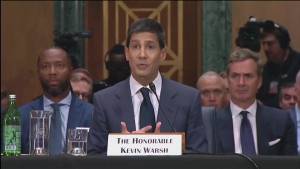 Kevin M. Warsh, at his confirmation hearing to lead the Federal Reserve, sought to dispel doubts that he would yield to President Trump’s demand for lower rates.
New York Times, Transition to a New Fed Chair Is Unlikely to Mean Immediate Rate Cuts, Colby Smith, April 28, 2026. The Federal Reserve is expected to hold interest rates steady this week as Jerome H. Powell presides over what is likely to be his last meeting as chair
This week’s Federal Reserve meeting is set to be Jerome H. Powell’s last as chair of the central bank. But the “wait and see” policy path that he carefully carved out amid resurgent inflation risks is likely to stay intact long after he leaves the top job.
On Wednesday morning, President Trump’s handpicked successor, Kevin M. Warsh, is expected to take a significant step toward becoming the next Fed chair when Republicans on the Senate Banking Committee clear him for a full Senate vote. Hours later, the Fed will announce its latest rate decision, followed by what looks poised to be Mr. Powell’s final news conference as chair.
New leadership at the Fed will not automatically usher in a sea change in the outlook for interest rates, however. Since December, officials have kept them in a range of 3.5 percent to 3.75 percent, much to Mr. Trump’s chagrin. The president wants substantially lower borrowing costs and has made it clear that he expects Mr. Warsh to deliver them.ImageKevin Warsh faces the camera from behind a microphone in a hearing room.Kevin M. Warsh, President Trump’s pick to lead the Fed, is expected to take a big step toward confirmation this week.Credit...Kenny Holston/The New York Times
But Fed policymakers project no urgency to restart rate cuts, and Mr. Warsh has said he did not promise Mr. Trump to ease policy in order to get the job, even as Senate Democrats have questioned whether he would serve as the president’s “sock puppet.” On Wednesday, the Fed is widely expected to hold rates steady again. In fact, traders in financial markets that track the trajectory of rates predict no pivot toward cuts at all this year.
“The path to cutting is one that is much more fraught now than it seemed a few months ago,” said Nathan Sheets, chief economist at Citi and a former official at the Treasury Department.
The Fed’s caution around rate cuts crystallized in the wake of the war with Iran, which is pushing inflation further from the central bank’s 2 percent target while raising the specter of slower economic growth.
A roughly 50 percent jump in oil prices since the start of the war on Feb. 28 has rippled across the economy, lifting gasoline costs, airfares and shipping fees. Soaring fertilizer prices have prompted concerns about rising grocery bills, which would add yet another expense for Americans who have faced higher prices in the last year because of Mr. Trump’s tariffs. The latest Consumer Price Index report showed that annual inflation was 3.3 percent in March, almost a full percentage point higher than the pace in February.
New York Times, United Arab Emirates Says It Will Leave OPEC in Major Move, Vivian Nereim, April 28, 2026. The Gulf government has long complained about the oil cartel’s quotas, which officials believe unfairly limited their exports.
The United Arab Emirates plans to leave OPEC, the oil producers’ cartel, next month, the government said on Tuesday.
Emirati officials had long floated the idea of quitting the cartel, complaining that its quotas had curtailed its oil exports in an unfair manner.
The decision to leave was made in light of the country’s “long-term economic vision” and its desire to speed up investment in its energy production sector, according to a statement published by the Emirati state news agency.
More Global News
Global Faultline, Moscow's Transnistria Land Bridge Shuts Down–Thousands Panic as Moldova ENDS All Russian Ties, Staff Report, April 27, 2026. A dramatic geopolitical shift is unfolding in Eastern Europe as Moldova takes decisive action against Russia’s long-standing presence in Transnistria. Without firing a single shot, Moldova has effectively dismantled one of the Kremlin’s most strategic footholds using legal, economic, and political moves that Moscow can’t easily counter.
 By declaring Russian commanders persona non grata, cutting ties with post-Soviet institutions, and tightening economic control over the region, Moldova has turned Transnistria from a powerful leverage point into a trapped and isolated garrison. Russia now faces a situation where it cannot reinforce, rotate, or effectively command its own forces in the region.
In this video, we break down how Moldova executed this strategy, why Russia may be unable to respond, and how this could reshape NATO’s eastern flank, Ukraine’s security environment, and the balance of power across Europe.
April 27
Top Headlines
 2026. In just eight weeks, much of the global economy has been knocked sideways. America has mostly been spared from the tumult.
Trump, Violence, Democracy

All the devouring and insatiate Monsters imagined since imagination could record itself, are fused in the one realisation, Guillotine. And yet there is not in France, with its rich variety of soil and climate, a blade, a leaf, a root, a sprig, a peppercorn, which will grow to maturity under conditions more certain than those that have produced this horror.
April 27, 2026. Unpacking the system that turns outrage into profit and democracy into collateral damage… News Roundup
April 27, 2026. The White House is calling this weekend’s shooting, along with the lack of DHS funding, a “national emergency.” At the same time, Karoline Leavitt is blaming people who called Trump a “fascist” or a “threat to democracy” for the violence, and Todd Blanche is pointing the finger at the media, even as Trump and Melania are demanding that Jimmy Kimmel be fired.More On Attack At DC Press Gala Featuring Trump
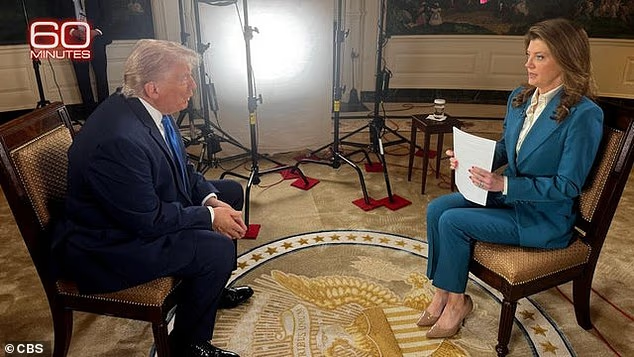
 New York Times, Live Updates: Suspect in Press Gala Shooting to Be Arraigned in Federal Court, Luke Broadwater, Michael M. Grynbaum, Shawn McCreesh, Tyler Pager, Devlin Barrett, Maggie Haberman and Amy Qin, April 27, 2026. Two law enforcement officials identified the suspect as Cole Tomas Allen of Torrance, Calif. Authorities said the suspect appeared to express anger at administration officials and President Trump, who was rushed from the dinner unharmed.April 27, 2026. I should begin with the obvious: I condemn Saturday night’s act of violence at the White House Correspondents’ Dinner, and I am grateful that no one, including President Trump, was killed. Analysis: Jeanine Pirro Did the Same Thing Norah O’Donnell Did, Emptywheel (Marcy Wheeler, Ph.D), right, April 27, 2026. After Trump pretended to be outraged that O’Donnell repeated language that NY Post had already published, Pirro effectively implied he is obviously the person Allen meant when referring to the pedophile, rapist, traitor.
More On U..S. Law, Courts, Crime, Rights, Justice
April 27, 2026. Today Assistant Attorney General Brett A. Shumate of the Department of Justice Civil Division wrote to the lawyer for the National Trust for Historic Preservation demanding that the organization drop its lawsuit against Trump’s planned ballroom on the site where the East Wing of the White House used to be. April 27, 2026. Another radically underqualified Trump appointee is about to bite the dust.Last week, the Justice Department indicted Master Sgt. Gannon Ken Van Dyke for misappropriating classified information to profit on the prediction market Polymarket.
More On Iran War
More On U.S. Foreign Relations
Britain's King Charles III and Queen Camilla wave to the crowds from the balcony of Buckingham Palace after the coronation ceremony in London, Saturday, May 6, 2023 (Associated Press photo by Frank Augstein).
More On U.S. Governance, Politics, Elections

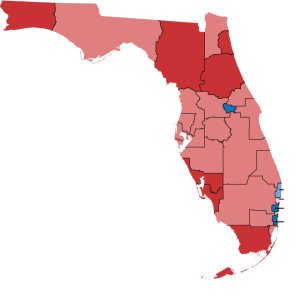 New York Times, DeSantis Proposes Florida House Map That Could Add Four Republican Seats, Patricia Mazzei and Nick Corasaniti, April 27, 2026. The Republican-controlled Legislature is meeting in Tallahassee this week to vote on the map, which would apply for the 2026 midterms if passed.
Top Headlines
New York Times, The U.S. Started the War. The Rest of the World Is Feeling the Effects, Patricia Cohen and Ben Casselman, April 27, 2026. In just eight weeks, much of the global economy has been knocked sideways. America has mostly been spared from the tumult.
The fallout from two months of war in Iran is shuttering textile mills in India and Bangladesh, grounding airplanes in Ireland, Poland and Germany, and prompting energy rationing in Vietnam, South Korea and Thailand. The only country, it seems, that has been relatively spared from the economic chaos is the one that started the war: the United States.
While warning signs of a recession are flashing across countries in Asia and Europe, the United States is likely to outperform most of the world’s advanced economies. Growth is steady and unemployment low. “It’s still hard to bet against the U.S. economy,” the Royal Bank of Canada said last week.
The United Arab Emirates, one of the world’s richest countries, with sovereign wealth funds that total more than $2 trillion, has asked the United States for a financial lifeline in the wake of missile-damaged gas fields and a halt to shipping in the Strait of Hormuz.
In just eight weeks — less time than it takes to age a traditional English fruitcake — the global economic outlook has been knocked sideways.
The worst economic pain will be felt in poor countries, where consumers cannot afford higher energy prices, and governments cannot afford to provide aid to offset the costs. And as financing tightens, the cost of desperately needed borrowing for these countries increases.
New York Times, Live Updates: Defendant in Press Gala Attack Charged With Attempting to Assassinate Trump, Zach Montague, Devlin Barrett, Maggie Haberman, Amy Qin and Katie Rogers, April 27, 2026. The defendant, Cole Tomas Allen, faces two counts of federal gun crimes and one of attempting to assassinate President Trump during the White House correspondents’ dinner.
Here’s the latest.
The Justice Department formally charged a California man with attempting to assassinate President Trump on Monday, two days after investigators said he broke past a security perimeter and fired a gun during the White House correspondents’ dinner in Washington.
The defendant, Cole Tomas Allen, 31, of Torrance, Calif., wore a neon blue jumpsuit for his brief appearance before a federal magistrate in Washington. He appeared calm and quietly answered prompts from the judge, who told him he faced up to life in prison if convicted.
Mr. Allen, who did not enter a plea, came to Washington with a pump-action shotgun, a handgun and three knives with the intent to carry out a political assassination, a federal prosecutor told the judge. Mr. Allen also faces two weapons charges, including discharging a firearm during a crime of violence.
Federal authorities in Los Angeles said that a search warrant was served late Saturday night at Mr. Allen’s home. A note that the authorities said had been written by the defendant appears to express deep anger at the administration and the president. Administration figures were the defendant’s “targets, prioritized from highest-ranking to lowest,” according to a copy of the roughly 1,000-word document, part of which was included in an affidavit unsealed after Mr. Allen’s court appearance.
According to the affidavit, Mr. Allen rushed through a security checkpoint at the Washington Hilton on Saturday night “holding a long gun,” and agents “heard a loud gunshot.” The document says a Secret Service officer, identified by the initials V.G., was shot once in the chest but protected by his bulletproof vest. It does not specify that Mr. Allen fired that shot.
The Secret Service officer who was struck in the chest fired multiple rounds at Mr. Allen, who “fell to the ground and suffered minor injuries but was not shot.”
Karoline Leavitt, the White House press secretary, blamed Democrats and some members of the news media for the violence. She attributed it to a “left-wing cult of hatred against the president and all of those who support him and work for him.”
Here’s what else we’re covering:
The affidavit states that Secret Service officers “heard a loud gunshot.” The affidavit also says that a Secret Service officer, identified only by the initials V.G., was shot once in the chest. The affidavit does not appear to specify that it was Allen who shot the officer.
Jeanine Pirro, the U.S. attorney for the District of Columbia, watched the proceedings from inside the courtroom. Cole Tomas Allen appeared calm, nodding to acknowledge instructions and quietly answering prompts from the judge.
Cole Tomas Allen, the man officials say was arrested in connection with the attack on the White House correspondents’ dinner, has been escorted out and will return in three days to discuss the possibility of release. Tezira Abe, one of Allen’s lawyers, noted he had no prior convictions.
Jocelyn Ballantine, a federal prosecutor, told Magistrate Judge Sharbaugh that Cole Tomas Allen came to Washington with a pump-action shotgun, a pistol and three knives, all with the intent of carrying out a political assassination. The court has set a hearing for Thursday morning to determine whether Allen will be kept in detention. Allen did not enter a plea through his lawyer Tezira Abe.
Trump, Violence, Democracy

Shown above, Oath Keepers leader Stewart Rhodes, convicted at trial of Jan. 6, Trump-inspired Capitol insurrection-related charges, with the Trump-run Justice Department moving this month to dismiss all charges against him and fellow-insurrectists, some of whom are portrayed above in film used as evidence to obtain their convictions before Trump's team freed them all.
French Revolution leader Maximilien de Robespierre is guillotined in the Place de la Révolution, July 28, 1794 (Pictorial Press Image / Alamy). .Joseph-Ignace Guillotin is widely credited with the introduction in 1792 of a clean-death machine, although similar devices had been used previously.
All the devouring and insatiate Monsters imagined since imagination could record itself, are fused in the one realisation, Guillotine. And yet there is not in France, with its rich variety of soil and climate, a blade, a leaf, a root, a sprig, a peppercorn, which will grow to maturity under conditions more certain than those that have produced this horror.
-- Charles Dickens
The Triad via The Bulwark, Political Opinion: Political Violence Breaks Containment, Jonathan V. Last, above, April 27, 2026. This business will get out of control. It will get out of control and we’ll be lucky to live through it.
We have to talk about political violence, again.
Quotation above in bold: That is Dickens describing the origins of the French Revolution. He regards the guillotine as a horror—an abomination—but believed that French society had become so dysfunctional, so disordered, that the abomination became inevitable.
Not justified, but inevitable.
I think about that passage often.
he SPLC shrank away from its aggressive reporting on the right.

Charlottesville "Unite the Right" Torchlight Parade in Virginia on Aug. 12, 2017.
The heart of the Trump project has been mainstreaming political violence. It began in 2016 with Trump imploring his supporters to punch people they disliked. It continued with excusing the “very fine people” who rioted in Charlottesville. Itmorphed into explicit calls for a mob, above, he called into assembly—and which he knew was armed—to march on the Capitol and “take back our country back” and “show strength” and “be strong.”
He later pardoned the members of this mob who had been convicted of violent crimes and even appointed one of them to a position in his administration. He ordered extralegal killings off the coast of Venezuela. His administration has referred to American citizens murdered by his regime as “domestic terrorists.”  He has called his political opponents “vermin” and “enemies of the people” and said they are guilty of “treason.” He celebrates physical assaults on—and the deaths of—people he does not like. He has publicly said he might attempt to strip certain Americans of their citizenship so as to render them stateless.
He threatened genocide against a foreign population.
And then, when the culture of political violence he has willed into being comes for him, Trump is incredulous and aggrieved. As if people were not supposed to notice what he has been doing for a decade. As if violence is supposed to be a one-way street.
It reminds me a bit of the sputtering anger Trump and his supporters voiced after the pope condemned the war in Iran.
Trump and his administration had made a great show of not caring about woke rules of engagement and being alpha lethal warriors who killed without remorse. They published snuff films celebrating death and promised to commit war crimes. Again: The president himself threatened the Iranian people with genocide.
 And then, when the Holy Father, shown above in a Vatican photo, noticed these words and deeds and said, No bueno, Trump and his supporters were outraged.
How dare the pope notice all of the bad things he had said and done!
 It is bad that Cole Tomas Allen, shown in a mug shot at right, attempted to harm people at the WHCD. It is bad that Thomas Matthew Crooks shot at Trump. It is bad that Ryan Wesley Routh planned to assault Trump.
What happened on Saturday wasn’t random or wanton or unexpected. It’s what follows from a world in which political violence is condoned and even encouraged. It will, eventually, break containment.
 This is precisely why liberals warned about the dangers of Trumpism from the very start. Because we understood that saying what Trump has said and doing what Trump has done would have terrible, unpredictable consequences.
Not a blade, a leaf, a root, a sprig, a peppercorn.
Why do we abjure political violence? It is a conditional rejection, not an absolute. The American Revolution was an exercise in political violence; so was the Civil War.
A liberal society rejects political violence because it views violence as an admission of the failure of liberalism.
Which is exactly why the forces of illiberalism revel in it. They understand that the spread of violence is an assault on the liberal order.
Liberalism has not failed completely in America. Not yet. The authoritarian attempt is still in the attempt phase; it has not overthrown the liberal order completely.
We are in a phase of asymmetric struggle in which Trump and his confederates will dole out—or celebrate—political violence, while the forces of liberalism must reject it not only because doing so is morally correct, but because that is the best path to political power.
To give in to political violence is to stipulate that we are in a place like the Revolution or the Civil War. That is not, as of this moment, correct. Pray we never arrive in such a place.
Shown above is on of the Artificial Intelligence-generated fake images created by the Trump Administration to portray President Trump as a brave wartime commander leading troops against domestic and foreign enemies.

President Trump's published self-portraits asserting dominance include those above, with the lower one showing him (when portrayed fully) as dumping excrement on New Yorkers from his warplane perch the cockpit.
Morning Shots via The Bulwark, Political Opinion: No Violence. No Demagoguery. No Kings, William Kristol, Andrew Egger, and Jim Swift. We condemn Saturday’s violence. And we condemn attempts to exploit it.
Trump hasn’t given the order to resume bombing yet, but the ceasefire with Iran seems to be dying a death of a thousand cuts. Hezbollah announced today, per the New York Times, that it will not “relinquish its weapons,” and Israel and the group continue to trade attacks despite the reported terms of the U.S.–Iran ceasefire.
Some quick bookkeeping: Sam and Will Sommer will be going live on YouTube and Substack at 10 a.m. EDT for MAGA Mondays—albeit a bleaker one than usual in the wake of Saturday’s attack at the White House Correspondents’ Dinner. Happy Monday.
The Hartmann Report, Opinion: How the Hate-Industrial Complex Keeps Marching On, Thom Hartmann, right, commentator and author (as shown below right), April 27, 2026. Unpacking the system that turns outrage into profit and democracy into collateral damage…
The attempted shooting at the White House Correspondents’ Association dinner Saturday night shouldn’t surprise us. Not only does America have the world’s most active small-arms industry that essentially controls the GOP (the reporters got a taste of what American — and only American — schoolkids experience every few months from their“realistic” active shooter drills), but we also host the world’s largest and most profitable hate-amplification industry.
Algorithms that amplify hate and division in order to “increase engagement” have made Mark Zuckerberg into one of the richest people on the planet, complete with a super-yacht and a doomsday bunker estate in Hawaii; Elon Musk’s X has turned into a sewer of Nazi-style rhetoric  while Musk himself has posted, according to The Washington Post, nakedly white supremacist slogans and statements over 850 times just in the past seven months.
The Republican Party writ large has also benefitted from all this, since it was reinvented mid-20th century by Nixon’s racist Southern Strategy and Reagan’s embrace of “states’ rights” as the party of Christian white male supremacy. (The last four Black Republicans in the US House of Representatives are ending their political careers this year.)
Because every rightwing movement in history has been founded on hate and/or xenophobia, the openly neo-Confederate MAGA movement was simply the logical end-point of this turn the Party took a half-century ago. History shows that when the right wants to seize power, it reaches for the oldest weapon in politics: teach people to fear and then hate their neighbors, as I lay out in The Hidden History of American Oligarchy.
Finally, the billionaire class and the massive, monopolistic corporations that made them rich benefit from the hate industry because when working-class people are mobilized to hate each other based on race, religion, gender (and gender identity), nationality, or political affiliation they’re far less likely to organize together to demand union rights, benefits, healthcare, education, and/or better wages.
 Some even argue that the current state of GOP corruption, billionaire greed, and societal hate in America proves that democracy has run its course. Oddly, most arguing that are the billionaires themselves, or the lickspittle “dark enlightenment philosophers” they celebrate and fund.
Billionaire Peter Theil famously wrote, “I no longer believe that freedom and democracy are compatible,” and the CEO of his company Palantir recently released an arguably neo-fascist 22-point manifesto claiming that America must resist “the shallow temptation of a vacant and hollow pluralism” and — without a trace of irony about today’s billionaire subculture that’s working to capture our government and crush worker’s movements and unions — that “certain cultures and indeed subcultures” are “regressive and harmful.”
There’s actually a long history for this antidemocratic worldview.
Plato himself argued that democracy would always ultimately lead to tyranny because democratic rule could so easily be co-opted by authoritarians using the tools of democracy itself. Karl Popper rebutted this extensively in 1945, arguing that democracies must become “intolerant of intolerance,” essentially putting limits (like the German people have done for themselves) on “free speech” when that speech is being used to undermine and ultimately destroy a democracy.
The European option would run afoul of our First Amendment, so America must come up with a different way to deal with the hate-industrial complex. There are a few options.
While corporations will argue that they are “persons” protected by the First Amendment (an argument I rebut extensively in my new book Who Killed the American Dream: The Greatest Political Crime Ever Told) and will say that their algorithms that favor outrage, hate, and division are merely corporate “free speech,” it should still be possible to regulate these bits of computer code.
I’m not proposing that people lose their right to speak online. The real issue is whether giant social media corporations should have the unlimited right to use their top-secret algorithms to pour gasoline on hate, racism, antisemitism, homophobia, misogyny, and political violence just because outrage keeps people clicking and that drives engagement/ad-views and thus profits.
That’s not free speech in any meaningful human sense: it’s just a democracy-destroying business model.
Thus, one obvious reform is to separate hosting speech from amplifying it. If somebody wants to post something vile but lawful, that’s allowed under the First Amendment. But when a corporation’s software algorithm identifies that vile content as profit-promoting and shoves it into millions of feeds, that’s no longer passive hosting: it’s active promotion. And active promotion can be regulated.
Another fix is to require transparency. Make these companies openly disclose what their algorithms reward. Do they boost rage reactions, conspiracy content, fear, tribal conflict, and endless doom-scrolling just because it increases ad revenue for their billionaire owners? Let independent researchers audit the systems so the public can see whether hate is being engineered for profit behind the curtain and use public shame to discourage it.
And finally, give social media users real choice. Break up the social media monopolies. Require a simple chronological feed, for example, and an easy opt-out from manipulation-based recommendations, along with a legal duty of care when platforms knowingly drive people toward extremism or violence.
You still get free speech; what corporations lose is the right to use the invisible part of their machines to poison our minds, our children’s minds, and our democracy for money.
None of this deals with the problem of rightwing billionaires acquiring massive media platforms and then requiring their employees to also spin the news in ways that are anti-democracy and pro-billionaire.
But reversing Reagan’s 1983 decision to largely abandon our anti-trust laws and his 1987 decision to abandon the Fairness Doctrine could go a long way toward mitigating the damage Australian-billionaire-owned Fox “News” and others have done to America.
Combine these steps with rational gun control and a re-commitment to teaching civics and critical thinking (as several European countries have done and we did before Reagan gutted federal education spending) and there’s a good chance America can rise again from the ashes of the hate and violence that today’s conservative movement and billionaire subculture have imposed on us.
The choice before us is stark. We can continue letting rightwing billionaires, monopolists, gun merchants, and hate-profiteers pit Americans against each other while they strip wealth and power from working people, or we can remember the oldest lesson of democracy: when ordinary people refuse to be divided, no oligarch or billionaire can stand against them.
News Roundup
The Parnas Perspective, Afternoon News and Commentary: White House Calls Moment “NATIONAL EMERGENCY” and BLASTS Americans Who Call Trump FASCIST, Major Epstein Lawsuit, Aaron Parnas, right, April 27, 2026. The White House is calling this weekend’s shooting, along with the lack of DHS funding, a “national emergency.” At the same time, Karoline Leavitt is blaming people who called Trump a “fascist” or a “threat to democracy” for the violence, and Todd Blanche is pointing the finger at the media, even as Trump and Melania are demanding that Jimmy Kimmel be fired.
This is exactly why I keep saying we should never normalize the president’s rhetoric. Just days after a shooting, we are right back to divisive attacks on Americans and on the press. That is why I boycotted the White House Correspondents’ Dinner, and why I will boycott the next one as well. I will continue to support and celebrate independent media instead.
I also want to update you from this morning. I am in contact with several social media platforms and working on a legal strategy following the spread of AI-generated images this morning that falsely tied me to the suspect. It has been a scary time truthfully, as just one person could believe it and immediately be a threat to me and my family. Thank you to everyone who has subscribed, reached out, and shown support. There are people who want me to stop this work. I will not. Subscribe if you can, and let’s continue fighting back in the face of these threats.Subscribed
Here’s the news:
The White House is urging Congress to quickly fund the Department of Homeland Security, calling the situation a “national emergency” after the recent attempted assassination at the White House Correspondents’ Dinner. President Trump is pushing Republicans to unite and pass a budget plan to fund immigration enforcement agencies by June 1, while warning of growing security risks as DHS faces a prolonged funding shortfall. Officials say the agency could soon run out of money to pay employees, adding urgency to the standoff with Democrats over immigration policy conditions. The incident has intensified concerns about security preparedness for upcoming major events and increased pressure on lawmakers to act.
Karoline Leavitt blamed critics of Trump for contributing to the shooting, arguing that rhetoric labeling him a fascist or threat to democracy fuels political violence. She said such comparisons, including to Hitler, encourage hostility and claimed a broader “left-wing” climate of hatred has led to people being harmed.
Todd Blanche criticized media coverage of the president, arguing that harsh and unsubstantiated criticism contributes to a climate of hostile rhetoric. He said journalists who frequently use negative labels are “just as guilty” as online commentators, adding, “Many people in this room have done it as well. They’re just as guilty as a lot of people on X. When you have reporters, when you have media just being overly critical and calling the president horrible names for no reason and without evidence, it shouldn’t surprise us that this type of rhetoric takes place.”
Meanwhile, this is what the President of the United States said following the death of Robert Mueller:
A lawsuit has been filed against Acting Attorney General Todd Blanche, accusing the Justice Department of failing to fully release documents related to Jeffrey Epstein as required by the Epstein Files Transparency Act. The plaintiff argues that missing documents and unexplained redactions violate the law and hinder journalists’ ability to report accurately. Although the DOJ claims it has released all appropriate materials, millions of documents may still be withheld, raising concerns about transparency. The lawsuit seeks full disclosure, clearer explanations for redactions, and oversight to ensure compliance. I interviewed Katie Phang, who filed the lawsuit, here:
The National Trust for Historic Preservation said it will continue its lawsuit to block construction of a proposed White House ballroom, despite pressure from the Justice Department to drop the case. The DOJ argues the lawsuit poses security risks, while the White House says the ballroom is critical for safely hosting large gatherings of top government officials.
A report based on leaked lectures claims tech billionaire Peter Thiel described Pope Leo XIV as a potential “Antichrist” figure and urged JD Vance to ignore the pope’s moral guidance. The remarks reflect a broader worldview in which Thiel emphasizes technology and innovation over traditional religious authority. The article highlights concerns about Thiel’s influence on Vance, given his role as a major political backer. It also suggests these ideas signal a growing intersection of Silicon Valley ideology, politics, and unconventional religious beliefs.
Donald Trump demanded the firing of Jimmy Kimmel, shown above, today. Melania Trump did too.
Cole Tomas Allen appeared in court after allegedly opening fire outside the White House Correspondents’ Dinner and was charged with attempting to assassinate the president, along with two additional firearm-related offenses. Prosecutors say he brought multiple weapons and sent a note beforehand claiming it was his duty to target Trump administration officials. Law enforcement exchanged gunfire with him before subduing and arresting him, while a Secret Service officer was injured but later released.
A newly revealed note shows the suspect apologized to his family before the attack and said he was motivated by strong opposition to the Trump administration. He indicated he planned the shooting in advance and chose to use buckshot in an effort to reduce civilian casualties.
Officials said key details about the shooting are still under investigation, including whether the gunman fired shots, how many were fired, and whose bullet struck the agent. When asked, Blanche responded, “We’re still looking at that.”
Florida Gov. Ron DeSantis has proposed a new congressional map that could create four additional Republican-leaning seats, potentially shifting the state’s delegation from 20-8 to 24-4 in favor of the GOP. The plan is controversial, with critics arguing it may violate the state’s anti-gerrymandering rules and show clear partisan intent. Even some Republicans worry the changes could backfire by making districts more competitive and putting incumbents at risk in upcoming elections. The proposal is expected to face legal challenges and could ultimately be decided by the state Supreme Court. This is the new map:
Between the AI this morning and a recent threat to myself and my family, a lot has been going on. It was real, it was scary, but thankfully, I was able to make sure I protected myself. With a newborn in tow, making sure that my family is protected is top of mind. And reporting on the topics that I do often lend credence to threats, like the one I received recently to my inbox. It’s why I am continuing my partnership with DeleteMe. For many months DeleteMe has helped protect my personal information and remove it from data broker websites. Now with threats even greater, I know DeleteMe has my back and I want you to protect yourself too. You can use my code AARON at this link to protect yourself and your loved ones this year.
Kid Rock reportedly flew to Fort Belvoir and took a ride in two Apache helicopters with War Secretary Pete Hegseth, according to Army sources and flight data. The helicopters were flown with only one pilot each so both men could ride in the front seats. Apaches are not normally stationed at Fort Belvoir, raising questions about their origin. Base officials declined to comment and referred inquiries to the secretary’s office.
After the White House Correspondents’ Dinner was disrupted, the Washington Hilton donated about 2,600 unused meals to shelters for abused women and children. The food—steak and lobster—was freeze-dried to extend its shelf life before distribution. The gesture also highlighted appreciation for staff who worked overnight under difficult circumstances.
Mark Carney said that Canada’s historically close relationship with the U.S. has shifted from a strength to a vulnerability as American policies change. He emphasized that while the U.S. has the right to change course, Canada is adapting by strengthening ties with other allies. As he put it, “Many of our former strengths, built on our close ties to the US, have become weaknesses. The US has changed. That’s their right. And we’re responding ... we’re deepening our partnerships with our closest allies, including the EU, the Nordic countries, and Australia.”
Contractors working to repave the 17th Street entrance to the White House and Blair House ran out of asphalt just before the expected arrival of King Charles. The rushed construction is part of the longer-term Pennsylvania Avenue West Project. With the visit imminent, the incomplete work highlights last-minute preparations for the high-profile guest.
House Speaker Mike Johnson said the Senate-passed Homeland Security funding bill contains “problematic” provisions and will need changes before it can pass the House, particularly over how immigration enforcement agencies are funded. The disagreement highlights divisions among Republicans and could delay funding further, even as officials warn about security risks following the recent White House Correspondents’ Dinner shooting. Johnson also called for stronger Secret Service protocols, saying security at the event appeared insufficient and needs to be “tightened up.” Meanwhile, some lawmakers are pushing for immediate action on DHS funding and broader reviews of security measures for high-profile events.

President Trump leads a press briefing at the White House accompanied by FBI Director Kash Patel and other officials following a report of a shooter outside the hotel hosting the annual White House Correspondents Dinner on April 25, 2026.
The Parnas Perspective, Morning News and Commentary: White House Blame Game Escalates With Top Officials at Risk, Epstein Survivors Call Trump's Bluff, and I Need Your Help, Aaron Parnas, right, April 27, 2026. We are tracking major developments on multiple fronts, from critical Epstein-related news tied to King Charles’ visit to Washington, D.C., to a serious and escalating blame game inside the White House, where Chief of Staff Susie Wiles is facing intense pressure over her oversight of the Secret Service. At the same time, new details are emerging about Iran, with negotiations stalled and no clear path forward.
I also need to address something deeply concerning that unfolded overnight. I woke up to a flood of messages and videos asking about a claim that the suspect in the White House Correspondents’ Dinner shooting was a former employee of mine. That is completely untrue. These claims appear to be driven by AI-generated content that originated on Facebook and is now spreading across platforms by bad actors. This is not just misinformation. It is dangerous, and if the wrong person believes it, it could lead to serious threats to me and my family.
Some people say this kind of attack means the work is having an impact. That may be true, but the narratives being pushed right now put me and my family at risk. I am actively exploring legal options. Many of you have asked how you can support my work and help ensure I have the resources to respond. The most effective way is to subscribe, gift a subscription, or upgrade your current plan.
Here’s the news:
King Charles III is set to receive a formal welcome in Washington, D.C., but has declined to meet with survivors who had requested an audience. At the same time, survivors connected to the Jeffrey Epstein case gathered for a vigil honoring Virginia Giuffre, marking one year since her death, while expressing frustration with the United States Department of Justice for urging them to speak again with the Federal Bureau of Investigation instead of releasing existing files they’ve long sought.
After the shooting at the White House Correspondents’ Dinner, Republicans quickly blamed Democrats’ rhetoric for contributing to political violence, echoing arguments previously made after past threats against Donald Trump. There is no truth to this, however. Democrats condemned the attack and rejected the violence, calling for unity and emphasizing that violence is unacceptable regardless of political affiliation. The incident has intensified partisan tensions, with Republicans using it to push policy goals like increased Department of Homeland Security funding, while Democrats accuse them of politicizing the event.
Susie Wiles is under intense scrutiny inside the White House following the security breach at the White House Correspondents’ Dinner, with a widening internal blame game raising questions about her future. Although she has convened urgent meetings and ordered a full review of security failures, sources say some officials are quietly discussing whether she could be fired as pressure mounts to hold someone accountable.
The tension is fueled by disputes over leadership decisions, including her oversight of the Secret Service and the controversial appointment of its current director, with some insiders arguing she should bear responsibility while others deflect blame elsewhere. Reports also suggest attempts to shift responsibility onto other figures, including members of Donald Trump’s inner circle, underscoring deep infighting and uncertainty within the administration as officials scramble to contain fallout from the incident.
Kash Patel praised Donald Trump on Fox & Friends, highlighting his “courage under fire” and calling his law enforcement team the best he has seen. The remarks come as pressure mounts inside the administration following recent security failures. His strong endorsement appears aimed at reinforcing loyalty to Trump amid internal tensions. It also suggests he may be trying to protect his position as scrutiny and potential shakeups grow.
Donald Trump has promoted a proposal to rebrand Immigration and Customs Enforcement as “NICE,” amplifying a supporter’s suggestion aimed at softening the agency’s public image. The idea comes amid backlash over aggressive immigration enforcement and controversial incidents, including fatal shootings during protests, which have damaged ICE’s reputation. Critics have mocked the rebranding effort as superficial and out of touch.
Donald Trump shares a MAGA supporter's post.
Epstein survivors called the DOJ’s bluff:
Donald Trump said, “The internet, I think maybe more than anything else, it’s radicalized some people. It’s made people mentally sick,” blaming online platforms for contributing to extremism and mental health issues.
A Florida resident described the harsh reality of rising costs and limited access to care, saying, “I struggle everyday and now I’m taking care of my mom who’s older and denied [insurance] simple simple things like breathing meds…so I don’t eat this week because I have to take mom to the doctors tomorrow…so you decide what’s more important…you’ve got to make tough choices and tough choices today is tough for anybody, whether you’re from this country or not.” The statement highlights the difficult trade-offs many families face between basic needs and medical care.
According to Politico, Todd Blanche could remain in charge of the United States Department of Justice for months without Senate confirmation due to legal loopholes that allow extended acting appointments. While Donald Trump has not yet decided whether to formally nominate him, Blanche is seen as a leading contender and could continue in the role even if a nomination stalls. The situation has raised legal and political concerns, with experts divided on whether such an extended tenure without confirmation would be lawful.
Mike Johnson is facing an extraordinarily difficult week in Congress, juggling multiple high-stakes battles including surveillance law renewal, immigration funding, and a contentious farm bill, all amid deep divisions within his own party. The recent White House Correspondents’ Dinner shooting has added urgency to security and DHS funding debates, while also complicating negotiations. With internal GOP rebellions, tight deadlines, and even scheduling disruptions from King Charles III’s visit, Johnson’s ability to pass key legislation remains uncertain.
New reporting from the Guardian suggests that Iran has proposed ending its control over the Strait of Hormuz but is not offering concessions on its nuclear program, according to regional officials. In return, it wants the United States to lift its blockade, with the proposal reportedly passed through Pakistan. The move comes as Iran’s foreign minister consults with Russia amid ongoing conflict involving Israel and the U.S. However, President Donald Trump is unlikely to accept the deal, as he insists any agreement must also address Iran’s nuclear ambitions.
Donald Trump is expected to meet with his top national security advisors to discuss next steps in the Iran conflict as negotiations have stalled, with Iran blaming the U.S. for the failure of recent talks in Pakistan. The meeting will address how to proceed after diplomacy reached an impasse, while U.S. officials say Iran’s latest proposal falls short of Washington’s core demands, leaving the situation unresolved.
Iran’s Foreign Minister, Abbas Araghchi, met with Vladimir Putin to discuss strengthening coordination between Iran and Russia. The talks come as both countries deepen military cooperation, including supplying drones and sharing intelligence. This collaboration has supported their respective conflicts in Europe and the Middle East. The meeting signals a growing strategic alignment between the two nations.
German Chancellor Friedrich Merz criticized the United States’ approach to the Iran conflict, saying he sees no clear exit strategy and warning that Iran’s leadership, particularly the Revolutionary Guards, is humiliating opponents. He said Iran appears to be negotiating skillfully and is stronger than previously believed, raising concerns about how the conflict is unfolding. Merz also emphasized the urgency of ending the war, citing its direct negative impact on Germany’s economy.
The Trump administration abruptly fired all 22 members of the National Science Board, which oversees the National Science Foundation, without providing a reason. The move is unprecedented, as board members typically serve staggered six-year terms, and critics warn it could undermine independent scientific guidance in the U.S. It follows a broader pattern of dismissing scientific advisory groups and proposed cuts to science funding under Donald Trump’s administration. Scientists and lawmakers have raised concerns about increased political interference and the future direction of U.S. science policy.
The Supreme Court of the United States is set to consider whether police can use broad “geofence warrants” to access cellphone location data from companies like Google during investigations, a case that could reshape digital privacy rights. The issue stems from a bank robbery case where such data helped identify a suspect, raising questions about whether this practice violates the Fourth Amendment’s protections against unreasonable searches. Supporters argue the data is voluntarily shared with tech companies, while critics say the sweeping nature of these warrants amounts to unconstitutional mass surveillance. The court’s decision could have far-reaching implications for law enforcement access to personal digital information.
The Supreme Court of the United States is also set to hear a major case that could eliminate thousands of lawsuits against Bayer over claims that its Roundup weedkiller causes cancer. The company argues that federal regulators like the Environmental Protection Agency have already deemed the product safe, which should override state-level claims. The Donald Trump administration has backed Bayer in the case, a move that could significantly limit corporate liability if the court rules in its favor.
United CEO Scott Kirby confirmed he approached American Airlines about a merger aimed at expanding routes, boosting jobs, and adding perks like Starlink Wi-Fi. However, American’s CEO Robert Isom rejected the proposal as harmful to competition and consumers. The plan ultimately collapsed without a deal, reportedly amid White House discussions and opposition from Donald Trump. The failed effort leaves the two airlines continuing as major rivals.
More On Attack At DC Press Gala Featuring Trump
Politico, Trump lashes out at ‘60 Minutes’ anchor for reading alleged gunman’s manifesto, Eli Stokols, April 27, 2026 (print ed.). Any detente between the president and the press after the shared horror of Saturday’s dinner appears to be short-lived.
 President Donald Trump lashed out at CBS News’ Norah O’Donnell in an interview Sunday (shown above) for quoting from the manifesto of the suspected gunman who tried to storm the White House Correspondents Dinner less than 24 hours earlier.
Trump had initially expressed a sense of camaraderie with members of the press corps who hosted him at their annual dinner and experienced the same initial panic when armed law enforcement agents stormed into the ballroom.
But when O’Donnell, during an interview recorded at the White House on Sunday, quoted from the accused gunman Cole Allen’s apparent manifesto — “I am no longer willing to permit a pedophile, rapist, and traitor to coat my hands with his crimes,” she read — Trump, who’d been relatively subdued in his responses, flashed a familiar anger.
“I was waiting for you to read that because I knew you would, because you’re horrible people. Horrible people,” Trump said. “Yeah, he did write that. I’m not a rapist. I didn’t rape anybody.”
O’Donnell interjected, “Oh, do you think he was referring to you?”
But the president blew past her question, declaring, “I’m not a pedophile.”
Trump bristled at what he seemed to deem an insinuation about his relationship with Jeffrey Epstein, who was not mentioned by name in the manifesto or by O’Donnell. “You read that crap from some sick person,” the president said. “I got associated with stuff that has nothing to do with me. I was totally exonerated.”
O’Donnell had just asked Trump if he thought the experience at the dinner would change his experience with the press. He answered obliquely, asserting that the press corps was largely left-leaning and opposed to his policies on immigration and crime.
But his scathing response to her moments later offered a much clearer answer.
“You should be ashamed of yourself for reading that, because I’m not any of those things,” Trump said. “You shouldn’t be reading that on ‘60 Minutes.’ You’re a disgrace.”
New York Times, Live Updates: Suspect in Press Gala Shooting to Be Arraigned in Federal Court, Luke Broadwater, Michael M. Grynbaum, Shawn McCreesh, Tyler Pager, Devlin Barrett, Maggie Haberman and Amy Qin, April 27, 2026. Two law enforcement officials identified the suspect as Cole Tomas Allen of Torrance, Calif. Authorities said the suspect appeared to express anger at administration officials and President Trump, who was rushed from the dinner unharmed.
Here’s the latest.
A suspect detained in connection with gunfire at the hotel where President Trump was attending the White House correspondents’ dinner in Washington over the weekend was expected to be arraigned in federal court on Monday.
Jeanine Pirro, the U.S. attorney for the District of Columbia, said that the suspect would face two counts of using a firearm and one count of assault on a federal officer using a dangerous weapon. Additional charges are expected, she said.
Two law enforcement officials familiar with an investigation into the shooting identified the suspect as Cole Tomas Allen, 31, of Torrance, Calif. They asked to remain anonymous because they had not been authorized to disclose the information. Federal authorities in Los Angeles said that a search warrant was served late Saturday night at Mr. Allen’s home.
The suspect was taken into custody on Saturday night after running through a security checkpoint inside the Washington Hilton and exchanging fire with law enforcement officials. Mr. Trump and members of his cabinet, who were attending the dinner in the hotel’s ballroom with hundreds of journalists, were rushed out of the room and were unharmed.
A note that the authorities say was written by the suspect appears to express deep anger at the administration and the president. Administration figures were the suspect’s “targets, prioritized from highest-ranking to lowest,” according to a copy of the roughly 1,000-word document shared by two law enforcement officials who were not authorized to disclose the information.
The suspect expressed surprise at having been able to check into the hotel a day before the event with a shotgun, a handgun and a knife, according to the document.
The attack has raised fresh questions about whether the Secret Service is adequately prepared to protect the president in an age of rising threats and political violence. Officials insisted that the security measures at the dinner worked as intended, noting that the suspect never made it into the ballroom.
On Sunday night, President Trump told 60 Minutes that he told agents to “wait a minute” as they urged him to get down, saying he was curious to see what was happening. He said he finally dropped to the floor with the first lady. “My thought was, ‘I’ve been through this a couple of times before,’” but his wife had not, he said.
Still, he said, she was good under pressure in the moment.
Here’s what else we’re covering:
Morning Shots via The Bulwark, Political Opinion: How Trump Intends to Exploit the Moment, William Kristol, right, April 27, 2026. I should begin with the obvious: I condemn Saturday night’s act of violence at the White House Correspondents’ Dinner, and I am grateful that no one, including President Trump, was killed.
Last Wednesday, after the vote here in Virginia on redistricting, I wrote that I was proud to be part of “a movement that does what it has to do—peacefully and legally and democratically—in defense of fair elections and liberal democracy.” I repeat: “peacefully and legally and democratically.”
We should be proud to be part of a civic and political movement that unequivocally rejects violence. Which this pro-democracy movement does. To take one example, the No Kings homepage states that “A core principle behind all No Kings events is commitment to nonviolent action. We expect all participants to seek to de-escalate any potential confrontation with those who disagree with our values and to act lawfully at these events.”
So when MAGA propagandists try tar eight million Americans who peacefully and lawfully exercised their right of assembly last month at No Kings protests, using a report that shooting suspect Cole Tomas Allen may have attended one of those protests, we should dismiss the smear with scorn.
We will never apologize for being pro-democracy. In fact it’s kinda our whole thing. Join us.
We should also be proud to be part of a movement that doesn’t make light of violent attacks on political opponents, as President Trump and his supporters did after the 2022 assault on Nancy Pelosi’s husband, Paul. We should be proud to be part of a movement that doesn’t celebrate the death of public servants, as President Trump did a month ago: “Robert Mueller just died. Good, I’m glad he’s dead. He can no longer hurt innocent people.”
And we should be proud to be part of a movement that will not be cowed by attempts at intimidation. The pro-democracy movement will resist efforts by this administration and its MAGA minions to use Saturday night as an excuse to criminalize political dissent, silence legitimate criticism, and curtail our civil liberties.
Such efforts got underway within hours of the shooting at the Washington Hilton.
On Sunday morning, House Judiciary Committee Chairman Jim Jordan (R-Ohio) said, “I don’t think this should be lost on anyone . . . that we have a third assassination attempt on President Trump—in that same week we learn that the Southern Poverty Law Center has been paying and generating hate.”
I’d say in response that I don’t think it should be lost on anyone that this is mere demagoguery in defense of the baseless indictment of the Southern Poverty Law Center, and in defense of using Congress’s investigative powers, as Jordan intends to do, to abet DOJ. Of course Jordan doesn’t quite say that there is any connection between the shooter and the SPLC. But he implies one that should not “be lost on anyone.” This is pretty classic McCarthyism—or, for that matter, Trumpism.
Meanwhile, Sen. Ron Johnson (R-Wisc.) tried to use Saturday night’s incident as an excuse not just to get new funding for the Department of Homeland Security but to increase the power of the Senate Republican majority: “At a moment of national danger, if Democrats refuse to fund DHS, I would say this would be the time to nuke the filibuster for good.”
In fact, Democrats are refusing to provide new funds not for the whole of DHS but merely for Immigration and Customs Enforcement and the Border Patrol, neither of which has anything to do with Saturday’s shooting, but which have a lot to do with the administration intimidating opponents. But Trump wants more money for those agencies, and he wants to get rid of the filibuster. This fake “moment of national emergency” is the excuse.
And Speaker Mike Johnson intends to try once again this week to move legislation in the House reauthorizing Section 702 of the Foreign Intelligence Surveillance Act without any real civil liberties safeguards.1 Expect to see him and his lieutenants use this “moment of national danger” to try to overcome opposition to the bill, even though there’s no connection between Section 702 and the events of Saturday night.
More broadly, we should expect a sustained effort in the days and weeks to come to intimidate and silence critics of the Trump administration in the same vein as the notorious National Security Presidential Memorandum 7, “Countering Domestic Terrorism and Organized Political Violence,” issued after the assassination of Charlie Kirk. There will be attempts to justify further investigation, chilling, and criminalizing of speech as part of a crackdown on “domestic terrorism.” According to NSPM-7, one of the “common threads animating this violent conduct” is “anti-Christianity.” So President Trump has already called Cole Tomas Allen “anti-Christian”—though as it happens he was active in a Christian group at college, and spends considerable time in his manifesto trying to justify his actions by appealing to scripture.
But the Trump administration will use any excuse to further batter American democracy, and so there will be plenty of demagoguery directed at us this week.
The pro-democracy movement shouldn’t, and won’t, yield to any of this. The Trump administration’s agenda is as noxious as ever, and it remains right for us to oppose it as vigorously as ever. The defense of civil liberties and the rule of law is as important today as it was before Saturday night. The true moment of national danger we face is Trumpism, and there is no reason to hesitate or waver in opposition to it.
PoliticusUSA, Political Opinion: Melania Trump Slithers To The Bottom And Tries To Get Jimmy Kimmel, Jason Easley, right,  April 27, 2026. First Lady Melania Trump showed where her priorities are as she tried to use a gunman's attempted entry into the White House Correspondents Dinner to call for ABC to fire Jimmy Kimmel, above left.
It didn’t take long for the White House and its MAGA allies to try to use the attempted shooting at the White House Correspondents Dinner to push all sorts of items on their agenda.
 The one that has gotten the most attention is the call for the White House ballroom to be built, even though the project is illegal and has nothing to do with the incident at a private event on private property.
House Oversight Committee Chair Rep. James Comer (R-KY) demanded that the DHS be funded in a post on X, even though the Secret Service was funded last year as a part of Trump’s tax cuts for the rich that Comer voted for.
PoliticusUSA is direct and straightforward news and opinion delivered to you every day. Support us by becoming a subscriber.Subscribed
However, the award for the most shameless and petty attempt to manipulate the situation out of a petty personal grudge goes to First Lady Melania Trump, who used the standard MAGA tactic of taking attempted or actual political violence and weaponizing it against the First Amendment.
Trump posted on the official account for the First Lady on X, and an unfathomable call for ABC to “do something” about late-night comedian and Trump critic Jimmy Kimmel.
Just a reminder, Melania Trump has been a fountain of divisiveness and political division. Before she was ever first lady, Trump was spreading birther lies about Barack Obama.
Melania Trump posted:
Kimmel’s hateful and violent rhetoric is intended to divide our country.
His monologue about my family isn’t comedy- his words are corrosive and deepens the political sickness within America. People like Kimmel shouldn’t have the opportunity to enter our homes each evening to spread hate.
A coward, Kimmel hides behind ABC because he knows the network will keep running cover to protect him. Enough is enough. It is time for ABC to take a stand. How many times will ABC’s leadership enable Kimmel’s atrocious behavior at the expense of our community.
Jimmy Kimmel had nothing to do with the White House Correspondents Dinner incident. Kimmel did not inspire the events, nor has he had a chance yet to use his show to comment on them.
Melania Trump’s comments were an example of the Trumps trying to exploit a situation to silence critics.
Anyone who tries to paint Melania Trump as a victim of her husband needs to read that post again.
Melania Trump and her husband have the same beliefs. They are two peas in a pod. Melania Trump is not a victim of her husband. She is a partner and co-conspirator.
The reason why the Trumps consistently fail is because of these heavy-handed and obvious efforts to suppress dissent and manipulate the American people.
Melania Trump is one of the last people in the United States who should be lecturing anyone about spreading corosive political sickness.
She is married to the toxic fountain that is the root of the nation’s illness, and she has helped spread the toxicity at every opportunity.
Melania Trump is part of the problem.
Emptywheel, Analysis: Jeanine Pirro Did the Same Thing Norah O’Donnell Did, Emptywheel (Marcy Wheeler, Ph.D), right, April 27, 2026. After Trump pretended to be outraged that O’Donnell repeated language that NY Post had already published, Pirro effectively implied he is obviously the person Allen meant when referring to the pedophile, rapist, traitor.
In her interview with Donald Trump last night, Norah O’Donnell asked Trump to comment on what she claimed was accused gunman Cole Allen’s motive (she also accused Allen of writing anti-Christian things, even though his manifesto is steeped in religion, however corruptly applied).
Amid an interview in which Trump repeatedly stoked polarization, he attacked O’Donnell for reading words that were first published by the New York Post.
O’Donnell coyly took Trump’s aggressive denial — he’s not a pedophile, he’s not a rapist, Trump claimed, but did not specifically address whether he’s a traitor — as an admission that Allen was talking about him.
NORAH O’DONNELL: The so-called manifesto is a stunning thing to read, Mr. President. He appears to reference a motive in it. He writes this quote, “Administration officials, they are targets.” And he also wrote this, “I am no longer willing to permit a pedophile, rapist, and traitor to coat my hands with his crimes.” What’s your reaction to that?
PRESIDENT DONALD TRUMP: Well, I was waiting for you to read that because I knew you would because you’re– you’re he– you’re horrible people. Horrible people. Yeah, he did write that. I’m– I’m not a rapist. I didn’t rape anybody.
NORAH O’DONNELL: Oh you think– do you think he was referring to you?
PRESIDENT DONALD TRUMP: I’m not a pedophile. Excuse me. Excuse me. I’m not a pedophile. You read that crap from some sick person? I got associated with all– stuff that has nothing to do with me. I was totally exonerated. Your friends on the other side of the plate are the ones that were involved with, little’s say, Epstein or other things. But I said to myself, “You know, I’ll do this interview and they’ll probably”– I read the manifesto. You know, he’s a sick person. But you should be ashamed of yourself reading that because I’m not any of those things.
NORAH O’DONNELL: Mr. President these are the gunman’s words –
PRESIDENT DONALD TRUMP: And I was never– excuse me. Excuse me. You shouldn’t be reading that on 60 Minutes. You’re a disgrace. But go ahead. Let’s finish the interview.
As I expected, when Jeanine Pirro, right, charged Allen today, she included 18 USC 1751, attempt to assassinate the President.
Remarkably, however, she included nothing other than Trump’s public announcement that he would be attending and the passage of the manifesto that includes those descriptions (she excluded most of Allen’s references to his Christianity, as well as his view that Secret Service security was inadequate).
And I am no longer willing to permit a pedophile, rapist, and traitor to coat my hands with his crimes.
(Well, to be completely honest, I was no longer willing a long time ago, but this is the first real opportunity I’ve had to do something about it.)
While I’m discussing this, I’ll also go over my expected rules of engagement (probably in a terrible format, but I’m not military so too bad.)
Administration officials (not including Mr. Patel): they are targets, prioritized from highest-ranking to lowest
Secret Service: they are targets only if necessary, and to be incapacitated nonlethally if possible (aka, I hope they’re wearing body armor because center mass with shotguns messes up people who *aren’t*
Hotel Security: not targets if at all possible (aka unless they shoot at me)
Capitol Police: same as Hotel Security
National Guard: same as Hotel Security Hotel Employees: not targets at all
Guests: not targets at all
In order to minimize casualties I will also be using buckshot rather than slugs (less penetration through walls)
I would still go through most everyone here to get to the targets if it were absolutely necessary (on the basis that most people *chose* to attend a speech by a pedophile, rapist, and traitor, and are thus complicit) but I really hope it doesn’t come to that.
There is no other language in the complaint — not even a mention that Allen said he’d start from highest-ranking to lowest — substantiating that Allen’s target was Trump.
To be sure, I have no doubt it was. I believe the attempted assassination charge is totally appropriate.
I just think it funny that, after Trump pretended to be outraged that O’Donnell repeated language that NY Post had already published, Pirro effectively implied he is obviously the person Allen meant when referring to the pedophile, rapist, traitor.
More On Iran War
New York Times, Guest Essay: By Week’s End, Trump’s War Will Be Plainly Illegal, Erwin Chemerinsky (dean of the law school at the University of California, Berkeley), April 27, 2026. President Trump’s war with Iran is almost certainly illegal.
Congress hasn’t declared war or authorized it by statute, and it wasn’t precipitated by an imminent attack or a national emergency. If the war continues through Friday without congressional approval, it will clearly be illegal, having passed the 60-day threshold and the 48-hour notice period that the president is given, under the War Powers Resolution of 1973, to conduct this kind of military operation.
Whether you support or oppose this war — or, as Mr. Trump has called it, this “excursion” — time will be up. And it is the obligation of the federal courts to say so.
The resolution, often called the War Powers Act, was adopted during the Vietnam War. It applies when American troops are engaged in hostilities or in situations in which hostilities are impending — such as during this war with Iran.
Despite Mr. Trump’s saying, on Thursday, “Don’t rush me” regarding the war’s timeline, the act requires that the president withdraw our military from participation in hostilities after 60 days unless Congress has declared war, has authorized a 60-day extension or is physically unable to meet as a result of an armed attack against the United States. The president can extend this by 30 days if he certifies to Congress in writing that an “unavoidable military necessity” regarding the safety of our armed forces requires it.
The Iran war began on Feb. 28. For these purposes, the clock started running on March 2, when the president formally notified Congress of his military action against Iran. Congress has not declared war or done anything to authorize the war, and its refusal to do so in no way constitutes the requisite approval to continue the conflict — the War Powers Resolution doesn’t come with a check box for opting out.Sign up for the Opinion Today newsletter Get expert analysis of the news and a guide to the big ideas shaping the world every weekday morning. Get it sent to your inbox.
If the president and Iran’s leaders don’t reach an agreement to end the war before the deadline, every indication is that Mr. Trump and the Republican majorities in the House and Senate will ignore the act. To try to justify continuing the war, there’s a good chance they’ll come up with some new form of legal-sounding double talk. If that’s the case, it will be left to the courts to uphold the law. Suits should be brought, including by service members and by members of Congress, to enforce it.
Unfortunately, recent efforts to enforce the act have been dismissed by the courts as involving political questions that they cannot decide. For example, in Crockett v. Reagan, in 1982, a Federal District Court dismissed a lawsuit by members of Congress that challenged U.S. military assistance to El Salvador. In Doe v. Bush, in 2002, a Federal District Court dismissed a suit to enjoin President George W. Bush from invading Iraq. The court said that the issues raised were political questions “beyond the authority of a federal court to resolve.” Kucinich v. Obama, in 2011, challenged America’s military actions in Libya as violating the act and the Constitution. A Federal District Court dismissed the case.
These decisions make meaningless Congress’s war powers. In the face of congressional inaction, and without judicial enforcement, there are realistically no checks on the president’s ability to unilaterally wage war. If the federal judiciary, up to and including the Supreme Court, won’t uphold its responsibility here, it will nullify our Constitution’s design that two branches of government should be involved when our country goes to war.
The courts haven’t always been so reluctant. The Supreme Court decided several cases arising from the Quasi War, an undeclared naval war with France between 1798 and 1800: In Talbot v. Seeman (1801), the court emphasized the importance of Congress’s involvement in any type of war. Chief Justice John Marshall wrote that the “whole powers of war” were vested in Congress. In Little v. Barreme (1804), the court held that even during wartime the president cannot authorize actions that violate acts of Congress.
In the Prize Cases, the Supreme Court considered the constitutionality of Abraham Lincoln’s blockading Southern ports in 1861. In a narrow 5-to-4 decision, the court ruled that although the president cannot initiate war, as the commander in chief he could meet an armed rebellion with force. It did not, however, question its own authority to rule on a president’s war powers.
The notion that courts cannot enforce constitutional and statutory provisions concerning war powers has no historical foundation. Nor is there any basis for arguing that the War Powers Resolution is unconstitutional as an infringement of the president’s powers as the commander in chief. Article I, Section 8 of the Constitution grants Congress the power “To declare War, grant Letters of Marque and Reprisal, and make Rules concerning Captures on Land and Water.” That last phrase has immediate and obvious relevance when it comes to our military blockading or boarding ships in the Strait of Hormuz.
The Constitution’s framers unquestionably intended that the power to use military force lay with Congress. During his presidency, George Washington wrote: “The Constitution vests the power of declaring war with Congress, therefore no offensive expedition of importance can be undertaken until after they shall have deliberated upon the subject, and authorized such a measure.”
Yes, presidents control the execution of wars, but they don’t decide whether to take the country to war. While in Congress, James Madison wrote: “Those who are to conduct a war cannot in the nature of things, be proper or safe judges, whether a war ought to be commenced, continued or concluded.”
The courts should simply hold that the War Powers Resolution requires the president to end our involvement in the war with Iran unless and until Congress authorizes it. This shouldn’t be — and isn’t — different than any other injunction on any administration to comply with the law. Mr. Trump might disregard such an order. But that isn’t a reason for the federal judiciary to abandon its duty to enforce the law.
Erwin Chemerinsky is the dean of the law school and a professor of law at the University of California, Berkeley. His books include “No Democracy Lasts Forever: How the Constitution Threatens the United States.”
New York Times, Iran Offers Plan to Focus on Strait of Hormuz and Delay Nuclear Talks, Farnaz Fassihi, April 27, 2026. In its latest offer delivered on Sunday, Iran proposed opening the key waterway to shipping traffic and lifting the U.S. blockade, while postponing the thornier nuclear issue until later.
Iran has offered the United States a new proposal for negotiations that focuses on opening the Strait of Hormuz and lifting the U.S. sea blockade on Iran as a way of ending the war and then tackling nuclear negotiations later, according to three Iranian officials.
Iran’s foreign minister, Abbas Araghchi, delivered this latest plan to Pakistan on Sunday, after an initial proposal from Iran a day earlier had been rejected by President Trump, according to the Iranian officials familiar with the details of negotiations who asked not to be named because they were discussing sensitive diplomacy.
Mr. Trump is holding a meeting this afternoon to review Iran’s latest proposal.
“They have achieved none of their goals, and this is why they are asking for negotiations; we are now considering it,” Mr. Araghchi said to a Russian reporter on Monday, according to a video of the interview. Mr. Araghchi was in Russia on Monday and met with President Vladimir V. Putin and Foreign Minister Sergey Lavrov.
The White House was mum on its response. “These are sensitive diplomatic discussions, and the U.S. will not negotiate through the press,” said Olivia Wales, a White House spokeswoman. “As the President has said, the United States holds the cards and will only make a deal that puts the American people first, never allowing Iran to have a nuclear weapon.”ImageA dozen vessels in a waterway, with a sere mountain in the distance.Vessels in the Strait of Hormuz on Monday as seen from Musandam, Oman.Credit...Reuters
Iran’s new proposal was delivered after weeks in which Tehran and Washington exchanged draft proposals but made no headway on the thorny issues surrounding Iran’s nuclear program. The United States has demanded that Iran suspend its nuclear program for 20 years and hand over its 972-pound stockpile of highly enriched uranium, which could quickly be turned into several bombs if Iran chose to militarize its program.
Iran has refused, calling the U.S. demands overreaching. In the proposal Iran delivered to Pakistan on Saturday, Iran had offered a five-year suspension of its uranium enrichment, followed by five years of very low grade civilian enrichment in labs. It would have diluted its stockpile and kept half of it at home under international inspectors while giving the other half to Russia, an ally.
But the United States rejected the offer. Mr. Trump on Saturday said Iranians had given him a response that was “not good enough.”
So Iran came up with another idea: Leave the harder issues for later.
“This is a face-saving change in sequencing: put Hormuz first as part of war-ending arrangements, not formal negotiations, lift the blockade, and defer the harder issues so they don’t sink the process at the outset,” said Ali Vaez, the Iran director for the International Crisis Group, a conflict-prevention research organization.
Since the war started, a cohort of senior generals of the Islamic Revolutionary Guards Corps have been running the war and making key decisions about strategy, cease-fire and talks with the United States, according to Iranian officials. The new supreme leader Ayatollah Mojtaba Khamenei, gravely injured and isolated in hiding, has deferred authority to the generals.
On Monday, 261 Iranian lawmakers from various political factions signed a statement in support of the negotiating team, led by Parliament Speaker Gen. Mohammad Bagher Ghalibaf, to signal unity. But five lawmakers from the ultra hard-line faction, opposed to any concessions with Washington, refused to sign.
More On U..S. Law, Courts, Crime, Rights, Justice
Lawfare, The Grand Conspiracy’s New Prosecutor May Be the Case’s Biggest Liability, Anna Bower and Molly Roberts, right, April 27, 2026. Former Trump lawyer Joseph diGenova is one of the most vocal proponents of a conspiracy theory that he is now in charge of investigating.Statue depicting the blind scales of justice.
Who better to lead the Grand Conspiracy investigation than one of the country’s grandest conspiracy theorists—or, really, who worse?
The 81-year-old lawyer who represented President Trump’s campaign in challenging the results of the 2020 election was recently dispatched to Southern Florida as counselor to the attorney general. He is entrusted with helming an inquiry into a supposed deep-state plot that encompasses many of his onetime client’s longtime woes: from impeachments to prosecutions to the lost 2020 election, all purportedly a unified effort on the part of Trump’s enemies to violate his constitutional rights and the rights of legions of voters to elect him.
The Grand Conspiracy probe has ramped up in recent days, following the departure of Assistant U.S. Attorney Maria Medetis Long, a respected career prosecutor who, CNN reports, “resisted pressure to quickly bring charges against” former CIA Director John Brennan for lying to Congress. This perjury probe—initially regarded as part of the broader Grand Conspiracy investigation—now appears to have moved to Washington, D.C., presumably because of the lack of jurisdictional hook in Southern Florida. Meanwhile, the rest of the case continues to develop down the coast, including in Ft. Pierce, Florida, where a special grand jury has been empaneled and where the eminently administration-friendly Judge Aileen Cannon presides.
Joseph DiGenova will work on all of the above. The Reagan-era U.S. attorney has become a MAGA media fixture in this century. As part of the gig, he has trumpeted the very narrative he is tasked with turning into a criminal case—and demonized the very people at the center of the investigation in the process.
DiGenova has also been willing to pull back the curtain on the palace intrigue surrounding his recent hiring: Just this month, in an interview with Rudy Giuliani, diGenova claimed that former Attorney General Pam Bondi was “singularly responsible for the delay and investigations into the lawfare against Donald Trump that’s being run out of the…U.S. attorney’s office in Miami and Ft. Pierce.” Saying she had previously nixed his appointment to run the probe, diGenova insisted, “If she had not done that, we would have had indictments brought in the last two months.”
DiGenova further suggested that Bondi had been fired over the president’s frustration with the slow pace of the Miami probe. ”The president’s conversation with her yesterday coming back from the Supreme Court was not pleasant,” he said, referring to the conversation in which Trump reportedly fired Bondi. “The president was ripping mad about the fact that there was no progress on the lawfare investigation in Miami.”
On April 20, the same day he was sworn in, diGenova appeared on WBAL Radio and said the president “personally asked” him to accept the role running what he called “the Russia hoax investigation.” Later—sketching out the Grand Conspiracy in full—he noted “the historical significance of what happened in 2016, 2020 and 2024, where it’s very evident…that there was a very brazen plot against a private citizen, and then a president, and then a post-president, and then a sitting president again, Donald Trump, to deny him his civil rights.”
These statements are only the latest in a litany of accusations diGenova has lodged against the president’s perceived enemies over the years. The volume and, indeed, the vitriol of his grievances cast real doubt on his ability to act as an independent or impartial prosecutor in the Grand Conspiracy case or any related matter.
The Grand Conspiracy Gospel According to Joseph diGenova
For the better part of a decade, diGenova has been among the most vocal proponents of the conspiracy theory that he is now in charge of investigating. A review of dozens of hours of audio and video footage of his media appearances reveals how he has spent years constructing a detailed narrative of criminality around a specific group of individuals—repeatedly accusing them of crimes, attacking their character and even demanding their imprisonment.
The precise contours of the Grand Conspiracy can be difficult to distinguish, as one of us recently explained. Exactly who conducted what malign activity and which law it ostensibly violated depends on whom you ask. If you ask diGenova, however, the theory goes something like this: Senior Obama-era officials, led by then-FBI Director James Comey, deliberately bungled the Clinton email investigation out of a desire to clear her path to the presidency. As an “insurance policy” in the event that plan failed, the officials also concocted the tale of Trump-Russia collusion—laundering the salacious Steele Dossier through the U.S. intelligence community to give their story credibility, then using it as a predicate to spy on the Trump campaign and later launch a special counsel investigation by Robert Mueller “unfettered by rules or law.”
DiGenova laid out this view in a 2018 speech at Hillsdale College that reads as a veritable Sermon on the Mount for the MAGA faithful. Over the following years, he has added new chapters to his gospel: insisting, for instance, that the Ukraine impeachment was the real “Big Lie” designed to “nullify” the 2016 election; that the 2020 election was stolen and former cybersecurity chief Chris Krebs should be “drawn and quartered, taken out at dawn and shot” (these words, diGenova later insisted, were “in jest”); that Jack Smith’s indictment over the Mar-a-Lago search was a sham representing “unleashed retributive justice by a Democratic administration that is…on fentanyl with power.”
These allegations line up almost perfectly with the Grand Conspiracy that prosecutors are now understood to be pursuing in Southern Florida as a criminal case. Indeed, diGenova explicitly called for the empanelment of a grand jury in that division last summer on Real America’s Voice, saying, “John Brennan, James Clapper, James Comey, everybody. Lisa Monaco. They'll all be going to Florida. That's where this grand jury is going to be…This conspiracy against President Trump deserves punishment, not just a lecture. People need to go to prison.” On the WBAL Radio episode on which he appeared on the day of his swearing-in, he even cited the Substack of a retired DEA agent that lays out the fantasy in footnoted detail—supplemented by the specific statutes under which the purported perpetrators of the plan could be prosecuted.
Lawyers frequently express opinions and legal analysis in public forums, and doing so is not, in itself, disqualifying from later representing the government in related matters. What sets diGenova apart is not that he commented publicly—it is the nature, specificity, and sustained period of time during which he made those comments. Rather than the careful, conditional language of a legal analyst who understands that facts remain uncertain and that investigation might reveal something other than criminal conduct, diGenova's statements consistently treat the guilt of his now-subjects as already established.
That pattern is troubling enough. But diGenova’s comments have also frequently crossed the line from legal argument into personal attacks on the people he is now tasked with investigating. He has, for example, called former FBI Director James Comey a “dirty cop” who is “committed to himself above all else,” mockingly dubbing him “James ‘Cardinal’ Comey.” Brennan has fared no better, cast variously as an “evil man,” a “very troubled man,” a “traitor,” or simply “nuts.” In one memorable clip, diGenova attributed Brennan's composure in a 2018 media appearance to his having been put “on meds”—his baseline, diGenova explained, being that of a man "flailing away, looking like a madman."
DiGenova’s history of public statements have already raised questions about his ability to seek justice in a fair and disinterested manner. Asked about diGenova’s past comments at a recent press conference, Acting Attorney General Todd Blanche pushed back. “I’m not sure what the conflict of interest would be,” he said. “Because somebody has said something in the past about a particular matter, that doesn’t create a conflict, necessarily.”
To some extent, Blanche may be right, given that a disqualifying conflict of interest typically involves conflicting loyalties between clients or financial conflicts of interest. But if the grand conspiracy case ultimately results in criminal charges, diGenova’s appointment is bound to be a boon for the defense. That’s because diGenova’s statements are useful evidence of unconstitutional prosecutorial animus in the context of a motion to dismiss for selective or vindictive prosecution. Rooted in the Equal Protection Clause and the Due Process Clause, both claims require some showing that the prosecution was motivated by an impermissible purpose—and both are notoriously difficult to prove, given that courts tend to afford a presumption of regularity to prosecutorial decision-making.
DiGenova’s public record goes a long way to helping the defense meet that burden. Not only has he spent years calling for the now-subjects of his investigation to be jailed, but he has suggested that his animus is rooted in those individuals' exercise of First Amendment-protected conduct—namely, their public criticism of Trump, their participation in investigations and impeachment proceedings, and their performance of official duties diGenova that has characterized as “partisan.” That is precisely the kind of impermissible purpose that the selective or vindictive prosecution doctrines are designed to prevent. That his appointment came at Trump's personal request—from a president who has spent years publicly demanding retribution against the very individuals now under investigation—and that diGenova himself complained that the previous attorney general had wrongly delayed indictments he was champing to bring, strips away any pretense that the relevant question was ever whether the evidence supported charges.
DiGenova's public statements may also create problems well before any charges are ever filed. Under the Federal Rules of Criminal Procedure, a court may quash or modify a subpoena “if compliance would be unreasonable or oppressive.” Courts have shown willingness to exercise that power when a subpoena appears to serve an improper purpose, such as harassment or retribution, rather than legitimate investigative ends. Judge James Boasberg made exactly that point in quashing a recent subpoena to the Board of Governors of the Federal Reserve, writing that it would not be “kosher” for a prosecutor to “single[] out an opponent of the President ‘out of malice’ or ‘to harass’ him, including by fishing around for some crime to pin on him.” Any target who receives a subpoena need only point to the record diGenova spent years building—in which he calls for the investigation and imprisonment of specific individuals as vindication for a president who then personally handed him the job following the departure of a career prosecutor and the attorney general—to make exactly that argument.
The Ukrainian Connection
There’s another reason diGenova is uniquely ill-suited to lead this case—or, perhaps in the president’s eyes, uniquely well-suited. The snarled web of the Grand Conspiracy includes the impeachment inquiry over Trump’s incriminating phone call with Ukrainian President Volodymyr Zelensky.
On this call, remember, Trump asked Zelensky to “do us a favor” and commit to investigating Hunter and Joe Biden in a possible quid pro quo for military aid from the United States. The conversation was the culmination of a monthslong endeavor engineered by Rudy Giuliani to precipitate the Biden-Bursima investigation that Trump ultimately took it upon himself to request directly from Zelensky (as well as to discredit the Mueller probe as a “Witch Hunt”).
DiGenova was part of that operation. Indeed, at one point, amid the Southern District of New York’s investigation of Giuliani for ties to Ukraine, the FBI seized some of diGenova’s wife Victoria Toensing’s data and devices—a move for which diGenova, perhaps providing more fodder for a vindictiveness motion, insisted Christopher Wray would “find himself in front of a federal grand jury.”
The details of these events boggle the brain similarly to how the Grand Conspiracy itself does—except this time, the events actually took place: A company co-founded by Ukrainian-American businessman Lev Parnas hired Giuliani Partners for $500,000 “to consult on…technologies and provide legal advice on regulatory issues.” (The name of the firm, by the way? “Fraud Guarantee.”) This brief, in practice, meant pushing for the ouster of U.S. ambassador to Ukraine Marie Yovanovich—whom Parnas and his partner, the Belarusian-American Igor Fruman, painted as “unfriendly to the president and his interests.”
Eventually, in spring 2019, these efforts came to encompass regular meetings at the BLT Prime restaurant at the Trump International Hotel, attended by Giuliani, Parnas, Fruman, the conservative reporter John Solomon, and—crucially—diGenova and Toensing. Discussions revolved around how to advance the dirt-digging operation in Ukraine. DiGenova and Toensing were already regulars on the MAGA media circuit at the time; concurrent with these conversations, diGenova made appearances on Fox News smearing Yovanovich.
“This woman needs to be called home to the United States for consultation to answer a slew of questions about her conduct and her assault on the president of the United States,” he said to Sean Hannity on March 20. Two days later, on March 22, he told Laura Ingraham that “the president of the United States deserves an ambassador in Kiev who supports his policies, not someone who bad-mouths him.”
“This has all the markings of bribery and extortion,” he continued, launching into the fabricated narrative in full. “It’s something that deserves a full-blown investigation into the conduct of the Biden family in Ukraine.” DiGenova also mentioned the generation of “false information about [Paul] Manafort, other information that went into the so-called black, black binders.” (The reference to Manafort ties into an involved attempt by Giuliani and his allies to suggest the Mueller report was a frame-up.)
Precisely what diGenova was getting out of this arrangement is unclear. But, as Marcy Wheeler has reported, Toensing was at least discussing the possibility of related payment with Parnas. “I love you and your husband you are the best,” warrants from an eventual Southern District of New York investigation indicate that Parnas texted Toensing after the interview. “We can be really great if we have a retainer signed,” she replied, apparently referencing her attempts to convince Ukrainian prosecutor general Yuriy Lutsenko—whom Giulini et al were diligently working—to agree to compensate the husband and wife duo for advancing his interests with the administration. Such a document appears to have been drafted, but never signed.
What is certain is that diGenova and Toensing did represent the fugitive Ukrainian oligarch Dmitry Firtash, after Parnas and Fruman suggested that they could aid him in the case brought against him by the Justice Department. Firtash told the New York Times he paid diGenova and Toensing $1.2 million for their services, with a finders fee also awarded to Parnas.
Somewhere along the way, another Ukrainian prosecutor for whom diGenova and Toensing also prepared a draft retainer—this time, Lutsenko’s predecessor, Viktor Shokin——produced at the duo’s request an affidavit in support for Firtash for an Austrian court in which he swore he was “forced out because I was leading a wide-ranging corruption probe into Burisma Holdings, a natural gas firm active in Ukraine and Joe Biden’s son, Hunter Biden, was a member of the Board of Directors.” This document mysteriously made it, as so much other privileged information from diGenova and Toensing had a tendency to do, into a column by John Solomon for “The Hill.”
DiGenova and Toensing delivered for Firtash in another essential way: Parnas testified to Congress in 2024 that the two met with then-Attorney General Bill Barr urging him to drop the charges “because Dmitry Firtash was going to help us getting dirt on the Bidens.”
“Someone from the Trump campaign is talking to the Attorney General to drop the charges because this foreign national is helping get dirt on a political candidate?” asked Rep. Ro Khanna (D-Calif.). “Absolutely,” Parnas replied.
Weeks later, when the existence of the whistleblower complaint about the Trump-Zelensky phone call became public, diGenova and Toensing appeared on Sean Hannity’s Fox News show touting the Shokin affidavit without any mention that it was she and her husband who had obtained it. DiGenova also spoke of the whistleblower: “This whistleblower needs to go to prison. He doesn’t need to be feted, he needs to go to prison.”
Director of National Intelligence Tulsi Gabbard just this month issued a criminal referral—apparently unaccompanied by evidence of any crime—for that very whistleblower that, along with the rest of drama surrounding Russia, Ukraine and the president, may well make its way down to Southern Florida as part of the Grand Conspiracy investigation.
All of which is to say: DiGenova has been appointed to investigate a made-up deep-state plot that supposedly involves the wrongful impeachment of President Trump over a phone call with Volodymyr Zelensky in which Trump demanded an investigation into the Bidens and Burisma. This was the very investigation that diGenova not only repeatedly clamored for on conservative television programs—but was paid to help bring about. Now, charged with prosecuting the case, the Grand Conspiracy’s most enthusiastic promoter may turn out to be its most consequential liability.
New York Times, Guest Essay: Why Trump Wants Unqualified U.S. Attorneys, Jeffrey Toobin, right,  former federal prosecutor and the author of “The Pardon: The Politics of Presidential Mercy”), April 27, 2026. When President Trump began his second term, he stacked the top ranks of the Justice Department — the country’s chief federal law enforcement officers — with his former private attorneys, no doubt to make sure that they would protect his own personal and political interests rather than the nation’s.
Lately, though, in a less conspicuous way, he’s playing offense as well as defense, naming United States attorneys who will pursue, and even prosecute, his enemies. The Senate will shortly decide whether to confirm three of Mr. Trump’s most astonishing — and chillingly unqualified — selections for these crucial local positions.
The president has long expressed bitterness that his first attorney general, Jefferson Sessions III, recused himself from the investigation of Mr. Trump’s ties to Russia during the 2016 election, after which Rod Rosenstein, the deputy attorney general, named Robert S. Mueller III to lead the probe. Determined in his second term to avoid any such displays of independence and integrity by his subordinates, Mr. Trump stocked the Justice Department with former courtiers, including Attorney General Pam Bondi (since fired), Deputy Attorney General Todd Blanche (since named acting A.G.) and Solicitor General D. John Sauer (unchanged).
Still, Mr. Trump has been frustrated that revenge-based criminal cases against his enemies — which apparently range from one against James Comey, the former F.B.I. director, for supposed perjury to another against former President Barack Obama for alleged treason — have not come successfully to fruition. That’s where the U.S. attorneys come in.
Because the Senate is still honoring the blue-slip process for U.S. attorneys, giving Democratic senators the ability to block Mr. Trump from installing his choices in their states, the president has been stymied. (For a time, he contrived ways to bypass the Senate to appoint U.S. attorneys in New York, New Jersey and Virginia, but the courts ultimately rejected those gambits.) Nevertheless, Mr. Trump has a free hand in red states, and he’s counting on an ever-compliant Republican majority in the Senate to rubber-stamp his selections.
The senators will shortly decide, for example, whether to confirm Darin Smith as the chief federal prosecutor in Wyoming. Mr. Smith, who is already the acting U.S. attorney, has acknowledged participating in the Jan. 6, 2021, protests at the Capitol to overturn President Biden’s victory in the 2020 election, though he asserted that he never entered the building. He is a failed candidate for Congress and in a brief tenure as a state senator, he co-sponsored bills to eliminate gun-free zones in buildings and ban state employees from assisting in enforcement of federal firearms laws. Primarily an estate planning specialist, he has practiced law for 25 years without trying a single case in federal or state courts.
When President Trump nominated Phillip Williams, Jr. to be U.S. attorney in the Northern District of Alabama, Mr. Williams was the president of “Rightside Media,” a podcast and radio network where he hosted a daily, multi-hour talk show with the tagline, “Solid Conservative and Just Plain Right.” On his program, Mr. Williams argued that the Jan. 6 rioters were “hunted down” by federal law enforcement, whom he accused of “prosecutorial abuse, many, many times over.” He compared these prosecutions to “the Salem witch trials on a national scale.” As a lawyer, Mr. Williams has never tried a criminal case.
The Senate will also soon consider the nomination of Dan Bishop to be the U.S. attorney for the Middle District of North Carolina. Mr. Bishop, who is already acting leader of the office, served in Congress from 2019 to 2025 and voted in 2021 not to certify the presidential election results in two states won by Mr. Biden. As part of Mr. Bishop’s current confirmation process, he answered a question from a Democratic senator about whether “the left” orchestrated the riots on Jan. 6, by saying, in writing, “I have heard credible accounts that black-bloc/Antifa agitators were in the crowd and among the first to vandalize the Capitol building, so I think that leftists participated in and perhaps instigated the mayhem in part.” In his career in private practice, Mr. Bishop estimated that the cases he handled were 97 percent civil and 3 percent criminal.
“Trump’s nominees as U.S. attorneys have been dramatically different in his second term,” Senator Richard Durbin, the Illinois Democrat who is the ranking member of the Senate Judiciary Committee, told me. “In the first term, the nominees were conservative Republicans. Now they are MAGA loyalists.”
By custom, nominees for U.S. attorney posts do not testify before the Senate Judiciary Committee in confirmation hearings, and following perfunctory debates, these three candidates were approved by the Committee on party-line votes. Under new procedural rules promulgated by the Republican majority in the Senate, Majority Leader John Thune, the South Dakota Republican, will be able to call for a single vote to approve all three nominees. There is no announced Republican opposition to these U.S. attorney candidates, and none seems likely to materialize.
It’s possible to see U.S. attorneys as just another set of midlevel political appointees with a timer on their jobs, but that understates their importance. Whereas this administration figures whoever wins confirmation in most cabinet departments must first learn to navigate the vast federal bureaucracy in order to turn their policy preferences into concrete action, U.S. attorneys have almost unlimited discretion to launch criminal investigations. At minimum, these prosecutors can upend the lives of individuals and often lead to formal charges.
The consequences of the misuse of this extraordinary power are well illustrated by what’s been happening in South Florida. There, Jason Reding Quiñones, the U.S. attorney nominated by Mr. Trump last year, has been working feverishly to build some kind of criminal case against John Brennan, the Obama-era head of the C.I.A., whom President Trump has long despised for his role in raising early suspicions about the ties between Russia and Mr. Trump.
I know of no legitimate case against Mr. Brennan — as Mr. Trump’s first Justice Department already demonstrated. At that time, the president ordered up a nearly identical investigation of Mr. Brennan and the origins of the Russia probe, that one led by John Durham, and it came up empty. It appears that the current Florida investigation has also found nothing, since Maria Medetis Long, a career prosecutor in the South Florida U.S. attorney’s office, recently left the investigation, reportedly over her belief there was not enough to make a case.
Mr. Trump’s Justice Department responded by doubling down on the pursuit of Mr. Brennan. The president’s enablers summoned Joseph diGenova, an 81-year-old Reagan-era U.S. attorney in Washington, to replace Ms. Medetis Long and take over the investigation. It’s not clear precisely how Mr. diGenova will direct the probe, but there’s no doubt that his assignment is to produce Mr. Brennan’s scalp. Even if the investigation of Mr. Brennan ends without criminal charges, as it would in a just world, or in an acquittal, which would be a second-best result, the cost to him and his family — in legal fees, harm to his good name and stress — will be enormous.
The power to inflict this kind of hardship gave rise to the most famous description of the power of federal prosecutors, which was made in 1940 by Robert H. Jackson, who was then the attorney general and would go on to be a Supreme Court Justice and Nuremberg war-crimes prosecutor.
Addressing the annual conference of U.S. attorneys in the Great Hall of the Justice Department in Washington, Mr. Jackson said, “It would probably be within the range of that exaggeration permitted in Washington to say that assembled in this room is one of the most powerful peace-time forces known to our country. The prosecutor has more control over life, liberty and reputation than any other person in America. His discretion is tremendous.” In an especially resonant passage, Mr. Jackson called out “the most dangerous power of the prosecutor: that he will pick people that he thinks he should get, rather than pick cases that need to be prosecuted.”
True then, true now.

New York Times, Supreme Court to Hear Arguments in Landmark Roundup Weedkiller Case, Hiroko Tabuchi, Updated April 27, 2026. A victory for the manufacturer, Bayer, could end thousands of lawsuits against the company claiming that the herbicide causes cancer.
The Supreme Court is set to hear arguments on Monday in a case that could lead to the dismissal of tens of thousands of lawsuits against Bayer, the pharmaceutical and biotech giant, that claim the weedkiller Roundup caused non-Hodgkin lymphoma.
Developed by Monsanto in the 1970s, Roundup is one of the best-selling weedkillers in the world, but it has been dogged by controversy over its effects on human health. The company, which was acquired by the German conglomerate Bayer in 2018, has faced thousands of lawsuits, amounting to one of the largest waves of such litigation in U.S. history.
Evidence in lab animals, and more limited evidence in humans, has indicated a link between Roundup’s active ingredient, glyphosate, and cancer. The World Health Organization’s International Agency for Research on Cancer in 2015 classified glyphosate as “probably carcinogenic to humans.”
The Environmental Protection Agency considers the herbicide to be safe. The E.P.A. is responsible for pesticide labeling nationwide, and Bayer argues that the federal agency’s decision overrides state-level legal claims, effectively insulating it from lawsuits. The federal government faces an Oct. 1 deadline to re-examine the effects of glyphosate.
Monsanto, which was acquired by Bayer in 2018, had petitioned the court to review a lawsuit brought by John Durnell of St. Louis, Mo., a gardener who used Roundup for decades. Mr. Durnell received a diagnosis of non-Hodgkin lymphoma and sued the company in 2019, alleging that his illness was a result of exposure to the pesticide and that Monsanto had failed to warn of the cancer risks.
The Trump administration has formally backed Bayer in the case, reversing a position taken by the Biden administration. In February President Trump also issued an unusual executive order invoking the Defense Production Act to guarantee production of glyphosate-based herbicides, essentially elevating Roundup to a national security priority.That came soon after Bayer made a move to end the bulk of its current litigation over Roundup, proposing a $7.25 billion class-action settlement. With a Supreme Court win, much of Bayer’s litigation woes over the weedkiller could be behind it.
The Justice Department agrees with Bayer’s argument that federal law expressly and implicitly pre-empts any failure-to-warn claims under state law, because the E.P.A. has already evaluated the pesticide and determined that a cancer warning is not required. That means manufacturers cannot unilaterally alter federally approved labels without violating federal law, D. John Sauer, the U.S. solicitor general, said in his brief.
Environmental groups argue the E.P.A.’s review process is deficient and routinely fails to require cancer warnings to protect the public. They note that a federal court vacated a health-risk assessment and pesticide-registration review conducted by the E.P.A. in 2020, calling the agency’s evaluation of glyphosate’s cancer risk flawed.
“E.P.A.’s overall review is limited, leaving an important and robust role for states,” George A. Kimbrell, lead counsel for the Center for Food Safety, wrote in his brief.
Glyphosate is the most widely used herbicide in the United States, sprayed on “Roundup Ready” genetically modified crops including corn, soybeans, and cotton to control weeds. In the United States, about 280 million pounds of glyphosate are applied annually across nearly 300 million acres of farmland.
Farmers also often spray glyphosate on non-GMO crops such as oats, wheat, and lentils shortly before harvest, drying out the plants and making them easier to harvest. This leads to higher residues in finished products like oatmeal, bread and cereal.Editors’ PicksRejected by a Co-op Board: Do They Have to Tell You Why?You Don’t Have to Be Filthy Rich to Enjoy an Airport Shower36 Hours in Richmond, Va.
Over the past year, Bill Anderson, the Bayer chief executive, has said the company could stop selling its Roundup weedkiller altogether because of the billions of dollars that it has paid out toward its Roundup litigation. The situation had become an “existential” threat to the company and farmers, he said in May.
New York Times, Supreme Court Reviews Police Use of Cell Location Data to Find Criminals, Ann E. Marimow, April 27, 2026. Geofence searches allow law enforcement to find suspects and witnesses by sweeping up location data from cellphone users near crime scenes.
When the Call Federal Credit Union outside Richmond, Va., was robbed at gunpoint in 2019, the suspect took $195,000 from the bank’s vault and fled before the police arrived.
A detective interviewed witnesses and reviewed the bank’s security footage. But with no leads, the officer relied on a so-called geofence warrant to sweep up location data from all the cellphones in the vicinity of the bank for the 30 minutes before and after the robbery.
The data he gathered eventually led to the identification and conviction of Okello T. Chatrie, now 31, a Jamaican immigrant who came to the United States in 2017.
Geofence searches have become increasingly popular as a tool for law enforcement, but critics say they put at risk the personal data of everyday Americans and violate the Constitution. Mr. Chatrie challenged the use of a geofence warrant in his conviction, in a case that will be heard by the Supreme Court on Monday.
The justices will examine how the Constitution’s traditional protections apply to rapidly changing technology that has made it easier for the police to scoop up vast amounts of data to assemble a detailed look at a person’s movements and activities.
It has been eight years since the court last took up a major Fourth Amendment case involving the expectations of privacy for the millions of people carrying cellphones in the digital age. In that 2018 case, the court ruled that the government generally needs a warrant to collect location data drawn from cell towers about the customers of cellphone companies.
The court has also limited the government’s ability to use GPS devices to track suspects’ movements, and it has required that law enforcement get a warrant to search individual cellphones.
In Mr. Chatrie’s case, the government did obtain a warrant, but one that his legal team said was overly broad, violating Fourth Amendment protections against unreasonable searches.
Millions of Americans use a Google service known as “location history,” which gathers data about every two minutes about where its users travel and when. Unlike traditional warrants, which target an identified suspect based on probable cause that they have committed a crime, geofence warrants operate in reverse. Law enforcement draws a virtual “fence” or boundary around a geographic area where a crime has been committed and asks Google for data on every user whose device happens to be in the area during a particular time.
Mr. Chatrie’s lawyer Adam G. Unikowsky compared geofence warrants to fishing expeditions, saying they allow the government to “search first and develop suspicions later,” in violation of the Constitution and the longstanding prohibition against warrants that are too broad or general.
“The technology may be novel, but the constitutional problem it presents is not,” Mr. Unikowsky wrote in a court filing. “The potential for abuse is breathtaking: The government need only draw a geofence around a church, a political rally or a gun shop, and it can compel a search of every user’s records to learn who was there.”
Letters from an American, Historical Commentary: April 26, 2026 [], Heather Cox Richardson, right, April 27, 2026. Today Assistant Attorney General Brett A. Shumate of the Department of Justice Civil Division wrote to the lawyer for the National Trust for Historic Preservation demanding that the organization drop its lawsuit against Trump’s planned ballroom on the site where the East Wing of the White House used to be.
The letter claimed that there was “another attempt on President Trump’s life” last night at the Washington Hilton, where Secret Service agents apprehended a man carrying a shotgun, a handgun, and multiple knives on the floor above the room where the White House Correspondents dinner was taking place last night.
The man, whom police have identified as Cole Tomas Allen, 31, of California, sprinted through a magnetometer before authorities stopped him. Shots were fired, although it remains unclear who fired them. A Secret Service agent wearing a bulletproof vest was shot but has been released from the hospital. According to the U.S. Attorney for the District of Columbia, Jeanine Pirro, the government is charging Cole with two counts of using a firearm and one count of assault on a federal officer using a dangerous weapon.
Shumate said last night’s incident “proves, yet again, that the White House ballroom is essential for the safety and security of the President, his family, his cabinet, and his staff. When the White House ballroom is complete, President Trump and his successors will no longer need to venture beyond the safety of the White House perimeter to attend large gatherings at the Washington Hilton ballroom. The White House ballroom will ensure the safety and security of the President for decades to come.”
“Put simply,” Shumate wrote, “your lawsuit puts the lives of the President, his family, and his staff at grave risk…. Enough is enough.” He demanded the National Trust for Historic Preservation “voluntarily dismiss this frivolous lawsuit today in light of last night’s assassination attempt on President Trump. If your client does not dismiss the lawsuit by 9:00 AM on Monday, the government will move to dissolve the injunction and dismiss the case in light of last night’s extraordinary events.”
This is an odd angle to take, since, as Bluesky user Tom Shafer pointed out, the Hilton ballroom seats 2,945 people and Trump says his proposed ballroom will seat only 999. And to be clear, a judge has permitted the construction of the secure facility under the ballroom to continue despite the lawsuit; it’s just the ballroom itself that’s currently at issue.
Attending the White House Correspondents’ Dinner is not an official requirement; this is actually the first time Trump has chosen to go as president. As Emily Davies, Isaac Arnsdorf, Jeremy Roebuck, and Joe Heim of the Washington Post reported today, the Trump administration could have provided a higher level of security last night as it has for other gatherings of high-ranking officials, but it did not designate the dinner as a “National Special Security Event.” Even so, Secret Service agents did indeed stop Cole before he could enter the ballroom.
Yesterday, David A. Fahrenthold, Luke Broadwater, and Andrea Fuller of the New York Times reported that the Trump administration has secretly awarded the company it chose to build the ballroom a no-bid $17.4 million contract to repair two ornamental fountains in Lafayette Park near the White House. In 2022 the Biden administration estimated the cost of the work to be $3.3 million. The journalists explain that the Trump administration dramatically increased the estimated cost by adding an additional 27% for inflation and then adding another inflation estimate of 24%, then increased its estimate by another 50% because it wanted to get the fountains fixed quickly, then simply gave the contract to Maryland-based Clark Construction.
While Trump claims the ballroom will be paid for by private donations, the government will pay for the fountain repairs. This means the contract should have been open for competitive bidding. To justify awarding the contract without that process, the journalists report, the administration cited an “urgency” exception to normal procedures meant for war or natural disasters.
The focus on last night’s event has obscured this upcoming week’s big story.
Trump has justified his refusal to seek congressional approval for his attack on Iran by claiming Iran posed an “imminent threat” to the U.S. While Trump’s own intelligence agencies contradicted that claim, it enabled Republicans to argue that Trump had authority to launch the strikes under the 1973 War Powers Act, which allows the president to act to counter an “imminent” threat.
But the War Powers Act says the president must notify Congress of any such action within 48 hours of its start. Then, by 60 days after that notification, the president has to stop using the military for that action unless the Congress either declares war or authorizes the use of the military for that specific action. Democrats have fought hard against Trump’s unilateral decision to go to war, but Republicans have refused to press him to get congressional approval, apparently hoping that Trump would find a way out of the Middle East crisis before hitting the 60-day mark.
But so far he has not, and the 60-day window closes on May 1.
Trump appears to believe the U.S. blockade of Iranian ports will hurt the country so badly that Iranian leaders will have to agree to his demands. But that pressure will take time to build. “I have all the time in the World, but Iran doesn’t,” he posted Thursday. He told reporters: “Don’t rush me. Don’t rush me…. So we were in Vietnam, like, for 18 years; we were in Iraq for many, many years.… I don’t like to say World War II, because that was a biggie, but we were four and a half, almost five years in World War II. And we were in the Korean war for seven years. I’ve been doing this for six weeks.”
If Trump doesn’t find an end to the conflict, Republicans must either vote to authorize what is already a deeply unpopular war or let Trump continue his war without congressional approval, adding fuel to accusations that he is becoming a dictator. After all, Trump claimed in January, after he had attacked Venezuela without congressional approval, that the War Powers Act is unconstitutional and would “take away our Powers to fight and defend the United States of America.”
The idea that the president can use the military as he wishes without authority from Congress demolishes one of the fundamental principles of our democracy: that we have a right to a say in how our lives and treasure are spent.
Rather than enabling Trump, Republicans could reassert the authority the Framers of the Constitution put in Congress’s hands and stop his deadly blundering.
“We’ve heard a lot of talk from Republicans that they’ll give this president 60 days,” the second-ranking Democrat in the House, Katherine Clark of Massachusetts, told Mike Lillis of The Hill. “And this is a failed effort. And it’s long past time that he come to Congress and explain what the strategy is and what the exit is. Republicans have been saying that is a crucial timeline for them. So put your vote up on the board.”
You can be Secretary of Defense (War) and cause the mightiest military in the world to be brought to its knees, and still keep your job in the Trump regime.
You can be in charge of public health and cause measles to reemerge as a major hazard to Americans, and still keep your job.
You can be illegally enriching yourself and your family as Commerce Secretary, and still keep your job.
But you’ll be fired for actively and unnecessarily getting bad press.
A few days ago, a senior White House official told Politico that FBI director Kash Patel’s bad press was “not a good look for a cabinet secretary” and had frustrated Trump. “It’s only a matter of time,” they said, before Patel is canned.
Like Kristi Noem, Pam Bondi, and Lori Chavez-DeRemer, Patel has been his own worse press agent.
He filed a $250 million defamation claim against The Atlantic magazine over its April 17 report claiming that his FBI colleagues were alarmed by his excessive drinking and unexplained absences. The report included claims that his security detail struggled to rouse him due to intoxication several times in the past year and that he drank heavily at a private club in Washington. Bureau employees expressed concerns that his behavior posed a threat to public safety.
I doubt it’s Patel’s excessive drinking and absences that are making Trump upset; it’s that they’re being reported, and that Patel has made them even bigger stories by suing The Atlantic over them.
Last week, Patel added to the drinking story when he erupted at NBC’s Ryan Reilly who asked Patel at a press conference whether, as The Atlantic also reported, he feared he had been fired when he was unable to log into his government computer.
“The problem with you and your baseless reporting is that is an absolute lie,” Patel shot back. “It was never said. It never happened. And I will serve in this administration as long as the president and the attorney general want me to do so.” Patel added, “you are off topic,” and “the answer to your question is you are lying.”
Worse yet, from Trump’s viewpoint, is that some of Patel’s drinking has been in the public eye. One video showed him drinking a beer, banging his fist on a table and celebrating with the US men’s hockey team at this year’s Winter Olympics in Italy.
Nothing gets Trump angrier than when one of his underlings is caught doing something stupid on videotape. After the video of Patel spread on social media, Trump called Patel to convey his discontent, Politico reported. Kash Patel celebrating with the US men's hockey team at the Winter Olympics
Soon after Patel sued the Atlantic, the New York Times reported that the FBI had been investigating Elizabeth Williamson. Williamson was the New York Times journalist who revealed that Patel had used a swat team to protect his country singer girlfriend, Alexis Wilkins, when she was invited to sing the national anthem at the annual convention of the National Rifle Association. And that Patel had “ripped into” the swat team’s commander when the team left after it became apparent there was no threat to her.
It’s not that Patel misused government funds on his girlfriend. Or that Patel exploded at the FBI swat team’s commander. Or even that Patel ordered an investigation of the journalist who reported this. No, it’s that all of this became a national story — twice. Such self-generated negative press infuriates Trump. Kash Patel and Alexis Wilkins at a Professional Bull Riders event. Patel with girlfriend, Alexis Wilkins
The same day that the Times reported on the FBI’s investigation of Elizabeth Williamson, NBC reported that a federal judge in Texas had tossed out a defamation case brought by Patel against former FBI assistant director-turned-MSNBC contributor Frank Figliuzzi. Patel had brought the case over Figliuzzi’s remark on “Morning Joe” that Patel had been “been visible at nightclubs far more than he has been on the seventh floor of the Hoover building.”
More self-generated negative press: Not that Patel has been doing the nightclub circuit and disregarding his job, but that he invited a story about it by suing Figliuzzi.
Similarly, it’s not that Patel has repeatedly wrongly accused people of federal crimes (announcing someone had been arrested for the murder of right-wing commentator Charlie Kirk when the real murderer hadn’t yet turned himself in, and that a person of interest had been detained in the Brown University shooting, only for that individual to be released hours later).
It’s that Patel’s wrong accusations were widely reported, making Patel — and, indirectly, Trump — look dumber than dirt.
Patel simply doesn’t know how to keep a low profile. Like so many others in the Trump regime, he made his name by promoting himself. As a frequent guest on right-wing programs before Trump appointed him FBI director, he pushed conspiracy theories about the “deep state,” the 2020 presidential election, and the January 6 Capitol attack.
But the occupant of the Oval Office doesn’t want his underlings engaging in self-promotion and vindictive lawsuits. If anyone’s going to be self-promotional and vindictive, Trump wants it to be himself.
Patel has been trying to win back Trump’s favor by escalating FBI investigations into Trump enemies. But so far, the investigations haven’t yielded adequate evidence to indict, another mark against him in Trump’s book.
A week ago Sunday, Patel promised that the Justice Department would soon make arrests related to the 2020 election, stating on Fox News’s “Sunday Morning Futures” that “We’ve got all the information we need, we’re working with our prosecutors at the Department of Justice under [acting] Attorney General Todd Blanche, and we are going to be making arrests, and it’s coming, and I promise you, it’s coming soon.”
Patel’s plea was obviously directed at Trump.
I doubt it will work. Patel will soon be locked out of his computer for good.
Robert Reich via Substack, Opinion: Kash Will Soon Be Out on His Ass, Robert Reich, April 27, 2026. Another radically underqualified Trump appointee is about to bite the dust.
You can be Secretary of Defense (War) and cause the mightiest military in the world to be brought to its knees, and still keep your job in the Trump regime.
You can be in charge of public health and cause measles to reemerge as a major hazard to Americans, and still keep your job.
You can be illegally enriching yourself and your family as Commerce Secretary, and still keep your job.
But you’ll be fired for actively and unnecessarily getting bad press.
A few days ago, a senior White House official told Politico that FBI director Kash Patel’s bad press was “not a good look for a cabinet secretary” and had frustrated Trump. “It’s only a matter of time,” they said, before Patel is canned.
Like Kristi Noem, Pam Bondi, and Lori Chavez-DeRemer, Patel has been his own worse press agent.
He filed a $250 million defamation claim against The Atlantic magazine over its April 17 report claiming that his FBI colleagues were alarmed by his excessive drinking and unexplained absences. The report included claims that his security detail struggled to rouse him due to intoxication several times in the past year and that he drank heavily at a private club in Washington. Bureau employees expressed concerns that his behavior posed a threat to public safety.
I doubt it’s Patel’s excessive drinking and absences that are making Trump upset; it’s that they’re being reported, and that Patel has made them even bigger stories by suing The Atlantic over them.
Last week, Patel added to the drinking story when he erupted at NBC’s Ryan Reilly who asked Patel at a press conference whether, as The Atlantic also reported, he feared he had been fired when he was unable to log into his government computer.
“The problem with you and your baseless reporting is that is an absolute lie,” Patel shot back. “It was never said. It never happened. And I will serve in this administration as long as the president and the attorney general want me to do so.” Patel added, “you are off topic,” and “the answer to your question is you are lying.”
Worse yet, from Trump’s viewpoint, is that some of Patel’s drinking has been in the public eye. One video showed him drinking a beer, banging his fist on a table and celebrating with the US men’s hockey team at this year’s Winter Olympics in Italy.
Nothing gets Trump angrier than when one of his underlings is caught doing something stupid on videotape. After the video of Patel spread on social media, Trump called Patel to convey his discontent, Politico reported. Kash Patel celebrating with the US men's hockey team at the Winter Olympics
 Soon after Patel sued the Atlantic, the New York Times reported that the FBI had been investigating Elizabeth Williamson. Williamson was the New York Times journalist who revealed that Patel had used a swat team to protect his country singer girlfriend, Alexis Wilkins (shown at right with Patel), when she was invited to sing the national anthem at the annual convention of the National Rifle Association. And that Patel had “ripped into” the swat team’s commander when the team left after it became apparent there was no threat to her.
It’s not that Patel misused government funds on his girlfriend. Or that Patel exploded at the FBI swat team’s commander. Or even that Patel ordered an investigation of the journalist who reported this. No, it’s that all of this became a national story — twice. Such self-generated negative press infuriates Trump.
The same day that the Times reported on the FBI’s investigation of Elizabeth Williamson, NBC reported that a federal judge in Texas had tossed out a defamation case brought by Patel against former FBI assistant director-turned-MSNBC contributor Frank Figliuzzi. Patel had brought the case over Figliuzzi’s remark on “Morning Joe” that Patel had been “been visible at nightclubs far more than he has been on the seventh floor of the Hoover building.”
More self-generated negative press: Not that Patel has been doing the nightclub circuit and disregarding his job, but that he invited a story about it by suing Figliuzzi.
Similarly, it’s not that Patel has repeatedly wrongly accused people of federal crimes (announcing someone had been arrested for the murder of right-wing commentator Charlie Kirk when the real murderer hadn’t yet turned himself in, and that a person of interest had been detained in the Brown University shooting, only for that individual to be released hours later).
It’s that Patel’s wrong accusations were widely reported, making Patel — and, indirectly, Trump — look dumber than dirt.
Patel simply doesn’t know how to keep a low profile. Like so many others in the Trump regime, he made his name by promoting himself. As a frequent guest on right-wing programs before Trump appointed him FBI director, he pushed conspiracy theories about the “deep state,” the 2020 presidential election, and the January 6 Capitol attack.
But the occupant of the Oval Office doesn’t want his underlings engaging in self-promotion and vindictive lawsuits. If anyone’s going to be self-promotional and vindictive, Trump wants it to be himself.
Patel has been trying to win back Trump’s favor by escalating FBI investigations into Trump enemies. But so far, the investigations haven’t yielded adequate evidence to indict, another mark against him in Trump’s book.
A week ago Sunday, Patel promised that the Justice Department would soon make arrests related to the 2020 election, stating on Fox News’s “Sunday Morning Futures” that “We’ve got all the information we need, we’re working with our prosecutors at the Department of Justice under [acting] Attorney General Todd Blanche, and we are going to be making arrests, and it’s coming, and I promise you, it’s coming soon.”
Patel’s plea was obviously directed at Trump.
I doubt it will work. Patel will soon be locked out of his computer for good.
Popular Information, Accountability Journalism: Polymarket celebrates insider trading scandal, Judd Legum, right, April 27, 2026. Last week, the Justice Department indicted Master Sgt. Gannon Ken Van Dyke for misappropriating classified information to profit on the prediction market Polymarket.
Van Dyke was a member of the U.S. Army Special Forces unit that captured former President of Venezuela Nicolás Maduro on January 3, 2026. Over the span of eight days just before the operation, Van Dyke allegedly leveraged his access to classified information to make more than $400,000 on Polymarket.
According to the prediction market industry and its advocates in the Trump administration, Van Dyke’s arrest is proof that the “system works.” In reality, Van Dyke’s experience is highly unusual. Van Dyke was not caught because of a robust system that protects prediction markets against insider trading. Rather, it was a combination of the specific kind of information that Van Dyke exploited and his own hamhandedness.
Van Dyke allegedly became aware of Maduro’s impending capture around December 8, 2025, when he was assigned to the team planning the operation. According to the indictment, on December 26, 2025, Van Dyke personally created an account on Polymarket, funded it with about $35,000, and began placing bets on Maduro-related markets under the username “Burdensome-Mix.” For example, Van Dyke allegedly placed large “YES” bets on “Maduro out by… January 31, 2026” and “Will the U.S. invade Venezuela by… January 31,” among others.
Van Dyke made these bets, according to the indictment, after he signed non-disclosure agreements in which he promised “to never divulge, publish, or reveal by writing, words, conduct, or otherwise . . . any classified or sensitive information.”
Polymarket claimed this was a validation of the integrity of its platform. Neal Kumar, Polymarket’s Chief Legal Officer, posted on X that Van Dyke’s arrest “proved just how easy it is to find & charge criminal insider trading when markets are onchain.” A separate X post by the official Polymarket account says it was the company that “identified a user trading on classified information.”
Kumar said that others who tried to trade on insider information “will be found just like this guy.”
Polymarket CEO Shayne Coplan posted: “We flagged this, referred it, and cooperated throughout the process.”
Polymarket’s story does not add up. The indictment credits “reports of unusual trading in Maduro-related contracts on Polymarket [that] appeared in the press and on social media” with bringing scrutiny to Van Dyke’s conduct. Polymarket’s internal systems are not mentioned.
The issue was that, according to the indictment, Van Dyke did not take basic steps to conceal his activity. He opened brand-new accounts to place trades and immediately placed large bets on a narrow range of contracts, all related to Maduro. Had Van Dyke spread smaller bets across several accounts with established betting histories, his conduct would have been difficult or impossible to detect. An even more effective tactic would have been to pass the information to a third party who would execute that strategy. Van Dyke allegedly took none of these precautions.
Further, all the charges in the indictment rest on the fact that the information used by Van Dyke was classified and that he had a duty not to disclose or misuse it. Many of the markets offered by Polymarket do not involve this kind of information.
For example, Polymarket is currently taking bets on whether Clavicular, a “looksmaxxing” online influencer, “announces that he and a partner are expecting a baby through pregnancy between market creation and December 31, 2026.”
Clavicular has no obligation to keep the timing of any potential pregnancy announcement secret. Similarly, if Clavicular informed a friend in advance of an announcement, the friend would have no “duty” not to share or act on that information. In other words, the roadmap for prosecuting Van Dyke would not apply to insiders gaming the Clavicular market — or the vast majority of markets offered on Polymarket and Kalshi.
Notably, Coplan told 60 Minutes in November 2025 that trading on insider information was beneficial. “I think that people going and having an edge to the market is a good thing,” Coplan said. “Obviously… you need to be really clear and stringent on where the line is drawn… But it’s sort of an inevitability that this will happen, and there’s a lot of benefits from it.”The truth about Kalshi
Kalshi, Polymarket’s chief rival, attempted to use the indictment to portray itself as the prediction market with real protections against insider trading. CNBC reported that Kalshi “blocked Van Dyke from opening a Kalshi account.” Notably, a Kalshi spokesperson “could not give details of when the 38-year-old Van Dyke tried to open an account or why he was prevented from doing so.”
While creating an account on Kalshi is marginally more difficult, there is no indication that Kalshi blocked the account because it knew Van Dyke was a member of the Special Forces. If that were the case, Kalshi would almost certainly say so publicly. More likely, Van Dyke’s own reckless conduct thwarted his efforts to create a Kalshi account.
For example, according to the indictment, Van Dyke attempted to create the accounts while on a military base in Fort Bragg and then tried to use a VPN to conceal his location. This is the kind of behavior that can thwart account creation. Had Van Dyke established the account outside a military base, he may not have run into this issue.
More fundamentally, Van Dyke could have had someone else place bets on Kalshi on his behalf, eliminating the need to create a new account entirely. It was his inability or unwillingness to do so, not the rigor of the Kalshi system, that prevented him from trading on inside information on Kalshi.Did Trump defend insider trading?
Prosecutors emphasized the seriousness of Van Dyke’s alleged crimes. “Prediction markets are not a haven for using misappropriated confidential or classified information for personal gain,” Jay Clayton, U.S. Attorney for the Southern District of New York, said. “The defendant allegedly violated the trust placed in him by the United States Government by using classified information about a sensitive military operation to place bets on the timing and outcome of that very operation, all to turn a profit.”
Trump, however, appeared to defend Van Dyke, suggesting that his behavior was less problematic because he bet that the Venezuela mission would succeed. “That’s like Pete Rose betting on his own team… Pete Rose, it kept him out of the Hall of Fame because he bet on his own team. Now, if he bet against his team, that would be no good, but he bet on his own team,” Trump said. Trump later lamented that “the whole world, unfortunately, has become somewhat of a casino” and said he would “look into it.”
Donald Trump Jr. is an advisor to Polymarket and Kalshi.
More On U.S. Foreign Relations
Britain's King Charles III and Queen Camilla wave to the crowds from the balcony of Buckingham Palace after the coronation ceremony in London, Saturday, May 6, 2023 (Associated Press photo by Frank Augstein).
New York Times, Can King Charles Help Heal the U.S.-British Rupture? Michael D. Shear, April 27, 2026. Not since his mother, Queen Elizabeth II, traveled to Washington after the Suez Crisis has a visit by the British monarch come at such a fraught time in Anglo-American relations.
Nearly seven decades have passed since a British monarch traveled to the United States in the hope of repairing a relationship damaged by a disastrous military adventure in the Middle East.
In 1957, Queen Elizabeth II charmed President Dwight D. Eisenhower after Britain joined France and Israel in trying to seize back control of the Suez Canal from Egypt. Widely condemned, Britain’s actions caused a domestic political crisis and underscored the country’s status as a second-tier power.
Now, it is her son’s turn at royal diplomacy, this time with the tables turned.
King Charles III and Queen Camilla will arrive in Washington on Monday afternoon during Week 8 of President Trump’s war with Iran. This time, Britain’s refusal to take part in what Prime Minister Keir Starmer has characterized as the United States’ latest war of choice has infuriated Mr. Trump, and deeply strained relations between the two governments.
Officially, the king’s four-day visit has nothing to do with that dispute. Government officials say the monarch is above day-to-day politics and does not have a role in policy or commenting on affairs of the state.
Yet there is hope among people inside and outside No. 10 Downing Street that the pomp and pageantry, and some meetings with regular people, might remind Mr. Trump and his advisers how much the two countries have in common as the United States celebrates its 250th birthday this summer.
Even Mr. Trump, who has spent the past several months calling Mr. Starmer a coward and belittling the power of Britain’s naval forces, seems ready to dial down the temperature, at least while playing host to the royals. Asked by the BBC whether the king’s visit would help do that, the president said: “Absolutely. He’s fantastic. He’s a fantastic man. Absolutely the answer is yes.”
The ceremonial part of the trip will begin as soon as the king and queen touch down amid heightened security after the shooting Saturday night at the White House correspondents’ dinner, where Mr. Trump was set to deliver remarks before being rushed offstage.
The royal couple will be greeted with a red-carpet ceremony and a garden party — with tea, of course — held by the British Embassy. On Tuesday, the king will meet one-on-one with the president in the Oval Office.
That could be the part of the trip with the biggest political risk. Photographers are set to capture the two men, seated side by side, but British officials in charge of logistics said there were no plans for a questions-in-the-Oval moment — the kind that are common when prime ministers and other heads of government visit the White House.
Yet those are just the kinds of political performances that Mr. Trump craves. Could the president decide to complain about Mr. Starmer with the king sitting next to him? And what, if anything, might Charles say in response?
Those may not be idle concerns. This month, Mr. Trump told The Telegraph newspaper in Britain that he believed the king “would have taken a very different stand” on the war in Iran than Mr. Starmer, adding: “But he doesn’t do that. I mean, he’s a great gentleman.” Might the president try to draw the king out on those purported differences?
The king could also feel some pressure to respond to the Trump administration’s threats to withdraw American support for British sovereignty over the Falkland Islands, an archipelago off the coast of Argentina that is also claimed by the South American country. A Pentagon report raised the possibility of withdrawing U.S. backing for Britain as punishment for failing to participate in the attacks on Iran.
Argentina views Britain’s rule of the islands as an act of colonial force. Downing Street noted last week that people living in the Falkland Islands had previously voted overwhelmingly in favor of remaining a British overseas territory.
Britain’s news media is bracing for big news. A Daily Mail headline on Saturday said: “King Flies Into a U.S. Storm Over Falklands.” The Independent wrote: “The King and Queen Go to America … What’s the Worst That Could Happen?” And the BBC added: “King’s ‘High Stakes’ Visit With Trump Will Be Toughest Test Yet of His Reign.”
Ed Davey, the leader of Britain’s Liberal Democrats party, was so concerned about the potential for diplomatic disaster that he repeatedly urged Mr. Starmer to cancel the visit.
“I really fear for what Trump might say or do while our king is forced to stand by his side,” Mr. Davey told Mr. Starmer during a recent session in Parliament. “We cannot put His Majesty in that position.”
More On U.S. Governance, Politics, Elections
Google co-founder Sergey Brin and Geralyn Gilbert-Soto at an April 2026 gala this month in Santa Monica, California (Photo by Dave Starbuck dpa via Associated Press)
New York Times, Sergey Brin Moves to the Right, With a ‘MAGA Girlfriend’ by His Side, Theodore Schleifer and Kate Conger, April 27, 2026. After once backing liberal causes, the Google co-founder has praised President Trump, donated to Republicans and spent $57 million to try to block a California billionaire tax.
It was a holiday party at a crypto titan’s estate in Marin County, and Sergey Brin had a bone to pick with Gavin Newsom.
Mr. Brin, a Google co-founder and one of the world’s richest people, is a longtime friend of Mr. Newsom, the California governor. Both men attended each other’s weddings. But now Mr. Brin pulled Mr. Newsom aside to a different part of the property for a serious talk.
Mr. Brin told Mr. Newsom that he could not stand the state’s proposed billionaire tax. They were soon joined by Mr. Brin’s girlfriend, Gerelyn Gilbert-Soto, a Trump-loving gut-health influencer. Even as she tried to defuse the tension — joking that she would let Mr. Newsom’s bad policies slide because he was handsome — she argued that the measure would wreck California’s economy.
Mr. Newsom, who had never seemed inclined to support the tax, came out the next month and pledged to defeat it. He declined to comment on the interaction.
The December confrontation, which took place at a party thrown by the billionaire Chris Larsen and was recounted by three people briefed on it, reflected Mr. Brin’s new war footing. He is growing more politically agitated, more willing to spend his estimated $273 billion fortune on elections and evidently more receptive to Republican points of view.
Mr. Brin, 52, long showed little interest in politics. When he did, he embraced liberal causes: He donated to a campaign to defend same-sex marriage in California in 2008 and backed President Barack Obama’s re-election bid in 2012. He called President Trump’s election in 2016 “deeply offensive” in leaked comments to Google employees and then joined a protest against Mr. Trump’s ban on immigrants from several predominantly Muslim countries. In 2021, he quietly started a nonprofit group that has spent at least $88 million on climate and environmental policy.
But now, like so many other leaders in the traditionally liberal bastion of Silicon Valley, Mr. Brin has shifted to the right.
With his outspokenly conservative girlfriend by his side, he has joined the ranks of tech executives courting Mr. Trump in his second term. Last May, he attended a fund-raiser featuring Vice President JD Vance and donated nearly half a million dollars to the Republican National Committee. In September, he told the president at a White House dinner that he was “very grateful” for the administration’s support of tech companies. This March, he was named to a White House tech council and donated to a Republican candidate for governor of California who has since earned Mr. Trump’s endorsement.
Mr. Brin is particularly rattled by the proposal for a one-time, 5 percent tax on California billionaires, and has emerged as Silicon Valley’s leading combatant of the measure. To escape the tax, he moved before a Dec. 31 deadline to the Nevada side of Lake Tahoe (he now spends every other week at Google’s California headquarters, alternating with Nevada, a person familiar with the arrangement said). And he has spent $57 million to try to undercut the measure, including $9 million more disclosed on Friday.
Asked for comment on this article, Mr. Brin said in a rare statement: “I fled socialism with my family in 1979 and know the devastating, oppressive society it created in the Soviet Union. I don’t want California to end up in the same place.”
The New York Times spoke with more than a dozen people close to Mr. Brin for this article, many of whom were granted anonymity to  describe private conversations.ImageSupporters of California’s proposed billionaire tax holding up signs at the state’s Democratic convention in February.
Mr. Brin’s spending, along with smaller donations in the California governor’s race, have made him the state’s second-largest individual donor this election cycle — behind only the billionaire Tom Steyer, who is running for governor himself.
Mr. Brin’s political engagement has roughly coincided with his relationship with Ms. Gilbert-Soto, which began in 2023. Mr. Brin began dating her after divorcing from Nicole Shanahan, who served in 2024 as Robert F. Kennedy Jr.’s running mate.
Ms. Gilbert-Soto, 32, who goes by GG, describes herself on Instagram as a “holistic health coach” and a “clean meat enthusiast.” She, like Mr. Brin, regularly attends the Burning Man festival, and she appeared on a season of the reality television series “Vanderpump Rules.
But she also styles herself as a firebrand in Trumpworld, and even some of the president’s own aides are struck by her loyalty. She has called Mr. Trump her “bestie,” owns a clutch bedazzled with “MAGA,” and has shown off a photo of Mr. Brin in a red MAGA hat, two people who saw it said. After the comedian Seth Rogen made anti-Trump jokes at an event last year, Ms. Gilbert-Soto was incensed and complained to other guests, one attendee said.
This is the proposed new U.S. House map for Florida, whose Republican proponents estimate will bring a net gain of four new Republican seats to their total by packing Democrats into fewer districts (New York Times chart). The map belows shows the current map.
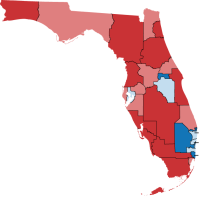 New York Times, DeSantis Proposes Florida House Map That Could Add Four Republican Seats, Patricia Mazzei and Nick Corasaniti, April 27, 2026. The Republican-controlled Legislature is meeting in Tallahassee this week to vote on the map, which would apply for the 2026 midterms if passed.
Gov. Ron DeSantis of Florida proposed a redraw of the state’s congressional districts on Monday that could give Republicans as many as four new seats, an aggressive gambit that could also endanger some of the party’s incumbents should a blue wave emerge in the November midterms.
The map, which is likely to face legal hurdles, appears to eliminate two Democratic-held districts in South Florida, a third in the Tampa area and a fourth in the Orlando area. That would leave Democrats with perhaps only four of the state’s 28 congressional seats. There are currently seven Florida Democrats in Congress; an eighth, former Representative Sheila Cherfilus-McCormick, resigned last week after being charged with embezzlement.
Florida, which does not hold primary elections until August, is the last state aiming to redraw congressional maps ahead of the midterms. A Supreme Court decision expected soon on a key provision of the Voting Rights Act could provide opportunities for other states to do so, but with many holding primaries in the next month or two, time is running out.
Mr. DeSantis’s map was first reported by Fox News, which received it before the State Legislature did on Monday morning. Lawmakers are scheduled to meet in a special redistricting session starting Tuesday.
The short turnaround is likely to upset some state lawmakers, few of whom have expressed much interest in redistricting, as well as some members of the Florida congressional delegation, who will have to introduce themselves to new voters between now and the midterms. State lawmakers are not expected to propose any maps of their own, but rather to vote on Mr. DeSantis’s redraw as early as Wednesday. It is almost certain to pass, given Republican supermajorities in the State House and Senate.
Mr. DeSantis’s map appears to eliminate the lone Democratic district near Tampa, currently held by Representative Kathy Castor, a House member for almost two decades.
It packs Democratic voters in Orlando into a single district, appearing to eliminate the seat currently held by Representative Darren Soto, who took office in 2017. The Orlando district that would remain intact under the proposal is held by Representative Maxwell Alejandro Frost.
The proposal also appears to eliminate the South Florida districts held by Representatives Jared Moskowitz, who is in his second term, and Debbie Wasserman Schultz, who is in her 11th.Editors’ PicksWhy Elie Saab Will Never Leave Lebanon, Despite the WarDo You Have to Make Pour-Over Coffee for Your Spouse?‘Michael’ Fans Danced in the Aisles, Critics Be Damned
“This clear effort to steal more seats for Republicans shows his total contempt for Florida voters, who voted two-to-one in favor of a ban on partisan gerrymandering in our Constitution,” Ms. Wasserman Schultz said in a statement, referring to Mr. DeSantis. “This nakedly partisan scheme breaks state law.”
Should the map pass, it could give Republicans nationwide a handful of new seats heading into the midterms. That would hardly be the multiseat advantage that President Trump and national Republicans envisioned when they kicked off the national redistricting battle in Texas last summer.
But should the fight for the U.S. House come down to a few districts, any seat that flips from Democrat to Republican could prove critical. Republicans currently control the chamber by just a handful of seats.
In 2010, voters in Florida passed the Fair Districts amendments, which effectively ban partisan gerrymandering in the state. Mr. DeSantis told Fox News that his proposed map — colored red and blue to indicate the expected political leanings of new districts — “more fairly represents the makeup of Florida today.”
In a letter to legislative leaders on Monday, David Axelman, the governor’s general counsel, reiterated Mr. DeSantis’s position that Florida should have received at least one additional congressional seat after the 2020 census.
Mr. Axelman also said that the state’s existing map had been “distorted by considerations of race.” In the Voting Rights Act case before the Supreme Court, the court’s conservative majority has signaled that it might prohibit using race as a factor in drawing election districts. Mr. Axelman suggested that the voter-imposed ban on partisan gerrymandering would not survive the Supreme Court’s expected decision.
Representative Hakeem Jeffries of New York, the Democratic minority leader, said last week that if Florida Republicans redrew the state’s congressional map, it would “only create more prime pickup opportunities for Democrats.”
“We will aggressively target for defeat Mario Diaz-Balart, Maria Elvira Salazar, Carlos Giménez, Kat Cammack, Anna Paulina Luna, Laurel Lee, Cory Mills and Brian Mast,” he said, referring to Republican House members throughout Florida.
In a new statement on Monday, Mr. Jeffries said, “See you in court.”
Though the new maps can would not go before voters, recent polling in Florida showed a majority of likely voters in the state were opposed to drawing new maps before the midterms. A poll from Emerson College this month found that Florida voters, by a slim margin, said it was a “bad idea” to redraw maps in the middle of the decade.
Some Republicans in the state have expressed reluctance to draw new maps this year. Such worries grew after special elections this year in which Democrats flipped a State House district that includes Mr. Trump’s Mar-a-Lago estate in Palm Beach, and a State Senate district near Tampa.
April 26
Top Headlines
President Trump leads a press briefing at the White House accompanied by FBI Director Kash Patel and other officials following a report of a shooter outside the hotel hosting the annual White House Correspondents Dinner on April 25, 2026.
President Trump shared a photo of the alleged shooter, identified as Cole Tomas Allen, age 31 of Torrance, California, after he was subdued at the hotel. Shown below: Security personnel rush U.S. House Speaker Mike Johnson, at left, out of the Hilton Hotel ballroom following a report of a shooting outside the ballroom hosting a reported 2,600 guests at the annual White House Correspondents Dinner (Reuters photo). Additional details in the news excerpts below.
News Roundups
 April 26, 2026. Let me walk you through everything we’re tracking today following last nights shooting near the White House Correspondents’ dinner. The throughline connecting a lot of it is this regime’s shameless instinct to exploit anything and everything for political gain.April 26, 2026. This morning I went to the Hilton hotel where the White House Correspondents’ Dinner was held and documented just how lax the security was and how easy it was to access the venue.
More Opinions On Shooting, U.S. Media, Politics
April 26, 2026. The media elites are expressing shock that the entire nation isn't riveted by the fact that a third assassination attempt against the most unpopular president in American history.April 26, 2026. Tonight the White House Correspondents’ Association (WHCA) held its annual black-tie dinner, which is designed both to raise money for the institution and to provide a glitzy night out for journalists. In recent years the event has drawn criticism for the chumminess it reveals between White House journalists and the lawmakers they cover. This year, that concern was heightened dramatically when the WHCA invited President Donald J. Trump to attend the dinner and to give a speech.Since he entered the political arena, Trump has denigrated the press and even urged supporters to attack journalists, but in his second term his administration has gone further, trying to silence the press with lawsuits or threats of them against media outlets and individuals, blocking access to the White House and the Pentagon for journalists Trump dislikes, personally attacking female journalists, arresting independent journalists Don Lemon and Georgia Fort, and raiding the home of Washington Post political correspondent Hannah Natanson. Inviting him to address the press at a fancy dinner seemed to normalize his attacks on the First Amendment.
More On Trump Team, Corruption, Media Coverage

White House Press Secretary Karoline Leavitt and her husband Nicholas Riccio at White House Correspondents' Dinner April 25, 2026 (Kristina Bumphrey photo for Variety via Getty Images).
 Commentary: Fox Reporter Was Warned, Noah Prince, April 26, 2026. Fox News might have cooked their entire narrative. One of their reporters [Aishah Hasnie, right] was cut off mid-sentence while saying someone (White House Press Secretary Karoline Leavitt's husband Nicholas Riccio) warned her before the shooting.April 26, 2026. The news today is focused on the incident last night at the White House Correspondents’ Dinner. The facts are still developing, but what we saw almost immediately afterward tells you a lot. Within minutes, Trump and his team rushed out to politicize it, pushing narratives, talking about the need for his “golden ballroom,” and trying to turn the situation into a talking point about the unlawful war in Iran.
More On Gunman's Attack In DC

Meidas Touch Podcast, Commentary: MeidasTouch host Ben Meiselas reports on his opinion that Donald Trump’s health is rapidly declining as evidenced by Trump’s response to the shooting at the White House Correspondents’ Dinner, Ben Meiselas, right, April 26, 2026. And the Secret Service had to like pick him up and they had to basically drag him out of there.War On Iran, Lebanon
More Global News
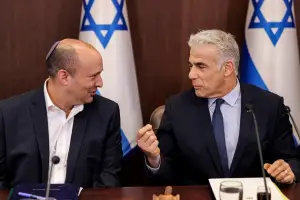
Israel's once-caretaker Prime Minister Yair Lapid (right), talks with former Prime Minister Naftali Bennett during the weekly cabinet meeting in Jerusalem, on Sunday, Sept. 18, 2022 (Pool photo by Ronaldo Schemid). The two served as prime ministers in a rotation agreement under a prior coalition government, and now plan to merge into a single faction.
 New York Times, Israel’s President, Putting Off Decision on Pardon for Netanyahu, Will Push for Plea Deal, Isabel Kershner, April 26, 2026. President Isaac Herzog has decided not to issue a pardon to Prime Minister Benjamin Netanyahu in his corruption case at this time, and instead will seek mediation, officials say.
U.S Governance, Politics, Elections
 April 26, 2026. Trump and Republicans have predictably seized upon the shooting incident at last night’s WHCA dinner to push for suppression of free speech and dismissal of the court case that is temporarily halting some of his beloved ballroom construction.
 April 26, 2026. Blaming security for the events at the WHCD ignores the fact that most Americans don't have security at all in a culture of easy gun access and escalating violence at groups Trump targets.
More U.S. Media Dinner Follow ups
 Irish Star, Donald Trump ally condemned for saying she ‘slayed’ at WHCD after shooting, Kathleen O'Boyle, April 26, 2026. Trump supporter Alina Habba is facing backlash from social media users after posting about her '10/10' outfit as chaos unfolded at the White House Correspondents’ Dinner shooting. At right, Alina Habba at the 2026 White House Correspondents' Association Dinner.
Top Stories
President Trump leads a press briefing at the White House accompanied by FBI Director Kash Patel and other officials following a report of a shooter outside the hotel hosting the annual White House Correspondents Dinner on April 25, 2026.
New York Times, Live Updates: Attacker Wrote ‘Manifesto’ Before Charging Press Gala, Trump Says, Luke Broadwater, Michael M. Grynbaum, Shawn McCreesh, Tyler Pager, Shawn Hubler, Devlin Barrett and Maggie Haberma, April 26, 2026. President Trump was unharmed after being rushed from the stage at the White House correspondents’ dinner.
Investigators have gathered messages and written material from the suspect denouncing the Trump administration and laying out a plan to take violent action, according to a person familiar with the investigation.
Here’s the latest.
President Trump said on Sunday that the gunman who stormed a security perimeter at the White House correspondents’ dinner had written a “manifesto,” as investigators continued to examine his writings and other evidence to piece together the motive for an attack that appeared to be aimed at the president and his top aides.
Shortly before the attack, the suspect sent messages to his relatives denouncing Trump administration policies and suggesting he intended to take violent action, according to a person familiar with the investigation. Other written material found in his hotel room contained similar statements, the person said.
Mr. Trump did not offer any details about the document he described as a manifesto in an interview with Fox News, but the acting attorney general, Todd Blanche, told NBC that investigators gathering evidence about the suspect “know there were some writings.” He said a preliminary review of the evidence indicated that members of the administration, “likely including the president,” had been targets.
The suspect, identified by law enforcement officials speaking on condition of anonymity as Cole Tomas Allen, 31, of Torrance, Calif., was taken into custody after the police said he ran through a security checkpoint and exchanged gunfire with the authorities inside the Washington Hilton on Saturday night.
Late Saturday night, federal authorities in the Los Angeles suburbs surrounded a two-story home where records show Mr. Allen lives. Residents gathered nearby on darkened sidewalks as police helicopters circled overhead and law enforcement vehicles with flashing red and blue lights blocked the street.
The suspect was armed with knives, a shotgun and a handgun, the interim Washington, D.C., police chief, Jeffery W. Carroll, told reporters on Saturday night. Mr. Blanche said the man had purchased the two firearms he was carrying “within the last couple of years,” and had been staying at the Hilton, where Mr. Trump, top administration officials and hundreds of journalists had gathered.
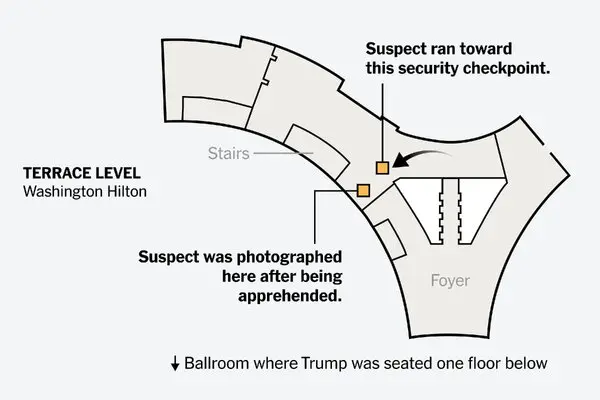
Washington Hilton Hotel security layout during attack (New York Times graphic).
There were no metal detectors set up at the hotel’s entrances, and a secure perimeter was only established closer to the ballroom. But Mr. Blanche defended the security at the event, and noted that the suspect did not enter the ballroom.
“The system worked,” said Mr. Blanche, who was also at the dinner. “We were safe. President Trump was safe.”
Here’s what else we’re covering:
At a separate news conference after the attack, Mr. Trump compared his line of work to being a racecar driver or a bull rider, and said that presidents were more likely to be shot at or killed.
“It’s a dangerous profession,” he said.
The president said a Secret Service officer had been shot but was saved by his bulletproof vest.
The attack revived questions about political violence in the United States and about security around Mr. Trump, one of the most targeted presidents in history. In 2024, he was grazed by a bullet in an assassination attempt at a campaign rally in Pennsylvania, and rushed to safety months later when a federal agent fired on an armed man at his Florida golf club.
There were no metal detectors set up at the hotel’s entrances on Saturday, and a secure perimeter was only established closer to the ballroom. Mr. Trump said the incident underscored why he wanted to build a $400 million ballroom on White House grounds that he said would be equipped with the latest security features. That project is currently subject to litigation.
Investigators have been able to gather some information from the suspect’s electronic devices and have interviewed some people who know him, the acting attorney general, Todd Blanche, right, told NBC’s “Meet the Press” on Sunday. The gunman “set out to target folks that work in the administration, likely including the president,” Mr. Blanche said, though he said the understanding of his motivation could change as evidence is reviewed.
President Trump shared a photo of the alleged shooter, identified as Cole Tomas Allen, age 31 of Torrance, California, after he was subdued at the hotel. Shown below: Security personnel rush U.S. House Speaker Mike Johnson, at left, out of the Hilton Hotel ballroom following a report of a shooting outside the ballroom hosting a reported 2,600 guests at the annual White House Correspondents Dinner (Reuters photo). Additional details in the news excerpts below.
News Roundups
President Trump, right, prompts smiles among his cabinet leadership team array to his left along with Vice President Vance and First Lady Melania Trump at a White House press conference following capture of an attacker one floor above the site of the annual White House Correspondents Dinner (Reuters photo by Kylie Cooper April 25, 2026).
MeidasTouch Network, Sunday Afternoon Updates: Trump Turns a Shooting Into a Propaganda Parade, Ben Meiselas, right, April 26, 2026. Let me walk you through everything we’re tracking today following last nights shooting near the White House Correspondents’ dinner. The throughline connecting a lot of it is this regime’s shameless instinct to exploit anything and everything for political gain.
Here’s what we’re following:
 Cole Allen: who is the suspect?
Before I go any further, I want to thank all our paid subscribers. At MeidasTouch, we don’t chase access and we don’t cozy up to power. While others are dressing up and pretending everything is normal at ritzy parties in DC with the Trump administration this weekend, we’re focused on telling the truth—plain and simple. We’re not here to protect Trump or play along with his allies. We’re here to hold them accountable.
Let’s dive in. What actually happened at the WHCD
Let’s start with the facts, because the facts matter and they are not what the Trump regime has been selling you all morning.
Cole Allen, a 31-year-old from Torrance, California, allegedly approached a security checkpoint at the Washington Hilton Hotel during the White House Correspondents’ Dinner on Saturday night. He was armed with a shotgun, a handgun, and knives. He did not get through. He was stopped at the perimeter.
Here is the critical detail that is getting lost in all the noise: the incident happened on a floor above where the dinner was actually taking place. Not in the room. Not near the room. Up a flight of stairs, past multiple security layers, in a part of the hotel that was open to the general public because the Secret Service only secured the specific areas of the WHCA event — not the entire building. Law enforcement officials confirmed this. The suspect never breached the secured zone. The president, vice president, cabinet officials, and guests were nowhere close to this.
That is not a minor footnote. That is a major part of this story.
And yet, within thirty minutes of the incident, Donald Trump was at a podium holding a press conference, not to reassure the public, not to thank law enforcement, but to demand his golden ballroom. He and his officials were all smiles. Karoline Leavitt had a grin on her face. Pete Hegseth was photographed beaming. Alina Habba, right, posted on Instagram that she “slayed on the look” with a photo of herself from the event, captioned “10/10.” These are the people who want you to believe this was a harrowing, historic moment of danger.
And then there was Dan Scavino. As guests were still processing what had just happened, Scavino decided the moment called for a rousing “USA! USA!” chant. It did not land. The response from the room was total silence. Not even Trump’s own allies joined in. The only thing audible, per footage reviewed from inside the room, was a wave of “shhhhs” from the audience and people telling him to shut up. This is the man as close to Trump as anyone in the regime, and his read on the room in that moment was to try to start a rally chant. It was perhaps the most accidentally revealing and cringeworthy moment of the entire night.The Ballroom blitz that ensued…
What happened next was one of the more transparent influence operations we’ve seen from this reigme, and they do this constantly. Within hours of the incident, dozens, probably closer to a hundred, MAGA influencers and regime-adjacent accounts were all posting virtually the same message. Libs of TikTok: “This is why we need Trump’s ballroom.” Jack Posobiec: “Thank God President Trump is building a ballroom.” Wall Street Mav: “We need the White House ballroom.”
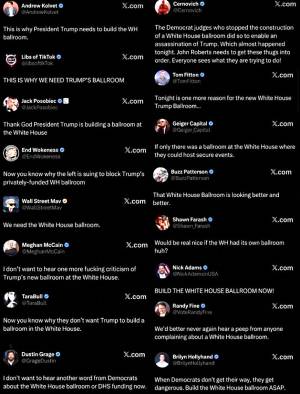 This is not organic. This appears to be a coordinated message campaign. And the people typing these posts (exemplified above) are in many cases the same people who were waving fake Epstein files binders around the White House during that other debacle back in the day.
Then Trump himself posted bright and early. He wrote that the shooting “would never have happened” with his “Militarily Top Secret Ballroom currently under construction.” He called the lawsuit filed against its construction “ridiculous,” complained it was brought by “a woman walking her dog,” and demanded it be dropped immediately. He assured everyone the project is “on budget and substantially ahead of schedule.”
For those keeping score: a man was stopped at a security checkpoint in a publicly accessible hotel corridor, one floor above and several security layers away from where the dinner was happening, and Donald Trump’s response at dawn was to demand a ballroom.
Tommy Vietor put it simply: groups wouldn’t want to host every event at the White House anyway, especially the press corps, and the same kind of incident could happen at a White House venue. Our own Scott MacFarlane made the obvious point that the White House is likely not going to let journalists and their families into the complex for a private banquet. Sam Stein noted the WHCA dinner is not a White House event — it’s a press association event — and Trump had never even attended before.
The ballroom argument makes no sense. It was never meant to make sense. It was meant to be repeated.They want you to pay for it…
Congressman Chip Roy then took the operation to its logical conclusion and proposed that taxpayer funding for Trump’s ballroom be included in the DHS reconciliation bill — alongside anti-transgender provisions, ICE and CBP funding, and the so-called SAVE America Act. MAGA influencer Scott Presler went further, posting that because “Democrats are literally trying to assassinate President Trump,” the Senate should rush back to Washington and pass the SAVE America Act immediately.
That’s the game. An alleged shooter who never reached the room becomes justification for a golden ballroom, which becomes justification for attacking trans people, which becomes justification for restricting voting, which becomes another opportunity to consolidate power.
So who is Cole Allen?
 Cole Allen, shown above at center right in a Facebook photo with family, is a 31-year-old mechanical engineer who graduated from Caltech in 2017. He did research at NASA’s Jet Propulsion Laboratory. He built robotics systems, developed physics-based simulations, created a space combat video game called “First Law,” and later released another game on Steam called “Bohrdom.” He earned a master’s in computer science from Cal State Dominguez Hills in 2025 and was recognized as Teacher of the Month in late 2024. By external measures, his trajectory appeared stable and even successful. This isn’t the typical profile of shooters in these situations.
Investigators are reviewing writing found in his hotel room that they believe indicates he was targeting Trump administration officials. Law enforcement says a manifesto attributed to him contains the line: “I am no longer willing to permit a pedophile, rapist, and traitor to coat my hands with his crimes.” MeidasTouch’s sources tell us he is being held in a local police lockup about a half-mile from the Hilton (where the event took place) and is expected to appear in federal court Monday, likely around 1 p.m. Prosecutors are expected to charge him by complaint rather than waiting on a grand jury. This case will run through the same courthouse where Trump was prosecuted for election subversion and where hundreds of January 6 cases were heard.
The corporate media’s predictable failure
 On CNN, Dana Bash asked Jamie Raskin, shown above, whether Democrats need to tone down their rhetoric in the wake of the incident. Raskin, correctly, asked what rhetoric she was referring to. The answer, as it always is when anchors ask this question, is: accurately describing what the Trump regime is doing. Calling out corruption is not incitement. Describing harm to working people is not incitement. Our editor-in-chief Ron Filipkowski made this important point: the idea that we should stop pointing out factual ways the president is wrecking this country because of something an unhinged individual does is a profoundly un-American concept.
Another corporate news correspondent praised Trump for calling for “unity” at the press conference, even as Trump and his allies were simultaneously blaming the media and using the incident to push their full legislative agenda. The corporate media spent the morning debating whether Trump was being sufficiently praised for his grace under pressure. Again, he showed no grace. And he was never in harm’s way.
Todd Blanche, on Meet the Press, confirmed the suspect never got close.
 On ABC's Face the Nation, he said they won’t stop holding events like this. On another show, when asked about having no designated survivor in the room, he essentially brushed it off. The regime violated longstanding protocol by having the president and vice president, along with the defense secretary, treasurysecretary, and much of the cabinet, in the same room with no designated survivor.
Also worth noting: the Secret Service evacuated J.D. Vance before Donald Trump, per video. It was certainly an odd moment.
Meanwhile, There remains a whole lot else going on in the world.
As we’ve reported extensively, the day before the dinner, Trump and his allies told the media there would be a major meeting in Islamabad between the American delegation and Iranian Foreign Minister Araghchi. The Iranian side had been clear all along that they were not meeting with Trump representatives. There was no meeting. When it didn’t happen, the Trump regime claimed they had reviewed a document from Iran, found it unacceptable, and canceled the meeting themselves. Trump told reporters: “Nothing changed. They gave us a paper that should have been better. Immediately when I canceled it, within 10 minutes we got a new paper that was better.” This is false. You cannot cancel a meeting that was never scheduled. There was no “new paper.” This was market manipulation, again, using the American press as a delivery mechanism.
Farm bankruptcies are up 46% from 2025, with Midwest cases surging 70%. Trump’s approval rating sits at 33%. Approval on the economy is at 30%, which is worse than Nixon at the moment of his resignation. His disapproval among Gen Z sits at 76%, which even Marjorie Taylor Greene acknowledged this weekend, warning Republicans to distance themselves from Trump if they want any future with young voters.
 On the USS Abraham Lincoln, new photos reviewed by Newsweek, above, show service members receiving what can only be described as inadequate food portions. Reports indicate some troops have lost significant weight. The Pentagon denies shortages.
Republicans are reportedly open to pardoning Ghislaine Maxwell to secure her cooperation in the Epstein investigation, per Reuters. Epstein survivors were in Washington this weekend demanding accountability. The regime is focused on the ballroom.
And in Asia, Japanese television is covering the arrival of a single American oil tanker as a major news story because the energy crisis on that side of the world is that serious. We saw what happened when a crisis starts in Asia and goes unreported in the West. It spreads. Pay attention.
The Parnas Perspective, Afternoon News and Commentary: Big Firings Set to Occur After Security Breakdown, I Expose Lax Conditions at the Scene, MAGA Pushes Ballroom Narrative and Attacks Democrats, Aaron Parnas, right, April 26, 2026. This morning I went to the Hilton hotel where the White House Correspondents’ Dinner was held and documented just how lax the security was and how easy it was to access the venue.
I also spoke with a guest who confirmed there were serious elevator security issues. At the same time, Republicans are already blaming Democrats for the alleged shooting, while influencers are pushing in lockstep for a White House ballroom, even though the security failures show that would not have meaningfully changed what happened. Accountability is coming, with Kash Patel’s ouster expected and major scrutiny on the Secret Service.
I am also making it a priority to center Epstein survivors and Virginia Giuffre right now, and I will not let last night’s events overshadow her legacy. Meanwhile, parts of the media are normalizing Donald Trump by framing his comments as a meaningful call for unity. I am not going to do that. This kind of normalization is a serious problem, and I will not be part of it.
Here’s the news:
I went to the White House Correspondents’ Dinner location this morning, the day after the incident, and walked through the lax security. In particular, elevator access seemed less restricted than usual, making it easier to move between floors.
A source staying at the Hilton during the White House Correspondents’ Dinner told me that elevator security was unusually lax, with no key card required to access different floors. This differed from the hotel’s typical policy, which restricts movement via key card access. The lapse may have made it easier for individuals to move through the building during the event. Here is an image I received confirming that typically you need a badge or key card:
The House Oversight Committee has requested a briefing from the United States Secret Service regarding the incident, though no date has been set. Mike Lawler, who attended the event, called it a “security failure,” citing a lack of ID checks, guest verification, and screening measures like magnetometers. He also noted that hotel guests had broad access to the building, raising concerns about how the suspect brought weapons near the ballroom. Lawler emphasized that while no one was killed, the breach was deeply troubling given prior threats against Donald Trump.
Heads are set to roll because of the lax in security:
The media has begun to normalize Trump:
Brian Stelter @brianstelter X.com Trump very easily could have blamed the media last night, but instead, he basically said "we're all in this together."
Dana Bash [was] doing something similar.
Donald Trump described the suspect in a recent attack as a “sick” and hateful individual, claiming the man harbored strong anti-Christian sentiment. He referenced an alleged manifesto found in the suspect’s hotel room, though this has not been independently verified. During a Fox News interview, Trump did not dispute the reported name of the suspect, Cole Allen. He also said the suspect’s family had previously raised concerns with law enforcement, suggesting earlier notification might have helped. This morning he demanded the building of the ballroom at the White House:
Pro-Trump “MAGA” social media accounts posted coordinated messages after the White House Correspondents’ Dinner incident, emphasizing the need for a dedicated White House ballroom.
Trump said he wants the postponed dinner event to be rescheduled soon, suggesting a timeframe of around 30 days, give or take. He emphasized that the event was important and should not be derailed by criminal acts. Trump argued that such incidents should not change the country’s course or disrupt planned gatherings. Notably, he had initially said the event should continue as scheduled the night before.
White House press secretary Karoline Leavitt said the suspect who rushed security at the WHCA dinner in Washington, D.C., intended to assassinate Donald Trump and kill multiple top administration officials. She described being escorted to safety with Trump and the First Lady by the Secret Service during the incident. Leavitt characterized Trump as “fearless” in the moment. She also echoed his statement that political violence must come to an end.
Margaret Brennan questioned how the suspect was able to transport multiple firearms across state lines into Washington, D.C., where open carry is illegal. Todd Blanche did not directly address the logistics, instead saying the focus should not be on changing or tightening gun laws. Brennan pressed the issue of interstate transport, but Blanche dismissed it as not the main concern. The exchange highlighted tension over whether to focus on enforcement details or broader policy debates.
The latest gun violence statistics:
Joe Gruters, chair of the Republican National Committee, blamed a “radicalized left” for the incident at the White House  Correspondents’ Dinner. He called it an attempted assassination of Donald Trump and his administration officials, arguing it stemmed from normalized political violence. Gruters criticized Democrats, saying their calls for unity were hollow and accusing them of blocking funding for security agencies like DHS. He concluded that Democrats’ actions undermine public safety and contradict their stated support for peace.
Scott Jennings blamed Hakeem Jeffries for contributing to heated rhetoric, arguing there is a “violent streak” on the political left. During the discussion, he pushed back on another guest who mentioned the death of Melissa Hortman, accusing them of downplaying political violence. Jennings also criticized Democratic candidates for associating with Hasan Piker.
Epstein survivors are calling for a meeting with King Charles III during his upcoming U.S. state visit. The timing coincides with the anniversary of Virginia Giuffre’s death, adding significance to their request. Giuffre had accused Prince Andrew of sexual abuse when she was a minor, allegations he denied but later settled in civil court. Survivors say they want acknowledgment and engagement from the King during his visit.
Donald Trump claimed that there was significant cheating in Virginia during the recent election, asserting that Republicans had been leading before a sudden “ballot drop” changed the outcome. He suggested the shift raised concerns about the integrity of the vote-counting process. No evidence was provided in the statement to support the claim.
Pete Hegseth, right, has drawn scrutiny for rhetoric on the Iran war that appears to echo sermons from his Christian nationalist church. The article highlights the influence of the Communion of Reformed Evangelical Churches (CREC), whose leaders promote theocratic ideas, including restricting rights and enforcing biblical law. Sermons linked to Hegseth’s church emphasize themes like “biblically informed hatred,” which critics say align with some of his public statements. Experts warn that this blending of religious ideology with government and military messaging raises concerns about extremism and the separation of church and state.
A 17-year-old suspect, Markel Lee, was arrested in connection with a mass shooting at a Louisiana mall that killed one high school senior and injured five others. Authorities say he fled the scene with help from his grandmother, who later cooperated with police after being shown surveillance images. Investigators used video footage and license plate readers to track him down, and he now faces multiple serious charges, including first-degree murder. Officials say the shooting may be linked to social media disputes or possible gang activity, and the investigation is ongoing.
Liz Conmy, a North Dakota legislator, was killed in a small plane crash shortly after takeoff from Crystal Airport near Minneapolis, along with the pilot. The aircraft went down and caught fire in a park in Brooklyn Park, according to local authorities. The Federal Aviation Administration confirmed two people were on board, and the National Transportation Safety Board has launched an investigation. Colleagues and her party described Conmy’s death as a profound loss, highlighting her work on education, the environment, and government transparency.
More On Gunman's Attack In DC
New York Times, World leaders condemn violence after gunfire at the White House correspondents’ dinner, Amelia Nierenberg, April 26, 2026. World leaders condemned political violence after the shooting at the White House correspondents’ dinner on Saturday, the third in three years to unfold close to President Trump.
Prime Minister Shehbaz Sharif of Pakistan said he was “relieved” to know that Mr. Trump and other attendees were safe.
“My thoughts and prayers are with him, and I wish him continued safety and well-being,” Mr. Sharif wrote on X.
Mr. Sharif has been trying to broker talks between the United States and Iran, which appear to be on pause again after Mr. Trump on Saturday abruptly called off a trip to Pakistan by two of his top negotiators.
Many European leaders, including President Emmanuel Macron of France and Prime Minister Keir Starmer of Britain, strongly condemned the violence.
Mr. Macron called the attack “unacceptable” and said Mr. Trump had his “full support.”
“Violence has no place in a democracy,” he wrote on X.
The leaders of Canada and Mexico, who have often clashed politically with Mr. Trump, posted messages of support.
President Claudia Sheinbaum of Mexico said she had sent Mr. Trump and his wife, Melania Trump, “our respect.”
“Violence should never be the way,” Ms. Sheinbaum said on X.
Prime Minister Mark Carney of Canada, who is embroiled in a trade battle with Mr. Trump, said he was “relieved that the President, the First Lady, and all guests are safe.”
New York Times, ‘I’m Not a Basket Case’: Trump Describes His Mind-Set After an Evening of Chaos, Shawn McCreesh and Tyler Pager, April 26, 2026. Very little was clear about what had happened at the Washington Hilton on Saturday night. But the president wanted to talk about it.
It was 10:31 p.m. on Saturday when President Trump walked into the White House briefing room, still dressed in his tuxedo and bow tie, to talk about what may have been yet another attempt on his life.
“Well, thank you very much,” he said. “That was very unexpected!”
Moments before he walked out, the president posted surveillance footage of a suspect making a mad dash through the cavernous halls of the Washington Hilton. That’s where Mr. Trump was attending the White House correspondents’ dinner when gunfire broke out at the hotel. Very little was clear about whatever had happened there, a mile and a half up the hill.
But the president wanted to talk about it.
“It’s always shocking when something like this happens,” he said, standing with the first lady, the vice president, the defense secretary, the secretary of state, the acting attorney general, the F.B.I. director and the press secretary — all still in their evening wear from the dinner.
But, really, he argued, the whole thing was just the latest example of why he needs to build his maximum-security, legally challenged ballroom at the White House.
“I didn’t want to say this,” he said, “but this is why we have to have all of the attributes of what we’re planning at the White House. It’s actually a larger room, and it’s a much more secure. It’s got — it’s drone proof, it’s bulletproof glass.”
And then he gave the first question of the night to Weijia Jiang, the CBS News correspondent and the president of the White House Correspondents’ Association, who had been seated next to him at the dinner before pandemonium broke out.
“Madam chairman,” he said, “I just want to say you did a fantastic job. What a beautiful evening.” (Mr. Trump does not usually speak this way to the reporters who cover him.)
She asked him what was going through his mind when he realized his life may have been in danger again. He told the tale: He was sitting with the first lady on his other side when he heard a noise he thought sounded familiar and nonthreatening. “I thought it was a tray going down,” he said. “I’ve heard that many times, and it was a pretty loud noise, and it was from quite far away.”
His wife was not so sure, he said.
“Melania was very cognizant, I think, of what happened,” he explained. “I think she knew immediately what happened. She was saying, ‘That’s a bad noise.’” She looked quite stoic behind him in the briefing room. The only word she spoke during the news conference was “No,” after being asked if she would like to say anything at all. The president said that it was “a rather traumatic experience for her.”
New York Times, Confusion and Fright Inside the Washington Hilton Ballroom, Michael M. Grynbaum, April 26, 2026. A sense of danger spread like a wave among high-profile politicians and journalists as an emergency unfolded at the White House Correspondents’ Association dinner.
The spring pea and burrata appetizer course had been distributed and the schmoozing hour of Saturday’s White House Correspondents’ Association dinner had begun when a small commotion occurred toward the back of the Washington Hilton ballroom shortly past 8:30 p.m.
It might have been an upturned catering cart, or perhaps a scuffle with protesters. Then security officers began sprinting down the aisles toward the elevated dais, where President Trump, along with Vice President JD Vance and the first lady, Melania Trump, had taken their seats just a few minutes earlier.
There were no announcements or cries of “get down.” Instead, a sense of danger spread across the room like a wave. Hundreds of the country’s top media executives, editors in chief and prominent television anchors, clad in tuxedos and evening gowns, instinctively dropped to the floor, crouching besides chairs and ducking under tables.
More Opinions On Shooting, U.S. Media, Politics
Doomsday Scenario, Commentary: A quick analysis of last night's shooting, Garrett M. Graff, above, April 26, 2026. A quick analysis of last night's shooting. So far, it appears the system worked as intended.
Welcome to Doomsday Scenario, my regular column on national security, geopolitics, history, and — unfortunately — the fight for democracy in the Trump era.
I had intended to write today about what a travesty the White House Correspondents Association dinner was — and how embarrassed every single journalist who attended should be — but for obvious reasons, after the events of last night, I wanted to share instead some quick thoughts on presidential security that might be useful to understanding what happened.
First, a couple of points on my particularly relevant background to this subject: During a different era, when the event was merely laughable, I attended the White House Correspondents Association dinner itself multiple times and covered the event and the parties around it for more than a decade. Plus, during my Washington career, I’ve been to probably just shy of a hundred dinners and galas inside that same ballroom at the Washington Hilton, which is known universally in Washington as the “Hinckley Hilton,” in reference to the 1981 shooting of President Reagan there. Also, I’ve spent a lot of time reporting on presidential security over the years, including writing a book on “continuity of government” and presidential evacuation protocols.
Two very-much-related factoids: Anne Schroeder, then at the Washington Post, and I, then the blogger at FishbowlDC, were largely responsible for the nicknaming the correspondents’ dinner “prom” in 2005, which later evolved into “nerd prom.” Anne coined it in her gossip column that year, and I picked it up to use in my blog coverage of that year’s event. Later, when I was editor at Washingtonian, I as a history buff repeatedly badgered the Hilton team into finally putting up a historic plaque marking the entrance where Reagan was shot.
Which brings us to last night’s startling events at an event that already felt particularly high-stakes as the famously anti-press president attended for the first time the main dinner meant to honor the working relationship of the president and White House press corps.
What we know so far is that gunfire could be heard inside the dinner around 8:30 p.m., and that Secret Service and protective details swarmed the stage and room about 15-20 seconds later. Vice President JD Vance and President Trump were rushed from the stage and in the audience Cabinet members and congressional leadership similarly evacuated. Outside the ballroom, a 31-year-old named Cole Tomas Allen from Torrance, California, had tried to rush the ballroom armed with both guns — perhaps a shotgun and handguns — as well as knives. Trump finally headed back to the White House around 9:30 and, alongside other officials, addressed the events from the White House briefing room. Across Washington, the after-parties mostly continued as planned, albeit depleted by the reporters and anchors who rushed to cover the unfolding events.
We normally don’t get to see the massive hidden security footprint that surrounds the president like we did last night, when members of the Secret Service Counter-Assault Team (CAT) actually stormed the stage and we saw countless security details rush their protectees from the room:
In the hours since, I’ve seen a lot of arm-chair-quarterbacking about how the whole hotel should have been behind the security cordon or how shocked shocked shocked guests were that security seemed so lax at the entrances, etc., etc., but most of those critiques misunderstand two major things:
(1) You always have to have an outer security perimeter; and
(2) The goal of the Secret Service isn’t to prevent any incident at a high-profile event — it’s to prevent an incident that could harm the president.
Yes, you can always push the security checkpoints out further, but there will always have to be a first moment where the unvetted and unsecured public approaches a security check. You’ll hear similar complaints/quarterbacking when there are shootings at airports: “How did someone get inside the airport with a gun?” Because anyone can walk through the first door. Security in a free society is always a trade-off. Push the security checkpoints back to the curb, and the attack will just happen at the curb instead.
As far as I can tell — I didn’t attend last night’s dinner and maintain every single journalist or editor who made the decision to do so made a bad professional and life choice — security at the Hilton was basically the same as it has been in past years.
 Some background: The Washington Hilton (shown above, with a graphic showing also the layers that include a ballroom on a lower level, has some 1,100 guest rooms spread across ten floors and several main public levels — including the main lobby level and then, an escalator flight down, the level of the ballroom, which is accessible too from a lower street entrance on the side of the building, which is where the red carpet for the correspondents dinner is located. Its giant “pillar-less” ballroom is the main venue for large events in Washington — including not just the correspondents dinner but other large conventions and gatherings like the National Prayer Breakfast — because it can seat around 2,600 people at banquet tables.
The size and scale of the hotel — or any major hotel in Washington, really, where presidential events occur — is such that there are hundreds of people in the hotel who have no connection to the dinner and are going about entirely unrelated activities.
Moreover, the “Hinckley Hilton” is, tragically, now uniquely situated for handling a presidential visit — following the shooting of President Reagan, the hotel installed a secure entrance facility for VIPs and there’s a special secure green room and secure path to and from the stage for a president. Securing a presidential speech at the Washington Hilton is like table-stakes for the Secret Service — about as easy as a presidential movement can be.
The evening events at the Hilton involve both the dinner itself but also a whole host of cocktail receptions and parties, big and small, at the hotel by various news organizations, and there are many hundreds of people who attend only those parties and then go elsewhere for the dinner itself and then rejoin the glitzy after-parties, and thus never come anywhere close to being in the presence of the president. (That’s actually what I usually preferred to do when I lived in DC.)
There’s usually — as there apparently was last night — a very rough outer security check at the edge of the property to try to determine whether someone has business in the Hilton that night. You have to be a registered guest in the hotel, or have an invitation to the party inside, or some such, but the goal with that security check is less about weapons and more about crowd control — trying to minimize the number of people who crowd into the hotel’s public spaces to gawk. It’s not the goal of this checkpoint to definitively ID and cross-check every person attending — it’s to manage the crowd flow inside.
 The Secret Service at some fundamental level doesn’t really care who is merely inside the hotel. Instead, the Secret Service only cares about securing the area where the president will be and where people will be able to see the president. Similarly, it’s not the job of the Secret Service to protect all the partygoers or even all the non-presidential VIPs at the event.
It would be an impossible, disruptive, costly, and unnecessary project to secure the entire hotel and property — particularly for an event where the president is only on-site for 2-3 hours maximum. (I’ve seen, for instance, some “criticism” of how when Barack Obama was staying at the Hay-Adams as president-elect, everyone entering the hotel was subject to security screening, but securing a place where a president is staying is a very different protocol than just where a president is visiting, and the Hay-Adams is a much smaller hotel than the Hilton.)
Thus, the Secret Service sets up magnetometers — usually staffed by some combination of uniformed Secret Service officers and TSA officers — that screen guests before they file into the ballroom itself. At that point, there’s (usually) a much tighter circle of security — double-checking names and invite lists as well as screening for weapons.
Washington Hilton Hotel security layout during attack (New York Times graphic).
According to video and photos that Trump posted on Truth Social afterward, this is evidently the security checkpoint that the suspect charged and where he was stopped — and, because of the geography of the hotel, he was stopped before he even made it to the floor where the ballroom was:
(One question I do have: The TV audio of the incident appears to show far more gunshots than have been explained so far — we know one Secret Service agent or officer was hit in his bulletproof vest, but it’s unclear who fired what shots at whom.)
The shooting at Butler was clearly a major security failure and exposed all sorts of problems with the Secret Service’s protocols and planning — and emphasized how overlooked and exhausted the long-underfunded and under-staffed agency has become, particularly in the complex years of providing security to the ever-growing list of the sprawling Trump family and ever-more administration officials.
It’s not clear — so far — that this event should be viewed the same. (Another question I have: I was surprised that apparently Trump remained in his motorcade on-site for the better part of an hour before organizers and the Secret Service finally decided to cancel the remainder of the evening and he departed for the White House. I would have imagined that the goal of the Secret Service would have been to get him out of the site as fast as possible once the shooting occurred, particularly since it wasn’t or wouldn’t have been initially clear whether the attacker was acting alone.)
Overall, knowing only the scattered reports we still know about 12 hours later, this mostly appears like presidential security working as it is intended. It’s not — and shouldn’t be — the job of the Secret Service to secure the whole building. There was a threat to the president and it was stopped well before it could pose a threat to the president. Screening everyone who enters the outer perimeter of even a high-profile event like the correspondents dinner for weapons and then re-screening everyone who attends the actual dinner would be a massive operation and require more than a multiple of the security resources already committed to an event like this.
We’ll surely learn more in the coming days and months — and I would bet the dinner security will change in future years and that security at the Hilton will change, as it did after 1981 and as it is now the first place in the US to have the dubious distinction of being the site of not one but two presidential assassination attempts — but so far as we know right now, this seems like the system basically working as designed amid the always necessary trade-offs of security in a free society.
I’m glad everyone is okay. Political violence is never the answer.
 Wayne Madsen Report, Opinion and Analysis: Not buying Trump's reality TV act at the "Hinckley Hilton," Wayne Madsen, left, April 26, 2026. Trump's corruption
 has seeped deeply into the US Secret Service. So let the show go on as Trump texted following the "security event."
Having been present at the Washington Hilton for Barack Obama’s first White House Correspondents Association (WHCA) dinner in 2009, significant security questions about the alleged well-armed gunman who raced past the Secret Service magnetometer security check abound. Trump almost immediately took advantage of the incident to push for his White House ballroom.
We’re told the Secret Service, seen on hotel security camera footage firing at a blurry running figure, stopped the alleged assailant before he could enter the ballroom filled with 2600 dinner guests just beginning to dig into their first salad course. One agent is said to have been hospitalized with injuries suffered when the armed man shot him.
For us old timer reporters, the Hilton became colloquially known as the “Hinckley Hilton,” as it was the site of the attempted daytime assassination of Ronald Reagan in 1981 by Bush family friend John Hinckley. But that is another story.
Jeffery Carroll, Interim Chief of Police for the DC Metropolitan Police Department, said the suspect, Cole Tomas Allen, 31, of Torrance, California, was armed with a “shotgun, a handgun and multiple knives.” He was reportedly a schoolteacher and what was described as an “independent game developer.”
The alleged assailant reportedly booked a room at the Hilton in early April. This appears odd considering the fact that most, if not all, of the rooms are booked for the dinner months in advance. I recall being told when I worked a block south of the Hilton on Connecticut Avenue in 2003 and 2004 that the hotel, aware that suspected anti-Iraq war protesters wanting to book rooms there during the correspondents’ dinner were offered stays at other Hilton hotels in downtown DC. The Washington Hilton also invoked the “no room at the inn” protocol during an AIPAC policy conference I reported on in 2002.
Speaking of AIPAC, there was a photo of alleged assailant Allen wearing an Israel Defense Forces sweatshirt that was posted on Instagram prior to its being down by the Meta censors on April 25.
Acting Attorney General Todd Blanche, right, a Trump flunky, admitted to ABC News that Allen checked into the Hilton on April 24, the day before the dinner. That would represent a significant change in the Hilton’s policy during the annual VIP dinner.
White House all-around Trump shill Dan Scavino tried and failed to get the stunned crowd of guests to begin shouting “USA! USA!” after Trump, Vice President JD Vance, Cabinet secretaries, and even the Small Business Administration chief were led out of the ballroom by armed security agents at a very casual pace.
Reappearing at the podium of the head table, White House Correspondents Association president Weijia Jiang of CBS News informed the remaining dinner guests that Trump would be holding a press conference on the incident at the White House in 30 minutes. Loud laughter could be heard from the audience. In other words, many of the remaining press and other attendees weren’t “buying the act,” to use a quote once used against me on air by Fox’s Bill O’Reilly, who was present during the banquet-turned-melee at the Hinckley Hilton during the Trump’s “I need my White House ballroom” performance act.
After being whisked away back to the White House, Trump made plain the ulterior motive behind his Butler 2.0 performance.
On Sunday morning, he texted: “What happened last night is exactly the reason that our great Military, Secret Service, Law Enforcement and, for different reasons, every President for the last 150 years, have been DEMANDING that a large, safe, and secure Ballroom be built ON THE GROUNDS OF THE WHITE HOUSE.” Trump added, “This event would never have happened with the Militarily Top Secret Ballroom currently under construction at the White House . . . “It cannot be built fast enough! While beautiful, it has every highest level security feature there is plus, there are no rooms sitting on top for unsecured people to pour in, and is inside the gates of the most secure building in the World, The White House.”
There were more than an ample number of suspicious anomalies present at the banquet before the incident. Fox News White House correspondent Aishah Hasnie was sitting next to White House Press Secretary Karoline Leavitt’s husband, Nicholas Riccio. Hasnie said before the dinner and after the national anthem he leaned over and told her, “you need to be very safe . . . and he was very serious when he said that to me . . . and he kind of looked around the room and said there are some . . . “
At that point Hasnie’s cell phone connection went dead. The Fox news anchor went on to explain how cell phone connections are often lost when so many people are seeking cell service at the same time. That might have been quite a legitimate explanation had it not been for Karoline Leavitt earlier saying to a Fox News correspondent during the red-carpet promenade of second-rate and third-rate celebrities, “I will tell you, this speech tonight will be classic Donald J. Trump . . . [The speech] will be funny. It will be entertaining. There will be some shots fired tonight in the room.”
Just as Trump and other head table guests were being rushed from the ballroom, Secret Service agents shouts of “shots fired!” echoed throughout the hall as attendees crouched beside their chairs and under their tables.
At least two protesters were suspiciously allowed into the venue prior to the dinner and during the red-carpet “penguin walk.” They got close enough to Hegseth for him to hear them yell, “Arrest Hegseth!”
Then there was the bug-eyed FBI director Kash Patel sitting aimlessly at the Daily Mail table after the head table was rushed out, looking like he was anticipating a waiter to come and refill his wine glass.
Unlike most of the U.S. corporate media, overseas media were not buying Trump’s act. Editorials published the day after the incident pointed to “false flags” and the Reichstag fire template. In an editorial France’s Le Monde wrote that the security incident was “meticulously staged” with the White House’s immediate reliance on “enemies within” rhetoric being used to enable further crackdowns of political dissent.
In Germany’s Der Spiegel suggested that what was at foot at the Washington Hilton was a Washingtoner Reichstagsbrand or “Washington Reichstag Fire. T he reference was to the Nazis using the burning of the Reichstag in 1933 to justify stamp out the German Weimar Constitution.
El Pais of Spain suggested the Hilton incident was to be used as a “transactional use of tragedy” as a distraction from the war in the Middle East and the U.S. dire economic situation.
 The Guardian in the UK suggested the Hilton incident would bolster Trump’s “security-industrial complex” to permanently “fortify” the executive branch against judicial and legislative oversight.
 United Daily News of Taiwan wrote that the Trump administration could use the incident to renege on international security commitments to focus on domestic “purification.”
The world isn’t buying Trump’s dinner act, one that pre-empted a mentalist magician named Oz Pearlman, who was to wow the audience with Atlantic City boardwalk-style conman tricks.
With all deference to Mr. Pearlman, it appears that the real trick of the evening was played by the Trump regime with the media, Trump loyalists, and the American public being the easy marks.
PoliticusUSA, News and Comment: Many Americans Don't Care About 3rd Assassination Attempt On Trump, Jason Easley, right, April 26, 2026. The media elites are expressing shock that the entire nation isn't riveted by the fact that a third assassination attempt against the most unpopular president in American history.
The media elites are traumatized by the events at the White House Correspondents Dinner, and they will not stop talking about it. The problem is that they were never in any real danger, unlike people in the United States who experience real gun violence in cities, towns, schools, churches, restaurants, grocery stores, movie theaters, concerts, dance clubs, neighborhoods, and their own homes every single day all across the country.
 It has been less than a day since a gunman tried to enter the White House Correspondents Dinner, and even though, according to administration officials, the gunman’s manifesto said that he wanted to kill administration officials, the American people aren’t interested in the story.
If you spend five minutes on any form of social media, you’ll soon learn that the consensus reaction is people claiming the gunman was staged, MAGAs who think a White House ballroom will solve everything, and some version of the sentiment that the American people have already seen this movie twice before, and they are bored. The disinterest in the story has shocked some media elites.
Dylan Byers of Puck News posted a long story on X about how a bar in Washington, DC wouldn’t turn on Trump’s press conference last night:
We asked a bartender to change the channel to CNN so we could watch the president’s briefing with captions, which they did. But then, a few minutes later, the bartender said he’d been informed by the manager that the bar had a policy against showing political content, and he’d have to go back to sports.I tried to imagine what this bar might have looked like on March 30, 1981, an hour or so after Hinckley fired shots at Reagan at the very same hotel. I imagine every television would have been on CNN or the wall-to-wall special coverage on the broadcast networks, and that passers by would have come in to watch, as well.
The media is giving this the ample coverage it deserves.
But it’s unnerving how desensitized so many people have become—to shootings, obviously, but also to political violence and the abnormality of the moment.
Maybe I’m wrong, maybe we just picked the wrong bar. But I doubt it. Pew Research recently reported that attention to news in the U.S. has declined across all age groups since 2016, and that young adults (ages 18 to 29) have consistently had the lowest levels. Even as the news itself intensifies—in politics, geopolitics, technology, etc—more and more people seem to be tuning it out. And I suppose this is how you find yourself in a bar in the nation’s capital, an hour after crouching behind a chair as secret service members evacuate the President of the United States from the room, being told that you’ll have to watch Penguins vs. Flyers.
People care deeply about the crisis of mass shootings and gun violence in the country. They don’t care about a president who treats them badly, shows contempt for most Americans, and makes their lives worse.
The American people don’t care because media elites who earn six, seven, or eight figures a year put themselves in this situation by choosing to hang out with Donald Trump for an evening, and they were never in any danger.
Big media is siding with Trump. They are not on the side of the people, and that is why most Americans don’t care about their trauma or a potential third attempt on Trump.
It is all just an endless loop of drama that doesn’t lower prices, reduce costs, or keep our families safe.Do you care about this latest gunman coming after Trump?
Meidas Touch Podcast, Commentary: MeidasTouch host Ben Meiselas reports on his opinion that Donald Trump’s health is rapidly declining as evidenced by Trump’s response to the shooting at the White House Correspondents’ Dinner, Ben Meiselas, right, April 26, 2026. And the Secret Service had to like pick him up and they had to basically drag him out of there.
And I think they were just like, "Wow, this is now being caught on film finally." And you know, we've been talking about this and we've seen uh this before as well, though. But let me just remind you what went down as Donald Trump literally just falls down.
Whether it's out of fear, whether it's that hecan't walk straight. I want to show you this. Then I want to talk about seeing this. I want to talk about Butler, Pennsylvania. And I want to talk about how those medical records have never been released. And while we're at it, really no credible medical records from Donald Trump have ever been released at all.
And this incident last night at the White House correspondents dinner, I think raises serious questions about all of this. And I'm not afraid to ask thosequestions here on the Meidas Touch Network. And I know you're smart enough to look into it. So let's just watch Donald Trump fall down flat on his face as he's being escorted out by the Secret Service. Here, play this clip.
Letters from an American, Historical Commentary: April 25, 2026 [Background on the attack and event], Heather Cox Richardson, right, April 26, 2026. Tonight the White House Correspondents’ Association (WHCA) held its annual black-tie dinner, which is designed both to raise money for the institution and to provide a glitzy night out for journalists. In recent years the event has drawn criticism for the chumminess it reveals between White House journalists and the lawmakers they cover. This year, that concern was heightened dramatically when the WHCA invited President Donald J. Trump to attend the dinner and to give a speech.
Since he entered the political arena, Trump has denigrated the press and even urged supporters to attack journalists, but in his second term his administration has gone further, trying to silence the press with lawsuits or threats of them against media outlets and individuals, blocking access to the White House and the Pentagon for journalists Trump dislikes, personally attacking female journalists, arresting independent journalists Don Lemon and Georgia Fort, and raiding the home of Washington Post political correspondent Hannah Natanson. Inviting him to address the press at a fancy dinner seemed to normalize his attacks on the First Amendment.
While it is customary for a president to attend at least one WHCA dinner, where traditionally a comedian roasts him, Trump has always refused to attend. This year, though, he agreed (although a mentalist was engaged to perform instead of the usual comedian). With his job approval numbers plummeting and the administration mired in a war in Iran that Trump appears to have started on a whim, along with the economy stumbling, there was plenty of speculation about what he would say at the event and how journalists should react if he used the opportunity to insult them.
We will probably never know. Something happened at the event that made Secret Service agents evacuate Trump and First Lady Melania Trump. Exactly what happened is not yet clear: it appears law enforcement stopped an armed man outside the event, and a subsequent noise alarmed dinner attendees and Secret Service agents, who rushed the president, the first lady, and other government officials to a secure location.
During the confusion, as Trump was being held near the ballroom, he posted: “Quite an evening in D.C. Secret Service and Law Enforcement did a fantastic job. They acted quickly and bravely. The shooter has been apprehended, and I have recommended that we ‘LET THE SHOW GO ON’ but, will entirely be guided by Law Enforcement. They will make a decision shortly. Regardless of that decision, the evening will be much different than planned, and we’ll just, plain, have to do it again.”
Then, at 8:36, he posted that law enforcement “has requested that we leave the premises, consistent with protocol, which we will do, immediately. I will be giving a press conference in 30 minutes from the White House Press Briefing Room. The First Lady, plus the Vice President, and all Cabinet members, are in perfect condition. We will be speaking to you in a half an hour. I have spoken with the representatives in charge of the event, and we will be rescheduling within 30 days.”
Trump took to the podium a little after 10:30. Referring to the threat of a shooting at the White House Correspondents Dinner—which has never happened before—he said: “I will say, you know, it’s not a particularly secure building, and, uh, I didn’t want to say this, but this is why we have to have all of the attributes of what we’re planning at the White House. It’s actually a larger room, and it’s much more secure. It’s got— It’s drone proof. It’s bulletproof glass. We need the ballroom. That’s why Secret Service, that’s why the military are demanding it. They’ve wanted the ballroom for 150 years for lots of different reasons, but today’s, uh, a little bit different, because today, we need levels of security that probably nobody’s ever seen before.”
Trump said that there was a record crowd at tonight’s event and that he felt everyone coming together, but he urged people to do so even more fully in light of what he said was another attempt on his life. In response to a question about why Trump thought attempts on his life happened so frequently—a reminder: there is as yet no information about what the man’s plan or motives were—he responded that assassins come for “impactful people” and boasted of how much he has done for the country.
The Framers of our government enshrined the right to freedom of the press in our Constitution along with the right to gather together, to practice any religion we want (including none at all), the right to say what we want, and the right to ask our government to do (or not to do) things. After writing a new constitution that created a far stronger national government than existed under the Articles of Confederation, which had underpinned the government since 1777 (although the Articles were not ratified until 1781), the Framers designed the ten amendments that make up the Bill of Rights to hold back government power.
The power to control what citizens can publish about the government would give leaders the power to destroy democracy. A free press is imperative to keep people informed about what leaders are doing. Lose it, and those in power can do whatever they wish without accountability.
From the beginning of the American republic, though, the press was openly partisan. This meant the president worked quite closely with newspaper reporters from his own party while ignoring, or sometimes even trying to silence, his opponents. By the 1880s the country had begun to turn against the partisan press and to “independent” newspapers, and the number of papers took off.
No longer advocates for a party position and eager to attract readers, reporters began to look for new, exciting stories. And not much was more exciting in 1886 than a marriage in the White House. On June 2 of that year, 49-year-old President Grover Cleveland married 21-year-old Frances Folsom, who had been his unofficial ward, in the Blue Room.
Reporters had dogged their courtship (many thought he was interested in her more age-appropriate mother), and they flocked after the newlyweds, finally prompting the irritated president to ask his personal secretary to keep them away. But while the president was angry at the scrutiny, editors recognized a good story, and by the end of Cleveland’s first term, a reporter had figured out he could just stay at the White House and write columns based on interviews with people coming from meetings with the president. Other papers immediately stationed their own people at the White House.
In Cleveland’s second term, which started in 1893, his private secretary worked directly with the press. Through the next few presidencies, the role of press secretary began to take shape. Theodore Roosevelt relished attention from reporters. When his shy successor William Howard Taft shunned them, they complained he was hiding things.
So, shortly after he took office in 1913, President Woodrow Wilson held the nation’s first press conference, only to complain both that reporters were quoting statements he considered off the record and that the conferences were a free-for-all in which anyone could shout out questions, often ones Wilson found irritating (like his opinion about Groundhog Day).
In 1914, rumors circulated that Congress might begin to choose which reporters would be allowed at Wilson’s press conferences. In alarm, eleven White House reporters organized the White House Correspondents’ Association. In 1921, as part of their annual election of officers, fifty members of the growing WHCA held a dinner. With former newspaperman Warren G. Harding in the White House, they were in a celebratory mood despite Prohibition (which they ignored). Taking their cue from the famous Gridiron Club, which held dinners where they roasted politicians, WHCA members poked fun at the administration and Congress.
While at first the reporters simply wanted access to the president, as the WHCA became an established force it came to work for transparency more generally, recognizing that journalists are the main eyes and voice of the people. It protected press passes for journalists who regularly covered the White House, and assigned seats in the briefing room.
But all that changed in February 2025, after Trump took office for the second time. White House press secretary Karoline Leavitt announced that the administration would no longer recognize the role of the WHCA in managing the White House press pool. Instead, she said the “White House press team” would control access to the White House. At the time, then–WHCA president Eugene Daniels said the change “tears at the independence of a free press in the United States” and “suggests the government will choose the journalists who cover the president.”
“In a free country,” Daniels said, “leaders must not be able to choose their own press corps.”
Trump repeated tonight that the White House Correspondents’ Dinner will be rescheduled.
More On Trump Team, Corruption, Media Coverage
White House Press Secretary Karoline Leavitt and her husband Nicholas Riccio at White House Correspondents' Dinner April 25, 2026 (Kristina Bumphrey photo for Variety via Getty Images).
People Magazine, Karoline Leavitt Attends White House Correspondents' Dinner 9 Months Pregnant, Just 1 Day After Announcing Maternity Leave, Lindsay Kimble, April 25, 2026. Leavitt sat onstage at the head table during the dinner at the Washington Hilton in Washington, D.C.
One day after announcing her maternity leave, White House Press Secretary Karoline Leavitt was onstage at the White House Correspondents' Dinner on Saturday, April 25.
Leavitt, 28, posed for photos with her husband Nicholas Riccio, 60, at the Washington Hilton in Washington, D.C., ahead of the dinner and speeches (as shown above). Then, once inside the ballroom, Leavitt was seated onstage at the head table with President Donald Trump, First Lady Melania Trump and Vice President JD Vance, among others.
The baby, a girl, will be Leavitt's second with Riccio, who she married in 2025. She first announced her pregnancy last December. They welcomed their first child — a son, Nicholas "Niko" Robert Riccio — in July 2024.
Leavitt is the youngest press secretary in U.S. history and also the first pregnant press secretary.
Just yesterday, Leavitt told reporters that she'd be stepping away from the podium while awaiting the birth of her child.
"This will likely be my last gaggle for some time. As you can see," Leavitt said on April 24 as she looked down at her 9-month-pregnant belly, per USA Today, AFP and UPI. "I'm about ready to have a baby any minute, so I will see you guys very soon."
“I know you'll be in very good hands with my team here at the White House. And I know all of you have the president's phone number personally, so I have no doubt that you will have a shortage of statements and news from this building while I'm gone,” Leavitt then joked, referencing a March Atlantic article about Trump's personal phone number being leaked.
Democratic Underground, Commentary: Fox Reporter Was Warned, Noah Prince, April 26, 2026. Fox News might have cooked their entire narrative.
One of their reporters [Aishah Hasnie, right] was cut off mid-sentence while saying someone (White House Press Secretary Karoline Leavitt's husband Nicholas Riccio) warned her before the shooting.

Media mogul Larry Ellison (New York Times photo).

New York Times, Hollywood Heavyweights Sign Letter Opposing Paramount’s Deal for Warner Bros., Benjamin Mullin, April 13, 2026. The letter warns that the deal will result in fewer jobs for creatives, along with higher costs and less choice for audiences.
More than 1,000 writers, actors and directors released a letter on Monday opposing Paramount’s acquisition of Warner Bros. Discovery, saying the deal would harm Hollywood’s already distressed entertainment industry.
The letter, which was signed by well-known performers and directors including Bryan Cranston, Joaquin Phoenix, Tiffany Haddish, Lily Gladstone and Yorgos Lanthimos, warns that merging two of Hollywood’s major studios will result in “fewer opportunities for creators, fewer jobs across the production ecosystem, higher costs and less choice for audiences in the United States and around the world.”
“We have witnessed a steep decline in the number of films produced and released, alongside a narrowing of the kinds of stories that are financed and distributed,” the letter said. “Increasingly, a small number of powerful entities determine what gets made — and on what terms — leaving creators and independent businesses with fewer viable paths to sustain their work.”
The letter comes months after Paramount and its chief executive, David Ellison, prevailed against Netflix to acquire Warner Bros. Discovery for $111 billion. Mr. Ellison has said that the deal will be good for the creative community, pledging to release at least 30 movies in theaters annually and invest in both studios. He has also argued that a deal with Netflix would have created a subscription streaming behemoth twice the size of its nearest competitor.
"Poetic justice, put it in a song, alright."
— Kendrick Lamar wrote that as a love song in 2012. He had no idea he was also writing the caption for a night in Washington when a press secretary predicted shots would be fired and the universe decided to take her literally.
Lincoln Square Media, Corporate Media Chaos: Trump, the WHCD Shooting, and the Future of the Free Press, Kristoffer Ealy, right,  April 26, 2026. “Don’t trust empty promises from billionaires driven by greed and corrosive ideology.”
I was mid-sentence.
Sitting here building what was supposed to be a straightforward analytical follow-up to my March piece about the most  dangerous media consolidation in a generation — the $111 billion Paramount purchase of Warner Bros. Discovery — when Ben Meiselas broke the news on MeidasTouch and my iPad started doing exactly what the evening was about to do — interrupt everything with something nobody saw coming.
Shots fired at the White House Correspondents’ Dinner. Trump evacuated. A Secret Service agent down. The suspect in custody at the Washington Hilton — the same hotel where John Hinckley Jr. tried to kill Ronald Reagan in 1981. The Hinckley Hilton. Because Washington, D.C. has a sense of humor that nobody asked for.
My first thought wasn’t shock.
It was recognition.
Because I had spent the better part of this Saturday documenting exactly how we arrived at a place where something like this could feel — in the most sick and twisted way imaginable — not just possible but almost inevitable. So I didn’t put the merger story down. I folded the two together. Because they belong together. Because on Saturday, April 25th, American democracy didn’t just hand me a metaphor. It handed me the whole damn thesis gift-wrapped in chaos and burrata salad.
Karoline Leavitt (shown at right in a file photo) — nine months pregnant, apparently planning to have a lovely evening watching her boss roast his political enemies like it  was open mic night at the authoritarian comedy club — told reporters before the dinner began that Trump’s speech would be “classic Donald J. Trump” and that there would be “some shots fired tonight.” She was talking about jokes. Tasteless, mean-spirited, grievance-soaked jokes about whoever had the misfortune of being on Trump’s enemy list this particular Saturday. She had no idea how literal she was about to be. Famous last words, Karoline. Famous. Last. Words.
This is what poetic justice looks like in 2026. Not clean. Not satisfying. Just this — a press secretary waddling into the Hinckley Hilton expecting a comedy show and ending up in a security evacuation while 2,600 journalists abandoned their burrata and dove under tables at a dinner ostensibly celebrating the First Amendment. The same First Amendment that the guy they were celebrating has spent his entire second non-consecutive term treating like a suggestion.
Kendrick asked us to make it make sense. I’m going to try.
 Let me start with David Ellison (shown above), because nothing that happened on Saturday night makes sense without him.
Six weeks before the dinner, Ellison — son of Oracle billionaire Larry Ellison, new owner of Paramount, aspiring architect of American state  media, and apparently a man who has never once asked himself whether something is too on the nose — threw a private gathering at the United States Institute of Peace. Except it isn’t called that anymore. It’s the Donald J. Trump Institute of Peace now, which is the kind of sentence that should make your eye twitch regardless of your political affiliation. The invitation described the evening as “an intimate gathering in celebration of the First Amendment honoring the Trump White House and CBS White House correspondents.”
Norm Eisen responded that this resembles the First Amendment “in the same way that a book burning is a celebration of the written word.” Which is correct. Acting Attorney General Todd Blanche was in that room. The same Todd Blanche — who stepped in after Trump fired Pam Bondi — whose Justice Department has to approve Ellison’s $111 billion merger. Trump spoke for an hour. Weijia Jiang — CBS News anchor, White House Correspondents’ Association president, employee of the man throwing the dinner — was also there, presumably calculating exactly how grateful she was supposed to look.
Two nights later she stood on the WHCD stage and told Trump “it is meaningful that you are here.”
No. What’s meaningful is what was in that room on Thursday. What’s meaningful is that the woman running the organization that exists to protect press freedom from government interference was breaking bread with the government official whose signature her boss needs on a $111 billion check. That’s not a conflict of interest. That’s a conflict of interest wearing a tuxedo, sipping champagne, and calling itself a First Amendment celebration. That’s a conflict of interest so naked it needs a bathrobe.
But nobody in that ballroom was going to say that into a microphone. They had already made their calculation. They replaced the comedian with a mentalist — Oz Pearlman, a man whose entire profession is making you believe something that isn’t real, which, now that I think about it, is an oddly honest metaphor for the evening — specifically to avoid generating the kind of jokes that might upset the White House.
Don  Lemon, right, the man Ellison’s network pushed out the door with a cardboard box and a severance check, had the good sense to stay home. The people who showed up practiced their resting faces and prepared to laugh at whatever the president decided to say. That was the plan. That was the evening.
Then a 31-year-old man from Torrance, California — my backyard — allegedly walked into the Washington Hilton with guns and knives and blew the whole performance up. Literally.
Now. About that merger.
Lincoln Square Media, Commentary: Corporate Media Is about to Get So Much Worse, Kristoffer Ealy, March 15, 2026.
I wrote about this in March and I will not insult your intelligence by repeating myself at length. What I will do is note that everything I predicted has happened faster and more brazenly than even I anticipated, which is saying something because I anticipated a lot. The debt load made a merger inevitable — I said that. The only question was who would hold the leash and who would get walked. Paramount and Skydance won that race. Shareholders approved the deal. They also, in the same vote, rejected David Zaslav’s $887 million golden parachute — because even the people cashing out apparently have a threshold for what’s too naked to defend in public, and “pay me $887 million for destroying the company I was hired to run” apparently clears that bar.
Zaslav spent years “maximizing value for shareholders” by crushing Warner Bros. Discovery under so much debt it had to sell itself. For this service he requested $887 million on his way out the door. The shareholders said yes to the merger and no to the parachute in the same breath — 82% of them voted it down. That’s not accountability, by the way, because the vote is non-binding. The WBD board can pay him every penny anyway. So the shareholders staged a symbolic rebellion and Zaslav will likely still collect. That’s not accountability. That’s aesthetic objection with a side of impotent fury. But I’ll take it.
The opposition to this merger has been loud, credentialed, and almost completely ignored by the people with the actual power to stop it — which, coincidentally, is also the story of American democracy in 2026. Mark Ruffalo testified before the Senate — sat in the chair, looked senators in the eye, and said, “Don’t trust empty promises from billionaires driven by greed and corrosive ideology.” He called Zaslav’s exit package “obscene” for a man who spent years crushing the company he was now being paid hundreds of millions to abandon. Worth noting: David Ellison was invited to that same hearing and skipped it, claiming a family funeral — then showed up in DC two days later to throw Trump a dinner party. The audacity on this man is genuinely impressive in the way that a house fire is impressive.
And in the most literary moment of a congressional hearing in recent memory, Ruffalo invoked both Citizen Kane and 1984 in the same sentence, because when you’re describing a billionaire buying the news infrastructure of a democracy to stay friendly with the president who controls his merger approval, sometimes the classics are the only frame that fits. Some things are just that on the nose.
Damon Lindelof — who knows David Ellison personally and signed the petition anyway, because that’s what integrity looks like when it actually costs something — put it in the language that doesn’t require a political science degree: “It’s thousands and thousands of Grips and Gaffers. Drivers and Decorators. Builders and Boom operators. Camera teams and Caterers. And they’re all about to get fucked.” Lindelof isn’t describing an abstract antitrust concern. He’s describing human beings whose livelihoods are about to be restructured into nonexistence so that two legacy corporations can tell Wall Street they’re “maximizing synergies” — which is corporate-speak for “we are about to fire a lot of people and we hired a consultant to make it sound inevitable.”
 And then there’s Jane Fonda. Who was married to Ted Turner — the man who built CNN — from 1991 to 2001. She watched him create the network from inside the marriage. They share an adopted daughter. She knows what CNN was built to be better than virtually anyone alive who isn’t Ted Turner himself. Jane Fonda produced a satirical sketch imagining what CNN looks like under Paramount’s ownership and called it “Pete Hegseth’s dream.” That is not a celebrity with an opinion. That is a woman with a front row seat to exactly what is being dismantled, and she is not being subtle about what she sees. When the woman who shared a bed with the man who built CNN tells you it’s about to become Pete Hegseth’s dream, you should probably listen.
The petition hit 4,000 signatures. More than 75 Oscar winners and nominees. Robert De Niro signed and said nothing further — which, if you know De Niro, is its own statement. This is a man who called Trump a wannabe dictator from a podium in Cannes, who showed up outside the hush money trial just to talk to reporters, who has never in his life been accused of keeping his opinions to himself. He signed the letter and went quiet. When Bobby De Niro decides silence is the move, pay attention to what he’s not saying.
 And the Star Trek universe — the franchise that Gene Roddenberry built explicitly around anti-authoritarianism, collective ownership, and the dangers of concentrated power — is owned by the company throwing Trump merger-approval dinners. Let that land for a second. The people who play characters dedicated to resisting exactly this kind of consolidated authoritarian control are petitioning against the company that cuts their checks. Wilson Cruz, Wil Wheaton, Jeri Ryan, Jonathan Frakes all signed. J.J. Abrams — who made the last three Star Trek films for Paramount with Skydance as partners — signed against his own business partners. Gene Roddenberry didn’t accidentally build a show where the Federation has no billionaires and everyone shares resources. The franchise’s DNA is a direct rebuke of everything this merger represents, and the people who embody that franchise know it. The universe is not being subtle.
Here is something worth saying plainly that most coverage of this story glosses over completely: legacy media has already gone to shit. We are not riding to the rescue of something healthy. We are watching the dignified disposal of something that was already on life support, hooked up to a machine that mostly just played Nielsen ratings and called it journalism.
CNN has spent years hosting what amounts to a nightly panel discussion moderated by human resources — one person with sources and facts, one person with vibes and a Twitter following, both treated as equally valid inputs into democratic discourse, as if democracy is a debate club where points go to whoever sounds most confident. Scott Jennings has somehow turned the ability to say factually incorrect things with enormous confidence into a lucrative television career. That’s not a critique. That’s a business model, and CNN paid for it. Jake Tapper wrote a book about Biden’s cognitive decline while employed as a CNN anchor, promoted it on Megyn Kelly’s show — Megyn “Santa Is Definitively White” Kelly — and announced on that same appearance that he had personally apologized to Lara Trump. Jake Tapper apologized to Lara Trump. Read that sentence again. Take as long as you need. I’ll wait.
CBS News didn’t wake up one morning and decide to drift toward conservative appeasement. Institutional decline rarely works that way — it almost never announces itself because the people doing it have convinced themselves they’re being reasonable. It happens gradually, through executive hires framed as balance, through editorial recalibrations justified as audience outreach, through legal departments quietly reminding producers which fights might complicate the next merger approval. Nobody sends a memo. Nobody has to. The memo is the silence. And now Bari Weiss — the patron saint of corporate media’s desperate attempt to appear intellectually rebellious while remaining structurally safe, a woman who has built an entire career around convincing powerful institutions that the best way to handle criticism from the right is to hire someone who agrees with it — is running editorial operations at a network whose owner was just in D.C. throwing the president a party with the AG in the room. This is not a coincidence. This is a org chart.
The institutional anxiety has already reshaped the newsroom. Producers are recalibrating which pitches are worth making. Reporters are calculating how far to push on stories that might generate the wrong kind of attention from the wrong kind of people. That is not editorial independence. That is institutional fear wearing a press badge and calling itself journalism.
Meanwhile, at the same hotel where all of this was unfolding, 2,600 people gathered to celebrate press freedom by replacing their comedian with a mentalist and praying the president didn’t get offended. That’s the state of the First Amendment in 2026. We swapped the jokes for a magic show and hoped for the best.
 Think about what the White House Correspondents’ Dinner has become. Joy Reid, Katie Phang, Jim Acosta (shown at right in a Gage Skidmore photo), and Waj Ali — people who were pushed out of or escaped from the corporate media structure that runs that dinner — spent Saturday night doing their own roundtable roast without asking a single corporate boss for permission. They called themselves the Resistance Brady Bunch, which is both funny and accurate, and they used the phrase “truthful not neutral” because they have the luxury of meaning it. They did not have to calculate whether their takes would upset an advertiser, complicate a merger, or generate a phone call from a congressman who controls a broadcast license. That freedom is not a consolation prize. That is the whole point.
That is what journalism looks like when it isn’t performing deference to power. That is also why Ellison buying everything he can get his hands on ultimately won’t work — because the audience isn’t sitting in that ballroom eating burrata and practicing their resting faces. The audience already left. Don Lemon didn’t disappear when CNN showed him the door; he rebuilt and his audience followed him there. Jim Acosta moved to Substack, where he isn’t required to share a panel with anyone whose job description is “say the opposite of the truth with confidence.” Roland Martin built Black Star Network years before most legacy executives were willing to acknowledge that Black audiences deserved serious coverage, let alone serve it. Joy Reid. Katie Phang. The migration is real, it is accelerating, and no amount of merger paperwork changes it.
Viewers recognize institutional fear faster than executives realize. And when they recognize it, credibility goes with it — and it doesn’t come back just because you hired a new anchor.
Let’s talk about the strongman problem, because it goes directly to why this merger is happening and why it cannot be allowed to become the template.
Donald Trump has spent his entire political career performing toughness while being catastrophically, legendarily, almost impressively thin-skinned about the most basic forms of accountability. The 2011 White House Correspondents’ Dinner — where Barack Obama roasted him mercilessly while he sat in that same ballroom, stone-faced, unable to laugh, unable to leave, and apparently unable to let it go for the next fifteen years — is arguably the origin story of his political radicalization. A man who can dish out cruelty without limit but cannot absorb a joke from a comedian is not strong. He is performing strength for an audience that has agreed, collectively, to confuse aggression with courage and grievance with conviction. Obama did what comedians do — told the truth without asking permission — and Trump spent the next decade and a half making the entire country pay for the humiliation he felt in that room.
This is not unique to Trump, by the way. Putin has people jailed for memes. Orbán criminalizes satire. Every authoritarian who has ever styled himself as the toughest man in any room has turned out to be, without exception, the most fragile person in it the moment someone makes a joke at his expense. Because comedy tells the truth without asking permission, and that is the one thing a manufactured strongman cannot survive. You can suppress a journalist. You can regulate a network. You can threaten advertisers and harass reporters and call everything you don’t like fake news. But you cannot make a punchline illegal without everyone instantly understanding exactly what you’re afraid of. The joke always wins. It just sometimes takes a while.
So what does a man like that do when he can’t make the jokes stop? He buys the room where the jokes are told. He puts his people in the anchor chairs. He installs Bari Weiss at CBS and calls it editorial independence. He throws a “First Amendment” dinner with the AG whose signature he needs and calls it a celebration. And then he shows up to the actual Correspondents’ Dinner — the first time in his presidency, because he was too fragile to attend during his first term — expecting to spike the football in a room he believes he has already won.
Instead, Cole Tomas Allen walked in with guns and knives, and Trump’s press conference from the White House briefing room was the third time in less than two years that someone has tried to shoot at or near this man. Butler, Pennsylvania. West Palm Beach. Now the Hinckley Hilton. His response each time has been a variation of the same performance: toughness, a shrug, a victory lap, a Truth Social post about how brave law enforcement is. Because showing genuine concern would be weakness, and weakness is the one thing the MAGA definition of masculinity cannot accommodate — even when the alternative is pretending that three assassination attempts in two years is just the cost of doing business.
For the next week, every legacy media outlet that has been slowly surrendering its editorial independence to avoid political pressure will spend wall-to-wall airtime being grateful Trump is okay. He should be okay. I want to be clear about this: I don’t want to see any president get shot, including this one. But that coverage will completely crowd out the question that actually matters — how did we get to a place where a gunman walks into the most symbolically important press freedom dinner in American democracy, and the story we’re all supposed to tell is about the president’s bravery? The press corps that just spent the evening auditioning for Ellison’s good graces will spend next week performing concern for the man they were performing deference to twelve hours earlier. It is performances all the way down.
Here is where I land, and I want to be precise about it.
This merger is not permanent. Nothing Ellison builds is permanent. The AT&T breakup didn’t happen because AT&T grew a conscience — it happened because an administration decided to enforce antitrust law against a consolidation that had been allowed to calcify for decades. The government can revisit mergers. It can order divestiture. It is harder the longer you wait, and the window to cleanly block this one is closing fast. But the 2028 election matters enormously. Agency leadership shifts with elections. What Brendan Carr builds, a different FCC chair can dismantle. What Ellison assembles under this administration, a different DOJ can be ordered to take apart. The architecture of American regulatory governance exists precisely because the founders understood that concentrations of power — in industry, in government, in media — eventually produce enough dysfunction to trigger correction. We are in the dysfunction phase. The correction phase is an election away.
The goal is not just to stop this merger. The goal is to make the next one not worth trying.
If the pattern becomes — you spend $111 billion, you throw a dinner with the AG in the room, you get regulatory approval, you spend years integrating two massive companies, and then a new administration orders divestiture and you spend five more years and billions more dollars unwinding the whole thing — the math stops working. Billionaires are not ideologues. They are accountants with better PR. Make the expected return on regulatory capture include a realistic probability of forced divestiture, and the calculus changes. The next David Ellison looks at the spreadsheet, looks at what happened to the last guy, and decides a $111 billion bet on a single administration’s goodwill isn’t the genius play it looked like on paper.
Kristoffer Ealy, right,is a political scientist, political analyst, and professor in Southern California. He teaches American Government and political behavior, with a focus on political psychology, voting behavior, and political socialization.

Heather Delaney Reese, Commentary, Donald Trump works for the highest bidder, Heather Delaney Reese, above right, April 26, 2026. At 2:31 in the afternoon, Donald J. Trump exited Air Force One onto the tarmac in West Palm Beach, Florida, and slowly made his way toward the press pool waiting nearby to ask him questions. As the president began to speak, the camera caught the growing exhaustion and confusion we have been seeing more frequently in recent months.
As he hurried through questions after attending a crypto event at Mar-a-Lago for those who invested in his $TRUMP meme coin, which he has personally made millions of dollars from, he continued to struggle to justify not sending negotiators to Iran talks because it’s “too expensive,” adding that he’s “a very cost-conscious person.”
The man who is too cost-conscious to send negotiators to Iran to end the war that he started, that has destabilized the entire region, and impacted the world’s fuel supply, just walked out of a party his family has made over $336 million from in a single year. Money he made from a meme coin, a personal cryptocurrency he launched three days before taking office, one that has since collapsed 96% from its peak, while he collected a transaction fee on every single trade, all the way down. The people who paid to be in that room today lost most of what they put in. And he just keeps making money from them and all the fees.
That is where we are. The president of the United States, standing on a tarmac, too cost-conscious for diplomacy, on his way back from selling access to himself by the token.
I was in Washington in the morning, walking before an event I was attending later in the day. It was one of those mornings where the city feels like two places at once. On the surface, everything looks like it always has. The buildings are still standing. The streets are still full. People are moving through their days with purpose. But underneath it, you can feel the weight of what is happening inside those buildings, and what is being done to them from the top down.
I stopped to talk with a security guard outside one of the federal buildings. He was not a federal employee. He worked for an outside company. And he started talking, the way people do when they have been holding something in and finally find someone to say it to. He told me about the federal workers he sees every day. People who have given decades to this government. Who were there long before Trump arrived and who intend to be there long after he is gone. He said they keep showing up by telling themselves, and each other, that he is a temporary “bad manager.” That the work still matters and that the mission does not belong to him. He told me that the banners they have hung everywhere draw a reaction from at least half the people who walk past them. Not salutes or approval, but a different kind of gesture entirely, involving one finger raised in the middle of their hands.
I found more comfort in that conversation than I have found in a lot of headlines lately. Because what he was describing is not a coup, nor is it dramatic. It is just people, without power like those at the top, without titles, and without aspirations of wealth accumulation from proximity to the current administration, showing up every day and refusing to let the institution be hollowed out on their watch. These are the real Americans. The true patriots. Doing the work under harsh conditions and not losing hope for better days and better leaders.
And then I came back to my hotel room and opened my laptop. While those federal workers were walking into their offices this week, doing the unglamorous, unnoticed work of keeping this government functional, the people at the very top of it were doing something else entirely. The New York Times published an investigation that we should all be talking about. At the center of it is a Syrian billionaire named Mohamad Al-Khayyat, whose family business is tied to more than $12 billion in Syrian reconstruction contracts. Contracts that were worthless as long as American sanctions blocked the international financing needed to build anything. Meaning the only thing standing between him and that money was the United States government.
The barrier was sanctions. The Caesar Syria Civilian Protection Act, in place since 2020, was specifically designed to block international financing from flowing into Syria’s reconstruction until there was accountability for war crimes committed by the Assad regime. For the Al-Khayyat family, those sanctions stood between them and billions of dollars. So they went to work on getting them lifted. And they did not do it through normal channels.
They proposed a Trump-branded golf course on the Syrian coast, part of a larger development vision that also included a cruise port, a polo club, and a Bugatti showroom. According to the Times investigation, they cut Jared Kushner and Ivanka Trump into a multibillion-dollar resort project in Albania, a deal that began as a contractor arrangement and grew into a full joint venture. Ivanka flew to Albania to meet with the family and review design plans with architects and local officials. They cultivated at least a dozen members of Congress. And then there was the stone. Someone physically delivered a stone engraved with the Trump family crest to a Republican congressman, with instructions to carry it to the White House to get the president’s attention.
And then in December of 2025, Trump signed the repeal of the Caesar Act into law, buried deep inside the National Defense Authorization Act. The sanctions were gone, and the contracts started moving. The Damascus Airport redevelopment. Power plants. Natural gas projects. Historic properties in the capital being converted into luxury hotels. The resort deals with Kushner’s firm kept expanding. And not a single Republican said a word about any of it.
The same family that needed the policy changed to access their billions of dollars was building resorts with the president’s son-in-law and daughter. The policy was changed. And the reporting suggests all it took was that, plus a stone, with a congressman willing to carry it.
And then there is the meme coin gala that happened earlier today. One that tells much of the same story told in a different way. Old money uses engraved stones and Albanian resort deals and defense bills with buried provisions. New money uses a leaderboard and a smartphone and a champagne toast.
Here is what today’s event at Mar-a-Lago actually was. Not a crypto industry conference or a policy summit. A contest. The 297 people who held the most $TRUMP tokens during a qualification window won invitations. The top 29 got a VIP champagne reception with the president of the United States. Winners received Trump-branded watches, trading cards, sneakers, and fragrances. The coin is trading around $2.98 today, down 96% from its $75 all-time high in January 2025. The minimum holding needed to qualify dropped 85% from last year, because fewer people were willing to play. The people in that room lost most of what they put in. But the Trump family has pulled in more than $1 billion from crypto ventures overall, at least $336 million tied to meme coin sales alone in the first half of 2025, all while Trump is simultaneously shaping U.S. crypto policy. He earns a transaction fee on every single buy and every single sell. He profits when people buy in. He profits when people panic and sell. He profited from the entire collapse. The White House says there is no conflict of interest. Ethics experts say the opposite, and the numbers say everything.
And those losing money weren’t just the people in that room. It was all of us. We are the ones paying with our tax dollars, the money we pay into the government pool for roads and schools and veterans’ care and the basic infrastructure that holds a country together. Instead, untold millions are flowing toward Trump’s constant travel to events like this one in Florida. The nonstop fundraising. The donor parties. The meme coin galas. Local security alone costs $240,000 a day every time he lands in Palm Beach. Individual trips run three to four million dollars when you add Air Force One and the Secret Service. He has visited his own properties 129 times since taking office. And every dollar spent protecting him at a club he owns and profits from is a dollar he is effectively collecting twice. We are the losers here, too.
And then there is Justin Sun. A Chinese-born crypto billionaire. The single biggest $TRUMP holder. This year’s top contest winner for the second year in a row. He was in that room today raising a glass with the president. He also filed a lawsuit on Tuesday against the Trump family’s other crypto venture, World Liberty Financial, which Eric Trump co-founded, accusing it of freezing his token holdings worth hundreds of millions of dollars and using the Trump brand as a vehicle to profit through fraud. He is suing them and celebrating with them on the same weekend. That one detail captures the whole arrangement. Even the people who got burned keep showing up, because the access is that lucrative.
We talk a lot about Trump’s authoritarian takeover. But the thing about Trump is that he has taken the worst parts of authoritarianism, dictatorship, and fascism and combined them with something that gets less attention but may be doing just as much damage. Kleptocracy. Government by theft. Because what he is doing is what kleptocracy looks like. Not a dramatic seizure of power. But often, a transaction fee collected on a collapsing coin. An Albanian resort deal. A defense bill with a sanctions repeal buried on page 400. Small corruptions, stacked and compounded until the entire structure of government bends toward one family’s financial interests. In Putin’s Russia, the oligarchs did not bribe the government from the outside. They became the government. The line between the state and the family vanished. In Erdogan’s Turkey, the president’s son-in-law ran the energy ministry while the family’s firms won government contracts worth billions. Trump’s version is distinctly American, louder, brasher, sold with merchandise and a leaderboard and a branded fragrance. But it follows the same blueprint. When the people at the top are extracting wealth from the power, the people at the bottom are paying for it twice. Once in taxes. Once in the cost of a government that no longer works for them.
And it’s not just what he is doing through his personal businesses. It’s also what he is doing to the federal government itself, trying to use the machinery of our own institutions to funnel money directly to himself and his family.
Take the IRS lawsuit. In January, Trump, along with his sons Eric and Donald Jr. and the Trump Organization, filed a $10 billion lawsuit against the IRS and the Treasury Department. The claim: that the government failed to protect his tax returns when a contractor leaked them to the press. The lawsuit followed a New York Times report that found Trump had paid just $750 in federal income taxes in 2016 and 2017. The contractor, a man named Charles Littlejohn, pleaded guilty and was sentenced to five years in prison.
But on Friday, a federal judge named Kathleen Williams, an Obama appointee sitting in Miami, looked at the case and asked a question that cut through what this lawsuit really was about: money. She pointed out that Trump is the sitting president who directly oversees both the IRS and the Treasury Department. His named adversaries in this lawsuit are agencies whose decisions are subject to his direction. She questioned whether the parties are even “sufficiently adverse to each other” for the lawsuit to be constitutional under Article III, which requires an actual controversy between genuinely opposing parties. She ordered both sides to explain by late May why the case should not be thrown out entirely.
Here is why that matters beyond the legal technicality. Trump and his lawyers are currently in settlement talks with the Department of Justice over this lawsuit. The same DOJ that he controls. If those talks result in a payout, it would be Trump’s own administration writing Trump and his family a check from the United States Treasury. That would be taxpayer money being spent. A group of former government officials filed a brief calling the situation “extraordinary” because “the President controls both sides of the litigation, which raises the prospect of collusive litigation tactics.” And Trump himself, on Air Force One back in January, acknowledged the strangeness of it. He told reporters it is “very interesting” to be on both sides of a lawsuit, adding, “I’m supposed to work out a settlement with myself.”
And if he does donate the winnings to charity, as he suggested on Air Force One, do not hold your breath waiting to find out which one. This is a family with a history of creating entities that look like charities on paper. The Trump Foundation was shut down under court supervision after the New York Attorney General found that Trump had repeatedly used its funds for his own personal, business, and political interests. He was ordered to pay $2 million in damages. He made 19 admissions of illegal activity. His three adult children were required to undergo mandatory charity law training as part of the settlement. So when he says the money could go to charity, it might not mean what we imagine that to mean.
Thank you to those of you who support this work with a paid membership. Your $5 a month is what allows me to keep writing every day and, just as importantly, to keep these posts free and accessible for everyone. Those who can pay are the reason those who can’t still have access. And right now, with so much at stake heading into the midterms, that matters more than ever.Upgrade to paid
There is a lot of corruption in Washington, D.C., especially in the Trump regime, but that is a small part of American society. We are seeing more and more people stepping up outside of the machine of profit and self-dealing in our government. And we just saw another example of this with Bette Midler and friends who created a new rendition of Woody Guthrie’s, “All You Fascists” that he originally wrote in 1940. As he was watching the rise of fascism in Europe and recognizing the strains of it at home, in the poll tax, in Jim Crow, in the systems designed to keep people powerless and afraid, he used the tool he had at hand, his words, to not just draw attention to what was happening but as a form of resistance. He did not have a Senate seat. He did not have a law firm, a news network, or a lobbying budget. He believed that the people without official power were the ones who would ultimately decide how the story ended. He wrote a song for them and handed it forward.
Eighty-six years later, Bette Midler, now 80 years old, sat down and rewrote it for this moment. She talked to her friend Jane Fonda, who told her the resistance needed an anthem. So she went back to Guthrie’s words and updated them for 2026. She brought in her Beaches co-star Barbara Hershey, actor David Hyde Pierce, singer and actress Jenifer Lewis, Broadway star Shoshana Bean, and she released her powerful version just yesterday with a music video, and she said at the start of it: “I hope you’ll sing it when you’re marching.”
Nobody in that video has the power to lift sanctions. Nobody can issue a pardon or dismiss a lawsuit, or override a president. They are singers. An actress. A woman who has been making people laugh and cry for fifty years and who looked at this moment and decided that was exactly the right set of tools to bring to it.
Verse by verse, she moves through everything we have lived through this year. She warns the fascists directly that when they come for the rest of us, we will fight them at the gate. She names the ICE raids. She names Minneapolis. She calls out the cowards hiding behind their masks and says plainly that we are coming for them at the ballot box. She names the Epstein files and the violence of the raids in the same breath. And then she lands on the close, the clearest statement of purpose in the whole song: “America, get ready, midterms are at hand. We got to stick together folks and vote to save this land.” It is not subtle. It is not meant to be. Woody Guthrie was not subtle either. That was never the point. The point was to give people something to sing when the moment called for it. Bette Midler looked at this moment and decided it called for it.
Guthrie wrote that song for working people, and Midler updated it for the same people. The federal workers who walk past those banners every morning and keep going. The judge who opened a copy of the Constitution and applied it to a $10 billion self-dealing lawsuit. The security guard I talked to in Washington this morning, who is not a federal employee and has no official power, but who told me what was happening inside those buildings with the quiet certainty of someone who has watched it long enough to know. Who told me that the people who built their careers around this government, who were there before Trump and will be there after, are getting through it the same way people always get through a bad manager. By holding onto each other, by showing up and doing the work that keeps this country running, while the man at the top charges people by the token for the privilege of standing near him.
The celebrities, the writers, the judges, the federal workers, the security guards, the people marching, the people reading this right now. None of us has official power. Yet all of us are the resistance. And all of us, together, are the reason this does not end the way he wants it to. The presidency is for sale, but the resistance has no price tag. That is why I still have hope for America. And you should, too.
Meidas Touch Network, Opinion: Sunday Message from MeidasTouch Co-Founder, Ben Meiselas, right, April 26, 2026. I really look forward to this time with you, just slowing things down a bit, talking directly, and cutting through all the noise together.
The news today is focused on the incident last night at the White House Correspondents’ Dinner. The facts are still developing, but what we saw almost immediately afterward tells you a lot. Within minutes, Trump and his team rushed out to politicize it, pushing narratives, talking about the need for his “golden ballroom,” and trying to turn the situation into a talking point about the unlawful war in Iran.
Let’s just call that what it is. It certainly seems like Trump and MAGA are going to try to use this incident to boost their poll numbers and repeat this narrative over and over again. But the American people aren’t buying it. They already aren’t buying it. People see this for what it is. And more broadly, people see what’s happening right now.
They see weakness. They see desperation. They see a war spiraling with no clear end. They see the Strait of Hormuz still controlled by Iran. They see gas prices up, oil at record highs, groceries unaffordable, housing and rent out of reach, and healthcare being ripped away. Americans are sick and tired of a regime of lies, chaos, and constant manipulation.
All of that connects. I’ve been reporting on YouTube, breaking this down, comparing it to Butler, talking about the lack of transparency, the missing medical records, and how these patterns keep repeating. Everything becomes spin. Everything becomes propaganda. And we’re not going to let that slide.
While all of this was happening, I wasn’t at the Correspondents’ Dinner. I wasn’t even in D.C. I stayed right here in California. I took my baby girl to see Disney on Ice yesterday, came home, grabbed a cup of coffee, and got right back to reporting for all of you.
War On Iran, Lebanon
New York Times, U.S. Sanctions Zigzag in New World of Economic Warfare, Alan Rappeport and Ephrat Livni, April 26, 2026. With oil prices in mind, the Trump administration has deployed a haphazard approach to sanctions on Russia and Iran.
Treasury Secretary Scott Bessent declared in mid-April that the United States would not extend a waiver allowing the sale of Russian oil. Two days later, on a Friday evening, the Treasury Department quietly issued another 30-day reprieve.
Ukraine’s president, Volodymyr Zelensky, condemned the waiver, saying, ”Every dollar paid for Russian oil is money for the war.” Senate Democrats called the 180-degree reversal a “shameful” decision.
Then, on Friday, Mr. Bessent told The Associated Press that the United States did not plan to renew the waiver for sales of Russian oil another time. The current waiver ends on May 16.
The about-face on Russian oil sanctions underscored the haphazard state of U.S. statecraft as the Trump administration confronts the fallout from the war it and Israel started with Iran. While the United States could once use its financial might to cripple the economies of adversaries, countries such as Russia and Iran have been using their leverage in energy markets to fight back. That has forced the Treasury Department, which oversees the U.S. sanctions program, to improvise.
The Trump administration rolled out a blitz of sanctions on Friday, targeting 40 shipping firms and vessels that it identified as part of Iran’s so-called shadow fleet of oil tankers as it broadened its efforts to cripple the Iranian economy. The administration also imposed sanctions on an independent Chinese refinery, Hengli Petrochemical Refinery, which is one of Iran’s largest customers for crude oil and other petroleum products.
At a Senate hearing last week, Mr. Bessent said that the decision to extend the Russia license came after developing countries lobbied him to keep more Russian oil on the market while they were in Washington for the spring meetings of the International Monetary Fund and World Bank.
“It was my belief we would not do it,” Mr. Bessent said, but added that poor countries have been struggling with the global shortfall of oil.
The White House and Treasury Department had no comment on whether the decision to continue easing the Russia sanctions came directly from President Trump.
The sanctions relief has been filling Russia’s coffers with, by some estimates, as much as $200 million per day, undermining years of work by the U.S. and Western allies that aimed to make it harder for Moscow to pay for its war in Ukraine.
“You don’t have to read ‘The Art of War’ to know that helping your adversaries gain money while you’re at war is a terrible idea,” Senator Chris Coons, Democrat of Delaware, said while questioning Mr. Bessent at the hearing on Wednesday. “No country has profited more from this war than Russia,” Mr. Coons added, noting that the country’s revenues also help support Iran militarily.
The strategy toward Iran has been equally muddled. The United States last month granted a 30-day exemption allowing the sale of Iranian oil, arguing that it would help curb global oil prices while preventing the Iranians from profiting by blocking the Strait of Hormuz. But this month, the Trump administration changed course, letting the sanctions exemption expire and embarking on “Operation Economic Fury,” with new sanctions on Iran. The U.S. military also extended its blockade on vessels coming in and out of Iranian ports to the waters of the wider world.
New York Times, Islamabad Reopens After U.S.-Iran Talks Fail to Materialize, Elian Peltier, April 26, 2026. Officials had locked the city down, anticipating talks between U.S. and Iranian delegations. But they didn’t happen. “What did I close my business for?” one business owner asked.
Residents of Islamabad, Pakistan’s capital, lived in a state of quasi lockdown for nearly a week as they awaited Iranian and U.S. negotiators who were expected to gather for high-level talks in their usually quiet city.
But the negotiators did not show up — at least not together.
As the city reopened on Sunday after President Trump canceled the American delegation’s trip to Islamabad, residents and business owners emerged from their barricaded neighborhoods and shuttered shops with a shared grievance: “We all had to close down — we all suffered for one thing that didn’t happen,” said Abdul Haq, a tea shop manager who said he had lost the equivalent of $1,800 in revenue. “What did I close my business for?”
Pakistan has positioned itself at the center of the mediation efforts between the United States and Iran, and its leaders have bent over backward to make Islamabad a convenient venue for talks.
They welcomed Vice President JD Vance and Iran’s Parliament speaker, Mohammad Bagher Ghalibaf, for negotiations in early April, and have since been pushing for a second round.
Last week, there was a possibility that Mr. Vance would make a return trip. This weekend, Steve Witkoff, a special envoy, and Jared Kushner, Mr. Trump’s son-in-law, were scheduled to represent the United States in Islamabad. And on Friday, Iran’s foreign minister, Abbas Araghchi, traveled to Pakistan to hold talks with the country’s leaders.
In preparation for it all, Pakistani officials emptied the luxury Serena Hotel, which had hosted the first round of talks. They again sealed off a two-mile perimeter around it, forcing thousands of private clinics, restaurants, offices and banks to close, with no compensation.
But on Tuesday, Mr. Vance canceled his trip after Iranian officials said they would not participate in negotiations unless the United States lifted its blockade of the Strait of Hormuz.
Then on Saturday, Mr. Araghchi left Islamabad before any U.S. officials arrived. Shortly after, Mr. Trump canceled Mr. Witkoff and Mr. Kushner’s trip.
It was the second no-show in less than a week for Pakistan.
More Global News
Israel's once-caretaker Prime Minister Yair Lapid (right), talks with former Prime Minister Naftali Bennett during the weekly cabinet meeting in Jerusalem, on Sunday, Sept. 18, 2022 (Pool photo by Ronaldo Schemid). The two served as prime ministers in a rotation agreement under a prior coalition government, and now plan to merge into a single faction.
Associated Press via Politico, 2 former Israeli prime ministers agree to merge parties against Netanyahu, Staff Report, April 26, 2026. Two Israeli political heavyweights on Sunday said they would join forces in upcoming elections in a shared effort to unseat longtime Prime Minister Benjamin Netanyahu.
Naftali Bennett and Yair Lapid served as prime ministers in a rotation agreement as part of a coalition government they formed in 2021. They now plan to merge their parties into a single faction headed by Bennett.
“The move is intended to unite the bloc, put an end to internal divisions and focus all efforts on winning the critical upcoming elections,” Lapid’s Yesh Atid party said in a statement.
Bennett and Lapid scheduled a joint news conference later Sunday.
The 2021 coalition agreement ended 12 years of Netanyahu rule. Bennett served as prime minister for the first year until their coalition fractured. Lapid then held the top job as caretaker prime minister for the final six months until new elections brought Netanyahu back to power.
Lapid has served as Israel’s opposition leader since that time, while Bennett took a break from politics.
The two men have ideological differences. Bennett is an Orthodox Jew with hard-line views toward the Palestinians, while Lapid is secular and seen as more moderate. But they enjoyed a close working relationship during their short-lived coalition.
Their alliance is aimed at uniting a fragmented opposition that appears to have little in common beyond their shared hostility toward Netanyahu.
New York Times, Israel’s President, Putting Off Decision on Pardon for Netanyahu, Will Push for Plea Deal, Isabel Kershner, April 26, 2026. President Isaac Herzog has decided not to issue a pardon to Prime Minister Benjamin Netanyahu in his corruption case at this time, and instead will seek mediation, officials say.
For months, President Isaac Herzog of Israel has deliberated over the politically fraught question of whether to grant Prime Minister Benjamin Netanyahu a pardon in his long-running corruption trial. It’s a highly contentious issue that has divided Israelis and drawn pressure from President Trump, who has aggressively intervened on Mr. Netanyahu’s behalf.
But Mr. Herzog does not plan to give Mr. Netanyahu a pardon anytime soon. Instead he will first try to initiate a mediation process to reach a plea deal, according to two senior Israeli officials with direct knowledge of Mr. Herzog’s thinking.
Mr. Herzog, the officials said, believes that there are many options beyond the binary pardon-or-no-pardon choice, and that the main role of Israel’s president is to foster unity. So he does not plan to say yes or no to Mr. Netanyahu’s request for a pardon at this stage, the officials said, preferring to try to resolve the issue through negotiations.
The officials spoke on the condition of anonymity because the issue is so politically sensitive.
In response to a request for comment, Mr. Herzog’s office said in a statement: “President Isaac Herzog has stated on several occasions that he regards reaching an amicable solution between the parties as an important public interest. As for the decision on the pardon request, the president will act solely in accordance with Israeli law, guided by his conscience, and in the best interests of the state of Israel.”
The prime minister’s office and Mr. Netanyahu’s lawyer did not immediately respond to requests for comment.
Mr. Netanyahu, 76, a conservative, has been on trial for almost six years. Charged with bribery, fraud and breach of trust, he is battling three separate but interlocking cases centered on accusations that he arranged favors for tycoons in exchange for gifts and sympathetic media coverage of him and his family.
He denies all wrongdoing and says he is the victim of a political witch hunt by a liberal “deep state,” finding a kindred spirit in Mr. Trump in that regard. The American president has pressed Mr. Herzog hard for a pardon and called him “disgraceful” and a “weak and pathetic guy” for not already granting one.
Israel is deeply divided over the issue. Polls indicate that about half of all Israelis oppose a pardon. Opinions are split roughly along political lines, with conservatives more sympathetic to the prime minister.
Mr. Herzog is acutely aware that the atmosphere in the country is tense, the officials said, because of the wars in Gaza, Iran and Lebanon, and with national elections slated to take place within six months.Want to stay updated on what’s happening in Israel? Sign up for Your Places: Global Update, and we’ll send our latest coverage to your inbox.
Though the president’s role in Israel is largely ceremonial, one of the few powers Mr. Herzog has is granting pardons. A decision either way would be momentous and defining for both his and Mr. Netanyahu’s legacies and for the country’s future trajectory.
The officials who spoke of Mr. Herzog’s plans declined to elaborate on the potential outlines of a deal at this point, before the sides were even on board with mediation.
A plea agreement usually involves an admission of wrongdoing by the defendant and some kind of sanction. Israeli legal experts have said that any plea deal should be conditioned on Mr. Netanyahu agreeing to resign from public office.
U.S Governance, Politics, Elections
MeidasTouch Network, This Weekend in Politics, Bulletin 357, Ron Filipkowski, right, April 26, 2026. Trump and Republicans have predictably seized upon the shooting incident at last night’s WHCA dinner to push for suppression of free speech and dismissal of the court case that is temporarily halting some of his beloved ballroom construction.AP: “Video showed the suspect running past security barricades as Secret Service agents ran toward him. One officer was shot in a bullet-resistant vest but was recovering. The gunman was tackled to the ground and was not injured, but was being evaluated at a hospital.”
… CBS reporter Jennifer Jacobs: “The shooting happened on the level above the ballroom where the dinner was. I don’t think people hearing about this - or even those of us in the room - realized how far from the president, VP and other guests this incident was. It was on another floor, up some stairs and several sets of security away.”
… Reese Gorman with NOTUS: “I was talking with a GOP lawmaker at the WHCD last night right after the shooting who was appalled at the lack of security entering the Washington Hilton. There were 0 magnetometer or security checkpoints prior to entering the Washington Hilton. All you needed to do to get in was flash a ticket or a screenshot of an email, there was no actual inspection of what you showed anyone.”
… “In my case they didn’t even check my phone or ticket they let me through because I was with someone who had already flashed their ticket. You didn’t reach your first and only security checkpoint until you went down the escalator and were right outside the ballroom. No ID’s were checked. There’s significantly more security at some Trump rallies I’ve been to. And this dinner had the President, VP and Speaker in attendance.”
… Karoline Leavitt on Fox right before the event started: “This speech tonight will be classic Donald J. Trump. There will be some shots fired tonight in the room, so everyone should tune in.”
… Minutes after the shooting, Dep. WH Chief of Staff and former Trump golf caddie Dan Scavino got up and tried to lead attendees in a “USA! USA!” chant by screaming it out several times. Not one person joined him and he walked out.
… Trump then held a press conference at the event:
“When you’re impactful, they go after you. When you’re not impactful, they leave you alone.”
“This is not a particularly secure building. And I didn’t want to say this, but this is why we have to have all the attributes of what we have planned at the WH. It’s a much larger room and much more secure, it’s got bulletproof glass. That’s why we need the ballroom.
“I lead a pretty normal life, considering, you know, it’s a dangerous life. I think I’m, I think I handle it as well - as well as it can be handled. To be honest with you, I’m not a basket case.”
“We’re not going to cancel things because we can’t do that. We wanted to stay tonight, I will tell you, I, I fought like hell to stay, but it was protocol—they said, please, sir.”
He said he wants the event to be rescheduled because he has a great speech ready: “I was all set to really rip it. I’ll have to save it. I don’t know if I can ever be as rough as I was going to be tonight. I think I’m going to be probably very nice. I’ll be very boring the next time, but we’re going to have a great event.”
… Kash Patel then praised Trump: “Mr. President, you inspire them 24/7, 365 You give them the resources that they need and you know, they know that you have their back, and that is a changing dynamic in this country and that’s why you saw a brave Secret Service agents respond immediately, swiftly, subdue and take down the suspect and safeguard the lives of thousands of individuals at that hotel.”
… Monica Crowley, Chief of Protocol at the WH: “Once again, you witnessed the Hand of God tonight.”
… Franklin Graham posted: “After three assassination attempts, some people say that President Trump is one lucky man. I don’t think luck has anything to do with it - I believe it is the hand of God. What do you think?”
… I think Franklin Graham is a nepo-baby charlatan who weaponizes the Bible to advance his political agenda.
… Immediately after the incident, MAGA supporters received their marching orders and blasted out coordinated propaganda posts on X trying to use it as justification for Trump’s ballroom monstrosity.
… Which also includes Sen. John Fetterman these days: “We were there front and center. That venue wasn’t built to accommodate an event with the line of succession for the US govt. After witnessing last night, drop the TDS and build the WH ballroom for events exactly like these.”
… Rep. Chip Roy (R-TX) took it a step further and said taxpayers should pay for it: “Any consideration of DHS reconciliation instructions this week and beyond should provide for construction of a secure ballroom on WH grounds.”
… Dep. AG Todd Blanche then sent a letter to the National Trust for Historic Preservation demanding they dismiss their lawsuit against the ballroom: “You lawsuit puts the lives of the president, his family, and his staff at grave risk. I hope yesterday’s narrow miss will help you finally realize the folly of your lawsuit.”
… Former MAGA influencer and Elon Musk baby-mama Ashley St. Claire: “All of MAGA is paid and they coordinate their messaging in lockstep via groupchats. All of these people came to the conclusion that after what they saw at the WHCD, their first thought was ‘Trump needs his ballroom’? One of the main groupchats in which they coordinate this messaging is literally called ‘Fight, Fight, Fight!’ after the ‘attempt’ on Trump’s life in Butler”
… Rep. Nancy Mace (R-SC) received quite a bit of ridicule after she suggested that actor Ben Stiller may be involved or complicit when he made this 3-word post: “Got it done.” Mace responded: Got what done?” Her reply was hit with this Community Note: “He was rooting for the Knicks to win their game against the Atlanta Hawks. And they did.”
… Journalist David Shuster: “Last night, CNN, TMZ, CBS and others reported the dinner gunman was ‘confirmed dead.’ In fact, he was alive and had not been shot. (Just shot at). At a dinner honoring WH reporting, the rush to be first instead of being accurate was on full display. Speaks volumes.”
… Daily Mail on the shooter: “On LinkedIn, he describes himself as: ‘A mechanical engineer and computer scientist by degree, independent game developer by experience, teacher by birth.’ Allen earned a B.S. in Mechanical Engineering from the CA Institute of Tech and later a M.S. in Computer Science from a CA State Univ. During his time at Caltech, Allen listed his involvement in the Caltech Christian Fellowship.”
… CA-based elections analyst Rob Pyers on shooter: “Registered as a No Party Preference voter in LA County. FEC records show a single $25 contribution via ActBlue to the Kamala Harris presidential campaign.”
… From the shooter’s manifesto, which he sent to his family minutes before the incident:
“I am no longer willing to permit a pedophile, rapist, and traitor to coat my hands with his crimes. (Well, to be completely honest, I was no longer willing a long time ago, but this is the first real opportunity I’ve had to do something about it.)”
“Administration officials (not including Mr. Patel): they are targets, prioritized from highest-ranking to lowest. In order to minimize casualties I will also be using buckshot rather than slugs (less penetration through walls)”
“I would still go through most everyone here to get to the targets if it were absolutely necessary (on the basis that most people *chose* to attend a speech by a pedophile, rapist, and traitor, and are thus complicit) but I really hope it doesn’t come to that.”
“Turning the other cheek is for when you yourself are oppressed. I’m not the person raped in a detention camp. I’m not the fisherman executed without trial. I’m not a schoolkid blown up or a child starved or a teenage girl abused by the many criminals in this admin. Turning the other cheek when *someone else* is oppressed is not Christian behavior; it is complicity in the oppressor’s crimes.”
… Seems a bit odd that he would exclude Patel from his hit list. Wonder what the reason is for that?
… CBS: “Allen’s brother had notified New London PD (CT) of the alleged manifesto he had sent to his family members prior to the incident. Family members told investigators Allen would regularly go to the shooting range to train with his firearms. The official said Allen was part of a group called ‘The Wide Awakes’ and attended a ‘No Kings’ protest in CA.”
… Trump then posted Sunday morning: “What happened last night is exactly the reason that our great Military, Secret Service, Law Enforcement and, for different reasons, every President for the last 150 years, have been DEMANDING that a large, safe, and secure Ballroom be built ON THE GROUNDS OF THE WHITE HOUSE. This event would never have happened with the Militarily Top Secret Ballroom currently under construction at the WH!”
… Rep. Jamie Raskin (D-MD) was on CNN. Dana Bash: “You and your fellow Democrats have used some heated rhetoric against the president. Do you think twice about that when something like that happens? Raskin: What rhetoric do you have in mind? Bash: That he’s terrible for this country and so on and so forth.”
… Todd Blanche on CBS: Q - “The alleged shooter had multiple weapons. In DC, open carry is not permitted. You just said he traveled from CA across the country by train. How did he do that? Blanche: This isn’t about in my mind changing the law, or making the laws more restrictive around firearms. Host: I’m asking about crossing state lines with firearms. Blanche: I don’t think that’s something we should be focused on.”
… Mehdi Hasan: “They want to use the alleged assassination attempt to build a ballroom (!) and crack down on the left but not touch gun laws, oh no, never that.”
… Peter Doocy on Fox: “We should expect in the coming days to hear about major security improvements - that could include Trump having to wear a bullet-proof vest when he is out in public.”
… When the announcement was made that the dinner was canceled, that started a run on people grabbling bottles of wine and champagne off the tables. Some for takeout later, others decided not to wait.
… While multiple corporate media outlets reported that Jared Kushner and Steve Witkoff were heading to Pakistan to meet with the Iranian delegation led by their foreign minister, readers of this Bulletin on Friday knew that the whole thing was another typical Trump admin Friday afternoon charade to manipulate the markets.
… I documented in the Friday Bulletin how multiple Iranian officials repeatedly denied that they would attend any meeting with the US and were calling BS on US media reporting this - specifically singling out Axios and CNN for laundering Trump admin propaganda on phantom peace talks. I also documented how the price of oil dropped right after those false reports on Friday.
… But Trump continued to lie about it: “You probably heard that we canceled the trip. We have all the cards. We’re not going to spend 15 hours in airplanes all the time, going back and forth, to be given a document that was not good enough. So, we’ll deal by telephone, and they can call us any time they want. If they want, they can call me. We have all the cards. We won everything.”
… Trump then said he was not going to try to send Vance, Witkoff and Kushner to Pakistan again since Iran keeps rejecting him: “We’re not going to be traveling 15, 16 hours to have a meeting with people that nobody ever heard of. Too much travel. Takes too long. Too expensive. I’m a very cost-conscious person.”
… He said this on the tarmac in Palm Beach as he flew on AF1 there for a dinner at Mar-a-Lago for his crypto investors before flying back to the WHCA dinner in DC the next day.
… Middle East analysts Danny Citrinowitz: “The assumption that a naval blockade will compel Iran’s current leadership to abandon its nuclear program, missile arsenal, and regional proxy network is as flawed as the belief that the Iranian regime can be toppled from the air, or that eliminating Khamenei would lead to meaningful regime change.”
… NBC:  “US military bases and other equipment in the Persian Gulf region suffered extensive damage from Iranian strikes that is far worse than publicly acknowledged and is expected to cost billions of dollars to repair. The Iranian regime swiftly retaliated after the Trump admin attacked, hitting dozens of targets across US military bases in 7 Middle East countries. Those attacks struck warehouses, command headquarters, aircraft hangars, satellite comms infrastructure, runways, high-end radar systems and dozens of aircraft.”
… “In the initial days of the war, an Iranian F-5 fighter jet bombed the US base Camp Buehring in Kuwait, despite the base having air defenses, a rare breach that marked the first time an enemy fixed-wing aircraft has struck an American military base in years. The US bases that came under attack are home to thousands of American troops, and in some cases their families.”
… NYT: “All 4 Black Republicans in the House are leaving Congress next year: 3 are seeking statewide office, and one is retiring because redistricting in his state effectively boxed him out of his seat. The exodus is a reflection of the striking and persistent lack of diversity in the GOP ranks of Congress.”
… There is no Black Republican House candidate favored to win a House seat anywhere in the US during the midterms, which would leave the House with no Black Republican representatives in 2027.
… DCCC spokesperson Nebeyatt Betre: “Republicans won’t have any Black members in the next Congress because Republicans have no interest in actually representing Black voters.”
… NYT: “During President Trump’s first month in office, his admin upended much of the flagship global HIV program that had saved the lives of hundreds of thousands of people in Zambia. The Zambian govt went into emergency mode, desperate to ensure that people with the virus could continue to receive lifesaving medications. Crucial aspects of the program had to be scrapped - interventions that had helped stop the spread of the virus and protected the most vulnerable people.”
… “Today, a pared-down system is operating on reduced US support, and Zambia may lose that help entirely in the next few days. The Trump admin has set an April 30 deadline for the Zambian govt to accept a new health funding agreement that is tied to giving the US expanded access to the country’s mineral resources. If Zambia doesn’t sign, officials warn that Washington could cut off all of its HIV aid, a situation health officials here say would be disastrous.”
… Sen. Thom Tillis (R-NC): “I have been clear from the start: the US Attorney’s Office criminal investigation into Chair Jerome Powell was a serious threat to the Fed’s independence, and it needed to end before I could support Kevin Warsh’s confirmation. I take DOJ at its word: the investigation is closed, and any appeal of Judge Boasberg’s ruling will be with respect to legal principles and not for the purpose of reissuing subpoenas.”
… Only a criminal referral from the IG would cause a reopening of the investigation.With these assurances, I look forward to supporting Kevin Warsh’s confirmation. He is an outstanding nominee, and it is time for the Fed Reserve to move beyond this distraction and return its full attention to its mission.”
… Trump continued to claim on Fox today that Democrats cheated in the VA redistricting referendum: "I happen to think there was a lot of cheating going on in Virginia. We were leading all day long - the Republicans. All of the sudden there was a ballot drop."
… The Salt Lake Tribune: “Celebrity investor Kevin O’Leary plans to build a massive hyperscale data center project in Box Elder County. The board that oversees the state’s Military Installation Development Authority, or MIDA, approved a series of resolutions to move the multibillion-dollar project forward, agreeing to move fast and charge far lower taxes than usual to help O’Leary ‘lure the hyperscalers’ to UT.”
… O’Leary posted on Facebook: “Luckily, in Utah, I found 3 senators and Gov. Cox, pro-business, pro-data centers, but the ball’s back in their court now. We’ve announced that we need every incentive we can get out of that state because we have to raise billions to build this power, and then the data centers that come afterwards.”
… “MIDA usually imposes a 6% energy use tax on its developments. But to stay competitive with others trying to land deals with the same companies, board members were asked to approve a sharply reduced rate for the project’s data centers. The board agreed to set it at 0.5%.”
… “Its first phase is expected to require about 3 gigawatts of power - nearly matching UT’s average statewide electricity use of roughly 4 gigawatts. At full buildout the campus would reach 9 gigawatts, more than double the state’s current total energy consumption.”
… WaPo: “The top holders of Trump’s meme coin were rewarded Sat with a lavish conference at Mar-a-Lago, where they received Trump-branded swag, listened to industry evangelists and scored facetime with the president. Trump’s crypto has flagged in popularity, and its top buyer has sued the Trump family’s other crypto business.”
… “The top 297 investors joined 18 ‘global superstars,’ including boxer Mike Tyson, motivational speaker Tony Robbins and prominent crypto executives and investors. Guests received a Trump-branded fragrance, a commemorative poster and a ‘Fight Fight Fight Red Beauty Watch,’ which typically retails for $499, promoters say. The top 29 VIPs received a ‘very, very special’ talk about the history of Mar-a-Lago.”
… Trump drained the Reflecting Pool and had workers painting the ground underneath it blue so it would look more like a swimming pool.
… Trump made a post where he claimed it was a mess when Obama was president. It received the following fact-check Community Note: “These images are identical, note the clouds and floating birds are the exact same, except the left image has been altered to make the water appear dirtier than in the original image. The original image was also taken in 2004, when George W. Bush was president.”
 New York Times, The Trump Administration Has Changed Almost Every Aspect of Food Stamps, Linda Qiu, April 26, 2026. Legislation and regulatory tweaks enacted over the past year have altered who is eligible, what recipients can buy and how much some receive in benefits, among other changes.
President Trump and his top officials have cast a sharp decrease in the number of food stamp recipients over the past year as evidence of economic progress and increasing self-sufficiency.
But the decline of more than three million participants since Mr. Trump took office to December 2025 is the result of some of the most consequential changes and the largest funding cut to the program since its inception.
Through legislation and regulatory tweaks over the past year, the administration and its allies in Congress have achieved a long-held conservative goal of shrinking the safety net, reshaping how the federal government defines need for low-income beneficiaries of the Supplemental Nutrition Assistance Program.
Among the alterations: who is eligible, who must work to receive benefits, how much beneficiaries will receive, what can be purchased, what grocery stores that accept SNAP must stock on shelves, how states and counties administer the program and how much localities are paid by the federal government.
Combined, the moves signal a shift in the program’s goals and how it has historically operated, said Tracy Roof, a professor at the University of Richmond, in Virginia, who is writing a book on the political history of food stamps.
“This is major,” she said. “The program is really, really changing.”
Supporters argue that the revisions will rein in a bloated program by encouraging able-bodied participants to work and to eat healthy food, and by incentivizing states to reduce paperwork errors, while keeping SNAP benefits generous.
In an opinion essay in April, Brooke Rollins, the agriculture secretary, wrote that SNAP had “turned into a handout that threatens to trap Americans in a vicious cycle of government dependence.”
“From Day 1, the Trump administration has been tirelessly fighting to reform this broke program so that it serves families who need it most,” she wrote.Editors’ PicksThe Japanese Designers Changing Men’s WearTwo Sisters, Two Husbands, a Toddler and a House in the Bay AreaA New Manifesto for Children’s LiteratureImagePeople lining up to enter the Salem Pantry. The Agriculture Department last fall canceled the government’s annual report measuring food insecurity, an assessment it had conducted since the 1990s.
In the early 1980s, the Reagan administration tried to cap the program by tightening eligibility and reducing benefits. But whereas those efforts were more explicit about their end goals, the Trump administration has added bureaucratic hurdles, shifted costs to states and made other changes that are “really, probably, long-term, a way to cut the program” as well, Ms. Roof said.
Mr. Trump’s signature domestic policy bill, signed into law last July, made some of the farthest-reaching moves. It enacted stricter work requirements for a broader swath of people, eliminated eligibility for certain lawful immigrants like refugees, capped future increases to benefit amounts, altered how deductions for utilities and internet bills are calculated and phased out funding for a nutrition education program. Altogether, the changes amounted to the largest cut in federal funding for SNAP, $186 billion, or 20 percent over a decade.
The Agriculture Department, seeking to carry out the Trump administration’s “Make America Healthy Again” agenda, has also modified how benefits are administered. It began last May to approve waivers allowing states to prohibit purchases of sugary drinks and proposed a regulation in September requiring retailers that accept food stamps to stock more varieties of staple foods.
Even more changes may be on the horizon. The Agriculture Department has drafted, but not yet issued, a regulation narrowing a policy that allows states to automatically enroll participants who already qualify for other types of government assistance. By one estimate, that would remove six million more people, including 1.8 million children, from SNAP.
The administration has taken a fundamentally different approach to SNAP than many of its predecessors, not hesitating to cut off the program or use it as a political cudgel. The agency declined to fund full SNAP benefits during a federal government shutdown last fall, disrupting the program for the first time. It has also repeatedly asked states to turn over sensitive personal data on SNAP participants and threatened to withhold benefits if they do not comply.
Proponents of smaller government often argue that SNAP has expanded in recent years at an unjustifiable rate, possibly outpacing need. The changes enacted by the administration are sorely needed to tame a ballooning program, they say.ImageAn explainer of SNAP rules in a snack aisle at a grocery store in Cedar Rapids, Iowa.Credit...Thalassa Raasch for The New York Times
Over the past 20 years, as more and more eligible people have begun to participate, annual enrollment has increased from 25 million people in 2005 to over 40 million in the years since the Great Recession, while annual expenditures have tripled to over $100 billion. And in the past decade, the participation rate in the program has surpassed the poverty rate.
Anna Kelly, a White House spokeswoman, said in a statement that the president was “strengthening SNAP for the Americans who need it by ensuring these programs are sustainable for future generations.”
Since January 2025 to December, the month with the latest available data, SNAP participation has declined from nearly 43 million to under 40 million. That number is likely to tumble further as the data accounts for the new restrictions taking effect and as states absorb more of the cost. Millions of households will also receive smaller benefit amounts, have more limited purchasing options or face additional barriers to obtaining their benefits.
The Congressional Budget Office estimated that the domestic policy law’s stricter work requirements would reduce monthly participation by about 2.4 million people. (Under the law, adults under 65 without children under 14 can receive benefits for only three months every three years unless they work, volunteer or participate in work training for at least 80 hours a month.)
In South Carolina, Mandee Wyrick, a single mother to two teenagers, said her household’s monthly benefits had decreased by a third, or around $250. She became ineligible for SNAP last month because she no longer meets those work requirements. Ms. Myrick, who used to do contract work for homeless advocacy organizations in Oregon before she moved, has tried in vain to find a new job, applying to anything that would allow her to continue to home-school her 14-year-old son. (“He just missed the cutoff,” Ms. Wyrick said.)
New York Times, Key G.O.P. Senator Says He Is Prepared to Advance Nominee for Fed Chair, Tony Romm and Colby Smith, April 26, 2026. Senator Thom Tillis said he had received assurances from federal prosecutors that eased his concerns, setting the stage for a key committee vote on Kevin Warsh, shown above.
The Senate is set to proceed with Kevin Warsh’s nomination to lead the Federal Reserve, after a pivotal Republican lawmaker, Senator Thom Tillis of North Carolina, said on Sunday that he was prepared to lift his blockade and lend his support toward confirmation.
For weeks, Mr. Tillis refused to advance Mr. Warsh or any other Fed nominee while the Trump administration investigated the current chair, Jerome H. Powell, in an inquiry that many have described as politically motivated.
But Jeanine Pirro, the U.S. attorney for the District of Columbia, said on Friday that the Justice Department would drop the matter, which focused on cost overruns in a renovation of the Fed’s headquarters. Even though Ms. Pirro said that she would “not hesitate” to reopen the criminal investigation, her move to stand aside still proved sufficient for Mr. Tillis, who said on NBC’s “Meet the Press” that he was ready to move forward with a key, first committee vote on Mr. Warsh.
“They have made it very clear that the current investigation is completely and fully ended,” Mr. Tillis said of his conversations with the Justice Department.
The senator said those discussions gave him the assurances he needed “to feel like they were not using the D.O.J. as a weapon to threaten the independence of the Fed.”
Mr. Tillis’s vote is pivotal in determining whether Mr. Warsh, who served as a Fed governor from 2006 to 2011, will be confirmed by the time Mr. Powell’s term officially ends on May 15. While Mr. Warsh enjoys broad Republican support, Senate Democrats have called him a “sock puppet,” given President Trump’s insistence that he would pick only someone who supported lower rates to replace Mr. Powell.
Republicans hold a slim 13-to-11 majority on the Banking Committee, which oversees the Fed, meaning Mr. Tillis’s opposition had created an insurmountable deadlock there. Lawmakers are set to hold a vote on Wednesday to advance Mr. Warsh’s nomination to the full Senate.
PoliticusUSA, News and Comment: Safety From Gun Violence Is A Privilege Most Americans Don't Have, Sarah Jones, right, April 26, 2026. Blaming security for the events at the WHCD ignores the fact that most Americans don't have security at all in a culture of easy gun access and escalating violence at groups Trump targets.
Last night’s still unclear events during the White House Correspondents’ Dinner have brought into focus the constant threat of gun violence in the United States.
Thank goodness everyone is okay, but it does beg the question if, after journalists’ horrifying experience of a suspected gunman being taken down outside of their glittering dining room full of elites with the best security in the world, it will change the culture of easy access to guns?
But it is not just the president and his administration who face threats.
In fact, during Trump’s ten plus years in the political spotlight, violence has increased dramatically against people he targets with his hateful rhetoric:
“… political discourse in the United States became more hateful and divisive. Threats and actual violence against groups and individuals singled out and demonized by Trump increased. The targets of his verbal attacks were most of all racial, ethnic, and religious minorities, the news media collectively and individual journalists, and well-known politicians, mostly Democrats. There was a rise in bullying incidents in schools against minority students…Trump’s aggressive, divisive, and dehumanizing language was seconded by his followers and inflicted directly or indirectly psychological and physical harm to Trump’s declared enemies.”
In 2021, Journal of Democracy noted, “What is occurring today does not resemble this recent past. Although incidents from the left are on the rise, political violence still comes overwhelmingly from the right, whether one looks at the Global Terrorism Database, FBI statistics, or other government or independent counts.”
Their graph of terrorism in the United States by ideology shows how far-right violence escalated sharply after Trump entered the arena.
In a country where the Trump administration and some House Republicans have pursued initiatives that could restore gun rights to individuals with criminal records, including potential exceptions for some domestic violence offenses — even with an average of 3 women a day being killed by an intimate partner — it could be argued that everyone needs security.
House Republicans have pushed for a federal law that could allow individuals, including those with convictions for stalking or certain abuse charges, to carry hidden, loaded guns across state lines, overriding stricter state laws.
It’s most likely that the victims of those convicted abusers do not have security.
The average American kid going to school doesn’t have it.
Most Americans do not have security or security checkpoints. They don’t have Secret Service or private security. They can’t blame their personal security when their kids hide under a desk at school during a mass shooting event.Trauma and Guns Go Together
Journalists have been sharing how traumatized they feel after last night’s events at the White House Correspondents’ Dinner at the Washington Hilton.
The event was interrupted by an alleged shooting incident outside the dining room near the magnetometer screening area in the hotel lobby near a security checkpoint. The exchange of gunfire reportedly by the suspect and Secret Service led to the emergency evacuation of Donald Trump, his wife Melania, and other high-ranking officials. A Secret Service agent was reportedly hit but was wearing a bullet proof vest and is expected to recover.
The suspect has been identified as Cole Tomas Allen, 31, from Torrance, California. The acting US AG Todd Blanche said Trump was “likely” the target of the shooter, and also said “preliminary” findings suggest the suspected gunman was targeting members of the Trump administration. This is still unclear, and unfortunately given the Trump administration’s penchant for lying even in courts of law about evidence, it will be up to the media to vet the facts once/if they are established.
Trump’s own supporters have been raising concerns that they feel he did not investigate the Butler assassination attempt properly, or is unwilling to share the results, as Trump’s support within his own movement has crumbled under the weight of his refusal to go after Epstein predators, the cost of gas after the war he started in Iran, and what they see as Trump being led around by the nose by Netanyahu.Partisan Blame Game
Although MAGA supporters were quick to blame the “left” for the shooting last night, even before any evidence of his identity was put forth, it’s also true that the Trump administration took the deliberate action of deleting a DOJ study from its website which showed that far more domestic terrorism is committed by far-right extremists.
Trump has made it a habit in the past to quickly label shooters far-left, and the media has accommodated this “both sides” narrative without the context that there is one side that experts determined posed the biggest threat, and it was not the left.
Facts are not partisan.
This isn’t about the blame game, but rather the critical point that is MIA in the media, which is that many of the people and groups Trump has targeted so hatefully do not have security and cannot afford it. They are just regular Americans.
The partisan blame game after a shooting has become a part of our culture, which is convenient because it ignores the easy access to guns, the lawmakers who give gun manufacturers cover, and the fact that the president’s divisive, dehumanizing rhetoric has increased violence in our country.
Because facts matter, BBC Verify dug into Allen and found that “Los Angeles County’s voter registration records appear to show he had registered no party preference. According to a Federal Election Commission record, seen by BBC Verify, in October 2024 Allen donated $25 (£18.5) to the fundraising platform ActBlue with the money earmarked for Kamala Harris’ presidential campaign.” They also report that Allen also took part in Christian fellowship.
Even if politics turn out to be his motive, that is not an excuse to put a target on half of the country. Again, most private citizens do not have private security.Conclusion: Regular Americans Don’t Get Safety And Security
Most citizens from all sides share one thing in common: They are not elites.
Thus, they do not have security checkpoints when they’re attending awards ceremonies to celebrate themselves. They don’t even have their own private security. They send their children to schools where they need to worry about a mass shooter event.
Other cultures have the same mental health issues America does, but they don’t have the same easy access to guns and or high rate of gun ownership.
The broader problem is not the lack of security; it is the guns. It’s the largely unregulated access to guns, the culture of rhetorical violence that has been normalized by the media, and the elite lawmakers who have allowed America’s gun fetish culture to metastasize into being the leading cause of death among children and teens.
It’s not partisan to make this argument “so soon”; rather, it’s moral to make this argument as soon as possible, because it prioritizes the protection of the lives of regular, vulnerable Americans, including children — as all journalists should.
New York Times, Investigation: U.S. Mint Buys Drug Cartel Gold and Sells It as ‘American,’ Justin Scheck, Simón Posada and Federico Rios, Visuals by Federico Rios, April 26, 2026. As prices for the precious metal soar, the industry’s guardrails have broken down.
Every year, the United States Mint sells more than $1 billion of investment-grade gold coins. Each is stamped with an icon like the bald eagle, signifying the government’s guarantee, required by law, that the gold is 100 percent American.
“To hold a coin or medal produced by the Mint is to connect to the founding principles of our nation,” the Mint declares.
But a New York Times investigation has found that the government’s program of gold sales is based on a lie. The Mint is actually the last link in a chain that launders foreign gold, much of it illegally mined, for an insatiable market.
The Mint buys gold that originates in a Colombian drug cartel mine. It makes Lady Liberty coins out of gold from Mexican and Peruvian pawn shops and from a Congolese mine that is part-owned by the Chinese government, records show. Some Mint gold has come from a company in Honduras that dug up an Indigenous graveyard for the ore underneath.VideoFCongress in 1985 prohibited the Mint from making bullion out of foreign gold because it wanted to insulate the process from human rights abuses, primarily in apartheid South Africa. The Mint has flouted that law, across Democratic and Republican administrations, despite internal warnings.
Now, even President Trump’s 24-karat gold coin, commemorating the United States’ 250th birthday, could come from a swirl of non-American gold from any number of sources.
The Mint, the biggest name in the global market for investment gold coins, is an example of how the industry’s guardrails have collapsed. Gold prices hover around $5,000 an ounce, about four times the price of a decade ago. That gives criminal organizations and fly-by-night operators a huge incentive to mine in wasteful, destructive and risky ways.
Investors buy gold as a hedge against instability. Nearly every terrorist attack, war and financial meltdown in the past quarter-century has fueled a gold-buying frenzy.
But as prices climb ever higher, wealthy buyers are actually helping to create the very instability they are trying to hedge against.
Gold mining funds Sudan’s brutal civil war and Russia’s invasion of Ukraine. Surging gold prices have helped Venezuela and Iran temper the effects of financial sanctions. Colombia’s biggest cartel, the Clan del Golfo, traffics in gold alongside cocaine — and uses the proceeds to maintain control through murder and bombings. Illegal miners deforest and pollute the Amazon, poisoning people there with mercury. Terrorist groups, including some linked to Al Qaeda, are getting into the gold business, too.
New York Times, Measles Surge in South Carolina Ends After Sickening Nearly 1,000, Teddy Rosenbluth, April 26, 2026. It was the largest outbreak in recent U.S. history.
A large measles outbreak in South Carolina that sickened nearly 1,000 people, a vast majority of whom were unvaccinated children, was declared over on Sunday.
The outbreak, which began in October and became the largest since measles was eliminated in the United States in 2000, led to 21 hospitalizations. Some of those patients developed severe complications such as pneumonia and brain swelling.
State public health officials declared the measles outbreak over after reporting no new cases in the region in 42 days, the standard measure for determining an outbreak’s end.
Most of the cases were in Spartanburg County, where a close-knit, evangelical Slavic community bore the brunt of the cases and where childhood vaccination rates have been falling in recent years. Just 89 percent of school-age children were up to date on their required immunizations, including the measles, mumps and rubella shots, this academic year. That was down from 94 percent in the 2021-22 school year. About 95 percent of a community needs to have the measles vaccine to stem the spread of the virus.
The outbreak was contained, in part, because of a vaccination effort led by local clinics, pharmacies and doctors who together administered nearly 4,000 additional doses of the measles, mumps and rubella shot in the county compared to the year before.
But state health officials also noted that the virus, which is highly contagious, sickened so many unvaccinated people in the area that there were no more vulnerable people to infect.
Even those who avoided infection experienced significant disruptions during the outbreak. More than 870 students had to quarantine, which kept them home from school for weeks at a time. Some unvaccinated students were exposed to the virus on two separate occasions, leading them to quarantine twice, for 21 days each.
Local health officials said they were relieved to put the outbreak behind them but acknowledged that the community would likely have to grapple with the consequences of the outbreak for years to come. Measles can cause “immune amnesia,” when the virus wipes out protection children have acquired from other infections. This can leave them more susceptible to these illnesses, like skin infections and the flu, for months or years.
And in very rare cases, the virus can also cause subacute sclerosing panencephalitis , a degenerative condition that causes brain swelling and can occur up to a decade after the illness. It is almost always deadly.
“Will we let out a big sigh of relief? Yes,” said Dr. Brannon Traxler, chief medical officer at the state’s department of public health. “But we will not just throw a big party and never think about measles again.”
There are still several ongoing measles outbreaks in the United States, including in Florida and Utah. The number of measles cases in the United States hit a 34-year high in 2025, and the country is on track to surpass that record this year.
The federal health department has drawn scrutiny for its handling of the outbreaks under the leadership of Health Secretary Robert F. Kennedy Jr. At a hearing this week, Mr. Kennedy — who has long cast doubt on vaccines — repeatedly defended his track record and offered one of his strongest endorsements of the shot yet: “We have advised every child to get the M.M.R. That’s what we do,” he said.
The spread of measles internationally or in any part of the United States heightens the risk that a new case will be introduced into another community with low vaccination rates, like the one in Spartanburg County. Last week, South Carolina health officials reported a new case in a different part of the state, unrelated to the recent outbreak. They said that 34 people may have been exposed to the virus.
Post-Attack Follow Ups
New York Times, Trump pushes for approval of his White House ballroom after the shooting, Luke Broadwater, Ali Watkins and Zach Montague, April 26, 2026. President Trump on Sunday said that the attempted security breach by an armed man at the White House correspondents’ dinner underscored why he should be allowed to build a $400 million ballroom equipped with the latest security features on the White House grounds.
“This event would never have happened with the Militarily Top Secret Ballroom currently under construction at the White House,” Mr. Trump wrote in a post on social media on Sunday morning. “It cannot be built fast enough!” He raised the issue again in an interview with “The Sunday Briefing” on Fox News late Sunday morning, talking about the security challenges of the hotel where the shooting occurred.
The proposed ballroom is subject to litigation that has repeatedly slowed the project’s progress — and frustrated the president.
Just over a week ago, a federal judge escalated the legal standoff by ordering a halt to aboveground construction, saying the president appeared intent on skirting a previous order by redefining the ballroom project as a critical national security upgrade.
Judge Richard J. Leon said that adding features like bulletproof windows and other standard security features that exist throughout the White House did not exempt the ballroom project from his directives. “National security is not a blank check to proceed with otherwise unlawful activity,” Judge Leon wrote.
The president’s ballroom plans call for a 90,000 square-foot structure on the former site of the East Wing. He has said it will be paid for by $400 million in private donations, and has declined to list the donors. The Times has identified some of them.
A former real estate developer, Mr. Trump has rushed the construction with little time for public review, and in his post on Sunday he again decried a lawsuit seeking to block it a “ridiculous campaign by “a woman walking her dog, who has absolutely No Standing to bring such a suit.”
The lawsuit, he wrote, “must be dropped, immediately,” and “nothing should be allowed to interfere” with further construction.
He made similar comments about the need for a White House ballroom at a news conference on Saturday night, only hours after he was rushed from the stage at the Washington Hilton by his Secret Service protection team.
There were no metal detectors set up at the entrances to the Hilton on Saturday night, and a secure perimeter was only established closer to the ballroom deeper inside the hotel. A security video posted by Mr. Trump showed the gunman sprinting past the security checkpoint before being captured before he could enter the ballroom.
“It’s not a particularly secure building,” he said of the Hilton, before launching into a familiar pitch for the necessity of his ballroom. “It’s bulletproof glass. We need the ballroom.”
Irish Star, Donald Trump ally condemned for saying she ‘slayed’ at WHCD after shooting, Kathleen O'Boyle, April 26, 2026. Trump supporter Alina Habba is facing backlash from social media users after posting about her '10/10' outfit as chaos unfolded at the White House Correspondents’ Dinner shooting.
Donald Trump ally Alina Habba is facing backlash after posting a photo (at right) showing off her outfit for the White House Correspondents’ Dinner despite an active shooter being on the premises.
 Following the event, Habba, 42, shared photos of herself from the red carpet on X and wrote, “10/10 slayed on the look #WCHD2026.” The post quickly drew criticism online, with many pointing to the wording and timing given the violence that had just taken place at the Washington D.C. event.
One person wrote, “Perhaps not the best verb to use at the scene of a fake assassination attempt.” Another added, “Umm. I don’t think that is the verbiage she should be using after an supposed “assassination attempt” These people are toned deaf af!!” This comes after Karoline Leavitt and Melania Trump were all smiles moments after surviving the shooting.
A third said, “Oh thank god. WHCD was a smashing success then.”
The backlash came as more details emerged about the shooting that disrupted the annual dinner Saturday night, April 25, at the Washington Hilton in Washington, D.C. The event, which typically hosts around 2,600 journalists, politicians, and public figures, was underway when gunfire broke out near a secured entrance.
Witnesses described hearing multiple gunshots and immediately taking cover, with some guests diving under tables as confusion spread throughout the venue. Secret Service agents quickly responded, confronting the suspect and taking him to the ground before he could enter the ballroom itself.
Habba is a lawyer and longtime legal spokesperson for Trump.
Editor's Note: Federal judges in New Jersey recently ordered her removal as U.S. attorney for New Jersey, the top federal legal figure for the state, because she had failed to secure confirmation by the U.S. Senate. She had been an attorney for a parking lot company before taking on legal work for Trump and his related causes but has received many legal reverses and expensive sanctions.
In other news from the dinner, top White House aide Stephen Miller, shown below, received extensive mockery on social media sites for seeming to use his pregnant wife as a human shield as they fled the ballroom for safety as the dinner broke up.
April 25
Top Headline
President Trump leads a press briefing at the White House accompanied by FBI Director Kash Patel and other officials following a report of a shooter outside the hotel hosting the annual White House Correspondents Dinner on April 25, 2026.
Other Top Headlines
News Roundups
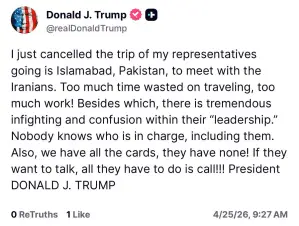
Ben Meiselas, right, April 25, 2026.Here are the stories we’re tracking today: Trump cancels a trip to Islamabad for talks with Iran that Iran already said were never happening; Trump sparks a new international crisis involving the Falklands; New photos from USS Abraham Lincoln contradict Pentagon denials regarding troubling food shortages for troops.Parnas Perspective, Saturday Morning News and Commentary: Important Epstein News, Food Supply for Troops Becomes Dire, Aaron Parnas, right, April 24, 2026. Why I am boycotting the White House Correspondents Dinner: We should not make today business as usual.April 24, 2026. The White House is bracing for what insiders are describing as a political collapse, with even the president’s own advisors acknowledging that his poll numbers are among the worst on record.U.S. Law, Courts, Crime, Rights, Justice
 New York Times, The ‘Lasting Damage’ of Pirro’s Abandoned Fed Investigation, Colby Smith and Tony Romm, April 25, 2026 (print ed.). The Trump administration’s attacks on the Federal Reserve have rattled confidence in the central bank’s ability to operate independently before a leadership transition.
More On Iran-Lebanon Wars
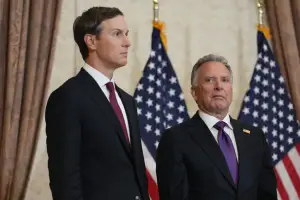
Trump son-in-law Jared Kushner and Trump-allied New York real estate financier Steve Witkoff in Islamabad, Pakistan, on April 12, 2026 (Pool photo by Agence France-Presse).
April 25, 2026. He is not ignorant, and asserting he is lets Trump off the hook for even greater failures than stupidity.Media, High-Tech, Propaganda
Trump Family Businesses, Insider Deals
 2026. When I first started this post, yesterday morning, WSJ was presenting the question of whether to bail out Sprit Airlines as a debate between two of Trump’s top advisors. Howard Lutnick told Trump he could be a hero by saving jobs, whereas Sean Duffy argued taxpayers would be buying a dud. One after another right wing member of Congress mocked the idea.
More On U.S. Politics, Governance, Elections
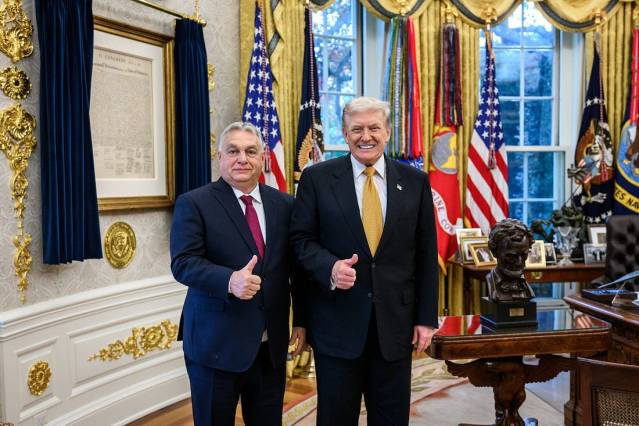 Hungary’s authoritarian prime minister, Viktor Orbán, supported by Russia and the conservative U.S. group CPAC (Conservative Political Action Committee, is shown above at the White House President Trump, another committed supporter.
The New Republic, Trump Has Lost Almost All Gen Z Support, Brutal Poll Shows, Ellie Quinlan Houghtaling, April 24, 2026. Donald Trump has lost all the gains he made with younger voters—and then some. April 24, 2026. After Desmond Holly shot up Evergreen High School last September 10, severely wounding two other students, the case has gotten very little notice.More Global News

April 25, 2026. On April 25, 1945, delegates from fifty nations met in San Francisco to establish a permanent forum for international cooperation: the United Nations.April 25
Top Story
President Trump leads a press briefing at the White House accompanied by FBI Director Kash Patel and other officials following a report of a shooter outside the hotel hosting the annual White House Correspondents Dinner on April 25, 2026.
New York Times, Live Updates: Suspect Detained After Gunfire Near Dinner Attended by Trump, Luke Broadwater, Michael M. Grynbaum, Shawn McCreesh, Campbell Robertson and Tyler Pager, April 25, 2026. Secret Service officers at the White House Correspondents’ Association dinner rushed the president out of the Washington Hilton. The president was unharmed. The F.B.I. said a suspect was in custody.
Here’s the latest.
President Trump was rushed from the stage after gunfire broke out in the hotel where the White House correspondents’ dinner was being held on Saturday night. At a news conference a few hours later, Mr. Trump said a man carrying multiple weapons had charged a security checkpoint before being taken into custody.
The president said a Secret Service officer had been shot, but was saved by his bulletproof vest. A suspect was in custody, and the president said his motive was not immediately clear.
Two law enforcement officials who were not authorized to discuss the matter information identified the man in custody as Cole Tomas Allen, 31, of Torrance, Calif.
President Trump shared a photo of the alleged shooter, identified as Cole Tomas Allen, age 31 of Torrance, California, after he was subdued.
Mr. Trump posted two images on Truth Social showing a man he said was the attacker being detained, as well as a brief surveillance video of a man running past the security checkpoint at the Washington Hilton. In the video, agents drew their guns and appeared to start firing.
The F.B.I. said a suspect was in custody after what the Secret Service called “a shooting incident” near a security screening area at the Washington Hilton, where the dinner was being held.
According to the White House press pool, a group of reporters who travel with the president, a member of the Secret Service shouted, “Shots fired,” and agents with guns drawn sprinted through the aisles to reach the president.
Guests were about five minutes into the dinner hour when a commotion occurred toward the back of the ballroom. Gasps were heard and then hundreds of attendees dropped under their seats at their tables. Security officials with weapons drawn emerged on the dais as the president and the first lady, Melania Trump, were quickly escorted out.
Mr. Trump, who was grazed by a bullet in an assassination attempt during a July 2024 campaign rally in Butler, Pa., and rushed to safety a few months later when a federal agent fired on an armed man at his Florida golf club, departed the hotel around 9:45 p.m.
Security personnel rush U.S. House Speaker Mike Johnson, at left, out of the Hilton Hotel ballroom following a report of a shooting outside the ballroom hosting a reported 2,600 guests at the annual White House Correspondents Dinner (Reuters photo)
The gunman did not make it inside the large hotel ballroom where Mr. Trump, top administration officials and hundreds of journalists had gathered for dinner around 8 p.m., officials said. A Secret Service agent was shot in his protective vest and in good condition, Mr. Trump told reporters at a White House news conference later in the evening.
Jeanine Pirro, right, the D.C. U.S. attorney, said the suspect was being charged with two counts: using a firearm during a crime of violence, and assault on a federal officer using a dangerous weapon. Pirro said that the defendant would be arraigned on Monday in federal court and that she expected more charges to follow.
In a news briefing, the D.C. police chief, Jeffery W. Carroll, said that “an individual charged a Secret Service checkpoint” armed with a shotgun, handgun and multiple knives. Carroll said that the suspect had not been struck by gunfire but was transported to a local hospital to be evaluated. A Secret Service agent was shot and was taken to a hospital, where he was “in good spirits,” Carroll said. Carroll said that the security plan for the dinner was established by the Secret Service and that it worked.
Here’s what else we’re covering:
PoliticusUSA, News and Comment: Trump Brags About The Crowd Size After Someone Tried To Shoot Up WHCD, Jason Easley, right, April 25, 2026. Donald Trump spoke at the White House after someone tried to enter the White House Correspondents Dinner with a gun, and Trump bragged to the nation about the dinner's crowd size.
The shooter was not able to gain entry into the ballroom area, and it is unclear how far the person got.
Once the situation was under control and Trump returned to the White House, the press waited for the president to address the nation.
"So as you know, this is not the first time in the past couple of years that our republic has been attacked by a would be assassin who sought to kill. And Butler, Pennsylvania, less than two years ago, you know, all know that story. And in Palm Beach, Florida, a few months after that we came close. We really had, again, we had some great work done by law enforcement, but in light of this evening's events, I asked that all Americans recommit with their hearts and resolving our difference peacefully."
The same president who started a war with Iran for no reason and sent ICE into the streets of America to kill citizens says we should solve our differences peacefully.
However, even the arrival of a gunman is an opportunity for Trump to brag about crowd size.
Trump said:
"We have to, we have to resolve our differences. I will say. You had Republicans, Democrats, independents, conservatives, liberals, and progressives. Those words are interchangeable perhaps, but maybe they're not. But yet, everybody in that room, big crowd, record setting crowd, there was a record setting group of people and there was a tremendous amount of love and coming together. I watched, I watched, and I was very, very impressed by that."
Other Top Stories
New York Times, Trump Seeks to Abolish Iran’s Atomic Stockpile, a Problem He Helped Create, William J. Broad and David E. Sanger, April 25, 2026. President Trump withdrew from the Obama-era nuclear accord in 2018, saying it was the worst deal ever. But Iran responded with an enrichment spree that haunts the negotiations to this day.
As nuclear talks restart in Pakistan this weekend, President Trump will confront the complicated legacy of his own decision, eight years ago, to cancel what he has called “a horrible, one-sided deal.”
That Obama-era agreement suffered from flaws and omissions. It would have expired after 15 years, leaving Iran free after 2030 to make as much nuclear fuel as it wanted. But once Mr. Trump withdrew from the deal in 2018, the Iranians went on an enrichment spree much sooner, leaving them closer to a bomb than ever before.
Now, Mr. Trump’s negotiators are dealing with the consequences of that decision, which he made over the objections of many of his national security advisers at the time.
Much recent attention has focused on Iran’s half ton of uranium that has been enriched to a level just shy of what is typically used in atom bombs. The majority of it is thought to be buried in a tunnel complex that Mr. Trump bombed last June. But those 970 pounds of potential bomb fuel represent only a small fraction of the problem.
Today, international inspectors say, Iran has a total of 11 tons of uranium, at various enrichment levels. With further purification, that is enough to build up to 100 nuclear weapons — more than the estimated size of Israel’s arsenal.
Virtually all of that cache accumulated in the years after Mr. Trump abandoned the Obama-era deal. That is because Tehran lived up to its pledge to ship to Russia 12.5 tons of its overall stockpile, about 97 percent. Iran’s weapon designers were left with too little nuclear fuel to build a single bomb.
Now, matching or exceeding that diplomatic accomplishment is one of the most complex challenges facing Mr. Trump and his two lead negotiators, his son-in-law Jared Kushner and his special envoy, Steve Witkoff, who are expected to leave for Pakistan on Saturday.
Mr. Trump is acutely aware that whatever he can negotiate with the Iranians will be compared with what Mr. Obama achieved more a decade ago. While the two countries are still exchanging proposals, and could well come up empty-handed, Mr. Trump is already judging his own, yet-to-be-negotiated agreement as superior.
“The DEAL that we are making with Iran will be FAR BETTER,” Mr. Trump wrote on his social media site on Monday. The Obama-era deal “was a guaranteed Road to a Nuclear Weapon, which will not, and cannot, happen with the deal we’re working on.”Editors’ PicksThe Japanese Designers Changing Men’s WearThese Literary Thrillers Explore Hollywood’s Dark SideTwo Sisters, Two Husbands, a Toddler and a House in the Bay Area
Based on Mr. Trump’s often-shifting objectives for the conflict with Iran, Mr. Kushner and Mr. Witkoff face a daunting list of negotiation topics, many of which the Obama team failed to address. They have to find a way to limit Iran’s ability to rebuild its arsenal of missiles. (The 2015 deal never addressed Iran’s missile capability, and Tehran ignored a United Nations resolution imposing limits.)
They need to find a way to fulfill Mr. Trump’s mandate to protect anti-regime protesters, whom Mr. Trump promised to help in January when they took to the streets. In fact, those protests were among the triggers for the American military buildup that ultimately led to the Feb. 28 attack.
News Roundups
Meidas Touch Network, Saturday Afternoon News and Commentary, Trump 'Cancels' Meeting Iran Never Agreed To, Ben Meiselas, right, April 25, 2026. Here are the stories we’re tracking today:
Let’s get into it.
Trump’s Iran lie collapses as we told you it would
Let me take you back to Friday, when White House Press Secretary Karoline Leavitt went on Fox News and told the world, without hedging, that Steve Witkoff and Jared Kushner were headed to Islamabad, Pakistan to engage in direct talks with representatives from the Iranian delegation. She said Iran had reached out and asked for this in-person conversation. She said the president was “dispatching” them to go hear what Iran had to say.
We said immediately: don’t believe it. It’s not happening.
And here’s why we knew. Iran’s Foreign Minister Araghchi had traveled to Islamabad for pre-scheduled meetings with Pakistani officials as part of Pakistan’s ongoing mediation efforts. Iranian officials were explicit that no meeting was planned with the United States. Iran’s Foreign Ministry made clear that any observations would be conveyed to Pakistan, not delivered directly to Witkoff or Kushner. Iranian adviser Seyed Mohammad Marandi went further, questioning why Iran should extend any trust at all to a process being conducted by two individuals he described as having demonstrated their appetite for war.
Araghchi completed his meetings with Pakistani leadership, thanked them for their mediation efforts, and left today. No Witkoff. No Kushner. No talks.
So what does Trump do? He calls the media and tells them he cancelled the trip. He says he told his people “nope, you’re not making an 18-hour flight” to sit around talking about nothing. He posts on Truth Social that there’s “tremendous infighting and confusion” within Iranian leadership. He says “we have all the cards.” He says engaging in diplomacy is “too much work.” His words.Image
Think about what just happened. The White House announced negotiations. Iran said there were no negotiations. We said there were no negotiations. Iran left. And now Trump is out here pretending he’s the one who pulled the plug, on a trip that was never happening, to conduct talks that Iran never agreed to.
This is not a negotiating strategy. This is a cover story. And a sloppy one. It’s as if nobody asked Trump to the school dance and now he’s pretending he’d rather just stay home. Poor Donald.
The Wall Street Journal’s editor at large made a comment recently that really cuts to the heart of it, noting that in this conflict, the Iranians have been providing more accurate information than the Trump administration. That’s not a commentary on Iran’s moral standing. It’s a damning indictment of an administration that lies so reflexively, so constantly, that a foreign adversary in the middle of a standoff has managed to be more credible than our own government.
Iran is preparing for war. Their military says so openly. Dozens of U.S. Air Force planes have been moving equipment into the Middle East nonstop. And in the middle of all this, the Trump administration is running market-moving disinformation about negotiations that don’t exist.The Falklands, NATO, and Trump’s war on allies
The humiliation isn’t contained to the Iran situation. Trump has decided this is also the week to go after our actual allies. Again.
The Falkland Islands government is now telling Trump directly to back off, calling him a “bully.” This comes after reports that the Trump administration is entertaining the idea of backing Argentina’s territorial claim over the islands, a betrayal of the United Kingdom that would have been unthinkable under any previous American president. The British response has been swift and pointed, with sentiment in the UK shifting toward the position that if Trump wants to start redistributing sovereign territory, maybe it’s time to revisit a few things about America.
For context: the Falklands held a referendum in 2013. The result was not close. The islanders chose to remain British. That’s the democratic will of the people who actually live there. Trump and his Argentine ally Javier Milei, who functions essentially as a puppet in this arrangement, have decided that doesn’t matter. The UK and the Falklands have a different view.
Then there’s Spain. A Pentagon email has surfaced floating the idea of suspending Spain from NATO over the Iran situation.
Tammy Bruce, who serves as Deputy U.S. Representative to the UN, went on television and delivered a line about a leader whose approval numbers are in the gutter and whose people have lost faith in him. Out of context, you would assume she must be talking about Donald Trump. But no, she was talking about UK Prime Minister Keir Starmer. The self-awareness is very much lacking with these people.Our troops deserve better
New photos from the USS Abraham Lincoln published by Newsweek this morning show service members receiving food portions that are, to put it plainly, inadequate. This follows previous reporting about sailors across multiple ships — the Gerald Ford, the Abraham Lincoln, the USS Tripoli — receiving minimal nutrition while deployed in the Persian Gulf during an active military buildup.
The Pentagon denies any shortages.
The photos tell a different story. And these new photos come after the Pentagon’s previous denials of any issues the last time similar images surfaces.
Trump has called veterans and service members “suckers and losers.” His contempt for the military as an institution has been on display for years. Now, while he moves dozens of Air Force planes into position across the Middle East and rattles sabers at Iran, the men and women on those ships are losing weight and not receiving their care packages. This should be a five-alarm scandal. In a functioning media environment, it would be.A Saturday morning at Mar-a-Lago
While all of this is happening, Donald Trump is in Florida, having fled Washington, seething, and posting on social media about the Lincoln Memorial Reflecting Pool is going to look nicer thanks to his renovations than it did under Barack Obama. I don’t know what else to say other than this is truly pathetic stuff.
Trump posted side-by-side images of the pool. One labeled “Hussein Obama.” One labeled “Trump.” Trump is currently having workers paint the pool a brighter shade of blue. That’s what’s occupying his mind this morning.
He’s supposed to return to Washington for the White House Correspondents’ Dinner tonight, an event he has already kneecapped by banning any comedian from hosting, presumably to insulate himself from the mockery he has so thoroughly earned. Whether he actually shows up remains to be seen.
What will greet him if he does: projections of his relationship with Jeffrey Epstein displayed on buildings near the venue. Video documentation of his close friendship with Epstein. His administration’s ongoing cover-up of the Epstein files. The cover-up of a child sex trafficking investigation, playing on a loop for everyone arriving at the dinner.
The Parnas Perspective, Saturday Morning News and Commentary: Important Epstein News, Food Supply for Troops Becomes Dire, Aaron Parnas, right, April 24, 2026. Why I am boycotting the White House Correspondents Dinner: We should not make today business as usual.
Today is the White House Correspondents’ Dinner. But instead of attending, I’ll be in Washington, D.C. standing alongside more than a dozen Epstein survivors as they demand justice and accountability from the President and his administration. Overnight, I received exclusive video of a new projection displayed on the building hosting the dinner—calling out the administration’s failures toward these survivors.
While the political and media elite gather to celebrate, there are also serious stories unfolding—from concerns about food rationing for troops to broader questions of leadership and responsibility.
I’ve been clear: I will not be attending tonight’s dinner, despite having the opportunity. CBS is inviting Pete Hegseth and Stephen Miller. Paramount is inviting Brendan Carr. Donald Trump is attending for the first time. That’s their choice. This is mine.
To me, honoring the First Amendment isn’t about black-tie events—it’s about standing with people who are willing to speak out, no matter the cost. The Epstein survivors embody that courage. That’s why I’ll be with them today, and I’ll be sharing what I witness. We should not pretend that today is just business as usual.
If there were ever a moment to support independent journalism, it’s now. We cannot keep pretending everything is normal—because it isn’t. Let’s build something better.
Here’s the news:
More than 480 journalists have signed an open letter urging the White House Correspondents’ Association to confront Donald Trump at its annual dinner over concerns about press freedom. The group argues the event should not proceed as usual given what they describe as ongoing efforts by Trump and his administration to undermine the media. Some have called for a strong public defense of the First Amendment during the dinner, while others are choosing to boycott the event entirely. The controversy highlights growing tensions between the press and the administration ahead of Trump’s rare appearance at the gathering.
New photos shared with Newsweek from aboard the USS Abraham Lincoln appear to show small food portions and limited side items, raising concerns among military families and advocates about troop nutrition and morale. A retired Air Force member said the images were “below standard” and warned that failures in food service and mail delivery could signal broader logistical problems during an extended deployment. Reports also indicate that one service member lost significant weight, and that care packages sent by families have been delayed for months due to suspended mail service to certain military ZIP codes.
 A particularly alarming detail from the reports is that one service member aboard the USS Abraham Lincoln is said to have lost 17 pounds during deployment, according to a family member. That level of weight loss in a relatively short period has raised concerns about whether troops are receiving adequate nutrition while deployed in a high-stress environment. Advocates note that proper food intake is critical not just for physical health but also for maintaining morale and operational readiness, especially during extended missions.
The situation comes as tens of thousands of U.S. troops remain deployed in the Middle East, with additional forces being sent to the region. Critics argue that both food quality and mail delivery are essential to maintaining morale, especially during prolonged operations, and say the reported issues raise questions about overall support systems for deployed personnel.
The Pentagon and U.S. Navy have strongly denied claims of shortages, stating that ships have more than 30 days of food supplies and that meals are nutritionally adequate. Officials also said the mail disruptions were temporary and tied to combat-related logistics, emphasizing that systems are in place to support troops and maintain operations despite the challenges.
Epstein survivors are in Washington, D.C. today, advocating for the Trump administration to fully release related case files. They are gathering on the National Mall to bring attention to their demands and push for transparency. The demonstration coincides with a formal black-tie dinner, White House Correspondents Dinner, attended by Donald Trump and members of the media.
I’ve learned exclusively that in honor of White House Correspondents’ Weekend, a video message highlighting Donald Trump’s past relationship with Jeffrey Epstein is being projected onto the side of a building near the venue where the president is expected to attend the dinner. The display is intended to draw attention to the Epstein files at a moment when political and media figures are gathered for the high-profile event.
Trump spent the evening posting a racist image of Candace Owens on his Truth Social platform:
Donald Trump referred to Greece as “he” and called it “a terrific guy,” a confusing remark that appeared to mix up the country with an individual.
 Labor secretary Lori Chavez-DeRemer, left, resigned after multiple controversies, including alleged misconduct and misuse of funds, which she denied while blaming “deep state” actors. Her departure follows a period of instability in the Department of Labor, marked by staff cuts, low morale, and criticism of her leadership. Union leaders and lawmakers said her tenure weakened worker protections and created ongoing challenges for the agency. Despite her exit, officials warn the department continues to face uncertainty without
 stable leadership.
Iran has warned it will retaliate if the US continues its naval blockade of Iranian ports, with its military calling the action “aggressive” and vowing a strong response. The blockade was ordered by Donald Trump following the effective closure of the Strait of Hormuz. Despite the pressure, Iranian officials say they will not enter negotiations until the blockade is lifted. The standoff highlights escalating tensions and a lack of progress toward a diplomatic resolution.
Iran’s foreign minister Abbas Araghchi shared Tehran’s negotiating demands and concerns about US positions during a visit to Islamabad, according to a Pakistani source. Meanwhile, US envoys Steve Witkoff and Jared Kushner are traveling to the Pakistani capital. Iranian state media, however, has denied that any direct talks between the US and Iran will take place.
Six months after a ceasefire in Gaza, humanitarian conditions remain dire, with widespread hunger, disease, and ongoing Israeli strikes affecting civilians. Most of the population is displaced, living in damaged buildings or tents, while aid delivery remains limited and inconsistent. Negotiations over Gaza’s future have stalled, largely over disagreements about Hamas disarmament and broaderpolitical issues. Aid groups warn that conditions could worsen, especially with rising temperatures and a weakened healthcare system.
 The UK and Finland have jointly condemned attacks on journalists in Lebanon following the death of journalist Amal Khalil, above, in an Israeli strike. In a statement, the UK Foreign Office emphasized the vital role of journalists in covering war and called such violence “unacceptable.” As co-chairs of the Media Freedom Coalition, the two countries urged all parties, including Israeli authorities, to ensure the safety and freedom of media workers. The statement underscores growing international concern over risks faced by journalists in conflict zones.
Israel has carried out airstrikes in southern Lebanon, targeting what the Israel Defense Forces said were Hezbollah rocket launch sites. The attacks hit areas including Deir al-Zahrani, Kfar Reman, and al-Sama’iya, north of current Israeli troop positions. The strikes come just days after Donald Trump announced a three-week extension of a temporary ceasefire between Israel and Lebanon. Despite the extension, the truce has been only loosely observed, with sporadic clashes continuing since it began.
Iran has resumed some commercial flights from Tehran’s main international airport for the first time since the conflict began. Departures from Imam Khomeini International Airport are heading to cities including Istanbul, Muscat, and Medina. The move follows a partial reopening of Iranian airspace earlier this month after a ceasefire with the United States. It signals a cautious step toward restoring normal travel and easing disruptions caused by the conflict.
Ben Cohen was arrested after interrupting a Capitol Hill hearing to confront Robert F. Kennedy Jr. over Gaza. During the disruption, Cohen accused Congress of funding violence in Gaza while cutting domestic programs like Medicaid. Authorities removed him after he shouted his protest during the proceedings.
Palestinians in the West Bank and parts of Gaza are voting in local elections, marking the first such vote since the Gaza war began in 2023. More than 1 million people are eligible, though early turnout has been low at around 15%. Most candidates are affiliated with the Fatah movement led by Mahmoud Abbas or are independents, while Hamas is not participating. The elections take place amid ongoing conflict, political tensions, and continued violence affecting communities in the region.
Janet Mills vetoed a bill that would have created the nation’s first statewide moratorium on new data centers through 2027. While she expressed general support for limiting their environmental and energy impacts, she opposed the bill because it did not exempt a major $550 million project expected to bring jobs to the town of Jay. Instead, Mills plans to study the issue further through a new council and has signed separate legislation restricting tax incentives for such projects. The debate reflects growing political tensions nationwide over the economic benefits and environmental costs of expanding data centers.
A 75-year-old American big-game hunter, Ernie Dosio, was killed after being trampled by a group of elephants during a hunting trip in Gabon. He and his guide accidentally encountered five female elephants with a calf, which led to a sudden defensive attack. Dosio, a wealthy vineyard owner and experienced hunter, had a long history of hunting and was also involved in conservation and charity work. His death underscores the risks involved in big-game hunting, even for highly experienced individuals.
 Sam Altman, left, apologized after OpenAI failed to alert authorities about a user later responsible for a deadly mass shooting in British Columbia. The company had flagged and banned the individual’s account for potential violent activity months earlier but decided it did not meet the threshold for reporting to law enforcement. The February attack killed eight people, including family members and school victims, and injured many others. Altman expressed regret and pledged to improve cooperation with authorities to help prevent similar tragedies in the future.
The Parnas Perspective, Friday Evening News and Commentary: White House Braces for 'Political Collapse,' DOJ Brings Back Modern-Day Gas Chamber, Patel Previously Arrested for Intoxication, Aaron Parnas, right, April 24, 2026. The White House is bracing for what insiders are describing as a political collapse, with even the president’s own advisors acknowledging that his poll numbers are among the worst on record.
As a result, he and his family are expected to face intense scrutiny and what some are calling “political hell” through a wave of investigations. At the same time, the administration is moving to expand the death penalty with new execution methods, including one that critics have compared to a modern-day gas chamber and described as torture. And there is more.
But I want to begin tonight with something more personal. This weekend is the White House Correspondents’ Dinner. Instead of attending, I will be spending time with Epstein survivors to honor the life of Virginia Giuffre. I believe this moment calls for moral clarity.
Many of you have asked how you can support my work and the work of other journalists choosing to boycott an event that elevates those who attack the press. If you are able, I ask you to subscribe. Your support is helping build independent media, something stronger and more honest than what we are seeing right now.Subscribed
Today is also my daughter’s one-month birthday. Time really does fly. I was sitting with her earlier, and something hit me in a powerful way. The work we are doing here, the work you are helping me build, is about ensuring that she and her generation grow up in a world where trust in media is restored and where a sense of normalcy returns. I will not stop working toward that goal. I know many of you feel exhausted and overwhelmed. I want you to hear this clearly tonight: it will be okay. I am here with you every step of the way.
Now, to the news:
Jim VandeHei, the founder of Axios, described the Trump White House as heading toward a political collapse, citing internal Republican polling that is deteriorating rapidly. He indicated the downturn could cost Republicans control of both the House and Senate, signaling a breakdown in political support. According to his assessment, such losses would almost certainly trigger impeachment efforts against Donald Trump as soon as power shifts.
The U.S. Department of Justice announced plans to expand federal execution methods to include firing squads, electrocution, and gas asphyxiation, citing difficulties in obtaining drugs for lethal injections. Acting Attorney General Todd Blanche said the changes aim to ensure executions can proceed even when certain methods are unavailable. The move follows Donald Trump’s push to resume and strengthen capital punishment policies during his second term. Officials also said the department is streamlining procedures to speed up death penalty cases while continuing to seek new death sentences.
An American Civil Liberties Union report details the controversial use of nitrogen gas in executions, highlighting Alabama’s 2024 execution of Kenneth Smith despite a jury previously recommending a life sentence. Witnesses described the execution as prolonged and distressing, while U.N. experts warned the method could amount to torture and violate international law. The report also raises safety concerns about nitrogen exposure for prison staff and others, citing past fatal industrial accidents. It argues that such methods underscore broader problems with capital punishment, including wrongful convictions and systemic inequities, and calls for the death penalty to be abolished.

FBI Director Kash Patel is shown gussling champagne while celebrating in the locker room with victorious U.S. hockey players at the Winter Olympics this February in Italy after visiting the nation on what purported to be official business related to his FBI duties.
Kash Patel was arrested twice in his youth for alcohol-related incidents, including public intoxication and public urination, according to a 2005 letter he wrote as part of a professional disclosure. He described the behavior as an anomaly and not representative of his usual conduct. The incidents have resurfaced amid recent scrutiny and allegations about his drinking, which he denies. A spokesperson said his background was thoroughly vetted and characterized the renewed focus as an attempt to undermine his leadership.
Pete Hegseth, right, said the rebranding of the Department of Defense as the “Department of War” reflects a more proactive approach to maintaining peace through strength. Responding to a question about renaming it the “Department of Peace,” he argued that the U.S. military effectively acts as a global guarantor of safety and deserves the Nobel Peace Prize each year. He framed the name change as emphasizing deterrence and assertive action to preserve stability.
Donald Tusk questioned whether the United States would remain “loyal” to its NATO commitments and called on the European Union to become a stronger, more unified alliance. He warned that Russia could potentially attack a member state within months, underscoring growing security concerns in Europe.
The U.S. Justice Department has dropped its criminal investigation into the Federal Reserve and its chair, Jerome Powell, over costly renovations at its Washington headquarters. However, the inquiry is effectively continuing under the Federal Reserve’s inspector general, who is reviewing the project’s multibillion-dollar cost overruns. The move may help advance the nomination of Kevin Warsh as Fed chair, which had been stalled in the Senate.
Karoline Leavitt, right, said the investigation into Jerome Powell is not over, despite the Justice Department ending its criminal probe. She explained that the case has been shifted to the Federal Reserve’s inspector general and remains a priority for Donald Trump. According to Leavitt, the investigation is continuing under a different authority rather than being fully closed.
Donald Trump criticized a Supreme Court decision on tariffs, claiming it could force the U.S. to repay $159 billion to companies and countries that previously paid those fees. He argued the ruling failed to include a simple clarification that would have prevented the repayments. Trump framed the situation as a major financial loss for the country, suggesting it could have been avoided with minor changes to the decision.
A federal appeals court has rejected Donald Trump’s effort to bar migrants crossing the U.S.-Mexico border from seeking asylum, ruling the policy conflicts with existing law. The decision marks a significant setback for a key part of his immigration agenda and affirms that only Congress can change asylum rules. The 2–1 ruling sets up a likely Supreme Court battle, as the administration weighs next steps. Advocates say the decision could protect thousands of migrants by preserving their right to apply for asylum.
An Iranian delegation led by Abbas Araghchi has arrived in Islamabad, according to Pakistan’s foreign ministry, to meet with senior Pakistani leaders. The talks will focus on recent regional developments and efforts to promote peace and stability. Araghchi has not indicated any plans to resume negotiations with the U.S., and reports say he will not engage with American officials during the visit. Meanwhile, a U.S. delegation led by Steve Witkoff and Jared Kushner is expected to arrive in Islamabad shortly.
A former staffer who accused Eric Swalwell of rape is now cooperating with an investigation by the Manhattan District Attorney’s office. The woman alleges assaults in both New York in 2024 and California in 2019, and has retained new legal counsel. The probe was launched shortly after her claims became public, leading Swalwell to withdraw from the California governor’s race and resign from Congress. Swalwell has denied the allegations and said he intends to defend himself. Anwar Ibrahim said Malaysia is negotiating with Iran to allow two Malaysian-owned fuel tankers to pass after facing restrictions, despite earlier clearance. The vessels have already exited the Strait of Hormuz, though details on the limitations were not provided. One tanker has returned to Malaysia, while another is expected to arrive soon. A third vessel remains stuck at port due to technical issues.
Fighting between Israel and Hezbollah continues despite a three-week extension of the ceasefire, with both sides accusing each other of violations. Hezbollah said it targeted Israeli soldiers and vehicles in southern Lebanon and claimed it shot down an Israeli drone. The Israel Defense Forces said it struck Hezbollah sites after rocket fire into northern Israel and reported killing several fighters. Benjamin Netanyahu said Israel would continue acting against threats, accusing Hezbollah of undermining the ceasefire.
U.S. Law, Courts, Crime, Rights, Justice
The New Republic, Trump Suffers Staggering Legal Loss in Quest to Ban Asylum, Hafiz Rashid, April 24, 2026. The president cannot enforce his executive order preventing immigrants from claiming asylum. President Donald Trump’s attempt to ban immigrants from claiming asylum at the southern border was blocked in a federal court Friday.
The U.S. Court of Appeals for the District of Columbia ruled 2–1 that Trump could not deport immigrants “under summary removal procedures of his own making” or suspend their rights to apply for asylum, even if they cross the border illegally.
Cornelia Pillard, an Obama appointee, and J. Michelle Childs, appointed by Biden, ruled against Trump, while Trump appointee Justin Walker ruled in the administration’s favor. The three-judge panel upheld a ruling from U.S. District Judge Randolph Moss in July, who said that Trump’s January 2025 executive order ending asylum claims for those who cross the U.S.-Mexico border went against federal law.
“Barring foreign individuals who are physically present in the United States from applying for asylum and, if they make the statutory showing that they are eligible, from being considered to receive it cannot be squared with the statute,” Childs wrote in her ruling.
Last year, Trump adviser Stephen Miller railed against the lower court’s similar conclusion, calling Moss a “marxist judge” attempting to “circumvent the Supreme Court,” which is where the case is likely headed next. Asylum claims have plummeted under Trump, who has fired immigration judges and pushed mass deportations despite multiple defeats in court.

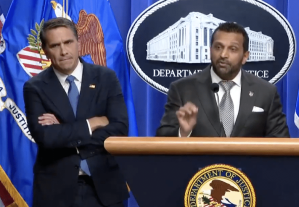
Acting Attorney Gen. Todd Blanche, left, and FBI Director Kash Patel presided at a raucous press conference at the Justice Department April 21 where their announcement of dubious federal charges against the Southern Poverty Legal Center, a civil rights organization, was superceded during question period by reporters' questions about news reports that Patel's job has been jeapardized by drinking and other unprofessional activities.
The Contrarian, Political Opinion: The Trump Regime’s Heinous Attack on a Legendary Civil Rights Organization, Norman Eisen, right,  and Tom Joscelyn, April 25, 2026. The Trump administration’s move to indict the Southern Poverty Law Center (SPLC) stands as the latest in a string of preposterous abuses of power and the continued weaponization of our justice system.
I know many of us were alarmed into action by prior controversial investigations involving high-profile figures (e.g., Leticia James, James Comey). This week’s indictment is perhaps an even more brazen smear — one that raises the stakes for the deployment of government authority against civil society organizations.
I spent time this week on other injustices that you, Contrarians, are enabling me to contest — including David Ellison’s Paramount-Warner merger and my forthcoming court appearance arguing for summary judgment on the renaming of the Kennedy Center. But this publisher’s note spotlights the SPLC battle. It’s a stark example of the erosion of institutional norms and the chilling effect such actions could have on free press and expression. These concerns underpin a Contrarian special report I co-wrote with my colleague Tom Joscelyn, a senior adviser for Democracy Defenders. We’ll be posting that at noon ET here at The Contrarian. In it, we scrutinize the details of the indictment to share a definitive takedown. You won’t want to miss it! Acting Attorney General Todd Blanche (left) and FBI Director Kash Patel announce the SPLC indictment. (Department of Justice)
Here’s a sneak peek, followed by our usual weekly roundup:
During a press conference on Tuesday, Acting Attorney General Todd Blanche and FBI Director Kash Patel announced that the SPLC had been criminally indicted by a grand jury in Montgomery, Alabama. “There is nothing political about this indictment,” Blanche insisted. Anyone paying attention knows that is a lie. This DOJ attack on the esteemed SPLC is a travesty.
This sham regime has unethically abused its power in this ridiculous attack on a legendary civil rights organization. As my fellow former presidential ethics counselors Richard Painter (George W. Bush), Virginia Canter (Barack Obama and Bill Clinton), and I (Barack Obama) wrote in a statement issued shortly after the indictment, we will not stay silent while the administration weaponizes the tools of law enforcement to attack groups it disagrees with.
This grievance is not a new one. MAGA Republicans have been gunning for the SPLC for years. During a congressional hearing late last year, for instance, Rep. Chip Roy (R-TX) portrayed the legendary civil rights organization as a bogeyman out to get conservatives and demanded a full investigation into how the DOJ, FBI, and other federal agencies had long relied on the center’s work. Other leading MAGA Republicans have loudly complained when the organization called out their hate.
Donald Trump’s corrupted DOJ and FBI have found a way to use the court system to act out MAGA’s revenge fantasy. Absurdly, the Trump regime alleges that instead of seeking to “dismantle” white supremacist groups — the center’s mission for the past 55 years, during which time it helped take down the Ku Klux Klan — it was surreptitiously paying extremists as part of some convoluted conspiracy. Blanche accuses the group of “manufacturing racism to justify its existence.” Patel claims the SPLC “allegedly engaged in a massive fraud operation to deceive their donors, enrich themselves, and hide their deceptive operations from the public.”
These allegations are a smear. None of them withstands scrutiny.
The indictment centers on the SPLC’s use of paid informants to infiltrate white supremacist groups. That is not unusual. It is often difficult to get inside groups seeking to overthrow the U.S. government or impose their racist vision on the country. The FBI itself regularly uses informants, and the “courts have recognized” that it “is lawful and often essential to the effectiveness of properly authorized law enforcement investigations.”
Indeed, the SPLC provided intelligence from its informant network to law enforcement agencies, including the FBI — a fact not included in the indictment. The exclusion of any mention of the longstanding working relationship between the SPLC and the FBI is outrageous and undermines the entire premise of the case. “We frequently shared what we learned from informants with local and federal law enforcement, including the FBI,” Bryan Fair, the SPLC’s interim president, said in a video defending his organization.
Patel knows Fair’s statement is true. Patel severed “all ties” between the FBI and SPLC in October 2025, as he wrote on X. Patel’s statement is an admission that the SPLC had those ties and was providing intelligence to the bureau. In fact, before Patel ended the relationship, Republican congressmen and conservative activists frequently complained that the FBI was cooperating too closely with the SPLC.
Nevertheless, the DOJ alleges that the SPLC’s use of informants was part of a “scheme and artifice” to deceive donors. Acting U.S. Attorney Kevin Davidson alleges in the indictment that though SPLC’s “stated mission included the dismantling of white supremacy and confronting hate across the country” it was “unbeknownst to donors,” secretly using “donated money … to fund the leaders and organizers of racist groups, including the Ku Klux Klan, the Aryan Nation, and the National Alliance.”
However, the indictment utterly fails to explain how these payments to extremist leaders undercut the SPLC’s stated mission. Nor does it say how anyone working for the center intentionally deceived donors. Nor could it; if you surveyed donors to the organization, they have already stated or would almost undoubtedly say that investigating hate is exactly what they wanted to support and that these claims are reprehensible.
The DOJ’s entire case centers on the SPLC’s alleged payments to ten informants inside extremist groups. Our special report, which will be posted here at The Contrarian at noon today, details the facts regarding these informants. The report makes evident that not a one justifies the criminal charges brought against the SPLC.
Please check it out! As you’ll read, this is hardly a conspiracy to secretly fund extremism or defraud donors. It is simply intelligence work. In fact, it is the type of information-gathering on white supremacist groups the FBI routinely engages in — or at least used to.
The hollow, desperate accusations underscore the extent to which the Trump regime wants Americans to believe that the SPLC, which has fought white supremacy since its founding in 1971, was secretly sponsoring white supremacy. That is utter nonsense.Subscribed
We stand with SPLC and will support the organization however we can.
New York Times, The ‘Lasting Damage’ of Pirro’s Abandoned Fed Investigation, Colby Smith and Tony Romm, April 25, 2026 (print ed.). The Trump administration’s attacks on the Federal Reserve have rattled confidence in the central bank’s ability to operate independently before a leadership transition.
The Justice Department’s criminal investigation of the Federal Reserve and its chair, Jerome H. Powell, appears to be over. But the ramifications for the central bank are likely to prove much longer lasting.
Nine months after President Trump made a hasty visit to the Fed’s Washington headquarters and promised to “take a look” at a costly renovation, the administration has concluded its inquiry with seemingly nothing to show. Far from the criminal charges that they once pursued, prosecutors left in their wake a dark cloud over the institution and the person Mr. Trump has chosen to next lead the central bank.
The about-face has removed, for now, the immediate threat of a further escalation against the Fed. It has also potentially cleared a path for Mr. Trump’s nominee for Fed chair, Kevin M. Warsh, to succeed Mr. Powell, whose term ends on May 15.
What will be far harder to recoup is confidence in the Fed’s ability to operate independently from a White House that has shown little restraint in its efforts to bully the central bank into slashing interest rates.
Even as Jeanine Pirro, the U.S. attorney for the District of Columbia, announced that the investigation was shutting down, she warned that she would “not hesitate” to reopen the inquiry if warranted. Ms. Pirro added that she had asked the Fed’s inspector general to take over the investigation, even though the internal watchdog had been looking into the matter since July.
Karoline Leavitt, the White House press secretary, said on Friday that the investigation “still continues” and was simply being taken up “under a different authority.”
Kathryn Judge, a Columbia Law School professor who was a Supreme Court law clerk for Justice Stephen G. Breyer, said she feared “lasting damage” from the investigation into Mr. Powell — not only for the Fed but for policymakers across government.
Until now, she said, officials did not have to worry about repercussions from “taking a strong stance on policy issues in ways that are inconsistent with the president’s agenda.” But that was the sort of pressure that Mr. Powell faced as Mr. Trump sought to force rates down.
Although the Fed cut rates last year, it did not deliver the kind of relief that Mr. Trump wanted. Since January, it has also turned cautious on subsequent reductions, a sentiment that has only grown amid the war in Iran, which has caused an acute energy shock.
“The Fed, so far, has proved resilient in ways that have proved quite helpful for the broader economy,” Ms. Judge said. She added that the country “cannot take for granted” that the Fed “will continue to prove resilient as it takes hit after hit from this administration.”
Since returning to the White House for a second term, Mr. Trump has been consistent in his desire to have more sway over the Fed, which has long set rates free from political meddling. That ability is critical, given the powerful role the central bank plays guiding the economy and ensuring low, stable inflation and a healthy labor market.
For a time, the president’s attacks had largely played out in news conferences and on social media. At one point, he flirted with firing Mr. Powell, but never took that step.
Yet Mr. Trump’s decision in August to try to oust Lisa D. Cook from the Fed’s Board of Governors over unsubstantiated allegations of mortgage fraud was a serious escalation, one now in the hands of the Supreme Court. The investigation by the Justice Department, which specifically targeted Mr. Powell and became public in January, crossed yet another threshold, quickly touching off widespread outrage.
In a rare video, Mr. Powell called out the administration for trying to leverage legal threats to coerce the Fed into lowering rates and warned about the institution’s ability to carry out its duties independently. Democrats and Republicans on Capitol Hill echoed those concerns, with many demanding that Mr. Trump back off.
Mr. Trump’s actions proved especially unpalatable to Senator Thom Tillis of North Carolina, a Republican on the Senate Banking Committee. Mr. Tillis coupled his criticism with a threat to block any future nominee to the Fed until the investigation into Mr. Powell was resolved. Republicans have a slim 13-to-11 majority on the Banking Committee, giving Mr. Tillis the ability to throw a wrench into confirming Mr. Trump’s pick.
The New Republic, Trump DOJ Announces It Will Start Executing People by Firing Squad, Edith Olmsted, April 24, 2026. Apparently death penalty by lethal injection wasn’t enough for Donald Trump.
The Department of Justice announced Friday that it will resurrect federal firing squads as part of an effort to implement Donald Trump’s day-one executive order to revamp capital punishment.
Trump’s order, signed in January 2025, demanded the attorney general pursue the death penalty on “all crimes of a severity demanding its use,” including murder of a law enforcement officer or any capital crime committed by an undocumented immigrant.
Under former President Joe Biden, Attorney General Merrick Garland had paused federal executions. Trump became furious when, before leaving the White House, Biden pardoned 37 prisoners on death row. The Republican kicked off his second term in office with a bloodthirsty decree for more death.
The January order made no mention of firing squads. Still, the DOJ said in its Friday announcement it had directed the Bureau of Prisons to “expand the execution protocol to include additional manners of execution such as the firing squad.”
Some view firing squads as more humane than lethal injection, which do not have a 100 percent success rate and sometimes require multiple doses. However, execution by firing squad can also result in prisoners slowly bleeding to death if they are not immediately killed by the bullet.
In March 2025, the Supreme Court allowed South Carolina to carry out the country’s first execution by firing squad in 15 years. Since 1608, at least 144 prisoners have been executed by firing squads in America, most of them in Utah, according to the Associated Press. Firing squads have not gained much traction outside of Utah because they are considered to be barbaric. Currently only five states—Idaho, Mississippi, Oklahoma, South Carolina, and Utah—allow the use of firing squads in certain circumstances.
New York Times, Man Is Charged With Murder of 2 Missing Florida Doctoral Students, Hannah Ziegler and Isabella Kwai, Updated April 25, 2026. The University of South Florida students were reported missing last week. On Saturday, prosecutors charged a roommate of one student in both their deaths.
A former student at the University of South Florida has been charged with the murder of two doctoral students at the school, one of whom was his roommate, the authorities said on Saturday.
The doctoral students, Zamil Limon and Nahida Bristy, both 27, were reported missing shortly after they were last seen in the Tampa area on April 16.
Mr. Limon’s body was found on Friday morning on the Howard Frankland Bridge in Tampa, about 20 miles southwest of his home near the university’s campus, said Joseph Maurer, a chief deputy of the Hillsborough County Sheriff’s Office on Friday.
The sheriff’s office on Saturday said that it had charged Mr. Limon’s roommate, Hisham Abugharbieh, 26, with two counts of first-degree murder in the deaths of Mr. Limon and Ms. Bristy.
More On Iran-Lebanon Wars
Trump son-in-law Jared Kushner and Trump-allied New York real estate financier Steve Witkoff in Islamabad, Pakistan, on April 12, 2026 (Pool photo by Agence France-Press).
New York Times, Iran War Live Updates: Trump Calls Off Witkoff and Kushner’s Travel to Pakistan for Peace Talks, Luke Broadwater and Pranav Baskar, April 25, 2026. What We’re Covering Today
President Trump on Saturday called off a trip by two of his top negotiators to Islamabad, Pakistan, just before they were set to leave for talks about a potential deal to end the war in Iran.
“I’ve told my people a little while ago, they were getting ready to leave, and I said, ‘Nope, you’re not making an 18-hour flight to go there. We have all the cards,’” Mr. Trump said in a statement. “They can call us anytime they want, but you’re not going to be making any more 18-hour flights to sit around talking about nothing.”
Steve Witkoff, the special envoy, and Jared Kushner, the president’s son-in-law, had been scheduled to travel to Pakistan on Saturday, along with top aides to Vice President JD Vance. Officials in Pakistan have been mediating between the United States and Iran to try to end more than a month of war in the Middle East.
The cancellation of the trip is the latest sign that Iran and the United States are far from reaching a deal to end the war. A previous trip to Islamabad by Mr. Vance proved unsuccessful, and the Americans appear no closer to achieving the administration’s political goals, including convincing Iran to turn over its nuclear stockpile and curtail its future program. The two sides are also locked in a stalemate over control of the Strait of Hormuz, through which a fifth of the world’s oil supply flows.
Mr. Trump’s decision came after Iranian officials who had been in Islamabad for talks with Pakistani officials trying to broker a peace agreement left the country.
Abbas Araghchi, the Iranian foreign minister, and Iranian negotiators held a round of talks with Pakistani leaders but left without reaching an apparent breakthrough. On Friday, Iran’s foreign ministry had said no meeting had been planned in Pakistan between Iran and the United States.
Mr. Trump this week unilaterally extended a cease-fire between the United States and Iran that had been set to expire, saying he wanted to give Tehran a chance to come up with a new proposal to end the war.
The United States recently transmitted a written proposal to the Iranians intended to establish points of agreement that could frame more detailed negotiations. The document covers a broad range of issues, but the core sticking points are the same ones that have bedeviled Western negotiators for more than a decade: the scope of Iran’s uranium enrichment program and the fate of its stockpile of enriched uranium.
The American military has displayed its overwhelming might during the war, successfully striking thousands of targets. But Iran’s theocratic regime, even after its top leaders were killed, has remained in power and has asserted tight control over the Strait of Hormuz, limiting shipping, driving up the price of oil and shaking the world economy.
After leaving Islamabad, Abbas Araghchi, Iran’s foreign minister, said in a social media post that he had shared Iran’s position on a “workable framework to permanently end the war on Iran” with Pakistani leaders. “Have yet to see if the U.S. is truly serious about diplomacy,” he wrote, in a post that came after Trump on Saturday canceled plans for two of his top negotiators to go to Pakistan. He did not give details of the proposal., 12:07 p.m. ET
The cancellation of the trip is the latest sign that the two sides are far from reaching any deal to end the war. A previous trip to Islamabad by Vice President JD Vance proved unsuccessful, and the Americans appear no closer to achieving the administration’s political goals, including convincing Iran to turn over its nuclear stockpile or curtail its program.
 President Trump addresses about 800 U.S. generals and admirals in a political-rally-style speech at Quantico, VA on Sept. 30, 2025, preceded by Secretary of Defense Pete Hegseth, a former National Guard officer who prefers to call himself "Secretary of War" instead of the congressionally mandated term "Secretary of Defense."

Senior military leaders look on at Marine Corps Base Quantico on September 30, 2025 in Quantico, Virginia.
Emptywheel, Analysis and Opinion: Trump Is Not Ignorant of Iran Risks; He Is Attempting a Con to Cope with His Failure, Emptywheel, (Marcy Wheeler), right, April 25, 2026. He is not ignorant, and asserting he is lets Trump off the hook for even greater failures than stupidity.
Please read this story, published February 23, describing how, on or about February 17, Dan Caine gave Trump several warnings about an attack on Iran: it would deplete an already depleted munitions stockpile, risk US casualties, and be complicated because the US had no allied support.
Gen. Dan Caine, chairman of the Joint Chiefs of Staff, expressed his concerns at a White House meeting last week with Trump and his top aides, these people said, cautioning that any major operation against Iran will face challenges because the U.S. munitions stockpile has been significantly depleted by Washington’s ongoing defense of Israel and support for Ukraine. Caine’s remarks at the White House meeting have not been previously reported.
Separately, in Pentagon meetings this month, Caine also has raised concerns about the scale of any Iran campaign, its inherent complexity and the possibility of U.S. casualties, one person said. The general has said that any operation would be made all the more difficult by a lack of allied support, this person said, speaking like others on the condition of anonymity to discuss private conversations.
[snip]
The White House meeting on Tuesday included Vice President JD Vance, Secretary of State Marco Rubio, CIA Director John Ratcliffe, Defense Secretary Pete Hegseth and White House adviser Stephen Miller, one person told The Washington Post.
[snip]
Some U.S. officials oppose a limited strike because it could trigger an unpredictable cycle of tit-for-tat violence, including Iranian attacks on U.S. military and diplomatic personnel in the region, said a person familiar with the deliberations.
And now, read this tweet Trump posted in response to the WaPo and an earlier Axios story describing Caine’s briefing.
First two Trump (and Jared and Witkoff) whisperers, then incredibly reliable State and DOD reporters, described Caine warning Trump, and then Trump responded by stating that:
I am the one that makes the decision [I]f [Caine] is told to do so [H]e only knows […] how to WIN
Trump attributed his certainty on this point because Caine “was in charge of Midnight Hammer” in which operation “the Iranian Nuclear Development […] was blown to smithereens by our Great B-2 Bombers.” It had nothing to do with warnings Caine gave. It had to do with the necessity of his own power bolstered by the snuff films Trump saw last summer that made him feel invincible.
If you haven’t gotten the point, read how (as Maggie H and J Swan reported) Trump told Tucker Carlson, within days of this briefing from Dan Caine, that everything was “going to be OK … Because it always is.”
A couple weeks before the war began, Mr. Trump, who had known Mr. Carlson for years, tried to reassure him over the phone. “I know you’re worried about it, but it’s going to be OK,” the president said. Mr. Carlson asked how he knew. “Because it always is,” Mr. Trump replied.
There is an instinct from people who loathe Trump to attribute to ignorance his serial disclaimers — collected by Aaron Blake — of advance warning of the catastrophe that could result from this war.
Also on Monday, Trump again expressed surprise at Iran’s retaliation against its neighbors. He claimed that “nobody” anticipated that Iran would respond to the US-Israeli strikes by attacking its Gulf neighbors.
“So they hit Qatar, Saudi Arabia, UAE, Bahrain, Kuwait,” Trump said. “Nobody expected that. We were shocked.”
The comment was puzzling enough that Fox News’ Peter Doocy pressed Trump on it at a later White House event. He asked whether Trump was surprised that nobody had briefed him on this possibility.
The president doubled and then tripled down.
“Nobody. Nobody. No, no, no, no,” Trump said. “The greatest experts — nobody thought they were going to hit — they were, I wouldn’t say friendly countries, they were like neutral.”
He then added: “There was no expert that would say that was going to happen. It’s not a question of like, gee, should you have known?”
Trump said something similar to CNN’s Jake Tapper shortly after the war began, calling Iran’s attacks on its Gulf neighbors “the biggest surprise.”
Treating this as ignorance is a category error, an assumption that Trump treats information like rational beings do. It treats knowledge as a binary: Trump either learns something and synthesizes it into his own rational thought process, or never had the opportunity to learn something. That’s not how Trump’s brain works, in significant part because his brain can only process ways to appear powerful.
He was warned directly of the risks of attacking Iran. He responded to those warnings by insisting that he controlled everything, that he would not face consequences because he never has.
Among the public warnings Blake catalogs to show Trump should have known is this column from Nate Swanson, who worked at NSC on Iran issues before he was ousted in a Laura Loomer purge last year. The column was published the day after Trump’s tweet.
It is easy to see why Trump would believe that the warnings about another attack on Iran are overwrought and that he can repeat his formula of decisive action and a clean exit. But this time is different. I spent 18 years working on Iran in various U.S. government capacities, including as President Joe Biden’s Iran director and on Trump’s negotiating team in the spring and summer of 2025. From that experience, I can see that Trump fundamentally fails to grasp that Iranian weakness will not lead the country to capitulate at the negotiating table. On the contrary, Iran’s present fragility only narrows the space for meaningful compromises. Nor does Trump understand that Iran faces entirely different conditions than it did in June 2025, when it chose to de-escalate. The Islamic Republic now believes that Israel and the United States intend to repeatedly strike its ballistic missile program—the foundation of Iranian self-defense—and that it must be more aggressive to forestall the kind of perpetual assault that could topple it altogether.
Trump’s own behavior also increases the risk of escalation. The president’s ever-intensifying wish to be seen as a historic peacemaker has led him to an unnecessarily binary choice—strong-arm Tehran into a major new deal or use substantial force. And the nebulousness of his motives makes this flash point much more dangerous. Trump seems interested, in no particular order, in demonstrating the prowess of the U.S. military, strengthening his negotiating position, showing he was serious when he vowed in a January Truth Social post to protect Iranian protesters, and differentiating his approach from President Barack Obama’s. This mishmash of objectives contrasts with the focus he brought to his previous successful operations and will make him less prepared if a strike does not yield the expected, swift capitulation. All told, today’s conditions mean that an attack by the United States on Iran could result in unexpectedly deadly retaliation—and a much longer and potentially damaging conflict for Washington.
First Swanson, whom Loomer found either insufficiently loyal or too cognizant of the complexity of Iranians, laid out why Iran would escalate. Then he described in detail how Trump always believed he would get away with ignoring expert advice. Then Swanson explained why Trump was particularly vulnerable to getting things wrong this time.
Swanson included the factor I noted here: on Iran, Trump is motivated by the Narcissistic injury of comparing himself to Barrack Obama.
Trump is facing the Narcissistic injury that has animated his entire political career: Barack Obama’s superiority to him. Trump’s advisors, some of his Gulf allies, most of the world, recognize that negotiating out of this deal is the only way to avoid a counterproductive escalation. But any deal will be worse than JPCOA, which Trump tore up in an attempt to void the history of the first Black president eight years ago. Any current deal will involve more financial benefit for Iran, with no additional limits on uranium enforcement, after such time as Iran has proven its ability to hold the world hostage by shutting Hormuz, after such time as Trump has installed more radical Iranian leaders.
That Narcissistic injury must be tearing Trump apart. He has spent years boasting he would show Obama he could do better on Iran, he tore up an agreement that included most everything Trump could get here (without the Hormuz crisis and a more radical regime), and in hopes to finally prove his superiority, he ignored explicit warnings provided and documented in advance.
I’m not sure what term to use to describe Trump’s bullshit claims (though the term would apply to virtually everything that comes out of his mouth these days). I don’t know whether he knows he is lying or has to believe he didn’t fail this spectacularly and so believes what he says to be true. Perhaps he is wittingly attempting to dodge blame for predictable catastrophe. Perhaps the utterances that come out of his mouth amount to his brain’s attempt to forestall a psychological collapse.
But he is not ignorant, and asserting he is lets Trump off the hook for even greater failures than stupidity.
New York Times, Iran War Live Updates: Witkoff and Kushner to Travel to Pakistan for Talks on Iran, April 25, 2026. Iran’s military threatened on Saturday to retaliate over the U.S. military’s blockade of Iranian ports.
“If the aggressive U.S. military continues its blockade, banditry, and piracy in the region, it should be certain that it will face a response from Iran’s powerful armed forces,” the military said in a statement carried by Iranian state media. President Trump ordered the blockade in response to Iran’s closure of the Strait of Hormuz, a key waterway for global energy supplies.
The measure appears to have had little effect in forcing Iran to accept American conditions for a diplomatic agreement to end the war. U.S. and Iranian officials are expected to gather in Pakistan on Saturday for further talks, although it was unclear whether they would meet directly or exchange messages through Pakistani mediators.What We’re Covering Today
Media, High-Tech, Propaganda
New York Times, Iran’s Meme War Against Trump Ushers In a Future of ‘Slopaganda,’ Steven Lee Myers and Stuart A. Thompson, April 24, 2026. When the U.S.-Israeli war with Iran started two months ago, online accounts linked to Tehran tried building sympathy with defiant and emotional appeals. They had little impact. Then, as the war dragged on, Iran shifted tactics. It began circulating short animated videos that scorched President Trump and others with biting satire.
Iran’s success in spreading these memes has surprised experts who study foreign influence operations. They say the tactics and technology on display during the war will almost certainly be replicated in other international crises, as well as major political events, including the looming elections in the United States.
“It’s spoken to the sort of Gen Z language of the internet in ways certainly diplomats don’t normally do,” said Bret Schafer, a senior director at the Institute for Strategic Dialogue, an international nonprofit that has tracked Iran’s activity.
“They have taken a regime that is, I mean, brutal and pretty awful and didn’t have exactly a great global reputation and turned them into kind of a plucky, fun underdog.”
Dozens of accounts belonging to Iranian government officials and diplomats have peppered their social feeds with a previously uncharacteristic edge, reposting biting videos that mock the United States and Israel.
They portray Mr. Trump as an imperialist out for blood or as an incompetent lackey of Israel’s prime minister, Benjamin Netanyahu, often stoking antisemitic tropes. They regularly suggest the war was launched to distract from the disclosures in the Jeffrey Epstein files.
Collectively, the posts by roughly 150 official Iranian accounts gained about 900 million views over the first 50 days of the war, a thirtyfold increase from the same period before, according to an analysis published on Thursday by the Institute for Strategic Dialogue.
“They’re talking in a way that’s fundamentally changed,” said Moustafa Ayad, another researcher at the institute. “If you go back two months and look at what they were putting out, it’s nothing like this.”
Propaganda is always adapting, reflecting the era in which it is made. Iran’s deft use of technology, experts say, has highlighted a new era of meme warfare that expands the information battlefield by using the algorithmic engines of social media to undermine an adversary’s political support. The new tactic has been called “slopaganda.”
Iran’s effort, the institute’s analysis concluded, “offers a blueprint that authoritarian actors can replicate in the future.”
Trump Family Businesses, Insider Deals
New York Times, Trump Says He Dislikes Prediction Markets. His Family Invests in Them, Ben Protess, April 25, 2026 (print ed.). The White House has warned staff not to wager on government decisions, but his family’s involvement with these firms undermines the president’s message.
When a U.S. soldier was indicted on Thursday on charges of using classified information to place prediction market bets, it seemed to confirm President Trump’s lament just hours before that “the whole world unfortunately has become somewhat of a casino.”
“I was never much in favor of it,” Mr. Trump said from the Oval Office, when asked about concerns that federal employees might be leveraging insider information on the prediction markets. “I don’t like it conceptually. It is what it is. I’m not happy with any of that stuff.”
Yet Mr. Trump and his family stand to profit from the very same industry.
The president’s publicly traded media company unveiled its own prediction market product last year. And the president’s eldest son, Donald Trump Jr., has ties to two of the industry’s top firms, including Polymarket, the platform that prosecutors say was used by the soldier for well-timed bets.
The result, ethics experts say, is a jarring juxtaposition between Mr. Trump’s public comments and his family’s private business.
While the president’s criticism of the prediction markets raised the prospect of new regulation, the reality is that little is likely to change. Last year, Mr. Trump’s administration backed away from enforcement efforts against Polymarket, and it is unclear whether regulators will adopt any new oversight measures.
“Presidential statements used to be the gold standard, but this is not true for President Trump,” Jeffrey A. Engel, founding director of the Center for Presidential History at Southern Methodist University, said.
“What he does is more important than what he says,” Mr. Engel said, adding, “I don’t think his comments will bother the prediction markets in the least.
Prediction markets, a fast-growing industry, allow consumers to place wagers on the likelihood of a future event, from cricket match scores to the release date of an album by the Canadian rap star Drake. But bettors can also weigh in on military and national security matters around the world. Some of those outcomes could be known or affected by a small group of decision makers, including those in Mr. Trump’s inner circle.
Mr. Trump made his remarks on Thursday, just hours before federal prosecutors in Manhattan charged Master Sgt. Gannon Ken Van Dyke, an Army Special Forces soldier who had helped capture Nicolás Maduro of Venezuela. Sgt. Van Dyke, prosecutors said, made more than $400,000 by betting on different outcomes related to Venezuela after learning of the operation.
He is not the only government employee suspected of placing well-timed bets on Venezuela and the war in Iran. There was a surge of suspicious trading related to the war last month. In response, Congress is considering legislation to limit government officials’ use of prediction markets, while officials in some states are also considering new regulations.
Senator Elissa Slotkin of Michigan, the lead Democratic sponsor of legislation that would bar any public official from placing prediction-market bets using nonpublic information they learn in the course of their jobs, has warned about “operational risk” and threats to national security.
It remains unclear whether the Republican-led Congress will advance the bipartisan bill. Asked about the president’s son’s ties to Polymarket and Kalshi, Ms. Slotkin said in an interview last month that she feared the White House could throw up barriers to passing the bill by pressuring Republicans not to support it.
New York Times, Firm Building Trump’s Ballroom Got a Secret No-Bid Contract for a Nearby Job, David A. Fahrenthold, Luke Broadwater and Andrea Fuller, April 25, 2026 (print ed.). The National Park Service increased the value of the contract several times over and then awarded it to Maryland-based Clark Construction, in a process that experts said was highly unusual.
To build his mammoth White House ballroom, President Trump last summer chose Maryland-based Clark Construction. Since then, Mr. Trump has repeatedly sung the company’s praises, even saying he wanted it to refurbish projects all over Washington.
In January, government documents show, the Trump administration secretly gave the company a no-bid contract to do another job at a sharply inflated price.
The National Park Service wanted to repair two ornamental fountains in Lafayette Park, across Pennsylvania Avenue from the White House. The Biden administration in 2022 had estimated the work would cost $3.3 million. But Mr. Trump’s government agreed to pay Clark $11.9 million to do it, and later added tasks that increased the contract to $17.4 million, the documents show.
The agency did so without considering offers from other firms, citing a rarely used “urgency” exception to normal open-bidding procedures usually meant for emergencies like war or natural disasters. By law, federal agencies are generally supposed to seek competing bids to find the vendor that provides the best deal.
Unlike the ballroom project, which Mr. Trump says will be funded by private donations, the bill for the fountain repairs is being paid by the government.
On Friday, Mr. Trump took credit for the repairs. “The first time Lafayette Park Fountains, opposite the White House, have worked in decades,” he wrote on social media. “My Great Honor to have funded this project (and many others!), and helped.”
This contract has not been previously reported. The Trump administration did not post it in public databases of federal spending, although agencies are typically supposed to report new contracts within three business days.
The New York Times obtained internal Park Service documents showing how the contract was awarded. Contracting experts said those documents revealed that the government had repeatedly used unusual procedures to bypass competition for the project and increase the price it expected to pay.
The Park Service, for instance, added more than $1 million to the contract’s cost estimate by accounting for inflation. Twice.
“They just took the cover page of my estimate and just added a bunch of money onto it,” said Stephen J. Kirk, an independent consultant who had estimated the cost of the fountain repairs for the National Park Service in 2022. “I didn’t add those extra millions on there."
The Interior Department, which includes the Park Service, defended the contract but declined to answer specific questions about it.
Emptywheel, Analysis and Opinion: Spirit Airlines is the Canary in Trump’s Fossil Fuel Mine, Emptywheel (Marcy Wheeler, right) April 24, 2026. When I first started this post, yesterday morning, WSJ was presenting the question of whether to bail out Sprit Airlines as a debate between two of Trump’s top advisors. Howard Lutnick told Trump he could be a hero by saving jobs, whereas Sean Duffy argued taxpayers would be buying a dud. One after another right wing member of Congress mocked the idea.
 Lutnick, left, argued to Trump that the president would see a political win by coming to Spirit’s rescue months before the midterm elections and that the deal could save thousands of jobs, according to a senior administration official and other people familiar with the matter.
Lutnick is the architect of the proposal under consideration by Trump and the company, in which the government would loan the company up to $500 million and receive in return warrants to take a potential significant stake in Spirit, some of the people said. The Wall Street Journal first reported Wednesday morning on the plan, which hasn’t been finalized.
[snip]
Duffy, on the other hand, told Trump that, in his view, making such an agreement with Spirit could have negative political consequences. He told the president he agreed it might save jobs, but he voiced skepticism about what the government is going to get out of possibly having a stake in the business.
Duffy also said that a deal with Spirit could leave voters with a negative impression about the Trump administration trying to bail out a failing company, a move that in the past hasn’t always been popular, the people said.
One after another right wing member of Congress mocked the idea. Scott Perry used pretty plane AI slop to argue that if you shield businesses from consequences of their decisions, “there’s no incentive to act responsibly.”
Teddy Cancun noted that “the government,” not Trump, “doesn’t know a damn thing about running a failed budget airline,” before blaming Biden just like Perry did.
The persistence with which right wingers blamed the decision by Joe Biden’s DOJ — importantly, as a bid to sustain competition and so cheap flights (as well as jobs) — was a tell of how seriously Trump was considering this plan, because Trump always blames one of his predecessors when he does something unpopular.
The logic here was that Biden destroyed Spirit by challenging the merger in order to sustain competition between airlines, plus jobs, so now Trump has to intervene to save cheap flights and jobs.
Two days ago, Trump was considering floating the airline for a 90% stake in the company. By the end of the day yesterday, Trump declared he wanted to buy it.
President Trump said that the U.S. government could take over Spirit Airlines, the ailing budget carrier that has been negotiating this week for a federal bailout.
“We’re thinking about doing it, helping them out, meaning bailing them out, or buying it. I think we’d just buy it,” Trump said, speaking from the Oval Office Thursday. He said that Spirit’s aircraft and assets were good and that the government could sell the company for a profit when the price of oil fell.
“I’d love to be able to save those jobs,” Trump said. “I’d love to be able to save an airline.”
Donald J. Trump, the serially failed businessman whose addiction to being rescued means he has little incentive to act responsibly, has opined once before that an airline’s aircraft and assets are good. That’s what he said about Eastern’s Shuttle business.
There are a slew of stories about this chapter of Trump’s life, which makes it really weird that Republicans addressed whether the government can run an airline, not whether Trump, personally, has proven he cannot.
This Matt Viser story from 2016 described how the prospect of owning an airline was, first, an ego boost — “like a presidential press conference” — and then a crash, both literally, and figuratively, with Trump getting bailed out as he always does.
“This is something from day one I have said I want to have my name on,” he said at a press conference just as he was about to take over the Shuttle. “I hope my name does a lot for the shuttle, and I hope the shuttle does something for my name.”
Stumbling over his enthusiasm at one point, he called the shuttle a “truly great transportation whatever.”
“Let’s be honest. If anyone else had started an airline, you never would have gotten that many reporters,” he said later. “That was like a presidential press conference.”
He was also asked about what it was like to fly on his own airline, looking down at his properties below.
“Truthfully? Truthfully it was great for the Trump ego,” he said. “I’m not supposed to say that.”
[snip]
The Eastern Airlines Shuttle flight had been a reliable source of revenue for decades. Since the 1960s, the number of shuttle flight passengers had grown every month, without exception, until November 1989, Nobles said.
It dropped. Then it dropped again in December. A recession was coming. As a result of the Gulf War, the price of oil — and, therefore, jet fuel — had jumped.
The Trump Shuttle was successful enough to cover operating costs but not enough to pay down the debt.
It fit a pattern for Trump: making a bet that his product would be so successful that he could pay down massive debt and earn a hefty profit along the way.
This time around, taxpayers, not Citibank, would be on the hook for Trump’s judgment about airplane stock after a crash.
But it’s not just about this airline. After all, the guy who crashed his Shuttle also serially bankrupted his companies, and several of his current companies are running on fumes. Trump’s invasion of Iran is beginning to do the same to parts of the US economy, to say nothing of the global economy.
Joe Biden didn’t create the precipitating need to bail out Sprit. Trump’s own invasion of Iran, and more importantly the unfathomable incompetence not to stave off a Hormuz closure, did. Trump has created a jet fuel crisis far bigger than the one that destroyed his plans for Trump Shuttle.
Spirit’s tailspin, of course, is partly of Trump’s making. The Middle East conflict has ignited an explosion in jet fuel prices, a line item that in average times amounts to 20% to 30% of airlines’ pretax, noninterest costs. Spirit has been operating under bankruptcy protection since August, and just two weeks after the war began, presented an already-fragile reorganization plan in the Southern District of New York. The blueprint projected jet fuel in the $2.20 a gallon range for this year and 2027, and even at those historically low prices, foresaw super-thin operating margins of 0.5%. Now, airlines are paying around $4.20, almost double the prewar sticker and Spirit’s forecast. A study by J.P. Morgan posits that owing to the fuel hit, Spirit is set to lose 20 cents for each dollar of revenue, and add $360 million in operating costs, an amount equal to its cash cushion.
It’s clear that Spirit can’t keep flying—unless Trump indeed orders a huge cash refill from the government. Clearly, keeping America’s leisure and business flyers as happy as possible under the circumstances is the best possible outcome for Trump.
Trump’s claim this is about jobs when he destroyed far more than 14,000 jobs with DOGE is rank bullshit. This is about hiding the damage Trump’s stupid invasion has done to America’s normal way of life. Trump wants to use taxpayer dollars to hide from taxpayers what a catastrophic economic disaster Trump caused with his incompetence.
And if Trump does this, the need will just snowball, at least to JetBlue and Frontier.
“Should the administration afford any sort of cash infusion, we believe JetBlue and Frontier (ULCC.O), opens new tab would be inclined to quickly follow,” they said, adding that such a move could eventually draw in larger carriers and distort competition across the industry.
One industry source said other airlines that compete with Spirit have privately voiced opposition to a bailout of just one carrier, even as they face similar cost pressures.
United Airlines CEO Scott Kirby also struck a skeptical tone this week, calling Spirit’s business model fundamentally flawed and questioning whether it could cover its operating costs.
And all that’s the damage Trump has done to the US economy, a petrostate with its own jet fuel capacity. Analysts are only beginning to think through what it will do to other economies, especially less wealthy Asian ones, but even Europe, if this continues to June.
If Europe keeps subsidising consumption, markets will get more out of whack. For one thing, prices for products will keep rising. America, where demand tends to jump in a period of summer road trips, will push them further. Competition for LNG, shortage of which was mostly absorbed by Asian consumers’ self-deprivation and a switch to coal, will also increase when Europe starts restocking gas for the winter.
Fast-depleting stocks make matters worse. Europe’s reserves of jet fuel cover some 50 days of consumption, their typical level. But modelling by Michelle Brouhard of Kpler, a data firm, for The Economist shows that European stocks will fall precipitously if Hormuz flows do not normalise by June. Those in other importing regions may disappear even faster (see chart 2, bottom panel). The outlook could worsen if America, seeking to tame domestic prices, emulates China and bans exports of refined products, which have risen by nearly half since the start of the war.
Trump take capitalism. Because of Trump’s stupidity, countries around the world are being forced to eschew capitalism to keep a quasi-normal way of life afloat.
The billionaire conman who started a war with the belief that it would all work out because it always does is now facing down the certainty that the defining moment of his legacy will not, this time, be OK.
A couple weeks before the war began, Mr. Trump, who had known Mr. Carlson for years, tried to reassure him over the phone. “I know you’re worried about it, but it’s going to be OK,” the president said. Mr. Carlson asked how he knew. “Because it always is,” Mr. Trump replied.
And his response to that is to get taxpayers to subsidize the illusion of normalcy.
Update: Mike Pence’s organization, Advancing American Freedom Foundation, comes out against the bailout, though again ignoring that Trump exacerbated Spirit’s woes. Curiously, when it invokes TARP, it doesn’t note whose ineptitude caused that crisis.
More On U.S. Politics, Governance, Elections
Hungary’s authoritarian prime minister, Viktor Orbán, supported by Russia and the conservative U.S. group CPAC (Conservative Political Action Committee, is shown above at the White House President Trump, another committed supporter.
Public Notice, Analysis: What America can learn from Viktor Orbán’s defeat, Aaron Rupar and Thor Benson, April 24, 2026. "The key was linking Orbán’s corruption to Hungarians’ daily lives."
Hungary’s authoritarian prime minister, Viktor Orbán, was finally defeated in an election that took place on April 12.
Orbán led Hungary for 16 years, during which time citizens endured a crackdown on free speech, the free press, LGBTQ rights, and immigration. He cozied up with Putin and moved Hungary away from Europe. The MAGA movement saw Orbán as a model — the infamous Project 2025 was heavily influenced by his governance style — so his loss is not just important for Hungary or the European Union, but also in terms of the global fight against right-wing authoritarianism.
Orbán’s defeat offers some lessons for how democracy defenders could potentially win the fight against Trumpism here in the United States. One of the key takeaways is that the opposition, led by victorious Tisza Party candidate Péter Magyar, focused on Orbán’s corruption and what it meant for everyday Hungarians. And as we were reminded yesterday, there’s no leader in the world more nakedly corrupt than Trump.
 To get some expert insight on the fall of Orbán and the reasons Magyar was able to beat him so resoundingly, we connected with Kim Lane Scheppele, right, a professor of sociology and international relations at Princeton University, who has worked in Hungary and actually met Orbán.
“It was amazing what they threw at Magyar, and he just kept marching on,” Scheppele told us, alluding to all of Orbán dirty campaign tricks and the structural reforms he enacted to entrench himself in power. “By the end, [Magyar] was having these rallies of half a million people in a country the size of New Jersey. It was about making people feel like he had their backs if they came out and voted for him.”
“In the US right now, especially among the elites that ought to be leaders in all of this, people are hiding because of what Trump can do to them,” she added. “People have gotten off of social media. Universities keep changing their DEI standards. People are complying in advance, keeping their heads down, not standing up because they’re afraid. But once there’s too many of you for the government to do bad stuff to each of you, it’s almost like immunity.”
A full transcript of the conversation between Scheppele and Public Notice contributor Thor Benson, lightly edited for length and clarity, follows.
Thor Benson
A lot of American commentators are attributing Magyar’s success to the fact his campaign focused on an anti-corruption message, and are drawing conclusions from that for US politics. Is that your analysis too, or is what happened more nuanced?
Kim Lane Scheppele
It’s a little more complicated than that, because “anti-corruption” is still pretty abstract to most people. But what Magyar was able to do was link Orbán’s corruption to people’s lives.
There was amazing investigative reporting exposing visible aspects of Orbán’s corruption. You probably heard the stuff about zebras — a drone discovered that there was this little gathering of them near Orbán’s property. It was this visible sign of how ridiculous and expansive the corruption had become.
Corruption became meme-able, and there were other scandals that were happening. These investigative reporters kept turning up one thing after another. The crucial thing that Magyar did was to say, “Orbán’s government is corrupt. Look at the zebras. That is why the hospitals don’t work. Because they’re underfunded. The transportation system is underfunded. The educational system is underfunded. They’re stealing the money.”The Orbanization of the American pressThe Orbanization of the American pressAaron Rupar·November 22, 2025Read full story
The key was linking Orbán’s corruption to Hungarians’ daily lives. “The National Health Service promised you healthcare, but it couldn’t deliver. It promised you an education, and it couldn’t deliver. All of the trains are falling apart, and they’re always late. How come if you travel in the rest of Europe, the trains are air conditioned, but not here?” The visible signs of a corroding social state were blamed on the corruption.
The next through line was that democracy has broken down. “They’ve created an autocracy in which they don’t have to listen to you anymore.” It was a package of things.
It wasn’t just democracy as an abstract issue or corruption or affordability. The Democratic Party in this country tends to run on checklists. “Here’s corruption, here’s another issue, here’s that issue.” They’re all important, but they’re not linked to an ideological framework. Magyar linked the issues to an ideology. “We need democracy back again.”
Thor Benson
In America, everyone understands that Trump is corrupt, but the challenge is linking it to problems people face. AOC strikes me as somebody who is good at that. She says, “You know why they’re taking away your health insurance? Because they’re using the money for Trump’s war.”
Kim Lane Scheppele
Exactly. That’s what Péter Magyar did. He stayed away from the hot-button issues of both the left and right. He said almost nothing about immigration. He said almost nothing about gay rights. He just stayed away from all those issues on which left and right are polarized, and which the Orbán government had used to divide people.
He said, “Look, we’re all in this together, and here’s what we share.” He said the reason we need democracy is because it prevents corruption and ensures that when the government provides things, it does so effectively and for everyone.
Thor Benson
How was Magyar able to deal with the fact that Orbán had totally captured the media?
Kim Lane Scheppele
Yeah, media rigging is a part of this story too. Orbán controls literally all the television stations and radio stations and newspapers of any serious circulation size. That whole block of Orbán media gave virtually no attention to the opposition candidate, unless it was negative. Magyar had no way to get his message out. He was not interviewed once by the public broadcasters.
In Europe, most countries have a public broadcaster, like the BBC or Deutsche Welle. And there was such a thing in Hungary, but it got taken over by Orbán, so they never gave Magyar a minute of time to explain himself.
How do you overcome that? That’s where the opposition basically turned to social media, a couple of independent journalism platforms funded by readers and viewers, and a YouTube channel. That was it."Competitive authoritarianism" and America's slide toward it"Competitive authoritarianism" and America's slide toward itNoah Berlatsky·August 14, 2025Read full story
One great thing about the zebras is that it worked really well on social media. Post a little zebra icon and then everybody knows what you mean. A YouTube channel actually started running news broadcasts, and because it’s YouTube, it was hard for the Hungarian government to take it down. Ditto with social media. We all think social media is the thing that destroyed democracy, but it could end up saving it.
Maybe social media platforms are all that’s left. That’s what the Hungarian opposition moved on to — YouTube and Facebook. The young people got mobilized in this campaign, and they were really good at memes. The Orbán government tried everything. They had a negative press campaign, but they also bugged Magyar’s phone and released snippets of conversations where he was saying negative things about people in his own party.
They sent a girlfriend to him. He had a divorce. He was looking for girlfriends. They sent this woman to him, and then she taped his phone conversations to create scandals around him. There was one point when the Orbán-dominated media got this photograph taken from above of a bed that was all messed up. And then it was like, “coming soon.” Everybody assumed there was going to be a Magyar sex tape. He said, “Look, I’m a healthy 45-year-old man. I have a sex life with consenting women.” He addressed it, then dropped it. The young followers of Magyar started creating these fake AI videos of stuff happening in that room.
The opposition spread pictures of Orbán in bed with Putin and Trump. By the time the Magyar sex tape was expected to drop, there were so many ridiculous things out there taking place in that room that it would have just joined them as yet another fake video. It was pretty brilliant.“Neither our media nor our political system is designed to deal with a far right authoritarian party”“Neither our media nor our political system is designed to deal with a far right authoritarian party”Aaron Rupar and Thor Benson·June 21, 2025Read full story
There was this other problem, which was that the election system was rigged. Magyar faced the difficulty that votes from the countryside are worth up to three times as much as a vote in the cities. He knew he had the cities in his corner because they would vote for anybody who would take down Orbán, frankly.
But Magyar had to persuade Orbán’s voters. In the absence of the kind of media that they watch, namely television and radio, he would go around to all these villages. He spent two years doing six, seven, sometimes eight villages a day and meeting people and talking to them and asking about their problems and connecting it back to the state stealing their money.
Thor Benson
Wow. There were more dirty tricks in the campaign than I realized.
Kim Lane Scheppele
There were tons. Magyar, at the beginning of his campaign and before he developed extraordinarily steely discipline, got into a bar brawl with somebody. He could have been provoked by Orbán’s people. That’s kind of what I think, but we never could prove it. Somebody punched him, and then he got into this fight and threw somebody’s phone into the Danube River. The public prosecutor, who’s in Orbán’s pocket, came after him with criminal charges.
By this time, Magyar had been elected to the European Parliament, and no state can put a member of the European Parliament under criminal charges unless the European Parliament waives his immunity. The European Parliament refused to do so.
It was amazing what they threw at Magyar, and he just kept marching on. Orbán had intimidated everybody. You knew that if you stood up to Orbán, he would be able to come after you with whatever it was you needed from the government. Maybe your kid needs to get into college, and almost all the colleges are public colleges. Maybe your spouse is on the chopping block at their job. Orbán had such a reach that they could ensure that you lost your job, couldn’t get your social benefits paid, and couldn’t get unemployment insurance. They were using the power of the state to deny people every material thing that the state can provide.
People kept their heads down. They just said it’s not worth it. Magyar’s campaign was a campaign against fear. He said, “Look, of course they’re after me, but here I am. If I can do it, you can do it.” He brought out lots of people who would then realize, “Oh, my neighbor’s here. I’m not alone. Other people are standing up.” By the end, he was having these rallies of half a million people in a country the size of New Jersey. It was about making people feel like he had their backs if they came out and voted for him.
In the US right now, especially among the elites that ought to be leaders in all of this, people are hiding because of what Trump can do to them. People have gotten off of social media. Universities keep changing their DEI standards. People are complying in advance, keeping their heads down, not standing up because they’re afraid. But once there are too many of you for the government to do bad stuff to each of you, it’s almost like immunity.
The New Republic, Trump Has Lost Almost All Gen Z Support, Brutal Poll Shows, Ellie Quinlan Houghtaling, April 24, 2026. Donald Trump has lost all the gains he made with younger voters—and then some.
Young voters across the country overwhelmingly voted for Donald Trump in the 2024 election. But less than two years into his term, the MAGA leader has completely lost them.
An NBC News Decision Desk poll published Friday reveals a stark reversal in Gen Z’s opinion of the president, indicating that just 24 percent approve of Trump’s performance, while 76 percent disapprove.
The nosedive is in no small part due to the war with Iran, and the subsequent cost of living crisis caused by sky-high fuel and oil costs. A collective 81 percent of Gen Z respondents said that they either somewhat or strongly disapprove of Trump’s handling of the Iran war, and 72 percent said that the U.S. should stop military operations in Iran altogether.
Some 48 percent of polled young Americans said that inflation and the rising cost of living were the most important economic matters to themselves and their families at the moment, an 8 percent increase compared to August 2025.
Meanwhile, roughly 80 percent of Gen Z respondents said that the U.S. is on the wrong track, the highest percentage of any age group polled, and nearly half (47 percent) of polled young adults said that they would choose to live in the past if they could. A minority of respondents appeared optimistic about the future: Just 10 percent said they’d choose to go less than 50 years into the future if the option was hypothetically available to them, and 5 percent said they would time-skip by more than 50 years.
Those polled said that their feelings about the future were informed by their relationship with technology and a “growing discomfort with being connected to the internet at all times,” reported NBC News. The current technological and geopolitical uncertainty has inspired a nostalgia for a less chaotic, less technologically dependent world.
The poll found that 62 percent of Gen Z respondents believed that life will be worse for them than for previous generations. Just 25 percent said that they thought that the quality of life would improve compared to the past, and 13 percent said it would remain the same.
New York Times, U.S. Says Venezuelan Government Can Pay for Nicolás Maduro’s Defense, Jonah E. Bromwich, April 25, 2026 (print ed.). The issue had been hanging over the former Venezuelan leader’s federal criminal case for weeks. Last month, a judge indicated that he was skeptical of the U.S. government’s rationale for blocking the funds.
The U.S. government on Friday evening conceded that the Venezuelan government could pay for Nicolás Maduro’s defense lawyers, an issue that had been hanging over the case for weeks.
In a letter filed in Manhattan federal court, the U.S. attorney for the Southern District of New York, Jay Clayton, said that the Treasury Department had issued amended licenses that would allow defense lawyers for Mr. Maduro, the former president of Venezuela, and his wife, Cilia Flores, to receive payments from their country’s government.
The department had previously blocked those payments, setting off furious protests from defense lawyers.
The development comes a month after a hearing in which the judge presiding over the case, Alvin K. Hellerstein, sharply questioned the government as to why the funds were being blocked. The judge even suggested that if the United States did not change course, he might consider dismissing the case, a suggestion that had been made by a lawyer for Mr. Maduro, Barry J. Pollack.
In the letter, Mr. Clayton said that Mr. Maduro’s lawyers had agreed that the Treasury Department’s concession had rendered the defense’s efforts to dismiss the indictment moot and were withdrawing that request for the time being.Want to stay updated on what’s happening in Venezuela? Sign up for Your Places: Global Update, and we’ll send our latest coverage to your inbox.
American forces seized Mr. Maduro from a compound in Venezuela’s capital, Caracas, in January and transported him to the United States. He was charged in Manhattan with conspiracies to commit narco-terrorism and import cocaine, along with other counts. Mr. Maduro and Ms. Flores, who was charged in the same indictment, have pleaded not guilty. Both are being held in a Brooklyn detention facility while they await trial.
A trial is still months if not years away. But the concession by the administration on Friday evening clears the first major hurdle in the case. The issue first became public in February when Mr. Pollack alerted Judge Hellerstein that the U.S. government was blocking the Venezuelan government from paying him through the Treasury Department’s Office of Foreign Assets Control.
The office, known as OFAC, grants licenses that allow individuals and companies to enter arrangements with countries subject to U.S. sanctions that would normally be barred. Mr. Pollack said that after initially granting a license that would have allowed him to accept payment from Venezuela, OFAC amended that license to bar those payments.
Mr. Pollack argued that the restriction rendered Mr. Maduro unable to afford his services. He said that the decision interfered with Mr. Maduro’s Sixth Amendment right to the counsel of his choice.
At the hearing in Manhattan federal court last month, Judge Hellerstein appeared inclined to agree. He said several times that Mr. Maduro’s right to defense was “paramount” and suggested that the relevant sanctions might be outdated given the renewed relations between the United States and Venezuela.
When the judge indicated he might rule against the government, the lead prosecutor on the case, Kyle Wirshba, suggested that the Trump administration might revisit the issue.
In his Friday letter, Mr. Clayton said that the amended licenses subjected the Venezuelan funds to certain conditions, including that the payments are made with funds available to the country’s government after March 5, 2026, the day that Venezuela and the United States formally reestablished diplomatic relations.
The letter was filed before Judge Hellerstein ruled on the issue. Mr. Clayton said that the prosecution and defense were requesting a status hearing in 60 days, at which the next steps in the lengthy march to trial are likely to come into focus.
More Global News

New York Times, AIDS Creeps Back in Parts of Zambia, a Year After U.S. Cuts to H.I.V. Assistance, Stephanie Nolen, Photographs by Arlette Bashizi, April 25, 2026. A once-robust H.I.V. treatment and prevention system, credited with saving hundreds of thousands of lives, has begun to crumble.
Saulo Kasekela died of AIDS on March 7, in a small town called Mpongwe in the copper belt of northern Zambia. He was a 37-year-old security guard, admitted to the mission hospital two days earlier. After his body was wheeled out of the men’s ward, a nurse set aside his chest X-ray, a clouded smear of lungs devoured by tuberculosis, a hallmark of advanced, untreated H.I.V. infection. A scrawled doctor’s note indicated the X-ray should be saved for medical students.
Of the eight patients in the ward at day, four had AIDS. Lewis Chifuta, 33, was bone thin, feverish and barely able to recognize his siblings when they reached his bedside.
A year ago, in Mpongwe, there was one case like this each month, or maybe two. In January this year, there were 28 new cases; in February, 28 more; in March, seven more.
During President Trump’s first month in office, his administration upended much of the flagship global H.I.V. program that had saved the lives of hundreds of thousands of people in Zambia. The Zambian government went into emergency mode, desperate to ensure that people with the virus could continue to receive lifesaving medications.
But other crucial aspects of the program had to be scrapped — interventions that had helped stop the spread of the virus and protected the most vulnerable people, those like Mr. Kasekela.
Today, a pared-down system is operating on reduced U.S. support, and Zambia may lose that help entirely in the next few days. The Trump administration has set an April 30 deadline for the Zambian government to accept a new health funding agreement that is tied to giving the United States expanded access to the country’s mineral resources.
The administration says the deal would offer Zambia five years of funding and help to build a stronger system that gives the country more control. But if Zambia doesn’t sign, officials warn that Washington could cut off all of its H.I.V. aid, a situation health officials here say would be disastrous.
What is happening in Mpongwe now is a grim echo of a time that most of the nurses and clinicians here are not old enough to remember. Three decades ago, hospitals in Zambia were packed with young men and women dying agonizing deaths, and the H.I.V./AIDS pandemic had overwhelmed the health system. Life expectancy had dropped to 37.
In 2003, President George W. Bush’s administration launched a historic humanitarian response to the pandemic — the President’s Emergency Plan for AIDS Relief, or PEPFAR — and Zambia was a focus country. By then, a lifesaving cocktail of antiretroviral medications had beaten back AIDS in the United States and other high-income countries, but the drugs cost tens of thousands of dollars, and almost no one in Africa could get them.
Letters from an American, Historical Commentary: April 24, 2026 [Remembering the United Nations -- and its importance], Heather Cox Richardson, right, April 25, 2026. On April 25, 1945, delegates from fifty nations met in San Francisco to establish a permanent forum for international cooperation: the United Nations.
Even before the U.S. entered World War II, U.S. president Franklin Delano Roosevelt and British prime minister Winston Churchill and their advisors laid out principles for an international system that could prevent future world wars. In the 1941 Atlantic Charter, they declared that countries should not invade each other and therefore the world should work toward disarmament, and that international cooperation and trade thanks to freedom of the seas would help to knit the world together with rising prosperity and human rights.
Between 1942 and 1945, forty-seven nations signed the Declaration by United Nations, a treaty formalizing the alliance that stood against the fascist Axis powers. The treaty declared that signatories would not sign separate peace agreements with Germany, Italy, or Japan and would work together to create a world based on the 1941 Atlantic Charter.
In October 1943 the governments of the U.S., the United Kingdom, the Soviet Union, and China declared that they would continue to cooperate with each other after the war ended, and that they recognized the need to establish an international organization, “based on the principle of the sovereign equality of all peace-loving states, and open to membership by all such states, large and small, for the maintenance of international peace and security.”
To create that organization, representatives from those four nations met at the Dumbarton Oaks estate in Washington, D.C., in late summer and fall 1944. They hammered out the Dumbarton Oaks Proposals for an international organization called the United Nations. Its purpose would be to maintain international peace and security by acting collectively to stop aggression and settle international disputes, to strengthen ties between nations, and to work together to solve problems.
The organization was based on “the principle of the sovereign equality of all peace-loving states,” and membership in it would be open to all such states.
In February 1945, President Roosevelt, Prime Minister Churchill, and General Secretary Joseph Stalin met near Yalta in Crimea to discuss the postwar world. The Allies had liberated France and Belgium, and the Germans had lost the Battle of the Bulge in late January, while Soviet forces were within 50 miles of Berlin. It was clear that the end of the war in Europe was coming.
At Yalta the three leaders hashed out the last pieces of the proposed United Nations and agreed that “a United Nations conference on the proposed world organization should be summoned for Wednesday, 25 April, 1945, and should be held in the United States of America.” Those invited to the conference would be “the United Nations as they existed on 8 Feb[ruary], 1945” and any associated nation that had “declared war on the common enemy by 1 March, 1945.”
On March 1 a visibly exhausted Roosevelt addressed the nation. “A conference of all the United Nations of the world will meet in San Francisco on April 25, 1945,” he said. “There, we all hope, and confidently expect, to execute a definite charter of organization under which the peace of the world will be preserved and the forces of aggression permanently outlawed.”
“This time we are not making the mistake of waiting until the end of the war to set up the machinery of peace. This time,” he said, in reference to the failed League of Nations after World War I, “as we fight together to win the war finally, we work together to keep it from happening again.”
Roosevelt explained: “The structure of world peace cannot be the work of one man, or one party, or one Nation. It cannot be just an American peace, or a British peace, or a Russian, a French, or a Chinese peace. It cannot be a peace of large Nations—or of small Nations. It must be a peace which rests on the cooperative effort of the whole world.
“It cannot be a structure of complete perfection at first. But it can be a peace—and it will be a peace—based on the sound and just principles of the Atlantic Charter—on the concept of the dignity of the human being—and on the guarantees of tolerance and freedom of religious worship.”
Roosevelt died on April 12, 1945 and less than two weeks later, on April 25, 3,500 people arrived at the San Francisco conference: 850 delegates and their staff and advisors, along with the staff of the conference. To follow developments, more than 2,500 reporters and observers were also there.
The conference organizers divided the delegates into committees to figure out how, exactly, to make the United Nations work. Together they wrote, and then adopted unanimously, the United Nations charter.
“We the peoples of the United Nations,” the preamble to that document began, are determined “to save succeeding generations from the scourge of war, which twice in our lifetime has brought untold sorrow to mankind.” The document declares the signers “faith in fundamental human rights, in the dignity and worth of the human person, in the equal rights of men and women and of nations large and small.” It calls for the maintenance of international treaties and international law.
The preamble also called for countries to live in peace with each other, uniting their strength to maintain international peace and security and making sure that “armed force shall not be used” unless it is in the common interest. As Roosevelt and Churchill had called for in the 1941 Atlantic Charter, it called for nations to work together “for the promotion of the economic and social advancement of all peoples.”
“To accomplish these aims,” the signatories announced, “[we] have resolved to combine our efforts.”
Cosmopolitics World Review, Analysis: Ukraine’s New Vibe, Elise Labott, April 25, 2026. I joined @ivodaalder for this week's World Review with Semafor's @PreshantRao and Middle East Broadcasting's @MatthewKaminski.
Ukraine: Four years into the war, the assumptions underpinning the Ukraine conflict have quietly but fundamentally shifted. Russia is losing an estimated 30,000 soldiers a month, its economy is showing deep signs of strain, and its spring offensive has yielded virtually no territorial gains.
Meanwhile, Ukraine has transformed itself into what Matt called the Silicon Valley of Europe in defense innovation, pioneering drone warfare and cultivating technology partnerships that major European powers now see as essential to their own rearmament.
Zelensky’s outreach to the Gulf — offering Ukraine’s four years of experience fighting Iranian drones as a calling card — is emblematic of a broader strategic pivot: Kyiv is diversifying its alliances and no longer assuming American support will anchor its war effort. And as Prashant observed, the United States remains necessary for any diplomatic resolution — but it is far from clear where the bandwidth for that comes from, “given that at the moment all eyes in Washington are on the Middle East.”
April 24
Top Headlines
News Roundups
April 24, 2026. Trump spent the evening posting dozens of messages on Truth Social, calling for the arrest of Obama and Hillary Clinton for treason, the permanent erasure of the 2020 election, and more. I want to be clear about why I cover these posts: it is important not to normalize this kind of behavior from elected leaders, no matter who they are.Trump Watch, Democracy Threats
 President Trump presides at Oval Office meeting where he fell asleep at his desk in front of cameras one quarter of the way through the meeting before reviving himself and falling asleep again, with additional revival (April 23, 2026)
April 20, 2026. On March 21, President Donald Trump announced that the United States would “hit and obliterate” Iran’s power plants if the Strait of Hormuz was not “FULLY OPEN” within forty-eight hours. The strait did not “FULLY OPEN” within forty-eight hours, or for that matter, within the next two weeks.More On Iran-Lebanon War
U.S. Congressional, Defense, Immigration Budget, Civil Rights Updates
April 24, 2026. Yesterday Secretary of the Navy John Phelan spent the day talking to lawmakers about the Navy’s plans for new ships and about the Pentagon’s huge budget request only to get a call from Defense Secretary Pete Hegseth asking him to resign. Phelan is a billionaire businessman who had no previous military experience but who raised millions of dollars for Trump’s 2024 presidential campaign.U.S. House Redistricting For Virginia Hearing Set
April 24, 2026. No one calls Louise Lucas ‘weak.’U.S. Inflation, Tariffs, Consumers, Markets, Economy
U.S. Corruption, Crime, Price-Gouging, Justice
Global News and Commentary
left, April 24, 2026. A legal, ethical, and historical analysis of state legitimacy.
Top Stories
New York Times, Iran War Has Drained U.S. Supplies of Critical, Costly Weapons, Eric Schmitt and Jonathan Swan, April 24, 2026 (print ed.). The Pentagon’s rush to rearm its Mideast forces makes it less ready to confront potential adversaries like Russia and China, administration and congressional officials say.
Since the Iran war began in late February, the United States has burned through around 1,100 of its long-range stealth cruise missiles built for a war with China, close to the total number remaining in the U.S. stockpile. The military has fired off more than 1,000 Tomahawk cruise missiles, roughly 10 times the number it currently buys each year.
The Pentagon used more than 1,200 Patriot interceptor missiles in the war, at more than $4 million a pop, and more than 1,000 Precision Strike and ATACMS ground-based missiles, leaving inventories worrisomely low, according to internal Defense Department estimates and congressional officials.
The Iran war has significantly drained much of the U.S. military’s global supply of munitions, and forced the Pentagon to rush bombs, missiles and other hardware to the Middle East from commands in Asia and Europe. The drawdowns have left these regional commands less ready to confront potential adversaries like Russia and China, and it has forced the United States to find ways to scale up production to address the depletions, Trump administration and congressional officials say.
The conflict has also underscored the Pentagon’s overreliance on excessively expensive missiles and munitions, especially air-defense interceptors, as well as concerns about whether the defense industry can develop cheaper arms, especially attack drones, far more quickly.
The Defense Department has not disclosed how many munitions it used in 38 days of war before a cease-fire took effect two weeks ago. The Pentagon says it hit more than 13,000 targets, but officials say that figure masks the vast number of bombs and missiles it used because warplanes, attack planes and artillery typically strike large targets multiple times.
White House officials have refused to estimate the cost of the conflict so far, but two independent groups say the expense is staggering: between $28 billion and $35 billion, or just under $1 billion a day.
In the first two days alone, defense officials have told lawmakers, the military used $5.6 billion of munitions.
To restore the U.S. global stockpile to its previous size, the United States will have to make tough choices about where to maintain its military strength in the meantime. “At current production rates, reconstituting what we have expended could take years,” Senator Jack Reed of Rhode Island, the top Democrat on the Armed Services Committee, said this week.
“The United States has many munitions with adequate inventories, but some critical ground-attack and missile-defense munitions were short before the war and are even shorter now,” said Mark F. Cancian, a retired Marine Corps colonel and a senior adviser at the Center for Strategic and International Studies, which recently published a study estimating the status of key munitions.
Morning Shots via The Bulwark, Political Opinion: Trump Isn’t Thinking Strait, Bill Kristol, Andrew Egger and Jim Swift, April 20, 2026. The president is disengaged from his disastrous war.
Another day, another Pentagon press conference in which Defense Secretary Pete Hegseth fruitlessly demands Europe get more involved with reopening the Strait of Hormuz: “This should not be America’s fight alone,” Hegseth seethed. “We barely use the Strait of Hormuz. . . . [The Europeans] need the Strait of Hormuz much more than we do, and might want to start doing less talking and having fancy conferences in Europe and getting on a boat.”
Sure, he’s said some variation of this fifty times over the last month—but maybe he just wasn’t petulant enough before. Happy Friday.
News Roundups
The Parnas Perspective, Morning News and Commentary: Trump Calls for Arrest of Obama and Clinton in Unhinged Posts, Measles Cases Surge, Netanyahu Cancer Diagnosis, and More, Aaron Parnas, right, April 24, 2026. Trump spent the evening posting dozens of messages on Truth Social, calling for the arrest of Obama and Hillary Clinton for treason, the permanent erasure of the 2020 election, and more. I want to be clear about why I cover these posts: it is important not to normalize this kind of behavior from elected leaders, no matter who they are.
New video footage from inside Iran shows nurses rushing to save babies during US and Israeli bombings on hospitals. Netanyahu has announced a cancer diagnosis. Trump is also facing protests at a dinner hosted by the Ellisons in his honor and in the name of the First Amendment.
This weekend will be busy with White House Correspondents’ Dinner events. I will not be attending. I do not believe in celebrating figures like Brendan Carr, who actively undermine the First Amendment. I will, however, be reporting around the clock to bring you real-time updates.
If you want to support my work, consider subscribing, gifting a subscription, or upgrading your current plan. Let’s keep building independent media at a time when legacy institutions are willing to celebrate figures like Carr.Subscribed
Here’s what you missed:
President Donald Trump posted dozens of overnight messages on Truth Social, targeting political opponents like Chuck Schumer and reviving claims against Barack Obama and Hillary Clinton. He amplified accusations of conspiracies and called for investigations or arrests, while also criticizing organizations such as the Southern Poverty Law Center. The posts echoed broader administration claims, including a controversial legal case against the SPLC that some former prosecutors say lacks merit. Trump continued by promoting allies’ social media content and reiterating policy positions like ending birthright citizenship, capping off hours of late-night activity.
Trump called for the arrest of Obama for treason.
And of Hillary Clinton:
Trump reiterated false claims about the 2020 election, stating: “The 2020 Presidential Election should be permanently wiped from the books and be of no further force or effect! Thank you for your attention to this matter. President DJT.” The remark reflects his continued effort to challenge the legitimacy of the election despite its certification and widespread rejection of fraud claims.
Trump faced protests upon arriving at a high-profile Washington, D.C. dinner hosted by David Ellison, amid controversy over a major media merger and concerns about monopoly power. Demonstrators, joined by lawmakers like Jamie Raskin, criticized the event as emblematic of political favoritism and corporate influence.
The dinner also highlighted turmoil within CBS News following Ellison’s takeover and the appointment of Bari Weiss as a controversial leader, which has led to layoffs, editorial disputes, and accusations of a pro-White House bias. Additionally, CBS’s decision to invite Trump allies to media events has sparked internal backlash, raising concerns about press independence and access-driven journalism.
Harry Enten reported that President Donald Trump currently has the worst net approval rating on the economy at this point in a presidency, ranking below Joe Biden, George W. Bush, and Jimmy Carter.
A recent Fox News poll shows Americans prefer Democrats to Republicans on the economy (D+4) for the first time since 2010.
New research suggests measles is spreading silently in the U.S., with far more cases than officially reported due to underdiagnosis and low testing. Genetic sequencing indicates some outbreaks may have begun months earlier than detected and could be significantly larger—potentially over six times the reported size. Wastewater surveillance and other data also show the virus is more widespread than case counts suggest, especially in undervaccinated communities. This hidden transmission threatens the U.S.’s measles elimination status, as sustained spread may have already exceeded the one-year threshold.
A reporter from O’Keefe Media Group asked whether an Army nuclear chief—accused of sharing classified national security information with someone he met on a dating app—would face termination and prosecution. Defense Secretary Pete Hegseth responded that the official “won’t work here anymore,” making clear the Army nuclear chief has been fired. The brief exchange underscores swift action following the alleged breach, though no details were given about possible prosecution.
At a Pentagon news conference, Defense Secretary Pete Hegseth described the war in Iran as a “gift to the world,” echoing messaging aligned with President Trump’s framing of the conflict.
 Benjamin Netanyahu, right, was reportedly diagnosed with early-stage prostate cancer without metastasis and underwent targeted radiation treatment following surgery, which successfully eliminated the tumor. Doctors have confirmed there is no evidence of recurrence or spread, and he is now said to be in excellent health. The disclosure of his condition was delayed by about two months to avoid giving Iran potential propaganda leverage during the war.
When asked about concerns over insider trading tied to prediction markets and the Iran war, President Donald Trump responded bluntly: “The world is a casino. It is what it is,” appearing to dismiss the issue rather than directly address the ethics or potential implications.
JD Vance made a cryptic and somewhat flippant remark to a journalist amid speculation about insider trading within the White House, suggesting, “Let Marco Rubio make his Polymarket bet on that first.”
Pope Leo XIV expressed a personal and emotional opposition to war, saying, “I carry in my pocket the image of a Muslim child killed in Lebanon… I cannot be in favor of war,” using the example to underscore the human cost of conflict and his broader anti-war stance.
Poland’s leader trolled Hungary’s Viktor Orban following his election loss.
According to The Guardian, an internal Pentagon email reportedly outlines potential U.S. responses to NATO allies that did not fully support operations in the Iran war. Proposed measures include suspending countries like Spain from key NATO roles and reconsidering U.S. positions on issues such as Britain’s claim to the Falkland Islands. The discussion reflects frustration over some allies’ refusal to grant access, basing, and overflight rights, which officials say are a minimum expectation within NATO. The options are said to be circulating among senior Pentagon leadership.
Prime Minister Pedro Sánchez downplayed a leaked Pentagon email suggesting the U.S. could punish Spain for opposing the Iran war—including a highly unlikely proposal to suspend it from NATO—stressing that Spain remains committed to the alliance while acting within international law. The report reflects growing tensions between European allies and President Donald Trump, whose administration is considering retaliatory measures against countries seen as insufficiently supportive of the conflict, though experts say many such actions would be difficult to implement.
Trump announced plans to renovate the Lincoln Memorial Reflecting Pool by adding a new “American flag blue” pool-like surface, aiming to improve its appearance and address maintenance issues. He estimated the project would take about a week and cost around $1.5 million, framing it as a beautification effort inspired by his background in real estate development. However, the proposal is part of a broader push to reshape major Washington landmarks, which has drawn criticism from preservationists and lawmakers concerned about changes being made without sufficient public or congressional input.
A Reuters/Ipsos poll finds most Americans blame Donald Trump for rising gas prices linked to the Iran war, creating political pressure ahead of the midterm elections. About 77% of voters say he bears at least some responsibility, including majorities across Republicans, independents, and Democrats. The issue appears to be affecting voter sentiment, with 58% saying they are less likely to support candidates who back his approach to the conflict. The findings suggest the surge in fuel costs could hurt Republican prospects in November.
Crude oil prices surged above $105 a barrel amid ongoing uncertainty around the Strait of Hormuz and stalled peace efforts involving Iran. Both major benchmarks—Brent crude and West Texas Intermediate—rose sharply, gaining about 17% and 16% respectively over the week. The spike has pushed U.S. gas prices to over $4 per gallon, about 36% higher than before the conflict. Officials warn that consumers may continue to face elevated fuel costs in the near term.
A convoy of six trucks carrying medical supplies has departed eastern Turkey for Iran, according to Turkish officials. The aid shipment left from Van and is crossing through the Gurbulak border. It includes medicines and other essential medical materials. With this delivery, Turkey will have sent a total of nine trucks to support healthcare needs in Iran.
Former U.S. NATO envoy Kurt Volker warned European leaders not to openly criticize President Donald Trump over the Iran war, arguing that doing so could damage transatlantic relations. He suggested leaders instead take a more diplomatic approach to avoid provoking Trump, even as many in Europe strongly oppose the conflict and have called it illegal or misguided. Volker defended Trump’s actions as aimed at preventing Iran from obtaining nuclear weapons and emphasized the importance of maintaining cooperation between the U.S. and its allies.
A tornado struck the city of Enid, Oklahoma during a severe weather outbreak, causing significant damage but no reported fatalities and only minor injuries as emergency crews continued search and response efforts. Officials, including Kevin Stitt, said the community was “severely impacted,” with damage also being assessed at Vance Air Force Base. Residents were urged to avoid affected areas while first responders and aid organizations worked to assist those impacted by the storm.
Trump Watch, Democracy Threats
President Trump presides at Oval Office meeting where he fell asleep at his desk in front of cameras one quarter of the way through the meeting before reviving himself and falling asleep again, with additional revival (April 23, 2026)
Heather Delaney Reese, Commentary, The President is deeply unwell, Heather Delaney Reese, below right, April 24, 2026. At 3:13 pm this afternoon, ten men and women stood behind the President of the United States as he sat slumped in his tall leather chair in the Oval Office. With his face sagging on one side, a lost look in his eyes, and fresh makeup covering the bruises on his hands, it was clear he did not want to be in that room, complaining he has to do this “every single day.”
And it wasn’t just his words that showed it. He fell asleep only a quarter of the way through.
The nearly hour-long event was supposed to be about health care affordability, but instead, Trump hijacked the discussion in multiple directions that had nothing to do with health care, let alone affordability. He moved from attacking reporters, telling one, “You’re such a disgrace,” to cutting off another and calling him a “wise guy,” to practically admitting he believes Republicans will lose the midterms. And without skipping a beat, he also exposed what “America First” really means to him, bragging about using “Italian granite” in the White House remodel, which was really sourced from Africa and carved in Italy.
And it wasn’t just what the President said that showed us this was another staged event that wasn’t actually about what we were led to believe. Even the placement of people was telling. Trump seated at the desk. Eight men and two women, all in dark suits, strategically packed in behind him. There to laugh at his jokes and to praise him as needed. A visual show of his power, with enablers and pawns used as props. It looked like something we’ve seen before, not in American politics, but in the staging of authoritarian power. Putin uses this arrangement. Mussolini used it. The don at the head of the table, the capos behind him, present not to contribute in overly meaningful ways, but to project loyalty and muscle. It’s a very specific visual language, and someone in that White House chose it deliberately. What it says is simple: these people serve him. He does not serve them. And by extension, none of them serve us.
Behind that performance, and in between the parts he actually cares about, namely his construction projects, he was completely checked out. He lasted just about 19 minutes. Nearly a quarter of the way into an Oval Office event being broadcast live, he fell asleep multiple times while pharmaceutical executives and Cabinet members stood at attention behind him, playing their part in the performance. This is the same man who has spent years calling Joe Biden “Sleepy Joe.” And yet he is the one who keeps falling asleep on camera.
It is worth saying clearly what this is and what it is not. Nobody should mock a nearly 80-year-old man for needing rest. People of his age, people managing whatever he is managing mentally and/or physically, deserve exactly that. That is not the conversation. The conversation is that this man holds the fate of the world in his hands. His decisions affect every person on this planet, whether we like it or not. He holds millions of people mentally hostage through instability and manufactured chaos. He doesn’t govern from a plan. He rules on impulse. And he is asleep at his own desk. That is what we are talking about.
And once again, you could see the bruises on his hand that they attempted to cover with makeup, if you looked closely. And again, this could be a non-issue if there were actually transparency in the White House. We are at war. We are struggling with inflation and affordability. The president keeps attacking foreign countries and threatening to attack more. The entire world has been destabilized.
Yet what we see with our own eyes is a nearly 80-year-old man who has gloated that his favorite meal is fast food burgers, who says he takes more aspirin than his doctor recommends, who has recurring bruises on his hands, and who can’t stay awake during events he knows will be captured on camera.
And none of those things are even the biggest issue. The real issue is the cover-up. We can see it with our own eyes, right in front of us, what is happening, and we are told there is nothing there. In fact, we’ve been told the opposite. That he is in excellent health, both physically and mentally. That he is “one of the healthiest presidents ever.”
That is the architecture of every authoritarian regime: manufacture the lie, repeat it with confidence, and dare the public to trust what they can plainly see.
And that was just the start of this “health care affordability” event. Trump also announced a new pricing deal with Regeneron as part of his Most Favored Nation initiative and TrumpRx, the 17th such agreement his administration has struck with major drug companies.
And then there was the math fiasco, where RFK Jr. tried to use fake arithmetic to argue that you could cut drug prices by 600% and still have to pay. Those of us who are not trying to mislead people know that you can’t actually cut anything by 600%. Trump has repeatedly claimed drug prices have been cut by over 100%, which is mathematically impossible. If prices dropped more than 100%, companies would be paying you to take the drugs. RFK Jr. had already been called out on this exact point by Senator Elizabeth Warren the day before, and he showed up to the Oval Office event and repeated the claim anyway. When Trump was asked about it, he defended it. There are, he explained, “two ways of calculating.” Which we all know there is not.
Then he went further off script. He pulled out photographs of the Lincoln Memorial Reflecting Pool and announced he was having it resurfaced. The granite surface, he said, was leaking and he claimed, would cost $301 million and three years to properly replace. So instead he called some pool contractors he knows personally and is having it coated with an industrial pool surface for $1.5 million. He initially wanted turquoise, “like in the Bahamas,” but a contractor talked him into “American flag blue.” The pool was last comprehensively renovated in 2012, paid for by $34 million in Obama-era stimulus funding. Now it is getting a swimming pool paint job, rushed to finish before July 4th, the nation’s 250th birthday. A permanent piece of American history, coated like a backyard pool, to satisfy the aesthetic preferences of a man who wanted it to look like the Bahamas.
Thank you to those of you who support this work with a paid membership. Your $5 a month is what allows me to keep writing every day and, just as importantly, to keep these posts free and accessible to everyone. Those who can pay are the reason those who can’t still have access. And right now, with so much at stake heading into the midterms, that matters more than ever. If you’re in a position to join, I’d be grateful to have you with us.Upgrade to paid
Then came the embarrassing and deeply offensive crowd size claim, where Trump said of the spot where King gave his “I Have a Dream” speech in 1963: “He had a million people, and I had the same exact crowd. Maybe a little bit more. I actually had more people, but that’s okay.” Reporters were unable to confirm which event of his he was referring to, but his representation is far from reality, and it is profoundly disgusting that he sees MLK as a threat to his own popularity. A man who was not perfect in many ways, but who was pivotal in the civil rights movement and who paid the ultimate price for standing on the right side of history.
And then he directed those reporters to look at the construction outside the Oval Office. Black charcoal granite, he said, going in along the West Wing Colonnade. Beautiful. Magnificent. A million-year life. He was proud of it. As the press was being ushered out at the end of the event, CBS News correspondent Ed O’Keefe stopped at the president’s desk. “Where did the granite come from?” Trump said it came from Italy. O’Keefe pressed: “So it’s Italian granite?” Trump clarified. “Well, it came from Italy, it was carved in Italy, it came from another location. You know where the location is? Africa.” O’Keefe: “So you have African and Italian granite outside the Oval Office?” Trump: “Correct, is that okay?” And that is what Trump really means by “America First.”
The reporters in that room today tried to hold him to account and paid for it. Reuters correspondent Jeff Mason asked how long Trump was willing to wait for an Iran deal. “Don’t rush me. Don’t rush me, Jeff. Guys like you...” Trump named Vietnam, Korea, World War II. Six weeks of war in Iran is nothing, he said, compared to 18 years in Vietnam. A second reporter fact-checked him on his own timeline, noting the war is now in its eighth week. Trump backpedaled; he “hoped” it would be four to six weeks, but he gave Iran “a break.” Then a female reporter asked the plainest possible question: what do you say to Americans who are worried about how long this will take, given that gas prices keep rising? Trump pointed at her. “You’re such a disgrace. Did you hear what I just said? Vietnam. How many years was Vietnam?” She did not flinch. “I understand, sir, but you are past your six-week deadline.” He talked over her. Then O’Keefe asked about gas prices and Trump cut him off mid-sentence. “Can I finish my question, wise guy?” The same O’Keefe who, minutes later, asked where the granite came from.
And it wasn’t just the reporters in that room pushing back against Trump’s authoritarian behavior and lies. The polls tell us the majority of the country is seeing it too. Trump’s overall approval is at 37%, the lowest of his second term. His approval on the economy among registered voters sits at 34% today, according to Fox News, compared to 49% right before Republicans lost the House in the 2018 midterms, in the same poll, from the same network. These numbers aren’t just bad. They’re historically bad. And he knows it. Which is why he is pushing “creative math” and staging all of these carefully scripted events.
We also saw today that Trump’s reach continues to creep into our ability to have free and fair press. Warner Bros. Discovery shareholders voted overwhelmingly to approve Paramount’s takeover of the entire company in a deal valued at $110 billion. Paramount is led by David Ellison, son of Oracle billionaire Larry Ellison, one of Trump’s closest billionaire allies, a lead investor in TikTok’s U.S. operations, and a man who sat next to Rupert Murdoch in the Oval Office just weeks into Trump’s second term. Tonight, the same night his shareholders voted to approve this deal, he hosted an invitation-only dinner in Washington honoring Trump. Trump attended. The dinner was held at the Donald J. Trump Institute of Peace, the federally funded building the State Department renamed after him last year.
Pete Hegseth and Stephen Miller will be his guests at the White House Correspondents’ Dinner on Saturday, attending alongside CBS News, which Paramount already owns. Ellison has reportedly promised Trump sweeping changes at CNN if the deal closes. He says editorial independence will be maintained. The Freedom of the Press Foundation says he has “zero credibility on the issue.” That means CNN, HBO Max, TNT, the Warner Bros. film studio, and the full Paramount catalog, CBS, BET, MTV, Nickelodeon, Paramount Pictures, all moving under one roof, owned by a family that is openly, actively, and financially aligned with this administration. Several state attorneys general and European regulators have signaled they may challenge it, and the deal is not expected to close until late this year. But the direction is clear. The consolidation of American media is accelerating in the same environment where the president of the United States is calling reporters disgraces and wise guys in the Oval Office and posting about fake news on Truth Social. This is not a business story. This is a democracy story.
When two of the largest media companies in the world merge, the number of people deciding what gets covered, how it gets framed, and what gets buried shrinks dramatically. Executives who want access to the White House start making editorial calculations that have nothing to do with journalism. We have already seen this happen in this country. We watched Jeff Bezos kill a Washington Post endorsement. We watched the LA Times owner do the same. We watched ABC settle a defamation suit with Trump for $15 million rather than fight it. We are watching corporate media capitulate to authoritarian power and profit from it.
This is how it works in authoritarian regimes. Not always with government censorship or journalists thrown in jail, though that happens too. Sometimes it happens with less noise, through consolidation, ownership, and the slow replacement of editorial courage with business calculation. In Hungary, Viktor Orbán didn’t need to ban the press. He just made sure his allies bought it. In Turkey, Erdogan didn’t outlaw journalism. He restructured ownership until the journalists who remained understood the rules. Trump has studied these men. He has called them winners. He has praised their methods. And now, the media landscape that is supposed to hold him accountable just got one step closer to being significantly smaller.
There are still people doing courageous work inside corporate and legacy media. The reporters didn’t flinch today. Ed O’Keefe didn’t stop. There are journalists at the remaining independent outlets, at regional papers, at nonprofit newsrooms, risking their careers and sometimes their safety to tell the truth. We need to name them. Support them. Refuse to let them disappear quietly. And for the voices that exist entirely outside the corporate structure, the ones who answer to readers and no one else, this moment is exactly why we exist and exactly why it matters that we keep going.
I was on a five-hour flight to DC today, and nearly the entire time I thought about how far we are from where we should be. We have the least qualified and most morally corrupt people in the most important positions, with an Epstein-connected elite enabling all of it. And driving into the city, I was reminded of how beautiful it is. The buildings are steeped in history, in both the good and the terrible. Enslaved people helped build the house Trump now lives in. He is constructing what amounts to an Arc de Triomphe for himself, determined to leave monuments that outlast him. He is fixated on strongmen. On authoritarian leaders. He sees himself as equal parts king and mob boss. Influence, wealth, loyalty, intimidation, secrecy, power, and control are the principles he rules under. Not civility, respect, compassion, care, and duty to the office that so many others have governed under in the past.
And as I drove past so many historic buildings as I entered the city, I felt a heaviness in my heart. I was really looking forward to my time here, but also troubled in a way I couldn’t quite place. And as the sun went down tonight, I finally started to understand it. It’s the proximity to power being abused. To destruction. To a man who has no care for the nearly 250 years of sacrifice that have carried this country. And now we are in a moment where one election could determine what, if anything, our children and grandchildren are left to inherit. It’s another day of living in the in-between. The beauty of what this country is in so many ways, what it could be for everyone, and the reality of what it is today after all that he has done.
But I’m also reminded that none of this is permanent. We still have a country, and there is still time to save it from complete authoritarian collapse. We have to stay focused right now on the elections and, as I say every single time he attacks the press, supporting reporters, both independent media and those still with corporate protections that haven’t completely given in to Trump. We must stand with the reporters who ask the hard questions and make it clear that their work matters. The Warner-Paramount merger is a warning about what happens when those voices get swallowed whole. We need to pay attention.
And for those of us who can, we need to support independent media, because if this merger goes through, independent media will be responsible for an even larger share of holding the line between truth and propaganda. That is why every time he attacks the press, I will say so, to remind us all what is at stake and how we make sure the truth can still be shared. Every time we lose another free and fair news source, I will name it, because that is the last line between truth and propaganda and, by extension, free and fair elections. If you are in a position to support independent voices with a paid subscription, without hardship, please do. Not just mine. As many as you can. That is how economic resistance works. That is how we show up in the numbers that actually matter to them.
The polls show he knows what is coming. His numbers are lower right now than they were before his party lost the House in 2018. He fell asleep at his own press conference today. He got caught putting African and Italian stone on the America First White House. This is not a man in control. This is a man performing control for an audience that is shrinking. We are making our way back to a better future; all the signs are there. That is why I still have hope for America. And you should, too.
More On Iran-Lebanon War
New York Times, How the War in Iran Is Shifting From Bombardment to a Test of Wills, Anton Troianovski, April 24, 2026 (print ed.). The conflict has morphed into a volatile standoff in the Strait of Hormuz, as the economic costs mount and President Trump faces a political backlash at home.
On Thursday morning, Washington time, a senior Iranian official wrote on X that the country’s fighters were hiding in sea caves near the Strait of Hormuz, preparing to “devastate the aggressors.”
Eighteen minutes later, President Trump posted on Truth Social: “I have ordered the United States Navy to shoot and kill any boat” that is “putting mines in the waters of the Strait of Hormuz.”
Mr. Trump’s war on Iran, interrupted by a cease-fire that he extended indefinitely this week, has morphed from all-out bombardment to a volatile, costly standoff at the mouth of the Persian Gulf.ImagePresident Trump in the Oval Office on Thursday. Earlier, he posted on social media, “I have all the time in the World, but Iran doesn’t,” in the standoff over the Strait of Hormuz.Credit...Eric Lee for The New York Times
Neither side appears eager to return to the violence that ensnared much of the Middle East before the April 7 cease-fire, though both insist they are ready for it. And neither side is showing signs of capitulating to the other’s demands. The result is round after round of taunts, threats and maritime incidents, with many of the tensions playing out on social media even as the economic costs mount and Mr. Trump faces a political backlash at home.
Suzanne Maloney, an Iran specialist and vice president at the Brookings Institution in Washington, said she had assumed that a diplomatic deal would resolve the standoff quickly, given the economic and strategic costs to the United States of the Strait of Hormuz’s staying closed. But Ms. Maloney said she was now adjusting her expectations amid Iran’s determination to maintain control of the strait as leverage and the strategic quandary that Mr. Trump has found himself in.
New York Times, Iran War Live Updates: U.S. Blockade Will Last ‘As Long as It Takes,’ Hegseth Says, Abdi Latif Dahir and Euan Ward, April 24, 2026. Iran has made lifting the blockade of its ports a condition of resuming talks to end the war. Defense Secretary Pete Hegseth said that U.S. forces had stopped 34 vessels since President Trump imposed the order.
The U.S. Navy blockade of Iranian ships and ports will continue for “as long as it takes,” Defense Secretary Pete Hegseth said on Friday. Iran has made lifting the blockade a condition of resuming peace talks with Washington.
Hostilities between Iran and the United States have shifted to the waters in and around the Strait of Hormuz, a key conduit for oil and gas, since a cease-fire paused the war. Both sides in recent days have seized vessels they said were violating their respective restrictions on shipping.
“We have all the time in the world,” Mr. Hegseth told reporters at the Pentagon, even as he insisted that the war would not be “endless” and that the United States was not “anxious for a deal.”
But the conflict has significantly drained the American military’s global supply of munitions, and rising energy prices caused by the conflict have put President Trump under domestic pressure to end it.
Mr. Hegseth said that some ships could make it through the Strait of Hormuz. But he also acknowledged that commercial shipping through the waterway was “much more limited than anybody would like to see” in part because of Iran laying mines in the strategic waterway. U.S. military and intelligence agencies are divided on how many mines have been put in the waters.
Separately, the Israeli military said on Friday that it carried out strikes on Hezbollah targets in southern Lebanon, a day after Mr. Trump announced a three-week extension of the cease-fire there, though there were no immediate reports of significant fighting between Israel and the Iran-backed militant group.
Neither Prime Minister Benjamin Netanyahu of Israel nor President Joseph Aoun of Lebanon commented on the announcement. Hezbollah did not have representatives at the talks, but a senior lawmaker with the group, Ali Fayyad, said in a statement on Friday that the truce extension did not hold “any meaning in light of Israel’s continued escalation of hostile acts.”
Here’s what else we’re covering:
Morning Shots via The Bulwark, Political Opinion: Open the Strait. Shut Down Trump, William Kristol, right, April 20, 2026. On March 21, President Donald Trump announced that the United States would “hit and obliterate” Iran’s power plants if the Strait of Hormuz was not “FULLY OPEN” within forty-eight hours. The strait did not “FULLY OPEN” within forty-eight hours, or for that matter, within the next two weeks.
By April 5, Easter Sunday, the “very stable genius” who is our president had lost patience. He proclaimed that two days later, April 7, “would be “Power Plant Day, and Bridge Day, all wrapped up in one, in Iran. There will be nothing like it!!! Open the Fuckin’ Strait, you crazy bastards, or you’ll be living in Hell - JUST WATCH! Praise be to Allah.”
Well, Iran did not open the strait on April 7. And more than two weeks since, after a few days in which a few ships were able to pass through the strait, it is once again closed.
But that’s okay with Donald Trump! Because he’s now apparently in favor of keeping the strait closed. Yesterday morning, Trump adjusted his persona from that of a deranged, genocidal maniac to that of an interested if somewhat befuddled commentator. “Iran is having a very hard time figuring out who their leader is!” he informed us. “They just don’t know! The infighting between the ‘Hardliners,’ who have been losing BADLY on the battlefield, and the ‘Moderates,’ who are not very moderate at all (but gaining respect!), is CRAZY!”
But not to worry. Trump reassured us that “We have total control over the Strait of Hormuz. No ship can enter or leave without the approval of the United States Navy. It is ‘Sealed up Tight,’ until such time as Iran is able to make a DEAL!!! Thank you for your attention to this matter.”
Thank you for your attention to this newsletter! Morning Shots is free, but if you’d like to read our members-only newsletters, join Bulwark+.Subscribed
So the Trump administration supposedly has total control and is using that control to seal the strait up tight. The president had been demanding, rather stridently, that it be opened pronto. But “a foolish consistency is the hobgoblin of little minds, adored by little statesmen and philosophers and divines,” as Ralph Waldo Emerson explained in 1841. Trump is no little statesman or philosopher or divine. He is, per his defenders, playing nineteen-dimensional international chess. He’s apparently closing the strait in order to pressure Iran—at an indeterminate point in the future—to open it.¹ In any case, before Trump began his war the Strait of Hormuz was open. As of this morning, April 24, eight weeks into the war, it is closed.
Which is bad! It’s contrary to our national interest in many different ways. It’s doing a lot of damage to the global economy. And it’s reinforcing the lesson that Iran’s key chess move in this war, a pretty simple and two-dimensional one that was entirely foreseeable, has succeeded. And when this is all over, the world will remember that Iran’s gambit worked, and that Iran can make this move again in the future.
This is a very bad outcome. Even if we get lucky and end up stumbling into a not-too-terrible short-term accommodation when the strait reopens thanks to various fuzzy agreements and murky accommodations, no one is going to forget that the Iranian regime has established the principle that it can close the strait. Nor will the world fail to notice that Trump launched a war that has failed to achieve its goals (whatever they actually were), undercut our standing in the Middle East, further damaged our alliances in Europe, drawn down our military stocks in Asia, and above all exposed our commander-in-chief as an increasingly unstable, foolish, and reckless old man flailing about on the world stage.
For his part, Trump seems to have decided just to pretend that real damage isn’t being done to the global economy, and to ours, and he’s just going to move on to other matters.
You won’t be surprised to hear that Trump is still plenty active on Truth Social. But his posts and reposts late last night and early this morning are attacks on the Southern Poverty Law Center, on Hillary Clinton and Barack Obama for allegedly organizing the investigation of his 2016 campaign’s ties to Russia, and on “Cryin’ Chuck Schumer” for criticizing the Border Patrol and ICE. At 6:23 p.m. yesterday, Trump shared the important news, “I LOVE TRUTH SOCIAL!”
Earlier in the day, at the White House, Trump spent time claiming that the crowd he convened on the Mall on January 6th was bigger than Martin Luther King Jr.’s in 1963. Today he’ll presumably be focused on sharpening the attacks on the media that he’s planning to deliver at Saturday evening’s White House Correspondents’ Association dinner.
The fact that Trump is bored by his war is good, insofar as it means he’s somewhat less likely to try truly reckless and irresponsible things that would unleash a chain of events that would be even more damaging to our nation and the world. A demoralized Trump is safer than a megalomaniacal one.
But the mania is still there. And as it becomes increasingly clear that his excursion into the Middle East has been disastrous in so many ways, as voters from Hungary to Virginia weigh in against him, as a midterm debacle for him looms, Trump’s desperation will merge with his megalomania to produce threats to our democracy more dangerous than ever.
It would be good if the seaways for global shipping were reopened as soon as possible. But it’s up to us to continue to work as urgently and effectively as possible to choke off the all-too-many political pathways to Trumpist authoritarianism.
AROUND THE BULWARK
Hegseth’s War on the Press Is a War on the Pentagon’s Credibility… All the news that fits the narrative, observes PATRICK GRANFIELD.Quick Hits
THE CARD NOT TAKEN: Remember the Trump “gold card”? When the president announced his buy-your-residency program for foreigners last year, he bragged that he was expecting heavy demand for the applications priced at $1 million a pop: “We anticipate the TRUMP GOLD CARD will generate well over $100 Billion Dollars very quickly,” Trump wrote in September. “This money will be used for reducing Taxes, Pro Growth Projects, and paying down our Debt.”
So far he’s only a little bit off—about five orders of magnitude. Commerce Secretary Howard Lutnick said Thursday that exactly one person has so far been approved for a “gold card” visa to date, per Bloomberg News. Hundreds more, he claimed, are still in the pipeline undergoing what he described as “an extraordinary vet.” (Coming soon, perhaps: Gold Card Premium Plus Accelerated™—all the benefits, half the fuss!)
Many observers have long doubted whether Trump’s gold-card program would attract takers, especially given that other immigration pathways, like an EB-5 investor visa, already exist for foreigners willing to splash down some cash to establish residency in the United States. These doubts seem to be proving true—and it’s looking like the money for reducing Taxes, Pro Growth Projects, and paying down our Debt will need to come from someplace else.
WHERE DO THEY FIND THESE GUYS?: Hung Cao, the new acting Navy secretary following the ouster of John Phelan, doesn’t have much (any?) experience running large organizations, handling budgets, working with defense contractors, or dealing with D.C. politics and bureaucracy. But he does have something far more coveted in today’s MAGA politics: a long history of saying truly insane things on right-wing podcasts.
“There’s a place in Monterey, California called Lover’s Point,” Cao told pastor/podcaster Sean Feucht in 2023, while running for Senate in Virginia. “The original name was Lovers of Christ Point. Now it’s become, they took out the Christ. It’s Lover’s Point. And it’s really—Monterrey is a dark place now, a lot of witchcraft, and the Wiccan community has really taken over there. . . . We can’t let that happen to Virginia.”
Cao also seems to share Pete Hegseth’s obsession with anti-woke military recruitment. “When you’re using a drag queen to recruit for the Navy, that’s not the people we want,” Cao said during a 2024 debate. “What we need is alpha males and alpha females who are going to rip out their own guts, eat them, and ask for seconds.” No word yet on the state of alpha-male and alpha-female retention in the Navy during Cao’s brief tenure.
TROUBLE IN CRYPTO-PARADISE: The president’s crypto ventures have long been among his most hilariously and openly corrupt—a giant “BRIBE ME” sign hung out over 1600 Pennsylvania Ave. These days, even some of his biggest investors are starting to agree. Here’s Reuters:
Crypto entrepreneur Justin Sun on Tuesday sued World Liberty Financial, the digital currency venture co-founded by U.S. President Donald Trump and his sons, alleging that World Liberty illegally froze his holdings of tokens issued by the company.
Sun alleged in the lawsuit, filed in a federal court in California, that World Liberty secretly installed tools to prevent the sale of his tokens after they became tradeable in September 2025. The lawsuit also alleges that World Liberty threatened to “burn”—or permanently delete—his holdings, even while they were in Sun’s digital wallet.
Sun, the Hong Kong-based founder of the Tron cryptocurrency, bought $45 million of WLFI tokens—some 3 billion—and was later awarded a further 1 billion tokens after being named as an advisor to World Liberty, the lawsuit said.
One imagines it’s a hard lesson for Sun, who seems to have fallen prey to the same misimpression as so many of Trump’s business partners—the best marks are the people who think they’re in on the scam.
U.S. Congressional, Defense, Immigration Budget, Civil Rights Updates
Letters from an American, Historical Commentary: April 23, 2026 [Massive Battleship SNAFU Ahead?], Heather Cox Richardson, right, April 24, 2026. Yesterday Secretary of the Navy John Phelan spent the day talking to lawmakers about the Navy’s plans for new ships and about the Pentagon’s huge budget request only to get a call from Defense Secretary Pete Hegseth asking him to resign. Phelan is a billionaire businessman who had no previous military experience but who raised millions of dollars for Trump’s 2024 presidential campaign.
Haley Britzky, Zachary Cohen, Kristen Holmes, Natasha Bertrand, and Kaitlan Collins of CNN report that Phelan’s close relationship with President Donald J. Trump has irked Hegseth, who saw Phelan’s direct communications with the president as an attempt to go around him. And Deputy Defense Secretary Stephen Feinberg, a close ally of Hegseth’s, wanted to take over shipbuilding and Navy acquisitions, jobs that normally fall to the secretary of the Navy.
As the title of an article by Drew FitzGerald, Lara Seligman, and Marcus Weisgerber of the Wall Street Journal noted earlier this month, Feinberg is a billionaire thanks to his career in private equity and now is mounting “his biggest takeover yet: the Pentagon.” Feinberg is pushing Congress to pass the $1.5 trillion military budget Trump wants while at the same time overseeing the newly created Economic Defense Unit (EDU) in the Defense Department. The EDU is directing government investment in private sector defense contractors and has cut deals for the government to start taking equity stakes in those businesses.
Greg Jaffe and Helene Cooper of the New York Times reported that Trump has been frustrated by Phelan’s inability to fulfill his demand for the first of his new battleships by 2028, an inability caused by the fact that the U.S. shipbuilding industry doesn’t have the capacity to do it. At a Wednesday meeting with Trump, Hegseth and Feinberg convinced the president that Phelan had to go.
According to the CNN reporters, Trump told Hegseth to “take care of it,” prompting his phone call to ask for Phelan’s resignation. But Phelan didn’t believe Trump knew of the request, so he called officials at the White House to ask if they had heard he had been asked to resign and whether Trump knew. At about 5:30, Pentagon spokesperson Sean Parnell posted on social media that “Secretary of the Navy John C. Phelan is departing the administration, effective immediately.”
Still unconvinced, Phelan finally went to the White House to meet with Trump, who did not see him but later confirmed in a phone call that Phelan was out.
On social media yesterday, Trump posted two different New York Times pieces about the 2004 ratings for the television reality show The Apprentice,in which he starred as a business executive whose famous line was “You’re fired!” Today, on social media, Trump’s account posted: “John Phelan is a long time friend, and very successful businessman, who did an outstanding job serving as my Secretary Of The Navy for the last year. I very much appreciate the job that he has done, and would certainly like to have him back within the Trump Administration sometime in the future.”
Lara Seligman, Josh Dawsey, Alexander Ward, and Natalie Andrews of the Wall Street Journal noted today that Trump sided with Hegseth over Phelan, who was his friend and neighbor and raised millions of dollars for him. Phelan’s firing shows that Trump still supports Hegseth despite his missteps and high-level firings as Hegseth seeks to remake the Pentagon.
Dan Lamothe, Tara Copp, and Noah Robertson of the Washington Post note that Hegseth has purged the military of its most senior ranks, including “the top generals and admirals of every branch of service except for the Marine Corps and Space Force, several military lawyers and even the head of the Army’s chaplain corps.”
Today the Pentagon cracked down on the independence of Stars and Stripes, the newspaper charged with providing “independent news and information to the U.S. military community.” Stars and Stripes operates out of the Department of Defense. In order to make sure the paper protects freedom of the press and remains independent of the Pentagon rather than becoming a propaganda outlet, Congress provided for it to be overseen by an ombudsman who regularly reports to Congress. Today the current ombudsman, Jacqueline Smith, reported that she has been fired.
Smith has publicly criticized Hegseth’s crackdown on press freedom, and noted in a farewell column today that “[n]o one should be surprised that they’re kicking out the one person charged by Congress with protecting Stars and Stripes’ editorial independence. For nearly a year, Pentagon leadership has placed more and more restrictions on the mainstream media.” She said she “knew there would be perils for speaking out against Pentagon attempts to control the news” and urged Americans not to let Stars and Stripes “be controlled by Pentagon brass.”
While Hegseth is shaping the military to his own specifications and Feinberg is working to tie the government and an expanded military more tightly together, Republicans in Congress are trying to strengthen the power of the president over the American people for the next three years.
As Charles Tiefer of Talking Points Memo reported today, Senate majority leader John Thune (R-SD) has proposed funding Immigrations and Customs Enforcement (ICE) and Customs and Border Protection (CBP), the parent agency for Border Patrol, through budget reconciliation, a process that cannot be filibustered in the Senate. Because Republicans control both the House and the Senate, this means things tucked into a budget reconciliation measure can pass without any Democratic votes.
Senate Democrats refused to fund ICE and CBP for 2026 until Republicans agreed to reform the rules for the agents’ behavior, including requiring them to get a warrant from a judge before breaking into someone’s home—as courts have always required before this administration—and to take off their masks.
But Republicans have refused to agree to those reforms and are turning to funding through budget reconciliation so they don’t have to negotiate. And rather than funding ICE and CBP for the year, as the rest of the appropriations bills do, Thune is proposing to fund them for the next three years, taking away Congress’s power to reform ICE and CBP by withholding funds not just for 2026, but for 2027 and for 2028. Even if Democrats take control of the House or Senate after 2026, they could not reform ICE or CBP, which would remain a growing force under the president’s control.
Today Thune also teed up a vote on a bill to extend Section 702 of the Foreign Intelligence Surveillance Act of 1978 for three years, until April 2029. Both Democrats and Republicans are concerned that the system for collecting information on foreigners who appear to pose a threat to the U.S. can also sweep in U.S. citizens, enabling the government to surveil citizens without a judicial warrant. They want to make sure there are stronger guardrails in place to keep the government within constitutional limits. The House has been trying to hammer out a measure with cosmetic reforms, but if it fails, Thune will try to pass a three-year extension of Section 702 with no reforms, taking away from Congress the ability to limit problematic government surveillance.
But the tide defending democratic values continues to rise.
On Tuesday, more than 100 former NASA astronauts announced they were launching Astronauts for America, a nonpartisan organization to protect American democracy. In an open letter introducing their organization, they noted that as astronauts, they “have sworn to defend the Constitution of the United States” and continued: “We are committed to science, evidence-based decision-making, public service, and the rule of law.” They vowed to speak out for American values and to work with lawmakers to protect those values: “the rule of law, constructive checks and balances, equal opportunity, and the peaceful transfer of power.” They reminded people that “[a] strong democracy makes all else possible: economic growth, national security, and our rights and freedoms.”
“I think we’ve all been getting concerned for quite a number of years about not being comfortable with the way some things are going,” Astronauts for America co-founder and former astronaut Linda Godwin told Adam Kovac of Scientific American. “It was powerful to find out that a lot of us felt the same way, and there’s a stronger voice together.”
Roll Call, Senate all-nighter puts ICE in Johnson’s court, Savannah Behrmann and Valerie Yurk, April 24, 2026 (print ed.). Behind the scenes, lawmakers also struggled over a FISA deal ahead of an ambitious agenda next week.
 Congress got one step closer this week to funding immigration enforcement for the rest of President Donald Trump’s term, while House lawmakers dealt with more ethics fallout and wrangled behind closed doors over a key surveillance authority.
But the path forward once again depends on whether Speaker Mike Johnson, R-La., can whip votes within his own party.Skinny reconciliation
The Senate in the wee hours Thursday morning narrowly adopted a GOP-written budget resolution, 50-48, marking the first move toward providing roughly $70 billion for Immigration and Customs Enforcement and the Border Patrol.
“Republicans are going to deliver for you,” said Majority Whip John Barrasso, R-Wyo., as the GOP looks to sidestep a funding standoff with Democrats over guardrails at the agencies by relying on the reconciliation process.
Once the budget resolution is adopted in both chambers, more detailed work can begin. While Johnson is readying it for the floor next week, some House Republicans are trying to tap the brakes. Rep. Chip Roy, R-Texas, for one, said he wants to see a resolution with a broader scope.
Those holdouts could be a headache for Johnson, left, who won’t be able to rely on any Democratic votes and is working with a slim GOP majority. FISA feud
Behind the scenes, Johnson also tried to straighten out support for extending section 702 of the Foreign Intelligence Surveillance Act. The controversial spy authority is facing an April 30 deadline, as some Republicans demand privacy safeguards.
While new bill text released by GOP leaders Thursday seems to fall short of some of the privacy hawks’ demands, the Rules Committee is scheduled Monday to prep it for floor consideration.
Senate Majority Leader John Thune told reporters on Wednesday that the House had until the end of this work week to “come together behind something” and if not, the Senate is ready to lead and “prepared to move here.”
As a back-up plan, Thune on Thursday filed cloture on a three-year clean extension.House drama
House Republicans’ razor-thin margin did get a little more wiggle room this week.
 Rep. Sheila Cherfilus-McCormick, D-Fla., right, resigned Tuesday before the House Ethics Committee was set to consider what punishment she should face for numerous ethics violations related to campaign funds.
Her announcement capped a wave of recent departures, after Reps. Eric Swalwell, D-Calif., and Tony Gonzales, R-Texas, resigned over unrelated allegations.
The ethics uproar may not be over, as Reps. Cory Mills, R-Fla., left, and Nancy Mace, R-S.C., continue an online feud over  alleged misdeeds. Mace has said she intends to call up a resolution soon aimed at expelling Mills.
On Wednesday, House leadership announced Rep. David Scott, D-Ga., had died. The 12-term congressman was 80.
House Democrats now have 212 members, giving Republicans a bit more leeway on party-line bills.Betting on Banking
Thune rubber-stamped a plan to try to help get Kevin Warsh confirmed as Federal Reserve chairman, promising “accountability.”
Thune said Wednesday the Senate Banking Committee will probe a Federal Reserve headquarters construction project that has run over budget, while the Department of Justice conducts its own investigation. Sen. Thom Tillis, R-N.C., has described the DOJ actions as a pressure campaign on the Fed’s current chairman, Jerome Powell.
During a Tuesday hearing, Tillis reiterated that he would not vote to advance Warsh’s nomination as long as the DOJ probe continues, even though he sees Warsh as qualified.
Tillis, who’s retiring, told CBS News on Wednesday, “I have a little over 260 days left in the U.S. Senate. And if that investigation is still going on, in the 260th day, then I’m pretty certain Kevin Warsh has not been confirmed.”
U.S. House Redistricting For Virginia Hearing Set
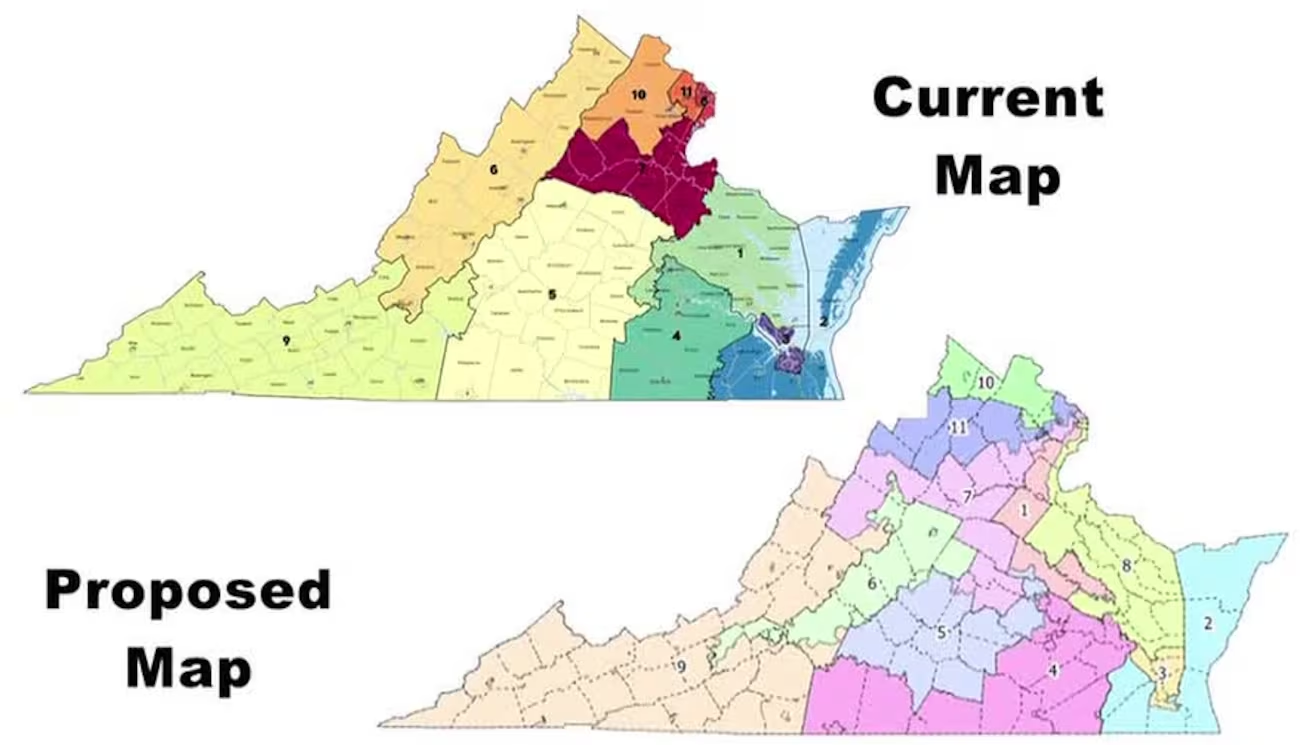
Roll Call, Virginia Supreme Court sets oral arguments on redistricting, Michael Macagnone, April 24, 2026 (print ed.). Attorneys likely will spar over a swath of issues on the validity of the referendum process.
The Virginia Supreme Court has scheduled oral arguments for Monday over a challenge to the validity of the redistricting referendum, the latest step in a fast-moving court battle over the commonwealth’s congressional map (shown above).
Monday’s oral arguments, stemming from a challenge brought by Republican Virginia Senate Minority Leader Ryan McDougle and other Republican officials, could determine the fate of a voter-approved map that could lead to Democrats in as many as 10 of the 11 congressional seats.
The scheduling announcement came the day after Judge Jack Hurley Jr. of the state Circuit Court of Tazewell County blocked the certification of the referendum following a hearing Wednesday in one of the lawsuits challenging the map.
Multiple groups of Republicans have challenged the referendum process in Hurley’s court since the start of the year, and the oral arguments Monday are officially based on a suit filed by McDougle. Hurley’s Wednesday ruling was in a case brought by the Republican National Committee, National Republican Congressional Committee and Rep. Ben Cline, R-Va.
Hurley has ruled against the referendum three times, finding legislators flouted the rules to place the measure on the ballot, and the commonwealth’s high court allowed the referendum to proceed rather than intervene before voters cast their ballots.
The oral arguments Monday will likely cover a swath of issues, ranging from the timing of the legislature’s process to start the ballot measure last year to the wording of the referendum itself.
Virginia’s legal battle comes amid the broader mid-decade redistricting arms race that Texas started last year at the behest of President Donald Trump. There, legislators redrew the state’s congressional map to target several seats held by Democrats.
California, Missouri and other states followed, each targeting seats held by the other party. Last fall California voters approved a referendum map targeting five of the state’s Republican House members.
The map approved by voters on Tuesday would favor Democrats in 10 of Virginia’s 11 congressional seats. Republicans currently hold five of Virginia’s House seats.
The Contrarian, Opinion: Undaunted in Virginia, Jennifer Rubin, right, April 24, 2026. No one calls Louise Lucas ‘weak.’
On Tuesday, Virginia voters ignored Republicans’ shameless disinformation campaign to pass a redistricting referendum creating four more Democratic-leaning congressional districts. As predicted, the race was close (3 points), but Democrats, independents, and disaffected Republicans made clear that they would not tolerate Donald Trump’s re-redistricting gambit, which he began last summer in Texas. (On Wednesday, a right-wing judge enjoined implementation of the map. Virginia’s attorney general immediately appealed. This judge had previously issued similar orders blocking redistricting; all were overturned.)
Democrats certainly have come a long way in the re-redistricting wars. Last August, when Texas Democratic state lawmakers returned home from their out-of-state venture to deny a quorum for the re-redistricting plan Trump had foisted on Republican Gov. Greg Abbott, Republicans seemed to have the upper hand in re-redistricting. With Trump driving the effort to rig the midterms, many political watchers expected Republicans to pick up batches of seats — not only in Texas, but in other red states.
Things did not turn out that way. And with the heavy shift in Hispanics’ voting preferences, Republicans may well come up short in the re-redistricted seats in Texas. Democrats believe that incumbent Dems will manage to save at least 2 of the 5 seats that Republicans intended to snatch.
Moreover, with Minority Leader Hakeem Jeffries raising tens of millions of dollars, rallying Democrats, and doing gobs of free media appearances, Democrats nationalized the fight. They struck back resoundingly with Prop. 50 in California, potentially adding another 5 seats to their tally. And with Virginians voting on Tuesday to redistrict their state, as many as four more districts may fall into Democrats’ laps.
Previously, Republicans picked up one seat in Missouri (still subject to a referendum and legal challenge) and two in Ohio (although Democrats may well defend all their seats). Utah (+1D) and North Carolina (+1 R) cancelled each other out. Indiana rebuffed Trump’s redistricting demand. Florida may try a belated re-redistricting. However, many Republicans are nervous that the scheme will backfire if Hispanics, as has been the case in primary voting, turn out heavily for Democrats, especially in the Miami area. In short, Republicans may well wind up losing ground (hence the recriminations).Subscribed
In addition to Jeffries, credit in Virginia goes to firebrand Democratic state Sen. Louise Lucas, who pushed for a redo of the map that would aim for 4 more Democratic seats. NPR reported:
About redistricting, she wrote to Republican U.S. Sen. Ted Cruz of Texas, “You all started it, and we f***ing finished it.”
“Donald Trump knows he’s going to lose the midterms. He knows it. That’s why he started this mess in the first place,” Lucas said in announcing the new map. “Today, we are leveling the playing field. These are not ordinary times, and Virginia will not sit on the sidelines while it happens.”
After the win, she took a victory lap: “I watched what was happening in Texas — Republican legislators backed by Donald Trump and MAGA extremists — try to rig the system before voters ever had a chance to speak,” said Lucas. “If they start this fight, Virginia is going to finish it … and in a special election — one question, no candidate, millions of dollars spent trying to confuse voters, Virginians still showed up.”
At a Wednesday press conference, Jeffries gleefully touted the multi-state strategy he spearheaded. “Donald Trump and Republicans launched this gerrymandering war,” Jeffries told reporters. “And we’ve made clear as Democrats that we’re going to finish it.” He brandished a slogan lifted from a MAGA operative: “Maximum warfare. Everywhere. All the time.” He may have finally shed his reputation for excessive caution.
The redistricting fight has accomplished more than simply adding seats to Democrats’ column. At the start of the battle last summer, Trump’s gambit woke up Democrats in Texas. After a dismal 2024 election, the redistricting fight energized local party officials and encouraged national Democrats to focus on and invest in the Lone Star State. Democrats found an opening to present themselves as the champions of Hispanic and Black voters who were losing voting power.
And perhaps most significantly, the Texas fight boosted the visibility of state senator James Talarico. He swiftly became a prominent figure in the Democratic resistance to Trump’s 2026 midterm-rigging. “My Democratic colleagues and I just left the state of Texas to break quorum and stop Trump’s redistricting power grab. Trump is trying to rig the midterm elections right before our eyes. But first he’ll have to come through us,” Talarico said at the time on Twitter. “It’s time to fight back.” It is questionable whether Talarico would have gone on to win the Democratic nomination for U.S. Senate had it not been for his role in fighting the Republican re-redistricting scheme. Talarico has put a critical Senate seat in play for Democrats and become an exemplar of a new generation of young, adept progressives with broad appeal.
Beyond Texas, the fight over Trump’s re-redistricting plot helped Democratic leaders address a key problem with their own voters, as well as independents: Voters think Democratic politicians are weak.
As pollster and analyst G. Elliott Morris has discussed, “Democrats’ weakness problem stands out as a particularly strong signal of intra-party dissatisfaction. . . Just 53% of Democrats call their party tough, compared to 80% of Republicans.” The same deficit has affected Democrats’ appeal to independents. “What is a Democratic problem is that 45% of independents say Democrats are weak,” Morris explained. That perception of weakness is a critical liability since “perceiving a party as strong is a stronger predictor of voting for that party than perceiving the other party as extreme.”
Arguably, the re-redistricting fight has helped change the image of Democrats nationally from a party playing by Marquess de Queensbury rules against street thugs to a party that recognizes it must brawl in defense of democracy. It also seemed to supercharge Democrats to take other bold moves, including holding firm on ICE funding, virulently opposing Trump’s war against Iran, demanding Cabinet members quit, pressing to release the Epstein-Trump pedophile files, and challenging Trump’s mental competency.
In that regard, the re-redistricting fight may turn out to be a crucial inflection point for the party, for 2028 aspirants who helped champion the effort (e.g., Illinois Gov. JB Pritzker,  California Gov. Gavin Newsom), and for the man likely to be the next speaker, Hakeem Jeffries.
This week, credit goes to the voters of Virginia, and especially to Louise Lucas, right, who kept the momentum going throughout the re-redistricting fight. As Lucas put it in January, “I said in August of 2025 that the maps will be 10-1 and I’m sticking with that today.” She certainly did. She pulled Virginia Democrats, not known for partisan skirmishing, into the fray and scored another win against MAGA Republicans. She was an undaunted, unwavering, and unapologetic advocate of blocking Republicans’ power grab. Thanks to her and to Virginia voters, Democrats maintained their re-redistricting edge and, in the process, rediscovered their fighting spirit. We salute Lucas and her fellow Virginians for putting an exclamation point on a national fight to thwart Trump and his schemes.
U.S. Inflation, Tariffs, Consumers, Markets, Economy
New York Times, Companies, Not Consumers, to Cash In Big From Tariff Refunds, Tony Romm, April 24, 2026. Many families felt the sting of the president’s now-illegal tariffs, but companies have said little about whether they will share the $166 billion coming back to them.
You probably won’t receive a huge tariff refund.
The largest businesses stand to reap the biggest bucks as the Trump administration begins to return more than $166 billion in duties deemed illegal by the Supreme Court. Even though President Trump’s trade policies have led to higher prices for companies and consumers, many families aren’t in line to benefit directly from the coming refund checks.
The discrepancy is a reflection of the nation’s complicated import laws — and the ever-fluid nature of Mr. Trump’s trade war.
When the government applies taxes to foreign goods, it charges the firms and brokers that bring those items into the country. Those costs proved substantial during the president’s first year back in office, after he imposed a set of so-called reciprocal tariffs on nearly every U.S. trading partner.
But a majority of justices on the nation’s highest court struck down those duties in February, forcing the administration to pay back much of its coveted tariff revenue. As a result, the government owes refunds to the importers on its record books — meaning companies, in many cases — even if those businesses ultimately shifted the costs of Mr. Trump’s taxes on to their customers.
The beneficiaries may include retail giants, such as Costco, Gap, Home Depot, Kohl’s, Lowe’s, Target and Walmart. For some, analysts estimate that the refunds may total into the billions of dollars apiece, leaving them with a choice of whether to keep the money or share it with consumers, even if indirectly in the form of future discounts.
But almost none of those U.S. retailers commented by Thursday on their exact plans. Only Costco promised previously to pass savings on to customers, without explaining how, as the buy-in-bulk company faces one of a series of class-action lawsuits from furious Americans who believe they are owed refunds.
Heather Boushey, who served on the White House Council of Economic Advisers under President Joseph R. Biden Jr., described the refund process as a “windfall for businesses,” some of which foisted the tariffs on consumers.“American families,” she added, “are certainly the losers.”
That could turn the tariff refunds into a divisive political issue, at a moment when a majority of voters have already expressed dissatisfaction with the president’s handling of the economy. Democrats have demanded that the administration return the money to families, but Mr. Trump has opposed returning the money at all — and he suggested this week that it would be “brilliant” if companies chose to forgo repayment.
U.S. Corruption, Crime, Price-Gouging, Justice
Popular Information, Info Weekly: Kushner, Kash, and lots of cash, Rebecca Crosby and Noel Sims, April 24, 2026. The UAE has partnered extensively with the Trump Organization and has multiple business ties to the Trump family.Trump floats taxpayer bailout for Middle Eastern autocracy Trump floats taxpayer bailout for Middle Eastern autocracy.
On Tuesday, Trump indicated that he was open to offering the United Arab Emirates (UAE) a financial bailout to offset the economic fallout caused by the war in Iran.
Jared Kushner, Trump’s son-in-law, has represented the U.S. in negotiations with Iran while engaged in a multi-billion-dollar business relationship with the Saudi government. Despite the brazen corruption, Kushner’s connection to the Saudis has received very little media attention. A Popular Information analysis of media coverage of Kushner’s diplomatic role from February 28 to April 19 found that 97% of the coverage from a variety of major media outlets did not mention Kushner’s financial conflict of interest.The media blackout of Jared Kushner’s historic, ongoing corruption scandal The media blackout of Jared Kushner’s historic, ongoing corruption scandalJudd Legum · Apr 20Read full story
Last week, The Atlantic published an article alleging that FBI Director Kash Patel has “alarmed colleagues” with a pattern of excessive drinking. Patel filed a $250 million defamation lawsuit against The Atlantic, calling the article “a sweeping, malicious, and defamatory hit piece.” The complaint actually confirms several key aspects of The Atlantic’s reporting.Kash wants cash: Inside the FBI Director’s $250 million defamation lawsuit Kash wants cash: Inside the FBI Director’s $250 million defamation lawsuitJudd Legum · Apr 21Read full storyThe best of the rest
An analysis of satellite data shows the scale of damage done by strikes on Iran. Major damage has been done to Tehran after over a month of military conflict. An analysis by Bloomberg of radar imagery of “land use within damage clusters in Tehran” found that at least 2,816 buildings have been hit since the start of the conflict on February 28. Of the 2,816 buildings, “around 32%... were linked to the military, 25% to industry, 21% to civilians, while 19% were commercial and 2% governmental.” (Bloomberg)
The CDC blocked publication of a report showing the efficacy of the covid vaccine. The Washington Post reported this week that a report showing “the efficacy of the covid-19 vaccine” was blocked from publication in the Centers for Disease Control and Prevention’s scientific journal. The blocked report found that the covid-19 vaccine reduced hospitalizations and emergency room visits among healthy adults last winter. (Washington Post)
NYT uncovers the origins of the Supreme Court’s “shadow docket.” The Supreme Court’s shadow docket has been used to rapidly deliver major policy wins to the Trump administration with little explanation. This week, the New York Times published an investigation, including memos between the justices, that sheds light on how this practice originated in 2016. (The New York Times)
Sexual misconduct by state and federal lawmakers is widespread, according to a new report. The National Women’s Defense League found that 162 state-level officials have been accused of sexual misconduct since 2013, and 30 members of Congress have been accused since 2006. Authors of the report say this is likely a significant undercount. While two members of Congress resigned last week over sexual misconduct allegations, the report found that there is generally little accountability for lawmakers. Forty-five officials identified in the report are running for election in 2026. (The 19th)Numerical Information
$1 billion+
The amount that Trump Media and Technology Group (TMTG), the parent company of Truth Social, has lost since the company went public two years ago, according to the company’s most recent annual report. Trump is TMTG’s largest shareholder. This week, TMTG announced it was replacing its CEO, former congressman Devin Nunes, with interim CEO Kevin McGurn.
Over 5,600
The number of people who have been killed throughout the Middle East since the beginning of the war in Iran, according to NBC News.
$24 million
The value of a Pentagon contract awarded to Foundation Futures Industries earlier this month. Eric Trump, who became the company’s “chief strategy officer” in March, appeared on Fox News this week to brag about the deal.Quotes of the week: “Different” math
“President Trump has a different way of calculating… If you have a $600 drug and you reduce it to $10, that’s a 600% reduction.” — RFK Jr.
“I’d say 500%, 600%, but we also say sometimes 50%, 60%, different kind of calculation… and people understand that better, but there are two ways of calculating it, but either way it doesn’t make any difference.” — TrumpVisual InformationX avatar for @MargoMartin47 Margo Martin@MargoMartin47Congratulations, Georgia Women’s Tennis! 🇺🇸Image9:54 PM · Apr 21, 2026 · 18.7M Views2.02K Replies · 477 Reposts · 4.11K Likes
President Trump poses with the University of Georgia women’s tennis team to celebrate their recent NCAA championship. Trump and a group of Georgia staffers and coaches stand in front of the women. The photo was posted to X by Margo Martin, a White House aide.POLLIs PopInfo Weekly something you would like to recieve each Friday?YesNo
Global News and Commentary
Wayne Madsen Report, Opinion: Israel has forfeited its right to exist as an internationally recognized state, Wayne Madsen, left, April 24, 2026. A legal, ethical, and historical analysis of state legitimacy.
State sovereignty is a foundational principle of international relations, granting nations the authority to govern themselves without external interference. The right to exist as an independent state is traditionally protected by international law, recognizing territorial integrity and political independence. However, persistent violations of human rights and acts of genocide challenge the legitimacy of sovereign states and raise questions about the conditions under which a state’s right to exist can be forfeited.
The State of Israel, by its repeated actions of genocide, has forfeited its right to exist as an internationally-recognized state in the community of nations.
Destruction in northern Gaza. Israeli decimation of Gaza
Israel’s persistent abuses of basic human rights—through systematic oppression, discrimination, and violence—has undermined its own legitimacy, which was born from the horrors of the Holocaust of World War II. The very nations that championed Israel’s independence as a state in 1948 are now among its greatest critics. The international community is now looking for a resolution for future governance of the territory lying between the Jordan River and the southern Levantine coast. A post-Israel solution, whether it is a secular confederation, a Jewish-Palestinian federation, or a Swiss-style republic of Jewish, Palestinian and Israeli Arab, Druze, and Circassian cantons, is increasingly being seen as the only viable future to prevent the continuing genocide.
Legally and morally speaking, the commission of genocide delegitimizes the state. The state officially known as the German Reich (Deutsches Reich) from 1933 to 1943 and the Greater German Reich (Großdeutsches Reich) from 1943 to 1945 was consigned to the ash heap of history following the defeat of the Axis powers in World War II. In April 1945, the only nations that continued to recognize the German Reich with embassies still in Berlin (no state ever recognized the Greater German Reich) were Japan and the Nazi puppet states of the First Slovak Republic and the Independent State of Croatia.
The German Reich’s unthinkable atrocities ensured its complete erasure as an internationally recognized state under international law. In a situation resembling the current internationally-recognized states of Israel and Palestine, the territory of the former German Reich became the Federal Republic of Germany (West Germany) and the German Democratic Republic (East Germany) until their unification in 1990.
 Regardless of the fabulist claims made by the Netanyahu regime and its massive propaganda operations, Palestine and its people have been subjected to many of the same atrocities carried out by Nazi Germany. Gaza now resembles what was left of Lidice, Czechoslovakia in 1942 and the French village of Oradour‑sur‑Glane in 1944 after the Nazis completely destroyed the towns and executed most of their inhabitants. Burned remains of Lidice. The Nazi destruction of Lidice
History offers several examples where states have faced significant consequences due to persistent human rights violations and genocide. The dissolution of Yugoslavia in the 1990s, following ethnic cleansing and mass atrocities, led to international intervention and the creation of new states. The Khmer Rouge of Pol Pot ruled the state of Democratic Kampuchea from 1976 to 1979. During the Khmer Rouge reign, some 3 million Cambodians were executed, many in what became infamously known as the “killing fields.” The state banned ethnic Chinese, Khmer Krom, Thai, Lao, Burmese, Tampuan, Jarai, Kreung, Brao, Muslim Cham, and Christians. They were systematically murdered by the regime during its rule.
Mirroring the support for Israel’s genocide by successive U.S. administrations, the United States supported Democratic Kampuchea by diplomatically backing the murderous regime throughout the Ford, Carter, Reagan, and George H. W. Bush administrations. Carter’s national security adviser Zbigniew Brzezinski infamously said, “I encouraged the Chinese to support Pol Pot. Pol Pot was an abomination. We could never support him, but China could.” Brzezinski was continuing the policy initiated by Ford Secretary of State and national security adviser Henry Kissinger.
Democratic Kampuchea retained control over Cambodia’s United Nations seat until 1993. It is noteworthy that Israel voted with the United States, China, and such human rights abusers as Saudi Arabia and Zaire to allow Pol Pot to retain his seat at the UN. South African Prime Minister Vorster meets with Israeli Prime Minister Yitzhak Rabin and Knesset members Menachem Begin and Moshe Dayan, during a reception at Jerusalem's Hilton. Israeli Prime Minister Menachem Begin, Moshe Dayan, and apartheid South Africa Prime Minister B J Vorster.
The South African apartheid regime’s constructs of “Bantustans,” nominally “independent” black-ruled republics, which were abolished after the dissolution of the apartheid regime in 1994, served as a template for Israel. Although no nation, other than apartheid South Africa recognized the republics of Transkei, Bophuthatswana, Ciskei, and Venda, the only nation that came close was Israel. In what continues to sour relations between South Africa and Israel, Tel Aviv provided Bophuthatswana and Ciskei with assistance to build internal security forces. Israel welcomed Bantustan leaders and established “representative offices” or “liaison” entities in the Bantustan capitals of Mmabatho, Umtata, Thohoyandou, and Bisho. It is no coincidence that Israel has applied the Bantustan model to the West Bank, where areas over which the Palestine Authority maintains nominal authority resemble the ink blot like maps of the Bantustans.
Simply stated, repeated human rights abuses, including the crimes of genocide and unlawful warfare, have placed continued statehood for Israel in question. Considering the fact that Yugoslavia and apartheid South Africa, not to mention the German Reich, no longer exist, there is no ironclad right of Israel to continue to exist in its present form.
Ultimately, the legitimacy of states rests not only on their legal status but on their capacity to uphold the rights and dignity of their citizens and those subjected to their warfare. Israel has failed that test on all counts.
Billionaire High-Tech 'Bros' from left: Jeff Bezo of Amazon.com, the Washington Post and Blue Origin, Elon Musk of SpaceX, Tesla and other companies, Microsoft's Bill Gates and Mark Zuckerberg of META and Facebook.
Robert Reich, Opinion: The Worst Neo Robber Baron of Them All, Robert Reich,  April 24, 2026. Hint: He's even worse than Musk.
I’m tempted to give Elon Musk that title. But when it comes to greedy and irresponsible corporate behavior, one CEO is outdoing even Musk.
When the history of this sordid second Gilded Age is written, the list of neo robber barons will obviously include Musk as well as Meta’s (Facebook’s) Mark Zuckerberg, Palantir’s Alex Karp, Palantir’s co-founder and board chair Peter Thiel, Oracle’s Larry Ellison (and his son, David), Google’s Sundar Pichai, Blackstone’s Stephen Schwarzman, and the Trump Organization’s monumentally corrupt Donald Trump, Donald Trump Jr., and Eric Trump.
But one greedy, public-be-damned CEO stands out even above Musk, Trump, and the rest. His name: Jeff Bezos. His corporation: Amazon.
It is difficult for the human mind to comprehend all the ways Bezos is shafting Americans.
Start with prices. According to a newly unsealed filing released Monday in an antitrust lawsuit brought by California Attorney General Rob Bonta, Amazon has pressured major brands like Levi’s and Hanes to demand that competing retailers raise prices on their products.
 The New York Times’s David McCabe reports on unsealed evidence that Amazon punishes sellers on its marketplace for offering lower prices on other websites, like those of Walmart or Target. When it spots a competitor’s lower price, Amazon tells the brands to demand that rival sites raise their prices for the products.
The filing includes an email to Hanes from Amazon, with links to Target’s and Walmart’s lower prices, along with Hanes’s apologetic response that it “reached out to Target and Walmart to have the prices increased.” And an email to Levi’s from Amazon, with links to lower-priced khakis on Walmart’s website, along with Levi’s response that Walmart had agreed to raise its price.
According to the lawsuit, Amazon has been able to exert pressure on different brands to raise their prices because of Amazon’s power and reach.
At a time when most Americans are having trouble making ends meet, Amazon’s push to raise prices — to enlarge its profits (and put more money into Jeff Bezos’s pockets) — is beyond unconscionable.
This is hardly Bezos’s and Amazon’s first brush with antitrust law. In 2023, the Federal Trade Commission and 17 states accused Amazon of illegally maintaining a monopoly in online retail by squeezing merchants who sell on its site and prioritizing its own products, resulting in “artificially higher prices.”
In September, the FTC agreed to settle another lawsuit against Amazon that accused it of making it difficult for consumers to cancel its Prime subscription service. Amazon agreed to pay up to $2.5 billion — including $1 billion in penalties and additional payouts to consumers — but didn’t admit or deny wrongdoing.
Meanwhile, The American Prospect’s Harold Meyerson reports that Virginia is subsidizing Amazon’s “second headquarters” in Crystal City, Virginia — just across the Potomac from Washington, D.C. — with $750 million in taxpayer funds, yet the corporation is wildly behind its job-creation pledge. Having promised to create 25,000 new jobs by 2038, it created a mere 1,600 jobs last year and is up to just 29 percent of the number of jobs it promised by now.
Speaking of Amazon jobs: Until earlier this month, attorneys for the National Labor Relations Board were prosecuting Amazon for firing employees that make Amazon deliveries because they’d voted to join the Teamsters, a clear violation of labor laws.
But then, a few weeks ago, the NLRB attorneys — now firmly under control of Trump’s NLRB general counsel — announced they’d reached a “settlement” with Amazon in which Amazon agreed to pay the workers who’d been laid off for more than two years, two weeks’ worth of wages. Two weeks.
Amazon’s workers are among the worst-treated in America.
Ryan Haas of The Western Edge reports that on April 6, an Amazon warehouse worker collapsed and died on the floor of Amazon’s warehouse in Troutdale, Oregon. A co-worker trained in CPR tried to help but was told by a manager to turn around. For more than an hour, employees said, they were instructed to continue picking items and loading trucks as the man lay dead. One manager reportedly told workers to “just turn around and not look” and get back to work.
Jeff Bezos couldn’t care less. As of April 2026, his net worth is estimated to be between $259 billion and $269 billion, making him one of the three richest people in the world.
Like the robber barons of the first Gilded Age, Bezos’s consumption is of the conspicuous kind.
He celebrated his wedding last year to Lauren Sánchez with a multi-day star-studded event in Venice, Italy, estimated to cost more than $50 million, featuring guests like Oprah Winfrey and Kim Kardashian, and including a ceremony on the island of San Giorgio Maggiore and a pajama-themed afterparty at the Arsenal.
His “homes” include three adjacent properties on Indian Creek Island in Florida, costing over $230 million; the former Warner estate in Beverly Hills, California, which features a 13,600-square-foot mansion and a golf course, which he purchased for $165 million; a 14-acre compound on Maui with a 4,500-square-foot main house and 700-square-foot pool; a $23 million mansion in Washington, D.C.; and a massive multi-lot compound with waterfront frontage in Medina, Washington.
But what puts Bezos at the head of all the other robber barons in this second Gilded Age is his slavish sycophancy toward the worst president in American history.
Bezos bought the legendary Washington Post for $250 million in October 2013 and has turned it into a Trump cheerleader — prohibiting its editorial page from endorsing Kamala Harris in 2024 and barring it from writing anything critical about American capitalism or Trump.
(That’s not all Bezos has done to ruin the Post. In February, he fired more than 300 Post journalists, about a third of its staff.)
Then he shamelessly paid $40 million to license the documentary “Melania” plus $35 million to market it — and earned back a tiny percentage. It was a blatant bribe of Trump.
And he does whatever Trump asks. After Trump complained to Bezos about a report that Amazon planned to display for consumers the costs of Trump’s tariffs, Bezos immediately canceled the plan.
Bezos has sucked up to Trump presumably to secure Pentagon contracts for his Blue Origin rocket company, which landed a $2.3 billion NASA contract early in Trump's second term. And to avoid further antitrust lawsuits or labor law scrutiny.
That he has zero scruples does not necessarily distinguish Bezos from the other robber barons of this despicable era.
But his public-be-damned business practices, his especially conspicuous consumption, and his excessive sucking up to Trump make Jeff Bezos the worst CEO of them all.
Emptywheel, Analysis and Opinion: Spirit Airlines is the Canary in Trump’s Fossil Fuel Mine, Emptywheel (Marcy Wheeler, right) April 24, 2026. When I first started this post, yesterday morning, WSJ was presenting the question of whether to bail out Sprit Airlines as a debate between two of Trump’s top advisors. Howard Lutnick told Trump he could be a hero by saving jobs, whereas Sean Duffy argued taxpayers would be buying a dud. One after another right wing member of Congress mocked the idea.
Lutnick argued to Trump that the president would see a political win by coming to Spirit’s rescue months before the midterm elections and that the deal could save thousands of jobs, according to a senior administration official and other people familiar with the matter.
Lutnick is the architect of the proposal under consideration by Trump and the company, in which the government would loan the company up to $500 million and receive in return warrants to take a potential significant stake in Spirit, some of the people said. The Wall Street Journal first reported Wednesday morning on the plan, which hasn’t been finalized.
[snip]
Duffy, on the other hand, told Trump that, in his view, making such an agreement with Spirit could have negative political consequences. He told the president he agreed it might save jobs, but he voiced skepticism about what the government is going to get out of possibly having a stake in the business.
Duffy also said that a deal with Spirit could leave voters with a negative impression about the Trump administration trying to bail out a failing company, a move that in the past hasn’t always been popular, the people said.
One after another right wing member of Congress mocked the idea. Scott Perry used pretty plane AI slop to argue that if you shield businesses from consequences of their decisions, “there’s no incentive to act responsibly.”
Teddy Cancun noted that “the government,” not Trump, “doesn’t know a damn thing about running a failed budget airline,” before blaming Biden just like Perry did.
The persistence with which right wingers blamed the decision by Joe Biden’s DOJ — importantly, as a bid to sustain competition and so cheap flights (as well as jobs) — was a tell of how seriously Trump was considering this plan, because Trump always blames one of his predecessors when he does something unpopular.
The logic here was that Biden destroyed Spirit by challenging the merger in order to sustain competition between airlines, plus jobs, so now Trump has to intervene to save cheap flights and jobs.
Two days ago, Trump was considering floating the airline for a 90% stake in the company. By the end of the day yesterday, Trump declared he wanted to buy it.
President Trump said that the U.S. government could take over Spirit Airlines, the ailing budget carrier that has been negotiating this week for a federal bailout.
“We’re thinking about doing it, helping them out, meaning bailing them out, or buying it. I think we’d just buy it,” Trump said, speaking from the Oval Office Thursday. He said that Spirit’s aircraft and assets were good and that the government could sell the company for a profit when the price of oil fell.
“I’d love to be able to save those jobs,” Trump said. “I’d love to be able to save an airline.”
Donald J. Trump, the serially failed businessman whose addiction to being rescued means he has little incentive to act responsibly, has opined once before that an airline’s aircraft and assets are good. That’s what he said about Eastern’s Shuttle business.
There are a slew of stories about this chapter of Trump’s life, which makes it really weird that Republicans addressed whether the government can run an airline, not whether Trump, personally, has proven he cannot.
This Matt Viser story from 2016 described how the prospect of owning an airline was, first, an ego boost — “like a presidential press conference” — and then a crash, both literally, and figuratively, with Trump getting bailed out as he always does.
“This is something from day one I have said I want to have my name on,” he said at a press conference just as he was about to take over the Shuttle. “I hope my name does a lot for the shuttle, and I hope the shuttle does something for my name.”
Stumbling over his enthusiasm at one point, he called the shuttle a “truly great transportation whatever.”
“Let’s be honest. If anyone else had started an airline, you never would have gotten that many reporters,” he said later. “That was like a presidential press conference.”
He was also asked about what it was like to fly on his own airline, looking down at his properties below.
“Truthfully? Truthfully it was great for the Trump ego,” he said. “I’m not supposed to say that.”
[snip]
The Eastern Airlines Shuttle flight had been a reliable source of revenue for decades. Since the 1960s, the number of shuttle flight passengers had grown every month, without exception, until November 1989, Nobles said.
It dropped. Then it dropped again in December. A recession was coming. As a result of the Gulf War, the price of oil — and, therefore, jet fuel — had jumped.
The Trump Shuttle was successful enough to cover operating costs but not enough to pay down the debt.
It fit a pattern for Trump: making a bet that his product would be so successful that he could pay down massive debt and earn a hefty profit along the way.
This time around, taxpayers, not Citibank, would be on the hook for Trump’s judgment about airplane stock after a crash.
But it’s not just about this airline. After all, the guy who crashed his Shuttle also serially bankrupted his companies, and several of his current companies are running on fumes. Trump’s invasion of Iran is beginning to do the same to parts of the US economy, to say nothing of the global economy.
Joe Biden didn’t create the precipitating need to bail out Sprit. Trump’s own invasion of Iran, and more importantly the unfathomable incompetence not to stave off a Hormuz closure, did. Trump has created a jet fuel crisis far bigger than the one that destroyed his plans for Trump Shuttle.
Spirit’s tailspin, of course, is partly of Trump’s making. The Middle East conflict has ignited an explosion in jet fuel prices, a line item that in average times amounts to 20% to 30% of airlines’ pretax, noninterest costs. Spirit has been operating under bankruptcy protection since August, and just two weeks after the war began, presented an already-fragile reorganization plan in the Southern District of New York. The blueprint projected jet fuel in the $2.20 a gallon range for this year and 2027, and even at those historically low prices, foresaw super-thin operating margins of 0.5%. Now, airlines are paying around $4.20, almost double the prewar sticker and Spirit’s forecast. A study by J.P. Morgan posits that owing to the fuel hit, Spirit is set to lose 20 cents for each dollar of revenue, and add $360 million in operating costs, an amount equal to its cash cushion.
It’s clear that Spirit can’t keep flying—unless Trump indeed orders a huge cash refill from the government. Clearly, keeping America’s leisure and business flyers as happy as possible under the circumstances is the best possible outcome for Trump.
Trump’s claim this is about jobs when he destroyed far more than 14,000 jobs with DOGE is rank bullshit. This is about hiding the damage Trump’s stupid invasion has done to America’s normal way of life. Trump wants to use taxpayer dollars to hide from taxpayers what a catastrophic economic disaster Trump caused with his incompetence.
And if Trump does this, the need will just snowball, at least to JetBlue and Frontier.
“Should the administration afford any sort of cash infusion, we believe JetBlue and Frontier (ULCC.O), opens new tab would be inclined to quickly follow,” they said, adding that such a move could eventually draw in larger carriers and distort competition across the industry.
One industry source said other airlines that compete with Spirit have privately voiced opposition to a bailout of just one carrier, even as they face similar cost pressures.
United Airlines CEO Scott Kirby also struck a skeptical tone this week, calling Spirit’s business model fundamentally flawed and questioning whether it could cover its operating costs.
And all that’s the damage Trump has done to the US economy, a petrostate with its own jet fuel capacity. Analysts are only beginning to think through what it will do to other economies, especially less wealthy Asian ones, but even Europe, if this continues to June.
If Europe keeps subsidising consumption, markets will get more out of whack. For one thing, prices for products will keep rising. America, where demand tends to jump in a period of summer road trips, will push them further. Competition for LNG, shortage of which was mostly absorbed by Asian consumers’ self-deprivation and a switch to coal, will also increase when Europe starts restocking gas for the winter.
Fast-depleting stocks make matters worse. Europe’s reserves of jet fuel cover some 50 days of consumption, their typical level. But modelling by Michelle Brouhard of Kpler, a data firm, for The Economist shows that European stocks will fall precipitously if Hormuz flows do not normalise by June. Those in other importing regions may disappear even faster (see chart 2, bottom panel). The outlook could worsen if America, seeking to tame domestic prices, emulates China and bans exports of refined products, which have risen by nearly half since the start of the war.
Trump take capitalism. Because of Trump’s stupidity, countries around the world are being forced to eschew capitalism to keep a quasi-normal way of life afloat.
The billionaire conman who started a war with the belief that it would all work out because it always does is now facing down the certainty that the defining moment of his legacy will not, this time, be OK.
A couple weeks before the war began, Mr. Trump, who had known Mr. Carlson for years, tried to reassure him over the phone. “I know you’re worried about it, but it’s going to be OK,” the president said. Mr. Carlson asked how he knew. “Because it always is,” Mr. Trump replied.
And his response to that is to get taxpayers to subsidize the illusion of normalcy.
Update: Mike Pence’s organization, Advancing American Freedom Foundation, comes out against the bailout, though again ignoring that Trump exacerbated Spirit’s woes. Curiously, when it invokes TARP, it doesn’t note whose ineptitude caused that crisis.
April 23
Top Headlines
News Roundups


April 23, 2026. The Department of Justice Inspector General has launched a sweeping investigation into how the Epstein files were handled and whether the DOJ failed to comply with the Epstein Files Transparency Act. This is one of the biggest stories I’ve been working on, and there is more reporting to come.Sleepy Don fell asleep again during a press event today about prescription drug prices, dozing off multiple times as his sycophants RFK Jr, Dr. Oz, Lutnick, Vance and others droned on and on about how wonderful he is. April 23, 2026. Republicans on Capitol Hill are increasingly warming to the idea of Donald Trump issuing a pardon for Ghislaine Maxwell, with multiple members now openly supportive.More On Iran, Lebanon Wars
Amal Khalil, who was a reporter for Al-Akhbarl, wearing a helmet and a vest with the word “PRESS” written on them, was killed on Wednesday (Photob by Mohammed Zaatari via Associated Press).
More On U.S. Law, Courts, Rights, Justice
Acting Attorney Gen. Todd Blanche, left, and FBI Director Kash Patel presided at a raucous press conference at the Justice Department April 21 where their announcement of dubious federal charges against the Southern Poverty Legal Center (SPLC), a civil rights organization, was superceded during question period by reporters' questions about news reports that Patel's job has been jeapardized by drinking and other unprofessional activities.
Charlottesville Torchlight "United the Right" Parade in Virginia on Aug. 12, 2017 investigated by SPLC.
April 23, 2026. I want to return to the SPLC Indictment, to explain a bit more about how DOJ appears to have charged this, in part to show that the indictment doesn’t always clarify who was allegedly fooling whom.U.S. Governance, Politics, Elections
Six leading candidates for governor of California (from left): Matt Mahan, Xavier Becerra, Chad Bianco, Steve Hilton, Tom Steyer and Katie Porter (Pool photo by Jason Henry).
April 23, 2026. Virginia voters yesterday agreed to a constitutional amendment that would temporarily redistrict the state if any other state redistricted for partisan reasons: that is, in retaliation for the partisan redistricting President Donald J. Trump launched in Texas in 2025 in an effort to retain control of the House of Representatives. More On U.S. Fair Elections, Election-Rigging Claims
 April 23, 2026. It’s remarkable that it’s become so unremarkable to say: Yesterday, the president of the United States claimed that an election outcome he disliked had been the result of election fraud.
Trump Team Watch
right, April 23, 2026. On March 5, the Yocha Dehe Wintun Nation, a small Native American tribe based out of the Rumsey Indian Rancheria in California, donated $2 million to MAGA Inc., President Trump’s Super PAC.Epstein Files, Coverup

U.S. Economy, Jobs, Inflation, Markets, Media
More Global News

 Carlotta Gall, April 23, 2026. With a record of pro-Russia statements, Rumen Radev handily won elections this week. Now Bulgarians and his E.U. partners wait to see which way he will turn.
Top Stories
New York Times, A New Era and New Leadership: The Generals Who Are Running Iran, Farnaz Fassihi, April 23, 2026. Farnaz Fassihi has covered Iran for three decades. For this article, she interviewed 23 people in Iran, including senior officials, members of the Revolutionary Guards and individuals with ties to Ali and Mojtaba Khamenei.The killing of Ayatollah Ali Khamenei ushered in a new form of collective leadership in the country, with more power for the Revolutionary Guards.
When Ayatollah Ali Khamenei ruled Iran as the supreme leader, he exerted absolute power over all decisions about war, peace and negotiations with the United States. His son and successor does not play the same role.
Ayatollah Mojtaba Khamenei, the son, right, is an elusive figure who has not been seen and whose voice has not been heard since he was appointed in March. Instead, a battle-hardened collective of commanders in the Islamic Revolutionary Guards Corps and those aligned with them are the key decision makers on matters of security, war and diplomacy.
“Mojtaba is managing the country as though he is the director of the board,” said Abdolreza Davari, a politician who served as senior adviser to Mahmoud Ahmadinejad when he was president and knows Mr. Khamenei.
“He relies heavily on the advice and guidance of the board members, and they collectively make all the decisions,” Mr. Davari said in a phone interview from Tehran. “The generals are the board members.”
This account of Iran’s new power structure is based on interviews with six senior Iranian officials, two former officials, two members of the Revolutionary Guards, a senior cleric familiar with the inner workings of the system and three individuals who know Mr. Khamenei well. Nine other individuals with ties to the Guards and the government also described the command structure. They all spoke on the condition they not be identified because they were discussing sensitive matters of state.
Mr. Khamenei, who was selected by a council of senior clerics as the new supreme leader, has been in hiding since American and Israeli forces bombed his father’s compound on Feb. 28, where he also lived with his family. His father, wife and son were all killed. Access to him is extremely difficult and limited now. He is surrounded mostly by a team of doctors and medical staff who are treating the injuries he sustained in the airstrikes.
New York Times, Iran War Live Updates: Reported Ship Seizures Add to Anxiety in Oil Markets, Dan Watson and Aurelien Breeden, April 23, 2026. Oil was hovering above $100 a barrel and there were no public signs of a breakthrough in peace efforts. The White House said President Trump does not view Iran’s reported seizures as a cease-fire violation.
Oil was trading above $100 a barrel again on Thursday after Iranian forces claimed to have seized two cargo ships near the Strait of Hormuz, injecting fresh fear into energy markets with no public indications of a breakthrough in efforts to restart U.S.-Iran peace talks.
President Trump told Fox News on Wednesday that there was “no time pressure” on holding a new round of talks or on the cease-fire, and “no timeline” for ending the war. Karoline Leavitt, the White House press secretary, told Fox separately that Mr. Trump did not view Iran’s reported ship seizures as a violation of the cease-fire.
The reported seizures happened after the U.S. Navy prevented dozens of ships from leaving or accessing Iranian ports as part of a blockade ordered by Mr. Trump.
Iran has in effect blocked shipping through the Strait of Hormuz — normally a vital conduit for global oil and gas supplies. Energy prices have risen sharply since the United States and Israel began the war on Iran in late February.
A summit aimed at reopening the strait was scheduled to reconvene in London on Thursday, with military planners from over 30 countries. Shipping companies are mostly keeping vessels away from the strait because of the risk of attacks.
On Wednesday, Iranian state media reported that Iran’s Revolutionary Guards Corps had targeted two cargo vessels — the MSC Francesca and the Epaminondas, a Greek-owned ship — because they were not following Iran’s rules for passing through the strait. Iranian news outlets reported that the Guards had fired on a third cargo ship.
Here’s what else we are covering:
Morning Shots via The Bulwark, Political Opinion: What We Found When We Investigated Trump’s Latest Election Theft Claim, Andrew Egger, Jordan Ferdman and Jim Swift, April 23, 2026. You’re never gonna believe it. . .
The Cook Political Report is out this morning with a midterms vibe check, and Democrats have to like what they see: Across the 36 competitive districts most likely to decide control of the House of Representatives, “Democrats hold a six-point advantage on the generic congressional ballot, 50 percent to 44 percent,” the authors write. “Voters here are deeply frustrated with Trump and are willing to overlook their antipathy to Democrats in order to put a check on the president.”
Maybe the resistance party should give up on restoring their battered reputation and just lean in. “Vote Blue: Odds Are You Hate Us Less.” Happy Thursday.
News Roundups
Financier and sex trafficker Jeffrey Epstein is shown above with his longtime friend Donald Trump, Below that photo is one of the U.S. Justice Department's headquarters in Washington, DC approximately halfway between the White House and Congress.
The Parnas Perspective, Afternoon News and Commentary: DOJ Inspector General Launches Major Investigation Into Handling of Epstein Files as Maxwell Pardon Talk Escalates, Aaron Parnas, right, April 23, 2026. The Department of Justice Inspector General has launched a sweeping investigation into how the Epstein files were handled and whether the DOJ failed to comply with the Epstein Files Transparency Act. This is one of the biggest stories I’ve been working on, and there is more reporting to come.
At the same time, Republicans on Capitol Hill are increasingly warming to the idea of pardoning Ghislaine Maxwell, a move that is already drawing intense backlash. I also sat down with Xavier Becerra, a leading candidate for governor of California, and will be interviewing more candidates in the coming weeks.
Meanwhile, shareholders have approved a major media merger involving Warner Bros. Discovery, raising serious concerns about consolidation and the potential influence of the Ellison family over outlets like CNN. Independent media has never been more important. Subscribe to support my work, and let’s keep fighting as the media faces growing pressure.Subscribed
Here’s what you missed:
The Justice Department’s Office of Inspector General is launching an audit into whether the DOJ followed the law requiring public release of the Jeffrey Epstein files. This review was initiated amid bipartisan criticism that the department has not fully disclosed the materials. Lawmakers and others have raised concerns that some information may have been improperly withheld. The audit aims to assess overall compliance with transparency requirements.
The investigation will examine how the DOJ handled identifying, redacting, and releasing millions of records tied to Jeffrey Epstein. Specifically, it will review internal guidelines used to sift through roughly 6 million documents. It will also evaluate what instructions staff received about what information could be withheld or edited. This includes scrutiny of decisions around protecting sensitive details.
Another focus of the audit is how the DOJ managed issues after releasing the files, particularly concerns about privacy and disclosure. Officials will look into whether the department adequately protected survivors’ identities, which were supposed to be redacted under the law. There are questions about whether some names were improperly concealed or, conversely, at risk of being revealed. These post-release challenges are part of the broader accountability review.
The Inspector General’s office indicated the audit could expand if additional problems are uncovered during the process. Its findings may address not only compliance with the transparency law but also any broader procedural or oversight failures. The review signals heightened scrutiny of the DOJ’s handling of a high-profile and sensitive case. Further issues could be investigated depending on what auditors discover.
Some Republicans on the House Oversight Committee are reportedly open to the idea of pardoning Ghislaine Maxwell in exchange for her cooperation in investigations tied to Jeffrey Epstein, though the panel is divided. Chairman James Comer said he personally opposes a pardon but acknowledged others support the idea, while Democrats have strongly condemned it. Maxwell, currently serving a 20-year sentence, has invoked her Fifth Amendment rights and her legal team has sought clemency. Donald Trump has not ruled out a pardon, adding to the controversy surrounding the proposal.
Thomas Massie says its time to look into Todd Blanche, the Attorney General:
Shareholders of Warner Bros. Discovery have approved a massive takeover bid by Paramount Global, advancing a deal valued at over $100 billion that could significantly reshape the entertainment industry. The merger would combine major assets—including HBO Max, Paramount+, CNN, and CBS—under one umbrella, though it still faces regulatory scrutiny and political pushback. Supporters argue it could create a stronger, next-generation media company, while critics warn of job cuts, reduced competition, and greater consolidation of power in Hollywood. The deal also raises concerns about political influence and editorial direction, especially given ties between investors and Donald Trump. California’s Attorney General says it will be scrutinized:
The White House claims that Donald Trump helped prevent the execution of eight Iranian women by directly urging Iranian leaders not to carry out the sentences. According to officials, Trump was told the women would instead face reduced penalties, with some reportedly released and others given short prison terms. However, Iranian authorities have strongly disputed this account, with a judiciary-linked outlet stating that none of the women had been sentenced to execution in the first place. The conflicting narratives highlight ongoing tensions and uncertainty around the situation involving Iran and the treatment of protestors.
House Republicans are pushing to quickly pass a Senate-approved budget resolution as the first step toward funding immigration enforcement and advancing Donald Trump’s legislative agenda, but internal divisions are complicating the effort. GOP leaders, including Mike Johnson and Steve Scalise, are trying to win over conservatives by promising a follow-up “Reconciliation 3.0” bill that could include defense spending, Iran war funding, tax changes, and cuts to social programs. Some lawmakers remain skeptical about passing multiple party-line bills before the midterms and are threatening to oppose the current plan without broader policy concessions.
Donald Trump reposted a podcast by commentator Michael Savage that included derogatory remarks describing countries like India and China as “hell-holes,” sparking backlash. The comments were tied to criticism of U.S. birthright citizenship, with claims—widely disputed—that immigrants exploit the system through “birth tourism.” Trump has continued pushing to end automatic citizenship, despite legal consensus that the 14th Amendment to the United States Constitution guarantees it. The controversy has drawn criticism internationally, while India’s government responded cautiously to the remarks.
Donald Trump claimed that Iran is struggling with internal leadership divisions, describing conflict between “hardliners” and “moderates” amid ongoing tensions. He also asserted that the U.S. has “total control” over the Strait of Hormuz, stating that ships cannot pass without approval from the U.S. Navy. According to Trump, the key shipping route is effectively “sealed” until Iran agrees to a deal. His remarks highlight escalating geopolitical strain and competing narratives over control of the critical waterway.
Donald Trump has ordered the U.S. Navy to “shoot and kill” any vessels placing mines in the Strait of Hormuz, signaling a highly escalatory military posture.
In February 2025, Howard Lutnick projected that Donald Trump’s “Gold Card” visa program could sell as many as 200,000 residency slots to wealthy foreigners. By April 2026, however, Lutnick acknowledged to Bloomberg that only one person has actually been approved, highlighting a stark gap between early expectations and real-world uptake. The contrast underscores questions about demand, feasibility, and execution of the $1 million residency initiative.
Fatih Birol, the IAE Chief, warned that the world is facing what could be its most severe energy security threat ever, citing the loss of roughly 13 million barrels of oil per day and widespread disruptions to key commodities (as reported by CNBC). He linked the crisis to escalating conflict involving Iran and the effective shutdown of the Strait of Hormuz, a critical global shipping route. The blockade—first imposed by Iran and followed by U.S. restrictions on ships accessing Iranian ports—has intensified fears of a historic energy crisis. Birol has cautioned that these developments could trigger the largest global energy disruption on record.
Two Israeli Air Force technicians have been arrested on suspicion of spying for Iranian intelligence, with authorities alleging they maintained contact with foreign agents in exchange for money. According to investigators, the soldiers initially claimed they cut ties after refusing to carry out weapons-related tasks, but later attempted to reestablish contact for financial gain. Prosecutors say one soldier faces more serious charges, including aiding the enemy during wartime and sharing sensitive military information, while the other is accused of contact with a foreign agent and transmitting intelligence. The indictment also alleges that classified materials—including fighter jet system details and base documentation—were passed to operatives linked to Iran over several months.
The Trump administration has moved to reclassify marijuana from Schedule I to Schedule III, lowering its perceived abuse risk and enabling more medical research and potential healthcare use. However, this change does not legalize marijuana, affect existing prison sentences, or remove key restrictions like interstate transport and banking limitations. Public support for legalization remains mixed, with a slim majority of Americans in favor despite some decline as legalization has expanded in many states.
Meidas Touch Network, Today in Politics, Ron Filipkowski, right, April 23, 2026. Sleepy Don fell asleep again during a press event today about prescription drug prices, dozing off multiple times as his sycophants RFK Jr, Dr. Oz, Lutnick, Vance and others droned on and on about how wonderful he is.
… RFK Jr was bragging about his testimony before Congress “One of the Democrats was ridiculing President Trump for his math, and she was saying it's in mathematically impossible to have any drug drop by 600% cost. And I said, well, if the drug was $100 and it raised the price of $600. That would be a 600% rise. If it drops from 600 to 100, that's a 600% savings. Trump: That’s right.”
… Trump was asked about the war dragging on: “We’ve been doing it for 5 and a half weeks. Reporter: But sir, it’s been 8 weeks, you said it would be over in 4-6 weeks. Trump: I took a break and I gave them a break.”
… Q - “How long are you willing to wait for a response from Iran? Trump: Don’t rush me. We were in Vietnam for 18 years.”
… Trump then griped about Iranian speedboats attacking shipping in the Strait: “Their military is totally defeated - outside of the little wise guy ships. I call them the wise guy ships.”
… He then starting rambling about his WH remodel: “I think it’s very interesting. We had flooring outside—it was coming to pieces. It's been there since the early 1940s. and it's a path to the Oval Office. It was broken, bad shape. We're putting magnificent new granite. It's called charcoal. We've stripped all of the paints off. We had 200 years of paint.”
… Q - “Why was your Navy Secretary fired? Trump: I really liked him, but he had some conflict with not necessarily with Pete but some other people. I didn't really deal with him too much.”
… He then talked about his plans to remodeled the Lincoln Memorial Reflecting Pool: “I have probably built more than 100 swimming pools in different buildings I built, I said, think of it as a swimming pool—2200 ft by 167 ft wide. It's a reflecting pool and very famous, very famous. I said, Doug, I have a guy who's unbelievable at doing swimming pools up the road. We have a club, we have an Olympic-sized swimming pool.”
… He then claimed that he had a bigger crowd for his July 4 speech at Reflecting Pool than MLK Jr had for his I Have a Dream Speech: “That's where MLK gave his great speech, and he had a million people and I had the same exact crowd, maybe a little bit more. I have pictures of MLK’s crowd, the exact same, everything, but it was 70 years difference. The exact same crowd, but I actually had more people.”
… Don Snoreleone then fell asleep.
… NYT: “The FBI began investigating a NYT reporter last month after she wrote about Kash Patel, using bureau personnel to provide his girlfriend with govt security and transportation. Agents interviewed the girlfriend, queried databases for info on the reporter, Elizabeth Williamson, and recommended moving forward to determine whether Williamson broke federal stalking laws.
… “Those actions prompted concerns among some DOJ officials who saw the inquiry as retaliation for an article that Patel and his girlfriend, Alexis Wilkins, did not like, and who determined there was no legal basis to proceed with the investigation.”
… In response to an inquiry for NYT, the FBI issued a statement that “investigators were concerned about how the aggressive reporting techniques crossed lines of stalking.”
… Joseph Kahn, the executive editor of NYT: “The FBI’s attempt to criminalize routine reporting is a blatant violation of Elizabeth’s First Amendment rights and another attempt by this admin to prevent journalists from scrutinizing its actions. It’s alarming. It’s unconstitutional. And it’s wrong.”
… Patel on Sean Hannity’s Fox show: Q - “I’m reading that you used the FBI because you didn’t like a story about your girlfriend. Is there any truth to that? It just doesn’t sound like you. Patel: Absolutely not. The reality is that this same reporter delivered a baseless story which delivered a direct threat of life to my girlfriend. But here’s the thing: me and mine are like you and President Trump. We’re as tough as we come.”
… Axios: “Buyer’s remorse is hitting House Republicans over their mid-cycle redistricting war - a strategy meant to protect their majority that’s now deeply in danger of backfiring. Republicans privately have expressed skepticism about the aggressive redistricting strategy for months amid increasing pressure from Trump, who’s said he fears a Democrat-led House would hand him his third impeachment:
… NRCC chair Richard Hudson (R-NC): “It’s not for me to say ... because really, it wasn’t my decision.”
… Rep. Kevin Kiley (R-CA): “I wish none of this had happened.”
… Rep. Don Bacon (R-NE): “I think it is a mistake in hindsight. They thought they could just do Texas and nobody else is gonna respond? We started a war, and you’ve got to play chess, think three or four moves ahead.”
… Rep. Brian Fitzpatrick (R-PA): “I don’t think it’s favorable for anybody in America, redistricting. It’s a race to the bottom.”
… AOC was asked about Republicans complaining about VA redistricting. Q - “What do you make of Republicans saying that Virginia … AOC: Wah wah wah. Republicans have fought for partisan gerrymanders across the US. And these are the rules that they have set.”
… In addition to redistricting woes, Republicans also have Trump’s dismal approval rating dragging them down like an anchor. This was on Fox last night:
… Politico: “Trump’s recent admin shakeup - the sacking of Kristi Noem and Pam Bondi as well as this week’s departure of Lori Chavez-DeRemer - has created openings for a slew of potential confirmations, and GOP senators are contemplating who might be next and how quickly Trump should make any further changes.”
… “No Republicans are publicly urging any particular oustings. But privately GOP senators believe Commerce Secretary Howard Lutnick, DNI Tulsi Gabbard and FBI Director Kash Patel could be at risk of leaving - voluntarily or not.
… One Republican senator: “He’s in a bad mood. He’s preparing to really let a lot of them go.”
… AOC to Meidas reporter Pablo Manriquez: Q - “Who do you think Trump should fire next? AOC: Is he out of women? Trump only seems to have the capability to fire female secretaries. If you’re a man in the Trump admin, it seems that they reward misconduct.”
… My prediction is that Gabbard will be fired next. Very soon.
… Meanwhile, Lutnick had a tough time today in his testimony before the House, where he repeatedly refused to answer questions about his ties to Epstein on the grounds that he made a “deal” with James Comer that he only had to talk about it with House Oversight:
Rep. Rosa DeLauro: Do you know how many manufacturing jobs the US lost per day during the first year of Trump’s second term? Lutnick: I don’t know. DeLauro: More than 100 per day. This isn’t a trade policy that delivers for working people.”
Lutnick: “The manufacturing is going to start in two or three years when these factories come online. DeLauro: You can’t even tell us about how many manufacturing jobs we’ve lost, so I don’t know about what we’re seeing in the future.”
Rep. Madeline Dean: Q - “Is the president concerned about your continued relationship with Epstein? Lutnick: I am not going to discuss conversations I had with the president. Dean: Trump just fired 3 cabinet secretaries - 3 women. If he has even a shred of concern about accountability for Epstein’s enablers, he would fire you too.”
Dean: “Why did you lie to the NY Post about your relationship with Epstein? Lutnick: The House Oversight Committee and I agreed-- Dean: I do not accept that answer. We are our own committee. You’re dodging the question. The coverup continues.”
… Bloomberg: “Only one person has been approved so far for Trump’s ‘Gold Card’ Visa program granting foreigners US residency for a $1 million fee, Commerce Secretary Howard Lutnick said Thursday.”
… At the press conference announcing these in Feb 2025, Lutnick said they were going to sell 200,000 gold cards. Trump said they were going to balance the budget selling them.
… Hung Cao, Trump’s new nominee for Secretary of the Navy, said in 2023 during his campaign for US senate that he was worried about witches taking over VA: “We can’t let it turn like this. There’s a place in Monterey, CA called Lovers Point. The original name was Lovers of Christ Point, but they took out the Christ. And Monterey is a very dark place now - a lot of witchcraft and the Wiccan community has really taken over. We can’t let that happen to VA.”
… Ag Secretary Brooke Rollins on Fox: Q - “Do you have a plan to mitigate this fertilizer problem? Rollins: Yes. We have been every day now for almost 50 days having daily meetings in the WH. During the Biden years ... Host: But what is the plan? You’ve had lots of meetings, but what is the plan?”
… Alex Jacquez, who served on Biden’s National Economic Council: “‘During the Biden years...’ Yeah Brooke, I talked to fertilizer companies every day post-Ukraine invasion too. Then we put $900 million into fertilizer capacity expansion, which you put on ice and are now trying to revive.”
… CNBC: “The Trump admin is in advanced talks for a financing package for Spirit Airlines as the carrier is facing the risk of a liquidation. The deal could include $500 million in financing from the govt, which could provide a path to give the govt an equity stake in the carrier.”
… Sen. Ted Cruz: “This is an absolutely TERRIBLE idea. The government doesn’t know a damn thing about running a failed budget airline.”
… Sen. Tom Cotton: “If Spirit’s creditors or other potential investors don’t think they can run it profitably coming out of its second bankruptcy in under two years, I doubt the US Government can either. Not the best use of taxpayer dollars.”
… WSJ’s Brian Schwartz: “The deliberation from within Trump’s own team about what to do with Spirit Airlines spilled out into a meeting at the WH with Trump. Howard Lutnick, the architect of the govt backed deal with Spirit, told Trump that the deal could save jobs and be a boost to GOP in midterms.”
… “Transportation Secretary Sean Duffy made counterpoints to Trump: Yes, the deal could save jobs but... A bailout could be a political nightmare for the admin and questioned what the govt gets out of such a deal with Spirit. These are the key views heading into a decision by Trump to finalize and announce a deal.”
… Eric Trump was on Fox bragging about his new $24 million Pentagon contract for robots: "It's gonna change industry, military application, hospitality. The uses are unlimited and I think it's a very beautiful thing, but we must win that race."
… Eric’s business partner was on the show with him: "There are situations where you would need almost no human loop, where we would have to be able to rapidly deploy these technologies and we cannot always be calling a CEO to ask for permission before we do it."
… Eric was never involved in this kind of business before he father became president. He ran golf courses and hotels.
… Sen. Elizabeth Warren (D-MA): “Eric Trump went on Fox to brag about winning ANOTHER multimillion-dollar contract from the Trump admin. I’ve been sounding the alarm and pushing for answers. Is the Pentagon just a cash machine for Trump’s kids now? This looks like corruption in plain sight.”
… Stephen Hayes, editor of The Dispatch: “Think about how much time Fox spent on Hunter Biden. That was a real story, worth covering. But here they’re not reporting on the potential corruption, they’re celebrating it. Gross.”
… Rep. Shontel Brown (D-OH): “The Trump Family gets rich off of Trump’s war. Working people get higher prices.”
There was a new report about how many members of Congress use AI now in their work. I just wanted to say that I will never use AI to put this together. I do not trust the accuracy of a lot of AI news and there is no AI tool that can do this because it is much more art than science.
These Bulletins are put together the old-school way with no shortcuts. I consume a massive amount of news each day by reading articles, social media posts, watching hearings, shows, podcasts, speeches, press conferences. It is 12 hours of non-stop work because I am bringing you news that just happened in real time while trying not to miss anything important.
The biggest problem for any AI tool would be how to identify what is important or interesting or how different concepts and events fit together in a not so obvious way. Which sentences from an article really tell the story? Which quotes from a press conference or interview are most compelling? Also, how to inject irony, sarcasm, humor, context, flow - a computer cannot do these things.
So while many in business, media, govt and politics increasing turn to AI to assist them in their work (or do their work for them), I never will because I am confident if I do this right AI will never be able to do it better.
Reminder that tomorrow is also Ask the Editor where I answer 5 of your questions in a podcast, so please submit any question you might have for that in the comments below. If you missed my weekly podcast Uncovered yesterday, you can find it here.
Meidas+ is a reader-supported publication. To receive new posts and support my work, consider becoming a free or paid subscriber.Subscribed
… Sen. Jon Ossoff was asked on MS NOW if he will run for president in 2028: “I have zero interest in running for president in 2028. I love serving the state of Georgia. I’ve got two young daughters. And to be honest with you, I think that the 2028 fantasy risks distracting us from the urgent task at hand.”
The Parnas Perspective, Morning News and Commentary:Trump in 'Bad Mood' and Read to Fire Cabinet Members, Congress Braces for Major Shakeup, Republican Support for Maxwell Pardon Grows, and More, Aaron Parnas, right, April 23, 2026. Republicans on Capitol Hill are increasingly warming to the idea of Donald Trump issuing a pardon for Ghislaine Maxwell, with multiple members now openly supportive.
This comes as the House Oversight Committee’s Epstein-related efforts appear to be losing momentum. At the same time, Congress is bracing for a potential shakeup inside Trump’s Cabinet, and sources tell me another major firing could be imminent (stay tuned). All of this is happening while Trump’s approval ratings sink below where Joe Biden ever was, and after the abrupt firing of the Navy Secretary in the middle of an active naval blockade.
Separately, many of you have flagged something disturbing. Fake accounts impersonating me are reaching out. This is real, and it’s escalating, with attempts to hack me, spoof my voice, and replicate my identity. If my content does not come directly from me, then don’t believe it. I will never message you on Telegram, Signal, or WhatsApp. I will never ask for your personal information. I started working with SurfShark, who worked with me for this post, to help (more below), but this is a reminder of how volatile and manipulated the online space has become.
All of this tells me one thing. The reporting is landing. And I’m not slowing down. If you value this work, now is the moment to support it. Subscribe.
Here’s the news:
Rep. James Comer said some Republican lawmakers are open to Donald Trump pardoning Ghislaine Maxwell. The goal would be to encourage her to provide information to Congress about Jeffrey Epstein. The idea is tied to the committee’s ongoing investigation into Epstein’s network. This idea has already been rebuked by survivors and every Democrat on the Committee.
Republican senators are growing concerned about the timing and impact of potential Cabinet shakeups under Donald Trump, warning that replacing officials could strain the Senate’s already tight schedule before the midterms. Some lawmakers are urging Trump to make any personnel changes sooner rather than later to allow time for confirmations, with one senator noting, “Just do the math,” given the limited legislative days. There is uncertainty about possible departures, with officials like Kash Patel and Tulsi Gabbard facing scrutiny. The concerns reflect broader anxiety among Republicans about maintaining their Senate majority and managing a packed legislative agenda.
A Republican operative told Puck News that Donald Trump’s approval ratings have dropped to levels comparable to Jimmy Carter. They argued this puts Trump in a weaker political position than Joe Biden was during his presidency: “Donald Trump’s approval ratings are at Carter-esque levels, and Republicans are now confronted with the fact that he’s in worse shape than Joe Biden ever was during his presidency.”
Donald Trump posted a series of late-night messages on Truth Social promoting conspiracy claims about John Roberts. In multiple posts, he amplified allegations from a self-described conspiracy theorist and criticized figures including Norm Eisen. The posts were part of a rapid burst of activity within about an hour late at night. The episode reflects Trump’s continued use of social media to air grievances and promote controversial claims.
According to The Daily Beast, Susie Wiles has tightened control over Cabinet members by restricting international travel amid rising political pressure ahead of the midterms. At a February meeting, she instructed senior officials that overseas trips should only occur when absolutely necessary, reflecting concerns that frequent foreign travel is distracting from domestic issues. Wiles is viewed by some as a stabilizing figure within Donald Trump’s administration, aiming to impose more discipline compared to earlier internal chaos. The move comes as public frustration grows over the administration’s focus on foreign affairs, prompting efforts to refocus attention at home.
The Bill & Melinda Gates Foundation is conducting an external review of its past interactions with Jeffrey Epstein following new scrutiny from Justice Department documents. The review will examine how the foundation engaged with Epstein and evaluate its policies for vetting partnerships. While Bill Gates has denied wrongdoing and said their interactions were limited to philanthropy, the disclosures have raised concerns among donors and partners. The foundation acknowledged some staff had contact with Epstein but said no funds were exchanged and expressed regret over the association.
The Trump administration has reclassified state-licensed medical marijuana from Schedule I to Schedule III, marking a major shift in federal drug policy. The change eases research restrictions, provides tax benefits for licensed cannabis businesses, and acknowledges accepted medical use, though it does not legalize marijuana federally. Officials said the move aims to expand access to medical treatments and improve scientific understanding of cannabis. The decision aligns federal policy more closely with the dozens of states that already permit medical marijuana.
Eric Trump appeared on Maria Bartiromo’s show and touted that one of his companies secured a $24 million Pentagon contract. He highlighted the deal as a business success while discussing it on air.
Navy Secretary John Phelan, right, was abruptly fired by Defense Secretary Pete Hegseth amid internal disputes over shipbuilding strategy, naval  deployments, and the administration’s “Golden Fleet” initiative. The decision reportedly followed mounting tensions with senior Pentagon leadership, who disagreed with Phelan’s pace and approach on key naval priorities. Notably, his dismissal came in the middle of a high-stakes U.S. naval blockade of Iran, surprising lawmakers and defense officials given the sensitive timing. Some reports indicate Phelan may not have known he was being fired until the announcement was made public.
Here is the statement from the top Democrat on the Senate Armed Services Committee:
Following Iranian attacks on three ships in the Strait of Hormuz, maritime traffic through the critical waterway has nearly halted, with tracking data showing almost no vessels attempting transit. Only one ship, the LB Energy, successfully passed through using an Iranian-approved route, while another tanker turned back before entering the strait. Two seized cargo ships, Epaminondas and Francesca, were moved within the area and later stopped transmitting tracking data. The disruption highlights how the attacks effectively froze shipping activity in one of the world’s most vital transit chokepoints. Trump this morning ordered the Navy to shoot to kill:
A senior Iranian official told NBC News that Tehran has begun receiving revenue from tolls imposed on ships passing through the Strait of Hormuz during its conflict with the U.S. and Israel. Deputy parliament speaker Hamidreza Hajibabaei confirmed that the first payments have already been deposited into the central bank. The tolls, which reportedly charge ships millions per transit, affect a critical global trade route that carries about 20% of the world’s oil and gas. The move signals Iran’s effort to leverage control over the strategic waterway for economic gain during the conflict.
A Pentagon assessment reported by The Washington Post suggests it could take up to six months to fully clear mines from the Strait of Hormuz after the conflict with Iran. Lawmakers were told Iran may have deployed 20 or more mines, some using GPS technology that makes them harder to detect and remove. The timeline has frustrated both Democratic and Republican officials, especially given the strait’s importance as a route for roughly a fifth of global oil and gas supplies. However, a Pentagon spokesperson later disputed the report, calling the assessment “inaccurate.”
The head of the University of Georgia chapter of Turning Point USA has resigned following a poorly attended rally, accusing the group of “blatant dishonesty.” The departing leader said the organization has strayed from the principles of its founder, Charlie Kirk. The resignation highlights internal tensions within the student chapter and criticism of the group’s direction.
A warning from Malaysian manufacturer Karex about potential 20–30% condom price increases—linked to supply chain disruptions from the Iran conflict—has gone viral in China, sparking widespread discussion. The topic gained over 60 million views on social media, with many users joking about or seriously considering stockpiling. While some expressed concern about rising costs, others emphasized that condoms remain far cheaper than the cost of raising a child.
I wanted to pause to tell you about a company I have recently used to mask my identity online—Surfshark. I have used Surfshark before and they reached out wanting to make sure that you can use them too! Now many of you may ask, what’s a VPN? Well it keeps my online identity safe by encrypting all of the information sent between my device and the internet. It keeps my data safe from big companies and cyber criminals. In recent months, many people have tried to hack me by logging into my accounts, spoofing my information, and more. Not only does Surfshark secure my online data, but it also allows me to change my virtual location and protect an unlimited number of devices when using it. It’s pretty easy to use—it lets you stay safe on public wifi, receive files securely, and ensure that you protect your data at a time when everyone wants access to it. You can start today too. Go to surfshark.com/aparnas or use code APARNAS at checkout at the link below to get 4 extra months of Surfshark VPN!
Tim Walz said authorities will pursue accountability for DHS officers involved in the shooting of Minnesotans, vowing: “We’re gonna bring them back and hold them accountable for what they did.”
A federal judge dismissed Laura Loomer’s $150 million defamation lawsuit against comedian Bill Maher over a joke suggesting she had a relationship with Donald Trump. The judge ruled that “no reasonable person” would interpret the comment as a factual claim, emphasizing it was clearly part of a comedic late-night show. Loomer argued the joke harmed her reputation and career, but the court found the context made it obvious satire. She criticized the ruling and said she plans to appeal.
Senior Republicans are pressuring Ron DeSantis to redraw Florida’s congressional map after Democrats gained ground in Virginia, hoping to pick up additional GOP seats before the midterms. Party leaders, including Mike Johnson, support the move, though some Republicans worry it could backfire or disrupt incumbents. The push highlights internal divisions, with some lawmakers warning against overly aggressive gerrymandering. The effort is part of a broader national redistricting battle as both parties compete for advantage ahead of the 2026 elections.
During an interview with Sean Hannity, Kash Patel denied claims that he used the FBI to respond to a negative news story about his girlfriend. He said the report was baseless and instead created a direct threat to her safety. “Absolutely not. The reality is that this same reporter delivered a baseless story which delivered a direct threat of life to my girlfriend. But here’s the thing: me and mine are like you and President Trump. We’re as tough as we come.”
According to NBC News, a suggestion by U.S. envoy Paolo Zampolli to replace Iran with Italy in the World Cup was met with skepticism and criticism in Italy. Zampolli said he raised the idea with Donald Trump and FIFA leadership, but officials and analysts noted it was neither feasible nor appropriate. Italian leaders and sports figures dismissed the proposal, emphasizing that teams must qualify through competition. FIFA also signaled that Iran is expected to participate as planned.
Megyn Kelly sharply criticized Donald Trump, saying: “He’s not a moral man. He’s obviously not the greatest husband in the world. And he’s extremely petty and thin-skinned…There’s no loyalty in return from Trump. Ever.”
U.S. Central Command said it has turned back 31 ships—mostly oil tankers—as part of its naval blockade of Iranian ports. The blockade is aimed at pressuring Tehran by preventing vessels from entering or leaving Iran. U.S. officials say the effort is ongoing and strictly enforced, while Iran has condemned it as a violation of the ceasefire. Tensions escalated further after Iran responded by attacking three ships in the Strait of Hormuz.
Senate Republicans narrowly passed a 50–48 budget measure to advance funding for Immigration and Customs Enforcement and Border Patrol without Democratic support. The plan uses the budget reconciliation process to bypass a filibuster and directs committees to draft a $70 billion funding bill for the agencies. The move comes after bipartisan negotiations over a broader Homeland Security funding deal collapsed amid disagreements on limits to immigration enforcement. Democrats criticized the effort as protecting unchecked agencies, while Republicans argued it strengthens border security.
The Trump administration has agreed to a $1.25 million settlement with former campaign adviser Carter Page over claims tied to FBI surveillance during the Russia investigation. The settlement addresses allegations that warrants used to monitor Page were based on flawed and uncorroborated information, though it does not cover claims against individual FBI officials. The FBI had previously acknowledged errors in its warrant applications, including reliance on the Steele dossier. The case stems from Page’s lawsuit alleging unlawful surveillance tied to the 2016 election probe.
According to NBC News, the Department of Homeland Security is quietly rolling back some of its most controversial immigration enforcement tactics under the Trump administration. New internal guidance instructs ICE officers to limit arrests at courthouses and to avoid entering homes without judicial warrants, reversing earlier aggressive practices. The shift comes after mounting legal challenges and criticism over warrantless arrests and home entries, which raised constitutional concerns about Fourth Amendment protections. Officials and immigration attorneys say the changes are already being implemented, signaling a partial retreat from hardline enforcement policies.
Senator Jon Ossoff said he has no plans to run for president in 2028, emphasizing his focus on his current role and upcoming elections. “I have zero interest in running for president in 2028. I love serving the state of Georgia. Let’s keep our eyes on the ball, folks. We need to win decisively in Georgia and every battleground state and every competitive US House district this fall.”
A Colorado immigration officer, Nicholas Rice, has been charged with third-degree assault and criminal mischief after an incident involving a protester outside an ICE facility in Durango. Videos show the officer allegedly placing Franci Stagi in a chokehold and dragging her across the street during a protest over the detention of asylum-seekers. Stagi said the altercation escalated after she tried to get the agent’s attention while filming him, leading to him grabbing her and throwing her down an embankment. The case is under investigation, with state authorities stepping in following concerns about potential legal violations.
Lebanese state media report that Israeli troops have been burning homes and destroying infrastructure in southern Lebanon despite an existing truce. Incidents include house burnings in Mais Al-Jabal and widespread demolition of neighborhoods and roads in towns like Khiam, a key battleground with Hezbollah. Additional bombing operations were reported in areas such as Bint Jbeil, a Hezbollah stronghold.
More On Iran, Lebanon Wars
Amal Khalil, who was a reporter for Al-Akhbarl, wearing a helmet and a vest with the word “PRESS” written on them, was killed on Wednesday (Photob by Mohammed Zaatari via Associated Press).
New York Times, Israeli strikes kill a journalist and injure another in Lebanon, Ashley Ahn, April 23, 2026 (print ed.). Israeli strikes killed one journalist and wounded another in southern Lebanon on Wednesday, rattling a tenuous cease-fire between Israel and Lebanon.
The Lebanese Ministry of Public Health said the Israeli military had targeted the journalists in the town of Tayri, where they took shelter in a nearby house after an airstrike struck a vehicle in front of the car they were traveling in. About an hour and a half later, a second strike hit the house they were hiding in, according to a statement by a Lebanese newspaper Al-Akhbar, which employed the journalist who was killed.
The Lebanese Red Cross said its teams came under fire while trying to evacuate the journalists from the house, forcing them to withdraw. The rescue crews were targeted by a warning strike and machine-gun fire, the Lebanese health ministry said.
Zeinab Faraj, a photojournalist, was rescued from the house. The other journalist, Amal Khalil, who was a reporter for Al-Akhbar, remained trapped under rubble for hours before emergency medics recovered her body, according to the Lebanese Civil Defense.
In addition to Ms. Khalil, the two people in the car in front of her were killed in the strikes, Al-Akhbar reported.
Amid the 10-day truce between Israel and Lebanon, Israel has continued strikes against what it says are Hezbollah targets in southern Lebanon, citing its right to self-defense. Hezbollah, the Iranian-backed militia group, said that it had fired rockets and drones into Israel on Tuesday in response to what it said were violations of the cease-fire. Earlier on Wednesday, the Lebanese News Agency reported that an Israeli drone strike killed one person and wounded two others in another part of the country.
The Lebanese health ministry called the strikes in Tayri a “blatant double breach, involving both the obstruction of rescue efforts for a civilian known for her media and humanitarian work, and the direct targeting of an ambulance clearly marked with the Red Cross.”
The Israeli military denied in a statement that it had prevented rescuers from reaching the injured journalists, and said the incident was under investigation.
MS Now, How Trump set the stage for a long, drawn-out negotiation with Iran, Zeeshan Aleem, April 23, 2026. Iran War talks are proceeding neither quickly nor smoothly this week, in part because Iran’s government “has not yet decided” if it will participate in a second round of peace negotiations on how to end the war.
One factor that explains the sluggishness is that Iran’s government is reportedly unable to settle on a clear counteroffer to the U.S.’ latest position on ending the war.
That may sound like a problem of Iranian dysfunction, but it’s also one for which President Donald Trump bears enormous responsibility — since he has killed so many of Iran’s leaders. Trump has sown the seeds for a drawn-out conclusion to a war he desperately wants to end.
One cannot pursue “regime change” and lighter-touch coercive diplomacy at the same time.
Iran’s power structure has become more decentralized, more factionalized and more reactionary in the wake of many of Iran’s political and military leaders being assassinated in U.S. and Israeli bombings.
Axios, citing three U.S. officials, reported that Iran’s government is riven by “warring factions” that cannot settle on a “coherent” position for the next round of talks with the U.S. “Supreme Leader Mojtaba Khamenei is barely communicating. The [Iran Revolutionary Guard] generals now in control of the country, and Iran’s civilian negotiators are openly at odds over strategy,” Axios reported.
With different centers of power that don’t appear to be communicating well, Iran’s ability to negotiate and hew to clear policy positions is compromised. We saw this play out last week. Hours after Iranian Foreign Minister Abbas Araghchi said the Strait of Hormuz was fully open following a ceasefire in Lebanon, the Islamic Revolutionary Guard Corps made a conflicting announcement, saying, “Passage is only possible with the permission of the IRGC Navy.” The IRGC-affiliated news agency Tasnim then blasted Araghchi for “a complete lack of tact in information dissemination.”
Axios attributed the fracture within Iran’s government to Israel’s assassination of Ali Larijani, the previous secretary of Iran’s Supreme National Security Council, who “had the authority and political weight to hold Iran’s decision-making together.”

The Triad via the Bulwark, Opinion: America Is Losing the Iran War, Jonathan V. Last, April 23, 2026. And that might be good for American democracy.
These datapoints are linked. They are an admission by the president that America is losing the war.
Because the simple fact of the matter is: You do not make high-level personnel changes in the middle of a war if you are winning.
Phelan and George occupied different roles in the Pentagon. Neither was in charge of day-to-day management of the war—their jobs were focused on things like recruitment, retention, and training, of personnel and acquisition of technology and supplies. We can leave aside questions about their competence. Maybe they were excellent at their jobs; maybe they were not. Maybe they were pushed out for purely political or personality-related reasons that had nothing to do with performance.
But this war is a gigantic, sprawling exercise. It involves two dozen warships and roughly 50,000 troops. We are spending somewhere between $1 billion and $2 billion per day and expending munitions at a fantastic rate.
When an organization enters a period of high-tempo operations like this, it places strain on the entire system. There are warfighters on the front line. Behind them are people in charge of logistics for the tip of the spear. Behind them is a universe of people who then have to compensate force dispositions across the rest of the world to rebalance America’s military presence. And behind them are the organizations Phelan and George led: people who suddenly have to start the process of rebuilding stockpiles and working double-time on procurement; who have to deal with what the war will mean for force retention and human resources.
There is no corner of the Pentagon that doesn’t get touched when America gets into a real war, as we are in Iran.
And when organizational structures are strained, the thing they need most is stability. If you are winning the war, then you don’t fire senior leaders, even if their performance is subpar—because the result speaks for itself. You are winning. Any change you make to leadership risks upending that balance.
If you are winning the war and you think the secretary of the Navy is not performing well, you write that down on a piece of paper and then replace him after the war is over, when you don’t have to worry about unintended consequences.
When the president starts firing senior military leaders while combat operations are ongoing, it’s an admission that the war is going badly. It’s an admission that the status quo is not tenable and must be altered, even if doing so creates instability and organizational risk.
So, you know, that’s not great news.¹
2. Losing the Pentagon
On the other hand, perhaps the net effect of the Iran war will be to turn the senior leadership of the military against Trump and reduce his confidence that, in a constitutional crisis, he could call on them to help him domestically?
It’s hard to imagine that senior military leaders have looked at the last 54 days and been inspired by the president’s competence.
We—and they—know that Trump:
Further, military leaders know that:
This is not the portrait of a strong leader who has the best interests of military institutions at heart.
One of my maxims is that in the real world, the Joint Chiefs are the final arbiters of American democracy. No one gets sworn in on Inauguration Day without the implicit consent of the military.
I realize that this is not a very nice thing to say. But there it is.
The nightmare scenario was always that, following a disputed election, President Trump would call on the U.S. military to intervene on his behalf. This gambit would not have worked in 2020 or 2024. And that is why Pete Hegseth has moved with such alacrity to replace flag officers. He and Trump are probing to see if it might be possible to win the loyalty of the armed forces. Just in case.
Political leaders who lose wars—especially through their own strategic incompetence—do not usually engender loyalty from the officer corps.
It might have been possible to see Trump creating a cadre of loyalist flag officers at the Pentagon before the Iran war. It is very hard to see that happening now.
I don’t like to talk about walls closing in on Trump, but the Iran war has created a real strategic consequence for him. It has made one of his long-shot endgame scenarios even more unlikely to work.
If, having touched the stove of Trump’s incompetence in Iran, our senior officers become even more committed to staying out of domestic politics? Well, that’s not a terrible consolation prize.
Note: The other possibility here (in the firing of Phelan) is that Trump wasn’t directly involved in the firings at the Pentagon at all, and it’s all about Pete Hegseth and his paranoia/mismanagement/petty squabbles/demands for absolute loyalty and/or his inability to play nice with others, etc. Maybe that’s a more comforting explanation because it means that maybe Trump isn’t flailing and trying to find scapegoats for his losing war. But I think it’s actually worse.
First, we know Trump is flailing and trying to find scapegoats for his losing war. Right now those scapegoats are our NATO allies and the Iranian “hardliners,” but there are probably people in the administration he blames, too.
Second, if Trump isn’t involved in these firings, and it’s all Hegseth, then that means the secretary of defense is making major personnel moves without even considering the consequences they might have for his losing war. Which is worse. You don’t want the secretary of defense to be so focused on his internal political squabbles that he’s agnostic about whether the country wins or loses a war.
More On U.S. Law, Courts, Rights, Justice
Acting Attorney Gen. Todd Blanche, left, and FBI Director Kash Patel presided at a raucous press conference at the Justice Department April 21 where their announcement of dubious federal charges against the Southern Poverty Legal Center, a civil rights organization, was superceded during question period by reporters' questions about news reports that Patel's job has been jeapardized by drinking and other unprofessional activities.
Public Notice, Trump DOJ will avenge the KKK by taking out SPLC, Liz Dye, April 23, 2026. The racism is not subtle.
“The SPLC is manufacturing racism to justify its existence,” Acting Attorney General Todd Blanche claimed on Tuesday.
Flanked by embattled FBI Director Kash Patel, Blanche announced an 11-count federal indictment of the Southern Poverty Law Center (SPLC), the civil rights organization which effectively brought down the Ku Klux Klan. Aaron Rupar 8hREPORTER: I just want to make sure I understand. You're alleging that the Southern Poverty Law Center was paying the leaders of KKK and other groups? BLANCHE: I'm not alleging it. The grand jury returned an indictment that says that
The indictment is a grotesque attempt to recast white people as the real victims of racism. In the Trump DOJ’s telling, the civil rights advocates who spent decades mapping and dismantling the Klan are somehow its secret benefactors, “enriching” themselves by secretly creating racism — something which is apparently in such short supply that it can only be generated with constant infusions of cash.
The SPLC spent five decades tracking white supremacists, infiltrating violent extremist groups, and dragging them into court. These are methods the FBI itself routinely employs — or did before it decided that racist militias were good, actually. In fact, the FBI coordinated with SPLC for years, relying on intelligence received from the organization to combat domestic extremists.
But now, as part of the project to undo Reconstruction, the Justice Department hopes to take out the SPLC using the very tools that group used to defeat the KKK. And along the way, they can exculpate every violent bigot who ever swung a tiki torch with murder in his eyes. Those boys weren’t bad, they were just stirred up by outside agitators from the SPLC! The organization that bankrupted the Klan.
 False Flag via The Bulwark, Investigative Commentary: DOJ’s Anti-Anti-Racism Indictment Has Major Holes, Will Sommer, April 23, 2026. I spent a lot of long hours this week sorting through the new indictment filed by the Department of Justice against the Southern Poverty Law Center, the anti-extremist group that has enraged Republicans for years. The indictment is notable not just for what’s in it but for what was left out. Plenty more to discuss on that below.
TO MUCH FANFARE, the Department of Justice this week announced a new indictment of the Southern Poverty Law Center, a group known for monitoring and calling out the rise and prevalence of right-wing extremism and hate groups.
In the indictment, the DOJ accused the group of bank and wire fraud as well as conspiracy to commit money laundering, arguing that SPLC’s use of paid informants to monitor extremist groups was, in actuality, a funding mechanism for those groups.
Reading through the eleven counts, however, I noticed a telling omission.
In order to make the argument that “the SPLC is manufacturing racism to justify its existence,” the government listed several informants in white supremacist groups who received payoffs from the SPLC. One of them was described as an “Imperial Wizard” in a Ku Klux Klan group called the United Klans of America.
The indictment cites an SPLC article describing the United Klans of America as a “millennial reboot of what was once a serious domestic threat.”
Yet the DOJ left out one key word from that SPLC article: “pathetic.” In the actual 2013 story, the SPLC described United Klans of America as a “pathetic millennial reboot of what was once a serious domestic threat” (emphasis added).
That doesn’t sound like “manufacturing racism” so much as mocking it. If the SPLC were really trying to whip their donors into a frenzy over groups like United Klans of America, why would it describe the organization as “pathetic”?
And why would the DOJ leave that one word out of the indictment?
Those questions will almost assuredly be adjudicated in the courts, as the SPLC has pledged to fight the indictment. But, for now at least, they don’t seem to be causing much pause or hesitation on the right, which has seized on the indictment not just as a chance to crush a hated liberal institution, but as proof that essentially every politically unpalatable extremist on the right has been secretly funded by the SPLC.
“The supply of right-wing ‘hate’ was so low that a left-wing ‘anti-hate’ group had to subsidize it, so it could then raise money to fight it,” conservative activist Christopher Rufo tweeted.
“These extreme right-wing things that are supposedly everywhere, I swear to you, it is probably nothing but paid-off people from the SPLC and FBI informants,” Glenn Beck said Wednesday on his show.
THE DOJ’S INDICTMENT OF THE SPLC comes, ironically, when the group is far removed from the powerful perch it occupied during its civil rights heyday, or even what it was a decade ago. The SPLC was founded in the early 1970s as a legal clinic focusing on a racial discrimination. But it gained a name for itself later in the decade by filing lawsuits against the Klan. Over the subsequent years it expanded its remit to include other hate groups.
The SPLC has long faced allegations that it has amassed far more money than it needs to fund its activities, with more than $800 million in assets as of 2024. Working at the SPLC in the early 2000s, writer Bob Moser suspected he was working at what he would later describe as a “highly profitable scam.”
But conservatives despised it not just because it was flush with cash but because they believed the group spuriously ruined the reputation of people and institutions that were not hate groups and that it chilled speech.
In his new book, Strange People on the Hill, former SPLC investigative reporter Michael Edison Hayden wrote about how, in the face of this conservative pressure—which became amplified in the MAGA era—the SPLC shrank away from its aggressive reporting on the right.
Charlottesville "Unite the Right" Torchlight Parade in Virginia on Aug. 12, 2017.
Much of the DOJ’s indictment against SPLC focuses on the group’s use of paid informants to gain information on politically marginal neo-Nazi and Ku Klux Klan groups. But for many on the right, the real intrigue in the indictment has been the government’s allegation that the SPLC had an informant involved in helping organize the fatal “Unite the Right” Charlottesville march in the spring of 2017.
Jack Posobiec called the revelation proof the march was “a complete hoax from top to bottom.” And conservative personality Priya Patel tweeted that the march was a “Leftist psyop.”
But here too, it’s what is not in the indictment that stands out. The mention of the informant is brief. All the government says is that the individual received $270,000 from the SPLC between 2015 and 2023 and that they participated in the march and played some ill-defined organizing role.
“[Informant] was a member of the online leadership chat group that planned the 2017 ‘Unite the Right’ event in Charlottesville, Virginia and attended the event at the direction of the SPLC,” the indictment reads. “[Informant] made racist postings under the supervision of the SPLC and helped coordinate transportation to the event for several attendees.”
What does that really mean? Who knows?
A couple hundred hard-right demonstrators marched in Charlottesville, and this informant arranged transportation for “several attendees.” That might mean a single rental car. As for the informant’s presence in an organizing chatroom, the best-known Charlottesville organizing chat, whose Discord logs were later leaked to the antifascist group Unicorn Riot, featured more than thirty people.
THE DOJ’S INDICTMENT MAY CENTER on the legal definition of what constitutes bank and wire fraud. But the larger question it raises is whether it is useful or even smart for a group devoted to disrupting violent racist groups to have people giving them information from the inside?
While certainly grimy, it’s not always illegal to pay someone for information. Private investigators do this. And while the practice is widely frowned upon in American journalism, it’s not forbidden. TMZ pays its sources. The National Enquirer buys stories—and buys them to kill them, too.
For their part, the SPLC leaders have tried to justify the program on the grounds that it was investigating potentially violent groups, and shared that information with law enforcement.
“This use of informants was necessary, because we are no strangers to threats of violence,” interim president and CEO Bryan Fair says in a video posted on the group’s website.
Even getting the money to the sources in a way that would protect their identities appears to have exposed the SPLC to prosecution. The indictment charges the group with making false statements to banks, over the SPLC’s use of bank accounts for fictitious front businesses to handle the payments.
But much of the government’s case rests on the idea that the SPLC committed wire fraud by not telling its own donors it was paying white supremacists for information.
Here again, more information would be helpful, specifically the reaction from the donors. Are they disappointed by the use of paid informants? Given that prosecutors admit in the indictment that the information provided by paid tipsters was used to write articles critical of the groups, why would donors feel defrauded?
WHILE THERE ARE ULTIMATELY some missing elements in the DOJ’s indictment that caught my attention, in one major respect it is the oversharing of information that stands out.
Reading the document, I was struck by how much detail the prosecutors provided about the identity of the SPLC’s alleged informants, considering that these are people who exist in a world where white supremacists are murdered with regularity.
I was able to confidently identify five of the ten informants described in the filing based only on their descriptions in the filings and some articles on the SPLC’s website. The government provided specific titles for several informants and at least one relative, and there are only so many “exalted cyclops” involved in adopt-a-highway lawsuits out there. Someone more familiar with the violent racist demimonde—like a vengeful Klansman or neo-Nazi biker—could likely figure out more.
Who would want to risk their lives to reveal the inner workings of right-wing extremist groups if they know the FBI is comfortable revealing their identities? Then again, perhaps that’s a fringe benefit of this whole case for the Trump administration.
Acting Attorney Gen. Todd Blanche, left, and FBI Director Kash Patel presided at a raucous press conference at the Justice Department April 21 where their announcement of dubious federal charges against the Southern Poverty Legal Center, a civil rights organization, was superceded during question period by reporters' questions about news reports that Patel's job has been jeapardized by drinking and other unprofessional activities.
Emptywheel, Analysis: Who’s Fooling Whom? How the SPLC Indictment Works, Emptywheel (Marcy Wheeler), right, April 23, 2026. I want to return to the SPLC Indictment, to explain a bit more about how DOJ appears to have charged this, in part to show that the indictment doesn’t always clarify who was allegedly fooling whom.
The indictment charges:
Six counts of wire fraud (18 USC 1343) tied to payments made on April 25, 2023 Four counts of false statements (18 USC 1014) allegedly made to an FDIC-insured bank, tied to statements made by Employee-1 on December 20, 2016 One count of conspiracy to commit concealment (18 USC 1956) tied to two different ways in which SPLC obscured the way it paid informants
False Statements
Start with the false statements, which claims that Employee-1 (who would later become SPLC’s CFO) made four false statements to a bank about four accounts (all using the same Tax ID number) opened as a sole proprietorship, about which Employee-1 certified that they were the “sole owner” of the proprietorship. Presumably, DOJ treats this as false because Employee-1 said they were the only one involved, hiding SPLC’s role in it.
The bank opened an investigation into this scheme in 2020, and SPLC closed all of the accounts on August 5, 2020. A year later, on September 9, 2021, SPLC clarified its ownership interest in those four accounts, three earlier ones (closed in 2013), and one still earlier one (closed in 2011).
My guess is the FBI investigation started off a Suspicious Activity Report from the bank. I also suspect the timeline here — the bank’s discovery of it, SPLC’s closure of the accounts, and its clean-up of the claims to the bank — explain why DOJ didn’t pursue this under Biden: because SPLC cleaned it up.
Notably, SPLC closed the bank accounts more than five years ago, but SPLC cleaned up the statements less than five years ago. This may be how DOJ intends to get around statutes of limitation on statements made in 2016.Conspiracy
But that may also be the purpose of the conspiracy charge — to extend the statutes of limitation on false statements made over five years ago. The conspiracy charge claims that, even though SPLC paid its informants via ACH accounts clearly tied to SPLC, because it replaced the bank accounts under false entity names with “monikers” like Rarebooks050, those monikers entailed an ongoing attempt to hide the source of the funds.
It’s unclear whom DOJ thinks SPLC was hiding the source of the funds though. The bank would have known the source.
Most commentators on the indictment assume that any deception was designed to hide the source of the funds from those who might rat out the informants, and that may be. But I wonder whether DOJ is charging SPLC for hiding the source of payment from the informants themselves?
Wire fraud
Which brings us to the wire fraud charges — the weakest part of a weak indictment.
Charlottesville Torchlight "United the Right" Parade in Virginia on Aug. 12, 2017.
The indictment starts by listing eight informants allegedly paid by SPLC, starting with a person who was in a chat room associated with Unite the Right (which was designed to, and did, get the far right trolls worked up), but including some senior officials in the leading organizations of the far right.
But only three of those informants are implicated in the April 2023 payments on which six counts of wire fraud are tied (marked with pink rectangles; DOJ mixes up the order of these for dramatic effect).
The wire fraud constituted payments made through ACH payment, not the bank accounts set up using false statements. And only one of those payments is to someone in a senior role in an organization (F-42, the former National Alliance Chair, which I’ll return to, though the National Alliance member who made copies of their documents, F-9, is also tied to a wire fraud charge). In other words, most of the people the indictment describes in the introductory part of the indictment are not tied to a charged crime.
In fact, one of those payments is explicitly tied to a cut out, F-11, someone who was paid via fictitious entity, who then paid others (including the Klan people). And the institutional affiliations, if any, of two of those recipients (F-35 and F-40), are not given.
The narrative of the indictment is that the fraud was targeted at donors. Poor SPLC donors had no idea they were paying Nazis. The best substantiation of that are the two people — F-30 and F-42, highlighted above — whom SPLC was paying at the same time as they profiled them in Hatewatch on the website.
e. F-42 was the former chairman of the National Alliance. The SPLC website contained an “Extremist File” webpage about F-42 from which the SPLC solicited donations. Between 2016 and 2023, the SPLC secretly paid F-42 more than $140,000.00. This overlapped the time period in which F-42 was featured on the SPLC’s “Extremist File” webpage.
f. F-30 led the National Socialist Party of America, was the former director of a faction of the Aryan Nations, and a former member of the Ku Klux Klan. The SPLC website contained an “Extremist File” for F-30 from which the SPLC solicited donations. Between 2014 and 2016, the SPLC secretly paid F-30 more than $70,000.00. This overlapped the time period in which F-30 was featured on the SPLC’s “Extremist File” webpage.
This is the only real evidence DOJ makes that SPLC hid from donors that the people they were using as informants were themselves the people SPLC said were most extreme. I can imagine defenses to this, not least that it provides an informant operational security if SPLC implies they’re the target.
Importantly, however, just one of these two people was part of the alleged wire fraud. The other person was paid years ago, possibly relevant only to an alleged ongoing conspiracy (depending on how they were paid).
But here’s the thing: It’s not clear how the money laundering conspiracy, which seems to rely on ACH payments that allegedly obscure payment source with use of monikers, can possibly tie to the wire fraud, which alleges donors were duped. The bank knew the real source of the funds, the donors would never see the payments.
So who is DOJ alleging that SPLC was fooling in that money laundering charge? After all, SPLC might have been using the monikers for  their own internal account, to keep track of which person they were paying how.
And I want to present the possibility that, even while Kash Patel, left, and Todd Blanche, right, wail about those poor SPLC donors, this indictment may be built off the possibility that at least some of the informants were duped. After all, that’s the only way that F-11, the handler, could be tied to wire fraud, because they almost certainly knew what was going on.
At least part of this indictment attempts to criminalize the handler, F-11, using money to get top Ku Klux Klan members to provide them information, via whatever ruse. There’s no allegation the poor dragons knew about it. And frankly, the only way the Rarebooks050 ACH could be deceptive is if that recipient didn’t know either.
U.S. Governance, Politics, Elections
Six leading candidates for governor of California (from left): Matt Mahan, Xavier Becerra, Chad Bianco, Steve Hilton, Tom Steyer and Katie Porter (Pool photo by Jason Henry).
New York Times, Candidates for California Governor Debate: 5 Takeaways, Jennifer Medina, April 23, 2026. The nonpartisan primary remains volatile after the departure of Eric Swalwell. A televised debate featured six leading candidates, but produced few fireworks.
Just weeks before voters receive their ballots, the California race for governor remains unpredictable and chaotic; but in a debate Wednesday night, there were relatively few fireworks among the six candidates onstage.
For voters still deciding whom to support in the nonpartisan June primary, the debate shed light on the candidates’ positions on taxes and homelessness, but did not provide a breakout moment for any of them.
The leading candidates include four Democrats and two Republicans, and polls have consistently shown that there is no clear front-runner in the race.
The televised debate, held in the San Francisco television studio of KRON4, was the first since Eric Swalwell, a Democratic congressman, dropped out of the race last week amid accusations of sexual assault. While questions about the collapse of Mr. Swalwell’s campaign came up briefly during the 90-minute debate, the moderators largely focused on some of the state’s most persistent problems, including housing costs, gas prices and inequality.
Tom Steyer, a former hedge fund manager, and Katie Porter, a former congresswoman, have polled near the top of the Democratic field for several weeks. But both Republicans — Steve Hilton, a former Fox News host who has been endorsed by President Trump, and Chad Bianco, the sheriff of Riverside County — have consistently polled well enough to worry Democratic leaders. The top two candidates in the primary, regardless of party, will advance to the general election.
Xavier Becerra, the former California attorney general, and Matt Mahan, the mayor of San Jose, did not meet the original threshold of voter support to participate in the debate. But after Ms. Swalwell dropped out, the debate organizers commissioned a follow-up poll that showed a spike in support for both candidates.
County officials in California will begin sending ballots on May 4.
Here are five takeaways from the debate.
Everyone wants to talk about Tom Steyer’s money. Mr. Steyer was arguably the best known of all the candidates onstage — and he is known for being a billionaire. He has spent roughly $120 million in the race so far, a fraction of his net worth, an estimated $2.4 billion according to Forbes.
And he has used that money to try to convince voters that he is a staunch progressive. “Tax me more,” he’s fond of saying. On Wednesday, that tax may have come in the form of repeated questions about his money. “I’m the billionaire who wants to tax other billionaires,” he said.
When the debate moderators asked him why doesn’t he choose to contribute more in taxes, Mr. Steyer said that he and his wife plan to give away the majority of their money while they are alive.
Ms. Porter was not impressed. “Mr. Steyer likes to talk about his ‘giving pledge,’ but what he’s done with his own money is more give himself an opportunity to be the governor,” she said.
Mr. Steyer retorted that “billionaires and corporations are spending big in this race to oppose me.”
“I am the change agent here, and they don’t want change,” he said.And everyone wants to be working class.
“The biggest problem in California is Californians can’t afford to live here,” Mr. Steyer said, in what may have been the least contentious line of the night. The rising cost of living has been one of the most persistent issues in California in the past decade. The candidates each tried to convince voters that they feel their pain.
Letters from an American, Historical Commentary: April 22, 2026 [Virginia's Vote To Gerrymander U.S. House Seats In Reaction To GOP Efforts], Heather Cox Richardson, right, April 23, 2026. Virginia voters yesterday agreed to a constitutional amendment that would temporarily redistrict the state if any other state redistricted for partisan reasons: that is, in retaliation for the partisan redistricting President Donald J. Trump launched in Texas in 2025 in an effort to retain control of the House of Representatives.
As Matt Cohen of Democracy Docket noted, Trump supporters immediately insisted the voting was rigged, probably through mail-in ballots. Trump himself took to social media to attack the election, repeating charges of rigging and then adding: “In addition to everything else, the language on the Referendum was purposefully unintelligible and deceptive. As everyone knows, I am an extraordinarily brilliant person, and even I had no idea what the hell they were talking about in the Referendum, and neither do they! Let’s see if the Courts will fix this travesty of ‘Justice.’”
In fact, Trump himself began this mid-decade partisan gerrymander race with his pressure on Texas to rejigger its maps to give Republicans more House seats. That prompted California to retaliate with its own temporary redistricting to offset the new Texas Republican-leaning seats. Other states followed suit. Republicans redistricted Missouri, North Carolina, and Ohio, in addition to Texas, and expect those mid-decade redistricts will net them nine more seats. Democrats think their redistricting of California, along with a court-ordered redistricting of Utah, will get them an additional six seats. They are hoping that the temporary redistricting of Virginia will give them four more seats.
State lawmakers in Florida will convene a special session next week to consider redistricting that state, as well, to benefit the Republicans.
Journalist Brian Tyler Cohen noted that the Republicans have full control of the federal government and could pass a law to ban partisan gerrymandering any time they want to, as Democrats have called for, but they refuse. “Republicans aren’t mad gerrymandering exists,” Cohen notes; “they’re mad that they’re not the only ones using it.”
The Republican National Committee, now controlled by Trump, immediately sued over the Virginia election, and a Virginia judge ruled that both the constitutional amendment and the referendum voters approved were invalid. He said that “any and all votes for or against the proposed constitutional amendment in the April 21, 2026 special election are ineffective,” and prevented officials from certifying the results.
But, as Yunior Rivas of Democracy Docket wrote, Virginia attorney general Jay Jones is challenging the decision, saying: “Virginia voters have spoken, and an activist judge should not have the power over the People’s vote. We look forward to defending the outcome of last night’s election in court.”
Complaints about the Democratic push for a partisan gerrymander in Virginia have exposed a tendency to excuse Republican machinations to control politics while jumping on Democrats for similar behavior.
In August 2025, when Texas Republicans began this fight by redistricting their state after a brutal contest that drove Democratic legislators to leave the state and take refuge in Illinois and Massachusetts to deny Republicans enough legislators to pass a redistricting law, the Washington Post Editorial Board wrote: “What’s happening in the Lone Star State is not a threat to democracy.” “Even if Texas’s move triggers an arms race, the trend will not put American democracy on life support,” it said, dismissing the concerns of those fighting the Republicans’ attempt to game the 2026 elections.
But with last night’s Democratic partisan gerrymander—one that, unlike the Texas gerrymander, went before the people for a vote—the Editorial Board changed its tune. It called this redistricting plan “a power grab by Democrats.” “They’re right that the [Republicans] started this fight by trying to pick up five House seats in Texas through gerrymandering, but they can spare us the false sanctimony about democratic norms going forward,” board members wrote.
Their argument appears to be that the Democrats stand a good chance of winning the midterms even if the Republicans have gamed the system, so the Democrats should not push back. “The news will embolden Republicans in Florida to forge ahead with their own gerrymandering…, continuing the race to the bottom,” they write, seeming to excuse the behavior of Republicans by blaming Democrats for it.
This pattern—expecting Republicans to behave wildly and cheat to grab power while expecting Democrats to behave according to the rules of normal times—has been going on now for years, and it is a dynamic that reflects the political patterns of the years before the Civil War. Then, Americans expected southern Democrats to bully and bluster and rig the system while northerners tried to jolly them into honoring the laws.
In the 1850s, southerners championed their region as the one that had correctly developed the society envisioned by the Founders. In the South a few very wealthy men controlled government and society, enslaving their neighbors. This system, its apologists asserted, was the highest form of human civilization. They opposed any attempt to restrict its spread. The South was superior to the North, enslavers insisted; it alone was patriotic, honored the Constitution, and understood economic growth. In the interests of union, northerners repeatedly ceded ground to enslavers and left their claim to superiority unchallenged.
Then, on May 22, 1856, Representative Preston Brooks of South Carolina beat Senator Charles Sumner of Massachusetts nearly to death on the Senate floor shortly after a speech in which Sumner had called out those who were forcing enslavement on Kansas and insulted a relative of Brooks. Southern lawmakers and newspapermen alike cheered the violence against an elected representative in the Capitol. Lawmakers refused to expel Brooks, and one newspaper editor wrote: “We trust other gentlemen will follow the example of Mr. Brooks…. If need be, let us have a caning or cowhiding every day.”
But the attack on Sumner was a bridge too far for his colleague, Massachusetts representative Anson Burlingame. On June 21, he stood up in Congress to call out as inferior Brooks and the system of enslavement he defended. Burlingame was sick and tired of buying peace by letting southerners abuse the North. Enough, he said, was enough.
Enslavement was not a superior system, he said; it had dragged the nation backward. Slavery kept workers ignorant and godless while the northern system of freedom lifted workers up with schools and churches. Slavery feared innovation; freedom encouraged workers to try new ideas. Slavery kept the South mired in the past; freedom welcomed the modern world and pushed Americans into a new, thriving economy. And finally, when Sumner had spoken up against the tyranny of slavery, a southerner had clubbed him almost to death on the floor of the Senate.
Was ignorance, economic stagnation, and violence the true American system? For his part, Burlingame preferred to throw his lot with the North, which he said was superior to the South in its morality, education, economy, loyalty to the government, and fidelity to the Constitution. Northerners were willing to defend their system, he said, with guns if necessary.
Burlingame’s “Defense of Massachusetts” speech marked the first time a prominent northerner had offered to fight to defend the northern way of life. Previously, southerners had been the ones threatening war and demanding concessions from the North to preserve the peace. Burlingame explained that he was willing to accept a battle because what was at stake was the future of the nation.
Forgotten now, Burlingame’s speech was once widely considered one of the most important speeches in American history. It marked the moment when northerners shocked southern leaders by calling them out for trying to destroy democracy. Northerners rallied to Burlingame’s call, and to the new Republican Party he was helping to build, because he had shown it would stand up for their rights.
Representative Alexandria Ocasio-Cortez (D-NY) echoed Burlingame today when a reporter asked what she thought of complaints about the Virginia vote. “Oh, wah, wah, wah,” she laughed. “Listen. Democrats have attempted and asked Republicans for 10 years to ban partisan gerrymandering. And for 10 years, Republicans have said no. Republicans have fought for partisan gerrymanders across the United States of America, and these are the rules that they have set….
“What they’re just mad at is that they have been accustomed to a Democratic Party that rolls over, doesn’t fight, and takes everything sitting down. And what they’re mad at right now is that we are here in a new day. And we have been asking the Democratic Party to stand up and fight, and now they did, and now the Republican Party doesn’t like the fact that they are fighting against someone who actually will stand up for the American people.
“So if Republicans decide that they would like to revisit a ban on…partisan gerrymandering, I welcome them. We have the bill right here to end this all today. But they don’t want to because they like pursuing and continuing to enact an unfair electoral landscape. And so we have an obligation to defend ourselves.”
More On U.S. Fair Elections, Election-Rigging Claims
Morning Shots via The Bulwark, Political Opinion: Old Man Yells ‘Rigged Election’, Andrew Egger, right, April 23, 2026. It’s remarkable that it’s become so unremarkable to say: Yesterday, the president of the United States claimed that an election outcome he disliked had been the result of election fraud.
“A RIGGED ELECTION TOOK PLACE LAST NIGHT IN THE GREAT COMMONWEALTH OF VIRGINIA!” Trump fumed . “All day long Republicans were winning, the Spirit was unbelievable, until the very end when, of course, there was a massive ‘Mail In Ballot Drop!’ Where have I heard that before—and the Democrats eked out another Crooked Victory!”
Even in the crowded catalog of Trump’s bogus fraud claims, this one stands out as laughable. The entire substance of the claim is that the election was fraudulent because Virginia’s biggest counties, with the most votes to count, took the longest to count them. “Longest” being a relative term: the race had been called within two hours of polls closing.
Yet even within that two-hour window, some Trump allies were already laying the predicate for Trump’s argument: “New Virginia election results show opposition to the Democrats’ redistricting plan now leading 53% to 46%,” Laura Loomer’s show account Loomer Unleashed tweeted at 7:49 p.m. Tuesday. “However, Democrat controlled Fairfax County, one of Virginia’s most populated counties, still refuses to release its election results. Sadly, a swing could be coming soon.”
But at no point had allegations of misconduct come from any actual on-the-ground Republicans. No one in the Fairfax County GOP alleged any funny business yesterday. Party Chair Katie Gorka—wife of C-list Trumpworld figure Sebastian Gorka—decried the Democrats’ “hollow, shameful victory,” but made no allegations of fraud. When I reached out to the county party to get her response to Trump’s allegation, she did not reply. I live in Fairfax County, so just for fun I swung by the party office to see if anyone there had heard about any fraud: the friendly pair of front-desk volunteers I talked to, Bob and Nancy Hoyler, said that “we haven’t really heard anything about that.” (Then again, Bob added, “they never tell us anything.”)
Can’t say we never told you anything. This newsletter is free. So is most of what we publish at The Bulwark. If you want to support our work, consider joining Bulwark+.Subscribed
Nor were the White House or the Republican National Committee eager even to attempt to substantiate Trump’s claims. When I asked where specifically the president was claiming fraudulent votes had been counted, a White House press aide simply referred me back to his post. RNC spokeswoman Kiersten Pels, by contrast, pivoted to attacking the fairness of the gerrymander—again without touching the substance of Trump’s claim.
“46 percent of Virginians voted Republican in the last federal election, yet Democrats are rigging the system to cling to power and silence voters they can’t win over,” Pels said. “This map is an unconstitutional partisan power grab designed to disenfranchise millions of voters and tilt the playing field.”
Hey guys! Your boss doesn’t just think the measure was unfair! He thinks Democrats literally dropped in fraudulent votes and stole the election! Isn’t anyone going to look into this?
Figuring out what to make of all this requires us to hold two ideas in friction at once. On the one hand, this is all faintly silly old-man-yells-at-cloud stuff. Trump’s brain is so cooked that he immediately believes that literally any election result that fails to go his way must have been the result of fraud—to the point where even his own aides seem faintly embarrassed at having to cover for him.
And yet we can’t ignore the fact that he’s managed to pull a large chunk of the country and all the dizzying powers of the federal government down into his own mania as well. It’s difficult to overstate just how widespread truly kooky election-integrity beliefs have become within Trump’s GOP: Just this week, a Reuters/Ipsos poll found that 46 percent of voters, including 82 percent of Republicans, and 38 percent of independents, think there are “large numbers of fraudulent ballots cast by non-citizens in U.S. elections.”
What Trump and his allies have created over the years is a self-sustaining and self-reinforcing base of electoral nihilists. In past cycles, convincing such people that the fix was in usually required the mass propagation of specific lies: rigged voting machines from Venezuela, 2,000 Mules-style ballot-stuffing operations, batches of phony ballots snuck into the count by dastardly poll workers. But now this crowd’s cynicism has achieved orbital velocity; it no longer requires additional thrust. When Trump points at any given election and shouts “rigged!”, he no longer needs anything resembling a smoking gun: A giant chunk of the electorate is ready to go along.
Six years ago, Donald Trump attempted the most brazen theft of a presidential election in our lifetimes—a full-court legal and extralegal press to deny his defeat and stay in the White House that culminated in a deadly riot in the U.S. Capitol. And he keeps taking actions to remind us explicitly of his total lack of remorse: Pardoning every January 6th criminal, pursuing criminal charges against those who stood in the way of his theft attempt, enforcing a government-wide soft ban on anybody acknowledging that he actually lost.
We’re not going to see a “Stop the Steal” effort in Virginia, where the president and his allies actually have a decent chance of defeating the new gerrymander in court. (Yesterday, a circuit court judge gave them an early victory in a decision blocking the map from going into effect; Democrats, of course, are appealing.) But every stupid, baseless allegation of fraud the president makes should be another flashing warning sign. He’s tried it before. He’d do it again.
Civil Discourse, Legal Commentary: Voting rights. Southern resistance. National stakes, Joyce Vance, right, April 23, 2026. From the front lines at Fair Fight, we deliver sharp insights on the fight to protect democracy.
My friends at Fair Fight, the Georgia-based pro-voting and pro-democracy organization, reviewed the results of a ProPublica investigation into how Trump is systematically removing election protections, and produced this summary, that brings you up to date and also provides an important suggestion for what you can do.
We're all responsible for protection the right to vote. So this is important information to take in.Trump Has Eliminated Election Safeguards and Installed Loyalist Election Deniers in Key Roles“The election denial movement is now interwoven within the federal government.”Rights & Insights and Joyce VanceApr 15 READ IN APP
On Monday, ProPublica released a massive new investigation breaking down how Donald Trump has dismantled federal guardrails that stopped him from overturning his 2020 election loss.
The 4,700+ word investigation, based on interviews with about 30 current and former executive branch officials, provides an unprecedented and detailed account of how thoroughly critical election security guardrails have been gutted within the federal government ahead of the 2026 midterm elections.Key Findings from ProPublica’s Investigation:
 ProPublica, Inside Trump’s Effort to “Take Over” the Midterm Elections, Doug Bock Clark and Jen Fifield, April 13, 2026. Safeguards Destroyed: In advance of this year’s midterm elections, President Donald Trump has systematically demolished federal guardrails that prevented him from overturning the 2020 election.
Changing of Guard: At least 75 career staff are gone. Two dozen appointees, including many from the election denial movement, have been hired. Ten helped try to overturn the 2020 vote. Political Interference: Once-fringe actors now have access to vast powers, which they’ve already used to push forward unprecedented actions that critics say amount to partisan interference.
These highlights were written by the reporters and editors who worked on this story.
In mid-December 2020, federal officials responsible for protecting American elections from fraud converged in a windowless, dim, fortified room at the Justice Department’s downtown Washington, D.C., headquarters.
They had been summoned by Attorney General William Barr.
Over the preceding weeks, Donald Trump’s claims that the presidential election had been stolen from him had reached a crescendo. He’d become obsessed with a conspiracy theory that voting machines in Antrim County, Michigan, had switched votes from him to Joe Biden.
With each day, Trump ratcheted up the pressure to unleash the might of the federal government to undo his defeat.
Barr interrogated experts from the Cybersecurity and Infrastructure Security Agency, crammed in beside top FBI officials around a cheap table. He needed the group of around 10 to answer a crucial question: Was it really possible the 2020 presidential vote had been hacked?
ProPublica’s description of the previously unreported meeting comes from several people who were in the room or were briefed on the gathering. Everyone understood that the meeting represented an important moment for the nation, they said. Barr, who did not respond to requests for comment, had walked a delicate line with Trump, instructing the FBI to investigate allegations of election irregularities while declaring publicly there had been no evidence “to date” of widespread fraud.
The nonpartisan specialists from CISA, backed by their FBI counterparts, explained they’d unravelled what had happened in Antrim County. A clerk had made a mistake when updating ballot styles on machines, leading to a software problem that initially transferred votes from Republicans to Democrats, they said. There was no fraud, just human error — which would soon be publicly confirmed through a hand count of the county’s ballots.Animation by Matt Rota and Henrike Lendowski
Listening intently, Barr seemed to understand both the truth and that telling it to the president would almost certainly cost him his job.
At the end of the meeting, Barr turned to his top deputy, made hand motions as if he was tying on a bandana and said he was going to “kamikaze” into the White House.
What happened next is well known. When Barr met with Trump in the Oval Office on Dec. 14, the president launched into a monologue about how the events in Antrim County were “absolute proof” that the election had been stolen. Barr waited to get a word in edgewise before telling his boss what the experts from CISA had told him.
We read the entire piece (twice) to make sure you’re aware of the findings:
Career officials who protected elections are gone – election deniers have taken over. ProPublica found that at least 75 career officials across several agencies who played key roles in safeguarding the 2020 election have been fired, resigned, or reassigned. They have been replaced by roughly two dozen political appointees Trump has installed in positions that could affect elections. Many are election deniers, and ten actively worked to reverse Trump’s 2020 loss.
Federal programs designed to safeguard elections have been dismantled. Since Trump took office, nearly all federal election protection programs have been eliminated, severely defunded, or had nearly all their staff removed or reassigned:
False claims and politicization now drive federal election policy. ProPublica reports that White House election lawyer Kurt Olsen – sanctioned by judges for false 2020 claims – pressured the FBI’s Atlanta chief to seize Fulton County’s 2020 ballots using a discredited report. When the FBI chief examined the evidence and found it didn’t hold up, and was already dismissed by Georgia Republican officials, he was forced out. The raid happened anyway – using a version of the same rejected evidence. Former DOJ Public Integrity lawyers said they likely would have tried to block the investigation.
Trump is “flooding the zone” to distract us. Billionaires are trying to control what you see, buying up media and controlling algorithms.

The New Republic, Democrats Are Pissed Another One of Their Own Has Died in Congress, Malcolm Ferguson, April 23, 2026. Democratic members of Congress know they have an age problem—and it’s hurting them. Democrats are once again having hard conversations about their party’s gerontocracy, in the wake of Representative David Scott’s death on Wednesday.
Scott, right, was up for reelection, seeking his thirteenth term in Congress at 80 years old. His health issues on the job were first reported in 2022. He is now the eleventh Democratic member of Congress to die in office since 2020, and his death comes just a day after another House Democrat, Sheila Cherfilus-McCormick, resigned over corruption allegations. One  anonymous House member sounded off to Axios, calling the issue of age “a liability problem.”
“I will not be here at the age of 80 and I’m not quite sure why people feel that they should, but ... normal people are going to keep asking the question.... [It is] a liability problem.... We need every fucking vote we can get to stop this war in Iran, to ... protect the right for people to vote or to hold DHS accountable,” they said. “When we’re losing a vote because someone has to resign out of corruption or someone else has died ... people should really ask themselves: Are you absolutely sure you are the only person in your entire district who can represent your district right now to the best of your ability?
“Today is going to put a lot more pressure on my colleagues who are older, because the question is going to come back, ‘why are you running again?’” they continued.
“Chairman Scott’s death is incredibly sad for his family, loved ones, staff, and everyone he inspired,” former DNC vice chair and party youth leader David Hogg said. “But … it’s also terrible for his constituents, who could go months without representation, and the Democratic caucus, which is down another vote in Congress.”
Another House Democrat stated that Scott’s passing “reinforces the need for every member to really evaluate whether they have a full, hardy two years in them with the margins as close as they are”—referring to the slim 218–212 current GOP House majority.
Yet the party’s congressional senior citizens remain bullish, and perhaps foolishly so.
“If you want to volunteer to debate Nancy Pelosi, Maxine Waters, Steny Hoyer, Jim Clyburn, all past the age of 85, I welcome you to do so and suffer the consequences,” a confident Representative Emmanuel Cleaver, 81 and up for reelection, told Axios.
Cleaver is a former Congressional Black Caucus chair and current member, as Scott was. The CBC is one of the oldest, most ideologically moderate bodies in the party, and Scott’s death is again calling attention to that reality.
“It’s a bit uncouth to say, but of the 16 members of Congress who have died in office since 2020, half of them have been members of the Congressional Black Caucus, which makes up 11% of Congress,” Washington, D.C.-based X user Andrew Damitio posted. “There needs to be conversations there about handing power to the next generation.”
Trump Team Watch
Heather Delaney Reese, Commentary: Trump is losing more power by the day, Heather Delaney Reese, above right, April 23, 2026. At 10:34 this morning, Donald Trump was inside the Oval Office of the White House in a meeting with one of his Commissioners, a meeting that directly affects the survival and well-being of millions of senior citizens, children, and disabled Americans.
But instead of focusing on that responsibility, his anger over losing yet another vote put before the American people got the best of him, and he lost control. Because after a night where millions of Virginians showed up and made their voices heard, Donald Trump did what he always does when the outcome slips beyond his control. He went to the one place where he can distort reality, control what’s said, and protect himself. Truth Social. And without evidence and without hesitation, he wrote, A RIGGED ELECTION TOOK PLACE LAST NIGHT IN THE GREAT COMMONWEALTH OF VIRGINIA!
And the lie was just the beginning. Because that was not the first thing he posted this morning. At 8:34, while Americans were still processing the Virginia results, he shared a Fox News opinion piece with a headline that read: “Will President Trump go full Sherman in the war on Iran?” Sherman, as in General William Tecumseh Sherman, the man who burned a path of total destruction across the American South during the Civil War and left nothing standing behind him. Trump didn’t add commentary. He didn’t need to. Just sharing it said everything.
And then, at 8:39, came the screenshot of a New York Times article from 2004, with his own caption above it: “Last Season of my Apprentice Juggernaut!” Rating numbers. Viewership figures. A reminder that he was once on a well-watched reality TV show 22 years ago.
Those three posts show us exactly how his brain operates. This is a picture of a man who, in one morning, laid out his entire playbook in three posts. The Virginia post is the domestic threat. The Sherman/Iran post is the foreign threat. And the Apprentice is the ego underneath it all.
His brain was saying, The elections are rigged when I lose. I’m planting the seed now ahead of the midterms. And then it moved to protection mode by sending a warning to those inside the country and out. I control the military. I will use it. Don’t test me. And then when he started to worry that that wouldn’t be enough, his ego made him start to overcompensate. The insecurity broke through, and so he displayed a desperate show of relevance and importance: I am a winner. I am beloved. I am untouchable.
This is not a president governing a country. This is a man performing dominance because he feels it leaving him. And the Virginia post is the most dangerous of the three, not because of what it says about last night, but because of what it is rehearsing for November.
Popular Information, Accountability Journalism: A tiny California tribe just donated $2 million to MAGA Inc. Here’s why, Judd Legum, right, April 23, 2026. On March 5, the Yocha Dehe Wintun Nation, a small Native American tribe based out of the Rumsey Indian Rancheria in California, donated $2 million to MAGA Inc., President Trump’s Super PAC.
It was one of the largest donations MAGA Inc. has received this year and particularly remarkable, given that there are only 41 people on the Rumsey Indian Rancheria, according to the latest Census survey.
The story behind the Yocha Dehe’s extraordinary political contribution illustrates exactly how business is done in Trump’s Washington.
The Yocha Dehe operates the Cache Creek Casino Resort on the 185-acre Rumsey Rancheria in Brooks, California. For nearly a decade, the Yocha Dehe has been engaged in a legal dispute with the Scotts Valley Band of Pomo Indians, which is trying to build a casino on a 160-acre parcel in Vallejo, California, about 60 miles away.
Whether Scotts Valley can build its casino hinges on a technical determination by the Department of the Interior (DOI) about whether the site qualifies as “restored lands” — property with both a historical and modern connection to the tribe. On January 10, 2025, in the waning days of the Biden administration, Scotts Valley received some good news from the DOI. After many years of consideration, the DOI issued a detailed 30-page memorandum declaring the parcel qualified as restored land eligible for gaming.
But the Yocha Dehe was not ready to give up. Since 2019, the Yocha Dehe has been represented by Miller Strategies, a lobbying firm.
Jeff Miller, the founder of Miller Strategies, is one of the most powerful men in Trump’s Washington. In 2020, Miller bundled $11.2 million for Trump’s reelection campaign and raised another $100 million combined for Trump’s nominating convention and super PAC. In 2024, Miller co-hosted a fundraiser with Donald Trump Jr. that raised over $2 million for Trump. Miller also served as the finance chair of Trump’s 2025 inauguration, which raised nearly $250 million. Since Trump took office, Miller has been helping Trump raise hundreds of millions from corporations to construct a giant ballroom.
Miller himself says he works “the phones every single week to raise money, whether it’s for the House, the Senate, or for President Trump.” Politico suggested Miller was “the most powerful unelected man in DC.”
Before Trump’s 2024 election, the Yocha Dehe typically paid Miller Strategies about $50,000 per quarter. According to government filings, the Yocha Dehe was paying Miller Strategies exclusively for issues related to “COVID-19 financial relief legislation.” But after Trump won in November 2024, the Yocha Dehe began paying Miller Strategies $150,000 per quarter. The lobbying also concerned a new topic: The DOI’s “reconsideration” of its decision on Scotts Valley.
On January 7, 2025, the Yocha Dehe donated $1 million to Trump’s inauguration.
As soon as the new administration took office in January 2025, the Miller Strategies team sprang into action. Emails and other documents obtained by Popular Information provide a rare glimpse into the Washington, D.C., influence industry under Trump. These documents were disclosed as part of the ongoing litigation between Scotts Valley and the DOI.
On January 31, 2025 — just 10 days after Trump took office — Ashley Gunn, a Miller Strategies lobbyist, emailed Alexander Meyer, the director of the White House Office of Intergovernmental Affairs. Gunn was well-positioned to navigate the Trump White House because she was Senior Director of Cabinet Affairs in the first Trump administration. She attached a white paper advocating for a reversal of the DOI’s January 10 decision. Gunn asked Meyer if he could help set up a meeting between the White House point person for Native American issues and Yocha Dehe leadership.
The Yocha Dehe donated $2 million to MAGA Inc. on March 5, 2026 — while the DOI was in the middle of its reconsideration process.
In many respects, Scotts Valley and the Yocha Dehe are very similar. Both are small California tribes seeking to preserve or expand their gambling revenue. Both employ high-powered lobbyists and make donations to politicians to advance their interests. But only the Yocha Dehe is aggressively greasing the wheels of the Trump machine — donating millions to Trump’s political operation and paying hundreds of thousands of dollars to a lobbyist who doubles as a top fundraiser for Trump. That approach has given the Yocha Dehe a decisive upper hand.
New York Times, Trump’s Dreams for a Battleship Led to His Navy Secretary’s Ouster, Greg Jaffe and Helene Cooper, April 23, 2026. The Navy secretary, John Phelan, was supposed to deliver the first of the president’s ships by 2028. The timeline was nearly impossible.
President Trump wanted one thing, more than anything else, from his secretary of the Navy, John Phelan: a new class of battleships.
“They’ll be the fastest, the biggest and by far — 100 times more powerful than any battleship ever built,” Mr. Trump boasted at a news conference at his Mar-a-Lago estate and resort in Florida a few days before Christmas. Mr. Phelan, a billionaire investor who has a home near the club, stood next to the president as he made the announcement.
Mr. Phelan’s job was to deliver the first of Mr. Trump’s battleships by 2028.
On Wednesday, Mr. Trump fired Mr. Phelan, who had struggled to come up with a plan to deliver the ships on the nearly impossible timeline that Mr. Trump has demanded, senior defense and administration officials said, speaking on the condition of anonymity to discuss sensitive personnel matters.
Mr. Phelan is the first service secretary to be forced from the Defense Department during this administration, though he is far from the only senior Pentagon official to be dismissed. Defense Secretary Pete Hegseth has fired or sidelined more than two dozen generals and admirals over the past year, including the Army’s chief of staff, Gen. Randy George, earlier this month. Mr. Hegseth has also butted heads with the secretary of the Army, Daniel P. Driscoll, over promotions and a host of other issues.
The churn of senior Pentagon officials at a time when the U.S. military is engaged in war with Iran has alarmed top Republican and Democratic members of Congress.
The breaking point for Mr. Phelan, who often said that he and Mr. Trump texted and talked on the phone regularly, came in the last two weeks as the president’s frustration over Mr. Phelan’s management of his prized battleship program grew and Mr. Phelan’s enemies in the Pentagon, including Mr. Hegseth and Deputy Defense Secretary Stephen A. Feinberg, mounted a campaign to force him out.
Earlier this month, Mr. Hegseth and Mr. Feinberg told Mr. Trump that the Navy secretary was not a team player and needed to go, military officials said. Mr. Trump called Mr. Phelan to talk about his poor relationship with other leaders in the Pentagon.
Mr. Feinberg and Mr. Hegseth had recently seized some decision-making authority from Mr. Phelan, tapping a three-star admiral to oversee the Navy’s submarine portfolio and having him report directly to Mr. Feinberg.
That left Mr. Phelan with oversight of a major investment in new ships that Mr. Trump has called a “golden fleet,” built around the president’s beloved battleship program.
Presidents rarely pay close attention to military procurement, but Mr. Trump has spoken repeatedly about his plans for a new “Trump-class” battleship. In a February speech to soldiers at Fort Bragg, N.C., Mr. Trump insisted that he had helped design the new class of ships that bear his name.
“I put a little more spirit in the hull,” Mr. Trump told the troops. “I want that ship to look gorgeous, you know.”
For Mr. Trump, the ships recalled “Victory at Sea,” a documentary television series that ran in the 1950s and touted the role that battleships and other Navy vessels played in World War II.
“Did you ever see ‘Victory at Sea?’ ” he mused to reporters in January when talking about the new battleships. “What a great thing that is to watch!”
Mr. Phelan played a prominent role in selling Mr. Trump on the new ships and his ambitious plans for revitalizing the U.S. Navy’s fleet and the U.S. shipbuilding industry.
In his confirmation hearing last year, Mr. Phelan said that the president often texted him late at night to ask him about “rusty ships or ships in a yard” and what Mr. Phelan was going to do about them. Before the Navy settled on its plans for the Trump-class battleship, Mr. Phelan wooed the president to the idea by showing oil paintings of some of the service’s great battleships from earlier eras, defense officials said.
In its $1.5 trillion defense budget, released earlier this week, the Trump administration is asking for $65.8 billion for shipbuilding, the second-largest shipbuilding budget proposal since 1955, according to Congressional Budget Office data.
The Navy is also projecting that it will be asking for $17 billion in fiscal year 2028 to start construction on the first of the Trump class, Navy officials said.
But senior defense officials said the program, along with Mr. Trump’s ambitious plans for his golden fleet, was marred by problems. The U.S. shipbuilding industry has nowhere near the capacity to build a technologically advanced battleship of the sort Mr. Trump is envisioning in the next few years, senior military officials said.
The Trump administration has failed over the last 16 months to nominate anyone to serve as assistant secretary for research, development and acquisition — who is supposed to oversee the Navy’s weapons programs. And the Navy’s civilian work force, which plays a critical role in developing and testing new warships, has been devastated by cuts and early retirements, military officials said.
“The ship’s purported characteristics are so extraordinary that the announcement will surely spark immense discussion,” wrote Mark F. Cancian, an expert on military budgeting with the Center for Strategic and International Studies. “However, there is little need for said discussion because this ship will never sail.”
The ship would take “years to design,” Mr. Cancian noted. “A future administration will cancel the program before the first ship hits the water.”
In Mr. Trump’s imagination the new warship would be massive, weighing as much as 40,000 tons, and would be packed with new high-tech weapons, like lasers, hypersonic missiles and electric rail guns, most of which are still in development and years from being deployed.
In recent weeks, it had become clear to Mr. Phelan that the Navy and the U.S. shipbuilding industry did not have the ability to deliver on Mr. Trump’s vision. Mr. Phelan recently suggested to Mr. Trump that the Navy might have to rely on European shipyards to deliver the battleships on the ambitious timeline Mr. Trump was demanding, senior military and administration officials said.
U.S. Economy, Jobs, Inflation, Markets, Media
New York Times, Meta to Cut 10% of Work Force in A.I. Push, Mike Isaac and Eli Tan, April 23, 2026. The layoffs affect about 8,000 employees, with Meta also planning to close 6,000 open roles, as the company focuses on artificial intelligence.
 Meta plans to cut 10 percent of its work force, or roughly 8,000 employees, and close another 6,000 open roles, according to an internal memo on Thursday, as the company spends heavily on developing artificial intelligence.
Meta, which owns Facebook, Instagram and WhatsApp, employed more than 78,000 people at the end of 2025. Mark Zuckerberg, Meta’s chief executive, has said he expects much of the work done in the technology industry to eventually be overtaken by A.I.-powered systems, including coding assistants that help engineers write software.
“We’re doing this as part of our continued effort to run the company more efficiently and to allow us to offset the other investments we’re making,” Janelle Gale, Meta’s chief people officer, said in the memo to employees. “This is not an easy trade-off and it will mean letting go of people who have made meaningful contributions to Meta during their time here.”
New York Times, Microsoft Targets About 7% of Its U.S. Workers With Buyout Offer, Karen Weise, April 23, 2026. The tech giant is offering long-serving employees early retirements as it continues to invest aggressively in artificial intelligence.
Microsoft offered early retirement to thousands of long-serving employees on Thursday as it looks to thin its ranks amid major investments in artificial intelligence, according to an internal email from Amy Coleman, Microsoft’s chief people officer.
 Eligible employees amounted to roughly 7 percent of the company’s U.S. work force, a person familiar with the program said. Microsoft employed about 125,000 workers in the United States at the end of its fiscal year in June.
“Many of these employees have spent years, and in some cases decades, shaping Microsoft into what it is today,” Ms. Coleman wrote in the email to staff.
The early retirement is being offered to U.S. workers who meet certain criteria: Their age plus their number of years at the company must total 70 or more. They also have to be at the senior director level or below and cannot be paid by sales incentive programs.
Microsoft and its big tech peers have been closely managing or culling the size of their work forces amid a spending spree to build the infrastructure for A.I. The companies are plowing cash into building data centers and filling them with the chips and other technologies needed to power advanced systems. As more data centers are built and used, the technology inside them begins to depreciate, putting pressure on profit margins. Cutting employees is one way companies can offset those costs.
Epstein Files, Coverup
Vicky Ward Investigates, Norway's Journalists Say The Investigations Into The Epstein Files Will Take Too Long To Matter, Vicky Ward, April 23, 2026. What I learned At SKUP's Annual Conference.
I am back from an invigorating and inspiring time in Norway as a guest of SKUP, the Norwegian Foundation for Investigative Journalism, which was holding its annual conference in Tønsberg, outside Oslo.
The weekend and its concluding awards dinner was the journalistic equivalent of the US’s Oscars weekend. I had not anticipated how enormous (there were 600 attendees) and high-profile this conference is internationally. I am not sure I have ever learned so much useful stuff on a wide variety of important, pressing topics in such a short amount of time. (There was always one English-speaking session throughout the weekend.) I kept wondering how it is that here in the US, we haven’t thought to do the same. We have a lot of catching up to do. SKUP board member Kristoffer Rønneberg told me SKUP has been at this for 30 years.
So, what happened? Yours truly kicked it off. I was interviewed on stage by Gry Veiby of NRK (the Norwegian equivalent of NPR) about my experience reporting on Jeffrey Epstein and Ghislaine Maxwell. The subject has particular significance in Norway. As I mentioned last week, you could easily make the case that of all countries, Norway’s upper echelons have been hit hardest by the revelations in Epstein’s emails.
 Norway’s Crown Princess Mette-Marit, left, has apologized for continuing a close friendship with Epstein for years after his conviction as a sex offender. Norway’s former Prime Minister, Thorbjørn Jagland, below right, is under investigation “on suspicion of aggravated corruption” because the files revealed Jagland planned a visit to Epstein’s island in 2014. The trip was canceled, but the back-and-forth over the arrangements raised questions about conflicts of interest, given that Jagland was Secretary-General of the Council of Europe and chairman of the Norwegian Nobel Committee at the time.
 And two married Norwegian senior diplomats, Terje Rød-Larsen and Mona Juul, have had to step down from their respective posts because it emerged that 1. Terje Rød-Larsen had accepted hundreds of thousands of dollars in donations from Epstein’s foundations on behalf of his think tank, the International Peace Institute [IPI], and 2. Rød-Larsen had ccepted a $130,000 loan from Epstein in 2013 that was not disclosed to IPI's board.
Investigative journalist Gard Oterholm of Dagens Næringsliv, Norway’s leading financial publication, joined us on stage after 30 minutes. It was Oterholm who broke the story that Rød-Larsen had accepted the money from Epstein, leading to Rød-Larsen’s resignation from IPI in 2020. Gard Oterholm Joins Us On Stage To Discuss His Reporting
There was hilarious video and audio played on the screen behind us showing Oterholm catching up to Rød-Larsen in the street and asking about his ties to Epstein. “Can you please respect I don’t speak to Dagens Næringsliv. Is that understood?” Rød-Larsen says. (Which is like saying: “I don’t speak to the Financial Times.”) Rød-Larsen Blowing Off Gard Oterholm About Epstein
Separately, there was audio of Oterholm cornering Jagland at a drinks reception. When asked to explain his relationship with Epstein, Jagland starts speaking abstrusely about a Chinese proverb advising one not to speak about things one doesn’t know. (Many of the journalists I spoke to concurred with Epstein’sview of Jagland, which was that he was “not bright” but “offered a unique perspective. “He failed up professionally,” one of them said. ) Thorbjørn Jagland Blowing Off Gard Oterholm About Epstein
Some Norwegian journalists at SKUP told me they don't expect significant results from the government investigations because they say they will take a very long time and events will likely overtake them. Norway’s Crown Princess Mette-Marit wearing a nasal cannula
Jagland is reportedly ill, in hospital. Crown Princess Mette-Marit suffers from chronic pulmonary fibrosis and has said she is considering not becoming Queen on the grounds of her ill health. She recently showed up to an event wearing a nasal cannula. (Although there was a rumor going around the conference that she had taken up smoking again, due to the stress of all this.) Rød-Larsen is 78 and not in the best of health. Juul is now retired. Still, though there remain unanswered questions. Who introduced them all to Epstein in the first place? They met in Strasbourg in 2011, it is believed. Oterholm, for one, would like clarity and specifics and is continuing to report.
There was also a tremendous amount of talk about the Crown Princess’s 29-year-old son from a previous marriage, Marius Borg Høiby, who is awaiting the verdict of a trial in which he was charged with 39 offenses, including four rapes. The four alleged victims have not been publicly identified, but sensationally, one of them appeared at the conference, unannounced, in an off-the-record interview after dinner on Friday night.
I have been wondering why we have heard so little about the Høiby trial over here, given his mother’s friendship with Epstein, and the made-for-TV storyline about a young man who grew up as the troubled Black sheep and only non-Royal in his extended family. Turns out that’s because in Norway, the courts decide which foreign journalists get access to the hearings - and, beyond that, which tiny minority of those journalists get even deeper access to the in-camera testimony of the victims.
I was astonished to learn during a session featuring three European journalists who covered the case, that the victims’ testimony is not public record. In Norway, it's entirely left to the discretion of the journalists who hear it as to what to report. (Which, I would argue, puts too much responsibility on the shoulders of the press and paves the way for allegations of corruption and cronyism by the courts.) European Journalists Discuss Covering Marius Borg Hoiby’s trial
Most stunningly of all, however, I learned that the maximum sentence Høiby can get, if he is convicted, is seven years in prison. That is: Four years for one rape, and then only one year on top of that for each of the other rapes.
Wow! Can you imagine if a man in the US were convicted of four separate rapes? In the US, the average sentence for one rape is sixteen years. If someone committed four, they’d almost certainly go to jail for life.
But in Norway, the penal system is heavily weighted towards rehabilitation. The maximum sentence, except in cases of extreme mental illness, is 21 years. And, I was told that in this small country of 5 million, this system works. Norway has one of the lowest recidivism rates in the world, often cited at approximately 20% within two years of release and 25% after five years.
That was just one of the many fascinating things I learned this past weekend. I also learned what Masaana Egede, the CEO and editor-in-chief at Mediehuset Sermitsiaq, Greenland’s only newspaper, felt when Donald Trump Jr, and co, landed on his shores.
I also sat through a riveting, emotional seminar from a team of British Guardian journalists who investigated the new, troubling “Free Birth” movement in the US. Why, I wondered, is this important topic under-reported here? (As if on cue, the New York Times reported on it yesterday.)
Most of all, I learned that the Norwegian press is vibrant, energetic, and engaged.
Britain's King Charles III and Queen Camilla wave to the crowds from the balcony of Buckingham Palace after the coronation ceremony in London, Saturday, May 6, 2023 (Associated Press photo by Frank Augstein).
Morning Shots via The Bulwark, Political Opinion: The King, the Tyrant, and Jeffrey Epstein, Jordan Ferdman, April 23, 2026. On Monday, the king and queen consort of England will visit the United States to celebrate the 250th anniversary of our independence.
If Trump and King Charles III want to talk politics, they can discuss the Anglo-American special relationship and the important role each country plays in the policies of the other. If they wanted to keep it light, they could talk about Scotland, where Trump owns golf clubs and Charles III is, well, the king. One topic they likely won’t broach, though, is the one that offers the starkest juxtaposition of the United States and the former mother country: our leaders implicated in the Epstein files.
Powerful and influential men of many lands found their names in the Epstein files, but the United States has been singularly lenient in its handling of those implicated. The embarrassing contrast between the United States and the United Kingdom is worth pausing on.
In short: King Charles threw his younger brother to the wolves. Trump can’t even bring himself to fire Howard Lutnick.
Former Prince Andrew’s arrest in February marked the most significant development in the Epstein case since the conviction and imprisonment of Epstein’s longtime accomplice, Ghislaine Maxwell. It was the first time since 1647—more than a hundred years before American independence—that a senior British royal had been arrested. And just in case there was any ambiguity about how Charles felt about his brother’s alleged crimes, he unceremoniously stripped Andrew of his titles and honors.¹
In Virginia Giuffre’s memoir recounting her experience as a survivor of Epstein’s trafficking, she wrote that Andrew behaved “as if he believed having sex with me was his birthright.” It’s likely Andrew did believe it, and maybe even likelier that he believed that his birthright was both to commit the crime and to evade punishment for it. Charles III, an hereditary monarch whose coronation included his anointment with holy oil symbolizing his divine right to rule, made clear to Andrew that abusing people is not, in fact, Andrew’s birthright. Andrew thought—perhaps with good reason—that the law was something that applied only to other people. For nearly 400 years, that might not have been a bad bet.
At its core, the American experiment rejected the premise of unchecked, absolute power. “Governments,” proclaimed the Declaration of Independence, “derive their just powers from the consent of the governed”—not from birthright.
“The history of the present King of Great Britain is a history of repeated injuries and usurpations,” accused the Founders in reference to King George III, Charles III’s great-great-great-great-grandfather. But today it’s the American president who has “in direct object the establishment of an absolute Tyranny over these States”—including by extending more sympathy and dignity to the men implicated in the files than to the girls they abused.
The contrast between Trump and Charles III inverts American exceptionalism in the ugliest way. We should not be exceptionally indifferent to our leaders’ transgressions and crimes. We should not be exceptionally tolerant of sex trafficking and child rape.
As we prepare to celebrate our milestone birthday, we ought to—maybe with gritted teeth—embrace the irony of this discrepancy in accountability. Across the pond, a prince, stripped of his titles and banished from the palace, was arrested for his affiliations with Jeffrey Epstein. At home, our aspiring king directs the most shameful coverup in American history from the Resolute Desk.
—Jordan Ferdman is a researcher at Longwell Partners.
AROUND THE BULWARK
Quick Hits
 Donald Trump and Jeffrey Epstein partying together at Mar-a-Lago, along with an artist's rendering of a birthday card that the Wall Street Journal reported that Trump sent Epstein in 2003 boasting of their shared secrets.
NEVER SAY NEVER: Even in our deeply stupid era, the idea that Donald Trump might pardon Jeffrey Epstein associate and convicted sex criminal Ghislaine Maxwell seems almost too preposterous even to contemplate. And yet, well, here’s the GOP chair of the House Oversight Committee frankly admitting many of his own members are in favor of such a thing, per Politico:
Members on the House Oversight and Government Reform Committee are divided over whether President Donald Trump should pardon Jeffrey Epstein’s convicted co-conspirator Ghislaine Maxwell in exchange for her cooperation in the panel’s Epstein investigation, Chair James Comer said in an interview Wednesday. . . . When asked whether he believed it was a favorable deal to issue a pardon in return for Maxwell’s testimony, Comer said, “A lot of people do.”
“My committee’s split on that,” he added, declining to name who on the panel supported granting a pardon. “I don’t speak for my committee.”
Comer himself, for the record, disapproves. Read the whole thing.
STRAITJACKETED: And now for your regular vibe check, courtesy of the New York Times, on the Strait of Hormuz:
The number of ships passing through the Strait of Hormuz has become a barometer of how the U.S.-Israeli war on Iran is affecting the global economy. On Tuesday, after nearly eight weeks of war, that number was one, according to S&P Global Market Intelligence. Then Wednesday, more ships tried and Iran attacked two cargo vessels in the strait.
“They are reminding us that their threats to attack ships are genuine, and that’s enough to suppress traffic through the strait,” said Rosemary Kelanic, a director at Defense Priorities, a research organization focused on foreign affairs. Ships linked to Iran have passed through the strait, ship tracking data shows.
The problem for the United States and the world is the same as ever: Iran doesn’t actually need to be able to exercise control over every ship passing through the strait to keep it in a state of near-permanent stasis. All they have to do is stroll out every few days or so and shoot at some craft that’s trying to transit without their permission—which is enough to raise the risk of transiting above what shipping companies find acceptable.
More Global News
New York Times, $106 Billion Loan Reflects E.U.’s View That Peace in Ukraine Is Far Away, Constant Méheut, April 23, 2026. Unlike previous European assistance packages, this one is heavily weighted toward military spending, meant to put Ukraine on solid footing for a long fight.
For weeks, Ukraine had been caught in a bind. A path to ending the war seemed increasingly illusory, as peace talks with Russia went from yielding no results to being put on hold. That meant Kyiv needed to prepare to fight indefinitely, even as vital financial support from the European Union remained frozen.
On Thursday, a breakthrough finally arrived.
After Hungary dropped its opposition to a $106 billion E.U. loan to Ukraine the day before, European leaders unblocked the funds. The money, which had been held up since December, will cover a large share of Ukraine’s financial needs over the next two years. Once those funds are exhausted, an additional $117 billion from the bloc’s long-term budget is expected to be allocated to Ukraine.
Taken together, the pledges appear to put Ukraine on firmer financial footing at least through 2029, said Hlib Vyshlinsky, head of the Kyiv-based Center for Economic Strategy. The pressure, he added, now shifts to Moscow, which is facing growing economic challenges in sustaining its own war effort.
In addition to the loan, the European Union adopted its 20th package of economic sanctions against Russia on Thursday.
“Deadlock over,” Kaja Kallas, the E.U. foreign policy chief, wrote on social media. “Russia’s war economy is under growing strain, while Ukraine is getting a major boost.”
The European Union’s extended commitment to Ukraine has largely filled a void left by the Trump administration. Last year, European countries provided nearly all of Kyiv’s military, financial and humanitarian support, while U.S. aid fell by 99 percent, according to the Kiel Institute for the World Economy, a German research center.
Unlike previous E.U. assistance packages, the latest one is heavily weighted toward defense spending. Some $70 billion of the loan will go to the military, giving Kyiv a substantial pool of money to buy costly air defense systems and expand production of drones, its most effective tools for blunting Russian ground assaults.
New York Times, Will Bulgaria’s New Leader Cast His Lot With Europe or Russia? Carlotta Gall, April 23, 2026. With a record of pro-Russia statements, Rumen Radev handily won elections this week. Now Bulgarians and his E.U. partners wait to see which way he will turn.
Even after nine years as president of Bulgaria, Rumen Radev, whose coalition won a landslide in parliamentary elections on Sunday, remains something of an enigma.
His resounding win, which will place him at the helm of Bulgaria’s next government, likely as prime minister, has brought a flurry of questions as to what he stands for and where he will take the country.
His critics describe him as pro-Russia, in the pocket of President Vladimir V. Putin. Some have raised the specter that he will be a Trojan horse inside NATO and the European Union, or a disrupter in the style of the outgoing Hungarian leader, Viktor Orban, who used his veto to block policy decisions within the European Union.
Mr. Radev’s supporters dismiss such reports as scaremongering.
“We really take pride in being Europeans. We are Europeans by right,” said Alexander Pulev, a technocrat, former minister and member of Mr. Radev’s economic team. Mr. Radev’s press office referred a request for an interview to Mr. Pulev.
In a country that is both in league with the West yet shares a deep historical affinity toward Russia, Mr. Radev’s biography, appropriately, straddles both realms.
A 62-year-old fighter pilot who left his military career to enter politics in 2016, Mr. Radev’s education and early training was in Bulgaria when it was a loyal Communist satellite of the Soviet Union. But he has served in senior positions since the country became a member of NATO in 2004 and the European Union in 2007.
He trained at the Bulgarian Air Force University in the 1980s and at the Air War College at Maxwell Air Force Base in Alabama in 2003. He served as Commander of Bulgaria’s Air Force in 2014- 2016.
Elected to the largely ceremonial presidency in 2016, he served nearly two terms before resigning last January to lead a new coalition, Progressive Bulgaria, to victory in last weekend’s parliamentary elections, running mainly on promises to clean up corruption.
April 22
Top Headlines
News Roundups
April 22, 2026. A Republican judge in Virginia has thrown out last night’s election results, putting them on hold while an appeal moves forward. More On Iran, U.S. Military
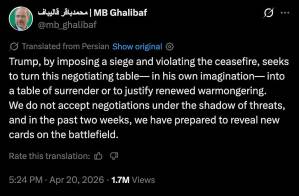
April 22, 2026. Secretary of Defense Pete Hegseth recently announced that he is discarding mandatory flu vaccinations for U.S. service members. It may appeal to an anti-vax political base, and it may sound minor in the abstract—part of what Secretary Hegseth described as “restoring freedom to the joint force.”More On U.S. Governance, Elections, Politics
April 22, 2026. Democrats are pledging “maximum warfare” after their victory in Virginia in the redistricting fight, signaling an aggressive push heading into the midterms.April 22, 2026. There is the unmistakable feeling that the wheels are coming off the MAGA bus.April 22, 2026. The Muse of History can be capricious.U.S. Supreme Court (SCOTUS) Reform
Chief Justice John G. Roberts Jr., left, and Associate Justice Samuel A. Alito Jr. sit for a group photo at the Supreme Court in 2022 (Washington Post photo by Jabin Botsford).
Trump Team Watch
April 22, 2026. Trump’s venom toward women isn’t anything new.April 22, 2026. Trump uses his failing platform to attack critics and parade his increasingly tenuous hold on reality.U.S. Law, Crime, Rights, Justice
April 22, 2026. Todd Blanche and Kash Patel just indicted the Southern Poverty Law Center. The headline claim, that the SPLC misrepresented what they were doing to donors, is batshit insane. With one exception (in which a well-paid informant took a bunch of documents), there’s no misconduct even hinted. SPLC just paid informants doing incredibly dangerous work for that work. Blanche is claiming that this was a misrepresentation to donors — who supported SPLC precisely because their work was so well sourced.April 22, 2026. The pressure is growing on FBI Director Kash Patel as House investigation has been launched into Patel's alleged alcohol abuse.New York Times, F.B.I. Said to Have Investigated Times Reporter After Article on Patel’s Girlfriend, Michael S. Schmidt, April 22, 2026. The bureau said it is not pursuing a case, but the scrutiny is an example of the Trump administration weighing whether to criminalize routine news gathering. The F.B.I. began investigating a New York Times reporter last month after she wrote about the bureau’s director, Kash Patel, using bureau personnel to provide his girlfriend, a country and western singer Alexis Wilkins, shown together at right in an Instagram photo, with government security and transportation, according to a person briefed on the matter. Agents interviewed the girlfriend, queried databases for information on the reporter, Elizabeth Williamson, and recommended moving forward to determine whether Ms. Williamson broke federal stalking laws, the person said.More Global News
U.S. Inflation, Markets, Economy, Jobs
Kevin M. Warsh, at his confirmation hearing to lead the Federal Reserve, sought to dispel doubts that he would yield to President Trump’s demand for lower rates.
April 22, 2026. More thoughts on the roots of Americans’ anger about the economy.April 22
Top Stories
New York Times, Iran War Live Updates: Iranian Forces Claim Seizure of 2 Ships After Trump Extends Truce, Adam Rasgon, Luke Broadwater, Jonathan Swan and Francesca Regalado, April 22, 2026. Iran’s Revolutionary Guards said they had attacked and seized two cargo ships near the Strait of Hormuz, state media reported. Both sides were seeking to exert control in the waterway even as President Trump renewed a cease-fire.
The attacks showed how both Iran and the United States were seeking to exert control over shipping in the area. Even as Mr. Trump announced the cease-fire extension late on Tuesday, before it was set to expire, he said the United States would continue to block ships heading to and from Iranian ports — a move that Iran’s foreign minister called “an act of war.”
Vice President JD Vance’s planned trip to Pakistan for a second round of peace talks was put on hold Tuesday because Tehran had not responded to American demands in the negotiations, a U.S. official said.
In some of Iran’s first public comments in response to the extension of the cease-fire, the foreign ministry spokesman, Esmaeil Baghaei, said Wednesday that Iran stood ready to defend itself militarily while remaining open to the prospect of further talks.
In a social media post, Mr. Trump said he had renewed the truce on a request from Pakistan, which is trying to mediate an end to the war. He said the cease-fire would remain in place until Iran’s “leaders and representatives can come up with a unified proposal.”
Here’s what else we are covering:
Iranian foreign ministry spokesman Esmaeil Baghaei said Wednesday that Iran stood ready to defend itself militarily while remaining open to the prospect of a further talks. He said Iran will negotiate “whenever we conclude that the necessary and rational conditions exist to use this tool to achieve national interests,” according to the official IRNA news agency.
Britain and France will convene military planners from more than 30 countries in London on Wednesday at a conference aimed at reopening the Strait of Hormuz.
“The sessions will advance military plans to reopen the Strait, as soon as conditions permit, following a sustainable ceasefire agreement,” the ministry said in a statement. At a previous summit of 51 countries, hosted by the French and British leaders in Paris last week, they called for the strait’s “unconditional, unrestricted and immediate” reopening and agreed to establish a multinational defensive mission to escort commercial vessels.
Morning Shots via The Bulwark, Political Opinion: Dems Remember They Can Play Hardball, Too, Bill Kristol, Andrew Egger and Jim Swift, April 22, 2026. Virginia voters decide turnabout is fair play—at least for four years.
Yesterday morning, with White House officials set to depart for Pakistan for further peace talks with Iran and a two-week ceasefire on the verge of expiring, Donald Trump issued one of his now-standard threats: “I expect to be bombing” Iran within a few days, he told CNBC’s Squawk Box, “because I think that’s a better attitude to go in with.”
Iran, however, seems to be putting less and less stock in such threats — and it’s hard to argue they’re wrong to do so. Yesterday afternoon, Trump suddenly announced he was unilaterally extending the ceasefire despite a lack of diplomatic engagement from Iran “until such time as their proposal is submitted, and discussions are concluded, one way or the other.”
Iran’s response, per an adviser to Iranian Speaker Mohammad Ghalibaf: “The extension of the cease-fire by Donald Trump has no meaning.” Overnight, Iran said it seized two ships that were attempting to transit the Strait of Hormuz. Who’s in charge around here again? Happy Wednesday.
News Roundups
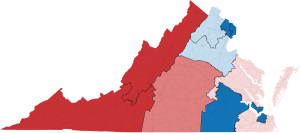
Shown above is the Virginia map showing its 11 current U.S. House Districts. Shown below is the map of the 11 districts that voters approved in unusual mid-decade reapportionment referendum Tuesday to create a liklihood, based on 2024 voting patterns, that the results in 2026 would create 10 Democratic seats and one Republican seat, marked by red areas for Republicans and blue for Democrats. Democrats in Virginia's legislature and then voters approved the changes in reaction to Republican redistricting in Texas and elsewhere expected to create 10 new Republican seats in Texas alone by packing Democratic voters into a few gerrymandered districts.
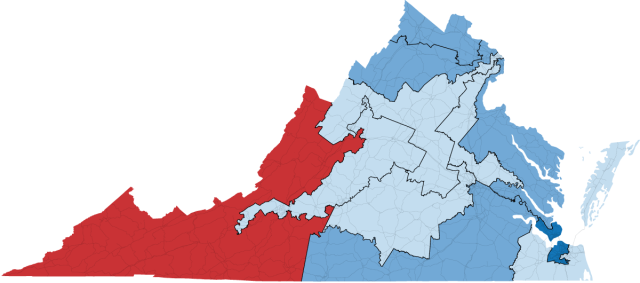
The Parnas Perspective, Evening News and Comment, Virginia Republican Judge Strikes Down Election Results, FBI Investigates Reporter Who Looked Into Patel's Girlfriend, Trump Calls Results Rigged, Aaron Parnas, right, April 22, 2026. A Republican judge in Virginia has thrown out last night’s election results, putting them on hold while an appeal moves forward.
I still believe Democrats will ultimately prevail, but at this moment the results are frozen. At the same time, Trump is calling the election rigged, and the FBI went as far as investigating a reporter who was looking into whether Kash Patel’s girlfriend improperly received security and other government resources.
I also want to address something else. I came across a Washington Post example that honestly made me sick. The double standard and hypocrisy in how these stories are framed is impossible to ignore.
This is exactly why independent journalism matters more than ever. I will not compromise my values for access the way Jeff Bezos and the Post have. If you believe in that, support independent reporting. During White House Correspondents’ Week, your support sends a message that independent voices are rising and people are paying attention. Subscribe today, gift a subscription, or upgrade if you can:
Here’s the news:
Like clockwork, Donald Trump called last night’s election results “rigged” despite having no evidence to support the claim:
May be a Twitter screenshot of text that says 'ten RIGGED ELECTION PLACE LAST NIGHT IN THE COMMONWEALTH OF VIRGINIA! All day long Republicans were winning, Spirit unbelievable, until the very end when, course, there was massive Ballot Drop!" Where have heard that the Democrats out another Crooked Victory! Six five goes one, and yet the Presidential Election November was very close to addition everything else, the language the Referendum was unintelligible and deceptive. everyone knows, extraordinarily brilliant person, and idea what the hell they were talking about in the Referendum, and neither do they! Let's the Courts will this travesty "Justice." President DONALD had 50-50 93 ReTruths'
A Republican-appointed Virginia judge has struck down a Democratic-backed redistricting amendment, ruling it unconstitutional and “void from the start.” The decision invalidates all votes from the April 21 special election and blocks the state from implementing the new maps. Virginia Attorney General Jay Jones said he will immediately appeal the ruling, setting up a legal battle over the state’s redistricting process.
Virginia State Sen. Louise Lucas defended the proposed 10–1 electoral map, arguing it is meant to counter perceived efforts to “tilt the system.” She framed the move as part of a broader national response, saying actions that began in Texas have spread beyond one state. Lucas emphasized that Virginia is sending a message that attempts to “rig the system” will be met with pushback.
She said that Republicans started it and Democrats will finish it:
Senate Republicans, including Majority Whip John Barrasso, pressed Health Secretary Robert F. Kennedy Jr. over his vaccine policies, raising concerns that his actions have created confusion about public health guidance. Kennedy acknowledged the need for clear, evidence-based recommendations and affirmed support for the measles vaccine, noting its high effectiveness. Lawmakers also challenged his criticism of a key federal health task force, warning that his moves could undermine preventive care efforts. The exchange highlights bipartisan unease with Kennedy’s approach to vaccines and public health policy.
The FBI is under fire for scrutinizing a New York Times reporter after she exposed FBI Director Kash Patel’s use of government resources to provide security for his girlfriend, raising alarm about a potential abuse of power. Agents reportedly interviewed sources and explored whether routine reporting could be treated as criminal stalking, before the Justice Department shut it down for lacking any legal basis. Critics say the episode reflects a dangerous attempt to intimidate journalists and criminalize standard newsgathering practices. The Times and press advocates warn it represents a serious threat to First Amendment protections and a chilling escalation against the media.
RFK Jr. says that Donald Trump has alternative math when calculating percentages for the reduction in drug costs.
Commerce Secretary Howard Lutnick criticized Canada for not stocking U.S. spirits, calling the move “outrageous” and disrespectful. Sen. Jeanne Shaheen responded that Canada’s decision is a reaction to repeated insults from President Trump and similar rhetoric. The exchange highlights rising tensions and a tit-for-tat dynamic in U.S.-Canada trade relations.
House Democrats are accusing Oversight Committee Republicans of undermining the Epstein investigation by shifting from formal hearings to informal “roundtables.” They argue this tactic blocks lawmakers from forcing subpoena votes and limits efforts to obtain documents and testimony. Republicans say roundtables allow more focused discussions without partisan disruptions, but critics see the move as an attempt to avoid accountability. The dispute reflects growing tension over how aggressively Congress should pursue the Epstein probe.
White House spokesperson Karoline Leavitt downplayed Iran’s seizure of three ships, arguing it did not violate the ceasefire because the vessels were neither American nor Israeli. She accused the media of exaggerating the incident to undermine President Trump’s claims about weakening Iran’s navy. Leavitt characterized the episode as “piracy” and insisted Iran does not control the Strait of Hormuz.
The Trump administration is nearing a tentative $500 million rescue deal for Spirit Airlines to help the struggling carrier emerge from bankruptcy and manage rising fuel costs linked to the Iran war. The plan could give the U.S. government up to a 90% ownership stake, though details are still being negotiated. While the move aims to preserve jobs and stabilize the airline, critics question whether it would waste taxpayer money and set a risky precedent for other airlines seeking bailouts. Spirit has filed for bankruptcy twice recently and continues to face financial challenges despite plans to exit bankruptcy soon.
 House Minority Leader Hakeem Jeffries, right, sharply criticized Donald Trump, saying, “Donald Trump is clearly the dumbest person ever to sit at 1600 Pennsylvania Avenue.”
A federal judge dismissed a defamation lawsuit filed by FBI Director Kash Patel against former MSNBC contributor Frank Figliuzzi, ruling that Figliuzzi’s remark about Patel frequenting nightclubs was “rhetorical hyperbole,” not a statement of fact. The court determined that a reasonable person would not interpret the comment literally, so it is protected under the First Amendment. Figliuzzi’s legal team celebrated the decision as a win for press freedom, though the judge declined to award attorney fees. Meanwhile, Patel has filed a separate $250 million defamation lawsuit against The Atlantic over allegations about his conduct.
Iranian official Mohammad Bagher Ghalibaf warned that reopening the Strait of Hormuz would be “impossible” if ceasefire violations continue. He argued that a ceasefire is only meaningful if there is no maritime blockade, economic disruption, or ongoing military escalation. Ghalibaf also stated that pressure and aggression would not succeed, insisting that recognizing Iran’s rights is the only viable path forward.
FCC Chair Brendan Carr is pushing a proposal that critics view as an attack on TV content, suggesting new warning labels for programs that include gender identity themes. The plan would expand the ratings system to flag transgender-related content in children’s shows, which opponents argue could stigmatize certain topics and pressure networks to limit what they air. Carr says the move is about giving parents more transparency, but detractors see it as government overreach into media and a step toward politicizing what appears on television. The FCC has opened the proposal for public comment as debate intensifies.
Councilmember Chi Ossé was arrested while attending a protest against an eviction in Brooklyn’s Bed-Stuy neighborhood. Video circulating online appears to show NYPD officers tackling him to the ground during the incident. The arrest has drawn attention to tensions between law enforcement and housing activists at eviction protests.
Rep. David Scott, shown at left, a Georgia Democrat and the first Black chairman of the House Agriculture Committee, has died at age 80. First elected in 2002, he served for over two decades and was known for advocating for farmers, veterans, and his constituents. Colleagues remembered him as a trailblazer with a long record of public service, though he had faced recent health concerns and a competitive primary challenge. His death will trigger a special election in Georgia and slightly shifts the balance in the House.
Kalshi announced enforcement actions against three political candidates accused of trading on the outcomes of their own elections, violating exchange rules against insider trading. The cases involved candidates in Minnesota, Texas, and Virginia, with penalties including fines and five-year suspensions from the platform. Two candidates cooperated and reached settlements with smaller penalties, while a third faced a larger fine after refusing to engage with investigators. Kalshi emphasized that even small trades can breach rules and said the cases highlight its efforts to prevent manipulation in political prediction markets.
Two people, including a 14-year-old student, were killed when Israeli settlers attacked a school in the occupied West Bank village of Al-Mughayyir, according to AFP. The victims were identified as Aws Hamdi al-Naasan and Jihad Marzouq Abu Naim. The school’s principal said the attack occurred while students were taking exams, describing how settlers advanced on and assaulted the school. The incident underscores ongoing violence and tensions in the region.
Reporters Without Borders (RSF) has urged international pressure on the Israeli military to allow the rescue of journalist Amal Khalil, who is reportedly trapped after an airstrike near southern Lebanon. RSF warned that ongoing Israeli strikes are preventing rescuers from reaching her and that her life is in immediate danger. Lebanon’s president, Joseph Aoun, has called on the Red Cross to assist in rescuing Khalil and another journalist, Zeinab Faraj, who was with her. The situation highlights the risks journalists face in active conflict zones.
Wildfires across Georgia and Florida have intensified, destroying at least 50 homes and forcing widespread evacuations, school closures, and emergency responses. Officials say drought, low humidity, and strong winds have fueled the fire spread, with some fires growing rapidly and threatening hundreds more homes. Smoke has spread to major cities like Atlanta and Savannah, worsening air quality to unhealthy levels. Authorities have issued burn bans and mobilized large-scale firefighting efforts as the region faces one of its worst fire seasons in decades.
A man who stole former Homeland Security Secretary Kristi Noem’s purse at a Washington, D.C. restaurant in 2025 was sentenced to three years in prison. The thief, Mario Bustamante Leiva, did not realize who Noem was and took her handbag containing cash and credit cards while she dined with her family. He pleaded guilty to multiple theft and fraud charges tied to a broader pattern of crimes in the area. After serving his sentence, he is expected to face deportation.
Democracy Docket, Virginia court blocks voter-approved redistricting, appeal coming, Yunior Rivas, April 22, 2026. A Virginia judge temporarily halted the state’s newly approved congressional map — but state officials are already moving to try to overturn the ruling, setting up a rapid legal fight in the state’s Supreme Court.
In a decision issued Wednesday on a Republican lawsuit, a judge in Tazewell County ruled that the legislature’s constitutional amendment and the referendum voters just approved were invalid — a move that immediately blocks the state from implementing the new districts.SIGN UP TODAYGet updates straight to your inbox — for free
The court declared the amendment invalid from the start, and ordered that “any and all votes for or against the proposed constitutional amendment in the April 21, 2026 special election are ineffective.”
The judge also went further, issuing a permanent injunction — a legal order that blocks action going forward — preventing state officials from “certifying the results” and from taking “any actions to give effect to the proposed constitutional amendment.”
But despite the sweeping language, this ruling is far from the final word.
Virginia Attorney General Jay Jones (D) moved immediately to challenge the decision, signaling a fast-track appeal that could quickly shift the case to higher courts.
“My office will immediately file an appeal in the Court of Appeals,” Jones said. “Virginia voters have spoken, and an activist judge should not have the power over the People’s vote. We look forward to defending the outcome of last night’s election in court.”
That appeal is expected to move swiftly — and could ultimately land before the Supreme Court of Virginia, which will have the final say on whether the voter-approved map can take effect.
For now, the ruling creates a pause — not a defeat.
The court’s decision hinges on procedural and constitutional arguments about how the amendment was passed, including timing requirements and legislative steps, the kinds of disputes appellate courts often revisit, especially when they collide with a direct vote of the people.
The referendum, approved by voters just a day earlier, allows Virginia to redraw its congressional map ahead of the 2026 elections — part of a broader national mid-decade redistricting battle, initiated by President Donald Trump, that could shape control of the U.S. House.
Opponents of the measure had hoped the court challenge would stop the effort outright. Instead, higher courts will weigh not just procedural questions, but the fundamental issue of whether a voter-approved amendment can be blocked after the fact.Those officials could ask the Supreme Court to turn down Page’s attempt to reinstate his claims against them or may ask the justices for more time to assess the situation in light of the government’s settlement with Page, which Sauer said was finalized Tuesday.
More On Iran, U.S. Military
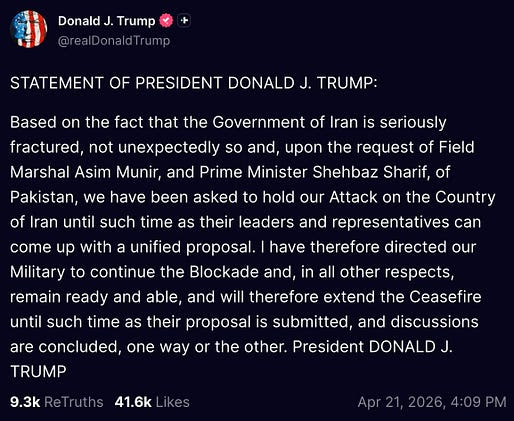 Drop Site News, Trump Blinks First, Extending Ceasefire with Iran as Hormuz Deadlock Continues, Jeremy Scahill, left, April 22, 2026. Iran is continuing to demand the U.S. lift the naval blockade as a condition for new talks. Trump says resuming war remains an option as Iran prepares retaliation.
 The future of U.S.-Iran negotiations remains in doubt after President Donald Trump and Tehran’s leaders staked out opposing positions on the Strait of Hormuz. “Diplomacy is a tool to secure national interests and security,” said Esmail Baghaei, Iran’s Foreign Ministry spokesman, in a briefing in Tehran on Wednesday. “Whenever we conclude that the necessary and logical grounds for using this tool to realize national interests and consolidate the achievements of the Iranian nation in thwarting the enemies from reaching their evil goals are prepared, we will act.”
On Tuesday night, a senior Iranian official told Drop Site that Iran would move forward with a second round of talks in Islamabad only if Trump extended the ceasefire and ended the U.S. naval blockade. “The Pakistani side indicated that they expect Trump to lift the naval blockade of Iran,” the official said. “If that happens, and the ceasefire is extended, a new round of talks will be held on Thursday.”
Soon after, Trump announced on Truth Social that he was indefinitely extending the ceasefire but added that the blockade will remain in place. “Based on the fact that the Government of Iran is seriously fractured, not unexpectedly so and, upon the request of Field Marshal Asim Munir, and Prime Minister Shehbaz Sharif, of Pakistan, we have been asked to hold our Attack on the Country of Iran until such time as their leaders and representatives can come up with a unified proposal,” Trump wrote. “I have therefore directed our Military to continue the Blockade and, in all other respects, remain ready and able, and will therefore extend the Ceasefire until such time as their proposal is submitted, and discussions are concluded, one way or the other.”
The Iranian official dismissed Trump’s claims that Iran’s leadership was in disarray, characterizing it as a desperate attempt by Trump to save face after his recent false claims, including that Iran had offered him sweeping concessions, and “agreed to everything,” including handing over its enriched uranium and allowing the U.S. military to enter Iran to seize it. “Our people, together with the Iranians, are going to work together to go get it. And then we’ll take it to the United States,” Trump said April 17. Iran swiftly rejected these claims.
Trump also publicly announced on Monday that JD Vance, Special Envoy Steve Witkoff and Jared Kushner, Trump’s son-in-law, were on their way to Islamabad and suggested that a deal was almost finalized. “They’re heading over now. They’ll be there tonight,” he told PBS. He added that he was considering personally attending the talks. When Iran ultimately decided not to send a delegation, Trump scrambled to reconcile his messaging and reverted to threatening to destroy Iran’s civilian infrastructure. On Tuesday morning, he told CNBC he would not extend the ceasefire only to flip flop hours later in the face of Iranian intransigence.
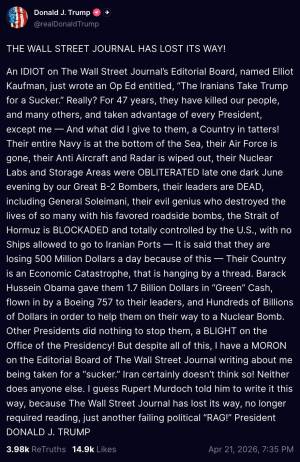 President Trump responds on a Truth Social screed April 21 to a Wall Streeet Journal op-ed that described him as a "sucker" in Iran negotations.
Popular Information, Accountability Journalism: Trump floats taxpayer bailout for Middle Eastern autocracy, Rebecca Crosby and Noel Sims, below left, April 22, 2026. On Tuesday, President Trump said he is considering a financial bailout for the United Arab Emirates (UAE), an autocratic state experiencing an economic downturn due to the war in Iran.
If the Trump administration does use public resources to rescue the UAE, it will be assisting a country that has partnered extensively with the Trump Organization and the Trump family.
 On Sunday, the Wall Street Journal reported that UAE Central Bank Governor Khaled Mohamed Balama “raised the idea of a currency-swap line” during meetings in Washington, D.C., last week with Treasury Department and Federal Reserve officials, including Treasury Secretary Scott Bessent. Officials from the UAE said that they “had so far avoided the worst economic effects of the conflict but might still need a financial lifeline.” According to the Journal, a formal request has not yet been made.
UAE officials argued that the war between the U.S. and Iran could damage the country’s economy and harm its global financial standing. The war has already damaged the country’s oil and gas infrastructure, and Iran’s closure of the Strait of Hormuz has cut off oil shipments that are a key source of dollar revenue.
If the U.S. agreed to the UAE’s proposal for a currency-swap line, the UAE central bank would get “inexpensive access to dollars to support its currency or shore up its foreign reserves in case of a liquidity crisis.” While swap lines are usually offered by the Federal Reserve, officials told the Journal that it is unlikely that one would be approved for the UAE. But the Trump administration has also provided financial bailouts through the Treasury Department.
In September, for example, Bessent announced a $20 billion swap line to bail out Argentina. That bailout benefited billionaire hedge fund manager Rob Citrone, a former colleague and close friend of Bessent.
Bailouts are typically reserved for countries with deep economic ties to the U.S. to avoid adverse consequences for the American economy. But the UAE is not a major trading partner of the U.S. In 2024, the goods and services trade between the U.S. and the UAE “totaled an estimated $47.9 billion.” In comparison, trade between the U.S. and Canada totaled $909 billion, and trade with the U.K. was $340.1 billion.
Nevertheless, Trump administration officials appear to be open to the idea. On Monday, National Economic Council Director Kevin Hassett, one of Trump’s top economic advisors, was asked about the potential bailout during an interview with CNBC. “The UAE has been an incredibly valuable ally throughout this effort, and I’m sure the Treasury Secretary will make every effort to help them out should that be necessary,” Hassett said, noting that he had not talked to Bessent directly.
The UAE has not been that helpful. For example, in January 2026, the UAE announced that it will not allow “its airspace, territory or territorial waters be used for any hostile military actions against Iran.”
On Tuesday, Trump also indicated that he was open to the proposal during an interview with CNBC. Trump was asked if a currency swap with the UAE was under consideration. “It is,” Trump responded. “It’s been a good country, it’s been a good ally of ours. And you know these are unusual times,” Trump said, noting that the UAE has been targeted particularly hard by Iranian missiles. “They’re very good for this country, so yeah, if I could help them I would.”The UAE’s business ties with Trump
Since retaking office, Trump and his family have benefited greatly from deals with UAE officials and businessmen.
Just days before Trump was inaugurated in 2025, for example, Emirati royal Sheikh Tahnoon bin Zayed Al Nahyan secretly purchased a 49% stake in the Trump family’s cryptocurrency firm, World Liberty Financial. Half of the sale was paid up front, resulting in a windfall of $187 million for entities tied to the Trump family. An additional $31 million went to the family of Steve Witkoff, who is a World Liberty Financial co-founder and Trump’s envoy to the Middle East. Witkoff has been involved in negotiations with Iran throughout the war. It is unclear how much the two families will make from the second half of the payment.
Five months after Tahnoon bought into the company, MGX — a state-backed UAE investment fund chaired by Tahnoon — used $2 billion worth of USD1, a stablecoin issued by World Liberty Financial, to finance an investment in the crypto exchange Binance. The deal will generate hundreds of millions of dollars for Trump and his family members.
Two weeks after the USD1 purchase, the Trump administration made a deal to give the UAE hundreds of thousands of advanced computer chips that the country had been seeking for years. According to the New York Times, Tahnoon secured this agreement, and many of the chips went to G42, a tech firm under his control.
The Trump family has brought in additional millions by licensing the Trump name to a golf course and a real estate development in the UAE. The golf course, which opened shortly after Trump was inaugurated for the first time in 2017, was built outside Dubai by developer DAMAC, which reportedly pays the Trump Organization $6 million per year to use the Trump name. The Trump Organization signed a similar licensing agreement with developer Dar Global in April 2025 to construct a Trump-branded hotel and residential building in Dubai.
Trump’s son-in-law, Jared Kushner, who Trump has placed in a top diplomatic role, has also profited from investments from the UAE. In 2021, Kushner’s private equity firm Affinity Partners received a $200 million investment from the UAE’s sovereign wealth fund and another $1.5 billion from entities controlled by the Qatari and Emirati governments in late 2024. Exactly how much of the $1.5 billion came from the UAE is undisclosed.
Morning Shots via The Bulwark, Political Opinion: Undue Command Influenza, Mark Hertling, right, April 22, 2026. Secretary of Defense Pete Hegseth recently announced that he is discarding mandatory flu vaccinations for U.S. service members. It may appeal to an anti-vax political base, and it may sound minor in the abstract—part of what Secretary Hegseth described as “restoring freedom to the joint force.”
But “freedom” also comes with civic and community obligation, especially in a profession built on individual and group responsibility. In military units and on military bases, individual choices have immediate and cascading consequences for the health and readiness of others.
Consider how other high-performance organizations or facilities with throngs of people in close contact handle contagious illnesses. If a professional sports team has a player with the flu, that athlete often isn’t welcomed into the locker room or told to push through practice. He’s isolated to prevent the spread of the virus.
Consider a daycare center or an elementary school where a policy like Hegseth’s became commonplace. Parents would have justifiable questions. Classrooms are enclosed. Kids share space, air, and germs. One case becomes five, then fifteen. Teachers get sick, as do parents. Learning suffers, and families, especially those with vulnerable members, feel the ripple effects.
No serious organization would accept that risk. The military is a serious organization that does all it can to prevent such outbreaks because they know the repercussions—especially when sending people home or spacing them out aren’t options. Many soldiers live in barracks, train in formation (or share tight crew quarters in a tank, submarine, or aircraft), eat in shared dining facilities, and operate in close quarters every day. Additionally, troops who are married have families who live in base housing, send their kids to base schools and child care, attend religious services, and interact in a closed environment where exposure compounds quickly. What spreads in one unit rarely stays there.
I’m not a doctor, but as a former commander, I know that medical protection and ensuring the care of troops are critical tasks—and they’re unlike those in a normal private-sector company. In the military, health is not just an individual matter. It’s a readiness issue. That distinction is important.
In civilian life, getting the flu is usually an individual inconvenience—missed work, a few days of recovery, perhaps a ripple effect within a household or office. In the military, illness spreads rapidly across formations. One soldier shows up sick to morning physical training, and within days, an entire unvaccinated platoon would likely be degraded. Maintenance slows. Training schedules slip. Leaders spend time managing symptoms and manning rosters instead of preparing for missions. Scale that to a battalion or brigade, and the impact becomes operational. For units in training, missed days due to illness mean less preparation for the next fight, which could lead to higher casualties or mission failure. For units in combat, the consequences can be even more severe.
Commanders have long understood the implications of keeping their units healthy. That’s why routine vaccinations have never been about bureaucracy—they’ve been about illness prevention and military readiness. Not every flu case is severe, but the cumulative effect of many cases, spreading quickly through formations, creates a predictable and avoidable degradation of capability.
Good leaders don’t ignore predictable risks; they mitigate them.
There’s also a deeper issue at play: trust. Service members accept that their profession carries hardship, threats, and danger. They also trust that their leaders will reduce unnecessary risk wherever possible—especially in areas that are well understood and historically managed. Force health protection is one of those areas.
When leaders step away from established preventive measures, it raises questions not just about policy, but about priorities. Are they accepting risk because it is unavoidable, or because it’s politically popular? If the latter, that isn’t leadership.
In the Army, we emphasize that leaders are responsible for everything their people and their unit do—or fail to do. That includes anticipating second- and third-order effects. Illness in close quarters is not a new problem. Armies throughout history have been weakened not just by enemy fire, but by disease spreading through their ranks. That lesson hasn’t changed.
What has changed is that for a long time we have had the means to reduce the risk of infectious disease and have institutionalized prevention measures because they work.
A professional sports team can bench a player, isolate him, and move on with the season. The military doesn’t operate that way. Units are not interchangeable rosters. Cohesion, timing, and collective performance matter in ways that don’t allow for easy substitution or separation. You can’t “bench” a platoon. You can only prepare it—or degrade it.
Eliminating mandatory flu vaccinations may appear to be a small policy change by a naïve civilian leader appealing to his boss’s base. But he’s removing a layer of protection from a force that needs collective health to function effectively. And unlike a sports team or a school, the consequences aren’t just missed games or sick days. The results affect readiness, mission execution, and ultimately, the well-being of the force.
That’s not a medical judgment. It’s a command responsibility.
Quick Hits
SCHRÖDINGER’S URANIUM HUNT: In yesterday’s Morning Shots LIVE video, your correspondents spent plenty of time breaking down Donald Trump’s long, rambling, newsy call into CNBC’s Squawk Box—from his insistence he would have won the Vietnam War very quickly had he been president, to his continued stubborn refusal to drop his pretextual criminal investigation of Fed Chair Jerome Powell, to his applauding companies like Apple for not (yet) seeking reimbursement of the revenues they paid under his illegal “Liberation Day” tariffs last year.
Still, there’s always lots more to chew on.¹ Let’s just pluck out one more moment, shall we? Here was Trump discussing the problem of the uranium buried at the nuclear sites America bombed last year:
They can’t get the nuclear dust, because it was obliterated by the B-2 bombers that went in. . . . They’ve tried to get down there. You know, we have cameras from Space Force on it all the time. They’ve tried to get down. They can’t get down. That place was obliterated. . . . The left tries to demean all the time, like, ‘Oh, well, maybe it wasn’t totally obliterated.’ It was. And they can’t get it, or they would have tried to get it.
For the record, the question Trump was answering was about interest rates. As he often does, Trump spent much of this interview ignoring his interviewers’ questions to instead answer other critiques that have plainly been irritating him lately—in this case, the critique that it’s ludicrous for him to claim the United States has achieved a total military victory over Iran if its cache of enriched uranium remains unaccounted for.
Trump insists this is silly: that we don’t need to retrieve or account for the uranium, because it’s buried so deep that Iran can never get at it. But observe the two explanations Trump gives—back to back, one following immediately on the other—for how we know this is so. Iran has “tried to get down there,” he says, without success. (We know this, apparently, because of the “cameras from Space Force.”) But we also know “they can’t get at it” because otherwise “they would have tried to get it.”
So there you have it. Iran can’t get its uranium back, which we know for two reasons: because they have tried to get it back, and because they haven’t tried to get it back. Careful, kids: This is what becomes of a mind that has spent its entire career operating in the realm of spin rather than of fact.
BAD NATO! VERY BAD NATO!: The sanctimony of these people! The pure hectoring poutiness! Politico reports on the White House’s latest effort to break the bonds between ourselves and our NATO allies: the development of a “naughty and nice” list distributing head pats and finger wags based on how obediently other countries drop everything to throw themselves into American boondoggles like the Iran war:
The effort, which officials worked on ahead of NATO head Mark Rutte’s visit to Washington this month, includes an overview of members’ contributions to the alliance and places them into tiers, according to three European diplomats and a U.S. defense official familiar with the plan.
It’s the latest sign that President Donald Trump plans to make good on his threats against allies who don’t adhere to his wishes. And it’s another pressure point on the increasingly frayed alliance, which has been battered by Trump’s attacks—from his push to annex Greenland to his warning of a complete withdrawal from the pact.
Defense Secretary Pete Hegseth floated the broad idea in December. “Model allies that step up, like Israel, South Korea, Poland, increasingly Germany, the Baltics and others, will receive our special favor,” he said. “Allies that still fail to do their part for collective defense will face consequences.”
The funniest/bleakest quote in the piece comes from an anonymous European official: “They don’t seem to have very concrete ideas. . . when it comes to punishing bad allies. Moving troops is one option, but it mainly punishes the U.S. doesn’t it?” Sure, but that’s never stopped them before. Read the whole thing.
More On U.S. Governance, Elections, Politics
Hopium Chronicles, Pro-Democratic Advocacy: Trump's Terrible Polling Gets Worse, National Battleground Deteriorates Further For GOP - 2026 Has Become A Year Of Opportunity For Democrats, Simon Rosenberg, right,  April 22, 2026. I cannot express to you how much it feels like Trump and his Congressional allies are melting down right now.
Just look at the news coverage: The disgraced FBI Director yelling at reporters, Tucker Carlson apologizing for supporting Trump, the Labor Secretary resigning due to a really nasty scandal, Nancy Mace attempting to oust her colleague Cory Mills from the House, utter legislative chaos and infighting in both chambers, Trump’s unending whining about his gilded ballroom, and then there is the failed war -- gargantuan, historic, shocking levels of buffoonery, idiocy, incompetence and now desperation too.
Over the last few weeks I’ve been making two related arguments: 1) that Trump no longer had a face-saving way out of his failed war, and that he, America and the world were about to enter a dark and dangerous period 2) as bad as things were for the Republicans politically and electorally, they were going to get worse.
Well, things have gotten worse for the Rs these last few weeks, a whole lot worse. We’ve gotten a rash of really bad economic data showing inflation spiking, the economy slowing, and consumer sentiment plummeting. Here’s the latest GDP nowcast from the Atlanta Fed. Q1 GDP growth was running over 3% before the war began. Now it is hovering around 1%.
In the last two days Trump has seen the worst polling of his second term. Look at this data!!!!!!!!!!!!!!!!!!!!!!!!!!!!!!!!!!!!!!!!!!!!
Look at this data from the AP-NORC poll. Staggering levels of rejection and repudiation on things that really matter:
In his tracking poll this month G. Elliott Morris tested impeachment. Yes, we are already at Nixon-level numbers:
A fifth of Republican voters want Trump impeached:
In recent weeks we’ve seen polls putting Democrats ahead in Senate races in Alaska, Maine, North Carolina and Ohio, enough to give the Democrats the Senate. We had not seen us ahead in Iowa. Until yesterday that is, and this data from Echelon, a Republican pollster:
Echelon also released this encouraging data from Georgia:
And Maine:
I cannot stress to you enough how extraordinary it is that we are now seeing strong leads for our Senate candidates in Georgia and North Carolina, and that we will be in competitive seven-month long campaigns in Alaska, Iowa, Ohio and potentially Florida and Texas too. These are places the national Democratic Party just have not been competitive in for some time.
The Parnas Perspective, Morning News and Commentary: Democrats Pledge 'Maximum Warfare' and Win Redistricting Battle Nationwide, Trump Fears Impeachment and Investigations, Iran Seizes Ships and Mocks Trump, Aaron Parnas, right, April 22, 2026. Democrats are pledging “maximum warfare” after their victory in Virginia in the redistricting fight, signaling an aggressive push heading into the midterms.
Inside the Trump orbit, there is growing concern about the real possibility of impeachment and relentless investigations next year, along with potential major shakeups in the administration before November. At the same time, Iran is escalating tensions by seizing ships in the Strait of Hormuz in direct response to Trump’s blockade, openly challenging the President.
Meanwhile, White House Correspondents Dinner Executive Director Steve Thomma previously claimed independent journalists are “not news,” would “never be news,” and would “never be invited.” That claim is wrong. We are news. We will continue to be news. And this year, many of us are refusing to attend in protest of invitations extended to Donald Trump, Brendan Carr, and others who undermine the First Amendment.
Here’s the news:
Donald Trump’s inaccurate or exaggerated claims to reporters about progress in Iran negotiations—such as describing concessions that hadn’t actually been agreed—undermined diplomatic efforts. According to accounts cited by media outlets, even some officials privately acknowledged that these statements damaged trust and complicated talks. This aligns with broader reporting that Trump’s public comments have at times contradicted reality or private negotiations, creating confusion for both allies and Iranian counterparts. This is how Iran is responding today:
Hakeem Jeffries warned that a proposed redistricting effort by Florida Republicans could backfire politically, calling it an “illegal scheme.” He said Democrats would aggressively target several GOP incumbents—including Mario Díaz-Balart, Maria Elvira Salazar, Carlos Giménez, Kat Cammack, Anna Paulina Luna, Laurel Lee, Cory Mills, and Brian Mast. Jeffries argued that similar efforts elsewhere created opportunities for Democrats and said his party is prepared to compete broadly. He concluded with a stark warning: “Maximum warfare, everywhere, all the time.”
Democrats appear to have gained the upper hand in the current mid-decade redistricting battle, with projections suggesting they could net around 8–10 seats. Republicans are still expected to gain seats as well, but at a smaller range of roughly 4–8. Analysts note that shifting results in recent special elections add uncertainty to the landscape. This makes further redistricting efforts in states like Florida a potentially risky move for Republicans.
A closely watched vote in Virginia approved a new congressional district map, with about 51% in favor, potentially flipping up to four Republican-held seats and putting pressure on the GOP’s narrow House majority. The outcome has sparked internal Republican tensions, with some blaming missed opportunities to counter Democratic momentum. Analysts note that if Democrats regain control of the House, it could open the door to a potential third impeachment of Donald Trump, though party leaders say that is not currently their focus. The result is part of broader “redistricting wars,” where competing map changes across multiple states could ultimately benefit Democrats in the 2026 midterms.
House Democrats have launched a probe into Kash Patel, raising concerns about his relationship with alcohol. In a pointed statement, they said, “These glimpses of your relationship to alcohol would be alarming to see in an FBI agent; for us to see them in the FBI Director himself is shocking.” Lawmakers have asked Patel to complete a 10-question Alcohol Use Disorders Identification Test as part of the inquiry.
The U.S. Justice Department has received a USB drive containing new legal filings from Ghislaine Maxwell, including an amended motion seeking to overturn her conviction and prison sentence. A prosecutor from the Trump administration reportedly dismissed the arguments as “duplicative” and “meritless.” The filing represents another attempt by Maxwell to challenge her conviction in court. Full filing here.
Iran’s Revolutionary Guard says it seized two ships—the MSC Francesca and the Epaminondas—in the Strait of Hormuz, claiming they violated maritime rules and were escorted to Iran’s coast. Ship-tracking data appears to support their proximity to Iranian waters, while a third vessel, the Greek-owned Euphoria, was reportedly fired on and left stranded. Iranian state-affiliated outlets say all three ships were targeted, though details differ across sources. The incidents further escalate tensions in the strait, especially as the U.S. maintains its naval blockade and recent confrontations at sea continue.
Iran’s Revolutionary Guard has reportedly targeted three ships in the Strait of Hormuz, according to a semi-official news agency. A Greek-owned vessel, the Euphoria, was said to be fired on and left stranded near Iran’s shores. Two other ships, MSC Francesca and Epaminondas, were described as “violating vessels,” immobilized, and later seized by Iranian forces. The incident adds to rising tensions in the strategic waterway, with earlier reports also confirming that ships had come under fire.
Iran’s Revolutionary Guard warned it would deliver “crushing and unimaginable” strikes if fighting with the U.S. and Israel resumes. The group said it remains fully prepared to respond to any renewed aggression. The statement came after Donald Trump announced an indefinite extension of the ceasefire to allow time for negotiations. Iran also claimed it views itself as emerging from the conflict with stronger global standing. Meanwhile, Trump claims Iran is crumbling financially right now:
Iran’s attacks in the Strait of Hormuz appear to be a direct signal to Donald Trump, demonstrating Tehran’s willingness to escalate while its hardline military exerts control. At the same time, Iran’s U.N. ambassador indicated negotiations could resume in Islamabad if the U.S. lifts its naval blockade. However, Trump reportedly sees the blockade as essential leverage in talks. This creates a deadlock, with both sides unwilling to back down.
Seven tankers or cargo ships passed through the Strait of Hormuz in the last 12 hours despite ongoing attacks, according to tracking data. Some vessels showed irregular behavior, including turning off or intermittently transmitting their required tracking signals. Two ships later seized by Iran—the MSC Francesca and Epaminondas—had both stopped transmitting before reappearing near Iranian waters. A third ship, the Euphoria, continued transmitting but moved erratically and slowed significantly while transiting the strait.
An Iranian-linked news outlet warned that undersea data cables in the Strait of Hormuz are vulnerable to damage, whether accidental or intentional. Disruptions to these cables could trigger major internet and communications outages across Gulf countries. The report underscores rising risks to critical infrastructure amid regional tensions. It also points to similar incidents in the Red Sea as evidence of the potential impact.
The United Arab Emirates thanked Donald Trump for mentioning a possible currency swap with the country amid ongoing regional tensions. However, the UAE stressed that it does not need external financial support, highlighting its strong economic position. Officials pointed to over $2 trillion in sovereign investments, $300 billion in reserves, and a large banking sector as evidence of resilience. The statement appears aimed at reinforcing confidence despite uncertainty tied to the conflict involving Iran.
Rising tensions and uncertainty in the Strait of Hormuz have pushed global oil prices higher, with Brent crude nearing $100 per barrel. Renewed reports of attacks on vessels in the strait—through which about one-fifth of the world’s oil passes—have unsettled energy markets. As a result, Brent prices are now about 50% higher than a year ago. Meanwhile, U.S. benchmark West Texas Intermediate also increased slightly, reaching around $91 per barrel.
Thousands of protesters gathered in Tehran’s Enghelab and Vanak squares for anti-U.S. and anti-Israel demonstrations. Participants waved Iranian flags, chanted slogans, and showed strong support for the country’s leadership. The Iranian Armed Forces also displayed ballistic missiles at the protest sites. The demonstrations highlighted heightened tensions and public mobilization amid the broader geopolitical situation. From Getty Images:
Thousands in Tehran protest US - Israel alongside Ballistic Missiles
Iran has executed a man, identified as Mehdi Farid, who was convicted of spying for Israel’s Mossad and sharing sensitive information. Authorities said he used his position in a civil defense unit to pass intelligence to Israel. The execution follows similar cases days earlier, where two others were put to death over alleged Mossad ties. Human rights groups continue to criticize Iran for conducting closed-door trials that limit defendants’ ability to defend themselves.
The U.S. Department of Justice has indicted the Southern Poverty Law Center on fraud charges, alleging it secretly funded individuals tied to extremist groups while publicly opposing them. Acting Attorney General Todd Blanche said the organization paid at least $3 million to sources, some linked to groups like the Ku Klux Klan, accusing it of “manufacturing the extremism it purports to oppose.” The indictment includes multiple counts of wire fraud, bank fraud, and money laundering. The SPLC has denied the allegations, calling them false and saying its use of informants was intended to gather intelligence and prevent violence.
James Comer suggested that scientists working in classified fields may have reason for concern, citing potential threats from foreign adversaries. He said countries like China, North Korea, Iran, and Russia—as well as others—could be involved, though he also acknowledged it could be coincidental. His comments come amid broader concerns about the safety of researchers tied to sensitive national security programs.
An Israeli drone strike in Lebanon’s Western Bekaa region reportedly killed one person and injured two others, according to state media. The incident occurred despite a ceasefire that took effect the previous week. However, Israel’s military denied carrying out the strike. The conflicting accounts add further tension to an already fragile truce.
A new report highlights a sharp rise in stillbirths and birth defects in Gaza, which health officials link to the ongoing war and deteriorating living conditions. Cases of congenital anomalies have surged, with stillbirths increasing by about 140% and neonatal deaths also rising significantly. Doctors attribute the trend to factors such as malnutrition, contaminated water, overcrowding, and the collapse of healthcare services. Even with a ceasefire, many newborns continue to face severe, life-threatening conditions tied to the long-term impacts of the conflict.
Israeli forces have gradually expanded a “yellow line” in Gaza, increasing the area under military control despite a ceasefire. Residents say the boundary often shifts overnight, placing more areas into dangerous “free-fire” zones where civilians risk being targeted. The expansion has been accompanied by new fortifications, demolitions, and ongoing gunfire, creating constant fear among Palestinians. Critics, including UN officials, warn that civilians have been killed near the line and argue such actions could violate international law.
A new law in Israel mandating the death penalty for some Palestinians convicted in military courts has raised international concern. Officials at the Council of Europe warned the move could lead to the suspension of Israel’s observer status, as opposition to capital punishment is a key requirement. Critics argue the law may be discriminatory and violate human rights standards, and legal challenges have already been filed in Israel’s Supreme Court. The controversy adds to broader tensions over Israel’s policies in the region.
European Union ambassadors have approved a €90 billion loan package for Ukraine after Hungary lifted its veto. The decision is moving through a formal written procedure, with final approval expected soon. In addition, the EU agreed on its 20th round of sanctions against Russia. The measures signal continued financial and political support for Ukraine.
A new report from the American Lung Association finds that nearly half of children in the United States—about 33.5 million—are exposed to dangerous levels of air pollution. The study highlights risks such as asthma, respiratory illness, and long-term lung damage, with communities of color disproportionately affected. Experts also warn that climate factors like heat, drought, and wildfires are worsening pollution levels. The report raises concerns that environmental rollbacks under Donald Trump could further harm air quality and public health.
Letters from an American, Historical Commentary: April 21, 2026 [Wheels Off?], Heather Cox Richardson, right, April 22, 2026. There is the unmistakable feeling that the wheels are coming off the MAGA bus.
Alayna Treene and Kevin Liptak of CNN reported last night that by the end of last week, negotiators for the U.S. and Iran appeared to be on the verge of hammering out an end to hostilities before the two-week ceasefire ends on Wednesday. Then Trump took to the media to crow that Iranian leaders had “agreed to everything,” including the removal of its enriched uranium, and that “Iran has agreed never to close the Strait of Hormuz again.” He promised that Iran had agreed to end its nuclear program forever and that talks “should go very quickly.” Trump declared the breakthrough was “A GREAT AND BRILLIANT DAY FOR THE WORLD!” and asked why media outlets questioning the alleged deal didn’t “just say, at the right time, JOB WELL DONE, MR. PRESIDENT?”
Iranian negotiators said Trump’s claims were false and that if he didn’t remove the U.S. blockade of Iranian ports, they would reclose the Strait of Hormuz they had just opened. “The Iranians didn’t appreciate [Trump] negotiating through social media and making it appear as if they had signed off on issues they hadn’t yet agreed to, and ones that aren’t popular with their people back home,” a source told Treene and Liptak.
Over the weekend, Iranians closed the strait and the U.S. fired on an Iranian vessel. On Sunday, even as two senior U.S. government officials were on television saying Vice President J.D. Vance would lead a new round of talks in Pakistan, Trump was on the phone telling reporters that he wouldn’t. On Monday, Trump told a reporter that Vance was in the air about to touch down in Pakistan just minutes before Vance’s motorcade arrived at the White House.
After Iranian officials said today they were not sure they would respond to U.S. positions or go to Pakistan for talks, Vance’s trip has been put on hold. Iran’s Foreign Ministry spokesperson, Esmail Baghaei, complained of “contradictory messages, inconsistent behavior and unacceptable actions by the American side,” on Iran’s state media.
For his part, Trump blamed the Democrats for the chaos in U.S. diplomacy. “The Democrats are doing everything possible to hurt the very strong position we are in with respect to Iran,” his social media account posted yesterday. The post insisted “it will be done RIGHT, and we won’t let the Weak and Pathetic Democrats, TRAITORS ALL, who for years have been talking about the Dangers of Iran, and that something has to be done, but now, since I’m the one doing it, belittle the accomplishments of our Military and the Trump Administration. This is being perfectly executed, on the scale of Venezuela, just a bigger, more complex operation.”
As David S. Bernstein of Good Politics/Bad Politics noted, Trump’s account this morning reposted another account claiming that Iran was preparing to execute eight women, showing AI-generated images of them. Trump posted: “To the Iranian leaders who will soon be in negotiations with my representatives: I would greatly appreciate the release of these women. I am sure that they will respect the fact that you did so. Please do them no harm! Would be a great start to our negotiations!!!” As Bernstein put it: Trump urged Iran “to start peace negotiations by releasing non-existent, AI-generated women some rando posted about on X.”
Alan Rappeport of the New York Times reported today that Trump is considering using money from the U.S. Treasury to shore up the finances of the oil-rich United Arab Emirates, which have been hurt by the Iran war. After the story appeared, Zach Everson of Public Citizen pointed out that Sheikh Tahnoon bin Zayed Al Nahyan, who controls the sovereign wealth of the United Arab Emirates, has directed hundreds of millions to Trump personally, buying 49% of the Trump family’s World Liberty Financial and investing $2 billion of WLF’s USD1 stablecoin.
Tonight, Trump announced he is extending the ceasefire with Iran until Iran comes up with a proposal to end the fighting permanently. Iran has responded by saying Trump’s extension “means nothing” and suggested it was a “ploy to buy time for a surprise strike.”
According to a new poll out today from Strength in Numbers/ Verasight, conducted between April 10 and April 14, just 35% of U.S. adults approve of Trump’s job performance. Sixty-one percent disapprove, a new low. Seventy-two percent of Americans disapprove of the way Trump is handling rising prices. In a generic ballot for Congress, voters prefer Democrats over Republicans by 50% to 43%, a margin of seven points.
Administration officials’ approach to the midterm elections seems to be to continue to sow distrust of elections. Following Patel’s claim, on Sunday, that there would soon be arrests stemming from the 2020 presidential election, Harmeet Dhillon, assistant attorney general of the Civil Rights Division of the Department of Justice (DOJ) released a letter from April 14 demanding that a Wayne County, Michigan, elections official give it records from Wayne County and Detroit from 2024 and alleging that there was fraud in 2020. Although Trump won Michigan, he lost Wayne County by almost 250,000 votes.
Michigan attorney general Dana Nessel and secretary of state Jocelyn Benson wrote in the Detroit Free Press that “this demand isn’t about election integrity—it’s about a weaponized DOJ trying to please a president who doesn’t want to be held accountable at the ballot box by voters tired of the chaos of his administration. It’s also about the upcoming elections in November and in 2028, which he is working to discredit by sowing doubt as to the security and fairness of the process. It’s not going to work with us, and it’s not going to hold up in court,” they wrote. “Michigan’s elections are safe and secure.”
Trump seems, though, to be courting the base that in 2021 attacked the U.S. Capitol to try to keep him in power. After offending his base first by posting an image of himself as Jesus Christ and then by insulting Pope Leo XIV, Trump is participating this week in an event called “America Reads the Bible.” Kaanita Iyer and Aleena Fayaz of CNN report that Trump is expected to read 2 Chronicles 7:11–22 from the Oval Office. The same verse was read by Cowboys for Trump founder Couy Griffin at the January 6, 2021, insurrection, and is associated with white evangelicals’ belief God sent Trump to heal America.
Trump’s vulnerability is showing on Capitol Hill. In Public Notice today, Noah Berlatsky examined House speaker Mike Johnson’s no good, very bad day last Thursday. With a Republican majority in the House of only three seats and a dramatically weakened president, Republican House members handed Johnson two embarrassing losses on Thursday.
First, Republicans joined with Democrats first to pass a discharge petition to force a vote on a measure to protect the Temporary Protected Status (TPS) for 350,000 Haitian immigrants, and then they passed the measure itself.
Trump’s administration has left his claims to want to deport undocumented criminals far in the dust, working hard to get rid of legal immigrants as well. When she was homeland security secretary, Kristi Noem ignored the requirements for evaluating TPS and simply refused to agree to routine extensions of TPS for people from Venezuela, Honduras, Nicaragua, Nepal, Ukraine, Afghanistan, and Cameroon.
Haitian TPS holders sued, noting Noem’s apparent racial animus as a driving factor in her decision and that Haiti remains dangerous in the wake of the 2010 earthquake that destabilized the country. In February, U.S. District Judge Ana Reyes paused the loss of Haitian immigrants’ TPS until the lawsuit works its way through the courts. Last month, Representative Ayanna Pressley (D-MA) brought a discharge petition to force a vote on a measure to restore TPS to Haitian immigrants.
Johnson has tried to do Trump’s bidding even though it means ignoring what members of Congress actually want. It is possible for members to force a measure to the floor even after the speaker bottles it up through something called a “discharge petition,” by getting a majority of members of Congress to agree to override the speaker, but such an action is exceedingly rare because it requires members of the majority to side with the minority against their own speaker. Or it was exceedingly rare before this Congress. Herb Scribner of Axios noted last year that there were seven successful discharge petitions in the 30 years between 1985 and 2015; there were the same number from 2023 to 2025.
Four Republicans, all of them from purple districts, joined all the Democrats to sign Pressley’s discharge petition. Then when the measure came up for a vote, six more Republicans voted in favor of it. As Berlatsky notes, the bill probably won’t pass the Senate, but not only did it demonstrate Johnson’s weakness, it also, as Jamie Dupree of Regular Order noted, was a real rebuke to Trump on immigration. And it was bipartisan.
That was not the end of Johnson’s bad day. The Foreign Intelligence Surveillance Act (FISA) of 1978 was scheduled to expire on April 20, and Trump and Republican loyalists wanted simply to renew it. But members of both parties have issues with Section 702 of that act, which allows the government to collect information about the communications of foreigners without getting a warrant from a judge. But there are increasing signs the government is also collecting data from Americans without a warrant, and members of both parties concerned about government overreach have refused to extend the law without reforms to 702.
Republican leaders tried to force through a five-year extension just after midnight on Friday, but while four Democrats voted in favor of the measure, twelve Republicans voted against it, sending the measure down to a loss by 20 votes. Then Johnson tried to push through an 18-month extension. Twenty Republicans voted against even considering it. Finally, the House agreed to extend the law for just ten days.
Today, Virginians passed a redistricting referendum that will boost the Democrats’ chances of winning four more seats in the U.S. House. Redistricting in the middle of a decade is rare, but after Trump pressed Texas to rejigger its maps to give Republicans more House seats, California retaliated with its own temporary redistricting to offset the new Texas seats. Other states followed suit. As David A. Lieb of the Associated Press explained today, Republicans currently believe that their redistricting of Missouri, North Carolina, Ohio, and Texas will net them nine more seats. Democrats think their redistricting of California, along with a court-ordered redistricting of Utah, will get them an additional six seats. They are hoping that redistricting Virginia temporarily will make up the difference.
Zachary Roth of Democracy Docket noted that Trump ally Steve Bannon warned on his podcast Monday that “Democrats are demonic” and said that if allowed to have power, they will impeach Trump. “Not just, are they going to take power and use these four seats to impeach Trump?” he said, “But they’re going to use this as a template for the rest of the country. It’s coming.”
New York Times, In Virginia Redistricting Win, Democrats Play Hardball to Thwart Trump, Kellen Browning, April 22, 2026. “We cannot bring a stick to a knife fight”: Democrats are increasingly open to extreme measures, including gerrymandering, when the stakes are high.
Democrats’ success in pushing through one of the country’s most aggressively gerrymandered congressional maps on Tuesday in Virginia represented the latest example of the party’s willingness to take the gloves off as it seeks to win back control of Congress and thwart President Trump’s agenda.
It was a stark reversal for a party that has decried partisan gerrymandering for years. But Democrats said that the new map, which could flip as many as four Republican-held seats blue, was necessary to counter similar G.O.P. efforts in Texas and other states.
Their new mantra: It’s time to play hardball.
“While many expected Democrats to roll over and play dead, we did the opposite,” Hakeem Jeffries, the House Democratic leader from New York, said in a statement after The Associated Press called the race. “Democrats did not step back. We fought back. When they go low, we hit back hard.”
The party’s newly combative approach extends beyond redistricting as it has felt a new urgency to regain power in Washington. Despite their qualms over dark money, Democrats are nowadays more reliant on it than Republicans. And on Capitol Hill, they have adopted an uncompromising approach to spending negotiations, forcing a partial government shutdown earlier this year after they refused to fund immigration enforcement operations without new restrictions on federal agents’ tactics.
All of it amounts to a new openness among Democrats — spurred on by angry constituents demanding more forceful opposition to Mr. Trump — to reverse their opposition to political tactics they once considered bad governance. And none has been more head-spinning than the Virginia gerrymander, which transforms a nearly evenly divided 11-member congressional delegation into one with only one surefire Republican seat.
Proponents framed the initiative as a less than ideal but very necessary rebuttal to a gerrymandering war kicked off by Republicans. The measure allows for the temporary adoption of a new map, returning control of the process to an independent commission in 2031.
“We cannot bring a stick to a knife fight,” said Kelly Hall, the executive director of the Fairness Project, which spent more than $12 million backing the redistricting referendum.
Morning Shots via The Bulwark, Political Opinion: Two Cheers for Gerrymandering (For Now), William Kristol, right, April 22, 2026. The Muse of History can be capricious.
We don’t remember Elbridge Thomas Gerry (1744–1814) of Massachusetts as an important early supporter of the American Revolution. We don’t recall that he served in the Second Continental Congress, where he was not only a signer of the Declaration of Independence but a leading advocate of it. We don’t know that a decade later Gerry was elected to the first House of Representatives, where he was involved in the passage of the Bill of Rights.
We remember his name—alas!—only because later on, as governor of Massachusetts, he presided over a highly partisan redistricting by the state legislature. A local newspaper compared the shape of one of the new state senate districts to a salamander, coining the term “Gerry-mander.” And so we have memorialized this impressive Founder with the term “gerrymandering.”
When the history of the democratic resistance to Trumpism of 2026 is written, yesterday’s vote in Virginia will be called a ratification of gerrymandering. And not unfairly. The new maps approved by the voters have some salamander-like qualities in pursuit of a likely gain of four Democratic seats and a 10–1 Democratic congressional delegation for the state.
But just as Gerry’s redistricting deserves to be remembered as only one act in an impressive political career, so yesterday’s vote was merely one act in a broader patriotic effort. The Trump administration started the mid-cycle redistricting wars in the summer of 2025. Over the next several months Republican legislatures in Texas, Ohio, North Carolina, and Missouri (themselves gerrymandered to ensure lopsided Republican majorities) passed new maps to produce increased Republican representation from their states in Congress.
Would Democrats and anti-Trumpists respond only by hand-wringing and eloquent op-eds decrying the unfairness? No. California acted first, with a voter-approved congressional redistricting in November 2025. And last night, Virginia voters approved a constitutional amendment allowing the state legislature to temporarily reshape the commonwealth’s congressional districts, which had been drawn by a non-partisan redistricting process in 2021. Maps drawn by a bi-partisan commission will return after 2030.
Last night’s vote was close, with about a 3-point margin in favor of the referendum. It wasn’t an easy sell. Virginia voters had approved the nonpartisan redistricting process in 2020 by a two-to-one vote, and there was unhappiness among even Democrats and anti-Trumpists at having to resort to this unattractive counter-measure here to what Republicans had done elsewhere. There were also voters in central Virginia unhappy at being stuffed into districts that would be dominated by Northern Virginians, and likely represented by someone from Northern Virginia. And the anti-referendum campaign was sophisticated, making what appeared to be a case for good government, not for Donald Trump.
Still, the referendum passed. And so the bottom line is this: Democrats and liberals have likely wrestled Republicans and Trumpists to a draw—possibly even to slightly better than a draw—in the great redistricting war.
When things look dark, it’s important to have a community from which to draw strength. And when things look hopeful, it’s good to have a community to hope with. That’s why the Bulwark community exists. Join us.Subscribed
It’s an impressive achievement. Democrats are often thought to be hapless competitors in rough-and-tumble politics. Liberals are often thought to be unwilling or unable, in Robert Frost’s memorable formulation, to take their own side in a fight. But Democrats held their own in this contest of political hardball, liberals stepped up and fought back in this bare-knuckle political struggle.
I’d add that the fact that many Democrats and liberals were unhappy about having to resort to temporary gerrymandering is to their credit. It’s good to be part of a movement that is reluctant rather than exultant when it has to embrace a somewhat unsavory expedient. But it’s also good to be part of a movement that does what it has to do—peacefully and legally and democratically—in defense of fair elections and liberal democracy.
If I can close by returning to our friend Gerry, I’ll point out that no less of a figure than John Adams said of him in 1776 that “If every Man here was a Gerry, the Liberties of America would be safe against the Gates of Earth and Hell.” Virginia’s exercise in counter-gerrymandering was a contribution to making the liberties of America safer against the gates of a Trumpist Republican party. The Founders, including Gerry, would be pleased and proud. We should be too.
AROUND THE BULWARK
George Washington’s Woke Vaccines… What the Founders would have thought about Pete Hegseth lifting the requirement that service members get the flu vaccine, writes THOMAS LECAQUE.New York Times, News Analysis: With Midterms Coming Up, G.O.P. Is Bogged Down in Congress, Carl Hulse, April 22, 2026. Republican majorities are at odds on big issues as the Senate resorts to extraordinary measures to pass homeland security funding over a Democratic blockade.
With midterm elections looming, embattled Congressional Republicans would like to be spending their scarce floor time showing voters they are tackling the high cost of living.
Instead, they are spinning their wheels on a series of bills with limited political payoff, if any, lacking the votes — or the consensus in their own ranks — to move ahead with much else.
Six months from voting that will decide control of Congress, Republicans in the House and Senate are bogged down on an intraparty fight over surveillance powers. The Senate spent a month debating a voter identification bill that has little chance of passing and may never even get a final vote. A major housing bill is caught in yet another House-Senate G.O.P. dispute. Much of the Homeland Security Department remains shut down after nearly 70 days. The war in Iran is driving up gas prices.
Now Republicans are embarking on a politically treacherous push to fund immigration enforcement agencies through the rest of President Trump’s tenure outside the traditional appropriations process, using a filibuster-proof budget maneuver that is typically reserved for big-ticket, party-line items, not routine spending bills.
Republican leaders are determined to keep the $70-billion budget legislation as narrow as possible to meet a June 1 deadline to send it to Mr. Trump. But that approach has frustrated some in the party who fear it may be a missed opportunity to put down a marker before the midterms. They would prefer to load up the measure with tangible benefits for voters as their fears of losing control of Congress intensify.

Health Secretary Robert F. Kennedy Jr., with President Trump and Mehmet Oz, the Medicaid and Medicare services administrator, in the White House in September (New York Times photo by Tierney L. Cross)
New York Times, Centers for Disease Control, Apoorva Mandavilli, April 22, 2026. The C.D.C. canceled the publication of a study showing the benefits of Covid vaccines.
The acting head of the Centers for Disease Control and Prevention has canceled the publication of a study that found that the Covid vaccine sharply cut the odds of hospitalizations and emergency visits last winter, a Health Department spokesman said.
Dr. Jay Bhattacharya, who has been overseeing the agency’s operations in the absence of a director, objected to the study’s design, saying it painted an inaccurate picture of the vaccine’s effectiveness.
The study, conducted by C.D.C. scientists, calculated the effectiveness of Covid shots by looking at the vaccination status of people who had sought care at hospitals and emergency rooms. It found that vaccination cut the likelihood of emergency visits due to Covid by 50 percent and of hospitalizations by 55 percent, according to a summary of the study viewed by The New York Times.
It was scheduled to be published on March 19 in The Morbidity and Mortality Weekly Report, the C.D.C.’s flagship journal. News of its cancellation was reported earlier by The Washington Post.
Some former C.D.C. officials said it was unusual for the head of the agency to cancel a scientific publication that had already been cleared by the agency’s staff scientists and had been scheduled for publication.
“I’ve never seen a case where an article in the M.M.W.R. that got to that stage was not published,” said Dr. Michael Iademarco, who led the center that included the publication’s operations from 2014 to 2022.
Andrew Nixon, a spokesman for the Department of Health and Human Services, said that “scientific reports are routinely reviewed at multiple levels to ensure they meet the highest standards before publication.”
He said that assessment “identified concerns regarding the methodological approach to estimating vaccine effectiveness, and the manuscript was not accepted for publication.”
U.S. Supreme Court (SCOTUS) Reform
Chief Justice John G. Roberts Jr., left, and Associate Justice Samuel A. Alito Jr. sit for a group photo at the Supreme Court in 2022 (Washington Post photo by Jabin Botsford).
The Triad via The Bulwark, Opinion: It Is Time for Ruthless Aggression, Jonathan V. Last, above, April 22, 2026. The national battle over gerrymandering should be just the first step. Next up: expanding SCOTUS.
Abigail Spanberger did not campaign on saving democracy at the federal level. But that might turn out to be the most important thing she does as governor.
As Bill discussed this morning, Republicans in Texas—at the behest of the president—violated a bunch of norms when they embarked on a quest to gerrymander more seats for their party in the middle of an election cycle.
This action was illiberal and anti-democratic but—and this is the key—it was also legal.
Democrats, to their credit, responded not by rending their garments but with ruthless proportionality: Led by Gavin Newsom and Spanberger, they counter-gerrymandered.
This is the way.
The road to preserving liberal democracy does not involve unilateral disarmament or faking normality in the hopes of making the world normal again. It involves meeting force with force while crafting a national remedy for nonpartisan redistricting, which would force everyone to behave according to standards of good government.
It’s classical deterrence theory. As some Roman general once said, “If you seek peace, prepare for war.”
This should be the model for the biggest piece of ruthless aggression of them all: expanding the Supreme Court.
Let’s get ruthless.
We start from first principles:
The current Supreme Court, above, is the most corrupt in living memory.
Republicans abused the confirmation process to deny an appointment to a Democratic president and rush through an appointment for aRepublican president, resulting in an imbalance on the Court that will persist for a generation.
One justice on the Court is personally corrupt in ways that are almost comical.
Two of the justices are so partisan that they are more Fox News hosts than legal scholars.
The Court as a whole has expanded executive power—and thwarted accountability for the executive—in ways that not only imbalance our constitutional system but are perilous for the liberal order.
The current Court is so corrupt that it seems unlikely to permit meaningful small-d democratic reforms enacted through normal legislation if the legislature and executive are controlled by the large-D Democratic party.
The Supreme Court cries out for reform. Because without reforming the court first, you cannot reform the rest of the system.
You and I could come up with perfect ideas for how to reform the Court. Possibilities include:
Defined terms for justices.
Age limits for mandatory retirement.
 A regularized retirement schedule in which a seat is routinely vacated—every two years, say—which would lower the stakes of any one presidential election and eliminate the random, disproportionate impact of health events.
But all of these reforms require constitutional amendments and the amendment process for the Constitution is currently broken with no prospect of being fixed in any of our lifetimes.
Which is to say: They are nonstarters.
The only practical path to reforming the Supreme Court is expanding the number of justices.
First: It is legal to expand the number of justices on the court. Joe Biden appointed a bipartisan commission to study the SCOTUS and its report is conclusive about the legality of expansion.
Article III of the Constitution, which establishes the judiciary, requires that there be “one supreme Court” but does not specify the number of Justices that shall serve on that Court. Article I authorizes Congress to make all laws that are “necessary and proper” to carry out the powers conferred on various institutions of government, which include the Supreme Court.
Determining the size of the Court that might be “necessary and proper” to its functioning seems well within Congress’s formal discretion. The historical practice we recount above also supports the conclusion that Congress has broad authority to establish and change the Court’s size . . .
It is perfectly legal for Congress to expand the number of seats on the Court to mirror, say, the number of federal circuit courts. Period. The end.
The question of whether or not to expand the Court, then, is merely prudential.
2. Prudence
Biden’s commission on the Supreme Court did not make any recommendations, instead offering arguments on both sides of the question of whether the Court should be expanded—so you could come away from the commission’s report concluding that the prudent constitutional action to take is no action at all, just leaving the Court as it is. And at the time, that was more or less where I landed.
But that report was written in 2021, before:
The Supreme Court effectively invalidated the Insurrection Clause of the Fourteenth Amendment.
The Supreme Court invented a writ of presidential immunity—out of whole cloth—for the sole purpose of enabling a presidential run by a felon.
A federal judge braved rebuke from her superiors in order to help Trump avoid prosecution for serious crimes in the hopes that he would be elected president and could fire the prosecutor and dismiss the charges against himself.
A president handed the keys to the federal government to a private-sector drug addict who maimed the government without accountability.
A president began issuing direct instructions to his attorney general about enemies he wanted prosecuted.
The Supreme Court essentially enabled the president to continue his attacks on the independence of the central bank.
A president waged war—and imposing a blockade is the literal, legal definition of an “act of war”—in violation of constitutional requirements.
In 2021 it was possible to look at the wreckage of America’s first authoritarian attempt, believe that the system would rebalance itself, and hope for the best.
From the vantage point of 2026 such a hope is no longer reasonable to hold. You either accept that this is the new world, or you commit to active reform.
Expanding the Supreme Court is no different that redistricting in California and Virginia. It is a proportionate response to Republican attempts to degrade liberal democracy and move America toward a post-liberal order.
It would make legislative reforms more achievable—which would therefore encourage compromise.
It would create a deterrent effect, demonstrating to the forces of illiberalism that liberalism can be ruthless in its own defense.
And maybe it could even lead—in the very long term—to one of those more perfect solutions that is beyond the reach of mere legislation, in the way that Democrats offer a national law on nonpartisan redistricting while simultaneously using partisan redistricting at the state level as a way to counter and deter Republican norm-breaking.
Two caveats:
(1) Should Democrats campaign on Court expansion? No. You or I might care about it. But barely a third of the country even knows how many justices are on the Supreme Court right now. No one would care.
This isn’t to say that Democrats should cloak their thoughts on the issue. Again: Use Spanberger and redistricting as your model.
(2) Is there downside risk to expanding the Court? Yes. But there’s at least as much downside risk to doing nothing. And the status quo has almost no upside.
People thought there was downside risk in California and Virginia doing their own redistricting in response to Texas. But those risks were outbalanced by the gains. Democrats have blunted the Republicans’ advantage and taught the other side that they do not get free shots.
The success of redistricting should teach Democrats how to fight the next phase of the war for liberalism. Hoping for the best isn’t enough.
Trump Team Watch
The Contrarian, Opinion: Women Are the First To Go, Jennifer Rubin, right, April 22, 2026. Trump’s venom toward women isn’t anything new.
 Like eccentric guests in an Agatha Christie novel, members of Donald Trump’s Cabinet are disappearing in fast succession. The latest to be forced out: Labor Secretary Lori Chavez-DeRemer, left.
The New York Times reported, “The Labor Department’s inspector general’s office is nearing the end of a monthslong investigation into a whistle-blower’s allegations of professional misconduct by Ms. Chavez-DeRemer and her closest aides, including claims that she was having an affair with a member of her security team and that she used department resources for personal trips.” (Several other aides have been forced out based on the same complaint.) The report added that Chavez-DeRemer’s departure came just days before shewas scheduled to sit for an interview. Her husband has also been ensnared in sexual harassment allegations.
Following Department of Homeland Security Secretary Kristi Noem and Attorney General Pam Bondi, she is the third Cabinet secretary — and third woman — to get dumped. The question is not whether these officials should have been fired; all had serious, multiple allegations pending. (And Democrats certainly pushed for Noem and Bondi to go.) The more interesting issue is why the women are the only ones to get booted from a merit-free administration filled with unfit, unqualified, dishonest, and scandal-plagued characters.
If removing embarrassing and disreputable characters were the object, there is no reason Pete Hegseth (mired in Signalgate, accused of denying women and minorities promotions, engaged in extrajudicial killings and arguably other war crimes, Christianizing the Pentagon, etc.) should still be there.
Kash Patel, below, who recently sued The Atlantic over a deeply sourced report alleging that he is a drunk, has been plagued by a slew of scandals (e.g., using funds to fly his girlfriend around, misleading Congress about firing FBI agents who investigated Jan. 6, speaking out of turn/spreading inaccurate information in the aftermath of shootings) and widespread complaints of utter incompetence (including gutting the FBI’s counterintelligence staff).Then there is Health and Human Services Secretary Robert F. Kennedy, Jr. a crank who has systematically undermined our public health system; spread disinformation about vaccines, vitamin A, and autism; fired qualified scientists who refused to adopt his anti-science policies; and slashed grants and critical research.
Run through the list: from Commerce Secretary Howard Lutnick (a buffoon who misrepresented his contact with Jeffrey Epstein) to Transportation Secretary Sean Duffy (who spreads chaos, appears oblivious to conflicts of interest, and presides over a meltdown in our airline system) to Treasury Secretary Scott Bessent (the most gaffe-ridden and least credible Treasury secretary in memory, who spends time acting as Trump’s attack dog). None of these people would have been nominated or confirmed for their positions in any other administration. A stable, competent president would have fired them multiple times over.
And yet, the men plod along, shuffling in oversized shoes and groveling in front of their boss. (One benefit the male Cabinet members have: Social and sporting event opportunities to suck up to him. Secretary of State Marco Rubio knew enough to hang out with Trump at a UFC event rather than negotiate with Iran.)
Plainly, a double standard is at work, heavily influenced by the toxic misogyny coursing through the veins of the MAGA movement and deeply embedded in Trump’s psyche. There is less tolerance for Chavez-DeRemer’s petty scandals than for Hegseth’s blunders that endanger our national security. Mike Walz got a different job after Signalgate; Bondi got shown the door. As Rep. Jasmine Crockett (D-Tex.) observed after Bondi was canned, “Well … first it was Kristi Noem, now it’s Pam Bondi … it would be too much like right that Pete be next. I see a theme. He will throw the incompetent women under the bus a lot faster than the incompetent men.”Subscribed
Now, before we shed a tear for these women, remember that “Bondi, Noem, and the other women in Trumpworld knew exactly what they were getting themselves into,” as Jill Filipovic wrote. “It is not a secret that this president has asked his attorneys general and other high-ranking officials to break the law and defy the Constitution; it is not a secret that he is quick to anger, and who he fires and retains is often scattershot.” One is hard pressed to disagree with Filipovic’s conclusion that they are “villains of their own making,” unworthy of our sympathy.
That said, it is not as if his venom toward women is a new phenomenon. Trump gets especially enraged with women (reporters, members of Congress, presidential opponents) who displease him. Invectives against women fly from his lips, especially when he is facing criticism. The man credibly accused of multiple instances of sexual harassment and found liable for sexually abusing and defaming E. Jean Carroll infamously stated, “when you’re a star, they let you do it. You can do anything.” Women are objects whose disobedience and independence are an affront to him.
When women commit the cardinal sin of performing poorly on TV (as Bondi and Noem did), they put a target on their backs. (Hegseth might have been onto something in refusing to testify about the war.) Trump, who is fixated with women’s appearance and considers TV the true training ground for high office, expects these women to get rid of his messes. When they don’t, they are useless to him.
In short, none of these women “deserve” the jobs they held. Once there, they did not serve the American people. However, we would be blind not to recognize that Trump’s tolerance for women who mess up is much lower than for men. (Note that he is also allegedly contemplating canning Director of National Intelligence Tulsi Gabbard.) “Under Trump, women will always have a ceiling they will hit before being discarded; the only power they have presumably acquired has been conditionally given and therefore can be taken away,” wrote Andrea González-Ramírez. “But that is the deal you make when you are willing to be a public shield for a man who rarely, if ever, sees women as fully human.”
We have always known that. Apparently, it is only now dawning on the Cabinet women who thought they were different.
PoliticusUSA, The Daily News and Commentary: Devin Nunes is Out at Trump Media, Whose Stock Price Has Fallen by More than 80%, Sarah Jones, right, April 22, 2026. Trump uses his failing platform to attack critics and parade his increasingly tenuous hold on reality.
It’s as if Truth Social got a look at Trump’s alarmingly low job approval rating as it fell to just 33%, and his approval on handling the economy plunged 9 points since February to a sad, piddling 30%, and said ‘We give up.’
Devin Nunes, below, is out as CEO of Trump Media & Technology Group (Truth Social), whose stock has fallen by more than 80%.
 “The Truth Social parent company's shake-up comes after years of losses and a struggling stock price,” Politico noted, adding “His exit is the third among Trump Media’s senior ranks in recent weeks.”
Trump uses his failing social media platform to attack critics and generally parade his increasingly tenuous hold on reality, while oversharing his own grandiose belief in himself, including posting an AI image of himself as Jesus.
It’s almost as if it might not be a great idea for a President to own a social media company and post there whenever he feels like it, especially if that person is erratic, unstable and can’t moderate their emotions with anything approaching adult-like capabilities.
Nunes, a former Republican Representative best known for suing a parody cow on Twitter, is being replaced as its chief executive officer. Yes, Nunes lost that defamation lawsuit, but the good news is his lawsuit brought massive publicity to the account, which boasts over 760,000 followers.
He brought that same magic to Truth Social, where the stock price closed on TACO Tuesday at $9.82, according to the New York Times, down from $58 a share on its first day of trading.
“Last year, Trump Media took in $3.7 million in revenue and recorded a $712 million net loss,” the Times noted dryly.
To the Contrary, Political Opinion: The Art of the Botched Deal, Charlie Sykes, April 22, 2026. Plus: Dems win big in Virginia. Sort of.
As we ponder this latest TACO du jour, it’s worth revisiting this CNN report from a few days ago. “A deal to end the Iran war seemed close. Then Trump started posting on social media.” Last weekend, negotiators thought they were making progress to end the seven-week war.
Then Trump began bleating.
To the surprise of precisely no one who has been watching Trump over the years, the president “did exactly what his staffers have repeatedly said they wouldn’t do: He seemed to try negotiating via the press, posting about ongoing talks on social media and speaking to several reporters by phone Friday morning as Pakistani intermediaries updated him on ongoing talks with Iranian officials in Tehran.”
And much of what he said bore no relation to reality.
He claimed Iran had agreed to a host of provisions that sources familiar with the talks said have not yet been finalized. He also asserted that Tehran had agreed to many of the most contentious US demands — including handing over the enriched uranium — and declared an imminent end to the war.
You all know the result: Iranian officials refuted Trump’s assertions “and denied they were preparing for another round of talks, rapidly tanking the rising optimism for a deal.”
So today, JD Vance is grounded and the peace talks have been shelved. But — after once again promising to bomb power plants and bridges — Trump blinked again and extended the ceasefire.
Which is a good thing, even though the whole incident exposed in the most garish manner possible the fact that the man in the White House is undisciplined, erratic, confused, and utterly not to be trusted.
Meanwhile: “Iranian Forces Claim Seizure of 2 Ships Near Strait of Hormuz After Trump Extends Cease-Fire.” So, I think it is safe to say that Trump’s War is not, in fact, “going swimmingly.”
Politico, New Jersey’s most vulnerable GOP incumbent is MIA, Daniel Han and Mia McCarthy, April 22, 2026. Rep. Tom Kean Jr.'s team said the absence is due to unspecified health issues.
Rep. Tom Kean Jr. represents New Jersey’s most competitive district this November — but nobody, even his GOP colleagues, can say where he’s been for the past month.
A scion of one of the state’s most storied political dynasties, Kean’s team says the two-term congressmember is facing unspecified health issues. The New Jersey Republican hasn’t voted since March 5 and has missed almost 50 roll call votes.
The other two Republicans in the New Jersey delegation, Reps. Chris Smith and Jeff Van Drew, said they have called and texted Kean out of concern for his health. But so far, neither said they have heard from him. Van Drew said it’s been “radio silence.”
Several New York Republicans who have worked with Kean on key issues said similarly. Kean’s absence has largely fallen under the radar and GOP leaders haven’t addressed the issue to the conference, according to several Republicans.
One Republican, Rep. Don Bacon (R-Neb.), said he didn’t even realize Kean had been missing until he tried to find him on the House floor Tuesday.
“I was looking for him,” Bacon said in an interview Wednesday. “I didn’t know it was that long.”
Politico, Trump admin agrees to pay $1.25M to 2016 Trump adviser over surveillance, Kyle Cheney and Josh Gerstein, April 22, 2026. The settlement does not resolve Carter Page’s effort to revive his claims against a slew of former government officials he named as defendants.
The Trump administration has agreed to pay $1.25 million to settle claims from 2016 Trump campaign adviser Carter Page that the FBI and Justice Department illegally entangled him in court-ordered surveillance, according to a court filing and a person familiar with the deal.
Page sued the federal government — along with top FBI and Justice Department officials — in 2020, saying they abused their foreign intelligence surveillance authorities after his travel to Russia drew the eye of the FBI and fueled investigations of then-candidate Donald Trump’s ties to the Kremlin. The allegations also provoked Trump’s attacks on the FBI, Justice Department and intelligence agencies, saying they cut corners and broke rules in a single-minded effort to tie him to Russia and damage his presidency.
Solicitor General John Sauer revealed the settlement Wednesday in a filing with the Supreme Court, where Page had pressed his case after losing fights in federal district and appeals courts.
A Justice Department spokesperson said: “No American should ever face covert and unlawful surveillance based on their political views. The investigation into Carter Page — a man never charged with a single crime — relied on inherently flawed and uncorroborated information, proving it was a political sham from the get-go. The targeting of American citizens for political purposes constitutes a severe violation of civil liberties. This Department of Justice is committed to dismantling the weaponization of government, and today’s settlement represents one of many initiatives to provide justice to those abused by rogue actors.”
Page and one of his attorneys did not immediately respond to messages seeking comment.
The settlement does not resolve Page’s effort to revive his claims against a slew of former government officials he named as defendants, including: former FBI Director James Comey, his deputy Andrew McCabe and Kevin Clinesmith, a former FBI attorney who pleaded guilty to altering an email used in an application for permission to surveil Page.
John Phelan, right, who served just over a year in his post, had helped conceive of the new battleships to curry favor with President Donald Trump, according to two people familiar with the matter.
Politico, Navy secretary is out amid Pentagon infighting, Jack Detsch, Paul McLeary, Daniel Lippman and Connor O'Brien, April 22, 2026. John Phelan sparked tensions within the department over his support for a new battleship.John Phelan speaks into a microphone during a hearing.
Navy Secretary John Phelan abruptly left his job on Wednesday in part because a hugely expensive new battleship he championed sparked friction with his superiors — including Defense Secretary Pete Hegseth.
Phelan, who served just over a year in his post, had helped conceive of the new battleships to curry favor with President Donald Trump, according to two people familiar with the matter.
The “Trump Class” battleships were a major source of frustration for Hegseth and Deputy Secretary Stephen Feinberg because they did not align with the Pentagon’s broader strategy to pivot toward smaller, cheaper uncrewed ships, according to the two people, who, like others in this story, were granted anonymity to discuss sensitive matters.
The massive ships will cost the Pentagon billions to even begin developing, and are “not at all aligned with where Hegseth and Feinberg want to go,” the first person said.
Phelan had also recently seen some of his key responsibilities pulled away, according to a third and fourth person. They said Feinberg had taken over management of submarine programs and the Office of Management and Budget was already running the shipbuilding effort.
Phelan was in the lobby of the White House on Wednesday after the announcement was made, according to a person familiar with the matter. He was also seen on Capitol Hill that day. The White House didn’t immediately respond to a request for comment.
The Pentagon declined to comment on specifics about the battleship. Phelan could not be reached for comment.
The ouster of Phelan comes a week before Hegseth is set to testify on the Pentagon’s proposed $1.5 trillion budget, which would involve significant boosts to key Navy programs. This includes Trump’s proposed “Golden Fleet.”
Phelan, a wealthy financier, was one of several businessmen tapped for top Pentagon posts by Trump, alongside Feinberg. He came aboard a service plagued by problems in shipbuilding with promises to shake up the process. He oversaw the cancellation of the troubled Constellation-class frigate, along with the announcement of Trump’s battleship and efforts to consolidate the Navy’s ranks of admirals.
But he struggled to get the Navy to increase shipbuilding numbers, one of Trump’s top priorities. Phelan had also lost key staff in recent months. Hegseth in October fired Jon Harrison, Phelan’s unusually powerful chief of staff who had sought sweeping changes to the Navy’s policy and budgeting offices and attempted to curb the role of the undersecretary before undersecretary Hung Cao was confirmed to the post.
Cao, the service’s second ranking civilian, will take over Phelan’s role on an acting basis.
Phelan’s management of the Navy was “out of touch” with the service, which frustrated both Feinberg and Hegseth, according to the second person, who added that Phelan had been left with “low-level people” as advisers.
Editor's Note: Passenger manifests released as part of the Epstein files indicate that Phelan flew twice on the plane of Jeffrey Epstein several months before Epstein's first arrest on sex charges. The first flight took place on February 27, 2006, from New York’s John F. Kennedy International Airport to London Luton Airport. The manifest for the second flight, from London to New York on March 3, 2006, indicates that Phelan flew with 12 other passengers, including Epstein, modeling agent and Epstein associate Jean-Luc Brunel, and six people whose names are redacted on the version of the manifest released in October 2025 by the United States House Committee on Oversight and Government Reform.]
U.S. Law, Crime, Rights, Justice
Acting Attorney Gen. Todd Blanche, left, and FBI Director Kash Patel presided at a raucous press conference at the Justice Department April 21 where their announcement of dubious federal charges against the Southern Poverty Legal Center, a civil rights organization, was superceded during question period by reporters' questions about news reports that Patel's job has been jeapardized by drinking and other unprofessional activities.
Emptywheel, Analysis and Opinion: Todd Blanche’s Weird Double Standard Protects Sex Traffickers and Racists, Emptywheel (Marcy Wheeler, right), April 22, 2026. Todd Blanche and Kash Patel just indicted the Southern Poverty Law Center. The indictment charges three kinds of crimes:
Paying informants for infiltrating far right groups, which DOJ charged as wire fraud for six payments made in 2023. Making four false representations on December 20, 2016 to set up four bank accounts to make payments that obscured SPLC as the source; on September 2021, those accounts were shut down in 2020 and senior SPLC management corrected the misrepresentations on September 9, 2021. Conspiracy to money launder.
In an absolutely hilarious press conference, Blanche, right, stated that the investigation had been shut down during the Biden Administration, but then claimed to be ignorant of why (or when) that happened. His comment will surely be a focus of SPLC’s response.
The headline claim, that the SPLC misrepresented what they were doing to donors, is batshit insane. With one exception (in which a well-paid informant took a bunch of documents), there’s no misconduct even hinted. SPLC just paid informants doing incredibly dangerous work for that work. Blanche is claiming that this was a misrepresentation to donors — who supported SPLC precisely because their work was so well sourced.
The claims about the bank accounts might have merit, though given that SPLC cleaned them up (which may be why DOJ dropped this in the past), the statute of limitations may otherwise have tolled, but for the conspiracy charge.
So we shall see what happens with the legal case. There are several other takeaways, however.Kash Patel refused to answer questions about his drinking.
One reason the press conference was hilarious was that it devolved into a press conference about last week’s Atlantic article reporting that Kash often drinks too much.
Blanche told two lies in addressing a question about whether he had concerns about allegations about Kash’s drinking. He claimed that the article claimed senior DOJ officials had been informed of something, and since he had not been, the article must be false.
The article makes two references to DOJ officials, neither of which describes those people as senior.
His behavior has often alarmed officials at the FBI and the Department of Justice, even as he won support from the White House for his eager participation in Trump’s effort to turn federal law enforcement against the president’s perceived political enemies.
[snip]
On multiple occasions in the past year, members of his security detail had difficulty waking Patel because he was seemingly intoxicated, according to information supplied to Justice Department and White House officials.
The only reference to “senior” officials was a citation to a former senior spook and senior Administration officials, but the description implicitly places them at the White House.
Senior members of the Trump administration are already discussing who might replace him, according to an administration official and two people close to the White House who were familiar with the conversations.
Blanche also claimed that Kash’s drinking at the Olympics had nothing to do with the article. I mean, granted, he said he had not read the article, but one allegation in the article that did not make the lawsuit pertains to Trump’s response.
While on official travel to Italy in February, he was filmed chugging beer with the U.S. men’s Olympic hockey team following their gold-medal victory. The incident prompted the president—who does not drink and whose brother died following a long struggle with alcoholism—to call the FBI director to convey his unhappiness, according to two officials familiar with the call.
Twelve minutes into the 27-minute press conference, Blanche ended these responses by saying he had already said too much about it. Several more questions addressed by Kash followed.
In response to a question whether he could “say definitively that you have not been absent or intoxicated during your tenure as FBI Director,” Kash started by not answering: “I can say unequivocally that I never listen to the fake news mafia.” Then he tried innumeracy, claiming he had been on the job “twice as many days as any FBI Director before me,” which impossibility he then explained by saying both that he had taken “half as many days off as those before” him and “a third less vacation.” After 79 seconds of filibustering, he finally said something about drinking, but not in a way that addressed the allegations in the story.
I’m like an everyday American who loves his country, loves the sport of hockey, and champions my friends when they win a gold medal and invite me in to celebrate. I have never been intoxicated on the job, and that is why we filed a $250 million defamation lawsuit.
Things got worse when a journalist noted, “your lawsuit contends that you were not able to log into the system,” then asked, “what did you think after you were unable to log into the system.” Kash’s first response was to ask, “let’s have a survey, how many of you people believe that’s true,” about a claim in his lawsuit (effectively accusing his lawyers of lying).
When the reporter restated the question about Kash’s thoughts about being locked out, Kash raised his voice and attacked the reporter. “The problem with you and your baseless reporting is that is an absolute lie. It was never said, it never happened … every time you guys report false lies, every time you you raise baseless questions.” The journalist tried again; Kash said, “you are lying, I was never locked out of the system.” When the journalist noted that Kash’s own lawsuit differs, Blanche butted in and accused the journalist of being extraordinarily rude.
Here’s what the lawsuit says:
23. The Article’s assertions that on April 10, 2026, Director Patel “panicked, frantically” announcing he had been fired, engaged in a “freak-out,” and “is deeply concerned that his job is in jeopardy,” are false. On April 10, 2026, Director Patel had a routine technical problem logging into a government system, which was quickly fixed. Director Patel’s sole focus is on carrying out the administration’s law enforcement priorities. Prior to publication, the FBI expressly informed Defendants that the firing rumor was a “made-up rumor,” and that the “freak-out” and job-jeopardy claims were fabricated.
Kash Patel literally accused his own lawyers of lying.
This was a gift to Stephen Miller:
In part of Kash’s non-response, he said he would serve as long as the President and the Attorney General want him to. That may be true, but this indictment, and the press conference in DC, with just Blanche and Kash looking like bozos, was about Stephen Miller.
Miller has two gripes with SPLC. In 2019, it exposed Miller’s fond ties with white supremacists, based on emails linked from a former Breitbart editor, Katie McHugh.
Miller’s perspective on race and immigration across the emails is repetitious. When discussing crime, which he does scores of times, Miller focuses on offenses committed by nonwhites. On immigration, he touches solely on the perspective of severely limiting or ending nonwhite immigration to the United States. Hatewatch was unable to find any examples of Miller writing sympathetically or even in neutral tones about any person who is nonwhite or foreign-born.
Miller has gained a reputation for attempting to keep his communications secret: The Washington Post reported in August that Miller “rarely puts anything in writing, eschewing email in favor of phone calls.” The Daily Beast noted in July that Miller has recently “cut off regular contact with most of his allies” outside the Trump administration to limit leaks.
[snip]
White nationalist Dylann Roof murdered nine black churchgoers in Charleston,South Carolina,in June 2015. Roof’s attack triggered a national conversation about racial hatred in the United States. In response, Amazon.com and other retailers made efforts to pull the Confederate flag from their websites and stores.
Miller sought to create a counternarrative to this news through Breitbart, the emails show. He emailed McHugh with the subject line “defies modern comprehension” on June 23, 2015, following the news about the retailers, and highlighted a statistic about the deaths of Confederate soldiers with a link to history.com:
Miller, June 23, 2015, 3:10 p.m. ET: “‘22.6 percent of Southern men who were between the ages of 20 and 24 in 1860 lost their lives because of the war.’” [history.com link]
McHugh told Hatewatch that she and Miller spoke on the phone about the subject of Amazon yanking Confederate flag merchandise after the email. Miller appears to refer to that call in his next email and suggests that McHugh write about how Amazon was selling “commie flags.”
Miller, June 23, 2015, 3:31 p.m.ET: “That’s a really, really, really good point.
Have you thought about going to Amazon and finding the commie flags and then doing a story on that? I think you’ve hit on something potentially profound.”
McHugh, June 23, 2015, 3:32 p.m. ET: “Yes, definitely. There’s all kinds of hammer and sickle merchandise, Che shirts, Stalin shirts… the list goes on and on.”
Miller, June 23, 2015, 3:36 p.m. ET: “I think that would be a very big story. Reveals just the stunning corporate hypocrisy that defines our modern culture.”
McHugh, June 23, 2015, 3:42 p.m. ET: “Yes, and extra lulz: [Former Obama White House press secretary] Jay Carney, who’s a senior advisor or something for Amazon, displayed Commie propaganda IN HIS HOUSE.” [Daily Caller link]
Miller, June 23, 2015, 4:33 p.m. ET: “This would be the perfect time to resurrect that fact. Brilliant.”
McHugh, June 23, 2015, 5:07 p.m. ET: “I’m going to go full Info Wars here: It’s not a coincidence that in the midst of pushing the US-ending trade deal, we’re seeing a historic artifact of real America be demonized and destroyed.”
Miller, June 23, 2015, 5:11 p.m. ET: “I betcha they also sell lots of che gueverra garb too.”
McHugh, June 23, 2015, 5:13 p.m. ET: “Oh they do. It took a long time to write a very short piece because I feel gripped with anger and despair. But if there was ever a time to stay cheerful, this is it!!”
Miller, June 23, 2015, 5:14 p.m. ET: “shoot me link when you have.”
McHugh and Miller continued to trade emails about the subject later that night. McHugh mentioned that “Confederate monuments [are being] vandalized in the US.” She sent Miller a link to the story she wrote based on their conversation, “Amazon takes down Confederate flag, continues to sell communist merchandise,” noting it was “leading Breitbart.”
Miller replied:
Miller, June 23, 2015, 10:34 p.m. ET: “what do the [Confederate monument] vandals say to the people fighting and dying overseas in uniform right now who are carrying on a seventh or eighth generation of military service in their families, stretching back to our founding?”
The emails show that Miller returned to the subject in subsequent days, tying the debate to immigrants and leftists. He sent an email June 24, 2015, with the subject line “story idea”:
Miller, June 24, 2015, 2:07 p.m. ET: “1. Should people of Spanish descent, especially those living in immigrant communities, be banned from displaying the Spanish flag given Spanish conduct in Latin America? 2. Should [Univision anchor] Jorge Ramos apologize for Spanish conduct in Latin America, and redress it by ensuring more people of indigenous backgrounds have hosting duties on his network? 3. Should the cross be removed from immigrant communities, in light of the history of Spanish conquest?”
Miller brought up the issue again one day later:
Miller, June 25, 2015, 10:38 a.m. ET: “When will the left be made to apologize for the blood on their hands supporting every commie regime since stalin?”
And it reported on TPUSA’s embrace of white nationalism.
Several weeks after the 2024 presidential election, Charlie Kirk, founder and president of Turning Point USA (TPUSA), proudly embraced a white nationalist conspiracy theory while celebrating then-President-elect Donald Trump’s plans for mass deportation.
Kirk accused Democrats of embracing immigration as part of their plot to secure voters, permit crime and enact the “great replacement.” He warned his hundreds of thousands of listeners, “We native born Americans are being replaced by foreigners.” He then promised Trump will “liberate” the country from “the enemy occupation of the foreigner hordes.”
Charlie Kirk’s TPUSA is a well-funded, hard-right organization with links to Southern Poverty Law Center-identified hard-right extremists and a tremendous amount of influence in conservative politics. While the group was previously dismissed by key figures within the Republican National Committee (RNC), Trump attended several TPUSA events across the country throughout 2024, and several of his nominees have ties to the organization. Turning Point Action, the group’s sister 501(c)(4) organization, led Trump’s 2024 campaign efforts in key battleground states and played a vital role in the election of far-right candidates in Arizona, while TPUSA participated on the advisory board of Project 2025, a blueprint to radically reshape the federal government.
Over the last several years, the political right has increasingly shifted toward an authoritarian, patriarchal Christian supremacy dedicated to eroding the value of inclusive democracy and public institutions. The political right in the U.S., whose party infrastructure is dominated by the Republican Party but includes the current Libertarian Party and is flanked to the right by the Constitution Party, has embraced aggressive state and federal power to enforce a social order rooted in white supremacy. Turning Point USA and its growing influence on conservative politics is emblematic of this current state.
After Kirk’s murder last year, FBI cut SPLC off from working with the FBI, without, then, mentioning any allegation of impropriety.
Charging SPLC is designed to do precisely what Miller loves to do: to discount his own bigotry by claiming everything has been invented.
In reality, the indictment instead shows that SPLC really worked hard to know what it was writing about. But right wing influencers are using the indictment to claim everything SPLC infiltrated, including the Unite the Right rally, was in fact set up by SPLC. (SPLC actually warned about Unite the Right in advance.)
Blanche adopts a double standard on funding
Setting aside the false claims to the bank, the headline claims here — that SPLC’s payment to informants equates to support for the hate groups it infiltrates — adopts a radically different approach to funding than Blanche has with Jeffrey Epstein’s sex trafficking.
Adopting the logic used here, Blanche should be prosecuting Leon Black and Les Wexner because their funds supported sex trafficking.
Of course, he’s not. Where it serves him to use expansive claims of funding to protect racists, he does so. Where it serves him to read financial support narrowly to protect Trump’s sex trafficker network, he does so.
With Blanche, it’s all about using “law enforcement” to serve Trump’s political goals.
Update: Here’s the video SPLC released addressing the indictment.
FBI Director Kash Patel is shown gussling champagne while celebrating in the locker room with victorious U.S. hockey players at the Winter Olympics this February in Italy after visiting the nation on what purported to be official business related to his FBI duties.
PoliticusUSA, News and Commentary: Investigation Launched Into Kash Patel's Alleged Drinking, Jason Easley, right, April 22, 2026. The pressure is growing on FBI Director Kash Patel as House investigation has been launched into Patel's alleged alcohol abuse.
House Judiciary Committee Ranking Member Rep. Jamie Raskin (D-MD) announced on Wednesday that an investigation has been launched into reports of FBI Director Kash Patel’s alleged drinking.
The Judiciary Committee Democrats’ announcement comes on the heels of the Senate taking steps to begin an investigation into Patel.
Unlike in the Senate, the minority party in the House has investigative powers.
PoliticusUSA provides analysis that is 100% independent. No party spin or billionaire bias. Support us by becoming a subscriber.Subscribed
The Democrats on the committee announced that they will be investigating Patel’s alleged drinking and demanded that the FBI Director pass a screening test for alcohol use disorders.
Judiciary Committee Democrats wrote to Patel:
A damning and explosive report recently revealed that the men and women of the Federal Bureau of Investigation (FBI) are privately—and at times publicly—alarmed by your “episodes of excessive drinking and unexplained absences.”1 There are numerous accounts that you consume alcohol to the point of illness, direct profanity-laced outbursts at support staff, and pass out drunk behind locked doors in episodes making you so unreachable that agents have had to fetch SWAT-level breaching equipment to awaken you.
After repeatedly and inexplicably disappearing for long stretches of time only to reappear conspicuously inebriated, it is no surprise that your purported drinking habits and erratic schedule have had demonstrably disastrous effects on your performance of duties as FBI Director.
Your staff’s inability to reach you has reportedly led to delays in time-sensitive decisions to advance investigations of terror cases, including apparently the issuance of FISA warrants.
On the flip side, your inability to control your impulses has reportedly undermined high-stakes criminal investigations, including the manhunt for the mass shooter at Brown University and the search for the assassin of Charlie Kirk last year. During the course of both investigations, you shared and broadcast inaccurate information.
These claims corroborate what the American people have seen for ourselves: you have shuttled boxes of alcohol onboard the FBI jet, downed “aperitivo” with foreign dignitaries, and chugged beers in the Team USA locker room at the Olympics in Italy in a now notorious viral video. These glimpses of your relationship to alcohol would be alarming to see in an FBI agent; for us to see them in the FBI Director himself is shocking and indicative of a public emergency.
As you may be aware, federal law prevents employees in competitive civil service jobs from “habitually us[ing] intoxicating beverages to excess.” The Department of Justice Ethics Handbook for On- and Off-Duty Conduct applies that rule to all Department employees, including the FBI Director.
It is astounding that the FBI Director potentially being drunk on the job and jeopardizing national security is not a bigger story.
As you will see, the investigation seeks to get to the bottom of reports of Patel’s alcohol abuse.
The Democrats are demanding that Patel pass an alcohol disorders audit:
We understand that you have sued the journalists who have reported on the widespread concerns about your job performance and alcohol abuse, demanding a whopping $250 million in damages, plus disgorgement of income.
However, the American people deserve to hear the facts directly from you now—not your lawyers weeks or months from now—to determine for ourselves whether your continued leadership of the FBI in fact constitutes a severe “national security vulnerability.”
For the sake of our own security, we need to know, for example, “how many drinks containing alcohol do you have on a typical day when you are drinking,” “how often during the last year have you failed to do what was normally expected from you because of drinking,” “how often during the last year have you needed a first drink in the morning to get yourself going after a heavy drinking session,” and “how often during the last year have you been unable to remember what happened the night before because you had been drinking?”
Given the urgency and gravity of the risks to our nation and our people, we request that you fill out and submit to Congress the results of the attached Alcohol Use Disorders Identification Test (AUDIT)—a 10-question screening tool considered the “gold standard” in the U.S. and around the world for assessing harmful patterns of alcohol consumption and routinely used by individuals to help identify hazardous drinking behaviors—along with a sworn statement attesting that your answers are true under the penalty of perjury.11 Please provide the following to the Committee no later than 5:00 p.m. on April 28, 2026.
The penalty of perjury is the other shoe about to drop.
After the results of the amendment vote in Virginia on Tuesday night, Democrats are looking more likely than ever to take back the House majority.
The investigation by House Judiciary Democrats is not an empty threat. If Patel doesn’t comply with their request, when the Democrats control the committee, they will be able to schedule and hold public hearings and could find Patel in contempt of Congress, or if he files false documents, charge him with perjury.
New York Times, F.B.I. Said to Have Investigated Times Reporter After Article on Patel’s Girlfriend, Michael S. Schmidt, April 22, 2026. The bureau said it is not pursuing a case, but the scrutiny is an example of the Trump administration weighing whether to criminalize routine news gathering.
The F.B.I. began investigating a New York Times reporter last month after she wrote about the bureau’s director, Kash Patel, using bureau personnel to provide his girlfriend,shown above in an Instagram photo, with government security and transportation, according to a person briefed on the matter.
Agents interviewed the girlfriend, queried databases for information on the reporter, Elizabeth Williamson, and recommended moving forward to determine whether Ms. Williamson broke federal stalking laws, the person said.
Those actions prompted concerns among some Justice Department officials who saw the inquiry as retaliation for an article that Mr. Patel and his girlfriend, Alexis Wilkins, did not like, and who determined there was no legal basis to proceed with the investigation, according to the person briefed on the matter.
In response to questions from The Times this week, the F.B.I. said that “while investigators were concerned about how the aggressive reporting techniques crossed lines of stalking,” the F.B.I. is not pursuing a case.
The scrutiny of Ms. Williamson is an example of the Trump administration examining whether to criminalize routine news gathering practices that are widely considered protected by the First Amendment.
Journalists are more often caught up in criminal investigations as potential witnesses when the authorities are trying to determine who leaked them classified information.
In preparing the article about Mr. Patel and Ms. Wilkins, Ms. Williamson followed normal procedures for a journalist working on a story, which typically involve reaching out to the subject and seeking a variety of perspectives. In this case, Ms. Williamson contacted numerous people who had worked with or knew Ms. Wilkins.
Ms. Williamson had one phone call at the beginning of her reporting process with Ms. Wilkins — Ms. Wilkins insisted that it be off the record — and exchanged emails with her before publication of the article. At that early stage in her reporting, Ms. Williamson asked Ms. Wilkins to provide a list of people she might speak to for the article, but Ms. Wilkins did not respond.
Ms. Williamson was never in Ms. Wilkins’s presence.
Joseph Kahn, the executive editor of The Times, criticized the bureau for investigating a reporter for doing her job.
“The F.B.I.’s attempt to criminalize routine reporting is a blatant violation of Elizabeth’s First Amendment rights and another attempt by this administration to prevent journalists from scrutinizing its actions,” Mr. Kahn said. “It’s alarming. It’s unconstitutional. And it’s wrong.”
The Times article, published Feb. 28, described how Ms. Wilkins has a full-time protective detail of Special Weapons and Tactics team members drawn from F.B.I. field offices around the country to accompany her to engagements including singing appearances and a hair appointment.
The disclosure intensified questions over Mr. Patel’s use of taxpayer-funded resources for personal use, not long after he drew headlines for celebrating in Milan with the U.S. men’s hockey team after its gold medal victory in the Olympics.
In a statement provided for the Feb. 28 article, a spokesman for the F.B.I. said that active death threats against Ms. Wilkins warranted the level of protection she was receiving, but he did not question the accuracy of Ms. Williamson’s reporting.
The inquiry into Ms. Williamson played out in the days and weeks following the publication of the article.
On the day of the article’s publication, Ms. Wilkins received a threatening email from an anonymous sender. Ms. Wilkins forwarded the email the same day to the F.B.I., according to an affidavit later filed in a criminal prosecution of the alleged sender of the email, who was in Boston. According to the affidavit, the sender acknowledged emailing the threat after reading the article by Ms. Williamson.
Several days later, the F.B.I. interviewed Ms. Wilkins, who told them how the reporting Ms. Williamson had done for the article had left her unnerved and feeling harassed, according to the person familiar with the matter. Ms. Wilkins had raised similar concerns with the F.B.I. as early as January, when Ms. Williamson first contacted her, the person said.
New York Times, The Capitol Police OfficerSwept Up in a Jan. 6 Conspiracy Theory, Corina Knoll, April 22, 2026. Shauni Kerkhoff was wrongfullyimplicated in the notorious Capitol Hill pipe-bomb case. Can she ever fully move on?
The Jan. 6 attack inspired conspiracy theories almost from the moment President Trump’s supporters overcame the police and charged into the Capitol. The one that gained the most traction held that the riot was a “fedsurrection,” an inside job orchestrated by a network of law enforcement officers intending to sabotage Mr. Trump.
More Global News
The Sun, Battle Plans Exposed Analysis: Putin's Losses Surge to 300+ Per Square Kilometre as Ukraine's Tactics Bite, April 21, 2026 (22:36 mins.). Russia is losing 316 soldiers per square kilometre, and at the current rate of attrition, it would take Vladimir Putin’s forces 103 years to seize the whole of Ukraine.
Former intelligence planner Philip Ingram reveals how the battlefield has reached a "lethal critical mass."
Following the democratic ousting of Viktor Orban in Hungary, Putin has lost his primary political shield in the EU, leaving the Kremlin more isolated than ever.
We go inside the "Deep Battle" doctrine as Ukraine bypasses the meat-grinder trenches to strike Russia’s energy crown jewels 1,000km away in the Caspian Sea. Philip breaks down the terrifying rise of terminal autonomy in drone warfare—where AI-guided ‘Hornet’ drones now remove human error and electronic warfare from the equation entirely.
Plus, we examine the "shocking" breakdown of Russian command and control during the so-called Easter ceasefire, where Russian troops were caught on camera killing their own men in "red on red" strikes.
U.S. Inflation, Markets, Economy, Jobs
Kevin M. Warsh, at his confirmation hearing to lead the Federal Reserve, sought to dispel doubts that he would yield to President Trump’s demand for lower rates.
New York Times, Trump’s Fed Pick Faces Tough Task Shedding ‘Sock Puppet’ Label, Colby Smith, April 22, 2026. “Are you going to be the president's human sock puppet?"
That question from Senator John Kennedy, a Louisiana Republican, came early during Kevin M. Warsh’s confirmation hearing on Tuesday to become the next chair of the Federal Reserve.
It was not the first time that the label had been invoked by lawmakers on the Senate Banking Committee that morning, nor would it be the last.
At every opportunity during the hearing, his first public remarks since President Trump tapped him for the job, Mr. Warsh sought to disabuse lawmakers of the notion that he would do the administration’s bidding when it came to interest rates if confirmed to replace Jerome H. Powell as chair.
He repeatedly denied that Mr. Trump had made him promise anything regarding the Fed’s future decisions on borrowing costs. He pledged to defend the central bank’s autonomy to set policy based strictly on “analytic rigor, meaningful deliberation and unclouded decision-making.” And he made clear that stamping out inflation would be a top priority during his tenure, saying that stable prices must be pursued “without excuse or equivocation.”
But shaking off the perception that he will be pliable to the president’s pressure campaign will not be easy for Mr. Warsh, especially given his ambitions to overhaul the institution he soon hopes to lead. Nor will it be easy for him to actually deliver what Mr. Trump wants if he tries to do so, setting up a potential clash that risks keeping tensions elevated between the White House and the Fed.
 Receipts via The Bulwark, Political Opinion:,Trump’s Fed Chair Nominee Fails the Big Test, Catherine Rampell, right,
 April 22, 2026. None of the senators asked the question: How would Warsh react to the same kinds of pressures from Donald Trump that current Fed Chair Jerome Powell has endured?
Trump has been furious with Powell for the Fed’s refusal to cut interest rates quite as quickly as Trump wants. So he has been visiting various kinds of pain upon Powell: smears, threats, even a bogus criminal investigation. Admirably, Powell has stood up for the centralbank’s independence.
Would Warsh do the same? We don’t know! But some curiously timed about-faces in his policy views, along with some snarky comments he’s made about Trump attacks on other Fed officials, call Warsh’s fortitude into question.
KEVIN WARSH, DONALD TRUMP’S pick for Federal Reserve chair, had his confirmation hearing before the Senate Banking Committee yesterday. The hearing was held under the shadow of Trump’s ongoing efforts to persecute (and prosecute) the current Fed chair, Jerome Powell—a vendetta that simultaneously undermines both the rule of law and the nation’s long-term economic prospects.
It was Warsh’s chance to prove his commitment to independence, and he failed.
He gave plenty of lip service to Fed independence, but he actually needed to answer two specific questions:
1) Is Trump’s criminal investigation into Powell appropriate?
2) What would Warsh do if Trump threatened retribution against him for monetary policy decisions the president disliked?
Both questions are critical, given that Trump’s demands for interest rate cuts—and Warsh’s promise to deliver them—will almost inevitably come into conflict with the inflation stoked by Trump’s war in Iran. But Warsh answered neither. In fact, no one even bothered to ask him the second question.
Unlike some of the other candidates Trump has considered for Fed jobs, Warsh is not obviously insane or incompetent. He’s not a clown, or a hack, or someone who makes easily falsifiable claims on TV. On paper, he looks like a terrific candidate. He is polished and fast on his feet, has market experience, and has even served on the Fed Board before (from 2006 to 2011, as an appointee of President George W. Bush). Plenty of people I respect have said he more than clears the bar.
But the question has never been whether Warsh has the brains for the job. It’s whether he has the spine for it. Which he will very much need, given who is in the White House.
As I’ve noted before, Warsh spent nearly his entire career advocating for policy positions the exact opposite of those that Trump demands today. Trump wants looser monetary policy, regardless of economic conditions. Trump even has affirmed that a commitment to cut interest rates immediately was a “litmus test” for anyone wanting his nomination to lead the Fed. But Warsh has generally been considered an inflation hawk, favoring tighter monetary policy with higher interest rates and a smaller Fed balance sheet.
Even in the deepest, darkest depths of the financial crisis—as in, literally one day after Lehman Brothers failed—Warsh said he was worried about inflation. Instead, we immediately experienced deflation.
Warsh has been fairly consistent about this positioning with two major exceptions: Each time Trump happened to be entering the White House. Less than two months before Trump was re-elected, Warsh chided the Fed for cutting interest rates. Warsh then reversed himself a few months later, when Trump just happened to be scouting out a new Fed chair.
The timing certainly smelled funny. Particularly given the fact that Warsh had been passed over for the Fed job before, in Trump’s first term, and had attributed his rejection then to the fact that he hadn’t said what Trump wanted to hear.
“My meeting with the president went on for a bit more than an hour, and he was transparent in his views,” Warsh told Simon Bowmaker in a 2023 interview for a forthcoming book (Fed Reckoning: Conversations on America’s Central Bank, due out in January 2027). “It was a very rigorous interview. He asked some very relevant questions, and I offered my best judgments. I left the interview, however, not overly enthused about my prospects for selection. I did not put my ambitions ahead of my principles.”
We don’t know if Warsh’s subsequent transformation from inflation hawk to dove was actually politically motivated. As Warsh said in Tuesday’s hearing, “My opinions change when the facts change.” That is certainly a reasonable approach, and words I hope to live by too.
What makes this latest conversion concerning, however, is how it overlays Trump’s efforts to politicize the Fed, and how Warsh has responded to those efforts.
Paul Krugman via Substack, Political-Economy Commentary: Bad Vibes and Broken Promises, Paul Krugman, right, April 22, 2026. More thoughts on the roots of Americans’ anger about the economy.
Cut in half, you say?
Americans hate, I mean really hate, the Trump II economy. A new Reuters/Ipsos poll puts Donald Trump’s net approval on the economy at -33 points, significantly worse than Joe Biden’s nadir in the aftermath of the 2021-22 supply-chain-driven inflation spike. A Verasight poll reported by G. Elliott Morris puts Trump’s net approval on prices and inflation at -46 points, which is just astonishingly bad. The venerable University of Michigan index of consumer sentiment has hit a record low. And the widely cited Conference Board index is well below its 2022-23 levels.
Yet standard measures of the economic situation don’t look that bad. Inflation is running at around 3 percent – above the Fed’s target rate of 2 percent, but relatively low by historical standards. Unemployment is a bit above 4 percent, also relatively low. These are, if anything, good numbers in historical perspective. So why are Americans so angry?
In a post last week, I began a discussion of this phenomenon and pointed to new analyses by Jared Bernstein, a serious macroeconomics guru, and G. Elliott Morris, who is my go-to guy on polling. Both argue, with extensive statistical backing, that Americans are upset about the level of prices. That is, they’re not satisfied with inflation that’s down to 2 or 3 percent. Having been accustomed over the past several decades to low inflation, Americans want to see prices fall to the levels they were at before the supply chain shock. And because that isn’t happening (and basically can’t happen, but the public doesn’t know that), Americans are angry.
I have considerable sympathy for Berstein and Morris’s view and great respect for their economic and statistical work. And I believe they offer a plausible explanation for why Americans were angry with the Biden administration. Yet I believe that the price-level story is inadequate to explain the much higher levels of anger and pessimism that are present now under Trump II. To make sense of where we are, I’d argue, we need to take account of people’s anger over not just the price level but also what they perceive as Trump’s broken promises.
Let me explain why.
There are, as I noted last week, two big empirical problems with the story that Americans just want their old prices back.
First is the sharp decline in consumer sentiment under Trump II, and his catastrophic polling on economic issues. This decline is hard to understand as a reaction to the fact that consumer prices haven’t fallen back to where they were in 2020. Indeed, if nostalgia for past prices was the whole story, we would expect consumer sentiment to gradually improve as the “good old days” of low prices recede further into memory. But we don’t see that happening. In fact, Americans are getting angrier and more depressed about the economy over time.
So what explains the public’s anger? My hypothesis is that it has a lot to do with the fabulist promises Trump made during the 2024 campaign, when he asserted that grocery prices would come down “on Day One” and that he would cut energy prices in half.
Did people actually believe those promises? Yes, many did – Trump voters in particular. Expected inflation among self-identified Republicans dropped sharply to zero after Trump won the election:
Notably, expected inflation among self-identified Democrats went up substantially after Trump’s victory, which was closer to accurate.
It wasn’t just partisan affiliation. Expectations of inflation plunged after the election among voters without higher education, which suggests that many low-education voters believed Trump’s promise to reduce prices. These voters’ expectations of inflation soared a few months into Trump’s term.
Morris has shown that low-information voters — defined as voters who don’t know which party controls Congress, but that is surely closely correlated with low education levels — pushed Trump over the top in 2024, but have turned hard against him since then. This is consistent with the view that a significant number of Americans believed Trump’s impossible promises about the economic miracles he would conjure into being, but now realize that they were lied to. And, in my view, this explains why Americans are so intensely angry and pessimistic about the economy now — significantly more so than under Biden.
It also doesn’t help that Trump can’t bring himself to admit that inflation was fairly low before he took office — he’s claiming that it was running at 5 percent and he brought it way down.
True, under Biden sentiment was also remarkably bad, although not as bad as it is now. Many economists, myself included, have argued, like Bernstein and Morris, that Americans were angry about the higher level of prices even after the rate of inflation came down. But as I noted last week, prices rose by almost exactly the same amount under Biden and during Ronald Reagan’s first term:
Why, then, was Reagan able to triumphantly proclaim Morning in America while Biden was vilified? A large part of the answer, surely, is that Reagan took office after years of high inflation — inflation that the public expected to continue, while Biden took office after years of low inflation:
So higher prices under Reagan didn’t come as a surprise. In fact, prices rose less than most Americans expected before he took office. The rise in prices on Biden’s watch, by contrast, came as a shock after decades of low inflation. Thus I think that, adjusting for expectations, Bernstein and Morris’s arguments are a good fit for explaining the Biden years.
Let me hasten to say that there isn’t any moral equivalence between Biden and Trump. Biden and his team did not deliberately mislead American voters. They genuinely didn’t expect the 2021-2022 bout of high inflation, caused by snarled supply chains and Russia’s invasion of Ukraine. When Biden promised a “summer of joy” thanks to the new Covid vaccines, he and his staff truly believed that would happen. Contrast this with Trump’s promises of lower prices, which were cynical, dishonest bombast when he was down in the polls against Harris. He never had any plan, or even a concept of a plan, to bring prices down.
Many Americans were angered by what they perceived to be economic incompetence on the part of Biden. That is, they believed that he should have found a way to stop inflation from rising.
But Trump actively misled Americans in order to win the 2024 election. And to add insult to injury, a majority of Americans now believe that the economy under Biden was better than the current economy.
Thus I believe that what we are witnessing now is heightened rage about a president who lied to win office, and who, once in office, made the economy worse than it was.
And it’s reasonable to believe that Americans will only become angrier as Trump’s lies on other fronts, and the damage that they have done, become more and more apparent.
U.S. Education, Free Speech, Culture Wars, Media

New York Times, College Where Charlie Kirk Was Killed Revokes Graduation Speaker’s Invite, Jeremy W. Peters, April 22, 2026. Utah Valley University was thrilled that Sharon McMahon, a best-selling author, would speak at its graduation. And then her old posts resurfaced.
A controversy over free speech was not how Utah Valley University had hoped to end an academic year that traumatized the campus, and shocked the nation, when the conservative activist Charlie Kirk was assassinated there in September.
But that is exactly what happened when it invited Sharon McMahon, a best-selling author of inspirational nonfiction, to be its keynote commencement speaker. After Mr. Kirk’s assassination, she had lamented his death, but also said some of his rhetoric was bigoted.
Many of Mr. Kirk’s legions of fans, their grief and anger all too raw, accused the university of callous indifference.
Mr. Kirk was killed while making the kind of appearance for which he had become famous — a lively, often tense debate over politics, religion, gender and other touchy topics. He and his followers saw these events as defiant celebrations of free expression in the very place they said they had felt silenced.
Ms. McMahon was no stranger to Utah Valley herself, having spoken there before. She had a fan in Astrid Tuminez, the university’s president, who thought Ms. McMahon’s message about unsung heroes in American history would be healing.
“She is a force of nature and a force for good,” Ms. Tuminez said in a news release in late March. “Our graduates are very lucky to have her as commencement speaker!”
Social media lit up over comments that Ms. McMahon had posted two days after the assassination and then deleted, in which she said she understood the reasons some people found it distasteful to exalt Mr. Kirk. She cited and repeated several derogatory statements he had made about Black people, Muslims and gay people.
“The murder that was horrific and should never have happened does not magically erase what was said or done,” Ms. McMahon said. “But if you were a Charlie Kirk fan, you might not realize why there is so much backlash to posts eulogizing his death.”
The resurfaced posts angered conservative commentators and Republican lawmakers, who rushed to defend Mr. Kirk and urged others to tell the university they felt the same.
Senator Mike Lee of Utah led a campaign over several days on X to pressure the university to revoke the invitation.
See Part 1 in our News Reports section for clips April 1 to 21 during this unusually heavy news period.

Page 12 of 37

Click below to watch, share and like the latest interview at these sites or others (via audio or video), and sign up for future shows!
District Insiders on YouTube @districtinsiders, Amazon, Apple Podcast, PodBean, Spotify

Andrew Kreig
JIP Editor
The Justice Integrity Project (JIP) researches official misconduct

Broadcast and lecture audiences can count on the Project's director to deliver blunt, entertaining and cutting-edge commentary about public affairs, with practical tips for the millions of Americans caught up in unfair litigation or regulation.
Based in Washington, DC, Andrew Kreig is an accomplished fighter for the public interest. Learn from his decades of reporting, analysis and advocacy:
• Shocking tales of recent corruption, deception and cover-up by both parties in communities ranging from small towns to world capitals; and
• Practical how-to tips for reformers on action that brings real-world results.
To book guest broadcast appearances on your station, write:
Advertisements
(adsbygoogle = window.adsbygoogle || []).push({});
© Justice-Integrity Project LLC. All rights reserved.

